Category: European Union

  • MIL-OSI Submissions: From Seattle to Atlanta, new social housing programs seek to make homes permanently affordable for a range of incomes

    Source: The Conversation – USA (2) – By Susanne Schindler, Research Fellow at the Joint Center for Housing Studies, Harvard Kennedy School
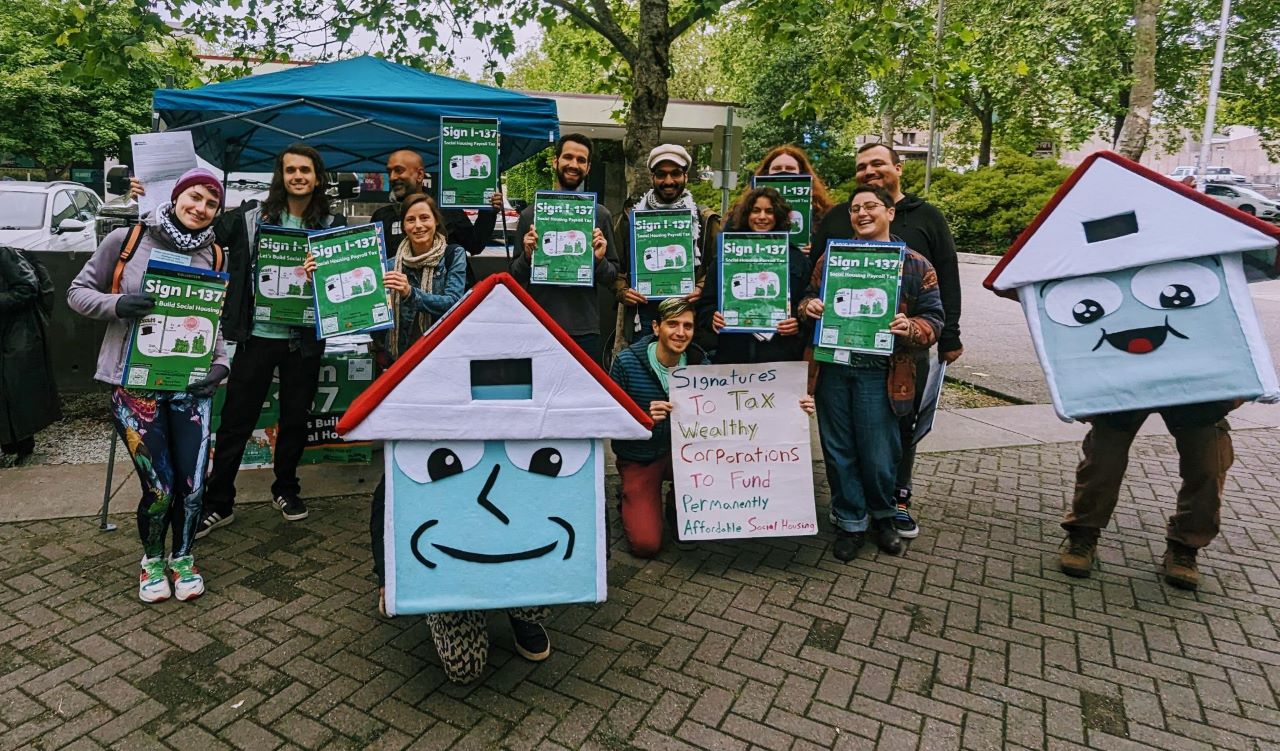
    Activists in Seattle gather signatures to put a social housing initiative on the ballot. In early 2025, voters passed the measure, which implements a payroll tax on high incomes to fund the program. House Our Neighbors, CC BY-SA

    Seattle astounded housing advocates around the country in February 2025, when roughly two-thirds of voters approved a ballot initiative proposing a new 5% payroll tax on salaries in excess of US$1 million.

    The expected revenue – estimated to amount to $52 million dollars annually – would go toward funding a public development authority named Seattle Social Housing, which would then build and maintain permanently affordable homes.

    The city has experienced record high rents and home prices over the past two decades, attributed in part to the high incomes and relatively low taxes paid by tech firms like Amazon. Prior attempts to make these companies do their part to keep the city affordable have had mixed results.

    So despite nationwide, bipartisan skepticism of government and tax increases, Seattle’s voters showed that in light of a severe affordability crisis, a new role for the public sector and a new, dedicated fiscal revenue stream for housing were not only necessary, but possible.

    As a trained architect and urban historian, I study how capitalist societies have embraced – or rejected – housing that’s permanently shielded from market forces and what that means for architecture and urban design.

    To me, Seattle’s social housing initiative shows that the country’s traditional, “either-or” housing model – of unregulated, market-rate housing versus tightly regulated, income-restricted affordable housing – has reached its limits.

    Social housing promises a different path forward.

    The rise of the ‘two-tiered’ system

    After World War I, amid a similarly dire housing crisis, journalist Catherine Bauer traveled to Europe and learned about the continent’s social housing programs.

    She publicized her findings in the 1934 book “Modern Housing,” in which she advocated for housing that would be permanently shielded from the private real estate market. High-quality design was central to her argument. (The book was reissued in 2020, reflecting a renewed hunger for her ideas.)

    Early New Deal programs supported “limited-dividend,” or nonprofit, housing sponsored by civic organizations such as labor unions. The Carl Mackley Houses in Philadelphia exemplified this approach: The government provided low-interest loans to the American Federation of Full-Fashioned Hosiery Workers, which then constructed housing for its workers with rents set at affordable rates. The complex was built with community rooms and a swimming pool for its residents.

    Financed by $1.2 million in federal funds, the Carl Mackley Houses, completed in 1935, provided homes for union workers.
    Alfred Kastner papers, Collection No. 7350, Box 45, Record 12, American Heritage Center, University of Wyoming

    However, the 1937 U.S. Housing Act omitted this form of middle-income housing. Instead, the federal government chose to support public rental housing for low-income Americans and private homeownership, with little in between.

    Historian Gail Radford has aptly termed this a “two-tiered system,” and it was problematic from the start.

    Funding for public housing in the U.S. – as well as for its successor, private-sector-built affordable housing – has always been capped in ways that fall far short of demand, with access to the homes largely restricted to households with the lowest incomes. Private-sector-built affordable housing depends on dangling tax credits for private investors, and rent restrictions can expire.

    While the U.S. promoted this two-tiered system, cities like Vienna pursued a different path.

    In Austria’s culturally vibrant capital, today half of all dwellings are permanently removed from the private market. Roughly 80% of households qualify to live in them. The buildings take a range of forms, are located in all neighborhoods, and are built and operated as rental or cooperative housing either by the city or by nonprofit developers.

    Rents do not rise and fall according to household income, but are instead set to cover capital and operation expenses. These are kept low thanks to long-term, low-interest loans. These loans are funded through a nationwide 1% payroll tax, split evenly between employers and employees. Renters also make a down payment, priced in relation to the size and age of the apartment, which keeps monthly rents down. To guarantee access to low-cost land, the municipality has pursued an active land acquisition policy since the 1980s.

    Vienna’s Pilotengasse Housing Estate, a social housing development featuring low-rise buildings with abundant greenery, was completed in 1992 and serves a range of income groups.
    Viennaslide/Construction Photography/Avalon/Getty Images

    Housing shielded from the private market

    The inequities created by the two-tiered system – along with the absence of viable options for moderate- and middle-income households – are what social housing advocates in the U.S. are trying to address today.

    In 2018, the think tank People’s Policy Project published what was likely the first 21st-century report advocating for social housing in the U.S., citing Vienna as a model.

    Across the U.S., social housing is being used to describe a range of programs, from limited equity cooperatives and community land trusts to public housing.

    They all share a few underlying principles, however.

    First and foremost, social housing calls for permanently shielding homes from the private real estate market, often referred to as “permanent affordability.” This usually means public investment in housing and public ownership of it. Second, unlike the ways in which public housing has traditionally operated in the U.S., most social housing programs aim to serve households across a broader range of incomes. The goal is to create housing that is both financially sustainable and appealing to broad swaths of the electorate. Third, social housing aspires to give residents more control over the governance of their homes.

    Social housing doesn’t all look the same. But thoughtful design is key to its success. It’s built to be owned and operated in the long-term, not for short-term financial gain. Construction quality matters, and developers realize it needs to be appealing to a range of tenants with different needs.

    Early successes

    In recent years, there have been significant wins for the social housing movement at the state and local levels.

    In 2023, Atlanta created a new quasi-public entity to co-develop mixed-income housing on city-owned land. In 2024, Rhode Island voters and the Massachusetts legislature funded pilot projects to test public investment in social housing. And 2025 has seen the the passage of Chicago’s Green Social Housing ordinance.

    Many of these programs were directly inspired by affordable housing initiatives in Montgomery County, Maryland.

    Since 2021, the county’s housing authority has used a $100 million housing fund to invest in new mixed-income developments. Through these investments, the county retains co-ownership and has been able to bring down the cost of development enough to offer 30% of homes at significantly below market rents, in perpetuity. If Vienna is the global paragon for social housing, Montgomery County has become its domestic counterpart.

    In Seattle, social housing will mean homes delivered and permanently owned by Seattle Social Housing, which is funded through the payroll tax on high incomes. The initiative envisions developments featuring a range of apartment sizes to meet the needs of different family sizes, built to high energy-efficiency standards. Homes will be available to households earning up to 120% of area median income, with residents paying no more than 30% of their income on rent. In Seattle, that means that a single-person household making up to $120,000 will qualify.

    Members of the New York City Council hold a rally with housing activists to promote social housing legislation in March 2023.
    William Alatriste/NYC Council Media Unit, CC BY-SA

    Ongoing debates

    Despite these successes, many Americans remain skeptical of social housing.

    Sign up for a webinar on the topic, and you’ll hear participants question the term itself. Isn’t it far too “socialist” to be broadly adopted in the U.S.? And isn’t this just “old wine in new bottles”?

    Join a housing task force, and established nonprofits will be the ones to push back, arguing that they already know how to build and manage housing, and that all they need is money.

    Some housing activists also question whether using scarce public dollars to pay for mixed-income housing will yet again shortchange those who most need governmental assistance – namely, the poor. Others point to the need to provide more ways to build intergenerational wealth, especially for racial minorities, who have historically faced barriers to homeownership.

    Urban planner Jonathan Tarleton has highlighted another important issue: the danger of social housing reverting over time to private ownership, as has been the case with some cooperatives in New York City. Tarleton stresses the need for “social maintenance” – the importance of telling and retelling the story of whom social housing is meant to serve.

    These debates raise important questions. Social housing may be a confusing term and an aspirational concept. But it is here to stay: It has galvanized organizers and policymakers around a new approach to the design, development and maintenance of housing.

    Social housing keeps prices down through long-term public investment, ensuring that future generations will still benefit. Developers can design and provide homes that respond to how people want to live. And in an increasingly polarized country, social housing will allow people of various backgrounds, incomes and ideological persuasions to live together again, rather than apart.

    Whether it’s the kind found in Seattle, in Maryland or somewhere in between, I believe social housing is needed more than ever before to address the country’s twin problems of affordability and a lack of political imagination.

    This article is part of a series centered on envisioning ways to deal with the housing crisis.

    Susanne Schindler receives funding from Harvard’s Joint Center for Housing Studies.

    ref. From Seattle to Atlanta, new social housing programs seek to make homes permanently affordable for a range of incomes – https://theconversation.com/from-seattle-to-atlanta-new-social-housing-programs-seek-to-make-homes-permanently-affordable-for-a-range-of-incomes-255097

    MIL OSI

  • MIL-OSI Submissions: What schools can learn from skate culture

    Source: The Conversation – UK – By Sander Hölsgens, Assistant Professor, Leiden Institute of Cultural Anthropology and Development Sociology, Leiden University

    Dean Drobot/Shutterstock

    At a school in Malmö, Sweden, skateboarding is on the curriculum. John Dahlquist, vice principal of Bryggeriets High School, teaches skate classes and brings lessons from skateboarding into other subjects. By encouraging teenagers to have fun together through skating and beyond, he notices that they want to attend school. Writing in a recent book I co-edited on skateboarding and teaching, Dahlquist notes that he even sees students longing to be back in the classroom after the weekend.

    Skateboarding is creative, requiring ingenuity in adapting to new environments. It’s collaborative and social: skaters cheer each other on when they try to learn something new, acknowledging that everyone operates at a different level and faces a distinct challenge.

    When skateboarding is done well, individual growth takes place among a community of care and mutual support. And it requires a willingness to fail. There’s no way to master a trick without trying and failing, over and over again.

    My colleagues and I have researched the value of a skateboarding philosophy in schools, and how teachers can bring it into their classrooms.


    Get your news from actual experts, straight to your inbox. Sign up to our daily newsletter to receive all The Conversation UK’s latest coverage of news and research, from politics and business to the arts and sciences.


    Take Dahlquist’s teaching in Malmö. He notes that interweaving skate classes with other subjects has multiple noteworthy effects. The physical activity of skateboarding improves levels of concentration. Some students even say that they’d never been successful in any other learning environment. Elsewhere, they’d be unable to focus on the task at hand.

    What’s more, a skateboarding mindset – being prepared to learn difficult tricks in unfamiliar settings – equipped students with the capacity to master other kinds of new skills.

    Able to fail

    The process of overcoming the anxiety to fail is crucial. Skaters cannot be afraid to fall if they want to learn new tricks. The motivation to learn through repeated efforts helps skaters in other areas of life, too. Skaters at Bryggeriet aren’t worried as much about failing grades, precisely because they see it as an opportunity to learn and move forward.

    As Dahlquist says, “At the end of my classes, I usually have to throw my students out of the classroom. A lot of them beg for three more tries: ‘I’ve got this, just give me three more tries. I promise I will learn.‘”

    This mindset decreases grades as education’s cornerstone and, by extension, enhances students’ mental health. My colleague Esther Sayers, who conducted fieldwork at Bryggeriets, found another effect. Teachers help students to develop the skills to get motivated, to reach a point of feeling inspired – or what skaters call “stoke”.

    Skateboarding fosters a non-competitive learning culture.
    PeopleImages.com – Yuri A

    Bryggeriets High School isn’t the only place where skateboarding is helping teach people how to learn. Reaching beyond its historical status as a self-regulated street culture, skateboarding now plays an important role in building engaged learning communities across the globe. Berlin-based skate organisation Skateistan hosts skate classes, gives young people access to education and offers funds for young and upcoming community leaders.

    Concrete Jungle Foundation co-builds skateparks with young people in Peru, Morocco and Jamaica, in order to exchange knowledge and drive local ownership and apprenticeship. Similarly, the New York-based Harold Hunter Foundation runs skate workshops that also provide mentoring and career guidance.

    Colleagues Arianna Gil and Jessica Forsyth have studied working class black and Latin American skate crews, run by genderdiverse community organisers. They found that skate crews such as Brujas and Gang Corp mobilise skaters according to the “for us, by us” spirit.

    Challenging institutional models of authority, these skate crews develop services based on the hopes and aspirations of their communities – ranging from teach-ins to recreational programmes. This includes a talk on the history and meaning of hoodies, and modules on the power of storytelling and the danger of propaganda. The crux, here, is to learn about stuff you encounter in your daily lives.

    Skaters who experience poverty and oppression create their own ecosystem for learning from one another, from being out of an educational system that is organised in a top-down way. This means creating a grassroots school model where skate crews choose what and how they want to learn. Rather than grades and degrees, education here is structured around the process of learning from your peers – with the idea of passing on this knowledge in the near future.

    The effects of this approach are threefold. First, it centers mentorship and apprenticeship, resulting in intergenerational knowledge exchange. Second, skateboarding’s DIY spirit can help overcome access barriers. By embracing grassroots teaching practices and formats, education can be tailored to the specific needs and desires of a community, rather than following standardised learning objectives.

    Third, rather than focusing on memorising facts or learning for grades, this new ecosystem is structured around problem-based learning. Presented with worldly problems such as human rights violations and hostile architecture, skaters learn not just how to analyse their surroundings, but also how to cope with and engage oppressive societal structures.

    As formal education faces incremental budget cuts and deepened governmental influence, skateboarding shows us new ways to organise our learning spaces. Schools and teachers can engage their students by integrating aspects of a learning culture that decentres evaluations and assessments and celebrates attempts, rather than just successes.

    Sander Hölsgens received a ‘starting grant’ from OCW, The Netherlands. He is affiliated with Pushing Boarders, a platform tracing the social impact of skateboarding worldwide.

    ref. What schools can learn from skate culture – https://theconversation.com/what-schools-can-learn-from-skate-culture-255239

    MIL OSI

  • MIL-OSI Submissions: US backs Nato’s latest pledge of support for Ukraine, but in reality seems to have abandoned its European partners

    Source: The Conversation – UK – By Stefan Wolff, Professor of International Security, University of Birmingham

    Recent news from Ukraine has generally been bad. Since the end of May, ever larger Russian air strikes have been documented against Ukrainian cities with devastating consequences for civilians, including in the country’s capital, Kyiv.

    Amid small and costly but steady gains along the almost 1,000km long frontline, Russia reportedly took full control of the Ukrainian region of Luhansk, part of which it had already occupied before the beginning of its full-scale invasion of Ukraine in February 2022.

    And according to Dutch and German intelligence reports, some of Russia’s gains on the battlefield are enabled by the widespread use of chemical weapons.


    Get your news from actual experts, straight to your inbox. Sign up to our daily newsletter to receive all The Conversation UK’s latest coverage of news and research, from politics and business to the arts and sciences.


    It was therefore something of a relief that Nato’s summit in The Hague produced a short joint declaration on June 25 in which Russia was clearly named as a “long-term threat … to Euro-Atlantic security”. Member states restated “their enduring sovereign commitments to provide support to Ukraine”. While the summit declaration made no mention of future Nato membership for Ukraine, the fact that US president Donald Trump agreed to these two statements was widely seen as a success.

    Yet, within a week of the summit, Washington paused the delivery of critical weapons to Ukraine, including Patriot air defence missiles and long-range precision-strike rockets. The move was ostensibly in response to depleting US stockpiles.

    This despite the Pentagon’s own analysis, which suggested that the shipment – authorised by the former US president Joe Biden last year – posed no risk to US ammunition supplies.

    This was bad news for Ukraine. The halt in supplies weakens Kyiv’s ability to protect its large population centres and critical infrastructure against intensifying Russian airstrikes. It also puts limits on Ukraine’s ability to target Russian supply lines and logistics hubs behind the frontlines that have been enabling ground advances.

    Despite protests from Ukraine and an offer from Germany to buy Patriot missiles from the US for Ukraine, Trump has been in no rush to reverse the decision by the Pentagon.

    Russia is now claiming to have completed its occupation of the province of Luhansk in eastern Ukraine.
    Institute for the Study of War

    Another phone call with his Russian counterpart, Vladimir Putin, on July 3, failed to change Trump’s mind, even though he acknowledged his disappointment with the clear lack of willingness by the Kremlin to stop the fighting. What’s more, within hours of the call between the two presidents, Moscow launched the largest drone attack of the war against Kyiv.

    A day later, Trump spoke with Zelensky. And while the call between them was apparently productive, neither side gave any indication that US weapons shipments to Ukraine would resume quickly.

    Trump previously paused arms shipments and intelligence sharing with Ukraine in March, 2025 after his acrimonious encounter with Zelensky in the Oval Office. But the US president reversed course after certain concessions had been agreed – whether that was an agreement by Ukraine to an unconditional ceasefire or a deal on the country’s minerals.

    It is not clear with the current disruption whether Trump is after yet more concessions from Ukraine. The timing is ominous, coming after what had appeared to be a productive Nato summit with a unified stance on Russia’s war of aggression. And it preceded Trump’s call with Putin.

    This could be read as a signal that Trump was still keen to accommodate at least some of the Russian president’s demands in exchange for the necessary concessions from the Kremlin to agree, finally, the ceasefire that Trump had once envisaged he could achieve in 24 hours.

    If this is indeed the case, the fact that Trump continues to misread the Russian position is deeply worrying. The Kremlin has clearly drawn its red lines on what it is after in any peace deal with Ukraine.

    These demands – virtually unchanged since the beginning of the war – include a lifting of sanctions against Russia and no Nato membership for Ukraine, while also insisting that Kyiv must accept limits on its future military forces and recognise Russia’s annexation of Crimea and four regions on the Ukrainian mainland.

    This will not change as a result of US concessions to Russia but only through pressure on Putin. And Trump has so far been unwilling to apply pressure in a concrete and meaningful way beyond the occasional hints to the press or on social media.

    Coalition of the willing

    It is equally clear that Russia’s maximalist demands are unacceptable to Ukraine and its European allies. With little doubt that the US can no longer be relied upon to back the European and Ukrainian position, Kyiv and Europe need to accelerate their own defence efforts.

    A European coalition of the willing to do just that is slowly taking shape. It straddles the once more rigid boundaries of EU and Nato membership and non-membership, involving countries such as Moldova, Norway and the UK.
    and including non-European allies including Canada, Japan and South Korea.

    The European commission’s white paper on European defence is an obvious indication that the threat from Russia and the needs of Ukraine are being taken seriously and, crucially, acted upon. It mobilises some €800 billion (£690 billion) in defence spending and will enable deeper integration of the Ukrainian defence sector with that of the European Union.

    At the national level, key European allies, in particular Germany, have also committed to increased defence spending and stepped up their forward deployment of forces closer to the borders with Russia.

    US equivocation will not mean that Ukraine is now on the brink of losing the war against Russia. Nor will Europe discovering its spine on defence put Kyiv immediately in a position to defeat Moscow’s aggression.

    After decades of relying on the US and neglecting their own defence capabilities, these recent European efforts are a first step in the right direction. They will not turn Europe into a military heavyweight overnight. But they will buy time to do so.

    Stefan Wolff is a past recipient of grant funding from the Natural Environment Research Council of the UK, the United States Institute of Peace, the Economic and Social Research Council of the UK, the British Academy, the NATO Science for Peace Programme, the EU Framework Programmes 6 and 7 and Horizon 2020, as well as the EU’s Jean Monnet Programme. He is a Trustee and Honorary Treasurer of the Political Studies Association of the UK and a Senior Research Fellow at the Foreign Policy Centre in London.

    ref. US backs Nato’s latest pledge of support for Ukraine, but in reality seems to have abandoned its European partners – https://theconversation.com/us-backs-natos-latest-pledge-of-support-for-ukraine-but-in-reality-seems-to-have-abandoned-its-european-partners-260334

    MIL OSI

  • MIL-OSI Video: President Ursula von der Leyen participates in the EP plenary debate

    Source: European Commission (video statements)

    On 7 July 2025, European Commission President Ursula von der Leyen participates in the European Parliament Plenary Debate in Strasbourg, France.

    Follow live events and access media content here:
    https://audiovisual.ec.europa.eu/en/

    Stay updated — follow us on X: https://x.com/EC_AVService

    Follow us on:
    -X: https://twitter.com/EU_Commission
    -Instagram: https://www.instagram.com/europeancommission/
    -Facebook: https://www.facebook.com/EuropeanCommission
    -LinkedIn: https://www.linkedin.com/company/european-commission/
    -Medium: https://medium.com/@EuropeanCommission

    Check our website: http://ec.europa.eu/

    https://www.youtube.com/watch?v=gMX1npG87tI

    MIL OSI Video

  • MIL-OSI United Kingdom: Review into Government Response to the Death of Harry Dunn

    Source: United Kingdom – Executive Government & Departments 3

    News story

    Review into Government Response to the Death of Harry Dunn

    Independent review into the UK Government response to the death of Harry Dunn announced by Foreign Secretary David Lammy 

    • Independent review into the UK Government response to the death of Harry Dunn announced by Foreign Secretary David Lammy
    • Review, led by Dame Anne Owers, will focus on Government actions in months following the tragedy in 2019, and look at support offered to UK citizens in comparable situations
    • David Lammy met Harry Dunn’s family and said the Government would learn lessons from the tragedy

    An independent review into the UK Government’s response to the death of Harry Dunn has been announced by Foreign Secretary David Lammy (Monday 7 July). Harry Dunn was tragically killed in a road traffic collision in August 2019. 

    The review will be led by Dame Anne Owers DBE, who will examine actions taken by the Foreign and Commonwealth Office in support of the family of Harry Dunn in the period between 27 August and the end of December in 2019. 

    Having promised to undertake a review while sitting as an opposition MP, David Lammy has met twice with family members since becoming Foreign Secretary and committed the Government to learning lessons from the tragedy. 

    Foreign Secretary David Lammy said:  

    I have the deepest respect for the resolve Harry’s family have shown since his tragic death and in launching this independent review, we are honouring the commitments we have made to them. 

    I am confident the review into how the case was handled by the previous government has the remit required to properly address the family’s concerns and to ensure lessons are learned. 

    Having worked previously with Dame Anne Owers on the Lammy Review in 2017, I don’t believe anyone is better qualified to undertake this important piece of work.” 

    The mother of Harry Dunn, Charlotte Charles, said: 

    We welcome today’s formal announcement by the Foreign, Commonwealth and Development Office that a full review into the handling of Harry’s case will now take place. 

    I want to pay particular tribute to the Foreign Secretary David Lammy. Ever since we met him in his role as Shadow Foreign Secretary back in January 2023, he has shown us nothing but compassion and leadership. He listened to us carefully and committed to undertaking this review once he was in a position to do so. True to his word, he has now delivered on that promise. My family and Team Harry are incredibly grateful to him for doing the right thing. 

    We now look forward to working with Dame Anne Owers and doing all we can to support her in this important task. It is our sincere hope that her work will help ensure that no other family is ever treated in the way that ours was. This review is yet another step in our long journey towards ensuring that Harry’s loss was not in vain and that the World is a better and safer place.” 

    Dame Anne Owers DBE said: 

    I believe it is crucially important that public authorities are ready to learn lessons from difficult and traumatic events, so they can reflect on and improve the way they work and communicate. This is something that I have been committed to in all the roles I have held. 

    I am pleased to have been asked by the Foreign Secretary to carry out this work in the context of the tragic death of Harry Dunn, and to identify any lessons for the Foreign, Commonwealth and Development Office.  I very much hope that this will provide some assurance to Harry’s family.” 

    The independent review will seek to identify key lessons to be learned for comparable future situations. 

    It will not examine issues which have previously been considered under related historical legal proceedings, the UK’s relationship with other countries or the role or actions of any other countries. 

    The final report of the Independent Review will be published in full, subject only to redactions relating to national security or personal information, and will be laid before Parliament along with the Foreign Secretary’s Written Ministerial Statement.

    Updates to this page

    Published 7 July 2025

    MIL OSI United Kingdom

  • MIL-OSI Asia-Pac: HKETO Berlin Supports Berlin CityCup Dragon Boat Races (with photos)

    Source: Hong Kong Government special administrative region

    The Hong Kong Economic and Trade Office in Berlin (HKETO Berlin) supported the 26th Berlin CityCup dragon boat races on July 5 and 6 (Berlin time).
     
    The event saw enthusiastic participation with a total of more than 1 000 racers joined the competition. As one of the highlights of the CityCup, 60 teams joined the Hong Kong Cup sponsored by the HKETO Berlin on July 5. The Acting Director of HKETO Berlin, Mr Billy Leung, presented trophies to the winning teams after the race.
     
    “In Chinese culture, dragon signifies strength, courage, and resilience. Today, dragon boat racers from diverse cultural backgrounds have showed the power of teamwork and fighting spirit together.” Mr Leung said.
     
    Mr Leung added that Hong Kong possesses world-class sports, cultural and recreational facilities. With the opening of Kai Tak Sports Park in this March, a series of mega sports events as well as concerts have been held. 
     
    HKETO Berlin also set up a promotional booth at the race venue to showcase Hong Kong’s forthcoming major events, and promote Hong Kong’s advantages as an ideal place for work and study.

    About HKETO Berlin
     
    HKETO Berlin is the official representative of the Hong Kong Special Administrative Region Government in commercial relations and other economic and trade matters in Germany as well as Austria, Czechia, Hungary, Poland, the Slovak Republic, Slovenia and Switzerland.
     

    MIL OSI Asia Pacific News

  • MIL-OSI: BIO-Europe® 2025 Gathers Global Life Sciences Leaders in Vienna

    Source: GlobeNewswire (MIL-OSI)

    MUNICH, Germany, July 07, 2025 (GLOBE NEWSWIRE) — The 31st annual edition of BIO-Europe, the premier partnering conference for the global biopharmaceutical industry organized by EBD Group, will take place in Vienna, Austria, from November 3 – 5, 2025, followed by a digital partnering experience on November 11 – 12.

    BIO-Europe continues to serve as a cornerstone event for life science dealmaking and brings together key decision-makers to spark innovation, investment, and partnerships. The 2025 edition is expected to welcome 5,700+ participants from 2,900 companies worldwide, including top-level management from the world’s top 50 pharma firms. Attendees will engage in over 30,000 one-to-one meetings, advancing therapeutic innovation and dealmaking across the ecosystem.

    “In times when uncertainty and complexity shape the global landscape, strategic collaboration is more vital than ever,” said Claire Macht, European Portfolio Director for EBD Group. “BIO-Europe provides a high-impact platform where partnerships flourish – across borders, disciplines, and development stages. Innovation in life sciences doesn’t happen in isolation, it happens when people connect, share ideas, and transform vision into action. Vienna’s vibrant ecosystem and scientific excellence make it the ideal setting for shaping the future of healthcare together.”

    Vienna stands out as one of Europe’s most dynamic life sciences locations. The Austrian capital accounts for over half of the nation’s life sciences activity and employs nearly 50,000 people across 754 organizations, including 646 companies and 19 renowned research and education institutions. The sector generated €22 billion in annual revenues in 2023, underscoring the city’s growing influence in the European biotech and pharma industry.1

    “Welcoming BIO-Europe to Vienna is both an honor and a strategic opportunity,” said Philipp Hainzl, Managing Director of LISAvienna. “Austria’s life sciences community is eager to engage with international peers, investors, and innovators. We look forward to showcasing the regional strength in research, entrepreneurship, and collaborative growth on a global stage. Together with our leading biotech innovators, we will contribute to an unforgettable conference experience. Participants are warmly invited to our Welcome Reception at the magnificent Vienna City Hall.” The local host LISAvienna is Vienna’s central life sciences cluster platform operated by Austria Wirtschaftsservice (aws) and the Vienna Business Agency on behalf of the Austrian Federal Ministry of Economy, Energy and Tourism and the City of Vienna.

    Program Highlights

    Inspired by Vienna’s legendary coffeehouse culture and music, BIO-Europe 2025 will offer an engaging program involving expert-led panel discussions, company presentations, including the startup spotlight pitch competition, the Advanced Business Development course, an active exhibition floor, and networking opportunities designed to inspire collaboration across the life science industry.

    A highlight of the event – the Opening Plenary – with David Loew, CEO of Ipsen, and Jeremy Levin, CEO of Ovid Therapeutics, will explore Europe’s evolving role in global healthcare innovation – will it be a symphony or a solo act?

    BIO-Europe serves the entire biopharma ecosystem, with tailored content for early-stage startups, innovators, academic researchers, as well as large pharma and venture investors. Serendipitous networking, both in-person and online, is a hallmark of the experience.

    Partnering and Registration

    Partnering for BIO-Europe opens on September 22, 2025. One-to-one meetings will be powered by partneringONE®, EBD Group’s industry-standard platform that enables delegates to search, request, schedule, and conduct meetings efficiently.

    To enhance access and extend engagement beyond the in-person event, the conference will continue with two days of virtual partnering on November 11-12, allowing participants to connect regardless of time zone or travel constraints.

    Registration is now open (information is available online), with the biggest savings available through the first early bird deadline on July 25, 2025. Additional discounted rates are available until November 2, 2025.

    For more information, please visit the conference website at: https://informaconnect.com/bioeurope/

    Additional links and information:

    Follow BIO-Europe 2025 on X @EBDGroup (hashtag: #BIOEurope) or on LinkedIn.

    About EBD Group

    EBD Group’s mission is to help collaborations get started across the life science value chain. Our range of partnering conferences has grown to become the largest and most productive conference platform in the industry. Each one of our landmark events held in key life science markets around the world is powered by our state-of-the-art partnering software, partneringONE, that enables delegates to efficiently identify and engage with new opportunities via one-to-one meetings. Today our events (BIO-Europe, BIO-Europe Spring®, Biotech Showcase™, ChinaBio® Partnering Forum, Asia Bio Partnering Forum and BioEquity Europe) annually attract more than 15,000 senior life science executives who engage in over 50,000 one-to-one partnering meetings. These vital one-to-one engagements are the wellspring of deals that drive innovation in our industry. EBD Group is an Informa company. For more information, please visit www.ebdgroup.com.

    Media Contacts:

    MC Services AG
    +49 89 2102280
    contact@mc-services.eu

    EBD Group
    Karina Marocco
    kmarocco@ebdgroup.com

    1Vienna Life Science Report 2024/2025

    The MIL Network

  • MIL-OSI United Kingdom: CAC Annual Report 2024-25

    Source: United Kingdom – Executive Government & Departments

    Press release

    CAC Annual Report 2024-25

    Publication of the CAC’s Annual Report for 2024-25.

    Today the Central Arbitration Committee (CAC) has published its Annual Report for the year ending 31 March 2025. The Report includes reference to the amendments taking place in the Employment Rights Bill that is currently going through the Houses of Parliament which affects Schedule A1 and the new measures heading the CAC’s way. The Report reflects on the decrease in the caseload for trade union recognition applications under Part I of Schedule A1. This decreased from 81 applications last year to 63, a 22% decrease.

    The statistics relating to the CAC’s various jurisdictions are all featured in the Annual Report, with statutory recognition continuing to provide the majority of the workload (63 applications for trade union recognition under Part I of the Schedule).

    When reviewing the average time taken for the conclusion of a Part I statutory recognition case from inception (date the application is received) to conclusion (date of issue of a declaration of recognition or non-recognition), the time taken was 22 weeks, which is slightly higher than the previous year’s figure of 19 weeks.

    The CAC has done exceptionally well in maintaining its high level of customer satisfaction, with 92% of respondents stating their overall satisfaction with the way the CAC handled their case.

    Notes for Editors:

    1. The CAC is a Non-Departmental Public Body (NDPB) resourced by Acas but operating independently.  The CAC’s main role is dealing with requests for trade union recognition and derecognition under the statutory procedures of Schedule A1 to the Trade Union and Labour Relations (Consolidation) Act 1992. Each recognition case is handled by a tripartite panel, with members drawn from employer and union backgrounds and a panel chair (usually a lawyer or senior academic).

    2. The CAC also determines disclosure of information complaints under the Trade Union and Labour Relations (Consolidation) Act 1992 (Section 183) and deals with disputes under the Regulations relating to the European Works Councils. It also handles applications and complaints under the Information and Consultation Regulations 2004. In addition, it provides voluntary arbitration in collective employment relations disputes, although this role has not been required for some years.

    3. The CAC Chair is Stephen Redmond.

    4. Details of applications received by the CAC, decisions taken, and forthcoming hearings, can be found on the CAC’s website www.cac.gov.uk.

    Central Arbitration Committee

    PO Box 80600, London, E15 9JX

    0330 109 3610

    Updates to this page

    Published 7 July 2025

    MIL OSI United Kingdom

  • MIL-OSI United Kingdom: RAF personnel to benefit from new SLA accommodation at Cosford

    Source: United Kingdom – Executive Government & Departments

    News story

    RAF personnel to benefit from new SLA accommodation at Cosford

    50 new SLA bedspaces will be created at RAF Cosford as part of a £12 million contract.

    RAF Cosford Station Commander Penny Brady with representatives from DIO, Reds10 and Arcadis. MOD Crown Copyright.

    Construction has started on a new 50-bedroom Single Living Accommodation (SLA) block at RAF Cosford in Shropshire.  

    The Defence Infrastructure Organisation (DIO) awarded a £12 million contract to modular construction specialist Reds10 and the start of work was marked at a recent groundbreaking ceremony. The contract was awarded through the £1 billion Single Living Accommodation – Programmatic Approach framework alliance, which will see thousands of new bedspaces created for Armed Forces personnel. 

    The accommodation will provide 50 en-suite bedrooms, as well as kitchenettes, communal space, equipment storage and laundry facilities. Sustainability has been central in the design of the block, featuring air source heat pumps for heating and hot water, photovoltaic panels and a SMART building management system to ensure optimal efficiency. While the project will not be the new SLA common design, lessons will continue to be learned from this and other projects to ensure the needs of service personnel are met, while also aiming to achieve the requirements of the Government’s Net Zero Strategy.  

    This project will not only improve service life for personnel but will also benefit local businesses. Over £120,000 has already been spent with local suppliers and the project team will continue to maximise opportunities to support the local community as the project progresses.   

    The project is one of the first to be delivered under the £1 billion SLA Alliance, which will run for six years and will see 16,000 new bedspaces built. It forms part of wider plans to build or refurbish 40,000 SLA bedspaces over the next 10 years, improving living conditions for service personnel.

    Peter Shaw, Project Manager for DIO Major Programmes and Projects, said: 

    I am very excited to see spades in the ground and construction officially starting on this project to improve accommodation for personnel based at RAF Cosford. We are looking forward to delivering this project as part of the SLA Programmatic Approach, which will ensure we can safely build consistent accommodation blocks faster, while also driving greater value for money.

    Wing Commander Penny Brade, Station Commander at RAF Cosford, said:  

    RAF Cosford has continued to grow in recent years. When complete, the new Officers’ Mess annex will have a hugely positive impact on those commissioned personnel living on the Station, and those who visit for courses and conferences.

    Phil Cook, Managing Director – Defence for Reds10, said: 

    We’re proud to be delivering the first project to complete under the SLA Alliance at RAF Cosford; a significant milestone in transforming how accommodation for service personnel is delivered across the MOD estate. By combining our expertise in industrialised construction with a strong, collaborative relationship with DIO, we’re helping to set a new benchmark for quality, sustainability and speed of delivery, ensuring those serving our country have the high-quality living environments they deserve. 

    Construction is now underway at the site and is expected to be completed by July 2026. 

    Updates to this page

    Published 7 July 2025

    MIL OSI United Kingdom

  • MIL-OSI United Kingdom: Investigation opened into parish church after concerns raised over its financial controls

    Source: United Kingdom – Executive Government & Departments

    Press release

    Investigation opened into parish church after concerns raised over its financial controls

    The Charity Commission has opened a statutory inquiry into The Parochial Church Council of The Ecclesiastical Parish of Holy Trinity with St. John, Micklegate and St. Martin Cum Gregory, York

    The charity, whose working name is Holy Trinity Micklegate PCC, is a Church of England parish church situated in York city centre and was registered with the Commission in 2018. 

    The Commission initially engaged with the charity after it failed to submit its annual accounting information for the financial years ending 31 December 2022 and 2023.  

    During the course of its engagement, the Commission received a report from the current trustees highlighting serious concerns about the charity’s previous financial management, and it has now escalated its case to a statutory inquiry.  

    The regulator’s inquiry will examine the administration, governance and management of the charity, with particular regard to:   

    • whether the charity is being managed in accordance with its governing document and has a sufficient number of willing and capable trustees

    • the financial management of the charity including whether the charity has appropriate and robust financial controls in place

    • the management of potential conflicts of interest and connected party transactions, and whether there has been any unauthorised personal benefit 

    • whether the charity has suffered a financial loss as a result of any misconduct and/or mismanagement by the trustees 

    The Commission may extend the scope of the inquiry if additional regulatory issues emerge. 

    It is the Commission’s policy, after it has concluded an inquiry, to publish a report detailing the issues examined, any action taken, and the inquiry’s outcomes. 

    ENDS 

    Notes to editors:  

    1. The Charity Commission is the independent, non-ministerial government department that registers and regulates charities in England and Wales. Its ambition is to be an expert regulator that is fair, balanced, and independent so that charity can thrive. This ambition will help to create and sustain an environment where charities further build public trust and ultimately fulfil their essential role in enhancing lives and strengthening society. Read further information about what the Commission does 

    2. On 4 June 2025, the Charity Commission opened a statutory inquiry into the charity under section 46 of the Charities Act 2011 (“the Act”) as a result of its regulatory concerns that there is or has been misconduct and/ or mismanagement in the administration of the charity. 

    3. A statutory inquiry is a legal power enabling the Commission to formally investigate matters of regulatory concern within a charity and to use protective powers for the benefit of the charity and its beneficiaries, assets, or reputation. 

    4. The Commission does not investigate criminal allegations which are matters for the police.

    Press office

    Email pressenquiries@charitycommission.gov.uk

    Out of hours press office contact number: 07785 748787

    Updates to this page

    Published 7 July 2025

    MIL OSI United Kingdom

  • MIL-OSI United Kingdom: Join Elmer and friends at Leicester Museum this summer

    Source: City of Leicester

    THE JOYFUL world of Elmer the Patchwork Elephant will be delighting visitors to Leicester Museum & Art Gallery this summer.

    From Saturday (12 July), families can enjoy a free exhibition that includes interactive displays, author’s artwork and a giant jigsaw featuring everyone’s favourite elephant.

    Created by author and illustrator David McKee more than 35 years ago, and the star of more than 40 books, Elmer is joined at the exhibition by Mr Benn, King Rollo and Not Now, Bernard – popular characters also created by David McKee.

    Youngsters will be able to dress up in the Mr Benn costume shop and take part in free activities inspired by the imaginative world of Elmer and friends.

    On Friday 18 July, there’s an opportunity to make a storybook, while on Friday 25 July, children can use a range of materials to create their own collage creatures inspired by David McKee’s illustrations. Free craft activities on Friday 1 August include the chance to design a colourful trail of cardboard elephants. All drop-in activities run from 11am until 3pm.

    Elmer and Friends: The Colourful World of David McKee is an exhibition from Seven Stories, The National Centre for Children’s Books.

    It opens at Leicester Museum & Art Gallery on Saturday 12 July and runs until Sunday 9 November. Admission is free of charge.

    MIL OSI United Kingdom

  • MIL-OSI: Home Decor Brand Graham & Brown Boosts Operational Efficiency and Growth with BigCommerce

    Source: GlobeNewswire (MIL-OSI)

    AUSTIN, Texas and LONDON, July 07, 2025 (GLOBE NEWSWIRE) — BigCommerce (Nasdaq: BIGC), a leading provider of open, composable commerce solutions for B2C and B2B brands, retailers, manufacturers and distributors, today announced that Graham & Brown, a leading UK wallcoverings and home décor company, has achieved measurable improvements in customer experience, revenue growth, operational efficiency and digital maturity since launching its B2B ecommerce site on BigCommerce.

    In an industry traditionally driven by human touchpoints and manual processes, Graham & Brown recognised a fundamental shift in buyer expectations to increasingly demand the convenience and efficiency of digital self-service. Working with BigCommerce, Graham & Brown built a B2B ecommerce site to improve the buyer experience and its own business operations.

    Achieving revenue growth and market expansion

    This transformation moved quickly from concept to delivery. Within just 12 weeks, Graham & Brown launched a fully functioning B2B ecommerce site in January 2025. Adoption was rapid with 90% of key accounts having embraced the new digital channel, in the first few months, underlying the demand for a more efficient, customer-centric buying experience.

    Building on this early success, Graham & Brown rapidly expanded the platform beyond the UK, launching in Ireland and the broader European market by March. Designed from the outset with global scale in mind, the platform supports multi-currency transactions in GBP, USD, EUR, AUD, and NZD.

    Enhancing customer experience

    Central to Graham & Brown’s digital transformation was a focus on delivering a better customer experience. By engaging real customers in the build process, Graham & Brown gained direct insights into day-to-day user needs, enabling the development of features specifically tailored to the B2B buyer. BigCommerce allowed Graham & Brown to streamline the buyer experience, including a Quick Order tool for frequent, high-volume purchases, real-time visibility into credit balances and industry-specific functionality such as specifying batch numbers for wallpaper orders to ensure exact colour consistency.

    Another standout innovation was the launch of bespoke print-to-order wallpaper mural creation tools for B2B customers. This innovative feature allows trade clients to input custom dimensions and crop and zoom onto the design, to create a bespoke feature wall mural.

    “BigCommerce’s platform has been incredibly successful at delivering and achieving our digital goals from the onset,” said Mike Berry, head of ecommerce at Graham & Brown. “Not only has the platform elevated our customers’ journey by creating a more tailored and personalised experience, but it has also significantly eased the burden on our sales team.”

    Realising operational efficiencies

    The benefits of the new platform have been felt strongly inside the organisation. By shifting routine transactions and inquiries online, Graham & Brown has achieved significant operational efficiencies. The customer service team experienced a reduction in inbound calls, as common questions about stock, pricing and order status were answered by the website’s self-service tools. Likewise, the sales team has seen the typical Monday morning backlog of orders and emails decline.

    “We’re thrilled that Graham & Brown’s B2B website is delivering a tailored, elevated digital experience that meets the unique needs of the home furnishings industry,” said Lance Owide, general manager of B2B at BigCommerce. “Graham & Brown had a vision to use ecommerce to drive operational efficiency, and to power the company’s global growth ambitions, and the results so far have achieved this while staying true to the core values of the brand.”

    To learn more about BigCommerce B2B Edition, click here.

    About BigCommerce

    BigCommerce (Nasdaq: BIGC) is a leading open SaaS and composable ecommerce platform that empowers brands, retailers, manufacturers and distributors of all sizes to build, innovate and grow their businesses online. BigCommerce provides its customers sophisticated professional-grade functionality, customisation and performance with simplicity and ease-of-use. Tens of thousands of B2C and B2B companies across 150 countries and numerous industries rely on BigCommerce, including Coldwater Creek, Harvey Nichols, King Arthur Baking Co., MKM Building Supplies, United Aqua Group and Uplift Desk. For more information, please visit www.bigcommerce.com or follow us on X and LinkedIn.

    BigCommerce® is a registered trademark of BigCommerce Pty. Ltd. Third-party trademarks and service marks are the property of their respective owners.

    Media Contact:
    Brad Hem
    pr@bigcommerce.com 

    The MIL Network

  • MIL-OSI: Home Decor Brand Graham & Brown Boosts Operational Efficiency and Growth with BigCommerce

    Source: GlobeNewswire (MIL-OSI)

    AUSTIN, Texas and LONDON, July 07, 2025 (GLOBE NEWSWIRE) — BigCommerce (Nasdaq: BIGC), a leading provider of open, composable commerce solutions for B2C and B2B brands, retailers, manufacturers and distributors, today announced that Graham & Brown, a leading UK wallcoverings and home décor company, has achieved measurable improvements in customer experience, revenue growth, operational efficiency and digital maturity since launching its B2B ecommerce site on BigCommerce.

    In an industry traditionally driven by human touchpoints and manual processes, Graham & Brown recognised a fundamental shift in buyer expectations to increasingly demand the convenience and efficiency of digital self-service. Working with BigCommerce, Graham & Brown built a B2B ecommerce site to improve the buyer experience and its own business operations.

    Achieving revenue growth and market expansion

    This transformation moved quickly from concept to delivery. Within just 12 weeks, Graham & Brown launched a fully functioning B2B ecommerce site in January 2025. Adoption was rapid with 90% of key accounts having embraced the new digital channel, in the first few months, underlying the demand for a more efficient, customer-centric buying experience.

    Building on this early success, Graham & Brown rapidly expanded the platform beyond the UK, launching in Ireland and the broader European market by March. Designed from the outset with global scale in mind, the platform supports multi-currency transactions in GBP, USD, EUR, AUD, and NZD.

    Enhancing customer experience

    Central to Graham & Brown’s digital transformation was a focus on delivering a better customer experience. By engaging real customers in the build process, Graham & Brown gained direct insights into day-to-day user needs, enabling the development of features specifically tailored to the B2B buyer. BigCommerce allowed Graham & Brown to streamline the buyer experience, including a Quick Order tool for frequent, high-volume purchases, real-time visibility into credit balances and industry-specific functionality such as specifying batch numbers for wallpaper orders to ensure exact colour consistency.

    Another standout innovation was the launch of bespoke print-to-order wallpaper mural creation tools for B2B customers. This innovative feature allows trade clients to input custom dimensions and crop and zoom onto the design, to create a bespoke feature wall mural.

    “BigCommerce’s platform has been incredibly successful at delivering and achieving our digital goals from the onset,” said Mike Berry, head of ecommerce at Graham & Brown. “Not only has the platform elevated our customers’ journey by creating a more tailored and personalised experience, but it has also significantly eased the burden on our sales team.”

    Realising operational efficiencies

    The benefits of the new platform have been felt strongly inside the organisation. By shifting routine transactions and inquiries online, Graham & Brown has achieved significant operational efficiencies. The customer service team experienced a reduction in inbound calls, as common questions about stock, pricing and order status were answered by the website’s self-service tools. Likewise, the sales team has seen the typical Monday morning backlog of orders and emails decline.

    “We’re thrilled that Graham & Brown’s B2B website is delivering a tailored, elevated digital experience that meets the unique needs of the home furnishings industry,” said Lance Owide, general manager of B2B at BigCommerce. “Graham & Brown had a vision to use ecommerce to drive operational efficiency, and to power the company’s global growth ambitions, and the results so far have achieved this while staying true to the core values of the brand.”

    To learn more about BigCommerce B2B Edition, click here.

    About BigCommerce

    BigCommerce (Nasdaq: BIGC) is a leading open SaaS and composable ecommerce platform that empowers brands, retailers, manufacturers and distributors of all sizes to build, innovate and grow their businesses online. BigCommerce provides its customers sophisticated professional-grade functionality, customisation and performance with simplicity and ease-of-use. Tens of thousands of B2C and B2B companies across 150 countries and numerous industries rely on BigCommerce, including Coldwater Creek, Harvey Nichols, King Arthur Baking Co., MKM Building Supplies, United Aqua Group and Uplift Desk. For more information, please visit www.bigcommerce.com or follow us on X and LinkedIn.

    BigCommerce® is a registered trademark of BigCommerce Pty. Ltd. Third-party trademarks and service marks are the property of their respective owners.

    Media Contact:
    Brad Hem
    pr@bigcommerce.com 

    The MIL Network

  • MIL-OSI: Home Decor Brand Graham & Brown Boosts Operational Efficiency and Growth with BigCommerce

    Source: GlobeNewswire (MIL-OSI)

    AUSTIN, Texas and LONDON, July 07, 2025 (GLOBE NEWSWIRE) — BigCommerce (Nasdaq: BIGC), a leading provider of open, composable commerce solutions for B2C and B2B brands, retailers, manufacturers and distributors, today announced that Graham & Brown, a leading UK wallcoverings and home décor company, has achieved measurable improvements in customer experience, revenue growth, operational efficiency and digital maturity since launching its B2B ecommerce site on BigCommerce.

    In an industry traditionally driven by human touchpoints and manual processes, Graham & Brown recognised a fundamental shift in buyer expectations to increasingly demand the convenience and efficiency of digital self-service. Working with BigCommerce, Graham & Brown built a B2B ecommerce site to improve the buyer experience and its own business operations.

    Achieving revenue growth and market expansion

    This transformation moved quickly from concept to delivery. Within just 12 weeks, Graham & Brown launched a fully functioning B2B ecommerce site in January 2025. Adoption was rapid with 90% of key accounts having embraced the new digital channel, in the first few months, underlying the demand for a more efficient, customer-centric buying experience.

    Building on this early success, Graham & Brown rapidly expanded the platform beyond the UK, launching in Ireland and the broader European market by March. Designed from the outset with global scale in mind, the platform supports multi-currency transactions in GBP, USD, EUR, AUD, and NZD.

    Enhancing customer experience

    Central to Graham & Brown’s digital transformation was a focus on delivering a better customer experience. By engaging real customers in the build process, Graham & Brown gained direct insights into day-to-day user needs, enabling the development of features specifically tailored to the B2B buyer. BigCommerce allowed Graham & Brown to streamline the buyer experience, including a Quick Order tool for frequent, high-volume purchases, real-time visibility into credit balances and industry-specific functionality such as specifying batch numbers for wallpaper orders to ensure exact colour consistency.

    Another standout innovation was the launch of bespoke print-to-order wallpaper mural creation tools for B2B customers. This innovative feature allows trade clients to input custom dimensions and crop and zoom onto the design, to create a bespoke feature wall mural.

    “BigCommerce’s platform has been incredibly successful at delivering and achieving our digital goals from the onset,” said Mike Berry, head of ecommerce at Graham & Brown. “Not only has the platform elevated our customers’ journey by creating a more tailored and personalised experience, but it has also significantly eased the burden on our sales team.”

    Realising operational efficiencies

    The benefits of the new platform have been felt strongly inside the organisation. By shifting routine transactions and inquiries online, Graham & Brown has achieved significant operational efficiencies. The customer service team experienced a reduction in inbound calls, as common questions about stock, pricing and order status were answered by the website’s self-service tools. Likewise, the sales team has seen the typical Monday morning backlog of orders and emails decline.

    “We’re thrilled that Graham & Brown’s B2B website is delivering a tailored, elevated digital experience that meets the unique needs of the home furnishings industry,” said Lance Owide, general manager of B2B at BigCommerce. “Graham & Brown had a vision to use ecommerce to drive operational efficiency, and to power the company’s global growth ambitions, and the results so far have achieved this while staying true to the core values of the brand.”

    To learn more about BigCommerce B2B Edition, click here.

    About BigCommerce

    BigCommerce (Nasdaq: BIGC) is a leading open SaaS and composable ecommerce platform that empowers brands, retailers, manufacturers and distributors of all sizes to build, innovate and grow their businesses online. BigCommerce provides its customers sophisticated professional-grade functionality, customisation and performance with simplicity and ease-of-use. Tens of thousands of B2C and B2B companies across 150 countries and numerous industries rely on BigCommerce, including Coldwater Creek, Harvey Nichols, King Arthur Baking Co., MKM Building Supplies, United Aqua Group and Uplift Desk. For more information, please visit www.bigcommerce.com or follow us on X and LinkedIn.

    BigCommerce® is a registered trademark of BigCommerce Pty. Ltd. Third-party trademarks and service marks are the property of their respective owners.

    Media Contact:
    Brad Hem
    pr@bigcommerce.com 

    The MIL Network

  • MIL-OSI: Home Decor Brand Graham & Brown Boosts Operational Efficiency and Growth with BigCommerce

    Source: GlobeNewswire (MIL-OSI)

    AUSTIN, Texas and LONDON, July 07, 2025 (GLOBE NEWSWIRE) — BigCommerce (Nasdaq: BIGC), a leading provider of open, composable commerce solutions for B2C and B2B brands, retailers, manufacturers and distributors, today announced that Graham & Brown, a leading UK wallcoverings and home décor company, has achieved measurable improvements in customer experience, revenue growth, operational efficiency and digital maturity since launching its B2B ecommerce site on BigCommerce.

    In an industry traditionally driven by human touchpoints and manual processes, Graham & Brown recognised a fundamental shift in buyer expectations to increasingly demand the convenience and efficiency of digital self-service. Working with BigCommerce, Graham & Brown built a B2B ecommerce site to improve the buyer experience and its own business operations.

    Achieving revenue growth and market expansion

    This transformation moved quickly from concept to delivery. Within just 12 weeks, Graham & Brown launched a fully functioning B2B ecommerce site in January 2025. Adoption was rapid with 90% of key accounts having embraced the new digital channel, in the first few months, underlying the demand for a more efficient, customer-centric buying experience.

    Building on this early success, Graham & Brown rapidly expanded the platform beyond the UK, launching in Ireland and the broader European market by March. Designed from the outset with global scale in mind, the platform supports multi-currency transactions in GBP, USD, EUR, AUD, and NZD.

    Enhancing customer experience

    Central to Graham & Brown’s digital transformation was a focus on delivering a better customer experience. By engaging real customers in the build process, Graham & Brown gained direct insights into day-to-day user needs, enabling the development of features specifically tailored to the B2B buyer. BigCommerce allowed Graham & Brown to streamline the buyer experience, including a Quick Order tool for frequent, high-volume purchases, real-time visibility into credit balances and industry-specific functionality such as specifying batch numbers for wallpaper orders to ensure exact colour consistency.

    Another standout innovation was the launch of bespoke print-to-order wallpaper mural creation tools for B2B customers. This innovative feature allows trade clients to input custom dimensions and crop and zoom onto the design, to create a bespoke feature wall mural.

    “BigCommerce’s platform has been incredibly successful at delivering and achieving our digital goals from the onset,” said Mike Berry, head of ecommerce at Graham & Brown. “Not only has the platform elevated our customers’ journey by creating a more tailored and personalised experience, but it has also significantly eased the burden on our sales team.”

    Realising operational efficiencies

    The benefits of the new platform have been felt strongly inside the organisation. By shifting routine transactions and inquiries online, Graham & Brown has achieved significant operational efficiencies. The customer service team experienced a reduction in inbound calls, as common questions about stock, pricing and order status were answered by the website’s self-service tools. Likewise, the sales team has seen the typical Monday morning backlog of orders and emails decline.

    “We’re thrilled that Graham & Brown’s B2B website is delivering a tailored, elevated digital experience that meets the unique needs of the home furnishings industry,” said Lance Owide, general manager of B2B at BigCommerce. “Graham & Brown had a vision to use ecommerce to drive operational efficiency, and to power the company’s global growth ambitions, and the results so far have achieved this while staying true to the core values of the brand.”

    To learn more about BigCommerce B2B Edition, click here.

    About BigCommerce

    BigCommerce (Nasdaq: BIGC) is a leading open SaaS and composable ecommerce platform that empowers brands, retailers, manufacturers and distributors of all sizes to build, innovate and grow their businesses online. BigCommerce provides its customers sophisticated professional-grade functionality, customisation and performance with simplicity and ease-of-use. Tens of thousands of B2C and B2B companies across 150 countries and numerous industries rely on BigCommerce, including Coldwater Creek, Harvey Nichols, King Arthur Baking Co., MKM Building Supplies, United Aqua Group and Uplift Desk. For more information, please visit www.bigcommerce.com or follow us on X and LinkedIn.

    BigCommerce® is a registered trademark of BigCommerce Pty. Ltd. Third-party trademarks and service marks are the property of their respective owners.

    Media Contact:
    Brad Hem
    pr@bigcommerce.com 

    The MIL Network

  • MIL-OSI: Infortar’s subsidiary completed the acquisition of shares in Estonia Farmid OÜ

    Source: GlobeNewswire (MIL-OSI)

    After receiving an approval from Estonian and Latvian the Competition Authorities, OÜ Infortar Agro (former EG Biofond) fulfilled additional operations and preconditions, OÜ Infortar Agro acquired 96.6% shareholding in Estonia Farmid OÜ. The remaining 3.4% is held by Estonia Farmid OÜ´s subsidiary Osaühing Estonia.

    Aktsiaselts Infortar announced on 5 May 2025 that OÜ Infortar Agro is acquiring 96.6% shareholding in Estonia Farmid OÜ. After receiving an approval from Estonian and Latvian the Competition Authorities, today OÜ Infortar Agro fulfilled additional operations and preconditions, OÜ Infortar Agro acquired 96.6% shareholding in Estonia Farmid OÜ.

    “Estonia Farmid OÜ and the Halinga farm in Pärnumaa, acquired last year, undoubtedly belong to the absolute top tier of milk production in Europe — in terms of knowledge, technology, and output. Estonia is a dairy country, and our milk is highly valued throughout the region, and hopefully in the future, it will also become an increasingly important export product.” said Ain Hanschmidt, Chairman of the Management Board of Infortar.

    “If we combine the dairy industry with circular economy and renewable energy, and build biomethane plants next to farms, we can produce not only high-quality milk but also Estonia’s own fuel — one that could power not only urban public transport but also heavy-duty transport. Biomethane simultaneously addresses environmental issues in both agriculture and public transport and helps the country as a whole achieve its climate goals,” noted Hanschmidt.

    Infortar Agro now cultivates a total of 13,100 hectares of land in the municipalities of Türi, Järva, and Northern Pärnumaa, which accounts for 1.33 percent of Estonia’s arable land. The group’s dairy farms are located in Central Estonia — in Oisu, Taikse, and Kabala — as well as in Halinga, Pärnumaa, with a total of 8,200 dairy cows and young animals. The average annual milk yield per cow at the Estonia and Halinga dairy farms is among the highest in Estonia, reaching up to 13,000 kilograms. The combined daily milk production of Estonia and Halinga amounts to 160 tons, which represents 6.5 percent of Estonia’s total milk output. Infortar Agro employs 220 people.

    The transaction is not treated as a transaction beyond everyday economic activities or a transaction of a significant importance, nor as a transaction with related persons, within the meaning of the “Requirements for Issuers” part of the NASDAQ Tallinn Stock Exchange rules. The transaction does not have a significant impact on Aktsiaselts Infortar’s activities.

    The members of the Supervisory Board and the Management Board of Aktsiaselts Infortar are not personally interested in the transaction in any other way.

    Infortar operates in seven countries, the company’s main fields of activity are maritime transport, energy and real estate. Infortar owns a 68.47% stake in Tallink Grupp, a 100% stake in Elenger Grupp and a versatile and modern real estate portfolio of approx. 141,000 m2. In addition to the three main areas of activity, Infortar also operates in construction and mineral resources, agriculture, printing, and other areas. A total of 110 companies belong to the Infortar group: 101 subsidiaries, 4 affiliated companies and 5 subsidiaries of affiliated companies. Excluding affiliates, Infortar employs 6,296 people.

    Additional information:
    Kadri Laanvee
    Investor Relations Manager
    Phone: +372 5156662
    e-mail: kadri.laanvee@infortar.ee
    www.infortar.ee/en/investor

    The MIL Network

  • MIL-OSI: Textile Recycling Market Projected to Reach $7.26 Billion by 2032, Growing at a 4.9% CAGR Amid Rising Sustainability Initiatives | AnalystView Market Insights

    Source: GlobeNewswire (MIL-OSI)

    San Francisco, USA, July 07, 2025 (GLOBE NEWSWIRE) — The global Textile Recycling Market is experiencing a steady transformation as environmental concerns, sustainability goals, and circular economy initiatives reshape industry priorities. Valued at USD 7,258.59 million by 2032 and growing at a CAGR of 4.90%, the market reflects rising global awareness of the environmental toll caused by textile waste. Traditional fashion consumption patterns, driven by fast fashion and short product life cycles, have resulted in millions of tons of discarded clothing entering landfills annually. This growing waste stream has created an urgent demand for efficient recycling solutions.

    Textile recycling is the process of reclaiming fibers from used clothing, manufacturing waste, and household fabrics to create new materials or products. This process plays a crucial role in reducing environmental burdens such as landfill overflow, water usage, and dependency on virgin fibers. Globally, over 92 million tons of textile waste are generated each year, as per the Ellen MacArthur Foundation, with most ending up in landfills or incinerators. Additionally, producing one cotton shirt consumes around 2,700 liters of water. As sustainability gains traction across industries and among consumers, textile recycling is emerging as a key strategy to combat environmental degradation.

     Request a sample copy of this report at: https://analystviewmarketinsights.com/request_sample/AV4093

    Key Market Players

    The competitive landscape of the global textile recycling market includes both established players and emerging innovators. Major companies include:

    •  Worn Again Technologies
    • Birla Cellulose
    • Lenzing Group
    • BLS Ecotech
    • iinouiio Ltd.
    • The Woolmark Company
    • Ecotex Group
    • Unifi, Inc.
    • The Boer Group
    • Textile Recycling International
    • Pistoni S.r.l.
    • Renewcell
    • REMONDIS SE & Co. KG
    • HYOSUNG TNC
    • Martex Fiber
    • Anandi Enterprises, American Textile Recycling Service
    • Patagonia
    • Infinited Fiber Company
    • Prokotex
    • Retex Textiles
    • Pure Waste Textiles
    • Others

    Textile Recycling Market Segments:

    Global Textile Recycling Market, By Process- Market Analysis, 2019 – 2032

    • Chemical
    • Mechanical

    Global Textile Recycling Market, By Material- Market Analysis, 2019 – 2032

    • Polyester & Polyester Fiber
    • Nylon & Nylon Fiber
    • Cotton
    • Wool
    • Others

    Global Textile Recycling Market, By Textile Waste- Market Analysis, 2019 – 2032

    • Pre-consumer
    • Post-consumer

    Global Textile Recycling Market, By Distribution Channel- Market Analysis, 2019 – 2032

    • Retail & Departmental Stores
    • Online

    Global Textile Recycling Market, By End-Use Industry- Market Analysis, 2019 – 2032

    • Home Furnishings
    • Apparel
    • Industrial & Institutional
    • Others

    Market Drivers and Opportunities

    Several key drivers are fueling the growth of the textile recycling market:

    1. Environmental Regulations: Governments worldwide are implementing stringent regulations to minimize waste and cut greenhouse gas emissions. A notable example is the European Union’s directive, which requires member states to ensure the separate collection of textile waste by January 1, 2025, as part of its Circular Economy Action Plan. This mandate aims to boost reuse and recycling, reduce environmental impact, and promote sustainable production models. Such policy-driven initiatives are expected to significantly improve textile recycling rates across the EU, while also influencing regulatory frameworks in other regions. The growing legislative pressure underscores the urgent global commitment to advancing sustainable waste management practices.
    2. Circular Economy Initiatives: The rise of circular fashion—where products are designed, produced, and recycled with sustainability in mind—is gaining momentum. Many brands are investing in closed-loop systems, where discarded garments are recycled back into new clothing.
    3. Consumer Awareness: Increased public awareness regarding the environmental impact of fashion is influencing purchasing decisions. Consumers are now more inclined to support brands that prioritize sustainability and offer recycled or upcycled products.
    4. Technological Advancements: Innovation in recycling technologies, including AI-powered sorting systems, automated collection solutions, and efficient fiber recovery techniques, are making recycling more viable and cost-effective.
    5. Brand Collaborations: Partnerships between recycling companies and major fashion brands are helping expand the scope of textile recycling. For example, brands like Patagonia and H&M are implementing take-back programs and collaborating with recycling firms to develop new eco-friendly collections.

    The textile industry is one of the most resource-intensive and polluting industries globally. With fast fashion encouraging rapid consumption and disposal of clothing, millions of tons of textiles end up in landfills each year. According to the U.S. Environmental Protection Agency (EPA), more than 17 million tons of textile waste were generated in the U.S. alone in 2018, but less than 15% of it was recycled. This highlights the enormous potential for growth and the pressing need for efficient textile recycling systems.

    TABLE OF CONTENT

    1. Textile Recycling Market Overview
    1.1. Study Scope
    1.2. Market Estimation Years
    2. Executive Summary
    2.1. Market Snippet
    2.1.1. Textile Recycling Market Snippet by Process
    2.1.2. Textile Recycling Market Snippet by Material
    2.1.3. Textile Recycling Market Snippet by Textile Waste
    2.1.4. Textile Recycling Market Snippet by Distribution Channel
    2.1.5. Textile Recycling Market Snippet by End-use Industry
    2.1.6. Textile Recycling Market Snippet by Country
    2.1.7. Textile Recycling Market Snippet by Region
    2.2. Competitive Insights
    3. Textile Recycling Key Market Trends
    3.1. Textile Recycling Market Drivers
    3.1.1. Impact Analysis of Market Drivers
    3.2. Textile Recycling Market Restraints
    3.2.1. Impact Analysis of Market Restraints
    3.3. Textile Recycling Market Opportunities
    3.4. Textile Recycling Market Future Trends….

    Textile recycling not only reduces landfill waste but also conserves water, energy, and raw materials. Reprocessing fibers from used garments decreases the need for virgin materials like cotton or synthetic fibers, both of which have significant environmental footprints. As a result, governments, industries, and consumers are increasingly supporting textile recycling as a sustainable alternative.

    Regional Insights: Europe Leads, Asia-Pacific Follows

    Europe is expected to maintain its dominance in the textile recycling market throughout the forecast period. The region’s strong regulatory framework, early adoption of sustainable practices, and well-developed recycling infrastructure contribute to its leadership. Countries like Germany, Sweden, and the Netherlands have implemented effective waste segregation systems, making textile recycling more efficient.

    The Asia-Pacific region is anticipated to witness the fastest growth. Countries such as China, India, and Bangladesh are major textile producers and consumers. With rising environmental awareness and growing volumes of textile waste, these nations are investing heavily in recycling infrastructure. China, for instance, aims to recycle 25% of its textile waste and produce 2 million tonnes of recycled fiber annually by 2025, aligning with its broader environmental goals.

    North America is also an important market, with the United States gradually enhancing its textile recycling infrastructure. Public-private partnerships and educational campaigns are improving recycling rates, although the region still faces challenges related to mixed material processing and consumer participation.

    Browse In-depth Market Research Report (269 Pages) on Textile Recycling Market: https://analystviewmarketinsights.com/report-highlight-textile-recycling-market

    Technology Landscape: Mechanical vs. Chemical Recycling

    The textile recycling market is segmented into mechanical and chemical recycling processes.

    • Mechanical Recycling involves shredding and reprocessing textiles into fibers without altering their chemical structure. It is cost-effective, widely applicable, and especially suitable for natural fibers like cotton and synthetic fibers like polyester. Due to its simplicity and lower environmental impact, mechanical recycling is currently the dominant technology.
    • Chemical Recycling, on the other hand, breaks down fabrics at the molecular level, allowing the recovery of high-purity fibers. This method is effective for mixed-fiber textiles but is currently more expensive and less scalable. However, ongoing innovations are expected to make chemical recycling more accessible in the coming years.

    Challenges and Constraints

    Despite the growing momentum, the textile recycling market faces several hurdles:

    • Lack of Infrastructure: Many regions still lack the infrastructure for efficient textile collection, sorting, and processing.
    • Contamination Issues: Textiles often contain mixed fibers, dyes, and chemicals, making recycling complex and resource-intensive.
    • Consumer Participation: Public engagement in recycling programs remains relatively low in several markets.
    • Economic Viability: In many cases, producing virgin fibers is still cheaper than recycling, particularly in regions where labor and manufacturing costs are low.

    Access Other Relevant Reports from AnalystView Market Insights:

    Electric Vehicle MCU (Microcontroller Unit) Market

    Backside Illuminated (BSI) CMOS Image Sensor Market

    Advanced Etch and Strip Systems Market

    Non-Small Cell Lung Cancer Therapeutics Market

    Plasma Etching Equipment Market

    The MIL Network

  • MIL-OSI: Textile Recycling Market Projected to Reach $7.26 Billion by 2032, Growing at a 4.9% CAGR Amid Rising Sustainability Initiatives | AnalystView Market Insights

    Source: GlobeNewswire (MIL-OSI)

    San Francisco, USA, July 07, 2025 (GLOBE NEWSWIRE) — The global Textile Recycling Market is experiencing a steady transformation as environmental concerns, sustainability goals, and circular economy initiatives reshape industry priorities. Valued at USD 7,258.59 million by 2032 and growing at a CAGR of 4.90%, the market reflects rising global awareness of the environmental toll caused by textile waste. Traditional fashion consumption patterns, driven by fast fashion and short product life cycles, have resulted in millions of tons of discarded clothing entering landfills annually. This growing waste stream has created an urgent demand for efficient recycling solutions.

    Textile recycling is the process of reclaiming fibers from used clothing, manufacturing waste, and household fabrics to create new materials or products. This process plays a crucial role in reducing environmental burdens such as landfill overflow, water usage, and dependency on virgin fibers. Globally, over 92 million tons of textile waste are generated each year, as per the Ellen MacArthur Foundation, with most ending up in landfills or incinerators. Additionally, producing one cotton shirt consumes around 2,700 liters of water. As sustainability gains traction across industries and among consumers, textile recycling is emerging as a key strategy to combat environmental degradation.

     Request a sample copy of this report at: https://analystviewmarketinsights.com/request_sample/AV4093

    Key Market Players

    The competitive landscape of the global textile recycling market includes both established players and emerging innovators. Major companies include:

    •  Worn Again Technologies
    • Birla Cellulose
    • Lenzing Group
    • BLS Ecotech
    • iinouiio Ltd.
    • The Woolmark Company
    • Ecotex Group
    • Unifi, Inc.
    • The Boer Group
    • Textile Recycling International
    • Pistoni S.r.l.
    • Renewcell
    • REMONDIS SE & Co. KG
    • HYOSUNG TNC
    • Martex Fiber
    • Anandi Enterprises, American Textile Recycling Service
    • Patagonia
    • Infinited Fiber Company
    • Prokotex
    • Retex Textiles
    • Pure Waste Textiles
    • Others

    Textile Recycling Market Segments:

    Global Textile Recycling Market, By Process- Market Analysis, 2019 – 2032

    • Chemical
    • Mechanical

    Global Textile Recycling Market, By Material- Market Analysis, 2019 – 2032

    • Polyester & Polyester Fiber
    • Nylon & Nylon Fiber
    • Cotton
    • Wool
    • Others

    Global Textile Recycling Market, By Textile Waste- Market Analysis, 2019 – 2032

    • Pre-consumer
    • Post-consumer

    Global Textile Recycling Market, By Distribution Channel- Market Analysis, 2019 – 2032

    • Retail & Departmental Stores
    • Online

    Global Textile Recycling Market, By End-Use Industry- Market Analysis, 2019 – 2032

    • Home Furnishings
    • Apparel
    • Industrial & Institutional
    • Others

    Market Drivers and Opportunities

    Several key drivers are fueling the growth of the textile recycling market:

    1. Environmental Regulations: Governments worldwide are implementing stringent regulations to minimize waste and cut greenhouse gas emissions. A notable example is the European Union’s directive, which requires member states to ensure the separate collection of textile waste by January 1, 2025, as part of its Circular Economy Action Plan. This mandate aims to boost reuse and recycling, reduce environmental impact, and promote sustainable production models. Such policy-driven initiatives are expected to significantly improve textile recycling rates across the EU, while also influencing regulatory frameworks in other regions. The growing legislative pressure underscores the urgent global commitment to advancing sustainable waste management practices.
    2. Circular Economy Initiatives: The rise of circular fashion—where products are designed, produced, and recycled with sustainability in mind—is gaining momentum. Many brands are investing in closed-loop systems, where discarded garments are recycled back into new clothing.
    3. Consumer Awareness: Increased public awareness regarding the environmental impact of fashion is influencing purchasing decisions. Consumers are now more inclined to support brands that prioritize sustainability and offer recycled or upcycled products.
    4. Technological Advancements: Innovation in recycling technologies, including AI-powered sorting systems, automated collection solutions, and efficient fiber recovery techniques, are making recycling more viable and cost-effective.
    5. Brand Collaborations: Partnerships between recycling companies and major fashion brands are helping expand the scope of textile recycling. For example, brands like Patagonia and H&M are implementing take-back programs and collaborating with recycling firms to develop new eco-friendly collections.

    The textile industry is one of the most resource-intensive and polluting industries globally. With fast fashion encouraging rapid consumption and disposal of clothing, millions of tons of textiles end up in landfills each year. According to the U.S. Environmental Protection Agency (EPA), more than 17 million tons of textile waste were generated in the U.S. alone in 2018, but less than 15% of it was recycled. This highlights the enormous potential for growth and the pressing need for efficient textile recycling systems.

    TABLE OF CONTENT

    1. Textile Recycling Market Overview
    1.1. Study Scope
    1.2. Market Estimation Years
    2. Executive Summary
    2.1. Market Snippet
    2.1.1. Textile Recycling Market Snippet by Process
    2.1.2. Textile Recycling Market Snippet by Material
    2.1.3. Textile Recycling Market Snippet by Textile Waste
    2.1.4. Textile Recycling Market Snippet by Distribution Channel
    2.1.5. Textile Recycling Market Snippet by End-use Industry
    2.1.6. Textile Recycling Market Snippet by Country
    2.1.7. Textile Recycling Market Snippet by Region
    2.2. Competitive Insights
    3. Textile Recycling Key Market Trends
    3.1. Textile Recycling Market Drivers
    3.1.1. Impact Analysis of Market Drivers
    3.2. Textile Recycling Market Restraints
    3.2.1. Impact Analysis of Market Restraints
    3.3. Textile Recycling Market Opportunities
    3.4. Textile Recycling Market Future Trends….

    Textile recycling not only reduces landfill waste but also conserves water, energy, and raw materials. Reprocessing fibers from used garments decreases the need for virgin materials like cotton or synthetic fibers, both of which have significant environmental footprints. As a result, governments, industries, and consumers are increasingly supporting textile recycling as a sustainable alternative.

    Regional Insights: Europe Leads, Asia-Pacific Follows

    Europe is expected to maintain its dominance in the textile recycling market throughout the forecast period. The region’s strong regulatory framework, early adoption of sustainable practices, and well-developed recycling infrastructure contribute to its leadership. Countries like Germany, Sweden, and the Netherlands have implemented effective waste segregation systems, making textile recycling more efficient.

    The Asia-Pacific region is anticipated to witness the fastest growth. Countries such as China, India, and Bangladesh are major textile producers and consumers. With rising environmental awareness and growing volumes of textile waste, these nations are investing heavily in recycling infrastructure. China, for instance, aims to recycle 25% of its textile waste and produce 2 million tonnes of recycled fiber annually by 2025, aligning with its broader environmental goals.

    North America is also an important market, with the United States gradually enhancing its textile recycling infrastructure. Public-private partnerships and educational campaigns are improving recycling rates, although the region still faces challenges related to mixed material processing and consumer participation.

    Browse In-depth Market Research Report (269 Pages) on Textile Recycling Market: https://analystviewmarketinsights.com/report-highlight-textile-recycling-market

    Technology Landscape: Mechanical vs. Chemical Recycling

    The textile recycling market is segmented into mechanical and chemical recycling processes.

    • Mechanical Recycling involves shredding and reprocessing textiles into fibers without altering their chemical structure. It is cost-effective, widely applicable, and especially suitable for natural fibers like cotton and synthetic fibers like polyester. Due to its simplicity and lower environmental impact, mechanical recycling is currently the dominant technology.
    • Chemical Recycling, on the other hand, breaks down fabrics at the molecular level, allowing the recovery of high-purity fibers. This method is effective for mixed-fiber textiles but is currently more expensive and less scalable. However, ongoing innovations are expected to make chemical recycling more accessible in the coming years.

    Challenges and Constraints

    Despite the growing momentum, the textile recycling market faces several hurdles:

    • Lack of Infrastructure: Many regions still lack the infrastructure for efficient textile collection, sorting, and processing.
    • Contamination Issues: Textiles often contain mixed fibers, dyes, and chemicals, making recycling complex and resource-intensive.
    • Consumer Participation: Public engagement in recycling programs remains relatively low in several markets.
    • Economic Viability: In many cases, producing virgin fibers is still cheaper than recycling, particularly in regions where labor and manufacturing costs are low.

    Access Other Relevant Reports from AnalystView Market Insights:

    Electric Vehicle MCU (Microcontroller Unit) Market

    Backside Illuminated (BSI) CMOS Image Sensor Market

    Advanced Etch and Strip Systems Market

    Non-Small Cell Lung Cancer Therapeutics Market

    Plasma Etching Equipment Market

    The MIL Network

  • MIL-OSI NGOs: Greenpeace: Governments are not powerless in the face of deep sea miners colluding with Trump

    Source: Greenpeace Statement –

    Kingston, Jamaica – Governments still have a chance to protect the future of the deep ocean as the 30th Session of the International Seabed Authority (ISA) resumes today, with 37 now calling for a moratorium on deep sea mining – the only credible path to decisively resist predatory corporate seizure and prevent the irreversible harm the industry could unleash.

    This is the first time governments have gathered to discuss deep sea mining since The Metals Company (TMC) submitted the first ever application to commercially mine the international seabed. The move was encouraged by an executive order signed by US President Donald Trump aimed to fast-track deep-sea mining operations in both US and international waters, and has bolstered opposition to deep sea mining, not only to protect the environment but also to defend international cooperation and international law.[1]

    Greenpeace International campaigner Louisa Casson, who is attending the meeting, said: “We are witnessing the dangers that arise when nations take unilateral action without regard for collective consequences. We should learn from nature that ecosystems collapse without cooperation; our global systems are at risk when we fail to work together for the common good. The deep sea must not fall victim to predatory corporate seizure. It is time for governments at the ISA to commit to a moratorium—this is the only viable path to prevent the irreversible harm that deep-sea mining would unleash.”

    Nearly 200 governments have signed the United Nations Convention on the Law of the Sea (UNCLOS), often referred to as the “constitution of the ocean”, which establishes a global legal framework that prevents states from taking unilateral action to exploit them.

    In its latest financial filings, TMC acknowledged that many governments and the ISA are likely to view any deep sea mining permit issued under the Trump administration as a violation of international law.[2] This could result in lawsuits, being unable to sell minerals, and companies refusing to work with TMC throughout the supply chain. 

    Pressure is already mounting on Allseas, a company headquartered in Switzerland with significant presence in the Netherlands, who own the deep sea mining ship and machinery that TMC intends to rely on for commercial operations, and are also one of its largest shareholders. Last week, Greenpeace activists hung a banner from Allseas office in Delft, urging the company to break ties with Trump.[3]

    Recently, Dutch media reported that Climate Minister Sophie Hermans is raising concerns directly with Allseas over their involvement with TMC, while the Swiss government outlined its expectations for companies registered or active in Switzerland to follow international law and norms.[4][5] Allseas’ CEO has stated that the company “would not do anything illegal”.

    Moreover, TMC’s strategic collaboration with PAMCO is coming under new scrutiny, with the Japanese metal processing company admitting that it “consider(s) the establishment of the business via a route that has earned international credibility to be a material issue”.[6]

    The ISA risks caving in to corporate pressure with the President of the Council, H.E. Duncan Laki, circulating instructions to ISA parties to speed up discussions in an attempt to finalize a Mining Code by this year, which would pave the way for  commercial deep sea mining to begin in the international seabed.[7] These included strong limitations of intervention times or recourse to smaller meetings where observers were excluded. In response, Greenpeace has sent a letter to Secretary General Leticia Carvalho, warning that the ISA must not reward industry-led efforts to rush the adoption of the Mining Code.[8] Several governments have also voiced strong opposition, stating, “We categorically disassociate ourselves from any suggestion or interpretation that the Council is bound, legally or politically, to adopt the regulations by the end of the year.”[9] Other NGOs, Indigenous peoples and some States also addressed the issue.

    Louisa Casson added: “Governments are not powerless in the face of deep sea miners doing a doomed deal with Trump. They have both the authority and, now more than ever, the responsibility to act. With growing scientific concern, mounting public pressure, and unprecedented risks to fragile marine ecosystems, the time for courageous leadership is now”.

    ENDS

    Photos available in the Greenpeace Media Library

    Notes:

    [1] Trump’s executive order 

    [2] TMC’s Financial Fillings: “the announcement or implementation of this strategy may cause additional regulatory and political tensions, delay ISA decision-making, or impair our ability to secure or maintain exploration contracts or an exploitation contract under the ISA framework and may result in our need to engage in costly and time-consuming litigation to enforce our rights. In addition, UNCLOS parties and the ISA are under a legal obligation, under UNCLOS, not to recognise any commercial recovery permit issued to us under DSHMRA; many UNCLOS parties and the ISA are likely to regard such a permit as a violation of international law, including UNCLOS, which could affect international perceptions of the project, and could have implications for logistics, processing, and market access in UNCLOS parties for seabed minerals extracted under a US license and for downstream products containing them, or for partnerships involving foreign entities, and could also result in actions, pursuant to UNCLOS, against TMC under the national laws of UNCLOS parties, any or all of which could have a material adverse affect on our business, financial condition, liquidity, results of operations and prospects.”

    [3] Greenpeace Netherlands release

    [4] Dutch Cabinet raises concerns over Allseas 

    [5] Swiss government puts pressure on Allseas

    [6] Pacific Metals Company Financial Results Briefing 

    [7] Proposal by ISA President H.E. Duncan Laki

    [8] Letter to Secretary General Leticia Carvalho

    [9] Submission by Chile, Costa Rica and France 

    Contacts:

    Sol Gosetti, Media Coordinator for the Stop Deep Sea Mining campaign, Greenpeace International: +34 664029407, [email protected]

    Greenpeace International Press Desk: +31 (0) 20 718 2470 (available 24 hours), [email protected]

    MIL OSI NGO

  • MIL-OSI United Kingdom: International Holocaust Remembrance Alliance statement in support of Holocaust remembrance institutions, organisations, and professionals, June 2025

    Source: United Kingdom – Government Statements

    News story

    International Holocaust Remembrance Alliance statement in support of Holocaust remembrance institutions, organisations, and professionals, June 2025

    The International Holocaust Remembrance Alliance issued a statement on 26 June 2025 in support of Holocaust remembrance institutions, organisations and professionals.

    On 26 June 2025, during the first International Holocaust Remembrance Alliance (IHRA) plenary held under the Israeli presidency, the IHRA issued a statement in support of Holocaust remembrance institutions, organisations and professionals.

    The UK, along with the other 34 IHRA member states, endorsed the statement, which was adopted by consensus.

    The full text is below and on the IHRA’s website.

    International Holocaust Remembrance Alliance statement

    As affirmed in the Stockholm Declaration (2000) and the IHRA Ministerial Declaration (2020), the International Holocaust Remembrance Alliance notes the essential mission of Holocaust remembrance institutions and organizations around the world to increase global awareness of the Holocaust (Shoah) and its legacy as well as to preserve and disseminate the memory of the victims and the survivors.

    Dedicated remembrance professionals and volunteers play indispensable roles in initiating, developing, and operating these entities. Yet numerous Holocaust remembrance organizations, institutions, and their professional staff and volunteers are encountering increased antagonism, stigmatization, and marginalization within local, national, and international contexts due to an alarming upsurge in expressions of Holocaust distortion and antisemitism, as well as a significant decline in public knowledge of the Holocaust.

    The IHRA is gravely concerned that Holocaust survivors and their families, researchers, educators, and memorial and museum professionals are experiencing increased insecurity, disruption, and delegitimization that derive from growing antisemitism in a number of countries inside and outside the IHRA.

    We decry that accurate and meaningful Holocaust remembrance worldwide is being threatened by the long-standing, deeply-rooted scourges of antisemitism and Holocaust distortion, which have gained strength and audacity particularly since the 7 October 2023 Hamas terror attacks upon Israel.

    We call on local, regional, and national governmental agencies to protect Holocaust remembrance practitioners from antisemitic and distortionist threats and attacks.

    The IHRA commends those countries that have actively engaged in efforts to combat antisemitism and Holocaust distortion and those that have made use of the resources developed by IHRA’s Global Taskforce against Holocaust distortion.

    The IHRA urges national, regional, and local governments in its Member, Liaison, and Observer Countries as well as IHRA’s Permanent International Partners to redouble efforts to publicly and consistently support institutions, organizations, and professionals devoted to Holocaust research, education, and remembrance.

    We steadfastly uphold our commitment to the IHRA’s foundational documents, the Stockholm Declaration and the IHRA Ministerial Declaration, which set forth the IHRA’s mandate and responsibility to uphold education, remembrance, and research about the Holocaust.

    Updates to this page

    Published 7 July 2025

    MIL OSI United Kingdom

  • MIL-OSI United Kingdom: Further support for victims of crime

    Source: Scottish Government

    Victim Surcharge Fund opens for new applications.

    Organisations that support victims of crime can apply for a share of more than £700,000 from a fund financed by penalties imposed on offenders.

    More than 5,000 people have benefited from the Victim Surcharge Fund (VSF) since it was set up in 2019, with over £2.4 million awarded to 18 organisations.

    Support for victims can include help with essentials like food and clothing, repairs for property damaged as a result of crime, and emotional support.

    The fund has now opened for applications for the sixth time.

    Victims Minister Siobhian Brown said:

    “We know the impact of crime can be traumatic and it is absolutely right that offenders should be made to pay towards supporting victims. The additional support offered through the Victim Surcharge Fund is vital and allows support organisations to provide quick and practical help to victims and their relatives, covering costs, for example of emergency accommodation, food and clothing.

    “Although recorded crime is down significantly over the long term, I recognise that this is of little comfort for victims, which is why we will continue to put their needs at the heart of the criminal justice system. The Victim Surcharge Fund builds on our wider support which includes a significant package of reform proposed in the Victims, Witnesses, and Justice Reform Bill to ensure those impacted by crime are treated with compassion and their voices heard.”

    Michelle Herd, Chief Operating Officer and Co-Founder of Abernecessites, which has received funds from the Victim Surcharge Fund to support families fleeing domestic abuse said:

    “Feedback from the professionals we work with highlights the critical role of our service in preventing survivors from returning to abusive situations and addressing their concerns for their children’s well-being.

    “We have provided essentials such as clothing, school uniforms, shoes, bedding, storage units along with beds, kitchen essentials and white goods which were vital to enable families to move into a safe property or make their place of refuge homely. Having the basic essentials, even as simple as a child’s favourite toy that has been left behind can have a huge impact on the whole family.”

    Background

    The victim surcharge came into force in November 2019 and applies to those who commit an offence and are subsequently convicted and receive a court fine. Such offenders are charged an additional penalty – the victim surcharge. This is transferred to the VSF and distributed to organisations to supplement and enhance support for victims.

    The sixth round of applications for the VSF is now open. Organisations can request an application form by emailing VictimSurchargefund@gov.scot and should apply by 4 August 2025

    Victim Surcharge Fund: guidance – gov.scot

    Recorded Crime in Scotland, 2024-25 – gov.scot

    Victim Surcharge Fund – Annual Report – 2024-2025 – gov.scot

    MIL OSI United Kingdom

  • MIL-OSI United Kingdom: Major listening exercise launched to help shape a more connected and inclusive Stoke-on-Trent

    Source: City of Stoke-on-Trent

    A major listening exercise is being launched to establish what more needs to be done to ensure everybody feels safe and welcome in Stoke-on-Trent.

    The One Stoke-on-Trent campaign was launched in February on the back of the public disorder in August 2024, which saw hundreds of protestors and counter-protestors descend on the city centre.

    Backed by £600,000 from the Ministry of Housing, Communities and Local Government’s Community Recovery Fund, the campaign aims to bring communities together from across Stoke-on-Trent. It involves leaders from across the city council, emergency services, schools and colleges, football clubs and faith and voluntary organisations.

    As part of the year-long campaign, a major listening exercise is now being launched to help build a deeper understanding of what brings communities together, what challenges they face and what they want to see for the future.

    Councillor Jane Ashworth, leader of Stoke-on-Trent City Council, said: “We want everybody to feel safe in our city, and this extremely important piece of work will help us to understand what more needs to be done to ensure everybody feels welcome and can thrive.

    “It is essential that we talk to a diverse range of organisations, individuals and stakeholders who live and work in the city. It is our job to listen to them, ask those uncomfortable questions and recognise the contribution they are making to our local communities. This will help us to develop a new community cohesion strategy for the city.”

    Cllr Ashworth added: “I’d like to thank all of the stakeholders, board members and community groups who have engaged with us so far. Your support and guidance are extremely valuable and I am looking forward to continuing to work with you throughout the campaign.”

    Between now and September 2025, Protection Approaches – a charity with expertise in community resilience, inclusion and social cohesion – will be engaging with residents across Stoke-on-Trent, through public events, market stalls, sports events, community activities, interviews and targeted sessions with groups focused on issues such as diversity, disability, health and LGBTQ+ inclusion.

    It will also involve a series of free community builder workshops, in collaboration with VAST, which will give participants the chance to discuss the challenges facing their communities and what is already working well.

    The workshops are designed for people who care about making Stoke-on-Trent a more connected and inclusive place to live. They will look at the forces that drive communities apart and lead to people feeling isolated, left out, or targeted.

    They will also look at how to break down barriers between communities in a way that benefits everyone, and how to work with different groups in a meaningful and valuable way.

    The first two workshops are taking place on:

    • Thursday 31 July, between 10am and 4pm, at The Dudson Centre, Hanley
    • Thursday 14 August, between 10 and 4pm, at Gladstone Pottery Museum, Longton

    Andy Fearn, co-executive director at Protection Approaches, said: “This is about hearing from people across Stoke-on-Trent about what matters to them and what they want for the city. Through conversations in communities, workplaces and public spaces, we’re working to understand the ideas, strengths and connections that can help build a more inclusive and united Stoke-on-Trent for the future.

    “If you see us out and about, come and say hello – we’re really looking forward to listening and learning from as many people as possible.”

    Anyone who would like to take part in one of the community builder workshops should email education@protectionapproaches.org.

    MIL OSI United Kingdom

  • MIL-OSI United Kingdom: New central hub for skills and adult education services in Plymouth

    Source: City of Plymouth

    A new ‘one-stop shop’ for skills and post-16 education services provided by Plymouth City Council is opening in the city centre this summer.  

    The new space on the first floor of Cobourg House on Mayflower Street will help to deliver integrated, face-to-face education and employment support services for residents.  

    Skills Launchpad Plymouth team at Cobourg House

    The four key services coming together under one roof are:  

    • On Course South West: The Council’s in-house adult education provider, offering a wide range of courses, qualifications, apprenticeships, and supported internships. 
    • Skills Launchpad Plymouth: Offers skills, education and careers support through the Youth Hub (for ages 16 to 24) and Adult Hub (for ages 25+), as well as sector partnerships including Building Plymouth, Caring Plymouth, and Welcoming Plymouth. 
    • Careers Plymouth: Leads career transitions work in schools and for young people not in education, employment, or training (NEET). 
    • Connect to Work: A new government-funded initiative providing intensive support for individuals facing complex barriers to securing sustainable employment. 

    Each service will be moving to the new location over the coming months.  

    The move will see On Course South West transition from Hyde Park House in Mutley, with all courses from September 2025 delivered from eight newly equipped classrooms at Cobourg House. 

    On Course South West staff outside Cobourg House

    Skills Launchpad Plymouth will also relocate from its current base on the first floor of Barclays in the city centre, a space which has been generously provided in-kind since 2020. 

    Councillor Sally Cresswell, Cabinet Member for Education, Skills and Apprenticeships, said: “We’re really excited to bring together our skills and adult education services under one roof to enhance collaboration and improve access to these vital services for Plymouth residents.  

    “Whether you’re looking to learn a new skill, need support finding a job or are looking to develop your career, there will be so much support and expertise on hand to help you, all in one accessible location.”   

    Bringing the services together in a central and well-connected location will make it easier for residents to access the support they need, with the area well served by transport links whether people are travelling by car, bike, bus or train.  

    The expanded space will also allow for more community events, such as careers fairs, and doubles the classroom capacity for On Course South West which is needed to meet the growing demand for adult learning and skills training for the city. 

    The Connect to Work scheme is due to launch in autumn 2025 and more detail will be shared in due course.  

    Find out more about the courses offered by On Course South West at www.oncoursesouthwest.co.uk

    For more detail about the services provided by Skills Launchpad Plymouth, visit www.skillslaunchpadplym.co.uk.  

    If you have existing courses or sessions booked with one of the providers during the summer, please check directly with them first to confirm their location as each service will be moving at different times.  

    MIL OSI United Kingdom

  • MIL-OSI United Kingdom: New Prison Governor for the States of Jersey Prison Service07 July 2025 A new Prison Governor has been appointed to lead the States of Jersey Prison Service. Following a detailed selection process, Paul Yates OBE, the current Prison Governor at HMP Nottingham, will take… Read more

    Source: Channel Islands – Jersey

    07 July 2025

    A new Prison Governor has been appointed to lead the States of Jersey Prison Service.

    Following a detailed selection process, Paul Yates OBE, the current Prison Governor at HMP Nottingham, will take on the role from 1 September 2025, for a three-year term. 

    The selection process for the Prison Governor role was overseen by the Jersey Appointments Commission and involved a familiarisation day for candidates with a tour of HMP La Moye and a stakeholder discussion panel. 

    HMP Nottingham is a men’s Reception and Resettlement prison in the Sherwood area of Nottingham which serves courts in Nottinghamshire and Derbyshire. 

    Mr Yates began his criminal justice career in 1988, undertaking street-based youth work in Nottingham, joining the Nottinghamshire Probation Area in 1993 as a Relief Hostel Worker. He attended Nottingham Trent University from 1993 to 1996, leaving with a BSc Hons in Social Work and qualifying as a Probation Officer in 1996. 

    Mr Yates continued to work for Nottinghamshire Probation Area as a Probation Officer and Senior Probation Officer, during which time he gained an MSc in Criminology from Loughborough University. He transferred to the Derbyshire Probation Area in 2001 as Senior Probation Officer and latterly was promoted to Assistant Chief Probation Officer in 2003. His portfolio included responsibility for Derby City and South Derbyshire, Courts and Prisons. 

    In 2008, Mr Yates joined HM Prison Service on the Senior Prison Manager Programme, following which he was Deputy Governor at both HMP Sudbury & HMP & YOI Nottingham. In 2013, he was promoted to Governing Governor of HMP North Sea Camp, HMP & YOI Lincoln in 2016 and HMP Nottingham in 2022, where he remains today. 

    He has delivered custodial innovations and improvements at HMP & YOI Lincoln, including The Departure Lounge, Inmates Call Centre, reduced self-harm and violence through new debt strategy, and effective outcomes through close partnership with local charities. HMP Lincoln received its highest ever HMIP inspection score in 2019/2020 under Paul’s leadership. 

    Mr Yates was mentioned in Her Majesty the Queen, Birthday Honours list in 2021 and awarded an Order of the British Empire, OBE, medal for Services to Her Majesty’s Prison and Probation Services, Reducing Reoffending and Public Protection. He received his OBE in 2022 at Windsor Castle from His Royal Highness, The Prince of Wales, Prince William.

    Speaking about his appointment, Mr Yates said: “I am very pleased to take on this role. My priority is to build on the excellent work already in train by the team at HMP La Moye and I am looking forward to serving the States of Jersey, and the people of Jersey. At HMP Nottinghamshire I have pursued a passion for building a rehabilitative culture, reducing re-offending and public protection. 

    “I look forward to building on the work happening at La Moye and combining my skills and experience with that of the senior team at La Moye to ensure the best outcomes for all prisoners.” 

    Deputy Mary Le Hegarat, Minister for Justice and Home Affairs said: “I welcome Paul to the Justice and Home Affairs family in this important senior leadership role and look forward to the skills and experience he has built in his diverse career benefitting the States of Jersey Prison Service. Paul was chosen from a very strong field of external candidates. 

    “I would like to take this opportunity to thank Artur Soliwoda for the excellent role he has played as Acting Governor, leading HMP La Moye and the States of Jersey Prison Service.”​​

    MIL OSI United Kingdom

  • MIL-OSI United Kingdom: Islanders urged to stay vigilant of counterfeit pet medicines 7 July 2025 Islanders urged to stay vigilant after toxic chemicals discovered in counterfeit pet medicines

    Source: Aisle of Wight

    Pet owners on the Isle of Wight are being urged to take extra care when buying flea and worm treatments online, following a national warning about dangerous counterfeit products that have already caused serious harm to animals.

    The Intellectual Property Office (IPO) and the Veterinary Medicines Directorate (VMD) have issued an urgent alert after a cat required emergency surgery due to poisoning from a fake flea treatment.

    Tests revealed the product contained pirimiphos-methyl, a toxic insecticide that is highly dangerous to cats.

    While the incident occurred on the mainland, authorities are warning that counterfeit pet medicines are being sold across the UK, including through popular e-commerce platforms accessible to Island residents.

    Counterfeit treatments often mimic the packaging of trusted brands like FRONTLINE® but may contain harmful chemicals or lack active ingredients altogether. Warning signs include:

    • spelling mistakes or foreign languages on packaging;
    • unusual smells (such as white spirit or paraffin);
    • difficulty opening the packaging;
    • suspiciously low prices.

    “Pirimiphos-methyl is toxic to cats. Exposure to this insecticide can prevent the cat’s body from breaking down a substance called acetylcholine, leading to an overstimulation of the cat’s nervous system. 

    “This can cause symptoms such as vomiting, uncoordinated gait, muscle tremors, weakness, paralysis, increased sensitivity to touch, difficulty breathing, restlessness, urinary incontinence, low heart rate and seizures.

    “In some cases, even death can sadly occur. If you suspect your pet has been exposed to a counterfeit medicine, seek veterinary advice immediately.”  

    Island pet owners are encouraged to remain cautious when purchasing treatments for their animals. Always buy from trusted sources — ideally your local vet or a reputable retailer — rather than unknown third-party sellers online.

    When you receive a product, take a moment to inspect the packaging carefully. Look out for anything unusual, such as spelling mistakes, missing information, or strange smells, which could indicate a counterfeit.

    If you see these goods being offered for sale, whether on a website, social media post or on the high street, contact Trading Standards or Crimestoppers online or by calling 0800 555 111.

    In 2024 alone, the VMD seized over 18,000 illegal animal medicines and supplements. One online seller had already distributed over 200 batches of fake treatments before being shut down.

    James Potter, Trading Standards and community safety manager at the Isle of Wight Council, said: “The appeal of cheaper goods may seem tempting, but counterfeit goods will be of a very poor quality and will not have gone through the same amount of rigorous testing as genuine products.

    “The consequences of counterfeit goods have a serious impact and in addition, the purchase of illegal goods helps to fund other criminality. It also harms our local, honest businesses.

    “If you’re aware of counterfeit goods being sold, please report this to Trading Standards where we will use our range of enforcement powers to remove them from the market and pursue further action through the courts if required.”

    If you have you been personally affected by a poisoning case, you should report through the Veterinary Poisons Information Service (VPIS) questionnaire.

    If you encounter suspicious veterinary medicines or retailers, please also report them to the VMD Enforcement Team. (You can do so anonymously if preferred):

    Photo shows Smokey, a beloved cat who nearly died after being treated with a fake flea product bought online.

    MIL OSI United Kingdom

  • MIL-OSI United Kingdom: Explore innovation and creativity with the STEAM summer programme!

    Source: Northern Ireland City of Armagh

    This summer, kids and teens aged 8 to 16 can jump into the exciting world where science meets creativity with our STEAM Summer Programme.

    Organised by Armagh City, Banbridge and Craigavon Borough Council, this programme is designed to blend hands-on fun with learning and offers engaging activities across science, technology, engineering, arts, and maths.

    Join us for three days packed with coding, animation, digital arts, building challenges, and more at these locations:

    • 23–25 July at TMAC Keady
    • 28–30 July at Brownlow Hub
    • 19–21 August at Banbridge Leisure Centre

    Sessions run on these dates as below:

    • Morning (ages 8–11): 10:30am – 1pm
    • Afternoon (ages 12–16): 2pm – 4:30pm

    Participants will develop creative thinking, problem-solving, teamwork, and tech skills – all while having a great time exploring how art and technology come together. No previous experience needed, just bring your curiosity and imagination!

    Please note: attendance for all three days is required to get the full experience. Cost for the 3 day session is £10 per person.

    Spaces are limited sign up now at https://www.armaghbanbridgecraigavon.gov.uk/resident/community-development/ and get ready for a summer of STEAM-powered fun!

    This programme is funded through The Executive Office District Council’s Good Relations Action Plan.

    MIL OSI United Kingdom

  • MIL-OSI United Kingdom: Life changing work for York’s longest serving foster carers recognised

    Source: City of York

    Published Monday, 7 July 2025

    The life-changing work of some of York’s longest serving foster carers has been recognised at a special awards ceremony this month.

    The life-changing work of some of York’s longest serving foster carers has been recognised at a special awards ceremony this month.

    13 foster carer households were awarded certificates for completing 20,30 and 40 years of fostering, adding up to a combined total of 320 years of fostering service, providing safe, loving homes to local children and young people who can’t live with their birth families.

    Longest serving of the foster carers recognised at the event were Sue and Martyn Hill, who have fostered children and young people for 40 years.

    Sue Hill, foster carer, said:

    Fostering has brought us so much pleasure over the years, as well as some challenging moments but it has certainly enriched our lives and hopefully that of the children we have cared for. We can’t think of anything else that we would rather have done in life. Hopefully we will carry on for a good bit longer!”

    Cllr Bob Webb, City of York Council’s Executive Member for Children, Young People and Education, said: “Our foster carers are a hugely valued part of a wider team supporting children and young people in our care. I’m delighted that we’ve been able to recognise the incredible impact our carers have had and would urge anyone who’s considering fostering to get in touch. There are few other roles which give people the chance to make such a positive contribution to young people’s lives. And with a fostering package that is now amongst the best available in the region, there’s never been a better time to foster for City of York Council.”

    Martin Kelly OBE, Corporate Director of Children’s Services and Education at City of York Council, presented the awards. He said: “It is a huge honour for me to present these long service awards to some of our amazing foster carers. The work that they do really is life changing and their commitment and dedication to supporting local children and young people is inspirational.”

    Find out more about fostering for York at fostering.york.gov.uk

    MIL OSI United Kingdom

  • MIL-OSI United Kingdom: YorkTalk Money fortnight: information and support to help residents save money

    Source: City of York

    York residents can access a wealth of information and support that could save them £1000s as part of this summer’s York Talk Money fortnight (7-18 July).

    Run by City of York Council and partners across the city, including Citizens Advice, Peasholme Charity, Age UK, York Energy Advice and OCAY, the regular event aims to help people who are struggling financially by sharing information and advice, and signposting to local help and support.

    York Talk Money aims to help York residents:

    • Get all the help they are entitled to
    • Reduce their outgoings as much as possible
    • Get advice if they need assistance

    The support available includes a new weekly drop in with the non profit-making Community First Credit Union.

    Residents can find out about the range of services, including back to school and Christmas savings accounts, affordable and fair loans and budgeting accounts. Pop along to Clements Hall, Nunthorpe Road, from 9.15-10.45am and Marjorie Waite Court, Clifton from 1-3pm every Tuesday throughout July to find out more.

    National Energy Advice and Yorkshire Water will also be on hand at two welcoming and informative community events to support families and individuals with practical energy advice, resources, and free giveaways on Tuesday 8 July at The Gateway Centre, Front Street, from 10-12 noon and Marjorie Waite Court Community Café from 1-3pm.

    And people can find out more about using the council’s benefits calculator to find out what benefits they or residents they’re working with might be eligible for at an online teams webinar on Wednesday, July 16 from 12.30 – 1.30pm. Visit https://YorkBetterOffCalculator.eventbrite.co.uk to book a place.

    Cllr Katie Lomas, the council’s Executive Member with responsibility for Financial Inclusion, said:

    We know that the cost of living crisis is affecting many of us, but there is a lot of help, advice and support available locally to help you make the most of your money.

    “Getting the help you’re entitled to really can make a difference of £1000s. Following our Pension Credit Take Up campaign, over 231 pensioners are now claiming over £1.7m in Pension Credit, and passported support.

    “I’d urge anyone who’s facing financial hardship or worried about money to find out what help is available to them via our or local advice and support services, including York Talk Money Fortnight.”

    One York resident who received advice and support from Age UK York to claim Attendance Allowance, as part of the York Talk Money initiative, said:

    “A lot of pressure has now been taken off me. I was so cold this winter that I turned the heating on for the first time and felt an awful lot better. I don’t need to worry about turning the heating on anymore. Without your help I wouldn’t be in the position I am in today.”

    General advice on how to get the help you’re entitled to, reduce your outgoings and get further support is available at Live Well York or our Benefits Calculator.

    MIL OSI United Kingdom

  • MIL-OSI United Kingdom: Diplomats sharing global business expertise with British firms

    Source: United Kingdom – Executive Government & Departments

    Press release

    Diplomats sharing global business expertise with British firms

    Foreign Secretary dispatches top diplomats to all parts of the UK to boost regional ties and deliver economic growth under the Government’s Plan for Change.

    British diplomats are visiting every corner of the UK this summer to build connections with British businesses and champion their interests overseas.

    Ambassadors and High Commissioners are posted for long stints in other countries, and part of their brief is to get under the skin of the place where they are based. That includes getting to know the ins and outs of the business landscape, and spotting opportunities for British businesses.

    As part of a first-of-its-kind ‘domestic roadshow’, the Foreign Secretary has called some of the country’s top diplomats home to build relationships with mayors and regional businesses across all nations and regions of the UK so that they can represent them even better abroad.

    Over 10 visits have taken place so far, with more planned throughout the summer and into the autumn. The goal of the roadshows is to strengthen ties between British regions and the UK’s closest economic partners, to drive economic growth and deliver part of this Government’s Plan for Change. 

    Foreign Secretary David Lammy said:

    Our Ambassadors and High Commissioners are the salesforce for the UK economy.

    Through this roadshow, my top diplomats are meeting mayors and regional businesses to discuss trade and investment opportunities and strike new partnerships, ultimately so they can champion the UK’s interests overseas and deliver growth.

    In this Government’s Plan for Change, the economic interests of British businesses sit at the heart of our foreign policy.

    The roadshow follows the launch of the Government’s landmark Modern Industrial Strategy, with each roadshow stop designed to target one of the eight growth sectors, including defence, clean energy, life sciences, digital tech, advanced manufacturing, and financial services.

    The senior diplomats, who include ambassadors to Italy, Spain, and South Korea, have been told to harness the expertise of regional entrepreneurs to unlock growth opportunities overseas.

    The UK’s Ambassador to Italy, Ed Llewellyn was in South Yorkshire last Friday (4 July) where he visited steel manufacturer Marcegaglia, which announced a £50 million investment in Sheffield during Prime Minister Keir Starmer’s visit to Italy last autumn. This investment will build a new clean steel electric arc furnace, supporting 50 new jobs directly and indirectly.

    Ambassador Llewellyn also toured the Advanced Manufacturing Park in Rotherham – visiting Italian steel manufacturer Danieli and the University of Sheffield’s Advanced Manufacturing Research Centre (AMRC), which is part of the UK’s High Value Manufacturing Catapult network of research centres. 

    Ambassador to Italy Ed Llewellyn said:

    It’s exciting to be in South Yorkshire as part of this first-of-its-kind roadshow – going the extra mile to develop relationships that will help us supercharge growth to every corner of the UK.

    Sheffield has had a close affinity with Italy since the 19th century, when many Italian workers arrived in West Bar and played a vital role in the city’s economy.

    We’re hitting the road to speak directly to community leaders and businesses, so that not a single opportunity is missed to generate trade and investment wins overseas. 

    The UK Government’s Plan for Change is making Britain the best country to do business with, and I am looking forward to building on today’s roadshow discussions to showcase South Yorkshire on the international stage.

    South Yorkshire’s Mayor, Oliver Coppard, said:

    My job is growth – building not just a bigger economy, but a better one. But that kind of transformation doesn’t happen by accident. If we’re serious about creating an economy where everyone can stay near and go far, then we need to take our message to the world.

    That’s why having Ambassador Llewellyn right here in South Yorkshire is so vital. South Yorkshire is already home to world-leading companies and cutting-edge research, and we’re determined to grow our international footprint.

    By working directly with the UK’s diplomatic network, we can open new doors for local businesses, attract investment and build the partnerships that will power our economy for the future.

    Meanwhile Ambassador to Spain Alex Ellis was in Greater Manchester to attend a Business Roundtable with the Greater Manchester Chamber of Commerce and locally based businesses before meeting with the Leader of Manchester City Council, Councillor Bev Craig.

    Ambassador Ellis visited the University of Manchester for a meeting with Professor Fiona Devine, Vice-President and Dean for the Faculty of Humanities.

    On 30 June, Ambassador to Belgium Anne Sherriff visited South Wales for a meeting with the Welsh Government’s Director for International Relations. She also visited CSA Catapult, a not-for-profit research and technology organisation based in Newport which supports start-ups, SMEs, large organisations, and academia to commercialise compound semiconductor technologies.

    The first roadshow kicked off on Wednesday 25 June, as Ambassador to South Korea, Colin Crooks, headed to the North East of England. The ambassador visited firms linked to clean energy with a tour of the Tees Works freeport and met with the UK CEO of SeAH Wind, a South Korean company constructing a wind turbine manufacturing facility in Teesside.

    The roadshow comes as the Government marks one year in office. It is part of a wider effort by the FCDO, under the Foreign Secretary’s leadership, to represent the interests of British businesses and consumers overseas and use its international networks to support in the delivery of the Plan for Change and a decade of national renewal.

    In a speech to the British Chambers of Commerce in March, the Foreign Secretary laid out a ‘new partnership’ between the Foreign Office and businesses to drive economic growth in the UK and ensure this Government is delivering for the British public.

    Media enquiries

    Email newsdesk@fcdo.gov.uk

    Telephone 020 7008 3100

    Email the FCDO Newsdesk (monitored 24 hours a day) in the first instance, and we will respond as soon as possible.

    Updates to this page

    Published 7 July 2025

    MIL OSI United Kingdom

  • MIL-OSI United Kingdom: Prime Minister and Home Secretary mark 20th anniversary of 7/7

    Source: United Kingdom – Executive Government & Departments 3

    News story

    Prime Minister and Home Secretary mark 20th anniversary of 7/7

    The Prime Minister and Home Secretary have paid tribute to victims and survivors of the 7/7 attacks and will join the nation in marking the 20th anniversary.

    Memorials will be held throughout the day alongside victims, survivors, loved ones and first responders to remember the 52 people killed and hundreds of others injured in the attacks.

    Ahead of the anniversary, the Prime Minister Keir Starmer said:

    Today the whole country will unite to remember the lives lost in the 7/7 attacks, and all those whose lives were changed forever.

    We honour the courage shown that day—the bravery of the emergency services, the strength of survivors, and the unity of Londoners in the face of terror.

    Those who tried to divide us failed. We stood together then, and we stand together now—against hate and for the values that define us of freedom, democracy and the rule of law.

    Marking 20 years, the Home Secretary, Yvette Cooper, said:

    Twenty years have passed since 7/7 but the passage of time makes what happened that day no less shocking. It was an appalling attack on our capital city and on democracy itself.

    As we come together to mark this anniversary, my thoughts remain with the victims, survivors and all who loved them. Amid the horror of that day, we saw the best of people, our emergency services, first responders and ordinary Londoners who bravely acted to help one another. Their courage continues to inspire us.

    We will always confront the threats facing this country to keep the public safe and preserve our way of life.

    The anniversary of a terrorist attack can re-trigger trauma for victims and survivors of terrorism. If you, or someone you know has been affected by terrorism, support is available at gov.uk/victimsofterrorism.

    The government has taken action to deliver strengthened support for victims and survivors of terrorism, announcing plans for a new dedicated support hub to help victims recover and rebuild their lives. Proposals for a new national day for victims and survivors of terrorism have also been consulted on, helping the country to remember and honour victims.

    The public will also be better protected through strengthened security of public events and venues following the Terrorism (Protection of Premises) Act, better known as Martyn’s Law, receiving royal assent in April.

    Updates to this page

    Published 7 July 2025

    MIL OSI United Kingdom