Category: European Union

  • MIL-OSI Security: Nigerian National Pleads Guilty to Role in Romance Scam and Money Laundering Scheme

    Source: Office of United States Attorneys

    Defendant tricked a Massachusetts resident into wiring more than $2.5 million abroad

    BOSTON – A Nigerian national pleaded guilty yesterday in federal court in Boston to his involvement in the theft of more than $2.5 million from six romance scam victims by transferring their money to cryptocurrency accounts that he controlled.  

    Charles Uchenna Nwadavid, 35, of Abuja, Nigeria, pleaded guilty to mail fraud, aiding and abetting money laundering and money laundering. U.S. District Court Judge Leo T. Sorokin scheduled sentencing for Sept. 23, 2025. Nwadavid was arrested in April 2025 after arriving on a flight from the United Kingdom to Dallas-Fort Worth International Airport. In January 2024, a federal grand jury in Boston indicted Nwadavid on charges of mail fraud and money laundering.

    According to the charging documents, “romance scams” recruit victims through advertisements for online relationships on dating or social media websites. Individuals perpetuating romance scams create fictitious profiles and then use them to gain victims’ trust through a purported romantic relationship. Perpetrators then direct their victims to send money or to conduct financial transactions involving other victims’ money under false pretenses, such as an urgent need for money to secure a multi-million dollar inheritance or to pay for an unexpected hospitalization.  

    Between in or about 2016 and September 2019, Nwadavid participated in romance scams that tricked victims into sending money abroad. In an effort to conceal the ultimate recipient of the victims’ funds, a victim from Massachusetts was tricked into receiving funds from five other victims around the United States. The victim then passed the funds to Nwadavid through a series of cryptocurrency transactions. Nwadavid repeatedly accessed accounts in the victim’s name from overseas, to transfer the victims’ funds to accounts he controlled at LocalBitcoins, an online cryptocurrency platform.  

    The mail fraud charge provides for a sentence of up to 20 years in prison, three years of supervised release, a fine of up to $250,000 or twice the loss to the victim, restitution and forfeiture. The money laundering charges provide for a sentence of up to 20 years in prison, three years of supervised release and a fine of up to $500,000 or twice the value of the property involved in the laundering transactions, restitution and forfeiture. The defendant is subject to deportation upon completion of any sentence imposed. Sentences are imposed by a federal district court judge based upon the U.S. Sentencing Guidelines and statutes which govern the determination of a sentence in a criminal case.

    United States Attorney Leah B. Foley and Ted E. Docks, Special Agent in Charge of the Federal Bureau of Investigation, Boston Division made the announcement today. Assistant U.S. Attorneys Seth B. Kosto and Mackenzie A. Queenin of the Criminal Division are prosecuting the case.

    MIL Security OSI

  • MIL-OSI Security: Nigerian National Pleads Guilty to Role in Romance Scam and Money Laundering Scheme

    Source: Office of United States Attorneys

    Defendant tricked a Massachusetts resident into wiring more than $2.5 million abroad

    BOSTON – A Nigerian national pleaded guilty yesterday in federal court in Boston to his involvement in the theft of more than $2.5 million from six romance scam victims by transferring their money to cryptocurrency accounts that he controlled.  

    Charles Uchenna Nwadavid, 35, of Abuja, Nigeria, pleaded guilty to mail fraud, aiding and abetting money laundering and money laundering. U.S. District Court Judge Leo T. Sorokin scheduled sentencing for Sept. 23, 2025. Nwadavid was arrested in April 2025 after arriving on a flight from the United Kingdom to Dallas-Fort Worth International Airport. In January 2024, a federal grand jury in Boston indicted Nwadavid on charges of mail fraud and money laundering.

    According to the charging documents, “romance scams” recruit victims through advertisements for online relationships on dating or social media websites. Individuals perpetuating romance scams create fictitious profiles and then use them to gain victims’ trust through a purported romantic relationship. Perpetrators then direct their victims to send money or to conduct financial transactions involving other victims’ money under false pretenses, such as an urgent need for money to secure a multi-million dollar inheritance or to pay for an unexpected hospitalization.  

    Between in or about 2016 and September 2019, Nwadavid participated in romance scams that tricked victims into sending money abroad. In an effort to conceal the ultimate recipient of the victims’ funds, a victim from Massachusetts was tricked into receiving funds from five other victims around the United States. The victim then passed the funds to Nwadavid through a series of cryptocurrency transactions. Nwadavid repeatedly accessed accounts in the victim’s name from overseas, to transfer the victims’ funds to accounts he controlled at LocalBitcoins, an online cryptocurrency platform.  

    The mail fraud charge provides for a sentence of up to 20 years in prison, three years of supervised release, a fine of up to $250,000 or twice the loss to the victim, restitution and forfeiture. The money laundering charges provide for a sentence of up to 20 years in prison, three years of supervised release and a fine of up to $500,000 or twice the value of the property involved in the laundering transactions, restitution and forfeiture. The defendant is subject to deportation upon completion of any sentence imposed. Sentences are imposed by a federal district court judge based upon the U.S. Sentencing Guidelines and statutes which govern the determination of a sentence in a criminal case.

    United States Attorney Leah B. Foley and Ted E. Docks, Special Agent in Charge of the Federal Bureau of Investigation, Boston Division made the announcement today. Assistant U.S. Attorneys Seth B. Kosto and Mackenzie A. Queenin of the Criminal Division are prosecuting the case.

    MIL Security OSI

  • MIL-OSI Security: British Man Sentenced to 42 Years in Prison for Three Counts of Sexual Exploitation of a Child

    Source: Office of United States Attorneys

    SPRINGFIELD, Ill. – A British man, Scott West, 40, of Manchester, United Kingdom, was sentenced on June 23, 2025, to 42 years in prison following his convictions for three counts of sexual exploitation of a child.

    At the sentencing hearing, the court was informed that West and another co-conspirator created an account on a popular social media platform in which the two men pretended to be a young woman. Both men used the account to reach out to young boys to solicit sexually explicit photos. Multiple minors contacted by West were in the Central District of Illinois. When a victim responded by sending sexually explicit photos to the account, West would solicit more photos, threatening to expose the victim if he did not comply. Independently, West would meet children online and engage in similar behavior, knowingly soliciting sexually explicit photos from underage boys in multiple different countries.

    Also at the hearing, U.S. Chief District Judge Sara Darrow found that the offense involved the knowing misrepresentation of a participant’s identity to persuade, induce, entice, and coerce a minor to engage in sexually explicit conduct.

    West was indicted in December 2022, and a request was made to the government of the United Kingdom for his extradition in June 2023. He was extradited to the United States in October 2024 by the United States Marshals Service and remained in their custody after United States Magistrate Judge Jonathan E. Hawley ordered his detention. West pleaded guilty in January 2025.

    The statutory penalties for sexual exploitation of a child include not less than 15 years and up to 30 years’ imprisonment per count, to be followed by not less than 5 years and up to a life term of supervised release on each count. Judge Darrow further ordered that West serve a ten-year term of supervised release.

    “West manipulated and preyed upon children on two continents in his quest to fulfill his own sexual desires.”said Assistant U.S. Attorney Sarah E. Seberger. “This extradition and sentence ensured that his American victims received justice in the United States for his crimes. We will continue to work with law enforcement across the globe to bring justice to victims of abuse.”

    “Adults should protect children, not prey upon them online as the predator in this case did to victims in multiple countries. The sentencing in this case reflects the heinousness of this man’s insidious actions to threaten and harm kids,” said Michael Kurzeja, Resident Agent in Charge of the U.S. Secret Service Springfield Resident Office. “The Secret Service is committed to keeping children safe online and pursuing crimes committed against them. Thanks to the U.S. Attorney’s Office of the Central District of Illinois, the Justice Department’s Office of International Affairs, the U.S. Marshals Service, the Greater Manchester Police Serious Crime Division in England, the Illinois State Police and all of our local law enforcement partners for helping bring this defendant to justice.”

    The Justice Department’s Office of International Affairs provided significant assistance in securing the defendant’s arrest and extradition from the United Kingdom.

    The United States Secret Service and the Greater Manchester Police Online Child Abuse Investigation Team in England investigated the case, with assistance from the Illinois State Police and several local Illinois police departments and sheriffs’ offices: the Geneseo Police Department, the Colona Police Department, the Henry County Sheriff’s Office, and the Kewanee Police Department. Significant assistance was also provided by the U.S. Marshals Service. Assistant U.S. Attorney Seberger represented the government in the prosecution.

    This case was brought as part of Project Safe Childhood, a nationwide initiative to combat the epidemic of child sexual exploitation and abuse launched in May 2006 by the Department of Justice. Led by U.S. Attorneys’ Offices and the Child Exploitation and Obscenity Section, Project Safe Childhood marshals federal, state, and local resources to better locate, apprehend, and prosecute individuals who exploit children via the internet, as well as to identify and rescue victims. For more information about Project Safe Childhood, please visit www.justice.gov/psc.

    The U.S. Attorney’s Office for the Central District of Illinois and the National Center for Missing & Exploited Children (NCMEC) encourage parents to discuss online safety with their children and to ask for help from adults or professionals if they have experienced threats online. Children should know it is always okay to speak with a trusted adult if something they are experiencing online makes them uncomfortable. For more information contact gethelp@ncmec.org. NCMEC also has a CyberTipline for reporting child sexual exploitation. 

    MIL Security OSI

  • MIL-OSI Europe: European rural areas face higher levels of energy poverty

    Source: European Union 2

    Around 48 million Europeans are unable to keep their homes warm, according to a new report. Rural areas in the EU experience higher levels of energy poverty, especially in Bulgaria, Romania and Greece. However, rural areas are ahead of cities in carrying out energy efficiency improvements.

    MIL OSI Europe News

  • MIL-OSI Europe: European rural areas face higher levels of energy poverty

    Source: European Union 2

    Around 48 million Europeans are unable to keep their homes warm, according to a new report. Rural areas in the EU experience higher levels of energy poverty, especially in Bulgaria, Romania and Greece. However, rural areas are ahead of cities in carrying out energy efficiency improvements.

    MIL OSI Europe News

  • MIL-OSI United Kingdom: IAA hosts online Adviser Conference with record attendance

    Source: United Kingdom – Executive Government & Departments

    News story

    IAA hosts online Adviser Conference with record attendance

    With nearly 800 professionals in attendance, the event offered valuable opportunities to learn from sector experts and engage with IAA leaders.

    The Immigration Advice Authority (IAA) brought together nearly 800 registered advisers, organisations, sector experts, and key stakeholders to its annual Adviser Conference, held virtually on Tuesday 24 June.

    The event provided attendees with essential updates on the immigration advice landscape, covering regulatory changes, emerging trends, and government developments that will shape the future of the sector.

    Heather Laing, Chief Executive, said:

    Our Adviser Conference is a unique opportunity to share best practice, learn from the experiences of others, and gain valuable insights from across the immigration advice sector.

    It was fantastic to see so many gather for our annual event. By coming together, we continue to grow as professionals and strengthen the support we provide to those who need it most.

    The packed agenda addressed the most pressing challenges, including direct updates from the Home Office, the impact of upcoming legislation on immigration advice regulation, recent IAA regulatory developments, and contributions from the Legal Services Board on the growing role of data and intelligence in legal services. The day concluded with an interactive Q&A session, giving attendees the opportunity to engage directly with IAA leaders and guest speakers.

    We would like to thank everyone who attended and contributed to the conference. Together, we can continue to promote best practice across the sector and ensure safe access to immigration advice.

    Updates to this page

    Published 26 June 2025

    MIL OSI United Kingdom

  • MIL-OSI United Kingdom: British industry to benefit from billions in government spending under new plans to protect national security

    Source: United Kingdom – Executive Government & Departments

    Press release

    British industry to benefit from billions in government spending under new plans to protect national security

    Government will back British industries such as energy, steel and cyber – giving them more of the £400bn spent on government procurement each year and protecting our national security.

    • British industries such as energy, steel and cyber are set to get more money from government spending under new plans being considered to protect UK national security.
    • Central government departments will be told to consider UK-made steel for all public projects, and use exemptions for buying rules wherever possible to support steel makers, in new guidance issued today.
    • New rules would also ensure the public sector excludes companies that have failed to pay small businesses on time.

    Government will back British industries such as energy, steel and cyber – giving them more of the £400bn spent on government procurement each year and protecting our national security.

    A consultation launching today will consider new rules to give the government greater power to back our national security through government buying and ensure the country retains a strong, homegrown industrial base.

    The plans will allow Ministers to designate certain UK industries as nationally important to protecting UK national security – as part of our Plan for Change to secure Britain’s future.

    Current rules require public sector buyers to consider bids from overseas suppliers that can undercut UK firms. Under the new designation, public sector buyers will be able to avoid normal buying rules to support national security, and award contracts to our industries. 

    Chancellor of the Duchy of Lancaster, Pat McFadden said:

    Strong industry is essential to our national security. The new rules being considered  will give us the power to protect our national industries, ensuring more money goes to them as we buy goods and services in government.

    Our reforms will boost growth and ensure British industry is supported to deliver national security and our Plan for Change.

    The move aims to harness the £400 billion spent by central Government each year on everyday products and services to boost British business – as the government rebuilds the country in a decade of national renewal and delivers the Plan for Change. 

    The changes come following the publication of the government’s Industrial Strategy which set out a ten year plan to boost investment, skills and jobs and reduce the energy costs for business and industry.

    New guidance will also require Government departments to consider UK-made steel in all future public projects, including those that form part of the £725bn of UK infrastructure spending over the next 10 years.

    Industry Minister Sarah Jones said:

    This is the latest win for our Steel Strategy, supporting jobs across the UK and building on the launch of our modern Industrial Strategy which will cut energy costs for steel firms.

    By strengthening our procurement to back British industry, we’ll not only bolster national security but drive growth by filling up companies’ order books across the UK. Supported by up to £2.5 billion, our upcoming Steel Strategy will set out how we’ll boost growth and investment in the sector even further.

    Cracking down on late payment and supporting SMEs

    The new rules will also ensure public sector buyers exclude companies that cannot evidence a good record of paying businesses in their supply chains promptly and on time. 

    Prompt payment is vital to a small business’ success, as they work to tight margins. By ensuring government supply chains are paying them quickly and on time we can remove uncertainty and fuel growth.

    Alongside prompt payments, new rules will be introduced that would require all large contracting bodies to set three year targets for SME spending. 

    The government previously announced that Government departments would have targets, and this expands that requirement to the wider public sector. Further prioritising and boosting spending with SMEs.

    Supportive quotes;

    Gareth Stace, Director-General of UK Steel said:

    This is unequivocally positive news for the UK steel industry. These changes rightly recognise the strategic importance of steelmaking to national security and the vital role of resilient domestic supply chains. 

    With the launch of the National Infrastructure Strategy and Strategic Defence Review, the next decade presents a generational opportunity for our steel industry. This revised guidance and proposals in the consultation will help government departments unlock the full capacity and capability of our members, supporting jobs and driving investment across the country.

    Updates to this page

    Published 26 June 2025

    MIL OSI United Kingdom

  • MIL-OSI United Kingdom: York’s climate leadership recognised

    Source: City of York

    York has once again been recognised on the global stage for its work to tackle climate change — retaining an ‘A’ rating from the independent CDP (formerly Carbon Disclosure Project) for a third time.

    The rating places York among only 112 cities worldwide to achieve the top grade, highlighting the city’s climate leadership and transparency.

    This accolade isn’t just about international recognition — it reflects the real, practical changes being delivered across the city.  From lower energy bills to warmer homes, greener transport options to community energy partnerships, the council’s work is making an everyday difference to those living and working in the city.

    One of the city’s key tools in supporting that progress is YorEnergy — a free advice service helping people across York find ways to cut energy bills and reduce emissions.  More information is available at yorenergy.co.uk.

    Samantha Mills, who’s Heworth home has benefitted from the YorEnergy scheme, explained:

    We’ve had some really important work on our home through the YorEnergy scheme and already we’ve seen a difference.

    “Bills were higher and the house didn’t stay warm, but with our new insulation things have changed.

    “The process to get these improvements done was really easy too, with someone on hand to guide us through the whole process.”

    The council is actively working with York Community Energy to expand solar rooftop projects to reduce costs across the city’s schools, with ten school’s already completed and another in the pipeline.  Alongside this, citywide upgrades to LED street lighting are saving energy and reducing costs for council taxpayers.

    York’s longer-term ambition is reflected in major infrastructure investments, such as a proposed developments at the former Harewood Whin landfill site. The council is also exploring new heat networks and commercial partnerships as part of its Local Area Energy Plan — helping lay the groundwork for a more resilient, sustainable energy future.
    In council housing, the ongoing insulation programme is improving comfort and affordability for tenants.

    City of York Council Executive Member for Environment and Climate Emergency, Cllr Jenny Kent, said:

    This is independent recognition for the third year running that CYC is ahead of the curve, making real headway and building a healthier, energy secure, resilient York.

    “We should all be very proud that we are one of only 112 cities globally to be recognised as top ranking for our efforts.

    “It reflects the continued hard work of our dedicated staff in obtaining external funding for projects that reduce energy costs and emissions for residents, businesses, and council taxpayers alike. This includes making more people’s homes comfortable and affordable, helping improve air quality, expanding our tree planting, and supporting active travel and investment in supporting bus services.”

    To hear more about the city’s climate initiatives and other resident news, sign up for updates at york.gov.uk/EmailUpdates.

    MIL OSI United Kingdom

  • MIL-OSI United Kingdom: George Street and First New Town project passes crucial milestone

    Source: Scotland – City of Edinburgh

    Digital visualisation of the ‘full design’ plan for the George Street and First New Town project.

    A full design for the George Street and First New Town project, has been approved by the Transport and Environment Committee.

    The report discusses the completion of the Royal Institute of British Architects (RIBA) Stage 4 Technical Design. The progression of this stage has led to a revised overall cost estimate of £35.07m, representing a saving of over £4.3m on previous estimates.

    The wider project was included to proceed under the City Mobility Plan Prioritisation programme in May 2025, following a rigorous assessment of feasibility.

    The full design will contain the following features:

    • Plans for natural stone material throughout (including yorkstone slabs on the footway, re-laid traditional setts in the parking areas, whinstone kerbs and setts on the carriageway). 
    • Dwell zones with incorporated raised planters and seating.
    • Eight trees (four at the Charlotte Square end, four at the St Andrew Square end) along with low-level planting within a Sustainable Urban Drainage System (SuDs), linking to the existing drainage system.  
    • Full suite of Hostile Vehicle Measures (HVM) at all junctions and associated utility diversions.

    Under the current timeline, construction is due to begin in Autumn 2027 and take approximately two years with a further one-year defect period.   

    The appropriate road orders will now be implemented before moving on to final budget confirmation and ultimately to RIBA Stage 4B (Tender) and securing of statutory consents. Final approval will then be sought to proceed to RIBA Stage 5 (Construction).

    The full report is available to view on our website.

    Transport and Environment Convener, Councillor Stephen Jenkinson said:

    I’m really pleased that we’ve taken the decision today to move forward with the George Street and First New Town project. The project is rooted in making the area safer, more sustainable and accessible for all.

    This is a unique opportunity to bring one of Edinburgh’s most important streets into the modern world whilst still maintaining its unique history and features.

    The wider potential improvements are vast, from benefits to local residents and businesses to enhancing Edinburgh as a visitor destination, and beyond – we’re on our way to delivering a bold new vision for George Street and our city centre.

    Whilst we’re committed to this important project, we’re also committed to making broader improvements across the city for the benefit of all our residents.

    Published: June 26th 2025

    MIL OSI United Kingdom

  • MIL-OSI Security: Detectives appeal for information following fatal Croydon shooting

    Source: United Kingdom London Metropolitan Police

    Detectives investigating a fatal shooting in south London are appealing for witnesses to come forward.

    Shortly before 17:05hrs on Thursday, 19 June officers were called to reports of a shooting in Imperial Way, Croydon.

    Officers and the London Ambulance Service attended and found 41-year-old Anthony Morrison suffering gunshot injuries. Sadly, despite the best efforts of the emergency services, Anthony was pronounced dead at the scene.

    His next-of-kin have been informed and are being supported by specially trained officers.

    A murder investigation was launched by detectives from the Met’s Specialist Crime Command.

    On Sunday, 22 June detectives arrested a 41-year-old man [A] on suspicion of murder and 37-year old woman [B] on suspicion of assisting an offender. [A] was subsequently charged on Monday, 23 June while [B] was bailed pending further enquiries.

    Detective Chief Inspector Dan Whitten from the Specialist Crime Command, who is leading the investigation, said: “Our thoughts continue to be with Anthony’s family and friends at this difficult time. This charge marks significant progress in the investigation into Anthony’s death. However, it is vital that we further develop our understanding of what happened that day.

    “We understand that Anthony was attending a wake at the time of the shooting, and we would implore anyone who was present in Imperial Way that evening, whether at the wake or otherwise, to contact us.

    “Similarly we are keen to speak with anyone who attended a funeral service at New Testament Assembly in Tooting Bec and/or London Road Cemetery, Mitcham, earlier on Thursday, 19 June and might have seen the victim.

    “We are determined to get justice for Anthony’s family and friends, and we would ask for the public’s help in doing that by speaking to us or, if they’d prefer, anonymously to Crimestoppers.”

    Detective Chief Superintendent Nick Blackburn, in charge of policing for Croydon, said: “I am very grateful to my Specialist Crime colleagues, who have worked tirelessly to investigate this matter professionally, securing charges. I’d now appeal to anyone who has any information to contact the team to help them with their investigation.

    “I would like to reassure local communities and the wider public that firearm-enabled murders remain very rare in London.

    “Our policing teams will continue to engage with communities across Croydon, providing extra support as required.”

    Anyone who has video footage or any other relevant information is asked to contact us by visiting the Public Portal.

    Alternatively, you can call 101 quoting CAD 6530/19Jun. To remain anonymous, call the independent charity Crimestoppers on 0800 555 111 or visit crimestoppers-uk.org.

    MIL Security OSI

  • MIL-OSI: Rising Demand for Drones for Commercial & Military Applications Becoming a Booming Revenue Opportunity

    Source: GlobeNewswire (MIL-OSI)

    PALM BEACH, Fla., June 26, 2025 (GLOBE NEWSWIRE) — FN Media Group News Commentary – Unmanned Aerial Vehicle (UAV) imagery service providers have been offering innovative opportunities for businesses in the construction & agriculture industries and widening their potential application base to enable predictive and actuation capabilities. These capabilities offer significant advantages, such as quality improvements, risk mitigation, and cost reduction, thereby providing a competitive advantage to adopters. Drones and their sensors provide companies with significant data, multiplying applications and capabilities within their business processes. Analyzing the obtained information improves predictive/preventive maintenance and operational intelligence. Companies increasingly adopt data management platforms to process and analyze information for detecting and classifying notable events and creating reports. A report from Grand View Research said that the global drone data services market size is anticipated to grow at a CAGR of 39.0% through 2030. The market growth is attributed to the increasing need for drone information analysis amongst businesses worldwide to perform various critical tasks remotely, such as automated mapping, cadastral surveying, corridor surveying, volumetric calculations, and LiDAR mapping. Active Companies in the markets today include ZenaTech, Inc. (NASDAQ: ZENA), Ondas Holdings Inc. (NASDAQ: ONDS), AeroVironment, Inc. (NASDAQ: AVAV), AIRO Group Holdings, Inc. (NASDAQ: AIRO), EHang Holdings Limited (NASDAQ: EH).

    The Grand View Research report said: “Drone data service providers are expected to gain prominence by empowering companies globally to utilize UAV imagery better. This can be achieved by converting it into actionable information in simple 3D models, Digital Elevation Models (DEMs), and orthomosaic maps. An increasing number of companies are now seeking to enter the UAV software space and develop software to provide aerial imagery analysis and mapping solutions for the commercial sector. Businesses worldwide are increasingly using drones across a wide range of industries. Farmers are utilizing maps generated with drone software to identify areas of damage & crop variation, diagnose the potential causes for damages, such as pests, equipment malfunctioning, and irrigation problems, and prescribe solutions such as variable-rate nitrogen applications. The 3D modeling & DEM segment is expected to grow at the fastest CAGR of 40.5% during the forecast period. The advancements in drone technology have enabled the collection of high-resolution aerial data, which can be processed to create detailed and precise 3D models and DEMs. It has significantly enhanced the accuracy and efficiency of data analysis and decision-making processes in industries that rely on geospatial information.”

    ZenaTech (NASDAQ:ZENA) Signs Offer to Acquire North Carolina Land Surveying Company to Expand State Operations and Government Customers – ZenaTech, Inc. (FSE: 49Q) (BMV: ZENA) (“ZenaTech”), a technology company specializing in AI (Artificial Intelligence) drone, Drone as a Service (DaaS), enterprise SaaS, announces it has signed an offer to acquire a well-established North Carolina-based land surveying company with a strong government customer base. The proposed acquisition expands operations in the state when combined with a previously announced proposed land survey acquisition with operations in North Carolina. With over three decades of success serving government agencies, municipal governments, construction companies, and real estate developers, this strategic acquisition would significantly advance the company’s regional market penetration as well as growth in the US Southeast.

    “This proposed acquisition aligns with our strategy to build a robust, scalable, national Drone as a Service business while empowering strong regional and local hubs and recurring revenue opportunities,” said Shaun Passley, Ph.D., ZenaTech CEO. “We plan to embed AI-powered drone technology into critical land survey workflows providing unparalleled speed and precision. Land surveys are a first step to innovating multiple legacy businesses and inefficient processes with our DaaS model and our drones.”

    The land survey company offers comprehensive services include boundary surveys, topographic and site planning surveys, ALTA (American Land Title Association) / ACSM (American Congress on Surveying and Mapping) surveys, construction staking, and other essential survey solutions for permitting, financing, and construction across city, county, and commercial sectors.

    ZenaTech’s Drone as a Service (DaaS) business model offers both business and government customers reduced costs and convenience to utilize drones to streamline legacy processes and manual tasks such as inspections, surveying, maintenance, precision agriculture and inventory management ─ there is no need to purchase drone hardware and software, find a drone pilot, manage maintenance and operation, or acquire regulatory approvals. The model also offers scalability to use more often or less often based on business needs and utilizes ZenaDrone’s multifunction AI autonomous drones.

    The company has closed five acquisitions across the US to date as part of its DaaS business model and strategy and has announced it plans to complete 20 more acquisitions in the next 12 months. Continued… Read this full release by visiting: https://www.financialnewsmedia.com/news-zena/

    Other recent developments in the markets include:

    Ondas Holdings Inc. (NASDAQ: ONDS), a leading provider of private industrial wireless networks and commercial drone and automated data solutions, recently announced that its subsidiary, American Robotics Inc., has entered into a strategic partnership with Mistral Inc. (“Mistral”), a Maryland-based business development and defense contracting firm. The agreement focuses on joint marketing, sales, and integration of the Optimus drone system and Iron Drone Raider into the United States defense and homeland security markets.

    Under the agreement, Mistral will support American Robotics’ business development by opening sales channels through its well-established relationships with U.S. governmental buyers, including federal, state, local law enforcement, military, and homeland security entities. The initial term of the agreement is three years, with an automatic renewal option and a structured success fee model based on realized sales.

    AeroVironment, Inc. (NASDAQ: AVAV) (“AeroVironment” or the “Company”) recently reported financial results for the fiscal fourth quarter and year ended April 30, 2025.

    Fourth Quarter and Fiscal Year Highlights Were: Record fourth quarter revenue of $275.1 million and fiscal year revenue of $820.6, up 40% and 14% year-over-year, respectively; Fourth quarter and fiscal year net income of $16.7 million and $43.6 million, respectively and record fourth quarter and fiscal year non-GAAP adjusted EBITDA of $61.6 million and $146.4 million, respectively; and Record fiscal year bookings of $1.2 billion

    “AeroVironment finished out fiscal year 2025 with a remarkable fourth quarter, which included record revenue, significantly higher profits and a robust backlog nearly double that from fiscal year 2024,” said Wahid Nawabi, AeroVironment chairman, president and chief executive officer. “The investments we’ve consistently made in our multi-generational Uncrewed Systems and Loitering Munition Systems products coupled with our strong execution, continue to pay off, as evidenced by significantly higher demand and key strategic wins leading to a record $1.2 billion in total bookings throughout this fiscal year.”

    Nawabi continued, “Our acquisition of BlueHalo further advances our leadership position within the defense-technology sector by adding a complementary portfolio of innovative products and capabilities aligned to our customers’ highest priorities. With integrated solutions across every domain of modern warfare, enhanced innovation and domestic manufacturing scale, we believe we are well positioned to meet the rising demand across the globe and drive strong growth and value creation in fiscal year 2026 and beyond.”

    AIRO Group Holdings, Inc. (NASDAQ: AIRO) recently announced that Company executives, including Executive Chairman and Co-Founder Dr. Chirinjeev Kathuria and CEO and Co-Founder Joe Burns, attended the 55th edition of the Paris Air Show, which took place from June 16 to June 22, 2025, in Paris, France.

    Shares of AIRO common stock began trading on the Nasdaq Global Market under the ticker symbol “AIRO” on June 13, 2025. AIRO’s market debut comes amid strong historical financial performance for the Company and underscores its commitment to an integrated portfolio of cutting-edge technologies, including the development of fully autonomous AI-enabled surveillance drones, eVTOL hybrid and electric cargo aircraft, advanced avionics systems and comprehensive flight operations training solutions. In 2024, AIRO achieved over $86 million in revenue, reflecting growth of more than 100% from the previous year. This increase is attributed to an increase in drone shipments and support revenue driven by market entry strategies to target NATO member countries.

    “The strength of AIRO lies in its diversified yet complementary portfolio of products and services, all centered around a unified aerospace and defense ecosystem,” said Executive Chairman, Dr. Chirinjeev Kathuria. “AIRO’s complementary business segments, with strategic locations in the US, Canada, and Europe, provide unparalleled access for our global client base. With significant year-over-year revenue and EBITDA growth, we believe our offerings are essential for both current and future operational landscapes.”

    EHang Holdings Limited (NASDAQ: EH), the world’s leading Urban Air Mobility (“UAM”) technology platform company, recently announced the expansion of its strategic partnership with Gotion High-Tech Co., Ltd. (“Gotion”), a leading innovator in power battery solutions. Building on a power system framework agreement signed in December 2023, this enhanced collaboration marks a significant step forward in powering the electric vertical take-off and landing (“eVTOL”) aircraft. Under the upgraded partnership, the two companies will jointly advance the development of power systems for EHang’s flagship EH216 series of pilotless eVTOL aircraft, with plans to extend their collaboration to future aircraft models. By leveraging cutting-edge battery technologies, the partnership aims to accelerate the advancement of a safe, intelligent, and sustainable low-altitude transportation ecosystem and contribute to the high-quality development of the low-altitude economy.

    As part of the agreement, Gotion will deliver a customized battery solution tailored to the EH216 series. At the core of the solution is Gotion’s newly developed 46-series cylindrical battery cell, which offers high energy density and robust power output. The next-generation battery system is expected to significantly enhance the EH216 series aircraft in flight range, thrust performance, and operational safety — further improving the aircraft’s efficiency across a variety of use cases and strengthening its readiness for future scaled commercial deployment.

    About FN Media Group:

    At FN Media Group, via our top-rated online news portal at www.financialnewsmedia.com, we are one of the very few select firms providing top tier one syndicated news distribution, targeted ticker tag press releases and stock market news coverage for today’s emerging companies. #tickertagpressreleases #pressreleases

    Follow us on Facebook to receive the latest news updates: https://www.facebook.com/financialnewsmedia

    Follow us on Twitter for real time Market News: https://twitter.com/FNMgroup

    Follow us on Linkedin: https://www.linkedin.com/in/financialnewsmedia/

    DISCLAIMER: FN Media Group LLC (FNM), which owns and operates FinancialNewsMedia.com and MarketNewsUpdates.com, is a third party publisher and news dissemination service provider, which disseminates electronic information through multiple online media channels. FNM is NOT affiliated in any manner with any company mentioned herein. FNM and its affiliated companies are a news dissemination solutions provider and are NOT a registered broker/dealer/analyst/adviser, holds no investment licenses and may NOT sell, offer to sell or offer to buy any security. FNM’s market updates, news alerts and corporate profiles are NOT a solicitation or recommendation to buy, sell or hold securities. The material in this release is intended to be strictly informational and is NEVER to be construed or interpreted as research material. All readers are strongly urged to perform research and due diligence on their own and consult a licensed financial professional before considering any level of investing in stocks. All material included herein is republished content and details which were previously disseminated by the companies mentioned in this release. FNM is not liable for any investment decisions by its readers or subscribers. Investors are cautioned that they may lose all or a portion of their investment when investing in stocks. For current services performed FNM has been compensated fifty one hundred dollars for news coverage of the current press releases issued by ZenaTech, Inc. by the Company. FNM HOLDS NO SHARES OF ANY COMPANY NAMED IN THIS RELEASE.

    This release contains “forward-looking statements” within the meaning of Section 27A of the Securities Act of 1933, as amended, and Section 21E the Securities Exchange Act of 1934, as amended and such forward-looking statements are made pursuant to the safe harbor provisions of the Private Securities Litigation Reform Act of 1995. “Forward-looking statements” describe future expectations, plans, results, or strategies and are generally preceded by words such as “may”, “future”, “plan” or “planned”, “will” or “should”, “expected,” “anticipates”, “draft”, “eventually” or “projected”. You are cautioned that such statements are subject to a multitude of risks and uncertainties that could cause future circumstances, events, or results to differ materially from those projected in the forward-looking statements, including the risks that actual results may differ materially from those projected in the forward-looking statements as a result of various factors, and other risks identified in a company’s annual report on Form 10-K or 10-KSB and other filings made by such company with the Securities and Exchange Commission. You should consider these factors in evaluating the forward-looking statements included herein, and not place undue reliance on such statements. The forward-looking statements in this release are made as of the date hereof and FNM undertakes no obligation to update such statements.

    Contact Information:

    Media Contact email: editor@financialnewsmedia.com – +1(561)325-8757

    SOURCE: FN Media Group

    The MIL Network

  • MIL-OSI: Rising Demand for Drones for Commercial & Military Applications Becoming a Booming Revenue Opportunity

    Source: GlobeNewswire (MIL-OSI)

    PALM BEACH, Fla., June 26, 2025 (GLOBE NEWSWIRE) — FN Media Group News Commentary – Unmanned Aerial Vehicle (UAV) imagery service providers have been offering innovative opportunities for businesses in the construction & agriculture industries and widening their potential application base to enable predictive and actuation capabilities. These capabilities offer significant advantages, such as quality improvements, risk mitigation, and cost reduction, thereby providing a competitive advantage to adopters. Drones and their sensors provide companies with significant data, multiplying applications and capabilities within their business processes. Analyzing the obtained information improves predictive/preventive maintenance and operational intelligence. Companies increasingly adopt data management platforms to process and analyze information for detecting and classifying notable events and creating reports. A report from Grand View Research said that the global drone data services market size is anticipated to grow at a CAGR of 39.0% through 2030. The market growth is attributed to the increasing need for drone information analysis amongst businesses worldwide to perform various critical tasks remotely, such as automated mapping, cadastral surveying, corridor surveying, volumetric calculations, and LiDAR mapping. Active Companies in the markets today include ZenaTech, Inc. (NASDAQ: ZENA), Ondas Holdings Inc. (NASDAQ: ONDS), AeroVironment, Inc. (NASDAQ: AVAV), AIRO Group Holdings, Inc. (NASDAQ: AIRO), EHang Holdings Limited (NASDAQ: EH).

    The Grand View Research report said: “Drone data service providers are expected to gain prominence by empowering companies globally to utilize UAV imagery better. This can be achieved by converting it into actionable information in simple 3D models, Digital Elevation Models (DEMs), and orthomosaic maps. An increasing number of companies are now seeking to enter the UAV software space and develop software to provide aerial imagery analysis and mapping solutions for the commercial sector. Businesses worldwide are increasingly using drones across a wide range of industries. Farmers are utilizing maps generated with drone software to identify areas of damage & crop variation, diagnose the potential causes for damages, such as pests, equipment malfunctioning, and irrigation problems, and prescribe solutions such as variable-rate nitrogen applications. The 3D modeling & DEM segment is expected to grow at the fastest CAGR of 40.5% during the forecast period. The advancements in drone technology have enabled the collection of high-resolution aerial data, which can be processed to create detailed and precise 3D models and DEMs. It has significantly enhanced the accuracy and efficiency of data analysis and decision-making processes in industries that rely on geospatial information.”

    ZenaTech (NASDAQ:ZENA) Signs Offer to Acquire North Carolina Land Surveying Company to Expand State Operations and Government Customers – ZenaTech, Inc. (FSE: 49Q) (BMV: ZENA) (“ZenaTech”), a technology company specializing in AI (Artificial Intelligence) drone, Drone as a Service (DaaS), enterprise SaaS, announces it has signed an offer to acquire a well-established North Carolina-based land surveying company with a strong government customer base. The proposed acquisition expands operations in the state when combined with a previously announced proposed land survey acquisition with operations in North Carolina. With over three decades of success serving government agencies, municipal governments, construction companies, and real estate developers, this strategic acquisition would significantly advance the company’s regional market penetration as well as growth in the US Southeast.

    “This proposed acquisition aligns with our strategy to build a robust, scalable, national Drone as a Service business while empowering strong regional and local hubs and recurring revenue opportunities,” said Shaun Passley, Ph.D., ZenaTech CEO. “We plan to embed AI-powered drone technology into critical land survey workflows providing unparalleled speed and precision. Land surveys are a first step to innovating multiple legacy businesses and inefficient processes with our DaaS model and our drones.”

    The land survey company offers comprehensive services include boundary surveys, topographic and site planning surveys, ALTA (American Land Title Association) / ACSM (American Congress on Surveying and Mapping) surveys, construction staking, and other essential survey solutions for permitting, financing, and construction across city, county, and commercial sectors.

    ZenaTech’s Drone as a Service (DaaS) business model offers both business and government customers reduced costs and convenience to utilize drones to streamline legacy processes and manual tasks such as inspections, surveying, maintenance, precision agriculture and inventory management ─ there is no need to purchase drone hardware and software, find a drone pilot, manage maintenance and operation, or acquire regulatory approvals. The model also offers scalability to use more often or less often based on business needs and utilizes ZenaDrone’s multifunction AI autonomous drones.

    The company has closed five acquisitions across the US to date as part of its DaaS business model and strategy and has announced it plans to complete 20 more acquisitions in the next 12 months. Continued… Read this full release by visiting: https://www.financialnewsmedia.com/news-zena/

    Other recent developments in the markets include:

    Ondas Holdings Inc. (NASDAQ: ONDS), a leading provider of private industrial wireless networks and commercial drone and automated data solutions, recently announced that its subsidiary, American Robotics Inc., has entered into a strategic partnership with Mistral Inc. (“Mistral”), a Maryland-based business development and defense contracting firm. The agreement focuses on joint marketing, sales, and integration of the Optimus drone system and Iron Drone Raider into the United States defense and homeland security markets.

    Under the agreement, Mistral will support American Robotics’ business development by opening sales channels through its well-established relationships with U.S. governmental buyers, including federal, state, local law enforcement, military, and homeland security entities. The initial term of the agreement is three years, with an automatic renewal option and a structured success fee model based on realized sales.

    AeroVironment, Inc. (NASDAQ: AVAV) (“AeroVironment” or the “Company”) recently reported financial results for the fiscal fourth quarter and year ended April 30, 2025.

    Fourth Quarter and Fiscal Year Highlights Were: Record fourth quarter revenue of $275.1 million and fiscal year revenue of $820.6, up 40% and 14% year-over-year, respectively; Fourth quarter and fiscal year net income of $16.7 million and $43.6 million, respectively and record fourth quarter and fiscal year non-GAAP adjusted EBITDA of $61.6 million and $146.4 million, respectively; and Record fiscal year bookings of $1.2 billion

    “AeroVironment finished out fiscal year 2025 with a remarkable fourth quarter, which included record revenue, significantly higher profits and a robust backlog nearly double that from fiscal year 2024,” said Wahid Nawabi, AeroVironment chairman, president and chief executive officer. “The investments we’ve consistently made in our multi-generational Uncrewed Systems and Loitering Munition Systems products coupled with our strong execution, continue to pay off, as evidenced by significantly higher demand and key strategic wins leading to a record $1.2 billion in total bookings throughout this fiscal year.”

    Nawabi continued, “Our acquisition of BlueHalo further advances our leadership position within the defense-technology sector by adding a complementary portfolio of innovative products and capabilities aligned to our customers’ highest priorities. With integrated solutions across every domain of modern warfare, enhanced innovation and domestic manufacturing scale, we believe we are well positioned to meet the rising demand across the globe and drive strong growth and value creation in fiscal year 2026 and beyond.”

    AIRO Group Holdings, Inc. (NASDAQ: AIRO) recently announced that Company executives, including Executive Chairman and Co-Founder Dr. Chirinjeev Kathuria and CEO and Co-Founder Joe Burns, attended the 55th edition of the Paris Air Show, which took place from June 16 to June 22, 2025, in Paris, France.

    Shares of AIRO common stock began trading on the Nasdaq Global Market under the ticker symbol “AIRO” on June 13, 2025. AIRO’s market debut comes amid strong historical financial performance for the Company and underscores its commitment to an integrated portfolio of cutting-edge technologies, including the development of fully autonomous AI-enabled surveillance drones, eVTOL hybrid and electric cargo aircraft, advanced avionics systems and comprehensive flight operations training solutions. In 2024, AIRO achieved over $86 million in revenue, reflecting growth of more than 100% from the previous year. This increase is attributed to an increase in drone shipments and support revenue driven by market entry strategies to target NATO member countries.

    “The strength of AIRO lies in its diversified yet complementary portfolio of products and services, all centered around a unified aerospace and defense ecosystem,” said Executive Chairman, Dr. Chirinjeev Kathuria. “AIRO’s complementary business segments, with strategic locations in the US, Canada, and Europe, provide unparalleled access for our global client base. With significant year-over-year revenue and EBITDA growth, we believe our offerings are essential for both current and future operational landscapes.”

    EHang Holdings Limited (NASDAQ: EH), the world’s leading Urban Air Mobility (“UAM”) technology platform company, recently announced the expansion of its strategic partnership with Gotion High-Tech Co., Ltd. (“Gotion”), a leading innovator in power battery solutions. Building on a power system framework agreement signed in December 2023, this enhanced collaboration marks a significant step forward in powering the electric vertical take-off and landing (“eVTOL”) aircraft. Under the upgraded partnership, the two companies will jointly advance the development of power systems for EHang’s flagship EH216 series of pilotless eVTOL aircraft, with plans to extend their collaboration to future aircraft models. By leveraging cutting-edge battery technologies, the partnership aims to accelerate the advancement of a safe, intelligent, and sustainable low-altitude transportation ecosystem and contribute to the high-quality development of the low-altitude economy.

    As part of the agreement, Gotion will deliver a customized battery solution tailored to the EH216 series. At the core of the solution is Gotion’s newly developed 46-series cylindrical battery cell, which offers high energy density and robust power output. The next-generation battery system is expected to significantly enhance the EH216 series aircraft in flight range, thrust performance, and operational safety — further improving the aircraft’s efficiency across a variety of use cases and strengthening its readiness for future scaled commercial deployment.

    About FN Media Group:

    At FN Media Group, via our top-rated online news portal at www.financialnewsmedia.com, we are one of the very few select firms providing top tier one syndicated news distribution, targeted ticker tag press releases and stock market news coverage for today’s emerging companies. #tickertagpressreleases #pressreleases

    Follow us on Facebook to receive the latest news updates: https://www.facebook.com/financialnewsmedia

    Follow us on Twitter for real time Market News: https://twitter.com/FNMgroup

    Follow us on Linkedin: https://www.linkedin.com/in/financialnewsmedia/

    DISCLAIMER: FN Media Group LLC (FNM), which owns and operates FinancialNewsMedia.com and MarketNewsUpdates.com, is a third party publisher and news dissemination service provider, which disseminates electronic information through multiple online media channels. FNM is NOT affiliated in any manner with any company mentioned herein. FNM and its affiliated companies are a news dissemination solutions provider and are NOT a registered broker/dealer/analyst/adviser, holds no investment licenses and may NOT sell, offer to sell or offer to buy any security. FNM’s market updates, news alerts and corporate profiles are NOT a solicitation or recommendation to buy, sell or hold securities. The material in this release is intended to be strictly informational and is NEVER to be construed or interpreted as research material. All readers are strongly urged to perform research and due diligence on their own and consult a licensed financial professional before considering any level of investing in stocks. All material included herein is republished content and details which were previously disseminated by the companies mentioned in this release. FNM is not liable for any investment decisions by its readers or subscribers. Investors are cautioned that they may lose all or a portion of their investment when investing in stocks. For current services performed FNM has been compensated fifty one hundred dollars for news coverage of the current press releases issued by ZenaTech, Inc. by the Company. FNM HOLDS NO SHARES OF ANY COMPANY NAMED IN THIS RELEASE.

    This release contains “forward-looking statements” within the meaning of Section 27A of the Securities Act of 1933, as amended, and Section 21E the Securities Exchange Act of 1934, as amended and such forward-looking statements are made pursuant to the safe harbor provisions of the Private Securities Litigation Reform Act of 1995. “Forward-looking statements” describe future expectations, plans, results, or strategies and are generally preceded by words such as “may”, “future”, “plan” or “planned”, “will” or “should”, “expected,” “anticipates”, “draft”, “eventually” or “projected”. You are cautioned that such statements are subject to a multitude of risks and uncertainties that could cause future circumstances, events, or results to differ materially from those projected in the forward-looking statements, including the risks that actual results may differ materially from those projected in the forward-looking statements as a result of various factors, and other risks identified in a company’s annual report on Form 10-K or 10-KSB and other filings made by such company with the Securities and Exchange Commission. You should consider these factors in evaluating the forward-looking statements included herein, and not place undue reliance on such statements. The forward-looking statements in this release are made as of the date hereof and FNM undertakes no obligation to update such statements.

    Contact Information:

    Media Contact email: editor@financialnewsmedia.com – +1(561)325-8757

    SOURCE: FN Media Group

    The MIL Network

  • MIL-OSI: BTCC Exchange Maintains 135% Total Reserve Ratio in June 2025 Proof-of-Reserves Report Amid Market Volatility  

    Source: GlobeNewswire (MIL-OSI)

    VILNIUS, Lithuania, June 26, 2025 (GLOBE NEWSWIRE) — BTCC, one of the world’s longest-operating cryptocurrency exchanges, releases its June 2025 roof-of-Reserves (PoR) report, demonstrating a strong 135% total reserve ratio as of June 15, 2025. The report reinforces BTCC’s commitment to transparency and user asset security during a period of heightened market volatility.

    The comprehensive June PoR report reveals robust reserve ratios across all major cryptocurrencies:

    • Bitcoin (BTC): 131%
    • Ethereum (ETH): 133%
    • Ripple (XRP): 161%
    • Tether (USDT): 120%
    • USD Coin (USDC): 134%
    • Cardano (ADA): 116%

    These figures significantly exceed the industry standard of 100%, providing users with enhanced security and confidence in their cryptocurrency holdings.

    “Despite the impact of global macroeconomic events in June causing significant fluctuations in crypto market sentiment, overall market confidence continues to recover,” said Alex Hung, Head of Operations at BTCC Exchange.

    “In terms of asset security, BTCC has always adhered to the principle of steady operation. Currently, our overall reserve ratio is at 135%, consistently higher than the industry benchmark of 100%, which fully safeguards user asset security.”

    This latest PoR report continues BTCC’s monthly transparency initiative, following strong performances in previous months, with May 2025 showing a 152% total reserve ratio and April 2025 demonstrating a 161% asset backing ratio.

    BTCC’s commitment to transparency and user protection comes as the exchange celebrates its 14th anniversary this year, marking over a decade of trusted service in the cryptocurrency industry. As part of the anniversary celebrations, BTCC has launched its first-ever user badge program, offering users the opportunity to earn the “14 Years of Momentum” badge and claim exclusive rewards.

    The complete June 2025 PoR report and detailed verification instructions are available on BTCC’s official website, underscoring the exchange’s commitment to upholding the highest standards of transparency and user asset protection.

    About BTCC

    Founded in 2011, BTCC is one of the world’s longest-serving cryptocurrency exchanges, offering secure and user-friendly trading services to millions of users globally. With a commitment to security, innovation, and community building, BTCC continues to be a trusted platform in the evolving cryptocurrency landscape.

    Website: https://www.btcc.com/en-US

    X: https://x.com/BTCCexchange

    Contact: press@btcc.com

    A photo accompanying this announcement is available at https://www.globenewswire.com/NewsRoom/AttachmentNg/40b6a0a7-8af4-4b95-b37f-b8ccffc7e856

    The MIL Network

  • MIL-OSI Analysis: Believe it or not, there was a time when the US government built beautiful homes for working-class Americans to deal with a housing shortage

    Source: The Conversation – USA – By Eran Ben-Joseph, Professor of Landscape Architecture and Urban Planning, Massachusetts Institute of Technology (MIT)

    The U.S. Housing Corporation built nearly 300 homes in Bremerton, Wash., during World War I. National Archives

    In 1918, as World War I intensified overseas, the U.S. government embarked on a radical experiment: It quietly became the nation’s largest housing developer, designing and constructing more than 80 new communities across 26 states in just two years.

    These weren’t hastily erected barracks or rows of identical homes. They were thoughtfully designed neighborhoods, complete with parks, schools, shops and sewer systems.

    In just two years, this federal initiative provided housing for almost 100,000 people.

    Few Americans are aware that such an ambitious and comprehensive public housing effort ever took place. Many of the homes are still standing today.

    But as an urban planning scholar, I believe that this brief historic moment – spearheaded by a shuttered agency called the United States Housing Corporation – offers a revealing lesson on what government-led planning can achieve during a time of national need.

    Government mobilization

    When the U.S. declared war against Germany in April 1917, federal authorities immediately realized that ship, vehicle and arms manufacturing would be at the heart of the war effort. To meet demand, there needed to be sufficient worker housing near shipyards, munitions plants and steel factories.

    So on May 16, 1918, Congress authorized President Woodrow Wilson to provide housing and infrastructure for industrial workers vital to national defense. By July, it had appropriated US$100 million – approximately $2.3 billion today – for the effort, with Secretary of Labor William B. Wilson tasked with overseeing it via the U.S. Housing Corporation.

    Over the course of two years, the agency designed and planned over 80 housing projects. Some developments were small, consisting of a few dozen dwellings. Others approached the size of entire new towns.

    For example, Cradock, near Norfolk, Virginia, was planned on a 310-acre site, with more than 800 detached homes developed on just 100 of those acres. In Dayton, Ohio, the agency created a 107-acre community that included 175 detached homes and a mix of over 600 semidetached homes and row houses, along with schools, shops, a community center and a park.

    Designing ideal communities

    Notably, the Housing Corporation was not simply committed to offering shelter.

    Its architects, planners and engineers aimed to create communities that were not only functional but also livable and beautiful. They drew heavily from Britain’s late-19th century Garden City movement, a planning philosophy that emphasized low-density housing, the integration of open spaces and a balance between built and natural environments.

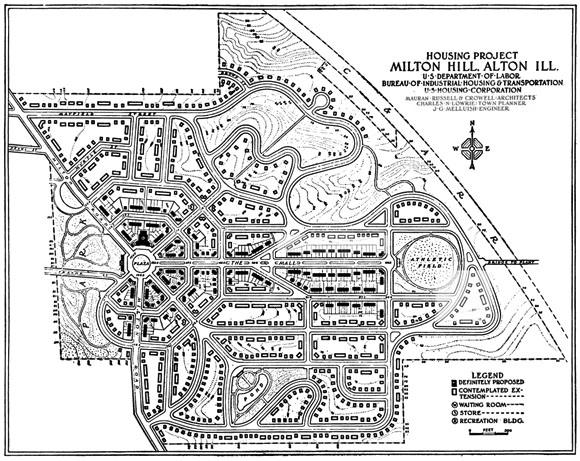
    Milton Hill, a neighborhood designed and developed by the United States Housing Corporation in Alton, Ill.
    National Archives

    Importantly, instead of simply creating complexes of apartment units, akin to the public housing projects that most Americans associate with government-funded housing, the agency focused on the construction of single-family and small multifamily residential buildings that workers and their families could eventually own.

    This approach reflected a belief by the policymakers that property ownership could strengthen community responsibility and social stability. During the war, the federal government rented these homes to workers at regulated rates designed to be fair, while covering maintenance costs. After the war, the government began selling the homes – often to the tenants living in them – through affordable installment plans that provided a practical path to ownership.

    A single-family home in Davenport, Iowa, built by the U.S. Housing Corporation.
    National Archives

    Though the scope of the Housing Corporation’s work was national, each planned community took into account regional growth and local architectural styles. Engineers often built streets that adapted to the natural landscape. They spaced houses apart to maximize light, air and privacy, with landscaped yards. No resident lived far from greenery.

    In Quincy, Massachusetts, for example, the agency built a 22-acre neighborhood with 236 homes designed mostly in a Colonial Revival style to serve the nearby Fore River Shipyard. The development was laid out to maximize views, green space and access to the waterfront, while maintaining density through compact street and lot design.

    At Mare Island, California, developers located the housing site on a steep hillside near a naval base. Rather than flatten the land, designers worked with the slope, creating winding roads and terraced lots that preserved views and minimized erosion. The result was a 52-acre community with over 200 homes, many of which were designed in the Craftsman style. There was also a school, stores, parks and community centers.

    Infrastructure and innovation

    Alongside housing construction, the Housing Corporation invested in critical infrastructure. Engineers installed over 649,000 feet of modern sewer and water systems, ensuring that these new communities set a high standard for sanitation and public health.

    Attention to detail extended inside the homes. Architects experimented with efficient interior layouts and space-saving furnishings, including foldaway beds and built-in kitchenettes. Some of these innovations came from private companies that saw the program as a platform to demonstrate new housing technologies.

    One company, for example, designed fully furnished studio apartments with furniture that could be rotated or hidden, transforming a space from living room to bedroom to dining room throughout the day.

    To manage the large scale of this effort, the agency developed and published a set of planning and design standards − the first of their kind in the United States. These manuals covered everything from block configurations and road widths to lighting fixtures and tree-planting guidelines.

    A single-family home in Bremerton, Wash., built by the U.S. Housing Corporation.
    National Archives

    The standards emphasized functionality, aesthetics and long-term livability.

    Architects and planners who worked for the Housing Corporation carried these ideas into private practice, academia and housing initiatives. Many of the planning norms still used today, such as street hierarchies, lot setbacks and mixed-use zoning, were first tested in these wartime communities.

    And many of the planners involved in experimental New Deal community projects, such as Greenbelt, Maryland, had worked for or alongside Housing Corporation designers and planners. Their influence is apparent in the layout and design of these communities.

    A brief but lasting legacy

    With the end of World War I, the political support for federal housing initiatives quickly waned. The Housing Corporation was dissolved by Congress, and many planned projects were never completed. Others were incorporated into existing towns and cities.

    Yet, many of the neighborhoods built during this period still exist today, integrated in the fabric of the country’s cities and suburbs. Residents in places such as Aberdeen, Maryland; Bremerton, Washington; Bethlehem, Pennsylvania; Watertown, New York; and New Orleans may not even realize that many of the homes in their communities originated from a bold federal housing experiment.

    Homes on Lawn Avenue in Quincy, Mass., that were built by the U.S. Housing Corporation.
    Google Street View

    The Housing Corporation’s efforts, though brief, showed that large-scale public housing could be thoughtfully designed, community oriented and quickly executed. For a short time, in response to extraordinary circumstances, the U.S. government succeeded in building more than just houses. It constructed entire communities, demonstrating that government has a major role and can lead in finding appropriate, innovative solutions to complex challenges.

    At a moment when the U.S. once again faces a housing crisis, the legacy of the U.S. Housing Corporation serves as a reminder that bold public action can meet urgent needs.

    This article is part of a series centered on envisioning ways to deal with the housing crisis.

    Eran Ben-Joseph does not work for, consult, own shares in or receive funding from any company or organization that would benefit from this article, and has disclosed no relevant affiliations beyond their academic appointment.

    ref. Believe it or not, there was a time when the US government built beautiful homes for working-class Americans to deal with a housing shortage – https://theconversation.com/believe-it-or-not-there-was-a-time-when-the-us-government-built-beautiful-homes-for-working-class-americans-to-deal-with-a-housing-shortage-253512

    MIL OSI Analysis

  • MIL-OSI United Kingdom: Appointment of the next Parliamentary and Health Service Ombudsman

    Source: United Kingdom – Executive Government & Departments

    Press release

    Appointment of the next Parliamentary and Health Service Ombudsman

    Paula Sussex CBE has been confirmed as the Parliamentary and Health Service Ombudsman (PHSO), from 26 June 2025.

    Paula Sussex CBE has been confirmed as the Parliamentary and Health Service Ombudsman (PHSO), from 26 June 2025.

    Sussex is moving from her role as the Chief Executive of digital identity services provider, OneID and has previously held high-profile roles as Chief Executive at the Student Loans Company and the Charity Commission. 

    In accordance with Section 1 of the Parliamentary Commissioner Act 1967 and Section 1 of the Health Service Commissioners Act 1993, the appointment will be for a fixed term of five years, with the possibility of a two-year extension.

    Updates to this page

    Published 26 June 2025

    MIL OSI United Kingdom

  • MIL-OSI United Kingdom: Preliminary work to start at Derby Riverside

    Source: City of Derby

    Preliminary works are due to start on the second phase of the Our City, Our River flood defence scheme, one of the city’s biggest infrastructure projects.

    Known as Derby Riverside, this package of works will provide significant flood resilience protection to many properties and highways along the left (east) bank of the Derwent from Causey Bridge to Derwent Bridge.

    The initial works will mainly consist of land clearance, making way for a new flood wall, floodgates and a riverside green area that will provide a controlled corridor for flood waters to pass through the city safely.

    This will include the demolition of selected buildings, as well as some tree removal. Unfortunately, this is unavoidable where trees would obstruct the flow of water in a flood event, or where roots would be damaged due to the location of the wall.

    Derby City Council has worked extensively with its arboriculturalists to keep the number of trees removed to a minimum. While the plans approved by committee give permission for a total of around 205 trees to be removed, this is the worst-case scenario, and the aim is to keep as many as possible. Some will be pollarded where this is a better solution, meaning their top branches will be removed to the trunk, which will encourage regrowth.

    Due to the bird nesting season, we will only be removing trees that are essential for this first stage of work, with further work to take place over the winter. Throughout the nesting season, an ecologist will be onsite to check each tree before it is removed.

    OCOR includes a scheme to replant more trees in the city than have been lost. Already, 583 new trees have been planted around the city, exceeding the 574 that will have been removed throughout the whole scheme by the time Derby Riverside is completed. A further 971 new trees are proposed for other sites, taking the total for OCOR to well over 1,400.

    Councillor Camel Swan, Cabinet Member for Climate Change, Transport and Sustainability, said:

    As our climate continues to change, river flooding remains a risk to many homes and businesses in the city centre. In just five years we have seen the five highest recorded river levels in the city.

    We saw the damage caused by Storm Babet on the left bank of the river, and the need for action is clear. With these works, we will continue to protect properties and future proof our city.

    Sisk regional director Robin Metcalf said:

    We’re proud to be delivering this important project for Derby and are committed to making a positive local impact. We’ll be employing people from the local area wherever possible and working closely with Derby City Council to ensure our social value commitments align with the Derby Promise. That includes creating opportunities for those who are often furthest from the job market, helping to ensure the benefits of this scheme are felt right across the community.

    These works will be carried out by John Sisk & Son on behalf of Derby City Council, who were formally awarded the contract for the scheme in May 2025. The completion of Derby Riverside will then unlock the regeneration potential on the left bank of the river, with opportunities for developing new homes and businesses thanks to enhanced flood resilience.

    The Our City, Our River programme is one of the Environment Agency’s largest local authority-led projects and has already delivered enhanced flood protection to over 2000 properties. Derby Riverside will extend this protection to the east bank of the Derwent and unlock the potential for regeneration in this part of the city.

    MIL OSI United Kingdom

  • MIL-OSI United Kingdom: Building trust in justice: Reflections from the UK Supreme Court

    Source: United Kingdom – Government Statements

    World news story

    Building trust in justice: Reflections from the UK Supreme Court

    Lord Reed’s address at the Supreme Court’s of Montenegro 80th anniversary and AIRE Centre’s conference

    Copyright: Mirko Kuzman for AIRE Centre

    Justice, transparency, and public trust – why it matters

    Strengthening the independence, efficiency, and transparency of the judiciary is central to Montenegro’s reform process as it advances on its European path. It’s also at the heart of the UK’s partnership with Montenegro and our commitment to the wider Western Balkans.

    Judicial independence is not only a legal principle, but it is the foundation of public trust in democratic institutions. The UK continues to support Montenegro’s efforts to strengthen the rule of law as part of a shared vision for a more stable, resilient, and prosperous region.

    A shared commitment to the rule of law

    On 21 June 2025, the British Embassy was proud to support a major conference hosted by the Supreme Court of Montenegro and the AIRE Centre, with the support of the European Union Delegation, marking the 80th anniversary of the Supreme Court of Montenegro.

    The event brought together the judiciary, ministers, officials, Montenegrin and international experts, and partners to reflect on how courts can strengthen public confidence through greater transparency, openness, and effective communication.

    The UK was honoured to be represented by Lord Reed of Allermuir, President of the UK Supreme Court, who shared the UK’s experience and reflections on judicial communication, media engagement, and public accessibility.

    The UK’s ongoing support for judicial reform in Montenegro

    The UK’s partnership with Montenegro’s judiciary builds on a long history of collaboration, supporting training, initiatives for judicial integrity and transparency, and practical cooperation between courts. These efforts complement Montenegro’s reform priorities.

    We remain committed to supporting the development of strong, independent, and trusted institutions that are accountable to citizens and essential for democracy and stability.

    Lord Reed’s Speech

     I am honoured to have been invited to address you. I know that this year – indeed, this month – is the 80th anniversary of the establishment of the Supreme Court of Montenegro. This is a time to celebrate its success and its achievements, and also a time to reflect on how our society has changed over that period and is continuing to develop, and on how the Montenegrin Supreme Court, and other courts, should respond to those changes. I have very much in mind the efforts being made to strengthen judicial independence, efficiency and public trust which I understand are being undertaken. 

     I have been asked to speak about transparency and communication. I want to begin with two fundamental questions. First, what do we mean when we talk about transparency in relation to courts? I would suggest that it means that the court and its work are open and visible to the public. In today’s society, that requires more than just allowing public access into court buildings, although that is a part of it. It also means making the work of the court accessible to the public, and having effective means of communication between the court and the public. 

     My second question is even more fundamental: why does transparency matter? There are a number of reasons, but I would emphasise one in particular. If you ask why the public accept decisions made by the judiciary, the answer, I would suggest, depends on confidence or trust. And trust depends on openness and effective communication with all parts of the community we serve. In the UK, a recent study found that public trust in the Supreme Court is closely connected to knowledge about its work; and public knowledge depends on transparency and communication.

     So, considering transparency first, in the UK we normally have oral hearings in all cases, and they normally take place in public. Members of the public are encouraged to step inside the Supreme Court to watch our hearings and tour our court rooms. We are to some extent a visitor attraction. We have around 100,000 visitors a year, and our court rooms are usually busy with visitors. We have an exhibition area, where visitors can learn more about the court and its case law, and a public café. We also hold open days when more of the building is open to the public. We bear in mind that accessibility includes accessibility to children, and to people with special needs. For example, we hold tours for people with hearing problems, using sign language. 

     In addition, in the Supreme Court and the Court of Appeal, hearings are live streamed online, subject to a short delay in case anything confidential is accidentally mentioned. They are also made available afterwards on the court’s website and on YouTube. The Supreme Court also live streams the delivery of judgments, when the judge who has written the lead judgment gives a short explanation to camera of the court’s decision in accessible language. During the last financial year, around 750,000 viewers watched our cases and judgments on our website, and footage was also used on television and on media websites, under contractual terms set by the court in order to prevent misuse.

     This has been a great help in our most controversial cases. For example, in a case concerned with a challenge to the way the government was proceeding with the UK’s withdrawal from the European Union, highlights of the hearing were shown on the television news, and were analysed by experts in much the same way as football matches, with replays of the most important moments. When we gave our judgment recently in a controversial case concerned with issues of gender, footage of the delivery of the judgment was shown on the television news. This helped to improve public understanding of what the court was deciding, and to raise the level of confidence that the judges were focused on issues of law and not on controversial political questions. 

     Televising hearings requires some thought where jurisdictions have a primarily written procedure. For example, in 2023 the French Cour de Cassation decided there was a need to be more transparent, and started to broadcast its hearings. However, the judges of that court were not accustomed to participating in the hearing and sat in silence during the advocates’ oral arguments. I have been told that the court then came under some criticism as members of the public gained the impression that the judges were not engaged in the issues that were the subject of the hearings. Careful consideration should therefore be given to how oral proceedings might be conducted if they are to be broadcast. One possibility is to follow the approach adopted by the European Court of Human Rights, where Grand Chamber hearings are live streamed. In those proceedings, the advocates present their arguments without interruption from the judges. However, at the end of their oral argument the judges then pose questions, after which the advocates are given time to consult with their legal team before providing responses.

     We have also adopted the practice, in some controversial cases, of making the most important case papers available through our website, unless publication should be withheld for reasons such as commercial confidentiality or national security, so that they can be viewed alongside the live stream of the hearing. 

     Considering communication next, most people draw their knowledge of the judiciary and their opinions about the courts from the media, but media coverage of the judiciary is not always accurate or well-informed. To address that problem, the UK Supreme Court employs an expert communications team and uses a number of means to inform the public about our work. We recognise that the court operates in a media environment in which journalists and bloggers are expected to provide an instant response to our decisions. So members of the communications team work with the journalists who cover our work to help them to report it accurately. Where a judgment is likely to attract media interest, they allow journalists to see the judgment and the press summary an hour before they are made public, on a confidential basis. We do not do this in the most sensitive cases, or where prior knowledge of the judgment could be abused. But the confidentiality of the briefing is enforced by our law of contempt of court, and has never been breached. 

     The communications team also work with the judges to help them to communicate with the public, especially in the summaries that are delivered in court and live streamed on the internet when decisions are announced, excerpts from which may appear on the television news. They help us to ensure, for example, that the language we use in our summaries is understandable by members of the public and, in cases which will be reported in the media, that there is a short sentence or two in our summary which can be played or quoted in the reports and which explains the essence of our decision. They also maintain our social media accounts, with X, Instagram and LinkedIn, which have about 400,000 followers.

     We also try to connect with the general public through our education and outreach work. For example, we have established a scheme which gives pupils at schools across the UK, aged about 16 or 17, the opportunity to take part in a live question and answer session with a judge of the Supreme Court from their classroom, via the internet. This has proved to be very popular with schools, and it enables the court to make direct contact with ordinary young people in a positive way. I also give occasional media interviews, including interviews for social media podcasts, when I try to explain our work in ways that the public can understand. We also organise an online course on the Supreme Court in partnership with one of our universities.  About 5000 members of the public have enrolled.

     In the context of the UK, it has also been important for the Supreme Court to try to improve understanding in Parliament and in the government of the constitutional role of the courts. With the support of the Speaker of the House of Commons, the Supreme Court has engaged directly with all new Members of Parliament since our general election last year, providing each of them with materials explaining the rule of law and the constitutional role of the courts, taking part in question and answer sessions with Members of Parliament in private meetings, and encouraging them to visit the court and to meet justices and staff. We regard it as important to help politicians to understand the role of the courts, so that they support judicial independence and understand when we decide cases against the government, as sometimes happens. 

     In the context of the UK, it is also possible for the court to engage with the government in ways that encourage respect for judicial independence. There is generally a good understanding on both sides of the separation of powers. It has proved to be possible, in a context of mutual respect, to find ways of cooperating on projects of law reform and to encourage a sense that protecting the rule of law is a shared responsibility.

     We also have an active programme to demonstrate that we are inclusive to all parts of our population, including ethnic and religious minorities. So we host visits from organisations supporting talented members of minority groups, and we offer internships at the court to young lawyers from disadvantaged backgrounds. 

     In conclusion, we all need to work to maintain public trust in the administration of justice. I am grateful that we can share ideas and learn from each other as we work to safeguard the rule of law, for the benefit of both our societies.

    Updates to this page

    Published 26 June 2025

    MIL OSI United Kingdom

  • MIL-OSI United Kingdom: Dubai-based director who falsified VAT returns banned after his four companies owed HMRC more than £1 million

    Source: United Kingdom – Government Statements

    Press release

    Dubai-based director who falsified VAT returns banned after his four companies owed HMRC more than £1 million

    Director submitted falsified documentation to reclaim VAT

    • Hassan Waqar has been disqualified as a director for 11 years after his four companies reclaimed almost £400,000 in VAT they were not entitled to 

    • The four companies – HN Restaurants Limited, Kiani Construction Limited, Moneemint Ventures Limited and Zoya Investments Limited – submitted falsified documents to HM Revenue and Customs (HMRC) or failed to provide supporting evidence for VAT repayment claims 

    • All four companies were struck-off the Companies House register between February and June 2023, with total debts to HMRC of more than £1.1 million in VAT assessments, penalties and interest

    The boss of four companies which owed HMRC more than £1 million, including £400,000 in VAT they falsely reclaimed, has been banned as a director. 

    Hassan Waqar was the director of HN Restaurants Limited, Kiani Construction Limited and Moneemint Ventures Limited when they submitted falsified documents to HMRC. 

    A fourth company, Zoya Investments Limited, failed to supply evidence to HMRC to support the repayment returns it had submitted. 

    The four companies owed HMRC more than £1.1 million in VAT and penalties when they were all struck-off the Companies House register during the first half of 2023. 

    Waqar, 30, who is now based in Dubai, has been disqualified as a company director for 11 years. 

    Victoria Edgar, Chief Investigator at the Insolvency Service, said: 

    Hassan Waqar submitted falsified documentation for VAT reclamations that his companies were not entitled to receive. 

    Our investigations found that he failed to provide supporting evidence for claims across multiple businesses, with over £1.1 million owed when these companies were struck off the Companies House register in 2023.

    The Insolvency Service is committed to taking action against directors who fail to meet their legal and financial obligations, protecting the integrity of the business environment and the tax system.

    HN Restaurants Limited was set up in May 2020 as a fast-food business. Kiani Construction Limited was a construction company incorporated in August 2021 which was involved in real estate sales. 

    Moneemint Ventures Limited, like HN Restaurants Limited, was established in May 2020, and was described by Waqar as a banking service platform. Zoya Investments Limited, incorporated in March 2021, traded in carrying out fitouts. 

    The four companies received a total of £396,982 in VAT repayments. 

    HN Restaurants Limited, Kiani Construction Limited and Moneemint Ventures Limited provided invoices to HMRC in support of their claims. HMRC contacted several of the suppliers who confirmed they had not issued the invoices to the companies. 

    Bank statements were provided by HN Restaurants Limited and Moneemint Ventures Limited to HMRC to support the repayment return, but they differed to the ones supplied by the banks. 

    Zoya Investments Limited did not provide any evidence to support its VAT repayment claims. 

    HMRC issued penalties to the four companies totalling £706,692. 

    The four companies were struck-off the Companies House register between February and June 2023. 

    Combined, the four companies owed £1,136,832 in VAT assessments, penalties and interest. 

    The Secretary of State for Business and Trade accepted a disqualification undertaking from Waqar, and his ban started on Thursday 26 June. 

    It prevents him from being involved in the promotion, formation or management of a company, without the permission of the court. 

    HMRC issued a joint and several liability notice to Waqar for HN Restaurants, making him personally responsible for paying the tax debts of the company.

    Further information

    Updates to this page

    Published 26 June 2025

    MIL OSI United Kingdom

  • MIL-OSI Russia: The documentary film “Xi Jinping: Guarding Chinese Cultural Values” premiered in leading Italian media

    Translation. Region: Russian Federal

    Source: People’s Republic of China in Russian – People’s Republic of China in Russian –

    Source: People’s Republic of China – State Council News

    ROME, June 26 (Xinhua) — A documentary film titled “Xi Jinping: Guarding China’s Cultural Treasures” produced by China Media Group (CMG) was screened in Rome on Wednesday as part of the celebrations of the 55th anniversary of the establishment of diplomatic ties between China and Italy.

    Starting from June 25, the program will be broadcast by more than 30 leading Italian media outlets, including Alma TV, Donna TV, Travel TV, Lazio TV, Lombardia City TV, Roma Corona TV, Milan Pavia TV and the Milano Finanza website, among others.

    “Xi Jinping: Guarding China’s Cultural Heritage” features vivid stories that reflect Chinese President Xi Jinping’s deep concern for the inheritance and development of culture. It presents his profound reflection that “our country will only prosper if our culture prospers, and our nation will only be strong if our culture is strong,” as well as his deep attachment to cultural heritage and commitment to maintaining historical continuity. The program explains to an international audience the essence of Xi Jinping’s thoughts on culture and the solid cultural foundation that underpins his governance philosophy.

    The documentary was filmed in places where Xi Jinping worked or inspected, such as Zhengding in Hebei Province, Xiamen in Fujian Province, Hangzhou in Zhejiang Province and Dunhuang in Gansu Province. Through a variety of storytelling forms, including video footage and in-depth interviews, the film vividly presents China’s practical efforts in the new era to trace the origins of civilization and protect cultural heritage, highlighting the profound, comprehensive, inclusive and ever-evolving nature of Chinese culture. –0–

    MIL OSI Russia News

  • MIL-OSI Russia: Nuclear emergency exercise concludes to test international response to simulated reactor accident

    Translation. Region: Russian Federal

    Source: International Atomic Energy Agency –

    The International Atomic Energy Agency (IAEA), in cooperation with more than 75 countries and 10 international organizations, successfully completed a 36-hour exercise that tested global preparedness and response arrangements for a severe nuclear accident scenario at the Cernavoda NPP in Romania. The ConvEx-3 (2025) exercise started on 24 June and concluded at 17:45 CET on 25 June.

    Such exercises are conducted every three to five years and are based on simulated events at a nuclear facility in the host IAEA member state.

    The exercise simulated a significant release of radioactive material, requiring participating countries and organizations to make decisions in real time, exchange information, inform the public and coordinate protective measures, including aspects of medical response and cross-border logistics.

    “ConvEx-3 (2025) demonstrated the power of international cooperation in nuclear emergency preparedness,” said Carlos Torres Vidal, Director of the IAEA Incident and Emergency Centre. “By working together under realistic scenarios, we are strengthening our collective capacity to protect people and the environment.”

    Among the main innovations in this year’s exercise program were the following.

    Enhanced regional cooperation: Recognizing the cross-border consequences of severe nuclear accidents, neighbouring countries Bulgaria and the Republic of Moldova coordinated protective measures to ensure a coherent cross-border response. Integrating nuclear security scenarios: Simulations also included tests related to physical security and cybersecurity threats, reflecting new and evolving risks. Enhanced crisis communication testing: An enhanced social media simulator was used to evaluate and improve public communication strategies. Deploying international assistance missions: As part of the IAEA Response and Assistance Network (RANET) Expert groups from Bulgaria, Canada, Lithuania, Moldova, the United States, Sweden and France carried out a number of joint operations, including the use of air and ground-based radiation monitoring equipment.

    The exercise highlighted the importance of timely information sharing, accurate assessments and forecasts, and effective public communication in the event of nuclear emergencies.

    ConvEx-3 exercises are conducted every three to five years to evaluate and strengthen emergency response mechanisms established in accordance with Convention on Early Notification of a Nuclear Accident And Convention on Assistance in the Case of a Nuclear Accident or Radiological Emergency.

    In the coming weeks, the IAEA will gather feedback from all participants to identify good practices and areas for improvement, contributing to the continued strengthening of global nuclear emergency preparedness. The final report of the exercise will be taken into account in preparation for the upcoming International Conference “Nuclear and Radiological Emergencies”, which is scheduled for December this year in Riyadh, Saudi Arabia.

    A selection of photos from the ConvEx3 exercise is available at this link.

    Please note: This information is raw content directly from the source of the information. It is exactly what the source states and does not reflect the position of MIL-OSI or its clients.

    MIL OSI Russia News

  • MIL-OSI Security: Misconduct hearing into search of Child Q delivers findings

    Source: United Kingdom London Metropolitan Police

    Gross misconduct and misconduct has been proven for three officers involved in the search of Child Q.

    A disciplinary hearing found a number of allegations proven against trainee Detective Constable Kristina Linge, PC Victoria Wray and PC Rafal Szmydynski, each attached to Central East Command Unit which covers Hackney and Tower Hamlets.

    The hearing did not find that the officers were influenced by Child Q’s race, nor that was she subject to adultification.

    Commander Kevin Southworth said: “The experience of Child Q should never have happened and was truly regrettable.

    “We have sincerely apologised to Child Q since this incident happened. Again, I am deeply sorry to Child Q and her family for the trauma that we caused her, and the damage this incident caused to the trust and confidence Black communities across London have in our officers.

    “While the officers involved did not act correctly, we acknowledge there were organisational failings. Training to our officers around strip search and the type of search carried out on Child Q was inadequate, and our oversight of the power was also severely lacking.

    “This left officers, often young in service or junior in rank, making difficult decisions in complex situations with little information, support or clear resources to help their decision-making.

    “What happened to Child Q was a catalyst for change both for the Met and for policing nationally.

    “While we should not have needed an incident such as Child Q to check our approach, it has absolutely led us to improving our processes and significantly reducing the number of these types of searches carried out.

    “It’s crucial we get this right to ensure the impact on young people is minimised as far as possible.

    “Sadly, we know there are children in London being exploited to carry drugs and weapons for others as well as involved in criminality, so these types of searches have to remain within police powers. The work we have done since Child Q means we now have the right safeguards in place.”

    The search of Child Q took place on Thursday, 3 December 2020, when police were called to a Hackney school. Staff were concerned that a 15-year-old girl smelled strongly of cannabis and may have been in possession of drugs.

    Two female officers conducted a more thorough search of the girl, that exposed intimate parts, in the medical room at the school.

    No drugs were found.

    The Met voluntarily referred the matter to the Independent Office for Police Conduct in May 2021 following complaints received.

    The misconduct hearing concluded that the search on Child Q was unnecessary, inappropriate and disproportionate. It was carried out without authorisation from a more senior officer, without an appropriate adult present and a proper record was not made afterwards.

    The hearing found T/DC Linge and PC Szmydynsk breached standards of professional behaviour in relation to authority, respect and courtesy, orders and instructions, duties and responsibilities and discreditable contact at the level of gross misconduct.

    PC Wray breached standards in relation to authority, respect and courtesy, orders and instructions and duties and responsibilities at the level of misconduct.

    Allegations against all the officers that they breached the standards of professional behaviour for equality and diversity were not proven.

    Allegations that PC Szmydynski and TDC Linge breached standards for honesty and integrity for reportedly making a misleading record of the search were also not proven.

    The misconduct panel is now considering sanction.

    Progress since this case

    Ensuring the safeguarding of every child who is searched is an absolute priority.

    • Every strip search or more thorough search where intimate parts are exposed (an ‘MTIP search’ outside custody as carried out on Child Q) requires authorisation by a local officer of inspector rank. That inspector is also responsible for the administration of the search, including recording the rationale, and a mandatory safeguarding referral to relevant authorities. This has been cemented in our Metropolitan Police Service Children’s Strategy, published in September 2024.
    • We have issued guidance to every frontline officer across the Met on the correct process, including the requirement for an appropriate adult to be present during the strip search or MTIP search of a child.
    • We have linked in with policing nationally to share areas of learning from Child Q’s incident and ensure forces across the country are aligned.
    • Recognising the wider community concerns that this case has raised regardless of today’s outcome, the Met is currently training more than 20,000 frontline officers and staff as part of a New Met for London around the risk of adultification and how to ensure a child-first approach in every instance.
    • We continue to listen to communities and partners on what more we need to do around our processes. Hackney has an active community-led scrutiny panel which scrutinises the use of police powers across the borough.
    • We continue to work closely in partnership with schools across London to keep children safe and prevent and detect crime.
    • Following Child Q we reviewed all strip searches and MTIP searches across the Met and made a number of voluntary referrals to the IOPC. In a number of those cases the IOPC found officers acted correctly, in others we have progressed disciplinary matters and learning.
    • We continue to publish data, which shows how the figures have significantly fallen on these types of searches, both inside and outside of custody:

    Stops and Search – More Thorough Searches Dashboard | Tableau Public

    Custody Dashboard | Tableau Public

    For MTIP searches on those aged under 18:

    A total of 68 were carried out between 1 June 2023 and 31 May 2024. The positive outcome rate was 66.2 per cent (45 individuals).

    A total of 42 were carried out between 1 June 2024 and 31 May 2025. The positive outcome rate was 59.5 per cent (25 individuals).

    This shows a decrease over this period in the number of searches carried out of 38.2 per cent. The overall positive outcome rate for this period was 63.6 per cent.

    A positive outcome means when criminality of any type is detected following a search.

    The number of MTIPs carried out on under 18s over this period was 7.3 per cent of the total for all ages.

    The dashboard carries data from the last two years.

    Prior to that, between 25 May 2021 and 24 May 2022 – a full year before we made changes to policy as the result of Child Q – a total of 232 MTIP searches on children were carried out.

    Between 25 May 2022 and 24 May 2023 – a full year post policy change – a total of 101 MTIP searches on children were carried out.

    This is a 56 per cent decrease.

    On average in London, in the five years to 31 May 2025, we have each year seen 499 children (aged 17 and under) recorded as a victim of crime after being injured with a knife, not including domestic abuse related incidents.

    Tragically, during that five-year period, 59 of those children were fatally stabbed.

    An annual average of 432 children were arrested for possession with intent to supply drugs and an annual average of 1,626 were arrested for possession of an offensive weapon.

    MIL Security OSI

  • MIL-OSI Analysis: Self-censorship and the ‘spiral of silence’: Why Americans are less likely to publicly voice their opinions on political issues

    Source: The Conversation – USA – By James L. Gibson, Sidney W. Souers Professor of Government, Washington University in St. Louis

    Polarization has led many people to feel they’re being silenced. AP Photo/Andrew Harnik

    For decades, Americans’ trust in one another has been on the decline, according to the most recent General Social Survey.

    A major factor in that downshift has been the concurrent rise in the polarization between the two major political parties. Supporters of Republicans and Democrats are far more likely than in the past to view the opposite side with distrust.

    That political polarization is so stark that many Americans are now unlikely to have friendly social interactions, live nearby or congregate with people from opposing camps, according to one recent study.

    Social scientists often refer to this sort of animosity as “affective polarization,” meaning that people not only hold conflicting views on many or most political issues but also disdain fellow citizens who hold different opinions. Over the past few decades, such affective polarization in the U.S. has become commonplace.

    Polarization undermines democracy by making the essential processes of democratic deliberation – discussion, negotiation, compromise and bargaining over public policies – difficult, if not impossible. Because polarization extends so broadly and deeply, some people have become unwilling to express their views until they’ve confirmed they’re speaking with someone who’s like-minded.

    I’m a political scientist, and I found that Americans were far less likely to publicly voice their opinions than even during the height of the McCarthy-era Red Scare.

    A supporter of Donald Trump tries to push past demonstrators in Philadelphia on June 30, 2023.
    AP Photo/Nathan Howard

    The muting of the American voice

    According to a 2022 book written by political scientists Taylor Carlson and Jaime E. Settle, fears about speaking out are grounded in concerns about social sanctions for expressing unwelcome views.

    And this withholding of views extends across a broad range of social circumstances. In 2022, for instance, I conducted a survey of a representative sample of about 1,500 residents of the U.S. I found that while 45% of the respondents were worried about expressing their views to members of their immediate family, this percentage ballooned to 62% when it came to speaking out publicly in one’s community. Nearly half of those surveyed said they felt less free to speak their minds than they used to.

    About three to four times more Americans said they did not feel free to express themselves, compared with the number of those who said so during the McCarthy era.

    Censorship in the US and globally

    Since that survey, attacks on free speech have increased markedly, especially under the Trump administration.

    Issues such as the Israeli war in Gaza, activist campaigns against “wokeism,” and the ever-increasing attempts to penalize people for expressing certain ideas have made it more difficult for people to speak out.

    The breadth of self-censorship in the U.S. in recent times is not unprecedented or unique to the U.S. Indeed, research in Germany, Sweden and elsewhere have reported similar increases in self-censorship in the past several years.

    How the ‘spiral of a silence’ explains self-censorship

    In the 1970s, Elisabeth Noelle-Neumann, a distinguished German political scientist, coined the term the “spiral of silence” to describe how self-censorship arises and what its consequences can be. Informed by research she conducted on the 1965 West German federal election, Noelle-Neumann observed that an individual’s willingness to publicly give their opinion was tied to their perceptions of public opinion on an issue.

    The so-called spiral happens when someone expresses a view on a controversial issue and then encounters vigorous criticism from an aggressive minority – perhaps even sharp attacks.

    People rally at the University of California, Berkeley, to protest the Trump administration on March 19, 2025.
    AP Photo/Godofredo A. Vásquez

    A listener can impose costs on the speaker for expressing the view in a number of ways, including criticism, direct personal attacks and even attempts to “cancel” the speaker through ending friendships or refusing to attend social events such as Thanksgiving or holiday dinners.

    This kind of sanction isn’t limited to just social interactions but also when someone is threatened by far bigger institutions, from corporations to the government. The speaker learns from this encounter and decides to keep their mouth shut in the future because the costs of expressing the view are simply too high.

    This self-censorship has knock-on effects, as views become less commonly expressed and people are less likely to encounter support from those who hold similar views. People come to believe that they are in the minority, even if they are, in fact, in the majority. This belief then also contributes to the unwillingness to express one’s views.

    The opinions of the aggressive minority then become dominant. True public opinion and expressed public opinion diverge. Most importantly, the free-ranging debate so necessary to democratic politics is stifled.

    Not all issues are like this, of course – only issues for which a committed and determined minority exists that can impose costs on a particular viewpoint are subject to this spiral.

    The consequences for democratic deliberation

    The tendency toward self-censorship means listeners are deprived of hearing the withheld views. The marketplace of ideas becomes skewed; the choices of buyers in that marketplace are circumscribed. The robust debate so necessary to deliberations in a democracy is squelched as the views of a minority come to be seen as the only “acceptable” political views.

    No better example of this can be found than in the absence of debate in the contemporary U.S. about the treatment of the Palestinians by the Israelis, whatever outcome such vigorous discussion might produce. Fearful of consequences, many people are withholding their views on Israel – whether Israel has committed war crimes, for instance, or whether Israeli members of government should be sanctioned – because they fear being branded as antisemitic.

    Many Americans are also biting their tongues when it comes to DEI, affirmative action and even whether political tolerance is essential for democracy.

    But the dominant views are also penalized by this spiral. By not having to face their competitors, they lose the opportunity to check their beliefs and, if confirmed, bolster and strengthen their arguments. Good ideas lose the chance to become better, while bad ideas – such as something as extreme as Holocaust denial – are given space to flourish.

    The spiral of silence therefore becomes inimical to pluralistic debate, discussion and, ultimately, to democracy itself.

    James L. Gibson does not work for, consult, own shares in or receive funding from any company or organization that would benefit from this article, and has disclosed no relevant affiliations beyond their academic appointment.

    ref. Self-censorship and the ‘spiral of silence’: Why Americans are less likely to publicly voice their opinions on political issues – https://theconversation.com/self-censorship-and-the-spiral-of-silence-why-americans-are-less-likely-to-publicly-voice-their-opinions-on-political-issues-251979

    MIL OSI Analysis

  • MIL-OSI Analysis: Self-censorship and the ‘spiral of silence’: Why Americans are less likely to publicly voice their opinions on political issues

    Source: The Conversation – USA – By James L. Gibson, Sidney W. Souers Professor of Government, Washington University in St. Louis

    Polarization has led many people to feel they’re being silenced. AP Photo/Andrew Harnik

    For decades, Americans’ trust in one another has been on the decline, according to the most recent General Social Survey.

    A major factor in that downshift has been the concurrent rise in the polarization between the two major political parties. Supporters of Republicans and Democrats are far more likely than in the past to view the opposite side with distrust.

    That political polarization is so stark that many Americans are now unlikely to have friendly social interactions, live nearby or congregate with people from opposing camps, according to one recent study.

    Social scientists often refer to this sort of animosity as “affective polarization,” meaning that people not only hold conflicting views on many or most political issues but also disdain fellow citizens who hold different opinions. Over the past few decades, such affective polarization in the U.S. has become commonplace.

    Polarization undermines democracy by making the essential processes of democratic deliberation – discussion, negotiation, compromise and bargaining over public policies – difficult, if not impossible. Because polarization extends so broadly and deeply, some people have become unwilling to express their views until they’ve confirmed they’re speaking with someone who’s like-minded.

    I’m a political scientist, and I found that Americans were far less likely to publicly voice their opinions than even during the height of the McCarthy-era Red Scare.

    A supporter of Donald Trump tries to push past demonstrators in Philadelphia on June 30, 2023.
    AP Photo/Nathan Howard

    The muting of the American voice

    According to a 2022 book written by political scientists Taylor Carlson and Jaime E. Settle, fears about speaking out are grounded in concerns about social sanctions for expressing unwelcome views.

    And this withholding of views extends across a broad range of social circumstances. In 2022, for instance, I conducted a survey of a representative sample of about 1,500 residents of the U.S. I found that while 45% of the respondents were worried about expressing their views to members of their immediate family, this percentage ballooned to 62% when it came to speaking out publicly in one’s community. Nearly half of those surveyed said they felt less free to speak their minds than they used to.

    About three to four times more Americans said they did not feel free to express themselves, compared with the number of those who said so during the McCarthy era.

    Censorship in the US and globally

    Since that survey, attacks on free speech have increased markedly, especially under the Trump administration.

    Issues such as the Israeli war in Gaza, activist campaigns against “wokeism,” and the ever-increasing attempts to penalize people for expressing certain ideas have made it more difficult for people to speak out.

    The breadth of self-censorship in the U.S. in recent times is not unprecedented or unique to the U.S. Indeed, research in Germany, Sweden and elsewhere have reported similar increases in self-censorship in the past several years.

    How the ‘spiral of a silence’ explains self-censorship

    In the 1970s, Elisabeth Noelle-Neumann, a distinguished German political scientist, coined the term the “spiral of silence” to describe how self-censorship arises and what its consequences can be. Informed by research she conducted on the 1965 West German federal election, Noelle-Neumann observed that an individual’s willingness to publicly give their opinion was tied to their perceptions of public opinion on an issue.

    The so-called spiral happens when someone expresses a view on a controversial issue and then encounters vigorous criticism from an aggressive minority – perhaps even sharp attacks.

    People rally at the University of California, Berkeley, to protest the Trump administration on March 19, 2025.
    AP Photo/Godofredo A. Vásquez

    A listener can impose costs on the speaker for expressing the view in a number of ways, including criticism, direct personal attacks and even attempts to “cancel” the speaker through ending friendships or refusing to attend social events such as Thanksgiving or holiday dinners.

    This kind of sanction isn’t limited to just social interactions but also when someone is threatened by far bigger institutions, from corporations to the government. The speaker learns from this encounter and decides to keep their mouth shut in the future because the costs of expressing the view are simply too high.

    This self-censorship has knock-on effects, as views become less commonly expressed and people are less likely to encounter support from those who hold similar views. People come to believe that they are in the minority, even if they are, in fact, in the majority. This belief then also contributes to the unwillingness to express one’s views.

    The opinions of the aggressive minority then become dominant. True public opinion and expressed public opinion diverge. Most importantly, the free-ranging debate so necessary to democratic politics is stifled.

    Not all issues are like this, of course – only issues for which a committed and determined minority exists that can impose costs on a particular viewpoint are subject to this spiral.

    The consequences for democratic deliberation

    The tendency toward self-censorship means listeners are deprived of hearing the withheld views. The marketplace of ideas becomes skewed; the choices of buyers in that marketplace are circumscribed. The robust debate so necessary to deliberations in a democracy is squelched as the views of a minority come to be seen as the only “acceptable” political views.

    No better example of this can be found than in the absence of debate in the contemporary U.S. about the treatment of the Palestinians by the Israelis, whatever outcome such vigorous discussion might produce. Fearful of consequences, many people are withholding their views on Israel – whether Israel has committed war crimes, for instance, or whether Israeli members of government should be sanctioned – because they fear being branded as antisemitic.

    Many Americans are also biting their tongues when it comes to DEI, affirmative action and even whether political tolerance is essential for democracy.

    But the dominant views are also penalized by this spiral. By not having to face their competitors, they lose the opportunity to check their beliefs and, if confirmed, bolster and strengthen their arguments. Good ideas lose the chance to become better, while bad ideas – such as something as extreme as Holocaust denial – are given space to flourish.

    The spiral of silence therefore becomes inimical to pluralistic debate, discussion and, ultimately, to democracy itself.

    James L. Gibson does not work for, consult, own shares in or receive funding from any company or organization that would benefit from this article, and has disclosed no relevant affiliations beyond their academic appointment.

    ref. Self-censorship and the ‘spiral of silence’: Why Americans are less likely to publicly voice their opinions on political issues – https://theconversation.com/self-censorship-and-the-spiral-of-silence-why-americans-are-less-likely-to-publicly-voice-their-opinions-on-political-issues-251979

    MIL OSI Analysis

  • MIL-OSI Analysis: Israel bombed an Iraqi nuclear reactor in 1981 − it pushed program underground and spurred Saddam Hussein’s desire for nukes

    Source: The Conversation – Global Perspectives – By Jeffrey Fields, Professor of the Practice of International Relations, USC Dornsife College of Letters, Arts and Sciences

    The Osirak nuclear power research station in 1981. Jacques Pavlovsky/Sygma via Getty Images

    Israel, with the assistance of U.S. military hardware, bombs an adversary’s nuclear facility to set back the perceived pursuit of the ultimate weapon. We have been here before, about 44 years ago.

    In 1981, Israeli fighter jets supplied by Washington attacked an Iraqi nuclear research reactor being built near Baghdad by the French government.

    The reactor, which the French called Osirak and Iraqis called Tammuz, was destroyed. Much of the international community initially condemned the attack. But Israel claimed the raid set Iraqi nuclear ambitions back at least a decade. In time, many Western observers and government officials, too, chalked up the attack as a win for nonproliferation, hailing the strike as an audacious but necessary step to prevent Iraqi dictator Saddam Hussein from building a nuclear arsenal.

    But the reality is more complicated. As nuclear proliferation experts assess the extent of damage to Iran’s nuclear facilities following the recent U.S. and Israeli raids, it is worth reassessing the longer-term implications of that earlier Iraqi strike.

    The Osirak reactor

    Iraq joined the landmark Nuclear Non-Proliferation Treaty in 1970, committing the country to refrain from the pursuit of nuclear weapons. But in exchange, signatories are entitled to engage in civilian nuclear activities, including having research or power reactors and access to the enriched uranium that drives them.

    The International Atomic Energy Agency is responsible through safeguards agreements for monitoring countries’ civilian use of nuclear technology, with on-the-ground inspections to ensure that civilian nuclear programs do not divert materials for nuclear weapons.

    But to Israel, the Iraqi reactor was provocative and an escalation in the Arab-Israeli conflict.

    Israel believed that Iraq would use the French reactor – Iraq said it was for research purposes – to generate plutonium for a nuclear weapon. After diplomacy with France and the United States failed to persuade the two countries to halt construction of the reactor, Prime Minister Menachem Begin concluded that attacking the reactor was Israel’s best option. That decision gave birth to the “Begin Doctrine,” which has committing Israel to preventing its regional adversaries from becoming nuclear powers ever since.

    Israeli Prime Minister Menachem Begin addresses the press after the 1981 attack on the Osarik nuclear reactor.
    Israel Press and Photo Agency/Wikimedia Commons

    In spring 1979, Israel attempted to sabotage the project, bombing the reactor core destined for Iraq while it sat awaiting shipment in the French town of La Seyne-sur-Mer. The mission was only a partial success, damaging but not destroying the reactor.

    France and Iraq persisted with the project, and in July 1980 – with the reactor having been delivered – Iraq received the first shipment of highly enriched uranium fuel at the Tuwaitha Nuclear Research Center near Baghdad.

    Then in September 1980, during the initial days of the Iran-Iraq war, Iranian jets struck the nuclear research center. The raid also targeted a power station, knocking out electricity in Baghdad for several days. But a Central Intelligence Agency situation report assessed that “only secondary buildings” were hit at the nuclear site itself.

    It was then Israel’s turn. The reactor was still unfinished and not in operation when on June 7, 1981, eight U.S.-supplied F-16s flew over Jordanian and Saudi airspace and bombed the reactor in Iraq. The attack killed 10 Iraqi soldiers and a French civilian.

    Revisiting the ‘success’ of Israeli raid

    Many years later, U.S. President Bill Clinton commented: “Everybody talks about what the Israelis did at Osirak in 1981, which I think, in retrospect, was a really good thing. You know, it kept Saddam from developing nuclear power.”

    But nonproliferation experts have contended for years that while Saddam may have had nuclear weapons ambitions, the French-built research reactor would not have been the route to go. Iraq would either have had to divert the reactor’s highly enriched uranium fuel for a few weapons or shut the reactor down to extract plutonium from the fuel rods – all while hiding these operations from the International Atomic Energy Agency.

    As an additional safeguard, the French government, too, had pledged to shut down the reactor if it detected efforts to use the reactor for weapons purposes.

    In any event, Iraq’s desire for a nuclear weapon was more aspirational than operational. A 2011 article in the journal International Security included interviews with several scientists who worked on Iraq’s nuclear program and characterized the country’s pursuit of a nuclear weapons capability as “both directionless and disorganized” before the attack.

    Iraq’s program begins in earnest

    So what happened after the strike? Many analysts have argued that the Israeli attack, rather than diminish Iraqi desire for a nuclear weapon, actually catalyzed it.

    Nuclear proliferation expert Målfrid Braut-Hegghammer, the author of the 2011 study, concluded that the Israeli attack “triggered a nuclear weapons program where one did not previously exist.”

    In the aftermath of the attack, Saddam decided to formally, if secretively, establish a nuclear weapons program, with scientists deciding that a uranium-based weapon was the best route. He tasked his scientists with pursuing multiple methods to enrich uranium to weapons grade to ensure success, much the way the Manhattan Project scientists approached the same problem in the U.S.

    In other words, the Israeli attack, rather than set back an existing nuclear weapons program, turned an incoherent and exploratory nuclear endeavor into a drive to get the bomb personally overseen by Saddam and sparing little expense even as Iraq’s war with Iran substantially taxed Iraqi resources.

    From 1981 to 1987, the nuclear program progressed fitfully, facing both organizational and scientific challenges.

    As those challenges were beginning to be addressed, Iraq invaded Kuwait in 1990, provoking a military response from the United States. In the aftermath of what would become Operation Desert Storm, U.N. weapons inspectors discovered and dismantled the clandestine Iraqi nuclear weapons program.

    The Tammuz nuclear reactor was hit again during the 1991 Gulf War.
    Ramzi Haidar/AFP via Getty Images

    Had Saddam not invaded Kuwait over a matter not related to security, it is very possible that Baghdad would have had a nuclear weapon capability by the mid-to-late 1990s.

    Similarly to Iraq in 1980, Iran today is a party to the Nuclear Non-Proliferation Treaty. At the time President Donald Trump withdrew U.S. support in 2018 for the Joint Comprehensive Plan of Action, colloquially known as the Iran nuclear deal, the International Atomic Energy Agency certified that Tehran was complying with the requirements of the agreement.

    In the case of Iraq, military action on its nascent nuclear program merely pushed it underground – to Saddam, the Israeli strikes made acquiring the ultimate weapon more rather than less attractive as a deterrent. Almost a half-century on, some analysts and observers are warning the same about Iran.

    Jeffrey Fields receives funding from the Carnegie Corporation of New York and Schmidt Futures.

    ref. Israel bombed an Iraqi nuclear reactor in 1981 − it pushed program underground and spurred Saddam Hussein’s desire for nukes – https://theconversation.com/israel-bombed-an-iraqi-nuclear-reactor-in-1981-it-pushed-program-underground-and-spurred-saddam-husseins-desire-for-nukes-259618

    MIL OSI Analysis

  • MIL-OSI Analysis: Oil shocks in the 1970s drove rapid changes in transport. It could happen again if Middle East tensions continue

    Source: The Conversation – Global Perspectives – By Hussein Dia, Professor of Future Urban Mobility, Swinburne University of Technology

    The Image Bank/Getty

    As the world watches the US–Iran situation with concern, the ripple effect from these events are reaching global oil supply chains – and exposing their fragility.

    If Iran closes the Strait of Hormuz as it is considering, it would restrict the global oil trade and trigger energy chaos.

    Petrol in some Australian cities could hit A$2.50 a litre according to some economists. As global instability worsens, other experts warn price spikes are increasingly likely.

    What would happen next? There is a precedent: the oil shocks of the 1970s, when oil prices quadrupled. The shock drove rapid change, from more efficient cars to sudden interest in alternative energy sources. This time, motorists would likely switch to electric vehicles.

    If this crisis continues or if another one flares up, it could mark a turning point in Australia’s long dependence on foreign oil.

    What would an oil shock mean?

    Australia currently imports 80% of its liquid fuels, the highest level on record. If the flow of oil stopped, we would have about 50 days worth in storage before we ran out.

    Our cars, buses, trucks and planes run overwhelmingly on petrol and diesel. Almost three-quarters (74%) of these liquid fuels are used in transport, with road transport accounting for more than half (54%) of all liquid fuels. Australia is highly exposed to global supply shocks.

    The best available option to reduce dependence on oil imports is to electrify transport.

    How does Australia compare on EVs?

    EV uptake in Australia continues to lag behind global leaders. In 2024, EVs accounted for 9.65% of new car sales in Australia, up from 8.45% in 2023.

    In the first quarter of 2025, EVs were 6.3% of new car sales, a decline from 7.4% in the final quarter of 2024.

    Norway remains the global leader, with battery-electric passenger cars making up 88.9% of sales in 2024. The United Kingdom also saw significant growth – EVs hit almost 20% of new car registrations in 2024.

    In China, EVs made up 40.9% of new car sales in 2024. The 12.87 million cars sold represent three-quarters of total EV sales worldwide.

    One reason for Australia’s sluggishness is a lack of reliable public chargers. While charging infrastructure is expanding, large parts of regional Australia still lack reliable access to EV charging.

    Until recently, Australia’s fuel efficiency standards were among the weakest in the OECD. Earlier this year, the government’s new standards came into force. These are expected to boost EV uptake.

    Could global tensions trigger faster action?

    If history is any guide, oil shocks lead to long-term change.

    The 1970s oil shocks triggered waves of energy reform.

    When global oil prices quadrupled in 1973–74, many nations were forced to reconsider where they got their energy. A few years later, the 1979 Iranian Revolution caused another major supply disruption, sending oil prices soaring and pushing much of the world into recession.

    Huge increases in oil prices drove people to look for alternatives during the 1970s oil shocks.
    Everett Collection/Shutterstock

    These shocks drove the formation of the International Energy Agency in 1974, spurred alternative energy investment and led to advances in fuel-efficiency standards.

    Much more recently, Russia’s invasion of Ukraine pushed the European Union to face up to its reliance on Russian gas and find alternatives by importing gas from different countries and accelerating the clean energy shift.

    Clearly, energy shocks can be catalysts for long-term structural change in how we produce and consume energy.

    The new crisis could do the same, but only if policy catches up.

    If fuel prices shot up and stayed there, consumer behaviour would begin to shift. People would drive less and seek alternate forms of transport. Over time, more would look for better ways to get around.

    But without stronger support such as incentives, infrastructure and fuel security planning, shifting consumer preferences could be too slow to matter.

    A clean-energy future is more secure

    Cutting oil dependency through electrification isn’t just good for the climate. It’s also a hedge against future price shocks and supply disruptions.

    Transport is now Australia’s third-largest source of greenhouse gas emissions. Now that emissions are falling in the electricity sector, transport will be the highest emitting sector emissions source as soon as 2030.

    Building a cleaner transport system also means building a more resilient one. Charging EVs on locally produced renewable power cuts our exposure to global oil markets. So do biofuels, better public transport and smarter urban planning.

    Improving domestic energy resilience isn’t just about climate targets. It’s about economic stability and national security. Clean local energy sources reduce vulnerability to events beyond our control.

    What can we learn from China?

    China offers a compelling case study. The nation of 1.4 billion faces real oil security challenges. In response, Beijing has spent the past decade building a domestic clean energy ecosystem to reduce oil dependency and cut emissions.

    This is now bearing fruit. Last year, China’s oil imports had the first sustained fall in nearly two decades. Crude oil imports fell 1.5%, while oil refinery activity also fell due to lower demand.

    China’s rapid uptake of EVs has clear energy security benefits.
    pim pic/Shutterstock

    China’s green energy transition was driven by coordinated policy, industrial investment and public support for clean transport.

    China’s rapid shift to EVs and clean energy shows how long-term planning and targeted investment can pay off on climate and energy security.

    What we do next matters

    The rolling crises of 2025 present Australian policymakers a rare alignment of interests. What’s good for the climate, for consumers and for national security may now be the same thing.

    Real change will require more than sustained high petrol prices. It demands political will, targeted investment and a long-term vision for clean, resilient transport.

    Doing nothing has a real cost – not just in what we pay at the service station, but in how vulnerable we remain to events a long way away.

    Hussein Dia receives funding from the Australian Research Council, the iMOVE Australia Cooperative Research Centre, Transport for New South Wales, Queensland Department of Transport and Main Roads, Victorian Department of Transport and Planning, and Department of Infrastructure, Transport, Regional Development, Communications and the Arts.

    ref. Oil shocks in the 1970s drove rapid changes in transport. It could happen again if Middle East tensions continue – https://theconversation.com/oil-shocks-in-the-1970s-drove-rapid-changes-in-transport-it-could-happen-again-if-middle-east-tensions-continue-259670

    MIL OSI Analysis

  • MIL-OSI China: Documentary “Xi Jinping’s Cultural Story” premieres on major Italian media

    Source: People’s Republic of China – State Council News

    In celebration of the 55th anniversary of the establishment of diplomatic ties between China and Italy, a launch event for the documentary “Xi Jinping’s Cultural Story,” produced by China Media Group, was held in Rome on Wednesday.

    Starting from June 25, the program will be broadcast across more than 30 mainstream Italian media outlets, including Alma TV, Donna TV, Travel TV, Lazio TV, Lombardia City TV, Roma Corona TV, Milan Pavia TV, and the website of Milano Finanza, among others.

    “Xi Jinping’s Cultural Story” features vivid stories that reflect Chinese President Xi Jinping’s deep concern for the inheritance and development of culture. It showcases his profound reflections on the idea that “our country will thrive only if our culture thrives, and our nation will be strong only if our culture is strong,” as well as his deep affection for cultural heritage and his dedication to preserving historical continuity. The program explains to international audiences the essence of Xi Jinping Thought on Culture and the solid cultural foundation underpinning his philosophy of governance.

    The documentary includes on-site visits to places where Xi has worked or conducted inspections, such as Zhengding in Hebei Province, Xiamen in Fujian Province, Hangzhou in Zhejiang Province, and Dunhuang in Gansu Province. Through a variety of narrative forms — including video footage and in-depth interviews — it vividly presents China’s practical efforts in the new era to trace the origins of civilization and protect cultural heritage, highlighting the profound, far-reaching, inclusive and ever-evolving nature of Chinese culture.

    MIL OSI China News

  • MIL-OSI Europe: Pride march in Budapest: Ministers Aurore Bergé and Benjamin Haddad reaffirm France’s support for LGBT+ people’s rights (26 June 2025)

    Source: Republic of France in English
    The Republic of France has issued the following statement:

    On the occasion of the Budapest Pride march on 28 June 2025, France reaffirms its commitment to the freedom, protection and rights of LGBT+ people within the European Union.

    Held as part of Pride month, Pride marches are a legacy of the historic struggles that began with the Stonewall riots in New York on 28 June 1969, the founding event of the contemporary movement for LGBT+ people’s rights. In France, in Europe and all over the world, the marches are a reminder that those rights are the result of collective battles against discrimination, criminalization, pathologization and violence.

    Banned by the Hungarian Government but supported by the Mayor of Budapest, the Budapest Pride march will be held amid a worrying national decline in individual freedoms. LGBT+ people there are facing an increasingly hostile political and social climate, fomented by hate speech and discriminatory policies that fuel an environment of fear and exclusion.

    In this regard, France wants to reiterate its deep commitment to respect for the European Union’s basic values, as set out in Article 2 of the Treaty on European Union: “The Union is founded on the values of respect for human dignity, freedom, democracy, equality, the rule of law and respect for human rights, including the rights of persons belonging to minorities. These values are common to the Member States in a society in which pluralism, non-discrimination, tolerance, justice, solidarity and equality between women and men prevail.”

    France calls for heightened vigilance in the face of legislative and social changes in the various Member States, in order to guarantee respect for basic rights, defend the principles of the European Union and ensure consistency in its values, particularly in terms of equality and non-discrimination.

    At the ministers’ request, M. Jean-March Berthon, Ambassador for the Rights of LGBT+ People, will officially represent the French Government at the march, as a sign of France’s support and commitment.

    What is playing out in Hungary is a reminder of a global reality: the rights of LGBT+ people are far from being guaranteed and remain profoundly fragile. No victory is irreversible.

    Everywhere, reactionary and fundamentalist onslaughts are seeking to restrict equality and wipe out existences. What can be won through struggles can be destroyed through inaction. In the face of this global threat, visibility, international solidarity and commitment remain more essential than ever.

    “Respect for and protection of human rights must apply everywhere, all the time, and to everyone. LGBT+ citizens can in no way be an exception to this basic principle, on which France will never compromise. The slightest relapse in terms of public freedoms within the European Union itself is unacceptable. Combating all forms of regression is a necessity, building a world without violence is an imperative, and furthering human rights is France’s commitment,” said Aurore Bergé, Minister Delegate for Gender Equality and the Fight against Discrimination.

    “My colleague Aurore Bergé and I pay tribute to the advocacy work of the activists, journalists and nongovernmental organizations working to ensure that Hungarians enjoy equal treatment and full legal protection, regardless of their sexual orientation or gender expression. The Budapest Pride march is an important moment both for LGBTQI+ people and for all those committed to freedom. France will remain a powerful champion of a Europe where everyone is guaranteed the opportunity to express their basic freedoms freely and safely,” said Benjamin Haddad, Minister for Europe.

    MIL OSI Europe News

  • MIL-OSI United Kingdom: Welfare vote a test of ‘moral backbone’ for Scottish Labour

    Source: Scottish Greens

    Scottish Greens call on Labour MPs to vote against Starmer’s Welfare Bill

    An upcoming vote on social security cuts at Westminster will be a test of Scottish Labour’s moral backbone, says Scottish Green’s social justice spokesperson Maggie Chapman.

    Next Tuesday, Westminster is due to vote on the controversial changes to social security, which would see financial support for disabled people slashed in an effort to save £5 billion from the UK Government’s welfare bill.

    A number of Labour MPs have now supported an amendment to reject the Bill outright, warning that the proposals lack consultation, ignore any real impact assessment, and will deepen inequality. However, the vast majority of Scottish MPs have not signed up.

    The Government’s own impact assessment stated that these proposals could push up to 250,000 people, including 50,000 children, into poverty. Recent research from the Trussell Trust states that 300,000 Scots could lose £500 a year in crucial disability support payments if the cuts are voted through.

    The Scottish Greens are urging all Scottish Labour MPs and MSPs to clearly oppose the dangerous cuts to social security, and oppose this new wave of austerity inflicted on Scotland.

    Commenting, Maggie said:

    “It’s clear to anyone who’s looking that the brutal welfare cuts put forward by Labour at Westminster will push disabled folk across the UK into poverty. The Government’s own assessment of the proposals tells us that. 

    “Supporting these turbo-charged austerity measures – while the evidence of the harms they will cause is so painfully obvious – is completely inexcusable. This is not leadership, it is cowardice and cruelty dressed up as pragmatism.

    “Next week’s vote will be a crucial moral test for all Scottish Labour politicians. Will they choose to back a Prime Minister who is once again ploughing ahead with deeply unpopular and harmful cuts to our communities, or will they do the right thing and stand up for their constituents in Scotland?

    “There is no excuse for silence here in Holyrood or Westminster. Now is the time to show solidarity and moral leadership – not to hide behind party lines.

    “The public deserves better than a Labour Party that promises change but delivers cuts.”

    MIL OSI United Kingdom

  • MIL-OSI United Kingdom: Massive annual increase in private jet traffic in Scotland shows urgent need to tax the rich

    Source: Scottish Greens

    Prestwick Airport has seen a 32% annual increase in private jet flights

    A 32% year-on-year increase in private jet flights to just one Scottish airport is a sign that we urgently need to tax the super-rich, says Scottish Greens MSP Ross Greer.

    The statistic comes from an investigation from Oxfam Scotland, which revealed that Scottish Government-owned Prestwick Airport saw a huge 32% increase in private jet flights from 2023 to 2024.

    Oxfam Scotland’s investigation also highlighted that some private jets can emit 20 or even 30 times more carbon emissions than flying economy class.

    The Scottish Greens have long campaigned for a Private Jet Tax in Scotland by increasing the rate of Air Departure Tax (ADT) on non-commercial jets. However, an ongoing stalemate between the Scottish Government and the UK Government over the introduction of ADT has delayed progress.

    The party is now calling for the Scottish Government to show clear leadership and to tax the super-rich by introducing a departure and arrival levy on private jet flights at Government-owned airports, namely Prestwick and the eleven airports owned via Highlands and Islands Airports Limited (HIAL).

    While Prestwick Airport sees substantial private jet traffic, often associated with golf events, HIAL airports are also regularly used by international elites who own large estates in Scotland.

    Ross said:

    “An obscene amount of wealth is being hoarded by a tiny number of elites who fly across the globe in their climate-wrecking private jets.

    “These jets have a huge impact on our environment, and while their super-rich occupants fly between their golf courses and superyachts, it’s Scottish taxpayers left paying to clean up their mess.

    “We all know that we urgently need to reduce pollution from planes to combat the climate emergency. One of the easiest ways to do that is to reduce private jet use, which is twenty times more polluting than regular commercial flights.

    “That’s why the Scottish Greens are proposing a private jet tax, which would raise money for our public services and keep the super-rich and their destructive toys on the ground.

    “We’ve waited for years for the Scottish and UK Governments to deliver the devolution of Air Departure Tax in Scotland, as they agreed to do over a decade ago.

    “Delays to the devolution of ADT aren’t a get out of jail free card for the Scottish Government. They can introduce a charge on private jets at the dozen airports they own right now, raising cash for public services and taking action to tackle the climate emergency.”

    MIL OSI United Kingdom

  • MIL-OSI United Kingdom: Urgent warning to pet owners as toxic chemicals found in fake flea treatments

    Source: United Kingdom – Executive Government & Departments

    Press release

    Urgent warning to pet owners as toxic chemicals found in fake flea treatments

    Pet owners urged to be wary of dangerous fake treatments discovered on e-commerce sites.

    Main developments are:

    • urgent government warning issued after toxic insecticide discovered in counterfeit flea treatments – one cat required emergency surgery after severe poisoning

    • fake pet medicines lack essential ingredients while containing dangerous chemicals that trigger vomiting, seizures and potential death

    • warning signs include poor packaging, spelling mistakes, unusual smells and suspiciously low prices

    • new figures show three quarters of consumers wrongly believe fake goods are of similar quality to genuine products

    • pet owners should only buy from trusted sources and immediately report suspicious products

    The Intellectual Property Office (IPO) and Veterinary Medicine Directorate (VMD) are urging pet owners to take caution when purchasing common medicines, including common flea treatments and wormers. 
     
    The alert comes after toxic pesticide traces were found in a fake flea treatment that caused a pet cat to become seriously ill, prompting the owner to have the product tested. Laboratory tests confirmed the presence of Pirimiphos-methyl, a dangerous insecticide toxic to cats. 
     
    Officials are urging pet owners to recognise signs of counterfeit products, avoid using suspicious items, and know how to report concerns.  

    Counterfeit animal medicines deliberately copy the appearance, packaging and branding of genuine veterinary products to deceive pet owners. Like all counterfeits, they are illegal to sell in the UK.   

    These fakes typically lack proper active ingredients, making them ineffective. Worse still, they may also contain harmful substances, causing severe reactions including vomiting, muscle tremors, breathing difficulties, seizures and potentially death.

    Pet owners seeking bargains, or a quick purchase online may unknowingly purchase these dangerous counterfeits.  
     
    The VMD and IPO are urging owners to check for warning signs including poor packaging, spelling errors, missing information, and unusual smells. 

    Last year alone, the VMD issued 122 seizure notices for the selling of unauthorised animal medicines and supplements, preventing around 18,000 illegal items from reaching consumers. 

    After purchasing what appeared to be genuine FRONTLINE ® flea treatment online for his cat, Smokey, Alan Wall from Preston was devastated when Smokey became very unwell. The condition was so severe that Smokey required emergency intestinal surgery to survive. This was followed by a week-long stay at the veterinary surgery and significant bills to support his recovery.

    Alan Wall said:

    Smokey is more than just a pet, he’s a member of our family. When he became ill after using what we believed was a genuine flea treatment, we were terrified. Watching him suffer, not knowing whether he would pull through, was heartbreaking. It’s taken a huge emotional toll on all of us. Without the support of our vets and the extensive surgery they performed we know Smokey wouldn’t be with us today. We want to warn other pet owners about these fake products so that no one else has to endure what we’ve been through.

    Images of Smokey the cat – receiving treatment, and when healthier

    A Veterinary Medicines Directorate Veterinary Surgeon and Efficacy Assessor, Dr Heilin-Anne Leonard-Pugh, explains:

    Pirimiphos-methyl is toxic to cats. Exposure to this insecticide can prevent the cat’s body from breaking down a substance called acetylcholine, leading to an overstimulation of the cat’s nervous system. This can cause symptoms such as vomiting, uncoordinated gait, muscle tremors, weakness, paralysis, increased sensitivity to touch, difficulty breathing, restlessness, urinary incontinence, low heart rate and seizures. In some cases, even death can sadly occur. If you suspect your pet has been exposed to a counterfeit medicine, seek veterinary advice immediately.  

    Sue Horseman from Bristol also purchased what appeared to be FRONTLINE® flea treatment online for her cat, but quickly became suspicious that the product wasn’t genuine.  
     
    Sue explained that the product was difficult to open and had a distinct smell of white spirit and paraffin, whereas the genuine flea treatment has no smell.  When she reported this to Trading Standards, experts confirmed that the treatment was a counterfeit. 

    While the online platform has removed the seller, they had already managed to sell 211 batches of suspected counterfeit pet medicines and supplements, including fake FRONTLINE Flea and Tick Treatment and PRO PLAN FortiFlora Probiotic Sachets for dogs and cats. 
     
    New counterfeit goods research (Wave 4) shows that counterfeit goods of all types are frequently purchased via global e-commerce websites. The figures also show that in 2024, nearly-one-in-five (17%) consumers unknowingly purchased goods later found to be fake, with 60% of purchasers also saying that ‘ease of purchasing’ influenced their decision.  Saving money is a strong motivator for buying fakes, with around three quarters (72%) of purchasers saying price was an important factor in their decision. Worryingly, around three-quarters (72%) wrongly believed the products would be of a similar quality to the genuine item.

    The IPO’s Deputy Director of Enforcement Helen Barnham, said:

    We are a nation of animal lovers, and criminals dealing in counterfeits are targeting pet owners with complete disregard for the animal’s wellbeing.  This can have some distressing consequences, as they may contain toxic chemicals that are harmful to our pets. We are urging pet owners to be vigilant when purchasing any type of animal treatment, and beware of any offers that ‘look too good to be true’.   

    Counterfeiting is anything but a victimless crime and this latest discovery confirms this. If you suspect that any goods offered for sale may be counterfeit, you should always report this to your local Trading Standards or Crimestoppers Online.

    Caroline Allen, RSPCA Chief Veterinary Officer said: 

    We are very concerned about counterfeit vet treatments on sale which can be highly toxic to pets and we would always urge pet owners to seek professional veterinary advice if they have any health concerns.  

    We appreciate financial pressures can lead to some owners to look for cheaper treatments online but they could be unwittingly putting their beloved pets in serious danger by inadvertently buying these counterfeit goods and would urge them to take on board this government advice.

    Nina Downing, Vet Nurse from PDSA, a vet charity and a leading authority on pet health in the UK, said:

    Counterfeit veterinary medicines can pose a serious threat to our pets ‘ health and wellbeing. While legitimate medications play a vital role in keeping our pets healthy, counterfeit products can cause severe harm or even be fatal. These fake medicines may contain incorrect ingredients or dangerous substances that can make pets extremely ill – leading to symptoms like twitching, swelling, breathing difficulties, vomiting, diarrhoea, collapse, coma and even death.

    We always recommend that you only give your pet medication which has been prescribed by your vet. When fulfilling a prescription online, source them from reputable companies that are on the Register of online retailers, brought to you by the Veterinary Medicines Directorate. If you suspect your pet is reacting badly to any medication, contact your vet immediately.

    When examining the counterfeit FRONTLINE® flea treatment, experts from the University of Bath also identified telling packaging flaws. Most notably, the label used ‘GATTI’ (Italian for cats) instead of the English ‘CAT’, alongside multiple spelling errors – common indicators of counterfeit products.

    Image: Packaging featuring spelling mistakes and mixed languages

    Pet owners should check the packaging and always be cautious of third-party sellers when shopping on e-commerce sites for any type of pet medication. 

    The IPO and VMD are offering advice for consumers to help spot fake animal medicines, and what to do if they believe they may have purchased them or seen them offered for sale.

    How to identify fake animal medicines online:

    1. Warning signs of fake medicines. Look out for: 

    • poor quality or damaged packaging
    • spelling or grammar errors
    • missing leaflets or expiry dates
    • instructions not provided in English
    • suspicious smell, colour or texture
    • poor quality tablets, capsules, vials or pipettes – homemade appearance

    Be wary of any retailer selling prescription only products without asking for your prescription. This is illegal. 

    All online sellers of prescription only animal medicines must be registered with the VMD. If in any doubt, you can check retailers on the VMD’s Register of Online Retailers.

    2. Always shop safely online. Be cautious of:

    • heavily discounted goods and flash sales. Question the price if much cheaper than elsewhere. Whether buying online or in person, always think about the price
    • a seller asking for sensitive information or requesting payment by bank transfer
    • fake websites and social media profiles. These can contain original brand names – confirm the website is authentic and check seller details and reviews before purchasing
    • any deal or offer that looks ‘too good to be true’ 

    What you can do

    If you have you been personally affected by a poisoning case, you should report through the Veterinary Poisons Information Service (VPIS) questionnaire

    If you see these goods being offered for sale, whether on a website, social media post or on the high street, contact your local Trading Standards or Crimestoppers online or by calling 0800 555 111. 

    If you encounter suspicious veterinary medicines or retailers, please also report them to the VMD Enforcement Team. (You can do so anonymously if preferred): 

    Additional information

    1. All veterinary medicines sold in the UK must be authorised. If the brand looks unfamiliar, ensure its authorised before purchasing. To know if the medicine is UK- approved, you should look for English labelling and a valid Marketing Authorisation number (e.g. Vm 12345/4001). You can check if the medicine you are buying is authorised in the UK by searching the VMD’s Product Information Database.

      Using ant unauthorised medicine poses a serious risk to the welfare of your pet. These medicines have not been assessed by the Veterinary Medicines Directorate and their safety, quality and efficacy cannot be guaranteed.  

    2. Online retailers of low-risk, general sale veterinary medicines that can be sold by anyone without a prescription (known as AVM-GSL medications) don’t need to register. When buying these medicines always shop from a trusted source. 

    3. The Intellectual Property Office (IPO) is the UK government body responsible for responsible for intellectual property (IP) rights including patents, designs, trade marks and copyright. IPO is an executive agency, sponsored by the Department for Science, Innovation and Technology.  

    4. The Veterinary Medicines Directorate (VMD) is an executive agency of the Department for Environment, Food and Rural Affairs (DEFRA) and the UK Competent Authority for veterinary medicines regulation. The VMD protects public health, animal health, and the environment and promotes animal welfare by assuring the safety, quality, and efficacy of veterinary medicines.  

    5. The IPO regularly conducts research to understand consumer behaviour in relation to the purchasing of and attitudes toward counterfeit goods. The most recent Counterfeit Goods Research report (published Tuesday 17 May 2025) show the main motivations for those who purchase counterfeits: 

    • similar/ the same quality – 72.3%
    • wanting to reduce spending/outgoings - 72%
    • the real product was out of your budget/ price range - 70.9%
    • the fake product was cheaper  – 72%
    • hearing from family or friends that the ‘fake’ products were good - 64.8%
    • similar/the same design – 64.6%
    • being able to purchase ‘fake’ or counterfeit products easily – 60.5%

    Updates to this page

    Published 26 June 2025

    MIL OSI United Kingdom