Company presentationFearnleySecuritiesAfricaFocusedE&Pseminar
BW Energy is today presenting at the Fearnley Securities Africa Focused E&P seminar in Madrid, Spain. Please see the attached presentation.
For further information, please contact:
Brice Morlot, CFO BW Energy +33.7.81.11.41.16 ir@bwenergy.no
ABOUT BW ENERGY:
BW Energy is a growth E&P company with a differentiated strategy targeting proven offshore oil and gas reservoirs through low risk phased developments. The Company has access to existing production facilities to reduce time to first oil and cashflow with lower investments than traditional offshore developments. The Company’s assets are 73.5% of the producing Dussafu Marine licence offshore Gabon, 100% interest in the Golfinho and Camarupim fields, a 76.5% interest in the BM-ES-23 block, a 95% interest in the Maromba field in Brazil, a 95% interest in the Kudu field in Namibia, all operated by BW Energy. In addition, BW Energy holds approximately 6.6% of the common shares in Reconnaissance Energy Africa Ltd. and a 20% non-operating interest in the onshore Petroleum Exploration License 73 (“PEL 73”) in Namibia. Total net 2P+2C reserves and resources were 599 million barrels of oil equivalent at the start of 2025.
This information is subject to the disclosure requirements pursuant to section 5-12 of the Norwegian Securities Trading Act
Company presentationFearnleySecuritiesAfricaFocusedE&Pseminar
BW Energy is today presenting at the Fearnley Securities Africa Focused E&P seminar in Madrid, Spain. Please see the attached presentation.
For further information, please contact:
Brice Morlot, CFO BW Energy +33.7.81.11.41.16 ir@bwenergy.no
ABOUT BW ENERGY:
BW Energy is a growth E&P company with a differentiated strategy targeting proven offshore oil and gas reservoirs through low risk phased developments. The Company has access to existing production facilities to reduce time to first oil and cashflow with lower investments than traditional offshore developments. The Company’s assets are 73.5% of the producing Dussafu Marine licence offshore Gabon, 100% interest in the Golfinho and Camarupim fields, a 76.5% interest in the BM-ES-23 block, a 95% interest in the Maromba field in Brazil, a 95% interest in the Kudu field in Namibia, all operated by BW Energy. In addition, BW Energy holds approximately 6.6% of the common shares in Reconnaissance Energy Africa Ltd. and a 20% non-operating interest in the onshore Petroleum Exploration License 73 (“PEL 73”) in Namibia. Total net 2P+2C reserves and resources were 599 million barrels of oil equivalent at the start of 2025.
This information is subject to the disclosure requirements pursuant to section 5-12 of the Norwegian Securities Trading Act
Company presentationFearnleySecuritiesAfricaFocusedE&Pseminar
BW Energy is today presenting at the Fearnley Securities Africa Focused E&P seminar in Madrid, Spain. Please see the attached presentation.
For further information, please contact:
Brice Morlot, CFO BW Energy +33.7.81.11.41.16 ir@bwenergy.no
ABOUT BW ENERGY:
BW Energy is a growth E&P company with a differentiated strategy targeting proven offshore oil and gas reservoirs through low risk phased developments. The Company has access to existing production facilities to reduce time to first oil and cashflow with lower investments than traditional offshore developments. The Company’s assets are 73.5% of the producing Dussafu Marine licence offshore Gabon, 100% interest in the Golfinho and Camarupim fields, a 76.5% interest in the BM-ES-23 block, a 95% interest in the Maromba field in Brazil, a 95% interest in the Kudu field in Namibia, all operated by BW Energy. In addition, BW Energy holds approximately 6.6% of the common shares in Reconnaissance Energy Africa Ltd. and a 20% non-operating interest in the onshore Petroleum Exploration License 73 (“PEL 73”) in Namibia. Total net 2P+2C reserves and resources were 599 million barrels of oil equivalent at the start of 2025.
This information is subject to the disclosure requirements pursuant to section 5-12 of the Norwegian Securities Trading Act
Prime Minister Narendra Modi on Wednesday departed for Croatia after concluding his visit to Canada, where he participated in the 51st Group of Seven (G7) Summit in Kananaskis.
This marks the first-ever visit by an Indian Prime Minister to Croatia, a significant milestone in the bilateral relationship between the two countries.
India and Croatia share a cordial and steadily growing relationship underpinned by shared values, democratic institutions, and a common commitment to international cooperation. Since Croatia’s independence in the early 1990s, India has consistently supported the European nation’s sovereignty and development, with diplomatic relations evolving into a multi-dimensional partnership encompassing political dialogue, trade, culture, education, and people-to-people exchanges.
Croatia, which joined the European Union in 2013, has in recent years emerged as an important partner for India in the Central European region. Its accession to the Schengen Area and adoption of the Euro in January 2023 have further aligned the country with key European institutions, creating fresh avenues for collaboration.
Trade and investment trajectory
Economic engagement between the two countries, while modest in scale, has shown incremental progress. In 2024, India’s exports to Croatia stood at USD 251.6 million, comprising a diverse basket of goods including ceramic and pharmaceutical products, engineering items, chemicals, and agricultural commodities such as oilseeds and tobacco. Croatia’s exports to India totalled USD 54.4 million, largely in the form of machinery, wood and paper products, rubber, and refined vegetable oils, including soybean oil.
Between 2001 and 2023, Indian investments in Croatia reached €44.5 million, whereas Croatian investments in India stood at approximately €5.5 million over the same period.
People-to-people connect
An important pillar of the bilateral relationship is the growing Indian diaspora in Croatia. As of March 2025, over 17,000 Indian nationals were residing in the country, including a small number of permanent residents and Overseas Citizens of India. Bilateral mobility has been aided by reciprocal arrangements such as visa-free travel for diplomatic and official passport holders for up to 30 days, facilitating greater high-level exchanges and official visits.
Educational and cultural cooperation has also grown in recent years, with increased academic mobility, interest in Indian languages and traditions among Croatians, and rising Indian student enrolments in Croatian institutions.
PM Modi’s visit is expected to lend new momentum to bilateral ties and provide an opportunity for both sides to chart a course for deeper engagement across political, economic, and cultural domains.
In the largest global investigation ever, The Open Wing Alliance reveals never-before-seen footage of systemic animal abuse and public health risks in cage egg factory farming. Alongside footage from 36 other countries, the exposé includes footage from a colony cage factory farm in New Zealand.
New Zealand – June 17 2025 – “The sound of thousands of trapped chickens, the industrial fans cranking and the stench of waste is beyond words”, says a volunteer investigator from Grassroots Campaigns NZ. “It’s hell inside.”
This is the description animal welfare investigators gave about what they captured at an Auckland colony cage factory farm. Their footage was given to the Open Wing Alliance, a global coalition of nearly 100 organisations established by The Humane League, in collaboration with We Animals and Reporters for Animals International. Together with Animals Aotearoa, the united group has just released the largest ever investigation into industrialised egg farms in 37 countries. In never-before-seen footage, including from New Zealand, supported by an open letter backed by 100 celebrities.
“The shocking footage exposes widespread abuse of egg-laying hens trapped in filthy, overcrowded cages, with evidence of injured birds, rotting carcasses, disease-ridden conditions, and more. This investigation comes as bird flu sweeps across every continent, jumping from farmed birds to wild animals and even humans”, says Jennifer Dutton, Corporate Relations Specialist at Animals Aotearoa.
Footage from 37 countries, including:
Argentina, Australia, Brazil, Bulgaria, Canada, Chile, Colombia, Estonia, Finland, France, Georgia, Hong Kong, India, Indonesia, Israel, Italy, Japan, Malaysia, Mexico, New Zealand, Nigeria, Norway, Peru, Philippines, Poland, Portugal, Romania, Russia, Slovenia, South Africa, Spain, Taiwan, Thailand, Turkey, United States, Vietnam and Zimbabwe.
Key findings from the global exposé include:
Hens confined in battery and enriched/colony cages, giving each chicken only the space of an iPad, or less, to live their entire life;
Automated systems leave dead bird carcasses trapped in cages with living hens;
Live hens abandoned in manure and waste pits, and eggs found in manure before sent to shelves;
Birds unable to stand upright or spread their wings;
Unsanitary conditions that promote disease spread, like avian influenza.
This massive coordinated worldwide campaign is focused on spotlighting multinational brands dragging their heels on fulfilling corporate policy to transition away from cage eggs in their supply chains. The vast majority of food corporations around the world publicly committed, a decade ago, to remove cages from their egg supply chains, with global companies like The Hershey Company, Hormel Foods, Famous Brands, and Barilla already fully cage-free. However, food companies like Walmart, Zensho Holdings and Inspire Brands (parent company of Dunkin’ and Baskin-Robbins) continue to profit from sourcing eggs from hens raised in outdated, cruel cages. In New Zealand, hospitality giant Best Western Hotel chain was recently targeted by protestors highlighting the multinational’s lack of transparent reporting on its global cage-free progress, supported by a petition.
Since 2023, when battery cages were outlawed in Aotearoa, there has been a disinformation campaign by the factory farm lobby to mislead caring New Zealanders about the continued domestic production of cage eggs. While battery cages are no longer in use, colony cages are. Eggs sold at retail level from these colony cage systems don’t contain the word ‘cage’ anywhere on the packaging. Following a number of complaints, the Commerce Commission is currently conducting a compliance project to assess whether colony eggs are a breach of the Fair Trading Act.
In addition to cage eggs being sold under misleading labelling, the import of liquid eggs from battery cages is a significant problem. Over 80% of New Zealand’s liquid eggs, used largely in food manufacture, are imported from China and Australia where egg-laying hens are kept in battery cages. Produced using methods illegal here, they are added into Kiwi foods and quietly sold to the caring public who are unaware.
Consumers around the world are increasingly demanding transparency and ethical treatment of animals in food production, and they won’t stand for further risks to our global public health. Over 100 celebrity figures signed an open letter urging food corporations to end the use of cages in their global supply chains. This investigation s
Chisinau, Moldova — The IT sector contributes 6% to the national GDP – a result that reflects the efficiency and impact of the ecosystem created by the Moldova Innovation Technology Park (MITP). The data were presented by Marina Bzovîi, Administrator of MITP, at the Moldova Digital Summit 2025, confirming the essential role of the Park in the digital transformation of the Republic of Moldova. With 2024 marked by record performance, MITP expects a clear upward trajectory for 2025, supported by the accelerated expansion of the resident base and the increase in revenues generated by the IT sector.
Unprecedented growth: 533 resident companies in a single year
Currently, Moldova Innovation Technology Park brings together over 2,370 resident companies, of which 533 joined in 2024 alone – the largest annual advance since the park’s launch. This record growth reflects Moldova’s growing attractiveness for international investors and technology companies looking for a stable, competitive and future-oriented environment.
The MITP model offers a unique framework in the region: an ultra-competitive tax regime with a flat tax of only 7%, VAT exemptions and simplified contributions, which allows companies to focus on growth and innovation. These conditions are guaranteed by law until 2035, providing investors not only with incentives, but also with long-term predictability.
MITP is 100% virtual, allowing remote operation without the obligation of a physical presence in the Republic of Moldova — a key advantage in an era where remote work is becoming the global norm. In addition, initiatives such as the Visa IT program facilitate the attraction of international talent, ensuring quick and legal access to the global workforce.
In this modern and well-connected ecosystem, residents benefit from quality digital infrastructure, constant dialogue with the authorities and specialized support for international expansion. It is no coincidence that more and more companies from Romania and Ukraine are choosing to relocate to Moldova, in search of a more efficient, flexible and innovation-friendly space.
MITP is no longer just a tax-advantaged framework — it’s a complete platform for accelerated growth, global connection, and sustainable digital transformation.
The park hosts companies with capital from 43 countries, most of them from Ukraine and Romania.
“The regional geopolitical context has had a major impact. If in 2021 only three Ukrainian companies were registered in the MITP, in 2024 their number increased 14 times, reaching 42, amid strategic relocations caused by the war. In the same period, the presence of companies with Romanian capital has almost doubled, boosted by the recent tax changes in Romania applied to the IT sector. Today, there are 41 companies in Romania in MITP”,
said Marina Bzovîi, MITP Administrator.
IT sector – a force in the economy: 6.3% of GDP
The contribution of the IT sector to the national economy has increased significantly, reaching 6.3% of GDP in 2024, according to preliminary estimates, compared to 1.8% in 2015. This remarkable evolution is a direct result of the expansion of tech companies, favorable fiscal policies and the sustained attraction of foreign investment.
“For 2025, we estimate that the revenues generated by MITP resident companies will reach 1 billion euros, with an increase of approximately 30% compared to 2024, when they totaled 785 million euros. It is a clear confirmation of the potential for sustainable growth and the value that the IT sector brings to the Moldovan economy”,
said Nadejda Hodus, Financial Manager MITP.
IT exports – Moldova, regional leader in growth rate
Exports of IT services increased spectacularly, reaching 523 million euros in 2023, 10 times more than in 2015 (53 million euros). Although the absolute volume is lower than that reported by countries such as Romania (7.5 billion euros) or Ukraine (6 billion euros), Moldova’s growth rate is the fastest in the region.
“This performance is all the more impressive as Moldova is a small country, both in terms of territory and population. MITP’s development model proves to be an efficient and sustainable one, transforming Moldova into a regional digital hub with strategic potential”,
added Nadejda Hodus.
Record contributions to the state budget
The economic impact of the MITP is also directly felt in the revenues of the National Public Budget. In 2024, resident companies contributed €78 million – four times more than in 2017. About 50% of these amounts come from newly established businesses after the launch of the park.
According to a recent analysis conducted by MITP, the contributions paid by resident companies could cover up to 16% of the national expenditure on health care and about 90% of the financing of vocational higher education – an eloquent illustration of the real economic impact generated by the IT sector in the Republic of Moldova.
“Through these results, MITP imposes itself not only as a successful model in the region, but also as an example of effective public policy, which creates jobs, attracts investments and amplifies the country’s digital competitiveness. With clear objectives and a sustained pace of development, Moldova is getting closer to becoming a regional pole of innovation and technology”,
concluded the Administrator of Moldova Innovation Technology Park, Marina Bzovîi.
About Moldova Innovation Technology Park (MITP)
Launched in 2016, MITP is Moldova’s national platform dedicated to the tech industry, offering a unique 7% tax regime and 100% virtual operation. With more than 2,300 resident companies in 43 countries, MITP contributes significantly to the national GDP and attracts global investment. Supported by legislative guarantees until 2035, the park promotes innovation, IT exports and Moldova’s integration into the European digital economy.
The IPU has released the second part of its groundbreaking Parliamentary report on religion and belief.
Part 2 of the report, Engagement with religion and belief by parliamentarians underscores the vital role of MPs in fostering peaceful, just and inclusive societies. It explores how engagement with religion and belief can strengthen the rule of law, uphold human rights, and promote sustainable development for all.
It complements Part 1 of the report Institutional engagement with religion and belief by parliaments, which was published in May 2023 ahead of the inaugural IPU Parliamentary Conference on Interfaith Dialogue in Marrakesh, Morocco. This first part examined how religion and belief are institutionally present in parliamentary life by looking at constitutional provisions, parliamentary committees, consultation mechanisms and traditions reflecting religious or belief identities.
The new report is timely, with escalating conflicts around the world which, although primarily political, are also marked by the weaponization of religion to sow divisions among different communities living side by side.
Good parliamentary practices from around the world
Part 2 delves into the ways parliamentarians interact with religion and belief to promote inclusivity and peace. Drawing on key informant interviews, submissions from parliaments and contributions from religious leaders and global experts, the report highlights good practices and lessons learned from parliaments around the world. It also examines select policy areas where religion and belief intersect with parliamentary functions, such as legislation, oversight, representation and, increasingly, parliamentary diplomacy.
Key objectives of the report include:
Facilitating mutual learning among parliaments about diverse approaches to religion and belief.
Encouraging the adoption of good practices that foster inclusion and peaceful coexistence.
Promoting scrutiny of legislation to ensure alignment with international human rights commitments.
Strengthening inter-parliamentary and interfaith dialogue to better protect fundamental freedoms and the rule of law.
Upholding rights and countering hate speech
The report reaffirms the right to freedom of religion or belief as protected under international law, while acknowledging ongoing challenges in its realization. Parliaments are urged to play a proactive role in promoting and protecting this right, both formally through legislation and informally through cross-party or international networks.
In response to rising hate speech and identity-based hatred, the report outlines human rights and soft law standards around freedom of expression, and shares practical tools for parliamentarians, such as codes of conduct, public advocacy, educational activities and dialogue initiatives.
Special attention is given to the rights and inclusion of religious and belief minorities, with recommendations for legislative action, oversight and public engagement. The report also highlights the key role of parliaments in promoting gender equality and women’s rights, and where the full enjoyment of these rights intersects with religion or belief.
All roads lead to Rome
The report is released ahead of the Second Parliamentary Conference on Interfaith Dialogue, in which the IPU is leveraging its global convening power to bring together parliamentarians, religious leaders, international experts and civil society from 19 to 21 June 2025 in Rome, Italy.
The Conference is being organized by the IPU and the Italian Parliament in cooperation with Religions for Peace under the theme Strengthening trust and embracing hope for our common future.
The IPU is the global organization of national parliaments. It was founded in 1889 as the first multilateral political organization in the world, encouraging cooperation and dialogue between all nations. Today, the IPU comprises 181 national Member Parliaments and 14 regional parliamentary bodies. It promotes peace, democracy and sustainable development. It helps parliaments become stronger, younger, greener, more innovative and gender-balanced. It also def
Earlier today, Iranian officials urged the country’s citizens to remove the messaging platform WhatsApp from their smartphones. Without providing any supporting evidence, they alleged the app gathers user information to send to Israel.
WhatsApp has rejected the allegations. In a statement to Associated Press, the Meta-owned messaging platform said it was concerned “these false reports will be an excuse for our services to be blocked at a time when people need them most”. It added that it does not track users’ location nor the personal messages people are sending one another.
It is impossible to independently assess the allegations, given Iran provided no publicly accessible supporting evidence.
But we do know that even though WhatsApp has strong privacy and security features, it isn’t impenetrable. And there is at least one country that has previously been able to penetrate it: Israel.
3 billion users
WhatsApp is a free messaging app owned by Meta. With around 3 billion users worldwide and growing fast, it can send text messages, calls and media over the internet.
It uses strong end-to-end encryption meaning only the sender and recipient can read messages; not even WhatsApp can access their content. This ensures strong privacy and security.
Advanced cyber capability
The United States is the world leader in cyber capability. This term describes the skills, technologies and resources that enable nations to defend, attack, or exploit digital systems and networks as a powerful instrument of national power.
But Israel also has advanced cyber capability, ranking alongside the United Kingdom, China, Russia, France and Canada.
Israel has a documented history of conducting sophisticated cyber operations. This includes the widely cited Stuxnet attack that targeted Iran’s nuclear program more than 15 years ago. Israeli cyber units, such as Unit 8200, are renowned for their technical expertise and innovation in both offensive and defensive operations.
Seven of the top 10 global cybersecurity firms maintain R&D centers in Israel, and Israeli startups frequently lead in developing novel offensive and defensive cyber tools.
A historical precedent
Israeli firms have repeatedly been linked to hacking WhatsApp accounts, most notably through the Pegasus spyware developed by Israeli-based cyber intelligence company NSO Group. In 2019, it exploited WhatsApp vulnerabilities to compromise 1,400 users, including journalists, activists and politicians.
Another Israeli company, Paragon Solutions, also recently targeted nearly 100 WhatsApp accounts. The company used advanced spyware to access private communications after they had been de-encrypted.
These kinds of attacks often use “spearphishing”. This is distinct from regular phishing attacks, which generally involve an attacker sending malicious links to thousands of people.
Instead, spearphishing involves sending targeted, deceptive messages or files to trick specific individuals into installing spyware. This grants attackers full access to their devices – including de-encrypted WhatsApp messages.
A spearphishing email might appear to come from a trusted colleague or organisation. It might ask the recipient to urgently review a document or reset a password, leading them to a fake login page or triggering a malware download.
Protecting yourself from ‘spearphishing’
To avoid spearphishing, people should scrutinise unexpected emails or messages, especially those conveying a sense of urgency, and never click suspicious links or download unknown attachments.
Hovering the mouse cursor over a link will reveal the name of the destination. Suspicious links are those with strange domain names and garbled text that has nothing to do with the purported sender. Simply hovering without clicking is not dangerous.
Enable two-factor authentication, keep your software updated, and verify requests coming through trusted channels. Regular cybersecurity training also helps users spot and resist these targeted attacks.
David Tuffley does not work for, consult, own shares in or receive funding from any company or organisation that would benefit from this article, and has disclosed no relevant affiliations beyond their academic appointment.
Most family-friendly airline and best First Class lounge worldwide
Austrian Airlines and Eurowings also receive Awards
Frankfurt 17 June 2025 – Lufthansa is the world’s most family-friendly airline. This prize from the World Airline Awards 2025 was presented today by the market research institute Skytrax at the Paris Air Show. The Lufthansa First Class Terminal in Frankfurt was also named the world’s best First Class Lounge. Austrian Airlines and Eurowings also received one of the coveted prizes – the award for “Best Airline Staff in Europe” went to Austrian Airlines in Vienna and Eurowings was named “Best Low Cost Airline in Europe”. Skytrax, a market research institute specializing in aviation, had previously surveyed 22.3 million passengers from well over 100 countries worldwide.
“Lufthansa attaches great importance to ensuring that all guests on board feel comfortable with us – from Economy to First Class. I am therefore particularly pleased that we have received the award for the world’s most family-friendly airline and at the same time for the best First Class lounge,” says Heiko Reitz, Chief Customer Officer Lufthansa Airlines. “Above all, Lufthansa’s unsurpassed hospitality is also premium. In particular, our colleagues in the cabin, cockpit and on the ground can be very proud today. They are the ones who fulfill our promise of quality day after day.”
Traveling with children
Lufthansa attaches great importance to ensuring that its youngest guests also feel comfortable on board. The airline therefore offers specially created kids’ menus prepared by the chefs at Gate Gourmet. The menus belong to the “Special Meals” category and can be pre-ordered by passengers free of charge up to 24 hours before departure. The offer applies to all classes on long-haul flights and to Business Class on short-haul flights.
The trays are lovingly designed with colorful illustrations of the Lufthansa mascots “Lu” and “Cosmo” and the menu card invites young passengers to puzzle and color while they playfully learn how an airplane flies.
Lufthansa has also introduced a new range of children’s toys on board. From cloud-shaped cuddly blankets for toddlers to puzzles and the game “City, Country, Flight”, there is something for every taste and every age. There is also a portfolio of coloring pages featuring Lu and Cosmo, which can be accessed via the Lufthansa eJournals homepage. Young passengers will also find magazines for children and teenagers in various languages. The in-flight entertainment program for children includes a large selection of films, series, music, audio books and podcasts. Children can also look forward to special amenity kits and, from summer 2025, new year-round “Best Friend” children’s boarding passes.
Travel in Lufthansa First Class
The separate First Class terminal in Frankfurt with limousine transfer directly to the aircraft and personal assistant, which has been named the best First Class lounge in the world, is emblematic of Lufthansa’s premium offering.
Since the beginning of the year, traveling in Lufthansa’s top class has become even more exclusive. The new Lufthansa Allegris First Class on long-haul aircraft can be experienced in the summer timetable on flights from Munich to San Francisco, Chicago, San Diego, Shanghai and Bengaluru and sets new standards with two individual suites and the extraordinary Suite Plus: guests can heat or cool their almost one meter wide seats in the individual suites according to their personal needs. The separate cabins with ceiling-high walls and lockable door, large table and wide seat, a living room-sized screen and wireless “over-ear” headphones define a new standard in comfort and individuality. Generous storage space is provided by a personal wardrobe in the suite, so that travelers can change comfortably and have all their personal items to hand. Individual lamps allow travelers to create their very own feel-good atmosphere.
The Suite Plus double cabin, the only one of its kind in the world, creates a special travel experience with two wide seats that can be combined to form a comfortable double bed if required. The flying private room impresses with maximum comfort and individuality. The Suite Plus offers maximum exclusivity for the single passenger and the unique opportunity to use the double cabin as a couple.
The new First Class is part of a major Lufthansa premium offensive. Among other things, First Class guests can also look forward to renovated First Class check-in areas in Frankfurt (from late summer) and Munich as well as the newly designed First Class Lounge at Munich Airport.
Skytrax
The survey was conducted by the market research institute Skytrax. It evaluated the airlines’ in-flight offers and services at the airports. Skytrax has been conducting the annual passenger survey since 1999. All detailed results of the World Airlines Awards can be found at www.worldairlineawards.com
Prime Minister Narendra Modi on Tuesday concluded what he described as a “productive visit” to Canada, where he participated in the G7 Summit at Kananaskis and held several high-level bilateral meetings with global leaders. He has now departed for Croatia, the final stop of his three-nation tour.
“Concluding a productive Canada visit. Thankful to the Canadian people and Government for hosting a successful G7 Summit, which witnessed fruitful discussions on diverse global issues. We remain committed to furthering global peace, prosperity and sustainability,” PM Modi posted on X.
In a separate post on X, Ministry of External affairs (MEA) Spokesperson Randhir Jaiswal said:
“PM @narendramodi concludes a very productive visit to Canada! Held fruitful dialogue on key issues in the global context on energy security, technology, and innovation at the @G7 Summit. Met with several leaders and discussed bilateral ties. Next stop — Croatia.”
During the G7 outreach session on energy security, PM Modi underscored the need for universal access to clean and sustainable energy.
He also highlighted India’s global initiatives, including the International Solar Alliance, Coalition for Disaster Resilient Infrastructure (CDRI), and the Global Biofuels Alliance.
PM Modi reiterated India’s zero-tolerance policy on terrorism, thanking leaders for their condemnation of the Pahalgam terror attack. He called for unified global action against terrorism and emphasized the need to hold those who support or sponsor terrorism accountable.
Highlighting India’s digital transformation, the Prime Minister emphasised India’s success in democratizing technology and adopting a human-centric approach.
“PM Modi also highlighted India’s experience in democratising use of technology and its human-centric approach in deploying it. He called for addressing global governance issues to tackle concerns of AI and to promote innovation in the field. He called for addressing global governance issues to tackle concerns of AI and to promote innovation in the field,” Jaiswal said in a post on X
On the sidelines of the summit, PM Modi held bilateral meetings with several global leaders, including Ursula von der Leyen, President of the European Commission; Charles Michel, President of the European Council; Canadian Prime Minister Mark Carney; South African President Cyril Ramaphosa; UK Prime Minister Keir Starmer; French President Emmanuel Macron; Brazilian President Luiz Inácio Lula da Silva; Australian Prime Minister Anthony Albanese.
Before departing for the three-nation tour, PM Modi had said the visit aimed to thank key partner nations for their unwavering support in India’s fight against cross-border terrorism and to rally international consensus on combating terrorism in all its forms.
Prime Minister Narendra Modi on Tuesday concluded what he described as a “productive visit” to Canada, where he participated in the G7 Summit at Kananaskis and held several high-level bilateral meetings with global leaders. He has now departed for Croatia, the final stop of his three-nation tour.
“Concluding a productive Canada visit. Thankful to the Canadian people and Government for hosting a successful G7 Summit, which witnessed fruitful discussions on diverse global issues. We remain committed to furthering global peace, prosperity and sustainability,” PM Modi posted on X.
In a separate post on X, Ministry of External affairs (MEA) Spokesperson Randhir Jaiswal said:
“PM @narendramodi concludes a very productive visit to Canada! Held fruitful dialogue on key issues in the global context on energy security, technology, and innovation at the @G7 Summit. Met with several leaders and discussed bilateral ties. Next stop — Croatia.”
During the G7 outreach session on energy security, PM Modi underscored the need for universal access to clean and sustainable energy.
He also highlighted India’s global initiatives, including the International Solar Alliance, Coalition for Disaster Resilient Infrastructure (CDRI), and the Global Biofuels Alliance.
PM Modi reiterated India’s zero-tolerance policy on terrorism, thanking leaders for their condemnation of the Pahalgam terror attack. He called for unified global action against terrorism and emphasized the need to hold those who support or sponsor terrorism accountable.
Highlighting India’s digital transformation, the Prime Minister emphasised India’s success in democratizing technology and adopting a human-centric approach.
“PM Modi also highlighted India’s experience in democratising use of technology and its human-centric approach in deploying it. He called for addressing global governance issues to tackle concerns of AI and to promote innovation in the field. He called for addressing global governance issues to tackle concerns of AI and to promote innovation in the field,” Jaiswal said in a post on X
On the sidelines of the summit, PM Modi held bilateral meetings with several global leaders, including Ursula von der Leyen, President of the European Commission; Charles Michel, President of the European Council; Canadian Prime Minister Mark Carney; South African President Cyril Ramaphosa; UK Prime Minister Keir Starmer; French President Emmanuel Macron; Brazilian President Luiz Inácio Lula da Silva; Australian Prime Minister Anthony Albanese.
Before departing for the three-nation tour, PM Modi had said the visit aimed to thank key partner nations for their unwavering support in India’s fight against cross-border terrorism and to rally international consensus on combating terrorism in all its forms.
Prime Minister Narendra Modi on Tuesday met the Chancellor of the Federal Republic of Germany, Friedrich Merz, on the sidelines of the G7 Summit in Kananaskis, Canada. This marked the first interaction between the two leaders since Chancellor Merz assumed office in May 2025.
Prime Minister Modi congratulated Chancellor Merz on his recent electoral victory and his appointment as Chancellor. He also expressed heartfelt appreciation for the condolences extended by the German Government on the tragic plane crash in Ahmedabad last week.
Both leaders reviewed the progress in bilateral relations and welcomed the sustained momentum in India-Germany ties. They reaffirmed their commitment to strengthening cooperation in key areas including trade and investment, defence and security, green and sustainable development, green energy, technology, innovation, education, and mobility.
The leaders agreed to further deepen and diversify the India-Germany Strategic Partnership, especially as the two countries commemorate 25 years of this important bilateral framework.
Condemning terrorism in all its forms, the two sides reiterated that it remains a serious threat to global peace and stability. Prime Minister Modi thanked Chancellor Merz for Germany’s strong support and solidarity with India’s counter-terrorism efforts.
The leaders also exchanged views on regional and global developments of mutual interest. Prime Minister Modi said that he looks forward to welcoming Chancellor Merz to India at a mutually convenient time.
Source: People’s Republic of China in Russian – People’s Republic of China in Russian –
Source: People’s Republic of China – State Council News
SHENZHEN, June 18 (Xinhua) — Scientists from the Global Ant Genomics Alliance (GAGA) published a groundbreaking study in the international scientific journal Cell on Monday, revealing the genetic basis behind major adaptive changes in ants’ evolution and their social traits that evolved in parallel.
Despite their small size, ants demonstrate impressive organizational skills. They are able to build intricate nests without using “language” to communicate, and they have the most rigorous system of division of labor.
By analyzing whole-genome data from 163 ant species collected from around the world, the research team reconstructed the evolutionary tree of the ant family, covering 12 of the 16 extant subfamilies.
The study sheds light on the complex phylogenetic relationships between ant species and traces the common ancestor of modern ants back to the late Jurassic period – about 157 million years ago – shedding light on the origins of ant organizational structure during the age of dinosaurs.
Scientists have found that ant gene families associated with olfactory perception were significantly expanded in the common ancestor’s genome, suggesting that it already possessed key molecular mechanisms for social communication.
The study also found that different ant species exhibit different mechanisms that regulate which ants become queens and which become workers, reflecting their adaptive evolution through natural selection.
The study involved scientists from Zhejiang University, the Chinese Academy of Sciences (CAS), Nanchang University and BGI Research in China, as well as scientists from the University of Copenhagen in Denmark and the University of Münster in Germany. -0-
It’s my pleasure to be here today amongst some of the strongest guardians of our native biodiversity in the country. Wouldn’t we rather have more carrot than stick if we work for nature on our land? That’s what my announcement about expanding a voluntary nature credits market in New Zealand was about last week at Fieldays. We are backing the expansion of a market that will be durable, measurable and transparent. An enduring legacy of commitment to the land. The market will hopefully help you and other landowners and conservation groups unlock new income streams for looking after nature on your land. Now I say ‘hopefully’ because I haven’t yet fully transitioned into being a politician. I’m still a pragmatist. I still prefer to under promise and over deliver, and 28 years of farming makes me a firm believer in Murphy’s Law. But the only way to find out if this will work is to give it a crack, do some trials, see what works and doesn’t, and then take the lessons on board and move forward. So, assuming Murphy gives us a break, how do I envision these nature credit markets could work? Nature and carbon credit markets connect investors looking for reputable nature and climate opportunities with landowners, farmers and community groups who are actively restoring and repairing nature by adding biodiversity value to their land. At a high-level nature and carbon projects are developed, according to established evidence-based standards, to produce voluntary credits that can be issued for sale on a marketplace for purchasers to buy. Purchasers can then either use the credits, claiming support for the project and retiring the credits, or they can hold onto the credits (without claim) for resale or use down the track.
I’m often asked who would buy these credits? International and domestic investors—including corporates, banks, and philanthropists—are seeking high-quality nature and carbon credits that meet global standards. They are looking for reputable nature and climate action projects undertaken by landowners, farmers, and community groups. This allows investors to demonstrate their environmental commitment to their customers. In 2024 New Zealand investors spent over $20 million on voluntary nature and carbon credits; mostly on offshore projects due to the lack of suitable New Zealand projects. But with the right framework, we can keep more of that investment at home and restore and protect New Zealand’s unique native species. I’m told there’s interest from international investors in New Zealand credits with overseas companies and international investment funds purchasing them.
Expanding the nature credit market is both important to investors and New Zealand’s reputation. We all know how heavily New Zealand’s economy is dependent on the natural environment to support our exports and economy. Our exports rely on our ‘clean green’ environmental image. 80% of our exports ( $59.6 billion) go to markets where environmental, social, and governance reporting is required. Voluntary carbon and nature credits can help companies demonstrate commitment to addressing nature loss and climate change while satisfying regulation, trade agreements, and supply chain requirements of international markets and customers. A successful voluntary nature credits market can enable the many private and public agencies, individuals, and councils that already do great work, but lack the networks, expertise and resources to connect, to do more. This approach has worked well in nature markets in the United Kingdom and Australia. And it’s worth it financially. A 2024 report from the Worldwide Fund for Nature and EY suggests that halting and reversing biodiversity loss could save New Zealand more than $270 billion over the next 50 years. Many New Zealand carbon and nature credits projects use international standards to develop credits. However, the high costs and stringent reporting requirements often make this impractical for smaller landowners and projects. This results in untapped potential. Consequently, smaller-scale New Zealand carbon and nature credits projects are effectively excluded from the market due to these prohibitive costs and requirements. Market participants say formal arrangements and support from the New Zealand Government are necessary to create trust, growth and investment in the New Zealand market.
Privately funded pilot projects are underway to test how nature credits markets can work in the New Zealand context. As part of these pilots, we will test the role for Government which may include a government endorsed qual mark for project standards and measures to assure participants that market conduct is fair, honest and transparent. The pilots represent different land conditions – including many farms – locations, types of market participants, and activities. This real-life experience will provide valuable insights as we move to the next stage of market design.
Before I close – you’re probably wanting to know what’s next. We’ll be announcing further details on the Government’s role and the design of the expanded market in the coming months. In the meantime, we’re looking forward to working alongside groups and individuals involved in the pilots, and others interested in this project. Please get in touch with the Ministry for the Environment if you’re interested. It is also my pleasure to announce the Ministry for the Environment’s sponsorship of the biodiversity award which recognizes work done to protect our native flora and fauna. Our government believes in celebrating the fantastic work that you and many other farmers are doing and this is a tangible example of how we will support those who are investing in sustainable agriculture. Thank you for your time today – and I hope you enjoy the National Sustainability Showcase; I look forward to catching up with you later this evening.
ER Report: Here is a summary of significant articles published on EveningReport.nz on June 18, 2025.
Saving species starts at home: how you can help Australia’s 1,000 threatened invertebrates Source: The Conversation (Au and NZ) – By Kate Umbers, Associate Professor in Zoology, Western Sydney University Atlas Moth (_Attacus wardi_) Garry Sankowsky/flickr, CC BY When we think about animals, we tend to think of furry four-legged mammals. But 95% of all animal species are invertebrates – bees, butterflies, beetles, snails, worms, octopuses, starfish, corals,
Matariki and our diminishing night sky: light pollution from cities and satellites is making stars harder to see Source: The Conversation (Au and NZ) – By Shea Esterling, Senior Lecturer Above the Bar, University of Canterbury Zhang Jianyong/Xinhua via Getty Images This week, Aotearoa New Zealand officially celebrates Matariki for the fourth time, marked by the reappearance in the night sky of the star cluster also known as the Pleiades. Yet, ironically, the
Why a US court allowed a dead man to deliver his own victim impact statement – via an AI avatar Source: The Conversation (Au and NZ) – By James D Metzger, Senior Lecturer in Law & Justice, UNSW Sydney Composite image: Arrington Watkins Architects / AI avatar: YouTube/StaceyWales, CC BY In November 2021, in the city of Chandler, Arizona, Chris Pelkey was shot and killed by Gabriel Horcasitas in a road rage altercation. Horcasitas was
What’s the difference between food poisoning and gastro? A gut expert explains Source: The Conversation (Au and NZ) – By Vincent Ho, Associate Professor and Clinical Academic Gastroenterologist, Western Sydney University Andrey_Popov/Shutterstock If you’ve got a dodgy tummy, diarrhoea and have been vomiting, it’s easy to blame a “tummy bug” or “off food”. But which is it? Gastro or food poisoning? What’s the difference anyway? What’s gastroenteritis?
Sharks come in many different shapes and sizes. But they all follow a centuries-old mathematical rule Source: The Conversation (Au and NZ) – By Jodie L. Rummer, Professor of Marine Biology, James Cook University Rachel Moore From hand-sized lantern sharks that glow in the deep sea to bus-sized whale sharks gliding through tropical waters, sharks come in all shapes and sizes. Despite these differences, they all face the same fundamental challenge:
Iran war: from the Middle East to America, history shows you cannot assassinate your way to peace ANALYSIS: By Matt Fitzpatrick, Flinders University In the late 1960s, the prevailing opinion among Israeli Shin Bet intelligence officers was that the key to defeating the Palestinian Liberation Organisation was to assassinate its then-leader Yasser Arafat. The elimination of Arafat, the Shin Bet commander Yehuda Arbel wrote in his diary, was “a precondition to finding
Solomon Islanders safe but unable to leave Israel amid war on Iran RNZ Pacific The Solomon Islands Foreign Ministry says five people who completed agriculture training in Israel are safe but unable to come home amid the ongoing war between Israel and Iran. The ministry said in a statement that the Solomon Islands Embassy in Abu Dhabi, United Arab Emirates, was closely monitoring the situation and maintaining
We tracked Aussie teens’ mental health. The news isn’t good – and problems are worse for girls Source: The Conversation (Au and NZ) – By Scarlett Smout, Postdoctoral Research Fellow at The Matilda Centre for Research in Mental Health and Substance Use and Australia’s Mental Health Think Tank, University of Sydney skynesher/Getty Images We know young people in Australia and worldwide are experiencing growing mental health challenges. The most recent national survey
Australia could become the world’s first net-zero exporter of fossil fuels – here’s how Source: The Conversation (Au and NZ) – By Frank Jotzo, Professor, Crawford School of Public Policy and Director, Centre for Climate and Energy Policy, Australian National University Photo by Jie Zhao/Corbis via Getty Images Australia is the world’s third largest exporter of gas and second largest exporter of coal. When burned overseas, these exports result
Would a corporate tax cut boost productivity in Australia? So far, the evidence is unclear Source: The Conversation (Au and NZ) – By Isaac Gross, Lecturer in Economics, Monash University The Conversation, CC BY-NC The first term of the Albanese government was defined by its fight against inflation, but the second looks like it will be defined by a need to kick start Australia’s sluggish productivity growth. Productivity is essentially
How high can US debt go before it triggers a financial crisis? Source: The Conversation (Au and NZ) – By Luke Hartigan, Lecturer in Economics, University of Sydney rarrarorro/Shutterstock The tax cuts bill currently being debated by the US Senate will add another US$3 trillion (A$4.6 trillion) to US debt. President Donald Trump calls it the “big, beautiful bill”; his erstwhile policy adviser Elon Musk called it
Jaws at 50: how two musical notes terrified an entire generation Source: The Conversation (Au and NZ) – By Alison Cole, Composer and Lecturer in Screen Composition, Sydney Conservatorium of Music, University of Sydney Universal Pictures Our experience of the world often involves hearing our environment before seeing it. Whether it’s the sound of something moving through nearby water, or the rustling of vegetation, our fear
As Luxon heads to China, his government’s pivot toward the US is a stumbling block Source: The Conversation (Au and NZ) – By Robert G. Patman, Professor of International Relations, University of Otago Ahead of his first visit to China, Prime Minister Christopher Luxon has been at pains to present meetings with Chinese premier Xi Jinping and other leaders as advancing New Zealand’s best interests. But there is arguably a
The story of the journalist on the Rainbow Warrior’s last voyage, David Robie Report by Dr David Robie – Café Pacific. – In April 2025, several of the Greenpeace crew visited Matauri Bay, Northland, the final resting place of the original flagship, the Rainbow Warrior. This article was one of the reflections pieces written by an oceans communications crew member. COMMENTARY: By Emma Page I was on the
As Israeli attacks draw tit-for-tat missile responses from Iran and shuts Haifa refinery, Gaza genocide continues Israeli media report that Iranian missile strikes on Haifa oil refinery yesterday killed 3 people and closed down the installation. The Israeli death toll has risen to 24, with 400 injured and more than 2700 people displaced. Israeli authorities report 370 missiles fired by Iran in total, 30 reaching their targets. Iranian military report they
View from the Hill: Cancelled Albanese-Trump meeting a setback on tariffs, AUKUS Source: The Conversation (Au and NZ) – By Michelle Grattan, Professorial Fellow, University of Canberra Anthony Albanese’s failure to get his much-anticipated meeting with US President Donald Trump is not the prime minister’s fault, nor should it be characterised as a “snub” by the president. There was always a risk of derailment by outside events,
Decoding PNG leader Marape’s talks with French President Macron ANALYSIS: By Scott Waide, RNZ Pacific PNG correspondent The recent series of high-level agreements between Papua New Guinea and France marks a significant development in PNG’s geopolitical relationships, driven by what appears to be a convergence of national interests. The “deepening relationship” is less about a single personality and more about a calculated alignment of
There’s a new ban on vaping in childcare centres, but what else do we need to keep kids safe? Source: The Conversation (Au and NZ) – By Erin Harper, Lecturer, School of Education and Social Work, University of Sydney On Monday, the federal government announced new rules to boost safety in the early childhood sector. From September there will be mandatory reporting of any allegations or incidents of child physical or sexual abuse within
Regime change wouldn’t likely bring democracy to Iran. A more threatening force could fill the vacuum Source: The Conversation (Au and NZ) – By Andrew Thomas, Lecturer in Middle East Studies, Deakin University The timing and targets of Israel’s attacks on Iran tell us that Prime Minister Benjamin Netanyahu’s short-term goal is to damage Iran’s nuclear facilities in order to severely diminish its weapons program. But Netanyahu has made clear another
Why is there so much concern over Iran’s nuclear program? And where could it go from here? Source: The Conversation (Au and NZ) – By Benjamin Zala, Senior Lecturer, Politics & International Relations, Monash University Maxar satellite imagery overview of the Fordow enrichment facility located southwest of Tehran. Maxar/Contributor/Getty Images Conflict between Israel and Iran is intensifying, after Israeli airstrikes on key nuclear sites and targeted assassinations last week were followed by
ER Report: Here is a summary of significant articles published on EveningReport.nz on June 18, 2025.
Saving species starts at home: how you can help Australia’s 1,000 threatened invertebrates Source: The Conversation (Au and NZ) – By Kate Umbers, Associate Professor in Zoology, Western Sydney University Atlas Moth (_Attacus wardi_) Garry Sankowsky/flickr, CC BY When we think about animals, we tend to think of furry four-legged mammals. But 95% of all animal species are invertebrates – bees, butterflies, beetles, snails, worms, octopuses, starfish, corals,
Matariki and our diminishing night sky: light pollution from cities and satellites is making stars harder to see Source: The Conversation (Au and NZ) – By Shea Esterling, Senior Lecturer Above the Bar, University of Canterbury Zhang Jianyong/Xinhua via Getty Images This week, Aotearoa New Zealand officially celebrates Matariki for the fourth time, marked by the reappearance in the night sky of the star cluster also known as the Pleiades. Yet, ironically, the
Why a US court allowed a dead man to deliver his own victim impact statement – via an AI avatar Source: The Conversation (Au and NZ) – By James D Metzger, Senior Lecturer in Law & Justice, UNSW Sydney Composite image: Arrington Watkins Architects / AI avatar: YouTube/StaceyWales, CC BY In November 2021, in the city of Chandler, Arizona, Chris Pelkey was shot and killed by Gabriel Horcasitas in a road rage altercation. Horcasitas was
What’s the difference between food poisoning and gastro? A gut expert explains Source: The Conversation (Au and NZ) – By Vincent Ho, Associate Professor and Clinical Academic Gastroenterologist, Western Sydney University Andrey_Popov/Shutterstock If you’ve got a dodgy tummy, diarrhoea and have been vomiting, it’s easy to blame a “tummy bug” or “off food”. But which is it? Gastro or food poisoning? What’s the difference anyway? What’s gastroenteritis?
Sharks come in many different shapes and sizes. But they all follow a centuries-old mathematical rule Source: The Conversation (Au and NZ) – By Jodie L. Rummer, Professor of Marine Biology, James Cook University Rachel Moore From hand-sized lantern sharks that glow in the deep sea to bus-sized whale sharks gliding through tropical waters, sharks come in all shapes and sizes. Despite these differences, they all face the same fundamental challenge:
Iran war: from the Middle East to America, history shows you cannot assassinate your way to peace ANALYSIS: By Matt Fitzpatrick, Flinders University In the late 1960s, the prevailing opinion among Israeli Shin Bet intelligence officers was that the key to defeating the Palestinian Liberation Organisation was to assassinate its then-leader Yasser Arafat. The elimination of Arafat, the Shin Bet commander Yehuda Arbel wrote in his diary, was “a precondition to finding
Solomon Islanders safe but unable to leave Israel amid war on Iran RNZ Pacific The Solomon Islands Foreign Ministry says five people who completed agriculture training in Israel are safe but unable to come home amid the ongoing war between Israel and Iran. The ministry said in a statement that the Solomon Islands Embassy in Abu Dhabi, United Arab Emirates, was closely monitoring the situation and maintaining
We tracked Aussie teens’ mental health. The news isn’t good – and problems are worse for girls Source: The Conversation (Au and NZ) – By Scarlett Smout, Postdoctoral Research Fellow at The Matilda Centre for Research in Mental Health and Substance Use and Australia’s Mental Health Think Tank, University of Sydney skynesher/Getty Images We know young people in Australia and worldwide are experiencing growing mental health challenges. The most recent national survey
Australia could become the world’s first net-zero exporter of fossil fuels – here’s how Source: The Conversation (Au and NZ) – By Frank Jotzo, Professor, Crawford School of Public Policy and Director, Centre for Climate and Energy Policy, Australian National University Photo by Jie Zhao/Corbis via Getty Images Australia is the world’s third largest exporter of gas and second largest exporter of coal. When burned overseas, these exports result
Would a corporate tax cut boost productivity in Australia? So far, the evidence is unclear Source: The Conversation (Au and NZ) – By Isaac Gross, Lecturer in Economics, Monash University The Conversation, CC BY-NC The first term of the Albanese government was defined by its fight against inflation, but the second looks like it will be defined by a need to kick start Australia’s sluggish productivity growth. Productivity is essentially
How high can US debt go before it triggers a financial crisis? Source: The Conversation (Au and NZ) – By Luke Hartigan, Lecturer in Economics, University of Sydney rarrarorro/Shutterstock The tax cuts bill currently being debated by the US Senate will add another US$3 trillion (A$4.6 trillion) to US debt. President Donald Trump calls it the “big, beautiful bill”; his erstwhile policy adviser Elon Musk called it
Jaws at 50: how two musical notes terrified an entire generation Source: The Conversation (Au and NZ) – By Alison Cole, Composer and Lecturer in Screen Composition, Sydney Conservatorium of Music, University of Sydney Universal Pictures Our experience of the world often involves hearing our environment before seeing it. Whether it’s the sound of something moving through nearby water, or the rustling of vegetation, our fear
As Luxon heads to China, his government’s pivot toward the US is a stumbling block Source: The Conversation (Au and NZ) – By Robert G. Patman, Professor of International Relations, University of Otago Ahead of his first visit to China, Prime Minister Christopher Luxon has been at pains to present meetings with Chinese premier Xi Jinping and other leaders as advancing New Zealand’s best interests. But there is arguably a
The story of the journalist on the Rainbow Warrior’s last voyage, David Robie Report by Dr David Robie – Café Pacific. – In April 2025, several of the Greenpeace crew visited Matauri Bay, Northland, the final resting place of the original flagship, the Rainbow Warrior. This article was one of the reflections pieces written by an oceans communications crew member. COMMENTARY: By Emma Page I was on the
As Israeli attacks draw tit-for-tat missile responses from Iran and shuts Haifa refinery, Gaza genocide continues Israeli media report that Iranian missile strikes on Haifa oil refinery yesterday killed 3 people and closed down the installation. The Israeli death toll has risen to 24, with 400 injured and more than 2700 people displaced. Israeli authorities report 370 missiles fired by Iran in total, 30 reaching their targets. Iranian military report they
View from the Hill: Cancelled Albanese-Trump meeting a setback on tariffs, AUKUS Source: The Conversation (Au and NZ) – By Michelle Grattan, Professorial Fellow, University of Canberra Anthony Albanese’s failure to get his much-anticipated meeting with US President Donald Trump is not the prime minister’s fault, nor should it be characterised as a “snub” by the president. There was always a risk of derailment by outside events,
Decoding PNG leader Marape’s talks with French President Macron ANALYSIS: By Scott Waide, RNZ Pacific PNG correspondent The recent series of high-level agreements between Papua New Guinea and France marks a significant development in PNG’s geopolitical relationships, driven by what appears to be a convergence of national interests. The “deepening relationship” is less about a single personality and more about a calculated alignment of
There’s a new ban on vaping in childcare centres, but what else do we need to keep kids safe? Source: The Conversation (Au and NZ) – By Erin Harper, Lecturer, School of Education and Social Work, University of Sydney On Monday, the federal government announced new rules to boost safety in the early childhood sector. From September there will be mandatory reporting of any allegations or incidents of child physical or sexual abuse within
Regime change wouldn’t likely bring democracy to Iran. A more threatening force could fill the vacuum Source: The Conversation (Au and NZ) – By Andrew Thomas, Lecturer in Middle East Studies, Deakin University The timing and targets of Israel’s attacks on Iran tell us that Prime Minister Benjamin Netanyahu’s short-term goal is to damage Iran’s nuclear facilities in order to severely diminish its weapons program. But Netanyahu has made clear another
Why is there so much concern over Iran’s nuclear program? And where could it go from here? Source: The Conversation (Au and NZ) – By Benjamin Zala, Senior Lecturer, Politics & International Relations, Monash University Maxar satellite imagery overview of the Fordow enrichment facility located southwest of Tehran. Maxar/Contributor/Getty Images Conflict between Israel and Iran is intensifying, after Israeli airstrikes on key nuclear sites and targeted assassinations last week were followed by
The Cultural and Competence Committee at Region Gävleborg, Sweden, has decided to award the 2025 World Heritage Scholarship to Polish playwright and poet Alejandro Radawski. His poetic project connects the World Heritage Site Decorated Farmhouses of Hälsingland with the Historic Centre of Krakow – and was selected from among 993 applications from 100 countries.
“It’s fantastic that the World Heritage Scholarship sparks such curiosity. It weaves places together – Gävleborg reaches out to the World, and the World finds its way into Gävleborg”.
Now in its seventh year, the scholarship has attracted record levels of interest. But it was Polish playwright and poet Alejandro Radawski who caught the jury’s attention.
His project, Symphony of the Little Simple Things, is a poetic diary in which each poem reflects sensory experiences from two World Heritage Sites – the Decorated Farmhouses of Hälsingland in Sweden and the Historic Centre of Krakow in Poland. Through words, a journey is created that allows the reader to walk through the two cultural environments.
“That the scholarship has grown so much in seven years is fantastic – and also a challenge. Managing so many applications takes time as interest continues to grow”.
The scholarship gives Alejandro the opportunity to stay at one of the World Heritage farmhouses for one month. He will also receive 50,000 SEK for his project, which is expected to result in a unique literary interpretation of two places with strong cultural histories.
“There is great interest in the World Heritage Site Decorated Farmhouses of Hälsingland all around the World. We naturally hope that the World Heritage Scholarship will gain even more international recognition going forward”.
A Growing International Success
Since its inception, the World Heritage Scholarship has gained increasing international traction. It is open to professional artists, researchers, and cultural practitioners with a connection to World Heritage – regardless of where in the World they are based. The aim is to encourage innovative thinking and create unexpected encounters between World Heritage Sites, in line with UNESCO’s intentions.
Source: The Conversation – USA – By Jeffrey Fields, Professor of the Practice of International Relations, USC Dornsife College of Letters, Arts and Sciences
People observe fire and smoke from an Israeli airstrike on an oil depot in Tehran, Iran, on June 15, 2025. Stringer/Getty Images
The two countries have been particularly hostile to each other since Iranian students took over the U.S. Embassy in Tehran in November 1979, resulting in economic sanctions and the severing of formal diplomatic relations between the nations.
Some of the major events in U.S.-Iran relations highlight the differences between the nations’ views, but others arguably presented real opportunities for reconciliation.
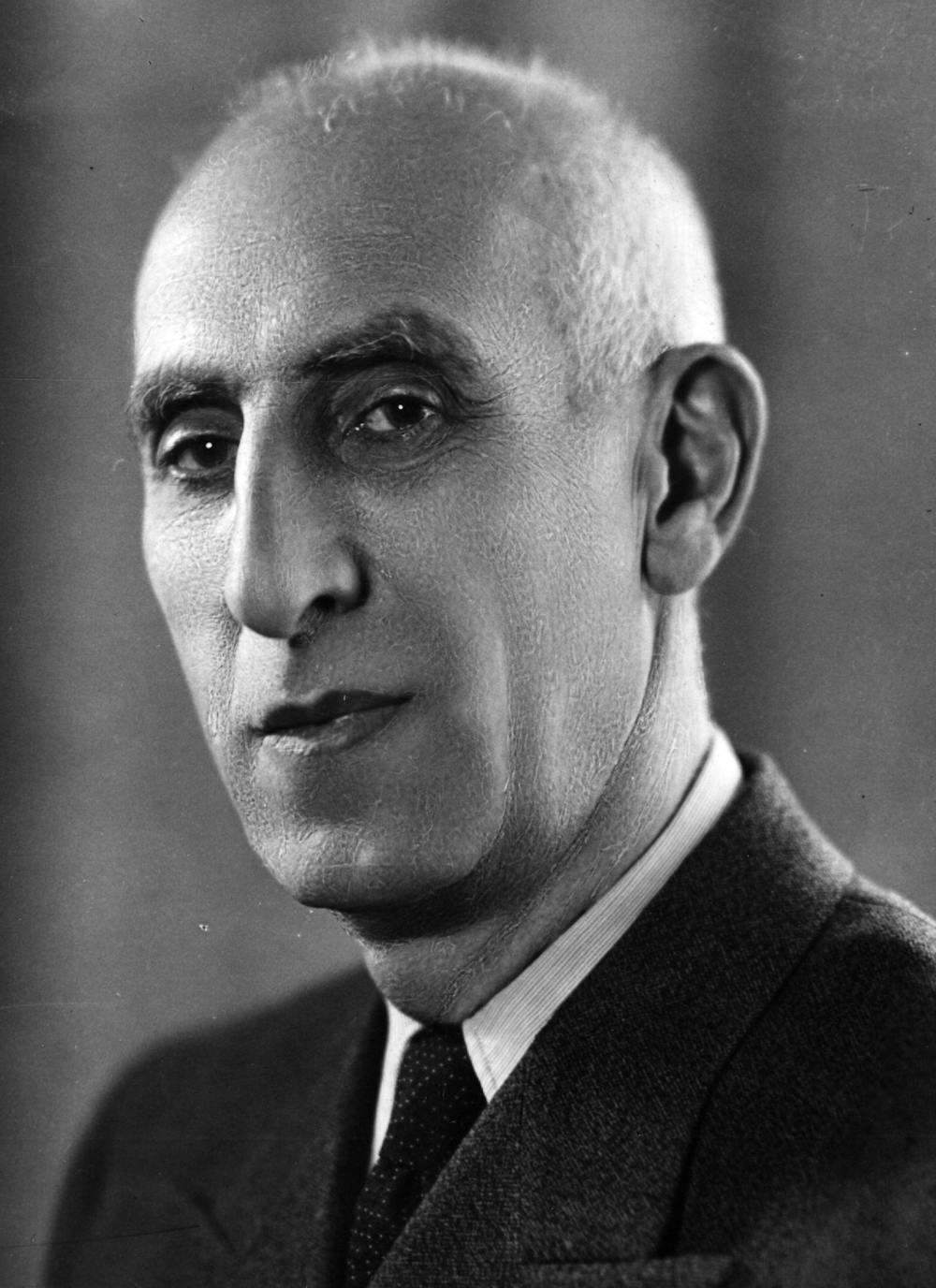
In 1951, the Iranian Parliament chose a new prime minister, Mossadegh, who then led lawmakers to vote in favor of taking over the Anglo-Iranian Oil Company, expelling the company’s British owners and saying they wanted to turn oil profits into investments in the Iranian people. The U.S. feared disruption in the global oil supply and worried about Iran falling prey to Soviet influence. The British feared the loss of cheap Iranian oil.
President Dwight Eisenhower decided it was best for the U.S. and the U.K. to get rid of Mossadegh. Operation Ajax, a joint CIA-British operation, convinced the Shah of Iran, the country’s monarch, to dismiss Mossadegh and drive him from office by force. Mossadegh was replaced by a much more Western-friendly prime minister, handpicked by the CIA.
Demonstrators in Tehran demand the establishment of an Islamic republic. AP Photo/Saris
1979: Revolutionaries oust the shah, take hostages
After more than 25 years of relative stability in U.S.-Iran relations, the Iranian public had grown unhappy with the social and economic conditions that developed under the dictatorial rule of Shah Mohammad Reza Pahlavi.
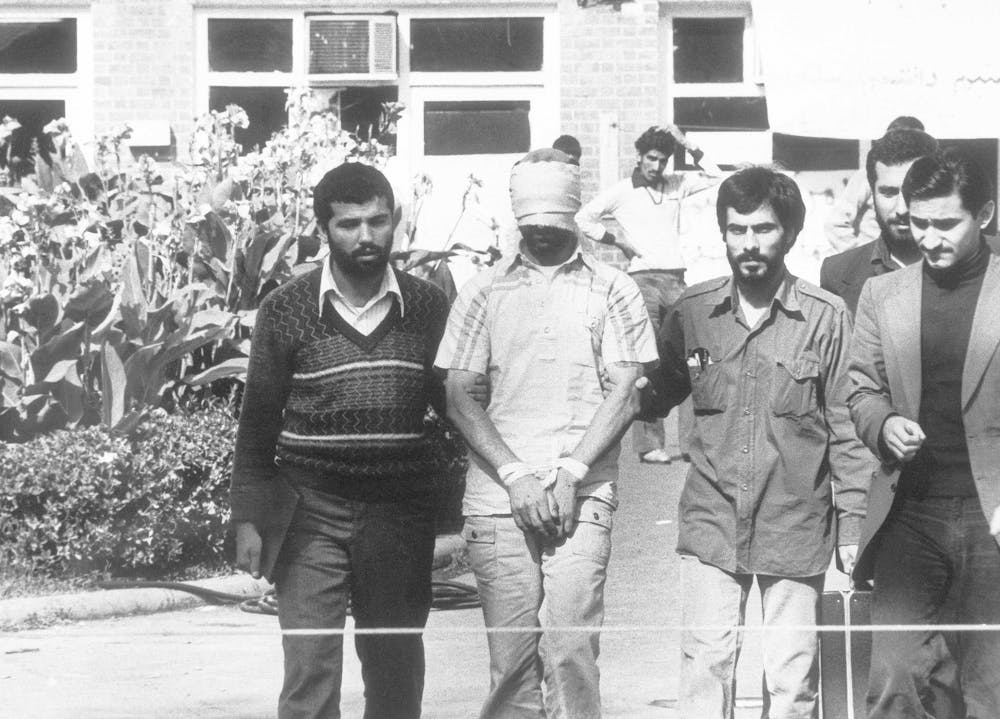
Iranian students at the U.S. Embassy in Tehran show a blindfolded American hostage to the crowd in November 1979. AP Photo
In October 1979, President Jimmy Carter agreed to allow the shah to come to the U.S. to seek advanced medical treatment. Outraged Iranian students stormed the U.S. Embassy in Tehran on Nov. 4, taking 52 Americans hostage. That convinced Carter to sever U.S. diplomatic relations with Iran on April 7, 1980.
Two weeks later, the U.S. military launched a mission to rescue the hostages, but it failed, with aircraft crashes killing eight U.S. servicemembers.
The shah died in Egypt in July 1980, but the hostages weren’t released until Jan. 20, 1981, after 444 days of captivity.
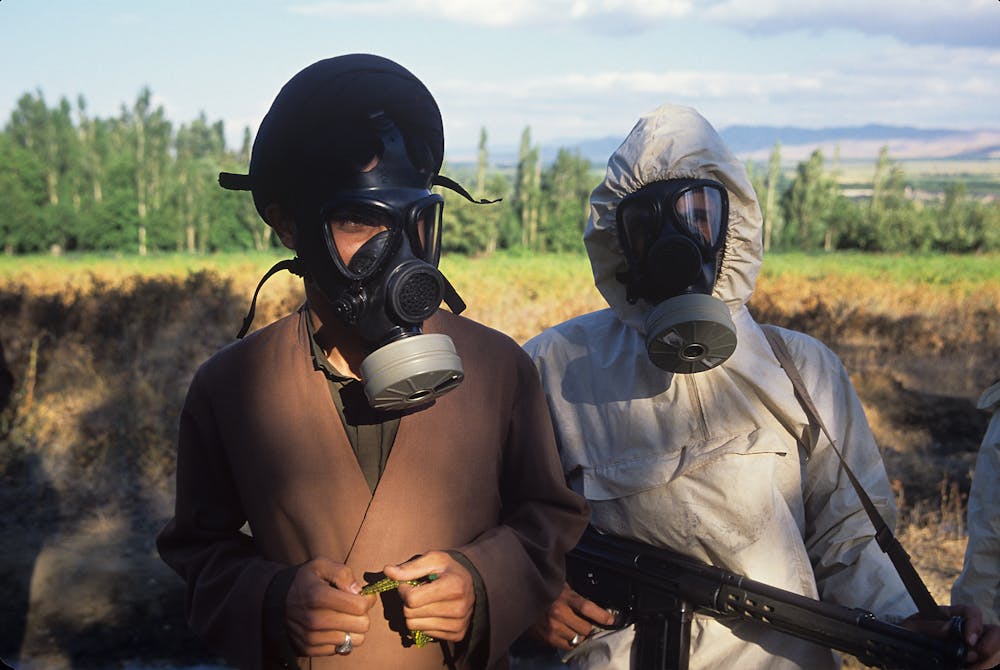
An Iranian cleric, left, and an Iranian soldier wear gas masks to protect themselves against Iraqi chemical-weapons attacks in May 1988. Kaveh Kazemi/Getty Images
The U.S. was concerned that the conflict would limit the flow of Middle Eastern oil and wanted to ensure the conflict didn’t affect its close ally, Saudi Arabia.
U.S. officials moderated their usual opposition to those illegal and inhumane weapons because the U.S. State Department did not “wish to play into Iran’s hands by fueling its propaganda against Iraq.” In 1988, the war ended in a stalemate. More than 500,000 military and 100,000 civilians died.
1981-1986: US secretly sells weapons to Iran
The U.S. imposed an arms embargo after Iran was designated a state sponsor of terrorism in 1984. That left the Iranian military, in the middle of its war with Iraq, desperate for weapons and aircraft and vehicle parts to keep fighting.
The last shipment, of anti-tank missiles, was in October 1986. In November 1986, a Lebanese magazine exposed the deal. That revelation sparked the Iran-Contra scandal in the U.S., with Reagan’s officials found to have collected money from Iran for the weapons and illegally sent those funds to anti-socialist rebels – the Contras – in Nicaragua.
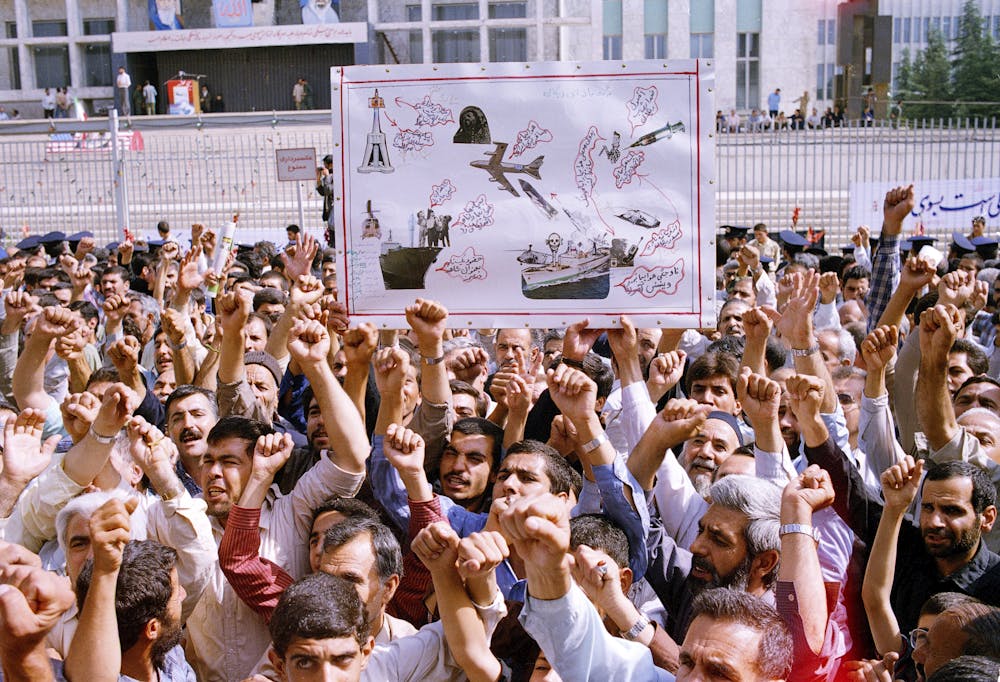
At a mass funeral for 76 of the 290 people killed in the shootdown of Iran Air 655, mourners hold up a sign depicting the incident. AP Photo/CP/Mohammad Sayyad
Either during or just after that exchange of gunfire, the Vincennes crew mistook a passing civilian Airbus passenger jet for an Iranian F-14 fighter. They shot it down, killing all 290 people aboard.
The U.S. called it a “tragic and regrettable accident,” but Iran believed the plane’s downing was intentional. In 1996, the U.S. agreed to pay US$131.8 million in compensation to Iran.
1997-1998: The US seeks contact
In August 1997, a moderate reformer, Mohammad Khatami, won Iran’s presidential election.
U.S. President Bill Clinton sensed an opportunity. He sent a message to Tehran through the Swiss ambassador there, proposing direct government-to-government talks.
Shortly thereafter, in early January 1998, Khatami gave an interview to CNN in which he expressed “respect for the great American people,” denounced terrorism and recommended an “exchange of professors, writers, scholars, artists, journalists and tourists” between the United States and Iran.
However, Supreme Leader Ayatollah Ali Khamenei didn’t agree, so not much came of the mutual overtures as Clinton’s time in office came to an end.
In his 2002 State of the Union address, President George W. Bush characterized Iran, Iraq and North Korea as constituting an “Axis of Evil” supporting terrorism and pursuing weapons of mass destruction, straining relations even further.
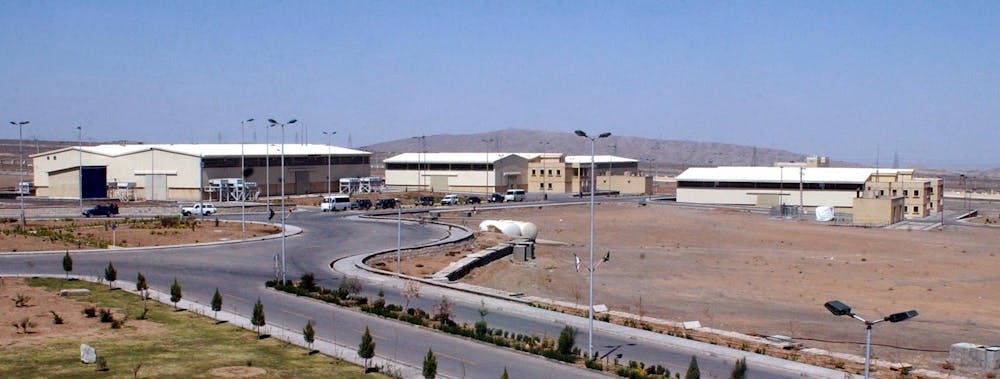
Inside these buildings at the Natanz nuclear facility in Iran, technicians enrich uranium. AP Photo/Vahid Salemi
That was a violation of the terms of the Nuclear Nonproliferation Treaty, which Iran had signed, requiring countries to disclose their nuclear-related facilities to international inspectors.
One of those formerly secret locations, Natanz, housed centrifuges for enriching uranium, which could be used in civilian nuclear reactors or enriched further for weapons.
Starting in roughly 2005, U.S. and Israeli government cyberattackers together reportedly targeted the Natanz centrifuges with a custom-made piece of malicious software that became known as Stuxnet.
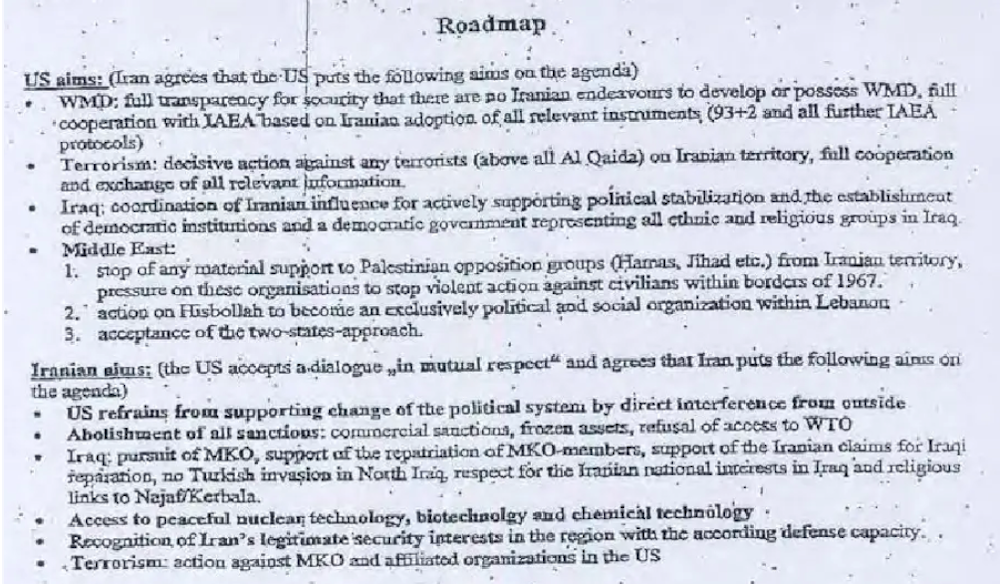
An excerpt of the document sent from Iran, via the Swiss government, to the U.S. State Department in 2003, appears to seek talks between the U.S. and Iran. Washington Post via Scribd
In May 2003, senior Iranian officials quietly contacted the State Department through the Swiss embassy in Iran, seeking “a dialogue ‘in mutual respect,’” addressing four big issues: nuclear weapons, terrorism, Palestinian resistance and stability in Iraq.
Hardliners in the Bush administration weren’t interested in any major reconciliation, though Secretary of State Colin Powell favored dialogue and other officials had met with Iran about al-Qaida.
When Iranian hardliner Mahmoud Ahmadinejad was elected president of Iran in 2005, the opportunity died. The following year, Ahmadinejad made his own overture to Washington in an 18-page letter to President Bush. The letter was widely dismissed; a senior State Department official told me in profane terms that it amounted to nothing.
After a decade of unsuccessful attempts to rein in Iran’s nuclear ambitions, the Obama administration undertook a direct diplomatic approach beginning in 2013.
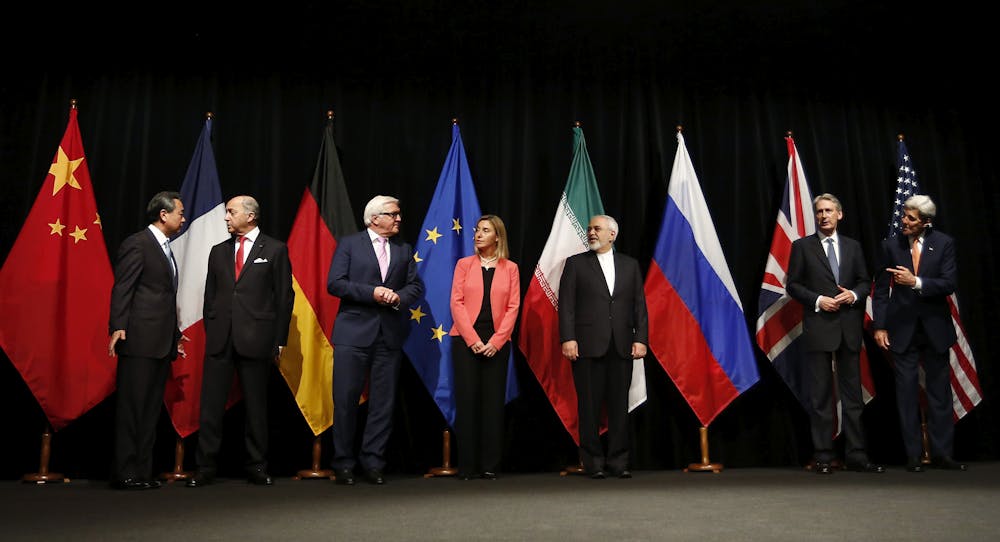
Iran, the U.S., China, France, Germany, Russia and the United Kingdom signed the deal in 2015. It severely limited Iran’s capacity to enrich uranium and mandated that international inspectors monitor and enforce Iran’s compliance with the agreement.
In return, Iran was granted relief from international and U.S. economic sanctions. Though the inspectors regularly certified that Iran was abiding by the agreement’s terms, President Donald Trump withdrew from the agreement in May 2018.
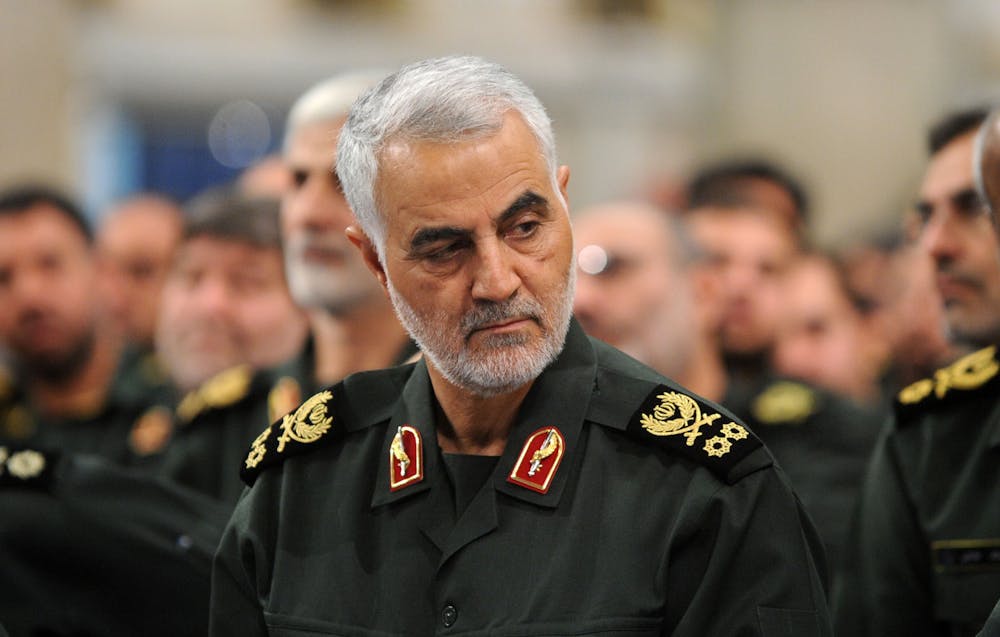
2020: US drones kill Iranian Maj. Gen. Qassem Soleimani
At the time, the Trump administration asserted that Soleimani was directing an imminent attack against U.S. assets in the region, but officials have not provided clear evidence to support that claim.
Hamas’ brazen attack on Israel on Oct. 7, 2023, provoked a fearsome militarized response from Israel that continues today and served to severely weaken Iran’s proxies in the region, especially Hamas – the perpetrator of the attacks – and Hezbollah in Lebanon.
2025: Trump 2.0 and Iran
Trump saw an opportunity to forge a new nuclear deal with Iran and to pursue other business deals with Tehran. Once inaugurated for his second term, Trump appointed Steve Witkoff, a real estate investor who is the president’s friend, to serve as special envoy for the Middle East and to lead negotiations.
Negotiations for a nuclear deal between Washington and Tehran began in April, but the countries did not reach a deal. They were planning a new round of talks when Israel struck Iran with a series of airstrikes on June 13, forcing the White House to reconsider is position.
Jeffrey Fields receives funding from the Carnegie Corporation of New York and Schmidt Futures.
Source: People’s Republic of China – State Council News
Top two seeds Carlos Alcaraz and Jack Draper both advanced to the second round of the men’s singles at the Queen’s Club Championships on Tuesday.
Spain’s Alcaraz arrived in London fresh off his second consecutive French Open title. The world No. 2 overcame a late challenge from lucky loser Alex Walton to win his first grass-court match of the season 6-4, 7-6(7).
Alcaraz had initially been scheduled to face fellow Spaniard Alejandro Davidovich Fokina in the opening round, but the world No. 28 withdrew just hours before the match due to illness following his recent wedding.
“I didn’t know his game, which shot is his best,” Alcaraz talked about his opponent Walton from Australia. “What I tried is not to think about him but myself. I tried to play as good as I can and that’s all.”
Earlier, Draper thrilled the home crowd at Andy Murray Arena with a commanding 6-3, 6-1 victory over American Jenson Brooksby.
“I feel good. I feel confident. I feel relaxed. Like I said on court, I’m happy to be home. I’m happy to be playing in front of home crowd,” said the 23-year-old British No. 1.
Draper will next face Australian Alexei Popyrin, while Alcaraz is set to play compatriot Jaume Munar.
Our cultural touchstones series looks at influential works.
Gilles Deleuze was one of the most original and imaginative thinkers of postwar France. A lifelong teacher, he spent most of his career at the University of Paris VIII, influencing generations of students but largely shunning the mantle of public intellectual.
His complex, creative books mix philosophy, literature, film and politics – not to give clear answers, but to spark new ways of thinking.
Written at a time when the Cold War was ending, computers were becoming more common, and the internet was beginning to connect institutions, the essay describes the emergence of a new kind of society – one not ruled by a single stern voice but by the soft hum of networks.
How societies work
Postscript was written as an update to the work of Deleuze’s contemporary Michel Foucault, who had died in 1984. Deleuze called it a “postscript” not just because of its brevity (it’s only around 2,300 words in English translation) but to highlight he wasn’t refuting Foucault, just building on his work.
From the 18th to early 20th centuries, Foucault had argued, Western societies were “disciplinary societies”. Schools, factories, prisons and hospitals – institutions with walls, schedules, routines and clear expectations – moulded behaviour. People were trained, observed, tested and corrected as they passed from one institution to the next.
But in the late 20th century, Deleuze saw something shifting. He thought the stodgy old disciplinary institutions were “in a generalized crisis” due to technological advances and a new form of capitalism that demanded more flexibility in workers and consumers.
New systems of management and technology were starting to reshape people without sending them through traditional institutions. Deleuze wrote presciently, for example, that “perpetual training tends to replace the school, and continuous control to replace the examination”.
In business, he saw a growing idea of “salary according to merit”, transforming work into “challenges, contests, and highly comic group sessions” – something much at odds with the old model of the standard wage and the assembly line. Traditional government institutions like hospitals and the classic factory were embracing the model of the corporation, driven always by a profit motive and the need for better human tools.
To Deleuze, all this meant people were becoming more “free-floating” – they could be still playing socially useful roles but were being gently steered into them. This greater freedom, however, required a new system to keep everyone in line. He called this “modulation” to underline its dynamic, enveloping nature.
Like nudging, but everywhere
Deleuze described modulation as “a self-deforming cast that will continuously change from one moment to the other”. He meant that people were beginning to live in an environment where everything shape-shifts to encourage or discourage us in the right direction without explicitly putting up walls.
A prime example of how modulation has since become commonplace is nudging – the use of psychological techniques, often subtle and data-driven, to shape people’s behaviour.
Nudging didn’t really exist in 1990, but governments and tech companies use nudges all the time now. We’re nudged to eat healthier, buy, save, recycle, donate. Web sites use “dark patterns” – tricky designs that steer (or nudge) us toward certain choices. Social media feeds use algorithms to exclude us if we say the wrong thing. In fact, entire teams of behavioural scientists operate behind the scenes to manipulate many aspects of our lives.
Nudges can be good and can save us from poor choices, but their newfound moral acceptability (sometimes called libertarian paternalism) is very much a clue that Deleuze’s control society has arrived.
Control in your pocket
Deleuze, who died in 1995, wrote Postscript before the advent of the smartphone, but he foresaw that an “electronic collar” would assume a central role in society. He envisaged a “computer that tracks each person’s position – licit or illicit – and effects a universal modulation.”
Smartphones more than fit the bill. In the old disciplinary ways, they track where we go, what we search for, what we buy, how many steps we take, even how well we sleep. But if we apply Deleuze’s ideas to these phones, detailed surveillance is no longer their most important function. Our phones present and curate options.
In effect, they shape how we see the world. When you scroll through news or social media, for instance, you’re reading about a version of the world built just for you, designed to keep you looking, clicking and reacting – and keep you very finely attuned to what is acceptable or dangerous behaviour.
In Deleuze’s terms, this is pure modulation: not a forceful “No” but a softly spoken, “How about this?” Your phone doesn’t lock you in – it draws you in. It shapes what you see, rewards your cooperation, ignores your silence, and always keeps score. And it does this 24/7. You might unlock it hundreds of times a day. And each time it’s updated to guide your next move more precisely.
At the same time our phones quietly turn us into a set of credentials useful for regulating physical access to workplaces, bank accounts, information: In the societies of control, writes Deleuze, “what is important is no longer either a signature or a number, but a code: the code is a password.”
Data points not people?
Deleuze warned that, in a control society: “Individuals have become ‘dividuals,’ and masses have become samples, data, markets, or ‘banks.’” A dividual to Deleuze is a person transformed into a set of data points and metrics.
You are your credit rating, your search history, your likes and clicks – a different dataset to every institution. Such fragments are used to make decisions about you until they effectively replace you. In fact, for Deleuze a dividual has internalised this treatment and thinks of themselves as a net worth, a mortgage size, a car value – psychological anchors for control.
He illustrates this point with healthcare, predicting a
new medicine ‘without doctor or patient’ that singles out potential sick people and subjects at risk, which in no way attests to individuation.
How many health decisions are now made for us collectively before we ever see a doctor? We should be grateful for advances in public health and epidemiology, but this has certainly impacted our individuality and how we are treated.
Hard to detect
An unsettling part of Deleuze’s perspective is that control doesn’t usually feel like control. It’s often dressed up as convenience, efficiency or progress. You set up internet-linked video cameras because then you can work from home. You agree to long terms and conditions because your banking app won’t work otherwise.
One problem is there are no longer clear barriers we can rail against. As Deleuze said:
In disciplinary societies one was always starting again (from school to the barracks, from the barracks to the factory), while in control societies one is never finished with anything.
Control doesn’t always crush – it can enable. Digital networks bring real freedom, economic possibility, even joy. We move more easily – both mentally and geographically – than ever before. But while we move, it always inside a kind of invisible map shaped by capitalism.
It’s no conspiracy because nobody has the whole map. So it’s difficult to work out exactly what action, if any, to take. As Deleuze concludes: “The coils of a serpent are even more complex than the burrows of a molehill.”
So what can we do?
Postscript doesn’t offer a political program beyond the sardonic comment that:
Many young people strangely boast of being ‘motivated’ […] It’s up to them to discover what they’re being made to serve.
There are ways to resist control. Some people demand more privacy or digital rights. Others opt out selectively – logging off, turning off, refusing to be nudged. Some look to art as a way of resisting its smooth grip. These acts – however small – may offer what Deleuze and his collaborator, the French psychiatrist and philosopher Félix Guattari, called lines of flight: creative ways to move not just against control, but beyond it.
The real message of Postscript, however, is its invitation to consider a timeless perspective. Any society must have a way to make people useful. So, what kind of society do we want? What kinds of restrictions are we willing to live under? And, crucial to this current age, how explicit should control be?
Cameron Shackell does not work for, consult, own shares in or receive funding from any company or organisation that would benefit from this article, and has disclosed no relevant affiliations beyond their academic appointment.
Our cultural touchstones series looks at influential works.
Gilles Deleuze was one of the most original and imaginative thinkers of postwar France. A lifelong teacher, he spent most of his career at the University of Paris VIII, influencing generations of students but largely shunning the mantle of public intellectual.
His complex, creative books mix philosophy, literature, film and politics – not to give clear answers, but to spark new ways of thinking.
Written at a time when the Cold War was ending, computers were becoming more common, and the internet was beginning to connect institutions, the essay describes the emergence of a new kind of society – one not ruled by a single stern voice but by the soft hum of networks.
How societies work
Postscript was written as an update to the work of Deleuze’s contemporary Michel Foucault, who had died in 1984. Deleuze called it a “postscript” not just because of its brevity (it’s only around 2,300 words in English translation) but to highlight he wasn’t refuting Foucault, just building on his work.
From the 18th to early 20th centuries, Foucault had argued, Western societies were “disciplinary societies”. Schools, factories, prisons and hospitals – institutions with walls, schedules, routines and clear expectations – moulded behaviour. People were trained, observed, tested and corrected as they passed from one institution to the next.
But in the late 20th century, Deleuze saw something shifting. He thought the stodgy old disciplinary institutions were “in a generalized crisis” due to technological advances and a new form of capitalism that demanded more flexibility in workers and consumers.
New systems of management and technology were starting to reshape people without sending them through traditional institutions. Deleuze wrote presciently, for example, that “perpetual training tends to replace the school, and continuous control to replace the examination”.
In business, he saw a growing idea of “salary according to merit”, transforming work into “challenges, contests, and highly comic group sessions” – something much at odds with the old model of the standard wage and the assembly line. Traditional government institutions like hospitals and the classic factory were embracing the model of the corporation, driven always by a profit motive and the need for better human tools.
To Deleuze, all this meant people were becoming more “free-floating” – they could be still playing socially useful roles but were being gently steered into them. This greater freedom, however, required a new system to keep everyone in line. He called this “modulation” to underline its dynamic, enveloping nature.
Like nudging, but everywhere
Deleuze described modulation as “a self-deforming cast that will continuously change from one moment to the other”. He meant that people were beginning to live in an environment where everything shape-shifts to encourage or discourage us in the right direction without explicitly putting up walls.
A prime example of how modulation has since become commonplace is nudging – the use of psychological techniques, often subtle and data-driven, to shape people’s behaviour.
Nudging didn’t really exist in 1990, but governments and tech companies use nudges all the time now. We’re nudged to eat healthier, buy, save, recycle, donate. Web sites use “dark patterns” – tricky designs that steer (or nudge) us toward certain choices. Social media feeds use algorithms to exclude us if we say the wrong thing. In fact, entire teams of behavioural scientists operate behind the scenes to manipulate many aspects of our lives.
Nudges can be good and can save us from poor choices, but their newfound moral acceptability (sometimes called libertarian paternalism) is very much a clue that Deleuze’s control society has arrived.
Control in your pocket
Deleuze, who died in 1995, wrote Postscript before the advent of the smartphone, but he foresaw that an “electronic collar” would assume a central role in society. He envisaged a “computer that tracks each person’s position – licit or illicit – and effects a universal modulation.”
Smartphones more than fit the bill. In the old disciplinary ways, they track where we go, what we search for, what we buy, how many steps we take, even how well we sleep. But if we apply Deleuze’s ideas to these phones, detailed surveillance is no longer their most important function. Our phones present and curate options.
In effect, they shape how we see the world. When you scroll through news or social media, for instance, you’re reading about a version of the world built just for you, designed to keep you looking, clicking and reacting – and keep you very finely attuned to what is acceptable or dangerous behaviour.
In Deleuze’s terms, this is pure modulation: not a forceful “No” but a softly spoken, “How about this?” Your phone doesn’t lock you in – it draws you in. It shapes what you see, rewards your cooperation, ignores your silence, and always keeps score. And it does this 24/7. You might unlock it hundreds of times a day. And each time it’s updated to guide your next move more precisely.
At the same time our phones quietly turn us into a set of credentials useful for regulating physical access to workplaces, bank accounts, information: In the societies of control, writes Deleuze, “what is important is no longer either a signature or a number, but a code: the code is a password.”
Data points not people?
Deleuze warned that, in a control society: “Individuals have become ‘dividuals,’ and masses have become samples, data, markets, or ‘banks.’” A dividual to Deleuze is a person transformed into a set of data points and metrics.
You are your credit rating, your search history, your likes and clicks – a different dataset to every institution. Such fragments are used to make decisions about you until they effectively replace you. In fact, for Deleuze a dividual has internalised this treatment and thinks of themselves as a net worth, a mortgage size, a car value – psychological anchors for control.
He illustrates this point with healthcare, predicting a
new medicine ‘without doctor or patient’ that singles out potential sick people and subjects at risk, which in no way attests to individuation.
How many health decisions are now made for us collectively before we ever see a doctor? We should be grateful for advances in public health and epidemiology, but this has certainly impacted our individuality and how we are treated.
Hard to detect
An unsettling part of Deleuze’s perspective is that control doesn’t usually feel like control. It’s often dressed up as convenience, efficiency or progress. You set up internet-linked video cameras because then you can work from home. You agree to long terms and conditions because your banking app won’t work otherwise.
One problem is there are no longer clear barriers we can rail against. As Deleuze said:
In disciplinary societies one was always starting again (from school to the barracks, from the barracks to the factory), while in control societies one is never finished with anything.
Control doesn’t always crush – it can enable. Digital networks bring real freedom, economic possibility, even joy. We move more easily – both mentally and geographically – than ever before. But while we move, it always inside a kind of invisible map shaped by capitalism.
It’s no conspiracy because nobody has the whole map. So it’s difficult to work out exactly what action, if any, to take. As Deleuze concludes: “The coils of a serpent are even more complex than the burrows of a molehill.”
So what can we do?
Postscript doesn’t offer a political program beyond the sardonic comment that:
Many young people strangely boast of being ‘motivated’ […] It’s up to them to discover what they’re being made to serve.
There are ways to resist control. Some people demand more privacy or digital rights. Others opt out selectively – logging off, turning off, refusing to be nudged. Some look to art as a way of resisting its smooth grip. These acts – however small – may offer what Deleuze and his collaborator, the French psychiatrist and philosopher Félix Guattari, called lines of flight: creative ways to move not just against control, but beyond it.
The real message of Postscript, however, is its invitation to consider a timeless perspective. Any society must have a way to make people useful. So, what kind of society do we want? What kinds of restrictions are we willing to live under? And, crucial to this current age, how explicit should control be?
Cameron Shackell does not work for, consult, own shares in or receive funding from any company or organisation that would benefit from this article, and has disclosed no relevant affiliations beyond their academic appointment.
The tax cuts bill currently being debated by the US Senate will add another US$3 trillion (A$4.6 trillion) to US debt. President Donald Trump calls it the “big, beautiful bill”; his erstwhile policy adviser Elon Musk called it a “disgusting abomination”.
Foreign investors have already been rattled by Trump’s upending of the global trade system. The eruption of war in the Middle East would usually lead to “flight to safety” buying of the US dollar, but the dollar has barely budged. That suggests US assets are not seen as the safe haven they used to be.
Greg Combet, chair of Australia’s own sovereign wealth fund, the Future Fund, outlined many of the new risks arising from US policies in a speech on Tuesday.
As investors turn cautious on the US, at some point the surging US debt pile will become unsustainable. That could risk a financial crisis. But at what point does that happen?
The public sector holds a range of debt
When talking about the sustainability of US government debt, we have to distinguish between total debt and public debt.
Public debt is owed to individuals, companies, foreign governments and investors. This accounts for about 80% of total US debt. The remainder is intra-governmental debt held by government agencies and the Federal Reserve.
Public debt is a more correct measure of US government debt. And it is much less than the headline total government debt amount that is frequently quoted, which is running at US$36 trillion or 121% of GDP.
Are there limits to government debt?
Governments are not like households. They can feasibly roll over debt indefinitely and don’t technically need to repay it, unlike a personal credit card. And countries such as the US that issue debt in their own currency can’t technically default unless they choose to.
Debt also serves a useful role. It is the main way a government funds infrastructure projects. It is an important channel for monetary policy, because the US Federal Reserve sets the benchmark interest rate that affects borrowing costs across the economy. And because the US government issues bonds, known as Treasuries, to finance the debt, this is an important asset for investors.
There is probably some limit to the amount of debt the US government can issue. But we don’t really know what this amount is, and we won’t know until we get there. Additionally, the US’s reserve currency status, due to the US dollar’s dominant role in international finance, gives the US government more leeway than other governments.
Interest costs are surging
What is important is the government’s ability to service its debt – that is, to pay the interest cost. This depends on two components: growth in economic activity, and the interest rate on government debt.
If economic growth on average is higher than the interest rate, then the government’s effective interest cost is negative and it could sustainably carry its existing debt burden.
The interest cost of US government debt has surged recently following a series of Federal Reserve interest rate hikes in 2022 and 2023 to quell inflation.
The US government is now spending more on interest payments than on defence – about US$882 billion annually. This will soon start crowding out spending in other areas, unless taxes are raised or further spending cuts made.
Recent policy decisions not helping
The turmoil caused by Trump’s “Liberation Day” tariffs and heightened uncertainty about future government policy are expected to weaken US economic growth and raise inflation. This, coupled with the recent credit downgrade of US government debt by ratings agency Moody’s, is likely to put upward pressure on US interest rates, further increasing the servicing cost of US government debt.
Moody’s cited concerns about the growth of US federal debt. This comes as the US House of Representatives passed the “One Big Beautiful Bill Act”, which seeks to extend the 2017 tax cuts indefinitely while slashing social spending. This has caused some to question the sustainability of the US government’s fiscal position.
The non-partisan Congressional Budget Office estimates the bill will add a further US$3 trillion to government debt over the ten years to 2034, increasing debt to 124% of GDP. And this would increase to US$4.5 trillion over ten years and take debt to 128% of GDP if some tax initiatives were made permanent.
Also troubling is Section 899 of the bill, known as the “revenge tax”. This controversial provision raises the tax payable by foreign investors and could further deter foreign investment, potentially making US government debt even less attractive.
A compromised Federal Reserve is the next risk
The passing of the tax and spending bill is unlikely to cause a financial crisis in the US. But the US could be entering into a period of “fiscal dominance”, which is just as concerning.
In this situation, the independence of the Federal Reserve might be compromised if it is pressured to support the US government’s fiscal position. It would do this by keeping interest rates lower than otherwise, or buying government debt to support the government instead of targeting inflation. Trump has already been putting pressure on Federal Reserve chair Jerome Powell, demanding he cut rates immediately.
This could lead to much higher inflation in the US, as occurred in Germany in the 1920s, and more recently in Argentina and Turkey.
Luke Hartigan receives funding from the Australian Research Council (DP230100959)
Three major French financial institutions, including two of the country’s largest banks and the state’s public investment arm, have announced their rejection of deep sea mining during the United Nations Ocean Conference (UNOC) last week in Nice.
The three institutions are:
BNP Paribas– France’s largest and Europe’s second largest bank.BNP Paribasconfirms itdoes not invest in deep sea mining projectsdue to the intrinsic environmental and social risks involved.
Crédit Agricole– The second largest bank in France and the world’s largest cooperative financial institution.Crédit Agricolestatedit will not finance deep sea mining projectsuntil it has been proven that such operationspose no significant harm to marine ecosystems.
Groupe Caisse des Dépôts– The public investment arm of the French Government, which also holds a majority stake in La Banque Postale.The Grouphas pledgedto exclude all financing and investmentin companies whose main activity is deep sea mining, as well as in deep sea mining projects.
Amundi Asset Managementalso made a statement that it seeks to avoid investment in companies “involved in deep sea mining and/or exploration”.
Deep Sea Mining Campaign Finance Advocacy Officer Andy Whitmore says: “This is a truly significant outcome from UNOC. Until recently no French financiers had matched their Government’s position calling for a ban. This UN Ocean Conference, co-hosted by France, was the perfect opportunity for the most important national players to step up and be counted”
These financial announcements are a sign of global concern pushing itself on to the agenda. World leadersrenewed calls for a global moratoriumon the dangerous industry, with French President Emmanuel Macron denouncing it as “madness”, with UN Secretary-General António Guterres responding to recent announcements from President Trump by warning that the deep sea “cannot become the Wild West.” Slovenia, Latvia, Cyprus and the Marshall Islands also announced their support for a moratorium or precautionary pause, bringing thenumber of like-minded countries to 37.
Andy Whitmore concluded “the events at UNOC have added further momentum to the financial establishment rejecting deep sea mining. The recent unseemly rush to mine is creating push-back from the financial world, as much as from governments and civil society.”
Source: People’s Republic of China – State Council News
Expectations are high ahead of Real Madrid’s debut at the 2025 FIFA Club World Cup, as they face Al Hilal at Hard Rock Stadium in Miami on Wednesday.
The match marks Xabi Alonso’s first official game as Real Madrid head coach. Although the former Madrid midfielder and ex-Bayer Leverkusen boss has had just over a week with the squad, all eyes will be on what early changes he has implemented.
Kylian Mbappe (R) of Real Madrid vies with Josko Gvardiol of Manchester City during the UEFA Champions League knockout phase play-off second leg football match between Real Madrid and Manchester City in Madrid, Spain, on Feb. 19, 2025. (Photo by Gustavo Valiente/Xinhua)
Under former coach Carlo Ancelotti, Real Madrid covered among the least distance on the pitch and rarely applied a high press, instead relying on the pace of Kylian Mbappe, Vinicius Jr. and Rodrygo to hit on the break.
Alonso favored a high-pressing style at Leverkusen, with his players disrupting opponents’ buildup from the back. Whether he can instill that mentality in Madrid after only a few sessions, particularly in Miami’s heat, remains to be seen.
At Leverkusen, Alonso frequently deployed a back three with attacking full-backs. It is unclear if he will adopt a similar system with Madrid.
The arrival of Trent Alexander-Arnold from Liverpool supports the use of wing-backs, and the England international appears poised to make his Real Madrid debut, along with Dean Huijsen, who signed from Bournemouth.
Huijsen impressed during the recent international break. His height and composure on the ball offer Madrid added flexibility, and it’s easy to envision Mbappe and Vinicius exploiting gaps behind Al Hilal’s defense as Huijsen delivers long passes from deep.
Vinicius remains under scrutiny following a disappointing domestic campaign, while Alonso must also finalize his central midfield pairing, likely Fede Valverde and possibly Dani Ceballos.
Al Hilal’s lineup features several players familiar to Spanish fans, including former Barcelona and Manchester City defender Joao Cancelo, forward Malcom, and former Atletico Madrid left-back Renan Lodi.
With a sell-out crowd expected, the match promises to provide a strong benchmark of the Saudi League’s level against one of Europe’s top clubs.
Source: People’s Republic of China – State Council News
Premier League club Brighton and Hove Albion has signed Italian international central defender Diego Coppola from Hellas Verona for an undisclosed fee.
Lautaro Martinez (R) of FC Inter vies with Diego Coppola of Hellas Verona during the Serie A 19th round football match between FC Inter and Hellas Verona in Milan, Italy, Jan. 6, 2024. (Photo by Alberto Lingria/Xinhua)
Coppola has agreed a five-year contract with ‘the Seagulls’ and will help cover for the loss of Spain international Dean Huijsen, who signed for Madrid earlier in the summer for 50 million pounds (68 million U.S. dollars).
Coppola, who is currently with the Italian U-21 side at the European Championships in Slovakia, made his debut for Hellas Verona in 2021 and made 81 first team appearances for the club.
“Diego is an exciting addition for the club. Although he is still young, he is tall, strong and mobile, and he will give us a real physical presence,” commented Brighton head coach Fabian Hurzeler on the club website.
Hurzeler highlighted the “impressive progress” the defender has made, adding he “deserved his call-up to the Italian national team.”
Coppola is Brighton’s second signing of the summer, with striker Charalampos Kostoulas also arriving from Greek outfit Olympiakos.
London, United Kingdom, June 18, 2025 (GLOBE NEWSWIRE) — Topnotch Crypto, a global player in the cloud mining sector, has officially launched its free cloud mining mobile application. Designed to simplify digital asset mining for everyday users, the new app leverages artificial intelligence and renewable energy to deliver efficient, 24/7 automated mining without the need for hardware or technical expertise.
The application aims to make digital asset mining more accessible by offering a streamlined, mobile-first experience. Built with a focus on energy efficiency, the app runs on 100% green power sourced from Nordic wind and solar infrastructure. Its AI-based computing system dynamically allocates resources to optimize performance and reduce energy costs.
“We developed this app to lower the barrier of entry into digital asset mining,” said a spokesperson from Topnotch Crypto. “With just a smartphone, users can now participate in the growing digital economy in a secure and sustainable way.”
The app also allows users to monitor mining performance, manage digital assets, and access support directly from their mobile device. It is available on both Android and iOS platforms.
This launch comes at a time when the global cloud mining industry is projected to grow rapidly. According to Bloomberg New Energy Finance, the market is expected to see a compound annual growth rate of approximately 47% between 2025 and 2028. Solutions that combine cloud infrastructure, AI, and green energy are increasingly seen as foundational to the next era of digital mining.
About Topnotch Crypto
Topnotch Crypto was legally established in 2020 under British supervision. With “zero threshold, low risk, and high transparency” as its core advantages, it has built a new channel to crypto assets for global users.
Visit https://topnotchcrypto.com to register now and share the stable passive income and unlimited growth opportunities under the wave of digital gold with 8 million users around the world!
Disclaimer: The information provided in this press release does not constitute an investment solicitation, nor does it constitute investment advice, financial advice, or trading recommendations. Cryptocurrency mining and staking involve risks and the possibility of financial loss. You are strongly advised to perform due diligence before investing or trading in cryptocurrencies and securities, including consulting a professional financial advisor.
OMAHA, Neb., June 17, 2025 (GLOBE NEWSWIRE) — Greystone Housing Impact Investors LP (NYSE: GHI) (the “Partnership”) announced that the Board of Managers of Greystone AF Manager LLC (“Greystone Manager”) declared a cash distribution to the Partnership’s Beneficial Unit Certificate (“BUC”) holders of $0.30 per BUC.
The cash distribution will be paid on July 31, 2025 to all BUC holders of record as of the close of trading on June 30, 2025. The BUCs will trade ex-distribution as of June 30, 2025.
Commenting on the Partnership’s quarterly distribution, Chief Executive Officer Ken Rogozinski stated, “Persistently high interest rates, coupled with higher capitalization rates, have combined to create a more muted environment for sales of certain high quality joint venture properties within our investment portfolio, particularly in Texas markets. As a result, we are reducing our quarterly distribution to appropriately align with the current operating environment. Our quarterly distribution equates to a 9.5% annualized distribution yield based on our net book value as of March 31, 2025, which we believe is attractive in the current operating environment.”
Greystone Manager is the general partner of America First Capital Associates Limited Partnership Two, the Partnership’s general partner. Distributions to the Partnership’s BUC holders, including regular and any supplemental distributions, are determined by Greystone Manager based on a disciplined evaluation of the Partnership’s current and anticipated operating results, financial condition and other factors it deems relevant. Greystone Manager continually evaluates the factors that go into BUC holder distribution decisions, consistent with the long-term best interests of the BUC holders and the Partnership.
The Partnership also announced that Vantage at Fair Oaks, a 288-unit market rate multifamily property located in Boerne, TX (the “Property”), was publicly listed for sale by Institutional Property Advisors Texas at the direction of the Property-owning entity’s managing member. The Partnership’s non-controlling investment in the Property was originated in September 2021 and the Partnership contributed equity totaling $12.0 million to date. Construction of the Property was completed in May 2023. Consistent with past Vantage property sales, the managing member controls the listing and sales process under the terms of the Property-owning entity’s operating agreement, with the Partnership entitled to certain net proceeds upon the successful completion of the sale of the Property.
About Greystone Housing Impact Investors LP
Greystone Housing Impact Investors LP was formed in 1998 under the Delaware Revised Uniform Limited Partnership Act for the primary purpose of acquiring, holding, selling and otherwise dealing with a portfolio of mortgage revenue bonds which have been issued to provide construction and/or permanent financing for affordable multifamily, seniors and student housing properties. The Partnership is pursuing a business strategy of acquiring additional mortgage revenue bonds and other investments on a leveraged basis. The Partnership expects and believes the interest earned on these mortgage revenue bonds is excludable from gross income for federal income tax purposes. The Partnership seeks to achieve its investment growth strategy by investing in additional mortgage revenue bonds and other investments as permitted by its Second Amended and Restated Limited Partnership Agreement, dated December 5, 2022, (the “Partnership Agreement”), taking advantage of attractive financing structures available in the securities market, and entering into interest rate risk management instruments. Greystone Housing Impact Investors LP press releases are available at www.ghiinvestors.com.
Safe Harbor Statement
Certain statements in this press release are intended to be covered by the safe harbor for “forward-looking statements” provided by the Private Securities Litigation Reform Act of 1995. These forward-looking statements generally can be identified by use of statements that include, but are not limited to, phrases such as “believe,” “expect,” “future,” “anticipate,” “intend,” “plan,” “foresee,” “may,” “should,” “will,” “estimates,” “potential,” “continue,” or other similar words or phrases. Similarly, statements that describe objectives, plans, or goals also are forward-looking statements. Such forward-looking statements involve inherent risks and uncertainties, many of which are difficult to predict and are generally beyond the control of the Partnership. The Partnership cautions readers that a number of important factors could cause actual results to differ materially from those expressed in, implied, or projected by such forward-looking statements. Risks and uncertainties include, but are not limited to: defaults on the mortgage loans securing our mortgage revenue bonds and governmental issuer loans; the competitive environment in which the Partnership operates; risks associated with investing in multifamily, student, senior citizen residential properties and commercial properties; general economic, geopolitical, and financial conditions, including the current and future impact of changing interest rates, inflation, and international conflicts (including the Russia-Ukraine war and the Israel-Hamas war) on business operations, employment, and financial conditions; uncertain conditions within the domestic and international macroeconomic environment, including monetary and fiscal policy and conditions in the investment, credit, interest rate, and derivatives markets; adverse reactions in U.S. financial markets related to actions of foreign central banks or the economic performance of foreign economies, including in particular China, Japan, the European Union, and the United Kingdom; the general condition of the real estate markets in the regions in which the Partnership operates, which may be unfavorably impacted by pressures in the commercial real estate sector, incrementally higher unemployment rates, persistent elevated inflation levels, and other factors; changes in interest rates and credit spreads, as well as the success of any hedging strategies the Partnership may undertake in relation to such changes, and the effect such changes may have on the relative spreads between the yield on investments and cost of financing; the aggregate effect of elevated inflation levels over the past several years, spurred by multiple factors including expansionary monetary and fiscal policy, higher commodity prices, a tight labor market, and low residential vacancy rates, which may result in continued elevated interest rate levels and increased market volatility; the Partnership’s ability to access debt and equity capital to finance its assets; current maturities of the Partnership’s financing arrangements and the Partnership’s ability to renew or refinance such financing arrangements; local, regional, national and international economic and credit market conditions; recapture of previously issued Low Income Housing Tax Credits in accordance with Section 42 of the Internal Revenue Code; geographic concentration of properties related to investments held by the Partnership; changes in the U.S. corporate tax code and other government regulations affecting the Partnership’s business; and the other risks detailed in the Partnership’s SEC filings (including but not limited to, the Partnership’s Annual Report on Form 10-K, Quarterly Reports on Form 10-Q, and Current Reports on Form 8-K). Readers are urged to consider these factors carefully in evaluating the forward-looking statements.
If any of these risks or uncertainties materializes or if any of the assumptions underlying such forward-looking statements proves to be incorrect, the developments and future events concerning the Partnership set forth in this press release may differ materially from those expressed or implied by these forward-looking statements. You are cautioned not to place undue reliance on these statements, which speak only as of the date of this document. We anticipate that subsequent events and developments will cause our expectations and beliefs to change. The Partnership assumes no obligation to update such forward-looking statements to reflect events or circumstances after the date of this document or to reflect the occurrence of unanticipated events, unless obligated to do so under the federal securities laws.
OMAHA, Neb., June 17, 2025 (GLOBE NEWSWIRE) — Greystone Housing Impact Investors LP (NYSE: GHI) (the “Partnership”) announced that the Board of Managers of Greystone AF Manager LLC (“Greystone Manager”) declared a cash distribution to the Partnership’s Beneficial Unit Certificate (“BUC”) holders of $0.30 per BUC.
The cash distribution will be paid on July 31, 2025 to all BUC holders of record as of the close of trading on June 30, 2025. The BUCs will trade ex-distribution as of June 30, 2025.
Commenting on the Partnership’s quarterly distribution, Chief Executive Officer Ken Rogozinski stated, “Persistently high interest rates, coupled with higher capitalization rates, have combined to create a more muted environment for sales of certain high quality joint venture properties within our investment portfolio, particularly in Texas markets. As a result, we are reducing our quarterly distribution to appropriately align with the current operating environment. Our quarterly distribution equates to a 9.5% annualized distribution yield based on our net book value as of March 31, 2025, which we believe is attractive in the current operating environment.”
Greystone Manager is the general partner of America First Capital Associates Limited Partnership Two, the Partnership’s general partner. Distributions to the Partnership’s BUC holders, including regular and any supplemental distributions, are determined by Greystone Manager based on a disciplined evaluation of the Partnership’s current and anticipated operating results, financial condition and other factors it deems relevant. Greystone Manager continually evaluates the factors that go into BUC holder distribution decisions, consistent with the long-term best interests of the BUC holders and the Partnership.
The Partnership also announced that Vantage at Fair Oaks, a 288-unit market rate multifamily property located in Boerne, TX (the “Property”), was publicly listed for sale by Institutional Property Advisors Texas at the direction of the Property-owning entity’s managing member. The Partnership’s non-controlling investment in the Property was originated in September 2021 and the Partnership contributed equity totaling $12.0 million to date. Construction of the Property was completed in May 2023. Consistent with past Vantage property sales, the managing member controls the listing and sales process under the terms of the Property-owning entity’s operating agreement, with the Partnership entitled to certain net proceeds upon the successful completion of the sale of the Property.
About Greystone Housing Impact Investors LP
Greystone Housing Impact Investors LP was formed in 1998 under the Delaware Revised Uniform Limited Partnership Act for the primary purpose of acquiring, holding, selling and otherwise dealing with a portfolio of mortgage revenue bonds which have been issued to provide construction and/or permanent financing for affordable multifamily, seniors and student housing properties. The Partnership is pursuing a business strategy of acquiring additional mortgage revenue bonds and other investments on a leveraged basis. The Partnership expects and believes the interest earned on these mortgage revenue bonds is excludable from gross income for federal income tax purposes. The Partnership seeks to achieve its investment growth strategy by investing in additional mortgage revenue bonds and other investments as permitted by its Second Amended and Restated Limited Partnership Agreement, dated December 5, 2022, (the “Partnership Agreement”), taking advantage of attractive financing structures available in the securities market, and entering into interest rate risk management instruments. Greystone Housing Impact Investors LP press releases are available at www.ghiinvestors.com.
Safe Harbor Statement
Certain statements in this press release are intended to be covered by the safe harbor for “forward-looking statements” provided by the Private Securities Litigation Reform Act of 1995. These forward-looking statements generally can be identified by use of statements that include, but are not limited to, phrases such as “believe,” “expect,” “future,” “anticipate,” “intend,” “plan,” “foresee,” “may,” “should,” “will,” “estimates,” “potential,” “continue,” or other similar words or phrases. Similarly, statements that describe objectives, plans, or goals also are forward-looking statements. Such forward-looking statements involve inherent risks and uncertainties, many of which are difficult to predict and are generally beyond the control of the Partnership. The Partnership cautions readers that a number of important factors could cause actual results to differ materially from those expressed in, implied, or projected by such forward-looking statements. Risks and uncertainties include, but are not limited to: defaults on the mortgage loans securing our mortgage revenue bonds and governmental issuer loans; the competitive environment in which the Partnership operates; risks associated with investing in multifamily, student, senior citizen residential properties and commercial properties; general economic, geopolitical, and financial conditions, including the current and future impact of changing interest rates, inflation, and international conflicts (including the Russia-Ukraine war and the Israel-Hamas war) on business operations, employment, and financial conditions; uncertain conditions within the domestic and international macroeconomic environment, including monetary and fiscal policy and conditions in the investment, credit, interest rate, and derivatives markets; adverse reactions in U.S. financial markets related to actions of foreign central banks or the economic performance of foreign economies, including in particular China, Japan, the European Union, and the United Kingdom; the general condition of the real estate markets in the regions in which the Partnership operates, which may be unfavorably impacted by pressures in the commercial real estate sector, incrementally higher unemployment rates, persistent elevated inflation levels, and other factors; changes in interest rates and credit spreads, as well as the success of any hedging strategies the Partnership may undertake in relation to such changes, and the effect such changes may have on the relative spreads between the yield on investments and cost of financing; the aggregate effect of elevated inflation levels over the past several years, spurred by multiple factors including expansionary monetary and fiscal policy, higher commodity prices, a tight labor market, and low residential vacancy rates, which may result in continued elevated interest rate levels and increased market volatility; the Partnership’s ability to access debt and equity capital to finance its assets; current maturities of the Partnership’s financing arrangements and the Partnership’s ability to renew or refinance such financing arrangements; local, regional, national and international economic and credit market conditions; recapture of previously issued Low Income Housing Tax Credits in accordance with Section 42 of the Internal Revenue Code; geographic concentration of properties related to investments held by the Partnership; changes in the U.S. corporate tax code and other government regulations affecting the Partnership’s business; and the other risks detailed in the Partnership’s SEC filings (including but not limited to, the Partnership’s Annual Report on Form 10-K, Quarterly Reports on Form 10-Q, and Current Reports on Form 8-K). Readers are urged to consider these factors carefully in evaluating the forward-looking statements.
If any of these risks or uncertainties materializes or if any of the assumptions underlying such forward-looking statements proves to be incorrect, the developments and future events concerning the Partnership set forth in this press release may differ materially from those expressed or implied by these forward-looking statements. You are cautioned not to place undue reliance on these statements, which speak only as of the date of this document. We anticipate that subsequent events and developments will cause our expectations and beliefs to change. The Partnership assumes no obligation to update such forward-looking statements to reflect events or circumstances after the date of this document or to reflect the occurrence of unanticipated events, unless obligated to do so under the federal securities laws.
Source: United Kingdom – Executive Government & Departments
A study published in the Journal of Sexual Medicine & Research looks at sexual function of transgender adults who had taken puberty blockers during adolescence.
Prof Kevin McConway, Emeritus Professor of Applied Statistics, Open University, said:
“I should start by saying that I’m no expert in sexual medicine, and certainly not in the sexual problems and issues faced by trans people. It does seem to me, as a non-expert, that much of the information in this new study will be useful to those who do work with trans people on these matters (and to trans people themselves).
“I do, however, have expertise in the design and interpretation of research studies, and because of that I have some doubts about the interpretation of some of the findings, including how they are described in the press release. (The press release does generally match what is said in the research paper.)
“The research paper tells us that, of their group who had been treated with puberty blockers and later with gender-affirming hormones, 58% of the trans men and 50% of the trans women reported at least one sexual dysfunction. 52% of the trans men and 40% of the trans women said they were satisfied with their sex lives. My doubts are mostly about some comparisons within these groups in the study, and particularly about comparisons with other groups that weren’t in the study (trans people who did not have puberty blockers, and cis people).
“The first issue to note is that the number of participants was pretty small for trans men (50 of them) and very small for trans women (just 20). This in itself limits how far the findings can be generalized beyond people attending the clinic where the research was done.
“But how do these rates of sexual dysfunction compare to other groups? Are those percentages large or small? Some comparisons between groups are made in the research paper and reported in the press release, and here I have some doubts.
“Some comparisons are made within the participants in the study. For instance, a quote in the release says, “There was also no difference between people who started puberty blockers early or later in puberty.” That does generally match what the research paper says. However, this was an observational study. In observational studies, there are always doubts about what is causing what. That’s because there will be differences between the groups being compared in terms of other factors, and perhaps the other factors are causing any observed differences in the outcomes. This extends to doubts about whether a lack of difference between people who got puberty blockers at different stages is because the stage of starting the blockers has no real effect – maybe it does have an effect but that is masked by some other factors.
“Typically in this kind of study, the researchers would make statistical adjustments to try to allow for the effects of other factors that differed between subgroups of the participants. But in this study, that could not be done because the number of participants was too small. So there must remain some doubt about whether the puberty stage when puberty blockers began does affect the level of sexual problems later. It might not, or it might.
“However, the researchers make comparison with other groups too, groups on which this study did not itself collect any data. It’s always very awkward to make comparisons between findings from different studies that might use different measurement methods – different questionnaires in this case – and possibly very different populations of participants, where differences in other factors may be very important.
“In the research paper, the researchers make informal comparisons about the level of sexual problems between the people in their own study, who all had puberty blockers and then, later, gender-affirming hormones, with people in a different study who had gender-affirming treatment that started in adulthood, and so had no puberty blockers. They report that the other study (reference 26 in the new paper) found that 54% of sexually active trans men and 69% of sexually active trans women reported at least one sexual difficulty. Those rates are higher than the rates in the new study, but (as the paper points out) there are several differences between the new study and the one used for comparison. But nevertheless the press release says, “The frequency of sexual problems was consistent with previous studies among transgender adults who did not start hormone therapy until adulthood.” Given the small numbers of participants, and the fact that there are reasonably substantial differences between the two studies in terms of sexual difficulties, I think that’s going a bit too far.
“Also, part of a quote in the press release says, “This [the level of satisfaction with their sex lives of the participants in the new study] corresponds to the sexual satisfaction of the cisgender population.” I think that’s going too far as well: The research article quotes rates of sexual dysfunction in cis women in young women in the Netherlands and adult women in the US as 42% and 43% respectively, and in the new study, 50% of the trans women reported at least one sexual dysfunction. (But remember there were only 20 trans women in the new research.) For adult cis men in the US and England, the researchers quote that 31% and 34% reported sexual dysfunction. In the new study, 58% of the trans men reported at least one sexual dysfunction.
“I think the best we can say is that all these percentages are in roughly the same ballpark. But does it make sense to say that they ‘correspond’? How far does it make sense at all to compare data on adults, on average much older than the people in the new study, and to compare recent data (in the new study) with data going back to1998 and 2000 for the UK and US results? And anyway, to what extent might all these figures represent what participants want to tell researchers, rather than what they truly think about their own sex lives?”
Dr Channa Jayasena, Associate Professor in Reproductive Endocrinology, Imperial College London, said:
“Puberty blockers ‘switch off’ a hormone signal from the brain which tells the body to develop male or female adult characteristics. Puberty blockers are approved in many countries to stop puberty in children with gender dysphoria who do not want to go through puberty aligned with their birth sex. In the UK, puberty blockers cannot be given, and a clinical trial is planned to investigate how well they treat symptoms in children with gender dysphoria.
“The current study used questionnaires to investigate rates of sexual problems in patients who had been treated with puberty blockers starting from the ages of 11-18 years. The size and design of the study is like other studies investigating sexual symptoms in patients. The authors found that about half of transgender individuals who were given puberty blockers between ages 11 and 18 years reported sexual satisfaction as adults; the authors state that levels of sexual satisfaction reported in their study were similar to levels of satisfaction reported previously for individuals starting treatment for gender dysphoria as adults. It would have been helpful to have included another group of young people without gender dysphoria, to judge how much gender dysphoria affects sexual satisfaction. In addition, we currently do not know whether puberty blockade alters sexual satisfaction for young people with gender dysphoria if given
‘Sexual satisfaction and dysfunction in transgender adults following puberty suppression treatment during adolescence’ by Isabelle S. van der Meulen et al. was published in the Journal of Sexual Medicine & Research at 01:01 UK time on Wednesday 18 June 2025.
The Leaders of the Group of Seven (G7) gathered in Kananaskis, Alberta, from June 15-17, 2025, with the objective of building stronger economies by making communities safer and the world more secure, promoting energy security and accelerating the digital transition, as well as fostering partnerships of the future.
Five decades after its founding in 1975, the G7 continues to demonstrate its value as a platform for advanced economies to coordinate financial and economic policy, address issues of peace and security, and cooperate with international partners in response to global challenges.
G7 Leaders focused on economic developments. In a context of rising market volatility and shocks to international trade, as well as longer-term trends toward fragmentation and global imbalances, they discussed the need for greater economic and financial stability, technological innovation, and an open and predictable trading regime to drive investment and growth. They considered ways to collaborate on global trade to boost productivity and grow their economies, emphasizing energy security and the digital transition. They acknowledged that both are underpinned by secure and responsible critical mineral supply chains and that more collaboration is required, within and beyond the G7. Leaders undertook to safeguard their economies from unfair non-market policies and practices that distort markets and drive overcapacity in ways that are harmful to workers and businesses. This includes de-risking through diversification and reduction of critical dependencies. Leaders welcomed the new Canada-led G7 initiative – the Critical Minerals Production Alliance – working with trusted international partners to guarantee supply for advanced manufacturing and defence.
G7 Leaders expressed support for President Trump’s efforts to achieve a just and lasting peace in Ukraine. They recognized that Ukraine has committed to an unconditional ceasefire, and they agreed that Russia must do the same. G7 Leaders are resolute in exploring all options to maximize pressure on Russia, including financial sanctions. The G7 met with President of Ukraine, Volodymyr Zelenskyy, and Secretary General of the North Atlantic Treaty Organization, Mark Rutte to discuss their support for a strong and sovereign Ukraine, including budgetary defence and recovery and reconstruction support.
G7 Leaders reiterated their commitment to peace and stability in the Middle East. They exchanged on the evolving situation, following Hamas’s terrorist attacks against Israel on October 7, 2023, and the active conflict between Israel and Iran. Leaders discussed the importance of unhindered humanitarian aid to Gaza, the release of all hostages and an immediate and permanent ceasefire. Leaders also talked about the need for a negotiated political solution to the Israeli-Palestinian conflict that achieves lasting peace. Leaders affirmed Israel’s right to defend itself, and were clear that Iran can never have a nuclear weapon. They underlined the importance of protecting civilians. They expressed their readiness to coordinate to safeguard the stability of international energy markets. They urged that the resolution of this crisis leads to a broader de-escalation of hostilities in the Middle East, including a ceasefire in Gaza. G7 Leaders released a statement on recent developments between Israel and Iran.
Leaders highlighted the importance of a free, open, prosperous and secure Indo-Pacific, based on the rule of law, and discussed growing economic cooperation with the region. They stressed the importance of constructive and stable relations with China, while calling on China to refrain from market distortions and harmful overcapacity, tackle global challenges and promote international peace and security. Leaders discussed their ongoing serious concerns about China’s destabilizing activities in the East and South China Seas and the importance of maintaining peace and stability across the Taiwan Strait. They expressed concern about DPRK’s nuclear weapons and ballistic missile programs and the need to jointly address DPRK cryptocurrency thefts fueling these programs. The need to resolve the abductions issue was also raised. Leaders acknowledged the links between crisis theatres in Ukraine, the Middle East and Indo-Pacific. Leaders discussed other instances of crisis and conflict, including in Africa and Haiti.
The G7 Leaders underscored their resolve to ensure the safety and security of communities. They condemned foreign interference, underlining the unacceptable threat of transnational repression to rights and freedoms, national security and state sovereignty. Leaders highlighted the importance of ongoing collaboration to promote border security and counter migrant smuggling and illicit synthetic drug trafficking, noting recent successes. They stressed the need to work with countries of origin and transit countries. Leaders discussed the impacts of increasingly extreme weather events around the world. They highlighted the need for more international collaboration to prevent, fight and respond to wildfires, which are destroying homes and ecosystems, and driving pollution and emissions.
The G7 welcomed participation in the Summit by the President of South Africa, Matamela Cyril Ramaphosa, President of Brazil, Luiz Inácio Lula da Silva, President of Mexico, Claudia Sheinbaum, President of the Republic Korea, Lee Jae-myung, Prime Minister of India, Narendra Modi, and Prime Minister of Australia, Anthony Albanese, as well as UN Secretary General, António Guterres, and President of the World Bank, Ajaypal Singh Banga. Together, they identified ways to collaborate on energy security in a changing world, with a focus on advancing technology and innovation, diversifying and strengthening critical mineral supply chains, building infrastructure, and mobilizing investment. They discussed just energy transitions as well as sustainable and innovative solutions to boost energy access and affordability, while mitigating the impact on climate and the environment. They talked about the consequences of growing conflicts for shared prosperity, including energy security, and the need to work towards a shared peace.
Leaders and guests had a productive discussion on the importance of building coalitions with reliable partners – existing and new – that include the private sector, development finance institutions and multilateral development banks, to drive inclusive economic growth and advance sustainable development. The upcoming United Nations’ Fourth International Conference on Financing for Development was raised as an opportunity to continue these discussions, including on private capital mobilization.
G7 Leaders agreed to collaborate with partners on concrete outcomes that deliver for everyone. To this end, they agreed to six joint statements. Their commitments included:
Securing high-standard critical mineral supply chains that power the economies of the future.
Driving secure, responsible and trustworthy AI adoption across public and private sectors, powering AI now and into the future, and closing digital divides.
Boosting cooperation to unlock the full potential of quantum technology to grow economies, solve global challenges and keep communities secure.
Mounting a multilateral effort to better prevent, fight and recover from wildfires, which are on the rise around the world.
Protecting the rights of everyone in society, and the fundamental principle of state sovereignty, by continuing to combat foreign interference, with a focus on transnational repression.
Countering migrant smuggling by dismantling transnational organized crime groups.
G7 Leaders welcomed the endorsement by many outreach partners of the Critical Minerals Action Plan and the Kananaskis Wildfire Charter.
Discussions at the Kananaskis Summit were informed by the recommendations of the G7 Gender Equality Advisory Council (GEAC), which stressed the social and economic benefits of gender equality, and of all G7 engagement groups.
The G7 remains committed to working with domestic and international stakeholders and partners, including local governments, Indigenous Peoples, civil society, industry and international organizations, to advance shared priorities.
The G7 will continue its work under Canada’s presidency throughout 2025, and looks forward to France’s leadership in 2026.