Category: European Union

  • MIL-OSI Europe: Briefing – State of the Schengen area – 26-05-2025

    Source: European Parliament

    The development of the Schengen area is one of the major achievements of European integration. The removal of checks on persons at the Schengen states’ internal borders greatly facilitates the exercise of the EU freedoms of movement, which brings significant social and economic benefits. The Schengen area has come under increased stress in the past decade, owing to multiple challenges relating to increased migration into the EU, threats to internal security and the COVID 19 pandemic. In response to these challenges, many Schengen states decided to reintroduce checks at some or all of their internal borders. Despite the prescribed temporary nature of such measures, several Schengen states have prolonged these checks for years on end. The number of Schengen states with checks at internal borders reached its peak (18 states) during the first wave of the pandemic. In May 2025, 11 Schengen states had checks at internal borders owing to serious threats related to irregular migration and/or internal security. The Schengen area has expanded gradually in the past three decades and is now composed of 29 countries. In January 2025, Bulgaria and Romania were the latest two countries to fully join the Schengen area, 18 years after their accession to the EU. Cyprus is also legally bound to join the Schengen area, but the evaluation procedure for its full accession is still ongoing. This briefing presents key recent figures and developments in the Schengen area, focusing on the Schengen states’ measures to reintroduce checks at internal borders, and on the current situation regarding the completion of the Schengen area. This is an update of a briefing originally published in December 2023.

    MIL OSI Europe News

  • MIL-OSI Europe: Written question – Compensation for livestock farmers in Thessaly – Delays in payment – E-001985/2025

    Source: European Parliament

    Question for written answer  E-001985/2025
    to the Commission
    Rule 144
    Nikolaos Anadiotis (NI)

    Following the devastating floods of September 2023 in Thessaly, the European Commission approved significant financial support to Greece, aiming to relieve those affected and restore agricultural and livestock activity.

    Specifically, the following provision was made: a) EUR 43 million through the agricultural reserve for direct compensation to farmers and livestock farmers[1], b) EUR 101.5 million through the EU Solidarity Fund, with an advance payment of EUR 25.3 million approved in January 2024[2] and c) full coverage of damages to livestock and facilities, according to statements by the competent Minister of Rural Development.

    However, significant delays have been recorded in the payment of compensation to affected farmers. The 2nd equal instalment of just EUR 12.7 million was paid in March 2024[3], which raises reasonable questions about the efficient and timely use of European funds.

    In light of the above:

    • 1.Have the Greek authorities kept the Commission informed of progress and the reasons for the delays in the payment of compensation?
    • 2.Is the Commission monitoring the implementation of the relevant support measures and, if so, does it intend to request that the procedures be accelerated?
    • 3.In the event of continued delays on the part of the national authorities, does the Commission intend to provide further support or intervene?

    Submitted: 17.5.2025

    • [1] https://www.globaltradealert.org/state-act/83177/greece-european-commission-approves-compensation-package-for-farmers
    • [2] https://www.ekathimerini.com/economy/1247120/e101-5-mln-in-eu-aid-for-thessaly/
    • [3] https://www.archyde.com/thessaly-12-7-million-euros-were-paid-to-farmers-and-breeders-2024-03-25-215834/
    Last updated: 26 May 2025

    MIL OSI Europe News

  • MIL-OSI Europe: Written question – Community funds for financing and strengthening the Transport Equivalent measure – E-001977/2025

    Source: European Parliament

    Question for written answer  E-001977/2025
    to the Commission
    Rule 144
    Emmanouil Kefalogiannis (PPE)

    Supporting island life – with particular emphasis on small islands – should be a priority. Using every means and financial tool, regional development should be promoted, local micro-economies stimulated, services and opportunities provided to the island world upgraded and inequalities between island and mainland Greece eliminated.

    A valuable measure to this end (especially nowadays, when the cost of living on the islands is very high) is the Transport Equivalent (TE). This measure, which has to date been financed exclusively from national resources, aims to contribute substantially to reducing the high transport costs borne by islanders. However, it has become clear that meeting needs exceeds national budgetary capabilities, with significant delays in the payment of aid. The Transport Equivalent measure remains outside the European framework for supporting island life, although it is fully aligned with European cohesion policies. In this context, manufacturing bodies have proposed its inclusion in European programmes, such as the Just Transition Programme 2021-2027, the Cohesion Fund and the European Regional Development Fund, etc.

    In view of this:

    • 1.What measures does the Commission intend to put in place to support island life?
    • 2.Which Community funds can finance the Transport Equivalent measure?

    Submitted: 16.5.2025

    Last updated: 26 May 2025

    MIL OSI Europe News

  • MIL-OSI Europe: Written question – Access to school canteens in Sicily and the use of ESF+ and NRRP funds – E-001981/2025

    Source: European Parliament

    Question for written answer  E-001981/2025
    to the Commission
    Rule 144
    Giuseppe Antoci (The Left)

    According to a recent survey of school canteens in Italy[1], rising canteen prices in Sicily (up 13 % and 8 % since last year in nurseries and primary schools respectively) have resulted in families on the island forking out an average of EUR 83 per child on school meals.

    In addition, it is extremely difficult to even access school meals in Sicily, where only 13.7 % of all schools have canteens, a figure which rises to 41.2 % and 43.1 % in central and northern Italy respectively.

    Although Italy’s National Recovery and Resilience Plan (NRRP) includes specific measures to remedy these kinds of inequalities, it has only allocated 37 % of its school canteen funding to southern Italy, Sicily and Sardinia.

    This state of affairs makes it extremely difficult for Sicilian children to access a healthy and adequate diet, which is one of the fundamental rights enshrined in the European Child Guarantee[2], which aims to ensure full access to essential services for children in vulnerable situations.

    In view of the above:

    • 1.Is the Commission aware of the situation concerning Sicily’s school canteens, and how does it assess the way in which the island’s NRRP allocation has been used?
    • 2.Which European Social Fund Plus (ESF+) instruments and resources could be used to guarantee that Sicilian pupils can regularly access school canteens?
    • 3.Will the Commission take further steps to reduce regional disparities and ensure that the European Child Guarantee is effectively implemented in Sicily?

    Submitted: 16.5.2025

    • [1] https://www.cittadinanzattiva.it/notizie/17124-viii-indagine-sulle-mense-scolastiche-circa-85-euro-il-costo-medio-mensile-servono-piu-risorse-contro-la-poverta-alimentare.html.
    • [2] https://commission.europa.eu/strategy-and-policy/policies/justice-and-fundamental-rights/rights-child/eu-strategy-rights-child-and-european-child-guarantee_en#european-child-guarantee.
    Last updated: 26 May 2025

    MIL OSI Europe News

  • MIL-OSI Europe: Written question – Infringement of Directive 1999/70/EC on insecure employment in schools – E-001987/2025

    Source: European Parliament

    Question for written answer  E-001987/2025
    to the Commission
    Rule 144
    Valentina Palmisano (The Left)

    Clause 5 of the Framework Agreement annexed to Directive 1999/70/EC imposes effective measures on Member States to prevent the misuse of successive fixed-term contracts, but Italy has not introduced effective, dissuasive and proportionate penalties to that end.

    Some 250 000 Italian teachers are precariously employed, despite the judgment of the Court of Justice of the European Union (CJEU) of 26 November 2014 that declared renewals of contracts of more than 36 months to cover schools’ permanent needs of to be unlawful.

    The Commission referred Italy to the CJEU (case INFR(2014)4231), noting its misuse of fixed-term contracts and discrimination in working conditions.

    Decree-Law No 131/2024 (‘the ‘Salva Infrazioni’ Decree’) does nothing more than increase compensation, without addressing the issue of recruitment or actually reducing precarious employment.

    What is more, Petition No 1264/2024, calling for the implementation of the EU directives on regulated contracts and professions, is currently open.

    In the light of the above:

    • 1.Will the Commission adopt binding guidelines to prevent further abuse of Italian school workers on insecure contracts?
    • 2.Is Decree-Law 131/2024 deemed to comply with Directive 1999/70/EC?
    • 3.Can the Commission confirm that Italy can use the twin-track system for recruitment for support positions but not for ordinary posts, and that this constraint is effectively imposed by the EU?

    Submitted: 18.5.2025

    Last updated: 26 May 2025

    MIL OSI Europe News

  • MIL-OSI Europe: Written question – Inquiry on DSA enforcement: TikTok’s algorithm and disinformation in Romania – P-001961/2025

    Source: European Parliament

    Priority question for written answer  P-001961/2025
    to the Commission
    Rule 144
    Dan Barna (Renew), Vlad Vasile-Voiculescu (Renew)

    A recent investigation by Global Witness has revealed concerning issues with TikTok’s algorithm ahead of the Romanian elections. The findings indicate that the platform disproportionately promoted far-right content to users, regardless of their initially balanced political interests. This raises questions about the spread of disinformation and the potential for algorithmic bias to impact democratic processes[1].

    The Digital Services Act (DSA) aims to create a safer and more transparent online environment, with specific obligations for very large online platforms (VLOPs) to mitigate systemic risks, including the dissemination of illegal content and disinformation, particularly during electoral periods. The DSA also emphasises the importance of algorithmic transparency and users’ rights to access diverse information.

    Given these circumstances, the provisions of the DSA and past investigations into TikTok, what specific measures are now being taken to further investigate and address the algorithmic amplification of potentially harmful or biased content on TikTok within the EU, especially in the context of the upcoming elections in Romania?

    Submitted: 15.5.2025

    • [1] https://globalwitness.org/en/campaigns/digital-threats/tiktok-algorithm-continues-to-push-multiple-times-more-far-right-content-to-users-ahead-of-romanian-election/.
    Last updated: 26 May 2025

    MIL OSI Europe News

  • MIL-OSI Europe: Written question – Urgent action required for the immediate closure of the Italian migrant detention centre in Trapani – E-001971/2025

    Source: European Parliament

    Question for written answer  E-001971/2025
    to the Commission
    Rule 144
    Leoluca Orlando (Verts/ALE), Ilaria Salis (The Left), Mélissa Camara (Verts/ALE), Cecilia Strada (S&D), Brando Benifei (S&D), Alessandro Zan (S&D), Marco Tarquinio (S&D), Saskia Bricmont (Verts/ALE), Anna Strolenberg (Verts/ALE), Reinier Van Lanschot (Verts/ALE), Cristina Guarda (Verts/ALE), Benedetta Scuderi (Verts/ALE), Ignazio Roberto Marino (Verts/ALE), Damien Carême (The Left), Pernando Barrena Arza (The Left), Rudi Kennes (The Left), Estelle Ceulemans (S&D), Sandro Ruotolo (S&D), Marie Toussaint (Verts/ALE), Rima Hassan (The Left), Mimmo Lucano (The Left)

    As highlighted by the European Committee for the Prevention of Torture and Inhuman or Degrading Treatment or Punishment (CPT) of the Council of Europe in April 2024[1], Italian migrant detention centres (CPRs) continue to perpetrate systematic human rights violations. The situation does not appear to have improved.

    During a surprise inspection at the Milo-Trapani CPR on 13 April 2025[2], Members of Parliament found detainees experiencing severe psychological and physical distress, with reports of physical violence and attempted suicides. The facility was in a dilapidated state, with no structured activities available, worsening detainees’ mental and physical condition. Access to medical care and legal support remains extremely limited.

    These conditions raise serious concerns about compliance with the Charter of Fundamental Rights of the European Union, particularly Article 1 (protection of human dignity) and Article 4 (prohibition of inhuman or degrading treatment).

    In light of these facts, the Commission is asked:

    • 1.What is its assessment of the human rights violations identified in Italian CPRs?
    • 2.Will it consider launching an infringement procedure against Italy for breaches of fundamental rights?
    • 3.How will it ensure compliance with detainees’ rights to health, legal assistance, family life and dignified living conditions?

    Submitted: 16.5.2025

    • [1] https://rm.coe.int/1680b2c7e7.
    • [2] https://palermo.repubblica.it/cronaca/2025/04/14/video/cpr_di_trapani_ilaria_salis_tortura_istituzionalizzata_va_chiuso_subito-424127661/.

    MIL OSI Europe News

  • MIL-OSI Europe: Briefing – The United Nations Ocean Conference, Nice, France, 9-13 June 2025 – 22-05-2025

    Source: European Parliament

    This briefing is prepared for the European Parliament delegation to the third United Nations Ocean Conference, which will take place in Nice, France, from 9-13 June 2025. It provides an overview of the initiatives at the international and European level that aim to conserve and sustainably use the oceans and presents the key topics that will be addressed at the conference.

    MIL OSI Europe News

  • MIL-OSI Europe: Sweden: EIB finances major expansion of Stockholm metro – one of Europe’s largest urban transport projects

    Source: European Investment Bank

    EIB

    • The European Investment Bank (EIB) is providing approximately 400 million euro in additional financing to the Region of Stockholm and the City of Stockholm.
    • The project, which will affect four municipalities, involves 30 km of new tracks, 18 metro stations, and the expansion of a depot.
    • This is one of the largest metro expansion projects currently underway in Europe.

    The European Investment Bank (EIB) is stepping up its support for a project to expand the Stockholm metro by providing additional loans to the Region of Stockholm and the City of Stockholm. The EIB will provide a total of SEK 4.5 billion in financing, which equates to around €400 million. Including these new loans, the EIB has provided a total of over SEK 12 billion (more than €1 billion) for the project in Sweden’s capital.

    The project to expand the Stockholm metro is one of the largest infrastructure projects in Sweden to have been funded by the European Union and is the largest investment that the EIB has ever made in public transport in Sweden.

    EIB Vice-President Thomas Östros said: “This investment boosts both sustainable mobility and regional development. By providing an additional loan, we are demonstrating our long-term commitment to climate-smart investments in Europe’s growing cities. This project is an excellent example of how EU funding can benefit both people and the climate.”

    The metro project involves three new 30-kilometre sections in the Region of Stockholm, of which 20 kilometres will be in double-track tunnels, as well as 18 new stations. 130 500 housing units will be built along these new sections.

    The project will be implemented in the municipalities of Stockholm, Nacka, Solna and Järfälla. This initiative is essential to provide sustainable and efficient public transport to meet the needs of the growing population. 730 000 people currently use public transport in the county every day.

    Region of Stockholm Director-General Emma Lennartson said: “The EIB’s support is essential for investment in the metro expansion project. Continuing to invest in, and rely on, public transport is an effective way of reducing greenhouse gas emissions in the Region of Stockholm.”

    Lennartson also added:

    “With the City of Stockholm and our other partners in the county, we are working hard to reduce greenhouse gas emissions by 12% every year, which is necessary for the county to do its part to meet the objectives of the Paris Agreement. Investing in the metro will help to increase our chances of reaching carbon neutrality by 2045.”

    The new EIB loan is divided between the two borrowers:

    • SEK 2.5 billion will go to the Region of Stockholm
    • SEK 2 billion will go to the City of Stockholm.

    City of Stockholm Director-General Fredrik Jurdell said: “The EIB’s continued commitment to this financial partnership reaffirms the importance of the metro expansion project for sustainable growth in the capital and the surrounding areas. The new metro meets the needs of future generations in terms of transport and mobility, but also with regard to housing, given that housing units will be built as part of the project.”

    Significant efforts to boost sustainability are at the heart of the project to expand the Stockholm metro. Ceequal, a leading certification system for civil engineering projects, has completed an audit of the project. Several parties involved in the project received the ‘Excellent’ rating – the highest possible rating. This highlights how ambitious the project is with regard to the environment and sustainable development, going beyond legal and sector-specific requirements.

    Background information  

    EIB 

    The European Investment Bank (ElB) is the long-term lending institution of the European Union, owned by its Member States. Built around eight core priorities, we finance investments that contribute to EU policy objectives by bolstering climate action and the environment, digitalisation and technological innovation, security and defence, cohesion, agriculture and bioeconomy, social infrastructure, high-impact investments outside the European Union, and the capital markets union.  

    The EIB Group, which also includes the European Investment Fund (EIF), signed nearly €89 billion in new financing for over 900 high-impact projects in 2024, boosting Europe’s competitiveness and security.  

    All projects financed by the EIB Group are in line with the Paris Climate Agreement, as pledged in our Climate Bank Roadmap. Almost 60% of the EIB Group’s annual financing supports projects directly contributing to climate change mitigation, adaptation, and a healthier environment.  

    Fostering market integration and mobilising investment, the Group supported a record of over €100 billion in new investment for Europe’s energy security in 2024 and mobilised €110 billion in growth capital for startups, scale-ups and European pioneers. Approximately half of the EIB’s financing within the European Union is directed towards cohesion regions, where per capita income is lower than the EU average.

    High-quality, up-to-date photos of our headquarters for media use are available here.

    MIL OSI Europe News

  • MIL-OSI Europe: EIB awards design services contract for West Campus Programme

    Source: European Investment Bank

    The European Investment Bank (EIB) has awarded the contract for design services for its West Campus Programme to a leading multi-national consortium, after a competitive tender process initiated in 2024.

    The selected consortium comprises Assar Universum Architects (Luxembourg), Assar BE Architects (Belgium), Schmidt Hammer Lassen Architects (Denmark), Paul Wurth Geprolux (Luxembourg), Tractebel Engineering (Belgium), Topotek 1 (Germany), and Papaya Urbanistes et Architectes Paysagistes (Luxembourg). Collectively, these firms bring extensive expertise in large-scale building design and renovation, with a particular focus on projects in Luxembourg.

    Under the signed Framework Agreement, the consortium will provide design services for an initial period of eight years, with the possibility of extension for up to three additional years. The agreement is valued at up to EUR 33 million.

    This milestone marks a significant step forward in the EIB West Campus Programme, which aims to renovate and extend the West Building (WKI) while preserving its historic façade. The consortium will be initially responsible for developing the preliminary design, for submission to the EIB’s governing bodies in early 2026.

    Commitment to Sustainability and Inclusion

    Aligned with the EIB’s commitment to sustainability and innovation, the West Campus Programme is designed to create a modern, comfortable, and inclusive work environment for staff and visitors. The project will prioritise climate action, energy efficiency, and circularity, in line with the EIB’s role as the EU Climate Bank. It will also reflect the principles of the New European Bauhaus, integrating sustainability, social inclusion, and aesthetics to deliver a beautiful and future-ready campus.

    MIL OSI Europe News

  • MIL-OSI Europe: EUROPE/CZECH REPUBLIC – The “Night of the Churches”, an opportunity for encounters in the time of agnosticism

    Source: Agenzia Fides – MIL OSI

    photo Chiara Dommarco

    by Chiara DommarcoPrague (Agenzia Fides) – On Friday, May 23, the Czech Republic hosted the 17th edition of the “Night of Churches” (Noc kostelů), centered this year on the theme of hope, in line with the ongoing Jubilee Year. A total of 1,868 churches remained open and accessible free of charge from the afternoon until late at night across the country, including several Protestant places of worship.The event attracted tens of thousands of visitors, who also had the opportunity to meet with men and women religious, as well as lay volunteers who took care of the various scheduled activities in the program, amidst a constant flow of attendees.Various cultural initiatives were proposed during the event, including concerts, exhibitions and food and wine stands.“The goal of each of us is happiness. We need the kind of happiness that comes from love that fills us, so that we can say: I am loved, therefore I am. And I will always be in the Love that never deceives and from which nothing and no one can separate me”. These words were part of a message shared by Metropolitan Archbishop of Prague, Jan Graubner, addressed to the visitors—including thousands of tourists in the capital.Czech Minister of Culture Martin Baxa also praised the initiative, highlighting how it offers “a unique and personal experience.”In the late afternoon, the Italian Embassy in Prague offered a free guided tour of the Chapel of the Italians (Vlašská Kaple), located in the renowned Klementinum complex. The chapel has been recently restored and is only opened to the public a few times a year.In the Bohemian and Moravian lands, the Night of Churches holds special significance. While interconfessional conflicts—such as the Hussite Wars and the Bohemian phase of the Thirty Years’ War—have left a painful legacy, the longstanding positive contributions of Christian communities in these lands were later undermined by religious persecution under Nazi occupation and during the Communist regime.Furthermore, according to a 2017 survey, the Czech Republic has the highest percentage of agnostics among former Soviet-bloc countries. (Pew Research Center).The 2021 national census reports that only 7% of the population declared themselves as Catholic. Initiatives like this, therefore, promote knowledge of the artistic heritage of the country and of the Christian communities that have contributed to its development, all within a peaceful and constructive atmosphere.This year, the initiative’s public and ecumenical dimension was especially evident in the participation of the Chapel of the Chamber of Deputies of the Czech Parliament. Inaugurated in 2016, the chapel stands as a symbol of reconciliation among the country’s various Christian denominations.In its dual function of national reconciliation and affirmation of the positive value of Christian confessions for Czech society as a whole, the Chapel hosted performances of several modern Christian-inspired songs during the evening.The “Night of Churches” initiative began in 1995 in Frankfurt, and then spread to other German cities, Austria since 2005 and, more recently, to parts of South Tyrol, the Czech Republic, in Slovakia and Estonia. (Agenzia Fides, 26/5/2025)
    Share:

    MIL OSI Europe News

  • MIL-OSI Europe: Answer to a written question – Memorandum on military cooperation between Croatia, Albania and Kosovo – E-001281/2025(ASW)

    Source: European Parliament

    The Commission has taken note of the Joint Declaration[1] following the 18 March 2025 meeting of Defence Ministers of Albania, Croatia, and Kosovo[2], which is a non-binding document. The Commission refers the Honourable Member to the Albania, Kosovo and Croatia authorities for any further query related to their Joint Declaration.

    In 2023, Kosovo and Serbia reached an Agreement on the path to normalisation[3], which rests on two key pillars of international relations: good neighbourly relations between parties and the principle that neither of the two can represent the other in the international sphere or act on its behalf.

    The Commission refers the Honourable Member to the relevant Member States authorities for questions on individual support of Member States to Kosovo.

    • [1] https://www.morh.hr/wp-content/uploads/2025/03/2025-03-19-deklaracija.pdf.
    • [2] * This designation is without prejudice to positions on status, and is in line with United Nations Security Council Resolution 1244/1999 and the International Court of Justice Opinion on the Kosovo declaration of independence.
    • [3] https://www.eeas.europa.eu/eeas/belgrade-pristina-dialogue-agreement-path-normalisation-between-kosovo-and-serbia_en.
    Last updated: 26 May 2025

    MIL OSI Europe News

  • MIL-OSI Europe: Answer to a written question – Systemic discrimination against Romanian students in the Netherlands and violations of EU law – P-001191/2025(ASW)

    Source: European Parliament

    The Commission is not aware about the situation described by the Honourable Member. It appears that the cases concern Romanian students, who study and at the same time work in the Netherlands.

    According to EU law, Article 24(2) of Directive 2004/38[1], only economically active mobile EU citizens or those having permanent resident status, along with their family members, are entitled to equal treatment with nationals regarding student grants and loans.

    According to Regulation (EU) No 492/2011[2] on free movement of workers, a benefit like student grant is a social advantage for EU mobile workers covered by equal treatment under that regulation[3] and should be granted to EU mobile workers under the same conditions as to own nationals.

    According to the case law of the Court of Justice of the European Union (CJEU), the term ‘worker’ has a meaning in EU law and cannot be subject to national definitions or be interpreted restrictively.

    It covers any person who undertakes genuine and effective work for which he is paid under the direction of someone else. It is the responsibility of the national authorities to undertake, in the light of that definition, a case-by-case evaluation to establish whether those criteria are met[4].

    EU law on free movement of workers, Article 45 Treaty on the Functioning of the European Union and Regulation (EU) 492/2011 on the freedom of movement for workers within the EU are directly applicable, allowing EU mobile workers to invoke these rights before national authorities and courts if their rights are not respected.

    National authorities and courts are best placed to assess each case and apply EU law taking into account specific circumstances of each individual case.

    • [1] Directive 2004/38/EC of the European Parliament and of the Council of 29 April 2004 on the right of citizens of the Union and their family members to move and reside freely within the territory of the Member States, available at: https://eur-lex.europa.eu/legal-content/EN/TXT/?uri=CELEX:02004L0038-20110616.
    • [2] Regulation (EU) No 492/2011 of the European Parliament and of the Council of 5 April 2011 on freedom of movement for workers within the Union, https://eur-lex.europa.eu/legal-content/EN/TXT/?uri=CELEX%3A02011R0492-20210801.
    • [3] Article 7 paragraph 2 of Regulation (EU) No 492/2011.
    • [4] Communication from the Commission Reaffirming the free movement of workers: rights and major developments, COM(2010)373 final, Chapter 1.1, page 4. — https://eur-lex.europa.eu/legal-content/EN/TXT/?uri=celex:52010DC0373.
    Last updated: 26 May 2025

    MIL OSI Europe News

  • MIL-OSI Europe: Answer to a written question – Temporary fishing restriction in the Bay of Biscay – E-001224/2025(ASW)

    Source: European Parliament

    The closure[1] is based on the scientific advice from the International Council for the Exploration of the Sea (ICES) of 29 June 2023[2]. According to ICES, six of the scenarios proposed in the advice are likely to reduce incidental catches of dolphins below the potential biological removal (PBR) limit, but only for data from at-sea sampling.

    Also, according to ICES none of the scenarios would result in a reduction in annual dolphin mortality below the PBR for data from both at-sea sampling and strandings.

    It also advised that closures are likely to be the most effective short-term measure for reducing bycatches. The closure was adopted through regionalisation based on a joint recommendation submitted by the relevant Member States[3] and following consultations with the Scientific, Technical and Economic Committee for Fisheries (STECF) and the Expert Group on Fisheries and Aquaculture.

    According to a report on the closure implemented in winter period 2023-2024[4], bycatches decreased from an annual average of 6100 dolphins between 2017 and 2023 to 1450 in the winter period 2023/2024. This is the lowest bycatch estimate since 2015.

    Ongoing research efforts on long-term mitigation measures should soon deliver results. These measures may include acoustic deterrent devices, modifications on the fishing gears, reduction of fishing effort and different types of closures. Any different approach has to be supported with scientific evidence.

    The fishing activity in the Bay of Biscay is regulated by other measures such as fishing opportunities. Member States have adopted strategies to gradually consume their quota throughout the year and to adjust it to market prices and needs. The Commission is not aware of changes in the fishing pattern of the type suggested.

    • [1] Commission Delegated Regulation (EU) 2024/3089 of 30 September 2024 amending Regulation (EU) 2019/1241 as regards measures to reduce incidental catches of common dolphin (Delphinus delphis) and other small cetaceans in the Bay of Biscay: https://eur-lex.europa.eu/eli/reg_del/2024/3089/oj/eng.
    • [2] ICES(2023). EU request on mitigation measures to reduce bycatches of common dolphin (Delphinus delphis) in the Bay of Biscay (ICES Subarea 8). ICES Advice: Special Requests: https://ices-library.figshare.com/articles/report/EU_request_on_mitigation_measures_to_reduce_bycatches_of_common_dolphin_Delphinus_delphis_in_the_Bay_of_Biscay_ICES_Subarea_8_/23515176/1.
    • [3] France, Spain, Portugal, The Netherlands and Belgium.
    • [4] Bilan des mortalités par capture : hiver 2024 — https://www.observatoire-pelagis.cnrs.fr/wp-content/uploads/2025/01/2b-Bilan-des-mortalites_hiver2024_20241115_PeltieretAl.pdf.
    Last updated: 26 May 2025

    MIL OSI Europe News

  • MIL-OSI United Kingdom: Regeneration Capital Grant Fund 2026-27 – opportunity to submit expressions of interest 

    Source: Scotland – Highland Council

    The Highland Council is now accepting expressions of interest for the Regeneration Capital Grant Fund for 2026-27.

    The Fund supports locally developed place-based regeneration projects that involve local communities, helping to tackle inequalities and deliver inclusive growth in deprived, and fragile communities across Scotland.

    The Regeneration Capital Grant Fund (RCGF) is delivered in partnership with the Scottish Government and COSLA. This year, for the first time, RCGF will streamline the funding previously delivered through the Vacant and Derelict Investment Programme (VDLIP) and the Regeneration Capital Grant Fund (RCGF) into one dedicated fund. 

    Chair of the Economy and Infrastructure Committee, Councillor Ken Gowans said: “The Highland Council has been successful in securing Regeneration Capital Grant Fund grants from the Scottish Government since it was established in 2014.  The fund is an incredibly competitive challenge fund. We can only submit applications for projects that are suitably well developed and can demonstrate that they will start in 2026-27.

    “Due to the tight timescale I would encourage any organisations or groups with eligible projects to act now and submit an expression of interest form to our CRF Team by the deadline of 13 June 2025.”

    Since the grant fund opened in 2014, 19 projects from The Highland Council region have received funding. Among the most recent projects that have secured grant funding are Knoydart Bunkhouse (£560,000) John O’Groats Mill (£1.5M) and Glenurquhart Hall (£602,500).

    Applications must be submitted by The Highland Council.  For more information on the application process and the appropriate forms, please email the Community Regeneration Fund Team: RCGF@highland.gov.uk with information on your proposed project. Anyone interested has until 13 June 2025 to submit their online form.

    26 May 2025

    MIL OSI United Kingdom

  • MIL-Evening Report: Activists call for Pacific nuclear justice, global unity and victim support

    By Te Aniwaniwa Paterson of Te Ao Māori News

    Eighty years after the United States dropped atomic bombs on Hiroshima and Nagasaki to end the Second World War, the threat of nuclear fallout remains.

    Last Monday, the UN Human Rights Council issued a formal communication to the Japanese government regarding serious concerns raised by Pacific communities about the dumping of 1.3 million metric tonnes of treated Fukushima nuclear wastewater into the ocean over 30 years.

    The council warned that the release could pose major environmental and human rights risks.

    A protest against the release of Fukushima treated radioactive water in Tokyo, Japan, in mid-May 2023. Image: TAM News/Getty.

    Te Ao Māori News spoke with Mari Inoue, a NYC-based lawyer originally from Japan and co-founder of the volunteer-led group The Manhattan Project for a Nuclear-Free World.

    Recently, at the UN, they called for global awareness, not only about atomic bomb victims but also of the Fukushima wastewater release, and nuclear energy’s links to environmental destruction and human rights abuses.

    Formed a year after the Fukushima nuclear disaster, the group takes its name from the original Manhattan Project — the secret Second World War  US military programme that raced to develop the first atomic bomb before Nazi Germany.

    A pivotal moment in that project was the Trinity Test on July 16, 1945, in New Mexico — the first successful detonation of an atomic bomb. One month later, nuclear weapons were dropped on Hiroshima and Nagasaki, killing an estimated 110,000 to 210,000 people.

    Seeking recognition and justice
    Although 80 years have passed, victims of these events continue to seek recognition and justice. The disarmament group hopes for stronger global unity around the Non-Proliferation Treaty, and more support for victims of nuclear exposure.

    Mari Inoue attended the UN as a representative of the Manhattan Project for a Nuclear-Free World as an interpreter for an atomic bomb survivor. Image: TAM News/UN WebTV.

    The anti-nuclear activists supported the Non-Proliferation Treaty (NPT), which seeks to prevent the spread of nuclear weapons. Their advocacy took place during the third and final preparatory committee for the 2026 NPT review conference, where a consensus report with recommendations from past sessions will be presented.

    Inoue’s group called on the International Atomic Energy Agency (IAEA) to declare Japan’s dumping policy unsafe, and believes Japan and its G7 and EU allies should be condemned for supporting it.

    Hanford Site is a decommissioned nuclear production complex established in 1943 as part of the Manhattan Project . . . The contaminated site once belonged to several Native American tribes. Image: TAM News/Jeff T. Green/Getty

    Nuclear energy for the green transition?
    Amid calls to move away from fossil fuels, some argue that nuclear power could supply the zero-emission energy needed to combat climate change.

    Inoue rejects this, saying that despite not emitting greenhouse gases like fossil fuels, nuclear energy still harms the environment.

    She said there was environmental harm at all processes in the nuclear supply chain.

    Beginning with uranium mining, predominantly contaminating indigenous lands and water sources, with studies showing those communities face increased cancer rates, sickness, and infant mortality. And other studies have shown increased health issues for residents near nuclear reactors.

    Protests at TEPCO, Tokyo Electric Power Company, in Tokyo in August 2023. Image: bDavid Mareuil/Anadolu Agency

    “Nuclear energy is not peaceful and it‘s not a solution to the climate crisis,” Inoue stressed. “Nuclear energy cannot function without exploiting peoples, their lands, and their resources.”

    She also pointed out thermal pollution, where water heated during the nuclear plant cooling process is discharged into waterways, contributing to rising ocean temperatures.

    Inoue added, “During the regular operation, [nuclear power plants] release radioactive isotopes into the environment — for example tritium.”

    She referenced nuclear expert Dr Arjun Makhijani, who has studied the dangers of tritium in how it crosses the placenta, impacting embryos and foetuses with risks of birth defects, miscarriages, and other problems.

    Increased tensions and world forum uniting global voices
    When asked about the AUKUS security pact, Inoue expressed concern that it would worsen tensions in the Pacific. She criticised the use of a loophole that allowed nuclear-powered submarines in a nuclear-weapon-free zone, even though the nuclear fuel could still be repurposed for weapons.

    In October, Inoue will co-organise the World Nuclear Victims Forum in Hiroshima, with 2024 Nobel Peace Prize winner Nihon Hidankyo as one of the promoting organisations.

    The forum will feature people from Indigenous communities impacted by nuclear testing in the US and the Marshall Islands, uranium mining in Africa, and fisheries affected by nuclear pollution.

    Republished from Te Ao Māori News with permission.

    MIL OSI AnalysisEveningReport.nz

  • MIL-OSI Asia-Pac: Hospital Authority and National Conference of University Hospital General Managers of France sign declaration of intent (with photo)

    Source: Hong Kong Government special administrative region

    The following is issued on behalf of the Hospital Authority:

    The Hospital Authority (HA) and the National Conference of University Hospital General Managers of France signed a three-year declaration of intent today (May 26) to strengthen collaboration and exchanges between the two parties in various areas of hospital management and development, including promoting green hospital initiatives and the development of smart hospital, coping with an ageing population, and research and innovation.
     
    The signing ceremony was held during the HA Convention 2025. The Special Envoy of the President of the National Conference of University Hospital General Managers, Mr Frédéric Rimattei, and the HA Chief Executive, Dr Tony Ko, signed the three-year (2025-2028) declaration of intent, witnessed by the Consul General of France in Hong Kong and Macau, Mrs Christile Drulhe; the Counsellor for Health, Social Affairs and Labor from the Embassy of France in China, Mr Romain Jacquet; the Secretary for Health, Professor Lo Chung-mau; and the HA Chairman, Mr Henry Fan.
     
    The National Conference of University Hospital General Managers is composed of 32 university hospital centres in France, covering about 40 per cent of the public healthcare services in the country, and is responsible for promoting the development of medical education and clinical research. Mr Fan said that there is ample room for collaboration between the two parties in various healthcare-related areas. The signing of the declaration of intent has laid the foundation for various collaborative initiatives in the future.
     
    Mr Fan said, “The French public healthcare system is highly acclaimed internationally, and we have much to learn from each other. I look forward to deepening our collaboration in the future, particularly in the areas of sustainable development of the healthcare system, application of smart technologies, talent exchange and training, as well as research and innovation to jointly enhance the quality and standards of healthcare services.”
     
    The President of the National Conference of University Hospital General Managers, Mr Philippe El Saïr, said, “We are delighted to embark on an extensive collaboration with the HA. I believe that both parties will leverage their respective strengths, share experiences and expertise in various aspects of hospital management and development, and promote in-depth exchanges among healthcare professionals in the two places, as well as explore opportunities for clinical research collaboration in different areas.”
     
    Going forward, the HA and the National Conference of University Hospital General Managers will organise regular meetings to plan various collaborative initiatives in detail, and actively arrange reciprocal visits and exchange activities to jointly foster the development of healthcare services in both places.

    MIL OSI Asia Pacific News

  • MIL-OSI USA: MEDIA ADVISORY: FOR PLANNING PURPOSES ONLY: U.S. Department of Homeland Security Secretary Kristi Noem to Travel to Israel

    Source: US Federal Emergency Management Agency

    Headline: MEDIA ADVISORY: FOR PLANNING PURPOSES ONLY: U

    S

    Department of Homeland Security Secretary Kristi Noem to Travel to Israel

    lass=”text-align-center”>Visit to include meeting with Israeli PM Netanyahu, Visits with Victims of Terrorism
    WASHINGTON – Following the recent terrorist attack in Washington, D

    C

    , President Donald J

    Trump has asked Secretary of Homeland Security Kristi Noem to travel to Israel

    During the visit, she will meet with Israeli Prime Minister Benjamin Netanyahu and victims of terrorism

    WHEN: Sunday, May 25- Monday, May 26

    IDT (GMT+3)
    Sunday, May 25, 2025
    7:30 PM          THE SECRETARY arrives in Israel                       Ben Gurion Airport9:15 PM          THE SECRETARY visits the Western Wall                       Batel Mahase Street                       Traveling press            
    Monday, May 26, 20259:00 AM          THE SECRETARY meets with the Minister of Foreign Affairs                       Sderot Yitzhak Rabin 9, Jerusalem                       American and Foreign press3:45 PM          THE SECRETARY arrives Ben Gurion Airport                                4:15 PM          THE SECRETARY departs Ben Gurion Airport en route Poland

                        Please RSVP media@hq

    DHS

    gov if you plan to cover the events

    Times are subject to change


    MIL OSI USA News

  • India now exports trains to the world: PM Modi in Dahod

    Source: Government of India

    Source: Government of India (4)

    Prime Minister Narendra Modi on Monday emphasized the transformative growth of India’s railway sector over the past decade, underscoring the expansion of metro services and the introduction of semi-high-speed trains like the Vande Bharat Express.
     
    Addressing a public event in Dahod, PM Modi announced the launch of a new Vande Bharat Express connecting Ahmedabad to Veraval, further strengthening connectivity in the state. He noted that Vande Bharat trains now run on nearly 70 routes across India, reflecting the country’s rapid strides in modern transport infrastructure.
     
    “The progress of India’s railways is directly linked to our technological advancements. Today, coaches and locomotives are manufactured domestically, reducing our dependence on imports,” the Prime Minister said.
     
    PM Modi stated that India has emerged as a global exporter of railway equipment, exporting metro coaches to Australia and train coaches to England, Saudi Arabia, and France. He also added that Mexico, Spain, Germany, and Italy are among the countries importing railway-related components from India.
     
    “Passenger coaches made in India are being used in Mozambique and Sri Lanka. Our locomotives are now reaching multiple countries, a testament to the growing strength of the ‘Make in India’ initiative,” he said.
     
    The Prime Minister said that a strong railway network not only enhances passenger convenience but also accelerates industrial and agricultural growth. Highlighting Gujarat’s development, he said that several parts of the state, which earlier had only narrow-gauge and slow-moving trains, have now been brought into the mainstream with expanded connectivity.
     
    PM Modi announced the inauguration of new railway routes, including a key express service between Dahod and Valsad, which he said would greatly benefit the tribal regions of the state.
     
    Focusing on local development, the Prime Minister said the newly set-up rail factory in Dahod will manufacture 9,000-horsepower locomotives, some of the most powerful engines in India. He informed that each locomotive produced will carry the name ‘Dahod’, turning the city into a key manufacturing hub.
     
    “Hundreds of locomotives will be built here in the coming years, creating large-scale employment opportunities for local youth,” he said.
     
    He added that this development would also boost small-scale industries and MSMEs that supply railway components, paving the way for economic growth in surrounding regions.
     
    “This transformation will benefit not just factory workers but also farmers, livestock owners, shopkeepers, and laborers, ensuring inclusive economic progress,” the Prime Minister added.
  • MIL-OSI Asia-Pac: Secretary for Health attends various events at Hospital Authority Convention highlighting Hong Kong’s role as “super connector” (with photos)

    Source: Hong Kong Government special administrative region

    Secretary for Health attends various events at Hospital Authority Convention highlighting Hong Kong’s role as “super connector”  
         Professor Lo said, “Hong Kong enjoys the distinctive advantages of having strong support from the motherland and close connection with the world under ‘one country, two systems’. The HA Convention fully capitalises on Hong Kong’s international and professional advantages in the healthcare field in providing a broad platform for participants from the Mainland and overseas to exchange and share experiences in hospital management and healthcare services, and facilitate communication and networking between industry players from different parts of the world, demonstrating Hong Kong’s important role as a ‘super connector’.”
     
         At the opening ceremony, Professor Lo also witnessed the successful national accreditation of the Chest Pain Centre of Queen Mary Hospital, making it the first chest pain centre in Hong Kong established in accordance with the national accreditation standards while demonstrating national healthcare service standards to the international community. He said, “The establishment of a chest pain centre can improve the efficiency of diagnosis of acute chest pain and speed up the time for patients to receive cardiac surgery, thereby improving patient care, including lowering the death rate, shortening the length of hospitalisation and reducing the rate of hospital readmission. The adoption of the national accreditation standards by the Hong Kong Special Administrative Region will also facilitate integration into the overall national development by fully utilising Hong Kong’s advantage of having strong support from the motherland and close connection with the world, with a view to demonstrating the excellence of the national healthcare standards to the international community, and helping promote the development of the national accreditation standards of chest pain centre into an internationally recognised standard.”
     
         Over the course of the Convention, Professor Lo met with multiple delegations from the Mainland and overseas and attended various events, taking the opportunity to promote medical co-operation and exchanges between Hong Kong and other regions.
     
         Professor Lo subsequently met with the Director-General of the Health Commission of Guangdong Province, Mr Liu Liqun, and his delegation to explore the exchange of healthcare talent between the two places, and to exchange views on healthcare collaboration projects, such as the Elderly Health Care Voucher Greater Bay Area Pilot Scheme and the cross-boundary use of electronic health records.
     
         After the meeting, both sides attended the welcoming ceremony for the Mainland Healthcare Talents Visiting Programmes. Professor Lo is pleased to note that since the launch of the visiting programmes in 2022, 80 outstanding doctors and two batches of a total of about 170 nurses from the Mainland have come to the HA on exchange, while more than 25 specialists in organ transplantation, cardiology, orthopaedics, neurology, rare diseases and pathology have also been arranged by the HA to conduct exchanges at public hospitals in Beijing, Shanghai and Guangdong. He said, “The Mainland Healthcare Talents Visiting Programmes have effectively facilitated bilateral on-site clinical training and exchanges between healthcare professionals of the two places and broadened their horizons through mutual learning, thereby complementing each other’s strengths in terms of healthcare personnel and clinical services, and enhancing the quality of healthcare services of both places.”
     
         Afterwards, Professor Lo and the Consul General of France in Hong Kong and Macau, Mrs Christile Drulhe, jointly witnessed the signing of the Declaration of Intent between the HA and the National Conference of University Hospital General Managers (CNDG) of France, which formally establishes a strategic collaborative partnership between the two organisations in deepening mutual exchanges, promoting the joint development of hospital services and exchange of medical expertise. As a vital component of the French public healthcare system, the CNDG is covering 40 per cent of the public healthcare services in France. Its delegation shared the cutting-edge experience in green hospitals and hospital innovation at the HA Convention.
     
         Professor Lo will continue to meet with multiple delegations coming to Hong Kong to attend the HA Convention tomorrow.
    Issued at HKT 19:48

    NNNN

    MIL OSI Asia Pacific News

  • MIL-OSI: Bitcoin Solaris Launches Beta Access to Solaris Nova App and Enters Final Phases of Presale

    Source: GlobeNewswire (MIL-OSI)

    TALLINN, Estonia, May 26, 2025 (GLOBE NEWSWIRE) — Bitcoin Solaris, the next-generation blockchain project powered by the Helios Consensus Mechanism, has officially opened beta access to its Solaris Nova app and is now in Phase 5 of its limited presale. This marks a pivotal moment for the project as it expands accessibility through mobile mining and prepares for full-scale launch.

    Solaris Nova Beta: Mining from Your Smartphone
    The Solaris Nova app introduces one of the most accessible blockchain participation models to date. With just a smartphone, users can mine BTC-S tokens using the app’s intuitive one-click interface eliminating the need for expensive hardware or technical expertise.

    Beta access is currently open to early community members, with wider availability expected in the coming weeks. The app includes an integrated wallet for secure token management and will soon support seamless liquidity features and DeFi compatibility.

    The Game-Changer: Helios Consensus
    At the heart of Bitcoin Solaris’s innovation is the Helios Consensus Mechanism—a hybrid protocol that merges the best of both worlds: the reliability of Proof-of-Work (PoW) and the efficiency of Delegated Proof-of-Stake (DPoS). This dual-layer approach not only enhances decentralization but also slashes energy usage by up to 99.95%.

    Here’s what makes it stand out:

    • Security of PoW ensures robust protection against double-spending and malicious activity.
    • Speed and Scalability of DPoS allow Bitcoin Solaris to process up to 10,000 transactions per second.
    • Fair Mining Access opens participation to anyone with a smartphone through the upcoming Solaris Nova app.

    While Ethereum has focused on gas fee optimization and L2 integrations, Bitcoin Solaris is laying an entirely new foundation—one that could redefine what blockchain access and profitability look like.

    Features that Make Bitcoin Solaris a Wealth Engine
    Bitcoin Solaris is more than a protocol—it’s a complete wealth-building ecosystem. Here’s what gives it an edge:

    • Universal Mobile Mining: Mine BTC-S from your smartphone, tablet, or laptop. No expensive equipment. No technical hurdles.
    • One-Click Interface: The Solaris Nova app simplifies mining with just a tap.
    • In-App Wallet: Securely store and manage tokens without needing third-party tools.
    • Liquid, DeFi-Ready: Solaris tokens are designed for real-world liquidity and future integrations.
    • Energy-Efficient: Reduces consumption without sacrificing decentralization.

    Why Work for Money When BTC-S Can Work for You?

    Beta access to the Solaris Nova app is already underway for early community members. While the official release is pending, there’s still an opportunity to be part of this exclusive test phase.

    Presale Update: Limited Supply, Rapid Growth

    Bitcoin Solaris is currently in Phase 5 of its presale, with tokens priced at $5. The presale has already raised over $1.2 million from more than 8,900 participants, underlining the growing interest in the project’s mobile-first approach and energy-efficient blockchain design.

    • Current Token Price: $5
    • Next Phase Price: $6
    • Launch Price: $20
    • Presale Bonus: 11%
    • Presale Ends: July 31, 2025

    The presale runs only until July 31, 2025, offering a staggering potential return of up to 1,900%. Over 8,900 users have already jumped in, with over $1.2 million raised, making it one of the fastest-growing crypto sales this year.

    To stay updated with the latest announcements and community events, follow Bitcoin Solaris on X or join the vibrant discussions happening daily in their Telegram group.

    Growing Recognition in the Space
    Influencers and crypto analysts are taking notice. A standout review from Token Galaxy dives deep into why Bitcoin Solaris may be the most disruptive project of the year. Their breakdown highlights not just the tech, but the team, transparency, and early community impact.

    And it’s not just influencers. Independent audits from Cyberscope and Freshcoins, along with full KYC verification, reinforce Bitcoin Solaris’s legitimacy in a sea of hype coins.

    Join the Future of Decentralized Participation
    The beta rollout of the Solaris Nova app and the current presale phase represent critical steps in the Bitcoin Solaris roadmap. With its focus on inclusive mining, transparent operations, and sustainable technology, Bitcoin Solaris is building more than a blockchain. it’s creating a movement.

    To join the presale or learn more:

    Media Contact:
    Xander Levine
    info@bitcoinsolaris.com
    Email: press@bitcoinsolaris.com

    Press Kit: [Available Upon Request]

    Disclaimer: This is a paid post and is provided by Bitcoin Solaris The statements, views, and opinions expressed in this content are solely those of the content provider and do not necessarily reflect the views of this media platform or its publisher. We do not endorse, verify, or guarantee the accuracy, completeness, or reliability of any information presented. We do not guarantee any claims, statements, or promises made in this article. This content is for informational purposes only and should not be considered financial, investment, or trading advice.Investing in crypto and mining-related opportunities involves significant risks, including the potential loss of capital. It is possible to lose all your capital. These products may not be suitable for everyone, and you should ensure that you understand the risks involved. Seek independent advice if necessary. Speculate only with funds that you can afford to lose. Readers are strongly encouraged to conduct their own research and consult with a qualified financial advisor before making any investment decisions. However, due to the inherently speculative nature of the blockchain sector—including cryptocurrency, NFTs, and mining—complete accuracy cannot always be guaranteed.Neither the media platform nor the publisher shall be held responsible for any fraudulent activities, misrepresentations, or financial losses arising from the content of this press release. In the event of any legal claims or charges against this article, we accept no liability or responsibility.Globenewswire does not endorse any content on this page.

    Legal Disclaimer: This media platform provides the content of this article on an “as-is” basis, without any warranties or representations of any kind, express or implied. We assume no responsibility for any inaccuracies, errors, or omissions. We do not assume any responsibility or liability for the accuracy, content, images, videos, licenses, completeness, legality, or reliability of the information presented herein. Any concerns, complaints, or copyright issues related to this article should be directed to the content provider mentioned above.

    Photos accompanying this announcement are available at:
    https://www.globenewswire.com/NewsRoom/AttachmentNg/a1961200-cc3d-4bbd-854a-cccb4e666cf4
    https://www.globenewswire.com/NewsRoom/AttachmentNg/aaea121d-60b7-4103-a60f-a63daf31f971
    https://www.globenewswire.com/NewsRoom/AttachmentNg/0038fbba-7d02-4315-8a4a-75843aa09c56
    https://www.globenewswire.com/NewsRoom/AttachmentNg/0149f0b4-f20d-405d-a0cb-af70b620cbdb

    The MIL Network

  • MIL-OSI: Volaris Group Acquires PC Soft

    Source: GlobeNewswire (MIL-OSI)

    TORONTO, May 26, 2025 (GLOBE NEWSWIRE) — Volaris Group today announced the acquisition of PC Soft, a leading provider of software development tools used to create computer programs, web applications and mobile apps. The acquisition further expands Volaris Group’s presence in the developer platforms market.

    Headquartered in Montpellier, France, PC Soft has been providing tools to support application development on all major operating systems and mobile platforms since its founding in 1984. PC Soft’s cross-platform application development software suite improves software developer productivity and allows users to deploy the same source code across multiple platforms.

    “We are excited to welcome PC Soft to Volaris Group and to our expanding portfolio of software development firms,” said John Isak, Portfolio Manager for Developer Platforms at Volaris Group. “PC Soft offers an alternative to traditional software development, allowing customers to develop cross-platform apps orders of magnitude more quickly.”

    About Volaris Group
    Volaris acquires, strengthens, and grows vertical market technology companies. As an Operating Group of Constellation Software Inc., Volaris is all about strengthening businesses within the markets they compete and enabling them to grow – whether that growth comes through organic measures such as new initiatives and product development, day-to-day business, or through complementary acquisitions. Learn more at www.volarisgroup.com.

    For more information:
    Ryan Hill
    Vice President, Communications at Volaris Group
    +1 416-831-0305 
    ryans.hill@volarisgroup.com

    The MIL Network

  • MIL-OSI: Siili Solutions Plc: Decision to Commence Share Buyback Programme

    Source: GlobeNewswire (MIL-OSI)

    Siili Solutions Plc: Decision to Commence Share Buyback Programme

    Siili Solutions Plc Stock Exchange Release 26 May 2025 at 15:30 EEST

    The Board of Directors of Siili Solutions Plc (“Siili” or the “Company”) has resolved to commence the repurchase of the Company’s own shares based on the authorisation granted by the Annual General Meeting held on 8 April 2025. The Company may repurchase a maximum of 31,000 shares in one or several instalments, corresponding to approximately 0.38% of the Company’s total number of shares, which amounts to 8,140,263 shares.

    Based on the closing price on the trading day preceding the date of this release, the maximum total consideration for the repurchase corresponds to approximately 193,000 euros.

    At the time of this release, the Company holds a total of 689 of its own shares.

    The repurchases will be carried out using the Company’s distributable equity. The shares will be acquired through public trading arranged by Nasdaq Helsinki Ltd at the market price prevailing at the time of acquisition.

    The repurchases will be conducted in accordance with Article 5 of the Market Abuse Regulation (EU) No 596/2014 and the Commission Delegated Regulation (EU) 2016/1052.

    The Company has appointed Nordea to execute the repurchases in accordance with applicable price and volume limits and other applicable terms. The Company has the right to discontinue the repurchases at any time. The repurchases will commence no earlier than 1 June 2025 and end no later than 31 July 2025.

    The repurchases will be executed otherwise than in proportion to the holdings of the shareholders. The repurchased shares are intended to be used for fulfilments under Siili’s share-based incentive plans, which constitutes a weighty financial reason for the directed repurchase of own shares.

    The Board of Directors has been authorised to decide on the repurchase of up to 814,000 shares in total. The authorisation is valid until the conclusion of the next Annual General Meeting, however no longer than until 30 June 2026.

    For more information:

    Aleksi Kankainen, CFO
    Phone: +358 40 534 2709 
    Email: aleksi.kankainen(at)siili.com 

    Distribution:
    Nasdaq Helsinki Ltd
    Main media
    www.siili.com/fi

    Siili Solutions in brief:

    Siili Solutions Plc is a forerunner in AI-powered digital development. Siili is the go-to partner for clients seeking growth, efficiency and competitive advantage through digital transformation. Our main markets are Finland, the Netherlands, the United Kingdom, and Germany. Siili Solutions Plc’s shares are listed on the Nasdaq Helsinki Stock Exchange. Siili has grown profitably since its founding in 2005. www.siili.com

    The MIL Network

  • MIL-OSI: Report on the unaudited financial performance of the bank during the first quarter of 2025

    Source: GlobeNewswire (MIL-OSI)

    Urbo bankas UAB, company code 112027077, address: Konstitucijos pr.18B, Vilnius.

    Urbo Bankas earned a net profit of EUR 1.2 million in the first quarter of 2025.

    At the end of the first quarter of this year, the loan portfolio of Urbo Bankas reached EUR 438.9 million, an increase of 34.7% compared to a year ago. The bank’s net interest income increased by 7.3% to EUR 5.8 million. Deposit volumes grew by 17.9% over the same period to EUR 576.4 million.

    “The favourable economic situation – low inflation, a steadily declining Euribor interest rate and still positive business and consumer expectations – has also led to an increase in borrowing volumes. The growth trends in consumer and mortgage lending in the retail segment continue to be stable, while the number of investment projects carried out by farmers and small and medium-sized enterprises is also growing consistently,” says Marius Arlauskas, Head of Administration of Urbo Bankas.

    According to him, the lower profit was due to the varying dynamics of interest income and expenses, increased investments in the development of electronic payment systems and new premises in some of the bank’s branches, as well as a decline in the volume of non-core activities.

    In the first quarter of 2025, the bank’s net fee and commission income decreased by 22.2% to EUR 0.7 million compared to the same period last year. Net profit on foreign currency transactions decreased by EUR 100 thousand to EUR 0.4 million in the comparable period due to the contraction of the foreign exchange market in Lithuania.

    “The performance indicators for the first quarter clearly point to both the overall financial trends and the bank’s priority areas of activity. For example, the declining number of foreign currency transactions indicates that the need to conduct foreign exchange transactions in cash is declining in the market, the shrinking of premium collection revenues signals that these activities are moving to the electronic space, and the growth of loan and deposit portfolios shows the potential of businesses and individuals to both borrow and accumulate funds,” says Mr. Arlauskas.

    The total assets of Urbo Bankas at the end of Q1 2025 amounted to EUR 668.5 million, or 15.9% more than a year ago (EUR 576.5 million). The bank’s shareholders’ equity increased by 9.2% year-on-year to EUR 63.8 million.

    At the end of March this year, Urbo Bankas had 279 employees, and its customer service network consisted of 25 territorial branches.  

    For more information please contact: Julius Ivaška, Head of Business Division, tel. +370 601 04 453, e-mail media@urbo.lt

    Attachment

    The MIL Network

  • MIL-OSI Africa: Rock art and tomb discoveries in Morocco reveal ancient connections to the wider world

    Source: The Conversation – Africa – By Hamza Benattia, Prehistory, Universitat de Barcelona

    When people think of ancient burials in North Africa, they often picture Egypt’s pyramids and monuments. But new discoveries show that north-western Africa also has a deep and fascinating prehistoric past.

    Map of the Tangier Peninsula and main sites mentioned. H Benattia.

    Morocco’s Tangier Peninsula is particularly interesting. The peninsula sits at Africa’s north-western edge, where the Mediterranean Sea meets the Atlantic Ocean. At just 14 kilometres from Europe across the Strait of Gibraltar, this area has long been a natural crossroads between continents and cultures.

    I’m an archaeologist and PhD student who specialises in north Africa’s later prehistoric periods, between 3800 BC and 500 BC. My research explores how ancient communities responded to environmental changes, and how they moved and connected with other communities across regions.

    The assumption to date has been that the Tangier Peninsula was uninhabited and isolated in late prehistoric times. As part of my PhD research I wanted to explore whether this was true, or whether the area had simply been overlooked by previous archaeological work.

    Through the Kach Kouch and Tahadart Archaeological Projects, we studied both the Atlantic and Mediterranean zones of the peninsula.

    Team members Arnau Pou, Andrea González and Eusebio Medina taking measurements at a cist burial.

    Our goal was to revisit the region using modern archaeological methods and technologies, including radiocarbon dating. To understand how this region may have been connected to the wider world in prehistoric times, we used Geographic Information System software to model possible ancient communication routes and surveyed the landscape through satellite and drone imagery. At a later stage, alongside a team of early career Moroccan archaeologists from the National Institute of Archaeology and Heritage, we carried out field surveys and excavations.

    What we discovered exceeded all expectations. Far from being empty and isolated, the Tangier Peninsula is filled with evidence that people lived, died and held ceremonies there over thousands of years.

    Our hope is that our findings will reframe north-western Africa as a cultural crossroads that has connected regions for thousands of years. This region could reshape our understanding of later prehistory across the Atlantic and Mediterranean worlds.

    A prehistoric ritual and funerary landscape

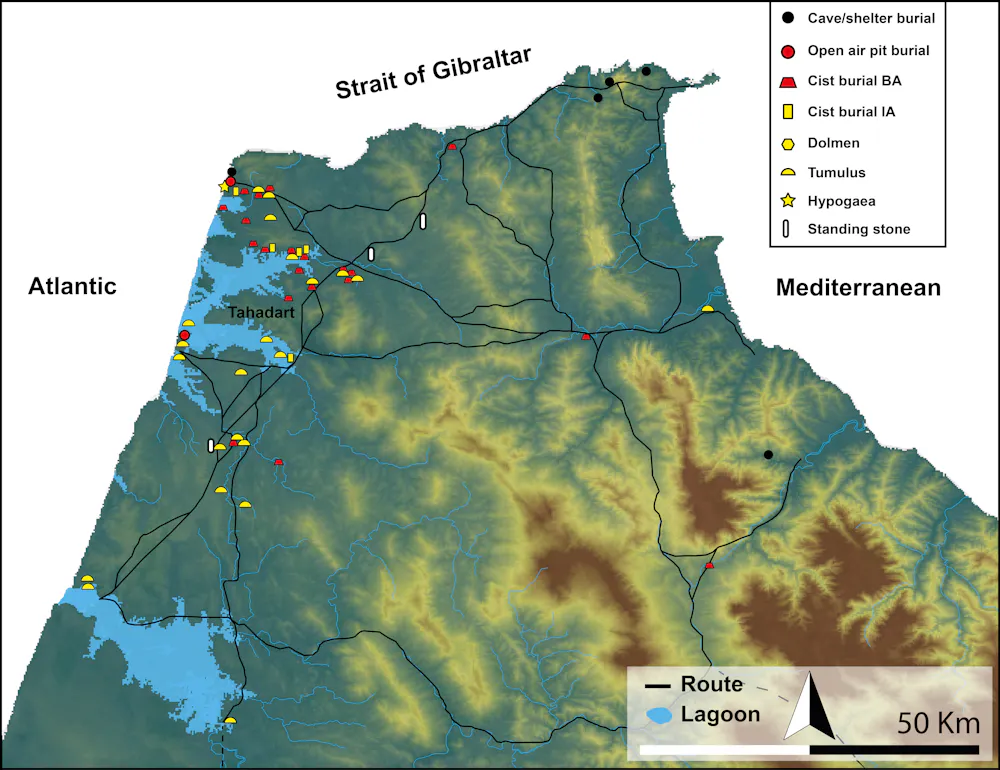
    Our study, published in African Archaeological Review, presents the discovery of dozens of new archaeological sites, including prehistoric burials, rock art sites and standing stones.

    Distribution of rock art. H Benattia.

    Distribution of burials, standing stones and communication routes. H Benattia.

    Until now, research on rock art and burials in north Africa focused on areas like the Nile Valley, the Sahara or the Atlas Mountains. Our discoveries reveal that Morocco’s north-western coast was a major cultural hub in the Bronze Age, over 4,000 years ago.

    The diversity of burial practices, ritual sites, symbolic rock art and unique megalithic monuments reflect a rich prehistoric heritage that transcends modern geographic, political and cultural boundaries. It also highlights the longstanding exchanges and contacts of this region with the Mediterranean, the Atlantic and the Sahara.

    One of the most remarkable sites we excavated is at Daroua Zaydan, near modern-day Tangier. There we uncovered a cist burial, a small stone chamber made from four upright stone slabs covered by a larger stone slab. A crescent-shaped arrangement of stones likely marked the access to the burial chamber.

    Excavation process of the Daroua Zaydan cist burial.

    Although the grave had been looted in the past, we recovered several human bones outside the cist. One of them was radiocarbon dated to 2118–1890 BC. This date aligns with similar burial traditions across the Strait of Gibraltar in Iberia, and with Early Bronze Age settlement activity at Kach Kouch, about 65km south-east of Daroua Zaydan.

    Cist cemeteries had been documented in the region before, but most were excavated during the early to mid-20th century. At the time, archaeologists didn’t have the methods that can now shed light on important details such as how they were built and when they were used. Daroua Zaydan marks the first radiocarbon-dated cist burial in north-west Africa.

    Monuments, ritual deposits and Atlantic connections

    Our findings suggest the existence of a complex prehistoric ritual landscape at the Tangier Peninsula. This landscape was likely connected to other areas of the Atlantic and Mediterranean through a shared ritual and symbolic “language”.

    Ballintober type sword recovered from the bed of the river Loukkos and currently held at the Staatliche Museen zu Berlin. Claudia Plamp.

    One clue is a Bronze Age sword found in the 1920s in the Loukkos river. It was likely made in Britain or Ireland and may have arrived in Africa through Atlantic exchange networks. The sword was likely deliberately thrown to the river — a ritual practice documented along rivers in Atlantic Europe. This suggests that communities in northern Morocco were part of a broader cultural and symbolic world that connected the late prehistoric Atlantic.

    The stone circle at Mzoura. H Benattia.

    Another example is the stone circle at Mzoura, made up of 176 standing stones. This site, excavated in the 1930s, is unique in north Africa. But it closely resembles other stone circles in Atlantic Europe like Stonehenge. During our fieldwork we also discovered new standing stones and rock art, located along prehistoric communication routes. This suggests they may have been used as territorial markers or ritual sites.

    Dotted composition at Ghar el Manzla. Enhanced with DStretch.

    Before our research, a single painted rock shelter, that of Magara Sanar, was known in north-western Morocco. We have now documented 17 painted and 5 engraved rock shelters.

    The variety of symbols and scenes includes dotted patterns, geometric lines and human-shaped figures. They suggest strong links to Iberian, Atlantic and Saharan prehistoric art.

    Human-shaped figures and dotted composition at Ghar Dchar Alouch. Enhanced with DStretch.

    Why this matters

    Looted cist burial at Oued Ksiar.

    Our research does more than just fill a blank spot on the archaeological map. It opens up new avenues for archaeological exploration in the region. The Tangier Peninsula is home to a rich and largely undocumented late prehistoric heritage. It deserves more attention from researchers, policymakers and the wider public.

    Further protection measures are necessary as the region is undergoing rapid urban development. Tourism is growing and there’s been extensive looting. We hope our work will lead to more archaeological investigations, including new excavations and radiocarbon dating of key sites.

    – Rock art and tomb discoveries in Morocco reveal ancient connections to the wider world
    – https://theconversation.com/rock-art-and-tomb-discoveries-in-morocco-reveal-ancient-connections-to-the-wider-world-256931

    MIL OSI Africa

  • MIL-OSI Global: Rock art and tomb discoveries in Morocco reveal ancient connections to the wider world

    Source: The Conversation – Africa – By Hamza Benattia, Prehistory, Universitat de Barcelona

    When people think of ancient burials in North Africa, they often picture Egypt’s pyramids and monuments. But new discoveries show that north-western Africa also has a deep and fascinating prehistoric past.

    Morocco’s Tangier Peninsula is particularly interesting. The peninsula sits at Africa’s north-western edge, where the Mediterranean Sea meets the Atlantic Ocean. At just 14 kilometres from Europe across the Strait of Gibraltar, this area has long been a natural crossroads between continents and cultures.

    I’m an archaeologist and PhD student who specialises in north Africa’s later prehistoric periods, between 3800 BC and 500 BC. My research explores how ancient communities responded to environmental changes, and how they moved and connected with other communities across regions.

    The assumption to date has been that the Tangier Peninsula was uninhabited and isolated in late prehistoric times. As part of my PhD research I wanted to explore whether this was true, or whether the area had simply been overlooked by previous archaeological work.

    Through the Kach Kouch and Tahadart Archaeological Projects, we studied both the Atlantic and Mediterranean zones of the peninsula.

    Our goal was to revisit the region using modern archaeological methods and technologies, including radiocarbon dating. To understand how this region may have been connected to the wider world in prehistoric times, we used Geographic Information System software to model possible ancient communication routes and surveyed the landscape through satellite and drone imagery. At a later stage, alongside a team of early career Moroccan archaeologists from the National Institute of Archaeology and Heritage, we carried out field surveys and excavations.

    What we discovered exceeded all expectations. Far from being empty and isolated, the Tangier Peninsula is filled with evidence that people lived, died and held ceremonies there over thousands of years.

    Our hope is that our findings will reframe north-western Africa as a cultural crossroads that has connected regions for thousands of years. This region could reshape our understanding of later prehistory across the Atlantic and Mediterranean worlds.

    A prehistoric ritual and funerary landscape

    Our study, published in African Archaeological Review, presents the discovery of dozens of new archaeological sites, including prehistoric burials, rock art sites and standing stones.

    Until now, research on rock art and burials in north Africa focused on areas like the Nile Valley, the Sahara or the Atlas Mountains. Our discoveries reveal that Morocco’s north-western coast was a major cultural hub in the Bronze Age, over 4,000 years ago.

    The diversity of burial practices, ritual sites, symbolic rock art and unique megalithic monuments reflect a rich prehistoric heritage that transcends modern geographic, political and cultural boundaries. It also highlights the longstanding exchanges and contacts of this region with the Mediterranean, the Atlantic and the Sahara.

    One of the most remarkable sites we excavated is at Daroua Zaydan, near modern-day Tangier. There we uncovered a cist burial, a small stone chamber made from four upright stone slabs covered by a larger stone slab. A crescent-shaped arrangement of stones likely marked the access to the burial chamber.

    Although the grave had been looted in the past, we recovered several human bones outside the cist. One of them was radiocarbon dated to 2118–1890 BC. This date aligns with similar burial traditions across the Strait of Gibraltar in Iberia, and with Early Bronze Age settlement activity at Kach Kouch, about 65km south-east of Daroua Zaydan.

    Cist cemeteries had been documented in the region before, but most were excavated during the early to mid-20th century. At the time, archaeologists didn’t have the methods that can now shed light on important details such as how they were built and when they were used. Daroua Zaydan marks the first radiocarbon-dated cist burial in north-west Africa.

    Monuments, ritual deposits and Atlantic connections

    Our findings suggest the existence of a complex prehistoric ritual landscape at the Tangier Peninsula. This landscape was likely connected to other areas of the Atlantic and Mediterranean through a shared ritual and symbolic “language”.

    One clue is a Bronze Age sword found in the 1920s in the Loukkos river. It was likely made in Britain or Ireland and may have arrived in Africa through Atlantic exchange networks. The sword was likely deliberately thrown to the river — a ritual practice documented along rivers in Atlantic Europe. This suggests that communities in northern Morocco were part of a broader cultural and symbolic world that connected the late prehistoric Atlantic.

    Another example is the stone circle at Mzoura, made up of 176 standing stones. This site, excavated in the 1930s, is unique in north Africa. But it closely resembles other stone circles in Atlantic Europe like Stonehenge. During our fieldwork we also discovered new standing stones and rock art, located along prehistoric communication routes. This suggests they may have been used as territorial markers or ritual sites.

    Before our research, a single painted rock shelter, that of Magara Sanar, was known in north-western Morocco. We have now documented 17 painted and 5 engraved rock shelters.

    The variety of symbols and scenes includes dotted patterns, geometric lines and human-shaped figures. They suggest strong links to Iberian, Atlantic and Saharan prehistoric art.

    Why this matters

    Our research does more than just fill a blank spot on the archaeological map. It opens up new avenues for archaeological exploration in the region. The Tangier Peninsula is home to a rich and largely undocumented late prehistoric heritage. It deserves more attention from researchers, policymakers and the wider public.

    Further protection measures are necessary as the region is undergoing rapid urban development. Tourism is growing and there’s been extensive looting. We hope our work will lead to more archaeological investigations, including new excavations and radiocarbon dating of key sites.

    Hamza Benattia, director of the Tahadart Archaeological Project, received funding from the National Institute of Archaeology and Heritage of Morocco (INSAP), the Prehistoric Society Research Fund, the Stevan B. Dana Grant of the American Society of Overseas Research, the Mediterranean Archaeological Trust Grant, the Barakat Trust Early Career Award, the Centre Jacques Berque Research Grant, the Institute of Ceutan Studies Research Fund and the University of Castilla La Mancha.

    ref. Rock art and tomb discoveries in Morocco reveal ancient connections to the wider world – https://theconversation.com/rock-art-and-tomb-discoveries-in-morocco-reveal-ancient-connections-to-the-wider-world-256931

    MIL OSI – Global Reports

  • MIL-OSI Europe: Christine Lagarde: Earning influence: lessons from the history of international currencies

    Source: European Central Bank

    Speech by Christine Lagarde, President of the ECB, at an event on Europe’s role in a fragmented world organised by Jacques Delors Centre at Hertie School in Berlin, Germany

    Berlin, 26 May 2025

    Over the past 80 years, the global economy thrived on a foundation of openness and multilateralism – underpinned by US leadership. By championing a rules-based international system and anchoring the dollar as the world’s reserve currency, the United States set the stage for trade to flourish and finance to expand.

    This global order proved immensely beneficial to the European Union, whose founding liberal principles aligned seamlessly with it. But today it is fracturing.

    Multilateral cooperation is being replaced by zero-sum thinking and bilateral power plays. Openness is giving way to protectionism. There is even uncertainty about the cornerstone of the system: the dominant role of the US dollar.

    All else equal, this fracturing can pose risks for Europe. Our economy is deeply integrated into the global trading system, with exports accounting for close to one-fifth of our value added and supporting 30 million jobs.

    Any change in the international order that leads to lower world trade or fragmentation into economic blocs will be detrimental to our economy.

    But – with the right policy responses – there could also be opportunities. The changing landscape could open the door for the euro to play a greater international role.

    Today, the euro is the second global currency, accounting for around 20% of foreign exchange reserves, compared with 58% in the case of the US dollar. Increasing the international role of the euro can have positive implications for the euro area.

    It would allow EU governments and businesses to borrow at a lower cost, helping boost our internal demand at a time when external demand is becoming less certain.

    It would insulate us from exchange rate fluctuations, as more trade would be denominated in euro, protecting Europe from more volatile capital flows.

    It would protect Europe from sanctions or other coercive measures.

    In short, it would allow Europe to better control its own destiny – giving us some of what Valéry Giscard d’Estaing called the “exorbitant privilege” 60 years ago.

    So, how likely is this change to happen? History suggests that it is far from guaranteed. The euro will not gain influence by default – it will have to earn it.

    For the euro to increase its global status, history tells us that we need to build on three foundations – each of them critical for success.

    First, Europe must ensure it has a solid and credible geopolitical foundation by maintaining a steadfast commitment to open trade and underpinning it with security capabilities.

    Second, we must reinforce our economic foundation to make Europe a top destination for global capital, enabled by deeper and more liquid capital markets.

    Third, we must bolster our legal foundation by defending the rule of law – and by uniting politically so that we can resist external pressures.

    Before we explore each of these three foundational components, let us observe what recent history can teach us.

    Shifts in the global currency landscape

    Shifts in the global currency landscape are not unprecedented in monetary history. There have been previous episodes where the world’s leading reserve currency issuer has taken steps that have called that leadership into question, without ultimately jeopardising it.

    For example, the US dollar took over from the pound sterling as the world’s leading reserve currency in the mid-1920s, with its share in foreign exchange reserves rising to 64% by 1931. But this leading position did not stop the United States taking measures to unilaterally change the international monetary order.

    For instance, in 1933 President Roosevelt suspended gold convertibility to fight the deflationary forces of the Great Depression. He dismissed European demands for fixed exchange rates with the argument that “the sound internal economic system of a nation is a greater factor in its well-being than the price of its currency”.[1]

    Then again in the 1970s President Nixon ended the Bretton Woods system by unilaterally suspending dollar convertibility to gold and imposing a 10% import tariff.

    Faced with growing imbalances between US current account deficits and the surpluses of western Europe and Japan, Treasury Secretary John Connally declared that “no longer can considerations of friendship, or need, or capacity justify the United States carrying so heavy a share of the common burdens.”[2]

    On both occasions, there was a decline in the standing of the US dollar as a foreign reserve currency. In the 1930s, it fell from over 60% to around 20% of global foreign exchange reserves. In the 1970s, it fell from about 70% to 50% two decades later.

    But on neither occasion was there a robust alternative currency that could take over at short notice. In the 1930s, the pound sterling was already declining, while in the 1970s the Deutsche Mark and the Yen were backed by markets that were too small.

    So, instead, investors flocked to gold. The share of gold in foreign reserves increased by about 20 percentage points in the 1930s to 97% and almost doubled to 60% in the 1970s.[3]

    Today, there is a key difference compared with previous eras. With the euro as the world’s second-largest currency, there is another international currency alongside the dollar. But this has not yet convinced investors.

    Over recent years, the dollar’s share in global foreign exchange reserves has fallen, with its current level of 58% being the lowest since 1994. In parallel, central banks have been accumulating gold at a record pace – almost matching the levels seen during the Bretton Woods era.[4] The share of gold in global foreign reserves[5] has reached around 20%, surpassing that of the euro.[6]

    As previously mentioned, we can identify three essential foundations for international currency usage, without which a currency cannot succeed on the global stage. And in each case, we can see that Europe has many of the key ingredients for success, but we need to bring them together to reinforce the foundations. Action is in order.

    The geopolitical foundation

    The starting point is a credible geopolitical foundation – which rests on both a country’s role in global trade and the strength of its military alliances.

    A currency’s exposure to trade is especially important, as it provides the initial pathway to wider international use. In the mid-1920s, for example, the dollar overtook the pound sterling as the leading form of trade credit before it became the leading reserve currency.[7]

    Once a currency captures a larger share of trade invoicing, its role in international banking and finance, and ultimately as a reserve asset, becomes self-reinforcing. Higher demand for the currency enhances its role as a store of value and further encourages investors to hold it.[8]

    As a major actor in global trade, Europe already has a key ingredient of a strong geopolitical foundation, creating the potential for a virtuous circle of euro internationalisation to unfold.

    The EU has the largest network of trade agreements in the world. Europe is the number one trading partner for 72 countries, which together represent almost 40% of world GDP.[9] And this status is reflected in the share of the euro as an invoicing currency, which stands at around 40%, more than double its share as a reserve currency.

    Europe can press home this advantage by continuing to forge new trade agreements. And we should make clear that we support a win-win approach to trade, ensuring that we are the most attractive partner to make deals with.

    The ECB can also help make the euro more attractive for euro-denominated trade. We are working on a potential digital euro and pursuing initiatives to enhance cross-border payments in euro, which could potentially facilitate international cross-border transactions in the future.

    And by extending swap and repo lines to key partners, we safeguard against euro liquidity shortages abroad disrupting the smooth transmission of our monetary policy – which in turn encourages those partners to transact more in euro.

    But there is a limit to how much a currency can grow simply by virtue of being open to trade. In fact, the euro’s share of global export invoicing is already as large as that of the US dollar, but we are not closing the gap in reserve currency status.

    This is because investors – and especially official investors – also seek geopolitical assurance in another form: they invest in the assets of regions that are reliable security partners and can honour alliances with hard power. So a credible geopolitical foundation must also rest on robust military partnerships.

    This dual strength is essentially what we can learn from the US dollar’s dominance. It is not just a product of economic fundamentals but it is also powerfully reinforced by US security guarantees. These guarantees not only deepen trade ties[10], but have been shown to boost a currency’s share in foreign reserves by up to 30 percentage points.[11]

    We are now seeing a major shift in Europe towards rebuilding our hard power, with important initiatives underway at the national and EU levels. And we should be clear that following through with this effort is a precondition for the euro to become more widely used.

    The economic foundation

    Trade and military power are important for establishing demand for an international currency. But to satisfy this demand, investors need appropriate assets to invest in.

    This is why a strong economic foundation – one that provides opportunities for growth and opportunities to invest in growth – is equally essential.

    There is a virtuous circle between growth, capital markets and international currency usage. Growth generates robust rates of return, which make investors want to hold assets in a particular currency. And capital markets provide investment opportunities and channel funds back into growth.

    At the same time, if capital markets provide a sufficient supply of “safe assets”, investors can hedge their exposures efficiently. When a shock hits and riskier investments lose value, safer assets rise in value. That provides a complete ecosystem for investments in the currency.

    The US dollar’s rise to dominance in the interwar period was certainly driven by this virtuous circle. The development of US capital markets boosted growth – with each 1 percentage point increase in market capitalisation yielding 0.5 percentage points more growth[12] – while simultaneously establishing the foundation for dollar dominance. The depth and liquidity of the US Treasury market in turn provided an efficient hedge for investors.

    Europe has all the elements it needs to produce a similar cycle. But so far, we have not been able to put all the pieces together.

    Despite our large single market, we have fallen behind the US in terms of growth performance and market returns. Since 2000, US labour productivity per hour has grown twice as much as in the euro area, mainly driven by the tech sector, and US markets have delivered returns that are around five times as high as those of European markets.[13]

    Despite our large savings, we have made little progress in integrating our capital markets to channel more of our funds into growth. 60% of household equity investment goes into home country markets even though there may be greater opportunities abroad.

    And despite our strong aggregate fiscal position – our debt-to-GDP ratio is 89%, compared with 124% in the United States – we provide relatively few safe assets. Recent estimates suggest that outstanding sovereign bonds rated at least AA are just below 50% of GDP in the EU and above 100% in the US.[14]

    The conclusion for Europe is clear: if we truly want to see the global status of the euro grow, we must first reform our domestic economy.

    That means moving forwards with the priorities identified in recent reports: completing the Single Market, enabling start-ups, reducing regulation and building the savings and investment union. And it means avoiding a piecemeal approach, where we make progress where it is easy and dither where it is hard, else we will never kick-start the positive cycle.

    Moreover, in this new geopolitical landscape, the case for acting in a European way has never been stronger.

    Each individual country of course needs to make sure that its national policies support growth. But we also need to be mindful of self-defeating fragmentation. For example, we all agree that Europe needs to build up its strategic industries to avoid excessive dependencies – as Mario Draghi and Enrico Letta emphasised in their recent reports. But we will not succeed if we have 27 different policies for these industries.

    Nowadays there are also more policy goals that qualify as European public goods, notably strengthening European defence. But due to the free-rider problem, defence is a good that is likely to be undersupplied. Moreover, joining forces to procure equipment and develop new technologies – leading to economies of scale and more interoperability – will result in greater operational effectiveness than if all 27 Member States go it alone.

    Economic logic tells us that public goods need to be jointly financed. And this joint financing could provide the basis for Europe to gradually increase its supply of safe assets.

    The legal foundation

    Geopolitical strength and faster growth can go a long way towards strengthening the euro’s international role. But maintaining demand for the currency will also depend on our ability to uphold a robust legal and institutional foundation.

    Ultimately, currencies achieve and maintain their reserve status if the institutions and policies backing them consistently safeguard investor confidence in their long-term value.[15]

    For example, historically, the US dollar’s pre-eminence has rested on the strength and stability of US fiscal and monetary institutions. The Federal Reserve System’s credible commitment to controlling inflation, combined with the unparalleled liquidity of the US Treasury market, created a perception of minimal sovereign risk. This made the dollar a safe haven during global economic turbulence and recessions.[16]

    Since 1970, there have been 34 instances of simultaneous sovereign debt and financial crises globally, but the US has remained immune to such “twin crises”.[17]

    However, when doubts emerge about the stability of the legal and institutional framework, the impact on currency use is undeniable.

    These doubts have materialised in the form of highly unusual cross-asset correlations since 2 April this year, with the US dollar and US Treasuries experiencing sell-offs even as equities fell. The same doubts are also cited by investors who are turning to gold: two-fifths say they are doing so as a hedge against rising geopolitical risk.[18]

    Given this context, the EU has a legitimate reason to turn its commitment to predictable policymaking and the rule of law into a comparative advantage.

    This commitment is baked into how the EU works. The positive side of our often slow and complicated decision-making processes is that checks and balances are always respected. We have also enshrined into law the independence of our key institutions, like the ECB, in ways that are hard for politicians to threaten.

    But relying on the fact that our bureaucratic systems are hard to change is not enough. In the current geopolitical environment, we are facing increasing external pressures to take actions that jeopardise the rule of law. And we will only be able to resist these pressures if we are more politically united and able to speak with a single voice.

    As we potentially enter a renewed era of great power rivalry, with countries being asked to take sides, we are likely to find ourselves under pressure to make decisions that are not necessarily in our own interest.

    But if we take this opportunity to unite and, preferably, to reform our institutional structure by enabling more qualified majority voting in areas where a single veto has often held back the collective interests of the 26 other countries, that would enable us to act decisively as a united Europe. We would then be in a much stronger position to defend and uphold our values and, as a result, to defend and uphold global confidence in our currency.

    Conclusion

    Let me conclude.

    In the history of the international monetary system, there are moments when the foundations that once seemed unshakeable begin to shift.

    The Belgian-American economist Robert Triffin described this with great clarity. He observed that nations’ confidence in the international monetary system depends on the reliability of the reserve currency, which, in his words, is “highly dependent on individual countries’ decisions”.

    But moments of change can also be moments of opportunity. The ongoing changes create the opening for a “global euro moment”.

    This is a prime opportunity for Europe to take greater control of its own destiny. But this is not a privilege that will simply be given to us. We have to earn it.

    MIL OSI Europe News

  • MIL-OSI Europe: Telephone conversation with the Prime Minister of Japan

    Source: Government of Italy (English)

    26 Maggio 2025

    The President of the Council of Ministers, Giorgia Meloni, had a telephone conversation today with the Prime Minister of Japan, Shigeru Ishiba.

    The conversation highlighted the shared satisfaction with the path undertaken to constantly strengthen bilateral relations. In this context, President Meloni confirmed her intention to pay an official visit to Japan in the coming months in order to further deepen the fruitful dialogue between Rome and Tokyo and, while there, to also visit the Italian pavilion at the Osaka Expo.

    The two leaders also discussed the main international issues, including the war in Ukraine, the Middle East  and the Indo-Pacific, agreeing to remain in close contact ahead of the upcoming G7 Summit in Kananaskis.

    MIL OSI Europe News

  • MIL-OSI Asia-Pac: Health chief attends HA convention

    Source: Hong Kong Information Services

    Secretary for Health Prof Lo Chung-mau today attended the opening ceremony of the Hospital Authority (HA) Convention 2025 and met multiple high-level delegations from the Mainland and overseas for in-depth exchanges on healthcare co-operation and development.

    At the opening ceremony, Prof Lo witnessed the successful national accreditation of the Queen Mary Hospital Chest Pain Centre, making it the first chest pain centre in Hong Kong established in accordance with the national accreditation standards.

    He said the establishment of a chest pain centre can improve the efficiency of acute chest pain diagnosis and speed up the time for patients to receive cardiac surgery, thereby lowering the death rate, shortening the hospitalisation period and reducing the hospital readmission rate.

    The health chief also noted that the adoption of the national accreditation standards by the Hong Kong Special Administrative Region will also facilitate integration into the overall national development by fully utilising Hong Kong’s advantage of having the motherland’s  strong support and close connection with the world, with a view to demonstrating the excellence of the national healthcare standards to the international community, and helping promote the development of the national accreditation standards of chest pain centres into an internationally recognised standard.

    Over the course of the convention, Prof Lo met multiple delegations from the Mainland and overseas and attended various events, taking the opportunity to promote medical co-operation and exchanges.

    Among others, Prof Lo met Guangdong Health Commission Director-General Liu Liqun and his delegation to explore the exchange of healthcare talent between the two places, and to discuss healthcare collaboration projects, such as the Elderly Health Care Voucher Greater Bay Area Pilot Scheme and the cross-boundary use of electronic health records.

    After the meeting, both sides attended the welcoming ceremony for the Mainland Healthcare Talents Visiting Programmes.

    Prof Lo was pleased to note that since the 2022 launch of the visiting programmes, 80 outstanding doctors and two batches of about 170 nurses in total from the Mainland have come to the HA on exchange, while more than 25 specialists have also been arranged by the authority to conduct exchanges at public hospitals in Beijing, Shanghai and Guangdong.

    Afterwards, Prof Lo and the Consul General of France in Hong Kong & Macau Christile Drulhe jointly witnessed the signing of the Declaration of Intent between the HA and the National Conference of University Hospital General Managers of France.

    The signing of the declaration formally establishes a strategic collaborative partnership between the two organisations in deepening mutual exchanges, promoting the joint development of hospital services and exchange of medical expertise.

    MIL OSI Asia Pacific News

  • MIL-OSI Security: Police appeal for urgent help to find missing vulnerable man

    Source: United Kingdom London Metropolitan Police

    Officers are appealing for assistance to help find a vulnerable 35-year-old man who has been missing for two days.

    Bashir Marhoon, from Russell Square, Camden, was last seen by his carers at his home, on Saturday, 24 May at 18:00hrs.

    Police are becoming increasingly worried about his safety due to the challenges Bashir has with day-to-day tasks.

    Bashir is 5’8, of medium build, with black hair and wears glasses. He was last seen wearing a navy baseball style shirt, with a red image on the front, dark navy jogging bottoms and black trainers.

    He walks with a limp and is known to sometimes engage with strangers, though lacks the capacity to understand fully what he may be doing.

    Officers believe he may be travelling across London using public transport. He has an Oyster card and is fascinated with public transport.

    Detective Chief Inspector Sarb Kaur from the Met’s Central North Command said: “We are very worried about Bashir’s safety and would urge anyone who may have seen him to contact police. Please approach Bashir with care as he may be confused and suffers with learning difficulties.

    “Bashir’s family are understandably incredibly concerned.

    “Local officers have been carrying out a number of enquiries in an effort to trace him and we are now turning to the public for help. Please get in touch if you have seen Bashir.

    “As time passes we are growing increasingly anxious about his welfare.”

    Bashir’s mum, Faridah, said: “We are very worried as he is very vulnerable and often rides the trains and buses to the end of the journey.

    “We urgently need the public’s help to find him. Please take a look at these images we are making public today and get in touch with the police if you have any information.”

    If you see Bashir, please call 999 providing the reference 5841/24MAY.

    If you believe you have seen him in the past two days, or have any other information about his whereabouts, please call 101 providing the same reference.

    MIL Security OSI