Category: European Union

  • MIL-OSI United Kingdom: Termination of Pregnancy Law Consultation17 March 2025 The Government is inviting Islanders to give their feedback on proposed changes to the Termination of Pregnancy Law. The Minister for Health and Social Services has made a commitment to lodge the proposed… Read more

    Source: Channel Islands – Jersey

    17 March 2025

    The Government is inviting Islanders to give their feedback on proposed changes to the Termination of Pregnancy Law. The Minister for Health and Social Services has made a commitment to lodge the proposed law changes before the end of 2025. 

    Feedback from the termination of pregnancy consultation in 2023, has helped to shape the proposals set out in this consultation. Islanders are encouraged to complete the online survey at gov.je/consultations​. The consultation will be open until Monday 14 April.

    Assistant Minister for Health and Social Services, Deputy Andy Howell, said: “We want to make sure our legislation reflects societal values, meets the needs of women, and adapts to changes in medical practice. We are committed to considering all feedback and aim to have a clear and fit-for-purpose legal framework that takes account of changes in medical practice.”​

    MIL OSI United Kingdom

  • MIL-OSI Global: From pulpits to protest, the surprising history of the phrase ‘pride and prejudice’

    Source: The Conversation – USA – By Margie Burns, Lecturer of English, University of Maryland, Baltimore County

    Despite the phrase’s rich history, the fame of Jane Austen’s novel ended up drowning out all other associations. Suzy Hazelwood/Pexels

    Most readers hear “pride and prejudice” and immediately think of Jane Austen’s most famous novel, that salty-sweet confection of romance and irony with a fairy-tale ending.

    Few people, however, know the history of the phrase “pride and prejudice,” which I explore in my new book, “Jane Austen, Abolitionist: The Loaded History of the Phrase ‘Pride and Prejudice.’”

    Like most Austen fans and scholars, I had read and loved her novels for years without learning much about the history of the title, which Austen chose after scrapping the original one, “First Impressions.”

    By the 20th century, “pride and prejudice” became solely associated with Austen’s 1813 novel.

    The phrase, which has religious origins, appeared in hundreds of works before Austen was born. From Britain it traveled to America, and from religious tomes it expanded to secular works. It even became a hallmark of abolitionist writing.

    Fighting words for religious factions

    While 2025 marks Austen’s 250th birthday, the phrase “pride and prejudice” first appeared more than 400 years ago, in religious writings by English Protestants. As the daughter, sister, cousin and granddaughter of Church of England ministers, Austen was certainly aware of the tradition.

    If ministers wanted to reproach their parishioners or their opponents, they attributed criticism of their sermons to “pride and prejudice” – as coming from people too arrogant and narrow-minded to entertain their words in good faith.

    While the usage began in the Church of England, other denominations, even radical ones, soon adopted it: “Pride and prejudice” appears in the writings of Nonconformists, Anabaptists, Quakers, Dissenters and other representatives of “Schism, Faction and Sedition,” as one anonymous writer called them.

    One early takeaway is that, amid fervent religious conflicts, various denominations similarly used “pride and prejudice” as a criticism.

    The unnamed minister himself complained that, owing to “the Pride and Prejudice of mens Spirits, the prevailing Interests of some Factions and Parties, the greatest part of the Nation are miserably wanting in their Duty.”

    At the same time, the phrase could be invoked to support religious toleration and in pleas for inclusiveness.

    “When all Pride and Prejudice, all Interests and Designs, being submitted to the Honour of God, and the Discharge of our Duty,” an anonymous clergyman wrote in 1734, “the Holy Scriptures shall again triumph over the vain Traditions of Men; and Religion no longer take its Denomination from little Sects and Factions.”

    From politics to prose

    In the 18th century, advances in publishing led to an explosion of secular writing. For the first time, regular people could buy books about history, politics and philosophy. These popular texts spread the phrase “pride and prejudice” to even more distant shores.

    One fan was American founding father Thomas Paine.

    In his 47-page pamphlet “Common Sense,” Paine argued that kings could not be trusted to protect democracy: “laying aside all national pride and prejudice in favour of modes and forms, the plain truth is, that it is wholly owing to the constitution of the people, and not to the constitution of the government[,] that the crown is not as repressive in England as in Turkey.”

    Others included Daniel Defoe, author of “Robinson Crusoe.” In his 1708 essay “Review of the State of the British Nation,” Defoe satirically exhorted the public to vote Tory rather than electing men of sense, to “dispell the Poisons” that “Sloth, Envy, Pride and Prejudice may have contracted, and bring the Blood of the Party into a true circulation.”

    After the philosophers, the historians and the political commentators came the novelists. And among the novelists, female writers were especially important. My annotated list in “Jane Austen, Abolitionist” includes more than a dozen female writers using the phrase between 1758 and 1812, the year Austen finished revising “Pride and Prejudice.”

    Among them was Frances Burney. Scholars have often attributed Austen’s famous title to Burney, who used the phrase “pride and prejudice” in her novel “Cecilia.”

    But Burney was not alone. Female novelists who used the expression before Austen included Charlotte Lennox, sisters Harriet and Sophia Lee, Charlotte Turner Smith, Mrs. Colpoys, Anne Seymour Damer and mother and daughter Susannah and Elizabeth Gunning, who jointly authored their novel “The Heir Apparent.”

    An abolitionist rallying cry

    As the critique embodied in the phrase progressed beyond religious and partisan conflict, it became increasingly used in the context of ethics and social reform.

    My most striking discovery in this research is the long-standing association of the phrase “pride and prejudice” with abolitionism, the movement to eradicate enslavement and the slave trade.

    The leaders of transnational antislavery organizations used it at their conventions and in the books and periodicals they published. In 1843, 30 years after the publication of Austen’s “Pride and Prejudice,” British Quaker Thomas Clarkson wrote to the General Antislavery Convention, which was meeting in London.

    He exhorted the faithful to repudiate slavery “at once and forever” if there were any among them “whose eyes may be so far blinded, or their consciences so far seared by interest or ignorance, pride or prejudice, as still to sanction or uphold this unjust and sinful system.”

    He even used the phrase twice. Acknowledging that some violent abolitionists had aroused reaction, he warned his audience that “this state of feeling arises as much from pride and prejudice on the one hand, as from indiscretion or impropriety on the other.”

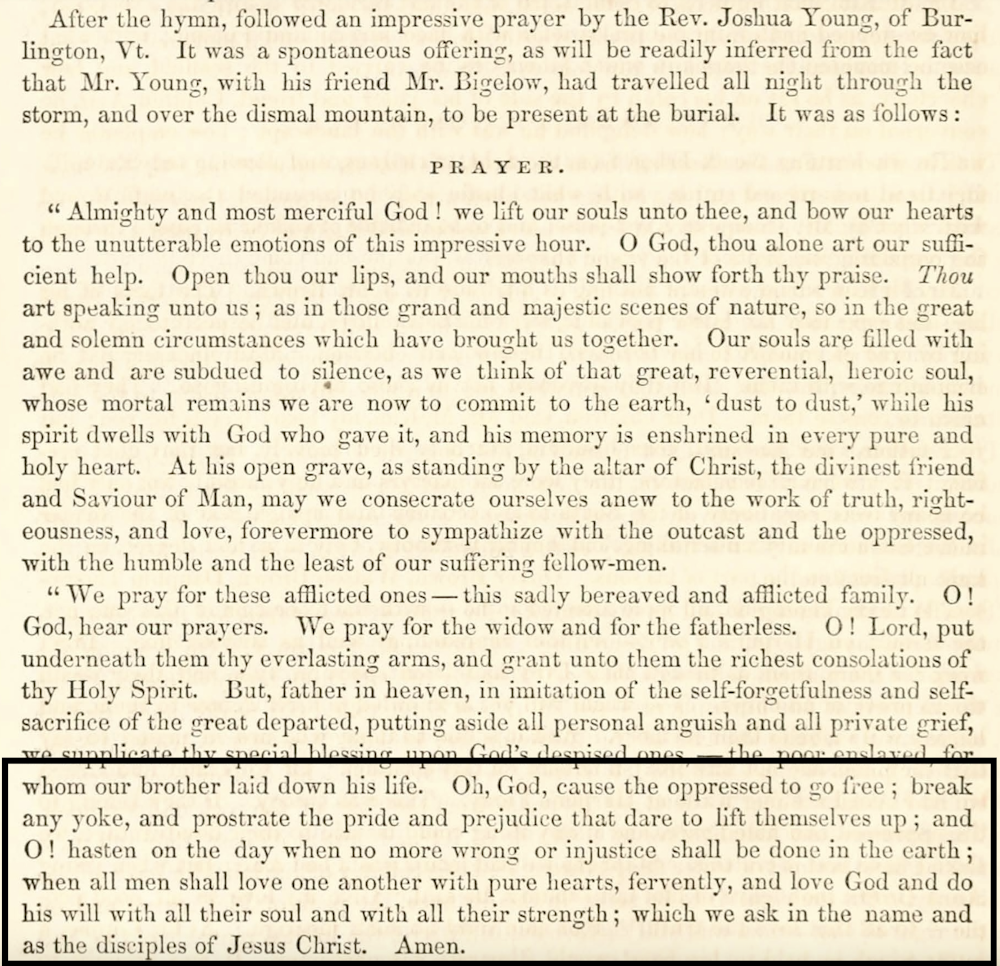
    At the funeral for abolitionist John Brown, the minister prayed over his body, “Oh, God, cause the oppressed to go free; break any yoke, and prostrate the pride and prejudice that dare to lift themselves up.”

    The prayer uttered at John Brown’s burial.
    Library of Congress

    Use of the phrase did not end with Emancipation or the end of the U.S. Civil War.

    In fact, it was one of Frederick Douglass’ favorite phrases. On Oct. 22, 1883, in his “Address at Lincoln Hall,” Douglass excoriated the Supreme Court’s decision rendering the Civil Rights Act of 1875 unconstitutional.

    As was typical of Douglass, the speech ranged beyond racial inequities: “Color prejudice is not the only prejudice against which a Republic like ours should guard. The spirit of caste is malignant and dangerous everywhere. There is the prejudice of the rich against the poor, the pride and prejudice of the idle dandy against the hard-handed workingman.”

    Austen’s independent women

    Early on in “Pride and Prejudice,” the conceited Caroline Bingley snipes that Elizabeth Bennet shows “an abominable sort of conceited independence.” Later, the snobbish Lady Catherine accuses Bennet of being “headstrong.” But near the ending, Mr. Darcy tells Bennet that he loves her for “the liveliness” of her “mind.”

    In this respect, Bennet reflects a quality that all of Austen’s heroines possess. While they try to adhere to standards of courtesy and respect, none are guilty of saying only what the leading man wants to hear.

    Jane Austen.
    Stock Montage/Getty Images

    Given that Austen chose her title to honor the phrase and its history, it is ironic that her own fame ended up drowning out the abolitionist associations of “pride and prejudice” after the Civil War.

    If there is any work of fiction that successfully makes self-sufficiency, independent thinking and open-mindedness look good – and makes sycophants, rigidity and hysterical devotion to rank and status look bad – it is “Pride and Prejudice.”

    Yet the lasting popularity of Austen’s novel demonstrates that the ethics contained in the phrase continue to resonate today, even if its context has been lost.

    Margie Burns does not work for, consult, own shares in or receive funding from any company or organization that would benefit from this article, and has disclosed no relevant affiliations beyond their academic appointment.

    ref. From pulpits to protest, the surprising history of the phrase ‘pride and prejudice’ – https://theconversation.com/from-pulpits-to-protest-the-surprising-history-of-the-phrase-pride-and-prejudice-249836

    MIL OSI – Global Reports

  • MIL-OSI Global: The US military has cared about climate change since the dawn of the Cold War – for good reason

    Source: The Conversation – USA – By Paul Bierman, Fellow of the Gund Institute for Environment, Professor of Natural Resources and Environmental Science, University of Vermont

    Military engineers managing supply routes in Greenland in the 1950s paid attention to the weather and climate.
    US Army/Pictorial Parade/Archive Photos/Getty Images

    In 1957, Hollywood released “The Deadly Mantis,” a B-grade monster movie starring a praying mantis of nightmare proportions. Its premise: Melting Arctic ice has released a very hungry, million-year-old megabug, and scientists and the U.S. military will have to stop it.

    The rampaging insect menaces America’s Arctic military outposts, part of a critical line of national defense, before heading south and meeting its end in New York City.

    Yes, it’s over-the-top fiction, but the movie holds some truth about the U.S. military’s concerns then and now about the Arctic’s stability and its role in national security.

    A poster advertises ‘The Deadly Mantis,’ a movie released in 1957, a time when Americans worried about a Russian invasion. The film used military footage to promote the nation’s radar defenses along the Distant Early Warning line in the Arctic.
    LMPC via Getty Images

    In the late 1940s, Arctic temperatures were warming and the Cold War was heating up. The U.S. military had grown increasingly nervous about a Soviet invasion across the Arctic. It built bases and a line of radar stations. The movie used actual military footage of these polar outposts.

    But officials wondered: What if sodden snow and vanishing ice stalled American men and machines and weakened these northern defenses?

    In response to those concerns, the military created the Snow, Ice and Permafrost Research Establishment, a research center dedicated to the science and engineering of all things frozen: glacier runways, the behavior of ice, the physics of snow and the climates of the past.

    It was the beginning of the military’s understanding that climate change couldn’t be ignored.

    Army engineers test the properties of snow on Greenland’s ice sheet in 1955, a critical determinant of mobility on the ice and one that changes rapidly with temperature and climate.
    U.S. Army

    As I was writing “When the Ice is Gone,” my recent book about Greenland, climate science and the U.S. military, I read government documents from the 1950s and 1960s showing how the Pentagon poured support into climate and cold-region research to boost the national defense.

    Initially, military planners recognized threats to their own ability to protect the nation. Over time, the U.S. military would come to see climate change as both a threat in itself and a threat multiplier for national security.

    Ice roads, ice cores and bases inside the ice sheet

    The military’s snow and ice engineering in the 1950s made it possible for convoys of tracked vehicles to routinely cross Greenland’s ice sheet, while planes landed and took off from ice and snow runways.

    In 1953, the Army even built a pair of secret surveillance sites inside the ice sheet, both equipped with Air Force radar units looking 24/7 for Soviet missiles and aircraft, but also with weather stations to understand the Arctic climate system.

    The public reveal of U.S. military bases somewhere – that remained classified – inside Greenland’s ice sheet, in the February 1955 edition of REAL.
    Paul Bierman collection.

    The Army drilled the world’s first deep ice core from a base it built within the Greenland ice sheet, Camp Century. Its goal: to understand how climate had changed in the past so they would know how it might change in the future.

    The military wasn’t shy about its climate change research successes. The Army’s chief ice scientist, Dr. Henri Bader, spoke on the Voice of America. He promoted ice coring as a way to investigate climates of the past, provide a new understanding of weather, and understand past climatic patterns to gauge and predict the one we are living in today – all strategically important.

    Henri Bader describes drilling high on Greenland’s ice sheet in 1956 or 1957 in a Voice of America recording (National Archives), “The Snows of Yesteryear,” and a movie (U.S. Army). Created by Quincy Massey-Bierman.

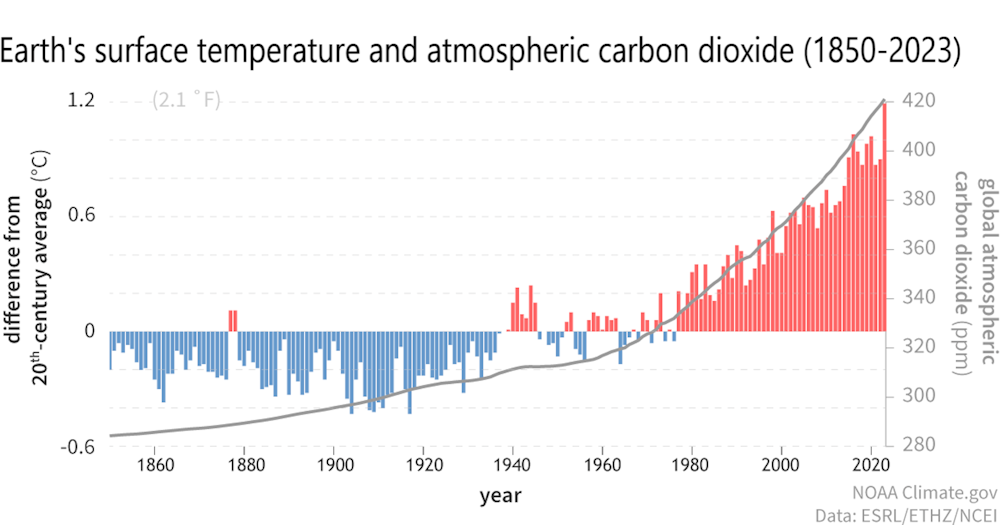
    In the 1970s, painstaking laboratory work on the Camp Century ice core extracted minuscule amounts of ancient air trapped in tiny bubbles in the ice. Analyses of that gas revealed that levels of carbon dioxide in the atmosphere were lower for tens of thousands of years before the industrial revolution. After 1850, carbon dioxide levels crept up slowly at first and then rapidly accelerated. It was direct evidence that people’s actions, including burning coal and oil, were changing the composition of the atmosphere.

    Since 1850, carbon dioxide levels in the atmosphere have spiked and global temperatures have warmed by more than 2.5 degrees Fahrenheit (1.3 Celsius). The past 10 years have been the hottest since recordkeeping began, with 2024 now holding the record. Climate change is now affecting the entire Earth – but most especially the Arctic, which is warming several times faster than the rest of the planet.

    Since 1850, global average temperature and carbon dioxide concentrations in the atmosphere have risen together, reflecting human emissions of greenhouse gases. Red bars indicate warmer years; blue bars indicate colder years.
    NOAA

    Seeing climate change as a threat multiplier

    For decades, military leaders have been discussing climate change as a threat and a threat multiplier that could worsen instability and mass migration in already fragile regions of the world.

    Climate change can fuel storms, wildfires and rising seas that threaten important military bases. It puts personnel at risk in rising heat and melts sea ice, creating new national security concerns in the Arctic. Climate change can also contribute to instability and conflict when water and food shortages trigger increasing competition for resources, internal and cross-border tensions, or mass migrations.

    The military understands that these threats can’t be ignored. As Secretary of the Navy Carlos Del Toro told a conference in September 2024: “Climate resilience is force resilience.”

    A view of aircraft carriers docked at the sprawling Naval Station Norfolk show how much of the region is within a few feet of sea level.
    Stocktrek Images via Getty Images

    Consider Naval Station Norfolk. It’s the largest military port facility in the world and sits just above sea level on Virginia’s Atlantic coast. Sea level there rose more than 1.5 feet in the last century, and it’s on track to rise that much again by 2050 as glaciers around the world melt and warming ocean water expands.

    High tides already cause delays in repair work, and major storms and their storm surges have damaged expensive equipment. The Navy has built sea walls and worked to restore coastal dunes and marshlands to protect its Virginia properties, but the risks continue to increase.

    Planning for the future, the Navy incorporates scientists’ projections of sea level rise and increasing hurricane strength to design more resilient facilities. By adapting to climate change, the U.S. Navy will avoid the fate of another famous marine power: the Norse, forced to abandon their flooded Greenland settlements when sea level there rose about 600 years ago.

    Norse ruins in Igaliku in southern Greenland, illustrated in the late 1800s while flooded at spring tide by sea level, which had risen since the settlement was abandoned around 1400.
    Steenstrup, K.J.V., and A. Kornerup. 1881. Expeditionen til Julianehaabs distrikt i 1876. MeddelelseromGrønland

    Climate change is costly to ignore

    As the impacts of climate change grow in both frequency and magnitude, the costs of inaction are increasing. Most economists agree that it’s cheaper to act now than deal with the consequences. Yet, in the past 20 years, the political discourse around addressing the cause and effects of climate change has become increasingly politicized and partisan, stymieing effective action.

    In my view, the military’s approach to problem-solving and threat reduction provides a model for civil society to address climate change in two ways: reducing carbon emissions and adapting to inevitable climate change impacts.

    The U.S. military emits more planet warming carbon than Sweden and spent more than US$2 billion on energy in 2021. It accounts for more than 70% of energy used by the federal government.

    In that context, its embrace of alternative energy, including solar generation, microgrids and wind power, makes economic and environmental sense. The U.S. military is moving away from fossil fuels, not because of any political agenda, but because of the cost-savings, increased reliability and energy independence the alternatives provide.

    Solar panels generate power on many U.S. military bases. This array at Joint Forces Training Base in Los Alamitos, Calif., generates enough power for more than 15,000 homes and has a backup battery system to provide power when the sun isn’t shining.
    Frederic J . Brown/AFP via Getty Images

    As sea ice melts and Arctic temperatures rise, the polar region has again become a strategic priority. Russia and China are expanding Arctic shipping routes and eyeing critical mineral deposits as they become accessible. The military knows climate change affects national security, which is why it continues to take steps to address the threats a changing climate presents.

    Paul Bierman receives funding from the US National Science Foundation, this work in part supported by grant EAR-2114629.

    ref. The US military has cared about climate change since the dawn of the Cold War – for good reason – https://theconversation.com/the-us-military-has-cared-about-climate-change-since-the-dawn-of-the-cold-war-for-good-reason-246333

    MIL OSI – Global Reports

  • MIL-OSI Europe: Free and independent media are vital for strong democracies and our common security, OSCE leaders say

    Source: Organization for Security and Co-operation in Europe – OSCE

    Headline: Free and independent media are vital for strong democracies and our common security, OSCE leaders say

    VIENNA, 17 March 2025 – Independent media are essential in providing factual, unbiased reporting that counters propaganda, promotes informed public debate and ensures accountability, OSCE leaders said at the opening of a two-day conference to discuss the role of media in conflict and humanitarian crises against the background of international law today.
    Organized by the 2025 Finnish OSCE Chairpersonship, the OSCE Representative on Freedom of the Media (RFoM) and the OSCE Office for Democratic Institutions and Human Rights (ODIHR), the event brings together OSCE participating States, international organizations, civil society, and the media. Almost 250 participants from across the OSCE region will focus on the importance of free and independent media for strengthening democracy as well as achieving sustainable and collective security. 
    Ambassador Vesa Häkkinen, Finland’s Permanent Representative to the OSCE and Chair of the Permanent Council, emphasized that the media and journalists not only documents possible violations of international humanitarian law and international human rights law but also contributes to accountability, often at great personal risk. “We must also be ready to respond to the challenges in this fast-evolving media and information landscape. Building societal resilience through media and digital literacy is essential for strengthening security and providing an effective response to disinformation.”
    During humanitarian crises and armed conflict, journalists are at the forefront, delivering essential information directly from the ground and contributing to accountability efforts. By upholding journalistic integrity and amplifying diverse perspectives, they act as a safeguard against information disorder, contribute to conflict resolution and peacebuilding. However, despite legal safeguards designed to protect them, journalists continue to be harassed, tortured, imprisoned and even killed for doing their jobs.
    “I urge all participating States to follow up on their commitments to uphold international humanitarian and human rights law and OSCE commitments, so as to ensure that no journalist is targeted, silenced or killed for doing their job, also in war zones,” said OSCE Representative on Freedom of the Media, Jan Braathu. “The safety of journalists is the safety of our democratic values, and I will continue to stand firm in defence of both.”
    The OSCE has long recognised that free media and the protection of journalists are integral elements of comprehensive security. International humanitarian law, or the law of war, stipulates that journalists covering armed conflicts are recognised as civilians, and this protects them from deliberate attacks as they are not combatants.
    “As we witness violations of international law continuing to take place in the heart of our region, the work of free and independent media is more important than ever,” said ODIHR Deputy Director Tea Jaliashvilli. “By keeping the public informed of developments on the ground, the media supports the documentation of violations of international humanitarian and international human rights law and therefore makes a vital contribution to ensuring perpetrators are held accountable for their crimes.”
    The fundamental role of the free flow of information has been emphasised by the OSCE participating States since the organisation’s inception, and states have affirmed their commitment to create an environment in which journalists can work freely and without fear. States have also committed to “respect and ensure respect for general international humanitarian law” and stated that “those who violate international humanitarian law are held personally accountable.”
    Supplementary Human Dimension Meetings are a platform for the OSCE’s participating States and OSCE institutions, as well as international organizations and civil society, to exchange views and good practices in order to find common solutions for the challenges facing societies across the OSCE region. Today’s discussion is the first SHDM of 2025, with two more planned for this year.

    MIL OSI Europe News

  • MIL-OSI Security: Officer charged with three sex offences

    Source: United Kingdom London Metropolitan Police

    An officer is due to appear in court after being charged with three sex offences.

    PC Nick Whitcombe, attached to the South West Command Unit, was charged on Thursday, 13 February with one count of rape and two counts of sexual assault.

    He is due to appear before Uxbridge Magistrates’ Court on Tuesday, 18 March.

    The incidents reportedly took place on Tuesday, 9 April 2024 while he was off-duty. The victims, two women, have been supported throughout.

    PC Whitcombe was arrested on the same day and immediately suspended.

    The Met’s Directorate of Professional Standards is aware.

    MIL Security OSI

  • MIL-OSI United Kingdom: Why napping might be beneficial during Ramadan

    Source: Anglia Ruskin University

    By Timothy Hearn, Anglia Ruskin University

    During Ramadan, Muslims abstain from food and drink from sunrise to sunset. This unique rhythm often leads to changes in sleeping patterns. With nights shortened and days filled with fasting, many Muslims find themselves battling fatigue and a dip in alertness – and a well-timed nap may provide a much needed boost.

    Recently published research on athletes fasting during Ramadan has demonstrated that even a 40-minute nap taken after a strenuous evening session can significantly improve physical and cognitive performance. And, in studies with soccer players, those who napped showed better performance in short-distance shuttle runs and attention tests than those who skipped the nap.

    So, why can naps have such a transformative effect on our energy levels?

    Siesta science

    Naps work by giving the brain and body a chance to reset. When you’re awake for long stretches – especially under the stress of altered meal times and reduced nighttime sleep – the brain accumulates sleep pressure.

    A nap, especially in the early afternoon when many experience a natural dip in alertness, can relieve that pressure and enhance mood, reaction time, and even physical endurance. One 2024 study, for instance, showed that a 40-minute nap not only reduced feelings of sleepiness but also improved performance in tasks that require focus and quick thinking. While a 2025 study of female athletes found that both 40-minute and even 90-minute naps could enhance physical performance and mood after a night of sleep restriction.

    But it’s not all good news for habitual nappers. Although longer naps sometimes show even greater benefits, they may also lead to temporary grogginess – a phenomenon known as sleep inertia – which can counteract the positive effects if not managed properly.

    But there’s evidence that exposure to bright light and face washing could help nappers combat sleep inertia. For some, though, this grogginess can linger long enough to affect productivity, mood, and overall performance.

    When it comes to nap duration and timing, the key is to find the “sweet spot”. Short naps – lasting around 20 to 30 minutes – can improve alertness without causing sleep inertia. On the other hand, longer naps, such as those lasting 40 minutes or more, have been shown to boost both mental and physical performance but must be scheduled carefully to avoid interfering with nighttime sleep.

    To nap, or not to nap?

    During Ramadan, when the body is already adapting to a shifted sleep schedule, a carefully timed nap might be especially beneficial. It can serve as a counterbalance to the reduced sleep quality and quantity that sometimes accompany fasting. However, if taken too late in the day, a nap might delay the onset of your regular sleep cycle, leading to disrupted sleep patterns.

    But, when taken at the right time, napping can be a valuable tool for enhancing alertness, mood, and even physical performance – benefits that are particularly relevant during periods of fasting like Ramadan.

    Ultimately, the decision to adopt a daily nap should be guided by your personal lifestyle, sleep quality, and overall health goals. For many, a well-timed, moderate-length nap is not only a healthy habit, but also a strategic advantage in managing daily challenges – whether you’re fasting during Ramadan or simply trying to make the most of a hectic day.

    Timothy Hearn, Senior Lecturer in Bioinformatics, Anglia Ruskin University

    This article is republished from The Conversation under a Creative Commons license. Read the original article.

    The opinions expressed in VIEWPOINT articles are those of the author(s) and do not necessarily reflect the views of ARU.

    If you wish to republish this article, please follow these guidelines: https://theconversation.com/uk/republishing-guidelines

    MIL OSI United Kingdom

  • MIL-OSI USA: New Collection Release: Pre-1901 Legal Documents of New Spain/Mexico

    Source: US Global Legal Monitor

    This month, the Law Library of Congress released Pre-1901 Legal Documents of New Spain/Mexico, a digital collection featuring approximately 300 items documenting the legal history of colonial Spanish America. The items date from the 16th to the 19th centuries and cover modern-day Mexico as well as the historical jurisdiction of New Spain, including territories that have since become part of the United States. Most items are from the 18th and 19th centuries.

    Examples of titles of interest to students of U.S. history may include Ordinances, by Major-General Andrew Jackson, governor of the provinces of the Floridas… or Ynstrucciones y reglamentos de Yndias, which is a bound collection of documents relating to the Spanish colonies and features early colonial documents from California and Puerto Rico, among others. Yet another title contains a copy of the Treaty of Guadalupe Hidalgo (1848), which led to the creation of several present-day western U.S. states and recognized the Rio Grande as the southern boundary between the United States and Mexico.

    Older items of historical legal significance include the Cedulario de Puga, a compilation of royal provisions, degrees, instructions, and other legal texts published in Mexico in the 16th century by one of the earliest printers in Mexico, Pedro Ocharte. Another rare item, the Speculum Coniugiorum, is one of the earliest legal texts published in the Americas. It served as a handbook on marriage under the laws of the Catholic Church and provided detailed explanations of the matrimonial customs of the Aztec and Tarascan Indians of Mexico.

    The Law Library encourages researchers, legal historians, and anyone interested in the colonial history of the Americas to explore this exciting new digital collection.


    Subscribe to In Custodia Legis – it’s free! – to receive interesting posts drawn from the Law Library of Congress’s vast collections and our staff’s expertise in U.S., foreign, and international law.

    MIL OSI USA News

  • MIL-OSI United Kingdom: SIA response to Home Office public body review

    Source: United Kingdom – Government Statements

    Press release

    SIA response to Home Office public body review

    The Security Industry Authority (SIA) today (17 March 2025) welcomed the publication of the Home Office public body review of the regulator.

    Public body reviews provide an opportunity for government departments to ensure they are satisfied that an arm’s length body such as the SIA is operating with a clear purpose using an appropriate delivery model.

    In a joint statement issued today, Heather Baily, Chair of the SIA, and Michelle Russell, Chief Executive of the SIA, said:

    We welcome the publication of this review of the SIA and of the regulatory regime for private security. The SIA embraced the review with a collaborative, open, and transparent approach. We are pleased the review provides the necessary assurance to ministers and the public that the SIA is a well-run organisation doing good work. 

    The focus of this review was efficiency, and the review confirms the SIA has challenged itself to increase efficiency to contain the cost of its operations.

    The review also confirms the SIA is best placed in its current form to deliver the licensing of regulated security roles and the regulation of private security.

    We are particularly pleased that the review acknowledges the work licensed security operatives do to protect the UK. The review encourages them to “continue to work with the SIA as an expert and authoritative regulator that is punching above its weight to encourage the highest standards in the profession.

    We seek and continue to benefit from the support and co-operation of those working in the private security industry and our many partners to provide effective regulation and pursue robustly those who choose not to comply.

    We will work with the Home Office and the devolved governments to implement the recommendations of this review.

    The Home Office conducted the review between August 2023 and March 2024.

    Download and read the full review here: Security Industry Authority: Public Body Review 2025 – GOV.UK.

    Further information

    The SIA is the organisation responsible for regulating the private security industry in the UK, reporting to the Home Secretary under the terms of the Private Security Industry Act 2001. The SIA’s main duties are the compulsory licensing of individuals undertaking designated activities and managing the voluntary Approved Contractor Scheme (ACS).

    For media enquiries only, please contact: media.enquiries@sia.gov.uk.

    Updates to this page

    Published 17 March 2025

    MIL OSI United Kingdom

  • MIL-OSI United Kingdom: Charity regulator warns about fraudulent letters sent on its behalf

    Source: United Kingdom – Executive Government & Departments

    News story

    Charity regulator warns about fraudulent letters sent on its behalf

    Charity Commission warns charities about fraudulent messages recently sent to charities and trustees.

    The messages typically request action to be taken such as removing a trustee or chief executive from their position, releasing funds as part of a grant or supplying documents such as a passport or utility bill. They may be signed as coming from ‘the Commission,’ Chief Executive Officer and/or its Directors.  

    We have reported the incidents to Action Fraud and will continue to monitor the situation.  

    It’s not always easy to tell if correspondence is real or fake, however please note we:

    • will only send you a letter just by post only if we do not have your current email address. Check and update your details
    • rarely address letters generically, for example ‘to whom it may concern’
    • do not write letters or emails of certification on behalf of UK charities regarding tax exemption or any other matters
    • do not issue requests to authenticate an account online by supplying personal identity documents
    • will not ask you to provide banking information

    In the rare circumstance where we might send you a letter by post  it will:

    • be franked – not stamped
    • normally have a case number or reference on it 
    • be unlikely to be marked as ‘Strictly Private and Confidential’ 
    • come from the Charity Commission of ‘England and Wales’, not the ‘UK’ or ‘England’

    It is unlikely that any serious allegations against individuals would be detailed in a letter, or that we would name individuals before there was clear evidence of wrongdoing. 

    Matters to do with casework or investigation would normally come from a caseworker or a team at the Commission . 

    If you are in any doubt, contact us to check.

    Updates to this page

    Published 17 March 2025

    MIL OSI United Kingdom

  • MIL-OSI USA: Plants Struggled for Millions of Years After the World’s Worst Climate Catastrophe

    Source: US State of Connecticut

    A team of scientists from University College Cork (Ireland), the University of Connecticut (USA), and the Natural History Museum of Vienna (Austria) have uncovered how plants responded to catastrophic climate changes 250 million years ago. Their findings, published in GSA Bulletin, reveal the long, drawn-out process of ecosystem recovery following one of the most extreme periods of warming in Earth’s history: the “End-Permian Event.”

    UConn Department of Earth Sciences Professor and Department Head Tracy Frank, Professor Chris Fielding, and Associate Professor Michael Hren are co-authors on the paper. Frank and Hren performed a series of geochemical analyses through the sedimentary strata recording the event to help tie down ancient climate conditions, and Fielding provided sedimentological data to constrain ancient environmental conditions.

    The End-Permian Extinction, also known as the Great Dying, is the most severe ecological crisis of the past 500 million years.

    “It is believed to have entailed a five-fold increase in atmospheric CO2, global temperature rise of up to 10° C or more, ozone depletion, widespread wildfires, and changes in rainfall patterns across the Earth’s surface,” says Fielding.

    With more than 80% of ocean species wiped out, the end-Permian event was the worst mass extinction of all time. But the impacts of this event for life on land have been elusive. By examining fossil plants and rocks from eastern Australia’s Sydney Basin, researchers have pieced together a multi-million-year story of resilience, recovery, and the long-term effects of climate change following the Great Dying.

    The long, unsteady path to ecosystem recovery

    The fossils from these Australian rocks show that conifers, like modern pines, were some of the earliest to colonize the land immediately after the End-Permian catastrophe. However, the recovery back to flourishing forests was not smooth sailing.

    The researchers discovered that even higher temperatures during the “Late Smithian Thermal Maximum,” approximately 3 million years after the End-Permian Extinction, caused the collapse of these conifer survivors. In turn, they were replaced by tough, shrubby plants resembling modern clubmosses. This scorching period lasted for about 700,000 years and made life challenging for trees and other large plants.

    It wasn’t until a subsequent significant cooling event—the “Smithian-Spathian Event”—that large, but unusual plants called “seed ferns” began to flourish and establish more stable forests. These plants eventually came to dominate Earth’s landscapes for millions of years, paving the way for the lush forests during the Mesozoic “age of dinosaurs.”

    “The first post-apocalyptic floras were ‘opportunistic’ in nature, perhaps the equivalent of what in the modern world are called ‘weeds.’ These plants were mostly small, and were sparsely distributed. Larger trees and other more complex plant types took considerable time to become established as surface conditions gradually improved,” says Fielding.

    After millions of years, the forest ecosystems of the Mesozoic came to look like those from before the end-Permian collapse. But crucially, the plant species that made up the new forests were completely different. “The term ‘recovery’ can be misleading” says Chris Mays, Leader of the Mass Extinction Group at University College Cork, “forests recover eventually, but extinction is forever.”

    What does this mean for us?

    By understanding how ancient plant ecosystems weathered extreme climate swings, researchers hope to learn valuable lessons about how modern plants and ecosystems might cope with today’s climate crisis. Ecosystems depend on a fragile balance, with plants as the backbone of land food webs and climate regulation.

    “This research highlights how crucial plants are, not just as the base of land food chains, but also as natural carbon sinks that stabilize Earth’s climate,” explains Ph.D. student Marcos Amores, the study’s lead author, who spent time in the UConn Earth Science Department as a visiting scholar. “The disruption of these systems can have impacts lasting hundreds of thousands of years, so protecting today’s ecosystems is more important than ever.”

    This deep dive into Earth’s distant past reminds us that plants are unsung heroes of life on Earth—then, now, and in the future.

    “The protracted and complex path back to ‘normality’ after the end-Permian crisis tells us that Earth can recover from devastating environmental tipping points, but that recovery may take periods of time beyond the range of human endurance or even existence,” says Fielding.

    MIL OSI USA News

  • MIL-OSI United Kingdom: National Planning Skills Commitment Plan

    Source: Scottish Government

    Focus on skills and recruitment.

    A new programme is being launched to attract more people into the planning profession and build their skills.  

    The National Planning Skills Commitment Plan will provide training and skills development through monthly themed webinars, hands-on learning and recruitment support. It is supported by more than 100 leaders across almost 60 organisations in the built and natural environment professions. The plan will cover different themes at different times, with the first one on housing.

    More planners are needed in Scotland to meet recruitment gaps. In 2023-24 planners dealt with nearly 23,000 applications including 227 applications for major developments.

    Public Finance Minister Ivan McKee met planning students during a visit to Govan Housing Association’s Water Row Development.

    Mr McKee said: 

    “The response to the new National Planning Skills Commitment Plan has been overwhelmingly positive and demonstrates that the industry is eager to work with the Scottish Government to develop skills and welcome new talent. 

    “Planning promotes economic development, addresses housing shortages and supports action on climate change. Modernising how the profession is promoted and portrayed, and taking a more direct approach to recruitment will help attract the next generation of planning professionals. This will ensure that Scotland can deliver development and infrastructure efficiently, effectively and sustainably now and in the future.”

    Ross Nimmo, Head of Place at Glasgow City Region, said: 

    “Planners help to imagine and deliver many of our local, regional and national priorities, from town centres and business parks to renewable energy and nature networks. As a growing City Region, we need planners to create great places like Water Row in Govan. The National Planning Skills Commitment Plan and our own regional skills initiative are boosting the profession’s profile and opening up new routes to education and employment.”

    Background 

    The Commitment Plan is available at www.ourplace.scot/resource/training-and-recruitment-opportunities

    The Commitment plan builds on the Future Planners Research (2022) and delivers on the action outlined in the Planning and Housing Emergency – Delivery Plan (November 2024). Organisations committed to actions, this month, include Fife Council and Highland Council who are leading a workshop for the Scottish Young Planners Network on processing a planning application. Others training partners during March include the Improvement Service, Scottish Land Commission, Scottish Futures Trust, Architecture and Design Scotland.

    MIL OSI United Kingdom

  • MIL-OSI United Kingdom: New-look repairs and maintenance service to be rolled out across Stoke-on-Trent

    Source: City of Stoke-on-Trent

    Published: Monday, 17th March 2025

    A repairs and maintenance company, which looks after 17,500 homes and around 600 public buildings in Stoke-on-Trent, will be back under the control of Stoke-on-Trent City Council from April.

    In August 2024, the city council announced how Unitas is being brought back in-house to enable it to better meet new government regulations requiring landlords to adhere to new, higher standards ­- and be accountable for all aspects of service delivery.

    Unitas was established in 2018 as a wholly-owned subsidiary of the council, however, from Tuesday, 1 April 2025, Unitas will be transferred over to Stoke-on-Trent City Council and will operate alongside the hundreds of other valued services that the authority already provides.

    From that date, the Unitas name – and logo – will cease to exist, and the service will instead be known as the council’s Repairs and Maintenance Service.

    The current Unitas branding will be phased out and replaced with the Stoke-on-Trent City Council crest, in line with all other council services.

    New name badges and ID cards are currently being produced for repairs operatives who will present them upon arrival at a tenant’s property. The ID cards will also include a telephone number, which tenants can call to clarify who the person is before letting them into their homes.

    Councillor Chris Robinson, cabinet member for housing and planning at Stoke-on-Trent City Council, said: “Over the last six months, a lot of work has been going on behind the scenes to ensure this transition carried out as smoothly and sensitively as possible for all involved.

    “The project is progressing well and I’m pleased to be able to announce that, from Tuesday, 1 April, the service will be back under control of the council.

    “For now, and in the near future, we don’t expect tenants to notice a huge difference in the way we are delivering our housing repairs and maintenance service. Everything will continue as normal up until at least April.

    “But we know from speaking to our tenants that improvement is needed to our repairs and maintenance service and we are looking at what changes we need to make to ensure we can provide a high-quality service. We also want to make sure that repairs are done right the first time and that, through our proactive investment programme, we can fix common housing issues before they become a big problem – such as damp and mould.

    “We are committed to improving people’s lives and making the city a healthier, wealthier and safer place for all.”

    The decision to bring the council’s repair and maintenance service in-house follows the introduction of new government legislation, introduced on the back of the Grenfell Tower tragedy in 2017.

    MIL OSI United Kingdom

  • MIL-OSI United Kingdom: Work on Ryhope supported housing scheme reaches key milestone

    Source: City of Sunderland

    A new residential development on the site of the former St Cuthbert’s Church in Ryhope has reached a key milestone.

    The topping out of the six supported bungalows for people with physical and learning disabilities brings the development a step nearer completion.

    Built as part of Sunderland City Council’s ongoing work to provide homes for those who are most at need, each bungalow will come with 5G infrastructure built-in, ready to incorporate assistive technology depending on client needs. 

    The development is being supported by £660,000 funding from Homes England and is part of a council-led plan to deliver more supported properties for vulnerable residents. This includes more bungalows for people living with disabilities and providing specialist accommodation available for affordable rent. 

    Councillor Kevin Johnston, Cabinet Member for Housing, Regeneration and Business at Sunderland City Council, said: “It’s great to see work nearing completion on these six new bungalows, which are all about helping us to deliver more accessible properties for those who need them. 

    “We’ve worked closely with colleagues in Adult Social Care, Sunderland Care and Support and the residents themselves to create homes that will meet their needs.

    “The creative and innovative thinking from everyone involved has resulted in homes that are both personalised and technology enabled, enabling their residents to live as independently as possible.”

    The three three-bedroom bungalows and three two-bedroom bungalows in Ryhope follow similar projects to provide accessible housing in Washington and at Hylton Road.

    Matthew Wright, Manager – Affordable Housing Delivery at Homes England, said: “As the Government’s housing and regeneration agency, increasing the supply of quality affordable homes remains one of our key objectives and we are committed to supporting ambitious housebuilders of all sizes to build those homes and communities.

    “This investment through the Affordable Homes Programme does just that, enabling Sunderland City Council to build 12 much needed new homes the people of Sunderland can be proud of.”

    The development has been built by North East based T Manners and Sons.

    Derek Collinson, Contracts Manager at T Manners and Sons, said: “It is great to be working with Sunderland City Council on this project constructing six bungalows designed to provide comfortable and accessible living spaces that support individuals with specialised care needs.

    “The works have reached a major milestone, with the completion of the roofing works. As work progresses on internal fittings, landscaping, and hard-standing areas, the project continues to prioritise the use of the local supply chain. This commitment to local suppliers reinforces the project’s dedication to community investment and sustainable construction practices. We are really excited to see the final product come together and the positive impact it will have on the community.”

    The first residents are expected to start moving into their new homes this summer.

    MIL OSI United Kingdom

  • MIL-OSI United Kingdom: Show your community pride at this year’s Great British Spring Clean

    Source: City of Liverpool

    The sun is back out and spring is here, so get stuck in and clean up your community is the message for residents this month. 

    Liverpool City Council is encouraging residents to get involved in litter-picking events taking place during the Great British Spring Clean. 

    The annual cleanliness campaign, run by Keep Britain Tidy, returns from Friday 21 March to Sunday 6 April. And this year, even more people are being urged to become a #LitterHero and pledge to clean up their local area

    To celebrate the start of the cleaning fortnight, the Council is hosting a special launch event in West Derby next Friday. Anyone ready to make the pledge and help to remove rubbish from the streets is welcome to come down to St Mary’s Church from 9.30am. 

    Children from local primary schools will be leading the way, with pupils from Blackmoor Park Infants and Juniors joining members from Liverpool City Council and the Neighbourhood Police team to clear up litter left around the area. 

    For anyone not local to West Derby, there will be a number of community litter picks taking place across the city during the Great British Spring Clean fortnight. All community events will be shared on liverpool.gov.uk/klt.

    The Great British Spring Clean is a national event that takes place every year and asks people to protect the places they love by pledging to collect bags of litter. Last year, over four million people pledged to Keep Britain Tidy. 

    In Liverpool, 52 community events and activities took place during 2024’s Spring Clean, with over 1500 bags’ worth of rubbish taken off the streets. 

    To maintain good litter habits year-round, the Council joined forces with Keep Britain Tidy three years ago and launched Keep Liverpool Tidy. The collaboration focuses on education, engagement and enforcement around littering and dog fouling and closer work with volunteer groups across the city.  

    Since the start of the partnership, there has been a positive increase in community litter-picking, with campaigns like the Great British Spring Clean bringing an annual boost to activity.  

    Anyone interested in creating their own litter-picking activity can contact keepliverpooltidy@liverpool.gov.uk for more information. People can also get in touch to learn more about Liverpool’s established litter picking groups who operate throughout the year.

    Councillor Laura Robertson-Collins, Liverpool City Council’s Cabinet Member for Communities, Neighbourhoods and Streetscene said: “Previous Great British Spring Cleans have been a huge success and it’s fantastic to see so much interest in this year already. The launch day and surrounding events are a great way to get involved and help make Liverpool a cleaner, greener place to live and visit. 

    “Keeping our streets clean is everyone’s responsibility. It might not be your litter, but you can make a huge difference by joining in with a community litter-picking event. 

    “The Council is investing money to clean up the city and tackle the issue at its source, but there’s only so much we can do. I encourage everyone to sign up to an event in their local area or set one up if there isn’t one already. We’ll always be on hand to support where we can. 

    “We also want to use this Spring Clean to say a huge thank you to the volunteer groups and Friends Groups for their hard work all year round. Not only do they make a massive positive impact to the city, but they’re also a great place to meet new people and get out in nature.” 

    MIL OSI United Kingdom

  • MIL-OSI United Kingdom: Acclaimed markets return to Liverpool for 2025

    Source: City of Liverpool

    Liverpool’s award-winning Stanley Park Market is set to return for a second straight year later this month.  

    Launching on Wednesday 19 March, the weekly market will run between 9am and 3pm until mid-December.  

    Its return is closely followed by the spring edition of St George’s Hall Artisan Market, which takes place four days later. 

    Stanley Park Market’s inaugural year saw the market double in size from its initial 50 stalls. 

    Its growing success was celebrated at this year’s Great British Market Awards, where it took home the title of Best Community Market. 

    The market will be held every Wednesday, except when there are evening football matches or concerts held at Goodison Park or Anfield Stadium, as the site is reserved for those events. 

    Each week, there will be up to 100 stalls selling items including fresh local produce, clothing, homeware, toys, and more. Visitors can also choose from lots of hot food and drink stalls, with plenty of seating available.  

    Throughout the year, the market will host a variety of community groups and other local organisations to support people with their health and wellbeing. Last year this included special set ups by Everton in the Community and social care initiatives. 

    Continuing the theme of local craft being on show, Sunday 23 March sees the return of an artisan market at the Grade 1 listed St George’s Hall. The free market launched last year and has already attracted thousands of visitors.  

    Taking place between 10am and 4.30pm, people will be able to browse almost 70 stalls, offering the likes of homemade jewellery, artwork, artisan chocolate, and specialist drinks. The market will also be home to several hot street food vendors and live music performances throughout the day. 

    Liverpool is home to a many beloved markets, from the weekly Great Homer Street Market (Greatie Market) to a regular programme of farmers and craft markets. For a full list of dates and locations, visit the Council’s markets webpage. 

    Councillor Harry Doyle, Liverpool City Council’s Cabinet Member for Culture, Health and Wellbeing, said: “Stanley Park Market exceeded our expectations last year and I can’t wait to see what it brings in 2025. Having it and the St George’s artisan market return this year just goes to show how popular and highly successful these community-driven events have been. 

    “Liverpool is known for its collective spirit and there’s no better place to witness it than in any one of our incredible markets. They’re a fantastic way to connect neighbourhoods and support our local businesses and community groups.  

    “There are loads of markets happening all through the year, and I encourage everyone to head down to one local to you and see what you can find.” 

    Louise Pritchard, owner of Just Bee Gorgeous said: “I am really looking forward to taking my stall ‘Just Bee Gorgeous’ to both Stanley Park and St George’s Hall, once again this year.

    “Last year Stanley Park market had a fantastic community feel to it, because it was a place where people could meet up with their neighbours, family and friends, do a spot of shopping and also have a bite to eat, choosing from the impressive and reasonably-priced food options available.

    “St George’s Hall artisan market is held less frequently (roughly every quarter) but WOW is it worth the wait, because what a backdrop! Everyone is impressed by the stunning surroundings, and it is just the perfect venue to host an artisan market, where there is such a wealth of talent on display. What a great way for small businesses to showcase their work.

    “It is crucial to support your local small businesses because they are the life-blood of all communities. Your custom means so much more to a small business owner than to a giant multi-national corporation and could be the difference between being able or being unable to afford a sports kit for a child, fund medical expenses or even just pay for a short break for the family. Apart from the financial aspect, you are supporting someone’s dream which is fantastic.”

    MIL OSI United Kingdom

  • MIL-OSI Economics: Luis de Guindos: Interview with The Sunday Times

    Source: European Central Bank

    Interview with Luis de Guindos, Vice-President of the ECB, conducted by Jon Ihle

    16 March 2025

    The progress of annual inflation, at least up until February, looked like it was going in the wrong direction. Are you still confident that it will converge towards 2% sometime this year?

    The disinflation process is on track. There was a small pick-up inflation in recent months, but this had been expected, mostly on account of unfavourable base effects in November, December and January.

    The main reason for our confidence that inflation will come down to 2% is that all indicators for services and underlying inflation are moving in the right direction. A very important one is compensation per employee. According to recent data and in line with our projections, wage growth is moderating, which will help services inflation to gradually decline.

    At the same time, we need to keep in mind that factors like tariffs and fiscal policy are causing a lot of uncertainty. But taking this into account, we are confident that headline inflation will converge on a sustainable basis towards our 2% medium-term target towards the end of this year or the beginning of next.

    Let’s talk about some of the factors in this uncertain environment. What are the specific factors that are influencing the Governing Council’s thinking about the rate path right now, and how has that changed since the start of the easing cycle?

    We have already reduced interest rates by a total of 150 basis points. This is what we refer to in our monetary policy statement as a “meaningfully less restrictive” stance than at the beginning of the cycle.

    Our projections now show that inflation will converge towards our target in the medium term. But again, we need to consider the uncertainty of the current environment, which is even higher than it was during the pandemic. For instance, our projections don’t include the definitive level of the tariffs imposed by the United States and its trade partners, since the current situation is so volatile.

    Nevertheless, we are confident that inflation is moving towards our target on a sustainable basis, for example due to the moderation in wage growth I mentioned earlier. Even energy prices, which had also resulted in a small pick-up in inflation, have started to decline.

    Markets in the last few weeks have had some very strong reactions to the external environment. I’m thinking of the increase in German bond yields, changing expectations for fewer rate cuts from the ECB and the stock market correction in the United States. Does any of that feed into the ECB’s thinking on the rate path?

    We look at a wide range of indicators, all of which have an impact on our analysis. These include the evolution of wages and of the economy in terms of domestic demand and growth. And we of course look at financing conditions, for which our bank lending survey is very useful.

    It’s true that bond yields have increased due to the new German Government’s budgetary plans and that we have seen a correction in US equities from very high levels. But we also need to try to look through the short-term evolution of markets and distinguish between short-term volatility and permanent or medium-term forces. If we were to be as volatile as the markets, that wouldn’t be very reassuring.

    You said the uncertainty now is even greater than during the pandemic. How would you characterise it? What are the big unknowns at the moment?

    First, the policies of the new US Administration. There’s a lot of talk about tariffs, but it’s not just about that. The new Administration has also been quite clear about deregulating banks, non-banks and crypto-assets. And beyond that, they have announced that they want to modify corporate tax, which could affect capital flows across the Atlantic. In general, what we’re seeing is that the new US Administration isn’t very open to continuing with multilateralism, which is about cooperation across jurisdictions and finding common solutions for common problems. This is a very important change, and a big source of uncertainty.

    Second, and as a result of the new Administration’s attitude towards defence, we have the European Commission’s proposal to increase national defence spending by 1.5% of GDP. This is certainly a decision in the right direction, and it will have an impact on the macroeconomic outlook. We don’t know enough details about the package to make an accurate assessment about its impact on the economy, but it will likely be positive for growth and have a limited impact on inflation.

    Let’s focus on defence. Are you comfortable with national budget rules being relaxed to accommodate more defence spending? Will you need to adjust your monetary policy as those changes in fiscal policy come through?

    We always take fiscal policy into account because it interacts with monetary policy. In this case, we need to know the concrete details of the package before we can make an accurate assessment. How will spending be distributed across items? In terms of economic impact, spending more on military wages is not the same as spending more on weapons. How much will be spent outside of the EU? How is it going to be financed? One part will be common debt, but the package is much larger than that. The rest could be covered by taxes or a reduction in public spending. All of these factors are important to know in order to assess the impact of the package on the economy.

    It looks like we may be moving closer towards a resolution of the war in Ukraine, or at least a ceasefire. Would that be beneficial for the euro area economy? Would it change anything of what you’ve outlined so far?

    From a human standpoint, a peace agreement would obviously be very positive. And in general, it would be beneficial for the economy as well. But we would need to see the exact terms of a potential settlement to know for sure.

    Turning to the United States, what role do you see for the ECB in terms of managing trade shocks and the overall approach of the Trump administration?

    We need to keep in mind that the current situation is very volatile. It seems like every day a new tariff is imposed or one that has already been announced is removed. Hopefully we’ll soon have more clarity on the US Administration’s plans for the time ahead.

    Obviously, a trade war would be a lose-lose situation for everybody. It would have a much worse impact on growth than on inflation. This is because increasing tariffs raises prices at first, but lower growth subsequently offsets this initial price increase. We also need to look not only at bilateral tariffs between the United States and Europe but also at what economists call “trade diversion”. This means that, for example, tariffs imposed by the United States on Chinese goods could redirect trade flows to Europe, along with whatever economic impact that may have.

    Once we have all the details of the final policies, we will be able to better assess their impact based on all these factors. We are now using a baseline scenario and several alternative scenarios with different trade distortions to try to calibrate the impact as best as we can.

    Another aspect of the uncertainty in the United States is the way Trump is changing the relationship of the White House to many of the independent agencies in Washington. One of those might be the Federal Reserve. What would it mean for the ECB if its independence were to erode under President Trump? Has that scenario been discussed at all in the Governing Council?

    No, we haven’t discussed that because we can’t imagine it happening. The independence of the Federal Reserve is enshrined in law. We will always defend the independence of central banks, which is crucial to ensure they can fulfil their mandates.

    There are a lot of question marks over the predictability of the United States. Does Europe need to start thinking about making the euro more of a global reserve currency, if the dollar becomes less reliable?

    The euro is already a reserve currency, and strengthening its role in that respect is not part of our mandate. But keeping inflation low, increasing the potential growth of the European economy, signalling openness to trade agreements with different jurisdictions and making the European Union a model for free trade all over the world – all of this would strengthen the role of the euro as a reserve currency.

    But do you see a need for Europe to step more into that role ahead of the United States?

    I wouldn’t make comparisons with the United States. What Europe should do is maintain the position that it has always had as an open economy, in favour of free trade, the free flow of capital and multilateralism.

    Earlier you said that a trade war would be very detrimental to growth, but we don’t know all the details yet. How has the ECB’s view on euro area growth evolved in the last few months?

    We have downgraded our growth outlook for 2025 and 2026 by 0.2 percentage points. There are two main drivers behind that downward revision. First, uncertainty about the economy in the coming months has clearly dented confidence, and this is having an impact on investment. And second, a possible trade war would reduce net exports.

    Philip Lane has said recently that the conditions in the euro area are right for a pick-up in household consumption. Do you share his optimism that it can increase and maybe drive economic growth?

    All the factors that Philip indicated are correct. Real wages have increased, inflation is declining, interest rates are coming down and financing conditions are better. But still, the reality is that consumption is not picking up.

    This is because consumers don’t always react to developments in their short-term real disposable income. They also consider what might happen with the economy over the medium term, which is clouded in uncertainty. The possibility of a trade war or wider geopolitical conflict has an impact on consumer confidence.

    Eventually, the increase in the factors that Philip pointed out will prevail. But right now, the lack of consumer confidence due to the uncertainty of the world economy is offsetting that effect.

    European households have enormous cash savings at the moment, especially since the pandemic. Christine Lagarde has spoken frequently about turning those cash savings into investment to drive innovation and growth. Are you optimistic that this can become a reality?

    The capital markets union is certainly very important, but looking at the current economic situation in Europe, it’s crucial to put structural reforms in place to make it more productive and competitive. This is also what the Letta and Draghi reports argued.

    Fully integrating the internal market will be key here. It’s very difficult to have a capital markets union if you don’t have an integrated economy for goods and services. There are certainly concrete actions we can take to complete the capital markets union, but we should also focus on removing the internal obstacles to a real single market in Europe.

    There are three key elements here: fully integrating the Single Market, completing the banking union and completing the capital markets union. We must make progress on these three elements in parallel; it will be very difficult to make progress on one of them in isolation.

    Which of those elements would you say the ECB has the most influence on? And what can it do?

    Our mandate is price stability, but we also have an advisory role and produce expert opinions. Our economists and researchers carry out a lot of analytical work on Europe. The European Council and the Commission listen to what we have to say, and we are also accountable to the European Parliament. So we continuously use our voice to make the points that we believe are key to making the European economy more productive and competitive.

    Are you happy with the levels of credit flow from European banks to households and businesses?

    They are on the rise, following the rate cuts and the improvement in financing conditions. Demand for credit is not very strong, at least from a corporate standpoint, although it’s gradually increasing. This has to do with the lack of investor confidence. If you have doubts about the future and you’re waiting to see what will happen with trade, fiscal policy and geopolitical risk, you don’t invest, so you also don’t borrow. But in the case of households, we have started to see a significant increase in demand for mortgages.

    Speaking of housing: in several countries of the euro area, housing is in crisis. There’s an undersupply, and financing isn’t available to everybody that wants to buy a house. Do you think at this stage, nearly 15 years after the financial crisis, that lending rules are still too tight? Have regulators overcorrected on capital rules for banks, harming consumers and households?

    The current situation is very different to the one that we had 15 years ago. As a finance minister in Spain, I was dealing with the burst of a big housing and credit bubble, similar to what we saw in Ireland. Now, residential real estate prices are a big problem, but the drivers aren’t the same as the ones we had back then. From a financing standpoint, the situation is very different because the banks’ solvency is not in question.

    That being said, current developments in house prices are having a very negative impact on young people, who have a lot of trouble accessing housing. In some countries, this may have to do with issues with the rental market and how it is regulated. Policies should be put in place to make housing, mainly in the rental market, much more affordable. At the European level, improving the performance of the rental market will be very important in the near future. We should foster common action to achieve this, because it’s a significant source of social upset.

    But this is for national governments to do, not the ECB. We do need to analyse the situation, however, because not all countries are in the same position with respect to their rental markets. And there are lessons to be learned from the policies some countries have put in place.
    MIL OSI Economics

  • MIL-OSI Banking: AGNICO EAGLE ANNOUNCES INVESTMENT IN COLLECTIVE MINING LTD.

    Source: Agnico Eagle Mines

    Stock Symbol:  AEM (NYSE and TSX)

    TORONTO, March 17, 2025 /CNW/ – Agnico Eagle Mines Limited (NYSE: AEM) (TSX: AEM) (“Agnico Eagle”) announced today that it has agreed to subscribe for 4,741,984 common shares (“Common Shares”) of Collective Mining Ltd. (“Collective”) in a non-brokered private placement at a price of C$11.00 per Common Share for aggregate consideration of C$52,161,824 (the “Private Placement”). Concurrently with the closing of the Private Placement, Agnico Eagle will exercise all of the common share purchase warrants of Collective (each, a “Warrant”) it currently holds to acquire an additional 2,250,000 Common Shares at a price of C$5.01 per Common Share for aggregate consideration of C$11,272,500. Closing of the Private Placement is expected to occur on or about March 20, 2025 and is subject to certain conditions.

    Agnico Eagle continues to focus on its portfolio of high-quality internal growth projects, and complements its pipeline of projects with a strategy of acquiring strategic toehold positions in projects with high geological potential. The investment in Collective provides Agnico Eagle with exposure to an early stage gold exploration project in Colombia, led by a team with a proven track record, in a region with a long history of mining. With this investment, Agnico Eagle continues to assess the project’s strong geological potential, as well as the jurisdiction.

    Agnico Eagle currently owns 5,726,235 Common Shares and 2,250,000 Warrants. On closing of the Private Placement and following the exercise of the Warrants held by Agnico Eagle, Agnico Eagle will own 12,718,219 Common Shares and nil Warrants, representing approximately 14.99% of the issued and outstanding Common Shares on a non-diluted basis.

    In connection with its initial investment in Collective on February 24, 2024, Agnico Eagle and Collective entered into an investor rights agreement (the “Investor Rights Agreement”), pursuant to which Agnico Eagle was granted certain rights, provided Agnico Eagle maintains certain ownership thresholds in Collective, including: (a) the right to participate in equity financings and top-up its holdings in relation to dilutive issuances in order to maintain its pro rata ownership in Collective at the time of such financing or acquire up to a 9.99% ownership interest, on a partially-diluted basis, in Collective; and (b) the right (which Agnico Eagle has no present intention of exercising) to nominate one person (and in the case of an increase in the size of the board of directors of Collective to eight or more directors, two persons) to the board of directors of Collective. On closing of the Private Placement, the Investor Rights Agreement will be amended to increase the ownership interest ceiling in the participation right and top-up right described in (a) above from 9.99% to 14.99% on a partially-diluted basis to match Agnico Eagle’s ownership level at closing.

    Agnico Eagle is acquiring the Common Shares for investment purposes. Depending on market conditions and other factors, Agnico Eagle may, from time to time, acquire additional Common Shares or other securities of Collective or dispose of some or all of the Common Shares or other securities of Collective that it owns at such time.

    An early warning report will be filed by Agnico Eagle in accordance with applicable securities laws. To obtain a copy of the early warning report, please contact:

    Agnico Eagle Mines Limited
    c/o Investor Relations
    145 King Street East, Suite 400
    Toronto, Ontario M5C 2Y7
    Telephone: 416-947-1212
    Email: investor.relations@agnicoeagle.com

    Agnico Eagle’s head office is located at 145 King Street East, Suite 400, Toronto, Ontario M5C 2Y7. Collective’s head office is located at 82 Richmond Street East, 4th Floor, Toronto, Ontario  M5C 1P1.

    About Agnico Eagle

    Agnico Eagle is a Canadian based and led senior gold mining company and the third largest gold producer in the world, producing precious metals from operations in Canada, Australia, Finland and Mexico, with a pipeline of high-quality exploration and development projects. Agnico Eagle is a partner of choice within the mining industry, recognized globally for its leading sustainability practices. Agnico Eagle was founded in 1957 and has consistently created value for its shareholders, declaring a cash dividend every year since 1983.

    Forward-Looking Statements

    The information in this news release has been prepared as at March 17, 2025. Certain statements in this news release, referred to herein as “forward-looking statements”, constitute “forward-looking statements” within the meaning of the United States Private Securities Litigation Reform Act of 1995 and “forward-looking information” under the provisions of Canadian provincial securities laws. These statements can be identified by the use of words such as “may”, “will” or similar terms.

    Forward-looking statements in this news release include, without limitation, statements relating to the expected closing of the Private Placement, the exercise of the Warrants held by Agnico Eagle, Agnico Eagle’s ownership interest in Collective upon closing of the Private Placement and the exercise of the Warrants and Agnico Eagle’s acquisition or disposition of securities of Collective in the future.

    Forward-looking statements are necessarily based upon a number of factors and assumptions that, while considered reasonable by Agnico Eagle as of the date of such statements, are inherently subject to significant business, economic and competitive uncertainties and contingencies. Many factors, known and unknown, could cause actual results to be materially different from those expressed or implied by such forward-looking statements. Readers are cautioned not to place undue reliance on these forward-looking statements, which speak only as of the date made. Other than as required by law, Agnico Eagle does not intend, and does not assume any obligation, to update these forward-looking statements.

    View original content to download multimedia:https://www.prnewswire.com/news-releases/agnico-eagle-announces-investment-in-collective-mining-ltd-302402611.html

    SOURCE Agnico Eagle Mines Limited

    MIL OSI Global Banks

  • MIL-OSI Global: With a federal election looming, America’s democratic decline has critical lessons for Canadian voters

    Source: The Conversation – Canada – By Matthew Lebo, Professor, Department of Political Science, Western University

    Prime Minister Mark Carney and his cabinet have been sworn in, ending Justin Trudeau’s time in office and paving the way for a spring election. Canadians are soon heading to the polls as they watch American democracy crumble.

    United States President Donald Trump recently argued “he who saves his country does not violate any Law” as he ignores Congress and the courts, governs by executive order and threatens international laws and treaties.


    Read more:
    Is Donald Trump on a constitutional collision course over NATO?


    Once stable democratic institutions are failing to hold an authoritarian president in check.

    What lessons are there to protect Canadian democracy as the federal election approaches?

    Elites lead the way

    First, it’s important to delve into how so many Americans have become tolerant of undemocratic actions and politics in the first place. It’s not that Republican voters first became more extreme and then chose a representative leader. Rather, public opinion and polarization are led by elites.

    Republican leaders moved dramatically to the right, and the primary system allowed the choice of an extremist. Republican voters then aligned their opinions with his. Trump’s disdain for democratic fundamentals spread quickly. Partisans defending their team slid away from democratic values.

    Canada’s more centrist ideological spectrum is not foolproof against this type of extremism. Public opinion can be moved when our leaders take us there.

    Decline can start slowly and then accelerate. America’s democratic backsliding in the first weeks of Trump’s second presidency follows the erosion of democratic norms over decades. Republican attacks on institutions, the opposition, the media and higher education corrosively undermined public faith in the truth, including election results.

    Trust in government is holding steady in Canada, however. That provides an important guardrail for Canadian democracy.

    The dangers of courting the far right

    There are also lessons for our political parties. To maximize their seats, Republicans accepted extremists like Marjorie Taylor Greene, but soon needed those types of politicians for key votes.

    The so-called Freedom Caucus, made up of MAGA adherents, forced the choice of a new, more extreme, leader of the House of Representatives. This provides a clear lesson that history has shown many times: it is dangerous for the party on the political right to accommodate the far right, which can quickly take control.

    Once established within the ruling party, extremists can hold their party hostage.

    At a recent meeting of the Munich Security Conference, Vice-President JD Vance pushed European parties to include far-right parties, and Elon Musk outright endorsed the far-right Alternative for Germany party.

    Austria recently avoided the inclusion of the far right in its new coalition, and now Germany is working to do the same. As Canada’s Conservatives look for every vote, courting far-right voters and candidates risks destabilizing the system.

    Can it happen in Canada?

    How safe is Canada’s Westminster-style parliamentary democracy?

    The fusion of legislative and executive power in parliamentary systems like Canada’s seems prone to tyranny. America’s Constitutional framers thought so when they designed a system with separate legislative, executive and judicial branches that could check each other’s power.

    They clearly did not imagine party loyalty negating the safeguards that protect democracy from an authoritarian-minded president. The Constitution gives Congress the power to legislate and impeach, limits the executive’s power to spend and make appointments, gives the judiciary power to hold an executive accountable and contains the 25th amendment allowing cabinet to remove a president.

    But when one party controls the legislative and executive branches during a time of hyper-partisanship, these mechanisms may not constrain an authoritarian. Today, Republican loyalty has eroded these checks and balances and American courts are struggling to step up to their heightened role.

    Although counter-intuitive, parliamentary systems like Canada’s are usually less susceptible to authoritarianism than presidential ones because the cabinet or the House of Commons can turn against a lawless leader.

    Still, if popular, authoritarian leaders can still retain their party’s support — and then things can slide quickly. The rightward pull of extremists seen in the U.S. House would be more dangerous here since the Canadian House of Commons includes our executive.

    Guarding against xenophobia

    Lastly, Canada should be wary of xenophobic rhetoric.

    America First” is not simply shopping advice. It began as an isolationist slogan during the First World War but was soon adopted by pro-fascists, American Nazis and the Ku Klux Klan. These entities questioned who is really American and wanted not only isolationism, but racist policies, immigration restrictions and eugenics.

    Trump did not revive the phrase accidentally. It’s a call to America’s fringes. Alienating domestic groups is a sure sign of democratic decline.

    “Canada First” mimics that century-long dark theme in America. In combination with contempt for the opposition, it questions the right of other parties to legitimately hold power if used as a message by one party.

    Also, asserting that “Canada is broken” — as Conservative Leader Pierre Poilievre often does — mimics Trump’s talk of American carnage, language and imagery he uses to justify extraordinary presidential authority.

    Such language erodes citizens’ trust in democratic institutions and primes voters to support undemocratic practices in the name of patriotism. Canadian parties and politicians should exit that road.

    Ultimately, institutions alone do not protect a country from the rise of authoritarianism. Democracy can be fragile. As a federal election approaches in Canada, it’s important to know the warning signs of extremism and anti-democratic practices that are creeping into our politics.

    Matthew Lebo does not work for, consult, own shares in or receive funding from any company or organisation that would benefit from this article, and has disclosed no relevant affiliations beyond their academic appointment.

    ref. With a federal election looming, America’s democratic decline has critical lessons for Canadian voters – https://theconversation.com/with-a-federal-election-looming-americas-democratic-decline-has-critical-lessons-for-canadian-voters-251544

    MIL OSI – Global Reports

  • MIL-OSI Video: UK Happy St Patrick’s Day ☘️

    Source: United Kingdom UK Parliament (video statements)

    You can spot shamrocks in the windows of Westminster Hall and the tiles of the Central Lobby. The Palace of Westminster is home to symbols of all four parts of the United Kingdom, including the leek, thistle, rose and shamrock.

    Come and spot them for yourself by visiting Parliament on a tour. https://www.parliament.uk/visiting/visiting-and-tours/

    https://www.youtube.com/watch?v=k1Idab1BzdM

    MIL OSI Video

  • MIL-OSI Africa: Africa Finance Corporation (AFC) Sweeps IJGlobal and Global Capital Awards with Hat Trick of Major Wins

    Source: Africa Press Organisation – English (2) – Report:

    LONDON, United Kingdom, March 17, 2025/APO Group/ —

    Africa Finance Corporation (AFC) (www.AfricaFC.org), the continent’s leading infrastructure solutions provider, has been honoured with three prestigious accolades, further underscoring its impact in shaping Africa’s financial landscape. At the IJGlobal Awards 2024 held recently in London, AFC was named Guarantor of the Year, Africa, and also received the Market Innovation Award, Africa. The following evening, AFC was recognised with the African Deal of the Year at the Global Capital Syndicated Loan Awards in London. The trio of awards showcase AFC’s pioneering role in infrastructure financing, risk mitigation, and innovative financial solutions that drive sustainable economic growth across Africa.

    AFC’s triple win highlights its lead role in arranging a record €2 billion syndicated facility for the Bank of Industry (BOI), the largest capital raise in the history of African development finance institutions. AFC served as Global Coordinator, Lead Co-Arranger, Underwriter, Bookrunner, and Guarantor in the successful syndication.

    Leveraging its structuring and credit enhancement, AFC assembled a consortium of international financial institutions for the facility, including Standard Chartered Bank, African Export-Import Bank, First Abu Dhabi Bank PJSC, FirstRand Bank Limited (through its Rand Merchant Bank division – London Branch), Mashreqbank PSC, SMBC Bank International PLC, Absa Bank (Mauritius) Limited, Absa Bank Limited, and the Export-Import Bank of India (London Branch).

    AFC has consistently led the way in unlocking international capital markets for African institutions. In 2023, AFC supported the Egyptian Government as Re-Guarantor on a JPY75 billion Samurai Bond Issue, exemplifying AFC’s role as a key enabler of global financing for African sovereigns. This transaction won AFC the Innovation of the Year Award (MENA) at the IJGlobal Awards 2023.

    Earning Guarantor of the Year, the Market Innovation Award, and African Deal of the Year reaffirms AFC’s expertise in attracting global capital to African markets and its commitment to structuring innovative financing solutions that bridge the continent’s infrastructure gap. AFC’s investment strategies continue to drive economic resilience and industrialization across the continent.

    “We are honored to receive these prestigious awards, which reflect AFC’s ongoing mission to unlock Africa’s infrastructure potential through financial innovation,” commented Samaila Zubairu, President & CEO of Africa Finance Corporation. “These recognitions further validate our credentials as a trusted partner in mobilizing capital to drive sustainable development across the continent. We extend our gratitude to our partners and stakeholders whose collaboration has been instrumental in achieving these milestones.”

    Banji Fehintola, Executive Director and Head of Financial Services at AFC, said: “These recognitions from IJGlobal and Global Capital are a testament to AFC’s leadership in structuring innovative financial solutions that de-risk investments and attract international capital to Africa. The success of the €2 billion syndicated facility for BOI demonstrates our ability to mobilize global funding at scale, supporting economic development and industrialization across the continent.”

    The IJGlobal Awards celebrate outstanding achievements in global greenfield and refinancing deals across various sectors that shape the infrastructure and energy landscape, while the Global Capital Syndicated Loan Awards honor the most significant and innovative syndicated loan transactions worldwide.

    MIL OSI Africa

  • MIL-OSI United Kingdom: Building regulations: updated notices of approval for calculation methodologies: circular letter

    Source: United Kingdom – Government Statements

    Correspondence

    Building regulations: updated notices of approval for calculation methodologies: circular letter

    Methodologies of calculation of the energy performance of new buildings to demonstrate compliance with the Building Regulations 2010 in England, and the methodologies for expressing the energy performance of buildings in England and Wales.

    Applies to England

    Documents

    Details

    The purpose of this circular letter is to draw attention to the publication of the following:

    • updated Notice of approval of the methodologies of calculation of the energy performance of new buildings to demonstrate compliance with the Building Regulations 2010 in England
    • updated Notice of approval of the methodologies for expressing the energy performance of buildings in England and Wales

    The new notices of approval supersede the existing versions and come into effect on 17 March 2025. Please see the circular for full details.

    Updates to this page

    Published 17 March 2025

    Sign up for emails or print this page

    MIL OSI United Kingdom

  • MIL-OSI Asia-Pac: Sir Edward Youde Memorial Fund 38th Awards Presentation Ceremony held today

    Source: Hong Kong Government special administrative region

    The following is issued on behalf of the Working Family and Student Financial Assistance Agency:
     
    The 38th Awards Presentation Ceremony of the Sir Edward Youde Memorial Fund (SEYMF) was held at Hong Kong City Hall today (March 16). Nine hundred and fifty-eight students, four apprentices and five working adults were presented with scholarships and awards.

    Officiating at the ceremony were the Chairman of the SEYMF Council, Mr Ma Ching-cheng, the Chairman of the Board of Trustees, Ms Kwan Sau-ha, and other members of the Council and the Board of Trustees.

    In Lady Youde’s message for the ceremony, she remarked, “The Fund has already disbursed more than $269 million. Over 880 000 students have received our awards or joined our sponsored activities. It has been a privilege to see how the Fund has made it possible for our young people, as well as more mature working adults, to take on new challenges and fulfil their ambitions.”
     
         In the 2024/25 academic year, the Fund disbursed $2.94 million. The awards presented this year included one fellowship award for overseas studies ($300,000); one overseas fellowship for a disabled student ($300,000); three fellowships for local postgraduate students ($50,000 each); six scholarships for local undergraduate students ($40,000 each); one local scholarship for a disabled undergraduate student ($40,000); six medals for students who achieved outstanding results in the Hong Kong Diploma of Secondary Education (HKDSE) Examination ($5,000 each); 928 prizes for senior secondary school students and 12 prizes for students of the Vocational Training Council ($1,000 each); four awards for outstanding apprentices ($5,000 each); and five awards for working adults who underwent retraining and successfully applied what they learned in their new positions ($5,000 each).
     
         Competition for overseas fellowships and scholarships for the 2025/26 academic year was extremely keen. Among 187 applicants, Miss Suen Tsz-ching was selected as the awardee of the overseas fellowship. She is currently a judicial assistant at the Hong Kong Court of Final Appeal and intends to pursue a Master of Laws degree at Harvard University in the United States.
     
         The recipient of the 2025/26 overseas fellowship for disabled students is Miss Poon Sze-ling of the Chinese University of Hong Kong. She intends to pursue a Master’s degree in Linguistics at the University of Edinburgh in the United Kingdom.
     
    The six students who were awarded the Sir Edward Youde Memorial Medals for outstanding results in the 2024 HKDSE Examination are:

    (1) Mr Wong Shue-hei of St Paul’s Co-Educational College;

    (2) Mr Liu Chun-cheung Ander of St Joseph’s College;

    (3) Miss Leung Ying-hin of TWGHs Wong Fut Nam College;

    (4) Mr Choy Ching-hei of Queen’s College; 

    (5) Mr Chan Hei-ching of Baptist Lui Ming Choi Secondary School; and

    (6) Miss Ho Nga-chi of Diocesan Girls’ School.  

    ​The four apprentices, nominated by the Director of Apprenticeship, who received the Outstanding Apprentice Awards are:

    (1) Miss Chung Hiu-ying, who attained a Diploma of Vocational Education – Earn and Learn Scheme (Electrical Engineering) and is currently a technician II;

    (2) Mr Wong Chi-wai, who attained a Higher Diploma in Computer and Electronic Engineering and is currently a technician; 

    (3) Mr Wong Wai-cheung, who attained a Higher Diploma in Building Services Engineering and is currently an assistant electrical and mechanical engineer; and

    (4) Mr Yung Tsz-hung, who attained a Certificate of Vocational Education (Electrical Engineering) and is currently an assistant technician. 

    ​The five working adults, nominated by the Employees Retraining Board and the Construction Industry Council, who received the Awards for Self-Improvement for Working Adults are:

    (1) Mr Chan Kwok-fai, who completed a Certificate in Health Worker Training and is currently a night-shift dormitory assistant;

    (2) Mr Lee Chi-ho, who completed a Certificate in Site Surveying and is currently an assistant surveyor; 

    (3) Mr Poon Yuk-pui, who completed a Foundation Certificate in Exhibition Booth Setting and Decoration and is currently a leveller;

    (4) Mr Tse Chi-wing, who completed a Foundation Certificate in Electrical Generator Technician Trainee Training (Tailor-Made Course) and is currently a generation trainee; and 

    (5) Ms Tsoi Mei-shuen, who completed a Foundation Certificate in Physical Fitness Instructor Training (Physical Fitness Foundation Certification Open Examination) and is currently the founder and chief executive officer of a cross-curriculum physical fitness social enterprise.  

    Since its inception, the SEYMF has supported around 31 500 Hong Kong students under its major schemes. Over 2 890 scholars and fellows have completed their studies and are now working in different sectors in Hong Kong, contributing to the well-being and development of society.
     
    In 2024/25, the Fund continued to provide an annual sponsorship of $600,000 towards the Young Friends of the Hong Kong Arts Festival to increase the exposure of secondary school and tertiary students to performing arts. During the year, around 4 200 students became members of the Young Friends, and around 11 000 students participated in various programmes and activities under this scheme.

    MIL OSI Asia Pacific News

  • MIL-OSI: EnBW International Finance B.V. – Annual Report 2024

    Source: GlobeNewswire (MIL-OSI)

    EnBW International Finance B.V. : Annual Report 2024 

    In accordance with the Transparency Directive (Directive 2004/109/EC), as amended by the Transparency Directive Amending Directive (Directive 2013/50/EU), and following the choice of EnBW International Finance B.V. for the Netherlands as Home Member State, EnBW International Finance B.V. hereby informs that the annual report and financial statements for the financial year ended 31 December 2024 has been filed with the Autoriteit Financiële Markten (AFM) in the Netherlands and is available on the internet site: RC 12.2024 EDP Finance BV Complete Version VF.pdf 

    The MIL Network

  • MIL-OSI United Kingdom: Building a better future with the law

    Source: United Kingdom – Executive Government & Departments

    News story

    Building a better future with the law

    GLD lawyers played a critical role in delivering the Planning and Infrastructure Bill

    The Planning and Infrastructure Bill introduced to Parliament on 11 March is a key element of the Government’s Growth Mission.

    The Bill supports the Government’s commitments to build 1.5 million new homes in this Parliament, kickstart economic growth and make Britain a clean energy superpower through reforms to the planning system. 

    The key objective of the Bill is to streamline planning processes to accelerate house building and major infrastructure projects. The Bill will also support the government’s Clean Power 2030 mission by speeding up the delivery of clean energy infrastructure.

    Successful delivery of the Bill has involved outstanding cross government collaboration by Government Legal Department lawyers advising in 5 key departments: MHCLG, DfT, DESNZ, Defra and MoJ.

    GLD lawyers worked closely with lawyers in the Office for Parliamentary Counsel who drafted the Bill.

    Thanks to expert legal advice from across the Civil Service, we have been able to deliver all aspects of the Bill, and associated products such as the Explanatory Notes Delegated Powers Memorandum and Human Rights memorandum.  

    Innovative and creative thinking helped deliver legal solutions to support the delivery of housebuilding, the creation of a Nature Restoration Fund, and improvements to infrastructure and clean energy.

    The Bill’s measures which introduce environmental delivery plans make targeted amendments to existing environmental legislation, like the Conservation of Habitats and Species Regulations 2017, in order to assist the securing of improved outcomes for the environment.

    In response to Lord Banner KC’s independent review into legal challenges of Development Consent Orders[1], the Bill also makes provision for the removal of the paper permission stage for judicial reviews of National Policy Statements and Development Consent Orders, introduced by the Planning Act 2008, and removes the right to appeal for cases deemed totally without merit at the oral permission hearing.


    [1] Independent review into legal challenges against Nationally Significant Infrastructure Projects – GOV.UK

    Updates to this page

    Published 17 March 2025

    MIL OSI United Kingdom

  • MIL-OSI United Kingdom: British Embassy Zagreb invites bids for Impact Fund 2025 to 2026

    Source: United Kingdom – Executive Government & Departments

    World news story

    British Embassy Zagreb invites bids for Impact Fund 2025 to 2026

    British Embassy Zagreb invites organisations to submit proposals by 14 April 2025 for projects demonstrating impact in areas of strengthening inter-community relations in Southeast Europe.

    The British Embassy in Zagreb is inviting organisations to submit project proposals for funding from our Impact Fund. As the name suggests, the purpose of the fund is to achieve impact, so we’re looking for projects that make a real difference in the highlighted priority areas. Project proposals which strengthen and nurture relationships between Croatian and UK people and organisations are particularly welcome.

    Themes

    This year, the call will focus on organisations, projects and activities, which link to the following thematic areas:

    Regional stability and development: connecting and strengthening societies in Southeast Europe

    Projects which promote harmonious and constructive relations between communities within Croatia, and between communities in Croatia and its neighbours, to enable stability, European integration and socio-economic advancement in the context of global and domestic challenges. We will prioritise projects in the following areas: 

    • strengthening inter-community understanding, tolerance and constructive cooperation, both domestically and cross-border within Southeast Europe
    • defending against threats to inter-community relations in Southeast Europe, e.g. countering hate speech, historic distortion, and disinformation; supporting a healthy media landscape; and promoting factual, inclusive public discourse and narratives
    • empowering women and girls, enhancing female civic participation and equality, contributing to prosperity and security in the region

    Special emphasis should be placed on activities which generate change, with wider and lasting social impact.

    Innovation for growth: building and nurturing UK-Croatia research & innovation, science, technology, and business partnerships.

    Projects which nurture long-term research & innovation, science, technology, and business partnerships, with a special emphasis on fostering economic growth and UK-Croatia cooperation. We will prioritise projects in the following areas: 

    • establishing new partnerships between researchers, businesses and institutions in the UK and Croatia. In particular, large-scale UK-Croatia collaboration between researchers and organisations within Horizon Europe and other programmes (note: while we cannot directly fund research covered by these other programmes, but we can support establishing the research connections)
    • projects focused on policy and regulation, exchanging knowledge and best practice and other activities which promote and support research (this excludes direct funding) relating to AI, quantum technologies, high-performance computing, nuclear fusion, semiconductors, Health tech and engineering biology. Including values-based governance and regulation of new and emerging technologies, especially AI

    • building expertise on the commercialisation of innovation, connecting Croatian companies to venture capitals and tech ecosystems, and enabling the UK and Croatian business partnerships

    • addressing barriers to market access between the UK and Croatia (e.g. policy, implementation of regulations)

    Energy and climate: promoting green growth and energy transition  

    Projects which promote green and sustainable growth, support the transition to clean energy sources such as offshore wind, hydrogen and nuclear, and deeper UK-Croatia cooperation. Also, projects that tackle the climate crisis and mitigate its impacts, as well as tackling and reversing bio-diversity loss will be considered for funding. We will prioritise projects in the following areas: 

    • establishing UK-Croatia commercial and scientific partnerships in the development of net zero technologies, with focus on hydrogen and nuclear fission and fusion (e.g. joint initiatives, building partnerships within Horizon Europe, exchange programmes between the UK and Croatian institutions)
    • establishing UK-Croatia commercial and scientific partnerships in energy efficiency and storage, emission reduction, and accelerating to achieving net zero
    • establishing UK-Croatia commercial and scientific partnerships in tackling the climate crisis, mitigating its impacts by strengthening social, economic and ecological resilience, unlocking climate and nature finance

    Activity bid guidance

    The British Embassy will support projects with activities taking place between 20 June 2025 and 15 February 2026, with no expectation of continued funding beyond the stated period.

    Maximum project budget limit: 11,500 Euros.

    Project bids will be assessed against the following criteria:

    • alignment with thematic priorities and likelihood of achieving a real-world impact
    • outcomes that are achievable within the funding period and offer value for money
    • activity design that includes clear evaluation procedures and measures of impact
    • activity design that includes risk and financial accountability procedures
    • that the organisation’s safeguarding policies ensure protection of beneficiaries, especially vulnerable individuals and children

    Bidding process

    1. proposals must be submitted using the online application form.
    2. all proposals must be received by 12:00 pm on 14 April 2025. Late proposals will not be considered
    3. successful bidders will be notified by the end of May

    Transparency and further questions

    The British Embassy in Zagreb will organise an online question and answer session about the bidding process on Wednesday 26 March 2025 at 2pm (CET). You can join the live session using this link.

    Additional information and documentation

    All project implementers will be expected to sign a standard contract or grant agreement with the Embassy provided by the UK Foreign, Commonwealth & Development Office (FCDO).

    The terms of the contract or agreement are not negotiable.

    All projects are expected to have achieved 85% spend by end of December 2025. Proposed budgets must reflect this requirement.

    Updates to this page

    Published 17 March 2025

    MIL OSI United Kingdom

  • MIL-OSI United Kingdom: Spelthorne Borough Council: Letter to the Chief Executive (17 March 2025)

    Source: United Kingdom – Executive Government & Departments

    Correspondence

    Spelthorne Borough Council: Letter to the Chief Executive (17 March 2025)

    Letter to the Chief Executive of Spelthorne Borough Council outlining the Secretary of State’s proposed intervention package announced on 17 March 2025.

    Applies to England

    Documents

    Details

    A copy of the letter from James Blythe, Deputy Director, Local Government Stewardship and Interventions at the Ministry of Housing, Communities and Local Government to Spelthorne Borough Council Chief Executive, Daniel Mouawad, in response to the Inspectors’ Best Value Inspection report (January 2025).

    The letter sets out the findings of the report, the proposed statutory support package under section 15 of the Local Government Act 1999, including the appointment of Commissioners and invites representations on the proposal. All representations received on or before 28 March 2025 will be considered before ministers make their final decision.

    Updates to this page

    Published 17 March 2025

    Sign up for emails or print this page

    MIL OSI United Kingdom

  • MIL-OSI Europe: Enhancing Ammunition Safety: OSCE Fosters Regional Co-operation in Central Asia

    Source: Organization for Security and Co-operation in Europe – OSCE

    Headline: Enhancing Ammunition Safety: OSCE Fosters Regional Co-operation in Central Asia

    Participants of the regional seminar on methods for testing ammunition propellants, Bishkek, 12 March 2025. (OSCE) Photo details

    On 12 March 2025, a regional seminar on methods for testing ammunition propellants, aimed at enhancing ammunition safety and strengthening regional co-operation, took place in Bishkek. Organized by the OSCE Programme Office in Bishkek in partnership with the Ministry of Defence of the Kyrgyz Republic and with support from the Ministry of Defence of Austria, the event brought together officers from the Ministries of Defence of Kazakhstan, Kyrgyzstan, Turkmenistan, and Uzbekistan.
    Participants discussed best practices for conducting stability testing of ammunition using the Qualitative Propellant Analysis Kit (QPAK), a Level 1 mobile laboratory. Experts from the Ministry of Defence of Austria shared their expertise on assessing propellant stability and mitigating the risks of accidental explosions at ammunition storage sites. 
    Konstantin Bedarev, Head of the Politico-Military Department of the OSCE Programme Office in Bishkek, highlighted the importance of regional co-operation: “Strengthening co-operation between our countries will help develop effective solutions that contribute to increased security and sustainable ammunition management in the region.”
    This initiative is part of an ongoing series of activities within the extra-budgetary project “Improvement of Small Arms and Light Weapons (SALW) and Conventional Ammunition (CA) Life-Cycle Management Capacity of the Ministry of Defence of the Kyrgyz Republic,” supported by Austria, France, Germany, Norway, and Switzerland.

    MIL OSI Europe News

  • MIL-OSI Europe: President Meloni attends ceremony to mark Italy’s Unification, Constitution, National Anthem and Flag Day

    Source: Government of Italy (English)

    17 Marzo 2025

    The President of the Council of Ministers, Giorgia Meloni, attended this morning’s wreath-laying ceremony with the Head of State at the Altare della Patria memorial in Rome, on the national day celebrating Italy’s unification, constitution, national anthem and flag.

    MIL OSI Europe News

  • MIL-OSI Europe: Answer to a written question – Crop irrigation difficulties of farmers in Evros – EU action needed – E-000430/2025(ASW)

    Source: European Parliament

    1. The Commission makes considerable efforts to foster transboundary cooperation on water management as required by Article 13 of the Water Framework Directive (WFD)[1] which sets a requirement for Member States, in the case of an international river basin district, to ensure coordination for the benefit of water bodies. Moreover, Article 12 of the WFD lays down that where a Member State identifies an issue which has an impact on the management of its water but cannot be resolved by that Member State, it may report the issue to the Commission and any other Member State concerned and may make recommendations for the resolution of it. There are no records in the Commission of such a formal notification. The agreement on the River Arda continues to be the subject of bilateral discussions.

    2. Precision irrigation, the use of wastewater in agriculture[2] and less water consuming crops can increase irrigation efficiency. Through the Common Agricultural Policy[3] the Greek Strategic Plan[4] offers tools supporting the irrigation sector. Under rural development, investment support is available for improving irrigation facilities, as well as for agricultural holdings adopting water conservation techniques. Furthermore, farmers may participate on a voluntarily basis in eco-schemes relevant to agricultural water sustainability, including the use of climate resilient crops and digital applications for irrigation. Finally, the cross-border cooperation Interreg programme Greece-Bulgaria 2021- 2027[5] provides financial resources to facilitate cooperation and may also support actions related to protocols and cooperation plans.

    • [1] Directive 2000/60/EC of the European Parliament and of the Council of 23 October 2000 establishing a framework for Community action in the field of water policy, OJ L 327, 22.12.2000, p. 1-73.
    • [2] According to EU Regulation 2020/74, farmers can irrigate with treated wastewater. This regulation facilitates the establishment of water reuse systems, utilising treated wastewater from local reclamation facilities, https://eur-lex.europa.eu/eli/reg/2020/741/oj/eng
    • [3] https://agriculture.ec.europa.eu/common-agricultural-policy_en
    • [4] https://www.agrotikianaptixi.gr/category/sskap-2023-2027/sskap-egkrisi-tropopoiiseis/
    • [5] https://www.greece-bulgaria.eu/
    Last updated: 17 March 2025

    MIL OSI Europe News

  • MIL-OSI Europe: Written question – The OPEKEPE case in Greece: tackling CAP fund fraud and the effectiveness of prevention measures – E-000987/2025

    Source: European Parliament

    Question for written answer  E-000987/2025
    to the Commission
    Rule 144
    Giuseppe Antoci (The Left)

    A spate of cases of CAP fund fraud – particularly the wrongful subsidy claims[1] submitted by a number of parties in Greece[2] – has raised major concerns about the effectiveness of certain Member States’ fraud control and prevention measures.

    DG AGRI has clarified that the land for which CAP funding is requested must be available to the funding beneficiary in accordance with national law. However, despite the European Court of Auditors[3] recommending improving and standardising the collection, sharing and analysis of data, including through the use of digital tools, there are still discrepancies in how irregularities and fraud are monitored and combated.

    The European Public Prosecutor’s Office has, as a result, opened a number of investigations, proof that a more coordinated and structured approach is needed to tackle fraud. This state of affairs casts doubt on the EU’s ability to protect its financial interests and on the effectiveness of the measures currently in place[4].

    In view of the above:

    • 1.What is the Commission’s opinion on granting OLAF, EPPO and ECA direct access to IT tools like Arachne?
    • 2.In the Commission’s opinion, how effective would the Antoci Protocol be as a preventive anti-fraud tool at European level?
    • 3.What steps will the Commission take to enhance both the use of new technologies – including AI – and coordination between OLAF, EPPO and national authorities as part of efforts to prevent fraud and recover the proceeds of these activities?

    Submitted: 6.3.2025

    • [1] ARES(2024)3169116: https://www.agronews.gr/files/CEB-2024-050-GR-L304LT_LFLT.pdf.
    • [2] https://www.politico.eu/article/greece-farmers-european-union-opekepe-pastureland-cap-common-agricultural-policy-2/.
    • [3] https://www.eca.europa.eu/Lists/ECADocuments/SR22_14/SR_CAP_Fraud_en.pdf
    • [4] PIF2023, COM (2024) 318 final – ‘The financial amounts linked to these cases have varied more due to a limited number of individual cases with high financial impact, and increased to EUR 585.8 million in 2023 (+103 % compared to 2022).’
    Last updated: 17 March 2025

    MIL OSI Europe News