This file may not be suitable for users of assistive technology.
Request an accessible format.
If you use assistive technology (such as a screen reader) and need a version of this document in a more accessible format, please email enquiries@raib.gov.uk. Please tell us what format you need. It will help us if you say what assistive technology you use.
Summary
At around 05:40 on Monday 4 March 2024, a passenger train struck a section of redundant rail that had been left foul of the track on the approach to Walton-on- Thames station. At the time of the collision with this rail, the train was travelling at around 85 mph (137 km/h). The front coach derailed, and the train came to a stand around 500 metres beyond the point of derailment.
The redundant rail had inadvertently been left there by a team that had completed work in the area over the previous weekend. Checks undertaken after the work was completed did not identify that a section of redundant rail was in a potentially hazardous position before the railway was handed back for normal operation. This was because no person in charge had supervised the work and because a track handback engineer had not been effectively briefed as to what work had been undertaken before they inspected the track.
RAIB found that the arrangements in place for planning and delivering the work did not effectively manage the risk of a section of rail being left foul of the running line and that the process for inspecting the railway after the work was completed did not provide staff with clear guidance on which areas should be checked. Additionally, the relevant railway rules and standards do not clearly define the roles and responsibilities required to safely deliver work on complex work sites like the one involved in the accident.
Recommendations
As a result of its investigation, RAIB has made two recommendations. The first is addressed to Colas Rail (in consultation with Network Rail), to review its processes related to collecting redundant material when working on or near the line. The second is addressed to Network Rail (in consultation with the Rail Safety and Standards Board) to review the rules and standards relating to how tasks delivered in complex work sites should be co‑ordinated and supervised and to create a coherent process for confirming that the line is safe for the passage of trains after the work is complete.
Additionally, two learning points have been identified. The first reinforces the importance of infrastructure maintainers arranging adequate site lighting. The second concerns the importance of railway organisations ensuring that guidance material relating to superseded standards is removed from resource libraries when new standards are issued.
Andrew Hall, Chief Inspector of Rail Accidents said:
Following a passenger train striking redundant rail on the track in 2018, RAIB issued Urgent Safety Advice to Network Rail regarding safety of the line after engineering work. Since this advice was issued, RAIB has examined a number of further accidents caused by objects, including temporary road-rail access points and a trolley, being left on the track after the completion of maintenance work. These accidents caused damage to the railway infrastructure, the trains involved and resulted in temporary closures to the affected lines. This most recent accident at Walton-on-Thames resulted in a passenger train derailing at speed. Although no one was hurt on this occasion, the train could easily have deviated from the line of the track and struck other trains or objects.
Maintenance work is often carried out at night which makes ensuring the line is subsequently safe for the passage of trains particularly challenging. The risk is very clear. Unfortunately, this accident happened because that risk was not effectively managed. This, following other similar recent incidents, should serve as a stark reminder of the importance of effectively managing the risk of objects being left on the track after overnight maintenance.
Notes to editors
The sole purpose of RAIB investigations is to prevent future accidents and incidents and improve railway safety. RAIB does not establish blame, liability or carry out prosecutions.
RAIB operates, as far as possible, in an open and transparent manner. While our investigations are completely independent of the railway industry, we do maintain close liaison with railway companies and if we discover matters that may affect the safety of the railway, we make sure that information about them is circulated to the right people as soon as possible, and certainly long before publication of our final report.
The City of Wolverhampton Council’s annual I Awards, held at Grand Station, saw children and young people receive awards in recognition of their achievements in 3 categories – individual, intellectual and independence. There were also special awards for an inspirational child in care and inspirational care leaver who really showcase children and young people’s talents and potential.
Councillor Jacqui Coogan, Cabinet Member for Children, Young People and Education, said: “The I Awards is one of the most important events of the year, allowing the council as their corporate parent to recognise and celebrate the achievements of our children and young people in care, and care leavers.
“We are extremely proud of each and every one of them. Many have not had the easiest start in life, and the I Awards are a great way of encouraging our children and young people to aim high, and reward them for their hard work.
“We heard some very uplifting stories of achievement which, coupled with the invaluable support from their foster parents, has enabled our children and young people to achieve in many different ways.
“We are very lucky to have so many dedicated individuals and families who have opened their homes to our children and young people as foster parents, and the I Awards was our chance to say thank you to them, too.”
The event, attended by over 300 people including Director of Children’s Services Alison Hinds and the Mayor of Wolverhampton Councillor Linda Leach, also featured a djembe drum performance by young people from Wolverhampton Music Service and the Virtual School, a range of attractions including a chocolate fountain, sweet cart, face paints, photo booth and a balloon stall, and culminated with a disco.
Anyone who is interested in becoming a foster parent is invited to visit Fostering for Wolverhampton or call the Fostering for Wolverhampton team on 01902 551133 to find out more.
An EP survey of EU citizens aged 16-30 shows social media is their main information source, and that the majority are also aware of the risks of online disinformation.
Rising prices and the cost of living are a concern for 40% of the 16-30 year-olds who took part in the latest Eurobarometer Youth Survey published on Monday. One third of respondents said they believed the EU should focus its attention on the environment and climate change over the next five years, while 31% believe the economic situation and job creation should be a priority.
Almost three in ten (29%) want the EU to prioritise social protection, welfare and access to healthcare. More than one in five respondents highlighted education and training (27%), housing (23%) and the EU’s defence and security (21%) as important priorities for the EU. European defence is of particular concern for young people in Czechia (36%), Poland (33%), and Estonia (32%).
Roberta Metsola said: “Listening to young Europeans and their concerns is vital for politicians, policy-makers and European democracy. Young people today are worried about rising prices, climate change, security and their chances of finding a good job. These are concerns that we must address in every decision we take and every law that we pass. Otherwise, we risk losing a generation to disillusionment.”
Social media outrun TV as main source of information
Social media is the top source of information on political and social issues for 42% of respondents aged 16-30, with television being the second most-popular source (39%). The preference for TV is particularly noticeable among those aged 25-30. This age bracket is also more likely to use online news platforms and radio than 16-18 year-olds. Younger participants (16-18) rely more on social media (45%) than 25-30 year-olds (39%), and trust friends, family or colleagues for information (29% compared to 23%).
“The information landscape is rapidly changing. With most young people predominantly getting their news from social media, politicians and social media platforms have a particular responsibility to fight increasing disinformation,” President Metsola added.
TV also remains the leading source of information for young people in Portugal (53%), Italy (52%), Slovenia (45%), and France (43%). Online press and/or news platforms and radio are sources of information for 26% of the younger participants and 16% of their older counterparts. In the 2021 edition of the survey, the main sources of news were social media and news websites (each of which was mentioned by 41% of respondents).
Instagram and TikTok are the most used social media for news
Instagram is the top platform for obtaining political and social news among young people (47%), followed by TikTok (39%). X (formerly Twitter) is only used by 21% of young people, the survey shows.
Young people are aware of their exposure to disinformation
A significant majority (76%) of young people believed they had previously been exposed to disinformation and fake news.
In nine EU countries, more than half of respondents report having been exposed to disinformation ‘often’ or ‘very often’, with the highest proportions from Malta (59%), Hungary (58%), Greece (57%), Luxembourg (55%), and Belgium (54%). By contrast, the share of those who believe they have never been exposed to disinformation and fake news is the highest in Romania (19%) followed by Bulgaria (11%).
70% of the participants in the survey were confident they could recognise disinformation. Respondents from Malta and Croatia were the most confident in their ability to recognise disinformation, while those from Austria, Germany and Slovenia felt the least confident.
Background
The Eurobarometer Youth Survey was carried out by Ipsos between 25 September and 3 October 2024 in all 27 EU member states. A total of 25,863 young people aged 16-30 were surveyed via Computer-Assisted Web Interviewing (CAWI) using online panels. The results were weighted according to the proportion of this age group within each EU country.
Insights from the Eurobarometer Youth Survey provide a detailed understanding of the political participation of young Europeans and their needs and concerns. These findings will help ensure that Parliament’s flagship youth event,EYE2025, addresses topics that matter most to the EU’s young generation.
Registration for EYE2025 is open until 21 February. From 13-14 June 2025, the EYE will bring together thousands of young people from across the EU and beyond to debate, exchange views, and contribute to shaping Europe’s future in Parliament’s Strasbourg premises.
Source: United Kingdom – Executive Government & Departments
The funding is the latest step in the Plan for Change to deliver economic growth across the country
£15 million confirmed for Wales cultural projects in the latest step to deliver economic growth across the country.
Growth in jobs, tourism and regional regeneration to be ushered in by funding for major cultural projects in Wales
Welsh projects part of several across UK set to receive millions in funding to help kickstart decade of national renewal
Funding is the latest step in the Plan for Change to deliver economic growth across the country
Regional growth regeneration will get a much-needed boost as two major culture projects across Wales will receive £15 million funding to help boost growth and spark regional regeneration, the government confirmed today (17 February).
Funding will be ‘critical’ in showcasing the UK as a world-leader in culture and bring in visitors from across the globe.
Just as importantly this will help drive growth in all parts of the country – a key element of the government’s Plan for Change – by creating jobs and in some cases building new homes.
Projects in Wales receiving funding include:
£10 million for Venue Cymru in Conwy, Wales, will upgrade the largest Welsh arts centre outside Cardiff and deliver a step-change in the use of the building, including the relocation of the existing library and Tourist Information Centre to create a modern and innovative cultural hub.
£5 million for Newport Transporter Bridge, Wales, that will fund vital repair and maintenance works to Newport Transporter Bridge, which plays a crucial role in the tourism economy as a visitor attraction in South Wales.
Deputy Prime Minister Angela Rayner said:
Every corner of the UK has something unique to offer, and our rich creative capital must not be underestimated.
Our Plan for Change promises growth for every region and I’ve seen first-hand how these projects are igniting growth in their communities.
Through investing in these critical cultural projects we can empower both local leaders and people to really tap into their potential and celebrate everything their home town has to offer. This means more tourism, more growth and more money in people’s pockets.”
Alex Norris, Minster for Local Growth said:
The benefits of these fantastic projects go far beyond community and county borders, they are key to unlocking a regional and nationwide celebration of UK culture and creativity as well as driving growth and regeneration.
This investment marks a huge step forward in our decade of national renewal as committed to in our Plan for Change – creating jobs and boosting tourism and regeneration in our regions is the type of long-term, sustainable growth the government is prioritising to ultimately put more money in people’s pockets.”
Secretary of State for Wales Jo Stevens said:
Venue Cymru and the Newport Transporter Bridge are iconic landmarks in their local communities, and I am delighted that this UK Government funding will be used to boost Wales’ already world-leading tourism and culture sectors.
Our investment in these two fantastic projects is an example of how our Plan for Change will lead to a decade of national renewal for people the length and breadth of Wales. This is a UK Government that is delivering regeneration and economic growth for every community.”
These projects will celebrate and raise awareness of the unique social value and cultural history of Wales while also supporting crucial economic growth through creating local jobs and attracting tourism on a national scale.
Projects that are most advanced and will see benefits spread beyond regional borders and attract investment have been prioritised to maximise public spending and deliver long-term growth.
Once complete, the 2 storey building at Moseley Park School will have a fully equipped gym, tennis courts, sports hall and 5 new classrooms.
Work began last July and is progressing well with handover to the school, part of the Central Learning Partnership Trust, scheduled for May. Pupils are set to enjoy their new facilities from July.
Meanwhile stage 2 of the building works will include the demolition of the old sports hall to make way for a much needed staff car park.
Georgetta Holloway OBE, Chief Executive of the Central Learning Partnership Trust, said: “The existing sports facilities at Moseley Park School were very old and dated and in need of extensive repair, and so Central Learning Partnership Trust was delighted to commission building works for a brand new sports facility.
“We are delighted with progress and cannot wait for our students to make use of their new sports complex for the first time this summer, and we are pleased to finally offer the students at Moseley Park facilities that reflect their sporting talents.”
Councillor Stephen Simkins, Leader of the City of Wolverhampton Council, went to inspect the building work for himself on Wednesday and said: “This is a fantastic investment for Moseley Park School, for Bilston and indeed for the city as a whole, and I was pleased to be invited to see first hand how well the work is coming along.”
A report on Coventry City Council’s budget plans for April 2025 to March 2026 will recommend that fewer savings are needed than first feared.
Councillors will hear that the Local Authority has received a better than expected funding package from the government and that, coupled with the Council’s rigorous and careful approach to its financial planning, means not all of the cutbacks consulted on will be needed.
There will also be £2.2m of one-off investment to boost services covering highways, street cleansing, community safety and community events.
However, financial challenges are still there as the Council tries to deal with the impact of chronic historical underfunding.
Cllr Richard Brown, Cabinet Member for Finance and Resources, said: “I have always said that we should hope for the best but prepare for the worst and the settlement from the government is better than expected.
“We have always been very careful with our financial management, and ongoing work has put us in a better financial position than many other local councils. It means that many of the savings identified won’t be needed, which I’m really pleased about.
“We’ve listened to the consultation feedback from the public and stakeholders and have identified areas that we are recommending should not now be included in the budget setting process.
“At the same time, looking at the years ahead, the same challenges are still here. A combination of higher demand on services, inflation, and historical underfunding leaves us still well below the national average of government funding compared to other councils.”
Savings proposals that are no longer needed include:
Voluntary Sector Review in adult social care
Reductions in funding of street cleaning
Plans to increase War Memorial Car Park charges
Changes to The Council Tax Support Scheme
Reductions in funding to parks and open spaces
Despite the improved financial position, the Council will still be forced to announce an increase in Council Tax.
Cllr Brown added: “We still have to increase Council Tax to achieve a balanced budget, and this is an expectation that the government places on all local authorities. In future years I hope that reforms to the Council Tax system can be introduced that reduce the burden on local residents.
“The additional money we are receiving is welcome and it is good to know that the new government is listening to what we have been saying and the lobbying we have been doing on a fairer funding deal for local authorities for the last two years is being heard.
“That work will continue because if the city received the national average, then we’d have an additional £17m for our services for the residents in the city and we would be talking about investment in services rather than savings.
“We are not asking for special treatment but just that funding more accurately reflects the levels of need, demand and deprivation the city has overall.”
The Council is already investing £10m in new, LED streetlights that more efficient than the lights they will replace. It means that eventually lights will be kept on overnight through the savings made.
The Council is also proposing setting aside more than £2m in additional one-off funding to improve services. It includes £700,000 extra for road and pavement defects and £500,000 for tackling fly-tipping – two of the issues highlighted by residents during the recent consultation.
The Council report will be considered at its full Council meeting by all Council members on Tuesday 25 February before a final decision is made.
Financial pressures facing the Council include:
Approximately 83 per cent of the Council’s net budget is spent on three areas – homelessness, adult social care and children’s social care – up from just over 50 per cent in 2010. It leaves less than 17 per cent to pay for hundreds of other services the Council delivers every year.
This year the Council is already having to make £30m savings, on top of savings in previous years.
In the past 14 years there have been significant reductions in staff employed by the Council from 10,000 to 5,000, yet the city’s population has grown by 18 per cent in that time.
Over the past 14 years, Coventry’s core spending power has fallen in real terms by £1.6bn. That’s more than £100m (one average) every year.
In real terms, Coventry’s core spending power has fallen on average by over £100m every year or, in other words, we have £653 less to spend on every Coventry household.
Coventry’s spending power is also one of the lowest funding per head at £46 less per head compared to other councils nationally. The equivalent of £17m of a year.
G7 foreign ministers and the EU gave a joint statement on the margins of the Munich Security Conference on 15 February 2025.
Foreign Secretary David Lammy with G7 foreign ministers and Vice-President of the European Commission Kaja Kallas at the Munich Security Conference.
Joint statement:
The G7 Foreign Ministers of Canada, France, Germany, Italy, Japan, the United Kingdom and the United States of America and the High Representative of the European Union, met on the margins of the Munich Security Conference for the first time under Canada’s 2025 Presidency.
The G7 members discussed Russia’s devastating war in Ukraine. They underscored their commitment to work together to help to achieve a durable peace and a strong and prosperous Ukraine and reaffirmed the need to develop robust security guarantees to ensure the war will not begin again.
The G7 members welcomed their discussion today with Andrii Sybiha, Minister of Foreign Affairs of Ukraine. They recalled the G7’s important contribution towards ending the war in Ukraine, including through measures pursuant to the G7 Joint Declaration of Support for Ukraine, by supporting Ukraine financially through the use of extraordinary revenues stemming from Russian Sovereign Assets, by imposing further cost on Russia, if they do not negotiate in good faith, through caps on oil and gas prices, and by making sanctions against Russia more effective. Any new, additional sanctions after February should be linked to whether the Russian Federation enters into real, good-faith efforts to bring an enduring end to the war against Ukraine that provides Ukraine with long-term security and stability as a sovereign, independent country. The G7 members reaffirmed their unwavering support for Ukraine in defending its freedom, sovereignty, independence and territorial integrity.
The G7 members discussed the provision to Russia of dual-use assistance by China and of military assistance by DPRK and Iran. They condemned all such support.
The G7 members discussed political, security and humanitarian issues in the Middle East, including in Israel, Gaza, Lebanon, Syria and Iran, and their commitment to advancing regional peace and stability. They underscored the importance of a durable, Israeli-Palestinian peace. They reaffirmed their support for the full implementation of the ceasefire reached between Israel and Hamas, including for the release of all hostages and the expansion of humanitarian aid in Gaza. The G7 members stand behind the ongoing efforts of Egypt, Qatar and the United States in continuing to work towards a permanent ceasefire. They reiterated their unequivocal condemnation of Hamas and the need to ensure that Hamas neither reconstitutes militarily nor participates in governance. They recognized Israel’s inherent right to self-defence, consistent with international law.
The G7 members welcomed the outcomes of the International Conference on Syria, hosted by France on February 13, 2025. They reiterated their shared commitment to the people of Syria and their support for an inclusive political transition process, in the spirit of UN Security Council Resolution 2254. They welcomed, as well, positive developments in Lebanon, including the recent election of President Joseph Aoun, the designation of Nawaf Salam as Prime Minister, and the formation of a new government. The G7 members reaffirmed their commitment to both countries’ stability, sovereignty, and territorial integrity.
The G7 members unequivocally condemned Iran’s destabilizing actions, including its rapid advancement of uranium enrichment without credible civil justification, its facilitation of terrorism organizations and armed groups across the Middle East and Red Sea, its proliferation of ballistic missiles and drones, and its transnational repression and violation of fundamental human rights.
The G7 members reiterated their commitment to a free, open and secure Indo-Pacific region, grounded in respect for the rule of law and sovereignty. They strongly opposed any attempts to change unilaterally the status quo using force and underscored the importance of resolving disputes peacefully. They strongly opposed China’s attempts to restrict freedom of navigation through militarization and coercive activities in the East and South China Sea.
The G7 members expressed serious concern over the DPRK’s nuclear and ballistic missile programs and reaffirmed their commitment to the complete denuclearization of the Korean Peninsula. They demanded that the DPRK abandon all its nuclear weapons, existing nuclear programs, and any other weapons of mass destruction (WMD) and ballistic missile programs in a complete, verifiable, and irreversible manner in accordance with all relevant United Nations Security Council resolutions (UNSCRs). They underscored that direct DPRK support for Russia’s war of aggression against Ukraine marks a dangerous expansion of the conflict, with serious consequences for European and Indo-Pacific security. They urged the DPRK to cease immediately all assistance for Russia’s war of aggression against Ukraine, including by withdrawing its troops. The called upon DPRK to resolve the abductions issue immediately.
The G7 members also discussed urgent situations of conflict and instability elsewhere in the world, including in the Democratic Republic of the Congo and Sudan, and in Haiti and Venezuela.
The G7 Foreign Ministers looked forward to their meeting in Canada in Charlevoix, Quebec on March 12-14.
A spontaneous memorial of flowers in St Petersburg, Russia, on the day of Alexei Navalny’s death, February 16 2024.Aleksey Dushutin/Shutterstock
This is the best day of the past five months for me … This is my home … I am not afraid of anything and I urge you not to be afraid of anything either.
These were Alexei Navalny’s words after landing at Moscow’s Sheremetyevo Airport on January 17 2021. Russia’s leading opposition figure had spent the past months recovering in Germany from an attempt on his life by the Russian Federal Security Service (FSB). Minutes after making his comments, Navalny was detained at border control. And he would remain behind bars until his death on February 16 2024, in the remote “Polar Wolf” penal colony within the Arctic Circle.
“Why did he return to Russia?” That’s the question I’m asked about Navalny most frequently. Wasn’t it a mistake to return to certain imprisonment, when he could have maintained his opposition to Russia’s president, Vladimir Putin, from abroad?
But Navalny’s decision to return didn’t surprise me. I’ve researched and written about him extensively, including co-authoring Navalny: Putin’s Nemesis, Russia’s Future?, the first English-language, book-length account of his life and political activities. Defying the Kremlin by returning was a signature move, reflecting both his obstinacy and bravery. He wanted to make sure his supporters and activists in Russia did not feel abandoned, risking their lives while he lived a cushy life in exile.
The Insights section is committed to high-quality longform journalism. Our editors work with academics from many different backgrounds who are tackling a wide range of societal and scientific challenges.
Besides, Navalny wasn’t returning to certain imprisonment. A close ally of his, Vladimir Ashurkov, told me in May 2022 that his “incarceration in Russia was not a certainty. It was a probability, a scenario – but it wasn’t like he was walking into a certain long-term prison term.”
Also, Navalny hadn’t chosen to leave Russia in the first place. He was unconscious when taken by plane from Omsk to Berlin for treatment following his poisoning with the nerve agent Novichok in August 2020. Navalny had been consistent in saying he was a Russian politician who needed to remain in Russia to be effective.
In a subsequent interview, conducted in a forest on the outskirts of the German capital as he slowly recovered, Navalny said: “In people’s minds, if you leave the country, that means you’ve surrendered.”
Video: ACF.
Outrage, detention and death
Two days after Navalny’s final return to Russia, the Anti-Corruption Foundation (ACF) – the organisation he established in 2011 – published its biggest ever investigation. The YouTube video exploring “Putin’s palace” on the Black Sea coast achieved an extraordinary 100 million views within ten days. By the start of February 2021, polling suggested it had been watched by more than a quarter of all adults in Russia.
Outrage at Navalny’s detention, combined with this Putin investigation, got people on to the streets. On January 23 2021, 160,000 people turned out across Russia in events that did not have prior approval from the authorities. More than 40% of the participants said they were taking part in a protest for the first time.
But the Russian authorities were determined to also make it their last time. Law enforcement mounted an awesome display of strength, detaining protesters and sometimes beating them. The number of participants at protests on January 31 and February 2 declined sharply as a result.
Between Navalny’s return to Russia in January 2021 and his death in February 2024, aged 47, he faced criminal case after criminal case, adding years and years to his time in prison and increasing the severity of his detention. By the time of his death, he was in the harshest type of prison in the Russian penitentiary system – a “special regime” colony – and was frequently sent to a punishment cell.
The obvious intent was to demoralise Navalny, his team and supporters – making an example of him to spread fear among anyone else who might consider mounting a challenge to the Kremlin. But Navalny fought back, as described in his posthumously published memoir, Patriot. He made legal challenges against his jailers. He went on hunger strike. And he formed a union for his fellow prisoners.
He also used his court appearances to make clear his political views, including following Russia’s full-scale invasion of Ukraine in February 2022, declaring: “I am against this war. I consider it immoral, fratricidal, and criminal.”
Navalny’s final public appearance was via video link. He was in good spirits, with his trademark optimism and humour still on display. Tongue firmly in cheek, he asked the judge for financial help:
Your Honour, I will send you my personal account number so that you can use your huge salary as a federal judge to ‘warm up’ my personal account, because I am running out of money.
Navalny died the following day. According to the prison authorities, he collapsed after a short walk and lost consciousness. Although the Russian authorities claimed he had died of natural causes, documents published in September 2024 by The Insider – a Russia-focused, Latvia-based independent investigative website – suggest Navalny may have been poisoned.
A mourner adds her tribute to Alexei Navalny’s grave in Moscow after his burial on March 1 2024. Aleksey Dushutin/Shutterstock
Whether or not Putin directly ordered his death, Russia’s president bears responsibility – for leading a system that tried to assassinate Navalny in August 2020, and for allowing his imprisonment following Navalny’s return to Russia in conditions designed to crush him.
Commenting in March 2024, Putin stated that, just days before Navalny’s death, he had agreed for his most vocal opponent to be included in a prisoner swap – on condition the opposition figure never returned to Russia. “But, unfortunately,” Putin added, “what happened, happened.”
‘No one will forget’
Putin is afraid of Alexei, even after he killed him.
Yulia Navalnaya, Navalny’s wife, wrote these words on January 10 2025 after reading a curious letter. His mother, Lyudmila Navalnaya, had written to Rosfinmonitoring – a Russian state body – with a request for her son’s name to be removed from their list of “extremists and terrorists” now he was no longer alive.
The official response was straight from Kafka. Navalny’s name could not be removed as it had been added following the initiation of a criminal case against him. Even though he was dead, Rosfinmonitoring had not been informed about a termination of the case “in accordance with the procedure established by law”, so his name would have to remain.
This appears to be yet another instance of the Russian state exercising cruelty behind the veil of bureaucratic legality – such as when the prison authorities initially refused to release Navalny’s body to his mother after his death.
“Putin is doing this to scare you,” Yulia continued. “He wants you to be afraid to even mention Alexei, and gradually to forget his name. But no one will forget.”
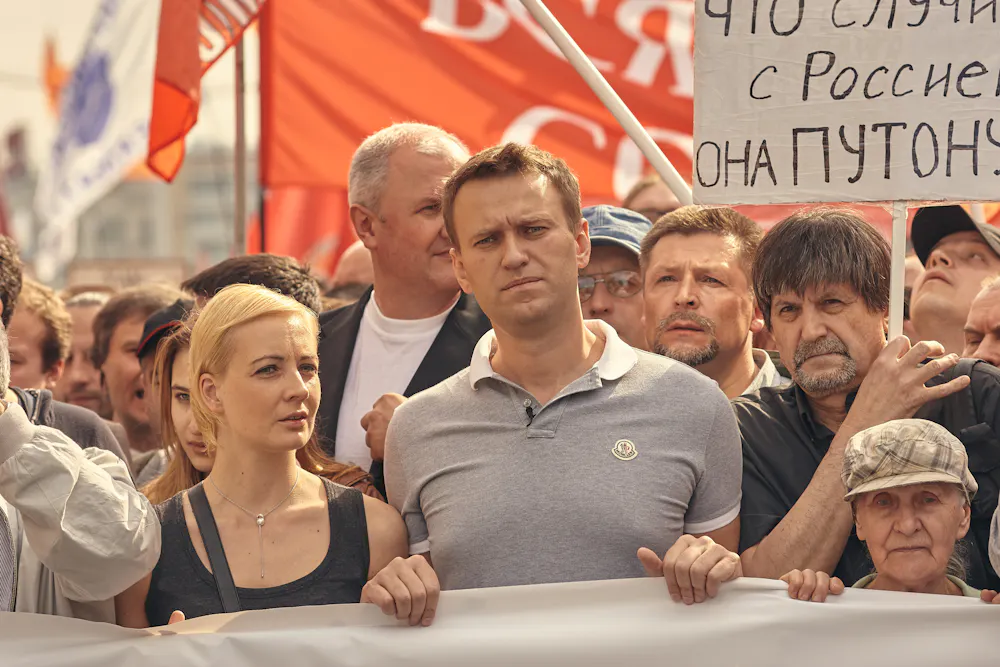
Alexei Navalny and his wife, Yulia Navalnaya, at a protest rally in Moscow, May 2012. Dmitry Laudin/Shutterstock
Today, Navalny’s family and team continue his work outside of Russia – and are fighting to keep his name alive back home. But the odds are against them. Polling suggests the share of Russians who say they know nothing about Navalny or his activities roughly doubled to 30% between his return in January 2021 and his death three years later.
Navalny fought against an autocratic system – and paid the price with his life. Given the very real fears Russians may have of voicing support for a man still labelled an extremist by the Putin regime, it’s not easy to assess what people there really think of him and his legacy. But we will also never know how popular Navalny would have been in the “normal” political system he fought for.
What made Navalny the force he was?
Navalny didn’t mean for the humble yellow rubber duck to become such a potent symbol of resistance.
In March 2017, the ACF published its latest investigation into elite corruption, this time focusing on then-prime minister (and former president), Dmitry Medvedev. Navalny’s team members had become masters of producing slick videos that enabled their message to reach a broad audience. A week after posting, the film had racked up over 7 million views on YouTube – an extraordinary number at that time.
The film included shocking details of Medvedev’s alleged avarice, including yachts and luxury properties. In the centre of a large pond in one of these properties was a duck house, footage of which was captured by the ACF using a drone.
Video: ACF.
Such luxuries jarred with many people’s view of Medvedev as being a bit different to Putin and his cronies. As Navalny wrote in his memoir, Medvedev had previously seemed “harmless and incongruous”. (At the time, Medvedev’s spokeswoman said it was “pointless” to comment on the ACF investigation, suggesting the report was a “propaganda attack from an opposition figure and a convict”.)
But people were angry, and the report triggered mass street protests across Russia. They carried yellow ducks and trainers, a second unintended symbol from the film given Medvedev’s penchant for them.
Another reason why so many people came out to protest on March 26 2017 was the organising work carried out by Navalny’s movement.
The previous December, Navalny had announced his intention to run in the 2018 presidential election. As part of the campaign, he and his team created a network of regional headquarters to bring together supporters and train activists across Russia. Although the authorities had rejected Navalny’s efforts to register an official political party, this regional network functioned in much the same way, gathering like-minded people in support of an electoral candidate. And this infrastructure helped get people out on the streets.
The Kremlin saw this as a clear threat. According to a December 2020 investigation by Bellingcat, CNN, Der Spiegel and The Insider, the FSB assassination squad implicated in the Novichok poisoning of Navalny had started trailing him in January 2017 – one month after he announced his run for the presidency.
At the protests against Medvedev, the authorities’ growing intolerance of Navalny was also on display – he was detained, fined and sentenced to 15 days’ imprisonment.
The Medvedev investigation was far from the beginning of Navalny’s story as a thorn in the Kremlin’s side. But this episode brings together all of the elements that made Navalny the force he was: anti-corruption activism, protest mobilisation, attempts to run as a “normal” politician in a system rigged against him, and savvy use of social media to raise his profile in all of these domains.
Courting controversy
In Patriot, Navalny writes that he always “felt sure a broad coalition was needed to fight Putin”. Yet over the years, his attempts to form that coalition led to some of the most controversial points of his political career.
In a 2007 video, Navalny referred to himself as a “certified nationalist”, advocating for the deportation of illegal immigrants, albeit without using violence and distancing himself from neo-Nazism. In the video, he says: “We have the right to be Russians in Russia, and we’ll defend that right.”
Although alienating some, Navalny was attempting to present a more acceptable face of nationalism, and he hoped to build a bridge between nationalists and liberals in taking on the Kremlin’s burgeoning authoritarianism.
But the prominence of nationalism in Navalny’s political identity varied markedly over time, probably reflecting his shifting estimations of which platform could attract the largest support within Russia. By the time of his thwarted run in the 2018 presidential election, nationalist talking points were all but absent from his rhetoric.
However, some of these former comments and positions continue to influence how people view him. For example, following Russia’s annexation of Crimea in 2014, Navalny tried to take a pragmatic stance. While acknowledging Russia’s flouting of international law, he said that Crimea was “now part of the Russian Federation” and would “never become part of Ukraine in the foreseeable future”.
Many Ukrainians take this as clear evidence that Navalny was a Russian imperialist. Though he later revised his position, saying Crimea should be returned to Ukraine, some saw this as too little, too late. But others were willing to look past the more controversial parts of his biography, recognising that Navalny represented the most effective domestic challenge to Putin.
Another key attempt to build a broad political coalition was Navalny’s Smart Voting initiative. This was a tactical voting project in which Navalny’s team encouraged voters to back the individual thought best-placed to defeat the ruling United Russia candidate, regardless of the challenger’s ideological position.
The project wasn’t met with universal approval. Some opposition figures and voters baulked at, or flatly refused to consider, the idea of voting for people whose ideological positions they found repugnant – or whom they viewed as being “fake” opposition figures, entirely in bed with the authorities. (This makes clear that Navalny was never the leader of the political opposition in Russia; he was, rather, the leading figure of a fractious constellation of individuals and groups.)
But others relished the opportunity to make rigged elections work in their favour. And there is evidence that Smart Voting did sometimes work, including in the September 2020 regional and local elections, for which Navalny had been campaigning when he was poisoned with Novichok.
In an astonishing moment captured on film during his recovery in Germany, Navalny speaks to an alleged member of the FSB squad sent to kill him. Pretending to be the aide to a senior FSB official, Navalny finds out that the nerve agent had been placed in his underpants.
How do Russians feel about Navalny now?
It’s like a member of the family has died.
This is what one Russian friend told me after hearing of Navalny’s death a year ago. Soon afterwards, the Levada Center – an independent Russian polling organisation – conducted a nationally representative survey to gauge the public’s reaction to the news.
The poll found that Navalny’s death was the second-most mentioned event by Russian people that month, after the capture of the Ukrainian city of Avdiivka by Russian troops. But when asked how they felt about his death, 69% of respondents said they had “no particular feelings” either way – while only 17% said they felt “sympathy” or “pity”.
And that broadly fits with Navalny’s approval ratings in Russia. After his poisoning in 2020, 20% of Russians said they approved of his activities – but this was down to 11% by February 2024.
Video: BBC.
Of course, these numbers must be taken for what they are: polling in an authoritarian state regarding a figure vilified and imprisoned by the regime, during a time of war and amid draconian restrictions on free speech. To what extent the drop in support for Navalny was real, rather than reflecting the increased fear people had in voicing their approval for an anti-regime figure, is hard to say with certainty.
When asked why they liked Navalny, 31% of those who approved of his activities said he spoke “the truth”, “honestly” or “directly”. For those who did not approve of his activities, 22% said he was “paid by the west”, “represented” the west’s interests, that he was a “foreign agent”, a “traitor” or a “puppet”.
The Kremlin had long tried to discredit Navalny as a western-backed traitor. After Navalny’s 2020 poisoning, Putin’s spokesman, Dmitry Peskov, said that “experts from the United States’ Central Intelligence Agency are working with him”. The Russian state claimed that, rather than a patriot exposing official malfeasance with a view to strengthening his country, Navalny was a CIA stooge intent on destroying Russia.
Peskov provided no evidence to back up this claim – and the official propaganda wasn’t believed by all. Thousands of Russians defied the authorities by coming out to pay their respects at Navalny’s funeral on March 1 2024. Many, if not all, knew this was a significant risk. Police employed video footage to track down members of the funeral crowd, including by using facial recognition technology.
The first person to be detained was a Muscovite the police claimed they heard shouting “Glory to the heroes!” – a traditional Ukrainian response to the declaration “Glory to Ukraine!”, but this time referencing Navalny. She spent a night in a police station before being fined for “displaying a banned symbol”.
Putin always avoided mentioning Navalny’s name in public while he was alive – instead referring to him as “this gentleman”, “the character you mentioned”, or the “Berlin patient”. (The only recorded instance of Putin using Navalny’s name in public when he was alive was in 2013.)
However, having been re-elected president in 2024 and with Navalny dead, Putin finally broke his long-held practice, saying: “As for Navalny, yes he passed away – this is always a sad event.” It was as if the death of his nemesis diminished the potency of his name – and the challenge that Navalny had long presented to Putin.
Nobody can become another Navalny
Someone else will rise up and take my place. I haven’t done anything unique or difficult. Anyone could do what I’ve done.
So wrote Navalny in the memoir published after his death. But that hasn’t happened: no Navalny 2.0 has yet emerged. And it’s no real surprise. The Kremlin has taken clear steps to ensure nobody can become another Navalny within Russia.
In 2021, the authorities made a clear decision to destroy Navalny’s organisations within Russia, including the ACF and his regional network. Without the organisational infrastructure and legal ability to function in Russia, no figure has been able to take his place directly.
More broadly, the fate of Navalny and his movement has had a chilling effect on the opposition landscape. So too have other steps taken by the authorities.
Russia has become markedly more repressive since the start of its war on Ukraine. The human rights NGO First Department looked into the number of cases relating to “treason”, “espionage” and “confidential cooperation with a foreign state” since Russia introduced the current version of its criminal code in 1997. Of the more than 1,000 cases, 792 – the vast majority – were initiated following Russia’s full-scale invasion of Ukraine in 2022.
Russian law enforcement has also used nebulous anti-extremism and anti-terrorism legislation to crack down on dissenting voices. Three of Navalny’s lawyers were sentenced in January 2025 for participating in an “extremist organisation”, as the ACF was designated by a Moscow court in June 2021. The Russian legislature has also passed a barrage of legislation relating to so-called “foreign agents”, to tarnish the work of those the regime regards as foreign-backed “fifth columnists”.
Mass street protests are largely a thing of the past in Russia. Restrictions were placed on public gatherings during the COVID pandemic – but these rules were applied selectively, with opposition individuals and groups being targeted. And opportunities for collective action were further reduced following the full-scale invasion of Ukraine.
Freedom of speech has also come under assault. Article 29, point five of the Russian constitution states: “Censorship shall be prohibited.” But in September 2024, Kremlin spokesperson Peskov said: “In the state of war that we are in, restrictions are justified, and censorship is justified.”
Legislation passed very soon after the 2022 invasion of Ukraine made it illegal to comment on the Russian military’s activities truthfully – and even to call the war a war.
YouTube – the platform so central to Navalny’s ability to spread his message – has been targeted. Without banning it outright – perhaps afraid of the public backlash this might cause – the Russian state media regulator, Roskomnadzor, has slowed down internet traffic to the site within Russia. The result has been a move of users to other websites supporting video content, including VKontakte – a Russian social media platform.
In short, conditions in Russia are very different now compared to when Navalny first emerged. The relative freedom of the 2000s and 2010s gave him the space to challenge the corruption and authoritarianism of an evolving system headed by Putin. But this space has shrunk over time, to the point where no room remains for a figure like him within Russia.
In 2019, Navalny told Ivan Zhdanov, who is now director of the ACF: “We changed the regime, but not in the way we wanted.” So, did Navalny and his team push the Kremlin to become more authoritarian – making it not only intolerant of him but also any possible successor?
There may be some truth in this. And yet, the drastic steps taken by the regime following the start of the war on Ukraine suggest there were other, even more significant factors that have laid bare the violent nature of Putin’s personal autocracy – and the president’s disdain for dissenters.
Plenty for Russians to be angry about
How can we win the war when dedushka [grandpa] is a moron?
In June 2023, Evgeny Prigozhin – a long-time associate of Putin and head of the private military Wagner Group – staged an armed rebellion, marching his forces on the Russian capital. This was not a full-blown political movement against Putin. But the target of Prigozhin’s invective against Russia’s military leadership had become increasingly blurry, testing the taboo of direct criticism of the president – who is sometimes referred to, disparagingly, as “grandpa” in Russia.
And Prigozhin paid the price. In August 2023, he was killed when the private jet he was flying in crashed after an explosion on board. Afterwards, Putin referred to Prigozhin as a “talented person” who “made serious mistakes in life”.
In the west, opposition to the Kremlin is often associated with more liberal figures like Navalny. Yet the most consequential domestic challenge to Putin’s rule came from a very different part of the ideological spectrum – a figure in Prigozhin leading a segment of Russian society that wanted the Kremlin to prosecute its war on Ukraine even more aggressively.
Video: BBC.
Today, there is plenty for Russians to be angry about, and Putin knows it. He recently acknowledged an “overheating of the economy”. This has resulted in high inflation, in part due to all the resources being channelled into supporting the war effort. Such cost-of-living concerns weigh more heavily than the war on the minds of most Russians.
A favourite talking point of the Kremlin is how Putin imposed order in Russia following the “wild 1990s” – characterised by economic turbulence and symbolised by then-president Boris Yeltsin’s public drunkenness. Many Russians attribute the stability and rise in living standards they experienced in the 2000s with Putin’s rule – and thank him for it by providing support for his continued leadership.
The current economic problems are an acute worry for the Kremlin because they jeopardise this basic social contract struck with the Russian people. In fact, one way the Kremlin tried to discredit Navalny was by comparing him with Yeltsin, suggesting he posed the same threats as a failed reformer. In his memoir, Navalny concedes that “few things get under my skin more”.
Although originally a fan of Yeltsin, Navalny became an ardent critic. His argument was that Yeltsin and those around him squandered the opportunity to make Russia a “normal” European country.
Navalny also wanted Russians to feel entitled to more. Rather than be content with their relative living standards compared with the early post-Soviet period, he encouraged them to imagine the level of wealth citizens could enjoy based on Russia’s extraordinary resources – but with the rule of law, less corruption, and real democratic processes.
‘Think of other possible Russias’
When looking at forms of criticism and dissent in Russia today, we need to distinguish between anti-war, anti-government, and anti-Putin activities.
Despite the risk of harsh consequences, there are daily forms of anti-war resistance, including arson attacks on military enlistment offices. Some are orchestrated from Ukraine, with Russians blackmailed into acting. But other cases are likely to be forms of domestic resistance.
Criticism of the government is still sometimes possible, largely because Russia has a “dual executive” system, consisting of a prime minister and presidency. This allows the much more powerful presidency to deflect blame to the government when things go wrong.
There are nominal opposition parties in Russia – sometimes referred to as the “systemic opposition”, because they are loyal to the Kremlin and therefore tolerated by the system. Within the State Duma, these parties often criticise particular government ministries for apparent failings. But they rarely, if ever, now dare criticise Putin directly.
Nothing anywhere close to the challenge presented by Navalny appears on the horizon in Russia – at either end of the political spectrum. But the presence of clear popular grievances, and the existence of organisations (albeit not Navalny’s) that could channel this anger should the Kremlin’s grip loosen, mean we cannot write off all opposition in Russia.
Navalny’s wife, Yulia, has vowed to continue her husband’s work. And his team in exile maintain focus on elite corruption in Russia, now from their base in Vilnius, Lithuania. The ACF’s most recent investigation is on Igor Sechin, CEO of the oil company Rosneft.
But some have argued this work is no longer as relevant as it was. Sam Greene, professor in Russian politics at King’s College London, captured this doubt in a recent Substack post:
[T]here is a palpable sense that these sorts of investigations may not be relevant to as many people as they used to be, given everything that has transpired since the mid-2010s, when they were the bread and butter of the Anti-Corruption Foundation. Some … have gone as far as to suggest that they have become effectively meaningless … and thus that Team Navalny should move on.
Navalny’s team are understandably irritated by suggestions they’re no longer as effective as they once were. But it’s important to note that this criticism has often been sharpest within Russia’s liberal opposition. The ACF has been rocked, for example, by recent accusations from Maxim Katz, one such liberal opposition figure, that the organisation helped “launder the reputations” of two former bank owners. In their response, posted on YouTube, the ACF referred to Katz’s accusations as “lies” – but this continued squabbling has left some Russians feeling “disillusioned and unrepresented”.
So, what will Navalny’s long-term legacy be? Patriot includes a revealing section on Mikhail Gorbachev – the last leader of the Soviet Union, whom Navalny describes as “unpopular in Russia, and also in our family”. He continues:
Usually, when you tell foreigners this, they are very surprised, because Gorbachev is thought of as the person who gave Eastern Europe back its freedom and thanks to whom Germany was reunited. Of course, that is true … but within Russia and the USSR he was not particularly liked.
At the moment, there is a similar split in perceptions of Navalny. Internationally, he was nominated for the Nobel Peace Prize, awarded the Sakharov Prize by the European Parliament, and a documentary about him won an Oscar.
But there are also those outside of Russia who remain critical: “Navalny’s life has brought no benefit to the Ukrainian victory; instead, he has caused considerable harm,” wrote one Ukrainian academic. “He fuelled the illusion in the west that democracy in Russia is possible.”
Trailer for the Oscar-winning documentary Navalny.
Inside Russia, according to Levada Center polling shortly after his death, 53% of Russians thought Navalny played “no special role” in the history of the country, while 19% said he played a “rather negative” role. Revealingly, when commenting on Navalny’s death, one man in Moscow told RFE/RL’s Russian Service: “I think that everyone who is against Russia is guilty, even if they are right.”
But, for a small minority in Russia, Navalny will go down as a messiah-like figure who miraculously cheated death in 2020, then made the ultimate sacrifice in his battle of good and evil with the Kremlin. This view may have been reinforced by Navalny’s increasing openness about his Christian faith.
Ultimately, Navalny’s long-term status in Russia will depend on the nature of the political system after Putin has gone. Since it seems likely that authoritarianism will outlast Putin, a more favourable official story about Navalny is unlikely to emerge any time soon. However, how any post-Putin regime tries to make sense of Navalny’s legacy will tell us a lot about that regime.
While he was alive, Navalny stood for the freer Russia in which he had emerged as a leading opposition figure – and also what he called the “Beautiful Russia of the Future”. Perhaps, after his death, his lasting legacy in Russia remains the ability for some to think – if only in private – of other possible Russias.
To hear about new Insights articles, join the hundreds of thousands of people who value The Conversation’s evidence-based news. Subscribe to our newsletter.
Ben Noble has previously received funding from the British Academy and the Leverhulme Trust. He is an Associate Fellow of Chatham House.
A report will go before Cabinet on Wednesday (19 February) with councillors recommended to approve the proposed increase to help sustain the adult social care market.
The hourly rate paid to home care providers, for reablement and home based respite, nursing and residential care providers supporting under 65s, older people and older people with dementia, supported living services, Shared Lives and providers of day care services will rise by 6.6% if the proposals are agreed.
Meanwhile, the agency rate for Direct Payments for adults, carers and children will increase by 6.6%, while the rate for employed personal assistants will rise by 9.91% and self employed personal assistants by 9.33%.
If the proposals are approved, the new fee structure will be introduced on 7 April, 2025.
Councillor Jasbir Jaspal, Cabinet Member for Adults and Wellbeing, said: “Our city’s adult social care providers have a vital role to play in supporting our most vulnerable residents, and we are determined to do all we can to support the sector.
“We know that, like other employers, adult care and support providers are continuing to face a perfect storm of rising costs – compounded by inflation and changes to the National Living Wage and National Insurance – along with recruitment issues and so we are pleased to be able to propose these above inflation increases, despite the well documented pressures the council is also facing at this time.
“These proposed increases of between 6.6% and 9.91% for the next financial year follow on from the significant increase in rates we announced for 2023 to 2024 of between 7.45% and 9.79% and 11.85% and 20.36% the year before, demonstrating our ongoing commitment to local adult social care providers.”
She added: “Quality of provision across all adult social care sectors has been factored when considering the proposed care fee increases, and this will be monitored through our improved quality assurance processes to ensure we are delivering high quality services across the city, while delivering value for money for taxpayers.”
Leeds City Council has today welcomed confirmation of £15m in central government funding for two major cultural projects.
The Ministry of Housing, Communities and Local Government (MHCLG) has committed £10m to help breathe fresh life into Holbeck’s historic Temple Works building, paving the way for it to become the home of a new British Library North.
A further £5m in funding has been confirmed in support of plans to create a National Poetry Centre at the landmark Trinity St David’s Church on Woodhouse Lane.
Councillor James Lewis, leader of Leeds City Council, said:
“The British Library North project aims to create a world-class space for learning, research, exhibitions and events that would unlock the huge potential of Temple Works and boost the ongoing regeneration of the wider Holbeck and South Bank areas.
“It is therefore really welcome news that the Ministry of Housing, Communities and Local Government has confirmed that, following a consultation, this £10m of funding is now in place to support the process of bringing the Temple Works building into public ownership and back into use.
“We have worked hard in recent months with partners, including the West Yorkshire Combined Authority, Homes England and the British Library itself, to make the case for this funding.
“Together we were able to emphasise the importance of the scheme and the economic and social benefits it would bring to Leeds, West Yorkshire and the North, not least through engagement and connections with local communities.
“We were very pleased to welcome the Deputy Prime Minister to Temple Works last week so she could see first-hand what this remarkable heritage asset is all about.
“We will now continue to work alongside partners on detailed plans for the full funding, design and development of a project that remains a complex and challenging undertaking, but one that offers a major regeneration opportunity for both Temple Works and the surrounding area.
“The council also welcomes today’s confirmation that £5m in funding for Leeds’s proposed National Poetry Centre is now in place.
“We were pleased to have the opportunity, during the MHCLG consultation, to add our voice to the widespread support for this project, which is being led by the National Poetry Centre Charitable Trust with the University of Leeds and poet laureate Simon Armitage.”
The Presidency of the Council of Ministers joined today’s ‘M’illumino di Meno’ initiative for the 21st edition of National Energy Saving and Sustainable Lifestyles Day, promoted by Radio 2 Rai Caterpillar. The lights on Palazzo Chigi’s main façade overlooking Piazza Colonna were symbolically switched off between 19:00 and 20:00 to mark the occasion.
Source: United Kingdom – Executive Government & Departments
The CMA has found that Topps Tiles’ acquisition of CTD Tiles could reduce competitive deals and product choice for customers and businesses in parts of England and Scotland.
iStock
The Competition and Markets Authority (CMA) has found that Topps Tiles’ £9 million purchase of 30 CTD Tiles stores raises competition concerns in 4 areas of the United Kingdom.
Topps Tiles is the biggest specialist tile retailer in the UK. Before entering administration in August 2024, CTD was the second largest specialist tile retailer in the UK. As part of the deal Topps Tiles acquired 30 stores, as well as supporting infrastructure such as stock and all related intellectual property for CTD Tiles, CTD Architectural, and CTD Housebuilders .
Following completion of the deal the CMA received several complaints, which included concerns relating to how the deal impacted businesses and retail customers in specific areas of the country. Following a Phase 1 investigation, the CMA found that a small number of sites in Dorking, Edinburgh, Inverness and Aberdeen created competition concerns in the supply of tiles to retail customers and business customers.
The investigation found both companies compete closely for retail and business customers. After reviewing the deal, including internal documents and evidence from customers and competitors, the CMA concluded that in most areas there are sufficient remaining competitors but that in a small number of areas, the deal could lead to worse deals and service for customers.
Joel Bamford, Executive Director for Mergers at the CMA, said:
Having looked at the evidence, we’re concerned Topps Tiles’ purchase of CTD Tiles may >reduce competition in Dorking, Edinburgh, Inverness and Aberdeen.
This loss of competition could lead to worse deals and service in those areas. Whether you’re retiling your own home or a business that provides renovation services, the merger could make such projects more expensive.
Topps Tiles now has the opportunity to offer solutions to our concerns, otherwise this case will proceed to a more in-depth investigation.
Topps Tiles has until Monday 24 February to submit proposals which resolve the CMA’s concerns.
Topps Tiles Plc (Topps) is a UK-wide tile retailer for both businesses and consumers based in Enderby, Leicestershire. It is the largest tile specialist in the UK with over 300 stores (and serves customers through direct sales teams and websites). The business is listed on the London Stock Exchange.
Topps acquired certain assets of Tildist Realisations Limited (formerly CTD Tiles Limited), including 30 of its stores, intellectual property such as branding and customer lists, and business divisions that supply tiles to architectural and housebuilder customers as part of a pre-pack administration deal.
For media enquiries, contact the CMA press office on 020 3738 6460 or press@cma.gov.uk
Invalda INVL Group today announces that it has successfully completed a first closing of its second-generation private equity fund (“INVL Private Equity Fund II”), reaching EUR 305 million and exceeding its target of EUR 250 million.
The INVL Private Equity Fund II has received strong backing from both existing and new investors, forming an exceptional investor base. This includes some of the most successful entrepreneurs from across the Baltics, family offices and institutional investors such as the European Investment Fund, pensions funds managed by Luminor asset management companies, SB Asset Management and IPAS INVL Asset Management in Latvia, as well as life insurance company UAB SB Draudimas. Fundraising will continue to reach a hard cap of EUR 400 million.
The minimum investment in the INVL Private Equity Fund II was EUR 10 million. However, investors could invest in the fund via INVL Private Equity Capital Fund II with a ticket as low as EUR 125,000 which subsequently reached a total size of EUR 116 million.
To fully align interests with the INVL Private Equity Fund II investors, Invalda INVL and the fund’s management team have also invested EUR 32.7 million, currently representing 11% of the total fund size.
Darius Šulnis, CEO at Invalda INVL, commented:“This highly successful fundraising reflects investors’ trust in our work, as well as a pragmatic view on the region’s perspectives and potential. It also signals opportunities for companies and countries in the region seeking investment.
INVL Private Equity Fund II will invest in businesses across Lithuania, Latvia, Estonia, Poland, Romania and the broader EU – backing those with the potential to become leaders in their competitive fields and drive value creation, along with the talented and determined people behind their success. In a rapidly changing environment, we see an increasing number of attractive investment opportunities. Having successfully built and developed multiple businesses, we understand the dedication, ambition and challenges that come with seizing new opportunities and driving growth. We take an active role in companies’ development, believing that this is the key to delivering strong returns for our investors – whose support, capital and high standards empower us to act.”
Deimantė Korsakaitė, Managing Partner at INVL Private Equity Fund II and INVL Baltic Sea Growth Fund, added: ”This is a historic milestone for the Baltics, as we have announced the largest private equity fund ever raised in the region. We are extremely grateful to our investors for their trust. It is both an honour and a great responsibility to uphold this confidence in us. We will continue the successful strategy of our predecessor, the INVL Baltic Sea Growth Fund and remain fully committed to work hand-in-hand with management teams to drive transformative growth and create long-term value for companies, our investors as well as contributing to the growth of the economy. We strongly believe that our experience and network bolster our capabilities as a value-add partner to companies.”
Asta Jovaišienė, Head of INVL Family Office, said: “We are delighted to be part of this record alongside our clients. At the same time, it demonstrates that our family office offers exceptional solutions that meet investors’ needs for sustainable and long-term results.“
The new fund will build on the strategy of the INVL Baltic Sea Growth Fund, seizing attractive opportunities across the Baltics, Poland, Romania and the broader EU. The INVL Private Equity Fund II is sector-agnostic and will invest in companies with the potential to become regional leaders in their respective industries, focusing on acquiring majority or significant minority stakes. Through active investment management, the fund aims to drive long-term value creation.
The strategy includes forming a diversified portfolio of 10–12 investments, providing late-stage growth capital to target companies and executing both buyout and buy-and-build strategies. Investment size will typically be in the region of EUR 10 million to EUR 40 million, with a preferred equity ticket of around EUR 25-30 million. However, the fund will also pursue larger deals together with co-investors.
Deimantė Korsakaitėcontinued: “The predecessor INVL Baltic Sea Growth Fund which raised EUR 165 million closed the year in 2024 with a 25% net internal rate of return (NetIRR), total value to paid-in capital (TVPI) exceeding 2x and having announced the first agreed exit from its portfolio company InMedica that is to become one of the largest investments in healthcare services in the Baltics to date.”
About INVL Private Equity Fund II
The EUR 305 million INVL Private Equity Fund II is the largest private equity fund in the Baltics. It aims to build a diversified portfolio by acquiring majority or significant minority stakes in high-growth companies, with investment sizes ranging from EUR 10 million to EUR 40 million. The fund focuses on businesses with strong potential to grow and compete amid intensifying global competition, targeting opportunities in the Baltic countries, Poland, Romania and the broader Europe Union.
The fund is managed by INVL Asset Management, the leading Baltic alternative asset manager, which is a part of the Invalda INVL Group with over 30 years of experience. The group’s companies manage or have under supervision more than EUR 1.6 billion in assets across various investment strategies, including private equity, forests and agricultural land, renewable energy, real estate, and private debt. Additionally, the group provides family office services in Lithuania, Latvia and Estonia, manages pension funds in Latvia and invests in global third-party funds.
Additional information: Darius Šulnis CEO of Invalda INVL darius.sulnis@invl.com
Moody’s Investors Service has assigned a provisional (P)Aa2 long-term rating to the mortgage covered bonds issued by Coop Pank AS (Coop Pank).
The international credit ratings agency Moody’s has analysed the planned issue of covered bonds by Coop Pank and considered, inter alia, the high credit quality of the assets backing the covered bonds, the support provided by the Estonian legal framework, which provides for the issuer’s regulation and supervision, but also exposure to market risks and the increased uncertainty of the current economic environment. The long-term rating (P)Aa2 indicates high quality obligations that are subject to low credit risk.
According to Paavo Truu, CFO of Coop Pank, obtaining a credit rating is an important step to continue the preparations for the bond issue as planned and although the final date is subject to the market situation, we plan to issue the covered bonds in the first half of 2025. According to Paavo Truu the covered bonds offer an opportunity to further diversify funding and reduce costs.
Coop Pank is planning to offer covered bonds to European institutional investors. Covered bonds are expected to provide a new resilient source of funding for Coop Pank.
Coop Pank, based on Estonian capital, is one of the five universal banks operating in Estonia. The number of clients using Coop Pank for their daily banking reached 209,500. Coop Pank aims to put the synergy generated by the interaction of retail business and banking to good use and to bring everyday banking services closer to people’s homes. The strategic shareholder of the bank is the domestic retail chain Coop Eesti, comprising of 320 stores.
Source: United Kingdom – Executive Government & Departments
The visit was part of Westminster Foundation for Democracy’s partnership with the National Parliament of Solomon Islands which began in 2022.
The MPs also met the Speaker of the House of Commons, Rt. Hon. Sir Lindsay Hoyle MP.
It has been a learning experience for three National Members of Parliament from Solomon Islands who toured Westminster and Tynwald (Isle of Man) Parliament in the UK last month.
The MPs included Member of Parliament for Maringe Kokota Constituency Hon. Cathy Launa Nori; Member of Parliament for Ngella Constituency Hon. Choylin Yim Douglas and Member of Parliament for Central Kwara’ae Constituency Hon. Ricky Fuo’o.
The Member of Parliament for Central Kwara’ae, Ricky Fuo’o shared his experience in London saying:
Democracy is not just about elections but about a system of governance that respects human rights, allows for genuine political competition and holds leaders accountable. It is up to all of us leaders, institutions, and citizens to safeguard democracy and prevent it from sliding into authoritarian rule disguised as ‘democratic governance.
While I was there, I had to opportunity to be invited to the parliament to witness the questioning of the Prime Minister. What really surprised me is that it was not just the opposition doing the questioning, but the Ministers and Backbenchers of the ruling government were also questioning the prime minister.
The MPs also had meetings with Rt. Hon the Lord Bruce of Bennachie and Dr. Victoria Hasson, who work closely with the Westminster Foundation for Democracy and have visited Solomon Islands for the programme on several occasions.
Clerk to the National Parliament of Solomon Islands, Jefferson Hallu, accompanied the MPs who also observed a Westminster Hall Debate. They had the opportunity to observe the Prime Minister’s Question Time at the House of Commons Chamber at the Palace of Westminster.
The MPs also met with the Speaker of the House of Commons, Rt. Hon. Sir Lindsay Hoyle MP; Liam Laurence Smyth, Clerk of Legislation, House of Commons, Bob Blackman MP, Backbench Business Committee Chair amongst others at Westminster and held a meeting with the Commonwealth Parliamentary Association.
Westminster Foundation for Democracy is the UK public body dedicated to strengthening democracy around the world.
Source: The Conversation (Au and NZ) – By Louise Pryke, Honorary Research Associate, Department of Classics and Ancient History, University of Sydney
Lisa Tomasetti/Opera Australia
“It’s an old song”, Hermes (Christine Anu) sings at the opening of Hadestown, but “we’re gonna sing it again and again”.
Based on a myth first told in Greece over 2,500 years ago, Hadestown is a modern retelling of the story of lovers Orpheus and Eurydice.
In ancient Greece, Orpheus was considered the greatest of all musicians, due to his divine heritage. His musical ability makes Orpheus uniquely well suited as the lead for a musical.
In the myth and the musical, Orpheus descends into the Underworld to retrieve his wife, Eurydice, after her untimely death. Moved by his powerful song, the king and queen of the Underworld, Hades and Persephone, allow Orpheus to leave their realm with Eurydice.
One condition: Orpheus must not look back at his wife until they have fully emerged from the underworld.
It’s a tale of a love from long ago
The story of Orpheus and Eurydice is one of the most retold myths from antiquity, likely due to its narrative focus on love, loss, and the human condition.
The ancient story of Orpheus and Eurydice is best known from Ovid’s Metamorphoses and Virgil’s Georgics. While Ovid places Orpheus in a world governed by unpredictable gods, Virgil’s focus on natural order means that the tragic events feel predetermined.
There are numerous other ancient versions, including a mention in Plato’s Symposium, where the philosopher (somewhat unfairly) suggests the musician lacked commitment to his lover.
During the Middle Ages, Eurydice was paralleled with biblical Eve. Eurydice and Eve were both figures known to have unfortunate encounters with snakes, and both were viewed as vulnerable to sin (in Eurydice’s case, being carried away by Hades).
Orpheus was sometimes seen as a Christ-like figure, with his descent to hell compared to Christ’s journey to save souls. Indeed, Orpheus is referenced by his fellow traveller to Hell, Dante, in his Inferno.
Jean Raoux, Orpheus and Eurydice, about 1709. Getty Museum
The love story of Orpheus and Eurydice recently featured in the Netflix series Kaos (2024). The story is referenced in video games Don’t Look Back (2009) and Hades (2020).
Orpheus’ desperate journey to reconnect with his lost love holds continued relevance, thousands of years after its first telling.
Our lady of the underground
In the musical, the story of Orpheus and Eurydice is paralleled with the story of Hades and Persephone.
In ancient myth, the union of Hades and Persephone in the Underworld was said to cause the changing of the seasons.
Evelyn De Morgan, Demeter Mourning for Persephone,1906. Wikimedia Commons
Zeus offered the solution: Persephone would spend half the year below ground and half above.
When Persephone was with Hades, the world would enter winter. The new life connected with the coming of spring signalled Demeter’s joy at the return of her beloved daughter.
Way down Hadestown
The musical, written by Anaïs Mitchell, is largely faithful to the broad arc of the ancient story of Orpheus and Eurydice. A notable exception is seen in the death of Eurydice. In the ancient myth, this is often attributed to snakebite; in the musical she chooses to descend to the Underworld due to economic desperation.
Having Eurydice choose to sign her life over to Hades arguably lends her a limited amount of agency, although she almost immediately regrets her decision.
While in the ancient myth, Eurydice’s speech is limited to her whispered farewell, these poets all give us an insight into Eurydice’s thoughts and feelings. The musical continues this tradition of giving agency, hopes and opinions.
The story of Orpheus and Eurydice is paralleled in the musical with the story of Hades and Persephone. Lisa Tomasetti/Opera Australia
The dangers posed by unpredictable seasons, seen in the ancient myth of Hades and Persephone, is used in the musical to reflect modern concerns over climate change and environmental decline.
Rising seas and poor harvests threaten the lives of those inhabiting the industrialised world of Hadestown.
Orpheus attempts to bring a dystopian world “back in tune” through restoring environmental harmony, bringing a hopeful note to the tragic story.
Anu is a reassuring presence as the narrator and Orpheus’ confidant, the god Hermes. Lisa Tomasetti/Opera Australia
Nothing changes
In this Australian restaging of the hit Broadway production, Noah Mullins rises to the significant challenge of portraying Orpheus, the greatest of all musicians. Abigail Adriano’s raw portrayal of Eurydice’s confinement in the underworld is genuinely moving.
Anu is a reassuring presence as the narrator and Orpheus’ confidant, the god Hermes. Adrian Tamburini’s powerful bass-baritone adds to the authority of Hades, and Elenoa Rokobaro gives a dazzling performance as Persephone. The chorus and mostly on-stage band are excellent.
The story of Orpheus and Eurydice has been told for thousands of years. Lisa Tomasetti/Opera Australia
At its heart, the myth of Orpheus and Eurydice confronts one of the defining challenges of mortality: the reality that death can separate us from those we love and value most.
In retelling the myth, Hadestown offers timely meditations on the power of creativity and human connection, bringing this ancient love story alive again for modern audiences.
Hadestown is in Sydney until April 26, then touring to Melbourne.
Louise Pryke does not work for, consult, own shares in or receive funding from any company or organisation that would benefit from this article, and has disclosed no relevant affiliations beyond their academic appointment.
Plutus Trade Base (PTB) announces the expansion of its proprietary trading services to U.S. traders, offering funded accounts and profit-sharing opportunities. The firm provides access through TradeLocker and TradingView platforms, features a live Discord trading room, and supports a range of trading instruments, including forex, equities, commodities, and other asset classes.
Photo credit: Plutus Trade Base
LIMASSOL, Cyprus , Feb. 16, 2025 (GLOBE NEWSWIRE) — Plutus Trade Base (PTB), a proprietary trading firm, has announced that it will begin offering its services to traders in the United States. The company provides funded trading accounts, allowing traders to access capital without risking personal funds.
PTB operates by evaluating traders through a structured assessment process. Successful participants gain access to funding and can receive payouts based on their trading performance. The company states that its model is designed to provide traders with more flexibility while maintaining clear trading conditions and rules.
“The expansion into the U.S. is an important step for us,” said the of CEO of Plutus Trade Base. “Many traders in the U.S. are looking for alternative funding options, and we are working to provide them with a structured and transparent solution.”
As part of the expansion, PTB has integrated with the TradeLocker and TradingView platforms. The company supports various trading instruments, including forex, stocks, and commodities. It also offers different funding models, including instant funding and challenge-based accounts. The firm states that its payout system includes multiple options, such as cryptocurrency withdrawals.
The company has also introduced a live trading room on Discord, where traders can participate in discussions, share strategies, and engage in real-time trading sessions. The live trading room includes screen-sharing capabilities and allows participants to join via webcam, facilitating a more interactive learning environment.
PTB states that it aims to provide clear terms and policies to address common concerns within the proprietary trading industry. The company’s rules outline drawdown limits, profit targets, and withdrawal procedures, which it describes as being structured to create a fair and consistent trading environment.
“We are focused on providing traders with opportunities while ensuring that our processes remain transparent and accessible,” said PTB’s CEO. “Our goal is to support traders in improving their skills and achieving sustainable growth.”
Proprietary trading firms have seen increased attention in recent years, with more traders seeking access to capital outside of traditional brokerage models. PTB joins other firms in the industry that offer funded accounts and profit-sharing models.
PTB states that it will continue to refine its offerings and expand its reach in the coming months.
About Plutus Trade Base
Plutus Trade Base (PTB) is a proprietary trading firm that provides traders with access to funded accounts. The company evaluates traders through a structured process, offering funding and payout options based on performance. PTB supports multiple trading platforms and instruments and provides a live trading community for traders worldwide.
Contact Information Name: Max Company: Plutus Trade Base Website: https://plutustradebase.com/ Email: support@plutustradebase.com
SALT LAKE CITY, Utah — The first woman presidentially appointed as the United States Attorney for the District of Utah and sworn into office as the 38th United States Attorney to serve in the State of Utah, leaves the U.S. Attorney’s Office. The Honorable Trina A. Higgins was nominated by President Joseph R. Biden Jr. on January 31, 2022. Her last day as United States Attorney is February 16, 2025.
Under Higgins’ leadership, the U.S. Attorney’s Office in Utah focused on cases that have the largest impact and cause the most harm to Utah citizens. Working with federal, state, local, and tribal law enforcement partners, the U.S. Attorney’s Office significantly increased the number of financial crime prosecutions in Utah; brought more complex narcotics and firearm cases focused on defendants higher in criminal organizations; and prosecuted many significant violent crime cases, including murders, sexual assaults, child exploitation, human trafficking, robberies, and carjackings.
During her tenure, The U.S. Attorney’s Office tried 35 jury trials, including three homicides committed in Tribal communities. United States Attorney Higgins was the trial attorney in one case where a man brutally murdered a Navajo woman in front of her two young daughters in the Navajo Nation. The jury found him guilty, and he was sentenced to life in prison.
United States Attorney Higgins also served on several Attorney General’s Advisory Committee subcommittees for Attorney General Merrick B. Garland. Those included the Environmental Justice Subcommittee, the Terrorism and National Security Subcommittee, and the Native American Issues Subcommittee.
Maintaining the United States Attorney’s strong partnerships with federal, state, local, and tribal law enforcement agencies, United States Attorney Higgins made it a priority to strengthen and build upon those relationships to pursue justice and better serve the people of Utah.
Leaders in the law enforcement community offered comments regarding U.S Attorney Higgins’ service.
“Strong partnerships between law enforcement and prosecutors are essential to upholding the rule of law. U.S. Attorney Higgins has been an invaluable friend to the FBI and a staunch supporter of our mission,” said Mehtab Syed, Special Agent in Charge of the Salt Lake City FBI. “During her tenure, she championed the safety of Utahns, and we thank her for her years of dedicated public service.”
“United States Attorney Trina Higgins has been an engaged and dedicated law enforcement partner as well as a steadfast advocate of Project Safe Neighborhoods,” said ATF Special Agent in Charge Brent Beavers. “Her extensive experience as a career prosecutor, and unwavering commitment in her pursuit of justice have been pivotal in the successful prosecution of many complex cases.”
“I would like to thank United States Attorney Higgins for her many years of dedicated service as a federal prosecutor and as the U.S. Attorney for the District of Utah,” said U.S. Marshal Justin Martinez of the District of Utah. “USA Higgins is a consummate professional and has always kept the lines of communication open. USA Higgins is an extremally effective leader and a real change agent. She will be greatly missed by the U.S. Marshals Service and every federal, state and local agency she works with.”
“With appreciation, we thank United States Attorney Higgins for her dedication to DEA efforts in the state of Utah,” said DEA Rocky Mountain Field Division Special Agent in Charge Jonathan Pullen. “Cooperation and hard work between DEA and the U.S. Attorney’s Office for the District of Utah, has led to many successful prosecutions. On behalf of the men and women of DEA, we wish nothing but the best for United States Attorney Higgins now and into the future.”
“HSI is grateful for its long-standing relationship with United States Attorney Higgins and her staff,” said HSI Utah Assistant Special Agent in Charge Brandon Crane. “The collaboration has had a significant impact on public safety throughout Utah and stands as an example for future collaborations.”
“United States Attorney Higgins has been a tremendous partner in supporting the U.S. Postal Inspection Service’s efforts to safeguard the U.S. Mail, postal workers, and the public,” said Glen Henderson, Inspector in Charge of the Phoenix Division. “United States Attorney Higgins was committed to holding accountable those who harm postal employees or exploit the U.S. Mail for illicit activities, including narcotics distribution. It has been a pleasure to collaborate with United States Attorney Higgins and we wish her continued success in all her future endeavors.”
“I want to thank United States Attorney Higgins for her partnership and outstanding leadership in working with our local law enforcement agencies,” said Salt Lake County Sheriff Rosie Rivera. “She prioritized complex and violent offender cases to improve safety within the communities we serve.”
“United States Attorney Trina Higgins’ dedication to justice and service to the community is truly exceptional and will be greatly missed,” said Salt Lake City Police Chief Mike Brown. “Her career as a dedicated prosecutor made our city safer—whether it was prosecuting some of our first Project Safe Neighborhood cases or complex, high-profile, or challenging cases. United States Attorney Higgins handled every case with professionalism and a true sense of duty. Never did she hide from the difficult cases. We will always remember USA Higgins’ compassion for crime victims and their families. She made sure victims’ voices were heard and understood in the pursuit of justice. While we will miss United States Attorney Higgins greatly, I know her legacy will endure through the District of Utah because of her distinguished career.”
United States Attorney Higgins has been in public service for 30 years. Prior to her leadership role as U.S. Attorney, Higgins served as an Assistant United States Attorney for over two decades and as a Salt Lake County Deputy District Attorney. At the time of her nomination, Higgins was serving as the Mediterranean Legal Advisor at the United States embassies in Valletta, Malta and Nicosia, Cyprus. A Utah native, Higgins earned her undergraduate degree from Weber State University and Juris Doctor degree from the S.J. Quinney College of Law at the University of Utah, where she also worked as an adjunct professor for a decade.
A French couple Tristan and Anouk Masselin visit Yuyuan Garden area in east China’s Shanghai, Feb. 1, 2025. [Photo/Xinhua]
Cross-border tourism has emerged as a driving force for the Spring Festival travel market in the Year of the Snake, thanks to expanded visa-free policies, said travel agencies and experts.
A Trip.com report revealed that overall cross-border travel orders increased by 30 percent compared to last year, with a staggering 180 percent growth in inbound ticket orders and over 60 percent growth in inbound hotel bookings.
Data from another travel portal Qunar show that during the Spring Festival period, the number of non-Chinese passport holders booking domestic flights increased by 70 percent compared to last year, with more foreigners exploring second and third-tier cities.
This trend is further confirmed in a set of data released by Hainan Airlines. During the Spring Festival holiday period (Jan 28 — Feb 4), Hainan Airlines transported over 20,000 visits of foreign passengers.
While many foreigners traveled to China, a significant number of Chinese people chose to celebrate the Chinese New Year overseas.
Data from Trip.com reveal that short-haul outbound trips to Japan doubled compared to last year’s Spring Festival. Long-haul destinations like the United States, Spain, Italy and France also saw a surge in popularity, with increases of 53 percent, 82 percent, 56 percent and 50 percent, respectively.
Looking at bookings on Qunar, Chinese tourists’ footprints spanned over 2,100 overseas cities this Spring Festival, marking a 50 percent increase from last year.
Shanghai residents were truly global holidaymakers, with the highest total number of outbound flight tickets purchased during the Spring Festival period among all Chinese cities, showing a 57 percent year-on-year increase.
Notably, as more countries offer visa exemptions and decrease in airfare and hotel prices for outbound travel, coupled with the increasing number of new flight routes, it means that more residents of smaller cities are able to more easily experience the joy of celebrating the Chinese New Year abroad.
“Residents of third-tier and below cities accounted for over 30 percent of the total outbound flight ticket purchases during Spring Festival, more than doubling compared to last year. Cities with the highest growth rates include Zhangjiakou in Hebei province, Binzhou in Shandong province, Ordos in Inner Mongolia autonomous region, and Yangjiang in Guangdong province, with their residents booking increasing more than twice on a year-on-year basis during Spring Festival,” said Xiao Peng, a researcher at Qunar.
“Overall, Thailand remains a top choice for many Chinese travelers during Spring Festival,” said Cai Muzi, a researcher at Qunar’s big data research institute, citing its proximity, visa-free access, affordability and pleasant weather. However, Japan’s popularity surged, overtaking Thailand as the most popular outbound destination during Spring Festival this year.
As Chinese travelers become more experienced with outbound travel, their overseas travel methods have diversified. Trip.com’s overseas platform shows a 42 percent increase in overseas car rental orders compared to last year, and a significant 20 percent growth in overseas chartered tours during Spring Festival.
The platform also saw a record high in overseas transfers to airport hauling service orders during the Spring Festival holiday, with a 58 percent year-on-year increase in transaction value. Notably, Japan, South Korea and Thailand experienced even more significant growth during Spring Festival, with Japan’s gross merchandise volume increasing by 120 percent compared to 2024.
Zhou Huijie, a researcher with Trip.com, said that the influx of international travelers visiting China for the Chinese New Year and the trendy topics of “UNESCO intangible cultural heritage Spring Festival” on global social media platforms have elevated the Chinese New Year experience, with Chinese people traveling abroad and foreigners coming to China to celebrate the festival.
In addition to popular inbound tourism cities like Beijing, Shanghai, Guangzhou and Shenzhen, destinations rich in intangible cultural heritage such as Shijiazhuang, Fuzhou and Xi’an saw respective increases of 50 percent, 52 percent and 97 percent in inbound travel orders compared to last year’s Spring Festival.
Chinese Foreign Minister Wang Yi shakes hands with his Ukrainian counterpart Andrii Sybiha in Munich, Germany, February 15, 2025. [Photo/Chinese Foreign Ministry]
Chinese Foreign Minister Wang Yi reaffirmed China’s commitment to peace and dialogue during a meeting with his Ukrainian counterpart Andrii Sybiha in Munich, Germany on Saturday, held on the sidelines of the Munich Security Conference.
Wang, also a member of the Political Bureau of the Communist Party of China’s Central Committee, emphasized the long-standing friendship and strategic partnership between China and Ukraine, established in 2011. He noted that, despite challenging global circumstances, China remains Ukraine’s largest trading partner, a testament to the enduring potential for cooperation between the two nations.
Highlighting China’s view of Ukraine as both a friend and a partner, Wang expressed China’s willingness to work with Ukraine to overcome challenges and further develop bilateral ties. He also expressed hope that Ukraine would continue to ensure the safety of Chinese institutions and citizens within its borders.
On the ongoing crisis in Ukraine, Wang reiterated China’s firm stance on promoting peace and dialogue. He emphasized the principles laid out by President Xi Jinping, which he said have proven to be objective, impartial, and pragmatic in guiding the resolution process.
China will remain committed to these principles, continuing to play a constructive role in the political settlement of the crisis and the pursuit of peace, Wang affirmed. He added that China supports all efforts focused on peace and advocates for a fair, lasting, and binding peace agreement accepted by all parties involved. Wang also noted that the “Friends of Peace” platform, led by China and other Global South countries, will continue its work to foster international consensus on peace and dialogue.
Sybiha, for his part, acknowledged the strong bilateral ties and friendly relations between the peoples of Ukraine and China. He stressed Ukraine’s adherence to the one-China principle and its readiness to strengthen exchanges and deepen its strategic partnership with China. Sybiha also assured that Ukraine would continue to protect Chinese institutions and citizens.
Furthermore, Sybiha expressed Ukraine’s respect for China’s global influence and its appreciation for China’s balanced approach to international issues. He called on China to play a key role in achieving comprehensive, just and lasting peace in the region.
Introduction The 10th Deep Space Climate Observatory (DSCOVR) Earth Polychromatic Camera (EPIC) and National Institute of Standards and Technology (NIST) Advanced Radiometer [NISTAR] Science Team Meeting (STM) was held October 16–18, 2024. Over 50 scientists attended, most of whom were from NASA’s Goddard Space Flight Center (GSFC), with several participating from other NASA centers, U.S. universities, and U.S. Department of Energy laboratories. There was one international participant – from Estonia. A full overview of DSCOVR’s Earth-observing instruments was published in a previous article in The Earth Observer and will not be repeated here. This article provides the highlights of the 2024 meeting. The meeting agenda and full presentations can be downloaded from GSFC’s Aura Validation Data Center. Opening Presentations The opening session of the 10th DSCOVR STM was special. Former U.S., Vice President Al Gore attended the opening session and gave a presentation at the panel discussion “Remote Sensing and the Future of Earth Observations” – see Photo. Gore was involved in the early days of planning the DSCOVR mission, which at that time was known as Triana. He reminisced about his involvement and praised the team for the work they’ve done over the past decade to launch and maintain the DSCOVR mission. Following the STM Opening Session, Gore spoke at a GSFC Engage session in Building 3 later that afternoon on the same topic, but before a wider audience. [Link forthcoming.] Following Gore’s remarks, the remainder of the opening session consisted of a series of presentations from DSCOVR mission leaders and representatives from GSFC and National Oceanic and Atmospheric Administration (NOAA). Thomas Neumann [GSFC, Earth Sciences Division (ESD)—Deputy Director] opened the meeting and welcomed Vice President Gore and the STM participants on behalf of the ESD. Adam Szabo [GSFC—DSCOVR Project Scientist] briefly reported that the spacecraft was still in “good health.” The EPIC and NISTAR instruments on DSCOVR continue to return their full science observations. He also gave an update on DSCOVR Space Weather research. Alexander Marshak [GSFC—DSCOVR Deputy Project Scientist] briefly described DSCOVR mission history and the science results based on DSCOVR observations from the first Sun–Earth Lagrange point (hereinafter, the L1 point). He also summarized the major EPIC and NISTAR results to date. At this time, more than 125 papers related to DSCOVR are listed on the EPIC website. Elsayed Talaat [NOAA, Office of Space Weather observations—Director] discussed the future of Earth and space science studies from the L1 point.
Updates on DSCOVR Operations The DSCOVR mission components continue to function nominally. The meeting was an opportunity to update participants on progress over the past year on several fronts, including data acquisition, processing, and archiving, and release of new versions of several data products. The number of people using DSCOVR data continues to increase, with a new Science Outreach Team having been put in place to aid users in several aspects of data discovery, access, and user friendliness. Amanda Raab [NOAA, DSCOVR Mission Operations and Systems] reported on the current status of the DSCOVR mission. She also discussed spacecraft risks and issues such as memory fragmentation and data storage task anomalies but indicated that both these issues have been resolved. Hazem Mahmoud [NASA’s Langley Research Center (LaRC)] discussed the work of the Atmospheric Science Data Center (ASDC), which is based at LaRC. He showed DSCOVR mission metrics since 2015, focusing on data downloads and the global outreach of the mission. He noted that there has been a significant rise in the number of downloads and an increasing diversity of countries accessing ozone (O3), aerosol, and cloud data products. Mahmoud also announced that the ASDC is transitioning to the Amazon Web Services cloud, which will further enhance global access and streamline DSCOVR data processing. Karin Blank [GSFC] covered the discovery of a new type of mirage that can only be seen in deep space from EPIC. The discussion included the use of a ray tracer in determining the origin of the phenomenon, and under what conditions it can be seen. Alexander Cede [SciGlob] and Ragi Rajagopalan [LiftBlick OG] gave an overview of the stability of the EPIC Level-1A (L1A) data over the first decade of operation. They explained that the only observable changes in the EPIC calibration are to the dark count and flat field can – and that these changes can be entirely attributed to the temperature change of the system in orbit compared to prelaunch conditions. No additional hot or warm pixels have emerged since launch and no significant sensitivity drifts have been observed. The results that Cede and Rajagopalan showed that EPIC continues to be a remarkably stable instrument, which is attributed to a large extent to its orbit around the L1 point, which is located outside the Earth’s radiation belts and thus an extremely stable temperature environment. Consequently, in terms of stability, the L1 point is far superior to other Earth observation points, e.g., ground-based, low-Earth orbit (LEO), polar orbit, or geostationary Earth orbit (GEO). Marshall Sutton [GSFC] discussed the state of the DSCOVR Science Operation Center (DSOC). He also talked about processing EPIC Level-1 (L1) data into L2 science products, daily images available on the EPIC website, and special imaging opportunities, e.g., volcanic eruptions. EPIC Calibration After 10 years of operation in space, the EPIC instrument on DSCOVR continues to be a remarkably stable instrument. The three presentations describe different ways that are used to verify the EPIC measurements remain reliable. Conor Haney [LaRC] reported on anomalous outliers during February and March 2023 from the broadband shortwave (SW) flux using EPIC L1B channel radiances. To ensure that these outliers were not a result of fluctuations in the EPIC L1B channel radiances, both the EPIC radiance measurements and coincident, ray-matched radiance measurements from the Visible Infrared Imaging Radiometer Suite (VIIRS), on the Suomi National Polar-orbiting Partnership (Suomi NPP) platform, were processed using the same deep convective cloud invariant target (DCC-IT) algorithm. This analysis confirmed that the anomalous behavior was due to the DCC-IT algorithm – and not because of fluctuations in the EPIC L1B channel radiances. The improved DCC-IT methodology was also applied to the EPIC L1B radiances. The results indicate that the EPIC record is quite stable with a lower uncertainty than when processed using the previous DCC-IT methodology. Igor Geogdzhaev [NASA’s Goddard Institute for Space Studies (GISS)/Columbia University] reported that EPIC Visible–Near Infrared (VIS-NIR) calibration based on VIIRS (on Suomi NPP) data has showed excellent stability, while VIIRS (on NOAA-20 and -21) derived gains agree to within 1–2%. Preliminary analysis showed continuity in the gains derived from Advanced Baseline Imager (ABI) data. (ABI flies on NOAA’s two operational Geostationary Operational Environmental Satellite–Series R satellites – GOES-17 and GOES-18. Liang–Kang Huang [Science Systems and Applications, Inc. (SSAI)] reported on updates to the EPIC ultraviolet (UV) channel sensitivity time dependences using Sun-normalized radiance comparisons between EPIC and measurements from the Ozone Mapping and Profiler Suite (OMPS) Nadir Mapper (NM) on Suomi NPP, with coinciding footprints and solar/satellite angles. Huang’s team determined vignetting factors in the sensitivity calibration between 2021–2024, as a function of charge coupled device (CCD) pixel radius and pixel polar angles, using special lunar measurement sequences. NISTAR Status and Science with Its Observations The NISTAR instrument remains fully functional and continues its uninterrupted data record. The NISTAR-related presentations during this meeting included more details on specific topics related to NISTAR as well as on efforts to combine information from both EPIC and NISTAR. Steven Lorentz [L-1 Standards and Technology, Inc.] reported that the NISTAR on DSCOVR has been measuring the irradiance from the sunlit Earth in three bands for more than nine years. The three bands measure the outgoing total and reflected-solar radiation from Earth at a limited range of solar angles. To compare the long-term stability of EPIC and NISTAR responses, researchers developed a narrowband to wideband conversion model to allow the direct comparison of the EPIC multiband imagery and NISTAR SW – see Figure 1 – and silicon photodiode channels. Lorentz presented daily results spanning several years. The comparison employed different detectors from the same spacecraft – but with the same vantage point – thereby avoiding any model dependent orbital artifacts.
Clark Weaver [University of Maryland, College Park (UMD)] used spectral information from the SCanning Imaging Absorption spectroMeter for Atmospheric CartograpHY (SCIAMACHY), which flew on the European Space Agency’s (ESA) Envisat satellite from 2002–2012, to fill EPIC spectral gaps. He reported on construction of a composite height resolution spectrum that was spectrally integrated to produce SW energy. Weaver explained that he compared the EPIC reflected SW with four-hour averages from Band 4 on NISTAR. He used spectral information from SCIAMACHY to fill in gaps. Weaver also discussed results of a comparison of area integrated EPIC SW energy with observations from NISTAR . Andrew Lacis [GISS] reported on results of analysis of seven years of EPIC-derived planetary albedo for Earth, which reveal global-scale longitudinal variability occurring over a wide range of frequencies – with strong correlation between nearby longitudes and strong anticorrelation between diametrically opposed longitudes. This behavior in the Earth’s global-scale energy budget variability is fully corroborated by seven years of NISTAR silicon photodiode measurements, which view the Earth with 1º longitudinal resolution. This analysis establishes the DSCOVR mission EPIC/NISTAR measurements as a new and unmatched observational data source for evaluating global climate model performance– e.g., see Figure 2.
Wenying Su [LaRC] discussed global daytime mean SW fluxes within the EPIC field of view produced from January 2016–June 2024. These quasi-hourly SW fluxes agree very well with the Synoptic data product from the Clouds and the Earth’s Radiant Energy System (CERES) instruments (currently flying on the Terra and Aqua, Suomi NPP, and NOAA-20 platforms) with the root mean square errors (rmse) less than 3 W/m2. This SW flux processing framework will be used to calculate NISTAR SW flux when Version 4 (V4) of the NISTAR radiance becomes available. Su noted that SW fluxes from EPIC are not suitable to study interannual variability as the magnitude of EPIC flux is sensitive to the percentage of daytime area visible to EPIC. Update on EPIC Products and Science Results EPIC has a suite of data products available. The following subsections summarize content during the DSCOVR STM related to these products. The updates focus on several data products and the related algorithm improvements. Total Column Ozone Jerry Ziemke [Morgan State University (MSU), Goddard Earth Sciences Technology and Research–II (GESTAR II)] and Natalya Kramarova [GSFC] reported that tropospheric O3 from DSCOVR EPIC shows anomalous reductions of ~10% throughout the Northern Hemisphere (NH) starting in Spring 2020 that continues to the present. The EPIC data, along with other satellite-based (e.g., Ozone Monitoring Instrument (OMI) on NASA’s Aura platform) and ground-based (e.g., Pandora) data, indicate that the observed NH reductions in O3 are due to combined effects from meteorology and reduced pollution, including reduced shipping pollution in early 2020 (during COVID) – see Figure 3. EPIC 1–2 hourly data are also used to evaluate hourly total O3 and derived tropospheric O3 from NASA’s Tropospheric Emissions: Monitoring of Pollution (TEMPO) geostationary instrument. Ziemke explained that comparison of TEMPO data with EPIC data has helped the researchers characterize a persistent latitude-dependent offset in TEMPO total O3 data of ~10–15% from south to north over the North American continent.
Algorithm Improvement for Ozone and Sulfur Dioxide Products Kai Yang [UMD] presented a comprehensive evaluation of total and tropospheric O3 retrievals, highlighting the long-term stability and high accuracy of EPIC measurements. He also validated EPIC’s volcanic sulfur dioxide (SO2) retrievals by comparing them with ground-based Brewer spectrophotometer measurements and summarized EPIC’s observations of SO2 from recent volcanic eruptions. Simon Carn [University of Michigan] showed the first comparisons between the EPIC L2 volcanic SO2 product and SO2 retrievals from the Geostationary Environment Monitoring Spectrometer (GEMS) on the Korean GEO-Kompsat-2B satellite. GEMS observes East Asia as part of the new geostationary UV air quality (GEO-AQ) satellite constellation (which also includes TEMPO that observes North America and will include the Ultraviolet–Visible–Near Infrared (UVN) instrument on the European Copernicus Sentinel-4 mission, that will be launched in 2025 to observe Europe and surrounding areas) – but is not optimized for measurements of high SO2 columns during volcanic eruptions. EPIC SO2 data for the 2024 eruption of Ruang volcano in Indonesia are being used to validate a new GEMS volcanic SO2 product. Initial comparisons show good agreement between EPIC and GEMS before volcanic cloud dispersal and confirm the greater sensitivity of the hyperspectral GEMS instrument to low SO2 column amounts. Aerosols Alexei Lyapustin [GSFC] reported that the latest EPIC aerosols algorithm (V3) simultaneously retrieves aerosol optical depth, aerosol spectral absorption, and aerosol layer height (ALH) – achieving high accuracy. He showed that global validation of the single scattering albedo in the blue and red shows 66% and 81–95% agreement respectively, with Aerosol Robotic Network (AERONET) observations – which is within the expected error of 0.03 for smoke and dust aerosols. Lyapustin also reported on a comparison of EPIC aerosol data collected from 2015–2023 by the Cloud-Aerosol Lidar with Orthogonal Polarization (CALIOP), which flew on the Cloud-Aerosol Lidar and Infrared Pathfinder Satellite Observations (CALIPSO) mission. The results show that ALH is retrieved with rmse ~1.1 km (0.7 mi). ALH is unbiased over the ocean and is underestimated by 450 m (1470 ft) for the smoke and by 750 m (2460 ft) for the dust aerosols over land. Myungje Choi and Sujung Go [both from University of Maryland, Baltimore County’s (UMBC), GESTAR II] presented results from a global smoke and dust characterization using Multi-Angle Implementation of Atmospheric Correction (MAIAC) algorithm. This study characterized smoke and dust aerosol properties derived from MAIAC EPIC processing, examining spectral absorption, ALH, and chemical composition (e.g., black and brown carbon). Regions with smoldering wildfires, e.g., North America and Siberia, exhibited high ALH and a significant fraction of brown carbon, while Central Africa showed lower ALH with higher black carbon emissions. Omar Torres [GSFC] discussed how L1 DSCOVR-EPIC observations are being used to study air quality (i.e., tropospheric O3 and aerosols) globally. Torres noted that this application of EPIC-L1 observations is of particular interest in the Southern Hemisphere (SH) where, unlike over the NH, there are currently no space GEO-based air quality measurements – and no plans for them in the foreseeable future. Hiren Jethva [MSU, GESTAR II] presented the new results of the aerosol optical centroid height retrieved from the EPIC Oxygen-B band observations. He described the algorithm details, showed retrieval maps, and reviewed the comparative analysis against CALIOP backscatter-weighted measurements. The analysis showed a good level of agreement with more than 70% of matchup data within 1–1.5 km (0.6–0.9 mi) difference. Jun Wang [University of Iowa] presented his team’s work on advancing the second generation of the aerosol optical centroid height (AOCH) algorithm for EPIC. Key advancements included: constraining surface reflectance in aerosol retrieval using an EPIC-based climatology of surface reflectance ratios between 442–680 nm; incorporating a dynamic aerosol model to characterize aged smoke particles; and employing a spectral slope technique to distinguish thick smoke plumes from clouds. Results show that both atmospheric optical depth (AOD) and AOCH retrievals are improved in the second generation of AOCH algorithm. Olga Kalashnikova [NASA/Jet Propulsion Laboratory (JPL)] reported on improving brown carbon evolution processes in the Weather Research and Forecasting model coupled with Chemistry (WRF-Chem) model with EPIC products. She indicated that DSCOVR product evaluation, using lidar aerosol height measurements from CALIOP, led to an improved operational brown carbon product. To better resolve the temporal evolution of brown carbon, chemical transport models need to include more information about near-source fires. Mike Garay [NASA/Jet Propulsion Laboratory (JPL)] discussed constraining near-source brown carbon emissions from 2024 Canadian ‘zombie’ fires with EPIC products. He reported that fires in British Columbia, Canada showed differences in brown carbon emission near the sources. Garay explained that their investigation has revealed that these differences were related to fire intensity and variations in vegetation/soil content. Yuekui Yang [GSFC] presented work that examined the impact of Earth’s curvature consideration on EPIC cloud height retrievals. Biases under the Plane Parallel (PPL) assumption is studied by comparing results using the improved pseudo-spherical shell approximation. PPL retrievals in general bias high and for a cloud with height of 5 km (3 mi), the bias is about 6%. Alfonso Delgado Bonal [UMBC] stated that the EPIC vantage point offers a unique opportunity to observe not only the current state of the Earth but also its temporal evolution. By capturing multiple observations of the planet throughout the day, EPIC enables statistical reconstruction of diurnal patterns in clouds and other atmospheric parameters. Bonal’s team focused their research on O3 (primarily tropospheric) over the U.S. to demonstrate the presence of a diurnal cycle in the western regions of the continental U.S. However, ground-based data from PANDORA for specific locations do not support these diurnal variations – underscoring the critical role of space-based O3 retrievals. The proposed methodology is not limited to clouds or O3 but is broadly applicable to other EPIC measurements for the dynamic nature of our planet. Elizabeth Berry [Atmospheric and Environmental Research (AER)] presented results from a coincident DSCOVR–CloudSat dataset [covering 2015–2020]. Cloud properties (e.g., cloud height and optical depth) from DSCOVR and CloudSat are moderately correlated and show quite good agreement given differences in the instruments sensitivities and footprints. Berry explained that a machine-learning model trained on the coincident data demonstrates high accuracy at predicting the presence of vertical cloud layers. However, precision and recall metrics highlight the challenge of predicting the precise location of cloud boundaries. Anthony Davis [JPL] presented a pathway toward accurate estimation of the cloud optical thickness (COT) of opaque clouds and cloud systems, e.g., supercells, mesoscale convective complexes, and tropical cyclones (TCs). He described the approach, which uses differential oxygen absorption spectroscopy (DOAS) that has resolving power greater than 104 – which is comparable to that of the high-resolution spectrometers on NASA’s Orbiting Carbon Observatory–2 (OCO-2) – but is based upon the cloud information content of EPIC’s O2 A- and B-band radiances. Unlike the current operational retrieval of COT – which uses data from the Moderate Resolution Imaging Spectroradiometer (MODIS) on Terra and Aqua – the DOAS-based technique does not saturate at COT exceeding ~60. According to a popular TC model with two-moment microphysics, COT in a tropical storm or hurricane can reach well into the hundreds, sometimes exceeding 1000. Davis said that once the new COT estimates become available, they will provide new observational constraints on process and forecast models for TCs. Ocean Robert Frouin [Scripps Institution of Oceanography, University of California] discussed ocean surface radiation products derived from EPIC data. He explained that significant advancements have been achieved in processing and evaluating ocean biology and biogeochemistry products derived from EPIC imagery. V1 updates enhanced accuracy by integrating Modern-Era Retrospective analysis for Research and Applications V2 (MERRA-2) ancillary data and refining calculations for atmospheric and surface parameters. Frouin introduced several diurnal products, including hourly photosynthetically active radiation (PAR) fluxes, spectral water reflectance, and chlorophyll-a concentrations. He said that these new MODIS-derived products have been validated through comparisons with data from the Advanced Himawari Imager on the Japanese Himawar–8 and –9 satellites. In order to address the gaps in these diurnal products, Frouin explained that the team developed a convolutional neural network that has been used effectively to reconstruct missing PAR values with high accuracy. Vegetation Yuri Knyazikhin [Boston University] reported on the status of the Vegetation Earth System Data Record (VESDR) that provides a variety of parameters including: Leaf Area Index (LAI), diurnal courses of Normalized Difference Vegetation Index (NDVI), Sunlit LAI (SLAI), Fraction of incident Photosynthetically Active Radiation (FPAR) absorbed by the vegetation, Directional Area Scattering Function (DASF), Earth Reflector Type Index (ERTI), and Canopy Scattering Coefficient (CSC). Knyazikhin discussed analysis of the diurnal and seasonal variations of these quantities. EPIC LAI and FPAR are consistent with MODIS-derived measurements of the same parameters. Jan Pisek [University of Tartu/Tartu Observatory, Estonia] discussed efforts to derive leaf inclination information from EPIC data. The very first evaluation over Tumbarumba site (in New South Wales, Australia) showed that the angular variation in parameters obtained from EPIC reflects the expected variations due to the erectophile vegetation present at the site. Sun Glint Tamás Várnai [UMBC, JCET] discussed EPIC observations of Sun glint from ice clouds. The cloud glints come mostly from horizontally oriented ice crystals and have strong impact in EPIC cloud retrievals. Várnai reported that the EPIC glint product is available from the ASDC – see Figure 4. Glint data can help reduce the uncertainties related to horizontally oriented ice crystals and yield additional new insights about the microphysical and radiative properties of ice clouds.
Alexander Kostinski [Michigan Technology University] explained that because they detected climatic signals (i.e., longer-term changes and semi-permanent features, e.g., ocean glitter), they developed a technique to suppress geographic “noise” in EPIC images that involves introducing temporally (monthly) and conditionally (classifying by surface/cover type, e.g., land, ocean, clouds) averaged reflectance images – see Figure 5. The resulting images display seasonal dependence in a striking manner. Additionally, cloud-free, ocean-only images highlight prominent regions of ocean glitter.
Jiani Yang [Caltech] reported that spatially resolving light curves from DSCOVR is crucial for evaluating time-varying surface features and the presence of an atmosphere. Both of these features are essential for sustaining life on Earth – and thus can be used to assess the potential habitability of exoplanets. Using epsilon machine reconstruction, the statistical complexity from the time series data of these light curves can be calculated. The results show that statistical complexity serves as a reliable metric for quantifying the intricacy of planetary features. Higher levels of planetary complexity qualitatively correspond to increased statistical complexity and Shannon entropy, illustrating the effectiveness of this approach in identifying planets with the most dynamic characteristics. Other EPIC Science Results Guoyong Wen [MSU, GESTAR II] analyzed the variability of global spectral reflectance from EPIC and the integrated broadband reflectance on different timescales. He reported that on a diurnal timescale, the global reflectance variations in UV and blue bands are statistically similar – and drastically different from those observed in longer wavelength bands (i.e., green to NIR). The researchers also did an analysis of monthly average results and found that temporal averaging of the global reflectance reduces the variability across the wavelength and that the variability of broadband reflectance is similar to that for the red band on both timescales. These results are mainly due to the rotation of the Earth on diurnal timescale and the change of the Earth’s tilt angle. Nick Gorkavyi [Science Systems and Applications, Inc. (SSAI)] reported that EPIC – located at the L1 point, 1.5 million km (0.9 million mi) away from Earth – can capture images of the far side of the Moon in multiple wavelengths. These images, taken under full solar illumination, can be used to calibrate photographs obtained by lunar artificial satellites. Additionally, he discussed the impact of lunar libration – the changing view of the Moon from Earth, or it’s apparent “wobble” – on Earth observations from the Moon. Jay Herman [UMBC] discussed a comparison of EPIC O3 with TEMPO satellite and Pandora ground-based measurement. The results show that total column O3 does not have a significant photochemical diurnal variation. Instead, the daily observed diurnal variation is caused by weather changes in atmospheric pressure. This measurement result agrees with model calculations. Conclusion Alexander Marshak, Jay Herman, and Adam Szabo led a closing discussion with ST participants on how to make the EPIC and NISTAR instruments more visible in the community. It was noted that the EPIC website now allows visitors to observe daily fluctuations of aerosol index, cloud fraction, cloud height, and the ocean surface – as observed from the L1 point. More daily products, (e.g., aerosol height and sunlit leaf area index) will be added soon, which should attract more users to the website. Overall, the 2023 DSCOVR EPIC and NISTAR STM was successful. It provided an opportunity for participants to learn the status of DSCOVR’s Earth-observing instruments, EPIC and NISTAR, the status of recently released L2 data products, and the science results being achieved from the L1 point. As more people use DSCOVR data worldwide, the ST hopes to hear from users and team members at its next meeting. The latest updates from the mission can be found on the EPIC website. Alexander MarshakNASA’s Goddard Space Flight Centeralexander.marshak@nasa.gov Adam SzaboNASA’s Goddard Space Flight Centeradam.szabo@nasa.gov
– having regard to its previous resolutions on Nicaragua,
– having regard to Rules 150(5) and 136(4) of its Rules of Procedure,
A. whereas since 2018, the Nicaraguan regime has systematically, repeatedly and arbitrarily persecuted human rights defenders (HRDs), opposition and religious representatives, among others; whereas over 5 600 NGOs have been dissolved, including religious groups – mainly Catholic – and their assets confiscated;
B. whereas imprisoned political opponents, along with HRDs, have been expelled from the country, stripped of their nationality and deprived of their political rights; whereas since 2018, 245 members of the clergy have been arbitrarily arrested or expelled, including Bishop Rolando Álvarez, Sakharov Prize finalist;
C. whereas in January 2025, the regime passed a constitutional reform that eliminates the separation of powers and political pluralism, establishing an Ortega-Murillo co-presidency that controls all branches of government, independent institutions and the media, and ignores adherence to international human rights conventions and treaties;
1. Strongly condemns the Ortega-Murillo regime’s widespread, systemic human rights violations against its population, democratic opposition, students, civil society organisations (CSOs) and its persecution of religious leaders, primarily Catholic; urges the immediate release of all those arbitrarily detained, and the restoration of the rule of law and the legal status of all organisations, freedoms and the rights of exiled individuals, including their safe return; insists that these are essential conditions for any prospect of meaningful dialogue;
2. Denounces the use of statelessness and exile as a weapon against dissenting voices; reiterates the need to end restrictions on civic space and to respect the right to dissent;
3. Calls on the Ortega-Murillo regime to reverse its constitutional reform and all repressive laws institutionalising totalitarianism, to fully respect its international human rights obligations, and to implement the recommendations made by the UN Group of Human Rights Experts on Nicaragua; calls for its mandate to be extended;
4. Calls for the EU to include specific guarantees of human rights compliance when allocating EU funds, including through multilateral and financial institutions, and to ensure that the funds do not contribute to strengthening the Ortega-Murillo regime;
5. Highlights the key role played by CSOs, HRDs, the Catholic Church and journalists in Nicaragua; calls for the EU to reinforce its regular dialogue with them, including those in exile, to support their vital work, as well as countries receiving migrants fleeing Nicaragua, such as Costa Rica;
6. Calls on the Member States, in accordance with the Rome Statute, to open investigations through the International Criminal Court into the Ortega-Murillo regime for crimes against humanity;
7. Reiterates its demand that the democratic clause of the EU Association Agreement be triggered; rejects any prospect of holding any parliamentary dialogue with members of Nicaragua’s regime-controlled National Assembly;
8. Reiterates its call to expand the list of sanctioned individuals to include Ortega, Rosario Murillo and their inner circle;
9. Calls for the immediate extradition of Alessio Casimirri to Italy;
10. Instructs its President to forward this resolution to the Council, Commission, the VP/HR, the Member States and the Nicaraguan authorities.
– having regard to its previous resolutions on Georgia, in particular that of 28 November 2024 on Georgia’s worsening democratic crisis following the recent parliamentary elections and alleged electoral fraud(1),
– having regard to Georgia’s status as an EU candidate country, granted by the European Council at its summit of 14 and 15 December 2023,
– having regard to Article 78 of the Georgian Constitution, which demands the implementation of all possible measures to guarantee Georgia’s complete integration into the EU and NATO,
– having regard to the final report of the Organization for Security and Co-operation in Europe (OSCE) on the parliamentary elections held in Georgia on 26 October 2024,
– having regard to Rules 136(2) and (4) of its Rules of Procedure,
A. whereas the democratic backsliding in Georgia has dramatically accelerated since the parliamentary elections of 26 October 2024, which were deeply flawed and marked by grave irregularities, and failed to meet international democratic standards and Georgia’s OSCE commitments; whereas these elections violated the democratic norms and standards set for free and fair elections, failing to reflect the will of the people and rendering the resulting ‘parliament’, and subsequently the ‘president’, devoid of any democratic legitimacy; whereas from the very beginning of its activity, the current Georgian parliament has operated as a one-party (Georgian Dream) organ, which is incompatible with the essence of pluralistic parliamentary democracy;
B. whereas Article 2 of the EU-Georgia Association Agreement(2) concerns the general principles of the agreement, which include democratic principles, human rights and fundamental freedoms;
C. whereas Article 78 of the Georgian Constitution states that the constitutional bodies must take all measures within the scope of their competences to ensure the full integration of Georgia into the European Union;
D. whereas the President of Georgia, Salome Zourabichvili, publicly condemned the parliamentary elections as rigged, declared that she would not recognise them and called for an international investigation; whereas the current Georgian regime, led by the Georgian Dream party and its founder, Bidzina Ivanishvili, has orchestrated an unconstitutional usurpation of power, systematically dismantling democratic institutions, undermining judicial independence and eroding fundamental freedoms and the rule of law, thereby deepening Georgia’s political and constitutional crisis;
E. whereas Georgia has officially held the status of EU candidate country since December 2023; whereas on 28 November 2024, Irakli Kobakhidze announced that Georgia would delay initiating accession talks with the EU and reject its financial assistance until the end of 2028, disregarding the country’s constitutional commitment to European integration and effectively undermining Georgia’s sovereign Euro-Atlantic aspirations;
F. whereas on 28 November 2024, peaceful mass anti-government protests began across the country, demanding new, free and fair elections, an end to political violence and repression, and the return of the country to its European path; whereas the protests have been taking place without interruption for over 75 days;
G. whereas on 14 December 2024, the de facto parliament held a ‘presidential election’ with a single candidate from the Georgian Dream party, former footballer Mikheil Kavelashvili, elected with 224 out of 225 votes cast;
H. whereas Georgia’s self-appointed authorities have plunged the country into a fully fledged constitutional and political crisis, as well as a human rights and democracy crisis; whereas this has been marked by the brutal repression of peaceful protesters, political opponents and media representatives, with judges, prosecutors and police officers actively fabricating politically motivated administrative and criminal charges against protesters, journalists and opposition figures detained during peaceful anti-government demonstrations; whereas, as of December 2024, more than 460 people have been arrested or punished since the protests began, with this number growing by the day;
I. whereas riot police deliberately lacking force identification numbers have forcefully dispersed protesters with tear gas and water cannons; whereas numerous journalists have reported being targeted and beaten, and having their equipment destroyed and personal items stolen; whereas dozens of protesters have been brutally assaulted, and several hundred people have been arrested; whereas Georgia’s Public Defender has revealed that 80 % of those detained reported experiencing violence and inhumane treatment at the hands of law enforcement officers; whereas despite international condemnation, the illegitimate Georgian Government has awarded medals to officials involved in the crackdown;
J. whereas independent media outlets, including TV Formula, TV Mtavari and TV Pirveli, face severe operational and financial constraints due to the regime’s interference, while dozens of media representatives are being subjected to various forms of intense physical and psychological pressure; whereas numerous violent attacks on journalists have been documented, including the severe beatings of Aleksandre Keshelashvili, Maka Chikhladze and Giorgi Shetsiruli, and the harassment of detained journalist Saba Kevkhishvili; whereas on 12 January 2025, the Georgian authorities arrested journalist Mzia Amaghlobeli, who has been in pre-trial detention since then and is on hunger strike in solidarity with all political prisoners in Georgia; whereas she faces between four and seven years in prison;
K. whereas, on the night of 14 January 2025, Giorgi Gakharia, opposition leader of the For Georgia party and former Prime Minister, and Zviad Koridze, journalist and Transparency International activist, were physically assaulted by Georgian Dream officials in separate incidents at the same venue in Batumi;
L. whereas on 2 February 2025, Nika Melia, a leader of the pro-European Akhali party, and Gigi Ugulava, the former mayor of Tbilisi, were arrested during the anti-government protests and subjected to physical violence in detention; whereas on 12 January 2025, Elene Khoshtaria, leader of the Droa political movement, was detained in Batumi;
M. whereas the de facto Georgian authorities have used disproportionate force and excessive violence against peaceful protesters and resorted to arbitrary mass arrests to thwart dissent; whereas independent human rights organisations have reported the systemic mistreatment of detainees, including torture; whereas to date, not a single law enforcement official involved in the brutal crackdowns, arbitrary arrests and mistreatment has been brought to justice;
N. whereas the self-appointed authorities introduced new draconian legislation that came into force on 30 December 2024 and amended the Criminal Code, the Code of Administrative Offences and the Law on Assemblies and Manifestations, imposing further arbitrary restrictions on the rights to freedom of expression and peaceful assembly, introducing, among other things, hefty fines for putting up protest slogans and posters, and granting police the power to detain individuals ‘preventively’ for 48 hours on suspicion of planning to violate the rules governing public assembly; whereas on 3 February 2025, the Georgian Dream party unveiled further draft legislation designed to tighten control, ramping up penalties for a variety of offences directly targeting protestors, critics and political dissent, such as harsher punishments for ‘insulting officials’, the criminalisation of road blocks and an increase in the duration of administrative detention from 15 to 60 days;
O. whereas on 27 January 2025, the Council decided to suspend parts of the EU-Georgia visa facilitation agreement for Georgian diplomats and officials, but failed to impose individual sanctions in response to the continued crackdown; whereas the Hungarian and Slovak Governments have been consistently blocking impactful EU-wide sanctions, preventing the remaining 25 Member States (EU-25) from effectively introducing sanctions against the self-appointed Georgian authorities;
P. whereas several Member States, including Lithuania, Estonia, Latvia and Czechia, have imposed bilateral sanctions on some Georgian politicians, judges and other officials responsible for the brutal crackdown on protesters, violations of human rights and abuse of the rule of law; whereas in December 2024, the United States sanctioned Bidzina Ivanishvili, alongside Georgia’s ‘Minister of Internal Affairs’ Vakhtang Gomelauri and Deputy Head of the Special Tasks Department Mirza Kezevadze, for their involvement in brutal crackdowns on media representatives, opposition figures and protesters; whereas the UK and Ukraine have imposed similar sanctions on high-level Georgian officials; whereas Ivanishvili, through hastily adopted laws tailored to his personal situation, is moving his offshore assets to Georgia in anticipation of further sanctions;
Q. whereas on 29 January 2025, Georgian Dream announced that it would withdraw its delegation from the Parliamentary Assembly of the Council of Europe (PACE) after it demanded new, genuinely democratic parliamentary elections, the release of political prisoners and accountability for perpetrators of violence; whereas UN experts have condemned the pattern of repression and human rights violations in Georgia, while the OSCE has called this suppression a serious breach of the right to freedom of assembly;
R. whereas the ruling Georgian Dream party convened the new parliament in violation of the country’s constitution, resulting in a boycott of parliament by the opposition; whereas on 5 February 2025, the self-appointed ‘parliament’ voted to approve the early termination of the mandates of 49 out of 61 members of parliament, representing the Coalition for Change, Strong Georgia and the United National Movement, in order to strip them of their immunity and facilitate their arrest and prosecution; whereas the same ‘parliament’ established a commission to punish former ruling party United National Movement;
S. whereas a growing number of civil servants have been dismissed after speaking out against the halting of Georgia’s EU accession process; whereas Georgian Dream has amended laws on public service, simplifying procedures to dismiss public servants, several of whom have been dismissed for participating in protests, in a clear attempt to silence critical voices;
1. Condemns the Georgian Dream ‘authorities’ and urges them to immediately cease the violent repression of peaceful protesters, political opponents and media representatives; underlines that Georgia’s self-appointed authorities are currently violating fundamental freedoms, basic human rights and the core international obligations of the country, thereby undermining decades of democratic reforms driven by the country’s political class and civil society; considers Georgia as a state captured by the illegitimate Georgian Dream regime; expresses deep regret over the fact that the ruling Georgian Dream party has abandoned its path towards European integration and NATO membership; recalls that the ongoing democratic backsliding and adoption of anti-democratic laws has effectively suspended Georgia’s EU integration process; reiterates its unwavering support for the Georgian people’s legitimate European aspirations and their wish to live in a prosperous and democratic country;
2. Does not recognise the self-proclaimed authorities of the Georgian Dream party established following the rigged election of 26 October 2024, which was neither free nor fair, was held in violation of democratic norms and standards, and did not reflect the will of the people of Georgia; underlines that the extensive electoral fraud has undermined the integrity of the election process, cast doubt on the legitimacy of the result and eroded public trust, both domestically and internationally, in any new government;
3. Calls for the EU and its Member States, as well as national parliaments and interparliamentary institutions, not to recognise the legitimacy of the Georgian Dream one-party parliament and their appointed president; calls, therefore, on the international community to join the boycott of the self-proclaimed Georgian authorities;
4. Continues to recognise Salome Zourabichvili as the legitimate President of Georgia and representative of the Georgian people; praises her efforts to peacefully steer the country back towards a democratic and European path of development; calls on the President of the European Council to invite President Zourabichvili to represent Georgia at an upcoming European Council meeting and at the next European Political Community summit;
5. Underlines that the settlement of the current political and constitutional crisis in Georgia can only be achieved by way of new parliamentary elections; demands that new elections take place in Georgia within the next few months in an improved electoral environment, overseen by an independent and impartial election administration and monitored through diligent international observation to guarantee a genuinely fair, free and transparent process; encourages the Member States and EU officials to firmly demand new elections and to make any future engagement explicitly conditional on setting a new date for parliamentary elections and establishing a mechanism to ensure they are free and fair;
6. Calls on the Council and the Member States, particularly the EU-25 on a bilateral and coordinated basis, to impose immediate and targeted personal sanctions on Bidzina Ivanishvili, his family and his companies, and to freeze all his assets within the EU for his role in the deterioration of the political process in Georgia, enabling democratic backsliding and acting against the country’s constitutionally declared interests of Euro-Atlantic integration; calls on the French Government to strip Bidzina Ivanishvili of the Legion of Honour and impose individual sanctions on him; welcomes, in this regard, the sanctions imposed bilaterally by Estonia, Latvia, Lithuania and Czechia, as well as those already imposed by the US and the UK;
7. Calls for the EU and its Member States, in particular the EU-25 on a bilateral and coordinated basis, to impose personal sanctions on the officials and political leaders in Georgia responsible for democratic backsliding, electoral fraud, human rights violations and the persecution of political opponents and activists, including Irakli Kobakhidze, Shalva Papuashvili, Vakhtang Gomelauri, Mayor of Tbilisi and Secretary General of the ruling Georgian Dream party Kakha Kaladze, and Chair of the Georgian Dream party Irakli Garibashvili; calls for them to extend these sanctions to judges, including those of the Constitutional Court of Georgia who are passing politically motivated sentences, and representatives of the law enforcement services, as well as to financial enablers tacitly or openly supporting the regime and the owners of regime-aligned media outlets, including TV Imedi, Pos TV and Rustavi 2 TV, for their role in spreading disinformation and seeking to manipulate public discourse in order to sustain the current ruling party’s authoritarian rule;
8. Calls on the Council and the Member States to impose sanctions on Bidzina Ivanishvili’s network of enablers, elite entourage, corrupt financial operatives, propagandists and those facilitating the repressive state apparatus, including, among others, Ekaterine Khvedelidze, Uta Ivanishvili, Tsotne Ivanishvili, Bera Ivanishvili, Gvantsa Ivanishvili, Alexander Ivanishvili, Shmagi Kobakhidze, Ucha Mamatsashvili, Natia Turnava, Ivane Chkhartishvili, Sulkhan Papashvili, Giorgi Kapanadze, Tornike Rizhvadze, Ilia Tsulaia, Kakha Bekauri, Lasha Natsvlishvili, Vasil Maglaperidze, Grigol Liluashvili, Mikheil Chinchaladze, Levan Murusidze, Irakli Rukhadze, Tinatin Berdzenishvili, Tamaz Gaiashvili, Anton Obolashvili and Gocha Enukidze;
9. Maintains the view that the measures taken so far by the EU in response to the flagrant democratic backsliding and reneging on previous commitments does not yet fully reflect the severity of the situation in Georgia and the latest developments; welcomes the Council’s decision to suspend visa-free travel for Georgian diplomats and officials, but considers it as only a first step, which must be followed by tougher measures; deplores the obstruction by the Hungarian and Slovak Governments of the Council decisions on introducing sanctions against individuals responsible for democratic backsliding in Georgia;
10. Emphasises that respect for fundamental rights is vital to the EU’s visa liberalisation benchmarks; reiterates its call on the Commission and the Council to review Georgia’s visa-free status, with the possibility of suspension if it is considered that EU standards on democratic governance and freedoms are not being upheld;
11. Strongly condemns the brutal violence and repression used by Georgia’s ruling regime against peaceful protesters since 28 November 2024; calls for the immediate and unconditional release of all political prisoners and those detained during the anti-government protests; demands the release of journalist Mzia Amaghlobeli, who has been on hunger strike for over four weeks now because of her unjust detention and risks facing critical, irreversible and life-threatening consequences; denounces the assault and beating of former Prime Minister Giorgi Gakharia, resulting in his hospitalisation, followed by the arrest on 2 February 2025 of political leaders including Nika Melia and Gigi Ugulava, as a shocking escalation of state-orchestrated violence by Georgian Dream and its allies against peaceful demonstrators and political opponents; reminds of the detention of Elene Khoshtaria on 12 January 2025 in Batumi;
12. Reiterates its solidarity with the people of Georgia and its vibrant civil society in fighting for their legitimate democratic rights and for a European future for their country; urges the Georgian Government to reverse its current political course and return to implementing the will of the Georgian people for continued democratic reforms that would reopen the prospect of future EU membership;
13. Strongly condemns the enactment of draconian legislation that imposes unjustified restrictions on freedoms of expression and peaceful assembly, and demands the annulment of such recently adopted repressive legislation; urges the Georgian authorities to immediately and unconditionally release all individuals detained for peacefully exercising their fundamental rights to freedoms of expression and peaceful assembly, and to ensure prompt, thorough and impartial investigations into all allegations of unlawful and disproportionate use of force by the law enforcement agencies; considers that the Georgian justice system has been weaponised to stifle dissent, instil fear and silence free speech;
14. Calls for the ‘Georgian authorities’ to take immediate action to ensure the safety and freedom of journalists and to investigate all instances of violence and misconduct by law enforcement agencies; emphasises the importance of fostering a democratic environment where media, civil society and the opposition can operate freely without fear of retaliation or censorship;
15. Demands an independent, transparent and impartial investigation into police brutality and the excessive use of force against peaceful demonstrators; calls for those responsible for human rights violations, including law enforcement and government officials ordering acts of repression, to be held fully accountable before the law;
16. Denounces the launch of an investigation by the Prosecutor’s Office on 8 February 2025 into non-governmental organisations accused of aggravated sabotage, attempted sabotage and assisting foreign and foreign-controlled organisations in hostile activities aimed at undermining the state interests of Georgia, for which they could receive multiple-year sentences; views this action as further escalation of repression by the regime, misuse of the judicial system and accelerated democratic backsliding;
17. Condemns the broader campaign of attacks by the Georgian authorities vilifying civil society organisations and reputable international donors that support democracy, the rule of law and the protection of human rights in Georgia;
18. Denounces the termination by Georgian Dream of the mandates of 49 opposition members of parliament as a sign of further democratic backsliding, and considers this the latest move in Georgian Dream’s attack on political pluralism in the country;
19. Welcomes PACE’s decision to challenge the credentials of Georgia’s parliamentary delegation due to democratic backsliding and human rights abuses; supports PACE’s call for Georgia to immediately initiate an inclusive process involving all political and social actors, including the ruling party, the opposition and civil society, to urgently address the deficiencies and shortcomings noted during the recent parliamentary elections and to create an electoral environment conducive to new, genuinely democratic elections to be announced in the coming months;
20. Notes that Georgia, once a front runner for Euro-Atlantic integration, is undergoing an accelerated process of democratic backsliding, in a seemingly deliberate attempt to demonstrate that the will of the Georgian people no longer determines the country’s future, which could result in the country taking the Belarussian path of political development, transitioning from the current authoritarian state to a dictatorial regime;
21. Deplores the decision of Irakli Kobakhidze to suspend accession talks and reject EU funding until the end of 2028; recalls that all polls consistently show the overwhelming support of the Georgian population for a Euro-Atlantic future; expresses strong support for the Euro-Atlantic aspirations of the Georgian people;
22. Calls for an immediate and comprehensive audit of EU policy towards Georgia due to the democratic backsliding; calls on the Commission to review the EU-Georgia Association Agreement in the light of the self-declared Georgian authorities’ breach of the general principles, as laid down in Article 2, namely respect for democratic principles, the rule of law and fundamental freedoms; points out that non-fulfilment of obligations may result in the conditional suspension of economic cooperation and privileges afforded by the Agreement;
23. Welcomes the Commission’s decision to cease all budgetary support to the Georgian authorities and to suspend the initiation of any future investment projects; encourages the Commission to terminate all financial support for ongoing projects; calls for a moratorium on all investment projects in the field of connectivity; calls on the Commission to start identifying economic sectors of relevance to the oligarchic interests that support and sustain the current authoritarian rule, with a view to a potential future decision about restrictive measures or economic sanctions; calls on the Commission to start identifying connectivity projects that support and sustain the current authoritarian rule and to consider their suspension until a rerun of the parliamentary elections;
24. Condemns the climate of intimidation and polarisation fuelled by statements by Georgian Government representatives and political leaders, as well as by attacks against political pluralism, including through disturbing cases of intimidation and violence against the Georgian democratic political forces and repeated threats to ban opposition parties, to arrest their leaders and even ordinary supporters, and to silence dissent; underlines that anything but the full restoration of Georgia’s democratic standards will entail a further deterioration of EU-Georgia relations, make any move towards EU accession impossible and result in additional sanctions;
25. Calls on the Commission to swiftly redirect the frozen EUR 120 million originally intended as support for the Georgian authorities to enhance the EU’s support for Georgia’s civil society, in particular the non-governmental sector and independent media, which are increasingly coming under undue pressure from the ruling political party and the authorities, as well as to support programmes supporting democratic resilience and electoral integrity; calls for the EU’s funding mechanisms to be adjusted to take into account the needs that arise in a more hostile and anti-democratic environment; highlights the urgency of the need to support civil society in the light of growing repression and the suspension of activities of the US Agency for International Development (USAID), and therefore urges the Commission to ramp up support without delay;
26. Expresses deep concern about the increasing Russian influence in the country and about the Georgian Dream government’s actions in pursuing a policy of rapprochement and collaboration with Russia, in spite of its creeping occupation of Georgian territory; deplores, in this regard, the growing anti-Western and hostile rhetoric of the Georgian Dream party’s representatives towards Georgia’s strategic Western partners, including the EU, and its MEPs and officials, and Georgian Dream’s promotion of Russian disinformation and manipulation;
27. Strongly reiterates its urgent demand for the immediate release of former President Mikheil Saakashvili on humanitarian grounds, specifically for the purpose of seeking medical treatment abroad; emphasises that the self-appointed authorities bear full and undeniable responsibility for the life, health, safety and well-being of former President Mikheil Saakashvili and must be held fully accountable for any harm that befalls him; calls, furthermore, on the Georgian Dream authorities to ensure that Members of the European Parliament are granted unhindered access to Mikheil Saakashvili;
28. Instructs its President to forward this resolution to the Vice-President of the Commission / High Representative of the Union for Foreign Affairs and Security Policy, the Council, the Commission, the governments and parliaments of the Member States, the Council of Europe, the Organization for Security and Co-operation in Europe and the self-appointed authorities of Georgia.
– having regard to its previous resolutions on the Democratic Republic of the Congo (DRC),
– having regard to the statement by the High Representative of the Union for Foreign Affairs and Security Policy on behalf of the EU of 25 January 2025 on the latest escalation in eastern DRC,
– having regard to the statement by G7 foreign ministers of 2 February 2025 on the escalation of violence in the eastern Democratic Republic of the Congo,
– having regard to the press statement of the UN Security Council of 26 January 2025 on the situation in the Democratic Republic of the Congo,
– having regard to the special session of the UN Human Rights Council of 7 February 2025 on the human rights situation in the east of the Democratic Republic of the Congo,
– having regard to the communiqué of the Peace and Security Council of the African Union of 28 January 2025 on the recent developments in the eastern Democratic Republic of Congo,
– having regard to the Convention on the Elimination of all Forms of Discrimination against Women of 18 December 1979,
– having regard to the Partnership Agreement of 15 November 2023 between the European Union and its Member States, of the one part, and the Members of the Organisation of African, Caribbean and Pacific States, of the other part(1),
– having regard to Rule 136(2) and (4) of its Rules of Procedure,
A. whereas in January 2025, the armed rebel group M23, backed by Rwandan forces, further advanced in the eastern DRC and seized the regional capital city of Goma; whereas violence between rebel groups and the Congolese army increased sharply, causing a high number of civilian casualties; whereas an estimated 3 000 deaths occurred during the offensive on Goma; whereas approximately 800 000 internally displaced people were sheltering at that time in densely populated displacement sites around the city;
B. whereas M23 announced a unilateral ceasefire to begin on 4 February 2025; whereas fighting has nonetheless continued, Goma airport remains closed, air traffic management equipment is damaged and humanitarian access is still limited; whereas there are reports that the mining town of Nyabibwe in South Kivu has been captured by M23; whereas M23 leaders have declared their intention to continue advancing in the DRC; whereas the latest advances of M23 mark an alarming escalation of the devastating conflict in the eastern DRC, a violation of territorial integrity and an escalation in violence, leading to a dire humanitarian crisis, human rights violations and the further destabilisation of the country;
C. whereas the region has been plagued by decades of cyclical violence, causing a security and humanitarian crisis; whereas after a ceasefire that lasted several years, the M23 fighters took up arms again at the end of 2021; whereas martial law has been in force since 2021 in the eastern DRC and the civilian government has been replaced by the military; whereas the M23 forces have been expanding their presence in the eastern DRC, setting up new governance administrations and taxation systems, establishing military training camps and exporting minerals directly to Rwanda; whereas the long-term consequences of the terrible 1994 Rwandan genocide against the Tutsi are still fuelling violence, hatred and forced displacements today;
D. whereas on 23 and 24 January 2025, M23 fired on positions of the United Nations Organization Stabilization Mission in the DRC (MONUSCO), which resulted in the deaths of 13 peacekeepers deployed with MONUSCO and the peacekeeping mission led by the Southern African Development Community (SADC);
E. whereas the UN Group of Experts concluded in its June 2024 report that the deployment of the Rwanda Defence Forces (RDF) ‘violates the sovereignty and territorial integrity of the Democratic Republic of the Congo’ and that the RDF’s ‘de facto control and direction over M23 operations also renders Rwanda liable for the actions of M23’;
F. whereas the seizing of Goma has led to significant displacement of civilians; whereas over 500 000 people are estimated to have been displaced since early January 2025; whereas thousands of Congolese people had previously fled to the city to escape violence and have been further driven from camps for internally displaced people into makeshift tents or forced to sleep out in the open; whereas the safety of internally displaced people is now seriously threatened, with women and girls suffering disproportionately;
G. whereas the deputy head of the UN peacekeeping force based in Goma has reported on the mass rape and killing of women inmates inside Goma’s Munzenze prison, and it is estimated that hundreds of women were raped and many burned alive in the prison;
H. whereas women and girls in the DRC face increased levels of sexual and gender-based violence, resulting in there being one victim of rape every four minutes; whereas the staff of Panzi Hospital in Bukavu, which receives many survivors of sexual violence, is alarmed about the deteriorating security situation in the area and about the security of the staff and patients in Panzi Hospital itself;
I. whereas the seizure of Goma triggered violent protests in Kinshasa, with dozens of protesters attacking embassies and calling on the international community to halt the advance of M23;
J. whereas the conflict in the DRC is at risk of regional spillover; whereas a peacekeeping deployment from the East African Community Regional Forces withdrew in 2023; whereas the SADC deployed a peacekeeping mission to the DRC in December 2023 with troops from South Africa, Tanzania and Malawi; whereas at least 20 peacekeepers were killed during the M23 advance on Goma; whereas on 6 February 2025, Malawi announced the withdrawal of its troops from this mission;
K. whereas it is widely acknowledged that Rwanda is active in the conflict in the eastern DRC, including through its de facto control of M23, to which it supplies weapons, logistical support and troops; whereas UN experts estimate that there are between 3 000 and 4 000 Rwandan troops operating with M23;
L. whereas North Kivu is a resource-rich region, with vast supplies of critical raw materials including cobalt, gold and tin, which are necessary for the global digital and energy transition; whereas Goma is a major transport and trading hub for the export of minerals; whereas the UN estimates that around 120 tonnes of coltan are being moved by M23 to Rwanda each month; whereas UN experts further estimate that M23 is financed by around EUR 288 000 per month generated through its control of the mineral trade in the DRC; whereas the rebel groups often recruit child soldiers in a blatant violation of international law and humanity;
M. whereas the International Criminal Court (ICC) investigations in the DRC have focused on alleged war crimes and crimes against humanity committed mainly in the eastern DRC, in the Ituri region and the North and South Kivu Provinces, since 1 July 2002; whereas the DRC made a second referral to the ICC in May 2023 concerning alleged crimes committed in North Kivu since 1 January 2022;
N. whereas on 8 February 2025 at a joint summit in Dar es Salaam, Tanzania, the regional blocs of southern Africa, the SADC, and eastern Africa, the East African Community (EAC), called for an immediate and unconditional ceasefire, demanded the withdrawal of uninvited foreign armed forces from the DRC territory, urged all warring parties to hold peace talks within five days, and demanded the reopening of Goma airport and other key routes to facilitate humanitarian aid; whereas the African Union is set to address the matter at a meeting in Addis Ababa on 14 February 2025; whereas other mediation efforts are ongoing, notably by France, which aims to bring all actors to the negotiation table;
O. whereas the Foreign Affairs Council of the Council of the EU is expected to exchange views on the situation in the DRC on 24 February 2025;
P. whereas between 2021 and 2024, the EU provided EUR 260 million in funding to Rwanda, with an additional EUR 900 million pledged under the Global Gateway strategy; whereas following the latest developments in the eastern DRC, the EU declared that it stood ready to boost emergency assistance, particularly for the newly displaced populations in and around Goma, and on 28 January 2025, the Commission announced new humanitarian support for the DRC with an initial amount of EUR 60 million for 2025; whereas the EU is trying to intensify its presence in the region, including through its recent support for the ‘Green Corridor Kivu-Kinshasa’ programme via a Global Gateway initiative, which aims to help establish a sustainable 2 600 km corridor connecting the eastern DRC to Kinshasa and the Atlantic Coast, covering 540 000 km2;
Q. whereas the EU has formed raw materials partnerships with several countries, including the DRC, Rwanda and other countries in the region; whereas these partnerships are focused on, among other things, advancing due diligence and traceability, cooperation in fighting against the illegal trafficking of raw materials, and alignment with international environmental, social and governance standards; whereas Parliament, unlike the Council, was not given the opportunity by the Commission to share its political assessment of the decision to negotiate a Memorandum of Understanding (MoU) with Rwanda or to provide technical feedback on the draft MoU;
R. whereas the DRC Foreign Affairs Minister Thérèse Kayikwamba Wagner and Nobel Prize laureate Denis Mukwage briefed Parliament on 5 February 2025, at an extraordinary meeting of the Delegation to the Africa-EU Parliamentary Assembly (DAFR) and the Committee on Development, on the occupation of the eastern DRC and the dire humanitarian impact on the local population and internally displaced people;
S. whereas the Council appointed Johan Borgstam as the EU Special Representative for the Great Lakes Region on 1 September 2024; whereas on 30 January 2025, DAFR organised an extraordinary hearing with the EU Special Representative and Bintou Keita, Head of MONUSCO;
T. whereas prior to recent developments, the DRC faced one of the largest displacement crises in Africa, with 6,7 million internally displaced persons, including 4,6 million in South and North Kivu; whereas the DRC also hosts over 520 000 refugees and asylum seekers from neighbouring countries, while 1,1 million refugees from the DRC are being hosted in neighbouring countries in the region, more than half of them in Uganda; whereas the recent surge in violence has internally displaced over half a million people since the beginning of the year; whereas given the severe overcrowding in the displacement sites where people remain and the lack of water, sanitation and hygiene infrastructure, the risk of a cholera outbreak is extremely high, along with that of a rapid spread of the Mpox epidemic;
1. Strongly condemns the occupation of Goma and other territories in the eastern DRC by M23 and the RDF as an unacceptable breach of the DRC’s sovereignty and territorial integrity; urges the Rwandan Government to withdraw its troops from DRC territory, as they are in clear violation of international law and the UN Charter, and to cease cooperation with the M23 rebels; demands that Rwanda and all other potential state actors in the region cease their support for M23;
2. Strongly condemns the indiscriminate attacks with explosive weapons in populated areas of North Kivu by all parties, including on displacement camps and other densely populated areas near Goma, as well as the unlawful killings, rapes and other apparent war crimes, forced labour, forced recruitment and other abusive practices committed by M23 with the support of the RDF and by the armed forces of the DRC, the FARDC;
3. Is appalled by the shocking use of sexual violence against women and girls as a tool of repression and weapon of war in the eastern DRC as well as the unacceptable recruitment of child soldiers by the various rebel groups; demands that these matters be addressed by the international community without delay; strongly reiterates that any attack against UN-mandated forces is inexcusable and might be considered a war crime;
4. Calls for an immediate end to the violence, particularly the mass killings and the use of rape as a strategic weapon of war; calls on the DRC and Rwanda to investigate and appropriately prosecute those responsible for war crimes, including sexual violence, under the principle of command responsibility;
5. Is extremely concerned by the critical humanitarian situation in the country; calls for the immediate reopening of Goma airport to re-establish humanitarian operations and bring in supplies via the airport and the land border; calls for the creation and immediate opening of humanitarian corridors and for all parties, including armed groups operating in the eastern DRC, to allow and facilitate full humanitarian access based on needs and humanitarian principles, including ensuring that civilians and displaced people are not denied access to items essential for their survival;
6. Emphasises that humanitarian workers must be able to operate safely to deliver life-saving assistance to Congolese civilians, and that the safety of medical facilities must be preserved; stresses that this is a central obligation under international humanitarian law, and that perpetrators violating these obligations should be held to account; underlines that Rwanda and the neighbouring countries have a special responsibility to facilitate humanitarian access to the region;
7. Strongly condemns the attack on diplomatic institutions of the EU, its Member States and civil society organisations, such as political foundations in Kinshasa; underlines that the protection of civilians and diplomatic staff must be guaranteed;
8. Expresses concern over the lack of coherence in the EU response to the Great Lakes region’s crises and calls on the Council to reassess the implementation of its renewed EU Great Lakes strategy; recalls that the EU and its special representative for the region are ready to assist all mediation efforts;
9. Welcomes the increased humanitarian support pledged by the EU, notes that this still falls far short of meeting the basic needs for food, water, medical assistance and shelter in the eastern DRC, especially in the light of the recent termination of support from the United States Agency for International Development (USAID); calls on the Commission and the international community to significantly step up financial support for urgent and life-saving assistance;
10. Regrets that the EU has not taken appropriate measures to sufficiently address the crisis and effectively press Rwanda to end its support for M23, and that it has instead taken steps – including the signing in February 2024 of an MoU on sustainable raw materials value chains without sufficiently discussing the conflict, and the decision to top up support for Rwanda’s deployment in Mozambique under the European Peace Facility (EPF) – that have failed to demonstrate sufficient safeguards and that have contributed to sending an inconsistent message to the Rwandan authorities;
11. Urges the Commission and the Council to immediately suspend the EU-Rwanda MoU on sustainable raw materials value chains until Rwanda proves that it is ceasing its interference and its exportation of minerals mined from M23-controlled areas; calls on all actors to increase transparency and to effectively ban the entry of all blood minerals into the EU;
12. Calls on the Commission to render the future re-activation of cooperation on critical raw materials conditional upon Rwanda joining the Extractive Industries Transparency Initiative, which the DRC is already part of;
13. Calls on the Commission and the Member States to ensure that the current Conflict Minerals Regulation(2) is strongly enforced and on the Commission to propose a revision of the EU rules, with the aim of ensuring the highest standards of traceability and transparency;
14. Notes that parliamentary oversight and civil society involvement in the preparation, signing and implementation of raw material MoUs and roadmaps are essential for an inclusive process with adequate scrutiny, and must become part of the MoU;
15. Calls on the Commission, the Member States and the international financial institutions to freeze direct budget support to Rwanda subject to it meeting conditions on, among other things, humanitarian access and the breaking of all links with M23; urges the Commission and the Member States to freeze their military and security assistance to the Rwandan armed forces to ensure that they do not contribute directly or indirectly to abusive military operations in the eastern DRC; calls strongly, in particular, for a review of the EU’s renewed support under the EPF to ensure that troops deployed in northern Mozambique and benefiting from EPF support, as well as their commanders, have been properly vetted and have not been involved in the eastern DRC or in other human rights violations, with a view to suspending the support if it is found to contribute directly or indirectly to abusive military operations in the eastern DRC;
16. Urges the Commission and all Member States to ban the transfer of weapons to the Rwandan forces and M23 and to ensure greater transparency of trade in EU weapons;
17. Urges the Council to expand sanctions against senior M23 commanders, leaders of other armed groups and senior officials from the DRC and Rwanda – including Major-General Eugene Nkubito, the commander of the RDF’s 3rd Division, and Major-General Ruki Karusisi, RDF Special Force Commander, identified in the June 2024 report of the UN Group of Experts, and Major-General Emmy K. Ruvusha, Commander of the Rwanda Security Forces, identified in the June 2023 report of the UN Group of Experts – and from other countries across the region, as being responsible for or complicit in recent serious abuses by their forces or those for which they have command responsibility;
18. Urges the European External Action Service (EEAS), the Member States and the Government of the DRC to take immediate action to prevent sexual violence and improve care for survivors, including by adapting the national legal framework to guarantee access to medical abortion care; draws attention to the health needs of pregnant women, notably those who are displaced and out of reach of medical support; calls on the EEAS and the Member States to further prioritise the disbursement of humanitarian support for women and girls in the region;
19. Calls on the Commission to continue supporting anti-corruption efforts and the strengthening of governance in the DRC;
20. Commends the Prosecutor of the ICC’s announcement that the ICC will continue to investigate alleged crimes committed by any person, irrespective of affiliation or nationality; reiterates the EU’s unwavering support for the ICC and calls on the Council and Commission to fulfil their obligations to ensure the functioning and effectiveness of the ICC;
21. Reiterates its full support for MONUSCO in protecting civilians and stabilising the region; urges the EU to cooperate with all actors on the ground, in particular MONUSCO, to ensure the protection of civilians in the eastern DRC; calls on the UN to work towards a stronger mandate for MONUSCO in order to enable peacemaking; calls on the UN to ensure the protection of civilians and respect for international humanitarian law, particularly given the increased risk of gender-based violence, and to preserve the safety of humanitarian staff, health workers and medical facilities;
22. Calls on the UN to take immediate and specific measures to protect Panzi Hospital and its patients and staff;
23. Welcomes the special session of the UN Human Rights Council of 7 February 2025 on the human rights situation in the east of the DRC; supports the establishment of an independent commission of inquiry into serious violations committed since January 2022;
24. Reiterates its condemnation of hate speech and xenophobia, as well as ethnic-based politics; underlines that all those responsible for sustaining armed conflict, instability and insecurity in the DRC must be held accountable;
25. Is concerned about the consequences of Russian interference in the conflict and more widely in the region, and about the increasing presence of disinformation campaigns; condemns, in particular, efforts by Russia to foster anti-Western sentiment through the dissemination of fake news on social media about Western players;
26. Expresses its concern about the increasing presence of Chinese actors in the mining sector of the DRC and the region acting without respect for economic and social responsibilities, and recalls that European industries and companies in the region will only have long-term security of supply if a long-lasting and peaceful solution to the conflict is found;
27. Recalls that only an inclusive and regional approach will be able to address and tackle the multifaceted, long-standing problems in the region; strongly welcomes the joint SADC and EAC peace summit in Dar es Salaam on 8 February 2025; reiterates, in this regard, its full support for the Luanda and Nairobi processes and calls upon all Great Lake countries, in particular the DRC and Rwanda, to urgently pursue negotiations within these frameworks; emphasises that any solution must also address the root causes of the conflict, including, but not limited to, the illicit trafficking of natural resources; calls on the Commission and the Member States to fully support national and regional initiatives, such as the initiative of the Congolese Catholic and Protestant leaders, and the Luanda Process; underlines that regional organisations, such as the African Union, the SADC and the EAC, must play a central role in all of these efforts; underlines also that a lasting solution requires a reform of the DRC security sector, with a better organised DRC army and administration;
28. Calls on the international community and all actors involved to use the Addis Ababa framework agreement and to organise an international conference for peace in the eastern DRC and the Great Lakes region; stresses that this ‘Business for Peace’ conference will have the unique feature of having the private sector around the peace negotiation table, since the war is about strategic minerals; underlines that business people can have significant leverage to push their countries to act for peace; believes that the business for peace approach can help us move forward in finding a solution;
29. Calls for the cancellation of the 2025 International Cycling Union (UCI) Road World Championships in Kigali if Rwanda does not change course;
30. Instructs its President to forward this resolution to the Council, the Commission, the Vice-President of the Commission / High Representative of the Union for Foreign Affairs and Security Policy, the Government and Parliament of Rwanda and of the Democratic Republic of the Congo, the African Union, the secretariats of the United Nations Organization Stabilization Mission in the Democratic Republic of the Congo, the Southern African Development Community and the East African Community, and other relevant international bodies.
Regulation (EU) 2017/821 of the European Parliament and of the Council of 17 May 2017 laying down supply chain due diligence obligations for Union importers of tin, tantalum and tungsten, their ores, and gold originating from conflict-affected and high-risk areas (OJ L 130, 19.5.2017, p. 1, ELI: http://data.europa.eu/eli/reg/2017/821/oj).
The world’s first meeting of female astronauts promoting STEM for women and girls was convened by the Spotlight Initiative, Poland and Rise at the UN to highlight the contributions of women and girls in science, and the importance of ensuring that they are safe from gender-based violence and gender discrimination. Actor and Activist Terry Crews along with Bill Nye the Science guy came to lend their support.
Source: Hong Kong Government special administrative region
HKETO, Brussels supports Hong Kong films at Vésoul International Film Festival of Asian Cinema (with photos) HKETO, Brussels supports Hong Kong films at Vésoul International Film Festival of Asian Cinema (with photos) ******************************************************************************************
The Hong Kong Economic and Trade Office in Brussels (HKETO, Brussels) supported the participation of Hong Kong films and filmmakers in the 31st Vésoul International Film Festival of Asian Cinema taking place in Vésoul, France, from February 11 to 18 (Vésoul time). Supporting the festival for the first time, HKETO, Brussels is delighted to bring 18 Hong Kong films to the Festival. Six of them were screened on the specially curated Hong Kong Day on February 15, and “All Shall Be Well” was the closing film. In addition, a roundtable discussion on Hong Kong cinema was held featuring Hong Kong and French movie practitioners. It was followed by a Hong Kong Night reception, where about 100 guests, including Hong Kong film producer Teresa Kwong and actress Patra Au, attended. Speaking at the reception, Assistant Representative of HKETO, Brussels Mr Paul Leung highlighted the unique position of Hong Kong as a leading force in the Asian film industry. “To enhance the development of the film industry, the Government of the Hong Kong Special Administrative Region has been supporting the film industry through the Film Development Fund in four strategic directions, namely nurturing talent, enhancing local production, expanding markets and building audiences,” added Mr Leung. He highlighted the recently launched Hong Kong-Europe-Asian Film Collaboration Funding Scheme, which subsidises film projects co-produced by filmmakers from European and Asian countries to produce films featuring Hong Kong, European and Asian cultures. The scheme aims to support Hong Kong films in expanding into overseas markets. The Vésoul International Film Festival of Asian Cinema focuses on promoting Asian cinematography in France and Europe. It is one of the most important festivals of this kind in the region.
Shri Vineet Jain ji, industry leaders, CEOs, all other esteemed dignitaries, ladies and gentlemen! Greetings to all of you…
Last time when I attended the ET Summit, elections were just around the corner. At that time, I had humbly said that Bharat would work at a new speed in our third term. I am satisfied that this speed is now visible, and the country is also supporting it. After the formation of the new government, the BJP-NDA has been continuously receiving the blessings of the people in various states across the country! In June, the people of Odisha accelerated the resolution of a ‘Viksit Bharat’ (Developed India), then the people of Haryana extended their support, and now the people of Delhi have given us overwhelming support. This is an acknowledgment of how the people of the country are standing shoulder to shoulder in pursuit of the goal of a ‘Viksit Bharat’.
Friends,
As you mentioned, I just returned last night from my visit to the U.S. and France. Today, whether it’s the world’s major countries or global forums, the level of trust they have in Bharat is unprecedented. This was also reflected in the discussions during the AI Action Summit in Paris. Today, Bharat is at the centre of global discussions about the future, and in some areas, it is even leading. Sometimes, I wonder—if in 2014, the people of this country had not blessed us, just think—if a new wave of reforms had not begun in Bharat, would we have seen this transformation? I don’t think so, not at all. And I am sure you would not be convinced otherwise either. Would so many changes have taken place? Those of you who understand Hindi must have immediately grasped my point. The country was functioning before as well. But back then, Bharat witnessed two things—the Congress speed of development and the Congress speed of corruption. If that had continued, what would have happened? A crucial time period for the country would have been wasted. In 2014, the Congress government had set a target—that by 2044, they would make Bharat the third-largest economy. That means they were thinking in terms of a 30-year timeline. That was the Congress speed of development. And now, you have also seen the speed of development of a ‘Viksit Bharat’. In just one decade, Bharat has made it to the top five economies of the world. And friends, I say this with full responsibility—you will see Bharat becoming the world’s third-largest economy in the next few years. Just do the math—2044 vs. today’s speed. A young nation like ours needs this very speed, and today, Bharat is moving forward with exactly that momentum!
Friends,
Previous governments avoided reforms, and we must not forget this. The ET folks may forget, but I remind them. The reforms that were eventually implemented in the past were not out of conviction but out of compulsion. Today, the reforms happening in Bharat are being carried out with conviction. The earlier mindset was—why put in so much effort? Why bother with reforms? We’ve been elected, let’s just enjoy, complete five years, and think about elections when they come. There was hardly any discussion about how major reforms could transform the country. You all belong to the business world. You don’t just deal with numbers—you review your strategies, discard old methods, even if they were profitable once. No industry moves forward by carrying the burden of outdated practices—it lets them go. Unfortunately, governments developed a habit of living under the burden of colonial rule in Bharat. Therefore, British-era policies and systems were carried forward mindlessly even after independence. We often hear a phrase—Justice delayed is justice denied. It’s spoken like a sacred mantra. We’ve been hearing this for years, but did anyone work seriously to fix it? No. Over time, we became so accustomed to these inefficiencies that we stopped noticing the need for change. And then, there’s an ecosystem—some of them may be present here too—that actively prevents discussions on positive developments. Their entire energy is spent on blocking progress. But in a democracy, it’s equally important to discuss and reflect on good things as it is to critique the negatives. Yet, a mindset has been created where spreading negativity is considered democratic, and if positive developments are highlighted, democracy is labelled as weak. It’s critical to break free from this mentality. Let me give you some examples…
Friends,
Until recently, the penal codes in Bharat were from 1860. Yes, 1860! The country became independent, but we never thought of changing them because we had developed a habit of living with a colonial mindset. What was the purpose of these 1860 laws? Their aim was to strengthen British rule in Bharat and punish Indian citizens. When a system is built with punishment at its core, how can justice be delivered? That’s why, justice used to take years under this system. We made a massive change. It wasn’t easy—it took tremendous effort, millions of human hours—but we finally brought in the Bharatiya Nyaya Sanhita (BNS). The Indian Parliament approved it, and now, even though it has been only 7–8 months since its implementation, the changes are already visible. You may not see it in newspapers, but if you go among the people, you’ll notice it. Let me share some real examples of how justice delivery has transformed since Nyaya Sanhita has been introduced. It took just 14 days to solve a triple murder case —from FIR to final judgment! The accused was sentenced to life imprisonment. In one such case, a minor’s murder case was resolved within 20 days. In regard to a gang rape case in Gujarat —FIR was filed on October 9, the charge sheet was submitted by October 26, and today, February 15, the court has convicted the accused. In Andhra Pradesh, the court sentenced the accused to 25 years of imprisonment in a crime against a 5-month-old child. Digital evidence played a crucial role in this case. In another case of rape and murder, the suspect was tracked through the e-prison module. Similarly, a rape and murder case was registered in another state, which revealed that the accused had already been jailed for another crime in a different state. His arrest happened without delay. There are countless such cases where justice is being delivered swiftly.
Friends,
A major reform has also been undertaken in property rights. A UN study has identified the lack of property rights as a major challenge for people in many countries. Across the world, millions of people do not have legal documents for their property. But having clear property rights helps in reducing poverty. Earlier governments didn’t even realize this, and even if they did, who would take on the headache? Who would put in the effort? After all, this kind of work doesn’t make it to ET headlines, so why bother? But this is not how nations are run or built! That’s why we launched the Svamitva Yojana. Drone surveys have been conducted in over 3 lakh villages under the Svamitva Yojana. More than 2.25 crore people have received property cards. And today, I’m giving ET a headline: I know writing about Svamitva might not be easy for ET, but with time, even habits change!
Due to the Svamitva Yojana, property worth 100 lakh crore rupees has been unlocked in rural areas of the country. This means that these properties worth 100 lakh crore rupees already existed in villages, belonging to the poor, but it could not be utilized for economic development. Since people in villages did not have property rights, they could not avail loans from banks. However, this issue has now been permanently resolved. Today, reports from across the country highlight how property cards under the Svamitva Yojana are benefiting people. A few days ago, I spoke to a sister from Rajasthan who had received a property card under this scheme. Her family had been living in a small house for 20 years. As soon as they got the property card, they were able to secure a loan of 8 lakh rupees from the bank. With this money, she started a shop, and the income from it is now helping her family support their children’s higher education. This is how change happens! In another state, a person in a village used his property card to get a loan of 4.5 lakh rupees from the bank. With that money, he purchased a vehicle and started a transportation business. In yet another village, a farmer took a loan against his property card and set up modern irrigation facilities in his fields. There are many such examples where new earning opportunities are emerging for villagers and the poor. These are the real stories of reform, perform, and transform—stories that don’t make it to newspaper headlines or TV channels.
Friends,
After independence, there were many districts in our country where governments failed to bring development. This was a failure of governance—not a lack of budget. Funds were allocated, announcements were made, and even stock market reports were published about rising and falling indices. But what should have been done was a focused effort on these districts. Instead, these districts were labelled as backward districts and left to fend for themselves. No one was willing to work on them. Even government officials posted there considered it a punishment posting.
Friends,
Amidst this negativity, I took this challenge head-on and completely changed the approach. We identified more than 100 districts across the country, which were once called backward districts, but I called them Aspirational Districts—not backward. We started assigning young officers to these districts and worked on improving governance at the micro level. We focused on the indicators where these districts lagged the most. Then, we implemented the government’s flagship schemes in these areas in mission mode through special camps. Today, many of these aspirational districts have transformed into inspirational districts.
I want to talk about some of the Aspirational Districts in Assam—those that previous governments labelled as backward—and I want to highlight their transformation. Take Barpeta district in Assam, for example. Back then in 2018, only 26% of elementary schools had the correct student-to-teacher ratio. Only 26%. Today, that number has reached 100% in that district, ensuring that every school meets the required teacher-student balance. Similarly, in Begusarai, Bihar, only 21% of pregnant women were receiving supplementary nutrition, despite the availability of budget and resources. But despite that only 21% women were receiving supplementary nutrition. In Chandauli, Uttar Pradesh, the figure was even lower at 14%. But today, this number has reached 100% in both districts. We’ve also made remarkable progress in child vaccination campaigns. In Shravasti, Uttar Pradesh, vaccination coverage has increased from 49% to 86%. In Ramanathapuram, Tamil Nadu, it has improved from 67% to 93%. Seeing these successes, we realized that this grassroots transformation model was highly effective. So, after successfully identifying and working on 100 Aspirational Districts, we have now taken this mission to the next level. We have identified 500 Aspirational Blocks, where we are now focusing on rapid development. Just imagine—when these 500 blocks experience fundamental improvements, the entire nation’s development indicators will transform!
Friends,
Here, we have a large number of industry leaders present. You have seen multiple decades and have been in business for a long time. The kind of business environment Bharat should have was often part of your wish list. Now, think—where were we 10 years ago, and where are we today? A decade ago, Bharat’s banking system was in crisis. It was fragile, and millions of Indians were outside the formal banking network. As Vineet ji just mentioned about Jan-Dhan accounts, Bharat was one of the few countries where accessing credit was very difficult.
Friends,
We worked on multiple levels simultaneously to strengthen the banking sector. Our strategy has been: Banking the unbanked, Securing the unsecured and Funding the unfunded. Ten years ago, the argument was that financial inclusion was impossible because there weren’t enough bank branches. But today, nearly every village in Bharat has a bank branch or banking correspondent within 5 km. One example of how credit access has improved is the MUDRA Yojana, which has provided 32 lakh crore rupees to those who would have never qualified for loans under the old banking system. This is a huge change. MSME loans have become much easier to access. Today, even street vendors are getting collateral-free loans, and loans for farmers have more than doubled. We are not only disbursing more loans with bigger amounts but also ensuring that our banks remain profitable. A decade ago, even Economic Times was publishing headlines about banking scams and record NPAs (Non-Performing Assets). Editorials were filled with concerns about the fragility of our banking system. And today what is being published? Between April and December, public sector banks have recorded over 1.25 lakh crore rupees in profits! Friends, this is not just a change in headlines. This is a change in the system, driven by our banking reforms. It proves that the pillars of our economy are growing stronger than ever.
Friends,
In the past decade, we have transformed the fear of business into the ease of doing business. With GST, Bharat now has a Single Large Market, which has significantly benefited industries. Our unprecedented infrastructure development has reduced logistics costs and increased efficiency. We have eliminated hundreds of unnecessary compliances and are now further reducing them through Jan Vishwas 2.0. I firmly believe that government intervention should be minimized. To achieve this, we are also setting up a Deregulation Commission to streamline regulations even further.
Friends,
Today, Bharat is witnessing another major transformation—one that is preparing us for the future. When the First Industrial Revolution began, Bharat was sinking deeper into colonial rule. During the Second Industrial Revolution, while the world was witnessing new inventions and factories, Bharat’s local industries were being destroyed. Raw materials were being exported out of Bharat, leaving us behind. Even after independence, the situation didn’t change much. When the world was moving toward the computer revolution, Indians had to get a licence just to buy a computer! Bharat missed out on the benefits of the first three industrial revolutions, but in the Fourth Industrial Revolution, we are ready to move forward alongside the world!
Friends,
In its journey toward becoming a ‘Viksit Bharat’, our government considers the private sector a key partner. The government has opened several new sectors for private participation, including the space sector. Today, many young entrepreneurs and start-ups are making significant contributions in this space sector. Similarly, the drone sector, which was once closed to the public, now offers huge opportunities for youth. We have also opened up commercial coal mining for private firms, making auctions more liberalised. The private sector has played a major role in the country’s renewable energy achievements, and now, we are also expanding private participation in the power distribution sector to enhance efficiency. One of the biggest reforms in this year’s budget is something that no one dared to do before—we have opened the nuclear sector for private participation as well!
Friends,
Today, our politics has also become performance-oriented. The people of Bharat have made it clear—only those who stay connected to the ground and deliver real results will survive. A government must be sensitive to people’s problems—that is the first requirement of good governance. Unfortunately, those who handled policy-making before us often lacked both sensitivity and willpower to bring real change. Our government, however, has listened to people’s problems with empathy and taken bold, decisive steps to solve them with passion and commitment. Various global studies confirm that because of the basic facilities provided to citizens and their empowerment in the last decade, 25 crore Indians have moved out of poverty. This massive shift has created a new neo-middle class, which is now aspiring to buy their first two-wheeler, first car, and first home. To support the middle class, we made a significant change in this year’s budget—we increased the zero-tax limit from 7 lakh rupees to 12 lakh rupees. This decision will strengthen the middle class and further boost economic activity across the country. This is possible only with a government that is both proactive and sensitive to the needs of the people!
Friends,
A ‘Viksit Bharat’ is built on a foundation of trust—trust among citizens, the government, and business leaders. This element of trust is essential for progress. Our government is working tirelessly to strengthen this trust among the people. We are creating an environment of confidence for innovators, where they can incubate their ideas freely. We are ensuring that businesses can rely on stable and supportive policies for sustainable growth. I hope that this ET Summit will further reinforce this trust. With these words, I conclude my remarks. Best wishes to all of you. Thank you very much!
DISCLAIMER: This is the approximate translation of PM’s speech. Original speech was delivered
The office of the Development Commissioner for Handlooms Ministry of Textiles, Government of India organized a fashion event titled “Breathing Threads” to feel the pulse of craftsmanship, to honour a living legacy, to witness the timeless elegance of Indian handlooms in modern silhouettes.
The event was organized at amphitheatre in Bharat Mandapam on the sidelines of Bharat Tex 2025 in association with Vaishali S Couture, Vaishali S Threadstories Private Limited, Mumbai and in coordination with Handloom Export Promotion Council.Vaishali S Couture is a 24-year-old brand dedicated to reviving old and dying hand weaving techniques and bringing them to the top global luxury stages by inserting innovation, creativity, and a very high level of quality.
The beauty of Handloom and the mission of the brand is also its sustainability and zero waste strategy, in line with what are the living habits of Indian villages.
The Indian hand-woven textiles are the untapped wealth of the country, and it is just a question of showcasing them in a more modern and global language that will set them back to the most admired luxury fashion stages around the globe.
The show carried fabrics woven in the villages from 5 different states viz. West Bengal, Madhya Pradesh, Uttar Pradesh, Karnataka & Rajasthan and 20 models in 30 looks showcased these weaves, draped in 7 different weaving techniques: Chanderi, Maheshwari, Jamdani, Khun, Benarasi, Kota Doria, Murshidabad. Each weave was creatively embellished with unique textures and cording.
The show was the testament of how much skill and hard work, together with creativity is needed to make a hand-woven fabric, and at the same time how a craft can be elevated to being one of the global luxury brands.
The show was a great success and demonstration of the power of Indian heritage textiles when given a global language, to the mesmerised eyes of buyers from overseas countries such as Australia, UK, France, Germany, Italy, Russia, Srilanka, Bangladesh, Kuwait, Chile etc. besides the stake holders of Indian textile industry with the unwavering support of the Development Commissioner for Handlooms, the Ministry of Textiles, Government of India.
Prime Minister Shri Narendra Modi addresses the ET Now Global Business Summit 2025 Today, be it major nations or global platforms, the confidence in India is stronger than ever: PM
The speed of development of a Viksit Bharat is remarkable: PM
Many aspirational districts have now transformed into inspirational districts of the nation: PM
Banking the unbanked, Securing the unsecured and Funding the unfunded has been our strategy: PM
We have transformed the fear of business into the ease of doing business: PM
India missed the first three industrial revolutions but is ready to move forward with the world in the fourth: PM
In India’s journey towards becoming a Viksit Bharat, our government sees the private sector as a key partner: PM
25 crore Indians have risen out of poverty in just 10 years: PM
Posted On: 15 FEB 2025 10:31PM by PIB Delhi
The Prime Minister Shri Narendra Modi addressing the gathering at the ET Now Global Business Summit 2025 in New Delhi today, recounted that in the last edition of ET Now Summit, he had humbly stated that India would work at a new speed in their third term. He expressed satisfaction that this speed is now evident and receiving support from the country. He thanked the people of Odisha, Maharashtra, Haryana and New Delhi for showing immense support for the commitment to Viskit Bharat. He acknowledged this as a recognition of how the citizens of the country are shoulder-to-shoulder in the pursuit of the goal of a developed India.
“Today, be it major nations or global platforms, the confidence in India is stronger than ever”, exclaimed Shri Modi, who returned yesterday from his visit to France and the USA. He added that the sentiment was reflected in the AI Action Summit in Paris as well. The Prime Minister remarked, “Today, India is at the center of the Global Future Discussions and also leading in some as well”. He added that this was a consequence of a new revolution of reforms in India since 2014. Shri Modi highlighted that India entered in the top 5 largest economies in the world in just the last decade, denoting the speed of development of Viksit Bharat. He added that people would soon witness India becoming the 3rd largest economy in the world in a few years. He emphasized that this was the necessary pace for a young country like India and stressed that India was moving ahead with this very speed.
Prime Minister remarked that previous dispensations avoided reforms, with a mindset of not wanting to undertake hard work. He added that today the reforms being undertaken in India was with full conviction. He highlighted that there was rarely any discussion about how major reforms could bring significant changes to the country. He pointed out that living under the burden of colonialism had become a habit in India. Even after independence, remnants of the British era continued to be carried forward. He cited an instance where phrases like ‘justice delayed is justice denied’ were heard for a long time, but no concrete steps were taken to address this issue. The Prime Minister highlighted that over time, people became so accustomed to these things that they didn’t even notice the need for change. He added that there was an ecosystem that doesn’t allow discussions about good things to take place and puts energy into preventing such discussions. Shri Modi emphasized that in a democracy, it is crucial to have discussions and debates about positive things. However, he added that a narrative has been created that saying something negative or spreading negativity is considered democratic, whereas if positive things are discussed, democracy is labeled as weak. He stressed that it was essential to come out of this mentality.
Highlighting that until recently, the penal codes in India dated back to 1860 which aimed at strengthening colonial rule and punishing Indian citizens, Shri Modi noted that a system rooted in punishment could not deliver justice, leading to prolonged delays. He remarked that since the implementation of the new Indian Judicial Code 7-8 months ago, noticeable changes have occurred. For example, a triple murder case was resolved in just 14 days from FIR to sentencing, resulting in life imprisonment. Similarly, a case of a minor’s murder was concluded within 20 days. The Prime Minister pointed out that in Gujarat, a gang rape case registered on October 9, 2024 saw a charge sheet filed by October 26, and today, the court has convicted the accused. He cited another example from Andhra Pradesh, wherein a crime involving a 5-month-old child, the court sentenced the perpetrator to 25 years, with digital evidence playing a crucial role. In another case, the e-prison module aided in locating a rape and murder suspect who had previously served time for a crime in another state, leading to a swift arrest. He said now there were numerous instances where people are now receiving timely justice.
Pointing to a major reform undertaken related to property rights, Shri Modi referred to a UN study indicating that the lack of property rights in a country is a significant challenge. He pointed out that millions worldwide lack legal property documents, and having property rights helps reduce poverty. He noted that previous governments were aware of these intricacies but avoided such challenging tasks. He emphasized that this approach doesn’t build or run a country. Shri Modi said the Swamitva Yojana was initiated, in which over 3 lakh villages in the country underwent drone surveys, and over 2.25 crore people received property cards. He remarked that due to the Swamitva Yojana, property worth ₹100 lakh crore has been unlocked in rural areas. This property existed earlier but couldn’t be utilized for economic development due to the lack of property rights, he added. Shri Modi highlighted that due to the absence of property rights, villagers couldn’t obtain loans from banks. He added that this issue has now been permanently resolved and today, there are numerous reports from across the country on how people benefit from Swamitva Yojana property cards. The Prime Minister shared a recent conversation with a woman from Rajasthan who received a property card under the scheme, and her family had been living in a small house for 20 years, and after receiving the property card, she secured a loan of around ₹8 lakh from a bank. With this money, she started a shop, and the income now supports her children’s higher education. Recounting another instance from another state, he said that a villager used his property card to obtain a loan of ₹4.5 lakh from a bank and bought a vehicle to start a transportation business. In another village, a farmer used a loan against his property card to set up modern irrigation facilities on his land. The Prime Minister highlighted many such examples where villages and the poor have found new income avenues due to these reforms. He termed these as real stories of reform, perform, and transform that don’t usually make headlines in newspapers and TV channels.
Remarking that after independence, numerous districts in the country were left untouched by development due to poor governance, Shri Modi said instead of focusing on these districts, they were labeled as backward and left to their fate. No one was willing to address their issues, and government officers were sent there as punishment postings, he noted. “We changed this approach by declaring over 100 districts as Aspirational Districts”, said the Prime Minister. He added that young officers were sent to these districts to improve governance at the micro-level, who worked on indicators where these districts lagged behind and implemented flagship government schemes in mission mode. “Today, many of these aspirational districts have become inspirational districts”, he said. Citing an instance, Shri Modi said that in 2018, only 26% of elementary schools in Barpeta, Assam, had the correct student-to-teacher ratio, which is now 100%, He added that in Begusarai, Bihar, the number of pregnant women receiving supplementary nutrition was 21%, and in Chandauli, UP, it was 14%, while today, both districts have achieved 100%. The Prime Minister also noted the remarkable improvement in child immunization campaigns. In Shravasti, UP, the percentage increased from 49% to 86%, while in Ramanathapuram, Tamil Nadu, it rose from 67% to 93%. He highlighted that seeing such successes, 500 blocks in the country have now been declared aspirational blocks, and rapid work is underway in these areas.
Acknowledging the decades of experience in business of the industry leaders at the summit, the Prime Minister recalled how the business environment in India used to be a part of their wish list and emphasized the progress made in the last 10 years. He highlighted that a decade ago, Indian banks were in crisis, and the banking system was fragile, with millions of Indians outside the banking system. “India was among the countries with the most challenging access to credit”, he added. “Government’s strategy to strengthen the banking sector: Banking the unbanked, Securing the unsecured, and Funding the unfunded”, outlined Shri Modi. He noted that financial inclusion has significantly improved, with nearly every village now having a bank branch or banking correspondent within a 5-kilometer radius. He cited the example of the Mudra Yojana, which has provided around ₹32 lakh crore to individuals who couldn’t obtain loans under the old banking system. He highlighted that loans for MSMEs have become much easier, and even street vendors have been linked to easy loans while the loans given to farmers have more than doubled. The Prime Minister remarked that while the Government is providing large numbers and amounts of loans, the banks’ profits are also increasing. He contrasted this with 10 years ago, when reports of record bank losses and editorials of newspapers expressing concern over NPAs were common. He added that today, from April to December, public sector banks have recorded a profit of over ₹1.25 lakh crore. Shri Modi emphasized that this isn’t just a change in headlines but a systemic change rooted in banking reforms, demonstrating the strengthening pillars of the economy.
“Over the past decade, our Government has transformed the ‘fear of business’ into ‘ease of doing business’, underscored the Prime Minister. He highlighted the benefits industries have gained from the establishment of a Single Large Market through GST. He emphasized that there has been unprecedented development in infrastructure over the past decade, leading to reduced logistics costs and increased efficiency. Shri Modi pointed out that the Government has eliminated hundreds of compliances and is now further reducing compliances through Jan Vishwas 2.0. To reduce Government interference in society, a Deregulation Commission is also being established, he added.
Highlighting that India is witnessing a significant transformation related to future preparedness, Shri Modi remarked that during the first Industrial Revolution, India was under the grip of colonial rule. He added that during the second Industrial Revolution, while new inventions and factories emerged worldwide, local industries in India were being destroyed, and raw materials were being taken out of the country. He pointed out that even after independence, conditions did not change much. When the world was moving towards the computer revolution, in India, one had to obtain a license to buy a computer, he noted. “Although India couldn’t benefit much from the first three Industrial Revolutions, the country is now ready to match steps with the world in the Fourth Industrial Revolution”, the Prime Minister emphasized.
“Our Government considers the private sector a crucial partner in the journey towards a Viksit Bharat”, exclaimed the Prime Minister. He noted that many new sectors have been opened up for the private sector, such as the space sector, where many young people and startups are making significant contributions. He highlighted that the drone sector, which was closed to the public until recently, now presents vast opportunities for the youth. The commercial coal mining sector has been opened to private firms, and auctions have been liberalized for private companies, he added. The Prime Minister remarked that the private sector plays a significant role in the country’s renewable energy achievements, and the Government is promoting private sector participation in the power distribution sector to enhance efficiency. He also underlined that a significant change in the recent budget is the opening of the nuclear sector for private participation.
Prime Minister remarked that today’s politics has become performance-oriented and the people of India have clearly stated that only those connected to the ground and delivering results will sustain. He emphasized that the Government must be sensitive to people’s problems and noted that previous policymakers lacked sensitivity and willpower. He added that their Government has understood people’s issues with sensitivity and taken necessary steps with passion and enthusiasm to resolve them. Shri Modi cited global studies showing that over the past decade, the provision of basic amenities and empowerment has helped 25 crore Indians rise out of poverty. He added that this large group has become part of the neo-middle class, now dreaming of their first two-wheeler, first car, and first home. He further added that to support the middle class, the recent budget increased the zero tax threshold from ₹7 lakh to ₹12 lakh, strengthening the entire middle class and boosting economic activity. “These achievements are possible due to a proactive and sensitive government”, exclaimed Shri Modi.
“The true foundation of a developed India is trust and this element is essential for every citizen, every government, and every business leader”, emphasised Shri Modi. He highlighted that the Government is working with full strength to instill confidence among the citizens. He added that Innovators were being provided with an environment where they can incubate their ideas, while businesses were assured of stable and supportive policies. The Prime Minister concluded by expressing hope that the ET Summit will further strengthen this trust.
WAVES Outreach Program at Berlinale 2025! Film Industry leaders at Berlin Film Festival invited to participate in WAVES 2025 Summit
Veteran film-maker Shekhar Kapur highlights India’s Global Potential in Media and Technology
Posted On: 15 FEB 2025 8:01PM by PIB Mumbai
: Mumbai, February 15, 2025
An outreach program for WAVES 2025 was held at the Berlin Film Festival 2025 today, where the Indian delegation engaged with major film producers from around the world participating in the European Film Market. The session served as a platform to showcase India’s unique blend of ancient heritage and modern technological advancements, fostering global collaborations in the media and entertainment sector. The session also extended an open invitation to the leading producers from the film industry and major technological players to come and participate in Waves 2025 to foster collaboration and innovation in the AVGC sector.
Speaking on the occasion at Berlinale, veteran director and actor Shri Shekhar Kapur delivered an inspiring address emphasizing the immense potential of the Indian entertainment industry. He stated that Prime Minister Shri Narendra Modi’s vision is to empower creators from every corner of India by providing them with a global platform. He described WAVES as an excellent opportunity for international industry leaders to collaborate with India’s fast-growing AVGC-XR (Animation, Visual Effects, Gaming, Comics, and Extended Reality) sector.
Shri Kapur further emphasized India’s technological momentum, expressing confidence that the country is poised to emerge as a global leader in the technical domain. He noted that with sustained growth and innovation, Indian companies will soon be able to compete with major global technology players.
Speaking on the essence of storytelling, the renowned film maker stressed that the art lies in conveying narratives from the perspective of the listener. He remarked that storytelling requires different mediums, and WAVES 2025 is designed to provide creators with cutting-edge platforms to tell their stories in innovative and immersive ways.
The Berlin International Film Festival, commonly known as Berlinale, is one of the world’s most prestigious film festivals, attracting filmmakers, producers, and industry professionals from across the globe. Held annually in Berlin, Germany, the festival serves as a hub for creative exchange, celebrating diverse cinematic voices and groundbreaking storytelling. The European Film Market (EFM), a key component of Berlinale, provides a platform for international film and media companies to network, collaborate, and explore business opportunities.
Earlier, during the event, a presentation was done by the representatives from the Union Ministry of Information and Broadcasting underscoring India’s vast cultural diversity, traditions, and its fusion with cutting-edge technology. The presentation emphasized that India’s vibrant entrepreneurial ecosystem is driving a new wave of innovation, making it an attractive hub for global partnerships in film, animation, visual effects, gaming, and XR (Extended Reality). Participants were briefed on the various opportunities available under the WAVES initiative, which aims to bring Indian talent to the forefront of the global media landscape.
Key highlights from the presentation included:
The role of WAVES in bridging India’s ancient storytelling traditions with modern digital formats.
The initiative’s focus is on fostering collaboration between Indian and global creators through the Waves platform of B2B collaboration and Waves Bazar.
Opportunities in animation, gaming, and XR technology for international investors through the WaveXcclerator program.
Showcasing the power of imagination and innovation through 30 plus challenges under the Create in India challenge season one.
Government-backed initiatives supporting content creators, startups, and technological advancements in media and entertainment.
About WAVES 2025
WAVES 2025 is a global summit scheduled to be held in Mumbai from 1st May to 4th May 2025, aimed at fostering innovation, creativity, and collaboration in the media, entertainment, and technology sectors. WAVES will bring together creators, industry leaders, and investors to explore new opportunities in animation, gaming, visual effects, and XR (Extended Reality). With a vision to position India as a global powerhouse in the AVGC-XR sector, WAVES 2025 promotes skill development, entrepreneurship, and cross-border collaborations.