Category: European Union

  • MIL-OSI Economics: Samsung Galaxy S25 Series Arrives Worldwide

    Source: Samsung

    Samsung Electronics today announced the global availability of the new Galaxy S25 series. Together with One UI 7, Gemini is officially available at launch in 46 languages,1 making it easier than ever to perform seamless interactions across Samsung and Google apps.
     
    ▲ New York 500 Broadway, Galaxy Experience Space
     
    “The Galaxy S25 series is a fundamental shift in how we interact with our phones,” said TM Roh, President and Head of Mobile eXperience Business at Samsung Electronics. “We are thrilled to see how our users will enjoy this true AI companion that offers seamless and intuitive solutions in their daily lives.”
     
    ▲ Dubai The Bay Festival City Mall, Galaxy Experience Space
     
    On the Galaxy S25 series, AI agents with multimodal capabilities are integrated within the One UI 72 platform to perform complex tasks seamlessly across apps and enable natural user interactions through speech, text, videos and images. Now Brief3 provides tailored suggestions to guide through the day and Now Bar4 offers a new hub for ongoing activities. From enhanced productivity with Writing Assist to limitless creativity unleashed by Drawing Assist,5 the expanded capabilities of Galaxy AI6 continue to empower users in every aspect of their daily lives.
     
    Interactions with the Galaxy S25 series are also more intuitive. With just a single command, Gemini7 can effortlessly find a user’s favorite sports team’s schedule and add it to Samsung Calendar. Additionally, Google’s enhanced Circle to Search8 now gives users more helpful information with AI Overviews and one-tap actions.
     
    ▲ Vietnam Ho Chi Minh City, Galaxy AI Sai Gon Terminal
     
    The Galaxy S25 series further refines and enhances the core capabilities that define the Galaxy experience. Powering the Galaxy S25 series globally, the Snapdragon® 8 Elite Mobile Platform for Galaxy fuels on-device processing for more responsive AI experiences. With unique customizations for Galaxy, including ProScaler9 and Samsung’s mobile Digital Natural Image engine (mDNIe), the Galaxy S25 series boasts enhanced AI image processing and display power efficiency. The newly introduced 50MP ultrawide camera sensor for the Galaxy S25 Ultra delivers epic shots from every range in exceptional clarity, while professional grade controls like Virtual Aperture and Samsung Log turn any photo or video into the ultimate visual experience.

     
    ▲ Indonesia Jakarta Kota Kasablanka, Galaxy Experience Space
     
    The Galaxy S25 series is the industry’s first smartphone lineup to support Content Credentials, based on the open technical standard from the Coalition for Content Provenance and Authenticity (C2PA). Samsung has also joined the C2PA as a member, alongside industry leaders including Adobe, Microsoft, OpenAI, Google, Publicis Groupe and more, all collaborating to establish Content Credentials as the universal standard for digital content provenance. In line with its commitment to responsible mobile AI innovation, Samsung adopted this standard to enhance transparency for content created and edited with generative AI.
     
    Starting February 7, the Galaxy S25 series will be widely available through carriers and retailers and on Samsung.com. Galaxy S25 Ultra is available in Titanium Silverblue, Titanium Black, Titanium Whitesilver and Titanium Gray. Galaxy S25 and Galaxy S25+ come in Navy, Silver Shadow, Icyblue and Mint. More unique color options are also available exclusively at Samsung.com,10 including Titanium Pinkgold, Titanium Jetblack and Titanium Jadegreen for Galaxy S25 Ultra as well as Blueblack, Coralred and Pinkgold for Galaxy S25+ and Galaxy S25.
     
    All Galaxy S25 devices will come with six months of Gemini Advanced and 2TB of cloud storage at no extra cost. Gemini Advanced comes with Samsung’s most capable AI models and priority access to the newest features like Gems, custom AI experts for any topic, and Deep Research, which acts as a personal AI research assistant.
     
    For more information about Galaxy S25 series, please visit: Samsung Newsroom, Samsungmobilepress.com and Samsung.com.
     
    ▲ Mexico City Santa Fe Mall, Galaxy Experience Space
     
    ▲ Brazil Sao Paulo, Galaxy S25 launch event
     
    ▲ Germany Berlin, Galaxy Experience Space
     
     
    1 Supported languages include Arabic, Bengali, Bulgarian, Chinese (Simplified / Traditional), Croatian, Czech, Danish, Dutch, English, Estonian, Farsi, Finnish, French, German, Greek, Gujarati, Hebrew, Hindi, Hungarian, Indonesian, Italian, Japanese, Kannada, Korean, Latvian, Lithuanian, Malayalam, Marathi, Norwegian, Polish, Portuguese, Romanian, Russian, Serbian, Slovak, Slovenian, Spanish, Swahili, Swedish, Tamil, Telugu, Thai, Turkish, Ukrainian, Urdu and Vietnamese.2 The official One UI 7 release will commence with the latest Galaxy S series devices. The update is expected to gradually roll out to other Galaxy devices.3 Now Brief feature requires Samsung Account login. Service availability may vary by country, language, device model, or apps. Some features may require a network connection.4 Availability of functions supported within the apps may vary by country. Some functional widgets may require a network connection and/or Samsung Account login.5 Drawing Assist feature requires a network connection and Samsung Account login. A visible watermark is overlaid on the image output upon saving in order to indicate that the image is generated by AI. The accuracy and reliability of the generated output is not guaranteed.6 Samsung Account login may be required to use certain Samsung AI features. Samsung does not make any promises, assurances or guarantees as to the accuracy, completeness or reliability of the output provided by AI features. Availability of Galaxy AI features may vary depending on the region / country, OS / One UI version, device model and phone carrier. Some function availability may vary by device model. Galaxy AI service may be limited for minors in certain regions with age restrictions over AI usage. Galaxy AI features will be provided for free until the end of 2025 on supported Samsung Galaxy devices. Different terms may apply for AI features provided by third parties.7 Gemini Extensions feature availability varies based on content. Internet connection, Android device, and set up required. Language availability varies. Results for illustrative purposes and may vary. Check responses for accuracy.8 Sequences shortened and simulated. Results for illustrative purposes only. Service availability may vary by country, language, or device model. Requires internet connection. Users may need to update Android and Google app to the latest version. Results may vary depending on visual or audio matches. Accuracy of results is not guaranteed. Works on compatible apps and surfaces, and with ambient music only. Will not identify music coming through headphones or if phone volume is off.9 ProScaler feature is supported on Galaxy S25+ and Ultra models. Image quality can be enhanced up to QHD+, depending on the screen resolution setting of the device.10 Availability of colors may vary by market and network provider.

    MIL OSI Economics

  • MIL-OSI United Kingdom: Local public health services given £200 million boost

    Source: United Kingdom – Executive Government & Departments

    Local communities to receive funding for family and school nurses, sexual health clinics and other public health services.

    • Funds will drive key health services, from smoking cessation to addiction recovery and children’s health  

    • Public Health Grant, which funds health services and other interventions via local authorities, expands to £3.858 billion, an uplift of 5.4%   

    • Part of the government’s Plan for Change to help build an NHS fit for the future.  

    Local communities up and down the country will receive funding for family and school nurses, sexual health clinics and other public health services in their areas, thanks to a nearly £200 million boost in funding announced today (Friday 7 February).  

    As part of government plans to improve health outcomes across the country and build healthier communities, local public health services will be given more money to deliver prevention programmes, tailored to their residents.  

    This investment is a key part of the government’s Plan for Change, shifting the focus from hospital to community and from sickness to prevention to build a more sustainable, fit for future NHS.  

    The funding for public health will power essential services such as smoking cessation programs, addiction recovery, family and school nurses, sexual health clinics, local health protection services and public health support for local NHS services. 

    The boost represents a significant turning point for local health services, marking the biggest real-terms increase after nearly a decade of reduced spending between 2016 and 2024. 

    Minister for Public Health and Prevention, Andrew Gwynne, said:  

    Lord Darzi’s investigation into the NHS found that children are sicker today than a decade ago, and adults are falling into ill-health earlier in life. 

    Prevention is better than cure. If we can reach people earlier and help them stay healthy, this extra investment will pay for itself several times over in reduced demand on the NHS and by keeping people in work.  

    Whether it’s supporting people to quit smoking, giving children a healthy start to life, or providing addiction recovery services, this investment as part of the government’s Plan for Change will make a real difference in communities across the country.   

    After a decade of cuts to public health, this government is committed to shifting the focus of healthcare from sickness to prevention, and we’re putting our money where our mouth is.

    Funding for public health grants will be increased to £3.858 billion – a 5.4% cash uplift (3.0% in real terms) on last year’s funding. This investment will tackle the root causes of ill health, and build stronger, healthier communities nationwide.  

    Helping people live better for longer will aid in relieving pressure on the NHS and support the Plan for Change in ending hospital backlogs.

    Updates to this page

    Published 7 February 2025

    MIL OSI United Kingdom

  • MIL-OSI United Kingdom: Millions to see faster journeys as government green lights £90 million for 4 essential road schemes across England

    Source: United Kingdom – Executive Government & Departments

    Government is investing in vital schemes to improve journey times in Wiltshire, Leeds, Essex and Buckinghamshire.

    • government gives the green light for 4 transformative road schemes, speeding up journey times for cars and buses, reducing pollution and improving safety 
    • part of the government’s commitment to prioritise value for money road schemes while renewing our national infrastructure
    • £90 million for all 4 schemes, as the government’s Plan for Change delivers better living standards across the country

    Drivers across Wiltshire, Leeds, Essex and Buckinghamshire will see faster journeys thanks to £90 million of government funding to upgrade 4 major road schemes in England.

    The schemes approved today are:

    • A350 Chippenham Bypass phases 4 and 5 in Wiltshire
    • A647 Dawsons Corner and Stanningley Bypass in Leeds
    • South East Aylesbury Link Road (SEALR) in Aylesbury, Buckinghamshire
    • A127/A130 Fairglen Interchange in Essex

    Schemes are expected to significantly speed up journeys, boosting the local economy, as well as improving links between the east and the west. They will also save businesses and road users hundreds of hours off journeys every week and deliver the government’s Plan for Change to improve living standards across the country.

    The A350 Chippenham Bypass, one of the most important routes connecting the South West with the Midlands and South East, is expected to see journey times reduced by up to a quarter, with 2 sections of the road to be dualled and improvements made to the roundabout.

    Local residents will benefit from reduced traffic on more local routes as well as better road safety and better access to jobs in the area. Businesses are expected to save time and money, as goods can travel more freely with improved access to a key part of the UK’s road freight network.

    A total of £90 million for the 4 schemes is being contributed by the government, expected to generate millions more to the UK economy. This is part of the government’s Plan for Change to renew infrastructure and raise living standards across the UK

    The government is determined to speed up the delivery of infrastructure across the UK, which includes improving the UK’s road network for economic growth. As well as faster journeys, drivers are also set to benefit from improved road surfaces, thanks to a recently announced record £1.6 billion investment to fill the equivalent of 7 million potholes and repair roads.

    The Future of Roads Minister, Lilian Greenwood, said:

    The UK’s roads are the backbone of a growing economy, which is why we’re giving these vital schemes the go ahead, helping deliver our Plan for Change.

    Economic growth has been stunted for too long, so we’re giving the green light and investing in vital schemes to help people get from A to B more easily however they choose to travel.

    The area around the A647 Dawsons Corner and Stanningley Bypass in Leeds has seen high traffic levels worsen over the years, impacting bus services in particular. The replacement of the roundabout and structural renewal of the bypass is expected to increase the number of bus passengers, speeding up traffic for all modes of road transport.

    Upgrades to the SEALR scheme will reduce air pollution in the town centre, link up new developments in the area and create more walking and cycling options, with a new 1.2 kilometre 2-lane dual carriageway link road. This scheme is also essential in enabling further housing development, which could see up to 1,000 homes added to the local area.

    Drivers in Essex will also see faster journeys, as well as improved safety on the A127/A130 Fairglen Interchange. The scheme will see enhancements to the interchange and surrounding roundabouts, serving thousands of drivers every day. Basildon and Southend town centres are expected to see growth and the scheme will also improve capacity for the route serving London Southend Airport.

    A significant milestone for drivers in Essex, the Future of Roads Minister, Lilian Greenwood has visited the Fairglen Interchange in Essex to mark the approval of the scheme and learn how it will benefit the local economy.

    Michelle Gardner, Deputy Director – Policy, Logistics UK, said:

    80% of UK freight travels on roads at some point on its journey to the end user and an efficient road network is critical to enable business to drive growth across the whole economy. 

    Congestion makes journey planning highly unpredictable which increases business costs through factors such as missed deliveries, unnecessary overtime, increased fuel consumption and inefficient fleet utilisation.

    The schemes given the go-ahead today show how even smaller-scale strategic upgrades can have a dramatic impact across the whole network. Upgrading the national infrastructure in this way makes supply chains more resilient and enables logistics providers to ensure that the right goods are in the right place at the right time – whether that is a factory, office, hospital or doorstep.

    Roads media enquiries

    Media enquiries 0300 7777 878

    Switchboard 0300 330 3000

    Updates to this page

    Published 7 February 2025

    MIL OSI United Kingdom

  • MIL-OSI United Kingdom: Warm homes and cheaper bills as government accelerates Plan for Change

    Source: United Kingdom – Executive Government & Departments

    Households across the country are set to benefit from cheaper bills and warmer homes as the government accelerates its Plan for Change.

    • Up to half a million households could be lifted out of fuel poverty by 2030 in major boost to standards in the private rental sector
    • Tenants in poor energy performance properties to be hundreds of pounds better off as part of government’s Plan for Change
    • Energy saving measures to be installed in properties to cut the cost of bills and protect the pounds in renters’ pockets

    Families have faced rocketing energy bills as a direct consequence of an overreliance on international gas markets, while at the same time thousands of tenants have been left exposed to cold, draughty homes, pushing bills up even higher.

    The government is now calling time on this inheritance by consulting on bold new plans, which could save private renters £240 per year on average on their energy bills, with all private landlords in England and Wales mandated to meet higher energy performance ratings in their properties by 2030.

    While 48% of private rented homes in England are already Energy Performance Certificate C or above, ministers now want to ensure this good practice is extended to all properties in the sector, making sure landlords are not undercut, while protecting tenants.

    As of 2030 all private landlords will be required to meet a higher standard of Energy Performance Certificate (EPC) C or equivalent in their properties – up from the current level of EPC E.

    This will deliver on the priorities of working people, in line with the Prime Minister’s Plan for Change, by requiring landlords to invest in measures such as loft insulation, cavity wall insulation or double glazing, ensuring homes are warmer and more affordable for tenants.

    Deputy Prime Minister and Housing Secretary Angela Rayner said:

    For far too long we have seen too many tenants plagued by shoddy and poor conditions in their homes and this government is taking swift action to right the wrongs of the past.

    Through our Plan for Change we are driving up housing standards, improving quality of life, and slashing energy bills for working people and families.

    Today is just one of many steps we are taking to deliver on our promise to transform the lives of millions of renters across the country, so families can put down roots and raise their children in secure and healthy homes.

    Energy Secretary Ed Miliband said:

    For years tenants have been abandoned and forgotten as opportunities to deliver warm homes and lower energy bills have been disregarded and ignored.

    As part of our Plan for Change, these new changes could save renters £240 a year by raising the efficiency of homes to cut the cost of bills.

    These plans will also make sure that all private landlords are investing in their properties, building on the good work of many to upgrade their homes to Energy Performance Certificate C or higher already.

    The government is now seeking views from tenants and landlords on the proposals to boost living standards in the private rented sector and cut the cost of energy bills, which include:

    • offering landlords a choice over how to meet energy efficiency standards. This will require them to meet a fabric standard through installing measures such as loft insulation, cavity wall insulation or double glazing, before moving on to a range of other options including batteries, solar panels and smart meters
    • a maximum cap of £15,000 per property for landlords, with support currently available from the Boiler Upgrade Scheme, and Warm Homes: Local Grant which begins delivery this year
    • an affordability exemption, which would lower the cost cap to £10,000 and could be applied based on lower rents or council tax band
    • requiring all landlords to meet the new standard by 2030 at the latest, providing an extra 2 years compared with previous proposals. Homes that are already rated A-C before the introduction of new Energy Performance Certificates would be considered compliant until they expire

    The government is also consulting on a revised fuel poverty strategy, which will focus on improving the energy performance of homes, supporting low-income households with energy affordability and protecting them from high prices.

    Today’s steps mark further progress to deliver the government’s Plan for Change, putting more money in people’s pockets and rebuilding Britain.

    This follows planned reforms to empower Ofgem, the energy regulator, to become a strong consumer champion, upgrading up to 300,000 homes through the Warm Homes Plan this financial year, and driving a new era of clean energy through the Clean Power Action Plan.

    Stakeholder reaction

    Rt Hon Caroline Flint, Chair of the Committee on Fuel Poverty, said:

    Private rented sector tenants have far greater risk of being in fuel poverty particularly in low-cost older homes. The lack of investment by some landlords to end the scandal of cold homes has gone on for too long.

    In the last 5 years the efforts to reduce fuel poverty flatlined. I welcome the focus on improving standards in the private rented sector and the opportunity to reset and re-energise England’s Fuel Poverty Strategy.

    Adam Scorer, Chief Executive of National Energy Action said:

    Alleviating fuel poverty means ensuring everyone can afford to keep their homes warm and healthy. It is about addressing high energy bills and inefficient homes, but it also contributes to other government missions, supporting efforts to reach net zero, preventing ill-health and tackling child poverty. A more vigorous, ambitious approach is very welcome to get back on track to lift millions out of the daily despair of a cold home and unaffordable bills.

    Millions of households are struggling to pay their bills. A disproportionate number of these live in privately rented properties. Working towards stronger energy efficiency standards for landlords is the level of ambition needed to meet legal fuel poverty commitments. The private rented sector includes some of the worst quality housing, lived in by some of the most vulnerable people. We hope that these steps signal an end to fuel poor renters enduring in cold, leaky homes.

    The UK government must now seize the opportunity that this new strategy and regulations bring, fortifying them with new spending to improve the homes of fuel poor households.

    Charles Wood, Deputy Director at Energy UK, said:

    This announcement marks a welcome recommitment from the government to improving energy efficiency standards in rented properties by strengthening Energy Performance Certificate (EPC) requirements. The most affordable energy is the energy we don’t use – yet too many households still lose money and warmth due to inefficient homes. With some of the least energy-efficient housing in Western Europe, there are serious financial and health consequences, particularly for renters who have little control over improving their homes.

    With energy bills remaining high, it’s vital that the government prioritises measures that bring real savings to households and give clarity to the market to ramp up supply chains and training. Boosting energy efficiency is the most effective way to lower energy bills and system costs, and to create warmer, healthier homes for everyone.

    Ben Twomey, Chief Executive at Generation Rent, said:

    One in four private renters live in fuel poverty, the highest rate of any tenure. If we can’t afford to heat our homes properly that makes us vulnerable to ill-health and other problems in the home like damp and mould. Therefore, we encourage renters across the country to respond to this consultation to make sure the benefits of the Warm Homes plan are felt by tenants.

    Madeleine Gabriel, director of sustainable future at Nesta, said:

    Private renters too often face steep energy bills without a clear way to make their home more energy efficient. Private rented properties have worse energy efficiency ratings than both owner-occupied and social rented homes, while private renters are less confident taking energy efficiency measures like turning down boiler flow temperature than homeowners. The government is right to set a clear target for improving energy efficiency in the private rented sector and provide landlords with flexibility to achieve this.

    Stew Horne, Head of policy at Energy Saving Trust, said;

    With energy bills still high, it’s great to see the publication of the much anticipated consultation to get England closer to making the homes of private renters warmer and more affordable to heat.

    With almost a fifth of homes across England being privately rented and around a quarter of these households living in fuel poverty, improving the energy efficiency of these properties is key to supporting a fair transition to a low carbon society. It will also be important to facilitate the changes landlords can make to upgrade private rented homes, including providing access to attractive green finance options.

    We look forward to helping to shape the Warm Homes Plan so it encourages the retrofit of the private rented sector, creating more comfortable homes and lowering bills for renters.

    Notes to editors

    The average cost to landlords of complying with the proposals to upgrade their properties is estimated to be between £6,100 and £6,800 by 2030.

    The consultation on increasing minimum energy efficiency standards in the private rented sector will be available later today.

    The consultation on a new fuel poverty strategy will be available later today.

    Updates to this page

    Published 7 February 2025

    MIL OSI United Kingdom

  • MIL-OSI United Kingdom: The First Minister’s open letter to care experienced people

    Source: Scottish National Party

    To: The care experienced community

    From: First Minister John Swinney

    It is five years since Scotland made its Promise, that we, as a nation, will do all that we can to improve how we support you and ensure you have access to all the opportunities you need to thrive.

    A lot has happened in those five years across Scotland and undoubtedly within your own lives. One thing that hasn’t changed is our commitment to keep The Promise. I want to let you know that I stand by the promise made by me and by politicians across the Scottish Parliament, to ensure young people with care experience grow up loved, safe, and respected.

    As First Minister I am very aware that there is so much more we need to do to change the complex challenges that still exist in our care system. I also know that every person with care experience has a different journey and care can come in many different forms – from foster care to kinship care.

    That means keeping The Promise must touch on many different parts of our lives, from health to education, to justice and housing. The Minster for Children, Young People and The Promise, Natalie Don-Innes, as well as all the members of my Cabinet, are committed to playing our part in making sure the opportunities that are open to you in life are positive and allow you to reach your goals.

    Since becoming First Minister, and in my previous roles in the Scottish Government, I have met and spoken to so many wonderful people and I have had the opportunity to visit a wide range of programmes and projects supporting The Promise across Scotland. I feel privileged to continue to do this and I look forward to hearing more from you and sharing your ambitions for the future.

    In the last five years there has been a lot of work carried out, and we hope you agree and can feel that progress has been made. As a Government we are continuing to invest in helping families to stay together; and we have introduced a number of changes in justice, in education and in health to support you and the people across Scotland who work with you.

    However, there is a long way to go, and I know that in some areas we must work harder and faster to bring the changes required. You have my full commitment to continue to lead this work. I am determined to see the changes that are needed and to ensure we have a care system in Scotland that responds to you and your experiences.

    I am not alone of course and there is lots of work underway by corporate parents including councils, local services, health boards, the Police and by all organisations who care for and support you. Each of them have an important role to play in making the improvements that you have told us you need to see happen.

    Some of this requires changes to the law. To help with this I will introduce legislation that will help to do this. I know that many of you have been involved in consultation and engagement activity that has happened across Scotland to help inform this. Your voices were at the heart of the Independent Care Review and they continue to guide our way forward with The Promise. Thank you for your involvement, for sharing your experiences so honestly, and for being so open with your ideas.

    Together we can make the changes we need and I am honoured to be on this journey with you.

    MIL OSI United Kingdom

  • MIL-OSI Security: Gang Member Sentenced To 144 Months In Prison For Racketeering And Drug Charges

    Source: United States Bureau of Alcohol Tobacco Firearms and Explosives (ATF)

    NEWARK, N.J. – A member of the Rollin’ 60s Neighborhood Crips gang was sentenced on Wednesday to 144 months in prison for his role in a racketeering conspiracy and the sale of cocaine, Acting U.S. Attorney Vikas Khanna announced.

    Kareem Green, a/k/a “Try Me”(“Green”), 32, previously pleaded guilty before U.S. District Judge Susan D. Wigenton to a superseding indictment that charged him with Racketeer Influenced and Corrupt Organizations (“RICO”) conspiracy and a separate indictment charging him with distribution of cocaine. Judge Wigenton imposed the sentence on February 5, 2025 in Newark federal court. 

    According to documents filed in this case and statements made in court:

    From 2015 through Sept. 22, 2022, Green was a member of the Rollin’ 60s Neighborhood Crips, a criminal enterprise responsible for acts of violence and the distribution of controlled substances in the District of New Jersey and elsewhere. On April 5, 2021, Green worked with other members of the gang to shoot a victim. On April 11, 2021, Green worked with other members of the gang to shoot another victim. On March 5, 2021, Green worked with another member of the gang to distribute cocaine.

    In addition to the prison term, Judge Wigenton sentenced Green to three years of supervised release.

    Acting U.S. Attorney Khanna credited special agents of the DEA, under the direction of Special Agent in Charge Cheryl Ortiz; the Internal Revenue Service, Criminal Investigation (IRS-CI), under the direction of Special Agent in Charge Jenifer Piovesan, and the Bureau of Alcohol, Tobacco, Firearms, and Explosives (ATF), under the direction of Special Agent in Charge L.C. Cheeks, Jr., as well as investigators of the U.S. Marshals Service, under Marshal Juan Mattos’ direction; the Irvington Police Department, under the direction of Police Division Director Tracy Bowers, the Essex County Prosecutor’s Office, under the direction of Acting Prosecutor Theodore N. Stephens II, the FBI, under the direction of Acting Special Agent in Charge Terence G. Reilly, the Newark Police Department, under the direction of Public Safety Director Emanuel Miranda, Sr., the Bloomfield Police Department, under the direction of Director of Public Safety Samuel A. DeMaio, the Essex County Sheriff’s Office, under Sheriff Amir D. Jones’ direction, the East Orange Police Department, under the direction of Chief Phyllis L. Bindi, the Elizabeth Police Department, under the direction of Police Director Earl J. Graves, the Edison Police Department, under the direction of Chief of Police Tom Bryan, the New Jersey State Police, under the direction of Colonel Patrick J. Callahan, the Union County Prosecutor’s Office, under the direction of Prosecutor William A. Daniel, the Spotswood Police Department, under the direction of Chief Philip Corbisiero, and the North Carolina State Bureau of Investigation Fugitive and Missing Person Task Force, which includes members of the FBI, for the investigations leading to the charges in the Rollin 60’s Neighborhood Crips investigation.

    This case is part of an Organized Crime Drug Enforcement Task Forces (OCDETF) investigation. OCDETF identifies, disrupts, and dismantles the highest-level criminal organizations that threaten the United States using a prosecutor-led, intelligence-driven, multi-agency approach. Additional information about the OCDETF Program can be found at https://www.justice.gov/OCDETF.

    The investigation was conducted as part of the Newark Violent Crime Initiative (VCI). The Newark VCI was formed in August 2017 by the U.S. Attorney’s Office for the District of New Jersey, the Essex County Prosecutor’s Office, and the City of Newark’s Department of Public Safety for the sole purpose of combatting violent crime in and around Newark. As part of this partnership, federal, state, county, and city agencies collaborate and pool resources to prosecute violent offenders who endanger the safety of the community. The VCI is composed of the U.S. Attorney’s Office, the FBI, the ATF, the Drug Enforcement Administration’s (DEA) New Jersey Division, the Department of Homeland Security – Homeland Security Investigations, the U.S. Marshals, the Newark Department of Public Safety, the Essex County Prosecutor’s Office, the Essex County Sheriff’s Office, New Jersey State Parole, Union County Jail, New Jersey State Police Regional Operations and Intelligence Center/Real Time Crime Center, New Jersey Department of Corrections, the East Orange Police Department, and the Irvington Police Department.

    The government is represented by Assistant U.S. Attorney Francesca Liquori of the Special Prosecutions Division and Assistant U.S. Attorney Jake A. Nasar of the Health Care Fraud Unit.

                                      ###

    Defense Counsel:

    William Strazza, Esq., Chester, NJ 

    MIL Security OSI

  • MIL-OSI Security: Slovakian Man Sentenced for $738,000 Pandemic Loan Fraud

    Source: Office of United States Attorneys

    ST. LOUIS – U.S. District Judge Stephen R. Clark on Thursday sentenced a man from the Slovak Republic who fraudulently obtained pandemic relief loans to 38 months in prison and ordered him to repay $738,118.

    While in the Slovak Republic, Mark Ethan Jermain submitted three false and fraudulent Paycheck Protection Program (PPP) loan applications from April 26, 2020, to July 16, 2021. Jermain used his prior legal name, Arsene Millogo. The April 26, 2020, application sought $80,000 for Crazyeats LLC, which Jermain established in Missouri in 2017. On May 13, 2020, Jermain sought $325,275 for a company he’d set up called Unimentors LLC. After the loan was approved, Jermain submitted a Second Draw PPP loan application for $325,275 on Feb. 5, 2021.

    Jermain transferred the loan money to Slovakia. The PPP loans were intended to help struggling American businesses and jobs during the COVID-19 pandemic. Jermain instead used the money for personal purchases and other unapproved purposes.

    “Mark Ethan Jermain fraudulently applied for and received PPP loans for businesses that didn’t exist anywhere but on paper. Furthermore, he used the identity of a former business partner, unbeknownst to the partner, to defraud the taxpayer funded program out of nearly three quarters of a million dollars,” said FBI St. Louis Special Agent in Charge Ashley Johnson. “Jermain is being held accountable in timely fashion after FBI special agents nabbed him at the airport in New York before he tried to fly out of the country.”

    Jermain returned to the U.S. on August 17, 2023. He was indicted on August 30 and arrested by FBI agents on September 7, the day he was scheduled to leave the country.

    Jermain, now 42, pleaded guilty in June to three counts of wire fraud.

    The FBI investigated the case. Assistant U.S. Attorney Gwen Carroll prosecuted the case.

    Anyone with information about pandemic fraud should call the Department of Justice’s National Center for Disaster Fraud (NCDF) Hotline at 866-720-5721 or report via the NCDF Web Complaint Form at https://www.justice.gov/disaster-fraud/ncdf-disaster-complaint-form.

    MIL Security OSI

  • MIL-OSI: APA Corporation Declares Cash Dividend on Common Shares

    Source: GlobeNewswire (MIL-OSI)

    HOUSTON, Feb. 06, 2025 (GLOBE NEWSWIRE) — The board of directors of APA Corporation (Nasdaq: APA) has declared a regular cash dividend on the company’s common shares.

    The dividend on common shares is payable May 22, 2025, to stockholders of record on April 22, 2025, at a rate of 25 cents per share on the corporation’s common stock.

    About APA
    APA Corporation owns consolidated subsidiaries that explore for and produce oil and natural gas in the United States, Egypt and the United Kingdom and that explore for oil and natural gas offshore Suriname and elsewhere. APA posts announcements, operational updates, investor information and press releases on its website, www.apacorp.com.

    Contacts
    Investor: (281) 302-2286 Ben Rodgers
    Media: (713) 296-7276 Alexandra Franceschi
    Website: www.apacorp.com

    APA-F

    The MIL Network

  • MIL-OSI: ESCO Reports First Quarter Fiscal 2025 Results

    Source: GlobeNewswire (MIL-OSI)

    St. Louis, Feb. 06, 2025 (GLOBE NEWSWIRE) — ESCO Technologies Inc. (NYSE: ESE) (ESCO, or the Company) today reported its operating results for the first quarter ended December 31, 2024 (Q1 2025).

    Operating Highlights

    • Q1 2025 Sales increased $28.7 million (13.2 percent) to $247.0 million compared to $218.3 million in Q1 2024.
    • Q1 2025 Entered Orders were $275.0 million for a book-to-bill ratio of 1.11x, resulting in record backlog of $907 million.
    • Q1 2025 GAAP EPS increased 54 percent to $0.91 per share compared to $0.59 per share in Q1 2024.
    • Q1 2025 Adjusted EPS as defined in prior guidance increased 48 percent to $0.92 per share compared to $0.62 per share in Q1 2024.
    • Beginning in Q1 2025 we are excluding acquisition related amortization (which was $0.15 per share in Q1 2025) from our Adjusted EPS calculation. Q1 2025 Adjusted EPS excluding acquisition related amortization increased 41 percent to $1.07 per share compared to $0.76 per share in Q1 2024.  
    • Net cash provided by operating activities was $34 million in Q1 2025, an increase of $25 million compared to the prior year period, as cash flow was positively impacted by higher net earnings and favorable working capital impacts.

    Bryan Sayler, Chief Executive Officer and President, commented, “Our fiscal year got off to an outstanding start as we delivered 13 percent top line growth, over 200 basis points of Adjusted EBITDA margin expansion, and a 41 percent increase in Adjusted EPS compared to the prior year. All three segments delivered solid revenue growth, highlighted by notable strength across our Navy, commercial aerospace and utility end-markets. It was also great to see our Test business deliver a solid quarter with improving order flow, double digit revenue growth, and over 500 basis points of margin expansion.

    “The ESCO team continues to build upon our strong position in attractive markets to increase value across the enterprise. Overall, it was a great way to start the year, with continuing momentum across our end markets giving us the confidence to raise our full year earnings guidance.”  

    Segment Performance

    Aerospace & Defense (A&D)

    • Sales increased $19.6 million (21 percent) to $114.3 million in Q1 2025 from $94.7 million in Q1 2024. The Q1 increase was driven by strength in Navy and commercial aerospace, partially offset by lower defense aerospace.
    • Q1 2025 EBIT and Adjusted EBIT both increased $4.9 million to $21.6 million (18.9 percent margin) from $16.7 million (17.6 percent margin) in Q1 2024. Margin improvement was driven by leverage on higher volume and price increases, partially offset by inflationary pressures and mix.
    • Entered Orders decreased $51 million (30 percent) to $121 million in Q1 2025 compared to $172 million in Q1 2024.   The decrease in orders was primarily driven by large Navy orders for Virginia Class Block V surface hull tiles and Block VI long lead material procurement for the Light-Weight Wide Aperture Array (LWWAA) in Q1 2024, partially offset by higher Q1 2025 Navy ejection valve and spares orders.   Orders in the quarter resulted in a segment book-to-bill of 1.06x and record ending backlog of $607 million.

    Utility Solutions Group (USG)

    • Sales increased $3.7 million (4 percent) to $86.7 million in Q1 2025 from $83.0 million in Q1 2024. Doble’s sales increased by $7.9 million (12 percent) driven by a strong quarter for offline and protection testing products and services. NRG sales decreased $4.2 million (22 percent) due to moderation in renewable energy projects in the quarter.
    • EBIT increased $2.9 million in Q1 2025 to $20.5 million from $17.6 million in Q1 2024. Adjusted EBIT increased $2.8 million to $20.5 million (23.6 percent margin) from $17.7 million (21.4 percent margin) in Q1 2024.   Margin was favorably impacted by leverage on higher volume, price increases, and mix, partially offset by inflationary pressures.  
    • Entered Orders increased $13 million (16 percent) to $90 million in Q1 2025. Doble orders increased by $10 million (15 percent) on strength across their product portfolio and highlighted by a $4.3 million order for offline test equipment at Phenix. NRG orders increased by $3 million in the quarter.   The segment book-to-bill was 1.03x in the quarter and resulted in an ending backlog of $123 million.

    RF Test & Measurement (Test)

    • Sales increased $5.5 million (13 percent) to $46.1 million in Q1 2025 from $40.6 million in Q1 2024. Sales growth primarily related to higher U.S. shielding, Test and Measurement in EMEA, and MPE filter sales.
    • EBIT increased $2.6 million in Q1 2025 to $4.4 million from $1.8 million in Q1 2024. Adjusted EBIT increased $2.8 million in Q1 2025 to $4.9 million (10.6 percent margin) from $2.1 million (5.1 percent margin) in Q1 2024. Margin was favorably impacted by leverage on higher volume, price increases, and cost reduction efforts, partially offset by inflationary pressures and mix.  
    • Entered Orders increased $20 million (43 percent) to $65 million in Q1 2025. The increase was driven by a strong quarter for EMC Test & Measurement, A&D, and medical and industrial shielding orders. The segment book-to-bill was 1.41x in the quarter and resulted in ending backlog of $177 million.

    Business Outlook – 2025
    Beginning in Q1 2025, acquisition related amortization will be excluded from our Adjusted Earnings calculation. Our current assessment of FY 2025 acquisition related amortization does not include the impact of the pending SM&P acquisition. The initial fiscal 2025 guidance issued in our November press release is revised as follows:

        Guidance Range
    November FY 2025 Adjusted EPS Guidance   $ 4.70   $ 4.90
    Acquisition Related Amortization   $ 0.60   $ 0.60
    Revised November FY 2025 Adjusted EPS Guidance   $ 5.30   $ 5.50

    Due to strong market conditions and continued improvement in operational performance, we are raising our full-year guidance by $0.25 to a range of $5.55 to $5.75 (16 to 21 percent growth over the prior year) from $5.30 to $5.50. This guidance is in line with our initial revenue guidance range of $1.09 to $1.11 billion (6 to 8 percent annual growth).  

        Guidance Range
    Revised November FY 2025 Adjusted EPS Guidance   $ 5.30   $ 5.50
    Guidance Increase   $ 0.25   $ 0.25
    Revised FY 2025 Adjusted EPS Guidance   $ 5.55   $ 5.75

    Management’s current expectation is for Q2 Adjusted EPS in the range of $1.20 to $1.30, which represents 10 to 19 percent growth over the prior year quarter.

        Guidance Range
    Q2 2025 Adjusted EPS Guidance (prior methodology)   $ 1.05   $ 1.15
    Acquisition Related Amortization   $ 0.15   $ 0.15
    Q2 2025 Adjusted EPS Guidance   $ 1.20   $ 1.30

    SM&P Acquisition
    As announced on July 8, 2024, ESCO has agreed to acquire the Signature Management & Power (SM&P) business of Ultra Maritime for a purchase price of $550 million. The closing of the transaction is subject to certain conditions, including the completion of the regulatory approval processes in the United States (US) and the United Kingdom (UK). The US closing conditions have been met. We are in the final stages of the UK government assessment of the transaction and we are optimistic that the assessment will be positively resolved in the near term. Our current expectation would be to close the transaction either in our second or early in our third fiscal quarter. SM&P’s sole source product offerings will add significant scale to the ESCO Navy business, providing increased content on domestic Navy submarine and surface ship programs and expansion into vital UK and AUKUS navy platforms.

    Dividend Payment
    The next quarterly cash dividend of $0.08 per share will be paid on April 17, 2025 to stockholders of record on April 2, 2025.

    Conference Call
    The Company will host a conference call today, February 6, at 4:00 p.m. Central Time, to discuss the Company’s Q1 2025 results. A live audio webcast and an accompanying slide presentation will be available in the Investor Center of ESCO’s website. Participants may also access the webcast using this registration link. For those unable to participate, a webcast replay will be available after the call in the Investor Center of ESCO’s website.

    Forward-Looking Statements
    Statements in this press release regarding Management’s intentions, expectations and guidance for fiscal 2025, including restructuring and cost reduction actions, sales, orders, revenues, margin, earnings, Adjusted EPS, acquisition related amortization, and any other statements which are not strictly historical, are “forward-looking statements” within the meaning of the safe harbor provisions of the U.S. securities laws.

    Investors are cautioned that such statements are only predictions and speak only as of the date of this presentation, and the Company undertakes no duty to update them except as may be required by applicable laws or regulations. The Company’s actual results in the future may differ materially from those projected in the forward-looking statements due to risks and uncertainties that exist in the Company’s operations and business environment including but not limited to those described in Item 1A, “Risk Factors”, of the Company’s Annual Report on Form 10-K for the fiscal year ended September 30, 2024 and the following: the timing and outcome, if any, of the Company’s strategic alternatives review of VACCO and its Space business; of the Company’s pending acquisition of SM&P; the impacts of climate change and related regulation of greenhouse gases; the impacts of labor disputes, civil disorder, wars, elections, political changes, tariffs and trade disputes, terrorist activities, cyberattacks or natural disasters on the Company’s operations and those of the Company’s customers and suppliers; disruptions in manufacturing or delivery arrangements due to shortages or unavailability of materials or components or supply chain disruptions; inability to access work sites; the timing and content of future contract awards or customer orders; the timely appropriation, allocation and availability of Government funds; the termination for convenience of Government and other customer contracts or orders; weakening of economic conditions in served markets; the success of the Company’s competitors; changes in customer demands or customer insolvencies; competition; intellectual property rights; technical difficulties or data breaches; the availability of acquisitions; delivery delays or defaults by customers; performance issues with key customers, suppliers and subcontractors; material changes in the costs and availability of certain raw materials; material changes in the cost of credit; changes in laws and regulations including but not limited to changes in accounting standards and taxation; changes in interest, inflation and employment rates; costs relating to environmental matters arising from current or former facilities; uncertainty regarding the ultimate resolution of current disputes, claims, litigation or arbitration; and the integration and performance of acquired businesses.

    Non-GAAP Financial Measures
    The financial measures EBIT, Adjusted EBIT, EBITDA, Adjusted EBITDA, and Adjusted EPS are presented in this press release. The Company defines “EBIT” as earnings before interest and taxes, “EBITDA” as earnings before interest, taxes, depreciation and amortization, “Adjusted EBIT” and “Adjusted EBITDA” as excluding the net impact of the items described in the attached Reconciliation of Non-GAAP Financial Measures, and “Adjusted EPS” as GAAP earnings per share excluding the net impact of the items described and reconciled in the attached Reconciliation of Non-GAAP Financial Measures.

    EBIT, Adjusted EBIT, EBITDA, Adjusted EBITDA, and Adjusted EPS are not recognized in accordance with U.S. generally accepted accounting principles (GAAP). However, Management believes EBIT, Adjusted EBIT, EBITDA, and Adjusted EBITDA are useful in assessing the operational profitability of the Company’s business segments because they exclude interest, taxes, depreciation, and amortization, which are generally accounted for across the entire Company on a consolidated basis. EBIT is also one of the measures used by Management in determining resource allocations within the Company as well as incentive compensation. The presentation of EBIT, Adjusted EBIT, EBITDA, Adjusted EBITDA, and Adjusted EPS provides important supplemental information to investors by facilitating comparisons with other companies, many of which use similar non-GAAP financial measures to supplement their GAAP results. The use of non-GAAP financial measures is not intended to replace any measures of performance determined in accordance with GAAP.

    About ESCO
    ESCO is a global provider of highly engineered products and solutions serving diverse end-markets. It manufactures filtration and fluid control products for the aviation, Navy, space, and process markets worldwide and composite-based products and solutions for Navy, defense, and industrial customers. ESCO is an industry leader in designing and manufacturing RF test and measurement products and systems; and provides diagnostic instruments, software and services to industrial power users and the electric utility and renewable energy industries. Headquartered in St. Louis, Missouri, ESCO and its subsidiaries have offices and manufacturing facilities worldwide. For more information on ESCO and its subsidiaries, visit the Company’s website at www.escotechnologies.com.


    ESCO TECHNOLOGIES INC. AND SUBSIDIARIES  
    Condensed Consolidated Statements of Operations (Unaudited)  
    (Dollars in thousands, except per share amounts)  
        
              Three Months
    Ended
    December 31,
    2024
      Three Months
    Ended
    December 31,
    2023
     
                     
    Net Sales   $ 247,026     218,314  
    Cost and Expenses:          
      Cost of sales   148,642     134,151  
      Selling, general and administrative expenses   58,784     53,968  
      Amortization of intangible assets   7,993     7,868  
      Interest expense   2,257     2,667  
      Other (income) expenses, net   (591 )   206  
        Total costs and expenses   217,085     198,860  
                     
    Earnings before income taxes   29,941     19,454  
    Income tax expense   6,468     4,285  
                     
        Net earnings $ 23,473     15,169  
                     
        Earnings Per Share (EPS)          
                     
        Diluted – GAAP $ 0.91     0.59  
                     
        Diluted – As Adjusted Basis $ 1.07   (1 ) 0.76 (2 )
                     
        Diluted average common shares O/S:   25,834     25,846  
                     
    (1 ) Q1 2025 Adjusted EPS excludes $0.16 per share of after-tax charges consisting primarily of $0.01 of restructuring charges within the Test segment and acquisition related costs at Corporate and $0.15 of acquisition related amortization.
                     
    (2 ) Q1 2024 Adjusted EPS excludes $0.17 per share of after-tax charges consisting primarily of $0.03 of MPE acquisition inventory step-up and backlog charges and acquisition related costs and $0.14 of acquisition related amortization.


    ESCO TECHNOLOGIES INC. AND SUBSIDIARIES
    Condensed Business Segment Information (Unaudited)
    (Dollars in thousands)
       
            GAAP   As Adjusted  
            Q1 2025   Q1 2024   Q1 2025   Q1 2024  
    Net Sales                  
      Aerospace & Defense $ 114,301     94,733     114,301     94,733    
      USG   86,660     82,984     86,660     82,984    
      Test   46,065     40,597     46,065     40,597    
        Totals $ 247,026     218,314     247,026     218,314    
                           
    EBIT                    
      Aerospace & Defense $ 21,596     16,663     21,622     16,663    
      USG   20,489     17,625     20,489     17,745    
      Test   4,422     1,779     4,887     2,052    
      Corporate   (14,309 )   (13,946 )   (9,310 )   (8,600 )  
        Consolidated EBIT   32,198     22,121     37,688     27,860    
        Less: Interest expense   (2,257 )   (2,667 )   (2,257 )   (2,667 )  
        Less: Income tax expense   (6,468 )   (4,285 )   (7,730 )   (5,605 )  
        Net earnings $ 23,473     15,169     27,701     19,588    
                              
    Note 1: Adjusted net earnings of $27.7 million in Q1 2025 exclude $4.2 million (or $0.16 per share) of after-tax charges consisting primarily of restructuring charges within the Test segment and acquisition related costs at Corporate, and acquisition related amortization.
                           
    Note 2: Adjusted net earnings of $19.6 million in Q1 2024 exclude $4.4 million (or $0.17 per share) of after-tax charges consisting primarily of MPE acquisition inventory step-up and backlog charges and acquisition related costs, and acquisition related amortization.
                           
    EBITDA Reconciliation to Net earnings:           Adjusted   Adjusted  
            Q1 2025   Q1 2024   Q1 2025   Q1 2024  
    Consolidated EBITDA $ 46,005     35,573     46,498     36,408    
    Less: Depr & Amort   (13,807 )   (13,452 )   (8,810 )   (8,548 )  
    Consolidated EBIT   32,198     22,121     37,688     27,860    
    Less: Interest expense   (2,257 )   (2,667 )   (2,257 )   (2,667 )  
    Less: Income tax expense   (6,468 )   (4,285 )   (7,730 )   (5,605 )  
    Net earnings $ 23,473     15,169     27,701     19,588    


    ESCO TECHNOLOGIES INC. AND SUBSIDIARIES
    Condensed Consolidated Balance Sheets (Unaudited)
    (Dollars in thousands)
       
            December 31,
    2024
      September 30,
    2024
                 
    Assets          
      Cash and cash equivalents $ 71,284   65,963
      Accounts receivable, net   202,661   240,680
      Contract assets   131,404   130,534
      Inventories   219,383   209,164
      Other current assets   20,779   22,308
        Total current assets   645,511   668,649
      Property, plant and equipment, net   168,468   170,596
      Intangible assets, net   396,302   407,602
      Goodwill   532,312   539,899
      Operating lease assets   38,710   37,744
      Other assets   13,761   14,130
          $ 1,795,064   1,838,620
                 
    Liabilities and Shareholders’ Equity        
      Current maturities of long-term debt $ 20,000   20,000
      Accounts payable   75,881   98,371
      Contract liabilities   129,737   124,845
      Other current liabilities   90,491   106,638
        Total current liabilities   316,109   349,854
      Deferred tax liabilities   75,520   75,333
      Non-current operating lease liabilities   36,400   34,810
      Other liabilities   38,102   39,273
      Long-term debt   92,000   102,000
      Shareholders’ equity   1,236,933   1,237,350
          $ 1,795,064   1,838,620


    ESCO TECHNOLOGIES INC. AND SUBSIDIARIES
    Consolidated Statements of Cash Flows
    (Dollars in thousands)
           
        Three Months
    Ended
    December 31,
    2024
      Three Months
    Ended
    December 31,
    2023
    Cash flows from operating activities:        
    Net earnings $ 23,473     15,169  
    Adjustments to reconcile net earnings to net cash        
    provided by operating activities:        
    Depreciation and amortization   13,807     13,452  
    Stock compensation expense   2,524     2,180  
    Changes in assets and liabilities   (7,151 )   (22,539 )
    Effect of deferred taxes   1,521     484  
    Net cash provided by operating activities   34,174     8,746  
             
    Cash flows from investing activities:        
    Acquisition of business, net of cash acquired       (56,179 )
    Capital expenditures   (5,208 )   (7,848 )
    Additions to capitalized software   (2,587 )   (2,942 )
    Net cash used by investing activities   (7,795 )   (66,969 )
             
    Cash flows from financing activities:        
    Proceeds from long-term debt   42,000     99,000  
    Principal payments on long-term debt and short-term borrowings   (52,000 )   (29,000 )
    Dividends paid   (2,064 )   (2,064 )
    Purchases of common stock into treasury        
    Other   (6,031 )   (1,432 )
    Net cash (used) provided by financing activities   (18,095 )   66,504  
             
    Effect of exchange rate changes on cash and cash equivalents   (2,963 )   1,249  
             
    Net increase in cash and cash equivalents   5,321     9,530  
    Cash and cash equivalents, beginning of period   65,963     41,866  
    Cash and cash equivalents, end of period $ 71,284     51,396  


    ESCO TECHNOLOGIES INC. AND SUBSIDIARIES
    Other Selected Financial Data (Unaudited)
    (Dollars in thousands)
       
    Backlog And Entered Orders – Q1 2025   A&D   USG   Test   Total
      Beginning Backlog – 10/1/24 $ 600,382     119,943     158,644     878,969  
      Entered Orders   120,606     89,574     64,825     275,005  
      Sales     (114,301 )   (86,660 )   (46,065 )   (247,026 )
      Ending Backlog – 12/31/24 $ 606,687     122,857     177,404     906,948  


    ESCO TECHNOLOGIES INC. AND SUBSIDIARIES    
    Reconciliation of Non-GAAP Financial Measures (Unaudited)    
               
    EPS – Adjusted Basis Reconciliation – Q1 2025        
      EPS – GAAP Basis – Q1 2025 $ 0.91    
      Adjustments (defined below)   0.16    
      EPS – As Adjusted Basis – Q1 2025 $ 1.07    
               
      Adjustments exclude $0.16 per share consisting primarily of $0.01 of restructuring        
      charges within the Test segment and acquisition related costs at Corporate and        
      $0.15 of acquisition related amortization.        
      The $0.16 of EPS adjustments per share consists of $5,490K of pre-tax charges        
      offset by $1,262K of tax benefit for net impact of $4,228K.        
               
    EPS – Adjusted Basis Reconciliation – Q1 2024        
      EPS – GAAP Basis – Q1 2024 $ 0.59    
      Adjustments (defined below)   0.17    
      EPS – As Adjusted Basis – Q1 2024 $ 0.76    
               
      Adjustments exclude $0.17 per share consisting primarily of $0.03 of MPE        
      acquisition inventory step-up and backlog charges and acquisition related costs and        
      $0.14 of acquisition related amortization.        
      The $0.17 of EPS adjustments per share consists of $5,739K of pre-tax charges        
      offset by $1,320K of tax benefit for net impact of $4,419K.        
               
    EPS – Adjusted Basis Reconciliation – Q2 2025 Guidance   Low   High
      EPS – GAAP Basis – Q2 2025 $ 1.05   1.15
      Adjustments (defined below)   0.15   0.15
      EPS – As Adjusted Basis – Q2 2025 $ 1.20   1.30
               
      Adjustments exclude an estimated $0.15 of acquisition related amortization.        
      The estimated $0.15 of EPS adjustment per share consists of $5.0 million of pre-tax charges    
      offset by $1.15 million of tax benefit for net impact of $3.85 million.        
               
    EPS – Adjusted Basis Reconciliation – FY 2025 Guidance   Low   High
      EPS – GAAP Basis – FY 2025 $ 4.94   5.14
      Adjustments (defined below)   0.61   0.61
      EPS – As Adjusted Basis – FY 2025 $ 5.55   5.75
               
      Adjustments exclude $0.61 per share consisting primarily of $0.01 of restructuring charges within    
      the Test segment and acquisition related costs at Corporate and an estimated $0.60 of acquisition    
      related amortization. The estimated $0.61 of EPS adjustments per share consists of $20.5    
      million of pre-tax charges offset by $4.7 million of tax benefits for net impact of $15.8 million.    

       
    SOURCE ESCO Technologies Inc.
    Kate Lowrey, Vice President of Investor Relations, (314) 213-7277
       

    The MIL Network

  • MIL-OSI Global: Trump’s push to shut down USAID shows how international development is also about strategic interests

    Source: The Conversation – Canada – By Nelson Duenas, Assistant Professor of Accounting, L’Université d’Ottawa/University of Ottawa

    The U.S. Agency for International Development (USAID) is on the verge of being shut down by United States President Donald Trump’s administration.

    On Feb. 4, U.S. Secretary of State Marco Rubio announced the agency would be taken over by the State Department. He stated that “all USAID direct hire personnel will be placed on administrative leave globally.”

    This move comes after Trump and his officials have heavily criticized the role and ineffectiveness of the agency. Trump said USAID had “been run by a bunch of radical lunatics, and we’re getting them out,” while Tesla CEO and special government employee Elon Musk said it was “time for it to die.”

    The closure of USAID will have significant consequences for many countries in the Global South. USAID is one of the largest development agencies in the world and funds programs that benefit millions of people, from supporting peace agreements in Colombia to fighting the spread of HIV in Uganda.

    Around US$40 billion is allocated annually from the U.S. federal budget for humanitarian and development aid. If USAID is dismantled, it raises questions about how these funds will be redirected and the long-term impacts it will have on global development efforts.

    A geopolitical fallout?

    The potential dismantling of USAID has raised concerns among international development experts about a potential geopolitical fallout that could create unintended consequences for the U.S. itself.

    Global issues, such as human security and climate change, are expected to be heavily affected. The U.S. also risks losing influence in the fight for soft power since dismantling USAID could leave behind a power vacuum. Other countries like Russia or China may occupy the space left by what was the largest international aid program in the world.


    Read more:
    USAid shutdown isn’t just a humanitarian issue – it’s a threat to American interests


    This shift could result in the U.S. losing its influence in regions like Africa, South America and Asia, where the country distributed aid to a number of non-governmental organizations, aid agencies and non-profits.

    While the future of U.S. foreign assistance remains uncertain, other world powers have a role to play. European donors, despite some limitations in resources, remain committed to the 2030 Sustainable Development agenda.

    Beyond humanitarianism

    If the agency is shut down, it may be widely condemned on moral and humanitarian grounds. However, its closure would respond to a logic of strategic and ideological interests that has long shaped the international development system. This a key finding from my longstanding field research with organizations that receive funding, not only from USAID, but also from Canadian and European donors.

    International development largely unfolded in the aftermath of the Second World War when global powers competed to establish a new world order. This led to the creation of international agreements and multilateral institutions, with major industrialized nations emerging as the primary donors of foreign aid.

    While many international initiatives, like the Millennium Development Goals and the 2030 Agenda for Sustainable Development, have guided development as we know it, the governments of main donor countries have their own interests in mind when providing aid.

    In my research, I have interviewed many people involved in the foreign aid chain, including directors and offices of international non-governmental organizations and governmental co-operation agencies. Many said development relationships are shaped by both the interests of donors and those of recipient populations and organizations.

    While these relationships may be based on humanitarian objectives, such as disaster relief or human rights advocacy, they can also be influenced by ideological, geopolitical, economic and social agendas.

    In this context, the American move to eliminate USAID could be seen as one that prioritizes national security and economic goals over traditional global humanitarian concerns. Governments steer the wheel of international development according to their political ideologies and interests, regardless of the shock this may generate among citizens.

    Canada’s role in all this

    The U.S. is not the only country re-evaluating its international development policy. Sweden, another major country in the foreign aid sphere, is also changing its co-operation strategy following changes in its government and criticism of the NGOs that deploy their development assistance.

    Canada’s role in this unfolding situation remains uncertain. With the resignation of Prime Minister Justin Trudeau as head of the Liberal Party and the upcoming federal election, it’s unclear what will happen to Canada’s international development strategy going forward.

    Under Stephen Harper, the country’s international development strategy was closely tied to expanding trade with developing countries based on maximizing the value of extractive economies and a strong defence policy. This approach aimed to bring value not only to the recipient country of aid, but to Canada as well.

    When Trudeau took office, Canada’s development strategy turned to a more progressive agenda centred on peace keeping, feminist approaches and humanitarian programs.

    Will Canada continue to champion human rights, human security and progressive agendas? Or will Canada reduce funds for foreign assistance, which seems to be the wish of many of its citizens?

    The answer to these questions will depend on the direction that our political leaders decide to take, and the sentiments of citizens. Still, Canada’s approach to development aid will probably remain in a trade-off between moral imperatives of humanitarianism and strategic national interests.

    Nelson Duenas receives funding from the Social Sciences and Humanities Research Council (SSHRC)
    Nelson Duenas is a researcher associated to l’Observatoire canadien sur les crises et l’action humanitaires

    ref. Trump’s push to shut down USAID shows how international development is also about strategic interests – https://theconversation.com/trumps-push-to-shut-down-usaid-shows-how-international-development-is-also-about-strategic-interests-249118

    MIL OSI – Global Reports

  • MIL-OSI USA: Kennedy: America won’t forget if UK gives away Chagos Islands with US military base

    US Senate News:

    Source: United States Senator John Kennedy (Louisiana)

    Watch Kennedy’s comments here.

    WASHINGTON – Sen. John Kennedy (R-La.) warned the United Kingdom that it could damage its relationship with the United States if it threatens the future of the joint U.S.-U.K. military base on the island of Diego Garcia by ceding sovereignty of the Chagos Islands to Mauritius.

    Key excerpts of the speech are below:

    “Do you know who is loving all of this? China, because China has a close relationship with Mauritius. And do you know what? It is going to get a lot closer.

    “This is insane. This is cell-deep stupid. This is bone-deep, down-to-the-marrow stupid. Because the United Nations wants the United Kingdom to feel guilty, they want to give our military base and their military base to Mauritius. Now, the prime minister of the United Kingdom can stop this.”

    . . .

    “Please, Mr. Prime Minister, don’t do this. Don’t do this. We will stand with you in telling the United Nations, who is upset with you, to go fill out a hurt feelings report because we are not doing it. We will stand with you. Please say no. Don’t give our military base away. It is going to really hurt the relationship between the United States of America and the United Kingdom.”

    Background

    • The U.K. had previously announced on Oct. 3, 2024, that it had reached a deal with Mauritius to cede the sovereignty of the Chagos Islands. This deal between the U.K. and Mauritius would jeopardize the security of a key U.S.-U.K. military base on Deigo Garcia by potentially exposing the island to Chinese espionage efforts, according to a report from the Policy Exchange.
    • Negotiations between the U.K. and Mauritius followed a years-long pressure campaign from the United Nations to get England out of the Chagos Islands. The Biden administration also reportedly pressured the U.K. to enter the deal with Mauritius before the American and Mauritian elections took place—an idea Prime Minister Keir Starmer initially endorsed. 
    • On Oct. 23, 2024, Kennedy wrote to then-Secretary of State Antony Blinken seeking answers about the Biden administration’s involvement in the deal between the U.K. and Mauritius.
    • Kennedy also penned this op-ed in Oct. 2024 arguing that the Biden administration owes the American people an explanation for its decision to allow this deal between the U.K. and Mauritius to move forward.
    • On Jan. 15, 2025, Starmer announced that he wanted President Trump and his administration to weigh in on any deal struck between the U.K. and Mauritius regarding the transfer of the Chagos Islands, including the transfer of the U.S.-U.K. shared military base on the island of Diego Garcia. 
    • Kennedy published this op-ed in Jan. 2025 welcoming the U.K.’s change of heart after Starmer announced that he would include the Trump administration in the ongoing negotiations with Mauritius.
    • Former Rep. Mike Waltz (R-Fla.), President Trump’s nominee for National Security Advisor, has criticized the deal, saying, “Should the U.K. cede control of the Chagos to Mauritius, I have no doubt that China will take advantage of the resulting vacuum.”
    • Secretary of State Marco Rubio has similarly condemned the deal and said it “poses a serious threat to our national security interests in the Indian Ocean and threatens critical U.S. military posture in the region.”

    Watch Kennedy’s full speech here.

    MIL OSI USA News

  • MIL-OSI: Nokia Corporation: Repurchase of own shares on 06.02.2025

    Source: GlobeNewswire (MIL-OSI)

    Nokia Corporation
    Stock Exchange Release
    6 February 2025 at 22:30 EET

    Nokia Corporation: Repurchase of own shares on 06.02.2025

    Espoo, Finland – On 6 February 2025 Nokia Corporation (LEI: 549300A0JPRWG1KI7U06) has acquired its own shares (ISIN FI0009000681) as follows:

    Trading venue (MIC Code) Number of shares Weighted average price / share, EUR*
    XHEL 1,379,268 4.64
    CEUX
    BATE
    AQEU
    TQEX
    Total 1,379,268 4.64

    * Rounded to two decimals

    On 22 November 2024, Nokia announced that its Board of Directors is initiating a share buyback program to offset the dilutive effect of new Nokia shares issued to the shareholders of Infinera Corporation and certain Infinera Corporation share-based incentives. The repurchases in compliance with the Market Abuse Regulation (EU) 596/2014 (MAR), the Commission Delegated Regulation (EU) 2016/1052 and under the authorization granted by Nokia’s Annual General Meeting on 3 April 2024 started on 25 November 2024 and end by 31 December 2025 and target to repurchase 150 million shares for a maximum aggregate purchase price of EUR 900 million.

    Total cost of transactions executed on 6 February 2025 was EUR 6,405,596. After the disclosed transactions, Nokia Corporation holds 240,903,874 treasury shares.

    Details of transactions are included as an appendix to this announcement.

    On behalf of Nokia Corporation

    BofA Securities Europe SA

    About Nokia
    At Nokia, we create technology that helps the world act together.

    As a B2B technology innovation leader, we are pioneering networks that sense, think and act by leveraging our work across mobile, fixed and cloud networks. In addition, we create value with intellectual property and long-term research, led by the award-winning Nokia Bell Labs which is celebrating 100 years of innovation.

    With truly open architectures that seamlessly integrate into any ecosystem, our high-performance networks create new opportunities for monetization and scale. Service providers, enterprises and partners worldwide trust Nokia to deliver secure, reliable and sustainable networks today – and work with us to create the digital services and applications of the future.

    Inquiries:

    Nokia Communications
    Phone: +358 10 448 4900
    Email: press.services@nokia.com
    Maria Vaismaa, Global Head of External Communications

    Nokia Investor Relations
    Phone: +358 931 580 507
    Email: investor.relations@nokia.com

    Attachment

    The MIL Network

  • MIL-Evening Report: Gaza: we analysed a year of satellite images to map the scale of agricultural destruction

    Source: The Conversation (Au and NZ) – By Lina Eklund, Associate Senior Lecturer, Lund University

    Part of North Gaza in November 2023, and again in July 2024.

    SkySat imagery © 2025/Planet Labs PBC

    The ceasefire agreed between Israel and Hamas makes provisions for the passage of food and humanitarian aid into Gaza. This support is much needed given that Gaza’s agricultural system has been severely damaged over the course of the war.

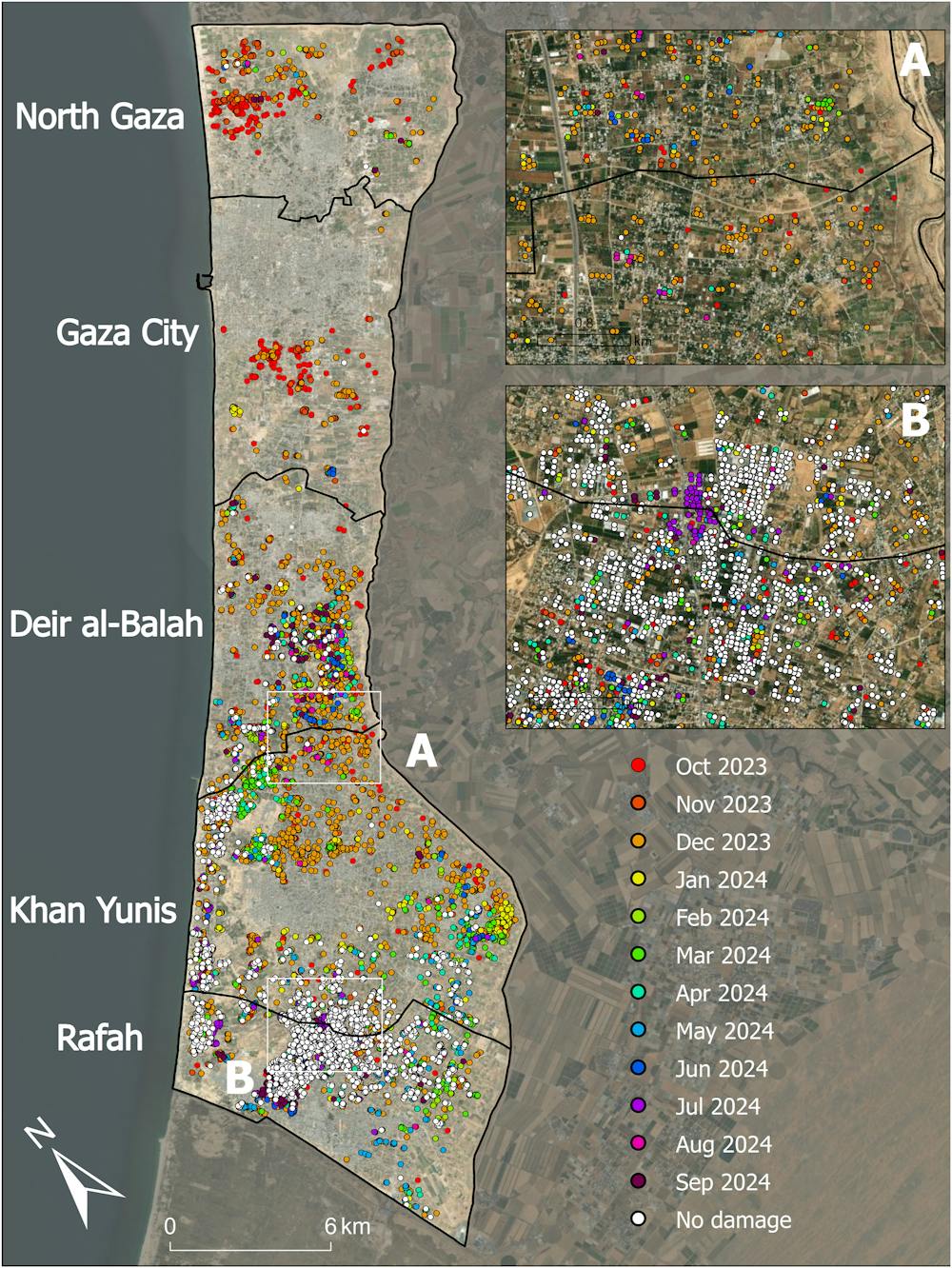
    Over the past 17 months we have analysed satellite images across the Gaza Strip to quantify the scale of agricultural destruction across the region. Our newly published research reveals not only the widespread extent of this destruction but also the potentially unprecedented pace at which it occurred. Our work covers the period until September 2024 but further data through to January 2025 is also available.

    Before the war, tomatoes, peppers, cucumbers and strawberries were grown in open fields and greenhouses, and olive and citrus trees lined rows across the Gazan landscape. The trees in particular are an important cultural heritage in the region, and agriculture was a vital part of Gaza’s economy. About half of the food eaten there was produced in the territory itself, and food made up a similar portion of its exports.

    By December 2023, only two months into the war, there were official warnings that the entire population of Gaza, more than 2 million people, was facing high levels of acute food insecurity. While that assessment was based on interviews and survey data, the level of agricultural damage across the whole landscape remained out of view.

    Most olive and citrus trees are gone

    To address this problem, we mapped the damage to tree crops – mostly olive and citrus trees – in Gaza each month over the course of the war up until September 2024. Together with our colleagues Dimah Habash and Mazin Qumsiyeh, we did this using very high-resolution satellite imagery, detailed enough to focus on individual trees.

    We first visually identified tree crops with and without damage to “train” our computer program, or model, so it knew what to look for. We then ran the model on all the satellite data. We also looked over a sample of results ourselves to confirm it was accurate.

    Our results showed that between 64% and 70% of all tree crop fields in Gaza had been damaged. That can either mean a few trees being destroyed, the whole field of trees completely removed, or anything in between. Most damage took place during the first few months of the war in autumn 2023. Exactly who destroyed these trees and why is beyond the scope of our research or expertise.

    In some areas, every greenhouse is gone

    As greenhouses look very different in satellite images, we used a separate method to map damage to them. We found over 4,000 had been damaged by September 2024, which is more than half of the total we had identified before the start of the war.

    Greenhouses and the date of initial damage between October 2023 and September 2024.
    Yin et al (2025)

    In the south of the territory, where most greenhouses were found, the destruction was fairly steady from December 2023 onwards.

    But in north Gaza and Gaza City, the two most northerly of the territory’s five governorates, most of the damage had already taken place by November and December 2023. By the end of our study period, all 578 greenhouses there had been destroyed.

    North Gaza and Gaza City have also seen the most damage to tree crop fields. By September 2024, over 90% of all tree crops in Gaza City had been destroyed, and 73% had been lost in north Gaza. In the three southern governorates, Khan Younis, Deir al-Balah and Rafah, around 50% of all tree crops had been destroyed.

    Agricultural damage is common in armed conflict, and has been documented with satellite analysis in Ukraine since the 2022 Russian invasion, in Syria and Iraq during the ISIS occupation in 2015, and in the Caucasus during the Chechen wars in the 1990s and 2000s.

    The exact impact can differ from conflict to conflict. War may directly damage lands, as we have seen in Gaza, or it may lead to more fallow areas as infrastructure is damaged and farmers are forced to flee. A conflict also increases the need for local agricultural production, especially when food imports are restricted.

    Our assessment shows a very high rate of direct and extensive damage to Gaza’s agricultural system, both compared to previous conflict escalations there in 2014 and 2021, and in other conflict settings. For example, during the July-August war in 2014, around 1,200 greenhouses were damaged in Gaza. This time round at least three times as many have been damaged.

    Agricultural attacks are unlawful

    Attacks on agricultural lands are prohibited under international law. The Rome Statute of the International Criminal Court from 1998 defines the intentional use of starvation of civilians through “depriving them of objects indispensable to their survival” as a war crime. The Geneva conventions further define such indispensable objects as “foodstuffs, agricultural areas for the production offoodstuffs, crops, livestock, drinking water installations and supplies and irrigation works”.

    Our study provides transparent statistics on the extent and timing of damage to Gaza’s agricultural system. As well as documenting the impacts of the war, we hope it can help the massive rebuilding efforts that will be required.

    Restoring Gaza’s agricultural system goes beyond clearing debris and rubble, and rebuilding greenhouses. The soils need to be cleaned from possible contamination. Sewage and irrigation infrastructure need to be rebuilt.

    Such efforts may take a generation or more to complete. After all, olive and citrus trees can take five or more years to become productive, and 15 years to reach full maturity. After previous attacks on Gaza the trees were mostly replanted, and perhaps the same will happen again this time. But it’s for good reason they say that only people with hope for the future plant trees.

    Lina Eklund receives funding from the Swedish National Space Agency and the Strategic Research Area: The Middle East in the Contemporary World (MECW) at the Centre for Advanced Middle Eastern Studies, Lund University, Sweden.

    He Yin receives funding from NASA.

    Jamon Van Den Hoek receives funding from NASA.

    ref. Gaza: we analysed a year of satellite images to map the scale of agricultural destruction – https://theconversation.com/gaza-we-analysed-a-year-of-satellite-images-to-map-the-scale-of-agricultural-destruction-248796

    MIL OSI AnalysisEveningReport.nz

  • MIL-OSI United Nations: Experts of the Committee on the Elimination of Discrimination against Women Praise Belarus for Progress in Preventing Trafficking, Ask about Criminalisation of HIV Transmission and Reported Repression of Civil Society

    Source: United Nations – Geneva

    The Committee on the Elimination of Discrimination against Women today concluded its consideration of the ninth periodic report of Belarus, with Committee Experts praising the State’s progress in preventing trafficking, and raising questions about the criminalisation of HIV transmission and reports of repression of civil society.

    Elgun Safarov, Committee Expert and Rapporteur for Belarus, and other Experts commended Belarus’ awareness-raising projects on the prevention of trafficking and women’s empowerment.

    One Committee Expert noted that Belarus had a high number of criminal cases related to HIV.  Transmission of HIV was penalised with imprisonment of up to five years. Was the State party rethinking this law?

    Mr. Safrov said many very important non-governmental organizations had been closed recently.  What were the reasons for these closures?  There were reports of repression of women journalists and activists.

    Several other Experts expressed concern about reports that women who expressed dissent were punished and detained.  What plans were in place to protect women activists from gender-based violence and State repression?  Why were civil society organizations engaged in the protection of human rights dissolved by the State?

    Introducing the report, Larysa Belskaya, Permanent Representative of Belarus to the United Nations Office at Geneva and head of the delegation, said Belarus strived to fully ensure equal rights and opportunities for women in all spheres. In an extremely difficult geopolitical situation, Belarus progressively built a society where every person could have decent living conditions and benefit society.

    The delegation said Belarus had taken measures to eliminate trafficking in persons and to identify and rehabilitate victims.  In 2024, authorities identified 1,500 cases of suspected trafficking and identified several victims, including minors.  The State worked with civil society to build the capacity of law enforcement staff related to trafficking; 90 training sessions had been held in 2024.

    Concerning the transmission of HIV, the delegation said that in 2023, nine women had been penalised for transmitting HIV and 12 women were penalised in 2022.  The State party was continuing to reduce the stringency of HIV legislation.  A draft law had been developed to decriminalise unintentional transmission of HIV.  Penalties for the deliberate transmission of HIV would remain.

    The delegation said the Committee’s assessments related to repression were not appropriate.  The protests that took place in Belarus over the reporting period were in many cases not peaceful.  Certain extremist actions were taken by media workers.  The Government was working to increase understanding of the situation.

    Civil society in Belarus was active, the delegation added.  The State party had over 1,500 civil society organizations, including women’s organizations.  In 2020, there was an attempt to carry out a coup d’etat by several non-governmental organizations engaged in anti-Government activities.  A court decision held these organizations and their members responsible for violating the law.  This should not be considered repression of civil society.  In 2023, a new law on the activities of civil society was adopted that required organizations to re-register.  Many non-governmental organizations had not completed the new registration procedure and had been shut down.  Citizens were entitled to renew the activities of previous non-governmental organizations.

    In closing remarks, Ms. Belskaya said Belarus had achieved much in terms of gender equality and empowering women.  The discussion helped the State party to identify the remaining issues to be addressed. The Committee’s recommendations would be carefully considered by the National Council on Gender Equality and used to construct the next national action plan on gender equality

    In her closing remarks, Nahla Haidar, Committee Chair, commended the State party for its efforts and encouraged it to implement the Committee’s recommendations for the benefit of all women and girls in Belarus.

    The delegation of Belarus consisted of representatives from the Ministry of Labour and Social Protection; Ministry of Health; and the Permanent Mission of Belarus to the United Nations Office at Geneva.

    The Committee will issue the concluding observations on the report of Belarus at the end of its ninetieth session on 21 February.  All documents relating to the Committee’s work, including reports submitted by States parties, can be found on the session’s webpage.  Meeting summary releases can be found here.  The webcast of the Committee’s public meetings can be accessed via the UN Web TV webpage.

    The Committee will next meet at 10 a.m. on Friday, 7 February to consider the eighth periodic report of Luxembourg (CEDAW/C/LUX/8).

    Report

    The Committee has before it the ninth periodic report of Belarus (CEDAW/C/BLR/9).

    Presentation of Report

    LARYSA BELSKAYA, Permanent Representative of Belarus to the United Nations Office at Geneva and head of the delegation, said Belarus was committed to the principles of the Convention and strived to fully ensure equal rights and opportunities for women and men in all spheres.  Its Gender Gap Index score had almost halved from 0.152 in 2014 to 0.096 in 2024, placing the country 29th out of 166 countries.  In an extremely difficult geopolitical situation, Belarus preserved its State, peace and tranquillity, and progressively built a society of equal opportunities, where every person could have decent living conditions and benefit society.

    Over the years, the Government had made serious efforts to implement the Convention and had achieved concrete results for the advancement of women.  Gender policy was coordinated by the National Council on Gender Policy.  Every five years, national action plans on gender equality were adopted.  This year, the sixth national action plan (2021-2025), the goals and objectives of which were linked to the Sustainable Development Goals, was being implemented.  Work was also progressively being carried out to introduce mechanisms for gender analysis of legislation and gender budgeting in the development of draft State plans and programmes. 

    The National Statistical Committee had developed thematic information systems that made it possible to analyse the situation in the field of gender equality.  The “Gender Statistics Web Portal” contained 178 gender statistics.  In 2020, the Labour Code introduced a norm establishing paternity leave of up to 14 days within six months after the birth of the child.  The Government was also working to calculate the value of unpaid domestic services not included in gross domestic product.  The final data would be published in June 2025.

    Belarussian women were actively promoted to managerial positions.  In the National Assembly, the share of women in 2023 was 36 per cent. At the same time, in the House of Representatives, their share was 40.6 per cent.  Women accounted for 47 per cent of local self-government bodies. Among senior civil servants, the share of women in 2023 was 54.6 per cent; among judges, 64.4 per cent.

    Labour legislation provided for parents with family responsibilities an additional day off from work per month or reduced working days, flexible forms of employment, and remote employment.  The country guaranteed access for all citizens to health care, education, social services, culture and sports.  At the birth of a child, the State provided material support to all families and the payment of insurance premiums.  Benefits for pregnancy, childbirth and temporary disability had been increased, as had social support for parents raising a child with disabilities.  Since 2015, the State also provided a one-time non-cash provision equalling 10,000 United States dollars at the birth or adoption of third or subsequent children.

    The Belarussian Women’s Union, which united 162,000 women, worked to raise the status of women in society and their role in all spheres of life, and there were 15 more women’s organizations in Belarus.  In total, as of October 2024, there were 1,466 public associations; 18 new public associations were registered in 2024. 

    In Belarus, the literacy rate of the population aged 15 and over was almost 100 per cent. General secondary education was compulsory for all.  The percentage of women in higher education was about 53 per cent.  Almost 92 per cent of women aged 16-72 used the Internet.

    For several years, there had been a decrease in the female working age unemployment rate, from 3.1 per cent in 2019 to 2.7 per cent in 2023.  This figure was lower than the male unemployment rate, which was 4.1 per cent in 2023.  More than 42 per cent of employed women had completed higher education and 70 per cent of civil servants were women.  The share of women among researchers in Belarus was 39.2 per cent.  In 2024, for the first time, a female cosmonaut from Belarus, Marina Vasilevskaya, flew to the International Space Station.  Belarus was also actively developing women’s entrepreneurship; the representation of women in this area was 36.4 per cent.  In 2023, the first Forum of Women Entrepreneurs was held, with the active participation of the Belarussian Women’s Union.

    Every woman, regardless of income, had the opportunity to receive any type of medical care free of charge.  Unprecedented measures were being taken in the country to protect motherhood and childhood, to accompany women during pregnancy, and to carry out annual medical examinations.  Belarus was among the 25 countries with the highest rating in terms of access to sexual and reproductive health, information and education.  The proportion of women using various types of contraception increased from 39.9 per cent in 2010 to 53.2 per cent in 2021. The number of abortions per 1,000 women of childbearing age over the past 10 years had decreased by almost two times to 6.2 per cent in 2023.  Since 2011, no cases of illegal abortions had been registered in the country.

    Specific measures were being taken in Belarus to prevent domestic violence.  In 2022, protective measures for victims and preventive measures against violators were strengthened.  Every year, about 15,000 victims turned to regional social service centres for help.  A network of “crisis” rooms was being developed, with 134 rooms having been established as of 2024.  There were no restrictions on the time in which people could live in these rooms; in the first half of 2024, 81 women lived in them.  Public and international organizations were involved in aiding women victims of domestic violence.

    From today’s dialogue, Belarus expected practical and implementable recommendations that would allow it to implement high international standards in State policy to ensure equal rights and expand opportunities for women.

    Questions by a Committee Expert 

    ELGUN SAFAROV, Committee Expert and Rapporteur for Belarus, said that Belarus had developed family and women policy, implemented many awareness-raising projects on the prevention of trafficking and women’s empowerment, organised several international conferences on women in entrepreneurship and science, and adopted several legislative acts on women rights protection during the reporting period. He expressed appreciation for the State party’s activities for the harmonisation of legislation and measures for the adoption of international standards. 

    However, the Committee had witnessed multiple violations of women’s rights.  The State party did not have comprehensive anti-discrimination legislation that specifically prohibited discrimination against women, including direct and indirect discrimination, and also had no specific, stand-alone legislation on gender equality, or a law explicitly focused on ending all forms of gender-based violence, including domestic violence.  Sexual harassment in the workplace remained unaddressed in legislation, and laws prohibited women’s participation in certain jobs. 

    There were many problems related to access to justice for women.  There needed to be effective remedies for victims of discrimination.  There was no special body for deciding cases related to discrimination against women.  HIV transmission was criminalised.  Why had some women lawyers’ licenses been terminated?

    What measures were in place to incorporate a definition of equality between women and men in the Constitution and the Criminal Code?  What mechanisms were in place to protect against discrimination?  Had the Convention been translated into Belarussian? Were there any court cases that had referenced the Convention?  Why had closed court sessions been held to try women who had participated in peaceful demonstrations?  How were lawyers appointed?  Did the State party keep data on criminal cases related to gender?

    Responses by the Delegation

    The delegation said Belarus did not have a comprehensive definition of discrimination against women in its legislation, but principles of equality were included in the Constitution and various laws.  The Government had considered developing a single act on discrimination, but had found that existing legislation sufficiently banned discrimination. Legal amendments were introduced in 2022 to provide women and men with equal opportunities in employment, training and education.  The rights of victims of sexual discrimination needed to be restored under law. All complaints of discrimination, including from women and foreign citizens, needed to be reviewed by relevant State authorities within a tight deadline.  Discriminatory norms were not permitted in legislation.  Follow-up on implementation of gender legislation was carried out by a dedicated group of the National Council on Gender Policy.

    The Bar Association carried out activities to inform citizens about how they could access legal aid.  Women who lodged a complaint related to workplace discrimination or the deprivation of parental rights, as well as pregnant women, vulnerable families and victims of trafficking, received legal aid free of charge. Women in prisons could receive legal aid when they submitted complaints.  Women could choose their own lawyer, or were appointed one if they could not afford one.

    Belarus had two national languages: Belarussian and Russian.  Russian was more represented in State correspondence, but this did not hinder access to information on legislation for the population.  The Convention was part of the national legal system and had been referenced in court proceedings.  The Criminal Code recognised undermining of women’s bodily integrity as an offence.  There were around 50 cases related to bodily harm in the first half of 2024, and 44 cases of other sexual offences.

    Questions by Committee Experts 

    A Committee Expert commended the Government on efforts to align policies with the Sustainable Development Goals. However, the Committee was concerned by the absence of an independent national human rights institution, and by the exclusion of civil society organizations that worked to safeguard women’s rights.  Would the State party consider establishing a national human rights institution in line with the Paris Principles?  Which Government agency was responsible for protecting women’s rights.

    The Expert welcomed the policy to promote gender empowerment and gender sensitive budgeting.  How would the national action plan on gender equality be monitored?  How would the State party ensure the meaningful participation of civil society in this regard?

    The Committee was deeply concerned by the increasingly shrinking civic space.  Many women human rights defenders faced detention and restriction of activities. What plans were in place to protect women activists from gender-based violence and State repression?  Why were civil society organizations that were engaged in the protection of human rights dissolved by the State?

    Belarus had not adopted a national action plan on women, peace and security.  Would it consider developing such a plan to mainstream gender perspectives into peacebuilding efforts?

    One Committee Expert said the share of women in regional leadership positions was low and there were very few female ambassadors.  Women who peacefully expressed diverse political opinions were at a high risk of being treated as extremists.  Had the State party implemented temporary special measures to ensure gender equality in recent years?  Were there measures to increase the representation of women in leadership positions, as well as in employment and education?  What measures were in place to support vulnerable women and to mitigate the impact of the COVID-19 pandemic on gender equality?

    Responses by the Delegation

    The delegation said Belarus had State and public institutions protecting human rights, including the national councils on gender equality, children and disability, and the Environmental Committee, among others.  The State had conducted consultations with civil society, international organizations and State agencies in 2017 related to the establishment of a national human rights institution.  Belarus believed that creating a national human rights institution was not a priority as its existing bodies were working efficiently to protect human rights. This issue could be examined in more detail at a later stage.

    The National Council on Gender Equality coordinated and monitored the implementation of national action plans on gender equality.  From 2023 to 2024, a gender assessment methodology for legislation was adopted. Based on assessments, problems had been identified and measures were being planned to address them in the next national action plan.

    Belarus was not a party to any conflict currently, so it had not implemented special measures related to women, peace and security.  However, the Government had taken measures to protect Ukrainian refugees.  Over 200,000 people had arrived from Ukraine in the past three years, more than half of whom were women.  Belarus offered refugees temporary protection and the choice of becoming Belarussian citizens.

    Civil society in Belarus was active. The State party had over 1,500 civil society organizations, as well as professional unions and women’s organizations. The Belarussian Women’s Union actively engaged with State authorities.  There were also specialised civil society organizations supporting vulnerable women.  The process for registering a civil society organization was simple and transparent; the State did not interfere in the registration of such organizations and provided regular support to existing organizations.  Under the law on civil society organizations, such organizations could be closed based on court decisions finding that the organization had carried out unlawful propaganda or violated State legislation. 

    Citizens active in social activities had the right to be defended but were held liable when they violated the law. In 2020, there was an attempt to carry out a coup d’etat by several non-governmental organizations engaged in anti-Government activities.  A court decision had held these organizations and their members responsible for violating the law.  This should not be considered repression of civil society.  After these events, laws on civil society were amended to provide incentives for more constructive civic activities.  Non-governmental organizations in Belarus needed to work cooperatively with the State and could not be funded from abroad.

    Questions by Committee Experts

    A Committee Expert welcomed that the State party had not ruled out establishing a national human rights institution and called for serious consideration of its establishment.  The Expert called for the development of a dedicated policy on women, peace and security.  How many women’s organizations participated in the development and analysis of the national action plan on gender equality?

    Another Committee Expert welcomed advances in protection from domestic violence, including the law on crisis prevention.  However, gender stereotypes were spread in media communications and women were systematically silenced and controlled by the State – women who expressed dissent were attacked, punished and detained.  Vulnerable women were often blamed and stigmatised when they sought protection.  The State party implemented restraining orders for only 30 days and perpetrators were not expelled from homes. 

    Would the State party adopt a comprehensive strategy to address gender stereotyping, a comprehensive law against domestic violence, and penal protection against marital rape?  How would the State party protect victims in criminal proceedings?  What remedies had been provided to victims in recent years?  How many persons had been convicted for domestic violence crimes? What services were provided in crisis rooms and how were personnel in these rooms trained?  Why did the rooms also house men?  Over 30 non-governmental organizations managing hotlines and shelters had been closed; why was this?

    One Committee Expert commended the State party for addressing trafficking in persons by ratifying international conventions on trafficking and developing comprehensive laws related to trafficking.  Could the State party provide data on trafficking and prostitution?  What measures were in place to protect women with disabilities from trafficking and to identify victims of trafficking?  How many investigations into trafficking had been carried out and how many persons were convicted?  How was the State party strengthening protections for women and girls against trafficking, promoting their access to justice, and building the capacity of State officials on the gendered aspects of trafficking?

    Responses by the Delegation

    The delegation said analysis of the national action plan on gender equality was carried out twice a year. The Belarus Women’s Union was represented in the National Commission on Gender Equality and other bodies.  The State party also closely cooperated with the Red Cross and other international organizations, and supported organizations of persons with disabilities.  Seventy per cent of civil servants were women; 50 per cent were in middle management positions and were involved in preparing important political decisions.

    Eliminating gender stereotypes was one of the goals of the national action plan for gender equality.  The State party was working to enhance the role of fathers in carrying out domestic tasks and was working with civil society on a joint project encouraging responsible fatherhood.  There was a programme on State television that presented case studies of successful professional women.

    Persons who perpetrated domestic violence were required to leave the homes where victims lived, and authorities monitored compliance.  The law on preventing domestic violence had been amended to address violence against former partners and cohabitants.  The number of protective measures that had been implemented had increased significantly from around 18,000 in 2022 to 33,000 in 2024.  The Government supported victims to stay in their homes.  There were awareness raising campaigns in place to inform potential victims about reporting channels and preventing gender-based violence.  All types of bodily harm were criminalised.

    Every year, around 17,500 complaints of domestic violence were made.  If women victims required temporary housing, it was provided. Shelters could be accessed 24 hours a day by victims and their children without documentation.  There were hundreds of crisis rooms available, including 132 equipped for children.  Work was underway to ensure access to the rooms for persons with disabilities.

    Belarus had taken measures to eliminate trafficking in persons and to identify and rehabilitate victims.  In 2024, authorities identified 1,500 cases of suspected trafficking and identified several victims, including minors. The State worked with civil society to build the capacity of law enforcement staff related to trafficking; 90 training sessions had been held in 2024.  Specialists had been hired to support victims of various forms of trafficking.  The State was also working to align national trafficking legislation with international norms, and various awareness raising campaigns on trafficking were also in place. Involvement in prostitution was an administrative offence; however, victims of trafficking were not prosecuted, but were provided with support.

    Questions by Committee Experts

    A Committee Expert welcomed that legislation was being amended regarding domestic violence, which needed to be made an aggravated circumstance in homicide offences.  What measures were in place to ensure the safety of victims of domestic violence?

    Another Committee Expert commended progress being made related to trafficking and prostitution.

    ELGUN SAFAROV, Committee Expert and Rapporteur for Belarus, asked why there was a shortage of female Belarussian ambassadors.  None of the chambers of Parliament had female chairs; there were no parliamentary committees working to protect women’s rights; and only one out of 24 Ministers was a woman.  Why was this? How many Deputy Ministers were women? To what extent were women represented in the technological sector?

    Many very important non-governmental organizations had been closed recently.  What were the reasons for these closures?  There were reports of repression of women journalists and activists.

    One Committee Expert noted progress made in reducing statelessness through nationalisation efforts. However, 2,473 women remained stateless in the State party.  Were there programmes addressing statelessness?  When would the State party ratify the 1954 and 1967 United Nations conventions on statelessness?  The State party had not established a clear procedure for protecting migrant mothers and newborns.  Would it do so?

    Responses by the Delegation

    The delegation said the law on prevention of violence included a clause on educational programmes for perpetrators. The State party was interested in best practices in this field in other countries.

    Women made up around 70 per cent of Belarus’ Ministry of Foreign Affairs.  At a time, Belarus had four female ambassadors.  Appointment to ambassadorial roles was based on competitive selection and there was a shortage of women applicants.  Women were broadly represented as deputy chairs of parliamentary committees and made up around 50 per cent of the members of local councils. Belarus aimed to improve women’s representation in all fields.

    The Committee’s assessments related to repression were not appropriate.  The protests that took place in Belarus over the reporting period were in many cases not peaceful.  Certain extremist actions were taken by media workers.  The Government was working to increase understanding of the situation.

    In 2023, a new law on the activities of civil society was adopted that required organizations to re-register. Many non-governmental organizations had not completed the new registration procedure and had been shut down. Citizens were entitled to renew the activities of previous non-governmental organizations.

    Belarus strived to eradicate statelessness.  The number of stateless women in Belarus had significantly decreased by around 5,000 persons over the past 10 years, thanks to the work of authorities in collaboration with United Nations bodies.  The State supported stateless persons and their children to apply for Belarussian citizenship.  It was continuing work towards ratification of the United Nations conventions on statelessness.  The Government had not received reports of unlawful treatment of stateless persons. Stateless persons in Belarus were primarily citizens of the former Soviet Union.  Their numbers were low; the number of stateless children was less than 10.  To receive citizenship, people needed to demonstrate that they had sufficient income and had not committed offences.

    Questions by a Committee Expert 

    A Committee Expert said Belarus had near universal enrolment of girls and boys in primary education.  Educational instructions could reproduce harmful tropes of men as breadwinners and women as caregivers.  What measures were in place to enforce the role of men as caregivers? Only 23 per cent of persons in science, technology, engineering and maths education were women.  What measures were in place to promote their participation?  Only 17 per cent of university professors were female.  How would this be addressed?  Many students had been arrested and prosecuted for their engagement in protest movements.  Nine of the 11 students detained were women, including a woman professor.  What was the status of these women?

    Responses by the Delegation

    The delegation said traditional values in Belarus promoted families with children. Many educational programmes aimed to uphold traditional values and promote gender equality and the equal roles of men and women.  Around 52 per cent of higher education students were women.  Around 40 per cent of workers in the information technology sphere were women.  The Government was implementing incentives and other measures to attract girls to science, technology, engineering and maths careers.

    Students were detained on the grounds that they had broken a criminal law.  There was no persecution of students simply for exercising freedom of expression.

    Questions by a Committee Expert

    One Committee Expert said the employment rate of men was 72 per cent compared to 63 per cent for women. Although the list of closed professions for women had been reduced significantly, significant barriers for women accessing the labour market remained, and the list itself was a form of discrimination.  Women were underrepresented in higher-paid industries.  Workplace harassment remained common and legislation did not provide adequate remedies for victims and penalties for perpetrators.  Detained women were legally required to engage in labour; this was a form of modern slavery.  In July 2022, all independent trade unions were banned in Belarus. What protection mechanisms were available related to workplace sexual harassment?  Was there a national action plan for addressing the gender pay gap? When would the State party abolish forced labour for prisoners?

    In 2017, the State introduced pension reform, raising the retirement age.  Many citizens had lost their pensions due to the reforms.  Why did men and women have different pension ages?

    Responses by the Delegation

    The delegation said the rate of employment for women from 15 to 74 was 63 per cent, whereas the employment rate for women of working age was above 80 per cent. Belarus promoted equal pay for work of equal value.  Overall, women earned around 75 per cent of what men earned.  In the transport sector and the agricultural sector, wage gaps were much lower.  The State party was implementing measures to reduce the gender pay gap.  Women were now able to work in professions that were previously not accessible, such as truck drivers.  The State party was encouraging men to take parental leave. Women who experienced workplace harassment could report the incident to local authorities and receive remedies. 

    The Supreme Court had ruled that trade unions were to be closed when their activities were harmful to public interests or State values. The federation of trade unions covered almost all unions in the country.  It promoted general and collective agreements, which provided additional social and labour rights for workers.

    Women earned 92.5 per cent of the pension earned by men. Less than one per cent of the elderly were poor.  Women could continue working after they reached pension age; around 20 per cent of women did so.  The Presidential Decree on Employment did not punish individuals who were not working. Under the decree, women who were not working had the right to access State subsidies.

    The State party was exerting efforts to address the gender pay gap.  The national action plan on gender equality, which was based on the Committee’s previous recommendations, introduced measures to support female entrepreneurs and workers.

    Questions by a Committee Expert

    A Committee Expert said there had been significant advances in the field of public health in Belarus in recent years, but access to medicines was better in cities than in rural areas, and the quality of healthcare had declined nation-wide.  How was the State party supporting equal access to affordable healthcare for women from vulnerable groups?  What measures were in place to remove obstacles to accessing abortions?  Did both men and women need to undergo cancer screenings before they could obtain a driver’s licence?

    Women with disabilities faced barriers in accessing sexual and reproductive health services.  How was the State party meeting the needs of women with disabilities in this regard?  Some women with disabilities had been pressured to hand over their children to the State.  How would the State party address the discrimination faced by women with disabilities?  How did the delegation respond to reports of sterilisation of women with disabilities?

    Women with HIV reportedly faced systematic discrimination in health care.  The Penal Code sanctioned the transmission of HIV regardless of the circumstances. What measures were in place to support women with HIV?  What was the situation of sexual and reproductive health education?

    Responses by the Delegation

    The delegation said that in Belarus, medical assistance for persons with HIV was provided in line with health protocols from 2018 and 2022.  In 2018, Belarus had been certified as being free from mother-to-child transmission of HIV.  There were around 27,000 HIV positive people in the State.  The State party worked closely with non-governmental organizations to provide treatment for HIV positive people.  Around 95 per cent of HIV positive people were receiving retroviral treatment.  Women formerly had to present certificates from gynaecologists to receive a driver’s licence; as of last year, this was no longer necessary.  A draft law had been developed to decriminalise unintentional transmission of HIV.  Penalties for the deliberate transmission of HIV would remain.

    The protection of maternal and child health was a priority for the State.  Women who sought abortions could receive free counselling.  Over five years, these counselling sessions had prevented 23,000 abortions.  Pregnancies were interrupted only when the pregnant woman provided permission.

    All women, including women with disabilities, had access to medical assistance without discrimination.  Resources were set aside to allow for high quality medical care of the population.

    The World Health Organization had highly rated the medical care provided in Belarus.  The assessment that the quality of medical care had declined in recent years was not in line with reality.  Mobile health clinics provided in-home medical care in rural areas.  The State party was addressing shortages in healthcare staff.  It had difficulties in accessing certain types of medications due to sanctions from Western countries.

    Questions by Committee Experts

    A Committee Expert commended measures reforming regulations on universal social protection and access to support funds for entrepreneurs. Were there schemes guiding social protection for workers in the informal sector?  What steps had been taken to incorporate gender considerations into the tax regime?  What percentage of business grants were received by female entrepreneurs over the past five years?  How had technological training helped to bridge gender gaps in digital fields? How was the State party strengthening women’s role in sports and cultural activities and addressing stereotypes related to sports and culture?

    Another Committee Expert congratulated Belarus on co-sponsoring the United Nations Convention against Cybercrime and for implementing measures to protect elder women in digital spheres.  What social security and economic policies were in place for elderly women?  Belarus had a high number of criminal cases related to HIV.  Transmission of HIV was penalised with imprisonment of up to five years.  Was the State party rethinking this law?

    Women with disabilities’ right to work could only be realised after a medical examination.  How would the State party allow for the full realisation of these women’s right to work?

    Women in prisons were reportedly denied access to menstrual products.  How would the State party ensure that all detained women were treated in a dignified manner?  Belarus had in 2022 broadened its definition of pornography to include non-traditional relationships.  How would this affect the lesbian, bisexual, transgender and queer community?  Were the rights of indigenous women considered in plans to develop a second nuclear powerplant in the State? 

    Responses by the Delegation

    The delegation said there were around 400,000 people engaged in entrepreneurship in Belarus, 40 per cent of whom were women.  There was a framework for supporting women entrepreneurs, including in rural areas, and norms and laws aimed to support small businesses. Special taxation measures were provided to women entrepreneurs.  The share of women entrepreneurs had increased by around 10 per cent in recent years.  A State support programme for the unemployed had been established; almost half of all beneficiaries were women.

    In 2023, nine women had been penalised for transmitting HIV and 12 women were penalised in 2022.  The State party was continuing to reduce the stringency of HIV legislation.

    There was a Government mechanism which visited prisons regularly to examine living conditions.  The Attorney-General also monitored compliance with legislation on prisons.  Access to all forms of medical care was granted to detainees.  All detainees could file complaints to courts related to the lawfulness of their detention as well as other problems.  Prisoners who violated prison regimes were placed in solitary confinement.

    The State party had a plan for implementing the Convention on the Rights of Persons with Disabilities.  It supported employers who hired persons with disabilities and provided training to help persons with disabilities access work.  An act on quotas for persons with disabilities in the workplace had been implemented.

    Legislative changes addressed the circulation of products that harmed public morality.  They were not expected to have an impact on the lesbian, bisexual, transgender and intersex community.  People could choose the type of relationship they had.

    The impact on human health of the State’s nuclear power plants was negligible.  Belarus upheld the highest standards of safety.

    Women were being encouraged to participate in sports traditionally favoured by men.

    Questions by a Committee Expert

    ELGUN SAFAROV, Committee Expert and Rapporteur for Belarus, asked if the State party had statistics on the amount of property inherited by women.  How did courts protect women’s property rights in divorce proceedings? How were children’s rights protected in international adoption proceedings?  The dialogue and the Committee’s recommendations would help with protecting the rights of women in Belarus.

    Responses by the Delegation

    The delegation said Belarus’ legislation on divorce promoted the best interests of the child.  Mediation was increasingly used in custody cases.  The interests of the mother and father were duly protected.  Belarus worked with several States on regulating international adoptions.  The State party monitored families who had adopted Belarussian children to ensure that their rights were upheld.

    Concluding Remarks

    LARYSA BELSKAYA, Permanent Representative of Belarus to the United Nations Office at Geneva and head of the delegation, thanked the Committee for the dialogue. Belarus had achieved much in terms of gender equality and empowering women.  The discussion helped the State party to identify the remaining issues to be addressed.  The Belarussian population supported the State’s measures, but there was more to be done.  The Committee’s recommendations would be carefully considered by the National Council on Gender Equality and used to construct the next national action plan on gender equality

    NAHLA HAIDAR, Committee Chair, thanked the delegation for its engagement with the Committee.  The dialogue had provided insights into the achievements made in Belarus and the areas in which further progress was needed.  The Committee commended the State party for its efforts and encouraged it to implement the Committee’s recommendations for the benefit of all women and girls in Belarus.


    Produced by the United Nations Information Service in Geneva for use of the media; 
    not an official record. English and French versions of our releases are different as they are the product of two separate coverage teams that work independently.


    CEDAW25.004E

    MIL OSI United Nations News

  • MIL-Evening Report: The transformation of Jordan Mailata: from rugby league in Sydney to a second NFL Super Bowl

    Source: The Conversation (Au and NZ) – By Justin Keogh, Associate Dean of Research, Faculty of Health Sciences and Medicine, Bond University

    Jordan Mailata is an Australian-born NFL star who plays for the Philadelphia Eagles as an offensive left tackle. This position favours very tall, heavy and strong athletes who also possess good footwork, agility and tactical awareness.

    His main job is to protect his quarterback and provide gaps for his running backs to run through.

    Mailata is one of four Australians to play in a Super Bowl, with the others being punters (kickers) Ben Graham, Arryn Siposs and Mitch Wishnowsky.

    Unfortunately, no Australian has won the game that matters most every year but Mailata has a chance in his second Super Bowl, against the Kansas City Chiefs on Monday morning.

    So, how did Mailata reach the pinnacle of his “new” sport?


    Read more:
    It’s the most American of sports, so why is the NFL looking to Melbourne for international games?


    A rugby league giant

    Mailata’s initial sporting success came in rugby league.

    He played in the Canterbury Bankstown Bulldogs under-18 team and was offered a contract by the South Sydney Rabbitohs under-20 team. Both of these clubs are part of the elite National Rugby League (NRL) competition.

    Mailata, who still hadn’t reached his 21st birthday when offered the Rabbitohs contract, stood out as a giant even in professional rugby league circles at 203cm and 147 kilograms.

    But after fainting during a rugby league training session, he was diagnosed with a heart condition that required surgery. He then became even bigger, reportedly tipping the scales at close to 170kg.

    Ultimately, this resulted in some of the South Sydney staff and sport agents suggesting American football might be a better option for someone of his stature and physical capacities.

    Tranasferring his talent

    This brings us to what is known as “talent transfer”.

    In high-performance sport, talent transfer refers to a high-level athlete from one sport transferring to another based on their existing skills and physical capacities.

    This can be done for a number of reasons, like injury, burnout, loss of interest, or, in the case of Mailata, finding another sport that would suit their physicality better.

    Examples of talent transfer include sprinting to bobsleigh (Jana Pittman), rowing to cycling (Bridie O’Donnell and Rebecca Romero) or Sonny Bill Williams, who was highly successful at rugby league, rugby union and heavyweight boxing.

    For talent transfer to be successful, there needs to be a lot of similarities between the two sports in areas such as skill requirements (kicking, passing, tackling), physical traits (height, mass) and physiological demands (aerobic vs anaerobic).

    These similarities can allow athletes to capitalise on their previous training to succeed in their new sport faster and to a higher level than their competitors.

    The similarities between American football and rugby (league and union) – such as catching and kicking an oval-shaped ball, evading or running through defenders and full-body tackling – would have benefited a mature athlete like Mailata to transfer from one code to another.

    A whole new ball game

    His transition from a monster-sized rugby league player in Australia to a more regular-sized offensive tackle in the NFL was initially facilitated through the NFL International Player Pathway (IPP) program.

    The IPP was established in 2017 to provide high performance adult athletes from all over the world (like Mailata) the opportunity to learn the complexities of American football and increase the number of international players in the NFL.

    The program has been highly successful, with 37 international players signing with NFL teams, of which 18 are currently on NFL rosters.

    When Mailata was drafted to the NFL in 2018, he had to work on many aspects of his body to meet the physical challenges of playing in the NFL against other exceptionally massive and strong athletes.

    He also had to learn a range of sport-specific technical and tactical skills.

    As a part of the IPP, he started working with coaches including Jeff Stoutland, the Philadelphia Eagles offensive line coach.

    Stoutland took Mailata into the classroom, teaching him the intricacies of offensive line play including protection and run schemes. These lessons extended into what footwork patterns he would need to master, where and how to position his body when initiating contact and how to use his hands to control the defensive line.

    Such skills are the bread and butter of the offensive line – these athletes provide the quarterback time to make key passing decisions and increase the chance of their running backs making big yards on their carries.

    Mailata has also mentioned how Strickland taught him the importance of critically watching NFL games, initially to learn the technicalities of the sport and now to further refine his performance against the best defensive lines.

    The next wave

    In addition to the IPP that looks at talent transfer from adult athletes, the NFL has developed the NFL Academy for school-aged children.

    The first academy was based at Loughborough University in the United Kingdom and the second was developed at A.B. Patterson College on the Gold Coast.

    These academies combine full-time education with intensive American football training in the hope of promoting pathway opportunities at US colleges.

    Hopefully, these academies will see more young Australians transferring their skills and following Mailata into the NFL.

    The authors do not work for, consult, own shares in or receive funding from any company or organisation that would benefit from this article, and have disclosed no relevant affiliations beyond their academic appointment.

    ref. The transformation of Jordan Mailata: from rugby league in Sydney to a second NFL Super Bowl – https://theconversation.com/the-transformation-of-jordan-mailata-from-rugby-league-in-sydney-to-a-second-nfl-super-bowl-248658

    MIL OSI AnalysisEveningReport.nz

  • MIL-OSI Asia-Pac: Under MeitY’s research initiatives, CDAC-Noida Sign Letter of Intent (LoI) with LeGO Group to boost indigenous electronics Toy industry ecosystem

    Source: Government of India

    Under MeitY’s research initiatives, CDAC-Noida Sign Letter of Intent (LoI) with LeGO Group to boost indigenous electronics Toy industry ecosystem

    MeitY initiative to empower Young Engineers from SC/ST and NER Backgrounds in Toy Innovation

    Young Indian Engineers to Receive Global Mentorship from LEGO India and CDAC-Noida

    Posted On: 06 FEB 2025 7:49PM by PIB Delhi

    CDAC-Noida a research organization of MeitY signed a Letter of Intent (LoI) with Creative Play Lab, a department of the LEGO Group under the project ‘Development of Electronics and IT-based Control and Automation Solutions for Consumer Electronic Goods (Toy Industry)’.

    The project is a tailored made initiative of R&D group of the Ministry to foster the growth of the Indian electronic toys industry by developing prototypes and equipping young engineers, including from under-represented communities, with the skills needed to design such toys.

    Under this MeitY initiative, young engineers were selected from across India from SC/ST and NER background and engaged in R&D activities for a year, getting hands-on experience in designing and developing electronic toys for first six months working and learning in the toy labs at C-DAC, Noida followed by a six-month training at industry to create toy prototypes based on industry needs.

    To provide global exposure to the interns, LEGO India is joining hands with CDAC Noida supported by CPL to provide mentorship to 1-2 students per batch on their toy prototypes. The batch of students from India will get the opportunity to visit the LEGO Group’s headquarters in Billund, Denmark. CPL will share knowledge for the 3rd Batch of young engineers through webinars, providing insights on CPL’s experimentation mindset, guidance on toy development and standards, and feedback on toy prototypes developed by the engineering students.

    This event was held on February 6, 2025 at MeitY was graced by Shri Bhuvnesh Kumar, Additional Secretary, MeitY, Shri Abhishek Singh, Additional Secretary, MeitY, Ms. Sunita Verma, GC R&D, MeitY, Shri Vivek Khaneja, ED, CDAC-Noida, Ms. Colette Burke, Global Chief Commercial Officer LEGO Group, Denmark, Mr. Claus Kristensen, Senior Vice President APAC Market Group, Singapore and senior Officers from Ministry and Industry.


    *****

    Dharmendra Tewari/Kshitij Singha

    (Release ID: 2100419) Visitor Counter : 30

    MIL OSI Asia Pacific News

  • MIL-OSI Asia-Pac: Shri Jayant Chaudhary inaugurates NSDC International Academy at Greater Noida

    Source: Government of India (2)

    Shri Jayant Chaudhary inaugurates NSDC International Academy at Greater Noida

    The state-of-the-art facility to provide world-class skill development & training programmes

    The academy to empower youth in foreign languages and prepare them for international career opportunities

    Posted On: 06 FEB 2025 6:38PM by PIB Delhi

    Shri Jayant Chaudhary, Minister of State (I/C), Ministry of Skill Development and Entrepreneurship (MSDE) and Minister of State, Ministry of Education inaugurated the NSDC International Academy at Greater Noida, Uttar Pradesh. The academy is a state-of-the-art facility designed to provide world-class skill development and training programmes.

    The NSDC International Academy is a landmark initiative designed to bridge the gap between Indian youth and global employment opportunities. It will serve as a centre of excellence, offering specialized training programs aligned with the skill demands of countries like Germany, Japan, and Israel. Shri Chaudhary flagged off the departure of 11 candidates headed to Germany. He toured the NSDC International Academy, interacted with students about their life journeys, and offered them motivation and also experienced the AI and VR facilities, advanced labs present at the centre.


    Delivering his address, Shri Jayant Chaudhary, mentioned, “We must recognize that young India is breaking barriers, moving beyond traditional career paths, and looking at new opportunities. Institutions like these are testament to this shift—equipping our youth with the skills, confidence, and global exposure they need to succeed. A great building and infrastructure are important, but the real strength of any institution is its people—the trainers, students, and programs that drive it. With our skilling budget increasing substantially, we are strengthening initiatives like this academy, ensuring young Indians get industry-relevant training, language skills, and cultural readiness. A Viksit Bharat by 2047 will be built by individuals ready to take on global challenges, and our job is to make sure they have the right support to get there.”


    He added, “Prime Minister Shri Narendra Modi Ji is very passionate about skilling, and takes pride in what our ministry is achieving. Skill India programme and ITI rejuvenation programme, announced in the budget will have a huge impact, in increasing our capacity to skill our young people.”

    This centre aims to empower individuals with the skills needed to thrive in today’s competitive global workforce. The academy specializes in internationally recognized language certifications, ensuring that candidates receive globally accepted qualifications. These include OSD and GOETHE certifications for German, JLPT for Japanese, and ISLETS for English, making graduates well-prepared for global opportunities.

    Addressing the audience, Shri Ved Mani Tiwari, CEO, Nation Skill Development Corporation said, “In our journey of making India a global skill capital, today is a pivotal moment as our honorable minister Shri Jayant Chaudhary inaugurates this center, fulfilling the dreams of our honorable prime minister Shri Narendra Modi Ji. The World Economic Forum report says that in the next 25 years, 100 crore people would join the global workforce, with every third and fourth person being Indian. The coming years would ensure that India plays a dominant role in the global economy and contributes significantly to the dollar economy. Our initiatives at this center equip youths with world-class language proficiency and advanced technical skills, preparing them for careers in Germany, Japan, Israel, and the UK. With cutting-edge training in sectors like caregiving and with the support of Industry 4.0, we are readying our talent for global opportunities.

    With a target of training over 1,000 candidates annually, the NSDC International Academy is committed to addressing the demands of both local and international job markets. As part of its mission to enhance employability, the academy will provide placement assistance and establish partnerships with industry leaders to facilitate valuable interview opportunities for its graduates.

    The NSDC International Academy in Greater Noida stands as a flagship initiative, of the National Skill Development Corporation (NSDC) under the Ministry of Skill Development & Entrepreneurship (MSDE), Government of India, dedicated to transforming India’s workforce by providing training and certifications recognised globally. This premier skill development institution offers specialised courses in various fields, including foreign languages, healthcare, employability skills, and aviation, ensuring that Indian youth are well-prepared for international career opportunities.

    The facility features modern classrooms equipped with interactive technology and advanced labs focused on soft skills and language learning with resources that will enable hands-on training and practical application of the learnings. The academy also includes dedicated counselling rooms to provide career guidance and psychological support, fostering holistic development among students. With residential facilities accommodating up to 500 candidates, the NSDC International Academy offers an immersive learning environment that promotes both academic and personal growth.

    With a target of training over 1,000 candidates annually, the NSDC International Academy is committed to addressing the demands of both local and international job markets. As part of its mission to enhance employability, the academy will provide placement assistance and establish partnerships with industry leaders to facilitate valuable interview opportunities for its graduates.

    ****

    PSF

    (Release ID: 2100397) Visitor Counter : 124

    MIL OSI Asia Pacific News

  • MIL-OSI Asia-Pac: Shri Jayant Chaudhary inaugurates NSDC International Academy

    Source: Government of India

    Shri Jayant Chaudhary inaugurates NSDC International Academy

    The state-of-the-art facility to provide world-class skill development & training programmes

    The academy to empower youth in foreign languages and prepare them for international career opportunities

    Posted On: 06 FEB 2025 6:38PM by PIB Delhi

    Shri Jayant Chaudhary, Minister of State (I/C), Ministry of Skill Development and Entrepreneurship (MSDE) and Minister of State, Ministry of Education inaugurated the NSDC International Academy, a state-of-the-art facility designed to provide world-class skill development and training programmes.

    The NSDC International Academy is a landmark initiative designed to bridge the gap between Indian youth and global employment opportunities. It will serve as a centre of excellence, offering specialized training programs aligned with the skill demands of countries like Germany, Japan, and Israel. Shri Chaudhary flagged off the departure of 11 candidates headed to Germany. He toured the NSDC International Academy, interacted with students about their life journeys, and offered them motivation and also experienced the AI and VR facilities, advanced labs present at the centre.


    Delivering his address, Shri Jayant Chaudhary, mentioned, “We must recognize that young India is breaking barriers, moving beyond traditional career paths, and looking at new opportunities. Institutions like these are testament to this shift—equipping our youth with the skills, confidence, and global exposure they need to succeed. A great building and infrastructure are important, but the real strength of any institution is its people—the trainers, students, and programs that drive it. With our skilling budget increasing substantially, we are strengthening initiatives like this academy, ensuring young Indians get industry-relevant training, language skills, and cultural readiness. A Viksit Bharat by 2047 will be built by individuals ready to take on global challenges, and our job is to make sure they have the right support to get there.”


    He added, “Prime Minister Shri Narendra Modi Ji is very passionate about skilling, and takes pride in what our ministry is achieving. Skill India programme and ITI rejuvenation programme, announced in the budget will have a huge impact, in increasing our capacity to skill our young people.”

    This centre aims to empower individuals with the skills needed to thrive in today’s competitive global workforce. The academy specializes in internationally recognized language certifications, ensuring that candidates receive globally accepted qualifications. These include OSD and GOETHE certifications for German, JLPT for Japanese, and ISLETS for English, making graduates well-prepared for global opportunities.

    Addressing the audience, Shri Ved Mani Tiwari, CEO, Nation Skill Development Corporation said, “In our journey of making India a global skill capital, today is a pivotal moment as our honorable minister Shri Jayant Chaudhary inaugurates this center, fulfilling the dreams of our honorable prime minister Shri Narendra Modi Ji. The World Economic Forum report says that in the next 25 years, 100 crore people would join the global workforce, with every third and fourth person being Indian. The coming years would ensure that India plays a dominant role in the global economy and contributes significantly to the dollar economy. Our initiatives at this center equip youths with world-class language proficiency and advanced technical skills, preparing them for careers in Germany, Japan, Israel, and the UK. With cutting-edge training in sectors like caregiving and with the support of Industry 4.0, we are readying our talent for global opportunities.

    With a target of training over 1,000 candidates annually, the NSDC International Academy is committed to addressing the demands of both local and international job markets. As part of its mission to enhance employability, the academy will provide placement assistance and establish partnerships with industry leaders to facilitate valuable interview opportunities for its graduates.

    The NSDC International Academy in Greater Noida stands as a flagship initiative, of the National Skill Development Corporation (NSDC) under the Ministry of Skill Development & Entrepreneurship (MSDE), Government of India, dedicated to transforming India’s workforce by providing training and certifications recognised globally. This premier skill development institution offers specialised courses in various fields, including foreign languages, healthcare, employability skills, and aviation, ensuring that Indian youth are well-prepared for international career opportunities.

    The facility features modern classrooms equipped with interactive technology and advanced labs focused on soft skills and language learning with resources that will enable hands-on training and practical application of the learnings. The academy also includes dedicated counselling rooms to provide career guidance and psychological support, fostering holistic development among students. With residential facilities accommodating up to 500 candidates, the NSDC International Academy offers an immersive learning environment that promotes both academic and personal growth.

    With a target of training over 1,000 candidates annually, the NSDC International Academy is committed to addressing the demands of both local and international job markets. As part of its mission to enhance employability, the academy will provide placement assistance and establish partnerships with industry leaders to facilitate valuable interview opportunities for its graduates.

    ****

    PSF

    (Release ID: 2100397) Visitor Counter : 56

    MIL OSI Asia Pacific News

  • MIL-OSI USA: Arrests of foreign nationals made in electronic benefit transfer card fraud scheme

    Source: US Immigration and Customs Enforcement

    LOS ANGELES — On Feb. 1 and 2, Homeland Security Investigations (HSI) Los Angeles’ El Camino Real (ECR) Financial Crimes Task Force, alongside the United States Secret Service, California Department of Social Services, United States Marshals Service, United States Attorney’s Office Central District of California, Los Angeles County District Attorney’s Office, Los Angeles Sheriff Department, Hermosa Beach Police Department, Baldwin Bark Park Police Department, Culver City Police Department, El Monte Police Department, Inglewood Police Department, Orange County District Attorney Office, and the U.S. Department of Agriculture – Office of Inspector General conducted a large-scale enforcement action at several locations throughout the greater Los Angeles area.

    The goal of this operation was to arrest individuals perpetrating access device fraud through unauthorized cash withdrawals from victim Electronic Benefit Transfer (EBT) cards. This type of fraud victimizes recipients of government sponsored relief programs which are some of our most vulnerable members of the public. During previous operations targeting the same fraud type, the majority of individuals arrested were foreign nationals with no lawful presence in the United States.

    In the past year, the California Department of Social Services has reported more than $100 million in stolen funds from California victims’ EBT cards. The majority of illicit cashouts in the past year occurred in Los Angeles County.

    For violations of 18 United States Code § 1029 (Access Device Fraud), the ECR Task Force and partners arrested 11 foreign nationals, recovered over 300 cloned EBT cards, and recovered over $30,000 in cash during the two-day operation. One of the suspects in custody had been previously arrested by Romanian law enforcement for murder and aggravated murder in Romania. The suspects arrested were transported to the Federal Bureau of Prisons in Los Angeles for processing, to include identification and immigration status determination for suspects unable to be identified or presenting suspected fictitious identification documents.

    Historically, this type of criminal activity has been widely perpetrated by elements of Romanian organized crime who have no legal status in the U.S. or are prior deportees.

    Anyone with information regarding fraud related to government sponsored relief programs is encouraged to call the HSI Tip Line at 877-4-HSI-TIP.

    Learn more about HSI’s mission to increase public safety in your community on X, formerly known as Twitter, at @HSILosAngeles.

    MIL OSI USA News

  • MIL-OSI Asia-Pac: 5th Joint Working Group meeting between MoD of India & Spain held in New Delhi

    Source: Government of India

    Posted On: 06 FEB 2025 5:26PM by PIB Delhi

    The 5th Joint Working Group (JWG) meeting between the Ministry of Defence of India and Spain took place in New Delhi on February 06, 2025. The meeting was co-chaired by Joint Secretary, International Cooperation Shri Amitabh Prasad and Special Advisor on Defence Diplomacy to the Secretary General of Defence Policy Brigadier General Paulino Garcia Diego.

    Both sides reviewed the ongoing bilateral defence cooperation activities and discussed the plan for multiple joint activities, including in the maritime domain. They agreed to focus on a closer collaboration in defence, particularly in technology and armament production areas.

    The  C295 Project with Airbus Spain and Tata Advanced Systems Limited, the first Make-in-India project in the defence aircraft sector, has encouraged more Indian and Spanish companies to collaborate with each other and explore options to work together in the aerospace domain.

    ****

    SR/Savvy

    (Release ID: 2100344) Visitor Counter : 66

    MIL OSI Asia Pacific News

  • MIL-OSI Europe: Answer to a written question – Suspicious under-reporting of nosocomial infections in Romanian hospitals – E-002315/2024(ASW)

    Source: European Parliament

    The prevalence of healthcare-associated infections (HAI) reported by Romanian hospitals in the European Centre for Disease Prevention and Control’s (ECDC) point prevalence surveys (PPS)[1] is indeed low: 2.8% (second lowest) in 2011-2012[2], 3.6% (fourth lowest) in 2016-2017[3], and 3.1% (second lowest) in 2022-2023[4].

    Some degree of under-reporting may be possible, as shown by the data on patient case-mix (severity of the clinical condition of hospitalised patients) in the PPS sample from Romania and the results of the validation of this and previous PPS, but the extent of under-reporting cannot be quantified.

    The low reported prevalence of HAI can also be partly explained by the very low diagnostic testing in Romanian hospitals (third lowest in 2016-2017 and second lowest in 2022-2023), indicating that some HAI may remain undiagnosed because diagnostic tests are not performed.

    In accordance with Article 7(1) of Regulation (EU) 2022/2371[5], Member States must provide a report on their prevention, preparedness and response planning for serious cross-border health threats, which includes their national capacities related to HAI surveillance.

    ECDC periodically assesses the Member States’ prevention, preparedness and response planning at national level under Article 8 of Regulation (EU) 2022/2371.

    Such an assessment[6] is scheduled to take place in Romania in 2026. In any case, the Commission remains in contact with the relevant Romanian authorities.

    Based on the information provided by the Member States and the results of the assessments carried out by ECDC, the Commission shall produce a report on the state of play and progress and may support the action of the Member States through general recommendations on prevention, preparedness and response planning.

    • [1] https://www.ecdc.europa.eu/en/search?s=Point+prevalence+survey
    • [2] https://www.ecdc.europa.eu/en/publications-data/point-prevalence-survey-healthcare-associated-infections-and-antimicrobial-use-0
    • [3] https://www.ecdc.europa.eu/en/publications-data/point-prevalence-survey-healthcare-associated-infections-and-antimicrobial-use-5
    • [4] https://www.ecdc.europa.eu/en/publications-data/PPS-HAI-AMR-acute-care-europe-2022-2023
    • [5] https://eur-lex.europa.eu/eli/reg/2022/2371/oj
    • [6] https://www.ecdc.europa.eu/en/about-ecdc/what-we-do/public-health-emergency-preparedness-assessments

    MIL OSI Europe News

  • MIL-OSI Europe: Answer to a written question – Violations of EU law in the import and trade of used goods vehicles in Greece – E-002490/2024(ASW)

    Source: European Parliament

    The Commission has assessed the Greek legislation imposing new rules for imported used vehicles in Greece.

    Provided that the new licencing procedure is applicable for all used heavy-duty vehicles, domestic or imported, and is thus non-discriminatory, the choice of the environmental standard EURO 6D as a condition for granting the permission to perform public transport services is regulated under national law and does not appear to be in breach of EU law.

    From a general point of view, where a second-hand (used) vehicle is imported from another Member State and is covered by an EU type-approval issued pursuant to Regulation (EU) 2018/858[1], the authorities of the Member States must recognise the vehicle approval and the registration certificate, without carrying out additional checks[2].

    A Member State does not have discretion not to recognise such a vehicle, save in specific cases where there is a presumption of fraud or alteration; without however duplicating controls which have been carried out in the context of other procedures, either in the same or in another Member State.

    Member States must duly justify any additional requirements for the registration of an imported vehicle from another Member State in a (new) dedicated domestic register, for the electronic submission of a number of documents within a limited period of time from the date of the application, or for the provision of additional roadworthiness certificate, and/or a copy of the certificate of conformity of the vehicle, at a certain cost.

    Addition requirements shall be limited to cases where such controls are necessary and proportionate to the objective pursued.

    • [1] Regulation (EU) 2018/858 of the European Parliament and of the Council of 30 May 2018 on the approval and market surveillance of motor vehicles and their trailers, and of systems, components and separate technical units intended for such vehicles, amending Regulations (EC) No 715/2007 and (EC) No 595/2009 and repealing Directive 2007/46/EC, OJ L 151, 14.6.2018, p. 1-218.
    • [2] Article 4 and Article 5(2) of Council Directive 1999/37/EC of 29 April 1999 on the registration documents for vehicles, OJ L 138, 1.6.1999, p. 57-65.
    Last updated: 6 February 2025

    MIL OSI Europe News

  • MIL-OSI Europe: Answer to a written question – UN’s CERD acting beyond its remit on school curricula – E-002627/2024(ASW)

    Source: European Parliament

    The Committee on the Elimination of Racial Discrimination (CERD) is the body of independent experts that monitors implementation of the International Convention on the Elimination of All Forms of Racial Discrimination[1] (ICERD) by its state parties.

    The Committee issued on 21 December 2023 its concluding observations[2] on the combined 23rd to 26th reports of Germany, as state party to the ICERD.

    The Committee subsequently published on 11 December 2024 the information received from Germany[3] on follow-up to CERD concluding observations.

    This process is in line with the reporting obligations of state parties; states that have ratified the ICERD are required to submit regular reports to the Committee, detailing the progress in upholding the rights described in the Convention and measures taken to implement it.

    CERD examines these reports and issues recommendations on the implementation of the ICERD in that state — including in the area of education as per Article 7 of the ICERD: ‘States Parties undertake to adopt immediate and effective measures, particularly in the fields of teaching, education, culture and information, with a view to combating prejudices which lead to racial discrimination’.

    The EU remains a staunch supporter of the United Nations (UN) human rights system, including the independence of the treaty bodies responsible for monitoring the implementation of human rights treaties, as well as their independent mandate.

    Council Conclusions on EU Priorities in UN Human Rights Fora in 2024[4] reaffirmed that the EU ‘will continue calling on all states to fully engage with the UN human rights system, including the Human Rights Council and its mechanisms, such as the Special Procedures and the Universal Periodic Review, UN-mandated investigative bodies and the Treaty Bodies’.

    • [1] https://www.ohchr.org/en/instruments-mechanisms/instruments/international-convention-elimination-all-forms-racial
    • [2] https://digitallibrary.un.org/record/4033353?v=pdf
    • [3] https://documents.un.org/doc/undoc/gen/g24/226/22/pdf/g2422622.pdf
    • [4] https://data.consilium.europa.eu/doc/document/ST-5311-2024-INIT/en/pdf
    Last updated: 6 February 2025

    MIL OSI Europe News

  • MIL-OSI Europe: Answer to a written question – Building codes (eurocodes) in construction and a special mandate to the JRC to help introduce building codes in Malta – P-002974/2024(ASW)

    Source: European Parliament

    1. National building codes define the performance of buildings and civil engineering works and are a national responsibility for setting performance levels and enforcing these regulations. The Eurocodes set no performance requirements but are technical European standards providing a framework for calculating structural design. They are the means to support modernisation and harmonisation in structural design for buildings and infrastructure. Their use is voluntary for Member States and countries outside the EU.

    In 2014-2015, the Commission performed an enquiry on the implementation of the Eurocodes in the Member States and Norway. The analysis[1] concluded that in 83% of the analysed countries the Eurocodes are implemented; At the same time, faster progress in adoption of national annexes[2] was expected from Malta.

    2. In the 2014-2015 enquiry, the National Standards Body of Malta reported that all Eurocodes parts were published as national standards in Malta, their use was voluntary and national annexes to the Eurocodes were not yet published. However, the national annexes on the most important Eurocodes parts were available for public comment.

    3. The Commission has long experience in supporting the implementation and practical use of the Eurocodes at the technical level, including through training and capacity building for national authorities, national standards bodies, academia and practitioners. A wealth of information and open-access background documents is available at the Eurocodes website[3]. The Commission will continue to support the implementation and use of the upcoming second-generation Eurocodes[4], expected to be published in 2027, and remains available to discuss specific needs for support.

    • [1] https://data.europa.eu/doi/10.2788/854939
    • [2] https://eurocodes.jrc.ec.europa.eu/en-eurocodes/eurocodes-national-implementation
    • [3] https://eurocodes.jrc.ec.europa.eu
    • [4] https://eurocodes.jrc.ec.europa.eu/second-generation-eurocodes
    Last updated: 6 February 2025

    MIL OSI Europe News

  • MIL-OSI United Kingdom: Press release: PM meeting with Prime Minister Schoof of the Netherlands: 6 February 2025

    Source: United Kingdom – Prime Minister’s Office 10 Downing Street

    The Prime Minister met Dutch Prime Minister Dick Schoof in Downing Street today.

    The Prime Minister met Dutch Prime Minister Dick Schoof in Downing Street today.

    The leaders reflected on the UK and Netherlands’ strong friendship and shared approach to global challenges. They talked about the successes of existing cooperation on tackling organised crime, including the people smuggling gangs driving illegal migration. The Prime Minister set out the UK’s approach to disrupting these criminals, and agreed further cooperation with the Netherlands on this issue. 

    The Prime Minister then reflected on his attendance at the Informal European Council meeting in Brussels on Monday, and his ambition to strengthen cooperation with the EU for mutual benefit through the UK-EU reset. 

    Discussing Putin’s illegal war in Ukraine, the Prime Minister reiterated the UK’s iron-clad support and the leaders underscored their commitment to working together so that Ukraine is in the strongest possible position.  They agreed to work towards a new bilateral security partnership led by their Foreign Ministers. 

    Turning to technology and innovation, the leaders agreed on the importance of moving at pace to seize on the opportunities offered by new and emerging technologies, such as artificial intelligence, quantum and semiconductors, and agreed to pursue a new innovation partnership to accelerate growth in key technologies. 

    On the subject of energy, the Prime Minister shared details on his plans to make it easier to build nuclear infrastructure in the UK. The leaders agreed to work towards a new agreement on sustainable energy, including nuclear, and both agreed on the importance of energy security. 

    The leaders looked forward to the fact direct Eurostar services between London and the Netherlands are set to restart on Monday, and hoped to speak again soon.

    Updates to this page

    Published 6 February 2025

    MIL OSI United Kingdom

  • MIL-OSI Europe: Written question – EU contributions to various foundations – E-000345/2025

    Source: European Parliament

    Question for written answer  E-000345/2025/rev.1
    to the Commission
    Rule 144
    Gerald Hauser (PfE)

    Germany funded Gates Foundation projects to the tune of EUR 600 million in taxpayers’ money in 2023 – an example of public-private partnerships supporting the Western elites. Cooperation between politicians and US foundations, such as the Gates or Rockefeller Foundations, raises questions about sovereignty and transparency. The EU plays a key role in promoting such projects through partnerships like the one between the World Economic Forum and the United Nations. This raises the question of how the EU ensures these funds safeguard European interests and are not undermined by the influence of private actors like Gates.

    • 1.How does the Commission protect its policies from the external influence of private US foundations and how is transparency in their funding by EU Member States ensured?
    • 2.What criteria and standards are applied in the selection of cooperation projects with private foundations and organisations or programmes involving private foundations?
    • 3.Which of the cooperation projects between the EU and foundations and NGOs have been evaluated so far and what has been the outcome of these evaluations in terms of their impact and the achievement of the agreed objectives?

    Submitted: 27.1.2025

    Last updated: 6 February 2025

    MIL OSI Europe News

  • MIL-OSI Europe: Italy: EIB provides €30 million to improve water service efficiency and resilience in Pescara

    Source: European Investment Bank

    • The first €20 million tranche of a green loan for Azienda Comprensoriale Acquedottistica S.p.A (ACA) has been signed.
    • The InvestEU-backed financing will help provide wider and more reliable access to water and optimise wastewater management.
    • The EIB is one of the world’s leading lenders to the water sector.

    The European Investment Bank (EIB) has announced a €30 million loan to Azienda Comprensoriale Acquedottistica S.p.A (ACA), the utility company providing integrated water services to around 450 000 people in the Italian provinces of Pescara, Chieti and Teramo. The first €20 million tranche was signed by the Head of the EIB Local Office in Italy, Milena Messori, and by the CEO of ACA, Giovanna Brandelli. This InvestEU-backed financing will support ACA’s water and wastewater investment programme for 2024-2026.

    This is the first EIB green loan to be granted to a business in Abruzzo. EIB green loans go to projects focusing on sustainability, climate action and environmental protection. Key initiatives set to receive financing include expanding the water network to provide wider and more reliable access to water, and introducing advanced technologies for better water quality and wastewater management. In parallel, solutions will be implemented to optimise operational processes, cutting costs and increasing the overall efficiency of the water system.

    The focus on improving the sector’s resilience to future extreme climate events will strengthen the region’s ability to face droughts and water crises like the one that hit Abruzzo in 2024. This project will have a positive impact not only on the management of water resources, but also on people’s quality of life.

    The agreement is part of the existing partnership between the EIB and the city of Pescara, which in March 2022 saw the signature of €35 million in financing for the renewal of waste sorting facilities, the purchase of low environmental impact vehicles and the improvement of energy efficiency in schools and public buildings.

    “This agreement reaffirms our commitment to Italian utility companies and to the improvement of water infrastructure in Italy. With InvestEU backing, we are helping ACA Pescara to cut water losses, improve efficiency and provide high-quality water services, even when confronted with climate change-related challenges, said the Head of the EIB Local Office in Italy, Milena Messori.”

    “This is the first EIB green loan to be granted to a business in Abruzzo, said the CEO of ACA, Giovanna Brandelli. This €30 million loan to ACA will hugely improve the region’s water network and provide a better service in the coming years. This is the first time that ACA has received such financing like this from a prestigious bank like the EIB. This shows that the path taken by the company is starting to bear fruit and is having a positive impact on the service provided. The focus on improving the sector’s resilience to future extreme climate events will strengthen the region’s ability to face droughts and water crises like the one that hit Abruzzo in 2024”.

    Italy receives more EIB resources for the water sector than any other country

    With over 1 640 projects and around €84 billion in financing provided since 1958, the EIB is one of the world’s leading lenders to the water sector. In the last ten years, Italy has received more EIB resources for the water sector than anywhere else, seeing operations financed totalling more than €4 billion. This is ACA Pescara’s first EIB loan, and comes in addition to recently announced financing for Iren (€200 million), Valle Umbra Servizi (€35 million), ETRA (€100 million), Acquedotto Pugliese (€270 million), Como Acqua (€50 million), Hera Group (€460 million), ACEA (€435 million), Acque (€130 million) and CIIP (€50 million).

    Background information

    The European Investment Bank (ElB) is the long-term lending institution of the European Union, owned by its Member States. Founded on eight key priorities, it finances investments that contribute to EU policy objectives, bolstering climate action, environmental protection, digitalisation and technological innovation, security and defence, agriculture and bioeconomy, social infrastructure, the capital markets union, and supports a stronger Europe in a more peaceful and prosperous world. All projects financed by the EIB Group are in line with the Paris Climate Agreement, as pledged in our Climate Bank Roadmap. Around 60% of the EIB Group’s annual financing supports projects directly contributing to climate change mitigation, adaptation, and a healthier environment.

    The EIB Group, which also includes the European Investment Fund (EIF), signed a total of around €89 billion in new financing for over 900 projects in 2024, which boosted Europe’s competitiveness and security. Promoting the integration of markets and mobilising investments, the funds unleashed by the EIB Group in 2024 attracted investment worth over €100 billion, fostering Europe’s energy security and unlocking €110 billion to support startups, scale-ups and pioneering firms in Europe. Around half of the EIB’s financing within the European Union goes to cohesion regions, where per capita income is lower than the EU average. The EIB Group signed 99 operations totalling €10.98 billion in Italy in 2024, helping to unlock almost €37 billion of investment in the real economy.

    The InvestEU programme provides the European Union with long-term funding by leveraging substantial private and public funds in support of a sustainable recovery. It also helps to crowd in private investment for the European Union’s strategic priorities such as the European Green Deal and the digital transition. InvestEU brings all EU financial instruments previously available for supporting investments within the European Union together under one roof, making funding for investment projects in Europe simpler, more efficient and more flexible. The programme consists of three components: the InvestEU Fund, the InvestEU Advisory Hub, and the InvestEU Portal. The InvestEU Fund is deployed through implementing partners that will invest in projects using the EU budget guarantee of €26.2 billion. The entire budget guarantee will back the investment projects of the implementing partners, increase their risk-bearing capacity and thus mobilise at least €372 billion in additional investment.

    MIL OSI Europe News

  • MIL-OSI Europe: Written question – Credit card fees – E-000413/2025

    Source: European Parliament

    Question for written answer  E-000413/2025
    to the Commission
    Rule 144
    Engin Eroglu (Renew)

    The Regulation on Interchange Fees (Regulation (EU) 2015/751) has reduced consumer card fees and made them more transparent. Commercial cards are, however, excluded from its scope. Take up of commercial cards was initially low and chiefly limited to large companies.

    Their share in the EU market has since been increasing, including for transactions involving SMEs. According to the available information, commercial cards are used for 70-80% of payments in countries such as Italy, Croatia and Romania, and for 50% in the Czech Republic, Hungary, Portugal and Spain. In Austria, their share rose from 3.5% (2021) to 20% (2023).

    While fees for consumer cards lie at between 0.10% and 0.30%, they can reach as much as 2.30% for commercial cards.

    Both the holders of the credit cards (often the self-employed or micro-enterprises) and the payees are often unaware that these are commercial cards, although this fact has a huge impact on the latter’s costs.

    • 1.Is the Commission aware of this issue?
    • 2.To what extent does the Commission regard this asymmetry in the payment procedure to be an unfair information disadvantage for traders, since in practice while it is not they who decide on the method of payment their cost structure is heavily affected?
    • 3.Is the Commission considering placing a limit on credit card fees for commercial cards used by the self-employed or micro-enterprises?

    Submitted: 29.1.2025

    Last updated: 6 February 2025

    MIL OSI Europe News

  • MIL-OSI Europe: Answer to a written question – Non-performing loans and auctions in Greece – E-002620/2024(ASW)

    Source: European Parliament

    The protection of distressed homeowners in the framework of forced execution proceedings falls within the legislative purview of the Greek State.

    The Greek Code of Civil Procedure contains provisions affording protection to debtors in the context of such proceedings, including the possibility to file various kinds of objections with the competent court and to ask for the redress of procedural errors and the suspension of enforcement proceedings pending the issuance of a judgment.

    Furthermore, in order to protect mortgage borrowers and avoid foreclosures, the Mortgage Credit Directive 2014/17/EU[1] ( MCD) provides a number of safeguards in cases in which the mortgage loan cannot be paid back.

    Article 28 MCD, as amended by Directive (EU) 2021/2167 (NPLD)[2], obliges creditors to have adequate policies and procedures in place so that they make efforts to exercise, where appropriate, reasonable forbearance before foreclosure proceedings are initiated[3].

    Beyond the protections granted by the Mortgage Credit Directive itself, Article 2 of MCD enables Member States to introduce more stringent provisions in order to protect mortgage borrowers.

    For example, the Greek insolvency code[4] already establishes a safety net for vulnerable debtors, with a temporary subsidy of their loan instalment in out-of-court restructuring and a sale-and-leaseback regime in case of insolvency or if their primary residence is about to be auctioned.

    • [1] 1 Directive 2014/17/EU of the European Parliament and of the Council of 4 February 2014 on credit agreements for consumers relating to residential immovable property and amending Directives 2008/48/EC and 2013/36/EU and Regulation (EU) No 1093/2010 (OJ L 60, 28.2.2014, p. 34, http://data.europa.eu/eli/dir/2014/17/oj).
    • [2] 2 Directive (EU) 2021/2167 of the European Parliament and of the Council of 24 November 2021 on credit servicers and credit purchasers and amending Directives 2008/48/EC and 2014/17/EU (OJ L 438, 8.12.2021, p. 1, http://data.europa.eu/eli/dir/2021/2167/oj).
    • [3] 3 Such measures may consist of a total or partial refinancing of a credit agreement, or of a modification of the existing terms and conditions of a credit agreement.
    • [4] 4 Law 4738/2020 transposing Directive (EU) 2019/1023, as amended by law 4818/2021 and law 5024/2023. The new sale-and-leaseback regime aims to avoid past moral hazard behaviour and the adverse impact it has had in the cost of credit in Greece. Until said mechanism becomes operational, law 4916/2022 provides for the protection of the primary residence of eligible vulnerable debtors by means of a state subsidy and the suspension of liquidation measures.
    Last updated: 6 February 2025

    MIL OSI Europe News

  • MIL-OSI Europe: Written question – Slave-like working conditions at Teleperformance – E-000404/2025

    Source: European Parliament

    Question for written answer  E-000404/2025
    to the Commission
    Rule 144
    Lefteris Nikolaou-Alavanos (NI)

    Teleperformance employees in Greece have been on strike for almost a year now, following the creation of a trade union in the workplace. Assessment on the basis of particularly high productivity indicators constitutes a ‘sword of Damocles’ for dismissal over employees. They have been subjected to constant monitoring and pressure to increase production. Absence due to illness or for any reason is considered ‘counterproductive’ and a reason not to renew an employee’s contract. The situation is even more difficult for migrant workers.

    In view of the above:

    • 1.What is the Commission’s position on the allegations of ‘galley conditions’ for thousands of employees of the French multinational Teleperformance in Greece, other EU member states and worldwide?
    • 2.What is the Commission’s position on the fact that together the anti-labour Directive (EU) 2019/1152 on ‘transparent working conditions’, and Directive 2003/88/EC ‘on the organisation of working time’ constitute a legislative basis on which the governments of the member states, such as that of ND in Greece, build harsh anti-labour laws promoting flexible forms of work, the ‘overflow’ of working time, the dissolution of collective agreements, the spreading of contract work, and are a blow to trade union activity and the right to strike?
    • 3.What is the Commission’s position on the fact that the company is attempting to disclaim its major responsibilities towards employees by claiming that it is an indirect employer and that the responsibility for the contracts lies with the temporary employment agency contractors, citing European Directive 2008/104/EC on ‘temporary agency work’?

    Submitted: 29.1.2025

    Last updated: 6 February 2025

    MIL OSI Europe News