Category: European Union

  • MIL-OSI United Kingdom: Winchester City Council invites comments on revised approach to local planning enforcement

    Source: City of Winchester

    Residents of the Winchester district are being invited to share their views on a revised Local Enforcement Plan (LEP) being developed by Winchester City Council.

    A consultation on the revised plan, which sets out the city council’s approach to planning enforcement, is open for 6 weeks from 5 February.

    Have your say on the proposed revisions to the Local Enforcement Plan.

    The plan itself covers different aspects of the council’s approach to enforcement, including how alleged cases of unauthorised development and breaches of planning control will be investigated, the basis for planning enforcement decisions, and the approach the council takes to proactive monitoring. 

    The revised LEP, which was last updated in July 2020, has been prepared by the city council as part of its commitment to deliver an efficient and effective planning enforcement regime in line with the government’s National Planning Policy Framework (NPPF).

    It underlines the importance the city council places on protecting the Winchester district’s communities, heritage and natural environment from unauthorised development and the harm it causes. 

    Prior to the revision of the plan, the city council engaged with local communities on its contents, with two parish workshops taking place in October 2023 and December 2024, led by City Council Cabinet Member for Place and the Local Plan, Cllr Jackie Porter.

    The workshops saw parish representatives share feedback on the previous LEP that has informed updates to the revised plan.

    Speaking about the importance of the revised LEP, Cllr Porter said:

    “Investing in planning enforcement has been a priority for Winchester City Council and we are committed to the protection and enhancement of the natural and built environments at all stages of the planning process. Compliance with, and respect for that process are both essential and expected, and we will not condone wilful breaches of planning control.

    ”This sends a strong message to developers that we take a robust approach to breaches of any planning regulations and especially when they relate to the protection of our natural environment. Our focus is also to improve community engagement and transparency in the service and work more closely with our Parish Councils.” 

    For more details about the Local Enforcement Plan & consultation, and to have your say on the proposals, go to:

    https://winchester.citizenspace.com/development-management/enforcement-local-plan

    MIL OSI United Kingdom

  • MIL-OSI United Kingdom: Young people bring new life to Kirkdale park

    Source: City of Liverpool

    Primary school children have become the first in 2025 to plant new trees through a Liverpool City Council initiative.

    Pupils from Kirkdale St Lawrence Primary planted six new trees at Kirkdale Recreation ground, as part of plans to introduce 22 new trees to the green space. 

    Last week’s project is part of a wider Council scheme to work with primary schools across the City, getting young people involved in planting trees and learning about the importance of caring for the environment.

    Since October, the Council has planted 492 trees, with a further 144 planned by the end of March. These new trees will be planted across 16 different sites, including Princes Park, Lower Breck Field and Garston Park, taking the total number of sites during this period to 46.

    The Council’s tree planting programme takes place annually across autumn and winter to give the trees the best chance to grow through the warmer months. The programme is made possible through additional funding from the UK Shared Prosperity Fund and Mersey Forest.

    Each tree planted contributes to the Mersey Forest plan to reach 30% tree cover across Cheshire and Merseyside. Over the past five years, 2340 new trees have been introduced across Liverpool, bringing health and environmental benefits with them.

    Not only do trees reduce the amount of carbon in the atmosphere and provide a natural habitat for a number of species, but they also help with cases of extreme heat and flooding. Research by Public Health England has highlighted further benefits of green spaces within urban areas, particularly on people’s physical and mental health and wellbeing. 

    Councillor Laura Robertson-Collins, Liverpool City Council’s Cabinet Member for Communities, Neighbourhoods and Streetscene said: “Planting trees brings a wealth of benefits back into the City, from improving people’s health to helping to protect the environment from the effects of climate change.  

    “It’s fantastic to hear how excited the children were to join in and watch their trees grow over the coming months. They’ve done a brilliant job, and it’ll make such a difference to the recreation ground that they can be proud of for years to come.

    “Working with young people from our local schools is a fantastic way to offer hands-on education and work together to make Liverpool a greener, cleaner place to grow up in.”

    Emily Kealey, a teacher at St Lawrence Primary said: “Our children had a lovely afternoon planting trees in their community. It will be fantastic for them to watch them grow and look back with happy memories in the future! Thank you for the opportunity!”

    MIL OSI United Kingdom

  • MIL-OSI United Kingdom: Council sets out vision for ‘fairer’ housing market as Right to Buy conversation continues

    Source: City of Leeds

    The Ministry of Housing, Communities and Local Government (MHCLG) recently launched a consultation seeking views on a series of proposed changes to Right to Buy, which gives eligible council tenants the opportunity to purchase their homes at a discount.

    Leeds’s response to the consultation sets out a vision for a reshaped country-wide scheme that would still support routes to home ownership for long-standing tenants but would also, crucially, give councils the resources they need to replenish their depleted social housing stocks.

    In its submission to the MHCLG, Leeds calls for a temporary ‘pause’ on Right to Buy – a step that would provide important short-term protection against the sale of existing council homes at a time when many local authorities are facing unsustainable pressure as they work to meet people’s housing needs.

    Alongside this, the response says, there must be wider reform of the financing and delivery of affordable housing by councils, with fundamental changes required if cities like Leeds are to build homes at the necessary scale and speed.

    In addition, the council argues, other routes to low-cost home ownership – such as Rent to Buy or shared ownership – should be promoted for people to consider as potential alternatives to any reshaped Right to Buy scheme.

    Equally, however, Leeds is clear that helping households who want to access home ownership should not mean a loss of council properties that would hamper the ability of local authorities to assist those most in need.

    The number of council homes sold to tenants in Leeds since Right to Buy was introduced in 1980 stands at more than 37,000.

    Local authorities have long struggled to replace ‘lost’ Right to Buy properties on a one-to-one basis due to factors such as the time needed to develop new sites and the significant discounts available to purchasers, which mean the cost of building a new home is not covered by the receipt from each sale.

    These discounts, coupled with the requirement – now ended – for authorities to use a portion of their Right to Buy receipts to repay debt to the Treasury, have deprived Leeds of more than £300m in potential funding in the last 10 years.

    The council’s consultation response stresses that, despite the challenges posed by the current system, the city has been able to adopt an “ambitious and proactive” approach to the delivery of affordable housing.

    Key to this has been Leeds’s Council Housing Growth Programme (CHGP), which has built or acquired around 700 homes since 2018.

    A greater number of affordable homes have also been built in Leeds over the last five years by the council, housing associations and developers than in any other large city in the country outside London. The proportion of these homes that are available for social rent – the most affordable tenure – is above the national average.

    The council’s response makes clear, though, that there is still much to do, with more than 28,000 applicants on the Leeds Homes Register and around 5,500 of those classed as being in urgent housing need.

    Changes to the current Right to Buy system that were therefore supported by the council in its response to the MHCLG include:

    • Raising the minimum tenancy period for Right to Buy eligibility from three to 10 years;
    • Giving councils more scope to combine Right to Buy receipts with other forms of grant funding to support investment in new homes;
    • Increasing, from five to 10 years, the period during which a person who sells a property purchased under Right to Buy is obliged to repay some or all of the original discount received.

    Councillor Jess Lennox, Leeds City Council’s executive member for housing, said:

    “As one of the largest housing stock-holding local authorities in the country, we welcome central government’s consultation on the reform of Right to Buy.

    “We are clear that routes into affordable home ownership for local residents must be maintained, but this cannot be at the expense of those most in need.

    “Long-standing constraints on the use of Right to Buy receipts mean that, despite their best efforts, local authorities like Leeds have been unable to facilitate one-to-one replacement of homes sold.

    “Reform of the scheme, coupled with fundamental changes to the financing of affordable homes, can give the country a fairer and more sustainable housing market.

    “Our Council Housing Growth Programme, combined with support for strong registered provider delivery, has shown what can be achieved through bold thinking and partnership working, and we now hope to use the same approach to help bring about transformational improvements on a national level.”

    Launching its consultation last year, the MHCLG said its proposals for a revamped Right to Buy system would continue to offer a route to home ownership for long-standing tenants but would also help councils “protect and rebuild” depleted housing stocks.

    Leeds’s response was prepared following dialogue with partners including Yorkshire Housing and the West Yorkshire Housing Partnership.

    Notes to editors:

    Further details about initial changes made to Right to Buy following last year’s General Election, the current proposals for broader reform of the scheme and the MHCLG consultation process can be found here.

    The term ‘affordable housing’ refers to homes that are available for either rent at below market value or low-cost ownership.

    When affordable housing is made available for rent, potential tenures include ‘affordable’ and ‘social’. Affordable rent is discounted by at least 20 per cent from the prevailing local market rate. Social rent is lower than affordable rent and set by a formula tied to local incomes, property size and property value.

    The Local Government and Housing Act 1989 required councils to use 75 per cent of their Right to Buy receipts for the paying down of debt to the Treasury. This requirement, since ended, reduced the ability of councils to borrow money for capital expenditure, including construction of social housing.

    A registered provider is an affordable housing provider – such as a housing association – that is registered with the Regulator of Social Housing.

    ENDS

    MIL OSI United Kingdom

  • MIL-OSI United Kingdom: Mickleover Library’s first Repair Café a remarkable success

    Source: City of Derby

    Mickleover Library’s first Repair Café, held on Saturday 25 January, was a huge success with around 30 items – including small electrical items and clothing – brought back to life by a team of dedicated volunteers.

    Residents turned out in force to give their broken or worn-out items a second chance. From fixing toasters to mending favourite clothes, the Repair Café demonstrated how small repairs can make a big difference – both financially and environmentally.

    One visitor praised the initiative, saying:

    The Repair Café is a fantastic idea! I came with some items which I was going to discard, and I was helped, advised, and attended promptly, with kindness and professionalism by all the volunteers. Thank you!

    Another happy visitor said:

    Brilliant! Very well organised despite being very busy. We saw a volunteer to fix our toaster – he knows his stuff! Loads of patience and restored the toaster to its former self. Refreshments available – so excellent. Lovely to see how kind people are.

    The Repair Café is not just about fixing things – it is also about fostering a sense of community, learning new skills, and promoting sustainability.

    Councillor Sarah Chambers, Cabinet Member for Cost of Living, Equalities and Communities said:

    The Repair Café really is a fantastic addition to Mickleover Library. It’s creating a welcoming inclusive space where people can come together to share their knowledge, learn new skills, and contribute to a more sustainable community.
    Due to the enthusiastic response from the public, I am delighted to confirm that the Repair Café will now become a regular event, taking place on the last Saturday of each month, and I’d love to see this initiative extended to other parts of the city.

    The next Repair Café will take place on Saturday 22 February from 1.30pm to 4.30pm. There is no need to book – just turn up with your items and enjoy a friendly, welcoming space. For more details, visit the Derby Libraries website or contact Mickleover Library on 01332 647884.

    To continue these amazing events, the Council are encouraging more people to volunteer. Not just repairers, but people who would be willing to make tea and coffee and manage the queues at reception.

    Want to volunteer? Contact the library by phone or email libraries@derby.gov.uk.

    MIL OSI United Kingdom

  • MIL-OSI United Kingdom: Fast-track armed forces recruitment launched to boost UK cyber defence

    Source: United Kingdom – Executive Government & Departments 3

    Armed forces recruits will be fast-tracked into specialist roles to tackle the growing cyber threat to the UK via a new recruitment scheme.

    • New ‘cyber pipeline’ will see recruits complete bespoke training within a matter of weeks.
    • Successful applicants will be in operational roles by the end of 2025, strengthening UK response to emerging cyber threats and national security.
    • The scheme is the latest government action to tackle recruitment and retention challenges in the armed forces and deliver on the Plan for Change.

    The new, bespoke entry route for aspiring cyber professionals and those with existing digital skills will see basic training reduced from 10 weeks to around one month, after which recruits will undergo 3 months’ specialist training. This will be conducted at the Defence Cyber Academy in Shrivenham.

    By the end of 2025, new recruits will be embedded into operational roles, either securing defence’s networks and services at the digital headquarters in Corsham, or conducting cyber operations to counter those who would do the UK harm as part of the National Cyber Force.

    Serving to enhance the UK’s ability to conduct operations in cyberspace, specialist recruits will receive one of the highest armed forces starting salaries of over £40,000, with opportunities for additional skills-based pay as they gain expertise and experience.  

    It comes as the Ministry of Defence has had to protect UK networks from increasing numbers of ‘sub-threshold’ attacks – more than 90,000 in the last two years.

    In an increasingly volatile world where technology is rapidly advancing, the nature of warfare is changing. Cyber capabilities present the threat of hybrid attacks which the UK must be able to protect against to ensure our national security and deliver on the government’s Plan for Change. It is paramount that the armed forces are fit to face the threats of the future.

    Minsters will argue today that cyber represents “a new front line”, with UK military systems targeted every day by adversaries. The new recruitment programme has been developed to bolster capabilities in response to these growing threats amid a global shortage of cyber talent. Looking ahead, the government’s Strategic Defence Review is closely assessing the threats we face, including the technological developments of the future.

    The launch of the new scheme is the latest action by the government to tackle the recruitment and retention crisis in the armed forces.

    Secretary of State for Defence, John Healey MP, said: 

    Fast tracking cyber warriors into our military will help ensure our Armed Forces are better equipped to face our adversaries in the 21st century and defend the country from the changing threats we face. 

    After years of hollowing out, our government is making Britain secure at home and strong abroad, delivering on our Plan for Change and the hardworking British people. 

    Launching the scheme on a visit to Corsham, the Minister for the Armed Forces, Luke Pollard MP, said: 

    With more than 90,000 cyber-attacks on UK military networks over the last two years, it is essential that we step up our cyber defence, fast-tracking the brightest and the best cyber specialists to help protect the UK and our allies.  

    We are in a new era of threat, with cyberspace as a new front line. Our government will deliver for defence by boosting recruitment efforts, cementing our national security as the foundation of our Plan for Change.

    The new initiative seeks to attract individuals with relevant aptitude, interest, or existing skills into cyber careers, while still offering the unique benefits of a career in the armed forces.

    Since July last year, ministers have delivered the largest pay rise for service personnel in over 20 years – including a 35% pay increase for new recruits – scrapped more than 100 outdated policies that slow down or block recruitment, and progress through Parliament legislation to establish an Armed Forces Commissioner to champion Service Personnel and their families.

    Recruitment into cyber roles in 2025 will initially be through the Royal Navy and Royal Air Force, with the British Army joining for subsequent recruitment campaigns from early 2026.

    Updates to this page

    Published 6 February 2025

    MIL OSI United Kingdom

  • MIL-OSI United Kingdom: Reforming the skills system

    Source: Scottish Government

    Tertiary Education and Training Bill published.

    Legislation to simplify the funding system for learners at college and university and apprentices in Scotland, has been published.

    The Scottish Government has introduced the Tertiary Education and Training Bill to Parliament, which is expected to examine it over the course of this year. 

    If passed by MSPs, the Bill will see responsibility for providing national training programmes and apprenticeships move to the Scottish Funding Council (SFC) from Skills Development Scotland (SDS). This would consolidate responsibility for provision of tertiary education and training within the SFC.

    The Bill also proposes improvements to the SFC’s governance and how it oversees tertiary education, including a greater focus on the needs and interests of learners.

    Minister for Higher and Further Education Graeme Dey said:

    “The Bill marks an important step in driving improvement in the tertiary education sector and will help ensure that our annual £3 billion investment delivers the greatest impact for learners.

    “I am grateful to everyone who responded to our recent consultation and who has helped to shape the Bill’s provisions.  Our proposals aim to reduce complexity and ensure that Scotland’s skills system continues to meet the needs of the future economy.

    “I know there is widespread support for simplifying the funding system in this key sector and I hope that the Parliament will support these proposals.”

     Background   

    If passed, the proposed changes set out in the Tertiary Education and Training (Funding and Governance) (Scotland) Bill  could come into effect from Autumn 2026. A policy memorandum, financial memorandum and other information have been published alongside the Bill.

     Plans to change the funding system which covers universities, colleges and apprenticeships, as well as student support, were announced this year. The changes follow a public consultation which took place last summer and for which a report summarising responses was published last month, along with an outline business case.


    MIL OSI United Kingdom

  • MIL-OSI United Kingdom: Scotland one of the “best places in the world” for start-ups

    Source: Scottish Government

    Techscaler supporting more entrepreneurs across Scotland.

    Start-up tech companies participating in the Scottish Government’s Techscaler business accelerator programme have raised more than £118 million of capital investment in the past two years.

    It comes from both private and public sources and is supporting businesses in sectors such as medical technology, artificial intelligence and space.

    Deputy First Minister Kate Forbes described Scotland as one of the best places in the world to launch a start-up tech company during a speech marking the publication of Techscaler’s Annual Report.  

    It also reveals that the number of companies involved in the programme almost doubled last year from 502 to 978, while the number of individual entrepreneurs more than doubled from 610 to 1,411. They were able to access benefits including mentoring, training and introductions to potential investors and customers.

    Further activity included two international pop-up hubs in Singapore and San Francisco to help companies penetrate global markets.

    Konversable, a Glasgow AI chatbot and messaging technology company which helps companies convert enquiries into sales, was introduced to potential investors and customers at Techscaler’s Singapore pop-up in October. The company secured £300,000 investment over the year.

    Deputy First Minister and Economy Secretary Kate Forbes said: 

    “The Techscaler programme – which I am deeply proud to have launched just two years ago – is contributing to Scotland’s reputation as one of the best places in the world to launch a tech start-up.

    “While this is a relatively young programme, what this report makes clear is that it is delivering results and helping entrepreneurs to unleash their ability to innovate, spearheading Scotland’s presence in expanding new markets.

    Edinburgh company CodeBase runs the Techscaler programme. CEO and co-founder Stephen Coleman said:

    “We’re proud of our collective achievements over the first two years of Techscaler, delivering strong support for our ambitious founders and startups both here in Scotland and increasingly as they target global markets, building on our position as a catalyst driving innovation, partnerships, and collaboration across the Scottish tech ecosystem.”

    Background

    Techscaler Annual Report

    Backed by £42 million of Scottish Government investment, Techscaler was founded in 2022 to help tech founders grow their businesses.

    MIL OSI United Kingdom

  • MIL-OSI United Kingdom: ‘Grow Together: Regenerating Our Borough’ a resounding success

    Source: Northern Ireland City of Armagh

    (L-R) Rachel Little (Food Development Technologist, SRC); Sarah McKnight (Food Heartland Assistant, ABC Council); Jillian Dougan (The Yellow Door); Councillor Kyle Savage (Deputy Lord Mayor); Sarah Jane McDonald (Enterprise Development Manager, ABC Council); Brenda Kelleghan (SRC Business Support & Innovation Manager) and Tracy Rice (Head of SRC Business Support & Innovation).

    Over 60 business leaders, chefs, community representatives and students recently gathered at Southern Regional College in Banbridge for ‘Grow Together: Regenerating Our Borough.’

    The event, a collaboration between the Food Heartland and the Southern Regional College (SRC) Business Support and Innovation department, was funded by Connected NI, an initiative promoting knowledge exchange between academia and industry.

    Deputy Lord Mayor of Armagh City, Banbridge and Craigavon, Councillor Kyle Savage officially opened the event, emphasising the importance of collaborative efforts for a sustainable future. He said:

    “Strong partnerships, together with a shared focus and commitment will go a long way towards our drive for a more sustainable future. There is a wealth of knowledge, experience and ideas to be shared from our food producers and academia here today that will play a huge role in promoting growth, nourishment and sustainability across the agri-food industry.

    “By working together, we can look at the whole picture of the local environment and works towards regenerative sustainability.”

    On behalf of SRC, Business Support Manager, Tracy Rice, welcomed everyone to the event and explained the importance of the regeneration to the agri-food industry within the borough and how we all need to work together to achieve positive results.

    Following a recent visit to Romania, Lydia Reilly, a food innovation and technology specialist from SRC explained the core principles of regenerative sustainability. Lydia outlined the regeneration pillars, inspiring businesses to embrace a new way of working that may prioritise sustainable practices. Lydia’s presentation focused on key regenerative concepts, emphasising how organisations can move beyond traditional sustainability to their businesses. Her insights aimed to spark a fundamental shift in business thinking, encouraging companies to adopt strategies that actively contribute to a regenerative way of working.

    Keynote speaker Jilly Dougan from The Yellow Door delivered an inspiring address, advocating for placing the natural world at the core of our economy. Sharing her personal journey of transforming her garden into a regenerative, biodiverse haven, Jilly demonstrated the potential of working in harmony with nature.

    A panel of expert business leaders, representing Kingsbury Wagyu, Ballydown Milk and Grouchos on the Square, shared insights into the sustainable choices that have shaped their businesses. highlighting how impactful change often stems from embracing unconventional approaches.

    Liam McNally from International Synergies led an engaging discussion on repurposing surplus materials and encouraged attendees to explore sustainable solutions for excess stock within their own businesses.

    The event fostered a vibrant atmosphere of networking and idea-sharing, energised by delicious samples provided by local businesses including Nice Buns, Chala Chai, Jackson Roze, Richmount Health Foods and Apple Tree Farm. Breakfast was generously provided by Quails Fine Foods, with yoghurt from Ballydown Milk.

    Attendees had ample opportunity to network, connect and learn from each other, as well as pose questions to the panel of speakers.

    Feedback from the event has been overwhelmingly positive. The Food Heartland Network extends a huge thank you to all attendees and contributors for their participation in this collaborative effort to build a greener future for the borough.

    Click here for more information on Food Heartland.

    MIL OSI United Kingdom

  • MIL-OSI: International Petroleum Corporation to release 2024 Year-End Financial and Operational Results and to hold Capital Markets Day on February 11, 2025

    Source: GlobeNewswire (MIL-OSI)

    International Petroleum Corporation (IPC) (TSX, Nasdaq Stockholm: IPCO) will publish its financial and operating results and related management’s discussion and analysis for the three months and year ended December 31, 2024, on Tuesday, February 11, 2025 at 07:30 CET, followed by an audiocast at 10:00 CET (09:00 GMT). IPC’s annual Capital Markets Day will also be held on Tuesday, February 11, 2025 as a webcast at 15:00 CET (14:00 GMT).

    Follow the 2024 year-end financial and operating results presentation starting at 10:00 CET (09:00 GMT) live on www.international-petroleum.com or using the link below:

    Presentation Link: https://ipc.videosync.fi/2025-02-11-q4

    Follow the Capital Markets Day presentation at 15:00 CET (14:00 GMT) live on www.international-petroleum.com or using the link below:

    Presentation Link: https://ipc.videosync.fi/2025-02-11-cmd

    International Petroleum Corp. (IPC) is an international oil and gas exploration and production company with a high quality portfolio of assets located in Canada, Malaysia and France, providing a solid foundation for organic and inorganic growth. IPC is a member of the Lundin Group of Companies. IPC is incorporated in Canada and IPC’s shares are listed on the Toronto Stock Exchange (TSX) and the Nasdaq Stockholm under the symbol “IPCO”.

    For further information, please contact:

    Rebecca Gordon
    SVP Corporate Planning and Investor Relations
    rebecca.gordon@international-petroleum.com
    Tel: +41 22 595 10 50
     

    Or

    Robert Eriksson
    Media Manager
    reriksson@rive6.ch
    Tel: +46 701 11 26 15

    Forward-Looking Statements
    This press release contains statements and information which constitute “forward-looking statements” or “forward-looking information” (within the meaning of applicable securities legislation). Such statements and information (together, “forward-looking statements”) relate to future events, including the Corporation’s future performance, business prospects or opportunities. Actual results may differ materially from those expressed or implied by forward-looking statements. The forward-looking statements contained in this press release are expressly qualified by this cautionary statement. Forward-looking statements speak only as of the date of this press release, unless otherwise indicated. IPC does not intend, and does not assume any obligation, to update these forward-looking statements, except as required by applicable laws.

    All statements other than statements of historical fact may be forward-looking statements. Any statements that express or involve discussions with respect to predictions, expectations, beliefs, plans, projections, forecasts, guidance, budgets, objectives, assumptions or future events or performance (often, but not always, using words or phrases such as “seek”, “anticipate”, “plan”, “continue”, “estimate”, “expect”, “may”, “will”, “project”, “forecast”, “predict”, “potential”, “targeting”, “intend”, “could”, “might”, “should”, “believe”, “budget” and similar expressions) are not statements of historical fact and may be “forward-looking statements”.

    Attachment

    The MIL Network

  • MIL-OSI: International Petroleum Corporation to release 2024 Year-End Financial and Operational Results and to hold Capital Markets Day on February 11, 2025

    Source: GlobeNewswire (MIL-OSI)

    TORONTO, Feb. 06, 2025 (GLOBE NEWSWIRE) — International Petroleum Corporation (IPC) (TSX, Nasdaq Stockholm: IPCO) will publish its financial and operating results and related management’s discussion and analysis for the three months and year ended December 31, 2024, on Tuesday, February 11, 2025 at 07:30 CET, followed by an audiocast at 10:00 CET (09:00 GMT). IPC’s annual Capital Markets Day will also be held on Tuesday, February 11, 2025 as a webcast at 15:00 CET (14:00 GMT).

    Follow the 2024 year-end financial and operating results presentation starting at 10:00 CET (09:00 GMT) live on www.international-petroleum.com or using the link below:

    Presentation Link: https://ipc.videosync.fi/2025-02-11-q4

    Follow the Capital Markets Day presentation at 15:00 CET (14:00 GMT) live on www.international-petroleum.com or using the link below:

    Presentation Link: https://ipc.videosync.fi/2025-02-11-cmd

    International Petroleum Corp. (IPC) is an international oil and gas exploration and production company with a high quality portfolio of assets located in Canada, Malaysia and France, providing a solid foundation for organic and inorganic growth. IPC is a member of the Lundin Group of Companies. IPC is incorporated in Canada and IPC’s shares are listed on the Toronto Stock Exchange (TSX) and the Nasdaq Stockholm under the symbol “IPCO”.

    For further information, please contact:

    Rebecca Gordon
    SVP Corporate Planning and Investor Relations
    rebecca.gordon@international-petroleum.com
    Tel: +41 22 595 10 50
    Or Robert Eriksson
    Media Manager
    reriksson@rive6.ch
    Tel: +46 701 11 26 15
         

    Forward-Looking Statements
    This press release contains statements and information which constitute “forward-looking statements” or “forward-looking information” (within the meaning of applicable securities legislation). Such statements and information (together, “forward-looking statements”) relate to future events, including the Corporation’s future performance, business prospects or opportunities. Actual results may differ materially from those expressed or implied by forward-looking statements. The forward-looking statements contained in this press release are expressly qualified by this cautionary statement. Forward-looking statements speak only as of the date of this press release, unless otherwise indicated. IPC does not intend, and does not assume any obligation, to update these forward-looking statements, except as required by applicable laws.

    All statements other than statements of historical fact may be forward-looking statements. Any statements that express or involve discussions with respect to predictions, expectations, beliefs, plans, projections, forecasts, guidance, budgets, objectives, assumptions or future events or performance (often, but not always, using words or phrases such as “seek”, “anticipate”, “plan”, “continue”, “estimate”, “expect”, “may”, “will”, “project”, “forecast”, “predict”, “potential”, “targeting”, “intend”, “could”, “might”, “should”, “believe”, “budget” and similar expressions) are not statements of historical fact and may be “forward-looking statements”.

    The MIL Network

  • MIL-OSI Global: These maps of support for Germany’s far-right AfD lay bare the depth of the urban-rural divide

    Source: The Conversation – UK – By Rolf Frankenberger, Managing Director Research, Institute for Research on Right-Wing Extremism (IRex), University of Tübingen

    The process of industrialisation, globalisation and urbanisation – spreading out from urban centres into the countryside – is one of the core developments of modern society. It has changed people’s lives in almost every part of the world. This is a process that has been going on for more than a century. New lifestyles have developed and traditional ones have been challenged.

    A new division has emerged as a result between the urban and the rural. The two are more than just forms of settlements – they reflect ideals, values and lifestyles. Those who live in towns and cities lead almost entirely different lives to those who live in the countryside.

    Where the two meet, there is potential for tension. And that tension can be politicised. In Germany, the Alternative für Deutschland (AfD), a far-right nationalist and völkisch party, is using the “urban-rural divide” to polarise and mobilise an electorate that is attracted by romanticised notions of purity, tradition, nation and rurality.

    Using spatial and data analysis, we can illustrate the patterns of this politicisation.

    Imagine you are living in a small village in the countryside. You strongly believe in traditions and family life. You regard the landscape around you as home – as heimat, as it would be called in German. But people from abroad are moving into your village, because they can afford land there. They are different in the way they think and live. They might, for example, be digital nomads in search of a picturesque location for their home office.

    These newcomers bring the city with them, changing the rural community they join. City, to you, is a cipher for urbanity, globalism and individualism.

    But this is just one side of the coin. The other is that people from the countryside also move to cities, be it for education, work or just because there is nothing left in their village. And they bring their lifestyles to the city, too, trying to keep up traditional ideals of how the world should look.

    Diversity, ambiguity and, sometimes, incompatibility become the norm under these conditions. Urban lifestyles and designs – such as shared flats, alternative family forms, non-binary identity or digital mobility at work – collide with rural norms such as the traditional family and “rootedness” across generations.

    This can happen both in cities and in rural areas. As a result, a pluralism of ideas, styles and values arises – ranging from progressive, liberal and leftist, inclusive, modernist values to traditional, conservative and rightist, exclusive and nationalist beliefs. They coexist but are unevenly distributed over urban and rural areas.

    The AfD and other far-right parties introduce a political meaning to the urban-rural divide. The AfD pushes a narrative of the city as a negative force that is fundamentally incompatible with the rural. It claims that an elite cartel has usurped power in Germany and is trying to destroy the “culturally determined German identity”. It instead advocates for the protection of a leitkultur – of customs and traditions (brauchtum) that it believes create identity. It asserts heteronormativity as a biological fact, emphasises a strong traditional family, traditional farming and rural identity.

    What might be called cultural landscapes (kulturlandschaften) have become a particular battleground of late, with opposition to the construction of wind turbines, especially in forests, now a policy position. The AfD’s candidate for chancellor, Alice Weidel, described these as “windmills of shame” (“Windmühlen der Schande”) and called for their dismantling at the recent party congress. Wind turbines can be understood here as expressions of urban leitmotifs in a rural cultural landscape – they disrupt the countryside to provide energy for unseen urban consumers.

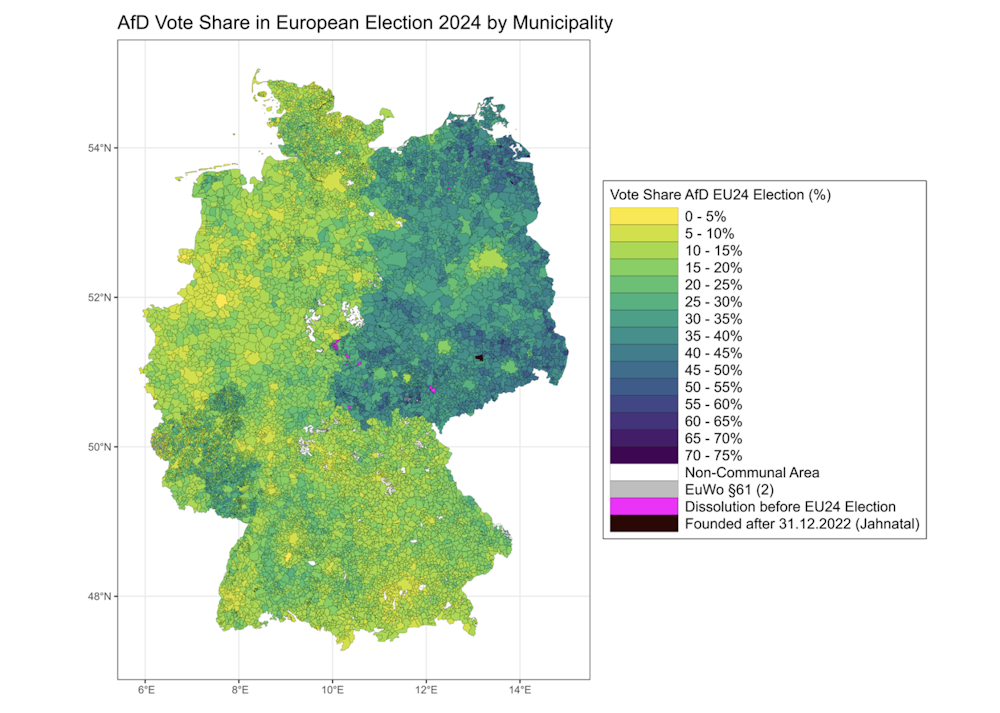
    And ultimately, this politicisation translates into electoral outcomes. In the European parliament elections of June 2024, the AfD took 15.9% of German votes. If we look at the spatial distribution of the AfD’s vote, a pattern showing the salience of the urban-rural divide emerges.

    East and west, town and country

    It’s clear by looking at the map that most (though not all) of the AfD’s strongholds are in eastern Germany – the region which used to be the German Democratic Republic (GDR). Fascism and Nazism were outlawed by decree when this anti-fascist state was established but, in reality, far-right ideologies don’t die off that easily. The result was that extremist views survived in an environment where there was also a lack of education on the National Socialism of the past – and a lack of education about democracy.

    When the socialist authoritarian GDR regime fell in 1989, Germany was reunified under western conditions. This had various effects, including a sense that the experiences of the east were not valued. The inequalities between the two sides of the reunified nation have left some in the east feeling distant from the state. The AfD’s version of nationalism finds fertile ground here.

    Another pattern is also clear across the whole country: the AfD is stronger in remote and rural areas and weaker in urban centres. There is less support in cities such as Berlin, Cologne, Dresden, Hamburg, Leipzig, Munich and Stuttgart. Places with more globalised cultures, international business and diverse populations remain comparably resilient to the spread of the far right.

    AfD support in different municipalities. The darker the colours, the higher the AfD vote share.
    R Frankenberger, CC BY-ND

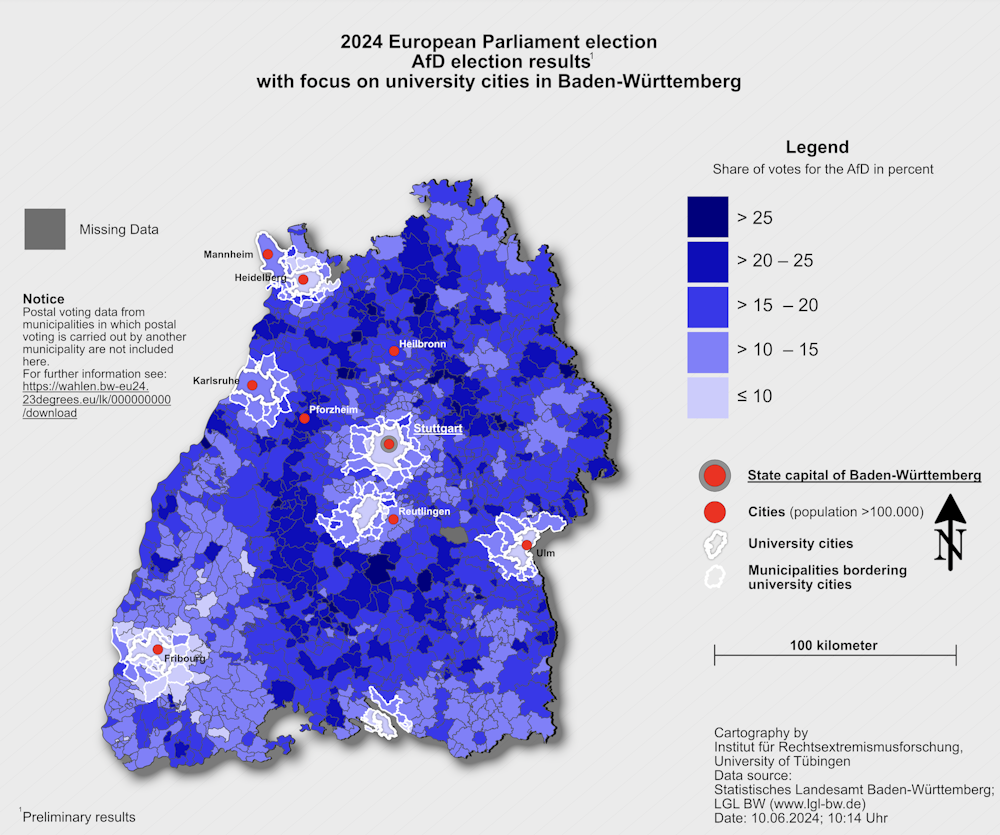
    These patterns become more visible if you take the European election results in the state of Baden-Württemberg as an example.

    The AfD performs significantly worse in the more globalised, cosmopolitan and university-oriented urban areas and their suburbs than in the more remote and rural areas of Baden-Württemberg. On the map, university cities are marked out with a white outline.

    AfD support mapped, with university cities highlighted.
    University of Tübingen, CC BY-ND

    The AfD is particularly strong in the northern and eastern Black Forest, on the Baar, in the Swabian Alb, in the Rems-Murr district, in the Swabian Forest and in Hohenlohe. Most of these areas are remote, with many small towns and villages. They have slightly lower income levels and lower levels of migration than average. They are much more traditional in terms of culture and religion than urban areas.

    The Black Forest, the Swabian Forest, and Hohenlohe also have quite strong protestant and evangelical communities, which are strongholds of traditional family life, customs and traditions.

    We should expect to see these trends continue. The AfD looks set to make further gains in the February 23 election being held in Germany, retaining its strongholds in the east but also spreading into the west in rural areas. The urban-rural divide will therefore become all the more apparent and entrenched when German voters head to the polls.

    Rolf Frankenberger does not work for, consult, own shares in or receive funding from any company or organisation that would benefit from this article, and has disclosed no relevant affiliations beyond their academic appointment.

    ref. These maps of support for Germany’s far-right AfD lay bare the depth of the urban-rural divide – https://theconversation.com/these-maps-of-support-for-germanys-far-right-afd-lay-bare-the-depth-of-the-urban-rural-divide-248405

    MIL OSI – Global Reports

  • MIL-OSI United Kingdom: Civil servants can now learn more about national security

    Source: United Kingdom – Executive Government & Departments

    The College for National Security launches a new online course to help break down barriers and help civil servants learn more about national security.

    Andrew Millar, College for National Security

    Civil servants can now learn more about national security, thanks to a new online course launched by the College for National Security.

    The aim of the What is national security course is to break down barriers to understanding National Security threats and impacts and help civil servants integrate it into their jobs.

    Threats to the UK

    “To respond to a broad range of threats the UK faces, we need a workforce that is knowledgeable, skilled and connected when it comes to national security,” said college head Andrew Millar, pictured, who is also deputy director of Government Skills, of which the college is a part.

    “This course gives an introduction to national security and gives civil servants an overview of key national security themes. It’s an ideal introduction for anyone who would like a better understanding of national security, are interested in a career in national security or who are new to the sector.”

    Better understanding

    As part of its efforts to increase understanding of national security, the college has also published its ‘Guide to the UK National Security Community’. The guide outlines the departments, agencies and devolved administrations involved in national security and was developed in collaboration with 23 departments and agencies. It aims to help colleagues better understand the UK’s national security community and the breadth of departments involved. 

    Find out more about the College for National Security.

    Updates to this page

    Published 6 February 2025

    MIL OSI United Kingdom

  • MIL-OSI United Kingdom: New Chair of The Royal Mint announced

    Source: United Kingdom – Executive Government & Departments

    Chris Walton has taken up the position following Graham Love’s six-year term.

    The Treasury has today announced the appointment of Chris Walton as Non-Executive Chair of The Royal Mint.

    Chris Walton will be in position for an initial three-year term, succeeding Graham Love, who served as Chair since December 2018. Chris will oversee the Mint as it continues to diversify its portfolio into new business areas, and to produce UK circulating coins in line with demand.

    Commenting on the appointment, Economic Secretary to the Treasury and City Minister, Emma Reynolds said:

    I’m delighted to welcome Chris Walton to The Royal Mint as the new Chair. Chris brings a wealth of leadership experience to the role, and I look forward to working with him as he shapes the strategic vision of The Royal Mint in the years ahead.

    I want to thank Graham Love for his leadership over the last six years. Graham has overseen a number of successes in his time as Chair and has set the foundations for The Royal Mint of the future.

    Chris Walton added:

    It is a privilege to join The Royal Mint during this fascinating period of transformation. With sustainability at its core, the Mint is evolving for the future, and I am eager to support its growth and build on a remarkable legacy.

    The Royal Mint is one of the oldest companies in the world – supplying coins to the UK for over 1,100 years. It also produces commemorative coins, to mark events of national, historical and cultural significance, offers investment in precious metals, a jewellery collection and recycling precious metals from e-waste. 

    The Chair of The Royal Mint is responsible for providing strategic direction and works closely with the Board of Directors and Executive Team.

    Updates to this page

    Published 6 February 2025

    MIL OSI United Kingdom

  • MIL-OSI United Kingdom: Labour warned against pandering to far right

    Source: Scottish Greens

    It’s impossible to beat the far right by copying them.

    Labour cannot defeat the far right by pandering to them or replicating their policies, warns Scottish Greens co-leader Lorna Slater.

    The warning comes as a group of Labour MPs called on Labour to take a more right-wing stance on immigration and other issues, and as Scottish Labour leader Anas Sarwar said he couldn’t rule out working with Reform MSPs to take power in Scotland.

    With recent polls showing that Reform UK are set to gain seats in Holyrood and for the first time take the lead in Westminster, Scottish Greens are calling on Labour to ignore the far right’s toxic game.

    Scottish Greens Co-Leader Lorna Slater said:

    “Copying the hateful and authoritarian policies of the far right is always wrong. It punished marginalised people and normalises extreme policies. It won’t win Labour any votes, and will simply legitimise the toxic policies of Reform and those like them.

    “Time and again, across Europe and the world, we have seen that trying to mimic the far-right and take them on at their own game does nothing to silence them; it only makes them louder.

    “In Germany, the AfD has been legitimised by mainstream parties who have pandered to them on immigration; now these fascists stand a real chance at entering government and in America, Donald Trump was propelled to the White House by a pitiful failure of centrist opposition who tried to do the same.

    “Labour needs to learn lessons from fighting the far right across the world, but I have little hope that Keir Starmer will listen. He promised change, yet on everything from tackling the climate crisis to protecting working-class families he is already failing badly.”

    Ms Slater added:

    “Scotland deserves so much better than a race to the bottom between Labour, the Tories and Nigel Farage. We can have a fairer, greener and more equal future.

    “Whilst other parties are lurching to the right, the Scottish Greens are standing our ground as a party that will always put people and planet before profit.”

    MIL OSI United Kingdom

  • MIL-OSI United Kingdom: Royal Liverpool Philharmonic Society announces new Chief Executive

    Source: City of Liverpool

    Royal Liverpool Philharmonic Society has announced that it has appointed Vanessa Reed as its new Chief Executive. She will take up the position on 2 June 2025.

    Vanessa will lead one of the most important music organisations in the UK, comprising the Royal Liverpool Philharmonic Orchestra and Choir, Liverpool Philharmonic Hall, Liverpool Philharmonic Youth Company, and an extensive learning and community programme. She succeeds Michael Eakin as Chief Executive who retires at the end of March 2025 after 16 years in the role.

    Vanessa Reed is an award-winning music executive with more than 16 years’ experience as CEO of national music organisations in the UK and the US. Since 2019, she has been President and CEO of New Music USA, a New York based national resource which supports music creation and performance across the US. In this role, Vanessa has launched an array of new initiatives including Amplifying Voices which unites over 45 US orchestras in the co-commissioning of new work and major jazz and film scoring programs which address inequities in the music industry in collaboration with leading US artists. In the US, Vanessa has also been advisor to the Recording Academy’s New York Chapter.

    Before the move to New York, Vanessa was CEO at PRS Foundation in London where she repositioned the Foundation as a pioneering international force, leading new initiatives which demonstrate her advocacy for music across a range of genres. This includes the New Music Biennial which won the Royal Philharmonic Society’s best festival award in 2012, and the global Keychange gender equity movement which has been supported by over 650 festivals and music organisations around the world, and recognised through multiple awards, including Classical Next’s Innovation Award.

    Vanessa served as Board member of Royal Liverpool Philharmonic between 2016 and 2019, was an Ambassador for the University of Liverpool and collaborated with Liverpool City Council to support emerging musicians. Her love for Liverpool stems from her father who studied law at Liverpool University in the 60’s, loved the Philharmonic Hall, and inspired her and her family to support one of the city’s football teams. She is married to a Liverpudlian – FACT founder, Eddie Berg.

    Vanessa ReedChief Executive-designate, saysI am thrilled and honoured to be the first woman appointed to the role of Chief Executive at the Royal Liverpool Philharmonic. This unique organisation is very close to my heart and Liverpool is my favourite UK city. Every time I’ve seen the Orchestra perform at Liverpool Philharmonic Hall I’ve been blown away by the quality of the players and the warmth of local audiences.  I’m inspired by Liverpool Philharmonic’s mission to transform lives through music and I’m a longstanding fan of its three-way commitment to the orchestra, venues and learning programmes which reach over 100,000 young people every year.

    My goal is to ensure that we, as one of the world’s oldest music societies, continue to evolve and thrive as we embark on our next imaginative chapter. This includes serving more of the city region’s musicians and young people through the planned “Abbey Road of the North” studios and tapping into Liverpool’s international brand for the benefit of our orchestra, led by our dynamic Chief Conductor, Domingo Hindoyan. I can’t wait to join Domingo and the Liverpool Philharmonic’s outstanding musicians, staff, board, and supporters to make all of this happen and to enjoy lots of live music in Liverpool with the audiences we welcome to our performances.

    Louise Shepherd CBE, Chair of the Board of Trustees, says: “We are thrilled to welcome Vanessa Reed as our new Chief Executive. She brings outstanding international experience in the music sector, and in encouraging, supporting and growing new musical voices, artists and audiences. She knows Liverpool Philharmonic and the city well, having served on our board between 2016-2019 and has a real passion for the work we do and the role we play within our local community, and as a nationally and internationally important orchestra and music organisation. She is a strategic and creative leader who, with our brilliant team, will take Liverpool Philharmonic forward and continue to grow the quality, ambition and reach of our work.”

    Leader of Liverpool City Council, Councillor Liam Robinson, said: “The Royal Liverpool Philharmonic is one of the UK’s most important cultural institutions, not only for its incredible annual programme of events, but also the vital role it plays in music education and community engagement – inspiring young musicians and making music as accessible as possible. This year marks the tenth anniversary of our UNESCO City of Music status, and Vanessa’s appointment seems incredibly fitting. Michael Eakin will be a hard act to follow, but Vanessa’s credentials can only enhance the vibrancy of this much-loved organisation and boost its global reputation for musical excellence.”

    Claire McColgan CBE, Director of Culture & Major Events, Liverpool City Council, says: “Vanessa’s appointment will be transformative for the Royal Liverpool Philharmonic. She is a visionary leader who has had an indelible impact on the music industry in America.

    Vanessa not only brings with her a whole wealth of knowledge and passion, but she understands this sector and is committed to elevating it where she can, promoting gender equity and diversity at every level. We’re really keen to explore links with New York, and in doing so take the Philharmonic – and the city – to exciting new frontiers. Michael has been a wonderful ambassador for Liverpool and has been a leading civic figure – a role which Vanessa is sure to embrace, and in doing so, will make the city culturally richer.”

    MIL OSI United Kingdom

  • MIL-OSI United Kingdom: Match Day Parking Zone to be introduced around Everton FC’s new stadium

    Source: City of Liverpool

    Liverpool City Council is to introduce a ‘Football Match Parking Zone’ around Everton FC’s new stadium, at Bramley-Moore Dock.

    A raft of new parking measures are to be implemented surrounding the 52,888 seater stadium, similar to what is already in place around Goodison Park and Anfield.

    More than 4,000 residents and 3,000 businesses are now being invited to apply for the relevant parking permits ahead of the zone going live under an Experimental Traffic Road Order (ETRO) to coincide with the historic first test game at the £500m venue later this month.

    The ETRO will run for up to 18 months and during that period will then be reviewed by the Council’s Transport and Highways team.

    Residents will be able to apply for a permit for each vehicle registered at their address, plus one visitor permit, for which there will be no fee. Businesses will be charged an annual fee of £50 per vehicle, up to a maximum of 10.

    The focus of the proposed parking zone covers the area within a 30-minute walk of Everton Stadium, which is serviced by the city’s historic “Dock Road”, and will encompass the surrounding Ten Streets district, into the city centre and up to Great Homer Street in Everton.

    The new parking zone requirements, which were subject to a public consultation in late 2022, includes:

    • New resident parking areas
    • New taxi ranks
    • New match day bus stands
    • New parking restrictions
    • New hours of operation for existing parking zones for the Great Homer Street area
    • New hours of operation for existing parking zones for the Ten Streets and Love Lane areas
    • New industrial parking zone south of Boundary Street
    • New industrial parking zone north of Boundary Street

    The overall aim of the new Parking Zone is to reduce congestion, improve air quality and safety to and from the stadium. The proposals have also been designed to complement the planned modernisation of parking across the city centre.

    The Council’s Transport and Highways team has already begun the process of installing new signage ahead of Everton’s first “test match” at the waterfront stadium, situated within Liverpool Waters, which will be held on Monday, 17 February.

    Scheduled to open for the 2025/26 season, Everton’s new home has already been picked as a venue for the UEFA European Championships in 2028 and will also be capable of hosting major non-footballing events.

    Liverpool City Council has invested more than £20m in the highways infrastructure around Bramley-Moore Dock, including a permanent segregated cycle lane running from the city centre up to Liverpool’s northern border at Bootle in Sefton, which passes right in front of the new stadium.

    The Council is also working with Sefton Council and the Liverpool City Region Combined Authority on a new town bid which which would see for than 10,000 new homes, with community infrastructure, from the city centre, around the new stadium, and north into Bootle and Walton.

    • The Liverpool City Region Combined Authority is also working with Merseyrail, Network Rail and Everton FC on the development of a new crowd management zone and an additional entrance at Sandhills station. The aim is to primarily support fans and event goers accessing public transport on their way to and from the new stadium.

    Councillor Dan Barrington, Liverpool City Council’s Cabinet Member for Transport and Connectivity, said: “Everton Stadium is going to be transformational especially for the surrounding Ten Streets district and the wider Kirkdale community.

    “As well as the economic benefit, the vast volume of people the stadium will attract – and how they arrive and depart – needs to be carefully managed.

    “The North Docks area has never had to cope with such large numbers of people in such concentrated time periods, but fortunately the city has the experience and knowledge thanks to Goodison Park and Anfield. By creating this new match day parking zone, we’ll be looking to adopt and incorporate those controls which so effectively move tens of thousands on a weekly basis.

    “Bramley-Moore Dock is also a unique location given its very close proximity to the city centre and the fact the surrounding transport infrastructure is well developed. There’s more to be done but all the partners are talking to make those improvements.

    “We’ll also be looking to encourage as many active travel options as possible for those attending the games or other events there, which is a win-win for everyone in terms of managing congestion and air quality and promoting healthy habits.

    “There’s lots of residents and businesses, as well as Everton fans, who will be affected by this new zone and thanks to their feedback we’ve been able to formulate a plan which accommodates their needs.”

    MIL OSI United Kingdom

  • MIL-OSI: Stabilization Notice – Pre Stab – Loxam SAS

    Source: GlobeNewswire (MIL-OSI)

    [06/02/2025]

    Not for distribution, directly or indirectly, in or into the United States or any jurisdiction in which such distribution would be unlawful.

    [LOXAM SAS]

    Pre-stabilisation Period Announcement

    BNP Paribas (contact: Stanford Hartman telephone: 0207 595 8222 hereby gives notice, as Stabilisation Coordinator, that the Stabilisation Manager(s) named below may stabilise the offer of the following securities in accordance with Commission Delegated Regulation EU/2016/1052 under the Market Abuse Regulation (EU/596/2014).

    The securities:1  
    Issuer: Loxam S.A.S
    Guarantor (if any): N/A
    Aggregate nominal amount: EUR 500,000,000
    Description: EUR 5YR 
    Offer price: TBC
    Other offer terms:  
    Stabilisation:  
    Stabilisation Manager(s) BNP Paribas
    Stabilisation period expected to start on: 06/02/2025
    Stabilisation period expected to end no later than: 20/03/2025
    Existence, maximum size and conditions of use of over‑allotment facility: The Stabilisation Manager(s) may over‑allot the securities to the extent permitted in accordance with applicable law.
    Stabilisation trading venue: OTC

    In connection with the offer of the above securities, the Stabilisation Manager(s) may over‑allot the securities or effect transactions with a view to supporting the market price of the securities during the stabilisation period at a level higher than that which might otherwise prevail. However, stabilisation may not necessarily occur and any stabilisation action, if begun, may cease at any time. Any stabilisation action or over‑allotment shall be conducted in accordance with all applicable laws and rules.

    This announcement is for information purposes only and does not constitute an invitation or offer to underwrite, subscribe for or otherwise acquire or dispose of any securities of the Issuer in any jurisdiction.

    This announcement and the offer of the securities to which it relates are only addressed to and directed at persons outside the United Kingdom and persons in the United Kingdom who have professional experience in matters related to investments or who are high net worth persons within Article 12(5) of the Financial Services and Markets Act 2000 (Financial Promotion) Order 2005 and must not be acted on or relied on by other persons in the United Kingdom.

    In addition, if and to the extent that this announcement is communicated in, or the offer of the securities to which it relates is made in, the UK or any EEA Member State before the publication of a prospectus in relation to the securities which has been approved by the competent authority in the UK or that Member State in accordance with Regulation (EU) 2017/1129 (the “Prospectus  Regulation”) (or which has been approved by a competent authority in another Member State and notified to the competent authority in the UK or that Member State in accordance with the Prospectus Regulation), this announcement and the offer are only addressed to and directed at persons in the UK or that Member State who are qualified investors within the meaning of the Prospectus Regulation (or who are other persons to whom the offer may lawfully be addressed) and must not be acted on or relied on by other persons in the UK or that Member State.

    This announcement is not an offer of securities for sale into the United States. The securities have not been, and will not be, registered under the United States Securities Act of 1933 and may not be offered or sold in the United States absent registration or an exemption from registration. There will be no public offer of securities in the United States. 

    The MIL Network

  • MIL-OSI Global: The ‘degrowth’ movement envisions global climate justice, but must adapt to global south realities

    Source: The Conversation – France – By Claudius Gräbner-Radkowitsch, Junior Professor of Pluralist Economics, Europa-Universität Flensburg

    It is widely accepted that human activities are the primary drivers of global warming and environmental crises, including the rapid loss of biodiversity. However, the debate over how best to address these issues is far from settled. In political circles, “green growth” – the concept of making economic activities more sustainable – has emerged as the most popular solution.

    Is green growth enough?

    The idea behind green growth is to continue expanding economies while minimising environmental harm. However, critics argue that this approach has failed to significantly curb climate change and biodiversity loss.

    Despite international efforts since the 1970s, carbon emissions have continued to rise. As the World Inequality Report reveals, nearly half of historical emissions occurred after 1990. Incremental policy changes, technological innovations and shifts in consumer behaviour have not been enough to reverse this trend. This failure has led to the growing appeal of “degrowth” – a more radical alternative that challenges the current global economic system.

    What is ‘degrowth’?

    “Degrowth” emerged in Europe, particularly in France, in the late 2000s. Philosophers such as André Gorz and economists such as Serge Latouche were among its early proponents, with researchers such as Tim Jackson later popularising the concept in the English-speaking world. They argue that the root cause of environmental destruction lies not only in human activity but also in a global economic model that has prioritised growth and profit since the Industrial Revolution.

    Initially, degrowth was a critique of Western lifestyles and notions of progress. Environmental concerns were just one part of the movement’s broader agenda. Over time, however, environmentalism has become central to the movement’s goals.

    A stenciled message in favour of degrowth.
    Paul Sableman, CC BY


    À lire aussi :
    Idea of green growth losing traction among climate policy researchers, survey of nearly 800 academics reveals


    What about the global south?

    Today, many degrowth advocates assert that the richer countries of the global north, being largely responsible for environmental degradation, should be the ones to scale back economic activity to avert ecological catastrophe. But what about the poorer countries of the global south? Should they adopt degrowth strategies? Some argue this would impose a neocolonial agenda, with wealthier countries once again dictating the terms of global development. Others note that many poorer countries need economic growth to combat poverty. And even if degrowth were limited to the north, it could still have significant effects on the south – both positive and negative.

    A review of academic literature on degrowth and the global south reveals two main perspectives: those who see degrowth as incompatible with the south’s development needs, and those who believe it could offer synergies with sustainable development goals.

    Supporters of degrowth often point out that many of its core ideas originate in the global south. Anthropologist Jason Hickel cites figures such as Sri Lankan philosopher Ananda Coomaraswamy, Indian economist J.C. Kumarappa and Bengali poet Rabindranath Tagore as inspirations. While these thinkers may not use the term “degrowth”, they promote ideas aligned with it, such as the Latin American Sumak kawsay (or “Buen vivir”) or the South African Ubuntu. These non-Western perspectives have been instrumental in shaping the degrowth discourse in the global north.

    Degrowth as decolonisation

    Degrowth advocates argue that scaling back economic activity in the north could help dismantle the unequal global division of labour, in which raw materials are extracted from the south and processed into consumer goods in the north. This system disproportionately benefits wealthier nations while leaving poorer countries with the social and environmental costs. Federico Demaria, a researcher in political ecology, argues that northern countries must “pay for past and present colonial exploitation in the south” – a central theme in contemporary degrowth discourse.

    An aerial view of a gold mine in Brazil.
    Tarcisio Schnaider/Shutterstock

    Some researchers suggest that dependence on economic growth is problematic for both the north and south. They argue that growth alone does not guarantee poverty reduction – wealth distribution and institutional reforms are just as crucial. Degrowth could help both regions avoid unsustainable development models by focusing more on social well-being than perpetual economic expansion.

    Challenges for degrowth in the global south

    However, many scholars believe degrowth is unattractive for the global south. Critics argue that the concept is too Eurocentric and fails to resonate amid the specific challenges faced by poorer nations. Interviews with academics and activists in the south show that while they may agree with some of the ideas behind degrowth, they reject its language, which they see as rooted in Western thinking. Economist Beatriz Rodríguez Labajos and her co-authors suggest that researchers from the north and south should look at “strengthening potential synergies, through an assertive recognition of the barriers to doing so”.

    There is also concern that promoting degrowth in the south could be perceived as a new form of colonialism. Imposing Western notions of degrowth could prevent poorer countries from following the same path to prosperity that the north took, which often involved exploiting the resources of the south. The degrowth movement’s failure to fully address the colonial roots of economic development poses a challenge to its decolonization-oriented ambitions.

    The problem of global dependencies

    Finally, global dependencies further complicate the degrowth debate. Many people in the south rely on export-driven economies that serve Western markets. A reduction in economic activity in the north could harm populations in the south who depend on those exports.

    This interdependence presents a dilemma for the degrowth movement. Proponents argue that degrowth is not about abandoning economic activity but reforming the global trade, finance and governance systems to prevent negative impacts on the south. For degrowth to succeed, its advocates must formulate concrete proposals that address these global dependencies without exacerbating inequalities or harming the most vulnerable.


    This article is part of a project involving The Conversation France and AFP audio. It has received financial support from the European Journalism Centre, as part of the Solutions Journalism Accelerator programme supported by the Bill and Melinda Gates Foundation. AFP and The Conversation France have retained their editorial independence at every stage of the project.


    We offer this article as part of the Normandy World Forum for Peace, organised by the Normandy region of France on September 26-27, 2024. The Conversation France is a partner of the forum. For more information, visit the Normandy World Forum for Peace’s website.

    Claudius Gräbner-Radkowitsch is a member of the Bündnis90/Die Grünen (The Greens) party. He has received research grants, notably from the Austrian FWF and the German DFG.

    Birte Strunk ne travaille pas, ne conseille pas, ne possède pas de parts, ne reçoit pas de fonds d’une organisation qui pourrait tirer profit de cet article, et n’a déclaré aucune autre affiliation que son organisme de recherche.

    ref. The ‘degrowth’ movement envisions global climate justice, but must adapt to global south realities – https://theconversation.com/the-degrowth-movement-envisions-global-climate-justice-but-must-adapt-to-global-south-realities-238276

    MIL OSI – Global Reports

  • MIL-OSI United Kingdom: Reappointments to the Civil Procedure Rule Committee

    Source: United Kingdom – Executive Government & Departments

    The Lord Chancellor has approved the reappointments of Ben Roe and Ian Curtis-Nye as members of the Civil Procedure Rule Committee.

    The Lord Chancellor has approved the reappointment of Ben Roe as a Legal Member of the Civil Procedure Rules Committee (CPRC) for 3 years from 9 June 2025, and Ian Curtis-Nye as a lay member of the CPRC for 3 years from 24 October 2025.

    Ben Roe

    Ben Roe is a solicitor who is the Lead Knowledge Lawyer for Baker McKenzie’s Global Disputes and Compliance Group, responsible for knowledge management and training for litigation, arbitration and compliance lawyers. He is a member of the Association of Litigation Professional Support Lawyers and the Ministry of Justice Governance and Standards Board, overseeing the Witness Intermediary Scheme.

    Ian Curtis-Nye

    Ian Curtis-Nye is a Partner/Divisional Manager at Lyons Davidson solicitors, with overall responsibility for the civil litigation division and legal costs teams, also being a solicitor and costs lawyer. In addition, he is a trustee and chair at Citizens Advice Reading; providing support and advice to the local community on a wide range of issues. He has extensive experience in consumer affairs across both the legal and lay advice sector.

    The CPRC is the statutory body that governs the practice and procedure to be followed in the Civil Division of the Court of Appeal, the High Court, and the County Court.

    The appointment of members, of the CPRC, are made by the Lord Chancellor after consulting the Master of the Rolls and – in respect of legal members – the relevant professional body.

    Appointments are regulated by the Commissioner for Public Appointments and recruitment processes comply with the Governance Code on Public Appointments.

    Updates to this page

    Published 6 February 2025

    MIL OSI United Kingdom

  • MIL-OSI United Kingdom: Birmingham Crane Survey – another record-breaking year

    Source: City of Birmingham

    The latest Deloitte’s Crane Survey, which looks at construction activity in four UK cities, has found Birmingham has had another record-breaking year.

    Both residential and student residential sectors hit new highs despite a challenging economic backdrop.

    As with previous years, the residential sector led the way with 3,180 homes completed in 2024. 2,242 bedspaces are currently under construction in the student residential sector, both the highest amount recorded in the history of the Birmingham Crane Survey.

    The Birmingham Crane Survey is part of Deloitte’s Regional Crane Survey series, which monitors construction activity within four UK cities, across a range of sectors including office, residential, hotels, retail, education and student accommodation. Across all surveys – Belfast, Birmingham, Leeds and Manchester – 47 new construction starts were recorded in 2024 compared to 63 in 2023.

    For the first time in its 23-year history, the latest Birmingham Crane Survey has expanded its boundaries to to align with the definition of the city centre as set out in the council’s Our Future City Framework.

    Cllr Sharon Thompson, deputy leader of Birmingham City Council, said: “Birmingham continues to attract investors, and as the Crane Survey makes clear, we’re building new homes and creating jobs for our young and growing population. Our challenge is to lever the investment that is flowing into our city and ensure that success for Birmingham means success for the people of Birmingham.

    “Our Future City Framework 2045, which was approved last year, outlines how we will continue to deliver much-needed growth to boost the lives and life chances of our citizens.”

    Managing Director Joanne Roney added: “Birmingham is going from strength to strength, with both public and private sector investment. Our Future City Framework will shape the next 20 years of development, delivering unprecedented levels of new jobs, homes and green space.”

    The private sector is now investing in facilities, sporting excellence and growth. Notable developments include Knighthead Capital’s investment into Birmingham City Football Club and its acquisition of 48 acres of land in Bordesley Green to deliver a new sports quarter and stadium, and Edgbaston Cricket Club’s planning application for the latest development of its masterplan, which will include a new stand and 4* hotel.

    There are also a number of  major developments in Digbeth including Masterchef Studios, BBC Tea Factory and Digbeth Loc.

    MIL OSI United Kingdom

  • MIL-OSI United Kingdom: Bumper turnout at award winning SEND careers fair

    Source: City of Wolverhampton

    The City of Wolverhampton Council, with support from Tettenhall Wood School, staged the free Moving into Adulthood Careers Fair at Wolverhampton Racecourse, aimed at young people in Year 9 and above, parents, carers and staff who support the children in their current educational setting.

    They were invited to find out about the options available for further education, training and employment from exhibitors including colleges, providers, supported employers, social care settings and community groups.

    Councillor Jacqui Coogan, the City of Wolverhampton Council’s Cabinet Member for Children, Young People and Education, said: “We want to ensure that children and young people with special educational needs or disabilities are able to live their lives to the full.

    “This was our third Moving into Adulthood Careers Fair and the biggest and best yet, with more children and young people, more parents and carers, and more exhibitors, and we hope it gave everyone involved plenty of information and advice about the many opportunities that are out there for our children and young people with SEND as they move into adulthood.

    “Feedback was overwhelmingly positive with attendees praising the range of careers showcased and the engaging nature of the activities, and I would like to thank everyone who attended and who organised this year’s very successful event.”

    The second Moving into Adulthood SEND Careers Fair, staged at Wolverhampton Racecourse in November 2023, won the Careers Intervention category at last summer’s West Midlands Combined Authority (WMCA) Adult Learning Awards.

    MIL OSI United Kingdom

  • MIL-OSI Banking: BaFin warns consumers about various websites advertising automated crypto trading bot

    Source: Bundesanstalt für Finanzdienstleistungsaufsicht – In English

    The Federal Financial Supervisory Authority (BaFin) warns consumers about a series of platforms advertising an AI-controlled algorithm for trading in financial instruments and cryptoassets. Specifically, the following providers are under investigation:

    • zivaprofit7.com – ZivaProfit7 Ai
    • velmocoin.com – Velmo Coin AI
    • zolintex.com – Zolintex AI
    • luxigain.com – LuxiGain AI
    • grabcapital4u.com – GrabCapitaL4u Ai
    • tivanafund.com – TivanaFund AI
    • brixogain.com – Brixo Gain AI
    • brixofund.com – BrixoFund AI
    • pamborich.com – Pamborich Ai
    • zonocash.com – Zono Cash AI
    • econarix.com – Econarix AI
    • zorbofund.com – ZorboFund AI
    • gaintomo.com – GAINTOMO AI
    • trovafund.com – TrovaFund AI
    • gliporich.com – GlipoRich AI
    • viznofund.com – ViznoFund AI
    • grivogain.com – GrivoGain AI

    Anyone offering financial or investment services or crypto-asset services in Germany requires a license from BaFin. However, some companies offer such services without the required license. Information on whether a particular company is authorized by BaFin can be found in the company database.

    The information provided by BaFin is based on Section 37 (4) of the German Banking Act (KWG) and Section 10 (7) of the German Crypto Markets Supervision Act (KMAG).

    Please be aware:

    BaFin, the German Federal Criminal Police Office (BundeskriminalamtBKA) and the German state criminal police offices (Landeskriminalämter) recommend that consumers seeking to invest money online should exercise the utmost caution and do the necessary research beforehand in order to identify fraud attempts at an early stage.

    MIL OSI Global Banks

  • MIL-OSI United Kingdom: Government opens record industry conference to kickstart SME exports

    Source: United Kingdom – Executive Government & Departments

    UK Export Finance welcomes industry to its largest ever national conference, promoting SME growth.

    • Minister for Exports calls on SME audience to make use of government support at UK Export Finance’s annual conference.

    • Around 1,000 business leaders – including directors from CBI and British Chambers of Commerce – gather to help UK businesses access international opportunities.

    • With a £60 billion remit, UKEF enabled exports to 45 global territories in 2024, unlocking export opportunities for British suppliers.

    The UK government is hosting one of its largest ever export conferences, with around 1,000 business leaders attending today’s UK Trade and Export Finance Forum to discuss ways of reducing financial barriers to exporting.

    Hosted in London by UK Export Finance (UKEF), the event welcomes speakers from the CBI, British Chambers of Commerce and Invest in Women Taskforce. Workshops will discuss overseas opportunities and how government and private sector can collaborate to help a wider range of businesses to export.   

    UKEF is a government department which helps businesses to export by offering financing guarantees and insurance – support which helps companies to fill their order-books, invest in growth and create wealth. The event comes a week after the Chancellor pledged to kick-start economic growth across the country as part of this government’s Plan for Change.  

    In the 2023-24 financial year, UKEF backing for businesses contributed £3.3 billion to the UK economy and supported up to 41,000 jobs across the country.

    UKEF can also now reveal that in 2024, its work secured export deals to 45 territories, increasing the availability of overseas contract opportunities for British businesses.

    A majority of businesses seeking UKEF support and attending the conference are small and medium-sized enterprises (SMEs). Export finance support complements other actions which the government is taking to support SMEs, like measures tackling the scourge of late payments, the launch of a Business Growth Service, and trade agreements generating new opportunities.

    Gareth Thomas, Minister for Exports, said:

    UKEF plays a key part in this government’s central mission to go further and faster to deliver economic growth across the country. Their support has led to projects in dozens of countries around the world, supporting jobs, boosting wages and increased investment into the UK.

    Supporting small firms and supercharging exports are at the very core of that growth mission, because we know that when more SMEs trade around the world, it boosts the whole economy.

    The conference falls ahead of the government’s Industrial Strategy, a plan for supporting investment into high-growth sectors which is expected to launch in spring 2025. This will be supported by UKEF’s own vision for supporting more SMEs and facilitating £10 billion in financing for clean-growth exports by 2029 – a vision furthered by the Chancellor’s recent launch of export finance support for projects supplying critical minerals to UK industry.

    Shevaun Haviland, Director General of the British Chambers of Commerce, said:

    If the UK wants to grow its economy, then we need to export more. The maths on this is really very simple. If we export more than we import, then trade contributes to economic growth, productivity rises, and wages and investment are pushed up – creating a virtuous circle. 

    Our experience has also taught us that firms that export are more resilient, innovative and grow faster. Support for our SME exporters and encouragement to help them start selling overseas is vital to making this happen and UKEF has a key role to play.

    Jordan Cummins, Director (UK Competitiveness), CBI, said:

    To be a key player in the global race for growth, the UK needs a bold and ambitious Trade Strategy.

    As business continues to navigate changing global dynamics, persistent economic headwinds, and geopolitical uncertainty, intervention is needed from government to enable firms to capture the growth prizes on offer. Doing so will ensure the UK is positioned as one of the world’s best locations for investment and trade.

    Record interest in the government event follows growth in the range of businesses seeking UKEF support. Since launching the event in 2018, UKEF has seen a significant rise in the number of retail and wholesale exporters supported, particularly in food & drink, beauty & healthcare, furniture, homeware and interior design.

    Contact

    Media enquiries:

    Updates to this page

    Published 6 February 2025

    MIL OSI United Kingdom

  • MIL-OSI: OP Mortgage Bank: Financial Statements Bulletin for 1 January‒31 December 2024

    Source: GlobeNewswire (MIL-OSI)

    OP Mortgage Bank
    Financial Statements Bulletin
    Stock Exchange Release 6 February 2025 at 10.00 EET

    OP Mortgage Bank: Financial Statements Bulletin for 1 January31 December 2024


    OP Mortgage Bank (OP MB) is the covered bond issuing entity of OP Financial Group. Together with OP Corporate Bank plc, its role is to raise funding for OP Financial Group from money and capital markets.

    Financial standing

    The intermediary loans and loan portfolio of OP MB totalled EUR 14,800 million (16,988)* on 31 December 2024. Bonds issued by OP MB totalled EUR 14,800 million (14,915) at the end of December.

    OP MB’s covered bonds after 8 July 2022 are issued under the Euro Medium Term Covered Bond (Premium) programme (EMTCB), pursuant to the Finnish Act on Mortgage Credit Banks and Covered Bonds (151/2022). The collateral is added to the EMTCB cover pool from the member cooperative banks’ balance sheets via the intermediary loan process on the issue date of a new covered bond.

    In January, OP MB issued its first covered bond of the year in the international capital market. The fixed-rate covered bond worth EUR 1 billion has a maturity of seven years and six months. All proceeds of the bond were intermediated to 63 OP cooperative banks in the form of intermediary loans.

    In March, a fixed-rate covered bond worth EUR 1 billion issued by OP MB in March 2017 matured. At the same time, OP cooperative banks’ intermediary loans worth EUR 1 billion related to the bond in question matured.

    In October, OP MB issued its second covered bond of the year in the international capital market. The fixed-rate covered bond worth EUR 1 billion has a maturity of five years. All proceeds of the bond were intermediated to 48 OP cooperative banks in the form of intermediary loans.

    The terms of issue are available on the op.fi website, under Debt investors: https://www.op.fi/en/op-financial-group/debt-investors/issuers/op-mortgage-bank/emtcb-debt-programme-documentation

    In November, OP MB sold a loan portfolio with a nominal value of EUR 1,825 million back to 85 OP cooperative banks. A capital loss of EUR 7.9 million was recognised on the sale in other operating expenses, and at the same time, income of EUR 5.0 million was recognised in net interest income consisting of income of EUR 7.7 million from the unwinding of hedge accounting items and an expense of EUR 2.7 million from the unwinding of loan EIR amortisations. In addition, EUR 4.5 million was recognised as expected credit loss on the sold loans. Net effect on operating profit was EUR 1.7 million. Previously, OP MB has purchased loans from OP cooperative banks as collateral for the bonds. Currently, OP MB operates on an intermediary loan model in which loans are tagged as collateral for bonds directly in OP cooperative banks’ balance sheets.

    Also, a fixed-rate registered bond (Namensschuldverschreibung) worth EUR 115 million issued by OP MB in November 2012 matured in November. Additionally, a fixed-rate covered bond worth EUR 1 billion issued by OP MB in November 2014 matured in November together with OP cooperative banks’ intermediary loans related to the bond worth EUR 1 billion.

    At the end of December, 92 OP cooperative banks had a total of EUR 14,800 million (14,800) in intermediary loans from OP MB.

    Impairment loss on receivables related to loans in OP MB’s balance sheet totalled EUR 2.5 million (-0.3). Loss allowance was EUR 0.0 million (2.6) following the sale of the loan portfolio.

    Operating profit was EUR 4.4 million (9.3). The company’s financial standing remained stable throughout the reporting period.

    * The comparatives for 2023 are given in brackets. For income statement and other aggregated figures, January–December 2023 figures serve as comparatives. For balance-sheet and other cross-sectional figures, figures at the end of the previous financial year (31 December 2023) serve as comparatives.


     Collateralisation of bonds issued to the public

    The European covered bonds (premium) issued under the EMTCB programme worth EUR 25 billion established on 11 October 2022, in accordance with the Act on Mortgage Credit Banks and Covered Bonds (151/2022), totalled EUR 6,250 million. The cover pool included a total of EUR 6,882 million in loans serving as collateral on 31 December 2024. Overcollateralisation exceeded the minimum requirement under the Act (151/2022).

    The covered bonds issued under the Euro Medium Term Covered Note programme worth EUR 20 billion established on 12 November 2010, in accordance with the Act on Mortgage Credit Banks (Laki kiinnitysluottopankkitoiminnasta, 688/2010), totalled EUR 8,550 million. The cover pool included a total of EUR 9,451 million in loans serving as collateral on 31 December 2024. Overcollateralisation exceeded the minimum requirement under the Act (688/2010).

    Capital adequacy

    OP MB’s Common Equity Tier 1 (CET1) ratio stood at 797.0% (41.8) on 31 December 2024. The ratio was improved by the sale of the loan portfolio back to OP cooperative banks and the resulting reduction in capital requirement for credit risk. The minimum CET1 capital requirement is 4.5% and the requirement for the capital conservation buffer is 2.5%. The minimum total capital requirement is 8% (or 10.5% with the increased capital conservation buffer). OP MB fully covers its capital requirements with CET1 capital, which in practice means that it has a CET1 capital requirement of 10.5%. Estimated profit distribution has been subtracted from earnings for the reporting period.

    OP MB uses the Standardised Approach (SA) to measure its capital adequacy requirement for credit risk. The Standardised Approach is also used to measure the capital requirement for operational risks.

    OP MB belongs to OP Financial Group. As part of the Group, OP MB is supervised by the European Central Bank. OP Financial Group presents capital adequacy information in its financial statements bulletins and interim and half-year financial reports in accordance with the Act on the Amalgamation of Deposit Banks. OP Financial Group also publishes Pillar 3 disclosures.

    Own funds and capital adequacy

    TEUR 31.12.2024 31.12.2023
    Equity capital 368,122 372,160
    Common Equity Tier 1 (CET1) before deductions 368,122 372,160
    Excess funding of pension liability   -13
    Proposed profit distribution -3,466  
    Share of unaudited profits   -7,490
    Insufficient coverage for non-performing exposures   -2,856
    CET1 capital 364,656 361,800
         
    Tier 1 capital (T1) 364,656 361,800
         
    Tier 2 capital (T2)    
    Total own funds 364,656 361,800

    Total risk exposure amount

    TEUR 31.12.2024 31.12.2023
    Credit and counterparty risk 18,581 812,205
    Operational risk (Standardised Approach) 26,636 25,140
    Other risks* 538 27,336
    Total risk exposure amount 45,755 864,682

    * Risks not otherwise covered.

    Ratios

    Ratios, % 31.12.2024 31.12.2023
    CET1 capital ratio 797.0 41.8
    Tier 1 capital ratio 797.0 41.8
    Capital adequacy ratio 797.0 41.8

    Capital requirement

    Capital requirement, TEUR 31.12.2024 31.12.2023
    Own funds 364,656 361,800
    Capital requirement 4,804 90,829
    Buffer for capital requirements 359,852 270,971

    Liabilities under the Resolution Act

    Under regulation applied to the resolution of credit institutions and investment firms, the resolution authority is authorised to intervene in the terms and conditions of investment products issued by a bank in a way that affects an investor’s position. The EU’s Single Resolution Board (SRB) based in Brussels is OP Financial Group’s resolution authority. The SRB has confirmed a resolution strategy for OP Financial Group whereby the resolution measures would focus on the OP amalgamation and on the new OP Corporate Bank that would be formed in case of resolution. According to the resolution strategy, OP Mortgage Bank would continue its operations as the new OP Corporate Bank’s subsidiary.

    The SRB has set a Minimum Requirement for Own Funds and Eligible Liabilities (MREL) for OP MB. From May 2024, the MREL is 16% of the total risk exposure amount and 18.5% of the total risk exposure amount including a combined buffer requirement, and 6% of leverage ratio exposures. The requirement entered into force on 15 May 2024. The requirement includes a Combined Buffer Requirement (CBR) of 2.5%.

    OP MB’s buffer for the MREL requirement was EUR 356 million. The buffer consists of own funds only. OP MB clearly exceeds the MREL requirement. OP MB’s MREL ratio was 797% of the total risk exposure amount.


    Joint and several liability of amalgamation

    Under the Act on the Amalgamation of Deposit Banks (599/2010), the amalgamation of cooperative banks comprises the organisation’s central cooperative (OP Cooperative), the central cooperative’s member credit institutions and the companies belonging to their consolidation groups, as well as credit and financial institutions and service companies in which the above together hold more than half of the total votes. This amalgamation is supervised on a consolidated basis. On 31 December 2024, OP Cooperative’s member credit institutions comprised 93 OP cooperative banks, OP Corporate Bank plc, OP Mortgage Bank and OP Retail Customers plc.

    The central cooperative is responsible for issuing instructions to its member credit institutions concerning their internal control and risk management, their procedures for securing liquidity and capital adequacy, and for compliance with harmonised accounting policies in the preparation of the amalgamation’s consolidated financial statements.

    As a support measure referred to in the Act on the Amalgamation of Deposit Banks, the central cooperative is liable to pay any of its member credit institutions the amount necessary to preventing the credit institution from being placed in liquidation. The central cooperative is also liable for the debts of a member credit institution which cannot be paid using the member credit institution’s assets.

    Each member bank is liable to pay a proportion of the amount which the central cooperative has paid to either another member bank as a support measure or to a creditor of such a member bank in payment of an overdue amount which the creditor has not received from the member bank. Furthermore, if the central cooperative defaults, a member bank has unlimited refinancing liability for the central cooperative’s debts as referred to in the Co-operatives Act.

    Each member bank’s liability for the amount the central cooperative has paid to the creditor on behalf of a member bank is divided between the member banks in proportion to their last adopted balance sheets. OP Financial Group’s insurance companies do not fall within the scope of joint and several liability.

    According to section 25 of the Act on Mortgage Credit Banks (688/2010), which was valid at that time, the creditors of covered bonds issued prior to 8 July 2022 have the right to receive payment, before other claims, for the entire term of the bond, in accordance with the terms and conditions of the bond, out of the funds entered as collateral, without this being prevented by OP MB’s liquidation or bankruptcy. A similar and equal priority also applies to derivative contracts entered in the register of bonds, and to marginal lending facilities referred to in section 26, subsection 4 of said Act. For mortgage-backed loans issued prior to 8 July 2022 and included in the total amount of collateral of covered bonds, the priority of the covered bond holders’ payment right is limited to the amount of loan that, with respect to home loans, corresponds to 70% of the value of shares or property serving as security for the loan and entered in the bond register at the time of the issuer’s liquidation or bankruptcy declaration.

    Under section 20 of the Act on Mortgage Credit Banks and Covered Bonds (151/2022), which entered into force on 8 July 2022, the creditors of bonds issued after 8 July 2022, including the related management and clearing costs, have the right to receive payment from the collateral included in the cover pool, before other creditors of OP MB or the OP cooperative bank which is the debtor of an intermediary loan. A similar priority also applies to creditors of derivative contracts related to covered bonds, including the related management and clearing costs. Interest and yield accruing on the collateral, and any substitute assets, fall within the scope of said priority. Section 44, subsection 3 of the Act on Mortgage Credit Banks and Covered Bonds includes provisions on the creditor’s priority claim regarding cover pool liquidity support. According to said subsection, the creditor has the right to receive payment against the funds contained in the cover pool after claims based on the principal and interest of covered bonds secured by the cover assets included in the cover pool, obligations based on derivatives contracts associated with covered bonds, as well as administration and liquidation costs.


    Sustainability and corporate responsibility

    As of the reporting year 2024, OP Financial Group reports on its sustainability and corporate responsibility in accordance with the European Sustainability Reporting Standards (ESRS) under the EU’s Corporate Sustainability Reporting Directive (CSRD). OP Financial Group’s Report by the Board of Directors and Financial Statements 2024, including CSRD reporting, will be published in March 2025.

    Responsible business is one of OP Financial Group’s strategic priorities. OP Financial Group’s sustainability programme guides the Group’s actions and is built around three themes: Climate and the environment, People and communities, Corporate governance. Read more about the sustainability programme at www.op.fi/en/op-financial-group/corporate-social-responsibility/corporate-social-responsibility-programme

    At OP Financial Group, sustainability and corporate responsibility are guided by a number of principles and policies. OP Financial Group is committed to complying not only with all applicable laws and regulations, but also with a number of international initiatives. The Group is committed to complying with the ten principles of the UN Global Compact initiative in the areas of human rights, labour rights, the environment and anti-corruption. OP Financial Group is a Founding Signatory of the Principles for Responsible Banking under the United Nations Environment Programme Finance Initiative (UNEP FI). Furthermore, OP Financial Group is committed to complying with the UN Principles for Responsible Investment and the UN Principles for Sustainable Insurance.

    OP Financial Group’s biodiversity roadmap includes measures to promote biodiversity. OP Financial Group aims to grow its nature positive handprint by 2030. ‘Nature positive’ means that OP Financial Group’s operations will have a net positive impact (NPI) on nature.

    OP Financial Group has drawn up a Human Rights Statement and Human Rights Policy. The Group respects all recognised human rights. The Human Rights Statement includes the requirements and expectations that OP Financial Group has set for itself and actors in its value chains. OP Financial Group is committed to perform remediation actions if its operations have adverse human rights impacts.

    In March 2024, OP MB published a Green Covered Bond Report on the allocation and impacts of Finland’s first green covered bonds issued in March 2021 and April 2022. Under OP MB’s Green Covered Bond Framework, the proceeds from the bonds have been allocated to mortgages with energy-efficient residential buildings as collateral.

    The environmental impacts allocated to the green covered bonds in 2023 were 59,000 MWh of energy use avoided per year and 8,800 tonnes of CO2-equivalent emissions avoided per year.


    Personnel

    At the end of the reporting period, OP MB had six employees. OP MB has been digitising its operations and purchases all key support services from OP Cooperative and its subsidiaries, reducing the need for its own personnel.


     Governing body members

    The Board composition is as follows:

    Chair Mikko Timonen Chief Financial Officer, OP Cooperative
    Members Satu Nurmi Business Lead, SME Financing,
    OP Retail Customers plc
      Mari Heikkilä Head of Group Treasury & ALM,
    OP Corporate Bank plc

    OP MB’s Managing Director is Sanna Eriksson. The Deputy Managing Director is Tuomas Ruotsalainen, Senior Covered Bonds Manager at OP MB.


    Risk profile

    OP MB has a strong capital base, capital buffers and risk-bearing capacity.

    OP MB’s most significant risks are related to the quality of collateral and to structural liquidity and interest rate risks on the balance sheet, for which limits have been set in the Banking Risk Policy. The key credit risk indicators in use show that OP MB’s credit risk exposure is stable. OP MB has used interest rate swaps to hedge against its interest rate risk. Interest rate swaps have been used to swap home loan interest, intermediary loan interest and interest on issued bonds onto the same basis rate. OP MB has concluded all derivative contracts for hedging purposes, applying fair value hedges which have OP Corporate Bank plc as their counterparty. OP MB’s interest risk exposure is under control and has been within the set limit.

    The liquidity buffer for OP Financial Group is centrally managed by OP Corporate Bank and therefore exploitable by OP MB. At the end of the reporting period, OP Financial Group’s Liquidity Coverage Ratio (LCR) was 193% and the Net Stable Funding Ratio (NSFR) was 129%. OP MB monitors its cash flows on a daily basis to secure funding liquidity and its structural funding risk on a regular basis as part of the company’s internal capital adequacy assessment process (ICAAP).

    An analysis of OP MB’s risk exposure should always take account of OP Financial Group’s risk exposure, which is based on the joint and several liability of all its member credit institutions. The member credit institutions are jointly liable for each other’s debts. All member banks must participate in support measures, as referred to in the Act on the Amalgamation of Deposit Banks, to support each other’s capital adequacy.

    OP Financial Group analyses the business environment as part of its ongoing risk assessment activities and strategy process. Megatrends and worldviews behind OP Financial Group’s strategy reflect driving forces that affect the daily activities, conditions and future of the Group and its customers. Factors currently shaping the business environment include climate, biodiversity loss, scientific and technological innovations, polarisation, demography and geopolitics. External business environment factors are considered thoroughly, so that their effects on customers’ future success are understood. OP Financial Group provides advice and makes business decisions that promote the sustainable financial success, security and wellbeing of its owner-customers and operating region while managing the Group’s risk profile on a longer-term basis. Advice for customers, risk-based service sizing, contract lifecycle management, decision-making, management and reporting are based on correct and comprehensive information.


    Outlook

    Finland’s economy contracted in 2024. However, the economy began to recover as the year progressed and preliminary figures suggest that GDP grew in the second half compared to the same period in 2023. Slower inflation and lower interest rates provide a basis for the recovery to continue. Risks associated with the economic outlook are still higher than usual. The escalation of geopolitical crises or a rise in trade barriers may affect capital markets and the economic environment.

    OP MB’s capital adequacy is expected to remain strong and its risk exposure favourable. This enables the issuance of covered bonds in the future.

    Schedule for financial reports for 2024

    Report by the Board of Directors and Financial Statements 2024 Week 11, 2025
    Corporate Governance Statement 2024 Week 11, 2025

    Schedule for Interim Reports and Half-Year Financial Report in 2025

    Interim Report 1 January–31 March 2025 7.5.2025
    Half-year Financial Report 1 January–30 June 2025 30.7.2025
    Interim Report 1 January–30 September 2025 28.10.2025

    Helsinki, 6 February 2025

    OP Mortgage Bank

    Board of Directors

    Additional information:

    Sanna Eriksson, Managing Director, tel. +358 10 252 2517

    DISTRIBUTION
    LSE London Stock Exchange
    Euronext Dublin (Irish Stock Exchange)
    OAM (Officially Appointed Mechanism)
    Major media
    www.op.fi

    The MIL Network

  • MIL-OSI Global: Where support for Germany’s far-right AFD is growing and why – podcast

    Source: The Conversation – UK – By Laura Hood, Host, Know Your Place podcast, The Conversation

    Germany is holding an election on February 23 and the contest is attracting an unusual amount of attention. That’s because the far-right Alternative for Germany (AFD) is polling in second place on 20% of the national vote.

    Should the party end up with a vote share on this scale, it would be its best ever result in a national election. It would change the face of the German parliament and force mainstream parties into difficult questions about their longstanding refusal to work with extreme parties.

    The AFD’s roots are in nationalistic and racist movements. It continues to take an ultra anti-immigration stance and, in this election, is calling for “demigration” – effectively the deportation of migrants.

    In this episode of The Conversation Weekly podcast, Rolf Frankenberger, an expert on right-wing extremism at the University of Tübingen in Germany, explains where the AFD draws its support from and what type of Germany it wants to return to.

    Frankenburger has found two clear trends in the geographical distribution of AfD voting. The first is common among far-right parties around the world:

    “ There are always exceptions, of course, but the main pattern is that around the big cities like Berlin, like Hamburg, Bremen, Hanover, Münster, Stuttgart, Munich, Frankfurt in these cities and their direct environment and suburbs, the AFD is less important. Whereas in the specific rural areas, like in Saxonia, in the Erzgebirge, in Baden-Württemberg, in the Black Forest, in Rhineland Palatinate, in the more rural areas, they have their strongholds.”

    The second, however, is unique to Germany. Support for the AFD is far more concentrated in the east of Germany. This region was the part of the country that made up the communist German Democratic Republic between 1949 and 1990, before German reunification.

    “Reunification in Germany produced winners and losers. And in the view of many East German people – and much of it is true – there are inequalities that were produced by reunification.”

    These divisions are being exploited to push what Frankenburger terms a form of white supremacist, traditionalist “Völkisch nationalism” – not a term that is well understood outside of Germany but which resonates heavily in domestic politics.

    “And so the AFD comes in and says ‘hey, there’s something wrong with the state, there’s something wrong with democracy, and there’s something wrong with our heritage. So we have a strong German heritage. We have an identity, we have an idea and all the others are trying to destroy it’. So it’s a kind of protest.”

    To find out more about narratives pushed by the AFD, listen to the interview with Rolf Frankenberger on The Conversation Weekly podcast.


    This episode of The Conversation Weekly was written and produced by Mend Mariwany and Gemma Ware. Sound design was by Michelle Macklem, and theme music by Neeta Sarl.

    Clips in this episode from AFP News, AfD in English, DW News and Al Jazeera English.

    Listen to The Conversation Weekly via any of the apps listed above, download it directly via our RSS feed or find out how else to listen here.

    Rolf Frankenberger does not work for, consult, own shares in or receive funding from any company or organisation that would benefit from this article, and has disclosed no relevant affiliations beyond their academic appointment.

    ref. Where support for Germany’s far-right AFD is growing and why – podcast – https://theconversation.com/where-support-for-germanys-far-right-afd-is-growing-and-why-podcast-249045

    MIL OSI – Global Reports

  • MIL-OSI Africa: Oando’s Expansion in Africa’s Energy Sector to Take Center Stage at Invest in African Energy (IAE) 2025 in Paris

    Source: Africa Press Organisation – English (2) – Report:

    PARIS, France, February 6, 2025/APO Group/ —

    Wale Tinubu, Group Chief Executive Officer will speak at the Invest in African Energy 2025 Forum in Paris this May. As one of Africa’s largest indigenous energy companies, Oando is experiencing significant growth, driven by its landmark acquisition of Eni’s Nigerian subsidiary last year and its recent expansion into Angola.

    In August 2024, Oando finalized the acquisition of a 100% shareholding in the Nigerian Agip Oil Company (NAOC) from Eni for $783 million. This strategic move increased Oando’s participating interests in OMLs 60, 61, 62 and 63 from 20% to 40%, effectively doubling the company’s total reserves to approximately one billion barrels of oil equivalent. With plans to scale production to 100,000 barrels per day by 2028, the acquisition solidifies Oando’s position as a key player in Nigeria’s upstream sector.

    IAE 2025 (http://apo-opa.co/4aMELLc) is an exclusive forum designed to facilitate investment between African energy markets and global investors. Taking place May 13-14, 2025 in Paris, the event offers delegates two days of intensive engagement with industry experts, project developers, investors and policymakers. For more information, please visit www.Invest-Africa-Energy.com. To sponsor or participate as a delegate, please contact sales@energycapitalpower.com.

    Oando continues to strengthen its presence across Africa with a significant milestone in Angola. Through its upstream subsidiary, Oando Energy Resources (OER), the company has been awarded operatorship of Block KON 13 in the onshore Kwanza Basin. Following a competitive bidding process organized by Angola’s National Agency for Petroleum, Gas and Biofuels, OER now holds a 45% participating interest and will lead the block’s development in partnership with Effimax and Sonangol. Strategically located in the prolific Kwanza Basin, Block KON 13 offers substantial exploration potential in both pre-salt and post-salt plays, with estimated prospective resources ranging between 770 million and 1.1 billion barrels of oil. Two exploration wells previously drilled to a depth of 3,000 meters have indicated the presence of oil and gas across various intervals.

    In addition to expanding its asset base, Oando is integrating artificial intelligence (AI) into its drilling operations to enhance efficiency and decision-making. By leveraging AI, the company aims to optimize resource utilization and improve performance in upcoming projects. This initiative reflects Oando’s commitment to adopting innovative technologies to maintain its leadership in the energy sector.

    MIL OSI Africa

  • MIL-OSI: Danish Government Borrowing and Debt 2024

    Source: GlobeNewswire (MIL-OSI)

    Today, Danmarks Nationalbank publishes the report Danish Government Borrowing and Debt 2024.

    The highlights are: 

    Central government debt fell to a historic low of kr. 217 billion, equivalent to 7.4 per cent of GDP in 2024. Interest costs remained low at a total of kr. -0.3 billion and the yield spread to Germany became negative during the year. The highest possible credit rating of AAA has been retained with a stable outlook. Consolidation remained a key focus to maintain a well-functioning and liquid government securities market. In February, a new 2-year government bond was opened and in September a 2-year euro denominated bond was issued under the government’s EMTN programme. Robust risk management has continued to stabilise the government’s interest rate and market risk. Combined with the solid Danish economy, the Danish government enters 2025 in a strong position for managing government debt. 

    Read more in the report Danish Government Borrowing and Debt 2024 at https://www.nationalbanken.dk/en/news-and-knowledge/publications-and-speeches

    Enquiries can be directed to governmentdebt@nationalbanken.dk. 

    The MIL Network

  • MIL-OSI: Konsolidator’s Annual Report 2024 – From Growth to Resilient Growth

    Source: GlobeNewswire (MIL-OSI)

    Company announcement no 4-2025

    Søborg, February 6, 2025

    Konsolidator’s Annual Report 2024 – From Growth to Resilient Growth

    Konsolidator’s Q4 2024 result showed a quarterly net ARR increase of DKK 1.3m, the highest in 3 years. In the entire 2024, the ARR growth was 10% – totaling an ARR of DKK 21.3m on December 31, 2024, which was in line with expectations. For the entire year, ARR was negatively impacted by churn but positively impacted by solid sales performances in Q3 and Q4 of 2024. In 2025, Konsolidator expects to deliver an ARR of DKK 23-24m.

    Annual recurring revenue (ARR) in 2024 amounted to DKK 21.3m, just within the expectations of an ARR between DKK 21-23m. Revenue amounted to DKK 20.3m in 2024, an increase of 6% and below the expectations of DKK 21-23m.

    In April 2024, Konsolidator established a subsidiary in Madrid, Spain, which impacted the EBIT loss and cash flow as expected. The EBIT loss for 2024 was DKK 12.1m, compared to 10.7m in 2023.

    On December 31, 2024, the equity was negative by DKK 2.4m compared to a positive equity of DKK 1.3m on December 31, 2023. In 2024, Konsolidator received DKK 10.1m through a capital increase. At the beginning of 2025, Konsolidator received an additional DKK 2.2m in net proceeds and secured a binding commitment of DKK 1.8m to be paid during 2025.

    At the end of 2024, Konsolidator announced its focused strategy for 2025-2027, “Resilient Growth” (Company Announcement no 21, 2024). Besides stabilizing and improving the EBITDA margin, the strategy focuses on one key metric: ARR Growth, with a target ARR of DKK 27-30m by 2027.

    CEO Claus Finderup Grove comments: “2024 strengthened our foundation and unlocked new growth opportunities. Both the Board and management have strong confidence in our future, as we transition from being solely a consolidation system to a broader product offering. With data warehousing, budgeting & planning, and ESG capabilities, we are equipping finance teams with everything they need to deliver reliable data – making CFOs better.

    2024 Financial Highlights

    • ARR amounted to DKK 21.3m compared to DKK 19.4m in 2023, corresponding to an increase of 10%. The ARR was within expectations of DKK 21-23m.
    • Revenue amounted to DKK 20.3m in 2024, an increase of 6% and below the expectations of DKK 21-23m.
    • EBIT amounted to a loss of DKK 12.1m compared to an EBIT loss of DKK 10.7m in 2023. The EBIT loss was below expectations of a loss of DKK 10-12m.
    • EBIT before share-based payments was a loss of DKK 11.0m compared to a loss of DKK 8.9m in 2023.
    • Total cash and cash equivalents amounted to DKK 0.4m at the end of 2024 compared to DKK 1.8m at the end of 2023.
    • The total equity amounted to a negative equity of DKK 2.4m on December 31, 2024, compared to a positive equity of DKK 1.3m a year before.

    ARR expectations

    During 2024, Konsolidator announced its Resilient Growth strategy, which will focus and guide solely on ARR. In 2025, Konsolidator expects to deliver an ARR of DKK 23-24m.

    Annual Report 2024
    Konsolidator’s Annual Report 2024 is included in this announcement and can be found on Konsolidator’s investor website.

    Investor webinar
    On 6 February 2025 at 12.30 (CET), an investor webinar will be held. Sign up using this link.

    Contacts

    Certified Adviser

    About Konsolidator
    Konsolidator A/S is a financial consolidation software company whose primary objective is to make Group CFOs around the world better through automated financial consolidation and reporting in the cloud. Created by CFOs and auditors and powered by innovative technology, Konsolidator removes the complexity of financial consolidation and enables the CFO to save time and gain actionable insights based on key performance data to become a vital part of strategic decision-making. Konsolidator was listed at Nasdaq First North Growth Market Denmark in 2019. Ticker Code: KONSOL

    Attachment

    The MIL Network

  • MIL-OSI United Kingdom: £8 million for Port Talbot growth and regeneration project

    Source: United Kingdom – Executive Government & Departments

    A new project will support more than 100 jobs and eventually generate more than £87 million for the South Wales economy.

    £8.2 million more announced for growth and regeneration project in Port Talbot.

    • The first of the growth and regeneration projects in Port Talbot will receive £8.2 million from the Tata Steel / Port Talbot Transition Board.
    • Plans will support more than 100 jobs and eventually generate more than £87 million for the South Wales economy. 
    • Tata Steel / Port Talbot Transition Board has now allocated £51 million into the local community.

    More than 100 jobs are expected to be created and supported with the UK Government announcement of £8.2 million funding for the first regeneration project in Port Talbot with other projects set to follow. 

    Chairing the latest meeting of the Tata Steel Port Talbot Transition Board today (6 February) Welsh Secretary Jo Stevens will announce £8.2 million for the South Wales Industrial Transition from Carbon Hub (SWITCH) supporting more than 100 jobs. 

    The South Wales Industrial Transition from Carbon Hub project will redevelop a four-acre site at Harbourside, Port Talbot which will include the construction of additional shared space, undertake flood mitigation and the provision of specialist equipment. This investment will help establish an Innovation District in Port Talbot. 

    This will allow the development of a new facility targeted at supporting the steel and metal industry and supply chain to reduce carbon emissions in production. The facility is expected to create and support more than 100 jobs and eventually benefit the South Wales economy by £87 million.

    The latest funding comes from the UK Government’s £80m Tata Steel / Port Talbot Transition Board fund which, since last July, has announced £51 million to support individual steelworkers and businesses in Tata Steel’s supply chain to protect jobs and grow the local economy. The latest announcement is the first project to support growth and regeneration of the region. In the coming months, there will be up to £30 million (as part of the overall £80 million) put into growth and regeneration projects.   

    This funding supports the UK Government’s mission to kickstart economic growth and will help deliver the ambition to raise living standards in every part of the United Kingdom as set out its Plan for Change. 

    Welsh Secretary Jo Stevens said:  

    We said we would back the community of Port Talbot through Tata Steel’s transition and we continue to do exactly that.

    In just six months there has now been over £50 million announced by the Transition Board to support individual steelworkers and their families, businesses in the supply chain and now on a major regeneration project for the town.

    Millions more will follow and while this remains a very difficult time for Tata workers, their families and the community, we are determined to support our steel communities whatever happens.

    The Secretary of State will also ensure that work is progressing at pace to develop a range of wellbeing and mental health interventions. This work will prioritise the provision of mental health support, help build community cohesion, support the delivery of wellbeing initiatives and peer support within the local community including that currently delivered via local community and other support groups. Funding to support this work will be announced at the next transition board meeting.

    Cabinet Secretary for Economy, Energy and Planning Rebecca Evans said:

    This announcement builds on the investment that will be unlocked through the recent Celtic Freeport and other investments and innovation we are supporting in and around Port Talbot. 

    Working alongside our Transition Bard partners, we will continue to do everything we can to provide opportunities for growth wherever they arise as well as making sure that the right assistance and support is in place for those impacted by the Tata changes.

    The Leader of Neath Port Talbot Council, Cllr Steve Hunt, said:

    We welcome this extra tranche of funding as the SWITCH project will attract jobs and investment to Neath Port Talbot as it progresses over the next few years. It also means this area can build on its long history in the steel and metals industries to address the challenges of our time.” 

    Professor Helen Griffiths, Pro Vice Chancellor for Research and Innovation at Swansea University, said:

    SWITCH will leverage Swansea University’s history of uniting academia, industry, local authorities, and government. This significant investment will make Welsh research and innovation expertise even more accessible to business and industry, and help stimulate economic growth, provide long-term employment and foster a thriving community.

    The South Wales Industrial Transition from Carbon Hub (SWITCH) delivers research to support industrial decarbonisation transition. This announcement of Transition Board funding for the SWITCH Harboursideproject will create a new base for SWITCH. This will add to the facility’s £20 million funding from the Swansea Bay City Deal, which is also part-funded by the UK Government. 

    Updates to this page

    Published 6 February 2025

    MIL OSI United Kingdom

  • MIL-OSI: Coop Pank AS will hold an investor webinar to introduce the results for the fourth quarter and 12 month of 2024

    Source: GlobeNewswire (MIL-OSI)

    Coop Pank invites shareholders, investors, analysts and other stakeholders to join its investor webinar, scheduled on 13 February 2025 at 9 am (EET). 

    The webinar will be hosted by the Chairman of the Board Margus Rink and Chief Financial Officer Paavo Truu, who present the unaudited financial results of the IV quarter and the year of 2024.

    During the webinar all attendees can ask questions. All questions will be answered after the presentation. The webinar will be held in Estonian.

    To join the webinar, you need to register in advance via following link: https://bit.ly/CP-veebiseminar-registreerimine-13-02-2025

    Registrants will be sent a link to the webinar and a reminder email one hour before the start of the webinar. The webinar will be recorded and published on the company’s website www.cooppank.ee and on our YouTube account.

    Coop Pank, based on Estonian capital, is one of the five universal banks operating in Estonia. The number of clients using Coop Pank for their daily banking has reached 206,000. Coop Pank aims to put the synergy generated by the interaction of retail business and banking to good use and to bring everyday banking services closer to people’s homes. The strategic shareholder of the bank is the domestic retail chain Coop Eesti comprising 320 stores.

    Additional information:
    Katre Tatrik
    Communication Manager
    Tel: +372 5151 859
    E-mail: katre.tatrik@cooppank.ee

    The MIL Network