Category: European Union

  • MIL-OSI USA: Justice Department Announces Seizure of Cybercrime Websites Selling Hacking Tools to Transnational Organized Crime Groups

    Source: US State of North Dakota

    The Justice Department today announced the coordinated seizure of 39 domains and their associated servers in an international disruption of a Pakistan-based network of online marketplaces selling hacking and fraud-enabling tools operated by a group known as Saim Raza (also known as HeartSender). The seizures were conducted in coordination with the Dutch National Police.

    According to the affidavit filed in support of these seizures, Saim Raza has used these cybercrime websites since at least 2020 to sell phishing toolkits and other fraud-enabling tools to transnational organized crime groups, who used them to target numerous victims in the United States, resulting in over $3 million in victim losses.

    The Saim Raza-run websites operated as marketplaces that advertised and facilitated the sale of tools such as phishing kits, scam pages, and email extractors, often used to build and maintain fraud operations. Not only did Saim Raza make these tools widely available on the open internet, it also trained end users on how to use the tools against victims by linking to instructional YouTube videos on how to execute schemes using these malicious programs, making them accessible to criminal actors that lacked this technical criminal expertise. The group also advertised its tools as “fully undetectable” by antispam software.

    The transnational organized crime groups and other cybercrime actors who purchased these tools primarily used them to facilitate business email compromise schemes wherein the cybercrime actors tricked victim companies into making payments to a third party. Those payments would instead be redirected to a financial account the perpetrators controlled, resulting in significant losses to victims. These tools were also used to acquire victim user credentials and utilize those credentials to further these fraudulent schemes. The seizure of these domains is intended to disrupt the ongoing activity of these groups and stop the proliferation of these tools within the cybercriminal community.

    Supervisory Official Antoinette T. Bacon of the Justice Department’s Criminal Division, U.S. Attorney Nicholas J. Ganjei for the Southern District of Texas, and Special Agent in Charge Douglas Williams of the FBI Houston Field Office made the announcement.

    The FBI Houston Field Office is investigating the case. The Justice Department appreciates the cooperation and significant assistance law enforcement partners in the Netherlands have provided.

    Trial Attorney Gaelin Bernstein of the Criminal Division’s Computer Crime and Intellectual Property Section and Assistant U.S. Attorney Rodolfo Ramirez for the Southern District of Texas are prosecuting the case.

    MIL OSI USA News

  • MIL-OSI Security: Justice Department Announces Seizure of Cybercrime Websites Selling Hacking Tools to Transnational Organized Crime Groups

    Source: United States Attorneys General 1

    The Justice Department today announced the coordinated seizure of 39 domains and their associated servers in an international disruption of a Pakistan-based network of online marketplaces selling hacking and fraud-enabling tools operated by a group known as Saim Raza (also known as HeartSender). The seizures were conducted in coordination with the Dutch National Police.

    According to the affidavit filed in support of these seizures, Saim Raza has used these cybercrime websites since at least 2020 to sell phishing toolkits and other fraud-enabling tools to transnational organized crime groups, who used them to target numerous victims in the United States, resulting in over $3 million in victim losses.

    The Saim Raza-run websites operated as marketplaces that advertised and facilitated the sale of tools such as phishing kits, scam pages, and email extractors, often used to build and maintain fraud operations. Not only did Saim Raza make these tools widely available on the open internet, it also trained end users on how to use the tools against victims by linking to instructional YouTube videos on how to execute schemes using these malicious programs, making them accessible to criminal actors that lacked this technical criminal expertise. The group also advertised its tools as “fully undetectable” by antispam software.

    The transnational organized crime groups and other cybercrime actors who purchased these tools primarily used them to facilitate business email compromise schemes wherein the cybercrime actors tricked victim companies into making payments to a third party. Those payments would instead be redirected to a financial account the perpetrators controlled, resulting in significant losses to victims. These tools were also used to acquire victim user credentials and utilize those credentials to further these fraudulent schemes. The seizure of these domains is intended to disrupt the ongoing activity of these groups and stop the proliferation of these tools within the cybercriminal community.

    Supervisory Official Antoinette T. Bacon of the Justice Department’s Criminal Division, U.S. Attorney Nicholas J. Ganjei for the Southern District of Texas, and Special Agent in Charge Douglas Williams of the FBI Houston Field Office made the announcement.

    The FBI Houston Field Office is investigating the case. The Justice Department appreciates the cooperation and significant assistance law enforcement partners in the Netherlands have provided.

    Trial Attorney Gaelin Bernstein of the Criminal Division’s Computer Crime and Intellectual Property Section and Assistant U.S. Attorney Rodolfo Ramirez for the Southern District of Texas are prosecuting the case.

    MIL Security OSI

  • MIL-OSI Europe: Written question – Spanish Government’s strategy to decommission nuclear power plants – E-000267/2025

    Source: European Parliament

    Question for written answer  E-000267/2025
    to the Commission
    Rule 144
    Elena Nevado del Campo (PPE)

    In 2022, Spain’s seven nuclear reactors generated 20.26 % of the total electricity produced by the Spanish national grid.

    Unfortunately, the days of Spain’s nuclear power plants are numbered, despite the fact that nuclear energy is essential to EU competitiveness, as stated in the Draghi report. The government and the plant owners have agreed to decommission them on a rolling basis, with the final plant closing in 2035. The nuclear power plant in Almaraz, Extremadura, will be the first plant to close, in 2027.

    The provisional agreement between the Council and Parliament on the Net-Zero Industry Act describes nuclear energy as ‘strategic’ to EU decarbonisation and states that nuclear energy plays a key role in guaranteeing energy independence and reducing greenhouse gas emissions.

    In light of the above:

    • 1.Does the Spanish strategy to decommission nuclear power plants align with the Commission’s increasing interest in boosting European competitiveness?
    • 2.In the Commission’s view, will these measures not make the Spanish population poorer and increase the price of electricity in Spain?

    Submitted: 22.1.2025

    Last updated: 30 January 2025

    MIL OSI Europe News

  • MIL-OSI Europe: Written question – Unequal treatment of teachers on fixed-term contracts in Greece – E-000287/2025

    Source: European Parliament

    Question for written answer  E-000287/2025
    to the Commission
    Rule 144
    Maria Zacharia (NI)

    The European Commission has acknowledged through a letter of formal notice the unequal treatment of teachers on fixed-term contracts in Greece, particularly as regards maternity leave, child-rearing allowances and sick leave. Despite the fact that supply teachers cover vacant permanent posts for years, they are deprived of the rights enjoyed by their permanent colleagues. This unequal treatment is an infringement of Directive 1999/70/ΕC, which prohibits discrimination against fixed-term workers.

    The European Commission has opened an infringement procedure [INFR(2024)4013] against Greece for failure to correctly transpose the above-mentioned directive into national law. However, to date no measures have been taken to remedy this injustice. Supply teachers are demanding the extension of the right to the nine-month child-rearing allowance, equal to that of permanent teachers, and full rights to maternal risk leave.

    The Commission, respecting the EU’s fundamental principles of equal treatment and social justice, should bring more pressure to bear on Greece to comply.

    What specific measures does the Commission plan to take to ensure that Greece immediately remedies this injustice, in compliance with the EU Treaties and directives?

    Submitted: 22.1.2025

    Last updated: 30 January 2025

    MIL OSI Europe News

  • MIL-OSI Europe: Written question – Competence to issue building assessment reports in the EU – E-000274/2025

    Source: European Parliament

    Question for written answer  E-000274/2025
    to the Commission
    Rule 144
    Jorge Martín Frías (PfE)

    The Spanish Supreme Court recently established that only architects are authorised to issue building assessment reports, with engineers, who previously were also allowed to do so without restriction, now being excluded from this role. In the majority of EU countries, engineers are authorised to assess buildings’ state of conservation and energy efficiency, which means that this judgment obstructs the free movement of professionals in the EU. This could mean that Spain is infringing EU law on freedom to provide services as job profiles are unjustifiably being restricted to the benefit of architects. This exclusive right enjoyed by architects is not laid down in any Spanish legislation and CNMC[1] reports conclude that it is anti-competitive, unjustified and in violation of EU law. This practice could be at odds with Directive 2006/123/EC[2], Directive 2005/36[3] and Directive 2018/958[4].

    In light of the above:

    • 1.What measures is the Commission considering to ensure that European engineers can enjoy their right to freedom to provide services in other Member States?
    • 2.Will the Commission consider asking the Spanish Government to remove these barriers faced by European engineers when practising their profession?

    Submitted: 22.1.2025

    • [1] National Commission for Markets and Competition in Spain
    • [2] on services in the internal market
    • [3] on the recognition of professional qualifications
    • [4] on a proportionality test before adoption of new regulation of professions
    Last updated: 30 January 2025

    MIL OSI Europe News

  • MIL-OSI Europe: Poland: EIB contributes €400 million to building the EU’s largest offshore wind farm

    Source: European Investment Bank

    • EIB makes leading contribution to development of large-scale Baltic Sea offshore wind farm
    • With capacity of 1.5 GW, Baltica 2 is the EU’s largest offshore wind fam to date
    • Initial loan under record €1.4 bln EIB financing approved for expanding Polish offshores
    • Underpinned by significant EU funding, investment will boost Poland’s energy transition

    The European Investment Bank (EIB) signed an agreement to support Poland’s largest utility Polska Grupa Energetyczna (PGE) with a €400 mln loan towards the design and construction of Baltica 2, the European Union’s largest offshore wind farm to date. Baltica 2 will feature innovative technology for a 1.5 GW capacity and sit off the Polish coast in the Baltic Sea. Supported by major European funding, it is being developed by PGE and leading offshore wind company, Denmark’s Ørsted.

    The EIB loan is the biggest own resources contribution by a financial institution to the project. It is also the first part of a €1.4 bln package approved by the European Union’s climate bank to support PGE and Ørsted in erecting two new, large-scale offshore wind farms in the Baltic Sea. Featuring state-of-the-art turbine technology, Baltica 2 is due to be completed as early as 2027. It will comprise of 107 turbines located some 40 km north of Poland’s Baltic shore. Together with its sister project Baltica 3, they are to have total capacity of 2.5 GW and double PGE’s existing renewable energy portfolio. Underpinned by significant EU support that includes funds from InvestEU, REPowerEU and Recovery and Resilience Facility, the strategic investment will contribute to Poland’s energy transition and security, as well as strengthening cooperation and energy security in the Baltic Sea region.

    “As the climate bank of the European Union and a leading partner of multidimensional energy transition in Poland, the EIB is keenly supporting Baltica 2. The EIB’s investment of €400 million is the largest own resources contribution to this transformative project by a financial institution. Baltica 2 is the biggest offshore wind farm under construction in the European Union. It will increase the share of renewables in Poland’s energy mix and help reduce greenhouse gas emissions. It will strengthen Poland’s energy security and support economic competitiveness by harnessing innovative technologies. I thank all partners involved and keep my fingers crossed for a swift and successful completion of this high-impact project,“ said EIB Vice-President Teresa Czerwińska.

    The €400 mln loan to PGE for Baltica 2 comes on top of the EIB financing previously granted to Ørsted to support the roll-out of new wind energy installations, including off the Polish coast. In Poland, the EIB has endorsed multiple energy transition projects by PGE, including to modernise the country’s railway power system. In 2023, EIB also co-financed the country’s first offshore wind farm project.

    Background information

    The EIB is the EU institution providing long-term financing for sound projects that pursue EU priorities. Owned by the 27 Member States, the EIB offers financing and advisory services to support economic competitiveness, spur innovation, promote sustainable development, enhance social and territorial cohesion, and support a swift and fair transition to climate neutrality.

    Last year, the EIB Group granted €89 billion in new financing, with a record €100 billion of total investments supported to the benefit of Europe’s energy security. Nearly 60% of last year’s funding supported climate action and environmental sustainability. The Group – which comprises the European Investment Bank and the European Investment Fund – is on track to meeting its goal of mobilising €1 trillion of climate investment by the end of this decade.

    In Poland, more than half of the €5.1 billion provided by the EIB Group in 2023 was awarded to green and climate-friendly projects. Financing for Poland’s energy transition amounted to €1.78 billion that year. The Group will shortly publish results of its operations in Poland in 2024.  

    MIL OSI Europe News

  • MIL-OSI Europe: EIB Group invested €314 million in Hungary last year

    Source: European Investment Bank

    • EIB Group financing in Hungary totalled €314 million last year, with major investments to improve rail services, deliver power for local manufacturers and support small and medium enterprises
    • Latest annual figures bring total EIB Group investments in Hungary to more than €25 billion since 1991

    The European Investment Bank (EIB) Group’s new financing in Hungary last year amounted to €314 million, supporting projects to improve rail services, meet electricity demands from major local manufacturers and support small and medium enterprises (SME).  This includes financing from both members of the EIB Group – the EIB and the European Investment Fund (EIF).

    “Our 2024 results are good news for Hungary and the EU,” said EIB Vice-President Teresa Czerwinska. “They are a testament to our ability to support national and EU priorities and ensure our citizens and businesses can thrive, contribute towards a globally competitive, sustainable and green future and ensure equal opportunities and a higher quality of living.  With more than €25 billion invested in the country since 1991, the EIB Group has established itself as one of the most reliable sources of financial and advisory support for Hungary. We are ready to pursue this role in the years ahead.”

    Modern rail and power networks

    The biggest operation in Hungary to receive EIB Group funding last year was a €160 million EIB loan to regional railway operator GYSEV to improve network infrastructure and replace old diesel-powered trains with new electric ones. The loan will significantly improve the reliability of train connections between Hungary and Austria. The credit will also accelerate modernisation of the national rail network – a development priority for Hungary. In addition, the financing will boost economic activities in cohesion regions in western Hungary, reduce travel times and increase comfort for hundreds of thousands of rail commuters annually and cut air pollution.

    The EIB Group also provided a €90 million EIB financing to Hungary to support investments undertaken by the energy companies E.ON and MAVIR to expand power grids to meet the electricity needs of key industrial sites, including ones that will boost the European Union’s ability to produce electric vehicles strengthening the EU’s strategic autonomy in this area. The investment boosts economic activity in cohesion regions in Hungary.

    Some €64 million in EIB Group financing supported Hungarian small and medium-sized enterprises and Mid-Caps, the backbone of the national economy and a major source of employment for Hungarians.

    EIB Group Results

    For more details on EIB group results please visit EIB Group press conference on annual results

    MIL OSI Europe News

  • MIL-OSI Europe: 2024 marks year of record high EIB Group investment in Denmark

    Source: European Investment Bank

    • The EIB Group signed €2.1 billion in new financing for Danish projects last year, a 48% increase from 2023 and more than double the 2022 volume.
    • 2024 flagship projects include support for dual-use infrastructure in the Port of Esbjerg, the Thor North Sea wind farm, and state-of-the-art medical research and development.
    • Another notable highlight was the appointment of the Danish expert Merete Clausen as deputy Chief Executive of the European Investment Fund, the EIB’s subsidiary.

    The European Investment Bank Group, consisting of the European Investment Bank and the European Investment Fund, invested a record €2.1 billion in Danish projects last year, a record volume in the country. Worldwide, the EIB Group investment also reached a record level of €88.8 billion, of which no less than €50.7 billion in climate and environmental financing.

    In line with national and EU priorities, EIB financing in Denmark focused on key infrastructure, green energy, and innovation. The EIB signed a €115 million loan to upgrade and expand the Port of Esbjerg, Europe’s largest port for shipping offshore wind turbines, increasing its capacity to accommodate larger vessels, including for NATO operations. This way, the EIB supports Europe’s energy security and sustainability as well as its security and defence capabilities. In the energy sector, the EIB financed the massive 1.1 GW Thor wind farm project with a €1.2 billion loan to German company RWE. Located off the Danish coast in the North Sea, the new wind farm will produce enough green electricity to supply one in three Danish households.

    In 2024 the EIB Group also saw a notable uptick in financing for smaller companies in Denmark. Through affordable loans, guarantees or equity, over half the Group’s 2024 financing went to Danish small and medium-sized companies and Mid-Caps. Notably, Danish scale-up companies like SNIPR Biome, Matr Foods and Norlase, signed up for EIB venture debt financing, which aims to make sure that critical technology from Europe can grow and thrive in the EU. In a similar vein, the European Investment Fund (EIF) made a €24.8 million commitment to PSV Hafnium, the first-ever Danish venture fund dedicated solely to deep tech. Building on its close ties with the innovation ecosystem and DTU, the fund will support science-based clean tech, health tech and next generation industrial solutions.

    “2024 was a landmark year for the EIB Group in Denmark, with significant investments in green energy, innovative industries, and critical infrastructure, including the Thor wind farm and the Port of Esbjerg.” said EIB Vice-President Ioannis Tsakiris. “We also significantly increased our financing for Danish SMEs, Mid-Caps and scale-ups, through both the EIF and the EIB. Deals with EIFO, Sydbank and Danish investment funds will help ensure that Danish companies have access to the financing needed to grow and innovate. Congratulations to all teams for this outstanding achievement, let’s keep the momentum in 2025.”

    The EIF signed 12 transactions in Denmark last year, including equity investments in PSV Hafnium, Nine Realms and Den Sociale Kapitalfond, and guarantee transactions with Denmark’s Export and Investment Fund EIFO, Kompasbank, Ringkjøbing Landbobank and others. The EIF, which saw Danish national Merete Clausen appointed as deputy chief executive just before year end, made available a total of €361.7 million for Danish SMEs in 2024.

    Background information

    The European Investment Bank is the long-term lending institution of the European Union, owned by its Member States. It finances investments that contribute to EU policy objectives. EIB projects bolster competitiveness, drive innovation, promote sustainable development, enhance social and territorial cohesion, contribute to peace and security, and support a just and swift transition to climate neutrality. Denmark owns 2.64% of the European Investment Bank.

    MIL OSI Europe News

  • MIL-OSI Europe: Highlights – Welcoming of Mr Adam Szłapka, Minister for European Affairs of the Republic of Poland – Committee on Constitutional Affairs

    Source: European Parliament

    On 29 January, at the committee meeting AFCO had the pleasure of welcoming Mr Adam Szłapka, Minister for European Affairs of the Republic of Poland, who presented the programme of the Polish EU Council Presidency

    MIL OSI Europe News

  • MIL-Evening Report: Paracetamol pack sizes and availability are changing. Here’s what you need to know

    Source: The Conversation (Au and NZ) – By Natasa Gisev, Clinical pharmacist and Scientia Associate Professor at the National Drug and Alcohol Research Centre, UNSW Sydney

    Bowonpat Sakaew/Shutterstock

    Changes are coming into effect from February 1 about how paracetamol is sold in Australia.

    This mainly affects pack sizes of paracetamol sold outside pharmacies and how paracetamol is accessed in pharmacies.

    The changes, announced by Australia’s drug regulator, are in line with moves internationally to reduce the harms of liver toxicity and the risk of overdose.

    However, there are no new safety concerns when paracetamol is used as directed. And children’s products are not affected.

    What is paracetamol?

    Paracetamol is commonly sold under brand names such as Panadol, Dymadon and Panamax. It’s used to treat mild pain and fever for short periods or can be prescribed for chronic (long-term) pain.

    Millions of packs of this cheap and accessible medicine are sold in Australia every year.

    Small packs (up to 20 tablets) have been available from supermarkets and other retailers such as petrol stations. Larger packs (up to 100 tablets) are only available from pharmacies.

    Paracetamol is relatively safe when used as directed. However, at higher-than-recommended doses, it can cause liver toxicity. In severe cases and when left untreated, this can be lethal.

    Why are the rules changing?

    In 2022, we wrote about how the Therapeutic Goods Administration (TGA) was considering changes to paracetamol access because of an increase in people going to hospital with paracetamol poisoning.

    An expert review it commissioned found there were about 40-50 deaths every year from paracetamol poisoning between 2007 and 2020. Between 2009-10 and 2016-17, hospital admissions for this increased (from 8,617 to 11,697), before reducing in 2019-20 (8,723). Most admissions were due to intentional self-poisonings, and about half of these were among people aged ten to 24.

    After the report, the TGA consulted with the public to work out how to prevent paracetamol poisonings.

    Options included reducing pack sizes, limiting how many packs could be bought at once, moving larger packs behind the pharmacy counter and restricting access by age.

    Responses were mixed. Although responses supported the need to prevent poisonings, there were concerns about how changes might affect:

    • people with chronic pain, especially those in regional areas, where it may be harder to access pharmacies and, therefore, larger packs

    • people on limited incomes, if certain products were made prescription-only.

    Although deaths from paracetamol poisoning are tragic and preventable, they are rare considering how much paracetamol Australians use. There is less than one death due to poisoning for every million packs sold.

    Because of this, it was important the TGA addressed concerns about poisonings while making sure Australians still had easy access to this essential medicine.

    If you buy large packs of paracetamol for chronic pain, you’ll need to go to the pharmacy counter.
    StratfordProductions/Shutterstock

    So what’s changing?

    The key changes being introduced relate to new rules about the pack sizes that can be sold outside pharmacies, and the location of products sold in pharmacies.

    From February 1, packs sold in supermarkets and places other than pharmacies will reduce from a maximum 20 tablets to 16 tablets per pack. These changes bring Australia in line with other countries. These include the United Kingdom, which restricted supermarket packs to 16 tablets in 1998, and saw reductions in poisonings.

    In all jurisdictions except Queensland and Western Australia, packs sold in pharmacies larger than 50 tablets will move behind the pharmacy counter and can only be sold under pharmacist supervision. In Queensland and WA, products containing more than 16 tablets will only be available from behind the pharmacy counter and sold under pharmacist supervision.

    In all jurisdictions, any packs containing more than 50 tablets will need to be sold in blister packs, rather than bottles.

    Several paracetamol products are not affected by these changes. These include children’s products, slow-release formulations (for example, “osteo” products), and products already behind the pharmacy counter or only available via prescription.

    What else do I need to know?

    These changes have been introduced to reduce the risk of poisonings from people exceeding recommended doses. The overall safety profile of paracetamol has not changed.

    Paracetamol is still available from all current locations and there are no plans to make it prescription-only or remove it from supermarkets altogether. Many companies have already been updating their packaging to ensure there are no gaps in supply.

    The reduction in pack sizes of paracetamol available in supermarkets means
    a pack of 16 tablets will now last two days instead of two-and-a-half days if taken at the maximum dose (two tablets, four times a day). Anyone in pain that does not improve after short-term use should speak to their pharmacist or GP.

    For people who use paracetamol regularly for chronic pain, it is more cost-effective to continue buying larger packs from pharmacies. As larger packs (50+ tablets) need to be kept out of sight, you will need to ask at the pharmacy counter. Pharmacists know that for many people it’s appropriate to use paracetamol daily for chronic pain.

    Natasa Gisev receives funding from the National Health and Medical Research Council.

    Ria Hopkins receives funding from the National Health and Medical Research Council.

    ref. Paracetamol pack sizes and availability are changing. Here’s what you need to know – https://theconversation.com/paracetamol-pack-sizes-and-availability-are-changing-heres-what-you-need-to-know-242200

    MIL OSI AnalysisEveningReport.nz

  • MIL-OSI USA: Tuberville Speaks on Importance of Boosting U.S. Economy to Help Struggling Seniors

    US Senate News:

    Source: United States Senator Tommy Tuberville (Alabama)

    WASHINGTON – Yesterday, during a Senate Special Committee on Aging hearing, U.S. Senator Tommy Tuberville (R-AL) asked about common misconceptions surrounding tariffs and how they can be used to stimulate the economy and create job growth. During the discussion, Sen. Tuberville also focused on the unprecedented amount of credit card debt in our country and how Congress can help Americans return to financial stability. Sen. Tuberville also addressed reining in the unsustainable expansion of the federal welfare system.

    Read Senator Tuberville’s remarks below or watch on YouTube or Rumble.

    TUBERVILLE: “Thank you, Mr. Chairman. Thanks for being here this afternoon, fellas.

    Mr. Ferry, a lot of misconceptions about, floating around the media about tariffs and how they’ll hurt the American economy. Can you speak to how tariffs, if they’re done right, will boost the economy?”

    MR. JEFF FERRY: “Thank you for the question, Senator. That’s an absolutely true statement. Tariffs done right will stimulate our economy. I just want to say, following on from what Mr. Lawson said, that there is no money tree. The percentage of old people in our economy continues to grow, I’m sitting here as a living, breathing example of that. And we have fewer people in work earning, in a sense, less real wages than 50 years ago when we had four working people for every retired person. Now, we’re getting close to two, I think. So, we need to make this economy grow and we need to raise the real incomes and the value of the production of every single worker.

    Tariffs are a key way we can do that because what tariffs do is they handicap imports and they allow domestic production to grow. We want to tariff the high value, highly productive, high growth manufacturing sectors, which is roughly three quarters of the entire manufacturing sector in the United States. And by doing so, we will produce more cars, more computers, more machinery, more machine tools, more medical equipment, and more steel, and more aluminum and all of that. All those industries pay higher wages.

    As an example, the average large steel company is, today, paying its average steel worker over a hundred-thousand dollars a year. The average steel worker no longer works with hot molten metal. He works in a computer control room. And tariffs are a key way to stop the handicap this economy has due to an overvalued dollar and due to trade cheating, from countries like China and Germany. So, they’re an absolutely essential tool.”

    TUBERVILLE: “Do you do you see an increase in job opportunities with increased tariffs?”

    MR. JEFF FERRY: “Yes. I mean mathematically well, yes. We will see a higher labor force participation rate with increased tariffs because domestic production will rise, and those jobs will attract people to get off the sofa and go out and get those jobs. But most crucially, I see a transition from people working for places like Jimmy John’s at minimum wage, into high value jobs, which not only pay more today, but offer them career opportunities to get on a rising escalator.”

    TUBERVILLE: “Thank you. Mr. Antoni, Americans are upside down in credit card debt. 1.17 trillion dollars. Eighty-five percent of Americans have credit cards, eighty-five percent of Americans over 65 have a credit card. What can be done at the congressional level to encourage savings and keep more money in the pockets of Americans when it comes to credit.”

    MR. E.J. ANTONI: “Sir, thank you for the question. A big disincentive to save has historically been inflation because as your money is sitting there in the bank, or even if it’s in in equities, whatever the case may be, much of the growth that it’s experiencing is simply just the dollar losing value. So, it doesn’t really, there’s not really much of an incentive there. If you want to get rid of inflation and you want to not only incentivize people to save, but disincentivize them from borrowing, you got to get inflation down. And I think the way you have to do that is by cutting government spending.

    The only other thing I would add is to help the people who are already in so much credit card debt, who are suffering with the combination of high credit card debt and high interest rates, is you need to get the interest rates down. And the interest rate is simply a price. It’s the price to borrow money. If you want to reduce the price of something, reduce the demand. So, reduce the demand for borrowed money. All marginal spending by this congress is by definition borrowed. So, if you reduce that spending, you will also reduce the demand for borrowed money and help bring interest rates down.”

    TUBERVILLE: “Thank you. Mr. Bragdon, you talk a lot about this unsustainable expansion of the federal welfare programs that have caused massive increases in spending, particularly SNAP. SNAP spending has grown by more than seventy-three percent since the last Farm Bill. It’s predicted we’ll spend more on SNAP in the next ten years than we have in the last two decades. This is over the top.

    So, what’s your thoughts here on this massive increase in the TFP and what recommendation do you have to address this farm bill with SNAP?”

    MR. TARREN BRAGDON: “Senator, thank you for the question. I think it’s really twofold.

    One, the authority for setting the food stamp program, the SNAP program, really relies on Congress. And when you look at what the Biden administration did with the Thrifty Food Plan by just through guidance, literally, a bureaucrat with a pen and a power trip, dramatically increasing that benefit, and then that going, as my colleague said, into borrowed money and increasing interest rates.

    You also took away the incentive that people have to go into the workforce because it pays more not to work. And as I talked about, it drives even higher food inflation because SNAP benefits can only be used for food. And as we saw with the research that I cited, that drives increased demand and raises food prices.

    I think there’s really twofold things that need to be done within the SNAP program. One is greater anti-fraud measures. If you look at the improper payments, that’s fraud and waste within the SNAP program, that’s primarily driven by individuals who are receiving benefits, who are no longer eligible, either because an income change, they moved or some other benefit change or life change.

    The second piece is really looking at how do we effectively use work requirements for working age, able-bodied adults. We’ve seen this work well with adults with no kids and disabilities. We recommend that pro-work, anti-poverty policy be expanded to more working-age adults who have school age children.”

    Senator Tommy Tuberville represents Alabama in the United States Senate and is a member of the Senate Armed Services, Agriculture, Veterans’ Affairs, HELP, and Aging Committees.

    MIL OSI USA News

  • MIL-OSI United Kingdom: UK Chair of the International Holocaust Remembrance Alliance: Statement to the OSCE

    Source: United Kingdom – Executive Government & Departments

    UK Special Envoy on post-Holocaust issues and Chair of International Holocaust Remembrance Alliance, Lord Pickles, remarks to OSCE Permanent Council.

    Distinguished friends, your excellencies,

    Today, we gather in the shadow of International Holocaust Remembrance Day. The Allies and the public had a good idea of the murder of the Jews long before the gates of Auschwitz were opened by Soviet Troops eighty years ago.

    But listening to rumours and reading secret reports does not prepare anyone for the naked brutality. The Nazis and their collaborators are an indelible stain on European Civilisation and on World History.

    We come together to honour the six million Jewish victims of the Holocaust. But we do not come with clean hands. Many fellow European citizens’ fate was to be shot in ditches, gassed in industrial murder centres or worked to death because World governments turned their backs on the Jews. Migration was restricted, making flight impossible for most. We know the poor results of the Evian Conference encouraged the Nazis into more extreme measures. Appeasement and doing nothing encouraged bullies and fanatics.

    The Nazis did not invent antisemitism, nor did they need to explain it in lands they occupied what antisemitism was.

    As Professor Yehuda Bauer of blessed memory said, “No one comes away clean” from the history of the Holocaust.

    Legislation restricting Jewish employment, property and civil rights was present in countries years before the Second World War. Signs saying, “forbidden for Jews” and “Jews not welcome” were present long before the Nazi occupation. When the Nazis arrived, the restrictions and the notices were quickly adopted.

    While there is no state policy, the signs “Jews not welcome” and “Jew Free Zone” are back on our Streets along with chants and slogans that distort and demean the Holocaust.

    The Holocaust began with words of hatred, laws of exclusion, and acts of humiliation.

    The strength of liberal democracy is tolerance of other people’s views and a willingness to accept some disruption in the interest of free speech.

    Across our member countries, the forces of law and order have floundered against the waves of antisemitism. At times, they seem incapable of identifying breaches. Senior UK police officers saw the slogan “From the River to the Sea” as a harmless folk scene rather than the reality of a chant of ethnic cleansing.

    The risk is that opponents of an open society misread tolerance as weakness and become emboldened to use increasingly extreme language and actions.

    Holocaust distortion has moved from the fringes to mainstream public life.

    Distortion does not deny the Holocaust outright. Instead, it minimises, excuses, or misrepresents it.

    It builds a bridge between mainstream careless indifference and extreme ideologies.

    As the last survivors move from contemporary memory to the pages of history, we are the custodians of the truth.

    The International Holocaust Remembrance Alliance (IHRA) is committed to countering distortion. We uphold the truth and protect the facts.

    The OSCE’s mission aligns with this responsibility.

    Both our organisations are in the business of building a safer and more inclusive society.

    To support governments in this vital work, IHRA has developed essential tools, including its internationally recognised definitions on antisemitism and on Holocaust denial and distortion.

    These provide governments, institutions, and educators with a framework for identifying and effectively addressing these issues.

    To combat these scourges, we must be able to recognise them.

    Additionally, the IHRA provides comprehensive recommendations for Holocaust education.

    It also provides guidelines for the preservation and accessibility of archives and memorial sites.

    Together, these tools lay the framework for preserving memory and the truth.

    The UK Presidency of IHRA has pursued a triple-track approach to strengthening archives: including sharing of information between institutions and the public, using personal possessions to tell a story in human form, and preserving the sites of murder and destruction.

    Deniers and distorters can lie and twist. We will preserve the memory of the Holocaust by telling the unvarnished truth. And the truth can never hurt us. Thank you.

    Updates to this page

    Published 30 January 2025

    MIL OSI United Kingdom

  • MIL-OSI USA: Cracked and Nulled Marketplaces Disrupted in International Cyber Operation

    Source: US State of California

    At Least 17M U.S. Victims Affected

    The Justice Department today announced its participation in a multinational operation involving actions in the United States, Romania, Australia, France, Germany, Spain, Italy, and Greece to disrupt and take down the infrastructure of the online cybercrime marketplaces known as Cracked and Nulled. The operation was announced in conjunction with Operation Talent, a multinational law enforcement operation supported by Europol to investigate Cracked and Nulled.

    Operation Talent Seizure Banner

    Supervisory Official Antoinette T. Bacon of the Justice Department’s Criminal Division, U.S. Attorney Trini E. Ross for the Western District of New York, U.S. Attorney Jaime Esparza for the Western District of Texas, Assistant Director Brian A. Vorndran of the FBI’s Cyber Division, Special Agent in Charge Matthew Miraglia of the FBI Buffalo Field Office, and Special Agent in Charge Aaron Tapp for the FBI San Antonio Field Office made the announcement.

    Cracked

    According to seizure warrants unsealed today, the Cracked marketplace has been selling stolen login credentials, hacking tools, and servers for hosting malware and stolen data — as well as other tools for carrying out cybercrime and fraud — since March 2018. Cracked had over four million users, listed over 28 million posts advertising cybercrime tools and stolen information, generated approximately $4 million in revenue, and impacted at least 17 million victims from the United States. One product advertised on Cracked offered access to “billions of leaked websites” allowing users to search for stolen login credentials. This product was recently allegedly used to sextort and harass a woman in the Western District of New York. Specifically, a cybercriminal entered the victim’s username into the tool and obtained the victim’s credentials for an online account. Using the victim’s credentials, the subject then cyberstalked the victim and sent sexually demeaning and threatening messages to the victim. The seizure of these marketplaces is intended to disrupt this type of cybercrime and the proliferation of these tools in the cybercrime community.

    The FBI, working in coordination with foreign law enforcement partners, identified a series of servers that hosted the Cracked marketplace infrastructure and eight domain names used to operate Cracked. They also identified servers and domain names for Cracked’s payment processor, Sellix, and the server and domain name for a related bulletproof hosting service. All of these servers and domain names have been seized pursuant to domestic and international legal process. Anyone visiting any of these seized domains will now see a seizure banner that notifies them that the domain has been seized by law enforcement authorities.

    The FBI Buffalo Field Office is investigating the case.

    Senior Counsel Thomas Dougherty of the Criminal Division’s Computer Crime and Intellectual Property Section (CCIPS) and Assistant U.S. Attorney Charles Kruly for the Western District of New York are prosecuting the case.

    Nulled

    The Justice Department announced the seizure of the Nulled website domain and unsealed charges against one of Nulled’s administrators, Lucas Sohn, 29, an Argentinian national residing in Spain. According to the unsealed complaint affidavit, the Nulled marketplace has been selling stolen login credentials, stolen identification documents, hacking tools, as well as other tools for carrying out cybercrime and fraud, since 2016. Nulled had over five million users, listed over 43 million posts advertising cybercrime tools and stolen information, and generated approximately $1 million in yearly revenue. One product advertised on Nulled purported to contain the names and social security numbers of 500,000 American citizens.

    The FBI, working in coordination with foreign law enforcement partners, identified the servers that hosted the Nulled marketplace infrastructure, and the domain used to operate Nulled. The servers and domain have been seized pursuant to domestic and international legal process. Anyone visiting the Nulled domain will now see a seizure banner that notifies them that the domain has been seized by law enforcement authorities.

    According to the complaint, Sohn was an active administrator of Nulled and performed escrow functions on the website. Nulled’s customers would use Sohn’s services to complete transactions involving stolen credentials and other information. For his actions, Sohn has been charged with conspiracy to traffic in passwords and similar information through which computers may be accessed without authorization; conspiracy to solicit another person for the purpose of offering an access device or selling information regarding an access device; and conspiracy to possess, transfer, or use a means of identification of another person with the intent to commit or to aid and abet or in connection with any unlawful activity that is a violation of federal law.

    If convicted, Sohn faces a maximum penalty of five years in prison for conspiracy to traffic in passwords, 10 years in prison for access device fraud, and 15 years in prison for identity fraud.

    The FBI Austin Cyber Task Force is investigating the case. The Task Force participants include the Naval Criminal Investigative Service, IRS Criminal Investigation, Defense Criminal Investigative Service, and the Department of the Army Criminal Investigation Division, among other agencies.

    Assistant U.S. Attorneys G. Karthik Srinivasan and Christopher Mangels for the Western District of Texas are prosecuting the case, with Assistant U.S. Attorney Mark Tindall for the Western District of Texas handling the forfeiture component.

    The Justice Department worked in close cooperation with investigators and prosecutors from several jurisdictions on the takedown of both the Cracked and Nulled marketplaces, including the Australian Federal Police, Europol, France’s Anti-Cybercrime Office (Office Anti-cybercriminalité) and Cyber Division of the Paris Prosecution Office, Germany’s Federal Criminal Police Office (Bundeskriminalamt) and Prosecutor General’s Office Frankfurt am Main – Cyber Crime Center (Generalstaatsanwaltschaft Frankfurt am Main – ZIT), the Spanish National Police (Policía Nacional) and Guardia Civil, the Hellenic Police (Ελληνική Αστυνομία), Italy’s Polizia di Stato and the General Inspectorate of Romanian Police (Inspectoratul General al Poliției Romane). The Justice Department’s Office of International Affairs provided significant assistance.

    A complaint is merely an allegation. All defendants are presumed innocent until proven guilty beyond a reasonable doubt in a court of law.

    MIL OSI USA News

  • MIL-OSI Global: Red Sea crisis: supply chain issues set to continue despite Gaza ceasefire

    Source: The Conversation – UK – By Gokcay Balci, Lecturer in Sustainable Freight Transport and Logistics, University of Leeds

    A large container ship passing through the Suez Canal in Egypt. byvalet / Shutterstock

    The world’s major shipping companies say they won’t be sending vessels back to the Red Sea any time soon despite a pledge by Iran-backed Houthi militants in Yemen not to attack them as long as the ceasefire in Gaza holds.

    French shipping and logistics company CMA CGM said in a statement on January 25 that the improved stability was “a positive but fragile sign” for the industry, and that it would continue to prioritise alternative routes.

    Since November 2023, one month after the war in Gaza began, the Houthis have launched missile and drone attacks against roughly 190 commercial and naval ships in the Red Sea’s Bab al-Mandab Strait. The group claims to have carried out attacks on vessels connected with Israel, or heading to its ports, in solidarity with Palestinians in the Gaza Strip. Though this has not always been the case.

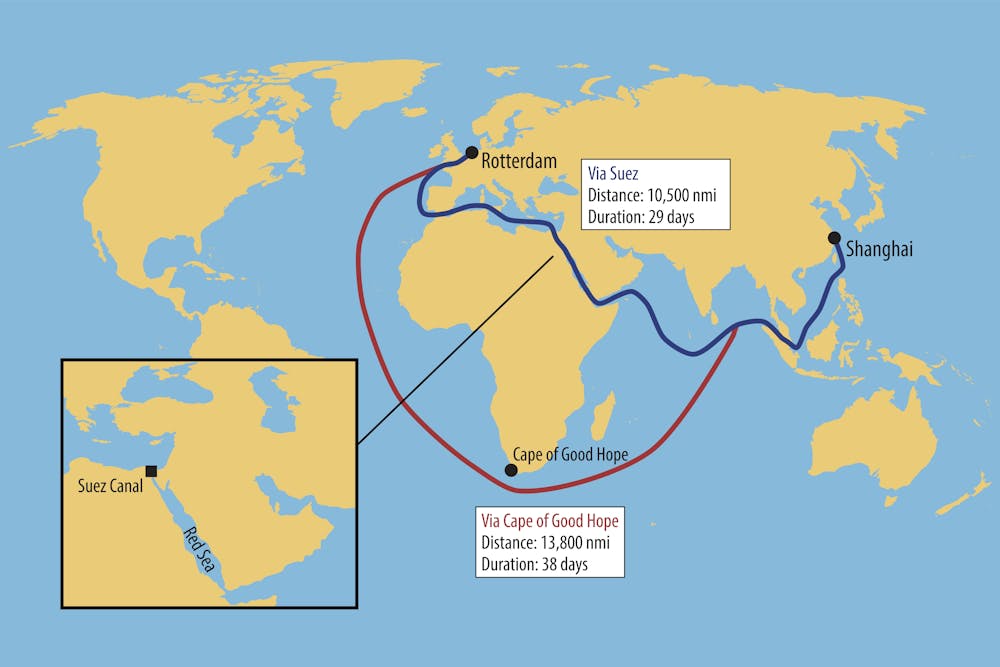
    These attacks have prompted many shipping companies to stop using the Red Sea – a route that around 12% of global trade usually passes through – and divert around the southern tip of Africa. This route adds more than 7,000 nautical miles on to a typical round-trip voyage. The number of commercial ships using the Suez Canal to pass between the Mediterranean and the Red Sea plummeted from over 26,000 in 2023 to 13,200 in 2024.

    Supply chains have had to deal with higher shipping costs, product delivery delays, and increased carbon emissions as a result of this diversion. The Gaza ceasefire gave some hope that the disruption would finally end. But shipping lines will not hurry back to the region until long-term security is guaranteed.

    Since November 2023, shipping companies have been diverting their vessels around the southern tip of Africa to avoid the Red Sea.
    Dimitrios Karamitros / Shutterstock

    During the early stages of the crisis, moving a container from Shanghai in China to Europe cost approximately 250% more than before the war in Gaza began. This was largely due to increased fuel costs and higher insurance premiums. Freight rates (the price companies pay to transport goods) remained high throughout 2024, despite some fluctuations.

    The cost of moving a 40-foot container from Shanghai to Rotterdam in the Netherlands, for example, surged from around US$4,400 on average in January to above US$8,000 by August. This had dropped to US$4,900 at the end of the year.

    It is too early to say whether these costs will be passed on to consumers in the form of higher prices – full transmission through the supply chain to consumer prices can take upwards of 12 months. But some estimates suggest global consumer prices could rise by 0.6% on average in 2025 as these increased shipping costs filter through the supply chain.

    Diverting around southern Africa also resulted in delays in the delivery of many goods and components. The proportion of container ships that arrived on schedule dropped from 60% on average worldwide in 2023 to about 50% throughout 2024. This created congestion at ports because ships often arrived at their destination later than planned, resulting in further delivery delays.

    Unreliable transit times are a significant issue for supply chains because they make it difficult for businesses to plan inventory and coordinate production schedules. Indeed, several vehicle manufacturers, including Tesla and Volvo, temporarily suspended manufacturing in early 2024 due to a lack of components. And food supply chains, including those for avocados, tea and coffee, were also affected by delays.

    Since then, many companies have adapted by increasing their safety stock levels and transporting cargo using alternative modes of transport like air and rail. Some European firms have also adopted a strategy called “nearshoring”, where they source products from regions closer to home such as Turkey and Morocco instead of relying on suppliers in Asia.

    Increased emissions

    The longer route around southern Africa requires that ships travelling between Europe and Asia use around 33% more fuel on average than they would use by travelling through the Red Sea at the same speed.

    Over the past decade, most shipping companies have employed a “slow steaming” policy to economise on fuel use and minimise their carbon emissions. But diverted ships have been travelling around 5% faster than usual in an attempt to minimise delays. The increased vessel speeds will have caused the associated emissions toll to rise – large container vessels require 2.2% more fuel for every 1% increase in speed.

    More data is required to determine the precise amount of additional emissions caused by diverting shipping away from the Red Sea. But estimates suggest that approximately 13.6 million tonnes of CO₂ were emitted by ships rerouted from the Red Sea between December 2023 and April 2024 – equivalent to the carbon emissions of nine million cars over the same period. If ships continue to avoid the region, the increased emissions could amount to 41 million extra tonnes of CO₂ per year.

    Some cargo has also shifted from sea transport to air freight, which has a far greater environmental footprint. Shipping a kilogram of product by long-haul air freight generates at least 50 times more CO₂ emissions on average than container shipping.

    Carbon emissions have increased due to the diversion of vessels around southern Africa.
    David G40 / Shutterstock

    Before returning to the Suez Canal, container lines will want to see a prolonged period of stability around the Red Sea. This is due, in part, to safety and security concerns related to the crew, cargo and the ship.

    But shipping companies also have operational challenges to keep in mind associated with the scheduling of port calls and voyages. Shipping lines will find it difficult to switch back to the longer route around Africa immediately if attacks in the Red Sea resume.

    And, at least for now, the situation in the Bab al-Mandab Strait remains unpredictable. In a televised speech on January 20, Houthi leader Abdul-Malik al-Houthi warned: “We have our finger on the trigger.”

    With other disruptions continuing to affect global shipping, such as port strikes, low water levels in the Panama Canal and extreme weather events, supply chain issues are likely to continue throughout 2025.

    Gokcay Balci does not work for, consult, own shares in or receive funding from any company or organisation that would benefit from this article, and has disclosed no relevant affiliations beyond their academic appointment.

    ref. Red Sea crisis: supply chain issues set to continue despite Gaza ceasefire – https://theconversation.com/red-sea-crisis-supply-chain-issues-set-to-continue-despite-gaza-ceasefire-248469

    MIL OSI – Global Reports

  • MIL-OSI Global: Why I loved the new Mussolini drama – by an expert in Italian fascism

    Source: The Conversation – UK – By John Foot, Professor of Modern Italian History, University of Bristol

    As a historian who has studied and taught courses on Italian fascism, I have spent many hours watching footage and listening to the speeches of dictator Benito Mussolini, who ruled over the country from 1922 to 1943.

    So I was rather excited to be asked to review the new Sky Atlantic TV series M: Son of the Century. The series focuses on the rise of Italian fascism and its consolidation in power from 1919 to 1925. Watching all eight parts in one sitting, I was astounded above all by the performance by well-known Italian actor Luca Marinelli.

    Marinelli is on screen for almost the entire eight hours of the series – often in close up and looking straight at the camera. It is an extraordinary tour-de-force performance. Physically, Marinelli inhabits the role much as Robert De Niro did in Raging Bull, putting on a lot of weight in order to play this part; the resemblance to the dictator is uncanny.


    Looking for something good? Cut through the noise with a carefully curated selection of the latest releases, live events and exhibitions, straight to your inbox every fortnight, on Fridays. Sign up here.


    But there is much more. We are confronted with a torrent of words, speeches and internal monologues, many of which have been drawn directly from Mussolini’s journalism and speeches. Here Marinelli captures the precision and charismatic nature of Mussolini’s speech, but also the brutality of many of the concepts he was expressing.

    There is a great deal of baroque Italian swearing too, and Marinelli powerfully portrays the uncouth son-of-a-blacksmith and his range of expressions with relish. I would be amazed if this actor does not win awards for the role. It is an astonishing performance.

    Director Joe Wright’s series is based on Antonio Scurati’s best-selling Italian historical novel of the same name. Scurati’s approach to Mussolini’s story draws on historical work and documents, but importantly tells the story with the flair of an experienced and successful novelist.

    This and the other three books in Scurati’s series about Mussolini have provoked controversy among Italian historians of fascism, not least for some of the historical inaccuracies, but also for what they considered a “dumbing-down” of history. However, others have defended the books as a new way of understanding and disseminating history, and the books have been wildly popular with general audiences.

    Wright’s series adapts the first book. Its starts when Mussolini formed the first fascist movement in 1919 and inspired the “blackshirt” squads who used violence to crush the trade union and socialist movement. It covers events in 1922 when Mussolini led the fascist insurrection that brought him to power, known as the March on Rome. And, it ends with his famous speech by in parliament, which marked the beginnings of the consolidation of Mussolini’s dictatorship in 1925.

    This is a complicated story, but the scriptwriters and director have done an exemplary job in bringing this history to a wider audience. Unsurprisingly, they have often simplified the past, or altered events to fit the narrative. This paring down of events generally works well in bringing this period to life, but, of course, historians of the period will notice the numerous times that episodes deviate from what really happened.

    For instance, certain figures close to Mussolini who play a central role in the series are used almost as symbols and as ways of understanding the dictator. Above all, this technique uses is used to elevate Margherita Sarfatti, the writer, journalist and lover of Mussolini who was a key figure in inventing and spreading the cult of dictator.

    In Wright’s drama, Sarfatti is depicted as a kind of spin doctor, as someone he turns to in times of difficulty and as an inspiration for his political strategy. Her role is overplayed in the series, but this is done to increase the clarity of storytelling and provide a sharp narrative.

    The tone of the series shifts constantly between darkness and extreme violence to occasional comedy and farce. This is a tricky balance to pull off, but it generally works. Anyone watching will have their views on which parts lapse into bad taste and which do not, and the risks of glamorising or playing down shocking and tragic events.

    Certainly, there were moments which jarred, especially the farcical telling of the March on Rome in 1922. Wright and the scriptwriters, correctly in my opinion, place the violence of fascism at the centre of the story, and it rarely pulls its punches in this regard.

    It is impossible to ignore the contemporary relevance of this series, and it is clearly intended as a warning. Democracy, this series tells us, is extremely fragile. At one point Mussolini turns to the camera and says: “Democracy is beautiful. It even allows you the possibility of destroying it.”

    With the victory of Trump and the political rise of Elon Musk, the pertinence, prescience and power of this film has deepened. There is even a discussion at one point of the meaning and role of the “Roman salute” in terms its use during fascism, something which has been much debated in the light of Musk’s own recent controversial “hand gesture”.

    But the ultimate finger of blame is pointed at those who enabled Mussolini’s rise and who tolerated his incendiary language and the violence of his followers. The series ends starkly, with the word “silence”. Those who did nothing were just as responsible as those who supported the rise of this brutal dictator.

    John Foot does not work for, consult, own shares in or receive funding from any company or organisation that would benefit from this article, and has disclosed no relevant affiliations beyond their academic appointment.

    ref. Why I loved the new Mussolini drama – by an expert in Italian fascism – https://theconversation.com/why-i-loved-the-new-mussolini-drama-by-an-expert-in-italian-fascism-248358

    MIL OSI – Global Reports

  • MIL-OSI Video: UK The future of the Palace of Westminster

    Source: United Kingdom UK Parliament (video statements)

    Restoring the historic Palace of Westminster will support jobs and boost businesses nationwide. We’ve involved hundreds of specialists and training providers in our planning.

    Judith Cummins MP, Deputy Speaker of the House of Commons and Chair of the Restoration and Renewal Programme Board, speaks about some of the future opportunities

    https://www.youtube.com/watch?v=nSYIkK2euj8

    MIL OSI Video

  • MIL-OSI United Kingdom: Jersey expat sentenced for importing £350,000 worth of drugs from Spain30 January 2025 ​​A man was sentenced to three years and nine months in prison by the Royal Court on 30 January 2025 in relation to the importation of cannabis and cocaine. On 10 April 2024, 49-year-old Tony SPENCER… Read more

    Source: Channel Islands – Jersey

    30 January 2025

    ​​

    A man was sentenced to three years and nine months in prison by the Royal Court on 30 January 2025 in relation to the importation of cannabis and cocaine. 

    On 10 April 2024, 49-year-old Tony SPENCER was stopped by Customs officers, driving a Jersey-registered vehicle, having arrived on the ferry from St Malo. SPENCER explained to officers that he had moved from Jersey and in 2020 had opened a butcher’s shop in a town outside Malaga, but was looking to relocate to Jersey. 

    A subsequent search of the vehicle revealed a commercial vacuum heat-sealing machine similar to those used in a butcher’s shop. Upon closer examination, it was found to contain nine kilos of cannabis in 100-gram bars and 290 grams of cocaine. In interview with Jersey Customs and Immigration officers, SPENCER admitted placing the heat-sealing machine into his vehicle, but provided no further information. SPENCER initially provided a not guilty plea, which he changed to guilty a month later. 

    JCIS officers examined the electronic devices SPENCER had with him, which showed he had been looking at sites concerning drug sentencing in Jersey and ways to conceal drugs in cars. 

    The maximum street value in Jersey of the nine kilos of cannabis is £279,000 and the 290 grams of cocaine would fetch £71,000. 

    Senior Manager Paul Le Monnier said: “Today’s sentence reflects the seriousness of this attempted importation. It also shows the high level of skill and vigilance our officers have in detecting commercial quantities of controlled drugs and dealing with those responsible.” 

    MIL OSI United Kingdom

  • MIL-OSI United Kingdom: Man rescued from a fire in Grouville has died30 January 2025 Statement issued on behalf of the States of Jersey Fire and Rescue Service: We are saddened to share that the man who was rescued from a fire in Grouville on Sunday 19 January 2025 has died. George… Read more

    Source: Channel Islands – Jersey

    30 January 2025

    Statement issued on behalf of the States of Jersey Fire and Rescue Service: 

    We are saddened to share that the man who was rescued from a fire in Grouville on Sunday 19 January 2025 has died. 

    George Michael Monte De Ramos Castrudes, 37, was originally from the Philippines and had been working on a farm in the Island. 

    Our thoughts and sympathies are with his loved ones. 

    The coroner’s department can confirm that it is currently investigating this case as an unexpected death. 

    The family, who are overseas, have been made aware and contact has been made with the Philippines Embassy. 

    An inquest will be opened in due course and preparations are underway to repatriate Mr Castrudes’ body home to the Philippines. 

    The cause of the incident remains under SJFRS investigation.​​

    MIL OSI United Kingdom

  • MIL-OSI United Kingdom: Ending Violence Against Women and Girls Momentum Fund – Expression of Interest

    Source: Northern Ireland City of Armagh

    Support for community and voluntary organisations currently working to end violence against women and girls.

    Council is issuing an expression of interest for those community and voluntary organisations who are already involved in the delivery of activity to end violence against women and girls and require support to continue the delivery of their activity until 31st March 2025. This expression of interest allows constituted community and voluntary organisations who are currently delivering activity aligned to the Outcomes of the Ending Violence Against Women and Girls strategy to apply for up to a maximum of £5000. This is for delivery taking place February – March 2025 only. Applications for the expression of interest momentum fund delivery February – March 2025 must be submitted via email by the deadline of 12 noon 13th February 2025. For an application form and guidance notes, please email:  

    *protected email*

    MIL OSI United Kingdom

  • MIL-OSI Security: Cracked and Nulled Marketplaces Disrupted in International Cyber Operation

    Source: United States Attorneys General 2

    At Least 17M U.S. Victims Affected

    The Justice Department today announced its participation in a multinational operation involving actions in the United States, Romania, Australia, France, Germany, Spain, Italy, and Greece to disrupt and take down the infrastructure of the online cybercrime marketplaces known as Cracked and Nulled. The operation was announced in conjunction with Operation Talent, a multinational law enforcement operation supported by Europol to investigate Cracked and Nulled.

    Operation Talent Seizure Banner

    Supervisory Official Antoinette T. Bacon of the Justice Department’s Criminal Division, U.S. Attorney Trini E. Ross for the Western District of New York, U.S. Attorney Jaime Esparza for the Western District of Texas, Assistant Director Brian A. Vorndran of the FBI’s Cyber Division, Special Agent in Charge Matthew Miraglia of the FBI Buffalo Field Office, and Special Agent in Charge Aaron Tapp for the FBI San Antonio Field Office made the announcement.

    Cracked

    According to seizure warrants unsealed today, the Cracked marketplace has been selling stolen login credentials, hacking tools, and servers for hosting malware and stolen data — as well as other tools for carrying out cybercrime and fraud — since March 2018. Cracked had over four million users, listed over 28 million posts advertising cybercrime tools and stolen information, generated approximately $4 million in revenue, and impacted at least 17 million victims from the United States. One product advertised on Cracked offered access to “billions of leaked websites” allowing users to search for stolen login credentials. This product was recently allegedly used to sextort and harass a woman in the Western District of New York. Specifically, a cybercriminal entered the victim’s username into the tool and obtained the victim’s credentials for an online account. Using the victim’s credentials, the subject then cyberstalked the victim and sent sexually demeaning and threatening messages to the victim. The seizure of these marketplaces is intended to disrupt this type of cybercrime and the proliferation of these tools in the cybercrime community.

    The FBI, working in coordination with foreign law enforcement partners, identified a series of servers that hosted the Cracked marketplace infrastructure and eight domain names used to operate Cracked. They also identified servers and domain names for Cracked’s payment processor, Sellix, and the server and domain name for a related bulletproof hosting service. All of these servers and domain names have been seized pursuant to domestic and international legal process. Anyone visiting any of these seized domains will now see a seizure banner that notifies them that the domain has been seized by law enforcement authorities.

    The FBI Buffalo Field Office is investigating the case.

    Senior Counsel Thomas Dougherty of the Criminal Division’s Computer Crime and Intellectual Property Section (CCIPS) and Assistant U.S. Attorney Charles Kruly for the Western District of New York are prosecuting the case.

    Nulled

    The Justice Department announced the seizure of the Nulled website domain and unsealed charges against one of Nulled’s administrators, Lucas Sohn, 29, an Argentinian national residing in Spain. According to the unsealed complaint affidavit, the Nulled marketplace has been selling stolen login credentials, stolen identification documents, hacking tools, as well as other tools for carrying out cybercrime and fraud, since 2016. Nulled had over five million users, listed over 43 million posts advertising cybercrime tools and stolen information, and generated approximately $1 million in yearly revenue. One product advertised on Nulled purported to contain the names and social security numbers of 500,000 American citizens.

    The FBI, working in coordination with foreign law enforcement partners, identified the servers that hosted the Nulled marketplace infrastructure, and the domain used to operate Nulled. The servers and domain have been seized pursuant to domestic and international legal process. Anyone visiting the Nulled domain will now see a seizure banner that notifies them that the domain has been seized by law enforcement authorities.

    According to the complaint, Sohn was an active administrator of Nulled and performed escrow functions on the website. Nulled’s customers would use Sohn’s services to complete transactions involving stolen credentials and other information. For his actions, Sohn has been charged with conspiracy to traffic in passwords and similar information through which computers may be accessed without authorization; conspiracy to solicit another person for the purpose of offering an access device or selling information regarding an access device; and conspiracy to possess, transfer, or use a means of identification of another person with the intent to commit or to aid and abet or in connection with any unlawful activity that is a violation of federal law.

    If convicted, Sohn faces a maximum penalty of five years in prison for conspiracy to traffic in passwords, 10 years in prison for access device fraud, and 15 years in prison for identity fraud.

    The FBI Austin Cyber Task Force is investigating the case. The Task Force participants include the Naval Criminal Investigative Service, IRS Criminal Investigation, Defense Criminal Investigative Service, and the Department of the Army Criminal Investigation Division, among other agencies.

    Assistant U.S. Attorneys G. Karthik Srinivasan and Christopher Mangels for the Western District of Texas are prosecuting the case, with Assistant U.S. Attorney Mark Tindall for the Western District of Texas handling the forfeiture component.

    The Justice Department worked in close cooperation with investigators and prosecutors from several jurisdictions on the takedown of both the Cracked and Nulled marketplaces, including the Australian Federal Police, Europol, France’s Anti-Cybercrime Office (Office Anti-cybercriminalité) and Cyber Division of the Paris Prosecution Office, Germany’s Federal Criminal Police Office (Bundeskriminalamt) and Prosecutor General’s Office Frankfurt am Main – Cyber Crime Center (Generalstaatsanwaltschaft Frankfurt am Main – ZIT), the Spanish National Police (Policía Nacional) and Guardia Civil, the Hellenic Police (Ελληνική Αστυνομία), Italy’s Polizia di Stato and the General Inspectorate of Romanian Police (Inspectoratul General al Poliției Romane). The Justice Department’s Office of International Affairs provided significant assistance.

    A complaint is merely an allegation. All defendants are presumed innocent until proven guilty beyond a reasonable doubt in a court of law.

    MIL Security OSI

  • MIL-OSI USA: U.S. Senate Passes Booker, Lankford, Rosen, Cramer Resolution Commemorating the 80th Anniversary of the Liberation of Auschwitz

    US Senate News:

    Source: United States Senator for New Jersey Cory Booker
    WASHINGTON, D.C. – Today, U.S. Senators Cory Booker (D-NJ), James Lankford (R-OK), Jacky Rosen (D-NV), and Kevin Cramer (R-ND) announced that the Senate unanimously passed their bipartisan resolution commemorating the 80th anniversary of the liberation of Auschwitz in Nazi-occupied Poland and marking International Holocaust Remembrance Day. The resolution calls for the remembrance of the millions of innocent victims of the Nazi reign of terror, honors the legacy of the survivors of the Holocaust, and recommits to combatting all forms of antisemitism.
    “As we commemorate the 80th anniversary of the liberation of Auschwitz the Senate’s unanimous passage of this bipartisan resolution remembers the millions of lives lost in the Holocaust and honors the legacies of those who survived,” said Senator Booker. “I remain committed to combating antisemitism in all of its forms, and we must never forget how hatred, bigotry, and antisemitism created and exploited divisions that led to such atrocities. We must all work to ensure this incredibly dark chapter of history is never repeated.”
    “Today marks 80 years since the liberation of Auschwitz, when thousands of lives were saved, and the world was finally exposed to the horrors behind those walls,” said Senator Rosen. “The U.S. Senate passed this bipartisan resolution to recognize the six million Jews and millions of others who were brutally murdered by Nazis during one of the darkest chapters in human history. At a time when antisemitism and Holocaust denial are on the rise around the world, it has never been more important to remind the world of the atrocities committed by rampant anti-Jew hate and discrimination. By remembering the past, we can ensure Never Again truly means never again.”
    “Eighty years ago today, good triumphed over the evil of the Holocaust as Allied Forces liberated Auschwitz,” said Senator Cramer. “We will never forget the atrocities of the Holocaust. In the wake of an alarming uptick in anti-semitism, we remember the murder of millions of Jews on this solemn day.”
    To read the full text of the resolution, click here.  

    MIL OSI USA News

  • MIL-OSI United Kingdom: Situation in Eastern DRC: UK statement

    Source: United Kingdom – Executive Government & Departments

    The UK has issued a statement following the occupation of Goma in Eastern DRC by M23 and Rwandan Defence Forces (RDF).

    An FCDO spokesperson said:

    “The UK condemns the occupation of Goma and other territories in eastern DRC by M23 and Rwandan Defence Forces (RDF) as an unacceptable breach of DRC’s sovereignty and the UN Charter which poses a fundamental risk to regional stability.

    “The UK calls for the immediate withdrawal of all RDF from Congolese territory. On 26 January, the Foreign Secretary told President Kagame that an attack on Goma would provoke a strong response from the international community. On 29 January, Lord Collins made clear to the Rwandan High Commissioner that Rwanda’s actions in eastern DRC were unacceptable and expressed deep concern at reports of M23 and RDF advancing through South Kivu towards Bukavu.

    “The humanitarian situation, already dire before M23 and RDF’s latest offensive, is now critical. More than 800,000 people in the area who were prioritised for support may no longer receive vital food and nutritional assistance. The UK calls on all parties to immediately cease hostilities, facilitate humanitarian access, and return to inclusive diplomatic talks. Their engagement in good faith in African-led processes will be key. There can be no military solution.

    “The UK is actively considering next steps, alongside international partners, including the possibility of a review of all UK support to Rwanda.”

    Media enquiries

    Email newsdesk@fcdo.gov.uk

    Telephone 020 7008 3100

    Contact the FCDO Communication Team via email (monitored 24 hours a day) in the first instance, and we will respond as soon as possible.

    Updates to this page

    Published 30 January 2025

    MIL OSI United Kingdom

  • MIL-OSI United Kingdom: Employment prospects for neurodiverse people set to be boosted with launch of new expert panel

    Source: United Kingdom – Executive Government & Departments

    People who are neurodiverse will benefit from better employment prospects and more inclusive workplaces thanks to the work and advice of a new expert panel launched today [Wednesday 29 January].

    • An independent panel of academics with expertise and experiences of neurodiversity will advise government on improving job chances for neurodiverse people
    • Just 31% of people with a neurodiversity condition in employment compared to 54.7% of disabled people overall  
    • Panel launch is part of the government’s Plan for Change to support more people into work, boost living standards and grow the economy  

    The panel – headed up by Professor Amanda Kirby and comprising of leading academics in the neurodiversity field – will develop recommendations for ministers this summer, as part of the government’s Plan for Change, which will put money back into people’s pockets, boost living standards, and drive economic growth.  

    The latest employment figures demonstrate the stark reality for many, with the employment rate for disabled people with autism at 31% compared to 54.7% for all disabled people – highlighting a significant gap for some neurodiverse people.  

    The work of the panel will focus on what actions employers can take to foster a more inclusive workplace but also what actions the government can introduce to break down barriers to opportunity for people with a neurodiverse condition, such as autism. 

    Minister for Social Security and Disability, Sir Stephen Timms, said:  

    For too long disabled people and those with a neurodiversity condition have been left behind, ignored, and not given the support they need to get into work.  

    As part of our Plan for Change, we will turn this around, and with the expertise of these leading academics we will achieve our mission of supporting neurodivergent people into the workplace and reaching our 80% employment rate ambition.

    Building on and broadening previous neurodiversity work, the panel met for the first time to begin work on supporting the Government’s drive to improve the employment experiences of neurodivergent people.  

    Chair of the Academic Panel, Professor Amanda Kirby, said:

    I am delighted to chair this panel in what I see is an important and essential piece of work considering how we can drive forward neuroinclusive practices in workplaces to maximise the potential of all and make this become ‘business as usual’

    This panel follows the launch of the Keep Britain Working review, led by Sir Charlie Mayfield, to explore how businesses and government can collaborate to unlock disabled talent.  

    The latest figures show the disability inactivity rate was 41.7% in Q3 2024, compared to 14.7% for non-disabled people. Improving the employment prospect of disabled people and helping them achieve independence is at the heart of the government’s health and disability reforms.   

    Building on our Get Britain Working White Paper, the government will bring forward proposals in the spring to reform the welfare system to help people who can work secure employment.  

    The government will work closely with charities, disabled people and people with health conditions to ensure their voices are at the centre of any policy changes which affect them and to move beyond a binary system of fit or not fit to work.  

    Updates to this page

    Published 30 January 2025

    MIL OSI United Kingdom

  • MIL-OSI United Kingdom: The role of AI in the future of women’s health

    Source: United Kingdom – Executive Government & Departments

    Minister of State for Women’s Health, Baroness Merron, spoke at the Responsible AI: Women and Healthcare Conference 2025, in London.

    I am absolutely delighted to be able to join you today, and I know I am amongst a very wide range of diverse voices and contributors here.

    I want to say thank you for making the time to be here today and to take part, and for sharing your insight on an issue which has the potential to hugely impact for good. I might add, hugely impact our health system for many decades to come. Let me tell you, I’ve just come from speaking in the Chamber about osteoporosis, and I was asked a question by a Peer about the role of AI so I was very glad to be able to say I’m actually on my way to a conference to address this very point.

    So, I say that because I want you to know how relevant this is in Parliament, and there is rightly a push for progress in the way that we are all committed to.

    Since coming into government, we haven’t, and I haven’t, shied away from recognising the huge challenges that we’ve got to address in our health system, and I’m firmly of the view that our health service can only address the challenges of the future and indeed, the challenges of today, if we use the technologies of tomorrow.

    It’s no good looking to the technologies of the past, and we are absolutely committed to delivering the digital transformation that potentially brings these benefits to life.

    We know about the important point about health inequalities, that there are those for whom the NHS hasn’t been there when they need it, even though it should have been. So, as we look to build an NHS that’s fit for the future, it has to be about improvement for everybody, not just a select group.

    It should not matter about what is your age, your ethnicity, your wealth, your religion, your sex, or where you live. We have to work together to create a Britain, I believe, where everybody can live a healthier life for longer.

    A key part of this has to be and must be women’s health to ensure that women are not sidelined in any way and, because that simply creates a negative effect on millions of lives, both directly but indirectly as well.

    We know that women live a greater proportion of their lives in ill health and disability, and 60% of women in this country feel their health issues are not taken seriously. I know that women’s voices are often not heard, and I believe that’s to the detriment not just of the care that’s given, but also to our healthcare system.

    So, for many, when this is combined with other factors like their ethnicity, or the area that they live in, it leads to even worse outcomes. Now that is a challenge to take on and to take it on fully, and we will do that. So, as we speak today, we know we’re on the brink of a technological revolution in healthcare and in many other areas.

    AI will drive incredible amounts of change in our country, and we do have the opportunity to harness it, to turbocharge growth and to boost the quality of lives for all, including women.

    So, we as a government are throwing our full support behind this because AI, as I referred to earlier, is the technology of today. It’s already being deployed in our economy. It’s already revolutionising the delivery of services, including public services, and very much changing how we deliver healthcare.

    So, I don’t need to explain to all of you, because you will explain it better to me about how AI can make a transformational difference to the health of our country.

    However, we have to bear in mind the experience of the past. We do know of instances in the past where not enough care has been taken with new technologies, and we’ve seen the damage that can do. So AI, without doubt opens doors to exciting and very real new possibilities, but we do need to build public confidence and trust that AI is being used responsibly, it’s being used safely and effectively for everyone, and I do think there is a job of work to be done there.

    Without enough care, AI could potentially, in a not good way, incorporate all the same biases that have plagued our healthcare system for too long. There is already evidence of AI healthcare technologies working more effectively for men than for women.

    So, for conditions such as liver disease and kidney disease, algorithms have been hailed as the best without accounting for this absolutely crucial point, and not enough of the patient data used to train these models has been from women. So that means that the AI models have translated the biases from our existing clinical methods into their own approaches.

    So there needs to be much greater attention to developing technologies responsibly, and inclusively that don’t leave women or indeed any other part of our population behind. By perpetuating these biases that may in part be a product of who is in the room developing these new technologies, possibly. Women are significantly underrepresented in the AI sector, as is commonly the case in other technology sectors.

    One study suggested, I noted, that only a quarter of the AI workforce is female, and I have no doubt that having more women in the room, as we have today, would do a huge amount to help. Although, I do have to say it is not all the responsibility of women to ensure the woman’s perspective. Not at all.

    So, as we look to AI, we need to ensure that 51% of our population must be worked with and for. This is not a minority group. We are a majority group and with particular healthcare needs. So, by taking steps to eliminate bias in healthcare AI, we will build trust, and I do think trust is so important, to build trust in this next wave of healthcare technologies and ensure that digital solutions can work for everyone.

    We are, in government, committed to providing that support and enabling your efforts to come to fruition. We have supported the delivery of the Standing Together recommendations, which is a crucial piece of work developing standards for AI data sets, ensuring that they do reflect the diversity of the patient population and mean that we can see products that work for everybody.

    With the National Institute for Health and Care Research, we are making sure that the UK research community incorporates sex and gender into its research, supporting the crucial work in the research inclusion strategy and finalising a sex and gender policy framework for funders through the Medical Science, Sex and Gender Equity Project. But there is, of course, so much more to do and so much further that we can go to help you achieve the goal of making AI in healthcare work for everyone.

    We will stand by your side in this crucial endeavour, and we are committed to enabling your efforts and finding ways to do that, because I believe it’s only with your expertise and your insight that the potential for digital transformation can be fully realised because what we want to see is faster diagnosis. We want to see better treatment. We want more efficient care to every person across the country.

    It is thanks to your advocacy and to your knowledge and your initiative that we will ensure that we learn the lessons from the past, and we will make sure that nobody is left out as we look to the future.

    So, let me thank you again for attending the conference today. I know that together we have the ability to achieve great things and making sure that the digital health revolution is one that’s embraced, that is safe and is fair for everyone, and will unlock the benefits of AI to improve the health of the nation.

    I am looking forward to that. So, thank you very much.

    Updates to this page

    Published 30 January 2025

    MIL OSI United Kingdom

  • MIL-OSI United Kingdom: New mobility hub underway in Chaddesden

    Source: City of Derby

    Work to create the city’s second sustainable transport hub is underway, giving residents greater choice when deciding how to travel around their local community.

    Following the success of the Six Streets mobility hub which was launched in March 2023, work has started at Nottingham Road in Chaddesden, next to the busy shopping precinct.

    Mobility hubs make it easier for people to choose alternative ways to get to local amenities. These include sustainable travel, such as electric vehicles (EV) and car share clubs, or active travel like walking and cycling. The hubs are continually monitored which helps the Council learn more about the area’s transport needs and demand for the different elements of the hub

    The Chaddesden mobility hub will be home to:

    • Additional Enterprise Car Club vehicles
    • Electric Vehicle (EV) charging and dedicated EV parking
    • An interactive information totem with live travel updates
    • A new bench and planter to enhance biodiversity
    • A covered cycle shelter with space to store ten bicycles and a permanent bicycle pump.

    Work to create the mobility hub will also enhance the look and feel of the area through the planting of additional trees and the relining of the car park. The western end of the precinct will also be resurfaced with new flexible porous surfacing to replace damage caused by existing trees. The new surfacing will have resistance to movement caused by root growth.

    Councillor Carmel Swan, Cabinet Member for Climate Change, Transport and Sustainability said:

    We’ve been working hard to give our communities greater choice when deciding how to travel around the city.

    These mobility hubs have been in development for some time so it’s exciting to see work get underway in Chaddesden. We’ve taken the time to learn from previous schemes and listen to local residents and businesses and are confident that this hub will become a welcome addition to the Chaddesden community, further enhancing our ever-growing network of active and sustainable travel choices.

    The Chaddesden mobility hub is due to be completed in April 2025. A third mobility hub is also in the works to benefit residents of Normanton and Arboretum on Grove Street. Work on this hub will begin in the Spring.

    The mobility hubs are funded by the Department for Transport (DFT)’s Future Transport Zones Fund, which was awarded to Derby City Council to trial new and exciting developments in transport.

    Residents who would like to know more about the mobility hubs can get in touch with the Future Transport Zones team by emailing traffic.management@derby.gov.uk.

    MIL OSI United Kingdom

  • MIL-OSI Europe: OSCE promotes classification system for cyber incidents to strengthen cyber security in Ukraine

    Source: Organization for Security and Co-operation in Europe – OSCE

    Headline: OSCE promotes classification system for cyber incidents to strengthen cyber security in Ukraine

    A presentation at an OSCE workshop on cyber incident classification for cyber security policy and technical experts from Ukraine, 29 January 2025. (OSCE/Ruzica Stojicic Bencun) Photo details

    The OSCE Transnational Threats Department (TNTD) organized a workshop on cyber incident classification for 15 cyber security policy and technical experts from Ukraine, including two women and 13 men. The workshop, held on 29 January, focused on the development and implementation of a national cyber incident classification system, a common scheme for understanding and defining what a cyber incident is, that ensures consistency in crisis management tools and plans.
    With the exponential increase of cyberattacks targeting the country, experts stressed the importance of establishing such a system to ensure effective prioritization and management, particularly for incidents impacting critical infrastructure. The workshop built upon the knowledge and expertise gathered in previous similar events, tailored to Ukraine.
    Yurii Romanchuk, Head of the Cyber Diplomacy Division at the Ministry of Foreign Affairs of Ukraine, stated that “we are particularly interested in developing a unified taxonomy for cyber incident classification, one that will be regularly updated, clearly communicated and effectively utilized by all stakeholders. Interagency co-operation and information exchange within the OSCE framework will significantly enhance the efficiency of incident response at both national and international levels.”
    “Developing a national cyber incident classification system is a key step in managing the thousands, if not hundreds of thousands of cyber threats that Ukraine faces daily,” emphasized John Schabedoth, Cyber Foreign Policy Staff at the German Federal Foreign Office.
    Alban Andreu, Advisor at the Ministry for Europe and Foreign Affairs of France, added: “France supports the OSCE Secretariat’s efforts to implement confidence-building measure 15 (CBM 15) on the protection of critical infrastructure to contribute to capacity-building at national and regional levels. The more we are grounded in concrete outcomes, such as this dedicated workshop for Ukraine, the more we strive for resilience and cooperation in cyberspace.”
    Participants also engaged in a table-top exercise aimed at exploring the practical application of the OSCE’s 16 cyber/ICT security confidence-building measures (CBMs). These measures are designed to address misunderstandings and misperceptions in cyberspace by fostering transparency, communication and co-operation between the OSCE participating States. The exercise demonstrated how CBMs can help prevent escalation during a cyber incident and highlighted the critical role of cross-border collaboration in protecting critical infrastructure.
    The workshop is part of the “Facilitation of the Development and Implementation of National Cyber Incident Severity Scales (NCISS) and Related Measures to Protect Critical Infrastructures” project, funded by France and Germany.

    MIL OSI Europe News

  • MIL-OSI United Kingdom: Revolutionising Tactical Communications Security in Defence

    Source: United Kingdom – Executive Government & Departments

    Case study

    Revolutionising Tactical Communications Security in Defence

    Funded by DASA, PhoenixC4i, delivers game-changing antenna technology that reduces radio frequency (RF) footprint to enhance stealth and safety

    • Innovative clip-on antenna technology reduces RF footprint by up to 80%, enhancing operational security
    • Successfully deployed with over 75 units purchased by the British Army for evaluation
    • Cost-effective solution providing significant tactical advantage in electronic warfare environments

    Picture this scenario: armoured vehicles move through contested terrain. The mission is complex, with multiple units coordinating across a battlefield that spans tens of miles. But there’s a catch: every radio transmission needed to coordinate these forces could become a beacon for enemy targeting systems. Units face a difficult challenge between maintaining communications with one another and potentially revealing their positions to the adversaries hunting them, particularly when static.

    Stealth by design: DarkSky Clip-On Antenna

    From individual soldier radios to armoured vehicles and headquarters command posts, military forces rely on tactical Ultra High Frequency (UHF) antennas for communications. But these systems broadcast signals in all directions, making them easier to detect. Recent conflicts have provided stark evidence of how devastating electronic warfare can be, with forces suffering significant losses when their communications are detected and targeted.

    PhoenixC4i’s DASA-funded solution is elegantly simple: a clip-on antenna that directs radio signals only where needed, like a spotlight rather than a floodlight. This not only makes communications harder to detect but also improves signal quality. Whether mounted on vehicles, command posts, or carried by soldiers, the system improves survivability with minimal training required.

    DarkSky in action

    “We developed the DarkSky Clip-On Antenna after realising that existing systems were unable to effectively reduce the detectable signal,” explains Douglas Celerier, founder of PhoenixC4i. “Our solution needed to be ultra-portable, easy to train and versatile enough to be deployed on different platforms, such as vehicles, masts or soldier platforms.”

    Revolutionising Tactical Communications Security in Defence

    Benefits for Defence:

    • improve link quality for robust HQ-to-HQ communications
    • doubling the baseline communication range
    • extending links within the network, particularly to isolated nodes
    • providing better quality links to enhance data performance reducing up to 80% unwanted RF signature in identified directions: reducing
      • vulnerability of intercept
      • susceptibility to disruption from jamming or co-site interference
    • easily retrofitting to existing UHF comms systems with low system and network impact

    Impact and implementation

    On completion of their DASA project, the British Army purchased 75 DarkSky Clip-On Antennas for evaluation. The PhoenixC4i innovation offers a cost-effective solution for protecting static vehicles, headquarters, and infantry radio communications.

    Beyond the British Army’s purchase, PhoenixC4i also secured significant contracts, including several units for UK MOD specialist users. The system has proven its worth in multiple trials, including WESSEX Storm and MARWORKS, and is being considered for frameworks such as SERAPIS and humanitarian support to Ukraine.

    “When the tactical antenna system was first designed, it was based on a mesh network where the signals all supported each other,” says Celerier. “However, in reality, it doesn’t work like that – small groups go out with long links between organisational units. The DarkSky Clip-On Antenna supports actual operational requirements while keeping users covert.”

    DASA and PhoenixC4i: On the same wavelength

    The journey from innovative idea to battlefield-ready technology requires more than just engineering talent – it needs the right support. Since 2020, DASA’s expertise has transformed PhoenixC4i’s initial concept into a field-tested reality.

    “Working with DASA has provided multiple advantages,” notes Celerier. “The DASA team are always available to assist with everything from admin, commercial, technical direction or helping to open doors to the right customers for our technology. Their support has allowed PhoenixC4i to expand and employ additional personnel.”

    The results speak for themselves. What began as antenna modelling in a workshop in Gloucester has evolved into technology tested by British forces, with PhoenixC4i expanding both their team and their ambitions.

    “We’ve created something that’s not only innovative but also practical and affordable,” says Celerier.

    A growing defence portfolio

    The DarkSky Clip-On Antenna is just one part of PhoenixC4i’s growing defence innovation portfolio. Through continued DASA support, the company has been funded to develop technologies including:

    SPARTACUS: Tactical Deception Made Simple

    This electronic warfare system creates convincing radio signatures that protect forces by generating digital ‘decoys’. The system can simulate various military assets while remaining simple enough for rapid deployment.

    Infrared Heat-Mat: Digital Camouflage Evolution

    Using advanced materials including silicone and graphene, these heat mats replicate thermal signatures of vehicles and personnel to add clutter and degrade adversary sensor capabilities.

    Clever Clutter: Small Units, Big Impact

    Available in portable and larger variants, these units create confusion across infrared, visual, and audio spectrums. The technology is cost-effective and requires minimal training, making it ideal for rapid deployment.

    D-DIAB: Integrated Deception at the Push of a Button

    The ‘Digital Deception in a Box’ combines radio frequency and infrared deception in a single, trailer-mounted unit. It can simulate an entire headquarters location while keeping personnel safely away from harm.

    DarkSky, bright future

    Building on the success of the DarkSky Clip-On Antenna, PhoenixC4i continues to work with DASA on other electronic warfare solutions, including the SPARTACUS RF deception system and IR heatmat capabilities. These developments demonstrate the ongoing value of DASA’s support in bringing innovative defence solutions to market.

    The success of the DarkSky Clip-On Antenna proves that innovative SMEs, with the right support, can deliver critical capabilities to defence users. As electronic warfare continues to evolve, solutions like the DarkSky Clip-On Antenna can play an important role in protecting military communications and ensuring operational success.

    Updates to this page

    Published 30 January 2025

    MIL OSI United Kingdom

  • MIL-OSI: DDB Miner Announces Revolutionary Cloud Mining Platform, Offering Dogecoin (DOGE) Enthusiasts Up to $15,000 Daily

    Source: GlobeNewswire (MIL-OSI)

    BIRMINGHAM, United Kingdom, Jan. 30, 2025 (GLOBE NEWSWIRE) — DDB Miner, a leading innovator in cloud mining technology, is revolutionizing the cryptocurrency mining industry by offering Dogecoin (DOGE) enthusiasts a seamless and highly profitable way to generate passive income from home. With cutting-edge mining infrastructure powered entirely by renewable energy, DDB Miner provides an accessible and sustainable cloud mining solution.

    Empowering Users Through Cloud Mining

    Cryptocurrency mining, a fundamental process in blockchain networks, traditionally requires expensive hardware and extensive technical knowledge. DDB Miner eliminates these barriers with a user-friendly cloud mining platform that allows individuals to participate in mining without the need for costly equipment or maintenance. By leveraging advanced remote mining farms, users can efficiently mine DOGE and other popular cryptocurrencies with ease.

    About DDB Miner

    As a pioneer in the cloud mining sector, DDB Miner operates over 180 mining farms globally, housing more than 100,000 state-of-the-art mining machines. With a commitment to security, transparency, and sustainability, DDB Miner has attracted over 9 million users worldwide, solidifying its reputation as a trusted leader in the industry.

    Key Benefits of DDB Miner’s Cloud Mining Services:

    • Instant $12 Registration Bonus – New users receive an immediate sign-up reward.
    • Daily Earnings & Payouts – Users can earn up to $15,000 per day with automated daily withdrawals.
    • Zero Hidden Fees – No service or management fees, ensuring maximum profitability.
    • Diverse Cryptocurrency Support – Mine BTC, LTC, ETH, DOGE, BCH, SOL, XRP, BNB, USDC, and USDT.
    • Affiliate Program with Lucrative Bonuses – Earn up to $22,000 in referral rewards.
    • Industry-Leading Security – Advanced protection with McAfee® and Cloudflare® security protocols.
    • 100% Uptime Guarantee – Reliable operations backed by 24/7 technical support.

    How to Get Started with DDB Miner

    Joining DDB Miner is a quick and simple process:

    1. Register an Account – Sign up in just two minutes and start mining instantly.
    2. Select a Mining Contract – Choose from various contract options, including $100, $500, and $1,000 plans, each offering different profit margins and durations.
    3. Start Earning Immediately – Users begin receiving payouts the following day, with the option to withdraw funds once reaching a $100 threshold.

    Unlock Additional Earnings Through the DDB Miner Affiliate Program

    DDB Miner’s Affiliate Program presents an exciting opportunity for users to maximize earnings by referring friends and colleagues. With no referral limits, participants can generate up to $20,000 in monthly bonuses, making it an attractive option for those seeking passive income without upfront investment.

    Join the Future of Cloud Mining Today

    DDB Miner is redefining the cryptocurrency mining experience, making it more accessible, sustainable, and profitable than ever before. Whether you’re a seasoned investor or a beginner looking to enter the crypto space, DDB Miner provides the tools and resources needed for success.

    For more information, visit the DDB Miner Official Website or download the DDB Miner app from Google Play or the Apple Store.

    Media Contact:

    Katerina Audrey
    DDB Miner Media Relations
    Email: info@ddbminer.com
    Website: https://ddbminer.com

    Disclaimer: This press release is provided by “DDB Miner”. The statements, views, and opinions expressed in this content are solely those of the sponsor and do not necessarily reflect the views of this media platform. We do not endorse, verify, or guarantee the accuracy, completeness, or reliability of any information presented. This content is for informational purposes only and should not be considered as financial, investment, or trading advice. Investing in cloud mining and related opportunities involves significant risks, including the potential loss of capital. Readers are strongly encouraged to conduct their own research and consult with a qualified financial advisor before making any investment decisions. Do your own research before doing any investments.

    A photo accompanying this announcement is available at https://www.globenewswire.com/NewsRoom/AttachmentNg/7458b4da-e47e-4ee6-866d-c32a31b77964

    The MIL Network

  • MIL-OSI Africa: Secretary-General’s remarks to the Ambassadorial-Level meeting of the Peacebuilding Commission [as delivered]

    Source: United Nations – English

    t is a pleasure to be here with you today.

    I wish to start by congratulating the Member States that have recently been elected to the Peacebuilding Commission.

    I also congratulate Brazil for leading the PBC during its 18th session and welcome Germany’s candidacy for the chair of the 19th session.

    Excellencies,

    Our world is in trouble. 

    We see spreading conflicts and widening geopolitical divisions.

    We face a deepening climate crisis and widening inequalities.

    We are confronting the proliferation of weapons and the spread of disinformation.

    All of this and more makes the work of the Peacebuilding Commission more critical than ever.

    I want to salute the Commission for its vital advisory role to the Security Council, including in the context of UN mission transitions.

    I also recognize your important convening role within the UN and beyond – engaging civil society, the private sector, international and regional organizations, and financial institutions.

    Now we have the chance to consolidate and expand that work. 

    The Pact for the Future charts a course to reforming international cooperation – including by prioritizing prevention, mediation and peacebuilding.

    It seeks to break siloes by advancing coordination with regional organizations, developing innovative approaches and fostering the full participation of women, youth and marginalized groups in peace processes.

    And, fundamentally, the Pact calls for strengthening the Peacebuilding Commission.
    This year’s Review of the Peacebuilding Architecture offers an opportunity to further advance these efforts and strengthen the role of the PBC – namely its relationship with the Security Council.

    My recent report on Peacebuilding and Sustaining Peace lays out concrete suggestions around inflection points where the Commission can help catalyze national efforts.

    This includes working to fully empower the Commission to mobilize political and financial support for nationally-owned peacebuilding and prevention strategies.

    As the review unfolds, I encourage the Commission to draw on its rich experience to guide deliberations at the General Assembly and Security Council – with actionable recommendations towards strengthening the peacebuilding architecture and transforming people’s lives.

    Excellencies,

    This brings me to a vital issue: financing.

    The General Assembly’s approval of assessed contributions to the Peacebuilding Fund marks an important step.

    But it is still a far cry from the “quantum leap” of $500 million per year that is needed.

    As many Member States have highlighted, voluntary contributions remain paramount – and I encourage countries to provide additional support to the Fund.

    Given the urgent and expanding needs for peacebuilding support, I trust that the Review of the Peacebuilding Architecture will further examine how to ensure the predictability, adequacy and sustainability of the Fund – including by exploring innovative financing mechanisms, public-private partnerships and blended funding models.

    Excellencies,

    We must never waver in our commitment to pursue, achieve and sustain peace.

    The Peacebuilding architecture – consisting of the Peacebuilding Commission, the Peacebuilding Support Office and the Peacebuilding Fund – working together with UN Country Teams, are essential tools to help translate aspirations into reality.

    I look forward to continuing to work with you all to strengthen our peacebuilding architecture and help build a world of peace and prosperity for all largely thanks to your precious intervention.

    Thank you very much. 

    MIL OSI Africa

  • MIL-OSI: Cegedim’s revenue grew 6.3% in 2024

    Source: GlobeNewswire (MIL-OSI)


    PRESS RELEASE

    Quarterly financial information as of December 31, 2024
    IFRS – Regulated information – Not audited

    Cegedim’s revenue grew 6.3% in 2024

    • Full year revenue rose 4.7% like for like to €654.5 million
    • Fourth quarter revenue grew 5.9% like for like to €178.7 million
    • All operating divisions contributed to growth in the fourth quarter

    Boulogne-Billancourt, France, January 30, 2025, after the market close

    Revenue

      Fourth quarter Change Q4 2024 / 2023
    in millions of euros 2024 2023

    reclassified(1)

    Reclassification(1) 2023

    Reported

    Reported

    vs. reclassified(1)

    Like for like(2)(3)

    vs. reclassified(1)

    Software & Services 80.1 75.7 (8.7) 84.4 +5.8% +2.8%
    Flow 27.0 24.2 (0.6) 24.8 +12.0% +11.7%
    Data & Marketing 38.4 35.8 0.0 35.8 +7.1% +7.1%
    BPO 21.2 19.6 0.0 19.6 +7.8% +7.8%
    Cloud & Support 12.0 11.3 +9.3 2.0 +6.2% +6.2%
    Cegedim 178.7 166.6 0.0 166.6 +7.2% +5.9%
      Full year Change FY 2024 / 2023
    in millions of euros 2024 2023

    reclassified(1)

    Reclassification(1) 2023

    Reported

    Reported

    vs. reclassified(1)

    Like for like(2)(4)

    vs. reclassified(1)

    Software & Services 307.8 302.3 (24.3) 326.6 +1.8% (1.2)%
    Flow 100.3 93.4 (2.5) 95.9 +7.3% +7.2%
    Data & Marketing 125.9 114.9 0.0 114.9 +9.6% +9.6%
    BPO 82.7 71.5 0.0 71.5 +15.8% +15.8%
    Cloud & Support 37.8 33.9 +26.8 7.1 +11.3% +11.3%
    Cegedim 654.5 616.0 0.0 616.0 +6.3% +4.7%

    Cegedim’s consolidated fourth quarter 2024 revenues rose to €178.7 million, up 7.2% as reported and 5.9% like for like(2) compared with the same period in 2023. All operating divisions contributed to like for like growth in the fourth quarter.

    Over the full year, revenues rose 6.3% as reported and 4.7% like for like compared with 2023. Marketing, health insurance, HR, and cloud businesses delivered the most solid growth over the full year. As expected, the Software & Services division felt the impact of comparisons with Ségur public health investment spending in 2023 and a slowdown in international sales because the Group decided to refocus its UK doctor software activities on Scotland, and then later decided to voluntarily place that business under administration.

    Analysis of business trends by division 

    • Software & Services
    Software & Services Fourth quarter Change Q4 2024 / 2023 Full year Change FY 2024 / 2023
    in millions of euros 2024 2023

    Reclassified(3)

    Reported

    vs. reclassified(1)

    Like for like(2)

    vs. reclassified(1)

    2024 2023

    reclassified(1)

    Reported

    vs. reclassified(1)

    Like for like(2)

    vs. reclassified(1)

    Cegedim Santé 21.3 18.1 +17.2% +1.8% 80.2 76.5 +4.8% (7.1)%
    Insurance, HR, Pharmacies, and other services 47.2 44.9 +5.1% +5.1% 176.7 173.3 +2.0% +1.9%
    International businesses 11.6 12.7 (8.2)% (3.5)% 50.9 52.5 (3.0)% (3.0)%
    Software & Services 80.1 75.7 +5.8% +2.8% 307.8 302.3 +1.8% (1.2)%

    Revenues at Cegedim Santé grew 17.2% as reported in the fourth quarter and 1.8% like for like. Reported growth over the full year came to 4.8%, but like-for-like revenues fell 7.1% due to the absence of Ségur public health investments, which generated revenue of €4.7 million in 2023. Reported growth includes Visiodent from March 1, 2024. The new subsidiary has already started marketing Group products like the Maiia appointment scheduling app and the Claude Bernard database to its clients, but those sales are not reflected in like-for-like growth.

    Others French subsidiaries saw reported revenue growth of 5.1% in the fourth quarter and 2% over the full year (1.9% LFL; Phealing acquired in Q4 2023). Over both the fourth quarter and the full year, the division was propelled by growth at the insurance businesses, thanks to robust project-based sales, and by HR, which is still getting a boost from its client diversification strategy. On the other hand, sales to pharmacies were down substantially—as they were at some of the competitors. This was partly because equipment sales slowed after many pharmacies updated their equipment in 2023. In addition, the pharmacy software business took in more than €2 million in Ségur public health investment revenues in 2023, creating a tough comparison.

    Internationally, revenues from software sales to UK doctors declined, as expected, following the Group’s decision early in the year to refocus the activity on Scotland. Unfortunately, the market proved too sluggish for this plan to succeed. On December 10, the Group decided to deconsolidate this subsidiary after announcing it would be voluntarily placed under administration. That move aggravated the drop in reported revenues in the fourth quarter, which came to 8.2%.

    Flow Fourth quarter Change Q4 2024 / 2023 Full year Change FY 2024 / 2023
    in millions of euros 2024 2023

    reclassified(1)

    Reported

    vs. reclassified(1)

    Like for like(2)

    vs. reclassified(1)

    2024 2023

    reclassified(1)

    Reported

    vs. reclassified(1)

    Like for like(2)

    vs. reclassified(1)

    e-business 15.0 14.0 +7.1% +6.7% 58.5 55.4 +5.6% +5.3%
    Third-party payer 12.0 10.2 +18.7% +18.7% 41.8 38.0 +9.9% +9.9%
    Flow 27.0 24.2 +12.0% +11.7% 100.3 93.4 +7.3% +7.2%

    Fourth-quarter growth in e-business, e-invoicing, and digitized data exchanges was 7.1%. The boost came from a rebound in Invoicing & Purchasing in France and a continued surge at the Healthcare Flow segment, which started early in the year, owing to dynamic new offerings for hospitals that are designed to make their drug purchasing secure. Growth over the full year was a solid 5.6%.

    The digital data flow business dealing with reimbursement of healthcare payments in France (Third-party payer) experienced 18.7% growth in Q4. It was boosted by strong growth in demand for its fraud and long-term illness detection offerings. Over the full year, this trend more than offset the transfer of revenue attributable to the Allianz contract—now attributed to the BPO business—and allowed the unit to post growth of 9.9%.

    • Data & Marketing
    Data & Marketing Fourth quarter Change Q4 2024 / 2023 Full year Change FY 2024 / 2023
    in millions of euros 2024 2023

    reclassified(1)

    Reported

    vs. reclassified(1)

    Like for like(2)

    vs. reclassified(1)

    2024 2023

    reclassified(1)

    Reported

    vs. reclassified(1)

    Like for like(2)

    vs. reclassified(1)

    Data 22.4 21.0 +6.3% +6.3% 65.5 64.5 +1.6% +1.6%
    Marketing 16.0 14.8 +8.2% +8.2% 60.4 50.4 +19.9% +19.9%
    Data & Marketing 38.4 35.8 +7.1% +7.1% 125.9 114.9 +9.6% +9.6%

    Data businesses posted 6.3% yoy growth in the fourth quarter, cementing an improvement over the second half, particularly in France. Thanks to its strong presence on the ground and its agility in adapting to customer demands, the Data business has been able to post positive growth of 1.6% in 2024, following a remarkable year in 2023.

    The Marketing segment had a solid fourth quarter, up 8.2%, and a record year, with growth of 19.9%. The performance showed the soundness of its phygital media strategy for pharmacies and was bolstered by special ad campaigns during the Olympics.

    BPO Fourth quarter Change Q4 2024 / 2023 Full year Change FY 2024 / 2023
                    in millions of euros 2024 2023

    Reclassified(4)

    Reported

    vs. reclassified(1)

    Like for like(2)

    vs. reclassified(1)

    2024 2023

    reclassified(1)

    Reported

    vs. reclassified(1)

    Like for like(2)

    vs. reclassified

    Insurance BPO 15.4 14.0 +9.9% +9.9% 60.0 49.9 +20.2% +20.2%
    Business Services BPO 5.8 5.6 +2.8% +2.8% 22.7 21.6 +5.5% +5.5%
    BPO 21.2 19.6 +7.8% +7.8% 82.7 71.5 +15.8% +15.8%

    The Insurance BPO business grew by 9.9% over the fourth quarter, chiefly owing to its overflow business, which has been flourishing since the start of the year. Growth over the full year amounted to 20.2%, partly thanks to a favorable comparison stemming from the April 1, 2023, launch of the Allianz contract.

    Business Services BPO (HR and digitalization) reported growth of 2.8% in the fourth quarter and 5.5% over the full year on the back of a popular compliance offering and new clients.

    • Cloud & Support
    Cloud & Support Fourth quarter Change Q4 2024 / 2023 Full year Change FY 2024 / 2023
    in millions of euros 2024 2023

    reclassified(1)

    Reported

    vs. reclassified(1)

    Like for like(2)

    vs. reclassified(1)

    2024 2023

    reclassified(1)

    Reported

    vs. reclassified(1)

    Like for like(2)

    vs. reclassified(1)

    Cloud & Support 12.0 11.3 +6.2% +6.2% 37.8 33.9 +11.3% +11.3%

    The Cloud & Support division’s trajectory continued over the fourth quarter, with growth of 6.2% bringing FY growth to 11.3%. The progress reflects our expanded range of sovereign cloud-backed products and services, which earned the ANSSI security visa for SecNumCloud certification.

    Highlights

    Apart from the items cited below, to the best of the company’s knowledge, there were no events or changes during Q4 2024 that would materially alter the Group’s financial situation.

    On December 10, 2024, Cegedim announced that it had voluntarily placed its UK subsidiary—INPS, which sells software for doctors—under administration.

    Significant transactions and events post December 31, 2024
    To the best of the company’s knowledge, there were no post-closing events or changes after December 31, 2024, that would materially alter the Group’s financial situation.

    Outlook

    Like-for-like revenue growth(1) in 2024 was just below the bottom of the announced 5% to 8% range compared with 2023. Had the Group not refocused INPS on Scotland and then closed it later in the year, it would have met the 5% target. This performance is unlikely to jeopardize the outlook for recurring operating income, which is expected to continue improving.
    That said, the deconsolidation of INPS is likely to result in significant non-cash adjustments.
    These statements are not forecasts and are based on financial information that has not yet been audited.

    —————

    WEBCAST ON JANUARY 30, 2025 AT 6:15 PM (PARIS TIME)
    The webcast is available at: www.cegedim.fr/webcast
    The FY 2024 revenue presentation is available at:
    https://www.cegedim.fr/documentation/Pages/presentation.aspx

    Financial calendar:

    2025 March 27 after the close

    March 28 at 10:00 am

    April 24 after the close

    June 13 at 9:30

    July 24 after the close

    September 25 after the close

    September 26 at 10:00 am

    October 23 after the close

    2024 results

    SFAF meeting

    Q1 2025 revenues

    Shareholders’ general meeting

    H1 2025 revenues

    H1 2025 results

    SFAF meeting

    Q3 2025 revenues

    Financial calendar: https://www.cegedim.fr/finance/agenda/Pages/default.aspx

    Disclaimer
    This press release is available in French and in English. In the event of any difference between the two versions, the original French version takes precedence. It was sent to Cegedim’s authorized distributor on January 30, 2025, no earlier than 5:45 pm Paris time.
    The figures cited in this press release include guidance on Cegedim’s future financial performance targets. This forward-looking information is based on the opinions and assumptions of the Group’s senior management at the time this press release is issued and naturally entails risks and uncertainty. For more information on the risks facing Cegedim, please refer to Chapter 7, “Risk management”, section 7.2, “Risk factors and insurance”, and Chapter 3, “Overview of the financial year”, section 3.6, “Outlook”, of the 2023 Universal Registration Document filled with the AMF on April 3, 2024, under number D.24-0233.

    About Cegedim:
    Founded in 1969, Cegedim is an innovative technology and services group in the field of digital data flow management for healthcare ecosystems and B2B, and a business software publisher for healthcare and insurance professionals. Cegedim employs nearly
    6,700 people in more than 10 countries and generated revenue of over €654 million in 2024.
    Cegedim SA is listed in Paris (EURONEXT: CGM).
    To learn more please visit: www.cegedim.fr
    And follow Cegedim on X: @CegedimGroup, LinkedIn, and Facebook.

    Aude Balleydier
    Cegedim
    Media Relations
    and Communications Manager

    Tel.: +33 (0)1 49 09 68 81
    aude.balleydier@cegedim.fr

    Damien Buffet
    Cegedim
    Head of Financial
    Communication

    Tel.: +33 (0)7 64 63 55 73
    damien.buffet@cegedim.com

    Céline Pardo
    Becoming RP Agency
    Media Relations Consultant

    Tel.:        +33 (0)6 52 08 13 66
    cegedim@becoming-group.com


    ____________________________________________________________________________________________________________________________________________________

    (1) At constant scope and exchange rates.

    Annexes

    Breakdown of revenue by quarter and division

    in millions of euros   Q1 Q2 Q3 Q4 Total
    Software & Services   74.3 77.8 75.6 80.1 307.8
    Flow   25.4 24.2 23.7 27.0 100.3
    Data & Marketing   27.0 32.3 28.2 38.4 125.9
    BPO   20.2 19.7 21.6 21.2 82.7
    Cloud & Support   9.0 9.1 7.7 12.0 37.8
    Group revenue   155.9 163.1 156.8 178.7 654.5
    in millions of euros   Q1
    reclassified
    Q2
    reclassified
    Q3
    reclassified
    Q4
    reclassified
    Total
    reclassified
    Software & Services   74.4 76.2 76.0 75.7 302.3
    Flow   24.0 22.8 22.4 24.2 93.4
    Data & Marketing   24.6 30.3 24.1 35.8 114.9
    BPO   14.4 18.4 19.0 19.6 71.5
    Cloud & Support   8.4 7.4 6.8 11.3 33.9
    Group revenue   145.9 155.1 148.3 166.6 616.0

    Revenue breakdown by geographic zone, currency, and division at December 31, 2024

    as a % of consolidated revenues   Geographic zone   Currency
      France EMEA
    ex. France
    Americas   Euro GBP Other
    Software & Services   83.5% 16.4% 0.1%   86.9% 11.4% 1.7%
    Flow   92.1% 7.9% 0.0%   94.6% 5.4% 0.0%
    Data & Marketing   97.9% 2.1% 0.0%   98.1% 0.0% 1.9%
    BPO   100.0% 0.0% 0.0%   100.0% 0.0% 0.0%
    Cloud & Support   99.9% 0.1% 0.0%   100.0% 0.0% 0.0%
    Cegedim Health Data UK   90.6% 9.3% 0.1%   92.2% 6.6% 1.2%

    (1)   As of January 1, 2024, our Cegedim Outsourcing and Audiprint subsidiaries—which were previously housed in the Software & Services division—as well as BSV—formerly of the Flow division—have been moved to the Cloud & Support division in order to capitalize on operating synergies between cloud activities and IT solutions integration.
    (2)   At constant scope and exchange rates.
    (3)   The positive currency impact of 0.2% was mainly due to the pound sterling. The positive scope effect of 1.1% was attributable to the first-time consolidation in Cegedim’s accounts of Visiodent starting March 1, 2024.
    (4)   The positive currency impact of 0.2% was mainly due to the pound sterling. The positive scope effect of 1.4% was attributable to the first-time consolidation in Cegedim’s accounts of Visiodent starting March 1, 2024.

    (1)   3To take advantage of synergies, Cegedim Outsourcing, Audiprint, and BSV have been reassigned to the Cloud & Support division.
    (2)   At constant scope and exchange rates.

    (1)   4To take advantage of synergies, Cegedim Outsourcing, Audiprint, and BSV have been reassigned to the Cloud & Support division.
    (2)   At constant scope and exchange rates.

    Attachment

    The MIL Network