Category: European Union

  • MIL-OSI United Kingdom: Council launches new city enterprise centre to boost local economy

    Source: City of Portsmouth

    Portsmouth City Council has officially launched its new city centre enterprise centre to support local businesses to start up and grow.

    City Buildings Enterprise Centre is located in Commercial Road on the former Job Centre and Playland sites and is now the fourth council owned enterprise centre in the city.

    Designed to support local start-ups and small businesses, City Buildings Enterprise Centre offers affordable office space, a co-working area and flexible lease terms with easy access to transport links. .

    Cllr Steve Pitt, Leader of Portsmouth City Council with responsibilities for economic development said:

    “City Buildings Enterprise Centre is an exciting opportunity for Portsmouth’s city centre. There is a real need from start-up and small businesses for low cost business premises to be located centrally, close to good transport links.

    This new enterprise centre is also part of our wider city centre regeneration programme. By creating a vibrant community of entrepreneurs, we can revitalise the area and support our local economy.”

    In addition to affordable workspace, the centre offers businesses access to the council’s Portsmouth Business Support Service, providing expert advice on training, funding, mentoring, and networking opportunities.

    Portsmouth Enterprise Centres are committed to helping small businesses thrive by providing low-cost rents and a supportive environment.

    For more information visit portsmouthenterprisecentres.co.uk

    MIL OSI United Kingdom

  • MIL-OSI Europe: The European Supervisory Authorities share highlights from the 2024 Joint Consumer Protection Day in Budapest

    Source: European Banking Authority

    On 3 October , the three European Supervisory Authorities (ESAs) – the European Banking Authority (EBA), the European Insurance and Occupational Pensions Authority (EIOPA) and the European Securities and Markets Authority (ESMA) – organised the 11th edition of their annual Consumer Protection Day, in Budapest.

    The event followed the theme of “Empowering EU consumers: fair access to the future of financial services” and had three panels covering the topics of artificial intelligence (AI) in financial services, access to consumer centric products and services, and sustainable finance. Speakers and panellists included leaders from consumer organisations, regulatory authorities, EU institutions, academia, and market participants from across the European Union, with 300 participants on-site and more than 600 viewers online.

    Speeches were delivered by the three ESAs Chairs – Verena Ross (ESMA and currently Joint Committee Chair), Jose-Manuel Campa (EBA), and Petra Hielkema (EIOPA) – as well as Csaba Kandrács, Deputy Governor of the Central Bank of Hungary and Agustín Reyna, the Director General of the European Consumer Organisation (BEUC). A fire-side chat also took place with Chris Betz, Chief Information Security Officer of Amazon Web services to discuss generative AI.

    On Artificial Intelligence, panellists exchanged views about the potential benefits of AI, such as fraud detection and the automation of processes to detect and prevent money laundering, as well as the risks, such as the lack of transparency and explainability. Panellists emphasised the need to better understand the technology to assess how those risks can be mitigated. Some panellists highlighted the importance for the ESAs to facilitate knowledge sharing, ensure regulatory and supervisory convergence and create the conditions for innovation to grow. Some industry players also called on the ESAs to issue ‘guardrails’ or other guidance on how financial institutions should comply with the new EU AI Act.

    During the panel on access to consumer centric financial products and services, panellists discussed the need to strengthen  financial education, pay greater attention to vulnerable consumers, and enable them to understand and access standard financial services packages (payment account, saving account, home/health insurance). The importance of better understanding consumer needs and preserve consumer trust was also highlighted.

    On sustainable finance, panellists remarked that investors still struggle to understand the technicalities of  product disclosures and the complex terminology attached to such disclosures. Simplification of the current Sustainable Finance Disclosures Requirements towards a categorisation system that works for retail investors was considered by the panellists to be the main area that regulators should focus on,  in addition to enhancing the financial literacy of retail investors.

    The ESAs will reflect on the input and suggestions heard from the audience and the panellists, and discuss the actions to be strenghtened  or to be taken going forward.

    See the EBA webpage and the recording of the event here

    MIL OSI Europe News

  • MIL-OSI Europe: OSCE and Hellenic Police equip Bulgarian border officers with advanced skills to combat document forgery and impostors at border crossings

    Source: Organization for Security and Co-operation in Europe – OSCE

    Headline: OSCE and Hellenic Police equip Bulgarian border officers with advanced skills to combat document forgery and impostors at border crossings

    OSCE and Hellenic Police equip Bulgarian border officers with advanced skills to combat document forgery and impostors at border crossings | OSCE
    Skip navigation

    Navigation

    Navigation

    Home Newsroom News and press releases OSCE and Hellenic Police equip Bulgarian border officers with advanced skills to combat document forgery and impostors at border crossings

    MIL OSI Europe News

  • MIL-OSI United Kingdom: Latest phase of improvements to Dudley Road completed

    Source: City of Birmingham

    A scheme aimed at reducing congestion and improving public transport and active travel has had its most recent phase completed.

    The A457 Dudley Road Improvement Scheme will deliver significant improvements in network capacity and public transport, in addition to upgraded facilities for pedestrians and cyclists along the A457 corridor.

    It will also support the city’s growth objectives within the Greater Icknield area.

    Phase two has now been completed with a plaque installed next to the new Spring Hill bridge.

    Cllr Majid Mahmood, cabinet member for transport and environment, said: “This summer, Birmingham City Council declared a road safety emergency. People have died as a direct result of dangerous driving across our city, and this must end.

    “We’re taking action, including working with the police and the mayor to increase the number of average speed cameras across the city, and reducing the speed limit from 40 to 30 miles per hour on our major roads.

     “We can’t just police our way out of this though. For too long, our roads have been designed with a driver-first attitude, and in order to make our roads safer, this must change.

    “So it is important to highlight the completion of the latest phase of work to make the Dudley Road safer, including the development of dedicated walking and cycling lanes, improved priority for buses, reduced congestion and ultimately safer roads.”

    The scheme is funded via central government levelling up money.

    West Midlands Chief Constable Craig Guildford said: “Since the summer, I have chaired a gold group around road safety bringing together the local authorities and the combined authority to work collectively for safer roads. We must all work in partnership to bring down the number of collisions that result in fatalities or serious injuries.

     “At WMP, we have made the biggest reinvestment in roads policing in a generation. We’ve increased the teams who target the causes of collisions as well as the teams that tackle criminal use of our roads.

     “We are more determined than ever to achieve Vision Zero. But we need the help of every road user to achieve it.”

    Richard Parker, Mayor of the West Midlands, said: “Cycle lanes and bus lanes, like those on Dudley Road, help reduce traffic and pollution, making our streets cleaner and safer for the community.

    “I’m also working closely with the police and councils on a new road safety plan, which will introduce even more ways to make sure people can travel safely across the region.

    “Alongside this, we’re expanding key routes like the cross-city bus service from Birmingham to Dudley and growing our network of cycle paths to help even more people get around safely and easily.”

    Note to editors about the first two phases –

    • Phase 1 – Western Road junction, was completed in May 2022, which improved capacity and pedestrian facilities at the junction and facilitated the delivery of and access to approximately 3,000 new homes at the Soho Loop development, along with new local facilities and employment opportunities.
    • Phase 2 – Spring Hill, Barford Estate and Heath Street / Winson Green Road sections, completed in August 2024 and delivered tidal flow bus lanes and a new bus lane enforcement camera, new segregated cycle lanes, footway and pedestrian crossing upgrades, including the introduction of a new shared use foot / cycle bridge adjacent to the existing Spring Hill canal bridge.

    MIL OSI United Kingdom

  • MIL-OSI United Kingdom: Regulator intervenes to improve governance and safeguarding at Birmingham mosque

    Source: United Kingdom – Executive Government & Departments

    Today (17 October 2024), the Charity Commission has published findings of its inquiry into Dar ul Uloom Islamia Rizwia (Bralawai).

    The regulator found the trustees were responsible for misconduct and/or mismanagement but following the Commission’s intervention, they have taken positive steps to address failures and weaknesses in how the charity operated.

    The charity provides a place of worship, religious teachings, community services and also operates an educational centre for the benefit of the local community of Small Heath, Birmingham.

    In 2019, a safeguarding incident occurred at the charity’s education centre, prompting the regulator to open a compliance case. During this period, the trustees temporarily closed the education centre. The Commission found that the charity had no safeguarding policies in place at the time of the incident, constituting a serious breach of duty. As a result, it provided the trustees with detailed regulatory advice and guidance, requiring them to implement safeguarding measures before reopening the centre.

    In November 2021, the regulator escalated its engagement to a statutory inquiry after carrying out a monitoring inspection which found the charity had reopened its education centre without implementing appropriate safeguarding measures. The Commission’s regulatory advice had not been sufficiently followed. The charity attempted to reopen again without complying in 2022, which amounted to misconduct and/or mismanagement. In light of the continued failures, the Commission used its powers to appoint an Interim Manager to undertake a governance review.

    The inquiry identified several regulatory issues, most of which were the result of a poor practice around implementing and following the charity’s own governance policies. This included policies on social media use, conflicts of interest and safeguarding. Additionally, the charity failed to file its accounts for financial years ending in March 2019 and 2020 – all of which amounted to misconduct and/or mismanagement.

    The charity’s failure to use or complete its draft social media policy contributed to the issuing of multiple inappropriate social media posts by trustees and staff which resulted in the charity receiving negative media attention. The Commission considered this as part of its inquiry and determined the trustees’ failure to have oversight or appropriately manage risks amounted to misconduct and/or mismanagement. The posts have since been deleted and an apology was issued at the time.

    During the inquiry, the Commission made an Order to direct the trustees to take specified action to address these issues and to improve best practice around governance.

    Following this intervention, the trustees closed the education centre again and took steps to address the concerns. They provided evidence that staff Disclosure and Barring Service (DBS) checks had been carried out, that safeguarding practices had been reviewed and implemented, and that safeguarding leads had been appointed.

    The trustees have now evidenced their use and adherence to a robust social media policy, drafted in line with regulatory guidance, and the charity’s accounts have since been brought up to date. Further positive steps have been taken by trustees to adopt all recommendations made by the Interim Manager and they have evidenced their use of the regulator’s advice and guidance. In light of this progress, the Commission has now concluded its inquiry.

    Joshua Farbridge, Head of Compliance Visits and Inspections at the Commission, said:

    Our inquiry found a number of regulatory concerns and several instances of misconduct and/or mismanagement but the trustees have taken significant steps to improve how the charity operates.

    We are now closing our inquiry with the expectation that the current trustees will continue to make necessary changes to help ensure this charity is providing a safe and trusted environment for all.

    This case demonstrates how important it is for all trustees to agree and use their charity’s internal policies. Failing to do so can leave a charity and those it serves at risk.

    The inquiry report detailing the Commission’s full findings can be found on gov.uk.

    Notes to editors:

    1. The Charity Commission is the independent, non-ministerial government department that registers and regulates charities in England and Wales. Its ambition is to be an expert regulator that is fair, balanced, and independent so that charity can thrive. This ambition will help to create and sustain an environment where charities further build public trust and ultimately fulfil their essential role in enhancing lives and strengthening society. Find out more: About us – The Charity Commission

    Press office

    Email pressenquiries@charitycommission.gov.uk

    Out of hours press office contact number: 07785 748787

    Updates to this page

    Published 17 October 2024

    MIL OSI United Kingdom

  • MIL-OSI United Kingdom: How we protected the UK and space in September 2024

    Source: United Kingdom – Executive Government & Departments

    This report was issued in October 2024 and covers the time period 1 September 2024 to 30 September 2024 inclusive.

    Summary

    September saw a higher number of general collision risks than the usual monthly average, the vast majority of which were very low probability. We saw a reduced number of re-entry and space weather events and we expect these re-entry numbers to continue to reduce from the high we saw in August. All NSpOC warning and protection services functioned as expected throughout the period.

    Uncontrolled Re-Entry Early Warning

    This month saw 50 re-entering objects; a reduction in the number of objects re-entering Earth’s atmosphere compared to August, when the numbers were particularly high due to planned re-entry campaigns. Re-entered objects of note included the Polaris Dawn trunk re-entry on 29 September which re-entered over the Atlantic Ocean. This trunk was from the crewed Polaris Dawn mission launched earlier in the month taking 4 astronauts to complete the first private spacewalk.

    Chart showing number of re-entries monitored by month. January: 13, February: 24, March: 25, April: 22, May: 56, June: 48, July: 44, August: 89, September: 50

    In-Space Collision Avoidance

    We warned UK-licensed satellite operators of 3,041 potential collision risks in September representing a 42% increase on August. Heightened solar activity and multiple operators in similar orbits might have contributed to the increase in risks. Our warnings allow operators to take critical collision avoidance decisions.

    Chart showing number of collision risks to UK-licensed satellites monitored by month. January: 1,690, February: 1,943, March: 1,903, April: 1,899, May: 2,560, June: 1,881, July: 1,795, August: 2,137, September: 3,041

    Fragmentation incidents

    NSpOC has been monitoring the Atlas 5 Centaur rocket body break-up. Objects are still being analysed but we expect the debris count to be over 20 objects.

    Space weather

    Below is a summary of the key space weather events during this reporting period.

    September – A moderate radiation storm occurred on 9 September where satellites may  have experienced a modest increase in single event upsets to electronic systems.

    12 September – Two coronal mass ejections (CMEs) arrived on 12 September, leading to a moderate geomagnetic storm with possible impacts to satellites.

    14-16 September – A Strong wide-area blackout affected the sunlit side of Earth on 14 September, with the subsequent CME arriving at Earth late on 16 September producing a strong geomagnetic storm and an associated moderate radiation storm. Satellites may have again experienced a modest increase in single event upsets to electronic systems.

    30 September – A moderate solar flare occurred which may have slightly impacted satellite communications on the sunlit side.

    You can find more information on space weather and NSpOC here.

    Number of Objects in Space

    There was a total increase of 571 registered space objects during September which was slightly lower than in August. Just over 300 of these objects were additional debris pieces catalogued from the LM-6A (CZ-6A) fragmentation which occurred at the beginning of August.

    Additionally, SpaceX deployed a further 82 Starlink satellites during September.

    Note that numbers in the registered space objects catalogue can fluctuate over time as data is continually verified.

    Chart showing number registered space objects by month. January: 28,014, February: 28,172, March: 28,478, April: 28,752, May: 28,850, June: 28,931, July: 28,917, August: 29,297, September: 29,678

    Comments

    The National Space Operations Centre combines and coordinates UK civil and military space domain awareness capabilities to enable operations, promote prosperity and protect UK interests in space and on Earth from space-related threats, risks and hazards.

    Updates to this page

    Published 17 October 2024

    MIL OSI United Kingdom

  • MIL-OSI United Kingdom: UK strikes at the heart of Russian energy revenues funding Putin’s war

    Source: United Kingdom – Government Statements

    The UK has today unleashed the largest package of sanctions to date against Putin’s shadow fleet of oil tankers.

    • Fresh sanctions unleashed against 18 Russian oil tankers and 4 liquified natural gas tankers – the largest sanctions action to date against Putin’s shadow fleet. 

    • The Foreign Secretary continues his personal mission to crack down on the full spectrum of Russian malign activity.  

    • The US and Canada sign up to the shadow fleet ‘Call to Action’ launched by UK Prime Minister Keir Starmer in July, bringing the total number of signatories to 47.

    The UK has today unleashed the largest package of sanctions to date against Putin’s shadow fleet of oil tankers.18 more shadow fleet ships will be barred from UK ports and unable to access world-leading British maritime services, bringing the total number of oil tankers sanctioned to 43. 

    The shadow fleet seeks to undermine sanctions and poses a clear and present danger. Environmental risks, such as oil spills, on our coastlines as a result of its flagrant violation of basic safety standards, but also risks to the security of global trade – the lifeblood of economic growth. 

    At the European Political Community Summit in July, the Prime Minister announced the shadow fleet call to action. Today the US and Canada have joined 44 European countries plus the EU in working together to tackle the risks posed by the shadow fleet. 

    The UK’s relentless action against the shadow fleet is putting grit into the system and starving Putin’s war machine of crucial revenues. The oil tankers targeted today have transported an estimated $4.9 billion in the last year alone. A significant number of the ships targeted by the UK to date have been forced to sit idling uselessly outside ports across the world, unable to continue pouring money into Putin’s war chest. 

    Sovcomflot, Russia’s largest shipping company, has been left desperately scrambling to rename and offload its vessels to dodge UK sanctions. Today we have targeted even more of its ships, further turning the screw on the mechanisms the Kremlin uses to fund its illegal war.  

    Alongside action against the shadow fleet, the UK is sanctioning 4 more LNG tankers and Russian gas company Rusgazdobycha JSC. We are continuing to ratchet up pressure on the beleaguered Russian gas industry, with flagship company Gazprom posting a significant net loss of $6.9 billion in 2023 – its first annual loss in more than 20 years.

    Foreign Secretary, David Lammy said:

    We must combat malign Russian activity at every turn, whether illicit tactics to bolster Putin’s war chest, their use of cyber-attacks or barbarism on the front line in Ukraine. 

    The UK is leading the charge against Putin’s desperate and dangerous attempts to cling on to his energy revenues, with his shadow fleet placing coastlines across Europe and the world in jeopardy. 

    I have made it my personal mission to constrain the Kremlin, closing the net around Putin and his mafia state using every tool at my disposal.

    This new shadow fleet package comes in the weeks following recent UK actions to sanction both Russian cyber-crime gang Evil Corp, and Russian troops found to be using chemical weapons on the front lines in Ukraine. It represents the latest in a drumbeat of activity, with each package designed to target a distinct aspect of Russia’s malign behavior and reinforce the UK’s commitment to global security and the rule of law.

    Background

    Sanctioned today are: 

    • NS BORA (IMO 9412335) 

    • ATLAS (IMO 9413573) 

    • MOSKOVSKY PROSPECT (IMO 9511521) 

    • NS ARCTIC (IMO 9413547) 

    • CALLISTO (IMO 9299692) 

    • SCF BAIKAL (IMO 9422457) 

    • SCF SAMOTLOR (IMO 9421972) 

    • SUVOROVSKY PROSPECT (IMO 9522324) 

    • EASTERN PEARL (IMO 9285859) 

    • KUDOS STARS (IMO 9288710) 

    • SEA FIDELITY (IMO 9285835) 

    • STRATOS AURORA (IMO 9288708) 

    • TURBO VOYAGER (IMO 9299898) 

    • AZURE CELESTE (IMO 9288722) 

    • VARUNA (IMO 9332810) 

    • SAI BABA (IMO 9321691) 

    • ARTEMIS (IMO 9317949) 

    • ANTAEUS (IMO 9299733) 

    • MARSHAL VASILEVSKIY (IMO 9778313) 

    • VELIKIY NOVGOROD (IMO 9630004) 

    • MULAN (IMO 9864837) 

    • EVEREST ENERGY (IMO 9243148) 

    • RUSGAZDOBYCHA JSC 

    Today’s announcement comes as the United States and Canada have united in support of the European Political Community (EPC) Call to Action , demonstrating their shared determination to address the risks that the shadow fleet poses to the environment, maritime safety and security in Europe and beyond, the integrity of international seaborne trade, and respect for international maritime law. 

    Separately, the UK is taking steps to combat malign, Russian-backed maritime activity near the UK:  

    • The Department for Transport is working alongside the Joint Maritime Security Centre (JMSC) and the Maritime and Coastguard Agency (MCA) to challenge shadow fleet vessels with suspected dubious insurance to provide details of their insurance status as they pass through the English Channel. 

    • Any actor that facilitates and supports Russia’s malign activities could be exposing themselves to sanctions

    Ships specified under the Russia (Sanctions) (EU Exit) Regulations 2019 are prohibited from entering a port in the UK, may be given a movement or a port entry direction, can be detained, and will be refused permission to register on the UK Ship Register or have its existing registration terminated. In addition, the Oil Price Cap exception is not applicable to services in relation to specified ships, or to the supply or delivery of Russian oil or oil products in specified ships 

    The Office for Financial Sanctions Implementation has published guidance on the Russian Oil Services ban. Limited exceptions apply and licences may be granted for specified ships, as set out in Part 7 of the Russia (Sanctions) (EU Exit) Regulations 2019

    Media enquiries

    Email newsdesk@fcdo.gov.uk

    Telephone 020 7008 3100

    Contact the FCDO Communication Team via email (monitored 24 hours a day) in the first instance, and we will respond as soon as possible.

    Updates to this page

    Published 17 October 2024

    MIL OSI United Kingdom

  • MIL-OSI United Kingdom: Levelling Up Home Building Fund: Esquire Developments Ltd

    Source: United Kingdom – Executive Government & Departments

    How Homes England supported an ambitious developer based in Kent.

    Levelling Up Home Building Fund Developer Case Study: Esquire Developments Ltd

    Esquire Developments Ltd, an award-winning SME housebuilder, was established in 2011 and currently delivers approximately 120 homes annually across Kent and the South East.

    Esquire Developments approached Homes England to support their project Millers Field, a 1.21-acre site in Maidstone, Kent and we provided a £2.68 million loan to transform the site into 9 attractive family homes.

    Esquire Developments is known for its dedication to quality and sustainability, achieving up to 50% carbon reduction in their developments compared to current building standards. They also prioritise sourcing materials and supply chains locally, and all the homes in this project were equipped with air source heat pumps and electric vehicle charging stations.

    Following the successful completion of Millers Field, Homes England has supported Esquire Developments with a second scheme, Hill Farm in Sittingbourne, which is made up of 30 homes, 3 key worker homes and an overflow carpark for Demelza Children’s Hospice situated next to the development.

    More information about the Levelling Up Home Building Fund can be found on our Levelling Up Home Building Fund — development finance page, and you can also arrange a call with one of our regional specialists by: 

    Updates to this page

    Published 17 October 2024

    MIL OSI United Kingdom

  • MIL-OSI United Kingdom: The Social Fund Winter Fuel Payments Regulations 2024

    Source: United Kingdom – Executive Government & Departments

    A letter from SSAC’s Chair to Secretary of State for Work and Pensions about means-testing of Winter Fuel Payments.

    Applies to England and Wales

    Documents

    Details

    A letter form the Social Security Advisory Committee’s (SSAC’s) Chair to Secretary of State for Work and Pensions about Winter Fuel Payments in England and Wales from Winter 2024 to 2025, and the European Economic Area and Switzerland for winter 2024 to 2025.

    The Social Security Advisory Committee considers it essential that the Department for Work and Pensions takes every reasonable step to ensure that all those eligible for a Winter Fuel Payment are supported in accessing it in a timely manner and accordingly provides a number of observations and recommendations for the Secretary of State to consider.

    Updates to this page

    Published 17 October 2024

    Sign up for emails or print this page

    MIL OSI United Kingdom

  • MIL-OSI Europe: Informal meeting in Brussels on migration and innovative solutions

    Source: Government of Italy (English)

    The President of the Council of Ministers, Giorgia Meloni, together with the Danish Prime Minister, Mette Frederiksen, and the Dutch Prime Minister, Dick Schoof, held an informal meeting this morning with some of the Member States that have the most interest in the migration issue and in particular the matter of innovative solutions. 

    In addition to Italy, Denmark, the Netherlands and the European Commission, the meeting was also attended by the leaders of Austria, Cyprus, Czech Republic, Greece, Hungary, Malta, Poland and Slovakia.

    In particular, European Commission President Ursula von der Leyen outlined the main points of action indicated in Monday’s letter on migration, including the matter of innovative solutions.

    President Meloni presented the Italy-Albania agreement, the day after the first irregular migrants arrived at the port of Shengjin, underlining its role in the fight against human traffickers.

    The leaders’ discussion focused on the ‘safe third country’ concept ahead of implementation of the rules under the new Pact on Migration and Asylum and on cooperation along the migration routes with the UNHCR and IOM regarding assisted voluntary returns, as well as on ‘return hubs’.

    The leaders in attendance agreed to continue to maintain close operational coordination, also in view of the next European Council meetings, with the aim of strengthening the European Union’s migration policy and making it increasingly effective.

    MIL OSI Europe News

  • MIL-OSI United Kingdom: CMA response to Consumer Scotland’s call for information: ‘Converting Scotland’s home heating’

    Source: United Kingdom – Executive Government Non-Ministerial Departments

    The Competition and Markets Authority (CMA) has published its response to Consumer Scotland’s call for information, as part of Consumer Scotland’s review of consumer protection frameworks in the market for energy efficiency and low carbon heating products.

    Documents

    Details

    The CMA has published its response to Consumer Scotland’s call for information, as part of Consumer Scotland’s review of consumer protection frameworks in the market for energy efficiency and low carbon heating products. 

    Our response was informed by our own review of consumer protection in the UK green heating and insulation sector. It focuses on our key findings and recommendations, and our further work to build additional consumer confidence.

    We will continue to co-operate with Consumer Scotland as its investigation progresses.

    Updates to this page

    Published 17 October 2024

    Sign up for emails or print this page

    MIL OSI United Kingdom

  • MIL-OSI United Kingdom: New animation spotlights young carers as city-wide strategy is launched to advance support

    Source: City of Manchester

    A brand-new animation about the lived experiences of young carers has premiered to a theatre audience as a revamped strategy to ensure they receive more support will be rolled-up out across the city.  

    The short video, created by former Manchester Metropolitan University student Yasmin Lee, was shown to a packed-out audience at HOME theatre which spotlights primary age children who have been identified as young carers through their schools and communities.  

    A young carer is usually someone under the age of 18, who has the responsibility of providing care for a loved-one who has a disability, illness or mental health condition. However, the definition can take various forms depending on the relationship to the carer and specific caring needs. 

    The animation aims to help raise awareness of how schools and organisations that work with children and young people can implement new ways of support, breaking down stigma and celebrating their efforts.  

    The Young Carers Strategy 2024-2028 is a refresh of the previous strategy which outlines an approach that is informed by the voice of Young Carers and is underpinned by a partnership approach. 

    The strategy emphasises the rights of Children and young people to assessment and support and continues to work with all Manchester schools and settings as well as Youth and Play providers to develop their offer of support for Young Carers. 

    The strategy advocates for the introduction of Young Carer Champions, which is a member of staff who can help young carers and inform other staff and pupils about what young caring is to stamp out misconceptions and tailor the right support for each pupil. 

    There are already 187 schools in Manchester that have designated Young Carers Champion. 

    The Young Carers in Schools Awards has also been created in schools to ensure that social workers, early years practitioners and all organisations that work with children and young people have the tools, resources and skills to support children with caring responsibilities, while also celebrating their hard-work and commitment to their loved-ones.  

    More information about young carers is available at Young Carers and the animation about the Young Carers Strategy can be watched online.  

    Councillor Julie Reid, Executive Member for Early Years, Children and Young People, said: “It is important that children and young people who identify as young carers feel supported and celebrated.  

    “The updated Young Carers Strategy for Manchester aims to improve the experience of young carers in our city through collaboration with vital services such as schools and early years practitioners. 

    “It is great to see young carers proudly represented in this new animation which we hope will continue to inspire and educate people about the experience of young carers.” 

    MIL OSI United Kingdom

  • MIL-OSI United Kingdom: Conference highlights personal experiences during Hate Crime Awareness Week

    Source: Northern Ireland City of Armagh

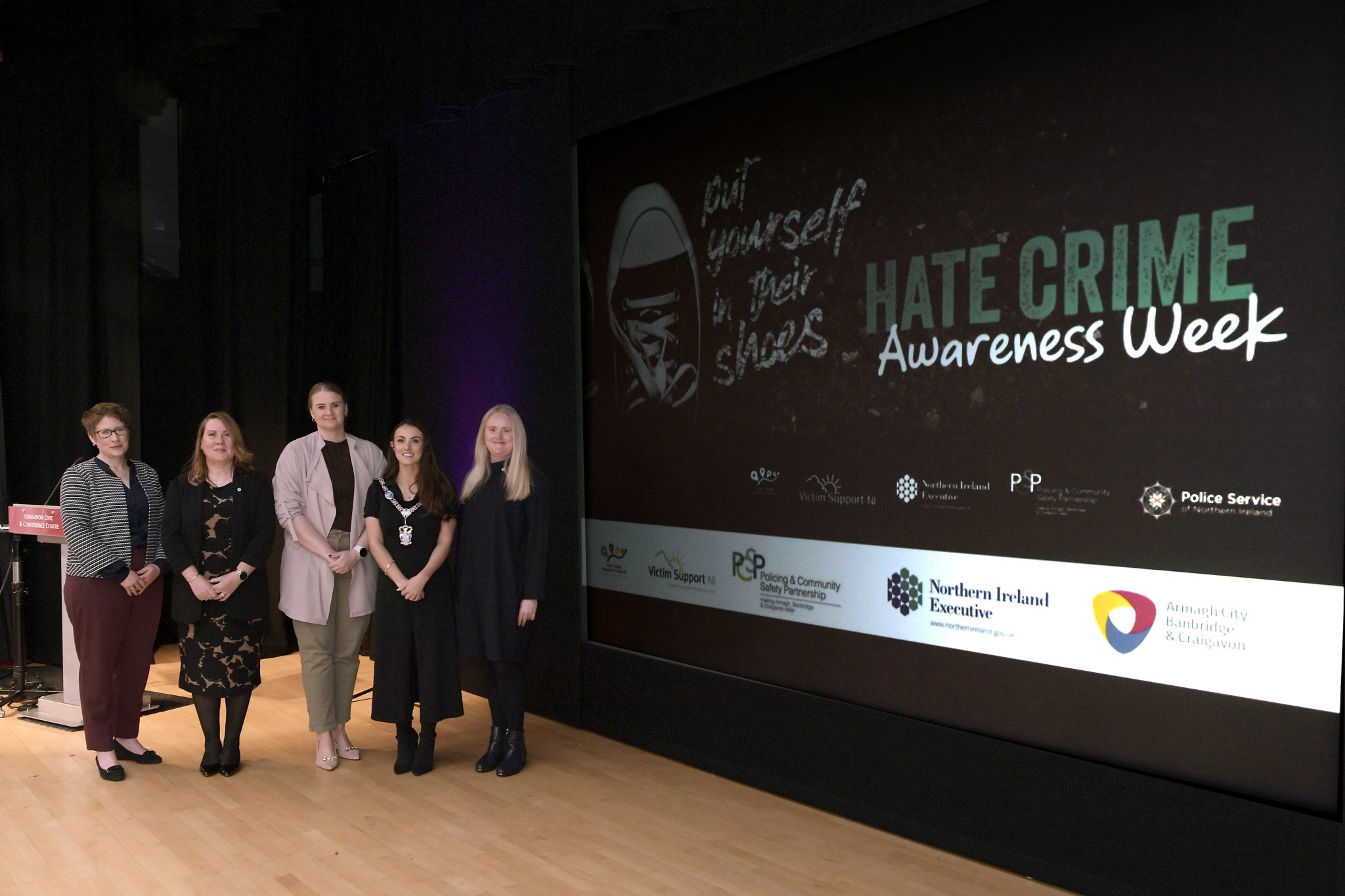
    Pictured at the recent Hate Crime Conference are: Back Row: Temporary /Superintendent Sue Steen MBE, Vishal Bedi, Ethnic Minority Police Association, Michael Avila, Hate Crime Advocacy Service, Adam Corner, Temporary Chief Inspector, Sgt Sinead Loughlin, Annette Blaney, PCSP Project Coordinator. Front Row: Patricia Gibson, PCSP Manager, Junior Minister Aisling Reilly, Lord Mayor of Armagh City, Banbridge and Craigavon, Councillor Sarah Duffy, Geraldine Hanna, Commissioner Designate for Victims of Crime for Northern Ireland and Ruth Allen, Head of Community Development.

    A hard-hitting conference to raise awareness of Hate Crime was held recently at Craigavon Civic and Conference Centre – and left a huge impact on those in attendance.

    Attended by Minister Aisling Reilly, the ‘Put Yourself in their Shoes’ event gave voice to a number of guest speakers from a variety of walks of life, who shared their very personal experiences of being a victim of Hate Crime.

    Organised in partnership with Armagh, Banbridge & Craigavon Policing & Community Safety Partnership (PCSP) and Victim Support NI, this event also focused on the Victim Support NI Hate Crime Manifesto which highlights how statutory, community and private sector partners can work collaboratively to improve support to victims and curb hate in society.

    “Hate Crime incidents are something we unfortunately now hear about on an almost daily basis and everyone should be able to live a life free from fear and isolation,” commented the Lord Mayor of Armagh City, Banbridge and Craigavon Councillor Sarah Duffy.

    “The individuals who spoke today were incredibly brave to share their story to help raise awareness of Hate Crime, and really made us all think about how we would feel if we were on the receiving end of it.”

    Hate Crime is the perpetrator’s hostility or prejudice against any person or property on the grounds of the victim’s ethnicity, sexual orientation, gender identity, religion, political opinion or disability – and these incidents have continued to rise in Northern Ireland over the past decade.

    “This conference was really informative and helped to increase awareness and understanding about Hate Crime and in particular, really opened our eyes to the hate incidents that people have experienced in our communities,” commented Alderman Mark Baxter, Chair of the PCSP.

    “We would encourage everyone to report any incidents of Hate Crime and to never be afraid to speak out against it. We all need to tackle this together.”

    To report a Hate Crime please contact the Police on 101 or online https://www.psni.police.uk/report You can also call Crimestoppers on 0800 555 111 with complete anonymity.

    For help, support and advice on Hate Crime, click here: https://hcasni.com/

    This event was part funded by Armagh City, Banbridge and Craigavon Borough Council and The Executive Office.

    MIL OSI United Kingdom

  • MIL-OSI Economics: Identity theft: BaFin warns consumers about the website fips-finance.com

    Source: Bundesanstalt für Finanzdienstleistungsaufsicht – In English

    The Federal Financial Supervisory Authority (BaFin) has information that the company FIPS Finance & Development is providing financial services in Germany on its website fips-finance.com without the required authorisation. The company is not supervised by BaFin. Customers are incorrectly led to believe that the website is operated by an Austrian company that is registered in the Austrian company register. This is not the case. It is a case of identity fraud.

    Anyone wishing to conduct banking business or provide financial or investment services in Germany may do so only with authorisation from BaFin. However, some companies offer these services without the necessary authorisation.

    BaFin is issuing this information on the basis of section section 37 (4) of the German Banking Act (Kreditwesengesetz – KWG).

    Please be aware:

    BaFin, the German Federal Criminal Police Office (BundeskriminalamtBKA) and the German state criminal police offices (Landeskriminalämter) recommend that consumers seeking to invest money online should exercise the utmost caution and do the necessary research beforehand in order to identify fraud attempts at an early stage.

    MIL OSI Economics

  • MIL-OSI United Kingdom: Department for Education establishes Science Advisory Council

    Source: United Kingdom – Executive Government & Departments

    New team of experts to provide the latest scientific advice across a range of specialisms to support the department’s work.

    A panel of scientific experts is set to provide education policy makers with advice on strategic and emerging issues through a new Science Advisory Council, the Department for Education announced today (Thursday 17 October). 

    Professor Russell Viner, the Department for Education’s Chief Scientific Adviser, has established a team of 12 experts with a range of specialisms to ensure access to the best and latest scientific advice – helping the department’s work to break down the barriers to opportunity by protecting children and ensuring the delivery of higher standards of education, training and care. 

    Led by Professor Dame Athene Donald as chair, the independent panel will provide scientific advice to the Department for Education on matters relevant to its policy and operations. This will include areas such as early identification and support of children with Special Educational Needs and Disabilities (SEND), mental health support, online harms prevention, a sustainable and secure school estate and Artificial Intelligence and education technology.  

    The Council will also work with the Chief Scientific Adviser to identify and share emerging scientific trends with officials and facilitate effective links between the department and the wider scientific community. 

    Professor Russell Viner, Chief Scientific Adviser at the Department for Education, said: 

    We are the department for opportunity, working to deliver better life chances for all – and that means being at the forefront of cutting-edge scientific evidence to ensure we are doing everything we can to break the link between background and success. 

    We must keep pace with technological and scientific advancements if we are to deliver the highest standards for the people we serve. Science alone can’t address the challenges the department faces – but it can inform robust, evidence-informed decision making.

    Chair Professor Dame Athene Donald, Professor Emerita of Experimental Physics and former Master of Churchill College, University of Cambridge, will be supported by Deputy Chair, Professor Mark Mon-Williams. Mark is the Chair of Cognitive Psychology at the University of Leeds and the Founder Director of the Centre of Applied Education Research. 

    The other ten members have expertise in fields including economics, social science, statistics, operational research and engineering, physical and life sciences, ethics, and data science. Between them they have worked on studies looking at school health interventions, the impact of AI on learning, how digital technologies affect adolescent mental health, how childhood circumstances influence child development and early interventions. 

    Plenary meetings will be held quarterly and will include attendance by the Chief Scientific Adviser, a non-executive board member and other relevant officials. Smaller, task-relevant meetings and workshops will occur as needed in response to departmental requests and needs.

    The panel members are: 

    • Chair: Professor Dame Athene Donald, DBE, FRS, Professor Emerita of Experimental Physics and former Master of Churchill College, University of Cambridge.  

    • Deputy Chair: Professor Mark Mon-Williams, Chair of Cognitive Psychology, University of Leeds.  

    • Professor Chris Bonell, Professor of Public Health & Sociology, London School of Hygiene and Tropical Medicine.  

    • Professor William J. Browne, Professor of Statistics & Head of the School of Education, University of Bristol.  

    • Dr Claire Crawford, Associate Professor at the Centre for Education Policy and Equalising Opportunities, University College London.  

    • Michael Cribb, Chartered Structural Engineer and Associate Director, Arup.  

    • Dr Dougal Hargreaves, Houston Reader in Paediatrics & Population Health, Imperial College London.  

    • Dr Sonya Krutikova, Associate Professor of Economics, University of Manchester, & Deputy Research Director, Institute for Fiscal Studies.  

    • Professor Rose Luckin, Professor Emeritus of Learner Centred Design, University College London.  

    • Dr Amy Orben, Leader of the Digital Mental Health Group at the MRC Cognition and Brain Sciences Unit, University of Cambridge.  

    • Professor Paul Ramchandani, LEGO Professor of Play in Education, Learning and Development, University of Cambridge. 

    • Professor Michael J. Reiss, Professor of Science Education at the Institute of Education, University of London & University College London.

    DfE media enquiries

    Central newsdesk – for journalists 020 7783 8300

    Updates to this page

    Published 17 October 2024

    MIL OSI United Kingdom

  • MIL-OSI Europe: Germany: EIB backs Vay’s launch of teledriven car-sharing services

    Source: European Investment Bank

    Vay

    • The EIB is lending €34 million to German remote-driving company Vay.
    • Berlin-based Vay is set to launch commercial services in Europe.
    • The investment is backed by the European Union’s InvestEU guarantee programme.

    The European Investment Bank (EIB) is lending €34 million to German teledriving technology startup Vay to help it develop its operations in Europe. The EIB loan will enable the Berlin-based company to accelerate the development of technology that enables a vehicle to be safely driven on city streets by a professionally trained human driver located at a remote teledrive station. Vay launched its first commercial service in the US city of Las Vegas in January 2024.

    Vay plans to offer door-to-door car sharing in more cities in Europe and North America, while it also develops business-to-business partnerships with car manufacturers and other strategic players in the sector. 

    “This investment once again demonstrates our commitment to supporting European tech pioneers with global ambitions, like Vay,” said EIB Vice-President Nicola Beer. “Developed here in Europe, their innovative technology opens up new ways to make passenger and goods transport more efficient while delivering clean, efficient and inclusive urban mobility in our cities.”

    Vay’s technology enables professionally trained teledrivers to drive vehicles to the customer’s pick-up location remotely. Once the car arrives, the user takes manual control and drives as with any regular vehicle. After the journey is complete, the user can exit without worrying about parking because a teledriver handles parking or drives the car to the next customer. The system offers more sustainable, door-to-door mobility at half the cost of traditional ride-hailing.

    Teledriving provides the distinct advantage of having a human driver remotely controlling the vehicle in real-time. As a result, the system of teledriven cars is simple to operate and offers a wide range of capabilities. This is different from fully autonomous vehicles, which face a greater number of technical and legal complexities.

    “We are proud that EIB has decided to invest in Vay as these funds will be instrumental in further developing our technology and supporting the company’s growth,” said Co-founder and Chief Executive Officer of Vay Thomas von der Ohe. “We share the same goal and are committed to promoting economic development within the European Union. Moreover, this investment will play a crucial role in strengthening the confidence and trust that EU regulators, partners and consumers have in Vay, paving the way for the commercial rollout of our services in European cities.”

    Vay is the only company in Europe to operate on public roads without a safety driver. At the start of 2024, it expanded its reach by launching a commercial teledriving service in Las Vegas, establishing itself as a pioneer in teledriven vehicles. Committed to creating safer, more sustainable and liveable cities, Vay leverages its teledriving technology to optimise the use of its electric fleet – potentially reducing the number of cars on roads.

    Vay is actively engaging with several cities and states across Europe and the United States to explore future launches of its teledriving service. In 2023, the company successfully conducted test drives without a safety driver on public roads in Hamburg, Germany. Following that significant milestone, Vay has been working closely with German authorities to prepare for the commercial launch of its service in Hamburg.

    The EIB loan is supported by the European InvestEU programme, which aims to trigger more than €372 billion in additional investment in new technologies until 2027. The deal is aligned with the InvestEU objective of promoting research, development and innovation.

    Background information

    The European Investment Bank (EIB) is the long-term lending institution of the European Union owned by its Member States. It makes long-term finance available for sound investment in order to contribute towards EU policy goals. Its key priorities are climate and the environment, development, innovation and skills, small and medium companies (SMEs), infrastructure and cohesion. It works closely with other EU institutions to foster European integration, promote the development of the European Union and support EU policies in more than 140 countries worldwide.

    The InvestEU programme provides the European Union with crucial long-term funding by leveraging substantial private and public funds in support of a sustainable recovery. It also helps mobilise private investments for the European Union’s policy priorities, such as the European Green Deal and the digital transition. The InvestEU programme brings together under one roof the multitude of EU financial instruments currently available to support investment in the European Union, making funding for investment projects in Europe simpler, more efficient and more flexible. The programme consists of three components: the InvestEU Fund, the InvestEU Advisory Hub and the InvestEU Portal. The InvestEU Fund is implemented through financial partners that will invest in projects using the EU budget guarantee of €26.2 billion. The entire budget guarantee will back the investment projects of the implementing partners, increase their risk-bearing capacity and thus mobilise at least €372 billion in additional investment.

    EIB venture debt is a quasi-equity investment product suitable for early and growth stage ventures, combining a long-term loan with an instrument linking the return to the performance of the company. The EIB has made over  100 venture debt investments since 2015 across Europe, totalling over €2.1  billion. With the backing of InvestEU, the EIB aims to support European ventures and scale-ups in the cleantech, deeptech and life sciences sectors.

    Vay develops automotive-grade technology for remote driving (“teledriving”), paving the way for sustainable and driverless mobility services. In February 2023, Vay became Europe’s first and only company to operate driverless vehicles on public roads. In January 2024, Vay launched its first commercial mobility service in Las Vegas, USA. Founded in Berlin in 2018 by Thomas von der Ohe, Fabrizio Scelsi, and Bogdan Djukic, Vay has 150+ employees and offices in Berlin, Hamburg, and Las Vegas, USA.

    Vay raised a USD 95m Series B funding round, attracting investors worldwide. These include Kinnevik, Coatue, Eurazeo, Atomico, La Famiglia, and Creandum, as well as prominent business angels such as former Alphabet CFO Patrick Pichette, former member of the Management Board for R&D, Design, CTO of Audi Peter Mertens and Spotify’s Chief Technology & Chief Product Officer Gustav Söderström. In 2024, Vay received a EUR 34m investment from the European Investment Bank (EIB).

    MIL OSI Europe News

  • MIL-OSI Europe: Press release – European Parliament Press Kit for the European Council of 17 and 18 October 2024

    Source: European Parliament

    European Parliament President Roberta Metsola will represent the European Parliament at the summit, where she will address the heads of state or government at 10.00 and hold a press conference after her speech.

    When: Press conference at around 11.00 on 17 October

    Where: European Council press room and via Parliament’s webstreaming or EbS.

    At their meeting in Brussels, heads of state or government will discuss how the EU can continue supporting Kyiv against Russian aggression, and the EU’s response to the latest events in the Middle East, where Israeli forces continue their attacks on Gaza and in Lebanon, while Iran has launched missiles against Israel. EU leaders will also focus on making the European economy more competitive, following the publication of Mario Draghi’s report, which calls for a boost in public investment and wide-ranging economic reforms. They will also discuss ways to manage migration flows and ensure border protection, climate change and biodiversity, and the situation in Georgia, Moldova, Venezuela and Sudan.

    Hamas terrorist attacks against Israel / Escalating violence in the Middle East

    President Metsola marked the one-year anniversary of terrorist attacks in Israel at the opening of the 7-10 October plenary session in Strasbourg. Recalling the horror of that day “that will live in infamy”, President Metsola said nothing could ever justify the indiscriminate mass murder, rape, kidnapping and torture that occurred one year ago. Since then, too few have been able to make it back to their loved ones – “this house will continue to do what we can to help bring them all home”, she said.

    The 7 October attacks triggered a cycle of war, death and devastation that has seen thousands killed in Gaza, and instability across the region, President Metsola stated. In remembering all those lost and taken, the President added that “Parliament’s calls for the immediate release of the remaining hostages will remain steadfast, our calls for ceasefire will remain resolute, and our efforts towards de-escalation will remain strong.” The work for real, dignified, long-term and sustainable peace will remain unwavering, she concluded. MEPs held a minute of silence in memory of all the innocent lives lost.

    In a resolution adopted on 25 April, MEPs strongly condemn the Iranian drone and missile attack on Israel and call for further sanctions against Iran. Parliament voices serious concern over the escalation and threat to regional security. MEPs reiterate their full support for the security of the State of Israel and its citizens and condemn the simultaneous rocket launches carried out by Iran’s proxies Hezbollah in Lebanon and Houthi rebels in Yemen against the Golan Heights and Israeli territory before and during the Iranian attack.

    At the same time, they deplore the attack on the Iranian consulate in the Syrian capital Damascus on 1 April, which is widely attributed to Israel. The resolution recalls the importance of the principle of the inviolability of diplomatic and consular premises, which must be respected in all cases under international law.

    Further reading

    Parliament marks one year from the October 7th attacks in Israel

    Parliament condemns Iran’s attack on Israel and calls for de-escalation

    Parliament calls on Israel to open all crossings to Gaza for humanitarian aid

    Israel-Hamas war: MEPs call for a permanent ceasefire under two conditions


    MEPs condemn Hamas attack on Israel and call for a humanitarian pause

    Resolution: The despicable terrorist attacks by Hamas against Israel, Israel’s right to defend itself in line with humanitarian and international law and the humanitarian situation in Gaza

    President Metsola at the European Council: EU must remain coherent and united

    Leading MEPs condemn attack by Hamas terrorists against Israel

    MEPs to contact

    David McALLISTER, (EPP, DE), Chair of the Committee on Foreign Affairs

    Marie-Agnes STRACK-ZIMMERMANN (Renew, DE), Chair of the Subcommittee on Security and Defence

    Russia’s war against Ukraine

    On 14 October, MEPs on the Trade Committee endorsed the Commission’s proposal to support Ukraine with an exceptional Macro-Financial Assistance (MFA) loan of up to €35 billion. This is the EU’s contribution under the G7’s initiative to support Ukraine with up to $50 billion (approximately €45 billion) to address Ukraine’s urgent financing needs in the face of Russia’s brutal war of aggression. The repayment of this exceptional MFA loan and of the loans from other G7 countries will come from the extraordinary revenues made from immobilised Russian Central Bank assets, and enabled by the Ukraine Loan Cooperation Mechanism, newly established under the Commission’s proposal. The plenary vote is scheduled during next week’s session in Strasbourg.

    In a resolution adopted on 19 September, MEPs want EU countries to lift current restrictions hindering Ukraine from using Western weapons systems against legitimate military targets in Russia. The text states that if current restrictions are not lifted, Ukraine cannot fully exercise its right to self-defence and remains exposed to attacks on its population and infrastructure. Parliament underlines that insufficient deliveries of ammunition and restrictions on their use risks offsetting the impact of efforts made to date, and deplores that EU countries are offering less bilateral military aid to Ukraine. MEPs reiterate their call for member states to fulfil their March 2023 commitment to deliver one million rounds of ammunition to Ukraine, and to accelerate the delivery of weapons, air defence systems and ammunition, including TAURUS missiles. They also restate their position that all EU countries and NATO allies should collectively and individually commit to annual military support for Ukraine of no less than 0.25% of their GDP.

    While calling on the EU and its member states to actively work towards achieving the broadest possible international support for Ukraine and identifying a peaceful solution to the war, MEPs say that any resolution must be based on full respect for Ukraine’s independence, sovereignty and territorial integrity. They also view holding Russia accountable for war crimes and reparations, and other payments by Moscow, as essential aspects of any solution. To this end, MEPs want the EU and like-minded partners to establish a sound legal regime to confiscate Russian state-owned assets frozen by the EU as part of efforts to compensate Ukraine for the massive damage it has suffered.

    With Russia’s war against Ukraine raging on, Parliament reconfirmed on 17 July its view that the EU must continue to support Kyiv for as long as it takes until victory. The resolution, which sets out the newly-elected European Parliament’s first official position on Russia’s war of aggression against Ukraine, restates MEPs’ continued support for Ukraine’s independence, sovereignty, and territorial integrity within its internationally recognised borders. It calls on the EU to maintain and extend its sanctions policy against Russia and Belarus, monitor and review its effectiveness and impact, and systematically tackle the issue of EU-based companies, third parties, and third countries that circumvent sanctions.

    Further reading

    Ukraine: Trade Committee endorses financial support backed by Russian assets

    MEPs: Ukraine must be able to strike legitimate military targets in Russia

    Newly elected Parliament reaffirms its strong support for Ukraine

    MEPs approve trade support measures for Ukraine with protection for EU farmers

    Joint Statement by the Presidents of the European Union Institutions on the occasion of the 2 year anniversary of the Russian invasion of Ukraine

    Parliament calls on the EU to give Ukraine whatever it needs to defeat Russia

    EU sanctions: new rules to crack down on violations

    MEPs: EU must actively support Russia’s democratic opposition

    Yulia Navalnaya: “If you want to defeat Putin, fight his criminal gang”

    Debate 12 March 2024: Preparation of the European Council meeting of 21 and 22 March 2024

    Debate 13 March 2024: Need to address the urgent concerns surrounding Ukrainian children forcibly deported to Russia

    Parliament wants tougher enforcement of EU sanctions against Russia

    A long-term solution for Ukraine’s funding needs

    How the EU is supporting Ukraine

    EU stands with Ukraine

    MEPs to contact

    David McALLISTER, (EPP, DE) Chair of the Committee on Foreign Affairs

    Marie-Agnes STRACK-ZIMMERMANN (Renew, DE), Chair of the Subcommittee on Security and Defence

    Karin KARLSBRO (Renew, SE), rapporteur on macro-financial assistance to Ukraine

    Competitiveness

    On 17 September, Mario Draghi outlined his blueprint for making Europe more competitive through closer cooperation in core areas and massive investment in shared objectives.

    Mr Draghi said that the EU needed to focus on three crucial issues: closing the innovation gap with the US and China; developing a joint plan to link the goal of decarbonisation with increased competitiveness; and boosting Europe’s security and reducing its dependence on foreign economic powers. A fit-for-purpose competitiveness agenda would require annual funding of between EUR 750 – EUR 800 billion for projects whose objectives were already agreed upon by the EU. Some of this money could come from private sources, but some would also need to be secured through public investment, including by new common debt issued specifically to fund key joint projects, Mr Draghi said.

    In a debate following Mr Draghi’s address, many MEPs agreed with his analysis that the EU economy must urgently change course. The EU should focus, they argued, on competition and innovation in key industries, along with more public and private investments in social, green and digital transformations. Some MEPs called for greater sovereignty and freer markets, and stressed that fighting climate change sabotages the EU economy. Others observed that growth is compatible with clean innovative technologies and social investment, to help citizens to learn new skills.

    Further reading

    Draghi to MEPs: “Europe faces a choice between exit, paralysis, or integration”

    MEPs adopt plans to boost Europe’s Net-Zero technology production

    New EU fiscal rules approved by MEPs

    MEPs to contact

    Borys Budka (EPP, PL), Chair Committee on Industry, Research and Energy

    Migration

    During a press point with the Estonian Prime Minister on 16 October, EP President Roberta Metsola stressed that it is “important that we implement the migration pact. We need to be fair with those eligible for protection, firm with those who are not, and harsh with smugglers and malign states like Belarus or Russia who seek to exploit those most vulnerable. Only a coordinated European approach can ensure the integrity of our borderless Schengen area.”

    On 9 October, Parliament debated how to strengthen the security of Europe’s external borders and the need for a comprehensive approach and enhanced Frontex support. You can watch the debate here. On 7 October, MEPs discussed the reintroduction of internal border controls in a number of member states and its impact on the Schengen Area. Watch the debate here.

    On 10 April, MEPs approved the new Migration and Asylum Pact. The package consists of ten legislative texts to reform the European migration and asylum policy and was agreed with EU member states. You can find the adopted texts here and watch the plenary debate here.

    Further reading

    MEPs approve the new Migration and Asylum Pact

    MEP to contact

    Javier ZARZALEJOS (EPP, ES), Chair of the Committee on Civil Liberties, Justice and Home Affairs

    Foreign affairs: Georgia, Moldova, Venezuela, Sudan

    In a resolution adopted on 9 October, MEPs say current democratic backsliding in Georgia effectively puts the country’s integration with the EU on hold. The text highlights how the ruling Georgian Dream party has pushed an increasingly authoritarian agenda, including on media freedom and LGBTQ+ rights. Coupled with changes to the country’s electoral legislation and growing anti-EU rhetoric, MEPs say these laws violate the freedom of expression, censor media, impose restrictions on critical voices in civil society and the NGO sector and discriminate against vulnerable people. They also make clear that unless the legislation is rescinded, progress cannot be made in Georgia’s relations with the EU.

    Against the backdrop of the continuing decline of Georgia’s democracy, Parliament demands that all EU funding provided to the Georgian government be frozen until the undemocratic laws are repealed. Any future funding of the Georgian government can only be disbursed under strict conditions, MEPs argue.

    On 9 October, MEPs adopted a resolution issuing a strong warning against continued Russian attempts to derail Moldova’s pro-European trajectory. The text vehemently condemns Russia’s escalating malicious activities, interference and hybrid operations ahead of Moldovans going to the polls to vote in the country’s presidential election and constitutional referendum on EU integration on 20 October. MEPs highlight the role played by a plethora of malicious actors, including pro-Russian Moldovan oligarchs and Russia’s state-funded RT network, in carrying out voter fraud schemes as well as cyber operations and information warfare. They also call on the EU and its member states to ensure that all necessary assistance is provided to Moldova to strengthen its institutional mechanisms and ability to respond to hybrid threats.

    The European Parliament reaffirms its support for Moldova’s path towards EU accession, calling on the European Commission to include the country in the Instrument for Pre-Accession Assistance (IPA III) and to prioritise funding for EU candidate countries in the next Multiannual Financial Framework (MFF) for 2028-2034. With EU accession talks with Moldova already having begun, MEPs call for a faster screening process and the timely organisation of the subsequent intergovernmental conferences.

    In a resolution adopted on 19 September, Parliament says the EU should do its utmost to ensure that Edmundo González Urrutia, the legitimate and democratically elected President of Venezuela, can take office on 10 January 2025. MEPs “strongly condemn and fully reject the electoral fraud orchestrated by the regime-controlled National Electoral Council, which refused to make public the official result.” They recognise Edmundo González Urrutia as the country’s legitimate and democratically elected president, and María Corina Machado as the leader of the democratic forces in Venezuela. They also strongly condemn the Venezuelan Government’s issuance of an arrest warrant for Mr González.

    On 8 October, MEPs held a plenary debate on the situation in Sudan. You can watch the debate here.

    Further reading

    Parliament says Georgia’s democracy is at risk

    Resolution: The democratic backsliding and threats to political pluralism in Georgia

    Parliament condemns Russia’s interference in Moldova

    Resolution: Strengthening Moldova’s resilience against Russian interference ahead of the upcoming presidential elections and a constitutional referendum on EU integration

    Venezuela: MEPs recognise Edmundo González as President

    Resolution: Situation in Venezuela

    MEPs to contact

    David McALLISTER, (EPP, DE) Chair of the Committee on Foreign Affairs

    Nils UŠAKOVS (S&D, LV), Chair of the Delegation to the EU-Armenia Parliamentary Partnership Committee, the EU-Azerbaijan Parliamentary Cooperation Committee and the EU-Georgia Parliamentary Association Committee

    Climate change and biodiversity

    A Parliament delegation will attend the UN Climate Change Conference (COP29) in Baku, Azerbaijan between 18 and 22 November 2024. MEPs will also adopt a resolution during the 13-14 November plenary session, which will constitute the delegation’s mandate for talks with international partners.

    Parliament will also send a delegation to the UN Biodiversity Conference (COP16) in Cali, Colombia, between 28 and 31 October 2024.

    MEPs to contact

    Lídia PEREIRA (EPP, PT), Chair of the delegation to the COP29 UN Climate Change Conference, Baku, Azerbaijan

    Antonio DECARO (S&D, IT), Chair of the Committee on the Environment, Public Health and Food Safety

    MIL OSI Europe News

  • MIL-OSI United Kingdom: Fostering is Everything

    Source: City of Derby

    Foster East Midlands, in partnership with CAN Media, is proud to present ‘Everything’ – a powerful new fostering film that highlights how fostering can truly mean everything to those involved. This film was created in collaboration with over 100 local authorities, including Derby City, Derbyshire County Council, Nottingham City, and Nottinghamshire County Council.

    ‘Everything’ follows foster carer Mike and his family on a journey through time with two of the children they have looked after, who are now adults. A surprise 60th birthday party for Mike gives Will and Zara a chance to reflect on how being fostered made a difference to their lives, thanking him for everything.

    Thanks to footage shot on a genuine old camcorder, we are taken to the 1990s, to see how Will settles into the family. We also jump back to the 2010s, when a young Zara is being taught to play the guitar by Mike, something that comes full circle when she performs a song at the party. Mike’s son Chris is involved throughout, showing the important role the children of foster carers play.

    All of the house and garden scenes were filmed in Chilwell, Nottinghamshire, adding a local and authentic touch to the film.

    The concluding message of the film is that what you do with your life could forever change someone else’s – encouraging people to foster in order to make that change.

    The film was developed with the input and insight of foster carers and people with care experience, was produced by Reel TwentyFive and project managed by public sector media partner CAN.

    Project Director for CAN Media, Rachel Brown describes the main message of the film:

    Many people don’t realise how common it is for relationships made through fostering to last well beyond the ‘official’ caring role. This has a huge impact on the lives of those who have been fostered, giving them stability and security well into adulthood.

    We also wanted to reflect how the children of foster carers make a difference to children when they come into care, helping them to feel part of the family.

    Having over 100 councils taking part in the project, the film will reach a very wide audience, encouraging people to find out more and take the steps towards becoming a foster carer.

    Fostering with your local council or children’s trust means you can better support local children and young people who need a safe and nurturing home where they can grow and thrive.

    Cllr Paul Hezelgrave, Lead Council’s Cabinet Member for Foster East Midlands said:

    The ‘Everything’ project has given our fostering service an amazing film that shows the long-term impact fostering can have, with relationships between carers and children lasting well into adulthood.

    All councils need to recruit more foster carers, and by collaborating to produce this emotionally powerful film, we will show people how rewarding and life-changing fostering is.

    The message is the same for all of us – we need more people to step forward and become foster carers. ‘Everything’ will help us to reach more people in our communities and encourage them to find out more about this really rewarding role.

    We are committed to giving vulnerable children and young people we care for the best chance to thrive, which for many of them is with local fostering families.

    Sarah Thomas, chief executive of the Fostering Network says:

    The Fostering Network has been proud to support the collaborative film projects since ‘Giants’ in 2017. It’s great to see local authority fostering services pooling resources to produce another amazing film. ‘Everything’ will help to amplify their message about the chronic shortage of fostering households, encouraging more people to come forward and foster.

    One of the main characters in the film, Chris, shows how important other family members are when it comes to fostering. This is something we champion throughout October, which is Children of Foster Carers Month.

    ‘Everything’ is the latest in a series of film collaborations that started in 2017 with ‘Giants’, which was supported by a small number of local authorities in the midlands and has now grown into a national project across England, reflecting the need to recruit more foster carers.

    Watch the full version of the ‘Everything’ Film on Foster for East Midlands YouTube channel or view the 30 second shortened version

    If you’re interested in becoming a foster carer or want to learn more, visit Foster for East Midlands webpage, email hello@fosterforeastmidlands.org.uk or call 03033 132950

    Be inspired and watch the ‘Everything’ foster film 

    MIL OSI United Kingdom

  • MIL-OSI United Kingdom: Environment Agency works to preserve North East salmon stocks

    Source: United Kingdom – Executive Government & Departments

    Atlantic salmon stocks in the Tyne remain buoyant despite stocks across England reaching new lows according to a report released last week (Monday 7 October).

    An image of an adult salmon.

    Atlantic salmon stocks in the Tyne remain buoyant despite stocks across England reaching new lows according to a report released last week (Monday 7 October).  

    According to the Atlantic Salmon Stock Assessment for 2024 from the Environment Agency and the Centre for Environment, Fisheries and Aquaculture Science (Cefas), 90% of principal salmon rivers in England are classified as either “at risk” or “probably at risk,” meaning salmon numbers are below minimum levels to support sustainable populations.

    However, the River Tyne’s salmon stocks are the only location where they remain “not at risk” and the Coquet and Wear are amongst only three rivers nationally where stocks are deemed to be “probably not at risk”.

    The Environment Agency is working with partners to reduce impacts affecting stocks globally, including barriers to migration, water scarcity from abstraction and the persistent challenge from climate change, including warming seas.

    The Environment Agency and Natural England are calling on everyone from landowners and farmers to energy, waste and water companies to do more to protect this iconic and pivotal species.  

    Jon Shelley, Fisheries Technical Specialist at the Environment Agency said:

    We are proud that the Salmon Stocks in the Tyne remain “not at risk” and that rivers across the North East are providing a safe haven for salmon.

    However, we know the importance of this report and are not complacent in the North East. Action is needed to combat all pressures impacting salmon, to help maintain the salmon stocks in the region and improve the stocks across the country. 

    We will continue our vital work to help preserve the salmon stocks in our area by working closely with our partners and the community.

    Updates to this page

    Published 17 October 2024

    MIL OSI United Kingdom

  • MIL-OSI: Corporate social responsibility: Boralex’s ambitious greenhouse gas emissions reduction targets validated by the Science Based Targets initiative (SBTi)

    Source: GlobeNewswire (MIL-OSI)

    MONTREAL, Oct. 17, 2024 (GLOBE NEWSWIRE) — Boralex inc. (“Boralex” or the “Company”) (TSX: BLX) is proud to announce that it is one of the few companies in the renewable energy sector to have its greenhouse gas (GHG) emissions reduction targets validated by the Science Based Targets initiative (SBTi). This recognition confirms that Boralex’s commitment to reach net-zero GHG emissions by 2050 across its entire value chain is science-based and aligned with a trajectory to achieve the goals set by the Paris Agreement of limiting global temperature increases to less than 1.5oC.

    “The validation of our targets by the SBTi is perfectly in line with our strategic objective of becoming the reference in corporate social responsibility (CSR) for our partners. Today’s announcement consolidates our leadership role in our industry, reinforces our commitment to produce renewable energy in the best possible way, and resonates with our organizational purpose, which aims to benefit future generations,” said Patrick Decostre, President and CEO of Boralex.

    “I’m extremely proud of the monumental work carried out by many Boralex employees in recent years, which today enables us to be among the first companies in our industry to have our targets validated by the SBTi initiative. In addition to representing concrete, ambitious and realistic actions to fight climate change, this commitment shows that we are anticipating market needs, including compliance with upcoming CSR regulatory frameworks,” said Mihaela Stefanov, Senior Vice President, Enterprise Risk Management and Corporate Social Responsibility.

    To reach net-zero by 2050, the most ambitious designation available through the SBTi process, Boralex has set near- and long-term targets covering 100% of emissions from its entire value chain (Scope 1, 2 and 3):

    • Near-term: By 2030, Boralex is committed to reducing its absolute Scope 1 and 2 emissions by 42% from a base year of 2022, and by 2028, to having 90% of its major component suppliers have science-based reduction targets.
    • Long-term: By 2050, Boralex is committed to reducing its absolute Scope 1 and 2 emissions by 90% and its Scope 3 emissions per kWh produced and sold by 97%, from a base year of 2022.

    To ensure that every kWh generated and produced is as low-carbon as possible, Boralex relies, among other factors, on the gradual electrification of its vehicle fleet, the consumption of electricity from renewable sources at its sites and buildings, and partnerships with strategic low-carbon suppliers.

    The validation of our targets by the SBTi, a reputable global organization supported by 130 specialists based in North America and Europe, is a central element in our overall CSR and risk management strategy. Indeed, it was essential for Boralex to go beyond a GHG emissions reduction objective by adopting an action plan to achieve this objective that is concrete, realistic and backed by a recognized authority. For more details on our CSR commitments and actions, visit the Boralex website.

    About Boralex

    At Boralex, we have been providing affordable renewable energy accessible to everyone for over 30 years. As a leader in the Canadian market and France’s largest independent producer of onshore wind power, we also have facilities in the United States and development projects in the United Kingdom. Over the past five years, our installed capacity has more than doubled to over 3 GW. We are developing a portfolio of more than 6.8 GW in wind, solar projects and storage projects, guided by our values and our corporate social responsibility (CSR) approach. Through profitable and sustainable growth, Boralex is actively participating in the fight against global warming. Thanks to our fearlessness, our discipline, our expertise and our diversity, we continue to be an industry leader. Boralex’s shares are listed on the Toronto Stock Exchange under the ticker symbol BLX.

    For more information, visit boralex.com or sedarplus.com. Follow us on Facebook, Twitter, LinkedIn and Instagram.

    For more information

    Source: Boralex inc.

    The MIL Network

  • MIL-OSI United Kingdom: Progress for investment in Grangemouth’s future

    Source: United Kingdom – Executive Government & Departments

    UK and Scottish Governments step up plans to support workers at Grangemouth refinery, with immediate investment in skills and training.

    • UK and Scottish Governments respond to Petroineos’ decision to close the refinery with investment in local community
    • Forth Valley College mobilised to support affected workers with bespoke skills support
    • Energy Secretary reiterates UK Government’s willingness to engage on how the National Wealth Fund could fund viable Project Willow outcomes, working with trade unions and industry

    The UK and Scottish Governments are jointly stepping up plans to support workers at the Grangemouth refinery affected by the risk of redundancy, with immediate investment in skills and training. 

    In addition to UK Government and Scottish Government’s joint £100m investment in the Falkirk and Grangemouth Growth Deal, Forth Valley College will receive funding to deliver bespoke support for workers affected by Petroineos’ decision to decommission the oil refinery.  

    Backed by this £100m funding, workers at Grangemouth refinery at risk of redundancy will be contacted in the coming weeks and offered tailored support to access new jobs in the local area that will shape the future of Grangemouth as an industrial hub for years to come.   

    Forth Valley College will shortly begin contacting workers to start building a skills and support package to meet their individual needs, mapping their current skills and qualifications to the future skills needed for local clean energy roles in the area and analysing where the gaps are. 

    The UK and Scottish Governments will use the findings to deliver targeted interventions to upskill the local workforce ahead of redundancies next year.  

    It comes as UK Energy Secretary Ed Miliband and Cabinet Secretary Gillian Martin attended a meeting of the Grangemouth Future Industry Board today (Thursday 17 October) at Forth Valley College alongside UK Energy Minister Michael Shanks, Scotland Secretary Ian Murray, local industry leaders, Falkirk Council, trade bodies and trade unions.  

    The £100 million Falkirk and Grangemouth Growth Deal will support projects and skills interventions in the local area. It is estimated that the Falkirk & Grangemouth Growth Deal will deliver over £628 million in economic benefits and create 1,660 jobs across the Falkirk Council area. 

    The Energy Secretary also reiterated the UK Government’s willingness to engage on how the National Wealth Fund could back projects that have the potential to yield a viable long-term future for the site, as part of the ongoing Project Willow investigation into a viable industrial Grangemouth.  

    Project Willow is urgently assessing credible options to begin building a new long-term industry at the refinery site, including low carbon hydrogen, clean eFuels and sustainable aviation fuels on the site. The Scottish Government will also soon publish the draft Grangemouth Industrial Just Transition Plan. 

    UK Government Energy Secretary Ed Miliband said:

    We continue to stand with Grangemouth workers and we are putting money on the table to secure workers good onward employment.

    By working in partnership with the Scottish Government, we’ve unlocked an unprecedented joint investment plan to support workers and secure Grangemouth’s future, and I will continue to spare no effort to drive this work forward.

    Scottish Government Cabinet Secretary for Net Zero and Energy Gillian Martin said:

    Our immediate priority remains to support the workers directly affected by the regrettable closure of the refinery. We will do everything we can to ensure they are supported to retrain and move into adjacent industries within the wider Grangemouth area.

    These workers are highly skilled and have an important contribution to make locally and nationally.  Our investment will help to unlock valuable new opportunities for them and ensure that their skills and experience continue to benefit industry in the area and the wider community.

    The new skills and training package is open to workers at both Grangemouth and Finnart Oil Terminal and will also be supported by the UK Government’s Office for Clean Energy Jobs.

    Kenny MacInnes, Principal of Forth Valley College, said:

    Forth Valley College are uniquely placed to help and upskill any Petroineos employees who are impacted as a result of the closure of the oil refinery, and we will be there to offer the necessary training and support with the help of funding from the Scottish and UK Governments.

    The College is proud to have had a long term partnership with the Grangemouth Refinery – helping to train their Modern Apprentices – and will continue to build on this in our role of making learning work for the people of Forth Valley to ensure they have the skills for the future.

    We are committed to working with PACE (Partnership Action for Continuing Employment) and Falkirk Council to help guide former Petroineos employees onto courses at Forth Valley College which will help them transfer to new jobs in another industry or sector.

    Notes to editors 

    See details of the joint investment plan.

    Updates to this page

    Published 17 October 2024

    MIL OSI United Kingdom

  • MIL-OSI United Kingdom: Powerful new fostering film launched

    Source: City of Portsmouth

    Everything’ launched on 17 October. It is the seventh film produced by a growing partnership of councils and children’s trusts to promote local authority fostering. The ‘Everything’ project is the largest collaboration yet.

    Cllr Suzy Horton, Cabinet Member for Children, Families and Education at Portsmouth City Council, said:

    “The ‘Everything’ project has given Foster Portsmouth an amazing film that shows the long-term impact fostering can have, with relationships between carers and children lasting well into adulthood.”

    “All councils need to recruit more foster carers, and by collaborating to produce this emotionally powerful film, we will show people how rewarding and life-changing fostering is.”

    “The message is the same for all of us; we need more people to step forward and become foster carers. ‘Everything’ will help us to reach more people in our communities and encourage them to find out more about this really rewarding role.”

    “We are committed to giving vulnerable children and young people we care for the best chance to thrive.”

    ‘Everything’ follows foster carer Mike and his family on a journey through time with two of the children they have looked after, who are now adults. Will and Zara take time to reflect on how being fostered made a difference to their lives, and thank Mike for ‘everything’.

    Thanks to footage shot on a genuine old camcorder, we are taken to the 1990s to see how Will settles into the family alongside Mike’s son Chris and the 2010s when a young Zara is being taught to play the guitar by Mike.

    The concluding message of the film is that what you do with your life could forever change someone else’s – encouraging people to foster in order to make that change.

    Project Director, Rachel Brown describes the main message of the film:

    “Many people don’t realise how common it is for relationships made through fostering to last well beyond the ‘official’ caring role. This has a huge impact on the lives of those who have been fostered, giving them stability and security well into adulthood.

    “We also wanted to reflect how the children of foster carers make a difference to children when they come into care, helping them to feel part of the family.”

    “Having over 100 councils taking part in the project, the film will reach a very wide audience, encouraging people to find out more and take the steps towards becoming a foster carer.”

    “Fostering with your local council means you can better support local children and young people who need a safe and nurturing home where they can grow and thrive.”

    Sarah Thomas, chief executive of the Fostering Network says:

    “The Fostering Network has been proud to support the collaborative film projects since ‘Giants’ in 2017. It’s great to see local authority fostering services pooling resources to produce another amazing film. ‘Everything’ will help to amplify their message about the chronic shortage of fostering households, encouraging more people to come forward and foster.”

    “One of the main characters in the film, Chris, shows how important other family members are when it comes to fostering. This is something we champion throughout October, which is Children of Foster Carer’s Month.”

    View the film ‘Everything’ at: http://www.fosterportsmouth.gov.uk/everything.

    For more information on fostering with Foster Portsmouth, fill in our contact form, visit: http://www.foster.portsmouth.gov.uk, call the Fostering SouthEast recruitment team on 0300 131 2797 or email info@lafosteringse.org.uk.

    MIL OSI United Kingdom

  • MIL-OSI Russia: Poland: Staff Concluding Statement of the 2024 Article IV Mission

    Source: IMF – News in Russian

    October 17, 2024

    A Concluding Statement describes the preliminary findings of IMF staff at the end of an official staff visit (or ‘mission’), in most cases to a member country. Missions are undertaken as part of regular (usually annual) consultations under Article IV of the IMF’s Articles of Agreement, in the context of a request to use IMF resources (borrow from the IMF), as part of discussions of staff monitored programs, or as part of other staff monitoring of economic developments.

    The authorities have consented to the publication of this statement. The views expressed in this statement are those of the IMF staff and do not necessarily represent the views of the IMF’s Executive Board. Based on the preliminary findings of this mission, staff will prepare a report that, subject to management approval, will be presented to the IMF Executive Board for discussion and decision.

    Washington, DC – October 17, 2024:

    An International Monetary Fund mission visited Warsaw during October 8-17 in the context of the 2024 Article IV consultation.

    Poland’s near-term outlook is positive and has improved relative to last year despite ongoing sluggish growth across Europe and Russia’s war in Ukraine. A consumption-led recovery is underway, and the outlook is further supported by recently unlocked NextGen EU Funds (NGEU). Inflation has declined helped by a tight monetary stance, and its descent to the target range by close to end-2025 is on track, provided prudent policies are maintained. Policy priorities for the near- and medium-term include balancing the mix of monetary and fiscal policy , preserving debt sustainability, while strengthening the economy to face longer-term challenges. Specifically:

    • Monetary policy is appropriately tight and interest rate cuts should commence only when there is clear evidence that wage growth is decelerating, and inflation is firmly on track towards the target.

    • The medium-term Fiscal Structural Plan is welcome and it targets sufficient cumulative fiscal consolidation by 2028, meeting the EU’s new fiscal rules. The full set of measures to achieve this is yet to be identified.

    • Bringing more of the authorities’ medium-term deficit reduction plans up front in 2025 would build more resilience against future shocks, reduce debt, and support more rapid interest rate reductions, which would foster private sector investment and growth while still bringing inflation to target.

    • Population ageing, diminishing cost-competitiveness, and climate transition present significant challenges to Poland’s export-driven growth model. Thus, medium-term growth is expected to decline, unless structural reforms are deepened and progress on the energy transition accelerates.

    Economic growth is accelerating in 2024 led by recovering domestic demand. Private consumption has picked up as strong nominal wage growth coupled with lower inflation led to a sharp rebound in real wages. Fixed investment also continued its gradual recovery though remaining as a share of GDP below pre-pandemic levels. Net exports, however, are imposing some drag as imports recovered on the back of higher consumption while exports are held back by weak demand from the Euro Area. As a result, growth is expected at 3 percent in 2024 up from around 0 in 2023.

    The near-term outlook is positive due to the ongoing cyclical recovery in consumption and investment, and the absorption of EU funds. Growth is expected to accelerate to 3.5 percent in 2025 and 3.4 percent in 2026. Real and nominal wage growth are expected to gradually decelerate, while profits are expected to continue declining as firms have limited capacity to pass-through increases in wage costs into prices given that the output gap remains negative. Stronger consumption, normalization of inventories, lagged impact of the appreciation of the real exchange rate, and release of EU funds are expected to support imports and with it a narrowing in the current account surplus.

    Over the medium term, growth is expected to moderate and converge to potential as the support from rebounding consumption and NGEU funds subside. Growth will decelerate to slightly below 3 percent by 2029 as EU-financed investments decline and the population ages. Productivity is expected to modestly recover from the impact of recent labor hoarding. However, productivity growth is not expected to return to pre-pandemic levels given that much of the productivity gap with advanced economies has already been closed.

    Amidst high uncertainty, risks remain elevated and tilted towards lower growth and higher inflation. A slower-than-expected recovery in the Euro Area, delayed absorption of EU funds, and heightened geopolitical tensions could dampen the recovery. At the same time, risks to inflation remain elevated from the tight labor market against the backdrop of accelerating domestic demand and potential supply-side shocks. There are also upside risks to growth including a stronger-than-expected catalytic role from EU funds on private investment and productivity, a larger-than-expected workforce from higher immigration, and potential nearshoring as a result of geoeconomic fragmentation. Risks are well mitigated by ample foreign exchange reserves, a flexible exchange rate, modest debt levels, and robust financial sector buffers.

    Monetary policy is appropriately tight.While the policy rate was kept on hold at 5.75 percent since November 2023, the monetary stance has tightened as inflation expectations declined. This is appropriate because inflation is well above the central bank inflation target. The momentum of core inflation is elevated in the context of strong wages growth amid still-tight labor market and substantial wage increases in the public sector.

    Monetary policy should remain tight at least through 2025 with rate cuts commencing only when data and forecasts confirm that inflation is on a clear downward path towards the target. Absent surprises, both core and headline inflation should peak in year-on-year terms before mid-2025, significantly above the target, before moderating around the upper end of the target range of 2.5±1 percent by end-2025. However, uncertainty on the inflation trajectory is substantial, including due to uncertainty regarding energy prices, developments in the labor market, and the pace of economic recovery. While, monetary policy should remain both data-dependent and forward-looking, the current context warrants placing significant weight on realized inflation declining towards the target over several months on the back of decelerating wages. On this basis, there may be scope for limited and gradual policy rate cuts to start around mid-2025.

    Near-term growth acceleration presents an opportunity to rebuild buffers and help complete the disinflation process by tightening fiscal policies. The general government (GG) deficit is projected to widen from 5.1 percent of GDP in 2023 to 5.7 percent of GDP in

    2024, due to expansionary policies resulting in a fiscal impulse of 0.4 percent of GDP. The 2025 budget targets a slightly lower GG deficit of 5.5 percent of GDP largely owing to higher growth. Staff recommends a tighter fiscal stance by around 0.5 percent of GDP. This can be still achievable within the 2025 budget by saving possible revenue overperformance and limiting non-priority spending. Such a shift would lower debt, thereby rebuilding fiscal space to mitigate against future shocks. It would also lift some of the burden from tight monetary policies to rein in inflation, potentially freeing space for additional policy rate cuts.

    Fiscal consolidation should be anchored in a clear medium-term plan to stabilize debt. The recently published Fiscal Structural Plan is an important and welcome step in this regard as it targets appropriate fiscal balances by 2028 – entailing an adjustment of about 2½ percent of GDP from 2024 in terms of the structural fiscal balance – that would allow exiting the EU’s Excessive Deficit Procedure while stabilizing debt at levels close to 60 percent of GDP notwithstanding large increases in spending on defense. Fully identifying the necessary fiscal measures now and bringing more of the planned fiscal consolidation upfront into 2025 would help strengthen its credibility.

    Potential measures that would support consolidation while also further reducing inequality include: i) raising Personal Income Tax revenues by increasing progressivity to bring them more in line with EU peers , ii) addressing the preferential and regressive treatment of the self-employed, iii) better targeting of social benefits to more effectively support the vulnerable, iv) raising property tax revenues closer to EU comparators, and v) taxing more non-essential items at the standard VAT rate. In this context, raising the PIT tax-exempt threshold, which is under consideration, would require even stronger consolidation measures to offset the fiscal cost. Finally, aligning the retirement age for men and women and then adjusting it over time in line with longevity would help limit the expected shortfall in pensions’ adequacy over the longer-term.

    The authorities have made commendable progress in strengthening the fiscal framework. They have expanded the coverage of the stabilizing expenditure rule and improved oversight over extrabudgetary funds. Establishing a fiscal council as planned would further strengthen accountability and governance.

    Financial sector policies should safeguard the nascent credit recovery, building on a robust banking system. Systemic risks to the financial sector have moderated, with the banking sector being well-capitalized and liquid. Past prudential policies have focused on buttressing stability through regulatory tightening. At the same time banks had to face large costs of legal risks and regulatory burdens such as mortgage credit holidays. Together with weak credit demand and serious legal and regulatory uncertainties, this has created further headwinds for new credit resulting in one of the steepest declines in private sector credit-to-GDP in the EU. Moving forward, policy makers should: (i) take into account the impact of possible further tightening of regulations on the nascent credit recovery, while enhancing regulatory stability; (ii) proactively reduce legal risks to financial sector stability, including by exploring legislative solutions; (iii) even the playing field for private sector credit by replacing the bank asset tax in a manner that eliminates the preferential treatment of public debt` and (iv) allow the mortgage credit holiday to expire.

    After two decades of impressive income convergence, Poland’s growth model needs to adjust to new economic conditions. Exports, especially to the EU, have played a significant role in Poland’s success. However, sizable real appreciation over the past two years weighs on cost-competitiveness. Meanwhile, the regional growth outlook remains subdued, and geopolitical conflicts and geoeconomic fragmentation present headwinds to penetrating new markets. In addition, shallow domestic capital markets and low savings weigh on investment, with population ageing posing a substantial drag on the future size of the workforce. To sustain growth, policies should focus on: i) deepening capital markets (including steps towards a capital market union within the EU), ii) lowering barriers to resource reallocation (for example by strengthening re-skilling programs for adults), iii) fostering innovation capacity (including by promoting private equity and venture capital), and iv) supporting higher labor participation especially for women (by ensuring adequate child and elderly care). The new program supporting young parents’ return to the labor market aims to address this gap. Building on the successful absorption of refugees from Ukraine into the Polish labor market, ongoing efforts to enhance the integration of immigrants can further help contain labor shortages.

    The government’s new decarbonization targets are appropriate; meeting these while safeguarding competitiveness and social cohesion will require strong measures.

    Significant progress has been made on climate mitigation, but more is needed given Poland’s costly dependence on coal, which also undercuts competitiveness. The recent draft energy strategy update outlines additional policy targets and measures for bringing emissions in line with EU climate goals. Its success will be supported by EU funds, and depends on removing barriers to private investment in renewable energy, including by adopting EU legislation on faster permitting for green projects, liberalizing regulations for onshore windfarms, and prioritizing NextGen EU funds for expanding electricity grids. Extending carbon pricing to transportation and heating would also be important for reducing emissions; an early and gradual introduction would help limit adjustment costs. The authorities must address social challenges from the climate transition by cushioning the social impact on coal mining regions and reducing energy poverty.

    The mission thanks the authorities and other counterparts for the fruitful discussions.

    IMF Communications Department
    MEDIA RELATIONS

    PRESS OFFICER:

    Phone: +1 202 623-7100Email: MEDIA@IMF.org

    @IMFSpokesperson

    https://www.imf.org/en/News/Articles/2024/10/17/CS-poland-2024

    MIL OSI

    MIL OSI Russia News

  • MIL-OSI United Kingdom: Increased sentencing powers for magistrates to address prisons crisis

    Source: United Kingdom – Executive Government & Departments

    More victims will get the justice they deserve sooner under plans to give magistrates greater sentencing powers.

    • Magistrates can send offenders to prison for up to one year
    • New powers to ease historic crisis in prisons and deal with court backlog
    • Next step in government’s plan to resolve inherited long-term prison capacity issues

    More victims will get the justice they deserve sooner under plans to give magistrates greater sentencing powers, announced by Lord Chancellor Shabana Mahmood.

    The changes, the latest step in the government’s plans to tackle the inherited crisis in our prisons, will allow magistrates to hand-down prison sentences of up to a year. This will help to tackle the record remand population in jails and address the Crown Court backlog, also at a historic high.

    The Lord Chancellor confirmed the plans to allow magistrates to issue custodial sentences for up to 12 months for a single offence – a doubling of their current powers. The move will save approximately 2,000 days in the Crown Court, so that time can be reserved for the most serious and complex cases.

    Bolstered powers will better support victims, with some who have been waiting months and even years to see justice done due to a system in disarray.

    It will also help the government drive down the record remand population – those who are in prison while they await their trial – and relieve pressure on prison capacity which was left at the brink of collapse.

    Lord Chancellor and Secretary of State for Justice Shabana Mahmood said:

    This government inherited a criminal justice system in crisis, with dangerously overcrowded prisons and victims waiting far too long to see justice.

    This marks a further step towards addressing the deep challenges in our criminal justice system, both reducing the record remand population in our jails and delivering swifter justice for victims.

    The significant increase in the remand population, which currently stands at a record 17,000, is one of the key factors in the current prison capacity crisis. This is because remand prisoners can only be held in “reception prisons” where the capacity in the prison estate is most acute, where some of our most dangerous offenders must be held, and where all new prisoners are sent to begin their sentences.

    Tackling the backlog of those awaiting trial in prison is a key priority and these reforms build on the government’s work to reduce pressure on the prison estate ahead of launching a sentencing review later this year.

    Mark Beattie, national chair of the Magistrates’ Association said:

    Magistrates are flexible and support the efficient and fair administration of justice. By being able to take on this additional responsibility and hear cases that carry a maximum sentence of 12 months, our members will be able to help prevent an increase in the backlog of cases in the crown courts, enabling the most serious offences to be dealt with quicker in crown courts; speeding justice for all.

    I know our members and colleagues will take up this increased responsibility with professionalism and integrity and will – as always – strive to deliver the highest quality of justice in their courts.

    Allowing magistrates to deal with more cases will also free up valuable Crown Court time in order to try and reduce the outstanding backlog.

    There are currently over 14,000 magistrates in England and Wales who play a vital role in our justice system hearing over a million cases on average every year. Coming from all walks of life they hear cases ranging from petty theft to serious assault. Magistrates and legal advisers will be fully trained in these new measures by the Judicial College in order to deliver longer sentences effectively.  The previous government extended sentencing powers in May 2022 but deactivated them in March 2023.

    Further information

    The Statutory Instrument to increase sentencing powers is due to be laid on 28 October and changes will come into force on 18 November.

    The Magistrates’ Association is a national charity and the membership body for the magistracy. With more than 12,000 members across England and Wales, it is a unique source of information and insight, and the only independent voice of the magistracy.

    The Magistrates’ Association will be available for media interviews stories. Please email media@magistrates-association.org.uk or call 020 3937 8863.

    A sentencing review will be published later this year.

    This power was previously activated in May 2022 and closed in March 2023.

    Updates to this page

    Published 17 October 2024

    MIL OSI United Kingdom

  • MIL-OSI United Kingdom: Regulators urge safer giving to help people impacted by humanitarian crisis in the Middle East

    Source: United Kingdom – Executive Government & Departments

    The Charity Commission for England and Wales and the Fundraising Regulator advise people to give support via registered charities.

    Today (17 October 2024) the Charity Commission for England and Wales and the Fundraising Regulator have published advice on how people can help civilians impacted by the ongoing conflict in the Middle East.

    The advice comes as the Disasters Emergency Committee (DEC) launches a humanitarian appeal to help civilians affected by humanitarian crises in Gaza and Lebanon caused by conflict.

    DEC brings together 15 leading registered UK aid charities to raise funds quickly and efficiently in times of crisis overseas.

    The appeal will fund the distribution of emergency items such as mattresses, blankets, tents, food and water to those in need of basic humanitarian relief in the region.

    The government has pledged to match donations received by the DEC appeal, up to £10million, which will make the public’s generosity go up to twice as far to help those in need.

    Many people in the UK will separately be wishing to support charities operating in or supporting those across communities impacted by recent events in Israel. Checking charity registers before donating will ensure that support reaches its intended cause.

    By supporting existing, registered charities, including through the DEC, people can be assured that they are giving safely.  

    David Holdsworth, Chief Executive of the Charity Commission said:

    As we’ve watched the appalling humanitarian crisis unfold in the Middle East, many of us will be asking how best to help the millions of people in need of basic aid.

    Registered charities with experience working in incredibly complex and dangerous circumstances, across and within borders, are the best organisations to support financially to ensure donations reach civilians in need.

    That’s why we’re reminding people to give with confidence through registered charities, including the appeal launched by the Disasters Emergency Committee.

    Gerald Oppenheim, Chief Executive of the Fundraising Regulator said:

    The ongoing humanitarian crisis in the Middle East is devastating for so many people. The generosity of the British public means that many will be eager to support those affected in any way they can.

    Supporting registered charities, which have infrastructure established within the region, ensures that your donations will reach those who need it.

    Steps to giving safely 

    People can give with confidence to relief efforts by following a few simple steps: 

    • consider donating through the DEC’s emergency appeal
    • for those who choose to donate to other charities, the charity regulator is reminding people to check charities are registered and legitimate
    • look out for the Fundraising Badge – the logo that says ‘registered with Fundraising Regulator’ – and check the Fundraising Regulator’s Directory of organisations committed to fundraise in line with its Code of Fundraising Practice. 
    • contact a charity directly or find out more online about the charity that you’re seeking to donate to or work with to understand how it is spending funds 
    • make sure the charity is genuine before giving any financial information 
    • be careful when responding to emails or clicking on links within them 
    • check the charity’s name and registration number on the Charity Register – most charities with an annual income of £5,000 or more must be registered in England and Wales 

    ENDS  

    Notes to editors:  

    1. Further tips on donating with confidence to registered charities are available on GOV.UK 
    2. The Charity Commission for England and Wales is the independent, non-ministerial government department that registers and regulates charities in England and Wales. Its purpose is to ensure charity can thrive and inspire trust so that people can improve lives and strengthen society. It can be reached on 
    3. There are separate registers for charities in England and Wales, charities in Scotland and charities in Northern Ireland. Charities can be on more than one register, reflecting the nations where they operate
    4. The Fundraising Regulator is the independent regulator of charitable fundraising in England, Wales and Northern Ireland. Further guidance on giving safely to charity is available on the Fundraising Regulator’s website. It can be reached on FR@pagefield.co.uk

    Press office

    Email pressenquiries@charitycommission.gov.uk

    Out of hours press office contact number: 07785 748787

    Updates to this page

    Published 17 October 2024

    MIL OSI United Kingdom

  • MIL-OSI Economics: GIANTX Gaming and Samsung UK Unite for EGX Comic Con 2024

    Source: Samsung

     
    London, UK.  October 17, 2024 –  Today, GIANTX, is excited to announce its collaboration with electronics manufacturer Samsung, set to make a mark on the gaming world with a uniquely tasteful collaboration at the first ever EGX Comic Con event in October in London. This activation stands as a testament to the synergy between two brands, driven by their shared commitment to enhancing gamer experiences and shaping the future of interactive entertainment.
     
    Taglined as “ONE TAP”, the campaign encapsulates the spirit of the collaboration – the ease and efficiency of Samsung’s gaming experience delivered through Samsung Gaming Hub*, emphasising that everything a gamer needs is available at their fingertips. Coupled with referencing the term for a perfect shot in gaming – a single, precise move that hits the target.
     
    This dual meaning reinforces the idea that Samsung’s gaming platform offers both precision and ease, making it the ultimate destination for gamers seeking a seamless and high-quality experience.
     
    Samsung Gaming Hub is a game streaming service that has been built into all Samsung gaming TVs and monitors as standard since 2022[1]. It provides quick and easy access to more than 3,000 top gaming titles from Xbox[2] NVIDIA GeForce NOW and other popular streaming services. It’s all cloud based so there are no downloads, no storage limits, and no console or PC is required – simply stream and play.
     
    Plus there are added features in certain Samsung TV models such as AI Auto Game Mode that recognises the genre of the game you are playing and then adjusts the settings accordingly for the ultimate immersive gaming experience and ultra smooth motion.
     
    The booth will include:
    Multiple Samsung TV and mobile gaming stations
    Sonic themed space
    Play to win activities
    Prizes worth up to £3000
    Red Bull refreshments
     
    The brands will work together to showcase Samsung’s premium product lines across its Odyssey Gaming range of gaming monitors and its innovative NEO QLED  TV range that both have Samsung’s Gaming Hub built in, as well as a selection of the newest models across the brand’s mobile and tablet ranges.
     
    Luis Garcia, Commercial Director at GIANTX, expressed his excitement:
     
    “We are delighted to welcome Samsung to the GIANTX family. We look forward to activating together at EGX Comic Con 2024, bringing a unique experience to fans from the UK and beyond, showcasing the latest of Samsung technology to our captive audience of gaming and esports enthusiasts.”
     
    Zeena Hill, Director of Marketing for TV/AV at Samsung Electronics in the UK and Ireland, said: “We’re really excited to be collaborating with GIANTX to provide thousands of fans at EGX Comic Con and beyond in the multiple benefits of  our superior TV range. We know that gaming is a huge passion point for so many of our customers which is why Samsung’s Gaming Hub is made so easily accessible – all you need is a controller and away you go.
     
    “This collaboration with GIANTX will not only showcase the stunning clarity and gaming performance of our TV technology but also the ease in accessing thousands of top game titles without the need for a console.”
     
    The announcement brings Samsung UK into the GIANTX partnership line-up alongside other household names like HSBC UK and EE, with the brands aligning on the values of inspiring through technology while demonstrating commitment to the UK gaming scene. It demonstrates GIANTX’s commitment to delivering unforgettable experiences to an unrivalled global fan base and showcase excellence in associated commercial propositions.
     
    For more information, please visit GIANTX.
     
    [1] Internet connection, additional gaming service subscription and compatible controller required. Gaming Hub not available in Republic of Ireland.
    [2] Requires Xbox Game Pass Ultimate subscription. Internet connection and compatible controller required.

    MIL OSI Economics

  • MIL-OSI United Kingdom: G7 Cyber Expert Group recommends action to combat financial sector risks from quantum computing

    Source: United Kingdom – Executive Government & Departments

    G7 Cyber Expert Group publishes guidance for the finance sector on planning for quantum computing.

    The G7 Cyber Expert Group (CEG) – chaired by the U.S. Department of the Treasury and the Bank of England – released a public statement on 25 September highlighting the potential cybersecurity risks associated with developments in quantum computing and recommending steps for financial authorities and institutions to take to address those risks.

    Quantum computers are being built that will be able to solve computational problems currently deemed impossible for conventional computers to solve within a reasonable amount of time.  While potentially providing significant benefits to the financial system, these powerful computers will also carry with them unique cybersecurity risks.  One of the most significant is that cyber threat actors could use quantum computers to defeat certain cryptographic techniques that secure communications and IT systems, potentially exposing financial entity data, including customer information.

    While the exact timeline for developing quantum computers with these capabilities is uncertain, there is a real possibility that such capabilities could emerge within a decade. These quantum computers would not only put future data at risk, but also any previously transmitted data that cyber adversaries have been able to intercept and store with the intent of decrypting later with quantum computers. Due to the potentially long lead time needed to put in place quantum-resilient technologies, the time to start planning is now.

    An initial set of quantum-resilient encryption standards was released by the National Institute of Standards and Technology (NIST) last month. Additional standards from NIST and other standard-setting bodies are expected in the future. It is important for financial entities to maintain the agility required to incorporate new encryption standards in a timely and appropriate manner as they become available.

    With the availability of NIST’s standards, some financial entities may be in a position now to start making the needed changes to implement quantum resilient technologies within their systems. Others may be dependent on vendors and other third parties to develop implementations of the new standards that can be incorporated once they become available. No matter where entities are in their adoption timelines, the G7 CEG strongly encourages financial authorities and institutions to begin taking the following steps to build resilience against quantum computing risks:

    1. Develop a better understanding of the issue, the risks involved, and strategies for mitigating those risks.
    2. Assess quantum computing risks in their areas of responsibility.
    3. Develop a plan for mitigating quantum computing risks.

    The CEG statement provides additional details on quantum computing risks and the specific actions that financial entities can start taking to build quantum resilience within the financial system.

    The G7 CEG’s membership includes representatives of financial authorities across all G7 jurisdictions as well as the European Central Bank.  It was founded in 2015 to serve as a multi-year working group that coordinates cybersecurity policy and strategy across the member jurisdictions.  In addition to policy coordination, the G7 CEG also acts as a vehicle for information sharing, cooperation, and incident response.

    Updates to this page

    Published 17 October 2024

    MIL OSI United Kingdom

  • MIL-OSI United Kingdom: Celebrating 40 years of offshore wildlife recording Four decades of a unique partnership to chronicle the birds and other wildlife seen from North Sea oil and gas platforms has been celebrated in a new book.

    Source: University of Aberdeen

    Four decades of a unique partnership to chronicle the birds and other wildlife seen from North Sea oil and gas platforms has been celebrated in a new book.
    From 1979 to 2019 the North Sea Bird Club and the University of Aberdeen worked together to record and identify birds, marine animals, bats and moths and butterflies viewed from more than 250 offshore installations by over 400 observers.
    While it had been known for many years that birds cross the North Sea in very large numbers – especially in spring and autumn – it was quickly noted that those working offshore were in a unique situation to provide details of the species involved and their numbers.
    In November 1984, one offshore worker on the Maureen platform was recorded as saying: “On opening the door from the control room it appeared to be snowing. The sky was full of birds in every direction – Blackbirds, thrushes, Snow Buntings, Lapwings and even some Canada Geese. In addition there were at least 50+ owls. I’d estimate the numbers to be hundreds of thousands around the platform”
    To take advantage of this unique viewpoint, in 1979 the North Sea Bird Club was formed by a group of senior oil industry executives, and a collaboration with the University of Aberdeen began which would see more than 120,000 records sent in over the next four decades.
    The history of the partnership and the fascinating wildlife sightings and identification it led to has been set out in a book by Andrew Thorpe, the club’s former Recorder who was employed on a part-time basis by the University as a Research Assistant between 1999 and 2019.
    The North Sea Bird Club 1979-2019 mixes entertaining anecdotes, interesting facts and hard data to tell the story.
    Andrew said: “Back in 1979, it was thanks to the foresight of Professor George Dunnet, Regius Professor of Natural History at the University and other associates that the Club was created.
    “He continued to act as an adviser to the club and we drew heavily on University expertise. Being located within the Zoology Department, we were able to access other specialists – Dr Mark Young  provided support with identification of butterflies and moths sent from offshore, Professor Paul Racey provided guidance for those who found bats on offshore installations and Mr Kenn Watt was a hoverfly expert in the department who helped with identification.
    “Marine animals offshore were also recorded and the University’s Oceanlab staff were able to assist here.”
    Although the club was wound up with the downturn of the industry in 1999, the records it received, maintained by the University, continue to be used for academic research.
    “A Club Secretary in 1990 wrote ‘The North Sea Bird Club is a unique organisation operating in a unique environment’ and that remained true throughout the 40 years,” Andrew added.
    “Records came from all over the North Sea and allowed us to put together a picture of where birds were moving at peak migration times and this could often be related to similar patterns of arrival onshore.
    “The 120,000 record database the University helped us to create has been used to provide data to many interested parties. For example several different University students requested data on Buzzard feathers, Twite records offshore, Porbeagle shark and bat records.
    “Professor Racey, formerly of the University, informed us that much valuable information about the occurrence of Nathusius’ pipistrelle bat had been obtained from offshore records of that species. Certain corpses of dead birds found offshore were passed to The National Museum Scotland for their collections.
    The North Sea Bird Club 1979-2019 is available at £21.00 (inc p&p) to purchase directly from Andrew Thorpe by emailing Andrew.Thorpe147@btinternet.com.
     
    Interesting Facts from the North Sea Bird Club         
    Many common ‘garden’ birds regularly cross the North Sea;
    Blackbirds, robins, chaffinches, blue tits, crows and owls are all regularly reported from rigs in the North sea;
    Even tiny wrens cross the North Sea.  In 1998, a total of 58 wrens was reported from offshore installations;
    Blackbirds and thrushes can cross the North Sea in large numbers, usually in autumn.  In 1979, over 30,000 blackbirds were reported offshore;
    In November 1984, an exceptional number of birds landed on the Maureen platform during very bad weather – some 200-300,000 were estimated including 40-50 owls;
    Starlings regularly cross the North Sea in spring and autumn in very large numbers.  A flock of an estimated 50,000 was seen to pass by Auk Alpha in 1984!
    Ringed birds are often found dead on rigs;
    A Starling that was ringed in Poland in May 1992 was found on the Hewett platform in December that year.  It had travelled over 1500km;
    A Blue Tit ringed in Norway in July 1988 was found on Beryl B, halfway between Norway and the Shetland Isles;
    The first British record of a Pacific Swift came from Shell BT platform in 1981.  It normally breeds in the Far East and migrates to Australia!
    It’s not only birds that were reported:
    Over 300 killer whales have been seen offshore and reported. 20-30 were around Brae B in April 1988 and one remained there for almost a year (photo);
    Butterflies, moths and dragonflies are regularly reported too;
    A Blue Dasher dragonfly from America which was found on an unmanned rig near Shetland was the first record in Europe!
    Bats are occasionally found and sent in;
    The NSBC has provided much valuable information on the Nathusius’ pipistrelle bat which previously was rarely recorded in the UK.

    MIL OSI United Kingdom

  • MIL-OSI United Kingdom: Sheffield Cares Excellence Awards nominations now open Sheffield’s carers are to be celebrated for the care and support that they give to the people of Sheffield.The Sheffield Cares Excellence Awards, hosted by Sheffield City Council’s Adult Health and Social Care team, will celebrate and empower the city’s most skilled and dedicated carers. 17 October 2024

    Source: City of Sheffield

    Sheffield Cares Excellence Awards 2025

    Sheffield’s carers are to be celebrated for the care and support that they give to the people of Sheffield.The Sheffield Cares Excellence Awards, hosted by Sheffield City Council’s Adult Health and Social Care team, will celebrate and empower the city’s most skilled and dedicated carers.

    People are asked to help with these awards, that will shine the spotlight on the city’s amazing carers, by nominating carers for an award from the city’s 17,500 strong care sector workforce.

    In addition, Sheffield has around 11,000 unpaid carers and around 7,000 young carers.

    Anyone who contributes to social care support in Sheffield can be nominated. This includes carers who are paid or unpaid, managers, office staff, domestic staff, caretakers, chefs working in the care sector, occupational therapists and nurses working in care, social workers, activity coordinators or volunteers from the voluntary sector who offer social care support, social care personal assistants and individual employers.

    The awards will be celebrated in the Sheffield Cares Excellence Awards Ceremony which will place at Sheffield City Hall on Thursday 13th February 2025.

    Councillor Angela Argenzio, Chair of the Adult Health and Social Care Committee at Sheffield City Council, said: “These awards are a great opportunity for anyone to nominate someone for an award who is dedicated to providing the best possible standard of care to someone who relies on their support, skill and expertise. Carers and everyone involved in social care carry out an essential role every day all over the city and we are so grateful for the huge difference they make to so many people’s lives. There are so many people in our local communities who are potential award winners and nominating someone for an award is a really easy process too, so I encourage as many people as possible to start nominating between now and midnight on 10th November. I very much look forward to meeting everyone involved in these awards and the winners at the awards ceremony in February 2025.”

    Who can nominate? 

    Anyone can make a nomination and there is no limit on how many people that someone can nominate in each category.

    Those nominating carers for an award can nominate in more than one award category. 

    Who can be nominated? 

    People nominated must have an active paid or unpaid role in providing safe, high-quality care in Sheffield. 

    Anyone nominating someone for a Young Carer Award must get permission from the carer’s parent or legal guardian.

    What are the award categories?

     The main Care Excellence Awards are focused around four themes:  

    • Compassion in Care 
    • Inspirational Support or Leadership  
    • Dignity, Respect & Inclusion in care   
    • Commitment to Care 

    In addition, there are seven specialist awards: 

    • Young Carer Award (Primary age, secondary age, & Young Adult 16-25) 
    • Newcomer / Apprentice of the Year   
    • Personalised Support Award – Supporting People to Live the Life they want to live   
    • Dignity Award  
    • Team of the Year   
    • Social Care Hero of the Year     
    • Lifetime Achievement Award 
    Nomination deadline

    Nominations close at midnight on Sunday 10th November 2024. 

    How to nominate 

    Those who want to nominate someone for an award can use the online form at https://forms.office.com/e/2gEEphZHBT or they can write or email with their nomination details.

    Detailed information about nominating is here: https://www.sheffield.gov.uk/careawards

    Award Winners

    All nominations will be carefully considered by our independent panel of decision-makers.  The panel will be made up of individuals who receive care and support and of people who have a wider interest in the social care sector in the UK.

    More information about the awards criteria is at https://www.sheffield.gov.uk/careawards

    MIL OSI United Kingdom

  • MIL-OSI United Kingdom: World Day against the Death Penalty 2024: Joint statement to the OSCE

    Source: United Kingdom – Executive Government & Departments

    The UK and other OSCE participating States mark World Day against the Death Penalty at the OSCE.

    Thank you Mr Chair,

    I am speaking on behalf of Canada, Iceland, Liechtenstein, Norway, San Marino, the United Kingdom and my own country Switzerland.

    The 10th of October marked the 22nd World Day against the Death Penalty.

    We categorically oppose the death penalty under all circumstances, it is not consistent with human rights, including the right to life. In this context, we welcome the fact that the global trend towards the abolition of capital punishment continues unabated in all parts of the world, including the OSCE region. Today, almost three-quarters of states are abolitionist, either in law or in practice. Amid growing pressure on human rights and increasing instability, this positive development – that crosses the globe – should not go unnoticed.

    However, it should also not invite complacency in our collective efforts against the death penalty, especially given recent setbacks observed. Last year, recorded global executions soared to their highest number in almost a decade.

    In light of this, it is important to emphasize that the death penalty neither makes communities safer nor serves as a deterrent to crime. On the contrary, it exacerbates cycles of violence and is often used as a tool of repression. Responding to a crime, no matter how heinous, by committing another crime should never be the solution.

    As of today, only two participating States of the OSCE continue to apply capital punishment: Belarus and the United States. Regarding Belarus, we deeply deplore the fact that the use of the death penalty has been extended twice in recent years. We therefore urge the Belarusian authorities to reverse this trend and establish a moratorium on executions as a first step towards abolition.

    We also remain concerned that capital punishment continues to be used in the United States. We welcome the current moratorium on Federal executions and we call on the relevant US authorities to commute all Federal death sentences into prison terms

    Mr Chair,

    Our countries are committed to the universal abolition of the death penalty and call on all States, both within and beyond the OSCE, to completely abolish capital punishment or, as a first step, establish a moratorium on its use. In this context, we urge all participating States to vote in favour of the UN resolution, currently under negotiation at the UN General Assembly, which calls for a moratorium on capital punishment.

    Thank you, Mr Chair.

    Updates to this page

    Published 17 October 2024

    MIL OSI United Kingdom