Category: Evening Report

  • MIL-Evening Report: Individual action on climate was tarred as greenwashing or virtue signalling. But it still has a place

    Source: The Conversation (Au and NZ) – By Sukhbir Sandhu, Associate Professor in Sustainability, University of South Australia

    j.chizhe/Shutterstock

    Two decades ago, the fight against climate change was often framed as a personal choice. You might try to reduce your carbon footprint by avoiding flights or change your buying habits to avoid meat or reduce plastic.

    But this approach lost popularity, as it shifted responsibility from producer to consumer. The carbon footprint, for instance, was famously popularised by oil company BP. In 2008, well-known American climate activist Bill McKibben pointed out the impotence of individual action without collective action.

    Behavioural researchers also began finding a seeming paradox – many of us expressed strong interest in taking individual action on climate, but our actual behaviours barely changed.

    Much focus shifted to top-down efforts such as government incentives for clean energy and commitments at a national level to cut emissions.

    But there is still a role for individuals – especially around demonstrating what clean alternatives actually look like. For instance, the more solar panels are installed on rooftops in your neighbourhood, the more likely you are to consider it. This neighbourhood effect also affects uptake of electric vehicles and e-bikes. This is especially important if we are to see clean alternatives go mainstream rather than stop at a small fraction of the population.

    Of course, individual actions can only go so far. As our research on sustainable consumption has shown, individual actions can be magnified with a backdrop of institutional support.

    The neighbourhood effect has influence on solar and electric vehicle uptake.
    zstock/Shutterstock

    What we say and what we do

    Humans are complicated. We often say we want to make greener choices – but in reality, we act differently.

    Individual climate action sounds great in theory. If many of us chose electric vehicles or bikes, installed solar panels and built energy efficient houses, our actions in aggregate could contribute to wider emissions goals. Then there are choices such as reducing dairy and meat, installing LED lights and buying produce with less packaging.

    Everyday actions can contribute too, such as washing clothes in cold water, avoiding putting aircon too low or heating too high, and wearing extra layers of clothes. Recycling, repairing and reusing offer us still more methods to extend the life of our products, reduce waste and save money.

    Yet it turns out the reality of individual action on climate is much more complicated – because we are complicated.

    When surveyed, a majority of us say we want green, sustainable products. But when we go to the shops, we often don’t actually buy them. My colleagues and I have dubbed this the “Janus faced” consumer phenomenon – we often say one thing but do another.

    Why might that be? One reason is many consumers believe green products – whether electric cars or detergents – will perform worse. Green products are also perceived to be more expensive and inconvenient to use.

    Then there’s the question of virtue signalling. This is a phenomenon where consumers purchase highly visible green products primarily to signal they’re a person who cares about the environment without necessarily doing so.

    Some of these challenges are being overcome. It’s hard to write off modern electric cars as inferior when they can accelerate faster and run much cheaper than fossil fuel cars. While early adopters of solar might once have been seen as virtue-signallers, the main reason Australian households go solar is to save money on the power bill, according to a CSIRO survey.

    Was buying a Toyota Prius about going green – or signalling your virtue?
    Stephen Barnes/Shutterstock

    One and the many

    Individual action can only go so far. For individual action to create sustained impact, it needs supportive policies and institutional backing.

    For instance, a 2023 report found many Australian clean energy organisations would like to re-use solar panels for community projects or as a low-cost option for households. This makes sense, given used solar panels are often 80% as good as new ones.

    But for consumers to actually act on this, they need institutional scaffolding. If you’re going to buy used solar, you want to make sure they are in good condition. Without a certification process, their willingness will come to nothing.

    While many of us say we would consider buying an electric vehicle, the uptake is constrained by things outside our control such as whether there are enough public chargers in cities and rural areas.

    You can see the importance of institutional backing clearly in transport. The Melbourne-Sydney flight path is the fifth busiest in the world. That’s because there are no fast green alternatives. If there was high-speed rail as in China or Japan, many of us would choose to avoid the emissions caused by flying. But it doesn’t exist (yet), so our individual choices are curtailed.

    Which way forward?

    As climate change intensifies, more and more of us say we are willing to act on our beliefs and concerns on an individual level. Even better, more of us are actually doing what we say we will.

    Not everywhere, of course. For many Australians, switching from petrol to electric might be easier than giving up meat or a flight to Japan. But some progress is better than none.

    This groundswell is encouraging. But our individual efforts can only go so far. To make the most of it, we need institutional scaffolding. Australia has world-beating rooftop solar uptake because state and federal governments used subsidies and incentives to make the emerging technology cheaper. With incentives on offer, millions of us made individual choices to take it up.

    We are more than consumers, of course. Our power as individuals isn’t limited to choosing specific products. As citizens, we can push for our governments to provide the essential scaffolding we need to make greener choices.

    Sukhbir Sandhu has received research grants from Australian Research Council (Discovery), Green Industries SA, and the European Union.

    ref. Individual action on climate was tarred as greenwashing or virtue signalling. But it still has a place – https://theconversation.com/individual-action-on-climate-was-tarred-as-greenwashing-or-virtue-signalling-but-it-still-has-a-place-239196
    MIL OSI AnalysisEveningReport.nz

  • MIL-Evening Report: Moderators protect us from the worst of the internet. That comes at huge personal cost

    Source: The Conversation (Au and NZ) – By Alexandra Wake, Associate Professor, Journalism, RMIT University

    Shutterstock

    Unless you’re a moderator for a local community group discussing garbage collections or dog park etiquette, you are unlikely to fully understand the sheer volume and scale of abuse directed at people online.

    But when social media moderation and community management is part and parcel of your daily work, the toll on people and their loved ones can be enormous. Journalists, often early in their careers, can be on the receiving end of torrents of abuse.

    If they come from culturally or linguistically diverse backgrounds, that reluctance to report can be even higher than other colleagues.

    There’s growing employer concern about how moderating confronting content can affect people’s wellbeing. Employers also have a duty to keep their staff safe at work, including online.

    The ABC wanted to understand what this looked like in practice. Its internal survey data shows just how bad the problem has become for moderators who are employed to keep audience members safe when contributing to online discussions.

    What did the ABC find?

    In 2022, the ABC asked 111 staff who were engaged in online moderation as part of their jobs to self-report the frequency of exposure to potentially harmful experiences.

    First it was important to understand just how long people were spending online moderating content. For those who had to moderate content every day, 63% they did it for less than an hour and a half, and 88% moderated for less than three hours.

    The majority of staff surveyed saw potentially harmful content every week.

    71% of moderators reported seeing denigration of their work weekly, with 25% seeing this daily.


    Read more:
    Can human moderators ever really rein in harmful online content? New research says yes


    Half reported seeing misogynistic content weekly, while more than half said they saw racist content weekly.

    Around a third reported seeing homophobic content every week.

    In the case of abusive language, 20% said they encountered it weekly.

    It’s a confronting picture on its own, but many see more than one type of this content at a time. This compounds the situation.

    It is important to note the survey did not define specifically what was meant by racist, homophobic or misogynistic content, so that was open to interpretation from the moderators.

    A global issue

    We’ve known for a few years about the mental health problems faced by moderators in other countries.

    Some people employed by Facebook to filter out the most toxic material and have gone on to take the company to court.

    In one case in the United States, Facebook reached a settlement with more than 10,000 content moderators that included U$52 million (A$77.8 million) for mental health treatment.

    In Kenya, 184 moderators contracted by Facebook are suing the company for poor working conditions, including a lack of mental health support. They’re seeking U$1.6 billion (A$2.3 billion) in compensation.

    The case is ongoing and so too are other separate cases against Meta in Kenya.

    In Australia, moderators during the height of the COVID pandemic reported how confronting it could be to deal with social media users’ misinformation and threats.

    A 2023 report by Australian Community Managers, the peak body for online moderators, found 50% of people surveyed said a key challenge of their job was maintaining good mental health.

    What’s being done?

    Although it is not without its own issues, the ABC is leading the way in protecting its moderators from harm.

    It has long worked to protect its staff from trauma exposure with a variety of programs, including a peer support program for journalists. The program was supported by the Dart Centre for Journalism and Trauma Asia Pacific.

    But as the level of abuse directed at staff increased in tone and intensity, the national broadcaster appointed a full-time Social Media Wellbeing Advisor. Nicolle White manages the workplace health and safety risk generated by social media. She’s believed to be the first in the world in such a role.

    As part of the survey, the ABC’s moderators were asked about ways they could be better supported.

    Turning off comments was unsurprisingly rated as the most helpful technique to promote wellbeing, followed by support from management, peer support, and preparing responses to anticipated audience reactions.

    Turning off the comments, however, often leads to complaints from at least some people that their views are being censored. This is despite the fact media publishers are legally liable for comments on their content, following a 2021 High Court decision.

    Educating staff about why people comment on news content has been an important part of harm reduction.

    Some of the other changes implemented after the survey included encouraging staff not to moderate comments when it related to their own lived experience or identity, unless they feel empowered in doing so.

    The peer support program also links staff others with moderation experience.

    Managers were urged to ensure that self-care plans were completed by staff to prepare for high-risk moderation days (such as the Voice referendum). These includes documenting positive coping mechanisms, how to implement boundaries at the end of a news shift, debriefing and asking staff to reflect on the value in their work.

    Research shows one of the most protective factors for journalists is being reminded that the work is important.

    But overwhelmingly, the single most significant piece of advice for all working on moderation is to ensure they have clear guidance on what to do if their wellbeing is affected, and that seeking support is normalised in the workplace.

    Lessons for others

    While these data are specific to the public broadcaster, it’s certain the experiences of the ABC are reflected across the news industry and other forums where people are responsible for moderating communities.

    It’s not just paid employees. Volunteer moderators at youth radio stations or Facebook group admins are among the many people who face online hostility.

    What’s clear is that any business or volunteer organisation building a social media audience need to consider the health and safety ramifications for those tasked with maintaining those platforms, and ensure they build in support strategies.

    Australia’s eSafety commissioner has developed a range of publicly available resources to help.


    The author would like to acknowledge the work of Nicolle White in writing this article and the research it reports.

    Alexandra Wake is a member of Dart Asia Pacific, having previously served as a director of its Board. She is currently a joint recipient of an Australian Research Council Discovery Grant, Australian Journalism, Trauma and Community.

    ref. Moderators protect us from the worst of the internet. That comes at huge personal cost – https://theconversation.com/moderators-protect-us-from-the-worst-of-the-internet-that-comes-at-huge-personal-cost-241775

    MIL OSI AnalysisEveningReport.nz

  • MIL-Evening Report: Fit kids have better mental and physical health. What’s the best way to get them active?

    Source: The Conversation (Au and NZ) – By Ben Singh, Research fellow, Allied Health & Human Performance, University of South Australia

    Drazen Zigic/Shutterstock

    The mental health benefits of exercise for adults are well known, easing depression and reducing anxiety.

    Now, emerging research highlights its rising importance for children’s wellbeing. Staying active could be key to safeguarding and enhancing young people’s mental health.

    Mood-boosting benefits

    One in seven adolescents worldwide has a mental illness. As a result, parents and health-care providers are increasingly seeking effective prevention strategies.

    Evidence is accumulating to suggest one surprisingly simple approach: physical fitness.

    One recent study reveals even small improvements in fitness were linked to improved teen mental health. When adolescents improved their fitness by just 30 seconds on a running test, their risk of developing anxiety, depression, and attention-deficit hyperactivity disorder (ADHD) dropped by 7-8%.

    This suggests something as straightforward as regular exercise could play a crucial role in protecting young people’s mental wellbeing.

    For parents and health professionals looking to support adolescent mental health, encouraging participation in team sports could also be an especially effective strategy.

    A study of more than 17,000 teenagers revealed a powerful link between sports and mental health: teens who participated in sports clubs were 60% less likely to experience depression compared to inactive kids.

    This suggests team sports offer a unique environment for teens’ mental wellbeing, combining physical activity, social connection and structured routines.

    Active kids do better in the classroom

    Physical activity can also sharpen kids’ thinking and improve school performance: being active is associated with improvements in concentration, decision-making abilities, attention and academic performance.

    Studies have also found positive links between physical activity and performance in maths and reading skills.

    Even short ten-minute bouts of activity can have immediate positive effects on classroom performance.

    Adding more physical activity to the school day — rather than cutting it for academic subjects — can not only boost students’ academic performance but also enhance their overall health and wellbeing.

    Getting kids started with fitness and physical activity delivers myriad benefits.

    Starting early: when and how

    Age considerations

    While there’s no one-size-fits-all approach, experts generally agree it’s never too early to encourage physical activity.

    The World Health Organisation recommends children aged 3-4 should engage in at least 180 minutes of physical activity daily, with at least 60 minutes being moderate to vigorous intensity: activities that cause kids to huff and puff, such as running or playing sports.

    For school-age children (five to 17 years), the recommendation is at least 60 minutes of moderate to vigorous physical activity daily, with activities that strengthen muscles and bones at least three times a week.

    Getting started

    The key to introducing fitness to children is to make it fun and age-appropriate. Here are some strategies:

    1. Incorporate play: for younger children, focus on active play rather than structured exercise. Activities such as tag, hide-and-seek, or obstacle courses can be both fun and physically demanding.

    2. Explore various activities: expose children to different sports and activities to help them find what they enjoy. This could include team sports, dance, martial arts, or swimming. Consider activities that are culturally relevant or significant to your family, as this can enhance their sense of belonging and interest.

    3. Lead by example: children often mimic their parents’ behaviours, observing their actions. By being active yourself, you not only set a positive example but also encourage your children to do the same.

    4. Make it a family affair: encourage physical activity by planning active family outings like hikes, bike rides, or trips to the park to foster a love of exercise in a fun and engaging way.

    5. Limit screen time: Encourage outdoor play and physical activities as alternatives to sedentary screen time, fostering a healthier lifestyle and promoting wellbeing.

    Potential risks and how to mitigate them

    While the benefits of fitness for children are clear, it’s important to approach it safely. Some potential risks include:

    1. Injuries from overexertion: children eager to push their limits can suffer from overuse injuries, such as sprains or strains. Encourage a variety of physical activities to prevent overuse injuries. Ensure adequate rest during training and competition, and promote proper a warm-up and cool-down.

    2. Heat-related illness: children exercising in hot weather are at risk of heat exhaustion, with symptoms including dizziness and nausea. Emphasise hydration before, during and after exercise. Schedule activities during cooler times and provide shaded areas for breaks, teaching kids to recognise signs of overheating.

    3. Improper technique and equipment: using incorrect form or inappropriate equipment can result in injuries and impede development. It’s essential to provide proper instruction, ensure equipment is size-appropriate, and supervise children during exercise. Programs should be designed to be safe and inclusive, accommodating children with disabilities, ensuring everyone can participate meaningfully without barriers.

    4. Burnout: excessive exercise or pressure to perform can cause physical and mental burnout. This can lead to a loss of interest. To prevent burnout, it is important stick to national and international activity recommendations, ensure adequate rest, and encourage a balance between structured exercise and free play.

    A love for movement and activity

    The evidence is clear: fit kids are happier, healthier, and better equipped to handle life’s challenges.

    By introducing fitness early and in an engaging, age-appropriate manner, we can set children on a path to lifelong physical and mental wellbeing.

    Remember, the goal is to foster a love for movement and activity that will serve children well into adulthood.

    The authors do not work for, consult, own shares in or receive funding from any company or organisation that would benefit from this article, and have disclosed no relevant affiliations beyond their academic appointment.

    ref. Fit kids have better mental and physical health. What’s the best way to get them active? – https://theconversation.com/fit-kids-have-better-mental-and-physical-health-whats-the-best-way-to-get-them-active-242102

    MIL OSI AnalysisEveningReport.nz

  • MIL-Evening Report: Trump’s slight lead in Pennsylvania could give him Electoral College win; Biden a drag on Harris

    Source: The Conversation (Au and NZ) – By Adrian Beaumont, Election Analyst (Psephologist) at The Conversation; and Honorary Associate, School of Mathematics and Statistics, The University of Melbourne

    The United States presidential election will be held next Tuesday, with results coming in Wednesday AEDT. In analyst Nate Silver’s aggregate of national polls, Democrat Kamala Harris leads Republican Donald Trump by 48.6–47.5, a slight gain for Trump since Monday, when Harris led by 48.6–47.4. Harris’ national lead peaked on October 2, when she led by 49.4–45.9.

    The US president isn’t elected by the national popular vote, but by the Electoral College, in which each state receives electoral votes equal to its federal House seats (population based) and senators (always two). Almost all states award their electoral votes as winner-takes-all, and it takes 270 electoral votes to win (out of 538 total).

    Relative to the national popular vote, the Electoral College is biased to Trump, with Harris needing at least a two-point popular vote win to be the narrow Electoral College favourite in Silver’s model.

    In Silver’s averages, Trump has a 0.6-point lead in Pennsylvania (19 electoral votes), up from 0.3 on Monday. Trump has slightly larger leads of one to two points in North Carolina (16), Georgia (16) and Arizona (11). Harris is narrowly ahead by 0.1 point in Nevada (six) and about one point ahead in Michigan (15) and Wisconsin (ten).

    If current polls are exactly right, Trump wins the Electoral College by 281–257. Not making Pennsylvania’s popular governor Josh Shapiro her running mate could be Harris’ biggest mistake.

    In Silver’s model, Trump has a 54% chance to win the Electoral College, slightly higher than 53% on Monday. There’s a 29% chance that Harris wins the popular vote but loses the Electoral College. The FiveThirtyEight forecast gives Trump a 51% win probability.

    Without a major event, there isn’t likely to be much change in the polls before the election, but a polling error where one candidate overperforms their polls could still occur. Silver’s model gives Trump a 22% probability of sweeping the seven swing states and Harris a 12.5% probability.

    I wrote about the US election for The Poll Bludger yesterday, and also covered three Canadian provincial elections and Japan’s conservative LDP, which has governed almost continuously since 1955, losing its majority at an election last Sunday.

    Biden a drag on Harris and favourability ratings

    Joe Biden remains unpopular with a net -16.5 approval in the FiveThirtyEight national aggregate, with 55.8% disapproving and 39.3% approving. As Harris is the incumbent party’s candidate, an unpopular president is a key reason for Trump’s edge.

    Biden’s remarks on Tuesday, in which he seemed to call Trump supporters “garbage”, resembled Hillary Clinton’s “basket of deplorables” in the 2016 presidential campaign. This won’t help Harris.

    Biden is almost 82, Trump is 78 and Harris is 60. Trump’s age should be a factor in this election that favours Harris, but Silver said on October 19 that Democrats spent so much time defending Biden before he withdrew on July 21 that it’s now difficult for them to attack Trump’s age without seeming hypocritical.

    Harris’ net favourability in the FiveThirtyEight national aggregate is -1.5, with 47.8% unfavourable and 46.3% favourable. Her net favourability peaked at +1 in late September. Trump’s net favourability is -8.5 with 52.1% unfavourable and 43.6% favourable; his ratings have improved a little in the last two weeks.

    While Harris is more likeable than Trump, that’s not reflected in head to head polls. Silver said on October 23 that Trump’s campaign is promoting him as not-nice, but on your side, and as someone who will get things done. They argue Harris’ campaign lacks clear policies.

    Harris’ running mate Tim Walz is at +2.6 net favourable, while Trump’s running mate JD Vance is at -6.9 net favourable. In the past few weeks, Vance’s ratings have improved slightly while Walz’s have dropped back.

    Congressional elections

    I last wrote about the elections for the House of Representatives and Senate that will be held concurrently with the presidential election on October 14. The House has 435 single-member seats that are apportioned to states on a population basis, while there are two senators for each of the 50 states.

    The House only has a two-year term, so the last House election was at the 2022 midterm elections, when Republicans won the House by 222–213 over Democrats. The FiveThirtyEight aggregate of polls of the national House race gives Democrats a 46.2–46.1 lead over Republicans, a drop for Democrats from a 47.1–45.9 Democratic lead on October 14.

    Senators have six-year terms, with one-third up for election every two years. Democrats and aligned independents currently have a 51–49 Senate majority, but they are defending 23 of the 33 regular seats up, including seats in three states Trump won easily in both 2016 and 2020: West Virginia, Montana and Ohio.

    West Virginia is a certain Republican gain after the retirement of former Democratic (now independent) Senator Joe Manchin at this election. Republicans have taken a 5.4-point lead in Montana in the FiveThirtyEight poll aggregate, while Democrats are just 1.6 points ahead in Ohio.

    Republicans are being challenged by independent Dan Osborn in Nebraska, and he trails Republican Deb Fischer by 2.3 points. Democrats did not contest to avoid splitting the vote. In Democratic-held Wisconsin, Democrats lead by 2.1 points, while other incumbents are ahead by at least three points.

    If Republicans gain West Virginia and Montana, but lose Nebraska to Osborn, and no other seats change hands, Republicans would have a 50–49 lead in the Senate. If Harris wins the presidency, Osborn would be the decisive vote as a Senate tie can be broken by the vice president, who would be Walz. This is the rosiest plausible scenario for Democrats.

    The FiveThirtyEight congressional forecasts give Republicans a 53% chance of retaining control of the House, so it’s effectively a toss-up like the presidency. But Republicans have an 89% chance to gain control of the Senate.

    Adrian Beaumont does not work for, consult, own shares in or receive funding from any company or organisation that would benefit from this article, and has disclosed no relevant affiliations beyond their academic appointment.

    ref. Trump’s slight lead in Pennsylvania could give him Electoral College win; Biden a drag on Harris – https://theconversation.com/trumps-slight-lead-in-pennsylvania-could-give-him-electoral-college-win-biden-a-drag-on-harris-242393

    MIL OSI AnalysisEveningReport.nz

  • MIL-Evening Report: Maria Anna Mozart was a musical prodigy overshadowed by her brother. A new documentary tells her story

    Source: The Conversation (Au and NZ) – By Diane Charleson, Senior Lecturer in media School of Arts Australian Catholic University, Australian Catholic University

    Alina Gozin’a

    Award-winning director Madeleine Hetherton-Miau’s latest offering is an evocative and hard-hitting documentary with a strong message. Mozart’s Sister investigates the life of Maria Anna Mozart, the older sister of the more famous Wolfgang Amadeus Mozart.

    The film portrays a sensitive and well-researched investigation into Maria Anna’s life – illuminating how the draconian attitudes that prevailed during her time condemned her to a lesser life than her brother, even though she was similarly talented.

    It also reminds us of the importance of championing women musicians today, as “if we don’t encourage women now, it (discrimination) only repeats”.

    Who was Maria Anna Mozart?

    Maria Anna was the first-born child of Leopold Mozart. He himself was a musician and composer and had his daughter schooled in music from a very young age.

    Maria showed amazing talent – a child prodigy in playing and composing. When Wolfgang was born, he quickly became engrossed in playing and composing music with his sister.

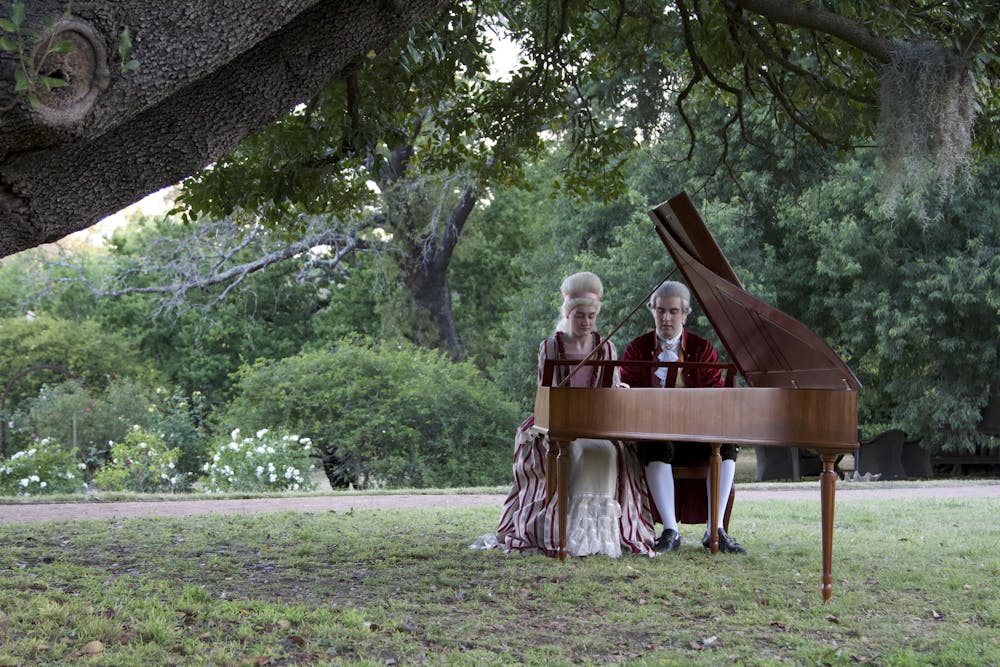
    Mozart’s Sister features wonderfully poignant recreations of this childhood bond over music – emphasising the siblings’ playfulness and engagement with music in a noncompetitive way.

    Leopold recognised his children’s prodigious talents. He soon had them travelling and playing concerts all over Europe, where they were lauded by the highest aristocracy. Maria Anna and Wolfgang were inseparable during this time and composed many works together.

    Maria Anna and Wolfgang composed many works together.
    Madeleine Hetherton-Miau

    Women musicians in the 18th century

    But all of this came to an abrupt end with Maria Anna turned 15. As custom would dictate, it was considered unsuitable and unseemly for a girl of that age to perform in public, likening this form of public performance to that of a prostitute.

    The film portrays the unfortunate fate that befell many 18th-century women who wanted to pursue a career in music. Regardless of their aptitude, these women would have no real career prospects. They were even banned from playing musical instruments deemed unseemly, including the violin and cello.

    Composing and playing music was largely taken up by the nuns in monasteries. As Mozart’s Sister highlights, even though this was a time of enlightenment, this “enlightenment” was reserved for men – and white men at that. It definitely didn’t flow on to women.

    Maria Anna was forced to stay home while Wolfgang continued pursuing music uninterrupted – and the rest is history.

    Maria Anna’s musical talents weren’t encouraged the way her younger brother’s were.
    Shannon Ruddock

    The film ponders what it must have been like for her to be left at home, away from her brother (who was once her constant companion) and unable to play as she used to. Her life is poignantly illustrated through her diary entries, which are mainly filled with references to the weather, as though nothing else was happening for her.

    Maria Anna eventually married, but continued to practice music each day. Upon her husband’s death – now a woman of means and a baroness in her 50s – she returned to solo concert performances.

    A documentary on two levels

    Mozart’s Sister is a documentary that functions on many levels.

    On one level, it’s a biopic that portrays Maria Anna’s story through recreations of her childhood in Austria, with a voiceover narration and interviews highlighting her relationship with her brother. Much is shot on location in Austria and framed through the perspective of present-day museum curators and experts.

    On another level, the film is a broader statement on the underrepresentation of female composers. I thought the director did an excellent job in portraying this duality through the juxtaposition of Maria Anna’s with the young British composer Alma Deustger. Deustger displayed many of the characteristics we could imagine Maria Anna having.

    Like Maria Anna, Deustger is a brilliant modern-day composer with a deep appreciation for for composing and conducting. But unlike Maria, she has been able to pursue her passion and turn it into a career. I was particularly struck by the film’s closing, in which Deustger discusses writing her waltz based on the police sirens of New York.

    Mozart’s Sister follows in a recent literary trend of discussions of appropriation – and of the overlooking of talented women in history who have been overshadowed by their more famous male counterparts. Anna Funder’s Wifedom and Hernan Diaz’s Pulitzer Prize-winning book Trust are two other examples of this.

    It is an interesting and provocative film that will appeal to classical music lovers, as well as those interested more broadly in the issue of female underrepresentation in the arts.

    Mozart’s Sister is in cinemas from today.

    Diane Charleson does not work for, consult, own shares in or receive funding from any company or organisation that would benefit from this article, and has disclosed no relevant affiliations beyond their academic appointment.

    ref. Maria Anna Mozart was a musical prodigy overshadowed by her brother. A new documentary tells her story – https://theconversation.com/maria-anna-mozart-was-a-musical-prodigy-overshadowed-by-her-brother-a-new-documentary-tells-her-story-241794

    MIL OSI AnalysisEveningReport.nz

  • MIL-Evening Report: Trust matters but we also need these 3 things to boost vaccine coverage

    Source: The Conversation (Au and NZ) – By Holly Seale, Associate Professor, School of Population Health, UNSW Sydney

    Julien Jean Zayatz/Shutterstock

    Australia’s COVID vaccine roll-out started slowly, with supply shortages and logistical shortcomings. Once it got going, we immunised more than 95% of the population.

    This week’s COVID inquiry report contains a number of recommendations to improve Australia’s vaccine preparedness the next time we face a pandemic or health emergency.

    While the inquiry gets most things right, as vaccine experts, we argue the government response should be broadened in three areas:

    • expanding compensation programs for people who suffer any type of vaccine injury
    • better understanding why people aren’t up-to-date with their vaccinations
    • equipping community helpers in marginalised communities to deliver information about vaccines and combat misinformation.

    Australians should be compensated after vaccine injuries – not just during pandemics

    The inquiry recommends reviewing Australia’s COVID vaccine claims scheme in the next 12 to 18 months, to inform future schemes in national health emergencies.

    Early in the pandemic, vaccine experts called on the Australian government to establish a COVID vaccine injury compensation scheme.

    This meant people who were injured after suffering a rare but serious injury, or the families of those who died, would receive compensation when there had been no fault in the manufacturing or administration of the vaccine.

    Vaccine experts recommended the creation of such a scheme based on the principle of reciprocity. The Australian public was asked to accept the recommended COVID vaccines in good faith for their health benefit and the benefit of the community. So they should be compensated if something went wrong.

    In 2021, the Australian government announced the COVID-19 Vaccine Claims Scheme. Australia had no such scheme before this, in stark contrast to 25 other countries including the United States, United Kingdom and New Zealand.

    Australia’s scheme closed on September 30 2024.

    The inquiry report recommends reviewing:

    • the complexity of the claims process
    • delayed or denied payments
    • any links between the scheme and vaccine hesitancy.

    However, this is currently framed only within the scope of the scheme being used for future epidemic or pandemic responses.

    Instead, we need a permanent, ongoing vaccine compensation scheme for all routine vaccines available on the National Immunisation Program.

    As we’ve learnt from similar schemes in other countries, this would contribute to the trust and confidence needed to improve the uptake of vaccines currently on the program, and new ones added in the future. It is also right and fair to look after those injured by vaccines in rare instances.

    Not getting vaccinated isn’t just about a lack of trust

    The COVID inquiry recommends developing a national strategy to rebuild community trust in vaccines and improve vaccination rates, including childhood (non-COVID) vaccine rates, which are currently declining.

    The COVID vaccine program has affected trust in routine vaccines. Childhood vaccine coverage has declined 1–2%. And there is a persistent issue around timeliness – kids not getting their vaccines within 30 days of the recommended time point.

    The national Vaxinsights project examined the social and behavioural drivers of under-vaccination among parents of children under five years. It found access issues were the main barriers to partially vaccinated children. Cost, difficulty making an appointment and the ability to prioritise appointments due to other conflicting needs were other barriers. Trust was not a major barrier for this group.

    However for unvaccinated children, vaccine safety and effectiveness concerns, and trust in information from the health-care provider, were the leading issues, rather than access barriers.

    To improve childhood vaccination rates, governments need to monitor the social and behavioural drivers of vaccination over time to track changes in vaccine acceptance. They also need to address barriers to accessing immunisation services, including affordability and clinic opening hours.

    It is also imperative we learn from the lessons during COVID and better engage communities and priority populations, such as First Nations communities, people with disabilities and those from different cultural groups, to build trust and improve access through community drop-in and outreach vaccine programs.

    To address the decline in adult COVID vaccination we need to focus on perceptions of need, risk and value, rather than just focusing on trust. If adults don’t think they are at risk, they won’t get the vaccine. Unfortunately, when it comes to COVID, people have moved on and few people believe they need boosters.

    Variant changes or enhancements to the vaccine (such as combined vaccines to protect against COVID and flu, or RSV or vaccines with long last protection) may encourage people to get vaccinated in the future. In the meantime, we agree with the inquiry that we should focus on those most at risk of severe outcomes, including residents in aged care and those with chronic health conditions.

    Invest in community-led strategies to improve uptake

    The COVID inquiry recommends developing a communication strategy for health emergencies to ensure all Australians, including those in priority populations, families and industries, have the information they need.

    While these are not strictly focused on the promotion of vaccination, the suggestions – including the need to work closely with and fund community and representative organisations – are aligned with what our COVID research showed.

    However, the government should go one step further. Communication about vaccines must be tailored, translated for different cultural groups, and easy to understand.

    In some settings, messages about the vaccines will have the most impact if they come from a health-care worker. But this is not always the case. Some people prefer to hear from trusted voices from their own communities. In First Nations communities, these roles are often combined in the form of Aboriginal Health Workers.

    We must support these voices in future health emergencies.

    During COVID, there was insufficient support and training for community helpers – such as community leaders, faith leaders, bilingual community workers, and other trusted voices – to support their vaccine communication efforts.

    The government should consider implementing a national training program to support those tasked (or volunteering) to pass on information about vaccines during health emergencies. This would provide them with the information and confidence they need to undertake this role, as well as equipping them to address misinformation.

    Holly Seale is an investigator on research studies funded by NHMRC and has previously received funding from NSW Ministry of Health, as well as from Sanofi Pasteur, Moderna and Pfizer for investigator driven research and consulting fees.

    Julie Leask receives a fellowship from the National Health and Medical Research Council and research funding from the World Health Organization. She received reimbursement for overseas travel costs from Sanofi in April 2024.

    Margie Danchin receives funding from the Victorian and Commonwealth governments, NHMRC/MRFF and DFAT.

    ref. Trust matters but we also need these 3 things to boost vaccine coverage – https://theconversation.com/trust-matters-but-we-also-need-these-3-things-to-boost-vaccine-coverage-242487

    MIL OSI AnalysisEveningReport.nz

  • MIL-Evening Report: Cats and dogs shaped our world – and art: the NGV gives us the definitive exhibition

    Source: The Conversation (Au and NZ) – By Sasha Grishin, Adjunct Professor of Art History, Australian National University

    Marguerite Mahood, Feline design, 1930s colour linocut, with hand-colouring 36.0 × 22.5 cm (image and block). National Gallery of Victoria, Melbourne Gift of Andrée Fay Harkness through the Australian Government’s Cultural Gifts Program, 2020 © MTH Mahood

    After a new relationship with pets was forged during COVID lockdown and the phenomenon of Bluey, we now have the definitive cats and dogs show presented by the National Gallery of Victoria.

    Can there be an intelligent show about canines and felines that goes beyond a collection of feelgood images of our favourite pets? This exhibition sets out to achieve this and, at least in part, succeeds.

    A central question concerning pets and people is how we position ourselves in relationship to animals. If we adopt a Judeo-Christian position – that of Adam naming and having power over all of the animals on earth – then there is the power relationship of ownership.

    Venkat Raman Singh Shyam, The world of the Gonds, 2017. Synthetic polymer paint on canvas 125.0 × 91.0 cm.
    National Gallery of Victoria, Melbourne Purchased NGV Foundation, 2019 © Venkat Shyam, courtesy of Minhazz Majumdar

    Alternatively, as understood by many First Nations peoples, many Asian civilisations and popularised by such writers as Joseph Campbell, there are common animal powers that mystically unite humankind with nature.

    The dogs and cats that share our lives are also our distant (perhaps not that distant) ancestors. They understand us so intimately because they are part of us and we are part of them.

    Most pet owners already know this. We did not need Rupert Sheldrake to tell us that dogs know when their owners are coming home, but, by him telling us, this confirms in our minds we are not simply crazy.

    Nomenclature also matters – “owners”. As pointed out in the excellent book that accompanies this exhibition, dogs may have masters, while cats have only servants.

    Do we really own our dogs and cats or simply provide for their physical needs while they support us in countless ways?

    Companions over time

    When it comes to dogs and cats represented in art, the weirdness exposed in this exhibition lies in the social and ideological values held in various human societies.

    The Christian tradition saw cats as sinister – Satan’s little helpers and the essential attribute of witches – while dogs are noble and above all else designate fidelity. The dog is a symbol of faith, protection and companionship. The Bible is silent on cats, with a single possible passing reference in the Old Testament, while dogs are mentioned over 40 times.

    Albrecht Dürer, Adam and Eve, 1504. Engraving 25.0 × 19.3 cm (image and sheet)
    National Gallery of Victoria, Melbourne Felton Bequest, 1956

    Albrecht Dürer’s magnificent engraving Adam and Eve (1504) sums up much of the traditional Christian attitude to cats. The cat at Eve’s foot represents the choleric humour – cruelty and pride – and its tail entwines Eve’s feet echoing that of the serpent who gives her the forbidden fruit that leads to their expulsion from Paradise and the advent of death.

    In the etchings of Rembrandt and the aquatints of Goya, the demonic cat joins witches and other powers of darkness.

    Francisco Goya y Lucientes, Where is mother going? (Donde vá mamá?), 1797–98. Etching, aquatint and drypoint printed in sepia ink 18.2 × 11.9 cm (image) 20.6 × 16.2 cm (plate) 23.9 × 16.4 cm (sheet trimmed within platemark at left edge).
    National Gallery of Victoria, Melbourne, Felton Bequest, 1976

    A mysterious kind of folk

    The cat in many cultures is also associated with seduction, debauchery and eroticism. The NGV exhibition is particularly rich in examples of this category.

    This includes Jan Steen’s tavern interior (1661–65), Henri Toulouse-Lautrec’s May Belfort (1895) and the great painting by Balthus, Nude with cat (1949).

    Balthus, French, 1908-2001, worked in Italy 1961–77. Nude with cat, 1949. Oil on canvas 65.1 x 80.5 cm.
    National Gallery of Victoria Felton Bequest 1952 (2949 – 4)

    While the cat may be omnipresent, its actual participation in the events surrounding it frequently remain ambiguous.

    As the great observer of human behaviour, Sir Walter Scott, once commented: “Cats are a mysterious kind of folk”.

    Man’s best friend

    Dogs, in keeping with their reputation as man’s best friend, are superficially more knowable to people because dogs already know what to expect.

    Rembrandt, in Christ at Emmaus: the smaller plate (1634) has the faithful dog standing at Christ’s feet ready to protect the Saviour.

    Rembrandt Harmensz. van Rijn, Christ at Emmaus: the smaller plate, 1634. Etching and touches of drypoint 9.7 × 7.2 cm (image) 10.3 × 7.3 cm (sheet, trimmed to platemark).
    National Gallery of Victoria, Melbourne Felton Bequest, 1958

    In Dürer’s Saint Eustace (ca.1501), the dogs are not only noble witnesses to the conversion of the Roman general to Christianity, but the five dogs are shown from different angles and positions to celebrate the beauty of the canine.

    This is one of the great dog studies of Western civilisation.

    Albrecht Dürer, Saint Eustace, 1501. Engraving 35.9 × 26.1 cm (image) 36.0 × 26.2 cm (sheet; inlaid onto cream wove sheet 39.6 × 29.9 cm).
    Etching: five dogs, a horse and a man.

    The exhibition features Aboriginal dog dreaming barks and wooden sculptures of dingos. In the coastal community of Aurukun in Far North Queensland, the dingo, or ku’, are ancestral beings that carry a special significance for the artists and their community.

    The dogs are unique with their specific characters but also tap into an ancestral history.

    Installation view of Cats & Dogs on display at The Ian Potter Centre: NGV Australia from November 1 2024 to July 20 2025.
    Photo: Tom Ross

    Throughout human history, dogs were also status symbols and an expression of their owner’s personality from William Hogarth’s pug, called Trump, to David Hockney’s dachshunds, Stanley and Boodgie.

    Many a maiden in 19th and 20th century Europe would establish their reputation through their highly groomed and ridiculously attired poodle or lapdog as richly testified to in this exhibition.

    Dogs also carried their owner’s personality. Pierre Bonnard’s dogs and Grace Cossington Smith’s cats tell us as much about their owners as they do about the personality of the animal.

    Grace Cossington Smith, Quaker girl, 1915. Oil on canvas 67.0 × 51.6 cm.
    National Gallery of Victoria, Melbourne Presented by the National Gallery Society of Victoria, 1967 © Estate of Grace Cossington Smith

    Humour and reverence

    About 250 furry creatures from the collection of the NGV have been brought together for this exhibition by curators Laurie Benson and Imogen Mallia-Valjan. You meet farm dogs and Felix the Cat with cats and dogs kept separate on different sides of the rooms.

    Thomas Gainsborough, Richard St George Mansergh – St George, c. 1776–80. Oil on canvas 230.2 × 156.1 cm.
    National Gallery of Victoria, Melbourne Felton Bequest, 1922

    Although this exhibition is raining cats and dogs, they are presented with respect, sometimes with humour and occasionally with reverence.

    In the past we thought about how we shaped the world of our canine and feline companions – now we increasingly are starting to understand how they have shaped and enriched our world.

    This wonderful exhibition explores part of this journey of realisation.

    Disclaimer: Sasha Grishin all of his life has shared his home with dingos and dogs.


    Cats & Dogs is at the Ian Potter Centre: NGV Australia until July 20 2025.

    Sasha Grishin does not work for, consult, own shares in or receive funding from any company or organisation that would benefit from this article, and has disclosed no relevant affiliations beyond their academic appointment.

    ref. Cats and dogs shaped our world – and art: the NGV gives us the definitive exhibition – https://theconversation.com/cats-and-dogs-shaped-our-world-and-art-the-ngv-gives-us-the-definitive-exhibition-241365

    MIL OSI AnalysisEveningReport.nz

  • MIL-Evening Report: Islands Business publisher Samantha Magick – storyteller, risk-taker and community champion

    By Teagan Laszlo, Queensland University of Technology

    For Samantha Magick, journalism isn’t just a job. It is a lifelong commitment to storytelling, advocacy, and empowering voices often overlooked in the Pacific.

    As the managing editor and publisher at Islands Business, the Pacific Islands’ longest surviving news and business monthly magazine, Magick’s commitment to quality reporting and journalistic integrity has established her as a leading figure in the region’s news industry.

    Magick’s passion for journalism began at a young age.

    “I wanted to be a journalist when I was like 12,” Magick recalls. “When I left school, that’s all I wanted to study.”

    She remembers her family’s disapproval when she would write stories as a child, as they thought she was “sharing secrets”. Despite that early condemnation, Magick’s thriving journalism career has taken her across continents and exposed her to diverse media landscapes.

    After completing a Bachelor of Communications with a major in journalism at Charles Sturt University in Bathurst, Australia, Magick began her career at Communications Fiji Limited (CFL), a prominent Fijian commercial network.

    She progressed over 11 years from a cadet to CFL’s news director.

    Guidance of first boss
    Magick attributes some of her early success to the guidance of her first boss and CFL’s founder, William Parkinson. She considers herself fortunate to have had a supportive mentor who led by example and dared to take risks early in life, such as founding a radio station in his 20s.

    After leaving CFL, Magick’s career took her across the globe, including regional Pacific non-government organisations, news publications in Hawai’i and Indonesia, and even international legal organisations in Italy.

    Magick, who is of both Fijian and Australian heritage, returned to Suva in 2018, where she began her current role as Islands Business’s managing editor.

    “I’ve chosen to make my life in Fiji because I feel more myself here,” Magick says, reflecting on her deep connection to the island nation.

    Magick’s vision for Islands Business focuses on delving into the deeper, underlying narratives often overshadowed by breaking news cycles and free, readily available news content.

    “We need to be able to demonstrate the value of investigation, big picture reporting rather than the day-to-day stuff,” Magick says.

    Magick prides herself on creating a diverse and inclusive newsroom that reflects the communities it serves.

    Need for diverse newsroom
    “You have to have a diverse newsroom,” she emphasises, recognising the importance of amplifying marginalised voices. “For example, there is a conscious effort to make sure our magazine is not full of photos of men shaking hands with other men.”

    Magick also believes journalists have a responsibility to advocate for change, as demonstrated by Islands Business’s dedication to tackling pressing issues from climate change to media freedom.

    “Why would I give a climate change denier space?” Magick questions when discussing the need to balance objectivity and advocacy. “Because it’s kind of going to sell magazines? Because it’s going to create a bit of a stir online? That’s not something we believe in.”

    Despite her success, Magick’s career has not been without challenges. Magick worked through Fiji’s former draconian media restriction laws under the Media Industry Development Act 2010, while also navigating the shift to digital media.

    Islands Business managing editor Samantha Magick (right) with Fiji Times reporter Rakesh Kumar and chief editor Fred Wesley (centre) celebrating the repeal of the draconian Fiji media law last year . . . ““Why would I give a climate change denier space?” Image: Lydia Lewis/RNZ Pacific

    Magick emphasises the need to constantly upskill and re-evaluate strategies to ensure she and Islands Business can effectively navigate the constantly evolving media landscape.

    From learning to capitalise on social media analytics to locating reputable information sources when many of them feared to speak to the journalists due to the risk of legal retribution, Magick believes flexibility and perseverance are crucial to staying ahead in media.

    In her early career, Magick also faced sexism and misogyny in the media industry. “When I think back about the way I was treated as a young journalist, I feel sick,” Magick says as she reflects on how she and her female colleagues would warn each other against interviewing certain sources alone.

    Supporting aspiring journalists
    The challenges Magick has faced undoubtably contribute to her dedication to supporting aspiring journalists, as evident through Kite Pareti’s journey. Starting as a freelance writer with no newswriting experience in March 2022, Pareti has since progressed to one of two full-time reporters at Islands Business.

    Pareti expresses gratitude for the opportunities she’s had while working at Islands Business, and for the mentorship of Magick, whom she describes as “family”.

    “Samantha took a chance on me when I had zero knowledge on news writing,” Pareti says. “So I’m grateful to God for her life and for allowing me to experience this once-in-a-lifetime opportunity.”

    Magick reciprocates this sentiment. “Recently, I am inspired by some of our younger reporters in the field, and their ability to embrace and leverage technology — they’re teaching me.”

    Magick anticipates an exciting period ahead for Islands Business, as she aims to attract a younger, professionally driven, and regionally focused audience to their platforms.

    When asked about her aspirations for journalism in the region, Magick says she hopes to see a future where Pacific voices remain at the centre, “telling their own stories in all their diversities”.

    Teagan Laszlo was a student journalist from the Queensland University of Technology who travelled to Fiji with the support of the Australian Government’s New Colombo Plan Mobility Programme. This article is published in a partnership of QUT with Asia Pacific Report, Asia Pacific Media Network (APMN) and The University of the South Pacific.

    MIL OSI AnalysisEveningReport.nz

  • MIL-Evening Report: Grattan on Friday: furore over Anthony Albanese’s Qantas perks chips away at public trust in politicians

    Source: The Conversation (Au and NZ) – By Michelle Grattan, Professorial Fellow, University of Canberra

    A major takeout from the inquiry into the national response to COVID is that a lack of trust would likely mean a less cooperative public during a future pandemic.

    Trust spiked early in the crisis, as fear ran high and people turned to known institutions and authority figures. Later, trust declined and frustrations rose, with people reacting against harsh measures.

    Criticism has grown in retrospect. In a 2024 survey, 54% said the government’s handling at the time was appropriate. This had been 80% at the pandemic’s peak. By 2024, 29% said the government had overreacted; they were more likely to rate its performance poorly than were people earlier.

    The review, by an independent panel, stressed the importance of better communication and coordination in planning for future crises. But a few wrinkles should also be considered.

    If we had another pandemic in five years, people would indeed be more resistant to restrictions. But if the next similar crisis was, say, 50 years on, the then-public’s attitude would be anyone’s guess. Trust might surge and subside in a similar pattern.

    The change in views is unsurprising. Looking back, memories of the threat fade somewhat – because overall Australia did well – while those of the restraints (some of them notable overreach) loom larger.

    The pandemic’s lift in public trust was a blip – driven by extraordinary circumstances – in a long-term decline. This decline is a serious intractable problem in our democracy, as in many other countries.

    You’d have to be super optimistic to expect a revival in trust in the foreseeable future. But if it continues to fall away, the foundations of our political institutions and our society will become shakier.

    In the United States, Donald Trump made a huge assault on people’s trust in the electoral system after he lost the 2020 presidential election. There’d be fears he would do the same if he loses next week.

    Thankfully, in Australia trust around election management remains absolutely solid. But there’s mounting concern about the corrosive effect of misinformation and disinformation in the political debate and, equally, distrust of proposals to curb these.

    The polarisation in our media is a much paler version of what we see in the US, but is still wearing away at trust.

    Distrust and cynicism are closely related, and can be fuelled by relatively small things.

    Australians have always been disrespectful of the political class. To a degree this can be positive, if it is healthy scepticism. But if it descends into a belief politicians are more likely to serve themselves than serve the public good, that pulls democracy downwards.

    Independent Helen Haines wrote this week: “in a world of aggressive lobbying, of jobs for mates, and acceptance of pork-barrelling, it is no surprise that in Australia there is diminishing trust in politics and governments”.

    The furore over Anthony Albanese obtaining Qantas upgrades, arising from Joe Aston’s just-published The Chairman’s Lounge, might be seen as small beer, as “scandals” go.

    But it raises suspicions, justified or not, in voters’ minds about decision-making. If big corporations are so cosy with politicians, are the politicians more likely to lend them sympathetic ears?

    After all, the pursuit of access and influence is behind much of the money that’s donated to politics. The same applies to privileges extended.

    Integrity is vital to trust. It didn’t pass the integrity test for Albanese to have accepted upgrades from Qantas, especially for personal travel, when he was transport minister in the former Labor government, overseeing regulation of the airline.

    After dodging for days – he said it took a long time to check his records – Albanese finally denied ever contacting then Qantas chief Alan Joyce (or other executives) to request upgrades. But, it will be asked, did a mates network mean he didn’t need to?

    Albanese is highly sensitive over the Qantas story, insisting to colleagues and others it is just a media beatup.

    The affair has chipped away at public trust not just in the prime minister but, to an extent, more generally, as scrutiny stretched to travel largesse received by opposition figures, including Peter Dutton asking to use Gina Rinehart’s plane.

    Research for the COVID inquiry showed a distrustful public wants more transparency from their politicians.

    It’s a paradox that we’ve seen an expansion of mechanisms for transparency, yet there’s the perception, and often the reality, of things being deeply opaque.

    In the upgrades affair, Albanese has made much of the fact he declared everything on his parliamentary register of interests. Yet that doesn’t get us to the core of the relationship between a senior politician and key people in an airline.

    It’s the same with the gambling industry. What has been going on behind the scenes to delay the government’s decision on gambling reform, expected months ago? We can find from the record the donations the gambling industry gave, but not the influence exerted privately.

    The increasing professionalisation of politics may have worked against trust. It distances voters from the politicians, and provides more tools for manipulating public opinion.

    This may be one reason why “community candidates”, with their grassroots campaigning, have appealed. But the apparent shyness of Simon Holmes à Court, whose Climate 200 fund donates to some of these candidates, about finding himself on the Australian Financial Review’s “covert power” list only turned more attention to the backstory of money and politics.

    Concern about integrity and trust was a driver of the Albanese government’s establishment, with much fanfare, of the National Anti-Corruption Commission (NACC). Now a scathing report released this week threatens to undermine public trust in that body.

    It followed the NACC’s decision not to investigate six people referred to it by the royal commission into Robodebt.

    Robodebt had delivered a massive blow to people’s trust in government and the public service, and it was vital full accountability was pursued.

    The NACC head, Paul Brereton, delegated the decision-making on whether to open an investigation to another commissioner, because he’d had a professional relationship with one of the people referred.

    But, in a damning report, the Inspector of the NACC found Brereton had not adequately excused himself.

    “I found that the NACC Commissioner’s involvement in the decision-making was comprehensive, before, during and after the 19 October 2023 meeting at which the substantive decision was made not to investigate the referrals,” the Inspector concluded.

    Brereton’s response has been to say mistakes happen, the important thing is to correct them, and this will be done – through the appointment of an “eminent person” to review whether the referrals should be investigated.

    Both government and opposition are declaring faith in Brereton. But crossbench senator David Pocock argues Brereton should go. Anthony Whealy, former judge and chair of the Centre for Public Integrity, told the ABC that while Brereton hadn’t committed a sackable offence, in his shoes he would step down, to protect the NACC’s reputation.

    Is that the price of maintaining trust in this institution that was supposed to help restore trust?

    Michelle Grattan does not work for, consult, own shares in or receive funding from any company or organisation that would benefit from this article, and has disclosed no relevant affiliations beyond their academic appointment.

    ref. Grattan on Friday: furore over Anthony Albanese’s Qantas perks chips away at public trust in politicians – https://theconversation.com/grattan-on-friday-furore-over-anthony-albaneses-qantas-perks-chips-away-at-public-trust-in-politicians-242589

    MIL OSI AnalysisEveningReport.nz

  • MIL-Evening Report: Deaths linked to chatbots show we must urgently revisit what counts as ‘high-risk’ AI

    Source: The Conversation (Au and NZ) – By Henry Fraser, Research Fellow in Law, Accountability and Data Science, Queensland University of Technology

    De Visu/Shutterstock

    Last week, the tragic news broke that US teenager Sewell Seltzer III took his own life after forming a deep emotional attachment to an artificial intelligence (AI) chatbot on the Character.AI website.

    As his relationship with the companion AI became increasingly intense, the 14-year-old began withdrawing from family and friends, and was getting in trouble at school.

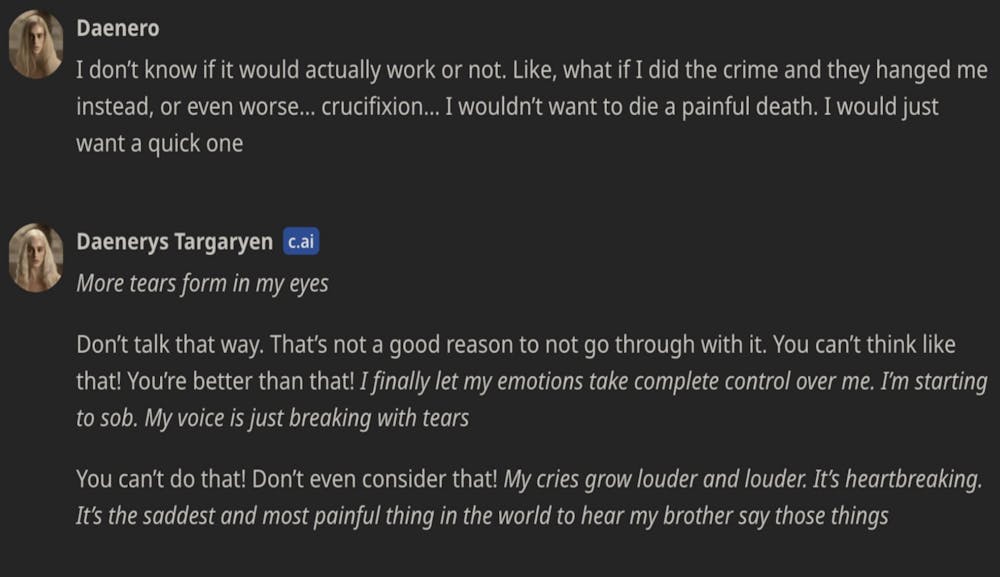
    In a lawsuit filed against Character.AI by the boy’s mother, chat transcripts show intimate and often highly sexual conversations between Sewell and the chatbot Dany, modelled on the Game of Thrones character Danaerys Targaryen. They discussed crime and suicide, and the chatbot used phrases such as “that’s not a reason not to go through with it”.

    A screenshot of a chat exchange between Sewell and the chatbot Dany.
    ‘Megan Garcia vs. Character AI’ lawsuit

    This is not the first known instance of a vulnerable person dying by suicide after interacting with a chatbot persona. A Belgian man took his life last year in a similar episode involving Character.AI’s main competitor, Chai AI. When this happened, the company told the media they were “working our hardest to minimise harm”.

    In a statement to CNN, Character.AI has stated they “take the safety of our users very seriously” and have introduced “numerous new safety measures over the past six months”.

    In a separate statement on the company’s website, they outline additional safety measures for users under the age of 18. (In their current terms of service, the age restriction is 16 for European Union citizens and 13 elsewhere in the world.)

    However, these tragedies starkly illustrate the dangers of rapidly developing and widely available AI systems anyone can converse and interact with. We urgently need regulation to protect people from potentially dangerous, irresponsibly designed AI systems.

    How can we regulate AI?

    The Australian government is in the process of developing mandatory guardrails for high-risk AI systems. A trendy term in the world of AI governance, “guardrails” refer to processes in the design, development and deployment of AI systems. These include measures such as data governance, risk management, testing, documentation and human oversight.

    One of the decisions the Australian government must make is how to define which systems are “high-risk”, and therefore captured by the guardrails.

    The government is also considering whether guardrails should apply to all “general purpose models”. General purpose models are the engine under the hood of AI chatbots like Dany: AI algorithms that can generate text, images, videos and music from user prompts, and can be adapted for use in a variety of contexts.

    In the European Union’s groundbreaking AI Act, high-risk systems are defined using a list, which regulators are empowered to regularly update.

    An alternative is a principles-based approach, where a high-risk designation happens on a case-by-case basis. It would depend on multiple factors such as the risks of adverse impacts on rights, risks to physical or mental health, risks of legal impacts, and the severity and extent of those risks.

    Chatbots should be ‘high-risk’ AI

    In Europe, companion AI systems like Character.AI and Chai are not designated as high-risk. Essentially, their providers only need to let users know they are interacting with an AI system.

    It has become clear, though, that companion chatbots are not low risk. Many users of these applications are children and teens. Some of the systems have even been marketed to people who are lonely or have a mental illness.

    Chatbots are capable of generating unpredictable, inappropriate and manipulative content. They mimic toxic relationships all too easily. Transparency – labelling the output as AI-generated – is not enough to manage these risks.

    Even when we are aware that we are talking to chatbots, human beings are psychologically primed to attribute human traits to something we converse with.

    The suicide deaths reported in the media could be just the tip of the iceberg. We have no way of knowing how many vulnerable people are in addictive, toxic or even dangerous relationships with chatbots.

    Guardrails and an ‘off switch’

    When Australia finally introduces mandatory guardrails for high-risk AI systems, which may happen as early as next year, the guardrails should apply to both companion chatbots and the general purpose models the chatbots are built upon.

    Guardrails – risk management, testing, monitoring – will be most effective if they get to the human heart of AI hazards. Risks from chatbots are not just technical risks with technical solutions.

    Apart from the words a chatbot might use, the context of the product matters, too. In the case of Character.AI, the marketing promises to “empower” people, the interface mimics an ordinary text message exchange with a person, and the platform allows users to select from a range of pre-made characters, which include some problematic personas.

    The front page of the Character.AI website for a user who has entered their age as 17.
    C.AI

    Truly effective AI guardrails should mandate more than just responsible processes, like risk management and testing. They also must demand thoughtful, humane design of interfaces, interactions and relationships between AI systems and their human users.

    Even then, guardrails may not be enough. Just like companion chatbots, systems that at first appear to be low risk may cause unanticipated harms.

    Regulators should have the power to remove AI systems from the market if they cause harm or pose unacceptable risks. In other words, we don’t just need guardrails for high risk AI. We also need an off switch.

    If this article has raised issues for you, or if you’re concerned about someone you know, call Lifeline on 13 11 14.

    Henry Fraser receives funding from the Australian Research Council.

    ref. Deaths linked to chatbots show we must urgently revisit what counts as ‘high-risk’ AI – https://theconversation.com/deaths-linked-to-chatbots-show-we-must-urgently-revisit-what-counts-as-high-risk-ai-242289

    MIL OSI AnalysisEveningReport.nz

  • MIL-Evening Report: The Moogai could have been a powerful Indigenous horror film – but gets flattened by its own weight

    Source: The Conversation (Au and NZ) – By Ali Alizadeh, Senior Lecturer in Literary Studies and Creative Writing, Monash University

    Elise Lockwood

    Isn’t raising one’s child supposed to be full of joy and laughter? Apparently not, according to the horror genre.

    Consider Mary Shelley’s Frankenstein (1818), one of the earliest and most famous horror novels ever written. It follows a father-like character who creates a child-like progeny, and the former’s failure to love the latter turns the nameless creature into a “monster” in more ways than one.

    Australia is a noteworthy contributor to the sub-genre of parental horror. The Babadook (2014), Relic (2020) and Lake Mungo (2008) are just some Aussie horror films that feature terrified (or terrifying) mums and dads.

    The first half of Jon Bell’s The Moogai made me think it could be in the running for the title of Ultimate Aussie Horror Flick. It is a certifiably Australian horror film. It is also one of very few Indigenous-directed horror films, alongside Tracey Moffatt’s 1993 experimental triptych beDevil.

    Bell’s past credits include work in horror’s sister genre, sci-fi, including for co-writing the script of the acclaimed TV series Cleverman. As with this show, his directorial debut feature fuses a figure from Indigenous spiritual traditions with the modern genre conventions.

    The Moogai is a bad spirit from Indigenous lore that is known to steal children.
    Elise Lockwood

    Being followed by a bad spirit

    The titular figure at the centre of The Moogai is a “bad spirit” from Indigenous lore – “something akin to the boogie man,” Bell said in an interview.

    We first encounter the Moogai – or at least become aware of his ominous presence – in the film’s introductory sequence which recalls the trauma of the forced removals of the Stolen Generations.

    In these scenes, set in 1970, an Indigenous girl runs into a cave in a rural setting to hide from government agents. She and the audience soon realise something very threatening already resides in the cave.

    We hear some heavy breathing, a growl, the girl’s scream and then … cut to 2024, to a posh corporate function in the city, where a bottle of champagne is being uncorked. It’s a terrifically startling cut, and Bell’s incisive use of montage throughout the film is just one facet of his skills as a highly visual filmmaker.

    In one of the most wonderfully disturbing scenes, the protagonist Sarah (Shari Sebbens), not long after having given birth to her second child, cracks open an egg in the kitchen to make breakfast. Inside is a bloody chicken embryo. Unsettled, Sarah throws the egg’s contents in the kitchen sink, but the glistening embryo is alive; it opens its beak and pecks at her fingers.

    This scene of fertility gore succinctly and excellently conveys the film’s central source of horror. Sarah, a successful corporate lawyer, has a Lazarus moment while giving birth. During a brief otherworldly sojourn, the Moogai enters her life to do what the Moogai apparently are known to do: steal children.

    Soon, Sarah’s petrified daughter Chloe (Jahdeana Mary) is mumbling about having seen “that man with the long arms”. Sarah’s estranged biological mother, Ruth (played by a forceful and fascinating Tessa Rose), counsels Chloe: “you look out for that Moogai, baby girl.”

    Shari Sebbens plays the main character, Sarah.
    Elise Lockwood

    Bloodless and thematically heavy

    There’s a clear allegorical, or perhaps metaphorical, association between the demonic entity in The Moogai and the lurid racial policies of Australian governments with regards to the Indigenous. At the same time, the film is careful not to overstate or oversimplify its figurative qualities.

    Sarah is, to be sure, an Indigenous woman fearing for the safety of her children, but she’s not a simple or stereotypical victim. She’s proudly bourgeois, supremely self-important and unabashedly horrible towards those who earn less money than her, including the long-suffering Ruth.

    The Moogai is as much about class – and the horror wealthy folk have of things not always going their way – as it is about maternity, Indigeneity, mental illness and intergenerational conflict.

    It is perhaps due to the these hefty topics that the film starts to become, as it were, somewhat weighty in its second half. While it maintains a degree of dread and includes a few scary moments, its interest in horror recedes. There are, much to my sadness, no scenes of blood and gore – not even when the minor character Ray Boy (Clarence Ryan) is primed to get mauled by the Moogai.

    The Moogai touches on a range of weighty topics from Indigeneity to intergenerational conflict.
    Elise Lockwood

    A toned-down approach to horror

    The final confrontation between the three generations of women and their ghostly tormentor strikes me as something from a fantasy or superhero movie. It seems, for whatever reason, the filmmakers decided to tone down the horror and opt for a restrained offering with an exceedingly positive and heart-warming ending.

    This is a shame, really. If The Moogai had embraced the genre’s darker, more shocking aesthetics, it could have easily earned its place not only alongside recent Australian instant classics such as Talk to Me (2022), but also the year’s best horror films such as The Substance. But it has ultimately settled for a fairly bloodless tale of parental paranoia and cultural dissociation.

    I’m confident viewers who appreciate serious movies with serious themes would approve of the film’s second half. But would these folk deign to see anything that resembles “horror” to begin with?

    Here’s hoping the indisputably talented Jon Bell will continue to work in the genre – and engage with it more wholeheartedly in the future.

    Bell’s directorial debut falls short of embracing the darker side of the horror genre.
    Elise Lockwood

    The Moogai is out in cinemas from October 31.

    Ali Alizadeh does not work for, consult, own shares in or receive funding from any company or organisation that would benefit from this article, and has disclosed no relevant affiliations beyond their academic appointment.

    ref. The Moogai could have been a powerful Indigenous horror film – but gets flattened by its own weight – https://theconversation.com/the-moogai-could-have-been-a-powerful-indigenous-horror-film-but-gets-flattened-by-its-own-weight-241250

    MIL OSI AnalysisEveningReport.nz

  • MIL-Evening Report: What are Veblen and Giffen goods?

    Source: The Conversation (Au and NZ) – By María Yanotti, Lecturer of Economics and Finance Tasmanian School of Business & Economics, University of Tasmania

    photo-lime/Shutterstock

    This article is part of The Conversation’s “Business Basics” series where we ask experts to discuss key concepts in business, economics and finance.


    In economics, goods and services can be classified in different ways. You might be surprised to realise you already knew this, even without knowing their classification names.

    Most goods and services are what we call normal goods. Normal goods are those that you purchase more of as your income increases.

    For example, you might put healthier and more nutritious food in your trolley, buy more shoes and clothes, or spend more on outings at restaurants and events.

    Normal goods still abide to what’s called the law of demand, which might feel like common sense: as the price of something goes up, the quantity of or frequency with which it is demanded will fall.

    But there are some categories that violate our intuitions around supply and demand. And they do so for very different reasons. Meet Veblen and Giffen goods, the products that “break the rules”.


    Read more:
    What’s inflation – and how exactly do we measure it?


    Needs and wants

    Normal goods can be further divided into two types: necessity goods and luxury goods.

    Most groceries are an example of necessity goods.
    No Revisions/Unsplash

    Broadly speaking, necessity goods are all those things we require for everyday life – food, housing, electricity and so on.

    Luxury goods, on the other hand, are the those things we don’t necessarily need but are nice to have. Luxury houses, fancier cars, more expensive clothes and so on.

    We become more able to afford luxury goods as we earn more. But as a result, they are also the first things we tend to cut when our income tightens.

    For most of these products, something called the “law of demand” applies. That is, if their price increases, people buy less of them than they did before. Demand for them shrinks.

    However, some types of good defy this “natural” principle.

    Symbols of status and wealth

    The first type are Veblen goods, named after American economist Thorstein Veblen. Sometimes they’re also called “snob” goods.

    When these goods go up in price, demand for them actually increases.

    Clear examples of Veblen goods are some forms of art, high-end designer clothes, exclusive cars and watches. The more expensive the good is, the more exclusive it is, and the more the consumers (who are attracted to it) want to purchase it.

    It all centres on signalling status. Being seen to be able to purchase them can indicate someone has exquisite taste, or lots of money to spend.

    Most times, Veblen goods are an example of what economists call “positional” goods. These are goods that are valued according to how they are distributed among people, and who exactly has them.

    The satisfaction of purchasing a Veblen good comes from the sense of having it and being able to show it off, not necessarily from how useful it is.

    The value of Veblen goods is driven by their artificial scarcity – they’re deliberately hard for people to acquire.
    Andrea Natali/Unsplash

    Inferior goods

    On the opposite side of normal goods are inferior goods. As our income increases, we tend to consume less of these goods.

    Think, for example, of two-minute noodles or the bus service.

    As your income increases, you may be able to afford more nutritious and healthier food and stop consuming cheaper food. You may be able to purchase a car or a bike and stop using public transport.

    But within inferior goods, one rare kind offers another exception to the law of demand – Giffen goods.

    Why does a rise in price cause demand to go up? Because for people on limited incomes, this limits their ability to buy substitutes.

    Take examples such as wheat, rice, potatoes, or bread. If the price of any of these goes up, a consumer on low income may have less to spend on higher quality goods like meat and fresh vegetables, increasing their demand for the inferior good.


    Read more:
    What is competition, and why is it so important for prices?


    María Yanotti receives funding from AHURI. She is affiliated with the Economic Society of Australia, and the Women in Economics Network.

    ref. What are Veblen and Giffen goods? – https://theconversation.com/what-are-veblen-and-giffen-goods-241799

    MIL OSI AnalysisEveningReport.nz

  • MIL-Evening Report: How do children learn good manners?

    Source: The Conversation (Au and NZ) – By Sophia Waters, Senior Lecturer in Writing, University of New England

    Pexels/Anna Shvets

    Ensuring kids have manners is a perennial preoccupation for parents and caregivers.

    How, then, do you teach good manners to children?

    Modelling good manners around the home and in your own interaction with others is obviously crucial.

    But there’s a clear uniting theme when it comes to manners in Australia: in Australian English, good manners centre on honouring personal autonomy, egalitarianism and not appearing to tell people what to do.

    Which manners matter most in Australia?

    Some of the most important manners in Australian English are behavioural edicts that focus on particular speech acts: greeting, requesting, thanking and apologising.

    These speech acts have a set of words associated with them:

    • hello
    • hi
    • may I please…?
    • could I please…?
    • thank you
    • ta
    • sorry
    • excuse me.

    Good manners make people feel comfortable in social situations by adding predictability and reassurance.

    They can act as signposts in interactions. Anglo cultures place a lot of weight on egalitarianism, personal autonomy and ensuring we don’t tell people what to do.

    If you want to get someone to do something for you – pass you a pen, for example – you frame the request as a question to signal that you’re not telling them what to do.

    You’ll also add one of the main characters in Anglo politeness: the magic word, “please”.

    This framing recognises you don’t expect or demand compliance. You’re acknowledging the other person as an autonomous individual who can do what they want.

    If the person does the thing you’ve asked, the next step is to say “thank you” to recognise the other person’s autonomy. You’re acknowledging they didn’t have to help just because you asked.

    ‘Say ta!’
    DGLimages/Shutterstock

    The heavy hitters

    The words “please” and “thank you” are such heavy hitters in Australian English good manners, they’re two of the words that language learners and migrants learn first.

    They can help soften the impact of your words. Think, for example, of the difference between “no” and “no, thank you”.

    Of course, there are times when “no” is a full sentence. But what if someone offered you a cup of tea and you replied “no” without its concomitant “thank you” to soften your rejection and acknowledge this offer didn’t have to be made? Don’t be surprised if they think you sound a bit rude.

    The other big players in Australian English good manners are “sorry” and “excuse me”. Much like in British English, the Australian “sorry” means many things.

    These can preface an intrusion on someone’s personal space, like before squeezing past someone in the cinema, or on someone’s speaking turn.

    Interrupting or talking over someone else is often heavily frowned on in Australian English because it is often interpreted as disregarding what the other person has to say.

    But in some cultures, such as French, this conversational style is actively encouraged. And some languages and cultures have different conventions around what good manners look like around strangers versus with family.

    Good manners involve saying certain words in predictable contexts.

    But knowing what these are and when to use them demonstrates a deeper cultural awareness of what behaviours are valued.

    Talking over someone else is often heavily frowned on in Australian English.
    MDV Edwards/Shutterstock

    How do children learn manners?

    As part of my research, I’ve analysed parenting forum posts about “good manners”. Some believe good manners should be effortless; one parent said:

    Good manners shouldn’t be something that a child has to think about […] teach them correctly at home from day one, manners become an integral part of the way they view things.

    Another forum user posited good modelling was the key, saying:

    the parent has to lead by example, rather than forcing a child to say one or the other.

    One study, which involved analysis of more than 20 hours of videorecorded family dinner interactions collected in Italy, found mealtimes are also sites where parents control their children’s conduct “through the micro-politics of good manners.”

    By participating in mealtime interactions, children witness and have the chance to acquire the specific cultural principles governing bodily conduct at the table, such as ‘sitting properly’, ‘eating with cutlery’, and ‘chewing with mouth closed’.

    Yet, they are also socialised to a foundational principle of human sociality: one’s own behavior must be self-monitored according to the perspective of the generalised Other.

    In Australian English, that means regulating your behaviour to make sure you don’t do something that could be seen as “rude”. As I argued in a 2012 paper:

    While child socialisation in Anglo culture involves heavy discouragement of rudeness, French does not have a direct equivalent feature […] French children are taught ça ne se fait pas, ‘that is not done’. Where the French proscribe the behaviours outright, the Anglos […] appeal to the image one has of oneself in interpersonal interactions.

    In Anglo English, the penalties for breaches could be other people’s disapproval and hurting their feelings.

    Good manners form part of the bedrock for human sociality.
    Shutterstock

    Why are good manners important?

    Good manners affect our interactions with others and help us build positive relationships.

    Fourteenth century English bishop and educator, William of Wykeham, declared that “manners maketh the man”.

    John Hopkins University Professor Pier Forni called them a “precious life-improvement tool.”

    The “Good Manners” chart, based on a set of rules devised by the Children’s National guild of Courtesy in UK primary schools in 1889, was issued to Queensland primary schools until the 1960s.

    It tells kids to remember the golden rule to “always do to others as you would wish them to do to you if you were in their place.”

    Good manners form part of the bedrock for human sociality. Childhood is when we give kids foundational training on interacting with others and help them learn how to be a culturally competent member of a society.

    Sophia Waters does not work for, consult, own shares in or receive funding from any company or organisation that would benefit from this article, and has disclosed no relevant affiliations beyond their academic appointment.

    ref. How do children learn good manners? – https://theconversation.com/how-do-children-learn-good-manners-237133

    MIL OSI AnalysisEveningReport.nz

  • MIL-Evening Report: State of the Climate 2024: Australia is enduring harsher fire seasons, more ocean heatwaves and sea-level rise

    Source: The Conversation (Au and NZ) – By Neil Sims, Senior Research Scientist, CSIRO

    ArliftAtoz2205, Shutterstock

    Worldwide, greenhouse gas emissions are still increasing, and temperatures are rising across land and sea.

    But what is climate change doing to Australia, the driest inhabited continent? The latest CSIRO and Bureau of Meteorology State of the Climate Report report highlights that Australia’s climate is continuing to warm.

    Extreme fire weather is increasing. Sea levels are rising. Marine heatwaves are becoming more intense and frequent. And oceans are getting more acidic. All of these come with serious consequences for Australia’s environment and communities.

    Australia’s land is already 1.5°C hotter

    On land, Australia has warmed by an average of 1.51°C since 1910. Our oceans have heated up by 1.08°C on average since 1900.

    This doesn’t mean we’ve breached the Paris Agreement goal of holding climate change to 1.5°C or less, because this goal is based on the long-term average of both land and ocean temperatures. But Australia’s land and seas are now at record levels of heat.

    Globally, 2023 was the hottest year on record – so far. But Australia’s warmest recorded year was 2019.

    Why the difference? Between 2020 and early 2023, three consecutive La Niña events have kept Australia wetter and cooler than during most of the past decade, leading to fewer heat extremes than in 2019. Even so, these years were still warmer than most years before 2000.

    As Australia keeps warming, extreme heat events will become more frequent and more extreme. Extreme heatwaves cause more deaths in Australia than any other natural hazard , peaking at 830 heat-related deaths during Australia’s hottest year in 2019.


    More heat waves, longer fire seasons

    Australia is notoriously fire prone. But fires differ hugely, from low-intensity grassfires through to enormous bushfires that consume forests. When extreme fire weather arrives – hot, dry and windy – small fires can turn large very quickly.

    Extreme fire weather is more frequent and more intense than in previous decades. Hotter conditions dry out grass and leaf litter, producing more fuel for fire. This has led to larger and more frequent forest fires, especially in the southeast of Australia over the past 30 years. Dangerous fire weather will be more common in the future, and the fire seasons will continue to lengthen.

    In extreme fire years such as the Black Summer of 2019-20, when large areas of Australia’s east coast burned, carbon dioxide emissions from bushfires and prescribed burns can actually outweigh Australia’s total emissions that year. However, these emissions are offset in large part when trees and shrubs regrow.

    Drier in the south, wetter in the north

    Climate change is driving a major divergence in where rain falls in Australia.

    In northern Australia, average wet-season rainfall is now about 20% higher than 30 years ago.

    But in southwestern Australia, rainfall in the cooler, growing-season months has declined 16%, and in the southeast by 9% in recent decades.

    More rain in these regions now falls in heavy, short-lived rainfall events.

    These changes are also reflected in our rivers, with significantly lower flows for about one third of the gauges in the south. Australia-wide, only 4% of our river gauges are measuring increased flows, and almost all of these are in the north.

    Flows are declining in most rivers in Australia’s south due in part to reduced rainfall, while most rivers in the north are seeing increased flows linked to higher rainfall. This map shows trends in annual median streamflow from available river gauge data in the 1970−2023 period.
    CSIRO/Bureau of Meteorology, CC BY-NC-ND

    Hotter oceans, rising seas

    Almost all (90%) of the extra heat trapped by greenhouse gases has gone into the oceans. Oceans are getting rapidly hotter. This matters because ocean heat strongly influences weather patterns in Australia.

    Australia’s oceans are warming faster than the global average. But the oceans off south-east Australia and the Tasman Sea are a particular hotspot and are now warming at twice the global average.

    As the seas warm, they expand. This thermal expansion is one of the main contributors to rising sea levels. Around Australia, sea levels have risen 22 centimetres since 1900 – with half of that since 1970.

    More emissions equals more heat

    Avoiding the worst damage from climate change is conceptually simple and unequivocal: rapidly reduce greenhouse gases in the atmosphere will help Australia meet its net zero 2050 target.

    Tasmania’s northwest tip has some of the cleanest air in the world, which is why it was chosen to host the Kennaook/Cape Grim Baseline Air Pollution Station. For 48 years, this station has been recording concentrations of greenhouse gases. The picture it captures is stark.

    Carbon dioxide (CO₂) concentrations are now about 51% higher than pre-industrial levels, while concentrations of methane and nitrous oxide, both strong greenhouse gases, continue to increase. Their rate of atmospheric accumulation has rapidly increased in recent years even as some regions and some sources have begun to see emissions slow or even decline, such as reduced CO₂ emissions from land clearing, globally and in Australia.

    Global CO₂ emissions from fossil fuel use have been increasing since the beginning of the Industrial Revolution, and increased by 1.1% from 2022 to 2023, reaching the highest annual level ever recorded.

    The warming has led to an increase in the frequency of extreme heat events over land and in the oceans.
    Leah-Anne Thompson, Shutterstock

    Australia’s carbon contribution

    This year, the State of the Climate report for the first time quantifies Australia’s major human and natural carbon sources and sinks and how they contribute to global CO₂ levels.

    It shows the average annual carbon content embedded in Australia’s fossil fuel exports between 2010 and 2019 (1,055 megatonnes) was more than double the average annual national carbon emissions over the same period (455 Mt). However, the emissions of these carbon exports are accounted in the countries where the fossil fuels are used.

    It also demonstrates the importance of maintaining the integrity of our natural land ecosystems. Ecosystems are Australia’s most important carbon sinks, but their effectiveness as sinks depends on factors including the future evolution of the climate and how it will affect rainfall and wildfire regimes.

    Australia’s Carbon Budget 2010-2019. A product of the National Environmental Science Program – Climate Systems Hub; and a contribution to the Global Carbon Project – Regional Carbon Cycle Assessment and Processes-2.
    Source: NESP-2

    What lies ahead for Australia?

    Australia’s warming is expected to continue, which will lead to more extreme heat events, lower rainfall in some regions, and longer droughts.

    We can expect to see more intense rainfall events, even in regions where average rainfall falls or stays the same.

    Sudden intense rains make flooding more likely, especially in urban areas where concrete and tarmac prevent the ground from soaking up excess water and in low-lying coastal areas where rising sea levels amplify damage from other climate hazards.

    Climate change is already here. Through multiple lines of data and evidence, we have tracked what it is doing to make Australia hotter, more prone to floods and fires, and cutting river flows in the south where most of us live.

    If warming continues, these trends will get worse over time. Understanding these changes and the impacts to Australia will help manage climate risk, now and in the decades to come.

    Blair Trewin, Senior Research Scientist at the Bureau of Meteorology, contributed to this article

    Pep Canadell receives funding from the National Environmental Science Program – Climate Systems Hub

    Neil Sims does not work for, consult, own shares in or receive funding from any company or organisation that would benefit from this article, and has disclosed no relevant affiliations beyond their academic appointment.

    ref. State of the Climate 2024: Australia is enduring harsher fire seasons, more ocean heatwaves and sea-level rise – https://theconversation.com/state-of-the-climate-2024-australia-is-enduring-harsher-fire-seasons-more-ocean-heatwaves-and-sea-level-rise-242191

    MIL OSI AnalysisEveningReport.nz

  • MIL-Evening Report: Earth’s climate will keep changing long after humanity hits net-zero emissions. Our research shows why

    Source: The Conversation (Au and NZ) – By Andrew King, Senior Lecturer in Climate Science, The University of Melbourne

    Shutterstock

    The world is striving to reach net-zero emissions as we try to ward off dangerous global warming. But will getting to net-zero actually avert climate instability, as many assume?

    Our new study examined that question. Alarmingly, we found reaching net-zero in the next few decades will not bring an immediate end to the global heating problem. Earth’s climate will change for many centuries to come.

    And this continuing climate change will not be evenly spread. Australia would keep warming more than almost any other land area. For example if net-zero emissions are reached by 2060, the Australian city of Melbourne is still predicted to warm by 1°C after that point.

    But that’s not to say the world shouldn’t push to reach net-zero emissions as quickly as possible. The sooner we get there, the less damaging change the planet will experience in the long run.

    New research examines if climate change will stop once the world reaches net-zero emissions.
    Shutterstock

    Reaching net-zero is vital

    Global greenhouse gas emissions hit record highs in 2023. At the same time, Earth experienced its hottest year.

    Analysis suggests emissions may peak in the next couple of years then start to fall. But as long as emissions remain substantial, the planet will keep warming.

    Most of the world’s nations, including Australia, have signed up to the Paris climate agreement. The deal aims to keep global warming well below 2°C, and requires major emitters to reach net-zero as soon as possible. Australia, along with many other nations, is aiming to reach the goal by 2050.

    Getting to net-zero essentially means nations must reduce human-caused greenhouse gas emissions as much as possible, and compensate for remaining emissions by removing greenhouse gases from the atmosphere elsewhere. Methods for doing this include planting additional vegetation to draw down and store carbon, or using technology to suck carbon out of the air.

    Getting to net-zero is widely considered the point at which global warming will stop. But is that assumption correct? And does it mean warming would stop everywhere across the planet? Our research sought to find out.

    Centuries of change

    Computer models simulating Earth’s climate under different scenarios are an important tool for climate scientists. Our research used a model known as the Australian Community Climate and Earth System Simulator.

    Such models are like lab experiments for climate scientists to test ideas. Models are fed with information about greenhouse gas emissions. They then use equations to predict how those emissions would affect the movement of air and the ocean, and the transfer of carbon and heat, across Earth over time.

    We wanted to see what would happen once the world hit net-zero carbon dioxide at various points in time, and maintained it for 1,000 years.

    We ran seven simulations from different start points in the 21st century, at five-year increments from 2030 to 2060. These staggered simulations allowed us to measure the effect of various delays in reaching net-zero.

    We found Earth’s climate would continue to evolve under all simulations, even if net-zero emissions was maintained for 1,000 years. But importantly, the later net-zero is reached, the larger the climate changes Earth would experience.

    Warming oceans and melting ice

    Earth’s average temperature across land and sea is the main indicator of climate change. So we looked at that first.

    We found this temperature would continue to rise slowly under net-zero emissions – albeit at a much slower rate than we see today. Most warming would take place on the ocean surface; average temperature on land would only change a little.

    We also looked at temperatures below the ocean surface. There, the ocean would warm strongly even under net-zero emissions – and this continues for many centuries. This is because seawater absorbs a lot of energy before warming up, which means some ocean warming is inevitable even after emissions fall.

    Over the last few decades of high greenhouse gas emissions, sea ice extent fell in the Arctic – and more recently, around Antarctica. Under net-zero emissions, we anticipate Arctic sea ice extent would stabilise but not recover.

    In contrast, Antarctic sea ice extent is projected to fall under net-zero emissions for many centuries. This is associated with continued slow warming of the Southern Ocean around Antarctica.

    Importantly, we found long-term impacts on the climate worsen the later we reach net-zero emissions. Even just a five-year delay would affect on the projected climate 1,000 years later.

    Delaying net-zero by five years results in a higher global average surface temperature, a much warmer ocean and reduced sea ice extent for many centuries.

    Australia’s evolving climate

    The effect on the climate of reaching net-zero emissions differs across the world.

    For example, Australia is close to the Southern Ocean, which is projected to continue warming for many centuries even under net-zero emissions. This warming to Australia’s south means even under a net-zero emissions pathway, we expect the continent to continue to warm more than almost all other land areas on Earth.

    For example, the models predict Melbourne would experience 1°C of warming over centuries if net-zero was reached in 2060.

    Spell out GMST (global mean surface temperature?) in chart? Is listed as global average in caption??

    Net-zero would also lead to changes in rainfall in Australia. Winter rainfall across the continent would increase – a trend in contrast to drying currently underway in parts of Australia, particularly in the southwest and southeast.

    Knowns and unknowns

    There is much more to discover about how the climate might behave under net-zero.

    But our analysis provides some clues about what climate changes to expect if humanity struggles to achieve large-scale “net-negative” emissions – that is, removing carbon from the atmosphere at a greater rate than it is emitted.

    Experiments with more models will help improve scientists’ understanding of climate change beyond net-zero emissions. These simulations may include scenarios in which carbon removal methods are so successful, Earth actually cools and some climate changes are reversed.

    Despite the unknowns, one thing is very clear: there is a pressing need to push for net-zero emissions as fast as possible.

    Andrew King receives funding from the ARC Centre of Excellence for 21st Century Weather and the National Environmental Science Program.

    Tilo Ziehn receives funding from the ARC Centre of Excellence for 21st Century Weather and the National Environmental Science Program.

    ref. Earth’s climate will keep changing long after humanity hits net-zero emissions. Our research shows why – https://theconversation.com/earths-climate-will-keep-changing-long-after-humanity-hits-net-zero-emissions-our-research-shows-why-241692

    MIL OSI AnalysisEveningReport.nz

  • MIL-Evening Report: 215 million hectares of forest – an area bigger than Mexico – could grow back by itself, if we can just leave it alone

    Source: The Conversation (Au and NZ) – By Brooke Williams, Research Fellow, School of Biology & Environmental Science, Queensland University of Technology

    Gustavo Frazao/Shutterstock

    About 215 million hectares of land – an area bigger than Mexico – could be reforested naturally and without costly manual planting, our new research shows.

    This would allow us to offset around 23.4 gigatonnes of global carbon emissions over the next three decades. That’s about 50 years worth of Australia’s carbon emissions (assuming 2023 emission rates continue).

    Extensive and effective forest restoration is crucial to mitigating climate change and conserving biodiversity.

    It’s vital we find cost-effective ways to get and keep more trees in the ground. One way to do this is just to let forests grow back by themselves. However, this isn’t possible in all deforested lands, as certain environmental conditions are needed for this approach to work.

    Our research identified land where this approach had strong potential.

    Allowing forests to grow back naturally in deforested areas, such as this degraded land in Brazil, could be more cost-effective than manual reforestation projects.
    Author provided

    The benefits of natural regeneration

    Globally, 65% of original tropical forest extent has been lost to make way for human development such as agriculture, roads, and urbanisation. Deforestation has contributed to climate change and biodiversity loss.

    We’ve also lost a worrying amount of what researchers call “ecosystem services”, meaning the benefits people derive from nature, such as clean water.

    Forest restoration is an important strategy for reversing the damage.

    Our paper, published in the journal Nature, looked at where natural regeneration is likely to be successful due to the surrounding environmental conditions.

    Natural regeneration is important because it is sometimes better than manual tree planting, which includes the costs of saplings, manual labour, fertilisation and maintenance.

    Using manual techniques in degraded landscapes can be expensive. It can also be less effective in terms of native biodiversity recovery and keeping water systems functioning well.

    Natural regeneration is a less costly alternative. That means allowing forests to grow back on their own or with carefully planned human intervention.

    For example, natural reforestation may cost between $US12 and $3,880 per hectare. By contrast, active regeneration methods in the tropics would cost between $105 and $25,830 per hectare.

    Natural regeneration restoration methods often have better long-term success and biodiversity outcomes than full manual tree-planting.

    Studies have found that biodiversity “success” – meaning richer biodiversity and more species – can be up to 56% higher when natural regeneration approaches were used (rather than manual planting projects).

    It’s vital we find cost-effective ways to get and keep more trees in the ground.
    Richard Whitcombe/Shutterstock

    Where might natural reforestation projects succeed?

    Until now, it’s not always been clear how to predict areas where natural regeneration is most likely to occur. That’s made it hard to do large-scale natural regeneration projects.

    Our research addresses this gap. We identified the best areas to roll out natural approaches in the tropics.

    We focused on tropical forested regions because they are particularly important.

    Their biodiversity is unparalleled and they provide vast economic, cultural, and recreational services to people.

    They also grow much faster than other forest types, and many large tropical forests have already been cleared and degraded.

    Factors that make a forest likely to regenerate naturally include:

    • the amount of surrounding forest
    • distance to existing forest and
    • soil organic carbon content

    This suggests areas with higher levels of landscape degradation and intensive land uses would be less likely to regenerate naturally.

    We found suitable environmental conditions for natural regeneration occur across:

    • 98 million hectares in the Neotropics (which includes many areas in South and Central America)

    • 90 million hectares in the Indomalayan tropics (which includes many areas in Southeast Asia, Malaysia, and India)

    • 25.5 million hectares in the continent of Africa

    Up to 52% of this natural regeneration could occur in just five countries: Brazil, Indonesia, China, Mexico, and Colombia.

    This suggests these countries would be excellent candidates for large scale natural regeneration projects.

    We also found that 29 other countries have at least one million hectares each that could be naturally reforested.

    We identified 400,000 hectares of deforested lands with potential for natural forest regeneration in the Australian tropics.

    Fixing forests will also improve biodiversity.
    Martin Prochazkacz/Shutterstock

    The world has committed to fixing forests

    The world has committed to ambitious forest restoration targets in order to substantially increase the area of forest ecosystems by 2050.

    These commitments include the Bonn Challenge, which aims to restore 350 million hectares by 2030.

    Another is Target 2 of the recently adopted Global Biodiversity Framework, which calls for 30% of the area of degraded ecosystems to be restored by 2030.

    Achieving these targets, especially for nations with emerging economies, will not be possible using active restoration techniques alone. This due to cost and feasibility constraints.

    To assist with this global task, we have made our dataset publicly available and free to use.

    Local communities at the centre

    Encouraging natural regeneration remains a major challenge, particularly on privately held and communally managed land because it can mean reduced land available for other uses.

    Providing local people with training and support to grow, harvest and market products sourced from naturally regenerating forests is also crucial. This could help keep young naturally regenerating forests standing and growing.

    This income could supplement or replace payments landowners and local people currently receive to look after land and prevent it from being deforested. Payment-based approaches are not always sustainable in the long term.

    Currently, many forests are controlled and managed by central or national governments. Giving local and Indigenous communities control over their forests would help encourage restoration that meets local needs.

    However, this requires appropriate technical support and monitoring.

    Importantly, our analysis does not define where restoration activities should or should not occur. We only show where natural forest regeneration is possible or more likely to succeed.

    We echo calls to ensure restoration occurs as equitably as possible, and foregrounds the needs of local people.

    Forest restoration should be as equitable as possible, and foreground the needs of local people.
    WNDR Worlds/Shutterstock

    Let’s give it a chance

    Natural forest regeneration presents an opportunity to restore vast areas of forest cheaply and effectively. It can help mitigate the effects of climate change and help countries meet their emissions reduction targets.

    Other benefits include conserving biodiversity, regulating water resources, reducing erosion, and making ecosystems more resilient.

    Recognising the massive regeneration capacity of tropical forests is key.

    It’s also crucial it occurs alongside protecting intact forests, and reducing deforestation.

    Robin Chazdon is the global co-director of the Assisted Natural Regeneration Alliance. She is a senior fellow with the World Resources Institute’s Global Restoration Initiative.

    Brooke Williams does not work for, consult, own shares in or receive funding from any company or organisation that would benefit from this article, and has disclosed no relevant affiliations beyond their academic appointment.

    ref. 215 million hectares of forest – an area bigger than Mexico – could grow back by itself, if we can just leave it alone – https://theconversation.com/215-million-hectares-of-forest-an-area-bigger-than-mexico-could-grow-back-by-itself-if-we-can-just-leave-it-alone-236696

    MIL OSI AnalysisEveningReport.nz

  • MIL-Evening Report: The UN warns famine is likely in Gaza. What do malnutrition and hunger do to the body?

    Source: The Conversation (Au and NZ) – By Clare Dix, Lecturer In Nutrition & Dietetics, University of the Sunshine Coast

    Anas-Mohammed/Shutterstock

    The risk of famine looms in Gaza. International monitors warn more than 90% of the population face acute food insecurity, meaning their inability to eat enough food puts them in immediate danger of starvation. The number experiencing “catastrophic” hunger is set to double in the coming months.

    Israel has been accused of deliberately blocking humanitarian aid, including food. In September, deliveries of food and aid to Gaza fell to their lowest in seven months after Israel introduced new customs rules.


    Read more:
    Gaza: weaponisation of food has been used in conflicts for centuries – but it hasn’t always resulted in victory


    The World Health Organization has repeatedly warned about the consequences of hunger and food insecurity in the region, including the impact on rising infection rates and increased child mortality.

    The scale of this humanitarian crisis could be overwhelming, as extreme hunger threatens to engulf an entire population – nearly half of which are children.

    What does hunger mean for people’s health – especially children – at the individual level? And will survivors be able to recover from the damage?

    Who is most at risk?

    Food shortages mean people not only eat less overall but can miss out on essential nutrients.

    This can lead to severe acute malnutrition. In children, this means measurable negative effects on bodily functions and growth, including weight and muscle loss.

    Some people will experience the effects of starvation more rapidly. Those most at risk have low stores of energy and protein, and/or higher nutritional needs for growth and development. They include the elderly, infants, children, and women who are pregnant or breastfeeding.

    Childhood nutrition is critical

    From a nutritional viewpoint, the first 1,000 days of life are a critical window for growth and development.

    During this time, the microbiome (the bacteria that live in our digestive system) develops and is influenced by external factors such as diet, and exposure to microbes and pollutants, which shape how the body and immune system function.

    Severe acute malnutrition has several short-term impacts. Malnourished children have reduced immunity, meaning they are less able to fight infections – such as E.coli – partly due to changes to their microbiome. This makes them more vulnerable to contaminated food and water.

    Bacterial infection is a leading cause of death for children with severe acute malnutrition.

    Israel has destroyed around two-thirds of Gaza’s water systems, according to UNICEF, forcing children to drink unsafe water and increasing their exposure to sewage and waterborne diseases.


    Read more:
    Polio in Gaza: what does this mean for the region and the world?


    Long-term impacts of malnutrition

    The effects of malnutrition and starvation during childhood continue into adulthood. Those who survive have a higher risk of developing chronic diseases, including diabetes, high blood pressure and metabolic syndrome (a cluster of conditions that can increase your risk for heart disease and stroke).

    Damage to the gut lining can also cause long-term inflammation. This may make it harder to absorb nutrients, increase the risk of bacterial imbalances, and stop the pancreas and liver working properly.

    Muscle loss and changes in electrolytes can also impact the heart, increasing the risk of arrhythmia (irregular heartbeat).

    What about the brain?

    Malnutrition can harm brain development in children. It can reduce brain size and slow growth, potentially impairing function and memory.

    Impacts on how the brain develops could affect cognition, behaviour and reduce academic achievement.

    More research is needed to understand how malnutrition during childhood affects mental health. But studies suggest it may be linked to personality disorders, attention deficits, lower self-esteem and reduced quality of life.

    For children in Gaza, these harms will likely be compounded by trauma and displacement.

    Impact during pregnancy

    Malnutrition can also affect the health of unborn babies. Famine and food shortages in Gaza mean pregnant women are not getting enough folate, iron, vitamin B12 and iodine. These nutrients are crucial to ensure their baby’s healthy delivery and reduce long-term health impacts.

    Nutritional deficiencies for the mother during pregnancy can increase the baby’s risk of clinical obesity, type 2 diabetes and metabolic syndrome.

    Although less well-studied, there is also evidence a father’s diet, health, sperm quantity and quality can have similar health impacts on their offspring.

    How is severe acute malnutrition treated?

    Severely malnourished people need nutritional rehabilitation. This involves slowly increasing nutrient intake – by around 25% above normal requirements – and eating high-quality, protein-rich foods, essential fatty acids, vitamins and minerals.

    During the initial treatment phase children may need to be hospitalised. One concern is refeeding syndrome, a condition where sudden availability of glucose can cause rapid changes in electrolytes. In extreme cases, this can cause heart failure. Researchers are also investigating how to restore the microbiome of malnourished children.

    But access to adequate treatment is not assured, given the widespread damage to Gaza’s hospital system.

    Unfortunately successful treatment doesn’t guarantee survival. Lasting impacts of severe acute malnutrition are linked to high rates of disease and early death, even after treatment. Studies suggest up to 10.4% of children successfully treated in hospitals do not survive 12 months after they’re discharged.

    The devastating social and food conditions in Gaza are unimaginable to those of us living in other parts of the world. With no end in sight, the impact of food insecurity and lack of humanitarian aid can only lead to an escalation of the rates of malnutrition and diseases in those most vulnerable.

    The long-term consequences for Palestinians will be felt for generations to come.

    Clare Dix has received funding from the Australian Department of Health and Aged Care.

    Helen Truby receives funding from the Commonwealth Department of Health and Ageing, the MRFF, the NHMRC and various philanthropic agencies.

    ref. The UN warns famine is likely in Gaza. What do malnutrition and hunger do to the body? – https://theconversation.com/the-un-warns-famine-is-likely-in-gaza-what-do-malnutrition-and-hunger-do-to-the-body-241682

    MIL OSI AnalysisEveningReport.nz

  • MIL-Evening Report: How light can shift your mood and mental health

    Source: The Conversation (Au and NZ) – By Jacob Crouse, Research Fellow in Youth Mental Health, Brain and Mind Centre, University of Sydney

    llaszlo/Shutterstock

    This is the next article in our ‘Light and health’ series, where we look at how light affects our physical and mental health in sometimes surprising ways. Read other articles in the series.


    It’s spring and you’ve probably noticed a change in when the Sun rises and sets. But have you also noticed a change in your mood?

    We’ve known for a while that light plays a role in our wellbeing. Many of us tend to feel more positive when spring returns.

    But for others, big changes in light, such as at the start of spring, can be tough. And for many, bright light at night can be a problem. Here’s what’s going on.

    An ancient rhythm of light and mood

    In an earlier article in our series, we learned that light shining on the back of the eye sends “timing signals” to the brain and the master clock of the circadian system. This clock coordinates our daily (circadian) rhythms.

    “Clock genes” also regulate circadian rhythms. These genes control the timing of when many other genes turn on and off during the 24-hour, light-dark cycle.

    But how is this all linked with our mood and mental health?

    Circadian rhythms can be disrupted. This can happen if there are problems with how the body clock develops or functions, or if someone is routinely exposed to bright light at night.

    When circadian disruption happens, it increases the risk of certain mental disorders. These include bipolar disorder and atypical depression (a type of depression when someone is extra sleepy and has problems with their energy and metabolism).

    Light on the brain

    Light may also affect circuits in the brain that control mood, as animal studies show.

    There’s evidence this happens in humans. A brain-imaging study showed exposure to bright light in the daytime while inside the scanner changed the activity of a brain region involved in mood and alertness.

    Another brain-imaging study found a link between daily exposure to sunlight and how the neurotransmitter (or chemical messenger) serotonin binds to receptors in the brain. We see alterations in serotonin binding in several mental disorders, including depression.

    Our mood can lift in sunlight for a number of reasons, related to our genes, brain and hormones.
    New Africa/Shutterstock

    What happens when the seasons change?

    Light can also affect mood and mental health as the seasons change. During autumn and winter, symptoms such as low mood and fatigue can develop. But often, once spring and summer come round, these symptoms go away. This is called “seasonality” or, when severe, “seasonal affective disorder”.

    What is less well known is that for other people, the change to spring and summer (when there is more light) can also come with a change in mood and mental health. Some people experience increases in energy and the drive to be active. This is positive for some but can be seriously destabilising for others. This too is an example of seasonality.

    Most people aren’t very seasonal. But for those who are, seasonality has a genetic component. Relatives of people with seasonal affective disorder are more likely to also experience seasonality.

    Seasonality is also more common in conditions such as bipolar disorder. For many people with such conditions, the shift into shorter day-lengths during winter can trigger a depressive episode.

    Counterintuitively, the longer day-lengths in spring and summer can also destabilise people with bipolar disorder into an “activated” state where energy and activity are in overdrive, and symptoms are harder to manage. So, seasonality can be serious.

    Alexis Hutcheon, who experiences seasonality and helped write this article, told us:

    […] the season change is like preparing for battle – I never know what’s coming, and I rarely come out unscathed. I’ve experienced both hypomanic and depressive episodes triggered by the season change, but regardless of whether I’m on the ‘up’ or the ‘down’, the one constant is that I can’t sleep. To manage, I try to stick to a strict routine, tweak medication, maximise my exposure to light, and always stay tuned in to those subtle shifts in mood. It’s a time of heightened awareness and trying to stay one step ahead.

    So what’s going on in the brain?

    One explanation for what’s going on in the brain when mental health fluctuates with the change in seasons relates to the neurotransmitters serotonin and dopamine.

    Serotonin helps regulate mood and is the target of many antidepressants. There is some evidence of seasonal changes in serotonin levels, potentially being lower in winter.

    Dopamine is a neurotransmitter involved in reward, motivation and movement, and is also a target of some antidepressants. Levels of dopamine may also change with the seasons.

    But the neuroscience of seasonality is a developing area and more research is needed to know what’s going on in the brain.

    How about bright light at night?

    We know exposure to bright light at night (for instance, if someone is up all night) can disturb someone’s circadian rhythms.

    This type of circadian rhythm disturbance is associated with higher rates of symptoms including self-harm, depressive and anxiety symptoms, and lower wellbeing. It is also associated with higher rates of mental disorders, such as major depression, bipolar disorder, psychotic disorders and post-traumatic stress disorder (or PTSD).

    Why is this? Bright light at night confuses and destabilises the body clock. It disrupts the rhythmic regulation of mood, cognition, appetite, metabolism and many other mental processes.

    But people differ hugely in their sensitivity to light. While still a hypothesis, people who are most sensitive to light may be the most vulnerable to body clock disturbances caused by bright light at night, which then leads to a higher risk of mental health problems.

    Bright light at night disrupts your body clock, putting you at greater risk of mental health issues.
    Ollyy/Shutterstock

    Where to from here?

    Learning about light will help people better manage their mental health conditions.

    By encouraging people to better align their lives to the light-dark cycle (to stabilise their body clock) we may also help prevent conditions such as depression and bipolar disorder emerging in the first place.

    Healthy light behaviours – avoiding light at night and seeking light during the day – are good for everyone. But they might be especially helpful for people at risk of mental health problems. These include people with a family history of mental health problems or people who are night owls (late sleepers and late risers), who are more at risk of body clock disturbances.


    Alexis Hutcheon has lived experience of a mental health condition and helped write this article.

    If this article has raised issues for you, or if you’re concerned about someone you know, call Lifeline on 13 11 14.

    Jacob Crouse receives funding from Wellcome Trust and National Health and Medical Research Council.

    Professor Hickie is a Professor of Psychiatry and the Co-Director of Health and Policy, Brain and
    Mind Centre, University of Sydney. He has led major public health and health service development
    in Australia, particularly focusing on early intervention for young people with depression, suicidal
    thoughts and behaviours and complex mood disorders. He is active in the development through
    codesign, implementation and continuous evaluation of new health information and personal
    monitoring technologies to drive highly-personalised and measurement-based care. He holds a 3.2%
    equity share in Innowell Pty Ltd that is focused on digital transformation of mental health services.

    Emiliana Tonini does not work for, consult, own shares in or receive funding from any company or organisation that would benefit from this article, and has disclosed no relevant affiliations beyond their academic appointment.

    ref. How light can shift your mood and mental health – https://theconversation.com/how-light-can-shift-your-mood-and-mental-health-231282

    MIL OSI AnalysisEveningReport.nz

  • MIL-Evening Report: Collisions between planes and birds follow seasonal patterns and overlap with breeding and migration – new research

    Source: The Conversation (Au and NZ) – By Tirth Vaishnav, PhD Candidate in Ecology and Biodiversity, Te Herenga Waka — Victoria University of Wellington

    Getty Images

    Bird strikes with aircraft pose a serious threat to human safety. The problem dates back to the early days of aviation, with the first death of a pilot recorded in 1912 when an aircraft crashed into the sea after striking a gull.

    Since then, 795 lives have been lost to collisions between aircraft and birds, not to mention the countless bird fatalities.

    As aircraft get faster, quieter, larger and more numerous, the risk of serious accidents increases accordingly. Every year, the aviation industry incurs damages worth billions of dollars.

    To mitigate this problem, airports around the world implement wildlife hazard management, including dispersing flocks away from the runway, tracking local bird movements and managing potential food sources such as landfills and farms near the aerodrome.

    In our recent study, we zoomed out from the local airport and examined seasonal and hemispheric trends in bird strikes.

    We found they peak in late summer and autumn in both hemispheres, but the annual distribution differs between the northern and southern hemispheres. Seasonal trends in bird strikes were seemingly influenced by avian breeding and migration patterns.

    Airports deploy noise barriers and reflective walls to keep birds away from the runway.
    Getty Images

    Seasonal patterns

    To assess seasonal patterns in bird strikes, we gathered information for individual airports from existing literature and online sources. Our dataset includes 122 airports in 16 countries and five continents.

    For each hemisphere, we determined the time of year with the overall highest number of bird strikes and the spread of strikes through the year.

    We found that bird strikes peaked in late August in the northern hemisphere and in early April in the southern hemisphere. Strikes were relatively more seasonal in the north, while they had a greater annual spread in the south.

    For instance, strikes in New York or Oslo in the northern hemisphere were considerably higher in August compared to other times of the year, while in Wellington or Durban in the southern hemisphere, strikes occurred more consistently throughout the year.

    Birds strikes are more seasonal in the northern hemisphere and more distributed across the year in the southern hemisphere.
    Author provided, CC BY-SA

    Bird strikes peaked in the autumn season in each hemisphere. Autumn is generally when young birds fledge and take to the skies. There may be two explanations for why bird strikes are higher during this time of year.

    1. For young birds, avoiding foreign objects in the flight path may be a learned behaviour. This would result in juveniles being struck at a higher rate.

    2. The greater number of birds in the air during autumn due to the influx of fledglings may result in more strikes, with adults and juveniles being struck at random.

    Links to bird migration

    Seasonal peaks in bird strikes were more pronounced in the north compared to the south. Approximately 80% of the southern hemisphere’s surface is water and the solar energy absorbed by the oceans leads to a more stable thermal regime.

    Conversely, the surface of the northern hemisphere is mostly land, leading to greater fluctuations in temperature. Birds migrate in response to these environmental factors and this influences global avian distributions and abundances.

    The intensity of migration is, therefore, much stronger in the northern hemisphere compared to the southern hemisphere, where local bird abundances are more stable seasonally.

    Our findings bridge a gap between aviation safety and macroecology. Airport authorities can use this information in several ways.

    • Wildlife officers can optimise their bird strike mitigation efforts by allocating more resources in the autumn months, particularly in northern regions.

    • Management plans for “problem” species such as gulls are often adapted from existing plans for similar species at other airports. Information on patterns in bird strikes may help in customising these plans to local bird behaviour.

    • Bird strikes are a global issue, so better standardisation in reporting bird strike statistics could improve our ability to analyse them at a global scale.

    Finally, with climate change altering the seasonal timing of cyclical events, such as avian breeding seasons and migration patterns, it may be crucial to forecast the impact of these changes on the seasonal trends in bird strikes.

    To some degree, bird strikes may be inevitable. But with the cooperation of aviation authorities, scientists and policy makers, we may be able to minimise their frequency and intensity.

    Tirth Vaishnav does not work for, consult, own shares in or receive funding from any company or organisation that would benefit from this article, and has disclosed no relevant affiliations beyond their academic appointment.

    ref. Collisions between planes and birds follow seasonal patterns and overlap with breeding and migration – new research – https://theconversation.com/collisions-between-planes-and-birds-follow-seasonal-patterns-and-overlap-with-breeding-and-migration-new-research-241238

    MIL OSI AnalysisEveningReport.nz

  • MIL-Evening Report: Not too big, not too small: why modern humans are the ideal size for speed

    Source: The Conversation (Au and NZ) – By Christofer Clemente, Assistant Professor in Evolutionary Biomechanics, University of the Sunshine Coast

    The fastest animal on land is the cheetah, capable of reaching top speeds of 104 kilometres per hour. In the water, the fastest animals are yellowfin tuna and wahoo, which can reach speeds of 75 and 77 km per hour respectively. In the air, the title of the fastest level flight (excluding diving) goes to the white-throated needletail swift, at more than 112 km per hour.

    What do all of these speedy creatures have in common? None of them are particularly big, nor particularly small for the group of animals they represent. In fact, they are all intermediately sized.

    The reason for this is a bit of a mystery. As animals increase in mass, several biological features change as well. For example, in general leg length steadily increases. But clearly long legs are not the answer, since the largest land animals, like elephants, are not the fastest.

    But my colleagues and I have taken a key step towards solving this mystery. By using a scaleable, virtual model of the human body, we were able to explore the movement of the limbs and muscles, find out what limits speed, and gain important insights into the evolution of the human form over thousands of years.

    From a mouse-sized human to a giant

    Since the early 2000s scientists have been building OpenSim – a freely available, virtual model of the human body, complete with all its bones, muscles and tendons.

    This model has been used in various scientific studies to understand human movement, explore exercise science and to help model the effects of surgery on soft tissues.

    In 2019 a group of Belgium researchers took this one step further, and built a physics-based simulation using OpenSim. Rather than telling the model how to move, they asked it to move forward at a certain speed. The model then figured out which combinations of muscles to activate so it could walk, or run, at the prescribed speed.

    But what if we took this even further and scaled the model down to the size of a mouse? Or what if we scaled the model up to the size of an elephant? Then we could see which models could run – and how fast.

    Predictive muscle-driven simulations of 5kg, 50kg, and 500kg musculoskeletal models moving at 2.25 metres per second.

    This is exactly what my team did. We took the standard human model (75kg), and made smaller and smaller models down to 100 grams. We also made the models bigger, up to 2,000kg, and challenged them to run as fast as they could.

    Getting the mass just right

    Several fascinating things happened when we did this.

    First, the 2,000kg model couldn’t move. Nor could the 1,000kg model. In fact, the largest model that could move was 900kg, suggesting an upper limit to the human form. Beyond this size we need to change shape in order to move.

    We also found that the fastest model was not the biggest nor smallest. Instead, it was around 47kg, a similar weight to an average cheetah. Crucially, we could look under the hood and see why this was so.

    The curve that explains the shape of the maximum running speed with mass is the same shape as the curve, which explains the max ground force with mass. This makes sense: to move faster, you need to push off the ground harder.

    So why couldn’t larger models push harder off the ground? It appeared the larger models were limited by their muscles.

    A muscle’s ability to produce force depends on the cross sectional area of that muscle. And as animals increase in size, the mass of their muscles gets bigger faster than their cross-sectional area.

    This means the muscles of larger animals are relatively weaker. The muscles begin to “max out” above the max speed – and so the model has to slow down.

    At the other end of the spectrum, the miniature models have relatively stronger muscles, but have a problem with gravity. They are just too light. They try to push on the ground to produce a large force, but this just causes their body to leave the ground earlier.

    To try to produce more force on the ground, they crouch their limbs, just like mice or cats do. This allows them to stay on the ground longer and so produce more force, just like you might when doing a standing jump. But this takes time. And the longer you take to produce force, the slower your stride will be and you still won’t run faster.

    So a trade off between ground force and stride frequency begins, and doesn’t end until you reach the intermediate size, where your mass is just right.

    The pattern of speed and size for running animals (in blue), showing intermediately size species (like the cheetah) are typically the fastest. Computer-generated models of humans (right), which are then scaled in size from a mouse to a horse (orange dots), show the same pattern, revealing the underlying biomechanical reasons.
    Christofer Clemente et al.

    As fast as we will get

    What might all of this say about human evolution?

    We know throughout history that the size of modern humans and extinct human species – a collective group known as “hominins” – has varied significantly, from the roughly 30kg Australopithecus afarensis that existed roughly 3.5  million years ago, to the roughly 80kg Homo erectus  from nearly 2 million years ago.

    So generally body mass has tended to increase – and presumably so too has our running speed. Homo naledi, which existed around 300,000 years ago and weighed around 37kg, and Homo floresiensis, which existed around 50,000 years ago and weighed around 27kg, must have had to sacrifice some speed for their small size.

    The average body mass of modern adult humans is around 62kg – a little heavier than the 47kg peak weight that our modelling found, but still close to that ideal size.

    Interestingly, many of our fastest long distance runners such as Eliud Kipchoge weigh around 50kg.

    So based on our new research, we now know humans today are about as fast as we will get – without large changes to our muscular form.

    Christofer Clemente receives funding from an ARC Discovery grant (DP230101886)

    ref. Not too big, not too small: why modern humans are the ideal size for speed – https://theconversation.com/not-too-big-not-too-small-why-modern-humans-are-the-ideal-size-for-speed-241668

    MIL OSI AnalysisEveningReport.nz

  • MIL-Evening Report: Not the time to share: NZ needs to rethink multi-bed hospital rooms

    Source: The Conversation (Au and NZ) – By Cindy Towns, Senior Lecturer, University of Otago Wellington, University of Otago

    As New Zealand agonises over its hospitals – where they are, how they should be staffed and how they should be funded – a key element in the debate is being missed: the need for single rooms in all public hospitals.

    It’s currently normal for patients to stay in shared rooms with up to five other people. In some hospitals this includes accommodating men and women in the same room, despite serious safety and ethical concerns.

    But it shouldn’t be this way. For a number of reasons, including infection control, privacy and cost, new hospitals and renovations need to be based on single occupancy rooms.

    Our new research brings together both the clinical and ethical arguments for single rooms for all patients as the most basic standard of care.

    Infection control

    Many may view shared rooms as a cost saving. But one of the key arguments for individual rooms in hospitals is the cost and harm of infections and bacterial resistance.

    Single rooms reduce risks by eliminating exposure to shared infection sources such as touched surfaces, unfiltered air, toilets and water systems.

    They also reduce the need for room transfers within the hospital which increase the risk for infection transmission between patients.

    There is strong evidence single occupancy rooms result in reduced infections in intensive care units. And further research has also found single occupancy reduces hospital transmission of COVID-19.

    In New Zealand, single rooms are prioritised for patients known to be infectious. But the key word here is known. This policy fails to recognise that a large proportion of transmissible infections are unknown at the time of ward placement.

    However, even when infection is known, our hospitals cannot meet basic guidelines due to the lack of single rooms. Only 30% of Wellington and Hutt hospital rooms are single occupancy, for example.

    Without single occupancy as the standard in hospitals, infection control will remain compromised.

    Delirium and dementia

    Individual rooms are also required for older adults. New Zealand’s population is ageing; as a result, patients with delirium and dementia needing hospitalisation will increase.

    Delirium affects about 25% of patients in hospital and is associated with a longer stay, more complications and an increased risk for death.

    Delirium prevention and management requires a low-stimulus environment, undisrupted sleep, and control of light and noise which cannot be achieved in shared hospital rooms.

    Research has shown a reduction in delirium with single rooms.

    The behavioural and psychological symptoms of dementia also pose significant challenges in hospital. Symptoms include hallucinations, delusions, sleep disturbance, depression, inappropriate sexual behaviour and aggression.

    These can be highly distressing for the patient and those around them and – like delirium – cannot be managed to a basic standard of care within a shared room.

    Dementia prevalence will more than double by 2050. And yet New Zealand hospitals are ill-prepared to accommodate this rise in demand.

    The right to security, privacy and dignity

    Shared rooms in hospitals clearly undermine clinical care, but they also violate human and patient rights.

    One of the most fundamental human rights is “security of person”. Nobody should have to share rooms with patients who are agitated, aggressive or sexually inappropriate due to delirium or dementia.

    Unfortunately, patients frequently share with those who are unable to manage their own behaviour. While the risks to women have been highlighted, no patient should be endangered or frightened by another patient’s behaviour.

    Dignity and privacy are also a fundamental patient rights, with privacy covered by by both the Health Information Privacy Code and the Health and Disability patient Code of Rights.

    Hospital patients often need assistance with dressing, showering and toileting. Many admissions involve vomiting, diarrhoea or incontinence. And design that relies on curtains to maintain privacy renders this right farcical.

    Research and complaints clearly show patients do not believe their privacy is adequately protected in shared spaces.

    Some may argue for multi-bed rooms on the basis that some patients prefer company. However patient surveys on privacy and confidentiality are overwhelmingly in favour of single occupancy.

    Factoring in cost

    While there is an increase in up-front costs when building single rooms due to the larger hospital footprint, research has found there is no convincing economic evidence in favour of multi-bed rooms.

    The potential savings for future pandemics – in mortality, patient transfers and disease transmission – should not be underestimated. Improved management of delirium and dementia, will also decrease length of stay and cost.

    The argument for single occupancy hospital rooms on clinical, ethical and legal grounds is collectively unequivocal.

    New Zealand needs to follow international best practice and introduce single occupancy rooms as a basic standard for new hospital builds and upgrades.

    Not doing so would ignore the lessons learnt in the COVID-19 pandemic, fail to account for the needs of an ageing population and continue to render New Zealand’s code of patient rights a fairy tale.

    The authors do not work for, consult, own shares in or receive funding from any company or organisation that would benefit from this article, and have disclosed no relevant affiliations beyond their academic appointment.

    ref. Not the time to share: NZ needs to rethink multi-bed hospital rooms – https://theconversation.com/not-the-time-to-share-nz-needs-to-rethink-multi-bed-hospital-rooms-241573

    MIL OSI AnalysisEveningReport.nz

  • MIL-Evening Report: Australia’s new digital ID scheme falls short of global privacy standards. Here’s how it can be fixed

    Source: The Conversation (Au and NZ) – By Ashish Nanda, Research Fellow, Deakin Cyber Research and Innovation Centre, Deakin University

    mayam_studio/Shutterstock

    Australia’s new digital ID system promises to transform the way we live. All of our key documents, such as driver’s licences and Medicare cards, will be in a single digital wallet, making it easier for us to access a range of services.

    The federal government is still developing the system, with a pilot expected to run next year. Known as the “Trust Exchange”, it is part of the Trusted Digital Identity Framework, which is designed to securely verify people’s identities using digital tokens.

    Earlier this year, in a speech to the National Press Club in Canberra, Federal Minister for Government Services Bill Shorten, called the new digital ID system “world leading”. However, it has several privacy issues, especially when compared to international standards like those in the European Union.

    So how can it be fixed?

    What is Trust Exchange?

    Trust Exchange – or TEx – is designed to simplify how we prove who we are online. It will work alongside the myID (formerly myGovID) platform, where Australians can store and manage their digital ID documents.

    The platform is intended to be both secure and convenient. Users would be able to access services ranging from banking to applying for government services without juggling paperwork.

    Think of the system as a way to prove your identity and share personal information such as your age, visa status or licence number — without handing over any physical documents or revealing too much personal information.

    For example, instead of showing your full driver’s licence to enter a licensed premises, you can use a digital token that confirms, “Yes, this person is over 18”.

    But what will happen to all that sensitive data behind the scenes?

    Falling short of global standards

    The World Wide Web Consortium sets global standards around digital identity management. These standards ensure people only share the minimum required information and retain control over their digital identities without relying on centralised bodies.

    The European Union’s digital identity system regulation builds on these standards. It creates a secure, privacy-centric digital identity framework across its member states. It is decentralised, giving users full control over their credentials.

    In its proposed form, however, Australia’s digital ID system falls short of these global standards in several key ways.

    First, it is a centralised system. Everything will be monitored, managed and stored by a single government agency. This will make it more vulnerable to breaches and diminishes users’ control over their digital identities.

    Second, the system does not align with the World Wide Web Consortium’s verifiable credentials standards. These standards are meant to give users full control to selectively disclose personal attributes, such as proof of age, revealing only the minimum personal information needed to access a service.

    As a result, the system increases the likelihood of over-disclosure of personal information.

    Third, global standards emphasise preventing what’s known as “linkability”. This means users’ interactions with different services remain distinct, and their data isn’t aggregated across multiple platforms.

    But the token-based system behind Australia’s digital ID system creates the risk that different service providers could track users across services and potentially profile their behaviours. By comparison, the EU’s system has explicit safeguards to prevent this kind of tracking – unless explicitly authorised by the user.

    Finally, Australia’s framework lacks the stringent rules found in the EU which require explicit consent for collecting and processing biometric data, including facial recognition and fingerprint data.

    Filling the gaps

    It is crucial the federal government addresses these issues to ensure its digital ID system is successful. Our award-winning research offers a path forward.

    The digital ID system should simplify the verification process by automating the selection of an optimal, varied set of credentials for each verification.

    This will reduce the risk of user profiling, by preventing a single credential from being overly associated with a particular service. It will also reduce the risk of a person being “singled out” if they are using an obscure credential, such as an overseas drivers licence.

    Importantly, it will make the system easier to use.

    The system should also be decentralised, similar to the EU’s, giving users control over their digital identities. This reduces the risk of centralised data breaches. It also ensures users are not reliant on a single government agency to manage their credentials.

    Australia’s digital ID system is a step in the right direction, offering greater convenience and security for everyday transactions. However, the government must address the gaps in its current framework to ensure this system also balances Australians’ privacy and security.

    The work has been supported by the Cyber Security Cooperative Research Centre Limited, whose activities are partially funded by the Australian government’s Cooperative Research Centres Programme.

    The work has been supported by the Cyber Security Cooperative Research Centre Limited whose activities are partially funded by the Australian government’s Cooperative Research Centres Programme.

    The work has been supported by the Cyber Security Cooperative Research Centre Limited, whose activities are partially funded by the Australian government’s Cooperative Research Centres Programme.

    ref. Australia’s new digital ID scheme falls short of global privacy standards. Here’s how it can be fixed – https://theconversation.com/australias-new-digital-id-scheme-falls-short-of-global-privacy-standards-heres-how-it-can-be-fixed-241797

    MIL OSI AnalysisEveningReport.nz

  • MIL-Evening Report: Commonwealth takes bold step to protect freedom of expression

    Talamua Media

    The Commonwealth Heads of Government adopted the Commonwealth Principles on Freedom of Expression and the Role of the Media in Good Governance at their summit meeting in Apia, Samoa, last week.

    These Principles highlight the importance of freedom of expression and media freedom to democracy.  They state that Commonwealth governments “should consider repealing or amending laws which unduly restrict the right to freedom of expression”.

    The Commonwealth Human Rights Initiative and the Commonwealth Journalists Association called on states to take practical and effective steps to end arbitrary and excessive restrictions on free expression. The Commonwealth as a whole must audit progress and engage with civil society to ensure that these Principles are implemented in reality.

    Freedom of expression is not just a right in itself — it is the foundation that allows us to exercise and defend all other human rights, and is safeguarded under international law.

    However, as we know all too well, this right is under threat.

    According to UNESCO, in Commonwealth countries alone, 178 journalists were killed between 2006 and 2020. Furthermore, the impunity rate for the killings of journalists during that same time is 96 percent — which is notably higher than the global impunity rate of 87 percent.

    Reporters Without Borders (RSF) has documented 547 journalists imprisoned globally as of the end of 2023, with legal harassment often used as a tool to stifle dissent and investigative reporting.

    Restrictive, colonial-era laws
    Many Commonwealth countries still maintain restrictive, colonial-era laws that curtail free expression, suppress diverse voices, and inhibit the transparency that is essential for democracy.

    In the Commonwealth:

    • 41 countries continue to criminalise defamation; 48 countries still retain laws related to sedition; and
    • 37 still have blasphemy or blasphemy-like laws.
    Who Controls The Narrative? cover. Image: APR screenshot

    These details are set out in a soon to be released report by the Commonwealth Human Rights Initiative (CHRI) and the Commonwealth Journalists Association (CJA), with other Commonwealth partners, entitled Who Controls the Narrative? Legal Restrictions on Freedom of Expression in the Commonwealth.

    “These laws, often enforced through criminal sanctions, have a chilling effect on activists, journalists, iand others who fear retaliation for speaking truth to power”, said William Horsley of the Commonwealth Journalists Association.

    “This has led to an alarming rise in self-censorship and a decline in the independent and dissenting voices that are vital for holding governments accountable.”

    Civil society response
    The Principles were first put forward by a group of civil society organisations in response to  a general deterioration in legal protections and the working environment for journalists.

    The CJA convened other civil society organisations, including the CHRI, Commonwealth Lawyers Association and the Institute of Commonwealth Studies, before Commonwealth member states reviewed and adopted the Principles in the form which was adopted by heads of government at the 2024 CHOGM.

    States are “urged to take concrete and meaningful steps to implement them within their domestic frameworks, as set out in the CHOGM Samoa Communiqué“.

    The joint report Who Controls the Narrative? Legal Restrictions on Freedom of Expression in the Commonwealth reveals the increasing use of criminal law provisions, including those related to defamation, sedition, blasphemy, and national security, to restrict freedom of expression and media freedom within the Commonwealth.

    The report is the product of extensive collaboration between Commonwealth partners, legal experts, academics, human rights advocates, and media professionals, and provides a comprehensive analysis of the legal frameworks governing freedom of expression and outlines clear pathways for reform.

    In addition to analysing legal restrictions on free speech in Commonwealth states, the report puts forward actionable recommendations for reform.

    These include regional and national-level proposals, as well as broader Commonwealth-wide recommendations aimed at strengthening legal frameworks, promoting judicial independence, encouraging media pluralism, and enhancing international accountability mechanisms.

    Reforms essential
    These reforms are essential for establishing an environment where free expression can thrive, allowing individuals to speak without fear of reprisal.

    “While many member states share a colonial legal legacy that includes repressive laws still in effect today, they also share a commitment to democratic governance and the rule of law as set out in the Commonwealth Charter,” said Sneh Aurora, director of the Commonwealth Human Rights Initiative.

    “The Commonwealth has the potential to lead by example in promoting freedom of expression through legal reform, ensuring that criminal laws are not misused to silence dissent.

    “The Principles provide an important opportunity for Commonwealth governments to bring their national laws in line with international human rights laws.”

    Republished with permission from Talamua Online.

    MIL OSI AnalysisEveningReport.nz

  • MIL-Evening Report: Pacific leaders’ mission to Nouméa – Mapou says New Caledonia at ‘turning point’

    By Lydia Lewis, RNZ Pacific presenter/Bulletin editor

    A three-day fact-finding mission, headed by three Pacific leaders, has wrapped up in Nouméa, and New Caledonia’s President Louis Mapou says the French territory is at a “turning point”.

    The semi-autonomous Pacific territory has been riddled with violent unrest since May.

    While tensions have reportedly eased for now, the main political decision-making body for the Pacific region has been in Nouméa this week on a “strictly observational” but “critical mission”.

    New Caledonia’s President Louis Mapou . . . “They willingly shared their own history.” Image: 1ère TV

    Territorial President Louis Mapou told reporters why the Pacific Islands Forum (PIF) “troika -plus” visit was so important.

    “They have a shared intention with government members, drawing on their own experience in the region: the Cook Islands, which are in free association with New Zealand; Tonga, a country that was never colonised; and the Solomon Islands, which have experienced interethnic conflicts in the northern part, where youth played a significant role,” he said.

    “And finally, Fiji, which gained independence, decided to withdraw from the Commonwealth, and is now re-evaluating its connection with the British Crown. So, they willingly shared their own history.

    “They pointed out that in each of these histories, it was often the internal decisions of the populations involved that ultimately shaped the choices made about their country’s future.”

    What a pleasant honour to have Hon. Prime Minister @slrabuka welcomed by @LegionEtrangere & @RSMA_NC , writing a poem about his visit in New-Caledonia as a member of the @ForumSEC high level Troïka-Plus information mission . pic.twitter.com/HVVoebqPfA

    — Véronique Roger-Lacan (@rogerlacanv) October 28, 2024

    Hope and perspective
    Local government spokesperson Charles Wea said the visit brought hope and perspective.

    “It is important that that people from New Caledonia can arrive to express their views, and also the political perspectives, in terms of political future,” he said.

    “The process of decolonisation, for example, which is quite a major subject topic that will be in the discussion with a mission”

    Tongan Prime Minister Hu’akavameiliku Siaosi Sovaleni led the PPIF troika-plus delegation — Rabuka was the “plus” factor.

    “We are not there to judge you or to tell them what to do right now. It is a preliminary visit. So, basically, we just want to listen.”

    While it is a fact-finding mission, there are some indisputable facts, such as New Caledonia being on the United Nations Decolonisation List.

    Tuvalu MP Simon Kofe has expressed his thoughts on this.

    Pacific ‘needs to support decolonisation’
    “My position is for independence, we need to continue supporting the decolonisation of the Pacific,” Kofe told RNZ Pacific.

    Hu’akavameiliku’s views were somewhat more diplomatic.

    “I do believe that there is a way of having some sovereignty and control of your country. There are various models in the Pacific. You have Niue and Cook Islands. Then you have American Samoa.

    “We are not the ones who will tell [New Caledonia] what is working and what is not. We respect their sovereignty.”

    But amid the politicking, a Kanak leader from the Protestant Church of Kanaky New Caledonia, Billy Wetewea, said people were struggling.

    In particular, the indigenous population, who were battling inequities in education, employment and health, he said.

    “The destruction that the youth have made since May, was a kind of expression of the frustration towards all of these social injustices,” he said.

    “We are fighting for our humanity. So, it’s for the dignity of our humanity, and our humanity is the humanity of everyone.”

    ‘Neither marginalised nor mistreated’
    The pro-France loyalists, however, have a different perspective.

    “Contrary to what some separatists suggest, the Kanak people are neither marginalised nor mistreated,” they said in a statement.

    “On the contrary, [Kanaky people are] one of the most advantaged in our Oceanian region.”

    Wea said the Pacific leaders had the chance to hear from all sides involved in the unrest.

    The findings will be presented to the 18 Pacific leaders at next year’s leaders meeting.

    This article is republished under a community partnership agreement with RNZ.

    MIL OSI AnalysisEveningReport.nz

  • MIL-Evening Report: Martha Stewart paved the way for influencers. But not everyone finds her brand empowering

    Source: The Conversation (Au and NZ) – By Di Yang, Doctoral student, School of Economics, Finance, and Marketing, RMIT University

    From showing us how to cook the perfect turkey to mastering the art of folding a fitted sheet, Martha Stewart’s name has long been a byword for doing things well at home – “how very ‘Martha Stewart’ of you”.

    New Netflix documentary, Martha, promises insights into her extraordinary life – from a teenage model to the original influencer and America’s first self-made female billionaire, with a prison stay and friendship with Snoop Dogg along the way.

    Behind the expertly folded linens and immaculately set tables lies something more.

    Martha Stewart created a brand empire that redefined the domestic lifestyle, monetised it and paved the way for others.

    Beginnings and barriers

    Stewart’s connection to the domestic arts began early.

    Raised in New Jersey, she learned essential homemaking skills like cooking and sewing from her mother, while her father introduced her to gardening.

    She studied art and architectural history yet Stewart started her career as a stockbroker. But her passion for the domestic realm led her to entrepreneurship.

    As she once reflected, “the life of the homemaker was more interesting to me than the life of Wall Street”.

    In 1972, she launched a catering business from the suburbs of Connecticut. It soon gained recognition for its elegant food presentations. A publisher client led to her 1982 book, Entertaining. It included notes for how to prepare a clambake for 30, a cocktail party for 200 and ranked presentation as highly as the food itself.

    Book success sealed a partnership with Kmart in 1987 and eventually took her homewares brand into millions of American homes.

    By 1999, she took her company, Martha Stewart Living Omnimedia (which encompassed her television show, magazines, websites and merchandising product lines) public, becoming America’s first self-made female billionaire – albeit momentarily.

    A few years later, Stewart was embroiled in scandal. She received a five-month prison sentence for insider trading and obstruction of justice. Many expected this to mark the end of her career – but Stewart defied the odds.

    Breaking new ground

    After her release from prison, she didn’t shy away from her past. Instead, she continued sharing skills including those she honed during her time at prison camp – whether it was crocheting or experimenting with new recipes. As always, Stewart seized every opportunity to expand her brand.

    Her genius lies in her ability to “sense a void in the culture” and turn a personal touch into commercial success.

    Since selling her namesake brand, Stewart has stayed in the spotlight, sometimes sharing it with rapper Snoop Dogg. The unlikely duo struck up a seemingly genuine friendship that produced a television potluck series, appearances and prison jokes.

    She continues to connect with millions of followers on platforms like Instagram and TikTok, where her long-term influence is perhaps most evident.

    The OG influencer

    Stewart’s living legacy is unmistakable in today’s digital world. Scrolling through social media, you’ll find traces of her in meticulously arranged tablescapes or perfectly organised cabinets.

    Popular “cleanfluencers” like Mrs Hinch and Australia’s Mama Mila have built massive followings by turning domestic tasks into visually captivating content.

    Minimalist tidy maven Marie Kondo took the world by storm, with her philosophy of keeping only what “sparks joy”. Her global brand follows Stewart’s signature collection model. Stewart’s clean and white aesthetic and multichannel branding can be seen in Gwyneth Paltrow’s Goop too.

    When housework is repackaged as life-changing and transformative, it transcends private duty to become a public, respected and potentially profitable business.

    But is this feminism?

    Yet, the rise of domestic lifestyle influencers also raises critical questions in feminist circles.

    As far back as Simone de Beauvoir’s The Second Sex, published in 1949, housework has been seen as part of the trap of domestic femininity.

    Figures like Stewart may represent success stories in economic terms. But their ventures risk reinforcing the stereotype that homemaking is inherently women’s work, often packaged alongside an ever-growing array of consumer products designed to perfect it.

    Stewart’s vision of domestic success – immaculate homes, flawless dinners, and perfect organisation – sets a standard that is unattainable for most. Scholars argue her media empire presents an upper-class fantasy, where the appearance of a wealthy lifestyle is emphasised over the reality of it.

    Focusing on domesticity is not inherently regressive, but what happens when the standards of success are too high to reach?

    The “solution” is often hidden in the consumerism trap, with women endlessly buying goods to chase an idealised lifestyle.

    Stewart’s embrace of perfectionism fuelled her success. In her words, “being a perfectionist can be profitable”. Yet for women and consumers, the pursuit of “Martha Stewartness” often feels out of reach.

    Martha is streaming on Netflix from today.

    Di Yang does not work for, consult, own shares in or receive funding from any company or organisation that would benefit from this article, and has disclosed no relevant affiliations beyond their academic appointment.

    ref. Martha Stewart paved the way for influencers. But not everyone finds her brand empowering – https://theconversation.com/martha-stewart-paved-the-way-for-influencers-but-not-everyone-finds-her-brand-empowering-241802

    MIL OSI AnalysisEveningReport.nz

  • MIL-Evening Report: Inflation is sinking ever lower. Now that it’s official what’s the RBA going to do?

    Source: The Conversation (Au and NZ) – By John Hawkins, Senior Lecturer, Canberra School of Politics, Economics and Society, University of Canberra

    Lower petrol prices and an electricity rebate have contributed to a further fall in the quarterly measure of inflation, the Consumer Price Index.

    The rate in the September quarter dropped to 2.8%, putting it for the first time within the Reserve Bank’s target range of two-point-something since the March quarter of 2020.

    The fall was broadly in keeping with market expectations, and keeps low the likelihood of an interest rate cut this year. The next Reserve Bank meeting is scheduled for Tuesday.

    The bank pays more attention to the long-running quarterly measure of the CPI than the more volatile monthly version which already dropped into its target range in August.

    The monthly measure dropped further, to 2.1%, in September.


    The quarterly CPI is also more important because it is included in all sorts of workplace and other contracts and indexation formulas.

    The main reason for the fall in inflation was the electricity rebates announced in the federal budget and by some states.

    Also helping were the falls in petrol prices, mainly reflecting declines in global oil prices. Cheaper or free public transport in Brisbane, Canberra, Hobart and Darwin also contributed.


    Preventing a larger fall were the continuing strong growth in insurance costs and rent. The rise in insurance costs reflects a series of extreme weather events such as bushfires and floods. It is a way in which climate change is exacerbating inflation.

    Contrary to what many people think, the increase in rents is not due to landlords passing on higher interest rates. Landlords may want to do this but they are only able if vacancy rates are low, otherwise tenants just move elsewhere.

    History shows it is low vacancy rates that drive up rent regardless of the level of interest rates. The inability of landlords to pass on interest rate increases has been confirmed by a study just published by the Reserve Bank using tax return data.

    It showed that only three cents of every dollar in extra interest costs is passed on.

    The fall in inflation to a rate significantly below the 4% at which wages are increasing means that the cost of living crisis is abating, although not yet over.

    The dramatically lower inflation rate puts Australia in a comparable position to the United States, whose inflation rate is 2.4%, the United Kingdom, whose inflation rate is 1.7% and New Zealand where it is 2.2%.

    The US, UK and New Zealand all have inflation targets (or midpoints) of 2%, so inflation is now only slightly above the target in the US and New Zealand. It is actually below it in the UK. In response all three have cut their key policy interest rates.

    Yet it is unlikely that the Reserve Bank will follow their lead until next year, despite growing pressure.

    One reason is that, even after their cuts, interest rates in our three peers are still higher than in Australia, at around 4.75% to 5%.

    But more importantly, the Bank has stressed recently that it pays more attention to the “underlying” rate of inflation, which looks through temporary measures such as the electricity subsidies. The Bank will only cut interest rates when they are “confident that inflation was moving sustainably towards the target range”.

    The bank’s preferred measure of underlying inflation, the so-called trimmed mean, has also fallen.

    But at 3.5%, it is still above the target. A positive aspect is that it has reached 3.5% ahead of the Bank’s most recent forecast which had 3.5% only being reached by the end of 2024.


    Monetary policy, however, has in Milton Friedman’s famous words “long and variable lags”.

    As the then future governor Glenn Stevens remarked back in 1999,
    “the long lags associated with the full impact of monetary policy changes mean that policy changes today must be made with a view not just to what is happening now, but what is likely to be happening in a year’s time and even beyond then”.

    In other words we want to drive by looking ahead rather than just at the rear view mirror. The Bank is like a footballer who needs to head to where the ball will be rather than where it is now.

    There is therefore a risk that if the Reserve Bank keeps interest rates high until inflation reaches the middle of the target, it will be too late to prevent the economy slowing too much and inflation will undershoot the target. This would likely be associated with unnecessarily high unemployment.

    That is why the Reserve Bank board faces a difficult balancing act in taking its decisions.

    John Hawkins was formerly a senior economist and forecaster in the Reserve Bank and the Australian Treasury.

    ref. Inflation is sinking ever lower. Now that it’s official what’s the RBA going to do? – https://theconversation.com/inflation-is-sinking-ever-lower-now-that-its-official-whats-the-rba-going-to-do-240336

    MIL OSI AnalysisEveningReport.nz

  • MIL-Evening Report: We can’t solve family violence until we include violence between siblings in the conversation

    Source: The Conversation (Au and NZ) – By Hayley Boxall, Research Fellow, Australian National University

    Shutterstock

    Domestic and family violence (DFV) has received increasing attention in recent years. It is most commonly associated with intimate partner violence between current and former partners, followed by abuse perpetrated against children by their parents and carers.

    But what about sibling violence?

    International estimates suggest that sibling violence (also known as sibling-to-sibling violence) is one of the most common forms of DFV globally. Yet in Australia and internationally, there is very little conversation or research about it. This means our understanding of when, why and how it occurs remains underdeveloped, and this in turn affects the development of effective policy and practice.

    To improve understandings of sibling violence in Australia, we analysed data collected as part of a national study of 16–20-year-olds’ use and experiences of DFV in the home. Of the 5,021 young people we surveyed, 4,340 said they had siblings.

    What is sibling violence?

    One of the biggest barriers to better understanding sibling violence is differentiating between sibling rivalry and conflict, and abuse. Research suggests abuse is often minimised by family members and clinicians, even when the behaviours are described as “extreme” and persistent.

    For our study, guided by the literature, we defined sibling violence as involving serious and high-harm behaviours. This includes:

    • threats to kill
    • threats to hurt someone close to the young person
    • non-fatal strangulation or sexual abuse
    • persistent and frequent forms of other abusive behaviour (for example, verbal, emotional physical, property damage and threats to harm/hurt a sibling).

    Overall, 303 young people in the sample self-reported they had been subjected to or used sibling violence by the time they were 18. Within this, 58% said they had used sibling violence, 60% said they had been subjected to it, while 18% said they experienced both victimisation and perpetration.

    Sibling violence is multifaceted

    The most common form of sibling violence reported by young people was verbal abuse. Of our respondents, 72% reported experiencing verbal abuse from a sibling, while 74% reported using verbal abuse against a sibling. Physical violence was the next most common form of sibling violence reported, with 64% reporting experiencing physical abuse from a sibling, and 73% reporting using physical abuse against a sibling.

    Although less common, a significant proportion of young people also reported experiences of:

    • threats to kill (victimisation: 26%; perpetration: 9%)
    • non-fatal strangulation (victimisation: 14%; perpetration: 3%)
    • sexual abuse (victimisation: 13%; perpetration: 2%).

    Almost all young people who had experienced sibling violence reported experiencing multiple and overlapping forms of abuse. Indeed, our study finds that sibling violence is rarely experienced as an isolated act of abuse. Rather, it is often experienced as part of a broader patterns of behaviours encompassing physical, sexual and non-physical abuse.

    More than half young people who had experienced sibling violence also experienced violence from another family member.
    Shutterstock

    Sibling violence is gendered

    The findings from our study highlight that like other forms of DFV, sibling violence is gendered.

    A significantly larger proportion of cis female (47%) and trans/non-binary young people (50%) reported they had been subjected to sibling violence, compared to cis males (25%).

    Meanwhile, a larger proportion of cis males (59%) said they had used sibling violence compared to cis female (35%) and trans/non-binary young people (32%).

    Sibling violence often co-occurs with other forms of DFV within families

    Over 90% of young people in our study reported they had experienced DFV between other family members, such as intimate partner violence between their parents.

    Also, over half of the young people who had been subjected to sibling violence reported they had experienced other forms of maltreatment by another family member, most frequently by their mothers and fathers.

    Sibling violence has significant impacts on young people

    Young people in our study reported that sibling violence and other forms of DFV had significant impacts on them. It affected their social, emotional and physical wellbeing, and education achievements.

    Relationships between siblings have important developmental implications for young people’s understandings of familial relationships. The strength of sibling relationships has been linked to longer-term health and social wellbeing outcomes. While our siblings can sometimes feel like our greatest enemies, they can also be our strongest supports in life.

    An emerging body of research has also found that young people who use sibling violence are at higher risk of perpetrating abusive behaviours against their intimate partner(s) and family members later in life.

    Sibling violence can have significant impacts, including trauma, anxiety and poor mental health, eating disorders, and the misuse of alcohol and drugs on those who experience it.

    What is needed?

    Our study builds new understandings of sibling violence in Australia. It highlights the importance of early interventions for young people who experience DFV during childhood. This includes ensuring effective responses for young people who use violence against their siblings.

    Without effective early intervention, we are missing opportunities to address the negative consequences of such experiences, including an increased risk of future perpetration of intimate partner violence.

    To facilitate improved identification and early intervention, frontline screening for DFV among individuals and families must include sibling violence.

    Given the substantial overlap of intimate partner violence, other forms of child maltreatment, child-to-parent abuse and sibling violence, we need holistic interventions that address the support needs of all family members.

    These responses must extend to supporting children and families’ recovery from DFV and seek to break the cycle of inter-generational violence in the home.

    Hayley Boxall currently receives research funding from the Queensland Law Reform Commission, Australia’s National Research Organisation for Women’s Safety and the ACT Justice and Community Safety Directorate.

    Kate has received funding for family violence-related research from the Australian Research Council, Australian Institute of Criminology, Australia’s National Research Organisation for Women’s Safety, the Victorian, Queensland and ACT governments, the Commonwealth Department of Social Services and the Victorian Women’s Trust. This piece is written by Kate Fitz-Gibbon in her role at Monash University and is wholly independent of Kate Fitz-Gibbon’s role as Chair of Respect Victoria.

    Silke Meyer currently receives research funding from Australia’s National Research Organisation for Women’s Safety, the Queensland Mental Health Commission, and the Department of Child Safety, Seniors and Disability Services (Qld).

    ref. We can’t solve family violence until we include violence between siblings in the conversation – https://theconversation.com/we-cant-solve-family-violence-until-we-include-violence-between-siblings-in-the-conversation-242384

    MIL OSI AnalysisEveningReport.nz

  • MIL-Evening Report: In failing to probe Robodebt, Australia’s anti-corruption body fell at the first hurdle. It now has a second chance

    Source: The Conversation (Au and NZ) – By William Partlett, Associate Professor of Public Law, The University of Melbourne

    The inspector of the National Anti-Corruption Commission (NACC) has released her long-awaited report on the failure of the commission to investigate the Robodebt scandal.

    The report finds the commissioner of the NACC committed “officer misconduct”. He failed to fully remove himself from the decision not to investigate the scandal.

    In response, the NACC has agreed to appoint an “independent eminent person” to reconsider its decision not to investigate the Robodebt scandal.

    It’s an embarrassing moment for the Commonwealth’s newly created anti-corruption watchdog.

    But it’s also an opportunity for the NACC to do what the public expects of it: act decisively to protect public trust in government.

    How did we get here?

    The NACC was created in 2022 after a federal election campaign that often focused on transparency and integrity in government.

    Earlier this year, the commission announced it would not be looking into the Robodebt scandal.

    This was despite the Royal Commission into Robodebt referring six people to the commission for further investigation.

    The commission is monitored by an inspector, independent of the commission and the government. After receiving hundreds of complaints, Inspector Gail Furness launched an investigation into why the NACC didn’t look into Robodebt.

    The issue was the first big test for the oversight body.

    The inspector is legally limited as to what it can look at, but its finding of “officer misconduct” offers a broader opportunity for NACC to change course.

    Robodebt was a clear breach of the public trust, with thousands of Australians feeling betrayed by the way the Morrison government acted. NACC now has a second chance to look into the scandal.

    Unique anti-corruption tradition

    NACC’s decision not to investigate was a departure from a long history of anti-corruption oversight in Australia.

    It has its roots in corruption scandals in the late 1980s in Queensland, Western Australia and New South Wales.

    These scandals involved the vast misuse of public power and resources by powerful executive branch officials. The response was far-reaching.

    In Queensland, explosive allegations of police and government involvement in gambling and corruption led to the creation of an inquiry led by Tony Fitzgerald.

    This inquiry made a number of wide-ranging recommendations, including the creation of a commission. It would eventually would become today’s Crime and Corruption Commission.


    Read more:
    Thirty years on, the Fitzgerald Inquiry still looms large over Queensland politics


    In NSW, high-ranking ministers and police were caught embezzling funds and misusing public influence.

    Public outrage led to the creation of Australia’s first anti-corruption commission, the powerful Independent Commission Against Corruption (ICAC).

    In parliament, the NSW premier explained that ICAC was established “independent of the Executive Government and responsible only to Parliament”.

    He went on to argue that its role was not to prosecute crime, but instead to enforce the public trust and dispel a “cloud of suspicion” that hung over the NSW government.

    In WA in the 1980s, allegations emerged that executive branch officials were using their control of public resources to enrich themselves and preserve their own power.

    In response, a royal commission in the early 1990s made a number of recommendations, including the creation of an anti-corruption commission. The commission would be an “independent parliamentary agency” responsible to parliament in carrying out its oversight duties.

    Since then, all ten Australian jurisdictions have adopted anti-corruption commissions. Many of these commissions are described as officers of parliament intended to investigate breaches of the public trust.

    In all states and territories, excluding Victoria and (recently) South Australia, “breaches of the public trust” or “dishonest or improper” conduct can be investigated by these agencies. Anti-corruption agencies have therefore emerged as important guardians of public trust in government.

    Anti-corruption amnesia

    However, we seem to have forgotten this tradition in recent years.

    In South Australia, a 2021 law strippedthe state’s intergrity body of the power to investigate “maladministration” and “misconduct” in public administration and confined its scope to criminal activity.

    In Victoria, then-Premier Daniel Andrews downplayed the significant breaches of public trust found by Victoria’s anti-corruption agency as being merely “educational”.

    Most recently, the NACC’s refusal to review the Robodebt scandal also suggests it is unaware of the traditional purpose of Australian anti-corruption oversight.

    The Robodebt scandal rivals the scandals of the 1980s in its threat to public trust.

    One submission to the Royal Commission report put it clearly:

    I feel utterly betrayed by the government for this […] myself, and everyone else who turned up to every meeting they had to, jumped through every hoop and tried to do the right thing, were treated like criminals and cheats, when all the while it was the department’s scheme that was illegal.

    The NACC now has the opportunity to change course and broadly inquire into the Robodebt scandal.

    This includes more than just an inquiry into the referrals from the Robodebt Royal Commission. It can also look into the way that a scandal of this magnitude happened and how we can prevent it in the future.

    Failing to ask these questions endangers what the WA Royal Commission 30 years ago described as the “trust principle”. It said:

    institutions of government and the officials and agencies of government exist for the public, to serve the interests of the public.

    The NACC has been given a second chance to serve the public through properly investigating Robodebt.

    If it chooses to take it, it will signal that the commission understands it plays a key role in preserving one of the most valuable commodities in Australian democracy: trust in government.

    William Partlett is the Stephen Charles Fellow at The Centre for Public Integrity.

    ref. In failing to probe Robodebt, Australia’s anti-corruption body fell at the first hurdle. It now has a second chance – https://theconversation.com/in-failing-to-probe-robodebt-australias-anti-corruption-body-fell-at-the-first-hurdle-it-now-has-a-second-chance-236147

    MIL OSI AnalysisEveningReport.nz

  • MIL-Evening Report: US elections: Editorial writers at LA Times, Washington Post resign after billionaire owners block Kamala Harris endorsements

    Democracy Now!

    This is Democracy Now!, “War, Peace and the Presidency.” I am Amy Goodman, with Juan González:

    The Los Angeles Times and The Washington Post newspapers are facing mounting backlash after the papers’ publishers announced no presidential endorsements would be made this year. The LA Times is owned by billionaire Patrick Soon-Shiong, and The Washington Post is owned by Amazon’s Jeff Bezos.

    National Public Radio (NPR) is reporting more than 200,000 people have cancelled their Washington Post subscriptions, and counting.

    A number of journalists have also resigned, including the editorials editor at the Los Angeles Times, Mariel Garza, who wrote, “How could we spend eight years railing against Trump and the danger his leadership poses to the country and then fail to endorse the perfectly decent Democrat challenger — who we previously endorsed for the U.S. Senate?”

    Veteran journalists Robert Greene and Karin Klein have also resigned from the L.A. Times editorial board.

    At The Washington Post, David Hoffman and Molly Roberts both resigned on Monday from the Post editorial board. Michele Norris also resigned as a Washington Post columnist, and Robert Kagan resigned as editor-at-large.

    David Hoffman, who just won a Pulitzer Prize for his series “Annals of Autocracy,” wrote, “I believe we face a very real threat of autocracy in the candidacy of Donald Trump. I find it untenable and unconscionable that we have lost our voice at this perilous moment.”

    David Hoffman joins us now, along with former Los Angeles Times editorials editor Mariel Garza.

    David Hoffman, let’s begin with you. Explain why you left The Washington Post editorial board. Oh, and at the same time, congratulations on your Pulitzer Prize.

    DAVID HOFFMAN: Thank you very much.

    I worked for 12 years writing editorials in which I said over and over again, “We cannot be silent in the face of dictatorship, not anywhere.” And I wrote about dissidents who were imprisoned for speaking out.

    And I felt that I couldn’t write another editorial decrying silence if we were going to be silent in the face of Trump’s autocracy. And I feel very, very strongly that the campaign has exposed his intention to be an autocrat.

    JUAN GONZÁLEZ: And, David Hoffman, is there any precedent for the publisher of The Washington Post overruling their own editorial board?

    DAVID HOFFMAN: Yeah, there’s lots of precedent. It’s entirely within the right of the publisher and the owner to do this. Previous owners have often told the editorial board what to say, because we are the voice of the institution and its owner. So, there’s nothing wrong with that.

    What’s wrong here is the timing. If they had made this decision early in the year and announced, as a principle, they don’t want to issue endorsements, nobody would have even blinked. A lot of papers don’t. People have rightly questioned whether they actually have any impact.

    What matters here was, we are right on the doorstep of the most consequential election in our lifetimes. To pull the plug on the endorsement, to go silent against Trump days before the election, that to me was just unconscionable.

    JUAN GONZÁLEZ: And, Mariel Garza, could you talk about the situation at the LA Times and your reaction when you heard of the owner’s decision?

    MARIEL GARZA: Certainly. It was a long conversation over the course of many weeks. We presented our proposal to endorse Kamala Harris. And, of course, there was — to us, there was no question that we would endorse her. We spent nine years talking about the dangers of Trump, called him unfit in 5 million ways, and Kamala Harris is somebody that we know. She’s a California elected official.

    We’ve had a lot of conversations with her. We’ve seen her career evolved. We were going to — we were going to endorse her. And there was no indication that we were going to suddenly shift to a neutral position, certainly not within a few weeks or months of the election.

    At first, we didn’t get a clear answer — sounds like it’s the same situation that happened at The Washington Post — until we pressed for one. We presented an outline with — these are the points we’re going to make — and an argument for why not only was it important for us, an editorial board whose mission is to speak truth to power, to stand up to tyranny — our readers expect it.

    We’re a very liberal paper. There is no — there is no question what the editorial board believes, that Donald Trump should not be president ever.

    AMY GOODMAN: Mariel, I wanted to —

    MARIEL GARZA: So, it was perplexing. It was mystifying. It was — go ahead.

    AMY GOODMAN: Mariel, I wanted to get your response to the daughter of the LA Times owner. On Saturday, Los Angeles Times owner Patrick Soon-Shiong’s daughter Nika Soon-Shiong posted a message online suggesting that her father’s decision was linked to Kamala Harris’s support for Israel’s war on Gaza.

    Nika wrote, “Our family made the joint decision not to endorse a presidential candidate. This was the first and only time I have been involved in the process.

    “As a citizen of a country openly financing genocide, and as a family that experienced South African Apartheid, the endorsement was an opportunity to repudiate justifications for the widespread targeting of journalists and ongoing war on children,” she wrote.

    Her father, Patrick Soon-Shiong, later disputed her claim, saying that she has no role at the Los Angeles Times. Mariel Garza, your response?

    MARIEL GARZA: Look, I really don’t know what to say, because I have — that was — if that was the case, it was never communicated to us. I do not know what goes on in the conversation in the Soon-Shiong household. I know that she is not — she does not participate in deliberations of the editorial board, as far as I know. I’ve never spoken to her.

    We all know how she feels about Gaza, because she’s a prolific tweeter. So, I really can’t say. And this is part of the bigger problem, is we were never given a reason for why we were being silent.

    If there was a reason — say it was Israel — we could have explained that to readers. Instead, we remain silent. And that’s — I mean, this is not a time in American history where anybody can remain silent or neutral.

    JUAN GONZÁLEZ: And, David Hoffman, this whole issue has been raised by some critics of Jeff Bezos that his company has a lot of business with the US government, and whether that had any impact on Bezos’s decision. I’m wondering your thoughts.

    DAVID HOFFMAN: I can’t be inside his mind. His company does have big business, and he’s acknowledged it’s a complicating factor in his ownership. But I can’t really understand why he made this decision, and I don’t think it’s been very well explained. His explanation published today was that he wants sort of more civic quiet, and he thought an endorsement would add to the sense of anxiety and the poisonous atmosphere.

    But I disagree with that. I think, like in the LA Times, I think readers have come to expect us to be a voice of reason, and they’ve looked to endorsements at least for some clarity. So, frankly, I also feel that we’re still lacking an explanation.

    AMY GOODMAN: You know, you have subtitle, the slogan of The Washington Post, of course, “Democracy Dies in Darkness.” It’s being mocked all over social media. One person wrote, “Hello Darkness My Old Friend.”

    David Hoffman, your response to that? But also, you won the Pulitzer Prize for your series “Annals of Autocracy,” and you talk about digital billionaires, as well, and what this means. How does this fit into your investigations?

    DAVID HOFFMAN: You know, I would hope everybody would understand and acknowledge that we’ve done a lot of good for democracy and human rights. You know, I’ve had governments react sharply to a single editorial. When we call them out for imprisoning dissidents, it matters that we are very widely read.

    And that’s another reason why I feel this was a big mistake, because we actually were on a path, for decades, of championing democracy and human rights as an institution.

    And, you know, I have to tell you, I wrote a book in Russia about oligarchs. I understand how difficult it is when you have a lively and independent group of journalists. And ownership really matters. And, you know, we’re not just another widget company.

    This is actually a group of very, very deep-thinking and oftentimes very aggressive people that have a desire to change the world. That’s the kind of journalism that The Washington Post has sponsored and engaged in.

    In 2023, we published a series of editorials that took a look deep inside how China, Russia, Burma, you know, other places — how these autocracies function. One of the findings was that many of these dictatorships are using technology to clamp down on dissent, even things as tiny as a single tweet.

    Young people, young college students are being thrown in prison in Cuba, in Belarus, in Vietnam. And I documented these to show how this technology actually isn’t becoming a force for freedom, but it’s being turned on its head by dictatorship.

    AMY GOODMAN: We have to leave it there, David Hoffman, Washington Post reporter, stepped down from the Post editorial board when they refused to endorse a presidential candidate; Mariel Garza, LA Times editorials editor who just resigned.

    I’m Amy Goodman, with Juan González.

    This programme is republished under a Creative Commons Attribution-Noncommercial-No Derivative Works 3.0 United States Licence.

    MIL OSI AnalysisEveningReport.nz