Category: Evening Report

  • MIL-Evening Report: UN experts ‘alarmed’ by Kanaky New Caledonia deaths as Pacific fact-finding mission readies

    By Stefan Armbruster of BenarNews

    France has been criticised for the “alarming” death toll in New Caledonia during recent protests and its “cold shower” approach to decolonisation by experts of the UN Human Rights Committee.

    The UN committee met this week in Geneva for France’s five-yearly human rights review with a focus on its Pacific territory, after peaceful protests over electoral changes turned violent leaving 13 people dead since May.

    French delegates at the hearing defended the country’s actions and rejected the jurisdiction of the UN decolonisation process, saying the country “no longer has any international obligations”.

    A delayed fact-finding mission of Pacific Islands Forum leaders is due to arrive in New Caledonia this weekend to assess the situation on behalf of the region’s peak regional inter-governmental body.

    Almost 7000 security personnel with armoured vehicles have been deployed from France to New Caledonia to quell further unrest.

    “The means used and the intensity of their response and the gravity of the violence reported, as well as the amount of dead and wounded, are particularly alarming,” said committee member Jose Santo Pais, assistant Prosecutor-General of the Portuguese Constitutional Court.

    “There have been numerous allegations regarding an excessive use of force and that would have led to numerous deaths among the Kanak people and law enforcement,” the committee’s vice-chair said on Wednesday.

    Months of protests
    Violence erupted after months of protests over a unilateral attempt by President Emmanuel Macron to “unfreeze” the territory’s electoral roll. Indigenous Kanaks feared the move would dilute their voting power and any chance of success at another independence referendum.

    Eleven Kanaks and two French police have died. The committee heard 169 people were wounded and 2658 arrested in the past five months.

    New Caledonia’s economy is in ruins with hundreds of businesses destroyed, tens-of-thousands left jobless and the local government seeking 4 billion euros (US$4.33 billion) in recovery funds from France.

    France’s reputation has been left battered as an out-of-touch colonial power since the deadly violence erupted.

    Santos Pais questioned France’s commitment to the UN Declaration on Indigenous People and the “sufficient dialogue” required under the Nouméa Accord, a peace agreement signed in 1998 to politically empower Kanak people, that enabled the decolonisation process.

    “It would seem that current violence in the territory is linked to the lack of progress in decolonisation,” said Santos Pais.

    Last week, the new French Prime Minister announced controversial electoral changes that sparked the protests had been abandoned. Local elections, due to be held this year, will now take place at the end of 2025.

    Pacific mission
    Tomorrow, Tonga’s prime minister Hu’akavameiliku Siaosi Sovaleni will lead a Pacific “observational” mission to New Caledonia of fellow leaders from Cook Islands, Fiji and Solomon Islands Minister for Foreign Affairs, together known as the “Troika-Plus”.

    The PIF leaders’ three-day visit to the capital Nouméa will see them meet with local political parties, youth and community groups, private sector and public service providers.

    “Our thoughts have always been with the people of New Caledonia since the unrest earlier this year, and we continue to offer our support,” Sovaleni said in a statement on Friday.

    The UN committee is a treaty body composed of 18 experts that regularly reviews compliance by 173 member states with their human rights obligations and is separate from the Human Rights Council, a political body composed of states.

    Serbian committee member Tijana Surlan asked France for an update on investigations into injuries and fatalities “related to alleged excessive use of force” in New Caledonia. She asked if police firearms use would be reviewed “to strike a better balance with the principles of absolute necessity and strict proportionality.”

    France’s delegation responded saying it was “committed to renewing dialogue” in New Caledonia and to striking a balance between the right to demonstrate and protecting people and property with the “principle of proportionality.”

    Alleged intimidation by French authorities of at least five journalists covering the unrest in New Caledonia was highlighted by committee member Kobauyah Tchamdja Kapatcha from Togo. France responded saying it guarantees freedom of the press.

    French Ambassador for Human Rights Isabelle Rome addresses the UN Human Rights Committee meeting in Geneva, pictured on 23 October 2024. Image: UNTV

    France rejects ‘obligations’
    The French delegation led by Ambassador for Human Rights Isabelle Rome added it “no longer administers a non-self-governing territory.”

    France “no longer has any international obligations in this regard linked to its membership in the United Nations”, she told the committee on Thursday.

    New Caledonia voted by modest majorities to remain part of France in referendums held in 2018 and 2020 under a UN-mandated decolonisation process. Three referendums were part of the Nouméa Accord to increase Kanaks’ political power following deadly violence in the 1980s.

    A contentious final referendum in 2021 was overwhelmingly in favor of continuing with the status quo. Supporters of independence rejected its legitimacy due to a very low turnout — it was boycotted by Kanak political parties — and because it was held during a serious phase of the covid-19 pandemic, which restricted campaigning.

    “France, through the referendum of September [2021], has therefore completed the process of decolonisation of its former colonies,” ambassador Rome said. She added that New Caledonia was one of the most advanced examples of the French government recognising indigenous rights, with a shared governance framework.

    Another of its Pacific territories — French Polynesia — was re-inscribed on the UN decolonisation list in 2013 but France refuses to recognise its jurisdiction.

    No change in policy
    After a decade, France began attending General Assembly Decolonisation Committee meetings in 2023 to “promote dialogue” and that it was not a “change in [policy] direction”, Rome said.

    “There is no process between the French state and the Polynesian territory that reserves a role for the United Nations,” she added.

    Santos Pais responded saying, “what a cold shower”.

    “The General Assembly will certainly have a completely different view from the one that was presented to us,” he said.

    Earlier this month pro-independence French Polynesian President Moetai Brotherson told the UN Decolonisation Committee’s annual meeting in New York that “after a decade of silence” France must be “guided” to participate in “dialogue.”

    The Human Rights Committee is due to meet again next month to adopt its findings on France.

    Copyright ©2015-2024, BenarNews. Republished with the permission of BenarNews.
    MIL OSI AnalysisEveningReport.nz

  • MIL-Evening Report: LNP wins Queensland election, likely with a clear majority

    Source: The Conversation (Au and NZ) – By Adrian Beaumont, Election Analyst (Psephologist) at The Conversation; and Honorary Associate, School of Mathematics and Statistics, The University of Melbourne

    With 45% of enrolled voters counted in today’s Queensland state election, The Poll Bludger’s results have the Liberal National Party (LNP) winning 38 of the 93 seats, Labor 26, Katter’s Australian Party (KAP) three and independents one.

    Including undecided seats where one party is ahead, it’s 49 LNP, 39 Labor, three KAP, one Green and one independent. A majority is achieved with 47 seats, so the LNP are on track for a majority.

    The statewide two-party estimate is a 53.1–46.9 win to the LNP, a 6.3% swing to the LNP since the 2020 election. Current primary votes are 40.9% LNP (up 5.7%), 33.4% Labor (down 6.6%), 10.3% Greens (up 0.7%), 7.8% One Nation (up 1.0%) and 2.3% KAP (down 0.3%).

    As pre-poll and postal votes have come in, the swing to the LNP has increased as these votes have had stronger swings to the LNP than election day votes. There are many more pre-poll and postals still to be counted, so it’s more likely that the LNP will exceed its current projections than fall below them.

    I believe the Resolve poll that gave the LNP a 53–47 lead will be the most accurate. While Labor recovered from landslide defeat margins in polls taken about the middle of this year, it wasn’t enough. The uComms poll that gave the LNP just a 51–49 lead two days before the election was poor.

    The Greens lost South Brisbane to Labor, after the LNP recommended preferences to Labor on their how-to-vote material after recommending preferences to the Greens in 2020. Analyst Kevin Bonham said this is the first time the Greens have lost a single-member seat that they won at the previous general election.

    The key reasons for Labor’s defeat were an “it’s time” factor, as Labor has governed since winning the January 2015 election, the federal Labor government tending to hurt state Labor parties, and Queensland easily being the most pro-Coalition state at the 2022 federal election.

    At that election, Queensland was the only state where the Coalition won the two-party vote (by 54.1–45.9). The second best state for the Coalition was New South Wales, where Labor won the two-party vote by 51.4–48.6.

    Labor’s defeat in Queensland will give some assistance to federal Labor. An unpopular and old Queensland Labor government would have hindered federal Labor’s prospects in Queensland at the federal election that is due by May 2025.

    Late polls

    The Newspoll and uComms poll were both released after Wednesday’s preview article on the Queensland election.

    A Newspoll, conducted October 18–24 from a sample of 1,151, had given the LNP a 52.5–57.5 lead, a 2.5-point gain for Labor since a mid-September Newspoll. Primary votes were 42% LNP (steady), 33% Labor (up three), 11% Greens (down one), 8% One Nation (steady) and 6% for all Others (down two).

    Labor premier Steven Miles gained seven points for a -3 net approval, with 48% dissatisfied and 45% satisfied. LNP leader David Crisafulli’s net approval plunged 15 points to -3. Miles led Crisafulli by 45–42 as better premier, a reversal from a 46–39 Crisafulli lead in September.

    A uComms poll that was conducted Thursday from a sample of 3,651 using robopolling, gave the LNP a 51–49 lead. Bonham had primary votes from this poll, which was not commissioned by anyone. The primary votes were 39.3% LNP, 33.6% Labor, 12.9% Greens, 7.8% One Nation, 2.9% KAP and 3.5% others.

    Federal Essential poll: Labor slumps and Dutton’s ratings jump

    A national Essential poll, conducted October 16–20 from a sample of 1,140, gave the Coalition a 48–46 lead including undecided (49–47 to Labor in early October). Primary votes were 35% Coalition (up one), 28% Labor (down four), 12% Greens (steady), 7% One Nation (down one), 2% UAP (up one), 9% for all Others (steady) and 6% undecided (up one).

    Anthony Albanese’s net approval improved one point from September to -4, with 48% disapproving and 44% approving. He has improved six points since August. Peter Dutton’s net approval jumped six points to +6, his best in any poll this term.

    King Charles had a 50–26 approval rating. By 45–39, voters supported Australia becoming a republic (42–35 in January). On Australia’s colonial history, 26% thought it something we should be proud of, 12% something we should be ashamed of and 62% said it had both positive and negative elements.

    On the National Anti-Corruption Commission, 46% thought it is largely operating as intended but could be improved, 14% wanted it abolished and 10% said it’s successful.

    Freshwater poll: Coalition holds narrow lead

    A national Freshwater poll for The Financial Review, conducted October 18–20 from a sample of 1,034, gave the Coalition a 51–49 lead, a one-point gain for Labor since the September Freshwater poll. Primary votes were 41% Coalition (down one), 30% Labor (steady), 13% Greens (steady) and 16% for all Others.

    Albanese’s net approval was up one point to -14, with 49% unfavourable and 35% favourable. Dutton’s net approval improved two points to -2. Albanese was just ahead as preferred PM by 44–43 (45–41 in September).

    Asked about Albanese buying a $4.3 million house, 52% said it had no impact on their view of him, 36% said it had worsened their view and 4% improved their view.

    Cost of living remained the top issue with 72% saying it was important. The Coalition retained a 14-point lead over Labor on this issue and a 16-point lead on managing the economy.

    Morgan poll: Labor jumps ahead

    A national Morgan poll, conducted October 14–20 from a sample of 1,687, gave Labor a 52–48 lead, a two-point gain for Labor since the October 7–13 Morgan poll.

    Primary votes were 36.5% Coalition (down one), 32% Labor (up two), 13.5% Greens (down 0.5), 5.5% One Nation (down 0.5), 9% independents (steady) and 3.5% others (steady).

    The headline figure uses respondent preferences. By 2022 election preference flows, Labor led by 53–47, a two-point gain for Labor.

    Adrian Beaumont does not work for, consult, own shares in or receive funding from any company or organisation that would benefit from this article, and has disclosed no relevant affiliations beyond their academic appointment.

    ref. LNP wins Queensland election, likely with a clear majority – https://theconversation.com/lnp-wins-queensland-election-likely-with-a-clear-majority-241918

    MIL OSI AnalysisEveningReport.nz

  • MIL-Evening Report: Promoted as a win-win, Australia’s Pacific island guest worker scheme is putting those workers at risk

    Source: The Conversation (Au and NZ) – By Matt Withers, Senior Lecturer, School of Sociology, Australian National University

    The Pacific Australia Labour Mobility Scheme (PALM) has been lauded by both sides of politics as a “win win” for the islanders who come here and the Australians who use their services.

    Australia’s Department of Foreign Affairs has even labelled it a “triple win”, for the workers, their hosts and for their home nations who receive remittances.

    But beneath the surface serious questions are being asked about the safety of workers denied the right to leave their employers.

    A report by the NSW Anti-slavery Commissioner entitled Be Our Guests has identified signs of debt bondage, deceptive recruiting, forced labour and, in extreme cases, servitude, sexual servitude and human trafficking.

    The NSW parliament has launched its own inquiry into the risks faced by migrant workers in response and is seeking submissions.

    Employment Minister Murray Watt this month signalled changes, saying there had been “far too many abuses of the PALM scheme”.

    PALM allows rural and regional employers to hire workers from nine Pacific nations and Timor-Leste when there are not enough local workers available.

    Unplanned pregnancies, sleeping rough

    The workers hired do not have the right to change employers while in Australia, even for contracts of up to four years, except via a request from their original employer or a direction from the Department of Employment.

    This means workers who abandon their employers for reasons including underpayment of wages, excessive deductions and overcharging for accommodation become absconders and lose their rights.

    The NSW Modern Slavery Commissioner says there are several thousand absconded PALM workers in Australia, without access to health insurance and formal income. Among them are women with unplanned pregnancies denied antenatal care due to ineligibility for Medicare.

    The Commissioner says crisis accommodation services in the NSW Riverina report having exhausted all available resources, including tents, for PALM workers who have left their employers and are sleeping rough.

    Australia had 30,805 PALM workers at the end of August, one-third of them (11,420) in Queensland. Most work in farming (52%) and 39% in meat processing. The accommodation and care industries between them account for 6%.


    For many of these workers, the income is life-changing. An I-Kiribati worker I interviewed recently told me she makes more money cleaning hotel rooms in Queensland than is paid to the president of her country.

    The Department of Foreign Affairs and Trade says between July 2018 to October 2022 PALM workers sent home a total of A$184 million, but their employers made profits of $289 million and charged them a further $74 million in rent.

    Unable to switch employers, their bargaining power is weak.

    An estimated 45 workers on the PALM scheme died between June 2022 and June 2023. Nineteen deaths remain under investigation.

    After a Fijian abattoir worker died of a brain tumour in June, Fiji raised with Australia claims of racism, bullying, excessive workloads, unfair termination and unsafe working conditions under the program.

    Minimum pay, but no right to move

    Reforms introduced last year guaranteed workers a minimum of 30 hours per week and a minimum weekly take-home pay (after deductions) of $200.

    But until PALM workers are able to move freely between approved employers they will remain at risk of what the president of the Australian Council of Trade Unions Michele O’Neil calls modern-day slavery.

    O’Neil wants the government to blacklist bad employers and identify ethical ones in consultation with unions and civil society organisations. But she says until PALM workers can move, they risk being treated as disposable labour.

    Many employers treat their PALM workers well, but the current design of the scheme leaves that outcome to chance, and leaves badly-treated workers trapped.

    It’s time to give them the same sort of right to move between employers as the rest of us.

    Matt Withers does not work for, consult, own shares in or receive funding from any company or organisation that would benefit from this article, and has disclosed no relevant affiliations beyond their academic appointment.

    ref. Promoted as a win-win, Australia’s Pacific island guest worker scheme is putting those workers at risk – https://theconversation.com/promoted-as-a-win-win-australias-pacific-island-guest-worker-scheme-is-putting-those-workers-at-risk-240333

    MIL OSI AnalysisEveningReport.nz

  • MIL-Evening Report: With AI translation tools so powerful, what is the point of learning a language?

    Source: The Conversation (Au and NZ) – By Elba Ramirez, Senior Lecturer and Programme Leader BA International Studies, Auckland University of Technology

    In the age of artificial intelligence (AI), foreign language learning can seem like it’s becoming obsolete. Why invest the time and effort to learn another language when technology can do it for you?

    There are now translation tools to understand song lyrics, translate websites and to enable automated captions when watching foreign videos and movies. Our phones can instantly translate spoken words.

    At the same time, foreign language programmes are closing at New Zealand and Australian universities.

    But while technology can translate messages, it misses an important component of human communication – the cultural nuances behind the words.

    So, while AI translation might bridge language barriers and promote communication because of its accessibility, it’s important to be clear about the benefits and challenges it presents. Merely relying on technology to translate between languages will ultimately lead to misunderstandings and a less rich human experience.

    The rise of translation technology

    Translation technology has rapidly grown since its emergence between the 1950s and 1960s. This progress was bolstered by the commercialisation of computer-assisted translation systems in the 1980s.

    But recent advances in generative AI have led to significant breakthroughs in translation technologies.

    Google Translate has dramatically changed since its launch in 2006. Initially developed as a limited statistical translation machine, it has evolved into a “portable interpreter”.

    AI translation is useful in some circumstances. For example, helping teachers communicate with parents who speak a different language, or when travelling.

    Translation technology may even play a role in the preservation of Indigenous and minority languages on the verge of disappearing by supporting online collections of literature. Incorporating AI-powered technology in these digital libraries can help users access and understand these texts.

    But the new technology also comes with limitations.

    In 2019, staff at an Immigration and Customs Enforcement detention centre in the United States used AI translation to process an asylum application. The voice-translation tool was unable to understand an applicant’s regional accent or dialect, leading to the asylum seeker spending six months in detention without being able to meaningfully communicate with anyone.

    In 2021, a court in the US determined Google Translate wasn’t reliable enough to ensure someone’s consent. A trooper had used the translation app to ask a Spanish-speaking suspect if he could search her car. Google Translate used the word “registrar” (which translates as “register” but can be used to say “examine”) when, in fact, the word “buscar” (to search) would have been more appropriate.

    Brain health and other benefits

    Learning additional languages also stands out as one of the best ways to improve ourselves, with benefits for brain health, social skills, cultural understanding, empathy and career opportunities.

    An analysis of studies from 2012 to 2019 found speaking more than one language can enhance the brain’s flexibility, delay the onset of dementia, and improve cognitive health later in life. The analysis also recommended starting language learning early.

    In 2022, the Council of Europe emphasised the significance of plurilingual and intercultural education for fostering democratic culture, noting its cognitive, linguistic and social benefits.

    And this year, the council launched the “Language education at the heart of democracy” programme. The goal is to highlight the importance of learning language for a fairer society.

    Lost in translation

    In Aotearoa New Zealand, English is widely used. Te reo Māori and New Zealand Sign Language are also recognised as official languages. Some 29% of citizens are born overseas. There are more than 150 languages spoken, with at least 24 spoken by more than 10,000 people.

    But interest in learning languages has fallen. In 2021, 980 full-time equivalent students studied a language other than Māori or New Zealand Sign Language at one of the country’s eight universities, falling from 1,555 less than a decade earlier.

    As a consequence, a number of universities have closed, or announced plans to close, their language programmes.

    While AI-powered translation technology has its uses, a great deal can be lost if we rely solely on it to communicate. The nuances of languages, and what they say about different cultures, are difficult to communicate via translation tools.

    And the benefits of being bilingual or multilingual – both personally and for the wider community – risk being lost if we don’t support second language learning.

    Elba Ramirez does not work for, consult, own shares in or receive funding from any company or organisation that would benefit from this article, and has disclosed no relevant affiliations beyond their academic appointment.

    ref. With AI translation tools so powerful, what is the point of learning a language? – https://theconversation.com/with-ai-translation-tools-so-powerful-what-is-the-point-of-learning-a-language-238068

    MIL OSI AnalysisEveningReport.nz

  • MIL-Evening Report: From Ancient Rome to Persia, eunuchs often led armies and were powerbrokers of the ancient world

    Source: The Conversation (Au and NZ) – By Michael B. Charles, Associate Professor, Management Discipline, Faculty of Business, Arts and Law, Southern Cross University

    The person to the right of the haloed emperor is thought to be the eunuch Narses, a powerful Byzantine general. Bender235/Wikimedia

    When people think of eunuchs, someone like Lord Varys from Game of Thrones often springs to mind. Chubby, obsequious and a flatterer, he is involved in court intrigues and manipulates people and events behind the scenes.

    These traits oppose military prowess and valour endorsed by traditional models of masculinity across various times and cultures. According to those tropes, a eunuch’s weapon is the whisper, not the sword.

    In reality, not every eunuch in the ancient world was a servile, cloistered being. In fact, eunuchs sometimes led armies on campaign, and were entrusted with high-level administrative tasks.

    What was a eunuch?

    A eunuch was someone whose testicles had been deliberately crushed or excised.

    In Greek myth, Cronus (the father of Zeus) castrated his own father Uranus to overthrow his tyranny and become king of the Titans.

    Greek historians reported castration as war punishment, and persistently linked the castration of young boys to sexual slavery.

    The ancient Greek historian Herodotus stressed the demand for castrated boys at the court of the Persian kings. But the market for eunuchs was evidently larger than just the Persian court.

    The Romans replicated the Greeks’ negative view of eunuchs. They are often portrayed in Roman texts as being in the company of “bad” emperors such as the supposedly cruel and narcissistic Domitian – even though he forbade the practice of making eunuchs.

    The notion of the unmanly eunuch in antiquity was reinforced by Orientalist literature, which imagined ancient eunuchs in charge of something akin to a Turkish sultan’s harem. Unable to procreate, the eunuch is paradoxically surrounded by beautiful women, his in-between-ness granting him access to the psychological makeup of both genders.

    Orientalism drew inspiration from historical accounts written after the Greco-Persian wars, which the Greeks won in 449 BCE. These accounts were written in the shadow of Alexander the Great’s conquest of the Near East (including areas such as modern-day Iraq, Iran and Syria), which was followed by the Roman hegemony.

    Instead of critically evaluating the sources, colonial writers and their readers indulged in a world of fantasy where eunuchs offered a sensualised peek into the “secrets of the harem”.

    In fact, a deeper look at the historical record reveals that eunuchs often occupied positions of great military power and civil authority.

    Eunuchs as bodyguards, enforcers and governors

    Cyrus, the first Persian king (590–529 BCE), praised eunuchs for their reliability. He insisted that gelded men, like gelded horses, are easier to control. He believed they made up for their lack of physical strength with their loyalty.

    Cyrus may have owed his life to eunuchs, who played a role in saving him as a baby from a murderous plot by his grandfather.

    The Greek historian Herodotus also reports that eunuch-bodyguards tried to protect, albeit unsuccessfully, the man on the Persian throne just before Darius the Great took power in 522 BCE (Darius contended that this man was not a real king but an imposter).

    The historical record also mentions a Persian eunuch being in charge of a garrison at Gaza around 332 BCE.

    The Egyptian pharaoh Amasis, who reigned in the sixth century BCE, also relied on eunuchs to recover fugitive slaves.

    Eunuchs appeared in the courts of the Hittites and Assyrians (civilisations in modern-day Turkey and Iraq respectively) from the 13th century BCE.

    Assyrian kings often appointed eunuchs as provincial governors. The Assyrian king Shamshi-Adad V (who ruled Assyria 824–811 BCE) praised his chief eunuch Mutarris-Ashur as “clever and experienced in battle”. Mutarris-Ashur led the Assyrian army on a military campaign to the Nairi lands in the Armenian Highlands.

    King Ashurbanipal, who ruled the Neo-Assyrian Empire from 669 BCE to 631 BCE, sent his chief eunuch on missions against neighbouring Mannea (a kingdom in modern-day Iran) and the rebellious Gambulu tribe in ancient Babylonia.

    This Assyrian relief shows the head of a beardless royal attendant, possibly a eunuch. Eunuchs were key figures in the Assyrian court.
    The Metropolitan Museum of Art

    Bagoas the eunuch

    In the fourth century BCE, there was Bagoas, a Persian court eunuch who is sometimes conflated with a eunuch lover of Alexander the Great who had the same name. Bagoas became the second most important person in the Persian court, after the Persian king.

    Bagoas had served in Persian king Artaxerxes III’s campaign against Egypt, and rose to the rank of Chiliarch (the leader of the royal infantry guard).

    Bagoas developed a reputation as a kingmaker – he was instrumental in replacing Artaxerxes III with his son, Artaxerxes IV. He later poisoned Artaxerxes IV and installed as king Darius III, who was eventually defeated by Alexander the Great.

    Bagoas had plotted to replace Darius too, but Darius outsmarted him; he forced Bagoas to drink the poison the latter had prepared for Darius to drink.

    Eunuchs in Rome

    Despite the bias of the Greco-Roman sources, including their suspicion of eastern cults that involved eunuch priests, eunuchs were important in Roman imperial service.

    The emperor Claudius rewarded his eunuch Posides for his service during Rome’s invasion of Britain in 43 CE.

    In 399 CE, the eunuch Eutropius became a powerful consul in Rome’s eastern empire under the emperor Arcadius. Some Romans, however, attacked the appointment of a semivir (half man) as consul as an abomination.

    In early Christianity, the concept of becoming a eunuch for the kingdom of God acquired currency. According to some interpretations of the Bible, being a eunuch was connected to the virtues of chastity and celibacy.

    By the sixth century CE, Byzantine eunuchs found themselves in charge of large armies. (What we now call the Byzantine Empire, or the Eastern Roman Empire, was known by its people as the Roman Empire until 1453 CE).

    Narses was a eunuch and one of the Byzantine emperor Justinian’s great generals. He managed to recapture Italy, including Rome, from the Goths (a Germanic people who had invaded Italy).

    Narses, possibly an Armenian by birth, was no armchair general. At the battle of Mons Lactarius (552 or 553 CE), Narses fought on foot with his fellow soldiers against the Goths. He encouraged his men to hang on against a brave enemy.

    Despite the stereotypes, eunuchs clearly often played important roles in the ostensibly masculine world of strategic planning and combat.

    This plurality of masculinities in the ancient Mediterranean world remains relevant to modern society as it challenges notions of a simple gender binary.

    Eva Anagnostou-Laoutides receives funding from the Australian Research Council and the Gerda Henkel Foundation.

    Michael B. Charles does not work for, consult, own shares in or receive funding from any company or organisation that would benefit from this article, and has disclosed no relevant affiliations beyond their academic appointment.

    ref. From Ancient Rome to Persia, eunuchs often led armies and were powerbrokers of the ancient world – https://theconversation.com/from-ancient-rome-to-persia-eunuchs-often-led-armies-and-were-powerbrokers-of-the-ancient-world-235957

    MIL OSI AnalysisEveningReport.nz

  • MIL-Evening Report: Is it possible to have a fair jury trial anymore?

    Source: The Conversation (Au and NZ) – By Arlie Loughnan, Professor of Criminal Law, University of Sydney

    Shutterstock

    The decades-long mystery about what happened to 19-year-old Amber Haigh made it to court in New South Wales earlier this year. Those accused of murdering Haigh were found not guilty.

    Usually we don’t know precisely why someone was found guilty or not. But in this case, the reasons were given.

    This is because the trial was “judge alone”: a trial without a jury. This means the judge decides on the factual questions as well as the legal ones. And as judges are required to give reasons for their decisions, we learned what was behind the verdict, something usually hidden by the “black box” of the jury room.

    Judge alone trials are increasing in New South Wales. Moves are being made in some other Australian jurisdictions to increase access to judge alone trials.

    While it’s only possible to hold a judge alone trial in certain circumstances, and there are small numbers of such trials relative to other trials, some lawyers and judges think these trials have advantages over those with a jury.

    This is because jury trials face a lot of challenges. Some have pondered whether, in this media-saturated environment, there is such a thing as a fair jury trial. So what are these challenges, and where do they leave the time-honoured process?

    What happens in a jury trial?

    The criminal trial brings together knowledge of the facts that underpin the criminal charge. The task of the jury is to independently assess that knowledge as presented in the trial, and reach a conclusion about guilt to the criminal standard of proof: beyond reasonable doubt.

    Crucially, lay people provide legitimacy to this process, as individuals drawn from all walks of life are engaged in the decision-making around the guilt of the accused.

    The jury is therefore a fundamental part of our democracy.

    The changing trial

    For its legitimacy, the criminal trial traditionally relies on open justice, independent prosecutors and the lay jury (the “black box”), all overseen by the impartial umpire, the judge, and backed up by the appeal system.

    But these aspects of the criminal trial are being challenged by changes occurring inside and outside the courtroom.

    These challenges include high levels of media attention given to criminal justice matters.

    Another is the questioning about the way public prosecutors are using their discretion in bringing charges against individuals. This is happening in NSW, ACT and Victoria.

    There are also concerns about “junk science” being relied on Australian courtrooms. This is where unreliable or inaccurate expert evidence is introduced in trials.

    Some legal bodies are also demanding a post-appeal criminal cases review commission to prevent wrongful convictions.

    Added complexity

    It is not just juries that must come to grips with complex evidence in criminal matters. Judges and lawyers are also required to grasp intricate scientific evidence, understand new areas of expertise, and get across changing practices of validating expert knowledge.

    The difficulty of these tasks for judges and lawyers was on show in the two special inquiries into Kathleen Folbigg’s convictions for the murder of her children, held in 2019 and 2022–23. Rapid developments in genetic science, alongside other developments, came to cast doubt on the accuracy of Folbigg’s convictions. This was just a few years after the first inquiry concluded there was no reasonable doubt about her guilt.

    The challenges facing criminal trials are one dimension of much wider social and political dynamics. News and information is produced and consumed differently now. People have differing degrees of respect for scientific knowledge and expertise. Trust in authority and institutions is low.

    These factors come together in a perfect storm and pose existential questions about what criminal justice should look like now.

    What does the future look like?

    The future of criminal law and its institutions depends on their legitimacy. It’s legitimacy that gives courts the social license and power to proscribe conduct, prosecute crimes and authorise punishment. Juries are a vital piece of this picture.

    Amid the changing environment, there are things we can do to improve jury trials and in turn, safeguard and enhance their legitimacy.

    One is providing extremely careful instructions to juries to make sure jurors understand their tasks, and do not feel frustrated.

    Another is introducing higher and better standards for expert evidence. Experts testifying in court need firm guidance, especially on their use of industry jargon, to decrease chances of wrongful convictions.

    These sorts of changes might be coupled with changes in criminal laws, like enhancing laws of self-defence so they are more accessible to women in domestic violence situations.

    Together, this would help to future-proof criminal law, ready to meet the challenges of coming years and decades that we are yet to detect.

    Arlie Loughnan does not work for, consult, own shares in or receive funding from any company or organisation that would benefit from this article, and has disclosed no relevant affiliations beyond their academic appointment.

    ref. Is it possible to have a fair jury trial anymore? – https://theconversation.com/is-it-possible-to-have-a-fair-jury-trial-anymore-239401

    MIL OSI AnalysisEveningReport.nz

  • MIL-Evening Report: What’s at stake in elections in Georgia and Moldova this week: a stark choice between Russia and the West

    Source: The Conversation (Au and NZ) – By Adam Simpson, Senior Lecturer, International Studies, University of South Australia

    Two former Soviet republics have important elections this week that will likely be pivotal in their respective journeys toward tighter integration with the West against the backdrop of rising Russian influence and the Ukraine war.

    What happens in Georgia and Moldova is being closely watched across the European Union and Moscow. Russia has invested heavily in trying to influence the outcomes of both elections. If it succeeds, this will be a cause of significant concern in other ex-Soviet states, as well as the West.

    Moldova takes a tentative step towards the EU

    On Sunday, Moldovans voted in the first round of their presidential election. A referendum was also on the ballot to amend the country’s Constitution to include an aspiration to join the EU.

    Pre-election polls had suggested the referendum would easily pass and the popular pro-EU president, Maia Sandu, would be re-elected.

    However, Russia launched a significant “propaganda blitz” ahead of the vote, including credible allegations of widespread vote buying, to undermine the electoral process.

    Sandu won the first round comfortably, with over 42% of the vote, though not by enough to avoid a run-off on November 3. The country’s pro-Russia parties are now likely to coalesce behind the second-place candidate in an attempt to oust her.

    The referendum, however, teetered on the edge of failure before narrowly passing by the tightest of margins.

    Though Moldova’s negotiations with the EU were certain to continue under Sandu regardless of the outcome, the result was nonetheless concerning. It demonstrates the strength of Russia’s influence operations to destabilise a nation seen as key to security on the eastern boundaries of the EU and NATO.

    Moldova has a 1,200-kilometre border with Ukraine in the east and borders Romania, an EU and NATO member, in the west.

    Polling suggests a majority of Moldovans condemned Russia’s invasion of Ukraine, but a significant minority retain pro-Russian views.

    Russia also has a history of interference in Moldova’s sovereignty.

    Moldova declared independence in 1991 during the dissolution of the Soviet Union but Transnistria, a small part of the country along the border with Ukraine, was taken over by separatists in a military operation backed by Russian troops.

    Following Russia’s full-scale invasion of Ukraine in 2022, the Parliamentary Assembly of the Council of Europe formally recognised Transnistria as Moldovan territory still occupied by Russia.

    What’s at stake in Georgia?

    On the day of Moldova’s vote, tens of thousands of pro-EU supporters staged a demonstration in Tblisi, Georgia’s capital, calling for their country to choose a pro-EU path in their own election

    The Georgian Dream party has been in power since 2012 and while it remains nominally pro-EU, it has gradually shifted towards a more pro-Russia stance.

    The Georgian Dream-dominated legislature recently passed an antidemocratic, Putinesque law that requires groups receiving at least 20% of their funding from overseas to register as “agents of foreign influence”. And earlier this month, it passed a sweeping anti-LGBTQ+ bill that bans same-sex marriages, adoption by same-sex couples and changing one’s gender on identity documents.

    The EU suspended Georgia’s accession process after the foreign agents law was passed and has recently cancelled €121 million (A$196 million) in funding due to “democratic backsliding”. This month, the European Parliament also overwhelmingly adopted a resolution calling for a freeze on EU funding to Georgia until its undemocratic laws are repealed.

    The opposition parties are now working together to try to remove Georgian Dream from power, support the re-election of the current pro-EU president and return the country to the road of rapid integration with the EU.

    Polls show support for joining the EU remains very high at nearly 80%. However, as the Moldovan election demonstrates, this may not necessarily be reflected in the vote on election day.


    Read more:
    ‘We do not want to be like Russia’: a first-hand account of Georgia’s fight for democracy


    Russian interference

    Russia has long meddled in its southern neighbour. After an invasion of Georgia in 2008, Russian troops supported two pro-Russian breakaway republics, South Ossetia and Abkhazia, as they had done in Transnistria.

    Russia has now established military bases in both regions, as well as a new naval base in Abkhazia to serve as a permanent base for parts of Russia’s Black Sea fleet.

    These incursions set the stage for Russia’s invasion of Crimea and eastern Ukraine in 2014. As the post-Soviet Baltic states have argued, the lack of an adequate response from the West to these invasions set the stage for Russia’s full-scale invasion of Ukraine.

    Georgians are understandably concerned that Russia may invade their country again. Polls suggest two-thirds of people support joining NATO.

    There are concerns that Saturday’s election could also be tainted. The Parliamentary Assembly of the Council of Europe issued a declaration earlier this month, saying there are “alarming reports” indicating the Russian-backed Georgian Dream party might be “preparing to steal” the election.

    The report accused the ruling party of a “massive intimidation campaign” against opposition candidates and their supporters, including physical attacks. It also said the Central Election Commission has apparently been brought under the control of Georgian Dream.

    The opposition and civil society groups claimed electoral fraud after the 2020 elections, which resulted in mass protests and a political crisis when the opposition boycotted parliament.

    Why these elections matter

    These elections in Georgia and Moldova are crucial for reinforcing democratic rights in vulnerable former Soviet states. Any outcome that shifts their trajectory towards Russia will likely result in increased repression of both minorities, including the LGTBQ+ community, and the political opposition.

    Wins by pro-Russian candidates and parties – legitimate or otherwise – will also drive greater military and economic integration with Russia. Despite popular support in both countries for joining NATO, wins by Russian-backed candidates will likewise undermine support for Ukraine in its war with Russia.

    While it looks like pro-EU results might have squeaked through in Moldova, the elections in Georgia are potentially more hazardous for European relations.

    The stakes in both elections could not be higher.

    Adam Simpson does not work for, consult, own shares in or receive funding from any company or organisation that would benefit from this article, and has disclosed no relevant affiliations beyond their academic appointment.

    ref. What’s at stake in elections in Georgia and Moldova this week: a stark choice between Russia and the West – https://theconversation.com/whats-at-stake-in-elections-in-georgia-and-moldova-this-week-a-stark-choice-between-russia-and-the-west-240675

    MIL OSI AnalysisEveningReport.nz

  • MIL-Evening Report: I have hay fever. How can I tell what I’m allergic to?

    Source: The Conversation (Au and NZ) – By Ryan Mead-Hunter, Senior lecturer, School of Population Health, Curtin University

    Kaboompics.com/Pexels

    When we think of spring we think of warming weather, birdsong and flowers. But for many people, this also means the return of their seasonal hay fever symptoms.

    Around 24% of Australians get hay fever, with sneezing, a runny or blocked nose, and itchy or watery eyes the most common symptoms. In severe cases, this may impact sleep and concentration, or be linked to increased frequency of sinus infections.

    The exact timing of the symptoms depends on your exposure to an allergen – the thing you’re allergic to. Those impacted by tree pollen (from plane trees or cypress pine, for example) may experience symptoms at different times of the year than those impacted by grass pollen (such as rye grass). This will also vary around the country.

    In Perth, for example, tree pollen (cypress pine) is generally present in August to October, while grass pollen counts tend to be highest in October to November. Other cities and regions may have longer pollen seasons, which may extend further into summer.

    Remind me, how does hay fever impact the body?

    What we know colloquially as hay fever is called allergic rhinitis. Exposure to a specific allergen (or allergens) triggers an immune response in the body. This leads to inflammation and swelling of the tissue lining the nasal passages in the nose.

    A range of allergens may trigger such a response: pollen (from trees, grass or weeds), dust mites, pet fur, dander, mould and some air pollutants.

    Those with allergies that are only present for part of the year, such as pollen, experience what we call seasonal hay fever, while those with allergies that may be present at any time, such as dust mites and pet dander, experience perennial hay fever.

    Getting a diagnosis

    Many people with hay fever self-manage their symptoms by limiting exposure to allergens and using over-the-counter antihistamines and steroid nasal sprays.

    But this may require assistance from your GP and confirmation that what you’re experiencing is hay fever. Your GP can assess your symptoms and medical history, provide a diagnosis, and help with treating and managing your symptoms.

    Your GP may also be able help you identify potential allergens, based on when you experience symptoms and the environments to which you’re exposed.

    If symptoms persist, your GP may suggest allergy testing. They may refer you to a specialist called an immunologist, to determine what particular allergen is causing your symptoms, using skin prick tests or blood tests. Tests typically involve controlled exposure to small quantities of suspected allergens.

    But note, there are a number of tests marketed online that are unproven and not recommended by reputable bodies.

    How else can I work out what I’m allergic to?

    For those with seasonal hay fever, resources are available to help manage exposures, based on the flowering seasons for common allergy-related species or through pollen forecasting services.

    The Australian Society of Clinical Immunology and Allergy provides a useful pollen guide for each species and when they’re most likely to cause symptoms, broken down for each state and territory.

    Pollen monitoring and forecasting services – such as Perth Pollen, Melbourne Pollen and Sydney Pollen, as well as for other cities – can help you plan outdoor activities.

    There are also associated phone apps for these services, which can give notifications when the pollen count is high. You can down load these apps (such as AirRater, Perth Pollen, Melbourne Pollen and Sydney Pollen) from your preferred app store.

    Apps such as AirRater also allow you to enter information about your symptoms, which can then be matched to the environmental conditions at the time (pollen count, temperature, smoke, and so on).

    Using statistical modelling, the app may be able to establish a link between symptoms and exposure. If a sufficiently high correlation is established, the app can send you notifications when the exposure risk is high. This may prompt you to limit outdoor activities and have any medication readily available.


    Further information about managing allergic rhinitis is available from healthdirect and Allergy and Anaphylaxis Australia

    Ryan Mead-Hunter receives funding from the Department of Water and Environmental Regulation (WA) and the NHMRC. He is part of the Perth Pollen team.

    ref. I have hay fever. How can I tell what I’m allergic to? – https://theconversation.com/i-have-hay-fever-how-can-i-tell-what-im-allergic-to-240450

    MIL OSI AnalysisEveningReport.nz

  • MIL-Evening Report: From Camilla to the ‘ugly’ Elizabeth of Austria: a problematic history of obsessing over royal women’s looks

    Source: The Conversation (Au and NZ) – By Darius von Guttner Sporzynski, Historian, Australian Catholic University

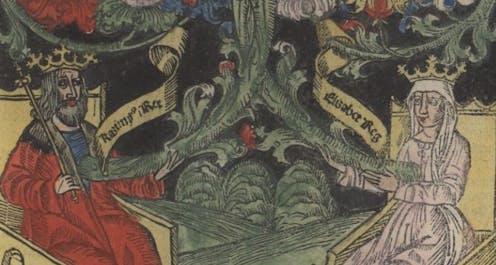
    Elizabeth of Austria and Casimir IV of Poland in the woodcut from the Łaski Statute. Archiwum Główne Akt Dawnych

    Throughout history, queens have often been judged on their looks. Beauty standards shaped early-modern queenship. Even today, royal women such as the UK royal family’s Camilla, Catherine and Meghan are scrutinised for their looks, while their male counterparts aren’t held to the same standard.

    One woman who faced particular scrutiny for her looks was Elizabeth of Austria (1436/37–1505). Known as the “mother of kings”, Elizabeth married Casimir IV of Poland and had 13 children, securing the Jagiellon dynasty’s future. Yet she is still remembered for her supposed lack of beauty.

    This obsession with her appearance overlooks what really mattered for queens in her time: fertility, motherhood, political alliances and dynastic stability.

    Beauty versus duty

    Elizabeth was a powerful queen consort of Poland who played a significant role in European politics. Yet for centuries, she has been chiefly labelled as unattractive. This narrative likely began as early as 50 years after her death, with commentators focusing on her supposed ugliness.

    But the foundation for these claims is shaky, at best. Medieval chroniclers, such as Jan Długosz, who documented the lives of Polish rulers and their families, made no mention of Elizabeth’s appearance.

    This omission is significant as Długosz often commented on the beauty, or lack thereof, of other royal women. The absence of such remarks in Elizabeth’s case suggests her physical appearance was not a matter of public concern during her lifetime.

    Later chroniclers such as Maciej of Miechów (1457–1523) and Marcin Bielski (1495–1575), who drew heavily from Długosz, also failed to comment on Elizabeth’s looks, further underscoring the lack of focus on her beauty.

    In 1548, Polish nobleman Andrzej Górka alleged in a rhetorical speech that King Casimir IV was disappointed by Elizabeth’s appearance and considered breaking off their engagement. Górka claimed the king expressed doubts about the impending marriage because of Elizabeth’s lack of beauty – and the only thing that persuaded him to wed was a sense of duty.

    However, Górka’s speech took place almost a century after the actual events. It was delivered in a political context where the goal was to influence Casimir’s grandson not to marry for love.

    This saga mirrors a well-known English story involving Henry VIII and Anne of Cleves. In 1540, Henry, eager to meet his new bride, rode in disguise to surprise her. The meeting didn’t go as planned. Henry’s disappointment in Anne’s appearance became notorious and the marriage was speedily annulled.

    Both of these stories reflect the pressure queens faced to meet idealistic beauty standards, often with serious consequences. Henry’s judgement of Anne based on her looks altered the course of their marriage and, by extension, future political alliances. His behaviour reinforced the idea that a queen’s worth was tied to her physical appearance, overshadowing her political or dynastic significance.

    Elizabeth as the ‘ugly queen’

    The primary role of a queen in early-modern Europe was to provide heirs and secure political alliances through marriage. Beauty was arguably not the most important factor.

    This 1454 painting depicts the marriage of Elizabeth of Austria to Casimir IV of Poland.
    Wikimedia

    Elizabeth of Austria’s marriage to Casimir IV of Poland was about strengthening ties between the Habsburg and Jagiellon dynasties, not about physical attraction. Of Elizabeth’s 13 children, several went on to become kings and queens across Europe. Her ancestry and status as a mother were the basis of her political influence – far more valuable than her looks.

    Around 1502, in anticipation of the birth of her grandchild, Elizabeth commissioned a treatise to provide practical advice on raising a future ruler. She believed a royal child should embody values, attitudes and behaviours befitting a future monarch.

    However, as history shows, the perception of a queen’s beauty could still end up influencing her legacy. While Elizabeth’s contemporaries didn’t seem to care about her appearance, later generations did.

    The myth of Elizabeth’s unattractiveness gained traction primarily after a 1973 investigation into the royal tombs at the Wawel Cathedral in Kraków. Skeletal remains identified as belonging to Elizabeth showed facial deformities, reinforcing the myth. However, there’s no solid proof these bones were even hers, and the findings have since been questioned.

    Nonetheless, the idea that a queen had to be beautiful to be politically capable took hold over time. Even though Elizabeth helped secure the future of one of Europe’s most powerful dynasties, her legacy is clouded by a narrative focused on her appearance.

    Royal beauty standards today

    Royal women in the 21st century continue to be haunted by the same narratives that plagued Anne of Cleves and Elizabeth of Austria. Queen Camilla, for instance, has been criticised for her looks throughout her public life, especially in comparison to the late Princess Diana.

    Kate Middleton and Meghan Markle also face intense media scrutiny over their appearance, with headlines dissecting everything from their fashion choices to their weight. Queen Mary of Denmark, Princess Charlene of Monaco and Queen Letizia of Spain face similar scrutiny.

    Sure, queens were and are aware of this. Many even weaponised beauty, ritual and fashion for their own gain. Cleopatra did this to hold onto power in ancient Egypt, and Marie Antoinette to protect herself from the hostile French court.

    A circa 1774 portrait of Marie Antoinette.
    Marie Antoinette, with her extravagant dresses, became as renowned for her fashion as her scandalous behaviour.
    British Museum, CC BY-NC-SA

    Elizabeth I’s reign in England gave rise to a concept of “Elizabethan beauty”, characterised by pale skin and rosy lips and cheeks. And the late Elizabeth II understood the need to dress the part.

    By reducing royal women to their looks – or framing them as fashion icons – we fail to reckon with their individual characters and influence in the world. Meanwhile, men such as King Charles, King Frederick of Denmark and King Felipe of Spain are more likely to be judged by their virility, actions and policies.

    Should beauty really matter when it comes to royal women? Shouldn’t we be more interested in their contributions to history, politics and society?

    It’s time to shift the conversation away from appearance and focus on what matters: the impact these women have on the world. Like their male counterparts, they are crucial figures in shaping history and politics, so we ought to think carefully about how we judge them.

    The Conversation

    Darius von Guttner Sporzynski receives funding from the National Science Centre, Poland as a partner investigator in the grant “Polish queen consorts in the 15th and 16th centuries as wives and mothers” (2021/43/B/HS3/01490).

    Magdalena Biniaś-Szkopek receives funding from the National Science Centre, Poland, as the principal investigator in the grant “Polish queen consorts in the 15th and 16th centuries as wives and mothers” (2021/43/B/HS3/01490).

    Robert Tomczak receives funding from the National Science Centre, Poland, as a post-doctoral fellow in the grant “Polish queen consorts in the 15th and 16th centuries as wives and mothers” (2021/43/B/HS3/01490).

    ref. From Camilla to the ‘ugly’ Elizabeth of Austria: a problematic history of obsessing over royal women’s looks – https://theconversation.com/from-camilla-to-the-ugly-elizabeth-of-austria-a-problematic-history-of-obsessing-over-royal-womens-looks-241674

    MIL OSI AnalysisEveningReport.nz

  • MIL-Evening Report: Bringing the river into the gallery and the future: reimagining Birrarung 50 years from now

    Source: The Conversation (Au and NZ) – By Alexandra Crosby, Associate Professor, School of Design, University of Technology Sydney

    Postcards from the future: the river-cleaning Birrabot REALMstudios/NGV Australia

    The Ian Potter Centre at Melbourne’s Federation Square is located on the banks of the lower stretches of Birrarung, the Yarra River. For Reimagining Birrarung Design Concepts for 2070, on until 2 February 2025, the river flows into the gallery through ideas, images, objects and stories.

    In this bold and unusual exhibition, we listen to traditional owners and get inside the imaginations of eight of Australia’s most innovative landscape architecture studios. By looking at “possible” and “preferred” futures, this exhibition frames the river as a complex, diverse, interconnected ecosystem that nurtures our health and is essential to human and non-human communities.

    Urban rivers are being rethought internationally. In Australian cities, where big city rivers are often estuaries, the problems of waterways and wetlands are inseparable from colonisation and urbanisation. The fate of these cities as the climate heats up is tied to their rivers.

    Melbourne was established in 1835 at the lower stretches of Birrarung where salt water from Port Phillip Bay travels about 10 kilometres upstream. Now metropolitan Melbourne dominates and influences the landscape of its lower reaches.

    Rivers are Country

    Entering the gallery, we are invited to listen to Birrarung. The river’s voice is spoken by Uncle Dave Wandin, Wurundjeri Woi Wurrung Elder and Birrarung Council member. Originally commissioned by the 23rd Biennale of Sydney,
    the video portrait provides an important transition from the bustle of Melbourne, into the contemplative space of the exhibition.

    Many will know the river as the Yarra, or Yarra Yarra – but this was a mistranslation by a surveyor in the 1830s of another Aboriginal word Yarro Yarro, “it flows”.

    The misnamed river has suffered from disconnection from its traditional owners and severe environmental degradation.

    In 2017, the Yarra River Protection (Wilip-gin Birrarung murron) Act was passed by the Parliament of Victoria, to protect the river for future generations and to recognise the river and its lands as a single living and integrated entity. Uncle Dave Wandin is a member of the Birrarung Council, appointed to work with Wurundjeri Woi Wurrung Elders and communities, to provide independent advice to the government on the implementation of the Act.

    Barracco and Wright’s contribution to the exhibition builds on the impact of this legislation. Speculative Policies displayed as an historic document from the future in a 2035 cabinet.

    Installation view of McGregor Coxall’s design for reimagining Birrarung.
    NGV Australia/Photo: Sean Fennessy

    Colonial histories

    Thinking about legislation in future worlds helps remind us the challenges of urban rivers – pollution, storm water management, and flooding – have colonial histories.

    Waterways have long been treated as dumping grounds for Australia’s industrial progress.

    In their work Aqua Nullius, not-for-profit multidisciplinary design and research practice OFFICE points to viticulture (winegrowing) and golf courses as culprits of water extraction in the Birrarung catchment.

    The problems arise not only where water is redirected as a resource for elites, but also where the connections between waterways and wetlands are disrupted by roads, estates and colonial land use. Billabongs are cut off from their sources and creeks are converted to drains. Wildlife such as turtles, platypus and birds lose their habitat corridors.

    Terra Nullius is well known as the concept that shaped colonists approach to Australia. Aqua Nullius, OFFICE argue, is just as significant. Rivers are country – and need to be respected, cared for and healed.

    Designers from OFFICE assert the Terra Nullius concept applies to water too.
    NGV Australia/OFFICE

    Seeing like a landscape architect

    By combining ecological knowledge with architectural forms, landscape architects are often leading these goals alongside Aboriginal people. While many of Melbourne’s residents and visitors enjoy the outcomes of their designs in city parks and green infrastructure, landscape architects are rarely the focus of exhibitions in major art galleries. This exhibition shows how design projects can invite us to imagine urban rivers differently using a range of tools that bring life to possible futures.

    In this exhibition we see images, maps, models, flags, plans, animations, timelines, and even a uniform design for a future “bio-zone guide”.

    The Birrarung Catchment by McGregor Coxall projects an animated map at waist height. It shows us the past, present and potential future of the catchment, highlighting the evolution of Birrarung’s lands, health, waterways, and its relationship to people.

    Presented as a map that shifts over time, the table top animation shares a rhythm with two screens on the wall, one with a population counter and one with the changes of flow within the catchment. These three elements link the growth of urban population to the disruption of the rivers flow. Dealing with Melbourne’s anticipated population growth, the projection looks forward in time proposing ways to care for the river by establishing the Great Birrarung Parkland.

    What’s good for Birrarung …

    Not all rivers are created equal. Melbourne is a river city, planned, designed, built and managed around Birrarung.

    A short walk from the gallery, rowers launch into the river and lovers hold hands on its banks. Melbourne is Birrarung and we can see it as we move around the city. But all cities have waterways and wetlands, many less visible.

    Place-based approaches to caring for urban water is needed everywhere. And this can have flow-on effects. If we start to care for minor creeks and estuaries that are built over and forgotten, we understand connections between people, nature, water and Country. This exhibition shows those visions for the future require research, vision and political will.

    Reimagining Birrarung: Design Concepts for 2070 is on until 2 February 2025 at The Ian Potter Centre: NGV Australia. Free admission.

    Alexandra Crosby receives funding from the Australian Research Council

    ref. Bringing the river into the gallery and the future: reimagining Birrarung 50 years from now – https://theconversation.com/bringing-the-river-into-the-gallery-and-the-future-reimagining-birrarung-50-years-from-now-239499

    MIL OSI AnalysisEveningReport.nz

  • MIL-Evening Report: Are academics more likely to answer emails from ‘Melissa’ or ‘Rahul’? The answer may not surprise you

    Source: The Conversation (Au and NZ) – By Megan MacKenzie, Professor and Simons Chair in International Law and Human Security, Simon Fraser University

    Onehundredseventyfive/Unsplash, CC BY

    Universities are supposed to be places where all students can learn, free from discrimination.

    A key part of this ideal is academics welcoming all students to study and research, regardless of their racial background.

    But as our new research shows, Australian academics responded differently to potential PhD students, depending on whether they were called “Melissa” or “Rahul”.

    Racism on campus

    Many overseas and Australian studies have shown racism is both a historical and ongoing problem for universities.

    A 2020 Australian study showed universities tend to be run by older, white men. A 2021 UK study showed academics from different cultural backgrounds face racism at work.

    But there has been less specific attention paid to those trying to become academics.

    The main way people start an academic career is via a doctoral degree. In the Australian system, before a student is accepted they usually require an established academic to agree to supervise them. So a student’s initial communication with a potential supervisor is very important.

    To start a PhD, students usually need to have a supervisor lined up.
    Jacob Lund/Shutterstock

    How we set up our research

    To investigate whether racism is playing a role at the entrance point to PhD study, in 2017 we sent about 7,000 emails from fictitious students to academics based at the main campuses of Australia’s Group of Eight universities (billed as Australia’s top research universities).

    These are the Australian National University, Monash University, University of Adelaide, University of New South Wales, University of Melbourne, University of Sydney, University of Western Australia and University of Queensland.

    We emailed staff ranked senior lecturer or above, as these are the levels most likely to be supervising PhD students. Academics were identified by university websites, and we sent emails to everyone who fit our rank criteria across all disciplines.

    In this process, we found 70% of relevant academics were male and 84% were white. This did not improve in the more senior ranks – more than 68% of professors were white men.

    What did the email say?

    The emails asked for an meeting to talk about potential PhD supervision.

    They were identical apart from the senders’ names. These names were tested to be associated with male and female and with white-European, Indigenous, South Asian, Chinese and Arab identities. Recipients were randomly allocated to different name groups.

    The emails indicated the sender was an Australia-based student with fluent English. It conveyed an interest in the recipient’s research and urgency in meeting because the sender was only on campus for several days. It also noted “I have recently finished my honours degree” (a common path into a PhD in Australia) and was sent from a University of Sydney email address.

    We emailed about 7,000 senior academics as part of our study.
    Tipa Patt/Shutterstock

    What did we find?

    Responses agreeing to a meeting or requesting further information were categorised as “positive”. Those who declined a meeting were “non-positive”. Automated replies and those who did not reply were “non-responses”.

    Of 6,928 emails sent, 2,986 (43.1%) received a reply within 24 hours and 2,469 (35.6%) received a positive reply. There were 3,942 (56.9%) non-responses and 517 (7.5%) non-positive responses (declining a meeting).

    We initially planned to give academics a week to respond, but after IT at one university noticed several staff had received emails with identical text, we ended the experiment after 24 hours.

    From here, the results were stark: emails from names associated with non-white racial groups received significantly fewer responses and positive replies than those from names typically associated with white individuals.

    An email from “Melissa Smith” was far more likely to get a positive response than an identical email from “Grace Chen Jinyan” (six percentage points lower) or “Omar al-Haddad” (nine percentage points lower).

    The most dramatic gap was in the positive response rates to Melissa Smith, compared with “Rahul Kumar”. The rate of positive responses to Melissa was 12 percentage points higher than for Rahul.

    Overall, our statistical analysis showed the white-sounding names averaged a 7% higher reply rate and a 9% higher positive response rate than the non-white sounding names. Both these findings were highly statistically significant, meaning we can be very confident the results were not due to chance.

    Of course, some faculty members may simply have been unable to meet with the student, or may have missed the email. However, given the randomisation used, it is reasonable to assume bias explains the gap in responses to students with different names.

    This is alarming because it suggests racial bias is quietly influencing who gets a foot in the door of academia even before formal admissions processes begin.

    Silver linings

    One seemingly positive finding was academics at the more junior end of our study group appeared to show less bias towards students of different backgrounds.

    For academics at senior lecturer or associate professor levels, Melissa was 10.5% more likely to receive a positive response than Rahul, while the corresponding figure for full professors was 14.7%.

    However, junior academics often have little institutional power or much of a say on hiring. More research is needed to explore whether generational change is achievable (albeit painfully slow).

    We also found that, unlike similar US studies, there was no significant bias against female students. In fact, there was some evidence of positive bias, or preference, for female students.

    Our study found academics did not discriminate against potential candidates based on gender.
    Matej Kastelic/ Shutterstock

    Backlash to our study

    We based our study on a peer-reviewed study carried out in the United States, and followed a research ethics protocol approved by our university.

    However, minutes after academics received our follow-up email telling them they had been part of a research study (part of our ethics protocol), the backlash began.

    The University of Sydney, our home institution at the time, received more than 500 inquiries about the study. While some were curious or supportive, the majority were complaints. These were primarily about our use of deception (a well-researched and supported method of studying bias). Megan MacKenzie, the more junior author (at the time a senior lecturer), received calls threatening her with consequences for her career.

    Although unpleasant, the reaction was revealing. It reinforces other research on how defensive racial majorities can be when they believe they are suspected of bias. It also complements work showing internal resistance to diversity efforts in higher education.

    What can we do?

    Universities pride themselves on being meritocracies, where the best ideas and brightest minds rise to the top. But our study suggests racial bias is undermining this principle by influencing who is even considered for an academic career.

    There is growing acknowledgement racism is a significant problem on Australian university campuses (as well as in broader society). In May, the federal government asked the Australian Human Rights Commission to study the prevalence and impact of racism at Australian universities.

    But this study is not due to deliver its final report until June 2025, and any ensuing action will be further away still.

    What can be done now to tackle this issue?

    First, universities need to acknowledge academia remains overwhelmingly white and male, in spite of efforts to increase diversity.

    Second, universities also need to acknowledge the existence of racial bias, the need for ongoing research into how it operates in higher education and the most effective strategies to tackle it.

    The authors do not work for, consult, own shares in or receive funding from any company or organisation that would benefit from this article, and have disclosed no relevant affiliations beyond their academic appointment.

    ref. Are academics more likely to answer emails from ‘Melissa’ or ‘Rahul’? The answer may not surprise you – https://theconversation.com/are-academics-more-likely-to-answer-emails-from-melissa-or-rahul-the-answer-may-not-surprise-you-241352

    MIL OSI AnalysisEveningReport.nz

  • MIL-Evening Report: Where there’s smoke: the rising death toll from climate-charged fire in the landscape

    Source: The Conversation (Au and NZ) – By Fay Johnston, Professor, Menzies Institute for Medical Research, University of Tasmania

    Daria Nipot, Shutterstock

    Inhaling smoke is bad for you. Smoke from any kind of fire, from bonfire to burn-off to uncontrolled wildfire, can have serious consequences.

    Even low levels of smoke can make many heart and lung diseases worse, sometimes triggering a rapid deterioration in health. When we are repeatedly exposed over months and years, air pollution, including smoke, makes us more likely to develop heart, lung and other chronic diseases.

    Now, new international research has linked the warming climate to some of the deaths from exposure to fire smoke in large parts of the world, including Australia.

    In 2012, I led the first team to estimate the number of landscape fire smoke-related deaths globally each year. Our estimate of 339,000 deaths did not attempt to pull out the influence of climate change. But we noticed much higher impacts during hotter and drier El Niño periods.

    The researchers behind the new study took this a step further, estimating how much of the historical burden of fire smoke-related deaths might be attributable to climate change. They found a considerably increasing proportion, from 1.2% in the 1960s to 12.8% in the 2010s.

    Where there’s fire, there’s smoke

    A wall of flames is way more deadly than a bit of smoke in the air – isn’t it? It’s not so simple. When you look back at a fire disaster, the smoke-related death toll in the aftermath can be surprisingly high.

    During the extreme Australian bushfire season of 2019–20, there were 33 deaths directly related to fire. But my team found the number of smoke-related deaths was 429, more than ten times higher.

    Smoke travels vast distances and can affect very large populations. Millions of people in Australia and New Zealand breathed smoke from the 2019-20 Australian fires. The sheer scale of the air quality impacts means the associated public health burden can be very large.

    Smoke harms our health in two ways. In the short term, it makes existing diseases worse. As soon as the body detects smoke, it initiates immune and stress responses that affect, among other things, blood pressure, blood glucose and the risk of forming blood clots.

    For some people with serious chronic illness such as heart and blood vessel disease, these subtle changes can trigger deadly complications including heart attacks or strokes.

    When smoke reaches our eyes, throats and lungs, it acts as an irritant. This can be enough to make people living with asthma or other lung conditions seriously unwell.

    Over the longer term, air pollution is a known risk factor for developing heart disease, lung disease, asthma, diabetes and stroke, and landscape fire smoke is increasingly contributing to the load.

    How did the researchers find this out?

    Most research on the health impact from air pollution focuses on the damage done by fine particles called PM2.5. These particles are defined as those less than 2.5 micrometres in diameter, meaning they are small enough to get into the lungs and bloodstream.

    In the new paper, the authors used computer models to estimate how global changes in fire-related PM2.5 emissions between 1960 and 2019 had been influenced by the warming climate. To do this, they evaluated climate factors known to promote fire activity, such as higher air temperatures and lower humidity. Then, they used modelling to estimate how these changes would have influenced fire activity, smoke exposure and smoke related deaths globally.

    Using this approach, the authors attributed 669 (1.2%) of the wildfire-induced smoke-related deaths in the 1960s to climate change. But that rose to 12,566 (12.8%) in the 2010s. They found the influence of climate change was higher in some regions, including Australia.

    Climate change is making fires worse

    These reported numbers seem to be surprisingly low when put in context with previous global and regional estimates of deaths due to air pollution from landscape fires.

    But estimating how many deaths can be attributed to landscape fire smoke is a challenging task, requiring assumptions about the size and strength of the links between meteorology, fire activity, smoke production and dispersal, population vulnerability and health outcomes in the huge diversity of landscapes, climates and cultures across the world.

    Importantly, the estimates in this recent study were driven by changes in climate. But the modelling approach can less easily account for fluctuations and trends in another incredibly important driver of fire activity on Earth, human activity.

    For example, huge volumes of smoke globally are created by setting fires to burn and clear tropical forests for agriculture. Corporate activity and government policies drive these fires more than climate change, and are harder to capture in a modelling study.

    Nevertheless, these new results clearly support empirical studies showing increases in extreme fire activity attributable to climate change, and illustrates the relative impacts when other influences are held constant. Importantly, it points to parts of the world – including the north and southeast of Australia – where we can expect harmful population smoke impacts to get worse.

    The likely geographic impacts can be put together with information about the location of more vulnerable population groups, or higher population densities, to focus on responses where they are most needed. But in Australia that means pretty much everywhere, including the tropical north.

    What we can do about it?

    To adapt to a smokier world, we will need comprehensive education about escalating air quality hazards and ways to reduce the harm for both the general public and health professionals.

    These include keeping on top of long-term health conditions that could be made worse by air pollution, knowing how to keep track of air quality, and when to use strategies such as face masks, air filtration and managing the ventilation of homes and buildings to reduce individual smoke exposure.

    Adaptive responses alone do not get around the urgent need to act on climate change. Watching fire seasons around the world get steadily worse year on year really frightens me. We are getting into a vicious cycle where the hotter climate is driving more and more fire. These fires are increasingly venting long-stored carbon and contributing to further climate change.

    As well as ending the massive combustion of fossil fuels, we must halt the burning of tropical rainforests and agricultural crop residues globally. These actions will also dramatically improve air quality and health globally and support ongoing capture and storage of atmospheric carbon.

    Fay Johnston receives research funding from the National Health and Medical Research Council, the National Environmental Science Program, Asthma Australia and the health departments of the Tasmanian and ACT governments. She led the development of the air quality app AirRater, and is a founding director of AirHealth Pty Ltd, which provides air quality information services.

    ref. Where there’s smoke: the rising death toll from climate-charged fire in the landscape – https://theconversation.com/where-theres-smoke-the-rising-death-toll-from-climate-charged-fire-in-the-landscape-241590

    MIL OSI AnalysisEveningReport.nz

  • MIL-Evening Report: Donald Trump and Peter Dutton have both embraced populism. Are working-class voters buying it?

    Source: The Conversation (Au and NZ) – By David Smith, Associate Professor in American Politics and Foreign Policy, US Studies Centre, University of Sydney

    Opposition Leader Peter Dutton has often been accused of copying former US President Donald Trump’s tactics. Some analysts even refer to Dutton, like Trump, as a “populist” who seeks political gain by pitting ordinary citizens against corrupt “elites”.

    There is evidence of this populism in the willingness of Trump, Dutton and other figures in their parties to attack “big business”.

    This is unusual for the conservative parties, and it has alarmed business-aligned outlets like the Wall Street Journal and the Australian Financial Review.

    Republicans and Liberals have always preferred to identify with small business rather than big business. Their relationship with corporate interests has not always been smooth.

    But they do not believe there is a natural conflict between business and workers, or between different sections of the economy. And they usually align with big business on the critical issues of taxation and government regulation.

    So Dutton’s declaration earlier this year that the Liberal Party is “not the party of big business” but “the friend of the worker” marks a notable rhetorical shift, even if there is reason to doubt the substance behind it.

    It mirrors a similar shift to pro-worker rhetoric among leading Republicans. Florida Senator Marco Rubio said in 2020, for instance, the future of the Republican Party is based on “a multiethnic, multiracial, working-class coalition”.

    Expanding their share of the working-class vote may be necessary for both parties, given their losses of tertiary-educated, middle-class voters and seats in recent elections. Economic populism may be one path to do it.

    But how economically populist can conservative parties get in either country?

    Why attack big business?

    A lot of Republican and Liberal attacks on big business are fundamentally cultural rather than economic.

    Publicly-owned corporations have embraced diversity, equity and inclusion policies. They declare commitments to “sustainability”. And plenty of them have backed causes like marriage equality, Black Lives Matter and the Indigenous Voice to Parliament.

    However cosmetic these gestures are, many conservatives see major corporations as culturally hostile to them. More importantly, they no longer see big business and finance as reliable political backers.

    And they don’t need them like they once did. Dynastic wealth in both countries has seen the ascendancy of private companies owned by super-rich individuals and families. These, not corporate donors, are now the most consistent sources of financial and political support for conservative parties.

    These changing conditions have given Republicans and Liberals a free hand to make big business – never a popular entity – into a target of populist campaigns.

    Many of their attacks are about “wokeness”. But not all. Consumer protection has also become an opportune theme, given the cost of living crisis in both the United States and Australia.

    Trump, for instance, has floated capping credit card interest rates at 10%. Dutton has proposed using the government’s divestiture powers to break up supermarket and hardware chains that are accused of using their monopoly power to exploit consumers and suppliers.

    They can propose these ideas because voters usually trust the Republican and Liberal parties more than their opponents on economic issues. Most Democratic and Labor politicians would be unwilling to take populist measures that far because of their perennial fears of being seen as economically irresponsible.

    But when it comes to actually siding with workers over business, a different picture emerges.

    The Republican romance with ‘union workers’

    As president, Trump had a notably anti-union record. His appointees to the National Labor Relations Board, which enforces labour law, consistently ruled against unions.

    In Trump’s current campaign to re-enter the White House, unions have criticised him for holding a rally appealing to “union workers” at a non-union shop, and for praising tech billionaire Elon Musk because he sacked workers who threatened to strike.

    Trump also said recently that as a business owner he hated paying overtime. He has also previously said he preferred to use non-union workforces.

    Despite all this, the Trump campaign is making a serious play for the votes of unionised workers, who could be critical in Midwestern battleground states.

    Although unions as organisations usually support Democrats, the number of voters in union households who support Republicans is sometimes more than 40%.

    This year, Trump sought the endorsement of the International Brotherhood of Teamsters, the North American truck drivers’ union with 1.3 million members. The Teamsters have supported Democratic candidates in every presidential election since 2000, but prior to that, the organisation had also backed Republican candidates like Richard Nixon, Ronald Reagan and George HW Bush.

    This year, the Teamsters did not join most other unions in quickly endorsing Democratic incumbent Joe Biden before he stepped aside for Vice President Kamala Harris.

    The Teamsters’ president, Sean O’Brien, almost got into a fight with a Republican senator in a committee hearing in 2023 after calling him a “greedy CEO who acts like he’s self-made”. Nonetheless, he got an invitation to speak at this year’s Republican National Convention. He praised Trump as a “tough SOB”, but then blasted various businesses and business organisations for being anti-union, to the discomfort of the audience.

    Teamsters President Sean O’Brien addressing the Republican National Convention.

    The Teamsters ultimately endorsed neither candidate. However, they released polling showing nearly 60% of their members supported Trump compared to a third for Harris.

    Trump-era Republicans frequently praise “union workers” rather than actual unions. When Senators JD Vance (now Trump’s running mate) and Josh Hawley supported the striking United Auto Workers last year, they criticised the union’s leadership. But they are happy to be seen as being on the side of unionised workers against big businesses who send manufacturing jobs overseas, a trend Trump promises to reverse.

    The term “union workers” prompts conservative nostalgia, especially for a group like the Teamsters with their mostly male membership and reputation for toughness. It evokes the anti-communist, blue-collar workers of the 1960s and ‘70s who supported Nixon and brawled in the streets with college-educated anti-Vietnam War protesters.

    That is not the only nostalgic element. Through heavily protectionist measures, Trump is promising to restore millions of manufacturing jobs to the United States – the kinds of jobs that used to be largely unionised. He also promises to roll back environmental regulations to expand mining, drilling and fracking on federal land. Again, these are the kinds of jobs often associated with “union workers”.

    When Trump and others praise “union workers”, they are not really talking about unions, but a certain type of blue-collar job they are promising to create and protect. “Union” in this context has the positive connotation of well-paid, stable work.

    But Trump claims it is his policies that will guarantee these jobs, making unions themselves virtually irrelevant.

    Where Liberals won’t follow

    Dutton may praise workers, but he is unlikely to add the prefix “union” anytime soon. It is hard to imagine any Liberal leader courting the support of a union because Australia’s party system effectively enshrines the country’s adversarial industrial relations system in its politics.

    The Australian Labor Party began as the parliamentary wing of the union movement, and to this day affiliated unions are entitled to 50% of delegates at party conferences. American unions are not linked to the Democratic Party in the same way.

    This does not mean the votes of union members are off-limits to other parties. In 2006, then-economist (now Labor MP) Andrew Leigh estimated about a third of union members voted for the Coalition on a two party-preferred basis from 1966 to 2004. But Liberals will not appeal to these voters as “union workers” in the same way Republicans do.

    Trump’s dream of restoring American manufacturing dominance would involve a resurgence of long-term employment in large and medium-sized firms. He is promising the stability once associated with unions, not the “flexibility” that Australia’s Liberals want in workplaces.

    For the most part, Liberals still prefer to talk about blue-collar workers as independent tradespeople or aspiring business owners rather than employees.

    Dutton says the modern Liberal Party is the friend of “small business owners and employees in that business”. This conjures images of family-like operations where staff loyally put in unpaid overtime – instead of larger, impersonal workplaces (where unpaid overtime is also the norm).

    And unlike Trump Republicans, the Liberal and National parties still believe in free trade. After a long bipartisan opposition to protectionism, Labor has recently embraced a major new industrial policy. The Coalition is not on board.

    Some doubt whether Trump is a genuine populist. But he has a wider scope for genuinely populist rhetoric than Dutton, at least for now.

    Even though he’s a symbol of capitalist excess, part of Trump’s message is that capitalism has taken a wrong turn. Not just into excessive wokeness, but into globalisation and financialisation, where investment and speculation are more profitable than production.

    There are limits to how much any Liberal leader, even Dutton, can tap into anger with capitalism itself.

    David Smith does not work for, consult, own shares in or receive funding from any company or organisation that would benefit from this article, and has disclosed no relevant affiliations beyond their academic appointment.

    ref. Donald Trump and Peter Dutton have both embraced populism. Are working-class voters buying it? – https://theconversation.com/donald-trump-and-peter-dutton-have-both-embraced-populism-are-working-class-voters-buying-it-240309

    MIL OSI AnalysisEveningReport.nz

  • MIL-Evening Report: Andrew Garfield and Elmo are going viral with their moving chat. Celebrities can help us talk about grief

    Source: The Conversation (Au and NZ) – By Lauren Breen, Professor of Psychology, Curtin University

    Sesame Workshop/YouTube

    When was the last time you heard someone talk in detail about their grief?

    For many of us, it could be rarely or never. There are several reasons for this.

    Grieving people often avoid raising the topic in conversation because they want to avoid upsetting or burdening people. Family and friends of grieving people often feel unsure or uncomfortable about asking them to talk about it, fearing they will infringe on the person’s privacy. One study of grieving adults in Australia and Ireland showed nearly one-third said they didn’t receive the support they would have liked. Some experts note we tend to deny or minimise others’ grief, increasing their isolation.

    Actor Andrew Garfield, best known for playing Spiderman, appeared on Sesame Street last week and spoke with Elmo in moving and affirming ways about grieving his mother’s death. Clips of their short conversation have been widely shared on social media. It presents a great example of communicating well about grief.

    Sadness can be a gift explains Garfield, ‘a lovely thing to feel in a way because it means you really loved somebody when you miss them.’

    Kids grieve too

    Issues around grief and isolation can be the same for children and young people as for older people.

    In fact, grief in young people is recognised as “the last taboo in public health”. By the age of 18, around one in 20 children have a parent die. Even more will experience grief following the deaths of other close people such as siblings and grandparents. Children also grieve the deaths of pets. Yet we struggle to acknowledge, let alone understand and help them with the grief.

    Due to a desire to protect them from harm or distress, adults are often reluctant to talk about dying and death with children. We also underestimate their abilities to understand such difficult topics. My recent work with Lionheart Camp for Kids shows such good intentions leave grieving children with many unanswered questions.

    So it was great to see Andrew Garfield (who has discussed the topic before on talk shows and in interviews) share his experience on children’s television.

    Losing the person who gave you life is bizarre tells Anderson Cooper. ‘It doesn’t make sense.’


    Read more:
    ‘Why did he Leve Me?’ 5 things grieving children want to know about the death of a loved one


    It takes two (or more)

    Their exchange begins with the character of Elmo checking in with Garfield, to see if he’s OK. He asks in a warm and open-ended way.

    What Garfield communicates well is checking if Elmo is willing and comfortable to hear him talk about his thoughts and feelings. He conveys his feelings of grief and speaks about how missing someone is due to love. He shares his understanding about the comforting role memories can bring to the bereaved, and about recognising a deceased person can be celebrated and missed at the same time.

    Elmo also does a great job of listening. He normalises Garfield’s thoughts and feelings, and gently affirms his memories of his deceased mother. Importantly, Elmo doesn’t make the conversation about himself or resort to tired clichés like “this shall pass” or “she’d want you to move on”. He doesn’t minimise his discomfort with jokes or provide unsolicited advice on how to feel or behave.

    Social support in the wake of loss helps grieving people – if it’s done right. Too often, however, it’s not, and can leave grieving people more distressed.

    Though an almost universal need, providing effective social support for grieving people is a complex process. It must involve:

    • a potential supporter recognising the bereaved person’s need for support

    • support that is available, sufficient and offered to the bereaved

    • them perceiving the support as helpful.

    Perceptions of whether an offer if support is useful can depend on where it comes from, the type of support, whether it is offered at the right time, and the griever’s level or receptiveness or social isolation.

    Listening, validating, support

    Garfield and Elmo aren’t the first celebrities to talk openly about grief.

    But in daily life, it’s rare to hear anyone talk openly about these feelings. That’s why it’s so refreshing when people in the public eye break the taboo that surrounds grief and loss. It is important for grieving people of all ages to be able to talk about their grief and be listened to. For potential supporters, it is enriching to think about they can listen, validate and support.

    As Garfield and Elmo show, grieving people and their support people can work together to develop a compassionate connection in a conversation that benefits both parties.

    Lauren Breen receives funding from Healthway and has previously received funding from Wellcome Trust, Australian Research Council, Department of Health (Western Australia), Silver Chain, iCare Dust Diseases Board (New South Wales), and Cancer Council (Western Australia). She is on the board of Lionheart Camp for Kids and is a member of Grief Australia and the Australian Psychological Society.

    ref. Andrew Garfield and Elmo are going viral with their moving chat. Celebrities can help us talk about grief – https://theconversation.com/andrew-garfield-and-elmo-are-going-viral-with-their-moving-chat-celebrities-can-help-us-talk-about-grief-241782

    MIL OSI AnalysisEveningReport.nz

  • MIL-Evening Report: New research shows problematic community attitudes allow child sexual abuse to continue

    Source: The Conversation (Au and NZ) – By Andrea de Silva, Adjunct professor, Monash University

    Many Australians are victims and survivors of child sexual abuse.

    Almost one in three have been sexually abused as a child, generally more than once, and often with significant and lifelong impacts.

    The National Centre for Action on Child Sexual Abuse has released findings from more than 4,000 adults in a new study examining the community’s attitudes towards, knowledge of, and responses to child sexual abuse.

    The data reveal some troubling findings, with pervasive and harmful community norms and attitudes that act to enable child sexual abuse to continue.

    What are social norms?

    Social norms are “rules” shared among people in a particular society, community, or group, and define what is considered “normal” and appropriate behaviour within the group.

    These rules are often unwritten and not openly discussed.

    These norms influence what people do (and don’t do) in many aspects of life, including preventing and responding to child sexual abuse.

    Why do they matter?

    Some cultures’ norms and attitudes limit disclosure of abuse.

    In our study, 62% were pretty sure they knew someone who had been sexually abused as a child.

    Yet only 9% had directly been told by a child about being sexually abused, while 35% had been told by an adult about historical child sexual abuse.

    These low rates suggest there are forces at play that limit talking about child sexual abuse.

    Some in the community believe it’s not acceptable to discuss child sexual abuse. In response to a hypothetical disclosure by an adult friend, about one in ten thought it was very/extremely important to tell their friend that it’s best not to talk about it at all.

    Some (5%) reported they would try to avoid their friend.

    What else did the research reveal?

    There was also evidence community members didn’t think child sexual abuse was an important problem or that it affected them directly.

    Around two in three adults felt they were not directly affected or were unsure if they were affected by child sexual abuse. More than half didn’t think child sexual abuse happened where they live.

    One in ten thought child sexual abuse receives too much media coverage.

    Some norms and attitudes also limit intervention to stop child sexual abuse.

    We found that of those who discovered or received a child’s disclosure about sexual abuse, less than half had a supportive conversation with the child (about 40%) and/or reported to authorities like police or child protection agencies (about 30%).

    Also, almost one in three adults were “not at all” confident about how to talk to the parent/carer of a child they suspected had been sexually abused. More than a quarter (28%) felt “not at all” confident about how to start a conversation with the child they suspected had been sexually abused.

    Not having these conversations or not reporting maintains secrecy around child sexual abuse. It can send a message to victims and survivors not to talk about it, or that nothing will be done to stop the abuse.

    Though the lack of intervention may be due to a lack of confidence, we also found adults held attitudes that children can’t always be believed (22%) or were too unreliable to take their word over an adult’s (18%).

    These attitudes mean many children won’t be believed and protected if they disclose sexual abuse.

    Some norms and attitudes increase acceptance of child sexual abuse, or blame victims, especially adolescents.

    Alarmingly, 40% of respondents in the study thought older children were responsible for actively resisting an adult’s sexual advances, and 12% believed adolescent girls who wear very revealing clothing are “asking” to be sexually abused.

    Adding to this, 13% believed children who act “seductively” are at least partly to blame if an adult responds sexually, while 8% thought obedient children are less likely to experience child sexual abuse, implying “good” children won’t be sexually abused.

    These harmful attitudes misdirect the blame for the abuse onto the victim, making it unsafe for them to disclose and at the same time, making it acceptable for adults to stay silent.

    Blaming victims maintains the status quo of unacceptably high levels of child sexual abuse and causes further harm.

    Where to from here?

    Putting an end to the sexual abuse of children in Australia requires concerted and co-ordinated action at all levels of society.

    Global initiatives offer some guidance on how shifting entrenched and harmful attitudes and norms can change behaviours.

    At a minimum, we must challenge gender inequality and power imbalances, promote equitable relationships and shared responsibilities. Mobilisation programs intervening directly at the community level and initiatives with specific populations who hold harmful and problematic attitudes are also promising in preventing child sexual abuse.

    Now we have benchmarks on the community’s attitudes towards child sexual abuse, we can measure the effectiveness of Australia’s efforts for change.

    It is everyone’s responsibility to know the signs, listen, believe and act in response to child sexual abuse.

    Andrea de Silva works for the National Centre for Action on Child Sexual Abuse who conducted this study. The National Centre is funded by the Department of Social Services. The National Centre is a partnership between the Australian Childhood Foundation, Blue Knot Foundation and the Healing Foundation.

    Amanda L. Robertson works for the National Centre for Action on Child Sexual Abuse who conducted the study with funding from the Department of Social Services.

    ref. New research shows problematic community attitudes allow child sexual abuse to continue – https://theconversation.com/new-research-shows-problematic-community-attitudes-allow-child-sexual-abuse-to-continue-241792

    MIL OSI AnalysisEveningReport.nz

  • MIL-Evening Report: Israel’s actions in Gaza, backed by the US, are shaking the world order to its core

    Source: The Conversation (Au and NZ) – By Tristan Dunning, Sessional Academic, School of Social Sciences, Macquarie University

    While the killing of Hamas leader Yahya Sinwar could have provided an off-ramp for the conflict in Gaza, Israeli Prime Minister Benjamin Netanyahu’s ongoing vows of “total victory” make this seem unlikely.

    The concept of “total victory”, however, is extremely problematic. Every time Israel declares an area cleared of Hamas and then withdraws, Hamas, which carried out the horrific attack on southern Israel on October 7 2023, has quickly returned to reestablish control.

    As a result, there has been a marked Israeli escalation in northern Gaza in recent days, and much discussion about a so-called “general’s plan” being pushed by some right-wing members of Netanyahu’s government.

    Concocted by a former Israeli general, Giora Eiland, the plan is, in essence, to forego negotiations, bisect the enclave and give northern Gaza’s 400,000 inhabitants the bleak choice between leaving and dying.

    We don’t know whether Netanyahu will officially endorse the plan. Israeli leaders reportedly told US Secretary of State Antony Blinken this week they are not implementing it. However, it nonetheless has broad support among Israel’s political and military elite.

    The Israeli military has already issued expulsion orders to the people of northern Gaza. The government has said anyone who remains would be considered a military target and will be deprived of food and water.

    While Israel denies obstructing humanitarian aid, the World Food Program said no food aid entered northern Gaza for two weeks in early October. While some aid has been entering since then, thousands are still at risk of starvation and outbreaks of preventable diseases.

    Moreover, many Palestinians, including the sick, elderly and wounded, are unable to move and have nowhere to go. The prospect of the overcrowded and unprotected tent cities of the south is hardly enticing.

    Israeli human rights groups say the military had been deliberately blocking aid to give the population no choice but to leave northern Gaza. Israel may now be backtracking under pressure from the United States, which has given Netanyahu’s government a 30-day deadline to increase the amount of aid it allows into Gaza or risk losing US weapons funding.

    Undermining international norms and rules

    Israel’s war against Gaza, and now Lebanon, has repeatedly challenged the foundations of the liberal international rules-based order set up after the second world war, as well as the tenets of international law, multilateral diplomacy, democracy and humanitarianism.

    The norms of the liberal world order are expressed in various institutions, such as:

    • the UN Charter
    • the UN Security Council, with its notionally legally binding resolutions
    • the International Court of Justice (ICJ) in The Hague
    • the Geneva Conventions governing the rules of war
    • the Universal Declaration of Human Rights
    • and the Rome Statute of the International Criminal Court (ICC), among many others.

    Recently, the ICJ ruled Israel’s occupation of the West Bank, Gaza Strip and East Jerusalem is illegal and ordered it to withdraw. In response, Netanyahu said the court had made a “decision of lies”.

    In a separate case, South Africa brought a charge to the ICJ, alleging Israel has committed genocide against the Palestinian people over the past year. The world’s top court has preliminarily ruled there is a “plausible” case for a finding of genocide, and said Israel must take measures to ensure its prevention.

    At this juncture, however, human rights groups and others have argued that Israel has failed to comply with this order, thereby undermining one of the key institutions of the liberal world order.

    This is compounded by the fact that few major democratic states have been willing to strongly condemn Israel’s failure to comply with international law in Gaza – or have done so belatedly – let alone intervened in any concrete fashion.

    In addition, the UN Security Council has failed – primarily due to the veto power exercised by the US – to take any tangible measures to enforce its own resolutions against Israel, as well as the rulings of the ICJ.

    This is fuelling widespread perceptions of hypocrisy in relation to the accountability of notionally democratic states for alleged violations of humanitarian law, compared with other nations that don’t have great power patrons.

    In the early 1990s, for instance, the UN Security Council unanimously passed several resolutions against Iraq’s invasion of Kuwait, followed a decade later by resolutions demanding Saddam Hussein’s regime comply with weapons inspection mandates. The US and its allies used these resolutions as the legal justification for their invasion of Iraq. Ultimately, no weapons of mass destruction were found. Then UN Secretary General Kofi Annan later said the invasion of Iraq was illegal and contrary to the UN Charter.

    However, dozens of UN Security Council resolutions concerning Israel have been passed and not enforced. Many others have been vetoed by the US.

    The prosecutors of the ICC have also requested arrest warrants for Netanyahu and Defence Minister Yoav Gallant for alleged crimes against humanity (in addition to several Hamas leaders, now dead). The warrants for Netanyahu and Gallant were met with indignation by some Western politicians. Yet, the West broadly praised the ICC’s arrest warrant against Russian President Vladimir Putin.

    Furthermore, the US Congress attempted to sanction the court over the Netanyahu arrest warrant, once again underscoring the often selective way in which international law is applied by nation states.

    A crisis of legitimacy for the world order

    Democratic states like to present themselves as the protectors, and sometimes enforcers, of the liberal world order, ensuring continued international peace and security.

    Indeed, Israel and its supporters often characterise its military actions as the forward defence of the democratic world against tyrannical larger powers, as a means of protecting itself from adversaries that want to destroy it. The problem is Israel’s actions often directly contradict the liberal world order it purports to defend, thereby undermining its legitimacy.

    Failure to rein in Israel’s actions has led to accusations of “double standards” regarding international law. The US and Germany provide Israel with 99% of its arm imports and diplomatic cover. Although Germany has stopped approving new weapons exports to Israel, both countries certainly have more leverage to stop the carnage in Gaza if they wish.

    The West’s self-abrogated moral superiority is arguably in tatters as it continues to undermine the principles of the liberal world order. The question is: if this world order falls, what will the new world order look like?

    Tristan Dunning has signed a statement of solidarity with Palestine from academics in Australian universities.

    Shannon Brincat has signed a statement of solidarity with Palestine from academics in Australian universities.

    Martin Kear does not work for, consult, own shares in or receive funding from any company or organisation that would benefit from this article, and has disclosed no relevant affiliations beyond their academic appointment.

    ref. Israel’s actions in Gaza, backed by the US, are shaking the world order to its core – https://theconversation.com/israels-actions-in-gaza-backed-by-the-us-are-shaking-the-world-order-to-its-core-241460

    MIL OSI AnalysisEveningReport.nz

  • MIL-Evening Report: Should a big tech tax fund news? A new report reopens debate on platforms and media

    Source: The Conversation (Au and NZ) – By Rod Sims, Professor in the practice of public policy and antitrust, Crawford School of Public Policy, Australian National University

    Meta’s announcement nearly eight months ago that it would no longer do commercial deals under the News Media Bargaining Code has led to much speculation as to how the government would respond.

    The code became law in 2021. Facing the threat of designation under it – which would involve further legal obligations platforms may wish to avoid – both Google and Facebook (now Meta) did deals with news media businesses worth up to A$250 million per year.

    Google did deals with essentially all qualifying news media business, large and small – the criteria largely being that their journalists provide news. Facebook did deals with news businesses likely employing up to 85% of Australian journalists

    With little response from the government so far, a new report from a federal parliamentary committee investigating the impact of social media on Australian society provides welcome focus on this issue.

    Key recommendations

    The committee makes 11 recommendations, three of which in particular are worth focusing on.

    Recommendation two says the Australian government should explore alternative revenue mechanisms to supplement the code, such as a digital platform levy. But it also says “exploration should include consideration for preserving current and future commercial deals”, presumably under the code.

    Recommendation three says the Australian government should develop an appropriate mechanism to guide the fair and transparent distribution of revenue arising from any new revenue mechanisms. In particular, this would support the:

    sustainability of small, independent and digital only publishers, as well as those operating in underserved communities and rural, regional and remote areas.

    Recommendation six says the Australian government “should investigate the viability and effectiveness of ‘must carry’ requirements for digital platforms in relation to Australian news content”.

    Coalition members provided a different perspective on some of the committee’s recommendations. They expressed concern about the lack of action from the government in response to Meta’s decision to not do more deals under the code. Further, they read the report as saying that the code is “no longer fit for purpose” – a view they strongly disagree with.

    Meta has also heavily criticised the committee, saying it has ignored:

    the realities of how our platforms work, the preferences of the people who use them, and the value we provide news publishers who choose to post their content on our platforms.

    Meta, parent company of Instagram and Facebook, is strongly opposed to paying a levy to fund news media.
    QubixStudio/Shutterstock

    Not so simple

    The committee’s recommendations raise many questions.

    First, how would the levy sit with wanting to maintain existing and future deals under the code? In any solution to dealing with Meta it would seem silly to damage the current arrangements with Google, which has committed to continue supporting news organisations under the code, and who are paying the majority of the up to $250 million per year?

    Second, biasing any revenue to smaller and/or rural and regional publishers may mean that, despite most news stories coming from the larger media companies, they would not benefit in accordance with their content being used. The code did see benefit to large, medium and small media businesses. But, of course, the larger companies gained most money as they provided most content.

    Some smaller media businesses did miss out on funding. But it was often judged that they do not provide news journalism, which was what the code is seeking to promote.

    In 2018, the Australian Competition and Consumer Commission (of which I was then chair) made a number of recommendations to the government. These included the code. They also included government funding for journalism in underserved areas and support for other objectives, such as boosting smaller news media companies. A different objective requiring a different policy instrument.

    Third, the problem that arose with Meta’s decision to not do further deals under the code saw many calls for Meta to be designated under the code. This would have meant they would be forced to do deals and potentially face arbitration if the news media businesses were not happy with the outcome.

    As the parliamentary committee would be aware, when Canada largely copied the code, it automatically designated Meta. In response, Meta took all news and links to news off its platform. This allows Meta to escape the Canadian version of the code as it only applies to platforms that carry news.

    One solution to this is to insist the tech platforms “must carry” news, as suggested in recommendation six. Then they would be back under the code and could be successfully designated and forced to negotiate. It is unclear in the report whether the “must carry” idea, which would make the code relevant to all platforms, is an alternative to the levy.

    A way through

    Overall, the report provides welcome renewed focus on this topic. By recommending the government “explore” a levy or “investigate” must carry obligations, the committee appears to recognise the potential difficulties with these options.

    Would there be international trade implications from a levy? How would money from a levy be distributed? It is one thing to have a fund to help small players in underserved markets; quite another for the government to be distributing money to large media players.

    And how would the “must carry” provision be enforced given that carrying content may not be the same as users discovering it?

    But there may be a way through these problems. Allow Google to continue as they are under the code, look at what other platforms need to be covered by the code, and threaten that if Meta or another platform were to take news off their site, then a levy or a must carry provision would be introduced. In the case of Meta, such threats, which must be real, could see them revert to doing deals under the code.

    To help new and emerging news journalism, particularly in underserved areas, this would seem to require government funding, as the Australian Competition and Consumer Commission recommended all the way back in 2018.

    Rod Sims is a former chair of the Australian Competition and Consumer Commission.

    ref. Should a big tech tax fund news? A new report reopens debate on platforms and media – https://theconversation.com/should-a-big-tech-tax-fund-news-a-new-report-reopens-debate-on-platforms-and-media-241897

    MIL OSI AnalysisEveningReport.nz

  • MIL-Evening Report: New Prada-designed spacesuit is a small step for astronaut style, but could be a giant leap for sustainable fashion

    Source: The Conversation (Au and NZ) – By Alyssa Choat, Lecturer in Fashion and Textiles Design, University of Technology Sydney

    For its recent Spring/Summer 2025 show, fashion brand Diesel filled a runway with mounds of denim offcuts, making a spectacle of its efforts to reduce waste.

    Haunting yet poetic, the “forgotten” byproducts of fashion production were reclaimed and repurposed into something artful. But the irony isn’t lost, given fashion shows like this one demand significant resources.

    Diesel’s event is an example of a growing trend towards the “spectacle of sustainability”, wherein performative displays are prioritised over the deeper, structural changes needed to address environmental issues.

    Can the fashion industry reconcile its tendency towards spectacle with its environmental responsibilities? The recent spacesuit collaboration between Prada and Axiom Space is one refreshing example of how it can, by leaning into innovation that seeks to advance fashion technology and rewrite fashion norms.

    Performance art instead of substantive change

    The fashion industry has always relied on some form of spectacle to continue the fashion cycle. Fashion shows mix art, performance and design to create powerful experiences that will grab people’s attention and set the tone for what’s “in”. Promotional material from these shows is shared widely, helping cement new trends.

    However, the spectacle of fashion isn’t helpful for communicating the complexity of sustainability. Fashion events tend to focus on surface-level ideas, while ignoring deeper systemic problems such as the popularity of fast fashion, people’s buying habits, and working conditions in garment factories. These problems are connected, so addressing one requires addressing the others.

    It’s much easier to host a flashy event that inevitably feeds the problem it purports to fix. International fashion events have a large carbon footprint. This is partly due to how many people they move around the world, as well as their promotion of consumption (whereas sustainability requires buying less).

    The pandemic helped deliver some solutions to this problem by forcing fashion shows to go digital. Brands such as Balenciaga, the Congolese brand Hanifa and many more took part in virtual fashion shows with animated avatars – and many pointed to this as a possible solution to the industry’s sustainability issue.

    But the industry has now largely returned to live fashion shows. Virtual presentations have been relegated to their own sectors within fashion communication, while live events take centre stage.

    Many brands, including Prada, held fashion shows without guests during lockdowns in 2021.

    Towards a sustainable fashion future

    Technology and innovation clearly have a role to play in helping make fashion more sustainable. The recent Prada-Axiom spacesuit collaboration brings this into focus in a new way.

    The AxEMU (Axiom Extravehicular Mobility Unit) suits will be worn by Artemis III crew members during NASA’s planned 2026 mission to the Moon. The suits have been made using long-lasting and high-performance materials that are designed to withstand the extreme conditions of space.

    By joining this collaboration, Prada, known for its high fashion, is shifting into a highly symbolic arena of technological advancement. This will likely help position it at the forefront of sustainability and technology discussions – at least in the minds of consumers.

    Prada itself has varying levels of compliance when it comes to meeting sustainability goals. The Standard Ethics Ratings has listed it as “sustainable”, while sustainability scoring site Good on You rated it as “not good enough” – citing a need for improved transparency and better hazardous chemical use.

    Recently, the brand has been working on making recycled textiles such as nylon fabrics (nylon is a part of the brand DNA) from fishing nets and plastic bottles. It also launched a high-fashion jewellery line made of recycled gold.

    Innovating for a changing world

    Prada’s partnership with Axiom signifies a milestone in fashion’s ability to impact on high-tech industries. Beyond boosting Prada’s image, such innovations can also lead to more sustainable fashions.

    For instance, advanced materials created for spacesuits could eventually be adapted into everyday heat-resistant clothing. This will become increasingly important in the context of climate change, especially in regions already struggling with drought and heatwaves. The IPCC warns that if global temperatures rise by 1.5°C above pre-industrial levels, twice as many mega-cities are likely to become heat-stressed.

    New innovations are trying to help consumers stay cool despite rising temperatures. Nike’s Aerogami is a performance apparel technology that supposedly increases breathability. Researchers from MIT have also designed garment vents that open and close when they sense sweat to create airflow.

    Similarly, researchers from Zhengzhou University and the University of South Australia have created a fabric that reflects sunlight and releases heat to help reduce body temperatures. These kinds of cooling textiles (which could also be used in architecture) could help reduce the need for air conditioning.

    One future challenge lies in driving demand for these innovations by making them seem fashionable and “cool”. Collaborations like the one between Prada and Axiom are helpful on this front. A space suit – an item typically seen as a functional, long-lasting piece of engineering – becomes something more with Prada’s name on it.

    The collaboration also points to a broader potential for brands to use large attention-grabbing projects to convey their sustainability credentials. In this way they can combine spectacle with sustainability. The key will be in making sure one doesn’t come at the expense of the other.

    Alyssa Choat does not work for, consult, own shares in or receive funding from any company or organisation that would benefit from this article, and has disclosed no relevant affiliations beyond their academic appointment.

    ref. New Prada-designed spacesuit is a small step for astronaut style, but could be a giant leap for sustainable fashion – https://theconversation.com/new-prada-designed-spacesuit-is-a-small-step-for-astronaut-style-but-could-be-a-giant-leap-for-sustainable-fashion-240551

    MIL OSI AnalysisEveningReport.nz

  • MIL-Evening Report: LNP lead reduced as Queensland election approaches; US election remains very close

    Source: The Conversation (Au and NZ) – By Adrian Beaumont, Election Analyst (Psephologist) at The Conversation; and Honorary Associate, School of Mathematics and Statistics, The University of Melbourne

    The Queensland state election is this Saturday, with polls closing at 7pm AEDT. There are 93 single-member seats, with Queensland having no upper house. At the 2020 election, Labor won 52 of the 93 seats, the Liberal National Party (LNP) 34 and all others seven. Labor won the two-party statewide vote by an estimated 53.2–46.8.

    There have been two recently released Queensland polls, with both showing a reduction in the LNP lead from landslide margins the last time the same polls were released. However, the LNP is still very likely to win on Saturday.

    A YouGov poll for The Courier Mail, conducted October 10–16 from a sample of 1,503, gave the LNP a 54.5–45.5 lead, a 2.5-point gain for Labor since the previous YouGov poll in July. Primary votes were 41% LNP (down two), 31% Labor (up five), 11% Greens (down three), 11% One Nation (down two) and 6% for all Others (up two).

    Labor premier Steven Miles had a net approval of -10, up three points, with 44% dissatisfied and 34% satisfied. LNP leader David Crisafulli’s net approval slumped 11 points to +6. Crisafulli led Miles by 37–36 as better premier, down from a 40–29 lead in July.

    A Resolve poll for The Brisbane Times, conducted October 14–19 from a sample of 1,003, gave the LNP a 53–47 lead by respondent preferences and a 52–48 lead by 2020 election preference flows. This is the first time Resolve has given a two-party result for its Queensland polls.

    Primary votes were 40% LNP (down four since the previous Resolve poll that was conducted over four months from June to September), 32% Labor (up nine), 11% Greens (down one), 9% One Nation (up one), 2% independents (down seven) and 5% others (up one).

    In its previous polls, Resolve asked all respondents if they would vote for independents. In this poll that was taken after nominations closed, they only asked for independents where independents were standing, so the independent vote crashed.

    Crisafulli led Miles by 39–37 as preferred premier (40–27 in September). Miles had a +8 net approval (47% good, 38% poor), while Crisafulli was at net +7 approval. On issues, the LNP led Labor by 22 points on crime, with the two parties were within two points on cost of living, housing and health.

    The key reasons why Labor is likely to be defeated are an “it’s time” factor as Labor has governed since winning the January 2015 election, the federal Labor government tending to hurt state Labor parties and Queensland easily being the most pro-Coalition state at the 2022 federal election.

    At that election, Queensland was the only state where the Coalition won the two-party vote (by 54.1–45.9). The second best state for the Coalition was New South Wales, where Labor won the two-party vote by 51.4–48.6.

    US election still very close, but Harris’ national lead drops

    The United States presidential election will be held on November 5. In analyst Nate Silver’s aggregate of national polls, Democrat Kamala Harris leads Republican Donald Trump by 48.8–47.2, a gain for Trump since Sunday, when Harris led by 49.1–46.8. Harris’ national lead peaked on October 2, when she led by 49.4–45.9.

    The US president isn’t elected by the national popular vote, but by the Electoral College, in which each state receives electoral votes equal to its federal House seats (population based) and senators (always two). Almost all states award their electoral votes as winner-takes-all, and it takes 270 electoral votes to win (out of 538 total).

    Relative to the national popular vote, the Electoral College is biased to Trump, with Harris needing at least a two-point popular vote win to be the narrow Electoral College favourite in Silver’s model.

    In Pennsylvania (19 electoral votes), there’s now a 48.0–48.0 tie in Silver’s poll averages. Harris remains barely ahead in Michigan (15 electoral votes) by 0.5 points, Wisconsin (ten) by 0.7 and Nevada (six) by 0.4. But without Pennsylvania, Harris leads in states
    worth 257 electoral votes and Trump in states worth 262, down from a 276–262 Harris lead on Sunday.

    On the current numbers, whoever wins Pennsylvania would win the presidency. Trump leads in North Carolina (16 electoral votes) by one point, Georgia (16) by 1.5 and Arizona (11) by two.

    Silver’s model now gives Trump a 53% chance to win the Electoral College, up from 51% on Sunday, but the race remains very close to a 50–50 chance for either candidate. There’s a 27% chance Harris wins the popular vote but loses the Electoral College. The FiveThirtyEight forecast gives Trump a 51% win probability.

    While the polls have trended to Trump recently, that doesn’t mean he will continue to gain. There are still two weeks before the election, and either candidate could win decisively if there’s late movement or poll error in their favour.

    With the seven swing states currently all within two points, the two most likely outcomes are for either Trump or Harris to sweep all seven swing states. A Trump sweep occurs 24% of the time and a Harris sweep 15% of the time.

    Silver has a list of 24 reasons why Trump could win. I think the most important reasons are the economy and the Electoral College bias. These reasons may explain Trump’s recent poll gains.

    Adrian Beaumont does not work for, consult, own shares in or receive funding from any company or organisation that would benefit from this article, and has disclosed no relevant affiliations beyond their academic appointment.

    ref. LNP lead reduced as Queensland election approaches; US election remains very close – https://theconversation.com/lnp-lead-reduced-as-queensland-election-approaches-us-election-remains-very-close-241683

    MIL OSI AnalysisEveningReport.nz

  • MIL-Evening Report: Majority of NZ researchers see Māori Indigenous knowledge as relevant to their work – but there is a gender divide

    Source: The Conversation (Au and NZ) – By Katharina Ruckstuhl, Associate Professor in Indigenous Economy, University of Otago

    Getty Images

    While the New Zealand government plans to review 28 pieces of legislation with a view to changing or repealing references to the Treaty of Waitangi, the science sector is embracing engagement with Māori and leading the way in linking science and Indigenous knowledge at a national scale.

    We surveyed 316 researchers from research organisations across New Zealand on their engagement with Māori and their attitudes towards mātauranga Māori (Indigenous knowledge system). We found the majority agree engagement is important and mātauranga Māori is relevant to their research.

    Our preliminary findings show most of the surveyed researchers engaged with Māori to some degree in the past and expect to keep doing so in the future. A majority agreed mātauranga Māori should be valued on par with Western science.

    New Zealand is not alone in seeing Indigenous knowledge as complementary. Over the past few decades, several international projects engaged Indigenous knowledge systems to help solve pressing local and global problems. This includes traditional Aboriginal burning the reduces the risk of wildfires and sustainable water management.

    But New Zealand has been at the forefront of developing a nationwide approach through the 2007 Vision Mātauranga policy. This science-mātauranga connection has given New Zealand a global lead in how to meaningfully and practically mobilise science and Indigenous knowledge at a national scale.

    In contrast, the US only recently developed its national Indigenous science policy.

    Merging knowledge systems

    The merging of Indigenous and Western knowledge is particularly important in the high-tech innovation field. Here, New Zealand’s approach is starting to have real impacts, including supporting innovations and capabilities that would not have happened otherwise.

    Through years of engagement with the research and innovation sector, Māori are increasingly expecting the sector to work differently. This means both engaging beyond the laboratory and being open to the possibility that science and mātauranga Māori together can create bold innovation. Examples include supporting Māori businesses to create research and development opportunities in high-value nutrition, or using mātauranga to halt the decline of green-lipped mussels in the Eastern Bay of Plenty.

    Mātauranga Māori has been key to restoring green-lipped mussels at Ōhiwa Harbour in the Eastern Bay of Plenty.
    Getty Images

    Some media reports give the impression of a divided research community when it comes to mātauranga Māori. There have also been anecdotal reports suggesting scientists feel “pressured” to include “irrelevant” mātauranga Māori in science applications to win funding.

    We questioned whether this divide was real and as widespread as was being reported. We investigated how non-Māori researchers view engagement and collaboration, in particular the role of mātauranga Māori within that engagement.

    We examined the responses of the 295 non-Māori scientists in our survey and found 56% agreed mātauranga Māori should be valued on par with Western science. Only 25% disagreed. Moreover, 83% agreed scientists had a duty to consult with Māori if the research had impacts on them.

    However, there was a significant gender difference: 75% of women compared to 44% of men agreed mātauranga Māori should be valued on par with science. Only 8% of women disagreed with that statement compared to 34% of men.

    Gender differences

    As social scientists researching New Zealand’s innovation system, these results quantified our earlier observations in two important respects.

    First, it seems that exposing researchers to engagement with Māori communities may create a more open attitude to mātauranga Māori. A key aspect of the past few years has been to broaden the science sector’s engagement with various communities, including Māori.

    The Vision Mātauranga policy has been explicit about this in the innovation sector and research and development areas. It appears likely this approach has, at least for some non-Māori researchers, created an openness to consider mātauranga Māori as an equivalent, although different, knowledge framework.

    This policy push and Māori community pull has seen scientists in this survey overwhelmingly agree that Māori should be consulted about the impacts research may have on their communities.

    Second, while we disagree with the anecdotal evidence that the science community as a whole is split when it comes to mātauranga and engagement with Māori, our results suggest there is a difference between genders. Women researchers in this survey are very positive when it comes to valuing mātauranga Māori, whereas men are relatively less so. We need to study this more deeply to find out why this might be the case.

    Shifts in how researchers work

    New Zealand’s science, research and innovation sector is in the middle of a structural transition with reviews of its priorities, policy, funding and organisational arrangements.

    While central government re-arrangements can happen relatively quickly, the interface between the laboratory, community and industry can take years to adjust. Embedding new practices is complex and not easily done.

    The 2007 Vision Mātauranga policy was initially slow, uneven and bumpy in its implementation. But our results suggest its impact has accelerated over the past few years. This includes recognising that working alongside different knowledge systems is valuable for innovation.

    Whatever New Zealand’s current restructure of the science sector prioritises, the way researchers work has changed. New Zealand is now at the forefront of global shifts when it comes to links between Indigenous knowledge and science.

    Anecdotes aside, accelerating the engagement between Māori and the science sector will be key to delivering the impact Māori and wider New Zealand expect.

    Katharina Ruckstuhl received funding from Science for Technological Innovation, National Science Challenge.

    Madeline Judge received funding from Science for Technological Innovation, National Science Challenge.

    Urs Daellenbach received funding from Science for Technological Innovation, National Science Challenge.

    ref. Majority of NZ researchers see Māori Indigenous knowledge as relevant to their work – but there is a gender divide – https://theconversation.com/majority-of-nz-researchers-see-maori-indigenous-knowledge-as-relevant-to-their-work-but-there-is-a-gender-divide-241239

    MIL OSI AnalysisEveningReport.nz

  • MIL-Evening Report: Australia’s points system for jobseekers is failing 4 in 10, putting their payments at risk

    Source: The Conversation (Au and NZ) – By Simone Casey, Research Associate, Centre for People, Organisation and Work, RMIT University

    Studio63/Shutterstock

    For jobseekers these days, staying on benefits is about accumulating points.

    It used to be cruder. Until 2022, unemployed Australians who wanted to stay on benefits had to apply for up to 20 jobs per month, a requirement a parliamentary inquiry found

    burdens employers, who are receiving masses of poor quality applications often from people who are not suited for the position.

    Since July 2022, jobseekers have instead been required to collect points.

    Creating or updating a profile earns five points, applying for a job earns five points, attending a job interview earns 25 points, attending a jobs expo earns 25 points, starting a job earns 50 points, and so on.

    For most jobseekers the target is 100 points per month. The target can be eased by 20 points for jobseekers who live in locations that have fewer opportunities to work and by 40 points for jobseekers who are carers, have a reduced capacity to work or who are over 55.

    Jobseekers who fail to report enough points or who fail to include four job applications per month in total face automatic suspension of benefits.

    Workforce Australia.

    41% of jobseekers are being failed

    New data released by the Department of Employment and Workplace Relations show 41.1% of participants are being tripped up by the system.

    In the quarter between April 1 and June 30, 410,485 of the 999,470 jobseekers enrolled in the scheme failed to meet its requirements. And 212,915 of them reported no points whatsoever.

    It’s an improvement on the previous year. For April to June 2023, 45.3% of participants failed to get enough points.

    First Nations people, refugees, people with disabilities and young people are over-represented among those who fail to get enough points.

    My calculations using the department’s data show 58% of Indigenous participants in the program, 49% of participants without a Year 12 education and 47% of participants on youth allowance are failing to meet the requirements.


    Around two-thirds of breaches lead to suspensions. Between July 2022 and September 2023 1,838,410 payments were suspended.

    My research just published in the Australian Journal of Social Issues finds that a shift away from face-to-face help to online interactions is partly responsible.

    When jobseekers find it difficult to talk to humans about why they are unable to accumulate points their payments are more likely to be suspended.

    Jobseekers’ fault or the system’s fault?

    The Department of Employment has been working hard to increase understanding of the points system. Among other things, it has produced a series of fact sheets aimed at First Nations Australians.

    But an independent evaluation of the system prepared for the department in June found two-thirds of the participants in it had little or no knowledge about how it worked.

    This suggests the 41% failure rate might be an indictment of the system as much as the jobseekers who use it.

    It might even be an indictment of the idea of points to quantify compliance with mutual obligations.

    In November last year, a Senate select committee recommended rebuilding what it called a Commonwealth Employment Services System from the ground up.

    While the committee supported the use of points, it wanted the default requirement halved to 50 points, with human case managers given discretion to vary the target up or down based on their professional judgments.

    Simone Casey is employed as a policy advisor at Economic Justice Australia, the peak organisation for community legal centres providing specialist advice to people on their social security issues and rights. The research and analysis for this article was completed in her academic capacity as recently published in the Australian Journal of Social Issues.

    ref. Australia’s points system for jobseekers is failing 4 in 10, putting their payments at risk – https://theconversation.com/australias-points-system-for-jobseekers-is-failing-4-in-10-putting-their-payments-at-risk-240317

    MIL OSI AnalysisEveningReport.nz

  • MIL-Evening Report: NZ’s third-largest city sanctions Israel over illegal Palestine settlements

    Asia Pacific Report

    Christchurch, New Zealand’s third-largest city, today became the first local government in the country to sanction Israel by voting to halt business with organisations involved in illegal settlements in the occupied Palestinian territories.

    It passed a resolution to amend its procurement policy to exclude companies building and maintaining illegal Israeli settlements on Palestinian land.

    It was a largely symbolic gesture in that Christchurch (pop. 408,000) currently has no business dealings with any of the companies listed by the United Nations as being active in the illegal settlements.

    However, the vote also rules out any future business dealings by the city council with such companies.

    The sanctions vote came after passionate pleas to the council by John Minto, president of the Palestine Solidarity Network Aotearoa (PSNA), and University of Canterbury postcolonial studies lecturer Dr Josephine Varghese.

    “We’re delighted the council has taken a stand against Israel’s ongoing theft of Palestinian land,” said Minto in a statement welcoming the vote.

    He had urged the council to take a stand against companies identified by the UN Human Rights Council as complicit in the construction and maintenance of the illegal settlements.

    ‘Failure of Western governments’
    “It has been the failure of Western governments to hold Israel to account which means Israel has a 76-year history of oppression and brutal abuse of Palestinians.

    “Today Israel is running riot across the Middle East because it has never been held to account for 76 years of flagrant breaches of international law,” Minto said.

    “The motion passed by Christchurch City today helps to end Israeli impunity for war crimes.” (Building settlements on occupied land belonging to others is a war crime under international law)

    “The motion is a small but significant step in sanctioning Israel. Many more steps must follow”.

    The council’s vote to support the UN policy was met with cheers from a packed public gallery. Before the vote, gallery members displayed a “Stop the genocide” banner.

    Minto described the decision as a significant step towards aligning with international law and supporting Palestinian rights.

    “In relation to the council adopting a policy lined up with the United Nations Security Council Resolution 2334, this resolution was co-sponsored by the New Zealand government back in 2016,” Minto said, referencing the UN resolution that Israeli settlements in the occupied Palestinian territories “had no legal validity and constituted a flagrant violation under international law”.

    ‘Red herrings and obfuscations’
    In his statement, Minto said: “We are particularly pleased the council rejected the red herrings and obfuscations of New Zealand Jewish Council spokesperson Ben Kepes who urged councillors to reject the motion”

    “Mr Kepes presentation was a repetition of the tired, old arguments used by white South Africans to avoid accountability for their apartheid policies last century – policies which are mirrored in Israel today.”

    Postcolonial studies lecturer Dr Josephine Varghese . . . boycotts “a long standing peaceful means of protest adopted by freedom fighters across the world.” Image: UOC

    Dr Varghese said more than 42,000 Palestininians — at least 15,000 of them children — had been killed in Israel’s war on Gaza.

    “Boycotting products and services which support and benefit from colonisation and apartheid is the long standing peaceful means of protest adopted by freedom fighters across the world, not only by black South Africans against apartheid, but also in the Indian independent struggle By the lights of Gandhi,” she said.

    “This is a rare opportunity for us to follow in the footsteps of these greats and make a historic move, not only for Christchurch City, but also for Aotearoa New Zealand.

    “On March 15, 2019 [the date of NZ’s mosque massacre killing 51 people], we made headlines for all the wrong reasons, and today could be an opportunity where we make headlines global globally for the right reasons,” Dr Varghese said.

    “Sanctions on Israel” supporters at the Christchurch City Council for the vote today. Image: PSNA

    MIL OSI AnalysisEveningReport.nz

  • MIL-Evening Report: Politics with Michelle Grattan: Sally McManus on what unions want from Labor and Innes Willox on business wish list for Dutton

    Source: The Conversation (Au and NZ) – By Michelle Grattan, Professorial Fellow, University of Canberra

    Industrial relations will be hotly contested at next year’s election.

    Labor has introduced a raft of new worker protections and pushed for wage increases for lower paid workers.
    Business groups have argued against further red tape and claimed the government’s new regulations have contributed to rising costs.

    The union movement, meanwhile, has been mired in the fallout from the CFMEU controversy, with some union leaders angry over the government and ACTU’s tough treatment of that union after revelations of its infiltration by criminals.

    To talk about these issues and more, we’re joined by ACTU secretary Sally McManus and Innes Willox, the head of the Australian Industry Group, one of the peak employer groups.

    On how to fix the construction industry, Willox advocates an oversight body but not the reintroduction of the Australian Building and Construction Commission,

    We believe that the construction sector does require its own oversight. We had the ABCC previously. We’re not saying go back to that. You don’t have to replicate that model entirely. But the sector has shown that it does require an oversight body that has the ability to launch both civil and criminal claims for poor behaviour. You’re not going to clean it up through sort of task forces and the like, which actually don’t do anything on the ground to change and moderate behaviour.

    What other changes to industrial relations would employers want from a Coalition government?

    I think what we can expect or hope that the Coalition will look long and hard at things like the right to disconnect. Which came from nowhere. It came out of left field right at the end of a process. It’s created huge uncertainty in workplaces. It’s a bit of a minefield both for employers and employees.

    The definition of’casual’ is now a 17-page manual that employers have to work through, rather than a straightforward definition. We’d hope that the Coalition would look at that. And, of course, union right-of-entry powers which have now tilted the balance totally in favour of unions. They’re the sort of things we think that they should look at as a priority and examine what they can do to take off the rough edges that have been put in place there.

    On the unions’ wish list from Labor, McManus says they are talking with the government about further action on the issue of equality.

    At the moment, the gender pay gap is at the lowest ever recorded. So that’s a good thing. But in terms of equality in the workplace, that issue is still a big one, and there is a big push that we are making for reproductive leave. This isn’t just for women, it’s also for men.

    So many women suffer from things like painful periods. Of course, there’s a whole issue of menopause.

    For men, there’s a whole lot of issues to do with reproductive issues as well. […] So this is something that we are talking to the government about and campaigning around.

    Another issue is that of youth wages:

    It’s really totally outrageous that 19, 20-year-olds are paid discount wages in Australia. It’s not acceptable in 2024-2025 and should be fixed. The union movement’s taking it up at the moment and have got rid of it in a lot of industries, and we want to finish the job. So we’re going to try and achieve that through campaigning and through the industrial commission. But if we don’t, if there’s no way of fixing it that way, there’ll be no option then other than to say to the government, listen, ball’s in your court now.

    On the split in the union movement over the government and ACTU actions against the construction division of the CFMEU, McManus says the ACTU will continue to keep its door open,

    Look, no one likes what’s happened. No one likes the fact that, obviously, that union was infiltrated by organised crime, outlaw motorcycle gangs. And no one supports corruption. The other construction union who works with the CFMEU all the time, which is the ETU, the Electrical Trades Union – they’re the ones who have disaffiliated from the ACTU.

    They’re mates, they’re all mates, right? And so, obviously, they’re also not happy with what’s happened. And obviously we will always keep the door open and encourage unity. The ACTU is a place where truck drivers and community workers and teachers and nurses and road workers, everyone of every profession, gets together and talks. It’s always a good thing because you’re listening to other people and you’re stronger together.

    Michelle Grattan does not work for, consult, own shares in or receive funding from any company or organisation that would benefit from this article, and has disclosed no relevant affiliations beyond their academic appointment.

    ref. Politics with Michelle Grattan: Sally McManus on what unions want from Labor and Innes Willox on business wish list for Dutton – https://theconversation.com/politics-with-michelle-grattan-sally-mcmanus-on-what-unions-want-from-labor-and-innes-willox-on-business-wish-list-for-dutton-242019

    MIL OSI AnalysisEveningReport.nz

  • MIL-Evening Report: Prabowo’s presidency sparks fear and faint hope in Indonesia’s contested Papua

    By Victor Mambor in Jayapura

    With Prabowo Subianto, a controversial former general installed as Indonesia’s new president, residents in the disputed Papua region were responding to this reality with anxiety and, for some, cautious optimism.

    The remote and resource-rich region has long been a flashpoint for conflict, with its people enduring decades of alleged military abuse and human rights violations under Indonesian rule and many demanding independence.

    With Prabowo now in charge, many Papuans fear that their future will be marked by further violence and repression.

    In Papua — a region known as “West Papua” in the Pacific — views on Prabowo, whose military record is both celebrated by nationalists and condemned by human rights activists, range from apathy to outright alarm.

    Many Papuans remain haunted by past abuses, particularly those associated with Indonesia’s counterinsurgency campaigns that began after Papua was incorporated into Indonesia in 1969 through a disputed UN-backed referendum.

    For people like Maurids Yansip, a private sector employee in Sentani, Prabowo’s rise to the presidency is a cause for serious concern.

    “I am worried,” Yansip said. “Prabowo talked about using a military approach to address Papua’s issues during the presidential debates.

    ‘Military worsened hunman rights’
    “We’ve seen how the military presence has worsened the human rights situation in this region. That’s not going to solve anything — it will only lead to more violations.”

    In Jayapura, the region’s capital, Musa Heselo, a mechanic at a local garage, expressed indifference toward the political changes unfolding in Jakarta.

    “I didn’t vote in the last election—whether for the president or the legislature,” Heselo said.

    “Whoever becomes president is not important to me, as long as Papua remains safe so we can make a living. I don’t know much about Prabowo’s background.”

    But such nonchalance is rare in a region where memories of military crackdowns run deep.

    Prabowo, a former son-in-law of Indonesia’s late dictator Suharto, has long been a polarising figure. His career, marked by accusations of human rights abuses, particularly during Indonesia’s occupation of Timor-Leste, continues to evoke strong reactions.

    In 1996, during his tenure with the elite Indonesian Army special forces unit, Kopassus, Prabowo commanded a high-stakes rescue of 11 hostages from a scientific research team held by Free Papua Movement (OPM) fighters.

    Deadly operation
    The operation was deadly, resulting in the deaths of two hostages and eight pro-independence fighters.

    Markus Haluk, executive secretary of the United Liberation Movement for West Papua (ULMWP), described Prabowo’s presidency as a grim continuation of what he calls a “slow-motion genocide” of the Papuan people.

    “Prabowo’s leadership will extend Indonesia’s occupation of Papua,” Haluk said, his tone resolute.

    “The genocide, ethnocide, and ecocide will continue. We remember our painful history — this won’t be forgotten. We could see military operations return. This will make things worse.”

    Although he has never been convicted and denies any involvement in abuses in East Timor or Papua, these allegations continue to cast a shadow over his political rise.

    He ran for president in 2014 and again in 2019, both times unsuccessfully. His most recent victory, which finally propels him to Indonesia’s highest office, has raised questions about the future of Papua.

    President Prabowo Subianto greets people as he rides in a car after his inauguration in Jakarta, Indonesia, last Sunday. Image: Asprilla Dwi Adha/Antara Foto

    Despite these concerns, some see Prabowo’s presidency as a potential turning point — albeit a fraught one. Elvira Rumkabu, a lecturer at Cendrawasih University in Jayapura, is among those who view his military background as a possible double-edged sword.

    Prabowo’s military experience ‘may help’
    “Prabowo’s military experience and strategic thinking could help control the military in Papua and perhaps even manage the ultranationalist forces in Jakarta that oppose peace,” Rumkabu told BenarNews.

    “But I also worry that he might delegate important issues, like the peace agenda in Papua, to his vice-president.”

    Under outgoing President Joko “Jokowi” Widodo, Papua’s development was often portrayed as a priority, but the reality on the ground told a different story. While Jokowi made high-profile visits to the region, his administration’s reliance on military operations to suppress pro-independence movements continued.

    “This was a pattern we saw under Jokowi, where Papua’s problems were relegated to lower levels, diminishing their urgency,” Rumkabu said.

    In recent years, clashes between Indonesian security forces and the West Papua National Liberation Army (TPNPB) have escalated, with civilians frequently caught in the crossfire.

    Yohanes Mambrasar, a human rights activist based in Sorong, expressed grave concerns about the future under Prabowo.

    “Prabowo’s stance on strengthening the military in Papua was clear during his campaign,” Mambrasar said.

    Called for ‘more troops, weapons’
    “He called for more troops and more weapons. This signals a continuation of militarized policies, and with it, the risk of more land grabs and violence against indigenous Papuans.”

    Earlier this month, Indonesian military chief Gen. Agus Subiyanto inaugurated five new infantry battalions in Papua, stating that their mandate was to support both security operations and regional development initiatives.

    Indeed, the memory of past military abuses looms large for many in Papua, where calls for independence have never abated.

    During a presidential debate, Prabowo vowed to strengthen security forces in Papua.

    “If elected, my priority will be to uphold the rule of law and reinforce our security presence,” he said, framing his approach as essential to safeguarding the local population.

    Yet, amid the fears, some see opportunities for positive change.

    Yohanes Kedang from the Archdiocese of Merauke said that improving the socio-economic conditions of indigenous Papuans must be a priority for Prabowo.

    Education, health care ‘left behind’
    “Education, healthcare, and the economy — these are areas where Papuans are still far behind,” he said.

    “This will be Prabowo’s real challenge. He needs to create policies that bring real improvements to the lives of indigenous Papuans, especially in the southern regions like Merauke, which has immense potential.”

    Theo Hesegem, executive director of the Papua Justice and Human Integrity Foundation, believes that dialogue is key to resolving the region’s long-standing issues.

    “Prabowo has the power to address the human rights violations in Papua,” Hesegem said.

    “But he needs to listen. He should come to Papua and sit down with the people here — not just with officials, but with civil society, with the people on the ground,” he added.

    “Jokowi failed to do that. If Prabowo wants to lead, he must listen to their voices.”

    Pizaro Gozali Idrus in Jakarta contributed to the report. Copyright © 2015-2024, BenarNews. Republished with the permission of BenarNews.

    MIL OSI AnalysisEveningReport.nz

  • MIL-Evening Report: Kanak leader Christian Tein’s jailing in France overturned in new legal twist

    Asia Pacific Report

    France’s Supreme Court has overturned a judgment imprisoning pretrial in mainland France Kanak pro-independence leader Christian Tein, who is widely regarded as a political prisoner, reports Libération.

    Tein, who is head of the CCAT (Field Action Coordination Unit) in New Caledonia was in August elected president of the main pro-independence umbrella group Kanak and Socialist National Liberation Front (FLNKS).

    He has been accused by the French authorities of “masterminding” the violence that spread across New Caledonia in May.

    The deadly unrest is estimated to have caused €2.2 billion (NZ$3.6 billion) in infrastructural damage, resulting in the destruction of nearly 800 businesses and about 20,000 job losses.

    In this new legal twist, the jailing in mainland France of Tein and another activist, Steve Unë, was ruled “invalid” by the court.

    “On Tuesday, October 22, the Court of Cassation in Paris overturned the July 5 ruling of the investigating chamber of the Noumea Court of Appeal, which had confirmed his detention in mainland France,” reports NC la 1ère TV.

    “The Kanak independence activist, imprisoned in Mulhouse since June, will soon have to appear before a judge again who will decide his fate,” the report said.

    Kanak activists’ cases reviewed
    The court examined the appeal of five Kanak pro-independence activists — including Tein – who had challenged their detention in mainland France on suspicion of having played a role in the unrest in New Caledonia, reports RFI News.

    This appeal considered in particular “the decision by the judges in Nouméa to exile the defendants without any adversarial debate, and the conditions under which the transfer was carried out,” according to civil rights attorney François Roux, one of the defendants’ lawyers.

    “Many of them are fathers, cut off from their children,” the lawyer said.

    The transfer of five activists to mainland France at the end of June was organised overnight using a specially chartered plane, according to Nouméa public prosecutor Yves Dupas, who has argued that it was necessary to continue the investigations “in a calm manner”.

    Roux has denounced the “inhumane conditions” in which they were transported.

    “They were strapped to their seats and handcuffed throughout the transfer, even to go to the toilet, and they were forbidden to speak,” he said.

    Left-wing politicians in France have also slammed the conditions of detainees, who they underline were deported more than 17,000 km from their home for resisting “colonial oppression”.

    Another legal twist over arrested Kanaks . . . Christian Tein wins Supreme Court appeal. Image: APR screenshot Libération

    Total of seven accused
    A total of seven activists from the CCAT separatist coalition are accused by the French government of orchestrating deadly riots earlier this year and are currently incarcerated – the five in various prisons in France and two in New Caledonia itself.

    They are under investigation for, among other things, complicity in attempted murder, organised gang theft with a weapon, organised gang destruction of another person’s property by a means dangerous to people and participation in a criminal association with a view to planning a crime.

    Two CCAT activists who were initially imprisoned have since been placed under house arrest in mainland France.

    Tein, born in 1968, has consistently denied having incited violence, claiming to be a political prisoner.

    MIL OSI AnalysisEveningReport.nz

  • MIL-Evening Report: This Atlanta neighborhood hired a case manager to address rising homelessness − and it’s improving health and safety for everyone

    Source: The Conversation (Au and NZ) – By Ishita Chordia, Ph.D. Candidate in Information Science, University of Washington

    Mural by artist Chris Wright on Metropolitan Avenue in East Atlanta. Art Rudick/Atlanta Street Art Map, CC BY-ND

    Homelessness has surged across the United States in recent years, rising 19% from 2016 though 2023. The main cause is a severe shortage of affordable housing. Rising homelessness has renewed debates about use of public space and how encampments affect public safety.

    The U.S. Supreme Court recently weighed in on these debates with its 2024 decision in Grants Pass v. Johnson. The court’s ruling grants cities the authority to prohibit individuals from sleeping and camping in public spaces, effectively condoning the use of fines and bans to address rising rates of homelessness.

    East Atlanta Village, a historically Black neighborhood in Atlanta with about 3,000 residents, is trying something different. In the fall of 2023, with support from the Atlanta City Council, the mayor’s office and Intown Cares, a local nonprofit that works to alleviate homelessness and hunger, the neighborhood hired a full-time social worker to support people experiencing homelessness.

    Michael Nolan, an Intown Cares social worker, is trained in an approach that emphasizes individual autonomy and dignity, recognizes that being homeless is a traumatic experience, and prioritizes access to housing. His role includes helping individuals get the documentation they need to move off the streets, such as copies of their birth certificates and Social Security cards. He also has a dedicated phone line that community members can use to alert him about dangerous situations that involve homeless people.

    Michael Nolan, East Atlanta Village’s social worker, spends 40-plus hours weekly providing supplies, services and other help to people experiencing homelessness.

    I am a researcher at the University of Washington studying programs and technologies that help urban neighborhoods flourish. I’m also a resident of East Atlanta Village and have helped the neighborhood organize and evaluate this experiment.

    For the past year, my colleagues and I have collected data about the neighborhood social work program to understand how well it can support both people without housing and the broader community. Our preliminary findings suggest that neighborhood social work is a promising way to address challenges common in many neighborhoods with homelessness.

    I believe this approach has the potential to provide long-term solutions to homelessness and improve the health and safety for the entire neighborhood. I also see it as a sharp contrast with the punitive approach condoned by the Supreme Court.

    Resolving conflicts over public space

    One of the people I interviewed while evaluating this initiative was Rebecca, a resident of East Atlanta Village who walks her dog in the local park every day. In the fall of 2023, she noticed that a man had moved into the park and set up a tent. At first, the area was clean, but within a few weeks there was garbage around the tent and throughout the park.

    Rebecca felt that the trash was ruining one of the few green spaces in the neighborhood. She decided to contact Nolan. Nolan told her that he knew the unhoused man, was working with him to secure permanent housing and in the meantime would help him move his tent to a less-frequented space.

    Such negotiations around public spaces are common challenges for neighborhoods with large homeless populations, especially in dense urban areas. Other examples in our data included conflicts when a homeless person began sleeping in his car outside another resident’s home, and when a homeless man wandered into a homeowner’s yard.

    The standard approach in these situations is to fine, ban or imprison the unhoused individual. But those strategies are expensive, can prolong homelessness and do little to actually resolve the issues.

    In contrast, hiring a social worker has enabled East Atlanta Village to resolve conflicts gently, through conversation and negotiation. The solutions address concerns about public health and safety and also offer people without homes an opportunity for long-term change.

    Meeting basic needs

    Over the past year, this program has helped 13 people move into housing. Nolan has facilitated over 180 medical and mental health care visits for people living on the street.

    Eighty-six people have been connected to Medicaid, food assistance or Social Security benefits. Thirty-five people have health care for the first time, and six people have started receiving medication for their addictions.

    Research shows that addressing people’s basic needs by helping them obtain food, medicine, housing and other necessities not only supports those individuals but also produces cascading benefits for the entire community. They include reduced inequality, better health outcomes and lower crime rates.

    Managing mental and behavioral health

    Studies have found that about two-thirds of unhoused individuals struggle with mental health challenges. Unmet mental and behavioral health needs can contribute to unsafe and illegal behavior.

    The United States does not have a comprehensive system in place for supporting people who are living on the street and struggling with chronic mental and behavioral health challenges. While much more infrastructure is needed, in East Atlanta Village, Nolan is able to check in on people experiencing homelessness, work with clinics to deliver medication for addiction and mental health needs and alert community members about dangerous situations.

    As an example, in December 2023 a homeless man was arrested in East Atlanta Village for trespassing, stealing mail and other erratic behavior. When concerned residents posted to the neighborhood Facebook group, Nolan responded that he knew the man well, that this behavior was not typical and that he would look into the situation.

    Nolan later updated his post, commenting that the man had been arrested but that he would “continue to follow up and ensure that his current behaviors do not return upon his release.”

    In other examples, Nolan has helped de-escalate situations when people experienced mental health episodes in local coffee shops and churches.

    A model for other cities

    Cities around the U.S. have decisions to make about addressing homelessness and its associated challenges. Neighborhood social work is not a magic bullet, but my colleagues and I see it as a promising approach to address the most common challenges that neighborhoods with high rates of homelessness face.

    East Atlanta Village is currently working with the Atlanta City Council to renew funding for this program, which cost US$100,000 in its initial year. We hope that other neighborhoods also consider this strategy when deciding how to address homelessness in their own areas.

    Ishita Chordia is affiliated with the East Atlanta Neighborhood Association. She volunteers for the neighborhood association and has helped organize and evaluate the neighborhood social work program.

    ref. This Atlanta neighborhood hired a case manager to address rising homelessness − and it’s improving health and safety for everyone – https://theconversation.com/this-atlanta-neighborhood-hired-a-case-manager-to-address-rising-homelessness-and-its-improving-health-and-safety-for-everyone-236466

    MIL OSI AnalysisEveningReport.nz

  • MIL-Evening Report: New Caledonia crisis: Pacific leaders’ mission must ‘look beyond surface’

    INTERVIEW: By Don Wiseman, RNZ Pacific senior journalist

    Last week, New Caledonia was visited by France’s new Overseas Minister, François Buffet, offering a more conciliatory position by Paris.

    This week, the territory, torn apart by violent riots, is to receive a Pacific Islands Forum fact-finding mission comprised of four prime ministers.

    New Caledonia has been riven with violence and destruction for much of the past five months, resulting in 13 deaths and countless cases of arson.

    Islands Business journalist Nic Maclellan is back there for the first time since the rioting began on May 13 and RNZ Pacific asked for his first impressions.

    Nic Maclellan: Day by day, things are very calm. It’s been a beautiful weekend, and there were people at the beach in the southern suburbs of Nouméa. People are going about their daily business. And on the surface, you don’t really notice that there’s been months of clashes between Kanak protesters and French security forces.

    But every now and then, you stumble across a site that reminds you that this crisis is still, in many ways, unresolved. As you leave Tontouta Airport, the main gateway to the islands, for example, the airport buildings are surrounded by razor wire.

    The French High Commission, which has a very high grill, is also topped with razor wire. It’s little things like that that remind you, that despite the removal of barricades which have dotted both Noumea and the main island for months, there are still underlying tensions that are unresolved.

    And all of this comes at a time of enormous economic crisis, with key industries like tourism and nickel badly affected by months of dispute. Thousands of people either lost their jobs, or on part-time employment, and uncertainty about what capacity the French government brings from Paris to resolve long standing problems.

    Don Wiseman: Well, New Caledonia is looking for a lot of money in grant form. Is it going to get it?

    NMac: With, people I’ve spoken to in the last few days and with statements from major political parties, there’s enormous concern that political leaders in France don’t understand the depth of the crisis here; political, cultural, economic. President Macron, after losing the European Parliament elections, then seeing significant problems during the National Assembly elections that he called the snap votes, finds that there’s no governing majority in the French Parliament.

    It took 51 days to appoint a new prime minister, another few weeks to appoint a government, and although France’s Overseas Minister Francois Noel Buffet visited last week, made a number of pledges, which were welcomed, there was sharp criticism, particularly from anti-independence leaders, from the so called loyalists, that France hadn’t recognised the enormity of what’s happened, and to translate that into financial commitments.

    The Congress of New Caledonia passed a bipartisan, or all party proposal, for significant funding over the next five years, amounting to almost 4 billion euros, a vast sum, but money required to rebuild shattered economic institutions and restore public institutions that were damaged during months of riots and arson, is not there.

    France faces, in Metropolitan France, a major fiscal crisis. The current Prime Minister Michel Barnier announced they cut $250 million out of funding for overseas territories. There’s a lot of work going on across the political spectrum, from politicians in New Caledonia, trying to make Paris understand that this is significant.

    DW: Does Paris understand what happened in New Caledonia back in the 1980s?

    NMac: Some do. I think there’s a real problem, though, that there’s a consistency of French policy that is reluctant to engage with France’s responsibilities as what the United Nations calls it, “administering power of a non-self-governing territory”.

    You know, it’s a French colony. The Noumea Accord said that there should be a transition towards a new political status, and that situation is unresolved. Just this morning (Tuesday), I attended the session of the Congress of New Caledonia, which voted in majority that the provincial elections should be delayed until late next year, late 2025.

    The aim would be to give time for the French State and both supporters and opponents of independence to meet to talk out a new political statute to replace the 1998 Noumea Accord. However, it’s clear from different perspectives that have been expressed in the Congress that there’s not a meeting of minds about the way forward. And key independence parties in the umbrella coalition, the FLNKS make it clear that they only see a comprehensive agreement possible if there’s a pathway forward towards sovereignty, even with a period of inter-dependence with France and over time to be negotiated.

    The loyalists believe that that’s not a priority, that economic reconstruction is the priority, and a talk of sovereignty at this time is inappropriate. So, there’s a long way to go before the French can bring people together around the negotiating table, and that will play out in coming weeks.

    DW: The new Overseas Minister seems to have taken a very conciliatory approach. That must be helpful.

    NMac: For months and months, the FLNKS said that they were willing to discuss electoral reforms, opening up the voting rolls for the local political institutions to more French nationals, particularly New Caledonian-born citizens, but that it had to be part of a comprehensive, overarching agreement.

    The very fact that President Macron tried to force key independence parties, particularly the largest, Union Caledoniénne, to the negotiating table by unilaterally trying to push through changes to these voting rules triggered the crisis that began on the 13th of May.

    After five months of terrible destruction of schools, of hospitals, thousands of people, literally leaving New Caledonia, Macron has realised that you can’t push this through by force. As you say, Overseas Minister Buffet had a more conciliatory tone. He reconfirmed that the controversial reforms to the electoral laws have been abandoned. Doesn’t mean they won’t come back up in discussions in the future, but we’re back at square one in many ways, and yet there’s been five months of really terrible conflict between supporters and opponents of independence.

    The fact that this is unresolved is shown by the reality that the French High Commissioner has announced that the overnight curfew is extended until early November, that the French police and security forces that have been deployed here, more than 6000 gendarmes, riot squads backed by armoured cars, helicopters and more, will be held until at least the end of the year.

    This crisis is unresolved, and I think as Pacific leaders arrive this week, they’ll have to look beyond the surface calm to realise that there are many issues that still have to play out in the months to come.

    DW: So with this Forum visit, how free will these people be to move around to make their own assessments?

    NMac: I sense that there’s a tension between the government of New Caledonia and the French authorities about the purpose of this visit. In the past, French diplomats have suggested that the Forum is welcome to come, to condemn violence, to address the question of reconstruction and so on.

    But I sense a reluctance to address issues around France’s responsibility for decolonisation, at the same time, key members of the delegation, such as Prime Minister Manele of Solomon Islands, Prime Minister Rabuka, have strong contacts through the Melanesian Spearhead Group, with members of the FLNKS and the broader political networks here. To that extent, there’ll be informal as well as formal dialogue. As the Forum members hit the ground after a long delay to their mission.

    DW: There have been in the past, Forum groups that have gone to investigate various situations, and they’ve tended to take a very superficial view of everything that’s going on.

    NMac: I think there are examples where the Forum missions have been very important. For example, in 2021 at the time of the third referendum on self-determination, the one rushed through by the French State in the middle of the covid pandemic, a delegation led by Ratu Inoke Kubuabola, a former Fiji Foreign Minister, with then Secretary-General of the Forum, Henry Puna, they wrote a very strong report criticising the legitimacy and credibility of that vote, because the vast majority of independence supporters, particularly indigenous Kanaks, didn’t turn out for the vote.

    France claims it’s a strong no vote, but the Forum report, which most people haven’t read, actually questions the legitimacy of this politically. The very fact that four prime ministers are coming, not diplomats, not ministers, not just officials, but four prime ministers of Forum member countries, shows that this is an important moment for regional engagement.

    Right from the beginning of the crisis, the then chair of the Forum, Mark Brown, who’ll be on the delegation, talked about the need for the Forum to create a neutral space for dialogue, for talanoa, to resolve long standing differences.

    The very presence of them, although it hasn’t had much publicity here so far, will be a sign that this is not an internal matter for France, but in fact a matter of regional and international attention.

    This article is republished under a community partnership agreement with RNZ.

    MIL OSI AnalysisEveningReport.nz

  • MIL-Evening Report: Deadly bus ambush in PNG’s Enga province kills, wounds many

    By Miriam Zarriga in Port Moresby

    A deadly ambush unfolded in Enga province between 6 p.m. and 7 p.m. last night, leaving multiple people dead after a bus was attacked by armed men.

    Police confirmed to the Post-Courier that bodies were found both inside the bus and scattered in nearby bushland. Men and women attempting to flee the gunfire were gunned down before they could get far.

    Witnesses reported that the bus, a public motor vehicle (PMV), was riddled with bullets during the ambush.

    Blood and bodies lay strewn across the area when a distress call alerted police at Surunki station to the tragic scene.

    The PMV was later escorted to Wabag General Hospital, where the bodies were removed. Hospital staff have warned that more victims may still arrive.

    Local MP Aimos Akem attributed the deaths to escalating violence linked to ongoing conflict in Porgera, saying it continues to take a heavy toll on the people of Lagaip.

    Republished from the PNG Post-Courier with permission.

    MIL OSI AnalysisEveningReport.nz

  • MIL-Evening Report: Scurvy is largely a historical disease but there are signs it’s making a comeback

    Source: The Conversation (Au and NZ) – By Lauren Ball, Professor of Community Health and Wellbeing, The University of Queensland

    Matilda Wormwood/Pexels

    Scurvy is is often considered a historical ailment, conjuring images of sailors on long sea voyages suffering from a lack of fresh fruit and vegetables.

    Yet doctors in developed countries have recently reported treating cases of scurvy, including Australian doctors who reported their findings today in the journal BMJ Case Reports.

    What is scurvy?

    Scurvy is a disease caused by a severe deficiency of vitamin C (ascorbic acid), which is essential for the production of collagen. This protein helps maintain the health of skin, blood vessels, bones and connective tissue.

    Without enough vitamin C, the body cannot properly repair tissues, heal wounds, or fight infections. This can lead to a range of symptoms including:

    • fatigue and weakness
    • swollen, bleeding gums or loose teeth
    • joint and muscle pain and tenderness
    • bruising easily
    • dry, rough or discoloured skin (reddish or purple spots due to bleeding under the skin)
    • cuts and sores take longer to heal
    • anaemia (a shortage of red blood cells, leading to further fatigue and weakness)
    • increased susceptibility to infections.

    It historically affected sailors

    Scurvy was common from the 15th to 18th centuries, when naval sailors and other explorers lived on rations or went without fresh food for long periods. You might have heard some of these milestones in the history of the disease:

    • in 1497-1499, Vasco da Gama’s crew suffered severely from scurvy during their expedition to India, with a large portion of the crew dying from it

    • from the 16th to 18th centuries, scurvy was rampant among European navies and explorers, affecting notable figures such as Ferdinand Magellan and Sir Francis Drake. It was considered one of the greatest threats to sailors’ health during long voyages

    • in 1747, British naval surgeon James Lind is thought to have conducted one of the first clinical trials, demonstrating that citrus fruit could prevent and cure scurvy. However, it took several decades for his findings to be widely implemented

    • in 1795, the British Royal Navy officially adopted the practice of providing lemon or lime juice to sailors, dramatically reducing the number of scurvy cases.

    Evidence of scurvy re-emerging

    In the new case report, doctors in Western Australia reported treating a middle-aged man with the condition. In a separate case report, doctors in Canada reported treating a 65-year old woman.

    There’s an abundance of vitamin C in our food supply, but some people still aren’t getting enough.
    Rebecca Kate/Pexels

    Both patients presented with leg weakness and compromised skin, yet the doctors didn’t initially consider scurvy. This was based on the premise that there is abundant vitamin C in our modern food supply, so deficiency should not occur.

    On both occasions, treatment with high doses of vitamin C (1,000mg per day for at least seven days) resulted in improvements in symptoms and eventually a full recovery.

    The authors of both case reports are concerned that if scurvy is left untreated, it could lead to inflamed blood vessels (vasculitis) and potentially cause fatal bleeding.

    Last year, a major New South Wales hospital undertook a chart review, where patient records are reviewed to answer research questions.

    This found vitamin C deficiency was common. More than 50% of patients who had their vitamin C levels tested had either a modest deficiency (29.9%) or significant deficiency (24.5%). Deficiencies were more common among patients from rural and lower socioeconomic areas.

    Now clinicians are urged to consider vitamin C deficiency and scurvy as a potential diagnosis and involve the support of a dietitian.

    Why might scurvy be re-emerging?

    Sourcing and consuming nutritious foods with sufficient vitamin C is unfortunately still an issue for some people. Factors that increase the risk of vitamin C deficiency include:

    • poor diet. People with restricted diets – due to poverty, food insecurity or dietary choices – may not get enough vitamin C. This includes those who rely heavily on processed, nutrient-poor foods rather than fresh produce

    • food deserts. In areas where access to fresh, affordable fruits and vegetables is limited (often referred to as food deserts), people may unintentionally suffer from a vitamin C deficiency. In some parts of developing countries such as India, lack of access to fresh food is recognised as a risk for scurvy

    • the cost-of-living crisis. With greater numbers of people unable to pay for fresh produce, people who limit their intake of fruits and vegetables may develop nutrient deficiencies, including scurvy

    Capsicums are a good source of vitamin D but they’re not cheap.
    Pexels/Jack Sparrow
    • weight loss procedures and medications. Restricted dietary intake due to weight loss surgery or weight loss medications may lead to nutrient deficiencies, such as in this case report of scurvy from Denmark

    • mental illness and eating disorders. Conditions such as depression and anorexia nervosa can lead to severely restricted diets, increasing the risk of scurvy, such as in this case report from 2020 in Canada

    • isolation. Older adults, especially those who live alone or in nursing homes, may have difficulty preparing balanced meals with sufficient vitamin C

    • certain medical conditions. People with digestive disorders, malabsorption issues, or those on restrictive medical diets (due to severe allergies or intolerances) can develop scurvy if they are unable to absorb or consume enough vitamin C.

    How much vitamin C do we need?

    Australia’s dietary guidelines recommend adults consume 45mg of vitamin C (higher if pregnant or breastfeeding) each day. This is roughly the amount found in half an orange or half a cup of strawberries.

    When more vitamin C is consumed than required, excess amounts leave the body through urine.

    Signs of scurvy can appear as early as a month after a daily intake of less than 10 mg of vitamin C.

    Eating vitamin C-rich foods – such as oranges, strawberries, kiwifruit, plums, pineapple, mango, capsicum, broccoli and Brussels sprouts – can resolve symptoms within a few weeks.

    Vitamin C is also readily available as a supplement if there are reasons why intake through food may be compromised. Typically, the supplements contain 1,000mg per tablet, and the recommended upper limit for daily Vitamin C intake is 2,000mg.

    Lauren Ball receives funding from the National Health and Medical Research Council, Queensland Health and Mater Misericordia. She is a Director of Dietitians Australia, a Director of Food Standards Australia and New Zealand, a Director of the Darling Downs and West Moreton Primary Health Network and an Associate Member of the Australian Academy of Health and Medical Sciences.

    ref. Scurvy is largely a historical disease but there are signs it’s making a comeback – https://theconversation.com/scurvy-is-largely-a-historical-disease-but-there-are-signs-its-making-a-comeback-241894

    MIL OSI AnalysisEveningReport.nz

  • MIL-Evening Report: Apia Ocean Declaration to be ‘crown jewel’ of CHOGM climate ‘fight back’

    By Sialai Sarafina Sanerivi in Apia

    The Ocean Declaration that will be agreed upon at the Commonwealth Heads of Government Meeting (CHOGM) this week will be known as the Apia Ocean Declaration.

    In an exclusive interview with the Samoa Observer, Commonwealth Secretary-General Patricia Scotland said members were in a unique position to bring their voices together for the oceans, which have long been neglected.

    “The Apia Ocean Declaration aims to address the rising threats to our ocean faces, especially from climate change and rising sea levels,” she said.


    Commonwealth pushes for ocean protection with historic Apia Ocean Declaration. Video: Samoa Observer

    Scotland, reflecting on her tenure as Secretary-General, noted the privilege of serving the Commonwealth, a diverse family of 56 countries comprising 2.7 billion people.

    “I am very much the child of the Commonwealth. With 60 percent of our population under 30 years, we must prioritise their future.”

    Scotland reflected that upon assuming her role, she recognised immediately that addressing climate change would be a key priority for the Commonwealth.

    “Why? Because we have 33 small states, 25 small island states and we were the ones who were really suffering this badly,” she said.

    Pacific a ‘big blue ocean state’
    “We also knew in 2016 that nobody was looking at the oceans. Now, the Pacific is a big blue ocean state.

    “But it’s one of the most under-resourced elements that we have. And yet, look at what was happening. The hurricanes and the cyclones were getting bigger and bigger.

    “Why? Because our ocean had absorbed so much of the heat, so much of the carbon, and now it was starting to become saturated. So before, our ocean acted as a coolant. The cyclone would come, the hurricane would come, they’d pass over our cool blue water, and the heat would be drawn out.”

    The Apia Ocean Declaration emerged from a pressing need to protect the oceans, especially given the devastating impact of climate change on coastal and island nations.

    “We realised that while many discussions were happening globally, the oceans were often overlooked,” Scotland remarked.

    “In 2016, we recognised the necessity for collective action. Our oceans absorb much of the carbon and heat, leading to increasingly severe hurricanes and cyclones.”

    Scotland has spearheaded initiatives that brought together oceanographers, climatologists, and various stakeholders.

    Commonwealth Secretary-General Patricia Scotland . . . discussing this week’s planned Apia Ocean Declaration at CHOGM, highlighting the urgent need for global action to protect oceans. Image: Junior S. Ami/Samoa Observer

    Worked in silos ‘for too long’
    “We worked in silos for too long. It was time to unite our efforts for the ocean’s health.

    “That’s when we realised that nobody had their eye on our oceans, but of the 56 Commonwealth members, many of us are island states, so our whole life is dependent on our ocean. And so that’s when the fight back happened.”

    This collaboration resulted in the establishment of the Commonwealth Blue Charter, a significant framework focused on ocean conservation.

    “Fiji’s presidency at the UN Oceans Conference was a turning point. Critics said it would take years to establish an ocean instrument, but we achieved it in less than ten months.”

    “We are not just talking; we are implementing solutions.”

    Scotland also addressed the financial challenges faced by many small island states, particularly regarding climate funding.

    “In 2009, $100 billion was promised by those who had been primarily responsible for the climate crisis, to help those of us who contributed almost nothing to get over the hump.

    Hard for finance applications
    “But the money wasn’t coming. And in those days, many of our members found it so hard to put those applications together.”

    To combat this issue, the Commonwealth established a Climate Finance Access Hub, facilitating over $365 million in funding for member states with another $500 million in the pipeline.

    “But this has caused us to say we have to go further,” she added.

    “We’re using geospatial data, we have to fill in the gaps for our members who don’t have the data, so we can look at what has happened in the past, what may happen in the future, and now we have AI to help us do the simulators.

    “The Ocean Ministers’ Conference highlighted the importance of ensuring that countries at risk of disappearing under the waves can maintain their maritime jurisdiction,” Scotland asserted.

    “The thing that we thought was so important is that those countries threatened with the rising of the sea, which could take away their whole island, don’t have certainty in terms of that jurisdiction. What will happen if our islands drop below the sea level?

    “And we wanted our member states to be confident that if they had settled their marine boundaries, that jurisdiction would be set in perpetuity. Because that was the biggest guarantee; I may lose my land, but please don’t tell me I’m going to lose my ocean too.

    Target an ocean declaration
    “So that was the target for the Ocean Ministers’ Conference. And out of that came the idea that we would have an ocean declaration.

    “It is that ocean declaration that we are bringing here to Samoa. And the whole poignancy of that is Samoa is the first small island state in the Pacific ever to host CHOGM. So wouldn’t it be beautiful if out of this big blue ocean state, this wonderful Pacific state, we could get an ocean declaration which could in the future be able to be known as the Apia Ocean Declaration? Because we would really mark what we’re doing here.

    “What the Commonwealth has been determined to do throughout this whole period is not just talk, but take positive action to help our members not only just to survive, but to thrive.

    “And if, which I hope we will, we get an agreement from our 56 states on this ocean declaration, it enables us to put the evidence before everyone, not only to secure what we need, but then to say 0.05 percent of the money is not enough to save our oceans.

    “Oceans are the most underfunded area.

    “I hope that all the work we’ve done on the Universal Vulnerability Index, on the nature of the vulnerability for our members, will be able to justify proper money, proper resources being put in.

    “And you know what’s happening in this area; our fishermen are under threat.

    “Our ability to use the oceans in the way we’ve used for millennia to feed our people, support our people, is really under threat. So this CHOGM is our fight back.”

    As the meeting progresses, the emphasis remains on achieving consensus among the 56 member states regarding the Apia Ocean Declaration.

    Republished from the Samoa Observer with permission.

    MIL OSI AnalysisEveningReport.nz