Category: Evening Report

  • MIL-Evening Report: At Rising, a dance program delves into dark places – and then finally oozes with joy

    Source: The Conversation (Au and NZ) – By Angela Conquet, PhD Candidate, School of Culture and Communication, The University of Melbourne

    The Butterfly Who Flew Into The Rave. Lucy Parakhina/Rising

    I first came across the work of Argentinian underground enfant terrible Marina Otero in 2022, seeing her work Fuck Me in Paris. Fuck Me starts with shaky videos of Otero speaking from a hospital bed while awaiting spinal surgery, explaining her initial absence from the stage.

    When she did appear, she was frail and could barely move. Six strapping naked dancers helped her demonstrate what the dance would have been, now that she could no longer dance. Propping and carrying her, her petite body seemed even more fragile in their hands.

    We were all commiserating over her misfortune as she was telling us, in random order, about her injury, her loneliness, her sexless life, her grandfather and the military dictatorship in Argentina.

    At the end, when she came to bow, she moved so precariously that a gust of wind would have blown her away. And then, as we were getting ready to leave, she stormed back onto the stage and started running in circles, faster and faster, going and going, finally stopping when the last person left the theatre.

    I was told it went on for almost an hour.

    Never have I felt more emotionally manipulated as an audience member. I appreciated the astuteness of the trickery but was furious at my naivety. For a long time, I thought it was all fiction.

    Later, I learnt it was all true; it was indeed Otero’s life, living with pain, joyless and desireless. This is what pain does.

    At this year’s Rising festival, Otero’s Kill Me – the last in the trilogy which started with Fuck Me – is also about her life. She gives us the story of a painful breakup with a narcissistic man, the resulting revengeful desire to become an invincible Sarah Connor and Otero’s subsequent diagnosis with borderline personality disorder (BPD).

    Kill Me is a dance work about living with borderline personality disorder.
    Mariano Barrientos/Rising

    The rest of the cast have been chosen by Otero because they all live with this condition. Five naked women wear little else than knee-pads, black gloves, white boots and orange wigs, and carry revolvers. They enter the stage majestically and promise to be credible Sarah Connors.

    Instead, they turn out to be self-declared Marilyns and Lady Dis, as they each tell us about their life with mental illness.

    The piece becomes a catalogue of vignettes and vivid illustrations. Their stories are messy and painful to hear. Yet the unsettling always veers into the hilarious, peppered with flamboyant songs and cheesy Lacan quotes.

    And then, there is the great male ballet dancer Vaslav Nijinsky, reborn, performed by the only male dancer, as stoutly robust as Nijinsky was flowingly tall. He is the clown, the cheerful unballetic partner to attempted pirouettes with improbable endings.

    The lone male dancer is the clown, the cheerful unballetic partner.
    Mariano Barrientos/Rising

    As Otero’s final monologue arrives, an account of the plight of living with BPD, and of her intention to end the piece with a gun to her head, I remember Nijinsky’s diary entry:

    The audience came to be amused. They thought that I was dancing to amuse them. I danced frightening things.

    Otero and her dancers dance frightening things, from the artist’s necessity to create to keep sane, to self harming to feel one has a self, to exhibiting one’s life to feel alive.

    This is the story of those too unstable for the “ordered” world, of the many “misfits”, the “insane” and the “hysteric” – all those who need to take a pill to fit into the world, as she says.

    This time, Otero’s staged life is not a manipulation of our emotions, rather a diffraction of our own. These sexy avengers and reborn Nijinskys are us, and their fears, ours: fears of being unloved, abandoned, forgotten. Some of us manage to make it “fit” better. Others take it to the stage as both salvation and redemption.

    The depression of BLKDOG

    BLKDOG, from British choreographer Botis Seva, is also about mental health, suggested by the title, referencing Winston Churchill’s metaphor of the black dogpopularised in referring to depression.

    This is a dark piece, contrasting heavily with Kill Me. Seven hooded, genderless bodies emerge from obscurity, move and morph together, a tenuous presence at first, and then more threatening, as the group gangs up on one of them, suddenly, somehow isolated.

    It does not become any lighter. The dancers don hoodies for a more urban apparel and, later, dragon onesies.

    BLKDOG is a dark and unsettling work.
    Tom Visser/Rising

    This unsettling closing in remains a pattern. A lonely body breaks out from the group, to simulate suicide, or self-harm, or murder. The others approaching to attack, rape, beat or kill. The unnerving dancing reveals the dancers’ skills, all impeccably trained in street dance, as the choreography relies heavily on the virtuosic vocabulary of popping and krumping.

    Everything is dark and rough in this joyless piece. The lighting that plunges the stage into oppressive mists or aggressively isolates bodies with cutting brightness, the relentless pounding of Torben Lars’ soundtrack, the dancers’ faces always in the dark.

    The choreography is a suite of vignettes of simulated violence, but they are so theatricalised it dilutes them into caricature. When tenderness arrives, unexpectedly, with one body consoling another, a gentle movement here and there, a pause softened by children’s voices, it makes us see the depth of the turmoil, the thoughts thumping trapped in one’s head.

    It is inescapable and we are glad when the piece is over.
    Tom Visser/Rising

    It is inescapable and we are glad when the piece is over. Seva created this piece in 2018 after the birth of his first child. He doesn’t want to perform it anymore as it takes him to dark places. Like Otero, he says he had to make the piece. Unlike Otero, he no longer wants his life to be the work.

    Oozing with joy

    In The Butterfly that Flew into the Rave, from New Zealand Aotearoa choreographer Oli Mathiesen, Mathiesen and his two acolytes, Celia Hext and Tayla Gartner, dance non-stop for nearly two hours on the Buxton Contemporary concrete floor.

    There is nothing here of the dancing-till-you-forget-yourself typical of raves; always the same saccadic movements, always the slight sadness, of those who want to keep going in sweaty clubbing rooms when lights go up or, in the early dusty mornings of an ending festival.

    Their joy is infectious as they dance together in sync.
    Mark Gambino/Rising

    There is joy oozing out of this trio’s dancing, facing us, smiling at us, as they swim from one routine into the other, not the tedious spasmodic rave clubbing vocabulary but the more joyful aerobic-whacking-contemporary jazz sort of thing one can learn from YouTube tutorials.

    Their joy is infectious as they dance together in sync. When they are not synced, it is in jest. They smile at us as they dance for us. The joy infects the audience: those standing and pulsing to the beat of the music, those who resist it but not for long, those so taken with the dancers that they forget to breathe because they are so attuned.

    We are implicated as witnesses to their generous joy, palpable and pulsing like a beating heart. We remember we have one: one that can give in to joy.

    In all three works, their protagonists throw their bodies into the fight. They dance with depth and urgency, because they have to, and while the fight may seem different, it may be the same, that of finding (and keeping) the joy.


    If this article has raised issues for you, or if you’re concerned about someone you know, call Lifeline on 13 11 14.

    As a dance professional, Angela Conquet has received funding from Creative Australia. She is the co-chair of the Green Room Awards Dance panel.

    ref. At Rising, a dance program delves into dark places – and then finally oozes with joy – https://theconversation.com/at-rising-a-dance-program-delves-into-dark-places-and-then-finally-oozes-with-joy-257319

    MIL OSI AnalysisEveningReport.nz

  • MIL-Evening Report: ‘They were justifying his actions’: what women say about men’s behaviour change programs

    Source: The Conversation (Au and NZ) – By Lauren Zeuschner, Lecturer in Social Work, Federation University Australia

    Marco VDM/Getty

    Thousands of men who use violence are referred every year to men’s behaviour change programs. Sometimes this attendance is ordered by a court, other times it is voluntary. The hope is this will result in program attendance (although that is not always guaranteed), promote perpetrator accountability and, ultimately, increase the safety of women and children.

    Unfortunately, program attendance is low and while researchers have tried again and again to answer the question of whether these programs work, it is still not clear.

    Referrals have continued anyway, so my colleagues and I decided to ask a new question. We invited nine Victorian women to talk in-depth about their experience of their partner being referred to a men’s behaviour change program.

    We wanted to know: what was that like for these women? What meaning did they make of it?

    This new study, published recently in the journal Violence Against Women, found the referral period can ignite for women an emotional firestorm characterised by hope, blame, being judged and, eventually, a sense of indignation.

    How did women initially react?

    Initially after their partner or ex-partner was referred to a men’s behaviour change program, the women were desperate to know if the type of family life they hoped for was something they would ever experience with their partner.

    As Fiona* recalled:

    I thought if it can help – this was when he sort of had me bluffed – if it’s going to work, go for it because the explosions were too big. And if he could control himself and think of what he says, pull his head in, if it can work then we can be a family. I was hoping.

    The women were initially generally intensely hopeful, even though they hadn’t seen any evidence before to suggest their partners would change.

    Janet said:

    When we were together and I used to say, “We need to go and get help; we need to go and talk to someone”, he would say, “No.” He would yell in my face and tell me to “eff off” and “mind my own business” and that he didn’t have a problem; I was the problem.

    This hopefulness motivated many women to stay in relationships with their partner or to support his access to their children.

    The attention men’s behaviour change programs have received over the years seems to have fuelled a belief the programs could bring meaningful change.

    As Rose put it:

    the men’s behavioural change program is big-noted so much, like it’s oh you know, “It’s a great way for the men to realise what they’ve done and move on.” And it doesn’t do that.

    Did their actual experiences match expectations?

    The short answer is no.

    The women we spoke to described being blamed by family, friends and workers for their partner or ex now having to attend the program. Meera recalled being told:

    You are just ruining your marriage because now you have involved the police, so whatever happens to you that is your consequence because you chose to do that.

    Many of the men resisted the suggestion they were “perpetrators” who needed to change. Some men contrasted themselves with others in the men’s behaviour change programs.

    As Erin put it:

    There’s always someone worse, and that’s how they are justifying themselves.

    Other men reportedly gained support for their behaviour from men in the program. Paige said:

    He would come home and tell me that the group agreed with him that the kids were at fault. That if the kids wouldn’t do what they did, then he wouldn’t lose his temper and he wouldn’t have to hit ’em […] So it was like they were justifying his actions.

    Some women also battled with uncertainty around whether what they had experienced actually was family violence.

    If their partner was a “perpetrator” did that make them a “victim survivor”? And if so, what did that mean for them and how they saw themselves?

    A sense of indignation

    For many of the women, the fact their partner or ex ended up being referred to a men’s behaviour change program helped inspire moments of validation.

    It helped them believe with confidence that their partners’ behaviour was actually family violence; that it was unacceptable and unwarranted, and it was he who needed to change.

    As the women came to terms with the reality of their partners’ behaviour and his resistance to change, the women began responding with indignation. Jane recalled that:

    I said: “You’ve hurt a lot of people” and I said: “You’re not taking ownership.”

    What’s next?

    In the end, encouraging women to simply respond with indignation is not the answer. This would just continue the age-old practice of placing sole responsibility on women for the violence they face.

    One action we can all take is supporting victim-survivors to identify that what they’re experiencing may actually constitute family violence, and question whether they believe those behaviours to be acceptable.

    This new study also stresses the need for family violence and domestic violence services in the community to consider the implications a men’s behaviour change program referral has for everyone.

    We must question who is intended to benefit when a man is referred to these programs, whether or not it actually eventuates into program attendance.

    *Names have been changed to protect identities.

    Lauren Zeuschner has received funding from an Australian government Research Training Program Fee-Offset Scholarship through Federation University Australia, and a Central Highlands Children and Youth Area partnership industry funded stipend through Child and Family Services Ballarat, which runs men’s behaviour change programs.

    ref. ‘They were justifying his actions’: what women say about men’s behaviour change programs – https://theconversation.com/they-were-justifying-his-actions-what-women-say-about-mens-behaviour-change-programs-259012

    MIL OSI AnalysisEveningReport.nz

  • MIL-Evening Report: ‘They were justifying his actions’: what women say about men’s behaviour change programs

    Source: The Conversation (Au and NZ) – By Lauren Zeuschner, Lecturer in Social Work, Federation University Australia

    Marco VDM/Getty

    Thousands of men who use violence are referred every year to men’s behaviour change programs. Sometimes this attendance is ordered by a court, other times it is voluntary. The hope is this will result in program attendance (although that is not always guaranteed), promote perpetrator accountability and, ultimately, increase the safety of women and children.

    Unfortunately, program attendance is low and while researchers have tried again and again to answer the question of whether these programs work, it is still not clear.

    Referrals have continued anyway, so my colleagues and I decided to ask a new question. We invited nine Victorian women to talk in-depth about their experience of their partner being referred to a men’s behaviour change program.

    We wanted to know: what was that like for these women? What meaning did they make of it?

    This new study, published recently in the journal Violence Against Women, found the referral period can ignite for women an emotional firestorm characterised by hope, blame, being judged and, eventually, a sense of indignation.

    How did women initially react?

    Initially after their partner or ex-partner was referred to a men’s behaviour change program, the women were desperate to know if the type of family life they hoped for was something they would ever experience with their partner.

    As Fiona* recalled:

    I thought if it can help – this was when he sort of had me bluffed – if it’s going to work, go for it because the explosions were too big. And if he could control himself and think of what he says, pull his head in, if it can work then we can be a family. I was hoping.

    The women were initially generally intensely hopeful, even though they hadn’t seen any evidence before to suggest their partners would change.

    Janet said:

    When we were together and I used to say, “We need to go and get help; we need to go and talk to someone”, he would say, “No.” He would yell in my face and tell me to “eff off” and “mind my own business” and that he didn’t have a problem; I was the problem.

    This hopefulness motivated many women to stay in relationships with their partner or to support his access to their children.

    The attention men’s behaviour change programs have received over the years seems to have fuelled a belief the programs could bring meaningful change.

    As Rose put it:

    the men’s behavioural change program is big-noted so much, like it’s oh you know, “It’s a great way for the men to realise what they’ve done and move on.” And it doesn’t do that.

    Did their actual experiences match expectations?

    The short answer is no.

    The women we spoke to described being blamed by family, friends and workers for their partner or ex now having to attend the program. Meera recalled being told:

    You are just ruining your marriage because now you have involved the police, so whatever happens to you that is your consequence because you chose to do that.

    Many of the men resisted the suggestion they were “perpetrators” who needed to change. Some men contrasted themselves with others in the men’s behaviour change programs.

    As Erin put it:

    There’s always someone worse, and that’s how they are justifying themselves.

    Other men reportedly gained support for their behaviour from men in the program. Paige said:

    He would come home and tell me that the group agreed with him that the kids were at fault. That if the kids wouldn’t do what they did, then he wouldn’t lose his temper and he wouldn’t have to hit ’em […] So it was like they were justifying his actions.

    Some women also battled with uncertainty around whether what they had experienced actually was family violence.

    If their partner was a “perpetrator” did that make them a “victim survivor”? And if so, what did that mean for them and how they saw themselves?

    A sense of indignation

    For many of the women, the fact their partner or ex ended up being referred to a men’s behaviour change program helped inspire moments of validation.

    It helped them believe with confidence that their partners’ behaviour was actually family violence; that it was unacceptable and unwarranted, and it was he who needed to change.

    As the women came to terms with the reality of their partners’ behaviour and his resistance to change, the women began responding with indignation. Jane recalled that:

    I said: “You’ve hurt a lot of people” and I said: “You’re not taking ownership.”

    What’s next?

    In the end, encouraging women to simply respond with indignation is not the answer. This would just continue the age-old practice of placing sole responsibility on women for the violence they face.

    One action we can all take is supporting victim-survivors to identify that what they’re experiencing may actually constitute family violence, and question whether they believe those behaviours to be acceptable.

    This new study also stresses the need for family violence and domestic violence services in the community to consider the implications a men’s behaviour change program referral has for everyone.

    We must question who is intended to benefit when a man is referred to these programs, whether or not it actually eventuates into program attendance.

    *Names have been changed to protect identities.

    Lauren Zeuschner has received funding from an Australian government Research Training Program Fee-Offset Scholarship through Federation University Australia, and a Central Highlands Children and Youth Area partnership industry funded stipend through Child and Family Services Ballarat, which runs men’s behaviour change programs.

    ref. ‘They were justifying his actions’: what women say about men’s behaviour change programs – https://theconversation.com/they-were-justifying-his-actions-what-women-say-about-mens-behaviour-change-programs-259012

    MIL OSI AnalysisEveningReport.nz

  • MIL-Evening Report: What actually happens to my skin when I have a really, really hot shower or bath?

    Source: The Conversation (Au and NZ) – By Amanda Meyer, Senior Lecturer, Anatomy and Pathology in the College of Medicine and Dentistry, James Cook University

    MART PRODUCTION/Pexels

    The weather is getting cooler and many of us are turning to hot showers and baths to warm up and wind down.

    But what actually happens to your skin when you have really hot showers or baths?

    Your largest organ

    Your skin is your largest organ, and has two distinct parts: the epidermis on the outside, and the dermis on the inside.

    The epidermis is made up of billions of cells that lay in four layers in thin skin (such as on your eyelids) and five layers in thick skin (such as the on sole of your foot).

    The cells (keratinocytes) in the deeper layers are held together by tight junctions. These cellular bridges make waterproof joins between neighbouring cells.

    The cells on the outside of the epidermis have lost these cellular bridges and slough off at a rate of about 1,000 cells per one centimetre squared of skin per hour. For an average adult, that’s 17 million cells per hour, every day.

    Under the epidermis is the dermis, where we have blood vessels, nerves, hair follicles, pain receptors, pressure receptors and sweat glands.

    Together, the epidermis and dermis (the skin):

    • protect you from ultraviolet radiation from the Sun
    • synthesise vitamin D3, which helps your intestines absorb calcium
    • protect you against bacteria, parasites, fungi and viruses
    • regulate your body temperature via the dilation of blood vessels and sweat glands releasing sweat
    • help display how we’re feeling (think, for example, of blushing or goosebumps)
    • allow us to feel sensations such as touch, pressure, pain and temperature.

    So, your skin is important and worth looking after.

    Washing daily can help prevent disease, and really hot baths often feel lovely and can help you relax. That said, there are some potential downsides.

    Gosh, it’s nice though.
    brazzo/Getty Images

    The skin microbiota

    Normally we have lots of healthy organisms called Staphyloccocus epidermis on the skin. These help increase the integrity of our skin layers (they make the bonds between cells stronger) and stimulate production of anti-microbial proteins.

    These little critters like an acidic environment, such as the skin’s normal pH of between 4-6.

    If the skin pH increases to around 7 (neutral), Staphyloccocus epidermis’ nasty cousin Staphyloccocus aureus – also known as golden staph – will try to take over and cause infections.

    Having a hot shower or bath can increase your skin’s pH, which may ultimately benefit golden staph.

    Being immersed in really hot water also pulls a lot of moisture from your dermis, and makes you lose water via sweat.

    This makes your skin drier, and causes your kidneys to excrete more water, making more urine.

    Staying in a hot bath for a long time can reduce your blood pressure, but increase your heart rate. People with low blood pressure or heart problems should speak to their doctor before having a long hot shower or bath.

    Heat from the shower or bath can activate the release of cytokines (inflammatory molecules), histamines (which are involved in allergic reactions), and increase the number of sensory nerves. All of this can lead to itchiness after a very hot shower or bath.

    Some people can get hives (itchy raised bumps that look red on lighter skin and brown or purple on darker skin) after hot showers or baths, which is a form of chronic inducible urticaria. It’s fairly rare and is usually managed with antihistamines.

    People with sensitive skin or chronic skin conditions such as urticaria, dermatitis, eczema, rosacea, psoriasis or acne should avoid really hot showers or baths. They dry out the skin and leave these people more prone to flare ups.

    The skin on your hands or feet is least sensitive to hot and cold, so always use your wrist, not your hands, to test water temperature if you’re bathing a child, older person, or a disabled person.

    The skin on your buttocks is the most sensitive to hot and cold. This is why sometimes you think the bath is OK when you first step in, but once you sit down it burns your bum.

    You might have heard women like hotter water temperature than men but that’s not really supported by the research evidence. However, across your own body you have highly variable areas of thermal sensitivity, and everyone is highly variable, regardless of sex.

    Many of us turn to hot showers and baths to warm up and wind down.
    PeopleImages.com – Yuri A/Shutterstock

    Making the most of moisturising

    Moisturising after a hot bath or shower can help, but check if your moisturiser is up to the task.

    To improve the skin barrier, your moisturiser needs to contain a mix of:

    • an emollient such as ceramides, squalanes or dimethicone (emollients incorporate themselves into the lipid barrier in the epidermis to reduce water loss)
    • a humectant such as glycerin or hyaluronic acid (humectants draw moisture from the dermis into the epidermis)
    • an occlusive such as petroleum jelly or Vaseline, mineral oil, or cocoa butter (occlusives reduce water loss through the skin and increase the production of anti-microbial peptides).

    Not all moisturisers are actually good at reducing the moisture loss from your skin. You still might experience dryness and itchiness as your skin recovers if you’ve been having a lot of really hot showers and baths.

    I’m itchy again, what should I do?

    If you’re itching after a hot shower or bath, try taking cooler, shorter showers and avoid reusing sponges, loofahs, or washcloths (which may harbour bacteria).

    You can also try patting your skin dry, instead of rubbing it with a towel. Applying a hypoallergenic moisturising cream, like sorbolene, to damp skin can also help.

    If your symptoms don’t improve, see your doctor.

    Amanda Meyer is affiliated with the Australian and New Zealand Association of Clinical Anatomists, the American Association for Anatomy, and the Global Neuroanatomy Network.

    Monika Zimanyi is affiliated with Global Neuroanatomy Network.

    ref. What actually happens to my skin when I have a really, really hot shower or bath? – https://theconversation.com/what-actually-happens-to-my-skin-when-i-have-a-really-really-hot-shower-or-bath-257900

    MIL OSI AnalysisEveningReport.nz

  • MIL-Evening Report: What’s the difference between barista milk and regular milk? It’s what gets added to it

    Source: The Conversation (Au and NZ) – By David Chua, Senior Research Projects Officer, Centre for Community Health and Wellbeing, The University of Queensland

    I love coffee/Shutterstock

    If you start reading the labels of the various milks at the supermarket, you’ll quickly find different fat levels, added nutrients like calcium, lactose-free options, milk from goats or sheep, and ones made from plants.

    Both at the supermarket and at your local café you’ve probably also seen cartons labelled “barista milk”. These can be dairy or plant milks marketed for making specialist coffee drinks such as flat whites, lattes and others.

    But what exactly makes a product a barista milk, and how does it differ from regular milk?

    What is ‘milk’, anyway?

    “Milk” is a regulated term. Food Standards Australia New Zealand sets requirements on fat and protein contents for dairy milk, and it has to come from “milking animals”. These standards also state what can be added or modified; only plant sterols (a supplement to reduce blood cholesterol) are allowed.

    Despite the name, plant-based milks aren’t bound by a specific “milk” standard. Instead, they fall under broader beverage regulations, which is why you’ll see a wide variety of ingredients, protein levels, sugars and fats from one brand to the next.

    Because of this regulation, manufacturers are careful to make it absolutely clear what is in the carton or bottle so there’s no confusion between cow’s milk and soy milk, for example.

    What is barista milk, then?

    Barista milks, whether dairy or plant-based, are specifically formulated to foam more reliably, with a finer texture and longer-lasting bubbles.

    For cow’s milk, this almost always means higher protein content: about 4–5% in barista milk compared to the 3.3–3.5% in regular milk. You’ll often see “milk solids” listed in the ingredients; this is another name for dried skim milk, added to boost the protein content.

    Plant-based barista milks (such as soy, oat or almond) will vary a lot more, depending on the manufacturer and the plant base.

    The most common additives in plant-based barista milks are:

    • vegetable oils for creaminess and thickness
    • gums (such as gellan or locust bean gum) to increase thickness
    • maltodextrin (a processed starch), also for thickness, and
    • emulsifiers such as lecithin – to help stop the fats and water from splitting apart.
    The foam in frothed milk happens through a complex interaction of ingredients and temperature.
    Dmytro Vietrov/Shutterstock

    The science of a good foam

    Foam is essentially gas bubbles suspended in a liquid. Its stability depends on a complex interaction of proteins, fats, sugars and other components, as well as the temperature at which the milk was foamed.

    In cow’s milk, proteins such as casein and whey form ball-like structures that easily rearrange to stabilise foam. These proteins help the milk fat and water stay held together, which is why dairy-based barista milks foam easily and the foam lasts longer.

    Fat plays a more complex role depending on temperature – there’s a sweet spot for a good foam.

    In cold cow’s milk, the fats are semi-solid and will make the foam collapse by breaking the bubble walls. But when heated above 40°C, these fats melt, spread better throughout the milk and easily interact with proteins to help form and stabilise the bubbles.

    However, overheating the milk (above 70°C) cooks and breaks the whey protein balls, making it harder to create foam.

    How barista plant milks work

    Plants make vastly different proteins compared to cows. However, the physical shape of proteins found in soy and oat milks is also ball-like, making them good for foaming just like cow’s milk.

    That’s generally why you see soy and oat milks used in cafes. Barista versions of plant milks often have added vegetable oils to help mimic the fat–protein interaction in dairy. It’s what makes the milk foam stable and the liquid feel creamy.

    Some – but not all – barista plant milks will also have thickeners because they help the foam last longer.

    Compared to soy and oat, almond milk is naturally low in protein. So almond barista milks will almost always contain gums, starches and emulsifiers along with added vegetable oil.

    Many plant milks also contain added sugars for flavour, since they lack the natural lactose found in dairy.

    Is barista milk worth it?

    Many plant-based milk formulations, especially barista ones, contain added gums, manufactured starches and emulsifiers. This qualifies them as “ultra-processed foods”, according to the United Nations’ classification system.

    While the plant-based milk might not be inherently overly harmful, this classification invites reflection on how far these products have moved from their original, natural source.

    On the environmental side, plant-based milks typically have a lower impact than cow’s milk. They use less land and water and produce fewer greenhouse gases.

    Barista milks usually cost significantly more than their regular counterpart. This premium reflects the added ingredients and research and development cost of optimising foaming and drinking characteristics.

    For cafés, the cost is often justified because barista milks produce a more predictable and consistent end product, leading to better customer satisfaction.

    For home use, it depends on your own level of foaming skill and how much you value a perfect flat white every time.

    David Chua’s work is partly supported by the National Health and Medical Research Council, Mater Research Foundation, and the Heart Foundation. He is employed by Inala Primary Care (a not-for-profit general practice clinic) and Metro South Health, where his role is supported by a Metro South Health Researcher Support Grant. His PhD (2010–2014) received partial funding from Dairy Australia Limited, though he currently has no industry affiliations. In 2009, he was awarded the Royal National Agricultural and Industrial Association of Queensland undergraduate student prize.

    Lauren Ball receives funding from the National Health and Medical Research Council, Queensland Health, Heart Foundation and Mater Misericordia. She is a Director of Dietitians Australia, a Director of the Darling Downs and West Moreton Primary Health Network, a Director of Food Standards Australia and New Zealand and an Associate Member of the Australian Academy of Health and Medical Sciences.

    ref. What’s the difference between barista milk and regular milk? It’s what gets added to it – https://theconversation.com/whats-the-difference-between-barista-milk-and-regular-milk-its-what-gets-added-to-it-258583

    MIL OSI AnalysisEveningReport.nz

  • MIL-Evening Report: Seabed mining is becoming an environmental flashpoint – NZ will have to pick a side soon

    Source: The Conversation (Au and NZ) – By Myra Williamson, Senior Lecturer in Law, Auckland University of Technology

    Getty Images

    Seabed mining could become one of the defining environmental battles of 2025. Around the world, governments are weighing up whether to allow mining of the ocean floor for metal ores and minerals. New Zealand is among them.

    The stakes are high. Deep-sea mining is highly controversial, with evidence showing mining activity can cause lasting damage to fragile marine ecosystems. One area off the east coast of the United States, mined as an experiment 50 years ago, still bears scars and shows little sign of recovery.

    With the world facing competing pressures – climate action and conservation versus demand for resources – New Zealand must now decide whether to fast-track mining, regulate it tightly, or pause it entirely.

    Who controls international seabed mining?

    A major flashpoint is governance in international waters. Under international law, seabed mining beyond national jurisdiction is managed by the International Seabed Authority (ISA), created by the United Nations Convention on the Law of the Sea (UNCLOS).

    But the US has never ratified UNCLOS. In April this year, President Donald Trump issued an executive order to bypass the ISA and allow companies to begin mining in international waters.

    The ISA has pushed back, warning unilateral action breaches international law. However, the declaration from the recently concluded UN Ocean Conference in France does not urge countries to adopt a precautionary approach, nor does it ban deep seabed mining.

    The declaration does “reiterate the need to increase scientific knowledge on deep sea ecosystems” and recognises the role of the ISA in setting “robust rules, regulations and procedures for exploitation of resources” in international waters.

    So, while the international community supports multilateralism and international law, deep-sea mining in the near future remains a real possibility.

    Fast-track approvals

    In the Pacific, some countries have already made up their minds about which way they will go. Nauru recently updated its agreement with Canadian-based The Metals Company to begin mining in the nearby Clarion Clipperton Zone. The deal favours the US’s go-it-alone approach over the ISA model.

    By contrast, in 2022, New Zealand’s Labour government backed the ISA’s moratorium and committed to a holistic ocean management strategy. Whether that position still holds is unclear, given the current government’s policies.

    The list of applications under the Fast-track Approvals Act 2024described by Regional Development Minister Shane Jones as “arguably the most permissive regime” in Australasia – includes two controversial seabed mining proposals in Bream Bay and off the Taranaki coast:

    • Trans-Tasman Resources’ proposal to extract up to 50 million tonnes of Taranaki seabed material annually to recover heavy mineral sands that contain iron ore as well as rare metal elements titanium and vanadium.

    • McCallum Brothers Ltd’s Bream Bay proposal to dredge up to 150,000 cubic metres of sand yearly for three years, and up to 250,000 cubic metres after that.

    Legal landscape changing

    Māori and environmental groups have opposed the fast-track policy, and the Treaty of Waitangi has so far been a powerful safeguard in seabed mining cases.

    Provisions referencing Treaty principles appear in key laws, including the Crown Minerals Act and the Exclusive Economic Zone and Continental Shelf (Environmental Effects) Act.

    In 2021, the Supreme Court cited these obligations when it rejected a 2016 marine discharge application by Trans-Tasman Resources to mine the seabed in the Taranaki Bight. The court ruled Treaty clauses must be interpreted in a “broad and generous” way, recognising tikanga Māori and customary marine rights.

    But that legal landscape could soon change. The Regulatory Standards Bill, now before parliament, would give priority to property rights over environmental or Indigenous protections in the formulation of new laws and regulations.

    The bill also allows for the review of existing legislation. In theory, if the Regulatory Standards Bill becomes law, it could result in the removal of Treaty principles clauses from legislation.

    This in turn could deny courts the tools they’ve previously used to uphold environmental and Treaty-based protections to block seabed mining applications. That would make it easier to approve fast-tracked projects such as the Bream Bay and Taranaki projects.

    Setting a precedent

    Meanwhile, Hawai’i has gone in a different direction. In 2024, the US state passed a law banning seabed mining in state waters – joining California (2022), Washington (2021) and Oregon (1991).

    Under the Hawai’i Seabed Mining Prevention Act, mining is banned except in rare cases such as beach restoration. The law cites the public’s right to a clean and healthy environment.

    As global conflict brews over seabed governance, New Zealand’s eventual position could set a precedent.

    Choosing to prohibit seabed mining in New Zealand waters, as Hawai’i has done, would send a strong message that environmental stewardship and Indigenous rights matter more than short-term resource extraction interests.

    If New Zealand does decide to go ahead with seabed mining, however, it could trigger a cascade of mining efforts across New Zealand and the Pacific. A crucial decision is fast approaching.

    Myra Williamson does not work for, consult, own shares in or receive funding from any company or organisation that would benefit from this article, and has disclosed no relevant affiliations beyond their academic appointment.

    ref. Seabed mining is becoming an environmental flashpoint – NZ will have to pick a side soon – https://theconversation.com/seabed-mining-is-becoming-an-environmental-flashpoint-nz-will-have-to-pick-a-side-soon-258908

    MIL OSI AnalysisEveningReport.nz

  • MIL-Evening Report: ER Report: A Roundup of Significant Articles on EveningReport.nz for June 16, 2025

    ER Report: Here is a summary of significant articles published on EveningReport.nz on June 16, 2025.

    ‘No kings!’: like the LA protesters, the early Romans hated kings, too
    Source: The Conversation (Au and NZ) – By Peter Edwell, Associate Professor in Ancient History, Macquarie University Protesters across the United States have brandished placards declaring “no kings!” in recent days, keen to send a message one-man rule is not acceptable. The defeat of the forces of King George III in the United States’ revolutionary

    Keith Rankin Analysis – Clio: Whose side is ‘History’ on?
    Analysis by Keith Rankin. Is history binary? A judge of past behaviour with just two available options: thumbs-up, or thumbs-down? If you are not on the ‘right side’ of history, are you therefore on the ‘wrong side’? Can there be a ‘right side of history’? Given the contexts that we now proclaim to be the

    Millions rally against authoritarianism, while the White House portrays protests as threats – a political scientist explains
    Source: The Conversation (Au and NZ) – By Jeremy Pressman, Professor of Political Science, University of Connecticut Protesters parade through the Marigny neighborhood of New Orleans as part of the nationwide No Kings protest against President Donald Trump, on June 14, 2025. Patt Little/Anadolu via Getty Images At the end of a week when President

    A 3-tonne, $1.5 billion satellite to watch Earth’s every move is set to launch this week
    Source: The Conversation (Au and NZ) – By Steve Petrie, Earth Observation Researcher, Swinburne University of Technology Artist’s concept of the NISAR satellite in orbit over Earth. NASA/JPL-Caltech In a few days, a new satellite that can detect changes on Earth’s surface down to the centimetre, in almost real time and no matter the time

    Decades on from the Royal Commission, why are Indigenous people still dying in custody?
    Source: The Conversation (Au and NZ) – By Thalia Anthony, Professor of Law, University of Technology Sydney Rose Marinelli/Shutterstock Aboriginal and Torres Strait Islander readers are advised that this article contains the name of an Indigenous person who has died. The recent deaths in custody of two Indigenous men in the Northern Territory have provoked

    Need to see a specialist? You might have to choose between high costs and a long wait. Here’s what needs to change
    Source: The Conversation (Au and NZ) – By Peter Breadon, Program Director, Health and Aged Care, Grattan Institute If you have cancer, a disease such as diabetes or dementia, or need to manage other complex health conditions, you often need expert care from a specialist doctor. But as our new Grattan Institute report shows, too

    Small businesses are an innovation powerhouse. For many, it’s still too hard to raise the funds they need
    Source: The Conversation (Au and NZ) – By Colette Southam, Associate Professor of Finance, Bond University The federal government wants to boost Australia’s productivity levels – as a matter of national priority. It’s impossible to have that conversation without also talking about innovation. We can be proud of (and perhaps a little surprised by) some

    A solar panel recycling scheme would help reduce waste, but please repair and reuse first
    Source: The Conversation (Au and NZ) – By Deepika Mathur, Senior Research Fellow, Northern Institute, Charles Darwin University tolobalaguer.com, Shutterstock Australia’s rooftop solar industry has renewed calls for a mandatory recycling scheme to deal with the growing problem of solar panel waste. Only about 10% of panels are currently recycled. The rest are stockpiled, sent

    Why Israel’s shock and awe has proven its power but lost the war
    COMMENTARY: By Antony Loewenstein War is good for business and geopolitical posturing. Before Israeli Prime Minister Benjamin Netanyahu arrived in Washington in early February for his first visit to the US following President Donald Trump’s inauguration, he issued a bold statement on the strategic position of Israel. “The decisions we made in the war [since

    Netanyahu has two war aims: destroying Iran’s nuclear program and regime change. Are either achievable?
    Source: The Conversation (Au and NZ) – By Ian Parmeter, Research Scholar, Middle East Studies, Australian National University Israeli Prime Minister Benjamin Netanyahu has said Israel’s attack on Iran’s nuclear facilities could last for at least two weeks. His timing seems precise for a reason. The Israel Defence Forces and the country’s intelligence agencies have

    Israel’s attacks on Iran are already hurting global oil prices, and the impact is set to worsen
    Source: The Conversation (Au and NZ) – By Joaquin Vespignani, Associate Professor of Economics and Finance, University of Tasmania The weekend attacks on Iran’s oil facilities – widely seen as part of escalating hostilities between Israel and Iran – represent a dangerous moment for global energy security. While the physical damage to Iran’s production facilities

    Vehicle issued to Fiji assistant minister involved in fatal accident – driver’s son implicated
    By Anish Chand in Suva The son of a Fiji assistant minister is under investigation for allegedly driving a government vehicle without authority and causing an accident that killed two men. The accident took place along Bau Road, Nausori, last night. The vehicle involved in the accident was the official government vehicle issued for the

    Caitlin Johnstone: We are, of course, being lied to about Iran
    Report by Dr David Robie – Café Pacific. – COMMENTARY: By Caitlin Johnstone Iran and Israel are at war, with the US already intimately involved and likely to become more so. Which of course means we’ll be spending the foreseeable future getting bashed in the face with lies from the most powerful people in the

    MIL OSI AnalysisEveningReport.nz

  • MIL-Evening Report: ‘No kings!’: like the LA protesters, the early Romans hated kings, too

    Source: The Conversation (Au and NZ) – By Peter Edwell, Associate Professor in Ancient History, Macquarie University

    Protesters across the United States have brandished placards declaring “no kings!” in recent days, keen to send a message one-man rule is not acceptable.

    The defeat of the forces of King George III in the United States’ revolutionary war of 1775–83 saw the end of royal rule in the US. Touting itself as the world’s leading democracy, kings have not been welcome in America for 250 years. But for many, Donald Trump is increasingly behaving as one and now is the time to stop him.

    Having studied ancient Roman politics for years, America’s rejection of kingship reminds me vividly of the strong aversion to it in the Roman republic.

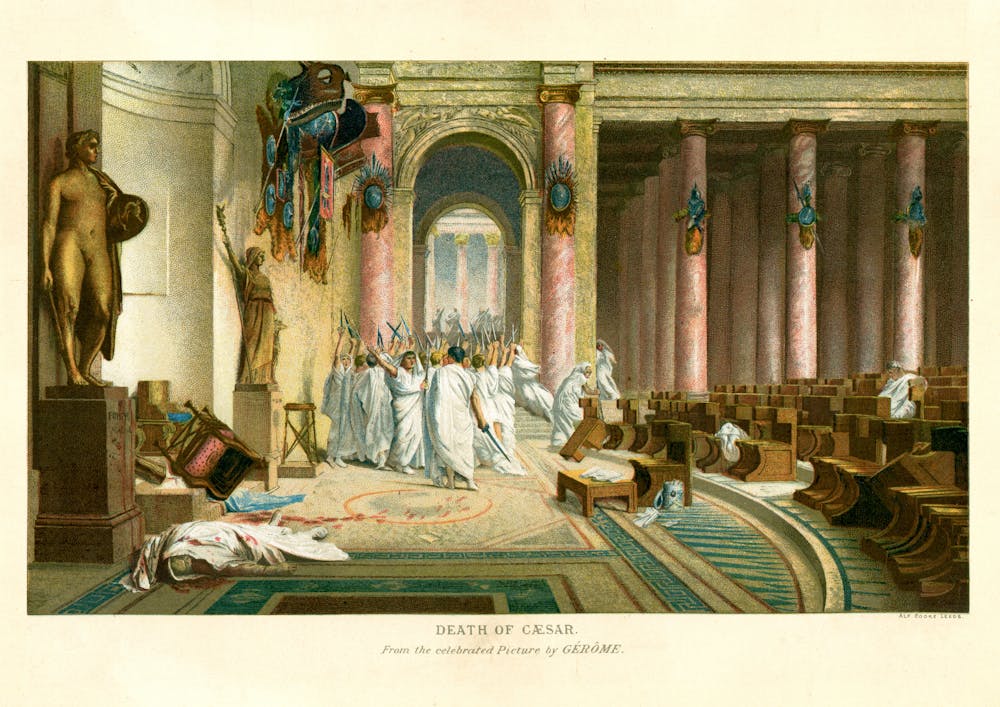
    Early Romans too, sought a society with “no kings!” – up until, that is, the period following the assassination of Julius Caesar, when everything changed.

    The seven kings of Rome

    Seven kings ruled Rome, one after the other, after the city was founded in 753 BCE. The first was Romulus who, according to some legends, gave the city its name.

    When the last of the kings of Rome was driven from the city in 509 BCE, his key opponent, Lucius Junius Brutus, vowed:

    I will pursue Lucius Tarquinius Superbus and his wicked wife and all his children, with sword, with fire, with whatever violence I may; and I will suffer neither him nor anyone else to be king in Rome!

    Tarquinius Superbus (meaning “the proud”) had ruled Rome for 25 years. He began his reign by executing uncooperative Senators.

    When Tarquinius’ son raped a noblewoman named Lucretia, the Roman population rebelled against the king’s long-running tyranny. The hubris of the king and his family was finally too much. They were driven from Rome and never allowed to return.

    A new system of government was ushered in: the republic.

    The rise of the Roman republic

    In the new system, power was shared among elected officials – including two consuls, who were elected annually.

    The consuls were the most powerful officials in the republic and were given power to wage war.

    The Senate, which represented the wealthiest sections of society (initially the patrician class), held power in some key areas, including foreign policy.

    Less affluent citizens elected tribunes of the plebs who had various powers, including the right to veto laws.

    In the republican system, the term king (rex in Latin) quickly became anathema.

    “No kings” would effectively remain the watchword through the Roman republic’s entire history. “Rex” was a word the Romans hated. It was short-hand for “tyranny”.

    The rise and fall of Julius Caesar

    Over time, powerful figures emerged who threatened the republic’s tight power-sharing rules.

    Figures such as the general Pompey (106–48 BCE) broke all the rules and behaved in suspiciously kingly ways. With military success and vast wealth, he was a populist who broke the mould. Pompey even staged a three-day military parade, known as a triumph, to coincide with his birthday in 61 BCE.

    But the ultimate populist was Julius Caesar.

    Born to a noble family claiming lineage from the goddess Venus, Caesar became fabulously wealthy.

    He also scored major military victories, including subduing the Gauls (across modern France and Belgium) from 58–50 BCE.

    In the 40s BCE, Caesar began taking offices over extended time frames – much longer periods than the rules technically allowed.

    Early in 44 BCE he gave himself the formal title “dictator for life” (Dictator Perpetuo), having been appointed dictator two years earlier. The dictatorship was only meant to be held in times of emergency for a period of six months.

    When Caesar was preparing a war against Parthia (in modern day Iran), some tried to hail him as king.

    Soon after, an angry group of 23 senators stabbed him to death in a vain attempt to save the republic. They were led by Marcus Junius Brutus, a descendant of the Brutus who killed the last Roman king, Tarquinius Superbus.

    The Roman republic was beyond saving despite Caesar’s death.
    duncan1890/Getty Images

    However, the Roman republic was beyond saving despite Caesar’s death. His great nephew Octavian eventually emerged as leader and became known as Augustus (27 BCE – 14 CE). With Augustus, an age of emperors was born.

    Emperors were kings in all but name. The strong aversion to kingship in Rome ensured their complete avoidance of the term rex.

    ‘No kings!’

    American protesters waving placards shouting “no kings!” are expressing clear concerns that their beloved democracy is under threat.

    Donald Trump has already declared eight national emergencies and issued 161 executive orders in his second term.

    When asked if he needs to uphold the Constitution, Trump declares “I don’t know.” He has joked about running for a third term as president, in breach of the longstanding limit of two terms.

    Like Caesar, is Donald Trump becoming a king in all but name? Is he setting a precedent for his successors to behave increasingly like emperors?

    The American aversion to “king” likely ensures the term will never return. But when protesters and others shout “no kings!”, they know the very meaning of the term “president” is changing before their eyes.

    Peter Edwell receives funding from the Australian Research Council.

    ref. ‘No kings!’: like the LA protesters, the early Romans hated kings, too – https://theconversation.com/no-kings-like-the-la-protesters-the-early-romans-hated-kings-too-259011

    MIL OSI AnalysisEveningReport.nz

  • MIL-Evening Report: Small businesses are an innovation powerhouse. For many, it’s still too hard to raise the funds they need

    Source: The Conversation (Au and NZ) – By Colette Southam, Associate Professor of Finance, Bond University

    The federal government wants to boost Australia’s productivity levels – as a matter of national priority. It’s impossible to have that conversation without also talking about innovation.

    We can be proud of (and perhaps a little surprised by) some of the Australian innovations that have changed the world – such as the refrigerator, the electric drill, and more recently, the CPAP machine and the technology underpinning Google Maps.

    Australia is continuing to drive advancements in machine learning, cybersecurity and green technologies. Innovation isn’t confined to the headquarters of big tech companies and university laboratories.

    Small and medium enterprises – those with fewer than 200 employees – are a powerhouse of economic growth in Australia. Collectively, they contribute 56% of Australia’s gross domestic product (GDP) and employ 67% of the workforce.

    Our own Reserve Bank has recognised they also have a huge role to play in driving innovation. However, they still face many barriers to accessing funding and investment, which can hamper their ability to do so.

    Finding the funds to grow

    We all know the saying “it takes money to make money”. Those starting or scaling a business have to invest in the present to generate cash in the future. This could involve buying equipment, renting space, or even investing in needed skills and knowledge.

    A small, brand new startup might initially rely on debt (such as personal loans or credit cards) and investments from family and friends (sometimes called “love money”).

    Having exhausted these sources, it may still need more funds to grow. Bank loans for businesses are common, quick and easy. But these require regular interest payments, which could slow growth.

    Selling stakes

    Alternatively, a business may want to look for investors to take out ownership stakes.

    This investment can take the form of “private equity”, where ownership stakes are sold through private arrangement to investors. These can range from individual “angel investors” through to huge venture capital and private equity firms managing billions in investments.

    It can also take the form of “public equity”, where shares are offered and are then able to be bought and sold by anyone on a public stock exchange such as the Australian Securities Exchange (ASX).

    Unfortunately, small and medium-sized companies face hurdles to accessing both kinds.

    Companies need access to finance to turn ideas into reality.
    Kvalifik/Unsplash

    Private investors’ high bar to clear

    Research examining the gap in small-scale private equity has found 46% of small and medium-sized firms in Australia would welcome an equity investment – despite saying they were able to acquire debt elsewhere.

    They preferred private equity because they also wanted to learn from experienced investors who could help them grow their companies. However, very few small and medium-sized enterprises were able to meet private equity’s investment criteria.

    When interviewed, many chief executives and chairs of small private equity firms said their lack of interest in small and medium-sized enterprises came down to cost and difficulty of verifying information about the health and prospects of a business.

    To make it easier for investors to compare investments, all public companies are required to disclose their financial information using International Financial Reporting Standards.

    In contrast, small private companies can use a simplified set of rules and do not have to share their statements of profit and loss with the general public.

    Share markets are costly and complex

    Is it possible to list on a stock exchange instead? An initial public offering (IPO) would enable the company to raise funds by selling shares to the public.

    Unfortunately, the process of issuing shares on a stock exchange is time-consuming and costly. It requires a team of advisors (accountants, lawyers, and bankers) and filing fees are high.

    There are also ongoing costs and obligations associated with being a publicly traded company, including detailed financial reporting.

    Last week, the regulator, the Australian Securities and Investments Commission (ASIC), announced new measures to encourage more listings by streamlining the IPO process.

    Despite this, many small companies do not meet the listing requirements for the ASX.

    These include meeting a profits and assets test and having at least 300 investors (not including family) each with A$2,000.

    There is one less well-known alternative – the smaller National Stock Exchange of Australia (NSX), which focuses on early-stage companies. Ideally, this should have been a great alternative for small companies, but it has had limited success. The NSX is now set to be acquired by a Canadian market operator.

    Making companies more attractive

    Our previous research has highlighted that small and medium-sized businesses should try to make themselves more attractive to private equity companies. This could include improving their financial reporting and using a reputable major auditor.

    At their end, private equity companies should cast a wider net and invest a little more time in screening and selecting high-quality smaller companies. That could pay off – if it means they avoid missing out on “the next Google Maps”.

    What we now know as Google Maps began as an Australian startup.
    Susan Quin & The Bigger Picture, CC BY

    What about the $4 trillion of superannuation?

    There are other opportunities we could explore. Australia’s pool of superannuation funds, for example, have begun growing so large they are running out of places to invest.

    That’s led to some radical proposals. Ben Thompson, chief executive of Employment Hero, last year proposed big superannuation funds be forced to invest 1% of their cash into start-ups.

    Less extreme, regulators could reassess disclosure guidelines for financial providers which may lead funds to prefer more established investments with proven track records.

    There is an ongoing debate about whether the Australian Prudential Regulation Authority (APRA), which regulates banks and superannuation, is too cautious. Some believe APRA’s focus on risk management hurts innovation and may result in super funds avoiding startups (which generally have a higher likelihood of failure).

    In response, APRA has pointed out the global financial crisis reminded us to be cautious, to ensure financial stability and protect consumers.


    This article is part of The Conversation’s series, The Productivity Puzzle.

    The author would like to acknowledge her former doctoral student, the late Dr Bruce Dwyer, who made significant contributions to research discussed in this article. Bruce passed away in a tragic accident earlier this year.

    Colette Southam does not work for, consult, own shares in or receive funding from any company or organisation that would benefit from this article, and has disclosed no relevant affiliations beyond their academic appointment.

    ref. Small businesses are an innovation powerhouse. For many, it’s still too hard to raise the funds they need – https://theconversation.com/small-businesses-are-an-innovation-powerhouse-for-many-its-still-too-hard-to-raise-the-funds-they-need-256333

    MIL OSI AnalysisEveningReport.nz

  • MIL-Evening Report: Small businesses are an innovation powerhouse. For many, it’s still too hard to raise the funds they need

    Source: The Conversation (Au and NZ) – By Colette Southam, Associate Professor of Finance, Bond University

    The federal government wants to boost Australia’s productivity levels – as a matter of national priority. It’s impossible to have that conversation without also talking about innovation.

    We can be proud of (and perhaps a little surprised by) some of the Australian innovations that have changed the world – such as the refrigerator, the electric drill, and more recently, the CPAP machine and the technology underpinning Google Maps.

    Australia is continuing to drive advancements in machine learning, cybersecurity and green technologies. Innovation isn’t confined to the headquarters of big tech companies and university laboratories.

    Small and medium enterprises – those with fewer than 200 employees – are a powerhouse of economic growth in Australia. Collectively, they contribute 56% of Australia’s gross domestic product (GDP) and employ 67% of the workforce.

    Our own Reserve Bank has recognised they also have a huge role to play in driving innovation. However, they still face many barriers to accessing funding and investment, which can hamper their ability to do so.

    Finding the funds to grow

    We all know the saying “it takes money to make money”. Those starting or scaling a business have to invest in the present to generate cash in the future. This could involve buying equipment, renting space, or even investing in needed skills and knowledge.

    A small, brand new startup might initially rely on debt (such as personal loans or credit cards) and investments from family and friends (sometimes called “love money”).

    Having exhausted these sources, it may still need more funds to grow. Bank loans for businesses are common, quick and easy. But these require regular interest payments, which could slow growth.

    Selling stakes

    Alternatively, a business may want to look for investors to take out ownership stakes.

    This investment can take the form of “private equity”, where ownership stakes are sold through private arrangement to investors. These can range from individual “angel investors” through to huge venture capital and private equity firms managing billions in investments.

    It can also take the form of “public equity”, where shares are offered and are then able to be bought and sold by anyone on a public stock exchange such as the Australian Securities Exchange (ASX).

    Unfortunately, small and medium-sized companies face hurdles to accessing both kinds.

    Companies need access to finance to turn ideas into reality.
    Kvalifik/Unsplash

    Private investors’ high bar to clear

    Research examining the gap in small-scale private equity has found 46% of small and medium-sized firms in Australia would welcome an equity investment – despite saying they were able to acquire debt elsewhere.

    They preferred private equity because they also wanted to learn from experienced investors who could help them grow their companies. However, very few small and medium-sized enterprises were able to meet private equity’s investment criteria.

    When interviewed, many chief executives and chairs of small private equity firms said their lack of interest in small and medium-sized enterprises came down to cost and difficulty of verifying information about the health and prospects of a business.

    To make it easier for investors to compare investments, all public companies are required to disclose their financial information using International Financial Reporting Standards.

    In contrast, small private companies can use a simplified set of rules and do not have to share their statements of profit and loss with the general public.

    Share markets are costly and complex

    Is it possible to list on a stock exchange instead? An initial public offering (IPO) would enable the company to raise funds by selling shares to the public.

    Unfortunately, the process of issuing shares on a stock exchange is time-consuming and costly. It requires a team of advisors (accountants, lawyers, and bankers) and filing fees are high.

    There are also ongoing costs and obligations associated with being a publicly traded company, including detailed financial reporting.

    Last week, the regulator, the Australian Securities and Investments Commission (ASIC), announced new measures to encourage more listings by streamlining the IPO process.

    Despite this, many small companies do not meet the listing requirements for the ASX.

    These include meeting a profits and assets test and having at least 300 investors (not including family) each with A$2,000.

    There is one less well-known alternative – the smaller National Stock Exchange of Australia (NSX), which focuses on early-stage companies. Ideally, this should have been a great alternative for small companies, but it has had limited success. The NSX is now set to be acquired by a Canadian market operator.

    Making companies more attractive

    Our previous research has highlighted that small and medium-sized businesses should try to make themselves more attractive to private equity companies. This could include improving their financial reporting and using a reputable major auditor.

    At their end, private equity companies should cast a wider net and invest a little more time in screening and selecting high-quality smaller companies. That could pay off – if it means they avoid missing out on “the next Google Maps”.

    What we now know as Google Maps began as an Australian startup.
    Susan Quin & The Bigger Picture, CC BY

    What about the $4 trillion of superannuation?

    There are other opportunities we could explore. Australia’s pool of superannuation funds, for example, have begun growing so large they are running out of places to invest.

    That’s led to some radical proposals. Ben Thompson, chief executive of Employment Hero, last year proposed big superannuation funds be forced to invest 1% of their cash into start-ups.

    Less extreme, regulators could reassess disclosure guidelines for financial providers which may lead funds to prefer more established investments with proven track records.

    There is an ongoing debate about whether the Australian Prudential Regulation Authority (APRA), which regulates banks and superannuation, is too cautious. Some believe APRA’s focus on risk management hurts innovation and may result in super funds avoiding startups (which generally have a higher likelihood of failure).

    In response, APRA has pointed out the global financial crisis reminded us to be cautious, to ensure financial stability and protect consumers.


    This article is part of The Conversation’s series, The Productivity Puzzle.

    The author would like to acknowledge her former doctoral student, the late Dr Bruce Dwyer, who made significant contributions to research discussed in this article. Bruce passed away in a tragic accident earlier this year.

    Colette Southam does not work for, consult, own shares in or receive funding from any company or organisation that would benefit from this article, and has disclosed no relevant affiliations beyond their academic appointment.

    ref. Small businesses are an innovation powerhouse. For many, it’s still too hard to raise the funds they need – https://theconversation.com/small-businesses-are-an-innovation-powerhouse-for-many-its-still-too-hard-to-raise-the-funds-they-need-256333

    MIL OSI AnalysisEveningReport.nz

  • MIL-Evening Report: Need to see a specialist? You might have to choose between high costs and a long wait. Here’s what needs to change

    Source: The Conversation (Au and NZ) – By Peter Breadon, Program Director, Health and Aged Care, Grattan Institute

    If you have cancer, a disease such as diabetes or dementia, or need to manage other complex health conditions, you often need expert care from a specialist doctor.

    But as our new Grattan Institute report shows, too many people are forced to choose between long waits in the public system or high costs if they go private.

    Governments need to provide more training for specialist doctors in short supply, make smart investments in public clinics, and regulate the extremely high fees a small number of private specialists charge.

    High fees, long waits, missed care

    Fees for private specialist appointments are high and rising.

    On average, patients’ bills for specialist appointments add up to A$300 a year. This excludes people who were bulk billed for every appointment, but that’s relatively rare: patients pay out-of-pocket costs for two-thirds of appointments with a specialist doctor.

    Increasing GP costs make national headlines, but specialist fees have risen even more – they’ve grown by 73% since 2010.

    Out-of-pocket costs for specialist care have increased faster than for other Medicare services.
    Grattan Institute, CC BY-NC-SA

    People who can’t afford to pay with money often pay with time – and sometimes with their health, as their condition deteriorates.

    Wait times for a free appointment at a public clinic can be months or even years. In Victoria and Queensland, people with an urgent referral – who should be seen within 30 days – are waiting many months to see some specialists.

    High fees and long waits add up to missed care. Every year, 1.9 million Australians delay or skip needed specialist care – about half of them because of cost.

    Distance is another barrier. People in regional and remote areas receive far fewer specialist services per person than city dwellers (even counting services delivered virtually). Half of remote communities receive less than one specialist appointment, per person, per year. There are no city communities where that’s the case.

    People in regional and remote areas receive fewer specialist services.
    Grattan Institute, CC BY-NC-SA

    Train the specialists we’ll need in the future

    Specialist training takes at least 12 years, so planning ahead is crucial. Governments can’t conjure more cardiologists overnight, or have a paediatrician treat elderly people.

    But at the moment there are no regular projections of the specialists we’ll need in the future, nor planning to make sure we get them. Government-funded training places are determined by the priorities of specialist colleges, which approve training places, and the immediate needs of public hospitals.

    As a result, we’ve got a lot of some types of specialist and a shortage of others. We’ve trained many emergency medicine specialists because public hospitals rely on trainees to staff emergency departments 24/7. But we have too few dermatologists and ophthalmologists – and numbers of those specialists are growing slower than average.

    The numbers of some types of specialists are growing faster than others.
    Grattan Institute, CC BY-NC-SA

    The lack of planning extends to where specialist training takes place. Doctors tend to put down roots and stay where they train. A shortage of rural training places leads to a shortage of rural specialists.

    To fix these problems, governments need to plan and pay for training places that match Australia’s future health needs. Governments should forecast the need for particular specialties in particular areas. Then training funding should be tied to delivering the necessary specialist training places.

    To fill gaps in the meantime, the federal government should streamline applications for overseas specialists to move here. It should also recognise qualifications from more similar countries.

    More public clinics where they’re needed most

    Public clinics don’t charge fees and are crucial in ensuring all Australians can get specialist care. But governments should be more strategic in where and how they invest.

    There are big differences in specialist access across the country. After adjusting for differences in age, sex, health and wealth, people living in the worst-served areas receive about one-third fewer services than people in the best-served communities.

    Governments should fund more public services in areas that need it most. They should set a five-year target to lift access for the quarter of communities receiving the least care in each specialty.

    More services are needed to help the least-served communities catch up.
    Grattan Institute, CC BY-NC-SA

    We estimate 81 communities need additional investment in at least one specialty – about a million extra appointments in total. Some communities receive less care across the board and need investment in many specialties.

    With long waiting times and unmet need, governments should also make sure they’re getting the most out of their investment in public clinics.

    Different clinics are run in very different ways. Some have taken up virtual care with a vengeance, others barely at all. One clinic might stick to traditional staffing models, while the clinic down the road might have moved towards “top of scope” models where nurses and allied health workers do more.

    Not all specialists offer virtual appointments.
    Grattan Institute, CC BY-NC-SA

    Governments should lay out an agenda to modernise clinics, encouraging them to adopt best practices. And they should introduce systems that allow GPs to get quick written advice from specialists to reduce unnecessary referrals and ensure services can focus on patients who really need their care.

    Curb extreme fees

    Even with more public services, and more specialists, excessive fees will still be a problem.

    A small fraction – less than 4% – of specialists charge triple the Medicare schedule fee, or more, on average. These can only be described as extreme fees.

    In 2023, an initial consultation with an endocrinologist or cardiologist who met this “extreme fee” definition cost an average of $350. For a psychiatrist, it was $670.

    One psychiatrist charged $670, but they weren’t the only specialist charging ‘extreme fees’.
    Grattan Institute, CC BY-NC-SA

    There is no valid justification for these outlier fees. They’re beyond the level needed to fairly reward doctors’ skill and experience, they aren’t linked to better quality and they don’t cross-subsidise care for poorer patients. Incomes for average specialists – who charge much less – are already among the highest in the country. Nine of the top ten highest-earning occupations are medical specialties.

    The federal government has committed to publishing fee information, which is a positive step. But in some areas, it can be hard to find a better option, and patients may be hesitant to shop around.

    The federal government should directly tackle extreme fees. It should require specialists who charge extreme fees to repay the value of the Medicare rebates received for their services that year.

    Specialist care has been neglected long enough. The federal and state governments need to act now.

    Grattan Institute has been supported in its work by government, corporates, and philanthropic gifts. A full list of supporting organisations is published at www.grattan.edu.au.

    ref. Need to see a specialist? You might have to choose between high costs and a long wait. Here’s what needs to change – https://theconversation.com/need-to-see-a-specialist-you-might-have-to-choose-between-high-costs-and-a-long-wait-heres-what-needs-to-change-258194

    MIL OSI AnalysisEveningReport.nz

  • MIL-Evening Report: Need to see a specialist? You might have to choose between high costs and a long wait. Here’s what needs to change

    Source: The Conversation (Au and NZ) – By Peter Breadon, Program Director, Health and Aged Care, Grattan Institute

    If you have cancer, a disease such as diabetes or dementia, or need to manage other complex health conditions, you often need expert care from a specialist doctor.

    But as our new Grattan Institute report shows, too many people are forced to choose between long waits in the public system or high costs if they go private.

    Governments need to provide more training for specialist doctors in short supply, make smart investments in public clinics, and regulate the extremely high fees a small number of private specialists charge.

    High fees, long waits, missed care

    Fees for private specialist appointments are high and rising.

    On average, patients’ bills for specialist appointments add up to A$300 a year. This excludes people who were bulk billed for every appointment, but that’s relatively rare: patients pay out-of-pocket costs for two-thirds of appointments with a specialist doctor.

    Increasing GP costs make national headlines, but specialist fees have risen even more – they’ve grown by 73% since 2010.

    Out-of-pocket costs for specialist care have increased faster than for other Medicare services.
    Grattan Institute, CC BY-NC-SA

    People who can’t afford to pay with money often pay with time – and sometimes with their health, as their condition deteriorates.

    Wait times for a free appointment at a public clinic can be months or even years. In Victoria and Queensland, people with an urgent referral – who should be seen within 30 days – are waiting many months to see some specialists.

    High fees and long waits add up to missed care. Every year, 1.9 million Australians delay or skip needed specialist care – about half of them because of cost.

    Distance is another barrier. People in regional and remote areas receive far fewer specialist services per person than city dwellers (even counting services delivered virtually). Half of remote communities receive less than one specialist appointment, per person, per year. There are no city communities where that’s the case.

    People in regional and remote areas receive fewer specialist services.
    Grattan Institute, CC BY-NC-SA

    Train the specialists we’ll need in the future

    Specialist training takes at least 12 years, so planning ahead is crucial. Governments can’t conjure more cardiologists overnight, or have a paediatrician treat elderly people.

    But at the moment there are no regular projections of the specialists we’ll need in the future, nor planning to make sure we get them. Government-funded training places are determined by the priorities of specialist colleges, which approve training places, and the immediate needs of public hospitals.

    As a result, we’ve got a lot of some types of specialist and a shortage of others. We’ve trained many emergency medicine specialists because public hospitals rely on trainees to staff emergency departments 24/7. But we have too few dermatologists and ophthalmologists – and numbers of those specialists are growing slower than average.

    The numbers of some types of specialists are growing faster than others.
    Grattan Institute, CC BY-NC-SA

    The lack of planning extends to where specialist training takes place. Doctors tend to put down roots and stay where they train. A shortage of rural training places leads to a shortage of rural specialists.

    To fix these problems, governments need to plan and pay for training places that match Australia’s future health needs. Governments should forecast the need for particular specialties in particular areas. Then training funding should be tied to delivering the necessary specialist training places.

    To fill gaps in the meantime, the federal government should streamline applications for overseas specialists to move here. It should also recognise qualifications from more similar countries.

    More public clinics where they’re needed most

    Public clinics don’t charge fees and are crucial in ensuring all Australians can get specialist care. But governments should be more strategic in where and how they invest.

    There are big differences in specialist access across the country. After adjusting for differences in age, sex, health and wealth, people living in the worst-served areas receive about one-third fewer services than people in the best-served communities.

    Governments should fund more public services in areas that need it most. They should set a five-year target to lift access for the quarter of communities receiving the least care in each specialty.

    More services are needed to help the least-served communities catch up.
    Grattan Institute, CC BY-NC-SA

    We estimate 81 communities need additional investment in at least one specialty – about a million extra appointments in total. Some communities receive less care across the board and need investment in many specialties.

    With long waiting times and unmet need, governments should also make sure they’re getting the most out of their investment in public clinics.

    Different clinics are run in very different ways. Some have taken up virtual care with a vengeance, others barely at all. One clinic might stick to traditional staffing models, while the clinic down the road might have moved towards “top of scope” models where nurses and allied health workers do more.

    Not all specialists offer virtual appointments.
    Grattan Institute, CC BY-NC-SA

    Governments should lay out an agenda to modernise clinics, encouraging them to adopt best practices. And they should introduce systems that allow GPs to get quick written advice from specialists to reduce unnecessary referrals and ensure services can focus on patients who really need their care.

    Curb extreme fees

    Even with more public services, and more specialists, excessive fees will still be a problem.

    A small fraction – less than 4% – of specialists charge triple the Medicare schedule fee, or more, on average. These can only be described as extreme fees.

    In 2023, an initial consultation with an endocrinologist or cardiologist who met this “extreme fee” definition cost an average of $350. For a psychiatrist, it was $670.

    One psychiatrist charged $670, but they weren’t the only specialist charging ‘extreme fees’.
    Grattan Institute, CC BY-NC-SA

    There is no valid justification for these outlier fees. They’re beyond the level needed to fairly reward doctors’ skill and experience, they aren’t linked to better quality and they don’t cross-subsidise care for poorer patients. Incomes for average specialists – who charge much less – are already among the highest in the country. Nine of the top ten highest-earning occupations are medical specialties.

    The federal government has committed to publishing fee information, which is a positive step. But in some areas, it can be hard to find a better option, and patients may be hesitant to shop around.

    The federal government should directly tackle extreme fees. It should require specialists who charge extreme fees to repay the value of the Medicare rebates received for their services that year.

    Specialist care has been neglected long enough. The federal and state governments need to act now.

    Grattan Institute has been supported in its work by government, corporates, and philanthropic gifts. A full list of supporting organisations is published at www.grattan.edu.au.

    ref. Need to see a specialist? You might have to choose between high costs and a long wait. Here’s what needs to change – https://theconversation.com/need-to-see-a-specialist-you-might-have-to-choose-between-high-costs-and-a-long-wait-heres-what-needs-to-change-258194

    MIL OSI AnalysisEveningReport.nz

  • MIL-Evening Report: Decades on from the Royal Commission, why are Indigenous people still dying in custody?

    Source: The Conversation (Au and NZ) – By Thalia Anthony, Professor of Law, University of Technology Sydney

    Rose Marinelli/Shutterstock

    Aboriginal and Torres Strait Islander readers are advised that this article contains the name of an Indigenous person who has died.

    The recent deaths in custody of two Indigenous men in the Northern Territory have provoked a deeply confronting question – will it ever end?

    About 597 First Nations people have died in custody sine the 1991 Royal Commission into Aboriginal Deaths in Custody.

    This year alone, 12 Indigenous people have died – 31% of total custodial deaths.

    The raw numbers are a tragic indictment of government failure to implement in full the Commission’s 339 recommendations.

    We are potentially further away from resolving this crisis than we were 34 years ago.

    Recent deaths

    Kumanjayi White was a vulnerable young Warlpiri man with a disability under a guardianship order. He stopped breathing while being restrained by police in an Alice Springs supermarket on May 27. His family is calling for all CCTV and body camera footage to be released.

    Days later a 68-year-old Aboriginal Elder from Wadeye was taken to the Palmerston Watchhouse after being detained for apparent intoxication at Darwin airport. He was later transferred to a hospital where he died.

    Alice Springs protest over the death of Kumanjayi White.

    Both were under the care and protection of the state when they died. The royal commission revealed “so many” deaths had occurred in similar circumstances and urged change. It found there was:

    little appreciation of, and less dedication to, the duty of care owed by custodial authorities and their officers to persons in care.

    Seemingly, care and protection were the last things Kumanjayi White and the Wadeye Elder were afforded by NT police.

    Preventable deaths

    The royal commission investigated 99 Aboriginal deaths in custody between 1980 and 1989. If all of its recommendations had been fully implemented, lives may have been saved.

    For instance, recommendation 127 called for “protocols for the care and management” of Aboriginal people in custody, especially those suffering from physical or mental illness. This may have informed a more appropriate and therapeutic response to White and prevented his death.

    Recommendation 80 provided for “non-custodial facilities for the care and treatment of intoxicated persons”. Such facilities may have staved off the trauma the Elder faced when he was detained, and the adverse impact it had on his health.

    More broadly, a lack of independent oversight has compromised accountability. Recommendations 29-31 would have given the coroner, and an assisting lawyer, “the power to direct police” in their investigations:

    It must never again be the case that a death in custody, of Aboriginal or non-Aboriginal persons, will not lead to rigorous and accountable investigations.

    Yet, the Northern Territory police has rejected pleas by White’s family for an independent investigation.

    Another audit?

    Northern Territory Labor MP Marion Scrymgour is calling on the Albanese government to order a full audit of the royal commission recommendations.

    She says Indigenous people are being completely ostracised and victimised:

    People are dying. The federal government, I think, needs to show leadership.

    It is unlikely another audit will cure the failures by the government to act on the recommendations.

    Instead, a new standing body should be established to ensure they are all fully implemented. It should be led by First Nations people and involve families whose loved ones have died in custody in recognition of their lived expertise.

    In 2023, independent Senator Lidia Thorpe moved a motion for the Aboriginal and Torres Strait Islander social justice commissioner to assume responsibility for the implementation of the recommendations. While the government expressed support for this motion, there has been no progress.

    Another mechanism for change would be for governments to report back on recommendations made by coroners in relation to deaths in custody. Almost 600 inquests have issued a large repository of recommendations, many of which have been shelved.

    Leadership lacking?

    Prime Minister Anthony Albanese recently conceded no government has “done well enough” to reduce Aboriginal deaths in custody. But he has rejected calls for an intervention in the Northern Territory justice system:

    I need to be convinced that people in Canberra know better than people in the Northern Territory about how to deal with these issues.

    Albanese is ignoring the essence of what is driving deaths in custody.

    Reflecting on the 25-year anniversary of the royal commission in 2016, criminology professor Chris Cunneen wrote that Australia had become much less compassionate and more ready to blame individuals for their alleged failings:

    Nowhere is this more clear than in our desire for punishment. A harsh criminal justice system – in particular, more prisons and people behind bars – has apparently become a hallmark of good government.

    There are too many First Nations deaths in custody because there are too many First Nations people in custody in the first place.

    At the time of the royal commission, 14% of the prison population was First Nations. Today, it’s 36%, even though Indigenous people make up just 3.8% of Australia’s overall population.

    Governments across the country have expanded law and order practices, police forces and prisons in the name of community safety.

    This includes a recent $1.5 billion public order plan to expand policing in the Northern Territory. Such agendas impose a distinct lack of safety on First Nations people, who bear the brunt of such policies. It also instils a message that social issues can only be addressed by punitive and coercive responses.

    The royal commission showed us there is another way: self-determination and stamping out opportunities for racist and violent policing. First Nations families have campaigned for these issues for decades.

    How many more Indigenous deaths in custody does there have to be before we listen?

    Thalia Anthony receives funding from the Australian Research Council.

    Eddie is an Independent Representative on the Justice Policy Partnership under the Closing the Gap Agreement.

    ref. Decades on from the Royal Commission, why are Indigenous people still dying in custody? – https://theconversation.com/decades-on-from-the-royal-commission-why-are-indigenous-people-still-dying-in-custody-258568

    MIL OSI AnalysisEveningReport.nz

  • MIL-Evening Report: A 3-tonne, $1.5 billion satellite to watch Earth’s every move is set to launch this week

    Source: The Conversation (Au and NZ) – By Steve Petrie, Earth Observation Researcher, Swinburne University of Technology

    Artist’s concept of the NISAR satellite in orbit over Earth. NASA/JPL-Caltech

    In a few days, a new satellite that can detect changes on Earth’s surface down to the centimetre, in almost real time and no matter the time of day or weather conditions, is set to launch from India’s Satish Dhawan Space Centre near Chennai.

    Weighing almost 3 tonnes and boasting a 12-metre radar antenna, the US$1.5 billion NISAR satellite will track the ground under our feet and the water that flows over and through it in unprecedented detail, providing valuable information for farmers, climate scientists and natural disaster response teams.

    Only when the conditions are right

    Satellites that image the Earth have been an invaluable scientific tool for decades. They have provided crucial data across many applications, such as weather forecasting and emergency response planning. They have also helped scientists track long-term changes in Earth’s ecosystems and climate.

    Many of these Earth observation satellites require reflected sunlight to capture images of Earth’s surface. This means they can only capture images during daytime and when there is no cloud cover.

    As a result, these satellites face challenges wherever cloud cover is very common, such as in tropical regions, or when nighttime imagery is required.

    The NISAR satellite – a collaboration between the national space agencies of the United States (NASA) and India (ISRO) – overcomes these challenges by using synthetic aperture radar (SAR) technology to take images of the Earth. This technology also gives the satellite its name. NISAR stands for NASA-ISRO SAR.

    So what is SAR technology?

    SAR technology was invented in 1951 for military use. Rather than using reflected sunlight to passively image the Earth’s surface, SAR satellites work by actively beaming a radar signal toward the surface and detecting the reflected signal. Think of this as like using a flash to take a photo in a dark room.

    This means SAR satellites can take images of the Earth’s surface both during the day and night.

    Since radar signals pass through most cloud and smoke unhindered, SAR satellites can also image the Earth’s surface even when it is covered by clouds, smoke or ash. This is especially valuable during natural disasters such as floods, bushfires or volcanic eruptions.

    Radar signals can also penetrate through certain structures such as thick vegetation. They are useful for detecting the presence of water due to the way that water affects reflected radar signals.

    The European Space Agency used the vegetation-penetrating properties of SAR signals in its recent Biomass mission. This can image the 3D structure of forests. It can also produce highly accurate measurements of the amount of biomass and carbon stored in Earth’s forests.

    Sang-Ho Yun, Director of the Earth Observatory of Singapore’s Remote Sensing Lab, is a key proponent of using SAR for disaster management. Yun has previously used SAR data to map disaster-affected areas across hundreds of natural disasters over the last 15 years, including earthquakes, floods and typhoons.

    NISAR, which is due to launch on June 18, will significantly build on this earlier work.

    NISAR data will be used to create images similar to this 2013 image of a flood-prone area of the Amazonian jungle in Peru that’s based on data from NASA’s UAVSAR satellite.
    NASA/JPL-Caltech

    Monitoring Earth’s many ecosystems

    The NISAR satellite has been in development for over a decade and is one of the most expensive Earth-imaging satellites ever built.

    Data from the satellite will be supplied freely and openly worldwide. It will provide high-resolution images of almost all land and ice surfaces around the globe twice every 12 days.

    This is similar in scope to the European Space Agency’s Sentinel-1 SAR satellites. However, NISAR will be the first SAR satellite to use two complementary radar frequencies rather than one, and will be capable of producing higher resolution imagery compared with the Sentinel-1 satellites. It will also have greater coverage of Antarctica than Sentinel-1 and will use radar frequencies that penetrate further into vegetation.

    The NISAR satellite will be used to monitor forest biomass. Its ability to simultaneously penetrate vegetation and detect water will also allow it to accurately map flooded vegetation.

    This is important for gaining a deeper understanding of Earth’s wetlands, which are important ecosystems with high levels of biodiversity and massive carbon storage capacity.

    The satellite will also be able to detect changes in the height of Earth’s surface of a few centimetres or even millimetres, because changes in height create tiny shifts in the reflected radar signal.

    The NISAR satellite will use this technique to track subsidence of dams and map groundwater levels (since subsurface water affects the height of the Earth’s surface). It will also use the same technique to map land movement and damage from earthquakes, landslides and volcanic activity.

    Such maps can help disaster response teams to better understand the damage that has occurred in disaster areas and to plan their response.

    Improving agriculture

    The NISAR satellite will also be useful for agricultural applications, with a unique capability to estimate moisture levels in soil with high resolution in all weather conditions.

    This is valuable for agricultural applications because such data can be used to determine when to irrigate to ensure healthy vegetation, and to potentially improve water use efficiency and crop yields.

    Further key applications of the NISAR mission will include tracking the flow of Earth’s ice sheets and glaciers, monitoring coastal erosion and tracking oil spills.

    We can expect to see many benefits for science and society to come from this highly ambitious satellite mission.

    Steve Petrie has previously received funding for satellite data analysis projects from XPrize Foundation, from Ernst & Young, and from the Cooperative Research Centre for Smart Satellite Technologies and Analytics (SmartSat CRC, which is funded by the Australian Government).

    ref. A 3-tonne, $1.5 billion satellite to watch Earth’s every move is set to launch this week – https://theconversation.com/a-3-tonne-1-5-billion-satellite-to-watch-earths-every-move-is-set-to-launch-this-week-258283

    MIL OSI AnalysisEveningReport.nz

  • MIL-Evening Report: Millions rally against authoritarianism, while the White House portrays protests as threats – a political scientist explains

    Source: The Conversation (Au and NZ) – By Jeremy Pressman, Professor of Political Science, University of Connecticut

    Protesters parade through the Marigny neighborhood of New Orleans as part of the nationwide No Kings protest against President Donald Trump, on June 14, 2025. Patt Little/Anadolu via Getty Images

    At the end of a week when President Donald Trump sent Marines and the California National Guard to Los Angeles to quell protests, Americans across the country turned out in huge numbers to protest Trump’s attempts to expand his power. In rallies on June 14, 2025, organized under the banner “No Kings,” millions of protesters decried Trump’s immigration roundups, cuts to government programs and what many described as his growing authoritarianism.

    The protests were largely peaceful, with relatively few incidents of violence.

    Protests and the interactions between protesters and government authorities have a long history in the United States. From the Boston Tea Party to the Civil Rights movement, LBGTQ Stonewall uprising, the Tea Party movement and Black Lives Matter, public protest has been a crucial aspect of efforts to advance or protect the rights of citizens.

    But protests can also have other effects.

    In the last few months, large numbers of anti-Trump protesters have come out in the streets across the U.S., on occasions like the April 5 Hands Off protests against safety net budget cuts and government downsizing. Many of those protesters assert they are protecting American democracy.

    The Trump administration has decried these protesters and the concept of protest more generally, with the president recently calling protesters “troublemakers, agitators, insurrectionists.” A few days before the June 14 military parade in Washington, President Donald Trump said of potential protesters: “this is people that hate our country, but they will be met with very heavy force.”

    Trump’s current reaction is reminiscent of his harsh condemnation of the Black Lives Matter protests in the summer of 2020. In 2022, former Secretary of Defense Mark Esper said that Trump had asked about shooting protesters participating in demonstrations after the 2020 shooting of George Floyd.

    As co-director of the Crowd Counting Consortium, which compiles information on each day’s protests in the U.S., I understand that protests sometimes can advance the goals of the protest movement. They also can shape the goals and behavior of federal or state governments and their leaders.

    Opportunity for expressing or suppressing democracy

    Protests are an expression of democracy, bolstered by the right to free speech and “the right of the people peaceably to assemble” in the First Amendment of the U.S. Constitution.

    At the same time, clamping down on protests is one way to rebut challenges to government policies and power.

    For a president intent on the further centralization of executive power, or even establishing a dictatorship, protest suppression provides multiple opportunities and pitfalls.

    Widespread, well-attended demonstrations can represent a mass movement in favor of democracy or other issues as well as serve as an opportunity to expand participation even further. Large events often lead to significant press coverage and plenty of social media posting. The protests may heighten protesters’ emotional connection to the movement and increase fundraising and membership numbers of sponsoring organizations.

    Though it is not an ironclad law, research shows that when at least 3.5% of the total population is involved in a demonstration, protesters usually prevail over their governments. That included the Chilean movement in the 1980s that toppled longtime dictator Augusto Pinochet. Chileans used not only massive demonstrations but also a wide array of creative tactics like a coordinated slowdown of driving and walking, neighbors banging pots outside homes simultaneously, and singing together.

    Protests are rarely only about protesting. Organizers usually seek to involve participants in many other activities, whether that is contacting their elected officials, writing letters to the editor, registering to vote or running a food drive to help vulnerable populations.

    In this way of thinking, participation in a major street protest like No Kings is a gateway into deeper activism.

    Risks and opportunities

    Of course, protest leaders cannot control everyone in or adjacent to the movement.

    Other protesters with a different agenda, or agitators of any sort, can insert themselves into a movement and use confrontational tactics like violence against property or law enforcement.

    In one prominent example from Los Angeles, someone set several self-driving cars on fire. Other Los Angeles examples included some protesters’ throwing things like water bottles at officers or engaging in vandalism. Police officers also use coercive measures such as firing chemical irritants and pepper balls at protesters.

    When leaders want to concentrate executive power and establish an autocracy, where they rule with absolute power, protests against those moves could lead to a mass rejection of the leader’s plans. That is what national protest groups like 50501 and Indivisible are hoping for and why they aimed to turn out millions of people at the No Kings protests on June 14.

    But while the Trump administration faces risks from protests, it also may see opportunities.

    Misrepresenting and quashing dissent

    Protests can serve as a justification for a nascent autocrat to further undermine democratic practices and institutions.

    Take the recent demonstrations in Los Angeles protesting the Trump administration’s immigration raids conducted by Immigration and Customs Enforcement, or ICE.

    Autocrats seek to politicize independent institutions like the armed forces. The Los Angeles protests offered the opportunity for that. Trump sent troops from the California National Guard and Marines to Los Angeles to contain the protests. That domestic deployment of the military is rare but not unheard of in U.S. history.

    And the deployment was ordered against the backdrop of the president’s partisan June 10 speech at a U.S. military base in North Carolina. The military personnel in attendance cheered and applauded many of Trump’s political statements. Both the speech and audience reactions to it appeared to violate the U.S. military norm of nonpartisanship.

    This deployment of military personnel in a U.S. city also dovetails with the expansion of executive power characteristic of autocratic leaders. It is rare that presidents call up the National Guard; the Guard is traditionally under the control of the state governor.

    Yet the White House disregarded that Los Angeles’ mayor and California’s governor both objected to the deployment.

    The state sued the Trump administration over the deployment. The initial court decision sided with California officials, declaring the federal government action “illegal.” The Trump administration has appealed.

    Autocrats seek to spread disinformation. In the case of the Los Angeles protests, the Trump administration’s narrative depicted a chaotic, gang-infested city with violence everywhere. Reports on the ground refuted those characterizations. The protests, mostly peaceful, were confined to a small part of the city, about a 10-block area.

    More generally, a strong executive leader and their supporters often want to quash dissent. In the Los Angeles example, doing that has ranged from the military deployment itself to targeting journalists covering the story to arresting and charging prominent opponents like SEIU President David Huerta or shoving and handcuffing U.S. Sen. Alex Padilla, a California Democrat.

    The contrast on June 14 was striking. In Washington, D.C., Trump reviewed a parade of troops, tanks and planes, leaning into a display of American military power.

    At the same time, from rainy Bethlehem, Pennsylvania, to sweltering Yuma, Arizona, millions of protesters embraced their First Amendment rights to oppose the president. It perfectly illustrated the dynamic driving deep political division today: the executive concentrating power while a sizable segment of the people resist.

    Jeremy Pressman does not work for, consult, own shares in or receive funding from any company or organization that would benefit from this article, and has disclosed no relevant affiliations beyond their academic appointment.

    ref. Millions rally against authoritarianism, while the White House portrays protests as threats – a political scientist explains – https://theconversation.com/millions-rally-against-authoritarianism-while-the-white-house-portrays-protests-as-threats-a-political-scientist-explains-258963

    MIL OSI AnalysisEveningReport.nz

  • MIL-Evening Report: A solar panel recycling scheme would help reduce waste, but please repair and reuse first

    Source: The Conversation (Au and NZ) – By Deepika Mathur, Senior Research Fellow, Northern Institute, Charles Darwin University

    tolobalaguer.com, Shutterstock

    Australia’s rooftop solar industry has renewed calls for a mandatory recycling scheme to deal with the growing problem of solar panel waste. Only about 10% of panels are currently recycled. The rest are stockpiled, sent overseas or dumped in landfill.

    One in three Australian homes now have rooftop solar panels, and new systems are being installed at the rate of 300,000 a year. Meanwhile, older systems are being scrapped – often well before the end of their useful life.

    This has made solar panels Australia’s fastest-growing electronic waste stream. Yet federal government plans for a national scheme to manage this waste appear to have stalled.

    Clearly, solar panel waste is a major problem for Australia. Recycling is one part of the solution. But Australia also needs new rules so solar panels can be repaired and reused.

    Millions of solar panels dumped as upgrades surge (ABC News, June 12, 2025)

    What are product stewardship schemes?

    The Smart Energy Council, which represents the solar industry, is calling for a national product stewardship scheme.

    Product stewardship schemes share responsibility for reducing waste at the end of a product’s useful life. They can involve people all along the supply chain, from manufacturers to importers to retailers.

    Such schemes may be voluntary, and industry-led, or mandatory and legislated. Alternatively, they can be shared – approved by government but run by an organisation on behalf of industry.

    Existing schemes manage waste such as oil, tyres, paper and packaging, mobile phones, televisions and computers.

    Depending on the product, a levy is paid by the manufacturer, product importer, network service provider (in case of mobile muster), retailer or consumer – or a combination of these. The money raised is then invested in recycling, research or raising awareness and administering the scheme.

    Establishing a solar panel product stewardship scheme

    Solar panel systems were added to a national priority list for a product stewardship scheme in 2017.

    In December 2020, the federal government called for partners to help develop the scheme, but later stated that no partnership would be struck.

    The government released a discussion paper for comment in 2023. The scheme has not yet been established.

    This is particularly problematic given Australia’s commitment to renewable energy, which will entail a rapid expansion of solar technology.

    Recycling should be the last resort

    Product stewardship schemes assume recycling is the main solution to the waste problem.

    Australia’s National Waste Policy also focuses on on recycling, rather than reuse or repair. This is despite recycling being the last resort on the “waste hierarchy”, just slightly above disposal.

    Solar photovoltaic panels are built to last 30 years or more, and are “not made to be unmade”. They are not easy to dismantle for recycling because they are built to withstand harsh conditions.

    It’s difficult for Australia to influence the design of solar panels, given 99% are imported. Just one manufacturer, Tindo Solar in Adelaide, assembles solar panels on Australian soil, using imported silicon cells.

    Many solar panels are being removed well before their end of life, generating waste ahead of time. This is rarely because they have stopped producing power.

    In our previous research, we found many reasons why people chose to take solar panels down. Consumers are often advised to replace the whole system when just a few panels are faulty. Or they may simply be upgrading to a larger, more efficient system. Sometimes it’s because they want to access a new renewable energy subsidy.

    Renewable subsidies and other solar panel policies should be redesigned to keep panels on roofs for longer.

    Functioning solar panels removed before the end of their life should be reused. This would require new regulations including quality-control measures certifying second-hand solar panels, and second-hand markets. This is a much neglected field of research and development.

    What else should such a scheme include?

    Others have discussed what a solar panel product stewardship scheme could include and the possible regulatory environment.

    We think the scheme should also involve collecting and transporting panels around Australia, including remote areas.

    Unfortunately, existing product stewardship schemes do not differentiate between urban, regional and remote areas. The same is likely to be the case for a solar panel collection and recycling scheme.

    This leaves regional and remote areas with fewer recycling facilities and collection points. With a growing number of large solar projects in Northern Australia, reducing waste is imperative.

    Remote island communities in the Northern Territory bundle up their recyclables and ship it to Darwin. Removed solar panels are then transported to urban Victoria, New South Wales or South Australia for processing. Who should bear the cost of transporting this waste? Consumers, remote regional councils with small ratepayer bases, or manufacturers and retailers?

    A well-designed scheme would help recover valuable resources across Australia for reuse in new products.

    However, large volumes of solar panels would be required for recycling schemes to become commercially viable. That’s why the solar recycling industry is concerned about exporters and scrap dealers collecting panels rather then certified solar panel recyclers.

    Even if the technology for recycling solar panels is nascent in Australia, it’s worth stockpiling panels in Australia for later.

    Considering these issues in the design of a product stewardship scheme would help ensure we can maximise the benefits of renewable energy, while minimising waste.

    Deepika Mathur has received research funding from the Northern Territory and federal governments.

    Robin Gregory is affiliated with Regional Development Australia Northern Territory

    ref. A solar panel recycling scheme would help reduce waste, but please repair and reuse first – https://theconversation.com/a-solar-panel-recycling-scheme-would-help-reduce-waste-but-please-repair-and-reuse-first-258806

    MIL OSI AnalysisEveningReport.nz

  • MIL-Evening Report: Why Israel’s shock and awe has proven its power but lost the war

    COMMENTARY: By Antony Loewenstein

    War is good for business and geopolitical posturing.

    Before Israeli Prime Minister Benjamin Netanyahu arrived in Washington in early February for his first visit to the US following President Donald Trump’s inauguration, he issued a bold statement on the strategic position of Israel.

    “The decisions we made in the war [since 7 October 2023] have already changed the face of the Middle East,” he said.

    “Our decisions and the courage of our soldiers have redrawn the map. But I believe that working closely with President Trump, we can redraw it even further.”

    How should this redrawn map be assessed?

    Hamas is bloodied but undefeated in Gaza. The territory lies in ruins, leaving its remaining population with barely any resources to rebuild. Death and starvation stalk everyone.

    Hezbollah in Lebanon has suffered military defeats, been infiltrated by Israeli intelligence, and now faces few viable options for projecting power in the near future. Political elites speak of disarming Hezbollah, though whether this is realistic is another question.

    Morocco, Bahrain and the UAE accounted for 12 percent of Israel’s record $14.8bn in arms sales in 2024 — up from just 3 percent the year before

    In Yemen, the Houthis continue to attack Israel, but pose no existential threat.

    Meanwhile, since the overthrow of dictator Bashar al-Assad in late 2024, Israel has attacked and threatened Syria, while the new government in Damascus is flirting with Israel in a possible bid for “normalisation“.

    The Gulf states remain friendly with Israel, and little has changed in the last 20 months to alter this relationship.

    According to Israel’s newly released arms sales figures for 2024, which reached a record $14.8bn, Morocco, Bahrain and the United Arab Emirates accounted for 12 percent of total weapons sales — up from just 3 percent in 2023.

    It is conceivable that Saudi Arabia will be coerced into signing a deal with Israel in the coming years, in exchange for arms and nuclear technology for the dictatorial kingdom.

    An Israeli and US-assisted war against Iran began on Friday.

    In the West Bank, Israel’s annexation plans are surging ahead with little more than weak European statements of concern. Israel’s plans for Greater Israel — vastly expanding its territorial reach — are well underway in Syria, Lebanon and beyond.

    Shifting alliances
    On paper, Israel appears to be riding high, boasting military victories and vanquished enemies. And yet, many Israelis and pro-war Jews in the diaspora do not feel confident or buoyed by success.

    Instead, there is an air of defeatism and insecurity, stemming from the belief that the war for Western public opinion has been lost — a sentiment reinforced by daily images of Israel’s campaign of deliberate mass destruction across the Gaza Strip.

    What Israel craves and desperately needs is not simply military prowess, but legitimacy in the public domain. And this is sorely lacking across virtually every demographic worldwide.

    It is why Israel is spending at least $150 million this year alone on “public diplomacy”.

    Get ready for an army of influencers, wined and dined in Tel Aviv’s restaurants and bars, to sell the virtues of Israeli democracy. Even pro-Israel journalists are beginning to question how this money is being spent, wishing Israeli PR were more responsive and effective.

    Today, Israeli Jews proudly back ethnic cleansing and genocide in Gaza in astoundingly high numbers. This reflects a Jewish supremacist mindset that is being fed a daily diet of extremist rhetoric in mainstream media.

    There is arguably no other Western country with such a high proportion of racist, genocidal mania permeating public discourse.

    According to a recent poll of Western European populations, Israel is viewed unfavourably in Germany, Denmark, France, Italy and Spain.

    Very few in these countries support Israeli actions. Only between 13 and 21 percent hold a positive view of Israel, compared to 63-70 percent who do not.

    The US-backed Pew Research Centre also released a global survey asking people in 24 countries about their views on Israel and Palestine. In 20 of the 24 nations, at least half of adults expressed a negative opinion of the Jewish state.

    A deeper reckoning
    Beyond Israel’s image problems lies a deeper question: can it ever expect full acceptance in the Middle East?

    Apart from kings, monarchs and elites from Dubai to Riyadh and Manama to Rabat, Israel’s vicious and genocidal actions since 7 October 2023 have rendered “normalisation” impossible with a state intent on building a Jewish theocracy that subjugates millions of Arabs indefinitely.

    While it is true that most states in the region are undemocratic, with gross human rights abuses a daily reality, Israel has long claimed to be different — “the only democracy in the Middle East”.

    But Israel’s entire political system, built with massive Western support and grounded in an unsustainable racial hierarchy, precludes it from ever being fully and formally integrated into the region.

    The American journalist Murtaza Hussain, writing for the US outlet Drop Site News, recently published a perceptive essay on this very subject.

    He argues that Israeli actions have been so vile and historically grave — comparable to other modern holocausts — that they cannot be forgotten or excused, especially as they are publicly carried out with the explicit goal of ethnically cleansing Palestine:

    “This genocide has been a political and cultural turning point beyond which we cannot continue as before. I express that with resignation rather than satisfaction, as it means that many generations of suffering are ahead on all sides.

    “Ultimately, the goal of Israel’s opponents must not be to replicate its crimes in Gaza and the West Bank, nor to indulge in nihilistic hatred for its own sake.

    “People in the region and beyond should work to build connections with those Israelis who are committed opponents of their regime, and who are ready to cooperate in the generational task of building a new political architecture.”

    The issue is not just Netanyahu and his government. All his likely successors hold similarly hardline views on Palestinian rights and self-determination.

    The monumental task ahead lies in crafting an alternative to today’s toxic Jewish theocracy.

    But this rebuilding must also take place in the West. Far too many Jews, conservatives and evangelical Christians continue to cling to the fantasy of eradicating, silencing or expelling Arabs from their land entirely.

    Pushing back against this fascism is one of the most urgent generational tasks of our time.

    Antony Loewenstein is an Australian/German independent, freelance, award-winning, investigative journalist, best-selling author and film-maker. In 2025, he released an award-winning documentary series on Al Jazeera English, The Palestine Laboratory, adapted from his global best-selling book of the same name. It won a major prize at the prestigious Telly Awards. This article is republished from Middle East Eye with permission.

    MIL OSI AnalysisEveningReport.nz

  • MIL-Evening Report: Why Israel’s shock and awe has proven its power but lost the war

    COMMENTARY: By Antony Loewenstein

    War is good for business and geopolitical posturing.

    Before Israeli Prime Minister Benjamin Netanyahu arrived in Washington in early February for his first visit to the US following President Donald Trump’s inauguration, he issued a bold statement on the strategic position of Israel.

    “The decisions we made in the war [since 7 October 2023] have already changed the face of the Middle East,” he said.

    “Our decisions and the courage of our soldiers have redrawn the map. But I believe that working closely with President Trump, we can redraw it even further.”

    How should this redrawn map be assessed?

    Hamas is bloodied but undefeated in Gaza. The territory lies in ruins, leaving its remaining population with barely any resources to rebuild. Death and starvation stalk everyone.

    Hezbollah in Lebanon has suffered military defeats, been infiltrated by Israeli intelligence, and now faces few viable options for projecting power in the near future. Political elites speak of disarming Hezbollah, though whether this is realistic is another question.

    Morocco, Bahrain and the UAE accounted for 12 percent of Israel’s record $14.8bn in arms sales in 2024 — up from just 3 percent the year before

    In Yemen, the Houthis continue to attack Israel, but pose no existential threat.

    Meanwhile, since the overthrow of dictator Bashar al-Assad in late 2024, Israel has attacked and threatened Syria, while the new government in Damascus is flirting with Israel in a possible bid for “normalisation“.

    The Gulf states remain friendly with Israel, and little has changed in the last 20 months to alter this relationship.

    According to Israel’s newly released arms sales figures for 2024, which reached a record $14.8bn, Morocco, Bahrain and the United Arab Emirates accounted for 12 percent of total weapons sales — up from just 3 percent in 2023.

    It is conceivable that Saudi Arabia will be coerced into signing a deal with Israel in the coming years, in exchange for arms and nuclear technology for the dictatorial kingdom.

    An Israeli and US-assisted war against Iran began on Friday.

    In the West Bank, Israel’s annexation plans are surging ahead with little more than weak European statements of concern. Israel’s plans for Greater Israel — vastly expanding its territorial reach — are well underway in Syria, Lebanon and beyond.

    Shifting alliances
    On paper, Israel appears to be riding high, boasting military victories and vanquished enemies. And yet, many Israelis and pro-war Jews in the diaspora do not feel confident or buoyed by success.

    Instead, there is an air of defeatism and insecurity, stemming from the belief that the war for Western public opinion has been lost — a sentiment reinforced by daily images of Israel’s campaign of deliberate mass destruction across the Gaza Strip.

    What Israel craves and desperately needs is not simply military prowess, but legitimacy in the public domain. And this is sorely lacking across virtually every demographic worldwide.

    It is why Israel is spending at least $150 million this year alone on “public diplomacy”.

    Get ready for an army of influencers, wined and dined in Tel Aviv’s restaurants and bars, to sell the virtues of Israeli democracy. Even pro-Israel journalists are beginning to question how this money is being spent, wishing Israeli PR were more responsive and effective.

    Today, Israeli Jews proudly back ethnic cleansing and genocide in Gaza in astoundingly high numbers. This reflects a Jewish supremacist mindset that is being fed a daily diet of extremist rhetoric in mainstream media.

    There is arguably no other Western country with such a high proportion of racist, genocidal mania permeating public discourse.

    According to a recent poll of Western European populations, Israel is viewed unfavourably in Germany, Denmark, France, Italy and Spain.

    Very few in these countries support Israeli actions. Only between 13 and 21 percent hold a positive view of Israel, compared to 63-70 percent who do not.

    The US-backed Pew Research Centre also released a global survey asking people in 24 countries about their views on Israel and Palestine. In 20 of the 24 nations, at least half of adults expressed a negative opinion of the Jewish state.

    A deeper reckoning
    Beyond Israel’s image problems lies a deeper question: can it ever expect full acceptance in the Middle East?

    Apart from kings, monarchs and elites from Dubai to Riyadh and Manama to Rabat, Israel’s vicious and genocidal actions since 7 October 2023 have rendered “normalisation” impossible with a state intent on building a Jewish theocracy that subjugates millions of Arabs indefinitely.

    While it is true that most states in the region are undemocratic, with gross human rights abuses a daily reality, Israel has long claimed to be different — “the only democracy in the Middle East”.

    But Israel’s entire political system, built with massive Western support and grounded in an unsustainable racial hierarchy, precludes it from ever being fully and formally integrated into the region.

    The American journalist Murtaza Hussain, writing for the US outlet Drop Site News, recently published a perceptive essay on this very subject.

    He argues that Israeli actions have been so vile and historically grave — comparable to other modern holocausts — that they cannot be forgotten or excused, especially as they are publicly carried out with the explicit goal of ethnically cleansing Palestine:

    “This genocide has been a political and cultural turning point beyond which we cannot continue as before. I express that with resignation rather than satisfaction, as it means that many generations of suffering are ahead on all sides.

    “Ultimately, the goal of Israel’s opponents must not be to replicate its crimes in Gaza and the West Bank, nor to indulge in nihilistic hatred for its own sake.

    “People in the region and beyond should work to build connections with those Israelis who are committed opponents of their regime, and who are ready to cooperate in the generational task of building a new political architecture.”

    The issue is not just Netanyahu and his government. All his likely successors hold similarly hardline views on Palestinian rights and self-determination.

    The monumental task ahead lies in crafting an alternative to today’s toxic Jewish theocracy.

    But this rebuilding must also take place in the West. Far too many Jews, conservatives and evangelical Christians continue to cling to the fantasy of eradicating, silencing or expelling Arabs from their land entirely.

    Pushing back against this fascism is one of the most urgent generational tasks of our time.

    Antony Loewenstein is an Australian/German independent, freelance, award-winning, investigative journalist, best-selling author and film-maker. In 2025, he released an award-winning documentary series on Al Jazeera English, The Palestine Laboratory, adapted from his global best-selling book of the same name. It won a major prize at the prestigious Telly Awards. This article is republished from Middle East Eye with permission.

    MIL OSI AnalysisEveningReport.nz

  • MIL-Evening Report: Netanyahu has two war aims: destroying Iran’s nuclear program and regime change. Are either achievable?

    Source: The Conversation (Au and NZ) – By Ian Parmeter, Research Scholar, Middle East Studies, Australian National University

    Israeli Prime Minister Benjamin Netanyahu has said Israel’s attack on Iran’s nuclear facilities could last for at least two weeks.

    His timing seems precise for a reason. The Israel Defence Forces and the country’s intelligence agencies have clearly devised a methodical, step-by-step campaign.

    Israeli forces initially focused on decapitating the Iranian military and scientific leadership and, just as importantly, destroying virtually all of Iran’s air defences.

    Israeli aircraft can not only operate freely over Iranian air space now, they can refuel and deposit more special forces at key sites to enable precision bombing of targets and attacks on hidden or well-protected nuclear facilities.

    In public statements since the start of the campaign, Netanyahu has highlighted two key aims: to destroy Iran’s nuclear program, and to encourage the Iranian people to overthrow the clerical regime.

    With those two objectives in mind, how might the conflict end? Several broad scenarios are possible.

    A return to negotiations

    US President Donald Trump’s special envoy for the Middle East, Steve Witkoff, was to have attended a sixth round of talks with his Iranian counterparts on Sunday aimed at a deal to replace the Iran nuclear agreement negotiated under the Obama administration in 2015. Trump withdrew from that agreement during his first term in 2018, despite Iran’s apparent compliance to that point.

    Netanyahu was opposed to the 2015 agreement and has indicated he does not believe Iran is serious about a replacement.

    So, accepting negotiations as an outcome of the Israeli bombing campaign would be a massive climbdown by Netanyahu. He wants to use the defanging of Iran to reestablish his security credentials after the Hamas attacks of October 2023.

    Even though Trump continues to press Iran to accept a deal, negotiations are off the table for now. Trump won’t be able to persuade Netanyahu to stop the bombing campaign to restart negotiations.

    Complete destruction of Iran’s nuclear program

    Destruction of Iran’s nuclear program would involve destroying all known sites, including the Fordow uranium enrichment facility, about 100 kilometres south of Tehran.

    According to International Atomic Energy Agency (IAEA) Director General Rafael Grossi, the facility is located about half a mile underground, beneath a mountain. It is probably beyond the reach of even the US’ 2,000-pound deep penetration bombs.

    The entrances and ventilation shafts of the facility could be closed by causing landslides. But that would be a temporary solution.

    Taking out Fordow entirely would require an Israeli special forces attack. This is certainly possible, given Israel’s success in getting operatives into Iran to date. But questions would remain about how extensively the facility could be damaged and then how quickly it could be rebuilt.

    And destruction of Iran’s nuclear centrifuges – used to enrich uranium to create a bomb – would be only one step in dismantling its program.

    Israel would also have to secure or eliminate Iran’s stock of uranium already enriched to 60% purity. This is sufficient for up to ten nuclear bombs if enriched to the weapons-grade 90% purity.

    But does Israeli intelligence know where that stock is?

    Collapse of the Iranian regime

    Collapse of the Iranian regime is certainly possible, particularly given Israel’s removal of Iran’s most senior military leaders since its attacks began on Friday, including the heads of the Islamic Revolutionary Guard Corps and the Iranian armed forces.

    And anti-regime demonstrations over the years, most recently the “Women, Life, Freedom” protests after the death in police custody of a young Iranian woman, Mahsa Amini, in 2022, have shown how unpopular the regime is.

    That said, the regime has survived many challenges since coming to power in 1979, including war with Iraq in the 1980s and massive sanctions. It has developed remarkably efficient security systems that have enabled it to remain in place.

    Another uncertainty at this stage is whether Israeli attacks on civilian targets might engender a “rally round the flag” movement among Iranians.

    Netanyahu said in recent days that Israel had indications the remaining senior regime figures were packing their bags in preparation for fleeing the country. But he gave no evidence.

    A major party joins the fight

    Could the US become involved in the fighting?

    This can’t be ruled out. Iran’s UN ambassador directly accused the US of assisting Israel with its strikes.

    That is almost certainly true, given the close intelligence sharing between the US and Israel. Moreover, senior Republicans, such as Senator Lindsey Graham, have called on Trump to order US forces to help Israel “finish the job”.

    Trump would probably be loath to do this, particularly given his criticism of the “forever wars” of previous US administrations. But if Iran or pro-Iranian forces were to strike a US base or military asset in the region, pressure would mount on Trump to retaliate.

    Another factor is that Trump probably wants the war to end as quickly as possible. His administration will be aware the longer a conflict drags on, the more likely unforeseen factors will arise.

    Could Russia become involved on Iran’s side? At this stage that’s probably unlikely. Russia did not intervene in Syria late last year to try to protect the collapsing Assad regime. And Russia has plenty on its plate with the war in Ukraine.

    Russia criticised the Israeli attack when it started, but appears not to have taken any action to help Iran defend itself.

    And could regional powers such as Saudi Arabia or the United Arab Emirates become involved?

    Though they have a substantial arsenal of US military equipment, the two countries have no interest in becoming caught up in the conflict. The Gulf Arab monarchies have engaged in a rapprochement with Iran in recent years after decades of outright hostility. Nobody would want to put this at risk.

    Uncertainties predominate

    We don’t know the extent of Iran’s arsenal of missiles and rockets. In its initial retaliation to Israel’s strikes, Iran has been able to partially overwhelm Israel’s Iron Dome air defence system, causing civilian casualties.

    If it can continue to do this, causing more civilian casualties, Israelis already unhappy with Netanyahu over the Gaza war might start to question his wisdom in starting another conflict.

    But we are nowhere near that point. Though it’s too early for reliable opinion polling, most Israelis almost certainly applaud Netanyahu’s action so far to cripple Iran’s nuclear program. In addition, Netanyahu has threatened to make Tehran “burn” if Iran deliberately targets Israeli civilians.

    We can be confident that Iran does not have any surprises in store. Israel has severely weakened its proxies, Hezbollah and Hamas. They are clearly in no position to assist Iran through diversionary attacks.

    The big question will be what comes after the war. Iran will almost certainly withdraw from the Nuclear Non-Proliferation Treaty and forbid more inspections by the International Atomic Energy Agency.

    Israel will probably be able to destroy Iran’s existing nuclear facilities, but it’s only a question of when – not if – Iran will reconstitute them.

    This means the likelihood of Iran trying to secure a nuclear bomb in order to deter future Israeli attacks will be much higher. And the region will remain in a precarious place.

    Ian Parmeter does not work for, consult, own shares in or receive funding from any company or organisation that would benefit from this article, and has disclosed no relevant affiliations beyond their academic appointment.

    ref. Netanyahu has two war aims: destroying Iran’s nuclear program and regime change. Are either achievable? – https://theconversation.com/netanyahu-has-two-war-aims-destroying-irans-nuclear-program-and-regime-change-are-either-achievable-259014

    MIL OSI AnalysisEveningReport.nz

  • MIL-Evening Report: Israel’s attacks on Iran are already hurting global oil prices, and the impact is set to worsen

    Source: The Conversation (Au and NZ) – By Joaquin Vespignani, Associate Professor of Economics and Finance, University of Tasmania

    The weekend attacks on Iran’s oil facilities – widely seen as part of escalating hostilities between Israel and Iran – represent a dangerous moment for global energy security.

    While the physical damage to Iran’s production facilities is still being assessed, the broader strategic implications are already rippling through global oil markets. There is widespread concern about supply security and the inflationary consequences for both advanced and emerging economies.

    The global impact

    Iran, which holds about 9% of the world’s proven oil reserves, currently exports between 1.5 and 2 million barrels per day, primarily to China, despite long-standing United States sanctions.

    While its oil output is not as globally integrated as that of Saudi Arabia or the United Arab Emirates, any disruption to Iranian production or export routes – especially the Strait of Hormuz, through which about 20% of the world’s oil supply flows – poses a systemic risk.

    Markets have already reacted. Brent crude prices rose more than US 6%, while West Texas Intermediate price increased by over US 5% immediately after the attacks.

    These price movements reflect not only short-term supply concerns but also the addition of a geopolitical risk premium due to fears of broader regional conflict.

    International oil prices may increase further as the conflict continues. Analysts expect that Australian petrol prices will increase in the next few weeks, as domestic fuel costs respond to international benchmarks with a lag.

    Escalation and strategic intentions

    There is growing concern this conflict could escalate further. In particular, Israel may intensify its targeting of Iranian oil facilities, as part of a broader strategy to weaken Iran’s economic capacity and deter further proxy activities.

    Should this occur, it would put even more upward pressure on global oil prices. Unlike isolated sabotage events, a sustained campaign against Iranian energy infrastructure would likely lead to tighter global supply conditions. This would be a near certainty if Iranian retaliatory actions disrupt shipping routes or neighbouring producers.

    Countries most affected

    Countries reliant on oil imports – especially in Asia – are the most exposed to such shocks in the short term.

    India, Pakistan, Indonesia and Bangladesh rely heavily on Middle Eastern oil and are particularly vulnerable to both supply interruptions and price increases. These economies typically have limited strategic petroleum reserves and face external balance pressures when oil prices rise.

    China, despite being Iran’s largest oil customer, has greater insulation due to its diversified suppliers and substantial reserves.

    However, sustained instability in the Persian Gulf would raise freight and insurance costs even for Chinese refiners, especially if the Strait of Hormuz becomes a contested zone. The strait, between the Persian Gulf and the Gulf of Oman, provides the only sea access from the Persian Gulf to the open ocean.

    Australia’s exposure

    Australia does not import oil directly from Iran. Most of its crude and refined products are sourced from countries including South Korea, Malaysia, the United Arab Emirates and Singapore.

    However, because Australian fuel prices are pegged to international benchmarks such as Brent and Singapore Mogas, domestic prices will rise in response to the global increase in oil prices, regardless of whether Australian refineries process Iranian oil.

    These price increases will have flow-on effects, raising transport and freight costs across the economy. Industries such as agriculture, logistics, aviation and construction will feel the pinch, and higher operating costs are likely to be passed on to consumers.

    Broader economic impacts

    The conflict could also disrupt global shipping routes, particularly if Iran retaliates through its proxies by targeting vessels in the Red Sea, Arabian Sea, or Hormuz Strait.

    Any such disruption could drive up shipping insurance, delay delivery times, and compound existing global supply chain vulnerabilities. More broadly, this supply shock could rekindle inflationary pressures in many countries.

    For Australia, it could delay monetary easing by the Reserve Bank of Australia and reduce consumer confidence if household fuel costs rise significantly. Globally, central banks may adopt a more cautious approach to rate cuts if oil-driven inflation proves persistent.

    The attacks on Iran’s oil fields, and the likelihood of further escalation, present a renewed threat to global energy stability. Even though Australia does not import Iranian oil, it remains exposed through price transmission, supply chain effects and inflationary pressures.

    A sustained campaign targeting Iran’s energy infrastructure by Israel could amplify these risks, leading to a broader energy shock that would affect oil-importing economies worldwide.

    Strategic reserve management and diplomatic engagement will be essential to contain the fallout.

    Joaquin Vespignani is affiliated with the Centre for Australian Macroeconomic Analysis, Australian National University.

    ref. Israel’s attacks on Iran are already hurting global oil prices, and the impact is set to worsen – https://theconversation.com/israels-attacks-on-iran-are-already-hurting-global-oil-prices-and-the-impact-is-set-to-worsen-259013

    MIL OSI AnalysisEveningReport.nz

  • MIL-Evening Report: Vehicle issued to Fiji assistant minister involved in fatal accident – driver’s son implicated

    By Anish Chand in Suva

    The son of a Fiji assistant minister is under investigation for allegedly driving a government vehicle without authority and causing an accident that killed two men.

    The accident took place along Bau Road, Nausori, last night.

    The vehicle involved in the accident was the official government vehicle issued for the assistant minister.

    It is alleged the 17-year-old took the vehicle without the knowledge of his father.

    Police have confirmed the incident.

    “The suspect is alleged to have taken the keys of the vehicle from his father while he slept and was driving along Bau Road, when he bumped the two victims standing on the roadside, and he fled the scene,” said the Fiji Police Force.

    “He later relayed the matter to his father who reported the matter to police.

    “The two victims in their 40s were conveyed to the Nausori Health Centre where their deaths were confirmed by medical officials.”

    Republished from The Fiji Times with permission.

    MIL OSI AnalysisEveningReport.nz

  • MIL-Evening Report: Caitlin Johnstone: We are, of course, being lied to about Iran

    Report by Dr David Robie – Café Pacific.

    COMMENTARY: By Caitlin Johnstone

    Iran and Israel are at war, with the US already intimately involved and likely to become more so. Which of course means we’ll be spending the foreseeable future getting bashed in the face with lies from the most powerful people in the world.

    The most immediately obvious of these is the Netanyahu-promoted narrative that Israel initiated this conflict because Iran was on the brink of developing a nuclear weapon.

    With absolutely no self-consciousness or sense of irony, the Israeli prime minister followed the attacks with a statement accusing Iran of “genocidal rhetoric” which it has backed up “with a programme to develop nuclear weapons.”


    We are, of course, being lied to about Iran           Video: Caitlin Johnstone

    Israel, as we all know, has an unacknowledged nuclear arsenal, and its leaders are presently committing genocide in Gaza while spouting genocidal rhetoric.

    “And if not stopped, Iran could produce a nuclear weapon in a very short time,” Netanyahu claimed. “It could be a year. It could be within a few months  —  less than a year. This is a clear and present danger to Israel’s very survival.”

    The Western political/media class have been dutifully promoting this line and uncritically parroting Israel’s claim that its unprovoked attack on Iran was “pre-emptive”, but there is absolutely no evidence that any of this is true.

    Benjamin Netanyahu has spent literally decades falsely claiming that Iran was a year or two away from developing a nuke, only to have the calendar prove him wrong with the passage of time over and over again.

    Iran and Israel (and the US) at war.         Video: Anti-war News

    US intelligence chief Tulsi Gabbard testified just weeks ago that “The IC [Intelligence Community] continues to assess that Iran is not building a nuclear weapon and Supreme Leader Khamenei has not authorised the nuclear weapons programme he suspended in 2003.”

    As journalist Séamus Malekafzali recently noted on Twitter, one of the strongest arguments that Iran had not reversed its decision to refrain from obtaining nuclear weapons is that Iranian nuclear scientists have been publicly expressing frustration about the fact that their government won’t allow them to construct a nuke.

    They want to do it, but Tehran won’t let them.

    US Secretary of Defense Pete Hegseth helped pave the way for Netanyahu’s claims this past Wednesday when he told the Senate that “there have been plenty of indications” Iran has been “moving their way toward something that would look a lot like a nuclear weapon.”

    This claim by Hegseth was swiftly scooped up and promoted by warmongers like Tom Cotton who said that Hegseth had “confirmed that Iran’s terrorist regime is actively working towards a nuclear weapon”.

    Cotton’s claim was then picked up by war pundit Mark Levin, who has been personally lobbying Trump to green light an attack on Iran, sarcastically quipping on Twitter, “So, SecDef Hegseth must by lying, too. Everyone’s lying except the isolationists, Koch-heads, Islamists, Chatsworth Qatarlson and their media propagandists.”

    But let’s back up and look at what Hegseth actually said. He did not say “Iran is building a nuclear weapon.” He said “there have been plenty of indications” Iran has been “moving their way toward something that would look a lot like a nuclear weapon”.

    If the US had intelligence that Iran was building a nuke, Hegseth would have just said so. But instead he performed this freakish verbal gymnastics stunt muttering about indications of something that might kinda sorta look like a nuclear weapon, which his fellow Iran hawks then falsely took and ran with as a positive assertion that Iran was building a nuke.

    There are other lies being circulated to help market this war as well. As Moon of Alabama notes, the Washington Post’s odious war propagandist David Ignatius is pushing the narrative that Iran has been cultivating a relationship with de-facto al-Qaeda leader Saif al-Adel. The lie that Saddam Hussein was in league with al-Qaeda was used two decades ago to sell the invasion of Iraq.

    At the same time, Trumpian pundits are currently circulating the narrative that the United States is full of Iranian “sleeper cells” who could activate at any moment and begin attacking Americans.

    The most egregious of these is Laura Loomer’s repeated claims that there are “millions” of such cells awaiting Iran’s orders to strike  — possibly the single most bat shit insane claim I have ever seen anyone with any major platform make, since it would mean a very sizable percentage of the US population is actually a secret Iranian proxy army.

    The fountain of lies is just getting started. There will be more. Believe nothing unless it is substantiated by mountains of evidence. These freaks have been caught lying to sell wars to the public far too many times for any of their claims to be taken on faith.

    Caitlin Johnstone is an Australian independent journalist and poet. Her articles include The UN Torture Report On Assange Is An Indictment Of Our Entire Society. She publishes a website and Caitlin’s Newsletter. This article is republished with permission.

    This article was first published on Café Pacific.

    MIL OSI AnalysisEveningReport.nz

  • MIL-Evening Report: Caitlin Johnstone: We are, of course, being lied to about Iran

    Report by Dr David Robie – Café Pacific.

    COMMENTARY: By Caitlin Johnstone

    Iran and Israel are at war, with the US already intimately involved and likely to become more so. Which of course means we’ll be spending the foreseeable future getting bashed in the face with lies from the most powerful people in the world.

    The most immediately obvious of these is the Netanyahu-promoted narrative that Israel initiated this conflict because Iran was on the brink of developing a nuclear weapon.

    With absolutely no self-consciousness or sense of irony, the Israeli prime minister followed the attacks with a statement accusing Iran of “genocidal rhetoric” which it has backed up “with a programme to develop nuclear weapons.”


    We are, of course, being lied to about Iran           Video: Caitlin Johnstone

    Israel, as we all know, has an unacknowledged nuclear arsenal, and its leaders are presently committing genocide in Gaza while spouting genocidal rhetoric.

    “And if not stopped, Iran could produce a nuclear weapon in a very short time,” Netanyahu claimed. “It could be a year. It could be within a few months  —  less than a year. This is a clear and present danger to Israel’s very survival.”

    The Western political/media class have been dutifully promoting this line and uncritically parroting Israel’s claim that its unprovoked attack on Iran was “pre-emptive”, but there is absolutely no evidence that any of this is true.

    Benjamin Netanyahu has spent literally decades falsely claiming that Iran was a year or two away from developing a nuke, only to have the calendar prove him wrong with the passage of time over and over again.

    Iran and Israel (and the US) at war.         Video: Anti-war News

    US intelligence chief Tulsi Gabbard testified just weeks ago that “The IC [Intelligence Community] continues to assess that Iran is not building a nuclear weapon and Supreme Leader Khamenei has not authorised the nuclear weapons programme he suspended in 2003.”

    As journalist Séamus Malekafzali recently noted on Twitter, one of the strongest arguments that Iran had not reversed its decision to refrain from obtaining nuclear weapons is that Iranian nuclear scientists have been publicly expressing frustration about the fact that their government won’t allow them to construct a nuke.

    They want to do it, but Tehran won’t let them.

    US Secretary of Defense Pete Hegseth helped pave the way for Netanyahu’s claims this past Wednesday when he told the Senate that “there have been plenty of indications” Iran has been “moving their way toward something that would look a lot like a nuclear weapon.”

    This claim by Hegseth was swiftly scooped up and promoted by warmongers like Tom Cotton who said that Hegseth had “confirmed that Iran’s terrorist regime is actively working towards a nuclear weapon”.

    Cotton’s claim was then picked up by war pundit Mark Levin, who has been personally lobbying Trump to green light an attack on Iran, sarcastically quipping on Twitter, “So, SecDef Hegseth must by lying, too. Everyone’s lying except the isolationists, Koch-heads, Islamists, Chatsworth Qatarlson and their media propagandists.”

    But let’s back up and look at what Hegseth actually said. He did not say “Iran is building a nuclear weapon.” He said “there have been plenty of indications” Iran has been “moving their way toward something that would look a lot like a nuclear weapon”.

    If the US had intelligence that Iran was building a nuke, Hegseth would have just said so. But instead he performed this freakish verbal gymnastics stunt muttering about indications of something that might kinda sorta look like a nuclear weapon, which his fellow Iran hawks then falsely took and ran with as a positive assertion that Iran was building a nuke.

    There are other lies being circulated to help market this war as well. As Moon of Alabama notes, the Washington Post’s odious war propagandist David Ignatius is pushing the narrative that Iran has been cultivating a relationship with de-facto al-Qaeda leader Saif al-Adel. The lie that Saddam Hussein was in league with al-Qaeda was used two decades ago to sell the invasion of Iraq.

    At the same time, Trumpian pundits are currently circulating the narrative that the United States is full of Iranian “sleeper cells” who could activate at any moment and begin attacking Americans.

    The most egregious of these is Laura Loomer’s repeated claims that there are “millions” of such cells awaiting Iran’s orders to strike  — possibly the single most bat shit insane claim I have ever seen anyone with any major platform make, since it would mean a very sizable percentage of the US population is actually a secret Iranian proxy army.

    The fountain of lies is just getting started. There will be more. Believe nothing unless it is substantiated by mountains of evidence. These freaks have been caught lying to sell wars to the public far too many times for any of their claims to be taken on faith.

    Caitlin Johnstone is an Australian independent journalist and poet. Her articles include The UN Torture Report On Assange Is An Indictment Of Our Entire Society. She publishes a website and Caitlin’s Newsletter. This article is republished with permission.

    This article was first published on Café Pacific.

    MIL OSI AnalysisEveningReport.nz

  • MIL-Evening Report: ER Report: A Roundup of Significant Articles on EveningReport.nz for June 15, 2025

    ER Report: Here is a summary of significant articles published on EveningReport.nz on June 15, 2025.

    NZ’s Islamic Council calls on Luxon to condemn Israel over ‘unprovoked’ military strikes
    Asia Pacific Report The Islamic Council of New Zealand (ICONZ) has protested over Israel’s “unprovoked military strikes” against Iran, killing at least 80 people — 20 of them children, and called on the NZ government to publicly condemn Israeli’s actions. An open letter to Prime Minister Christopher Luxon, read out to a Palestine rally in

    A video like no other – why the Israeli military revealed its own failure
    By Ramzy Baroud and Romana Rubeo Unlike the Palestinian message, the Israeli message is not global, but very much a localised cry for help — get us out of Gaza. This is not your typical video. The event itself might be similar to numerous other events in Gaza — a fighter emerging from a tunnel,

    Twyford condemns weak action by NZ over Israel’s ‘ruthless’ apartheid
    Asia Pacific Report Labour MP for Te Atatu Phil Twyford criticised the New Zealand government today for failing to take stronger action against Israel over its genocide and starvation strategy in Gaza, saying that NZ should implement comprehensive sanctions and recognise Palestine. Speaking at a rally in Henderson organised by the Palestine Solidarity Network Aotearoa

    As war breaks out with Israel, Iran has run out of good options
    Source: The Conversation (Au and NZ) – By Ali Mamouri, Research Fellow, Middle East Studies, Deakin University The scale of Israel’s strikes on multiple, sensitive Iranian military and nuclear sites on Friday was unprecedented. It was the biggest attack on Iran since the Iran–Iraq War in the 1980s. As expected, Iran responded swiftly, even as

    ER Report: A Roundup of Significant Articles on EveningReport.nz for June 14, 2025
    ER Report: Here is a summary of significant articles published on EveningReport.nz on June 14, 2025.

    MIL OSI AnalysisEveningReport.nz

  • MIL-Evening Report: NZ’s Islamic Council calls on Luxon to condemn Israel over ‘unprovoked’ military strikes

    Asia Pacific Report

    The Islamic Council of New Zealand (ICONZ) has protested over Israel’s “unprovoked military strikes” against Iran, killing at least 80 people — 20 of them children, and called on the NZ government to publicly condemn Israeli’s actions.

    An open letter to Prime Minister Christopher Luxon, read out to a Palestine rally in Henderson yesterday by advocate Dr Adnan Ali, said the attacks — targeting residential areas as well as military and nuclear facilities — represented a “grave escalation in regional tensions and pose a serious threat to global peace and stability”.

    “This act of aggression undermines international diplomatic efforts and risks igniting a broader conflict that could engulf the Middle East and beyond,” the letter said.

    The council’s letter, signed by ICONZ president Dr Muhammad Sajjad Haider Naqvi, said it was “particularly alarmed by the timing of the strikes, which come amid ongoing negotiations over Iran’s nuclear programme”.

    The ICONZ letter sent to Prime Minister Christopher Luxon on Friday protesting over the Israeli attacks on Iran. Image: APR

    It said the Israeli attack set a “dangerous precedent” and violated international law and sovereignty.

    The council urged the NZ government to:

    • Publicly condemn the Israeli government’s actions and call for an immediate cessation of hostilities;
    • Engage diplomatically with international partners to de-escalate tensions and promote peaceful resolution;
    • Support humanitarian efforts to assist affected civilians in Iran; and
    • Reaffirm NZ’s commitment to international law, peace and justice.

    The council said New Zealand had “long been a voice of reason and compassion on the global stage” and it hoped that this would guide Luxon’s leadership.

    In retaliatory missile attacks by Iran, at least four people have been killed and 200 wounded in Israel.

    Meanwhile, Al Jazeera’s Bernard Smith, reporting from Amman, Jordan, because Israel has banned Al Jazeera from reporting on its territory, said attacking Iran allowed Israel to deflect attention away from Gaza.

    “Israel says the focus of its military activities is now on Iran and not on Gaza. But it also conveniently allows . . . the focus of attention on what’s happening in Israel to move from Gaza to Iran,” he said.

    “Until Israel hit those targets in Iran, it was coming under increasing international scrutiny over the conduct of the war in Gaza.”

    MIL OSI AnalysisEveningReport.nz

  • MIL-Evening Report: NZ’s Islamic Council calls on Luxon to condemn Israel over ‘unprovoked’ military strikes

    Asia Pacific Report

    The Islamic Council of New Zealand (ICONZ) has protested over Israel’s “unprovoked military strikes” against Iran, killing at least 80 people — 20 of them children, and called on the NZ government to publicly condemn Israeli’s actions.

    An open letter to Prime Minister Christopher Luxon, read out to a Palestine rally in Henderson yesterday by advocate Dr Adnan Ali, said the attacks — targeting residential areas as well as military and nuclear facilities — represented a “grave escalation in regional tensions and pose a serious threat to global peace and stability”.

    “This act of aggression undermines international diplomatic efforts and risks igniting a broader conflict that could engulf the Middle East and beyond,” the letter said.

    The council’s letter, signed by ICONZ president Dr Muhammad Sajjad Haider Naqvi, said it was “particularly alarmed by the timing of the strikes, which come amid ongoing negotiations over Iran’s nuclear programme”.

    The ICONZ letter sent to Prime Minister Christopher Luxon on Friday protesting over the Israeli attacks on Iran. Image: APR

    It said the Israeli attack set a “dangerous precedent” and violated international law and sovereignty.

    The council urged the NZ government to:

    • Publicly condemn the Israeli government’s actions and call for an immediate cessation of hostilities;
    • Engage diplomatically with international partners to de-escalate tensions and promote peaceful resolution;
    • Support humanitarian efforts to assist affected civilians in Iran; and
    • Reaffirm NZ’s commitment to international law, peace and justice.

    The council said New Zealand had “long been a voice of reason and compassion on the global stage” and it hoped that this would guide Luxon’s leadership.

    In retaliatory missile attacks by Iran, at least four people have been killed and 200 wounded in Israel.

    Meanwhile, Al Jazeera’s Bernard Smith, reporting from Amman, Jordan, because Israel has banned Al Jazeera from reporting on its territory, said attacking Iran allowed Israel to deflect attention away from Gaza.

    “Israel says the focus of its military activities is now on Iran and not on Gaza. But it also conveniently allows . . . the focus of attention on what’s happening in Israel to move from Gaza to Iran,” he said.

    “Until Israel hit those targets in Iran, it was coming under increasing international scrutiny over the conduct of the war in Gaza.”

    MIL OSI AnalysisEveningReport.nz

  • MIL-Evening Report: A video like no other – why the Israeli military revealed its own failure

    By Ramzy Baroud and Romana Rubeo

    Unlike the Palestinian message, the Israeli message is not global, but very much a localised cry for help — get us out of Gaza.

    This is not your typical video. The event itself might be similar to numerous other events in Gaza — a fighter emerging from a tunnel, placing a bomb under an Israeli Merkava tank, and returning to his tunnel before a massive explosion takes place.

    This is what is called an operation from zero distance. But the video, this time, is different, as it was not released by the Al-Qassam Brigades or any other group.

    There is no foreboding music in the background, no slick edits, no red triangles. The reason? The video was released by the Israeli army itself.

    This raises many questions, including why the Israeli army would report the bravery of a Palestinian fighter and the successful blowing up of the pride and joy of the Israeli military  — the Merkava.

    The answer might lie in the sense of despair in the Israeli military, an army that knows well that it has lost the war or, at best, is unable to clinch victory, even after it laid Gaza to waste and exterminated nearly 10 percent of its 2.3 million population (between the killed, wounded, and missing).

    This sentiment is now very well-known among Israelis, as Israeli media, which initially touted the idea of “total victory”, is now the one promoting a version of Israel’s own total defeat.

    On verge of ‘collective suicide’
    Writing in the Israeli newspaper Maariv, retired Major-General Itzhak Brik said that Israel was on the verge of “collective suicide” and that the army has effectively been defeated by Hamas in Gaza.

    “With a political and military echelon of this type, there is no need for external enemies; they will bring disaster upon us in their stupidity,” he warned, adding:

    “We may soon reach a point of no return, and the only thing left for us to do is pray to our God to come to our aid, and then we will all become messiahs who pray for miracles.”

    General Brik can no longer be accused of being the detached former soldier who is horribly misreading the situation on the ground. Even those on the ground are expressing the exact same sentiment.

    On Tuesday, June 4, the Israeli newspaper Yedioth Ahronoth quoted an Israeli infantry soldier who expressed a feeling of brokenness after returning to fighting in Gaza, stating that “everyone is exhausted and uncertain”.

    The Israeli soldier reportedly added that he feelt there was no appreciation for the lives of soldiers fighting in Gaza and that they had moved from offence to defence, noting that the soldiers “doubt the objectives of the war”.

    ‘Hamas has Defeated Us’ – Ret. Israeli Maj. Gen. Brik Speaks of ‘Collective Suicide’

    Dominant global narrative
    Many in the pro-Palestine circle, which now represents the dominant global narrative on the war, are celebrating the bravery of the young men in the video and, by extension, the bravery of Gaza, deeply wounded but still fighting — in fact, winning.

    But there is more to the story than this. The fact that a tank belonging to the 401st Brigade would be blown up in such a way, under the watchful eye of Israeli drones, which could only report the event without being able to change it, is telling us something.

    But unlike the Palestinian message, the Israeli message is not global, but very much a localised cry for help — get us out of Gaza.

    Whether Israeli politicians, lead among them the master of political survival, Israeli Prime Minister Benjamin Netanyahu, will listen or not, that is a completely different question.

    Republished with permission from The Palestine Chronicle.

    MIL OSI AnalysisEveningReport.nz

  • MIL-Evening Report: Twyford condemns weak action by NZ over Israel’s ‘ruthless’ apartheid

    Asia Pacific Report

    Labour MP for Te Atatu Phil Twyford criticsed the New Zealand government today for failing to take stronger action against Israel over its genocide and starvation strategy in Gaza, saying that at the very least the ambassador should be expelled.

    Speaking at a rally in Henderson organised by the Palestine Solidarity Network Aotearoa in West Auckland suburbs for the first time in the 88th week of protest, Twyford said: “The Israeli government is operating in an apartheid state.

    “They subject the Palestinian people under their military.

    “People who are under international law they are obliged to protect,” he told about 500 protesters.

    “They are subjecting them to the most ruthless, most brutal system of apartheid.”

    It was a story of “ethnic cleansing, dispossesion, terror routinely visited upon Palestinian people on a daily basis in their land”, said Twyford, who is Labour Party spokesperson on immigration, disarmament and foreign affairs.

    “And it is being done, not only by the forces of Zionism, but by the Western world complicit, knowing, understanding and actively conniving in that dispossession and repression.”

    Widely condemned move
    Twyford referred to the government’s move this week alongside four other countries to impose sanctions on two far-right ministers in the the Israeli cabinet, illegal settlers Bezalel Smotrich and Itamar Ben Gvir, which has been widely condemned as too little and too late.

    Labour MP Phil Twyford speaking at the Henderson pro-Palestinian humanitarian rally today . . . Palestinians are subjected by Israel to “the most ruthless, most brutal, system of apartheid.” Image: Asia Pacific Report

    Leading British journalist Jonathan Cook this week criticised Britain, Australia, Canada and Norway along with New Zealand, saying they may have been “seeking strength in numbers” to withstand retaliation from Israel and the United States.

    “But in truth, they have selected the most limited and symbolic of all the possible sanctions they could have imposed on the Israeli government.”

    Israel was also condemned by speakers at the rally for its “unprovoked attack” on Iran and its strategy of forced starvation on the Palestinian people in Gaza and the repression in occupied West Bank.

    The death toll in Gaza was almost 62,000 Palestinians — more than 17,000 of them children — and Israel had also killed at least 78 people in the first waves of attacks on Iran.

    Meanwhile, in a statement today, the PSNA said it was appalled at the deportation of a Palestinian New Zealander from Egypt.

    PSNA said it had conveyed to the Egyptian government its “shock and anger” at the deportation of Rana Hamida who had travelled to Egypt to take part in the Global March to Gaza.

    “This Jew stands for Palestine” and “Sanction Israel now” placards at today’s Henderson rally. Image: APR

    Egyptian deportations over ‘global march’
    Egyptian authorities have deported dozens of people, including Spanish, Swedish, Finnish, Moroccan, Greek and US citizens.

    The Global March to Gaza is due to start this weekend in Egypt with thousands of people from throughout the world taking part.

    PSNA co-chair John Minto said the march was to “express humanity’s outrage” at the ongoing Gaza-wide bombing and starving of the Palestinian population by Israel.

    “Egypt’s action in deporting activists can only be seen as assisting Israel’s attacks against the Palestinian population,” he said.

    “Unfortunately, Egypt has a long history of collaboration with the US and Israel to stifle the Palestine liberation struggle. This is in sharp contrast to the Egyptian people who are as appalled and angry as the rest of humanity at Israel’s horrendous war crimes.”

    Minto said the following message from Rana as she returned to New Zealand — she was due at Auckland International Airport this afternoon:

    ‘The more we will roar’
    “The Egyptian authorities, along with other governments, think that blocking humanity from this act of solidarity will stop because of them blocking people from being there and doing the job that they continue failing to do.

    “They are so mistaken — the more complicit and enabling they get in their inaction and in this case their active participation, the more we will rise, and roar.

    “We are escalating as you awaken the dragons within us.

    “We will sing louder and we will walk longer — with our hiking shoes in the Sinai desert, or barefoot towards your embassies.

    “We will disrupt your meetings, we will crowd your phone with calls and emails, and we will be the light that blinds your robotic heart and melts it alongside the lies you stand for.

    “This is not about us, it is about HUMANITY within us that is dying and being oppressed in various forms, it is about the humans enduring hell in Gaza, West Bank and Falastine as a whole.

    “Muslims, Jews and Christians together.

    “It is about NEVER AGAIN.

    “Boycott, divest — we will not stop we will not rest.”

    Pro-Palestinian and anti-genocide protesters at the Henderson rally today with Te Atatu MP Phil Twyford speaking. Image: APR

    Expel Israeli ambassador call
    In an earlier statement in the wake of Israel’s attack on Iran, PSNA called on the government to immediately expel the Israeli ambassador from New Zealand.

    Minto said Israel’s strikes on Iran were “unprovoked, unilateral and a massive threat to humanity everywhere”.

    “This is such a dangerous action, that diplomatic weasel words about Israel are not acceptable. Israel is an out-of-control rogue state playing with the future of humanity. We must send it the strongest possible message.”

    “Israel’s using its often repeated lies and misinformation to attempt to justify it’s unconscionable violence and aggression.”

    Minto pointed to Iran’s right to enrich uranium for civilian purposes.

    “Even US intelligence officials have made is clear very recently that Iran is NOT on the way to produce a nuclear weapon.”

    “And neither is Iran committed to the ‘annihilation’ of Israel.

    ‘Liberation for Palestine’
    “Iran does not support Israel as a racist, apartheid state and wants to see liberation for Palestine.

    “In this, Iran has, along with the overwhelming majority of countries in the world, called for an end to Israel’s military occupation of Palestine, the end of its apartheid policies directed against Palestinians and the return of Palestinian refugees.”

    New Zealand had the same policies, Minto said.

    However, he condemned NZ’s “appeasement of this apartheid state, as our government and other Western countries have done over 20 months”.

    A “Save the world from evil Zionism” placard at the Henderson rally today. Image: APR

    MIL OSI AnalysisEveningReport.nz