NewzIntel.com

    • Checkout Page
    • Contact Us
    • Default Redirect Page
    • Frontpage
    • Home-2
    • Home-3
    • Lost Password
    • Member Login
    • Member LogOut
    • Member TOS Page
    • My Account
    • NewzIntel Alert Control-Panel
    • NewzIntel Latest Reports
    • Post Views Counter
    • Privacy Policy
    • Public Individual Page
    • Register
    • Subscription Plan
    • Thank You Page

Category: Farming

  • MIL-OSI Russia: The Winter in Moscow sites invite city residents and tourists to celebrate Maslenitsa

    Translartion. Region: Russians Fedetion –

    Source: Moscow Government – Government of Moscow –

    Maslenitsa festivities within the framework of the project “Winter in Moscow” will last until March 2 inclusive. Thematic programs have been prepared by the capital’s parks, museums, galleries, cultural centers, libraries and the Moskino cinema park. This was reported by the Minister of the Moscow Government, head of the capital’s Department of Culture Alexey Fursin.

    “Traditional folk games, performances by folk groups, theatrical performances and themed master classes await the townspeople. We have decided to abandon the traditional ritual of burning the Maslenitsa effigy this year for environmental and safety reasons,” said Alexey Fursin.

    Ditties, dances and old games

    On February 26 at 19:00, a concert of students of the Department of Folk Performing Arts and the Department of Folk Singing of the Moscow State Institute of Music named after A.G. Schnittke will take place in the Gogol House. Maslenitsa songs, folk melodies in modern arrangements, ditties and jokes will be performed, including “Along the Wide Street”, “Oh, Pancakes, My Pancakes”, “And We Seen Off Maslenitsa” and other compositions. Need pre-registration.

    On March 2 at 13:00, the Vnukovo Cultural Center will host the festive festivities “Wide Maslenitsa”. Russian folk games have been prepared for guests, including the stream and gorelki, as well as relay races and round dances. You can listen to Russian folk songs performed by the Sing Pro pop vocal studio and the Steppe vocal ensemble, watch choreographic numbers with the participation of the Zhemchuzhina ensemble. In addition, visitors will be offered to paint a Maslenitsa figurine, play board games, and make a doll-amulet. Admission is free.

    On February 27, the Rostokino Gallery will host a master class called “Maslenitsa Costume.” Participants will learn more about the tradition of creating straw dolls for the holiday and learn how they were decorated. An experienced craftsman will explain what the different colors in the doll’s costume mean, what signs and symbols our ancestors used. Everyone will be able to create a unique author’s image for the figurine. Admission is free, no registration required.

    On February 28 at 18:30, the cultural center “Creative Lyceum” will organize the program “Maslenitsa Culture”. Visitors will be presented with a concert program of the Russian music ethnostudio “Posolon”. Dance songs “Maslenka Shiroka”, “And we are waiting for Maslenitsa”, “Vesennaya Lyricheskaya” and “Solnyshko” will be performed to the accompaniment of folk instruments – gusli and balalaika. Admission is free, no registration required.

    Maslenitsa festivities in film scenery

    Maslenitsa festivities will also take place in the Moskino cinema park. Admission is free, but to participate you must buy a ticket to the territory of the cinema park.

    On March 1 from 13:00 to 16:45, the Gonzaga Theater will show the performances “Wide Maslenitsa” about the merry buffoons Marfusha, Mityusha and Vesnushka, which will introduce the audience to folklore traditions. And from 17:00 to 18:00, there will be a master class on crafts from Old Believer Artem Chernyshev.

    In the “Center of Moscow” set, guests will be treated to the relay races “Stove-Nurse” and “Cockfights”, and at the chromakey, the old Russian game of gorodki, which develops accuracy, coordination and strategic thinking.

    In the “Cowboy Town” decorations, from 11:00 to 17:10, an immersive quest “The Strange Case of the Missing Cows” will be held for children. And in the fairy tale park, guests will be treated to themed games – felt boot throwing and “Zakrutikha”.

    “Solar Wind” and festive processions in parks

    On March 1 at 13:00 a thematic program will begin in the Kuskovo forest park. Visitors will enjoy a performance by the children’s ensemble “Krutukha”, a mini-performance about Maslenitsa, an interactive lecture by the artist-painter Ilya Lysenkov, creative master classes led by the staff of the library No. 90 named after A.S. Neverov. And fans of active recreation will be invited to a running tour of the forest park. Admission is free.

    Free Maslenitsa performances will be shown on March 1 and 2 at 12:00 in the Kolomenskoye Museum-Reserve, and on March 2 at 12:00 — in the Izmailovo Estate. An interactive musical program, active games-competitions, master classes in baking pancakes, songs, ditties and Maslenitsa fun have been prepared for visitors. Admission is free.

    The big Maslenitsa program will be held on March 2 from 13:00 on the Palace Square and other sites of the natural and historical park “Tsaritsyno”. The symbol of the arrival of spring will be the art object “Solar Wind” with scarlet and gold pinwheels and canvases, created by Marina Zvyagintseva, one of the founders of public art in Russia. On the Palace Square, visitors will see a performance by the group “Skazki”, take part in the theatrical program of the youth ensemble “Veretenets”, a festive procession and a round dance. Entrance to the main entertainment events of the program is free.

    A holiday for the little ones

    On March 2, from 12:00 to 15:00, the children’s center of the Museum of Moscow will hold a festive program called “Frying Pan Miracle” in the museum courtyard. Children will learn about Maslenitsa traditions, create bright outfits, and dance. Musical accompaniment performed by DJ Elma will be played on the radio station “Shum”. In the “Dress-up” workshop, children will create festive images, and help with makeup in the “Rumyantsy” workshop. At 14:30, a pancake disco will begin – a Maslenitsa procession, the culmination of which will be a large spring round dance. Admission is free.

    Project “Winter in Moscow”— the main event of the season, which until February 28 brings together various events in the capital. Citizens and tourists are invited to remember traditions and history, warm up with tea and hot buns, go ice skating, watch ice shows, give gifts to people who find themselves in a difficult life situation, and show concern for those who need it.

    Muscovites and guests of the capital are offered a huge selection of events in the open air and in cultural and sports institutions. The atmosphere of winter traditions has engulfed the entire city – more than 1.9 thousand sites are open. The largest festivals of the capital “Moscow Estates”, “Moscow Tea Party”, “City of Light” and many others are organically woven into the project. All information about the project and winter season events can be found in a special section of mos.ru.

    Please note: This information is raw content directly from the source of the information. It is exactly what the source states and does not reflect the position of MIL-OSI or its clients.

    Please Note; This Information is Raw Content Directly from the Information Source. It is access to What the Source Is Stating and Does Not Reflect

    https: //vv.mos.ru/nevs/ite/150516073/

    MIL OSI Russia News –

    February 25, 2025
  • MIL-OSI China: China expands subsidy program for replacing old agricultural machinery

    Source: China State Council Information Office

    China will expand the scope of subsidies for replacing old and worn-out agricultural machinery and raise subsidy levels in 2025, the Ministry of Agriculture and Rural Affairs said Tuesday.

    The existing nine types of agricultural machinery will be joined by six new categories in the subsidy program, namely, rice seedling-throwing machines, farmland monitoring terminals, plant protection drones, grain dryers (drying machines), color sorters and flour mills, the ministry said in a statement on its website.

    China will continue to increase the subsidy standards for certain agricultural machinery this year. For example, the maximum subsidy for replacing a cotton picker will be raised from 60,000 yuan (about 8,365 U.S. dollars) to 80,000 yuan per unit, according to the statement jointly issued by the ministry and three other central government authorities.

    The statement also emphasized that provinces must effectively utilize ultra-long special treasury bonds allocated to support the scrapping and updating of agricultural machinery, and be vigilant of fraudulent activities related to subsidy claims.

    MIL OSI China News –

    February 25, 2025
  • MIL-OSI Russia: Dmitry Chernyshenko: World-class research centers ensure rapid entry of technologies to the market

    Translartion. Region: Russians Fedetion –

    Source: Government of the Russian Federation – An important disclaimer is at the bottom of this article.

    A meeting on the results of the activities of world-class scientific centers was held under the chairmanship of Dmitry Chernyshenko

    February 24, 2025

    A meeting on the results of the activities of world-class scientific centers was held under the chairmanship of Dmitry Chernyshenko

    February 24, 2025

    A meeting on the results of the activities of world-class scientific centers was held under the chairmanship of Dmitry Chernyshenko

    February 24, 2025

    Previous news Next news

    A meeting on the results of the activities of world-class scientific centers was held under the chairmanship of Dmitry Chernyshenko

    A meeting on the results of the activities of world-class scientific centers (WCSC) was held at the Government Coordination Center under the chairmanship of Deputy Prime Minister Dmitry Chernyshenko. The meeting presented the results of the WCSC’s work over the five years of the program’s implementation – from 2020 to 2024.

    “World-class research centers were created in 2020 as part of the national project “Science and Universities”, the implementation of which was completed last year. On the instructions of President Vladimir Putin, a new stage of the centers’ development will be implemented as part of the state program “Scientific and Technological Development of the Russian Federation”. Over time, they were reoriented from fundamental centers to applied tasks, while showing high results. NCMUs ensure the rapid entry of in-demand technologies into the market. Today, we see good indicators of their extra-budgetary financing – 34% of the budget part, which indicates their demand in the market,” the Deputy Prime Minister emphasized.

    Last year, President Vladimir Putin clarified the strategic goal-setting in the field of science. Dmitry Chernyshenko noted that it is especially important to concentrate efforts on the tasks set by the head of state. In accordance with current challenges, the country’s strategic priorities in the field of science and technology have been updated. State support measures will be focused on them.

    The competition for support of world-class scientific centers will be announced this week.

    “This year’s competition will be aimed at creating centers of the same format as the existing ones, but with an eye on the development and implementation of the most important science-intensive technologies up to and including the sixth level of technological readiness. The Ministry of Education and Science has carried out work to take into account the areas of the humanitarian and social profile,” said Dmitry Chernyshenko.

    The head of the Ministry of Education and Science, Valery Falkov, paid special attention to attracting young specialists to world-class scientific centers. According to him, the NCMU creates opportunities for young researchers to manage scientific projects, thereby motivating talented young people to engage in science and increasing the prestige of the scientific profession. Thus, 38% of the research conducted by the centers was carried out under the supervision of young (under 39 years of age) promising researchers.

    The NCMU employees have been awarded the highest level of prizes and awards for the results they have created. In particular, Irek Mukhamatdinov, a senior researcher at the NCMU “Rational Development of Liquid Hydrocarbon Reserves of the Planet”, became a laureate of the Russian Presidential Prize in Science and Innovation for Young Scientists for 2022.

    Representatives of world-class scientific centers also spoke about developments that have practical significance.

    Rector of Peter the Great St. Petersburg Polytechnic University Andrey Rudskoy reported that the National Center for Advanced Digital Technologies has created a platform for the development and application of digital twins CML-Bench®. Compared to traditional approaches, the development of products and goods based on digital twin technology can reduce time, financial and other resource costs by 10 times or more. The prototype of the digital platform has been demonstrated and tested in operational conditions.

    In addition, technologies have been developed for producing metal-matrix composite materials using additive manufacturing. This is a reserve for the production of lithium-ion batteries with controlled three-dimensional micro- and macrostructure, improved energy capacity characteristics.

    Rector of the Russian State Agrarian University – Moscow Timiryazev Agricultural Academy Vladimir Trukhachev reported that the NCMU “Agrotechnologies of the Future” created 11 new varieties of peas using genetic technologies that accelerated the ripening process twice as much as traditional selection. Several large Russian producers have already begun to purchase peas of the new varieties.

    Vice-Rector of Kazan (Volga Region) Federal University Danis Nurgaliev noted that the National Center for Mining and Metallurgical Research “Rational Development of Liquid Hydrocarbon Reserves of the Planet” has implemented industrial scaling of in-situ oil refining technology using catalysts that can increase well flow rates by 20–100% and reduce the content of toxic metals in oil within the formation.

    A number of effective technologies of the NCMU are currently being replicated not only in Russian but also in foreign companies and act as import substitutes for products of such companies as Shell and Schlumberger.

    More than 20 low-tonnage chemical products developed by the center to improve the efficiency of oil field development are already being successfully used in practice.

    Efim Khazanov, chief researcher at the Gaponov-Grekhov Institute of Applied Physics of the Russian Academy of Sciences, reported that the Center for Photonics has developed a fractional rejuvenation device based on a powerful ytterbium fiber laser used in medical cosmetology for skin rejuvenation by laser exposure. In 2024, serial production of a cosmetology device based on a laser developed at the center was launched.

    Kirill Sypalo, Director General of the Central Aerohydrodynamic Institute named after Professor N.E. Zhukovsky, said that the NCMU “Supersonic” has created a unique infrastructure to support work on the layout of a supersonic passenger aircraft. The use of such optimal layouts will reduce operating costs per flight by three to four times (in relation to first-generation supersonic passenger aircraft).

    Intelligent systems for monitoring and ensuring cybersecurity of onboard equipment and systems of supersonic passenger aircraft have also been developed.

    Leonid Gokhberg, First Vice-Rector of the National Research University Higher School of Economics, noted that the Center for Interdisciplinary Research of Human Potential has created 40 unique databases on human potential development, half of which are international. The total number of users is more than 20 thousand people worldwide. The databases are used to evaluate family, demographic and economic policies and international research.

    In conclusion, Dmitry Chernyshenko instructed world-class scientific centers, together with the Ministry of Education and Science, federal authorities – curators and industrial partners, to present plans for the further use of the results obtained within the framework of the centers’ programs.

    The meeting was also attended by Vice President of the Russian Academy of Sciences Stepan Kalmykov, representatives of the Ministry of Labor and Social Protection, the Ministry of Agriculture, the Ministry of Industry and Trade, the Ministry of Digital Development, the Ministry of Energy, the Federal Agency for Subsoil Use and others.

    Please note: This information is raw content directly from the source of the information. It is exactly what the source states and does not reflect the position of MIL-OSI or its clients.

    MIL OSI Russia News –

    February 25, 2025
  • MIL-OSI USA: Tuberville, Moran Bolster Rural Broadband, Prevent Taxation of Broadband Deployment Grants

    US Senate News:

    Source: United States Senator for Alabama Tommy Tuberville

    WASHINGTON – U.S. Senator Tommy Tuberville (R-AL) joined U.S. Senator Jerry Moran (R-KS) in reintroducing legislation to amend the Internal Revenue Code to make certain that federal broadband deployment funding will not be considered taxable income.

    Grants awarded to broadband providers for the purposes of broadband deployment are currently factored into a company’s income and taxed as income. This bipartisan legislation moves to exclude broadband deployment grants awarded through certain federal programs from an organization’s income, ensuring the entirety of federal dollars are awarded to companies for the purpose of deploying broadband around the country can be used for that purpose, rather than making their way back to the government through taxes. 

    “Rural communities are the backbone of our nation, and we want to ensure that Americans living in these communities have access to high-speed internet,” said Sen. Tuberville. “Taxing broadband grants would undermine state efforts to prioritize rural broadband expansion. I am proud to support this legislation so that those living in rural America have internet needed to run their businesses, access health care, and pursue educational opportunities.”

    “Reliable, high-speed internet is more crucial than ever for Kansans to run their businesses, access telehealth or pursue and education,” said Sen. Moran. “This commonsense legislation would make certain federal grants provided for broadband deployment are not counted as taxable income to maximize the impact and success of these resources.”

    U.S. Sens. Tuberville and Moran are joined by U.S. Sens. Shelley Moore Capito (R-WV), Kevin Cramer (R-ND), Deb Fischer (R-NE), Tim Kaine (D-VA), Mark Kelly (D-AZ), Angus King (I-ME), Dan Sullivan (R-AK), Mark Warner (D-VA), Raphael Warnock (D-GA), and Roger Wicker (R-MS) in cosponsoring the legislation.

    Sen. Tuberville cosponsored this legislation in the 118th Congress. 

    Read full text of the legislation here.

    Senator Tommy Tuberville represents Alabama in the United States Senate and is a member of the Senate Armed Services, Agriculture, Veterans’ Affairs, HELP, and Aging Committees.

    MIL OSI USA News –

    February 25, 2025
  • MIL-Evening Report: Calling 000 for help in an emergency doesn’t work in parts of Australia – but a new plan could change that

    Source: The Conversation (Au and NZ) – By Mark A Gregory, Associate Professor, School of Engineering, RMIT University

    robert paul van beets/Shutterstock

    People could soon make mobile calls and send SMS text messages from the remotest parts of Australia, under a new election promise from the federal Albanese government to overhaul the country’s mobile phone network.

    The proposal would create a new universal outdoor mobile obligation for Australian mobile carriers such as Telstra, Optus and Vodafone. This obligation would require carriers to work with companies operating low Earth orbit satellites to provide access to mobile voice, SMS and the Triple Zero (000) service almost everywhere across Australia.

    This world-first reform would be a major step forward for public safety – especially in regional and remote areas, where mobile coverage is currently poor to nonexistent. The Albanese government says that if it wins the upcoming election, it would implement the reform by late 2027.

    However, implementing it will come with some technical challenges.

    Satellites boost mobile access

    Low Earth orbit satellites operate at an altitude of between 160km and 2,000km above the Earth’s surface. Examples include the roughly 7,000 Starlink satellites owned and operated by tech billionaire Elon Musk’s company, SpaceX, that are currently in orbit.

    The new generation of these satellites incorporates a technology known as “direct to device”. This means they can directly connect with mobile phones. And it is this feature the Labor government’s new proposal seeks to utilise.

    Specifically, the proposal aims to:

    • expand Triple Zero (000) access for Australians across the nation
    • expand outdoor voice and SMS coverage into existing mobile black spots
    • improve the availability of mobile signals during disasters and power outages.

    The proposal adds to carriers’ existing obligations to provide fixed phone and internet services across Australia.

    In a few years, low Earth orbit satellites should also be able to provide data using an enhanced direct to device technology. The government has said it will consider including data in the obligation when the opportunity arises.

    Staying safer and better connected in the bush

    The telecommunications industry has long worked towards a goal of providing universal outdoor mobile coverage in Australia. Labor’s new proposal provides the impetus for the industry to take this major step forward.

    It would also provide the guidance necessary to ensure a consumer safety focus remains the fundamental rationale for telecommunications.

    This policy would ensure everyone can connect to emergency services, friends and family during emergencies or natural disasters.

    The benefits for people living and working in regional and remote areas would be considerable.

    For example, truck drivers experiencing a breakdown in the outback would be able to call for assistance. And farmers working in the remote wheat belt regions of Western Australia could stay connected with other workers and their families.

    Technical problems to solve

    However, there are some technical problems the telecommunications industry will need to overcome to achieve universal outdoor mobile coverage.

    Across the world, nations are rolling out mobile networks that use different radio frequencies. For the universal outdoor mobile obligation to be successful, the mobile carriers will need to work with satellite providers to ensure the spectrum bands used in Australia for the 4G, and in the future 5G, mobile networks will also work with satellites.

    Mobile devices connect with the network when the user makes a phone call, sends an SMS text message or browses the internet.

    When the mobile is connected to a low Earth orbit satellite, it’s important that it can tell apps to “shut up” and stop trying to connect to the network to transmit data. Otherwise the connected mobiles could cause congestion and limit service reliability and resilience.

    There are mobile handsets that have this capability today. But the vast majority of older mobile handsets do not. A list of compatible mobile handsets would need to be compiled and made available, so that consumers can consider this information when purchasing a mobile.

    To connect to a low Earth orbit satellite, it is anticipated a mobile will need to be used in a location where the sky can be seen directly. And initially at least, using a satellite-connected mobile inside a vehicle will require an external antenna.

    The universal outdoor mobile obligation would enable drivers experiencing a breakdown in the outback to call for help.
    DedovStock/Shutterstock

    A timely step forward

    The government says the introduction of a universal outdoor mobile obligation would provide an opportunity to modernise and expand existing service obligations for mobile carriers. For both to be successful, there is also a need for minimum performance standards.

    Providing mobile voice call and SMS text access across Australia is of little value if the service quality is poor, and fails during an emergency or natural disaster.

    That being said, Labor’s proposal should gain bipartisan support. It is a timely step forward that will bring positive outcomes for all Australians, especially those living and working in regional and remote areas.

    Mark A Gregory has received funding from the Australian Research Council, the Australian Communications Consumer Action Network grants program and the auDA Foundation. Life member of the Telecommunications Association.

    – ref. Calling 000 for help in an emergency doesn’t work in parts of Australia – but a new plan could change that – https://theconversation.com/calling-000-for-help-in-an-emergency-doesnt-work-in-parts-of-australia-but-a-new-plan-could-change-that-250762

    MIL OSI Analysis – EveningReport.nz –

    February 25, 2025
  • MIL-Evening Report: Samoan Prime Minister Fiame survives in resounding no-confidence vote

    By Christina Persico, RNZ Pacific bulletin editor

    Samoan Prime Minister Fiame Naomi Mata’afa has survived a vote of no confidence after weeks of political turmoil.

    In a vote today, she defeated the motion by 34 votes in favour and 15 against.

    The motion was prompted by a split in the ruling FAST Party, which saw Fiame leading a minority government.

    But in a shock move today, FAST members voted alongside Fiame’s faction to register a resounding defeat against Opposition Leader Tuilaepa Sailele Malielegaoi’s motion.

    The Speaker of the Legislative Assembly, Papalii Lio Masipua, had granted the opposition’s formal request for a vote of no confidence against Fiame on Friday.

    Tuilaepa, who is also the head of the Human Rights Protection Party (HRPP), confirmed that the Speaker approved the motion in writing and allowed five members from the opposition bench to speak on it.

    According to Samoa’s constitutional requirements, the MP who commands the majority of MPs should be elected as Prime Minister or continue as Prime Minister.

    ‘Another desperate attempt’
    However, the Samoan government stated Tuilaepa’s move was “another desperate attempt to stir political drama” ahead of the no-confidence vote.

    Political upheaval hit Samoa just three days into 2025 when the chair of the ruling FAST party and Samoa’s Minister of Agriculture and Fisheries La’auli Leuatea Schmidt confirmed he was facing criminal charges.

    FAST Party chair Laauli Leuatea Schmidt (left to right), Prime Minister Fiame Naomi Mata’afa, and Opposition Leader Tuilaepa Sa’ilele Malielegaoi. Image: RNZ Pacific/123RF/Samoa Government/FAST Party

    On January 10, Mata’afa removed La’auli’s ministerial portfolio and subsequently removed three of her Cabinet ministers.

    But La’auli remained chair of the FAST Party, and went on to announce the removal of the prime minister and five Cabinet ministers from the ruling party.

    This decision was reportedly challenged by the removed members.

    Fiame then removed 13 of her associate ministers.

    Laauli acknowledged the challenge of holding a vote of no confidence, but refrained from disclosing the party’s position, stating they would wait until Tuesday.

    First female prime minister
    Fiame is Samoa’s first female prime minister. She had heritage — her father, Fiame Mata’afa Faumuina Mulinu’u, was the country’s first prime minister.

    She took office following the April 2021 election, but that devolved into political crisis.

    The caretaker HRPP government locked the doors to Parliament in an attempt to stop the then prime minister-elect from being sworn into office following her FAST Party’s one-seat election win.

    Two governments claimed a mandate to rule, and the United Nations urged the party leaders to find a solution through discussion.

    The Court of Appeal ruled that the country had a new government after it judged the impromptu swearing-in by the newcomer FAST party on May 24 was legitimate under the doctrine of necessity.

    It took until July for the incumbent, Tuilaepa Sailele Malielegaoi, to concede.

    Fiame went to school and university in Wellington, New Zealand, but her studies were interrupted in 1977 when she returned to Samoa to help with court cases around the succession of her father’s titles following his death in 1975.

    In 1985, she was elected as MP for Lotofaga, the same seat held by her father and then her mother after his death.

    This article is republished under a community partnership agreement with RNZ.

    MIL OSI Analysis – EveningReport.nz –

    February 25, 2025
  • MIL-Evening Report: Want a side of CO₂ with that? Better food labels help us choose more climate-friendly foods

    Source: The Conversation (Au and NZ) – By Yi Li, Senior Lecturer in Marketing, Macquarie University

    udra11, Shutterstock

    When you’re deciding what to eat for lunch or dinner, do you consider the meal’s greenhouse gas emissions? How do you compare the carbon footprint of a beef sandwich with that of a falafel wrap?

    Most people can’t tell what’s better for the climate. Even those who care deeply about making sustainable food choices can struggle.

    In Australia, meat products are responsible for almost half (49%) the greenhouse gas emissions of products consumed at home. Switching from these high-emission foods to lower-emission foods, such as plant-based meals, can significantly reduce household emissions. But a lack of knowledge may be stopping people doing the right thing.

    The good news is my colleagues and I have a simple solution. Highlighting the source of the food as animal- or plant-based on carbon labels makes a big difference to consumer choices. In our latest research, we show this new carbon label encourages switching from animal-based to plant-based foods.

    Closing the knowledge gap

    Previous research has shown consumers consistently underestimate the vast difference in greenhouse gas emissions between animal- and plant-based foods. For instance, producing one kilogram of beef emits 60kg of greenhouse gases, whereas producing the same quantity of peas emits just 1kg of greenhouse gases. However, most people think the gap between the two is much smaller.

    This matters because collectively, our food choices have a big impact on climate change. Agriculture generates almost a third of global greenhouse gas emissions, with animal products the biggest contributors.

    Making carbon labels more informative

    A “carbon footprint” refers to the greenhouse gas emissions associated with a product.

    Globally, there is increasing interest in carbon food labelling, given its potential to nudge consumers towards more sustainable food choices. In Australia, such labelling is voluntary and not yet widespread.

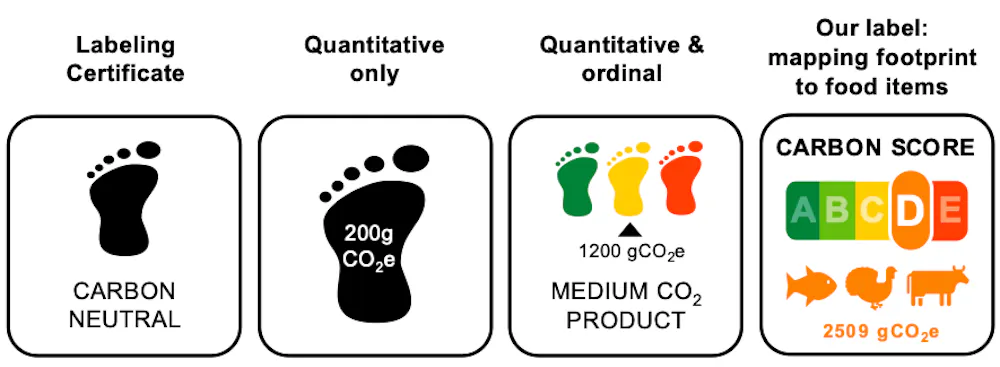
    Most carbon labels follow a similar approach. They typically display a number representing greenhouse gas emissions, and a traffic-light system indicating the level of environmental impact from green (low) to red (high). But such labels do not indicate whether the food is animal- or plant-based. So a high carbon score does not help people identify the source of the emissions.

    Our label maps the carbon footprint to the source of the food, whether plant or animal, along with information about the greenhouse gas emissions.
    Romain Cadario, Yi Li, Anne-Kathrin Klesse, (2025) Appetite., CC BY

    We designed a new type of label. It clearly displays whether the food is sourced mainly from animals or plants, along with the standard emissions score and traffic-light colour code. This approach is especially useful for the growing segment of pre-prepared and packaged foods such as soups and other ready-to-eat meals, which often contain a mix of meat and plant-based food.

    Our label creates a mental link between a food source and its carbon impact. When a consumer sees high carbon scores and red traffic lights appearing more frequently on meat and other animal products, they begin to make the connection between those products and higher emissions. This is key to addressing a lack of knowledge around food carbon emissions.

    We tested our label against the existing labels in a series of experiments with 1,817 everyday consumers from Australia, the United States and the Netherlands.

    One experiment involved soup. Compared with the group exposed to the standard carbon label, the group exposed to our label learned to associate animal-based soups with higher greenhouse gas emissions more effectively. They were more accurate at estimating the greenhouse gas emissions of a second batch of soups without labels.

    This improved knowledge also translates to more climate-friendly food choices. In another experiment with Australian consumers, we encouraged participants to choose five meals from ten options. Five were animal-based and five were plant-based.

    Half the participants saw the meal options with our carbon labels, and the other half did not see the carbon labels. The group exposed to our carbon labels chose fewer animal-based options in their weekly meal plan. In this case, we don’t know whether a third group exposed to the standard label would also make more climate-friendly choices, but our earlier experiments suggested our label was more effective.

    In the final experiment conducted in the Netherlands, displaying our carbon label made university students more likely to choose the plant-based snack option rather than the animal-based option.

    Providing information about the source of the food, whether plant or animal, influenced choices of meal plans.
    Romain Cadario, Yi Li, Anne-Kathrin Klesse, (2025) Appetite., CC BY

    When knowledge isn’t enough

    While people who care most about sustainable eating may think they know better than others, we found that is not the case. These people were not better able than other participants to tell the difference in greenhouse gas emissions between animal- and plant-based foods without seeing our carbon label.

    But they were better learners. When confronted with the facts about the differences between animal and plant-based foods on our labels, they were more likely to change their choices and switch to plant-based foods.

    What this means for consumers and businesses

    A simple change to food labels could help consumers make more informed environmental choices. For businesses and policymakers, it shows displaying only carbon numbers isn’t enough – the food source is crucial.

    Some forward-thinking restaurants and food companies are already experimenting with adding carbon labels to the menu to encourage diners to choose climate-friendly dishes. Our research suggests this approach could be more effective when combined with the new carbon labels we designed.

    Meat products make a significant contribution to climate change.
    Valmedia, Shutterstock

    Implications for climate action

    As Australia grapples with meeting its climate commitments, helping consumers understand the environmental impact of their food choices will become increasingly important.

    The challenge for businesses, policymakers and researchers isn’t convincing people to care about sustainability – they already do. Almost half of Australian shoppers (46%) say sustainability is important to them and influences their purchases, despite cost-of-living pressures.

    But most sustainable actions in retail involve recyclable packaging, products and materials, and local produce. The carbon emission implications of these actions, sadly, are far less than reducing animal-based food consumption.

    Instead, we need to focus on giving people the tools to make their environmental concerns count. Our carbon labels could be the key to helping consumers turn their sustainable intentions into meaningful climate action.

    Yi Li does not work for, consult, own shares in or receive funding from any company or organisation that would benefit from this article, and has disclosed no relevant affiliations beyond their academic appointment.

    – ref. Want a side of CO₂ with that? Better food labels help us choose more climate-friendly foods – https://theconversation.com/want-a-side-of-co-with-that-better-food-labels-help-us-choose-more-climate-friendly-foods-250513

    MIL OSI Analysis – EveningReport.nz –

    February 25, 2025
  • MIL-OSI China: China outlines key tasks to deepen rural reforms, advance rural revitalization

    Source: China State Council Information Office 2

    Agricultural machines work in fields at a farm of Beidahuang Group in northeast China’s Heilongjiang Province, Oct. 12, 2024. [Photo/Xinhua]
    China unveiled its “No. 1 central document” for 2025 on Sunday, outlining priorities to deepen rural reforms further and solid steps to advance all-around rural revitalization.
    As the first policy statement released by China’s central authorities each year, the document is seen as an indicator of policy priorities.
    The document consists of six parts covering six areas: ensuring the supply of grain and other important agricultural products, consolidating the achievements of poverty elimination, developing local industries, advancing rural construction, improving the rural governance system, and optimizing the rural resource allocation system.
    The document calls for enhanced efforts in work related to agriculture, rural areas and farmers in 2025 and beyond, and sets the goals of advancing all-around rural revitalization and consolidating the country’s agricultural foundations further.
    With reform, opening-up, and scientific and technological innovation as driving forces, the country will safeguard its grain security and ensure that no large-scale lapse or relapse into poverty occurs, the document says.
    The country will make every effort to enhance agricultural efficiency, invigorate rural areas and increase farming incomes, thereby laying a solid foundation for the advancement of Chinese modernization, the document stresses.
    It emphasizes the importance of developing new quality productive forces in agriculture in light of local conditions. It also calls for the cultivation of leading high-tech agricultural enterprises, and the acceleration of breakthroughs in crop varieties.
    China will support the development of smart agriculture and expand the application scenarios of technologies such as artificial intelligence, big data, and low-altitude systems, according to the document.
    It outlines plans to expand cold-chain logistics and instant retail services to townships, and encourages regions with suitable conditions to establish public charging and battery-swap facilities for electric vehicles.
    To promote the effective management and utilization of rural resources and assets, the document calls for the exploration of feasible ways to make good use of legally owned rural housing through methods such as leasing, equity participation and cooperation.
    The document urges innovation efforts related to the financing mechanisms for rural revitalization. Steps will be taken to strengthen support from central budget investments, ultra-long special government bonds, and special local government bonds for major projects in agriculture and rural areas. Monetary policy tools will be utilized to encourage financial institutions to increase funding for rural revitalization.
    Reforms related to forestry, state farms, and supply and marketing cooperatives will be advanced in a coordinated manner. The document stresses the importance of deepening the reform of the collective forest tenure, of enhancing comprehensive reforms of water pricing and water rights in the agricultural sector, of strengthening water usage management, and of promoting water-saving irrigation technologies.
    Eligible cities are encouraged to include their agricultural migrant populations with stable employment into the scope of local urban housing security policies gradually, the document notes.

    MIL OSI China News –

    February 25, 2025
  • MIL-OSI United Kingdom: Government announces raft of new policies and major investment to boost profits for farmers

    Source: United Kingdom – Executive Government & Departments

    Press release

    Government announces raft of new policies and major investment to boost profits for farmers

    Environment Secretary to announce reform package to boost farmers’ profitability as part of the Plan for Change

    New reforms to make farming more profitable will be announced today by the Secretary of State for Environment, Food and Rural Affairs Steve Reed.

    Speaking to farmers at the NFU conference in Westminster, Steve Reed will reveal new plans to deliver a profitable farming sector, while reaffirming Government’s cast iron commitment to food production, and unlocking rural growth.

    The speech will announce a raft of new policies to put money into the pockets of British farmers including:

    • Extending the Seasonal Worker visa route for five more years giving farms a pipeline of workers and certainty to grow their businesses. Annual quota reviews will ensure we strike the right balance – supporting farms while gradually reducing visa numbers as we develop alternative solutions.
    • Back British produce: British farmers handed a major boost under new requirements for government catering contracts to favour high-quality, high-welfare products that local farms and producers are well placed to serve. The move marks a major leap in achieving the government’s ambition for at least 50% of food supplied into the £5 billion public sector catering contracts to be from British producers or those certified to higher environmental standards.
    • £110 million investment in technology: The Farming Innovation Programme which supports research and development of agri-technology for farmers, for example the chemical free cleaning for integrated milking equipment, which lowers energy costs and chemical use. The Farming Equipment and Technology Fund provides grants of up to £25,000 to buy new equipment such as electric weeders to reduce chemical use.
    • Protecting farmers in trade deals: The government will uphold and protect our high environmental and animal welfare standards in future trade deals.
    • Strengthening Britain’s biosecurity: Setting up a new National Biosecurity Centre to transform the Animal and Plant Health Agency animal health facility at Weybridge, investing £200 million to improve our resilience against animal disease to protect farmers and food producers.

    Speaking about profitability, Steve Reed, Secretary of State for Environment, Food and Rural Affairs is expected to say:

    The underlying problem is that farmers do not make enough money for the hard work and commitment they put in. 

    I will consider my time as Secretary of State a failure if I do not improve profitability for farmers across the country.

    My focus is on ensuring farming becomes more profitable because that’s how we make your businesses viable for the future. And that’s how we ensure the long-term food security this country needs.

    This builds on the commitments made at the Oxford Farming Conference, where the Environment Secretary set out the government’s vision for farming including:

    • Using planning reforms to support food production: Ensuring our reforms make it quicker for farmers to build the buildings, barns and other infrastructure they need on their farms to boost food production.
    • Diversifying income streams: Helping farmers make additional money from selling surplus energy from solar panels and wind turbines by accelerating connections to the grid, supporting them during difficult harvests and supply shocks. 
    • A fair supply chain: Boosting profitability through fair competition across the supply chain. New rules for the pig sector will come this spring, ensuring contracts clearly set out expectations and changes can only be made if agreed by all parties. Similar regulations for eggs and fresh produce sectors will follow with the government ready to intervene with other sectors if needed.

    Share this page

    The following links open in a new tab

    • Share on Facebook (opens in new tab)
    • Share on Twitter (opens in new tab)

    Updates to this page

    Published 25 February 2025

    MIL OSI United Kingdom –

    February 25, 2025
  • MIL-OSI USA: ICYMI: Senate Appropriators Murray, Shaheen Sound Alarm on Public Health Effects of Mass Firings at the Food and Drug Administration; Urge Secretary Kennedy to End Indiscriminate Cuts

    US Senate News:

    Source: United States Senator for Washington State Patty Murray
    ICYMI: Murray Blasts Trump and Musk Decimating HHS, Risking Americans’ Health and Livelihoods
    ***FACT SHEET: WA State Impacts of Trump and Musk’s Reckless Mass Layoffs***
    Washington, D.C. – U.S. Senators Patty Murray (D-WA), Vice Chair of the U.S. Senate Appropriations Committee, and Jeanne Shaheen (D-NH), Ranking Member of the U.S. Senate Appropriations Subcommittee on Agriculture, Rural Development, Food and Drug Administration and Related Agencies, sent a letter Friday to U.S. Department of Health and Human Services (HHS) Secretary Robert F. Kennedy, Jr. to express their grave concerns about the recent mass firings of hundreds of federal workers at the Food and Drug Administration (FDA). Murray and Shaheen’s counterparts in the U.S. House of Representatives—House Appropriations Committee Ranking Member Rosa DeLauro (D, CT-03) and Congressman Sanford Bishop (D, GA-02)—also signed the letter. 
    The lawmakers wrote, “The FDA’s mission is to protect public health by assuring the safety, efficacy and security of our human and veterinary drugs, food and cosmetics products and the regulation of tobacco products. We are concerned that the mass firings of probationary staff at the FDA, many of whom with scientific backgrounds, will prevent us from staying on the cutting edge of drug and device approvals, maintaining food safety and responding to new threats, like avian flu.” 
    “This decision will only hurt the American people by preventing advancements in patient care and is directly in conflict with President Trump’s stated health care goal of, ‘providing more choice, better care, and lower costs,’” they continued.
    The full text of the letter can be found here. 
    Last week, Senator Murray responded at length to the Trump administration’s mass firings of dedicated workers across HHS and its many subagencies—and earlier this month she released a fact sheet detailing how reckless mass layoffs across the federal government will jeopardize essential services Americans rely on. Senator Murray was a leading voice in opposition to the confirmation of RFK Jr. as HHS Secretary. Earlier this month on the Senate floor, she warned of the dangers of confirming RFK, Jr.—given his lack of health care experience and deadly rhetoric—and encouraged her colleagues to “show some courage” by rejecting his nomination. A longtime congressional leader on health care and former HELP Committee Chair, she called her meeting with him the “most troubling” she’s ever had with a cabinet nominee.

    MIL OSI USA News –

    February 25, 2025
  • MIL-OSI USA: Tuberville, Paul Introduce Legislation to Overhaul NIAID

    US Senate News:

    Source: United States Senator Tommy Tuberville (Alabama)
    Legislation would make national research institute directors Senate-confirmed positions
    WASHINGTON – U.S. Senator Tommy Tuberville (R-AL) joined U.S. Senator Rand Paul (R-KY) to introduce the NIH Reform Act to increase congressional oversight on leadership at the National Institute of Allergy and Infectious Diseases (NIAID). The NIH Reform Act would separate the NIAID into three national research institutes: the National Institute of Allergic Diseases, the National Institute of Infectious Diseases, and the National Institute of Immunologic Diseases. Each new institute would be led by directors subject to Senate confirmation and limited to no more than two five-year-terms to prevent the unchecked authority that led to disastrous mandates during the COVID-19 pandemic.
    “Anthony Fauci single-handedly shut down small businesses, forced our children out of classrooms, and took away the opportunity for many Americans to say goodbye to loved ones during the COVID pandemic,” said Senator Tuberville. “It’s scary to think that someone who was never elected – or even confirmed by the Senate – had so much power over health care decisions that impacted millions of Americans.  We need greater transparency in our government’s institutions to ensure this never happens again. I’m proud to join Senator Paul in this legislation to increase oversight of the NIH and give the American people greater transparency surrounding our government institutions.”
    “For nearly four decades, Dr. Anthony Fauci sat atop a bureaucratic empire, wielding unchecked power over public health policy—despite never being confirmed by the Senate once,” said Dr. Paul. “He dictated mandates that shut down businesses, kept kids out of school, and trampled individual liberties—all while being the highest-paid official in the federal government. That kind of power without oversight is dangerous, and my legislation will ensure it never happens again. This legislation will bring accountability and oversight into a taxpayer-funded position that has largely abused its power and has been responsible for many failures and misinformation during the COVID-19 pandemic.”
    U.S. Representative Chip Roy (R-TX-21) introduced the legislation in the U.S. House of Representatives.
    Complete text of the bill can be found here.
    BACKGROUND:
    Dr. Anthony Fauci was Director of the National Institute of Allergy and Infectious Diseases for over 38 years—longer than J. Edgar Hoover was Director of the FBI. By the time he retired, he was the highest paid official in the entire federal government. Yet the Senate never voted to confirm him once. Current law does not require Senate confirmation of the NIAID Director.
    The NIAID’s stated mission is “to better understand, treat, and ultimately prevent infectious, immunologic, and allergic diseases.” This sweeping mandate covers everything from asthma to Ebola, from peanut allergies to the plague. As the head of that institute, Dr. Fauci installed himself as a de facto pandemic czar, advocating for misguided policies like mandatory vaccinations for school-aged children (one of the populations least at risk from COVID-19).
    To improve accountability of the NIH, the NIH Reform Act will restructure the NIAID to better align with its mission as follows:
    Abolish the NIAID and replace it with the following three new institutes:
    National Institute of Allergic Diseases
    National Institute of Infectious Diseases
    National Institute of Immunologic Diseases
    The directors of each new institute would be:
    Appointed by the president
    Subject to Senate confirmation
    Limited to no more than two 5-year terms
    This type of reorganization is nothing new. In the aftermath of J. Edgar Hoover’s decades-long tenure as head of the FBI, Congress passed a law in 1976 limiting the FBI Director to a single 10-year term, and as recently as 2012, Congress eliminated one center within the NIH and replaced it with a new one. In the aftermath of the damage done by pandemic-era mandates and restrictions, Congress must enact the NIH Reform Act to ensure that one official cannot claim the unquestioned authority to dictate the federal response to public health emergencies.
    Senator Tommy Tuberville represents Alabama in the United States Senate and is a member of the Senate Armed Services, Agriculture, Veterans’ Affairs, HELP, and Aging Committees.

    MIL OSI USA News –

    February 25, 2025
  • MIL-OSI Australia: Funding for regional groups for stocking native fish in local waters now available

    Source: New South Wales Government 2

    Headline: Funding for regional groups for stocking native fish in local waters now available

    Published: 25 February 2025

    Released by: Minister for Agriculture, Minister for Regional NSW


    The Minns Labor Government has announced that funding for fishing clubs and native fish stocking groups is now available for restocking regional rivers and dams with iconic native fish such as Australian Bass, Golden Perch and Murray Cod.

    These fish are also appreciated as highly sought after angling fish that support recreational fishing and local tourism.

    The NSW Government is committed to delivering for recreational fishers and the NSW regional environment to preserve the many locations and lifestyles that are special for families and locals.

    Two dollars in funding is provided from for every dollar raised by the community to purchase Australian Bass, Golden Perch and Murray Cod from accredited commercial fish hatcheries for stocking into public waterways.

    This program is part of the Government’s commitment to recreational fishers and helps boost native fish stocks to deliver enhanced fishing opportunities into regional waterways where factors such as carp and drought may have hindered native fish stock levels.

    The program also supports the regional aquaculture ventures which produce the high-quality fish stock that are released release into public waters to benefit recreational fishers. These ventures provide local jobs in the regions at hatcheries and breeding sites.

    Last year 70 grants were approved under the program and delivered fish stocks for local fishing clubs to restock waterways in places like Lake Cargelligo, Leeton, Walgett, Bermagui, Nowra, Goulburn, Tumut and Yass.

    Australian bass live in coastal rivers along the east coast and downstream for breeding from may to August. Golden Perch occur throughout the Murray-darling river system and are migratory species following increases in water flow up stream during spring and summer.

    Murray Cod encompass most of the Murray Darling Rivers and mature adults will travel long distances to spawn during spring and summer.

    Fish stocking in NSW is carefully managed under a fish stocking fishery management strategy to ensure sustainability to ensure the activity is conducted with appropriate environmental controls and generates quality recreational fishing outcomes.

    Groups interested in applying for the grants, can apply online before the closing dates for the Community Native Fish Stocking (CNFS) 2025/26 grants program. Fish stocking is expected to take place between November 2025 and April 2026.

    A minimum of $2,000 and a maximum of $6,000 per application per group is required.  Only one application per group may be submitted.

    Applications to stock Australian Bass close on 28 March 2025. 

    Applications to stock Golden Perch or Murray Cod close on 9 May 2025.

    To apply https://www.dpi.nsw.gov.au/fishing/recreational/resources/stocking/CNFS

    Minister for Agriculture and Regional NSW, Tara Moriarty said:

    “Our Government is focused on delivering great recreational fishing and environmental outcomes. This program delivers in every way for fishers by populating highly popular native sportfish in regional waterways.

    “These fish stocking events will help diversify and enhance our valuable native fishery, increase fishing amenity and support local businesses.

    “Millions of fish are produced and stocked by government and private sector hatcheries each year into rivers, streams and dams across the State to improve recreational fishing opportunities in NSW that create jobs for regional people.

    “Native fish stocking provides many economic and social benefits, as well as positive environmental outcomes due to the importance of native fish in the landscape.

    “This is another great example of your fishing licence fees at work. More information on fish stocking can be found online.”

    MIL OSI News –

    February 25, 2025
  • MIL-OSI USA: Hickenlooper, Bennet, Colleagues Reintroduce Bill to Combat Wildfires, Drought Across the West

    US Senate News:

    Source: United States Senator for Colorado John Hickenlooper
    Protect the West Act would invest $60 billion to reduce wildfire risks, restore watersheds, and protect communities
    WASHINGTON – Today, U.S. Senators John Hickenlooper, Michael Bennet, Ron Wyden, Ruben Gallego, and Jacky Rosen reintroduced the Protect the West Act, which invests $60 billion in forests across the West to reduce wildfire risk, restore watersheds, protect communities, and decrease the cost of fighting wildfires.
    “Colorado’s forests, grasslands, and waterways are the bedrock of our outdoor economy,” said Hickenlooper. “Every effort we make to prevent wildfires and mitigate the impact of climate change is an investment in Colorado’s future.”
    “In the West, our forests, grasslands, and watersheds are essential to our economy and way of life. But they are under threat from the worsening effects of climate change and consistent underinvestment from the federal government,” said Bennet. “As we face a 1,200-year megadrought and wildfire season that never seems to end, we need to break from the status quo and invest in the restoration of our forests and public lands to meet this challenge. We have no time to waste.”
    “Climate change is threatening our way of life in Colorado. We must act,” said Crow. “The Protect the West Act would help combat intensifying wildfires and help better protect Colorado communities.”
    “With summers getting dryer and hotter, the West and Oregon’s treasured lands are a tinderbox waiting to light ablaze,” said Wyden. “In my town halls, I’ve heard countless Oregonians fearing for their health and safety while struggling to maintain their economic livelihood as severe drought and wildfires wreak more havoc on their communities every year. More investments are needed to protect our forests and watersheds so local communities across the West are healthy and can have the opportunity to explore its beautiful natural treasures for generations.”
    “In Arizona and across the West, we face a rapidly growing backlog of projects for wildfire mitigation, drought resilience, and land restoration,” said Gallego. “I’m proud to help introduce the Protect the West Act which will finally give states and tribes the tools they need to take on these projects, all while creating good-paying jobs and boosting rural economies.”
    “Nevada’s forests and public lands are increasingly susceptible to wildfires, drought, and other extreme weather events. We need to do everything we can to protect our communities from the damage caused by these disasters and bolster our ability to recover,” said Rosen. “This critical legislation will support Nevada’s wildfire mitigation and restoration efforts, helping to keep Nevadans safe. I’ll always work to ensure Nevada has the resources it needs to fight wildfires and other weather-related events.”
    In the West, our strong outdoor rec industry and our agricultural communities depend on healthy lands, forests, and waterways. Increasingly frequent wildfires threaten those communities and our economy.
    Currently, the federal government spends approximately $2.9 billion to fight wildfires every year, with costs expected to increase by a billion by 2050. Already, the U.S. spent nearly $48 billion fighting wildfires over the last five years.
    Preventing wildfires before they even start is thirty times more cost-effective. Investing in fire mitigation and making our communities more resilient will save taxpayers money by reducing response and recovery costs.
    Specifically, the Protect the West Act would:
    Establish an Outdoor Restoration & Watershed Fund to better support local efforts to restore forests and watersheds, reduce wildfire risk, clean up public lands, enhance wildlife habitat, remove invasive species, and expand outdoor access
    Establish an advisory council of local, industry, conservation, Tribal, and national experts to advise funding priorities, coordinate with existing regional efforts, and provide oversight
    Empower local leaders by making $20 billion directly available to state and local governments, Tribes, special districts, and nonprofits to support restoration, drought resilience, and fire mitigation projects
    Partner with states and Tribes to invest $40 billion to tackle the backlog of restoration, fire mitigation, and resilience projects
    Create or sustain over two million good-paying jobs, primarily in rural areas, to support existing industries like forest product, agriculture, and outdoor recreation
    Save landowners and local governments money by investing in wildfire prevention and natural hazard mitigation.
    “The Protect the West Act is a significant investment in Colorado’s natural resources and Colorado is proud to support its reintroduction in the US Senate,” said Dan Gibbs, Executive Director, Colorado State Department of Natural Resources. “As Colorado experiences drought and continued threats from devastating wildfires, now is the time to invest in Colorado’s forests, watersheds, and landscapes that drive economic activity across the west, employ thousands of Americans, and provide environmental and ecological benefits to our communities and wildlife.”
    “One of the greatest threats to our Tribal lands are the devastating wildfires caused by the extreme drought conditions in the western United States,”said the Southern Ute Indian Tribe. “Sen. Bennet’s Protect the West Act will provide much needed investment in conservation, restoration and wildfire mitigation. A key component of this legislation is Sen. Bennet’s recognition of the importance that Tribes have in land use and regulation, assuring that funds will be made available directly to Tribes for maintenance of our forests, watersheds and rangeland. Moreover, he assures that Tribes will have a seat at the table in determining the distribution of funds, ensuring that there will be a tribal representative working alongside our state and federal partners on the Restoration Fund Advisory Council. We thank Sen. Bennet for introduction of this important legislation and look forward to its swift passage in Congress.”
    “Healthy watersheds face numerous challenges, including increasing drought, longer and hotter fire seasons, disconnected watersheds and degraded streams that no longer support healthy fisheries. The most effective way to tackle this challenge is through partnerships and collaborative conservation at the landscape scale,” said Chris Wood, President and CEO of Trout Unlimited. “The Protect the West Act would foster collaboration and provide resources for public-private partnerships to restore lands and waters across multiple jurisdictions, creating jobs and better fishing along the way. We thank Senator Bennet for his leadership and vision to restore our lands and waters at the scope and scale that will make a difference for future generations.”
    “The Colorado River District’s highest priority is to protect the water security of Western Colorado. Water security starts with our forests,” said Andy Mueller, General Manager, Colorado River District. “Our largest source of water is the snowpack that develops in our forests above 9,000 feet in elevation, mostly on federal lands. Sen. Michael Bennet’s $60 billion Protect the West Act proposal is a direct water security initiative through the funding of proactive watershed protection actions. These actions would help prevent catastrophic fires and start restoration work where warming temperatures and fires have already done harm. It’s noteworthy that $20 billion will be available to fund projects generated at the state and local levels. We applaud Senator Bennet for advocating for important western priorities in the Senate.”
     “I support the Senator’s Protect the West Act. This is a great first step in recognizing and acknowledging the problem that was created over 30 years ago,” said Merrit Linke, Grand County Commissioner. “The lack of proactive management and the ‘hands-off’ approach is now clearly having devastating effects on our communities, forest health and sustainable watersheds. This bill addresses this problem, provides much needed funding, and hopefully is the beginning of a new era in resource management. Now it is time to get to work.”
     “As Western communities continue to face the threats and the impacts of the climate crisis, now is the time to pursue initiatives that will help us become more resilient,” said Jon Goldin-Dubois, President of Western Resource Advocates. “The Protect the West Act will provide critical resources to help Western states mitigate wildfire, restore forests, improve air and water quality, and advance equity, all while pumping billions of dollars into local economies and supporting millions of good-paying jobs; it’s a true win-win. We applaud Senator Bennet for his leadership and look forward to supporting this legislation to build a more resilient West.”
    “Healthy forests support fish and wildlife habitat and outdoor access important to hunters, anglers, and recreationists in Colorado and across the nation,” said Joel Pedersen, CEO, Theodore Roosevelt Conservation Partnership. “However, decades of inadequate funding for forest management have placed a strain on the National Forest System that will require active management and sustained funding to increase workforce capacity. Further, these investments will help to ensure we’re better prepared to address the growing risks associated with wildfire.  The TRCP applauds the proactive investments in our forests and watersheds and the additional resources for growing the forest management workforce provided through the Protect the West Act.”
    The bill is supported by: The National Wildlife Federation, the Southern Ute Indian Tribe, National Association of State Foresters, The Freshwater Trust, American Forests, National Wild Turkey Federation, National Audubon Society, Family Farm Alliance, Theodore Roosevelt Conservation Partnership, Western Landowners Alliance, Western Resource Advocates, Trout Unlimited, and Conservation Legacy.
    U.S. Representative Jason Crow introduced companion legislation in the House.
    The full text of the bill is available HERE.

    MIL OSI USA News –

    February 25, 2025
  • MIL-OSI Security: Hartford Man Admits Fraudulently Collecting Social Security, Unemployment, and Food Stamp Benefits

    Source: Office of United States Attorneys

    Marc. H. Silverman, Acting United States Attorney for the District of Connecticut, announced that RICARDO SANTIAGO, 59, of Hartford, pleaded guilty today before U.S. District Judge Vernon D. Oliver in Hartford to a fraud offense related to a scheme to fraudulently obtain Social Security, unemployment, and Food Stamp benefits.

    According to court documents and statements made in court, between 2002 and 2024, Santiago held jobs with more than 20 employers and earned income totaling more than $580,000.  Santiago concealed his income from federal and state government agencies by providing to employers false identification, including a Social Security number and card belonging to another individual, and, in at least one instance, a false Social Security card.

    In 2002, Santiago applied for Retirement Survivors Disability Insurance (RSDI) benefits, representing to the Social Security Administration that he was unable to work due to disability.  As a result, he began receiving RSDI payments in September 2002.  In 2017, Santiago completed paperwork to maintain his benefits in which he asserted that he remained disabled and had not worked for the past two years.  Santiago ultimately collected more than $316,000 in RSDI payments to which he was not entitled.

    In February 2017, Santiago submitted to the Connecticut Department of Social Services (CT-DSS) an application for Supplemental Nutrition Assistance Program (SNAP) benefits (“Food Stamps”), representing to the CT-DSS and the U.S. Department of Agriculture that he earned no income from employment.  He began receiving SNAP benefits in March 2017 and subsequently completed forms to renew his SNAP benefits on which he again represented that he had no change in his income and that he earned no money from employment.  Santiago made more than $18,000 in purchases with SNAP benefits to which he was not entitled.

    In April 2020, Santiago applied to the Connecticut Department of Labor (CT-DOL) for Unemployment Insurance benefits.  On the application, Santiago used a Social Security number belonging to another individual, and he represented to the CT-DOL and U.S. Department of Labor that he was unemployed but available for work and physically able to work.  He subsequently completed weekly certifications making the same representations.  From April 2020 through February 2021, Santiago received more than $36,000 in payments to which he was not entitled.

    Santiago has agreed to pay restitution of $371,686.

    Santiago pleaded guilty to one count of wire fraud, an offense that carries a maximum term of imprisonment of 20 years.  He is released on a $25,000 bond pending sentencing, which is scheduled for May 22.

    Santiago was arrested on May 7, 2024.

    This matter is being investigated by the Social Security Administration Office of the Inspector General, the U.S. Department of Agriculture Office of the Inspector General, the U.S. Department of Labor Office of the Inspector General, and the U.S. Department of Transportation Office of the Inspector General.  The case is being prosecuted by Assistant U.S. Attorney Nathan J. Guevremont.

    MIL Security OSI –

    February 25, 2025
  • MIL-OSI: Spartan Capital Securities Names Brian Duddy as Head of Capital Markets

    Source: GlobeNewswire (MIL-OSI)

    NEW YORK, NY, Feb. 24, 2025 (GLOBE NEWSWIRE) — Spartan Capital Securities, LLC is pleased to announce that Brian Duddy has been promoted from Director of Equities to Head of Capital Markets. With over 30 years of experience in Capital Markets, Equity Sales, and Trading, Brian has played a key role in driving institutional engagement and executing complex transactions.

    Prior to joining Spartan Capital, Mr. Duddy held senior positions at leading financial institutions, including William Blair, where he opened the firm’s first New York office and became a partner in the Equity Sales & Trading Group. His extensive background includes roles at DLJ, Cowen, and Soleil Securities, where he worked closely with major hedge funds and institutional investors, facilitating large block trades, overnight transactions, and placing IPOs and Secondary Offerings with his clients.

    Spartan Capital Securities’ Founder and CEO, John Lowry, commented: “Brian Duddy’s expertise and leadership continue to strengthen Spartan’s presence in Capital Markets. His deep institutional relationships and ability to execute complex transactions make him a tremendous asset to our firm and clients. We look forward to his continued contributions.”

    About Spartan Capital Securities, LLC (SCS):

    Spartan Capital Securities, LLC is a full-service, integrated financial services firm that provides sound investment guidance for high-net-worth individuals and institutions. Their in-depth market knowledge, calculated risk management strategy, and investment acumen have earned them a strong reputation as trusted financial advisors. Spartan Capital’s experienced investment professionals provide highly customized personal service, tailoring an asset allocation program to enable each client to meet their financial goals. Spartan Capital also offers advisory and insurance services through its affiliates, Spartan Capital Private Wealth Management, LLC, and Spartan Capital Insurance Services, LLC.

    For inquiries, contact: info@spartancapital.com

    John D. Lowry
    Spartan Capital Securities
    +1 (212) 293-0123

    The MIL Network –

    February 25, 2025
  • MIL-OSI USA: Merkley, Wyden: Trump Devastates Oregon’s Rural Communities with Federal Funding Cuts and Mass Firings

    US Senate News:

    Source: United States Senator Ron Wyden (D-Ore)

    February 24, 2025

    Washington, D.C. – Today, Oregon’s U.S. Senators Jeff Merkley, the former top Democrat on the Appropriations subcommittee overseeing the U.S. Department of Agriculture (USDA), and Ron Wyden demanded recently confirmed U.S. Agriculture Secretary Brooke Rollins immediately reverse disastrous actions at the USDA that have harmed Oregon farmers and families.

    Their letter follows President Donald Trump’s illegal executive orders cutting federal funds which support farmers, ranchers, and forest landowners and mass firings across the federal government, impacting researchers at units in Burns, Newport, Hood River, and Pendleton.

    “These funding freezes and mass firings are cutting jobs, stopping essential investments for our farmers and rural communities, and making our communities less resilient to market volatility from climate, supply chain disruptions, tariffs, and natural disasters,” wrote the Senators. “These agency actions must be immediately reversed.”

    The Senators stressed the effects on Oregon by saying, “Many of our constituents have already started much-needed infrastructure projects – such as irrigation modernization under the Watershed and Flood Prevention Operations Program to help farmers in drought-prone areas upgrade their irrigation practices to increase efficiency and conserve water – under the assurance that they would receive their grant money. Halting these payments means that a project in Hood River County will not only be delayed for over 100 days but will put the irrigation district at risk of insolvency. Even if funds are restored immediately, the current delay will ultimately increase the overall costs of this and other urgent projects while also costing hardworking Americans their jobs. Preventing grant recipients from finishing their projects is not a cost-effective or efficient approach to governance and is irresponsible stewardship of Congressionally appropriated taxpayer dollars.”

    “While there are reports that some funds have been released, in accordance with the Constitution and federal law, we direct you to immediately release all funds under these grants to ensure these projects stay on schedule, on budget, and preserve jobs. Further, we direct you to stop these senseless firings and restore these dedicated public servants to their jobs to enhance our agriculture industry, protect food safety, and bolster jobs in rural communities and throughout Oregon,” the Senators directed.

    Full text of the letter can be found by clicking here and follows below:

    Dear Secretary Rollins,

    On the same day he was sworn in, President Trump signed an Executive Order effectively halting all investments under the Infrastructure Investments and Jobs Act, commonly known as the Bipartisan Infrastructure Law, and Inflation Reduction Act, jeopardizing vital programs that support Oregon farmers and families. Despite court intervention at other agencies pausing these harmful cuts, the United States Department of Agriculture (USDA) continues to freeze critical funding, which continues to cause severe disruption to farmers, ranchers, and forest landowners who are implementing projects under these landmark pieces of legislation. Since then, the Trump Administration has also fired an estimated 4,200 dedicated public servants in Oregon and across the country, grinding critical work and research to a halt across the agency.

    These funding freezes and mass firings are cutting jobs, stopping essential investments for our farmers and rural communities, and making our communities less resilient to market volatility from climate, supply chain disruptions, tariffs, and natural disasters. These agency actions must be immediately reversed.

    Critical research partnerships with universities and local farmers and ranchers through the USDA Agricultural Research Service are devastated with uncertain futures after public servants at research stations in Pendleton, Burns, Hood River, Corvallis, and Newport were fired. This vital work helps Oregon’s leading agricultural sectors find solutions toward improving soil health, dealing with wildfire smoke exposure in wine grapes, protecting the rangeland for both ranchers and ecosystems, and navigating threats like disease and pests to reliably bring global-class products to market.

    Many of our constituents have already started much-needed infrastructure projects – such as irrigation modernization under the Watershed and Flood Prevention Operations Program to help farmers in drought-prone areas upgrade their irrigation practices to increase efficiency and conserve water – under the assurance that they would receive their grant money. Halting these payments means that a project in Hood River County will not only be delayed for over 100 days but will put the irrigation district at risk of insolvency. Even if funds are restored immediately, the current delay will ultimately increase the overall costs of this and other urgent projects while also costing hardworking Americans their jobs. Preventing grant recipients from finishing their projects is not a cost-effective or efficient approach to governance and is irresponsible stewardship of Congressionally appropriated taxpayer dollars.

    Other projects, such as programs that partner with farmers, ranchers, and forest landowners in over half of Oregon’s 36 counties – including in Baker, Coos, Crook, Douglas, Grant, Jefferson, Klamath, Lake, Malheur, Morrow, Polk, Umatilla, Union, and Wheeler counties – to confront the challenges of drought and other extreme weather events have had the rug pulled out from under them. These landowners have already started projects amounting to tens of millions in investments to build operational and environmental resiliency into our food systems by implementing innovative production practices, increasing market competitiveness, and supporting local manufacturing.

    Other longer-term grants for wildfire resiliency through the Regional Conservation Partnership Program, such as a $22.25 million investment for work in Jackson County, has also been frozen. This has paused vital work to help ensure local landowners can not only recover from past devastating wildfires but are able to protect their neighbors and communities from future wildfires.

    Grant recipients are expecting reimbursement or payment for projects already underway and instead have been met with the message that their projects were either being paused or completely stopped. Many of these recipients are now scared to come forward for fear of further retribution and loss of vital federal support.

    While there are reports that some funds have been released, in accordance with the Constitution and federal law, we direct you to immediately release all funds under these grants to ensure these projects stay on schedule, on budget, and preserve jobs. Further, we direct you to stop these senseless firings and restore these dedicated public servants to their jobs to enhance our agriculture industry, protect food safety, and bolster jobs in rural communities and throughout Oregon.

    MIL OSI USA News –

    February 25, 2025
  • MIL-OSI Canada: Legislature assembles for start of spring session

    [.  

    This session will see Alberta’s government take action to support the implementation of measures announced in Budget 2025, modernizing existing legislation and reducing red tape, ensuring the province’s laws remain relevant, easy to understand and attractive to investors.

    “Alberta’s government is heading back to the legislature to continue to work for Albertans. In the face of the shifting geopolitical landscape and a federal government preoccupied with its own internal bickering rather than guiding the country through these uncertain waters, our government will be taking decisive action to ensure Alberta is best positioned to meet challenges as they come.”

    Joseph Schow, Government House Leader and Minister of Tourism and Sport

    Among the proposed legislation for the spring session is an act that would provide a uniform governance framework for professional regulatory organizations, so they can continue the important work of protecting the public interest of Albertans. Additional legislation would support Albertans’ understanding of addiction treatment services, providing confidence that providers are aligned with the standards set out by the Alberta Recovery Model.

    Alberta’s government will also be introducing several pieces of legislation to help Albertans face the rising cost of living. Legislation would ensure Albertans have access to the utilities they need when they need them, at a price they can afford, and would enable better, faster, cheaper auto insurance for Alberta drivers.

    The work in the assembly will be in addition to the government’s ongoing efforts to de-escalate border and trade tensions with the U.S. amid uncertainty in global geopolitical and energy markets, reduce barriers to interprovincial trade, and maintain Alberta’s status as the best place to live, work, and raise a family.

    Alberta’s government will table approximately 20 pieces of legislation this session, including*:

    • Agriculture and Irrigation Statutes Amendment Act
    • Automobile Insurance Act 
    • Financial Statutes Amendment Act
    • Mental Health Services Protection Amendment Act
    • Professional Governance Act
    • Public Safety and Emergency Services Statutes Amendment Act
    • Red Tape Reduction Statutes Amendment Act
    • Utilities Statutes Amendment Act
    • Wildlife Amendment Act

    *Names of legislation are subject to change.              

    Multimedia

    • Watch the news conference

    MIL OSI Canada News –

    February 25, 2025
  • MIL-OSI: Ready Capital Corporation Announces Closing of $220.0 Million of Senior Secured Notes

    Source: GlobeNewswire (MIL-OSI)

    NEW YORK, Feb. 24, 2025 (GLOBE NEWSWIRE) — Ready Capital Corporation (NYSE: RC) (“Ready Capital” or the “Company”) today announced that on February 21, 2025, ReadyCap Holdings, LLC (“ReadyCap”), an indirect subsidiary of the Company closed a private placement of $220.0 million in aggregate principal amount of its 9.375% Senior Secured Notes due 2028 (the “Notes”). The Notes are senior secured obligations of ReadyCap. Payments of the amounts due on the Notes are fully and unconditionally guaranteed (the “Guarantees”), at issuance, by the Company, Ready Capital Partners I, LLC, Ready Capital Subsidiary REIT II, LLC (“SubREIT II”), RCSR I Investments, LLC (“RCSR I”), RCSR II Investments, LLC (“RCSR II”) and RCSR I Intermediate Holdings, LLC (collectively, the “Guarantors”). ReadyCap’s and the Guarantors’ respective obligations under the Notes and the Guarantees are secured by a first-priority lien on the assets of RCSR I and RCSR II and the capital stock of RCSR I, RCSR II, SubREIT II and certain other subsidiaries of the Company.

    The Company intends to use the net proceeds from the private placement to repay its indebtedness and for general corporate purposes.

    Piper Sandler & Co. acted as the placement agent for the offering. Alston & Bird LLP served as counsel for the Company, and Ropes & Gray LLP served as counsel for the placement agent.

    The Notes and the Guarantees will not be registered under the Securities Act or any state securities laws and may not be offered or sold in the United States absent an effective registration statement or an applicable exemption from the registration requirements of the Securities Act of 1933, as amended, or any state securities laws.

    This press release shall not constitute an offer to sell or the solicitation of an offer to buy any of the Company’s securities, nor shall there be any sale of the Company’s securities in any state in which such offer, solicitation or sale would be unlawful prior to registration or qualification under the securities laws of any such state.

    About Ready Capital Corporation

    Ready Capital Corporation (NYSE: RC) is a multi-strategy real estate finance company that originates, acquires, finances and services lower-to-middle-market investor and owner occupied commercial real estate loans. The Company specializes in loans backed by commercial real estate, including agency multifamily, investor, construction, and bridge as well as U.S. Small Business Administration loans under its Section 7(a) program and government guaranteed loans focused on the United States Department of Agriculture. Headquartered in New York, New York, the Company employs approximately 500 professionals nationwide. The Company is externally managed and advised by Waterfall Asset Management, LLC.

    Forward-Looking Statements

    This press release contains certain forward-looking statements. Words such as “believe,” “expect,” “anticipate,” “estimate,” “plan,” “continue,” “intend,” “should,” “could,” “would,” “may,” “potential” or the negative of those terms or other comparable terminology are intended to identify forward-looking statements. These forward-looking statements include statements relating to, among other things, the expected use of the net proceeds from the private placement. These forward-looking statements are subject to the inherent uncertainties in predicting future results and conditions, many of which are beyond the control of the Company, including, without limitation, the risk factors and other matters set forth in the Company’s Annual Report on Form 10–K for the year ended December 31, 2023 filed with the SEC and in its other filings with the SEC. The Company undertakes no obligation to publicly update or revise any forward-looking statements, whether as a result of new information, future events or otherwise, except as may be required by law.

    Contacts:
    Investor Relations
    Ready Capital Corporation
    212-257-4666
    InvestorRelations@readycapital.com

    The MIL Network –

    February 25, 2025
  • MIL-OSI USA: Eric Kruger Named as UConn’s New VP of Facility Services and University Planning

    Source: US State of Connecticut

    A seasoned facilities operations professional with extensive experience at UConn and in the private sector has been selected as the University’s new vice president of facility services and University planning.

    Eric Kruger, currently UConn Health’s vice president for facilities development and operations, will oversee the comprehensive planning and management of all facilities operations and the physical infrastructure of all UConn campuses.

    He starts in his new role on March 21, leading a team that provides a wide range of essential services that touch the daily lives of all who work, learn, and visit UConn.

    They include the design and operations of campus buildings, infrastructure maintenance, space planning, sustainability and energy management, landscape design and grounds maintenance, logistics management, parking and transportation operations, custodial services, and skilled trades services.

    “Eric’s extensive knowledge of the University and its myriad operations will enable him to quickly and smoothly transition into his new role, which will greatly benefit our campus communities,” says Jeffrey Geoghegan, UConn’s executive vice president for finance and chief financial officer.

    “We are fortunate to have someone in this position with Eric’s expertise, vision, and proven track record of dedication to UConn,” he says.

    Eric Kruger, UConn Health vice president of facilities, development, and operations speaks about the innovative pilot project to be deployed on the Farmington campus to bolster the state’s efforts for delivering energy cost savings on August 28, 2024. (Tina Encarnacion/UConn Health Photo)

    Kruger came to UConn in 2014 as executive director of facilities and operations and was promoted in 2022 to his current role at UConn Health. He previously was as an operations and engineering manager at Eversource and had a 20-year career with the U.S. Naval Submarine Force, from which he retired as a Senior Chief Petty Officer / Submarine Senior Chief Electrician’s Mate.

    His wide range of experience gives him insight into all aspects of UConn’s operations, including the financial management and strategic vision required for his new position and the synergistic operations of the teams in facilities management and university planning.

    “I am thrilled to be selected to lead the Facilities Services and University Planning team,” Kruger says. “This exciting opportunity to combine the experience and knowledge shared by the dedicated staff on these two teams will improve our ability to provide consistent, customer-focused support to the UConn community.”

    He also has demonstrated his commitment to responsiveness, transparency, and communications in his roles at UConn since he joined the University, and has established strong and trusting relationships with fellow employees, administrators, and other stakeholders.

    Kruger holds an MBA from UConn with a management concentration; a master’s degree in history from Southern New Hampshire University; a B.S.A.S.T in nuclear engineering technology from Thomas Edison State University; and an associate’s degree in general studies from Columbia College.

    He also holds a transmission system operator certification from the North American Electrical Reliability Corp. (NERC), a credential signifying an advanced skill set in running power systems connected to the national electrical grid.

    Those skills were key to his previous roles that included overseeing the safe and reliable operation of UConn’s on-campus power generation at Storrs, which distributes electrical service and additional utilities such as steam, chilled water, domestic water, fire main, storm water, and sewage throughout campus.

    He also oversaw facilities operations at the regional campuses in Hartford, Avery Point, Stamford, Waterbury, and the School of Law, giving him a holistic view of the full scope of services at each location and establishing connections with those campus and community leaders.

    “I look forward to identifying opportunities to control costs and leveraging shared services to improve efficiency while still providing high quality services to our world-class faculty, staff, and students,” Kruger says.

    MIL OSI USA News –

    February 25, 2025
  • MIL-OSI USA: Cowboy Guard and the California Air National Guard conduct MAFFS training in Arizona

    Source: US State of Wyoming

    Wyoming National Guard

    By Staff Sgt. Cesar Rivas

    FORT HUACHUCA, Ariz. – Airmen from the Wyoming Air National Guard, alongside the California Air National Guard, participated in Modular Airborne Firefighting System (MAFFS) training at Fort Huachuca, Arizona, from Feb. 13-15, 2025. 

    The annual training exercise is designed to ensure aircrews remain proficient in aerial wildfire suppression techniques before peak fire season.

    The Cowboy Guard is one of four units nationwide as part of the Air National Guard and Air Force Reserves equipped with MAFFS, a system that allows C-130 aircraft to drop fire retardant over wildfires in support of the U.S. Forest Service and other state and local agencies. The training aligns with two key lines of effort of the Cowboy Guard: responsiveness and partnership. By enhancing interoperability with other military and civilian agencies, the training ensures aircrews are prepared to respond swiftly and effectively to wildfire emergencies.

    “MAFFS training is essential because our crews need to be fully prepared in case we are called upon to assist in wildfire suppression,” said Staff Sgt. Justin Carson, 153rd Airlift Wing aerospace ground equipment mechanic. “These exercises help us become more proficient at working in remote locations with minimal tools and supplies.”

    During the training, pilots, loadmasters and ground crews worked closely with the U.S. Forest Service and other agencies to simulate real-world wildfire response conditions. The exercise included flight operations at low altitudes, simulated retardant drops and coordination with lead planes and ground teams.

    “This mission operates at the extreme limits of our aircraft’s capabilities,” said Lt. Col. Christopher Valine, a MAFFS instructor pilot with the Cowboy  Guard. “We take off at maximum gross weight, fly at very low altitudes and slow speeds, and operate in high-density altitude environments, often in mountainous terrain. This training ensures that our crews are ready for those challenges.”

    The MAFFS program enhances national firefighting capabilities by providing additional surge capacity when commercial firefighting resources are fully engaged. The Cowboy Guard has played a key role in the MAFFS mission since its inception in the 1970s.

    “The Cowboy Guard takes great pride in this mission,” Valine said. “When fire season begins, seeing our aircraft on the flight line means we’re ready to assist wherever needed.”

    This training also serves as preparation for real-world wildfire incidents, such as the Los Angeles fires, where the Cowboy Guard played a critical role in aerial firefighting efforts. The experience gained from training exercises like this directly translates to more effective and coordinated responses during actual emergencies, helping to contain wildfires and protect communities.

    The training exercise, which involved multiple MAFFS-equipped aircraft and personnel from various agencies, marks the beginning of preparations for the 2025 wildfire season.

    (U.S. Army National Guard photo by Staff Sgt. Cesar Rivas)

    (U.S. Army National Guard photo by Staff Sgt. Cesar Rivas)

    (U.S. Army National Guard photo by Staff Sgt. Cesar Rivas)

    MIL OSI USA News –

    February 25, 2025
  • MIL-OSI Canada: Agritech projects, training will strengthen B.C. agriculture

    Source: Government of Canada regional news

    Rahul Singh, director, B.C. Centre for Agritech Innovation –

    “BCCAI proudly supports B.C.’s agriculture and agrifood sectors by advancing agritech innovation and its adoption. The launch of 19 new projects and nine training programs underscores the strong demand for innovation and training among farmers, growers, and small and medium-sized businesses. With support from the government and industry partners, BCCAI is committed to meeting this need.”

    Dugan O’Neil, vice-president, research and innovation, Simon Fraser University –

    “Simon Fraser University is proud to support British Columbia’s leadership in agritech through BCCAI. By fostering a thriving, sustainable agritech ecosystem, we’re supporting local agri-producers, empowering small and medium-sized businesses, and delivering benefits to consumers, all while driving economic growth. We greatly appreciate the government’s support for innovation and the partnerships that are advancing B.C.’s agriculture and food sector.”

    Gavin Schneider, CEO and co-founder, Maia Farms –

    “Maia Farms provides a smarter, climate-conscious way to nourish people and the planet. Our team has developed a process that transforms agricultural side streams into sustainable, high-protein and versatile food ingredients through mushroom biomass fermentation. With the generous support of BCCAI, Maia Farms was able to open the foundation Fungal Intelligence Lab in Vancouver, creating 10 full time jobs and paving the way for a new fungal food economy.”

    Gaby Wickstrom, chief operating officer, ‘Na̲mg̲is Business Development Corporation –

    “The ‘Na̲mg̲is Hydroponic Greenhouse Initiative is a vital step toward food security and sustainability for the ‘Na̲mg̲is First Nation and surrounding region. With BCCAI’s support, we’re enhancing local food production and creating new economic opportunities by providing communities and businesses with fresh, locally grown food year round.”

    Michael Williamson, CEO and founder, Cascadia Seaweed –

    “Institutional partnerships and government funding give Canadian companies a competitive edge, but more support is needed to drive innovation at scale. We look forward to continuing our work with BCCAI and partner universities to validate that our B.C.-grown, ocean-cultivated kelp can help Canadian farmers increase yields and reduce emissions.”

    Chi Ta, CEO, C&T Mushroom Farm Ltd. –

    “We are excited to partner with BCCAI on our automated worm farm technology. This initiative transforms organic waste into high-quality fertilizer, promoting sustainability and creating a circular ecosystem for local agriculture. By reusing organic waste, we minimize environmental impact and enhance soil quality. We are proud to contribute to a more resilient and sustainable future for British Columbians.”

    Raj Jampala, manager operations, AgriForest Bio-Technologies Ltd. –

    “Food security and agricultural innovation are critical for B.C. and Canada. With BCCAI’s support, AgriForest Bio-Technologies is developing advanced vertical growing systems using tissue culture and photoautotrophic micropropagation to meet market demands for high-quality berry and winegrape planting stock. This project will enhance local food production, strengthen the economy, and position B.C. as a leader in sustainable agri-tech.”

    Rodrigo Santana, CEO, BeriTech Inc. –

    “During the off-season, British Columbians are dependent on lower quality imported berries that are subject to substantial price fluctuations, are mostly produced using unsustainable farming practices and rely on high-carbon transport from distant production regions. Our BCCAI-funded project will provide B.C. consumers with local, premium off-season berries and help local farmers to extend their season, better utilizing labour and infrastructure.”

    Annett Rozek, chief scientific officer, Catalera BioSolutions –

    “Catalera BioSolutions and Terramera are extremely grateful to be recipients of support from BCCAI in pursuit of innovative agricultural technologies that benefit B.C., Canada and beyond. Together with BCCAI, Catalera is helping to make safe and effective biocontrol solutions the first choice for the future of agriculture.”

    Ravi Cheema, chief executive officer, Fresh4Sunset Farms Ltd. –

    “The funding from BCCAI will help our farm incorporate advanced technologies, sustainable practices and data-driven strategies for breeding good bugs to fight pests. I am excited to share our data with other greenhouse growers, enabling new entrants to make informed decisions, optimizing treatment plans and reducing pesticide use. By fostering collaboration between universities and private companies, we will facilitate the sharing of knowledge and resources throughout B.C. and beyond.”

    Joachim Knauf, CEO/president, ChamberTrust Management International Inc. (CTMI) –

    “ChamberTrust Management International Inc. appreciates its partnership with BCCAI for the CeV project that is focused on controlled environment agriculture, artificial intelligence and intellectual property protection. This includes the additional sector knowledge and industry contacts BCCAI brought to the table. CTMI has years of background with international business associations and it was a pleasure and very fruitful to partner with BCCAI.”

    Sukh Kahlon, director, Kahlon farms –

    “It has been great working with BCCAI. They were a great support in helping with our project to reduce the planting to harvest timeline for early season field strawberry production.”

    Ajay Potluri, president and CEO, GreenSmart Technologies –

    “GreenSmart is proud to announce the successful demonstration of Liquidseal, a pioneering edible solution that extends the shelf life of cranberries produced in British Columbia. Facilitated by the BCCAI in collaboration with BCIT and Oceanspray Ltd., this partnership advances innovative agritech solutions that extend the shelf life of fresh produce, reduce food waste, provides locally grown high‑quality food and greater access to distant export market opportunities – strengthening food security for British Columbians.”

    Mohamed Imam, senior researcher, Perkins and Will Canada Architects Co. –

    “Through our partnership with BCCAI, we are creating new ways of integrating urban agriculture into the built environment. This will benefit British Columbians by supporting local food production systems that strengthen food security and reduce environmental impact. This collaboration reflects our firm’s commitment to leveraging innovation and evidence-based design to create resilient cities and achieve our clients’ sustainability goals.”

    Rick Cox, president, Ocion Water Sciences Inc. –

    “As a leader in reducing environmentally stressful chemicals for use in agriculture, we are excited and grateful for the support from BCCAI and UBC. As a leader in water treatment, Ocion embraced the opportunity to work with industry experts to reduce greenhouse gas emissions, and to improve productivity and efficiency in the agritech sector. With these projects, we hope to position Canada as a leader, raising the bar for what can be accomplished in collaborative funded projects.”

    Kevin Kung, CTO, Takachar Limited –

    “This support made possible a first-of-a-kind pilot in the Okanagan area, turning hazardous, wildfire-prone residues into agricultural amendments. By operating this alongside our local community partner, we pushed the technology to its limits and learned tremendous lessons along the way.”

    Sean O’Connor, CEO, 4AG Robotics –

    “We are super excited to be partnering with BCCAI on this  project. As an ecosystem, we can build global leading companies here in British Columbia, while helping increase the quality and quantity of fresh cultivated food in the province. We are excited to be one of the projects selected to harness AI and robotics to improve the profitability and stability of B.C.-based mushrooms businesses.”

    Gary Jones, program manager, Industry Development, BC Greenhouse Growers’ Association –

    “Funding from BCCAI helped our grower members explore techniques for reducing waste and improving workplace efficiencies as they continue to provide fresh, nutritious and local greenhouse vegetables for our expanding population. Training opportunities like Lean 101 are important for our industry professionals to keep developing their skills and empowering their workforce.”

    Renee Prasad, department head, agriculture department, University of the Fraser Valley – 

    “Biological control is an important tool in the sustainable production of fruits and vegetables. This funding from BCCAI helps the UFV agriculture department connect with growers and answer their pressing questions in implementing sustainable production practices.”

    Eric Gerbrandt, research director, BC Blueberry Council, and the Raspberry Industry Development Council, and BC Strawberry Grower’s Association –

    “The B.C. berry sector’s sustainability will rely on adoption of superior berry varieties, with improved yield, quality, pest resistance and local climatic adaptation being developed by the BC Berry Breeding Program. A recent BCCAI workshop trained our stakeholders in testing, commercializing and marketing novel plant genetics, paving the way to a brighter future with better blueberry, raspberry and strawberry varieties.”

    Shannon Wagner, vice-president, research, Thompson Rivers University –

    “Thompson Rivers University is proud to be a contributor to increasing B.C.’s agricultural innovation with the support of BCCAI funding. Sharing innovative precision ranching methods will help improve outcomes for B.C.’s ranching communities and strengthen regional food security.”

    Jerry DuBovis, president, Pacific Regional Society for Soil Science (PRSSS) –

    “Through our collaboration with BCCAI, we have expanded our capacity to teach soil science skills to early-career professionals in B.C. The skills imparted through our workshops and seminars will greatly bolster B.C.’s ability to sustainably manage soil, an important resource for many sectors.”

    Stefania Pizzirani, associate director, Food and Agriculture Institute, and associate professor, department of planning, geography, and environmental studies, University of the Fraser Valley –

    “Across B.C., the agritechnology sector is progressing at an exciting and rapid rate. Our recent BCCAI-funded project focuses on developing four micro-credentials in collaboration with the University of the Fraser Valley, Royal Roads and BCCAI. These micro-credentials will help build up the skills needed to meet the emerging and expanding employment needs of B.C.’s dynamic agritechnology sector.”

    Paul Adams, Sherman Jen research chair in applied genomics, director of Applied Genomics Centre, Kwantlen Polytechnic University (KPU) –

    “The molecular biology workshop for agriculture, presented in partnership with BCCAI and KPU’s Applied Genomics Centre, offers a unique opportunity for industry professionals, government personnel, and university students to gain hands-on experience with qPCR and DNA extraction. This workshop equips participants with the knowledge and skills to apply molecular tools to real-world agricultural challenges.”

    Fred Popowich, scientific director, SFU’s Big Data Hub and professor of computing science, Simon Fraser University (SFU) –

    “We are proud to have partnered with the B.C. Centre for Agritech Innovation. In November, our collaboration provided essential training, equipping agritech professionals with the knowledge and skills to leverage AI and data science tools and techniques effectively. This partnership highlights our commitment to fostering innovation and sustainability in the agricultural sector.”

    Jason Ho, academic director, undergraduate programs, Beedie school of business, SFU at SFU’s Big Data Hub –

    “Collaboration with BCCAI and QuantoTech exemplifies the innovative spirit we strive to instill in our students – blending cutting-edge technology with a decentralized business model to ensure urban food stability. Their work highlights the vital intersection of innovation, social responsibility and global perspective, the three pillars of our program.”

    Jacob Beaton, owner, Tea Creek Training –

    “Tea Creek Training supports Indigenous Peoples and communities to revitalize their food sovereignty systems while utilizing Indigenous technologies. Tea Creek provides introductory skills training for Indigenous participants to enter meaningful employment and apprenticeships. BCCAI’s support is allowing us to build the necessary capacity required to support our Indigenous Foodland Employment Apprenticeship Skills Training (I-FEAST) that is being delivered to Indigenous communities across B.C.”

    MIL OSI Canada News –

    February 25, 2025
  • MIL-OSI Asia-Pac: “Farmers are the backbone of our economy, caretakers of our land and custodians of our food security”: Union Minister Hardeep Singh Puri, at program for Release of 19th installment of PM Kisan Scheme

    Source: Government of India

    “Farmers are the backbone of our economy, caretakers of our land and custodians of our food security”: Union Minister Hardeep Singh Puri, at program for Release of 19th installment of PM Kisan Scheme

    Government is trying to increase ethanol blending across the country, this will benefit farmers: Union Petroleum & Natural Gas Minister

    Posted On: 24 FEB 2025 5:12PM by PIB Chandigarh

    Union Minister for Petroleum and Natural Gas, Shri Hardeep Singh Puri attended a programme at which the Prime Minister released the 19th installment of PM-KISAN Samman Nidhi at Bhagalpur, Bihar. The Petroleum and Natural Gas Minister joined the programme virtually from Guru Nanak Dev University, Amritsar, along with several farmers and dignitaries.

    Addressing the farmers and other members of the audience at Guru Nanak Dev University, the Union Minister said that farmers’ welfare is the top priority of the Union Government led by Prime Minister Narendra Modi. “Farmers are the backbone of our economy. They are the caretakers of our land and the custodians of our food security.” 

    The Minister said that farmers have now become energy producers and that the government is striving to increase ethanol blending across the country for their benefit. “Our farmers have now become Energy Producers. The total ethanol blending earlier was 1.5%, but now it has reached 19.6%, following which the farmers have been paid more than 90,000 crore rupees. The Union Government is continuously striving to increase ethanol blending across the country, which will ultimately benefit the farmers.” He added that in the last three years, prices of petrol and diesel have come down.

    After his address, the Union Minister also felicitated farmers, while acknowledging their contribution to the economy.


    ***********

    (Release ID: 2105789) Visitor Counter : 61

    MIL OSI Asia Pacific News –

    February 25, 2025
  • MIL-OSI Asia-Pac: Cultivating the Future

    Source: Government of India

    Cultivating the Future

    Innovative Biotech Solutions for Farming, Livestock, and Aquaculture

    Posted On: 24 FEB 2025 5:51PM by PIB Delhi

    Biotechnology has emerged as a transformative force in agriculture, aquaculture, and animal sciences, driving innovation in crop improvement, disease management, and sustainable farming practices. Recent advancements in genome editing, molecular breeding, and biocontrol solutions are enhancing productivity and resilience in these sectors positioning India as a global force!

    Agricultural biotechnology is breaking new ground with advanced research in genomics, proteomics, transgenics, and gene editing. The Department of Biotechnology’s Agriculture Biotechnology programme supports innovative biotechnological research for achieving sustainable agriculture by leveraging the latest advances in technologies. The main achievements include:

    Climate-Smart Crops: A New Superior Climate Smart Drought Tolerant High-Yielding Chickpea Variety “SAATVIK (NC 9)” with enhanced yield under drought stress is notified recently. SAATVIK (NC9) is now approved by the Central Sub-committee on Crop Standards.

    Genome-Edited Crops: Genome editing was employed to generate loss of function mutations in several rice genes that negatively regulate crop productivity. These lines have been developed in the genetic background of the popular Indian rice variety, MTU-1010, and exhibit higher yield (in greenhouse conditions) over the parent line. In particular, similarly, the DEP1 (DENSE ERECT PANICLE; a G protein subunit) genome-edited rice lines produced larger spikes with increased grain numbers and yield.

    Genotyping Arrays: The first-ever 90K Pan-genome SNP genotyping array IndRA developed for rice has been commercialized for public use. Similarly, the first-ever 90K Pan-genome SNP genotyping array IndCA for chickpea has been developed. The arrays will help DNA fingerprinting, variety identification, testing genetic purity of rice and chickpea varieties.

    Amaranth Genetic Resources: The department of biotechnology has developed an Amaranth Genomic Resource Database, Near Infrared Spectroscopy (NIRS) techniques for screening nutritional qualities of amaranth grain, and a 64K SNP chip. Amaranth accessions screened using the above resources have been shown to counteract high fat diet induced obesity. This is a significant enabler for rapid screening of amaranth accessions for cultivation as well as varietal development.

    Fungal Biocontrol: A stable fungal enzyme nano-formulation from Myrothecium verrucaria has been developed for eco-friendly biocontrol of powdery mildew in tomato and grape.

    Kisan-Kavach: An anti-pesticide suit designed to combat the pervasive threat of pesticide-induced toxicity in agricultural settings. Developed with a deep understanding of the challenges faced by farmers, Kisan Kavach  stands as a beacon of safety and innovation in the field.

    India is the largest animal husbandry sector in the world with largest livestock population to supports the livelihoods of more than two-thirds of the rural population, mainly small and marginal farmers. Innovations in animal biotechnology are driving breakthroughs in veterinary medicine and livestock management like:


    The Aquaculture and Marine Biotechnology program has been implemented with the goal of enhancing both aquaculture production and productivity, while also harnessing marine resources for valuable products and processes. This program plays a vital role in the agricultural economy by ensuring food production for nutritional security. The Department has undertaken various initiatives to benefit the aquatic and marine sectors like. 

    Shrimp Diet: Fish meal is the important ingredient in shrimp feeds. Due to its high cost and sustainability issues, replacement of fish meal is an important area of research in aquaculture nutrition. Scientists working in this area at ICAR-Central Institute of Brackish water Aquaculture, Chennai have shown in their studies that yeast fermentation of soybean meal significantly improves inclusion level in shrimp diet by increasing the nutrient digestibility and growth. The growth trial results indicated that soybean meal can be included up to 35% in the grow-out feed of P. vannamei and fermentation improved the growth by approx. 8.5%

    CIFA-Brood-Vac: A novel vaccine has been developed to prevent mortality in fish spawn, securing aquaculture stock health. A user-friendly software, Interactive Fish Feed Designer (IFFD) version 2, has been developed for the formulation of cost-effective fish feed with non-conventional ingredients.

    The integration of biotechnology into agriculture, aquaculture, and animal sciences is fostering sustainable food production, disease resistance, and enhanced productivity. These innovations, backed by research and commercialization efforts, are paving the way for a resilient and efficient agricultural ecosystem. As biotechnology continues to evolve, its role in ensuring food security and environmental sustainability will only strengthen in the years to come.

    References

    https://dbtindia.gov.in/sites/default/files/uploadfiles/NBM%20WEBSITE-Dr.%20Madhavi_FV.pdf

    https://pib.gov.in/PressReleasePage.aspx?PRID=2081506

    https://dbtindia.gov.in/publications

    See in PDF

    ***

    Santosh Kumar/Sheetal Angral/ Madiha Iqbal

    (Release ID: 2105824) Visitor Counter : 39

    MIL OSI Asia Pacific News –

    February 25, 2025
  • MIL-OSI Asia-Pac: Prime Minister Shri Narendra Modi, releases 19th instalment of PM KISAN, launches development projects from Bhagalpur, Bihar

    Source: Government of India

    Prime Minister Shri Narendra Modi, releases 19th instalment of PM KISAN, launches development projects from Bhagalpur, Bihar

    Today I had the privilege of releasing the 19th installment of PM-KISAN , I am very satisfied that this scheme is proving very useful for our small farmers across the country: PM

    Our move to form Makhana Vikas Board is going to be extremely beneficial for the farmers of Bihar engaged in its cultivation, This is going to help a lot in the production, processing, value addition and marketing of Makhana: PM

    Had there been no NDA government, farmers across the country, including Bihar, would not have received the PM Kisan Samman Nidhi, In the last 6 years, every single penny of this has reached directly into the accounts of our Annadatas: PM

    Be it superfood Makhana or Bhagalpur’s silk, our focus is on taking such special products of Bihar to the markets across the world: PM

    PM Dhan-Dhanya Yojana will not only boost crop production in agriculturally backward areas but will also empower our farmers: PM

    Today, the land of Bihar has witnessed the formation of the 10,000th FPO, On this occasion, many congratulations to all the members of the Farmer Producer Association across the country!: PM

    Posted On: 24 FEB 2025 5:49PM by PIB Delhi

    In line with his commitment towards ensuring Farmers welfare, the Prime Minister, Shri Narendra Modi today released the 19th instalment of PM KISAN from Bhagalpur, Bihar. He also launched many development projects during the occasion. Shri Modi welcomed all the dignitaries and the people who had joined the event virtually. He said it was a great fortune to step in the land of Mandarachal during the holy period of Maha Kumbh. He added that this place had spirituality, heritage as well as the potential for Viksit Bharat as well. Shri Modi remarked that it was the land of martyr Tilka Manjhi as well as renowned as Silk city. He added that there were preparations for the upcoming Maha Shivaratri too in the holy land of Baba Ajgaibinath. He said that he was fortunate to release the 19th instalment of PM KISAN during such a pious moment and around ₹22,000 crore was credited directly into the bank accounts of farmers through Direct Benefit Transfer. 

    The Prime Minister noted that there were around 75 lakh farmer families from Bihar who were beneficiaries of the PM KISAN scheme, whose 19th instalment was released today. He added that around ₹1,600 crore was credited directly into the bank accounts of Bihar farmers today. He extended his warm greetings to all the farmer families from Bihar and other parts of the country. 

    Reiterating the words from his speech at Red fort, Shri Modi said, “there are four main pillars of Viksit Bharat: poor, farmers, youth and women”. He added that whether it is the Central or the State Government, the  welfare of farmers remains a priority. “We worked with full force to solve every problem of the farmers in the last decade”, said Shri Modi. He noted that farmers need good seeds, sufficient and affordable fertilizers, irrigation facilities, protection for their livestock from diseases, and safety from losses during disasters. Previously, farmers were plagued by these issues. The Prime Minister stated that their Government has changed this situation, highlighting that in recent years, hundreds of modern seed varieties have been provided to farmers. Earlier, farmers had to struggle for urea and face black marketing, while today, farmers receive sufficient fertilizers, he added. Shri Modi highlighted that even during the major crisis of the pandemic, the Government ensured no shortage of fertilizers for farmers. Remarking that if their Government had not been elected, then the farmers would still be struggling for fertilizers. He emphasized that the Barauni fertilizer plant would still be closed, and fertilizers that are available to Indian farmers for less than ₹300 per bag are being sold for ₹3,000 per bag in many countries. The Prime Minister highlighted that their Government has ensured that urea bags, which would have cost ₹3,000, are available at an affordable price today. He stated that the Government is committed to the welfare of farmers and works for their benefit. The cost of urea and DAP, which farmers would have had to bear, is being covered by the central government, he added. Shri Modi said that over the past 10 years, the central government had provided approximately ₹12 lakh crore, which would have otherwise come from the pockets of the farmers. This has saved a significant amount of money for crores of farmers across the country, he added.

    Asserting that farmers would not have received the benefits of the PM Kisan Samman Nidhi scheme, if their Government was not elected, the Prime Minister highlighted that in the six years since the scheme’s inception, approximately ₹3.7 lakh crore has been directly transferred to farmers’ accounts. Shri Modi emphasized that small farmers, who previously did not receive the full benefits of Government schemes, are now getting their due. He stated that intermediaries used to exploit the rights of small farmers, but he assured under his leadership and that of Shri Nitish Kumar, this will not be allowed to happen. The Prime Minister contrasted this with the previous governments, highlighting that the amount his Government has directly transferred to farmers’ bank accounts far exceeds the agricultural budget allocated by the previous Governments. He emphasized that such efforts can only be undertaken by a Government dedicated to the welfare of farmers and not by corrupt entities.

    Shri Modi said that the previous dispensations did not care about the hardships faced by farmers. He noted that in the past, when floods, droughts, or hailstorms occurred, farmers were left to fend for themselves. He highlighted that after their Government received the people’s blessings in 2014, he declared that this approach would not continue. Their Government introduced the PM Fasal Bima Yojana, under which farmers have received claims worth ₹1.75 lakh crore during disasters, he added.

    The Prime Minister said that their Government was promoting animal husbandry to increase the income of landless and small farmers. He highlighted that animal husbandry is helping to create “Lakhpati Didis” in villages and so far, around 1.25 crore Lakhpati Didis were created across the country, including thousands of Jeevika Didis in Bihar. “India’s milk production has increased from 14 crore tons to 24 crore tons over the past decade, strengthening India’s position as the world’s number one milk producer”, said Shri Modi lauding Bihar’s significant role in this achievement. He highlighted that cooperative milk unions in Bihar purchase 30 lakh liters of milk per day, resulting in over ₹3,000 crore annually being transferred to the accounts of livestock farmers, mothers, and sisters in Bihar.

    Expressing his satisfaction that the efforts to promote the dairy sector are being skillfully advanced by Shri Rajiv Ranjan, the Prime Minister highlighted that two projects in Bihar are progressing rapidly due to their efforts. He mentioned that the Center of Excellence in Motihari will aid in the development of superior indigenous cattle breeds. Additionally, the milk plant in Barauni will benefit three lakh farmers in the region and provide employment opportunities for the youth, he added.

    Criticising the previous governments for not helping the fishermen and boatmen, Shri Modi highlighted that, for the first time, their Government had provided Fishermen with Kisan Credit Cards. He emphasized that due to such efforts, Bihar has made remarkable progress in fish production. Ten years ago, Bihar was among the top 10 fish-producing states in the country, but today, Bihar has become one of the top five fish-producing states in India, he said. The Prime Minister noted that the focus on the fisheries sector has significantly benefited small farmers and fishermen. He mentioned that Bhagalpur is also known for the Ganga dolphins, which is a significant success of the Namami Gange campaign.

    “Our Government’s efforts in recent years have significantly increased India’s agricultural exports”, said the Prime Minister. As a result, he added that the farmers are now receiving higher prices for their produce. Several agricultural products, which were never exported before, are now reaching international markets, he said. Shri Modi highlighted that it is now time for Bihar’s Makhana to enter the global market. He noted that Makhana has become a popular part of breakfast in Indian cities and is considered a superfood. He said the formation of a Makhana Board for Makhana farmers announced in this year’s budget will assist farmers in every aspect, including Makhana production, processing, value addition, and marketing.

    Mentioning another significant initiative for the farmers and youth of Bihar in the budget, Shri Modi highlighted that Bihar is set to become a major center for the food processing industry in Eastern India. He announced the establishment of the National Institute of Food Technology and Entrepreneurship in Bihar. Additionally, three new Centers of Excellence in agriculture will be established in the state. One of these centers will be set up in Bhagalpur, focusing on the Jardalu variety of mangoes, the other two centers will be established in Munger and Buxar, providing assistance to tomato, onion, and potato farmers, he added. Shri Modi emphasized that the Government was leaving no stone unturned in making decisions that benefit farmers.

    “India is becoming a major exporter of textiles”, said Shri Modi and highlighted that numerous steps are being taken to strengthen the textile industry in the country. He noted that in Bhagalpur, it is often said that even the trees produce gold. Bhagalpuri silk and tussar silk are renowned throughout India, and the demand for tussar silk is continuously increasing in other countries as well, he added. The Prime Minister emphasized that the Central government is focusing on infrastructure development for the silk industry, including fabric and yarn dyeing units, fabric printing units, and fabric processing units. These initiatives will provide modern facilities to the weavers of Bhagalpur, enabling their products to reach every corner of the world, he said.

    Shri Modi remarked that the Government was addressing one of Bihar’s major issues by constructing numerous bridges over rivers to resolve transportation difficulties. He highlighted that insufficient bridges have caused many problems for the state. He emphasized that rapid progress is being made in building a four-lane bridge over the Ganga River, with more than ₹1,100 crore being spent on this project.

    Remarking that Bihar faces significant losses due to floods, the Prime Minister highlighted that the Government had approved projects worth thousands of crores to address this issue. He mentioned that in this year’s budget the support for the Western Kosi Canal ERM Project, which will bring 50,000 hectares of land in the Mithilanchal region under irrigation, will benefit lakhs of farming families.

    “Our government is working on multiple levels to increase farmers’ income”, said the Prime Minister highlighting the efforts to boost production, achieve self-reliance in pulses and oilseeds, establish more food processing industries, and ensure that Indian farmers’ produce reaches global markets. He shared his vision that every kitchen in the world should have at least one product grown by Indian farmers. He noted that this year’s budget supports this vision through the announcement of the PM Dhan Dhanya Yojana. Under this scheme, 100 districts with the lowest crop production will be identified, and special campaigns will be launched to promote agriculture in these areas, he added. He also emphasized that mission-mode work will be carried out to achieve self-reliance in pulses, with incentives for farmers to grow more pulses and increased MSP procurement.

    Remarking that today is a very special day, the Prime Minister highlighted that the Government had set a target to establish 10,000 Farmer Producer Organizations (FPOs) in the country, and it has now achieved this goal. He shared his happiness that Bihar is witnessing the establishment of the 10,000th FPO. This FPO, registered in Khagaria district, focuses on maize, banana, and paddy, he added. He emphasized that FPOs are not just organizations but an unprecedented force to increase farmers’ income. Shri Modi noted that FPOs provide small farmers with direct access to significant market benefits. Opportunities that were previously unavailable are now accessible to our farmer brothers and sisters through FPOs. The Prime Minister mentioned that approximately 30 lakh farmers in the country are connected to FPOs, with around 40 percent of them being women. These FPOs are now conducting business worth thousands of crores in the agricultural sector, he said. He extended his congratulations to all the members of the 10,000 FPOs.

    Touching upon the Government’s focus on the industrial development of Bihar, Shri Modi highlighted that the Bihar government is setting up a large power plant in Bhagalpur, which will receive ample coal supply. He emphasized that the central government has approved coal linkage for this purpose. He expressed confidence that the electricity generated here will provide new energy for Bihar’s development and create new employment opportunities for the youth of Bihar.

    “The rise of a Viksit Bharat will begin with Purvodaya”, said Shri Modi, emphasizing that Bihar is the most important pillar of Eastern India and a symbol of India’s cultural heritage. He criticized the long misrule of the previous dispensation, which he claimed had ruined and defamed Bihar. He expressed confidence that in a developed India, Bihar will regain its position akin to ancient prosperous Pataliputra. The Prime Minister highlighted the continuous efforts being made towards this goal. He noted that their Government is committed to modern connectivity, road networks, and public welfare schemes in Bihar. He announced that a new highway from Munger to Bhagalpur to Mirza Chauki, costing approximately ₹5,000 crore, is being constructed. Additionally, the widening of the four-lane road from Bhagalpur to Anshdihwa is set to begin, he added. He also mentioned that the Indian government has also approved a new rail line and rail bridge from Vikramshila to Kataria.

    Prime Minister remarked that Bhagalpur has been culturally and historically significant, highlighting that during the era of Vikramshila University, it was a global center of knowledge. He noted that the Government had initiated efforts to link the ancient glory of Nalanda University with modern India. Following Nalanda, a central university is being established at Vikramshila and the central government will soon commence work on this project, he added. He extended congratulations to Shri Nitish Kumar and the entire Bihar government team for their swift efforts to meet the needs of this project.

    “Our Government is working together to preserve India’s glorious heritage and build a prosperous future”, said Shri Modi. He highlighted that the Maha Kumbh is currently taking place in Prayagraj, which is the largest festival of India’s faith, unity, and harmony. He noted that more people have bathed in the Maha Kumbh of Unity than the entire population of Europe. The Prime Minister emphasized that devotees from villages across Bihar are attending the Maha Kumbh. He criticized those parties who were insulting and making derogatory remarks about the Maha Kumbh. He noted that the same people who opposed the Ram Temple are now criticizing the Maha Kumbh. The Prime Minister expressed confidence that Bihar will never forgive those who insult the Maha Kumbh. He concluded by expressing that the Government will continue to work tirelessly to lead Bihar onto a new path of prosperity. He extended heartfelt congratulations to the farmers of the country and the residents of Bihar.

    The Governor of Bihar, Shri Arif Mohammed Khan, Chief Minister of Bihar, Shri Nitish Kumar, Union Ministers Shri Shivraj Singh Chouhan, Shri Jitan Ram Manji, Shri Giriraj Singh, Shri Lalan Singh, Shri Chirag Paswan, Union Minister of State, Shri Ram Nath Thakur  were present among other dignitaries at the event.

    Background

    Prime Minister has been committed towards ensuring farmer welfare. In line with this, several key initiatives will be undertaken by him at Bhagalpur. Over 9.7 crore farmers across the country will receive direct financial benefits amounting to more than Rs 21,500 crore. 

    A significant focus of the Prime Minister has been on ensuring that farmers are able to get better remuneration for their produce. With this in mind, on 29th February, 2020, he launched the Central Sector Scheme for Formation and Promotion of 10,000 Farmer Producer Organizations (FPO), which help farmers collectively market and produce their agricultural products. Within five years, this commitment of Prime Minister to the farmers has been fulfilled, with him marking the milestone of the formation of the 10,000th FPO in the country during the programme. 

    Prime Minister also inaugurated the Centre of Excellence for Indigenous Breeds in Motihari, built under the Rashtriya Gokul Mission. Its major objectives include introduction of cutting edge IVF technology, production of elite animals of indigenous breeds for further propagation, and training of farmers and professionals in modern reproductive technology. He will also inaugurate the Milk Product Plant in Barauni that aims to create an organized market for 3 lakh milk producers.

    In line with his commitment to boost connectivity and infrastructure, Prime Minister also dedicated to the nation the doubling of Warisaliganj – Nawada – Tilaiya rail section worth over Rs 526 crore and Ismailpur – Rafiganj Road Over Bridge.


    बिहार की पावन धरती से अन्नदाता बहनों-भाइयों के खातों में पीएम-किसान की 19वीं किस्त ट्रांसफर करने के साथ विभिन्न विकास परियोजनाओं का उद्घाटन कर अत्यंत गौरवान्वित महसूस कर रहा हूं। https://t.co/ScyieLvMYS

    — Narendra Modi (@narendramodi) February 24, 2025

    बीते वर्षों में सरकार के प्रयासों से भारत का कृषि निर्यात बहुत अधिक बढ़ा है। pic.twitter.com/qYt9IzKZcm

    — PMO India (@PMOIndia) February 24, 2025

    इस वर्ष के बजट में मखाना किसानों के लिए मखाना बोर्ड बनाने का ऐलान किया गया है: PM @narendramodi pic.twitter.com/Qnqc76JURZ

    — PMO India (@PMOIndia) February 24, 2025

    बजट में एक बहुत बड़ी पीएम धन धान्य योजना की घोषणा की गई है। pic.twitter.com/19cXmfO6zE

    — PMO India (@PMOIndia) February 24, 2025

    आज बिहार की भूमि 10 हजारवें FPO के निर्माण की साक्षी बन रही है। मक्का, केला और धान पर काम करने वाला ये FPO जिला खगड़िया में रजिस्टर हुआ है: PM @narendramodi pic.twitter.com/HfaW9eYdKY

    — PMO India (@PMOIndia) February 24, 2025

    NDA सरकार ना होती, तो बिहार सहित देशभर के मेरे किसान भाई-बहनों को पीएम किसान सम्मान निधि ना मिलती। बीते 6 साल में इसका एक-एक पैसा सीधे हमारे अन्नदाताओं के खाते में पहुंचा है। pic.twitter.com/kkKbB7gEmz

    — Narendra Modi (@narendramodi) February 24, 2025

    सुपरफूड मखाना हो या फिर भागलपुर का सिल्क, हमारा फोकस बिहार के ऐसे स्पेशल प्रोडक्ट्स को दुनियाभर के बाजारों तक पहुंचाने पर है। pic.twitter.com/a7estH6oVD

    — Narendra Modi (@narendramodi) February 24, 2025

    पीएम धन-धान्य योजना से ना केवल कृषि में पिछड़े क्षेत्रों में फसलों के उत्पादन को बढ़ावा मिलेगा, बल्कि हमारे अन्नदाता भी और सशक्त होंगे। pic.twitter.com/Innxl6oZTt

    — Narendra Modi (@narendramodi) February 24, 2025

    बिहार की भूमि आज 10 हजारवें FPO के निर्माण की साक्षी बनी है। इस अवसर पर देशभर के सभी किसान उत्पादक संघ के सदस्यों को बहुत-बहुत बधाई! pic.twitter.com/O0sXfEzDjX

    — Narendra Modi (@narendramodi) February 24, 2025

    बिहार में जंगलराज लाने वाले लोग आज पवित्र महाकुंभ को भी कोसने का कोई मौका नहीं छोड़ रहे। ऐसे लोगों को यहां की जनता-जनार्दन कभी माफ नहीं करेगी। pic.twitter.com/oim6dAaTTK

    — Narendra Modi (@narendramodi) February 24, 2025


    ***

    MJPS/SR

    (Release ID: 2105822) Visitor Counter : 63

    MIL OSI Asia Pacific News –

    February 25, 2025
  • MIL-OSI Asia-Pac: Six times increase in union agriculture budget from 21933.50 crores in 2013-14 to 1,27,290 crores in 2025-26 highlights Union Minister Dr. Jitendra Singh

    Source: Government of India

    Six times increase in union agriculture budget from 21933.50 crores in 2013-14 to 1,27,290 crores in 2025-26 highlights Union Minister Dr. Jitendra Singh

    “22,000 crore to be disbursed to 9.8 crore farmers as the 19th installment of PM Kisan with 3.46 lakh cores disbursed in 18 installments” says Dr. Singh

    Increase in limit of Kisan Credit Cards from 3 lakh to 5 lakh marks significant leap

    30 lakh more farmers added as beneficiaries under PM KISAN in 2025
    PM Dhan Dhanya Krishi Yojana aims to identify 100 districts for agriculture advancement

    Posted On: 24 FEB 2025 5:37PM by PIB Delhi

    Union Minister Dr. Jitendra Singh today lauded the remarkable strides made in India’s agricultural sector, highlighting a sixfold increase in the Union agriculture budget, from ₹21,933.50 crore in 2013-14 to ₹1,27,290 crore in 2025-26.

    Dr. Jitendra Singh made these remarks while addressing the disbursal of the 19th installment of the PM KISAN scheme in Bhagalpur, Bihar. He virtually joined the meeting at Krishi Vigyan Kendra Jammu.

    The Union Minister proudly announced that the government would be disbursing ₹22,000 crore to 9.8 crore farmers as part of this installment. With ₹3.46 lakh crore already distributed in 18 installments, the PM KISAN program continues to play a pivotal role in supporting farmers’ livelihoods. In a bid to further strengthen the program, Dr. Singh revealed that 30 lakh more farmers have been added as beneficiaries under the PM KISAN scheme.

    The Union Minister also highlighted the increase in the Kisan Credit Card (KCC) limit from ₹3 lakh to ₹5 lakh, which will significantly improve access to credit for farmers, enabling them to invest in modern agricultural practices and equipment.

    Dr. Jitendra Singh also unveiled the PM Dhan Dhanya Krishi Yojana, a new initiative aimed at identifying 100 districts for agricultural advancement, thereby ensuring that targeted resources and technologies are provided to boost productivity in these areas.

    Union Minister Dr. Jitendra Singh speaking at the function to disburse the 19th installment of PM KISAN NIDHI by Prime Minister Narendra Modi.

    Dr. Jitendra Singh emphasized the transformation in India’s agricultural ecosystem over the last decade, calling Prime Minister Narendra Modi the champion of farmers’ welfare. He recalled the Prime Minister’s vision of doubling farmers’ incomes and enhancing agricultural technologies to supplement their efforts.

    “Over the past decade, we have witnessed a significant transformation in agriculture, with the government ensuring fixed support to farmers. Initiatives like soil health cards, Kisan Credit Cards, financial inclusion, and advanced technologies, such as drone usage for spraying pesticides and fertilizers, micro-irrigation in high-altitude areas, and the expansion of irrigation facilities, have played a crucial role,” said Dr. Singh.

    He emphasized that these efforts not only benefit agriculture but also contribute significantly to the Indian economy, with agriculture being the prime mover of India’s growth.

    The Minister also enumerated other key government initiatives, such as the 6-year National Mission on Millets, National Mission on High-Yielding Seeds, the ‘Makhana Board’ to be established in Bihar, and new agricultural research and development programs aimed at enhancing crop yields. Dr. Singh pointed to the new urea plant in Assam with a capacity of 12.7 lakh tonnes, underscoring the growing emphasis on the eastern part of India in the nation’s agricultural plans.

    Towards the conclusion of his speech, Dr. Singh underscored the government’s commitment to making farmers and agriculture a vital part of Viksit Bharat @2047. He reaffirmed that the government’s continued efforts to empower farmers and modernize agriculture would ensure the nation’s agricultural sector thrives and contributes to sustainable economic growth.

    *****

    NKR/PSM

    (Release ID: 2105813) Visitor Counter : 71

    MIL OSI Asia Pacific News –

    February 25, 2025
  • MIL-OSI USA: DCCA NEWS RELEASE: IOLANI SCHOOL WINS THE 2025 HAWAIʻI LIFESMARTS STATE COMPETITION

    Source: US State of Hawaii

    DCCA NEWS RELEASE: IOLANI SCHOOL WINS THE 2025 HAWAIʻI LIFESMARTS STATE COMPETITION

    Posted on Feb 21, 2025 in Latest Department News, Newsroom


    STATE OF HAWAIʻI

    KA MOKU ʻĀINA O HAWAIʻI


    DEPARTMENT OF COMMERCE AND CONSUMER AFFAIRS

    KA ʻOIHANA PILI KĀLEPA

    BUSINESS REGISTRATION DIVISION


    JOSH GREEN, M.D.

    GOVERNOR

    KE KIAʻĀINA


    NADINE Y. ANDO

    DIRECTOR

    KA LUNA HOʻOKELE

    TY Y. NOHARA

    COMMISSIONER OF SECURITIES

    IOLANI SCHOOL WINS THE 2025 HAWAIʻI LIFESMARTS STATE COMPETITION


    FOR IMMEDIATE RELEASE

    February 21, 2025

    HONOLULU — The state Department of Commerce and Consumer Affairs (DCCA) Business Registration Division and Insurance Division, and Hawaiʻi Credit Union League (HCUL) announces that the team from Iolani School today won the annual Hawaiʻi LifeSmarts State Competition at the Neal S. Blaisdell Center in Honolulu.

    The competition tests students on their knowledge of personal finance, health and safety, the environment, technology, and consumer rights and responsibilities. Following the preliminary online portion of the competition, top scoring teams from Kalani, Iolani and Waipahu High Schools were invited to compete in today’s in-person competition, where they tested their skills through a “speed smarts” activity, and game show-style buzzer rounds.

    Iolani School will go on to represent Hawaiʻi at the National LifeSmarts Competition in Chicago, Illinois from April 24 – 27, 2025. Members of the team are: Kevin Fleming (team captain), Jeremy Choi, Cade McDevitt, Tyler Hijirida, and Ryan Chan.  The team was coached by Kit U Wong.

    “Congratulations to Iolani School as it advances to the National Competition in Chicago,” said Department of Commerce and Consumer Affairs Director Nadine Ando. “The LifeSmarts program teaches our students practical, real-life skills that they will need as they enter adulthood, and we are proud to be a sponsor of this statewide program. Thank you to our staff, volunteers, and community partners for their generous contributions towards another successful year of Hawaiʻi LifeSmarts.”

    2025 Hawaiʻi State Competition Community Supporters include:


    • Aloha Pacific Federal Credit Union
    • Amazon Web Services
    • Better Business Bureau
    • Big Island Federal Credit Union
    • Cisco
    • Coastal Construction Co., Inc.
    • eWorld Enterprise Solutions, Inc., Google Cloud
    • Farmers Hawaiʻi
    • Hawaiʻi Community Federal Credit Union
    • Hawaiʻi Credit Union League
    • Hawaii Government Employees Association (HGEA)
    • Hawaiʻi Information Service
    • Hawaiʻi State Federal Credit Union
    • HawaiiUSA Federal Credit Union Foundation
    • Hawaiʻi Medical Service Association (HMSA)
    • International Brotherhood of Electrical Workers (IBEW), Local 1186
    • Laborers-Employers Cooperation and Education Trust (LECET)
    • Outrigger Resorts & Hotels
    • Pacxa
    • Pasha Group and Pasha Hawaiʻi
    • Pearl Hawaiʻi Federal Credit Union
    • Schofield Federal Credit Union
    • SHI International Corp.
    • University of Hawaiʻi at Mānoa Shidler College of Business, Pacific Asian Center for Entrepreneurship (PACE)
    • Walmart


    Visit www.LifeSmartsHawaii.com for more information.

    LINK: PHOTOS AND B-ROLL

    LifeSmarts is a national consumer education program that prepares students to enter the real world as smart consumers by teaching them the skills needed to succeed in today’s global marketplace. The program is run by the National Consumers League and sponsored locally by the DCCA Business Registration Division and Insurance Division, in partnership with the Hawaiʻi Credit Union League.

    ###

    Media Contact:

    Communications Office
    Department of Commerce and Consumer Affairs

    Phone: 808-586-2760
    Email: [email protected]

    MIL OSI USA News –

    February 25, 2025
  • MIL-OSI Economics: Panel to examine measures adopted by Türkiye targeting Chinese electric vehicle imports

    Source: World Trade Organization

    DS629: Türkiye — Measures Concerning Electric Vehicles and Other Types of Vehicles from China

    China submitted its second request for the establishment of a dispute panel to rule on various measures taken by Türkiye concerning electric vehicles (“EVs”) and certain other types of vehicles originating in China. China’s first request was blocked by Türkiye at the previous DSB meeting on 27 January. China said challenges faced by one member’s industry need to be addressed in a way consistent with its WTO obligations and should not be used as an excuse for abandoning the core principle of non-discrimination that is the bedrock of the WTO and of the rules-based international trading system.

    Türkiye said it is deeply concerned that China is making such a request before all possible bilateral consultations are exhausted. China’s request relates to a major sector that has been facing strong challenges for many years due to uncompetitive practices, subsidization and excess capacity, Türkiye said.

    The DSB agreed to the establishment of the panel. The European Union, Japan, the Republic of Korea, Brazil, Canada, Australia, the United Kingdom, the United States, Switzerland, Norway, Singapore, the Russian Federation, Thailand and India reserved their third-party rights to participate in the panel proceedings.

    DS593: European Union — Certain Measures Concerning Palm Oil and Oil Palm Crop-Based Biofuels

    Indonesia noted the panel ruling circulated on 10 January, which it said found that the European Union’s 2018 renewable energy directive and related regulations unfairly discriminated against Indonesia’s palm oil biofuels. The economic impact of these discriminatory measures is substantial and has severely affected Indonesian palm oil exports, impacting millions of farmers and businesses, Indonesia said. It called on the EU to adjust its policy and the measures at issue so that they are in line with the WTO agreements; Indonesia will closely monitor implementation and expects swift compliance.

    The European Union said it welcomed the panel’s findings, which confirm that the EU has the right to take measures to ensure that its policies on renewable fuels do not exacerbate greenhouse gas emissions associated with indirect land-use change. While it raised some concerns regarding the panel’s findings, the EU said the panel found that the EU measures aim to achieve legitimate environmental objectives and that they are science-based.

    Russia, Brazil, the United States, and St Vincent and the Grenadines (for the Organisation of African, Caribbean and Pacific States) took the floor to comment on the panel report.

    The DSB took note of the statements and adopted the panel report.

    DS599: Panama — Measures Concerning the Importation of Certain Products from Costa Rica

    Costa Rica made a statement criticizing Panama’s decision to appeal the panel report in DS599, which upheld Costa Rica’s complaint regarding Panama’s import restrictions on various fruit, dairy and meat products from Costa Rica. Costa Rica proposed a bilateral agreement to Panama that would enable both parties to proceed to arbitration under Article 25 of the Dispute Settlement Understanding (DSU), but Panama refused, Costa Rica said. Panama’s appeal “into the void” should serve to highlight the importance of alternative avenues under the DSU to resolve disputes, Costa Rica said.

    Panama said it reaffirms its commitment to international law and to the WTO agreements in general and the DSU in particular, and its willingness to settle any dispute with its trading partners.

    The European Union, Canada and Colombia made statements on the matter.

    Appellate Body appointments

    Colombia, speaking on behalf of 130 members, introduced for the 84th time the group’s proposal to start the selection processes for filling vacancies on the Appellate Body. The extensive number of members submitting the proposal reflects a common interest in the functioning of the Appellate Body and, more generally, in the functioning of the WTO’s dispute settlement system, Colombia said.

    The United States repeated that the US is currently transitioning to a new administration and that, as US concerns with WTO dispute settlement remain unaddressed, it does not support the proposed decision.

    Twenty-two members then took the floor to comment, one speaking on behalf of the ACP Group. Most reiterated their support for the joint proposal and for the urgent need to restore a fully functioning dispute settlement system. Several welcomed the progress made in the dispute settlement reform discussions last year and supported the proposal by the previous General Council Chair to commence consultations on advancing the discussions.

    Ten members (China; Canada; Hong Kong, China; Switzerland; Singapore; the European Union; Australia; Norway; Japan; and New Zealand) urged members to consider joining the Multi-Party Interim Appeal Arrangement (MPIA), a contingent measure to safeguard the right to appeal in the absence of a functioning Appellate Body.

    Colombia said on behalf of the 130 members that it regretted that, on 84 occasions, members have not been able to launch the selection processes. Ongoing conversations about reform of the dispute settlement system should not prevent the Appellate Body from continuing to operate fully, and, in line with 17.2 of the DSU, members shall comply with their obligation under the Dispute Settlement Understanding to fill the vacancies as they arise, Colombia said on behalf of the group.

    Surveillance of implementation

    The United States presented status reports with regard to DS184, “United States — Anti-Dumping Measures on Certain Hot-Rolled Steel Products from Japan”, DS160, “United States — Section 110(5) of US Copyright Act”, DS464, “United States — Anti-Dumping and Countervailing Measures on Large Residential Washers from Korea”, and DS471, “United States — Certain Methodologies and their Application to Anti-Dumping Proceedings Involving China.”

    The European Union presented a status report with regard to DS291, “EC — Measures Affecting the Approval and Marketing of Biotech Products.”

    Indonesia presented its status reports in DS477 and DS478, “Indonesia — Importation of Horticultural Products, Animals and Animal Products.” 

    Election of Chairperson

    At the end of the meeting, the DSB elected Ambassador Clare Kelly of New Zealand as Chair of the DSB for the coming work year.

    Next meeting

    The next regular DSB meeting will take place on 24 March.

    Share

    MIL OSI Economics –

    February 25, 2025
  • MIL-OSI Europe: Written question – Expropriation without compensation in South Africa – E-000577/2025

    Source: European Parliament

    Question for written answer  E-000577/2025
    to the Vice-President of the Commission / High Representative of the Union for Foreign Affairs and Security Policy
    Rule 144
    Marie-Luce Brasier-Clain (PfE), Barbara Bonte (PfE), Branko Grims (PPE), Anna Bryłka (PfE), Fernand Kartheiser (ECR), Jorge Buxadé Villalba (PfE), Gerolf Annemans (PfE), Philippe Olivier (PfE), Gilles Pennelle (PfE), Sarah Knafo (ESN), Roman Haider (PfE), Valérie Deloge (PfE), Angéline Furet (PfE), Nikola Bartůšek (PfE), Sebastian Tynkkynen (ECR)

    On 23 January 2025, South African President Cyril Ramaphosa signed into law a bill authorising seizures – by the state and without compensation – of land belonging to white farmers[1]. It replaces the Expropriation Act of 1975, under which the State was obliged to compensate landowners if they accepted the deal, and bases its legitimacy on the notions of justice, equitability and public interest.

    It should be noted that several national parties, some of which are themselves part of the Government of National Unity coalition, have clearly contested the constitutionality of such a law and even deemed it an aberration[2].

    • 1.Is the Vice-President of the Commission/High Representative of the Union for Foreign Affairs and Security Policy, who is surely following the situation closely, aware of the risks this law poses to the security of a much-targeted community and respect for private property?
    • 2.What initiatives does she intend to take to prevent discrimination and violence against a minority that has already been the victim of considerable ill treatment?

    Supporter[3]

    Submitted: 7.2.2025

    • [1] https://www.gov.za/news/media-statements/president-cyril-ramaphosa-assents-expropriation-bill-23-jan-2025
    • [2] https://www.bbc.com/news/articles/cvg9w4n6gp5o
    • [3] This question is supported by a Member other than the authors: Julien Leonardelli (PfE)
    Last updated: 24 February 2025

    MIL OSI Europe News –

    February 25, 2025
  • MIL-OSI Asia-Pac: Mobilizing Finance is Key to Achieving 500 GW Renewable Energy by 2030: Union Minister Pralhad Joshi

    Source: Government of India

    Mobilizing Finance is Key to Achieving 500 GW Renewable Energy by 2030: Union Minister Pralhad Joshi

    Renewable Energy Financing Obligation is the need of the hour: Union Minister Joshi National Workshop on Mobilizing Finance for Renewable Energy Concludes in Mumbai

    Posted On: 24 FEB 2025 6:25PM by PIB Mumbai

    Mumbai : 24 February 2025

    Mobilising finance is key to achieving 500 GW Renewable Energy by 2030, said Union Minister for New & Renewable Energy Shri Pralhad Joshi. He was addressing the National Workshop on Mobilizing Finance for Renewable Energy organised by Union Ministry of New and Renewable Energy in Mumbai today. Union Minister Joshi also called for collective efforts from financial institutions and policymakers to ensure accessible funding to Renewable Energy (RE) sector. The Minister along with the Minister of State, (MNRE), Shri Shripad Naik also addressed a Press Conference held in conjunction with the Workshop.

    Highlights of the Workshop

    The Minister stated that the idea for the workshop emerged after a review meeting chaired by Prime Minister Narendra Modi, where discussions focused on accelerating flagship schemes like PM Surya Ghar and PM-KUSUM. Highlighting the scale of India’s energy needs, Shri Joshi said that as the country aims to become the third-largest economy, its energy demand is expected to double. He stressed that renewable energy must be scaled up to match thermal energy production, ensuring a reliable and resilient power supply.

    The Minister also spoke about India’s commitment to achieving Net Zero by 2070 and reaching 500 GW of non-fossil fuel-based capacity by 2030. He called upon financial institutions to align their lending policies with India’s renewable energy growth strategy and emphasized that carbon-intensive industries will face reduced export opportunities in the future. Shri Joshi noted that India has already made significant progress in renewable energy, with capacity increasing to 222 GW today. He pointed out that solar tariffs have drastically reduced, with a recent bid in Madhya Pradesh touching ₹2.15 per unit, compared to ₹11 per unit earlier. However, he stressed the importance of battery storage solutions to support large-scale renewable deployment.

    Speaking on the role of decentralization, the Minister highlighted that PM-KUSUM and PM Surya Ghar empower farmers to become “Urjadata” (energy providers), while also reducing transmission losses. He urged banks to simplify financing processes, particularly for rooftop solar projects, and called for the introduction of a Renewable Energy Financing Obligation to ensure dedicated funding for the sector, similar to Renewable Purchase Obligations (RPOs) for discoms.
    Shri Joshi underscored India’s leadership in green hydrogen (GH2), stating that the country has already received major export orders and is ahead of several developed nations in this field. He noted that global investors are increasingly looking at India as a preferred destination for manufacturing and clean energy investments, recognizing its young workforce and strong industrial capacity.

    The Minister also highlighted Prime Minister Modi’s directive to engage global financial institutions for renewable energy investments, citing India’s recent success in securing commitments worth ₹34.5 lakh crore during a global RE summit in Gandhinagar. He emphasized that the transition to renewable energy is not optional—it is a necessity.Concluding his address, Shri Pralhad Joshi called for a national movement in renewable energy financing, stating that PM Surya Ghar is not just a scheme but an Andolan (movement). He urged financial institutions to streamline lending processes, reduce unnecessary compliance burdens, and adopt a more supportive approach towards financing clean energy projects.

    Union Minister of State for Power and New & Renewable Energy Shri Shripad Y Naik said that achieving 500 GW of renewable energy by 2030 will require an investment of approximately ₹30 lakh crore, covering infrastructure, transmission, and storage systems. He urged the stakeholders to adopt innovative financing models, extend flexible lending terms, and prioritize green investments that will accelerate our energy transition.

    In her context setting speech, Secretary MNRE Smt. Nidhi Khare emphasized the critical role of affordable finance, green bonds, and innovative funding models in driving India’s renewable energy transition.

    The National Workshop on Mobilizing Finance for Renewable Energy featured four key sessions focused on addressing financing challenges in the renewable energy sector. The first session examined the financing landscape for utility-scale renewable energy (RE) projects, assessing challenges faced by developers, banks, and NBFCs in securing funding. Discussions covered interest rates, perceived risks, and potential solutions for financial institutions to support large-scale RE projects. The second session focused on financing new and emerging RE technologies, such as offshore wind, floating solar, and green hydrogen. Panelists, including experts from NABARD, and leading financial institutions, discussed capital allocation strategies, policy interventions, and mechanisms to reduce financial risks for private sector investments in these technologies.

    The third session addressed financing challenges for Distributed Renewable Energy (DRE) and innovative RE applications, including rooftop solar, canal-top PV, and Agri-PV. Experts explored financing constraints for startups, perceived investment risks, and policy support required to scale up these solutions. The final session focused on regulatory and capacity-building measures for banks and NBFCs, discussing RBI guidelines, sector-specific lending policies, and strategies to enhance financing in consumer-oriented RE applications. Stakeholders highlighted the need for better regulatory frameworks, risk-sharing mechanisms, and financial instruments to unlock capital for India’s renewable energy ambitions. The discussions reinforced the necessity of collaborative efforts among policymakers, financial institutions, and industry leaders to mobilize large-scale investments and achieve India’s target of 500 GW of non-fossil fuel energy by 2030.

    The discussions led to several key takeaways, including the need for lower-cost financing, improved access to global climate funds, and enhanced risk-sharing mechanisms for new technologies. Participants also stressed the importance of strengthening public-private partnerships and expanding green financial instruments to support India’s clean energy transition. The event concluded with a commitment from all stakeholders to work towards innovative financing models and policy frameworks that can unlock large-scale investments in the renewable energy sector.

    Senior officials from major public and private sector banks such as State Bank of India, Union Bank of India, HDFC Bank, ICICI Bank, Bank of India, Bank of Baroda, Canara Bank, UCO Bank, IDFC Bank, IDBI Bank, AU Small Finance Bank, Axis Bank, Punjab National Bank, Indian Overseas Bank, Indian Bank, Central Bank of India, Punjab & Sind Bank, Jammu & Kashmir Bank and Bank of Maharashtra also attended the event.

    The workshop marked a significant step toward ensuring that financial constraints do not hinder India’s renewable energy ambitions, reaffirming the government’s commitment to a clean, sustainable, and financially inclusive energy future. The workshop provided a platform for key stakeholders, including banks, NBFCs, policymakers, and industry leaders, to discuss strategies for mobilizing large-scale
     
    investments in renewable energy. Participants reiterated their commitment to supporting India’s clean energy transition, ensuring energy security, economic growth, and environmental sustainability. The event marked a significant step in bridging the financial gap for renewable energy projects, reinforcing India’s position as a global leader in the clean energy revolution.

    Dhanlaxmi/Preeti

    Follow us on social media: @PIBMumbai     /PIBMumbai     /pibmumbai   pibmumbai[at]gmail[dot]com   /PIBMumbai     /pibmumbai

    (Release ID: 2105857) Visitor Counter : 19

    MIL OSI Asia Pacific News –

    February 25, 2025
  • MIL-OSI: Bybit Web3 Launches Largest SpaceS Airdrop to Date: 45 Million Web3 Points With Mantle and Pengu

    Source: GlobeNewswire (MIL-OSI)

    DUBAI, United Arab Emirates, Feb. 24, 2025 (GLOBE NEWSWIRE) — SpaceS, Bybit Web3‘s innovative Telegram game bot, is launching its largest airdrop campaign to date, offering 45 million Bybit Web3 Points to celebrate a community of over 3 million players. Running until March 10 and exclusively available to SpaceS Points holders, this initiative marks the first-ever distribution of Web3 Points – a utility token with tangible financial value that unlocks new engagement opportunities.

    While the familiar FarmX mechanics remain unchanged, rewards will now be delivered as Web3 Points directly to users’ wallets. Once received, every 1,000 Web3 Points earns one raffle entry, which can be redeemed via the campaign website for a chance to win exclusive prizes. This means any Telegram user can seamlessly create a Web3 Ton wallet on Bybit, and stand a chance to earn crypto tokens, such as MNT, PENGU, as well as NFTs through a raffle, simplifying their crypto journey.

    Bybit Web3 Points serve as a dynamic reward system, enabling participation in lucky draws featuring tokens such as MNT and Pengu. Previous campaigns rewarded holders with exclusive NFTs, and future rewards are already in the pipeline. This airdrop is designed to seamlessly integrate the TON ecosystem with the Bybit Web3 ecosystem – users simply need a Bybit Wallet to earn and redeem their points. 

    To further support the transition from Web2 to Web3, Bybit has introduced the Bybit TG Mini Wallet, fully integrated with SpaceS. This new tool simplifies onboarding for newcomers and reinforces Bybit’s mission to bridge the gap between traditional and decentralized platforms.

    FarmX Airdrop Success and Enhanced Opportunities
    Building on the success of earlier FarmX Airdrop campaigns – which distributed over $150,000 in rewards (including PinEye, Flock, ANIME, and USDT) to more than 80,000 participants – this latest campaign features an increased reward pool and broader participation. Participants can redeem their Web3 Points for lucky draw entries either through the dedicated landing page on Bybit Web3’s website or via the Discover section in the Bybit App. With a prize pool of 100,000 $MNT and 10,000,000 $PENGU, each draw could yield up to 100 MNT or 10,000 PENGU. 

    Bybit’s Vision for Web3 Gaming
    “Our largest airdrop yet underscores our commitment to continuous innovation and enhanced utility for our community,” said Emily Bao, Head of Spot and Web3 at Bybit. “By introducing Web3 Points – tokens with clear, tangible financial value – we are setting a new benchmark in rewards and engagement in the Web3 space.”

    With the ongoing success of SpaceS and the expansion of its airdrop campaigns, Bybit is solidifying its leadership in Web3 gaming and rewards by delivering immersive experiences and strengthening its decentralized ecosystem. 

    More information about Bybit Web3 Points is available on the website. 

    #Bybit / #TheCryptoArk / #BybitWeb3

    About Bybit Web3
    Bybit Web3 is redefining openness in the decentralized world, creating a simpler, open, and equal ecosystem for everyone. We are committed to welcoming builders, creators, and partners in the blockchain space, extending an invitation to both crypto enthusiasts and the curious, with a community of over 130 million wallet addresses across over 30 major ecosystem partners, and counting.

    Bybit Web3 provides a comprehensive suite of Web3 products designed to make accessing, swapping, collecting and growing Web3 assets as open and simple as possible. Our wallets, marketplaces and platforms are all backed by the security and expertise that define Bybit as the world’s second-largest cryptocurrency exchange by trading volume, trusted by over 60 million users globally.

    Exploring the possibilities of Web3 future with Bybit.

    For more details about Bybit Web3, users can visit Bybit Web3.

    About Bybit
    Bybit is the world’s second-largest cryptocurrency exchange by trading volume, serving a global community of over 60 million users. Founded in 2018, Bybit is redefining openness in the decentralized world by creating a simpler, open and equal ecosystem for everyone. With a strong focus on Web3, Bybit partners strategically with leading blockchain protocols to provide robust infrastructure and drive on-chain innovation. Renowned for its secure custody, diverse marketplaces, intuitive user experience, and advanced blockchain tools, Bybit bridges the gap between TradFi and DeFi, empowering builders, creators, and enthusiasts to unlock the full potential of Web3. Discover the future of decentralized finance at Bybit.com.

    For more details about Bybit, please visit Bybit Press
    For media inquiries, please contact: media@bybit.com
    For updates, please follow: Bybit’s Communities and Social Media

    Contact

    Head of PR
    Tony Au
    Bybit
    tony.au@bybit.com

    The MIL Network –

    February 25, 2025
←Previous Page
1 … 212 213 214 215 216 … 308
Next Page→
NewzIntel.com

NewzIntel.com

MIL Open Source Intelligence

  • Blog
  • About
  • FAQs
  • Authors
  • Events
  • Shop
  • Patterns
  • Themes

Twenty Twenty-Five

Designed with WordPress