Category: Farming

  • MIL-OSI USA: VIDEO: Hickenlooper Calls Out Vought’s Project 2025 Agenda on Senate Floor, Vows to Use Every Tool to Fight

    US Senate News:

    Source: United States Senator John Hickenlooper – Colorado

    Hickenlooper: “It’s time to use every tool at our disposal to disrupt what Mr. Vought and his Project [2025] are trying to do.”

    Senate Democrats held the Senate floor overnight to oppose Vought’s nomination

    WASHINGTON – Today, U.S. Senator John Hickenlooper spoke on the Senate floor against the nomination of Russell Vought, President Trump’s pick to lead the Office of Budget and Management (OMB). Hickenlooper’s remarks come ahead of the final confirmation vote, where he will vote “No” on Vought.

    “If confirmed, Mr. Vought and Project 2025 could have devastating consequences for Colorado,” Hickenlooper said on the Senate floor.

    “…At a time when grocery prices are rising on everything from eggs to meat, Project 2025 is going to make life harder for Colorado farmers and ranchers – and more risky,” he continued. “Project 2025 would cut safety nets for our Ag producers when they have a bad season…Hanging small farmers out to dry does nothing to lower grocery prices for [Americans].”

    “…I will oppose every nominee that poses a genuine threat to Coloradans. That’s why I’m here on the floor and will vote “No” on Mr. Vought today.”

    “…It’s time to use every tool at our disposal to disrupt what Mr. Vought and his Project [2025] are trying to do.”

    The OMB oversees the performance of federal agencies and administers the federal budget. Vought previously served as acting OMB director during President Donald Trump’s first term and was a primary architect of Project 2025, which details MAGA Republicans’ far-right agenda to dismantle the federal government under a Trump administration.

    Last week, in response to an executive order from President Trump, the OMB ordered a freeze on all federal grants and loans. The pause threatened hundreds of millions of dollars in federal funding, which would have impacted thousands of organizations in Colorado and hurt millions of Americans. 

    On Monday, a federal court issued a restraining order against the Trump administration, extending a temporary pause on the President’s plan.

    More information about how a freeze would impact Coloradans is available HERE.

    Yesterday, Hickenlooper posted a video to social media where he commits to use every tool at his disposal, including opposing any nominees who will harm Colorado, to disrupt the administration’s illegal actions. This morning, Hickenlooper joined Democrats in holding the Senate floor overnight to oppose Trump’s nominee.

    To download a full video of Hickenlooper’s remarks, click HERE. A full transcript of his remarks is available below:

    “Mr. President,

    “I take to the floor today to urge my colleagues to vote “No” on President Trump’s nominee to the Office of Budget and Management, Russell Vought.

    “Some remember Mr. Vought from when he served as the head of the same agency during President Trump’s first term. He is one of the very few “repeat” appointments – clearly a reflection of his loyalty.

    “You may also know him for his leadership – his authoring – of Project 2025, that far-right agenda that the President – during the campaign – swore up and down he had no idea about. 

    “And I believe that, although I think he understood many discussions, perhaps outlined the framework.  

    “Project 2025 would gut our longstanding and globally admired framework of checks and balances. It would gut them.  It would ensure civil servants would be hired and fired on the basis of political loyalty – something that this country has struggled for many decades to get rid of.

    “It would truly weaponize our system of justice. Again something that almost everyone works towards keeping nonpartisan.

    “It lays out in detail a plan to dramatically change our American system of government – perhaps for a very long time.

    “It’s really not a question of “if” anymore. The plan and the people putting it in place are disregarding laws and norms dating back to the Constitution. They are throwing everything at the wall to see what sticks.

    “This means firing or pushing out vast swaths of the federal workforce of civil servants. These are career civil servants, many of whom have devoted their lives to keeping our government running – from processing social security checks, and keeping our weather systems afloat, or helping to stop waste, fraud and abuse.

    “Some would say our federal workers don’t do anything. But they are honest, hard-working Americans.

    “Project 2025 is just getting started. If confirmed, Mr.Vought and Project 2025 could have devastating consequences for Colorado.

    “Deep in Project 2025 are plans to heavily restrict access to contraceptives and abortion medication, denying women and families the freedom to make their own reproductive decisions. 

    “Plans to make health care more expensive by repealing policies that empower Medicare to negotiate prescription drug prices and drive down the cost of health care for seniors.

    “Plans to make Colorado less resilient to these increasingly frequent disasters caused by extreme weather.

    “And they’re already reinstating cruel immigration policies, and threatening to come after the LGBTQ+ community.

    “At a time when grocery prices are rising on everything from eggs to meat, Project 2025 is going to make life harder for Colorado farmers and ranchers – and more risky. 

    “Project 2025 would cut safety nets for our Ag producers when they have a bad season. It includes plans to gut essential crop insurance. Project 2025 even wants government to get involved in the specific techniques our ranchers use to farm.

    “Now, our Colorado farmers know their land better than anyone else. Hanging small farmers out to dry does nothing to lower grocery prices for America. 

    “We’ve been hearing in our offices from producers across the state who are very concerned about what this Project 2025 means to them. We have over 38,000 farm operations in Colorado. Some harvest wheat, some raise meat or poultry, some specialize in dairy. All of them help support our rural communities and play an essential role in feeding families really all across the country.

    “We don’t have to speculate about what Mr.Vought would do to the Office of Management and Budget – he’s really laid it all out in Project 2025. He wrote Project 2025 to a large extent himself.

    “One of his finest contributions: a section championing the Executive Branch’s ability to overreach and “impound funds.”

    “Let’s not mince words: This is, by all historic measures, blatantly unconstitutional.

    “Congress alone has the authority to decide how the government spends its money.

    “This isn’t an opinion. It says explicitly in Article I, Section 9, Clause 7: “No Money shall be drawn from the Treasury, but in Consequence of Appropriations made by Law.”

    “Made by law, designated by Congress.

    “And again in Article I, Section 8, Clause 1: “Congress shall have Power To lay and collect Taxes, Duties, Imposts and Excises, to pay the Debts and provide for the common Defence and general Welfare of the United States.”

    “We got a taste of how Mr. Vought would attempt to execute something like this last week.

    “In a truly chaotic late-night, two-page memo, the Trump administration halted all federal grants and loans. We’re talking about hundreds of millions of dollars in federal spending for a staggering number of programs. Programs that provide Americans health care, food, nutrition, housing, child care, so much else.

    “The memo stemmed from an executive order calling on federal agencies to review and eliminate spending on “woke” ideologies or “The [Green New] Deal” – both things that aren’t clearly defined and don’t in any specific way exist. 

    “In this rush to create chaos and jumbled policy, the implementors didn’t bother to specify which programs would continue and which programs would end. 

    “Our office and staff were immediately flooded with calls. Hundreds and then thousands of calls. We heard from folks in every corner of Colorado – big cities, small towns – asking ‘what does this mean’ for them and their families. There was real fear, real worry, and for good reason.

    “The Trump administration tried to walk back the original memo to clarify that the freeze wouldn’t affect individual payments, like Social Security or food stamp benefits.

    “But that didn’t clear up too much. And it certainly didn’t help that the White House Press Secretary couldn’t answer specific questions like pertaining to specific government programs like Medicaid, whether they were going to be affected. Frustrating as it is – and I get how frustrating it is – there are reasons why government moves slowly. 

    “All of this, if implemented as requested, would’ve had a devastating impact on Colorado. A devastating impact.

    “Federal programs and funds make up roughly 25 percent of our state’s effort to build transportation and infrastructure, provide needed services for the most needy in our state. 

    “Head Start, a truly vital service for over 9,000 low-income kids in Colorado, would be forced to shutter its operations that provide for these low-income kids of all communities with the early childhood education, health, and nutrition that they need. Even as we speak, there are reports that Head Start providers around the nation are not able to access funds.

    “If implemented it would cut off 83,000+ low-income Colorado families from the Low Income Home Energy Assistance Program (LIHEAP), which helps heat their homes in the cold winter. These are folks that in many cases are unable to pay their heating bills or wouldn’t be able to heat their homes without this assistance.

    “Our public safety and law enforcement would be weakened. The pause would strip funding that helps our local agencies prevent terrorism, helps them crack down on drug trafficking, and prevent crimes and provide services for those who have been victimized by crime.

    “Colorado has one of the largest veteran populations in the country, something we’re very proud of. But this funding [pause] would cut resources for those vets. It would cut resources for community-based suicide prevention efforts, organizations that provide care for veterans experiencing homelessness, and services for veterans living with disabilities – many of them taken in the defense of our nation. Hard to be cruel to those who have given their country so much.

    “Before entering public service, I was in the restaurant business. At our brewpub in downtown Denver, we’d cook, pack, and donate meals every year to Meals on Wheels to feed seniors throughout the Metro Denver area. I’ve seen firsthand the difference this makes, the relief it provides to seniors who need it. Many of them don’t leave the house, and are so grateful to have someone come and they can talk to as they get their meal. 

    “But the federal funding freeze left Meals on Wheels in Colorado, but all across the country, unsure of how and whether they’ll be able to continue serving meals. Over 25,000 Coloradan seniors everyday rely on Meals on Wheels to access food. Why would we leave our seniors hungry and unsure of where their next hot lunch is going to come?

    “Our office also heard directly from a Colorado rural health organization about how this federal funding freeze would have life-or-death effects on Coloradans in 47 rural counties. 

    “When we’re in towns like Cortez or Hugo or Julesburg, we hear all the time about how our rural hospitals, clinics, and community health centers are already strained by workforce shortages, by rising costs. 

    “These medical providers are on the frontlines of dealing with our nation’s mental health and opioid crisis. And we’re cutting their ability to provide these services.

    “These folks in rural Colorado, and in suburbs around every city in Colorado, are watching their friends, family, and neighbors struggle with mental health issues that rose up after the pandemic.  

    “This funding freeze wouldn’t just strip funding from these programs. It would force our critical rural hospitals to lay off staff or turn away patients at a time when they need it the most.

    “We should be fighting to increase access to quality, affordable health care no matter where people live – not take it away.

    “The federal funding freeze has already been blocked by the courts several times because it is blatantly illegal. It makes no sense.

    “But make no mistake, Mr. Vought and the Trump administration will keep poking and prodding our courts and our Constitution until they get their way.  

    “All of these actions serve a sinister purpose: to completely transform our government into one that gives enormous, enormous tax cuts, largely directed at those who don’t need them – and in many cases in Colorado don’t want them – and puts working-class Americans out to pasture.

    “The federal funding freeze is just one of many chaotic actions that Mr.Vought and the administration are pushing. We see Project 2025 come into clarity in this administration’s illegal attempts to dismantle agencies without congressional approval, or their attempts to access Americans’ sensitive data.

    “Look, I’m all for cutting government waste. If you want to seriously look at how we spend money and where we can cut actual fraud, waste, and abuse – I’m game. A more efficient government will help us all, but that’s not what’s happening. 

    “I’ve worked as hard as I could to find ways to work across the aisle, and that’s not going to change. When I was Mayor of Denver, when I was Governor of Colorado, we balanced the budget every year and we worked hard to try and streamline government processes. Just like every mayor and every governor in this country.

    “You can’t just shove working families under the bus or violate the law to do it.

    “We’ll fight these attempts in the courts, on the floor of the Senate – like now – and everywhere else we can to defend Colorado and the Constitution.

    “It’s time to use every tool at our disposal to disrupt what Mr. Vought and his Project [2025] are trying to do. We’ve supported these lawsuits, opposed executive actions, and voted against nominees. 

    “But if we need to hold the Senate floor like we’re doing now, vote all night, disrupt business as usual, we’ll do that too.

    “I will oppose every nominee that poses a genuine threat to Coloradans. That’s why I’m here on the floor and will vote “No” on Mr. Vought today.

    “Coloradans sent us to Washington to solve problems, not to create more. Project 2025, it’s a brutal plan to wreak havoc on our nation, and really change the way our government operates, the way our democracy functions. 

    “I hope people all over the state emulate that old movie “Network”, that they can shout out on every corner, “I’m mad as hell, and I’m not going to stand for it!”

    “Let’s hope they get so loud that they can’t be drowned out.

    “Mr. President, I yield back the floor.”

    MIL OSI USA News

  • MIL-OSI USA: $9.6M in Mental Health Support for Rural Areas of NYS

    Source: US State of New York

    Governor Kathy Hochul today announced $9.6 million in state funding is available to provide additional mental health assistance services for rural areas of the state, including a program dedicated to helping farmers, agribusiness workers and their families. The State Office of Mental Health is providing $7.6 million to establish four new Critical Time Intervention teams to support individuals living with mental illness in rural areas of the state during periods of transition and $2 million for the Farmers Supporting Farmers program to help those working in agriculture to navigate the stress often associated with the industry.

    “We have an obligation to bring mental health assistance to New York’s farmers and the rural areas of our state where these supports aren’t always readily available,” Governor Hochul said. “The combined impact of the Farmers Supporting Farmers program and Critical Time Intervention teams will help bring additional mental health resources to parts of our state where behavioral health services are much needed.”

    OMH is providing $7.6 million over five years to establish two new Critical Time Intervention teams to serve counties in Western New York, and two others to serve counties in the North Country. These teams will join three others awarded last year and expected to be operational later this year, with the unique flexibility to offer support services and care coordination in rural communities.

    Each team must have a well-defined working relationship with at least one community-based hospital and be involved in discharge planning so they can provide subsequent linkages to services. These teams will continue to work with individuals to ensure that their immediate needs are met and that they remain connected to community support.

    OMH is also providing $2 million over five years for a service provider to implement the Farmers Supporting Farmers program statewide, specifically in the 44 counties that support farms and agribusinesses. The state has roughly 43,000 square miles of rural land area with about 3.4 million New Yorkers — more than 17 percent of the state’s population — living in communities considered rural.

    Farmers Supporting Farmers was developed in response to the well-documented link between economic crises and the resulting stress that puts farm workers and their families at an increased risk for poor behavioral health outcomes. The funding will provide this population technical assistance to address their business and financial needs, along with wellness support to promote improved behavioral health outcomes.

    Approximately 20 percent of rural residents aged 55 or older live with a mental health issue, according to the U.S. Department of Health and Human Services. Likewise, rural communities report significantly higher suicide rates than urban areas for both adults and youth.

    OMH Commissioner Dr. Ann Sullivan said, “Our effort to strengthen New York State’s mental health care system includes bringing services to traditionally underserved areas, which include many of our rural communities. These programs are providing critical supports to an at-risk segment of the population that might otherwise be disconnected from our system of care. Through investments like this, Governor Hochul is demonstrating her continued commitment to expanding mental health services to all New Yorkers, including traditionally underserved New Yorkers.”

    New York State Agriculture Commissioner Richard A. Ball said, “From unpredictable weather to rising costs, farmers face many challenges that are specific to the industry and can take not only a financial toll but also an emotional toll. This new program, through the Office of Mental Health and supported by the Governor, will provide invaluable mental health resources to farmers and their families, helping New York’s agricultural industry manage and better cope with uncertainty and stress for their overall health and well-being.”

    State Senator Samra G. Brouk said, “We need to ensure that gaps between need and access for mental health care are being actively addressed. Peer support in underserved areas can change lifelong outcomes for community members in crisis. Governor Hochul’s $9.6 million support for rural areas and OMH’s $7.6 million for CTI teams will support peer-driven, culturally competent responses to individuals with mental illness to keep our communities safe.”

    Assemblymember Jo Anne Simon said, “Rural communities have long suffered from sparse or non-existent mental health services. Investing in access to mental health care in rural communities is desperately needed. This funding will allow us to investigate where the need is greatest and where the barriers to treatment have been so as to improve access to quality care. I am grateful to Governor Hochul for her commitment to strengthening mental health services throughout our state,”

    Under Governor Hochul’s leadership, OMH continues to invest funding and undertake initiatives focused on improving mental health in rural areas of the state. In 2023, the agency created the position of rural behavioral health coordinator to work with the upstate regional field offices, and the state Office of Rural Health and Office of Addiction Services and Supports to identify local, state, and federal resources to address the unique needs of our rural communities.

    Last year, OMH established a new Assertive Community Treatment or ‘ACT’ team so that New Yorkers living with serious mental illness in rural areas of the state can receive critical mental health services in their community, rather than a more restrictive hospital setting. The rural ACT team is now providing around-the-clock services to individuals who need it most, bringing a person-centered, recovery-based approach to their care.

    Under Governor Hochul’s direction, OMH also reconvened the Suicide Prevention Task Force with a goal of strengthening public health approaches, enhancing health system competencies, improving data surveillance methods, and infusing cultural competency in the state’s suicide prevention strategy. Specifically, this task force has a charge to look at special populations in New York, including rural communities.

    MIL OSI USA News

  • MIL-OSI: NMI Holdings, Inc. Reports Fourth Quarter and Full Year 2024 Financial Results; Announces Additional $250 Million Share Repurchase Authorization

    Source: GlobeNewswire (MIL-OSI)

    EMERYVILLE, Calif., Feb. 06, 2025 (GLOBE NEWSWIRE) — NMI Holdings, Inc. (Nasdaq: NMIH) today reported net income of $86.2 million, or $1.07 per diluted share, for the fourth quarter ended December 31, 2024, which compares to $92.8 million, or $1.15 per diluted share, for the third quarter ended September 30, 2024 and $83.4 million, or $1.01 per diluted share, for the fourth quarter ended December 31, 2023. Adjusted net income for the quarter was $86.1 million, or $1.07 per diluted share, which compares to $92.8 million, or $1.15 per diluted share, for the third quarter ended September 30, 2024 and $83.4 million, or $1.01 per diluted share, for the fourth quarter ended December 31, 2023.

    Net income for the full year ended December 31, 2024 was $360.1 million, or $4.43 per diluted share, which compares to $322.1 million, or $3.84 per diluted share, for the year ended December 31, 2023. Adjusted net income for the year was $365.6 million, or $4.50 per diluted share, which compares to $322.1 million, or $3.84 per diluted share, for the year ended December 31, 2023. The non-GAAP financial measures adjusted net income and adjusted diluted earnings per share are presented in this release to enhance the comparability of financial results between periods. See “Use of Non-GAAP Financial Measures” and our reconciliation of such measures to their most comparable GAAP measures, below.

    The company also announced today that its Board of Directors has authorized an additional $250 million share repurchase plan effective through December 31, 2027.

    Adam Pollitzer, President and Chief Executive Officer of National MI, said, “The fourth quarter capped another year of standout success for National MI. In 2024, we delivered strong operating performance, generated significant NIW volume and consistent growth in our insured portfolio, and achieved record financial results and a 17.4% return on equity. We have a strong customer franchise, a talented team driving us forward every day, an exceptionally high-quality book covered by a comprehensive set of risk transfer solutions, and a robust balance sheet supported by the significant earnings power of our platform. Looking forward, we’re well-positioned to continue delivering differentiated growth, returns and value for our shareholders, and today’s incremental $250 million share repurchase authorization will provide investors with further ability to access value as we continue to perform, grow our earnings and compound book value.”

    Selected fourth quarter 2024 highlights include:

    • Primary insurance-in-force at quarter end was $210.2 billion, compared to $207.5 billion at the end of the third quarter and $197.0 billion at the end of the fourth quarter of 2023.
    • Net premiums earned were $143.5 million, compared to $143.3 million in the third quarter and $132.9 million in the fourth quarter of 2023.
    • Total revenue was $166.5 million, compared to $166.1 million in the third quarter and $151.4 million in the fourth quarter of 2023.
    • Insurance claims and claim expenses were $17.3 million, compared to $10.3 million in the third quarter and $8.2 million in the fourth quarter of 2023. Loss ratio was 12.0%, compared to 7.2% in the third quarter and 6.2% in the fourth quarter of 2023.
    • Underwriting and operating expenses were $31.1 million, compared to $29.2 million in the third quarter and $29.7 million in the fourth quarter of 2023. Expense ratio was 21.7%, compared to 20.3% in the third quarter and 22.4% in the fourth quarter of 2023.
    • Net income was $86.2 million, compared to $92.8 million in the third quarter and $83.4 million in the fourth quarter of 2023. Diluted EPS was $1.07, compared to $1.15 in the third quarter and $1.01 in the fourth quarter of 2023.
    • Shareholders’ equity was $2.2 billion at quarter end and book value per share was $28.21. Book value per share excluding the impact of net unrealized gains and losses in the investment portfolio was $29.80, up 4% compared to $28.71 in the third quarter and 17% compared to $25.54 in the fourth quarter of 2023.
    • Annualized return on equity for the quarter was 15.6%, compared to 17.5% in the third quarter and 18.0% in the fourth quarter of 2023.
    • At quarter-end, total PMIERs available assets were $3.1 billion and net risk-based required assets were $1.8 billion.
        Quarter
    Ended
    Quarter
    Ended
    Quarter
    Ended
    Change(1) Change(1)
        12/31/2024 9/30/2024 12/31/2023 Q/Q Y/Y
    INSURANCE METRICS ($billions)
    Primary Insurance-in-Force $ 210.2   $ 207.5   $ 197.0   1  % 7  %
    New Insurance Written – NIW   11.9     12.2     8.9   (2 )% 34  %
               
    FINANCIAL HIGHLIGHTS (Unaudited, $millions, except per share amounts)
    Net Premiums Earned $ 143.5   $ 143.3   $ 132.9   0  % 8  %
    Net Investment Income   22.7     22.5     18.2   1  % 25  %
    Insurance Claims and Claim Expenses   17.3     10.3     8.2   67  % 110  %
    Underwriting and Operating Expenses   31.1     29.2     29.7   7  % 5  %
    Net Income   86.2     92.8     83.4   (7 )% 3  %
    Diluted EPS $ 1.07   $ 1.15   $ 1.01   (7 )% 6  %
    Book Value per Share (excluding net unrealized gains and losses) (2) $ 29.80   $ 28.71   $ 25.54   4  % 17  %
    Loss Ratio   12.0  %   7.2  %   6.2  %    
    Expense Ratio   21.7  %   20.3  %   22.4  %    

    (1) Percentages may not be replicated based on the rounded figures presented in the table.
    (2) Book value per share (excluding net unrealized gains and losses) is defined as total shareholders’ equity, excluding the after-tax effects of unrealized gains and losses on our investment portfolio, divided by shares outstanding.

    Conference Call and Webcast Details

    The company will hold a conference call, which will be webcast live today, February 6, 2025, at 2:00 p.m. Pacific Time / 5:00 p.m. Eastern Time. The webcast will be available on the company’s website, www.nationalmi.com, in the “Investor Relations” section. The conference call can also be accessed by dialing (844) 481-2708 in the U.S., or (412) 317-0664 internationally, by referencing NMI Holdings, Inc.

    About NMI Holdings, Inc.

    NMI Holdings, Inc. (NASDAQ: NMIH), is the parent company of National Mortgage Insurance Corporation (National MI), a U.S.-based, private mortgage insurance company enabling low down payment borrowers to realize home ownership while protecting lenders and investors against losses related to a borrower’s default. To learn more, please visit www.nationalmi.com.

    Cautionary Note Regarding Forward-Looking Statements

    Certain statements contained in this press release or any other written or oral statements made by or on behalf of the Company in connection therewith may constitute forward-looking statements within the meaning of Section 27A of the Securities Act of 1933, as amended, Section 21E of the Securities Exchange Act of 1934, as amended, and the U.S. Private Securities Litigation Reform Act of 1995 (the “PSLRA”). The PSLRA provides a “safe harbor” for any forward-looking statements. All statements other than statements of historical fact included in or incorporated by reference in this release are forward-looking statements, including any statements about our expectations, outlook, beliefs, plans, predictions, forecasts, objectives, assumptions or future events or performance. These statements are often, but not always, made through the use of words or phrases such as “anticipate,” “believe,” “can,” “could,” “may,” “predict,” “assume,” “potential,” “should,” “will,” “estimate,” “perceive,” “plan,” “project,” “continuing,” “ongoing,” “expect,” “intend” and similar words or phrases. All forward-looking statements are only predictions and involve estimates, known and unknown risks, assumptions and uncertainties that may turn out to be inaccurate and could cause actual results to differ materially from those expressed in them. Many risks and uncertainties are inherent in our industry and markets. Others are more specific to our business and operations. Important factors that could cause actual events or results to differ materially from those indicated in such statements include, but are not limited to: changes in general economic, market and political conditions and policies (including changes in interest rates and inflation) and investment results or other conditions that affect the U.S. housing market or the U.S. markets for home mortgages, mortgage insurance, reinsurance and credit risk transfer markets, including the risk related to geopolitical instability, inflation, an economic downturn (including any decline in home prices) or recession, and their impacts on our business, operations and personnel; changes in the charters, business practices, policies, pricing or priorities of Fannie Mae and Freddie Mac (collectively, the GSEs), which may include decisions that have the impact of decreasing or discontinuing the use of mortgage insurance as credit enhancement generally, or with first time homebuyers or on very high loan-to-value mortgages; or changes in the direction of housing policy objectives of the Federal Housing Finance Agency (“FHFA”), such as the FHFA’s priority to increase the accessibility to and affordability of homeownership for low-and-moderate income borrowers and underrepresented communities; our ability to remain an eligible mortgage insurer under the private mortgage insurer eligibility requirements (“PMIERs”) and other requirements imposed by the GSEs, which they may change at any time; retention of our existing certificates of authority in each state and the District of Columbia (“D.C.”) and our ability to remain a mortgage insurer in good standing in each state and D.C.; our future profitability, liquidity and capital resources; actions of existing competitors, including other private mortgage insurers and government mortgage insurers such as the Federal Housing Administration, the U.S. Department of Agriculture’s Rural Housing Service and the U.S. Department of Veterans Affairs, and potential market entry by new competitors or consolidation of existing competitors; adoption of new or changes to existing laws, rules and regulations that impact our business or financial condition directly or the mortgage insurance industry generally or their enforcement and implementation by regulators, including the implementation of the final rules defining and/or concerning “Qualified Mortgage” and “Qualified Residential Mortgage”; U.S. federal tax reform and other potential changes in tax law and their impact on us and our operations; legislative or regulatory changes to the GSEs’ role in the secondary mortgage market or other changes that could affect the residential mortgage industry generally or mortgage insurance industry in particular; potential legal and regulatory claims, investigations, actions, audits or inquiries that could result in adverse judgements, settlements, fines or other reliefs that could require significant expenditures or have other negative effects on our business; our ability to successfully execute and implement our capital plans, including our ability to access the equity, credit and reinsurance markets and to enter into, and receive approval of, reinsurance arrangements on terms and conditions that are acceptable to us, the GSEs and our regulators; lenders, the GSEs, or other market participants seeking alternatives to private mortgage insurance; our ability to implement our business strategy, including our ability to write mortgage insurance on high quality low down payment residential mortgage loans, implement successfully and on a timely basis, complex infrastructure, systems, procedures, and internal controls to support our business and regulatory and reporting requirements of the insurance industry; our ability to attract and retain a diverse customer base, including the largest mortgage originators; failure of risk management or pricing or investment strategies; decrease in the length of time our insurance policies are in force; emergence of unexpected claim and coverage issues, including claims exceeding our reserves or amounts we had expected to experience; potential adverse impacts arising from natural disasters including, with respect to affected areas, a decline in new business, adverse effects on home prices, and an increase in notices of default on insured mortgages; climate risk and efforts to manage or regulate climate risk by government agencies could affect our business and operations; potential adverse impacts arising from the occurrence of any man-made disasters or public health emergencies, including pandemics; the inability of our counter-parties, including third party reinsurers, to meet their obligations to us; failure to maintain, improve and continue to develop necessary information technology systems or the failure of technology providers to perform; effectiveness and security of our information technology systems and digital products and services, including the risks these systems, products or services may fail to operate as expected or planned, or expose us to cybersecurity or third-party risks (including the exposure of our confidential customer and other information); and ability to recruit, train and retain key personnel. These risks and uncertainties also include, but are not limited to, those set forth under the heading “Risk Factors” detailed in Item 1A of Part I of our Annual Report on Form 10-K for the year ended December 31, 2023, as subsequently updated through other reports we file with the SEC. All subsequent written and oral forward-looking statements attributable to the Company or persons acting on its behalf are expressly qualified in their entirety by these cautionary statements. We caution you not to place undue reliance on any forward-looking statement, which speaks only as of the date on which it is made, and we undertake no obligation to publicly update or revise any forward-looking statement to reflect new information, future events or circumstances that occur after the date on which the statement is made or to reflect the occurrence of unanticipated events except as required by law.

    Use of Non-GAAP Financial Measures

    We believe the use of the non-GAAP measures of adjusted income before tax, adjusted net income, adjusted diluted EPS, adjusted return-on-equity, adjusted expense ratio, adjusted combined ratio and book value per share (excluding net unrealized gains and losses) enhances the comparability of our fundamental financial performance between periods, and provides relevant information to investors. These non-GAAP financial measures align with the way the company’s business performance is evaluated by management. These measures are not prepared in accordance with GAAP and should not be viewed as alternatives to GAAP measures of performance. These measures have been presented to increase transparency and enhance the comparability of our fundamental operating trends across periods. Other companies may calculate these measures differently; their measures may not be comparable to those we calculate and present.

    Adjusted income before tax is defined as GAAP income before tax, excluding the pre-tax effects of net realized gains or losses from our investment portfolio, periodic costs incurred in connection with capital markets transactions, and other infrequent, unusual or non-operating items in the periods in which such items are incurred.

    Adjusted net income is defined as GAAP net income, excluding the after-tax effects of net realized gains or losses from our investment portfolio, periodic costs incurred in connection with capital markets transactions, and other infrequent, unusual or non-operating items in the periods in which such items are incurred. Adjustments to components of pre-tax income are tax effected using the applicable federal statutory tax rate for the respective periods.

    Adjusted diluted EPS is defined as adjusted net income divided by adjusted weighted average diluted shares outstanding. Adjusted weighted average diluted shares outstanding is defined as weighted average diluted shares outstanding, adjusted for changes in the dilutive effect of non-vested shares that would otherwise have occurred had GAAP net income been calculated in accordance with adjusted net income. There will be no adjustment to weighted average diluted shares outstanding in the periods that non-vested shares are anti-dilutive under GAAP.

    Adjusted return on equity is calculated by dividing adjusted net income on an annualized basis by the average shareholders’ equity for the period.

    Adjusted expense ratio is defined as GAAP underwriting and operating expenses, excluding the pre-tax effects of periodic costs incurred in connection with capital markets transactions, divided by net premiums earned.

    Adjusted combined ratio is defined as the total of GAAP underwriting and operating expenses, excluding the pre-tax effects of periodic costs incurred in connection with capital markets transactions and insurance claims and claims expenses, divided by net premiums earned.

    Book value per share (excluding net unrealized gains and losses) is defined as total shareholders’ equity, excluding the after-tax effects of unrealized gains and losses on investments, divided by shares outstanding.

    Although adjusted income before tax, adjusted net income, adjusted diluted EPS, adjusted return-on-equity, adjusted expense ratio, adjusted combined ratio and book value per share (excluding net unrealized gains and losses) exclude certain items that have occurred in the past and are expected to occur in the future, the excluded items: (1) are not viewed as part of the operating performance of our primary activities; or (2) are impacted by market, economic or regulatory factors and are not necessarily indicative of operating trends, or both. These adjustments, and the reasons for their treatment, are described below.

    (1) Net realized investment gains and losses. The recognition of the net realized investment gains or losses can vary significantly across periods as the timing is highly discretionary and is influenced by factors such as market opportunities, tax and capital profile, and overall market cycles that do not reflect our current period operating results.
    (2) Capital markets transaction costs. Capital markets transaction costs result from activities that are undertaken to improve our debt profile or enhance our capital position through activities such as debt refinancing and capital markets reinsurance transactions that may vary in their size and timing due to factors such as market opportunities, tax and capital profile, and overall market cycles.
    (3) Other infrequent, unusual or non-operating items. Items that are the result of unforeseen or uncommon events, and are not expected to recur with frequency in the future. Identification and exclusion of these items provides clarity about the impact special or rare occurrences may have on our current financial performance. Past adjustments under this category include infrequent, unusual or non-operating adjustments related to severance, restricted stock modification and other expenses incurred in connection with the CEO transition announced in September 2021 and the effects of the release of the valuation allowance recorded against our net federal and certain state net deferred tax assets in 2016 and the re-measurement of our net deferred tax assets in connection with tax reform in 2017. We believe such items are infrequent or non-recurring in nature, and are not indicative of the performance of, or ongoing trends in, our primary operating activities or business.
    (4) Net unrealized gains and losses on investments. The recognition of the net unrealized gains or losses on investment can vary significantly across periods and is influenced by factors such as interest rate movement, overall market and economic conditions, and tax and capital profiles. These valuation adjustments may not necessarily result in economic gains or losses and not reflective of ongoing operations.

    Investor Contact
    Gregory Epps
    Manager, Investor Relations and Treasury
    Investor.relations@nationalmi.com

    Consolidated statements of operations and comprehensive income (unaudited) For the three months ended
    December 31,
      For the year ended
    December 31,
        2024       2023       2024       2023  
      (In Thousands, except for per share data)
    Revenues              
    Net premiums earned $ 143,520     $ 132,940     $ 564,688     $ 510,768  
    Net investment income   22,718       18,247       85,316       67,512  
    Net realized investment gains (losses)   33             23       (33 )
    Other revenues   233       193       944       756  
    Total revenues   166,504       151,380       650,971       579,003  
    Expenses              
    Insurance claims and claim expenses   17,253       8,232       31,544       22,618  
    Underwriting and operating expenses   31,092       29,716       118,397       110,699  
    Service expenses   184       185       723       771  
    Interest expense   7,102       8,066       36,896       32,212  
    Total expenses   55,631       46,199       187,560       166,300  
                   
    Income before income taxes   110,873       105,181       463,411       412,703  
    Income tax expense   24,706       21,768       103,305       90,593  
    Net income $ 86,167     $ 83,413     $ 360,106     $ 322,110  
                   
    Earnings per share              
    Basic $ 1.09     $ 1.03     $ 4.51     $ 3.91  
    Diluted $ 1.07     $ 1.01     $ 4.43     $ 3.84  
                   
    Weighted average common shares outstanding              
    Basic   78,997       81,005       79,844       82,407  
    Diluted   80,623       82,685       81,273       83,854  
                   
    Loss ratio (1)   12.0  %     6.2  %     5.6  %     4.4  %
    Expense ratio (2)   21.7  %     22.4  %     21.0  %     21.7  %
    Combined ratio (3)   33.7  %     28.5  %     26.6  %     26.1  %
                   
    Net income $ 86,167     $ 83,413     $ 360,106     $ 322,110  
    Other comprehensive (loss) income, net of tax:              
    Unrealized (losses) gains in accumulated other comprehensive loss, net of tax (benefit) expense of $(11,374) and $19,580 for the three months ended December 31, 2024 and 2023, and $3,921 and $17,113 for the years ended December 31, 2024 and 2023, respectively   (42,787 )     73,660       15,113       64,380  
    Reclassification adjustment for realized (gains) losses included in net income, net of tax expense (benefit) of $7 and $0 for the three months ended December 31, 2024 and 2023, and $0 and $(7) for the years ended December 31, 2024, and 2023, respectively   (26 )                 26  
    Other comprehensive (loss) income, net of tax   (42,813 )     73,660       15,113       64,406  
    Comprehensive income $ 43,354     $ 157,073     $ 375,219     $ 386,516  

    (1) Loss ratio is calculated by dividing insurance claims and claim expenses by net premiums earned.
    (2) Expense ratio is calculated by dividing underwriting and operating expenses by net premiums earned.
    (3) Combined ratio may not foot due to rounding.

    Consolidated balance sheets (unaudited) December 31, 2024   December 31, 2023
    Assets (In Thousands, except for share data)
    Fixed maturities, available-for-sale, at fair value (amortized cost of $2,876,343 and $2,542,862 as of December 31, 2024 and December 31, 2023, respectively) $ 2,723,541     $ 2,371,021  
    Cash and cash equivalents (including restricted cash of $90 and $1,338 as of December 31, 2024 and December 31, 2023, respectively)   54,308       96,689  
    Premiums receivable, net   82,804       76,456  
    Accrued investment income   22,386       19,785  
    Deferred policy acquisition costs, net   64,327       62,905  
    Software and equipment, net   25,681       30,252  
    Intangible assets and goodwill   3,634       3,634  
    Reinsurance recoverable   32,260       27,514  
    Prepaid federal income taxes   322,175       235,286  
    Other assets   18,857       16,965  
    Total assets $ 3,349,973     $ 2,940,507  
           
    Liabilities      
    Debt $ 415,146     $ 397,595  
    Unearned premiums   65,217       92,295  
    Accounts payable and accrued expenses   103,164       86,189  
    Reserve for insurance claims and claim expenses   152,071       123,974  
    Deferred tax liability, net   386,192       301,573  
    Other liabilities   10,751       12,877  
    Total liabilities   1,132,541       1,014,503  
           
    Shareholders’ equity      
    Common stock – $0.01 par value; 87,902,626 shares issued and 78,600,726 shares outstanding as of December 31, 2024 and 87,334,138 shares issued and 80,881,280 shares outstanding as of December 31, 2023 (250,000,000 shares authorized)   879       873  
    Additional paid-in capital   1,004,692       990,816  
    Treasury stock, at cost: 9,301,900 and 6,452,858 common shares as of December 31, 2024 and December 31, 2023, respectively   (246,594 )     (148,921 )
    Accumulated other comprehensive loss, net of tax   (124,804 )     (139,917 )
    Retained earnings   1,583,259       1,223,153  
    Total shareholders’ equity   2,217,432       1,926,004  
    Total liabilities and shareholders’ equity $ 3,349,973     $ 2,940,507  
    Non-GAAP Financial Measure Reconciliations (unaudited)
      As of and for the three months ended   For the year ended December 31,
      12/31/2024   9/30/2024   12/31/2023     2024       2023  
    As Reported (In Thousands, except for per share data)
    Revenues                  
    Net premiums earned $ 143,520     $ 143,343     $ 132,940     $ 564,688     $ 510,768  
    Net investment income   22,718       22,474       18,247       85,316       67,512  
    Net realized investment gains (losses)   33       (10 )           23       (33 )
    Other revenues   233       285       193       944       756  
    Total revenues   166,504       166,092       151,380       650,971       579,003  
    Expenses                  
    Insurance claims and claim expenses   17,253       10,321       8,232       31,544       22,618  
    Underwriting and operating expenses   31,092       29,160       29,716       118,397       110,699  
    Service expenses   184       208       185       723       771  
    Interest expense   7,102       7,076       8,066       36,896       32,212  
    Total expenses   55,631       46,765       46,199       187,560       166,300  
                       
    Income before income taxes   110,873       119,327       105,181       463,411       412,703  
    Income tax expense   24,706       26,517       21,768       103,305       90,593  
    Net income $ 86,167     $ 92,810     $ 83,413     $ 360,106     $ 322,110  
                       
    Adjustments:                  
    Net realized investment (gains) losses   (33 )     10             (23 )     33  
    Capital markets transaction costs                     6,966        
    Adjusted income before taxes   110,840       119,337       105,181       470,354       412,736  
                       
    Income tax (benefit) expense on adjustments (1)   (7 )     2             1,458       7  
    Adjusted net income $ 86,141     $ 92,818     $ 83,413     $ 365,591     $ 322,136  
                       
    Weighted average diluted shares outstanding   80,623       81,045       82,685       81,273       83,854  
                       
    Diluted EPS $ 1.07     $ 1.15     $ 1.01     $ 4.43     $ 3.84  
    Adjusted diluted EPS $ 1.07     $ 1.15     $ 1.01     $ 4.50     $ 3.84  
                       
    Return on equity   15.6  %     17.5  %     18.0  %     17.4  %     18.2  %
    Adjusted return on equity   15.6  %     17.5  %     18.0  %     17.6  %     18.2  %
                       
    Expense ratio (2)   21.7  %     20.3  %     22.4  %     21.0  %     21.7  %
    Adjusted expense ratio (3)   21.7  %     20.3  %     22.4  %     21.0  %     21.7  %
                       
    Combined ratio (4)   33.7  %     27.5  %     28.5  %     26.6  %     26.1  %
    Adjusted combined ratio (5)   33.7  %     27.5  %     28.5  %     26.6  %     26.1  %
                       
    Book value per share (6) $ 28.21     $ 27.67     $ 23.81          
    Book value per share (excluding net unrealized gains and losses) (7) $ 29.80     $ 28.71     $ 25.54          

    (1) Marginal tax impact of non-GAAP adjustments is calculated based on our statutory U.S. federal corporate income tax rate of 21%, except for those items that are not eligible for an income tax deduction.
    (2) Expense ratio is calculated by dividing underwriting and operating expenses by net premiums earned.
    (3) Adjusted expense ratio is calculated by dividing adjusted underwriting and operating expense (underwriting and operating expenses excluding costs related to capital markets reinsurance transactions) by net premiums earned.
    (4) Combined ratio is calculated by dividing the total of underwriting and operating expenses and insurance claims and claim expenses by net premiums earned.
    (5) Adjusted combined ratio is calculated by dividing the total of adjusted underwriting and operating expenses (underwriting and operating expenses excluding costs related to capital market reinsurance transaction) and insurance claims and claim expenses by net premiums earned.
    (6) Book value per share is calculated by dividing total shareholders’ equity by shares outstanding.
    (7) Book value per share (excluding net unrealized gains and losses) is defined as total shareholders’ equity, excluding the after-tax effects of unrealized gains and losses on our investment portfolio, divided by shares outstanding.

    Historical Quarterly Data  2024    2023 
      December 31   September 30   June 30   March 31   December 31
      (In Thousands, except for per share data)
    Revenues                  
    Net premiums earned $ 143,520     $ 143,343     $ 141,168     $ 136,657     $ 132,940  
    Net investment income   22,718       22,474       20,688       19,436       18,247  
    Net realized investment gains (losses)   33       (10 )                  
    Other revenues   233       285       266       160       193  
    Total revenues   166,504       166,092       162,122       156,253       151,380  
    Expenses                  
    Insurance claims and claim expenses   17,253       10,321       276       3,694       8,232  
    Underwriting and operating expenses   31,092       29,160       28,330       29,815       29,716  
    Service expenses   184       208       194       137       185  
    Interest expense   7,102       7,076       14,678       8,040       8,066  
    Total expenses   55,631       46,765       43,478       41,686       46,199  
                       
    Income before income taxes   110,873       119,327       118,644       114,567       105,181  
    Income tax expense   24,706       26,517       26,565       25,517       21,768  
    Net income $ 86,167     $ 92,810     $ 92,079     $ 89,050     $ 83,413  
                       
    Earnings per share                  
    Basic $ 1.09     $ 1.17     $ 1.15     $ 1.10     $ 1.03  
    Diluted $ 1.07     $ 1.15     $ 1.13     $ 1.08     $ 1.01  
                       
    Weighted average common shares outstanding                  
    Basic   78,997       79,549       80,117       80,726       81,005  
    Diluted   80,623       81,045       81,300       82,099       82,685  
                       
    Other data                  
    Loss ratio (1)   12.0  %     7.2  %     0.2  %     2.7  %     6.2  %
    Expense ratio (2)   21.7  %     20.3  %     20.1  %     21.8  %     22.4  %
    Combined ratio (3)   33.7  %     27.5  %     20.3  %     24.5  %     28.5  %

    (1) Loss ratio is calculated by dividing insurance claims and claim expenses by net premiums earned.
    (2) Expense ratio is calculated by dividing underwriting and operating expenses by net premiums earned.
    (3) Combined ratio may not foot due to rounding.

    Portfolio Statistics

    The table below highlights trends in our primary portfolio as of the date and for the periods indicated.

    Primary portfolio trends As of and for the three months ended
      December 31,
    2024
      September 30,
    2024
      June 30,
    2024
      March 31,
    2024
      December 31,
    2023
      ($ Values In Millions, except as noted below)
    New insurance written (NIW) $ 11,925     $ 12,218     $ 12,503     $ 9,398     $ 8,927  
    New risk written   3,134       3,245       3,335       2,486       2,354  
    Insurance-in-force (IIF) (1)   210,183       207,538       203,501       199,373       197,029  
    Risk-in-force (RIF) (1)   56,113       55,253       53,956       52,610       51,796  
    Policies in force (count) (1)   659,567       654,374       645,276       635,662       629,690  
    Average loan size ($ value in thousands) (1) $ 319     $ 317     $ 315     $ 314     $ 313  
    Coverage percentage (2)   26.7  %     26.6  %     26.5  %     26.4  %     26.3  %
    Loans in default (count) (1)   6,642       5,712       4,904       5,109       5,099  
    Default rate (1)   1.01  %     0.87  %     0.76  %     0.80  %     0.81  %
    Risk-in-force on defaulted loans (1) $ 545     $ 468     $ 401     $ 414     $ 408  
    Average net premium yield (3)   0.27  %     0.28  %     0.28  %     0.28  %     0.27  %
    Earnings from cancellations $ 0.8     $ 0.8     $ 1.0     $ 0.6     $ 1.0  
    Annual persistency (4)   84.6 %     85.5 %     85.4 %     85.8 %     86.1 %
    Quarterly run-off (5)   4.5 %     4.0 %     4.2 %     3.6 %     3.4 %

    (1) Reported as of the end of the period.
    (2) Calculated as end of period RIF divided by end of period IIF.
    (3) Calculated as net premiums earned, divided by average primary IIF for the period, annualized.
    (4) Defined as the percentage of IIF that remains on our books after a given twelve-month period.
    (5) Defined as the percentage of IIF that is no longer on our books after a given three-month period.

    NIW, IIF and Premiums

    The tables below present primary NIW and primary IIF, as of the dates and for the periods indicated.

    Primary NIW For the three months ended
      December 31,
    2024
      September 30,
    2024
      June 30,
    2024
      March 31,
    2024
      December 31,
    2023
      (In Millions)
    Monthly $ 11,688   $ 11,978   $ 12,288   $ 9,175   $ 8,614
    Single   237     240     215     223     313
    Total $ 11,925   $ 12,218   $ 12,503   $ 9,398   $ 8,927
    Primary IIF As of
      December 31,
    2024
      September 30,
    2024
      June 30,
    2024
      March 31,
    2024
      December 31,
    2023
      (In Millions)
    Monthly $ 192,228   $ 189,241   $ 184,862   $ 180,343   $ 177,764
    Single   17,955     18,297     18,639     19,030     19,265
    Total $ 210,183   $ 207,538   $ 203,501   $ 199,373   $ 197,029

    The following table presents the amounts related to the company’s quota-share reinsurance transactions (the 2016 QSR Transaction, 2018 QSR Transaction, 2020 QSR Transaction, 2021 QSR Transaction, 2022 QSR Transaction, 2022 Seasoned QSR Transaction, 2023 QSR Transaction, and 2024 QSR Transaction and collectively, the QSR Transactions), insurance-linked note transactions (the 2021-1 ILN Transaction, and 2021-2 ILN Transaction and collectively, the ILN Transactions), and traditional reinsurance transactions (the 2022-1 XOL Transaction, 2022-2 XOL Transaction, 2022-3 XOL Transaction, 2023-1 XOL Transaction, 2023-2 XOL Transaction, and 2024 XOL Transaction and collectively, the XOL Transactions) for the periods indicated.

      For the three months ended
      December 31,
    2024
      September 30,
    2024
      June 30,
    2024
      March 31,
    2024
      December 31,
    2023
      (In Thousands)
    The QSR Transactions                  
    Ceded risk-in-force $ 13,024,200     $ 12,968,039     $ 12,815,434     $ 12,669,207     $ 12,626,541  
    Ceded premiums earned   (41,596 )     (41,761 )     (41,555 )     (41,269 )     (41,218 )
    Ceded claims and claim expenses (benefits)   4,075       2,449       (138 )     659       2,447  
    Ceding commission earned   9,997       10,152       10,222       10,292       9,561  
    Profit commission   20,149       21,883       24,351       23,407       22,057  
                       
    The ILN Transactions (1)                  
    Ceded premiums $ (4,217 )   $ (4,302 )   $ (5,858 )   $ (5,976 )   $ (6,305 )
                       
    The XOL Transactions                  
    Ceded premiums $ (9,969 )   $ (9,760 )   $ (9,403 )   $ (9,223 )   $ (8,302 )

    (1) Effective July 25, 2024 and December 27, 2024, NMIC exercised its optional termination rights to terminate and commute its previously outstanding excess-of-loss reinsurance agreements with Oaktown Re III Ltd. and Oaktown Re V Ltd., respectively. In connection with the terminations and commutations, the insurance-linked notes issued by Oaktown Re III Ltd. and Oaktown Re V Ltd. were redeemed in full with a distribution of remaining collateral assets.

    The tables below present our total primary NIW by FICO, loan-to-value (LTV) ratio, and purchase/refinance mix for the periods indicated.

    Primary NIW by FICO For the three months ended   For the year ended
      December 31,
    2024
      September 30,
    2024
      December 31,
    2023
      December 31,
    2024
      December 31,
    2023
      (In Millions)
    >= 760 $ 6,508   $ 6,615   $ 4,564   $ 24,808   $ 22,995
    740-759   2,090     2,057     1,542     8,098     6,769
    720-739   1,621     1,529     1,280     5,907     5,484
    700-719   890     1,040     816     3,794     2,816
    680-699   575     652     568     2,392     1,946
    <=679   241     325     157     1,045     463
    Total $ 11,925   $ 12,218   $ 8,927   $ 46,044   $ 40,473
    Weighted average FICO   758     757     755     757     760
    Primary NIW by LTV For the three months ended   For the year ended
      December 31,
    2024
      September 30,
    2024
      December 31,
    2023
      December 31,
    2024
      December 31,
    2023
      (In Millions)
    95.01% and above $ 1,510     $ 1,568     $ 990     $ 5,908     $ 3,713  
    90.01% to 95.00%   5,370       5,720       4,107       21,149       18,929  
    85.01% to 90.00%   3,740       3,584       2,947       13,994       13,597  
    85.00% and below   1,305       1,346       883       4,993       4,234  
    Total $ 11,925     $ 12,218     $ 8,927     $ 46,044     $ 40,473  
    Weighted average LTV   92.1  %     92.3  %     92.2  %     92.3  %     92.1  %
    Primary NIW by purchase/refinance mix For the three months ended   For the year ended
      December 31,
    2024
      September 30,
    2024
      December 31,
    2023
      December 31,
    2024
      December 31,
    2023
      (In Millions)
    Purchase $ 10,799   $ 11,708   $ 8,759   $ 43,921   $ 39,629
    Refinance   1,126     510     168     2,123     844
    Total $ 11,925   $ 12,218   $ 8,927   $ 46,044   $ 40,473

    The table below presents a summary of our primary IIF and RIF by book year as of December 31, 2024.

    Primary IIF and RIF As of December 31, 2024
      IIF   RIF
    Book Year (In Millions)
    2024 $ 43,560   $ 11,552
    2023   34,284     9,047
    2022   47,598     12,703
    2021   50,699     13,634
    2020   21,145     5,795
    2019 and before   12,897     3,382
    Total $ 210,183   $ 56,113

    The tables below present our total primary IIF and RIF by FICO and LTV, and total primary RIF by loan type as of the dates indicated.

    Primary IIF by FICO As of
      December 31, 2024   September 30, 2024   December 31, 2023
      (In Millions)
    >= 760 $ 105,315   $ 103,764   $ 98,034
    740-759   37,321     36,830     34,829
    720-739   29,343     28,930     27,755
    700-719   19,766     19,654     18,734
    680-699   13,374     13,326     12,867
    <=679   5,064     5,034     4,810
    Total $ 210,183   $ 207,538   $ 197,029
    Primary RIF by FICO As of
      December 31, 2024   September 30, 2024   December 31, 2023
      (In Millions)
    >= 760 $ 27,883   $ 27,396   $ 25,523
    740-759   10,006     9,850     9,207
    720-739   7,926     7,788     7,387
    700-719   5,383     5,337     5,021
    680-699   3,615     3,590     3,433
    <=679   1,300     1,292     1,225
    Total $ 56,113   $ 55,253   $ 51,796
    Primary IIF by LTV As of
      December 31, 2024   September 30, 2024   December 31, 2023
      (In Millions)
    95.01% and above $ 23,555   $ 22,644   $ 19,609
    90.01% to 95.00%   103,472     101,872     95,415
    85.01% to 90.00%   64,290     63,568     60,348
    85.00% and below   18,866     19,454     21,657
    Total $ 210,183   $ 207,538   $ 197,029
    Primary RIF by LTV As of
      December 31, 2024   September 30, 2024   December 31, 2023
      (In Millions)
    95.01% and above $ 7,345   $ 7,054   $ 6,062
    90.01% to 95.00%   30,563     30,100     28,184
    85.01% to 90.00%   15,956     15,777     14,961
    85.00% and below   2,249     2,322     2,589
    Total $ 56,113   $ 55,253   $ 51,796
    Primary RIF by Loan Type As of
      December 31, 2024   September 30, 2024   December 31, 2023
               
    Fixed 98  %   98  %   98  %
    Adjustable rate mortgages:          
    Less than five years          
    Five years and longer 2     2     2  
    Total 100  %   100  %   100  %

    The table below presents a summary of the change in total primary IIF during the periods indicated.

    Primary IIF As of and for the three months ended
      December 31, 2024   September 30, 2024   December 31, 2023
      (In Millions)
    IIF, beginning of period $ 207,538     $ 203,501     $ 194,781  
    NIW   11,925       12,218       8,927  
    Cancellations, principal repayments and other reductions   (9,280 )     (8,181 )     (6,679 )
    IIF, end of period $ 210,183     $ 207,538     $ 197,029  


    Geographic Dispersion

    The following table shows the distribution by state of our primary RIF as of the periods indicated:

    Top 10 primary RIF by state As of
      December 31, 2024   September 30, 2024   December 31, 2023
    California 10.1  %   10.1  %   10.2  %
    Texas 8.6     8.7     8.7  
    Florida 7.3     7.4     7.6  
    Georgia 4.1     4.1     4.1  
    Washington 3.9     3.9     4.0  
    Illinois 3.8     3.9     4.0  
    Virginia 3.7     3.8     3.9  
    Pennsylvania 3.4     3.4     3.4  
    Ohio 3.3     3.2     3.0  
    North Carolina 3.2     3.1     3.0  
    Total 51.4  %   51.6  %   51.9  %

    The table below presents selected primary portfolio statistics, by book year, as of December 31, 2024.

      As of December 31, 2024
    Book year Original
    Insurance
    Written
      Remaining
    Insurance
    in Force
      %
    Remaining
    of Original
    Insurance
      Policies
    Ever in
    Force
      Number
    of Policies
    in Force
      Number
    of Loans
    in
    Default
      # of
    Claims
    Paid
      Incurred
    Loss Ratio
    (Inception
    to Date)
    (1)
      Cumulative
    Default Rate
    (2)
      Current
    Default
    Rate
    (3)
      ($ Values in Millions)    
    2015 and prior $ 16,035   $ 885   6  %   67,989   4,903   99   208   2.7  %   0.5  %   2.0  %
    2016   21,187     1,498   7  %   83,626   8,076   158   187   1.7  %   0.4  %   2.0  %
    2017   21,582     1,867   9  %   85,897   10,577   267   184   1.9  %   0.5  %   2.5  %
    2018   27,295     2,433   9  %   104,043   13,152   420   184   2.5  %   0.6  %   3.2  %
    2019   45,141     6,214   14  %   148,423   27,442   511   97   2.0  %   0.4  %   1.9  %
    2020   62,702     21,145   34  %   186,174   73,926   598   51   1.4  %   0.3  %   0.8  %
    2021   85,574     50,699   59  %   257,972   167,892   1,679   74   3.5  %   0.7  %   1.0  %
    2022   58,734     47,598   81  %   163,281   138,915   2,002   68   17.9  %   1.3  %   1.4  %
    2023   40,473     34,284   85  %   111,994   98,711   725   10   14.4  %   0.7  %   0.7  %
    2024   46,044     43,560   95  %   120,747   115,973   183     6.2  %   0.2  %   0.2  %
    Total $ 424,767   $ 210,183       1,330,146   659,567   6,642   1,063            

    (1) Calculated as total claims incurred (paid and reserved) divided by cumulative premiums earned, net of reinsurance.
    (2) Calculated as the sum of the number of claims paid ever to date and number of loans in default divided by policies ever in force.
    (3) Calculated as the number of loans in default divided by number of policies in force.

    The following table provides a reconciliation of the beginning and ending reserve balances for primary insurance claims and claim expenses:

      For the three months ended
    December 31,
      For the year ended
    December 31,
        2024       2023       2024       2023  
      (In Thousands)
    Beginning balance $ 135,520     $ 116,078     $ 123,974     $ 99,836  
    Less reinsurance recoverables (1)   (29,214 )     (25,956 )     (27,514 )     (21,587 )
    Beginning balance, net of reinsurance recoverables   106,306       90,122       96,460       78,249  
                   
    Add claims incurred:              
    Claims and claim expenses incurred:              
    Current year (2)   21,674       17,298       93,206       78,285  
    Prior years (3)   (4,421 )     (9,789 )     (61,662 )     (56,390 )
    Total claims and claim expenses incurred (4)   17,253       7,509       31,544       21,895  
                   
    Less claims paid:              
    Claims and claim expenses paid:              
    Current year (2)   458       481       638       600  
    Prior years (3)   3,290       1,181       7,555       3,575  
    Reinsurance terminations         (491 )           (491 )
    Total claims and claim expenses paid   3,748       1,171       8,193       3,684  
                   
    Reserve at end of period, net of reinsurance recoverables   119,811       96,460       119,811       96,460  
    Add reinsurance recoverables (1)   32,260       27,514       32,260       27,514  
    Ending balance $ 152,071     $ 123,974     $ 152,071     $ 123,974  

    (1) Related to ceded losses recoverable under the QSR Transactions
    (2) Related to insured loans with their most recent defaults occurring in the current year. For example, if a loan defaulted in a prior year and subsequently cured and later re-defaulted in the current year, the default would be included in the current year. Amounts are presented net of reinsurance and included $83.5 million attributed to net case reserves and $8.1 million attributed to net IBNR reserves for the year ended December 31, 2024, $70.6 million attributed to net case reserves and $6.3 million attributed to net IBNR reserves for the year ended December 31, 2023.
    (3) Related to insured loans with defaults occurring in prior years, which have been continuously in default before the start of the current year. Amounts are presented net of reinsurance and included $54.1 million attributed to net case reserves and $6.3 million attributed to net IBNR reserves for the year ended December 31, 2024, $50.9 million attributed to net case reserves and $4.5 million attributed to net IBNR reserves for the year ended December 31, 2023.
    (4) Excludes a $0.7 million termination fee for the year ended December 31, 2023 incurred in connection with the amendment of the 2020 QSR Transaction.

    The following table provides a reconciliation of the beginning and ending count of loans in default:

      For the three months ended
    December 31,
      For the year ended
    December 31,
      2024    2023    2024    2023 
    Beginning default inventory 5,712     4,594     5,099     4,449  
    Plus: new defaults 2,742     2,039     8,757     6,758  
    Less: cures (1,684 )   (1,458 )   (6,899 )   (5,892 )
    Less: claims paid (108 )   (70 )   (276 )   (199 )
    Less: rescission and claims denied (20 )   (6 )   (39 )   (17 )
    Ending default inventory 6,642     5,099     6,642     5,099  

    The following table provides details of our claims paid, before giving effect to claims ceded under the QSR Transactions, for the periods indicated:

      For the three months ended
    December 31,
      For the year ended
    December 31,
        2024       2023       2024       2023  
      ($ Values In Thousands)
    Number of claims paid (1)   108       70       276       199  
    Total amount paid for claims $ 4,777     $ 2,060     $ 10,491     $ 5,192  
    Average amount paid per claim $ 44     $ 29     $ 38     $ 26  
    Severity (2)   65  %     64  %     61  %     55  %

    (1) Count includes 32 and 88 claims settled without payment during the three months and year ended December 31, 2024, respectively, and 23 and 70 claims settled without payment during the three months and year ended December 31, 2023, respectively.
    (2) Severity represents the total amount of claims paid including claim expenses divided by the related RIF on the loan at the time the claim is perfected, and is calculated including claims settled without payment.

    The following table shows our average reserve per default, before giving effect to reserves ceded under the QSR Transactions, as of the dates indicated:

    Average reserve per default: As of
      December 31, 2024   December 31, 2023
      (In Thousands)
    Case (1) $ 21.0   $ 22.4
    IBNR (1) (2)   1.9     1.9
    Total $ 22.9   $ 24.3

    (1) Defined as the gross reserve per insured loan in default.
    (2) Amount includes claims adjustment expenses.

    The following table provides a comparison of the PMIERs available assets and net risk-based required asset amount as reported by NMIC as of the dates indicated:

      As of
      December 31, 2024   September 30, 2024   December 31, 2023
      (In Thousands)
    Available assets $ 3,108,211   $ 3,006,892   $ 2,717,804
    Net risk-based required assets   1,828,807     1,735,790     1,516,140

    The MIL Network

  • MIL-OSI USA: Senator Marshall in Senate Ag Committee Hearing: Farmers’ Mental Health is Near and Dear to My Heart

    US Senate News:

    Source: United States Senator for Kansas Roger Marshall

    Washington, D.C. – U.S. Senator Roger Marshall, M.D. gave remarks in the Senate Agriculture Committee Hearing this week regarding the mental health of America’s farmers. Senator Marshall discussed the immense pressure America’s food producers are under in today’s market, stressing the importance of mental health awareness and community support for farmers and ranchers. 

    [embedded content]

    You may click HERE or on the image above to watch Senator Marshall’s full interview.
    Highlights from Senator Marshall’s remarks include: 
    On mental health awareness for America’s food producers:
    U.S. Senator Roger Marshall, M.D.: “I want to talk about farmer mental health for a second, and farmer suicide. This is something near and dear to my heart for many reasons. Over the past several years, we try to go out in the communities, doing round tables, trying to connect the dots. The resources are out there to help. And I want to back up and just say to all my farmers and ranchers, the pressure is very real. The pressure is very real. The pressure of losing a fifth, sixth, seventh generation farm, to be that person that couldn’t keep the farm together in the family.”
    “…I wanted to talk about solutions, and I know American Farm Bureau has been out here trying to connect these dots as well, on the resources, and appreciate the education programs you’re doing with the farmers. I’m trying to work with lenders out there. The lenders are some of the first people to see the signs and symptoms of depression, and I think we’re making progress, but it’s still tough times in ag land.
    Mr. Zippy Duvall, President, American Farm Bureau Federation: “…Our organizations have worked arm in arm to try to bring awareness to this, you know, and this is a difficult subject to talk about. It really is. But we did a survey in Georgia, Florida area, and the alarming fact that we heard is that young farmers…I think that in less than 10 years, that 50% of them had considered suicide in that 10 years. 50%.”
    “…And you know, I’m a crusty old farmer, and when my wife died, yeah, I bottled it all up inside, like crusty old farmers do, and they say we don’t talk about our feelings. Well, I was wrong. It’s okay to not be okay, but it’s not okay not to talk about it, and we got to get rid of the stigma that goes along with it, and the only way to do that is to talk to farmers, make farmers in the families aware, to be noticeable what’s going around, just like you’re working with the Farm Credit System, because they see them every day.”U.S. Senator Roger Marshall, M.D.: “…I just encourage everybody to be a good neighbor. Most of us notice when our neighbor suddenly is not going to church, or they’re not going to a ball game. And there’s some of those very subtle hints out there that we’re all aware of.”

    MIL OSI USA News

  • MIL-Evening Report: Gaza: we analysed a year of satellite images to map the scale of agricultural destruction

    Source: The Conversation (Au and NZ) – By Lina Eklund, Associate Senior Lecturer, Lund University

    Part of North Gaza in November 2023, and again in July 2024.

    SkySat imagery © 2025/Planet Labs PBC

    The ceasefire agreed between Israel and Hamas makes provisions for the passage of food and humanitarian aid into Gaza. This support is much needed given that Gaza’s agricultural system has been severely damaged over the course of the war.

    Over the past 17 months we have analysed satellite images across the Gaza Strip to quantify the scale of agricultural destruction across the region. Our newly published research reveals not only the widespread extent of this destruction but also the potentially unprecedented pace at which it occurred. Our work covers the period until September 2024 but further data through to January 2025 is also available.

    Before the war, tomatoes, peppers, cucumbers and strawberries were grown in open fields and greenhouses, and olive and citrus trees lined rows across the Gazan landscape. The trees in particular are an important cultural heritage in the region, and agriculture was a vital part of Gaza’s economy. About half of the food eaten there was produced in the territory itself, and food made up a similar portion of its exports.

    By December 2023, only two months into the war, there were official warnings that the entire population of Gaza, more than 2 million people, was facing high levels of acute food insecurity. While that assessment was based on interviews and survey data, the level of agricultural damage across the whole landscape remained out of view.

    Most olive and citrus trees are gone

    To address this problem, we mapped the damage to tree crops – mostly olive and citrus trees – in Gaza each month over the course of the war up until September 2024. Together with our colleagues Dimah Habash and Mazin Qumsiyeh, we did this using very high-resolution satellite imagery, detailed enough to focus on individual trees.

    We first visually identified tree crops with and without damage to “train” our computer program, or model, so it knew what to look for. We then ran the model on all the satellite data. We also looked over a sample of results ourselves to confirm it was accurate.

    Our results showed that between 64% and 70% of all tree crop fields in Gaza had been damaged. That can either mean a few trees being destroyed, the whole field of trees completely removed, or anything in between. Most damage took place during the first few months of the war in autumn 2023. Exactly who destroyed these trees and why is beyond the scope of our research or expertise.

    In some areas, every greenhouse is gone

    As greenhouses look very different in satellite images, we used a separate method to map damage to them. We found over 4,000 had been damaged by September 2024, which is more than half of the total we had identified before the start of the war.

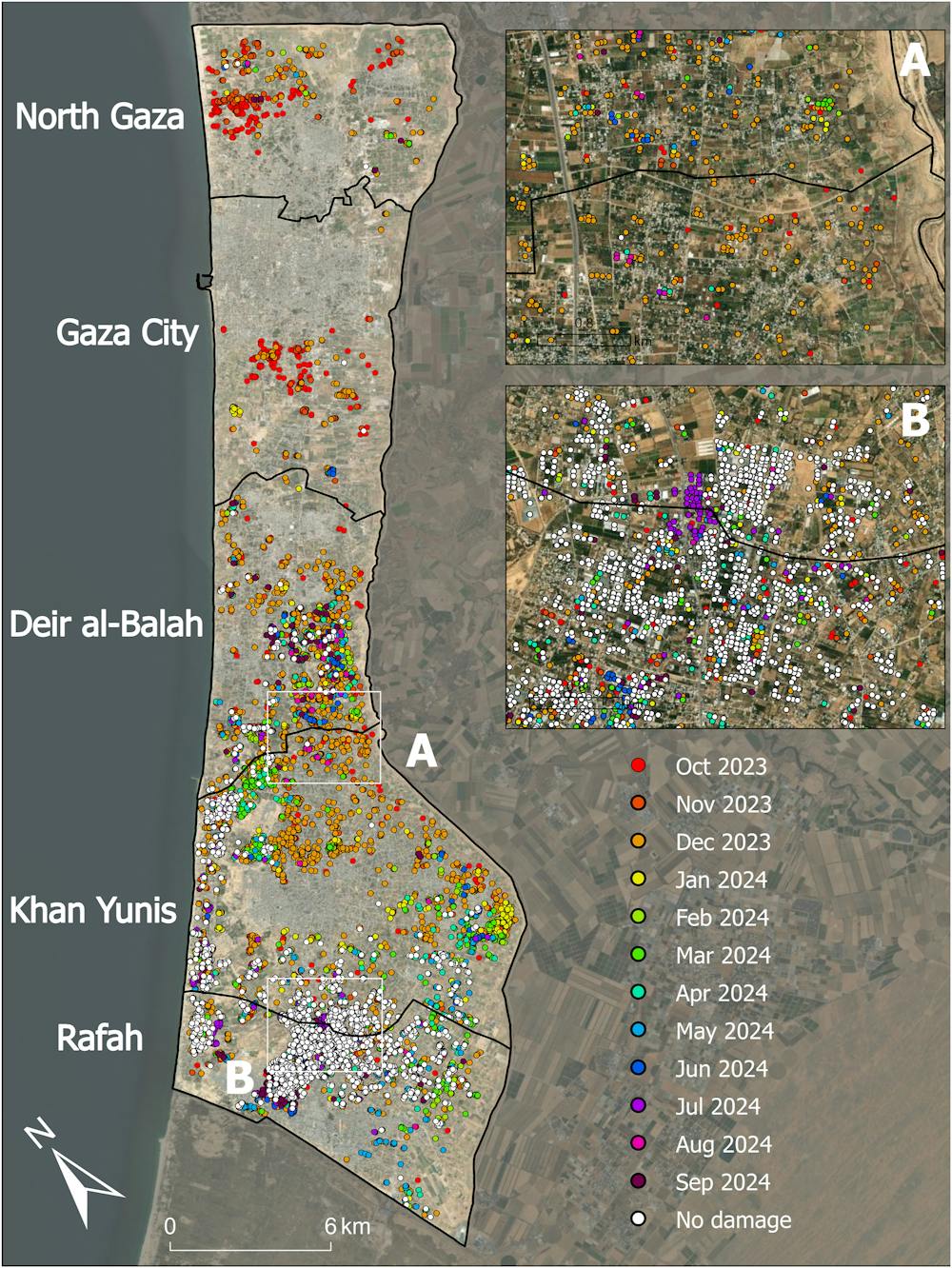
    Greenhouses and the date of initial damage between October 2023 and September 2024.
    Yin et al (2025)

    In the south of the territory, where most greenhouses were found, the destruction was fairly steady from December 2023 onwards.

    But in north Gaza and Gaza City, the two most northerly of the territory’s five governorates, most of the damage had already taken place by November and December 2023. By the end of our study period, all 578 greenhouses there had been destroyed.

    North Gaza and Gaza City have also seen the most damage to tree crop fields. By September 2024, over 90% of all tree crops in Gaza City had been destroyed, and 73% had been lost in north Gaza. In the three southern governorates, Khan Younis, Deir al-Balah and Rafah, around 50% of all tree crops had been destroyed.

    Agricultural damage is common in armed conflict, and has been documented with satellite analysis in Ukraine since the 2022 Russian invasion, in Syria and Iraq during the ISIS occupation in 2015, and in the Caucasus during the Chechen wars in the 1990s and 2000s.

    The exact impact can differ from conflict to conflict. War may directly damage lands, as we have seen in Gaza, or it may lead to more fallow areas as infrastructure is damaged and farmers are forced to flee. A conflict also increases the need for local agricultural production, especially when food imports are restricted.

    Our assessment shows a very high rate of direct and extensive damage to Gaza’s agricultural system, both compared to previous conflict escalations there in 2014 and 2021, and in other conflict settings. For example, during the July-August war in 2014, around 1,200 greenhouses were damaged in Gaza. This time round at least three times as many have been damaged.

    Agricultural attacks are unlawful

    Attacks on agricultural lands are prohibited under international law. The Rome Statute of the International Criminal Court from 1998 defines the intentional use of starvation of civilians through “depriving them of objects indispensable to their survival” as a war crime. The Geneva conventions further define such indispensable objects as “foodstuffs, agricultural areas for the production offoodstuffs, crops, livestock, drinking water installations and supplies and irrigation works”.

    Our study provides transparent statistics on the extent and timing of damage to Gaza’s agricultural system. As well as documenting the impacts of the war, we hope it can help the massive rebuilding efforts that will be required.

    Restoring Gaza’s agricultural system goes beyond clearing debris and rubble, and rebuilding greenhouses. The soils need to be cleaned from possible contamination. Sewage and irrigation infrastructure need to be rebuilt.

    Such efforts may take a generation or more to complete. After all, olive and citrus trees can take five or more years to become productive, and 15 years to reach full maturity. After previous attacks on Gaza the trees were mostly replanted, and perhaps the same will happen again this time. But it’s for good reason they say that only people with hope for the future plant trees.

    Lina Eklund receives funding from the Swedish National Space Agency and the Strategic Research Area: The Middle East in the Contemporary World (MECW) at the Centre for Advanced Middle Eastern Studies, Lund University, Sweden.

    He Yin receives funding from NASA.

    Jamon Van Den Hoek receives funding from NASA.

    ref. Gaza: we analysed a year of satellite images to map the scale of agricultural destruction – https://theconversation.com/gaza-we-analysed-a-year-of-satellite-images-to-map-the-scale-of-agricultural-destruction-248796

    MIL OSI AnalysisEveningReport.nz

  • MIL-Evening Report: Habitat restoration is a long-haul job. Here are 3 groups that have endured

    Source: The Conversation (Au and NZ) – By Nigel Tucker, Research Associate in Environment and Sustainability, James Cook University

    TREAT volunteers planting trees TREAT

    Like ferns and the tides, community conservation groups come and go. Many achieve their goal. Volunteers restore a local wetland or protect a patch of urban bush and then hang up the gardening gloves with a warm inner glow. Some groups peter out while others endure, tackling the ecological problems facing today’s Australia.

    One of those problems is fragmentation. Let’s say you have a national park in one spot and another large tract of habitat ten kilometres away. It’s too hard for many wildlife species to make it across open ground to get there. Over time, this means wild areas can effectively become islands.

    This is where habitat corridors come in. Potentially, if you restore habitat between two isolated areas, wildlife can begin to safely move between the two. Over time, these corridors allow seeds, pollen, native birds and animals to disperse across today’s landscapes.

    In my work as a restoration ecologist, I’ve come across many of Australia’s community groups devoted to the job. Three of these are LUCI – Lockyer Upland Catchments Inc, which began in 2015, the Big Scrub Rainforest Conservancy, founded in 1993 and TREAT – Trees for the Evelyn and Atherton Tablelands Inc, which began in 1982. Each of these has gone the distance. Here are some reasons why.

    Native fruit from the trees in the remnant Big Scrub.
    Big Scrub Rainforest Conservancy

    Where are wildlife corridors most needed?

    Australia’s Wet Tropics are especially threatened by fragmentation. This region is World Heritage listed due to its remarkable biodiversity. Tropical forests have grown here for at least 130 million years. Fragmentation directly threatens this.

    In the tropical uplands of the Atherton Tablelands, there are three popular national parks – the Crater Lakes of Eacham and Barrine and the Curtain Fig Tree. But while visitors might see them as pristine, each is an island surrounded by pasture and settlement. Over time, this will take its toll on the species within.

    Fragmented landscapes are common on the Atherton Tablelands.
    FiledIMAGE/Shutterstock

    Staying the course

    For a volunteer group to reverse the effects of fragmentation, and embark on a long term project such as this, it needs three things.

    First the group has leaders committed to a long term cause, usually scientists or naturalists as well as locals with knowledge and drive. Leaders have to be able to work with governments and group members of all persuasions.

    Second, the group has to be guided by science. You need current information on local plants, animals and habitats to make sure on-ground work has direct conservation benefits.

    And third, networking skills. Harnessing the technical expertise of other groups, government and experts in project planning, execution and monitoring is vital.

    Each of these three groups has these traits, even though they take different approaches to the challenge.

    LUCI is an alliance of private landholders in Queensland’s Lockyer Valley, west of Brisbane, who work to protect remnant vegetation and expand habitat. Their work on threatened species monitoring, protection of remnant vegetation on private land and community engagement reflects their emphasis on education.

    Before European settlement, lowland subtropical rainforest covered 75,000 hectares of land in what is now Byron Bay’s hinterland. But 99% was cut down. In response, Big Scrub members have replanted around 600 hectares – doubling the size of what was left – and established an innovative genetics program to assist in maintaining and enhancing the gene pool of trees planted.

    Only a tiny fraction of the Big Scrub is still intact, at reserves such as the Andrew Johnston Big Scrub reserve. Farmland and acreage surrounds it.
    Peter Woodard/Wikimedia Commons, CC BY

    TREAT is based on the Atherton Tablelands in far north Queensland. This region has long been prized for agriculture, which comes at a cost to habitat. In response, TREAT has worked to reconnect isolated tracts of rainforest. The group collaborates with Queensland Parks and Wildlife to grow many thousands of native rainforest tree seedlings for planting each year.

    TREAT grows tens of thousands of seedlings annually, alongside Queensland Parks and Wildlife. Pictured: Hicksbeachia seedlings.
    TREAT

    All three groups recognise the importance of countering habitat fragmentation. This slicing and dicing forests into smaller and isolated patches severely threatens Australia’s biodiversity.

    Wildlife corridors are deceptively simple in theory. But as I know from long experience restoring habitat, it’s harder than it seems.

    Does it work?

    Planting corridors sounds like a sure thing. But success is not guaranteed. For one thing, it takes work and time. You need baseline surveys, expert analysis of data and monitoring, ideally over decades. Given these challenges, it’s unsurprising that wildlife corridor restoration is little-studied.

    In the 1990s, TREAT volunteers planted 17,000 trees to reconnect a 498 hectare fragment around Lake Barrine to the 80,000ha Wooroonooran National Park 1.2 kilometres away. This corridor is now more than 20 years old. It’s known as the Donaghy’s Corridor Nature Refuge, after the Donaghy family who donated the land for corridor restoration.

    My research has found this corridor is proving successful, using good data collected before, during and after establishment. Ground mammals are moving along the corridor, and breeding has taken place. We could see this in the exchange of genes between two previously separated populations of the native bush rat (Rattus fuscipes).

    More recent studies have shown the corridor has been colonised by many species, ranging from threatened and endemic plants to birds, ground mammals, reptiles, amphibians and microbats. While promising, this is just one corridor. Much more data would be needed to prove this approach is broadly effective.

    As habitat fragmentation continues and the effects of climate change ramp up, more and more species will need to move. The work of volunteer groups such as LUCI, Big Scrub and TREAT in reconnecting scattered pieces of habitat is only going to get more important.

    Nigel Tucker has received funding from the Queensland government’s Nature Refuge Landholder Grants program. He is a Life Member of TREAT.

    ref. Habitat restoration is a long-haul job. Here are 3 groups that have endured – https://theconversation.com/habitat-restoration-is-a-long-haul-job-here-are-3-groups-that-have-endured-248133

    MIL OSI AnalysisEveningReport.nz

  • MIL-OSI Asia-Pac: Public Sector Banks (PSBs) show strong performance in the first three quarters (April-December) of current FY 2024-25

    Source: Government of India

    Public Sector Banks (PSBs) show strong performance in the first three quarters (April-December) of current FY 2024-25

    Highest-ever net profit of Rs 1.29 lakh crore reported by Public Sector Banks (PSBs) in the first nine months (April-December) of FY 2024-25, marking a 31.3% year-on-year growth                       

    PSBs achieve highest ever aggregate net profit, improved asset quality, robust business growth and adequate capital buffers

    Posted On: 06 FEB 2025 7:40PM by PIB Delhi

    The performance of Public Sector Banks  has shown significant improvement on key financial parameters during the first three quarters of the current FY 2024-25. Highlights as on 31.12.2024, are as under –

    • Record net profit growth of 31.3% (y-o-y) to achieve highest ever aggregate net profit of Rs. 1,29,426 Crore and aggregate operating profit of Rs. 2,20,243 Crore, in first nine months of the financial year.
    • Improved asset quality visible from significantly low Net NPA ratio at 0.59% (Aggregate net NPA outstanding of Rs. 61,252 Crore)
    • Aggregate business growth of 11.0% (y-o-y), with improved aggregate deposit growth at 9.8% (y-o-y). Total aggregate business of PSBs reached Rs. 242.27 lakh crore.
    • Robust credit growth of 12.4%, led by retail credit growth of 16.6%, agriculture credit growth of 12.9% and MSME credit growth of 12.5%.
    • Built-up of adequate capital buffers, with Aggregate Capital to Risk Weighted Assets Ratio of 14.83%, significantly above the minimum requirement of 11.5%.


    PSBs are adequately capitalized and well poised to meet credit demands of all sectors of the economy, with special thrust on Agriculture, MSME and Infrastructure Sector.

    The policy and process reforms have resulted in enhanced systems and processes for credit discipline, recognition and resolution of stressed assets, responsible lending, improved governance, financial inclusion initiatives, technology adoption etc.  These measures have led to a sustained financial health and robustness of banking sector as a whole which is reflected in the current performance of the PSBs.

    ******

    NB/AD    

    (Release ID: 2100412) Visitor Counter : 83

    MIL OSI Asia Pacific News

  • MIL-OSI Asia-Pac: A New Dawn for Rural India’s Transformation

    Source: Government of India

    A New Dawn for Rural India’s Transformation

    Union Budget 2025-26 Brings Forward a Package of Hope

    Posted On: 06 FEB 2025 7:32PM by PIB Delhi

    Union Budget 2025-26 Brings Forward a Package of Hope

    “Ensuring a dignified life for the people of rural India is the priority of my Government”

    ~Prime Minister Shri Narendra Modi


    India is home to 6.65 lakh villages, with 2.68 lakh Gram Panchayats and Rural Local Bodies, which form the backbone of the nation’s rural landscape. These villages, scattered across the country, play a crucial role in shaping India’s rural economy and culture. The Union Budget 2025-26 recognizes the importance of these communities and places a strong emphasis on their upliftment. The budget focuses on key areas such as employment generation, women empowerment, education and infrastructure development in rural India.

    Total amount allocated for the demand in the Budget Estimate (BE) for 2025-26: ₹1,88,754.53 Cr.

    The Union Budget 2025-26 outlines several key initiatives aimed at driving rural development and enhancing prosperity through focused programs and investments:


    1. Water Supply – Jal Jeevan Mission:

    The Jal Jeevan Mission has been extended until 2028 with an increased focus on improving the quality of infrastructure and the operation and maintenance of rural piped water supply schemes through a citizen-centric approach, known as “Jan Bhagidhari”. The goal is to achieve 100% coverage with enhanced financial support and sustainability through state-specific MoUs.

    1. Broadband Connectivity – Bharatnet Project:

    Broadband connectivity will be expanded under the Bharatnet Project, aiming to provide all government secondary schools and primary health centers in rural areas with internet access, improving education and healthcare services.

    1. India Post as a Catalyst for Rural Economy:

     India Post will drive rural economic growth with its 1.5 lakh rural post offices, India Post Payment Bank, and 2.4 lakh Dak Sevaks. It will enhance services by offering micro-enterprise credit, digital services, and institutional account management. Furthermore, India Post will evolve into a key public logistics organization supporting entrepreneurs, MSMEs, and self-help groups.

    1. Rural Prosperity and Resilience Program:

    A comprehensive multi-sectoral ‘Rural Prosperity and Resilience’ programme will be launched in collaboration with states. This program aims to address under-employment in agriculture by promoting skill development, technology adoption, and investments to invigorate the rural economy. The mission will focus on empowering rural women, young farmers, marginalized communities, and landless families, ensuring that migration becomes a choice, not a necessity.

    Through these initiatives, the Union Budget 2025-26 envisions a holistic approach to rural development, aiming for long-term growth, resilience, and self-reliance across rural India.

    Positive Transformations in Rural India

    Positive outcomes have been observed across various sectors as India moves toward greater prosperity. These include an increase in rural wages, wider internet connectivity in rural areas, a decline in poverty, and a reduction in consumption inequality.

    • National Multidimensional Poverty Index (MPI) Report: The proportion of individuals living in multidimensional poverty declined from 24.85% to 14.96% between 2015-16 and 2019-21. 13.5 crore individuals escaped multidimensional poverty during this period.
    • Rural Internet Connectivity: As of March 2024, India had 954.40 million internet subscribers. Out of this, 398.35 million were rural internet subscribers.
    • Income Distribution (Gini Coefficient): For rural areas, it declined from 0.266 in FY22-23 to 0.237 in FY23-24.
    • Rural Wage Growth: As per data from the Labour Bureau, rural wages in FY25 (April-September 2024) showed a growth of above 4% each month year-on-year: Agriculture wages grew by 5.7% for men and 7% for women. Non-agricultural wages grew by 5.5% for men and 7.9% for women.

    Pathway to Prosperity: Key Rural Scheme Achievements

    • Pradhan Mantri Gram Sadak Yojana (PMGSY) – Roads: Launched in December 2000, this initiative aims to provide rural connectivity through a single all-weather road to unconnected habitations of a designated population size in the core network, enhancing the socio-economic conditions of rural communities.
    • Pradhan Mantri Awaas Yojana-Gramin (PMAY-G) – Housing: Launched on 20th November 2016, aiming to provide housing for the poorest segments of society.

    Mission Amrit Sarovar: Launched on 24th April 2022, with an objective to conserve water for the future. The Mission aimed at developing / rejuvenating 75 Amrit Sarovar (Pond) in each district of the Country. A total of 68,843 ponds have been constructed.


    National Rural Health Mission: Launched in 2005 with the objective of building public health systems to provide accessible, affordable and quality health care to the rural population.

    1. Jal Jeevan Mission: Launched in 2019, JJM is a nationwide programme designed to provide all households in rural India with safe and adequate drinking-water through individual household tap connections. As of 27 January 2025, a total of 12.2 crore households have been provided with tap water connections.
    1. Swachh Bharat Mission (Gramin): Launched on October 2, 2014, the initiative aimed at making India Open Defecation Free (ODF). Currently in Phase 2 the focus is on maintaining the ODF status, managing solid and liquid waste by 2024-25 and transitioning all villages from ODF to the ODF Plus model.

    Saansad Adarsh Gram Yojana (SAGY): Launched on 11th October 2014, SAGY aims to preserve the essence of rural India by providing access to basic amenities and opportunities for people to shape their own futures.

    1. Pradhan Mantri Janjati Adivasi Nyaya Maha Abhiyan (PM-JANMAN): Cabinet Approved PM-JANMAN on Nov. 2023 to improve socio-economic conditions of the Particularly Vulnerable Tribal Groups (PVTGs).
    1. Deendayal Antyodaya Yojana – National Rural Livelihoods Mission (DAY-NRLM): Launched in 2011, the scheme aims to empower rural poor women by organizing them into Self Help Groups (SHGs) and supporting economic activities to improve their income and quality of life. Implemented in 5,369 blocks across 682 districts.
    2. Gram Nyayalayas Act, 2008: Provide access to justice at the grassroots level in rural areas. As of October 2024, 313 Gram Nyayalayas have disposed of over 2.99 lakh cases between December 2020 and October 2024.
    1. National Social Assistance Programme (NSAP): Launched on 15th August 1995, Provide financial assistance to vulnerable sections of society.


    1. Mahatma Gandhi National Rural Employment Guarantee Scheme (MGNREGS) Progress: Launched in 2005, the scheme aims to provide 100 days of guaranteed wage employment annually to rural households, enhancing livelihood security through unskilled manual work. The Budget allocation under Mahatma Gandhi NREGA has steadily risen. The budget allocation for the financial year 2006-07 was Rs 11,300 crore which increased to Rs 33,000 crore in 2013-14 and now stands at Rs 86,000 crore during FY 2024-25 at Budget estimate stage.

    ​​​​​​​

    Conclusion

    Rural India is making significant strides toward achieving a developed India by 2047, with the Union Budget serving as a key step in making it more self-reliant (Atmanirbhar). By focusing on essential areas like employment, infrastructure, and economic empowerment, the budget ensures crucial support for a prosperous and sustainable future for rural communities, paving the way for a stronger, more self-sufficient India.


    References

    Click here to see in PDF

    Santosh Kumar/ Sarla Meena/ Kamna Lakaria

    (Release ID: 2100410) Visitor Counter : 22

    MIL OSI Asia Pacific News

  • MIL-OSI Asia-Pac: e-NAM Platform expanded to boost agricultural trade with addition of 10 New commodities and their tradable parameters

    Source: Government of India

    e-NAM Platform expanded to boost agricultural trade with addition of 10 New commodities and their tradable parameters

    It aims to increase the coverage of agricultural commodities and offer more opportunities for farmers and traders to benefit from the digital trading platform

    Number of commodities on e-NAM platform reaches 231

    Posted On: 06 FEB 2025 6:33PM by PIB Delhi

    In response to the continuous demand from farmers, traders and other stakeholders for inclusion of more agricultural commodities, the Department of Agriculture and Farmers’ Welfare, Government of India has decided to further expand the scope of trade under e-NAM. This initiative aims to increase the coverage of agricultural commodities and offer more opportunities for farmers and traders to benefit from the digital trading platform, Directorate of Marketing and Inspection (DMI) has formulated tradable parameters for 10 additional agricultural commodities. These new commodities parameters are a result of extensive consultation with key stakeholders, including state agencies, traders, subject matter specialists and SFAC and with approval from the Union Minister of Agriculture and Farmers’ Welfare Shri Shivraj Singh Chouhan.

    DMI has been entrusted with the formulation of tradable parameters for agricultural commodities to be traded on the e-NAM (National Agricultural Market) platform. These tradable parameters are designed to help farmers secure better prices for their produce by ensuring the quality and commerciality of agricultural products. This initiative enhances transparency, facilitates fair trading practices, and contributes to the overall growth of the agricultural sector.

    DMI has formulated tradable parameters for 221 agricultural commodities, which are available on the e-NAM platform and following 10 additional commodities will make the list to 231 commodities.

    Miscellaneous Commodities:

    1. Dried Tulsi Leaves

    2. Besan (Chickpea Flour)

    3. Wheat Flour

    4. Chana Sattu (Roasted Chickpea Flour)

    5. Water Chestnut Flour

    Spices:

    6. Asafoetida

    7. Dried Fenugreek Leaves

    Vegetables:

    8. Water Chestnut

    9. Baby Corn

    Fruits:

    10. Dragon Fruit

    Commodities at Serial number 4 to 7 above fall in category of secondary trade, and this can help FPOs to market value added products as well as formalize the trade in the sector.

    These newly approved tradable parameters will be available on the e-NAM portal (enam.gov.in), further strengthening the platform’s capacity to facilitate the digital trading of agricultural commodities. This move will provide farmers with improved market access, better pricing, and an enhanced quality assurance, thus supporting their economic well-being. The formulation of these additional tradable parameters aligns with the Government’s ongoing efforts to modernize the agricultural sector, ensuring greater inclusivity, efficiency, and market transparency.

    *****

    MG/KSR

    (Release ID: 2100393) Visitor Counter : 29

    MIL OSI Asia Pacific News

  • MIL-OSI USA: Turkana Food Inc. Recalls Aleppo Tahini Sesame Paste 1lb (16oz) Because of Possible Health Risk

    Source: US Department of Health and Human Services – 3

    Summary

    Company Announcement Date:
    FDA Publish Date:
    Product Type:
    Food & Beverages
    Foodborne Illness
    Reason for Announcement:

    Recall Reason Description

    Potential Foodborne Illness – Salmonella

    Company Name:
    Turkana Food Inc.
    Brand Name:

    Brand Name(s)

    Aleppo

    Product Description:

    Product Description

    Tahini Sesame Paste


    Company Announcement

    Turkana Food Inc. Kenilworth, NJ is recalling 858 cases OF Aleppo Tahini Sesame Paste because it has the potential to be contaminated with Salmonella, an organism which can cause serious and sometimes fatal infections in young children, frail or elderly people, and others with weakened immune systems. Healthy persons infected with Salmonella often experience fever, diarrhea (which may be bloody), nausea, vomiting and abdominal pain. In rare circumstances, infection with Salmonella can result in the organism getting into the bloodstream and producing more severe illnesses such as arterial infections (i.e., infected aneurysms), endocarditis and arthritis.

    The Recalled Aleppo Tahini Sesame Paste was distributed in the states of FL, KY, VA, NY, NJ, TN, MA, TX, Il, IN, MI, RI, PA, NC, MD, VA, OH, AL, MO, CA.

    The Recalled 1lb (16oz plastic jar Brand name Aleppo Sesame Paste Tahini. The product packaging is a 16oz plastic jar with a gold lid and gold label marked Aleppo Sesame Paste Tahini.

    LOT# 120824-01 can be found on the top portion of the jar.

    UPC Label 854643003054 marked by a sticker on the side of the jar.

    Expiration Date August 2026, which can be found on the top portion of the jar.

    No reported illnesses have been confirmed as of 02/05/2025.

    The recall was the result of a routine sampling performed by the Ohio Department of Agriculture which revealed that the finished products contained Salmonella. The company has ceased production and distribution of the products as FDA and the company continue their investigation to what caused the problem. Consumers who purchased Aleppo Sesame Paste Tahini With lot code 120824-01 should not consume the product and they are urged to return it to the place of purchase for a full refund.

    Consumers with questions may contact Turkana Foods Inc. 908-810-8800 Or email info@turkanafood.com Monday – Friday 8am – 6pm EST.


    Company Contact Information


    Product Photos

    MIL OSI USA News

  • MIL-OSI USA: Arrests of foreign nationals made in electronic benefit transfer card fraud scheme

    Source: US Immigration and Customs Enforcement

    LOS ANGELES — On Feb. 1 and 2, Homeland Security Investigations (HSI) Los Angeles’ El Camino Real (ECR) Financial Crimes Task Force, alongside the United States Secret Service, California Department of Social Services, United States Marshals Service, United States Attorney’s Office Central District of California, Los Angeles County District Attorney’s Office, Los Angeles Sheriff Department, Hermosa Beach Police Department, Baldwin Bark Park Police Department, Culver City Police Department, El Monte Police Department, Inglewood Police Department, Orange County District Attorney Office, and the U.S. Department of Agriculture – Office of Inspector General conducted a large-scale enforcement action at several locations throughout the greater Los Angeles area.

    The goal of this operation was to arrest individuals perpetrating access device fraud through unauthorized cash withdrawals from victim Electronic Benefit Transfer (EBT) cards. This type of fraud victimizes recipients of government sponsored relief programs which are some of our most vulnerable members of the public. During previous operations targeting the same fraud type, the majority of individuals arrested were foreign nationals with no lawful presence in the United States.

    In the past year, the California Department of Social Services has reported more than $100 million in stolen funds from California victims’ EBT cards. The majority of illicit cashouts in the past year occurred in Los Angeles County.

    For violations of 18 United States Code § 1029 (Access Device Fraud), the ECR Task Force and partners arrested 11 foreign nationals, recovered over 300 cloned EBT cards, and recovered over $30,000 in cash during the two-day operation. One of the suspects in custody had been previously arrested by Romanian law enforcement for murder and aggravated murder in Romania. The suspects arrested were transported to the Federal Bureau of Prisons in Los Angeles for processing, to include identification and immigration status determination for suspects unable to be identified or presenting suspected fictitious identification documents.

    Historically, this type of criminal activity has been widely perpetrated by elements of Romanian organized crime who have no legal status in the U.S. or are prior deportees.

    Anyone with information regarding fraud related to government sponsored relief programs is encouraged to call the HSI Tip Line at 877-4-HSI-TIP.

    Learn more about HSI’s mission to increase public safety in your community on X, formerly known as Twitter, at @HSILosAngeles.

    MIL OSI USA News

  • MIL-OSI Europe: Answer to a written question – Introduction of tariffs on fertilisers from Russia and Belarus to protect EU producers from unfair competition and workers from losing their jobs – P-002696/2024(ASW)

    Source: European Parliament

    The Commission is closely monitoring the situation regarding the import of fertilisers into the EU from Russia and Belarus.

    While reflecting on possible new measures, upholding food security remains among EU’s primary consideration. Any measure should contribute to preserve a competitive EU fertilisers industry, reduce dependencies while also ensuring that EU farmers have access to ample and diverse sources of fertilisers.

    It is worth mentioning that some fertilisers types, albeit not urea or nitrogen fertilisers, are also subject to restrictions under EU sanctions, i.e. a quota on imports of potash fertilisers from Russia[1] and a ban on Belarus[2].

    Where there is unfair competition stemming from imports, the EU uses trade defence instruments to restore fair competition. There are anti-dumping measures in place on imports of mixtures of urea and ammonium nitrate from, inter alia, Russia[3] which are currently subject to an expiry review.

    There are also measures in place on ammonium nitrate from Russia. Where measures are no longer effective, they may be reviewed.

    The trade defence process is normally driven by complaints or requests from industry giving evidence of unfairly dumped or subsidised imports of products or showing that there are changes of a lasting nature which require a change to existing measures. EU industry should contact the complaints office of Directorate-General for Trade for advice.

    • [1] Article 3i of Council Regulation 833/2014; https://eur-lex.europa.eu/legal-content/EN/TXT/?uri=CELEX%3A02014R0833-20241217
    • [2] Article 1i of Council Regulation 765/2006; https://eur-lex.europa.eu/legal-content/EN/TXT/?uri=CELEX%3A02006R0765-20241216
    • [3] Commission Implementing Regulation (EU) 2019/1688 of 8 October 2019; https://eur-lex.europa.eu/legal-content/EN/TXT/?uri=CELEX%3A32019R1688
    Last updated: 6 February 2025

    MIL OSI Europe News

  • MIL-OSI USA: Video: Kaine Joins Senate Democrats in Holding Senate Floor to Protest Russell Vought’s Nomination to Lead OMB, Citing Chaos Unleashed on Federal Workers

    US Senate News:

    Source: United States Senator for Virginia Tim Kaine
    WASHINGTON, D.C. – Last night, U.S. Senator Tim Kaine (D-VA) joined his Democratic colleagues in holding the Senate floor to protest Russell Vought’s nomination to lead the Office of Management and Budget (OMB), citing stories he has collected from federal workers about the chaos the Trump Administration has unleashed on the federal workforce. Vought is one of the key authors of Project 2025 and has long been an architect of President Trump’s plans to villainize the federal workforce.

    Broadcast-quality video of Kaine’s speech is available here.
    “My colleagues have spoken on the floor about a particular statement of Mr. Vought’s that I examined him about fairly aggressively during the Budget Committee Hearing. In the course of a speech, he said, ‘I want federal employees to be traumatized. I want to put them in trauma. I want them to come to work—to not want to come to work—because they know that they are increasingly viewed as the villain. Now, who talks like that? I mean, who talks like that? Is there a single manager or leader or organizational chief that we admire who believes that their mission, their happiness, their glee, their purpose is to make their workforce feel traumatized? No we would never celebrate a leader of that kind,” said Kaine.
    “What I want to do in my time on the floor tonight is talk a little bit about these federal employees and what having a traumatized workforce means… What I’ve heard from Virginians is just in the week since the funding pause order went into place—something that was masterminded by Russell Vought—federal employees. Yesterday, I decided after hearing stories from federal employees, to launch a website, a resource where federal employees could share with anonymity guaranteed… I thought what I would do tonight is, I’ve just taken 18 of these stories, from the federal employees that have just once in in the last 24 hours, of the hundreds that have been submitted, and I just want to read some to you, to tell you about who these people are who Mr. Vought wants to be traumatized. Who these people are that Mr. Vought wants to personally make feel as if they are the villains,” Kaine continued.
    Then, Kaine shared various stories he has collected from federal workers about how the Trump Administration’s actions have harmed them and threatened their ability to deliver essential services for the American people, including:
    A federal employee working for the U.S. Agency for International Development (USAID) who wrote, “After two extremely painful miscarriages, I am now 34 weeks pregnant with my first child. Since my husband works as a lawyer for the EPA, what should have been a joyful time in our lives now feels like a dystopian hellscape and we are very afraid for our future and financial security. We are just hoping to have health insurance at this point for when I give birth but even that feels uncertain. I swore an oath and believe in the work that USAID does. I believe that it makes American stronger, safer, and more prosperous, as Secretary Rubio is calling for, and I will supporting the Agency until they boot me from the system. God help us all.”
    A federal employee working for the U.S. Department of Health and Human Services who explained, “I am married and pregnant. I am the breadwinner. A woman. I am a homeowner. I pay taxes. I took an oath and I love my job. The daily fear tactics and targeting of federal employees has uprooted my life. I no longer feel safe going on any kind of family vacation, making any big purchases or doing anything because everyday I wonder will I have a job.”
    A federal employee working for the National Science Foundation (NSF) who said, “The opportunity to give back and support the next generation of U.S. based scientists was a dream fulfilled, and I am terrified that I will be fired as soon as Friday with no protections or severance. The fair compensation and flexible schedule let’s my spouse work as a teacher, and she is so great at her job. But that will not pay the mortgage.”
    A federal employee working for USAID who warned, “The attack on USAID lacks intelligence and foresight. China and Russia are filling the vacuum, outspending the US and deepening partnerships with our allies, who feel abandoned. This is creating permanent damage, and undoing decades of progress in a few days. This does the opposite of making America stronger, safer, and more prosperous.”
    A federal employee working for the U.S. Department of Agriculture who explained, “These last few weeks have been hell for us federal workers. I come to work with a pit in my stomach. I am a probationary employee, so will probably be the first to go during a RIF. They have left us in the dark while constantly terrorizing us with threatening, passive aggressive messages, and half legal deals to resign. I fear for my job, but I fear more for my country.”
    A federal employee working for the U.S. Department of Transportation who wrote, “I am frightened about my position. I’m a single income household and am convinced no one has my back. Congress has been pretty much silent, and the news has gained very little traction nationwide.”
    A federal employee working for the U.S. Department of Defense who said, “As soon as this administration took office it felt like federal workers were under siege. They began with their flurry of executive orders and memos, they put Elon Musk (whom no one elected, whom is not a federal employee but yet has huge contracts for other areas with the government) in charge of “handling” the potential mass layoffs of federal workers.”
    A federal employee working at the General Services Administration who explained, “…the disregard for union contracts is deeply concerning and undermines the commitments made to the workforce. Many of my talented and hardworking colleagues have been living in fear for weeks, facing uncertainty they do not deserve. This unlawful mistreatment not only undermines their dedication but also creates an environment of instability and anxiety that no employee should have to endure.”
    A federal employee working at the Department of Homeland Security (DHS) who wrote, “My husband and I are both federal employees and we are both on probation. We also have student loan debts and under the public service loan forgiveness program. If we lose our jobs because we are on probation, we will lose the ability to have our payments to [Public Service Loan Forgiveness] counted, we will not be able to pay for childcare and we will lose our apartment.”
    A federal employee working at DHS who warned, “truly believe a strong, healthy workforce of civilian servants is vital for a strong, healthy America. Our government has a duty to protect its citizens. This – to me – includes making sure peoples basic needs are met, be it healthcare, food, housing, education, etc. The private sector is not taking on this obligation.”
    A federal employee who said, “I’ve served under different administrations, Republican and Democrat, and been proud to do so… The last 2 weeks have been a nightmare.”
    A federal employee who wrote, “Since inauguration, times have been hell for us because every day is loaded with uncertainty regarding the future state of our contract, work, and our federal counterparts we work daily with. To this day, every work day is filled with dread and anxiety.”
    A federal contractor working for USAID who explained, “In the past week, I have experienced near everyone in my company get placed on furlough. Beyond the fact that we were all working to make international development more impactful, and the fact that the US Company we have invested so much time in may never come back from this, we are all without salary and uncertain for the future.”
    A federal employee working for a small independent agency who wrote, “I am a probationary employee, meaning my name is on a short list to fire. I was hired under Schedule A — persons with disabilities, so my name is on a list. I feel like I am being threatened by the very institutions that were created to safeguard the principles of truth, compassion, respect…”
    A federal employee who wrote, “Today, I woke up to an email saying we had a restraining order, tied to Trump’s EOs, that would limit how we’d disburse our grants. Since the EOs were vaguely defined to begin with, this could be a witch hunt for all kinds of programs and grants we give out.”
    A federal employee who said, “I’m a senior human resource professional in the Department of the Interior. I’m on daily calls with Departmental HR leaders who receive direction from OPM. Today leadership mentioned that their coordination was with DOGE “employees” rather than with actual OPM employees. These DOGE employees have full access to our USA Staffing hiring system, which includes personally identifiable information for ALL applicants to any position in DOI. It is unclear what kind of clearance these individuals have, if any, and what authority they have to even access this system.”

    MIL OSI USA News

  • MIL-OSI Europe: Answer to a written question – Drought in Greece – E-002211/2024(ASW)

    Source: European Parliament

    The Common Agricultural Policy (CAP) Strategic Plan Regulation[1] already includes a number of interventions that may help farmers to perform preventive actions, especially to prevent crises and build on medium and long-term resilience.

    For mitigating short-term impacts, the available tools include direct payments to support farmers’ incomes, risk management tools helping farmers managing production risks due to adverse events, including severe drought, sectoral interventions supporting replanting or restocking, and investments in the restoration of production potential.

    Under the CAP Strategic Plan 2023-2027[2], Greece envisages also support for investments to restore agricultural and forestry potential following natural disasters, adverse climatic or catastrophic events.

    On 19 December 2024[3], the co-legislators adopted the Commission proposal to amend Regulation (EU) 2020/2220[4] to allow Member States to support with liquidity beneficiaries who were affected by a destruction of at least 30% of the relevant production potential.

    It is up to the Member States to decide if they will use this possibility. If justified, the Commission can also use resources from the agricultural reserve to provide some support.

    Greek authorities may also support farmers affected by adverse climatic conditions in line with EU State aid rules (without the need for prior notification to the Commission if based on provisions of the Agricultural Block Exemption Regulation[5] or, with prior notification, under the Agricultural Guidelines[6]).

    Limited support can also be granted under the Agricultural de minimis aid Regulation[7].

    • [1] https://eur-lex.europa.eu/legal-content/EN/TXT/?toc=OJ%3AL%3A2021%3A435%3ATOC&uri=uriserv%3AOJ.L_.2021.435.01.0001.01.ENG
    • [2] https://www.agrotikianaptixi.gr/category/sskap-2023-2027/sskap-egkrisi-tropopoiiseis/
    • [3] https://eur-lex.europa.eu/legal-content/en/TXT/?uri=CELEX%3A32024R3242
    • [4]  OJ L, 2020/2220, 28.12.2020.
    • [5]  OJ L 327, 21.12.2022, p. 1-81: https://eur-lex.europa.eu/legal-content/EN/TXT/?uri=CELEX%3A02022R2472-20231213
    • [6]  OJ C 485, 21.12.2022, p. 1-90: https://eur-lex.europa.eu/legal-content/EN/ALL/?uri=CELEX:02022XC1221(01)-20240305
    • [7] Regulation 1408/2013. OJ L 352, 24.12.2013, p. 9-17 (https://eur-lex.europa.eu/legal-content/EN/TXT/?uri=CELEX%3A32013R1408) amended by Regulation 2024/3118. OJ L, 2024/3118, 13.12.2024 (https://eur-lex.europa.eu/legal-content/EN/TXT/?uri=OJ:L_202403118).
    Last updated: 6 February 2025

    MIL OSI Europe News

  • MIL-OSI USA: Democrats Hold Floor Overnight, Welch Speaks at 5 A.M. to Oppose Nomination of Project 2025 Author and Nominee for OMB Russell Vought

    US Senate News:

    Source: United States Senator Peter Welch (D-Vermont)

    Welch spoke on the Trump Administration’s lawlessness and illegal actions—from pardoning January 6th defendants to freezing federal funding and international aid
    WASHINGTON, D.C. — U.S. Senator Peter Welch (D-Vt.) took to the Senate Floor at 5:00 a.m. this morning to sound the alarm on the dangers of Donald Trump’s lawlessness and to oppose the nomination of Russell Vought, Trump’s nominee to lead the Office of Management and Budget (OMB). Senator Welch spoke for an hour. 
    View his remarks here: 

    Senate Democrats held the floor all night to oppose Russell Vought’s nomination to OMB and to slam the Trump Administration’s freeze on federal loans and grants. Vought’s radical Project 2025 would slash federal funding, and threaten the programs and services Vermonters rely on, like Medicare, Medicaid, and Social Security. As director of the OMB, Vought will be tasked with carrying out President Trump’s federal funding freeze, which is unconstitutional. Additionally, Vought is an open election denier and told Senators in his confirmation hearing he believed the 2020 election was ‘rigged.’ The Senate is expected to vote on Vought Thursday. 
    Senator Welch last week convened Vermonters to discuss how the Trump Administration’s federal funding freeze has impacted communities, families and workers across the state. The federal courts temporarily blocked the order, and on Monday extended the temporary restraining order. In addition, the court has required OMB to re-open funding currently held by the government and provide the court a compliance report by the end of the week. 
    ■■■ 
    Senator Welch’s Committee and Subcommittee Assignments for the 119th Congress include:   

    Senate Committee on Finance   

    Senate Committee on Agriculture, Nutrition, & Forestry  

    Ranking Member, Subcommittee on Rural Development, Energy, and Credit   

    Senate Committee on the Judiciary  

    Ranking Member, Subcommittee on the Constitution   

    Senate Committee on Rules & Administration  

    MIL OSI USA News

  • MIL-OSI Global: Gaza: we analysed a year of satellite images to map the scale of agricultural destruction

    Source: The Conversation – UK – By Lina Eklund, Associate Senior Lecturer, Lund University

    Part of North Gaza in November 2023, and again in July 2024.

    SkySat imagery © 2025/Planet Labs PBC

    The ceasefire agreed between Israel and Hamas makes provisions for the passage of food and humanitarian aid into Gaza. This support is much needed given that Gaza’s agricultural system has been severely damaged over the course of the war.

    Over the past 17 months we have analysed satellite images across the Gaza Strip to quantify the scale of agricultural destruction across the region. Our newly published research reveals not only the widespread extent of this destruction but also the potentially unprecedented pace at which it occurred. Our work covers the period until September 2024 but further data through to January 2025 is also available.

    Before the war, tomatoes, peppers, cucumbers and strawberries were grown in open fields and greenhouses, and olive and citrus trees lined rows across the Gazan landscape. The trees in particular are an important cultural heritage in the region, and agriculture was a vital part of Gaza’s economy. About half of the food eaten there was produced in the territory itself, and food made up a similar portion of its exports.

    By December 2023, only two months into the war, there were official warnings that the entire population of Gaza, more than 2 million people, was facing high levels of acute food insecurity. While that assessment was based on interviews and survey data, the level of agricultural damage across the whole landscape remained out of view.

    Most olive and citrus trees are gone

    To address this problem, we mapped the damage to tree crops – mostly olive and citrus trees – in Gaza each month over the course of the war up until September 2024. Together with our colleagues Dimah Habash and Mazin Qumsiyeh, we did this using very high-resolution satellite imagery, detailed enough to focus on individual trees.

    We first visually identified tree crops with and without damage to “train” our computer program, or model, so it knew what to look for. We then ran the model on all the satellite data. We also looked over a sample of results ourselves to confirm it was accurate.

    Our results showed that between 64% and 70% of all tree crop fields in Gaza had been damaged. That can either mean a few trees being destroyed, the whole field of trees completely removed, or anything in between. Most damage took place during the first few months of the war in autumn 2023. Exactly who destroyed these trees and why is beyond the scope of our research or expertise.

    In some areas, every greenhouse is gone

    As greenhouses look very different in satellite images, we used a separate method to map damage to them. We found over 4,000 had been damaged by September 2024, which is more than half of the total we had identified before the start of the war.

    Greenhouses and the date of initial damage between October 2023 and September 2024.
    Yin et al (2025)

    In the south of the territory, where most greenhouses were found, the destruction was fairly steady from December 2023 onwards.

    But in north Gaza and Gaza City, the two most northerly of the territory’s five governorates, most of the damage had already taken place by November and December 2023. By the end of our study period, all 578 greenhouses there had been destroyed.

    North Gaza and Gaza City have also seen the most damage to tree crop fields. By September 2024, over 90% of all tree crops in Gaza City had been destroyed, and 73% had been lost in north Gaza. In the three southern governorates, Khan Younis, Deir al-Balah and Rafah, around 50% of all tree crops had been destroyed.

    Agricultural damage is common in armed conflict, and has been documented with satellite analysis in Ukraine since the 2022 Russian invasion, in Syria and Iraq during the ISIS occupation in 2015, and in the Caucasus during the Chechen wars in the 1990s and 2000s.

    The exact impact can differ from conflict to conflict. War may directly damage lands, as we have seen in Gaza, or it may lead to more fallow areas as infrastructure is damaged and farmers are forced to flee. A conflict also increases the need for local agricultural production, especially when food imports are restricted.

    Our assessment shows a very high rate of direct and extensive damage to Gaza’s agricultural system, both compared to previous conflict escalations there in 2014 and 2021, and in other conflict settings. For example, during the July-August war in 2014, around 1,200 greenhouses were damaged in Gaza. This time round at least three times as many have been damaged.

    Agricultural attacks are unlawful

    Attacks on agricultural lands are prohibited under international law. The Rome Statute of the International Criminal Court from 1998 defines the intentional use of starvation of civilians through “depriving them of objects indispensable to their survival” as a war crime. The Geneva conventions further define such indispensable objects as “foodstuffs, agricultural areas for the production offoodstuffs, crops, livestock, drinking water installations and supplies and irrigation works”.

    Our study provides transparent statistics on the extent and timing of damage to Gaza’s agricultural system. As well as documenting the impacts of the war, we hope it can help the massive rebuilding efforts that will be required.

    Restoring Gaza’s agricultural system goes beyond clearing debris and rubble, and rebuilding greenhouses. The soils need to be cleaned from possible contamination. Sewage and irrigation infrastructure need to be rebuilt.

    Such efforts may take a generation or more to complete. After all, olive and citrus trees can take five or more years to become productive, and 15 years to reach full maturity. After previous attacks on Gaza the trees were mostly replanted, and perhaps the same will happen again this time. But it’s for good reason they say that only people with hope for the future plant trees.

    Lina Eklund receives funding from the Swedish National Space Agency and the Strategic Research Area: The Middle East in the Contemporary World (MECW) at the Centre for Advanced Middle Eastern Studies, Lund University, Sweden.

    He Yin receives funding from NASA.

    Jamon Van Den Hoek receives funding from NASA.

    ref. Gaza: we analysed a year of satellite images to map the scale of agricultural destruction – https://theconversation.com/gaza-we-analysed-a-year-of-satellite-images-to-map-the-scale-of-agricultural-destruction-248796

    MIL OSI – Global Reports

  • MIL-OSI USA: ‘Egg-sasperated’ Reed Seeks Answers from USDA Nominee on Plan to Lower Egg Prices

    US Senate News:

    Source: United States Senator for Rhode Island Jack Reed

    WASHINGTON, DC — Why did the Senator cross the road?  To help drive down ‘eggflation.’

    U.S. Senator Jack Reed (D-RI) is urging President Donald Trump – who pledged to “immediately bring prices down, starting on day one” — to finally take action to help reduce egg prices and crack down on anti-competitive price gouging.

    Today, Reed sent a letter to the president and CEO of the America First Policy Institute, Brooke Rollins, who President Trump nominated to lead the U.S. Department of Agriculture (USDA), asking for her plan to help lower egg prices. 

    Reed says Trump is causing consumers to shell out more for eggs: In the weeks since Trump took office for his second term, wholesale prices for a dozen Grade A large white eggs in cartons already increased about 15 percent and the Trump Administration has taken zero substantive steps to address the situation.  In fact, Trump’s initial moves in office, such as blocking the U.S. Centers for Disease Control and Prevention (CDC) and other federal health agencies from publishing scientific reports on the bird flu or issuing health advisories, or his decision to withdraw from the World Health Organization (WHO), which coordinates global efforts to combat disease outbreaks, may be contributing to the problem and increasing the likelihood of future avian flu cases. 

    This week, Rhode Island consumers are being charged anywhere from $4.55 a dozen to $6.99 a dozen for large eggs at local chain retailers and some restaurants have instituted a 50-cent surcharge per egg on all menu items. 

    “In order to combat these price spikes, we must have a strong response from the USDA to get avian influenza under control.  In addition, the USDA, in conjunction with other federal agencies, including the Federal Trade Commission and the Department of Justice, must carefully police the market and crack down on any price gouging by large egg producers, who in the past have demonstrated a propensity to hike prices on consumers to levels that far exceed any increase in the cost of production,” Reed wrote the USDA nominee.

    Reed noted that during her hearing, Ms. Rollins “did not provide a comprehensive plan, and instead stated “there is a lot that I have to learn” about avian influenza and animal disease.”

    His letter concluded: “As Agriculture Secretary, you would be tasked with spearheading and implementing the Trump Administration’s plan to combat this costly disease in our nation’s animals.  I understand that it may be difficult to outline a comprehensive plan during the time allotted in a confirmation hearing.  To that end, I would like to provide you the opportunity to outline your plan in writing to address avian influenza and bring egg prices down for Americans across the country.

    “To allow me to fully evaluate your nomination, I ask that you respond promptly before your final confirmation vote.” 

    Reed says he hopes to be able to share the plan with other U.S. Senators on both sides of the aisle to help inform their votes.

    Full text of the letter follows:

    February 5, 2025

    The Honorable Brooke Rollins

    President & CEO

    America First Policy Institute

    1777 N Kent Street Suite 1400

    Arlington, VA 22209

    Dear Ms. Rollins:

    As the full Senate prepares to consider your nomination for Secretary of Agriculture, I write to inquire about your plan to address the ongoing H5N1 avian influenza (“bird flu”) outbreak, which is contributing to high egg prices for consumers across the country.  I am well aware that avian influenza has been a problem for multiple administrations – including the Obama Administration, the first Trump Administration, and the Biden Administration.  Regardless, I am interested to hear how you, if confirmed, plan to end the current outbreak and lower prices.

    According to data from the U.S. Department of Agriculture (USDA), wholesale prices for a dozen Grade A large white eggs in cartons increased 14.5% since President Trump took office.  In order to combat these price spikes, we must have a strong response from the USDA to get avian influenza under control.  In addition, the USDA, in conjunction with other federal agencies, including the Federal Trade Commission and the Department of Justice, must carefully police the market and crack down on any price gouging by large egg producers, who in the past have demonstrated a propensity to hike prices on consumers to levels that far exceed any increase in the cost of production.

    In your written testimony for your January 23rd nomination hearing, you shared that one of your “key priorities for Day One,” if confirmed as Secretary would be to “immediately and comprehensively get a handle on the state of animal-disease outbreaks, including H5N1.”  However, when asked for your plan to address this issue by Ranking Member Amy Klobuchar, you did not provide a comprehensive plan, and instead stated “there is a lot that I have to learn” about avian influenza and animal disease.

    As Agriculture Secretary, you would be tasked with spearheading and implementing the Trump Administration’s plan to combat this costly disease in our nation’s animals.  I understand that it may be difficult to outline a comprehensive plan during the time allotted in a confirmation hearing.  To that end, I would like to provide you the opportunity to outline your plan in writing to address avian influenza and bring egg prices down for Americans across the country.

    To allow me to fully evaluate your nomination, I ask that you respond promptly before your final confirmation vote. 

    I appreciate in advance your attention to this important matter.

    Sincerely,

    MIL OSI USA News

  • MIL-OSI United Kingdom: Three men arrested in connection with Hoads Wood illegal waste dumping

    Source: United Kingdom – Executive Government & Departments

    Three men were arrested on 5 February as part of an investigation into the large-scale, illegal tipping of waste at the Hoads Wood SSSI in Ashford, Kent

    Three men were arrested yesterday (Wednesday 5 February) as part of an investigation into the large-scale, illegal tipping of waste at the Hoads Wood Site of Special Scientific Interest (SSSI) in Ashford, Kent. 

    Environment Agency Enforcement Officers, Kent Police and the Joint Unit for Waste Crime worked closely together to secure the arrests and custody of the suspects.

    Two of the individuals – aged 44 and 62 – are from the Isle of Sheppey, while the third, aged 41, resides near Sittingbourne. All three have been interviewed, and evidence obtained during the arrests will support the next stages of the investigation.

    The Environment Agency began a criminal investigation in 2023 after 30,000 tonnes of household and construction waste, piled 15 feet high in places, was discovered to have been dumped throughout Hoads Wood, near Ashford.  

    We subsequently secured a court order, banning unauthorised access to the woodland and to successfully stop more waste being dumped, and have since appointed a specialist company to remove the waste and help return the site to its former state.

    Our investigation seeks to establish those responsible for co-ordinating the offending and bring them to court. These arrests mark an important next step in delivering justice for the local community.

    The Environment Agency’s Director of Operations for East and South East England, Simon Hawkins, said:

    The dumping of thousands of tonnes of waste at Hoads Wood in 2023 was a flagrant act of vandalism – with horrendous consequences for the local community and environment.

    The Environment Agency and Kent Police have been working tirelessly to uncover the identity of those responsible and bring them to justice, and to take the fight to organised criminal networks. The arrest of three individuals yesterday is a major step forward for our investigation and should bring some comfort to residents whose lives have been upended by this crime.

    Sergeant Darren Walshaw of Kent Police’s Rural Task Force said:

    Fly-tipping and environmental crime is a blight on Kent’s beautiful landscape and we are committed to supporting the Environment Agency in its ongoing efforts to bring those responsible to justice.

    We do this by making arrests, gathering evidence and carrying out preventative activities including spot checks of vehicles seen in areas where such offences are common.

    People who thoughtlessly dump large volumes of waste are often linked to other forms of criminal activity and their illegal acts must not be tolerated.

    The Environment Agency continues to monitor the site for any effect on air or water quality, and will ensure all necessary environmental authorisations are in place while the waste is cleared.

    Waste crime pollutes our environment, undercuts legitimate business and significantly affects our farmers and rural communities – which is why we’re committed to tackling it.

    In 2023/24, we successfully shut down 63 illegal waste sites, bringing the total number in operation to 344 – the lowest total figure on record. Enforcement officers also prevented nearly 34,000 tonnes of waste from being illegally exported by waste criminals. 

    If you have any information that may assist with this investigation, please call our 24-hour hotline on 0800 807060. Or report anonymously via Crimestoppers on 0800 555111 or the Crimestoppers website.

    Updates to this page

    Published 6 February 2025

    MIL OSI United Kingdom

  • MIL-OSI United Kingdom: How Yeomadon Farm used EWCO funding to create woodland

    Source: United Kingdom – Executive Government & Departments

    Case study

    How Yeomadon Farm used EWCO funding to create woodland

    Yeomadon Farm used their England Woodland Creation Offer (EWCO) funding to improve the landscape for business and recreation.

    Yeomadon Farm has been in Rob Moore’s family since the early 1900s and has seen a range of uses, including dairy, beef farming and a successful holiday cottage business.

    More recently, Rob and his wife Catherine have replaced their cattle with trees. They want their land to be more compatible with their holiday cottage enterprise by reducing heavy machinery around the cottages and, in time, to provide a woodland for the guests to enjoy.

    Conifer saplings grow on the the newly planted site at Yeomadon Farm. Copyright Yeomadon Farm.

    Yeomadon Farm facts

    • location: Devon / Cornwall county border
    • size: 18 hectares
    • type: conifer woodland with broadleaf edges
    • species: Sitka spruce, lodgepole pine, Norway spruce, western red cedar, hazel, silver birch, sessile oak, common alder and wild cherry
    • date planted: February 2022
    • grant: England Woodland Creation Offer (EWCO)
    • main objective: to improve the landscape to complement an existing holiday cottage business

    Moving towards forestry

    While Rob and Catherine didn’t have any prior experience of forestry, the family didn’t let this stand in their way. They chose to create woodland to complement their already thriving holiday cottage business, which has a focus on nature-based activities, such as fishing and local walks.

    They will also be looking for the woodland to generate income for them in the future.

    Rob Moore, owner of Yeomadon Farm, said:

    Our initial thought was if we could turn this agricultural land into forestry without it costing us anything, then we’ll be happy.

    Financially supported woodland creation

    After first hearing about the England Woodland Creation Offer (EWCO) in the Mole Valley newsletter, Rob and Catherine were keen to explore using their land to create woodland. They had some initial conversations with land agent Pryor and Rickett Silviculture about what this might look like, including which fields they had earmarked for planting.

    Their agent managed the woodland creation process from initial site visits, arranging involvement from a Forestry Commission woodland officer and the completion of the EWCO grant application, through to sourcing and planting the saplings.

    For Rob and Catherine, this process was really positive. They felt having an agent to guide them through the grant application was invaluable and made the financial side of the process much more straightforward.

    The scheme was eligible for an ‘additional contribution’ for water quality, a one-off payment available through EWCO where a woodland’s location and design deliver public benefits. In this case, for promoting drainage for the site’s waterlogged soils.

    The agents, along with the local woodland officer, helped Rob and Catherine select which trees to plant. This decision was largely based on what would be most suitable for the ground, which tends to get water-logged. They also wanted to ensure a mix of species to offer resilience against our changing climate and the threat of pests and diseases.

    The centre of the woodland is made up of Sitka spruce, Norway spruce, lodgepole pine and western red cedar, with a surrounding ring of mixed native broadleaf species close to the fishing lakes. The agents arranged contractors to hand plant 33,000 trees, which took 3 weeks.

    Rob and Catherine Moore with a conifer sapling planted at Yeomadon Farm. Copyright Yeomadon Farm.

    Catherine Moore, owner of Yeomadon Farm, said:

    We didn’t need to do anything. If we had to do the whole process all by ourselves, we wouldn’t have known where to start!

    Saving costs during the establishment process

    Rob and Catherine were able to make savings by doing much of the maintenance work themselves. Rob sprayed the surrounding ground around the new trees, which ensured growth wasn’t hampered by the grass or weeds. The process took him 8 days and saved on the expense of additional labour costs.

    Similarly, they put in the fencing themselves. They used a total of 1,800 metres of deer fencing and gates, with additional rabbit netting. As the woodland grows, they will seek additional advice on how it can provide further income. For now, they both agree that it stacks up financially.

    Deer fencing with rabbit netting to protect the new saplings. Copyright Yeomadon Farm.

    Benefits for nature, people and the planet

    Rob and Catherine have noticed some additional benefits to the wildlife and biodiversity of the area. They stated that “it may be that we’re just noticing the wildlife more than we used to, or that it’s flourishing now that we’re disturbing the land less, but we don’t remember seeing sparrowhawks before!” In addition, the woodland will, in time, be open for the guests at the holiday cottages to enjoy.

    The Yeomadon Farm scheme was celebrated in the Devon Woodland Awards ‘New Woodland on Farm’ category, where Rob and Catherine won silver. The judges praised the scheme and the ingenuity in designing and using specialist equipment for planting and maintenance.

    Top tips

    1. Consider using an agent. Rob and Catherine were completely new to forestry when they started on this journey and found it invaluable having an agent to navigate them through the process.

    2. Don’t underestimate the labour required in getting the scheme up and running. Factor these costs into your planning as they could make a big difference.

    3. Think about planning ahead. Work out how to manage the grass and what machinery you might need as these could all add up in terms of cost and overall finances.

    4. Consider your financing options in the short-term to cover the up-front costs of planting your new woodland. This is because EWCO payments are received once all capital work has been completed and evidence is reviewed.

    You can also see the brochure version of this story: Yeomadon Farm: woodland creation case study (PDF, 14.9 MB, 4 pages).

    Read more about woodland creation and tree planting grants.

    Updates to this page

    Published 6 February 2025

    MIL OSI United Kingdom

  • MIL-OSI United Kingdom: A926 Emergency Gas Repair Works

    Source: Scotland – City of Perth

    Due to emergency gas repair works, it has been necessary to close a 420-metre section of the A926 to all traffic between Rattray and Alyth at Pictfield, from 9.30am on Thursday 6 February 2025 until such times as the repairs are completed by SGN.

    Vehicles will be diverted during the closure via the A93, A923, A94 and B954. Emergency service access will be maintained throughout.  

    Unfortunately, the closure will have a significant impact on local Stagecoach bus services 57 and 57A.  Dundee and Perth bound services will operate to/from Blairgowrie Wellmeadow and will not operate via Rattray, New Alyth, and Alyth.  The operator has advised it will only be able to offer a limited shuttle bus service for Alyth to link passengers with services which will be diverted via Coupar Angus and Meigle during the closure. As a result, there will be no early morning commuter journeys or late evening service available. Please see the shuttle bus timetable (PDF, 110 KB) for further details. 

    A number of school transport contracts will also be affected, as outlined in the table below: 

    Contract 

    Revised Operation  

    XBG/003 (Stagecoach): Alyth (Fire Station) – New Alyth – Blairgowrie High School 

    Contract will operate New Alyth (0810-15) – Alyth Fire Station (0820) then diversion route via B954 – A94 – Coupar Angus – A923 to/from Blairgowrie High School. 

    XBG/004 (Stagecoach): Alyth Square – Blairgowrie High School 

    Contract will operate from Alyth Square (Usual pickup time, will be monitored if time change is required) then diversion route via B954 – A94 – Coupar Angus – A923 to/from Blairgowrie High school. Feeder contracts ABG/001 & ABG/002 (KM Taxis) will be revised to meet any change to connecting times. 

    XBG/005 (Stagecoach): Alyth – Rattray – Blairgowrie – St Johns Academy 

    Alyth will not be served, and contract will commence from Rattray Cross (0747). Alternative arrangements have been made for pupils from Alyth on Contract XSB/011 departing Alyth Square (0740). 

    XBG/011 (Smith and Sons): Meigle – Alyth – A926 – St Stephens Primary School 

    Contract will operate A926/Thorn Farm road end – Alyth – Meigle – then diversion route via B954 – A94 – Coupar Angus – A923 to/from St Stephens Primary School. Operator/Driver to liaise with parents regarding any revised pick-up times. 

    Service 57 (Stagecoach): Dundee – Alyth – Rattray – Blairgowrie (High School) – Perth  

    Service will not operate between Meigle (0814), Alyth (0823) & Rattray for Blairgowrie High School (0850). Pupils from Alyth are requested to travel on the Contract buses they are allocated to. 

    Last modified on 06 February 2025

    Share this page

    Print

    MIL OSI United Kingdom

  • MIL-OSI United Kingdom: Armed Forces to cut red tape and deliver quicker and easier recruitment service

    Source: United Kingdom – Executive Government & Departments

    Joining the Armed Forces will become quicker and easier under a new first-of-its kind recruitment service that cuts red tape and transforms the way people sign up to serve. 

    • A new recruitment service will streamline the process for candidates to join the Armed Forces.
    • Launching in 2027, the first-of-its kind service will speed up recruitment to boost national security – the foundation of Government’s Plan for Change.
    • Single-entry point for prospective recruits to attract the best talent from across the country and deliver better value for taxpayer money.

    Joining the Armed Forces will become quicker and easier under a new first-of-its kind recruitment service that cuts red tape and transforms the way people sign up to serve.  

    Armed Forces Minister Luke Pollard has today announced that a new, combined Armed Forces Recruitment Service (AFRS) will launch in 2027, replacing the individual schemes run by the Royal Navy, British Army, and Royal Air Force. The new contract will ensure better value for taxpayer money and better outcomes for our Armed Forces.  

    The first-ever tri-service recruitment programme will provide a streamlined, single-entry point for prospective recruits, with the aim of attracting the best talent from across the country into the Armed Forces to strengthen national security as the foundation of the Government’s Plan for Change.  

    The announcement follows the Defence Secretary’s commitment last year to tackle long application waiting times for the Armed Forces, with a new ambition to make a conditional offer within 10 days and confirmation of a training start date within 30 days.  

    Under the innovative new recruitment service, candidates will complete one application and one medical evaluation via a single, digital system – offering a more straightforward process that seeks to retain applicant interest. The digitally enhanced process will see applications reviewed, offers made and training begin at a faster pace than individual services currently.  

    In efforts to deliver value for money, the Ministry of Defence will mimic the Cabinet Office’s standard model services contract, allowing for decisive action on supplier-caused performance issues through profit-based performance goals and contract break-clauses. 

    Existing processes have struggled to meet the evolving needs of modern recruitment, with inefficiencies and delays leading to fewer than one in 10 applicants joining in 2023. 

    Minister for the Armed Forces Luke Pollard said:

    This Government is delivering for defence and taking decisive action to address recruitment and retention challenges within our Armed Forces. For too long, we have seen keen and capable prospective recruits failed by an outdated system, full of delays and inefficiencies.  

    Our innovative new Armed Forces Recruitment Service will help us attract top talent from across the UK – bolstering our national security as the foundation for our government’s Plan for Change.  

    By making it quicker and easier for people to sign up to serve, while maintaining the very highest standards, we will strengthen our Armed Forces and make the UK more secure. 

    Our ambition is for those who apply to serve our country to receive a conditional answer within 10 days and a training start date within 30 days. As global threats increase, we are making the changes necessary to get the brightest and best into Britain’s military.”  

    Developed in partnership with Serco, the new programme will ultimately help to ensure that the UK military remains ready to face emerging threats while enhancing the support for those who serve.   

    AFRS will also see Service Personnel playing an active role in the recruitment process, leveraging their unique skills and experience to engage the next generation of military professionals.   

    In a separate move to attract a broader range of Armed Forces recruits, the Minister for the Armed Forces, Luke Pollard has also announced today a new direct entry initiative for cyber roles. With reduced basic training, a starting salary of £40,000 and specialist cyber training, recruits will support our Forces and bolster the UK’s cyber strength.  

    The Government is committed to bettering the Armed Forces career offer and has also delivered one of the largest pay increases for the Armed Forces in the last 20 years, scrapped over 100 outdated policies that block or slow recruitment, and are establishing an Armed Forces Commissioner to champion Service Personnel and their families.  

    With recruitment across the three Forces being unified, AFRS will see all applicant data held centrally at MOD, offering improved data security and enhanced access to information.

    Updates to this page

    Published 6 February 2025

    MIL OSI United Kingdom

  • MIL-OSI Global: Loving the world could address the climate crisis and help us make sense of changes to come

    Source: The Conversation – Canada – By Barbara Leckie, Professor, English and the Institute for the Comparative Study of Literature, Art, and Culture; Academic Director, Re.Climate: Centre for Climate Communication and Public Engagement, Carleton University

    This January, the world watched as Los Angeles burned. “I’ve never seen anything like this,” one police chief told reporters, a sentiment echoed by front-line firefighters.

    Last fall, hurricanes Helene and Milton swept through North Carolina and Florida.

    The storms’ intensity and record-breaking fatalities, exacerbated by climate change, blindsided many inhabitants. “Never in a million years,” one nurse said, “did I think [a storm like that] would happen in my own backyard.”

    As a researcher focused on how language and storytelling contribute to social cohesion and social change, I noticed people repeatedly felt they had “no words to describe” what they saw.

    Their experience captured what happens when stories and words to fail describe our world.

    ‘Between past and future’

    After the Second World War, for example, philosopher Hannah Arendt, born into a German and Jewish family, wrote about not just the impact of the war on a personal level, but also its impact on how people make meaning.

    What did it mean, Arendt asked, not to have the conceptual frames through which the world had once made sense? What did it mean to live in the strange interval of time “between past and future” when old forms of understanding the world had eroded and new forms had not yet been found?


    Read more:
    Hannah Arendt wanted political thinking to be urgent and engaged. She is a philosopher for our times


    Her response was bracing and unexpected. She called for everyone — not just philosophers or scholars but the general public as a whole — to step up and contribute to the work of making meaning at a time when meaning-making was grievously fractured. Her phrase for this was amor mundi or “for love of the world.”

    Now, as many people seek to understand and respond to the climate crisis, they are again experiencing a sense of personal loss and a larger sense of not having the conceptual tools to make sense of this moment. How does one love the world in difficult times?

    Learning to love the world

    Love is complicated and messy. Like hurricanes and fires, it often defies the categories available to describe it.

    Hannah Arendt, seen here in 1958, wrote about making meaning for the love of the world.
    (Barbara Niggl Radloff/Wikipedia), CC BY-SA

    And as Stephanie Lemenager, professor in American literature and environmental studies, illustrates, love of fossil fuel culture, and the conveniences it provides, makes it difficult to respond to the climate crisis.

    Love also evades measurement, and metric-oriented value structures can’t count it. As William Shakespeare asks, tragically, in King Lear: “How does one measure love?

    Love won’t run out in 2030 or 2050. It doesn’t have a parts per million, and despite the many hot and cold words to describe it, it doesn’t have a temperature. Still, as climate emotions professor Sara Jacquette Ray notes, love of this world powers climate action.

    I was talking to a friend recently, the Canadian poet Ken Victor, and he suggested “giving priority to the climate crisis as a multi-faceted relationship to be repaired rather than as a problem to be solved.” Indigenous thinkers like Leanne Betasamosake Simpson,
    the renowned Michi Saagiig Nishnaabeg scholar, also emphasizes “deep reciprocity” and “relationship” to resist the injustices imposed by colonialism.

    Global North climate responses have much to gain from Indigenous thinking and Arendt, of course, is not alone in animating the power of collective, participatory storytelling and loving the world.

    Learning to ‘restory’ the climate

    The idea of “restorying” has been taken up by Indigenous writers to speak in diverse and powerful ways to dynamic and relational forms of oral storytelling, leadership and theatre.

    Walter Benjamin wrote that the trauma of war weakened the stories his world relied upon for coherence.
    (Wikipedia)

    My research on time and climate develops German Jewish philosopher Walter Benjamin’s relevance to storytelling, and what I am calling “restorying” here.

    Like Arendt, Benjamin wrote that the trauma of war — in this case, the First World War — weakened the stories upon which his world relied for social coherence. Where Arendt suggests loving the world, Benjamin endorses amplified, dynamic forms of storytelling.

    Here I build on the tradition from Benjamin to Arendt that invests in the collective practice of making sense of the world one inhabits through sharing, revising and building stories. For Benjamin, stories are in dialogue with other stories; they are participatory and inconclusive. They are also “effective,” meaning they produce effects and invite a response. Above all, they are meant to be repeated and passed on.

    Benjamin’s account of stories, however, also includes a cautionary note: people stop telling stories, as he defines them, when the world no longer fills them with wonder or surprise; when they think they know where they stand. They stop asking questions and no longer believe they can benefit from sharing their dilemmas and concerns with others. They stop thinking, in Arendt’s sense.

    When people isolate themselves in silos of like-minded others, they avoid being challenged or provoked. As Arendt notes, facts are fragile. When lies proliferate and the ability to distinguish those lies from factual truth is eroded, reality wobbles and political action becomes near impossible.

    People can’t act, Arendt believes, when they stop sharing a world in common, however divided by different customs it will always be.

    Relationship rebuilding

    Environmental justice asks us to rethink the systems and practices that created today’s climate impacts. Addressing the climate crisis only from the perspective of a problem to be solved means that we continue on the path, and with the infrastructure, that created the problem in the first place.

    Now, poised between another past and future, I’m interested in, as writer and activist Astra Taylor puts it, “coming together as things fall apart.” Coming together, as a relational practice, can animate what’s missing in the problem-solution models that dominate Global North responses to the climate crisis.

    Arendt and Benjamin offer me stories that “work” and stories that “wonder.”
    Stories that “work” mobilize equitable climate action. Stories that “wonder” are stories that keep open questions, conversation and thinking.

    As international assemblies like COP29 fail to realize their goals, as global carbon emissions continue to rise and as extreme weather everywhere makes many people feel that the frameworks available for understanding no longer serve them, a different response is required. We could call it, following Arendt and Benjamin, restorying the climate and loving the world.

    Barbara Leckie receives funding from SSHRC.

    ref. Loving the world could address the climate crisis and help us make sense of changes to come – https://theconversation.com/loving-the-world-could-address-the-climate-crisis-and-help-us-make-sense-of-changes-to-come-240766

    MIL OSI – Global Reports

  • MIL-OSI USA: Trump Tariffs, Trade War Concerns Heard During Welch’s Roundtable with Vermont Businesses and Farmers

    US Senate News:

    Source: United States Senator Peter Welch (D-Vermont)

    WASHINGTON, D.C. — Wednesday afternoon, U.S. Senator Peter Welch (D-Vt.), a member of the Senate Finance Committee, convened Vermont businesses for a virtual roundtable to hear about the chaos caused by President Trump’s misguided tariff policies and his Trade War. Earlier this week, the president agreed to pause new 25% tariffs on imports from Canada and Mexico for 30 days, as well as 10% tariffs on imports of oil from Canada—which he had announced days prior, prompting immediate retaliation by Canada and Mexico. President Trump did not pause new 10% tariffs on imports from China. He has also threatened tariffs on imports from the European Union. 
    “These Trump Tariffs are of enormous concern because of their real practical impacts on enterprises, your companies, on your ability to do your work,” said Senator Welch during the event. “The concerns that I’ve seen and expressed to me by Vermonters are concerns that are being expressed to my Republican colleagues…I think that helps put us in a position to push back and be successful. 
    “Every single day, I’m going to be thinking about how this impacts you, and on Vermont, because each of you represent a significant part of the Vermont economy, and you certainly represent the Vermont spirit….I want to do everything I can to allow you to continue being successful doing what you’re doing.” 
    After President Trump’s decision to pause tariffs Canada and Mexico on Monday for 30 days, Senator Welch released the following statement: 

    “President Trump temporarily backtracking on his Trade War does nothing to give Vermont families, businesses, and farms the economic stability they deserve. Tariffs are taxes, and Trump just made it clear he’s fine with raising taxes on American families,” said Sen. Welch. 

    Senator Welch was joined by Vermont business owners, dairy and vegetable farmers, maple sugar makers, manufacturers, craft brewers, home heating and energy importers, home construction manufacturing, retailers, bankers, technology leaders, health care experts, transportation industry experts, local and state leaders, and others impacted by tariffs and the president’s reckless economic policies.  
    During the virtual roundtable, he heard clear concerns from Vermonters, including:    
    “It feels like death by a thousand cuts.” – Stoni Tomson, a small-scale vegetable farmer in Huntington, VT 
    “Adding a tariff will either lead to drug shortages in the short term, or long-term significant price increases.” –  Jason Williams, University of Vermont Health Network 
    “If the 25% tariff was applied in full, it would be about a $130,000 – $150,000 unbudgeted hit to our food procurement efforts. And as a charitable organization, we don’t have a consumer to pass along that cost to.” –  Jason Maring, Vermont Foodbank 
     “The ripple-effects that this could have on energy markets, and of course manufacturing, is very heavy.” – Catherine de Ronde, Agri-Mark 
    “We’re grateful for the pause, and hopeful you can do what you can do to make sure it never comes back.” – Matt Cota, Meadow Hill Consulting 
    “I’m just concerned in general that it’s going to further stagnate the ability for some of these much-needed construction projects to move forward.” – Matt Cook, PC Construction 
    “We would be strongly affected by the tariffs in terms of equipment costs for U.S. producers… I’m very concerned with the possible effects of this.” – Dave Folino, Vermont maple producer 
    “I can foresee this making homes unaffordable—which they already are.” – Denis Bourbeau, Bourbeau Custom Homes 
    “Our industry has grown in production almost 500% over the last 20 years, and these tariffs would go a long way towards potentially slowing that production.” – Alison Hope, Vermont Maple Sugar Makers Association 
    “That kind of jolt to our budget—there’s just not room.” – Peter Kahn, Sienna Construction 
    “There’s just so much unknown, and I’m concerned about the impact on our customers—I’m worried that we’ll lose customers…All of this hurts everyone. It makes everything more expensive.” – Ashley Adams, P.G. Adams 
    “That would basically squeeze us out of the marketplace.” – Melanie Harrison, a small organic dairy farmer in Addison, VT 
    “Even though the tariffs aren’t in effect, we’re definitely already feeling the effects.” – Elise Magnant, small organic vegetable farmer in Plainfield, VT 
    “We’re all working on a very slim margin.” – Steve Parkes, Drop In Brewing 
    Today, Senator Welch will take these stories and the voices of Vermonters to the confirmation hearing for President Trump’s pick for U.S. Trade Representative, Jamieson Greer, who will lead the President’s tariff strategy.  
    On Tuesday, Senator Welch took to the Senate floor to blast the proposed tariffs, which would be a tax on Vermonters. Attendees and constituents are invited to share how President Trump’s economic policies will impact their family, farm, or community by sharing their story on Senator Welch’s website. 
    This event follows a roundtable Senator Welch held in St. Albans on Monday, January 27th, where he heard from businesses and state and local leaders about the President’s threats to reignite a trade war with Canada, Mexico, and China. 
    In many cases, Vermont manufacturers buy imports from Canada to manufacture into products.  However, the ability of Vermont’s small manufacturing businesses to absorb a 25% increase in costs on parts or raw materials is limited. Tariffs on Canada and Mexico could result in layoffs or higher homebuilding costs, increased costs of grain for farmers, and more expensive equipment for maple producers, among other costs that will get passed on to the consumer. 

    MIL OSI USA News

  • MIL-OSI USA: Padilla, Sheehy, Hickenlooper, Daines Introduce Bipartisan Bill to Establish Unified National Wildfire Intelligence Center

    US Senate News:

    Source: United States Senator Alex Padilla (D-Calif.)

    Padilla, Sheehy, Hickenlooper, Daines Introduce Bipartisan Bill to Establish Unified National Wildfire Intelligence Center

    Modeled after National Weather Service and NOAA Water Center, would coordinate fire response amongst various federal, state, and academic institutions

    WASHINGTON, D.C. — As Southern California rebuilds from devastating fires, U.S. Senators Alex Padilla (D-Calif.), Tim Sheehy (R-Mont.), John Hickenlooper (D-Colo.), and Steve Daines (R-Mont.) announced bipartisan legislation to create a national Wildfire Intelligence Center to streamline federal response and create a whole-of-government approach to combat wildfires. The joint office, created between the Department of Agriculture, the Department of Commerce, and the Department of the Interior, would facilitate coordination and information sharing across federal and state departments and agencies, tribal entities, academia, and the private sector on wildland fires.

    At the federal level, various departments and agencies have their own fire management goals, firefighters, and jurisdictions on which they respond to fires. The current division of responsibilities leaves gaps for cross-department collaboration and is unnecessarily burdensome. A national Wildfire Intelligence Center would compile comprehensive information on wildfires to better inform and streamline wildfire responses and recovery by providing states with a central command within the federal government. This center would also increase monitoring and imaging capabilities that land management agencies currently cannot achieve.

    “The devastating Southern California fires are the latest example of increasingly intense and frequent fires ravaging communities within both local jurisdictions and on federal land,” said Senator Padilla. “Wildfires don’t distinguish between our boundaries, and we can’t afford to be siloed in our response. The scale of the wildfire crisis demands a singular, whole-of-government wildfire intelligence center to foster cross-agency collaboration and save lives.”

    “We can all agree that the federal government must do a better job protecting our people, property, public lands, and communities from wildfires, and this bill will go a long way in streamlining our wildland firefighting efforts and best leveraging all available resources to accomplish our shared mission. As the only aerial firefighter in the Senate, I’m proud to be working with folks on both sides of the aisle to deliver commonsense solutions to more effectively fight the devastating threat of wildfires and protect the American people,” said Senator Sheehy. 

    “Wildfires don’t care about state lines or forest service boundaries,” said Senator Hickenlooper. “A centralized wildfire intelligence center will speed our response to fires and promote cross-agency collaboration to tackle them.”

    “As fire season rapidly approaches for Montana, we need all hands on deck to prevent catastrophic disasters. Sharing information and resources between agencies will undoubtedly help Montana communities take preventive measures and better combat fires and coordinate response efforts,” said Senator Daines.

    “The Wildfire Intelligence Center established by this bill will harness cutting-edge technology to give decision-makers real-time insights across jurisdictions and landscapes, enhancing coordination at every stage of a fire. The tools to tackle the megafire crisis already exist — this bill brings us closer to putting them in the hands of firefighters and land managers where they can make a real impact,” said Matt Weiner, CEO of Megafire Action. “Senators Padilla and Sheehy understand the urgent need to modernize our wildfire management system, and we look forward to working with them to get this bill signed into law and turn that vision into reality.”

    “FAS applauds Senators Padilla and Sheehy for introducing this bill, which would take a crucial step forward in protecting our communities from increasingly severe wildfires. The Wildfire Intelligence Center would bring together expertise at all levels of government to give our firefighters and first responders access to cutting-edge tools and the decision support they need to confront this growing crisis,” said James Campbell, Wildfire Policy Specialist at the Federation of American Scientists.

    “APCIA supports the Wildfire Intelligence Collaboration and Coordination Act introduced by Senator Padilla (D-CA) and Senator Sheehy (R-MT). This bill reflects the bipartisan recommendations of the Wildland Fire Mitigation and Management Commission to create a joint interagency center to improve fire assessment and prediction in the wildland and built environment. With the risk of catastrophic wildfires increasing, Congress must take action to pass bills like this one that will lead to better land and fuels management, reduce risk to communities, and improve fire management and response,” said David A. Sampson, APCIA’s President and CEO.

    Advances in wildfire technology hold great promise, however available technological services are highly fragmented across more than 50 federal programs. Simply put, the technology is available, but the government currently lacks the ability to get these tools in the hands of those who desperately need it, when they need it. The Wildfire Intelligence Center will leverage cutting-edge technology and improve the effectiveness of the many entities engaged in wildfire work.

    Specifically, the Wildfire Intelligence Center would study, coordinate, and implement fire suppression and mitigation strategies among the Agriculture, Commerce, and Interior departments, including providing comprehensive assessment and modeling of wildfires to inform response, risk reduction, land and fuels management, post-wildfire recovery, and rehabilitation. This center would be modeled after similar information sharing centers like the National Weather Service and the National Oceanic and Atmospheric Administration’s (NOAA) Water Center, which coordinate information sharing to educate people, improve understanding, and foster collaboration amongst various federal, state, and academic units.

    The Wildfire Intelligence Collaboration and Coordination Act is endorsed by Megafire Action, Federation of American Scientists, Association of FireTech Innovation, Alliance for Wildfire Resilience, Climate and Wildfire Institute, Rural Voices for Conservation Coalition, The Stewardship Project, Tall Timbers, Grassroots Wildland Firefighters, American Forests, Environmental Defense Fund, and American Property Casualty Insurance Association.

    Senator Padilla has long been a leader in strengthening the federal and state response to wildfires. Earlier this week, Padilla announced a package of three bipartisan bills to bolster fire resilience and proactive mitigation efforts, including the Wildfire Emergency Act, the Fire-Safe Electrical Corridors Act, and the Disaster Mitigation and Tax Parity Act. Last month, he introduced another suite of three bipartisan bills to strengthen wildfire resilience and rebuilding efforts through legislation including the Wildland Firefighter Paycheck Protection Act, the Fire Suppression and Response Funding Assurance Act, and the Disaster Housing Reform for American Families Act. Padilla’s legislation to strengthen FEMA’s wildfire preparedness and response efforts, the FIRE Act, became law in 2022.

    A one-pager on the Wildfire Intelligence Collaboration and Coordination Act is available here.

    Full text of the bill is available here.

    MIL OSI USA News

  • MIL-OSI United Kingdom: Still time to have say on ambitious nature strategy

    Source: City of Leicester

    THERE’S still time for city residents to have their say on an ambitious draft strategy to make space for nature across Leicester, Leicestershire and Rutland.

    The Local Nature Recovery Strategy (LNRS) will help to protect nature and allow it to recover by conserving and improving habitats and biodiversity. It will identify locations to create or improve habitat and provide the greatest benefit for nature and the wider environment.

    The city council is working with Leicestershire County Council on the development of the strategy, in liaison with other local authorities, land management organisations, and the Department of Environment, Farming and Rural Affairs (Defra).

    People have already been sharing their views since the consultation was launched last month.

    The consultation runs until Friday 28 February and is inviting comments from residents, farmers, landowners and other interested groups on the draft strategy, which sets out practical actions to boost the area’s wildlife and natural spaces.

    The main points include:

    • A big picture look at how habitat loss. Shrinking species populations and the effects of climate change can be tackled
    • The priority habitats and species that need urgent attention
    • What action is needed to build a healthier, more connected natural environment
    • Creating space for nature to flourish while supporting local people and their livelihoods

    The draft strategy also highlights important habitats including woodlands, wetlands, and urban green spaces, along with key species that need help.

    The survey can be found here and features interactive maps which can be used to view projects in detail and make comments.

    Several in-person and online briefing sessions have been organised to give people the opportunity to learn more about the LNRS, ask questions, and share your thoughts.

    These events are open to everyone. The in-person sessions include a presentation, a Q&A and an opportunity at the end to speak to the presenter.

    The first takes place on Thursday 13 February, (7pm-9pm), at the Symington Building in Market Harborough, and the second is on Monday 17 February, (7pm-9pm), at Loughborough Town Hall. A third will take place on Tuesday 18 February, (7pm-) at Bishop Street Methodist Church in Leicester city centre, while the fourth takes place in the Rutland County Council Chamber from 2.30-4pm on Tuesday 25 February.

     The online sessions take place on Tuesday 11 February (6.30-7.30pm), Tuesday 18 February (4pm-5pm) and Tuesday 25 February (1pm-2pm and 6.30-7.30pm.

    More information and registration for the in-person or online briefing sessions can be found on Leicestershire County Council’s website here

    A spokesperson for the city council said: “We want to hear from as many groups and individuals as possible so we can agree priorities for nature locally and identify locations that will benefit most.

    “We can’t do this by ourselves. We know we need to strike a balance between helping nature and wildlife recover, protecting the livelihoods of those who own and cultivate land, and the wider needs of people who live here.”

    Responses to the consultation, which runs until Friday 28 February, will be used to develop the final version of the LNRS, which will be published in the summer.

    MIL OSI United Kingdom

  • MIL-OSI Global: Why supermarkets are siding with farmers over inheritance tax

    Source: The Conversation – UK – By Kamran Mahroof, Associate Professor, Supply Chain Analytics, University of Bradford

    John Gomez/Shutterstock.com

    In recent years, British farmers have faced growing pressures, from Brexit to COVID and the Ukraine war. For some of them you can now add planned inheritance tax (IHT) reforms – announced in the budget last autumn – to that list.

    The proposals to cut certain agricultural reliefs sparked protests by farmers across the UK. Currently, farms benefit from 100% relief on agricultural and business assets, but from 2026 the relief will be capped at £1 million, with excess taxed at 20% (half the usual rate). Exactly how many farms will be affected is not yet clear but estimates range between a quarter and a third.

    Farming associations and the government have clashed over this in recent months. Some sections of the public have backed the protesting farmers and voiced their frustration after the announcement.

    But more recently, there has been support from a different – and unexpected – quarter. Seeing UK supermarkets enter the fray and highlight the concerns of farmers adds fuel to the already heated debate.

    The big chains have long faced accusations of unfair treatment towards farmers, using their might to press suppliers for the lowest prices and reportedly forcing some out of business in the process.

    So what has prompted supermarkets to speak out now? As a supply chain expert, I think there are several possible reasons.

    1. Empty shelves

    Simply put, the pressures on farmers can have far-reaching consequences for supermarket supply chains. A key reason for their support will be to avoid food shortages and empty shelves. There are many examples of supply chain disruptions leading to gaps in stores’ product lines, ultimately affecting the customer experience and supermarket profits.

    UK food supply chains are under increasing pressure. Disruptions such as adverse weather, energy price hikes and even cyberattacks have highlighted the vulnerability of the UK’s food system.

    Farmers have also demonstrated their ability in the past to cause disruption to food supply chains by protesting over cheap imports. Mass and sustained farmer protests could turn off the tap to the UK’s food supply, as happened in the Netherlands in 2022. UK supermarkets will want to avoid this at all costs.

    2. Reliance on imports

    In the event that their IHT is unaffordable (those affected will have ten years to pay the tax, interest free), some farms may be forced to sell up, leading to reduced availability of locally grown produce. Limited supply of domestic produce will increase the dependence on imports, ultimately leading to increased costs for supermarkets (and so for consumers too) as well as uncertainty.

    The UK’s food supply depends on global regions, seasonal shifts and complex sourcing to maintain fresh produce year round. Increased reliance on imports, combined with post-Brexit import charges is neither ideal nor sustainable for supermarkets.

    3. Reduced competition

    Supermarkets have a vested interest in maintaining competitive prices. Fewer agricultural producers essentially means less competition. This could mean supermarkets having less bargaining power with suppliers and a diminished ability to meet consumer demand for variety and quality.

    This could lead to higher prices in stores, potentially undermining supermarkets’ messaging around their competitive edge over smaller retailers.

    4. Public image

    Ultimately this move does supermarkets no harm. UK chains are both the backbone and the bane of farming. A handful of supermarkets dominate the food supply market, setting the prices farmers receive and shaping the structure of agricultural production.

    Supermarkets are often accused of exploiting farmers through their purchasing power, by dictating prices and imposing inflexible quotas. So their support for farmers could help with their public image. Aligning themselves with farmers offers them the opportunity to position themselves as protectors of the agricultural sector, boosting their public image while pressuring policymakers to take action.

    But will it change anything? Well, supermarkets have economic clout – and having their support is better than not having it.

    Historically, supermarkets have shown their collective ability to lobby. Their opposition to supermarket price caps, support for plastic reduction initiatives and even influencing policy in the wake of Brexit highlight how pressure from the big stores can shape national conversations.

    No one wants a return to empty supermarket shelves.
    Kauka Jarvi/Shutterstock

    All this, ultimately, is to ensure supermarkets can continue to serve customers with competitive prices. But who is paying for the UK’s cheap food culture?

    While supermarket dominance has led to lower prices for shoppers and even reduced inflation, it also exposes broader systemic issues within the UK’s food culture. Despite a recent study revealing that UK food costs were about 7% below the EU average, food prices remain a top concern for consumers in the UK.

    Farmers were not the only ones protesting. Migrant fruit and vegetable pickers staged a smaller demonstration, over claims of exploitation by farms.

    Either customers need to be prepared to pay more for their food, or supermarkets need to revisit their pricing strategies. Something has to give, and it appears that this time it cannot be the farmers or agricultural workers.

    While many farmers in the UK are asset-rich they are often cash-poor, frequently relying on wafer-thin profit margins to get by. Supermarkets may have a lot to lose if IHT reforms lead to lots of farmers leaving the sector.

    Protecting supply chains, maintaining cost structures and ultimately offering a stable, affordable domestic supply of produce is in their best interests. In the end, it may not be the farmers but the supermarkets who stand to gain (or lose) the most.

    Kamran Mahroof does not work for, consult, own shares in or receive funding from any company or organisation that would benefit from this article, and has disclosed no relevant affiliations beyond their academic appointment.

    ref. Why supermarkets are siding with farmers over inheritance tax – https://theconversation.com/why-supermarkets-are-siding-with-farmers-over-inheritance-tax-248234

    MIL OSI – Global Reports

  • MIL-OSI United Nations: Gaza: 10,000 aid trucks reached enclave since ceasefire began

    Source: United Nations 4

    Humanitarian Aid

    The humanitarian community’s plan to flood Gaza with lifesaving aid passed an important milestone on Thursday with the news that more than 10,000 relief lorries have entered the enclave since the ceasefire began on 19 January.

    Announcing the development, the UN’s top aid official, Tom Fletcher, said that the trucks contained lifesaving food, medicine, and tents – all desperately needed by Gazans after more than 15 months of constant Israeli bombardment.

    The UN emergency relief chief’s comments came as he prepared to join an aid convoy crossing into northern Gaza.

    In recent days, he has held “practical discussions” with the Israeli authorities in Tel Aviv and Jerusalem “to keep lifesaving UN aid moving into Gaza at scale”. This includes COGAT – the Israeli body responsible for approving requests to deliver aid into Gaza and the West Bank – and the Israel Foreign Ministry.

    Clearing rubble to live

    According to the UN aid coordination office, OCHA, more than half a million people have returned to north Gaza since the ceasefire began. Needs for food, water, sanitation, healthcare and tents are enormous, with some returning to former homes with shovels to clear the rubble, according to the UN Children’s Fund, UNICEF.

    In an update, the UN World Health Organization (WHO), said that it had received 63 trucks of medical supplies from aid partners to replenish its three warehouses in Gaza.

    In addition, more than 100 sick and injured patients have also been evacuated to Egypt for urgent medical treatment since the temporary ceasefire came into effect, while OCHA noted that primary and secondary health services are being provided throughout the Strip.

    Five ambulances entered Gaza to strengthen emergency response capacity on Tuesday, OCHA said in an update.

    Food production boosted

    The UN aid coordination agency noted that across Gaza, 22 bakeries supported by the World Food Programme (WFP) are now operational.

    The WFP has also provided nutrient supplements to more than 80,000 children and pregnant or breastfeeding women across Gaza, since the ceasefire took effect and UNICEF has continued distributing nutrition support for infants.

    Humanitarian partners have screened more than 30,000 children under the age of five for malnutrition since the ceasefire took effect. Of those screened, 1,150 cases of acute malnutrition have been identified, including 230 cases of severe acute malnutrition,” OCHA said.

    In addition, the UN Food and Agriculture Organization (FAO) distributed nearly 100 metric tons of animal feed to support herders in Deir al Balah and Khan Younis, benefiting hundreds of people working in the agricultural sector.

    To sustain learning activities across the Strip, education partners have established three new temporary learning spaces yesterday in Gaza, Rafah and Khan Younis governorates, benefiting 200 school-aged children.

    Ceasefire push 

    The aid build-up came as the Secretary-General on Wednesday pushed for a permanent ceasefire in Gaza and the release of all remaining hostages in the enclave, while strongly rejecting the suggestion that Gazans should be resettled outside their homeland.

    “In the search for solutions, we must not make the problem worse. It is vital to stay true to the bedrock of international law. It is essential to avoid any form of ethnic cleansing,” Guterres told  the UN Committee on the Exercise of the Inalienable Rights of the Palestinian People, which met to set out its programme of work for the year. “We must reaffirm the two-State solution,” he said.

    Underlining the Secretary-General’s comments, the UN High Commissioner for human rights, Volker Türk, said that “any deportation or forced transfer of persons without legal basis is strictly forbidden”.

    MIL OSI United Nations News

  • MIL-OSI Global: US dodged a bird flu pandemic in 1957 thanks to eggs and dumb luck – with a new strain spreading fast, will Americans get lucky again?

    Source: The Conversation – USA – By Alexandra M. Lord, Chair and Curator of Medicine and Science, Smithsonian Institution

    Eggs have been crucial to vaccine production for decades. Bettmann/Getty Images

    In recent months, Americans looking for eggs have faced empty shelves in their grocery stores. The escalating threat of avian flu has forced farmers to kill millions of chickens to prevent its spread.

    Nearly 70 years ago, Maurice Hilleman, an expert in influenza, also worried about finding eggs. Hilleman, however, needed eggs not for his breakfast, but to make the vaccines that were key to stopping a potential influenza pandemic.

    Hilleman was born a year after the notorious 1918 influenza pandemic swept the world, killing 20 million to 100 million people. By 1957, when Hilleman began worrying about the egg supply, scientists had a significantly more sophisticated understanding of influenza than they had previously. This knowledge led them to fear that a pandemic similar to that of 1918 could easily erupt, killing millions again.

    As a historian of medicine, I have always been fascinated by the key moments that halt an epidemic. Studying these moments provides some insight into how and why one outbreak may become a deadly pandemic, while another does not.

    Anticipating a pandemic

    Influenza is one of the most unpredictable of diseases. Each year, the virus mutates slightly in a process called antigenic drift. The greater the mutation, the less likely that your immune system will recognize and fight back against the disease.

    Every now and then, the virus changes dramatically in a process called antigenic shift. When this occurs, people become even less immune, and the likelihood of disease spread dramatically increases. Hilleman knew that it was just a matter of time before the influenza virus shifted and caused a pandemic similar to the one in 1918. Exactly when that shift would occur was anyone’s guess.

    In April 1957, Hilleman opened his newspaper and saw an article about “glassy-eyed” patients overwhelming clinics in Hong Kong.

    The article was just eight sentences long. But Hilleman needed only the four words of the headline to become alarmed: “Hong Kong Battling Influenza.”

    Within a month of learning about Hong Kong’s influenza epidemic, Hilleman had requested, obtained and tested a sample of the virus from colleagues in Asia. By May, Hilleman and his colleagues knew that Americans lacked immunity against this new version of the virus. A potential pandemic loomed.

    The U.S. prioritized vaccinating military personnel over the public in 1957. Here, members of a West German Navy vessel hand over a jar of vaccine to the U.S. transport ship General Patch for 134 people sick with flu.
    Henry Brueggemann/AP Photo

    Getting to know influenza

    During the 1920s and 1930s, the American government had poured millions of dollars into influenza research. By 1944, scientists not only understood that influenza was caused by a shape-shifting virus – something they had not known in 1918 – but they had also developed a vaccine.

    Antigenic drift rendered this vaccine ineffective in the 1946 flu season. Unlike the polio or smallpox vaccine, which could be administered once for lifelong protection, the influenza vaccine needed to be continually updated to be effective against an ever-changing virus.

    However, Americans were not accustomed to the idea of signing up for a yearly flu shot. In fact, they were not accustomed to signing up for a flu shot, period. After seeing the devastating impact of the 1918 pandemic on the nation’s soldiers and sailors, officials prioritized protecting the military from influenza. During and after World War II, the government used the influenza vaccine for the military, not the general public.

    Stopping a pandemic

    In the spring of 1957, the government called for vaccine manufacturers to accelerate production of a new influenza vaccine for all Americans.

    Traditionally, farmers have often culled roosters and unwanted chickens to keep their costs low. Hilleman, however, asked farmers to not cull their roosters, because vaccine manufacturers would need a huge supply of eggs to produce the vaccine before the virus fully hit the United States.

    But in early June, the virus was already circulating in the U.S. The good news was that the new virus was not the killer its 1918 predecessor had been.

    Hoping to create an “alert but not an alarmed public,” Surgeon General Leroy Burney and other experts discussed influenza and the need for vaccination in a widely distributed television show. The government also created short public service announcements and worked with local health organizations to encourage vaccination.

    A 1957 film informing Americans how the U.S. was responding to an influenza outbreak.

    Vaccination rates were, however, only “moderate” – not because Americans saw vaccination as problematic, but because they did not see influenza as a threat. Nearly 40 years had dulled memories of the 1918 pandemic, while the development of antibiotics had lessened the threat of the deadly pneumonia that can accompany influenza.

    Learning from a lucky reprieve

    If death and devastation defined the 1918 pandemic, luck defined the 1957 pandemic.

    It was luck that Hilleman saw an article about rising rates of influenza in Asia in the popular press. It was luck that Hilleman made an early call to increase production of fertilized eggs. And it was luck that the 1957 virus did not mirror its 1918 relative’s ability to kill.

    Recognizing that they had dodged a bullet in 1957, public health experts intensified their monitoring of the influenza virus during the 1960s. They also worked to improve influenza vaccines and to promote yearly vaccination. Multiple factors, such as the development of the polio vaccine as well as a growing recognition of the role vaccines played in controlling diseases, shaped the creation of an immunization-focused bureaucracy in the federal government during the 1960s.

    Inoculating eggs with live virus was the first step to producing a vaccine.
    AP Photo

    Over the past 60 years, the influenza virus has continued to drift and shift. In 1968, a shift once again caused a pandemic. In 1976 and 2009, concerns that the virus had shifted led to [fears that a new pandemic loomed]. But Americans were lucky once again.

    Today, few Americans remember the 1957 pandemic – the one that sputtered out before it did real damage. Yet that event left a lasting legacy in how public health experts think about and plan for future outbreaks. Assuming that the U.S. uses the medical and public health advances at its disposal, Americans are now more prepared for an influenza pandemic than our ancestors were in 1918 and in 1957.

    But the virus’s unpredictability makes it impossible to know even today how it will mutate and when a pandemic will emerge.

    Alexandra M. Lord does not work for, consult, own shares in or receive funding from any company or organization that would benefit from this article, and has disclosed no relevant affiliations beyond their academic appointment.

    ref. US dodged a bird flu pandemic in 1957 thanks to eggs and dumb luck – with a new strain spreading fast, will Americans get lucky again? – https://theconversation.com/us-dodged-a-bird-flu-pandemic-in-1957-thanks-to-eggs-and-dumb-luck-with-a-new-strain-spreading-fast-will-americans-get-lucky-again-247157

    MIL OSI – Global Reports

  • MIL-OSI United Kingdom: NFU Scotland conference 2025 – UK Government keynote address

    Source: United Kingdom – Executive Government & Departments 2

    Today (Thursday, 6 February) UK Government Scotland Office Minister Kirsty McNeill spoke at the NFU Scotland conference in Glasgow.

    Good morning everyone, thank you for inviting me to be here with you today. I’d like to thank Martin Kennedy for that kind introduction and congratulate him for his work in leading the NFUS as he finishes his term as your President.

    I’d also like to start with a huge thanks for your dedicated work in continuing to produce, gather and distribute top quality food across the whole of the UK. But more than that, thank you to all farmers and crofters for the central role you play in our national life and heritage in Scotland.

    Despite countless challenges – not least the famous Scottish climate – farmers continue to work tirelessly, day after day, to feed the United Kingdom, and further afield.

    And be in no doubt, the UK Government will continue to do our part in supporting Scottish farmers and crofters, who form such a central part of our rural and island communities.

    Of course, the majority of environmental policy is devolved, with agriculture policy fully devolved. We will continue to respect the devolution settlement and strengthen relations with the Scottish Government as part of our ongoing resetting of relations.

    But there is much we can and are doing for farming and rural communities more broadly through our Plan for Change to turbo-charge economic growth and deliver a decade of national renewal and opportunity for all.

    Now, let’s be real. I know what you want to ask me about today. And I know that you’re angry. So I’m not going to shy away from a conversation about APR. But I do want to contextualise it. It’s the job of the NFU to make the case for your members. And it’s the job of the UK Government to listen, yes, but to also take a broad and long term view, balancing competing perspectives.

    And the facts are these. The UK Government’s Autumn Budget last year delivered the largest settlement for the Scottish Government in the history of devolution.

    The Chancellor announced on 30 October an additional £1.5 billion for the Scottish Government to spend in this financial year, and an additional £3.4 billion in the next.

    The Scottish Government will be able to allocate this record funding to devolved areas, including agriculture and rural communities. And that does mean your interests will be weighed alongside other devolved policy areas – that’s devolution in action. But I hope you will also see the benefit to your members of this record investment we’ve made available for Scotland’s public services. Because you know better than anyone that our farming communities are too often the ones with the worst access to NHS services. Public transport is sparse or non-existent. Cuts to schools and local services often hit your families harder than those in our big cities. I’m proud of this investment into the Scottish Government and I hope you will come to be too.

    And where policy is reserved, such as in relation to immigration or international trade, we will help support the industry through continuous engagement and development of policy. This is how devolution should work, and we are determined that it does.

    Our new Food Strategy will deliver clear long-term outcomes that create a healthier, fairer, and more resilient food system. We will work together with the Scottish government to complement the progress that they have already made in this area.

    Russia’s illegal invasion of Ukraine sent shock waves across the global supply chain, and the price of fertilisers and energy bills skyrocketed. That is one reason why we have launched our Clean Power 2030 Action Plan. By sprinting towards clean, homegrown energy, we will protect our energy security from international shocks, create thousands of good quality jobs, tackle climate change and drive down bills for good.

    We are taking some bold steps, including by setting up Great British Energy. This new, homegrown energy company – headquartered here in Scotland – will provide a catalyst for new, clean energy projects across the UK.

    Unpredictable weather has been causing floods and droughts as the climate continues to change, directly impacting crop production and, consequently, your profits. This hits particularly hard in areas that are less favourable for farming, and there are many of these in Scotland.

    This industry is resilient. I am in awe of everyone in this room who contributes to our food security, our rural and island communities and the growth of the UK economy. But let me make one thing clear – this Government does not take your resilience and adaptability for granted.

    My own constituency of Midlothian is dotted with farms and farmers, many of whom I have had the pleasure of meeting both as I campaigned, and in my first proud months as their representative in Parliament.

    I know that there is no substitute for meeting people in the places they live and work, on their terms. I have carried this principle into my first months as a Minister in the Scotland Office. On one of my very first ministerial visits last year I met with Lucy and Pete Grewar, who own Sheriffton Farm in Perthshire.

    I was there to discuss their challenges in finding staff to help pick their broccoli, and made a promise to come back with a Home Office ministerial colleague to visit Scotland to hear about these issues directly. I was thrilled that we were able to do that earlier this week when alongside NFUS representatives, Seema Malhotra, the Minister for Migration and Citizenship, and I visited a soft fruit farm in Aberdeenshire.

    Whilst on the farm, Seema and I had further discussion with the owners and NFUS about the Seasonal Workers; Visa scheme and how labour shortages impact their work, but also the need to drive economic growth and encourage domestic workers to take up these vital jobs.

    I also had similarly frank and productive conversations with crofters on the Isle of Lewis. We will continue to engage with you, and I will continue to invite my UK Government colleagues to come up to Scotland and hear directly from rural communities what they need.

    I value every single one of these visits as it gives me the opportunity to really hear from the people who are directly impacted by Government policy, and who also help us achieve our goals of food security, sustainability, Net Zero, economic growth, and countless others.

    And I just want to reassure you that I really listen in these conversations and I do, personally, read everything that I am sent in follow up. So if you have evidence you want me to read, stories you want me to hear or places you want me to visit I give you my word: you will always get a hearing from me. Just be in touch.

    Now there are four areas of UK Government policy that I want to focus on in the time I have left.

    Firstly, inheritance tax.

    This Government was forced to make many difficult decisions when it came into power due to our own challenging inheritance of the £22 billion financial black hole in public finances left by the previous Conservative administration.

    We could have just ignored it. We could have kicked the problem down the road. But when we stood for election we promised to take the hard choices head on. We needed to act.

    I know many of you in this room don’t agree with how we responded and feel let down. So I want you to hear in my own words, as someone who represents farmers right across my own constituency, why the Government made this decision.

    Under the current system, APR and BPR have granted 100% relief since 1992 on business and agricultural assets. However, this is heavily skewed towards the very wealthiest landowners and business owners.

    According to the latest data from HMRC, 40% of agricultural property relief is claimed by just 7% of UK estates making claims. That means that just 117 estates across the UK were claiming over £200 million of relief in 2021-22.

    Unfortunately, we also know that the reality today is that buying agricultural land is one of the most well-known ways to avoid inheritance tax.

    This has artificially inflated the price of farmland, locking younger farmers out of the market.

    None of this is either fair or sustainable. That is why we are reforming how agricultural and business property relief work. From April 2026, relief will be targeted in a way that still maintains significant tax relief while supporting the public finances, and protecting working people.

    I would like to thank Martin and his colleagues at NFUS for their helpful engagement with myself and the Secretary of State for Scotland, Ian Murray, on this issue. I am grateful for the dialogue we have had and will continue to have.

    We have had a disagreement, not a falling out – a difference of opinion on one question should not – must not – prevent us from talking about all the others. And talking is what we will continue to do. We will continue to engage with stakeholders in meetings like this and on farms, and we will continue to strengthen relations with the Scottish Government, respecting the fact that agriculture policy is devolved. 

    That’s why in the coming months the Scotland Office will host a food and farming roundtable where we will invite the industry and the Scottish Government to sit together and discuss these important issues. This will allow us to keep these conversations going.

    Now I would like to further address the devolved agriculture budget.

    I appreciate the vital role Scottish agriculture plays in rural communities and the economy in Scotland. The Secretary of State for Scotland wrote to the Defra Minister for Rural Affairs and Food Security outlining this prior to the Autumn Budget.

    And at the Budget, Defra announced the biggest budget for sustainable food production and nature recovery in history. This included £620m for Scotland for 2025-2026, baselined from last year. This is an above-population share, and the ringfence was removed to respect the devolution settlement – meaning it is for the Scottish Government to determine how they support farmers and rural communities with the public services they rely on.

    But we did not stop there. We wanted to address the issues rural communities face holistically – and the Autumn Budget delivered on that.

    The fuel duty freeze extension means that rural communities who depend on cars, vans and tractors will be able to save more of their income.

    The Budget also gave the go ahead for rural growth deals in Scotland, such as for Argyll and Bute, creating hundreds of jobs and countless opportunities for rural and island communities there.

    We recognise how important it is for rural areas, especially in Scotland, to have the same broadband connectivity and opportunities as the rest of the UK, so we announced in the Budget last year an additional £500 million for Project Gigabit and the Shared Rural Network.

    Next I would like to touch on seasonal workers, referred to earlier.

    While we are not currently considering a Scotland-only visa, this Government knows how important securing the right workforce is to the agri-food chain. This includes skilled jobs such as butchers and vets and temporary roles, such as seasonal horticulture harvesting and poultry processing jobs.

    Underlining the government’s commitment to the horticultural and poultry industry, the Seasonal Worker visa route has been confirmed for 2025, with a total of 43,000 Seasonal Worker visas available for horticulture and 2,000 for poultry next year.

    This will help the sector secure the labour and skills needed to bring high quality British produce, including strawberries, rhubarb, turkey and daffodils to market.

    In addition, Defra published the 2023 Seasonal Workers Survey report on 21 October 2024. 

    The survey showed that the vast majority of respondents reported a positive experience from their time in the UK and 95% expressed a desire to return. This excellent feedback reflects so well on farmers and the vibrancy of rural communities.

    When I visited a Perthshire farm weeks into office, the clearest thing I heard was that Scotland’s farmers wanted a hearing at the Home Office – I promised then that I’d try to bring a Home Office minister to Scotland to hear from farmers directly and that’s a promise kept. Just two days ago I was in a farm in Aberdeenshire with Seema Malhotra, the immigration minister, hearing about how seasonal worker rules could be made to work better for you. The door is always open and so are our minds – we want an ongoing relationship with a practical focus on getting things done.

    -And finally, just let me say something on future trade deals.

    Supporting farmers will always be a priority for this Government. We have been clear we will protect farmers from being undercut by low welfare and low standards in trade deals.

    We will continue to maintain our existing high standards for animal Health and food hygiene, ensuring that imported products comply with our domestic standards and import requirements.

    We are committed to developing a trade strategy that will support economic growth and promote the highest standards of food production.

    The UK has a network of sixteen agrifood and drink attachés around the world who break down market access barriers, create new export opportunities and protect existing trade. Our attachés work closely with Scottish Development International’s global network on delivering market access / export opportunities for Scotland.

    Promoting Scotland internationally through initiatives such as Brand Scotland – a new initiative led by my department backed by three quarters of a million pounds of funding – is a priority for this Government, and these export opportunities are an excellent way to do that.

    In addition, we will seek to negotiate a Sanitary and Phytosanitary agreement with the EU to reduce trade frictions, boost trade and deliver significant benefits on both sides.

    I want to reiterate my commitment to you that this Government will do everything it can to support you, listen to you and advocate for you, to ensure we not only protect but also maximise the potential of this incredible industry.

    Let me end by saying that it has been the honour of my life to serve as MP of Midlothian since July of last year, so I am here today telling you that I will fight for you as a Minister, but I also understand the views of my constituents. Many of them have the same concerns as you.

    Many of them are either farmers themselves, or live in a rural community where farming is a crucial backbone.

    And I want to assure you I understand your importance is more than the material benefits you bring – important though that is. Alongside farming, tourism and heritage are also in my portfolio. I treasure Scotland’s vibrant national museums, and the National Museum of Rural Life is no different – it’s a beautiful, living tribute to Scottish farming and rural life.

    Every time I visit, I can feel the importance of farming to the Scottish identity. I know that all you want is to be able to do what you are good at, what you love.

    It is my duty and that of this Government to ensure you have everything you need to do that, to protect your place in this extremely important endeavour. I promise you we will not let you down. It’s just too important.

    I am going to take a few questions now. Thank you to NFUS for inviting me here today, and to all of you for coming along. I wish you the very best for the rest of your conference.

    Updates to this page

    Published 6 February 2025

    MIL OSI United Kingdom

  • MIL-OSI: First National Corporation Reports Fourth Quarter and Annual 2024 Financial Results

    Source: GlobeNewswire (MIL-OSI)

    STRASBURG, Va., Feb. 06, 2025 (GLOBE NEWSWIRE) — First National Corporation (the “Company” or “First National”) (NASDAQ: FXNC), the bank holding company of First Bank (the “Bank”), reported an unaudited consolidated net loss of $933 thousand and basic and diluted loss per common share of $0.10 for the fourth quarter of 2024, and adjusted operating earnings(1) of $6.0 million and adjusted operating basic and diluted earnings(1) per common share of $0.66 for the fourth quarter of 2024.

    For the year ended December 31, 2024, the Company reported unaudited consolidated earnings of $7.0 million and basic and diluted earnings per common share of $1.00 and adjusted operating earnings(1) of $14.6 million and adjusted basic and diluted earnings per common share(1) of $2.10 for the year ended December 31, 2024.

    “2024 was a transformational year for First National as we consummated our largest acquisition to date and resulting partnership with Touchstone Bankshares. Our results for the quarter reflected solid operating metrics adjusting for merger costs, and is the first quarter to include the combined financial results of First National and Touchstone,” said Scott Harvard, President and Chief Executive Officer of First National. “I am proud of all the work from our teammates to get us to this point. We are completing system conversions in several weeks which will allow us to operate as one bank across our footprint. We believe the fourth quarter financial operating performance is indicative of the benefits of the acquisition and look forward to fully completing the integration of our two companies.”

    FOURTH QUARTER HIGHLIGHTS

    • Completed acquisition of Touchstone Bankshares, Inc. on October 1
    • Total assets of $2.0 billion with 33 branch offices
    • Net interest margin increased 40 basis points to 3.83%
    • Noninterest bearing deposits comprised 29% of total deposits
    • Efficiency ratio of 63.97%(1)

    Merger with Touchstone Bankshares, Inc. (Touchstone)

    On October 1, 2024, the Company completed its acquisition of Touchstone. Touchstone’s results of operations are included in the Company’s consolidated results since the date of acquisition, and, therefore, the Company’s fourth quarter and full year 2024 results reflect increased levels of average balances, net interest income, and expense compared to its prior quarter and full year 2023 results. After purchase accounting fair value adjustments, the acquisition added $664.3 million of total assets, including $479.3 million of loans held for investment (“LHFI”), and $614.6 million of total liabilities, including $555.4 million in total deposits. The Company recorded a preliminary bargain purchase gain of $2.9 million during the quarter associated with the acquisition.

    In connection with the acquisition, the Company recorded an allowance for credit losses on acquired loans that experienced a more than insignificant amount of credit deterioration since origination (“PCD” loans) of $385 thousand. In addition, the Company recorded a provision for credit losses of $3.8 million on non-PCD loans and $100 thousand provision on unfunded commitments for the fourth quarter of 2024.

    The Company incurred pre-tax merger costs of approximately $7.3 million during the fourth quarter of 2024 related to the Touchstone acquisition.

    NET INTEREST INCOME

    For the fourth quarter of 2024, net interest income was $18.4 million, an increase of $6.6 million from $11.7 million in the third quarter of 2024. The increases in net interest income was primarily the result of a $545.3 million increase in average interest earning assets, partially offset by a $415.0 million increase in average interest bearing liabilities, in each case primarily related to the acquisition of Touchstone. For the fourth quarter of 2024, the Company’s net interest margin increased 40 basis points to 3.83% primarily due to the impacts associated with the Touchstone acquisition. Earning asset yields for the fourth quarter of 2024 increased 22 basis points to 5.30% compared to the third quarter of 2024, and the cost of funds decreased by 21 basis points to 1.51%, due to changes in deposit mix following the acquisition of Touchstone and federal funds rate cuts in late 2024.

    The Company’s net interest margin (FTE)(1) for the fourth quarter of 2024 includes the impact of acquisition accounting fair value adjustments. Net accretion income related to acquisition accounting was $408 thousand, or a nine basis point incremental increase to the net interest margin for the fourth quarter ended December 31, 2024, and none for the comparative prior quarter and same quarter in 2023, respectively, due to the Touchstone acquisition. 

    NONINTEREST INCOME

    Noninterest income increased $3.4 million to $6.4 million for the fourth quarter of 2024 from $3.2 million in the prior quarter, primarily driven by $2.9 million of pre-tax bargain purchase gain and other increases in noninterest income associated with the full quarter impact of the Touchstone acquisition that closed on October 1, 2024.

    NONINTEREST EXPENSE

    Noninterest expense increased $11.5 million to $21.9 million for the fourth quarter of 2024 from $10.5 million in the prior quarter, primarily driven by a $7.3 million increase in pre-tax merger-related expenses, as well as other increases in noninterest expense due to the full quarter impact of the Touchstone acquisition. The full quarter impact of Touchstone and related merger expenses drove the majority of the $4.5 million increase in salaries and benefits, the $3.9 million increase in data processing, and the $351 thousand increase in occupancy expenses compared to the prior quarter. In addition, legal and professional services increased $618 thousand, primarily due to fees associated with the merger.

    Adjusted operating noninterest expense, which excludes merger-related costs ($219 thousand in the third quarter and $7.3 million in the fourth quarter) and amortization of intangible assets ($4 thousand in the third quarter and $448 thousand in the fourth quarter), increased $3.9 million to $14.2 million for the fourth quarter of 2024 from $10.2 million in the prior quarter, primarily due to the impact of the Touchstone acquisition.

    ASSET QUALITY

    Overview

    Loans past due greater than 30 days and still accruing interest as a percentage of total loans amounted to 0.24% on December 31, 2024, compared to 0.24% on September 30, 2024, and 0.31% on December 31, 2023. Of the total past due loans still accruing interest, $365 thousand were past due 90 days or more on December 31, 2024, compared to $0 on September 30, 2024, and $524 thousand on December 31, 2023. Management classifies non-performing assets (“NPAs”) as non-accrual loans and OREO. Nonperforming assets (“NPAs”) as a percentage of total assets decreased to 0.35% on December 31, 2024, compared to 0.41% on September 30, 2024, and 0.48% one year ago on December 31, 2023. The decrease in the NPA ratio was primarily due to the effects of the Touchstone acquisition, which added LHFI of $479.3 million acquired in the transaction. Net charge-offs totaled $1.3 million in the fourth quarter of 2024, compared to net charge-offs of $1.6 million in the third quarter of 2024, and net charge-offs of $2.7 million in the fourth quarter of 2023. The net charge-offs for the fourth quarter of 2024 included $883 thousand of commercial and industrial loans, with $774 thousand of that specific to our pool of loans originated to health care professionals through a third-party lender. The allowance for credit losses on loans totaled $16.4 million, or 1.12% of total loans on December 31, 2024, compared to $12.7 million, or 1.28% of total loans on September 30, 2024, and $12.0 million, or 1.24% of total loans on December 31, 2023.

    Nonperforming Assets

    NPAs increased to $7.1 million on December 31, 2024, compared to $6.0 million on September 30, 2024, and $6.8 million on December 31, 2023, which represented 0.35%, 0.41%, and 0.48% of total assets, respectively. The increase in NPAs during the fourth quarter of 2024 resulted from the acquisition of Touchstone’s portfolio, including $1 million of additional non-accrual loans.

    Past Due Loans

    Loans past due 30-89 days and still accruing interest increased to $3.1 million, or 0.21% of total loans on December 31, 2024, compared to $2.4 million, or 0.24% of total loans on September 30, 2024, and $2.5 million, or 0.26%, of total loans on December 31, 2023. Loans past due over 90 days or more and still accruing interest on December 31, 2024, increased to $365 thousand, compared to $0 on September 30, 2024, and $524 thousand on December 31, 2023.

    Allowance for Credit Losses on Loans

    For the fourth quarter of 2024, the Company recorded a provision for credit losses of $4.8 million, compared to a provision for credit losses of $1.7 million in the prior quarter, and a provision for credit losses of $6.0 million in the fourth quarter of 2023. Included in the provision for credit losses for the fourth quarter of 2024 was a $3.8 million initial provision expense on non-PCD loans and $100 thousand on unfunded commitments, each acquired from Touchstone. As compared to the prior quarter, the decrease in provision for credit losses, outside of the initial provision expense recorded on non-PCD loans and unfunded commitments acquired from Touchstone, primarily reflects the impact of lower net charge-offs in the fourth quarter of 2024 and lower outstanding legacy loan balances. As compared to the same period in the prior year, the decrease in provision for credit losses, outside of the initial provision expense recorded on non-PCD loans and unfunded commitments acquired from Touchstone, is primarily due to higher reserves booked during the fourth quarter of 2023 due to qualitative factor adjustments related to the commercial and industrial loan pool, as well as specific reserves from identified individually evaluated loans.

    BALANCE SHEET

    At December 31, 2024, the Company’s consolidated balance sheet includes the impact of the Touchstone acquisition, which closed October 1, 2024, as discussed above. ASC 805, Business Combinations, allows for a measurement period of 12 months beyond the acquisition date to finalize the fair value measurements of the acquired Company’s net assets as additional information not existing as of the acquisition date becomes available. Any future measurement period adjustments will be recorded through an adjustment to the bargain purchase gain upon identification. Below is a summary of the related impact of the acquisition on the Company’s consolidated balance sheet as of the acquisition date.

    • The fair value of assets acquired totaled $664.3 million and included total loans of $479.3 million with an initial loan discount of $13.5 million.
    • The fair value of the liabilities assumed totaled $614.6 million and included total deposits of $555.4 million with an initial deposit mark related to time deposits of $1.1 million.
    • Core deposit intangibles and other intangibles acquired totaled $15.6 million.
    • No goodwill was recorded in the transaction, and the preliminary bargain purchase gain (included in other income) totaled $2.9 million.

    At December 31, 2024, total assets were $2.0 billion, an increase of $559.6 million or 38.6% from September 30, 2024 and $591.0 million or approximately 41.6% from December 31, 2023. The increases in total assets from the prior quarter and prior year were primarily driven by growth in loans held for investment (LHFI) (net of deferred fees and costs) and the securities portfolio, primarily due to the Touchstone acquisition.

    At December 31, 2024, LHFI net of allowance totaled $1.5 billion, an increase of $468.6 million from $982.0 million at September 30, 2024, and an increase of $493.1 million or 51.5% from December 31, 2023. LHFI increased from the prior quarter and prior year primarily due to the Touchstone acquisition, as well as organic loan growth compared to prior year.

    At December 31, 2024, total investments were $277.3 million, an increase of $7.8 million from September 30, 2024, and a decrease of $25.9 million or 8.5% from December 31, 2023. Available for sale (AFS) securities totaled $163.8 million at December 31, 2024 and $146.0 million at September 30, 2024 and $152.9 million at December 31, 2023. The increases compared to the prior quarter and prior year were primarily due to the acquisition of Touchstone. Total net unrealized losses on the AFS securities portfolio were $22.1 million at December 31, 2024, compared to $17.2 million at September 30, 2024, and $20.6 million at December 31, 2023. Held to maturity securities are carried at cost and totaled $109.7 million at December 31, 2024, $121.4 million at September 30, 2024, and $148.2 million at December 31, 2023.

    At December 31, 2024, total deposits were $1.80 billion, an increase of $550.5 million from the prior quarter, and an increase of $570.1 million or 46.2% from December 31, 2023. The increases in deposit balances from the prior quarter and prior year are primarily due to increases in interest bearing customer deposits and demand deposits, primarily related to the addition of the Touchstone acquired deposits.

    Other borrowings decreased $50.0 million during the fourth quarter as the Bank repaid borrowed funds from the Federal Reserve Bank through their Bank Term Funding Program.

    Shareholders’ equity totaled $166.5 million on December 31, 2024, which was an increase of $41.4 million from September 30, 2024. The increase in total shareholders’ equity was primarily attributable to the issuance of 2.67 million shares associated with the Touchstone acquisition. The Company declared and paid cash dividends of $0.155 per common share during the fourth quarter of 2024, up from $0.15 paid during the first three quarterly periods of 2024.

    The following table provides capital ratios at the periods ended:

        Dec 31, 2024     Sept 30, 2024     Dec 31, 2023  
    Total capital ratio (2)     12.35 %     14.29 %     14.13 %
    Tier 1 capital ratio (2)     11.19 %     13.04 %     12.88 %
    Common equity Tier 1 capital ratio (2)     11.19 %     13.04 %     12.88 %
    Leverage ratio (2)     7.95 %     9.23 %     9.17 %
    Common equity to total assets (3)     8.29 %     8.62 %     8.23 %
    Tangible common equity to tangible assets (1) (3)     7.46 %     8.43 %     8.03 %
       
    (1) These are financial measures not calculated in accordance with generally accepted accounting principles (“GAAP”). For a reconciliation of these non-GAAP financial measures, see the “Non-GAAP Reconciliation” sections of the Performance Summary tables included in this release.
       
    (2) All ratios at December 31, 2024 are estimates and subject to change pending the Company’s filing of its FR Y9-C. All other periods are presented as filed.
       
    (3) Capital ratios presented are for First National Corporation.
       

    NON-GAAP FINANCIAL MEASURES

    In addition to financial statements prepared in accordance with U.S. generally accepted accounting principles (“GAAP”), the Company uses certain non-GAAP financial measures that provide useful information for financial and operational decision making, evaluating trends, and comparing financial results to other financial institutions. The non-GAAP financial measures presented in this document include adjusted operating net income, adjusted basic and diluted earnings (loss) per share, adjusted return on average assets, adjusted return on average equity, pre-provision pre-tax earnings, adjusted pre-provision pre-tax earnings, fully taxable equivalent interest income, the net interest margin, the efficiency ratio, tangible book value per share, and tangible common equity to tangible assets.

    The Company believes certain non-GAAP financial measures enhance the understanding of its business and performance. Non-GAAP financial measures are supplemental and not a substitute for, or more important than, financial measures prepared in accordance with GAAP and may not be comparable to those reported by other financial institutions. A reconciliation of non-GAAP financial measures to the most directly comparable GAAP financial measure is included at the end of this release.

    ABOUT FIRST NATIONAL CORPORATION

    First National Corporation (NASDAQ: FXNC) is the parent company and bank holding company of First Bank, a community bank that first opened for business in 1907 in Strasburg, Virginia. The Bank offers loan and deposit products and services through its website, www.fbvirginia.com, its mobile banking platform, a network of ATMs located throughout its market area, a loan production office, a customer service center in a retirement community, and thirty-three bank branch office locations located throughout the Shenandoah Valley, the south-central regions of Virginia, the Roanoke Valley, the Richmond MSA, and in northern North Carolina. In addition to providing traditional banking services, the Bank operates a wealth management division under the name First Bank Wealth Management. First Bank also owns First Bank Financial Services, Inc., which owns an interest in an entity that provides title insurance services.

    FORWARD-LOOKING STATEMENTS

    Certain information contained in this discussion may include “forward-looking statements” within the meaning of Section 27A of the Securities Act of 1933, as amended, and Section 21E of the Securities Exchange Act of 1934, as amended. These forward-looking statements relate to the Company’s plans, objectives, expectations and intentions and other statements that are not historical facts, and other statements identified by words such as “believes,” “expects,” “anticipates,” “estimates,” “intends,” “plans,” “targets,” and “projects,” as well as similar expression. Although the Company believes that its expectations with respect to the forward-looking statements are based upon reliable assumptions within the bounds of its knowledge of its business and operations, there can be no assurance that actual results, performance, or achievements will not differ materially from any future results, performance or achievements expressed or implied by such forward-looking statements. Forward-looking statements are subject to a number of risks and uncertainties. For details on factors that could affect expectations, future events, or results, see the risk factors and other cautionary language included in First National’s Annual Report on Form 10-K for the year ended December 31, 2023, and most recent Quarterly Reports on Form 10-Q and other filings with the Securities and Exchange Commission (the “SEC”).

    Additional risks and uncertainties may include, but are not limited to: (1) the risk that the cost savings and any revenue synergies from the Touchstone merger may not be realized or take longer than anticipated to be realized, including due to the state of the economy or other competitive factors in the areas in which the parties operate, (2) disruption from the merger of customer, supplier, employee or other business partner relationships, including diversion of management’s attention from ongoing business operations and opportunities due to the merger, (3) the possibility that the costs, fees, expenses and charges related to the merger may be greater than anticipated, (4) reputational risk and the reaction of each of the parties’ customers, suppliers, employees or other business partners to the merger, (5) the risks relating to the integration of Touchstone’s operations into the operations of First National, including the risk that such integration will be materially delayed or will be more costly or difficult than expected, (6) the risk of expansion into new geographic or product markets, (7) the dilution caused by First National’s issuance of additional shares of its common stock in the merger, and (8) general competitive, economic, political and market conditions. All subsequent written and oral forward-looking statements concerning First National or any person acting on its behalf are expressly qualified in their entirety by the cautionary statements above. First National does not undertake any obligation to update any forward-looking statement to reflect circumstances or events that occur after the date the forward-looking statements are made.

    CONTACTS

    Scott C. Harvard   Bruce E. Thomas
    President and CEO   Senior Vice President and Interim CFO
    (540) 465-9121   (540) 465-9121
    sharvard@fbvirginia.com   bthomas@fbvirginia.com
         

    FIRST NATIONAL CORPORATION
    Performance Summary
    (in thousands, except share and per share data)

    (unaudited)                                        
        For the Three Months Ended     For the Year Ended  
        Dec 31, 2024     Sept 30, 2024     Dec 31, 2023     Dec 31, 2024     Dec 31, 2023  
    Income Statement                                        
    Interest and dividend income                                        
    Interest and fees on loans   $ 21,516     $ 14,479     $ 13,255     $ 63,483     $ 49,293  
    Interest on deposits in banks     2,085       1,538       368       6,490       1,809  
    Interest on federal funds sold     189                   189        
    Interest on securities                                        
    Taxable interest on securities     1,284       1,091       1,318       4,733       5,286  
    Tax-exempt interest on securities     308       303       303       1,222       1,220  
    Dividends     104       33       30       202       111  
    Total interest and dividend income   $ 25,486     $ 17,444     $ 15,274     $ 76,319     $ 57,719  
    Interest expense                                        
    Interest on deposits   $ 6,415     $ 4,958     $ 4,232     $ 20,964     $ 13,660  
    Interest on federal funds purchased     1             1       1       1  
    Interest on subordinated debt     396       69       70       603       277  
    Interest on junior subordinated debt     68       68       68       270       271  
    Interest on other borrowings     247       600       94       2,029       97  
    Total interest expense   $ 7,127     $ 5,695     $ 4,465     $ 23,867     $ 14,306  
    Net interest income   $ 18,359     $ 11,749     $ 10,809     $ 52,452     $ 43,413  
    Provision for credit losses     4,750       1,700       5,950       7,850       6,150  
    Net interest income after provision for credit losses   $ 13,609     $ 10,049     $ 4,859     $ 44,602     $ 37,263  
    Noninterest income                                        
    Service charges on deposit accounts   $ 1,181     $ 675     $ 718     $ 3,122     $ 2,780  
    ATM and check card fees     792       934       825       3,305       3,449  
    Wealth management fees     903       952       784       3,617       3,120  
    Fees for other customer services     317       276       232       966       770  
    Brokered mortgage fees     90       92       46       252       119  
    Income from bank owned life insurance     264       191       168       755       627  
    Net gains (losses) on securities available for sale     (154 )     39             (115 )      
    Gain on sale of other investment                 186             186  
    Net gains on disposal of premises and equipment                             47  
    Bargain purchase gain     2,920                   2,920        
    Other operating income     131       44       110       1,558       686  
    Total noninterest income   $ 6,444     $ 3,203     $ 3,069     $ 16,380     $ 11,784  
    Noninterest expense                                        
    Salaries and employee benefits   $ 10,439     $ 5,927     $ 4,999     $ 28,076     $ 21,039  
    Occupancy     936       585       568       2,604       2,154  
    Equipment     1,123       726       621       3,131       2,377  
    Marketing     371       262       190       1,101       910  
    Supplies     264       123       153       618       576  
    Legal and professional fees     1,214       596       443       3,386       1,647  
    ATM and check card expense     385       394       313       1,508       1,578  
    FDIC assessment     285       195       154       860       633  
    Bank franchise tax     262       262       262       1,047       1,040  
    Data processing expense     4,142       290       327       4,841       1,047  
    Amortization expense     448       4       4       461       18  
    Other real estate owned expense (income), net     5       10       2       15       (199 )
    Net losses on disposal of premises and equipment     (4 )     2             47        
    Other operating expense     2,059       1,083       1,064       5,239       4,422  
    Total noninterest expense   $ 21,929     $ 10,459     $ 9,100     $ 52,934     $ 37,242  
    Income (loss) before income taxes   $ (1,876 )   $ 2,793     $ (1,172 )   $ 8,048     $ 11,805  
    Income tax expense (benefit)     (943 )     545       (321 )     1,082       2,181  
    Net income (loss)   $ (933 )   $ 2,248     $ (851 )   $ 6,966     $ 9,624  
                                             

    FIRST NATIONAL CORPORATION
    Performance Summary
    (in thousands, except share and per share data)

    (unaudited)                                        
        As of or For the Three Months Ended     As of or For the Year Ended  
        Dec 31, 2024     Sept 30, 2024     Dec 31, 2023     Dec 31, 2024     Dec 31, 2023  
    Common Share and Per Common Share Data                                        
    Earnings (loss) per common share, basic   $ (0.10 )   $ 0.36     $ (0.14 )   $ 1.00     $ 1.54  
    Adjusted earnings (loss) per common share, basic(1)   $ 0.66       0.39       (0.14 )   $ 2.10     $ 1.54  
    Weighted average shares, basic     8,971,649       6,287,997       6,261,500       6,955,592       6,265,394  
    Earnings (loss) per common share, diluted   $ (0.10 )   $ 0.36     $ (0.14 )   $ 1.00     $ 1.53  
    Adjusted earnings (loss) per common share, diluted(1)   $ 0.66       0.39       (0.14 )   $ 2.10     $ 1.53  
    Weighted average shares, diluted     8,994,315       6,303,282       6,282,815       6,971,089       6,279,106  
    Shares outstanding at period end     8,974,102       6,296,705       6,263,102       8,974,102       6,263,102  
    Tangible book value per share at period end (1)   $ 16.55     $ 19.37     $ 18.06     $ 16.55     $ 18.06  
    Cash dividends   $ 0.155     $ 0.150     $ 0.150     $ 0.605     $ 0.600  
                                             
    Key Performance Ratios                                        
    Return on average assets     (0.18 %)     0.62 %     (0.25 %)     0.44 %     0.71 %
    Adjusted return on average assets (1)     1.15 %     0.67 %     (0.25 %)     0.92 %     0.71 %
    Return on average equity     (2.35 %)     7.28 %     (2.97 %)     5.33 %     8.59 %
    Adjusted return on average equity (1)     15.01 %     7.93 %     (2.97 %)     11.19 %     8.59 %
    Net interest margin (1)     3.83 %     3.43 %     3.35 %     3.51 %     3.41 %
    Efficiency ratio (1)     63.97 %     68.13 %     66.26 %     66.73 %     67.69 %
                                             
    Average Balances                                        
    Average assets   $ 2,051,578     $ 1,449,185     $ 1,372,365     $ 1,597,150     $ 1,363,339  
    Average earning assets     1,919,864       1,374,566       1,290,231       1,504,946       1,280,980  
    Average shareholders’ equity     157,844       122,802       113,614       130,715       112,083  
                                             
    Asset Quality                                        
    Loan charge-offs   $ 1,432     $ 1,667     $ 2,765     $ 4,033     $ 3,993  
    Loan recoveries     98       95       92       283       418  
    Net charge-offs     1,334       1,572       2,673       3,750       3,575  
    Non-accrual loans     7,058       5,929       6,763       7,058       6,763  
    Other real estate owned, net     53       56             53        
    Nonperforming assets (3)     7,111       5,985       6,763       7,111       6,763  
    Loans 30 to 89 days past due, accruing     3,085       2,358       2,484       3,085       2,484  
    Loans over 90 days past due, accruing     365             524       365       524  
    Special mention loans     7,043       516             7,043        
    Substandard loans, accruing     2,030       1,713       287       2,030       287  
                                             
    Capital Ratios (2)                                        
    Total capital   $ 181,449     $ 148,477     $ 142,333     $ 181,449     $ 142,333  
    Tier 1 capital     164,454       135,490       129,840       164,454       129,840  
    Common equity Tier 1 capital     164,454       135,490       129,840       164,454       129,840  
    Total capital to risk-weighted assets     12.35 %     14.29 %     14.05 %     12.35 %     14.05 %
    Tier 1 capital to risk-weighted assets     11.19 %     13.04 %     12.82 %     11.19 %     12.82 %
    Common equity Tier 1 capital to risk-weighted assets     11.19 %     13.04 %     12.82 %     11.19 %     12.82 %
    Leverage ratio     7.95 %     9.23 %     9.31 %     7.95 %     9.31 %
                                             

    FIRST NATIONAL CORPORATION
    Performance Summary
    (in thousands, except share and per share data)

    (unaudited)                                        
        For the Period Ended  
        Dec 31, 2024     Sept 30, 2024     Jun 30, 2024     Mar 31, 2024     Dec 31, 2023  
    Balance Sheet                                        
    Cash and due from banks   $ 24,916     $ 18,197     $ 16,729     $ 14,476     $ 17,194  
    Interest-bearing deposits in banks     137,958       108,319       118,906       124,232       69,967  
    Cash and cash equivalents   $ 162,874     $ 126,516     $ 135,635     $ 138,708     $ 87,161  
    Securities available for sale, at fair value     163,847       146,013       144,816       147,675       152,857  
    Securities held to maturity, at amortized cost (net of allowance for credit losses)     109,741       121,425       123,497       125,825       148,244  
    Restricted securities, at cost     3,741       2,112       2,112       2,112       2,078  
    Loans, net of allowance for credit losses     1,450,604       982,016       977,423       960,371       957,456  
    Other real estate owned, net     53       56                    
    Premises and equipment, net     34,824       22,960       22,205       21,993       22,142  
    Accrued interest receivable     6,020       4,794       4,916       4,978       4,655  
    Bank owned life insurance     37,873       24,992       24,802       24,652       24,902  
    Goodwill     3,030       3,030       3,030       3,030       3,030  
    Core deposit intangibles, net     14,986       104       108       113       117  
    Other assets     22,688       16,698       18,984       17,738       16,653  
    Total assets   $ 2,010,281     $ 1,450,716     $ 1,457,528     $ 1,447,195     $ 1,419,295  
                                             
    Noninterest-bearing demand deposits   $ 520,153     $ 383,400     $ 397,770     $ 384,092     $ 379,208  
    Savings and interest-bearing demand deposits     924,880       663,925       665,208       677,458       662,169  
    Time deposits     358,745       205,930       202,818       197,587       192,349  
    Total deposits   $ 1,803,778     $ 1,253,255     $ 1,265,796     $ 1,259,137     $ 1,233,726  
    Other borrowings           50,000       50,000       50,000       50,000  
    Subordinated debt, net     21,176       4,999       4,998       4,998       4,997  
    Junior subordinated debt     9,279       9,279       9,279       9,279       9,279  
    Accrued interest payable and other liabilities     9,517       8,068       7,564       5,965       5,022  
    Total liabilities   $ 1,843,750     $ 1,325,601     $ 1,337,637     $ 1,329,379     $ 1,303,024  
                                             
    Preferred stock   $     $     $     $     $  
    Common stock     11,218       7,871       7,851       7,847       7,829  
    Surplus     77,058       33,409       33,116       33,021       32,950  
    Retained earnings     96,947       99,270       97,966       96,465       94,198  
    Accumulated other comprehensive (loss), net     (18,692 )     (15,435 )     (19,042 )     (19,517 )     (18,706 )
    Total shareholders’ equity   $ 166,531     $ 125,115     $ 119,891     $ 117,816     $ 116,271  
    Total liabilities and shareholders’ equity   $ 2,010,281     $ 1,450,716     $ 1,457,528     $ 1,447,195     $ 1,419,295  
                                             
    Loan Data                                        
    Mortgage real estate loans:                                        
    Construction and land development   $ 84,480     $ 61,446     $ 60,919     $ 53,364     $ 52,680  
    Secured by farmland     14,133       9,099       8,911       9,079       9,154  
    Secured by 1-4 family residential     547,576       351,004       346,976       347,014       344,369  
    Other real estate loans     658,029       440,648       440,857       436,006       438,118  
    Loans to farmers (except those secured by real estate)     940       633       349       332       455  
    Commercial and industrial loans (except those secured by real estate)     140,393       114,190       115,951       113,230       112,619  
    Consumer installment loans     7,582       5,396       5,068       4,808       4,753  
    Deposit overdrafts     450       253       365       251       222  
    All other loans     13,421       12,051       10,580       8,890       7,060  
    Total loans   $ 1,467,004     $ 994,720     $ 989,976     $ 972,974     $ 969,430  
    Allowance for credit losses     (16,400 )     (12,704 )     (12,553 )     (12,603 )     (11,974 )
    Loans, net   $ 1,450,604     $ 982,016     $ 977,423     $ 960,371     $ 957,456  
                                             

    FIRST NATIONAL CORPORATION
    Non-GAAP Reconciliation
    (in thousands, except share and per share data)

    (unaudited)                              
      For the Three Months Ended   For the Year Ended  
      Dec 31, 2024   Sept 30, 2024   Dec 31, 2023   Dec 31, 2024   Dec 31, 2023  
    Operating Net Income                              
    Net income (GAAP) $ (933 ) $ 2,248   $ (851 ) $ 6,966   $ 9,624  
    Add: Merger-related expenses   7,316     219         8,107      
    Add: Day 2 Non-PCD Provision   3,931             3,931      
    Subtract: Bargain purchase gain   (2,920 )           (2,920 )    
    Subtract: Tax effect of adjustment (4)   (1,439 )   (19 )       (1,463 )    
    Adjusted operating net income (non-GAAP) $ 5,955   $ 2,448   $ (851 ) $ 14,621   $ 9,624  
                                   
    Adjusted Earnings Per Share, Basic                              
    Weighted average shares, basic   8,971,649     6,287,997     6,261,500     6,955,592     6,265,394  
    Basic earnings (loss) per share (GAAP) $ (0.10 ) $ 0.36   $ (0.14 ) $ 1.00   $ 1.54  
    Adjusted earnings (loss) per share, basic (non-GAAP) $ 0.66   $ 0.39   $ (0.14 ) $ 2.10   $ 1.54  
                                   
    Adjusted Earnings Per Share, Diluted                              
    Weighted average shares, diluted   8,994,315     6,303,282     6,282,815     6,971,089     6,279,106  
    Diluted earnings (loss) per share (GAAP) $ (0.10 ) $ 0.36   $ (0.14 ) $ 1.00   $ 1.53  
    Adjusted diluted earnings (loss) per share (non-GAAP) $ 0.66   $ 0.39   $ (0.14 ) $ 2.10   $ 1.53  
                                   
    Adjusted Pre-Provision, Pre-Tax Earnings                              
    Net interest income $ 18,359   $ 11,749   $ 10,809   $ 52,452   $ 43,413  
    Total noninterest income   6,444     3,203     3,069     16,380     11,784  
    Net revenue $ 24,803   $ 14,952   $ 13,878   $ 68,832   $ 55,197  
    Total noninterest expense   21,929     10,459     9,100     52,934     37,242  
    Pre-provision, pre-tax earnings $ 2,874   $ 4,493   $ 4,778   $ 15,898   $ 17,955  
    Add: Merger expenses   7,316     219         8,107      
    Add: Day 2 Non-PCD Provision   3,931             3,931      
    Subtract: Bargain purchase gain   (2,920 )           (2,920 )    
    Adjusted pre-provision, pre-tax, earnings $ 7,270   $ 4,712   $ 4,778   $ 21,085   $ 17,955  
                                   
    Adjusted Performance Ratios                              
    Average assets $ 2,051,578   $ 1,449,185   $ 1,372,365   $ 1,597,150   $ 1,363,339  
    Return on average assets (GAAP)   (0.18 %)   0.62 %   (0.25 %)   0.44 %   0.71 %
    Adjusted return on average assets (non-GAAP)   1.15 %   0.67 %   (0.25 %)   0.92 %   0.71 %
                                   
    Average shareholders’ equity $ 157,844   $ 122,802     113,614   $ 130,715   $ 112,083  
    Return on average equity (GAAP)   (2.35 %)   7.28 %   (2.97 %)   5.33 %   8.59 %
    Adjusted return on average equity (non-GAAP)   15.01 %   7.93 %   (2.97 %)   11.19 %   8.59 %
                                   
    Pre-provision, pre-tax return on average assets (non-GAAP)   0.56 %   1.24 %   1.39 %   1.00 %   1.32 %
    Adjusted pre-provision, pre-tax return on average assets (non-GAAP)   1.42 %   1.30 %   1.39 %   1.32 %   1.32 %
                                   
    Net Interest Margin                              
    Tax-equivalent net interest income $ 18,461   $ 11,842   $ 10,889   $ 52,821   $ 43,738  
    Average earning assets   1,919,864     1,374,566     1,290,231     1,504,946     1,280,980  
    Net interest margin (non-GAAP)   3.83 %   3.43 %   3.35 %   3.51 %   3.41 %
                                   

    FIRST NATIONAL CORPORATION
    Non-GAAP Reconciliation
    (in thousands, except share and per share data)
    (unaudited)              

     
      For the Three Months Ended   For the Year Ended  
      Dec 31, 2024   Sept 30, 2024   Dec 31, 2023   Dec 31, 2024   Dec 31, 2023  
    Efficiency Ratio                              
    Total noninterest expense (GAAP) $ 21,929   $ 10,459   $ 9,100   $ 52,934   $ 37,242  
    Add: other real estate owned income, net   (5 )   (10 )   (2 )   (15 )   199  
    Subtract: amortization of intangibles   (448 )   (4 )   (4 )   (461 )   (18 )
    Subtract: loss on disposal of premises and equipment, net   3     (2 )       (47 )    
    Subtract: merger expenses   (7,316 )   (219 )       (8,107 )    
    Adjusted non-interest expense (non-GAAP) $ 14,163   $ 10,224   $ 9,094   $ 44,304   $ 37,423  
    Tax-equivalent net interest income (non-GAAP) $ 18,461   $ 11,842   $ 10,889   $ 52,821   $ 43,738  
    Total noninterest income (GAAP)   6,444     3,203     3,069     16,380     11,784  
    (Gain) loss on disposal of premises and equipment           (47 )       (47 )
    Gain on sale of other investment           (186 )       (186 )
    Bargain purchase gain   (2,920 )           (2,920 )    
    Securities losses (gains), net   154     (39 )       115      
    Adjusted income for efficiency ratio (non-GAAP) $ 22,139   $ 15,006   $ 13,725   $ 66,396   $ 55,289  
                                   
    Efficiency ratio (non-GAAP)   63.97 %   68.13 %   66.26 %   66.73 %   67.69 %
                                   

    FIRST NATIONAL CORPORATION
    Non-GAAP Reconciliation
    (in thousands, except share and per share data)

    (unaudited)                                        
        For the Three Months Ended     For the Year Ended  
        Dec 31, 2024     Sept 30, 2024     Dec 31, 2023     Dec 31, 2024     Dec 31, 2023  
    Tax-Equivalent Net Interest Income                                        
    GAAP measures:                                        
    Interest income – loans   $ 21,516     $ 14,479     $ 13,255     $ 63,483     $ 49,293  
    Interest income – investments and other     3,970       2,965       2,019       12,836       8,426  
    Interest expense – deposits     (6,415 )     (4,958 )     (4,232 )     (20,964 )     (13,660 )
    Interest expense – federal funds purchased     (1 )                 (1 )      
    Interest expense – subordinated debt     (396 )     (69 )     (70 )     (603 )     (277 )
    Interest expense – junior subordinated debt     (68 )     (68 )     (68 )     (270 )     (271 )
    Interest expense – other borrowings     (247 )     (600 )     (95 )     (2,029 )     (98 )
    Net interest income   $ 18,359     $ 11,749     $ 10,809     $ 52,452     $ 43,413  
    Non-GAAP measures:                                        
    Add: Tax benefit realized on non-taxable interest income – loans (4)   $ 18     $ 13     $     $ 43     $  
    Add: Tax benefit realized on non-taxable interest income – municipal securities (4)     84       80       80       326       325  
    Tax benefit realized on non-taxable interest income   $ 102     $ 93     $ 80     $ 369     $ 325  
    Tax-equivalent net interest income   $ 18,461     $ 11,842     $ 10,889     $ 52,821     $ 43,738  
                                             
                                             
    Tangible Common Equity and Tangible Assets                                        
    Total assets (GAAP)   $ 2,010,281     $ 1,450,716     $ 1,419,295     $ 2,010,281     $ 1,419,295  
    Subtract: goodwill     (3,030 )     (3,030 )     (3,030 )     (3,030 )     (3,030 )
    Subtract: core deposit intangibles, net     (14,986 )     (104 )     (117 )     (14,986 )     (117 )
    Tangible assets (Non-GAAP)   $ 1,992,265     $ 1,447,582     $ 1,416,148     $ 1,992,265     $ 1,416,148  
                                             
    Total shareholders’ equity (GAAP)   $ 166,531     $ 125,115     $ 116,271     $ 166,531     $ 116,271  
    Subtract: goodwill     (3,030 )     (3,030 )     (3,030 )     (3,030 )     (3,030 )
    Subtract: core deposit intangibles, net     (14,986 )     (104 )     (117 )     (14,986 )     (117 )
    Tangible common equity (Non-GAAP)   $ 148,515     $ 121,981     $ 113,124     $ 148,515     $ 113,124  
                                             
    Tangible common equity to tangible assets ratio     7.45 %     8.43 %     7.99 %     7.45 %     7.99 %
                                             
                                             
    Tangible Book Value Per Share                                        
    Tangible common equity (non-GAAP)   $ 148,515     $ 121,981     $ 113,124     $ 148,515     $ 113,124  
    Common shares outstanding, ending     8,974,102       6,296,705       6,263,102       8,974,102       6,263,102  
    Tangible book value per share   $ 16.48     $ 19.37     $ 18.06     $ 16.48     $ 18.06  
       
    (1) Non-GAAP financial measure.  See “Non-GAAP Financial Measures” and “Non-GAAP Reconciliations” for additional information and detailed calculations of adjustments.
       
    (2) Capital ratios are for First Bank.
       
    (3) Nonperforming assets are comprised of nonaccrual loans and other real estate owned.
       
    (4) The tax rate utilized in calculating the tax benefit is 21%. Certain merger-related expenses were non-deductible.

    The MIL Network