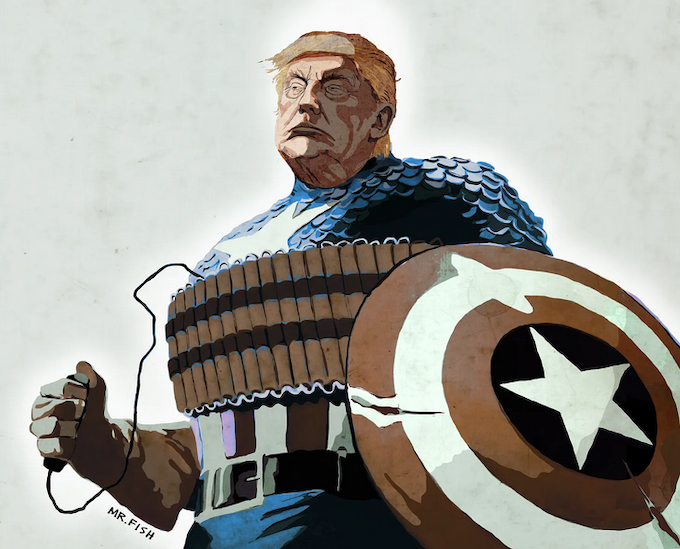
I am writing to you as a Palestinian and a survivor of genocide, who was born and raised in Gaza — a city of love and resilience.
I have read your statements about Gaza and frankly, I am confused.
You claim to be a “peacemaker”, but encourage Israel to continue its genocide, calling for “all hell” to break loose if your demands are not fulfilled.
Mr Trump, we have already been through hell. We lost 60,000 martyrs in it.
You claim credit for the ceasefire deal, and yet your government — one of its guarantors — refuses to pressure Israel into fulfilling all its obligations under it.
You call Gaza a “demolition site” but conveniently fail to name the criminal responsible — while simultaneously supplying it with more bombs, funding, and diplomatic cover.
You talk about Palestinians being “safe” and “happy”, yet you refer to us as if we are a burden to be offloaded onto Jordan, Egypt, or any country willing to take us.
You claim that we “only want to be in the Gaza Strip because [we] don’t know anything else”.
“Gaza is not [President Trump’s] business venture, and it is not for sale. Gaza is our home, our land, our inheritance.” Image: Instagram/#flyer_for_falastin/@tahiapretiti
You profoundly misunderstand us
Mr Trump, I think you profoundly misunderstand who we are and what Gaza is to us.
You may think of us as a mere obstacle to your vision of luxury resorts, but we are a people with deep roots, long history, and unalienable rights.
We are the rightful owners of our land.
Gaza is not your business venture, and it is not for sale.Gaza is our home, our land, our inheritance.
And no, it is not true that we want to stay here because we “know nothing else”.
Although the 17-year-long Israeli siege has made life incredibly difficult for us, some of us have still managed to travel — for education, medical treatment or work. But these people still return because Gaza is home.
He earned his master’s degree in the UK and later completed his PhD at Universiti Putra Malaysia.
Despite having the opportunity to stay abroad, he chose to return to Gaza, where he taught creative writing and literature at the Islamic University.
He also co-founded We Are Not Numbers, an initiative that paired young Palestinian writers with experienced authors to amplify their voices and resist occupation through storytelling. One of these voices is mine.
Last spring, I, too, had the opportunity to leave, but I decided against it. I could not leave my family, friends and Gaza amid a genocidal war. However, like many others, I plan to travel to complete my education and then return to help rebuild and support my people.
The Palestinian way This is the Palestinian way – we seek knowledge and opportunities, not to abandon our homeland, but to build and strengthen it.
Speaking of building — you talk about your plans to turn Gaza into “the Riviera of the Middle East”. The thing is, Gaza was the Riviera of the Middle East. Our ancestors built it into a flourishing trade hub, port city and cultural centre. It was “magnificent” — to use your words — until Israel was created and it started destroying it.
And yet, after every brutal Israeli assault on Gaza, Palestinians would rebuild. Despite all the Israeli violence, restrictions and thievery, Palestinians still made sure Gaza was a safe place with a cosy rhythm of life, where its youth were doing their best to pursue decent livelihoods, where families were happy and together, and where homes thrived.
Israel has now tried to reduce all of Gaza to rubble and death so we are no longer able to live in it. You have picked up on the idea, effectively endorsing our ethnic cleansing under the veneer of humanitarianism.
No, Mr Trump, we will not be “happy” and “safe” elsewhere.
But I agree with you on something else you said: “You’ve got to learn from history”. Indeed, history teaches us that settler-colonialism in modern times is unsustainable. In this sense, your plans and Israel’s plans are doomed to fail.
We, the people of Gaza – like any Indigenous people – refuse to be uprooted. We refuse to be dispossessed. We refuse to be forced into exile so that our land can be handed to the highest bidder. We are not a problem to be solved; we are a people with the right to live in our homeland in freedom and dignity.
No amount of bombs, blockades, or tanks will make us forget that. We will not be relocated, resettled, or replaced.
Power and wealth will not decide the fate of Gaza. History is not written by thieves – it is written by those who resist, by the will of the people. No matter the pressure, our connection to this land will never be severed. Surrender and abandonment are not an option. We will honour our martyrs with resistance by nourishing this land with love, care and remembrance.
Wishing you all the best in your futile pursuits,
Hassan Abuqamar Gaza, Palestine
This open letter was first published by Al Jazeera.
One of the leading Middle East’s leading political and media analysts, Marwan Bishara, has accused President Donald Trump of applying a doctrine of ‘strategic coercion” and “economic blackmail” in his approach to the Gaza ceasefire.
Bishara, senior political analyst of the Doha-based Al Jazeera global television network, was responding to the news that Trump has apparently backed off his plan for expelling more than 2 million Palestinians from their Gaza homeland and to redevelop it as the “Riviera of the Middle East”.
He has now been describing it as a “recommendation” that would not be enforced.
“The idea that Trump starts with [about taking over Gaza] is mad. But there is a method to the madness,” Bishara said.
“The method to the madness, you can see it in the context of Trump’s doctrine, if you will – and that is strategic coercion and economic blackmail.
“In fact, he started his administration by inviting [Israeli Prime Minister] Netanyahu to Washington, blessing him with all kinds of support . . . and blackmailing Egypt and Jordan into accepting two million refugees, or else — and then asking them to come up with something else.”
Bishara said he expected the Trump doctrine to be applied elsewhere in the world, such as with his efforts to end the war in Ukraine.
‘This kind of strategic coercion of Arab countries on behalf of the United States and Israel, and economic blackmail — I think we’re going to see it as part of the Trump doctrine throughout the world.
President Trump’s walkback on his “Riviera” plan for Gaza. Video: Al Jazeera
‘Surprised’ over opposition The US president had said in a radio interview with Fox News that he was “a little bit surprised” that Jordan and Egypt had voiced opposition to his plan to “take over” Gaza and displace Palestinians.
“I’ll tell you, the way to do it is my plan — I think that’s the plan that really works,” Trump said.
“But I’m not forcing it, I’m just going to sit back and recommend it.
“And then the US would own the site, there’d be no Hamas, and there’d be development and you’d start all over again with a clean plate.”
A former Egyptian deputy foreign affairs minister to the European Union, Gamal Bayoumi, said the “informal” meeting in Riyadh, Saudi Arabia, of the leaders of several Arab countries to discuss an Egyptian counterproposal had led to the softening of Trump’s stance.
Speaking from Cairo, Bayoumi said Trump had appeared “inexperienced concerning international law” and the Middle East, saying the US president’s plan “has no logic . . . to ask the Palestinians to leave their own country.”
As French Minister for Overseas Manuel Valls lands in New Caledonia tomorrow to pursue talks on its political future, the situation on the ground has again gained tension over the past few days.
The local political spectrum is deeply divided between the two main opposing camps, the pro-independence and those wanting New Caledonia to remain part of France.
The rift has already culminated in May 2024 with rioting resulting in 14 deaths, several hundreds injured, thousands of job losses due to the destruction, burning and looting of businesses, and a material cost of over 2 billion euros (NZ$3.7 billion).
Valls hosted talks in Paris with every party represented in New Caledonia’s Congress on February 4-9.
Those talks, held in “bilateral” mode, led to his decision to travel to Nouméa and attempt to bring everyone to the same negotiating table.
It is all about finding an agreement that would allow an exit from the Nouméa Accord and to draw a fresh roadmap for New Caledonia’s political future.
However, in the face of radically different and opposing views, the challenge is huge.
The two main blocs, even though they acknowledged the Paris talks may have been helpful, still hold very clear-cut and antagonistic positions.
Each camp seems to have their own interpretation of the 1998 Nouméa Accord, which has until now defined a roadmap for further autonomy and a gradual transfer of powers.
The main bloc within the pro-independence side, Union Calédonienne (UC), which since last year de facto controls the wider FLNKS (Kanak Socialist National Liberation Front), has been repeatedly placing as its target a new “Kanaky Agreement” to be signed by 24 September 2025 and, from that date, a five-year “transition period” to attain full independence from France.
Within the pro-independence camp, more moderate parties, such as PALIKA (Kanak Liberation Party) and UPM (Progressist Union in Melanesia), have distanced themselves from a UC-dominated FLNKS, and are favourable to some kind of “independence in association with France”.
On the pro-France side, the two main components, the Les Loyalistes and the Rassemblement-LR, have shown a united front. One of their main arguments is based on the fact that in 2018, 2020 and 2021, three successive referenda on self-determination have resulted in three votes, each of those producing a majority rejecting independence.
However, the third and latest poll in December 2021 was boycotted by most of the pro-independence voters.
The pro-independence parties have since challenged the 2021 poll result, even though it has been ruled by the courts as valid.
Pro-France parties are also advocating for a change in the political system to give each of New Caledonia’s three provinces more powers, a move they described as an “internal federalism” but that critics have decried, saying this amounted to a kind of apartheid.
Talks required since 2022 The bipartisan talks became necessary after the three referendums were held.
The Nouméa Accord stipulated that in the event that three consecutive referendums rejected independence, then all political stakeholders should “meet and examine the situation”.
There have been earlier attempts to bring about those talks, but some components of the pro-independence movement, notably the UC, have consistently declined.
Under a previous government, French Minister for Home Affairs and Overseas territories Gérald Darmanin, after half a dozen inconclusive trips to New Caledonia, tried to push some of the most urgent parts of the political agreement through a constitutional reform process, especially on a change to New Caledonia’s list of eligible registered voters at local elections.
This was supposed to allow citizens who have resided in New Caledonia for at least ten uninterrupted years to finally cast their votes. Until now, the electoral roll has been “frozen” since 2009 — only those residing before 1998 had the right to vote.
Pro-independence parties protested, saying this was a way of “diluting” the indigenous Kanak votes.
The protest — in the name of “Kanak existential identity” — gained momentum and on 13 May 2024 erupted into riots.
Now the sensitive electoral roll issue is back on the agenda, only it will no longer be tackled separately, but will be part of a wider and comprehensive scope of talks regarding New Caledonia’s political future.
Heavy schedule for Valls On Thursday, Valls unveiled his programme for what is scheduled to be a six-day stay in New Caledonia from 22-26 February 2025.
During this time, he will spend a significant amount of time in the capital Nouméa, holding talks with political parties, economic stakeholders and representatives of the civil society and law and order agencies.
He will also travel to rural parts of New Caledonia.
In the capital, two solid days have been earmarked for “negotiations” at the Congress, with the aim of finding the best way to achieve a political agreement, if all parties agree to meet and talk.
On Tuesday, February 25, Valls also intends to pay homage and lay wreaths on independence leader Jean-Marie Tjibaou and anti-independence leader Jacques Lafleur’s graves.
They were the leaders of FLNKS and (pro-France) RPCR, who eventually signed the Matignon Accords in 1998 and shook hands after half a decade of quasi civil war, during the previous civil unrest in the second half of the 1980s.
Valls was then a young member of French Prime Minister Michel Rocard (Socialist) who enabled the Matignon agreement.
On several occasions, over the past few days, Valls has stressed the grave situation New Caledonia has been facing since the riots, the “devastated” economy and the need to restore a bipartisan dialogue.
He told public broadcaster NC La Première that since the unrest started had France had provided financial support to sustain New Caledonia’s economy.
‘Fractures and deep wounds within New Caledonia’s society’ “But blood has been shed . . . there have been deaths, injuries, there are fractures and deep wounds within New Caledonia’s society,” Valls said.
“And to get out of this, dialogue is needed, to find a compromise . . . to prevent violence from coming back. I still believe those (opposing) positions are reconcilable, even though they’re quite far apart,” he said.
“I’m very much aware of the difficulties . . . but we have to find an agreement, a compromise.”
One clear indication that during his visit to New Caledonia the French minister will be walking on shaky ground came a few days ago.
When, speaking to French national daily Le Monde, he recalled the Nouméa Accord included a wide range of possible perspectives from “a shared sovereignty” to a “full sovereignty”, there was an immediate outcry from the pro-French parties, who steadfastly brandished the three recent referendums opposing independence and urging the minister to respect those “democratic” results.
“Respecting the Nouméa Accord means respecting the choice of New Caledonians”, said Les Loyalistes-Le Rassemblement-LR in a media release.
“Shared sovereignty is the current situation. It’s all in the Nouméa Accord, which itself is enshrined in the French Constitution”, Valls replied.
Over the past six months, several notions have emerged in terms of a political future for New Caledonia.
It all comes down to wording: from independence-association (Cook Islands style), to outright “independence” or “shared sovereignty” (as suggested by French Senate President Gérard Larcher during his visit in October 2024).
A former justice minister under Socialist President François Hollande, Jean-Jacques Urvoas, well-versed in New Caledonian affairs, suggested an innovative wording which, he believed, could bring about some form of consensus — the term “associated state”, could be slightly modified into “associated country” (“country” being one of the ways to describe New Caledonia, also described as a sui generis entity under French Law).
Urvoas said this would make the notion more palatable.
Pro-France meetings indoors On Wednesday evening, in an indoor multi-purpose hall in Nouméa, an estimated 2000 sympathisers of pro-France Rassemblement and Loyalists gathered to hear and support their leaders who had come to explain what was discussed in Paris and reiterate the pro-France bloc’s position.
“We told [Valls] the ‘bilaterals’ are over. Now we want plenary discussions or nothing,” pro-France Virginie Ruffenach told the crowd.
“We will tell him: Manuel, your full sovereignty is No Pasaran! (in Spanish ‘Will not pass’, a reference to Valls’s Spanish heritage),” said Nicolas Metzdorf, who is also one of the two New Caledonian MPs in the French National Assembly, speaking to supporters brandishing blue, white and red French flags.
Metzdorf said he hoped that supporters would show up during the minister’s visit with the same flags “to remind him of three “no” votes in the three referenda.
A ban on all open-air public meetings is still in force in Nouméa and its greater area.
The two-flag driving licence declared illegal. Image: New Caledonia govt
Double flags banned on driving licences Adding to the current tensions, an announcement also came earlier this week regarding a court ruling on another highly sensitive issue — the flag.
The ruling came in an appeal case from the Paris Administrative Court.
It overturned a ruling made in 2023 by the former New Caledonian (pro-independence) territorial government to add the Kanak flag to the local driving licence, next to the French flag.
In its February 14 ruling, the Appeal Court stated that the Kanak flag could not be used on such official documents because “it is not the official flag” of New Caledonia.
The court once again referred to the Nouméa Accord, which said the Kanak flag, even though it was often used alongside the French flag, had not been formally endorsed as New Caledonia’s “identity symbol”.
The tribunal also urged the new government to make the necessary changes and to re-circulate the former one-flag version “without delay”.
Meanwhile, the government is bearing the cost of a fine of 100, 000 French Pacific francs (about US$875) a day, which currently totals over US$43,000 since January 1.
The “identity symbols”, as defined by the Nouméa Accord, also include a motto (the wording ‘Terre de Parole, Terre de Partage’ — Land of Words, Land of Sharing’ was chosen) and even a national anthem.
But despite several attempts since 1998, no agreement has yet been reached on a common flag.
This week, hours after the court ruling, an image is being circulated on social media declaring: “If this flags disturbs you, I’ll help you pack your suitcase” (“Si ce drapeau te dérange, je t’aide à faire tes valises”).
This article is republished under a community partnership agreement with RNZ.
Fijian Prime Minister Sitiveni Rabuka’s announcement this week that the island nation will open a diplomatic mission in Jerusalem has been labelled “an act of aggression” by Palestine.
On Tuesday, the Fiji government revealed that Cabinet had decided to locate its consulate in Jerusalem, which remains at the centre of the Palestine-Israel decades-long conflict.
According to an overwhelming United Nations General Assembly Resolution ES‑10/19 on 21 December 2017 (128-9), Israel’s claim to Jerusalem as capital of Israel is “null and void”.
Previous UN Security Council resolutions demarcated Jerusalem as the capital of the future state of Palestine.
The Fijian government said in a statement: “Necessary risk assessments will be undertaken by the Ministry of Foreign Affairs and the Ministry of Defence, in consultation with relevant agencies, prior to and during the establishment process.”
Fiji and Israel established diplomatic relations in 1970 and have partnerships in security and peacekeeping, agriculture, and climate change.
In a Facebook post on Wednesday, Rabuka said he “received a phone call from my friend Prime Minister Benjamin Netanyahu, expressing his gratitude for Fiji’s decision to open a diplomatic mission in Jerusalem.”
“Even though very brief, we reaffirmed our commitment to strengthening Fiji-Israel ties,” he said.
I commend the Republic of Fiji’s government for its historic decision to open an embassy in Jerusalem, the eternal capital of the Jewish people. Thank you, Prime Minister Sitiveni Rabuka @slrabuka, friend of Israel. Thank you Fiji! 🇮🇱🇫🇯 pic.twitter.com/IxCkjPnhQ6
‘Violating international law’ “With this decision, Fiji becomes the seventh country to violate international law and UN resolutions regarding the city’s legal and political status and the rights of the Palestinian people,” it said in a statement.
The seven countries include Papua New Guinea.
The Palestinian Ministry of Foreign Affairs strongly condemns the decision of PM @slrabuka to relocate Fiji’s embassy to occupied #Jerusalem.
This move blatantly violates international law and UN resolutions, and places #Fiji on the wrong side of history. https://t.co/5x1bCECNXO
— Palestine Australia, Aotearoa NZ and Pacific (@PalestineAusNZ) February 19, 2025
“This decision is an act of aggression against the Palestinian people and their rights.
“It places Fiji on the wrong side of history, harms the chances of achieving peace based on the two-state solution, and represents unacceptable support for the occupation and its crimes.”
The statement added that Fiji’s move “blatantly defies UN resolutions at a time when the occupying power is escalating its attacks against Palestinians across all of the Palestinian Territory, attempting to displace them from their homeland.”
The ministry said that it would continue to take political, diplomatic, and legal action against countries that opened or moved their embassies to Jerusalem.
“It will work to hold them accountable for their unjustified actions against the Palestinian people and their rights.”
In September 2024, Fiji was one of seven Pacific Island nations that voted against a United Nations resolution to end Israel’s occupation of Palestine.
This article is republished under a community partnership agreement with RNZ.
A New Zealand-based community education provider, Dark Times Academy, has had a US Embassy grant to deliver a course teaching Pacific Islands journalists about disinformation terminated after the new Trump administration took office.
The new US administration requested a list of course participants and to review the programme material amid controversy over a “freeze” on federal aid policies.
The course presentation team refused and the contract was terminated by “mutual agreement” — but the eight-week Pacific workshop is going ahead anyway from next week.
Dark Times Academy’s co-founder Mandy Henk . . . “A Bit Sus”, an evidence-based peer-reviewed series of classes on disinfiormation for Pacific media. Image: Newsroom
“As far as I can tell, the current foreign policy priorities of the US government seem to involve terrorising the people of Gaza, annexing Canada, invading Greenland, and bullying Panama,” said Dark Times Academy co-founder Mandy Henk.
“We felt confident that a review of our materials would not find them to be aligned with those priorities.”
The course, called “A Bit Sus”, is an evidence-based peer-reviewed series of classes that teach key professions the skills needed to identify and counter disinformation and misinformation in their particular field.
The classes focus on “prebunking”, lateral reading, and how technology, including generative AI, influences disinformation.
Awarded competitive funds Dark Times Academy was originally awarded the funds to run the programme through a public competitive grant offered by the US Embassy in New Zealand in 2023 under the previous US administration.
The US Embassy grant was focused on strengthening the capacity of Pacific media to identify and counter disinformation. While funded by the US, the course was to be a completely independent programme overseen by Dark Times Academy and its academic consultants.
Co-founder Henk was preparing to deliver the education programme to a group of Pacific Island journalists and media professionals, but received a request from the US Embassy in New Zealand to review the course materials to “ensure they are in line with US foreign policy priorities”.
Henk said she and the other course presenters refused to allow US government officials to review the course material for this purpose.
She said the US Embassy had also requested a “list of registered participants for the online classes,” which Dark Times Academy also declined to provide as compliance would have violated the New Zealand Privacy Act 2020.
Henk said the refusal to provide the course materials for review led immediately to further discussions with the US Embassy in New Zealand that ultimately resulted in the termination of the grant “by mutual agreement”.
However, she said Dark Times Academy would still go ahead with running the course for the Pacific Island journalists who had signed up so far, starting on February 26.
Continuing the programme “The Dark Times Academy team fully intends to continue to bring the ‘A Bit Sus’ programme and other classes to the Pacific region and New Zealand, even without the support of the US government,” Henk said.
“As noted when we first announced this course, the Pacific Islands have experienced accelerated growth in digital connectivity over the past few years thanks to new submarine cable networks and satellite technology.
“Alongside this, the region has also seen a surge in harmful rumours and disinformation that is increasingly disrupting the ability to share accurate and truthful information across Pacific communities.
“This course will help participants from the media recognise common tactics used by disinformation agents and support them to deploy proven educational and communications techniques.
“By taking a skills-based approach to countering disinformation, our programme can help to spread the techniques needed to mitigate the risks posed by digital technologies,” Henk said.
Especially valuable for journalists Dark Times Academy co-founder Byron Clark said the course would be especially valuable for journalists in the Pacific region given the recent shifts in global politics and the current state of the planet.
Dark Times Academy co-founder and author Byron Clark . . . “We saw the devastating impacts of disinformation in the Pacific region during the measles outbreak in Samoa.” Image: APR
“We saw the devastating impacts of disinformation in the Pacific region during the measles outbreak in Samoa, for example,” said Clark, author of the best-selling book Fear: New Zealand’s Underworld of Hostile Extremists.
“With Pacific Island states bearing the brunt of climate change, as well as being caught between a geopolitical stoush between China and the West, a course like this one is timely.”
Henk said the “A Bit Sus” programme used a “high-touch teaching model” that combined the current best evidence on how to counter disinformation with a “learner-focused pedagogy that combines discussion, activities, and a project”.
Past classes led to the creation of the New Zealand version of the “Euphorigen Investigation” escape room, a board game, and a card game.
These materials remain in use across New Zealand schools and community learning centres.
Palestine has strongly condemned Fiji’s decision to open a Fiji embassy in Jerusalem, calling it a violation of international law and relevant United Nations resolutions.
The Palestinian Foreign Ministry and the Hamas resistance group that governs the besieged enclave of Gaza issued separate statements, urging the Fiji government to reverse its decision.
According to the Palestinian Foreign Ministry, the Fijian decision is “an act of aggression against the Palestinian people and their inalienable rights”.
The Palestinian group Hamas said in a statement that the decision was “a blatant assault on the rights of our Palestinian people to their land and a clear violation of international law and UN resolutions, which recognise Jerusalem as occupied Palestinian territory”.
Fiji will become the seventh country to have an embassy in Jerusalem after the US, Guatemala, Honduras, Kosovo, Papua New Guinea, and Paraguay.
More than 400 people have taken to the streets to protest against Cook Islands Prime Minister Mark Brown’s recent decisions, which have led to a diplomatic spat with New Zealand.
The protest, led by Opposition MP and Cook Islands United Party leader Teariki Heather, has taken place outside the Cook Islands Parliament in Avarua — a day after Brown returned from China.
Protesters have come out with placards, stating: “Stay connected with New Zealand.”
The protest in Avarua today. Video: RNZ
Some government ministers have been standing outside Parliament, including Foreign Minister Tingika Elikana.
Heather said he was present at the rally to how how much Cook Islanders cared about the relationship with New Zealand and valued the New Zealand passport.
He has apologised to the New Zealand government on behalf of the Cook Islands government.
Leader of the opposition and Democratic Party leader Tina Browne said she wanted the local passport to be off the table “forever and ever”.
“We have no problem with our government going and seeking assistance,” she said.
“We do have a problem when it is risking our sovereignty, risking our relationship with New Zealand.”
This article is republished under a community partnership agreement with RNZ.
Two Palestinian resistance groups have condemned “the brutal assault” on prisoners at Ofer Prison, saying it was “barbaric criminal behaviour that reflects the fascist and terrorist nature of” Israel.
In the joint statement, Hamas and Palestine Islamic Jihad (PIJ) called the attack a “miserable attempt” by Israel “to restore its shattered prestige”, reports Al Jazeera.
They called on the world to expose “these inhuman crimes against the prisoners”, which “blatantly violate all international conventions and norms”.
The statement called on the international community to intervene to protect the “prisoners, stop criminal violations against them, document them and work to hold the criminal occupation leaders accountable”.
The statement came after Palestinian authorities said Israeli forces had raided a section of Ofer Prison, west of Ramallah in the occupied West Bank, and assaulted detainees.
“Prisoners were beaten and sprayed with gas,” the Palestinian Prisoners Media Office said.
Persistent serious allegations of torture and abuse of Palestinian prisoners — many who have not been charged or are held on administrative detention — and beatings right up until the release of detainees under the ceasefire have been made over all six exchange events so far.
Medical director severely tortured Last week, lawyers representing Kamal Adwan Hospital’s medical director Dr Hussam Abu Safiya met him for the first time since he was detained by Israeli forces in north Gaza last December 27.
He told them he was severely tortured with electric shocks and was being denied needed medication.
Lawyer spells out torture allegations over Israeli detention of doctor. Video: Al Jazeera
Samir Al-Mana’ama, a lawyer with the Al Mazan Center for Human Rights, described his brutal torture in a failed attempt to “extract a confession” from him in an interview with Al Jazeera.
Al-Mana’ama said Dr Abu Safiya suffered from “an enlarged heart muscle and from high blood pressure” and was beaten up and refused treatment for the heart condition.
Transferred to Ofter Prison on January 9, he was held in solitary confinement for 25 days and interrogated nonstop by the Israeli army, Israeli intelligence and police, the lawyer added.
There was “no legal justification” for Abu Safia’s arrest and no evidence against him, the lawyer said.
Since the interview, Israeli authorities said he was being held under an “unlawful combatant” law — despite his status as a civilian doctor — stripping him of any rights as a detainee.
Al Jazeera’s Nour Odeh, reporting from Amman in Jordan, said the doctor was one of hundreds of medical workers taken from Gaza by Israeli forces to the notorious Sde Teiman detention camp and other Israeli military prisons.
Cook Islands Prime Minister Mark Brown hopes to have “an opportunity to talk” with the New Zealand government to “heal some of the rift”.
Brown returned to Avarua on Sunday afternoon (Cook Islands Time) following his week-long state visit to China, where he signed a “comprehensive strategic partnership” to boost its relationship with Beijing.
Prior to signing the deal, he said that there was “no need for New Zealand to sit in the room with us” after the New Zealand Foreign Affairs Minister raised concerns about the agreement.
Responding to reporters for the first time since signing the China deal, he said: “I haven’t met the New Zealand government as yet but I’m hoping that in the coming weeks we will have an opportunity to talk with them.
“Because they will be able to share in this document that we’ve signed and for themselves see where there are areas that they have concerns with.
“But I’m confident that there will be no areas of concern. And this is something that will benefit Cook Islanders and the Cook Islands people.”
He said the agreement with Beijing would be made public “very shortly”.
“I’m sure once the New Zealand government has a look at it there will be nothing for them to be concerned about.”
Not concerned over consequences Brown said he was not concerned by any consequences the New Zealand government may impose.
The Cook Islands leader is returning to a motion of no confidence filed against his government and protests against his leadership.
“I’m confident that my statements in Parliament, and my returning comments that I will make to our people, will overcome some of the concerns that have been raised and the speculation that has been rife, particularly throughout the New Zealand media, about the purpose of this trip to China and the contents of our action plan that we’ve signed with China.”
The New Zealand government wanted to see the agreement prior to Brown going to China, which did not happen.
A spokesperson for New Zealand’s Foreign Minister Winston Peters said Brown had a requirement to share the contents of the agreement and anything else he signed under the 2001 Joint Centenary Declaration.
‘Healing some of the rift’ Brown said the difference in opinion provides an opportunity for the two governments to get together and “heal some of the rift”.
“We maintain that our relationship with New Zealand remains strong and we remain open to having conversations with the New Zealand government on issues of concern.
“They’ve raised their concerns around security in the Pacific. We’ve raised our concerns around our priorities, which is economic development for our people.”
Brown has previously said New Zealand did not consult the Cook Islands on its comprehensive strategic partnership with China in 2014, which they should have done if the Cook Islands had a requirement to do so.
He hoped people would read New Zealand’s deal along with his and show him “where the differences are that causes concern”.
Meanwhile, the leader of Cook Islands United Party, Teariki Heather, said Cook Islanders were sitting nervously with a question mark waiting for the agreement to be made public.
Cook Islands United Party leader Teariki Heather stands by one of his trucks he is preparing to take on the planned protest. Image: Caleb Fotheringham/RNZ Pacific
“That’s the problem we have now, we haven’t been disclosed or told of anything about what has been signed,” he said.
“Yes we hear about the marine seabed minerals exploration, talk about infrastructure, exchange of students and all that, but we haven’t seen what’s been signed.”
However, Heather said he was not worried about what was signed but more about the damage that it could have created with New Zealand.
Heather is responsible for filing the motion of no confidence against the Prime Minister and his cabinet.
The opposition only makes up eight seats of 24 in the Cook Islands Parliament and the motion is about showing support to New Zealand, not about toppling the government.
“It’s not about the numbers for this one, but purposely to show New Zealand, this is how far we will go if the vote of no confidence is not sort of accepted by both of the majority members, at least we’ve given the support of New Zealand.”
Heather has also been the leader for a planned planned today local time (Tuesday NZ).
“Protesters will be bringing their New Zealand passports as a badge of support for Aotearoa,” he said.
“Our relationship [with New Zealand] — we want to keep that.”
This article is republished under a community partnership agreement with RNZ.
Two independent Jewish Voices groups in Aotearoa New Zealand have written an open letter to the government condemning the Zionist “colonisation” project leading to genocide and criticising the role of the NZ Jewish Council for its “unelected” and “uncritical support” for Israel.
The groups, Alternative Jewish Voices and Dayenu: New Zealand Jews Against Occupation, have also criticised a scheduled meeting this week between Prime Minister Christopher Luxon and other ministers and the NZJC.
“The NZJC is an extremist voice. Their politics are harmful, and their actions jeopardise the good standing of Jews in Aotearoa,” the open letter said.
“We protest in the strongest terms that Israel’s advocates are being given Prime Ministerial access.”
The alternative voices also appealed to be consulted along with representatives of the Muslim and Palestinian communities “who have lost the most to racism in recent years”.
“Hear us out before you act,” the open letter said.
We are Jewish New Zealanders, members of Alternative Jewish Voices and Dayenu: New Zealand Jews Against Occupation. We understand that your office has scheduled a meeting this week with the NZ Jewish Council (NZJC) and additional ministers. We object in the strongest terms. The NZJC is unelected coterie, forever uncritically aligned with Israel. That is not the Jewish community.
We have documented in depth that the NZJC is not representative. They are not elected. Their constitution outlines a regional structure for indirect democracy, but much of that structure does not seem to exist.
They are not accountable to the community. Their president has broadcast her intention to “disempower as much as possible” Jews like Alternative Jewish Voices (AJV) members who “raise their voices”.
Several of us attended the Wellington Regional Jewish Council’s last community meeting, in 2021. The meeting roundly disavowed the Jewish Council’s tone and their relentless focus on Israel.
Indeed, the NZJC’s constitution does not even mention Israel or Zionism. The Wellington Regional Jewish Council dissolved itself after that meeting, acknowledging that they have no community mandate. They haven’t been heard from since. So much for regional representation.
They interpret objections to Israel’s occupation as a security threat to the New Zealand Jewish community, and they share their views of individual Palestinian, Muslim and other New Zealanders with a regime accused of genocide against Palestinians. This creates particular risk for Palestinian New Zealanders, should they ever travel to Israel or the Occupied Palestinian Territories to visit family and whānau.
Let us say this clearly: there is nothing essentially Jewish about Zionism. Zionism is a project of colonisation, erasure, apartheid, ethnic cleansing — finally, of genocide. Institutions that wrap their nationalism in our Jewishness are shielding the brutality that we witness daily.
In this country, the NZJC has been a leading voice in the campaign to confuse Jewish with Zionist, enabling decades of oppression in our names.
The NZJC does not serve, represent or account to the Jewish community. How many Jewish New Zealanders would choose a representative who, like NZJC president Juliet Moses, retweets defences of Elon Musk’s Nazi salute?
A Juliet Moses retweeting of the defence of a “Nazi salute” by US billionaire Elon Musk who is unelected head of the controversial US Department of Government Efficiency (DOGE). Image: Screenshot Alternative Voices
The NZJC is an extremist voice. Their politics are harmful, and their actions jeopardise the good standing of Jews in Aotearoa. We protest in the strongest terms that Israel’s advocates are being given Prime Ministerial access.
It’s not hard to guess what the NZJC will be asking for: some special “antisemitism regime” that uses our Jewish identity to shield Israel from the directives of the International Court of Justice (ICJ). They will be asking to divorce the Jewish community from our shared mahi of antiracism and our human rights framework. They will be seeking some exceptional status, suppressing principled protest for Palestinian rights and the criminal accountability of Israeli leaders.
That conversation should not take place without representation from the Muslim and Palestinian communities. They are the New Zealanders whose voices are being silenced, and frankly they are the communities who have lost the most to racism in recent years.
Prime Minister, any meeting with the NZJC ought to be recorded in the ministerial diaries as a session with Israel’s ambassadors. And damn it, they will be doing it in our name. We are also the New Zealand Jewish community, and we are so tired of being used this way.
We would like to join your meeting with the NZJC, bringing Jewish diversity into the room. If you will not open this meeting to the real breadth of the Jewish community, then we wish to schedule a second meeting which includes Muslim and Palestinian representation.
We work closely with the Muslim and Palestinian communities in Aotearoa, modelling the change that we would like to see in the Middle East.
Here is a scenario, but first a broad brush-painted historical parallel.
Hitler and the Nazis could well have accomplished everything that they wanted to do within German borders, including exterminating Jews, so long as they confined their ambitious to Germany itself. After all, the world pretty much sat and watched as the Nazi pogroms unfolded in the late 1930s.
But Hitler never intended to confine himself to Germany and decided to attack his neighbours simultaneously, on multiple fronts East, West, North and South.
This came against the advice of his generals, who believed that his imperialistic war-mongering should happen sequentially and that Germany should not fight the USSR until it had conquered Europe first, replenished with pillaged resources, and then reorganised its forces for the move East. They also advised that Germany should also avoid tangling with the US, which had pro-Nazi sympathisers in high places (like Charles Lindbergh) and was leaning towards neutrality in spite of FDR’s support for the UK.
Hitler ignored the advice and attacked in every direction, got bogged down in the Soviet winter, drew in the US in by attacking US shipping ferrying supplies to the UK, and wound up stretching his forces in North Africa, the entire Eastern front into Ukraine and the North Mediterranean states, the Scandinavian Peninsula and the UK itself.
In other words, he bit off too much in one chew and wound up paying the price for his over-reach.
Hitler did what he did because he could, thanks in part to the 1933 Enabling Law that superseded all other German laws and allowed him carte blanche to pursue his delusions. That proved to be his undoing because his ambition was not matched by his strategic acumen and resources when confronted by an armed alliance of adversaries.
A version of this in US? A version of this may be what is unfolding in the US. Using the cover of broad Executive Powers, Musk, Trump and their minions are throwing everything at the kitchen wall in order to see what sticks.
They are breaking domestic and international norms and conventions pursuant to the neo-reactionary “disruptor” and “chaos” theories propelling the US techno-authoritarian Right. They want to dismantle the US federal State, including the systems of checks and balances embodied in the three branches of government, subordinating all policy to the dictates of an uber-powerful Executive Branch.
In this view the Legislature and Judiciary serve as rubber stamp legitimating devices for Executive rule. Many of those in the Musk-lead DOGE teams are subscribers to this ideology.
At the same time the new oligarchs want to re-make the International order as well as interfere in the domestic politics of other liberal democracies. Musk openly campaigns for the German far-Right AfD in this year’s elections, he and Trump both celebrate neo-fascists like Viktor Urban in Hungry and Javier Milei in Argentina.
Trump utters delusional desires to “make” Canada the 51st State, forcibly regain control of the Panama Canal, annex Greenland, turn Gaza into a breach resort complex and eliminate international institutions like the World Trade Organisation and even NATO if it does not do what he says.
He imposes sanctions on the International Criminal Court, slaps sanctions on South Africa for land take-overs and because it took a case of genocide against Israel in the ICC, doubles down on his support for Netanyahu’s ethnic cleansing campaign against Palestinians and is poised to sell-out Ukraine by using the threat of an aid cut-off to force the Ukrainians to cede sovereignty to Russia over all of their territory east of the Donbas River (and Crimea).
He even unilaterally renames the Gulf of Mexico as the Gulf of America in a teenaged display of symbolic posturing that ignores the fact that renaming the Gulf has no standing in international law and “America” is a term that refers to the North, Central and South land masses of the Western Hemisphere — i.e., it is not exclusive to or propriety of the United States.
Dismantling the globalised trade system Trump wants to dismantle the globalised system of trade by using tariffs as a weapon as well as leverage, “punishing” nations for non-trade as well as trade issues because of their perceived dependence on the US market. This is evident in the tariffs (briefly) imposed on Canada, Mexico and Colombia over issues of immigration and re-patriation of US deportees.
In other words, Trump 2.0 is about redoing the World Order in his preferred image, doing everything more or less at once. It is as if Trump, Musk and their Project 2025 foot soldiers believe in a reinterpreted version of “shock and awe:” the audacity and speed of the multipronged attack on everything will cause opponents to be paralysed by the move and therefore will be unable to resist it.
That includes extending cultural wars by taking over the Kennedy Center for the Arts (a global institution) because he does not like the type of “culture” (read: African American) that is presented there and he wants to replace the Center’s repertoire with more “appropriate” (read: Anglo-Saxon) offerings. The assault on the liberal institutional order (at home and abroad), in other words, is holistic and universal in nature.
Trump’s advisers are even talking about ignoring court orders barring some of their actions, setting up a constitutional crisis scenario that they believe they will win in the current Supreme Court.
I am sure that Musk/Trump can get away with a fair few of these disruptions, but I am not certain that they can get away with all of them. They may have more success on the domestic rather than the international front given the power dynamics in each arena. In any event they do not seem to have thought much about the ripple effect responses to their moves, specifically the blowback that might ensue.
This is where the Nazi analogy applies. It could be that Musk and Trump have also bitten more than they can chew. They may have Project 2025 as their road map, but even maps do not always get the weather right, or accurately predict the mood of locals encountered along the way to wherever one proposes to go. That could well be–and it is my hope that it is–the cause of their undoing.
Overreach, egos, hubris and the unexpected detours around and obstacles presented by foreign and domestic actors just might upset their best laid plans.
Dotage is on daily public display That brings up another possibility. Trump’s remarks in recent weeks are descending into senescence and caducity. His dotage is on daily public display. Only his medications have changed. He is more subdued than during the campaign but no less mad. He leaves the ranting and raving to Musk, who only truly listens to the fairies in his ear.
But it is possible that there are ghost whisperers in Trump’s ear as well (Stephen Miller, perhaps), who deliberately plant preposterous ideas in his feeble head and egg him on to pursue them. In the measure that he does so and begins to approach the red-line of obvious derangement, then perhaps the stage is being set from within by Musk and other oligarchs for a 25th Amendment move to unseat him in favour of JD Vance, a far more dangerous member of the techbro puppet masters’ cabal.
Remember that most of Trump’s cabinet are billionaires and millionaires and only Cabinet can invoke the 25th Amendment.
Vance has incentive to support this play because Trump (foolishly, IMO) has publicly stated that he does not see Vance as his successor and may even run for a third term. That is not want the techbro overlords wanted to hear, so they may have to move against Trump sooner rather than later if they want to impose their oligarchical vision on the US and world.
An impeachment would be futile given Congress’s make-up and Trump’s two-time wins over his Congressional opponents. A third try is a non-starter and would take too long anyway. Short of death (that has been suggested) the 25th Amendment is the only way to remove him.
It is at that point that I hope that things will start to unravel for them. It is hard to say what the MAGA-dominated Congress will do if laws are flouted on a wholesale basis and constituents begin to complain about the negative impact of DOGE cost-cutting on federal programmes. But one thing is certain, chaos begets chaos (because chaos is not synonymous with techbro libertarians’ dreams of anarchy) and disruption for disruption’s sake may not result in an improved socio-economic and political order.
Those are some of the “unknown unknowns” that the neo-con Donald Rumsfeld used to talk about.
In other words, vamos a ver–we shall see.
Dr Paul G Buchanan is the director of 36th-Parallel Assessments, a geopolitical and strategic analysis consultancy. This article is republished from Kiwipolitico with the permission of the author.
Mediawatch on RNZ today strongly criticised Stuff and YouTube among other media for using Israeli propaganda’s “Outbrain” service.
Outbrain is a company founded by the Israeli Defence Force (IDF) military and its technology can be tracked back to a wealthy entrepreneur, which in this case could be a euphemism for a megalomaniac.
He uses the metaphor of a “dome”, likening it to the dome used in warfare.
Outbrain, which publishes content on New Zealand media, picks up what’s out there and converts and distorts it to support Israel. It twists, it turns, it deceives the reader.
Outbrain uses the media in the following way. The content user such as Stuff pays Outbrain and Outbrain pays the user, like Stuff.
“Both parties make money when users click on the content,” said Peacock.
‘Digital Iron Dome’ The content on the Stuff website came via “Digital Iron Dome” named after the State of Genociders’ actual defence system. It is run by a tech entrepreneur quoted on Mediawatch:
“Just like a physical iron dome that scans the open air and watches for any missiles . . . the digital iron dome knows how to scan the internet. We know how to buy media. Pro-Israeli videos and articles and images inside the very same articles going against Israel,” says the developer of the propaganda “dome” machine.
Peacock said the developer had stated that the digital dome delivered “pro-Jewish”* messages to more than 100 million people worldwide on platforms like Al Jazeera, CNN — and last weekend on Stuff NZ — and said this information went undetected as pro-Israel material, ensuring it reached, according to the entrepreneur: “The right audience without interference.”
According to Wikipedia, Outbrain was founded by Yaron Galai and Ori Lahav, officers in the Israeli Navy. Galai sold his company Quigo to AOL in 2007 for $363 million. Lahav worked at an online shopping company acquired by eBay in 2005.
The company is headquartered in New York with global offices in London, San Francisco, Chicago, Washington DC, Cologne, Gurugram, Paris, Ljubljana, Munich, Milan, Madrid, Tokyo, São Paulo, Netanya, Singapore, and Sydney.
Peacock pointed out that other advocacy organisations had already been buying and posting content, there was nothing new about this with New Zealand news media.
But — and this is important — the Media Council ruled in 2017 that Outbrain content was the publisher’s responsibility: that the news media in NZ were responsible for promoted links that were offered to their readers.
“Back then publishers at Stuff and the Herald said they would do more to oversee the content, with Stuff stating it is paid promoted content,” said Peacock, in his role as the media watchdog.
Still ‘big money business’ “But this is also still a big money business and the outfits using these tools are getting much bigger exposure from their arrangements with news publishers such as Stuff,” he said.
He pointed out that the recently appointed Outbrain boss for Australia New Zealand and Singapore, Chris Oxley, had described Outbrain as “a leader in digital media connecting advertisers with premium audiences in contextually relevant environments”.
The watchdog Mediawatch said that news organisations should drop Outbrain.
“Media environments where news and neutrality are important aren’t really relevant environments for political propaganda that’s propagated by online opportunists who know how to make money out of it and also to raise funds while they are at it, ” said Peacock.
“These services like Outbrain are sometimes called ‘recommendation engines’ but our recommendation to news media is don’t use them for the sake of the trust of the people you say you want to earn and keep: the readers,” said Peacock.
Saige England is a journalist and author, and member of the Palestine Solidarity Network Aotearoa (PSNA).
* Being “pro-Jewish” should not be equated with being pro-genocide nor should antisemitism be levelled at Jews who are against this genocide. The propaganda from Outbrain does a disservice to Palestinians and also to those Jewish people who support all human rights — the right of Palestinians to life and the right to live on their land.
Former New Zealand Prime Minister Helen Clark maintains that Cook Islands, a realm of New Zealand, should have consulted Wellington before signing a “partnership” deal with China.
“[Cook Islands Prime Minister Mark Brown] seems to have signed behind the backs of his own people as well as of New Zealand,” Clark told RNZ Pacific.
Brown said the deal with China complements, not replaces, the relationship with New Zealand.
The contents of the deal have not yet been made public.
“The Cook Islands public need to see the agreement — does it open the way to Chinese entry to deep sea mining in pristine Cook Islands waters with huge potential for environmental damage?” Clark asked.
“Does it open the way to unsustainable borrowing? What are the governance safeguards? Why has the prime minister damaged the relationship with New Zealand by acting in this clandestine way?”
In a post on X (formerly Twitter), Clark went into detail about the declaration she signed with Cook Islands Prime Minister Terepai Maoate in 2001.
“There is no doubt in my mind that under the terms of the Joint Centenary Declaration of 2001 that Cook Islands should have been upfront with New Zealand on the agreement it was considering signing with China,” Clark said.
“Cook Islands has opted in the past for a status which is not independent of New Zealand, as signified by its people carrying New Zealand passports. Cook Islands is free to change that status, but has not.”
Sione Tekiteki in Tonga for PIFLM 2024 . . . his last leader’s meeting in his capacity as Director of Governance and Engagement. IMage: RNZ Pacific/ Lydia Lewis
Missing the mark A Pacific law expert said there was a clear misunderstanding on what the 2001 agreement legally required New Zealand and Cook Islands to consult on.
AUT senior law lecturer and former Pacific Islands Forum policy advisor Sione Tekiteki told RNZ Pacific the word “consultation” had become somewhat of a sticking point:
“From a legal perspective, there’s an ambiguity of what the word consultation means. Does it mean you have to share the agreement before it’s signed, or does it mean that you broadly just consult with New Zealand regarding what are some of the things that, broadly speaking, are some of the things that are in the agreement?
“That’s one avenue where there’s a bit of misunderstanding and an interpretation issue that’s different between Cook Islands as well as New Zealand.”
Unlike a treaty, the 2001 declaration is not “legally binding” per se but serves more to express the intentions, principles and commitments of the parties to work together in “recognition of the close traditional, cultural and social ties that have existed between the two countries for many hundreds of years”, he added.
Tekiteki said that the declaration made it explicitly clear that Cook Islands had full conduct of its foreign affairs, capacity to enter treaties and international agreements in its own right and full competence of its defence and security.
There was, however, a commitment of the parties to “consult regularly”, he said.
For Clark, the one who signed the all-important agreement all those years ago, this is where Brown had misstepped.
Pacific nations played off against each other Tekiteki said it was not just the Joint Centenary Declaration causing contention. The “China threat” narrative and the “intensifying geopolitics” playing out in the Pacific was another intergrated issue.
An analysis in mid-2024 found that there were more than 60 security, defence and policing agreements and initiatives with the 10 largest Pacific countries.
Australia was the dominant partner, followed by New Zealand, the US and China.
A host of other agreements and “big money” announcements have followed, including the regional Pacific Policing Initiative and Australia’s arrangements with Nauru and PNG.
“It would be advantageous if Pacific nations were able to engage on security related matters as a bloc rather than at the bilateral level,” Tekiteki said.
“Not only will this give them greater political agency and leverage, but it would allow them to better coordinate and integrate support as well as avoid duplications. Entering these arrangements at the bilateral level opens Pacific nations to being played off against each other.
“This is the most worrying aspect of what I am currently seeing.
“This matter has greater implications for Cook Islands and New Zealand diplomatic relations moving forward.”
Mark Brown talking to China’s Ambassador to the Pacific, Qian Bo, who told the media an affirming reference to Taiwan in the PIF 2024 communique “must be corrected”. Image: RNZ Pacific/Lydia Lewis
Protecting Pacific sovereignty The word sovereignty is thrown around a lot. In this instance Tekiteki does not think “there is any dispute that Cook Islands maintains sovereignty to enter international arrangements and to conduct its affairs as it determines”.
But he did point out the difference between “sovereignty — the rhetoric” that we hear all the time, and “real sovereignty”.
“For example, sovereignty is commonly used as a rebuttal to other countries to mind their own business and not to meddle in the affairs of another country.
“At the regional level is tied to the projection of collective Pacific agency, and the ‘Blue Pacific’ narrative.
“However, real sovereignty is more nuanced. In the context of New Zealand and Cook Islands, both countries retain their sovereignty, but they have both made commitments to “consult” and “cooperate”.
Now, they can always decide to break that, but that in itself would have implications on their respective sovereignty moving forward.
“In an era of intensifying geopolitics, militarisation, and power posturing — this becomes very concerning for vulnerable but large Ocean Pacific nations without the defence capabilities to protect their sovereignty.”
This article is republished under a community partnership agreement with RNZ.
Cook Islands Prime Minister Mark Brown says the deal with China “complements, not replaces” the relationship with New Zealand after signing it yesterday.
Brown said “The Action Plan for Comprehensive Strategic Partnership (CSP) 2025-2030” provides a structured framework for engagement between the Cook Islands and China.
“Our relationship and engagement with China complements, not replaces, our long-standing relationships with New Zealand and our various other bilateral, regional and multilateral partners — in the same way that China, New Zealand and all other states cultivate relations with a wide range of partners,” Brown said in a statement.
The statement said the agreement would be made available “in the coming days” on the Ministry of Foreign Affairs and Immigration online platforms.
Brown said his government continued to make strategic decisions in the best long-term interests of the country.
He said China had been “steadfast in its support” for the past 28 years.
“It has been respectful of Cook Islands sovereignty and supportive of our sustained and concerted efforts to secure economic resilience for our people amidst our various vulnerabilities and the many global challenges of our time including climate change and access to development finance.”
Priority areas The statement said priority areas of the agreement include trade and investment, tourism, ocean science, aquaculture, agriculture, infrastructure including transport, climate resilience, disaster preparedness, creative industries, technology and innovation, education and scholarships, and people-to-people exchanges.
At the signing was China’s Premier Li Qiang and the minister of Natural Resources Guan Zhi’ou.
On the Cook Islands side, was Prime Minister Mark Brown and Associate Minister of Foreign Affairs and Immigration Tukaka Ama.
Meanwhile, a spokesperson for New Zealand Minister for Foreign Affairs Winston Peters released a statement earlier on Saturday, saying New Zealand would consider the agreements closely, in light of New Zealand and the Cook Islands’ mutual constitutional responsibilities.
“We know that the content of these agreements will be of keen interest to the people of the Cook Islands,” the statement said.
“We note that Prime Minister Mark Brown has publicly committed to publishing the text of the agreements that he agrees in China.
“We are unable to respond until Prime Minister Brown releases them upon his return to the Cook Islands.”
This article is republished under a community partnership agreement with RNZ.
This announcement came as the Coalition Cabinet prepared to discuss the matter in Suva next week, reports Fiji One News.
Prime Minister Sitiveni Rabuka made these remarks during a bilateral meeting with Israeli Foreign Affairs Minister Sa’ar Gideon Moshe on the sidelines of the 61st session of the Munich Security Conference, which opened yesterday in Germany.
The discussions between the two leaders focused on deepening the partnership in various areas of mutual interest, including agriculture, security and peacekeeping, and climate action initiatives.
Prime Minister Rabuka expressed gratitude to the Israeli government for their continued support over the years.
Fiji and Israel have maintained diplomatic relations since 1970, and their cooperation has spanned areas such as security, peacekeeping, and climate change.
In recent years, Israeli technology has played a crucial role in Fiji’s efforts to combat climate change.
Invitation to Rabuka to visit Israel During the meeting, Minister Moshe extended an invitation to Prime Minister Rabuka to visit Israel as part of ongoing efforts to strengthen diplomatic ties.
The Israeli government also expressed readiness to assist Fiji in its plans to establish an embassy in Jerusalem.
Additionally, in response to a request from Prime Minister Rabuka, Minister Moshe offered support for providing patrol boats to enhance Fiji’s fight against illicit drugs.
The last time Israel provided patrol boats to Fiji was in 1987, when four Dabur-class boats were supplied to the Fiji Navy.
Both leaders acknowledged significant opportunities for collaboration and expressed optimism about further strengthening bilateral relations in the future.
Fiji defies UN, global condemnation of Israel Asia Pacific Report comments: Fiji has been consistently the leading Pacific country supporting Israel, in defiance of United Nations resolutions and global condemnation of Tel Aviv in the 15-month war on Gaza that has killed at least 47,000 Palestinians — mostly women and children.
Trump administration officials barred two Associated Press (AP) reporters from covering White House events this week because the US-based independent news agency did not change its style guide to align with the president’s political agenda.
The watchdog RSF condemned this “flagrant violation of the First Amendment” and demanded the AP be given back its full ability to cover the White House.
“The level of pettiness displayed by the White House is so incredible that it almost hides the gravity of the situation,” said RSF’s USA executive director Clayton Weimers.
“A sitting president is punishing a major news outlet for its constitutionally protected choice of words. Donald Trump has been trampling over press freedom since his first day in office.”
News from the AP wire service is widely used by Pacific media.
First AP reporter barred AP was informed by the White House on Tuesday, February 11, that its organisation would be barred from accessing an event if it did not align with the executive order, a statement from executive editor Julie Pace said.
The news organisation reported that a first AP reporter was turned away Tuesday afternoon as they tried to enter a White House event.
Later that day, a second AP reporter was barred from a separate event in the White House Diplomatic Room.
“Limiting our access to the Oval Office based on the content of AP’s speech not only severely impedes the public’s access to independent news, it plainly violates the First Amendment,” the AP statement said.
Unrelenting attacks on the press Shortly after he was inaugurated on January 20, President Trump signed an executive order “restoring freedom of speech,” which proclaimed: “It is the policy of the United States to ensure that no Federal government officer, employee, or agent engages in or facilitates any conduct that would unconstitutionally abridge the free speech of any American citizen.”
Yet the president’s subsequent actions have continually proved that this statement is hollow when it comes to freedom of the press.
The White House . . . clamp down on US government transparency and against the media. Image: RSF
Prior to barring an AP reporter, the Trump administration launched Federal Communications Commission (FCC) investigations into public broadcasters NPR and PBS as well as the private television network CBS.
It has restricted press access to the Pentagon and arbitrarily removed freelance journalists from White House press pool briefings.
In a startling withdrawal of transparency, it removed scores of government webpages and datasets and barred many agency press teams from speaking publicly.
France’s top diplomat in the Pacific region says talks around the “unfreezing” of New Caledonia’s highly controversial electoral roll are back on the table.
The French government intended to make a constitutional amendment that would lift restrictions prescribed under the Nouméa Accord, which disqualified around 20,000 French citizens who had not resided in the territory before 1998 from voting in the provincial elections.
The restrictions were viewed as a step to ensure indigenous Kanaks were not at risk of becoming a minority in their own country.
However, the Paris decision by Paris to move ahead with the changes last year triggered five months of civil unrest that has cost the New Caledonian economy more than 2.2 billion euros (NZ$4 billion).
However, this week, France’s Ambassador to the Pacific, Véronique Roger-Lacan, confirmed that the French Overseas Minister Manuel Valls is set to discuss the issue during next week’s high-level visit to Nouméa.
She said a date for the provincial elections, to be held at the end of this year, is also in the works.
Unfreezing of lists “The provincial elections were due in December last year, and because there was discussion on the unfreezing of the electoral lists, the whole process was stopped,” Roger-Lacan said at a press briefing in Wellington.
“The discussion on the unfreezing of the electoral list for the provincial elections continues.”
She said in a normal democratic system, everyone who pays taxes has the right to vote.
“Because when you pay taxes to a government, you have the choice of the government [to whom] you give your money. [In New Caledonia] there is a discrepancy,” she said.
“This was one point of contention that led to the riots.”
She said the French constitution states that if any of its overseas territories want self-determination, “they can have it”.
Self-determination is defined by the United Nations as either independence, state association (as in the Cook Islands), or integration within an already independent country, which is the case in New Caledonia, she said.
Peaceful choice “They can choose peacefully among those three solutions. But no riots, no insurrection.”
Roger-Lacan pointed out that there was a “strong split” within the pro-independence groups in New Caledonia.
She said there was a part of the pro-independence FLNKS (Kanak and Socialist National Liberation Front) who realised that “this discussion on the unfreezing of the electoral list does not make sense”.
“They agree that the unfreezing of this electoral list is the way to go. What are the criteria for the deferring of this electoral listing are a case of discussion.”
Roger-Lacan added that the provincial elections must take place before Christmas Day.
“The question is: with what type of electoral list they will take place.”
This article is republished under a community partnership agreement with RNZ.
The issue is no longer a hypothetical one. US President Donald Trump will not explicitly suggest death camps, but he has already consented to Israel’s continuing a war that is not a war but rather a barbaric assault on a desolate stretch of land. From there, the road to annihilation is short, and Israel will not bat an eye. Trump approved it.
COMMENTARY:By Gideon Levy
And what if US President Donald Trump suggested setting up death camps for the inhabitants of the Gaza Strip? What would happen then?
Israel would respond exactly as it did to his transfer ideas, with ecstasy on the right and indifference in the centrist camp.
Opposition leader Yair Lapid would announce that he would go to Washington to present a “complementary plan”, like he offered to do with regard to the transfer plan.
Benny Gantz would say that the plan shows “creative thinking, is original and interesting.” Bezalel Smotrich, with his messianic frame of mind, would say, “God has done wonders for us and we rejoice.” Benjamin Netanyahu would rise in public opinion polls.
The issue is no longer a hypothetical one. Trump will not explicitly suggest death camps, but he has already consented to Israel’s continuing a war that is not a war but rather a barbaric assault on a desolate stretch of land. From there, the road to annihilation is short, and Israel will not bat an eye. Trump approved it.
After all, no one In Israel rose up to tell the president of the United States “thank you for your ideas, but Israel will never support the expulsion of the Gaza Strip’s Palestinians.”
Hence, why be confident that if Trump suggested annihilating anyone refusing to evacuate Gaza, Israel would not cooperate with him? Just as Trump exposed the transfer sentiment beating in the heart of almost every Israeli, aimed at solving the problem “once and for all,” he may yet expose a darker element, the sentiment of “it’s us or them.”
A whitewasher of crimes It’s no coincidence that a shady character like Trump has become a guide for Israel. He is exactly what we wanted and dreamed about: a whitewasher of crimes. He may well turn out to be the American president who caused the most damage ever inflicted on Israel.
There were presidents who were tight-fisted with aid, others who were sour on Israel, who even threatened it. There has never been a president who has set out to destroy the last vestiges of Israel’s morality.
From here on, anything Trump approves will become Israel’s gold standard.
Trump is now pushing Israel into resuming its attacks on the Gaza Strip, setting impossible terms for Hamas: All the hostages must be returned before Saturday noon, not a minute later, like the mafia does. And if only three hostages are returned, as was agreed upon? The gates of hell will open.
They won’t open only in Gaza, which has already been transformed into hell. They will open in Israel too. Israel will lose its last restraints. Trump gave his permission.
But Trump will be gone one day. He may lose interest before that, and Israel will be left with the damage he wrought, damage inflicted by a criminal, leper state.
No public diplomacy or friends will be able to save it if it follows the path of its new ethical oracle. No accusations of antisemitism will silence the world’s shock if Israel embarks on another round of combat in the enclave.
A new campaign must begin One cannot overstate the intensity of the damage. The renewal of attacks on Gaza, with the permission and under the authority of the American administration, must be blocked in Israel. Along with the desperate campaign for returning the hostages, a new campaign must begin, against Trump and his outlandish ideas.
However, not only is there no one who can lead such a campaign, there is also no one who could initiate it. The only battles being waged here now, for the hostages and for the removal of Netanyahu, are important, but they cannot remain the only ones.
The resumption of the “war” is the greatest disaster now facing us, heralding genocide, with no more argument about definitions.
After all, what would a “war” look like now, other than an assault on tens of thousands of refugees who have nothing left? What will the halting of humanitarian aid, fuel and medicine and water mean if not genocide?
We may discover that the first 16 months of the war were only a starter, the first 50,000 deaths only a prelude.
Ask almost any Israeli and he will say that Trump is a friend of Israel, but Trump is actually Israel’s most dangerous enemy now. Hamas and Hezbollah will never destroy it like he will.
Gideon Levy is a Ha’aretz columnist and a member of the newspaper’s editorial board. He joined Ha’aretz in 1982, and spent four years as the newspaper’s deputy editor. He is the author of the weekly Twilight Zone feature, which covers the Israeli occupation in the West Bank and Gaza over the last 25 years, as well as the writer of political editorials for the newspaper. Levy visited New Zealand in 2017.
In its eagerness to appease supporters of Israel, the media is happy to ride roughshod over due process and basic rights. It’s damaging Australia’s (and New Zealand’s?) democracy.
COMMENTARY:By Bernard Keane
Two moments stand out so far from the Federal Court hearings relating to Antoinette Lattouf’s sacking by the ABC, insofar as they demonstrate how power works in Australia — and especially in Australia’s media.
The first is how the ABC’s senior management abandoned due process in the face of a sustained lobbying effort by a pro-Israel group to have Lattouf taken off air, under the confected basis she was “antisemitic”.
Managing director David Anderson admitted in court that there was a “step missing” in the process that led to her sacking — in particular, a failure to consult with the ABC’s HR area, and a failure to discuss the attacks on Lattouf with Lattouf herself, before kicking her out.
To this, it might be added, was acting editorial director Simon Melkman’s advice to management that Lattouf had not breached any editorial policies.
Anderson bizarrely singled out Lattouf’s authorship, alongside Cameron Wilson, of a Crikey article questioning the narrative that pro-Palestinian protesters had chanted “gas the Jews”, as basis for his concerns about her, only for one of his executives to point out the article was “balanced and journalistically sound“.
That is, by the ABC’s own admission, there was no basis to sack Lattouf and the sacking was conducted improperly. And yet, here we are, with the ABC tying itself in absurd knots — no such race as Lebanese, indeed — spending millions defending its inappropriate actions in response to a lobbying campaign.
The second moment that stands out is a decision by the court early in the trial to protect the identities of those calling for Lattouf’s sacking.
Abandoned due process The campaign that the group rolled out prompted the ABC chair and managing director to immediately react — and the ABC to abandon due process and procedural fairness. Yet the court protects their identities.
The reasoning — that the identities behind the complaints should be protected for their safety — may or may not be based on reasonable fears, but it’s the second time that institutions have worked to protect people who planned to undermine the careers of people — specifically, women — who have dared to criticise Israel.
The first was when some members — a minority — of a WhatsApp group supposedly composed of pro-Israel “creatives” discussed how to wreck the careers of, inter alia, Clementine Ford and Lauren Dubois for their criticism of Israel.
The publishing of the identities of this group was held by both the media and the political class to be an outrageous, antisemitic act of “doxxing”, and the federal government rushed through laws to make such publications illegal.
No mention of making the act of trying to destroy people’s careers because they hold different political views — or, cancel culture, as the right likes to call it — illegal.
Whether it’s courts, politicians or the media, it seems that the dice are always loaded in favour of those wanting to crush criticism of Israel, while its victims are left to fend for themselves.
Human rights lawyer and fighter against antisemitism Sarah Schwartz has been repeatedly threatened with (entirely vexatious) lawsuits by Israel supporters for her criticism of Israel, and her discussion of the exploitation of Australian Jews by Peter Dutton.
Opinion | Australian democracy and the rule of law is being damaged by the media’s willingness to abandon due process and attack those who criticise Israel, writes @bernardkeane.
Targeted by another News Corp smear campaign She’s been targeted by yet another News Corp smear campaign, based on nothing more than a wilfully misinterpreted slide. She has no government or court rushing to protect her.
Meanwhile, Peter Lalor, one of Australia’s finest sports journalists (and I write as someone who can’t abide most sports journalism) lost his job with SEN because he, too, dared to criticise Israel and call out the Palestinian genocide. No-one’s rushing to his aide, either.
No powerful institutions are weighing in to safeguard his privacy, or protect him from the consequences of his opinions.
The individual cases add up to a pattern: Australian institutions, and especially its major media institutions, will punish you for criticising Israel.
Pro-Israel groups will demand you be sacked, they will call for your career to be destroyed. Those groups will be protected.
Media companies will ride roughshod over basic rights and due process to comply with their demands. You will be smeared and publicly vilified on completely spurious bases. Politicians will join in, as Jason Clare did with the campaign against Schwartz and as Chris Minns is doing in NSW, imposing hate speech laws that even Christian groups think are a bad idea.
Australian journalist Antoinette Lattouf was sacked from her job at ABC because she shared an Instagram post from @hrw in which the NGS accused Israel of using starvation as a weapon of war. She is now taking the broadcaster to court. pic.twitter.com/jRmQW2AAl3
Damaging the fabric of democracy This is how the campaign to legitimise the Palestinian genocide and destroy critics of the Netanyahu government has damaged the fabric of Australia’s democracy and the rule of law.
The basic rights and protections that Australians should have under a legal system devoted to preventing discrimination can be stripped away in a moment, while those engaged in destroying people’s careers and livelihoods are protected.
Ill-advised laws are rushed in to stifle freedom of speech. Australian Jews are stereotyped as a politically convenient monolith aligned with the Israeli government.
The experience of Palestinians themselves, and of Arab communities in Australia, is minimised and erased. And the media are the worst perpetrators of all.
Bernard Keane is Crikey’s politics editor. Before that he was Crikey’s Canberra press gallery correspondent, covering politics, national security and economics. First published by Crikey.
China has confirmed details of its meeting with Cook Islands Prime Minister Mark Brown for the first time, saying Beijing “stands ready to have an in-depth exchange” with the island nation.
Chinese Foreign Ministry spokesperson Guo Jiakun told reporters during his regular press conference that Brown’s itinerary, from February 10-16, would include attending the closing ceremony of the Asian Winter Games in Harbin as well as meeting with Premier of the State Council Li Qiang.
Guo also confirmed that Brown and his delegation had visited Shanghai and Shandong as part of the state visit.
“The Cook Islands is China’s cooperation partner in the South Pacific,” he said.
“Since the establishment of diplomatic ties, the two countries have respected each other, treated each other as equals, and sought common development.”
Guo told reporters that the relationship between the two countries was elevated to comprehensive strategic partnership in 2018.
“Our friendly cooperation is rooted in profound public support and delivers tangibly to the two peoples.
‘New progress in bilateral relations’ “Through Prime Minister Brown’s visit, China stands ready to have an in-depth exchange of views with the Cook Islands on our relations and work for new progress in bilateral relations.”
Locals in Rarotonga have accused New Zealand Foreign Minister Winston Peters of being a “bully”, while others are planning to protest against Brown’s leadership.
A local resident, Tim Buchanan, said Peters has “been a bit bullying”.
He said Peters had overacted and the whole issue had been “majorly” blown out of proportion.
‘It doesn’t involve security’ “It does not involve our national security, it does not involve borrowing a shit load of money, so what is your concern about?
“Why do we need to consult him? We have been a sovereign nation for 60 years, and all of a sudden he’s up in arms and wanted to know everything that we’re doing”
Brown previously told RNZ Pacific that he had assured Wellington “over and over” that there “will be no impact on our relationship and there certainly will be no surprises”.
However, New Zealand said it should have seen the text prior to Brown leaving for China.
Cook Islands opposition MP and leader of the Cook Islands United Party Teariki Heather . . . he has filed a vote filed a vote of no confidence motion against Prime Minister Mark Brown. Image: Caleb Fotheringham/RNZ Pacific
Vote of no confidence Cook Islands opposition MP Teariki Heather said he did not want anything to change with New Zealand.
“The response from the government and Winston Peters and the Prime Minister of New Zealand, that’s really what concerns us, because they are furious,” said Heather, who is the leader of Cook Islands United Party.
Heather has filed a no confidence motion against the Prime Minister and has been the main organiser for a protest against Brown’s leadership that will take place on Monday morning local time.
He is expecting about 1000 people to turn up, about one in every 15 people who reside in the country.
Opposition leader Tina Browne is backing the motion and will be at the protest which is also about the Prime Minister’s push for a local passport, which he has since dropped.
With only eight opposition members in the 24-seat parliament, Browne said the motion of no confidence is not about the numbers.
“It is about what are we the politicians, the members of Parliament, going to do about the two issues and for us, the best way to demonstrate our disapproval is to vote against it in Parliament, whether the members of Parliament join us or not that’s entirely up to them.”
The 2001 document argument Browne said that after reading the constitution and the 2001 Joint Centenary Declaration, she agreed with Peters that the Cook Islands should have first consulted New Zealand on the China deal.
“Our prime minister has stated that the agreement does not affect anything that he is obligated to consult with New Zealand. I’m very suspicious of that because if there is nothing offensive, why the secrecy then?
“I would have thought, irrespective, putting aside everything, that our 60 year relationship with New Zealand, who’s been our main partner warrants us to keep that line open for consultation and that’s even if it wasn’t in [the Joint Centenary Declaration].”
Other locals have been concerned by the lack of transparency from their government to the Cook Islands people.
But Cook Islands’ Foreign Minister Tingika Elikana said that is not how these deals were done.
“I think the people have to understand that in regards to agreements of this nature, there’s a lot of negotiations until the final day when it is signed and the Prime Minister is very open that the agreements will be made available publicly and then people can look at it.”
New Zealand Prime Minister Christopher Luxon said the government would wait to see what was in the agreement before deciding if any punishment should be imposed.
With the waiting, Elikana said he was concerned.
“We are worried but we want to see what will be their response and we’ve always reiterated that our relationship is important to us and our citizenship is really important to us, and we will try our best to remain and retain that,” Elikana said.
He did not speculate about the vote of no confidence motion.
“I think we just leave it to the day but I’m very confident in our team and very confident in our Prime Minister.”
‘Cook Islands does a lot for New Zealand’ Cultural leader and carver Mike Tavioni said he did not know why everyone was so afraid of the Asian superpower.
“I do not know why there is an issue with the Cook Islands and New Zealand, as long as Mark [Brown] does not commit this country to a deal with China with strings attached to it,” he said.
Tavioni said the Cook Islands does a lot for New Zealand also, with about 80,000 Cook Islanders living in New Zealand and contributing to it’s economy.
“The thing about consulting, asking for permission, it does not go down well because our relationship with Aotearoa should be taken into consideration.”
This article is republished under a community partnership agreement with RNZ.
The Miss Pacific Islands Pageant (MPIP) Committee has finally issued a statement — 5 days after damaging social media attacks following the 2025 Pageant finals hosted by the Solomon Islands last Saturday.
The statement yesterday simply said the committee recognised and deeply regretted the distress caused by recent disputes concerning the result on the pageant night.
“Unfortunately, these allegations have escalated to the extent of subjecting contestants to degrading treatment and issuing threats against the lives of certain judges, thereby, detrimentally impacting the camaraderie and ethos of the pageant,” it said.
However, the statement did not address the judging controversy despite calls from around the Pacific for a proper investigation and to hold the person responsible for the false allegations of results rigging against the pageant’s head judge, Leiataualesa Jerry Brunt.
A former pageant organiser told Talamua that the statement had come “too late — too little, the damage has been done”.
The organiser said there were policies and regulations that must be followed to ensure the successful progress of the pageant and steps to be taken if such events like the allegations against a judge surfaced.
She told Talamua that the MPIP committee should have issued a statement within 24 hours of the allegations.
Opened the door to conflict She believes that if MPIP had issued a statement earlier, it would have prevented the harsh attacks on the contestants and the head judge, but the delay had opened the door for the exchange between Samoans and Tongans on social media.
The statement did not offer an apology or reasons why a statement was not issued earlier.
It only gave an explanation on why such a pageant had been established and then acknowledged Miss Samoa Litara Ieremia Allan, the contestants, all involved in the pageant, and the host country.
According to the former pageant organiser, the MPIP seemed to take the stop notices issued on the pageant judges very lightly, which drew an unprecedented involvement of both the Solomon Islands and Samoan governments.
Although the detained judges have returned to their respectful countries, a statement from the Solomon Islands government issued yesterday said investigation was continuing based on the complaint and that formal charges would then be determined.
It should not have gone this far if the MPIP committee had done their part, said a former pageant organiser.
The New Zealand government and the mainstream media have gone ballistic (thankfully not literally just yet) over the move by the small Pacific nation to sign a strategic partnership with China in Beijing this week.
It is the latest in a string of island nations that have signalled a closer relationship with China, something that rattles nerves and sabres in Wellington and Canberra.
The Chinese have politely told the Kiwis to back off. Foreign Ministry spokesperson Guo Jiakun told reporters that China and the Cook Islands have had diplomatic relations since 1997 which “should not be disrupted or restrained by any third party”.
“New Zealand is rightly furious about it,” a TVNZ Pacific affairs writer editorialised to the nation. The deal and the lack of prior consultation was described by various journalists as “damaging”, “of significant concern”, “trouble in paradise”, an act by a “renegade government”.
Foreign Minister Winston Peters, not without cause, railed at what he saw as the Cook Islands government going against long-standing agreements to consult over defence and security issues.
“Should New Zealand invade the Cook islands?” . . . New Zealand Herald columnist Matthew Hooton’s view in an “oxygen-starved media environment” amid rattled nerves. Image: New Zealand Herald screenshot APR
‘Clearly about secession’ Matthew Hooton, who penned the article in The Herald, is a major commentator on various platforms.
“Cook Islands Prime Minister Mark Brown’s dealings with China are clearly about secession from the realm of New Zealand,” Hooton said without substantiation but with considerable colonial hauteur.
“His illegal moves cannot stand. It would be a relatively straightforward military operation for our SAS to secure all key government buildings in the Cook Islands’ capital, Avarua.”
This could be written off as the hyperventilating screeching of someone trying to drum up readers but he was given a major platform to do so and New Zealanders live in an oxygen-starved media environment where alternative analysis is hard to find.
The Cook Islands, with one of the largest Exclusive Economic Zones in the world — a whopping 2 million sq km — is considered part of New Zealand’s backyard, albeit over 3000 km to the northeast. The deal with China is focused on economics not security issues, according to Cooks Prime Minister Mark Brown.
Deep sea mining may be on the list of projects as well as trade cooperation, climate, tourism, and infrastructure.
The Cook Islands seafloor is believed to have billions of tons of polymetallic nodules of cobalt, copper, nickel and manganese, something that has even caught the attention of US Secretary of State Marco Rubio. Various players have their eyes on it.
Glen Johnson, writing in Le Monde Diplomatique, reported last year:
“Environmentalists have raised major concerns, particularly over the destruction of deep-sea habitats and the vast, choking sediment plumes that excavation would produce.”
All will be revealed Even Cook Island’s citizens have not been consulted on the details of the deal, including deep sea mining. Clearly, this should not be the case. All will be revealed shortly.
New Zealand and the Cook Islands have had formal relations since 1901 when the British “transferred” the islands to New Zealand. Cook Islanders have a curious status: they hold New Zealand passports but are recognised as their own country. The US government went a step further on September 25, 2023. President Joe Biden said:
“Today I am proud to announce that the United States recognises the Cook Islands as a sovereign and independent state and will establish diplomatic relations between our two nations.”
A move to create their own passports was undermined by New Zealand officials who successfully stymied the plan.
New Zealand has taken an increasingly hostile stance vis-a-vis China, with PM Luxon describing the country as a “strategic competitor” while at the same time depending on China as our biggest trading partner. The government and a compliant mainstream media sing as one choir when it comes to China: it is seen as a threat, a looming pretender to be South Pacific hegemon, replacing the flip-flopping, increasingly incoherent USA.
Climate change looms large for island nations. Much of the Cooks’ tourism infrastructure is vulnerable to coastal inundation and precious reefs are being destroyed by heating sea temperatures.
“One thing that New Zealand has got to get its head round is the fact that the Trump administration has withdrawn from the Paris Climate Accord,” Dr Robert Patman, professor of international relations at Otago University, says. “And this is a big deal for most Pacific Island states — and that means that the Cook Islands nation may well be looking for greater assistance elsewhere.”
Diplomatic spat with global coverage The story of the diplomatic spat has been covered in the Middle East, Europe and Asia. Eyebrows are rising as yet again New Zealand, a close ally of Israel and a participant in the US Operation Prosperity Guardian to lift the Houthi Red Sea blockade of Israel, shows its Western mindset.
Matthew Hooton’s article is the kind of colonialist fantasy masquerading as geopolitical analysis that damages New Zealand’s reputation as a friend to the smaller nations of our region.
Yes, the Chinese have an interest in our neck of the woods — China is second only to Australia in supplying much-needed development assistance to the region.
It is sound policy not insurrection for small nations to diversify economic partnerships and secure development opportunities for their people. That said, serious questions should be posed and deserve to be answered.
Geopolitical analyst Dr Geoffrey Miller made a useful contribution to the debate saying there was potential for all three parties to work together:
“There is no reason why New Zealand can’t get together with China and the Cook Islands and develop some projects together,” Dr Miller says. “Pacific states are the winners here because there is a lot of competition for them”.
I think New Zealand and Australia could combine more effectively with a host of South Pacific island nations and form a more effective regional voice with which to engage with the wider world and collectively resist efforts by the US and China to turn the region into a theatre of competition.
We throw the toys out We throw the toys out of the cot when the Cooks don’t consult with us but shrug when Pasifika elders like former Tuvalu PM Enele Sopoaga call us out for ignoring them.
In Wellington last year, I heard him challenge the bigger powers, particularly Australia and New Zealand, to remember that the existential threat faced by Pacific nations comes first from climate change. He also reminded New Zealanders of the commitment to keeping the South Pacific nuclear-free.
To succeed, a “Pacific for the peoples of the Pacific” approach would suggest our ministries of foreign affairs should halt their drift to being little more than branch offices of the Pentagon and that our governments should not sign up to US Great Power competition with China.
Ditching the misguided anti-China AUKUS project would be a good start.
Friends to all, enemies of none. Keep the Pacific peaceful, neutral and nuclear-free.
Eugene Doyle is a community organiser and activist in Wellington, New Zealand. He received an Absolutely Positively Wellingtonian award in 2023 for community service. His first demonstration was at the age of 12 against the Vietnam War. This article was first published at his public policy website Solidarity and is republished here with permission.
The Chinese have politely told the Kiwis to back off. Foreign Ministry spokesperson Guo Jiakun told reporters that China and the Cook Islands have had diplomatic relations since 1997 which “should not be disrupted or restrained by any third party”.
“New Zealand is rightly furious about it,” a TVNZ Pacific affairs writer editorialised to the nation. The deal and the lack of prior consultation was described by various journalists as “damaging”, “of significant concern”, “trouble in paradise”, an act by a “renegade government”.
Foreign Minister Winston Peters, not without cause, railed at what he saw as the Cook Islands government going against long-standing agreements to consult over defence and security issues.
“Should New Zealand invade the Cook islands?” . . . New Zealand Herald columnist Matthew Hooton’s view in an “oxygen-starved media environment” amid rattled nerves. Image: New Zealand Herald screenshot APR
‘Clearly about secession’ Matthew Hooton, who penned the article in The Herald, is a major commentator on various platforms.
“Cook Islands Prime Minister Mark Brown’s dealings with China are clearly about secession from the realm of New Zealand,” Hooton said without substantiation but with considerable colonial hauteur.
“His illegal moves cannot stand. It would be a relatively straightforward military operation for our SAS to secure all key government buildings in the Cook Islands’ capital, Avarua.”
This could be written off as the hyperventilating screeching of someone trying to drum up readers but he was given a major platform to do so and New Zealanders live in an oxygen-starved media environment where alternative analysis is hard to find.
The Cook Islands, with one of the largest Exclusive Economic Zones in the world — a whopping 2 million sq km — is considered part of New Zealand’s backyard, albeit over 3000 km to the northeast. The deal with China is focused on economics not security issues, according to Cooks Prime Minister Mark Brown.
Deep sea mining may be on the list of projects as well as trade cooperation, climate, tourism, and infrastructure.
The Cook Islands seafloor is believed to have billions of tons of polymetallic nodules of cobalt, copper, nickel and manganese, something that has even caught the attention of US Secretary of State Marco Rubio. Various players have their eyes on it.
Glen Johnson, writing in Le Monde Diplomatique, reported last year:
“Environmentalists have raised major concerns, particularly over the destruction of deep-sea habitats and the vast, choking sediment plumes that excavation would produce.”
All will be revealed Even Cook Island’s citizens have not been consulted on the details of the deal, including deep sea mining. Clearly, this should not be the case. All will be revealed shortly.
New Zealand and the Cook Islands have had formal relations since 1901 when the British “transferred” the islands to New Zealand. Cook Islanders have a curious status: they hold New Zealand passports but are recognised as their own country. The US government went a step further on September 25, 2023. President Joe Biden said:
“Today I am proud to announce that the United States recognises the Cook Islands as a sovereign and independent state and will establish diplomatic relations between our two nations.”
A move to create their own passports was undermined by New Zealand officials who successfully stymied the plan.
New Zealand has taken an increasingly hostile stance vis-a-vis China, with PM Luxon describing the country as a “strategic competitor” while at the same time depending on China as our biggest trading partner. The government and a compliant mainstream media sing as one choir when it comes to China: it is seen as a threat, a looming pretender to be South Pacific hegemon, replacing the flip-flopping, increasingly incoherent USA.
Climate change looms large for island nations. Much of the Cooks’ tourism infrastructure is vulnerable to coastal inundation and precious reefs are being destroyed by heating sea temperatures.
“One thing that New Zealand has got to get its head round is the fact that the Trump administration has withdrawn from the Paris Climate Accord,” Dr Robert Patman, professor of international relations at Otago University, says. “And this is a big deal for most Pacific Island states — and that means that the Cook Islands nation may well be looking for greater assistance elsewhere.”
Diplomatic spat with global coverage The story of the diplomatic spat has been covered in the Middle East, Europe and Asia. Eyebrows are rising as yet again New Zealand, a close ally of Israel and a participant in the US Operation Prosperity Guardian to lift the Houthi Red Sea blockade of Israel, shows its Western mindset.
Matthew Hooton’s article is the kind of colonialist fantasy masquerading as geopolitical analysis that damages New Zealand’s reputation as a friend to the smaller nations of our region.
Yes, the Chinese have an interest in our neck of the woods — China is second only to Australia in supplying much-needed development assistance to the region.
It is sound policy not insurrection for small nations to diversify economic partnerships and secure development opportunities for their people. That said, serious questions should be posed and deserve to be answered.
Geopolitical analyst Dr Geoffrey Miller made a useful contribution to the debate saying there was potential for all three parties to work together:
“There is no reason why New Zealand can’t get together with China and the Cook Islands and develop some projects together,” Dr Miller says. “Pacific states are the winners here because there is a lot of competition for them”.
I think New Zealand and Australia could combine more effectively with a host of South Pacific island nations and form a more effective regional voice with which to engage with the wider world and collectively resist efforts by the US and China to turn the region into a theatre of competition.
We throw the toys out We throw the toys out of the cot when the Cooks don’t consult with us but shrug when Pasifika elders like former Tuvalu PM Enele Sopoaga call us out for ignoring them.
In Wellington last year, I heard him challenge the bigger powers, particularly Australia and New Zealand, to remember that the existential threat faced by Pacific nations comes first from climate change. He also reminded New Zealanders of the commitment to keeping the South Pacific nuclear-free.
To succeed, a “Pacific for the peoples of the Pacific” approach would suggest our ministries of foreign affairs should halt their drift to being little more than branch offices of the Pentagon and that our governments should not sign up to US Great Power competition with China.
Ditching the misguided anti-China AUKUS project would be a good start.
Friends to all, enemies of none. Keep the Pacific peaceful, neutral and nuclear-free.
Eugene Doyle is a community organiser and activist in Wellington, New Zealand. He received an Absolutely Positively Wellingtonian award in 2023 for community service. His first demonstration was at the age of 12 against the Vietnam War. This article was first published at his public policy website Solidarity and is republished here with permission.
Papua New Guinea’s civic space has been rated as “obstructed” by the Civicus Monitor and the country has been criticised for pushing forward with a controversial media law in spite of strong opposition.
Among concerns previously documented by the civil rights watchdog are harassment and threats against human rights defenders, particularly those working on land and environmental rights, use of the cybercrime law to criminalise online expression, intimidation and restrictions against journalists, and excessive force during protests.
In recent months, the authorities have used the cybercrime law to target a human rights defender for raising questions online on forest enforcement, while a journalist and gender-based violence survivor is also facing charges under the law, said the Civicus Monitor in its latest report.
The court halted a logging company’s lawsuit against a civil society group while the government is pushing forward with the controversial National Media Development law.
Human rights defender charged under cybercrime law On 9 December 2024, human rights defender and ACT NOW! campaign manager Eddie Tanago was arrested and charged by police under section 21(2) of the Cybercrime Act 2016 for allegedly publishing defamatory remarks on social media about the managing director of the PNG Forest Authority.
Tanago was taken to the Boroko Police Station Holding cell and released on bail the same afternoon. If convicted he could face a maximum sentence of 15 years’ imprisonment.
ACT NOW is a prominent human rights organisation seeking to halt illegal logging and related human rights violations in Papua New Guinea (PNG).
According to reports, ACT NOW had reshared a Facebook post from a radio station advertising an interview with PNG Forest Authority (PNGFA) staff members, which included a photo of the managing director.
The repost included a comment raising questions about PNGFA forest enforcement.
Following Tanago’s arrest, ACT NOW said: “it believes that the arrest and charging of Tanago is a massive overreach and is a blatant and unwarranted attempt to intimidate and silence public debate on a critical issue of national and international importance.”
It added that “there was nothing defamatory in the social media post it shared and there is nothing remotely criminal in republishing a poster which includes the image of a public figure which can be found all over the internet.”
On 24 January 2025, when Tanago appeared at the Waigani Committal Court, he was instead charged under section 15, subparagraph (b) of the Cybercrime Act for “identity theft”. The next hearing has been scheduled for February 25.
The 2016 Cybercrime Act has been used to silence criticism and creates a chilling effect, said Civicus Monitor.
The law has been criticised by the opposition, journalists and activists for its impact on freedom of expression and political discourse.
JOURNO ARRAIGNED ON CYBER HARASSMENT Journalist Hennah Joku appeared before Magistrate Paul Nii at the Waigani Committal Court on charges of cyber defamation following a Facebook post made on 4th September 2024. Read more:https://t.co/LEIDEcTZv6#EMTVNews#EMTVOnlinepic.twitter.com/zHqm353Cst
Journalist and gender activist charged with defamation Journalist and gender activist Hennah Joku was detained and charged under the Cybercrime Act on 23 November 2024, following defamation complaints filed by her former partner Robert Agen.
Joku was charged with two counts of breaching the Cybercrimes Act 2016 and detained in Boroko Prison. She was freed on the same day after bail was posted.
Joku, a survivor of a 2018 assault by Agen, had documented and shared her six-year journey through the PNG justice system, which had resulted in his conviction and jailing in 2023.
On 2 September 2024, the PNG Supreme Court overturned two of three criminal convictions, and Agen was released from prison.
Section 21(2) of the Cybercrimes Act 2016, which has an electronic defamation clause, carries a maximum penalty of up to 25 years’ imprisonment or a fine of up to one million kina (NZ$442,000).
The Pacific Freedom Forum (PFF) expressed “grave concerns” over the charges, saying: “We encourage the government and judiciary to review the use of defamation legislation to silence and gag the universal right to freedom of speech.
“Citizens must be informed. They must be protected.”
Court stays logging company lawsuit against civil society group In January 2025, an injunction issued against community advocacy group ACT NOW! to prevent publication of reports on illegal logging has been stayed by the National Court.
In July 2024, two Malaysian owned logging companies obtained an order from the District Court in Vanimo preventing ACT NOW! from issuing publications about their activities and from contacting their clients and service providers.
That order has now been effectively lifted after the National Court agreed to stay the whole District court proceedings while it considers an application from ACT NOW! to have the case permanently stayed and transferred to the National Court.
ACT NOW! said the action by Global Elite Limited and Wewak Agriculture Development Limited, which are part of the Giant Kingdom group, is an example of Strategic Litigation Against Public Participation (SLAPP).
“SLAPPs are illegitimate and abusive lawsuits designed to intimidate, harass and silence legitimate criticism and close down public scrutiny of the logging industry,” said Civicus Monitor.
SLAPP lawsuits have been outlawed in many countries and lawyers involved in supporting them can be sanctioned, but those protections do not yet exist in PNG.
The District Court action is not the first time the Malaysian-owned Giant Kingdom group has tried to use the legal system in an attempt to silence ACT NOW!
In March 2024, the court rejected a similar SLAPP style application by the Global Elite for an injunction against ACT NOW! As a result, the company discontinued its legal action and the court ordered it to pay ACT NOW!’s legal costs.
Government pushes forward with controversial media legislation The government is reportedly ready to pass legislation to regulate its media, which journalism advocates have said could have serious implications for democracy and freedom of speech in the country.
National Broadcasting Corporation (NBC) of PNG reported in January 2025 that the policy has received the “green light” from cabinet to be presented in Parliament.
The state broadcaster reported that Communications Minister Timothy Masiu said: “This policy will address the ongoing concerns about sensationalism, ethical standards, and the portrayal of violence in the media.”
In July 2024, it was reported that the proposed media policy was now in its fifth draft but it is unclear if this version has been updated.
As previously documented, journalists have raised concerns that the media development policy could lead to more government control over the country’s relatively free media.
The bill includes sections that give the government the “power to investigate complaints against media outlets, issue guidelines for ethical reporting, and enforce sanctions or penalties for violations of professional standards”.
There are also concerns that the law will punish journalists who create content that is against the country’s development objectives.
A motion of no confidence has been filed against the Prime Minister and his Cabinet following the recent fiasco involving the now-abandoned Cook Islands passport proposal and the comprehensive strategic partnership the country will sign with China this week.
Cook Islands United Party leader Teariki Heather said Prime Minister Mark Brown should apologise to the people and “graciously” step down, or else he would move a no-confidence vote against him in Parliament.
Clerk of Parliament Tangata Vainerere today confirmed that a motion of no confidence has been filed, and he had placed the notice with the MPs.
Parliament will convene for the first time this year next Monday, February 17, to consider various bills and papers, including the presentation of the supplementary budget.
Heather, an Opposition MP, is concerned with Brown’s lack of consultation regarding the passport issue, which the Prime Minister later confirmed was “off the table”, and the China agreement with New Zealand.
New Zealand has raised concerns that it was not properly consulted, as required under their special constitutional arrangement.
However, PM Brown said he had advised them and did not believe the Cook Islands was required to provide the level of detail New Zealand was requesting.
‘Handled the situation badly’ “He [Brown] has handled the situation badly. He has to step down graciously but if he doesn’t, I’m putting in a no confidence vote in Parliament — that’s the bottom line,” Heather told the Cook Islands News.
“I will move that motion and if there’s no support at least I’ve done it, I’ve seen it through.”
Heather also said that he believed the Prime Minister should apologise to the people of the Cook Islands.
“A simple apology, he made a mistake, that’s it.”
Cook Islands News asked the Leader of the Opposition Tina Browne for comment on Heather’s no confidence motion.
Browne on Sunday told PMN that residents were angry, and there was mounting pressure and strong feeling that the PM Brown “should go” (step down).
Backed by cabinet ministers The Prime Minister has the confidence of his Cabinet Ministers, who are backing their leader and the China agreement, according to Foreign Affairs Minister Tingika Elikana.
Brown is in China on a state visit with his delegation. Yesterday marked the third day of the visit, during which he will oversee the signing of a Joint Action Plan for Comprehensive Strategic Partnership (CSP) with China.
He is also expected to meet with Chinese Premier Li Qiang and President Xi Jinping.
The content of the agreement and its signing date remain unknown.
“At this stage, discussions regarding the agreement are still ongoing, and it would be premature to confirm a signing date at this time. However, once there are any formal developments, we will ensure updates are shared through an official MFAI media release,” a spokesperson for the Cook Islands Ministry of Foreign Affairs and Immigration told Cook Islands News.
Public protest march A public protest march will convene at Parliament House on Monday to challenge the government’s direction for the people of the Cook Islands.
Heather is spearheading the “peaceful” protest march, rallying citizens against PM Brown’s controversial proposal to introduce a Cook Islands passport.
More than 100 people attended Heather’s public meeting last Monday evening at the Aroa Nui Hall to voice their concerns about government’s actions disregarding the voices of the people.
“Do we just sit around no. Te inrinaki nei au e te marama nei kotou te iti tangata,” Heather said.
“We have to do this for the sake of our country. This is not a political protest, it’s people of the Cook Islands uniting to protest, if you understand the consequences, you will understand the reason why.”
Although Brown has since ditched the proposal after New Zealand warned it would require holders to renounce their New Zealand one, “the damage is done”.
This has sparked heated debates about national identity, sovereignty and the implications for the Cook Islands relationship with New Zealand.
Concerns of citizens Heather has taken onboard the concerns of citizens and argued that such a move could undermine the historical ties and shared citizenship that have long defined the relationship between the Cook Islands and New Zealand.
He has no confidence in Brown’s statement that the proposed Cook Islands identity passport is “off the table”.
“I think it is off the table for now . . . but for how long?” Heather questioned.
“Then there’s the impact of what he has done with our relationship with New Zealand so we are very much concerned about that.
“We are making a statement. The march is actually to show the government of New Zealand that we the people of the Cook Islands don’t agree with the Prime Minister on that.
“We want New Zealand to see that the people of the Cook Islands – that we love to keep our passport, that we care about our relationship as well.”
Heather said they are also concerned about New Zealand’s reaction to the Cook Islands proposed agreement with China.
‘Peaceful’ protesters welcomed He welcomes members of the community to join the “peaceful” protest.
On Monday morning, drummers will be located on both sides of Parliament House on the main road.
At 10.45am, the proceedings will start when people start moving towards Parliament. Heather wants all protesters to bring along their New Zealand passports.
Heather would like to remind people not to use dirty language at the protest — “auraka e autara viiviii, don’t bring your dirty laundry . . . ”
First published by the Cook Islands News and republished with permission.
The United States shares the pathologies of all dying empires with their mixture of buffoonery, rampant corruption, military fiascos, economic collapse and savage state repression.
ANALYSIS: By Chris Hedges
The billionaires, Christian fascists, grifters, psychopaths, imbeciles, narcissists and deviants who have seized control of Congress, the White House and the courts, are cannibalising the machinery of state. These self-inflicted wounds, characteristic of all late empires, will cripple and destroy the tentacles of power. And then, like a house of cards, the empire will collapse.
Blinded by hubris, unable to fathom the empire’s diminishing power, the mandarins in the Trump administration have retreated into a fantasy world where hard and unpleasant facts no longer intrude. They sputter incoherent absurdities while they usurp the Constitution and replace diplomacy, multilateralism and politics with threats and loyalty oaths.
Agencies and departments, created and funded by acts of Congress, are going up in smoke.
The rulers of all late empires, including the Roman emperors Caligula and Nero or Charles I, the last Habsburg ruler, are as incoherent as the Mad Hatter, uttering nonsensical remarks, posing unanswerable riddles and reciting word salads of inanities. They, like Donald Trump, are a reflection of the moral, intellectual and physical rot that plague a diseased society. Cartoon: Mr Fish/The Chris Hedges Report
They are removing government reports and data on climate change and withdrawing from the Paris Climate Agreement,. They are pulling out of the World Health Organisation.
They are sanctioning officials who work at the International Criminal Court — which issued arrest warrants for Israeli Prime Minister Benjamin Netanyahu and former defence minister Yoav Gallant over war crimes in Gaza.
They suggested Canada become the 51st state. They have formed a task force to “eradicate anti-Christian bias.” They call for the annexation of Greenland and the seizure of the Panama Canal.
They propose the construction of luxury resorts on the coast of a depopulated Gaza under US control which, if it takes place, would bring down the Arab regimes propped up by the US.
Uttering nonsensical remarks The rulers of all late empires, including the Roman emperors Caligula and Nero or Charles I, the last Habsburg ruler, are as incoherent as the Mad Hatter, uttering nonsensical remarks, posing unanswerable riddles and reciting word salads of inanities. They, like Donald Trump, are a reflection of the moral, intellectual and physical rot that plague a diseased society.
These Christian fascists, who define the core ideology of the Trump administration, are unapologetic about their hatred for pluralistic, secular democracies. They seek, as they exhaustively detail in numerous “Christian” books and documents such as the Heritage Foundation’s Project 2025, to deform the judiciary and legislative branches of government, along with the media and academia, into appendages to a “Christianised” state led by a divinely anointed leader.
They openly admire Nazi apologists such as Rousas John Rushdoony, a supporter of eugenics who argues that education and social welfare should be handed over to the churches and Biblical law must replace the secular legal code, and Nazi party theorists such as Carl Schmitt.
They are avowed racists, misogynists and homophobes. They embrace bizarre conspiracy theories from the white replacement theory to a shadowy monster they call “the woke.” Suffice it to say, they are not grounded in a reality based universe.
Christian fascists come out of a theocratic sect called Dominionism. This sect teaches that American Christians have been mandated to make America a Christian state and an agent of God. Political and intellectual opponents of this militant Biblicalism are condemned as agents of Satan.
“Under Christian dominion, America will no longer be a sinful and fallen nation but one in which the 10 Commandments form the basis of our legal system, creationism and ‘Christian values’ form the basis of our educational system, and the media and the government proclaim the Good News to one and all,” I noted in my book.
“Labour unions, civil-rights laws and public schools will be abolished. Women will be removed from the workforce to stay at home, and all those deemed insufficiently Christian will be denied citizenship. Aside from its proselytising mandate, the federal government will be reduced to the protection of property rights and ‘homeland’ security.”
Chris Hedges talks to Marc Lamont Hill on Up Front on why “democracy doesn’t exist in the United States” today. Video: Al Jazeera
Comforting to most Americans The Christian fascists and their billionaire funders, I noted, “speak in terms and phrases that are familiar and comforting to most Americans, but they no longer use words to mean what they meant in the past.”
They commit logocide, killing old definitions and replacing them with new ones. Words — including truth, wisdom, death, liberty, life and love — are deconstructed and assigned diametrically opposed meanings.Life and death, for example, mean life in Christ or death to Christ, a signal of belief of unbelief. Wisdom refers to the level of commitment and obedience to the doctrine.
Liberty is not about freedom, but the liberty that comes from following Jesus Christ and being liberated from the dictates of secularism. Love is twisted to mean an unquestioned obedience to those, such as Trump, who claim to speak and act for God.As the death spiral accelerates, phantom enemies, domestic and foreign, will be blamed for the demise, persecuted and slated for obliteration.
Once the wreckage is complete, ensuring the immiseration of the citizenry, a breakdown in public services and engendering an inchoate rage, only the blunt instrument of state violence will remain. A lot of people will suffer, especially as the climate crisis inflicts with greater and greater intensity its lethal retribution.
The near-collapse of our constitutional system of checks and balances took place long before the arrival of Trump. Trump’s return to power represents the death rattle of the Pax Americana. The day is not far off when, like the Roman Senate in 27 BC, Congress will take its last significant vote and surrender power to a dictator. The Democratic Party, whose strategy seems to be to do nothing and hope Trump implodes, have already acquiesced to the inevitable.
The question is not whether we go down, but how many millions of innocents we will take with us. Given the industrial violence our empire wields, it could be a lot, especially if those in charge decide to reach for the nukes.
Foreign aid is not benevolent. It is weaponised to maintain primacy over the United Nations and remove governments the empire deems hostile. Those nations in the UN and other multilateral organisations who vote the way the empire demands, who surrender their sovereignty to global corporations and the US military, receive assistance. Those who don’t do not.
Foreign aid builds infrastructure projects so corporations can operate global sweatshops and extract resources. It funds “democracy promotion” and “judicial reform” that thwart the aspirations of political leaders and governments that seek to remain independent from the grip of the empire.
USAID, for example, paid for a “political party reform project” that was designed “as a counterweight” to the “radical” Movement Toward Socialism (Movimiento al Socialismo) and sought to prevent socialists like Evo Morales from being elected in Bolivia. It then funded organisations and initiatives, including training programmes so Bolivian youth could be taught the American business practices, once Morales assumed the presidency, to weaken his hold on power.
Kennard in his book, The Racket: A Rogue Reporter vs The American Empire, documents how US institutions such as the National Endowment for Democracy, the World Bank, the International Monetary Fund, the Inter-American Development Bank, USAID and the Drug Enforcement Administration, work in tandem with the Pentagon and Central Intelligence Agency to subjugate and oppress the Global South.
Client states that receive aid must break unions, impose austerity measures, keep wages low and maintain puppet governments. The heavily funded aid programmes, designed to bring down Morales, eventually led the Bolivian president to throw USAID out of the country.
The lie peddled to the public is that this aid benefits both the needy overseas and us at home. But the inequality these programmes facilitate abroad replicates the inequality imposed domestically. The wealth extracted from the Global South is not equitably distributed. It ends up in the hands of the billionaire class, often stashed in overseas bank accounts to avoid taxation.
Our US tax dollars, meanwhile, disproportionately funds the military, which is the iron fist that sustains the system of exploitation. The 30 million Americans who were victims of mass layoffs and deindustrialisation lost their jobs to workers in sweatshops overseas. As Kennard notes, both home and abroad, it is a vast “transfer of wealth from the poor to the rich globally and domestically”.
Legitimises theft at home “The same people that devise the myths about what we do abroad have also built up a similar ideological system that legitimises theft at home; theft from the poorest, by the richest,” he writes. “The poor and working people of Harlem have more in common with the poor and working people of Haiti than they do with their elites, but this has to be obscured for the racket to work.”
Foreign aid maintains sweatshops or “special economic zones” in countries such as Haiti, where workers toil for pennies an hour and often in unsafe conditions for global corporations.
“One of the facets of special economic zones, and one of the incentives for corporations in the US, is that special economic zones have even less regulations than the national state on how you can treat labour and taxes and customs,” Kennard told me in an interview.
“You open these sweatshops in the special economic zones. You pay the workers a pittance. You get all the resources out without having to pay customs or tax. The state in Mexico or Haiti or wherever it is, where they’re offshoring this production, doesn’t benefit at all. That’s by design. The coffers of the state are always the ones that never get increased. It’s the corporations that benefit.”
These same US institutions and mechanisms of control, Kennard writes in his book, were employed to sabotage the electoral campaign of Jeremy Corbyn, a fierce critic of the US empire, for prime minister in Britain.
The US disbursed nearly $72 billion in foreign aid in fiscal year 2023. It funded clean water initiatives, HIV/Aids treatments, energy security and anti-corruption work. In 2024, it provided 42 percent of all humanitarian aid tracked by the United Nations.
Humanitarian aid, often described as “soft power,” is designed to mask the theft of resources in the Global South by US corporations, the expansion of the footprint of the US military, the rigid control of foreign governments, the devastation caused by fossil fuel extraction, the systemic abuse of workers in global sweatshops and the poisoning of child labourers in places like the Congo, where they are used to mine lithium.
The demise of American power I doubt Musk and his army of young minions in the Department of Government Efficiency (DOGE) — which isn’t an official department within the federal government — have any idea about how the organisations they are destroying work, why they exist or what it will mean for the demise of American power.
The seizure of government personnel records and classified material, the effort to terminate hundreds of millions of dollars worth of government contracts — mostly those which relate to Diversity, Equity and Inclusion (DEI), the offers of buyouts to “drain the swamp” including a buyout offer to the entire workforce of the Central Intelligence Agency — now temporarily blocked by a judge — the firing of 17 or 18 inspectors generals and federal prosecutors, the halting of government funding and grants, sees them cannibalise the leviathan they worship.
They plan to dismantle the Environmental Protection Agency, the Department of Education and the US Postal Service, part of the internal machinery of the empire. The more dysfunctional the state becomes, the more it creates a business opportunity for predatory corporations and private equity firms. These billionaires will make a fortune “harvesting” the remains of the empire. But they are ultimately slaying the beast that created American wealth and power.
Once the dollar is no longer the world’s reserve currency, something the dismantling of the empire guarantees, the US will be unable to pay for its huge deficits by selling Treasury bonds. The American economy will fall into a devastating depression. This will trigger a breakdown of civil society, soaring prices, especially for imported products, stagnant wages and high unemployment rates.
The funding of at least 750 overseas military bases and our bloated military will become impossible to sustain. The empire will instantly contract. It will become a shadow of itself. Hypernationalism, fueled by an inchoate rage and widespread despair, will morph into a hate-filled American fascism.
Despite the aura of omnipotence empires often project, most are surprisingly fragile, lacking the inherent strength of even a modest nation-state. Indeed, a glance at their history should remind us that the greatest of them are susceptible to collapse from diverse causes, with fiscal pressures usually a prime factor. For the better part of two centuries, the security and prosperity of the homeland has been the main objective for most stable states, making foreign or imperial adventures an expendable option, usually allocated no more than 5 percent of the domestic budget. Without the financing that arises almost organically inside a sovereign nation, empires are famously predatory in their relentless hunt for plunder or profit — witness the Atlantic slave trade, Belgium’s rubber lust in the Congo, British India’s opium commerce, the Third Reich’s rape of Europe, or the Soviet exploitation of Eastern Europe.
When revenues shrink or collapse, McCoy points out, “empires become brittle.”
“So delicate is their ecology of power that, when things start to go truly wrong, empires regularly unravel with unholy speed: just a year for Portugal, two years for the Soviet Union, eight years for France, 11 years for the Ottomans, 17 for Great Britain, and, in all likelihood, just 27 years for the United States, counting from the crucial year 2003 [when the US invaded Iraq],” he writes.
The array of tools used for global dominance — wholesale surveillance, the evisceration of civil liberties, including due process, torture, militarised police, the massive prison system, militarised drones and satellites — will be employed against a restive and enraged population.
The devouring of the carcass of the empire to feed the outsized greed and egos of these scavengers presages a new dark age.
Some, often more quietly, will welcome it from an anti-imperialist or “Southern” perspective, believing that the agency was at worst a blunt instrument of US hegemony or at least a bastion of Western saviourism.
I want to come at this topic from a different angle, by providing a brief personal perspective on USAID as an organisation, based on several decades of occasional interaction with it during my time as an Australian aid official.
Essentially, I view USAID as a harried, hamstrung and traumatised organisation, not as a rogue agency or finely-tuned vehicle of US statecraft.
Peer country representative My own experience with USAID began when I participated as a peer country representative in an OECD Development Assistance Committee (DAC) peer review of the US’s foreign assistance programme in the early 1990s, which included visits to US assistance programmes in Bangladesh and the Philippines, as well as to USAID headquarters in Washington DC.
I later dealt with the agency in many other roles, including during postings to the OECD and Indonesia and through my work on global and regional climate change and health programmes, up to and including the pandemic years.
An image is firmly lodged in my mind from that DAC peer review visit to Washington. We had had days of back-to-back meetings in USAID headquarters with a series of exhausted-looking, distracted and sometimes grumpy executives who didn’t have much reason to care what the OECD thought about the US aid effort.
It was a muggy summer day. At one point a particularly grumpy meeting chair, who now rather reminds of me of Gary Oldman’s character in Slow Horses, mopped the sweat from his forehead with his necktie without appearing to be aware of what he was doing. Since then, that man has been my mental model of a USAID official.
But why so exhausted, distracted and grumpy?
Precisely because USAID is about the least freewheeling workplace one could construct. Certainly it is administratively independent, in the sense that it was created by an act of Congress, but it also receives its budget from the President and Congress — and that budget comes with so many strings attached, in the form of country- or issue-related “earmarks” or other directives that it might be logically impossible to allocate the funds as instructed.
Some of these earmarks are broad and unsurprising (for example, specific allocations for HIV/AIDS prevention and treatment under the Bush-era PEPFAR program) while others represent niche interests (Senator John McCain once ridiculed earmarks pertaining to “peanuts, orangutans, gorillas, neotropical raptors, tropical fish and exotic plants”) — but none originates within USAID.
Informal earmarks calculation I recall seeing an informal calculation showing that one could only satisfy all the percentage-based earmarks by giving most of the dollars several quite different jobs to do. A 2002 DAC peer review noted with disapproval some 270 earmarks or other directive provisions in aid legislation; by the time of the most recent peer review in 2022, this number was more like 700.
Related in part to this congressional micro-management of its budget — along with the usual distrust of organisations that “send” money overseas — USAID labours under particularly gruelling accountability and reporting requirements.
Andew Natsios — a former USAID Administrator and lifelong Republican who has recently come to USAID’s defence (albeit with arguments that not everybody would deem helpful) — wrote about this in 2010. In terms reminiscent of current events, he described the reign of terror of Lieutenant-General Herbert Beckington, a former Marine Corps officer who led USAID‘s Office of the Inspector General (OIG) from 1977 to 1994.
He was a powerful iconic figure in Washington, and his influence over the structure of the foreign aid programME remains with USAID today. … Known as “The General” at USAID, Beckington was both feared and despised by career officers. Once referred to by USAID employees as “the agency’s J. Edgar Hoover — suspicious, vindictive, eager to think the worst” …
At one point, he told the Washington Post that USAID’s white-collar crime rate was “higher than that of downtown Detroit.” … In a seminal moment in this clash between OIG and USAID, photographs were published of two senior officers who had been accused of some transgression being taken away in handcuffs by the IG investigators for prosecution, a scene that sent a broad chill through the career staff and, more than any other single event, forced a redirection of aid practice toward compliance.
Labyrinthine accountability systems On top of the burdens of logically impossible programming and labyrinthine accountability systems is the burden of projecting American generosity. As far as humanly possible, and perhaps a little further, ways must be found of ensuring that American aid is sourced from American institutions, farms or factories and, if it is in the form of commodities, that it is transported on American vessels.
Failing that, there must be American flags. I remember a USAID officer stationed in Banda Aceh after the 2004 Indian Ocean tsunami spending a non-trivial amount of his time seeking to attach sizeable flags to the front of trucks transporting US (but also non-US) emergency supplies around the province of Aceh.
President Trump’s adviser Stephen Miller has somehow determined to his own satisfaction that the great majority (in fact 98 percent) of USAID personnel are donors to the Democratic Party. Whether or not that is true, let alone relevant, Democrat administrations have arguably been no kinder to USAID than Republican ones over the years.
Natsios, in the piece cited above, notes that The General was installed under Carter, who ran on anti-Washington ticket, and that there were savage cuts — over 400 positions — to USAID senior career service staffing under Clinton. USAID gets battered no matter which way the wind blows.
Which brings me back to necktie guy. It has always seemed to me that the platonic form of a USAID officer, while perhaps more likely than not to vote Democrat, is a tired and dispirited person, weary of politicians of all stripes, bowed under his or her burdens, bound to a desk and straitjacketed by accountability requirements, regularly buffeted by new priorities and abrupt restructures, and put upon by the ignorant and suspicious.
Radical-left Marxists and vipers probably wouldn’t tolerate such an existence for long. Who would? I guess it’s either thieves and money-launderers or battle-scarred professionals intent on doing a decent job against tall odds.
Robin Davies is an honorary professor at the Australian National University’s (ANU) Crawford School of Public Policy and managing editor of the Devpolicy Blog. He previously held senior positions at Australia’s Department of Foreign Affairs and Trade (DFAT) and AusAID.
French Minister for Overseas Manuel Valls has announced he will travel to New Caledonia later this month to pursue talks on the French territory’s political future.
These discussions on February 22 follow preliminary talks held last week in Paris in “bilateral” mode with a wide range of political stakeholders.
The talks, which included pro-independence and pro-France parties, were said to have “allowed to restore a climate of trust between France and New Caledonia’s politicians”.
Those meetings contributed to “a better understanding” of “everyone’s expectations” and “clarify everyone’s respective projects”, Valls said.
Between February 4 and 9, Valls said he had met “at least twice” with delegations from all six parties and movements represented in New Caledonia’s Congress.
The main goal was to resume the political process and allow everyone to “project themselves into the future” after the May 2024 riots.
The riots caused 14 dead, hundreds of injured, arson and looting of hundreds of businesses and an estimated damage of some 2.2 billion euros (NZ$4 billion).
‘Touched all topics’ “We have touched on all topics, extensively and without any taboo, including the events related to the riots that broke out in New Caledonia in May 2024.”
Valls said in this post-riot situation, “everyone bears their own responsibilities, but the French State may also have a part of responsibility for what happened a few months ago”.
New Caledonia’s key economic leaders Mimsy Daly and David Guyenne with French Minister for Overseas Manuel Valls. Image: MEDEF NC/RNZ
At the weekend, as part of the week-long talks, Valls and French Public Accounts Minister Amélie de Montchalin hosted a three-hour session dedicated to New Caledonia’s “devastated” economy.
High on the agenda of the conference were crucial subjects, such as France’s assistance package, the need to reform and reduce costs in New Caledonia (including in the public service workforce) — as well as key sectors such as the health, tourism sectors and the nickel mining and processing industry — which has been facing an unprecedented crisis for the past two years.
Unemployment benefits There was also a significant chapter dedicated to the duration of special unemployment benefits for those who have lost their jobs due to the riots’ destruction.
Another sensitive point raised was the long and difficult process for businesses (especially very small, small and medium) damaged and destroyed for the same reasons to get insurance companies to pay compensation.
Most insurance companies represented in New Caledonia have, since the May 2024 riots, cancelled the “riot risk” from their insurance coverage.
This has so far made it impossible for riot-damaged businesses to renew their insurance cover under the same terms as before.
French assistance to post-riot recovery in New Caledonia includes a 1 billion euros (NZ$1.8 billion) loan ceiling and a special fund of some 192 million euros (NZ$350 million) dedicated to the reconstruction of public buildings, mainly schools.
New Caledonia’s students are returning to school next week as part of the new academic year.
French Public Accounts Minister Amélie de Montchalin speaking from Paris to New Caledonia audience via a vision conference during the Economic Forum last Saturday. Image: NC la 1ère TV/RNZ
Economy and politics closely intertwined Valls stressed once again that “there cannot be an economic recovery without a political compromise, just like there cannot be any lasting political solution without economic recovery”.
“(France) needs to be there so that the economic slump (caused by the riots) does not turn into a social disaster which, in turn, would exacerbate political fractures”.
“The government of France will be on your side. No matter what happens. We are absolutely taking charge of our responsibilities.”
The “economic Forum” was also the first time delegations from all political tendencies, even though they did not talk to each other directly, were at least sitting in the same room.
“Thank you all for being here, this is a beautiful picture of New Caledonia. Maybe the economy can do more than politics”, Valls told the Economic Forum last Saturday.
Next step: ‘trilateral’ meetings The next step, in New Caledonia, is for Valls to attempt holding “trilateral” meetings (involving all parties, pro and anti-independence and France) around the same table, which was not the case in Paris last week.
The format of those Nouméa talks, however, “remains to be determined”.
Valls said he could stay in New Caledonia for as long as one week because, he said, “I want to take time”, including to not only meet politicians, but also economic and civil society stakeholders.
The 62-year-old French minister, who is also a former Prime Minister, as a political adviser to the then French Socialist Prime Minister Michel Rocard, was involved in the signing of the Matignon Accord, signed in 1988 between France, pro-independence and pro-France parties, which effectively put an end to half a decade of quasi civil war in the French Pacific archipelago.
He also stressed that any future discussion would be based on the “foundation and basis” of the Matignon and Nouméa Accords which, he said, was “the only possible way”.
The Nouméa Accord, signed in 1998 between the same parties, paved the way for a gradual transfer of powers from France to New Caledonia as well as a status of wider autonomy, often described in the legal jargon as “sui generis”.
Until now, under the Nouméa Accord, the key powers remaining to be transferred by France were foreign affairs (shared with New Caledonia), currency, law and order, defence and justice.
New Caledonia’s authorities have not requested the implementation of the transfer for another three portfolios: higher education, research, audiovisual communication and the administration of communes.
An exit protocol But the 1998 deal also included an exit protocol, depending on the results of three referendums on self-determination.
Those referendums were held in 2018, 2020 and 2021 and they all yielded a majority of votes against independence.
However, New Caledonia’s pro-independence movement largely boycotted the third poll and has since contested its validity.
Pro-France and pro-independence camps hold radically different views on how New Caledonia should evolve in its post-Nouméa Accord (1998) future status.
The options mentioned so far by local parties range from a quick independence (a five-year process to begin in September 2025 following the anticipated signature of a “Kanaky Accord”) to some sort of yet undefined “shared sovereignty” that could imply an “independence-association”, or a status of “associated state” for New Caledonia.
Pro-France parties, however, have previously stated they were determined to push for New Caledonia to remain part of France and, in corollary, that New Caledonia’s three provinces (North, South and Loyalty Islands) should be granted more separate powers, a formula sometimes described as “internal federalism” but criticised by pro-independence parties as a form of “apartheid”.
Complicating factor Another complicating factor is that both sides — pro-independence and pro-France camps — are also divided between moderate and radical components.
Last week, during question time in Parliament, Valls expressed concern at the current polarised situation: “People talk about racism, civil war. A common and shared project can only be built through dialogue.
“The (previously signed, respectively in 1988 and 1998) Matignon and Nouméa Accords, both bearing the prospect of a decolonisation process, are the foundation of our discussions. I would even say they are part of my DNA,” the minister said.
Referring to any future outcome of the current talks, he said they will have to be “inventive, ambitious, bold in order to build a compromise and do away with any radical position, all radical positions, in order to offer a common project for New Caledonia, for its youth, for concord and for peace”.
This article is republished under a community partnership agreement with RNZ.
As Benjamin Netanyahu threatens to resume war, Hamas outlines widespread Israeli ceasefire violations in document sent to the mediators.
By Jeremy Scahill and Sharif Abdel Kouddous of Dropsite News
Hamas officials submitted a two-page report to mediators yesterday listing a wide range of Israeli violations of the Gaza ceasefire since the agreement went into effect on January 19 — including the killing of civilians, repeated ground and air incursions, the beating and humiliation of Palestinian captives during their release and the deportation of some without their consent, and the denial of humanitarian aid.
Drop Site News obtained a copy of the report delivered to mediators from Qatar and Egypt.
“Hamas is committed to the ceasefire agreement if the occupation is committed to the agreement,” Hamas said in a statement.
“We confirm that the occupation is the party that did not abide by its commitments, and it bears responsibility for any complications or delays.”
The move comes in response to accusations by US President Donald Trump and Israeli Prime Minister Benjamin Netanyahu that Hamas had violated the agreement, threatening a full resumption of the war — yet it was Israel’s nearly daily breaches of the deal that prompted Hamas to announce it would postpone the next release of Israeli captives.
On Monday, Abu Obeida, the spokesperson for the Al Qassam Brigades, Hamas’s military wing, announced the next planned release of three Israeli captives, scheduled for Saturday, would be “postponed indefinitely”.
Abu Obeida cited “delays in allowing displaced Palestinians to return to northern Gaza, targeting them with airstrikes and gunfire across various areas of the Strip, and failing to facilitate the entry of humanitarian aid as agreed”.
Israel violating ceasefire agreement Hamas issued a statement soon afterwards reiterating that Israel was violating the agreement by blocking aid, attacking civilians, and restricting movement in Gaza, and warning that the next release of captives would be postponed until it complied.
“By issuing this statement five full days ahead of the scheduled prisoner handover, Hamas aims to grant mediators sufficient time to pressure the occupation to fulfill its obligations,” the statement said.
Three Israeli officials and two mediators speaking anonymously to The New York Times confirmed that Israel had not fulfilled its obligations to send humanitarian aid into Gaza. This fact was mentioned in the 9th paragraph of the Times story.
In response, President Trump, on Monday told reporters that the ceasefire should be cancelled if Hamas did not release all the remaining captives it was holding in Gaza by midday Saturday, warning “all hell is going to break out”.
Yesterday, Israeli Prime Minister Benjamin Netanyahu doubled down on Trump’s comments.
“If Hamas does not return our hostages by Saturday noon,” Netanyahu said in a video statement, “the ceasefire will end, and the IDF will return to intense fighting until Hamas is finally defeated.”
Netanyahu reportedly ordered the military to add more troops in and around Gaza to prepare for “every scenario” if the captives were not released.
It was not immediately clear if he was referring to the three Israelis originally scheduled for release Saturday, all remaining captives, or all living Israelis slated for release in Phase 1.
Document submitted to mediators The two-page document submitted by Hamas to mediators yesterday divided the violations into five separate categories: Field Violations, Prisoners, Humanitarian Aid, Denial of Essential Supplies, and Political Violations.
Israel has repeatedly violated the ceasefire deal since it came into effect, targeting Palestinians in Gaza on an almost daily basis. The document outlines 269 “field violations” by the Israeli military, including the killing of 26 Palestinians and the wounding of 59 others.
Page 1 of the Hamas report of ceasefire violations by Israel. Image: Hamas screenshot APR/DDN
The number of people killed appears to be a dramatic undercount compared to the official toll documented by the Ministry of Health in Gaza.
The report also lists repeated ground incursions into Gaza beyond the designated buffer zone, particularly in the Philadelphi corridor — the 14km strip of land that runs along the border of Egypt.
These incursions “were accompanied by gunfire and resulted in the deaths of citizens and the demolition of homes,” the report said.
It also accused Israeli authorities of subjecting Palestinian captives to beatings and humiliation during their release, forcibly deporting released captives to Gaza without their coordination or consent, preventing families of deported prisoners from leaving the West Bank to join them, and delaying prisoner releases by several hours.
The report also says that fewer than 25 fuel trucks per day have been allowed into Gaza, which is half of the allotted 50 fuel trucks per day, as outlined in the deal. The entry of commercial fuel was blocked entirely, the report says, again in violation of the agreement.
Only 53,000 tents allowed Just over 53,000 tents were allowed into Gaza, the reports says, out of the 200,000 allotted and no mobile housing units out of the 60,000 agreed on.
Heavy machinery for the removal of massive amounts of debris and retrieval of bodies was similarly blocked, with only four machines allowed in.
Israel also blocked the entry of supplies to repair and operate the power plant and electrical grid, the report said.
No medical supplies, ambulances have been allowed in and no equipment for civil defense teams. Meanwhile banks were not allowed to receive cash to replenish a severe currency shortage.
The report ends on “Political Violations” criticising statements by the “Israeli Prime Minister and ministers openly calling for the expulsion of Gaza’s population, sending a clear message that the occupation does not wish to honour the agreement and aims to implement Trump’s plan to displace Gaza’s residents”.
It also criticises the “deliberate delay” in starting the negotiations on Phase 2 of the ceasefire and “the introduction of impossible conditions.”
A summary of the Israeli ceasefire violations. Image: QudsNews
I watched US President Donald Trump’s joint press conference with Israeli Prime Minister Benjamin Netanyahu last week in utter disbelief. Not that the idea, or indeed the practice, of ethnic cleansing of Palestine is new.
But at that press conference the mask has fallen. Recently, fascism has been on the march everywhere, but that press conference seemed to herald an age of naked fascism.
So the Palestinians have just been “unlucky” for decades.
“Their lives have been made hell.” Thank God for grammar’s indirect speech. Their lives have been made hell. We do not know who made their lives hell. Nothing to see here.
Trump says of Gaza: “We’ll own it and be responsible for dismantling all of the dangerous unexploded bombs and other weapons on the site, level the site, and get rid of the destroyed buildings — level it out and create an economic development that will supply unlimited numbers of jobs and housing for the people of the area . . . ”
I wonder who are those lucky “people of the area” he has in mind, once those “unlucky” Palestinians have been “transferred” out of their homeland.
Trump speaks of transforming Gaza into a magnificent “Riviera of the Middle East”. Obviously, the starved amputees of Gaza do not fit his image of the classy people he wants to see in the Riviera he wants to build, on stolen Palestinian land.
No ethnic cleansing questions After the press conference, I did not hear a single question about ethnic cleansing, genocide, occupation or international law.
Under the new fascist leaders, just like under the old ones, those words have become old-fashioned and are to be expunged from the lexicon.
The difference has never been more striking between the meek who officially hold the title “journalist” and the brave who actually work to hold the powerful to account.
Now, more than ever, independent journalists are a threatened species. We should treasure them, support them and protest every attempt to silence them.
Gaza is now the prototype. We can forget international laws and international organisations. We have the bombs. You do as we wish or you will be obliterated.
Who now dares say that the forced transfer of a population by an occupying power is a war crime under the Geneva Convention? But then again, Trump and Netanyahu are not really talking about “forced transfer”. They are talking about “voluntary transfer”.
Once the remaining Israeli hostages have been freed, and water and food have been cut off again, those unlucky Palestinians will climb voluntarily onto the buses waiting to transport them to happiness and prosperity in Egypt and Jordan.
Or to whatever other client state Trump manages to threaten or bribe.
Can the International Criminal Court (ICC) command a shred of respect when Netanyahu is sharing the podium with Trump? Or indeed when Trump is at the podium?
Dismantling the international order Recently, fascist leaders have been dismantling the international order by accusing its organisations and officials of being “antisemitic” or “working with terrorists”. Tomorrow they will defund and delegitimise these organisations without the need for an excuse.
I listen to Trump speak of combatting antisemitism and deporting Hamas sympathisers and I hear, “We will combat anti-Israel views and we will deport those who protest Israel’s crimes.
“And we will continue to conflate antisemitism and anti-Israel’s views in order to silence pro-Palestinian voices.”
I watch Trump and Netanyahu, the former reading the thoughts of a real estate developer turned into a president’s speech and the latter grinning like a Cheshire cat — and I am gripped by fear. Not just for the Palestinians, but for all humanity.
If we think fascism is only coming for people on a distant shore, we ought to think again.
I watch Netanyahu repeating lies that investigative journalists have spent months debunking. Why would he care? The truth about his lies will not make it to mainstream media and the consciousness of the majority of people.
Hamas suspends the release of Gaza captives, accusing Israel of violating the ceasefire by continuing to kill Palestinians and blocking humanitarian aid.
Lies taking hold, enduring And the more he repeats those lies, the more they take hold and endure.
I wonder how our political leaders will spin our allies’ new, illegal and immoral plans. For years, they have clung to the mantra of the two-state solution while Israel continued to make every effort to render this solution unfeasible.
What will they say now? With what weasel words will they stay on the same page as our friends in the US and Israel?
Netanyhu praises Trump for thinking outside the box. Here is an idea that Israel has spent billions on arms and propaganda to persuade people that it is dangerously outside the box.
Instead of asking Egypt and Jordan to take the Palestinians, why not make Israel end the occupation and give Palestinians equal rights in their own homeland?
Sawsan Madina is former head of Australia’s SBS Television. This article was first published by John Menadue’s public policy journal Pearls and Irritations and is republished with permission.