Category: Features

  • MIL-Evening Report: Here’s how First Nations landholders can share the benefits of the NSW energy transition

    Source: The Conversation (Au and NZ) – By Heidi Norman, Professor of Australian and Aboriginal history, Faculty of Arts, Design and Architecture, Convenor: Indigenous Land & Justice Research Group, UNSW Sydney

    Hay Local Aboriginal Land Council staff and members with researchers and actuaries from Finity Consulting. UNSW Indigenous Land and Justice Research Group

    The shift to clean, renewable sources of energy presents a rare opportunity for First Nations people, not only as energy users but as landholders.

    We wanted to explore the potential for First Nations land in the energy transition across New South Wales. The transition is well underway, but the pace must accelerate to meet state targets for 2030 and beyond.

    Our new report found the state’s 121 Aboriginal Land Councils have an opportunity to partner with renewable developers and build solar, wind or transmission lines on their own land.

    Such projects can offer jobs during construction and a smaller number of ongoing positions, as well as annual payments. This is why farmers and other landholders often look to renewable projects as a reliable source of income.

    To date, the 447 square kilometres of the state owned by Aboriginal Land Councils has not been actively used in the energy transition. As a result, First Nations involvement in the transition has been limited and the renewables boom has not flowed to these communities.

    Making this opportunity a reality will require collaboration with governments, electricity networks and industry, as well as policy support.

    The role of land councils

    In NSW, land councils have been operating since 1983, the year the state government passed laws recognising Aboriginal land rights. About a third of Australia’s First Nations people live in NSW.

    Each land council is governed by Aboriginal members, and they are located in most country towns and across Sydney.

    Land councils have a statutory responsibility “to improve, protect and foster the best interests of all Aboriginal persons within the Council’s area and other persons who are members of the Council”. These councils manage their land to protect culture and heritage.

    Generating wealth through the development of Aboriginal land is a key objective of Aboriginal land rights in NSW.

    Aboriginal goals in the energy transition

    Following analysis of the land potentially available to renewable energy projects, our research moved on to exploring what Aboriginal land councils want from the energy transition.

    We ran workshops with three land councils: Tibooburra in the far northwest, Hay in the southwest and Brewarrina in the northwest of the state. Each had expressed interest in renewable developments and concern around exposure to extreme weather events.

    In these workshops, land council members told us about their priorities for energy.

    Reliable energy was a major concern for Tibooburra, far from the main electricity grid.

    For Brewarrina on the Barwon River, energy security in the face of heatwaves and floods was front of mind. High energy bills in housing ill-equipped for extreme weather was another big issue.

    Members of Hay land council told us they wanted ownership and equity share in renewable energy projects. Their goal was to create opportunities to live, work and care for Country.

    The Hay Local Aboriginal Land Council (brown) is found in the South-West Renewable Energy Zone, while Tibooburra (green) and Brewarrina (orange) land councils are more remote.
    Norman, H., et al. (2025) APPI Policy Insights Paper, CC BY-NC-SA

    Renewable energy, First Nations land

    Aboriginal land councils own and manage about 450 square km of land in NSW. Resolving outstanding land claims would further expand the estate.

    Our analysis reveals current land holdings could host up to 11 gigawatts of solar or 1.6 gigawatts of onshore wind energy projects.

    But several barriers stand in the way. There are long delays in the processing of Aboriginal land claims and the return of vacant Crown Land. This limits options for land councils to contribute to renewable energy development.

    Realising opportunities in the energy transition

    Our case studies demonstrate the potential for Aboriginal land to support the state government’s renewable energy efforts. This can also bring economic and social benefits to Aboriginal communities. But the opportunities will vary from place to place.

    In areas at the edge of the grid, such as Tibooburra and Brewarrina, Aboriginal land could help meet regional energy demand through small to mid-scale wind and solar projects, microgrids and batteries.

    Hay Local Aboriginal Land Council, on the other hand, is in the South-West Renewable Energy Zone. This is an area where new renewable energy projects, storage facilities and high-voltage transmission lines are already being constructed. Land under claim here holds huge economic potential for both mid-scale renewable energy (solar installations feeding into the local electricity network) and large-scale renewable energy projects.

    Unlocking the power of renewable energy zones (NSW EnergyCo)

    How can authorities support land councils?

    At present, local Aboriginal Land Councils need expertise and resources to turn this opportunity into reality.

    Our report identified four broad areas for policy reform:

    1. Build capacity for land councils to manage clean energy opportunities and risks on their landholdings. This could include establishing a dedicated government team to support interested land councils, and funding land councils to engage expertise and develop renewable energy projects.

    2. Enable collaboration between electricity network distributors and land councils to set up microgrids. One case study, Tibooburra Local Aboriginal Land Council had land suitable for a microgrid and battery to support the energy provider. But early-stage support is needed to develop such projects.

    3. Pilot programs to develop mid- and large-scale renewable energy projects on land council holdings. A partnership between lands councils and planning authorities could demonstrate a model for arranging approval processes. Programs by the Clean Energy Finance Corporation and the Australian Renewable Energy Agency have proven successful in the past. We recommend funding these organisations to run a program for land council-developer partnerships in large-scale renewables.

    4. Strengthen recognition of Aboriginal rights to unlock the renewable energy potential of Aboriginal land. This could include expediting land claims and land transfers and providing incentives for cooperation between land councils and Traditional Owners.

    The next five years will be crucial for NSW’s renewable energy transition. Getting the foundations right now could empower Aboriginal landholders and their regional communities to get the most out of this once-in-a-generation opportunity.

    Heidi Norman receives funding from the Australian Research Council, Australian Public Policy Institute, Boundless and the NSW Government.

    Saori Miyake receives funding from Australian Public Policy Institute and Boundless for this project.

    Sarah Niklas receives funding from the Australian Public Policy Institute and Boundless for this project.

    Therese Apolonio receives funding from Australian Public Policy Institute, Boundless and the NSW Government.

    ref. Here’s how First Nations landholders can share the benefits of the NSW energy transition – https://theconversation.com/heres-how-first-nations-landholders-can-share-the-benefits-of-the-nsw-energy-transition-259702

    MIL OSI AnalysisEveningReport.nz

  • MIL-Evening Report: My shins hurt after running. Could it be shin splints?

    Source: The Conversation (Au and NZ) – By Krissy Kendall, Senior Lecturer in Exercise and Sports Science, Edith Cowan University

    lzf/Getty

    If you’ve started running for the first time, started again after a break, or your workout is more intense, you might have felt it. A dull, nagging ache down your shins after you exercise.

    Should you push through? Or could it be the sign of something more serious?

    Shin splints are one of the most common and preventable injuries among runners, whether new or seasoned.

    The good news is they can usually be treated effectively in a few weeks. But it’s important to recognise when to take a break. Knowing the simple ways to treat and prevent shin splints can prevent a more serious injury, and get you back on track faster.

    What are shin splints?

    Shin splints, medically known as medial tibial stress syndrome, are a common overuse injury.

    They cause pain along the inner border of the tibia (shinbone), usually triggered by repetitive stress on the lower leg. Your leg may also feel tender or swell.

    Shin splints are a type of periostitis, which means inflammation of the tissue lining the bone. The pain often fades with rest but quickly returns once activity resumes.

    This kind of injury is especially common in sports such as football, rugby, and track and field, affecting between 4% and 35% of athletes, and up to 20% of runners. It can also affect dancers and military recruits.

    What puts you at risk?

    Shin splints can appear soon after sudden changes to your physical activity or exercise routine.

    For example, you may have started exercising more often or for longer, or more intensely (such as running uphill or for longer distances).

    A variety of factors can add fuel to the fire. They generally fall into two types:

    • activity-related (what you do with your body)

    • biomechanical (how your body moves or is built).

    Aside from sudden spikes in training, activity-related risks include playing sport or running on hard surfaces or exercising in poorly designed shoes. For example, studies of soldiers have shown exercising in unsuitable or worn-out boots increases their risk of overuse injuries in the lower legs, including shin splints.

    Diet may make a difference, too. There is evidence not eating enough calcium can make you more susceptible to shin splints. A vitamin D deficiency may also contribute, since it’s vital for calcium absorption.

    Biomechanical risks can include a higher body mass index (BMI), having one leg longer than the other, tight calf muscles or flat feet (low or unusually inflexible arches).

    If your feet roll in too much when you walk or run – often called flat feet or fallen arches – you’re also more susceptible.

    While some studies suggest female athletes may experience shin splints more often than males, we need more research to fully understand why.

    In short, shin splints aren’t just a bone issue. They reflect a complex mismatch between how much or hard you train and how your body tries (and sometimes fails) to adapt.

    How can I tell if it’s something worse?

    Shin splints are typically less severe than a stress fracture. This is a small crack in the bone caused by repeated impact or overuse, and usually requires a longer recovery period.

    A stress fracture often causes sharp, localised pain that worsens with activity and may even hurt at rest or when touched.

    A simple test can help you decide whether to seek additional advice: if you are unable to hop on one leg about ten times without sharp pain, it’s time to talk to a physio, sports doctor or podiatrist.

    They can assess your symptoms and suggest treatment options. Imaging such as an x-ray or MRI may be used to rule out more serious conditions.

    Treatment: rest, rehab, and return

    The first and most important treatment is rest. Usually, shin splints resolve over three to four weeks. Continuing to train during the healing process will only prolong recovery and increase the risk of more serious injury.

    Other effective strategies include:

    You’ll want to be pain-free for at least three weeks before gradually resuming your exercise routine.

    When returning, go slow and build up the amount and intensity of exercise gradually.

    Prevention is the best treatment

    Preventing shin splints is all about balance and preparation. Here are some evidence-based tips:

    Strengthening your lower leg muscles can prevent further injury.

    The authors do not work for, consult, own shares in or receive funding from any company or organisation that would benefit from this article, and have disclosed no relevant affiliations beyond their academic appointment.

    ref. My shins hurt after running. Could it be shin splints? – https://theconversation.com/my-shins-hurt-after-running-could-it-be-shin-splints-259370

    MIL OSI AnalysisEveningReport.nz

  • MIL-Evening Report: ‘I’m just exhausted’: sexual harassment at work is still rife. These new laws would help

    Source: The Conversation (Au and NZ) – By Sarah Ailwood, Associate Professor, School of Law, University of Wollongong

    FG Trade/Getty

    Last week, the Australian Human Rights Commission launched a new report on sexual harassment, called Speaking From Experience. It includes the voices of more than 300 victim-survivors of workplace sexual harassment from vulnerable communities.

    In it, the commission calls for a new wave of robust law reform measures to protect and support victim-survivors and hold employers accountable.

    This report comes five years after the 2020 Respect@Work report, which made 55 recommendations to address workplace sexual harassment. Yet, in 2022, a survey by the commission found one in three workers had experienced sexual harassment.

    This new report is a watershed one, building on the work already done since 2020. So how far have we come in dealing with workplace sexual harassment? And how would new laws help?

    What’s in the new report?

    The Australian Human Rights Commission’s new report, Speaking From Experience, emerges from the Respect@Work recommendations.

    Recommendation 27 of the Respect@Work report suggested the commission establish a way to hear historical disclosures of workplace sexual harassment. The commission then turned this recommendation into its latest release.

    This report was a listening process that put victim-survivors front and centre. First Nations, migrant, LGBTQIA+, disabled and young workers were the main contributors to the report.

    An example of the experiences of the contributors is a fast food worker, who said:

    I know personally for me, as a queer person, I’m just exhausted […] it’s
    just a lot of mental energy and for nothing to happen, or for it to cause
    more problems, it’s just like really a deterrent…

    The commission was particularly concerned with identifying what does – and what does not – help victim-survivors of workplace sexual harassment. The contributors shed light on what needs to change in the workplace and in the law.

    One major theme was about non-disclosure agreements (NDAs), which are commonly used to settle workplace sexual harassment claims.

    NDAs restrict who victim-survivors can speak to about their experience of workplace sexual harassment, including colleagues, friends, family and in public. Sometimes these agreements can hamper attempts to get support for the harassment.

    The commission found victim-survivors are often pressured to sign NDAs in circumstances where the employer has far more power.

    The commission recommended new legislation to restrict using agreements in this way.

    This recommendation extends well beyond Respect@Work, which only produced best-practice guidelines. Extending the regulation is an important step forward, as subsequent research has revealed how ineffective these guidelines have been in practice.

    Australia is now out of step with the United States, United Kingdom, Ireland and Canada, which have all regulated the use of NDAs after the #MeToo movement.

    Working Women’s Centres are currently leading a sector-wide campaign for change, and the regulation of NDAs is underway in Victoria.

    Improving the positive duty

    Respect@Work introduced a positive duty on people running a business or undertaking to take reasonable and proportionate measures to eliminate sexual harassment from the workplace.

    In Speaking From Experience, the commission is asking for enhanced regulatory powers to enforce the positive duty to make it more effective.


    Read more:
    Explainer: what is a ‘positive duty’ to prevent workplace sexual harassment and why is it so important?


    The commission is currently prevented from speaking publicly, or to other regulatory agencies, about its enforcement activities unless it has entered an “enforceable undertaking” with an organisation or applied for a Federal Court order.

    This means that, 18 months after being empowered to enforce the positive duty, the commission can’t speak publicly about how it is doing so.

    To be an effective regulator, it must be able to publicise its enforcement actions and share information with other agencies.

    The current law actually contributes to the culture of silencing and secrecy that continues to shroud workplace sexual harassment.

    Further, there are currently no civil penalties for breaching the positive duty. In Speaking From Experience, the commission found this limits the extent to which some workplace leaders will take the positive duty seriously. It found this risks turning the prevention of workplace sexual harassment into a box-ticking compliance process.

    The recommendations about penalties and transparency represent an acknowledgement that the commission’s powers to create systemic and structural change to target workplace sexual harassment are too limited.

    In the absence of penalties, risk to reputation – the fear that public exposure of inaction or permissive workplace cultures concerning sexual harassment – remains the greatest incentive for employers to comply with the positive duty.

    But workplace sexual harassment has been unlawful for more than 30 years. The current law does little more than continue to ask employers to do the right thing.

    If the commission is not given the powers it needs to effectively enforce the law, too much reliance is placed on individual complainants to take action. As the Speaking From Experience report reveals, that means victim-survivors would need to overcome massive social, economic, cultural and legal barriers.

    Over to the government

    Speaking From Experience is a significant moment for workplace sexual harassment law reform and policy in Australia. It continues the work that Respect@Work started and takes it in a new direction, focusing on protecting and supporting victim-survivors and accountability for employers.

    The Albanese government says it’s serious about addressing workplace gender equality and the prevention of violence against women. If that’s true, it should implement the commission’s recommendations in full, and quickly.

    Sarah Ailwood does not work for, consult, own shares in or receive funding from any company or organisation that would benefit from this article, and has disclosed no relevant affiliations beyond their academic appointment.

    ref. ‘I’m just exhausted’: sexual harassment at work is still rife. These new laws would help – https://theconversation.com/im-just-exhausted-sexual-harassment-at-work-is-still-rife-these-new-laws-would-help-259884

    MIL OSI AnalysisEveningReport.nz

  • MIL-Evening Report: ‘I’m just exhausted’: sexual harassment at work is still rife. These new laws would help

    Source: The Conversation (Au and NZ) – By Sarah Ailwood, Associate Professor, School of Law, University of Wollongong

    FG Trade/Getty

    Last week, the Australian Human Rights Commission launched a new report on sexual harassment, called Speaking From Experience. It includes the voices of more than 300 victim-survivors of workplace sexual harassment from vulnerable communities.

    In it, the commission calls for a new wave of robust law reform measures to protect and support victim-survivors and hold employers accountable.

    This report comes five years after the 2020 Respect@Work report, which made 55 recommendations to address workplace sexual harassment. Yet, in 2022, a survey by the commission found one in three workers had experienced sexual harassment.

    This new report is a watershed one, building on the work already done since 2020. So how far have we come in dealing with workplace sexual harassment? And how would new laws help?

    What’s in the new report?

    The Australian Human Rights Commission’s new report, Speaking From Experience, emerges from the Respect@Work recommendations.

    Recommendation 27 of the Respect@Work report suggested the commission establish a way to hear historical disclosures of workplace sexual harassment. The commission then turned this recommendation into its latest release.

    This report was a listening process that put victim-survivors front and centre. First Nations, migrant, LGBTQIA+, disabled and young workers were the main contributors to the report.

    An example of the experiences of the contributors is a fast food worker, who said:

    I know personally for me, as a queer person, I’m just exhausted […] it’s
    just a lot of mental energy and for nothing to happen, or for it to cause
    more problems, it’s just like really a deterrent…

    The commission was particularly concerned with identifying what does – and what does not – help victim-survivors of workplace sexual harassment. The contributors shed light on what needs to change in the workplace and in the law.

    One major theme was about non-disclosure agreements (NDAs), which are commonly used to settle workplace sexual harassment claims.

    NDAs restrict who victim-survivors can speak to about their experience of workplace sexual harassment, including colleagues, friends, family and in public. Sometimes these agreements can hamper attempts to get support for the harassment.

    The commission found victim-survivors are often pressured to sign NDAs in circumstances where the employer has far more power.

    The commission recommended new legislation to restrict using agreements in this way.

    This recommendation extends well beyond Respect@Work, which only produced best-practice guidelines. Extending the regulation is an important step forward, as subsequent research has revealed how ineffective these guidelines have been in practice.

    Australia is now out of step with the United States, United Kingdom, Ireland and Canada, which have all regulated the use of NDAs after the #MeToo movement.

    Working Women’s Centres are currently leading a sector-wide campaign for change, and the regulation of NDAs is underway in Victoria.

    Improving the positive duty

    Respect@Work introduced a positive duty on people running a business or undertaking to take reasonable and proportionate measures to eliminate sexual harassment from the workplace.

    In Speaking From Experience, the commission is asking for enhanced regulatory powers to enforce the positive duty to make it more effective.


    Read more:
    Explainer: what is a ‘positive duty’ to prevent workplace sexual harassment and why is it so important?


    The commission is currently prevented from speaking publicly, or to other regulatory agencies, about its enforcement activities unless it has entered an “enforceable undertaking” with an organisation or applied for a Federal Court order.

    This means that, 18 months after being empowered to enforce the positive duty, the commission can’t speak publicly about how it is doing so.

    To be an effective regulator, it must be able to publicise its enforcement actions and share information with other agencies.

    The current law actually contributes to the culture of silencing and secrecy that continues to shroud workplace sexual harassment.

    Further, there are currently no civil penalties for breaching the positive duty. In Speaking From Experience, the commission found this limits the extent to which some workplace leaders will take the positive duty seriously. It found this risks turning the prevention of workplace sexual harassment into a box-ticking compliance process.

    The recommendations about penalties and transparency represent an acknowledgement that the commission’s powers to create systemic and structural change to target workplace sexual harassment are too limited.

    In the absence of penalties, risk to reputation – the fear that public exposure of inaction or permissive workplace cultures concerning sexual harassment – remains the greatest incentive for employers to comply with the positive duty.

    But workplace sexual harassment has been unlawful for more than 30 years. The current law does little more than continue to ask employers to do the right thing.

    If the commission is not given the powers it needs to effectively enforce the law, too much reliance is placed on individual complainants to take action. As the Speaking From Experience report reveals, that means victim-survivors would need to overcome massive social, economic, cultural and legal barriers.

    Over to the government

    Speaking From Experience is a significant moment for workplace sexual harassment law reform and policy in Australia. It continues the work that Respect@Work started and takes it in a new direction, focusing on protecting and supporting victim-survivors and accountability for employers.

    The Albanese government says it’s serious about addressing workplace gender equality and the prevention of violence against women. If that’s true, it should implement the commission’s recommendations in full, and quickly.

    Sarah Ailwood does not work for, consult, own shares in or receive funding from any company or organisation that would benefit from this article, and has disclosed no relevant affiliations beyond their academic appointment.

    ref. ‘I’m just exhausted’: sexual harassment at work is still rife. These new laws would help – https://theconversation.com/im-just-exhausted-sexual-harassment-at-work-is-still-rife-these-new-laws-would-help-259884

    MIL OSI AnalysisEveningReport.nz

  • MIL-Evening Report: Do you have Bitcoin? Be aware of the tax consequences of selling your investment

    Source: The Conversation (Au and NZ) – By Christina Allen, Senior lecturer, Curtin University

    Bitcoin is ubiquitous. It is impossible to open a social media stream or news source without encountering yet another mention of the topic. Many Australians have invested, hoping for a good return.

    But they may not have considered the tax consequences of their investments. So some might be in for an unexpected surprise.

    The tax implications of Bitcoin ownership and other cryptocurrencies such as Ethereum largely turns on how seriously an investor pursues and manages their purchase.

    Given the enormous computing power and electric power needed to create Bitcoin from scratch, few Australians are actively mining Bitcoins.

    Mining involves creating digital information that yields the unique data “tokens” known as Bitcoins. It involves using specialised software to add new groups of transactions (known as blocks) to the shared transaction record (known as the blockchain.

    Trading in Bitcoins

    People who create Bitcoins are considered to be running a business and face the same tax consequences as any other active business, paying ordinary income tax on their profits.

    However, most Australian Bitcoin investors are using online exchanges to buy and sell already created Bitcoins.

    For them, the tax consequences will depend in the first instance on the frequency with which they buy or sell their Bitcoins and the level of study and ongoing monitoring and management they assign to the investment.

    A passive Bitcoin investor who simply buys some coins and largely ignores it until an opportune time to sell comes up will be treated purely as an investor by the Australian Taxation Office.

    For these people, the coins are characterised as passive investment assets similar to ownership of shares, gold or land. These Bitcoin investors will be subject to the capital gains rules in the income tax law.

    If they realise a gain on the sale of Bitcoin and the sale takes place within a year of the purchase, the gain will be fully included in the investor’s taxable income for the year the sale took place.

    If the sale takes place more than a year after purchase, the investor will qualify for a capital gains tax discount that makes half the gain exempt from tax, with only half included in their assessable income subject to taxation.

    But if the investor has a loss on the sale of Bitcoin, it can be recognised for tax purposes. But it will be quarantined against capital gains realised by the investor.

    In other words, it can only be used to reduce the amount of capital gains realised by the investor on the sale of other assets.

    Assumptions challenged

    While it is generally thought the capital gains treatment of Bitcoin sales has been settled for some time, a recent criminal case challenges some commonly accepted assumptions.

    The case was brought against a police officer charged with stealing Bitcoin recorded on a hardware wallet seized in a drug raid.

    The magistrate suggested Bitcoin was an asset (a view consistent with that of the tax office) but went on to suggest it was property similar to money.

    This led at least one tax lawyer to suggest there would be no tax consequences from selling Bitcoin for cash, as this would be akin to exchanging money for other money.

    It is, however, very unlikely a tax court would use a comment from the criminal case to unwind what has been settled tax law.

    Active investors

    If investors plays a more active role by frequently buying and selling Bitcoin or by actively researching and monitoring factors affecting its price, the tax office may consider they have shifted from being a passive investor to an active trader.

    A number of tax consequences follow.

    At one time, designation as a Bitcoin trader might have triggered a GST liability. If an investment trader has sales exceeding A$75,000 per year, they are considered an enterprise that must register as a GST business and pay GST on sales of goods or services.

    This included sales of Bitcoins, which were regarded as intangible goods by the tax office similar to music, films or other types of personal consumption.

    The tax office’s view

    However, following a very intense and ultimately successful lobbying campaign by digital commerce groups, the tax office revised its view and now considers Bitcoin to be a form of money for GST purposes.

    That means a sale of Bitcoin is treated as an exchange of money similar to changing Australian dollars for UK pounds or a $10 bill for five $2 coins.

    The office now recognises no sale of goods or services when there is a transfer of Bitcoin, leaving the transaction outside the goods and services tax system.

    The tax office’s view is the characterisation of Bitcoin as equivalent to money for goods and services tax purposes has no bearing on its character for income tax purposes. Instead, it is treated the same as any other trading stock or business asset if the seller is considered a trader.

    This has two implications. First, if the seller realises a gain on the sale of Bitcoin, the full amount of the gain is included in the person’s taxable income, regardless of whether it is sold more or less than one year after acquisition.

    Secondly, and very importantly for some, if an investor has a loss on the sale of Bitcoin – for every winner there is a loser in the investment world – and can convince the tax office they are an active trader, they can recognise the full loss. This means they can use the loss to offset other taxable income including wage and salary or business or professional income.

    Those who have taken the plunge into a Bitcoin investment or those considering the possibility should first consider carefully the tax consequences.

    The authors do not work for, consult, own shares in or receive funding from any company or organisation that would benefit from this article, and have disclosed no relevant affiliations beyond their academic appointment.

    ref. Do you have Bitcoin? Be aware of the tax consequences of selling your investment – https://theconversation.com/do-you-have-bitcoin-be-aware-of-the-tax-consequences-of-selling-your-investment-259671

    MIL OSI AnalysisEveningReport.nz

  • MIL-Evening Report: Occupational therapists tackle obstacles in the home, from support to cook a meal, to navigating public transport

    Source: The Conversation (Au and NZ) – By Danielle Hitch, Senior Lecturer in Occupational Therapy, Deakin University

    Occupational therapists (OTs) have been in the spotlight this month after the National Disability Insurance Agency (NDIA) froze NDIS payments for these services at $193.99 per hour for the sixth year.

    The NDIA also cut travel payments for OTs who visit people in their home and community by 50%.

    Health Minister Mark Bulter says it’s important people on the NDIS aren’t paying more for therapy and support than they would pay in the health or aged care system.

    But OTs are concerned this could affect therapists’ viability, including their ability to support people with disability in their homes and communities.

    But what can OTs actually do? And why is it often better to do this in a person’s home and community?

    Who might see an OT?

    Imagine trying to get back to your daily life after a major health setback, such as a car accident or stroke, or an episode of a long-term condition or disability, such as depression or arthritis. The things you used to do with ease can become difficult and exhausting.

    After such a setback, your home or community can also feel like an obstacle course. Maybe you can’t carry the laundry basket out to the line anymore, or you’re struggling to keep up with your children.

    This is where occupational therapy can make a real difference. OTs are health professionals that enable people to do the things they need, want and love to do in daily life, from getting dressed to cooking dinner, gardening to driving.

    Occupational therapists work with people of all ages. They overcome barriers by changing the environments and objects we use, teaching new skills, rehabilitating old ones and tweaking the way we tackle tasks.

    What can OTs do in the home and community?

    Seeing people in their own homes and communities allows the therapist to get a more accurate picture of a person’s strengths and abilities, which can be difficult to understand in a clinic.

    OTs use their skills and creativity to provide personalised care, tailored to individual needs and circumstances.

    An older person with dementia might, for example, cause alarm by putting a plastic kettle on the stove of a hospital kitchen. But they could make their cup of tea perfectly safely at home with their stove top kettle.

    OTs can support home and community mobility, such as checking a wheelchair passes smoothly through doorways and can manoeuvre in tight spaces such as bathrooms.

    But they can also advise on kitchen aids and seating to save energy for people with conditions such as multiple sclerosis, to support them continuing to cook family meals.

    In their work with neurodivergent people of different ages, an OT might help an autistic teen develop sensory strategies to deal with their busy and noisy school day.

    For other people, OT support might help them navigate their local public transport system. Learning and practising skills where they’re used makes it easier to carry them over into everyday life.

    What does the research say?

    Research shows home and community OT can lead to better activity and participation than clinic-based therapy. It’s also cost-effective.

    For stroke survivors, OT makes everyday tasks like showering or getting dressed easier.

    OT at home eases burden and stress for the parents of children with cerebral palsy and carers of people with dementia.

    OT at home helps older people with ongoing health issues to be more actively involved in their communities.

    Community OT is also effective in supporting recovery for people with mental health problems, enabling them to enjoy community and leisure activities, seek and maintain employment and enhance physical activity.

    OT focuses on helping you do the things that keep you well and independent, which means fewer trips back to the hospital. OTs can spot and solve trip hazards within homes, for example, before a frail person has a fall.

    People who get OT at home soon after leaving hospital are less likely to be readmitted. Emerging research also suggests OT can work jointly with paramedics when someone falls at home by visiting and offering immediate treatment that prevent avoidable hospital stays.

    There are some downsides, such as limited access in disadvantaged communities. While telehealth can address some barriers, it is not suitable in every case.

    How do Australians access OTs?

    There are many pathways to access OT services, but the complexity of the health-care system means the process is challenging to navigate.

    OT services can also be costly, due to severely limited funding, equipment and transport costs.

    OT is available as part of Home Care Packages and the Commonwealth Home Support Programme for older people.

    OT has also played a key role in supporting NDIS participants since the scheme’s inception. However, waiting lists often stretch for many months and not everyone knows about what OT can offer.

    You can also access community OT through Medicare Chronic Disease Management plans, local community health centres and councils and through private health insurance rebates.

    Thanks to Lana O’Neil (Occupational Therapist at Western Health in Victoria) and Sarah McCann (Senior Occupational Therapist at Western Health) for sharing their clinical expertise for this article.

    Danielle Hitch does not work for, consult, own shares in or receive funding from any company or organisation that would benefit from this article, and has disclosed no relevant affiliations beyond their academic appointment.

    ref. Occupational therapists tackle obstacles in the home, from support to cook a meal, to navigating public transport – https://theconversation.com/occupational-therapists-tackle-obstacles-in-the-home-from-support-to-cook-a-meal-to-navigating-public-transport-259807

    MIL OSI AnalysisEveningReport.nz

  • MIL-Evening Report: Australia’s cutest mammal is now Australia’s cutest three mammals

    Source: The Conversation (Au and NZ) – By Cameron Dodd, PhD Student in Evolutionary Biology and Taxonomy, The University of Western Australia

    The long-eared kultarr (_A. auritus_) is the middle child in terms of body size, but it has by far the biggest ears. Ken Johnson

    Australia is home to more than 60 species of carnivorous marsupials in the family Dasyuridae. Almost a quarter of those have only been scientifically recognised in the past 25 years.

    Other than the iconic Tasmanian devil, chances are most of these small, fascinating species have slipped under your radar. One of the rarest and most elusive is the kultarr (Antechinomys laniger), a feisty insect-eater found in very low numbers across much of the outback.

    To the untrained eye, the kultarr looks very much like a hopping mouse, with long legs, a long tail and a tendency to rest on its hind legs. However, it runs much like a greyhound – but its tiny size and high speed makes it look like it’s hopping.

    Kultarr or kultarrs?

    Until now, the kultarr was thought to be a single widespread species, ranging from central New South Wales to the Carnarvon Basin on Australia’s west coast. However, a genetic study in 2023 suggested there could be more than one species.

    With backing from the Australian Biological Resources Study, our team of researchers from the University of Western Australia, Western Australian Museum and Queensland University of Technology set out to investigate.

    We travelled to museums in Adelaide, Brisbane, Darwin, Melbourne, Sydney and Perth to look at every kultarr that had been collected by scientists over the past century. By combining detailed genetic data with body and skull measurements, we discovered the kultarr isn’t one widespread species, but three distinct species.

    Three species of kultarrs

    The eastern kultarr (A. laniger) is the smallest of the three, with an average body length of about 7.5cm. It’s darker in colour than its relatives, and while its ears are still big, they are nowhere near as big as those of the other two species.

    The eastern kultarr is now found on hard clay soils around Cobar in central NSW and north to around Charleville in southern Queensland.

    The eastern kultarr (A. laniger) is the smallest of the three species.
    Pat Woolley

    The gibber kultarr (A. spenceri) is the largest and stockiest, with an average body length of around 9cm. They are noticeably chunkier than the other two more dainty species, with big heads, thick legs and much longer hindfeet.

    As its name suggests, the gibber kultarr is restricted to the extensive stony deserts or “gibber plains” in southwest Queensland and northeast South Australia.

    The gibber kultarr (A. spenceri) is largest and stockiest.
    Ken Johnson

    The long-eared kultarr (A. auritus) is the middle child in terms of body size, but its ears set it apart. They’re nearly as long as its head.

    It’s found in patchy populations in the central and western sandy deserts, living on isolated stony plains.

    The long-eared kultarr (A. auritus) is the middle child in terms of body size, but it has by far the biggest ears.
    Ken Johnson

    Are they threatened?

    All three species of kultarr are hard to find, making it difficult to confidently estimate population sizes and evaluate extinction risk. The long-eared and gibber kultarrs don’t appear to be in immediate danger, but land clearing and invasive predators such as cats and foxes have likely affected their numbers.

    The three species of kultarr seem to now inhabit smaller areas than in the past.
    Cameron Dodd

    The eastern kultarr, however, is more of a concern. By looking at museum specimens going back all the way to the 1890s, we found it was once much more widespread.

    Historic records suggest the eastern kultarr used to occur across the entirety of arid NSW and even spread north through central Queensland and into the Northern Territory. We now think this species may be extinct in the NT and parts of northwest Queensland.

    What’s next?

    To protect kultarrs into the future, we need targeted surveys to confirm where each species still survives, especially the eastern kultarr, whose current range may be just a shadow of its former extent. With better knowledge, we can prioritise conservation actions where they’re most needed, and ensure these remarkable, long-legged hunters don’t disappear before we truly get to know them.

    Australia still has many small mammal species that haven’t been formally described. Unless we identify and name them, they remain invisible in conservation policy.

    Taxonomic research like this is essential – we can’t protect what we don’t yet know exists. And without action, some species may disappear before they’re ever officially recognised.


    The authors wish to acknowledge the important contributions of Adjunct Professor Mike Westerman at La Trobe University to the research discussed in this article.

    Cameron Dodd receives funding from the Australian Biological Resources Study and Society of Australian Systematic Biologists.

    Andrew M. Baker receives funding from the Federal Government, State Governments, Australian Biological Resources Study and various Industry sources.

    Kenny Travouillon receives funding from Australian Biological Resources Study.

    Linette Umbrello receives funding from the Australian Biological Resources Study (ABRS) National Taxonomy Research Grant Program (NTRGP)

    Renee Catullo does not work for, consult, own shares in or receive funding from any company or organisation that would benefit from this article, and has disclosed no relevant affiliations beyond their academic appointment.

    ref. Australia’s cutest mammal is now Australia’s cutest three mammals – https://theconversation.com/australias-cutest-mammal-is-now-australias-cutest-three-mammals-260006

    MIL OSI AnalysisEveningReport.nz

  • MIL-Evening Report: Men traded wares – but women traded knowledge: what a new archeological study tells us about PNG sea trade

    Source: The Conversation (Au and NZ) – By Robert Skelly, Archaeologist, Monash University

    Women loading pots on a Motu lakatoi trading vessel, in this photograph published in 1887.
    J. W. Lindt

    Australia’s closest neighbour, Papua New Guinea, is a place of remarkable cultural diversity. Home to cultures speaking more than 800 languages, this region has been interconnected by seafaring trade networks for thousands of years.

    Because seafaring was most often undertaken by men, it has long been assumed by anthropologists and archaeologists that information sharing between different cultures came via men.

    Our new archaeological research sheds light on the often overlooked role of women in developing past trade relationships. We found knowledge being shared that couldn’t have been shared among men – pointing the direction towards complicated relationships between women in cultures based hundreds of kilometres apart.

    Trade networks across Papua New Guinea’s south coast in the 19th century.
    Robert Skelly and Bruno David (2017)., CC BY-NC-ND

    The adventurous deeds of male seafarers

    In 1883, Papua New Guinea was colonised and annexed by Britain. Foreign anthropologists such as Darwin’s collaborator Thomas Huxley, Charles Seligman and Bronislaw Malinowski arrived shortly after.

    These male anthropologists became enamoured of the region’s seagoing trade networks, featuring huge sailing canoes, dangerous voyages and complex trade relationships.

    Their accounts often focused on the seafaring heroics of the men of Papua New Guinea. This is partly because they spoke to men almost exclusively, and partly because they admired fellow seagoing, risk-taking adventurers.

    The best example of this is Malinowski’s famous book Argonauts of the Western Pacific (1922), where he likens the voyagers of the Trobriands to Jason’s band of male adventurers in Greek mythology.

    Women seldom took centre stage in these histories.

    Yet crucially, women maintained the knowledge of how to make the earthenware pottery used for trade.

    Tracing trade through pottery

    These early anthropologists left us with detailed but male-focused accounts of trade networks. It is left to today’s archaeologists to trace histories of trade back in time, using material culture and carbon dates to see when it began.

    Most of the archaeology over the past six decades has taken place around Port Moresby, Papua New Guinea’s capital.

    This is the homeland of the Motu people (among others), famous for their long-distance trade.

    In the late 19th century, Motu men sailed west each year in fleets of up to 20 ships carrying some 20,000 pots. These were then traded for food with people in the Gulf of Papua.

    Archaeologists who began researching seafaring and trade on Papua New Guinea’s south coast in the 1960s were enthralled by early anthropological accounts. When they started to uncover similar-looking pieces of pottery across 400km of coastline, they thought it was probably made in one location and carried by seafarers.

    The most famous archaeological site near Port Moresby is Motupore Island. Excavations in the 1970s and 1980s recovered a staggering four tons of pottery fragments.

    In 2022, we began new excavations at Hood Bay, 100km to the east of Motupore Island, in partnership with the local Keapara communities. We found pieces of pottery with the same decorations as those found at Motupore Island. Yet there was no evidence of pottery ever being made in Hood Bay.

    Reflecting on what anthropologists had earlier written, it seemed reasonable to think that pottery was brought to Hood Bay by seafaring traders. But a crucial puzzle piece was missing: where was the pottery made?

    Shedding light on women’s roles

    We used an advanced type of scanning electron microscopy to compare the minerals and clay in pottery from Hood Bay and Motupore.

    Earthenware pottery is mostly made from clay and sand. By finding out what types of sand minerals are in the pottery we can see where it might have been made.

    To our surprise, we found the pottery was indeed locally made and was not traded by sea from Port Moresby. This is the first evidence of pottery being made in Hood Bay, a practice that was lost sometime in the past 300 years.

    So why did the pottery from two distant locations look so similar? If the pottery was not being traded, people must have been exchanging ideas about how to make it.

    Like the pottery, women’s tattoo designs at the two locations were also the same. This suggests community relationships were maintained through women sharing knowledge.

    Tattooing was an important women’s cultural practice in these regions, and tattoos signified major life stages such as marriage.

    Interestingly, the marriage tattoos used in Port Moresby and Hood Bay were identical in the 19th century, but no one that anthropologists spoke to remembered why. The tattoo designs suggest that Motu and Keapara women were once in very close contact.

    Successful pottery production requires precise skills. Becoming a proficient pottery maker was a long learning process for Motu women who acquired the skills needed from their aunts and mothers.

    The identical decoration on pots made by Motu and Keapara women can only be explained if ideas about pottery decoration were shared by women among each other and passed down through generations. Men were not involved in making pottery, so this knowledge was not shared by seafaring men.

    This means it was not the trading ventures of men that connected coastal villages, but women’s know-how.

    Women moved between villages and carried with them the knowledge of how to make and decorate pottery and shared ideas about tattoo designs.

    Hundreds of years ago it was women who caused cultural traditions to spread – possibly through intermarriage – linking communities along Papua New Guinea’s south coast.

    Robert Skelly receives funding from Australian Research Council DE200100544.

    Barbara Etschmann, Chris Urwin, Joël Brugger, and Teppsy Beni do not work for, consult, own shares in or receive funding from any company or organisation that would benefit from this article, and have disclosed no relevant affiliations beyond their academic appointment.

    ref. Men traded wares – but women traded knowledge: what a new archeological study tells us about PNG sea trade – https://theconversation.com/men-traded-wares-but-women-traded-knowledge-what-a-new-archeological-study-tells-us-about-png-sea-trade-258184

    MIL OSI AnalysisEveningReport.nz

  • MIL-Evening Report: On her new album, Lorde creates pop at its purest – performative, playful and alive to paradox

    Source: The Conversation (Au and NZ) – By Rosemary Overell, Senior Lecturer in Communication Studies, University of Otago

    ✏️Describe the vibe” goes the demand to commenters underneath the YouTube video for Lorde’s latest single, “Hammer”. Fans form a flow; a “vibe check” in Zillenial parlance:

    The pure rawness … (@lynmariegm)

    A more raw true-to-self form … (@m3lodr4matic)

    This is pure art … (@anishm-g1r)

    Lorde’s 2013 debut album was titled Pure Heroine. But, she tells us – and fans and critics agree – Virgin is the first album which “does not lie”. Pure pop. Not lying is not necessarily synonymous with truth, however. Rather, not lying in the present cultural moment is more akin to the careful articulation of a whole vibe.

    For women in particular, truth, authenticity – dare I say realness – mean modulating their feelings, but also a particular calibration and presentation of their bodies in media.

    Such a balancing act is captured in that YouTube imperative which moves between the pencil (“✏️”) – the demand to describe – and the “vibe”, the very thing we often find too hard to write down or put into words.

    Pop music is often at the nexus of these two seemingly opposite moves. Think about going to a gig and afterwards being asked “how was it?”, and all you can say is “you had to be there”.

    Of course it is not so simple. We are always putting our feeling into words – describing all manner of bodily responses. Lorde herself sings in “Broken Glass” about how her eating disordered body was marked by language: the “arithmetic” of calorie counting. Elsewhere, she lists other social signifiers in which she is enmeshed: daughter (“Favourite Daughter”), siren, saint (“Shapeshifter”).

    Words and the body

    Nonetheless, the repeated theme in press interviews is that Virgin moves beyond language, towards a pure woman’s body, free of the mark of sexuality. At the same time, the album is also “ravenously horny” according to one review. She is both as pure as a newborn (a “Virgin”), but marked by her sexuality.

    The song “Current Affairs” most clearly demonstrates proximity between the sexed body and its description in lyrics. Lorde collapses into her lover’s body (“He spit in my mouth”). But when he breaks her heart, she cannot put into language the hurt. Rather she blames her anguish on the news: “current affairs”.

    Pop music and pop culture thrives off the market exchange and saleability of sex, particularly young women’s sex. When I first wrote about Lorde 11 years ago, I pitted her against Miley Cyrus, noting the outrage at Miley’s “growing up” (from Hannah Montana to adulthood), which mapped onto her perceived new working class, tasteless identity.

    Against the crass vulgarity of Miley, I argued then, we had the middle-class intellectualism of Lorde. The argument stands. Virgin certainly adds a heightened sexiness to Lorde, but it is far from crude. She is branded, not just by the market (the cost of tour tickets and merchandise), but also by her identity as a tasteful and hip woman.

    More fleshy (“wide hips/soft lips” she sings in “GRWM”) than the teen “Royal” of 2012, but still on Universal Music Group’s repertoire and still circulated as an “alt” option for pop fans.

    We can also think of Lorde’s collaboration with her current working class alter, and last year’s popstar commodity, Charli XCX. In Lorde’s verse in “Girl, so confusing” she notes Charli is, essentially, a “Chav” – “still a young girl from Essex”. But in the same verse, Lorde shows her awareness of both women’s function on the market:

    People say we’re alike

    They say we’ve got the same hair

    It’s you and me on the coin

    The industry loves to spend

    This knowing wink to how women move within the pop-culture marketplace produces a different kind of purity, one based on an intimacy between the popstar and her listeners. We all know Lorde’s difference from Charli is about image: the “poet” versus the party girl.

    Intimacy as purity is part of what cultural theorist Anna Kornbluh recently dubbed the pressure of “immediacy”, characterised by an apparently ceaseless flow and demand to constantly share images and video of our bodies, afforded by the scroll of social media.

    While the depiction of our bodies and selves on screens is fundamental to this moment, according to Kornbluh, we contradictorily lose sight of this screening. Feeling as though we are #NoFilter – present and real. Key to this is the exhibition of our feelings and emotions.

    For all women, but particularly those in the public eye, the sharing of these feelings materialise into “coin”. Vulnerability, pleasure, all-the-feels-all-the-time – especially for women – make “bank”.

    Intimacy and knowingness

    Vulnerability has been a catch-cry in media characterisations of Virgin. Critics and fans equate Lorde’s lyrical confessions and press tour patter with a market-valuable “purity”, equated with immediate access (to quote the YouTube fan above) to a “true-to-self” Lorde.

    One of her more amusing (but fitting) press engagements was on Bella Freud’s Fashion Neurosis podcast. On the couch, we hear Lorde, wearing a Yohji Yamamoto blazer, musing about vulnerability, gender and her mother – with the great granddaughter of Sigmund Freud.

    Fashion Neurosis: Lorde on the psychiatrist’s couch.

    While the Charli XCX track shows Lorde’s intimacy through her knowingness about her role as “coin” for the music industry, the music videos from Virgin offer a more embodied intimacy. The clip for the album’s first single, “What Was That?”, features an extreme closeup inside her mouth. The album cover itself is an X-ray showing her hips and her IUD.

    Kornbluh suggests this emphasis on often literal bodily interiors – people’s “insides” – produces an ersatz sense of closeness and sociality, as our relationships become more and more beholden to the alienating circuits of “social” media.

    Virgin does not lie. It traces a truth of our times – a paradoxical truth – that we are at our most intimate, our most pure, when we are unmediated, all the while bearing out the imperative to “✏️Describe the vibe” – to mediate and expose ourselves onscreen.

    My own vibe check? I love the album. It is pop at its purest – performative, playful and certainly worth paying attention to.

    Rosemary Overell does not work for, consult, own shares in or receive funding from any company or organisation that would benefit from this article, and has disclosed no relevant affiliations beyond their academic appointment.

    ref. On her new album, Lorde creates pop at its purest – performative, playful and alive to paradox – https://theconversation.com/on-her-new-album-lorde-creates-pop-at-its-purest-performative-playful-and-alive-to-paradox-259994

    MIL OSI AnalysisEveningReport.nz

  • MIL-Evening Report: Unsafe and unethical: bed shortages mean dementia patients with psychiatric symptoms are admitted to medical wards

    Source: The Conversation (Au and NZ) – By Cindy Towns, Senior Lecturer in General Medicine and Geriatrics, University of Otago

    Getty Images

    New Zealand’s mental health crisis is well documented in the government’s 2018 inquiry, He Ara Oranga, which shows one in five people experience mental illness or significant mental distress.

    However, an almost singular focus on care of young people obscures the psychiatric needs of older adults.

    Failure to account for these needs has resulted in physicians facing pressure to admit psychiatric patients to medical wards that are not designed or resourced to care for them. This compromises patient safety and rights as well as fundamental standards of care.

    Our new research highlights the clinical, ethical and legal consequences of this practice and calls for urgent action.

    Dementia includes psychiatric features

    The memory deficits of dementia are well known but the condition also includes psychiatric presentations. These are known collectively as the “behavioural and psychiatric symptoms of dementia” (BPSD). When severe, they can include intrusive behaviour, violence and inappropriate sexual conduct. Such patients require admission and specialist treatment.

    However, New Zealand has a severe shortage of psychiatric beds for older adults. Even more concerning is that despite well recognised demographic trends and clinical concerns, bed numbers have decreased over time rather than increased.

    Reports that Dunedin plans to slash the number of psycho-geriatric beds by 50% reflect a lack of government insight into the risks this large and growing patient cohort poses.

    Hospitals routinely expect medical wards to admit dementia patients presenting with BPSD when no psycho-geriatric bed is available. Yet it is impossible for staff on medical wards to adhere to even basic standards of care.

    Poor design

    A lack of single rooms means medical teams cannot provide the security and minimisation of light and noise people with dementia require. Single rooms need to be prioritised for transmissible infections, delirium and terminal care.

    Medical wards are also not designed for aggressive patients. People can enter and exit freely, potential weapons (scissors, for example) are accessible, there are no seclusion rooms or low-stimulus areas, and nursing stations are not secure.

    Medical staff are not trained in de-escalation or restraint and ward pharmacists are not specialised in the medications required to treat BPSD.

    Those presenting with physical or sexual violence also need dedicated security, well beyond what healthcare assistants on “patient watches” can provide. Most healthcare assistants are women, which creates a grossly inadequate level of safety when managing violent male patients.

    The experience of Wellington general medicine staff documents numerous assaults on nurses and intrusive and frightening behaviour. Staff have been punched, hit, bitten and threatened. One nurse was stabbed while attending to another patient in a multi-bed room.

    Admissions have included physically robust patients who have seriously assaulted family or carers. This includes one man who committed a fatal assault and another who was sexually aggressive and stabbed a family member.

    High rates of mixed-gender bedding in hospital wards raise the risk of harm. The United Kingdom banned hospitals from placing men and women in the same room in 2010. Yet despite concerns for patient safety, New Zealand has no prohibition on this practice.

    Poor policy

    By comparison, Australia proposed a risk stratification approach more than 20 years ago whereby severe dementia patients would be managed in secure units with dedicated security staff and specialist psycho-geriatric care.

    This model is used throughout Australia in policy and planning. In New Zealand, severe dementia is defaulted to medical wards even in cases where patients are presenting solely due to extreme violence.

    According to the Code of Health and Disability Services Consumers’ Rights, patients are entitled to an appropriate standard of care. Admitting someone with dementia to medical wards that cannot meet basic standards of care clearly breaches this right.

    BPSD admissions also significantly compromise the rights of other patients. The risks are again demonstrable rather than potential. International media reports have documented male dementia patients assaulting female patients in medical wards without the necessary security measures.

    Medical staff in New Zealand hospitals have also witnessed numerous incidents of intrusion and harassment as well as assaults of other patients by dementia patients inappropriately admitted to medical wards with BPSD.

    We should also recognise indirect impacts of people with severe dementia being admitted on medical wards. Many patients wait overnight for admission, increasing their risk for complications, and breaching rights to privacy and dignity.

    When psychiatric patients occupy medical beds, they contribute to admission delays, complications and rights breaches for medical patients awaiting beds.

    Urgent need for more psycho-geriatric beds

    Wellington general medicine teams have raised serious concerns about dementia admissions for many years. Yet there are no secure areas and no additional psycho-geriatric beds.

    We need to ask why the practice continues when harm is so obvious. The answer appears to be about cost. When physicians relent and admit psychiatric patients, the risks are high but the financial cost is low. The consequences are born by elderly and frail patients seldom able to advocate for themselves.

    Change relies on health leaders and funders caring about safety, rights and basic standards of care. Unfortunately, the Wellington experience and the decision to cut beds in Dunedin suggest change will not happen unless physicians consistently refuse the admission of psychiatric patients. But this is a morally distressing position to be put in.

    New Zealand must urgently address the shortage of psycho-geriatric beds. Until these are in place, temporary secure accommodation must be made available under the care of mental health specialists.

    Medical teams can no longer be expected to manage the mental health crisis as well as their own medical workloads. It is unsafe, unethical and untenable for all involved.

    Cindy Towns does not work for, consult, own shares in or receive funding from any company or organisation that would benefit from this article, and has disclosed no relevant affiliations beyond their academic appointment.

    ref. Unsafe and unethical: bed shortages mean dementia patients with psychiatric symptoms are admitted to medical wards – https://theconversation.com/unsafe-and-unethical-bed-shortages-mean-dementia-patients-with-psychiatric-symptoms-are-admitted-to-medical-wards-257634

    MIL OSI AnalysisEveningReport.nz

  • MIL-Evening Report: Cities are heating up the planet – how they can do more to fight climate change

    Source: The Conversation (Au and NZ) – By Anna Hurlimann, Associate Professor in Urban Planning, The University of Melbourne

    Quality Stock Arts/Shutterstock

    Cities have a central role to play tackling climate change. They contribute 67–72% of the greenhouse gas emissions which are heating up the planet.

    At the same time, cities are increasingly at risk from global warming. Flood, fire and drought are affecting everything from the cost of insuring homes and businesses, through to impacts on health and safety.

    This is critical given 90% of Australians live in urban areas. Globally, cities are home to more than four billion people.

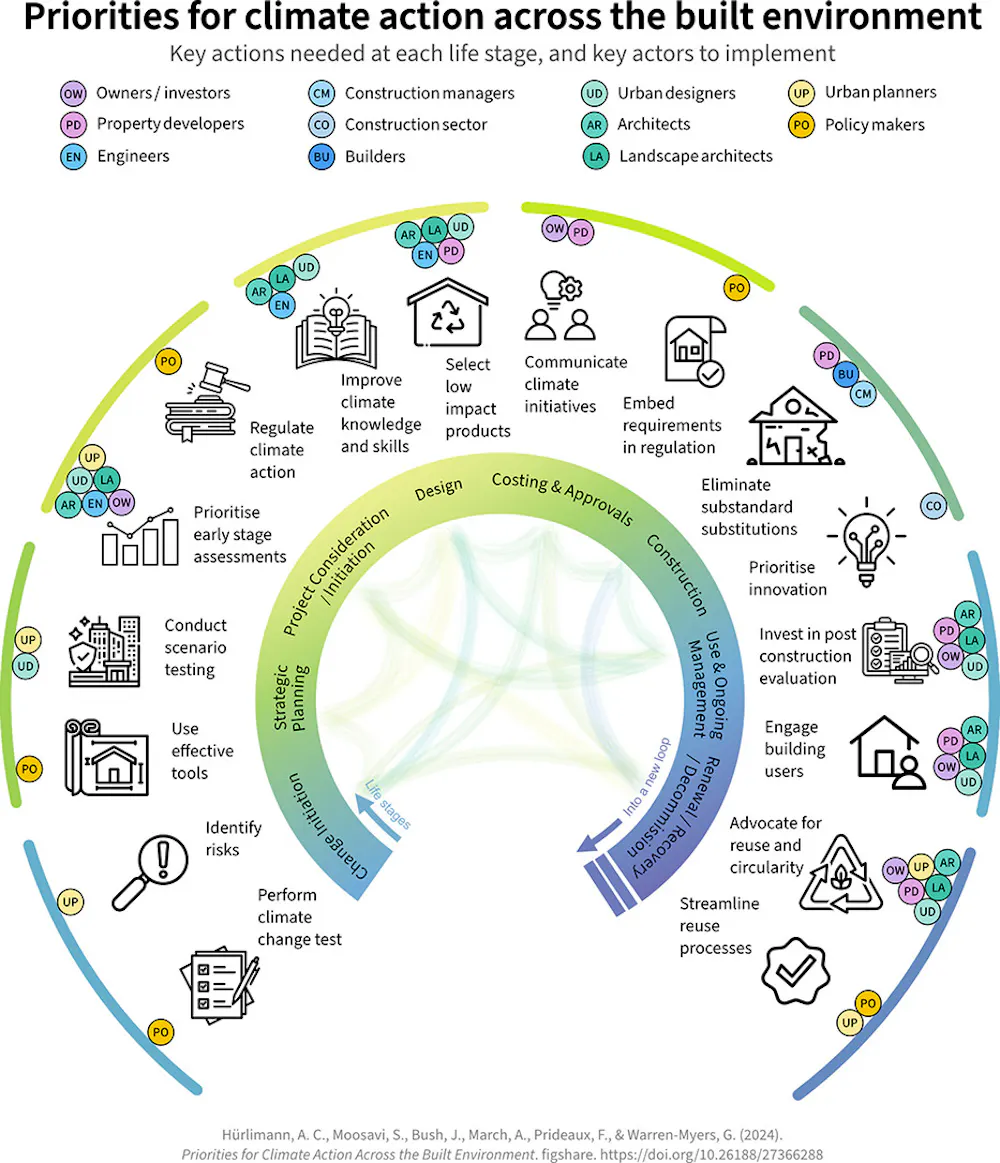
    Our new study identifies 16 priority actions to address climate change in the construction and management of cities.

    Building smarter

    Climate change must be a key consideration when designing, building and managing our cities. The emissions generated need to be minimised and eventually eliminated.

    We must build in locations, and in ways, that reduce climate risks. But policies governing how our cities are designed and constructed don’t achieve this.

    A recent study of three local government areas identified only limited action on adaptation and mitigation. Other research has found few urban development policies include carbon reduction goals that meet international targets.

    The National Housing Accord will see more than one million houses built by 2029. These new homes must address the climate challenge.

    16 areas for priority action

    The priority areas in our new study were informed by interviews with more than 150 stakeholders working in urban planning, architecture, landscape architecture, urban design, sustainability, construction and property.

    Priority areas for minimising damaging emissions generated by cities.
    CC BY

    The actions they identified cover the entire life cycle of the built environment.

    One of the first barriers to overcome is the perceived lack of agency among industry professionals to initiate or demand climate action. They perceive others, such as property owners or clients, to have more influence.

    Climate change risks should be identified in the early stages of planning new developments, backed up by effective tools to make risk identification and action easier:

    There were areas that were identified as being flood prone or risk prone. But there was no strategy to deal with what happens to those areas – An urban planner

    Once specific projects are being considered it is important to prioritise early stage climate assessments, supported by policies which mandate climate action:

    Everyone has good intentions but without big formal legislation around it, everyone’s just sort of making their way in the dark – A construction industry professional

    In the design stage, steps to improve the climate knowledge and skills of the workforce beyond disciplinary boundaries is critical. The selection of low-impact products and materials will also help ensure design is more climate responsive.

    Climate action must be embedded in all stages of design and construction of Australian cities.
    GagliardiPhotography/Shutterstock

    The highest number of hurdles to climate action were found to occur during the costing and approvals stage. Participants spoke of a highly competitive building industry. If climate change initiatives introduced at an earlier stage aren’t required by law, they are likely to be cut.

    unless there’s something in it for them in terms of return on investment, it’s going to be hard to get them to do it, unless we make them – An urban planner

    During the construction phase, product and material substitutions that have detrimental environmental impact should be eliminated. Innovation should be encouraged:

    If you want to push the envelope a little bit in terms of using recycled materials […] that’s a bit of a barrier. To push innovation is difficult – A landscape architect

    Post-construction

    Once construction is complete and buildings and public spaces are being used, it is important to invest in a thorough evaluation process. Building users should be involved to ensure buildings are maintained for optimal climate outcomes:

    [We] tried to achieve the six star rating […] the client has to maintain it [the building] for a year, and that’s when things start to fall off – An architect

    When it comes to area upgrades or building renewals, advocating for reuse and materials circularity is important. But the custom of demolishing and building anew, is hard to shift:

    The reuse of the existing building obviously generates significantly less waste and involves less material. So, design decisions and strategic decisions around using existing buildings is really important – An urban designer

    Working together

    This is a time of significant change in our urban areas.

    We need to make sure climate action is embedded in every stage of decision making. This may mean more efficient use, and reuse, of the existing built stock. This will require an overhaul of policies regarding building retrofits, and a change in mindsets.

    The priority actions to address climate change in cities can be implemented across a range of levels for:

    • individual professionals – pursue development of their climate change skills, including opportunities provided by professional associations

    • professional practices – review internal processes to ensure climate action is mainstreamed across projects, and in company decision making

    • universities teaching built environment professional degrees – embed climate change knowledge, skills, and competencies across the curriculum

    • governments at all levels – review policy settings to mandate mitigation and adaption.

    By addressing these actions, we can collectively work towards achieving our emission reduction targets and making sure our cities minimise climate change risks.

    Anna Hurlimann received funding for the research reported in this article from the Australian Research Council – Discovery Grant DP200101378, with co-chief investigators Georgia Warren-Myers, Alan March, Sareh Moosavi and Judy Bush. She is a member of the Planning Institute of Australia.

    Sareh Moosavi received funding for the research reported in this article from the Australian Research Council – Discovery Grant DP200101378, with co-chief investigators Anna Hurlimann, Georgia Warren-Myers, Alan March, and Judy Bush.

    ref. Cities are heating up the planet – how they can do more to fight climate change – https://theconversation.com/cities-are-heating-up-the-planet-how-they-can-do-more-to-fight-climate-change-259391

    MIL OSI AnalysisEveningReport.nz

  • MIL-Evening Report: Murdoch’s News Corp has moved into the mortgage business. Where are the regulators?

    Source: The Conversation (Au and NZ) – By Roberta Esbitt, Associate, RMIT University

    If you want to advertise a house online in Australia, you don’t have many options. Just two companies dominate the market.

    Australia’s largest property listings platform, realestate.com.au, belongs to digital media company REA Group, which is majority-owned by Rupert Murdoch’s US-based media conglomerate News Corporation (News Corp).

    REA claims average traffic of 11.9 million viewers per month, substantially more than that of its nearest rival, Domain.

    That’s led to widespread concern about REA’s dominant market power and the potential for price-gouging, which are currently subject to an ongoing probe by the Australian Competition and Consumer Commission (ACCC).

    Meanwhile, my research has revealed that REA has expanded into mortgage lending, an important new direction which, until now, has escaped attention.

    The implications here are worth considering. News Corp, a foreign-owned media company, now has a direct stake in framing the Australian housing narrative and influencing policy, while profiting through its property platform from listings, data, and its own mortgages.

    It’s a shrewd business strategy. But Australia currently doesn’t have a regulator fit for overseeing such a hybrid entity, raising serious questions about who is keeping watch.

    ‘Good debt’

    Australian households have long accepted the prevailing narrative, promoted by the media, that housing investment is their “path to wealth”. Mortgages are endorsed as the way to manage the growing gap between flatlined wages and rising house prices.

    Primed for finance in this way, many households have come to embrace mortgages as an aspirational form of “good debt”, the mark of a savvy player rather than a long-term financial burden.

    This has helped fuel what could be described as a housing “frenzy”, a volatile situation in which escalating housing prices and indebtedness undermine household wellbeing. Younger generations and the disadvantaged, among others, are left out in the cold.

    From newspapers to platforms to finance

    As digitisation has forced legacy media players such as News Corp to seek new strategies to stay viable, so too has it disrupted the finance industry by opening it up to non-bank players.

    Taking advantage of this opportunity, REA Group entered the mortgage market in 2016, starting with a partnership with National Australia Bank. It purchased mortgage brokerages the following year.

    The realestate.com.au platform was then redesigned to include a mortgage portal to direct millions of Australian homeseekers to lending through those channels. This provides REA with revenue from platform leads to the bank, as well as up-front and trailing mortgage commissions from their brokers.

    REA also harvests the extensive financial data supplied by millions of users via their financial profiles and the calculator tools embedded in the website.

    That data, an increasingly valuable asset, can be monetised through the platform’s advertiser and homebuyer markets, and News Corp’s extensive partnerships with data broker and analytics companies.

    Selling mortgages

    Most recently, REA Group has taken its finance strategy one step further. In October 2024, it purchased a 19.9% stake in digital non-bank lender Athena Home Loans.

    This allows REA to profit directly from its own mortgages offered to platform users through its current brokerage, Mortgage Choice.

    For REA Group (and its owner, News Corp), this move is both logical and strategically compelling in a challenging media environment. As well as influencing policy, REA Group and News Corp are proficient in crafting and cross-promoting a powerful message about housing and debt to the public.

    With their profit now even more directly tied to the housing mortgage market – and thereby customers’ debt – the Athena acquisition can only strengthen REA’s vested interest in the continued rise in house prices and household indebtedness. This has the potential to undermine policies to improve housing affordability.

    The law can’t keep up

    The power imbalance against consumers is stark. So which regulator is keeping an eye on it?

    Such an initiative combining housing, finance and media can slip through the cracks in Australia’s fragmented regulatory system with its narrowly-focused legislation.

    The legislation lags behind the technology as well. A platform’s persuasive design, with its algorithmic tools, predetermined paths and data harvesting, obscures its prioritisation of commercial interests over that of consumers.

    Players from different industries interacting through the “black box” of a platform appear to come under looser regulatory oversight than those from a single industry or operating outside a platform.

    As an ACCC representative admitted:

    the legislation isn’t updated in the way that […] keeps pace with the evolving technology, trends and emerging markets.

    In a landscape where such complex digital initiatives are becoming the norm, regulators urgently need to update their understanding and broaden their jurisdiction to include them.

    And not just in Australia. REA has confirmed that a successful trial of its initiative here will lead to its rollout across its broad global property platform network.

    Nor just REA. Other companies are eyeing this space. REA’s closest competitor, Domain, is currently under acquisition by CoStar, a major digital real estate player in the United States, with the aim to challenge REA.

    The rapid and major disruptions caused by such initiatives, such as Airbnb’s negative impact on housing affordability globally, can be difficult to redress retrospectively.

    Somebody needs to keep watch.

    REA Group declined to comment on this article.

    Roberta Esbitt does not work for, consult, own shares in or receive funding from any company or organisation that would benefit from this article, and has disclosed no relevant affiliations beyond their academic appointment.

    ref. Murdoch’s News Corp has moved into the mortgage business. Where are the regulators? – https://theconversation.com/murdochs-news-corp-has-moved-into-the-mortgage-business-where-are-the-regulators-259039

    MIL OSI AnalysisEveningReport.nz

  • MIL-Evening Report: Murdoch’s News Corp has moved into the mortgage business. Where are the regulators?

    Source: The Conversation (Au and NZ) – By Roberta Esbitt, Associate, RMIT University

    If you want to advertise a house online in Australia, you don’t have many options. Just two companies dominate the market.

    Australia’s largest property listings platform, realestate.com.au, belongs to digital media company REA Group, which is majority-owned by Rupert Murdoch’s US-based media conglomerate News Corporation (News Corp).

    REA claims average traffic of 11.9 million viewers per month, substantially more than that of its nearest rival, Domain.

    That’s led to widespread concern about REA’s dominant market power and the potential for price-gouging, which are currently subject to an ongoing probe by the Australian Competition and Consumer Commission (ACCC).

    Meanwhile, my research has revealed that REA has expanded into mortgage lending, an important new direction which, until now, has escaped attention.

    The implications here are worth considering. News Corp, a foreign-owned media company, now has a direct stake in framing the Australian housing narrative and influencing policy, while profiting through its property platform from listings, data, and its own mortgages.

    It’s a shrewd business strategy. But Australia currently doesn’t have a regulator fit for overseeing such a hybrid entity, raising serious questions about who is keeping watch.

    ‘Good debt’

    Australian households have long accepted the prevailing narrative, promoted by the media, that housing investment is their “path to wealth”. Mortgages are endorsed as the way to manage the growing gap between flatlined wages and rising house prices.

    Primed for finance in this way, many households have come to embrace mortgages as an aspirational form of “good debt”, the mark of a savvy player rather than a long-term financial burden.

    This has helped fuel what could be described as a housing “frenzy”, a volatile situation in which escalating housing prices and indebtedness undermine household wellbeing. Younger generations and the disadvantaged, among others, are left out in the cold.

    From newspapers to platforms to finance

    As digitisation has forced legacy media players such as News Corp to seek new strategies to stay viable, so too has it disrupted the finance industry by opening it up to non-bank players.

    Taking advantage of this opportunity, REA Group entered the mortgage market in 2016, starting with a partnership with National Australia Bank. It purchased mortgage brokerages the following year.

    The realestate.com.au platform was then redesigned to include a mortgage portal to direct millions of Australian homeseekers to lending through those channels. This provides REA with revenue from platform leads to the bank, as well as up-front and trailing mortgage commissions from their brokers.

    REA also harvests the extensive financial data supplied by millions of users via their financial profiles and the calculator tools embedded in the website.

    That data, an increasingly valuable asset, can be monetised through the platform’s advertiser and homebuyer markets, and News Corp’s extensive partnerships with data broker and analytics companies.

    Selling mortgages

    Most recently, REA Group has taken its finance strategy one step further. In October 2024, it purchased a 19.9% stake in digital non-bank lender Athena Home Loans.

    This allows REA to profit directly from its own mortgages offered to platform users through its current brokerage, Mortgage Choice.

    For REA Group (and its owner, News Corp), this move is both logical and strategically compelling in a challenging media environment. As well as influencing policy, REA Group and News Corp are proficient in crafting and cross-promoting a powerful message about housing and debt to the public.

    With their profit now even more directly tied to the housing mortgage market – and thereby customers’ debt – the Athena acquisition can only strengthen REA’s vested interest in the continued rise in house prices and household indebtedness. This has the potential to undermine policies to improve housing affordability.

    The law can’t keep up

    The power imbalance against consumers is stark. So which regulator is keeping an eye on it?

    Such an initiative combining housing, finance and media can slip through the cracks in Australia’s fragmented regulatory system with its narrowly-focused legislation.

    The legislation lags behind the technology as well. A platform’s persuasive design, with its algorithmic tools, predetermined paths and data harvesting, obscures its prioritisation of commercial interests over that of consumers.

    Players from different industries interacting through the “black box” of a platform appear to come under looser regulatory oversight than those from a single industry or operating outside a platform.

    As an ACCC representative admitted:

    the legislation isn’t updated in the way that […] keeps pace with the evolving technology, trends and emerging markets.

    In a landscape where such complex digital initiatives are becoming the norm, regulators urgently need to update their understanding and broaden their jurisdiction to include them.

    And not just in Australia. REA has confirmed that a successful trial of its initiative here will lead to its rollout across its broad global property platform network.

    Nor just REA. Other companies are eyeing this space. REA’s closest competitor, Domain, is currently under acquisition by CoStar, a major digital real estate player in the United States, with the aim to challenge REA.

    The rapid and major disruptions caused by such initiatives, such as Airbnb’s negative impact on housing affordability globally, can be difficult to redress retrospectively.

    Somebody needs to keep watch.

    REA Group declined to comment on this article.

    Roberta Esbitt does not work for, consult, own shares in or receive funding from any company or organisation that would benefit from this article, and has disclosed no relevant affiliations beyond their academic appointment.

    ref. Murdoch’s News Corp has moved into the mortgage business. Where are the regulators? – https://theconversation.com/murdochs-news-corp-has-moved-into-the-mortgage-business-where-are-the-regulators-259039

    MIL OSI AnalysisEveningReport.nz

  • MIL-Evening Report: NZ cities are getting hotter: 5 things councils can do now to keep us cooler when summer comes

    Source: The Conversation (Au and NZ) – By Timothy Welch, Senior Lecturer in Urban Planning, University of Auckland, Waipapa Taumata Rau

    Getty Images

    Stand on any car park on a sunny day in February and the heat will radiate through your shoes. At 30°C air temperature, that asphalt hits 50–55°C – hot enough to cause second-degree burns to skin in seconds.

    Right now, in the northern hemisphere summer, 100 million Americans are dealing with 38°C temperatures. Britain is preparing for hundreds of heat deaths. In New Zealand, of course, we’re still lighting fires and complaining about the cold.

    But that gives us time to prepare for our own heatwaves. Open-air car parks that sit empty for 20 hours a day could become cooling infrastructure instead. Transport routes can become cooling corridors.

    Replace asphalt with trees, grass and permeable surfaces, and you can drop surface temperatures by 12°C. It’s not complicated. It’s not even expensive.

    It’s getting hotter

    NIWA data shows New Zealand is already experiencing extreme temperatures five times more frequently than historical baselines. Wellington hit 30.3°C and Hamilton 32.9°C in January, both all-time records. Marine heatwaves are persisting around South Island coasts months longer than usual.

    Aucklanders will face 48 additional days above 25°C annually by 2099, as summer temperatures increase by 3.6°C. Auckland Council has already adopted the most severe warming scenario (3.8°C) for infrastructure planning, acknowledging previous models underestimated the pace of change.

    Even Wellington’s famously cool winds won’t offset the estimated 79% increase in residential cooling energy demand by 2090, driven by hotter, longer summers and more extreme-heat days.

    A quarter of New Zealand’s population will be over 65 by 2043, an age when heat regulation becomes harder and fixed incomes make cooling costs a real burden.

    Currently, 14 heat-related deaths occur annually among Auckland’s over-65 population when temperatures exceed just 20°C. As the mercury rises, our older population will be at a greater risk.

    Summer in the city: a vendor sells drinks and ice cream during a severe heat wave in Washington DC, June 23.
    Getty Images

    Greener is cooler

    While global average temperature increases of 1.5°C might appear modest, the actual temperatures we experience in our cities is far more extreme. The built environment – all that concrete and asphalt – traps heat like an oven.

    But converting car parks back to green space can knock the temperature down dramatically.

    Research from Osaka Prefecture in Japan recorded surface temperature reductions of up to 14.7°C when comparing asphalt to grass-covered parking during sunny summer conditions.

    Another study found temperature differences averaging 11.79°C between asphalt and grass surfaces, with air temperature differences of 7-8°C at human height.

    Trees are the heavy lifters here. Stand under a tree on a hot day, and it can feel 17°C cooler than standing in the sun. Add rain gardens (shallow, planted areas designed to capture and filter stormwater) and ground cover for another 2-4°C reduction. Layer these elements together, and you get cooling that works even on overcast days.

    Roads as cooling corridors

    Grassy and tree-covered car parks are just a starting point. Auckland’s 7,800 kilometres of roads could become the city’s cooling system. Every bus lane, cycleway and walking path is an opportunity for green infrastructure.

    If we stop thinking of transport corridors as merely a way to get from one place to another, and see them as multifunctional cooling networks, the possibilities multiply while the costs remain relatively low.

    Melbourne’s COVID-era parklet program proved this works: 594 small conversions created 15,000 square metres of public space at just A$300–900 per square metre.

    Converting even a small percentage of New Zealand’s parking infrastructure could create connected cooling corridors throughout our cities.

    Protecting cycleways with a tree canopy would encourage active transport while cooling neighbourhoods. Bus lanes with rain garden medians would improve service reliability while managing stormwater.

    5 things councils can do

    Summer is six months away – maybe not enough time to do all the work needed, but certainly enough to get a plan in place. Here are five things councils could do.

    1. Plant trees now: winter is planting season. Focus on car parks and heat-vulnerable neighbourhoods. Use fast-growing natives and protective rings to ensure survival. Trees planted now will provide shade by December.

    2. Install modular planters: test cooling locations with movable infrastructure before committing to permanent changes. Order now for spring placement when residents can see the benefits.

    3. Schedule paving replacements: when resurfacing is needed, switch to permeable options and get heat-reducing surfaces in place before summer.

    4. Design shade structures: plan and budget pop-up shade for the hottest areas. Having designs ready means quick installation when temperatures spike.

    5. Organise spring planting days: line up community groups now, source trees through winter nursery contracts, and hit the ground running in September. Small investments in coordination yield big cooling dividends.

    Auckland Council’s NZ$1 billion climate action package includes grants of $1,000 to $50,000 for climate projects. Wellington’s Climate and Sustainability Fund and Christchurch’s 50-year Urban Forest Plan provide similar frameworks.

    The Ministry for the Environment’s National Policy Statement on Urban Development creates opportunity by removing minimum parking requirements. This frees up land for trees, gardens and public spaces instead of underused asphalt, maximising climate co-benefits: cooler surfaces, better stormwater management and more pleasant streetscapes.

    By next February, we can either be thanking ourselves for planting trees and converting car parks, or feeling the heat from that 50°C asphalt.

    Timothy Welch does not work for, consult, own shares in or receive funding from any company or organisation that would benefit from this article, and has disclosed no relevant affiliations beyond their academic appointment.

    ref. NZ cities are getting hotter: 5 things councils can do now to keep us cooler when summer comes – https://theconversation.com/nz-cities-are-getting-hotter-5-things-councils-can-do-now-to-keep-us-cooler-when-summer-comes-259885

    MIL OSI AnalysisEveningReport.nz

  • MIL-Evening Report: Mr Smith or Gary? Why some teachers ask students to call them by their first name

    Source: The Conversation (Au and NZ) – By Nicole Brownlie, Lecturer in Education, University of Southern Queensland

    Johnny Greig/ Getty Images

    When you went to school, did you call your teacher Mrs, Ms or Mr, followed by their surname? Perhaps you even called them Sir or Miss.

    The tradition of addressing teachers in a formal manner goes back centuries. For many of us, calling a teacher by their first name would have been unthinkable.

    But that’s not automatically the case anymore. Some teachers in mainstream schools now ask students to call them by their first name.

    Why is this? And what impact can teachers’ names have in the classroom?

    There’s no rule

    There’s no official rule in Australia on what students should call teachers.
    Naming is usually decided by schools or individual teachers. This is no official training on this topic before teachers start in classrooms.

    Some primary school teachers now use first names or a less formal name such as “Mr D”. Teachers say this helps break down barriers, especially for young students or those who are learning English as an additional language.

    High schools are more likely to stick with tradition, partly to maintain structure and boundaries, especially with teenagers. Using formal titles can also support early-career teachers or those from minority
    backgrounds
    assert their authority in a classroom.

    But even so, some high school teachers are using their first names to foster a sense of trust and encourage students to see them as a partner in learning, rather than simply an authority figure.

    What does the research say?

    Research – which is mainly from the United States – suggests names have an impact on how students perceive their teachers and feel about school.

    In one study of US high school students, teenagers described teachers they addressed with formal titles as more distant and harder to connect with. Teachers who invited students to use their first name were seen as more supportive, approachable and trustworthy.

    A secondary school principal in the state of Maryland reported students felt more included and respected when they could use teachers’ first names. It made classrooms feel less hierarchical and more collaborative.

    A 2020 US study on teaching students doing practical placements found those who used their first name observed greater student engagement than those who did not. This came as a surprise to the student teachers who expected students would not respect them if they used their first names.

    These findings don’t necessarily mean titles are bad. Rather, they show first names can support stronger teacher-student relationships.

    It’s important to note society in general has become less formal in recent decades in terms of how we address and refer to each other.

    So, what should students call their teachers?

    What works in one school, or even one classroom, may not work in another.

    For example, for Indigenous students or students from non-English speaking households, name practices that show cultural respect and mutual choice can be vital. They help create a sense of safety and inclusion.

    But for other teachers, being called by their title may be a key part of their professional persona.

    That’s why it’s important for naming decisions to be thoughtful and based on the needs of the teacher, students and broader school community.

    The key is to treat naming as part of the broader relationship, not just a habit or automatic tradition. Whether students say “Mrs Lee” or “Jess” matters less than whether they feel safe, respected and included. It’s about the tone and relationship behind the name, not simply what someone is called.

    Nicole Brownlie does not work for, consult, own shares in or receive funding from any company or organisation that would benefit from this article, and has disclosed no relevant affiliations beyond their academic appointment.

    ref. Mr Smith or Gary? Why some teachers ask students to call them by their first name – https://theconversation.com/mr-smith-or-gary-why-some-teachers-ask-students-to-call-them-by-their-first-name-259790

    MIL OSI AnalysisEveningReport.nz

  • MIL-Evening Report: How to reform the NDIS and better support disabled people who don’t qualify for it

    Source: The Conversation (Au and NZ) – By Sam Bennett, Disability Program Director, Grattan Institute

    Australia is spending more than ever on disability services – and yet many people with disability still aren’t receiving the support they need.

    Since the National Disability Insurance Scheme (NDIS) began in 2013, it has transformed the lives of hundreds of thousands of disabled Australians and their families.

    But the NDIS has grown too big, too fast.

    The scheme cost nearly A$42 billion in 2023-24 and is expected to cost more than $58 billion by 2028. This makes it one of the fastest-growing pressures on the federal budget.

    New “foundational supports” – disability-specific services outside individual NDIS packages – are part of the answer to reduce demand on the NDIS and make the scheme sustainable. They were supposed to be operational from July 1 2025. That’s tomorrow, but they are nowhere to be seen.

    A new Grattan Institute report shows how the government can fund these vital supports and save the NDIS – without spending more money.

    Spending is too concentrated in the NDIS

    All Australian governments are spending more on disability services than they were before the NDIS.

    Note: Includes all expenditure on direct disability service delivery by Australian governments.
    Sources: Productivity Commission Return on Government Services report 2025/Grattan Institute

    This is a good thing. But most of this expenditure is for individual NDIS funding packages. The NDIS funds packages for about 700,000 Australians.

    This leaves little support for the roughly 75% of disabled Australians who don’t qualify for the NDIS.

    Around 200,000 Australians with a severe mental illness, for example, aren’t receiving the psychosocial supports they need.

    Many other disabled Australians might only require occasional or low-intensity support such as peer support, supported decision-making, or self-advocacy – supports which are poorly funded and targeted under current arrangements.

    So there’s a huge incentive for people to get into the NDIS, regardless of whether an individualised funding package best meets their needs.

    The NDIS supports more people than intended

    We’re seeing this incentive play out in ballooning numbers of people entering the NDIS.

    In 2011, the Productivity Commission estimated a mature NDIS would serve 490,000 people.

    But in 2025, the NDIS is supporting more than 700,000 people. That number is projected to surpass one million by 2034.

    The number of adults in the scheme is only a little higher than originally expected, but the number of children is nearly double.

    Note: Productivity Commission estimates have been inflated based on population growth for 0-64 year-olds between the reference year (2009) and 2024, using Australian Bureau of Statistics Estimated Resident Population data.
    Sources: Productivity Commission Disability Care and Support 2011, National Disability Insurance Agency Explore Data 2024, Australian Bureau of Statistics Estimated Resident Population 2024/Grattan Institute

    About 10% of children aged five to seven are now in the NDIS, including 15% of six-year-old boys.

    The expectation was that many children would only require short-term early intervention supports. Instead, most children are staying in the scheme long term.

    Our research shows the current NDIS design is poorly suited to delivering early intervention, which works best for children when it is delivered in the places they live, learn and play. This includes in playgroups, libraries and early childhood education settings.

    An individualised funding model makes this difficult. Yet this is the only option available for most families, because the NDIS has led to reduced investment in services that could work far better for their children.

    Support more Australians with disability

    The problem isn’t the amount of funding in the system, but the way it is used.

    The original NDIS design was for a multi-tiered scheme with different levels of coverage. Getting back to this idea is what foundational supports is all about.

    Foundational supports are services and supports for people with disability that do not involve individualised funding from the NDIS.

    To meet the needs of more disabled Australians and take pressure off the NDIS, it is imperative that governments establish an ambitious program of these lower-intensity supports.

    These should include supports available to all disabled Australians who need them, such as information and advice, support with decision-making, and access to peer support or self-advocacy.

    Foundational supports are best delivered where people live, play and learn.
    Central City Library (Kids zone)/Shutterstock

    They should also include evidence-based early intervention supports for children with disability and/or developmental delay. And they should include psychosocial supports for people with severe mental illness who don’t meet the threshold for an individualised NDIS package.

    The current impasse in Commonwealth-state funding negotiations could be overcome by governments agreeing to repurpose a small portion – about 10% – of their existing NDIS contributions.

    Our report outlines a plan to fully fund foundational supports using this repurposed funding and better allocate individualised funding. This would ensure more people get the support they need within an affordable NDIS that grows more slowly.

    Don’t save money by delaying access

    NDIS growth has fallen in recent quarters and is on track to be 10.6% in 2024-25.

    This compares with an average growth rate of more than 24% a year over the past five years.

    But it is too early to attribute that reduction in growth to policy changes.

    A significant downturn in operational performance is very likely to be a contributing factor. The NDIS is groaning under the weight of unsustainable work volumes.

    Since September 2023, it has been taking longer to approve new applicants trying to get access to the NDIS, and to reassess the plans of people already on the scheme.

    Notes: Data is unavailable for December 2023 due to the NDIA upgrading to a new computer system.
    Sources: NDIA Quarterly reports, Q4 2021-22 to Q3 2024-25/Grattan Institute

    We know what drives growth in NDIS expenditure: more people joining the scheme, and existing NDIS participants’ plans increasing over time.

    At the moment, slowing down how fast the NDIS is growing is coming at the expense of the disabled people who need support from the NDIS and are waiting too long to get it.

    It is important that necessary growth moderation is achieved through measures that do not result in vital supports being delayed, or disabled peoples’ experience of, and results from, the NDIS being undermined.

    The NDIS is worth saving. Making necessary policy changes now to rebalance the NDIS will ensure it endures for future generations.

    Grattan Institute’s Disability Program has support from the Summer Foundation.

    ref. How to reform the NDIS and better support disabled people who don’t qualify for it – https://theconversation.com/how-to-reform-the-ndis-and-better-support-disabled-people-who-dont-qualify-for-it-258799

    MIL OSI AnalysisEveningReport.nz

  • MIL-Evening Report: Could we live with a nuclear-armed Iran? Reluctantly, yes

    Source: The Conversation (Au and NZ) – By Benjamin Zala, Senior Lecturer, Politics & International Relations, Monash University

    As the ceasefire between Israel and Iran seems to be holding for now, it is important to reflect on whether this whole episode was worth the risks.

    Wider escalation was (and remains) possible, and we do not know whether Iran will seek a nuclear weapon with renewed vigour in the future.

    So, could we live with a nuclear-armed Iran, if it does indeed continue to pursue a bomb?

    Is an Iranian bomb an existential threat?

    The conventional wisdom, at least in the Western world, is that an Iranian nuclear weapon would pose an existential threat to Israel, and possibly the United States as well.

    Israeli Prime Minister Benjamin Netanyahu said his country’s strikes on Iran’s nuclear facilities were aimed at rolling back “the Iranian threat to Israel’s very survival”.

    White House press secretary Karoline Leavitt described an Iranian bomb as “an existential threat, not just to Israel, but to the United States, and to the entire world”.

    The same mantra has been repeated by leaders in Europe, at the G7 meeting, and in Australia.

    Iran, of course, did not yet possess a nuclear weapon when the strikes occurred, as the UN nuclear watchdog attested. The strikes were aimed at preventing Iran from being able to do so in the future – a prospect seen by Israel and the US as simply “unthinkable”.

    But if Iran had built a nuclear weapon before the Israeli and US strikes – or manages to do so in the future – would this pose an existential threat to Israel or the US?

    The answer is no. And for a very simple reason: nuclear deterrence works.

    Why deterrence works

    If Iran had a monopoly on nuclear weapons, it would be different. But it does not.

    Israel has maintained a robust nuclear arsenal for more than half a century. Every authoritative assessment of global nuclear weapons stockpiles includes Israel’s roughly 90 nuclear warheads.

    The Israeli government officially neither confirms nor denies the existence of its nuclear arsenal. But thanks to leaks from inside the Israeli nuclear program – as well as the best assessments from around the world – we can be quite sure they exist. It also explains why Israel has never signed the Nuclear Non-proliferation Treaty – it can’t without giving up this stockpile.

    The US, of course, has been nuclear-armed since 1945 and openly maintains an inventory of thousands of nuclear warheads. These provide a deterrent against nuclear attacks on the United States.

    Washington also provides extended nuclear deterrence guarantees to over 30 states, including members of NATO, Japan, South Korea and Australia. It does not need to provide this for Israel given the Israeli arsenal. But if there was ever any doubt about Israel’s stockpile, it certainly could.

    After 80 years of living with nuclear weapons, we know the deterrent effect of assured nuclear retaliation is very powerful. It deterred both the Soviets and Americans from using nuclear weapons against each other through multiple Cold War crises. It has deterred both India and Pakistan from using them in multiple standoffs, including quite recently. It has deterred both North Korea and the US from striking each other.

    Similarly, Iran would no doubt be deterred from using a nuclear weapon by a certain Israeli or American response.

    Iranian leaders have called for the destruction of Israel, and the chants of “death to Israel” and “death to America” are a common occurrence at rallies held by supporters of the regime.

    But beneath the fiery rhetoric lies a truism: no Iranian leader would destroy Israel with a nuclear weapon if it came at the expense of the destruction of Iran.

    In the history of the nation-state, not a single one has ever knowingly committed suicide. Not for any reason – ideological, religious, political or any other. All nations value survival over everything else because this allows for the achievement of other goals, such as power and prosperity.

    Further, Iran is ruled by a brutally authoritarian, theocratic regime. And for authoritarian regimes, staying in power is the number one priority. There is no staying in power the day after a nuclear exchange.

    Not a panacea

    This does not mean an Iranian nuclear weapon would be a welcome development. Far from it.

    Every new nuclear-armed state provides another opportunity for miscalculation or accident. It adds extra stress to an already fragile non-proliferation regime.

    In addition, nuclear deterrence is not just and can be considered ethically questionable. It may not even be sustainable over the longer term.

    There is no doubt the existence of over 12,000 nuclear weapons globally poses a potentially existential risk to all of humanity.

    But the idea that a nuclear-armed Iran would pose a unique risk to Israel or the United States simply does not stand up to scrutiny. If we can live with a nuclear-armed North Korea, nuclear-armed Pakistan, and for that matter, a nuclear-armed Israel, we can live, however reluctantly, with a nuclear-armed Iran.

    Regardless of whether the current proposed ceasefire between Israel and Iran holds, the military operation initiated by Israel and bolstered by the United States was extremely dangerous and unnecessary, based on both countries’ justification.

    The regime in Tehran is brutal, authoritarian, openly antisemitic and worthy of our disdain. But there is no evidence it is suicidal.

    The claim an Iranian nuclear bomb would pose an existential threat to Israel or the United States and justifies unilateral, preventive military attacks makes no sense.

    It is time to stop repeating it.

    Benjamin Zala has received funding from the Stanton Foundation, a US philanthropic group that funds nuclear research. He is an honorary fellow at the University of Leicester on a project that is funded by the European Research Council.

    ref. Could we live with a nuclear-armed Iran? Reluctantly, yes – https://theconversation.com/could-we-live-with-a-nuclear-armed-iran-reluctantly-yes-259905

    MIL OSI AnalysisEveningReport.nz

  • MIL-Evening Report: Scientists look to black holes to know exactly where we are in the Universe. But phones and wifi are blocking the view

    Source: The Conversation (Au and NZ) – By Lucia McCallum, Senior Scientist in Geodesy, University of Tasmania

    ESA / Hubble / L. Calçada (ESO), CC BY

    The scientists who precisely measure the position of Earth are in a bit of trouble. Their measurements are essential for the satellites we use for navigation, communication and Earth observation every day.

    But you might be surprised to learn that making these measurements – using the science of geodesy – depends on tracking the locations of black holes in distant galaxies.

    The problem is, the scientists need to use specific frequency lanes on the radio spectrum highway to track those black holes.

    And with the rise of wifi, mobile phones and satellite internet, travel on that highway is starting to look like a traffic jam.

    Why we need black holes

    Satellites and the services they provide have become essential for modern life. From precision navigation in our pockets to measuring climate change, running global supply chains and making power grids and online banking possible, our civilisation cannot function without its orbiting companions.

    To use satellites, we need to know exactly where they are at any given time. Precise satellite positioning relies on the so-called “global geodesy supply chain”.

    This supply chain starts by establishing a reliable reference frame as a basis for all other measurements. Because satellites are constantly moving around Earth, Earth is constantly moving around the Sun, and the Sun is constantly moving through the galaxy, this reference frame needs to be carefully calibrated via some relatively fixed external objects.

    As it turns out, the best anchor points for the system are the black holes at the hearts of distant galaxies, which spew out streams of radiation as they devour stars and gas.

    These black holes are the most distant and stable objects we know. Using a technique called very long baseline interferometry, we can use a network of radio telescopes to lock onto the black hole signals and disentangle Earth’s own rotation and wobble in space from the satellites’ movement.

    Different lanes on the radio highway

    We use radio telescopes because we want to detect the radio waves coming from the black holes. Radio waves pass cleanly through the atmosphere and we can receive them during day and night and in all weather conditions.

    Radio waves are also used for communication on Earth – including things such as wifi and mobile phones. The use of different radio frequencies – different lanes on the radio highway – is closely regulated, and a few narrow lanes are reserved for radio astronomy.

    However, in previous decades the radio highway had relatively little traffic. Scientists commonly strayed from the radio astronomy lanes to receive the black hole signals.

    To reach the very high precision needed for modern technology, geodesy today relies on more than just the lanes exclusively reserved for astronomy.

    Radio traffic on the rise

    In recent years, human-made electromagnetic pollution has vastly increased. When wifi and mobile phone services emerged, scientists reacted by moving to higher frequencies.

    However, they are running out of lanes. Six generations of mobile phone services (each occupying a new lane) are crowding the spectrum, not to mention internet connections directly sent by a fleet of thousands of satellites.

    Today, the multitude of signals are often too strong for geodetic observatories to see through them to the very weak signals emitted by black holes. This puts many satellite services at risk.

    What can be done?

    To keep working into the future – to maintain the services on which we all depend – geodesy needs some more lanes on the radio highway. When the spectrum is divided up via international treaties at world radio conferences, geodesists need a seat at the table.

    Other potential fixes might include radio quiet zones around our essential radio telescopes. Work is also underway with satellite providers to avoid pointing radio emissions directly at radio telescopes.

    Any solution has to be global. For our geodetic measurements, we link radio telescopes together from all over the world, allowing us to mimic a telescope the size of Earth. The radio spectrum is primarily regulated by each nation individually, making this a huge challenge.

    But perhaps the first step is increasing awareness. If we want satellite navigation to work, our supermarkets to be stocked and our online money transfers arriving safely, we need to make sure we have a clear view of those black holes in distant galaxies – and that means clearing up the radio highway.

    Lucia McCallum does not work for, consult, own shares in or receive funding from any company or organisation that would benefit from this article, and has disclosed no relevant affiliations beyond their academic appointment.

    ref. Scientists look to black holes to know exactly where we are in the Universe. But phones and wifi are blocking the view – https://theconversation.com/scientists-look-to-black-holes-to-know-exactly-where-we-are-in-the-universe-but-phones-and-wifi-are-blocking-the-view-259977

    MIL OSI AnalysisEveningReport.nz

  • MIL-Evening Report: Do all Iranians hate the regime? Hate America? Life inside the country is more complex than that

    Source: The Conversation (Au and NZ) – By Simon Theobald, Postdoctoral researcher, Institute for Ethics and Society, University of Notre Dame Australia

    From 2015 to 2018, I spent 15 months doing research work in Mashhad, Iran’s second-largest city. As an anthropologist, I was interested in everyday life in Iran outside the capital Tehran. I was also interested in understanding whether the ambitions of the 1979 Revolution lived on among “ordinary” Iranians, not just political elites.

    I first lived on a university campus, where I learned Persian, and later with Iranian families. I conducted hundreds of interviews with people who had a broad spectrum of political, social and religious views. They included opponents of the Islamic Republic, supporters, and many who were in between.

    What these interviews revealed to me was both the diversity of opinion and experience in Iran, and the difficulty of making uniform statements about what Iranians believe.

    Measuring the depth of antipathy for the regime

    When Israel’s strikes on Iran began on June 13, killing many top military commanders, many news outlets – both international and those run by the Iranian diaspora – featured images of Iranians cheering the deaths of these hated regime figures.

    Friends from my fieldwork also pointed to these celebrations, while not always agreeing with them. Many feared the impact of a larger conflict between Iran and Israel.

    Trying to put these sentiments in context, many analysts have pointed to a 2019 survey by the GAMAAN Institute, an independent organisation based in the Netherlands that tracks Iranian public opinion. This survey showed 79% of Iranians living in the country would vote against the Islamic Republic if a free referendum were held on its rule.

    Viewing these examples as an indicator of the lack of support for the Islamic Republic is not wrong. But when used as factoids in news reports, they become detached from the complexities of life in Iran. This can discourage us from asking deeper questions about the relationships between ideology and pragmatism, support and opposition to the regime, and state and society.

    A more nuanced view

    The news reporting on Iran has encouraged a tendency to see the Iranian state as homogeneous, highly ideological and radically separate from the population.

    But where do we draw the line between the state and the people? There is no easy answer to this.

    When I lived in Iran, many of the people who took part in my research were state employees – teachers at state institutions, university lecturers, administrative workers. Many of them had strong and diverse views about the legacy of the revolution and the future of the country.

    They sometimes pointed to state discourse they agreed with, for example Iran’s right to national self-determination, free from foreign influence. They also disagreed with much, such as the slogans of “death to America”.

    This ambivalence was evident in one of my Persian teachers. An employee of the state, she refused to attend the annual parades celebrating the anniversary of the revolution. “We have warm feelings towards America,” she said. On the other hand, she happily attended protests, also organised by the government, in favour of Palestinian liberation.

    Or take the young government worker I met in Mashhad: “We want to be independent of other countries, but not like this.”

    In a narrower sense, discussions about the “state” may refer more to organisations like the Islamic Revolutionary Guard Corps (IRGC) and the Basij, the paramilitary force within the IRGC that has cracked down harshly on dissent in recent decades. Both are often understood as being deeply ideologically committed.

    Said Golkar, a US-based Iranian academic and author, for instance, calls Iran a “captive society”. Rather than having a civil society, he believes Iranians are trapped by the feared Basij, who maintain control through their presence in many institutions like universities and schools.

    Again, this view is not wrong. But even among the Basij and Revolutionary Guard, it can be difficult to gauge just how ideological and homogeneous these organisations truly are.

    For a start, the IRGC relies on both ideologically selected supporters, as well as conscripts, to fill its ranks. They are also not always ideologically uniform, as the US-based anthropologist Narges Bajoghli, who worked with pro-state filmmakers in Tehran, has noted.

    As part of my research, I also interviewed members of the Basij, which, unlike the IRGC proper, is a wholly volunteer organisation.

    Even though ideological commitment was certainly an important factor for some of the Basij members I met, there were also pragmatic reasons to join. These included access to better jobs, scholarships and social mobility. Sometimes, factors overlapped. But participation did not always equate to a singular or sustained commitment to revolutionary values.

    For example, Sāsān, a friend I made attending discussion groups in Mashhad, was quick to note that time spent in the Basij “reduced your [compulsory] military service”.

    This isn’t to suggest there are not ideologically committed people in Iran. They clearly exist, and many are ready to use violence. Some of those who join these institutions for pragmatic reasons use violence, too.

    Looking in between

    In addition, Iran is an ethnically diverse country. It has a population of 92 million people, a bare majority of whom are Persians. Other minorities include Azeris, Kurds, Arabs, Baloch, Turkmen and others.

    It is also religiously diverse. While there is a sizeable, nominally Shi’a majority, there are also large Sunni communities (about 10-15% of the population) and smaller communities of Christians, Jews, Zoroastrians, Baha’is and other religions.

    Often overlooked, there are also important differences in class and social strata in Iran, too.

    One of the things I noticed about state propaganda was that it flattened this diversity. James Barry, an Australian scholar of Iran, noticed a similar phenomenon.

    State propaganda made it seem like there was one voice in the country. Protests could be dismissed out of hand because they did not represent the “authentic” view of Iranians. Foreign agitators supported protests. Iranians supported the Islamic Republic.

    Since leaving Iran, I have followed many voices of Iranians in the diaspora. Opposition groups are loud on social media, especially the monarchists who support Reza Pahlavi, the son of the deposed Shah.

    In following these groups, I have noticed a similar tendency to speak as though they represent the voice of all Iranians. Iranians support the shah. Or Iranians support Maryam Rajavi, leader of a Paris-based opposition group.

    Both within Iran, and in the diaspora, the regime, too, is sometimes held to be the imposition of a foreign conspiracy. This allows the Islamic Republic and the complex relations it has created to be dismissed out of hand. Once again, such a view flattens diversity.

    Over the past few years, political identities and societal divisions seem to have become harder and clearer. This means there is an increasing perception among many Iranians of a gulf between the state and Iranian society. This is the case both inside Iran, and especially in the Iranian diaspora.

    Decades of intermittent protests and civil disobedience across the country also show that for many, the current system no longer represents the hopes and aspirations of many people. This is especially the case for the youth, who make up a large percentage of the population.

    I am not an Iranian, and I strongly believe it is up to Iranians to determine their own futures. I also do not aim to excuse the Islamic Republic – it is brutal and tyrannical. But its brutality should not let us shy away from asking complex questions.

    If the regime did fall tomorrow, Iran’s diversity means there is little unanimity of opinion as to what should come next. And if a more pluralist form of politics is to emerge, it must encompass the whole of Iran’s diversity, without assuming a uniform position.

    It, too, will have to wrestle with the difficult questions and sometimes ambivalent relations the Islamic Republic has created.

    Simon Theobald received funding from the Australian National University during his research.

    ref. Do all Iranians hate the regime? Hate America? Life inside the country is more complex than that – https://theconversation.com/do-all-iranians-hate-the-regime-hate-america-life-inside-the-country-is-more-complex-than-that-259554

    MIL OSI AnalysisEveningReport.nz

  • MIL-Evening Report: RFK Junior is stoking fears about vaccine safety. Here’s why he’s wrong – and the impact it could have

    Source: The Conversation (Au and NZ) – By Julie Leask, Professor, School of Public Health, University of Sydney

    The United States used to be a leader in vaccine research, development and policymaking. Now US Secretary of Health Robert F. Kennedy Jr is undermining the country’s vaccine program at the highest level and supercharging vaccine skepticism.

    Two weeks ago, RFK Jr sacked the entire Advisory Committee on Immunization Practices responsible for reviewing the latest scientific evidence on vaccines. RFK Jr alleged conflicts of interest and hand-picked a replacement panel.

    On Wednesday, RFK Jr announced the US would stop funding the global vaccine alliance, Gavi, because he claimed that “when the science was inconvenient today, Gavi ignored the science”. RFK Jr questioned the safety of COVID vaccines for pregnant women, as well as the diphtheria, tetanus and pertussis vaccine.

    On Thursday, when the new Advisory Committee on Immunization Practices met, the person who first drew RFK Jr into vaccine scepticism, Lyn Redwood, shared disproved claims about a chemical called thimerosal in flu vaccines being harmful.

    The undermining of regulation, advisory processes and funding changes will have global impacts, as debunked claims are given new levels of apparent legitimacy. Some of these impacts will be slow and insidious.

    So what should we make of these latest claims and funding cuts?

    Thiomersal is a distraction

    Thiomersal (thimerosal in the the US) is a safe and effective preservative that prevents bacterial and fungal contamination of the vaccine contained in a multi-dose vial. It’s a salt that contains a tiny amount of mercury in a safe form.

    Thiomersal is no longer used as a preservative in any vaccines routinely given in Australia. But it’s still used in the Q fever vaccine.

    Other countries use multi-dose vials with thiomersal when single-dose vials are too expensive.

    In the US, just 4% of adult influenza vaccines contain thiomersal. So focusing on removing vaccines containing thimerosal is a distraction for the committee.

    COVID vaccines in pregnancy prevent severe illness

    On Wednesday, RFK criticised Gavi’s encouragement of pregnant women to receive COVID-19 vaccines.

    A COVID-19 infection before and during pregnancy can increase the risk of miscarriage two- to four-fold, even if it’s only a mild infection.

    Conversely, there is good evidence vaccination during pregnancy is safe and can reduce the chance of hospitalisation of pregnant people and of infants by passing antibodies through the placenta.

    In Australia, pregnant people who have never received a primary COVID-19 vaccine are recommended to have one. However, they are not generally recommended to have booster unless they have underlying risk conditions or prefer to have one. This is due to population immunity.

    COVID-19 vaccine advice should adapt to changes in disease risk and vaccine benefit. It doesn’t mean previous decisions were wrong, nor that vaccine boosters are unsafe.

    RFK’s criticism of COVID-19 vaccines in pregnancy may influence choices individuals make in other countries, even when unvaccinated pregnant women are encouraged to consider vaccination.

    The diphtheria, tetanus and pertussis vaccine is safe

    RFK Jr also questioned the safety of the combined diphtheria, tetanus and pertussis (DTP) vaccine as he announced the withdrawal of US funding support for Gavi.

    In the early 2000s, three community-based observational studies reported a possible association between increased chance of death in infants and use of the DTP vaccine.

    A few subsequent studies also reported associations, with higher risk in girls, prompting a World Health Organization (WHO) review of safety.

    Real world studies are complicated and the data can be difficult to interpret correctly. Often, the very factors that influence whether someone gets vaccinated can also be associated with other health risks.

    When the WHO committee reviewed all the studies on DTP safety in 2014, it did not indicate serious adverse events. It concluded there was substantial evidence against these claims.

    What will de-funding Gavi mean for vaccination rates?

    Gavi, the vaccine alliance, supports vaccine purchasing in low-income countries.

    The US has historically accounted for 13% of all donor funds.

    However, RFK Jr said Gavi needed to re-earn the public trust and “consider the best science available” before the US would contribute funding again.

    Gavi predicted in March that the impact of US funding cuts could result in one million deaths through missed vaccines.

    Could something like this happen in Australia?

    Australia is fortunate to be buffered from these impacts.

    Our vaccine advisory body, the Australian Technical Advisory Group on Immunisation, has people with deep expertise in vaccination. We have robust decision processes that weigh evidence critically and make careful recommendations to government.

    Our governments remain committed to vaccination. The federal government released the National Immunisation Strategy in mid-June with a comprehensive plan to continue to strengthen our program.

    The federal government also announced A$386 million to support the work of Gavi from 2026 to 2030.

    All of this keeps our vaccine policies strong, preventing disease and increasing life expectancy here and overseas.

    But to mitigate the possible influence of the US in Australia, our governments, health professionals and the public need to be ready to rapidly tackle the misinformation, distortions and half-truths RFK Jr cleverly packages – with quality information.

    Julie Leask receives research funding from NHMRC, WHO, US CDC, NSW Ministry of Health. She received funding from Sanofi for travel to an overseas meeting in 2024. She has consulting fees from RTI International and the Task Force for Global Health.

    Catherine Bennett has received honoraria for contributing to independent advisory panels for Moderna and AstraZeneca, and has received NHMRC, VicHealth and MRFF funding for unrelated projects. She was the health lead on the Independent Inquiry into the Australian Government COVID-19 Response .

    ref. RFK Junior is stoking fears about vaccine safety. Here’s why he’s wrong – and the impact it could have – https://theconversation.com/rfk-junior-is-stoking-fears-about-vaccine-safety-heres-why-hes-wrong-and-the-impact-it-could-have-259986

    MIL OSI AnalysisEveningReport.nz

  • MIL-Evening Report: The sentencing of Cassius Turvey’s killers shows courts still struggle to deal with racism

    Source: The Conversation (Au and NZ) – By Thalia Anthony, Professor of Law, University of Technology Sydney

    Aboriginal and Torres Strait Islander readers are advised this article contains names and images of deceased people.


    The brutal homicide of 15-year-old Noongar Yamatji boy, Cassius Turvey, by a group of white men revealed the racial schisms in Western Australian society. Turvey was walking home from school in October 2022 when he was abruptly beaten to death.

    On Friday, the Western Australian Supreme Court sentenced the three perpetrators. Twenty-nine-year-old Brodie Palmer and 24-year-old Jack Brearley were found guilty of murder and sentenced to life imprisonment.

    A third man, 27-year-old Mitchell Forth, was convicted of manslaughter and sentenced to 12 years behind bars.

    This was an opportunity for the Supreme Court to send a strong message against racial violence. While the punishment of the men involved is clear, the role of race, and what legally qualifies as racially motivated crime, is muddier.

    Wrong place, wrong time?

    Racism has been front and centre of the public discussion of this tragedy from the outset.

    Shortly after the 2022 attack, Western Australian Police Commissioner Col Blanch said of the homicide:

    it may be a case of mistaken identity, it may be a case of being in the wrong place at the wrong time.

    This was met with strong condemnation from the First Nations community.

    Rallies in solidarity with Turvey’s family were held across the country, with Gumbaynggirr, Bundjalung, and Dunghutti activist Lizzie Jarrett declaring:

    no black child is ever, ever, ever in the wrong place at the wrong time on their own land.

    Racism at trial

    Over the course of the trial, the court heard Turvey and his peers, a group of Aboriginal high school students, were approached by an angry group.

    This comprised the three men convicted and a woman, 23-year-old Aleesha Gilmore, who was acquitted of homicide, and 21-year-old Ethan McKenzie, who with Gilmore, was convicted of other offences relating to the attack.

    Turvey was chased and Brearly fatally beat him with a metal pole.

    Earlier this year, the trial of the three perpetrators heard arguments by the defendants that the actions were not racially motivated.

    Rather, the defence argued they were acting out of self-defence on the basis that Brearly had his car window smashed a few days prior.

    In contrast, the prosecution brought evidence of a phone call that revealed Brearley was bragging about beating Turvey, stating that “he learnt his lesson”.

    The prosecution argued the homicide was not a personal gripe, but a collective response.

    The prosecution didn’t allege the attack was racially motivated, but it was open to the judge to consider this basis for the homicide.

    At trial, 91 witnesses came forward. Witnesses gave evidence that the accused were using racial slurs.

    This direct racism raises the issue of race as a motive in the attack, and is consistent with evidence of systemic racism in Western Australia.

    The killing of Turvey comes after 14-year-old Elijah Doughty was targeted and killed in Kalgoorlie in 2016.

    Both cases show white male motorists seeking to avenge Aboriginal children for alleged vehicle offences.

    This is reinforced by a penal system in which Aboriginal children are 53 times more likely to be detained than non-Aboriginal children.

    What did the judge say?

    On the morning of the sentence hearings, Cassius Turvey’s mother, who described her son as respected, bright, loving and compassionate, said the killing was a “racially motivated” and based on “discriminatory targeting”.

    This sentiment has been echoed across the country, including by June Oscar, the Aboriginal and Torres Strait Islander social justice commissioner at the Australian Human Rights Commission, in 2022.

    Chief Justice Peter Quinlan strongly condemned the attacks.

    However, he stated the attack was not racially motivated, despite recognising that the perpetrators were “calling them n-words and black c—ts — you in particular Mr Brearley used language like that”.

    He noted that it creates a “fear” of racial vilification:

    it’s no surprise […] that the kids would think they were being targeted because they were Aboriginal, and the attack would create justifiable fear for them and for the broader community that this was a racially motivated attack.

    This amounts to a message of general deterrence about violence and vigilante behaviour.

    But messages to deter racial targeting and racial violence specifically were omitted from the public safety concerns expressed by the court.

    Making racial violence invisible

    Munanjahli and South Sea Islander professor Chelsea Watego, and colleagues, have remarked that the Australian psyche is more comfortable with an “abstract concern with racism; racism without actors, or rather perpetrators”.

    This, they argue, sanitises racial violence and holds no one responsible.

    The court demonstrated this abstract concern for racism.

    This Supreme Court’s reasoning has set an impossibly high bar for racial vilification, and specifically racial violence, to be identified, denounced and redressed.

    The judgement seems to relegate racism to being an unfortunate and unintended incident of co-existence, rather than willed harm.

    The failure to regard the racial slurs, the targeting of a group of Aboriginal children, and the killing of one of these children, as “racially motivated”, upholds the idea that white people’s racist treatment and crimes against Aboriginal people exist in a vacuum free of a long history of colonial violence, massacres and occupation.

    Thalia Anthony receives funding from the Australian Research Council.

    Matthew Walsh does not work for, consult, own shares in or receive funding from any company or organisation that would benefit from this article, and has disclosed no relevant affiliations beyond their academic appointment.

    ref. The sentencing of Cassius Turvey’s killers shows courts still struggle to deal with racism – https://theconversation.com/the-sentencing-of-cassius-turveys-killers-shows-courts-still-struggle-to-deal-with-racism-259541

    MIL OSI AnalysisEveningReport.nz

  • MIL-Evening Report: The sentencing of Cassius Turvey’s killers shows courts still struggle to deal with racism

    Source: The Conversation (Au and NZ) – By Thalia Anthony, Professor of Law, University of Technology Sydney

    Aboriginal and Torres Strait Islander readers are advised this article contains names and images of deceased people.


    The brutal homicide of 15-year-old Noongar Yamatji boy, Cassius Turvey, by a group of white men revealed the racial schisms in Western Australian society. Turvey was walking home from school in October 2022 when he was abruptly beaten to death.

    On Friday, the Western Australian Supreme Court sentenced the three perpetrators. Twenty-nine-year-old Brodie Palmer and 24-year-old Jack Brearley were found guilty of murder and sentenced to life imprisonment.

    A third man, 27-year-old Mitchell Forth, was convicted of manslaughter and sentenced to 12 years behind bars.

    This was an opportunity for the Supreme Court to send a strong message against racial violence. While the punishment of the men involved is clear, the role of race, and what legally qualifies as racially motivated crime, is muddier.

    Wrong place, wrong time?

    Racism has been front and centre of the public discussion of this tragedy from the outset.

    Shortly after the 2022 attack, Western Australian Police Commissioner Col Blanch said of the homicide:

    it may be a case of mistaken identity, it may be a case of being in the wrong place at the wrong time.

    This was met with strong condemnation from the First Nations community.

    Rallies in solidarity with Turvey’s family were held across the country, with Gumbaynggirr, Bundjalung, and Dunghutti activist Lizzie Jarrett declaring:

    no black child is ever, ever, ever in the wrong place at the wrong time on their own land.

    Racism at trial

    Over the course of the trial, the court heard Turvey and his peers, a group of Aboriginal high school students, were approached by an angry group.

    This comprised the three men convicted and a woman, 23-year-old Aleesha Gilmore, who was acquitted of homicide, and 21-year-old Ethan McKenzie, who with Gilmore, was convicted of other offences relating to the attack.

    Turvey was chased and Brearly fatally beat him with a metal pole.

    Earlier this year, the trial of the three perpetrators heard arguments by the defendants that the actions were not racially motivated.

    Rather, the defence argued they were acting out of self-defence on the basis that Brearly had his car window smashed a few days prior.

    In contrast, the prosecution brought evidence of a phone call that revealed Brearley was bragging about beating Turvey, stating that “he learnt his lesson”.

    The prosecution argued the homicide was not a personal gripe, but a collective response.

    The prosecution didn’t allege the attack was racially motivated, but it was open to the judge to consider this basis for the homicide.

    At trial, 91 witnesses came forward. Witnesses gave evidence that the accused were using racial slurs.

    This direct racism raises the issue of race as a motive in the attack, and is consistent with evidence of systemic racism in Western Australia.

    The killing of Turvey comes after 14-year-old Elijah Doughty was targeted and killed in Kalgoorlie in 2016.

    Both cases show white male motorists seeking to avenge Aboriginal children for alleged vehicle offences.

    This is reinforced by a penal system in which Aboriginal children are 53 times more likely to be detained than non-Aboriginal children.

    What did the judge say?

    On the morning of the sentence hearings, Cassius Turvey’s mother, who described her son as respected, bright, loving and compassionate, said the killing was a “racially motivated” and based on “discriminatory targeting”.

    This sentiment has been echoed across the country, including by June Oscar, the Aboriginal and Torres Strait Islander social justice commissioner at the Australian Human Rights Commission, in 2022.

    Chief Justice Peter Quinlan strongly condemned the attacks.

    However, he stated the attack was not racially motivated, despite recognising that the perpetrators were “calling them n-words and black c—ts — you in particular Mr Brearley used language like that”.

    He noted that it creates a “fear” of racial vilification:

    it’s no surprise […] that the kids would think they were being targeted because they were Aboriginal, and the attack would create justifiable fear for them and for the broader community that this was a racially motivated attack.

    This amounts to a message of general deterrence about violence and vigilante behaviour.

    But messages to deter racial targeting and racial violence specifically were omitted from the public safety concerns expressed by the court.

    Making racial violence invisible

    Munanjahli and South Sea Islander professor Chelsea Watego, and colleagues, have remarked that the Australian psyche is more comfortable with an “abstract concern with racism; racism without actors, or rather perpetrators”.

    This, they argue, sanitises racial violence and holds no one responsible.

    The court demonstrated this abstract concern for racism.

    This Supreme Court’s reasoning has set an impossibly high bar for racial vilification, and specifically racial violence, to be identified, denounced and redressed.

    The judgement seems to relegate racism to being an unfortunate and unintended incident of co-existence, rather than willed harm.

    The failure to regard the racial slurs, the targeting of a group of Aboriginal children, and the killing of one of these children, as “racially motivated”, upholds the idea that white people’s racist treatment and crimes against Aboriginal people exist in a vacuum free of a long history of colonial violence, massacres and occupation.

    Thalia Anthony receives funding from the Australian Research Council.

    Matthew Walsh does not work for, consult, own shares in or receive funding from any company or organisation that would benefit from this article, and has disclosed no relevant affiliations beyond their academic appointment.

    ref. The sentencing of Cassius Turvey’s killers shows courts still struggle to deal with racism – https://theconversation.com/the-sentencing-of-cassius-turveys-killers-shows-courts-still-struggle-to-deal-with-racism-259541

    MIL OSI AnalysisEveningReport.nz

  • MIL-Evening Report: 1 in 3 Tuvaluans is bidding for a new ‘climate visa’ to Australia – here’s why everyone may ultimately end up applying

    Source: The Conversation (Au and NZ) – By Jane McAdam, Scientia Professor and ARC Laureate Fellow, Kaldor Centre for International Refugee Law, UNSW Sydney

    Photo by Fiona Goodall/Getty Images for Lumix

    In just four days, one-third of the population of Tuvalu entered a ballot for a new permanent visa to Australia.

    This world-first visa will enable up to 280 Tuvaluans to move permanently to Australia each year, from a current population of about 10,000. The visa is open to anyone who wants to work, study or live in Australia. Unlike other visa schemes for Pacific peoples, a job offer in Australia is not required.

    While the visa itself doesn’t mention climate change, the treaty that created it is framed in the context of the “existential threat posed by climate change”. That’s why when it was announced, I described it as the world’s first bilateral agreement on climate mobility.

    The Australian government, too, has called it “the first agreement of its kind anywhere in the world, providing a pathway for mobility with dignity as climate impacts worsen”.

    The high number of ballot applications may come as a surprise to many, especially given there were multiple concerns within Tuvalu when the treaty was first announced. Even so, some analysts predicted all Tuvaluans would apply eventually, to keep their options open.

    Tuvalu is one of the world’s smallest countries, covering just 26 square kilometres.
    Hao Hsiang Chen, Shutterstock

    Grabbing the chance

    The visa highlights the importance of creating opportunities for people to move in the context of climate change and disasters. The dangers of rising sea levels are clearly apparent, including coastal flooding, storm damage and water supplies. But there is a lot more at play here.

    For many, especially young families, this will be seen as a chance for education and skills training in Australia. Giving people choices about if, when and where they move is empowering and enables them to make informed decisions about their own lives.

    For the government of Tuvalu, the new visa is also about shoring up the economy. Migration is now a structural component of many Pacific countries’ economies.

    The money migrants send back to their home countries to support their families and communities is known as remittances. In 2023, remittances comprised 28% of GDP in Samoa and nearly 42% of GDP in Tonga – the highest in the world. Currently, Tuvalu sits at 3.2%.

    A long time coming

    Well before climate change became an issue of concern, Tuvalu had been lobbying Australia for special visa pathways. Demographic pressures, combined with limited livelihood and educational opportunities, made it a live policy issue throughout the 1980s and ‘90s. In 1984, a review of Australia’s foreign aid program suggested improved migration opportunities for Tuvaluans may be the most useful form of assistance.

    By the early 2000s, the focus had shifted to the existential threats posed by climate change. In 2006, as then-shadow environment minister, Anthony Albanese released a policy discussion paper called Our Drowning Neighbours. It proposed that Australia create Pacific migration pathways as part of a neighbourly response. In 2009, a spokesperson for Penny Wong, then minister for climate change, stated permanent migration might eventually be the only option for some Pacific peoples.

    When combined with other Pacific pathways to Australia and New Zealand, nearly 4% of the population could migrate each year. This is “an extraordinarily high level”, according to one expert. Within a decade, close to 40% of the population could have moved – although some people may return home or go backwards and forwards.

    How will the new arrivals be received?

    The real test of the new visa’s success will be how people are treated when they arrive in Australia.

    Will they be helped to adjust to life here, or will they feel isolated and shut out? Will they be able to find work and training, or will they find themselves in insecure and uncertain circumstances? Will they feel a loss of cultural connection, or will they be able to maintain cultural traditions within the growing Tuvaluan diaspora?

    Ensuring sound and culturally appropriate settlement services are in place will be crucial. These would ideally be co-developed with members of the Tuvaluan community, to “centralise Tuvaluan culture and values, in order to ensure ongoing dialogue and trust”.

    It has been suggested by experts that a “liaison officer with Tuvaluan cultural expertise and language skills could assist in facilitating activities such as post-arrival programs”, for instance.

    Learning from experience

    There are also many important lessons to be learned from the migration of Tuvaluans to New Zealand, to reduce the risk of newcomers experiencing economic and social hardship.

    Ongoing monitoring and refinement of the scheme will also be key. It should involve the Tuvaluan diaspora, communities back in Tuvalu, service providers in Australia, as well as federal, state/territory and local governments.

    By freeing up resources and alleviating stress on what is already a fragile atoll environment, migration may enable some people to remain in Tuvalu for longer, supported by remittances and extended family networks abroad.

    As some experts have suggested, money sent home from overseas could be used to make families less vulnerable to climate change. It might help them buy rainwater tanks or small boats, or improve internet and other communications. Remittances are also beneficial when they are invested in services that lift the level of education of children or boost social capital.

    Australia is offering ‘climate visas’ to 280 residents of Tuvalu (10 News First)

    Delaying a mass exodus

    It is difficult to know when a tipping point might be reached. For instance, some have warned that if too few people remain in Tuvalu, this could constrain development by limiting the availability of labour and skills. A former president of Kiribati, Teburoro Tito, once told me migration was “a double-edged sword”. While it could help people secure employment overseas and remit money, “the local economy, the local setup, also has to have enough skilled people” – otherwise it’s counterproductive.

    With visas capped at 280 a year – and scope to adjust the numbers if concerns arise – we are still a long way from that point. Right now, the new visa provides a safety net to ensure people have choices about how they respond to climate change. With the visa ballot open until July 18, many more people may yet apply.


    Read more:
    Fresh details emerge on Australia’s new climate migration visa for Tuvalu residents. An expert explains


    Jane McAdam receives funding from the Australian Research Council (ARC) and is the Director of the ARC Evacuations Research Hub at the Kaldor Centre for International Refugee Law, UNSW Sydney.

    ref. 1 in 3 Tuvaluans is bidding for a new ‘climate visa’ to Australia – here’s why everyone may ultimately end up applying – https://theconversation.com/1-in-3-tuvaluans-is-bidding-for-a-new-climate-visa-to-australia-heres-why-everyone-may-ultimately-end-up-applying-259990

    MIL OSI AnalysisEveningReport.nz

  • MIL-Evening Report: 1 in 3 Tuvaluans is bidding for a new ‘climate visa’ to Australia – here’s why everyone may ultimately end up applying

    Source: The Conversation (Au and NZ) – By Jane McAdam, Scientia Professor and ARC Laureate Fellow, Kaldor Centre for International Refugee Law, UNSW Sydney

    Photo by Fiona Goodall/Getty Images for Lumix

    In just four days, one-third of the population of Tuvalu entered a ballot for a new permanent visa to Australia.

    This world-first visa will enable up to 280 Tuvaluans to move permanently to Australia each year, from a current population of about 10,000. The visa is open to anyone who wants to work, study or live in Australia. Unlike other visa schemes for Pacific peoples, a job offer in Australia is not required.

    While the visa itself doesn’t mention climate change, the treaty that created it is framed in the context of the “existential threat posed by climate change”. That’s why when it was announced, I described it as the world’s first bilateral agreement on climate mobility.

    The Australian government, too, has called it “the first agreement of its kind anywhere in the world, providing a pathway for mobility with dignity as climate impacts worsen”.

    The high number of ballot applications may come as a surprise to many, especially given there were multiple concerns within Tuvalu when the treaty was first announced. Even so, some analysts predicted all Tuvaluans would apply eventually, to keep their options open.

    Tuvalu is one of the world’s smallest countries, covering just 26 square kilometres.
    Hao Hsiang Chen, Shutterstock

    Grabbing the chance

    The visa highlights the importance of creating opportunities for people to move in the context of climate change and disasters. The dangers of rising sea levels are clearly apparent, including coastal flooding, storm damage and water supplies. But there is a lot more at play here.

    For many, especially young families, this will be seen as a chance for education and skills training in Australia. Giving people choices about if, when and where they move is empowering and enables them to make informed decisions about their own lives.

    For the government of Tuvalu, the new visa is also about shoring up the economy. Migration is now a structural component of many Pacific countries’ economies.

    The money migrants send back to their home countries to support their families and communities is known as remittances. In 2023, remittances comprised 28% of GDP in Samoa and nearly 42% of GDP in Tonga – the highest in the world. Currently, Tuvalu sits at 3.2%.

    A long time coming

    Well before climate change became an issue of concern, Tuvalu had been lobbying Australia for special visa pathways. Demographic pressures, combined with limited livelihood and educational opportunities, made it a live policy issue throughout the 1980s and ‘90s. In 1984, a review of Australia’s foreign aid program suggested improved migration opportunities for Tuvaluans may be the most useful form of assistance.

    By the early 2000s, the focus had shifted to the existential threats posed by climate change. In 2006, as then-shadow environment minister, Anthony Albanese released a policy discussion paper called Our Drowning Neighbours. It proposed that Australia create Pacific migration pathways as part of a neighbourly response. In 2009, a spokesperson for Penny Wong, then minister for climate change, stated permanent migration might eventually be the only option for some Pacific peoples.

    When combined with other Pacific pathways to Australia and New Zealand, nearly 4% of the population could migrate each year. This is “an extraordinarily high level”, according to one expert. Within a decade, close to 40% of the population could have moved – although some people may return home or go backwards and forwards.

    How will the new arrivals be received?

    The real test of the new visa’s success will be how people are treated when they arrive in Australia.

    Will they be helped to adjust to life here, or will they feel isolated and shut out? Will they be able to find work and training, or will they find themselves in insecure and uncertain circumstances? Will they feel a loss of cultural connection, or will they be able to maintain cultural traditions within the growing Tuvaluan diaspora?

    Ensuring sound and culturally appropriate settlement services are in place will be crucial. These would ideally be co-developed with members of the Tuvaluan community, to “centralise Tuvaluan culture and values, in order to ensure ongoing dialogue and trust”.

    It has been suggested by experts that a “liaison officer with Tuvaluan cultural expertise and language skills could assist in facilitating activities such as post-arrival programs”, for instance.

    Learning from experience

    There are also many important lessons to be learned from the migration of Tuvaluans to New Zealand, to reduce the risk of newcomers experiencing economic and social hardship.

    Ongoing monitoring and refinement of the scheme will also be key. It should involve the Tuvaluan diaspora, communities back in Tuvalu, service providers in Australia, as well as federal, state/territory and local governments.

    By freeing up resources and alleviating stress on what is already a fragile atoll environment, migration may enable some people to remain in Tuvalu for longer, supported by remittances and extended family networks abroad.

    As some experts have suggested, money sent home from overseas could be used to make families less vulnerable to climate change. It might help them buy rainwater tanks or small boats, or improve internet and other communications. Remittances are also beneficial when they are invested in services that lift the level of education of children or boost social capital.

    Australia is offering ‘climate visas’ to 280 residents of Tuvalu (10 News First)

    Delaying a mass exodus

    It is difficult to know when a tipping point might be reached. For instance, some have warned that if too few people remain in Tuvalu, this could constrain development by limiting the availability of labour and skills. A former president of Kiribati, Teburoro Tito, once told me migration was “a double-edged sword”. While it could help people secure employment overseas and remit money, “the local economy, the local setup, also has to have enough skilled people” – otherwise it’s counterproductive.

    With visas capped at 280 a year – and scope to adjust the numbers if concerns arise – we are still a long way from that point. Right now, the new visa provides a safety net to ensure people have choices about how they respond to climate change. With the visa ballot open until July 18, many more people may yet apply.


    Read more:
    Fresh details emerge on Australia’s new climate migration visa for Tuvalu residents. An expert explains


    Jane McAdam receives funding from the Australian Research Council (ARC) and is the Director of the ARC Evacuations Research Hub at the Kaldor Centre for International Refugee Law, UNSW Sydney.

    ref. 1 in 3 Tuvaluans is bidding for a new ‘climate visa’ to Australia – here’s why everyone may ultimately end up applying – https://theconversation.com/1-in-3-tuvaluans-is-bidding-for-a-new-climate-visa-to-australia-heres-why-everyone-may-ultimately-end-up-applying-259990

    MIL OSI AnalysisEveningReport.nz

  • MIL-Evening Report: Celebrities, blue jeans and couture: how Anna Wintour changed fashion over 37 years at Vogue

    Source: The Conversation (Au and NZ) – By Jye Marshall, Lecturer, Fashion Design, School of Design and Architecture, Swinburne University of Technology

    After 37 years at the helm, fashion industry heavyweight Anna Wintour is stepping down from her position as editor-in-chief of American Vogue.

    It’s not a retirement, though, as Wintour will maintain a leadership position at global fashion and lifestyle publisher Condé Nast (the owner of Vogue and other publications, such as Vanity Fair and Glamour).

    Nonetheless, Wintour’s departure from the US edition of the magazine is a big moment for the fashion industry – one which she has single-handedly changed forever.

    Fashion mag fever

    Fashion magazines as we know them today were first formalised in the 19th century. They helped establish the “trickle down theory” of fashion, wherein trends were traditionally dictated by certain industry elites, including major magazine editors.

    In Australia, getting your hands on a monthly issue meant rare exposure to the latest European or American fashion trends.

    Vogue itself was established in New York in 1892 by businessman Arthur Baldwin Turnure. The magazine targeted the city’s elite class, initially covering various aspects of high-society life. In 1909, Vogue was acquired by Condé Nast. From then, the magazine increasingly cemented itself as a cornerstone of the fashion publishing.

    Cover of a 1921 edition of Vogue.
    Wikimedia, CC BY

    The period following the second world war particularly opened the doors to mass fashion consumerism and an expanding fashion magazine culture.

    Wintour came on as editor of Vogue in 1988, at which point the magazine became less conservative, and more culturally significant.

    Not afraid to break the mould

    Fashion publishing changed as a result of Wintour’s bold editorial choices – especially when it came to the magazine’s covers. Her choices both reflected, and dictated, shifts in fashion culture.

    Wintour’s first cover at Vogue, published in 1988, mixed couture garments (Christian Lacroix) with mainstream brands (stonewashed Guess jeans) – something which had never been done before. It was also the first time a Vogue cover had featured jeans at all – perfectly setting the scene for a long career spent pushing the magazine into new domains.

    Wintour also pioneered the centring of celebrities (rather than just models) within fashion discourse. And while she leveraged big names such as Beyonce, Madonna, Nicole Kidman, Kate Moss, Michelle Obama and Oprah Winfrey, she also featured rising stars as cover models – often helping propel their careers in the process.

    Wintour’s legacy at Vogue involved elevating fashion from a frivolous runway to a powerful industry, which is not scared to make a statement. Nowhere is this truer than at the Met Gala, which is held each year to celebrate the opening of a new fashion exhibit at the Metropolitan Museum of Art’s Costume Institute.

    The event started as a simple fundraiser for the Met in 1948, before being linked to a fashion exhibit for the first time in 1974.

    Wintour took over its organisation in 1995. Her focus on securing exclusive celebrity guests helped propel it to the prestigious event it is today.

    This year’s theme for the event was Superfine: Tailoring Black Style. In a time where the US faces great political instability, Wintour was celebrated for her role in helping elevate Black history through the event.

    Not without controversy

    However, while her cultural influence can’t be doubted, Wintour’s legacy at American Vogue is not without fault.

    Notably, her ongoing feud with animal rights organisation PETA – due to the her unwavering support for fur – has bubbled in the background since the heydays of the anti-fur movement.

    Wintour has been targeted directly by anti-fur activists, both physically (she was hit with a tofu cream pie in 2005 while leaving a Chloe show) and through numerous protests.

    This issue was never resolved. Vogue has continued to showcase and feature fur clothing, even as the social license for using animal materials starts to run out.

    Fashion continues to grow increasingly political. How magazines such as Vogue will engage with this shift remains to be seen.

    A changing media landscape

    The rise of fashion blogging in recent decades has led to a wave of fashion influencers, with throngs of followers, who are challenging the unidirectional “trickle-down” structure of the fashion industry.

    Today, social media platforms have overtaken traditional media influence both within and outside of fashion. And with this, the power of fashion editors such as Wintour is diminishing significantly.

    Many words will flow regarding Wintour’s departure as editor-in-chief, but nowhere near as many as what she oversaw at the helm of the world’s biggest fashion magazine.

    Rachel Lamarche-Beauchesne has been affiliated with the Animal Justice Party.

    Jye Marshall does not work for, consult, own shares in or receive funding from any company or organisation that would benefit from this article, and has disclosed no relevant affiliations beyond their academic appointment.

    ref. Celebrities, blue jeans and couture: how Anna Wintour changed fashion over 37 years at Vogue – https://theconversation.com/celebrities-blue-jeans-and-couture-how-anna-wintour-changed-fashion-over-37-years-at-vogue-259989

    MIL OSI AnalysisEveningReport.nz

  • MIL-Evening Report: A strange bright burst in space baffled astronomers for more than a year. Now, they’ve solved the mystery

    Source: The Conversation (Au and NZ) – By Clancy William James, Senior Lecturer (astronomy and astroparticle physics), Curtin University

    CSIRO’s ASKAP radio telescope on Wajarri Country. © Alex Cherney/CSIRO

    Around midday on June 13 last year, my colleagues and I were scanning the skies when we thought we had discovered a strange and exciting new object in space. Using a huge radio telescope, we spotted a blindingly fast flash of radio waves that appeared to be coming from somewhere inside our galaxy.

    After a year of research and analysis, we have finally pinned down the source of the signal – and it was even closer to home than we had ever expected.

    A surprise in the desert

    Our instrument was located at Inyarrimanha Ilgari Bundara – also known as the Murchison Radio-astronomy Observatory – in remote Western Australia, where the sky above the red desert plains is vast and sublime.

    We were using a new detector at the radio telescope known as the Australian Square Kilometre Array Pathfinder – or ASKAP – to search for rare flickering signals from distant galaxies called fast radio bursts.

    We detected a burst. Surprisingly, it showed no evidence of a time delay between high and low frequencies – a phenomenon known as “dispersion”.

    This meant it must have originated within a few hundred light years of Earth. In other words, it must have come from inside our galaxy – unlike other fast radio bursts which have come from billions of light years away.

    A problem emerges

    Fast radio bursts are the brightest radio flashes in the Universe, emitting 30 years’ worth of the Sun’s energy in less than a millisecond – and we only have hints of how they are produced.

    Some theories suggest they are produced by “magnetars” – the highly magnetised cores of massive, dead stars – or arise from cosmic collisions between these dead stellar remnants. Regardless of how they occur, fast radio bursts are also a precise instrument for mapping out the so-called “missing matter” in our Universe.

    When we went back over our recordings to take a closer a look at the radio burst, we had a surprise: the signal seemed to have disappeared. Two months of trial and error went by, until the problem was found.

    ASKAP is composed of 36 antennas, which can be combined to act like one gigantic zoom lens six kilometres across. Just like a zoom lens on a camera, if you try to take a picture of something too close, it comes out blurry. Only by removing some of the antennas from the analysis – artificially reducing the size of our “lens” – did we finally make an image of the burst.

    We weren’t excited by this – in fact, we were disappointed. No astronomical signal could be close enough to cause this blurring.

    This meant it was probably just radio-frequency “interference” – an astronomer’s term for human-made signals that corrupt our data.

    It’s the kind of junk data we’d normally throw away.

    Yet the burst had us intrigued. For one thing, this burst was fast. The fastest known fast radio burst lasted about 10 millionths of a second. This burst consisted of an extremely bright pulse lasting a few billionths of a second, and two dimmer after-pulses, for a total duration of 30 nanoseconds.

    So where did this amazingly short, bright burst come from?

    The radio burst we detected, lasting merely 30 nanoseconds.
    Clancy W. James

    A zombie in space?

    We already knew the direction it came from, and we were able to use the blurriness in the image to estimate a distance of 4,500 km. And there was only one thing in that direction, at that distance, at that time – a derelict 60-year-old satellite called Relay 2.

    Relay 2 was one of the first ever telecommunications satellites. Launched by the United States in 1964, it was operated until 1965, and its onboard systems had failed by 1967.

    But how could Relay 2 have produced this burst?

    Some satellites, presumed dead, have been observed to reawaken. They are known as “zombie satellites”.

    But this was no zombie. No system on board Relay 2 had ever been able to produce a nanosecond burst of radio waves, even when it was alive.

    We think the most likely cause was an “electrostatic discharge”. As satellites are exposed to electrically charged gases in space known as plasmas, they can become charged – just like when your feet rub on carpet. And that accumulated charge can suddenly discharge, with the resulting spark causing a flash of radio waves.

    Electrostatic discharges are common, and are known to cause damage to spacecraft. Yet all known electrostatic discharges last thousands of times longer than our signal, and occur most commonly when the Earth’s magnetosphere is highly active. And our magnetosphere was unusually quiet at the time of the signal.

    Another possibility is a strike by a micrometeoroid – a tiny piece of space debris – similar to that experienced by the James Webb Space Telescope in June 2022.

    According to our calculations, a 22 micro-gram micrometeoroid travelling at 20km per second or more and hitting Relay 2 would have been able to produce such a strong flash of radio waves. But we estimate the chance the nanosecond burst we detected was caused by such an event to be about 1%.

    Plenty more sparks in the sky

    Ultimately, we can’t be certain why we saw this signal from Relay 2. What we do know, however, is how to see more of them. When looking at 13.8 millisecond timescales – the equivalent of keeping the camera shutter open for longer – this signal was washed out, and barely detectable even to a powerful radio telescope such as ASKAP.

    But if we had searched at 13.8 nanoseconds, any old radio antenna would have easily seen it. It shows us that monitoring satellites for electrostatic discharges with ground-based radio antennas is possible. And with the number of satellites in orbit growing rapidly, finding new ways to monitor them is more important than ever.

    But did our team eventually find new astronomical signals? You bet we did. And there are no doubt plenty more to be found.

    Clancy William James receives funding from the Australian Research Council.

    ref. A strange bright burst in space baffled astronomers for more than a year. Now, they’ve solved the mystery – https://theconversation.com/a-strange-bright-burst-in-space-baffled-astronomers-for-more-than-a-year-now-theyve-solved-the-mystery-259893

    MIL OSI AnalysisEveningReport.nz

  • MIL-Evening Report: Do all Iranians hate the regime? Hate America? Life inside the country is much more complex and nuanced

    Source: The Conversation (Au and NZ) – By Simon Theobald, Postdoctoral researcher, Institute for Ethics and Society, University of Notre Dame Australia

    From 2015 to 2018, I spent 15 months doing research work in Mashhad, Iran’s second-largest city. As an anthropologist, I was interested in everyday life in Iran outside the capital Tehran. I was also interested in understanding whether the ambitions of the 1979 Revolution lived on among “ordinary” Iranians, not just political elites.

    I first lived on a university campus, where I learned Persian, and later with Iranian families. I conducted hundreds of interviews with people who had a broad spectrum of political, social and religious views. They included opponents of the Islamic Republic, supporters, and many who were in between.

    What these interviews revealed to me was both the diversity of opinion and experience in Iran, and the difficulty of making uniform statements about what Iranians believe.

    Measuring the depth of antipathy for the regime

    When Israel’s strikes on Iran began on June 13, killing many top military commanders, many news outlets – both international and those run by the Iranian diaspora – featured images of Iranians cheering the deaths of these hated regime figures.

    Friends from my fieldwork also pointed to these celebrations, while not always agreeing with them. Many feared the impact of a larger conflict between Iran and Israel.

    Trying to put these sentiments in context, many analysts have pointed to a 2019 survey by the GAMAAN Institute, an independent organisation based in the Netherlands that tracks Iranian public opinion. This survey showed 79% of Iranians living in the country would vote against the Islamic Republic if a free referendum were held on its rule.

    Viewing these examples as an indicator of the lack of support for the Islamic Republic is not wrong. But when used as factoids in news reports, they become detached from the complexities of life in Iran. This can discourage us from asking deeper questions about the relationships between ideology and pragmatism, support and opposition to the regime, and state and society.

    A more nuanced view

    The news reporting on Iran has encouraged a tendency to see the Iranian state as homogeneous, highly ideological and radically separate from the population.

    But where do we draw the line between the state and the people? There is no easy answer to this.

    When I lived in Iran, many of the people who took part in my research were state employees – teachers at state institutions, university lecturers, administrative workers. Many of them had strong and diverse views about the legacy of the revolution and the future of the country.

    They sometimes pointed to state discourse they agreed with, for example Iran’s right to national self-determination, free from foreign influence. They also disagreed with much, such as the slogans of “death to America”.

    This ambivalence was evident in one of my Persian teachers. An employee of the state, she refused to attend the annual parades celebrating the anniversary of the revolution. “We have warm feelings towards America,” she said. On the other hand, she happily attended protests, also organised by the government, in favour of Palestinian liberation.

    Or take the young government worker I met in Mashhad: “We want to be independent of other countries, but not like this.”

    In a narrower sense, discussions about the “state” may refer more to organisations like the Islamic Revolutionary Guard Corps (IRGC) and the Basij, the paramilitary force within the IRGC that has cracked down harshly on dissent in recent decades. Both are often understood as being deeply ideologically committed.

    Said Golkar, a US-based Iranian academic and author, for instance, calls Iran a “captive society”. Rather than having a civil society, he believes Iranians are trapped by the feared Basij, who maintain control through their presence in many institutions like universities and schools.

    Again, this view is not wrong. But even among the Basij and Revolutionary Guard, it can be difficult to gauge just how ideological and homogeneous these organisations truly are.

    For a start, the IRGC relies on both ideologically selected supporters, as well as conscripts, to fill its ranks. They are also not always ideologically uniform, as the US-based anthropologist Narges Bajoghli, who worked with pro-state filmmakers in Tehran, has noted.

    As part of my research, I also interviewed members of the Basij, which, unlike the IRGC proper, is a wholly volunteer organisation.

    Even though ideological commitment was certainly an important factor for some of the Basij members I met, there were also pragmatic reasons to join. These included access to better jobs, scholarships and social mobility. Sometimes, factors overlapped. But participation did not always equate to a singular or sustained commitment to revolutionary values.

    For example, Sāsān, a friend I made attending discussion groups in Mashhad, was quick to note that time spent in the Basij “reduced your [compulsory] military service”.

    This isn’t to suggest there are not ideologically committed people in Iran. They clearly exist, and many are ready to use violence. Some of those who join these institutions for pragmatic reasons use violence, too.

    Looking in between

    In addition, Iran is an ethnically diverse country. It has a population of 92 million people, a bare majority of whom are Persians. Other minorities include Azeris, Kurds, Arabs, Baloch, Turkmen and others.

    It is also religiously diverse. While there is a sizeable, nominally Shi’a majority, there are also large Sunni communities (about 10-15% of the population) and smaller communities of Christians, Jews, Zoroastrians, Baha’is and other religions.

    Often overlooked, there are also important differences in class and social strata in Iran, too.

    One of the things I noticed about state propaganda was that it flattened this diversity. James Barry, an Australian scholar of Iran, noticed a similar phenomenon.

    State propaganda made it seem like there was one voice in the country. Protests could be dismissed out of hand because they did not represent the “authentic” view of Iranians. Foreign agitators supported protests. Iranians supported the Islamic Republic.

    Since leaving Iran, I have followed many voices of Iranians in the diaspora. Opposition groups are loud on social media, especially the monarchists who support Reza Pahlavi, the son of the deposed Shah.

    In following these groups, I have noticed a similar tendency to speak as though they represent the voice of all Iranians. Iranians support the shah. Or Iranians support Maryam Rajavi, leader of a Paris-based opposition group.

    Both within Iran, and in the diaspora, the regime, too, is sometimes held to be the imposition of a foreign conspiracy. This allows the Islamic Republic and the complex relations it has created to be dismissed out of hand. Once again, such a view flattens diversity.

    Over the past few years, political identities and societal divisions seem to have become harder and clearer. This means there is an increasing perception among many Iranians of a gulf between the state and Iranian society. This is the case both inside Iran, and especially in the Iranian diaspora.

    Decades of intermittent protests and civil disobedience across the country also show that for many, the current system no longer represents the hopes and aspirations of many people. This is especially the case for the youth, who make up a large percentage of the population.

    I am not an Iranian, and I strongly believe it is up to Iranians to determine their own futures. I also do not aim to excuse the Islamic Republic – it is brutal and tyrannical. But its brutality should not let us shy away from asking complex questions.

    If the regime did fall tomorrow, Iran’s diversity means there is little unanimity of opinion as to what should come next. And if a more pluralist form of politics is to emerge, it must encompass the whole of Iran’s diversity, without assuming a uniform position.

    It, too, will have to wrestle with the difficult questions and sometimes ambivalent relations the Islamic Republic has created.

    Simon Theobald received funding from the Australian National University during his research.

    ref. Do all Iranians hate the regime? Hate America? Life inside the country is much more complex and nuanced – https://theconversation.com/do-all-iranians-hate-the-regime-hate-america-life-inside-the-country-is-much-more-complex-and-nuanced-259554

    MIL OSI AnalysisEveningReport.nz

  • MIL-Evening Report: Cats at 40: a dazzling cast – stuck in an outdated show

    Source: The Conversation (Au and NZ) – By Karen Cummings, Lecturer in Singing, University of Sydney

    The star of the 40th anniversary production of Cats – which premiered at the Theatre Royal Sydney last week – is the performing ensemble.

    Some ensemble scenes, such as The Jellicle Ball, offered the same joy and exhilaration as the original 1985 production. In these moments of song and dance, the invisible connection between the performers’ hearts, voices and bodies, and those in the audience, is truly felt. There is still magic here.

    Yet, 40 years on, it’s clear other aspects of the show have become too tired for modern audiences.

    Comfort for frightening times

    By today’s standards, Cats is a modest show where the biggest investment is in the extraordinary performers and performances.

    But back in 1985, when it first premiered in Australia, Andrew Lloyd Webber’s musical was at the forefront of a wave of mega-musicals that swept the world. A review published in the Los Angeles Times that year called it “one of the most imaginative and eye-catching musicals of the century”.

    Cats ran for decades, all around the world. On the West End it ran for 21 years and 8,949 performances. On Broadway, it replaced A Chorus Line as the longest-running musical, playing for 18 years.

    First performed in London in 1981, the show is based on a set of poems from T.S. Eliot’s Old Possum’s Book of Practical Cats (1939). Some may know the poems from their primary school elocution classes (we both did).

    Eliot wrote Old Possum’s Book of Practical Cats in the period between the two world wars, when the world was teetering on the edge of fascism. It spoke to an audience that was probably eager to escape from its frightening reality.

    Commitment lifts the show

    In the musical, the cats move between songs and ensembles that describe the characteristics of each individual. The musical styles include rock, classical, pop, jazz, musical hall, blues and everything in between. Each cat has a specific musical and movement language.

    The committed and exuberant performers lift the show. Gabryel Thomas, who plays Grizabella, brings new life and intense musicality in her singing of the iconic song Memory.

    Axel Alverez performs the role of Mr. Mistoffelees with exuberance and charisma. And Todd McKenney’s charming and nuanced characterisation of Bustopher Jones makes him an audience favourite.

    The cameo roles feature strong performances by well-known music theatre performers, such as Lucy Maunder as Jellylorum, along with some newer faces, such as Claudia Hastings as White Cat.

    Gabriyel Thomas plays the outcast glamour cat Grizabella.
    Daniel Boud

    Stagnation or reinvention?

    In this re-launch, the score, direction and choreography are almost identical to what we saw back in 1985.

    The dancing and choreography are the heart and soul of the show, just as they were back then. For those who appreciate performance, this alone will make Cats worth seeing.

    Yet, the quality of the performances couldn’t completely make up for the tired and largely unchanged musical score. The 80s style synthesisers and guitars, and reduced orchestration, are oddly nostalgic, but in an unsatisfying way.

    Nostalgia is big business, and no doubt this production taps into this. As music journalist Peter C Baker wrote in an article last year:

    More and more of what we’re offered […] feels motivated by the logic that what people want, or can most easily be sold, is what they already liked before.

    At the same time, there’s much discussion these days about reinterpretations of classic musicals and opera – which are often a gamble.

    In the 2024 re-imagined New York production of Cats, Cats: The Jellicle Ball, the gamble paid off. The Jellicle Ball was set in a queer ballroom culture where competitive performers rehearse on a catwalk.

    The show premiered to wide acclaim, with some reviewers saying Cats finally made sense. As reviewer Jeanine T. Abraham put it:

    The ballroom version takes this story into the twenty-first century with flavor, sass, and reverence for the Black Queer Ballroom community who created this joyous form out of so much pain and trauma.

    This positive reception was far removed from the very badly reviewed 2019 feature film starring James Corden.

    Cats is a musical that has always been controversial – both celebrated and derided, depending on who you ask.

    What makes a show spectacular?

    Since around the mid 1980s, audiences have become acclimatised to the spectacular. Whether it’s Wicked, the Olympic ceremonies, or Kendrick Lamar’s Superbowl halftime show, we’ve come to expect spectacle and jaw-dropping visual effects. But Cats is not that kind of show.

    Rather, it deals with the idea of community, and of a world where particular kinds of difference are accepted and others are rejected. The narcissistic elderly male cats are revered, while the glamour cat Grizabella is an outcast. A utopian ending brings reconciliation for all.

    Cats is a musical that defied expectations. Many initially predicted it would flop, and the song Memory was the only real hit. Yet it enjoyed enormous success.

    In 2025, the show leans heavily on its 30 or so performers who still manage to transport us to another world, despite the dated music and lack of story. The success of future interpretations will likely come down to how well those gaps can be filled.

    The authors do not work for, consult, own shares in or receive funding from any company or organisation that would benefit from this article, and have disclosed no relevant affiliations beyond their academic appointment.

    ref. Cats at 40: a dazzling cast – stuck in an outdated show – https://theconversation.com/cats-at-40-a-dazzling-cast-stuck-in-an-outdated-show-256881

    MIL OSI AnalysisEveningReport.nz

  • MIL-Evening Report: Travelling with food allergies? These 8 tips can help you stay safer in the skies

    Source: The Conversation (Au and NZ) – By Jennifer Koplin, Evidence and Translation Lead, National Allergy Centre of Excellence; Chief Investigator, Centre of Food Allergy Research; Associate Professor and Group Leader, Childhood Allergy & Epidemiology Group, Child Health Research Centre, The University of Queensland

    Anchiy/Getty Images

    With the school holidays approaching, many families will be travelling, including on planes interstate and overseas. But travel can pose unique challenges for people with serious food allergies.

    Research shows air travel is a significant source of anxiety for people living with or caring for someone with a food allergy. In a global survey of 4,704 people with food allergies and their caregivers published in 2024, 98% said having a food allergy adds anxiety to air travel.

    Fortunately, there are things you can do to help keep yourself or children with food allergies safe in the skies.

    What are the concerns about plane travel with allergies?

    Reassuringly, documented allergic reactions during flights are very rare. A 2023 review that combined data from 17 studies estimated about seven in every 10 million passengers had an allergic reaction while flying.

    While many people have more mild food allergies, some are at risk of anaphylaxis (a life-threatening allergic reaction) and need to carry adrenaline with them at all times in the form of an EpiPen or Anapen. The review found reports of severe reactions needing adrenaline were even rarer – about eight cases per 100 million passengers.

    In fact, this study concluded people were less likely to experience an allergic reaction on a plane than in their everyday lives. However, some of this might be due to the precautions passengers with food allergies already take.

    People with food allergies are sometimes worried about food particles travelling in the air of the plane cabin and causing a reaction.

    Thankfully, research has shown this risk is very low. It’s difficult for food proteins (the part of the food that causes the allergic reaction) to become airborne. And if they do, air filters fitted on large commercial planes can remove any airborne food particles quickly from the cabin air.

    Peanuts are one of the foods commonly associated with anaphylaxis. Studies that have tested opening and shaking containers containing peanuts and de-shelling peanuts found peanut proteins were only detected directly above the container, at a low level, and for a short period of time.

    Other studies have found airborne peanut was not detected when eating peanuts in a confined space. And studies found no severe reactions among people with peanut allergy when peanut butter or peanuts were held close to their face or kept in a bowl close by in a small room.

    A bigger risk for reactions is the food protein ending up on a seat or tray table. However, casual contact with food crumbs or smears is highly unlikely to cause a severe allergic reaction. This type of contact can cause mild to moderate skin reactions that can be treated with antihistamines if needed.

    Staying safe on a plane with allergies

    For people at risk of anaphylaxis:

    1. take your adrenaline in your hand luggage (not your checked baggage). Store it under the seat in front of you or in the seat pocket so it’s in easy reach

    2. carry a travel plan and action plan for anaphylaxis, completed and signed by a medical professional, or similar documentation, showing the traveller’s food allergy status and what to do in an emergency. (Templates of these plans are available via the Australasian Society of Clinical Immunology and Allergy)

    3. let the flight crew know you have an allergy and indicate the location of your adrenaline and anaphylaxis action plan. This is particularly important for people travelling alone, since anaphylaxis can be mistaken for other non-allergic symptoms, which could lead to a delay in receiving adrenaline.

    For people with food allergies generally:

    1. let the airline know you have a food allergy and ask about their food and medication policies when booking or before travelling

    2. take allergy-safe food from home. Airlines don’t guarantee allergy-safe food will be available, and not all food supplied on a plane will have an ingredient label (but check liquid restrictions and be aware of potential restrictions on taking fresh food across borders)

    3. wipe down surfaces such as the seat, armrests and tray table with wet wipes when boarding. You can request early boarding from airlines to do this

    4. wash your hands before eating (wet wipes and handwashing with soap are more effective than plain water or hand sanitiser)

    5. you may choose to sit a child with food allergy away from areas where food or drink will be passed over the top of them (for example, next to a window or between family members). Tell passengers sitting next to your child about their allergy so they don’t offer to share food or drink

    6. if you think you’re experiencing an allergic reaction, let the flight crew know immediately.

    Most people with food allergies feel anxiety about plane travel.
    joo830908/Shutterstock

    What can other passengers and airlines do?

    If you’re travelling, you could wipe down surfaces around you at the end of the flight. Remove rubbish from seatbacks and other areas around your seat and aisle before disembarking.

    Also, ask about allergies before offering to share any food with your neighbours during the flight (and check with parents before offering anything to their children).

    Airlines, meanwhile, should have clear policies relating to food allergies easily available and consistently applied by ground staff and cabin crew, such as allowing early boarding on request.

    The patient support organisation Allergy & Anaphylaxis Australia has a Food Allergy Travel Hub with advice on how to stay safe when travelling with food allergies.

    Jennifer Koplin receives funding from the National Health and Medical Research Council of Australia. She is a member of the Executive Committee for the National Allergy Centre of Excellence (NACE), which is supported by funding from the Australian government.

    Christopher Warren receives institutional research funding from the National Institute of Allergy and Infectious Disease, Food Allergy Research and Education, Genentech Inc, and The United States Centers for Disease Control and Prevention.

    Desalegn Markos Shifti is supported by the National Health and Medical Research Council (NHMRC)-funded Centre for Food Allergy Research (CFAR) Postdoctoral Funding.

    ref. Travelling with food allergies? These 8 tips can help you stay safer in the skies – https://theconversation.com/travelling-with-food-allergies-these-8-tips-can-help-you-stay-safer-in-the-skies-258387

    MIL OSI AnalysisEveningReport.nz

  • MIL-Evening Report: Earth is trapping much more heat than climate models forecast – and the rate has doubled in 20 years

    Source: The Conversation (Au and NZ) – By Steven Sherwood, Professor of Atmospheric Sciences, Climate Change Research Centre, UNSW Sydney

    NASA, CC BY-NC-ND

    How do you measure climate change? One way is by recording temperatures in different places over a long period of time. While this works well, natural variation can make it harder to see longer-term trends.

    But another approach can give us a very clear sense of what’s going on: track how much heat enters Earth’s atmosphere and how much heat leaves. This is Earth’s energy budget, and it’s now well and truly out of balance.

    Our recent research found this imbalance has more than doubled over the last 20 years. Other researchers have come to the same conclusions. This imbalance is now substantially more than climate models have suggested.

    In the mid-2000s, the energy imbalance was about 0.6 watts per square metre (W/m2) on average. In recent years, the average was about 1.3 W/m2. This means the rate at which energy is accumulating near the planet’s surface has doubled.

    These findings suggest climate change might well accelerate in the coming years. Worse still, this worrying imbalance is emerging even as funding uncertainty in the United States threatens our ability to track the flows of heat.

    Energy in, energy out

    Earth’s energy budget functions a bit like your bank account, where money comes in and money goes out. If you reduce your spending, you’ll build up cash in your account. Here, energy is the currency.

    Life on Earth depends on a balance between heat coming in from the Sun and heat leaving. This balance is tipping to one side.

    Solar energy hits Earth and warms it. The atmosphere’s heat-trapping greenhouse gases keep some of this energy.

    But the burning of coal, oil and gas has now added more than two trillion tonnes of carbon dioxide and other greenhouse gases to the atmosphere. These trap more and more heat, preventing it from leaving.

    Some of this extra heat is warming the land or melting sea ice, glaciers and ice sheets. But this is a tiny fraction. Fully 90% has gone into the oceans due to their huge heat capacity.

    Earth naturally sheds heat in several ways. One way is by reflecting incoming heat off of clouds, snow and ice and back out to space. Infrared radiation is also emitted back to space.

    From the beginning of human civilisation up until just a century ago, the average surface temperature was about 14°C. The accumulating energy imbalance has now pushed average temperatures 1.3-1.5°C higher.

    Ice and reflective clouds reflect heat back to space. As the Earth heats up, most trapped heat goes into the oceans but some melts ice and heats the land and air. Pictured: Icebergs from the Jacobshavn glacier in Greenland, the largest outside Antarctica.
    Ashley Cooper/Getty

    Tracking faster than the models

    Scientists keep track of the energy budget in two ways.

    First, we can directly measure the heat coming from the Sun and going back out to space, using the sensitive radiometers on monitoring satellites. This dataset and its predecessors date back to the late 1980s.

    Second, we can accurately track the build-up of heat in the oceans and atmosphere by taking temperature readings. Thousands of robotic floats have monitored temperatures in the world’s oceans since the 1990s.

    Both methods show the energy imbalance has grown rapidly.

    The doubling of the energy imbalance has come as a shock, because the sophisticated climate models we use largely didn’t predict such a large and rapid change.

    Typically, the models forecast less than half of the change we’re seeing in the real world.

    Why has it changed so fast?

    We don’t yet have a full explanation. But new research suggests changes in clouds is a big factor.

    Clouds have a cooling effect overall. But the area covered by highly reflective white clouds has shrunk, while the area of jumbled, less reflective clouds has grown.

    It isn’t clear why the clouds are changing. One possible factor could be the consequences of successful efforts to reduce sulfur in shipping fuel from 2020, as burning the dirtier fuel may have had a brightening effect on clouds. However, the accelerating energy budget imbalance began before this change.

    Natural fluctuations in the climate system such as the Pacific Decadal Oscillation might also be playing a role. Finally – and most worryingly – the cloud changes might be part of a trend caused by global warming itself, that is, a positive feedback on climate change.

    Dense blankets of white clouds reflect the most heat. But the area covered by these clouds is shrinking.
    Adhivaswut/Shutterstock

    What does this mean?

    These findings suggest recent extremely hot years are not one-offs but may reflect a strengthening of warming over the coming decade or longer.

    This will mean a higher chance of more intense climate impacts from searing heatwaves, droughts and extreme rains on land, and more intense and long lasting marine heatwaves.

    This imbalance may lead to worse longer-term consequences. New research shows the only climate models coming close to simulating real world measurements are those with a higher “climate sensitivity”. That means these models predict more severe warming beyond the next few decades in scenarios where emissions are not rapidly reduced.

    We don’t know yet whether other factors are at play, however. It’s still too early to definitively say we are on a high-sensitivity trajectory.

    Our eyes in the sky

    We’ve known the solution for a long time: stop the routine burning of fossil fuels and phase out human activities causing emissions such as deforestation.

    Keeping accurate records over long periods of time is essential if we are to spot unexpected changes.

    Satellites, in particular, are our advance warning system, telling us about heat storage changes roughly a decade before other methods.

    But funding cuts and drastic priority shifts in the United States may threaten essential satellite climate monitoring.

    Steven Sherwood receives funding from the Australian Research Council and the Mindaroo Foundation.

    Benoit Meyssignac receives funding from the European Commission, the European Space Agency and the French National Space Agency.

    Thorsten Mauritsen receives funding from the European Research Council, the European Space Agency, the Swedish Research Council, the Swedish National Space Agency and the Bolin Centre for Climate Research.

    ref. Earth is trapping much more heat than climate models forecast – and the rate has doubled in 20 years – https://theconversation.com/earth-is-trapping-much-more-heat-than-climate-models-forecast-and-the-rate-has-doubled-in-20-years-258822

    MIL OSI AnalysisEveningReport.nz