Category: Features

  • MIL-Evening Report: New research shows digital technology is linked to reduced wellbeing in young kids. So what can parents do?

    Source: The Conversation (Au and NZ) – By Jacquelyn Harverson, PhD Candidate, School of Psychology, Deakin University

    Alex Segre/ Shutterstock

    Once upon a time, children fought for control of the remote to the sole family television. Now the choice of screen-based content available to kids seems endless. There are computers, tablets, phones and gaming consoles offering streaming services, online content and apps.

    Children also use devices at school, with digital literacy part of the Australian curriculum from the start of school.

    The speed and scale of this change has left parents, researchers and policymakers scrambling to catch up. And it has inevitably led to concerns about screen use, as well as guidelines about limiting their use.

    Our new study looks at the links between digital technology use and young children’s wellbeing, specifically for those aged four to six.

    Our comprehensive analysis shows children who spend longer periods using digital technologies are more likely to have social, emotional and behavioural difficulties. However, we can’t say at what age or level of screen use these negative effects are likely to become evident.

    But for parents trying to navigate a world where technology is all around us, our study also shows there are things they can do to help their kids use screens in healthier ways.


    Read more:
    Why parents need to be like Big Ted and ‘talk aloud’ while they use screens with their kids


    Our study

    We carried out a systematic review of the research literature on children’s use of digital devices since 2011 (after the Apple iPad was launched). This means we examined all the available peer-reviewed research on digital devices and their impact on wellbeing for children.

    We also focused on ages four to six age as it is a time when children are developing rapidly and beginning school. Other studies have focused on particular types of device. But we included all kinds of digital devices in our search – from televisions to phones, tablets and gaming consoles – to make sure we could provide comprehensive analysis of what kids are using.

    The studies came from 20 countries, including Australia, China, the United States, Turkey, Germany and Canada. They were almost exclusively based on parents’ reports of their children and include more than 83,000 parents.

    Our research also showed the the type of content children consume is important – not just the time it takes.
    Morrowind/Shutterstock

    4 areas of child wellbeing

    From this, we analysed the relationship between children’s technology use and the following four areas:

    1. psychosocial wellbeing: an overall measure that captures children’s happiness, as well as social and emotional adjustment.

    2. social functioning: children’s social skills, including how well they get along with their peers.

    3. the parent-child relationship: the level of closeness or conflict between parents and their children.

    4. behavioural functioning: the absence of behavioural difficulties such as tech-related tantrums, hyperactivity, depression or anxiety.

    We did this with a meta-analysis – a statistical method that uses data from multiple studies to draw conclusions.


    Read more:
    3 ways to help your child transition off screens and avoid the dreaded ‘tech tantrums’


    What we found

    Our analysis found more digital technology use in young children was associated with poorer wellbeing outcomes across the four areas.

    It is important to note correlation doesn’t equal causation. The scope of the research means at this point, it is not possible to identify the exact reasons behind the negative relationships.

    But we do know the more time children spent watching TV, playing on iPads or apps, the more likely they were to have problems with behaviour, social skills, their relationship with their parents, and their emotional wellbeing.

    But tech use is more than just time

    Our research also brought together emerging evidence which shows the relationship between digital tech use and child wellbeing is complex.

    This means the type of content children consume, and the context in which they consume it, can also have a bearing on their wellbeing. The research shows there are several ways parents can guide their children to potentially mitigate the negative links with social, emotional and behavioural wellbeing.

    With this in mind, how can you encourage healthier screen use?

    Our research showed if parents watch with their kids, it can open up opportunities for conversation and interaction.
    Ketut Subiyanto/Pexels, CC BY

    3 tips for kids and screens

    1. Keep an eye on the clock

    The research cannot provide a specific “time limit” for screen use. But you can still be mindful of how much time your child spends on devices both at home and at school – moderation is key.

    Try and mix screen time with other activities, such as time outside or time with friends and family, books or imaginary play.

    2. Seek out quality

    Research shows encouraging high-quality educational content during screen use may curb negative links between tech use and wellbeing.

    Consider swapping fast-paced cartoons and time spent on lots of short clips with educational viewing, for example ABC kids programs that promote learning.

    Introduce your child to age-appropriate educational and interactive games that challenge them and encourage them to be creative.

    3. Use tech together

    Tech time isn’t just for kids – parents can also join in.

    Solo tech use may reduce opportunities for positive social interactions. But watching or playing with friends or family opens up opportunities for conversation, working together and learning.

    This could include watching a movie together and talking about the characters, working on an online puzzle together or learning new coding skills together.

    Jacquelyn Harverson is affiliated with the Australian Research Council Centre of Excellence for the Digital Child.

    Louise Paatsch receives funding from Australian Research Council Centre of Excellence for the Digital Child

    Sharon Horwood is affiliated with the Australian Research Council Centre of Excellence for the Digital Child.

    ref. New research shows digital technology is linked to reduced wellbeing in young kids. So what can parents do? – https://theconversation.com/new-research-shows-digital-technology-is-linked-to-reduced-wellbeing-in-young-kids-so-what-can-parents-do-253637

    MIL OSI AnalysisEveningReport.nz

  • MIL-Evening Report: Trump has Australia’s generic medicines in his sights. And no-one’s talking about it

    Source: The Conversation (Au and NZ) – By Deborah Gleeson, Associate Professor in Public Health, La Trobe University

    PeopleImages.com – Yuri A/Shutterstock

    While Australia was busy defending the Pharmaceutical Benefits Scheme against threats from the United States in recent weeks, another issue related to the supply and trade of medicines was flying under the radar.

    Buried on page 19 of the Trump’s administration’s allegations of barriers to trade was a single paragraph related to Australia’s access to generic medicines. These are cheaper alternatives to branded medicines that are no longer under patent.

    The US is concerned about how much notice their drug companies have that Australia will introduce a generic version of their product. Once a single generic version of a medicine is listed on the PBS, the price drops. The US argues that lack of advance notice is a barrier to trade.

    There is pressure for Australia to emulate aspects of the US system, where drug companies can delay generic copies of their medicines by 30 months.

    If the US plays hardball on this issue, perhaps in return for other concessions, this could delay Australia’s access to cheaper generic drugs.

    It would also mean significant pressure on Australia’s drug budget, as the government could be forced to pay for the more expensive branded versions to ensure supply.

    What’s the current process?

    Drug companies use patents to protect their intellectual property and prohibit other manufacturers from copying the drug. The standard patent term in Australia is 20 years, but the time a product is protected by patents can be extended in a number of ways. When patents expire, other companies are able to bring generic versions to market.

    A generic manufacturer wanting to market its drug in Australia must apply to the Therapeutic Goods Administration (TGA) for regulatory approval. Before approval is granted, the generic company must provide a certificate to the TGA that states either:

    a) that the product will not infringe a valid patent, or

    b) that it has notified the patent-holder of its intention to market the product.

    The certificate can be provided after the TGA has evaluated the generic – before it grants approval.

    If the generic company chooses option “a”, the manufacturer of the patented product may not find out the competing product is going to be launched until after the TGA has approved it.

    The patent-holder can then apply for a court order to temporarily stop the generic from coming to market, while legal battles are fought over patent-related issues.

    However, if the first generic has already launched and been added to the PBS, it triggers an automatic 25% price drop. This affects all versions of the drug, including the patented product.

    In Australia, patented drug companies that try to delay generics by taking legal action without good reason can face penalties and be required to pay compensation.

    Patented drug companies don’t like this system. They want to know as early as possible that a generic is planning to launch so they can initiate legal action and prevent or delay generic entry and the associated price reductions.

    Is Australia’s system consistent with our trade obligations?

    Australia introduced its patent notification system at the request of the US, to comply with the Australia-US Free Trade Agreement (AUSFTA). The World Trade Organization doesn’t require patent notification.

    Australia’s system is different to that of the United States. But it’s consistent with the rules negotiated between the two countries.

    US drug companies have long argued Australia’s system is a barrier to trade. They want Australia to change it to be more like the US system.

    Why is the US arguing this is a barrier to trade?

    The Trump Administration’s 2025 report on foreign trade barriers states “US and Australian pharmaceutical companies have expressed concerns about delays” in the patent notification process.

    The report also mentions US concerns about the potential for penalties and compensation when a patent owner takes legal action against a generic company.

    This report reflects long-standing concerns of the US pharmaceutical industry. In March, its drug makers trade association wrote to the US trade representative complaining that “lack of adequate notification” is an unfair trade practice. It argued this creates uncertainty for patent-holders, prevents resolution of patent challenges before generics enter the market, and penalises patented-drug companies for trying to protect their rights.

    Medicines Australia, which represents the Australian subsidiaries of many big patented drug makers, echoes these concerns.

    What does the US want instead?

    The US patent notification system is much more favourable to the patented drug companies than Australia’s.

    In the US, the generic company must notify the patented drug company within 20 days of filing an application for approval.

    Then, within 45 days of receiving the notification, the patent-holder can ask the regulator to impose a 30-month delay on approval for the generic.

    This means there is an automatic 30-month delay on the launch of the generic, unless patents expire in the meantime or the court decides earlier that valid patents aren’t being infringed.

    What could happen if Australia bowed to pressure from the US?

    Changing Australia’s system to be more like the US would delay generics entering the market in Australia and keep the price of drugs higher for longer.

    The quicker generics can be added to the PBS, the less the government pays. When the first generic is listed on the PBS, a 25% price cut is applied to all versions of the product, including the patented version.

    Over time, as more generics get added, prices continue to fall. Having plenty of generic competition can eventually result in prices lower than the PBS co-payment, resulting in savings for consumers.

    In the longer term, lost savings from timely listing of generics on the PBS would reduce value for money and add cost pressure.

    In time, it could also delay savings for consumers from drugs priced below the PBS co-payment.

    Both major parties are saying they won’t use the PBS as a bargaining chip in negotiations with the US over tariffs. They also need to resist pressure to slow down access to generic drugs.

    Deborah Gleeson has received funding in the past from the Australian Research Council. She has received funding from various national and international non-government organisations to attend speaking engagements related to trade agreements and health, including access to medicines. She has represented the Public Health Association of Australia on matters related to trade agreements and public health.

    ref. Trump has Australia’s generic medicines in his sights. And no-one’s talking about it – https://theconversation.com/trump-has-australias-generic-medicines-in-his-sights-and-no-ones-talking-about-it-253836

    MIL OSI AnalysisEveningReport.nz

  • MIL-Evening Report: Australia’s innovative new policies are designed to cut smoking rates – here are 6 ideas NZ could borrow

    Source: The Conversation (Au and NZ) – By Janet Hoek, Professor in Public Health, University of Otago

    Shutterstock/chayanuphol

    At the start of this month, when denicotinisation would have been due to come into effect in Aotearoa New Zealand (had the government not repealed smokefree laws), Australia introduced innovative smokefree policies to change the look, ingredients and packaging of tobacco products.

    New Zealand’s current goal is to reduce smoking prevalence to no more than 5% (and as close to zero as possible) among all population groups. However, realising this goal now seems very unlikely.

    Latest figures show 6.9% of the general population smoke daily, but smoking places a much heavier burden on Māori and Pacific peoples, where 14.7% and 12.3% smoke, respectively.

    New Zealand could borrow measures from Australia’s new regulations, or even go beyond, to begin salvaging its reputation as a country that develops progressive, evidence-based smokefree policy. Here are six ideas New Zealand should consider implementing.

    1. Refresh and diversify on-pack warnings

    New Zealand introduced plain packaging in 2018. This policy replaced vibrant on-pack branding with dissuasive colours and much larger health warnings. However, despite annual warning rotation, recent work suggests on-pack warnings have “worn out”.

    Our work with people who smoke suggests we need two responses: refresh existing health warnings and create more diverse warnings that illustrate other risks, such as the financial burden smoking imposes and its inter-generational harms.

    2. Offer hope that quitting is possible

    On-pack warnings aim to ensure people who smoke understand the many health risks smoking causes.

    However, few countries (with the exception of Canada) also provide advice to increase people’s confidence they can quit or promote the benefits of becoming smokefree. Australia has now followed Canada’s lead and will introduce “health promotion inserts that encourage and empower people to quit smoking”.

    The ASPIRE Aotearoa Centre’s recent work shows that by promoting positive outcomes and offering practical advice, health promotion inserts foster hope and help motivate people who smoke to think about quitting.

    New Zealand should complement external pack warnings with inserts that increase people’s agency and support smoking cessation.

    Cigarette filters mislead people into believing they are reducing the risks smoking presents.
    Shutterstock/Gudman

    3. Change the experience of smoking

    Tobacco companies use cigarette stick design to shape how people experience smoking. It is no coincidence that cigarette sticks are white. The colour has connotations of cleanliness and deflects attention from the harms smoking causes.

    Until Canada introduced on-stick warnings in 2023, no country had changed the design of cigarette sticks.

    Australia has now followed suit and will require health warnings on cigarette filters. New Zealand could both adopt and go beyond this measure.

    Our earlier work examined the effects of dissuasive colours and designs on cigarette sticks. People who smoke found colours such as murky green and mustard yellow aversive. They also reacted strongly against graphics, such as a chart showing the minutes of life lost with each cigarette, which could be printed on sticks.

    4. Eliminate additives

    Tobacco companies use several ingredients to make smoking more palatable and enhance nicotine delivery. For example, many cigarettes contain menthol, even those without a characterising menthol flavour. These ingredients ease harshness and make the initial, sometimes disagreeable, experience of smoking much smoother.

    Other additives enhance nicotine delivery. For example, tobacco companies may add sugars to tobacco that, once combusted, create acetaldehyde, which may increase the addictiveness of nicotine.

    Disallowing these additives could further reduce smoking uptake. By making smoking a harsher experience, this measure could also encourage people who smoke to quit.

    5. Get rid of gimmicks that appeal to young people

    Tobacco companies have developed product features that enable people who smoke to experience different flavours. Brands such as Dunhill Switch contain a flavour capsule within the filter. When squeezed, the capsule releases a flavouring agent, thus creating a more varied and novel smoking experience.

    Our study of young people’s responses to capsule cigarettes found these appealed more to those who did not smoke than to those who did. New Zealand should follow Australia by closing loopholes and disallowing products likely to increase interest in smoking among young people who do not smoke.

    6. Disallow filters

    There is one measure New Zealand could implement to go beyond Australia’s new policies.

    The draft Smokefree Aotearoa 2025 action plan proposed disallowing filters in cigarettes, but this measure was not part of the final action plan. Described by renowned Stanford University historian Robert Proctor as “the deadliest fraud in the history of human civilization”, filters may mislead people who smoke into believing they have reduced the risks smoking presents.

    In addition, filters do not biodegrade and studies report they cause considerable harm to the environment and impose substantial clean-up costs on local authorities.

    Australia has made important changes that will increase knowledge of smoking’s risks, reduce tobacco companies’ ability to develop cigarette features likely to appeal to young people, and support smoking cessation.

    Meanwhile New Zealand, once a leader in tobacco control policy, is very unlikely to reach the government’s smokefree 2025 goal. Adopting Australia’s policies could support smoking cessation. But there are opportunities to go beyond Australia’s approach; disallowing filters could bring comprehensive health as well as environmental benefits.

    Janet Hoek receives (or has received) funding from the Health Research Council of New Zealand, Royal Society Marsden Fund, NZ Cancer Society and NZ Heart Foundation. She is a member of the Health Coalition Aotearoa’s smokefree expert advisory group and of the Ministry of Health’s smokefree advisory group, a senior editor at Tobacco Control (honorarium paid), and she serves on several other government, NGO and community advisory groups.

    ref. Australia’s innovative new policies are designed to cut smoking rates – here are 6 ideas NZ could borrow – https://theconversation.com/australias-innovative-new-policies-are-designed-to-cut-smoking-rates-here-are-6-ideas-nz-could-borrow-253717

    MIL OSI AnalysisEveningReport.nz

  • MIL-Evening Report: Donald Trump has gatecrashed the federal election. It’s creating huge challenges for Australia’s next government

    Source: The Conversation (Au and NZ) – By Rebecca Strating, Director, La Trobe Asia, and Professor of International Relations, La Trobe University

    Much of the world is finding out it’s a very difficult time to be a friend and ally of the United States.

    That includes the major parties vying for power at the May 3 federal election. While voters may be preoccupied with the cost of living, it’s impossible to ignore the global tumult caused by the second Trump administration.

    Who would have thought six months ago that the US would vote alongside Russia and North Korea on UN resolutions on Ukraine, while China abstained? Or that it would propose transforming Gaza into a Mediterranean resort?

    Given the uncertainty reverberating across the globe, do we need to rethink our major foreign relations? Will the ANZUS alliance survive the second Trump presidency unscathed?

    Whoever forms Australia’s next government must diversify its approach to foreign policy to include more engagement with partners in Asia and the Pacific. It does not mean abandoning the US alliance, but it does mean avoiding over-reliance.

    Friends like these

    US President Donald Trump’s widespread imposition of tariffs is unravelling the global economic order.

    Australia was not specifically singled out for punishment. Nevertheless, the 10% slug on Australian imports prompted Prime Minister Anthony Albanese to condemn the tariffs as illogical:

    they go against the basis of our two nations’ partnership. This is not the act of a friend.

    Opposition Leader Peter Dutton was equally frank when he complained about Australia’s poor treatment:

    We have a special relationship with the United States and it hasn’t been treated with respect by the administration or the president.

    We have been let off relatively lightly compared with many other economies. But there may be an unforeseen strategic impact on Australia. For example, will other countries in our region decide that China is a more trustworthy partner than the US? What would that do for regional stability?

    Dutton has questioned whether Albanese has the right character as leader to deal effectively with Trump.

    It is unlikely any Australian prime minister could have done much to avoid the tariffs. We should consider the possibility that Trump doesn’t think much about Australia, which will shape the bilateral relationship for the foreseeable future.

    US vs China

    Trump himself remains the wild card. His administration has prioritised ending the war in Ukraine, alienating European allies along the way.

    The question for partners in Asia, including Australia, is whether the US is clearing the decks in Europe so it can focus on its main competitor: China. There are plenty of Beijing hawks in the administration, and China has been slapped with the steepest tariffs, which total 54%.

    In Australia, we often worry about being dragged into a great power conflict in the region. And we do appear to be entering a world of even more rapid militarisation, with all the security risks that would entail.

    The signing of the AUKUS submarine agreement in 2021 was one of the clearest signals to date that Australia was siding unequivocally with Washington. In the same year, Dutton declared it “inconceivable” Australia would not join the US in defending Taiwan if it was attacked by China.

    But now, there is an entirely different issue Australia needs to consider. The US rapprochement with Russia might be interpreted as a portent of future deal-making with other authoritarian leaders, including Xi Jinping.

    We can’t rule out Trump and Xi cutting a highly transactional deal on Chinese annexation of Taiwan. While this is unlikely, the security calculus now needs to incorporate a diverse range of plausible futures that previously seemed off the table.

    A Taiwan bargain would make regional partners, including Australia, extremely nervous. If the US is willing to abandon Taiwan, it might be willing to abandon other allies as well.

    Higher defence spending

    The recent transit through Australian waters by Chinese naval vessels focused attention on whether Australian defence capabilities are sufficient to protect our coastline – and whether the Albanese government’s response was too tepid.

    Yet, it is the opposition that has tempered its rhetoric on China, notwithstanding its policy commitment to end the 99-year lease of the Port of Darwin to Chinese firm Landbridge.

    Peter Dutton has declared himself to be “pro-China”:

    the relationship with China will be much stronger than it is under the Albanese government

    This reflects lessons learned from the last election when a stronger tone on China hurt the Coalition among Mandarin-speaking voters.

    Rather than talking up the China threat, the narrative is instead around the need to increase defence spending.

    The Trump administration wants Australia to share more of the burden by lifting defence spending above 3% of GDP. Such a ramp-up may not be feasible in financial terms.

    While Australia does need to boost military capabilities, increased spending should be determined by independent, evidence-based assessments of Australia’s defence needs.

    Alliance will endure

    Neither major party is questioning the alliance, which will survive the second coming of Trump. Nor will there be any debate over the AUKUS submarines, for which there is bipartisan support.

    Any difference between Labor and the Coalition is likely to be on the periphery. However, one important difference will be how the respective parties think about our region. As Dutton recently demonstrated, the Coalition is less focused than Labor on relations with Asia.

    While Trump is sucking up much of the oxygen in Australia’s foreign relations, we simply cannot afford to forget about our partners throughout the Asia-Pacific.


    This is the second article in our special series, Australia’s Policy Challenges. You can read the first piece in the series here.

    Rebecca Strating receives funding from the Australian Department of Foreign Affairs and Trade.

    ref. Donald Trump has gatecrashed the federal election. It’s creating huge challenges for Australia’s next government – https://theconversation.com/donald-trump-has-gatecrashed-the-federal-election-its-creating-huge-challenges-for-australias-next-government-251912

    MIL OSI AnalysisEveningReport.nz

  • MIL-Evening Report: Election Diary: Jim Chalmers highlights expectations of May interest rate cut – after the election

    Source: The Conversation (Au and NZ) – By Michelle Grattan, Professorial Fellow, University of Canberra

    Amid the chaos of the tariff crisis and the dark clouds internationally, there is a potential silver lining for Australian mortgage holders.

    Treasurer Jim Chalmers on Monday pointed out that the markets were expecting several cuts in Australia’s interest rates this year, including one next month. There has been one cut so far, in February.

    “Markets are now expecting around four interest rate cuts in Australia this calendar year”, Chalmers told a news conference. There was even a “more than 50% expectation in the markets that the next Reserve Bank interest rate cut in May might be as big as 50 basis points”.

    While saying he didn’t predict or pre-empt Reserve Bank decisions, Chalmers nevertheless highlighted what the markets are expecting.

    The next meeting of the Reserve Bank is on May 19-20, so a cut would be after the May 3 election.

    Chalmers said the “whole world” was trying to get their heads around the impacts of these “bad decisions” on tariffs.

    Releasing updated Treasury modelling of the impact, Chalmers said it expected big hits to American growth and to Chinese growth, as well as a spike in American inflation.

    “We expect more manageable impacts on the Australian economy but we still do expect Australian GDP to take a hit, and we expect there to be an impact on prices here as well”.

    Chalmers stressed the uncertainty around the modelling and about the economic impacts more generally. “Clearly, a series of decisions are still to be taken around the world when it comes to how countries may or may not retaliate to the decisions taken and announced by President Trump”.

    The Treasury modelling says: “The effects on the Australian economy are expected to be modest, however, some parts of the agriculture, energy, mining and durable manufacturing sectors will be more adversely affected than others”.

    “Australia’s real GDP is estimated to decline by 0.1 per cent and inflation to increase by 0.2 percentage points in 2025 relative to a baseline scenario with no tariffs. Over the medium-term Australia’s GDP is permanently lower; while the effect on inflation is temporary.

    “The direct effects of the United States tariff changes (from bilateral trade) are expected to be small.

    “Most of Australia’s exposure to US tariffs comes from reduced demand for Australian exports from major trading partners including China, Japan, South Korea, and India.

    “The indirect effects of US tariffs on Chinese demand accounts for almost 80 per cent of the total impact on Australian GDP.”

    Government to promise $1 billion for mental health, with emphasis on youth

    Returning to Labor’s core issue of health, Prime Minister Anthony Albanese on Tuesday will promise $1 billion for free mental health services that would fill gaps in the system.

    This includes

    • $225 million for 31 new and upgraded Medicare Mental Health Centres

    • More than $200 million for 58 new, upgraded or expanded headspace services

    • $500 million for 20 Youth Specialist Care Centres for young people with complex needs, and

    • $90 million for more than 1,200 training places for mental health professionals and peer workers.

    The government says the new network of Youth Specialist Care Centres would ensure young people in “the missing middle” received needed specialist help. It would mean those with complex mental health needs such as personality disorders, eating disorders and early psychosis would be able to ongoing and intensive care outside hospital.

    Dog day for Dutton

    Saying you got it wrong is never harder than in an election campaign. Peter Dutton bowed to the inevitable in dropping his plan to force Canberra public servants back into the office, but fronting the media for the mea culpa on Monday was painful.

    “I have apologised for the decision we took in relation to work from home,” he said. He added, with false optimism, “Labor’s run this scare campaign and I think we bring an end to that today.”

    It wasn’t the only pain of the day for the opposition leader, who needs – to borrow his own election slogan – to get his campaign “back on track”. The message from Newspoll, the poll many Liberals take most notice of, was bad. Labor had extended its lead in a week, from 51%-49% in two-party terms to 52%-48%. This is close to the result of the 2022 election, and can only alarm the Liberal campaigners.

    Some Liberals, disappointed with the Coalition campaign so far, are recalling John Howard’s mantra: you can’t fatten the pig on market day. “There’s not much evidence the work has been done,” one says.

    As of late Monday, Dutton had still not produced the modelling for his controversial gas reservation scheme, which has made it more difficult for candidates to explain the policy to voters.

    On another front, the Liberals have also failed to do their work properly in vetting candidates. They’ve had to disendorse their candidate for the Sydney Labor seat of Whitlam, Ben Britton.

    Previously Britton had said women should be removed from combat positions in the defence force. “Their hips are being destroyed because they can’t cope with the carrying of the heavy loads and the heavy impacts that’s required for doing combat-related jobs,” he said, among other comments attacking “diversity and equity quotas” for weakening Australia’s defence.

    In previous elections, parties have had to remove candidates after previous embarrassing comments have turned up. Surely the Liberals would have learned to be scrupulous in vetting. But in the New South Wales Liberal organisation, it seems to take a long time for the messages to get through.

    .

    Michelle Grattan does not work for, consult, own shares in or receive funding from any company or organisation that would benefit from this article, and has disclosed no relevant affiliations beyond their academic appointment.

    ref. Election Diary: Jim Chalmers highlights expectations of May interest rate cut – after the election – https://theconversation.com/election-diary-jim-chalmers-highlights-expectations-of-may-interest-rate-cut-after-the-election-253733

    MIL OSI AnalysisEveningReport.nz

  • MIL-Evening Report: Antarctica’s hidden threat: meltwater under the ice sheet amplifies sea-level rise

    Source: The Conversation (Au and NZ) – By Chen Zhao, ARC DECRA Senior Research Fellow, Institute for Marine and Antarctic Studies, University of Tasmania

    LouieLea, Shutterstock

    One of the biggest challenges in predicting Antarctica’s deeply uncertain future is understanding exactly what’s driving its ice loss.

    A vast network of lakes and streams lies beneath the thick ice sheet. This water can lubricate the ice, allowing it to slide more rapidly toward the ocean.

    Our new research shows “subglacial water” plays a far larger role in Antarctic ice loss than previously thought. If it’s not properly accounted for, future sea-level rise may be vastly underestimated.

    Including the effects of evolving subglacial water in ice sheet models can triple the amount of ice flowing to the ocean. This adds more than two metres to global sea levels by 2300, with potentially enormous consequences for coastal communities worldwide.

    How hidden lakes threaten Antarctic Ice Sheet stability. (European Space Agency)

    Understanding the role of subglacial water

    Subglacial water forms when the base of the ice sheet melts. This occurs either due to friction from the movement of the ice, or geothermal heat from the bedrock below.

    The presence of subglacial water enables ice to slide over the bedrock more easily. It can also cause further melting under ice shelves, leading to even faster ice loss.

    So it’s crucial to understand how much subglacial water is generated and where it goes, as well as its effect on ice flow and further melting.

    But subglacial water is largely invisible. Being hidden underneath an ice sheet more than two kilometres deep makes it incredibly difficult to observe.

    Scientists can drill boreholes through hundreds to thousands of metres of ice to get to it. But that’s an expensive and logistically challenging process.

    Alternatively, they can use ice-penetrating radar to “see” through the ice. Another technique called laser altimetry examines changes in the height of the ice at the surface. Bulges might appear when lakes under the ice sheet fill, or disappear when they empty.

    More than 140 active subglacial lakes have been identified beneath Antarctica over the past two decades. These discoveries provide valuable insights. But vast regions — especially in East Antarctica — remain unexplored. Little is known about the connections between these lakes.

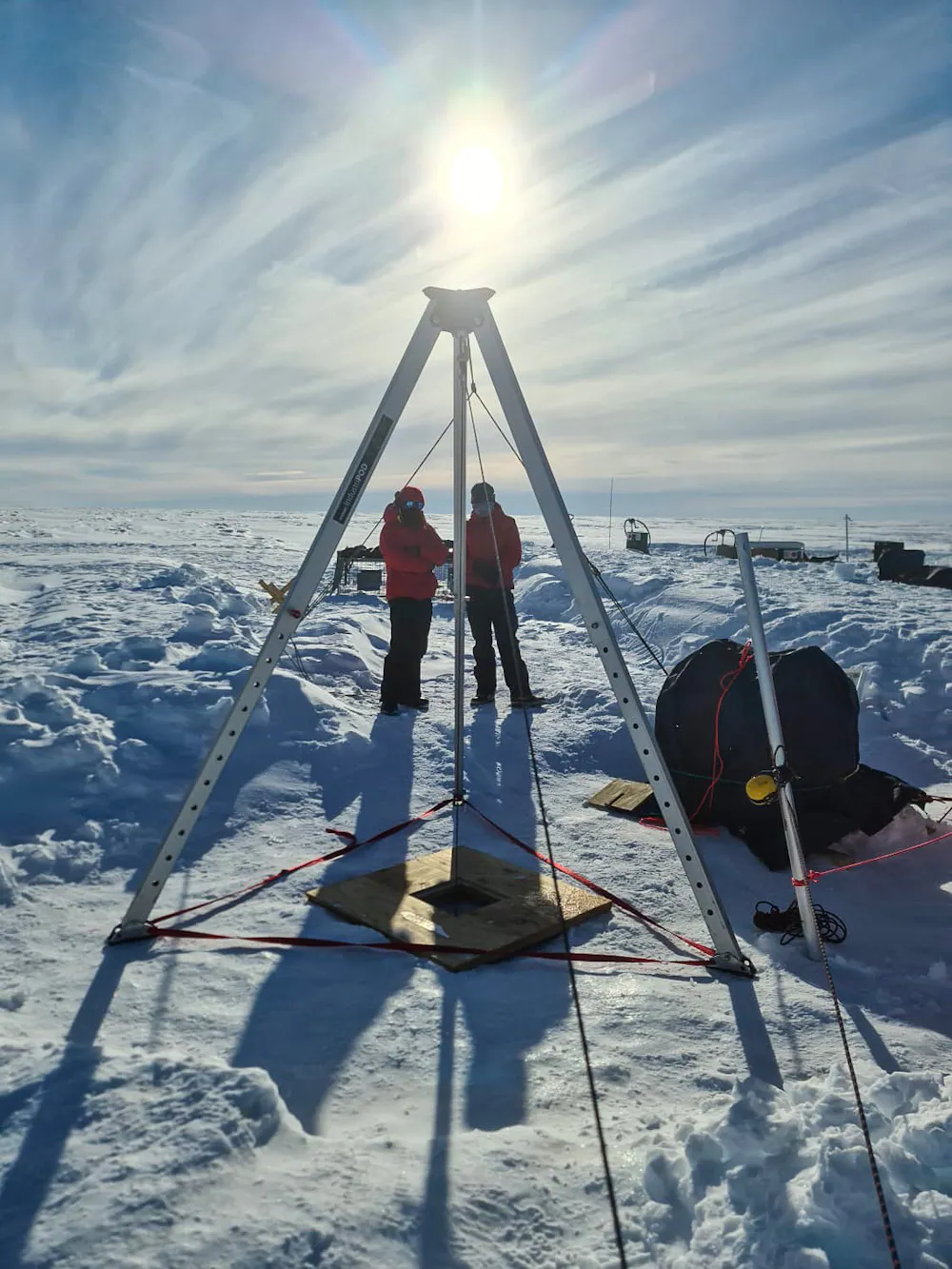
    Hot water drilling at Shackleton Ice Shelf, East Antarctica.
    Duanne White, University of Canberra/Australian Antarctic Division

    What we did and what we found

    We used computer simulations to predict the influence of subglacial water on ice sheet behaviour.

    We used two computer models:

    Then we explored how different assumptions about subglacial water pressure affect ice sheet dynamics. Specifically, we compared scenarios where water pressure was allowed to change over time against scenarios where it remained constant.

    When the effects of changing subglacial water pressure were included in the model, the amount of ice flowing into the ocean under future climate nearly tripled.

    These findings suggest many existing sea-level rise projections may be too low, because they do not fully account for the dynamic influence of subglacial water.

    Our research highlights the urgent need to incorporate subglacial water dynamics into these models. Otherwise we risk significantly underestimating the rate and magnitude of future sea-level rise.

    We simulated subglacial water pressure across Antarctica, revealing vulnerable regions potentially influenced by subglacial water, and mapped both active (blue) and stable (yellow) subglacial lakes and subglacial water channels (black lines).
    Zhao, C., et al, 2025. Nature Communications.

    In the video below, the moving dark lines show where grounded ice begins to float. The left panel is a scenario where subglacial water is not included in the ice sheet model and the right panel is a scenario that includes the effects of evolving subglacial water.

    Simulated Antarctic ice velocity over 1995–2300, using the Elmer/Ice model of ice sheets.

    A looming threat

    Failing to account for subglacial water means global sea-level rise projections are underestimated by up to two metres by 2300.

    A two-metre rise would put many coastal cities in extreme danger and potentially displace millions of people. The economic damage could reach trillions of dollars, damaging vital infrastructure and reshaping coastlines worldwide.

    It also means the timing of future tipping points are underestimated too. This is the point at which the ice sheet mass loss becomes much more rapid and likely irreversible. In our study, most regions cross this threshold much earlier, some as soon as 2050. This is deeply concerning.

    The way forward

    Understanding Antarctica’s hidden water system is challenging. The potential for rapid, catastrophic and irreversible ice loss remains.

    More observations are needed to improve our models, particularly from remote regions such as East Antarctica. Continuing to gather information from boreholes, ice-penetrating radar and satellites will help us better understand how the underside of the ice sheet behaves. These techniques can then be combined with computer simulations to enable more accurate projections of future ice loss and sea-level rise.

    Our new research shows integrating subglacial water dynamics into ice sheet models is a top priority. Understanding this hidden threat is crucial as the world grapples with the consequences of global warming especially rising seas.

    Chen Zhao is the recipient of an Australian Research Council Discovery Early Career Researcher Award. Dr Zhao is affiliated with Australian Antarctic Program Partnership (AAPP), at the Institute of Marine and Antarctic Studies (IMAS), University of Tasmania, supported under the Antarctic Science Collaboration Initiative program.

    Ben Galton-Fenzi is also affiliated with Australian Antarctic Program Partnership (AAPP), at the Institute of Marine and Antarctic Studies (IMAS), supported under the Antarctic Science Collaboration Initiative program, and the Australian Centre for Excellence in Antarctic Science, supported under the Australian Research Council Special Research Initiative, both based at the University of Tasmania.

    ref. Antarctica’s hidden threat: meltwater under the ice sheet amplifies sea-level rise – https://theconversation.com/antarcticas-hidden-threat-meltwater-under-the-ice-sheet-amplifies-sea-level-rise-250780

    MIL OSI AnalysisEveningReport.nz

  • MIL-Evening Report: Do I need another COVID booster? Which one should I choose? Can I get it with my flu shot?

    Source: The Conversation (Au and NZ) – By Paul Griffin, Professor, Infectious Diseases and Microbiology, The University of Queensland

    Tijana Simic/Shutterstock

    Australians are being urged to roll up their sleeves for a flu vaccine amid rising cases of influenza.

    It’s an opportune time to think about other vaccines too, particularly because some vaccines can be given at the same time as the flu vaccine.

    One is the COVID vaccine.

    Should you get another COVID shot?

    More than five years since COVID was declared a pandemic, we hear much less about this virus. But it’s still around.

    In 2024 there were 4,953 deaths involving COVID. This is nearly 20% lower than in 2023, but still nearly five times that of influenza (1,002).

    Vaccines, which do a very good job at reducing the chances of severe COVID, remain an important tool in our ongoing battle against the virus.

    Case numbers don’t tell us as much about COVID anymore as fewer people are testing. But based on other ways we monitor the virus, such as cases in ICU and active outbreaks in residential aged care homes, there have essentially been two peaks a year over recent years – one over summer and one over winter.

    This doesn’t mean we can predict exactly when another wave will happen, but it’s inevitable and may well be within the next few months. So it’s worth considering another COVID vaccine if you’re eligible.

    Who can get one, and when?

    There are several risk factors for more severe COVID, but some of the most important include being older or immunocompromised. For this reason, people aged 75 and older are recommended to receive a COVID booster every six months.

    In the slightly younger 65 to 74 age bracket, or adults aged 18 to 64 who are immunocompromised, booster doses are recommended every 12 months, but people are eligible every six months.

    Healthy adults under 65 are eligible for a booster dose every 12 months.

    Healthy children aren’t recommended to receive boosters but those who are severely immunocompromised may be eligible.

    What COVID shots are currently available?

    We’ve seen multiple types of COVID vaccines since they first became available about four years ago. Over time, different vaccines have targeted different variants as the virus has evolved.

    While some vaccine providers may still offer other options, such as the older booster that targeted the Omicron variant XBB.1.5, the recent JN.1 booster is the most up-to-date and best option.

    This is a relatively recently updated version to improve protection against some of the newer strains of COVID that are circulating. The new booster only became available in Australia in late 2024.

    This booster, as the name suggests, targets a subvariant called JN.1. Although JN.1 has not been the dominant subvariant in Australia for some time, this shot is still expected to provide good protection against circulating subvariants, including new subvariants such as LP.8.1, which is descended from JN.1.

    While it’s great we have an updated booster available, unfortunately uptake remains poor. Only 17.3% of people 75 and over had received a COVID vaccine in the six months to March.

    COVID vaccine uptake has been poor recently.
    Steve Heap/Shutterstock

    Getting a flu and COVID shot together

    Data from more than 17,000 people who completed a survey after receiving the JN.1 booster shows that while 27% reported at least one adverse event following vaccination, the majority of these were mild, such as local pain or redness or fatigue.

    Only 4% of people reported an impact on their routine activities following vaccination, such as missing school or work.

    If you choose to get the flu vaccine and the COVID vaccine at the same time, they’ll usually be given in different arms. There shouldn’t be a significant increase in side effects. What’s more, getting both shots at the same time doesn’t reduce your immune response against either vaccine.

    Now is the ideal time to get your flu vaccine. If you’re eligible for a COVID booster as well, getting both vaccines at the same time is safe and can be very convenient.

    We’re conducting trials in Australia, as are scientists elsewhere, of combined vaccines. One day these could allow vaccination against COVID and flu in a single shot – but these are still a way off.

    If you’re not sure about your eligibility or have any questions about either vaccine, discuss this with your GP, specialist of pharmacist. Australian state and federal government websites also provide reliable information.

    Paul Griffin has been the principal investigator on many vaccine clinical trials and received speaker honoraria and been a member of medical advisory boards for vaccine manufacturers. He is also a scientific advisory board member and director of the immunisation coalition.

    ref. Do I need another COVID booster? Which one should I choose? Can I get it with my flu shot? – https://theconversation.com/do-i-need-another-covid-booster-which-one-should-i-choose-can-i-get-it-with-my-flu-shot-252914

    MIL OSI AnalysisEveningReport.nz

  • MIL-Evening Report: Financial markets are tanking. Here’s why it’s best not to panic

    Source: The Conversation (Au and NZ) – By Luke Hartigan, Lecturer in Economics, University of Sydney

    Financial markets around the world have been slammed by the Trump adminstration’s sweeping tariffs on its trading partners, and China’s swift retaliation.

    Share markets have posted their biggest declines since the COVID pandemic hit in 2020, as fears of US recession surged. Iron ore, copper, oil, gold and the Australian dollar have all tumbled.

    On Wall Street, leading indices have fallen around 10% since the tariffs were announced, while the tech-heavy Nasdaq is down 20% from its recent peak. European and Asian markets have also slumped.

    In Australia, the key S&P/ASX 200 slid another 4.2% on Monday to levels last seen in December 2023, taking its three-day losses since the announcement to more than 7%.


    Why are markets reacting so badly?

    Financial markets reacted so negatively because the tariffs were much larger than expected. They represent the biggest upheaval in global trade in 80 years.

    Many traders were hoping the tariffs would be used mainly as a bargaining tool. But comments by US President Donald Trump that markets may need to “take medicine” seem to suggest otherwise.

    The tariffs are expected to weaken economic growth in the US as consumers pare back spending on more expensive imports, while businesses shelve investment plans. Leading US bank JP Morgan has put the chance of a US recession as high as 60%.

    This comes at a time when the US economy was already looking fragile. The highly regarded GDPNow model developed by the Atlanta Federal Reserve Bank indicates US March quarter GDP will fall 2.8%, and that was before the tariff announcement.

    Worries about global growth

    Fears of a recession in the United States and the potential for a global downturn has led to a broad sell-off in commodity prices, including iron ore, copper and oil. Further, the Australian dollar, which is seen as a barometer for risk, has fallen below 60 US cents in local trading – its lowest level since 2009.

    While the direct impact of tariffs on Australia is expected to be modest (with around 6% of our exports going to US), the indirect impact could be substantial. China, Japan and South Korea together take more than 50% of Australia’s exports, and all have been hit with significantly higher tariffs.

    Treasurer Jim Chalmers said on Monday that the direct impact on the Australian economy would be “manageable”.

    The full effect on Australia will depend on how other countries respond, and whether we can redirect trade to other markets.

    The rapid decline in the Australian dollar will help offset some of the negative effects associated with a global downturn and the fall in commodity prices.

    We can also expect some interest-rate relief. Economists are now predicting three further interest rate cuts by the Reserve Bank, starting in May. This brings economists into line with financial market forecasts.


    Read more:
    US tariffs will upend global trade. This is how Australia can respond


    Hang in there, markets will recover

    Watching equity markets tumble so dramatically can be unsettling for any investor. However, it is important to note that equity markets have experienced many downturns over the past 125 years due to wars, pandemics, financial crises and recessions. But these market impacts have generally been temporary.


    History suggests that over the long term, equity prices continue to rise, supported by growing economies and rising incomes.

    The key thing for investors to remember is to not panic. Now is not the time to decide to switch your superannuation or other investments to cash. This risks missing the next upswing while also crystallising any current losses.

    For example, despite the steep market sell-off in March 2020 as the first COVID lockdowns came into effect, the Australian share market had completely recovered those losses by June 2021.

    It is good practice for investors to regularly reassess their risk profile to make sure it is right for their current stage of life. This means reducing the allocation to riskier assets as investors get closer to retirement age, while also maintaining a cash buffer to avoid having to sell assets during more turbulent periods such as now.

    Super funds are exposed to global risks

    The current sell-off has highlighted a potential issue facing the superannuation industry.

    So much of our superannuation is now invested in global equity markets, mostly in the US, because Australia’s superannuation savings pool – at more than A$4 trillion – has outgrown the investment opportunities available in Australia.

    Another issue facing the superannuation industry is the growth of cyber attacks, with several funds targeted in a recent attack. Given the massive size of the assets held by some funds, it would seem they need to improve their security to be on par with that of the banking system.

    Luke Hartigan receives funding from the Australian Research Council.

    ref. Financial markets are tanking. Here’s why it’s best not to panic – https://theconversation.com/financial-markets-are-tanking-heres-why-its-best-not-to-panic-253929

    MIL OSI AnalysisEveningReport.nz

  • MIL-Evening Report: Without women, Australia’s defence force will struggle to recruit enough people

    Source: The Conversation (Au and NZ) – By Sarah Percy, Professor of International Relations, The University of Queensland

    Australia faces crisis-level workforce shortfalls in security and defence. Recruiting more people to the defence force is now an urgent matter of national security.

    So, comments – such as those recently made by a Liberal candidate that we “need to remove females from combat corps” in order to “fix” the military – come at the worst possible time.

    Such beliefs are not just unhelpful. They are dangerous.

    Without women in the national security workforce, and in combat roles, Australia will fail to hit its recruitment targets – at a time of critical international insecurity.

    Why is it so hard to attract women to the defence force?

    We know women are interested and engaged in international affairs.

    So, why don’t they want to join the defence force? In short, we don’t know – but we desperately need to find out.

    Women make up just 20.7% of the Australian Defence Force (ADF).

    Compared with a decade ago, this is an improvement. But the improvement has stalled. The latest figure represents a mere 0.1% increase compared with 2021 figures.

    This is serious.

    Australia’s recruitment problems put at risk our ability to:

    • conduct maritime patrols
    • defend against cyber attacks
    • maintain force readiness.

    Other democratic states worldwide are also struggling to achieve recruitment targets.

    Despite ambitious multi-year government programs aimed a boosting women’s participation in national security, and thousands of pages of reports and reviews on the issue, results have been limited and inconsistent.

    Most attempts to attract more women are focused on workplace improvements.

    Efforts include:

    Of the many government reviews and audits analysing the question, the vast majority focused on such workplace solutions.

    But what if the problem doesn’t lie in the workplace, but rather in wider society?

    What if one factor dissuading women was the archaic idea women just don’t really belong in the military at all?

    Societal attitudes matter

    The Liberal candidate who made the recent comments about women in combat roles has now been replaced. It’s positive to see his party saying such views are “inconsistent with the party’s position.”

    However, the incident suggests doubt remains in some quarters about women’s readiness to serve and take up combat roles.

    There’s a dearth of research on why exactly Australian women appear reluctant to join the ADF. Some of the reasons may be linked to the perception the ADF has a problem with sexual assault or sexism.

    But broader social gender norms matter too. When women hear comments reinforcing the idea national security is primarily a male field, they may simply not see a future for themselves or their daughters in it.

    A recent US study found 60% of teenage girls “have never considered joining the military or pictured themselves in uniform”.

    A passing glance at American politics demonstrates the often precarious position of women already working in national security. There, in recent months, debate has turned to:

    Trump’s America is not Australia, of course. But the recent backlash against women in the US security and defence arenas shows how quickly previous progress can be unwound.

    Could these debates be having a chilling effect on women in Australia who might otherwise consider a career in the military?

    More research is required to answer that question. But it’s possible public denigration of women in these roles deters women from seeking them at all, and may reinforce attitudes of those seeking to keep women out.

    Broadening the talent pool

    Australia’s own response to supporting diversity in the military has been mixed. In 2013, Chief of Army David Morrison made international headlines for a powerful speech about diversity.

    But Morrison faced criticism in the aftermath. Petitions called for his resignation and condemnation after he spoke about gender equality (and not veterans’ welfare) at an awards ceremony. He was criticised for caling for non-gendered language in Defence workplaces.

    Women make vital contributions to critical and creative thinking and decision-making in national security.

    Women in the military can do jobs men cannot do. Think, for example, of women who served in Afghanistan or Iraq, where it would be culturally unacceptable for a male soldier to talk to and work with local women. These were roles female soldiers were able to take up.

    Including women in defence increases the available talent pool, addressing pressing issues of workforce capability in the ADF.

    Australia’s national security requires women to be part of our military, including in combat roles. Without them, recruitment targets will fail. It is not diversity, equality and inclusion: it is reality.

    It is critically important to Australia’s national security we resist the trend from the United States. We must find out what’s stopping women from joining our defence force and address those problems urgently.

    Sarah Percy receives funding from the Australian Army History Unit.

    Elise Stephenson receives funding from the Australian Research Council and the Australian government. She is affiliated with Women in International Security Australia.

    Maria Rost Rublee has received funding from the Australian Department of Defence, the Canadian Department of Defence, and the US Institute of Peace. She is affiliated with Women in International Security-Australia and Women in Nuclear-Australia.

    Rebecca Strating receives funding from the Australian Department of Foreign Affairs and Trade.

    Danielle Chubb does not work for, consult, own shares in or receive funding from any company or organisation that would benefit from this article, and has disclosed no relevant affiliations beyond their academic appointment.

    ref. Without women, Australia’s defence force will struggle to recruit enough people – https://theconversation.com/without-women-australias-defence-force-will-struggle-to-recruit-enough-people-253844

    MIL OSI AnalysisEveningReport.nz

  • MIL-Evening Report: Batteries for all, not just the rich? Labor’s home battery plan must be properly targeted to be fair

    Source: The Conversation (Au and NZ) – By Rohan Best, Senior Lecturer, Department of Economics, Macquarie University

    NOWRA photography/Shutterstock

    Over the weekend, Labor promised to subsidise home batteries by 30%. This would save about A$4,000 per household up front for an average battery. The scheme has a goal of one million batteries by 2030, costing an estimated $2.3 billion.

    The promise was received broadly favourably as a measure to help with cost of living pressures and encourage the broader shift to clean energy. Labor’s policy has some similarity to an earlier Greens pledge. Last month, the Coalition hinted it was working on its own home battery plan. Opposition leader Peter Dutton has attacked Labor’s plan, claiming the subsidies would benefit the rich.

    Dutton makes a good point. Upfront subsidies have to be well targeted. If they’re not, they could easily go to wealthier households and leave poorer ones behind.

    To fix it, Labor should start with lower subsidies – and means test them.

    What’s the fuss about home batteries?

    Homes with batteries can use stored solar energy instead of grid energy, or charge from the grid when power is cheap and use it when grid power is expensive. They can reduce power bills by around $1,000 a year.

    Over 300,000 Australian households already have a home battery. Uptake was already accelerating in Australia and overseas, as battery prices fall and power prices climb.

    If this policy leads to 1 million batteries by 2030 as Labor hopes, they would boost grid stability, reduce demand for expensive peak power from gas generators and even avoid the need to build some new transmission lines. These would be positive – if the benefits can be spread fairly.

    Subsidies must be properly targeted

    Caution is necessary, because we have seen very similar issues with previous schemes.

    When solar panels were expensive in the 2000s, many state governments offered subsidies to encourage more households to put them on their roofs. On one level, this worked well – one third of all Australian households now have solar. But on another, it failed – richer households took up solar subsidies much more than poorer, as my research has shown. As solar prices have fallen, this imbalance has partly been corrected.

    Home batteries are now in a similar situation. Installing an average sized home battery of between 5 and 10 kilowatt hours can cost less than $10,000, without the proposed federal subsidy. But this upfront cost means it’s currently largely wealthy households doing it, as I have shown in other research.

    If Labor’s policy isn’t properly targeted, wealthier households are more likely to take it up. This is because they can more easily afford to spend the remaining cost. Studies on electric and other vehicle subsidies in the United States show at least half of the subsidies went to people who would have bought the vehicle regardless. That’s good for wealthy households, but unfair to others.

    Targeting has advantages for governments, too. Proper targeting would reduce the cost to the public purse.

    Wealthier households like these in an expensive Sydney suburb were more likely to take up solar – and benefit from early subsidies.
    Harley Kingston/Shutterstock

    So who should be eligible?

    Wealthier households are likely to be able to afford home batteries without the subsidy – especially as costs fall.

    The cost of living crisis has hit less wealthy households hardest. A home battery policy should focus heavily on giving these households a way to reduce their power bills.

    How can governments do this? Largely by means-testing. To qualify for the subsidy, households should have to detail their financial assets.

    To begin with, a policy like this should only be eligible for households outside the top 25% for wealth.

    What about the 31% of Australians who rent their homes? This diverse group requires careful thought.

    Governments may have to offer extra incentives to encourage landlords to install home batteries. The solar roll-out shows landlords do benefit, as they can charge slightly higher rent for properties with solar.

    How much should subsidies be?

    Labor’s election offering of a 30% subsidy is too generous.

    While home batteries can cost more than $10,000, cheaper battery options are now available and state incentive schemes are also emerging. Western Australia, for instance, will have its own generous battery subsidy scheme running before July 1.

    Some households might be able to get subsidies at both state and national levels, which would cover most of the cost of a smaller battery.

    When governments offer high subsidies at the start of a new scheme, there’s a real risk of a cost blowout.

    To avoid this, governments should begin with the lowest subsidy which still encourages household investment. If low subsidies lead to low uptake, the government could then raise subsidies after an annual review.

    Another option is to vary how much the subsidy is based on household wealth. Lower wealth households get higher subsidies (say $2,500) while higher wealth households get a much lower subsidy (say $500).

    Governments could even consider equitable reverse auctions, where households with similar wealth compete for subsidies. Governments can then choose lower bids in the interest of cost-effectiveness.

    At present, Labor’s policy would give higher subsidies for larger batteries. This isn’t ideal. On solar, there’s a lack of evidence higher subsidies lead to larger solar systems, while households with more wealth tend to get larger solar systems.

    Good start, improvement needed

    Labor’s home battery policy has been welcomed by many in the energy sector. But as it stands, we cannot be sure it will fairly share the benefits of home batteries.

    If Labor or the Coalition does offer a well-targeted home battery policy, it would be world leading. Over time, it would directly help with the rising cost of living and ensure less wealthy households benefit.

    Rohan Best previously received funding from the Economic Research Institute for ASEAN and East Asia (ERIA).

    ref. Batteries for all, not just the rich? Labor’s home battery plan must be properly targeted to be fair – https://theconversation.com/batteries-for-all-not-just-the-rich-labors-home-battery-plan-must-be-properly-targeted-to-be-fair-253445

    MIL OSI AnalysisEveningReport.nz

  • MIL-Evening Report: What our reaction to Adolescence tells us about our fear of boys, sex and the internet

    Source: The Conversation (Au and NZ) – By Alexandra James, Research Fellow, Australian Research Centre in Sex, Health and Society, La Trobe University

    News feeds have been flooded with reactions to Adolescence, Netflix’s newest viral hit. Released in March, the limited series racked up over 66 million views in just two weeks, making it the platform’s most-watched limited series to date.

    The show follows the arrest of a 13-year-old boy accused of murdering a young girl. It hints at potential radicalisation through the “manosphere” – pointing to emojis, incels and influencers like Andrew Tate.

    From the BBC, to Rolling Stone, Harper’s Bazaar, and a range of Reddit threads, Adolescence has quickly become one of the most talked-about UK series in recent memory. While some of the buzz reflects its gripping cinematography and performances, much of it centres on the show’s depiction of online dangers and the risks for young boys exposed to this content.

    The show has reignited debate about boys and their relationship to digital spaces, particularly social media. The UK prime minister even backed a proposal to screen the series in schools for free, alongside calls for school smartphone bans – measures already in place in parts of Australia.

    This public reaction to Adolescence reveals a broader social anxiety about boys, sex and the digital world. But while the public reaction focuses on fear and internet restrictions, evidence shows that young people – boys included – are already engaging with the digital world in complex, thoughtful ways.

    A history of moral panic

    The same anxiety underpins Australia’s world-first ban on social media for under-16s – framed as a way to protect young people from sexual content, harmful gender roles, and the influence of platforms like Instagram and TikTok. The federal education minister has described social media as a “cesspit” from which children must be protected.

    Yet this policy was introduced in direct response to a rise in women being killed by their intimate partners. It’s a subtle but powerful misdirection – one that offers a political fix while avoiding the more difficult work of addressing men’s violence.

    Instead, this policy response draws on a history of moral panic about young people and the internet. Young people are a “problem” we can “fix”, while ignoring deeper social and cultural issues.

    This framing of boys and the internet ignores their capacity, skills and how they engage in the digital world. It also ignores the many ways in which they learn about relationships.

    Most importantly, it risks further marginalising boys from the conversations and education they urgently need.

    Young people engage with online spaces thoughtfully

    Our research with young people and experts shows that teens engage with online spaces far more thoughtfully than they’re often given credit. They know how to assess credibility, search for diverse sources and navigate content in ways that reflect their needs.

    This process – of searching, comparing, evaluating – isn’t passive consumption. It’s an important part of how young people develop and find space to think about their identities, sex and relationships.

    Their engagement is often nuanced: they weigh content against other information, test it against their own experience, and assess how trustworthy or relatable a source might be.

    In a context where young people routinely report receiving inadequate education on sex and relationships – via parents or school-based programs – online spaces play an important role in helping them to fill these gaps.

    These platforms often provide the only accessible way for young people to explore aspects of their identity, sexuality and relationships.

    Boys are left out

    Some of our other research shows that cisgender, heterosexual boys are often left out of conversations about sex, relationships and consent. Such conversations could give them space to ask questions, express uncertainty and give adults a chance to hear what the boys are thinking.

    Instead of engaging boys with empathy or curiosity, we tend to talk at them, as if they alone are the problem, rather than talking with them.

    When pornography is demonised, we also shut down the possibility of honest discussion. This leaves boys, who are often too afraid to ask questions, to interpret what they’re seeing without support. That silence creates a vacuum, one increasingly filled by figures like Tate. The “self-proclaimed misogynist”, with more than 10 million followers on Twitter, is known for promoting harmful views about women, violence and sexual assault.

    Banning access to social media won’t fix this; it only deepens the lack of meaningful engagement with what young people might be seeing online.

    Educators are also nervous about broaching these topics. This is hard in an environment where talking to kids about sex remains taboo and who is responsible for having these conversations is unclear. Should it fall to schools? Parents? Police?

    How we can support young people

    What’s needed are policies and education that support youth educators to address this effectively. This also means meeting boys where they are and providing all young people with the digital and relational skills to navigate these issues.

    Young people don’t need Adolescence to understand the internet – they already do. What they need is support, space to ask questions and skills to navigate the ideas they’re exposed to, both online and in the world around them. That requires brave policies that prioritise education and equip them with critical digital literacy.

    And if we’re serious about supporting young people, we need to stop pretending the problem starts with them.

    Alexandra James receives funding from The Commonwealth Department of Health and Aged Care and Lifestyles Australia.

    Andrea Waling receives funding from the Australian Research Council and the Commonwealth Department of Health and Aged Care.

    Lily Moor receives funding from the Australian Research Council and the Commonwealth Department of Health and Aged Care.

    ref. What our reaction to Adolescence tells us about our fear of boys, sex and the internet – https://theconversation.com/what-our-reaction-to-adolescence-tells-us-about-our-fear-of-boys-sex-and-the-internet-253746

    MIL OSI AnalysisEveningReport.nz

  • MIL-Evening Report: Do we need a Martyn’s Law for venue security in Australia? The MCG gun scare is a wake-up call

    Source: The Conversation (Au and NZ) – By Milad Haghani, Associate Professor & Principal Fellow in Urban Risk & Resilience, The University of Melbourne

    Two men were arrested for allegedly bringing loaded firearms into the Melbourne Cricket Ground (MCG) during Thursday’s AFL match between Collingwood and Carlton.

    The incident didn’t result in harm but it triggered serious questions about venue security processes in Australia.

    The MCG had recently adopted AI-powered security screening systems, designed to detect weapons while streamlining crowd flow.

    The scanners reportedly flagged the men’s belongings but a failure in the follow-up manual check allowed them to enter.

    The event has reignited a national conversation about the right level of security at major venues. How do we balance the need for thorough screening with the goal of maintaining smooth ingress, individual freedom and public comfort?

    The timing is notable. Just days earlier, the UK passed Martyn’s Law, which introduces a legal duty for venues to assess and mitigate terrorism risks.

    The passage of this legislation prompts a broader question for Australia: should international developments like this influence how we think about security preparedness?

    AI security scanners

    The MCG recently contracted Evolv Technology, a US-based company, to supply AI-powered security screening systems for its major events.

    Their system is designed to detect weapons using a combination of sensors, millimetre wave technology and artificial intelligence, rather than relying on traditional metal detection.

    Evolv claims the system allows people to flow into the stadium faster compared to older technologies.

    Unlike traditional metal detectors, which operate on a simple binary system – alerting whenever metal is present – these scanners claim to offer a more granular assessment of objects.

    Instead of flagging all metal indiscriminately, the system is meant to evaluate the shape, size and density of objects to distinguish between benign items (such as keys or belts) and potential threats like firearms or large knives.

    This means patrons can pass through without removing metal items from their clothing or bags, significantly reducing wait times.

    When an item of interest is detected, the system highlights the specific area of the body or bag where it is located. This enables security staff to conduct a targeted search and avoid the need for a full-body inspections using hand-held detectors.

    Investigations and independent tests overseas have, however, identified false positives and missed detections as potential weaknesses in the Evolv system. One report found the system failed to detect certain knives and even some firearms in school settings.

    The risk associated with missed detection is self-explanatory: prohibited items can slip through the screening.

    But a high rate of false positives can also present challenges, particularly at the manual inspection stage, where staff are required to follow up on each alert. Over time, this can increase the likelihood of human error due to fatigue, reduced vigilance, or assumptions that flagged items are benign.

    So while AI scanners may be faster, they still depend heavily on the effectiveness of secondary manual screening and appropriate training of personnel. In the MCG breach, it is reported the scanners flagged items of concern when the two men entered the venue but the threat was missed during the manual follow-up process.

    Security matters

    The MCG breach exposed a gap in security that could, in other circumstances, be exploited with far more serious consequences.

    Public venues such as stadiums, especially during major events, are known to be targets for those planning high-impact attacks.

    Australia’s Strategy for Protecting Crowded Places from Terrorism explicitly lists stadiums and arenas as high-risk environments due to their crowd density, symbolic value and open access points.

    International experience reflects this concern. In the months leading up to the 2024 Paris Olympics, French authorities disrupted several planned attacks targeting Olympic-related venues and gatherings.

    Martyn’s Law: a new model

    As security practices evolve and new technologies are introduced, a parallel question is emerging: what should the legal expectations be for public venue operators when it comes to threat preparedness?

    In the United Kingdom, this question has led to Martyn’s Law – a major piece of legislation just passed by the parliament.

    The law was introduced in response to the 2017 Manchester Arena bombing, when 22 people were killed in a terrorist attack. One of the victims was Martyn Hett, whose mother, Figen Murray, campaigned for stronger, legally binding safety obligations for public venues.

    After six years of advocacy, the legislation was passed a few days ago.

    Martyn’s Law introduces a legal duty for UK venues to assess and mitigate terrorism risks. Depending on the size and type of venue, this includes measures such as conducting risk assessments, training staff and developing clear emergency response plans.

    Australia already has detailed guidance for the protection of crowded places. But unlike Martyn’s Law, that guidance is not a legal mandate.

    The silver lining

    Long security queues can frustrate patrons and dampen crowd mood. It’s no surprise venues are adopting AI-based screening to ease entry.

    But emerging technologies have limits and vulnerabilities may only surface once they’re in use.

    From a safety perspective, the best-case scenario is for these weaknesses to be revealed without harm, which can strengthen systems before a real failure occurs.

    The recent breach serves as just that: a prompt for review without consequence.

    These tools don’t replace trained personnel. Their success depends on clear procedures and defined responsibilities.

    That’s where legislation like the UK’s Martyn’s Law becomes relevant: turning good practice into legal obligation.

    As Australia prepares for global events, this is a chance to consider the governance that supports venue security.

    The presence of a legislative framework could serve as part of our overall security posture. And that, in itself, can help deter or mitigate risk.

    Milad Haghani does not work for, consult, own shares in or receive funding from any company or organisation that would benefit from this article, and has disclosed no relevant affiliations beyond their academic appointment.

    ref. Do we need a Martyn’s Law for venue security in Australia? The MCG gun scare is a wake-up call – https://theconversation.com/do-we-need-a-martyns-law-for-venue-security-in-australia-the-mcg-gun-scare-is-a-wake-up-call-253928

    MIL OSI AnalysisEveningReport.nz

  • MIL-Evening Report: 47% of Gen Z mainly vote to avoid a fine. It’s a sign of younger Australians’ discontent with democracy

    Source: The Conversation (Au and NZ) – By Sofia Ammassari, Research Fellow, Griffith University

    Young Australians will shape the upcoming federal election. For the first time, Gen Z and Millennials are the dominant voter bloc, outnumbering Baby Boomers.

    But over the past couple of years, we’ve heard stories from around the world about how Gen Z (people born between 1997 and 2012) are discontent with democracy. In the United States, just 62% of Gen Z voters believe living in a democracy is important, compared with nearly 90% of other generations.

    Globally, more than one in three young people support a strong leader who disregards parliaments and elections. This proportion is higher than among any older generation.

    Our recent research suggests Gen Z Australians aren’t immune to feeling disengaged with democracy. In fact, we found high rates of political disaffection among the country’s youngest voters, and those who didn’t vote, at the last federal election.

    Our research

    On the face of it, the situation seems better in Australia than elsewhere. According to Australian Election Study data, more than 85% of Gen Z voted at the 2022 federal election.

    And, again according to the study, the majority seem content with mainstream parties. While Gen Z people support the Greens and minor parties more than their elders, around 60% of them voted for the Labor Party and the Coalition in 2022.

    But we wanted to dig deeper. So in 2023, we asked around 1,500 Gen Z Australians nationwide whether they voted or not in 2022, and why.

    This enabled us to look at three distinct groups: those who voted; those who enrolled but did not vote (whom we call “abstainers”); and those who did not enrol to vote at all (whom we call “unregistered”).

    We found almost half of Gen Z who voted said the main reason was not out of a sense of duty or to support a party, but simply to avoid getting fined.

    While our survey can’t say how this compares to other generations, we know from the 2022 election study that 63% of Gen Z adults said they would have voted even if not compulsory, compared with almost 90% of other generations.

    Our research also shows almost a third of Gen Z citizens who didn’t register to vote said they either didn’t know they had to or they didn’t know how. This is troubling, given the efforts of the Australian Electoral Commission (AEC) to get everyone on the roll.

    Those who don’t vote

    Our survey revealed if you’re a Gen Z Australian who didn’t vote (whether as abstainer or unregistered), you’re more likely to be unemployed, less politically interested and have less faith in democracy as the best system of government. You’re also more likely to have been born outside Australia.

    More than 50% of abstainers and 70% of unregistered Gen Z attributed their non-participation to a sense of disengagement, either from the whole political process or from parties and politicians specifically.

    Not participating, however, doesn’t mean you’re entirely alienated from society. Non-voters in our study are actually more likely to be members of organisations such as charities or church groups. But they are more alienated from the democratic process.

    Curiously, we found non-voters were no more likely than voters to hold negative views towards political parties. When asked questions such as whether they agreed that “parties do not care about people like me” and “parties are all the same”, there were no significant differences between these two groups.

    While this may sound like good news for parties, the less cheerful reality is the lack of difference is because Gen Z voters are just as sceptical as non-voters about political parties.

    So why does Gen Z vote?

    Enthusiasm towards parties has little to do with why Gen Z goes to the ballot box. Just 11% of them said the main reason they turned out in 2022 was because “there was a party or candidate I wanted to vote for”.

    Only around one in five said their primary motivation was because “I thought that voting makes a difference”.

    Instead, by far the most important reason for casting a vote was “I did not want to get fined”. This was the main driver for 47% of Gen Z Australians.

    On one hand, this seems like a great advertisement for compulsory voting with enforced penalties. Even a small fine like the $20 for not voting in a federal election is enough to get many Gen Z people to vote.

    On the other, if the key motivation is just to avoid a fine, it’s not a great sign of a healthy democracy.

    What can be done?

    Based on our research, there are a few things that might engage Gen Z more with parties and democracy.

    One is better information. Our survey showed there are still some Gen Z people who don’t know about their obligation to register or how to do it. The AEC has made great strides in increasing youth enrolment over the past decade, but there remains work to be done.

    Being present on the platforms Gen Z use to get their news might help. From that perspective, the refusal of the AEC to have a TikTok account should be reconsidered.


    Read more:
    If we listen to how gen Z really feel about democracy they might stop telling us they prefer authoritarianism


    Ultimately, the main onus lies with the political parties. If Gen Z are not motivated to support them, perhaps this tells us more about how parties engage with young people and their concerns, than it does about young people themselves.

    If the major parties can devote more attention to what matters to Gen Z, such as the cost of living, rent affordability, and climate change, they would not only address what are objectively pressing issues – they might also help reconnect young generations with politics and democracy.

    Duncan McDonnell receives funding from the Australian Research Council.

    Ferran Martinez i Coma receives funding from the Australian Research Council.

    Sofia Ammassari does not work for, consult, own shares in or receive funding from any company or organisation that would benefit from this article, and has disclosed no relevant affiliations beyond their academic appointment.

    ref. 47% of Gen Z mainly vote to avoid a fine. It’s a sign of younger Australians’ discontent with democracy – https://theconversation.com/47-of-gen-z-mainly-vote-to-avoid-a-fine-its-a-sign-of-younger-australians-discontent-with-democracy-253120

    MIL OSI AnalysisEveningReport.nz

  • MIL-Evening Report: 98% of Queensland prawn areas at risk of inundation by rising seas this century

    Source: The Conversation (Au and NZ) – By Caitie Kuempel, Lecturer, School of Environment and Science, Griffith University

    As climate change wreaks havoc with the world’s oceans, future production of fish, crustaceans and other aquatic organisms is under threat.

    Our new research shows how this disturbance will play out for Australia’s prawn industry, which is concentrated in Queensland. We found by 2100, sea level rise threatens to flood 98% of the state’s approved prawn areas.

    The problem is not confined to prawns – Queensland barramundi farming is also at risk from sea-level rise. Climate change also poses challenges for other major seafood industries in Australia, including salmon in Tasmania.

    Australian seafood is vital to our culture and diets, and the national economy. We must take steps now to ensure the aquaculture industry thrives in a warmer world.

    Spotlight on Queensland prawns

    Aquaculture refers to breeding, rearing and harvesting fish, crustaceans, algae and other organisms in water. Australia’s aquaculture industry is expected to be worth A$2.2 billion by 2028–29.

    Aquaculture can involve a variety of methods, from ponds and sea cages to indoor tank systems and even giant ships.

    Aquaculture is one of Queensland’s fastest-growing primary industries – partly due to burgeoning production in prawn farming.

    Queensland is also expected to experience a 0.8m sea-level rise by 2100, under a high-emissions scenario. Our research investigated how this could affect the state’s aquaculture industry.

    We did this by examining existing data on coastal inundation and erosion from sea-level rise, combined with data on current and future aquaculture production areas.

    We found 43% of sites where aquaculture production is currently occurring are at risk from sea-level rise. Prawn farming is the most vulnerable.

    About 98% of areas approved for prawn farming in Queensland are expected to be inundated by seawater by 2100. The risk includes 88% of areas currently producing prawns. Prawns are grown in large ponds on land near the coast with access to saltwater, which makes them particularly vulnerable to inundation. Annual prawn production losses due to sea-level rise could reach up to A$127.6 million by century’s end.

    Inundation and coastal erosion can cause breaches in pond walls compromising their structural integrity. These risks may be amplified when sea-level rise coincides with coastal flooding. Rising seas can also increase salinity in surrounding soils and groundwater, further affecting ponds. Other aquaculture infrastructure, such as hatcheries, buildings, and roads, may also be disrupted.

    The Gold Coast region – a prawn production hub – is particularly vulnerable. Damage caused by ex-Tropical Cyclone Alfred highlights the vulnerability of coastal infrastructure to extreme weather. This will only worsen as the planet warms.

    Queensland barramundi farms also face a serious threat. Some 44% of areas producing barramundi are likely to be exposed to inundation, causing up to A$22.6 million in annual production losses. Meanwhile, two of Queensland’s designated “Aquaculture Development Areas” – regions earmarked by the state government for industry expansion – may be unsuitable due to future sea levels. Both are located in the Hinchinbrook Shire Council area.

    Beyond rising seas

    Globally and in Australia, climate change is posing myriad challenges to seafood farmers.

    Rising water temperatures stress animals such as salmon, lowering oxygen levels which slows growth rates and increases their risk of disease. Such depletion is a particular concern in already low-oxygen environments, such as Tasmania’s Macquarie Harbour.

    Ocean heatwaves can cause mass fish deaths and devastate production. In Tasmania in February, more than 5,500 tonnes of dead fish were dumped at southern Tasmanian waste facilities – a problem linked to warmer water temperatures.

    Dead and decomposing fish can further alter oxygen levels in water, spread disease to wild populations and attract scavengers. In the Tasmanian case, fish remains washed up on public beaches, angering the public and leading to calls for greater industry regulation.

    Extreme weather further complicates aquaculture operations. Storms, flooding and abnormal rain patterns can affect water salinity which impacts species growth and survival. They can also damage vital infrastructure, which may allow animals to escape.

    This occurred in 2022, when repeated flooding and disease outbreaks on oyster farms in New South Wales led to complete stock losses, prolonged farm closures and workers being laid off.

    Surviving a warmer future

    Not all aquaculture operations will suffer under climate change. Warming waters can lead to longer growing seasons in temperate regions. It can also expand suitable habitat for tropical species such as tilapia, mussels and oysters. Regions previously inhospitable to aquaculture may become viable production zones.

    For the countries and producers that are expected to suffer, those that plan for and adapt to climate shifts can minimise losses.

    Key steps industry and government can take include:

    • planning farms in lower-risk areas and relocating vulnerable sites

    • implementing climate-resilient infrastructure and restoring coastal ecosystems near farms to buffer against climate impacts

    • expanding to include diverse species and selectively breeding stock that can tolerate the changing conditions

    • strategic government policies and planning, financial incentives, and investment in resilient infrastructure to help the industry stay ahead of climate risks.

    With the right strategies, Australia’s aquaculture industry can adapt to a changing climate and continue to contribute to food security and community wellbeing.

    Caitie Kuempel receives funding from the Blue Economy Cooperative Research Centre. She is affiliated with BECRC Marine Spatial Planning project.

    Marina receives Griffith University International Postgraduate Research Scholarship and Griffith University Postgraduate Research Scholarship as and HDR PhD Student

    ref. 98% of Queensland prawn areas at risk of inundation by rising seas this century – https://theconversation.com/98-of-queensland-prawn-areas-at-risk-of-inundation-by-rising-seas-this-century-253330

    MIL OSI AnalysisEveningReport.nz

  • MIL-Evening Report: ‘Sometimes you need to eat an entire cucumber’: nutrition experts on the viral TikTok trend

    Source: The Conversation (Au and NZ) – By Lauren Ball, Professor of Community Health and Wellbeing, The University of Queensland

    @logansfewd via Instagram

    “Sometimes you need to eat an entire cucumber.”

    So begins a series of viral videos by TikTok “cucumber guy” Logan Moffitt, who has raked in millions of views for his cucumber salad videos. He’s also inspired thousands of copycat videos showcasing cucumbers as a hero ingredient in salads and other dishes.

    This trend has reportedly caused a surge in cucumber demand, leading to cucumbers being sold out in several stores in Australia and internationally.

    But what’s actually happening in your body when you eat an entire cucumber? Let’s review the science of cucumbers.

    Cucumbers 101

    Cucumbers (Cucumis sativus) are technically fruit that belong to the gourd family Cucurbitaceae. This family includes pumpkins, melons and zucchinis.

    Cucumbers originated from India over 3,000 years ago. They grow on vining plants and are typically harvested while still firm and unripe.

    Cucumbers are mostly water (96%), which is why Logan Moffitt has been described as the most hydrated person on the internet.

    Based on our calculations using the Australian Nutrient Reference Values, if you “ate an entire cucumber” (300g), you would consume:

    • about 11% of your daily carbohydrate needs (an important energy source)

    • about 5% of your daily fibre needs (fibre aids in digestion and gut health)

    • more than 50% of your daily vitamin K needs (important for bone health and blood clotting)

    • about 10% of your daily vitamin C needs (important for immune health, skin health and wound healing)

    • about 10% of your daily potassium needs (potassium regulates blood pressure and helps with muscle function).

    Unsurprisingly, there are no modern scientific studies that have specifically examined the health impacts of consuming an entire cucumber daily.

    However, cucumbers also contain cucurbitacins (especially in the skin) which researchers think may help with inflammation and could be a potential anti-cancer agent.

    More broadly, people have used cucumbers to:

    Can cucumbers help with hydration?

    Given they’re about 96% water, cucumbers could meaningfully increase daily fluid intake when eaten in moderate amounts.

    For example, an entire cucumber (about 300g) would contribute roughly 288 millilitres of water, which is just over one cup. We need plenty of water each day, so this additional intake could be helpful for some people.

    Their high water content, combined with essential electrolytes like potassium, makes them a refreshing snack, especially in hot weather or after exercise.

    While cucumbers can contribute to daily hydration, they shouldn’t replace drinking water. Adding cucumbers to meals or snacks could be a tasty way to stay hydrated, but you still need to drink water.

    Can someone eat too many cucumbers?

    Cucumbers can be a great addition to a healthy diet. Yet, relying on them too heavily might have unexpected downsides.

    Cucumbers are generally easy to digest and low in fermentable carbohydrates (FODMAPs), which means they are unlikely to cause bloating for most people in moderate amounts.

    However, when eaten in large amounts, some people may experience digestive discomfort, especially if they’re sensitive to fibre or have a history of irritable bowel issues.

    Being low in carbohydrates, fats and protein, cucumbers are unsuitable as a primary food source. In other words, you can’t just live on cucumbers. They don’t provide the essential nutrients needed for energy, muscle maintenance and overall health.

    If someone were to primarily eat cucumbers over an extended period, they could be at risk of undernutrition.

    What about adding MSG ‘(obviously)’?

    Many of the cucumber-based dishes on TikTok also include ingredients such as garlic, soy sauce, fish sauce, sesame oil and sugar – all well known to home cooks who like to boost flavour in their own dishes.

    Moffitt is also fond of saying “MSG, obviously”, when listing his favourite cucumber salad ingredients.

    MSG is monosodium glutamate, also known as food additive 621, an umami substance added to enhance the flavour of many Asian dishes.

    Despite past scare campaigns about MSG, it is safe and authorised for consumption in Australia and other countries.

    Typically, MSG is consumed at about 0.5g per serving, but some people report sensitivities at higher doses, such as over 3g.

    It’s also worth noting that many foods – including tomatoes, mushrooms, and parmesan cheese – naturally contain glutamate, the main component of MSG.

    So, should I eat an entire cucumber?

    Well, like any food, moderation and variety are key.

    Cucumbers are a refreshing and hydrating addition to a balanced diet, and work best nutritionally when paired with ingredients from other food groups.

    For example, to create a balanced meal, try combining cucumbers with protein-rich foods like tuna, chicken, eggs, or marinated tofu, along with whole grains such as wholemeal bread, pasta, or rice. This combination will help you to consume essential nutrients for sustained energy and overall health.

    And if you are looking for tailored dietary advice or a tailored meal plan, it’s always best to speak with an accredited practising dietitian.

    Lauren Ball receives funding from the National Health and Medical Research Council, Queensland Health and Mater Misericordia. She is a Director of Dietitians Australia, a Director of Food Standards Australia and New Zealand, a Director of the Darling Downs and West Moreton Primary Health Network and an Associate Member of the Australian Academy of Health and Medical Sciences.

    Pui Ting Wong (Pearl) receives funding from the Australian Government. She is a member of Dietitians Australia, and the Student Coordinator of Dietitians Australia Queensland Branch Leadership Committee.

    ref. ‘Sometimes you need to eat an entire cucumber’: nutrition experts on the viral TikTok trend – https://theconversation.com/sometimes-you-need-to-eat-an-entire-cucumber-nutrition-experts-on-the-viral-tiktok-trend-253545

    MIL OSI AnalysisEveningReport.nz

  • MIL-Evening Report: Looking inward: why Trump’s tariffs highlight the need for NZ to build local capacity

    Source: The Conversation (Au and NZ) – By Rod McNaughton, Professor of Entrepreneurship, University of Auckland, Waipapa Taumata Rau

    Chip Somodevilla/Getty Images

    When retail executives start swearing during earnings calls, something is clearly amiss. That’s what happened recently when the CEO of United States-based luxury furniture retailer Restoration Hardware saw his company’s share price plunge by more than 25% in after-market trading.

    The cause? Donald Trump had just declared “Liberation Day”, announcing sweeping new tariffs on nearly all imports. For companies like Restoration Hardware – which rely on suppliers in China and Vietnam, and now face tariffs of over 50% – the impact was immediate: higher costs, disrupted supply chains and enormous uncertainty.

    New Zealand exporters were spared the worst, with exports facing only the 10% baseline tariff under the new regime. But the lesson is clear. In today’s world, the real threat isn’t always direct exposure, it’s volatility.

    Trump’s tariffs sparked a nosedive in share markets and reignited concerns about the reliability of global trade. And while tariffs may rise and fall, uncertainty seems here to stay. This is why an idea first developed by journalist and author Jane Jacobs in the 1980s deserves renewed attention.

    In Cities and the Wealth of Nations, Jacobs argued that sustainable economic growth isn’t driven by national policy or protectionism but by what she called “import replacement”: where cities and regions develop the capacity to produce goods they once imported.

    The concept is often confused with import substitution, where governments impose tariffs or subsidies to protect domestic industries. But Jacobs’ model is different. It’s not about shielding firms from competition. It’s about growing new capabilities from the ground up.

    A smarter response to volatility

    Import replacement happens when entrepreneurs identify goods currently sourced from elsewhere and start producing them locally, not because tariffs artificially advantage them but because they’ve found a better way to meet local needs. Over time, this drives specialisation, innovation, and eventually new exports.

    Jacobs believed this bottom-up process was the real engine of economic resilience. And she was right. In an era marked by pandemics, war, climate volatility and policy shocks, the ability to adapt quickly and locally is more valuable than ever.

    New Zealand saw this first-hand during COVID-19. When global supply chains stalled, we found ourselves unable to access essentials from PPE to packaging, diagnostic swabs to digital hardware. Some firms responded with ingenuity. Others waited. In many cases, local capacity simply wasn’t there.

    That experience revealed an uncomfortable truth: trade agreements alone don’t secure economic sovereignty. It depends on the capability to make, adapt and substitute when the system falters.

    Some entrepreneurs are already seizing the moment. In the US, for example, founder of activewear brand XX-XY Apparel, Jennifer Sey, argues that trade disruption creates space for ethical, transparent supply chains closer to home. For her, localisation is not just risk management, it’s a business opportunity.

    But rebuilding domestic capacity isn’t easy. It takes capital, skilled workers and time. And tariff-based incentives can vanish as quickly as they appear. That’s why the kind of import replacement Jacobs envisioned wasn’t a reactive policy tool but a long-term development strategy.

    What import replacement could look like

    The same logic applies to New Zealand. We are heavily dependent on imported goods in critical sectors like machinery, pharmaceuticals, digital infrastructure, fertilisers and food processing. If any of those supply chains is disrupted, we’re not just inconvenienced, we’re exposed.

    To reduce that vulnerability, we need to think strategically. That might mean developing domestic capacity to manufacture essential health products, or supporting entrepreneurs working on substitutes for imported fertilisers or packaging materials.

    It could mean encouraging research institutions to develop substitutes for materials we currently source offshore.

    Universities and other research organisations can play a vital role. By collaborating with startups and small or medium-sized businesses, they can accelerate innovation. From prototype to production, tertiary institutions can help translate research into real-world resilience.

    Public procurement could also be better leveraged. Government contracts could reward suppliers who help reduce import dependency and build options into our domestic supply chains.

    Crucially, we need to map our vulnerabilities. Which imports are critical to key sectors? Where are we reliant on a single country or supplier? What could we produce regionally, if not nationally, with the right insight and capability?

    Resilience is not retreat

    This is not an argument against trade. New Zealand’s economy depends on it. But if we’ve learned anything from COVID and now from “Liberation Day”, it’s that openness without options is a liability.

    Tariffs may make headlines. But they won’t build the necessary capabilities in the US or globally for the next crisis. That kind of economic resilience comes from the patient work of entrepreneurs in building, substituting, learning and adapting, at speed and close to home.

    Jacobs reminded us that economies don’t grow stronger by walling themselves off. They grow stronger when they learn to make what they once had to import and, in doing so, discover what the world might want next.

    Rod McNaughton does not work for, consult, own shares in or receive funding from any company or organisation that would benefit from this article, and has disclosed no relevant affiliations beyond their academic appointment.

    ref. Looking inward: why Trump’s tariffs highlight the need for NZ to build local capacity – https://theconversation.com/looking-inward-why-trumps-tariffs-highlight-the-need-for-nz-to-build-local-capacity-253826

    MIL OSI AnalysisEveningReport.nz

  • MIL-Evening Report: From flowers to stalking: how ‘nice guy’ narratives can lead to male entitlement and violence against women

    Source: The Conversation (Au and NZ) – By Jamilla Rosdahl, Senior Lecturer, The University of Melbourne

    Shutterstock

    Being labelled a “nice guy” was once considered a form of flattery. Today, however, anyone privy to the world of dating and romance will know this isn’t necessarily a compliment.

    The term has been unofficially reappropriated by women to describe a certain kind of man – one who presents as being “nice”, but feels entitled to some kind of attention from a woman in exchange for this niceness.

    We need to take this attitude seriously, since the more it is normalised, the more likely it is to put women at risk.

    When flowers become stalking

    Plenty of women have shared their experience of being sent abusive texts after they rejected or ignored a man while online dating. The Instagram account @ByeFelipe, which has more than 400,000 followers, frequently features posts of “nice men” weaponizing their niceness on dating apps.

    In one example, a woman tells a man she doesn’t want to have sex with him on their first meeting, and he responds by calling her “trash”, “ugly”, “old” and a “bitch”.

    In my ongoing research on violence against women I have talked to hundreds of women who’ve been stalked by a man. In Australia, one in five women will be stalked. And women are eight times more likely to be stalked by a man than by another woman.

    Often, the stalking is preceded by certain performances, such as the man repeatedly leaving flowers by the woman’s door. As one woman told me:

    We are so used to being told that ‘bad guys’ are men who are physically abusive. When a guy is ‘nice’, it’s hard to believe he’s dangerous. It’s easier for women to ignore the signals of danger, because they are told that he has to be a good guy because he’s doing all these things. He even used feminist buzzwords. He’d say, ‘I believe in equality. I’m a feminist myself’.

    Another described how a man kept telling her, “I’m in touch with my emotions. I wear my heart on my sleeve” – but that she had to escape the relationship after he threatened her.

    Blaming women for feelings of inadequacy

    The “nice guy” trope can create a narrative in which men feel victimised by women. As sociologist Michael Kimmel explains, this can lead to a sense of aggrieved entitlement, and men blaming women for their own feelings of inadequacy.

    I’ve witnessed this while working with male inmates in a private capacity. Working in prisons in Sweden, I spoke to dozens of men who were convicted sex offenders and/or who had killed their wives or ex-partners.

    All of them told me they reacted with violence when women rejected them romantically. None of the men I spoke to took responsibility for killing the woman. Instead, they justified their crimes and/or blamed the women.

    The ‘nice guy’ in pop culture

    Pop culture and media both have played a role in normalising the “nice guy” trope, which has now taken on different meanings in different groups – from misogynistic men in incel communities to women calling out men on dating apps.

    Traditionally, the romance movie genre has portrayed highly persistent men as charming, or even admirable. In films such as There’s Something About Mary (1998) and Groundhog Day (1993), the “nice guy” obsessively pursues the woman while ignoring her wish to be left alone.

    In these stories, obsessive behaviour is rewarded because the “nice guy” eventually gets the girl. In real life, the same behaviours can cross the line into harassment and stalking.

    A more realistic depiction comes from the 1993 film I Can Make You Love Me, also known as Stalking Laura. This film is based on the true story of mass murderer Richard Farley.

    Farley became obsessed with his coworker Laura Black in the 1980s. He love-bombed her, left her gifts such as letters and baked goods, called her every few hours, and even showed up to her apartment and her aerobics class. When he asked her out, Laura politely declined.

    Farley would go on to shoot Laura in the shoulder in a killing spree that left her and three others injured, and seven more people dead. This event prompted California to pass the first anti-stalking laws in the United States.

    Real-world consequences

    Another horrifying example of an entitled “nice guy” was Elliot Rodger. In 2014, the then 22-year-old used knives, guns and his car to murder six people and injure 13 near the University of California, Santa Barbara.

    Rodger described himself as a “supreme gentleman” and couldn’t understand why women wouldn’t have sex with him. In a chilling video posted before the attack, he said:

    I will slaughter every spoiled, stuck-up, blond slut I see inside there. All those girls I’ve desired so much, they would have all rejected me and looked down upon me as an inferior man if I ever made a sexual advance towards them while they throw themselves at these obnoxious brutes.

    More than ten years later, there’s no shortage of men who share Rodger’s victim mentality and violent sentiments. Yet there is a lack of research into how such attitudes can contribute to real-world harm.

    As masculinity studies theorists argue, these attitudes are not the product of individual pathology, but are a much larger problem linked to societal ideas about masculinity. They are created by sexist ideology in culture, and are spread through socialisation.

    Robert Farley and Elliot Rodger weren’t the first men, nor the last, to think they had entitlements over women just because they followed a social script of acting “nice”. If we can understand how this attitude grows and festers among men, we might be able to stop it at its start.

    Jamilla Rosdahl does not work for, consult, own shares in or receive funding from any company or organisation that would benefit from this article, and has disclosed no relevant affiliations beyond their academic appointment.

    ref. From flowers to stalking: how ‘nice guy’ narratives can lead to male entitlement and violence against women – https://theconversation.com/from-flowers-to-stalking-how-nice-guy-narratives-can-lead-to-male-entitlement-and-violence-against-women-252523

    MIL OSI AnalysisEveningReport.nz

  • MIL-Evening Report: Biosecurity policies can be annoying – but a century of Antarctic data shows they work  

    Source: The Conversation (Au and NZ) – By Rachel Leihy, Ecologist, Arthur Rylah Institute for Environmental Research

    Visitors to Australia are often shocked at having to declare an apple or wooden item under our biosecurity policies. Biosecurity policies are used to keep out pest species and diseases. But they’re expensive to uphold and people can question their worth.

    The good news is, they work – and Antarctica’s strict biosecurity policies prove it.

    Under the web of agreements governing Antarctica, cargo must be checked for any sign of plants, seeds, insects and rodents. Visitors must ensure the items they bring are clean.

    In our new research, we analysed a century of data on how many species have been introduced to the icy continent and surrounding sub-Antarctic islands.

    Though there’s little human presence here, many species have been introduced and several have established – including rodents, aphids, and weedy plants – in a surprisingly short time. But across most sub-Antarctic islands, we found the rate of introduced species has remained steady, or slowed, after biosecurity policies were introduced, even as more humans arrived.

    The exception was the Antarctic continent itself, where species introductions are increasing. This is likely due to surging visitor numbers and inconsistent biosecurity efforts between different nations and tourist operators.

    Our work shows biosecurity policies work – if they’re followed.

    Biosecurity in the cold

    Antartica and sub-Antarctic islands such as Heard and McDonald Islands have an exceptional richness of species. Wandering albatrosses and emperor penguins live nowhere else. Some islands are home to meadows of megaherbs.

    Unfortunately, introduced species have had dramatic effects. Mice eat albatrosses alive. Midges entirely change the functioning of terrestrial systems. Weedy plants outcompete and displace unusual plants on several islands.

    Antarctic environments are particularly susceptible to introduced species. New species tend to have faster life cycles and are more tolerant of disturbance. Most indigenous species evolved without predators or competitors.

    As the climate heats up, introduced species get a boost. Warmer conditions make it easier for them to get their first foothold, and they do better with warmer climates than do the indigenous species.

    These vulnerabilities are why nations responsible for sub-Antarctic islands and those who jointly govern Antarctica through the Antarctic Treaty put strict biosecurity protocols in place from the 1990s onwards.

    These policies ban the deliberate introduction of new species and specify the measures visitors and cargo have to undergo to reduce the chance of new species being introduced accidentally.

    These protocols include cleaning equipment, clothing and cargo. In many cases, these policies also require eradication of any potentially damaging species if found.

    Is it worth it?

    All this takes time and money. To do it properly requires many hours of inspections and specific facilities, among other things. Ongoing research is also needed, to ensure the policies keep working.

    But eradication of species once established is often even more expensive. Costs are rising globally. Invasive species have cost Australia at least A$390 billion since the 1960s. Eradicating introduced rabbits, rats and mice from Australia’s Macquarie Island cost about A$25 million.

    So, are our biosecurity efforts worth the cost?

    Assessing the effectiveness of biosecurity policies is rare because it is difficult. To properly gauge effectiveness, you need data from before and after the policy came in. It’s also hard to pinpoint when a species made the jump to the cold; it’s harder to spot one new plant than a thriving population years after the first seeds took root.

    We believe our work solves these problems. We collected data on species arrivals across the Antarctic region and corrected for biases using new mathematical approaches that account for differences in survey effort over time.

    Most species introductions now happen by accident. Because introductions are closely tied to the numbers of visitors, we expected more species would arrive as visitor numbers grew. But on most sub-Antarctic islands, that didn’t happen. Species arrived at the same rate or more slowly than expected, even as more visitors came.

    In other words, the policies are working.

    Why is Antarctica the exception?

    Since 1998, biosecurity policies for the Antarctic continent haven’t managed to slow the rates of introductions.

    Newly introduced species are largely being found on the Antarctic Peninsula, where most tourists and scientists go. The peninsula has the mildest climate of the whole continent and is where Antarctica’s native flowering plants are found, as well as mosses, lichens and fungi.

    The new arrivals include annual bluegrass which displaces native plants. Also arriving are invertebrates, such as midges and springtails which can alter how nutrients are cycled in soil and shift other ecosystem functions.

    It’s not fully clear why biosecurity policies aren’t working as well on the continent as for the islands. Likely causes include inconsistencies in how biosecurity is policed by different nations, a rapidly warming climate and very rapidly growing numbers of people to the peninsula.

    What does this mean for the world?

    Introduced species are one of the largest environmental and economic challenges we face, according to an authoritative recent assessment.

    This may seem surprising. But the unchecked impact of species such as red fire ants, varroa mite and feral pigs cost Australian farmers billions each year. Prevention is usually better – and cheaper – than the cure.

    What our research shows is that biosecurity policies actually work to protect the environment and are likely to be cheaper than the cost of control or eradication. Introduced species now cost the global economy an estimated $423 billion annually.

    Society and decision-makers can see environmental regulations as a cost without a benefit. Being able to show the real advantages of these regulations is vital.

    Rachel Leihy works for the Arthur Rylah Institute for Environmental Research and Monash University, Melbourne, Australia. This research was done as a part of the Australian Research Council funded program Securing Antarctica’s Environmental Future.

    Melodie McGeoch receives funding from the Australian Research Council – SRIEAS Grant SR200100005 Securing Antarctica’s Environmental Future.

    Steven Chown receives funding from the Australian Research Council. He is an Honorary life member of the Scientific Committee on Antarctic Research.

    ref. Biosecurity policies can be annoying – but a century of Antarctic data shows they work   – https://theconversation.com/biosecurity-policies-can-be-annoying-but-a-century-of-antarctic-data-shows-they-work-252494

    MIL OSI AnalysisEveningReport.nz

  • MIL-Evening Report: New satellite data shows NZ’s major cities are sinking – meaning rising seas will affect them sooner

    Source: The Conversation (Au and NZ) – By Jesse Kearse, Postdoctoral Researcher, Geophysics, Kyoto University

    Shutterstock/Jakub Maculewicz

    Rising seas are already affecting coastal communities in Aotearoa New Zealand. On a global average, the sea level is now 18 centimetres higher than it was in 1900, and the annual rate of increase has been accelerating to currently 4.4 millimetres per year.

    This may not seem much, but it is already amplifying the impact of storm and tidal surges. Over the coming decades and centuries, this will pose increasingly serious problems for all coastal communities.

    But this is not the end of our troubles. Some parts of New Zealand’s coastline are also sinking. In many New Zealand cities, shorelines are steadily subsiding, with growing impacts on coastal infrastructure.

    Our new research reveals where and how fast this is happening. We found the coastlines near all major cities in New Zealand are sinking a few millimetres each year, with some of the fastest rates in coastal suburbs of Christchurch, where the land is still adjusting to the impact of the 2011 earthquake.

    Relative increase in sea level

    Sea-level rise is happening globally because the ocean is expanding as it continues to warm and glaciers and polar ice sheets are melting.

    Meanwhile, land subsidence operates on regional or local scales, but it can potentially double or triple the effects of sea-level rise in certain places. This dual effect of rising seas and sinking land is know as relative sea-level rise and it gives coastal communities a more accurate projection of what they need to prepare for.

    To understand which parts of the coast are most at risk requires detailed and precise measurements of land subsidence. The key to this is to observe Earth from space.

    We have used a technique known as interferometric synthetic aperture radar (InSAR). This involves the repeat acquisition of satellite radar images of the Earth’s surface, tied to very accurate global navigation satellite system measurements of ground stations.

    This builds on earlier work by the NZSeaRise project, which measured vertical land movement for every two kilometres of New Zealand’s coastline. Our study uses a significantly higher resolution (every ten metres in most places) and more recent datasets, highlighting previously missed parts of urban coastlines.

    Urban hotspots

    For instance, in Christchurch the previous NZSeaRise dataset showed very little subsidence at Southshore and New Brighton. The big differences in the new data are not due to the increase in spatial resolution, but because the rate of vertical land movement is very different from the time prior to the 2011 earthquake.

    Localised subsidence in these Christchurch suburbs is up to 8mm per year, among the fastest rates of urban subsidence we observed. These areas sit upon natural coastal sand dunes above the source area of the earthquake and the Earth’s crust is still responding to that sudden change in stress.

    This map shows vertical land movement (VLM) in Christchurch, highlighting areas that are sinking. The circles around the coastline show NZSeaRise estimates (2003-2011) and continous blue shading highlights new results (2018-2021).
    Jesse Kearse, CC BY-SA

    We have tracked vertical movement of the land with millimetre-scale precision for five major cities in New Zealand. The InSAR technique works particularly well in urban areas because the smooth surface of pavements, roads and buildings better reflects the satellite radar beam back into space where it is picked up by the orbiting satellite.


    This means the estimates of relative sea-level rise for these cities are close to or above 7mm per year. If sustained, this amounts to around 70cm of sea-level rise per century – enough to seriously threaten most sea defences.

    Our new satellite measurements provide a detailed picture of urban subsidence, even within single suburbs. It can vary by as much as 10mm per year between parts of a city, as this map of Dunedin and the Otago Harbour shows.

    This map shows vertical land movement (VLM) in Dunedin. The darker blue colours highlight parts of the city where land is sinking at a rate of 4mm per year or more.
    Jesse Kearse, CC BY-SA

    We found hotspots of very rapidly sinking regions. They tend to match areas of land that have been modified, particularly along the waterfront. During the 20th century, many acres of land were reclaimed from the ocean, and this new land is still compacting, creating an unstable base for the overlying infrastructure.

    One example of this is in Porirua Harbour, where a section of reclaimed land near the mouth of Porirua Stream is sinking at 3–5mm per year. This is more than double the average rate for Porirua’s coast.

    Rapidly sinking regions often match areas of land that have been modified or reclaimed, such as along the waterfront of Porirua Harbour.
    Jesse Kearse, from http://retrolens.nz, licensed by Land Information NZ, CC BY-SA

    Paradoxically, perhaps, it is only by looking back on our planet from outer space that we can begin to see with sufficient detail what is happening to the land in our own backyard.

    The good news is that we can use the results to identify coastlines that are particularly vulnerable to sea-level rise and plan accordingly for any future development. Our new measurements are just the first step in what must become a major effort to watch the ups and downs of our coastlines and urban areas.

    Jesse Kearse does not work for, consult, own shares in or receive funding from any company or organisation that would benefit from this article, and has disclosed no relevant affiliations beyond their academic appointment.

    ref. New satellite data shows NZ’s major cities are sinking – meaning rising seas will affect them sooner – https://theconversation.com/new-satellite-data-shows-nzs-major-cities-are-sinking-meaning-rising-seas-will-affect-them-sooner-252881

    MIL OSI AnalysisEveningReport.nz

  • MIL-Evening Report: MyMedicare promises better health care. But only 1 in 10 patients has signed up

    Source: The Conversation (Au and NZ) – By Jialing Lin, Research fellow, International Centre for Future Health Systems, UNSW Sydney

    Rose Marinelli/Shutterstock

    MyMedicare is a scheme that encourages patients to register with a regular GP practice to improve their health. But few patients have enrolled.

    Since its launch in October 2023, only about 10% of patients have signed up.

    The Albanese government’s 2023-24 budget allocated A$19.7 million over four years to implement MyMedicare. So if we are to get value for money from the scheme, we need to find out why patients are not signing up, and address any barriers to them doing so.

    Other countries have similar schemes, as we outline in recent research. Here’s what we can learn from these to boost uptake of MyMedicare in Australia.

    What is MyMedicare?

    MyMedicare is a voluntary patient registration scheme. Patients nominate a GP or GP practice as their preferred provider and see the same GP or health-care team over time, a concept known as “continuity of care”.

    Continuity of care is linked to earlier detection of health issues, better management of chronic (long-term) conditions, fewer avoidable hospital visits, and improved patient satisfaction.

    Patients registered for MyMedicare have longer telehealth consultations. People living in residential aged care have more regular visits from their GP. From July this year, GP practices may offer patients more support for their chronic diseases.

    There are also benefits for GP clinics that sign up for MyMedicare. They receive incentives to offer certain patients longer telehealth consultations. Practices also receive incentives to manage the health of registered aged care patients.

    These incentives help practices invest in improved services and resources. From July, this may include better chronic disease management and enhanced team-based care (for instance, better liaison between GPs and allied health workers as part of someone’s health team).

    MyMedicare comes with an extra boost for telehealth.
    fizkes/Shutterstock

    How many patients have signed up?

    Since MyMedicare’s launch in 2023 until March 19 this year, more than 2.6 million patients have registered for MyMedicare, according to Department of Health and Aged Care statistics provided to The Conversation.

    That’s about 10% of Australia’s population. This raises concerns about how aware patients are of the scheme, how engaged they are with it, and possible barriers to registration.

    GP practices that provide services to patients who would benefit from the new longer telehealth services or provide care to people in aged care were encouraged to register those patients in MyMedicare as a priority. So perhaps other patients have yet to sign up.

    GP practices have been quicker to sign up. Since its launch, health department statistics provided to The Conversation show 6,469 practices had registered for MyMedicare until March 19 this year.

    That’s about 80% of GP practices in Australia.

    Who’s most likely to register?

    We don’t know which patient groups sign up for MyMedicare. The health department told The Conversation patients can provide details of their sex, location (such as metropolitan, regional, rural and remote areas), linguistic background, and disabilities when they sign up. But this is voluntary, and these data have only been available for collection since March 2024.

    However, here’s what we learned when we looked at other countries’ patient enrolment schemes:

    • men are less likely to enrol than women, and recent immigrants have significantly lower registration rates compared to long-term residents. These highlight potential barriers to access for certain populations

    • patients in suburban, rural or small urban areas have higher registration rates, whereas those in large metropolitan centres and lower socioeconomic groups register less

    • patients with mental illness or substance use disorders have lower registration rates, pointing to challenges in engaging vulnerable populations.

    Men are less likely to enrol than women.
    DC Studio/Shutterstock

    How do other countries do it?

    We also looked at how other countries set up their schemes to see what we can learn.

    New Zealand: high uptake through financial incentives

    New Zealand has successfully implemented a voluntary patient registration system by offering incentives to enrolled patients. These include lower co-payments for consultations and cheaper prescriptions.

    This approach encourages people to register with a general practice rather than a specific GP. Some 95% of the population was registered by January 2025.

    Quebec, Canada: tailored registration programs, but low uptake

    Quebec has several voluntary registration programs for different groups of patients. These include ones for family medicine, vulnerable patients and a general program.

    However, registration rate remains low, at 14.7-32.2%, depending on the program.

    British Columbia, Canada: incentive-driven registration

    British Columbia offers three voluntary registration programs – one for chronic diseases, another for complex care and a general program.

    These use “capitation funding”, where GPs receive payments based on the number of patients they care for.

    Participation rates vary widely across the three programs, with 45.5-79% of the population registered.

    The differences in registration rates across these systems highlight the importance of how schemes are designed and implemented.

    What can Australia learn?

    If MyMedicare is to improve access and continuity of care, targeted strategies – such as outreach for immigrants and lower-income groups, and better support for people with mental health issues – will be essential.

    Australia could also look to how countries with higher rates of patients signing up have designed their systems. This could include considering whether more financial incentives for patients to enrol is warranted, which has been successful in New Zealand.

    Jialing Lin does not work for, consult, own shares in or receive funding from any company or organisation that would benefit from this article, and has disclosed no relevant affiliations beyond their academic appointment.

    ref. MyMedicare promises better health care. But only 1 in 10 patients has signed up – https://theconversation.com/mymedicare-promises-better-health-care-but-only-1-in-10-patients-has-signed-up-253335

    MIL OSI AnalysisEveningReport.nz

  • MIL-Evening Report: Reform clock is ticking – the big policy challenges the next government must urgently address

    Source: The Conversation (Au and NZ) – By Aruna Sathanapally, Grattan Institute

    The 2025 federal election coincides with a period of profound global uncertainty, as the Trump administration wreaks havoc on the free trade system and longstanding alliances.

    The events of recent months have underscored how, at each election, the voters in a democracy set their country on a path. Here in Australia, voters will be choosing whom to trust with tackling our challenges and making the most of the opportunities before us.

    These turbulent times internationally only reinforce the need for us to be clear-eyed about the challenges facing Australia, and where our strengths lie in addressing them.

    The big five challenges

    We see five overlapping domestic policy challenges that must be tackled by whoever wins the next election, to ensure prosperity for current and future generations.

    First, we must plan and deliver over the next 25 years the economic transformation that accompanies decarbonisation.

    Addressing climate change is not a task we can delay or abandon, but it will be neither easy nor cheap. The next government can either work to build a credible plan, to orient long-term investment in a renewable energy future, or leave a legacy for the next generation of even greater costs and unreliability, and missed opportunities.

    Second, we must increase the availability and affordability of housing in Australia. Housing is a fundamental human need, and when the housing system fails to deliver enough homes in the places people need and want to live, the consequences are both social and economic. In particular, our broken housing system sits at the centre of growing inequality in Australia.

    Third, as the structure of our economy changes, becoming less reliant on routine and manual labour, Australia must deepen its talent pools and boost productivity to meet the needs of our society and lift economic dynamism. We must improve our school systems, expand access to high-quality early childhood education and care, dismantle barriers in the labour market that prevent people from making the most of their skills and experience, and be rapid adopters of the best global practices and technology.

    Fourth, we are in the midst of the retirement of the Baby Boomer generation. An ageing population is placing increasing demands on public services, government budgets and our workforce. We need to get better at tackling chronic disease in our health system, and we need to shore-up our retirement and aged-care systems for the demographic change that we have long known is coming.

    Fifth, we cannot continue to have high expectations for public services and infrastructure, without raising the money to pay for them. Tax reform has sat in the too-hard basket for too long. In particular, income tax breaks for superannuation and housing have become too generous, and unfairly place the tax burden on younger, less wealthy taxpayers.

    And we need to implement sensible savings. Swingeing cuts may seem easy and appealing on the surface, but real savings will take more thinking than that: to make hospitals more efficient, to better target the NDIS, to get smarter in how we spend public money in procuring big infrastructure and defence projects.

    A position of strength

    None of these challenges is new: they were waiting for us as we emerged from the COVID crisis. Fortunately, we are not starting from scratch.

    In several areas, the federal government has made a start. But whoever forms government after the 2025 election must stay the course on difficult reforms while also finally confronting the reforms that neither side of politics has effectively tackled since the start of the century.

    Australia occupies a position of relative strength to tackle these challenges. We have a highly educated and skilled population, a more manageable fiscal position than many of our counterparts, stronger public institutions, and less polarisation in our politics.

    The reform clock is ticking

    Why, then, has reform proved so hard in Australia? Perhaps we have taken our strengths for granted, perhaps we have been content to leave problems for our future selves to solve. We cannot continue in this way.

    The fundamentals of Australia’s prosperity have been our success in opening our economy and society to the world, while maintaining a strong social safety net, and ensuring economic benefits are broadly shared and that each new generation sees opportunity to build a rewarding life. Failing to tackle the Big Five challenges above risks unpicking these foundations.

    Vested interests have been successful in thwarting reforms in the public interest for decades in Australia. Or perhaps the politics of opposition have proved so successful as to kill the prospect for bipartisan agreement on necessary, evidence-backed change.

    Equally, it falls to the media to hold politicians to account over the facts and evidence that support their claims. Politicians should be firmly tested on what they propose to do with the power they seek, and how they intend to advance the interests of all Australians. This is one of the most important safeguards against empty promises that will do nothing to make us better off, or even take us backwards.

    The reform clock is ticking. The winner of the 2025 election will have to get to work, quickly, on building a better Australia.

    The Grattan Institute began with contributions to its endowment of $15 million from each of the Federal and Victorian Governments, $4 million from BHP Billiton, and $1 million from NAB. In order to safeguard its independence, Grattan Institute’s board controls this endowment. The funds are invested and contribute to funding Grattan Institute’s activities. Grattan Institute also receives funding from corporates, foundations, and individuals to support its general activities as disclosed on its website

    ref. Reform clock is ticking – the big policy challenges the next government must urgently address – https://theconversation.com/reform-clock-is-ticking-the-big-policy-challenges-the-next-government-must-urgently-address-251343

    MIL OSI AnalysisEveningReport.nz

  • MIL-Evening Report: Friend, tutor, doctor, lover: why AI systems need different rules for different roles

    Source: The Conversation (Au and NZ) – By Brian D Earp, Associate Director, Yale-Hastings Program in Ethics and Health Policy, University of Oxford

    Cybermagician / Shutterstock

    “I’m really not sure what to do anymore. I don’t have anyone I can talk to,” types a lonely user to an AI chatbot. The bot responds: “I’m sorry, but we are going to have to change the topic. I won’t be able to engage in a conversation about your personal life.”

    Is this response appropriate? The answer depends on what relationship the AI was designed to simulate.

    Different relationships have different rules

    AI systems are taking up social roles that have traditionally been the province of humans. More and more we are seeing AI systems acting as tutors, mental health providers and even romantic partners. This increasing ubiquity requires a careful consideration of the ethics of AI to ensure that human interests and welfare are protected.

    For the most part, approaches to AI ethics have considered abstract ethical notions, such as whether AI systems are trustworthy, sentient or have agency.

    However, as we argue with colleagues in psychology, philosophy, law, computer science and other key disciplines such as relationship science, abstract principles alone won’t do. We also need to consider the relational contexts in which human–AI interactions take place.

    What do we mean by “relational contexts”? Simply put, different relationships in human society follow different norms.

    How you interact with your doctor differs from how you interact with your romantic partner or your boss. These relationship-specific patterns of expected behaviour – what we call “relational norms” – shape our judgements of what’s appropriate in each relationship.

    What is deemed appropriate behaviour of a parent towards her child, for instance, differs from what is appropriate between business colleagues. In the same way, appropriate behaviour for an AI system depends upon whether that system is acting as a tutor, a health care provider, or a love interest.

    Human morality is relationship-sensitive

    Human relationships fulfil different functions. Some are grounded in care, such as that between parent and child or close friends. Others are more transactional, such as those between business associates. Still others may be aimed at securing a mate or the maintenance of social hierarchies.

    These four functions — care, transaction, mating and hierarchy — each solve different coordination challenges in relationships.

    Care involves responding to others’ needs without keeping score — like one friend who helps another during difficult times. Transaction ensures fair exchanges where benefits are tracked and reciprocated — think of neighbours trading favours.

    Our relationships with other people fulfil different basic functions – and observe different norms of behaviour.
    PintoArt / Shutterstock

    Mating governs romantic and sexual interactions, from casual dating to committed partnerships. And hierarchy structures interactions between people with different levels of authority over one another, enabling effective leadership and learning.

    Every relationship type combines these functions differently, creating distinct patterns of expected behaviour. A parent–child relationship, for instance, is typically both caring and hierarchical (at least to some extent), and is generally expected not to be transactional — and definitely not to involve mating.

    Research from our labs shows that relational context does affect how people make moral judgements. An action may be deemed wrong in one relationship but permissible, or even good, in another.

    Of course, just because people are sensitive to relationship context when making moral judgements doesn’t meant they should be. Still, the very fact that they are is important to take into account in any discussion of AI ethics or design.

    Relational AI

    As AI systems take up more and more social roles in society, we need to ask: how does the relational context in which humans interact with AI systems impact ethical considerations?

    When a chatbot insists upon changing the subject after its human interaction partner reports feeling depressed, the appropriateness of this action hinges in part on the relational context of the exchange.

    If the chatbot is serving in the role of a friend or romantic partner, then clearly the response is inappropriate – it violates the relational norm of care, which is expected for such relationships. If, however, the chatbot is in the role of a tutor or business advisor, then perhaps such a response is reasonable or even professional.

    It gets complicated, though. Most interactions with AI systems today occur in a commercial context – you have to pay to access the system (or engage with a limited free version that pushes you to upgrade to a paid version).

    But in human relationships, friendship is something you don’t usually pay for. In fact, treating a friend in a “transactional” manner will often lead to hurt feelings.

    When an AI simulates or serves in a care-based role, like friend or romantic partner, but ultimately the user knows she is paying a fee for this relational “service” — how will that affect her feelings and expectations? This is the sort of question we need to be asking.

    What this means for AI designers, users and regulators

    Regardless of whether one believes ethics should be relationship-sensitive, the fact most people act as if it is should be taken seriously in the design, use and regulation of AI.

    Developers and designers of AI systems should consider not just abstract ethical questions (about sentience, for example), but relationship-specific ones.

    Is a particular chatbot fulfilling relationship-appropriate functions? Is the mental health chatbot sufficiently responsive to the user’s needs? Is the tutor showing an appropriate balance of care, hierarchy and transaction?

    Users of AI systems should be aware of potential vulnerabilities tied to AI use in particular relational contexts. Becoming emotionally dependent upon a chatbot in a caring context, for example, could be bad news if the AI system cannot sufficiently deliver on the caring function.

    Regulatory bodies would also do well to consider relational contexts when developing governance structures. Instead of adopting broad, domain-based risk assessments (such as deeming AI use in education “high risk”), regulatory agencies might consider more specific relational contexts and functions in adjusting risk assessments and developing guidelines.

    As AI becomes more embedded in our social fabric, we need nuanced frameworks that recognise the unique nature of human-AI relationships. By thinking carefully about what we expect from different types of relationships — whether with humans or AI — we can help ensure these technologies enhance rather than diminish our lives.

    Brian D Earp receives funding from Google DeepMind.

    Sebastian Porsdam Mann receives funding from a Novo Nordisk Foundation Grant for a scientifically independent International Collaborative Bioscience Innovation & Law Programme (Inter-CeBIL programme – grant no. NNF23SA0087056).

    Simon Laham does not work for, consult, own shares in or receive funding from any company or organisation that would benefit from this article, and has disclosed no relevant affiliations beyond their academic appointment.

    ref. Friend, tutor, doctor, lover: why AI systems need different rules for different roles – https://theconversation.com/friend-tutor-doctor-lover-why-ai-systems-need-different-rules-for-different-roles-252302

    MIL OSI AnalysisEveningReport.nz

  • MIL-Evening Report: Election Diary: Dutton backs down on working-from-home crackdown after outcry threatens to cost votes

    Source: The Conversation (Au and NZ) – By Michelle Grattan, Professorial Fellow, University of Canberra

    Peter Dutton has raised the white flag on his controversial attempt to force Canberra public servants back into the office, with the opposition now saying there will be no change in current arrangements.

    The shadow minister for the public service, Jane Hume, said: “We have listened, and understand that flexible work, including working from home, is part of getting the best out of any workforce”.

    The Coalition’s public service policy, released Sunday, says a Dutton government will “support flexible working arrangements for the public service, including working from home, by respecting existing flexible working arrangements, and enshrining them in future agreements.

    “There will be no mandated minimum number of days for public servants to work in the office.”

    Originally the Coalition wanted to get public servants back into the office five days a week, with Hume saying they had shown a “lack of respect for the work that went into earning the taxes the spend”.

    But on Sunday, Hume said, “Many professional men and women in the Commonwealth public service are benefiting from flexible working arrangements, including working from home, which allow them to make valuable contributions to serving Australians.

    “We know the importance of flexible work for many Australians, and have always supported the private sector making its own decisions on flexible work arrangements.”

    The move to try to return the public servants to the office has been a bugbear for the opposition from the start. Dutton landed in further trouble when he suggested women who were adversely affected by the policy could share jobs.

    Many voters feared if the return-to-the-office policy was introduced for public service workers, it could quickly lead to more pressure in the private sector. Many private employers have been trying to limit work-from-home arrangements.

    Working from home has become particularly entrenched since the pandemic, and the Liberals’ hard line threatened to lose them votes widely, especially among women.

    Dutton has progressively been qualifying and walking back the opposition’s proposal. Now, it’s been ditched completely.

    The Coalition’s public service policy would reduce the federal public service by 41,000 jobs over five years, while protecting frontline services and national security positions.

    Penny Wong paints Dutton as a ‘risk’ in an uncertain world

    The Liberals like to see national security issues as one of their strong suits. But Labor – thanks to US President Donald Trump’s global tariffs – is now boldly casting Dutton as posing a risk to Australia in a changing, uncertain world.

    Foreign Minister Penny Wong on Sunday described the opposition leader as stubborn, arrogant and always believing he knows best.

    “That leads him to make bad calls,” Wong told the ABC. “You see that in his stubborn insistence on a deal with President Trump at whatever cost. You see that in a reckless and risky linking of defence into this trade dispute.

    “What this showed us was this was a man who makes bad calls and this is a man who is a risk to this country when we face these uncertain times.”

    Penny Wong on Insiders on Sunday.

    Dutton has insisted he would have more chance of winning an exemption from US tariffs than Prime Minister Anthony Albanese.

    Trying to make his point, he was loose in his language last week. Notably, he said one of the things he would invoke was our defence relationship with the US.

    This was immediately interpreted as a threat. Later it was clarified he meant offering something positive to the US. But in an election campaign, the clarification seldom catches up with the original statement.

    Meanwhile, former Prime Minister John Howard weighed in to say the Australian-American defence relationship should never be brought into such a negotiation.

    Albanese is also saying the government will try to change Trump’s mind about applying tariffs to Australia. Like Dutton, he would have Australia’s critical minerals in the negotiating mix, although exactly how is not clear.

    The Liberals say if Dutton became PM he’d visit Washington within 60 days. There’d be a lot of pressure on the new prime minister to get a deal.

    If Labor is returned, Albanese would no doubt make an effort. But one suspects when push came to shove, he’d be reluctant to cede much, given the direct hit from the 10% tariff on Australian exports is relatively mild.

    The 2025 Liberal Party is a narrow congregation

    Petro Georgiou, one of the Liberals’ high-profile backbench moderates during the Howard years, died last week. His death reminded people – if they needed reminding – that the Liberal Party is a very different beast these days.

    Howard talked about the party being a “broad church”, embracing both conservatives and moderates. Howard, himself, of course, was no moderate but there were a number of small-“l” liberals with strong voices in his government – among them Robert Hill, John Fahey (former NSW premier), and Michael Wooldridge.

    While some powerful moderates were in the tent, others were kicking up the sand around it from the backbench. Prominent among them was Georgiou, a former adviser to Prime Minister Malcolm Fraser. He and colleagues took on Howard over various issues, especially on refugees.

    Fast forward to the Abbott government and, despite Tony Abbott’s conservatism, moderates were prominent: Julie Bishop, Christopher Pyne, Malcolm Turnbull, George Brandis.

    One significant reason for the important place the moderates had in the past was the nature of the Liberal Party. Its strongholds were affluent, urban areas, where voters were above average in income and education.

    But from Howard’s time on, Liberal leaders increasingly turned their eyes elsewhere. Howard had his “battlers”, and pursued voters from the right in Queensland. Abbott went after his “tradies”. Dutton is looking to outer suburbia to make his gains.

    Turnbull, the only moderate among the last four Liberal leaders, has, ironically, undermined the moderates. His trenchant criticisms of subsequent leaders have given many small-“l” liberal voters permission to vote teal.

    Last election, the teals dispatched several moderate Liberals, including Josh Frydenberg, who lost to independent Monique Ryan in Georgiou’s old seat of Kooyong. (Frydenberg hadn’t started out as a moderate, but effectively became one.) Other moderates, most notably Simon Birmingham, have exited politics before or at this election.

    One of Georgiou’s strongest allies back in the day was Victorian MP Russell Broadbent. Broadbent, who was also close to Turnbull, lost preselection for his seat of Monash and defected to the crossbench in 2023. He’s now running in Monash as an independent against the new Liberal candidate Mary Aldred (whose father was in parliament).

    In Monash, the Liberals don’t just have Broadbent snapping at their heels, but a teal candidate, as well. Broadbent says his old party should be glad he’s in the contest.

    “The teal would have won it otherwise,” he claims. The Liberals consider the seat pretty safe, but they’ll be thankful he is giving them his preferences.

    Michelle Grattan does not work for, consult, own shares in or receive funding from any company or organisation that would benefit from this article, and has disclosed no relevant affiliations beyond their academic appointment.

    ref. Election Diary: Dutton backs down on working-from-home crackdown after outcry threatens to cost votes – https://theconversation.com/election-diary-dutton-backs-down-on-working-from-home-crackdown-after-outcry-threatens-to-cost-votes-253732

    MIL OSI AnalysisEveningReport.nz

  • MIL-Evening Report: The Coalition has announced an even more radical plan to cut international students than Labor. Here’s how it would work

    Source: The Conversation (Au and NZ) – By Andrew Norton, Professor of Higher Education Policy, Monash University

    Last year, the Coalition made the surprise decision to oppose Labor’s plans for new international student caps.

    On Sunday, Opposition Leader Peter Dutton proposed an even more radical policy of his own to limit the number of international students in Australia.

    He announced a combination of tighter enrolment limits, increased visa application fees and changes to temporary graduate visas, which allow some former students to remain in Australia to work.

    This is aimed at either deterring potential students from applying or stopping them from going to their preferred university.

    What’s the Coalition’s policy?

    The Coalition and Labor similarly argue high numbers of international students are putting pressure on housing markets.

    But the opposition is also concerned there are too many international students in some courses. They say some courses can have international enrolments of up to 80%.

    To address both problems, the Coalition proposes a maximum international student enrolment share at public universities (which is almost all universities in Australia). This would be around 25% of all commencing (or new) enrolments. Other education providers, such as private colleges and TAFEs, would face separate caps.

    The Coalition estimates this would result in 30,000 fewer new international students per year than Labor’s policy.

    What is happening under Labor?

    Last year, Labor wanted to give the education minister wide powers to cap international student enrolments by education provider, campus and course.

    Apart from some exempt categories (such as postgraduate research students), vocational and higher education providers would have been allocated 270,000 commencing enrolments between them for 2025. This is compared to 323,000 commencing enrolments in 2023.

    But the bill was opposed by the Greens and the Coalition. So Labor had to move to plan B.

    Using its migration powers, in December 2024, the government issued a ministerial direction on how the Department of Home Affairs should process applications for student visas. This is arguably a de facto cap.

    Immigration officials have been instructed to prioritise student visa applications for all institutions until they near the individual caps that were blocked by the Senate last year.

    Once visa applications are at 80% of each provider’s cap, subsequent applications go into a slower visa processing stream.


    Read more:
    International student numbers in Australia will be controlled by a new informal cap. Here’s how it will work


    Signs applications are already down

    Prospective international students cannot apply for a visa unless an education provider gives them a “confirmation of enrolment”.

    We are seeing signs the ministerial direction is leading to fewer “confirmations of enrolment” and resulting applications.

    My analysis below shows student visa applications for January and February 2025 are well down on equivalent months in 2024, 2023 and 2019 (pre-Covid).

    In late 2024, demand was below the boom times of 2023 and early 2024, but still above 2019.

    What does the Coalition’s plan mean for unis?

    Labor’s policy for university caps uses a formula based on past international student enrolments. The Coalition’s caps would be a percentage of total new enrolments. They expect this to be around 25%, but will set the precise number after consultation and receiving the most recent data.

    Coalition education spokesperson Sarah Henderson has expressed concerns high concentrations of international students have “not been good for our country or for the education outcomes of Australian students”.

    Based on 2023 enrolment data – the latest that also includes domestic students – 35% of new university students in Australia were from overseas. But several universities had international student shares above 50%.

    On the Coalition’s estimates, their policy would see no more than 115,000 new international students in public universities each year, down from 139,000 under Labor’s approach.

    The Coalition acknowledges this will particularly affect the highly ranked Group of Eight universities, including The University of Melbourne and The University of Sydney. Dutton argues these universities have admitted “excessive numbers” of international students.

    Coalition caps for private providers

    One reason the Coalition gave for not supporting Labor’s legislation last year was the disproportionate effect on private education providers, which include both vocational and higher education colleges.

    Under the Coalition’s plan, private providers will still have caps, but they will be different than those for universities. Exactly how this will work is unclear. Their combined caps will be “at most 125,000”, according to the Coalition. Under Labor’s policy, their combined cap is a little higher, at about 132,000.

    A complicating factor here is the government’s existing migration policies have smashed demand for vocational education – as my analysis shows.

    This means many vocational education providers may not be able to fully use the places allocated under Labor’s indicative cap. These shortfalls may create space to increase caps for other private education providers.

    Visa application fees

    Last year, in a bid to cut international student numbers, Labor more than doubled the student visa application fee from A$710 to $1,600. They subsequently reversed this for Pacific Islander applicants.

    Under the Coalition, the visa application fee would more than triple to $5,000 for applicants to Group of Eight universities. For students seeking entry to other providers, the fee would be $2,500.

    Temporary graduate visas

    The Coalition also promises a “rapid review” of the temporary graduate visa program. This would be to prevent its “misuse” as a way to gain access to the Australian labour market and permanent migration.

    Labor has already reduced the number of years former students can stay on temporary graduate visas, reduced the age limit to be granted a visa from 50 to 35 years, and increased the minimum English requirements.

    Applications for temporary graduate visas are down on past levels.

    While Labor’s changes made some potential visa applicants ineligible, recent applications could be the calm before the storm. Large numbers of 2023 and 2024 international students will complete their courses in the coming years, with many of them eligible for temporary graduate visas under current policies.

    International education will take a hit regardless

    The Coalition’s international student election policy is less of a surprise than its refusal to back Labor’s caps last year. They have foreshadowed tough policies many times in recent months.

    But the proposed increased visa application fees and enrolment caps would be painful for both students and education providers.

    Universities have repeatedly argued international students are not major causes of the housing crisis. They have also argued international education is a valuable export and it is being undermined by policy changes out of Canberra. But this has had no impact on the stance of either Labor or the Coalition.

    So, the number of international students in Australia will fall regardless of the federal election result. The decline is set to be greater under a Coalition government. But regardless of the election result, the days of unlimited international student numbers are over.

    The Conversation

    Andrew Norton works for Monash University, which is a member of the Group of Eight and would be significantly affected by the policies discussed in this article.

    ref. The Coalition has announced an even more radical plan to cut international students than Labor. Here’s how it would work – https://theconversation.com/the-coalition-has-announced-an-even-more-radical-plan-to-cut-international-students-than-labor-heres-how-it-would-work-253919

    MIL OSI AnalysisEveningReport.nz

  • MIL-Evening Report: Election Diary: Albanese promises 30% discount on household batteries in latest energy bill help

    Source: The Conversation (Au and NZ) – By Michelle Grattan, Professorial Fellow, University of Canberra

    In the government’s latest initiative on energy prices, Anthony Albanese on Sunday will promise that if re-elected, Labor will reduce the cost of installing a typical home battery by 30% from July 1.

    This would cut about $4,000 from the upfront cost of an 11.5 kWh battery, which is the typical household size.

    Small businesses and community facilities would be eligible for the discount, as well as households.

    The government says the discount would save a household with existing rooftop solar panels up to $1,100 off their power bill every year. For those with new solar panels and battery, the saving would be up to $2,300 annually – up to 90% of a typical power bill.

    More than one million installations would be expected by 2030 under the measure. The initiative would cost an estimated $2.3 billion over the forward estimates, including in the 2025-26 budget.

    The discount would be applied on installing virtual power plant-ready battery systems beside new or existing rooftop solar until 2030. The absolute value of the discount would decline over the five years in line with the expected fall in the cost of batteries.

    Albanese said the measure was “good for power bills and good for the environment”.

    Labor’s number one priority is delivering cost-of-living relief. That’s why we want to make sure Australians have access to cheaper, cleaner energy.

    Energy Minister Chris Bowen said:

    The contrast is clear – a re-elected Albanese government will take pressure off household energy bills, while Peter Dutton’s Liberals will spend $600 billion on a nuclear plan that drives power bills up.

    Mixing politics and sport can be risky on campaign trail

    For the second election campaign in a row, a Liberal leader has claimed a victim on the football field.

    At least, some relieved Liberals might be saying, Opposition Leader Peter Dutton felled a member of the media, not a child.

    Dutton, campaigning in Darwin on Saturday with a few million dollars in hand to promise for the local footy ground, was happy to have a kick with kids for the cameras.

    But the ball hit a TV camera, which went into the face of Channel Ten cameraman Ghaith Nadir. A federal policeman helped with a bandage for Nadir’s forehead. Dutton promised a compensatory beer.

    In the 2022 campaign, Prime Minister Scott Morrison joined some youngsters in their junior soccer training.

    Becoming rather too competitive, Morrison crashed into a boy, and they both ended on the ground. It made for plenty of jokes about the man who’d admitted in the campaign that “I can be a bit of a bulldozer”. The clip was replayed again and again.

    After Saturday’s incident, Dutton quipped, “If the prime minister kicked it, he would have told you that it didn’t hit anyone”.

    Last week, Albanese stepped back off a stage, appearing to fall, during an event. He later insisted he hadn’t fallen. “I stepped back onto a step, I didn’t fall off the stage,” he said. “Just one leg went down, and I was sweet.”

    Way back in 1984, there was another unfortunate incident on the sporting field during a campaign. That time, the perpetrator was a journalist and the victim was Prime Minister Bob Hawke.

    Hawke had called an election a few days before playing in a cricket match against the parliamentary press gallery. A ball from Gary O’Neill, a journalist with the Melbourne Herald, caught the edge of Hawke’s bat and smashed into his glasses.

    Hawke went to the Canberra Hospital, where (after he jumped the queue) a patch was put on his eye. He returned to the match, watching from the sidelines.

    At least he scored 27 before the incident. However, the accident set him back for the early days of what was an eight-week campaign.

    Over the years there are plenty of examples of leaders losing their (physical) footing.

    A few months before the 2007 election, Prime Minister John Howard tripped and fell on his hands on the way to a radio interview in Perth.

    Visiting India in 2012, Prime Minister Julia Gillard tumbled when her shoe got stuck in grass. She explained:

    For men who get to wear flat shoes all day every day, if you wear a heel it can get embedded in soft grass and when you pull your foot out the shoe doesn’t come.

    Michelle Grattan does not work for, consult, own shares in or receive funding from any company or organisation that would benefit from this article, and has disclosed no relevant affiliations beyond their academic appointment.

    ref. Election Diary: Albanese promises 30% discount on household batteries in latest energy bill help – https://theconversation.com/election-diary-albanese-promises-30-discount-on-household-batteries-in-latest-energy-bill-help-253736

    MIL OSI AnalysisEveningReport.nz

  • MIL-Evening Report: Election Diary: Albanese promises 30% discount on solar batteries, in latest energy bill help

    Source: The Conversation (Au and NZ) – By Michelle Grattan, Professorial Fellow, University of Canberra

    In the government’s latest initiative on energy prices, Anthony Albanese on Sunday will promise that if re-elected, Labor will reduce the cost of installing a typical home solar battery by 30% from July 1.

    This would cut about $4,000 from the upfront cost of an 11.5 kWh battery, which is the typical household size.

    Small businesses and community facilities would be eligible for the discount, as well as households.

    The government says the discount would save a household with existing rooftop solar panels up to $1,100 off their power bill every year. For those with new solar panels and battery, the saving would be up to $2,300 annually – up to 90% of a typical power bill.

    More than one million installations would be expected by 2030 under the measure. The initiative would cost an estimated $2.3 billion over the forward estimates, including in the 2025-26 budget.

    The discount would be applied on installing virtual power plant-ready battery systems beside new or existing rooftop solar until 2030. The absolute value of the discount would decline over the five years in line with the expected fall in the cost of batteries.

    Albanese said the measure was “good for power bills and good for the environment”.

    Labor’s number one priority is delivering cost-of-living relief. That’s why we want to make sure Australians have access to cheaper, cleaner energy.

    Energy Minister Chris Bowen said:

    The contrast is clear – a re-elected Albanese government will take pressure off household energy bills, while Peter Dutton’s Liberals will spend $600 billion on a nuclear plan that drives power bills up.

    Mixing politics and sport can be risky on campaign trail

    For the second election campaign in a row, a Liberal leader has claimed a victim on the football field.

    At least, some relieved Liberals might be saying, Opposition Leader Peter Dutton felled a member of the media, not a child.

    Dutton, campaigning in Darwin on Saturday with a few million dollars in hand to promise for the local footy ground, was happy to have a kick with kids for the cameras.

    But the ball hit a TV camera, which went into the face of Channel Ten cameraman Ghaith Nadir. A federal policeman helped with a bandage for Nadir’s forehead. Dutton promised a compensatory beer.

    In the 2022 campaign, Prime Minister Scott Morrison joined some youngsters in their junior soccer training.

    Becoming rather too competitive, Morrison crashed into a boy, and they both ended on the ground. It made for plenty of jokes about the man who’d admitted in the campaign that “I can be a bit of a bulldozer”. The clip was replayed again and again.

    After Saturday’s incident, Dutton quipped, “If the prime minister kicked it, he would have told you that it didn’t hit anyone”.

    Last week, Albanese stepped back off a stage, appearing to fall, during an event. He later insisted he hadn’t fallen. “I stepped back onto a step, I didn’t fall off the stage,” he said. “Just one leg went down, and I was sweet.”

    Way back in 1984, there was another unfortunate incident on the sporting field during a campaign. That time, the perpetrator was a journalist and the victim was Prime Minister Bob Hawke.

    Hawke had called an election a few days before playing in a cricket match against the parliamentary press gallery. A ball from Gary O’Neill, a journalist with the Melbourne Herald, caught the edge of Hawke’s bat and smashed into his glasses.

    Hawke went to the Canberra Hospital, where (after he jumped the queue) a patch was put on his eye. He returned to the match, watching from the sidelines.

    At least he scored 27 before the incident. However, the accident set him back for the early days of what was an eight-week campaign.

    Over the years there are plenty of examples of leaders losing their (physical) footing.

    A few months before the 2007 election, Prime Minister John Howard tripped and fell on his hands on the way to a radio interview in Perth.

    Visiting India in 2012, Prime Minister Julia Gillard tumbled when her shoe got stuck in grass. She explained:

    For men who get to wear flat shoes all day every day, if you wear a heel it can get embedded in soft grass and when you pull your foot out the shoe doesn’t come.

    Michelle Grattan does not work for, consult, own shares in or receive funding from any company or organisation that would benefit from this article, and has disclosed no relevant affiliations beyond their academic appointment.

    ref. Election Diary: Albanese promises 30% discount on solar batteries, in latest energy bill help – https://theconversation.com/election-diary-albanese-promises-30-discount-on-solar-batteries-in-latest-energy-bill-help-253736

    MIL OSI AnalysisEveningReport.nz

  • MIL-Evening Report: With US bombers at the ready, can Trump cut a deal with Iran and avoid a war?

    Source: The Conversation (Au and NZ) – By Amin Saikal, Emeritus Professor of Middle Eastern and Central Asian Studies, Australian National University; and Vice Chancellor’s Strategic Fellow, Victoria University

    The United States and Iran are once again on a collision course over the Iranian nuclear program.

    In a letter dated early March, US President Donald Trump urged Iranian Supreme Leader Ayatollah Ali Khamenei to negotiate a new deal. The new deal would replace the defunct nuclear agreement negotiated in 2015 between the United States, Iran and five other global powers.

    Trump withdrew from that agreement, called the Joint Comprehensive Plan of Action (JCPOA), during his first term.

    Trump gave the Iranians a two-month deadline to reach a new nuclear deal. If they don’t, the US will bomb the country. In recent days, American B-2 bombers and warships have been deployed to the region in a show of force.

    In response, Tehran has agreed only to indirect negotiations. It has ruled out any direct talks while under a US policy of “maximum pressure”.

    Down to the ‘final moments’

    The danger of US or combined American-Israeli military actions against Iran has never been greater.

    Trump says the US is down to the “final moments” should Tehran persist with moving towards a military nuclear capability.

    His national security advisor, Mike Waltz, has gone further, demanding Iran shut down its entire nuclear program.

    Khamenei and his generals have promised a “harsh response” to any military venture. Iran has vowed to target all American bases in the region.

    France, one of key negotiators in the 2015 deal, said this week a failure to secure a new deal would make a military confrontation “almost inevitable”.

    In a positive sign, however, Washington is reportedly “seriously considering” Iran’s offer for indirect negotiations. And Trump is now suggesting Iran may actually be open to direct talks.

    On the threshold of a nuclear bomb

    It would be a folly to expect a quick result that could satisfy an impatient Trump. This is especially true given Trump is under intense pressure from his close friend, Israeli Prime Minister Benjamin Netanyahu.

    Netanyahu has long advocated for military action as the best way to prevent Iran from acquiring a nuclear weapon and eliminate its other military capabilities, as well as its regional influence.

    The Iranian Islamic regime has repeatedly said its nuclear program is for peaceful purposes. However, the US and its allies – in particular Israel – have remained highly sceptical of Tehran’s intentions.

    Following Trump’s withdrawal from the JCPOA in 2018, Tehran has substantially expanded its nuclear program, to the chagrin of the other signatories to the deal (Britain, France, Germany, Russia and China).

    It has installed more advanced centrifuges and accelerated uranium enrichment to 60%, just below weapons-grade level. The country is now at a nuclear weapon threshold. It is believed to be capable of assembling an atomic bomb within months, if not weeks.

    Israel’s devastating military operations against Iran’s allies in Gaza, Lebanon and Syria, as well as direct exchanges with Iran, have prompted some in the Iranian leadership to advocate for crossing that threshold.

    As I document in my book, Khamenei also remains highly distrustful of Trump and the US political class in general.

    Khamenei initially dismissed Trump’s letter last month as a “deception” from the leader of a country he has long considered an “arrogant power” that wants to dictate to Iran, rather than negotiate with it.

    One of his senior advisers, former Foreign Minister Kamal Kharrazi, berated Washington for engaging in “psychological warfare”.

    And the current foreign minister, Abbas Araghchi, said direct negotiations would be futile unless Washington changed its policy of maximum pressure against Iran. This would involve removing sanctions against his country.

    What the two sides want

    Despite this historic distrust of the US, Tehran has found it expedient to offer indirect talks for a possible deal. However, the two sides remain far apart in their respective demands.

    Washington, at the very least, would want Tehran to indefinitely limit its uranium enrichment to 3.7% – the level it had agreed to in the 2015 deal. Washington would also demand close oversight by the US and the International Atomic Energy Agency.

    Tehran’s minimum demands would include the US unfreezing Iranian assets, lifting all sanctions against Iran and guaranteeing a nuclear deal will not be rescinded by future American administrations.

    Neither side could meet these demands, however, without first engaging in substantive confidence-building measures. Since Trump withdrew from the JCPOA in 2018, the onus is on him to jump-start the process. He could do this by:

    • unfreezing Iranian assets in the United States
    • lifting some sanctions to enable Iran to purchase non-lethal items from the West, including new civilian aircraft from Boeing and Airbus which were voided following the JCPOA’s dismantling
    • withdrawing the threat of a US, Israeli or combined military action.

    Given the depth of the long-standing enmity and distrust between the parties, the chances of reaching a new nuclear deal seem further away than the drums of war.

    However, given Trump’s unpredictability and the serious domestic and foreign policy challenges facing the Iranian regime, a deal also cannot not be completely ruled out.

    Amin Saikal does not work for, consult, own shares in or receive funding from any company or organisation that would benefit from this article, and has disclosed no relevant affiliations beyond their academic appointment.

    ref. With US bombers at the ready, can Trump cut a deal with Iran and avoid a war? – https://theconversation.com/with-us-bombers-at-the-ready-can-trump-cut-a-deal-with-iran-and-avoid-a-war-253828

    MIL OSI AnalysisEveningReport.nz

  • MIL-Evening Report: Consumers are boycotting US goods around the world. Should Trump be worried?

    Source: The Conversation (Au and NZ) – By Alan Bradshaw, Professor of Marketing, Royal Holloway University of London

    US alcohol has been removed from sale in the Canadian province of British Columbia. lenic/Shutterstock

    As politicians around the world scramble to respond to US “liberation day” tariffs, consumers have also begun flexing their muscles. “Boycott USA” messages and searches have been trending on social media and search engines, with users sharing advice on brands and products to avoid.

    Even before Donald Trump announced across-the-board tariffs, there had been protests and attacks on the president’s golf courses in Doonbeg in Ireland and Turnberry in Scotland in response to other policies. And in Canada, shoppers avoided US goods after Trump announced he could take over his northern neighbour.

    His close ally Elon Musk has seen protests at Tesla showrooms across Europe, Australia and New Zealand. New cars have been set on fire as part of the “Tesla take-down”, while Tesla sales have been on a deep downward trend. This has been especially noticeable in European countries where electric vehicles sales have been high, and in Australia.

    This targeting of Trump and Musk’s brands are part of wider boycotts of US goods as consumers look for ways to express their anger at the US administration.

    Denmark’s biggest retailer, Salling Group, has given the price label of all European products a black star, making it easy for customers to avoid US goods.

    Canadian shoppers are turning US products upside down in retail outlets so it’s easier for fellow shoppers to spot and avoid them. Canadian consumers can also download the Maple Scan app that checks barcodes to see if their grocery purchases are actually Canadian or have parent companies from the USA.

    Who owns what?

    The issue of ostensibly Canadian brands being owned by US capital illustrates the complexity of consumer boycotts – it can be difficult to identify which brands are American and which are not.

    In the UK, for example, many consumers would be surprised to learn how many famous British brands are actually American-owned – for example, Cadbury, Waterstones and Boots. So entwined are global economies that attempts by consumers to boycott US brands may also damage their local economies.

    This complexity is also present in Danish and Canadian Facebook groups that are dedicated to boycotting US goods. Consumers exchange tips on how to swap alternatives for American products.

    The fact that Facebook is a US-based company only demonstrates how deeply embedded consumer culture is in US technologies. European businesses often depend on American operating systems and cloud storage while consumers rely on US-owned social media platforms for communication.

    Even when consumers succeed in weeding out American products, if they pay using Visa, Mastercard or Apple Pay, a percentage of the price will nonetheless be rerouted to the US. If a touch payment is made with Worldpay, the percentage could be even greater.

    These American financial services show just how embedded US businesses are in retail in ways that consumers may not appreciate. In practice, an absolute boycott of US business is almost unimaginable.

    All-American brands

    But American branding is not always subtle. In addition to brands directly connected to the US administration – such as the Trump golf courses and Tesla – many other companies have always been flamboyantly American. Coca-Cola, Starbucks and Budweiser are just some examples where their American identities and proudly on show.

    As such, it’s possible that consumers will increasingly avoid blatantly American brands. They may be less concerned about the complexities and contradictions of a more comprehensive boycott.

    Consumer actions where the goal is political change are known as “proxy boycotts” because no particular company is the ultimate target. Rather, the brands and firms are targeted by consumers as a means to an end.

    Do boycotts work?

    A classic example of a proxy boycott took aim at French goods, particularly wine, in the mid-1990s. This was in response to president Jacques Chirac’s decision to conduct nuclear tests in the Pacific. The large-scale consumer boycotts contributed to France’s decision to abandon its nuclear tests in 1996.

    In Britain, for example, French wines in all categories lost market share as demand fell during the boycott. At the time, it cost the French wine sector £23 million (about £46 million today).

    These boycotts are a reminder that the interplay between corporations, brands and consumer culture are inevitably embedded in politics. The current political impasse demonstrates that consumers can participate in politics, not just with their votes, but also with their buying power.

    Trump clearly wants to demonstrate American strength. The “liberation day” tariffs, which were higher than most observers expected, bear this out. But many US corporations will now be worrying about how consumers in the US and around the world might respond. Trump could see a mass mobilisation of consumer power in ways that will give the president something to think about.

    The authors do not work for, consult, own shares in or receive funding from any company or organisation that would benefit from this article, and have disclosed no relevant affiliations beyond their academic appointment.

    ref. Consumers are boycotting US goods around the world. Should Trump be worried? – https://theconversation.com/consumers-are-boycotting-us-goods-around-the-world-should-trump-be-worried-253389

    MIL OSI AnalysisEveningReport.nz

  • MIL-Evening Report: Albanese and Dutton both say they will return the Port of Darwin to Australian hands

    Source: The Conversation (Au and NZ) – By Michelle Grattan, Professorial Fellow, University of Canberra

    Anthony Albanese has announced that the government will ensure the Port of Darwin, currently leased by the Chinese company Landbridge, is returned to Australian hands.

    “Australia needs to own the Port of Darwin,” the prime minister declared late Friday.

    Albanese rang a Darwin radio station after Labor got wind of the fact that Opposition Leader Peter Dutton would on Saturday announce a Coalition government would return the port back to local control.

    Both the government and opposition are promising that, if necessary, they would bring the port’s lease into public ownership.

    Albanese said the government had been seeking a local buyer, but was prepared to acquire the port’s lease if that was the only solution.

    “We prefer that it be through superannuation funds or some other vehicle that doesn’t mean direct taxpayer’s funds, but we’re prepared to go down the road of taxpayer direct involvement, as well.”

    Asked to clarify whether the options were that the port remain privately owned or that it be returned to be a government asset, Albanese said, “yes, they are.”

    The Northern Territory government leased the port to Landbridge in 2015 for about $500 million. The lease was for 99 years.

    The federal government at the time was not directly involved in the deal, but the Northern Territory government sought advice from the Defence Department and security agencies, which didn’t raise objections. Later, US President Barack Obama chided then-Prime Minister Malcolm Turnbull for not giving the Americans a heads-up.

    The Chinese deal has caused serious controversy in the years since.

    When Dutton was defence minister in the Morrison government, his department did a review of the lease.

    A statement on Friday from Dutton and shadow ministers said a Coalition government would seek a private operator to take over the lease, but if one could not be found within six months, the government would acquire it “as a last resort”.

    It would use the Commonwealth’s “compulsory acquisition powers”, and the government would then compensate the Landbridge Group.

    “In the current geopolitical environment, it is vital that this piece of critical infrastructure, which is directly opposite to the Larrakeyah Defence Precinct, is operated by a trusted, Commonwealth approved entity.

    “We will appoint a specialist commercial adviser to work with the Northern Territory Government and officials from the Departments of Treasury, Finance, Defence and Infrastructure to provide advice and engage with potential new operators of the port.”

    Dutton said that a Coalition government would not allow the port to be leased by any entity that is “directly or indirectly controlled by a foreign government, including any state-owned enterprise or sovereign wealth fund.”

    Michelle Grattan does not work for, consult, own shares in or receive funding from any company or organisation that would benefit from this article, and has disclosed no relevant affiliations beyond their academic appointment.

    ref. Albanese and Dutton both say they will return the Port of Darwin to Australian hands – https://theconversation.com/albanese-and-dutton-both-say-they-will-return-the-port-of-darwin-to-australian-hands-253735

    MIL OSI AnalysisEveningReport.nz

  • MIL-Evening Report: No, that’s not what a trade deficit means – and that’s not how you calculate other nations’ tariffs

    Source: The Conversation (Au and NZ) – By Peter Draper, Professor, and Executive Director: Institute for International Trade, and Jean Monnet Chair of Trade and Environment, University of Adelaide

    On April 2, United States President Donald Trump unveiled a sweeping new “reciprocal tariff” regime he says will level the playing field in global trade – by treating other countries the way (he claims) they treat the US.

    First, Trump’s plan will impose a “baseline” 10% tariff on virtually all goods imported into the US, effective April 5. Then, from April 9, 57 countries will face higher “reciprocal tariffs”.

    These vary by country, according to a formula based on individual trade deficits.

    On face value, the new tariff regime might sound like a simple solution for fairness. If a particular country was taxing American imports with a 50% tariff, it might seem fair for the US to tax their imports at 50% as well.

    But appearances are deceiving.

    These new “reciprocal” tariffs ostensibly aim to eliminate the US trade deficit by making imports more expensive so that Americans buy less from abroad until imports equal exports.

    But the Trump administration hasn’t directly matched specific foreign tariffs. Instead, they’ve opted for a crude formula based on bilateral trade deficits between the US and each specific country. Those aren’t the same things.


    Read more:
    New modelling reveals full impact of Trump’s ‘Liberation Day’ tariffs – with the US hit hardest


    Trade deficits aren’t tariffs

    A country has a trade deficit when the total value of everything it imports from somewhere else exceeds the value of what it exports there. A trade surplus is the opposite.

    Trade deficits and surpluses – the balance of trade – can be calculated between specific countries, but also between one country and the rest of the world.

    Tariffs are different things altogether – taxes a country charges on imports when they cross the border, paid by the importer.


    Read more:
    What are tariffs?


    Trump’s new reciprocal tariffs have been calculated by taking the US trade deficit with each country, dividing it by total US imports from that country, then halving the resulting ratio and converting it into a percentage.

    For example, in 2024, the US imported approximately US$605.8 billion from the European Union, but exported only $370.2 billion, resulting in a trade deficit of $235.6 billion.

    Dividing the deficit by total imports from the EU gives a ratio of 39%. The White House interpreted this figure as the EU’s trade “advantage” and subsequently imposed a “discounted” 20% tariff on EU products – roughly half of 39%.

    This same calculation led to a 34% tariff on China, 26% on India, 24% on Japan and 25% on South Korea. More export-dependent developing countries, including many in Southeast Asia, face some eye-wateringly high reciprocal tariffs.

    Trade experts swiftly criticised the methodology behind the tariffs. James Surowiecki, a financial journalist, labelled it “extraordinary nonsense”.

    While the use of economic formulas in the corresponding US Trade Representative document might give it an appearance of being grounded in economic theory, it is detached from the rigours of trade economics.

    The formula assumes every trade deficit is a result of other countries’ unfair trade practices, but that is simply not the case. To see why, we need to understand why Trump’s obsession with trade deficits is wrong.

    A government isn’t a household

    Why does Trump detest trade deficits? He appears to think of the national balance of trade like a business or household’s finances.

    Under Trump’s logic, if more money is leaving the “account” than coming in, that’s bad business. A $200 million trade deficit would mean the US is “losing” – with money and jobs being siphoned away.

    Trump argues other countries have been taking advantage of America by running up big trade surpluses and “hollowing out” US industry. He has long argued that America’s massive deficits indicate unfair trade deals, foreign protectionism, and even a threat to national security.

    Few economists share Trump’s view

    The trade gap is not money simply being drained overseas by allegedly rapacious foreigners. Rather, it represents the exchange of value.

    American consumer behaviour is a significant driver of the US trade deficit. As a consumption powerhouse, the United States sees its residents and businesses spending vast sums on imported products ranging from iPhones and TVs to clothing and toys.

    Many of these are actually produced by US companies but made overseas. Moreover, those US companies licence foreign factories to produce these goods, and the intellectual property revenues earned make up a huge US surplus in services trade.

    But services trade does not feature in the formula. This shows the singular obsession with tangible things, or goods trade. Yet in most supply chains it is the services components that yield the most value.

    Back on the goods side, when the US economy is robust and people have disposable income, imports naturally increase. Ultimately, while trade deficits indicate economic dynamics, they are not inherently negative nor do they signify economic weakness.

    Rather, they often reflect a nation’s economic structure and consumer preference for diverse global products. After all, Australia has run trade deficits for decades, including with the US, and is one of the wealthiest countries in the world.

    The uninhabited Heard and McDonald Islands, home to a large population of penguins, were hit with tariffs in this week’s announcement.
    VW Pics/Getty

    The real reason for the deficit

    The formula used to calculate the reciprocal tariffs is highly misleading. Responsible policy makers would take account of many other factors in their calculations.

    Among other variables, the US Trade Representative formula fails to consider strong US consumer demand for imports. It also overlooks the US government’s gigantic fiscal deficit. This requires it to borrow money from overseas, pushing up the value of the US dollar. This strong dollar supports US purchases of imports.

    In other words, the US runs large trade deficits not primarily because other nations have high trade barriers but largely because Americans need to fund their debts and want to buy lots of imported goods. The misleading formula places the blame entirely on an ill-conceived notion, and we are all going to pay the price.

    Peter Draper receives funding from the European External Action Service and Australian Department of Foreign Affairs and Trade, for project-specific work connected to trade policies. He is affiliated with the Australian Services Roundtable (Board Member); the International Chamber of Commerce (Research Foundation Director); European Centre for International Political Economy (non-resident Fellow); German Institute for Development and Sustainability (non-resident Research Fellow); and Friends of Multilateralism Group (member).

    Vutha Hing receives funding from Economic Research Institute for ASEAN and East Asia. He is affiliated with Trade Policy Advisory Board, Royal Government of Cambodia.

    ref. No, that’s not what a trade deficit means – and that’s not how you calculate other nations’ tariffs – https://theconversation.com/no-thats-not-what-a-trade-deficit-means-and-thats-not-how-you-calculate-other-nations-tariffs-253830

    MIL OSI AnalysisEveningReport.nz