Category: Features

  • MIL-Evening Report: A 380-million-year-old fossil ‘fish’ from Scotland has been discovered in Australia

    Source: The Conversation (Au and NZ) – By Gavin Charles Young, Departmental Visitor, Materials Physics, Research School of Physics, Australian National University

    3D printouts of the _Palaeospondylus australis_ holotype, enlarged x20. Carole Burrow

    Queensland is renowned for its fossils of Australia’s largest back-boned animals – dinosaurs, of course, like the Jurassic Rhoetosaurus, the Cretaceous Wintonotitan, and other large sauropods.

    However, our new paper published in the journal National Science Review documents the smallest vertebrate fossil animal described so far from the state.

    It’s a highly enigmatic tiny “fish” from a remote location close to the Northern Territory border. It lived in the shallow margins of a marine environment about 400 million years ago.

    A scattering of its skeletal elements was preserved in a small limestone outcrop at the southern end of the Toomba Range, on the edge of the Simpson Desert.

    Palaeospondylus, a fossil enigma

    Our paper describes a new species of the genus Palaeospondylus, only the second known. Remarkably, for the last 135 years, Palaeospondylus has been represented by a single species that lived in northern Scotland, on the other side of the world from our discovery.

    Unlike nearly all fossil fish of that age, Palaeospondylus was “naked”, lacking external dermal bones and scales. But it did have a mineralised internal skeleton.

    It is the oldest example from the fossil record to show a segmented vertebral column (a sort of backbone), hence its name – Greek for “ancient vertebra”.

    Palaeospondylus gunni specimen from Achanarras Quarry, northern Scotland.
    Carole Burrow

    The type species Palaeospondylus gunni is known from thousands of fairly complete specimens, almost all from a single flagstone quarry.

    When first described in 1890, it attracted a flurry of competing interpretations in Europe and North America. Which group of animals did it belong to?

    Since its discovery, it has been assigned to almost all major jawless and jawed vertebrate groups. All specimens were compressed, making the skeletal elements “melt” together. Imagination has always played a great role in trying to identify its parts.

    Even after the advent of 3D scanning, three recent studies reached different conclusions. According to those, Palaeospondylus was related either to chondrichthyans (sharks), or tetrapods (the land vertebrates). Or maybe it was a stem jawed vertebrate – branching separately from the base of the evolutionary tree for all vertebrates with jaws.

    The Queensland Palaeospondylus

    The story of discovery of our new Queensland species, Palaeospondylus australis, began in 1977.

    In the 1960s, geologist Reg Sprigg had predicted oil and gas beneath the northern Simpson Desert. The Bureau of Mineral Resources was conducting seismic surveys and microfossil sampling across the Georgina Basin, immediately to the north.

    Microfossils are tiny fossils that can only be studied with a microscope, but are crucial to determining the age of the rock. Numerous sedimentary rock samples are collected, preferably limestones, because these can be dissolved in acid. The insoluble microfossils can then be identified and studied in the acid residues.

    In 1977, I collected bits of limestone from an obscure gully in the Cravens Peak Beds, the sandstone forming the main ridge of the Toomba Range. Surprisingly, these produced a rich collection of Devonian fish microfossils. This was the first evidence that an arm of the sea had extended into central Australia during the Early Devonian (about 400 million years ago).

    The 1977 Cravens Peak limestone samples before being processed in acid.
    Carole Burrow

    In the 2000s, palaeontologist Carole Burrow at the Queensland Museum was investigating the internal structure of Devonian fish microfossils to assist in dating the rocks.

    In the Cravens Peak samples, she noticed some distinctively shaped, tiny elements composed of an unusual honeycomb-like tissue. Carole hypothesised this could be a new species of Palaeospondylus, the only record from outside Scotland.

    So, in 2006, we organised another field trip to this remote location.
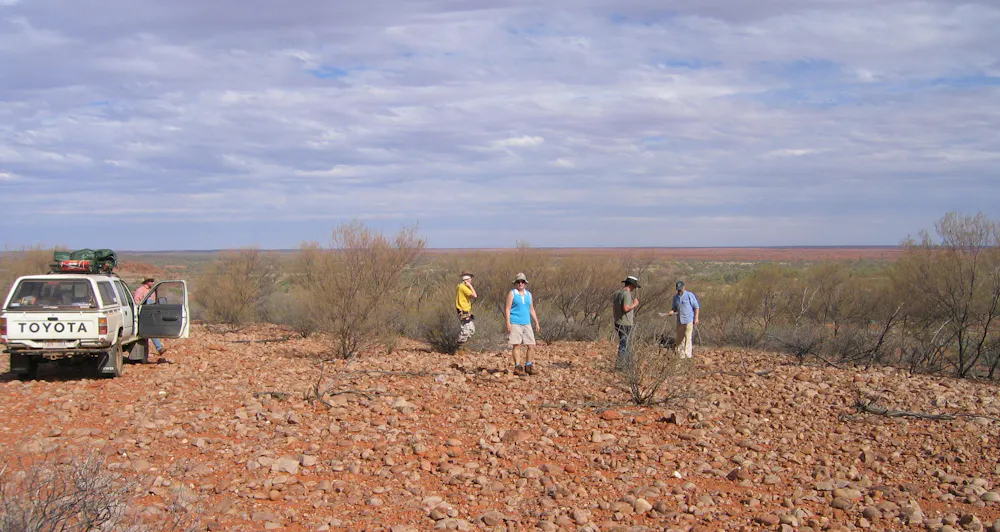
    The 2006 field trip participants (Tim Senden, Tim Holland, Carole Burrow, John Long, Gavin Young) looking south from the end of the Toomba Range, the last rock outcrop for around 500 km across the Simpson Desert.
    Bruce Burrow

    Returning to the Queensland Museum after our field trip, Carole’s colleague from the Netherlands, palaeontologist Jan den Blaauwen, sent her new images showing similar honeycomb-like structure in the Scottish Palaeospondylus gunni.

    Carole was acid-etching the newly collected samples so she could extract any microfossils. Luckily, she noticed a slightly larger specimen appearing on the rock surface (although still tiny, only about 3.6 millimetres long). It was highly interesting because it seemed bilaterally symmetrical.

    Could this be a braincase (the bony capsule inside the skull that encloses the brain)? She immediately stopped acid etching before it disintegrated into crumbs.

    Palaeospondylus australis holotype, QMF 52826, ventral braincase exposed on the limestone surface by acid etching (left), and trimmed for CT scanning (right).
    Carole Burrow, Gavin Young

    The first uncrushed braincase

    At the Australian National University, our sample was carefully trimmed before CT scanning, revealing the first uncrushed braincase of Palaeospondylus known to science.

    It’s now the holotype – defining type specimen – for our new species. And we have about 400 other elements with the same honeycomb structure which belong to it, too.

    The unique uncrushed preservation of this braincase, revealed by CT scanning and 3D printing techniques, provides the first details of brain structure in this tiny animal from 400 million years ago.

    These include the shape of the cranial cavity and inner ear canals, the position of the pituitary gland and optic nerve openings, and details of the carotid arteries and jugular veins for blood supply to the brain.

    3D scan image, the first view of the upper braincase surface of Palaeospondylus, showing the large opening into the cranial cavity.
    Jing Lu/Insitute of Vertebrate Paleontology and Paleoanthropology, Beijing

    More questions remain

    It is noteworthy that our curiosity-driven research into ancient brain morphology can be traced back to economically driven geological surveys of nearly 50 years ago, conducted to support exploration for oil and gas across central Australia.

    As with any research result, there are now new questions to be investigated. The honeycomb tissue seems unique to Palaeospondylus, but could be a precursor to calcified cartilage of some other groups, including modern sharks.

    Alternatively, it could be an early evolutionary stage for the spongy tissue (endochondral bone) filling the inside of most bones in modern land vertebrates, including humans.

    The unique holotype of our new species clearly shows that previous interpretations of the crushed Scottish material included many structures that were not part of the braincase.

    We’ve also now demonstrated that a recent study in the leading science journal Nature, which proposed that Palaeospondylus was closely related to our tetrapod ancestors, relied on many erroneous interpretations of braincase structure.

    Of one thing we can be sure – Palaeospondylus was not a stem tetrapod.


    Acknowledgements: Carole Burrow from Queensland Museum contributed greatly to this article.

    Gavin Charles Young has received funding from the Australian Research Council.

    ref. A 380-million-year-old fossil ‘fish’ from Scotland has been discovered in Australia – https://theconversation.com/a-380-million-year-old-fossil-fish-from-scotland-has-been-discovered-in-australia-250054

    MIL OSI AnalysisEveningReport.nz

  • MIL-Evening Report: A Chinese own goal? How war games in the Tasman Sea could push NZ closer to AUKUS

    Source: The Conversation (Au and NZ) – By Alexander Gillespie, Professor of Law, University of Waikato

    The appearance of three Chinese naval vessels firing live rounds in the Tasman Sea has caused understandable alarm in New Zealand and Australia. But this has more to do with the geopolitical context than the actual event.

    In fact, the Chinese navy is allowed to conduct exercises in the Tasman and has wide freedoms on the high seas in general. So far, China appears to be acting in accordance with both the United Nations Convention on the Law of the Sea and the Code for Unplanned Encounters at Sea.

    While New Zealand would have preferred more notice of the Chinese navy’s intentions, there was no obligation to provide this.

    Nor is what is occurring in the Tasman similar to the more aggressive sabre-rattling the Chinese military has displayed around the South China Sea, most recently involving both the Australian and Philippine navies.

    And in September last year, just a few days after Australian and New Zealand vessels sailed through the Taiwan Strait, the Chinese test-fired a nuclear-capable intercontinental missile into the South Pacific.

    For China, of course, Taiwan and parts of the South China Sea are highly disputed territory. The Tasman Sea is not. But what is disputed is China’s role and influence in the Pacific – and this, rather than a minor naval exercise, is what is causing headaches in Canberra and Wellington.

    The Cook Islands factor

    The surprise agreement signed by the Cook Islands and China under a fortnight ago, aimed at “deepening blue economy cooperation”, is the immediate context for that concern.

    The deal avoids controversial areas such as security and policing. But it moves Chinese influence into infrastructure support for wharves, shipbuilding and repair, and ocean transportation.

    What really challenges New Zealand’s foreign policy is how this opens the South Pacific up to even greater Chinese influence and activity. Foreign Minister Winston Peters has signalled it is time to reset the relationship with the Cooks.

    For its part, China has asserted that its relationship with the Cook Islands “is not directed against any third party and should not be subject to or disrupted by any third party”.

    In other words, China has told New Zealand to butt out of a major development in the historically close diplomatic and political relationship with its Pacific neighbour.

    A Chinese own goal?

    All of this is happening within a rapidly shifting geopolitical sphere. US President Donald Trump is unilaterally attempting to upend the old US-led world order, and other major powers such as Russia and China are adapting.

    New Zealand’s relations with China were already difficult. The Security Intelligence Service and Government Communications Security Bureau have both identified state-sponsored Chinese interference in domestic affairs, breaches of the parliamentary network and other malicious cyber activity.

    The question now is whether China has scored an own goal with its recent actions. Because while it might prefer New Zealand to operate a more independent foreign policy – balancing its relations with east and west – the opposite may now be more likely.

    In times of international stress and uncertainty, New Zealand has always tended to move towards deepening relationships with traditional allies.

    Whether it is the fear of Russian invasion in the 19th century, or Japanese invasion in the 20th century – and whether or not those threats are real or imagined – New Zealand reverts to form.

    It has been this way for nearly 150 years and is likely to occur again. New Zealand is already grappling with how to respond to the Trump administration’s redrawn global system and will be looking for ways to deepen the friendship.

    At the same time, the government now seems committed to joining a new arms race and increasing defence spending as a proportion of GDP. And the supposed benefits of joining the second tier of the AUKUS security pact may now become that much easier to sell politically.

    Alexander Gillespie does not work for, consult, own shares in or receive funding from any company or organisation that would benefit from this article, and has disclosed no relevant affiliations beyond their academic appointment.

    ref. A Chinese own goal? How war games in the Tasman Sea could push NZ closer to AUKUS – https://theconversation.com/a-chinese-own-goal-how-war-games-in-the-tasman-sea-could-push-nz-closer-to-aukus-250615

    MIL OSI AnalysisEveningReport.nz

  • MIL-Evening Report: ‘It’s disgusting that they can get away with this’: here’s how eviction can affect tenants’ lives

    Source: The Conversation (Au and NZ) – By Alan Morris, Professor, Institute for Public Policy and Governance, University of Technology Sydney

    For people relying on rental properties to keep a roof over their heads, there are few things more scary than the possibility of being evicted from their home.

    The paucity of official statistics makes it difficult to know exactly how common evictions are. In 2019–20, 13.8% of private renters moved due to their lease being terminated or not renewed.

    Besides a report or two, we know little about what happens when households face the possibility of being evicted, or are actually evicted.

    Our research examines these consequences. Through in-depth interviews with 53 private tenants in New South Wales and Queensland, we found these experiences negatively shaped people’s lives well into the future. Here are four themes we identified.

    1. Poor mental health

    The ease with which landlords can terminate a tenant’s occupation evoked persistent anxiety for most of the interviewees (the interviews were conducted prior to the scrapping of no-grounds eviction in NSW, though such evictions are still allowed in other states and territories).

    This was especially so for low-income tenants.

    When interviewed, Susan* had recently been evicted from her apartment in Sydney. She was reliant on the Disability Support Pension for her income and lived in constant fear of being evicted and rendered homeless. She felt that having a disability and being from a non-English-speaking background made her precarity worse:

    if you are somebody who comes from a non-English-speaking background, or you have a disability, or have no ability to enforce [the legislation], it’s on the tenant to take up the laws and to do something about it. And if you don’t have any of those abilities, you’re just going to be on your way to homelessness very, very soon […]

    Grace lived by herself in Sydney. She had been given a no-grounds termination and was convinced it was linked to her landlord’s realisation that he could raise her rent considerably once she moved out. Her mental health was seriously affected by the eviction:

    It was just like out of nowhere […] so that was horrific […] I’m still trying to settle into this new place with that trauma of being uprooted all of a sudden […] I think it’s probably going to affect me for a while and particularly in terms of just the power that real estates and landlords have to be able to do that.

    2. Financial hardship

    For many of the low-income tenants, the financial implications of being evicted were severe.

    Sarah, her husband and their three children had been renting in Sydney since 2013. She estimated that since 2014, they had had to move at least six times. Most of the moves were not voluntary. She found the financial implications of evictions extremely distressing:

    It’s the finances of it that’s the hardest […] when you get asked to move, you need to have a bond ready to go at the next place before you receive your bond back, which is a killer […]

    She outlined all the expenses that came up each time she moved from one rental to another: professional cleaners, removalists and maintenance deducted from the bond.

    After her rented accommodation was condemned, Brenda, a single mum of two children, had 48 hours to move from her rental property in regional Queensland. The move consumed her savings:

    I had $200 after paying all my bills to move. So once I moved that was it. So I struggled the following week for everything. For food, […] getting my son to school, my daughter. It was just horrible.

    3. Reluctance to complain

    The knowledge that, at some point, the rent could be increased to an untenable level or they could be asked to vacate evoked silent compliance. This created a reluctance to complain or request basic maintenance.

    Alice was convinced she was evicted after complaining about the poor condition of the rental property she, her son and grandson had been renting for eight years in regional NSW. Her grandson’s bedroom was unusable due to excessive mould.

    However, her low income and the threat of eviction meant she held off complaining for an extended period:

    […] it’s just disgusting that they [landlords] can get away with this shit while charging top dollar, and […] that’s why I didn’t complain because I said to everybody, “as soon as I complain he’ll kick us out.” […] If I hadn’t complained, we’d still be there […]

    Sarah described how, despite feeling harassed and stressed by her landlord’s unannounced and constant intrusions, she felt the family had to accept the situation and not protest:

    I was petrified of being kicked out if we fought back and so […] we let him onto the property 16 times in 10 months and said nothing.

    When they couldn’t take it any longer and complained, they were given notice, the landlord claiming he needed to do maintenance that required the property to be vacant.

    4. Ending up in a worse home

    A common consequence of eviction is having to move to unsuitable, lower-quality accommodation.

    Jan and her partner were older renters and reliant on government benefits for their income. The flow-on effects of being evicted from their accommodation in Queensland, where they had been living for ten years, were devastating. Her partner attempted suicide, her relationship with him ended, and she was forced to live in a tent on a piece of land her mother had bought several years prior:

    our rental accommodation was sold out from under us to developers and we had to be out with nowhere to go. We looked around for somewhere else to rent and there was absolutely nowhere we could afford at all.

    It’s clear that eviction, or the threat thereof, can have devastating affects on people’s lives.

    Although there has been some movement around improving the lot of private renters, such as legislation abolishing no-grounds eviction in some jurisdictions, and rent increases being allowed only once a year, a lot more needs to be done to ensure tenants have acceptable security of tenure.


    *All names in this article have been changed to protect participants’ privacy.

    Alan Morris receives funding from the Australian Research Council.

    Joelle Moore receives funding from the Australian Research Council.

    Thi Thanh Mai Giang receives funding from The Australian Research Council.

    Yiran Li receives funding from funding from the Australian Research Council.

    ref. ‘It’s disgusting that they can get away with this’: here’s how eviction can affect tenants’ lives – https://theconversation.com/its-disgusting-that-they-can-get-away-with-this-heres-how-eviction-can-affect-tenants-lives-248221

    MIL OSI AnalysisEveningReport.nz

  • MIL-Evening Report: Tiger Woods and Serena Williams were sporting prodigies but children shouldn’t train like them

    Source: The Conversation (Au and NZ) – By Justin Keogh, Associate Dean of Research, Faculty of Health Sciences and Medicine, Bond University

    photoyh/Shutterstock

    Most children have now returned from their summer holidays and are perhaps considering what sports to play this year.

    For some, this means sampling a wide range of sports, but others might continue to focus on the same one they’ve been addicted to since they were able to walk and run.

    But when it comes to possible sporting success, is it best to concentrate on one or give many a go?

    Early specialisation

    As the name suggests, early specialisation is typically defined as participation in one task or activity, with the aim to improve subsequent performances.

    The rationale for its purported benefit can be traced to the theory of deliberate practice – or what some readers may have colloquially encountered as the “10,000-hour rule”.

    Broadly, this theory proposes the attainment of excellence is proportionate to the number of accumulated hours invested into deliberate skill rehearsal.

    So, the earlier someone specialises via deliberate practice, the more likely they’ll expedite the acquisition of expertise – or so the theory suggests.

    While first explored in the musical domain, there are some examples of athletes who specialised early in a sport who went on to highly successful careers.

    These include Simone Biles (who started gymnastics at the age of six), Tiger Woods (who hit a golf ball on the Mike Douglas TV show at the age of two) and Serena Williams (who was profiled hitting tennis balls on CNN at the age of nine).

    There are also a host of athletes who specialised early and achieved outstanding success as a junior but never reached sporting success as an adult for myriad reasons.

    Doesn’t practice make perfect?

    Everyone would have encountered the saying “practice makes perfect”.

    But does it really?

    Of course, practice is an integral component of acquiring, developing and sharpening any skill. But perhaps we should be a little cautious.

    Let us explain by first asking a few key questions that we encourage readers to ask themselves as the article unfolds: how much practice is needed to be perfect? What type of practice is needed to be perfect? And can “perfect” practice actually help us develop skills that are transferable between sports?

    In other words, if practice makes perfect, should we not be advocating for sporting specialisation as early in life as possible?

    It may seem logical, but is this belief – held by many parents, youth sport coaches, and perhaps children themselves – actually supported by evidence?

    A 2022 systematic review suggested most elite, professional and Olympic level athletes engaged in multisport activities during their youth.

    That is, they did not specialise in their chosen sport but actually diversified their sporting experiences up to the age of about 12, with some level of specialisation occurring from the age of 13 onward.

    That was not all they found.

    Youth sport specialisation was actually linked with increased risks of injury in athletes at the highest levels of competition when compared to those who engaged in multisport activities.

    A similar review noted there was no evidence to support specialisation prior to puberty in the attainment of sporting excellence later in life.

    What sport specialisation did increase, however, were risks of injury, psychological stress and sporting drop out.

    A model to follow

    In support of these findings, Jean Côtè (a leading expert in the field of youth psychology) and colleagues proposed a developmental model of sports participation.

    This model is broken into three general stages of participation: the sampling years (between the ages of 6-12), the specialising years (13-15), and the investment years (16 and beyond).

    As the name of each stage suggests, they are defined by unique types of participation.

    For example, the sampling years are characterised by the acquisition of functional motor skills (such as running, throwing and jumping), developed through a wide variety of experiences.

    The specialising years feature a progressive increase in focus on the deliberate practice of one or two sports, while the investment years are characterised by more deliberately increasing the volume of practice around one sport. In Australia, this may be the stage where seasonal sports become year-long through the establishment of pre-season training.

    Since its inception nearly two decades ago, there has been a growing amount of research supporting these suggestions.

    Food for thought

    So what does this all mean for parents, youth coaches and children?

    We suggest not to rush the process even if your child dreams of an elite sporting career: children under the age of 16 should engage in a wide variety of sporting experiences.

    This is not only fun, but the research shows us diversity is likely to reduce the risk of overuse injuries and increase the likelihood of sporting excellence later in life, should that be their ambition.

    The authors do not work for, consult, own shares in or receive funding from any company or organisation that would benefit from this article, and have disclosed no relevant affiliations beyond their academic appointment.

    ref. Tiger Woods and Serena Williams were sporting prodigies but children shouldn’t train like them – https://theconversation.com/tiger-woods-and-serena-williams-were-sporting-prodigies-but-children-shouldnt-train-like-them-248558

    MIL OSI AnalysisEveningReport.nz

  • MIL-Evening Report: Trump is reviving a tariff strategy from America’s ‘Gilded Age’. It didn’t end well last time

    Source: The Conversation (Au and NZ) – By Garritt C. Van Dyk, Senior Lecturer in History, University of Waikato

    Getty Images

    A White House fact sheet about Donald Trump’s recently announced “Fair and Reciprocal Plan” on trade described it as “the art of the international deal” – a reference to Trump’s 1987 business book, The Art of the Deal.

    It was a classic piece of self-marketing from the president, but whether his latest tariff proposal will really turn out to be artful is very much open to question.

    In fact, the United States’ long history of “reciprocity” in tariffs and trade suggests ordinary Americans could be in for a bumpy ride.

    In essence, Trump is reviving a strategy used in the US more than a century ago to protect developing domestic industries. This time, according to the president, reciprocal tariffs aim “to correct longstanding imbalances in international trade and ensure fairness across the board”.

    The plan targets trade relationships with other countries where the US does not receive reciprocal treatment. And it echoes the policies of the 25th US president, William McKinley, who presided over an aggressive reciprocal tariff regime in the late 19th century.

    McKinley was president from 1897 until he was assassinated in 1901. And while Trump greatly admires his business acumen, McKinley’s economic legacy also reads like a cautionary tale.

    Not a simple equation

    From the current US perspective, “reciprocity” refers to symmetrical tariffs. Trump’s plan targets unequal rates, such as the European Union’s 10% tariff on US cars, compared with the 2.5% US tariff on European automobiles.

    The EU’s 10% rate represents its “most-favoured-nation” tariff, which applies to all its favoured-nation trading partners (with certain exceptions).

    While this looks like a clear lack of reciprocity, it’s not that simple. The US also applies a 25% tariff on EU utility vehicles (pickup trucks).

    This is significant because of the popularity of pickups in the US – a 2024 survey found 47% of Americans owned one. Until last year, the Ford F150 had been the bestselling “car” in the US for 42 years in a row.

    This is just one example of how differences in tariffs can be more complex than they appear at first glance.

    A history of reciprocal tariffs

    This cycle of higher and lower tariffs has gone on for well over a century. From 1861 to 1930, the US Congress maintained control over trade tariffs, with levels as high as 50% to protect developing industries.

    But in 1934, Congress passed the Reciprocal Trade Agreements Act, giving President Franklin D. Roosevelt authority to negotiate reciprocal tariff reductions with individual nations to stimulate global trade during the Great Depression.

    These tariff reductions continued after World War II with the development of the World Trade Organization and US tariff levels declining to 5%. Economist Douglas Irwin refers to this period as the “reciprocity period” of nations lowering barriers to international trade.

    The last time “reciprocity” was used to refer to the opposite process of raising tariffs was in 1890, under the Tariff Act, often just called the McKinley Tariff. It is this era Trump harked back to in his inaugural address:

    President McKinley made our country very rich through tariffs and through talent – he was a natural businessman.

    William McKinley.
    Getty Images

    Before he became president, McKinley was head of the House of Representatives’ Ways and Means Committee. He proposed an average increase in tariffs on all imports, rising from 38% to 49.5% to “secure reciprocal trade”.

    The new law was designed to protect the tinplate industry with a tariff of 70%, and “to reduce the revenue and equalize duties on imports”.

    At the time, the US was running large surpluses from tariff revenues, which was threatening economic growth. This sounds counterintuitive these days, but surpluses were a problem because the US dollar was backed by gold at a fixed price (the gold standard).

    Because the amount of money in circulation – and state spending – were limited to the amount of gold held by the government, surplus funds had to be kept in the Treasury reserves. This reduced the money supply and led to lower growth, less investment and tighter credit.

    Republicans thought higher tariffs would reduce imported goods and therefore tariff revenues. Instead, income from the higher tariffs more than compensated for import reductions, and the surpluses increased.

    Consumer prices rose, farm prices dropped, and the resulting voter backlash saw the Republicans lose control of Congress at the 1890 midterm elections. There was a financial panic in 1893, followed by a recession that lasted until 1896.

    A new ‘Gilded Age’

    This period in late 19th-century US history is often referred to as the “Gilded Age”, from the title of an 1873 book by Charles Dudley Wright and Mark Twain.


    The book was a satire of political corruption and unscrupulous businessmen who benefited from political favours. The title reflects the reality of the era – superficially prosperous but not truly golden.

    A thin veneer of technological progress, innovation and wealth concealed widespread corruption, scandals and income inequality.

    But aside from the obvious historical parallels, it is overly optimistic to expect a plan from 1890 to succeed in a complex global trade environment that relies on interdependent supply chains to function.

    McKinley’s flawed strategy sought protection for a few industries, but also aimed to reduce revenue for a government running large surpluses. However, Trump’s new tariffs are meant to raise revenue to pay off the US$36.5 trillion national debt, as well as to enforce reciprocal trade terms.

    Trump began his second term with a declaration that “the golden age of America begins right now”. As in 1890, however, the risk remains that a handful of wealthy industrialists will benefit from increased protection, while ordinary citizens will pay higher prices.

    Less the “art of the deal”, then, than a possible dealbreaker. In which case, Trump may yet be remembered less for a new golden age than for a Gilded Age 2.0.

    Garritt C. Van Dyk received funding from the Getty Research Institute in 2024 .

    ref. Trump is reviving a tariff strategy from America’s ‘Gilded Age’. It didn’t end well last time – https://theconversation.com/trump-is-reviving-a-tariff-strategy-from-americas-gilded-age-it-didnt-end-well-last-time-250389

    MIL OSI AnalysisEveningReport.nz

  • MIL-Evening Report: Labor crashes to a 55–45 deficit in Resolve despite interest rate cut

    Source: The Conversation (Au and NZ) – By Adrian Beaumont, Election Analyst (Psephologist) at The Conversation; and Honorary Associate, School of Mathematics and Statistics, The University of Melbourne

    A national Resolve poll for Nine newspapers, conducted February 18–23 from a sample of 1,506, gave the Coalition a 55–45 lead by headline respondent preferences, a three-point gain for the Coalition since January. By 2022 election preference flows, the Coalition led by 52–48, a one-point gain for them.

    Primary votes were 39% Coalition (up one), 25% Labor (down two), 13% Greens (steady), 9% One Nation (up two), 9% independents (down one) and 4% others (down two). Labor’s primary vote is their lowest in any poll this term.

    Anthony Albanese’s net approval was steady at -22, with 56% giving him a poor rating and just 34% a good one. Peter Dutton’s net approval was down one to +5. Dutton led Albanese by 39–35 as preferred PM (39–34 in January).

    By 37–26, voters thought the Coalition was the best choice for them and their household over Labor. By 34–18, they thought Dutton better able to deal with Donald Trump than Albanese. By 43–22, they thought Albanese weaker than Dutton.

    The Liberals led Labor by 41–24 on economic management (42–23 in January). The Liberals led on keeping the cost of living low by 37–25, down a little from 37–22 in January.

    In both the Resolve and Freshwater polls that were taken after the Reserve Bank cut interest rates, the Coalition has increased its lead. Here is the graph that shows the dramatic widening in the Resolve poll in the Coalition’s favour.

    Dutton’s ratings have been much better than Albanese’s in Resolve, and this is now flowing through to voting intentions. To put Labor back on track, Albanese needs to improve his ratings and Dutton’s need to fall. In this respect, the Freshwater poll below was much better for Labor.

    Resolve’s respondent preference flows are probably a pro-Coalition outlier, but the general trend in the polls has been bleak for Labor.

    Freshwater poll: Coalition leads by 52–48

    A national Freshwater poll, conducted February 20–23 from a sample of 1,038, gave the Coalition a 52–48 lead by respondent preferences, a one-point gain for the Coalition since January. Primary votes were 41% Coalition (up one), 31% Labor (down one), 13% Greens (steady) and 15% for all Others.

    Albanese’s net approval improved seven points to -11, while Dutton’s dropped four points to -8. Albanese led Dutton as preferred PM by 45–43 (a 43–43 tie in January).

    On issues, 70% rated cost of living a top three issue, followed by 39% for housing, 27% for both crime and economic management, 26% for health and just 17% for the environment. The Coalition held double-digit leads over Labor on cost of living, crime and economic management.

    Essential poll: Labor gains for a tie

    A national Essential poll, conducted February 12–16 from a sample of 1,146, had a 48–48 tie by respondent preferences including undecided (49–47 to the Coalition in early February). The Coalition had led in the last four Essential polls by one to two points.

    Primary votes were 35% Coalition (down one), 30% Labor (steady), 12% Greens (steady), 9% One Nation (up one), 1% UAP (steady), 9% for all Others (steady) and 4% undecided (steady). By 2022 preference flows, Labor would lead by about 51–49, a 0.5-point gain for Labor.

    Albanese’s net approval dropped five points to -5 since January, with 48% disapproving and 43% approving, but the January poll had an 11-point jump in his net approval from December. Dutton’s net approval was down three points to -4, his worst net approval in Essential since February 2024.

    Asked about the direction of the country, wrong track led by 51–31, a blowout from 46–38 in January. Wrong track led by the same 51–31 margin in December, and it has consistently had sizeable leads since June 2023.

    On taxes and government services, 26% thought they should be reduced, 11% increased and 63% maintained. By 40–31, respondents opposed the Coalition’s plan to reduce the number of public service workers.

    Asked whether they were aware of various Labor achievements, 77% were aware of the $300 energy bill rebate for all households, 66% were aware of TAFE and HECS debt cuts and 61% were aware of increased renewable energy targets. However, only 46% were aware of consecutive budget surpluses.

    Morgan poll and Palmer’s new party

    A national Morgan poll, conducted February 10–16 from a sample of 1,666, gave the Coalition a 51.5–48.5 lead by headline respondent preferences, unchanged from the February 3–9 poll.

    Primary votes were 39.5% Coalition (down one), 28% Labor (down one), 12.5% Greens (up 1.5), 5.5% One Nation (up 1.5), 10% independents (up 0.5) and 4.5% others (down 1.5). By 2022 election flows, the Coalition led by 51–49, a 0.5-point gain for Labor.

    Clive Palmer had voluntarily deregistered the United Australia Party after the 2022 election. The High Court denied his attempt to re-register this party. He has now taken over the existing party “Trumpet of Patriots”.

    Queensland federal and state DemosAU poll

    A DemosAU poll of Queensland that asked for federal voting intentions, conducted February 10–14 from a sample of 1,004, gave the Liberal National Party a 53–47 lead, representing a 1% swing to Labor since the 2022 federal election result in Queensland.

    Primary votes were 39% LNP, 31% Labor, 12% Greens, 10% One Nation and 8% for all Others. DemosAU is using the One Nation preference flow at the 2024 Queensland state election for its federal polls; this was better for the LNP than at the 2022 federal election.

    State voting intentions were 54–46 to the LNP, unchanged since the 2024 election. Primary votes were 40% LNP, 30% Labor, 12% Greens, 10% One Nation and 8% for all Others.

    Economic data: wage growth and jobs

    The Australian Bureau of Statistics reported that in the December 2024 quarter, wages grew 0.7%, down from 0.9% in the September quarter. This was the slowest quarterly wage growth since March 2022. For the year to December, wages grew 3.2%, down from 4.1% in the year to June 2024.

    In the December quarter, inflation was up 0.2% and up 2.4% for the year to December. So wage growth exceeded inflation by 0.5% in the December quarter and 0.8% for the year, but it had exceeded inflation by 0.7% in the September quarter.

    The ABS said 44,000 jobs were added in January, but the unemployment rate rose 0.1% from December to 4.1% owing to a 0.2% increase in the participation rate. The employment population ratio (the percentage of eligible Australians that are employed) rose 0.1% to 65.6%, a record high.

    German election

    I am covering Sunday’s German federal election for The Poll Bludger. The election was held seven months early owing to a breakdown in the governing coalition of centre-left SPD, Greens and pro-business FDP.

    Exit polls and pre-election polls have the conservative CDU/CSU leading, with the far-right AfD in second place and the SPD lagging in third. The final outcome should be known by this afternoon AEDT.

    Adrian Beaumont does not work for, consult, own shares in or receive funding from any company or organisation that would benefit from this article, and has disclosed no relevant affiliations beyond their academic appointment.

    ref. Labor crashes to a 55–45 deficit in Resolve despite interest rate cut – https://theconversation.com/labor-crashes-to-a-55-45-deficit-in-resolve-despite-interest-rate-cut-250150

    MIL OSI AnalysisEveningReport.nz

  • MIL-Evening Report: Scam Factories: the inside story of Southeast Asia’s brutal fraud compounds

    Source: The Conversation (Au and NZ) – By Ashlynne McGhee, Digital Storytelling Editor

    Scam Factories is a special multimedia and podcast series by The Conversation that explores the inner workings of Southeast Asia’s brutal scam compounds.

    The Conversation’s digital storytelling and podcast teams collaborated with three researchers: Ivan Franceschini, a lecturer in Chinese Studies at the University of Melbourne; Ling Li, a PhD candidate at Ca’ Foscari University of Venice; and Mark Bo, an independent researcher.

    The researchers have spent the past few years interviewing nearly 100 survivors of these compounds and documenting the rise of the industry in Southeast Asia for a forthcoming book.

    Scam Factories will unfold across three multimedia articles and three podcast episodes this week. We’ll update this page as more is published.

    Part 1

    Our first article explores how people are lured into the industry and what life is like inside the compounds, where scammers are forced to work long hours and are often subjected to violence.

    And in our first podcast episode, No skills required, our researchers travel to a village in Cambodia called Chrey Thom to see what these compounds look like. And we hear from two survivors, a Ugandan man we’re calling George and a Malaysian woman we’re calling Lee, about how they were recruited into compounds in Laos and Myanmar.

    The Conversation contacted all the companies mentioned in this series for a comment, except Jinshui, which we couldn’t contact. We did not receive a response from any of them.

    Credits

    The podcast series was written and produced by Gemma Ware with production assistance from Katie Flood and Mend Mariwany. Sound design by Michelle Macklem. Leila Goldstein was our producer in Cambodia and Halima Athumani recorded for us in Uganda. Hui Lin helped us with Chinese translation. Photos by Roun Ry, KDA, Halima Athumani and Ivan Franceschini.

    Justin Bergman at The Conversation in Australia edited the articles in the series and Matt Garrow worked on the graphical elements of the stories. Series oversight and editing help from Ashlynne McGhee.

    ref. Scam Factories: the inside story of Southeast Asia’s brutal fraud compounds – https://theconversation.com/scam-factories-the-inside-story-of-southeast-asias-brutal-fraud-compounds-250448

    MIL OSI AnalysisEveningReport.nz

  • MIL-Evening Report: Is reality TV ‘harmful’? We asked 5 experts – including an ex-reality TV participant

    Source: The Conversation (Au and NZ) – By Noor Gillani, Digital Culture Editor

    Reality TV – love it or hate it, there’s no denying it’s addictive. From explosive arguments to over-the-top love triangles, it can be hard to look away. But is all this drama just for fun, or might it do more harm – to watchers and participants – than we realise?

    We asked five experts, and most of them said it might, especially when it comes to promoting negative body image and leaving contestants emotionally scarred.

    But one expert argued reality TV is a valuable form of entertainment overall, which reflects modern culture and sparks important conversations.

    Here are their detailed responses:

    ref. Is reality TV ‘harmful’? We asked 5 experts – including an ex-reality TV participant – https://theconversation.com/is-reality-tv-harmful-we-asked-5-experts-including-an-ex-reality-tv-participant-233114

    MIL OSI AnalysisEveningReport.nz

  • MIL-Evening Report: After 3 years of war, Ukrainian business leaders share their lessons on survival

    Source: The Conversation (Au and NZ) – By Amy L. Kenworthy, Professor of Management, Bond University

    Drop of Light/Shutterstock

    It’s exactly three years since Russia began its full-scale invasion of Ukraine.

    During that time, Ukrainians have lived through one of the world’s largest and most brutal humanitarian crises. Yet their resilience remains high.

    The United Nations estimates that 64% of micro, small and medium enterprises had to either suspend or close their operations in Ukraine at some stage after the war began.

    But the vast majority of these have since opened back up.

    Over the past year, our international team of researchers from both Australia and Ukraine sought to find out what might drive such extraordinary resilience. The answer, according to Ukrainian business leaders, is their people.

    Running a business in a war

    Ukrainians are currently living through their third winter of this war. Some of Russia’s latest attacks have targeted the gas infrastructure and other energy facilities crucial for keeping people alive.

    These daily attacks have made previously safe cities no longer safe, leaving residents without water, heat and electricity in bitterly cold conditions.

    According to the UNHCR’s 2025 Global Appeal, Russia’s targeting of homes, hospitals and communities has resulted in civilian deaths, mass displacements, restricted access to humanitarian aid, and severely disrupted essential services.

    For businesses, the war has impacted virtually every aspect of commercial activity. Beyond the immediate threat of coming under direct attack, firms have had to deal with everything from disrupted supply chains through to frequent power outages.

    As one interviewee put it:

    Many of us are afraid our main businesses may go bankrupt. We are constantly facing periods with no electricity which stops businesses and cuts us off from the world. We live with constant air raid alarms, moving in and out of underground shelters. We have a significant shortage of personnel because so many have gone to fight on the front lines or left the country.

    The UN estimates that utilisation of production capacity for Ukraine’s micro, small and medium enterprises dropped from 72.4% before the war to 45.7% in 2023.

    To make matters worse, with millions of people having fled Ukraine, finding and retaining qualified personnel has become extremely difficult.

    Women have been stepping into historically male dominated professions such as mining, truck driving and welding to fill the gap left by men who’ve joined the fight. But there is still a significant labour shortage.

    A diverse range of sectors have continued to operate in Ukraine since the war began, despite labour shortages and other issues.
    Oleksandr Filatov/Shutterstock

    Over the past year, our international team of researchers from both Australia and Ukraine surveyed business leaders from 85 different small and medium-sized businesses across 19 different industries in Ukraine.

    These spanned engineering, transportation, aviation and mining through to agriculture, tourism, IT, healthcare, entertainment and finance.

    We asked which resources were – and still are – key to the survival of their organisations.

    Finance and access to funding came in at number two, followed by production and energy, new customers & markets, equipment technology & information and policy & regulations.

    The most important resource

    The most important resource, highlighted by 82% of the business leaders we surveyed, was their people.

    When operating within an environment of severe crisis and disruption, the pressure can be enormous. But the Ukrainian executives we interviewed figured out a way to unite and lead their teams into the future.

    As one reflected:

    When team members are motivated, they are more likely to be optimistic and resilient when facing difficulties. Motivated employees are more productive than demotivated ones. This is important when people need to accomplish more with fewer resources.

    Forcing positive adaptation

    For many organisations in our research, operating within a crisis had pushed them to implement valuable human resource practices other businesses often struggle with.

    Some had transitioned to a “flatter” organisational structure, speeding up decision making by giving employees more autonomy. Others invested in team training which focused on empowering employees to share their thoughts on how to best move forward.

    Our processes and planning horizons have changed completely. We’ve had to become more agile and flexible in our approach to leadership, often reducing planning cycles and adapting to new realities much faster than before.

    A focus on wellbeing was another common theme. Some organisations hosted more meetings to allow their employees to share stories – not only about work but also about their personal fears and victories.

    Some also encouraged their employees to complete volunteer work together during work hours.

    There was an emphasis across interviews on the fact all employees need additional rest and recovery time, and encouraging them to take time off whenever needed.

    Making sacrifices

    Many of the new support mechanisms had financial consequences for the organisations.

    One business cancelled the salaries of its top management team one month after the war started. Another hired a full-time psychologist to provide counselling in both formal and informal sessions.

    Some continued to pay the salaries of their serving members:

    All our mobilized employees who are serving in the military have been receiving their salaries for the past three years. We also ensure they are equipped with everything they need, stay in constant contact with them, and support their families.

    Knowing their business was supporting the war effort had a positive impact on employee motivation:

    The only difference in employee motivation is the understanding that our company actively supports the Armed Forces of Ukraine. Thus, every employee in the company understands that through their work, they are involved in this support.

    In the end, it is the connections between people these leaders saw as the key to their organisational resilience.

    No matter how hard things get, how much grief and suffering we endure, we know for certain that tomorrow the sun will rise. And even if it’s not for us, it will be for our children. This is what gives us the strength to continue living, creating, and preserving Ukraine — for us and for future generations.


    The authors would like to acknowledge their academic partners and coauthors from the Ukrainian Catholic University in Lviv, Ukraine, Yaryna Boychuk, Valeria Kozlova, Sophia Opatska, and Olena Trevoho, and thank all the Ukrainian business leaders who participated in this research.

    The authors do not work for, consult, own shares in or receive funding from any company or organisation that would benefit from this article, and have disclosed no relevant affiliations beyond their academic appointment.

    ref. After 3 years of war, Ukrainian business leaders share their lessons on survival – https://theconversation.com/after-3-years-of-war-ukrainian-business-leaders-share-their-lessons-on-survival-249145

    MIL OSI AnalysisEveningReport.nz

  • MIL-Evening Report: A powerful force is stopping the Indian Ocean from cooling itself – spelling more danger for Ningaloo

    Source: The Conversation (Au and NZ) – By Kelly Boden-Hawes, PhD Candidate in oceanography, The University of Western Australia

    Violeta Brosig/Blue Media Exmouth

    Widespread coral bleaching at Ningaloo Reef off Western Australia’s coast has deeply alarmed scientists and conservationists.

    Photos captured by divers, published by The Guardian last week, show severe bleaching at several sites along the reef, which runs for 260 kilometres off the state’s northwest.

    A severe marine heatwave in the Indian Ocean off WA has caused the coral bleaching. In some places, surface temperatures up to 4°C warmer than usual have been recorded.

    Hotter temperatures aren’t only happening at the ocean’s surface – data indicates they also extend several hundred metres deep. Warm, deeper water can shut down the ocean’s natural cooling process, putting corals at even greater risk of bleaching.

    Counting the cost

    The full extent of damage to Ningaloo won’t be known until scientists conduct field surveys in coming months.

    So far, bleaching has been documented at several sites, including Turquoise Bay, Coral Bay, Tantabiddi, and Bundegi (Exmouth Gulf).

    Other sites such as Scott Reef, Ashmore Reef, the Rowley Shoals and Rottnest Island are also at risk.

    Damage wrought by the heatwave extends beyond coral. More than 30,000 fish have died since the September onset.

    The below images show the heatwave’s progression. Temperatures from February last year are included for comparison.

    The white circle shows the location of Ningaloo. Cooler temperatures are in blue and purple. Warmer temperatures are in yellow and orange.

    The images show the heatwave reached Ningaloo in December last year and moved south in January. Temperatures fell slightly in February due to strong southerly winds. From March, temperatures are forecast to increase again.

    A complex warming picture

    According to recent data and modelled forecasts, hotter ocean temperatures off northern WA run several hundred metres deep.

    This has been caused by developing La Nina conditions. La Nina and its opposite, El Nino, influence ocean temperatures and weather patterns across the Pacific.

    During La Nina, trade winds strengthen and push warm water westward. This intensifies two important ocean currents.

    The first is the Indonesian Throughflow – which carries warm Pacific waters through the Indonesian seas and into the eastern Indian Ocean. The second is the Leeuwin Current, which picks up this warm water and takes it further south towards Perth.

    This has led to a build-up of hotter water along the WA coastline.

    La Nina is also affecting WA’s reefs in other ways.

    Some coral reefs are naturally cooled by local tides which pull deep, colder water towards the surface. This process, which has been likened to an ocean’s “air conditioner”, can temporarily relieve heat stress for reefs.

    The process relies on “stratification” – that is, layers of seawater that differ in temperature, salinity and density (or weight). Warmer, less dense water collects at the surface and colder, denser water falls to deeper levels.

    La Nina conditions can suppress, or even shut down, this cooling effect in two ways.

    First, it reduces the difference in density between ocean layers. This causes water to draw upwards from shallower depths. Second, it increases water temperatures at depth.

    All this means the water pumped to the surface isn’t much cooler than temperatures at the surface.

    For many reefs along the coast of WA, the suppression of this tidal cooling is probably contributing to worsening conditions, and more coral bleaching.

    Most bleaching forecasts rely on sea surface temperatures. This means scientists may be underestimating the vulnerability of deeper reefs.

    What’s in store for Ningaloo and surrounds?

    Looking ahead, the situation at Ningaloo and surrounding reefs remains critical.

    Bleached reefs are able to recover if temperatures cool quickly. This means theoretically, Ningaloo and other affected reefs may survive the summer.

    But unfortunately, temperatures are rising again and the marine heatwave is expected to continue until April, as the below image shows.

    Sea surface temperature anomaly forecast for March to May. Ningaloo denoted with black ‘X’.
    Bureau of Meteorology

    Climate change is making marine heatwaves more intense and frequent. It means reefs often don’t have time to recover between destructive bleaching events.

    All this is compounded by the general trend towards warmer oceans as the planet heats up.

    Drastic action on climate change is needed now. If this alarming pattern continues, the world’s reefs risk being lost entirely.

    Nicole L. Jones receives funding from the Australian Research Council and the Western Australian government.

    Kelly Boden-Hawes does not work for, consult, own shares in or receive funding from any company or organisation that would benefit from this article, and has disclosed no relevant affiliations beyond their academic appointment.

    ref. A powerful force is stopping the Indian Ocean from cooling itself – spelling more danger for Ningaloo – https://theconversation.com/a-powerful-force-is-stopping-the-indian-ocean-from-cooling-itself-spelling-more-danger-for-ningaloo-250151

    MIL OSI AnalysisEveningReport.nz

  • MIL-Evening Report: Falling vaccination rates put children at risk of preventable diseases. Governments need a new strategy to boost uptake

    Source: The Conversation (Au and NZ) – By Peter Breadon, Program Director, Health and Aged Care, Grattan Institute

    Yuri A/Shutterstock

    Child vaccination is one of the most cost-effective health interventions. It accounts for 40% of the global reduction in infant deaths since 1974 and has led to big health gains in Australia over the past two decades.

    Australia has been a vaccination success story. Ten years after we begun mass vaccination against polio in 1956, it was virtually eliminated. Our child vaccination rates have been among the best in the world.

    But after peaking in 2020, child vaccination in Australia is falling. Governments need to implement a comprehensive strategy to boost vaccine uptake, or risk exposing more children to potentially preventable infectious diseases.

    Child vaccination has been a triumph

    Thirty years ago, Australia’s childhood vaccination rates were dismal. Then, in 1997, governments introduced the National Immunisation Program to vaccinate children against diseases such as diphtheria, tetanus, and measles.

    Measures to increase coverage included financial incentives for parents and doctors, a public awareness campaign, and collecting and sharing local data to encourage the least-vaccinated regions to catch up with the rest of the country.

    What followed was a public health triumph. In 1995, only 52% of one-year-olds were fully immunised. By 2020, Australia had reached 95% coverage for one-year-olds and five-year-olds. At this level, it’s difficult even for highly infectious diseases, such as measles, to spread in the community, protecting both the vaccinated and unvaccinated.

    By 2020, 95% of children were vaccinated.
    Drazen Zigic/Shutterstock

    Gaps between regions and communities closed too. In 1999, the Northern Territory’s vaccination rate for one-year-olds was the lowest in the country, lagging the national average by six percentage points. By 2020, that gap had virtually disappeared.

    The difference between vaccination rates for First Nations children and other children also narrowed considerably.

    It made children healthier. The years of healthy life lost due to vaccine-preventable diseases for children aged four and younger fell by nearly 40% in the decade to 2015.

    Some diseases have even been eliminated in Australia.

    Our success is slipping away

    But that success is at risk. Since 2020, the share of children who are fully vaccinated has fallen every year. For every child vaccine on the National Immunisation Schedule, protection was lower in 2024 than in 2020.

    Gaps between parts of Australia are opening back up. Vaccination rates in the highest-coverage parts of Australia are largely stable, but they are falling quickly in areas with lower vaccination.

    In 2018, there were only ten communities where more than 10% of one-year-old children were not fully vaccinated. Last year, that number ballooned to 50 communities. That leaves more areas vulnerable to disease and outbreaks.

    While Noosa, the Gold Coast Hinterland and Richmond Valley (near Byron Bay) have persistently had some of the country’s lowest vaccination rates, areas such as Manjimup in Western Australia and Tasmania’s South East Coast have recorded big declines since 2018.

    Missing out on vaccination isn’t just a problem for children.

    One preprint study (which is yet to be peer-reviewed) suggests vaccination during pregnancy may also be declining.

    Far too many older Australians are missing out on recommended vaccinations for flu, COVID, pneumococcal and shingles. Vaccination rates in aged care homes for flu and COVID are worryingly low.

    What’s going wrong?

    Australia isn’t alone. Since the pandemic, child vaccination rates have fallen in many high-income countries, including New Zealand, the United Kingdom and the United States.

    Globally, in 2023, measles cases rose by 20%, and just this year, a measles outbreak in rural Texas has put at least 13 children in hospital.

    Alarmingly, some regions in Australia have lower measles vaccination than that Texas county.

    The timing of trends here and overseas suggests things shifted, or at least accelerated, during the pandemic. Vaccine hesitancy, fuelled by misinformation about COVID vaccines, is a growing threat.

    This year, vaccine sceptic Robert F. Kennedy Jr was appointed to run the US health system, and Louisiana’s top health official has reportedly cancelled the promotion of mass vaccination.

    In Australia, a recent survey found 6% of parents didn’t think vaccines were safe, and 5% believed they don’t work.

    Those concerns are far more common among parents with children who are partially vaccinated or unvaccinated. Among the 2% of parents whose children are unvaccinated, almost half believe vaccines are not safe for their child, and four in ten believe vaccines didn’t work.

    Other consequences of the pandemic were a spike in the cost of living, and a health system struggling to meet demand. More than one in ten parents said cost and difficulty getting an appointment were barriers to vaccinating their children.

    There’s no single cause of sliding vaccination rates, so there’s no one solution. The best way to reverse these worrying trends is to work on all the key barriers at once – from a lack of awareness, to inconvenience, to lack of trust.

    What governments should do

    Governments should step up public health campaigns that counter misinformation, boost awareness of immunisation and its benefits, and communicate effectively to low-vaccination groups. The new Australian Centre for Disease Control should lead the charge.

    Primary health networks, the regional bodies responsible for improving primary care, should share data on vaccination rates with GPs and pharmacies. These networks should also help make services more accessible to communities who are missing out, such as migrant groups and disadvantaged families.

    State and local governments should do the same, sharing data and providing support to make maternal child health services and school-based vaccination programs accessible for all families.

    Governments can communicate better about the benefits of vaccination.
    Yuri A/Shutterstock

    Governments should also be more ambitious about tackling the growing vaccine divides between different parts of the country. The relevant performance measure in the national vaccination agreement is weak. States must only increase five-year-old vaccination rates in four of the ten areas where it is lowest. That only covers a small fraction of low-vaccination areas, and only the final stage of child vaccination.

    Australia needs to set tougher goals, and back them with funding.

    Governments should fund tailored interventions in areas with the lowest rates of vaccination. Proven initiatives include training trusted community members as “community champions” to promote vaccinations, and pop-up clinics or home visits for free vaccinations.

    At this time of year, childcare centres and schools are back in full swing. But every year, each new intake has less protection than the previous cohort. Governments are developing a new national vaccination strategy and must seize the opportunity to turn that trend around. If it commits to a bold national plan, Australia can get back to setting records for child vaccination.

    Grattan Institute has been supported in its work by government, corporates, and philanthropic gifts. A full list of supporting organisations is published at www.grattan.edu.au.

    Wendy Hu does not work for, consult, own shares in or receive funding from any company or organisation that would benefit from this article, and has disclosed no relevant affiliations beyond their academic appointment. Grattan Institute has been supported in its work by government, corporates, and philanthropic gifts. A full list of supporting organisations is published at www.grattan.edu.au.

    ref. Falling vaccination rates put children at risk of preventable diseases. Governments need a new strategy to boost uptake – https://theconversation.com/falling-vaccination-rates-put-children-at-risk-of-preventable-diseases-governments-need-a-new-strategy-to-boost-uptake-249591

    MIL OSI AnalysisEveningReport.nz

  • MIL-Evening Report: NASA’s new telescope will create the ‘most colourful’ map of the cosmos ever made

    Source: The Conversation (Au and NZ) – By Deanne Fisher, Associate Professor of Astronomy, Swinburne University of Technology

    NASA’s SPHEREx observatory undergoes integration and testing at BAE Systems in Boulder, Colorado, in April 2024. NASA/JPL-Caltech/BAE Systems

    NASA will soon launch a new telescope which it says will create the “most colourful” map of the cosmos ever made.

    The SPHEREx telescope is relatively small but will provide a humongous amount of knowledge in its short two-year mission.

    It is an infrared telescope designed to take spectroscopic images – ones that measure individual wavelengths of light from a source. By doing this it will be able to tell us about the formation of the universe, the growth of all galaxies across cosmic history, and the location of water and life-forming molecules in our own galaxy.

    In short, the mission – which is scheduled for launch on February 27, all things going well – will help us understand how the universe came to be, and why life exists inside it.

    A massive leap forward

    Everything in the universe, including you and the objects around you, emits light in many different colours. Our eyes split all that light into three bands – the brilliant greens of trees, blues of the sky and reds of a sunset – to synthesise a specific image.

    But SPHEREx – short for Spectro-Photometer for the History of the Universe, Epoch of Reionization and Ices Explorer – will divide light from everything in the sky into 96 bands. This is a massive leap forward. It will cover the entire sky and offer new insights into the chemistry and physics of objects in the universe.

    The mission will complement the work being done by other infrared telescopes in space, such as the James Webb Space Telescope and Hubble Space Telescope.

    Both of these telescopes are designed to make high-resolution measurements of the faintest objects in the universe, which means they only study a tiny part of the sky at any given time. For example, the sky is more than 15 million times larger than what the James Webb Space Telescope can observe at once.

    In its entire mission the James Webb Space Telescope could not map out the whole sky the way SPHEREx will do in only a few months.

    SPHEREx will take will take spectroscopic images of 1 billion galaxies, 100 million stars, and 10,000 asteroids. It will answer questions that require a view of the entire sky, which are missed out by the biggest telescopes that chase the highest resolution.

    NASA’s SPHEREx mission will use these filters to capture spectroscopic images of the cosmos.
    NASA/JPL-Caltech

    Measuring inflation

    The first aim of SPHEREx is to measure what astronomers call cosmic inflation. This refers to the rapid expansion of the universe immediately after the Big Bang.

    The physical processes that drove cosmic inflation remain poorly understood. Revealing more information about inflation is possibly the most important research area of cosmology.

    Inflation happened everywhere in the universe. To study it astronomers need to map the entire sky. SPHEREx is ideal for studying this huge mystery that is fundamental to our cosmos.

    SPHEREx will use the spectroscopic images to measure the 3D positions of about a billion galaxies across cosmic history. Astronomers will then create a picture of the cosmos not just in position but in time.

    This, plus a lot of statistics and mathematics, will let the SPHEREx team test different theories of inflation.

    The SHEREx mission will complement the work of the James Webb Space Telescope, which captured this composite image of stars, gas and dust in a small region within the vast Eagle Nebula, 6,500 light-years away from Earth.
    NASA/ESA/CSA/STScI

    Pinpointing the location of life-bearing molecules

    Moving much closer to home, SPHEREx aims to identify water- and life-bearing molecules (known as biogenic molecules) in the clouds of gas in our galaxy, the Milky Way.

    In the coldest parts of our galaxy, the molecules that create life (such as water, carbon dioxide and methanol) are trapped in icy particles. Those icy biogenic molecules have to travel from the cold gas in the galaxy onto planets so life can come to be.

    Despite years of study, this process remains a huge mystery.

    To answer this fundamental question about human existence, we need to know where all those molecules are.

    What SPHEREx will provide is a complete census of the icy biogenic molecules in our surrounding galaxy. Icy biogenic molecules have distinct features in the infrared spectrum, where SPHEREx operates.

    By mapping the entire sky, SPHEREx will pinpoint where these molecules are, not only in our galaxy but also in nearby systems.

    Located some 13,700 light-years away from Earth in the southern constellation Centaurus of the Milky Way, RCW 49 is a dark and dusty stellar nursery that houses more than 2,200 stars.
    NASA/JPL-Caltech/University of Wisconsin

    Once we know where they all are, we can determine the necessary conditions to form biogenic molecules in space. In turn, this can tell us about a crucial step in how life came to be.

    Currently 200 spectra have been taken on biogenic molecules in space. We expect the James Webb Space Telescope will obtain a few thousand such measurements.

    SPHEREx will generate 8 million new spectroscopic images of life-bearing molecules. This will revolutionise our understanding.

    Mapping the whole sky enables astronomers to identify promising regions for life and gather large-scale data to separate meaningful patterns from anomalies, making this mission a transformative step in the search for life beyond Earth.

    Deanne Fisher receives funding from the Australian Research Council.

    ref. NASA’s new telescope will create the ‘most colourful’ map of the cosmos ever made – https://theconversation.com/nasas-new-telescope-will-create-the-most-colourful-map-of-the-cosmos-ever-made-247104

    MIL OSI AnalysisEveningReport.nz

  • MIL-Evening Report: View from The Hill: Dutton tries to neutralise health issue by saying, ‘we’ll do just what Labor does’

    Source: The Conversation (Au and NZ) – By Michelle Grattan, Professorial Fellow, University of Canberra

    Peter Dutton has launched a game of one-upmanship after Anthony Albanese at the weekend unveiled Labor’s $8.5 billion health policy that promises near universal bulk billing for GP visits by 2030.

    Dutton wants to neutralise health as an election battleground. So he immediately pledged to match the Albanese policy. He’s included another $500 million, from an already announced Coalition policy for mental health, so he can get to the bigger number of $9 billion.

    What’s more, the Opposition leader said the government should legislate the health plan before the election. There are two issues with that call.

    On the present parliamentary sitting timetable, legislation could in theory be passed in budget week, which is set to start March 25. But, as everyone who’s paying attention knows, the current speculation is there probably won’t be a budget, with many players and observers anticipating Albanese will soon announce an April election.

    Secondly, however, legislation is not needed. The changes can be made by regulation.

    The Coalition decision to take over the Labor health policy holus bolus may be tactically smart – time will tell. Fixing up bulk billing will be popular; the opposition knows it would be on risky ground getting into an argument about it, even on detail.

    But just adopting such a big Labor policy, within hours of seeing it, without further thought or strutiny, raises questions about the Coalition’s policy rigour.

    Doesn’t it have a few ideas of its own? Labor’s policy, while welcomed, has already come under some criticisms. For instance, there are suggestions it might be harder to address the bulk billing issue in certain areas than in others, so maybe the claims for the policy are too sweeping. And some experts would prefer greater attention on more fundamental reforms to Medicare.

    In strict policy terms, as distinct from political expediency, the Coalition’s approach just seems lazy. Shadow health minister Anne Ruston is said to have been out and about with stakeholders – did she come to exactly the same policy conclusions as Labor? Presumably, given the policy’s expense, a Coalition government would not be able to spend more on other health initiatives, which restricts its scope to do further or different things.

    On the fiscal side, Dutton is looking for general spending cuts but says there will be no cuts in health. “The Coalition always manages the economy more effectively and that’s why we can afford to invest in health and education,” he said on Sunday.

    Can we believe in this “no cuts” line? The government points back to Tony Abbott’s time when similar promises were made and the reality didn’t match the rhetoric. Dutton was health minister then and the government tried to introduce a Medicare co-payment. That attempt fizzled in face of opposition, but some voters might think that a Coalition that puts on Labor’s clothes so readily might shed some of them when in office, pleading the weather was hotter than it expected. That’s especially possible when it is a policy that stretches out several years, as this one does.

    Certainly Labor has already been homing in on Dutton’s record from more than a decade ago.

    None of this alters the fact that something needs to be done to boost bulk billing, which has now fallen to about 78% of GP visits. The govenrment’s disputes the opposition’s figure that it reached 88% under the Coalition but indisputably, it has certainly tumbled from where it once was.

    The question now is, who will people trust more to fix it up?

    Dr Chalmers goes to Washington

    Meanwhile, the government is still battling on all fronts to make its case heard in Washington for an exemption from the US tariffs on aluminium and steel.

    In a flying trip at the start of this week Treasurer Jim Chalmers will be the first Australian minister to visit there since President Trump announced the tariffs.

    The treasurer will have discussions with the US treasury secretary Scott Bessent, whom he met (courtesy of ambassador Kevin Rudd) before the presidential election. So the talks will have the advantage of familiarity.

    Chalmers on Sunday played down the prospect of any finality on tariffs coming out of his visit, which will also take in a conference of superannuation fund investors looking to put money into American businesses. The conference is being held at the Australian embassy.

    If Australia eventually gets a favourable result on tariffs in the near term, the treasurer will be able to claim at least a tick for his efforts.

    Michelle Grattan does not work for, consult, own shares in or receive funding from any company or organisation that would benefit from this article, and has disclosed no relevant affiliations beyond their academic appointment.

    ref. View from The Hill: Dutton tries to neutralise health issue by saying, ‘we’ll do just what Labor does’ – https://theconversation.com/view-from-the-hill-dutton-tries-to-neutralise-health-issue-by-saying-well-do-just-what-labor-does-250606

    MIL OSI AnalysisEveningReport.nz

  • MIL-Evening Report: Labor and the Coalition have pledged to raise GP bulk billing. Here’s what the Medicare boost means for patients

    Source: The Conversation (Au and NZ) – By Stephen Duckett, Honorary Enterprise Professor, School of Population and Global Health, and Department of General Practice and Primary Care, The University of Melbourne

    Labor yesterday foreshadowed a major Medicare change to address the falling rate of bulk billing, with an A$8.5 billion election announcement. The government said it would increase incentive payments for GPs to bulk bill all patients, from November 1 2025.

    Today the Coalition said it would match Labor’s Medicare investment dollar-for-dollar.

    Medicare was designed as a universal scheme to eliminate financial barriers to access to health care. The contemporary slogan is that you only need your Medicare card, not your bank card, to see your doctor.

    But fewer than half of Australians are always bulk billed when the see a doctor. So how did we get into this situation? And what could these changes mean for access to care?


    Read more:
    Albanese pledge: nine in ten GP visits bulk billed by 2030, in $8.5 billion Medicare injection


    Why bulk billing has been declining

    Until changes introduced by then Health Minister Tony Abbott in 2003, Medicare was the same for everyone.

    But in response to declining rates of GP bulk billing at the time, the then Coalition government backed away from Medicare’s universality and introduced targeted bulk billing incentives for pensioners and health-care card-holders, children, people in rural and remote Australia and, in a political fix to appease then Tasmanian independent Senator Brian Harradine, all Tasmanians.

    Fast-forward to 2014 and then Health Minister Peter Dutton introduced legislation as part of the budget for a compulsory copayment for GP consultations – a proposal that did not survive six months and failed in the Senate. A smaller optional payment also failed to get approval.

    But the idea of getting Australians to pay out of pocket to see a GP survived. It was introduced by stealth by freezing GP rebates, rather than adjusting them to inflation. This slowly forced GPs to introduce patient co-payments as their costs increased and their rebates didn’t.

    By the time Labor was elected, bulk billing was said to be in freefall.

    Labor’s first response was to restore the indexation of rebates, so they increase increase in line with inflation in November of each year.

    It then tripled the bulk billing incentive. This meant GPs received a greater rebate when they didn’t charge patients an out-of-pocket fee.

    But the new incentive was not enough to cover the gap between rebate and fees in metropolitan areas.

    What proportion of Australians are now bulk billed?

    Only about 48% of people have the security of “always” being bulk billed when they see a GP. A further 24% are “usually” bulk billed.

    Bulk billing rates are highest in poorer areas – South West Sydney has an “always” rate of 81%, almost quadruple the rate in the ACT (23%), which has Australia’s lowest “always” rate.

    The always bulk billed rate – excluding special COVID items which required bulk billing – has dropped from about 64% in 2021–22.

    The rate of bulk billing as a percentage of all visits to the GP, rather than people, is much higher. Around 78% of all attendances (aka visits) in the second half of 2024 were bulk billed. The higher rate is because more frequent users, such as older Australians, are bulk billed at a higher rate than younger people.

    What does the new bulk billing package include?

    The initiative announced yesterday includes three positive changes.

    First, it again increases the bulk billing incentive.

    It also introduces an additional bonus for general practices which achieve 100% billing.

    The new combined Medicare rebate in metropolitan areas for a standard bulk billed visit to the GP is A$69.56 when both changes are applied. This is $27 above the current rebate of $42.85 (without any bulk billing incentive).

    The current average out-of-pocket payment when a service is not bulk billed is $46. So there will still be a gap, but the difference between bulk billing and not is now significantly smaller.

    *Totals include item Medicare rebate, Bulk Billing Incentive item rebate, and 12.5% Bulk Billing Practice Incentive Program payment.
    Government Press Release

    The government expects a major uplift – to 90% of visits bulk billed – as a result.

    State government payroll taxes, also encourage bulk billing, by not requiring GPs to pay payroll tax on consultations that are bulk billed. This will provide a further incentive to increase the bulk billing rate.

    The second positive change is that the new initiatives are for everyone. This ends the two-tiered incentive the Coalition introduced in 2003 and restores Medicare as a truly universal scheme.

    Australia will now rejoin all other high-income countries (other than the United States) in having health funding underpinned by universality.

    Third is the introduction of a 12.5% “practice payment” bonus for practices that bulk bill all patients.

    This starts the necessary transition from a reliance on fee-for-service payments as the main payment type for general practice.

    A “practice payment” is more holistic and better suited to a world where more people have multiple chronic disease which require care for the whole person, rather than episodic care. It signals payments need to be redesigned for that new reality.

    Over time, this could fund and encourage multi-disciplinary teams of GPs, nurses and allied health professionals such as psychologists and physiotherapists – rather than patients always seeing a GP.

    The downsides

    The main risk practices face in contemplating these changes is the fear of how long this new scheme will last. A previous Coalition government showed it was prepared to use a rebate freeze to achieve its policy of a shift away from Medicare as a universal scheme.

    The best way of reducing that risk would be to build in indexation of the rebate, and the incentive, into legislation.

    The Royal Australian College of GPs says not everyone will be bulk billed because rebates are still too low to cover the cost of care.

    This is true, as the gap between the prevailing metro bulk billed fee and the new rebate plus incentive will be about $20. But the aim is to increase bulk billing to 90% not 100% – and that is probably achievable.

    Bottom line

    The new arrangements will likely reverse the decline in the rates of bulk billing. The government can reasonably expect a bulk billing rate of around 90% of visits in the future.

    For consumers facing cost-of-living pressures, it will be a very welcome change. There will be more 100%-bulk-billing practices and patients will no longer face a lottery based on a doctor’s or receptionist’s mood or whim about whether they will be bulk billed.

    Yesterday’s announcement and the Coalition’s backing is a watershed, benefiting patients and general practices.

    Labor is playing to its strengths and it will hope to reverse its current polling trends with this announcement.

    The Coalition obviously hopes to negate the impact of a popular announcement by matching it. What will weigh in voters’ minds, though, is whether today’s Coalition announcement will be delivered after the election. The Coalition has a long history – dating back to Malcolm Fraser – of promising one thing about health policy before an election and reversing it after the vote, and this will probably fuel a “Mediscare” campaign by Labor.

    Stephen Duckett does not work for, consult, own shares in or receive funding from any company or organisation that would benefit from this article, and has disclosed no relevant affiliations beyond their academic appointment.

    ref. Labor and the Coalition have pledged to raise GP bulk billing. Here’s what the Medicare boost means for patients – https://theconversation.com/labor-and-the-coalition-have-pledged-to-raise-gp-bulk-billing-heres-what-the-medicare-boost-means-for-patients-250604

    MIL OSI AnalysisEveningReport.nz

  • MIL-Evening Report: View from The Hill: Dutton tries to nautralise health issue by saying, ‘we’ll do just what Labor does’

    Source: The Conversation (Au and NZ) – By Michelle Grattan, Professorial Fellow, University of Canberra

    Peter Dutton has launched a game of one-upmanship after Anthony Albanese at the weekend unveiled Labor’s $8.5 billion health policy that promises near universal bulk billing for GP visits by 2030.

    Dutton wants to neutralise health as an election battleground. So he immediately pledged to match the Albanese policy. He’s included another $500 million, from an already announced as Coalition policy for mental health, so he can get to the bigger number of $9 billion.

    What’s more, the Opposition leader said the government should legislate the health plan before the election.

    On the present parliamentary sitting timetable, legislation could in theory be passed in budget week, which is set to start March 25. But, as everyone who’s paying attention knows, the current speculation is there probably won’t be a budget, with many players and observers anticipating Albanese will soon announce an April election.

    The Coalition decision to take over the Labor health policy holus bolus may be tactically smart – time will tell. Fixing up bulk billing will be popular; the opposition knows it would be on risky ground getting into an argument about it, even on detail.

    But just adopting such a big Labor policy, within hours of seeing it, without further thought or strutiny, raises questions about the Coalition’s policy rigour.

    Doesn’t it have a few ideas of its own? Labor’s policy, while welcomed, has already come under some criticisms. For instance, there are suggestions it might be harder to address the bulk billing issue in certain areas than in others, so maybe the claims for the policy are too sweeping. And some experts would prefer greater attention on more fundamental reforms to Medicare.

    In strict policy terms, as distinct from political expediency, the Coalition’s approach just seems lazy. Shadow health minister Anne Ruston is said to have been out and about with stakeholders – did she come to exactly the same policy conclusions as Labor? Presumably, given the policy’s expense a Coalition government would not be able to spend more on other health initiatives, which restricts its scope to do further or different things.

    On the fiscal side, Dutton is looking for general spending cuts but says there will be no cuts in health. “The Coalition always manages the economy more effectively and that’s why we can afford to invest in health and education,” he said on Sunday.

    Can we believe in this “no cuts” line? The government points back to Tony Abbott’s time when similar promises were made and the reality didn’t match the rhetoric. Dutton was health minister then and the government tried to introduce a Medicare co-payment. That attempt fizzed, but some voters might think that a Coalition that puts on Labor’s clothes so readily might shed some of them when in office, pleading the weather was hotter than it expected. That’s especially possible when it is a policy that stretches out several years, as this one does.

    Certainly Labor has already been homing in on Dutton’s record from more than a decade ago.

    None of this alters the fact that something needs to be done to boost bulk billing, which has now fallen to about 78% of GP visits. The govenrment’s disputes the opposition’s figure that it reached 88% under the Coalition but indisputably, it has certainly tumbled.

    The question now is, who will people trust more to fix it up?

    Dr Chalmers goes to Washington

    Meanwhile, the government is still battling on all fronts to make its case heard in Washington for an exemption from the US tariffs on aluminium and steel.

    In a flying trip at the start of this week Treasurer Jim Chalmers will be the first Australian minister to visit there since President Trump announced the tariffs.

    The treasurer will have discussions with the US treasury secretary Scott Bessent, whom he met (courtesy of ambassador Kevin Rudd) before the presidential election. So the talks will have the advantage of familiarity.

    Chalmers on Sunday played down the prospect of any finality on tariffs coming out of his visit, which will also take in a conference of superannuation fund investors looking to put money into American businesses. The conference is being held at the Australian embassy.

    If Australia eventually gets a favourable result on tariffs in the near term, the treasurer will be able to claim at least a tick for his efforts.

    Michelle Grattan does not work for, consult, own shares in or receive funding from any company or organisation that would benefit from this article, and has disclosed no relevant affiliations beyond their academic appointment.

    ref. View from The Hill: Dutton tries to nautralise health issue by saying, ‘we’ll do just what Labor does’ – https://theconversation.com/view-from-the-hill-dutton-tries-to-nautralise-health-issue-by-saying-well-do-just-what-labor-does-250606

    MIL OSI AnalysisEveningReport.nz

  • MIL-Evening Report: Albanese pledge: nine in ten GP visits bulk billed by 2030, in $8.5 billion Medicare injection

    Source: The Conversation (Au and NZ) – By Michelle Grattan, Professorial Fellow, University of Canberra

    The Albanese government on Sunday will pledge $8.5 billion for Medicare, declaring this would enable all Australians to have access to bulk billing by 2030.

    Prime Minister Anthony Albanese will announce the policy at a rally in Tasmania, where the Labor seat of Lyons and the Liberal seat of Bass are in play.

    Under the plan, Labor would extend the bulk billing incentive to all Australians, and also create an extra incentive payment for practices that bulk billed all their patients.

    The changes would mean an extra 18 million bulk billed GP visits annually, the government says. Nine out of ten GP visits would be bulk billed by 2030. On the government’s figures, this would increase the number of fully bulk billing practices to about 4,800, triple the present figure.

    The government says its plan would produce patient savings of up to $859 million a year by 2030.

    It says this is the single largest investment in Medicare since it was created more than 40 years ago.

    The promised big health spend is designed both to focus the election campaign on an area of traditional strength for Labor, and to address the serious erosion of bulk billing rates in recent years. The rate is currently down to about 78%.

    The health package also promises to boost the number of nurses and doctors in the system. Four hundred nursing scholarships would be provided. By 2028 2,000 new GP trainee places would be funded each year in federally-funded GP training programs. The number funded in 2025 is 1600.

    The government has peviously tripled the bulk billing incentive for pensioners, concession card holders and families with children. From November 1, that would be widened to all Australians.

    Also from November 1, in addition to the bulk billing incentive, practices that fully bulk billed would receive an extra 12.5% loading on their Medicare rebates.

    “The combined investment means around 4,800 practices will be in a better financial position if they adopt full bulk billing,” Albanese and Health Minister Mark Butler said in a statement.

    Albanese said the plan “will make Medicare even stronger, help with cost of living pressures and ensure every Australian receives the best health care that they deserve”.

    Butler said people would be worse off if Peter Dutton became PM. “Peter Dutton tried to end bulk billing with a GP tax and then started a six-year freeze to Medicare rebates that froze GP incomes and stripped billions out of Medicare.”

    Proposed New Bulk Billing Arrangments

    The table below shows how total Medicare payments for common visits would increase from November 1, with the expansion of the bulk billing incentive to all Australians and the new incentive payment for practices that bulk billed every patient.

    The bulk billing incentive is scaled according to how far a general practice is from a major city or metropolitan area, with larger Medicare payments as communities get more remote.

    The total cost of the bulk billing initiatives over the forward estimates is nearly $7.9 billion.

    The costs year-by -year are: 2025-26, nearly $1.2 billion; 2026-27, nearly $2 billion; 2027-28, $2.3 billion, and 2028-29, $2.4 billion.

    The government said most of the cost of the Medicare package is accounted for the the December budget update and the rest would be in the next budget.

    The Royal Australian College of General Practitioners this month called for the extension of bulk billing incentives to those under 35. It said this would boost the national rate to 85%.

    The Greens have called for tripling the bulk billing incentive for everyone with a Medicare card.

    Michelle Grattan does not work for, consult, own shares in or receive funding from any company or organisation that would benefit from this article, and has disclosed no relevant affiliations beyond their academic appointment.

    ref. Albanese pledge: nine in ten GP visits bulk billed by 2030, in $8.5 billion Medicare injection – https://theconversation.com/albanese-pledge-nine-in-ten-gp-visits-bulk-billed-by-2030-in-8-5-billion-medicare-injection-249948

    MIL OSI AnalysisEveningReport.nz

  • MIL-Evening Report: Crystals can’t bend – or can they? New research sheds light on elusive ‘flexible crystals’

    Source: The Conversation (Au and NZ) – By Jack K. Clegg, Professor of Inorganic Chemistry, The University of Queensland

    A thin crystal is bent elastically when pressed with a metal probe. UQ/QUT

    We are all familiar with elastic materials – just think of a rubber band which can return to its original shape after being stretched.

    Humans have used elastic materials for millennia. These days, they’re in everything from optical fibres to aeroplanes and buildings. But until now, scientists haven’t been able to pinpoint exactly how these materials return to their original shape. What happens at the level of their molecules?

    Published today in the journal Nature Materials, our new study uses the properties of flexible crystals to understand how interactions between molecules give rise to elasticity. This provides new insight into the model of elasticity developed by English polymath Robert Hooke more than 300 years ago.

    Our findings will allow us to develop new ways of designing components for complicated aerospace and building materials or electronic devices.

    The mystery of elasticity

    A material is elastic if it can return to its original structure after being deformed. For example, a rubber band goes back to its original shape after it’s been stretched. However, it will snap if pulled too hard. This is known as a “non-elastic change” – it means the material can no longer return to its original shape.

    The most useful elastic materials can undergo large changes in their structures and still return to their original shape. There are many engineering uses for this. As one example, bridges are designed to move elastically in high winds to prevent them from falling down.

    All materials are at least a little bit elastic: they can restore themselves after very small changes in structure. If you shake a piece of paper, it will still lie flat. But if you fold it, the crease is permanent – a non-elastic behaviour that is essential for origami.

    Prior to our research, there were two main approaches to understanding elasticity.

    In the 17th century, Robert Hooke first described how elastic materials work. He discovered that the force needed to stretch an elastic material is proportional to the distance it is stretched, and described this mathematically.

    However, knowing this doesn’t provide much insight for chemists and physicists like ourselves, who work to develop new materials with better elastic properties.

    More recently, computers have been used to calculate the elastic properties of a material using its structure and the basic laws of physics. But while it’s nice for a computer to understand the problem, it doesn’t necessarily make it easier for humans to grasp. This is where our work on flexible crystals comes in.

    How can a crystal be flexible?

    Crystals, which are normally hard and brittle, are made up of a repeating pattern of atoms or molecules. Because the atoms or molecules are stacked neatly in place, it is hard to move them.

    This is why diamond – a crystal of carbon atoms – is hard, while coal, also mostly made of carbon but not a crystal, is soft and crumbly.

    The structure of a diamond, showing connections between the carbon atoms (blue spheres).
    Pieter Kuiper/Wikimedia Commons

    In the flexible crystals we have developed, there are weak interactions between the molecules. These crystals are made of a combination of simple organic molecules and metal ions.

    Interactions between them allow the crystals to be bent so much, they can be tied in a knot without the crystal breaking.

    Our new approach allows humans to understand how the subtle interactions between molecules in crystals give rise to elasticity.

    A flexible crystal in the shape of a thin strand is tied in a loose knot.

    We first used X-ray diffraction, a technique for determining the positions of atoms and molecules in crystals, at the Australian Synchrotron. This allowed us to understand how the arrangement of molecules in our flexible crystal changes when it’s bent.

    We then used a computer to model the interactions between pairs of molecules. Our results showed these interactions could be used to calculate elasticity just as accurately as theoretical models of the entire crystal.

    So, what makes our crystal highly elastic? Our results show that none of the interactions between atoms are “happy” with the structure of the crystal when it is bent. Some would like it to move one way, others in the opposite direction. They have to compromise.

    This means the molecules and atoms don’t strongly resist to changes, making the crystal highly elastic despite its molecular structure which is typical of a regular, inflexible crystal.

    We could not have learned this with either of the traditional approaches for analysing elasticity.

    A single crystal cantilever prepared with a steel ball approximately 55 times the mass of the crystal. The ball rises back higher than the neutral position against gravity when the force holding it is released.
    UQ/QUT

    We were also able to calculate how much energy is stored within a crystal when it is bent, and found it was enough for the crystal to lift a mass 30 times its own weight one metre in the air. This is similar to shooting an arrow with a bow. When you draw the bow, you store elastic energy. Upon the release of the arrow, that elastic energy is transformed into kinetic energy – movement.

    Our flexible crystals are not yet robust enough to be used in the construction of bridges or skyscrapers.

    But the new understanding our study brings to elasticity could lead to new ways of preparing smart devices, wearable electronics, or even components for spacecraft.

    Jack K. Clegg receives funding from the Australian Research Council

    Ben Powell receives funding from the Australian Research Council and the Queensland Government.

    John McMurtrie receives funding from the Australian Research Council.

    ref. Crystals can’t bend – or can they? New research sheds light on elusive ‘flexible crystals’ – https://theconversation.com/crystals-cant-bend-or-can-they-new-research-sheds-light-on-elusive-flexible-crystals-248141

    MIL OSI AnalysisEveningReport.nz

  • MIL-Evening Report: The promise of green iron, steel and ammonia is keeping the green hydrogen dream alive

    Source: The Conversation (Au and NZ) – By Changlong Wang, Research fellow in Civil and Environmental Engineering, Monash University

    D.Alimkin, Shutterstock

    Hydrogen was once sold as a universal climate fix — a clean, green wonder fuel for cars, homes, power grids and even global export. But reality has cooled that buzz.

    This week, the South Australian government shelved plans for a A$593 million hydrogen power plant, in favour of injecting that money into the $2.4 billion Whyalla steelworks rescue package. Premier Peter Malinauskas said there was “no point in producing hydrogen” without a customer: the steelworks.

    It’s the latest in a series of setbacks for hydrogen. Last year, Australian mining and energy giant Fortescue pared back its green hydrogen projects as a result of increasing costs and changing financial circumstances in the United States.

    Then, gas and oil heavyweight Woodside withdrew plans for two large-scale green hydrogen projects and Origin Energy dropped out of the Hunter Valley Hydrogen Hub.

    Meanwhile, the Hydrogen Energy Supply Chain project in Victoria, meant to ship hydrogen to Japan, has met with delays and overruns. Earlier this month, the new Queensland government chose to halt further investment in the Central Queensland Hydrogen Project, putting plans to export hydrogen in doubt.

    These setbacks show hydrogen isn’t the ultimate solution to all our energy needs, especially if we want to export it. But they don’t spell doom. Instead, they nudge us toward where hydrogen really shines: in heavy industry, right where it’s made.

    Heavy industry: where hydrogen makes sense

    Heavy industries such as steel manufacturing and ammonia production are where hydrogen proves its worth. These sectors are significant contributors to climate change — steel accounts for about 8% of global greenhouse gas emissions, ammonia a further 2%.

    Most emissions from steelmaking come from burning coal in blast furnaces to convert ore into iron and carbon dioxide.

    In a cleaner alternative, hydrogen (when produced using renewable energy) can be used to strip oxygen from the ore and make iron, with water as a byproduct. The result is green iron, ready to be turned into steel in an electric arc furnace – with a fraction of the emissions.

    Ammonia is used to make fertiliser and industrial chemicals, and hydrogen is one of the main ingredients in its production. Hydrogen bonds with nitrogen from the air to form ammonia. No hydrogen, no ammonia — it’s that simple. Conventional ammonia plants get hydrogen from methane, producing CO₂ in the process. Green ammonia uses renewable energy to produce hydrogen by splitting water via electrolysis.

    Our recent research crunched the numbers on producing these new green commodities. We found making green iron in Australia with hydrogen and shipping it to Europe for steel production could be 21% cheaper than exporting raw iron ore and hydrogen separately. Plus, it could cut emissions by up to 95% compared to traditional methods.

    There are huge economic opportunities for Australia too. Instead of shipping low-value raw materials, Australia could export ready-to-use green iron or green steel, reshaping global supply chains while cutting costs and carbon. That’s the kind of rethink hydrogen enables.

    Industry hubs: a practical fix

    Transporting hydrogen long distances is costly and inefficient. The fix? Industry hubs that produce hydrogen right where it’s needed — next to steel mills, ammonia plants, desalination plants, water treatment plants or even aluminium smelters. Putting producers and consumers together slashes transport costs and unlocks efficiencies.

    We’ve built tools to pinpoint places with the greatest potential to produce these new green commodities.

    The Hydrogen Economic Fairways Tool maps where renewable energy, infrastructure and industrial sites align for cost-effective hydrogen production.

    The Green Steel Economic Fairways Mapper zooms in on prime locations for green steel, spotlighting places such as Eyre Peninsula in SA and the Pilbara in Western Australia, among others (see below). These locations have abundant wind and solar resources alongside an existing industrial base.

    The Green Steel Economic Fairways Mapper compares the levelised cost of steel, including production and transport to the port. a) Regional changes across Australia b) Example of how to optimise the system to minimise the levelised cost of producing 1 million tonnes per annum c) Breakdown of costs d) Hourly system performance, in terms of energy flows.
    Green Steel Economic Fairways Mapper, Geoscience Australia

    Challenges remain

    Green hydrogen promises to revolutionise heavy industries, but significant hurdles stand in the way of widespread domestic adoption. The biggest challenge comes from the unpredictable nature of renewable energy, which makes it hard to maintain the steady hydrogen supply industries need.

    The costs remain steep, too. Splitting water into hydrogen using renewable electricity isn’t cheap, particularly when you need backup storage systems to keep production going during cloudy or windless periods.

    Getting hydrogen where it needs to go poses another major challenge. As hydrogen is both bulky to transport and highly flammable, it requires special handling and infrastructure, driving up costs, especially for facilities far from production sites.

    Many companies also hesitate to invest in hydrogen-compatible equipment, as retrofitting existing plants or building new ones requires substantial upfront costs without guaranteed returns.

    The $2.4 billion rescue package for the Whyalla Steelworks (ABC News)

    Government backing: a push in the right direction

    Thursday’s announcement of A$2.4 billion investment in the Whyalla steelworks along with plans for a $1 billion green iron investment fund are a bold bet on green steel. Furthermore, the landmark Future Made in Australia legislation introduces a $6.7 billion Hydrogen Production Tax Incentive, offering $2 per kilogram of renewable hydrogen produced between 2027–28 and 2039–40, alongside a 10% tax credit for critical minerals processing.

    Meanwhile tax credits for green aluminium and alumina should help another heavy industry to navigate the energy transition using clean hydrogen.

    These measures aim to unlock tens of billions in private investment, boost regional economies, and position Australia as a leader in clean energy manufacturing. This isn’t just about one-off projects. It’s laying the groundwork for hubs that link renewable energy and hydrogen production to industrial demand.

    There’s more in the pipeline. The Hydrogen Headstart program pumps funds into hydrogen innovation, and the Future Made in Australia initiative backs clean industry with billions more. Add in policies like carbon pricing or low-interest loans, and the economics tilt even further toward green steel and ammonia. Government buying power — in the form of procurement targets for low-carbon materials — could seal the deal by guaranteeing demand.

    These policies aren’t just wishful thinking — they’re practical steps that are already working elsewhere. Sweden’s HYBRIT project, which paired green steel with government-backed demand, has already led to construction starting on new industrial-scale green steel facilities. At the same time, the European Union’s hydrogen strategy leans on carbon pricing and subsidies to guide industries and suppliers through the energy transition, while Japan offers incentives for the use of green steel in their automotive industry.

    Australia has the renewable energy and the industrial base to take advantage of these opportunities. With the right leadership, we can turn hydrogen’s stumbles into a global triumph for heavy industry.

    Changlong receives funding from the South Australian Department for Energy and Mining to conduct the SA Green Iron Study, and from Geoscience Australia under the Exploring for the Future program to develop the Hydrogen and Green Steel Economic Fairways tool. Changlong is affiliated with Melbourne Climate Futures, University of Melbourne, and is a visiting fellow at Engineering Science, Oxford University, UK.

    Stuart Walsh receives funding from Geoscience Australia supporting the development of the Bluecap software suite, which highlights opportunities for new renewable energy and critical mineral projects in Australia. Stuart received funding from the South Australian Department for Energy and Mining to conduct the SA Green Iron Study and from Geoscience Australia under the Exploring for the Future program to develop the Hydrogen and Green Steel Economic Fairways tool.

    ref. The promise of green iron, steel and ammonia is keeping the green hydrogen dream alive – https://theconversation.com/the-promise-of-green-iron-steel-and-ammonia-is-keeping-the-green-hydrogen-dream-alive-250410

    MIL OSI AnalysisEveningReport.nz

  • MIL-Evening Report: I lost weight and my period stopped. How are weight and menstruation linked?

    Source: The Conversation (Au and NZ) – By Mia Schaumberg, Associate Professor in Physiology, School of Health, University of the Sunshine Coast

    You may have noticed that changes in weight are sometimes accompanied by changes in your period.

    But what does one really have to do with the other?

    Maintaining a healthy weight is key to regular menstruation. Here’s why – and when to talk to your doctor.

    The role of hormones

    The menstrual cycle – including when you bleed and ovulate – is regulated by a balance of hormones, particularly oestrogen.

    The ovaries are connected to the brain through a hormonal signalling system. This acts as a kind of “chain of command” of hormones controlling the menstrual cycle.

    The brain produces a key hormone, called the gonadotropin-releasing hormone, in the hypothalamus. It stimulates the release of other hormones which tell the ovaries to produce oestrogen and release a mature egg (ovulation).

    But the release of the gonadotropin-releasing hormone depends on oestrogen levels and how much energy is available to the body. Both of these are closely related to body weight.

    Oestrogen is primarily produced in the ovaries, but fat cells also produce oestrogen. This is why weight – and more specifically body fat – can affect menstruation.

    Fat cells produce oestrogen, a hormone with a key role in the menstrual cycle.
    Halfpoint/Shutterstock

    Can being underweight affect my period?

    The body prioritises conserving energy. When reserves are low it stops anything non-essential, such as reproduction.

    This can happen when you are underweight, or suddenly lose weight. It can also happen to people who undertake intense exercise or have inadequate nutrition.

    The stress sends the hypothalamus into survival mode. As a result, the body lowers its production of the hormones important to ovulation, including oestrogen, and stops menstruation.

    Being chronically underweight means not having enough energy available to support reproduction, which can lead to menstrual irregularities including amenorrhea (no periods at all).

    This results in very low oestrogen levels and can cause potentially serious health risks, including infertility and bone loss.

    Missing periods is not always a cause for concern. But a chronic lack of energy availability can be, if not addressed. The two are linked, meaning understanding your period and being aware of any prolonged changes is important.

    How about being overweight?

    Higher body fat can elevate oestrogen levels.

    When you’re overweight your body stores extra energy in fat cells, which produce oestrogen and other hormones and can cause inflammation in the body. So, if you have a lot of fat cells, your body produces an excess of these hormones. This can affect normal functioning of the uterus lining (endometrium).

    Excess oestrogen and inflammation can interfere in the feedback system to the brain and stop ovulation. As a result, you may have irregular or missed periods.

    It can also lead to pain (dysmenorrhea) and heavier bleeding (menorrhagia).

    Being overweight can sometimes worsen premenstrual syndrome as well. One study found for every 1 kg increase in height (m²) in body mass index (BMI), the risk of premenstrual syndrome went up by 3%. Women with a BMI over 27.5 kg/m² had a much higher risk than those with a BMI under 20 kg/m².


    Read more:
    What is premenstrual dysphoric disorder? And how is it different to PMS?


    What else might be going on?

    Sometimes weight changes are linked to hormonal balances that indicate an underlying condition.

    For example, people with polycystic ovary syndrome may gain weight or find it hard to lose weight because they have a hormonal imbalance, including higher levels of testosterone.

    The syndrome is also associated with irregular periods and heavy bleeding. So, if you notice these symptoms, it’s a good idea to talk to your doctor.

    Similarly, weight changes and irregular periods in midlife might signal the start of perimenopause, the period before menopause (when your periods stop altogether).

    Changes in weight and your period could be a sign of menopause approaching.
    Sabrina Bracher/Shutterstock

    When should I worry?

    Small changes in when your period comes or how long it lasts are usually harmless.

    Similarly, slight fluctuations in weight won’t usually have a significant impact on your period – or the changes may be so subtle you don’t notice them.

    But regular menstruation is an important marker of female health. Sometimes changes in flow, regularity or the pain you experience can indicate there’s something else going on.

    If you notice changes and they don’t feel right to you, speak to a health care provider.

    The authors do not work for, consult, own shares in or receive funding from any company or organisation that would benefit from this article, and have disclosed no relevant affiliations beyond their academic appointment.

    ref. I lost weight and my period stopped. How are weight and menstruation linked? – https://theconversation.com/i-lost-weight-and-my-period-stopped-how-are-weight-and-menstruation-linked-244401

    MIL OSI AnalysisEveningReport.nz

  • MIL-Evening Report: ‘Active recovery’ after exercise is supposed to improve performance – but does it really work?

    Source: The Conversation (Au and NZ) – By Hunter Bennett, Lecturer in Exercise Science, University of South Australia

    gpointstudio/Shutterstock

    Imagine you have just finished a workout. Your legs are like jelly, your lungs are burning and you just want to collapse on the couch.

    But instead, you pick yourself up and go for a brisk walk.

    While this might seem counterintuitive, doing some light activity after an intense workout – known as “active recovery” – has been suggested to reduce soreness and speed up recovery after exercise.

    But does it work or is it just another fitness myth?

    What is active recovery?

    Active recovery simply describes doing some low-intensity physical activity after a strenuous bout of exercise.

    This is commonly achieved through low-intensity cardio, such as walking or cycling, but can also consist of low-intensity stretching, or even bodyweight exercises such as squats and lunges.

    The key thing is making sure the intensity is light or moderate, without moving into the “vigorous” range.

    As a general rule, if you can maintain a conversation while you’re exercising, you are working at a light-to-moderate intensity.

    Some people consider doing an easy training session on their “rest days” as a form of active recovery. However, this has not really been researched. So we will be focusing on the more traditional form of active recovery in this article, where it is performed straight after exercise.

    What does active recovery do?

    Active recovery helps speed up the removal of waste products, such as lactate and hydrogen, after exercise. These waste products are moved from the muscles into the blood, before being broken down and used for energy, or simply excreted.

    This is thought to be one of the ways it promotes recovery.

    In some instances active recovery has been shown to reduce muscle soreness in the days following exercise. This may lead to a faster return to peak performance in some physical capabilities such as jump height.

    Active recovery can involve stretching.
    fatir29/Shutterstock

    But, active recovery does not appear to reduce post-exercise inflammation. While this may sound like a bad thing, it’s not.

    Post-exercise inflammation can promote increases in strength and fitness after exercise. And so when it’s reduced (say, by using ice baths after exercise) this can lead to smaller training improvements than would be seen otherwise.

    This means active recovery can be used regularly after exercise without the risk of affecting the benefits of the main exercise session.

    There’s evidence to the contrary too

    Not all research on active recovery is positive.

    Several studies indicate it’s no better than simply lying on the couch when it comes to reducing muscle soreness and improving performance after exercise.

    In fact, there’s more research suggesting active recovery doesn’t have an effect than research showing it does have an effect.

    While there could be several reasons for this, two stand out.

    First, the way in which active recovery is applied in the research varies as lot. It’s likely there is a sweet spot in terms of how long active recovery should last to maximise its benefits (more on this later).

    Second, it’s likely the benefits of active recovery are trivial to small. As such, they won’t always be considered “significant” in the scientific literature, despite offering potentially meaningful benefits at an individual level. In sport science, studies often have small sample sizes, which can make it hard to see small effects.

    But there doesn’t seem to be any research suggesting active recovery is less effective than doing nothing, so at worst it certainly won’t cause any harm.

    When is active recovery useful?

    Active recovery appears useful if you need to perform multiple bouts of exercise within a short time frame. For example, if you were in a tournament and had 10–20 minutes between games, then a quick active recovery would be better than doing nothing.

    Active recovery might also be a useful strategy if you have to perform exercise again within 24 hours after intense activity.

    For example, if you are someone who plays sport and you need to play games on back-to-back days, doing some low-intensity active recovery after each game might help reduce soreness and improve performance on subsequent days.

    Similarly, if you are training for an event like a marathon and you have a training session the day after a particularly long or intense run, then active recovery might get you better prepared for your next training session.

    Conversely, if you have just completed a low-to-moderate intensity bout of exercise, it’s unlikely active recovery will offer the same benefits. And if you will get more than 24 hours of rest between exercise sessions, active recovery is unlikely to do much because this will probably be long enough for your body to recover naturally anyway.

    Active recovery may be useful for people with back-to-back sporting commitments.
    Monkey Business Images/Shutterstock

    How to get the most out of active recovery

    The good news is you don’t have to do a lot of active recovery to see a benefit.

    A systematic review looking at the effectiveness of active recovery across 26 studies found 6–10 minutes of exercise was the sweet spot when it came to enhancing recovery.

    Interestingly, the intensity of exercise didn’t seem to matter. If it was within this time frame, it had a positive effect.

    So it makes sense to make your active recovery easy (because why would you make it hard if you don’t have to?) by keeping it in the light-to-moderate intensity range.

    However, don’t expect active recovery to be a complete game changer. The research would suggest the benefits are likely to be small at best.

    The authors do not work for, consult, own shares in or receive funding from any company or organisation that would benefit from this article, and have disclosed no relevant affiliations beyond their academic appointment.

    ref. ‘Active recovery’ after exercise is supposed to improve performance – but does it really work? – https://theconversation.com/active-recovery-after-exercise-is-supposed-to-improve-performance-but-does-it-really-work-250068

    MIL OSI AnalysisEveningReport.nz

  • MIL-Evening Report: It’s the biggest Egyptian tomb discovery in a century. Who was Thutmose II?

    Source: The Conversation (Au and NZ) – By Anna M. Kotarba-Morley, Senior Lecturer in Museum and Curatorial Studies / Research Fellow, University of Adelaide

    Wikimedia/The Conversation

    Archaeologists in Egypt have made an exciting discovery: the tomb of Pharaoh Thutmose II, a ruler who has long been overshadowed by his famous wife and half-sister, Queen Hatshepsut.

    The remarkable find is located in the Western Valley (a burial ground for queens rather than kings), near the complex of Deir el-Bahari, which houses the funerary temple of Hatshepsut. Both of us worked together as archaeologists at this spectacular site some 15 years ago.

    Thutmose II’s tomb has been labelled the first, and biggest, discovery of a royal tomb since Tutankhamun’s tomb was found just over 100 years ago.

    Despite being totally empty, it’s a crucial element in further understanding a transformative period in ancient Egyptian history.

    Hatshepsut’s forgotten brother and husband

    Thutmose II (also called Akheperenre) reigned in the first half of the 15th century BCE. This made him the fourth ruler of the 18th Egyptian Dynasty, which marked the beginning of the New Kingdom period.

    Thutmose II likely ruled for a little over ten years, although some scholars believe his reign may have lasted only three years.

    He was the son of a great pharaoh Thutmose I and his lesser wife, Mutnofret. He married his half-sister Queen Hatshepsut according to the royal custom, to solidify the rule and bloodline. Together they had a daughter named Nefrure.

    Thutmose II’s mummy was discovered in 1881 but his original tomb was unknown until now.
    Wikimedia

    Upon his death, his wife Hatshepsut became the sixth pharaoh of the 18th Dynasty – and arguably one of the most famous and successful female rulers of all time.

    Military activities

    As the successor of Thutmose I, Thutmose II continued his father’s military policy in the southern regions of Egypt.

    According to preserved inscriptions, he ordered the brutal suppression of a rebellion against Egyptian rule in the land of Kush (in present-day north Sudan). As a result, a significant number of prisoners were brought to Egypt – possibly as part of a campaign.

    But Thutmose II’s military campaigns were minor in comparison to the grand conquests of his predecessors and successors. Most historians believe he was a weak ruler and that Hatshepsut had a major role in governing the country, even long before his death. However, others contest this.

    Thutmose II’s short reign left modest traces of building activity in Karnak, one of the largest religious centres in ancient Egypt, located in present-day Luxor.

    The structure, of which only fragments survive, features a unique decoration depicting Thutmose II, Hatshepsut as his royal wife before she became a ruler, and their daughter Nefrure. The origins of the monument are uncertain. It’s possible Thutmose II started it and Hatshepsut finished it.

    The monument was reconstructed by French researchers and can now be admired at the Open Air Museum in Karnak.

    Karnak is one of the most important religious centres in Ancient Egypt.
    Katarzyna Kapiec

    Other monuments of Thutmose II were found in the southern regions of Egypt, such as in Elephantine, in the city of Aswan, and in northern Sudan (likely connected to his military campaigns).

    The condemnation of Hatshepsut’s memory

    Interestingly, the name of Thutmose II became strongly associated with many of Hatshepsut’s constructions due to the actions of Thutmose III.

    Regarded as one of the greatest warriors, military commanders and military strategists of all time, Thutmose III was the nephew and stepson of Hatshepsut, and co-ruled with her as a regent.

    At the end of Thutmose III’s reign, some 20 years after Hatshepsut’s death, he carried out a large-scale campaign to remove or alter Hatshepsut’s names and images. Scholars call this “damnatio memoriae”, or condemnation of the memory.

    An example of Hatshepsut’s ‘damnatio memoriae’ at Deir el-Bahari. Hatshepsut’s cartouches (left) were defaced, while Thutmose III’s (right) remained untouched.
    Wikimedia

    This was likely due to concerns about securing the throne for his successor, Amenhotep II, by linking him to his male ancestors.

    In many cases, Hatshepsut’s name was replaced with that of Thutmose II, making him the principal celebrant in temples built by Hatshepsut, such as in Deir el-Bahari.

    View at the temple of Hatshepsut at Deir el-Bahari at the dawn.
    Katarzyna Kapiec

    What does Thutmose II’s empty tomb tell us?

    The newly discovered tomb reveals fresh details about the status of Thutmose II and his role in the sociopolitical structure of 15th century BCE Egypt – a period of territorial expansion, wealth and political intrigue. It also sheds light on the perception of his rule at the time.

    Thutmose II has been painted as an ineffectual ruler. And the latest findings don’t contradict this.

    Unlike his father Thutmose I, who expanded Egypt’s reign through military strength, or his stepson Thutmose III, who became one of the most famous Egyptian warrior-kings, his modest tomb suggests his legacy may not have been as widely celebrated as others in his dynasty.

    The tomb’s location is also intriguing, as it is near the tombs of royal wives, including the cliff tomb of Hatshepsut, which was prepared for her when she was still a royal wife.

    Thutmose II’s mummy was discovered in the so-called Royal Cache in Deir el-Bahari in 1881, alongside other royal mummies. Many royal mummies were relocated here for protection from flooding and during the uncertain times of the 21st Dynasty (circa 1077–950 BCE), some 400–500 years after Thutmose II’s original burial.

    However, experts suspect Thutmose II’s tomb might have been emptied even earlier due to flooding from a waterfall above it.

    The two of us speculate another tomb may have been built for him, and is still awaiting discovery.

    An 1881 photograph of some of the coffins and mummies found in DB320, taken before the mummies were unwrapped.
    Wikimedia

    Ultimately, Thutmose II’s reign remains shrouded in mystery due to the lack of available records. The search for his tomb – from Western Valley, through the Valley of the Kings, all the way to Deir el-Bahari – spanned centuries.

    Despite its poorly preserved state, and its scarcity compared with Tutankhamun’s splendorous tomb, this discovery will expand our understanding of the overlooked figure of Thutmose II, and the role he played in setting up the reign of Hatshepsut – arguably the most successful of the four female pharaohs.

    In fact, paving the way for the ascent of Hatshepsut may have been his greatest contribution.

    Anna M. Kotarba-Morley receives funding from Australian Research Council and previously received funding from National Centre of Science in Poland.

    Katarzyna Kapiec receives funding from National Science Centre in Poland

    ref. It’s the biggest Egyptian tomb discovery in a century. Who was Thutmose II? – https://theconversation.com/its-the-biggest-egyptian-tomb-discovery-in-a-century-who-was-thutmose-ii-250432

    MIL OSI AnalysisEveningReport.nz

  • MIL-Evening Report: Trump is ruling like a ‘king’, following the Putin model. How can he be stopped?

    Source: The Conversation (Au and NZ) – By William Partlett, Associate Professor of Public Law, The University of Melbourne

    A month in, and it is clear even to conservatives that US President Donald Trump is attempting to fundamentally reshape the role of the American president.

    Trump and his supporters sees the natural authority of the American president in broad terms, similar to those of the Russian president, or a king. Trump, in fact, has already likened himself to a king.

    This desire to “Russify” the presidency is not an accident: Trump and many of his supporters admire the king-like power that Vladimir Putin exercises as Russian president.

    Understanding how Trump is attempting to transform presidential power is key to mobilising in the most effective way to stop it.

    Decrees by a ‘king’

    Russia’s system of government is what I call a “crown-presidential” system, which makes the president a kind of elected king.

    Two powers are central to this role.

    First, like a king, the Russian “crown-president” does not rely on an elected legislature to make policy. Instead, Putin exercises policy-making authority unilaterally via decree.

    Putin has used decrees to wage wars, privatise the economy and even to amend the constitution to lay claim to the parts of Ukraine occupied by Russia since 2014.

    He has also used these decrees in a performative way, for example, by declaring pay raises for all Russian state employees without any ability to enforce it.

    Over the last month, Trump has made similar use of decrees (what the White House now terms “presidential actions”).

    He has issued scores of presidential decrees to unilaterally reshape vast swathes of American policy – far more than past presidents. Trump sees these orders as a way of both exercising and demonstrating his vast presidential power.

    Control over the bureaucracy

    Second, like a king, Putin does not allow the Russian legislature to use the law to organise the executive branch and create agencies independent of presidential control. Instead, he has unquestioned dominance over both the organisation and staffing of the executive branch. This has given him vast power to dominate politics by controlling information gathering and legal prosecutions.

    A similar push is underway in the United States. Trump has appointed key loyalists to head the Department of Justice and Federal Bureau of Investigation.

    Moreover, he is seeking to restructure the executive branch by abolishing some agencies altogether and vastly reducing the size of the workforce in others.

    Can the courts stop Trump?

    Trump’s attempt to Russify the American presidency undermines the American constitutional order.

    Courts are the natural “first responders” in this kind of crisis. And many courts have blocked some of Trump’s early decrees.

    This legal response is important. But it is not enough on it own.

    First, the US Supreme Court might be more willing to accept this expansion of presidential power than lower courts. In a ruling last year, for example, the court granted the president immunity from criminal prosecution, showing itself to be sympathetic to broad understandings of executive power.

    Second, presidential decrees can be easily withdrawn and modified. This can allow Trump and his legal team to recalibrate as his decrees are challenged and find the best test cases to take to the Supreme Court.

    Third, parts of the conservative right have long argued for a far more powerful president. For instance, the idea of a “unitary executive” has been discussed in conservative circles for years. This essentially claims that the president should be able to direct and control the entire executive branch, from the bureaucracy to prosecutors to the FBI.

    These arguments are already being made to justify Trump’s actions. As Elon Musk has said, “you could not ask for a stronger mandate from the public” to reform the executive branch. These arguments will be made to courts to justify Trump’s expansion of power.

    Fourth, even if the Supreme Court does block some decrees, it is possible the White House will simply ignore these actions. We had an early glimpse of this when Trump posted that “He who saves his Country does not violate any Law”.

    Vice President JD Vance has also said judges “aren’t allowed” to block the president’s “legitimate power”.

    The importance of political mobilisation and messaging

    Trump’s aggressive use of presidential power is not just a constitutional crisis, it is a political one. For those seeking to resist, this is too important to just be left to the courts; it must also involve America’s key political institutions.

    The most obvious place to start is in Congress. Lawmakers must act decisively to assert the legal power granted to them in the constitution to check the power of the presidency. This would include active Congressional use of its budgeting power, as well as its oversight powers on the presidency.

    This could happen now if a few Republicans were to take a principled position on important constitutional issues, though nearly all have so far preferred to fall in line. Democrats could retake both branches of Congress in the midterm elections in 2026, though, and assert this power.

    The states can and should also act to resist this expansion of presidential power. This action could take many forms, including refusing to deploy their traditional police powers to enforce decrees they view to be unconstitutional or unlawful.

    In mobilising to defend the constitution, these institutions could appeal to the American people with more than the narrow legal argument that Trump’s acts are unconstitutional. They could also make the broader political argument that turning the American president into a Russian-style, elected king will foster a form of inefficient, unresponsive and corrupt politics.

    Or, in the words of The New York Times columnist Ezra Klein, “it’s the corruption, stupid”.

    Time is of the essence. Russia shows the more time a “crown-president” is able to operate, the more entrenched this system becomes. For those hoping to preserve American democracy, the time is now for not just legal, but political resistance.

    William Partlett does not work for, consult, own shares in or receive funding from any company or organisation that would benefit from this article, and has disclosed no relevant affiliations beyond their academic appointment.

    ref. Trump is ruling like a ‘king’, following the Putin model. How can he be stopped? – https://theconversation.com/trump-is-ruling-like-a-king-following-the-putin-model-how-can-he-be-stopped-249721

    MIL OSI AnalysisEveningReport.nz

  • MIL-Evening Report: Creative progress or mass theft? Why a major AI art auction is provoking wonder – and outrage

    Source: The Conversation (Au and NZ) – By Jessica Herrington, Futures Specialist, School of Cybernetics, Australian National University

    Thirty-four artworks created with artificial intelligence (AI) have gone up for sale at Christie’s in New York, in the famed auction house’s first collection dedicated to AI art.

    Christie’s says the collection aims to explore “human agency in the age of AI within fine art”, prompting viewers to question the evolving role of the artist and of creativity.

    Questions are not all the collection has prompted: there has also been a backlash. At the time of writing, more than 6,000 artists have signed an open letter calling on Christie’s to cancel the auction.

    What’s in the collection?

    Sougwen Chung’s Study 33 (2024) was created through a process that captured data from an EEG headset and a computer vision system tracking body movement and fed it to a painting robot called D.O.U.G._4.
    Sougwen Chung / Christie’s

    The Augmented Intelligence collection, up for auction from February 20 to March 5, spans work from early AI art pioneers such as Harold Cohen through to contemporary innovators such as Refik Anadol, Vanessa Rosa and Sougwen Chung.

    The showcased pieces vary widely in their use of AI. Some are physical objects, some are digital-only works – sold as non-fungible tokens or NFTs – and others are offered as both digital and physical components together.

    Some have a performance aspect, such as Alexander Reben’s Untitled Robot Painting 2025 (to be titled by AI at the conclusion of the sale).

    After generating an initial image tile, the work iteratively expands outwards, growing with each new bid in the auction. As the image evolves digitally, it is translated onto a physical canvas by an oil-painting robot. The price estimate for the work ranges from US$100 to US$1.7 million, and at the time of writing the bid sits at US$3,000.

    Alexander Reben’s Untitled Robot Painting 2025 involves art generated by AI and painted by robot as bids come in.
    Alexander Reben / Christie’s

    Claims of exploitation

    The controversy surrounding this show is not surprising. Debates over the creation of AI art have simmered ever since the technology became widely available in 2022.

    The open letter calling for the auction to be cancelled argues that many works in the exhibition use “AI models that are known to be trained on copyrighted work without a license”.

    Embedding Study 1 & 2 (from the xhairymutantx series) (2024) by Holly Herndon and Matt Dryhurst explores the concept of ‘Holly Herndon’ in generative AI models.
    Holly Herndon and Matt Dryhurst / Christie’s

    The letter says:

    These models, and the companies behind them, exploit human artists, using their work without permission or payment to build commercial AI products that compete with them.

    The models in question include popular image generators such as Stable Diffusion, Midjourney and DALL-E.

    The letter continues:

    [Christie’s] support of these models, and the people who use them, rewards and further incentivizes AI companies’ mass theft of human artists’ work.

    Copyright and cultural appropriation

    Refik Anadol’s Machine Hallucinations – ISS Dreams (2021) is a video work used an AI model trained on publicly available images taken from the International Space Station.
    Refik Anadol / Christie’s

    There are several attempts by artists to bring legal proceedings against AI companies underway. As yet, the key question remains unresolved: by training AI models on existing artworks, do AI models infringe artists’ copyright, or is this a case of fair use?

    Artists who are critical of AI are rightly concerned about losing their incomes, or their skills becoming irrelevant or outdated. They are also concerned about losing their creative community – their place in the creative ecosystem.

    Last year, Indigenous artists withdrew from a Brisbane art prize, highlighting concerns about AI and cultural appropriation.

    At the same time, many AI artists don’t use copyrighted material. Refik Anadol, for instance, has stated that his work in the Christie’s collection was made using publicly available datasets from NASA.

    How the ‘work’ of art is changing

    The Christie’s event occurs during a major shift in what it means to be an artist, and to be creative. Some participants in the show even question whether the label of “artist” is even necessary or required to make meaningful imagery and artefacts.

    Many non-artists may wonder – if AI is used, where is the real “work” of art? The answer is that many forms of work will look different in the age of AI, and creative endeavours are no exception.

    Creativity gave humans an evolutionary edge. What happens if society censors or undermines certain forms of creativity?

    Pindar Van Arman’s Emerging Faces (2017) was created via two AI agents: one attempted to generate images of faces, while the other stopped the process as soon as it recognised the image as a face.
    Pindar Van Arman / Christie’s

    Clinging to traditional ideas about how things are done ignores the bigger picture. When used thoughtfully, technology can stretch our creative potential.

    And AI cannot make art without human artists. Creating with new technologies requires context, direction, meaning, and an aesthetic sense.

    In the case of the Christie’s auction, artists are doing much more than typing in prompts. They iterate with data, refine models, and actively shape the end result.

    This evolving relationship between humans and machines reframes the creative process, with AI becoming more like a “conversational partner”.

    What now?

    Calling for the Christie’s auction to be cancelled may be shortsighted. It oversimplifies a complex issue and sidesteps deeper questions about how we should think about authorship, what authenticity means, and the evolving relationship between artists and the tools they use.

    Whether we embrace or resist AI art, the Christie’s auction pushes us to rethink artistic labour and the creative process.

    At the same time, Christie’s may need to take more care to produce collections that are sensitive to contemporary issues. Artists have real concerns about loss of work and income. A “move fast and break things” approach feels ill-suited to the thoughtfulness associated with artistic production.

    Harold Cohen’s Untitled (i23-3758) (1987) was produced with the groundbreaking AARON image-generating AI system.
    Harold Cohen / Christie’s

    Beyond protest, more education and collaboration is required overall. Artists who do not adapt to new technologies and ways of creating may be left behind.

    Equally important is ensuring AI does not diminish human agency or exploit creatives. Discussions around achieving sustainable and inclusive AI could follow other sectors focusing on equally sharing benefits and having rigorous ethical standards.

    Examples might come from the open source community (and organisations such as the Open Source Initiative), where licensing and frameworks allow contributors to benefit from collective development. And in the tech realm, some software companies (such as IBM) do stand out for their rigorous approach to ethics.

    Rather than cancelling the Christie’s auction, perhaps this is a moment for us to reimagine how we do creativity and adapt with AI.

    But are artists – and audiences – prepared for a future where the nature of being an artist, and creativity itself, is radically different?

    Jessica Herrington does not work for, consult, own shares in or receive funding from any company or organisation that would benefit from this article, and has disclosed no relevant affiliations beyond their academic appointment.

    ref. Creative progress or mass theft? Why a major AI art auction is provoking wonder – and outrage – https://theconversation.com/creative-progress-or-mass-theft-why-a-major-ai-art-auction-is-provoking-wonder-and-outrage-250157

    MIL OSI AnalysisEveningReport.nz

  • MIL-Evening Report: Deepfakes can ruin lives and livelihoods – would owning the ‘rights’ to our own faces and voices help?

    Source: The Conversation (Au and NZ) – By Graeme Austin, Chair of Private Law, Te Herenga Waka — Victoria University of Wellington

    Getty Images

    Not that long ago, the term “deepfake” wasn’t in most people’s vocabularies. Now, it is not only commonplace, but is also the focus of intense legal scrutiny around the world.

    Known in legal documents as “digital replicas”, deepfakes are created by artificial intelligence (AI) to simulate the visual and vocal appearance of real people, living or dead.

    Unregulated, they can do a lot of damage, including financial fraud (already a problem in New Zealand), political disinformation, fake news, and the creation and dissemination of AI-generated pornography and child sexual abuse material.

    For professional performers and entertainers, the proliferation and increasing sophistication of deepfake technology could demolish their ability to control and derive income from their images and voices.

    And deepfakes might soon take away jobs: why employ a professional actor when a digital replica will do?

    One possible solution to this involves giving individuals the ability to enforce intellectual property (IP) rights to their own image and voice. The United States is currently debating such a move, and New Zealand lawmakers should be watching closely.

    Owning your own likeness

    Remedies already being discussed in New Zealand include extending prohibitions in the Harmful Digital Communications Act to cover digital replicas that do not depict a victim’s actual body.

    Using (or amending) the Crimes Act, the Fair Trading Act and the Electoral Act would also be helpful.

    At the same time, there will be political pressure to ensure regulation does not stymie investment in AI technologies – a concern raised in a 2024 cabinet paper.

    Legislation introduced to the US Congress last year – the Nurture Originals, Foster Art, and Keep Entertainment Safe Bill – proposes a new federal intellectual property right that individual victims can use against creators and disseminators of deepfakes.

    Known informally as the “No Fakes Bill”, the legislation has bipartisan and industry support, including from leading entertainment worker unions. The US Copyright Office examined the current state of US law and concluded that enforceable rights were “urgently needed”.

    From the New Zealand perspective, the No Fakes Bill contains both helpful ideas and possible pitfalls. As we discuss in a forthcoming paper, its innovations include expanding IP protections to “everyday” individuals – not just celebrities.

    All individuals would have the right to seek damages and injunctions against unlicensed digital replicas, whether they’re in video games, pornographic videos, TikTok posts or remakes of movies and television shows.

    But these protections may prove illusory because the threshold for protection is so high. The digital replica must be “readily identifiable as the voice or visual likeness of an individual”, but it’s not clear how identifiable the individual victim of a deepfake needs to be.

    Well known New Zealand actors such as Anna Paquin and Cliff Curtis would certainly qualify. But would a New Zealand version of the bill protect an everyday person, “readily identifiable” only to family, friends and workmates?

    Can you license a digital replica?

    Under the US bill, the new IP rights can be licensed. The bill does not ban deepfakes altogether, but gives individuals more control over the use of their likenesses. An actor could, for example, license an advertising company to make a digital replica to appear in a television commercial.

    Licences must be in writing and signed, and the permitted uses must be specified. For living individuals, this can last only ten years.

    So far, so good. But New Zealand policy analysts should look carefully at the scope of any licensing provisions. The proposed IP right is “licensable in whole or in part”. Depending on courts’ interpretation of “in whole”, individuals could unknowingly sign away all uses of their images and voice.

    The No Fakes Bill is also silent on the reputational interests of individuals who license others to use their digital replicas.

    Suppose a performing artist licensed their digital replica for use in AI-generated musical performances. They should not, for example, have to put up with being depicted singing a white supremacist anthem, or other unsanctioned uses that would impugn their dignity and standing.

    Protectng parody and satire

    On the other side of the ledger, the No Fakes Bill contains freedom of expression safeguards for good faith commentary, criticism, scholarship, satire and parody.

    The bill also protects internet service providers (ISPs) from liability if they quickly remove “all instances” of infringing material once notified about it.

    This is useful language that might be adopted in any New Zealand legislation. Also, the parody and satire defence would be an advance on New Zealand’s copyright law, which currently contains no equivalent exception.

    But the US bill contains no measures empowering victims to require ISPs to block local subscribers’ access to online locations that peddle in deepfakes. Known as “site-blocking orders”, these injunctions are available in at least 50 countries, including Australia. But New Zealand and the US remain holdouts.

    For individual victims of deepfakes circulating on foreign websites that are accessible in New Zealand, site-blocking orders could offer the only practical relief.

    The No Fakes Bill is by no means a perfect or comprehensive solution to the deepfakes problem. Many different weapons will be needed in the legal and policy armoury – including obligations to disclose when digital replicas are used.

    Even so, creating an IP right could be a useful addition to a suite of measures aimed at reducing the economic, reputational and emotional harms deepfakes can inflict.

    The authors do not work for, consult, own shares in or receive funding from any company or organisation that would benefit from this article, and have disclosed no relevant affiliations beyond their academic appointment.

    ref. Deepfakes can ruin lives and livelihoods – would owning the ‘rights’ to our own faces and voices help? – https://theconversation.com/deepfakes-can-ruin-lives-and-livelihoods-would-owning-the-rights-to-our-own-faces-and-voices-help-249929

    MIL OSI AnalysisEveningReport.nz

  • MIL-Evening Report: Should pharmacists be able to provide the pill over the counter without a script? We asked 5 experts

    Source: The Conversation (Au and NZ) – By Phoebe Roth, Health Editor

    Zamrznuti tonovi/Shutterstock

    As we head towards a federal election, the Labor government recently announced a funding package worth A$573 million for women’s health.

    The funding includes $100 million to support two national trials for pharmacies to provide the oral contraceptive pill and treatments for uncomplicated urinary tract infections over the counter.

    The question of whether or not pharmacists should be able to provide the oral contraceptive pill without a prescription from a GP has long been a topic of debate.

    We asked five experts for their thoughts. Should pharmacists be able to provide the pill over the counter without a script?

    Four out of five said yes. Here are their detailed responses.

    ref. Should pharmacists be able to provide the pill over the counter without a script? We asked 5 experts – https://theconversation.com/should-pharmacists-be-able-to-provide-the-pill-over-the-counter-without-a-script-we-asked-5-experts-249840

    MIL OSI AnalysisEveningReport.nz

  • MIL-Evening Report: I looked at 35 years of data to see how Australians vote. Here’s what it tells us about the next election

    Source: The Conversation (Au and NZ) – By Intifar Chowdhury, Lecturer in Government, Flinders University

    In the 2022 federal election, two demographics were key to the final outcome: women and young people.

    With another election fast approaching, will they swing the result again?

    To answer this question, I turned to the Australian Election Study (AES) data spanning the period from 1987 to 2022, to investigate how different demographics have voted over time.

    I found that, generally, Australian women and young people tend to favour left-of-centre parties.

    However, specific election issues can have a substantial impact, making the political context of each election crucial. So what can we expect this time around?

    Leaning to the left

    Last year highlighted a growing gulf in political leanings between the sexes worldwide.

    Young women are increasingly progressive. Young men – particularly Gen Z (born after 1994) – are leaning more conservative in many countries, including the United States, China, South Korea and Germany.

    My analysis of the Australian data mirrors global trends, but with a twist.

    Young Australian women are moving sharply to the left. But unlike in many other countries, young Australian men are also shifting left, just at a slower pace.

    Australia’s leftward move across generations is reflected in both self-placement on a left-right ideological scale, and in the vote in federal elections.

    In the 2022 Australian election, the Coalition received its lowest-ever share of the women’s vote at just 32%.

    Only 24.3% of Millennials (21.9% of men and 25.7% of women) voted for the Coalition in 2022.

    These are the lowest levels of support for either major party among younger people in the history of the survey.

    Among Gen Z, a slightly higher proportion of 24.6% voted for the Coalition (34.0% of men and 19.8% of women).

    What’s driving this?

    In theory, women’s leftward shift is driven by several factors. These include higher education levels, greater participation in professional work, and exposure to feminist values. Despite Australia’s post-industrial, egalitarian image, persistent gendered inequalities and discrimination also play a role.

    Meanwhile, young men’s move to the left can be attributed to progressive and egalitarian socialisation. Plus, unlike in other countries, Australia lacks Donald Trump-like figures who could mobilise anti-feminist or hardline conservative sentiments. This limits the expression of such views at an aggregate level.

    This leftward shift is, in part, a generational effect – or at least a reflection of the times.

    The generational angle is crucial, as the 2025 federal election will be the first in which Millennials and Gen Z together will outnumber Baby Boomers as the dominant voting bloc in Australia.

    This shift should shape how political parties campaign, whom they target, and which issues take centre stage.

    Policies are voter priorities

    My analysis highlights another important angle. Over the study period, voting decisions have increasingly been driven by policy issues, with 48% of Australians citing them as the primary factor. This is followed by party affiliation (29%), party leaders (14%) and local candidates (9%).

    In 2022, 54% of voters reported policy issues as the main factor influencing their choice.

    Across election years, I identified the most prominent and recurrent election issues that voters identified as influential. I added these issues to my model to see how people who care about these issues lean (left-right) and whether men and women differ in their political leanings (progressive-conservative). I also considered other factors known to impact voting, including:

    • sociodemographic factors (education, marital status, social class, home ownership and rural/urban residency)

    • familial socialisation (what their parents’ political preferences were)

    • social network factors (whether they’re religious or a member of a union)

    • electoral context (what each respondent said were the most important voting issues)

    Overall, women tend to be slightly more left-leaning on policy issues than men, and while this difference is statistically significant, it is small and the general trend holds across both sexes.

    Compared with Boomers, each successive generation is more likely to vote for a left party. Gen Z is the most left-leaning (though their smaller sample size warrants some caution in interpretation).

    So who votes for whom?

    Unsurprisingly, people vote according to who they think will best address the policy areas they care about most.

    Those prioritising interest rates, taxation or economic management favour right-wing parties. Voters most concerned with health, Medicare and climate change are more likely to vote for the left.

    Education, class and social networks matter, too. Highly educated, working-class, non-religious and union-affiliated voters tend to support left parties. So, too, do those raised in left-leaning households.

    While the size of these effects varies slightly between men and women, the overall direction remains the same.

    How might this play out in 2025?

    The thing about election issues is that they are highly time-sensitive. Take the GST: it was one of the defining issues of the 1998 election, yet was largely irrelevant after 2004.

    In recent years, left-leaning issues — the environment, health and Medicare — were more likely to be front-of-mind when Australians all of ages headed to the polls. This gives Labor and the Greens an issue-owner advantage.

    Cost of living (spanning day-to-day expenses, interest rates and housing affordability) has now become the defining issue of this election cycle. At first thought, among the two major parties, the Coalition is traditionally seen as a better economic manager.

    However, my analysis from 2022 election data shows that, compared with the 2019 election, fewer people considered the Coalition the best manager of the economy among those who considered it the most important election issue.

    Further, for the first time in the past five elections, a majority of the voters perceived Labor as more aligned with their own views on immigration, refugees and asylum seekers. These issues, historically seen as Coalition strongholds, are also likely to be key this time around.

    For the Coalition, this is bad news. But for Labor, the challenge is twofold: retaining younger, progressive voters while addressing broader economic anxieties.

    With growing voter volatility and a diminished sense of party loyalty, neither major party can rely on a stable base.

    Australians are increasingly willing to shift allegiances, including to the increasing supply of independent alternatives. Both Prime Minister Anthony Albanese and Opposition Leader Peter Dutton will have to convince voters they have the best solutions for the key issues.

    Intifar Chowdhury does not work for, consult, own shares in or receive funding from any company or organisation that would benefit from this article, and has disclosed no relevant affiliations beyond their academic appointment.

    ref. I looked at 35 years of data to see how Australians vote. Here’s what it tells us about the next election – https://theconversation.com/i-looked-at-35-years-of-data-to-see-how-australians-vote-heres-what-it-tells-us-about-the-next-election-249368

    MIL OSI AnalysisEveningReport.nz

  • MIL-Evening Report: From satire to serious journalism – how The New Yorker has shaped a century of thought

    Source: The Conversation (Au and NZ) – By Emily Baulch, Research Assistant, Discipline of Media and Communications, University of Sydney

    Australian subscribers to the print edition of The New Yorker will know the feeling: it arrives once a week, or sometimes, as buses do, in pairs.

    You may briefly regret the environmental impact of all that paper, but once it’s unwrapped it’s a source of anticipation. You check out the cover, read Shouts and Murmurs, and flip through the cartoons.

    You might even tackle the book reviews or dive into an article. But most of all, you inhale the history of a century of brilliantly edited and stainlessly written essays.

    The New Yorker will publish four issues to mark its centenary, including this one featuring the magazine’s mascot, Eustace Tilley.
    The New Yorker

    100 years, thousands of issues, countless stories

    The New Yorker has evolved alongside a century of monumental change. From the roaring 20s to the age unfolding, it has been a steadfast investigator of history, covering wars, political upheavals, cultural shifts and social revolutions.

    The magazine has published some of the most influential writers of the 20th and 21st centuries, including Truman Capote, Ernest Hemingway, Jamaica Kincaid, Fiona McFarlane and Hiromi Kawakami – offering a platform for literary giants and fresh voices alike.

    It has also fostered the growth of renowned editors such as William Shawn, Robert Gottlieb and Tina Brown, all of whom helped shape it into an institution.

    Antiguan-American novelist Jamaica Kincaid has written dozens of New Yorker articles over the decades.
    Wikimedia

    When The New Yorker was founded in 1925 by Harold Ross, it was a lighthearted, satirical magazine designed for the city’s social elite. Early issues leaned into what articles editor Susan Morrison called a “fizziness and café society […] vibe.”

    Originally focused on humour and satire, the magazine gradually developed into a serious publication known for long-form journalism, in-depth political analysis and high-calibre fiction.

    World War II marked a turning point. The war demanded serious, in-depth reporting, and The New Yorker rose to the challenge.

    As Morrison observes:

    It was the war which really helped The New Yorker find its feet in terms of important non-fiction reporting […] with many more substantial writers on staff able to cover subjects at length and in detail and with authority.

    The shift towards serious investigative journalism was evident in the groundbreaking 1946 publication of John Hersey’s Hiroshima, which took up an entire issue. The approach of dedicating extensive space to a single subject was repeated at key historical moments, such as the death of Princess Diana and the September 11 attacks on the World Trade Center.

    A special issue was released on September 15 1997 to memorialise Princess Diana.
    The New Yorker

    Compelling readers to slow down and engage

    With some 47 issues delivered annually, The New Yorker demands readers carve out time to engage deeply with a range of hard-hitting topics. Its style of slow investigative journalism can’t be consumed in a few seconds while scrolling through social media.

    Alongside its seriousness, it retains some of its effervescence through comics and extraordinary breadth, drawing readers into unexpected topics – neuroscience, fountains, squirrels – through meticulously crafted narratives.

    The magazine continues in this dual function tradition, reflecting the nuance of the wider world within its covers. The tension between the immense depth and breadth of content and the finite time of readers adds to its allure. It’s a challenge for those willing to invest the time to peruse and digest its pages.

    David Remnick, editor since 1998, has guided the magazine with a vision that blends tradition and innovation. In his own words, the goal is to

    persist in our commitment to the joys of what Ross first envisaged as a comic weekly. But we are particularly committed to the far richer publication that emerged over time: a journal of record and imagination, reportage and poetry, words and art, commentary on the moment and reflections on the age.

    The elegant trappings of a storied past

    While the approach to content has evolved, some aspects of The New Yorker have remained consistent. Its visual identity, for instance, has been remarkably stable: famously done in an illustrative style, and unadorned by headlines or teasers.

    The vintage aesthetic of the illustrative covers traces its origins back to 1925. The magazine employs a mix of in-house artists and freelance illustrators, with a history of collaboration with notable artists including Saul Steinberg and Art Spiegelman.

    Over time, the cover art has maintained a focus on bold, thought-provoking imagery that addresses timely issues. Many covers have become cultural history, such as the black-on-black 9/11 cover.

    Today, the New Yorker’s pared-back style conveys a quiet authority. It’s not swayed by fleeting trends, but remains steadfast in its dedication to art and culture, and its origins.

    More than a magazine

    Subscribing to The New Yorker isn’t just a matter of interest; it’s an act of intellectual self-definition. Our media choices are powerful tools in our process of self-creation.

    Popular cultural and media theorists, such as John Fiske and John Hartley, to name a few, have explored how media shapes and reflects our sense of self.

    The New Yorker has built an enviable devotion among its readers. Their homes are filled with stacks of old issues, unopened, standing as testament to their ongoing relationship with the publication.

    To subscribe to the magazine is to participate in a cultural shorthand – an aspiration toward intellectual engagement.
    Shutterstock

    Owning the magazine also signals an affiliation with a specific reading class, regardless of whether the content is ever read. The very act of displaying The New Yorker fashions an image of sophistication, intellectualism and cultural awareness.

    But the stacks come with a distinct kind of guilt, too. What does it say about you that you haven’t made time to stay up to date with one of the world’s most famous outlets for investigative journalism and cutting-edge fiction?

    This tension speaks to the dual nature of The New Yorker experience: holding onto a subscription signals a commitment to personal growth, yet unread magazines reflect the complexity of modern life – where time for deep, reflective reading competes with daily obligations and the instant gratification offered by digital media.

    The New Yorker’s significance isn’t just about the quality of its investigative journalism or the breadth of its storytelling; it’s about identity. To subscribe is to participate in a cultural shorthand – an aspiration toward intellectual engagement.

    And who knows, if you hold onto your copies long enough, perhaps they’ll become valuable relics commanding prices in the thousands, much like the first issue does today.

    The authors do not work for, consult, own shares in or receive funding from any company or organisation that would benefit from this article, and have disclosed no relevant affiliations beyond their academic appointment.

    ref. From satire to serious journalism – how The New Yorker has shaped a century of thought – https://theconversation.com/from-satire-to-serious-journalism-how-the-new-yorker-has-shaped-a-century-of-thought-249376

    MIL OSI AnalysisEveningReport.nz

  • MIL-Evening Report: Schools still assume students have a mum and dad who are together. This can leave separated parents ‘completely out of it’

    Source: The Conversation (Au and NZ) – By Renee Desmarchelier, Associate Professor, Critical Pedagogies, University of Southern Queensland

    Pixdeluxe/Getty Images

    In 1987, UK researchers lamented how schools were organised “around the assumption that the nuclear family is the norm”. Families who did not fit this model were “either ignored (tactfully) or categorised as abnormal”.

    Several generations have passed through schools since then. And as we know, it remains very common for parents to be separated or divorced. In Australia, about 28% of children under 14 have parents who are separated.

    But in our new research, interviewees report surprisingly little has changed in schools’ interactions with separated parents in the past 40 years.

    They say schools still treat the nuclear family as the default and assume students have a mum and dad who are together.

    Schools are preoccupied with the ‘primary parent’

    We interviewed 11 separated parents about their experiences with their children’s schools. These parents were a subgroup from our previous study, which found more than half of separated parents surveyed had negative experiences with their children’s teachers, principals and school administrators.

    Our interviewees repeatedly talked about how school information systems (regardless of whether they were for private or public schools) required families to identify a “primary parent”.

    This was the parent who the school contacted if the child was unwell or to discuss a school-related issue. This parent also received all school-related communications: newsletters, excursion notes, medical updates, report cards and invoices for school fees.

    There seemed to be no way for school systems to accommodate diverse families for whom identifying a “primary parent” was more complicated.

    A number of separated parents said they needed to “combat” the school to receive the same updates and information as the nominated primary parent. One father’s contact details had to be entered into the system’s allergy advice section to flag he should be contacted if his child became unwell.

    Another father told us his child’s school insisted the primary parent “needs to be the mother”, even though he had majority care.

    Separated parents in our study said they needed to ‘combat’ their child’s school to get important information.
    Peopleimages.com/Shutterstock


    Read more:
    ‘The teacher returned the call to my ex’: how separated parents struggle to get information from their child’s school


    Parents can be kept in the dark

    The type, amount and timing of information non-primary parents received primarily depended on their relationship with their ex-partner. For amicably separated parents, the situation was difficult but workable. As Amanda told us:

    [One of the biggest challenges] is trying to work out ‘Did you get this email?’, ‘Did you get that one?’, ‘What’s happened with this note?’, and then kind of working out amongst ourselves how to best manage that if only one of us is receiving information.

    But parents in high-conflict situations sometimes found themselves shut out by the other parent or the school itself.

    Even though there were no court orders in place, Michael reported his children’s mother excluded him from school communications and withheld information, which made it impossible for him to be actively involved in his children’s schooling.

    When I contacted the school and said, you know, that I either wasn’t receiving any information or that all the notices suddenly weren’t coming to me, they said, ‘Oh, we’re not going to get involved’. And so, I was left completely out of it.

    The ‘primary parent’ is contacted if a child is sick at school or if there is a school-related issue that needs to be discussed with the child’s family.
    Chai Te/Shutterstock

    Situations can be manipulated

    Parents also reported the primary parent can manipulate school interactions. In high-conflict relationships, school information can be used to elevate one parent into a position of power.

    Again, Michael explained how his children’s mother kept from him important information about school fees and homework. His ex-partner’s legal team then used his non-payment of fees and lack of signatures in a homework book to demonstrate Michael’s purported lack of engagement in his child’s schooling and to imply his negligence as a parent.

    This is an extreme example. However, Michael’s situation speaks to the complex politics of parent–school engagement.

    While some parents found teachers open and receptive to involving both parents, others reported some teachers “take sides” and can be unresponsive to parent requests for basic school-related information.

    What about step-parents?

    Some parents in our study had become step-parents after re-partnering. These parents explained they were heavily involved in the day-to-day lives of their step-children but the school did not recognise them as parental figures.

    Step-parents didn’t have access to parent–teacher interviews and school reports, or even basic information about school activities. While acknowledging the primacy of the biological parent, step-parents wondered why the school could not include all parent figures in a child’s education.

    As Michelle explained:

    I guess it takes a while to be fully recognised as a parent or carer […] It’s just that it would have been nice if there was a little bit more of a conscious effort from the school.

    The nuclear family is still seen as ‘normal’

    While working with separated parents is not a new phenomenon for schools, it seems to be an area in which schools have made little progress.

    Our research demonstrates schools need more effective policies and procedures so all parents can be included and involved. Schools also need improved support and education for staff in how to manage high-conflict co-parenting relationships.

    Finally, school systems, including data infrastructures and software, must be able to accommodate and properly acknowledge diverse families.

    As the 1987 study noted:

    Until each school defines its philosophy of the family in a realistic way, teachers, parents, and pupils have no option other than to collude in maintaining the fiction that the nuclear family is normal.

    Names have been changed.

    The authors do not work for, consult, own shares in or receive funding from any company or organisation that would benefit from this article, and have disclosed no relevant affiliations beyond their academic appointment.

    ref. Schools still assume students have a mum and dad who are together. This can leave separated parents ‘completely out of it’ – https://theconversation.com/schools-still-assume-students-have-a-mum-and-dad-who-are-together-this-can-leave-separated-parents-completely-out-of-it-248772

    MIL OSI AnalysisEveningReport.nz

  • MIL-Evening Report: 5 experts: should pharmacists be able to provide the pill over the counter without a script?

    Source: The Conversation (Au and NZ) – By Matt Garrow, Editorial Web Developer

    Zamrznuti tonovi/Shutterstock

    As we head towards a federal election, the Labor government recently announced a funding package worth A$573 million for women’s health.

    The funding includes $100 million to support two national trials for pharmacies to provide the oral contraceptive pill and treatments for uncomplicated urinary tract infections over the counter.

    The question of whether or not pharmacists should be able to provide the oral contraceptive pill without a prescription from a GP has long been a topic of debate.

    We asked five experts for their thoughts. Should pharmacists be able to provide the pill over the counter without a script?

    Four out of five said yes. Here are their detailed responses.

    ref. 5 experts: should pharmacists be able to provide the pill over the counter without a script? – https://theconversation.com/5-experts-should-pharmacists-be-able-to-provide-the-pill-over-the-counter-without-a-script-249840

    MIL OSI AnalysisEveningReport.nz

  • MIL-Evening Report: Australia wants zero road deaths by 2050 – but there’s a major hurdle

    Source: The Conversation (Au and NZ) – By Ali Soltani, Mid-Career Researcher, College of Medicine and Public Health, Flinders University

    Branislav Cerven/Shutterstock

    In the past 12 months, more than 1,300 people have died on Australia’s roads. In January alone, there were 114 road deaths in Australia – roughly 20% more than the average for that month over the previous five years.

    Our new study projects these tragedies are set to continue over the next 25 years, despite a commitment by Australian governments to achieving zero deaths on the nation’s roads by 2050.

    Published in the journal Injury, our study uses a modelling tool to forecast the number of road fatalities in 2030, 2040 and 2050. Importantly, it also identifies the people and regions at higher risks, which provides an opportunity for taking a more nuanced and targeted approach to road safety.

    Clear trends

    Improved vehicle safety technology, stricter traffic laws and public awareness campaigns have led to a significant drop in the number of road deaths over the past several decades in Australia. But tragically, the number of people dying on Australia’s roads is still high.

    The data reveal some clear trends. For example, weekdays see fewer fatalities, likely due to routine commuting and lower-risk behaviours. On the other hand, weekends, particularly Saturdays, experience spikes linked to alcohol consumption and more social travel.

    December emerges as the deadliest month. This is likely driven by holiday travel surges, with secondary peaks in March and October tied to school holidays and seasonal weather changes that affect road conditions.

    Geographic disparities further complicate the picture. Urban centres in New South Wales and Victoria such as Sydney and Melbourne account for 35% to 40% of fatalities, in part because of dense traffic volumes, complex intersections and pedestrian-heavy zones.

    In contrast, rural and remote areas, though less congested, have more severe road accidents because of inadequate road infrastructure and higher speed limits. For example, the Northern Territory, with vast stretches of high-speed highways, records the highest fatality rate, while the Australian Capital Territory, with its urban planning emphasis on safety, reports the lowest.

    Speed zones of 51–80 km/h are particularly lethal for vulnerable road users such as pedestrians, cyclists and motorcyclists. This underscores the crucial role of speed management in urban and rural areas alike.

    Demographic risks also remain entrenched. For example, men constitute more than 70% of fatalities – in part because they are more likely to engage in risky behaviour such as speeding and drunk driving. Young drivers (17–25 years) and middle-aged adults (40–64 years) are also over-represented due to a combination of inexperience, overconfidence and high mileage.

    In good news, child fatalities (0–16 years) have sharply declined. This reflects the success of targeted measures like child seat laws and school zone safety campaigns.

    High speed limits increase the risk of severe road accidents.
    BJP7images/Shutterstock

    35 years of data

    To forecast these trends over the next 25 years, our new study used a modelling tool called Prophet developed by tech company Meta.

    We fed 35 years of road data – from 1989 to 2024 – into the model. This data came from Australia’s Bureau of Infrastructure, Transport and Regional Economics. It incorporated variables such as road user type, age, gender, speed limits and geographic location.

    To refine predictions, we also incorporated public holidays such as Christmas and Easter.

    Prophet outperformed other models we tested, including SARIMA and ETS. It did a better job at modelling past changes in road safety. And it especially excelled at handling non-linear trends, multiple seasonal patterns (daily, weekly, yearly) and the effects of holiday periods.

    An unmet target

    The findings of the study are cause for some cautious optimism.

    Overall, by 2050 fatalities are expected to decline. But Australia’s ambitious zero fatality target by the middle of the century will remain unmet.

    The modelling indicates annual male fatalities will drop from 855 in 2030 to 798 in 2050, while female fatalities will plummet from 229 to 92.

    There will also be a drop in the number of child fatalities – from 37 in 2030 to just two in 2050. But the model shows a troubling rise of the number of older drivers (over 65) dying on Australia’s roads – from 273 in 2030 to 301 in 2050. This reflects Australia’s ageing population, with more people expected to have both reduced mobility and reduced reflexes.

    Motorcyclist fatalities buck the overall trend, rising from 229 in 2030 to 253 in 2050. This signals urgent needs for dedicated lanes and better rider education.

    Regionally, Queensland and the Northern Territory lag due to rural road risks. Urban areas with speed limits lower than 80 km/h show steadier declines.

    Motorcyclist fatalities are expected to rise from 229 in 2030 to 253 in 2050.
    FotoDax/Shutterstock

    A shared priority

    Based on these findings, our study provides several recommendations to mitigate the risk of death on Australia’s roads.

    Speed management: enforce dynamic speed limits in high-risk zones such as school areas and holiday corridors, and expand 80 km/h zones on rural highways.

    Targeted campaigns: launch gender-specific safety initiatives for men (for example, anti-speeding programs) and age-focused interventions, such as mandatory refresher courses for drivers over 65.

    Infrastructure upgrades: invest in rural road safety such as median barriers and better signage, as well as dedicated cyclist pathways.

    Technology integration: accelerate the adoption of autonomous vehicles to reduce crashes caused by human error and risky behaviours, and pilot artificial intelligence-driven traffic systems for real-time hazard detection.

    Expand public transport: subsidise off-peak travel and rural transit networks to reduce how much people – particularly high-risk groups – depend on car travel.

    Better enforcement: strengthen weekend and nighttime policing of roads and deploy more mobile speed cameras during peak holiday periods.

    By following these recommendations, Australia can move closer to its vision of safer roads. Our findings underscore that sustained progress demands not only rigorous policy, but also community engagement.

    Ali Soltani has received funding from the Flinders Foundation, the National Road Safety Action Grant (NRSAGP), and the Lifetime Support Authority Grant in 2024. He is also a FIAS (French Institute of Advanced Studies) Fellow, Le Studium, under the Marie Curie Actions of the European Commission (2024–25). Additionally, he has affiliations with the Planning Institute of Australia, SA Branch, and has received multiple research and travel grants.

    ref. Australia wants zero road deaths by 2050 – but there’s a major hurdle – https://theconversation.com/australia-wants-zero-road-deaths-by-2050-but-theres-a-major-hurdle-250371

    MIL OSI AnalysisEveningReport.nz