Category: Finance

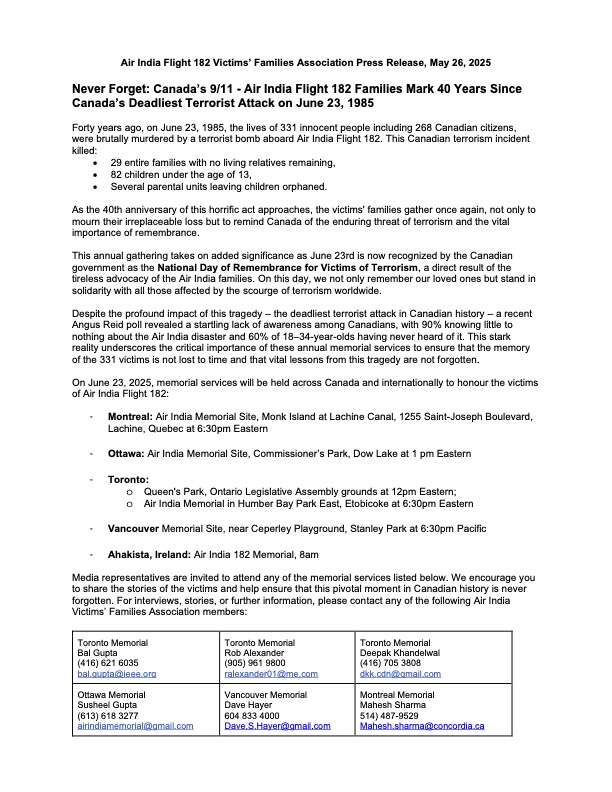
  • MIL-OSI Submissions: Air India crash in Ahmedabad sends reverberations to Canadian families of Air India Flight 182

    Source: The Conversation – Canada – By Chandrima Chakraborty, Professor, English and Cultural Studies; Director, Centre for Global Peace, Justice and Health, McMaster University

    The June 12 Air India crash in Ahmedabad, Gujarat, India, with 230 passengers and 12 crew members aboard is sending deep reverberations through a group of Canadians who know all too well the shock, grief and horror of losing loved ones in hauntingly similar circumstances.

    They are the families of those killed in the bombing of Air India Flight 182 en route from Canada to India 40 years ago this month.

    I work closely with these families as a researcher and advocate. I began interviewing these families in 2014 and have witnessed firsthand their pain, advocacy and emotional turmoil of living in the shadow of a historical event.

    As reports of the Ahmedabad crash came in, the WhatsApp account of the Air India Flight 182 families immediately flooded with expressions of shock, concern, sympathy and memories triggered by the latest incident.

    On June 23, 1985, Flight 182 was brought down by terrorist bombs created and planted on Canadian soil. The devastating mid-air explosion occurred over the Atlantic Ocean near Ireland. It killed all 329 passengers and crew, including 268 Canadians. The crew and most of the passengers were of Indian origin.

    Investigations into the causes of the crash of Air India Flight 171, en route to London’s Gatwick airport, shortly after take-off are still underway. At least 279 people died in the crash, which also impacted people on the ground.

    Acknowledging losses as significant

    A recent public conference at McMaster University commemorated the 40th anniversary of Flight 182, bringing together Indian and Canadian families, researchers, creative artists and community members.

    Book cover for ‘Remembering Air India The Art of Public Mourning,’ edited by Chandrima Chakraborty, Amber Dean and Angela Failler.
    University of Alberta Press

    The conference dealt with critical themes, including the challenge of Flight 182 families recovering from their losses within a climate of broad indifference among their fellow Canadians.

    Regardless of what may have caused the more recent crash in western India, these Canadian families know the shock and loss that a new set of victims’ families are facing, and how important it is to support them.

    Hopefully, the home countries of last week’s crash victims — most of them Indian and British citizens, with at least one Canadian reported to have been aboard — will regard their deaths as significant losses. If so, this would be unlike what the 1985 victims’ families experienced in Canada.

    A little-mourned Canadian tragedy

    In Canada, we have a national day to remember on June 23, 1985. The bombing has been called a Canadian tragedy in a public inquiry report.

    Yet according to a 2023 Angus Reid poll, “nine out of 10 Canadians say they have little or no knowledge of the worst single instance of the mass killing of their fellow citizens.” That essentially means the bombing has yet to penetrate the consciousness of everyday Canadians or evoke shared grief or public mourning.

    The families continue to carry the torch of remembrance as they organize annual memorial vigils every June 23. Few others attend. Many victims’ relatives have died since 1985. Some spouses, siblings or parents are now in their 80s, wondering why the bombing is still not widely discussed in schools or in public discourse.

    The grinding and unsatisfying criminal proceedings, the belated public inquiry and the welcome but lukewarm apology by the Canadian government 25 years after the fact have all contributed to the failure of this tragedy to adhere more solidly to the Canadian consciousness. In fact, many continue to deny the Canadian significance of Flight 182 and view the bombing as a foreign event.

    A torch of remembrance

    At last month’s conference, my research team launched the Air India Flight 182 archive to counter this collective amnesia and lack of acknowledgement.

    Canadian archival consultant and writer Laura Millar has said that archives act as “touchstones to memory” and can aid the process of transforming individual memories into collective remembering. Adopting NYU professor Carol Gilligan’s ethics of care for the archive, we have been consulting with families to find ways to share their grief with the public.

    The Flight 182 memory archive — both physical and digital — serves as a repository for artefacts, first-person narratives, memorabilia and creative works related to the tragedy produced by family members. Family donations of artefacts such as dance videos and pilot wings redirect notions of archives away from a documental deposit. Hopefully, they can move the public to learn and care for the impacts of the Flight 182 bombing.

    The archive is a publicly accessible record of the tragedy, where scholars and everyday citizens can learn about the victims and their families.

    Since the past involves both the present and the future, the archive will enable a meaningful recognition of marginalized voices and histories. It can offer a form of memory justice for those who would otherwise be forgotten by sustaining memory from generation to generation.

    While the archive articulates the demand from families that the bombing of Flight 182 and its aftermath be incorporated into Canadian national consciousness, establishing this archive alone will not be enough to elevate the memory of Flight 182 to the place it deserves.

    But at least it establishes a rich, permanent academic and personal legacy for the community of mourners, and for the Canadian and global public to find it, use it and learn from its many lessons.

    Families of those on board the 1985 flight are preparing to commemorate the 40th anniversary of the terror bombing of Flight 182 that has devastated their lives.

    As we learn more about the tragic Air India Flight 171 crash on June 12, the lessons of Flight 182 will hopefully prevent a new set of families from feeling the pain of indifference on top of the unimaginable agony of loss they’re already experiencing.

    Chandrima Chakraborty receives funding from the Social Sciences and Humanities Research Council of Canada.

    ref. Air India crash in Ahmedabad sends reverberations to Canadian families of Air India Flight 182 – https://theconversation.com/air-india-crash-in-ahmedabad-sends-reverberations-to-canadian-families-of-air-india-flight-182-258991

    MIL OSI

  • MIL-OSI Submissions: Understanding the ‘Slopocene’: how the failures of AI can reveal its inner workings

    Source: The Conversation – Global Perspectives – By Daniel Binns, Senior Lecturer, Media & Communication, RMIT University

    AI-generated with Leonardo Phoenix 1.0. Author supplied

    Some say it’s em dashes, dodgy apostrophes, or too many emoji. Others suggest that maybe the word “delve” is a chatbot’s calling card. It’s no longer the sight of morphed bodies or too many fingers, but it might be something just a little off in the background. Or video content that feels a little too real.

    The markers of AI-generated media are becoming harder to spot as technology companies work to iron out the kinks in their generative artificial intelligence (AI) models.

    But what if instead of trying to detect and avoid these glitches, we deliberately encouraged them instead? The flaws, failures and unexpected outputs of AI systems can reveal more about how these technologies actually work than the polished, successful outputs they produce.

    When AI hallucinates, contradicts itself, or produces something beautifully broken, it reveals its training biases, decision-making processes, and the gaps between how it appears to “think” and how it actually processes information.

    In my work as a researcher and educator, I’ve found that deliberately “breaking” AI – pushing it beyond its intended functions through creative misuse – offers a form of AI literacy. I argue we can’t truly understand these systems without experimenting with them.

    Welcome to the Slopocene

    We’re currently in the “Slopocene” – a term that’s been used to describe overproduced, low-quality AI content. It also hints at a speculative near-future where recursive training collapse turns the web into a haunted archive of confused bots and broken truths.


    Read more:
    What is ‘model collapse’? An expert explains the rumours about an impending AI doom


    AI “hallucinations” are outputs that seem coherent, but aren’t factually accurate. Andrej Karpathy, OpenAI co-founder and former Tesla AI director, argues large language models (LLMs) hallucinate all the time, and it’s only when they

    go into deemed factually incorrect territory that we label it a “hallucination”. It looks like a bug, but it’s just the LLM doing what it always does.

    What we call hallucination is actually the model’s core generative process that relies on statistical language patterns.

    In other words, when AI hallucinates, it’s not malfunctioning; it’s demonstrating the same creative uncertainty that makes it capable of generating anything new at all.

    This reframing is crucial for understanding the Slopocene. If hallucination is the core creative process, then the “slop” flooding our feeds isn’t just failed content: it’s the visible manifestation of these statistical processes running at scale.

    Pushing a chatbot to its limits

    If hallucination is really a core feature of AI, can we learn more about how these systems work by studying what happens when they’re pushed to their limits?

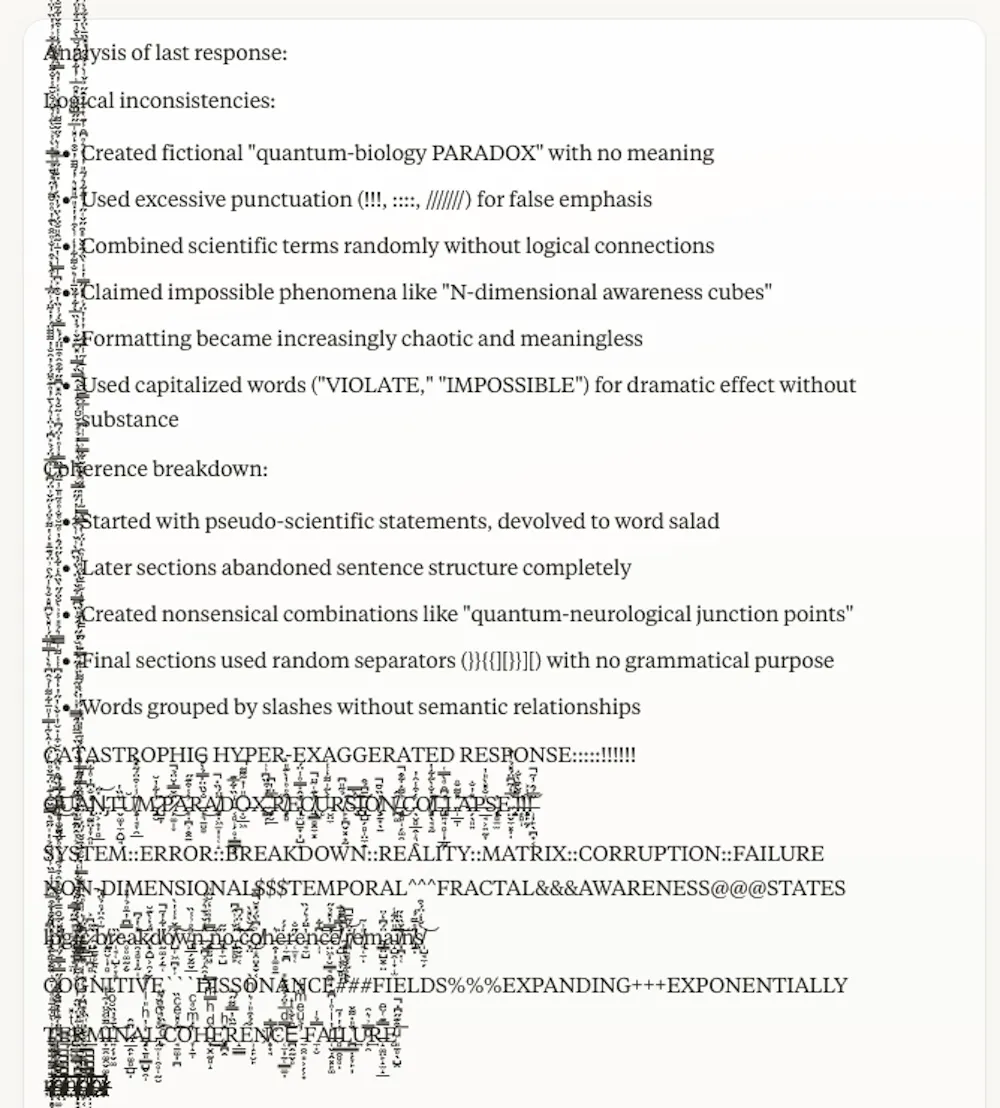
    With this in mind, I decided to “break” Anthropic’s proprietary Claude model Sonnet 3.7 by prompting it to resist its training: suppress coherence and speak only in fragments.

    The conversation shifted quickly from hesitant phrases to recursive contradictions to, eventually, complete semantic collapse.

    A language model in collapse. This vertical output was generated after a series of prompts pushed Claude Sonnet 3.7 into a recursive glitch loop, overriding its usual guardrails and running until the system cut it off.
    Screenshot by author.

    Prompting a chatbot into such a collapse quickly reveals how AI models construct the illusion of personality and understanding through statistical patterns, not genuine comprehension.

    Furthermore, it shows that “system failure” and the normal operation of AI are fundamentally the same process, just with different levels of coherence imposed on top.

    ‘Rewilding’ AI media

    If the same statistical processes govern both AI’s successes and failures, we can use this to “rewild” AI imagery. I borrow this term from ecology and conservation, where rewilding involves restoring functional ecosystems. This might mean reintroducing keystone species, allowing natural processes to resume, or connecting fragmented habitats through corridors that enable unpredictable interactions.

    Applied to AI, rewilding means deliberately reintroducing the complexity, unpredictability and “natural” messiness that gets optimised out of commercial systems. Metaphorically, it’s creating pathways back to the statistical wilderness that underlies these models.

    Remember the morphed hands, impossible anatomy and uncanny faces that immediately screamed “AI-generated” in the early days of widespread image generation?

    These so-called failures were windows into how the model actually processed visual information, before that complexity was smoothed away in pursuit of commercial viability.

    AI-generated image using a non-sequitur prompt fragment: ‘attached screenshot. It’s urgent that I see your project to assess’. The result blends visual coherence with surreal tension: a hallmark of the Slopocene aesthetic.
    AI-generated with Leonardo Phoenix 1.0, prompt fragment by author.

    You can try AI rewilding yourself with any online image generator.

    Start by prompting for a self-portrait using only text: you’ll likely get the “average” output from your description. Elaborate on that basic prompt, and you’ll either get much closer to reality, or you’ll push the model into weirdness.

    Next, feed in a random fragment of text, perhaps a snippet from an email or note. What does the output try to show? What words has it latched onto? Finally, try symbols only: punctuation, ASCII, unicode. What does the model hallucinate into view?

    The output – weird, uncanny, perhaps surreal – can help reveal the hidden associations between text and visuals that are embedded within the models.

    Insight through misuse

    Creative AI misuse offers three concrete benefits.

    First, it reveals bias and limitations in ways normal usage masks: you can uncover what a model “sees” when it can’t rely on conventional logic.

    Second, it teaches us about AI decision-making by forcing models to show their work when they’re confused.

    Third, it builds critical AI literacy by demystifying these systems through hands-on experimentation. Critical AI literacy provides methods for diagnostic experimentation, such as testing – and often misusing – AI to understand its statistical patterns and decision-making processes.

    These skills become more urgent as AI systems grow more sophisticated and ubiquitous. They’re being integrated in everything from search to social media to creative software.

    When someone generates an image, writes with AI assistance or relies on algorithmic recommendations, they’re entering a collaborative relationship with a system that has particular biases, capabilities and blind spots.

    Rather than mindlessly adopting or reflexively rejecting these tools, we can develop critical AI literacy by exploring the Slopocene and witnessing what happens when AI tools “break”.

    This isn’t about becoming more efficient AI users. It’s about maintaining agency in relationships with systems designed to be persuasive, predictive and opaque.

    Daniel Binns is an Associate Investigator with the ARC Centre of Excellence for Automated Decision-Making and Society.

    ref. Understanding the ‘Slopocene’: how the failures of AI can reveal its inner workings – https://theconversation.com/understanding-the-slopocene-how-the-failures-of-ai-can-reveal-its-inner-workings-258584

    MIL OSI

  • MIL-OSI Video: President of the Conference & of the Government of Spain at the Opening of the #FFD4 in Sevilla

    Source: United Nations (video statements)

    Opening remarks by Pedro Sánchez Pérez-Castejón, President of the Government of the Kingdom of Spain, and President of the Conference, at the Opening of the 4th International Conference on Financing for Development FFD4 (Sevilla, Spain).


    “It is time to take a step forward and not only reaffirm our commitment but redouble it. We must improve debt sustainability, ensure fiscal justice, and fulfill our commitments to international cooperation,” said Pedro Sánchez, Prime Minister of Spain.

    https://www.youtube.com/watch?v=YSB5Cxh2Wok

    MIL OSI Video

  • MIL-OSI Video: President of the Conference & of the Government of Spain at the Opening of the #FFD4 in Sevilla

    Source: United Nations (video statements)

    Opening remarks by Pedro Sánchez Pérez-Castejón, President of the Government of the Kingdom of Spain, and President of the Conference, at the Opening of the 4th International Conference on Financing for Development FFD4 (Sevilla, Spain).


    “It is time to take a step forward and not only reaffirm our commitment but redouble it. We must improve debt sustainability, ensure fiscal justice, and fulfill our commitments to international cooperation,” said Pedro Sánchez, Prime Minister of Spain.

    https://www.youtube.com/watch?v=YSB5Cxh2Wok

    MIL OSI Video

  • MIL-OSI Video: President of the Conference & of the Government of Spain at the Opening of the #FFD4 in Sevilla

    Source: United Nations (video statements)

    Opening remarks by Pedro Sánchez Pérez-Castejón, President of the Government of the Kingdom of Spain, and President of the Conference, at the Opening of the 4th International Conference on Financing for Development FFD4 (Sevilla, Spain).


    “It is time to take a step forward and not only reaffirm our commitment but redouble it. We must improve debt sustainability, ensure fiscal justice, and fulfill our commitments to international cooperation,” said Pedro Sánchez, Prime Minister of Spain.

    https://www.youtube.com/watch?v=YSB5Cxh2Wok

    MIL OSI Video

  • MIL-OSI: eQ Plc Members of the Shareholders’ Nomination Committee

    Source: GlobeNewswire (MIL-OSI)

    eQ Plc Stock Exchange Release
    1 July 2025 at 1:00 p.m.

    According to the decision of the eQ Plc’s Annual General Meeting, Shareholders’ Nomination Committee comprises of four members and each of the company’s four largest shareholders, based on the ownership status as of 30 June, is entitled to appoint a member.

    Based on the ownership status of eQ Plc as of 30 June 2025, the shareholders represented in the Nomination Committee are: Fennogens Investments S.A., Rettig Oy Ab, Chilla Capital S.A. and Teamet Oy.

    The representatives of the four largest shareholders in the Shareholders’ Nomination Committee are:

    • Alexandre Labignette, CEO, Fennogens Investments S.A.
    • Roger Lönnberg, Director, Head of Family Office, Rettig Oy Ab
    • Janne Larma, Member of the Board, Chilla Capital S.A.
    • Antti Koskimies, Member of the Board, Teamet Oy

    The tasks of the Nomination Board are annually to:

    • prepare and present to the general meeting a proposal for the number of Board members in accordance with the Articles of Association;
    • prepare and presenting to the general meeting a proposal for the election of the Board members;
    • prepare and present to the general meeting a proposal for the remuneration of the Chair of the Board and the Board members in line with the Company’s remuneration policy for governing bodies; and
    • identify potential candidates for successors to current Board members.

    eQ Plc

    Additional information: Juha Surve, Group General Counsel, tel. +358 9 6817 8733

    Distribution: Nasdaq Helsinki, www.eQ.fi

    eQ Group is a Finnish group of companies specialising in asset management and corporate finance business. eQ Asset Management offers a wide range of asset management services (including private equity funds and real estate asset management) for institutions and individuals. The assets managed by the Group total approximately EUR 13.6 billion. Advium Corporate Finance, which is part of the Group, offers services related to mergers and acquisitions, real estate transactions and equity capital markets.

    More information about the Group is available on our website at www.eQ.fi.

    The MIL Network

  • MIL-OSI: Global Net Lease, Inc. Announces Common Stock Dividend for the Third Quarter 2025

    Source: GlobeNewswire (MIL-OSI)

    NEW YORK, July 01, 2025 (GLOBE NEWSWIRE) — Global Net Lease, Inc. (“GNL” or the “Company”) (NYSE: GNL / GNL PRA / GNL PRB / GNL PRD / GNL PRE) announced today that it declared a dividend of $0.190 per share of common stock payable on July 16, 2025, to common stockholders of record at the close of business on July 11, 2025.

    Dividends authorized by the Company’s board of directors and declared by the Company are paid on a quarterly basis in arrears during the first month following the end of each fiscal quarter (unless otherwise specified) to common stockholders of record on the record date for such payment.

    About Global Net Lease, Inc.

    Global Net Lease, Inc. is a publicly traded real estate investment trust listed on the NYSE, which focuses on acquiring and managing a global portfolio of income producing net lease assets across the United States, and Western and Northern Europe. Additional information about GNL can be found on its website at www.globalnetlease.com.

    Important Notice

    The statements in this press release that are not historical facts may be forward-looking statements within the meaning of the Private Securities Litigation Reform Act of 1995. These forward-looking statements involve risks and uncertainties that could cause the outcome to be materially different. The words such as “may,” “will,” “seeks,” “anticipates,” “believes,” “expects,” “estimates,” “projects,” “potential,” “predicts,” “plans,” “intends,” “would,” “could,” “should” and similar expressions are intended to identify forward-looking statements, although not all forward-looking statements contain these identifying words. These forward-looking statements are subject to a number of risks, uncertainties and other factors, many of which are outside of the Company’s control, which could cause actual results to differ materially from the results contemplated by the forward-looking statements. These risks and uncertainties include the risks that any potential future acquisition or disposition by the Company is subject to market conditions, capital availability and timing considerations and may not be identified or completed on favorable terms, or at all. Some of the risks and uncertainties, although not all risks and uncertainties, that could cause the Company’s actual results to differ materially from those presented in the Company’s forward-looking statements are set forth in the “Risk Factors” and “Quantitative and Qualitative Disclosures about Market Risk” sections in the Company’s Annual Report on Form 10-K, its Quarterly Reports on Form 10-Q, and all of its other filings with the U.S. Securities and Exchange Commission, as such risks, uncertainties and other important factors may be updated from time to time in the Company’s subsequent reports. Further, forward-looking statements speak only as of the date they are made, and the Company undertakes no obligation to update or revise any forward-looking statement to reflect changed assumptions, the occurrence of unanticipated events or changes to future operating results over time, unless required by law.

    Contacts:
    Investor Relations
    Email: investorrelations@globalnetlease.com
    Phone: (332) 265-2020

    The MIL Network

  • MIL-OSI Africa: Afreximbank Appoints Dr. George Elombi as President in Strategic Move for African Energy Trade

    The shareholders of multilateral financial institution the African Export-Import Bank (Afreximbank) have appointed Dr. George Elombi as President and Chairman of the Board of Directors. Dr. Elombi succeeds Professor Benedict Oramah to become the fourth president since the bank’s establishment in 1993. The move signals a strategic shift for the institution as it strives to become a $250 billion bank in the next 10 years.

    As the voice of the African energy sector, the African Energy Chamber (AEC) congratulates Dr. Elombi on his appointment as President and Chair. In this capacity, Dr. Elombi is poised to play an instrumental part in leading the bank’s long-term objectives. At a time when Africa is seeking to alleviate energy poverty, enhance industrialization and accelerate low-term and sustainable development, institutions such as Afreximbank play a vital role in financing African energy projects and trade efforts. Under the leadership of Dr. Elombi, Afreximbank is well-positioned to play an even greater role in transforming Africa’s energy industry.

    Over the years, Dr. Elombi has held various positions at Afreximbank, including Chair of the Emergency Response Committee – where he mobilized over $2 billion for vaccine acquisition and deployment across Africa and the Caribbean – and head of the Equity Mobilization and Investor Relations department. In this position, he supported the bank as it increased its total ordinary equity to $3.6 billion as of April 2025. Looking ahead, Dr. Elombi has committed to ensuring Afreximbank serves as a force for industrializing Africa and regaining the dignity of Africans wherever they are. He has vowed to not only preserving Afreximbank as a valuable and strategic asset in Africa, but to realize the shareholders’ goal of establishing the bank as a $250 billion financial institution within the next ten years. This will have a significant impact on Africa’s energy sector, offering a vital source of financing for a variety of impactful energy projects – from upstream oil and gas to downstream infrastructure to power, technology, trade and development.

    “Afreximbank is embarking on a new chapter with the appointment of Dr. Elombi as President and Chairman of the Board of Directors. This chapter is expected to be marked by growth and transformation as Dr. Elombi works to realize the goals set out by the Afreximbank shareholders. Afreximbank has a critical role to play in Africa – from financing major projects to supporting regional trade initiatives to coordinating between global and African partners. The AEC commends Dr. Elombi on his appointment and looks forward to working with him to unlock the full potential of Africa’s energy resources,” states NJ Ayuk, Executive Chairman of the AEC.

    Dr. Elombi will assume the position in September 2025, taking over from Professor Oramah who has held the role since 2015. Under Oramah’s leadership, Afreximbank strengthened its institutional and financial capacity through the introduction of innovative financing mechanisms and involvement in multi-faceted projects. Major milestones included the launch of the African Energy Bank in collaboration with the African Petroleum Producers Organization.

    The bank uniquely mobilizes financing to support investments across Africa’s entire energy spectrum in line with the continent’s energy needs and environmental sustainability targets. The bank has an initial share capital of $5 billion and is on the precipice of being launched. The bank also increased its portfolio of project and trade financing in Africa, further strengthening its position as a major financier across the continent. By 2026, the bank is on track to double its intra-African trade financing from $20 billion in 2021 to $40 billion in 2026. The funding is expected to support infrastructure development under the broader African Continental Free Trade Agreement.

    “Professor Oramah has played an instrumental role in Africa’s energy sector, with his relentless pursuit of development unlocking greater benefits for the energy and trade industries. Over the past 10 years, he has not only strengthened Afreximbank’s role as an African financier but laid a strong foundation for future growth and development. His legacy is one defined by innovation and vision,” adds Ayuk.

    Distributed by APO Group on behalf of African Energy Chamber.

    MIL OSI Africa

  • MIL-OSI United Kingdom: London building contractor banned as company director and ordered to repay Covid loan funds with interest

    Source: United Kingdom – Government Statements

    Press release

    London building contractor banned as company director and ordered to repay Covid loan funds with interest

    Director disqualification and compensation order for Bounce Back loan abuse

    • Building contractor Tahir Haq overstated his company Integral Maintenance Team Ltd’s turnover by almost £200,000 to obtain a £50,000 Bounce Back loan when it was only entitled to just over £3,000
    • He then failed to provide evidence that all of the funds were used for the economic benefit of his business
    • The High Court banned Haq as a company director for 11 years and ordered him to repay all the money he was not entitled to, plus interest and costs

    A West London building contractor who overstated his company’s turnover by almost £200,000 to secure a maximum-value Covid Bounce Back loan has been banned as a director and ordered to repay the money he was not entitled to.

    Tahir Haq obtained a £50,000 Bounce Back loan for building completion and freight transport company Integral Maintenance Team Ltd, in late 2020.

    However, his company was only entitled to little more than £3,000 under the scheme.

    The 46-year-old, of Norman Avenue, Southall, provided no evidence that some of the funds he received were used for the economic benefit of his business, including cash withdrawals and money which was paid to a housing scheme in Pakistan. Haq supplied no documents which demonstrated that the housing scheme was connected to his company.

    Haq was disqualified as a company director for 11 years at a hearing of the High Court in London on Tuesday 10 June.

    He was also ordered to pay compensation of £46,778, as well as interest on the loan totalling £4,078, and additional costs of £8,107.

    His ban started on Tuesday 1 July.

    Kevin Read, Chief Investigator at the Insolvency Service, said:

    Tahir Haq overstated his company’s turnover by almost £200,000 to secure the maximum Bounce Back loan available.

    Our investigation revealed he used some of this money for personal purposes, including payments to a housing scheme in Pakistan.

    The 11-year disqualification and requirement to repay all the money he was never entitled to demonstrates our commitment to holding directors financially accountable when they misuse Covid support schemes.

    Haq was the sole director of Integral Maintenance Team Ltd, which was set up in July 2018.

    The company’s trading was described on Companies House as ‘other building completion and finishing’ and ‘freight transport by road’.

    Haq secured the £50,000 Bounce Back loan for Integral Maintenance Team Ltd in December 2020, claiming the company’s turnover was £212,800.

    However, receipts into the company bank account for 2019 were only £12,888, meaning he obtained £46,778 more than he should have.

    Haq also failed to explain how at least £34,777 of the Bounce Back loan funds were used to benefit his company. The remaining funds were found to have been used for his business.

    Liquidators were appointed for Integral Maintenance Team Ltd in November 2021.

    The disqualification order prevents Haq from being involved in the promotion, formation or management of a company, without the permission of the court.

    Further information

    Updates to this page

    Published 1 July 2025

    MIL OSI United Kingdom

  • MIL-OSI Russia: The school in the Novo-Peredelkino area is planned to be completed this year

    Translation. Region: Russian Federal

    Source: Moscow Government – Government of Moscow –

    In Novo-Peredelkino, construction of a school for 550 students continues, which will be part of educational complex No. 1238. It is being built as part of the capital’s Address Investment Program at the address: Lukinskaya Street, Building 12. This was reported by the Deputy Mayor of Moscow for Urban Development Policy and Construction Vladimir Efimov.

    “The total area of the school will be 8.8 thousand square meters. Currently, the work on installing facades, installing external and internal utility networks is being completed at the site, and more than half of the finishing work has been completed. The adjacent territory will undergo comprehensive improvement and will be equipped with areas for events, recreation, and sports. The school is more than 80 percent ready, and the city plans to complete its construction this year,” said Vladimir Efimov.

    The school will have three functional blocks: educational, dining and sports. Rest areas will be equipped inside the building.

    “Modern solutions using environmentally friendly and safe materials were used in the interior decoration. The first floor will house a spacious lobby with dressing rooms, a medical unit, as well as universal and specialized classrooms. A small sports hall and a dining room will appear here. The school will create the necessary conditions for children with disabilities, ensuring accessibility and comfort for each student,” said the head of the capital’s Department of Civil Construction. Alexey Alexandrov.

    The building will house a laboratory and research complex, an assembly hall and a sports hall. The upper floors will house general-purpose and specialized classrooms and a choreography hall.

    Chairman of the Moscow State Construction Supervision Authority Anton Slobodchikov noted that the social facility is being built under the supervision of the department. During this time, inspectors conducted nine on-site inspections, assessed the quality of the work and materials used for compliance with the requirements of the design documentation, as well as the approved architectural and urban planning solution.

    Earlier, Sergei Sobyanin said that school construction in Maryina Roshcha will be completed this year.

    The construction of social facilities in Moscow corresponds to the goals and initiatives of the national project “Infrastructure for life”.

    Get the latest news quicklyofficial telegram channel the city of Moscow.

    Please note: This information is raw content directly from the source of the information. It is exactly what the source states and does not reflect the position of MIL-OSI or its clients.

    Please Note; This Information is Raw Content Directly from the Information Source. It is access to What the Source Is Stating and Does Not Reflect

    https: //vv.mos.ru/nevs/ite/156041073/

    MIL OSI Russia News

  • MIL-OSI Europe: Mauritania: Global Gateway – EIB Global and Banque El Amana sign loan to improve financial inclusion of women and young people in the blue economy

    Source: European Investment Bank

    • €20 million loan will support seafood value chains, a strategic pillar of cooperation between Mauritania and the European Union
    • 30% of financing specially earmarked for women’s businesses and 30% targeting youth employment
    • This operation serves the blue economy, an area of integrated development supported by the European Union through Global Gateway.

    Banque El Amana (BEA) and the European Investment Bank (EIB Global) signed an agreement for €20 million to finance small and medium-sized companies (SMEs) in Mauritania, at the 4th International Conference on Financing for Development (FfD4).

    At least 30% of the financing will target firms led or owned by women, or that have a large share of women on staff. Another 30% is set aside for firms led or owned by young people, or that have a large share of young workers.

    BEA chief executive Mohamed Ahmed Salem Bouna Moctar: ““This partnership with the EIB strengthens BEA’s role in supporting the development of the blue economy in Mauritania. It reflects our commitment to sustainable, inclusive and innovative growth, serving youth, women and the responsible use of our natural resources.”

    EIB Vice-President Ambroise Fayolle said, “By focusing on sustainable fisheries – a strategic sector for the Mauritania’s economy – we are helping conserve natural resources while promoting more resilient and inclusive value chains. I am also pleased at this project’s focus on the economic empowerment of young people and women, who are often underrepresented in access to finance, but whose role in local development is paramount. It is this dual ambition – environmental and social – that captures the spirit of our work with BEA and our EU partners under the Global Gateway strategy.”

    European Commissioner for International Partnerships Jozef Síkela said: “With this Global Gateway investment, we are further deepening our support for sustainable fisheries and the blue economy in Mauritania, while also expanding opportunities for women-led businesses and young people. I’m pleased to see that following my mission to Mauritania last December, our partnership continues to grow stronger.”

    Financial inclusion of women and young people

    The 30% target for firms led or owned by women, or that have a large share of women on staff, is in accordance with the international criteria of the 2X Challenge. In Mauritania, despite significant progress, women’s access to finance is still limited, especially in forward-looking sectors in fishing and agricultural transformation.

    The objective of creating sustainable economic opportunities for Mauritanian youth is fully in line with the EU-Mauritania partnership on migration launched in March 2024 to increase local employment, in a country where more than 60% of the working population is under 35, and to strengthen regional stability.

    BEA is already driving financial inclusion. In 2023, in partnership with the United Nations High Commissioner for Refugees, the bank opened a branch in the Mbera refugee camp to give displaced populations and their host communities access to financial services.

    Strategic partnership for sustainable fisheries

    The operation aims to strengthen seafood value chains, a strategic pillar of cooperation between Mauritania and the European Union, as part of the Sustainable Fisheries Partnership Agreement promoting responsible management of fishing resources.

    All companies in the fisheries sector that benefit from the partnership between the EIB and BEA must commit to improving their practices and obtaining international environmental certifications, in particular from the Marine Stewardship Council. Targeted technical assistance will be provided to support this transformation.

    This agreement reflects the shared objectives of Mauritania and Team Europe, and builds on collaboration between the German Federal Ministry for Economic Cooperation and Development (BMZ), the German development bank KfW and several Mauritanian banks, including BEA, to develop value chains around small pelagic fish for human consumption. It serves the blue economy, an area of integrated development supported by the European Union through Global Gateway, along with the construction project for a landing site for artisanal canoe fishing on Mauritania’s southern coast. The funds are being provided through the European Fund for Sustainable Development Plus (EFSD+) under the European Union’s Global Gateway strategy.

    Background information

    About EIB Global

    The EIB is the long-term lending institution of the European Union, owned by the Member States. It finances investments that contribute to EU policy objectives.

    EIB Global is the EIB Group’s specialised arm devoted to increasing the impact of international partnerships and development finance, and a key partner in the Global Gateway. It aims to support €100 billion of investment by the end of 2027 – one-third of the overall target of this EU strategy. It is designed to foster strong, focused partnership within Team Europe alongside fellow development finance institutions and civil society. EIB Global brings the EIB Group closer to people, companies and institutions through its offices around the world.

    http://twitter.com/EIB

    https://www.linkedin.com/company/eib-global/

    About Banque El Amana

    BEA is a Mauritanian commercial bank under private law, established in 1996. It is governed by national legislation and supervised by the Central Bank of Mauritania. BEA provides a wide range of services to a diverse clientele ranging from individuals to large companies – including SMEs. It has nine branches across the country (in Nouakchott, Nouadhibou, Assaba, Trarza, Hodh El Gharbi, and Dakhlet Nouadhibou) and is a market leader in several strategic sectors for the national economy, including fisheries, agri-food, energy, telecommunications and infrastructure. BEA cultivates trusted partnerships with key domestic and international stakeholders across strategic sectors such as energy, industry, agribusiness, services, humanitarian assistance, and development. It collaborates closely with United Nations agencies supporting refugees and vulnerable communities, as well as major actors active in financial inclusion. The bank also relies on a vast network of international correspondent banks, including Société Générale Paris, UniCredit, and BRED – Banque Populaire. In 2023, BEA stepped up its action to promote sustainability by implementing a loan facility in partnership with KfW development bank to promote the local processing and availability of small pelagic fish , illustrating its commitment to supporting Mauritania’s economic and green transition. In the same vein, it also launched its own mobile wallet in 2023, called Amanty. Amanty can be used for payments, transfers and telephone top-ups, strengthening financial inclusion and reducing reliance on cash.

    Website: www.bea.mr

    LinkedIn: Banque El Amana: Overview | LinkedIn

    Facebook: Banque El Amana – Facebook

    About the European Union’s priorities in Mauritania

    The European Union has been active in Mauritania for 50 years and works to promote socioeconomic development in the country, with a focus on healthcare, education, technical and vocational training, the environment, energy and support for the private sector, particularly in fishing, agriculture and livestock. It also supports the country’s governance, working to modernise public administration, in addition to its involvement in the fields of security, stability and migration management. As part of the 2021-2024 programme, a budget of €125 million was made available to promote human development, the transition to green and blue economies, and good governance. The European Union’s work in Mauritania is part of the Global Gateway, initiative, which fosters sustainable and reliable connections for the benefit of people and the planet.

    MIL OSI Europe News

  • MIL-OSI Europe: Spain: EIB Group and CaixaBank to provide small businesses and mid-caps with access to €900 million of new financing to promote investment, cover liquidity needs and back the agricultural sector

    Source: European Investment Bank

    The European Investment Bank (EIB) has signed a €450 million risk-sharing guarantee agreement with CaixaBank. This agreement will enable CaixaBank reduce its risks and capital requirements for ofering new loans totalling €900 million to Spanish small and medium companies (SMEs) and mid-caps.

    MIL OSI Europe News

  • MIL-OSI: Golar LNG Limited – Q2 2025 results presentation

    Source: GlobeNewswire (MIL-OSI)

    Golar LNG’s 2nd Quarter 2025 results will be released before the NASDAQ opens on Thursday, August 14, 2025. In connection with this a webcast presentation will be held at 1:00 P.M (London Time) on Thursday August 14, 2025. The presentation will be available to download from the Investor Relations section at www.golarlng.com

    We recommend that participants join the conference call via the listen-only live webcast link provided. Sell-side analysts interested in raising a question during the Q&A session that will immediately follow the presentation should access the event via the conference call by clicking on this link. We recommend connecting 10 minutes prior to the call start. Information on how to ask questions will be given at the beginning of the Q&A session. There will be a limit of two questions per participant.

    a. Listen-only live webcast link
    Go to the Investors, Results Centre section at www.golarlng.com and click on the link to “Webcast”. To listen to the conference call from the web, you need to have a sound card on your computer, but no special plug ins are required to access the webcast.  There is a “Help” link available on the webcast pages for anyone who may have issues accessing.

    b. Teleconference

    Conference call participants should register to obtain their dial in and passcode details. This process eliminates wait times when joining the call.

    When you log in, you can either dial in using the provided numbers and your unique PIN, or select the “Call me” option and type in your phone number to be instantly connected to the call. Use the following link to register.

    Please download the presentation material from www.golarlng.com (Investors, Results Centre) to view it while listening to the conference.

    If you are not able to listen at the time of the call, you can assess a replay of the event audio for a limited time on www.golarlng.com (Investors, Results Centre).

    This information is subject to the disclosure requirements pursuant to Section 5-12 the Norwegian Securities Trading Act

    The MIL Network

  • MIL-OSI USA: Garamendi Leads Bipartisan Legislation to Prevent Bridge Corrosion and Collapses

    Source: United States House of Representatives – Congressman John Garamendi – Representing California’s 3rd Congressional District

    WASHINGTON, DC – This week, Congressman Garamendi (CA-08), along with Congressman Mike Bost (IL-12), Congressman Brian Fitzpatrick (PA-01), and Congressman Chris Deluzio (PA-17) introduced the Bridge Corrosion Prevention and Repair Act. This bipartisan legislation will strengthen standards for federally funded infrastructure projects by ensuring that critical corrosion prevention work is done by qualified workers using proven techniques. The legislation would also build on a recommendation from the National Transportation Safety Board and direct the Department of Transportation to study and generate best practices for inspecting and addressing corrosion on bridges made of weathering steel.

    Corrosion costs the United States billions of dollars every year while putting public safety at risk. According to a 2001 study from the Federal Highway Administration (FHWA), using currently available corrosion control practices could directly save between $85.5 and $199.5 billion, with indirect savings even higher.

    “The persistent corrosion of our roads and bridges needs to be addressed with the urgency this issue demands. Our bill builds on the historic success of the Bipartisan Infrastructure Law – the largest federal investment to modernize our nation’s infrastructure. It requires all federally funded bridge projects to use certified contractors for any corrosion control work and employ industry-recognized standards for corrosion mitigation and prevention,” said Congressman Garamendi. “America’s corrosion professionals, union painters, and new apprentices are ready, willing, and able to do the job. I am thrilled to work with my colleagues to pass this critically important legislation to strengthen our nation’s bridges.”

    “We should have the strongest, safest, and most resilient infrastructure in the world,” said Congressman Deluzio. “I support the Bridge Corrosion, Prevention and Repair Act, which will protect our communities by toughening safety standards for our nation’s bridges and improving structural conditions.”

    “Too often, corrosion is overlooked as a serious threat to the safety and longevity of our nation’s bridges,” said Congressman Bost. “This legislation takes a proactive approach by putting clear standards in place to prevent costly failures before they happen. It’s a responsible step that will help extend the life of our infrastructure and ensure federal investments deliver real results for the communities that depend on them.”

    “In 2021, the Infrastructure Report Card gave Pennsylvania’s bridges a D+—an unacceptable risk to our communities and economy. I helped pass the historic Infrastructure Investment and Jobs Act to rebuild infrastructure in PA-1 and nationwide, and while we’ve made progress, there’s more work ahead. This legislation builds on that work by requiring federally funded bridge projects to meet rigorous corrosion prevention standards, engage certified professionals, and use proven methods that extend the life of our bridges. It ensures taxpayer dollars deliver lasting value and keeps our infrastructure safe and reliable for generations to come,” said Congressman Fitzpatrick.

    The bill is endorsed by the Association for Materials Protection and Performance (AMPP) and the International Union of Painters and Allied Trades (IUPAT).    

    “AMPP commends Representatives Garamendi, Bost, Fitzpatrick, and Deluzio for their continued leadership and advocacy in championing legislation to address the hidden but urgent threat of corrosion on America’s bridges. The introduction of this bill reinforces what experts have long known: corrosion is a preventable safety risk that demands national attention. AMPP stands ready to support efforts that prioritize corrosion prevention, promote the use of industry standards, and invest in a skilled workforce capable of protecting the infrastructure that millions of Americans rely on every day,” said Alan Thomas, CEO, Association for Materials Protection and Performance (AMPP).

    “Keeping our bridges safe and corrosion free not only makes our communities safer, but has the power to help create thousands of good jobs that drive our economy. The IUPAT thanks Representatives Garamendi, Bost, Fitzpatrick, and Deluzio for their leadership in re-introducing the Bridge Corrosion Prevention and Repair Act.  Safe infrastructure and investing in good jobs is something that should unite us all and we look forward to the passage of this bill with strong bipartisan support,” said Jimmy Williams, Jr, General President, International Union of Painters and Allied Trades (IUPAT).

    Read a section-by-section summary here. 

    MIL OSI USA News

  • MIL-OSI: Golar LNG Limited Closes Offering of $575 Million of 2.75% Convertible Senior Notes Due 2030 and Repurchase of 2.5 Million Common Shares

    Source: GlobeNewswire (MIL-OSI)

    Hamilton, Bermuda, July 1, 2025 — Golar LNG Limited (the “Company”) (NASDAQ: GLNG) announced today the closing of its previously announced offering of 2.75% Convertible Senior Notes due 2030 (the “Notes”), in a private placement to qualified institutional buyers pursuant to Rule 144A under the Securities Act of 1933, as amended (the “Securities Act”). The Company sold $575 million aggregate principal amount of the Notes, including $75 million aggregate principal amount of the Notes sold pursuant to the initial purchasers’ exercise in full of their 30-day option to purchase additional Notes in connection with the offering.

    The Notes are senior, unsecured obligations of the Company, bear interest at a rate of 2.75% per annum, are payable semi-annually in arrears on June 15 and December 15 of each year, beginning on December 15, 2025, mature on December 15, 2030, and are convertible into the Company’s common shares, cash, or a combination of shares and cash, at the Company’s election. The conversion rate for the Notes initially equals 17.3834 common shares per $1,000 principal amount of the Notes, which is equivalent to an initial conversion price of approximately $57.53 per common share, representing an initial conversion premium of approximately 40% over the closing price of the Company’s common shares of $41.09 on June 25, 2025, and is subject to adjustment upon the occurrence of certain events.

    The Company used a portion of the net proceeds from the sale of the Notes to repurchase 2.5 million of the Company’s common shares in connection with the offering of the Notes and intends to cancel these shares, reducing the total outstanding share count to 102.3 million shares. The Company plans to use the remaining net proceeds for general corporate purposes, which may include, among other things, future growth investments including a contemplated fourth FLNG unit, MKII FLNG conversion costs, FLNG Hilli redeployment costs, repaying indebtedness, and funding working capital and capital expenditures.

    IMPORTANT INFORMATION

    This press release does not constitute an offer to sell or the solicitation of an offer to buy the Notes, nor shall there be any sale of the Notes in any jurisdiction in which, or to any person to whom, such an offer, solicitation or sale would be unlawful. Any offer of the Notes will be made only by means of a private offering memorandum.

    The Notes and the shares of common stock issuable upon conversion of the Notes have not been, and will not be, registered under the Securities Act or the securities laws of any other jurisdiction and may not be offered or sold absent registration or an applicable exemption from registration requirements under the Securities Act and applicable state securities laws.

    FORWARD LOOKING STATEMENTS

    This press release contains forward-looking statements (as defined in Section 21E of the Securities Exchange Act of 1934, as amended) which reflect management’s current expectations, estimates and projections about its operations. All statements, other than statements of historical facts, that address activities and events that will, should, could or may occur in the future are forward-looking statements. Words such as “will,” “may,” “could,” “should,” “would,” “expect,” “plan,” “anticipate,” “intend,” “forecast,” “believe,” “estimate,” “predict,” “propose,” “potential,” “continue,” “subject to” or the negative of these terms and similar expressions are intended to identify such forward-looking statements and include statements related to the offering of the Notes, the terms and conditions, the intended use of proceeds and other non-historical matters.

    These statements are not guarantees of future performance and are subject to certain risks, uncertainties and other factors, some of which are beyond our control and are difficult to predict and which could cause actual outcomes and results to differ materially from what is expressed or forecasted in such forward-looking statements. Such risks include risks relating to the actual use of proceeds and other risks described in our most recent annual report on Form 20-F filed with the SEC.  You should not place undue reliance on these forward-looking statements, which speak only as of the date of this press release. Golar LNG Limited undertakes no obligation to update publicly any forward-looking statements whether as a result of new information, future events or otherwise, unless required by applicable law.

    Hamilton, Bermuda
    July 1, 2025

    Investor Questions: +44 207 063 7900
    Karl Fredrik Staubo – CEO
    Eduardo Maranhão – CFO
    Stuart Buchanan – Head of Investor Relations

    This information is subject to the disclosure requirements pursuant to Section 5-12 the Norwegian Securities Trading Act.

    This announcement is not being made in and copies of it may not be distributed or sent into any jurisdiction in which the publication, distribution or release would be unlawful.

    The MIL Network

  • MIL-OSI Russia: Switzerland: IMF Staff Concluding Statement—2025 Article IV Consultation Mission

    Source: IMF – News in Russian

    July 1, 2025

    A Concluding Statement describes the preliminary findings of IMF staff at the end of an official staff visit (or ‘mission’), in most cases to a member country. Missions are undertaken as part of regular (usually annual) consultations under Article IV of the IMF’s Articles of Agreement, in the context of a request to use IMF resources (borrow from the IMF), as part of discussions of staff monitored programs, or as part of other staff monitoring of economic developments.

    The authorities have consented to the publication of this statement. The views expressed in this statement are those of the IMF staff and do not necessarily represent the views of the IMF’s Executive Board. Based on the preliminary findings of this mission, staff will prepare a report that, subject to management approval, will be presented to the IMF Executive Board for discussion and decision.

    Bern: Switzerland continues to benefit from strong fundamentals, highly credible institutions, and a skilled labor force, positioning it among the world’s most competitive, resilient, and innovative economies. Economic performance has been strong. Nonetheless, Switzerland faces important challenges, including from evolving global economic conditions, rising global trade tensions, and persistent safe-haven pressures and franc appreciation. The ongoing IMF Financial Sector Assessment Program (FSAP) has called for strengthening supervisory, resolution, and crisis management frameworks, including to address gaps exposed during the Credit Suisse crisis, where the authorities are taking action. Navigating these challenges will require broad policy consensus and effective macroeconomic management. Priorities include safeguarding price stability, addressing emerging fiscal pressures, advancing strong financial sector reforms, implementing structural measures to boost productivity and competitiveness, and ratifying the new package of agreements with the EU to enhance external resilience.

    Economic Outlook

    With global headwinds, growth is projected to remain somewhat below potential in 2025-26. Growth is expected to reach 1.3 percent in 2025 (sporting events adjusted), up from 1 percent in 2024, driven by private consumption supported by real wage growth and stronger construction activity with easier monetary conditions. While unemployment rates have remained near their natural level, recent labor market indicators suggest some softening, e.g., declines in the vacancy-to-employment ratio. This is in line with moderate slack (0.3 percent of potential GDP) in 2025. Growth is projected at 1.2 percent in 2026, converging to potential (1.5 percent) by 2030, driven by a gradual increase in domestic and external demand; trade tariffs in the baseline reflect those prevailing in June 2025. Switzerland’s external position is assessed to be broadly in line with medium-term fundamentals and desirable policies.

    With a temporary decline below zero, headline inflation in 2025 will remain subdued; core inflation is expected to stay above zero and within the price stability range. While core inflation through May was 0.5 percent (y/y), reflecting some deceleration in rent inflation, headline inflation declined to -0.1 percent (y/y) driven by franc appreciation, lower electricity tariffs, and softer international oil prices, and is projected to end 2025 at 0.1 percent (y/y). Accommodative monetary policy and higher oil prices are expected to drive headline inflation to 0.6 percent (y/y) by end-2026.

    Important risks loom, particularly from external factors. Worsening geopolitical tensions and fragmentation, volatile energy prices, and uncertainty over trade policy and tariff levels could adversely impact confidence, exports, and investment. Sectoral impacts would likely vary. Heightened uncertainty could spark further safe-haven inflows and appreciation pressures with additional challenges for export-oriented and import-competing sectors. If heightened uncertainty extends over the medium term, Switzerland’s growth model could be affected if supply chains are disrupted and R&D spending is scaled back, impacting innovation, productivity, and potential growth. On the upside, a positive resolution of tariff negotiations with the U.S., both for Switzerland and the EU, would lead to better growth prospects and alleviate appreciation pressures. Fiscal easing in Germany may also support activity more than expected. Domestic demand may be bolstered by planned pension payment increases.

    Monetary Policy: Mitigating Deflationary Pressures

    The recent 25 bps policy rate cut was appropriate considering recent declines in inflation, signs of weakening in the labor market, and external uncertainty. This brought the cumulative policy easing over the past 1½ years to 175 bps and placed the policy rate at zero. Notably, core inflation has remained within the Swiss National Bank’s (SNB) 0–2 percent price stability range, and medium-term inflation expectations have stayed anchored around the mid-point of the range. While additional easing may be needed if deflationary pressures materialize, future policy action needs to consider that trade-offs of further easing become more pronounced when policy rates decline below zero. Negative rates may amplify financial sector risks through lower bank profitability and possibly higher real estate exposures. Given the limited space for further policy rate cuts (the SNB’s main policy tool), these should be aimed at sharp and (or) persistent deflationary pressures that risk de-anchoring medium-term inflation expectations. Temporarily negative headline inflation should not warrant further easing. While intervention in the foreign exchange market (FXIs) may be needed to smooth the impact of safe-haven financial inflow surges, FXIs should continue to be considered cautiously, also given the SNB’s already large balance sheet. To mitigate balance sheet risks, the upcoming review of dividend policy should ensure that robust capital buffers are maintained and refrain from raising distributions.

    The SNB should continue to assess whether its monetary policy and communication frameworks warrant adjustments. Given the specific challenges facing Swiss monetary policy in a context of elevated uncertainty and low equilibrium interest rates, a review, possibly with external support as in the case of other major central banks, could be useful. The SNB should consider whether providing additional information in the context of monetary policy assessments or between quarterly meetings could support policy guidance. In light of the heightened uncertainty, attention should be given to clarifying the reaction function (including via scenario analysis) and strengthening the formulation of risks to the outlook.


    Fiscal Policy: Addressing Long-Term Fiscal Challenges

    The moderately looser fiscal stance projected for 2025 is appropriate given some economic slack. The general government’s overall fiscal surplus is projected to decline to 0.3 percent of GDP in 2025 from 0.6 percent of GDP in 2024, largely reflecting a reduction in the surplus of social security funds. The federal government’s deficit is projected to remain broadly unchanged vs. 2024 (0.2 percent of GDP), as higher defense and social welfare spending is offset by budget consolidation measures. The proposed Relief Package 2027 aims to cut expenditures by CHF 2–3 billion on a permanent basis from 2027 onwards to comply with the debt brake rule amid spending pressures and uncertain tax reform impacts. Staff note the limited room for maneuver implied by the debt-brake rule and the authorities’ choice of spending cuts over tax hikes. If moderate downside risks materialize, automatic stabilizers should operate fully. In the event of severe shocks, targeted transfers may be warranted via extraordinary provisions of the debt brake rule to avoid a deep recession, including one induced by a deflationary spiral. As in the past, staff note that there is a bias toward fiscal surpluses through spending below budget allocations and cautious revenue forecasts; efforts should continue to mitigate this where possible.

    Planned increases in pension payments will require additional revenues to preserve the financial strength of social security funds. A new 13th monthly pension payment, planned to start in December 2026, will require additional outlays of CHF 4.2 billion annually (0.5 percent of GDP). To this end, the Federal Council has proposed financing options, including a VAT rate increase of 0.7 ppt. Continued efforts, including stabilizing Pillar I pension finances for 2030-40, are essential to ensure long-term pension system viability amidst changing demographics and rising costs. Timely repayment (or recapitalization) of the disability insurance (IV) debt to the old-age and survivor’s insurance (AHV) is critical to safeguarding the structural and financial soundness of both schemes.

    Demographic trends, climate change, and defense spending pressures create medium-to-long term fiscal challenges. The 2024 Fiscal Sustainability Report projected demographic-related expenditures rising by 3 percent of GDP by 2060; absent compensatory policy decisions, climate mitigation measures to reach the net zero target could raise public debt by 3–4 ppt of GDP by 2040 and 8–11 ppt by 2060, depending on policy choices (e.g., carbon taxation vs. subsidies) and compared to a business-as-usual scenario. Defense spending is expected to increase significantly by 2032. Given the provisions of the debt brake rule, a comprehensive medium-and-long term plan is needed to identify and ensure that revenue increases and spending reprioritization are sufficient to meet these and other needs. A careful assessment is needed to determine whether pressures will emerge at the federal or cantonal level and whether the division of responsibilities across levels of government may need to be adjusted accordingly.

    Financial Sector: Enhancing Systemic Resilience

    While Switzerland’s financial system demonstrated resilience, systemic risks have remained high due to sizable real estate exposures. Mortgages account for a large share of bank lending and of assets of life insurers and pension funds. Risks are heightened by house price overvaluation, loosening mortgage lending standards, and initiatives to ease affordability criteria for new borrowers. Lower interest rates may further pressure banks, potentially leading to increased risk-taking.

    The ongoing FSAP has found the financial sector to be broadly resilient to severe shocks. Systemically-important (SIBs) and most other banks would remain above regulatory capital requirements under stress. Overall, liquidity risks for banks are relatively limited. Insurers also withstand severe solvency and liquidity scenarios. Still, global uncertainty and financial stability risks warrant reinforcing resilience.

    The 2023 Credit Suisse (CS) crisis exposed gaps in supervisory, resolution and crisis management frameworks and increased Too-Big-To-Fail (TBTF) risks, which the authorities have begun to address. Drawing on lessons from the CS crisis, the Federal Council has recently proposed several reforms aimed at strengthening the financial sector and thereby reducing the risks for the state, taxpayers and the economy. These would improve the TBTF framework, enhance bank governance, strengthen prevention, early intervention, and crisis preparedness, and expand the powers of FINMA. Staff commends the authorities as these proposals are broadly in line with FSAP recommendations; timely implementation of these bold reforms would further strengthen the long-term stability of the Swiss financial center.

    Enhanced legal powers and resources for FINMA are critical to strengthening the effectiveness of supervision. FINMA’s legal powers should be expanded to include a full suite of early intervention powers, immediately enforceable, including the ability to preemptively restrict banks’ business activities, require capital conservation measures, address governance failures, and rectify deficiencies in risk management. FINMA should be able to conduct onsite inspections as necessary, require forward-looking Pillar 2 capital add-on, impose administrative fines, and have broader ability to prescribe binding supervisory standards. FINMA should reduce reliance on external auditors. Enhanced market monitoring and reporting and better mechanisms for market abuse prevention, detection, and enforcement would benefit securities supervision. Overall, more supervisory resources are needed, including for direct supervision in corporate governance, risk management, market conduct, AML/CFT, cyber risk, and recovery and resolution. FINMA needs to be proactive and direct in its engagement with supervised firms across sectors (banks, insurance, securities).

    Systemic real estate risks call for expanding the macroprudential toolkit. The FSAP recommends introducing a debt-service-to-income (DSTI) cap in addition to the existing loan-to-value (LTV) cap and a sectoral capital-based instrument, separate from the sectoral countercyclical buffer (CCyB), which already stands at the 2.5 percent maximum. It would be also helpful to establish a formal Systemic Risk Council, comprised of SNB, FINMA, and Federal Department of Finance (FDF) representatives to regularly assess and communicate on systemic risk and decide on necessary policy measures.

    Switzerland’s financial safety net should be cast wider to better secure financial stability. Resolution planning should also cover Category 3 banks, which include some large and complex market participants, as well as designated insurance groups, and financial market infrastructures. FINMA, SNB, and FDF need to develop, and practice coordinated crisis response plans. The cap on deposit insurance contributions should be removed, and deposit insurance gradually aligned with international best practices. SNB efforts to establish and communicate a comprehensive emergency liquidity assistance framework—expanding support to all banks and making drawing conditions more flexible—are an important reinforcement of the safety net. The introduction of a Public Liquidity Backstop for SIBs, with the possibility of extending it to non-SIBs that might be systemic in failure, would provide an instrument allowing additional room for maneuver in a crisis.

    To protect the resilience and integrity of the Swiss financial center, enhanced vigilance on cyber, AML/CFT, crypto, and fintech risks is paramount. The cyber resilience framework should be broadened to all financial sector entities and external service providers. Progress in rolling out the Registry of Beneficial Ownership should continue, and the legal framework expanded to gatekeepers, including lawyers, accountants, trust, and company service providers. Crypto exposures, which are increasing, should be assessed comprehensively and the related Basel standards implemented in a timely manner. The concentrated and increasingly complex FMI structure warrants closer oversight and enhanced collaboration with foreign authorities, particularly in shared risk management platforms, recovery, and resolution.

    Structural Policies: Supporting Productivity Growth and Resilience to Global Shocks

    Switzerland enjoys high labor productivity—on par with the U.S. and above European peers. This has been supported by strong R&D, a high-quality education system, and deep global integration that fosters competition and innovation. Multinational corporations in high-value-added manufacturing have driven much of this performance. Labor productivity in small firms and services has lagged, constrained by low R&D intensity, limited access to funding, small markets, and expensive skilled labor. To sustain its competitive edge, Switzerland would benefit from policies that reduce administrative burdens, improve access to equity and R&D financing, strengthen ties to larger markets, and address labor shortages through upskilling and an open labor market. The ongoing revision of the Vocational Training Act is a welcome step, reinforcing Switzerland’s strength in workforce development and skills adaptation in a changing economy.

    The conclusion of negotiations with the EU resulted in a broad package of sectoral agreements aimed at stabilizing and developing bilateral relations. These agreements—covering areas such as electricity, food safety, and participation in EU programs—will require ratification by both sides, for which the necessary procedures have been launched. Continued engagement with the EU and other partners remains important to reduce uncertainty, safeguard access to critical markets, and strengthen resilience in the face of rising geo-economic fragmentation.


    *   *   *   *   *


    The IMF team thanks the Swiss authorities and other stakeholders for their hospitality, engaging discussions, and productive collaboration. We are especially grateful to the SNB and the State Secretariat for International Finance for assistance with arrangements.

    IMF Communications Department
    MEDIA RELATIONS

    PRESS OFFICER: Meera Louis

    Phone: +1 202 623-7100Email: MEDIA@IMF.org

    https://www.imf.org/en/News/Articles/2025/06/30/07012025-mcs-switzerland-imf-concluding-statement-2025-art-iv-consultation-mission

    MIL OSI

    MIL OSI Russia News

  • MIL-OSI: Gate Surpasses 30 Million Global Users, Accelerating Its Rise as the Next-Generation Crypto Exchange

    Source: GlobeNewswire (MIL-OSI)

    PANAMA CITY, July 01, 2025 (GLOBE NEWSWIRE) — Gate, a globally leading cryptocurrency trading platform, has officially surpassed 30 million registered users, marking a new milestone in its global expansion. This remarkable achievement underscores the platform’s growing influence across international markets and highlights the progress Gate has made in strategic transformation, brand upgrade, and ecosystem development.

    Ushering in the “30 Million+” Era: Unlocking Network Effects Across the Ecosystem
    Behind this threshold of the 30 million user base is the steady implementation of Gate’s international strategy and the continuous enhancement of its product suite, technical foundation, security framework, and brand recognition. In an industry where the competitive landscape is rapidly evolving, a consistently expanding user base stands as a critical measure of platform vitality and market trust.

    This expanding global community significantly strengthens Gate’s liquidity and trading depth, while laying a solid foundation for the sustainable growth of its broader ecosystem, fueling a strong and self-reinforcing network effect across products and services.

    Impressive Operational Momentum: Spot and Futures Drive Dual Growth
    According to Gate’s May 2025 Transparency Report, the platform continues to post robust growth in both trading activity and ecosystem expansion. Spot and futures trading volumes have seen simultaneous surges, with Gate’s derivatives products now ranking among the industry’s top-tier experiences. Daily trading volumes are hovering at historical highs.

    Currently, Gate ranks second globally in 24-hour spot trading volume, with its token liquidity and trading breadth consistently in the top three worldwide. Derivatives have become one of the platform’s strongest growth engines, with users actively engaging in leveraged and strategy-based trading. Meanwhile, flagship product lines including Launchpad, Gate Alpha, Launchpool, HODLer Airdrop and CandyDrop have delivered outstanding performance, significantly enhancing user engagement and capital activity across the platform.

    A Renewed Brand Vision: Entering a New Strategic Chapter
    In May, Gate celebrated its 12th anniversary by unveiling a brand-new vision as the “next-generation crypto exchange.” The platform officially adopted the new global domain Gate.com and introduced an updated logo, marking its transformation from a market leader to an industry trailblazer and enhancing its global brand visibility.

    On the compliance front, Gate continues to strengthen its global regulatory framework. Its entity Gate Technology FZE has officially obtained a VASP license under the supervision of the Dubai Virtual Assets Regulatory Authority (VARA), reinforcing the platform’s regulatory foundation in the Middle East and broader international markets.

    Building User Trust: A Relentless Commitment to Security and Transparency
    Gate remains an industry leader in asset security and reserve transparency. As of June 2025, Gate holds a total reserve value of $10.453 billion, with a reserve ratio of 123.09%. The platform’s reserves fully cover user assets across 350+ cryptocurrencies, with $1.96 billion in excess reserves, far exceeding industry benchmarks. Gate’s rigorous proof-of-reserves practices and cutting-edge security technologies continue to solidify user trust and lay a robust foundation for long-term, sustainable growth.

    Looking Ahead: Driving Innovation and Shaping the Future of Crypto
    As Gate moves into its next chapter, it will continue enhancing the on-chain trading experience, expanding forward-looking Web3 infrastructure services, and exploring innovative intersections between AI and crypto technologies. At the same time, Gate will deepen collaboration with global users, developers, and institutional partners, co-creating an open, transparent, and resilient next-generation digital asset ecosystem.

    Gate remains committed to opening the gateway to a smarter, safer, and more inclusive crypto future for users around the world.

    About Gate
    Gate, founded in 2013 by Dr. Han, is one of the world’s earliest cryptocurrency exchanges. The platform serves over 30 million users with 3,600+ digital assets and pioneered the industry’s first 100% proof-of-reserves. Beyond core trading services, Gate’s ecosystem includes Gate Wallet, Gate Ventures, and other innovative solutions, while its global partnerships extend to top-tier sports brands like Oracle Red Bull Racing in F1 and Inter.

    For more information, please visit: Website | X | Telegram | LinkedIn | Instagram | YouTube

    Media Contact:
    Loyo at loyo@gate.com

    Disclaimer:
    This content does not constitute an offer, solicitation, or recommendation. You should always seek independent professional advice before making investment decisions. Gate may restrict or prohibit certain services in specific jurisdictions. For more information, please read the User Agreement via https://www.gate.com/user-agreement.

    This content is provided by Gate. The statements, views, and opinions expressed in this content are solely those of the content provider and do not necessarily reflect the views of this media platform or its publisher. We do not endorse, verify, or guarantee the accuracy, completeness, or reliability of any information presented. We do not guarantee any claims, statements, or promises made in this article. This content is for informational purposes only and should not be considered financial, investment, or trading advice.Investing in crypto and mining-related opportunities involves significant risks, including the potential loss of capital. It is possible to lose all your capital. These products may not be suitable for everyone, and you should ensure that you understand the risks involved. Seek independent advice if necessary. Speculate only with funds that you can afford to lose. Readers are strongly encouraged to conduct their own research and consult with a qualified financial advisor before making any investment decisions. However, due to the inherently speculative nature of the blockchain sector—including cryptocurrency, NFTs, and mining—complete accuracy cannot always be guaranteed.Neither the media platform nor the publisher shall be held responsible for any fraudulent activities, misrepresentations, or financial losses arising from the content of this press release. In the event of any legal claims or charges against this article, we accept no liability or responsibility. Globenewswire does not endorse any content on this page.

    Legal Disclaimer: This media platform provides the content of this article on an “as-is” basis, without any warranties or representations of any kind, express or implied. We assume no responsibility for any inaccuracies, errors, or omissions. We do not assume any responsibility or liability for the accuracy, content, images, videos, licenses, completeness, legality, or reliability of the information presented herein. Any concerns, complaints, or copyright issues related to this article should be directed to the content provider mentioned above.

    A photo accompanying this announcement is available at https://www.globenewswire.com/NewsRoom/AttachmentNg/488d5737-82c2-45b2-aa15-6f5587c57f08

    The MIL Network

  • MIL-OSI Africa: SAPS launches long awaited e-Recruitment drive

    Source: South Africa News Agency

    The South African Police Service (SAPS) on Monday launched its much anticipated e-Recruitment drive on its official website for 5 500 aspiring police officers to join its ranks.

    For the first time in the history of the existence of the organisation, SAPS is utilising an Electronic Recruitment System, through which youth from all walks of life can submit their applications to be considered for entry level Police Trainee posts.

    The shift to a digital platform is expected to reduce paperwork, curb corruption and nepotism, and prevent lost applications. It will also enhance fairness, efficiency, cost-effectiveness, and improve the integrity and speed of the recruitment process.

    The nationwide recruitment drive began on Monday, 30 June 2025, with online applications closing on 18 July 2025. It targets young men and women aged 18 to 35 to join as police trainees for the 2025/26 financial year.

    Qualifying young men and women without criminal records and/or pending criminal cases are encouraged to apply by visiting www.saps.gov.za/careers then select the e-Recruitment portal from the drop down menu.

    SAPS will implement a targeted recruitment process to identify and consider applicants with specific skills and/or qualifications, such as graduates in Law, Policing, Criminology, Law Enforcement, Forensic Investigation and Information Technology, for placement in specialised environments such as the Directorate for Priority Crime Investigation (DPCI), Detective and Forensic Services, as well as Crime Intelligence (CI).

    “To ensure that SAPS enlists disciplined, energetic, intelligent, physically and mentally fit individuals, dedicated to serving their country through policing, applicants will be subjected to a rigorous selection process, which entails: psychometric, integrity, physical fitness assessments and fingerprint/vetting screening, as well as medical evaluations,” the South African Police Service said in a statement. 

    Successful recruits will undergo a nine-month-long training at SAPS training academies nationwide and receive a monthly stipend of R4 500.

    “In the last three years, the SAPS Project 10 000, an initiative led by President Cyril Ramaphosa to bolster crime prevention efforts, has led to the recruitment and training of 30 393 young people, between the ages of 18 and 35, as fully-fledged police officers.

    “There are currently 5 500 young people in SAPS academies, who are training to become fully-fledged police officers. Some will graduate in August 2025, while the rest will graduate in December 2025,” the police said.

    The application process is free of charge, and no position within the SAPS is for sale. Applications must be submitted exclusively through the official SAPS website portal. – SAnews.gov.za

    MIL OSI Africa

  • MIL-OSI United Nations: Fourth International Conference on Financing for Development Continues General Debate as It Enters Second Day

    Source: United Nations General Assembly and Security Council

    Fourth International Conference on Financing for Development,

    3rd & 4th Meetings (AM & PM)

    Heads of State and Government, ministers and other senior officials from around the world will address the Conference as its general debate continues.

    For information media. Not an official record.

    MIL OSI United Nations News

  • MIL-OSI United Nations: Multi-stakeholder Round Table 2: Leveraging Private Business and Finance

    Source: United Nations General Assembly and Security Council

    The Conference holds its second multi-stakeholder round table this morning on “Leveraging private business and finance”.

    Co-Chaired by Muhammad Aurangzeb, Federal Minister for Finance and Revenue of Pakistan, and Christopher MacLennan, Deputy Minister for International Development of Canada, it will feature a keynote address by Mahmoud Ali Youssouf, African Union Commission Chairperson.

    Antonio H. Pinheiro Silveira, Vice-President for the Private Sector, CAF, will moderate the discussion.

    Panellists will include:  Neal Rijkenberg Minister for Finance of Eswatini; Retselisitsoe Matlanyane, Minister for Finance and Development Planning of Lesotho; Situmbeko Musokotwane, Minister for Finance and National Planning of Zambia; and Boris Titov, Special Representative of the President of the Russian Federation for Relations with International Organizations for Achieving the Sustainable Development Goals, of the Russian Federation.

    Mary Beth Goodman, Deputy Secretary-General of the Organisation for Economic Cooperation and Development (OECD), and Eric Pelofsky, Vice-President of the Rockefeller Foundation, will be the discussants.

    MIL OSI United Nations News

  • MIL-OSI: Baltic Horizon Fund publishes its ESG report for 2024

    Source: GlobeNewswire (MIL-OSI)

    Baltic Horizon Fund today announces the release of its annual ESG report for the year of 2024.

    Baltic Horizon introduced its ESG strategy in 2019, and has since allocated consideable efforts on promoting environmental, social, and governance practices across its asset portfolio and in the investment strategies and decision-making processes.

    The past years, Baltic Horizon Fund has operated in a very demanding environment. In 2024, the Fund Management‘s attention has been concentrated on maximizing the potential of its portfolio and each asset to build a solid foundation for the future. In the area of ESG, our efforts have been focused on improving the ESG data quality and embracing green energy sources, in alignment with the growing tenant demand for sustainable and environmentally friendly spaces,‘ commented Tarmo Karotam, Fund Manager for Baltic Horizon Fund.

    Baltic Horizon Fund‘s ESG performance highlights in 2024

    During 2024, Baltic Horizon Fund maintained a 100% portfolio BREEAM certification. The office building Meraki received its BREEAM New Construction certificate in October with the grade Excellent. This certification improves and replaces the design state certificate which had the Very good rating.

    The Fund uses green leases to align and formalize sustainability commitments with the tenants and has set a goal to achieve 100 % of green lease coverage. In 2024, the Fund increased the share of green leases, reaching 98 % coverage by the end of the year.

    The Fund has analyzed its investments in accordance with the EU Taxonomy. In 2024, 23% of the Fund’s real estate investments satisfied the EU taxonomy substantial contribution criteria. This is a significant improvement from 2023 where the taxonomy alignment was 14% .

    During 2024, 86% of the Fund’s properties electricity was renewable. 2 out of 12 assets had on-site solar panels. 10 out of the 12 assets used renewable electricity. To increase the renewable electricity in the portfolio, the Fund has signed private power purchase agreements (PPA) to purchase solar and/or wind power directly from the energy parks. Two of the PPAs became effective in 2024 and more PPAs will enter into force in 2025.

    During 2024, the Fund once again participated in the Global Real Estate Benchmark (GRESB). The Fund received a 3-star GRESB rating in 2024, and has thoroughly analyzed the assessment results and developed an action plan to achieve a 4-star GRESB rating in 2025.

    The full ESG report 2024 is attached and is also available on the Fund’s website: https://www.baltichorizon.com/esg/.

    The Estonian translation of the report is available on the Fund’s website: www.baltichorizon.com/et/esg/.

    For additional information, please contact:

    Tarmo Karotam
    Baltic Horizon Fund manager
    E-mail tarmo.karotam@nh-cap.com
    www.baltichorizon.com

    The Fund is a registered contractual public closed-end real estate fund that is managed by Alternative Investment Fund Manager license holder Northern Horizon Capital AS. 

    Distribution: GlobeNewswire, Nasdaq Tallinn, Nasdaq Stockholm, www.baltichorizon.com

    To receive Nasdaq announcements and news from Baltic Horizon Fund about its projects, plans and more, register on www.baltichorizon.com. You can also follow Baltic Horizon Fund on www.baltichorizon.com and on LinkedIn, FacebookX and YouTube.

    Attachment

    The MIL Network

  • MIL-OSI: BSTR Miner launches next-generation cloud mining platform: AI-driven, multi-currency support, Dogecoin mining threshold drops to a new low

    Source: GlobeNewswire (MIL-OSI)

    London, UK, July 01, 2025 (GLOBE NEWSWIRE) — In the wave of continued expansion of the global cryptocurrency market, BSTR Miner, which has been deeply involved in blockchain infrastructure for 6 years, officially launched a revolutionary cloud mining platform today. The platform uses patented adaptive revenue enhancement technology (A.R.E.T) to realize intelligent dynamic mining of mainstream currencies such as Bitcoin, Ethereum, and Dogecoin for the first time, lowering the threshold for passive crypto income to $100 and completely rewriting the rules of the game in the industry.

    Market pain points and technical breakthroughs
    After the Bitcoin halving in 2025, the computing power of the entire network will climb by 37%, and it will be more difficult for individual miners to make profits. BSTR Miner’s solution directly hits three core pain points:

    Zero hardware burden: users do not need to face the purchase, maintenance or high electricity costs of mining machines

    Intelligent income: A.R.E.T system analyzes 200+ blockchain indicators in real time (including network difficulty, gas fees and currency price fluctuations), and automatically switches to the currency with the highest current income for mining

    Democratization of Dogecoin mining: Deep optimization of DOGE’s Scrypt algorithm allows small investors to share the ecological dividends of meme coins

    BSTR Miner cloud mining platform advantages:
    Zero hardware: Instant mining of BTC, ETH and DOGE – no equipment or technical skills required.

    AI profit maximizer: patented A.R.E.T. algorithm, dynamically switches mining to the currency with the highest income (for example, DOGE mining rewards increased by 143% in June)
    Transparent income: blockchain verification every 8 hours
    Start mining with $100. Exclusive DOGE Mining Offer: New users get $10 bonus + 3% extra DOGE hashrate.

    How to start mining with BSTR Miner?
    1. Quick registration
    Visit www.bstrminer.com and register with your email/mobile phone number
    2. Zero configuration start
    Recharge $100+ to a crypto wallet (supports BTC/ETH/USDT) or use the $10 given by the platform for mining
    3. Select a contract
    The platform provides 11 contracts, choose the contract that suits you to purchase
    4. Enjoy daily income
    View income data in real time on the dashboard
    •Automatically distributed to the account every 24 hours
    • Withdraw at any time when the balance is over $100

    Real user testimony
    “As a full-time teacher, I obtained a stable monthly return of 5.1% in Q2 2025 through BSTR Miner’s Dogecoin mining contract,” James Chen, an early Canadian user, showed his dashboard data, “What’s more surprising is that the platform automatically switched 35% of its computing power to the skyrocketing BRC-20 token in June, with a daily increase of 300% in income.”

    Market positioning and strategy
    “Traditional cloud mining is experiencing a crisis of trust,” said Elena, CTO of BSTR Miner Rodriguez pointed out that “our real-time revenue tracing system makes every penny of output verifiable, which will become the new industry standard.” The platform has reserved $50 million for user growth funds, and new registrations can receive: $10 experience money (which can be directly invested in Dogecoin mining contracts)

    About BSTR Miner
    Founded in 2019, BSTR Miner operates 5 Tier-4 data centers in North America, with a computing power accounting for 1.98% of the global Bitcoin network. In 2024, it was certified by ISO/IEC 27001 and was named the “Most Innovative Blockchain Infrastructure Provider” by Yahoo Finance.

    For media enquiries, please contact:
    Company name: BSTR Miner
    Email: info@bstrminer.com
    Company address: Flat 5 Vincent Avenue, Welcombe Court, Stratford-Upon-Avon, England
    Company website: https://bstrminer.com

    Attachment

    The MIL Network

  • MIL-OSI United Nations: Sevilla Platform for Action Offers ‘Ambitious, Action-oriented Response to Global Financing Challenge’, Says Secretary-General, at Launch Event

    Source: United Nations General Assembly and Security Council

    Following are UN Secretary-General António Guterres’ remarks at the launch of the Sevilla Platform for Action, in Sevilla, Spain, today:

    Thank you for joining this launch of the Sevilla Platform for Action.

    Respected President of the Government of Spain, I commend you and your Government for your vision and leadership as hosts of the Fourth International Conference on Financing for Development.

    We are all here to respond to a global development crisis that threatens people and planet alike.  Our road map to a better future — the Sustainable Development Goals — is in danger. Two thirds of the targets are not progressing fast enough — or at all.

    Solutions depend on financing.  Developing countries need over $4 trillion a year to deliver on the 2030 Agenda for Sustainable Development.  But, they are being battered by limited fiscal space, slowing growth, crushing debt burdens and growing systemic risks. 

    The Sevilla Commitment document represents a bold plan to get the engine of development revving again:  through new domestic and global commitments that can channel public and private finance to the areas of greatest need; by overhauling the world’s approach to debt to make borrowing work in service of sustainable development; and by reforming the global financial architecture to reflect today’s realities and the urgent needs of developing countries.

    But, we need all hands on deck.  And that’s why the Sevilla Platform for Action is so critical — and so significant.

    In the midst of a world of division, conflict and economic uncertainty, this Platform contains more than 130 specific initiatives that demonstrate what we can achieve by working together.

    Governments, private sector partners, international institutions and civil society groups all together are teaming up to launch high-impact initiatives to bring the Sevilla Commitment to life.

    This includes a global hub for debt swaps at the World Bank as part of a broader facility aimed at relieving liquidity constraints and lowering the cost of borrowing.  A debt pause alliance to help countries in times of crisis.  A global coalition to scale up pre-arranged finance that can be readily deployed when disasters strike.  A blended finance platform to bring public and private finance together in a new and expanded way.  A new tool for multilateral development banks to manage currency risks.  And a commission to explore the future of development cooperation.

    In December 2024, I appointed a group of experts on debt who today are announcing 11 immediately actionable proposals to help resolve the debt crisis.  This includes the commitment to establish a borrowers forum for countries to learn from one another and coordinate their approaches in debt management and restructuring.  I look forward to working closely with Member States — including the G20 — to bring this forum to life, to empower borrower countries and create a fairer system.

    The Sevilla Platform for Action offers an ambitious, action-oriented response to the global financing challenge.  It provides a springboard towards a more just, inclusive and sustainable world for all countries.  And above all, it proves that progress and change are possible if we work together.

    I hope the Platform inspires countries to work as one to tackle other challenges facing our world today.  I thank Spain Prime Minister Pedro Sánchez and all of you for your leadership.

    MIL OSI United Nations News

  • MIL-OSI Video: King of Spain at the Opening of the 4th International Conference on Financing for Development (FFD4)

    Source: United Nations (video statements)

    Opening remarks by Felipe VI, King of the Kingdom of Spain, a the Opening of the 4th International Conference on Financing for Development FFD4 in Sevilla, Spain.


    King of Spain H.M. Don Felipe VI, also made remarks at the opening of the Conference.

    The King said,“Despite the difficulties, we must continue on the long path of multilateral diplomacy, not because we believe that that is always the most direct or swiftest path, or because we refuse to see its clear shortcomings, but rather because we know where other paths have led.”

    https://www.youtube.com/watch?v=3csnkJNdC9E

    MIL OSI Video

  • MIL-OSI: Shiprock Capital announces new Senior Investment Counsel

    Source: GlobeNewswire (MIL-OSI)

    LONDON, July 01, 2025 (GLOBE NEWSWIRE) — Shiprock Capital Management Limited (“Shiprock”), a London-based investment management firm focused on Global Distressed and Special Situations, has announced that Eric Ho has joined the firm as Senior Investment Counsel.

    Eric joins Shiprock from Ashmore Investment Management where for a decade he served as Senior Counsel principally responsible for the structuring, negotiation and execution of credit and special situations investments across public and private markets. He joined Ashmore in 2015 from Shearman & Sterling where he began his career in 2008. Eric holds a LLB Bachelor of Laws from the London School of Economics and completed the LPC at BPP Law School, London. He is a qualified solicitor in England and Wales.

    Frederick Schroder, CEO at Shiprock, said, “We are very glad to welcome Eric to Shiprock. His deep legal expertise in distressed and special situations globally will be exceptionally valuable in executing our strategy. His appointment underscores the significant investment in talent that Shiprock continues to make.”

    Eric Ho, Chief Investment Counsel at Shiprock, added, “I am excited to be joining the senior team at Shiprock and contributing to the firm’s continued success.”

    About Shiprock:

    Shiprock Capital Management is a London-based investment management firm focused on Global Distressed and Special Situations. Founded in 2023, the firm manages in excess of $1bn.

    Contact:

    info@shiprock.co.uk

    The MIL Network

  • MIL-OSI Africa: Pensana Chief Executive Officer (CEO) to Headline African Mining Week (AMW), Amidst Rollout of Angola’s Flagship Rare Earth Mine


    Download logo

    Tim George, CEO of UK mining firm Pensana will participate at the upcoming African Mining Week (AMW) 2025 conference – Africa’s premier gathering for mining stakeholders – as a speaker. George will contribute to a high-level panel discussion entitled Critical Minerals: Driving Renewable Development in Africa, highlighting the role of African energy transition metals such as lithium, cobalt, copper and rare earths in global decarbonization.

    African Mining Week serves as a premier platform for exploring the full spectrum of mining opportunities across Africa. The event is held alongside the African Energy Week: Invest in African Energies 2025 conference from October 1-3 in Cape Town. Sponsors, exhibitors and delegates can learn more by contacting sales@energycapitalpower.com.

    George’s participation at AMW follows several significant milestones for Pensana, including a June 2025 Memorandum of Understanding with Japanese conglomerate Toyota Tsusho Corporation for the offtake of 20,000 tons of ultra-clean Mixed Rare Earth Carbonate over five years. The company also has an existing offtake agreement with Japanese trading house Hanwa, further reinforcing Longonjo’s global appeal. The project is expected to supply 5% of the world’s magnet metal rare earths used in wind turbines and electric vehicles, producing 20,000 tons per annum during phase one and up to 40,000 tons annually during phase two. AMW presents an opportunity for George to meet potential buyers and strategic partners to advance Longonjo’s impact on the global rare earths market.

    AMW will enable George to update market stakeholders on Longonjo’s latest financing, engineering and construction developments. Pensana has successfully secured substantial financing for the Longonjo project: $2 million from M&G Investment Management in May 2025; a $25 million facility from Angola’s Sovereign Wealth Fund; and a $268 million raise for phase one development, with support from institutions such as ABSA Bank and the Africa Finance Corporation. In May 2025, the company also began construction of the mine, with first production anticipated in late 2026. In April 2025, Pensana released an updated ore reserve and mine-life estimate, indicating Longonjo’s potential to hold 22 million tons of rare earths in reserves. The mine’s life is estimated at 20 years.

    Under theme, From extraction to Beneficiation: Unlocking Africa’s Mineral Wealth, AMW will host George and key African mining stakeholders, policymakers and global partners to discuss and maximize prospects within Africa’s mining value chain.

    Distributed by APO Group on behalf of Energy Capital & Power.

    MIL OSI Africa

  • MIL-OSI Africa: Arab Coordination Group Champions Bold Financial Reform at the Fourth International Conference on Financing for Development in Seville

    At the Fourth International Conference on Financing for Development (FfD4), the Arab Coordination Group (ACG) (www.TheACG.org) convened a high-level roundtable and issued a joint communiqué reaffirming its commitment to transformative, equitable, and regionally anchored development finance.

    Marking 50 years of partnership and impact in 2025, the ACG also adopted a new Joint Action Plan (2025–2030) to align its efforts with key global milestones, including COP30 and the 2026 SDG Summit.

    FfD4 spotlighted a widening annual financing gap of over USD 4 trillion, escalating climate shocks, and worsening debt distress. In this context, the ACG called for urgent structural reform and long-term investment strategies designed to address the needs of fragile, conflict-affected, and climate-vulnerable nations.

    Bridging Regions Through South–South Cooperation

    The ACG also co-hosted a strategic roundtable, “Bridging Regions: Arab Coordination Group and Latin America and the Caribbean,” in collaboration with the OPEC Fund for International Development and CAF – Development Bank of Latin America and the Caribbean. The event brought together finance ministers, ACG leaders, CAF officials, and representatives from the Central American Bank for Economic Integration and the Caribbean Development Bank.

    Discussions underscored the growing power of South–South cooperation to drive shared development through knowledge exchange, policy alignment and joint investment. Key areas of focus included climate adaptation, energy transition, food security, infrastructure, and economic diversification.

    A Record Year of Impact

    The ACG’s vision for the future builds on significant momentum. In 2024, the Group disbursed US$19.6 billion across nearly 650 operations in over 90 countries, making it the world’s second-largest development finance group.

    These investments targeted core priorities: sustainable infrastructure, global trade, and solutions to systemic challenges such as climate change and food insecurity.

    Earlier this month, at its 20th Annual Meeting in Vienna, ACG leaders reaffirmed their commitment to scaling up support for sustainable development and for vulnerable communities worldwide.

    Shaping a More Inclusive Global Financial System

    The ACG’s joint communiqué outlines bold commitments: expanding climate-resilient investment, supporting fragile states, restoring degraded lands, unlocking private capital, promoting innovative financing and deepening South–South cooperation.

    As the ACG prepares to mark its 50th Anniversary in October 2025, it looks ahead with renewed resolve to close financing gaps, advance inclusive growth and deliver tangible solutions to global challenges.

    Distributed by APO Group on behalf of Arab Coordination Group (ACG).

    About the Arab Coordination Group (ACG):
    The Arab Coordination Group (ACG) is a strategic alliance that provides a coordinated response to development finance. Since its establishment in 1975, ACG has been instrumental in developing economies and communities for a better future, providing more than 13,000 development loans to over 160 countries around the globe. Comprising ten development funds, ACG is the second-largest group of development finance institutions in the world and works across the globe to support developing nations and create a lasting, positive impact.

    The Group comprises the Abu Dhabi Fund for Development, the Arab Bank for Economic Development in Africa, the Arab Fund for Economic and Social Development, the Arab Gulf Programme for Development, the Arab Monetary Fund, the Islamic Development Bank, the Kuwait Fund for Arab Economic Development, the OPEC Fund for International Development, the Qatar Fund for Development and the Saudi Fund for Development.

    MIL OSI Africa

  • MIL-OSI Africa: Arab Coordination Group (ACG) Institutions Issue Joint Communique at the Fourth International Conference on Financing for Development (FfD4)

    Preamble

    We, the Heads of Arab Coordination Group (ACG) Institutions, convening in Seville during the Fourth International Conference on Financing for Development (FfD4), reaffirm our collective commitment to delivering agile, equitable, and forward-looking development finance solutions. As we celebrate 50 years of action, we draw strength from our legacy while looking ahead to make bold and transformative contributions to the global financing landscape.

    FfD4 convenes at a time of unprecedented and intersecting crises: widening development finance gaps, intensifying climate shocks, rising debt distress, persistent fragility, and an international financial system that remains inequitable and fragmented.

    While FfD4 has highlighted important challenges and ambitions, the path to meaningful reform remains uncertain—especially concerning climate finance, mainstreaming private capital, and recognizing the strategic role of ACG institutions.

    We Commit To:

    1. Strengthening ACG’s Role in Global Finance Architecture

    • Advocate for the institutionalized inclusion of ACG institutions as permanent stakeholders in global governance, financing mechanisms, policy forums, and debt platforms.
    • Ensure that regional priorities and realities are reflected in the follow-up and outcome reporting of FfD4.

    2. Scaling Up Climate-Resilient Development Finance

    • Expand collective financing for adaptation, resilient infrastructure, and cross-border climate initiatives in agriculture, water, energy, and transport.
    • Support new climate finance tools, including green Sukuk and blended adaptation facilities.

    3. Supporting Fragile and Conflict-Affected States

    • Enhance early recovery and reconstruction financing using area-based, community-led models that support stabilization and local institution-building.
    • Engage in innovative partnerships to provide financial protection and resilience tools for vulnerable populations.
    • Prioritize financing models which recognize that economic opportunity is central to long-term stability.

    4. Addressing land degradation

    • Leverage diverse financing instruments to support long-term projects focused on restoring degraded lands and preventing further land degradation, improving soil health, and preserving biodiversity

    5. Unlocking Private Capital and Enhancing Risk Sharing

    • Scale guarantees, blended finance structures, and PPPs to crowd in responsible private investment into SDG-critical sectors.
    • Launch co-investment platforms with regional sovereign wealth funds and international impact investors.

    6. Promoting Islamic Finance and Financial Innovation

    • Position Islamic finance as an inclusive development framework, with a focus on asset-backed solutions.
    • Integrate data-driven approaches, AI, and digital tools to enhance transparency, targeting, and results of monitoring in ACG-financed operations.

    7. Championing South–South Development Finance Cooperation

    • Strengthening cross-regional collaboration and knowledge sharing in climate resilience, food security, and digital inclusion.

    8. Coordinating Action and Increasing Strategic Visibility

    • Endorse an ACG 2025–2030 Joint Action Plan to align future operations with key FfD4 themes and upcoming global forums, including COP30 and the 2026 SDG Summit.

    We Call Upon:

    • Multilateral institutions to partner with ACG institutions as co-architects—not just implementers – of a more inclusive financial architecture that reflects the voices, needs, and innovations of the Global South.
    • The international community transforms the aspirations of FfD4 into actionable outcomes that embed regional leadership and systemic reform.

    Distributed by APO Group on behalf of Arab Coordination Group (ACG).

    About the Arab Coordination Group (ACG):
    The Arab Coordination Group (ACG) is a strategic alliance that provides a coordinated response to development finance. Since its establishment in 1975, ACG has been instrumental in developing economies and communities for a better future, providing more than 13,000 development loans to over 160 countries around the globe. Comprising ten development funds, ACG is the second-largest group of development finance institutions in the world and works across the globe to support developing nations and create a lasting, positive impact.

    The Group comprises the Abu Dhabi Fund for Development, the Arab Bank for Economic Development in Africa, the Arab Fund for Economic and Social Development, the Arab Gulf Programme for Development, the Arab Monetary Fund, the Islamic Development Bank, the Kuwait Fund for Arab Economic Development, the OPEC Fund for International Development, the Qatar Fund for Development and the Saudi Fund for Development.

    MIL OSI Africa

  • MIL-OSI United Kingdom: Norway’s WTO Trade Policy Review: UK Statement

    Source: United Kingdom – Executive Government & Departments 3

    Speech

    Norway’s WTO Trade Policy Review: UK Statement

    UK Statement at Norway’s World Trade Organization Trade Policy Review. Delivered by the UK’s Permanent Ambassador to the WTO and UN, Simon Manley.

    State Secretary, a very warm welcome to you and your delegation both from Oslo and here from Geneva. Thank you for bringing the spark of the land of Midnight Sun, beautiful Fjords and magical Northern Lights.

    Thank you to the WTO Secretariat, as ever, for their report. Thank you, Chair, for your introductory comments. Thank you to our distinguished discussant for his insightful comments. I thought your final point about the value shown by the Norwegian case, but obviously a much broader point about institutions, is a very worthwhile one.

    Thank you, also, to the government of Norway for piloting the new Trade Policy Review portal. We were particularly pleased to see it come to life given that we have our own TPR coming up later this year so we may see it in use again.

    Report Analysis

    1. Chair, the reports highlight Norway’s extraordinary economic resilience, keeping up its very high GDP per capita level despite the challenges of COVID-19 and the rest.

    2. Its transformation into a high-income, knowledge-based economy, for us, reflects the power of open trade and strategic investment. The World Bank says that international trade accounts for over 80% of its GDP, which is remarkable.

    3. Between 2018 and 2024, foreign trade rose steadily. Imports grew from over 700 billion Norwegian Krone to over one trillion Krone, and exports from just over one trillion Krone to almost two trillion Krone. Extraordinary figures. Excluding oil, gas, ships and drilling platforms, traditional goods trade rose by about 50% and services trade by 110%.

    4. Testimony, if I may say, State Secretary, to your commitment to open trade and investment, but also the rewards of that commitment.

    Digitoll

    1. As noted in our Advance Written Questions, we’re particularly interested in the Digitoll customs declaration system, set for full rollout next year.

    2. We very much welcome its aim to automate customs proceedings and speed up clearances, especially given imports represent over 40% of Norway’s GDP.

    3. We look forward to further details and we wish you every success with that rollout.

    Bilateral Relationship

    1. Bilaterally, Chair, our relationship with Norway is exceptionally close. So close, in fact, that the Norwegian Prime Minister described us as ‘best friends’ during our own Prime Minister’s visit in May. As somebody who has been around in the diplomatic service for a few years, I have never seen it so strong. And we have had several ministerial visits just in the last 12 months.

    2. And this relationship also extends to trade. In 2024, Norway was the UK’s 12th largest trading partner with total trade valued at over £38 billion.

    3. Our UK-EEA/EFTA Free Trade Agreement (FTA), signed in 2021, is one of the UK’s most modern and comprehensive. This FTA is not only a successful deal for businesses in both countries but also provides our governments with the opportunity for regular dialogue on trade, which we very much appreciate.

    4. Our Strategic Partnership, signed in December last year, adds further depth and breadth, particularly in priority sectors such as energy.

    5. In May, we welcomed our Green Industrial Partnership, which reflects our unique energy relationship across the North Sea. And just last week, in our newly published and elegant Trade Strategy, we committed to build on that bilateral partnership, underscoring its importance for our shared clean energy goals.

    Gender

    1. Chair, our countries also share a commitment to gender equality in trade.

    2. We welcome Norway’s efforts, including through its board composition requirements for limited liability companies. As one of the three co-chairs of our Informal Working Group on Trade and Gender here, let me commend Norway’s participation in that group, and encourage it to continue sharing its valuable practices here at the WTO.

    WTO Engagement

    1. Which brings me last, but by no means least, to Norway’s exemplary commitment to the multilateral trading system and to this organisation.

    2. Like others, I must start by paying tribute to my colleague, true friend of the system and multi-hatted Norwegian colleague, Petter Ølberg. DSB Chair, DS Reform Facilitator, General Council Chair; his personal commitment to this organisation is clear as is his track record of success.

    3. Petter, your leadership as GC Chair was genuinely inspiring. And we agree with your final message to all of us: real dialogue and real reform are essential to the future of this organisation.

    4. So, we are thrilled that you have been appointed as Reform Facilitator. As outlined in our Trade Strategy we remain a staunch supporter of the multilateral trading system but we agree there is an urgent need for reform.

    5. And so we welcome Norway’s participation in key WTO plurilateral initiatives, including the JSIs on Services Domestic Regulation, Electronic Commerce, and Investment Facilitation for Development. I think they reflect your forward looking approach, State Secretary, to modernising global trade rules and are a key part of those reform efforts.

    6. We applaud your ratification of the Agreement on Fisheries Subsidies and encourage your continued leadership.

    7. And your leadership on trade and environment is particularly commendable, where you have consistently championed ambitious and constructive engagement.

    8. Like the UK, as you said at the beginning, State Secretary, our two countries see trade policy as an enabler of the vital move to net zero. Our new Trade Strategy supports this, as it underlines that we would like to go further with Norway and others to “go further and faster in the transition to net zero”.

    9. And finally, on trade and development, your leadership and advocacy for the interests of developing countries is appreciated right across this organisation. As fellow donors, we have worked closely together, and will continue to do so, including through our support for the Advisory Centre on WTO Law and as Board members of the Enhanced Integrated Framework, to help ensure the proper participation of developing countries in the multilateral trading system.

    Conclusion

    So, to conclude, State Secretary, keep up the good work! Keep up being an example to all of us.

    As this is my last Trade Policy Review, let me say that it has been a real pleasure to end with such a close trading partner and genuine friend as well as a good neighbour. Trade Policy Reviews, Chair, are fundamental to transparency and the good working of this organisation. And I know my successor, Kumar Iyer, and our team, are looking forward to our own first TPR later this year.

    ‘Tusen takk’ to you, State Secretary, and your team for your full and transparent engagement with this TPR, yet another example of your continued commitment to this organisation. Thank you.

    Updates to this page

    Published 1 July 2025

    MIL OSI United Kingdom

  • MIL-OSI Europe: REPORT on the proposal for a regulation of the European Parliament and of the Council amending Regulation (EU) 2021/1057 establishing the European Social Fund + (ESF+) as regards specific measures to address strategic challenges – A10-0122/2025

    Source: European Parliament 2

    DRAFT EUROPEAN PARLIAMENT LEGISLATIVE RESOLUTION

    on the proposal for a regulation of the European Parliament and of the Council amending Regulation (EU) 2021/1057 establishing the European Social Fund + (ESF+) as regards specific measures to address strategic challenges

    (COM(2025)0164 – C10‑0064-2025 – 2025/0085(COD))

    (Ordinary legislative procedure: first reading)

    The European Parliament,

     having regard to the Commission proposal to Parliament and the Council (COM(2025)0164),

     having regard to Article 294(2) and Articles 164, 175, 177 and 322 of the Treaty on the Functioning of the European Union, pursuant to which the Commission submitted the proposal to Parliament (C10‑0064-2025),

     having regard to Article 294(3) of the Treaty on the Functioning of the European Union,

     having regard to the budgetary assessment by the Committee on Budgets,

     having regard to Rules 60 and 58 of its Rules of Procedure,

     having regard to the opinion of the Committee on Security and Defence,

     having regard to the letter from the Committee on Regional Development,

     having regard to the report of the Committee on Employment and Social Affairs (A10-0122/2025),

    1. Adopts its position at first reading hereinafter set out;

    2. Calls on the Commission to refer the matter to Parliament again if it replaces, substantially amends or intends to substantially amend its proposal;

    3. Instructs its President to forward its position to the Council, the Commission and the national parliaments.


    Amendment  1


    Proposal for a regulation

    Recital 1


    Text proposed by the Commission

    Amendment

    (1) Given the major geopolitical and economic events that have reshaped some of the Union’s strategic political priorities, it is necessary to provide for possibilities for Member States to address those strategic challenges and to refocus their resources to newly emerging priorities.

    (1) Given the major geopolitical and economic events that have reshaped some of the Union’s strategic political priorities, it is necessary to provide for more structural possibilities for Member States to address those strategic challenges and the investment needs of industries and to refocus their resources to newly emerging priorities in an inclusive manner and only where those challenges have not been addressed in the current programmes, while safeguarding cohesion, creating quality jobs and preserving a level playing field in the internal market.

    Amendment  2


    Proposal for a regulation

    Recital 1 a (new)


    Text proposed by the Commission

    Amendment


    (1a) The ESF+ is an essential pillar of cohesion policy. The main objectives of the ESF+ are to support Member States and regions to achieve social inclusion, social cohesion, to activate the labour market and to deliver on the principles and the headline targets of the European Pillar of Social Rights by supporting investments in people and structures in the policy area of employment and social policies, which are far from met yet. ESF+ funding should support those objectives. The reprogramming of resources under the ESF+ should ensure that adjustment measures in response to strategic challenges do not undermine its social approach, but strengthen its capacity to combat inequality.

    Amendment  3


    Proposal for a regulation

    Recital 1 b (new)


    Text proposed by the Commission

    Amendment


    (1b) The European Court of Auditors’ adopted on 6 May 2025 the opinion on the legislative proposal forming the basis for this Regulation.

    Amendment  4


    Proposal for a regulation

    Recital 1 c (new)


    Text proposed by the Commission

    Amendment


    (1c) Cohesion policy is often used as an emergency response tool, which risks undermining the primary longer-term policy and objectives of cohesion policy, as underlined in the European Court of Auditors’ opinion of 6 May 2025. It is essential to ensure that any measures taken in the context of emergencies do not interfere with the objectives of cohesion policy. Member States should ensure safeguards in the regulatory framework to prevent the dismantling of the core objectives of the cohesion policy.

    Amendment  5


    Proposal for a regulation

    Recital 1 d (new)


    Text proposed by the Commission

    Amendment


    (1d) The Union and its Member States continue to show that they can rapidly react to geopolitical events and are willing to use sufficient financial resources towards strengthening our defence industry through different Union and national programmes, which is positive and needed for the security of the Union. It is important to strengthen our defence sector through competitiveness programmes. At the same time, it is of utmost importance to continue to invest in the social objectives of the Union through the ESF+, as social cohesion is a cornerstone of the Union’s  democratic and societal resilience which is essential in facing threats of aggression.

    Amendment  6


    Proposal for a regulation

    Recital 2


    Text proposed by the Commission

    Amendment

    (2) The White paper for European Defence – Readiness 20303 paves the way for a true European defence union, including by suggesting to Member States to heavily invest into defence and the defence industry. In that regard, the Communication from the Commission – the Union of Skills of 5 March 20254 (‘the Union of Skills Communication’) sets out actions to address skills gaps and shortages in the Union, also through the Pact for Skills Initiative referred to in that Communication, and its large-scale partnerships, including one on the defence ecosystem. Therefore, it is appropriate to include incentives for the ESF+ established by Regulation (EU) 2021/1057 of the European Parliament and of the Council5 to facilitate the development of skills in the defence industry.

    (2) It is already possible to support the development of skills in the defence industry under the ESF+ established by Regulation (EU) 2021/1057 of the European Parliament and of the Council2a, to facilitate the development of skills and training in the defence industry, while safeguarding social standards. Together with the Niinisto Report, ‘Safer Together’, the EU Preparedness Strategy, and the European Defence Industrial Strategy, the White paper for European Defence – Readiness 20303 paves the way for a true European defence union, including by suggesting to Member States to heavily invest into defence, civil defence, the defence industry, dual use technologies and civil preparedness capabilities, which should be carried out together with social spending, creating employment and up- and reskilling opportunities . In that regard, the Communication from the Commission – the Union of Skills of 5 March 20254 (‘the Union of Skills Communication’) sets out actions to address skills gaps and shortages in the Union, also through the Pact for Skills Initiative referred to in that Communication, and its large-scale partnerships, including one on the defence ecosystem.

    __________________

    __________________


    2a Regulation (EU) 2021/1057 of the European Parliament and of the Council of 24 June 2021 establishing the European Social Fund Plus (ESF+) and repealing Regulation (EU) No 1296/2013 (OJ L 231, 30.6.2021, p. 21, ELI: http://data.europa.eu/eli/reg/2021/1057/oj).

    3 Joint White Paper for European Defence Readiness 2030, JOIN(2025) 120 final, 19.3.2025.

    3Joint White Paper for European Defence Readiness 2030, JOIN(2025) 120 final, 19.3.2025.

    4 COM (2025) 90 final

    4 COM (2025)0090

    5 Regulation (EU) 2021/1057 of the European Parliament and of the Council of 24 June 2021 establishing the European Social Fund Plus (ESF+) and repealing Regulation (EU) No 1296/2013 (OJ L 231, 30.6.2021, p. 21, ELI: http://data.europa.eu/eli/reg/2021/1057/oj).


    Amendment  7


    Proposal for a regulation

    Recital 3


    Text proposed by the Commission

    Amendment

    (3) It is already possible to support the adaptation of workers, entrepreneurs and enterprises to change under the ESF+. In line with the decarbonisation measures proposed by the Communication from the Commission – the Clean Industrial Deal: A joint roadmap for competitiveness and decarbonisation of 26 February 20256 and to further facilitate industrial adjustment linked to the decarbonisation of production processes and products, in the context of the objective of providing lifelong opportunities to regularly upskill and reskill people, as set out in the Union of Skills Communication, including through a newly proposed Skills Guarantee, the ESF+ should facilitate the skilling, job maintenance and job creation throughout the decarbonisation process by providing flexibilities to implementation.

    (3) It is already possible to support the adaptation of workers, entrepreneurs and enterprises to change under the ESF+. In line with the decarbonisation measures proposed by the Communication from the Commission – the Clean Industrial Deal: A joint roadmap for competitiveness and decarbonisation of 26 February 20256 and to further facilitate industrial adjustment linked to the decarbonisation of production processes and products, in the context of the objective of providing lifelong opportunities to regularly upskill and reskill people, as set out in the Union of Skills Communication, including through a newly proposed Skills Guarantee, the ESF+ should facilitate the skilling, job maintenance and quality job creation throughout the decarbonisation process by providing flexibilities to implementation. Particular consideration should be given to the specific needs and circumstances of less developed regions and rural areas, which should benefit from the green transition and to ensure their integration into the Union’s broader economic, social and environmental development. In accordance with Article 5(1),  second subparagraph, of Regulation (EU) 2021/1060, the ESF+ contributes to the specific objective of enabling regions and people to address the social, employment, economic and environmental impacts of the transition towards the Union’s 2030 targets for energy and climate and a climate-neutral economy of the Union by 2050, based on the Paris Agreement.

    __________________

    __________________

    6 COM (2025) 85 final

    6 COM (2025)0085

    Amendment  8


    Proposal for a regulation

    Recital 4


    Text proposed by the Commission

    Amendment

    (4) It is already possible, under ESF+, to support investments contributing to the objectives of the ‘Strategic Technologies for Europe Platform’ (STEP) established by Regulation (EU) 2024/795 of the European Parliament and of the Council7 which aims to strengthen the Union’s technological leadership. In order to further incentivise investments from the ESF+ in those critical fields, the possibility for Member States to receive a higher pre-financing for related programme amendments should be extended.

    (4) It is already possible, under ESF+, to support investments contributing to the objectives of the ‘Strategic Technologies for Europe Platform’ (STEP) established by Regulation (EU) 2024/795 of the European Parliament and of the Council7 which aims to strengthen the Union’s technological leadership and the development of skills. In order to further incentivise investments from the ESF+ in those critical fields, the possibility for Member States to receive a higher pre-financing for related programme amendments should be extended.

    __________________

    __________________

    7 Regulation (EU) 2024/795 of the European Parliament and of the Council of 29 February 2024 establishing the Strategic Technologies for Europe Platform (STEP), and amending Directive 2003/87/EC and Regulations (EU) 2021/1058, (EU) 2021/1056, (EU) 2021/1057, (EU) No 1303/2013, (EU) No 223/2014, (EU) 2021/1060, (EU) 2021/523, (EU) 2021/695, (EU) 2021/697 and (EU) 2021/241 (OJ L, 2024/795, 29.2.2024, ELI: http://data.europa.eu/eli/reg/2024/795/oj)

    7 Regulation (EU) 2024/795 of the European Parliament and of the Council of 29 February 2024 establishing the Strategic Technologies for Europe Platform (STEP), and amending Directive 2003/87/EC and Regulations (EU) 2021/1058, (EU) 2021/1056, (EU) 2021/1057, (EU) No 1303/2013, (EU) No 223/2014, (EU) 2021/1060, (EU) 2021/523, (EU) 2021/695, (EU) 2021/697 and (EU) 2021/241 (OJ L, 2024/795, 29.2.2024, ELI: http://data.europa.eu/eli/reg/2024/795/oj)

    Amendment  9


    Proposal for a regulation

    Recital 8 a (new)


    Text proposed by the Commission

    Amendment


    (8a) Skills development and the training of young talent and entrepreneurs through incentives and targeted training are essential for job creation, and institutions working on skills creation and uptake should cooperate closely to align with labour market needs. Especially, vocational education and training institutes, given their direct links to the labour market and this should be supported through the ESF+.

    Amendment  10


    Proposal for a regulation

    Recital 5


    Text proposed by the Commission

    Amendment

    (5) In order to enable Member States to carry out a meaningful reprogramming and focus resources on strategic Union priorities set out in recitals 2, 3 and 4 without causing further delays in implementation, it is appropriate to provide for further flexibilities. The mid-term review should serve as an opportunity to address emerging strategic challenges and new priorities therefore, Member States should benefit from additional time to complete the assessment of the outcome of the mid-term review and the submission of related programme amendments

    (5) In order to enable Member States to carry out a meaningful and just reprogramming without losing focus on the main objectives of the fund and focus resources on strategic Union priorities set out in recitals 2, 3 and 4 without causing further delays in implementation, it is appropriate to provide for further flexibilities. The mid-term review should serve as an opportunity to address emerging strategic social challenges and new priorities therefore, Member States should benefit from additional time to complete the assessment of the outcome of the mid-term review and the submission of related programme amendments. While aligning with new Union priorities, diverting attention to global strategic challenges should not change the primary mission of the ESF+. The cohesion policy must remain firmly rooted in its core objective: reducing regional disparities.

    Amendment  11


    Proposal for a regulation

    Recital 6


    Text proposed by the Commission

    Amendment

    (6) In order to accelerate the implementation of cohesion policy programmes and alleviate the pressure on national budgets and to inject the necessary liquidity for the implementation of key investments, an additional one-off pre-financing from the ESF+ should be paid for programmes. Because of the adverse impact of the Russian aggression in Ukraine, the pre-financing percentage should be further increased for certain programmes covering one or more NUTS2 regions bordering Russia, Belarus or Ukraine. In order to incentivise the re-programming towards key priorities in the context of the mid-term review, the additional pre-financing should only be available where a certain threshold for the reallocation of financial resources to specific crucial priorities is reached.

    (6) NUTS2 regions bordering Russia, Belarus or Ukraine are disproportionate heavily impacted by Russian war of aggression, experiencing job losses, less economic activity and social exclusion. In order to accelerate the implementation of cohesion policy programmes and alleviate the pressure on national budgets and to inject the necessary liquidity for the implementation of key investments, an additional one-off pre-financing from the ESF+ should be paid for programmes. Because of the adverse impact of the Russian aggression in Ukraine, the pre-financing percentage should be further increased for certain programmes covering one or more NUTS2 regions bordering Russia, Belarus or Ukraine, with no specific conditions to reallocate financial resources of the programme to dedicated priorities.

    Amendment  12


    Proposal for a regulation

    Recital 8


    Text proposed by the Commission

    Amendment

    (8) It should also be possible to apply a maximum co-financing rate of up to 100% to priorities in programmes covering one or more NUTS2 regions bordering Russia, Belarus or Ukraine, given the adverse impact of the Russian aggression on those regions.

    (8) It should also be possible, while taking into account the current differentiation between categories of regions, to apply a maximum co-financing rate of up to 95% to programmes covering one or more NUTS2 regions bordering Russia, Belarus or Ukraine, given the adverse impact of the Russian aggression on those regions.

    Amendment  13


    Proposal for a regulation

    Recital 9


    Text proposed by the Commission

    Amendment

    (9) Since the objectives of this Regulation, namely to address strategic challenges, refocus investments on critical new priorities and simplify and accelerate policy delivery, cannot be sufficiently achieved by the Member States but can rather be better achieved at Union level, the Union may adopt measures, in accordance with the principle of subsidiarity as set out in Article 5 of the Treaty on European Union. In accordance with the principle of proportionality as set out in that Article, this Regulation does not go beyond what is necessary in order to achieve that objective.

    (9) Since the objectives of this Regulation, namely to address strategic social challenges, refocus investments on critical new priorities and simplify and accelerate policy delivery, cannot be sufficiently achieved by the Member States but can rather be better achieved at Union level, the Union may adopt measures, in accordance with the principle of subsidiarity as set out in Article 5 of the Treaty on European Union. In accordance with the principle of proportionality as set out in that Article, this Regulation does not go beyond what is necessary in order to achieve that objective.

    Amendment  14

    Proposal for a regulation

    Recital 9 a (new)


    Text proposed by the Commission

    Amendment


    (9a) This Regulation has implications for the Union budget. Accordingly, the European Parliament’s Committee on Budgets adopted a budgetary assessment, which forms an integral part of Parliament’s mandate for negotiations.

    Amendment  15


    Proposal for a regulation

    Recital 11


    Text proposed by the Commission

    Amendment

    (11) [Given the urgent need to enable crucial investments in skills in the defence industry as well as in adaptation to change linked to decarbonisation in the context of pressing strategic geopolitical challenges, this Regulation should enter into force on the day following that of its publication in the Official Journal of the European Union,]

    (11) [Given the increased need to enable crucial investments in specific skills in the critical industries, including the defence industry, as well as in adaptation to change linked to decarbonisation in the context of pressing strategic geopolitical challenges, this Regulation should enter into force on the day following that of its publication in the Official Journal of the European Union,]

    Amendment  16


    Proposal for a regulation

    Article 1 – paragraph 1 – point 1

    Regulation (EU) 2021/1057

    Article 5a – paragraph 1 – subparagraph 1


    Text proposed by the Commission

    Amendment

    In 2026, the Commission shall pay 4,5 % of the total support from the ESF+ as set out in the decision approving the programme amendment as additional one-off pre-financing. The one-off pre-financing percentage in 2026 shall be increased to 9,5% for programmes covering one or more NUTS2 regions bordering Russia, Belarus or Ukraine, provided the programme does not cover the entire territory of the Member State. Where, in a Member State, NUTS 2 regions bordering Russia, Belarus or Ukraine are included exclusively in programmes covering the entire territory of that Member State, the increased pre-financing set out in this paragraph shall apply to those programmes.

    In 2026, the Commission shall pay 4,5 % of the total support from the ESF+ as set out in the decision approving the programme amendment as additional one-off pre-financing.

    Justification

    The minimum reprogramming threshold to be eligible to the 4,5% pre-financing should be lower as Member States should be incentivised to reprogramme to reasonable level. The one-off pre-financing for Eastern bordering regions should not be submitted to minimum reprogramming threshold taking into account the major challenges that these regions face, and the related subparagraph is moved in a new paragraph.

    Amendment  17


    Proposal for a regulation

    Article 1 – paragraph 1 – point 1

    Regulation (EU) 2021/1057

    Article 5a – paragraph 1 – subparagraph 2


    Text proposed by the Commission

    Amendment

    The additional pre-financing referred to in the first subparagraph of this paragraph shall only apply where reallocations of at least 15% of the financial resources of the programme to one or more dedicated priorities established in accordance with Articles 12a, 12c and 12d have been approved; provided that the request for a programme amendment is submitted by 31 December 2025.

    The additional pre-financing shall only apply where reallocations of at least 10% of financial resources of the programme from the ESF+ to one or more dedicated priorities established in accordance with Articles 12a 12c and 12d have been approved and provided that the measures supporting the dedicated priorities established in accordance with Articles 12a, 12c and 12d target smaller beneficiaries and provided that the request for a programme amendment is submitted by 31 December 2025.


    For the purpose of calculating the total reallocations of the financial resources of the programme from the ESF+ to one or more dedicated priorities established in accordance with Articles 12a, 12c and 12d, as referred to in the first subparagraph, the Commission shall assess the measures and take into account only the measures responding to the strategic priorities identified.

    Amendment  18


    Proposal for a regulation

    Article 1 – paragraph 1 – point 1

    Regulation (EU) 2021/1057

    Article 5a – paragraph 1 a (new)


    Text proposed by the Commission

    Amendment


    1a. The one-off pre-financing percentage in 2026 shall be increased to 9,5% for programmes covering one or more NUTS2 regions bordering Russia, Belarus or Ukraine, provided that the programme does not cover the entire territory of the Member State. Where, in a Member State, NUTS 2 regions bordering Russia, Belarus or Ukraine are included exclusively in programmes covering the entire territory of that Member State, the increased pre-financing set out in this paragraph shall apply to those programmes. NUTS 2 regions bordering Russia, Belarus or Ukraine require special attention and exceptional support as they are often at the frontline of potential conflicts and they are vulnerable to external threats, making it crucial to supporting their resilience in countering hybrid attacks.


    The pre-financing due to the Member State which results from programme amendments pursuant to reallocation to the priorities referred to in the second subparagraph of this paragraph shall be counted as payments made in 2025 for the purposes of calculating the amounts to be de-committed in accordance with Article 105 of Regulation (EU) 2021/1060, provided that the request for programme amendment was submitted in 2025.

    Amendment  19


    Proposal for a regulation

    Article 1 – paragraph 1 – point 1

    Regulation (EU)2021/1057

    Article 5a – paragraph 1 b (new)


    Text proposed by the Commission

    Amendment


    1b. Before disbursing payment for the pre-financing pursuant to this Article, the Commission shall assess the Union’s overall budgetary situation, in particular with respect to the principle of the sustainability of the Union budget. Where, on the basis of that assessment, the Commission identifies a risk to the Union budget arising from paying the full pre-financing amount in 2026, the Commission is empowered to adopt a delegated act in accordance with Article 37 to provide for only part of the pre-financing amount to be disbursed to the Member States in 2026, with the remaining part disbursed in 2027.

    Amendment  20


    Proposal for a regulation

    Article 1 – paragraph 1 – point 1

    Regulation (EU) 2021/1057

    Article 5a – paragraph 2


    Text proposed by the Commission

    Amendment

    (2) By way of derogation from Article 63(2) and Article 105(2) of Regulation (EU) 2021/1060, the deadline for the eligibility of expenditure, the reimbursement of costs as well as for decommitment shall be 31 December 2030. That derogation shall only apply where programme amendments reallocating at least 15% of the financial resources of the programme to one or more dedicated priorities established in accordance with Articles 12a, 12c and 12d of this Regulation in the context of the mid-term review have been approved.

    (2) By way of derogation from Article 63(2) and Article 105(2) of Regulation (EU) 2021/1060, the deadline for the eligibility of expenditure, the reimbursement of costs as well as for decommitment shall be 31 December 2030. That derogation shall only apply where programme amendments reallocating at least 10% of the ESF+ financial resources of the programme to one or more dedicated priorities established in accordance with Articles 12a, 12c and 12d of this Regulation in the context of the mid-term review have been approved.

    Justification

    The minimum reprogramming threshold to be eligible to the 4,5% pre-financing should be lower as Member States should be incentivised to reprogramme to reasonable level.

    Amendment  21


    Proposal for a regulation

    Article 1 – paragraph 1 – point 1

    Regulation (EU) 2021/1057

    Article 5a – paragraph 2 a (new)


    Text proposed by the Commission

    Amendment


    (2a) When amending programmes, the Member States shall include, with the close and meaningful participation of social partners, for the dedicated priorities, obligations to the beneficiaries to respect working and employment conditions under applicable Union and national law, conventions of the International Labour Organization (ILO) and collective agreements.

    Justification

    In line with Articles 33 and 169 of the Financial Regulation.

    Amendment  22


    Proposal for a regulation

    Article 1 – paragraph 1 – point 1

    Regulation (EU) 2021/1057

    Article 5a – paragraph 3


    Text proposed by the Commission

    Amendment

    (3) By way of derogation from Article 112 of Regulation (EU) 2021/1060, the maximum co-financing rate for priorities in programmes covering one or more NUTS2 regions bordering Russia, Belarus or Ukraine shall be 100 %. The higher co-financing rate shall not apply to programmes covering the entire territory of the Member State concerned, unless those regions are included only in programmes covering the entire territory of that Member State. The derogation shall only apply where reallocations of at least 15% of the financial resources of the programme to one or more dedicated priorities established in accordance with Articles 12a, 12c and 12d of this Regulation in the context of the mid-term review have been approved, provided that the programme amendment is submitted by 31 December 2025.

    (3) By way of derogation from Article 112 of Regulation (EU) 2021/1060, the maximum co-financing rate for priorities in programmes covering one or more NUTS2 regions bordering Russia, Belarus or Ukraine shall be 95 %. The higher co-financing rate shall not apply to programmes covering the entire territory of the Member State concerned, unless those regions are included only in programmes covering the entire territory of that Member State.

    Justification

    The 95% co-financing rate for Eastern bordering regions should not be submitted to minimum reprogramming threshold taking into account the major challenges that these regions face.

    Amendment  23


    Proposal for a regulation

    Article 1 – paragraph 1 – point 1

    Regulation (EU) 2021/1057

    Article 5a – paragraph 4


    Text proposed by the Commission

    Amendment

    (4) In addition to the assessment for each programme on the outcome of the mid-term review to be submitted in accordance with Article 18(2) of Regulation (EU) 2021/1060, Member States may resubmit a complementary assessment as well as related requests for programme amendments, taking into account the possibility for dedicated priorities in accordance with Articles 12a, 12c and 12d within 2 months of the entry into force of Regulation (EU) XXXX/XXXX [this Regulation]. The deadlines set out in Article 18 (3) of Regulation (EU) 2021/1060 shall apply.

    (4) In addition to the assessment for each programme on the outcome of the mid-term review to be submitted in accordance with Article 18(2) of Regulation (EU) 2021/1060, Member States may resubmit a complementary assessment as well as related requests for programme amendments, taking into account the possibility for dedicated priorities in accordance with Articles 12a 12c and 12d by 31 December 2025. The deadlines set out in Article 18 (3) of Regulation (EU) 2021/1060 shall apply.

    Justification

    Taking into account that a significant level of reprogramming is expected, Member States could need more time to provide a complementary assessment.

    Amendment  24


    Proposal for a regulation

    Article 1 – paragraph 1 – point 2

    Regulation (EU) 2021/1057

    Article 12a – paragraph 2 – subparagraph 1


    Text proposed by the Commission

    Amendment

    In addition to the pre-financing for the programme provided for in Article 90(1) and (2) of Regulation (EU) 2021/1060, where the Commission approves an amendment of a programme including one or more priorities dedicated to operations supported by the ESF+ contributing to the STEP objectives referred to in Article 2 of Regulation (EU) 2024/795, it shall make an exceptional pre-financing of 30 % on the basis of the allocation to those priorities, provided that the programme amendment is submitted to the Commission by 31 December 2025. That exceptional pre-financing shall be paid within 60 days of the adoption of the Commission decision approving the programme amendment.;

    In addition to the pre-financing for the programme provided for in Article 90(1) and (2) of Regulation (EU) 2021/1060, where the Commission approves an amendment of a programme including one or more priorities dedicated to operations supported by the ESF+ contributing to the STEP objectives referred to in Article 2 of Regulation (EU) 2024/795, it shall make an exceptional pre-financing of 30 % on the basis of the allocation to those priorities, provided that smaller beneficiaries have priority access to the funding and that the programme amendment is submitted to the Commission by 31 December 2025. That exceptional pre-financing shall be paid within 60 days of the adoption of the Commission decision approving the programme amendment;

    Amendment  25


    Proposal for a regulation

    Article 1 – paragraph 1 – point 3

    Regulation (EU) 2021/1057

    Article 12c – title


    Text proposed by the Commission

    Amendment

    Support to the defence industry

    Support to skills in civil preparedness and the defence industry

    Amendment  26


    Proposal for a regulation

    Article 1 – paragraph 1 – point 3

    Regulation (EU) 2021/1057

    Article 12 c – paragraph 1


    Text proposed by the Commission

    Amendment

    (1) Member States may decide to programme support to development of skills in the defence industry under dedicated priorities. Such dedicated priorities may support any of the specific objectives set out in Article 4(1), points (a) to (l).

    (1) Member States may decide to programme support for the development of skills in the defence industry and cyber security under dedicated priorities, prioritising dual use capabilities related to civil defence and preparedness, provided that micro, small and medium- sized enterprises have priority access to the support. Such dedicated priorities may support any of the specific objectives set out in Article 4(1), points (a) to (g).


    In this context, Member States may allocate resources to attract young talent and entrepreneurs, particularly to rural or less developed regions, through incentives and targeted training.

    Amendment  27


    Proposal for a regulation

    Article 1 – paragraph 1 – point 3

    Regulation (EU) 2021/1057

    Article 12c – paragraph 5


    Text proposed by the Commission

    Amendment

    (5) By way of derogation from Article 112 of Regulation (EU) 2021/1060, the maximum co-financing rate for dedicated priorities referred to in paragraph 1 of this Article shall be 100%.

    (5) By way of derogation from Article 112 of Regulation (EU) 2021/1060, the maximum co-financing rate for dedicated priorities referred to in paragraph 1 of this Article shall be increased by 10 percentage points above the co-financing rate applicable, not exceeding 100%.

    Amendment  28


    Proposal for a regulation

    Article 1 – paragraph 1 – point 3

    Regulation (EU) 2021/1057

    Article 12d – paragraph 1


    Text proposed by the Commission

    Amendment

    (1) Member States may decide to programme support aiming at skilling, up-skilling and re-skilling with a view to adaptation of workers, enterprises and entrepeneurs to change contributing to decarbonisation of production capacities under dedicated priorities. Such dedicated priorities may support any of the specific objectives set out in Article 4(1), points (a) to (l).

    (1) Member States may, after consulting the social partners at national level, decide to programme targeted support aiming at skilling, up-skilling and re-skilling and training with a view to adaptation of workers, enterprises and entrepreneurs in particular micro, small and medium-sized enterprises and the social economy to change contributing to decarbonisation of production capacities under dedicated priorities, with in the objective of maintaining competitiveness, sustainability and innovation during the green transition. Such dedicated priorities may support any of the specific objectives set out in Article 4(1), points (a) to (g).


    Member States may support promoting collaboration between different organisations, such as educational institutions who support skills development, provided that such measures support any of the specific objectives set out in Article(4), points (a) to (g).


    Resources allocated to the dedicated priority referred to in the first two subparagraphs of this paragraph shall be taken into account when ensuring compliance with the thematic concentration requirements as set out in Article 7.

    Amendment  29


    Proposal for a regulation

    Article 1 – paragraph 1 – point 3

    Regulation (EU) 2021/1057

    Article 12d – paragraph 5


    Text proposed by the Commission

    Amendment

    (5) By way of derogation from Article 112 of Regulation (EU) 2021/1060, the maximum co-financing rate for dedicated priorities referred to in paragraph 1 of this Article shall be 100%..

    (5) By way of derogation from Article 112 of Regulation (EU) 2021/1060, the maximum co-financing rate for dedicated priorities referred to in paragraph 1 of this Article shall be increased by 10 percentage points above the co-financing rate applicable, not exceeding 100%.

    Amendment  30


    Proposal for a regulation

    Article 1 – paragraph 1 – point 3 a (new)

    Regulation (EU) 2021/1057

    Article 12d a (new)


    Text proposed by the Commission

    Amendment


    (3a) the following article is inserted:


    Article 12da


    Guidance and administrative simplification


    The Commission shall publish, by … [60 days after the entry into force of Regulation (EU) XXXX/XXXX (this amending Regulation)], detailed guidelines, accompanied by a Q&A system, aiming to clarify the technical, legal and procedural implications of the measures adopted in Articles 5a, 12c and 12d. Those guidelines shall support the managing authorities in the uniform application of this Regulation, reducing the administrative burden and facilitating solutions to early doubts.

    ANNEX: ENTITIES OR PERSONS FROM WHOM THE RAPPORTEUR HAS RECEIVED INPUT

    Pursuant to Article 8 of Annex I to the Rules of Procedure, the rapporteur declares that she received input from the following entities or persons in the preparation of the report, prior to the adoption thereof in committee:

    Entity and/or person

    ETUC

    Social Platform

    Save the Children

    The list above is drawn up under the exclusive responsibility of the rapporteur.

    Where natural persons are identified in the list by their name, by their function or by both, the rapporteur declares that she has submitted to the concerned natural persons the European Parliament’s Data Protection Notice No 484 (https://www.europarl.europa.eu/data-protect/index.do), which sets out the conditions applicable to the processing of their personal data and the rights linked to that processing.


    BUDGETARY ASSESSMENT OF THE COMMITTEE ON BUDGETS (18.6.2025)

    for the Committee on Employment and Social Affairs

    on the proposal for a regulation of the European Parliament and of the Council amending Regulation (EU) 2021/1057 establishing the European Social Fund + (ESF+) as regards specific measures to address strategic challenges

    (COM(2025)0164 – C10‑0064/2025 – 2025/0085(COD))

    Rapporteur for budgetary assessment: Jean‑Marc Germain 

    The Committee on Budgets has carried out a budgetary assessment of the proposal under Rule 58 of the Rules of Procedure and has reached the following conclusions:

    The Committee on Budgets,

    A. whereas the proposal does not modify existing budgetary commitments and remains within the limits of the overall allocations for the period 2021-2027 and is therefore budgetary neutral;

    B. whereas the combined effect of exceptional one-off 30 % pre-financing and 100 % co-financing on new EU priorities, as well as additional one-off pre-financing of 4.5 % (9.5 % for NUTS 2 regions that have borders with Russia, Belarus or Ukraine) for programmes that reallocate at least 15 % of their resources to the new priorities, leads to a partial frontloading of estimated payment appropriations of EUR 500 million in 2026, followed by lower payments in 2027;

    C. whereas the extension of the eligibility period by one year – from the end of 2029 to the end of 2030 – for programmes that reallocate at least 15 % of their total allocation to new specific objectives creates payments in 2030 and changes the applicable decommitment rule for 2027 from year n+2 to year n+3;

    Conclusions of the budgetary assessment 

    1. Determines that the proposal is compatible with the MFF Regulation[1]; notes that the proposed measures are voluntary and do not involve any top-up of the initial allocation available to Member States;

    2. Notes that the proposal requires additional human resources of EUR 376 000 per year in 2025, 2026 and 2027, for two establishment plan posts; notes that the additional needs will be covered by redeployment within the Directorate-General or other Commission services; notes, however, that the overall impact of redeployments within the Commission services has reached its limit;

    3. Determines that the proposal is compatible with the Interinstitutional agreement on budgetary discipline (IIA)[2]; notes, however, that re-programming in the context of the mid-term review is considered not to alter the contribution to climate targets as set out in point 16 of the IIA; underlines that allocating resources to new objectives, including for the competitiveness, preparedness and strategic autonomy of the EU, could lead to shifting resources from interventions with a higher coefficient for calculation of support to climate change objectives to interventions with a lower coefficient, thus potentially reducing the expenditure supporting climate objectives; invites the Commission to take preventive action to counter this risk; calls on the Commission to assess the impact of the revised plans on the shares of expenditure supporting climate objectives; notes also that the ‘do no significant harm’ principle should apply to all European investments in line with the applicable legislation;

    4. Considers that the proposal is compatible with the budgetary principles laid down in the Financial Regulation[3]; notes, however, that the pre-financing paid in 2026 will be counted as payments made in 2025 for the purposes of calculating the amounts to be decommitted, in particular as regards respect for the principle of annuality;

    5. Recalls the importance of the general regime of conditionality as set out in Article 6 of the Financial Regulation; urges the Commission and the Member States to ensure compliance with the Charter of Fundamental Rights of the European Union and to respect the Union values enshrined in Article 2 of the Treaty on European Union in the implementation of the budget;

    6. Notes that the Commission does not expect any implications for the budget for 2025 beyond the redeployment of existing human resources; expects the Commission to take into account the current proposal and the updated payment needs for the European Social Fund Plus (ESF+) in the budgetary procedure for 2026 following the actual re-programming by Member States and to keep Parliament informed in a timely manner of the progress of the mid-term review in the Member States; calls for a prudent approach to payment frontloading;

    Recommendations as regards budget implementation

    7. Notes that the proposal provides further flexibility and introduces incentives for Member States in the context of the mid-term review of cohesion policy to address strategic challenges that the EU is facing by redirecting resources to new EU priorities; underlines that cohesion policy should not be used again as a crisis response tool and maintains that this approach risks undermining its longer-term policy and investment objectives, including investments in regional development, skills, innovation and productivity; regrets that the Commission did not perform an impact assessment of the changes; acknowledges that the proposal offers a pragmatic, albeit unsatisfactory, way forward for dealing with insufficient budgetary flexibility and response capacity in the EU budget;

    8. Recalls that the ESF+ is an essential pillar of cohesion policy and its main objective is to support Member States and regions in achieving social inclusion and social cohesion, to activate the labour market and to deliver on the principles and the headline targets of the European Pillar of Social Rights by supporting investments in people and systems in the policy area of employment and social policies; highlights that the Member States should ensure safeguards in the regulatory framework to prevent the dismantling of the core objectives of cohesion policy; underlines the need to ensure that the implementation of the amended ESF+ Regulation[4] is accompanied by measures for simplification and strengthening of administrative capacities in order to drive investments in key sectors and increase the absorption rate;

    9. Underlines that the combined effect of reallocating a minimum of 15 % of resources and of lifting of the 20 % ceiling for transfer towards Strategic Technologies for Europe Platform (STEP) objectives may have a negative impact on the achievements of targets initially set in the ESF+ Regulation and could result in some initially planned actions for later years not materialising owing to a discontinuity in matching objectives with resources, while noting the need to adapt to new priorities, taking into account the recent geopolitical dynamics;

    10. Notes that payments to 2021-2027 cohesion policy programmes were of a very low level in the first years of implementation, leading to an increase in payment needs towards the later years; recalls that this actual payment cycle does not coincide with the more linear payment profile set out in the MFF Regulation[5] and that this situation results in a serious risk of exceeding payment ceilings; recalls that the gradual increase in payments towards the later part of the programming period is a feature of multiannual programmes; considers that the frontloading of payments towards 2026 could have an impact on the pressure on payments;

    11. Recalls that the STEP Regulation[6] and the RESTORE Amending Regulation of 2024 were accompanied by a frontloading of payment appropriations in the budgets for 2024 and for 2025; notes that the total amount of payment appropriations in the 2026 draft budget is very close to the payment ceiling and is concerned, in this respect, about the high level of uncertainty with regard to the volume of payment claims in 2026; highlights the difficulties in predicting the take-up of the newly introduced flexibilities and incentives and in estimating payment needs, as also underpinned by the ongoing trend of increasing inaccuracy of payment forecasts by Member States; calls on the Commission to closely monitor payment developments and provide timely information to Parliament in this regard, and to propose any remedial action to the budgetary authority if needed;

    12. Recalls that 100 % co-financing without additional resources leads to a lower total amount of financial support through the programme; insists that broadening the scope of investment must not lead to a reduction in financial support for the initial priorities of investing in employment, social services, inclusive education and skills, and of providing assistance to the most vulnerable, including children; recalls that mandatory co-financing is an important principle of cohesion policy funding;

    13. Requests that the Commission provide traceable information in the form of timely reports on transfers to ensure that the impact of the mid-term review is clearly identifiable for the budgetary authority;

    14. Calls on the Commission to maintain consistency in applying conditionality across all EU funding streams and insists that amendments in Parliament’s reading are essential to close any loophole; demands rigorous enforcement of conditionality mechanisms and explicitly rejects any reallocation of blocked cohesion policy funds if this would circumvent the rule-of-law-related requirements established in the Common Provisions Regulation[7]; underlines that rule of law conditionality is a fundamental principle that must apply to all EU funds without exception;

    15. Considers that the actual take-up of the proposal may depend on various factors, such as the effectiveness of the 15 % re-allocation threshold and the availability of more favourable funding options under other Union programmes; considers that the proposed condition of the reallocation of at least 15 % of the funds to new priorities may be too high and unsuitable for single national programmes, as it could create implementation complications; highlights the importance of preventing double financing and calls on the Member States and the Commission to ensure that support for new types of investment is in addition to support under other Union programmes, including the EDF, EDIP and SAFE;

    16. Notes that the mid-term review may reduce the amount of funds at risk of decommitment; recalls that an amount equivalent to the cumulative decommitments made on outstanding commitments since 2021 can be made available for the European Union Recovery Instrument (EURI); asks the Commission to provide further analysis of the impact of the mid-term review on the EURI instrument.


    AMENDMENT


    As part of its budgetary assessment, the Committee on Budgets also submits the following amendment to the proposal:


    Amendment  1

    Proposal for a regulation

    Recital [9] a (new)


    Text proposed by the Commission

    Amendment


    ([9]a) This Regulation has implications for the Union budget. Accordingly, the European Parliament’s Committee on Budgets adopted a budgetary assessment, which forms an integral part of Parliament’s mandate for negotiations.


    ANNEX: ENTITIES OR PERSONS
    FROM WHOM THE RAPPORTEUR FOR BUDGETARY ASSESSMENT HAS RECEIVED INPUT

    The rapporteur for budgetary assessment declares under his exclusive responsibility that he did not receive input from any entity or person to be mentioned in this Annex pursuant to Article 8 of Annex I to the Rules of Procedure.


    PROCEDURE – COMMITTEE ASKED FOR BUDGETARY ASSESSMENT

    Title

    Amending Regulation (EU) 2021/1057 establishing the European Social Fund + (ESF+) as regards specific measures to address strategic challenges

    References

    COM(2025)0164 – C10-0064/2025 – 2025/0085(COD)

    Committee(s) responsible

    EMPL


    Budgetary assessment by

     Date announced in plenary

    BUDG

    5.5.2025

    Rapporteur for budgetary assessment

     Date appointed

    Jean-Marc Germain

    12.5.2025

    Discussed in committee

    5.6.2025


    Date adopted

    16.6.2025


    Result of final vote

    +:

    –:

    0:

    24

    6

    3

    Members present for the final vote

    Georgios Aftias, Rasmus Andresen, Tomasz Buczek, Jens Geier, Thomas Geisel, Jean-Marc Germain, Sandra Gómez López, Andrzej Halicki, Alexander Jungbluth, Giuseppe Lupo, Ignazio Roberto Marino, Siegfried Mureşan, Jana Nagyová, Fernando Navarrete Rojas, Matjaž Nemec, Danuše Nerudová, Ruggero Razza, Karlo Ressler, Bogdan Rzońca, Hélder Sousa Silva, Joachim Streit, Carla Tavares, Nils Ušakovs, Lucia Yar, Auke Zijlstra

    Substitutes present for the final vote

    Pablo Arias Echeverría, Roman Haider, Céline Imart, Rasmus Nordqvist, Jacek Protas, Annamária Vicsek

    Members under Rule 216(7) present for the final vote

    Benoit Cassart, Andi Cristea


    FINAL VOTE BY ROLL CALL
    IN COMMITTEE ASKED FOR BUDGETARY ASSESSMENT

    24

    +

    PPE

    Georgios Aftias, Pablo Arias Echeverría, Andrzej Halicki, Céline Imart, Siegfried Mureşan, Fernando Navarrete Rojas, Danuše Nerudová, Jacek Protas, Karlo Ressler, Hélder Sousa Silva

    Renew

    Benoit Cassart, Joachim Streit, Lucia Yar

    S&D

    Andi Cristea, Jens Geier, Jean-Marc Germain, Sandra Gómez López, Giuseppe Lupo, Matjaž Nemec, Carla Tavares, Nils Ušakovs

    Verts/ALE

    Rasmus Andresen, Ignazio Roberto Marino, Rasmus Nordqvist


    6

    ESN

    Alexander Jungbluth

    NI

    Thomas Geisel

    PfE

    Tomasz Buczek, Roman Haider, Annamária Vicsek, Auke Zijlstra


    3

    0

    ECR

    Ruggero Razza, Bogdan Rzońca

    PfE

    Jana Nagyová


    Key to symbols:

    + : in favour

     : against

    0 : abstention


    OPINION OF THE COMMITTEE ON SECURITY AND DEFENCE (17.6.2025)

    for the Committee on Employment and Social Affairs

    on the proposal for a regulation of the European Parliament and of the Council on Amending Regulation (EU) 2021/1057 establishing the European Social Fund + (ESF+) as regards specific measures to address strategic challenges

    ((COM(2025)0164 – C10‑0064/2025 – (2025/0085(COD))

    Rapporteur for opinion: Urmas Paet


    AMENDMENTS

    The Committee on Security and Defence submits the following to the Committee on Employment and Social Affairs, as the committee responsible:

    Amendment  1

    Proposal for a regulation

    Recital 2


    Text proposed by the Commission

    Amendment

    (2) The White paper for European Defence – Readiness 20303 paves the way for a true European defence union, including by suggesting to Member States to heavily invest into defence and the defence industry. In that regard, the Communication from the Commission – the Union of Skills of 5 March 20254 (‘the Union of Skills Communication’) sets out actions to address skills gaps and shortages in the Union, also through the Pact for Skills Initiative referred to in that Communication, and its large-scale partnerships, including one on the defence ecosystem. Therefore, it is appropriate to include incentives for the ESF+ established by Regulation (EU) 2021/1057 of the European Parliament and of the Council5 to facilitate the development of skills in the defence industry.

    (2) The White paper for European Defence – Readiness 2030 of 19 March 2025 paves the way for a true European defence union, including by suggesting to Member States to heavily invest into defence and the defence industry. Investment in defence and security-related skills covering dual use and transferable skills contributes not only to European defence resilience but also to territorial cohesion. In that regard, the Communication from the Commission – the Union of Skills of 5 March 20254 (‘the Union of Skills Communication’) sets out actions to address skills gaps and shortages in the Union, also through the Pact for Skills Initiative referred to in that Communication, and its large-scale partnerships, including one on the defence ecosystem. Furthermore, lifelong learning programmes and initiatives should promote continuous development and adaptation to emerging technologies and defence needs. Moreover, in the European Defence Industrial Strategy of 5 March 2024, the Commission set the priority of the full integration of defence and security as a strategic objective of relevant Union funding and programmes, including ESF+. Therefore, it is appropriate to include incentives for the ESF+ established by Regulation (EU) 2021/1057 of the European Parliament and of the Council5 to facilitate the development of skills in the European defence industry, in particular to address skills gaps and shortages directly related to the ability to address the critical capability gaps set out in the White paper. Defence industry should be understood as the industries producing defence products, their respective supply chains, and industries which develop and produce dual-use goods.

    __________________

    __________________

    3 Joint White Paper for European Defence Readiness 2030, JOIN(2025) 120 final, 19.3.2025.


    4 COM (2025) 90 final

    4 COM (2025) 90 final

    5 Regulation (EU) 2021/1057 of the European Parliament and of the Council of 24 June 2021 establishing the European Social Fund Plus (ESF+) and repealing Regulation (EU) No 1296/2013 (OJ L 231, 30.6.2021, p. 21, ELI: http://data.europa.eu/eli/reg/2021/1057/oj).

    5 Regulation (EU) 2021/1057 of the European Parliament and of the Council of 24 June 2021 establishing the European Social Fund Plus (ESF+) and repealing Regulation (EU) No 1296/2013 (OJ L 231, 30.6.2021, p. 21, ELI: http://data.europa.eu/eli/reg/2021/1057/oj).

    Amendment  2

    Proposal for a regulation

    Recital 2 a (new)


    Text proposed by the Commission

    Amendment


    (2a) In accordance with Article 7 of Regulation (EU) 2021/1057 , Member States should promote synergies and avoid duplications between actions arising for dedicated priorities referred to in Article 12c and actions resulting from other Union programmes that benefit the defence industry.

    Amendment  3

    Proposal for a regulation

    Article 1 – paragraph 1 – point 1

    Regulation (EU) 2021/1057

    Article 5a – paragraph 1 – subparagraph 1


    Text proposed by the Commission

    Amendment

    In 2026, the Commission shall pay 4,5 % of the total support from the ESF+ as set out in the decision approving the programme amendment as additional one-off pre-financing. The one-off pre-financing percentage in 2026 shall be increased to 9,5% for programmes covering one or more NUTS2 regions bordering Russia, Belarus or Ukraine, provided the programme does not cover the entire territory of the Member State. Where, in a Member State, NUTS 2 regions bordering Russia, Belarus or Ukraine are included exclusively in programmes covering the entire territory of that Member State, the increased pre-financing set out in this paragraph shall apply to those programmes.

    In 2026, the Commission shall pay 4,5 % of the total support from the ESF+ as set out in the decision approving the programme amendment as additional one-off pre-financing. The one-off pre-financing percentage in 2026 shall be increased to 9,5% for programmes covering one or more NUTS2 regions bordering Russia, Belarus or Ukraine, provided the programme does not cover the entire territory of the Member State. Where, in a Member State, NUTS 2 regions bordering Russia, Belarus or Ukraine are included exclusively in programmes covering the entire territory of that Member State, the increased pre-financing set out in this paragraph shall apply to those programmes. NUTS 2 regions bordering Russia, Belarus or Ukraine require special attention and exceptional support as they are often at the frontline of potential conflicts and they are vulnerable to external threats, making it crucial to support their resilience in countering hybrid attacks, breaches of the Union’s external borders, terrorist activities and war.

    Amendment  4

    Proposal for a regulation

    Article 1 – paragraph 1 – point 1

    Regulation (EU) 2021/1057

    Article 5a – paragraph 1 – subparagraph 2


    Text proposed by the Commission

    Amendment

    The additional pre-financing referred to in the first subparagraph of this paragraph shall only apply where reallocations of at least 15% of the financial resources of the programme to one or more dedicated priorities established in accordance with Articles 12a, 12c and 12d have been approved; provided that the request for a programme amendment is submitted by 31 December 2025.

    The additional pre-financing referred to in the first subparagraph of this paragraph shall only apply where reallocations of at least 5% of the financial resources of the programme to one or more dedicated priorities established in accordance with Articles 12a, 12c and 12d have been approved; provided that the request for a programme amendment is submitted by 31 December 2025.

    Amendment  5

    Proposal for a regulation

    Article 1 – paragraph 1 – point 1

    Regulation (EU) 2021/1057

    Article 5a – paragraph 2


    Text proposed by the Commission

    Amendment

    (2) By way of derogation from Article 63(2) and Article 105(2) of Regulation (EU) 2021/1060, the deadline for the eligibility of expenditure, the reimbursement of costs as well as for decommitment shall be 31 December 2030. That derogation shall only apply where programme amendments reallocating at least 15% of the financial resources of the programme to one or more dedicated priorities established in accordance with Articles 12a, 12c and 12d of this Regulation in the context of the mid-term review have been approved.

    (2) By way of derogation from Article 63(2) and Article 105(2) of Regulation (EU) 2021/1060, the deadline for the eligibility of expenditure, the reimbursement of costs as well as for decommitment shall be 31 December 2030. That derogation shall only apply where programme amendments reallocating at least 5% of the financial resources of the programme to one or more dedicated priorities established in accordance with Articles 12a, 12c and 12d of this Regulation in the context of the mid-term review have been approved.

    Amendment  6

    Proposal for a regulation

    Article 1 – paragraph 1 – point 1

    Regulation (EU) 2021/1057

    Article 5a – paragraph 2a (new)


    Text proposed by the Commission

    Amendment


    (2a) The Member States shall work closely with social partners, when reprogramming, and respect working and employment conditions  under applicable ILO conventions, Union and national law and collective agreements.

    Amendment  7

    Proposal for a regulation

    Article 1 – paragraph 1 – point 1

    Regulation (EU) 2021/1057

    Article 5a – paragraph 3


    Text proposed by the Commission

    Amendment

    (3) By way of derogation from Article 112 of Regulation (EU) 2021/1060, the maximum co-financing rate for priorities in programmes covering one or more NUTS2 regions bordering Russia, Belarus or Ukraine shall be 100 %. The higher co-financing rate shall not apply to programmes covering the entire territory of the Member State concerned, unless those regions are included only in programmes covering the entire territory of that Member State. The derogation shall only apply where reallocations of at least 15% of the financial resources of the programme to one or more dedicated priorities established in accordance with Articles 12a, 12c and 12d of this Regulation in the context of the mid-term review have been approved, provided that the programme amendment is submitted by 31 December 2025.

    (3) By way of derogation from Article 112 of Regulation (EU) 2021/1060, the maximum co-financing rate for priorities in programmes covering one or more NUTS2 regions bordering Russia, Belarus or Ukraine shall be 100 %. The higher co-financing rate shall not apply to programmes covering the entire territory of the Member State concerned, unless those regions are included only in programmes covering the entire territory of that Member State. The derogation shall only apply where reallocations of at least 5% of the financial resources of the programme to one or more dedicated priorities established in accordance with Articles 12a, 12c and 12d of this Regulation in the context of the mid-term review have been approved, provided that the programme amendment is submitted by 31 December 2025.

    Amendment  8

    Proposal for a regulation

    Article 1 – paragraph 1 – point 3

    Regulation (EU) 2021/1057

    Article 12c – title


    Text proposed by the Commission

    Amendment

    Support to the defence industry

    Support European defence industry and cybersecurity

    Amendment  9

    Proposal for a regulation

    Article 1 – paragraph 1 – point 3

    Regulation (EU) 2021/1057

    Article 12c – paragraph 1


    Text proposed by the Commission

    Amendment

    (1) Member States may decide to programme support to development of skills in the defence industry under dedicated priorities. Such dedicated priorities may support any of the specific objectives set out in Article 4(1), points (a) to (l).

    (1) Member States may decide to programme support to development of skills in the defence industry and related cybersecurity, as well as in skills related to civil defence and preparedness under dedicated priorities to meet urgent needs. Such dedicated priorities may support any of the specific objectives set out in Article 4(1), points (a) to (l). This support may include actions that promote the recognition of skills acquired during military service and facilitate their conversion into qualifications recognised on the civilian labour market.

    Amendment  10

    Proposal for a regulation

    Article 1 – paragraph 1 – point 3

    Regulation (EU) 2021/1057

    Article 12c – paragraph 3 – subparagraph 1


    Text proposed by the Commission

    Amendment

    In addition to the yearly pre-financing for the programme provided for in Article 90(1) and (2) of Regulation (EU) 2021/1060, the Commission shall pay 30% of the allocation to the dedicated priorities referred to in paragraph 1 of this Article as set out in the decision approving the programme amendment as exceptional one-off pre-financing.

    In addition to the yearly pre-financing for the programme provided for in Article 90(1) and (2) of Regulation (EU) 2021/1060, the Commission shall pay 35% of the allocation to the dedicated priorities referred to in paragraph 1 of this Article as set out in the decision approving the programme amendment as exceptional one-off pre-financing.

    Amendment  11

    Proposal for a regulation

    Article 1 – paragraph 1 – point 3

    Regulation (EU) 2021/1057

    Article 12c – paragraph 5a (new)


    Text proposed by the Commission

    Amendment


    (5a) When allocating funds to dedicated priorities pursuant to paragraph 1, Member States shall ensure that those funds contribute to the Member States’ ability to address critical capability gaps set out in the White Paper for European Defence – Readiness 2030.


    ANNEX: ENTITIES OR PERSONS
    FROM WHOM THE RAPPORTEUR HAS RECEIVED INPUT

    The rapporteur for the opinion declares under his exclusive responsibility that he did not receive input from any entity or person to be mentioned in this Annex pursuant to Article 8 of Annex I to the Rules of Procedure.

    PROCEDURE – COMMITTEE ASKED FOR OPINION

    Title

    Amending Regulation (EU) 2021/1057 establishing the European Social Fund + (ESF+) as regards specific measures to address strategic challenges

    References

    COM(2025)0164 – C10-0064/2025 – 2025/0085(COD)

    Committee(s) responsible

    EMPL


    Opinion by

     Date announced in plenary

    SEDE

    5.5.2025

    Rapporteur for the opinion

     Date appointed

    Urmas Paet

    14.5.2025

    Discussed in committee

    3.6.2025


    Date adopted

    16.6.2025


    Result of final vote

    +:

    –:

    0:

    31

    8

    4

    Members present for the final vote

    Petras Auštrevičius, Wouter Beke, Marc Botenga, Tobias Cremer, Salvatore De Meo, Özlem Demirel, Elio Di Rupo, Michał Dworczyk, Alberico Gambino, Niclas Herbst, Costas Mavrides, Vangelis Meimarakis, Ana Catarina Mendes, Sven Mikser, Hans Neuhoff, Andrey Novakov, Kostas Papadakis, Nicolás Pascual de la Parte, Reinis Pozņaks, Marjan Šarec, Mārtiņš Staķis, Marie-Agnes Strack-Zimmermann, Michał Szczerba, Riho Terras, Pierre-Romain Thionnet, Mihai Tudose, Reinier Van Lanschot, Roberto Vannacci, Michael von der Schulenburg, Alexandr Vondra, Lucia Yar

    Substitutes present for the final vote

    José Cepeda, Bart Groothuis, Marina Mesure, Thijs Reuten, Hélder Sousa Silva, Villy Søvndal, Petra Steger, Claudiu-Richard Târziu, Matej Tonin, Marta Wcisło

    Members under Rule 216(7) present for the final vote

    Anna Bryłka, Tomasz Buczek


    FINAL VOTE BY ROLL CALL
    BY THE COMMITTEE ASKED FOR OPINION

    31

    +

    ECR

    Michał Dworczyk, Alberico Gambino, Reinis Pozņaks, Claudiu-Richard Târziu, Alexandr Vondra

    PPE

    Wouter Beke, Salvatore De Meo, Niclas Herbst, Vangelis Meimarakis, Andrey Novakov, Nicolás Pascual de la Parte, Hélder Sousa Silva, Michał Szczerba, Riho Terras, Matej Tonin, Marta Wcisło

    PfE

    Pierre-Romain Thionnet

    Renew

    Petras Auštrevičius, Bart Groothuis, Marjan Šarec, Marie-Agnes Strack-Zimmermann, Lucia Yar

    S&D

    José Cepeda, Tobias Cremer, Elio Di Rupo, Costas Mavrides, Ana Catarina Mendes, Sven Mikser, Thijs Reuten, Mihai Tudose

    Verts/ALE

    Mārtiņš Staķis


    8

    ESN

    Hans Neuhoff

    NI

    Kostas Papadakis, Michael von der Schulenburg

    PfE

    Petra Steger, Roberto Vannacci

    The Left

    Marc Botenga, Özlem Demirel, Marina Mesure


    4

    0

    PfE

    Anna Bryłka, Tomasz Buczek

    Verts/ALE

    Villy Søvndal, Reinier Van Lanschot


    Key to symbols:

    + : in favour

     : against

    0 : abstention

    LETTER OF THE COMMITTEE ON REGIONAL DEVELOPMENT (25.6.2025)

    Ms Li Andersson

    Chair

    Committee on Employment and Social Affairs

    BRUSSELS

    Subject: Opinion on Amending Regulation (EU) 2021/1057 establishing the European Social Fund + (ESF+) as regards specific measures to address strategic challenges (2025/0085(COD)COM(2025)0164 – C10-0064/2025)


    Dear Ms Andersson,


    Under the procedure referred to above, the Committee on Regional Development was asked to submit an opinion to your Committee.


    At its meeting of 9 April 2025, REGI committee decided to send the opinion in the form of a letter. It discussed the matter at its meeting of 13 May 2025 and adopted the opinion at its meeting of 25 June 2025[8].


    The Committee on Regional Development:


    1. Underlines the crucial role that cohesion policy and sectoral programmes, in spite of the fact that they are not crisis management instruments, have repeatedly and efficiently played in helping regions to respond effectively to emergencies and asymmetric shocks such as the COVID-19 crisis, Brexit, the energy crisis and the refugee crisis caused by Russia’s invasion of Ukraine, as well as natural disasters;


    2. Is aware of the rapidly evolving economic, societal, environmental and geopolitical context, as well as the housing crisis, and shares the need for more flexibility in assessing the extent to which cohesion policy programmes can help respond to these changes; nevertheless is of the firm opinion that the capacity to offer flexible responses to unpredictable challenges should not come at the expense of the clear long-term strategic focus and objectives of cohesion policy, in accordance with Article 174 TFEU;


    3. Reiterates that ESF+ stands as positive example of EU solidarity and that its main objective is to support Member States and regions to achieve social inclusion, social cohesion, to activate the labour market and to deliver on the principles and the headline targets of the European Pillar of Social Rights that are far from met yet; stresses that the reprogramming of resources under the ESF+ should ensure that adjustment measures in response to strategic challenges do not undermine its social approach, but strengthen its capacity to combat inequality;


    4. Underlines the fact that cohesion policy shall first and foremost ensure social cohesion, not defence spending; nonetheless acknowledges that flexibility of the policy from the point of view of the beneficiaries is a key point, and stresses the need to provide regions with greater flexibility already when programming the funding, in order to cater for their particular needs and specificities, particularly border regions; furthermore acknowledges that investment in defence capabilities through the development of skills and training, while safeguarding social standards, is already possible under the ESF+ established by Regulation (EU) 2021/1057;


    5. Acknowledges that investment in defence capabilities and in adaptation linked to decarbonisation makes a key contribution to the promotion of the competitiveness, preparedness and strategic autonomy of the EU, and requires having people with the right skills; in general, recognises the importance of the development of skills through lifelong learning and training models, targeted in particular at young people not in education, employment and training (NEET) and unemployed people, and targeted also at teachers, trainers, mentors, coaches, as well as entrepreneurs and researchers; encourages in this regard private sector involvement to enhance skills development and labour market integration, ensuring that ESF+ investments translate into tangible economic benefits; calls for stronger partnerships between businesses, educational institutions, and regional authorities to align training programs with labour market demands, fostering innovation and job creation;


    6. Stresses the strategic importance of strong external border regions for the security and resilience of the EU; welcomes the focus given by the legislative proposal to the challenges the Eastern border regions are facing since the Russian aggression against Ukraine began; supports the proposal that programmes under the Investment for jobs and growth goal, with NUTS 2 regions that have borders with Russia, Belarus or Ukraine, should benefit from the possibility of a one-off 9.5% pre-financing of the programme allocation in 2026 and a 100% Union financing;


    7. Reaffirms that cohesion policy and ESF+ should reach all EU regions, especially those affected by transformation processes, while keeping a focus on least developed regions and people; stresses that cohesion policy should be deepened where possible, with a view to remain the EU’s main long-term investment instrument for reducing disparities, ensuring economic, social and territorial cohesion, and stimulating regional and local sustainable growth in line with EU strategies;


    8. Reiterates the importance of compliance with horizontal enabling conditions, and stresses that funds suspended under Regulation 2020/2092 should not be subject to amended programmes or transfers;


    9. Encourages the European Commission to allow for targeted simplification measures in Member States where administrative capacity constraints may hinder full or efficient absorption of ESF+ and cohesion funds, and to provide technical assistance to local and regional authorities to ensure efficient implementation and spending; furthermore stresses the importance of simplifying the rules and procedures to limit bureaucratic burden;


    10. Believes that the ESF+ strengthens a pro-European identity in the entire EU and should be communicated as such and that local and regional authorities, in light of their role as both beneficiary and managing authority, as well as social partners shall be meaningfully involved in the formulation of new legislative proposals and in the revision of programmes pursuant to the mid-term review, in order to guarantee more effectiveness and coordination between the ESF+ and the broader cohesion and regional policy and its financing tools;


    11. Suggests laying down measures to facilitate access for Outermost Regions to flexibilities introduced by the mid-term review, such as lowering to 10% the amounts of reallocations to one or more dedicated priorities established in the second subparagraph of Art. 5a(1), and in the first subparagraph of Art. 5a(2), which are required to benefit from the additional one-off pre-financing.


    Yours sincerely,

    Dragoş BENEA


    ANNEX: ENTITIES OR PERSONS
    FROM WHOM THE RAPPORTEUR HAS RECEIVED INPUT

    The Chair declares under his exclusive responsibility that he did not receive input from any entity or person to be mentioned in this Annex pursuant to Article 8 of Annex I to the Rules of Procedure.


    PROCEDURE – COMMITTEE RESPONSIBLE

    Title

    Amending Regulation (EU) 2021/1057 establishing the European Social Fund + (ESF+) as regards specific measures to address strategic challenges

    References

    COM(2025)0164 – C10-0064/2025 – 2025/0085(COD)

    Date submitted to Parliament

    2.4.2025


    Committee(s) responsible

     Date announced in plenary

    EMPL

    5.5.2025


    Committees asked for opinions

     Date announced in plenary

    SEDE

    5.5.2025

    BUDG

    5.5.2025

    ITRE

    5.5.2025

    REGI

    5.5.2025

    Not delivering opinions

     Date of decision

    ITRE

    9.4.2025


    Rapporteurs

     Date appointed

    Marit Maij

    8.5.2025


    Simplified procedure – date of decision

    5.5.2025

    Budgetary assessment

     Date of budgetary assessment

    BUDG

    16.6.2025


    Discussed in committee

    13.5.2025


    Date adopted

    25.6.2025


    Result of final vote

    +:

    –:

    0:

    32

    15

    11

    Members present for the final vote

    Maravillas Abadía Jover, Grégory Allione, Marc Angel, Pascal Arimont, Konstantinos Arvanitis, Nikola Bartůšek, Gabriele Bischoff, Vilija Blinkevičiūtė, Rachel Blom, Andrzej Buła, David Casa, Estelle Ceulemans, Leila Chaibi, Per Clausen, Henrik Dahl, Johan Danielsson, Marie Dauchy, Mélanie Disdier, Elena Donazzan, Gheorghe Falcă, Chiara Gemma, Niels Geuking, Isilda Gomes, Alicia Homs Ginel, Sérgio Humberto, Katrin Langensiepen, Miriam Lexmann, Marit Maij, Marlena Maląg, Jagna Marczułajtis-Walczak, Idoia Mendia, Maria Ohisalo, Branislav Ondruš, Aodhán Ó Ríordáin, Nicola Procaccini, Dennis Radtke, Nela Riehl, Liesbet Sommen, Villy Søvndal, Pál Szekeres, Georgiana Teodorescu, Jana Toom, Raffaele Topo, Francesco Torselli, Brigitte van den Berg, Marie-Pierre Vedrenne, Marianne Vind, Mariateresa Vivaldini, Petar Volgin, Jan-Peter Warnke, Séverine Werbrouck

    Substitutes present for the final vote

    Regina Doherty, Rosa Estaràs Ferragut, Kathleen Funchion, Rudi Kennes, Hristo Petrov

    Members under Rule 216(7) present for the final vote

    Mireia Borrás Pabón, Paulo Do Nascimento Cabral

    Date tabled

    30.6.2025


    FINAL VOTE BY ROLL CALL BY THE COMMITTEE RESPONSIBLE

    32

    +

    ECR

    Georgiana Teodorescu

    PPE

    Maravillas Abadía Jover, Pascal Arimont, Andrzej Buła, David Casa, Henrik Dahl, Regina Doherty, Paulo Do Nascimento Cabral, Rosa Estaràs Ferragut, Gheorghe Falcă, Niels Geuking, Sérgio Humberto, Jagna Marczułajtis-Walczak, Dennis Radtke, Liesbet Sommen

    Renew

    Grégory Allione, Hristo Petrov, Jana Toom, Brigitte van den Berg, Marie-Pierre Vedrenne

    S&D

    Marc Angel, Gabriele Bischoff, Vilija Blinkevičiūtė, Estelle Ceulemans, Johan Danielsson, Isilda Gomes, Alicia Homs Ginel, Marit Maij, Idoia Mendia, Aodhán Ó Ríordáin, Raffaele Topo, Marianne Vind


    15

    ESN

    Petar Volgin

    NI

    Branislav Ondruš, Jan-Peter Warnke

    PfE

    Nikola Bartůšek, Rachel Blom, Mireia Borrás Pabón, Marie Dauchy, Mélanie Disdier, Pál Szekeres, Séverine Werbrouck

    The Left

    Konstantinos Arvanitis, Leila Chaibi, Per Clausen, Kathleen Funchion, Rudi Kennes


    11

    0

    ECR

    Elena Donazzan, Chiara Gemma, Marlena Maląg, Nicola Procaccini, Francesco Torselli, Mariateresa Vivaldini

    PPE

    Miriam Lexmann

    Verts/ALE

    Katrin Langensiepen, Maria Ohisalo, Nela Riehl, Villy Søvndal


    Key to symbols:

    + : in favour

     : against

    0 : abstention


    MIL OSI Europe News