Category: Finance

  • MIL-OSI Africa: Preventing the next pandemic: One Health researcher calls for urgent action

    Source: The Conversation – Africa – By Hung Nguyen-Viet, Program Leader (ai), HEALTH at ILRI / CGIAR, International Livestock Research Institute

    The world is facing daunting health challenges with the rise of zoonotic diseases – infections that are transmissible from animals to humans. These diseases – which include Ebola, avian flu, COVID-19 and HIV – show how the health and wellbeing of humans, animals and ecosystems are closely connected.

    Zoonotic diseases have become more and more common due to factors such as urbanisation, deforestation, climate change and wildlife exploitation. These dangers are not limited by borders: they are global and demand a coordinated response.

    By looking at health holistically, countries can address the full spectrum of disease control – from prevention to detection, preparedness, response and management – and contribute to global health security.

    The World Health Organization has a basis for such an approach: One Health. This recognises the interdependence of the health of people, animals and the environment and integrates these fields, rather than keeping them separate.

    I lead the health programme at the International Livestock Research Institute, where we are looking for ways to effectively manage or eliminate livestock-related diseases, zoonotic infections and foodborne illnesses that disproportionately affect impoverished communities.

    My work focuses on the link between health and agriculture, food safety, and infectious and zoonotic diseases.

    For example in Kenya we are part of an initiative of the One Health Centre in Africa to roll out canine vaccination and have so far vaccinated 146,000 animals in Machakos county.

    In Ethiopia and Vietnam we worked in a programme to improve the hygiene practices of butchers in traditional markets.

    In another project we work in 11 countries to strengthen One Health curricula in universities.

    The lessons from the One Health projects implemented with partners across Asia and Africa are that there’s an urgent need for action on three fronts. These are: stronger cross-sectoral collaboration; greater engagement with policymakers to translate research findings into actionable strategies; and the development of adaptable and context-specific interventions.

    But, having been active in this area for the last decade, I am impatient with the slow pace of investment. We know that prevention is better than cure. The cost of prevention is significantly lower than that of managing pandemics once they occur. Urgent steps, including much higher levels of investment, need to be taken.

    What’s in place

    In 2022 the World Health Organization, the Food and Agriculture Organisation, the United Nations Environment Programme and the World Organisation for Animal Health developed a joint One Health plan of action. They identified key areas to respond more efficiently to health threats. These included:

    • Reducing risks from emerging and re-emerging zoonotic epidemics. Actions include, for example, tightening regulations around farming and trade in wildlife and wild animal products.

    • Controlling and eliminating endemic, zoonotic, neglected tropical and vector-borne diseases by understanding the attitudes and knowledge of communities bearing the greatest burdens of these diseases. And boosting their capacity to fight them.

    • Strengthening action against food safety risks by monitoring new and emerging foodborne infections.

    • Curbing the silent pandemic of antimicrobial resistance, one of the top 10 global public health threats facing humanity.

    Other collaborations include the Prezode (Preventing Zoonotic Disease Emergence) initiative to research all aspects of diseases of animal origin. This was launched in 2021 by French president Emmanuel Macron.

    The Africa One Health University Network operates in ten African countries to address One Health workforce strengthening in Africa.

    One Health has gained traction globally. But there’s still a great deal to be done.

    The cost of inaction

    According to a 2022 World Bank estimate, preventing a pandemic would cost approximately US$11 billion per year, while managing a pandemic can run up to US$31 billion annually. So the investment return of 3:1 is an important reason to call for investment in One Health.

    The Pandemic Fund was launched in November 2022 by leaders of the Group of 20 nations and hosted by the World Bank Group to help low- and middle-income countries prepare better for emerging pandemic threats. US$885 million has been awarded to 47 projects to date through the two rounds in the last three years.

    However, relative to the US$11 billion per year required for prevention, this investment is modest. Urgent investment in One Health needs to be made by countries themselves, in particular low- and middle-income countries.

    The last two World One Health congresses (in Singapore in 2022, and in Cape Town in 2024) called for investment in One Health. There were also calls for investment in One Health at regional level to prevent zoonotic diseases and the next pandemic.

    At the 78th World Health Assembly in Geneva, member states of the World Health Organization (WHO) formally adopted by consensus the world’s first Pandemic Agreement. The landmark decision culminates more than three years of intensive negotiations launched by governments in response to the devastating impacts of the COVID-19 pandemic.

    This is major global progress in One Health and disease prevention.

    But the lessons of COVID-19 have shown us that the cost of inaction is incalculable in terms of lives lost, economic turmoil and societal disruption. To date, there have been over 777 million cases of COVID-19, including more than 7 million deaths worldwide.

    According to estimates by the International Monetary Fund, COVID will have caused a cumulative production loss of US$13.8 trillion by 2024.

    The choice is clear: invest today to prevent tomorrow’s pandemics, or pay a heavy price in the future.

    – Preventing the next pandemic: One Health researcher calls for urgent action
    – https://theconversation.com/preventing-the-next-pandemic-one-health-researcher-calls-for-urgent-action-255229

    MIL OSI Africa

  • MIL-OSI: Tower Semiconductor to Present at IMS 2025 Highlighting Recent Innovations in RF Foundry Technology

    Source: GlobeNewswire (MIL-OSI)


    Presenting a joint white paper with pSemi nominated for Best Industry Paper Award highlighting next-generation RF switch technology

    MIGDAL HAEMEK, Israel, June 3, 2025 – Tower Semiconductor (NASDAQ/TASE: TSEM), a leading foundry of high-value analog semiconductor solutions, today announced its participation in the upcoming International Microwave Symposium (IMS) 2025, taking place June 16–21 in San Francisco, California, highlighting its advanced RF & HPA technology platform and latest advancements in RF switch technology. As part of the event’s technical program, Tower will present a jointly developed white paper with pSemi, titled “A Low-Loss, Wideband, 0–110 GHz SPDT Using PCM RF Switches with Integrated CMOS Drivers” nominated for the Best Industry Paper Award at IMS2025.

    This paper highlights a record-breaking wideband single-pole, double-throw (SPDT) switch utilizing Tower Semiconductor’s monolithically integrated PCM RF switches in an RFSOI CMOS process. The key features include ultra-wideband performance (true DC to 110 GHz with less than 2 dB of insertion loss), digital control using integrated CMOS drivers with MIPI RFFE interface (available in the PDK), 30 dBm measured power handling, and 15-20 dB better linearity performance than RFSOI CMOS SPDTs currently available. This combination of ultra low-loss wideband performance, power handling, and full CMOS/digital integration simplifies implementation for end users and enables advanced circuits for 5G, future 6G, SatCom, beamforming, and millimeter-wave applications.

    Presentation schedule:
    A Low-Loss, Wideband, 0-110 GHz SPDT Using PCM RF Switches with Integrated CMOS Drivers
    By Dr. Nabil El-Hinnawy, Principal R&D Engineer, Tower Semiconductor

    As part of the Th1B session: Innovative RF Switches, Varactor and Modulator Technologies (full program details available here).

    Date & Time: June 19, 2025 at 8:20AM
    Location: 205

    To meet with Tower’s engineering team during the conference, visit the Company’s booth #655.
    For additional details on IMS 2025, please visit the event webpage here.
    For additional information about the Company’s RF platform offering, visit here.

    About Tower Semiconductor         
    Tower Semiconductor Ltd. (NASDAQ/TASE: TSEM), the leading foundry of high-value analog semiconductor solutions, provides technology, development, and process platforms for its customers in growing markets such as consumer, industrial, automotive, mobile, infrastructure, medical and aerospace and defense. Tower Semiconductor focuses on creating a positive and sustainable impact on the world through long-term partnerships and its advanced and innovative analog technology offering, comprised of a broad range of customizable process platforms such as SiGe, BiCMOS, mixed-signal/CMOS, RF CMOS, CMOS image sensor, non-imaging sensors, displays, integrated power management (BCD and 700V), photonics, and MEMS. Tower Semiconductor also provides world-class design enablement for a quick and accurate design cycle as well as process transfer services including development, transfer, and optimization, to IDMs and fabless companies. To provide multi-fab sourcing and extended capacity for its customers, Tower Semiconductor owns one operating facility in Israel (200mm), two in the U.S. (200mm), two in Japan (200mm and 300mm) which it owns through its 51% holdings in TPSCo, shares a 300mm facility in Agrate, Italy with STMicroelectronics as well as has access to a 300mm capacity corridor in Intel’s New Mexico factory. For more information, please visit: www.towersemi.com.

    Safe Harbor Regarding Forward-Looking Statements
    This press release includes forward-looking statements, which are subject to risks and uncertainties. Actual results may vary from those projected or implied by such forward-looking statements. A complete discussion of risks and uncertainties that may affect the accuracy of forward-looking statements included in this press release or which may otherwise affect Tower’s business is included under the heading “Risk Factors” in Tower’s most recent filings on Forms 20-F, F-3, F-4 and 6-K, as were filed with the Securities and Exchange Commission (the “SEC”) and the Israel Securities Authority. Tower does not intend to update, and expressly disclaim any obligation to update, the information contained in this release. 

    ###

    Tower Semiconductor Company Contact: Orit Shahar | +972-74-7377440 | oritsha@towersemi.com
    Investor Relations Contact: Liat Avraham | +972-4-6506154 | liatavra@towersemi.com

    Attachment

    The MIL Network

  • MIL-OSI: MEXC to Serve as Major Sponsor at Solana Summit APAC 2025, Reinforcing Commitment to SOL Ecosystem Growth

    Source: GlobeNewswire (MIL-OSI)

    VICTORIA, Seychelles, June 03, 2025 (GLOBE NEWSWIRE) — MEXC, a leading global cryptocurrency exchange, will participate as one of the Major Sponsors at the upcoming Solana Summit APAC 2025, taking place June 5-7 in Da Nang, Vietnam. The summit will showcase MEXC’s deepening commitment to the Solana ecosystem and introduce innovative community engagement initiatives designed to strengthen partnerships with builders and developers across the region.

    Building Strategic Partnerships in the SOL Ecosystem

    MEXC’s participation at Solana Summit APAC will reinforce the exchange’s position as a trusted partner for Solana builders and innovators. The company’s presence at the summit embodies their core message: “Build on SOL, grow with MEXC.” This strategic positioning will set the stage for an upcoming SOL ecosystem promotion campaign scheduled to launch in late July 2025.

    The three-day summit will attract developers, founders, venture capitalists, and crypto enthusiasts from across the global Solana ecosystem, providing MEXC with a premier platform to engage with key stakeholders and expand its presence within the developer community.

    Interactive On-Site Activations and Community Engagement

    MEXC will launch an innovative Treasure Hunt Activation during the summit, featuring five unique sticker designs incorporating the MEXC logo and QR codes linking to the company’s official social media channels. Participants who locate all five stickers hidden throughout the event venue will be eligible to redeem exclusive co-branded merchandise at the MEXC booth. This gamified approach reflects MEXC’s commitment to fostering meaningful community interactions and creating memorable experiences for summit attendees while amplifying the company’s regional presence.

    Thought Leadership and Industry Expertise

    On June 5, Yuky Tran, COO of MEXC Vietnam, will participate in a panel discussion addressing critical industry challenges. The session, scheduled from 11:05-11:35 AM, will explore “What roles do DEX’s or launchpads play in protecting retail investors from scams?” Tran will join industry leaders including representatives from Outlaw, HawkFi, SecondSwap, and Meteora to discuss investor protection strategies and platform responsibilities.

    Additionally, YY, Head of Listing of MEXC Ventures, will be at the exclusive VC Demo Day on June 7, a curated four-hour event designed to explore Vietnam’s emerging role as a launchpad for Decentralized Physical Infrastructure Networks (DePIN). The invite-only gathering will bring together 70-100 attendees, including DePIN builders, Solana ecosystem leaders, venture capitalists, and Web2 companies from AI, IoT, energy, logistics, and XR sectors seeking to integrate real-world DePIN applications.

    Strengthening the Global Solana Community

    MEXC’s major sponsorship of the Solana Summit APAC demonstrates the exchange’s strategic commitment to supporting the broader Solana ecosystem while establishing stronger connections with the developer community across Asia-Pacific markets. The summit participation will serve as a launching pad for expanded regional initiatives and partnerships throughout 2025.

    The Solana Summit APAC 2025 will bring together the region’s most innovative blockchain projects, developers, and industry leaders, making it an ideal venue for MEXC to showcase its dedication to fostering growth within the Solana ecosystem.

    About MEXC
    Founded in 2018, MEXC is committed to being “Your Easiest Way to Crypto.” Serving over 40 million users across 170+ countries, MEXC is known for its broad selection of trending tokens, everyday airdrop opportunities, and low trading fees. Our user-friendly platform is designed to support both new traders and experienced investors, offering secure and efficient access to digital assets. MEXC prioritizes simplicity and innovation, making crypto trading more accessible and rewarding.
    MEXC Official WebsiteXTelegramHow to Sign Up on MEXC

    Source

    Contact:
    Lucia Hu
    lucia.hu@mexc.com

    Disclaimer: This is a paid post and is provided by MEXC. The statements, views, and opinions expressed in this content are solely those of the content provider and do not necessarily reflect the views of this media platform or its publisher. We do not endorse, verify, or guarantee the accuracy, completeness, or reliability of any information presented. We do not guarantee any claims, statements, or promises made in this article. This content is for informational purposes only and should not be considered financial, investment, or trading advice.Investing in crypto and mining-related opportunities involves significant risks, including the potential loss of capital. It is possible to lose all your capital. These products may not be suitable for everyone, and you should ensure that you understand the risks involved. Seek independent advice if necessary. Speculate only with funds that you can afford to lose. Readers are strongly encouraged to conduct their own research and consult with a qualified financial advisor before making any investment decisions. However, due to the inherently speculative nature of the blockchain sector—including cryptocurrency, NFTs, and mining—complete accuracy cannot always be guaranteed.Neither the media platform nor the publisher shall be held responsible for any fraudulent activities, misrepresentations, or financial losses arising from the content of this press release. In the event of any legal claims or charges against this article, we accept no liability or responsibility. Globenewswire does not endorse any content on this page.

    Legal Disclaimer: This media platform provides the content of this article on an “as-is” basis, without any warranties or representations of any kind, express or implied. We assume no responsibility for any inaccuracies, errors, or omissions. We do not assume any responsibility or liability for the accuracy, content, images, videos, licenses, completeness, legality, or reliability of the information presented herein. Any concerns, complaints, or copyright issues related to this article should be directed to the content provider mentioned above.

    A photo accompanying this announcement is available at https://www.globenewswire.com/NewsRoom/AttachmentNg/fac6fd02-02a3-4e73-be9a-e869d8162d32

    The MIL Network

  • MIL-OSI: Jacobi Bitcoin ETF Opens to Retail Investors Following Regulatory Approval

    Source: GlobeNewswire (MIL-OSI)

    ST PETER’S PORT, Guernsey and LONDON, June 03, 2025 (GLOBE NEWSWIRE) — Jacobi Asset Management announces today at Money 20/20 Amsterdam a major milestone in the evolution of digital asset investment in Europe. The Jacobi Bitcoin ETF, Europe’s first and only Bitcoin exchange-traded fund (ETF), is now open to both retail and professional investors following a landmark decision by the Guernsey Financial Services Commission (GFSC).

    Retail investors, subject to the rules of their respective national regulators, can now access the Jacobi Bitcoin ETF via regulated brokerage and investment platforms. This step not only enhances accessibility but reinforces Jacobi’s mission to democratise secure exposure to digital assets.

    Originally launched in 2023 on Euronext Amsterdam, the Jacobi Bitcoin ETF is regulated to institutional-grade standards, offering a secure, transparent, and compliant vehicle for investors. Amidst the volatility of Bitcoin’s price action over the past few years, the fund maintained its minimum investment requirement in line with regulatory prudence.

    With Bitcoin now firmly established as a mainstream asset – adopted by corporations, institutions, and governments alike – regulatory frameworks are evolving to reflect its maturing role in the financial ecosystem. In response, Jacobi has secured the removal of the professional-only restriction and minimum investment requirement on its ETF. Jacobi was supported in this endeavour by Collas Crill, Midshore Consulting and Sigma Asset Management, all of whom have been working with Jacobi since before the ETF was launched.

    “This is a significant moment for both Jacobi and Guernsey,” said Peter Lane, CEO of Jacobi Asset Management. “Our fund was designed from day one with a regulated, institutional-grade structure that investors could trust and were familiar with. Now, with greater regulatory alignment and growing public interest, we’re delighted to expand access to all investors across eligible jurisdictions. We applaud Guernsey as an innovative jurisdiction who have embraced the evolution of digital assets and look forward to bringing more innovative, digital asset products to market with robust regulatory oversight.”

    Trusted Custody and Industry Recognition

    As the appointed custodian for the Jacobi Bitcoin ETF, Zodia Custody plays a critical role in safeguarding client assets with the highest standards of institutional-grade security and compliance.

    “Zodia Custody is proud to continue providing our institutional-grade custody solutions to the Jacobi Bitcoin ETF as they expand their offerings to retail investors,” commented Julian Sawyer, CEO of Zodia Custody. “Our role remains clear: to protect client capital without compromising on security or compliance.”

    The move has also been welcomed by Guernsey Finance, the promotional agency for the island’s financial services industry, as a landmark for the jurisdiction’s digital asset ambitions.

    “This development represents a major step forward for Guernsey,” said Rupert Pleasant, CEO of Guernsey Finance. “It signals our jurisdiction’s capability and readiness to support regulated digital asset products, bringing international innovation to our shores and expanding our profile in this fast-evolving sector.”

    About Jacobi Asset Management

    Jacobi Asset Management is a UK-based digital asset investment manager that bridges traditional finance with blockchain innovation. With the current fund offering regulated by the GFSC, Jacobi Asset Management brings institutional-quality investment products to professional and retail investors, grounded in transparency, regulation, and sustainability.

    Media Contact:
    PR & Communications
    Jacobi Asset Management
    press@jacobiam.com
    www.jacobiam.com

    The MIL Network

  • MIL-OSI Global: Preventing the next pandemic: One Health researcher calls for urgent action

    Source: The Conversation – Africa – By Hung Nguyen-Viet, Program Leader (ai), HEALTH at ILRI / CGIAR, International Livestock Research Institute

    The world is facing daunting health challenges with the rise of zoonotic diseases – infections that are transmissible from animals to humans. These diseases – which include Ebola, avian flu, COVID-19 and HIV – show how the health and wellbeing of humans, animals and ecosystems are closely connected.

    Zoonotic diseases have become more and more common due to factors such as urbanisation, deforestation, climate change and wildlife exploitation. These dangers are not limited by borders: they are global and demand a coordinated response.

    By looking at health holistically, countries can address the full spectrum of disease control – from prevention to detection, preparedness, response and management – and contribute to global health security.

    The World Health Organization has a basis for such an approach: One Health. This recognises the interdependence of the health of people, animals and the environment and integrates these fields, rather than keeping them separate.

    I lead the health programme at the International Livestock Research Institute, where we are looking for ways to effectively manage or eliminate livestock-related diseases, zoonotic infections and foodborne illnesses that disproportionately affect impoverished communities.

    My work focuses on the link between health and agriculture, food safety, and infectious and zoonotic diseases.

    For example in Kenya we are part of an initiative of the One Health Centre in Africa to roll out canine vaccination and have so far vaccinated 146,000 animals in Machakos county.

    In Ethiopia and Vietnam we worked in a programme to improve the hygiene practices of butchers in traditional markets.

    In another project we work in 11 countries to strengthen One Health curricula in universities.

    The lessons from the One Health projects implemented with partners across Asia and Africa are that there’s an urgent need for action on three fronts. These are: stronger cross-sectoral collaboration; greater engagement with policymakers to translate research findings into actionable strategies; and the development of adaptable and context-specific interventions.

    But, having been active in this area for the last decade, I am impatient with the slow pace of investment. We know that prevention is better than cure. The cost of prevention is significantly lower than that of managing pandemics once they occur. Urgent steps, including much higher levels of investment, need to be taken.

    What’s in place

    In 2022 the World Health Organization, the Food and Agriculture Organisation, the United Nations Environment Programme and the World Organisation for Animal Health developed a joint One Health plan of action. They identified key areas to respond more efficiently to health threats. These included:

    • Reducing risks from emerging and re-emerging zoonotic epidemics. Actions include, for example, tightening regulations around farming and trade in wildlife and wild animal products.

    • Controlling and eliminating endemic, zoonotic, neglected tropical and vector-borne diseases by understanding the attitudes and knowledge of communities bearing the greatest burdens of these diseases. And boosting their capacity to fight them.

    • Strengthening action against food safety risks by monitoring new and emerging foodborne infections.

    • Curbing the silent pandemic of antimicrobial resistance, one of the top 10 global public health threats facing humanity.

    Other collaborations include the Prezode (Preventing Zoonotic Disease Emergence) initiative to research all aspects of diseases of animal origin. This was launched in 2021 by French president Emmanuel Macron.

    The Africa One Health University Network operates in ten African countries to address One Health workforce strengthening in Africa.

    One Health has gained traction globally. But there’s still a great deal to be done.

    The cost of inaction

    According to a 2022 World Bank estimate, preventing a pandemic would cost approximately US$11 billion per year, while managing a pandemic can run up to US$31 billion annually. So the investment return of 3:1 is an important reason to call for investment in One Health.

    The Pandemic Fund was launched in November 2022 by leaders of the Group of 20 nations and hosted by the World Bank Group to help low- and middle-income countries prepare better for emerging pandemic threats. US$885 million has been awarded to 47 projects to date through the two rounds in the last three years.

    However, relative to the US$11 billion per year required for prevention, this investment is modest. Urgent investment in One Health needs to be made by countries themselves, in particular low- and middle-income countries.

    The last two World One Health congresses (in Singapore in 2022, and in Cape Town in 2024) called for investment in One Health. There were also calls for investment in One Health at regional level to prevent zoonotic diseases and the next pandemic.

    At the 78th World Health Assembly in Geneva, member states of the World Health Organization (WHO) formally adopted by consensus the world’s first Pandemic Agreement. The landmark decision culminates more than three years of intensive negotiations launched by governments in response to the devastating impacts of the COVID-19 pandemic.

    This is major global progress in One Health and disease prevention.

    But the lessons of COVID-19 have shown us that the cost of inaction is incalculable in terms of lives lost, economic turmoil and societal disruption. To date, there have been over 777 million cases of COVID-19, including more than 7 million deaths worldwide.

    According to estimates by the International Monetary Fund, COVID will have caused a cumulative production loss of US$13.8 trillion by 2024.

    The choice is clear: invest today to prevent tomorrow’s pandemics, or pay a heavy price in the future.

    Hung Nguyen-Viet does not work for, consult, own shares in or receive funding from any company or organisation that would benefit from this article, and has disclosed no relevant affiliations beyond their academic appointment.

    ref. Preventing the next pandemic: One Health researcher calls for urgent action – https://theconversation.com/preventing-the-next-pandemic-one-health-researcher-calls-for-urgent-action-255229

    MIL OSI – Global Reports

  • MIL-OSI Economics: Host-based logs, container-based threats: How to tell where an attack began

    Source: Securelist – Kaspersky

    Headline: Host-based logs, container-based threats: How to tell where an attack began

    The risks associated with containerized environments

    Although containers provide an isolated runtime environment for applications, this isolation is often overestimated. While containers encapsulate dependencies and ensure consistency, the fact that they share the host system’s kernel introduces security risks.

    Based on our experience providing Compromise Assessment, SOC Consulting, and Incident Response services to our customers, we have repeatedly seen issues related to a lack of container visibility. Many organizations focus on monitoring containerized environments for operational health rather than security threats. Some lack the expertise to properly configure logging, while others rely on technology stacks that don’t support effective visibility of running containers.

    Environments that suffer from such visibility issues are often challenging for threat hunters and incident responders because it can be difficult to clearly distinguish between processes running inside a container and those executed on the host itself. This ambiguity makes it difficult to determine the true origin of an attack and whether it started in a compromised container or directly on the host.

    The aim of this blog post is to explain how to restore the execution chain inside a running container using only host-based execution logs, helping threat hunters and incident responders determine the root cause of a compromise.

    How containers are created and operate

    To effectively investigate security incidents and hunt for threats in containerized environments, it’s essential to understand how containers are created and how they operate. Unlike virtual machines, which run as separate operating systems, containers are isolated user-space environments that share the host OS kernel. They rely on namespaces, control groups (cgroups), union filesystems, Linux capabilities, and other Linux features for resource management and isolation.

    Because of this architecture, every process inside a container technically runs on the host, but within a separate namespace. Threat hunters and incident responders typically rely on host-based execution logs to gain a retrospective view of executed processes and command-line arguments. This allows them to analyze networks that lack dedicated containerization environment monitoring solutions. However, some logging configurations may lack critical attributes such as namespaces, cgroups, or specific syscalls. In such cases, rather than relying solely on missing log attributes, we can bridge this visibility gap by understanding the process execution chain of a running container from a host perspective.

    Overview of the container creation workflow

    End users interact with command-line utilities, such as Docker CLI, kubectl and others, to create and manage their containers. On the backend, these utilities communicate with an engine that facilitates communication with a high-level container runtime, most commonly containerd or CRI-O. These high-level container runtimes leverage low-level container runtimes like runc (the most common) to do the heavy lifting of interacting with the Linux OS kernel. This interaction allocates cgroups, namespaces, and other Linux capabilities for creating and killing containers based on a bundle provided by the high-level runtime. The high-level runtime is, in its turn, based on user-provided arguments. The bundle is a self-contained directory that defines the configuration of a container according to the Open Container Initiative (OCI) Runtime Specification. It mainly consists of:

    1. A rootfs directory that serves as the root filesystem for the container. It is created by extracting and combining the layers from a container image, typically using a union filesystem like OverlayFS.
    2. A config.json file describing an OCI runtime configuration that specifies the necessary process, mounts, and other configurations necessary for creating the container.

    It’s important to note which mode runc has been executed in, since it supports two modes: foreground mode and detached mode. The resulting process tree may vary depending on the chosen mode. In foreground mode, a long-running runc process remains in the foreground as a parent process for the container process, primarily to handle the stdio so the end user can interact with the running container.

    Process tree of a container created in foreground mode using runc

    In detached mode, however, there will be no long-running runc process. After creating the container, runc exits, leaving the caller process to take care of the stdio. In most cases, this is containerd or CRI-O. As we can see in the screenshot below, when we execute a detached container using runc, the runc process will create it and immediately exit. Hence, the parent process of the container is the host’s PID 1 (systemd process).

    Process tree of a container created in detached mode using runc

    However, if we create a detached container using Docker CLI, for example, we’ll notice that the parent of the container process is a shim process, not PID 1!

    Process tree of a container created in detached mode using Docker CLI

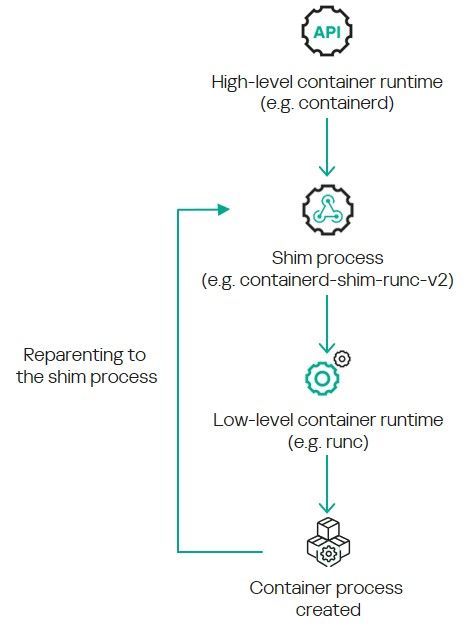
    In modern architectures, communication between high- and low-level container runtimes is proxied through a shim process. This allows containers to run independently of the high-level container runtime, ensuring the sustainability of the running container even if the high-level container runtime crashes or restarts. The shim process also manages the stdio of the container process so users can later attach to running containers via commands like docker exec -it , for example. The shim process can also redirect stdout and stderr to log files that users can later inspect either directly from the filesystem or via commands like kubectl logs -c .

    When a detached container is created using Docker CLI, the high-level container runtime, for example, containerd, executes a shim process that calls runc as a low-level container runtime for the sole purpose of creating the container in detached mode. After that, runc immediately exits. To avoid orphan processes or reparenting to the PID 1, as in the case when we executed runc ourselves, the shim process explicitly sets itself as a subreaper to adopt the container processes after runc exits. A Linux subreaper process is a designated parent that takes care of orphaned child processes in its chain (instead of init), allowing it to manage and clean up its entire process tree.

    Detached containers will be reparented to the shim process after creation

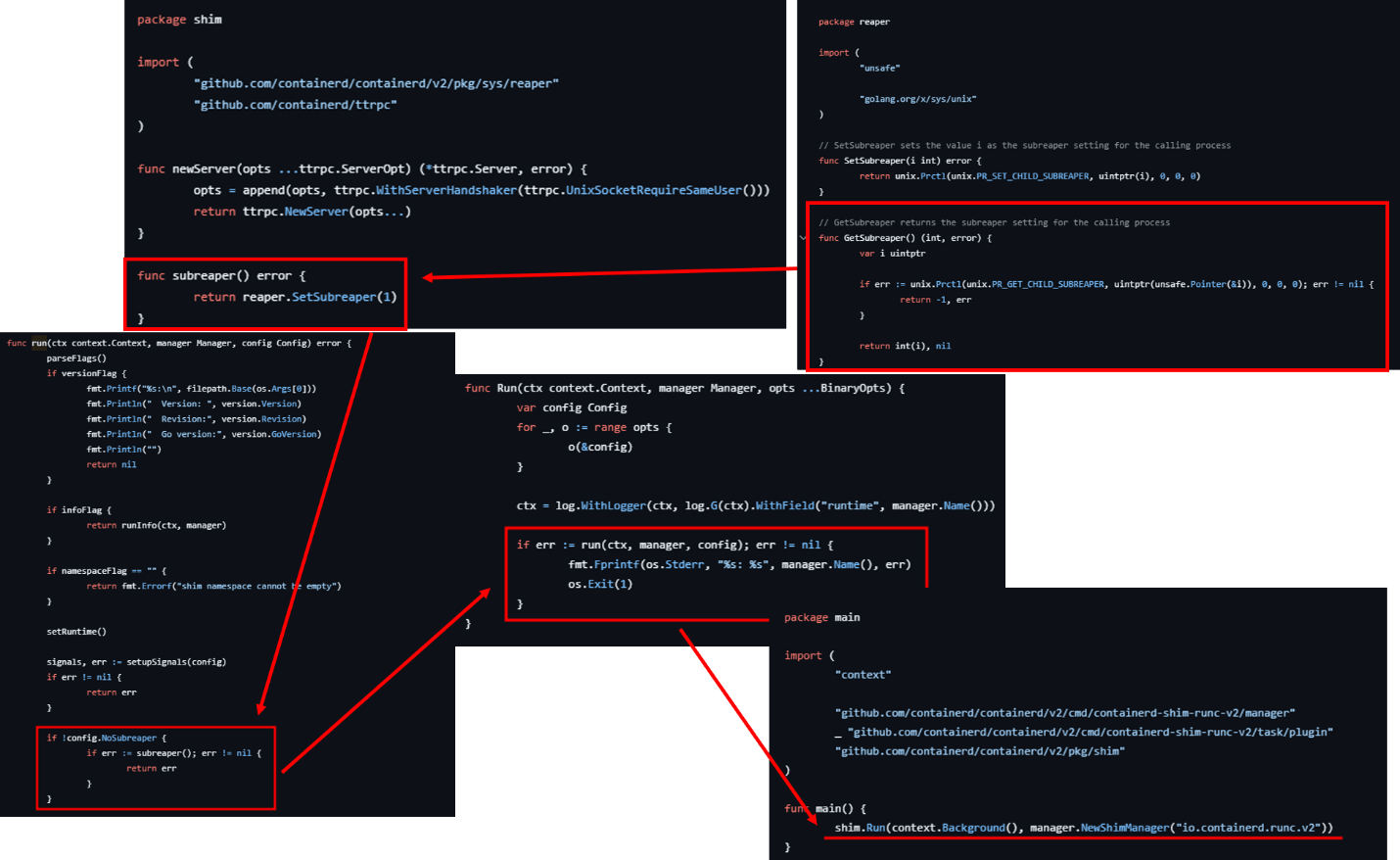
    This is implemented in the latest V2 shim and is the default in the modern containerd implementations.

    The shim process sets itself as a subreaper process during creation

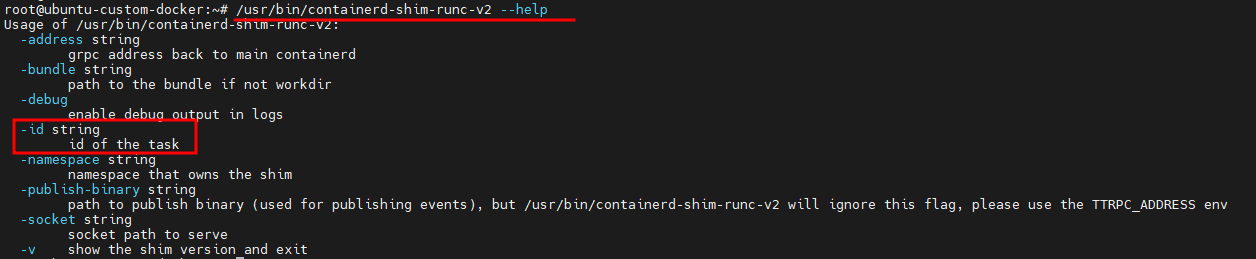
    When we check the help message of the containerd-shim-runc-v2 process, for example, we notice that it accepts the container ID as a command-line argument, and calls it the id of the task.

    Help message of the shim process

    We can confirm this by checking the command-line arguments of the running containerd-shim-runc-v2 processes and comparing them with the running containers.

    The shim process accepts the ID of the relevant container as a command-line argument

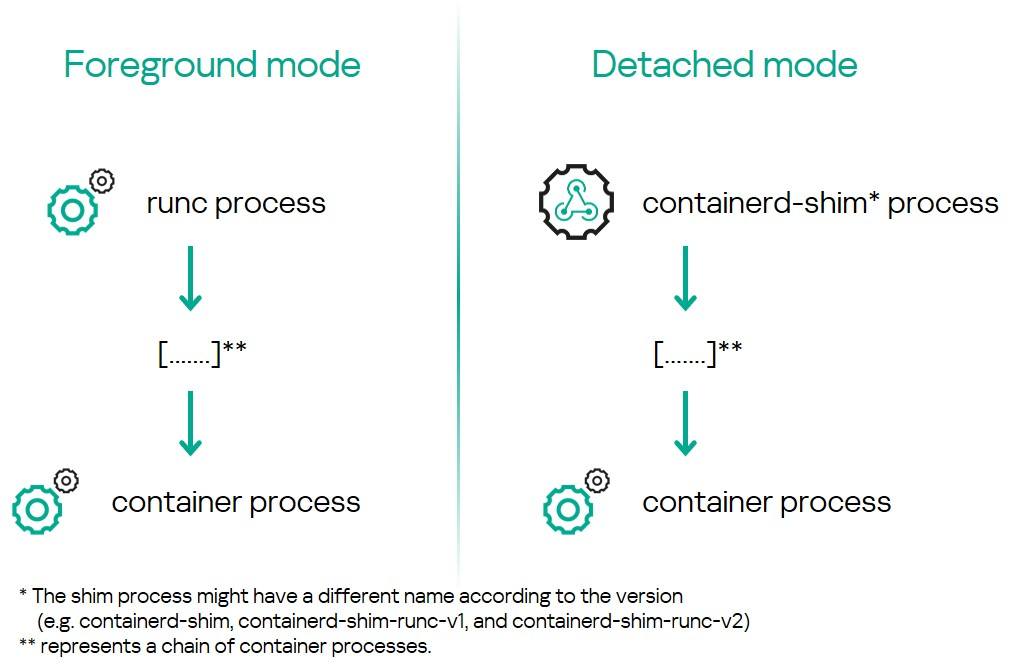
    So far, we’ve successfully identified container processes from the host’s perspective. In modern architectures, one of the following processes will typically be seen as a predecessor process for the containerized processes:

    • A shim process, in the case of detached mode; or
    • A runc process, in the case of foreground (interactive) mode.

    We can also use the command-line arguments of the shim process to determine which container the process belongs to.

    Process tree of the containers from the host perspective

    Although tracking the child processes of the shim process can sometimes lead to easy wins, it is often not as easy as it sounds, especially when there are a lot of subprocesses between the shim process and the malicious process. In this case, we can take a bottom-to-top approach, pivoting from the malicious process, tracking its parents all the way up to the shim process to confirm that it was executed inside a running container. It then becomes a matter of choosing the process whose behavior we may need to check for malicious or suspicious activities.

    Since containers typically run with minimal dependencies, attackers often rely on shell access to either execute commands directly, or install missing dependencies for their malware. This makes container shells a critical focus for detection. But how exactly do these shells behave? Let’s take a closer look at one of the key shell processes in containerized environments.

    How do BusyBox and Alpine execute commands?

    In this post, we focus on the behavior of BusyBox-based containers. We also included Alpine-based containers as an example of an image base that relies on BusyBox to implement many core Linux utilities, helping to keep the image lightweight. For the sake of demonstration, Alpine images that depend on other utilities are outside the scope of this post.

    BusyBox provides minimalist replacements for many commonly used UNIX utilities, combining them into one small executable. This allows for the creation of lightweight containers with significantly reduced image sizes. But how does the BusyBox executable actually work?

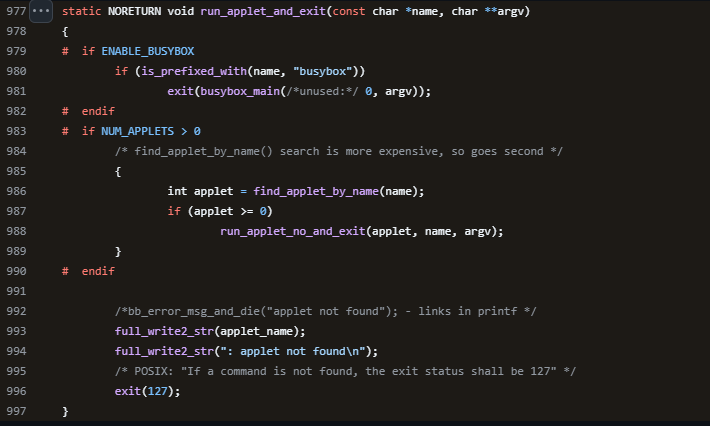
    BusyBox has its own implementation of system utilities, known as applets. Each applet is written in C and stored in the busybox/coreutils/ directory as part of the source code. For example, the UNIX cat utility has a custom implementation named cat.c. At runtime, BusyBox creates an applet table that maps applet names to their corresponding functions. This table is used to determine which applet to execute based on the command-line argument provided. This mechanism is defined in the appletlib.c file.

    Snippet of the appletlib.c file

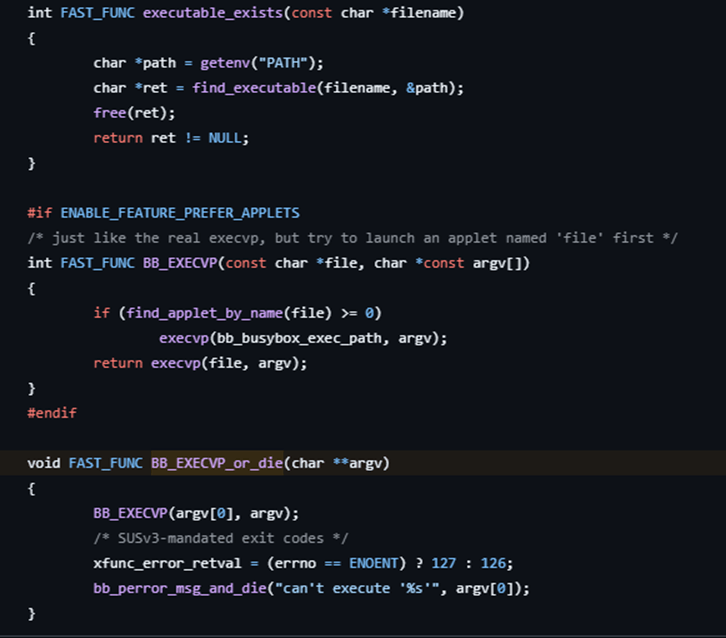
    When an executed command calls an installed utility that is not a default applet, BusyBox relies on the PATH environment variable to determine the utility’s location. Once the path is identified, BusyBox spawns the utility as a child process of the BusyBox process itself. This dynamic execution mechanism is critical to understanding how command execution works within a BusyBox-based container.

    Applet/program execution logic

    Now that we have a clear understanding of how the BusyBox binary operates, let’s explore how it functions when running inside a container. What happens, for example, when you execute the sh command inside such containers?

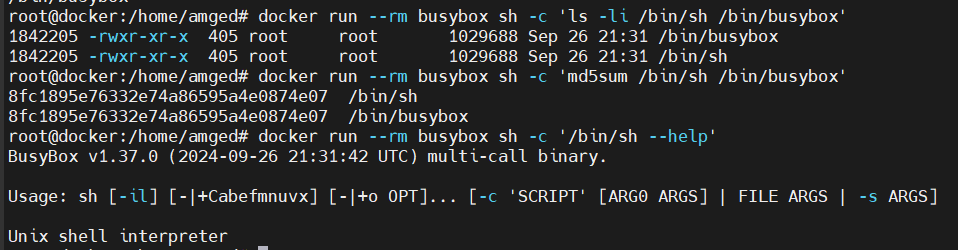
    In both BusyBox and Alpine containers, executing the sh command to access the shell doesn’t actually invoke a standalone binary called sh. Instead, the BusyBox binary itself is executed. In BusyBox containers we can verify that /bin/sh is replaced by BusyBox by comparing the inodes of /bin/sh and /bin/busybox using ls -li and confirm that both have the same inode number. We can also print their MD5 hash to see that they are the same, and by executing /bin/sh --help, we’ll see that the banner of BusyBox is the one that’s printed.

    /bin/sh is replaced by the /bin/busybox on the BusyBox based containers

    On the other hand, in the Alpine containers, /bin/sh is a symbolic link to /bin/busybox. This means that when you run the sh command, it actually executes the BusyBox executable referred to by the symbolic link. This can be confirmed by executing readlink -f /bin/sh and observing the output.

    /bin/sh is a symbolic link to /bin/busybox in the Alpine-based containers

    Hence, inside BusyBox- or Alpine-based containers, all shell commands are either executed directly by the BusyBox process or are launched as child processes under the BusyBox process. These processes run within isolated namespaces on the host operating system, providing the necessary containerization while still utilizing the shared kernel of the host.

    From a threat hunting perspective, having a non-standard shell process for the host OS, like BusyBox in this case, should prompt further investigation. Why would a BusyBox shell process be running on a Debian or a RedHat OS? Combining this conclusion with the previous one allows us to confirm that the shell was executed inside a container when runc or shim is observed as the predecessor process to the BusyBox process. This knowledge can be applied not only to the BusyBox process but also to any other process executed inside a running container. This knowledge is crucial for effectively determining the origin of suspicious behavior while hunting for threats using the host execution logs.

    Some security tools, such as Kaspersky Container Security, are designed to monitor container activity and detect suspicious behavior. Others, such as Auditd, provide enriched logging at the kernel level based on preconfigured rules that capture system calls, file access, and user activity. However, these rules are often not optimized for containerized environments, further complicating the distinction between host and container activity.

    Investigation value

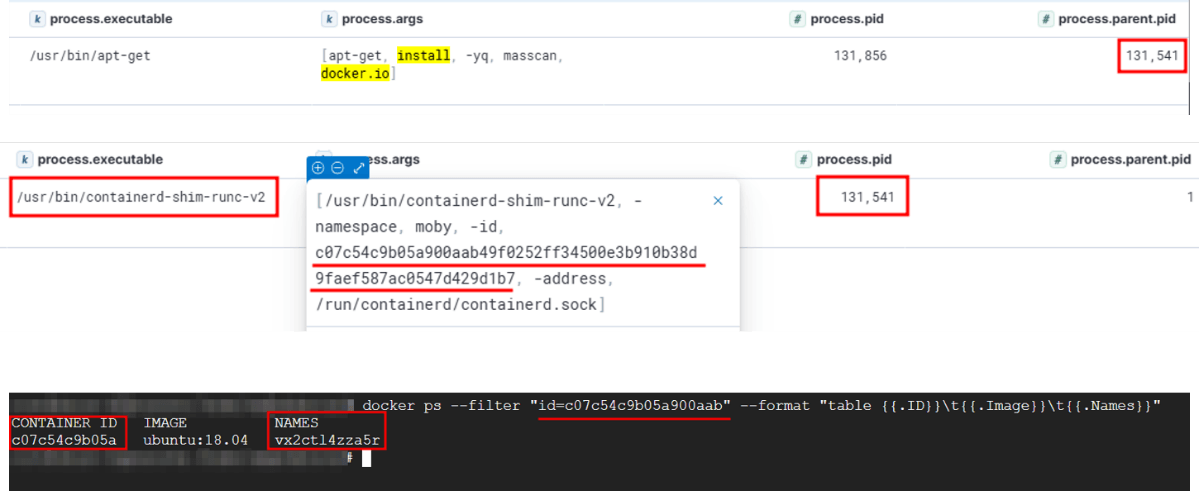
    While investigating execution logs, threat hunters and incident responders might overlook some activities on Linux machines, thinking they are part of normal operations. However, the same activities performed inside a running container should raise suspicion. For example, installing utilities such as Docker CLI may be normal on the host, but not inside a container. Recently, in a Compromise Assessment project, we discovered a crypto mining campaign in which the threat actor installed Docker CLI inside a running container in order to easily communicate with dockerd APIs.

    Confirming that the docker.io installation occurred inside a running container

    In this example, we detected the installation of Docker CLI inside a container by tracing the process chain. We then determined the origin of the executed command and confirmed the container in which the command was executed by checking the command-line argument of the shim process.

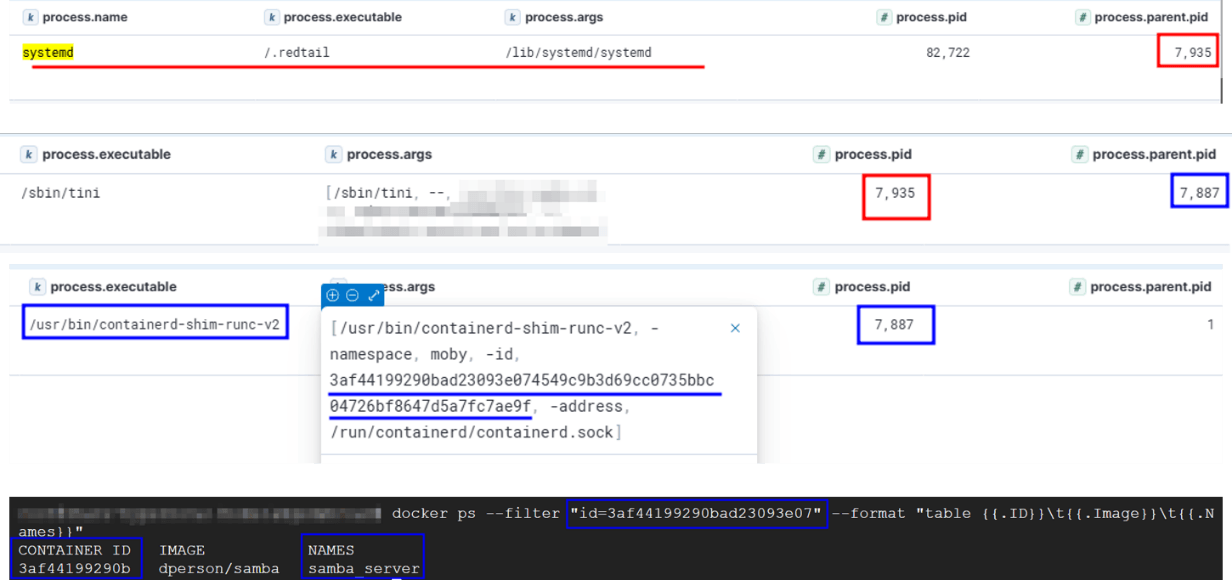
    During another investigation, we detected an interesting event where the process name was systemd while the process executable path was /.redtail. To identify the origin of this process, we followed the same procedure of tracking the parent processes.

    Determining the container in which the suspicious event occurred

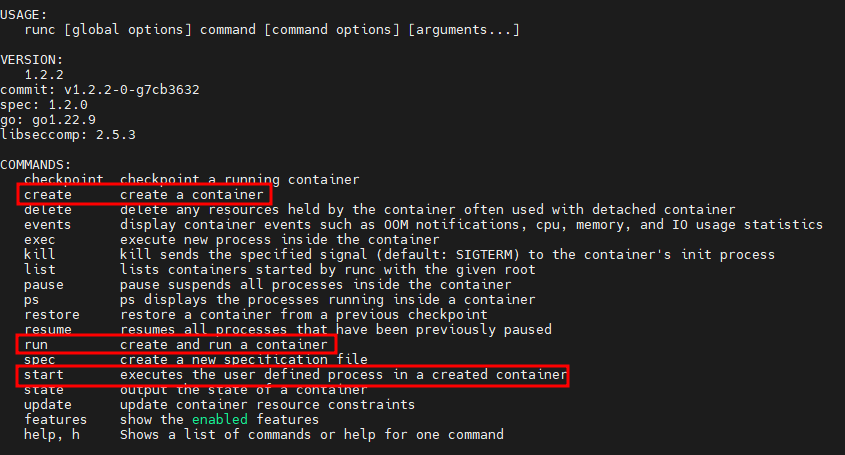
    Another interesting fact we can leverage is that a Docker container is always created by a runc process as the low-level container runtime. The runc help message reveals the command-line arguments used to create, run or start a container.

    runc help messate

    Monitoring these events helps threat hunters and incident responders identify the ID of the subject container and detect any abnormal entrypoints. A container’s entrypoint is its main process and it will be the process spawned by runc. The screenshot below shows an example of the creation of a malicious container detected by hunting for entrypoints with suspicious command-line arguments. In this case, the command line contains a malicious base64-encoded command.

    Hunting for suspicious container entrypoints

    Conclusion

    Containerized environments are now part of most organizations’ networks because of the deployment and dependency encapsulation feasibility they provide. However, they are usually overlooked by security teams and decision makers because of a common misunderstanding about container isolation. This results in undesirable situations when these containers are compromised, and the security team is not fully equipped with the knowledge or tools to help during response activities, or even to monitor or detect in the first place.

    The approach discussed in this post is one of the procedures that we typically follow in our Compromise Assessment and Incident Response services when we need to hunt for threats in historical host execution logs with container visibility issues. However, in order to detect container-based threats in time, it is crucial to protect your systems with a solid containerization monitoring solution, such as Kaspersky Container Security.

    MIL OSI Economics

  • MIL-OSI Russia: Pilot project to restrict access to phishing sites launches

    Translation. Region: Russian Federal

    Source: Government of the Russian Federation – An important disclaimer is at the bottom of this article.

    Document

    Order of May 31, 2025 No. 1403-r

    Starting June 4, 2025, Russia will begin implementing a pilot project to restrict access to phishing sites and applications that are created under the guise of official sites of government agencies and companies, and then used by fraudsters to steal passwords and other personal information of citizens. An order to this effect has been signed.

    The goal of the pilot is to create an effective mechanism for identifying and promptly blocking fake Internet resources and applications that may use a domain name very similar to the real one of a government agency, company or bank.

    The objectives of the pilot project include developing mechanisms for interaction between various government and non-government structures in identifying and blocking fraudulent websites and applications, as well as preparing proposals for the regulatory consolidation of such mechanisms.

    The participants of the pilot project from the state side will be the Ministry of Digital Development, the Ministry of Internal Affairs, the Federal Security Service, the Ministry of Culture, the Ministry of Finance, the Federal Tax Service, Rospatent, the Bank of Russia and the Prosecutor General’s Office. The project also involves the participation of the autonomous non-profit organization “Coordination Center for the National Domain of the Internet” and the research institute “Integral”.

    The pilot project is scheduled to be completed on March 1, 2026. Its implementation will provide new opportunities to protect citizens from fraudulent activities and enhance their security on the Internet.

    The work is being carried out within the framework of the federal project “Cybersecurity Infrastructure”, which is part of the new national project “Data Economy and Digital Transformation of the State”.

    Please note: This information is raw content directly from the source of the information. It is exactly what the source states and does not reflect the position of MIL-OSI or its clients.

    MIL OSI Russia News

  • MIL-OSI Africa: African Mining Week (AMW) 2025 to Host Invest in Angola’s Mining Sector Forum

    Source: Africa Press Organisation – English (2) – Report:

    CAPE TOWN, South Africa, June 3, 2025/APO Group/ —

    The African Mining Week (AMW) conference – Africa’s premier event for the mining sector, scheduled for October 1–3, 2025 in Cape Town – will feature a dedicated session titled Invest in Angola’s Mining Sector, sharing insight into the vast investment opportunities across the country’s mineral landscape. The session will showcase the immense, untapped potential of Angola’s diverse mineral resources, providing investors with strategic insights and actionable pathways to capitalize on this burgeoning market.

    Rich in a variety of minerals, including diamonds, copper, gold, lithium, rare earths and more, Angola offers significant growth opportunities for mining companies. As such, the Angolan session seeks to unlock these opportunities by connecting stakeholders under the broader event theme:  From Extraction to Beneficiation: Unlocking Africa’s Mineral Wealth.

    African Mining Week serves as a premier platform for exploring the full spectrum of mining opportunities across Africa. The event is held alongside the African Energy Week: Invest in African Energies 2025 conference from October 1-3 in Cape Town. Sponsors, exhibitors and delegates can learn more by contacting sales@energycapitalpower.com.

    In the diamond sector, the session will provide insight into strategic investment opportunities. A global leader in diamond production, Angola already presents a compelling investment case, backed by over 732 million carats of untapped diamond reserves valued at more than $140 billion. The country is pursuing both upstream expansion and downstream beneficiation. Key developments include a new pilot production and processing facility at Luachimba, launched by ENDIAMA – the national diamond company – and ongoing feasibility studies at the Xamacanda site. Global mining firm De Beers is also advancing exploration across eight new diamond project targets. AMW will link these promising projects with global investors and strategic partners, in line with Angola’s ambitions to leverage its diamond wealth for sustainable economic growth.

    Beyond diamonds, Angola is making substantial strides in its critical minerals sector as part of its long-term strategy to become a leading exporter of processed critical minerals – essential for the global energy transition. The government has identified 34 critical minerals, with key projects like Pensana’s Longonjo Rare Earth Project driving the market expansion. In March 2025, Pensana secured $268 million in funding to begin phase one of development. The project will enable Angola to supply 5% of the world’s high-grade rare earth carbonate, significantly boosting its role in the global rare earth sector. AMW will make a strong case for Angolan critical minerals, providing a platform where partners, investors and mining corporation can engage and sign deals.

    Meanwhile, AMW 2025 will bring together global stakeholders to explore Angola’s copper, lithium and manganese landscape. The country is advancing projects in these industries and new investment would fuel growth even further. China’s Shining Star is set to begin commercial production at its 40-million-ton Mavoio-Tetelo copper project in northern Angola in 2025, while Ivanhoe Mines is undertaking extensive copper exploration. Mining companies Tyranna Resources and ST New Materials are unlocking new frontiers in lithium and manganese, while Rio Tinto is exploring for base metals under an agreement signed in 2024. These efforts underscore increasing international interest in Angola’s critical mineral potential.

    MIL OSI Africa

  • MIL-OSI Russia: E. Musk’s Neuralink Completes Series E Funding Round

    Translation. Region: Russian Federal

    Source: People’s Republic of China in Russian –

    Source: People’s Republic of China – State Council News

    SAN FRANCISCO, June 3 (Xinhua) — Elon Musk’s brain-computer interface company Neuralink announced on Monday that it has closed a $650 million funding round.

    Investors participating in the Series E round included ARK Invest, Founders Fund, Sequoia Capital and Thrive Capital, the company said in a blog post.

    Neuralink last raised funds in a $280 million Series D funding round in 2023, with an additional $43 million tranche raised a few months later.

    The company said it had conducted additional human clinical trials, implanting its brain chips in five patients with severe paralysis.

    In May, Neuralink received a Breakthrough Devices Program from the Food and Drug Administration (FDA).

    According to the FDA, it is a voluntary program for certain medical devices and combination products that provide more effective treatment or diagnosis of life-threatening or irreversibly debilitating diseases or conditions.

    The goal of the program is to provide patients and health care providers with timely access to medical devices by accelerating their development, evaluation, and review for premarket approval. –0–

    MIL OSI Russia News

  • MIL-OSI: Grow Your IB and Affiliate Business with Axi at the 2025 Money Expo Colombia

    Source: GlobeNewswire (MIL-OSI)

    SYDNEY, June 03, 2025 (GLOBE NEWSWIRE) — Leading online FX and CFD broker Axi has announced that it will attend this year’s Money Expo Colombia, taking place June 25-26, 2025, in Bogota, Colombia.

    Event attendees will have the opportunity to explore how they can grow their IB and Affiliate business. “We invite all traders to visit our booth and connect with our team,” says Santiago Vazquez-Munoz, Regional Head for UK, Europe, and LATAM, before adding, “We look forward to showcasing how our exceptional partnership opportunities can help traders elevate their business. Attendees at the expo will also have access to exclusive deals available only during the event.” Furthermore, attendees will also have the opportunity to learn about Axi Select, Axi’s capital allocation program featuring zero registration or registration fees, capital funding up to $1,000,000 USD, the opportunity to earn up to 90% of the profits, and advanced tools to accelerate traders’ trading potential.

    Football enthusiasts can also visit Axi’s booth to get an inside look at the broker’s longstanding partnership with Manchester City, Premier League Champions. Manchester City memorabilia and the club’s mascots will be on-site for photo opportunities, and attendees will have the chance to win exciting prizes from the broker – including signed player shirts and other merchandise.

    The broker has a longstanding partnership with Manchester City FC, Girona FC, and Esporte Clube Bahia. In 2023, they also announced England international John Stones as their Brand Ambassador. In 2024, the broker was recognised with the ‘Innovator of the Year’ award at the Dubai Forex Expo, and was honoured by Finance Feeds with the titles of ‘Most Reliable Broker’, ‘Broker of the Year’ and ‘Most Innovative Proprietary Trading Firm’.

    Watch video : https://youtu.be/92qBSHsGHMM?si=0pdt_bV7sAdQVOsB

    About Axi

    Axi is a global online FX and CFD trading company, with thousands of customers in 100+ countries worldwide. Axi offers CFDs for several asset classes including Forex, Shares, Gold, Oil, Coffee, and more.

    For more information from Axi, please contact: mediaenquiries@axi.com

    The Axi Select program is only available to clients of AxiTrader Limited. CFDs carry a high risk of investment loss. In our dealings with you, we will act as a principal counterparty to all of your positions. This content is not available to AU, NZ, EU and UK residents. For more information, refer to our Terms of Service. Standard trading fees and minimum deposit apply.

    The MIL Network

  • MIL-OSI: Minimum income (minimumsudlodning) 2025

    Source: GlobeNewswire (MIL-OSI)

    Privately taxed investors in funds managed by Storebrand Asset Management AS are subject to minimum income tax (minimumsudlodning) for 2025.

    Investors who owned units in the equity funds below on 30 April 2025 (value date 2 May) will be taxed as follows:

    Fund name and share class Symbol SE-number Technical distribution pr unit in DKK (Aktieindkomst)
    SKAGEN Focus A NO0010735129 13 34 14 27 26,69
    SKAGEN Global A NO0008004009 13 34 12 65 0
    SKAGEN Kon-Tiki A NO0010140502 13 34 14 19 128,12
    SKAGEN Vekst A NO0008000445 13 34 12 57 240,19
    Storebrand Global Multifactor A5 NO0010841596 13 34 15 67 185,32
    Storebrand Global Plus A5 NO0010841604 13 34 17 10 0
    Storebrand Global Plus B5 NO0012882333 13 38 33 67 6,18
    Storebrand Global Plus C5 NO0012882341 13 37 68 24 0
    Storebrand Global Solutions A5 NO0010841612 13 34 16 64 98,89
    Storebrand Indeks – Alle Markeder A5 NO0010841588 13 34 16 21 38,77
    Storebrand Indeks – Alle Markeder B5 NO0012882101 13 37 67 27 21,48
    Storebrand Indeks – Alle Markeder C5 NO0012882119 13 37 67 51 21,37
    Storebrand Indeks – Nye Markeder A5 NO0010841570 13 34 16 56 48,36

    Note that the dividend is not paid out but remains in the fund.

    For tax purposes, the technical distribution (non-effective payment) should be added to the purchase price of original units. The amount is considered to have been acquired at the same time as the original units, and with a sum that corresponds to the technical distribution.

    Regards
    Storebrand Asset Management AS

    Contacts:

    Henrik Budde Gantzel, Director, henrik.budde.gantzel@storebrand.no
    Frode Aasen, Product Manager, fdc@storebrand.com

    Storebrand is Norway’s largest private asset manager with an AuM of around DKK 900 billion, and a leading Nordic provider of sustainable pensions and savings. The company has been a global pioneer in ESG investing for over 30 years, offering broad and scalable solutions for both institutional and private investors in the Nordic region and other European countries. In Denmark, Storebrand delivers sustainable investment solutions and client value through a multi-boutique platform, with the brands Storebrand Funds, SKAGEN Funds, Cubera Private Equity, Capital Investment and a majority ownership of AIP.

    The MIL Network

  • MIL-OSI Security: Troy Man Pleads Guilty to Possessing and Intending to Distribute Three Kilograms of Cocaine

    Source: Office of United States Attorneys

    ALBANY, NEW YORK – Daval Byrams, age 22, of Troy, New York, pled guilty today to possessing three kilograms of cocaine with the intent to distribute them.  United States Attorney John A. Sarcone III and Craig L. Tremaroli, Special Agent in Charge of the Albany Field Office of the Federal Bureau of Investigation (FBI), made the announcement.

    Byrams admitted that on March 11, 2025, he traveled from the Capital Region to New York City to pick up cocaine, and that when he returned home that evening, he was carrying a bag containing three one-kilogram bricks of cocaine.  Law enforcement arrested Byrams as he departed from a bus in Schenectady, New York. 

    United States Attorney John A. Sarcone III stated: “When a defendant traffics this volume of cocaine to the Northern District of New York, he should expect that my office and our law enforcement partners will find him, seize his drugs, and send him to prison.  It’s that simple.”

    FBI Special Agent in Charge Craig L. Tremaroli stated: “Narcotics trafficking continues to have a devastating impact on our local communities. The FBI will continue to work in concert with our partners on the Safe Streets Task Force to identify, investigate, and apprehend traffickers whose actions wreak havoc on our communities through the sale of illegal drugs.”

    At sentencing, Byrams faces at least 5 years and up to 40 years in prison, a fine of up to $5 million, and a term of supervised release of at least 4 years and up to life.  A defendant’s sentence is imposed by a judge based on the particular statute(s) the defendant is convicted of violating, the U.S. Sentencing Guidelines and other factors.

    The FBI and its Capital District Safe Streets Gang Task Force – which includes members of federal, state, and local law enforcement agencies – investigated the case, which Assistant U.S. Attorney Jonathan S. Reiner is prosecuting.

    MIL Security OSI

  • MIL-OSI Asia-Pac: BSMI Ensures Accuracy of Weighing Scales for Dragon Boat Festival

    Source: Republic of China Taiwan

    As the Dragon Boat Festival approaches, vibrant holiday shopping scenes are emerging across Taiwan. To ensure accurate weight measurements during transactions, the Bureau of Standards, Metrology and Inspection (BSMI) has completed a nationwide inspection of weighing scales used in markets ahead of the holiday. The results showed a 99.99% compliance rate, assuring consumers of a fair and reliable shopping experience during the festive season.

    The BSMI conducted targeted inspections at 168 locations, including traditional markets, supermarkets, and hypermarkets in various cities. A total of 6,976 weighing scales were examined, of which 6,975 passed and only one was found non-compliant. The non-compliant scale was immediately labeled “Suspended” and was subject to follow-up monitoring. Vendors using the failed scales face fines ranging from NT$15,000 to NT$75,000 under the “Weights and Measures Act” if they continue their use.

    The BSMI emphasized its commitment to ongoing vigilance by conducting year-round inspection projects to monitor the accuracy of weighing scales in transactions. Consumers are encouraged to report any scales that do not bear the verification mark (Picture as attachment file) or those they suspect of being inaccurate. Reports can be made by calling the BSMI at 02-23434567. Investigations will be carried out to protect the interests of both buyers and sellers, ensuring a fair and reliable marketplace.

    This initiative made by the BSMI not only safeguards consumer rights but also promotes trust and transparency in the market during this significant cultural celebration.

    Responsible Division: Metrology Technology Division
    Contact Person: Chen, Horng-Lin, Deputy Director
    Telephone No.: +886-2343-4567#5211
    Email: hl.chen@bsmi.gov.tw

    MIL OSI Asia Pacific News

  • MIL-Evening Report: The Queensland government is cancelling renewable energy projects. Can the state still reach net zero?

    Source: The Conversation (Au and NZ) – By Tony Wood, Program Director, Energy, Grattan Institute

    Johan Larson/Shutterstock

    On the surface, Queensland’s new government is doing exactly what it pledged before winning office in October – repealing the state’s ambitious renewable energy targets and cancelling a huge pumped hydro project near Mackay.

    But since the start of the year, the Crisafulli LNP government has gone further, and it’s less clear where it’s heading.

    Last week, the government abruptly cancelled the A$1 billion Moonlight Ridge wind farm proposal, citing insufficient consultation and a lack of community support.

    At the same time, the government announced it would open another 16,000 square kilometres of the state for gas exploration. The government is also planning to open new gas peaking plants and keep its coal plants open longer.

    So, is the Queensland government backsliding on renewables and climate change?

    The Crisafulli government is still committed to net zero by 2050. Because Queensland still owns its own transmission infrastructure and power plants, the state could shift to clean energy faster than other states. But at present, they don’t appear to be in a rush.

    Many solar farms have already been built in the Sunshine State.
    Lakeview Images/Shutterstock

    Slowdown under way

    Previous Labor governments in Queensland announced plans for large pumped hydro installations as a way to store energy to be available when intermittent wind and solar are not. The largest of these pumped hydro projects was the Pioneer-Burdekin proposal near Mackay, which the government has now canned.

    The Crisafulli government has also asked the Queensland Investment Corporation to examine the financial viability of two other major proposals, the Borumba pumped hydro scheme inland from the Sunshine Coast and the Copperstring transmission project linking Townsville and Mount Isa. This isn’t unusual – new governments often review projects announced by their predecessors.

    Another recent announcement is drawing stronger criticism, however. In April, the Crisafulli government announced plans to make sure large solar and wind farms have the social licence to operate. This, the government announced, would bring the “same rigorous approval processes as other major developments” to bear on renewables.

    If these plans become law, they are likely to make it substantially harder and slower to build large renewables projects.

    The cancellation of the Moonlight Ridge wind farm proposal is instructive. Of the 508 individuals who wrote in response to the development, only 142 were local. In his decision, planning minister Jarrod Bleijie noted: “the representations that I received evidence that the project has not acquired overriding community acceptance”.

    What’s being proposed looks messy. The peak body for renewables in Queensland is highly sceptical, while miners and farmers have also signalled concern.

    But while the Moonlight Ridge cancellation drew headlines, two other wind farm proposals have been approved after being asked to show they had consulted adequately.

    No is easy, yes is hard

    It’s easy to take office and reject the work of predecessors. It’s far harder to outline what will replace it.

    In contrast to other east coast states, Queensland has largely kept control of its sprawling electricity system. The government owns most large coal and gas power plants and all the transmission infrastructure.

    While the new government has indicated renewed support for private sector energy investment, it has provided support for government-owned corporations to develop new gas peaker plants. By contrast, there are very few proposals for new gas plants further south.

    In one sense, it’s no surprise Queensland’s new government has eased off on renewables. Its coal plants are relatively new, and largely owned by the government. This may reduce the urgency for developing a new energy plan, but only for a few years. Planning for a smooth energy transition is a major task, as demonstrated by southern states.

    The state has also profited hugely from gas exported from Gladstone. The government now receives around $1 billion from oil and gas royalties a year.

    Go-fast federally, go-slow at state?

    The thumping Labor majority at this year’s federal election means, at a national level, work on the clean energy transition will accelerate. But this transition is only possible if state and federal governments coordinate well.

    The responsibility for building and maintaining electricity systems in Australia largely falls to the states and territories. But managing large power grids on the east and west coasts requires national-level coordination.

    What the federal government can do, by and large, is set a goal and stump up the cash. As former Labor prime minister Paul Keating once quipped, “never get between a state premier and a bucket of money”.

    The federal government is running a funding program to support renewable generation and storage projects across the country. Three Queensland renewable projects have been approved under this program, including solar farms with battery storage.

    It’s hard to see the state government moving to block these projects.

    Where does this leave us?

    Queensland is signalling it’s not enthused about having an open gate for new renewable projects. Adding time consuming and expensive new consultation hurdles may cause prospective renewable developers to pack up and head south or west.

    Yet the policy’s strategic intent is unclear and is not necessarily against clean energy for the state. Many projects are already under way. The Crisafulli government has shown interest in smaller scale pumped hydro schemes as a way to store energy. And gas peaking plants will be a necessary evil in a high-renewables grid, acting like an emergency diesel generator for the rare periods without enough wind, sun or water.

    The big test will come later this year in the form of the state government’s five year energy plan. Will it deliver the investment to meet the net zero objective while maintaining affordable and reliable power? Right now, many in the clean energy industry are taking a wait-and-see attitude.

    Tony Wood may own shares through his superannuation in companies impacted by energy sector policies

    ref. The Queensland government is cancelling renewable energy projects. Can the state still reach net zero? – https://theconversation.com/the-queensland-government-is-cancelling-renewable-energy-projects-can-the-state-still-reach-net-zero-257958

    MIL OSI AnalysisEveningReport.nz

  • MIL-OSI Australia: Identity released in Bellerive investigation

    Source: New South Wales Community and Justice

    Identity released in Bellerive investigation

    Tuesday, 3 June 2025 – 4:35 pm.

    Police investigations are continuing into the death of a 45-year-old man whose body was found in an industrial-sized garbage bin at Bellerive.
    Officers from South East Criminal Investigation Branch have today returned to the Eastern Shore suburb and, in particular, the Percy Street area where the man’s body was found about 9am on Monday (June 2) at the rear of a business premises.
    Police, with the permission of the man’s family, have released his name – Luke Jon Telega – and a photograph of him in the hope members of the public will come forward with information as to his movements.
    “Mr Telega was last seen alive on Saturday night at 10pm, but there remains a gap in the timeline until the discovery of his body by a garbage contractor on Monday morning,” Detective Inspector David Gill said.
    “Detectives have today spoken with members of the public, conducted further door knocking of homes and businesses, and reviewed CCTV footage.
    “An autopsy was conducted earlier today and details of this will not be released to the public. However, police have confirmed there were no visible signs of injury.
    “Police continue to maintain an open mind and treat the death as a case of misadventure, or foul play, or a potential combination of both.”
    Anyone who may have seen Mr Telega in the Bellerive and greater Hobart area, especially on Sunday, June 1, or has information that can assist police is asked to contact 131 444.
    Information can also be supplied anonymously to Crime Stoppers on 1800 333 000 or online at crimestopperstas.com.au

    MIL OSI News

  • MIL-OSI: Konsolidator launches financial data warehouse – Built for finance, not IT

    Source: GlobeNewswire (MIL-OSI)

    Press release no. 3-2025
    Copenhagen, June 3, 2025

    Konsolidator launches financial data warehouse – Built for finance, not IT
    Today, Konsolidator announces the launch of its financial data warehouse, designed specifically for CFOs and finance teams. Built to tackle the data overload facing finance departments, the solution delivers structured, reliable data for reporting without relying on internal IT resources. Part of the product pillar from the company’s 2025–2027 “Resilient Growth” strategy, the data warehouse utilizes Konsolidator’s core expertise in financial reporting.

    A new foundation for financial data
    Konsolidator’s financial data warehouse taps into Konsolidator’s existing experience in financial reporting. The purpose of Konsolidator’s financial data warehouse is to give finance professionals a clean, structured view of their data, ready for reporting and decision-making. Finance teams today face a clear problem: too much data, from too many systems, and no clear way to use it. ERP systems, CRMs, spreadsheets, and planning tools provide complexity instead of insight.

    “It’s no longer about access to data—it’s about making sense of it. You need a solution built for finance, not developers,” says Lars Højer Paaske, Head of Product at Konsolidator.

    A solution for teams without the internal IT resources

    The financial data warehouse is designed for finance teams who want control over their data, without needing internal or external IT experts to build and maintain infrastructure. Fully integrated with Microsoft Fabric and Power BI, the solution enables advanced analytics, transaction-level transparency, and automated reporting workflows. Many companies lack the internal expertise to build or maintain a data warehouse. Konsolidator’s hosted solution has built-in governance, security, and compliance—so finance teams can focus on insight, not infrastructure.

    2025-2027 strategy: Broader product offerings

    The financial data warehouse is, together with the upcoming FP&A tool, part of Konsolidator’s broader “Build, Buy or Partner” approach. It is one of four strategic pillars of the Resilient Growth strategy and the first step in launching The Konsolidator Suite—our new platform approach that gives finance teams end-to-end control over their data, from consolidation to reporting, and fits into a more holistic view of finance digital ecosystems.

    We’re building solutions that make CFOs better with reliable data, not just in the monthly reporting, but to feed into the overall strategy.

    “This is the first step into something bigger,” says CEO Claus Finderup Grove. “We’re moving beyond ‘just being a consolidation product’ to become a central part of the entire finance department. We believe finance teams already have the right skills and data—they just need the right tools to use it.”

    Contacts

    About Konsolidator
    Konsolidator A/S is a financial consolidation software company whose primary objective is to make Group CFOs around the world better through automated financial consolidation and reporting in the cloud. Created by CFOs and auditors and powered by innovative technology, Konsolidator removes the complexity of financial consolidation and enables the CFO to save time and gain actionable insights based on key performance data to become a vital part of strategic decision-making. Konsolidator was listed on the Nasdaq First North Growth Market Denmark in 2019. Ticker Code: KONSOL

    Attachment

    The MIL Network

  • MIL-OSI USA: Smucker Votes in Favor of One Big Beautiful Bill

    Source: United States House of Representatives – Representative Lloyd Smucker (PA-16)

    WASHINGTON—Rep. Lloyd Smucker (PA-11) voted in favor of the One Big Beautiful Bill Act. It was approved in the House of Representatives by a vote of 215-214.

    “Last November, the American people gave President Trump and the Republican-led Congress a mandate for change. House Republicans today took a critical step to bring the transformative One Big Beautiful Bill closer to final passage. This bill will deliver for the American people by extending tax relief for hardworking families and small businesses, securing our border, unleashing American energy dominance, achieving peace through strength, and critically –making real, measurable reductions in federal spending. This bill secures more savings than any other reconciliation bill in American history – protecting families from both a historic tax hike and the hidden costs of unchecked federal borrowing. Passing this legislation will be a first step in righting our fiscal trajectory and I remain committed to the hard work ahead of addressing our $36 trillion and growing national debt,” said Rep. Lloyd Smucker (PA-11). 

    Click to watch Rep. Smucker’s comments in support of the measure: 

    BACKGROUND ON THE ONE BIG, BEAUTIFUL BILL ACT:

    Extending Tax Relief for Hardworking Families and Small Businesses, courtesy of the Committee on Ways and Means

    • Make permanent the lower tax rates and brackets for all taxpayers, the doubled guaranteed Standard Deduction, and the Child Tax Credit, preventing a $1,700 tax hike on PA-11 taxpayers providing for their families.
    • Increase the Child Tax Credit by $500 to combat Bidenflation.
    • Raise annual real wages by $2,100 to $3,300 per worker.
    • Increase real annual take-home pay for a median-income household with two children by roughly $4,000 to $5,000.
    • Provide tax relief for: overtime pay for hourly workers, cut taxes for tipped workers, and provide relief for seniors.
    • Expand and make permanent the 199A small business deduction to 23% – creating over 1 million new Main Street small business jobs and generating $750 billion in economic growth at American small businesses.
    • Protects family farms from the death tax that would threaten future generations of farmers. 

    Securing our Border

    • Makes significant investments in personnel, resources, and technology to maintain operational control of the border and enforce America’s immigration laws, building on President Trump’s administration’s immediate work to make America safer.
    • Hires 18,000 new personnel to enforce America’s immigration laws. 

    Unleashing American Energy Dominance 

    • Acts to ramp up American energy production including by cutting bureaucracy and streamlining permitting processes.
    • Ends wasteful spending and ineffective energy programs including those in the “Green New Deal.” 

    Achieving Peace Through Strength 

    • Invests in America’s arsenal to ensure our selfless servicemen and women continue to be the best equipped fighting force in the world ready to respond to any threat, including targeted investments in improving servicemember quality of life programs.
    • Expands naval capabilities, restocking of American munitions, supporting soldier readiness.
    • Defends America through the creation of a Golden Dome missile defense system and continued funding of nuclear deterrence programs. 

    Reductions in Federal Spending

    • Changes the way that Washington operates, delivering real reductions in federal spending—nearly $1.7 trillion in estimated mandatory savings.
    • Saves hundreds of billions through repeal of provisions in the so-called “Inflation Reduction Act” passed during the Biden administration.

    Preserving And Protecting Critical Safety Net Programs and Encouraging Personal Accountability

    • Preserves critical programs like Medicaid for those truly in need.
    • Roots out waste, fraud, and abuse of federal safety net programs to ensure they remain accessible to those in need.
    • Implements and strengthens common sense work requirements for Medicaid and SNAP, ensuring that able bodied unemployed individuals contribute or make efforts to better themselves.
    • Ensures states cannot support illegal immigrants through Medicaid.

    This legislation is fiscally responsible: 

    • The $4.12 trillion estimated cost of the legislation is more than fully offset by:
      • Nearly $1.7 trillion in estimated mandatory savings, slowing the rate of growth of future spending.
      • $2.6 trillion in expected revenue resulting from a growing economy.  

    According to the White House Council of Economic Advisors, the legislation will: 

    • Boost the level of short-run real GDP by 3.3 to 3.8 percent and long-run real GDP by 2.6 to 3.2 percent.
    • Raise annual real wages by $2,100 to $3,300 per worker.
    • Increase real annual take-home pay for a median-income household with two children by roughly $4,000 to $5,000.
    • Save over 4 million full-time equivalent jobs from being destroyed.
    • Facilitate $100 billion of investment in distressed communities.

    The legislation contains provisions authored by Rep. Smucker, including: 

    • Permanent Tax Relief and Certainty for Small Businesses: Permanently increasing and enhancing the small business tax deduction, known as Section 199A of the tax code. Smucker’s Main Street Tax Certainty Act has the support of 187 Members of the House and the legislation has broad support among stakeholders in PA-11 and across the nation.  
       
    • Expanded Support for Individuals with Disabilities Using ABLE Accounts: Smucker’s bipartisan ENABLE Act to allow individuals with disabilities and their families to save and invest in tax-advantaged accounts without jeopardizing their eligibility for essential federal support programs like Medicaid and Supplemental Security Income, is included making these tax provisions permanent. 
       
    • Improved Access to Primary Care: The Ways and Means Committee’s proposals include Smucker’s Primary Care Enhancement Act, which would clarify provisions of the Internal Revenue Code to remove barriers for individuals with Health Savings Accounts from using those funds to access Direct Primary Care, a health care delivery model which provides high-quality care at lower cost for individuals of all ages and incomes across America.

    # # # 

    MIL OSI USA News

  • MIL-OSI New Zealand: Investigation launched, man charged in relation to death of man, Tokoroa

    Source: New Zealand Police

    Please attribute to Taupo Area Investigations Manager, Detective Senior Sergeant Ryan Yardley:

    Police have launched a homicide investigation, and a man has been charged with murder, after a man seriously injured in Tokoroa last week has now died.

    Officers were called to an Abercorn Place address about 4:15am on Tuesday 27 May, to reports that a man had been injured by a male known to him outside his house.

    The man was rushed to Waikato Hospital in critical condition, but has since passed away.

    A 21-year-old man has been arrested and charged with murder. He is next due to appear in the High Court at Rotorua on 27 June.

    Police are still working to establish the full sequence of events that led to the man’s death, and we’d like to hear from anyone who witnessed anything, or has any information that might help our investigation.

    We’d also like to see any dashcam or CCTV footage anyone may have from around the time in question.

    If you can help, please use our 105 service, quoting reference number 250527/7868.

    You can also give information anonymously through Crime Stoppers on 0800 555 111.

    ENDS

    Issued by Police Media Centre

    MIL OSI New Zealand News

  • MIL-OSI: Soitec and PSMC collaborate on ultra-thin TLT technology for nm-scale 3D stacking

    Source: GlobeNewswire (MIL-OSI)

    Soitec and PSMC collaborate on ultra-thin TLT technology for nm-scale 3D stacking

    Bernin (France), June 3, 2025 – Soitec (Euronext – Tech Leaders), a world leader in the design and production of innovative semiconductor materials, today announced a strategic collaboration with Powerchip Semiconductor Manufacturing Corporation (PSMC).

    Under the collaboration, Soitec will supply PSMC 300mm substrates incorporating a release layer, Transistor Layer Transfer (TLT) ready, to support a new demonstration of advanced 3D chip stacking at the wafer level. This marks the first public announcement of Soitec’s TLT technology.

    The technology is an enabler for next-generation semiconductor designs that allow for more powerful, compact and energy-efficient chips – with potential applications ranging from smartphones, tablets and AI devices to autonomous driving systems.

    Soitec’s Chief Technology Officer and Senior EVP Innovation, Christophe Maleville said: “At Soitec we are proud to pioneer semiconductor materials that unlock new possibilities in chip design and performance. Our collaboration with PSMC reflects a shared commitment to pushing the boundaries of 3D integration and supporting the global shift toward more efficient and compact computing architectures. Together we are laying the groundwork for the next generation of semiconductor innovation.”

    PSMC Chief Technology Officer SZ Chang said: “With our longstanding presence in memory and logic foundry, PSMC consistently drives advancements in 3D stacking. In the two-year collaboration, PSMC has demonstrated an innovative wafer-stack integrated process by leveraging Soitec’s advanced substrate technology. The innovation significantly broadens the 3D technology from chip-level stacking – optimizing power performance in computing architecture, to transistor-level stacking – extending Moore’s law, with a remarkable reduction in stacking wafer thickness from micrometer to nanometer level. This achievement, by pushing the boundaries of 3D stacking, reaffirms our position at the forefront of the semiconductor industry.”

    To meet growing industry demand for faster and more energy-efficient chips, Soitec has developed a new substrate stack enabling high-speed transfer of ultra-thin transistor layers onto different types of wafers—a key requirement in heterogeneous integration, where diverse chip components are combined in a single package.

    The stacking process enables multiple transistor layers to be built vertically to support 3D transistor architectures including vertical field-effect transistors (FETs) with backside power delivery networks (PDNs).

    This TLT substrate leverages Smart Cut™ technology together with infrared (IR) laser release processing. The proprietary Soitec technology enables the formation of an ultra-thin semiconductor layer, ranging from 5nm to 1µm in thickness, on top of the TLT substrate. Once devices are fabricated on the TLT wafer, the IR laser process facilitates the lift-off of the ultra-thin layer from the substrate to the target wafer, without introducing thermal stress or damaging the devices.

    The Soitec-PSMC collaboration builds on existing France-Taiwan cooperation initiatives in AI and other semiconductor-related domains.

    *****

    About Soitec

    Soitec (Euronext – Tech Leaders), a world leader in innovative semiconductor materials, has been developing cutting-edge products delivering both technological performance and energy efficiency for over 30 years. From its global headquarters in France, Soitec is expanding internationally with its unique solutions, and generated sales of 0.9 billion Euros in fiscal year 2024-2025. Soitec occupies a key position in the semiconductor value chain, serving three main strategic markets: Mobile Communications, Automotive and Industrial, and Edge and Cloud AI. The company relies on the talent and diversity of its 2,300 employees, representing 50 different nationalities, working at its sites in Europe, the United States and Asia. Soitec has registered over 4,000 patents.

    Soitec, SmartSiC™ and Smart Cut™ are registered trademarks of Soitec.

    For more information: https://www.soitec.com/en/ and follow us on LinkedIn and X: @Soitec_Official

    Media Relations: media@soitec.com

    Investor Relations: investors@soitec.com

    *****

    About Powerchip Semiconductor Manufacturing Corporation (PSMC)

    Powerchip Semiconductor Manufacturing Corporation (PSMC) is the world’s seventh-largest pure-play foundry, with four 12-inch and two 8-inch fabs in Taiwan, capable of producing over 2.1 million 12-inch equivalent wafers annually. Since its establishment in 1994, the company transitioned successfully from DRAM manufacturing to advanced foundry services for memory and logic chips. Ranked seventh in global semiconductor ESG evaluations, PSMC demonstrates strong governance and environmental commitment. In May 2024, PSMC’s new 12-inch fab in Taiwan’s Tongluo Science Park began operations with a planned capacity of 1.2 million wafers annually, using advanced 28nm and wafer stacking technologies.   

    For more information, visit https://www.powerchip.com/en-global

    Attachment

    The MIL Network

  • Markets open marginally lower; midcaps, smallcaps outperform

    Source: Government of India

    Source: Government of India (4)

    Indian equity benchmarks opened slightly lower on Tuesday amid ongoing consolidation, with heavyweight stocks like L&T and Bajaj Finance trading in the red.
     
    At 9:24 am, the BSE Sensex was down 152 points, or 0.19 per cent, at 81,221.39, while the NSE Nifty slipped 36.40 points, or 0.16 per cent, to 24,680.40.
     
    Despite the weak opening in frontline indices, broader markets witnessed buying interest. The Nifty Midcap 100 index gained 167.85 points, or 0.29 per cent, to reach 57,943.40, and the Nifty Smallcap 100 index was up by 107.85 points, or 0.60 per cent, at 18,202.05.
     
    Sectorally, gains were led by auto, PSU banks, pharma, metal, realty, and media stocks. On the other hand, financial services, FMCG, energy, and private bank sectors saw some pressure.
     
    Among the Sensex constituents, Tata Steel, Mahindra & Mahindra, IndusInd Bank, Tata Motors, Asian Paints, and Zomato emerged as top gainers. Meanwhile, L&T, Bajaj Finance, Bharti Airtel, Hindustan Unilever, ICICI Bank, Axis Bank, and Maruti Suzuki were among the major laggards.
     
    Most Asian markets traded higher, with Tokyo, Shanghai, Jakarta, and Hong Kong contributing to the regional gains.
     
    Analysts noted that the market is currently in a consolidation phase, where indices tend to trade within a defined range. “Buy on dips is the most suitable strategy in the current scenario,” said V.K. Vijayakumar, Chief Investment Strategist at Geojit Financial Services. “Amid global uncertainty related to geopolitics, tariffs, and trade, markets are likely to remain volatile.”
     
    On the technical front, Nifty is expected to find immediate support at 24,700, followed by 24,600 and 24,500 levels. Resistance is seen near 24,800, with further upside barriers at 24,900 and 25,000.
     
    In terms of institutional activity, foreign institutional investors (FIIs) continued to reduce their exposure for the second straight session on June 2, offloading equities worth ₹2,589 crore. In contrast, domestic institutional investors (DIIs) maintained their buying streak for the tenth day, investing ₹5,313 crore on the same day.
     
    -IANS
  • MIL-OSI Australia: Death following Somerset crash on 27 May

    Source: New South Wales Community and Justice

    Death following Somerset crash on 27 May

    Tuesday, 3 June 2025 – 3:00 pm.

    Sadly, police can confirm a 78-year-old woman has died following a crash at Somerset on 27 May.
    The woman was involved in a two-vehicle crash involving a Toyota Corolla hatch and a Ford F250 truck at the intersection of Wragg and Falmouth Streets.
    At the time of the crash, the woman was the driver of the Toyota Corolla, and was subsequently transported to the North West Regional Hospital.
    Our thoughts are with everyone affected by the crash.  
    A report will be prepared for the Coroner.
    Police are continuing to investigate the crash. Anyone with information or dash cam is asked to contact Western Crash Investigation Services on 131 444 and quote reference ESCAD 199-27052025 and OR776030. 
    Information can also be provided anonymously through Crime Stoppers Tasmania at crimestopperstas.com.au or on 1800 333 000. 

    MIL OSI News

  • MIL-OSI USA: NEW REPORT: Trump’s Mass Firings at NIOSH Spokane Research Lab Put Americans at Risk, Jeopardize Progress to Keep Workers Safe on the Job

    US Senate News:

    Source: United States Senator for Washington State Patty Murray

    ICYMI: Senator Murray Presses Secretary Kennedy on Decimation of NIOSH and Mass Firings at NIOSH Spokane Research Laboratory

    ***NEW REPORT with testimonials from Spokane employees HERE***

    Washington, D.C. — Today, U.S. Senator Patty Murray (D-WA), Vice Chair of the Senate Appropriations Committee, released a new report on how President Trump and Elon Musk’s decimation of the National Institute for Occupational Safety and Health (NIOSH) of the Centers for Disease Control and Prevention (CDC), including their effective shuttering of the NIOSH Spokane Research Laboratory, will jeopardize on-the-job safety for firefighters, miners, agricultural workers, commercial fishermen, in Washington state and across the country. The report details the work that was done at the NIOSH Spokane Research laboratory, the Spokane Mining Research Division in particular, and outlines how the Trump administration’s mass firings across NIOSH will jeopardize the pipeline to train the next generation of workplace safety and health professionals, including those studying at Gonzaga University in Spokane and University of Washington in Seattle. Senator Murray’s report features testimonials from Washington state residents, including employees at NIOSH who were recently fired through no fault of their own.

    The release of the report comes as the Trump administration’s large-scale reduction in force (RIF) for the U.S. Department of Health and Human Services (HHS), which includes NIOSH, has been put on hold by a U.S. District Court judge in San Francisco, who ruled that the administration violated separation of powers principles with its agency restructuring.

    “The Trump administration’s unfathomable decision to gut NIOSH and fire nearly every person at the Spokane Research Lab is a devastating and shortsighted move that puts workers everywhere at risk,” Senator Murray said upon releasing the report. “In Spokane alone, President Trump abruptly fired nearly a hundred people working to protect those in high-risk professions including mining, firefighting, health care and emergency medicine, and the maritime industry—bringing their research to a screeching halt and creating a ticking time bomb for disasters in the workplace.”

    “These thoughtless firings don’t just risk Americans’ health and safety in the workplace today, but threaten decades of progress toward preventing workplace hazards,” Senator Murray continued. Researchers in Spokane who have dedicated their careers to protecting workers across the country are being kicked to the curb because Donald Trump and his conspiracy theorist Health Secretary don’t have a clue what NIOSH does and don’t care to learn—no one should be treated like this. We need answers and accountability. I’m going to keep fighting to hold the Trump administration to account and shine a bright spotlight on how this administration is hurting people and communities like Spokane and forcing critical, lifesaving research to go to waste.”

    Senator Murray has been a leading voice in Congress against RFK Jr.’s destruction of HHS and America’s health infrastructure, raising the alarm over HHS’ unilateral reorganization plan and slamming the closure of the HHS Region 10 office in Seattle and the NIOSH Spokane Research Laboratory. Senator Murray has sent oversight letters and hosted numerous press conferences and events to lay out how the administration’s reckless gutting of HHS is risking Americans health and safety and will set our country back decades, and lifting up the voices of HHS employees who were fired for no reason and through no fault of their own.

    The full report is available HERE and below:

    Report: Mass Firings in Spokane and Beyond: How Gutting the National Institute for Occupational Safety and Health (NIOSH) Harms Workers

    This report is part of a series detailing the harm President Trump and Elon Musk’s reckless and devastating attacks on the federal workforce are causing on the ground in Washington state. The Trump administration’s mass firings and harmful actions have real consequences for Washington’s residents, their communities, and for the entire United States.

    This report focuses on the mass firings of employees at the National Institute for Occupational Safety and Health (NIOSH) of the Centers for Disease Control and Prevention (CDC), effectively shuttering the NIOSH Spokane Research Laboratory. These Reductions in Force (RIFs) will lead to increased health and safety risks for firefighters, miners, agricultural workers, commercial fishermen, and so many others. No one should have to worry about whether they will come home safe from their job or not come home at all – NIOSH is vital to keeping workers safe. 

    The National Institute for Occupational Safety and Health (NIOSH) is Dedicated to Keeping Workers Safe Across America

    NIOSH is the only government agency statutorily authorized to conduct workplace health and safety research. In April 2025, the U.S. Department of Health and Human Services (HHS) Secretary Robert F. Kennedy Jr. terminated about 900 of NIOSH’s approximately 1,100 employees, effectively shuttering the agency. Among these firings, the Trump administration eliminated 90 scientific positions at the Spokane Research Laboratory. In addition to NIOSH’s Spokane location, the agency also conducts research at campuses in Cincinnati, Ohio; Morgantown, West Virginia; and Pittsburgh, Pennsylvania. Due to recent outcry over these firings, the Trump administration has recently agreed to bring back around 300 NIOSH workers, but primarily in West Virginia and Ohio, leaving the Spokane Research Laboratory’s programming and research work shuttered.

    By firing and then only bringing back a small portion of NIOSH workers, and almost none from Spokane, the Trump administration is jeopardizing decades of progress in improving worker health and safety. Over the course of NIOSH’s history, worker deaths, injuries, and illnesses in America have gone down—on average, from about 38 worker deaths a day in 1970 to 15 a day in 2023, and from 10.9 incidents of worker injury and illness per 100 workers in 1972 to 2.4 per 100 in 2023. However, workplace hazards still kill and disable approximately 125,000 workers each year—5,190 from traumatic injuries and an estimated 120,000 from occupational diseases. Workplace injuries and illnesses cost businesses between $174 billion and $348 billion a year, which is still likely an underestimate given underreporting of workplace injuries.

    Kyle Zimmer, recently retired from International Union of Operating Engineers Local 478 and current Chair of the Mine Safety Health Research Advisory Committee stated, “Losing these researchers will result in the loss of safety for every worker in the United States. This research turns into standards that become guidelines that every safety professional uses throughout the country in every industry, from health care, to auto body shops, to mining and firefighting. Once your workforce really understands what you are doing, that is when you get results and changes in workplace safety culture.”

    NIOSH’s $362.8 million budget represents only 0.2% of the discretionary portion of the HHS budget. NIOSH’s lifesaving research has also saved more than $1 billion annually. For example, NIOSH research supporting improved protective equipment for firefighters is associated with an estimated $71 million in annual savings in medical and productivity losses.NIOSH work produces a tremendous return on investment, and the Trump administration’s firings have huge costs both for worker safety and the nation.

    Tristan Victoroff, a union steward and epidemiologist in the NIOSH Western States Divisions, pointed out: “The 900 people fired from NIOSH are scientists, mainly. We are industrial safety scientists, epidemiologists, engineers…. The goal is to work with industry to protect workers’ health and safety and find solutions to the problems. We do research and development. It’s not duplicative. [The Occupational Safety and Health Administration] doesn’t do this. They don’t have the capacity or the mandate. All of these cuts are supposedly to save costs. What costs are we going to tolerate? What are the costs of increased workers’ compensation claims? What are the costs of disabling injuries and chronic diseases from workplace exposures? What is the cost to a family of losing a parent to a workplace accident?”

    The NIOSH Spokane Research Laboratory is Critical to Keeping Workers Safe

    NIOSH was created by Congress to address and prevent work-related injury and illness and was created in the same statute that authorized the Occupational Safety and Health Administration (OSHA) in the Department of Labor. While OSHA sets and enforces safety standards, NIOSH is required to conduct or fund research, experiments, and demonstrations on occupational safety and health; produce criteria identifying toxic substances including setting exposure levels that are safe for various periods of employment, and publish annually a list of all known toxic substances and the concentrations at which such toxicity is known to occur; disseminate information about occupational safety to employers and employees; conduct education programs about occupational safety; and contract with state personnel to provide compliance assistance for employers.

    In Washington state, NIOSH conducts research to understand and promote safe job conditions and develop science-based products and interventions that support worker health, safety, and well-being, prevent future occupational injuries and deaths, and train new generations of health and safety professionals. This work is done through the Spokane Research Laboratory (which houses the Spokane Mining Research Division and the Western States Division) and the Region 10 Northwest Center for Occupational Health and Safety Education and Research Center.

    Tristan Victoroff, a union steward and epidemiologist in the NIOSH Western States Divisions, explained: “The NIOSH Spokane Research Laboratory in Washington State is the only NIOSH facility west of the Mississippi. Its two divisions— the Western States Division and the Spokane Mining Research Division — conduct safety research for natural resource industries across the western U.S. and Alaska, including commercial fishing, wildland firefighting, oil and gas extraction, and mining. They’re working directly with naval shipyards to assess exposures from new technology for corrosion control. They track commercial fishing deaths nationwide. They have major research efforts in high wall safety, rockfall and slope stability, and seismic monitoring using advanced fiber optic technology, to name just a few examples. This work is not duplicative, and it’s not wasteful. If we’re expanding domestic energy, mineral, and seafood production, we need to protect the people doing that work. These workers deserve to come home safe and be healthy enough to work again tomorrow. Cutting this research does not keep us competitive — it puts workers in danger.”

    The Spokane Mining Research Division Keeps Washington Miners Safe on the Job

    The Spokane Mining Research Division (SMRD) is part of the NIOSH Mining Program, which aims to eliminate mining fatalities and injuries. Since 1990, total injuries in mining have significantly decreased, reflecting safer practices industry-wide, strongly linked to NIOSH’s research and prevention programs. SMRD partners with labor, mining associations, equipment manufacturers, and mine operators to study worker health and safety problems in the field. Washington’s mining industry is vital to the state’s economy, supporting 18,845 jobs, directly and indirectly, and providing $4.07 billion in economic benefits to the state.

    SMRD also conducts laboratory research at the Spokane, WA facility, where highly specialized scientists in unique laboratories develop products and interventions that offer solutions to mining challenges.Scientists in Spokane have been doing innovative laboratory work to:

    • Simulate ground stresses to test rock samples to determine the strength of the environment and whether bolts, steel, mesh or shotcrete are needed to support the mining efforts and keep workers safe on the job.
    • Simulate mining conditions and tasks to study health effects, such as heat and stress;
    • Examine field samples to understand miners’ exposure to respiratory and other health hazards; and more.

    Dr. Art Miller, a research engineer who retired from SMRD after 34 years, explains: “No one else in the world is doing this time-sensitive, cutting-edge research that will make workers safer. We conduct research in a lot of different ways. Our lab is a unique environment of cutting-edge technology and brain power aimed at improving worker health and safety. Discontinuing our work would be a huge loss to the future health and safety of workers. Workplace safety is dynamic, and our work is never going to be done. NIOSH is small relative to the federal government but it’s a well-run entity. Why would we want to get rid of something like that?”

    Spokane Research Laboratory’s SMRD also runs the Miner Health Program, created in 2016 to collaborate with the mining community to improve workers’ physical and mental health.Prevention of opioid misuse is just one of many examples of the collaborative work being produced by the Miner Health Program. The mining industry has been hit particularly hard by drug overdoses. Work-related pain and injury increase workers’ chances of being prescribed an opioid and subsequent risks of worker prescription opioid misuse, long-term opioid use, and opioid use disorder (OUD). These overdoses and especially deaths related to opioid use have had a significant impact on mine workers, their families, and communities. This program is now archived on the CDC website, indicating that this program is no longer operating.

    In Fall 2024, Spokane’s SMRD experts launched a new guide, Implementing Effective Workplace Solutions to Prevent Opioid Use Disorder: A Resource Guide for the Mining Industry. This guide provides a model for planning and implementing prevention efforts to normalize conversations about OUD, reduce stigma, and break down barriers to treatment and recovery. Losing this Miner Health Program focused on preventing OUD will lead to increased overdoses and preventable deaths in the mining community.

    The impact of the Trump administration’s cuts to NIOSH are already being felt in the mining industry. NIOSH is the only federal agency that can test and supply approved and certified respirators and personal dust monitors to keep miners safe on the job. The Mine Safety and Health Administration (MSHA) at the U.S. Department of Labor announced a temporary enforcement pause of mine operators’ respiratory protection programs. Given that NIOSH’s National Personal Protective Technology Laboratory has been effectively eliminated, the “Lowering Miners’ Exposure to Respirable Crystalline Silica and Improving Respiratory Protection,” (“Silica Rule”), is now paused until at least August 2025.Without NIOSH, the Silica Rule cannot go into effect and workers will continue to be exposed to extremely harmful silica dust that results in the debilitating and often fatal condition of silicosis.

    These respirators are not just used in mining; they are used across industries. As explained by Tristan Victoroff, union steward and epidemiologist in the NIOSH Western States Divisions: “There will be no NIOSH-certified respirators, if there’s no NIOSH. NIOSH certifies all the respiratory protection equipment used in healthcare — and not just the N95 masks we’ve all become familiar with in recent years. That includes reusable respirators that filter oils and vapors… even supplied air systems. NIOSH is the only organization in the country equipped to perform all the required testing — more than 150 test procedures — to certify respirators that protect firefighters, miners, shipyard workers — anyone who needs respiratory protection on the job. In fact, any employer in general industry — from construction to manufacturing — if they have an OSHA-approved respiratory protection program, they must use NIOSH-certified equipment. Only NIOSH can certify that equipment to meet those standards. Rebuilding these labs somewhere else would take years, and there’s no guarantee we could replicate the expertise and facilities we currently have at NIOSH. NIOSH also monitors products on the market to spot counterfeits. Without that oversight, fake and substandard products will increasingly flood the market. That’s not theoretical. NIOSH recently found that every counterfeit product it purchased off the open market failed to meet established standards. These products were not fully protective. Workers using those products on the job could be exposed to dangerous particulates or chemicals. If these labs shut down, it will put workers at risk and stifle innovation in protective technology. Workers won’t know which products they can trust. The NIOSH certification is essential.”

    The Western States Division of NIOSH Conducts Critical Research Focusing on Hazards in the Western States

    Workers in the Western U.S. face hazards and issues unique to their industries and environment, including commercial fishing, agriculture, and firefighting. Many of these occupations include climate extremes, working at altitude, long distance commutes, remote locations, and wildland forest fires. NIOSH’s Western States Division (WSD)employs a diverse group of public health and safety scientists with expertise in industrial hygiene, epidemiology, engineering, occupational medicine and health communication, working together to reduce and eliminate workplace injuries, illnesses, and fatalities. WSD is headquartered at the Spokane Research Laboratory, but also has staff at offices in Denver, Colorado, and Anchorage, Alaska. WSD in Spokane focused on health and safety research for several industries, including commercial fishing, firefighting and wildfires, maritime, and emergency medical services.

    Commercial Fishing. NIOSH’s work has decreased the number of fatalities in the commercial fishing industry in Washington, which is recognized as one of the most hazardous work settings. Many operations are characterized by strenuous labor, long work hours, harsh weather, and moving decks with hazardous machinery and equipment. This industry generates nearly $46 billion and more than 170,000 jobs. The annual number of fatalities has declined over the past two decades because of the prevention work carried out by NIOSH.For 30 years, WSD has operated the Commercial Fishing Safety Program, working in Washington, Oregon, Alaska, and the Gulf Coast in Southeastern states to keep fishermen safe from vessel disasters, falls overboard, onboard hazards, and more. WSD operates maintains the Commercial Fishing Incident Database, which tracks commercial fishing fatalities and provides statistics by region, fishery, type of vessel, and type of incident.This is the only national source for details of commercial fishing fatalities; neither the Bureau of Labor Statistics nor the U.S. Coast Guard report this type of information. Collecting this data is crucial for reducing the number of injuries and fatalities among the nation’s fishermen. Through NIOSH-funded research, WSD has developed solutions to prevent winch entanglements on commercial fishing boats, reducing loss of limb accidents. This critical research has come to a standstill with the Administration putting these scientists on administrative leave and scheduling them to be fired as of June 2, 2025.

    Outdoor Workers and Wildfires. Washington is one of the five states with the highest average annual burned acreage in the U.S., and the state is home to over 8,500 firefighters. Washington’s firefightersput themselves at enormous risk to keep Washington residents safe. Wildfire smoke is also dangerous to outdoor workers like the state’s 8,280 farmworkers whose jobs have been made safer through the work of NIOSH. For example, NIOSH scientists were instrumental in developing Washington’s Wildfire Smoke Rule, put in place January 15, 2024, which protects the health of workers who are exposed to the small particles contained in wildfire smoke. NIOSH recently developed a comprehensive hazard assessment on exposure to wildland fire smoke among outdoor workers. If NIOSH is eliminated, this document might never be finalized, and necessary revisions to the Washington Wildfire Smoke Rule may not happen, threatening firefighters, farmworkers, and other outdoor workers.

    NIOSH Provides Valuable Resources to Employers to Help Them Keep Workers Safe

    NIOSH’s Health Hazard Evaluation (HHE) Program has provided 11 technical assistance evaluations to businesses and industry in Washington over the last 20 years. The HHE program was established with the passage of the 1970 Occupational Safety and Health Act. The HHE program includes evaluations of occupational exposure to illicit drugs in toxicology laboratories, health effects in commercial airline employees associated with new, mandatory uniforms, transmission of tuberculosis to zoo employees working with Asian elephants, and respiratory effects following acute exposure to chlorine gas at a metal recycling facility. These evaluations and publications are at no cost to industry or the public, and recommendations from these reports are used to establish health and safety protocols throughout the state.

    WSD conducts research to evaluate toxic exposures associated with removal and application of marine coatings on vessels at the U.S. Navy’s Trident Retrofit Facility near Bangor, WA, and at the Puget Sound Naval Shipyard, as part of the Center for Maritime Safety and Health Studies. Moreover, WSD evaluates exposures from rehabilitation of hydroelectric turbines, such as the Little Goose Dam on the Snake River in Southeast Washington.A timely WSD project involves assessing mental and physical health issues in emergency medical service (EMS) responders in Tribal communities in the Puget Sound area. The Trump administration RIFs have effectively shut down each of these programs.

    NIOSH Trains the Next Generation of Occupational and Safety Health Professionals

    Congress passed the Occupational Safety and Health Act of 1970 to require funding for research, information, education, and training in the field of occupational safety and health. NIOSH funds 18 Education and Research Centers (ERCs), which provide high-quality interdisciplinary graduate and post-graduate training in occupational safety and health disciplines.The Northwest Center for Occupational Health and Safety Education and Research (NWCOHS) at the University of Washington is an ERC, housed in the Department of Environmental and Occupational Health Sciences, bringing together faculty from the UW Schools of Public Health, Nursing and Medicine. The program, funded continuously since 1977, has an annual budget of $1.8 million and serves four states (Washington, Alaska, Idaho, and Oregon), preparing students for careers in occupational medicine, nursing, health services research, industrial hygiene and more. Funding supports an average of 20 graduate students per year, and continuing education for an average of 1,000 occupational health and safety professionals per year.

    As Lawrence Sloan, Chief Executive Officer of the American Industrial Hygiene Association (AIHA), a membership organization for occupational and environmental health and safety professionals says, “NIOSH’s work is foundational in protecting American workers. Without adequate support for these programs, achieving the goal of a healthier American workforce will be challenging. Specifically, for AIHA, our members will be disadvantaged by the inability to leverage research on various worker populations to advance our understanding of the profession. Additionally, the absence of funding for Education & Research Centers (ERCs) will significantly impact our pipeline of future talent and hinder the funding of academic research studies that benefit the American worker.”

    NIOSH engineers have worked with Gonzaga University’s Mechanical Engineering Department to guide student senior design projects for the past 15 years. Many of these projects were entered into national American Society of Mechanical Engineers (ASME) competitions, with several teams winning awards and presenting at national ASME conventions. This collaboration has led to increased scientists seeking positions supporting mining safety and health, both in Spokane and around the country, creating a pipeline of the next generation of professionals ensuring workplace safety and health.

    NIOSH Protects Firefighters in Washington State and Nationwide

    As a nationally-based program, the NIOSH Center for Firefighter Safety, Health, and Well-Being supports all 50 states to protect firefighters and to identify and prevent new and emerging hazards in the fire service earlier and faster. NIOSH-funded research has:

    1. Increased our understanding of the 200-plus carcinogenic chemicals involved in byproducts of combustion, leading to better respiratory protection standards;
    2. Identified the presence of PFAS, or per- and polyfluoroalkyl substances, known as “forever chemicals,” in firefighter foam and turnout gear and how these impact cancer risk levels;
    3. Created and provided for continuous enrollment in the National Firefighter Registry for Cancer, the largest effort ever undertaken to understand and reduce the risk of cancer among U.S. firefighters; and
    4. Provided for the development of the Firefighter Fatality Investigation and Prevention Program, which conducts independent investigations of firefighter line-of-duty deaths and recommends prevention methods.

    After being shutdown in April 2025, the registration portal of the National Firefighter Registry for Cancer is now operational, following the questioning of HHS Secretary Kennedy by members of the Senate Health, Education, Labor and Pension Committee on May 14, 2025.

    Spokane Firefighters Union Local 29 is very worried about the cuts to NIOSH and has called for the continuation of NIOSH-funded research, specifically the study on how high heat affects firefighters’ cognitive abilities, using the highly technical and sophisticated labs in the SMRD. Much of this research is conducted in partnership with Washington State University, where researchers have expertise in the impacts of sleep, fatigue, circadian rhythm, and heat on the ability to be safe at work. These grants to WSU were some of the first to be terminated by HHS.

    Conclusion: The Time is Now to Return NIOSH Spokane Scientists to their Jobs

    NIOSH Spokane Research Laboratory scientists were set to be fired on June 2, 2025, but on May 22, 2025, a U.S. District Court judge ordered a preliminary injunction prohibiting the Trump administration from carrying out its RIFs. However, if the RIFs legally continue, President Trump and HHS Secretary Kennedy will eliminate the NIOSH Spokane office. Without the Congressionally-mandated occupational health and safety research conducted by NIOSH scientists, Washington workers, as well as workers across the country, in commercial fishing, mining, firefighting, manufacturing, and other industries will experience preventable and potentially fatal injuries. Through NIOSH-funded research, Spokane Research Laboratory scientists promote evidence-based safety protocols that are implemented through strong industry collaborations that create productive workplaces that contribute to Washington’s and America’s economic prosperity. President Trump and HHS Secretary Kennedy need to bring back the Spokane Research Laboratory scientists now and fully fund NIOSH research to maintain the promise of healthier and safer workplaces, communities, and families.


    MIL OSI USA News

  • MIL-OSI USA: Gov. Pillen Address to Lawmakers: Positive, Lasting Impact Serves Nebraskans Well

    Source: US State of Nebraska

    . Pillen Address to Lawmakers:  

    Positive, Lasting Impact Serves Nebraskans Well

    LINCOLN, NE – Today, Governor Jim Pillen shared with members of the 109th Nebraska Legislature the headline he felt best summarized this session: Positive, lasting impact serves Nebraskans well. During his sine die, or end-of-session address, the Governor hit on multiple areas of achievement, including passage of the overwhelming majority of his own priority bills.

    On two occasions during his speech, Gov. Pillen gave recognition to special guests in attendance. Members of the Nebraska State Patrol, friends of Trooper Kyle McAcy, were applauded for their service to the state. They were on scene the day Trooper McAcy died while assisting motorists in a snowstorm.

    The second recognition was of WWII veteran Wayne Davy of Columbus. The former Marine was there to represent the many veterans who have been honored with special medallions as part of a program involving the Nebraska Department of Veterans Affairs (NDVA). Gov. Pillen has worked with the agency to present the medals to veterans, signifying the 80th anniversary since the end of the war.

    Below are some of the legislative highlights from the 2025 session including those that align with his four priority areas – kids, taxes, agriculture and values:

    Passage of one of the most historically conservative and fiscally responsible state budgets, accomplished by cutting wasteful spending and putting idle pillowcase money to work while also maintaining investments in education, property tax relief, and the safety of the state.

    Gov. Pillen signed the following bills into law that protect our kids from online distractions and harm and to give parents more control over kids’ use of social media.

    • LB140 – Requires public school boards to adopt policies for restricting cell phone use bell to bell

    • LB383 – Creates the Parental Rights in Social Media Act, requiring parental consent for creation of social media accounts for minors and establishes criminal penalties for AI-generated child pornography

    • LB504 – As part of the Age-Appropriate Online Design Code Act, online services are required to protect user data, implement design features that reduce harm resulting from compulsive use and it gives parents access to their child’s privacy and account settings 

    Gov. Pillen signed the following bill into law to review and recommend changes to Nebraska’s TEEOSA school funding formula to help keep property taxes under control.

    • LB303 – Creates the 18-member School Finance Review Commission, which will evaluate the current TEEOSA formula governing Nebraska school funding

    • LB261 – Increases property tax relief by $105 million in 2026 and $170 million in 2027

     Gov. Pillen signed the following bills into law designed to grow agriculture and the economy.

    • LB246 – Bans lab-grown meat from being manufactured, distributed, or sold in Nebraska
    • LB317 – Merges the Nebraska Department of Natural Resources with the Nebraska Department of Environment & Energy to create the Nebraska Department of Water, Energy and Environment
    • LB650 – Eliminates or adjusts sales tax exemptions and provides and changes sunset dates for a variety of tax incentives

    • LB526 – Preserves needed electrical service to homes, businesses and other Nebraska customers by establishing requirements for cryptocurrency mining operations 

    Gov. Pillen signed the following bills into law that defend conservative Nebraska values.

    • LB89 – The Stand With Women Act protects girls and women by prohibiting biological males from joining female sports teams
    • LB645 – Puts an additional $1,000 in teachers’ pockets annually, stabilizes contribution rates to the School Employees Retirement System and increases survivor benefits through the Nebraska State Patrol Retirement System
    • LB346 – “Cleans out the closets” by ending or reassigning the duties of over 40 different boards, commission, committees or councils

    • LB 644 – Creates the Foreign Adversary & Terrorist Agent Registration Act and the Crush Transnational Repression in Nebraska Act to establish registration and reporting requirements for certain foreign entities 

    In addition to the legislative achievements outlined above, Gov. Pillen made several new appointments to key state agencies including Department of Labor Commissioner Katie Thurber, Nebraska State Patrol Superintendent Bryan Waugh, and Department of Water, Energy and Environment Director Jesse Bradley.

    MIL OSI USA News

  • MIL-OSI USA: National Weather Service Partial Rehire Plan Isn’t Good Enough, Says Cantwell

    US Senate News:

    Source: United States Senator for Washington Maria Cantwell

    06.02.25

    National Weather Service Partial Rehire Plan Isn’t Good Enough, Says Cantwell

    NWS lost over 560 employees under Trump firings, creating unprecedented forecasting interruptions; today’s approval of 126 new hires represents less than 1/4 of that total; Months before the current crisis, Cantwell called for an exemption and accurately predicted the current situation

    WASHINGTON, D.C. – Today, U.S. Senator Maria Cantwell (D-WA), ranking member of the Senate Committee on Commerce, Science, and Transportation and senior member of the Senate Finance Committee, released this statement following the Trump administration’s announcement of a plan to partially undo the damage done by their indiscriminate firings, resignations, and attrition plaguing the National Weather Service (NWS) workforce.

    “The Trump Administration is trying to put a flimsy band-aid over their massive cut to the National Weather Service,” said Sen. Cantwell. “Hiring back less than a quarter of the people they fired isn’t good enough with hurricane and wildfire seasons bearing down. The administration should immediately end its hiring freeze for the National Weather Service, along with other critical safety roles throughout NOAA, including weather researchers and maritime professionals that weather forecasters and fisheries managers depend on.

    This dangerous decision to leave critical jobs unfilled comes as the National Interagency Fire Center, a partnership which includes NWS, released its Fire Maps for the next four months predicting above normal significant fire potential across the Northwest, and the National Weather Service predicts an above-normal hurricane season, which began yesterday.

    Just last Thursday, Sen. Cantwell sent a letter demanding that the Trump Administration immediately exempt the NWS from its current federal hiring freeze so that citizens and communities will not be left to fend for themselves without adequate warnings as both hurricane season and wildfire season rapidly approach.

    Today’s action by the administration lifted the hiring freeze on 126 positions across four roles – meteorologists, hydrologists, physical scientists, and electronic technicians. However, many other important roles remain subject to the freeze, including credentialed mariners needed to safety operate NOAA research vessels, weather scientists, and weather satellite technicians. NOAA vessels and satellites are crucial to maintaining forecast and weather infrastructure needed for meteorologists to issue quality and timely forecasts. These firings also impact our economy, with a number of commercial fishing surveys cancelled this year, including for Alaska pollock and salmon. Elimination of surveys will take catch from fishing families, which will result in job loss and increased cost for consumers that want access to high quality American seafood at their local markets and restaurants.

    Multiple recent reports have documented the impacts of the hiring freeze. The Washington Post reports that “Some…forecasting teams are so critically understaffed that the agency is offering to pay moving expenses for any staff willing to transfer to those offices, according to notices recently sent to employees…” And the New York Times found that “The National Weather Service is preparing for the probability that fewer forecast updates will be fine-tuned by specialists, among other cutbacks, because of ‘severe shortages’ of meteorologists and other employees, according to an internal agency document.” These reports make clear that action must be taken immediately to avoid a catastrophic gap in capacity in the face of a future storm or wildfire.

    In February, Sen. Cantwell sent Commerce Secretary Howard Lutnick a letter warning of the likelihood of this exact situation.

    MIL OSI USA News

  • MIL-OSI Security: Clovis CPA Sentenced to Prison for Stealing Over $800,000 from a Bank

    Source: Office of United States Attorneys

    Kenneth Gould, 69, formerly of Clovis, was sentenced to one year in prison for stealing more than $800,000 from a bank, Acting U.S. Attorney Michele Beckwith announced today.

    According to court records, Gould was a CPA and operated a payroll services company in Clovis. From October 2017 through March 2018, he initiated several fraudulent electronic payments from one of his clients’ accounts to his payroll company’s account at the bank. While the payments were pending, the bank credited significant portions of the funds to Gould’s account. Gould then quickly withdrew those funds in cashier’s checks. The bank later realized that there were insufficient funds to cover the payments, denied the payments, and attempted to recover its money. But it was too late. Approximately $830,000 of the credited funds was already gone.

    Gould gave the stolen money to the client from whose account he initiated the fraudulent payments because he had loaned that individual money and was hopeful that the individual would one day pay him back. The client then gambled the money away.

    This case was the product of an investigation by the Federal Bureau of Investigation. Assistant U.S. Attorney Joseph Barton prosecuted the case.

    MIL Security OSI

  • MIL-OSI Security: U.S. Marshals Extradite Austin Fugitive Intercepted by Foreign Officials in Panama

    Source: US Marshals Service

    Austin, TX – The U.S. Marshals, working with the Department of State, and Panamanian Officials received custody of a man who had been sought by the Austin Police Department on a warrant issued May 17, 2024, for aggravated kidnapping. 

    Brayan Estiven Rios, 29, Columbian national, was wanted by the Austin Police for a robbery that occurred July 19, 2022, in the 2500 block of Francisco Street. According to the affidavit, a victim reported to have been forced into a vehicle at gunpoint and was further instructed to withdraw a large sum of money from her bank account. 

    In April, the Lone Star Fugitive Task Force, Department of Justice – Office of International Affairs, and the Travis County District Attorney’s Office communicated with the International Criminal Police Organization (INTERPOL) to facilitate the extradition of Rios, who was intercepted by officials in Panama.

    On May 22, Panamanian officials handed Rios over to the USMS for extradition back to the United States. After arriving at the Austin Bergstrom International Airport, he was transported and booked into the Travis County Jail, where he will await further judicial proceedings. 

    The Department of Homeland Security filed an immigration detainer on Rios, who is a Columbian national and has no legal status in the United States. 

    The Justice Department’s Office of International Affairs worked with Panamanian authorities to secure the extradition of Rios.

    Members of the Lone Star Fugitive Task Force in Austin – 

    Austin Police Department-Tactical Intelligence Unit
    Round Rock, and San Marcos Police Department
    Caldwell, Hays, Travis, and Williamson County Sheriff’s Office
    Texas Attorney General’s Office
    Texas Department of Criminal Justice OIG
    Texas Department of Public Safety
    U.S. Immigration & Customs Enforcement
    U.S. DHS/Homeland Security Investigations

    MIL Security OSI

  • MIL-OSI Australia: Call for information – Vehicle fire – Alice Springs

    Source: Northern Territory Police and Fire Services

    Police are calling for information in relation to a vehicle fire that occurred in Alice Springs on Saturday evening.

    Around 8:20pm, the Joint Emergency Services Communication Centre received multiple reports of a vehicle fire on Barrett Drive. It is alleged that two females and a male were involved in an altercation before one of the females set the vehicle alight.

    NT Police and NT Fire and Rescue Service attended the scene and the fire was extinguished.

    The three allegedly involved in the altercation are assisting police with their enquiries.

    Investigations remain ongoing.

    Police urge anyone with information in relation to the incident to make contact on 131 444. Please quote reference number P25147814. Anonymous reports can be made through Crime Stoppers on 1800 333 000 or via https://crimestoppersnt.com.au/.

    MIL OSI News

  • MIL-OSI USA: Governor Polis Signs New Laws To Make Colorado Safer

    Source: US State of Colorado

    DENVER – Today, Governor Polis signed a number of new laws that will make Colorado safer and get tough on crime by investing in local law enforcement, supporting the families of fallen officers, and cracking down on gun theft. Before signing these new laws, Governor Polis addressed the terrorist attack in Boulder, applauding the first responders, brave bystanders and sending his thoughts to the victims and their families. 

    • SB25-310 – Proposition 130 Implementation, sponsored by Senators Kirkmeyer and Bridges, and Representatives Bird and Taggart
    • HB25-1062 – Penalty for Theft of Firearms, sponsored by Representative Armagost and Majority Leader Duran, and Senators Hinrichsen and Pelton
    • SB25-205 – Firearm Serial Number Check Request Procedure, sponsored by Senator Hinrichsen, and Representatives Espenoza and Lindstedt 

    “We continue working to make Colorado safer for everyone and I’m proud of the progress we’ve made this year. From investing in our local law enforcement and supporting the families of fallen officers, to cracking down on gun theft by increasing penalties and making it easier to identify stolen guns, and making it harder to sell stolen goods online. I appreciate the work of the legislators who continue to prioritize the safety of our communities, and look forward to implementing these new laws to support safety across our state,” said Governor Jared Polis. 

    Governor Polis also signed SB25-168 – Prevention of Wildlife Trafficking, sponsored by Senators Bright and Roberts, and Representatives Armagost and Espenoza.

    “Colorado is proud of the wild lands and animals here in our state, and this new law will help prevent wildlife trafficking by increasing the penalties for this illegal act. These wild animals are part of our identity, and we are taking further steps to ensure they stay in their natural habitats here in our great state,” said Governor Polis. 

    Governor Polis signed the following bills to protect transit workers, help young Coloradans leave the criminal justice system, and provide support for those experiencing mental health challenges. 

    • HB25-1146 – Juvenile Detention Bed Cap, sponsored by Representatives Bird and Woog, and Senators Kirkmeyer and Amabile
    • SB25-041 – Competency in Criminal Justice System Services & Bail, sponsored by Senators Michaelson Jenet and Amabile, and Representatives Bradfield and English 

    “These new laws take important steps to increase bed capacity to help young Coloradans get the support they need to get out of the criminal justice system and expand access to needed mental health supports. All of this work is so important to reducing crime, and I thank the bill sponsors for their efforts to make Colorado safer,” said Governor Jared Polis. 

    Governor Polis also signed the following bills administratively, all of which are focused on public safety: 

    “Making Colorado safer requires all of us working together and I was proud to sign these new laws to make Colorado safer from every angle. I thank all of the sponsors who worked on these bills for their commitment to increasing safety and security in our great state,” said Governor Jared Polis. 

    • SB25-288 – Intimate Digital Depictions Criminal & Civil Actions, sponsored by Majority Leader Rodriguez, and Representatives Titone and Soper
    • HB25-1250 – Gun Violence Prevention & Parents of Students, sponsored by Representative Hamrick, Majority Leader Duran, and Senator Cutter
    • SB25-079 – Colorado Vending of Digital Assets Act, sponsored by Senators Rich and Roberts, and Representatives Taggart and Jackson
    • SB25-281 – Increase Penalties Careless Driving, sponsored by Senators Carson and Snyder, and Representatives Espenoza and Armagost
    • SB25-146 – Fingerprint-Based Criminal History Record Checks, sponsored by Senators Rich and Michaelson Jenet, and Representatives Hartsook and Lukens
    • HB25-1098 – Automated Protection Order Victim Notification System, sponsored by Representatives Stewart and Soper, and Senators Michaelson Jenet and Gonzales
    • HB25-1183 – Colorimetric Field Drug Test Working Group, sponsored by Representatives Gilchrist and Bacon, and Senators Ball and Daugherty
    • SB25-273 – 14 Days Hospitals Retain Blood Draws for Investigations, sponsored by Senator Roberts, and Representatives Smith and Soper
    • HB25-1275 – Forensic Science Integrity, sponsored by Representatives Soper and Zokaie, and Senators Weissman and Frizell
    • SB25-034 – Voluntary Do-Not-Sell Firearms Waiver, sponsored by Senator Kipp and Representatives Boesenecker and Jackson.
    • SB25-189 – Require Jury to Determine Prior Convictions, sponsored by Senators Liston and Snyder, and Representatives Soper and Espenoza
    • SB25-187 – Sunset Motorcycle Operator Safety Training Program, sponsored by Senators Hinrichsen and Sullivan, and Representatives Martinez and Weinberg
    • HB25-1195 – First Responder Voter Registration Record Confidentiality, sponsored by Representatives Johnson and Martinez, and Senators Mullica and Baisley
    • HB25-1112 – Local Authorities Enforce Vehicle Registration sponsored by Representatives Titone and Hamrick, and Senators Exum and Frizell
    • HB25-1298 – Judicial Performance Commissions, sponsored by Representatives Carter and Richardson, and Senators Exum and Michaelson Jenet
    • HB25-1290 – Transit Worker Assault & Funding for Training, Sponsored by Representatives Lindstedt and Valdez, and Senators Mullica and Kirkmeyer 

    ###

    MIL OSI USA News

  • MIL-OSI USA: Rep. Stansbury Fights to Secure Millions for New Mexico

    Source: United States House of Representatives – Representative Melanie Stansbury (N.M.-01)

    $158.45 million in federal Community Project Funding (CPF) requests will support essential local projects

    WASHINGTON D.C. — As the U.S. House of Representatives begins marking up appropriations bills in the House this week, Representative Melanie Stansbury (NM-01) submitted 15 Congressionally funded community projects, totaling $158,450,000 for communities across New Mexico in the upcoming 2026 budget process. Since coming to office, Rep. Stansbury has secured CPF funding for 37 projects focused on tackling New Mexico’s biggest challenges in public safety, housing, healthcare, education, protecting our lands and waters, and investing in our future.   

    “I came to Congress to support the needs of New Mexico using every tool available,” said Rep. Melanie Stansbury (NM-01). “As the Administration targets funding and resources our communities depend on, Community Project Funding is one of the most powerful tools we have to deliver investments necessary to support lasting and generational change for communities across our state. These 15 projects will help deliver vital healthcare and behavioral health services in rural communities, help seniors and families experiencing homelessness, help tackle the fentanyl crisis and public safety issues, protect our cultural heritage, and deliver water to communities across the state.  I am proud to work with the state, local, and tribal leaders who are working every day to address these needs on the ground.” 

    After more than a decade, Congress resumed congressionally directed spending for community projects four years ago.  Since then, Rep. Stansbury has secured millions in funding for fire, emergency, and public safety services, housing and food assistance, healthcare and behavioral health programs, economic development, and youth and education programs across the state.  Past submissions for Fiscal Year 2022,Fiscal Year 2023, and Fiscal Year 2024 budgets are available online. Last year, Rep. Stansbury submitted $104 million in CPF requests to support New Mexico, but Republicans stripped FY25 Community Project Funding from their Continuing Resolution.

    This year Rep. Stansbury submitted 15 projects to the House Appropriations Committee for consideration, pending approval through the Congressional budget and appropriations process. Projects this year were restricted to a limited number of federal programs, and only state, local, and Tribal governments and eligible entities are permitted to receive funding. The House Appropriations Committee will consider these requests alongside other submissions as part of the FY 2026 appropriations process, which begins with Appropriations Committee markups this week.

    Once the Appropriations Committee approves projects, they will be subject to passage in both Chambers of Congress before being signed into law. This process will likely extend into fall, with the Fiscal Year 2016 beginning on October 1. 

    A summary of the 15 projects submitted by Rep Stansbury is provided below: 

    Investing in Public Safety Across the State 

    Lincoln County, Regional Wildfire Mitigation Public Safety and Training Complex – $3,000,000 
    Funding will support building a new Regional Public Safety and Training Center to help address wildfires and boost the region’s ability to hire, train, certify, and retain firefighters.

    Fort Sumner, Fire and Rescue Fire Station – $ 1,300,000  
    Funding will support building a new fire station in Fort Sumner to serve the community on the West side of the Pecos River, allowing timely emergency response and a new community hub in the Sunny Side subdivision.

    State Police Department, Technical Capabilities Improvements – $1,650,000  
    Funding will enable NM State Police to improve wireless and other technical capabilities statewide. This includes improving 5G technologies, cellular routers, and Automated License Plate Readers, increasing real-time situational awareness and allowing for more informed and rapid decision-making for first responders. 

    Albuquerque Police Department, Crime Scene Investigation (CSI) Mobile Lab Vehicle – $800,000  
    Funding will enable the City of Albuquerque to add a new CSI Mobile Lab vehicle to update its current fleet and help meet expanded public safety needs across the Albuquerque metro area. 

    Bernalillo County Sheriff’s Office, Public Safety Vehicles – $1,000,000  
    Funding will support BCSO’s replacement of an aging fleet of vehicles to enhance operations and reduce maintenance costs to meet public safety needs across the Bernalillo County area.   

    Addressing Rural Healthcare and Behavioral Health Needs 

    Valencia County, Acute Care Hospital – $8,000,000  
    Funding will support construction of a state-of-the-art acute care hospital in Los Lunas, designed to meet the healthcare needs of the growing rural communities of Valencia County. This hospital will be a critical lifeline for local residents increasing access to both emergency and inpatient care.  

    Sandoval County, Behavioral Health Clinic – $8,000,000  
    Funding will support the construction of a comprehensive behavioral health and resource center in the Town of Bernalillo, in partnership with a broad set of local, tribal, and county stakeholders to address community needs related to addiction, housing, mental health and family services. This center will serve a large number of rural and remote communities across Sandoval County, providing a first-of-its-kind regional hub for urgent and ongoing medical and behavioral health needs.  


    Addressing Homelessness, Housing Insecurity, and Supporting Vulnerable Families 

    Bernalillo County, Affordable Housing – $2,000,000  
    Funding will provide housing for low- and moderate-income families in Downtown Albuquerque and Bernalillo County. This project will provide safe and stable temporary housing for seniors and families in need of housing support.   

    Albuquerque, Transitional Housing for Families – $1,000,000  
    Funding will support the purchase and rehabilitation of transitional housing for vulnerable families experiencing crisis. This project will help families grow out of emergency and short-term shelters and into longer term housing while they continue to get back on their feet. 

    Albuquerque, Senior Stability Shelter – $1,700,000  
    Funding will support building a new permanent shelter for seniors who are experiencing homelessness and housing insecurity in Albuquerque. This project will provide safe and stable permanent housing in a vulnerable part of the city.   

    Protecting Our Water Infrastructure

    Middle Rio Grande Pueblos, Rio Grande Pueblo Irrigation Infrastructure – $82,700,000   
    Funding will provide long-overdue support for improving acequia and irrigation infrastructure for the six middle Rio Grande Pueblos and addressing deferred maintenance, repairs, and upgrades needed for improvements in agricultural irrigation on Pueblo lands.

    City of Santa Rosa, Drinking Water Pipelines Project – $4,000,000  
    Funding will support construction of a major project for improving drinking water supplies in the City of Santa Rosa and replacing aging infrastructure impacting drinking water pipelines.  

    Town of Bernalillo, Wastewater Project – $20,000,000  
    Funding will support the rehabilitation of the Town of Bernalillo’s aging wastewater treatment plant, extending the service life of its infrastructure and future growth in the community to protect water supplies.   

    Village of Corrales, Wastewater Treatment Facility – $20,000,000  
    Funding will help install a treatment facility and expand wastewater collection across the Village of Corrales to protect local groundwater from septic system contamination, conserve water resources by recycling treated wastewater, and supporting long-term sustainability.  

    Protecting our Cultural Heritage and Historic Buildings 

    Estancia and East Mountains, Estancia Town Hall Renovation – $3,300,000 
    Funding will support planning and capital improvement repairs of the historic Estancia Community Center. The community center serves as a vital hub, offering access to essential services, educational programs, and support for generations of New Mexicans. 

    ###

    MIL OSI USA News

  • MIL-OSI Security: Three Admit to Roles in Drug Trafficking Organization (DOJ)

    Source: United States Bureau of Alcohol Tobacco Firearms and Explosives (ATF)

    ARTINSBURG, WEST VIRGINIA – Three people have admitted to working in a large-scale drug operation in Berkeley and Jefferson Counties.  

    Juan Carlos Suarez-Lugo, age 55, of Martinsburg, West Virginia, and Alexis Alvarado, age 38, of Ranson, West Virginia, each pled guilty to conspiracy to possess with intent to distribute and to distribute 500 grams or more of cocaine. Mauricio Antonio Alvarado-Flores, age 38, a citizen of El Salvador, pled guilty to conspiracy to possess with intent to distribute and to distribute 500 grams or more of cocaine and illegal reentry.

    According to court documents and statements made in court, Suarez-Lugo, Alvarado, and Alvarado-Flores were working together and with others to sell drugs for the drug trafficking organization.

    Suarez-Lugo, Alvarado, and Alvarado-Flores each face at least five years and up to 40 years in federal prison for the drug charge. Alvarado-Flores faces up to two years in prison for the illegal reentry charge. A federal district court judge will determine any sentence after considering the U.S. Sentencing Guidelines and other statutory factors.

    Assistant U.S. Attorney Lara Omps-Botteicher is prosecuting the cases on behalf of the government.

    The Eastern Panhandle Drug Task Force was the lead investigative unit. Other investigative agencies that assisted include the Federal Bureau of Investigation, including the Pittsburgh, San Francisco, San Juan, and Philadelphia Field Offices; United States Marshals Service; Homeland Security Investigations; United States Postal Service; Drug Enforcement Administration, the Louisville and Chicago Divisions; Bureau of Alcohol, Tobacco, Firearms, and Explosives; West Virginia State Police; Martinsburg Police Department; Ranson Police Department; Charles Town Police Department; Berkeley County Sheriff’s Office; Jefferson County Sheriff’s Office; West Virginia Air National Guard; Mineral County Sheriff’s Office; Grant County Sheriff’s Office; Hampshire County Sheriff’s Department; Keyser Police Department; Northwest Regional Drug Task Force, Virginia; Pennsylvania State Police; Franklin County Sheriff’s Office, Pennsylvania; Winchester Police Department, Virginia; Frederick County Sheriff’s Office, Virginia; Virginia State Police; Sunnyvale Police Department, California. 

    U.S. Magistrate Judge Robert W. Trumble presided.

    This case is part of Operation Take Back America, a nationwide initiative that marshals the full resources of the Department of Justice to repel the invasion of illegal immigration, achieve the total elimination of cartels and transnational criminal organizations (TCOs), and protect our communities from the perpetrators of violent crime. Operation Take Back America streamlines efforts and resources from the Department’s Organized Crime Drug Enforcement Task Forces (OCDETFs) and Project Safe Neighborhood (PSN).

    MIL Security OSI