Category: Fisheries

  • MIL-OSI Analysis: California farmers identify a hot new cash crop: Solar power

    Source: The Conversation – USA (2) – By Jacob Stid, Ph.D. student in Hydrogeology, Michigan State University

    This dairy farm in California’s Central Valley has installed solar panels on a portion of its land. George Rose/Getty Images

    Imagine that you own a small, 20-acre farm in California’s Central Valley. You and your family have cultivated this land for decades, but drought, increasing costs and decreasing water availability are making each year more difficult.

    Now imagine that a solar-electricity developer approaches you and presents three options:

    • You can lease the developer 10 acres of otherwise productive cropland, on which the developer will build an array of solar panels and sell electricity to the local power company.
    • You can select 1 or 2 acres of your land on which to build and operate your own solar array, using some electricity for your farm and selling the rest to the utility.
    • Or you can keep going as you have been, hoping your farm can somehow survive.

    Thousands of farmers across the country, including in the Central Valley, are choosing one of the first two options. A 2022 survey by the U.S. Department of Agriculture found that roughly 117,000 U.S. farm operations have some type of solar device. Our own work has identified over 6,500 solar arrays currently located on U.S. farmland.

    Our study of nearly 1,000 solar arrays built on 10,000 acres of the Central Valley over the past two decades found that solar power and farming are complementing each other in farmers’ business operations. As a result, farmers are making and saving more money while using less water – helping them keep their land and livelihood.

    A hotter, drier and more built-up future

    Perhaps nowhere in the U.S. is farmland more valuable or more productive than California’s Central Valley. The region grows a vast array of crops, including nearly all of the nation’s production of almonds, olives and sweet rice. Using less than 1% of all farmland in the country, the Central Valley supplies a quarter of the nation’s food, including 40% of its fruits, nuts and other fresh foods.

    The food, fuel and fiber that these farms produce are a bedrock of the nation’s economy, food system and way of life.

    But decades of intense cultivation, urban development and climate change are squeezing farmers. Water is limited, and getting more so: A state law passed in 2014 requires farmers to further reduce their water usage by the mid-2040s.

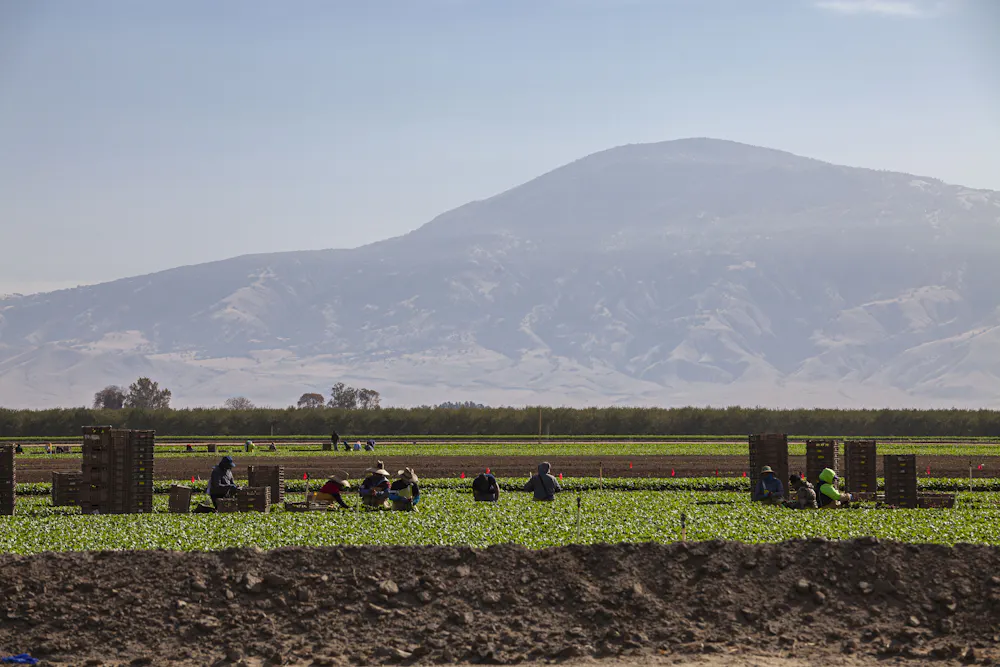
    California’s Central Valley is some of the most productive cropland in the country.
    Citizen of the Planet/UCG/Universal Images Group via Getty Images

    The trade-offs of installing solar on agricultural land

    When the solar arrays we studied were installed, California state solar energy policy and incentives gave farm landowners new ways to diversify their income by either leasing their land for solar arrays or building their own.

    There was an obvious trade-off: Turning land used for crops to land used for solar usually means losing agricultural production. We estimated that over the 25-year life of the solar arrays, this land would have produced enough food to feed 86,000 people a year, assuming they eat 2,000 calories a day.

    There was an obvious benefit, too, of clean energy: These arrays produced enough renewable electricity to power 470,000 U.S. households every year.

    But the result we were hoping to identify and measure was the economic effect of shifting that land from agricultural farming to solar farming. We found that farmers who installed solar were dramatically better off than those who did not.

    They were better off in two ways, the first being financially. All the farmers, whether they owned their own arrays or leased their land to others, saved money on seeds, fertilizer and other costs associated with growing and harvesting crops. They also earned money from leasing the land, offsetting farm energy bills, and selling their excess electricity.

    Farmers who owned their own arrays had to pay for the panels, equipment and installation, and maintenance. But even after covering those costs, their savings and earnings added up to US$50,000 per acre of profits every year, 25 times the amount they would have earned by planting that acre.

    Farmers who leased their land made much less money but still avoided costs for irrigation water and operations on that part of their farm, gaining $1,100 per acre per year – with no up-front costs.

    The farmers also conserved water, which in turn supported compliance with the state’s Sustainable Groundwater Management Act water use reduction requirements. Most of the solar arrays were installed on land that had previously been irrigated. We calculated that turning off irrigation on this land saved enough water every year to supply about 27 million people with drinking water or irrigate 7,500 acres of orchards. Following solar array installation, some farmers also fallowed surrounding land, perhaps enabled by the new stable income stream, which further reduced water use.

    Irrigation is key to cropland productivity in California’s Central Valley. Covering some land with solar panels eliminates the need for irrigation of that area, saving water for other uses elsewhere.
    Citizen of the Planet/UCG/Universal Images Group via Getty Images

    Changes to food and energy production

    Farmers in the Central Valley and elsewhere are now cultivating both food and energy. This shift can offer long-term security for farmland owners, particularly for those who install and run their own arrays.

    Recent estimates suggest that converting between 1.1% and 2.4% of the country’s farmland to solar arrays would, along with other clean energy sources, generate enough electricity to eliminate the nation’s need for fossil fuel power plants.

    Though many crops are part of a global market that can adjust to changes in supply, losing this farmland could affect the availability of some crops. Fortunately, farmers and landowners are finding new ways to protect farmland and food security while supporting clean energy.

    One such approach is agrivoltaics, where farmers install solar designed for grazing livestock or growing crops beneath the panels. Solar can also be sited on less productive farmland or on farmland that is used for biofuels rather than food production.

    Even in these areas, arrays can be designed and managed to benefit local agriculture and natural ecosystems. With thoughtful design, siting and management, solar can give back to the land and the ecosystems it touches.

    Farms are much more than the land they occupy and the goods they produce. Farms are run by people with families, whose well-being depends on essential and variable resources such as water, fertilizer, fuel, electricity and crop sales. Farmers often borrow money during the planting season in hopes of making enough at harvest time to pay off the debt and keep a little profit.

    Installing solar on their land can give farmers a diversified income, help them save water, and reduce the risk of bad years. That can make solar an asset to farming, not a threat to the food supply.

    Jacob Stid works for Michigan State University. Funding for this work came from the US Department of Agriculture’s National Institute of Food and Agriculture program and the Department of Earth and Environmental Sciences at Michigan State University. He also receives funding from the Foundation for Food and Agricultural Research.

    Annick Anctil receives funding from NSF and USDA.

    Anthony Kendall receives funding from the USDA, NASA, the NSF, and the Foundation for Food and Agricultural Research. He is an Assistant Professor at Michigan State University, and serves on the nonprofit board of the FLOW Water Advocates.

    ref. California farmers identify a hot new cash crop: Solar power – https://theconversation.com/california-farmers-identify-a-hot-new-cash-crop-solar-power-259653

    MIL OSI Analysis

  • MIL-OSI USA: Senators Collins, Smith, King Introduce Bill to Combat Lyme and Other Tick-Borne Diseases

    US Senate News:

    Source: United States Senator for Maine Susan Collins

    Washington, D.C. — U.S. Senators Susan Collins (R-ME) and Tina Smith (D-MN) today introduced legislation to reauthorize the Kay Hagan Tick Act, their landmark legislation to improve research, prevention, diagnostics, and treatment for tick-borne diseases, which became law in 2019. Senator Angus King (I-ME) joins them as an original co-sponsor. The Kay Hagan Tick Act unites the effort to confront the alarming public health threat posed by Lyme disease and other tick-borne diseases. Confirmed cases of Lyme disease reached a record number in Maine – 3,035 – last year. Senators Collins and Smith named their bill in honor of former Senator Kay Hagan (D-NC) who passed away on October 28th, 2019, due to complications from the tick-borne disease known as the Powassan virus.

    “Last year, Maine reported over 3,000 cases of Lyme disease—a record in our state. The reauthorization of our Tick Act is urgently needed to continue to support those who struggle with Lyme and other tick-borne illnesses and keep improving research, diagnostics, treatment, and prevention for these terrible diseases,” said Senator Collins. “Resources from the Tick Act have led to exciting developments such as the first-ever clinical trial for a Lyme disease vaccine for people, which is underway right now at the MaineHealth Institute for Research.”

    “My home state of Minnesota is proud to have more than 10,000 lakes and thousands of rivers for us to enjoy, and we’re always especially eager to get outside after a long winter,” said Senator Smith. “Unfortunately, the number of Lyme disease cases in the state—and states across the country—is on the rise. This bill would empower regional centers to lead the response against these diseases and expanded the federal government’s role in researching, testing and treating these diseases. For the sake of Americans’ health and well-being, we need to keep moving this bill forward.”

    “Our state has been battling diseases like Lyme for decades, so it is critical we continue to invest in our research and understanding of these vector-borne diseases to better protect Maine residents and visitors,” said Senator King. “The Kay Hagan Tick Act will further the prevention efforts that keep us safe by funding research, testing and diagnostics along with resources for improved data collection. I am proud to work on this critical bipartisan legislation that will help mitigate this long-term public health threat for the future safety and health of all Maine people.”

    “Reauthorizing the Kay Hagan Tick Act will continue the nation’s coordinated framework for tick-borne disease surveillance, diagnostics, and prevention”, said Griffin Dill, Director of the University of Maine Tick Lab. Continued support means earlier detection, targeted interventions, and fewer families facing the physical and financial burden of Lyme disease and other emerging infections. Through this investment, Congress can ensure a proactive approach to safeguarding our communities from increasing threats related to ticks.”

    “With an estimated 500,000 new cases of Lyme disease each year, it is critical that the United States is equipped to effectively prevent, detect, and respond to this growing public health threat,” said Bonnie Crater, co-founder and board member at Center for Lyme Action. “We applaud the foundation laid by the Kay Hagan Tick Act, which established the National Public Health Strategy to Prevent and Control Vector-Borne Diseases in Humans and we are committed to working with Congress and federal agencies to ensure this strategy is fully implemented and strengthened.  We commend Senator Collins, Senator King, and Senator Smith for their bipartisan leadership in advancing the reauthorization of this vital legislation to protect the health and safety of Americans nationwide.”

    Using a three-pronged approach, the Kay Hagan Tick Reauthorization Act would:

    1. Require the Department of Health and Human Services (HHS) to continue implementing and updating, as appropriate, its National Public Health Strategy to Prevent and Control Vector-Borne Diseases in People.  This strategy has been integral in expanding research into tick-borne diseases, improving testing and diagnostics, and coordinating efforts across the federal government.
    1. Reauthorize Regional Centers of Excellence in Vector-Borne Disease for five years. Funding for these centers, which was allotted in 2017, expires this year. These Centers have led the scientific response against tick-borne diseases, which now make up 75 percent of vector-borne diseases in the U.S.  There are four centers located at universities in California, Florida, Texas, and Wisconsin. 
    1. Reauthorize CDC Grants to State Health Departments to improve data collection and analysis, support early detection and diagnosis, improve treatment, and raise awareness.  These awards would help states continue to build a public health infrastructure for Lyme and other vector-borne diseases and amplify their initiatives through public-private partnerships.   

    In May, Senator Collins delivered the opening remarks at the Center for Lyme Action Congressional Series and spoke to the need for continued federal funding for tick-borne disease research. Click here to watch and here to download her remarks. Senator Collins has also urged leading health officials to continue to support the development of treatment for these illnesses, including the clinical trials currently ongoing in Maine for the first Lyme disease vaccine for people.

    Senator King is a longtime advocate for the elimination of vector-borne diseases. His SMASH Act, bipartisan legislation to reauthorize critical public health tools that support states and localities in their mosquito surveillance and control efforts, especially those linked to mosquitos that carry the Zika virus, and improve the nation’s preparedness for Zika and other mosquito-borne threats like West Nile virus, chikungunya, and Eastern Equine Encephalitis (“triple-e”) virus was signed into law in 2019. A re-authorization of SMASH was introduced in 2023 and included in the Pandemic All-Hazards Preparedness Act Reauthorization.

    MIL OSI USA News

  • MIL-OSI Europe: Briefing – Sustainability of fishery and aquaculture products: Informing consumers – 16-07-2025

    Source: European Parliament

    Recent surveys suggest that there is a growing interest among consumers in being informed about the environmental impact of the fishery products they buy. The sustainable exploitation of fish resources is one of the main objectives of the common fisheries policy (CFP). Its implementation is supported by several pieces of legislation, in particular measures on fisheries control and traceability. The information consumers receive on fishery products is mainly based on the general EU consumer protection legislation and complemented by additional provisions under the CFP. There are, however, control and information gaps, which arise mainly from three issues: different labelling rules for fresh and prepared fishery products; different control levels in Member States; and potentially different standards for imported products. In a number of resolutions, the European Parliament has identified shortcomings and suggested solutions. Several ongoing policy initiatives could help to bridge the gap between consumer expectations and actual product traceability.

    MIL OSI Europe News

  • MIL-OSI United Kingdom: Food Minister Daniel Zeichner: Good Food Cycle speech

    Source: United Kingdom – Executive Government & Departments

    Speech

    Food Minister Daniel Zeichner: Good Food Cycle speech

    Speech by Food Minister Daniel Zeichner launching the Good Food Cycle at Darley Street Market in Bradford.

    Well, good afternoon everybody and thank you. First of all, thank you to Andrew, and to all our brilliant contributors – really fantastic.

    Politicians often say they’re really pleased to be in places. And I am pleased to be in places – but I have been really thrilled to be here. I’ve not been to Bradford before, and I’ve been absolutely knocked out by what I’ve seen this morning. I’m so pleased to be here.

    I’m told you’re one of the UK’s youngest, most diverse, and dynamic cities. I represent Cambridge, and we probably could have a little discussion about that – but I think you may be winning! What I know for sure is that you’ve got a rich food culture here. I’ve been seeing it outside, I’ve been hearing about it, and I’m so thrilled that we made the decision that Bradford should be the place to come and talk about the government’s vision for our food system. What we’re calling the Good Food Cycle.

    And I hope that’s a phrase that will stick in your minds – because that’s what this is all about.

    Let me start, though, by thanking some of the people who’ve made this morning possible: Bradford 2025, the local council – I’m delighted to be here working with you – and Inn Churches. Very impressed by the work you’re doing.

    I’ve heard about Jamie Oliver’s Ministry of Food, I’ve seen some of the demonstrations that are being done outside with some of the children – I’ve met some of the children – who are extraordinarily confident and well-informed about raw beans! Very good for them!

    Living Well, the wider community, all the efforts being made to empower, educate, and inspire as many people as possible to cook great-tasting, healthy food for themselves and their families. I think this project here, which I’ve been hearing about – clearly a long time in the making – what a fantastic achievement in this year of 2025.

    It really does show how communities, local government, food producers and processors can work together for the community. Because it shows that good, healthy food can be accessible to everyone, and help bring communities together.

    And just in my brief tour around, I could see how that’s being brought to life.

    I’m told it’s £31 million of investment into the heart of Bradford – it shows what can be done to support local food producers, what you’re making, and how we used to have those strong local food production systems. What a chance to re-energise that!

    But of course, this sits in a wider context – one that includes household-name food businesses with a national footprint, like Morrisons, like Marks and Spencer. They all play a part in our national food system.

    And let’s pay tribute to that national food system, because it is one of the most extraordinary and advanced in the world. Huge, huge things. I remember, I was the shadow minister during the Covid crisis, and there was a point where it wasn’t entirely clear that we could carry on feeding the nation. But people stepped up. And it really showed what an amazing system this is.

    But we also have to be aware that the current food system does have some challenges.

    Henry Dimbleby – a lot of you will be aware – did a lot of work a few years ago on this. He called it the junk food cycle. Which, at one level, is harsh. But what he was pointing out was that there are internal dynamics within the system that keep producing negative feedback loops.

    That’s the thing we want to address.

    I think it can be addressed. I think there are many people in this room who have been working on this for many, many years. But it’s possible to do something about it. To do it differently.

    And that’s why I’ve come here today – to launch what we’re calling the Good Food Cycle. We think it’s a really significant step in the change we want to take together.

    And I think this is actually a very special moment because it’s the first time, as far as I can see, that the whole of government is aligned on a vision for the food system, looking ahead to the future. And it’s one which puts people and the planet at its heart.

    Now, we haven’t done this alone. This is not just about government. We’ve worked across the food system.

    Sarah [Bradbury, IGD CEO] has been saying this – and our colleagues involved in the systems process have told us too – we’ve worked with industry, trying to do what only government can do: convene and coordinate action on food.

    And the reason we’re doing this is not just because it’s a good thing to do – it’s because what we’re hearing from people, right across the country, across generations and communities, is that this is really, really important.

    Because the one thing we all do – is eat. And we should take joy and celebration in that. It’s really important.

    So, over the last six months – in the early part of this government – we’ve spoken to over 400 individuals. That’s been coordinated through the process – thank you to everyone who helped make that happen.

    We’ve heard from organisations, from businesses. We’ve been asking the question: What would a good food system look like?

    I’m very grateful to the people who’ve been sitting on the Food Strategy Advisory Board – some of you may have read about that – Sarah has been providing the secretariat and more; keeping together a complicated group of people with very different views, but we’re working well together – and the Systems Advisory Council. Also, the F4 – that’s the grouping of the key parts of industry. All of them have been involved in this discussion. So many people from academia as well – I see leading academic figures locally.

    All have given time and effort to help us develop what we believe is a shared vision.

    [Political line removed]

    Well, I’m absolutely determined, as the food minister, that we will not make that mistake.

    We will listen. We’ll work alongside those in the food system who make key decisions – and also those who play key roles in that system. Whether that’s a supermarket boss, or someone who’s making the Sunday lunch. Or someone working in a shop.

    All those people are going to be involved in this discussion.

    This is a vision for a healthier, more affordable, sustainable, and resilient 21st-century UK food system that grows the economy, feeds the nation, nourishes people, and protects the environment and climate – now and in the future.

    So, for the next steps to make our Good Food Cycle vision a reality, we’ve identified ten priority outcomes that we’ll be working with people to deliver.

    Those outcomes are focused on:

    • Ensuring everyone has access to healthier and more affordable food
    • Creating the conditions for a thriving and growing food sector, with more investment in healthy, sustainable, affordable food
    • Ensuring a secure, sustainable and resilient food supply
    • Building on vibrant local food cultures – like we’ve seen here in Bradford

    We know there’s a huge prize for investing in the UK food system, which is why we are focused on creating the right conditions to bring money and talent into the UK food system.

    Because when we grow, make, and sell healthy food, frankly, everyone benefits.

    Now, the cost of healthy food is a key concern for working people across the country. And we’re focused on food and nutritional security, from a household to a national level.

    One way to support a secure and more resilient food system is to enhance our food security monitoring – in response to continued volatility from geopolitical and climate shocks.

    It’s critical that this information is transparent and available to people across the food system.

    Today I am committing to a new annual food security statistics publication to be published in the years between the triennial UK Food Security Report, starting this year.

    It will be a more frequent and focused publication, designed to ensure that key UK food security analysis is made public in order to capture emerging trends, and to support both policymakers and the public.

    That’s a government step we’re announcing today – to ensure we continue to support a more secure food supply chain in this country, so we can build a stronger future.

    I believe now is the time to act and make positive change to support our nation. Because with climate, health, and economic pressures growing, we stand to lose out if we don’t act now. Action on improving the food system isn’t just for national government – frankly, it’s for all of us.

    So, I’d like to say just a little bit about what I’ve heard is happening here in Bradford – and I hope you’ll find it as inspirational as I do.

    I understand that in February of this year, the Bradford 2025 UK City of Culture, in collaboration with others, unveiled over 30 innovative projects as part of its Creative Health programme, harnessing the transformative power of culture and creativity to tackle some of the district’s most urgent health and social challenges. 

    And we’re already seeing great outcomes from this work.

    The Cookery School, run by Inn Churches in this Market, in partnership with Jamie Oliver’s Ministry of Food,  teaches children and adults how to make healthy, fresh, tasty meals from scratch for themselves and their families.  

    Living Well is an initiative led by Bradford Council Public Health, the NHS Bradford and Craven Health and Care Partnership and a wide range of key stakeholders and community groups. They are helping to address the rising levels of obesity and reduce the high levels of early and preventable deaths within the district. 

    I’d like to thank the initiatives leaders, the Bradford Council and Bradford District and Craven Health and Care Partnership for all their hard work in helping individuals to live well.  

    This government wants to work across the food system to make the healthy choice the easy choice for people in Bradford and across the country.  

    But a healthy food system is not only about what we eat, it is also about how our food is produced and the impact it has on the environment.  

    When we come together to eat – we are sharing in something incredibly powerful. Culture. 

    Which brings me back to why I am here in Bradford today. Culture and Community are closely interlinked. Communities build culture. This building is the site of a shift in culture. One which is about connecting people with their local food producers, as well as supporting them to have the skills to use this amazing bounty of British ingredients. 

    Everyone should be able to take pride and joy in what they grow and eat. And we want local producers to grow more of what we eat and communities to eat more of what we grow. 

    This Government is here to enable, protect and prepare. Enable health, growth and productivity. Protect food standards. Prepare for the impacts of a more extreme weather and more volatile world.

    This is a cross-government strategy, and we will work collaboratively to ensure we take the right steps to address the needs of the nation. 

    This is a milestone in our commitment to transform the food system. So today, we set out what we want to achieve, and why it’s important.

    Now and in the future, we’ll work with citizens, with civil society, with farmers, with fishers, with food businesses to agree how to reach that vision, and how we will measure our progress.

    If we can replicate some of the energy and commitment I have seen today and enable the growth of other Darley Street markets in other towns across the country; enable every class of school children to enjoy healthy, delicious food; enable investment in responsible food businesses , we will be well on our way. 

    Friends, together we can make the healthy, sustainable choice the easy and obvious one – for everyone. Together, we can create the Good Food Cycle.

    Updates to this page

    Published 16 July 2025

    MIL OSI United Kingdom

  • MIL-OSI Australia: Transcript – Afternoon Briefing with Patricia Karvelas

    Source: Murray Darling Basin Authority

    PATRICIA KARVELAS, HOST: Let’s get some immediate political reaction, not just to this story, but of course the broader child care crisis too and go straight to the Education Minister Jason Clare. 

    Jason Clare, lovely to have you on the show. 

    JASON CLARE, MINISTER FOR EDUCATION: Thanks, PK, great to be here. 

    KARVELAS: Two child care workers have been charged with assault of a toddler in Western Sydney. New South Wales Police have said the child sustained significant bruising and injuries. Of course, this is one case being handled now by the legal system, as it should be —

    CLARE: Yes. 

    KARVELAS: — but does this latest case show that we have a broader crisis? 

    CLARE: What it underlines is if you don’t care about our kids, you shouldn’t be there working in early education and care. 

    In that report you mentioned that those workers are no longer there, that’s a good thing. But we do need to put in place the sort of measures to help to weed people out that aren’t there for the right reasons, whether it’s the sort of penalties that you impose on centres that don’t act when this evidence comes to light, or naming and shaming centres, giving information to parents about the conditions that are in the centres where their children are, or putting in place things like CCTV. 

    I want to make the point if I can, PK, that 99.9 per cent of the people who care for our kids every single day in these centres love them, they care for them, they educate them, they’re great people that are doing really, really important work, and at the moment they’re as shocked and angry as everybody else in Australia. Their jobs are on TV for all of the wrong reasons. They want to make sure that we do everything we can to weed out the people that shouldn’t be there too. 

    KARVELAS: We also learnt today that the alleged Melbourne paedophile, Joshua Dale Brown, worked at an additional daycare centre that has not been listed by authorities online. That brings the total number of centres he’s worked at to 24. I mean, Minister, why – I know this a state issue in terms of the investigation, but why are we still finding out about child care centres several weeks after the first allegations? 

    CLARE: It’s a bloody good question. This is a nightmare for hundreds more parents, mums and dads who now have to go through the wringer of working out whether their kids are sick or not. And for their little kids, they’ve got to go through the trauma of testing – blood tests and urine tests – to find out whether they’ve got an infectious disease or not. 

    It strikes me when I saw this yesterday that this is another reason why we need an educator register, a database that tells us where people are working and where they have been working. The company responsible here should know this at the click of a button. But so should we. This shouldn’t be the sort of information that comes out in drip feed form, it should be information that’s easy to access quickly. 

    KARVELAS: It seems that there might be more centres. I mean, have you been briefed about whether there are even potentially more that we might find out about? 

    CLARE: No, I haven’t. The Victorian Police would be briefing the Victorian Government specifically on that. But I just make the general point, this is the sort of information that police should have at their fingertips, it’s the sort of information that we should have right now. We don’t have it, but we should do. 

    KARVELAS: Is your legislation on child care changes that you’ve been talking about ready to table into the Parliament and have you briefed the Opposition? 

    CLARE: Yeah, the legislation is almost finalised. I’ll introduce that legislation into the Parliament next week, and we held our first briefing with the Opposition on the legislation today. I want to take this opportunity to thank Sussan Ley, the Opposition Leader, and Jonno Duniam, the Shadow Minister, for the really constructive way in which they’re working with us on this legislation to make sure we get it right. You know, it’s not always the case that Labor and Liberal work together the way we should. We are here, and that’s really important with legislation like this. 

    So, as I said, I’ll introduce the legislation next week. What the bill will do is give us the power to cut off funding to child care centres where they’re not up to scratch when it comes to safety. 

    At the moment a state regulator can shut a centre down tomorrow if they think there’s an imminent threat to safety. But where they’ve identified centres that aren’t meeting the standard and repeatedly they’re not meeting that standard, this will give us the power to issue a condition to that centre, and say that if you don’t meet the standards that we’ve set for you as a nation over the course of, it might be a couple of months, then we will suspend your child care funding or we’ll cancel it. 

    And there’s nothing more important in running a child care centre than the taxpayer funding that runs it – it’s about 70 per cent of the funding that runs a child care centre, it can’t run without it. This is the biggest stick that the Commonwealth has to wield here, and putting a condition on a centre that we would provide publicly, so parents know about it, I think is the sort of thing that hopefully will lift standards to where they need to be. 

    If we get this legislation right, it won’t mean that we’re shutting centres down, it will mean that we’re lifting standards up where centres aren’t meeting the standards at the moment. 

    KARVELAS: Okay, that’s really interesting. So, you’ll issue essentially a warning that will then be publicly shared, would that be like on a central website where people can look to see ‑‑ 

    CLARE: That’s right. 

    KARVELAS: ‑‑ if this has been – and what’s the timeframe? ‘Cause that must be all articulated, it has to be in the legislation, for which they have to respond ‑‑

    CLARE: Yeah. 

    KARVELAS: ‑‑ before that money is suspended?  

    CLARE: The legislation won’t set out the specific timeframe. There will be discretion provided to the Secretary of my Department, but we’re anticipating, depending on circumstances, you’re talking about a couple of months. 

    But let me just make the point again, if we’ve identified a centre where there’s a threat to kids right now, state regulators can shut it down. This is about centres where over a period of time they’re just not meeting the National Quality Framework standard to say, unless you get there soon, the centre is not going to be funded by the taxpayer. 

    KARVELAS: So, at the moment “Working Towards,” as you know, is a rating given to a centre that doesn’t meet quality rating standards. I’m just confused about how that will work still. These centres, are they allowed to keep operating? For how long will you be able to keep operating if you’re just “Working Towards”? 

    CLARE: At first instance what we’re intending to do if we get this legislation passed is to work with the state governments and the state regulators on the centres that they’re most concerned about, that are under that category that you’ve just described where they’re concerned that they’re repeatedly not working hard enough to get to the standard they need to be under the National Quality Framework. 

    So we’ll work with states and territories on the centres that we think need to be the subject of this legislation first and set those conditions for them, set a timeframe for them, and if they don’t meet those conditions within that timeframe, then suspend the child care subsidy payment that helps that centre to operate or cancel it altogether. 

    KARVELAS: And you said this is about lifting standards rather than shutting child care centres down. Of course that would always want to have that aim, because you need children in care —

    CLARE: Indeed. 

    KARVELAS: — or the system would collapse, right? 

    CLARE: That’s right. 

    KARVELAS: But do you envisage that inevitably some child care centres will have to close down? You would think that would have to be an inevitability of a tough system.  

    CLARE: It is a tough system, and that may very well happen. We’re not putting this legislation into the Parliament as an idle threat. But these centres run – 70 per cent of the funding is based on the child care subsidy that the taxpayer provides to help child care centres run. This is the biggest stick we have to wield, to say to centres that if you want to continue to receive this support from the Australian taxpayer, then you have to meet that standard, and if you don’t, then funding will be suspended or cancelled. 

    And what I’m hoping is that that threat is going to be strong enough to get the boards of these companies or the investors in these companies to sit up and listen and realise that we’re serious here and if you don’t meet the standard, then the funding will be cut off. 

    KARVELAS: Spot checks by your Department is another issue that you’ve raised. Are they only going to be deployed for fraud, or will it be child safety as well? 

    CLARE: Principally fraud but not exclusively fraud. At the moment I’ve got a team of investigators in the Department of Education that can do checks on child care centres for fraud. Unfortunately it’s the case that this exists, that child care centres might claim a child is there for three days but they’re only there for two days, and they’re claiming funding from the taxpayer for three days. This legislation will give my officers the power to be able to go in without a warrant or without the AFP to do those checks. 

    But while they’re there, they’ll be able to also examine the safety of centres and share that information with state regulators that do the lion’s share of this work. 

    The Federal Government sets the standards, the state governments do the lion’s share of the work in terms of regulating the system and making sure that it’s safe. 

    KARVELAS: Should there be a national regulator though? Because that’s part of the issue, isn’t it, that we’ve got state-based regulation, it’s quite inconsistent across states. Is there an option for a national regulation? 

    CLARE: There’s a national authority at the moment, ACECQA, that helps to set that standard, and they work closely with the states and territories in the work that they do. 

    There’s a separate question that’s posed by the Productivity Commission’s report last year about whether we set up an Early Education and Care Commission that would look at how we reform the system over the next decade and beyond. That recommendation wasn’t principally about safety; it wanted government to look at a steward for the system to make it more accessible and more affordable. I’ve got an open mind to that recommendation, Patricia, it’s something that we’ll look at over the medium term. It wasn’t intended to be something specifically about safety, but that’s something that it could potentially include.

    KARVELAS: Oh, that’s really interesting. So, you think you could take the Productivity Commission’s recommendation and sort of morph it into something broader?  

    CLARE: Potentially. It’s the sort of thing it’s my job as a Minister to sit down with smart people and pick their brains about how this would work best in practice, people like Georgie Dent at The Parenthood I spoke to the other day about this. 

    I want to make sure that we get this right, I want to make sure that our system is affordable for mums and dads, that it’s accessible everywhere around the country, but most importantly that it’s safe. That’s what this legislation is fundamentally about. But it’s not the only thing that we need to do. 

    The other things that have got to be on the table here are this register so we can track people across the system, identify when people are moving from centre to centre to centre and whether that should be a red flag that something is wrong here, that people are just moving people on rather than reporting them to a regulator or to the police. Proper mandatory child safety training for everybody who works in our centres. 

    I said a moment ago that 99.9 per cent of people who work in our centres are fantastic people. We’ve got to equip them with the skills they need to identify the bad person that might be up to the most horrific of crimes in our centres. And then CCTV as well, which can potentially play a role in deterring somebody from getting up to no good but also help police with their investigations as well. 

    KARVELAS: Minister, if I could just ask you about the Antisemitism Envoy’s report, which of course has been handed to the government. You’ve been talking about this as well. As you know ‑‑ 

    CLARE: Yeah. 

    KARVELAS: ‑‑ your colleague Ed Husic is critical of some parts – not all – but some parts of the report, including the very definition of antisemitism that it’s using. Are you troubled by this definition? 

    CLARE: No, I’m not. I had a quick look at what Ed had to say. I think Ed was fundamentally making the point that any definition of antisemitism shouldn’t stop somebody from criticising the Government of Israel, and I think he’s right in that respect. I don’t think the definition does, by the way.

    But I’ve been critical of the Government of Israel. I think as long as you can make that point very, very clear, you’re on pretty good ground.

    KARVELAS: But it does actually, and I’m just looking at the words here, it does actually refer to the State of Israel by claiming that the existence of the State of Israel is a racist endeavour. Do you think that’s antisemitic? 

    CLARE: No, I think what Ed was saying is it’s a little bit different to then be called an antisemite for criticising the Government of Israel. That’s the fundamental point I think ‑‑ 

    KARVELAS: The existence of Israel is really at the heart of the question, isn’t it? That’s what some people criticise. 

    CLARE: You know my view, the view of the Government, the view I think of the overwhelming majority of people watching the tele today is that we want two countries in the Middle East that sit side by side, one’s called Israel, one’s called Palestine, and they can live together in peace and security behind secure borders and have the sort of safe life that we take for granted here in Australia and in many other parts of the world. 

    KARVELAS: How did the part of the report – this is something that Ed Husic definitely mentioned in relation to younger Australians holding views that are antisemitic. Do you think that – are you witnessing that younger Australians have higher rates of antisemitism? 

    CLARE: I was asked this question today. I said certainly social media plays a role here, and I’m hoping that the ban on access to social media for young people under 16, when that comes into force later this year, is going to have a positive impact on that, but also the mental health and wellbeing of younger Australians. 

    I was also asked about the recommendations in the report about universities. We’re considering those at the moment. We’re not making any announcements about that at the moment. But antisemitism is real, it’s a poison that we’ve seen infect parts of the community. There’s no place for it in our universities, there’s no place for it anywhere in Australia, but it’s just one type of the sort of racism that we see in our community and in our universities. 

    I made the point today that we’ve established a Student Ombudsman that provides a vehicle for students to make complaints, whether it’s about antisemitism, Islamophobia or sexual assaults, or any concerns that they’ve got about the way their university has dealt with them. 

    TEQSA, which is the federal regulator of our universities, has certain powers to intervene here and works closely with universities on this. It has the power to put conditions on universities or to go to court and issue fines. I think there’s an open question there about whether TEQSA needs more powers in this area. 

    And I also made the point today that we will shortly receive a report from the Special Envoy Combating Islamophobia, and we want to see their report as well, as well as the report that we received a few weeks ago. 

    KARVELAS: So, will they be considered together? 

    CLARE: I think that’s the way in which we should consider it, that’s probably the best way to go about this. I’ll also receive a report in a couple of months’ time from the Race Discrimination Commissioner about racism in all its ugly forms in our universities, and I’m sure there’s Indigenous Australians and Asian Australians and international students watching today that are saying, “Don’t forget about me, this affects me too”.

    We don’t necessarily need to wait for that report before we take action. You can do this step‑by‑step. But I just flag, I want to see that report from the Special Envoy on Islamophobia, and there’s also a piece of work that I’ve commissioned around the governance, improving the governance of our universities, that I’ll receive too. And I also want to think about what more powers we should properly give TEQSA, the Tertiary Education Regulator here. 

    KARVELAS: That’s really interesting. Jason Clare, Minister, it’s been great to speak to you. Thanks for joining us. 

    CLARE: Thanks PK.

    MIL OSI News

  • MIL-OSI United Kingdom: Local business owner prosecuted over incorrect allergen advice

    Source: City of Derby

    A Derby small business owner has narrowly escaped a custodial sentence for serving products containing nuts to a customer with a severe nut allergy.

    Derby City Council Trading Standards have successfully prosecuted Samantha Brauner, the owner of Small’s Kitchen, after the customer suffered an allergic reaction triggered by eating the product. In May 2024, Small’s Kitchen fulfilled an online order of protein balls. 

    The customer asked whether the products contained nuts on several occasions, with Ms Brauner stating they did not.

    The case was heard at Southern Derbyshire Magistrates Court on Monday 30 June, where Samantha Brauner pleaded guilty to one charge of supplying unsafe food with undeclared allergens and one charge of selling food which was not of the nature, substance, or quality demanded by the purchaser.

    Ms Brauner narrowly escaped a custodial sentence due to her early guilty plea. She was fined £1920 and ordered to pay a victim surcharge of £768.

    The Magistrates acknowledged the severity of the offences brought before them, highlighting the well documented consequences of neglecting allergen management responsibilities.

    Councillor Shiraz Khan, Cabinet Member for Housing, Property, and Regulatory Services, said: 

    This is a situation that could have had disastrous consequences, which were fortunately avoided.

    Our Trading Standards team in securing this prosecution, which serves as a reminder to other businesses that they need to take their allergen management responsibilities seriously.

    We will continue to act in the best interests of the people of Derby, who should be able to have confidence in the products they are buying, particularly from local traders.

    Should any Derby City based business require allergen management advice, they can contact Trading Standards via the Citizens Advice and Consumer Service helpline.

    MIL OSI United Kingdom

  • Iceland volcano erupts for 12th time since 2021

    Source: Government of India

    Source: Government of India (4)

    A volcano erupted in south-west Iceland on Wednesday, the country’s meteorological office said, marking the latest in a series of outbreaks near the capital in recent years.

    Often referred to as a land of ice and fire, the North Atlantic island nation with its many glaciers and volcanoes has now seen a dozen eruptions since geological systems on its Reykjanes peninsula reactivated in 2021.

    The outbreaks, known as fissure eruptions, are characterised by lava flows emerging from long cracks in the earth’s crust, rather than from a central crater.

    The Reykjanes eruptions have not so far posed a threat to the capital Reykjavik, nor have they caused significant dispersals of ash into the stratosphere, avoiding air traffic disruption.

    The nearby fishing town of Grindavik, home to nearly 4,000 residents before an evacuation order in 2023, however remains mostly deserted due to the periodic threat from lava flows and related eartquakes.

    The Blue Lagoon luxury spa and the nearby Svartsengi thermal power station have also been at risk from lava in some of the previous eruptions.

    Experts have said the eruptions in the area could recur for decades, or even centuries.

    Iceland, which is roughly the size of the U.S. state of Kentucky and has fewer than 400,000 residents, boasts more than 30 active volcanoes.

    That makes the north European island a prime destination for volcano tourism – a niche segment that attracts thousands of thrill seekers every year to sites from Mexico and Guatemala, to Sicily, Indonesia and New Zealand.

    (Reuters)

  • MIL-OSI China: Qinghai pioneers green growth with ecology-first strategy

    Source: People’s Republic of China – State Council News

    Standing at the heart of a 609-sq-km photovoltaic park located in the Talatan Gobi Desert in Gonghe County, northwest China’s Qinghai Province, China Arab TV correspondent Ayoub Bechrouri enthusiastically began recording his report with his smartphone.

    Behind him stretches a captivating “blue sea” — an endless expanse of photovoltaic panels covering the landscape. Beneath these gleaming solar arrays, verdant grasslands thrive where flocks of sheep graze contentedly, showcasing the perfect harmony between renewable energy and sustainable agriculture.

    “This is a good example of green energy development,” Bechrouri said. “I hope to see China-Arab collaboration bring Chinese technologies to Arab countries.”

    Hailing from Morocco, Bechrouri was part of a delegation of around 30 international journalists from countries including the United States, Germany, Japan and Spain on a three-day tour of Qinghai organized by China’s State Council Information Office. The media delegation experienced firsthand how this northwestern province is pioneering China’s ecological civilization drive through concrete green development projects.

    ECO-FRIENDLY ENERGY

    “In a sunny country like Spain, people have been paying attention to the ecological impact of the construction of large photovoltaic power stations,” said Alvaro Alfaro Ruiz-Alberdi, a journalist at the Spanish news agency Agencia EFE. “I find it interesting to examine how Qinghai maintains the balance between this energy development and environmental protection.”

    The Spanish correspondent found the answer at this very photovoltaic park, one of the highest-capacity solar power facilities globally, in Gonghe.

    The park’s innovative eco-industrial model — power generation atop solar panels, grass cultivation between panels, and sheep grazing beneath them — has restored vegetation coverage to 80 percent in an area that was once a dust-blown stretch of the Gobi Desert, according to Wang Anwei, director of the energy bureau of Hainan Tibetan Autonomous Prefecture, which administers Gonghe.

    This agrivoltaic model has also boosted income for livestock farming, generating over 10,000 yuan (about 1,398 U.S. dollars) per mu (about 0.07 hectares), and has helped lift 173 neighboring villages out of poverty.

    “Now my flock has grown to about 800 sheep, and my income from grazing alone has doubled compared to before,” said Zhao Guofu, a herder who began grazing his sheep here six years ago.

    By the end of 2024, the total investment in clean energy in the Hainan Tibetan Autonomous Prefecture reached 16.18 billion yuan, with annual clean energy power generation amounting to 46.32 billion kWh. Notably, photovoltaic power generation was about 17.9 billion kWh, representing a year-on-year increase of 16.21 percent.

    IMPROVED BIODIVERSITY PROTECTION

    In the summer, Qinghai Lake, located in the northeastern part of the Qinghai-Xizang Plateau, shimmers with azure waves, teeming with visitors. Brown-headed gulls wheel above the water surface, while vast schools of the lake’s unique species, naked carp, which is classified as vulnerable on the China Species Red List, glide beneath.

    “The naked carp constitutes over 90 percent of the lake’s total fish population and serves as the primary prey for birds such as brown-headed gulls. This species plays a vital role in maintaining the ecosystem and biodiversity of the Qinghai Lake basin,” said Wang Shuning, with the protection and utilization administration of the Qinghai Lake scenic area.

    Due to overfishing and environmental deterioration, the population of naked carp sharply declined in the 1960s and 1970s. In order to protect the species and restore the Qinghai Lake environment, Qinghai banned naked carp fishing at the lake in 2001, following a series of temporary prohibitions from the 1980s onward.

    Between 2002 and 2023, the biomass of naked carp increased nearly 46-fold. Additionally, as the only habitat of Przewalski’s gazelles, an endangered antelope species, the Qinghai Lake basin has seen the total number of the species recover from fewer than 300 at the beginning of conservation efforts to approximately 3,400 currently. This remarkable growth reflects the concerted conservation efforts by both the Chinese government and local communities.

    The province has adopted a holistic approach to the protection and systematic governance of the symbiotic ecosystem of “water-grass-fish-birds-animals” in the Qinghai Lake basin. It has established monitoring platforms for ecological sensing and hydrological early warning, and has gradually set up over 300 ecological monitoring sites.

    Two years ago, local resident Dorje Tsomo became an ecological ranger at the Qinghai Lake scenic area. On duty, she always carries a camera to document environmental changes around the lake and a field manual compiling 98 species of waterbirds, which serves as her constant reference for learning their distinctive features, distributions and conservation statuses.

    “We also use a WeChat mini-program to document patrol routes, while nearby villagers promptly report injured birds. Together, we protect Qinghai Lake, the home we all share,” she said.

    According to Chen Dehui, deputy director of the protection and utilization administration of the Qinghai Lake scenic area, growing numbers of herders are voluntarily taking on new roles — as photographers capturing the lake’s natural beauty and as interpreters in ecological education programs — diversifying their income sources while sharing in the rewards of conservation.

    “Qinghai Lake’s ecological conservation is truly impressive,” said Furuta Natsuya, a journalist with Japan’s Hokkaido Shimbun who visited Qinghai for the first time. “Here, I witnessed a genuine model of human-nature coexistence and felt the profound connection between people and the natural world.”

    ECOLOGY-ENRICHED PROSPERITY

    In April this year, Kanbula, located in Jainca County of Huangnan Tibetan Autonomous Prefecture in Qinghai, was officially designated as a UNESCO Global Geopark. The park spans roughly 3,149 square kilometers with striking fiery-red Danxia landforms, towering jagged peaks, hidden caves and emerald lakes.

    “This world-class geological landmark not only enhances geo-conservation efforts, but also accelerates local infrastructure development, drawing global visitors to fuel cultural tourism revenues in the area,” said Hou Guangliang, a professor at Qinghai Normal University’s school of geographical sciences.

    In recent years, Dekyi Village, which is near the geopark, has become a living example of turning “ecological assets into economic gains.”

    “Thanks to government-sponsored training programs, our family now runs a homestay and agritourism business,” local villager Jorgyi said. “Last year, we earned over 70,000 yuan, and this year looks even more promising.”

    The village receives over 200,000 annual visitors, generating more than 1 million yuan in collective and individual dividends.

    “Like many regions in Hokkaido facing population decline, I’m particularly interested in rural revitalization. I hope to gain firsthand insights into how Chinese grassroots communities have experienced poverty alleviation and the tangible outcomes of government initiatives,” said Furuta.

    Both China and Japan are actively exploring sustainable development pathways, Furuta noted, adding that the Qinghai visit gave him profound insight into how both countries’ successful practices in community governance, ecotourism and cultural integration merit mutual learning. 

    MIL OSI China News

  • MIL-OSI USA: Rep. Sara Jacobs Votes Against NDAA Due to Lack of Constraints on Military’s Role in Domestic Law Enforcement

    Source: United States House of Representatives – Congresswoman Sara Jacobs (D-CA-53)

    July 15, 2025

    Following the lack of meaningful reforms and constraints to the Insurrection Act and the Posse Comitatus Act, Rep. Sara Jacobs voted against the FY 2026 National Defense Authorization Act (NDAA) in the House Armed Services Committee.

    Rep. Sara Jacobs said: “Like so many Americans, I’m horrified and disturbed by President Trump’s abuse of the military to silence dissent, intimidate immigrant communities, and assist in domestic law enforcement. The military-civilian divide is a bedrock of our democracy, intended to protect civil rights and liberties and prevent the emergence of an authoritarian police state. In Los Angeles, we’ve already seen the military – at President Trump’s urging – use excessive force, commit questionable detentions, wield intimidation tactics, and violate people’s legal rights. This is only a glimpse of what could happen nationwide if President Trump invokes the Insurrection Act and turns U.S. troops on civilians. And our service members deserve better than to be used as political pawns in President Trump’s authoritarian games. 

    “The warning signs are here, and the American people are demanding that Congress do something. Unfortunately, my Republican colleagues on the House Armed Services Committee abdicated their responsibility to the Constitution and their constituents to rein in the Insurrection Act and the Posse Comitatus Act. It’s wildly disappointing but sadly unsurprising that they would rather stay in President Trump’s good graces than stop the democratic backsliding that’s happening right before our eyes. While I’m proud of the provisions I secured to expand military access to child care, housing, and fertility services and ensure transparency and accountability of the Pentagon’s use of AI, I can’t in good conscience support a bill that fails to put guardrails on the use of our military in such unprecedented times.”

    Rep. Sara Jacobs secured the following provisions in the FY26 NDAA:

    Improving Military Child Care

    • Extends the “Child Care in Your Home” (CCYH) pilot program that provides financial assistance to eligible military families, especially those with non-traditional work hours, large families, or children with special needs, for in-home child care.
    • Urges the Secretary of Defense to create a grant program to cover up to 75% of the cost for eligible civilian child care providers to expand their infant and toddler child care capacity 
    • Establishes a pilot program to raise the military fee assistance provider cap for children 24 months or younger by 30% near installations that face high child care costs

    Improving Access to Affordable Military Housing

    • Studies how the Basic Allowance for Housing can properly represent densely populated, expensive cities and rural communities
    • Excludes the Basic Allowance for Housing (BAH) from the calculation of gross household income of an eligible member of the Armed Forces, so it doesn’t hurt their access to the Basic Needs Allowance
    • Requires Privatized Military Housing landlords to report on their insurance policies, including their costs, and the amount of money made through remedial payments to landlords.

    Strengthening Access to Fertility Services 

    • Establishes TRICARE coverage of assisted reproductive technology, including IVF, for all active duty service members and their dependents and creates parity between service member and Member of Congress fertility services

    Helping Military Families Make Ends Meet

    • Increases the Family Separation Allowance to a mandatory $400 to reflect the rising cost of living and burdens on military families

    Upholding Human Rights, Enforcing Domestic and International Laws, and Preventing Conflict

    • Requires a report from the Department of Defense on its implementation of the Global Fragility Act (GFA), planned funding levels, and challenges and lessons learned from GFA implementation 
    • Requires notification to Congress anytime the Department of Defense enters into a basing agreement with a foreign military that includes whether any unit of that military has committed gross human rights violations
    • Authorizes full funding, consistent with FY25 levels, for institutional capacity building of partner militaries through the Institute for Security Governance (ISG) and for humanitarian support and demining through Overseas Humanitarian, Disaster, and Civic Aid (OHDACA)
    • Requires JAGs to be stationed at all combatant commands to ensure military operations follow domestic and international laws
    • Reinstates the requirement that Military JAGs be at the rank of 3-stars, making sure they have a seat at the table where critical strategic decisions are made

    Ensuring AI Transparency and Accountability

    • Studies how AI could be used to reduce civilian casualties
    • Requires a report from the Department of Defense with support from the Department of Energy on any efforts to incorporate non-Department AI data centers onto Department of Defense land, its plans for doing so, and potential impacts and consequences
    • Requires a report from the Department of Defense about the Chief Digital and Artificial Intelligence Office’s contract with xAI to ensure transparency and accountability
    • Requires the Secretary of Defense to notify Congress within 30 days of issuing any waiver under DoD Directive 3000.09 on autonomous weapons systems. The notice must include the rationale, description of the system, and expected duration. 
    • Directs the Under Secretary of Defense for Policy, in coordination with the Chief Digital and Artificial Intelligence Officer, to brief Congress on how the Department ensures humans authorize each use of force in autonomous and semi-autonomous weapons systems. The briefing must outline current policies, identify gaps, and describe steps being taken to maintain human oversight. 
    • Requires a report from the Chief Digital and Artificial Intelligence Officer on how AI-enabled decision aides are being integrated into non-lethal, daily DoD operations. The report must include use cases, lessons learned, and recommendations for scaling, training, and addressing ethical or cybersecurity issues, followed by a congressional briefing.
    • Directs the Under Secretary of Defense for Policy, in coordination with the Chief Digital and Artificial Intelligence Officer, to assess how AI models are influencing national security policy decisions, including risks like automation bias and lack of transparency. Requires a report and briefing covering current efforts, gaps in responsible AI integration, oversight of waivers from key AI policies, and a plan to address identified issues, including potential follow-up studies.
    • Establishes requirements for the Department of Defense to promote competition, data security, and responsible use of government data in contracts for AI, cloud computing, and data infrastructure. It also mandates public reporting on innovation and barriers in defense tech procurement and restricts the use of government data for training commercial AI without explicit authorization.

    Advancing Improved and Accountable Procurement at DoD

    • Opens up cloud and AI contracts to real competition and blocks vendors from training their commercial models on Pentagon-owned data without explicit permission.
    • Gives Congress a faster warning when a weapons program busts its budget by cutting the Nunn-McCurdy notification window to 30?days and requiring DoD to consider canceling runaway projects.
    • Requires every major weapons program to pinpoint parts that can shift to 3-D printing or other advanced manufacturing and deliver a plan to slash cost and lead time within two years.
    • Stops the Pentagon from labeling purchases of more than 500 units a “prototype,” ensuring that large purchases receive full competition and oversight.
    • Places significant “Other Transaction” projects under the same documentation and milestone reviews as traditional acquisition programs, shedding light on a growing loophole.
    • Delivers the Pentagon’s first-ever “Right to?Repair” for major weapons systems. Contractors must hand over the parts, tools, and technical data DoD needs to fix its own gear—breaking decades-old vendor lock-ins, slashing sustainment costs, and speeding repairs that keep jets flying and ships sailing.

    ###

    MIL OSI USA News

  • MIL-OSI United Kingdom: Mayor of London warns UK must not ‘pull up the drawbridge to international students’ in landmark speech

    Source: Mayor of London

    • Mayor shares new analysis of major economic benefits from international students in speech hosted by Imperial College London’s new Ghana hub
    • City Hall projections put annual economic benefit of overseas students at UK universities around £55bn, with £12.5bn from those based in London
    • Sadiq will warn that ministers who want to “pull up the drawbridge to international students” would “slow down growth and leave working people in Britain worse off” as he stresses economic benefits of attracting the best global talent to study, work and live here

    Mayor of London, Sadiq Khan, is urging the government not to make it harder for international students to study in the UK as he reveals new analysis showing they contribute £12.5bn to the capital and £55bn to the national economy every year.

    The Mayor is in Ghana today (Wednesday 16 July) as part of his historic five-day trade mission to Africa, banging the drum for the capital as a place to invest and strengthening ties with countries across the continent. A major speech in Accra will see Sadiq make the case for welcoming students from around the world, and warn that proposals for a new levy on their university fees would be damaging to London and the UK’s economy.

    The UK Government is currently considering a new levy on income that English universities generate from international students as part of its immigration whitepaper, which could not only put students off coming here from overseas but also create a substantial extra financial burden for already stretched universities. The Mayor’s speech today will warn that this levy would be “an act of immense economic self-harm”.

    Today the Mayor will deliver a keynote speech on the power of education, innovation and entrepreneurship to Ghanaian students hosted at Imperial College London’s Accra hub. With five per cent of London’s higher education population coming from Africa [1], he will stress that London is open to global talent and make the positive case for international study.

    Latest analysis by London Economics revealed a more than £10 billion rise in the economic contribution of international higher education students to the UK economy, from £31.3bn in 2018/19 to £41.9bn in 2021/22 – leading City Hall economists to project it could hit £55bn in the current academic year on the basis of historical trends [2].

    London accounts for almost a quarter of this national impact, representing around £10bn in the latest data and projected to reach £12.5bn this year [3]. International students in the capital created an average net benefit of £1,040 per Londoner over the course of their studies, as beyond their university fees they contribute by spending in all sectors of the economy and bringing family or friends to visit [4].

    This positive economic impact spreads across the UK, with international students making a £58m net contribution to the national economy per parliamentary constituency during their studies – providing an equivalent £560 benefit for each local resident [5]. They also bring a longer-term labour market value, as many stay here after their studies to work in key economic sectors from tech and AI to finance and creative industries.

    Imperial is the first UK university with a permanent base solely focused on science, technology and innovation in Africa – building on the rapidly rising number of advancements and breakthroughs Imperial has made working with researchers in Ghana over recent years. Imperial Global Ghana serves as an academic hub to support high-impact collaboration in cutting-edge fields from medical diagnostics to urban health and AI to climate science.

    As well as current students, the Mayor will meet recent graduates including Shirgade Laryea, a Ghanaian alumna of Imperial College London’s Business School who is now a rising star in the UK-Ghana Chamber of Commerce. Other alumni success stories include Affinity bank founder Tarek Mouganie, Liquify fintech platform COO Alberta Asafa-Asomoah and former Anglo Gold Ashanti CEO Sir Sam Jonah.

    The Mayor is expected to say in his speech: “There are people at home who believe we should pull up the drawbridge to international students, or punish universities that choose to welcome people from around the world.

    “Our new analysis shows international students bring in tens of billions for our economy each year over the course of their studies, including £12.5 billion in London alone. And when they graduate, they go on to make our city – and our country – a better place to be.”

    The Mayor will add: “Closing our country to global talent would be an act of immense economic self-harm – one that would slow down growth and leave working people in Britain worse off than before. That’s why I’m calling on our Government not to make it harder for international students to study in the UK.

    “On my watch, London will be as open as ever… but I think we must do more. We cannot simply wait for the world to come to London; we must bring London to the world.”

    Imperial College London President, Professor Hugh Brady, said: “Imperial Global Ghana creates a bridge between London and Accra so you get a flow of ideas, talent and capital. The hub supports hundreds of entrepreneurs and scientists in West Africa, and enables talented students to further their studies in London.

    “International students are an essential part of Imperial’s global community. They bring diverse perspectives, new ideas, and fresh approaches to tackling today’s most complex challenges. We are pleased that London and the UK remains a top destination and welcoming environment for international students.”

    Imperial Global Ghana Associate Director, Clare Turner, said: “A truly global city – and its universities – thrive when people with different cultural, social and intellectual perspectives come together. At Imperial Global Ghana, our focus is on building long-term equitable research and education partnerships that both inspire the next generation of leaders and innovators, and work towards a greater understanding of complex global challenges – such as climate change, the energy transition, and access to quality healthcare.”

    University of Ghana Vice Chancellor, Professor Nana Aba Appiah Amfo, said: “It is a great honour to welcome the Mayor of London, Sir Sadiq Khan, to Ghana and to the University of Ghana. His presence underscores the growing importance of global partnerships in shaping the future of education and innovation; we look forward to deepening these ties as we empower the next generation of changemakers on the continent and beyond.

    “We are especially proud of our collaboration with Imperial College London – one that continues to thrive through initiatives such as the Impact Hub and other areas such as digital diagnostics, innovation and entrepreneurship, public health, environmental sustainability, and vaccine manufacturing clearly stipulated in a five-year Memorandum of Understanding signed in 2024. This innovative cooperation is hinged on our five strategic priorities: transformative student experience, impactful research, commitment to our faculty and staff, engagement and partnerships, as well as sustainable resource mobilisation and stewardship.”

    London Higher CEO, Liz Hutchinson, said: “London’s universities are world-leading because they are international, with overseas students enriching not just the economy but also the learning experience and the vibrant, creative communities that the capital is famous for. International graduates are crucial to London’s talent pipeline, joining the many businesses based here or as entrepreneurs.

    “This is a time when we should be strengthening our position as a hub for talented individuals from across the world. The government’s proposed levy on international students does the opposite. With our partners in the sector, in industry and in London, we stand ready to collaborate with Government and sector colleagues to find alternative solutions that enhance rather than damage London’s international competitiveness.”

    Universities UK Chief Executive, Vivienne Stern, said: “The Mayor of London will see first-hand the global reach of UK universities and their contribution to the cutting-edge research tackling shared challenges. He is right to champion the power of education, and this new analysis once again highlights the economic value of international students to the UK.

    “We are fortunate to be a destination of choice for students from all over the world; they contribute to our research landscape and our communities, as well as enabling UK students to benefit from diverse perspectives. We should be proud of this and work hard to make sure that international students feel welcome.”

    Business LDN Chief Executive, John Dickie, said: “At a time when some of our rivals are closing their doors to international students, the UK should do all it can to reinforce its attractiveness to talented people from across the globe.

    “London is the world’s best city to study, but the Government’s plans to introduce a new levy on the income generated by overseas students risks damaging our competitiveness. Ministers should scrap these plans to avoid damaging growth, exacerbating the higher education sector’s financial challenges and undermining our soft power.”

    Over the course of five days Sadiq will visit four cities – Lagos, Accra, Johannesburg and Cape Town – to boost trade links with London and build on extensive connections with the capital’s growing African diaspora. The Mayor’s growth agency London & Partners will also host a trade delegation of 27 London-based companies that are looking to grow their businesses and access opportunities in this dynamic and important region of the world.

    MIL OSI United Kingdom

  • MIL-Evening Report: ER Report: A Roundup of Significant Articles on EveningReport.nz for July 16, 2025

    ER Report: Here is a summary of significant articles published on EveningReport.nz on July 16, 2025.

    How a drone delivering medicine might just save your life
    Source: The Conversation (Au and NZ) – By Centaine Snoswell, Senior Research Fellow, Centre for Health Services Research, The University of Queensland Flystock/Shutterstock Drones can deliver pizza, and maybe one day your online shopping. So why not use them to deliver urgent medicines or other emergency health-care supplies? Trials in Australia and internationally have shown

    Why it’s important young, unemployed Australians get a good job instead of just ‘any’ job
    Source: The Conversation (Au and NZ) – By Brendan Churchill, ARC Senior Research Fellow and Senior Lecturer in Sociology, The University of Melbourne Lightfield Studios/Shutterstock We often hear young people need to get a job – any job – but what if the problem isn’t whether they’re working or not, but the kind of job

    Why do some autistic people walk differently?
    Source: The Conversation (Au and NZ) – By Nicole Rinehart, Nicole Rinehart, Professor, Clinical Psychology, Director of the Neurodevelopment Program, School of Psychological Sciences, Faculty of Medicine, Nursing and Health Sciences, Monash University Autism is a neurodevelopmental condition that affects how people’s brains develop and function, impacting behaviour, communication and socialising. It can also involve

    How to approach going to the cinema like a philosopher
    Source: The Conversation (Au and NZ) – By Alain Guillemain, PhD Candidate in Philosophy, Deakin University Philosophy is the study of fundamental questions about reality, knowledge, and values. One “does philosophy” when they respond to such questions in ways that engage critical thought and inquiry. Many of us will often respond philosophically to the world

    Australia’s census is getting a stress test – keeping it going is good for everyone
    Source: The Conversation (Au and NZ) – By Liz Allen, Demographer, POLIS Centre for Social Policy Research, Australian National University GoldPanter/Shutterstock The Australian Bureau of Statistics will roll out a large-scale census test next month. About 60,000 households will take part across the country to stress test the bureau’s collection processes and IT systems, ahead

    How safe are the chemicals in sunscreen? A pharmacology expert explains
    Source: The Conversation (Au and NZ) – By Ian Musgrave, Senior Lecturer in Pharmacology, University of Adelaide aquaArts studio/Getty Last week, the Therapeutic Goods Administration (TGA) released its safety review of seven active ingredients commonly used in sunscreens. It found five were low-risk and appropriate for use in sunscreens at their current concentrations. However, the

    Control fire and ferals in Australia’s tropical savannas to bring the small mammals back
    Source: The Conversation (Au and NZ) – By Alyson Stobo-Wilson, Research Adjunct in Conservation Ecology, Research Institute for the Environment and Livelihoods, Charles Darwin University Alyson Stobo-Wilson In remote central Arnhem Land, finding a northern brushtail possum is encouraging for the local Indigenous rangers. Though once common, such small native mammals are now rare. Many

    Florida is fronting the $450M cost of Alligator Alcatraz – a legal scholar explains what we still don’t know about the detainees
    Source: The Conversation (Au and NZ) – By Mark Schlakman, Senior Program Director, The Florida State University Center for the Advancement of Human Rights, Florida State University Florida Gov. Ron DeSantis leads a tour of the new Alligator Alcatraz immigration detention facility for President Donald Trump and U.S. Department of Homeland Security Secretary Kristi Noem.

    As house prices drop, will the retirement nest egg still be such a safe bet?
    Source: The Conversation (Au and NZ) – By Claire Dale, Research Fellow, the Pensions and Intergenerational Equity (PIE) research hub, University of Auckland, Waipapa Taumata Rau MonthiraYodtiwong/Getty Images Changes to KiwiSaver, global economic uncertainty and predictions house prices could drop by as much as 20% by 2030 all mean retirement is looking very different to

    Fiji govt offers NZ$1.5m settlement to former anti-corruption head for ruined career
    By Margot Staunton, RNZ Pacific senior reporter The Fiji government looks set to pay around NZ$1.5 million in damages to the disgraced former head of the country’s anti-corruption agency FICAC. The state is offering Barbara Malimali an out-of-court settlement after her lawyer lodged a judicial review of her sacking in the High Court in Suva.

    Federal Court rules Australian government doesn’t have a duty of care to protect Torres Strait Islanders from climate change
    Source: The Conversation (Au and NZ) – By Liz Hicks, Lecturer in Law, The University of Melbourne Australian Climate Case The Federal Court has handed down its long-awaited judgement in a four-year climate case brought by Torres Strait Islanders. Elders Uncle Pabai Pabai and Uncle Paul Kabai took the Australian government to court on behalf

    No more card surcharges: what the Reserve Bank’s proposed changes mean for your wallet
    Source: The Conversation (Au and NZ) – By Angel Zhong, Professor of Finance, RMIT University That extra 10c on your morning coffee. That $2 surcharge on your taxi ride. The sneaky 1.5% fee when you pay by card at your local restaurant. These could all soon be history. The Reserve Bank of Australia (RBA) has

    President Xi Jinping tells Albanese China ready to ‘push the bilateral relationship further’
    Source: The Conversation (Au and NZ) – By Michelle Grattan, Professorial Fellow, University of Canberra Chinese President Xi Jinping has told Anthony Albanese China stands ready to work with Australia “to push the bilateral relationship further”, in their meeting in Beijing on Tuesday. During the meeting, Albanese raised Australia’s concern about China’s lack of proper

    Tyranny is an ever-present threat to civilisations. Here’s how Classical Greece and China dealt with it
    Source: The Conversation (Au and NZ) – By Shannon Brincat, Senior Lecturer in Politics and International Relations, University of the Sunshine Coast We’re just a few months into US president Donald Trump’s second term but his rule has already been repeatedly compared to tyranny. This may all feel very new to Americans, and to the

    A person in the US has died from pneumonic plague. It’s not just a disease of history
    Source: The Conversation (Au and NZ) – By Thomas Jeffries, Senior Lecturer in Microbiology, Western Sydney University Corona Borealis Studio/Shutterstock A person in Arizona has died from the plague, local health officials reported on Friday. This marks the first such death in this region in 18 years. But it’s a stark reminder that this historic

    Supermarket treatments for depression don’t require a prescription. But do they work?
    Source: The Conversation (Au and NZ) – By Jon Wardle, Professor of Public Health, Southern Cross University Australians have long been some of the highest users of herbal and nutritional supplements that claim to boost mood or ease depression. These include omega-3s (found in fish oil), St John’s wort, probiotics and vitamin D. In fact,

    Tyranny is an ever-present threat to civilisations. Here’s how Ancient Greece and China dealt with it
    Source: The Conversation (Au and NZ) – By Shannon Brincat, Senior Lecturer in Politics and International Relations, University of the Sunshine Coast Panasevich/Getty Images We’re just a few months into US president Donald Trump’s second term but his rule has already been repeatedly compared to tyranny. This may all feel very new to Americans, and

    After a hopeful start, Labor’s affordable housing fund is proving problematic
    Source: The Conversation (Au and NZ) – By Katrina Raynor, Director of the Centre for Equitable Housing, Per Capita and Research Associate, The University of Melbourne When the Albanese government announced the A$10 billion Housing Australia Future Fund in 2023, the news reverberated through the housing sector. A new funding facility to help build 30,000

    The southern hemisphere is full of birds found nowhere else on Earth. Their importance has been overlooked
    Source: The Conversation (Au and NZ) – By Matthias Dehling, Researcher, School of Biological Sciences, Monash University Matthias Dehling The snow petrel, a strikingly white bird with black eyes and a black bill, is one of only three bird species ever observed at the South Pole. In fact, the Antarctic is the only place on

    MIL OSI AnalysisEveningReport.nz

  • MIL-OSI USA: Hawley Urges DHS Secretary Noem to Declassify Trump Butler Assassination Records

    US Senate News:

    Source: United States Senator Josh Hawley (R-Mo)

    U.S. Senator Josh Hawley (R-Mo.) sent a letter to Department of Homeland Security Secretary Kristi Noem, calling on the agency to declassify all documents related to the July 13, 2024, assassination attempt on President Trump in Butler, PA.

    “I write to you following the one-year anniversary of the first assassination attempt against President Donald J. Trump. This occasion marks a deeply troubling chapter in our nation’s history and serves as a reminder of the importance of transparency in preserving public trust during moments of national crisis. To that end, I urge you to take the necessary steps to declassify all documents within the Department of Homeland Security (DHS) related to the events of July 13, 2024,” Senator Hawley wrote. 

    In September 2024, Senator Hawley released a 22-page whistleblower report detailing the failures of the United States Secret Service in connection with the July 13, 2024 attempted assassination of President Trump.

    Read the full letter here or below. 

    The Honorable Kristi Noem
    Secretary
    U.S. Department of Homeland Security
    2707 Martin Luther King Jr. Ave SE
    Washington, D.C. 20528

    Dear Secretary Noem,

    I write to you following the one-year anniversary of the first assassination attempt against President Donald J. Trump. This occasion marks a deeply troubling chapter in our nation’s history and serves as a reminder of the importance of transparency in preserving public trust during moments of national crisis. To that end, I urge you to take the necessary steps to declassify all documents within the Department of Homeland Security (DHS) related to the events of July 13, 2024.

    As you know, assassination attempts against current and former presidents are rare but profoundly consequential events in American life. And the American people rightly expect full transparency from their government. Unfortunately, the Secret Service and DHS under your predecessor stonewalled numerous congressional investigations—including my own—and denied the American people basic facts. The public learned far more from whistleblowers than they did from public officials, and I released a report documenting these disclosures, many of which have been corroborated to date.

    In October of last year, in a unanimous vote, the Homeland Security Committee passed my legislation requiring the Secret Service release to the public all pertinent documents. Now, I am requesting that you immediately declassify and release all documents relating to the first assassination attempt on President Trump within the full extent of your authority, subject only to the narrowest possible redactions necessary to protect ongoing operations or individual safety.

    The public deserves a full and accurate account of this event, the circumstances that allowed it to happen, and the steps the government has taken since to strengthen protective measures. To that end, and to advance congressional oversight work, I request that you provide the following by July 30, 2025:

    1. A complete inventory of all classified or non-public materials related to the first assassination attempt on President Trump, including reports, internal communications, threat assessments, after-action reviews, and coordination records with other agencies.

    2. A formal explanation for the continued classification of any materials you believe must remain restricted.

    3. A proposed plan and timeline for the immediate declassification and public release of all remaining documents, with minimal redactions.

    MIL OSI USA News

  • MIL-OSI USA: Hawley Urges DHS Secretary Noem to Declassify Trump Butler Assassination Records

    US Senate News:

    Source: United States Senator Josh Hawley (R-Mo)

    U.S. Senator Josh Hawley (R-Mo.) sent a letter to Department of Homeland Security Secretary Kristi Noem, calling on the agency to declassify all documents related to the July 13, 2024, assassination attempt on President Trump in Butler, PA.

    “I write to you following the one-year anniversary of the first assassination attempt against President Donald J. Trump. This occasion marks a deeply troubling chapter in our nation’s history and serves as a reminder of the importance of transparency in preserving public trust during moments of national crisis. To that end, I urge you to take the necessary steps to declassify all documents within the Department of Homeland Security (DHS) related to the events of July 13, 2024,” Senator Hawley wrote. 

    In September 2024, Senator Hawley released a 22-page whistleblower report detailing the failures of the United States Secret Service in connection with the July 13, 2024 attempted assassination of President Trump.

    Read the full letter here or below. 

    The Honorable Kristi Noem
    Secretary
    U.S. Department of Homeland Security
    2707 Martin Luther King Jr. Ave SE
    Washington, D.C. 20528

    Dear Secretary Noem,

    I write to you following the one-year anniversary of the first assassination attempt against President Donald J. Trump. This occasion marks a deeply troubling chapter in our nation’s history and serves as a reminder of the importance of transparency in preserving public trust during moments of national crisis. To that end, I urge you to take the necessary steps to declassify all documents within the Department of Homeland Security (DHS) related to the events of July 13, 2024.

    As you know, assassination attempts against current and former presidents are rare but profoundly consequential events in American life. And the American people rightly expect full transparency from their government. Unfortunately, the Secret Service and DHS under your predecessor stonewalled numerous congressional investigations—including my own—and denied the American people basic facts. The public learned far more from whistleblowers than they did from public officials, and I released a report documenting these disclosures, many of which have been corroborated to date.

    In October of last year, in a unanimous vote, the Homeland Security Committee passed my legislation requiring the Secret Service release to the public all pertinent documents. Now, I am requesting that you immediately declassify and release all documents relating to the first assassination attempt on President Trump within the full extent of your authority, subject only to the narrowest possible redactions necessary to protect ongoing operations or individual safety.

    The public deserves a full and accurate account of this event, the circumstances that allowed it to happen, and the steps the government has taken since to strengthen protective measures. To that end, and to advance congressional oversight work, I request that you provide the following by July 30, 2025:

    1. A complete inventory of all classified or non-public materials related to the first assassination attempt on President Trump, including reports, internal communications, threat assessments, after-action reviews, and coordination records with other agencies.

    2. A formal explanation for the continued classification of any materials you believe must remain restricted.

    3. A proposed plan and timeline for the immediate declassification and public release of all remaining documents, with minimal redactions.

    MIL OSI USA News

  • MIL-OSI USA: Padilla, Peters, Merkley Sound Alarm on Potential Purging of Eligible Voters Through DHS Database

    US Senate News:

    Source: United States Senator Alex Padilla (D-Calif.)

    Padilla, Peters, Merkley Sound Alarm on Potential Purging of Eligible Voters Through DHS Database

    Senators to DHS Secretary Noem: “As Secretary, you have a responsibility to assure the public that the Department is acting appropriately to protect citizens’ rights and personally identifiable data.”

    Senators criticize DHS for briefing election denier groups, but not Congress on uses of database on voting records

    WASHINGTON, D.C. — Today, U.S. Senators Alex Padilla (D-Calif.), Ranking Member of the Senate Rules and Administration Committee, Gary Peters (D-Mich.), Ranking Member of the Senate Homeland Security and Government Affairs Committee (HSGAC), and Jeff Merkley (D-Ore.) expressed serious concerns that recent changes to and the expanded use of the insufficiently tested Department of Homeland Security’s (DHS) Systematic Alien Verification for Entitlements (SAVE) program could purge eligible citizens from state voter rolls.

    In addition to President Trump’s attempts to create obstacles to the ballot box through his anti-voter “election integrity” executive order earlier this year, DHS overhauled the program to verify the citizenship of voters on state voter rolls over false concerns of noncitizen voting. However, the Administration’s political agenda and data quality issues could lead to the erroneous disenfranchisement of eligible voters. The Senators warned that U.S. Citizenship and Immigration Services (USCIS) has not conducted sufficient testing to root out errors and false positives that could make the SAVE program ready for widespread use by states to determine voter eligibility, independent of other databases.

    They also criticized DHS’ lack of transparency surrounding the program’s operations and safeguards. More than 9 million records have already been run through the new SAVE program with little to no transparency.

    “States and nonpartisan voter advocacy organizations have expressed concerns with using the SAVE program as a standalone tool to determine voter eligibility without adequate safeguards,” wrote the Senators. “In particular, there are concerns that data quality issues may cause state and local officials who rely on the program to receive false positives or incomplete results. This means state and local officials must take on additional burdens to verify SAVE’s results and to ensure that eligible Americans are not denied their right to cast a ballot.”

    “Public transparency and assurances that the Department is appropriately protecting citizens’ rights, including privacy, is extremely important,” continued the Senators. “Unfortunately, DHS has not issued any of the routine and required documentation about the program’s operations and safeguards or issued any public notice or notice to Congress. … It has been reported that the Department is apparently preparing to urge all state election officials to use this program but has not provided these officials with any briefings about its capabilities or safeguards.”

    The Senators expressed particular concern with the fact that DHS briefed the Election Integrity Network — an organization founded by Cleta Mitchell, a lawyer who worked to overturn the results of the 2020 election — on the changes to the SAVE program before providing information to lawmakers or the public. They requested that the Senate Rules and Administration Committee and HSGAC receive any materials shared with external organizations as well as a briefing on these changes to the SAVE program.

    Additionally, the Senators reiterated a series of questions for the record that Padilla previously asked USCIS Director nominee Joseph Edlow about the SAVE program. After receiving no substantive response from Edlow, the Senators asked Secretary Noem to respond to the same questions by July 29, 2025.

    Senator Padilla led 11 Senators in introducing the Defending America’s Future Elections Act to repeal Trump’s illegal anti-voter executive order and prevent the Department of Government Efficiency (DOGE) from accessing sensitive voter registration data and state records. Padilla previously led 14 Democratic Senators in calling on Trump to revoke his illegal anti-voter executive order and issued a statement slamming the order when it was announced.

    Full text of the letter is available here and below:

    We are seeking information regarding the recent overhaul of the Systematic Alien Verification for Entitlements (SAVE) program, which the Department has apparently undertaken with the goal of expanding the program to verify citizenship of voters on state voter rolls. 

    States and nonpartisan voter advocacy organizations have expressed concerns with using the SAVE program as a standalone tool to determine voter eligibility without adequate safeguards. In particular, there are concerns that data quality issues may cause state and local officials who rely on the program to receive false positives or incomplete results. This means state and local officials must take on additional burdens to verify SAVE’s results and to ensure that eligible Americans are not denied their right to cast a ballot. 

    Public transparency and assurances that the Department is appropriately protecting citizens’ rights, including privacy, is extremely important. Unfortunately, DHS has not issued any of the routine and required documentation about the program’s operations and safeguards or issued any public notice or notice to Congress. Recent reports indicate that the Department of Homeland Security has run more than 9 million voter records through the new SAVE system. It has been reported that the Department is apparently preparing to urge all state election officials to use this program but has not provided these officials with any briefings about its capabilities or safeguards.

    We are also gravely concerned that the Department has not shared information with lawmakers and the public, but did reportedly provide a private advance briefing about the changes to the database to the Election Integrity Network, an organization founded by Cleta Mitchell, a lawyer who worked to overturn the results of the 2020 election. 

    We request that USCIS brief the staff of the Senate Committees on Rules and Administration and Homeland Security and Governmental Affairs and provide any other materials that have been shared with external organizations like EIN about the updates to the SAVE program.

    Further, Ranking Member Padilla previously posed a series of nomination hearing questions for the record to Joseph Edlow, the nominee to be Director of USCIS about the SAVE program but received no substantive responses in his reply. Given Mr. Edlow’s lack of response and the impact the use of this program will have on the American people, we are once again seeking complete and substantive answers to similar questions from you. As the program continues to be in use, we respectfully seek responses no later than July 29, 2025.

    1) What level of access to the SAVE program and the underlying data that feeds into it was provided to staff of the Department of Government Efficiency?

    a) What precautions, if any, were taken to ensure the integrity of the SAVE program and the data it accesses were not compromised?

    b) In initiating your changes, what if any notice did you provide to the public on data privacy?

    c) Will you commit that going forward USCIS will review and monitor all the user access, usage, and other relevant data related by all personnel to the SAVE program to ensure that individuals’ data is not compromised and compliance with the Privacy Act? 

    2) USCIS has announced that users can search the program using an individual’s Social Security Number, name, and date of birth. What categories of information are being shared by USCIS with the Social Security Administration, and vice versa?

    a) Does USCIS plan to segregate that data from searches that are conducted using a Department-issued identification number?

    b) Can you describe the testing USCIS has done to confirm accuracy of this expanded program? What is your accuracy rate? Is it possible to determine what percentage of US citizens could be falsely identified as non-citizens in the SAVE program?

    c) How will USCIS work to educate state and local election officials on the potential for falsely identifying individuals as noncitizens or providing inconclusive findings that can occur when using the system in the context of verifying voter eligibility?

    3) How does the Department plan to fund the SAVE program now that it is free to government agencies at the federal, state, and local level?

    a) What steps will be taken to ensure the program has the infrastructure to support this level of use, including hiring additional staff that may be needed for manual verifications to reconcile contradictory information? 

    4) Does the Department have memoranda of agreement (MOA) with each state or local agency that uses the SAVE program?

    a) If not, which agencies are using SAVE without an MOA? 

    b) Existing MOAs between USCIS and states on voting require remediation steps before a state may remove a voter from their rolls following a SAVE program’s non-confirmation of citizenship. How is USCIS actively seeking to ensure that states are in compliance with this provision of the MOA? 

    c) Will you make the MOAs public?

    5) Is the expansion of this program covered by the SAVE System of Records Notice published in 2020?

    a) If so, please provide a copy of the SAVE MOA or Computer Matching Agreement.

    b) If not, please provide any relevant interagency data-sharing or data-matching agreements between the Department and the Social Security Administration.

    6) Have you completed an updated Privacy Impact Assessment (PIA) for the SAVE program. If so, please provide a copy. If not, please address:

    a) Data quality requirements and procedures

    b) Data retention and information sharing policies

    7) Does SAVE retain data from voter rolls? If so:

    a) What data elements are saved?

    b) Who within the Department has access to any saved data?

    c) How long is this data retained?

    As Secretary, you have a responsibility to assure the public that the Department is acting appropriately to protect citizens’ rights and personally identifiable data. We look forward to your prompt attention to these important questions.

    MIL OSI USA News

  • MIL-OSI USA: Padilla, Peters, Merkley Sound Alarm on Potential Purging of Eligible Voters Through DHS Database

    US Senate News:

    Source: United States Senator Alex Padilla (D-Calif.)

    Padilla, Peters, Merkley Sound Alarm on Potential Purging of Eligible Voters Through DHS Database

    Senators to DHS Secretary Noem: “As Secretary, you have a responsibility to assure the public that the Department is acting appropriately to protect citizens’ rights and personally identifiable data.”

    Senators criticize DHS for briefing election denier groups, but not Congress on uses of database on voting records

    WASHINGTON, D.C. — Today, U.S. Senators Alex Padilla (D-Calif.), Ranking Member of the Senate Rules and Administration Committee, Gary Peters (D-Mich.), Ranking Member of the Senate Homeland Security and Government Affairs Committee (HSGAC), and Jeff Merkley (D-Ore.) expressed serious concerns that recent changes to and the expanded use of the insufficiently tested Department of Homeland Security’s (DHS) Systematic Alien Verification for Entitlements (SAVE) program could purge eligible citizens from state voter rolls.

    In addition to President Trump’s attempts to create obstacles to the ballot box through his anti-voter “election integrity” executive order earlier this year, DHS overhauled the program to verify the citizenship of voters on state voter rolls over false concerns of noncitizen voting. However, the Administration’s political agenda and data quality issues could lead to the erroneous disenfranchisement of eligible voters. The Senators warned that U.S. Citizenship and Immigration Services (USCIS) has not conducted sufficient testing to root out errors and false positives that could make the SAVE program ready for widespread use by states to determine voter eligibility, independent of other databases.

    They also criticized DHS’ lack of transparency surrounding the program’s operations and safeguards. More than 9 million records have already been run through the new SAVE program with little to no transparency.

    “States and nonpartisan voter advocacy organizations have expressed concerns with using the SAVE program as a standalone tool to determine voter eligibility without adequate safeguards,” wrote the Senators. “In particular, there are concerns that data quality issues may cause state and local officials who rely on the program to receive false positives or incomplete results. This means state and local officials must take on additional burdens to verify SAVE’s results and to ensure that eligible Americans are not denied their right to cast a ballot.”

    “Public transparency and assurances that the Department is appropriately protecting citizens’ rights, including privacy, is extremely important,” continued the Senators. “Unfortunately, DHS has not issued any of the routine and required documentation about the program’s operations and safeguards or issued any public notice or notice to Congress. … It has been reported that the Department is apparently preparing to urge all state election officials to use this program but has not provided these officials with any briefings about its capabilities or safeguards.”

    The Senators expressed particular concern with the fact that DHS briefed the Election Integrity Network — an organization founded by Cleta Mitchell, a lawyer who worked to overturn the results of the 2020 election — on the changes to the SAVE program before providing information to lawmakers or the public. They requested that the Senate Rules and Administration Committee and HSGAC receive any materials shared with external organizations as well as a briefing on these changes to the SAVE program.

    Additionally, the Senators reiterated a series of questions for the record that Padilla previously asked USCIS Director nominee Joseph Edlow about the SAVE program. After receiving no substantive response from Edlow, the Senators asked Secretary Noem to respond to the same questions by July 29, 2025.

    Senator Padilla led 11 Senators in introducing the Defending America’s Future Elections Act to repeal Trump’s illegal anti-voter executive order and prevent the Department of Government Efficiency (DOGE) from accessing sensitive voter registration data and state records. Padilla previously led 14 Democratic Senators in calling on Trump to revoke his illegal anti-voter executive order and issued a statement slamming the order when it was announced.

    Full text of the letter is available here and below:

    We are seeking information regarding the recent overhaul of the Systematic Alien Verification for Entitlements (SAVE) program, which the Department has apparently undertaken with the goal of expanding the program to verify citizenship of voters on state voter rolls. 

    States and nonpartisan voter advocacy organizations have expressed concerns with using the SAVE program as a standalone tool to determine voter eligibility without adequate safeguards. In particular, there are concerns that data quality issues may cause state and local officials who rely on the program to receive false positives or incomplete results. This means state and local officials must take on additional burdens to verify SAVE’s results and to ensure that eligible Americans are not denied their right to cast a ballot. 

    Public transparency and assurances that the Department is appropriately protecting citizens’ rights, including privacy, is extremely important. Unfortunately, DHS has not issued any of the routine and required documentation about the program’s operations and safeguards or issued any public notice or notice to Congress. Recent reports indicate that the Department of Homeland Security has run more than 9 million voter records through the new SAVE system. It has been reported that the Department is apparently preparing to urge all state election officials to use this program but has not provided these officials with any briefings about its capabilities or safeguards.

    We are also gravely concerned that the Department has not shared information with lawmakers and the public, but did reportedly provide a private advance briefing about the changes to the database to the Election Integrity Network, an organization founded by Cleta Mitchell, a lawyer who worked to overturn the results of the 2020 election. 

    We request that USCIS brief the staff of the Senate Committees on Rules and Administration and Homeland Security and Governmental Affairs and provide any other materials that have been shared with external organizations like EIN about the updates to the SAVE program.

    Further, Ranking Member Padilla previously posed a series of nomination hearing questions for the record to Joseph Edlow, the nominee to be Director of USCIS about the SAVE program but received no substantive responses in his reply. Given Mr. Edlow’s lack of response and the impact the use of this program will have on the American people, we are once again seeking complete and substantive answers to similar questions from you. As the program continues to be in use, we respectfully seek responses no later than July 29, 2025.

    1) What level of access to the SAVE program and the underlying data that feeds into it was provided to staff of the Department of Government Efficiency?

    a) What precautions, if any, were taken to ensure the integrity of the SAVE program and the data it accesses were not compromised?

    b) In initiating your changes, what if any notice did you provide to the public on data privacy?

    c) Will you commit that going forward USCIS will review and monitor all the user access, usage, and other relevant data related by all personnel to the SAVE program to ensure that individuals’ data is not compromised and compliance with the Privacy Act? 

    2) USCIS has announced that users can search the program using an individual’s Social Security Number, name, and date of birth. What categories of information are being shared by USCIS with the Social Security Administration, and vice versa?

    a) Does USCIS plan to segregate that data from searches that are conducted using a Department-issued identification number?

    b) Can you describe the testing USCIS has done to confirm accuracy of this expanded program? What is your accuracy rate? Is it possible to determine what percentage of US citizens could be falsely identified as non-citizens in the SAVE program?

    c) How will USCIS work to educate state and local election officials on the potential for falsely identifying individuals as noncitizens or providing inconclusive findings that can occur when using the system in the context of verifying voter eligibility?

    3) How does the Department plan to fund the SAVE program now that it is free to government agencies at the federal, state, and local level?

    a) What steps will be taken to ensure the program has the infrastructure to support this level of use, including hiring additional staff that may be needed for manual verifications to reconcile contradictory information? 

    4) Does the Department have memoranda of agreement (MOA) with each state or local agency that uses the SAVE program?

    a) If not, which agencies are using SAVE without an MOA? 

    b) Existing MOAs between USCIS and states on voting require remediation steps before a state may remove a voter from their rolls following a SAVE program’s non-confirmation of citizenship. How is USCIS actively seeking to ensure that states are in compliance with this provision of the MOA? 

    c) Will you make the MOAs public?

    5) Is the expansion of this program covered by the SAVE System of Records Notice published in 2020?

    a) If so, please provide a copy of the SAVE MOA or Computer Matching Agreement.

    b) If not, please provide any relevant interagency data-sharing or data-matching agreements between the Department and the Social Security Administration.

    6) Have you completed an updated Privacy Impact Assessment (PIA) for the SAVE program. If so, please provide a copy. If not, please address:

    a) Data quality requirements and procedures

    b) Data retention and information sharing policies

    7) Does SAVE retain data from voter rolls? If so:

    a) What data elements are saved?

    b) Who within the Department has access to any saved data?

    c) How long is this data retained?

    As Secretary, you have a responsibility to assure the public that the Department is acting appropriately to protect citizens’ rights and personally identifiable data. We look forward to your prompt attention to these important questions.

    MIL OSI USA News

  • MIL-OSI USA: Pressley Mourns Death of Haverhill Man, Champions Bills to Support People in Mental Health Crisis

    Source: United States House of Representatives – Congresswoman Ayanna Pressley (MA-07)

    People’s Response Act and Mental Health Justice Act Take a Public Health Approach to Public Safety

    Press Conference Video

    WASHINGTON – Today, Congresswoman Ayanna Pressley (MA-07), issued the following statement on the death of Haverhill resident Francis Gigliotti after an encounter with police this weekend. Earlier today, Congresswoman Pressley joined Congresswoman Summer Lee (PA-12), colleagues, and advocates to launch the Community Safety Agenda, an evidence-informed approach to public safety that prioritizes care, connection, and prevention over punishment, control, and isolation. Included in the agenda are two bills championed by Rep. Pressley, the People’s Response Act and Mental Health Justice Act, that take a public health approach to public safety and support individuals in mental health crisis.

    “My heart breaks for Francis Gigliotti, his loved ones, and everyone in the Haverhill community impacted by his tragic loss. What we’ve learned so far is that Francis was experiencing a mental health crisis and should have been met with care and compassion. I join my colleagues at the federal, state, and local levels calling for a swift and thorough investigation into what happened and what protocols were or were not followed.

    “For too long, our approach to public safety has centered criminalization, resulting in a shameful mass incarceration crisis and harm. Tragedies like this one are a painful reminder of why we need policies like our Mental Health Justice Act and People’s Response Act—which would help save lives by centering de-escalation, mental health interventions, and a public health approach to public safety.

    “Unfortunately, we’ll never be able to deliver justice for Francis Gigliotti—for in a just world, Francis would be alive today, at home with his fiancée and family—but we can and must provide accountability and policy change. I look forward to seeing a transparent and independent investigation led by District Attorney Tucker so the community writ-large can get the answers and healing they deserve.”

    The People’s Response Act is groundbreaking legislation that would advance an inclusive, holistic, and health-centered approach to public safety by creating a public safety division within the United States Department of Human Health and Services (JHHS) and launching a federal first responders unit to support states and local governments with emergency health crises. The bill would promote alternative approaches to public safety, including coordination of research and policies that are being implemented across HHS and other agencies to center health-based and non-carceral responses throughout the federal government.

    The Mental Health Justice Act would reduce violence against individuals with mental illness and disabilities by helping states, tribes, and localities establish mental health responder units to support individuals in crisis, instead of police. The bill would create a grant program that allows states, tribes, and localities to hire, train, and dispatch mental health professionals to respond to mental health emergencies when 911, 988, or another emergency hotline is called; empower the Civil Rights Division at DOJ and the Substance Abuse and Mental Health Services Administration at HHS to provide technical assistance to grant recipients; require a study on the effectiveness of the grant program; and establish best practices for mental health professionals responding to mental health emergencies.

    The Community Safety Agenda is supported by over 100 civil rights, public health, racial justice, housing, violence prevention, and economic justice groups and prioritizes policies that invest in people and communities, not police and prisons, to keep people safe.

    Joining Reps. Pressley and Lee in launching the agenda are Representatives Steven Horsford (NV-04), Mary Gay Scanlon (PA-05), and Lucy McBath (GA-06), along with Thea Sebastian, Executive Director for The Futures Institute; Liz Komar, Sentencing Reform Counsel for The Sentencing Project; Kevin Beckford, PhD, Senior Associate for the Pretrial Justice Institute; Nick Wilson, Senior Director of Gun Violence Prevention for American Progress; Beatriz Beckford, National Director of Youth and Family for MomsRising; Michael Huggins, Deputy Senior Director for Color of Change.

    Video of their press conference unveiling the agenda is available here.

    The People’s Response Act and Mental Health Justice Act are informed by Congresswoman Pressley’s People’s Justice Guarantee, her comprehensive, decarceration-focused resolution that outlines a framework for a fair, equitable and just legal system. She has introduced over a dozen pieces of precise legislation informed by the People’s Justice Guarantee to fundamentally redefine what justice looks like in America.

    • In June 2023, Rep. Pressley and Rep. Rashida Tlaib (MI-12)unveiled the Housing for Formerly Incarcerated Reentry and Stable Tenancy (Housing FIRST) Actbold legislation to help people who are formerly incarcerated and those with criminal histories access safe and stable housing.
    • In May 2023, Rep. Pressley reintroduced her Justice for Incarcerated Moms Act to improve maternal health care and support for pregnant individuals who are incarcerated. It was originally introduced in March 2020 and reintroduced in February 2021 as part of the Black Maternal Health Momnibus Package—a suite of 12 bills aimed at addressing the Black maternal health crisis.
    • In May 2023, Rep. Pressley and Rep. Grace Napolitano (CA-31), Co-Chair of the Mental Health Caucus, requested the National Institute of Mental Health (NIMH) to research post-traumatic prison disorder and share findings related to prevention and treatment for people returning from behind the wall.
    • In April 2023, Rep. Pressley and Senator Edward J. Markey (D-MA) re-introduced their Ending Qualified Immunity Act, legislation that would eliminate the unjust and court-invented doctrine of qualified immunity and restore the ability for people to obtain relief when state and local officials, including police officers, violate their legal and constitutionally secured rights. Rep. Pressley originally introduced the bill in June 2020 with Rep. Justin Amash (L-MI) and reintroduced it with Sen. Markey in March 2021.
    • On April 6, 2023, Rep. Pressley and Rep. Hank Johnson led 25 of their colleagues in the Congressional Black Caucus in calling on Pete Buttigieg, Secretary of the U.S. Department of Transportation to address racial disparities in traffic enforcement.
    • In April 2023, Rep. Pressley, in partnership with Reps. Bonnie Watson Coleman (NJ-12) and Ilhan Omar (MN-05), re-introduced the Ending PUSHOUT Act, their legislation to end the punitive pushout of girls of color from schools. It was originally introduced in December 2019 and reintroduced in March 2021.
    • In March 2023, Rep. Pressley, Congressman Jesús “Chuy” García (IL-04), Congressman Greg Casar (TX-35) and 27 Members of Congress, alongside more than 300 advocacy organizations and community leaders, reintroduced the New Way Forward Act, a landmark piece of legislation that addresses some of the most harmful provisions of immigration law that drive racist enforcement practices, expanded incarceration in immigration detention centers, and unjust deportations. It was originally introduced in December 2019 by Reps. Chuy Garcia (IL-04), Pramila Jayapal (WA-07) and Karen Bass (CA-37) and was reintroduced in January 2021.
    • In March 2023, Rep. Pressley and her colleagues re-introduced the Facial Recognition and Biometric Technology Moratorium Act to stop federal entities’ use of facial recognition tools and prohibit federal support for state and local law enforcement entities that use biometric technology. They reintroduced the bill in June 2021.
    • In December 2022, the House passed Congresswoman Pressley’s amendment to strengthen maternal health care for people who are incarcerated.
    • In December 2021, Rep. Pressley unveiled the Fair and Independent Experts in Clemency (FIX Clemency) Act, historic legislation to transform our nation’s clemency system and address the mass incarceration crisis.
    • In March 2021, Rep. Pressley sent a letter to Attorney General Merrick Garland urging him to consider H. Res. 266, the People’s Justice Guarantee, as a framework for embedding justice in our criminal legal system and building integrity in the Department of Justice (DOJ). 
    • In February 2021, October 2020, Congresswoman Pressley reintroduced the Mental Health Justice Act with Reps. Katie Porter (CA-45), Tony Cardenas (CA-29), and Mary Gay Scanlon (PA-05), to support the creation of mental health first responder units that would be deployed in lieu of law enforcement when 911 is called due to a mental health crisis. The lawmakers originally introduced the legislation in October 2020.
    • In January 2021, she reintroduced the Federal Death Penalty Prohibition Act of 2021 with Senator Richard Durbin (D-IL) to prohibit the use of the death penalty at the federal level, and require re-sentencing of those currently on death row. The lawmakers originally introduced the bill in July 2019.
    • In August 2020, she introduced the COVID-19 in Corrections Data Transparency Act with Senator Elizabeth Warren (D-MA) and others, requires federal, state, and local prisons and jails to collect and publicly report COVID-19 data. The legislation was reintroduced in 2021.
    • In July 2020, she introduced the Counseling Not Criminalization in Schools Act with Reps. Ilhan Omar (MN-05) and Senators Chris Murphy (D-CT) and Elizabeth Warren (D-MA), to prohibit federal funds to support the increased presence of police in K-12 schools and supports school districts that invests in counselors.
    • In June 2020, she introduced the Dismantle Mass Incarceration for Public Health Act with Reps. Tlaib (MI-13) and Barbara Lee (CA-13) to require decarceration to mitigate the spread of COVID-19 in prisons and jails.
    • In June 2020, she introduced the Andrew Kearse Accountability for Denial of Medical Care Act with Senators Elizabeth Warren (D-MA), Kirsten Gillibrand (D-NY) and Ed Markey (D-MA), to hold police officers criminally liable for denying care to those in medical distress.
    • In May 2020, she introduced a resolution with Reps. Ilhan Omar (MN-05), Karen Bass (CA-37) and Barbara Lee (CA-13) to condemn any and all acts of police brutality, racial profiling, and militarization and over-policing of Black and brown communities.  
    • In July 2019, she introduced the No Biometric Barriers Housing Act with Reps. Yvette Clarke (NY-09) and Rashida Tlaib (MI-13) that would prohibit the use of biometric recognition technology in most public and assisted housing units funded by the Department of Housing and Urban Development (HUD), protecting tenants from biased surveillance technology. 
    • In June 2019, in conjunction with Gun Violence Awareness Month and the 5th Annual National Gun Violence Awareness Day, she introduced a resolution to honor survivors of homicide victims by establishing National Survivors of Homicide Victims Awareness Month

    ###

    MIL OSI USA News

  • MIL-OSI New Zealand: Getting more Kiwis into jobs

    Source: New Zealand Government

    Jobseeker beneficiaries will be the focus of the Government’s employment programmes over the next three years, says Minister Louise Upston.

    Minister Upston has welcomed an updated Ministry of Social Development employment investment strategy which runs through to June 2028, describing it as overdue.

    “Prioritising beneficiaries into jobs should always be the employment focus for MSD but unfortunately that hasn’t always been the case,” Louise Upston says.

    “This updated strategy makes it crystal clear MSD needs to be consistently focused on the job seekers already on benefits and getting them sorted first because that’s where they can make the most impact.

    “I’ve also instructed MSD that it needs to work in more targeted ways, particularly when it comes to young people. 

    “That’s important because recent forecasts show that people under the age of 25 on Jobseeker Support are estimated to spend an average of 18 or more years on a benefit over their lifetimes – 49 per cent longer than in 2017. 

    “This is a human tragedy. We need to focus on the potential of one of New Zealand’s most powerful assets – our young people – and get them straight into first jobs.

    “Frontline MSD staff do work hard in this area, and I know case managers working directly with clients is where MSD can make a real difference. This strategy reinforces that approach.

    “Employment case management is important and should also be straightforward and practical. It can include something as simple as helping someone get an up-to-date CV, through to passing a driver licence. 

    “The Government continues to support MSD’s frontline staff – this year, Budget 2025 invested in retaining 490 frontline staff to help deliver vital employment services.

    “Preventing young people getting stuck on a benefit will also be vitally important as we go on.  Already in this term, we’ve introduced a new phone-based employment case management service which includes 6,000 18-24-year-old clients, we’ve got 2,100 more places for young people to get community job coaching, more regular work seminars, and a traffic light system to help them stay on track with their obligations.

    “And just in the past weeks, MSD has kicked off a series of regional employment events, bringing together employers, providers and community organisations focused on a common goal – getting people into work.

    “I’m also attending those events and hearing first-hand what’s needed to support employers, and job seekers.  Our Government is determined to get Kiwis into jobs, grow New Zealand businesses, and grow the economy.”

    MIL OSI New Zealand News

  • MIL-OSI USA: Krasniy Oktyabr Inc. USA Issues Alert on Eviscerate Dry Salted Vobla “Aral Silver”

    Source: US Department of Health and Human Services – 3

    Summary

    Company Announcement Date:
    July 15, 2025
    FDA Publish Date:
    July 15, 2025
    Product Type:
    Food & BeveragesFoodborne Illness
    Reason for Announcement:

    Recall Reason Description
    Potential Foodborne Illness – Clostridium botulinum

    Company Name:
    KRASNIY OKTYABR INC. USA
    Brand Name:

    Brand Name(s)
    ARAL SILVER VOBLA

    Product Description:

    Product Description
    EVISCERATE DRY SALTED VOBLA ARAL SILVER

    Company Announcement
    KRASNIY OKTYABR INC. USA. of BROOKLYN, NY, is recalling its “ARAL SILVER VOBLA” brand “ARAL”, because the product was found to be uneviscerated.
    The fish were distributed nationwide through retail stores. The product comes in a clear plastic vacuum packaged bag with a blue label, containing two whole fish inside marked “Product of Kazakhstan”.
    The recall was initiated after routine sampling by New York State Department of Agriculture and Markets food inspectors and subsequent analysis by NYS Food Laboratory revealed the product was not properly eviscerated prior to processing.
    The sale of uneviscerated fish is prohibited because clostridium botulinum spores are more likely to be concentrated in the viscera than any other portion of the fish. Uneviscerated fish have been linked to outbreaks of botulism poisoning. Symptoms of botulism include dizziness, blurred or double vision and trouble with speaking or swallowing. Difficulty in breathing, weakness of other muscles, abdominal distension and constipation may also be common symptoms. People experiencing these problems should seek immediate medical attention.
    No illness has been reported to date in connection with this problem.
    Consumers who have purchased packages ‘DRY SALTED VOBLA ARAL SILVER’ are urged to return them to the place of purchase for a full refund. Consumers with questions may contact the company at 718-858-6720.

    Company Contact Information

    Consumers:
    718-858-6720

    Product Photos

    Content current as of:
    07/15/2025

    Regulated Product(s)

    Topic(s)

    Follow FDA

    MIL OSI USA News

  • MIL-OSI USA: ICE New York investigation, alongside partners, leads to extradition of United Kingdom citizen to face charges in $99 million wine fraud

    Source: US Immigration and Customs Enforcement

    NEW YORK – An investigation by ICE Homeland Security Investigations New York, in coordination with federal partners, has resulted in the extradition of a United Kingdom citizen to face charges related to an alleged $99 million wine fraud scheme. James Wellesley, age 56, was arraigned following his extradition from the UK, where he was arrested in 2022.

    In 2022, Wellesley, along with his co-defendant Stephen Burton, were charged with wire fraud conspiracy, wire fraud, and money laundering conspiracy in connection with a scheme perpetrated through Bordeaux Cellars, a company he and Burton operated.

    HSI New York Special Agent in Charge Ricky J. Patel, United States Attorney for the Eastern District of New York Joseph Nocella, Jr., and Assistant Director in Charge, FBI New York Field Office Christopher G. Raia, announced Wellesley’s arraignment.

    “James Wellesley and his co-conspirator are accused of masterminding their nearly $100 million international fraud scheme that exploited the unsuspecting public, including New Yorkers, for their own selfish enrichment. As alleged, the defendants claimed Bordeaux Cellars boasted a high-value wine stockpile and a clientele of ‘high-net-worth wine collectors’ – and in turn profited handsomely – all while they swindled investors out of hundreds of thousands of dollars, if not more,” stated HSI New York Special Agent in Charge Patel. “Let it be known, regardless of the nature of the transnational criminal scheme, HSI New York, alongside our law enforcement partners, will continue to adapt and evolve to fight global and domestic financial crimes wherever and whenever possible.”

    “Today’s arraignment sends a message to all perpetrators of global fraud schemes that my office will work tirelessly to ensure they answer for crimes committed in the U.S,” stated U.S. Attorney Nocella. “We will not rest in our efforts to seek justice for victims of fraud.”

    “James Wellesley and his business partner allegedly concocted an elaborate scheme defrauding investors out of millions of dollars to finance their own personal expenses. Their alleged deceit spread across years and continents,” stated FBI New York Assistant Director in Charge Raia. “Today’s arraignment signals to all criminals that the FBI will practice the same resolve in bringing perpetrators to justice.”

    Wellesley was ordered detained pending trial. Burton, 58, was extradited from Morocco in 2023 and is currently pending trial.

    The indictment alleges that from at least June 2017 and continuing through February of 2019, the defendants posed as executives of Bordeaux Cellars. The defendants solicited investors, including residents of the Eastern District of New York, at, among other places, investor conferences held in the U.S. and overseas. The defendants claimed to investors that Bordeaux Cellars brokered loans between investors and high-net-worth wine collectors that would be fully collateralized by high-value collections of wine.

    The defendants promised that investors would receive regular interest payments from the borrowers, and that Bordeaux Cellars would keep custody of the wine, securing the loans while the loans were outstanding. As alleged, these representations were lies, the “high-net-worth wine collectors” did not actually exist, and Bordeaux Cellars did not maintain custody of the wine purportedly securing the loans. Instead, the defendants used incoming loan proceeds to make fraudulent interest payments to investors and for their own personal expenses, resulting in $99 million dollars’ worth of misdirected funds.

    The charges in the indictment are allegations, and the defendants are presumed innocent unless and until proven guilty. If convicted, the defendants face up to 20 years in prison.

    MIL OSI USA News

  • MIL-OSI USA: ICE New York investigation, alongside partners, leads to extradition of United Kingdom citizen to face charges in $99 million wine fraud

    Source: US Immigration and Customs Enforcement

    NEW YORK – An investigation by ICE Homeland Security Investigations New York, in coordination with federal partners, has resulted in the extradition of a United Kingdom citizen to face charges related to an alleged $99 million wine fraud scheme. James Wellesley, age 56, was arraigned following his extradition from the UK, where he was arrested in 2022.

    In 2022, Wellesley, along with his co-defendant Stephen Burton, were charged with wire fraud conspiracy, wire fraud, and money laundering conspiracy in connection with a scheme perpetrated through Bordeaux Cellars, a company he and Burton operated.

    HSI New York Special Agent in Charge Ricky J. Patel, United States Attorney for the Eastern District of New York Joseph Nocella, Jr., and Assistant Director in Charge, FBI New York Field Office Christopher G. Raia, announced Wellesley’s arraignment.

    “James Wellesley and his co-conspirator are accused of masterminding their nearly $100 million international fraud scheme that exploited the unsuspecting public, including New Yorkers, for their own selfish enrichment. As alleged, the defendants claimed Bordeaux Cellars boasted a high-value wine stockpile and a clientele of ‘high-net-worth wine collectors’ – and in turn profited handsomely – all while they swindled investors out of hundreds of thousands of dollars, if not more,” stated HSI New York Special Agent in Charge Patel. “Let it be known, regardless of the nature of the transnational criminal scheme, HSI New York, alongside our law enforcement partners, will continue to adapt and evolve to fight global and domestic financial crimes wherever and whenever possible.”

    “Today’s arraignment sends a message to all perpetrators of global fraud schemes that my office will work tirelessly to ensure they answer for crimes committed in the U.S,” stated U.S. Attorney Nocella. “We will not rest in our efforts to seek justice for victims of fraud.”

    “James Wellesley and his business partner allegedly concocted an elaborate scheme defrauding investors out of millions of dollars to finance their own personal expenses. Their alleged deceit spread across years and continents,” stated FBI New York Assistant Director in Charge Raia. “Today’s arraignment signals to all criminals that the FBI will practice the same resolve in bringing perpetrators to justice.”

    Wellesley was ordered detained pending trial. Burton, 58, was extradited from Morocco in 2023 and is currently pending trial.

    The indictment alleges that from at least June 2017 and continuing through February of 2019, the defendants posed as executives of Bordeaux Cellars. The defendants solicited investors, including residents of the Eastern District of New York, at, among other places, investor conferences held in the U.S. and overseas. The defendants claimed to investors that Bordeaux Cellars brokered loans between investors and high-net-worth wine collectors that would be fully collateralized by high-value collections of wine.

    The defendants promised that investors would receive regular interest payments from the borrowers, and that Bordeaux Cellars would keep custody of the wine, securing the loans while the loans were outstanding. As alleged, these representations were lies, the “high-net-worth wine collectors” did not actually exist, and Bordeaux Cellars did not maintain custody of the wine purportedly securing the loans. Instead, the defendants used incoming loan proceeds to make fraudulent interest payments to investors and for their own personal expenses, resulting in $99 million dollars’ worth of misdirected funds.

    The charges in the indictment are allegations, and the defendants are presumed innocent unless and until proven guilty. If convicted, the defendants face up to 20 years in prison.

    MIL OSI USA News

  • MIL-OSI USA: ICE New York investigation, alongside partners, leads to extradition of United Kingdom citizen to face charges in $99 million wine fraud

    Source: US Immigration and Customs Enforcement

    NEW YORK – An investigation by ICE Homeland Security Investigations New York, in coordination with federal partners, has resulted in the extradition of a United Kingdom citizen to face charges related to an alleged $99 million wine fraud scheme. James Wellesley, age 56, was arraigned following his extradition from the UK, where he was arrested in 2022.

    In 2022, Wellesley, along with his co-defendant Stephen Burton, were charged with wire fraud conspiracy, wire fraud, and money laundering conspiracy in connection with a scheme perpetrated through Bordeaux Cellars, a company he and Burton operated.

    HSI New York Special Agent in Charge Ricky J. Patel, United States Attorney for the Eastern District of New York Joseph Nocella, Jr., and Assistant Director in Charge, FBI New York Field Office Christopher G. Raia, announced Wellesley’s arraignment.

    “James Wellesley and his co-conspirator are accused of masterminding their nearly $100 million international fraud scheme that exploited the unsuspecting public, including New Yorkers, for their own selfish enrichment. As alleged, the defendants claimed Bordeaux Cellars boasted a high-value wine stockpile and a clientele of ‘high-net-worth wine collectors’ – and in turn profited handsomely – all while they swindled investors out of hundreds of thousands of dollars, if not more,” stated HSI New York Special Agent in Charge Patel. “Let it be known, regardless of the nature of the transnational criminal scheme, HSI New York, alongside our law enforcement partners, will continue to adapt and evolve to fight global and domestic financial crimes wherever and whenever possible.”

    “Today’s arraignment sends a message to all perpetrators of global fraud schemes that my office will work tirelessly to ensure they answer for crimes committed in the U.S,” stated U.S. Attorney Nocella. “We will not rest in our efforts to seek justice for victims of fraud.”

    “James Wellesley and his business partner allegedly concocted an elaborate scheme defrauding investors out of millions of dollars to finance their own personal expenses. Their alleged deceit spread across years and continents,” stated FBI New York Assistant Director in Charge Raia. “Today’s arraignment signals to all criminals that the FBI will practice the same resolve in bringing perpetrators to justice.”

    Wellesley was ordered detained pending trial. Burton, 58, was extradited from Morocco in 2023 and is currently pending trial.

    The indictment alleges that from at least June 2017 and continuing through February of 2019, the defendants posed as executives of Bordeaux Cellars. The defendants solicited investors, including residents of the Eastern District of New York, at, among other places, investor conferences held in the U.S. and overseas. The defendants claimed to investors that Bordeaux Cellars brokered loans between investors and high-net-worth wine collectors that would be fully collateralized by high-value collections of wine.

    The defendants promised that investors would receive regular interest payments from the borrowers, and that Bordeaux Cellars would keep custody of the wine, securing the loans while the loans were outstanding. As alleged, these representations were lies, the “high-net-worth wine collectors” did not actually exist, and Bordeaux Cellars did not maintain custody of the wine purportedly securing the loans. Instead, the defendants used incoming loan proceeds to make fraudulent interest payments to investors and for their own personal expenses, resulting in $99 million dollars’ worth of misdirected funds.

    The charges in the indictment are allegations, and the defendants are presumed innocent unless and until proven guilty. If convicted, the defendants face up to 20 years in prison.

    MIL OSI USA News

  • MIL-OSI USA: Dingell, Great Lakes Task Force Announce $2.1 Million for the Great Lakes Fishery Commission

    Source: United States House of Representatives – Congresswoman Debbie Dingell (12th District of Michigan)

    Dingell, Great Lakes Task Force Announce $2.1 Million for the Great Lakes Fishery Commission

    Washington, July 15, 2025

    Congresswoman Debbie Dingell (D-MI), along with her fellow Great Lakes Task Force co-chairs, today announced the Environmental Protection Agency (EPA) has granted $2,152,513 to the Great Lakes Fishery Commission to address invasive sea lamprey in the Grand River in Grand Rapids. 
     
    “Sea lampreys are highly invasive and are a significant danger to the native fish of the Great Lakes and the entire Great Lakes ecosystem. The Great Lakes fishery supports billions of dollars in the economy and hundreds of thousands of jobs, and we must protect this critical natural resource,” Dingell said. “The work of the Great Lakes Fishery Commission has reduced sea lamprey populations by more than 90%, and we must continue to support their efforts to sustain healthy fish and lakes for generations to come.” 
     
    The Great Lakes Fishery Commission will use the grant funding to:

    • develop and implement new sea lamprey control techniques; 
    • design a new sea lamprey barrier, and conduct pre-barrier-construction work on the Grand River in Grand Rapids, Michigan (MI), which will protect more than 4,000 river miles from sea lamprey; and 
    • aid in recovery of native fish species.

    Learn more about the Great Lakes Fishery Commission’s Sea Lamprey work here.  

    MIL OSI USA News

  • MIL-OSI USA: Welch, Hawley, Klobuchar Introduce Bipartisan Legislation to Streamline Drug Patent Litigation, Lower Cost of Prescription Drugs 

    US Senate News:

    Source: United States Senator Peter Welch (D-Vermont)

    Legislation would make it easier for generic and biosimilar drugs to enter the market, increasing competition and lowering the price of prescription drugs 
    WASHINGTON, D.C. – Today, U.S. Senators Peter Welch (D-Vt.), Josh Hawley (R-Mo.), and Amy Klobuchar (D-Minn.) teamed up to introduce the Eliminating Thickets to Improve Competition (ETHIC) Act, bipartisan, bicameral legislation to streamline drug patent litigation, encourage fair market competition, and lower prescription drug prices by making it easier for generic and biosimilar companies to enter the market. U.S. Representative Jodey Arrington (R-TX-19) introduced companion legislation in the House. 
    “For decades, Big Pharma has exploited U.S. courts and the patent system through anti-competitive practices that prevent generic and biosimilar competitors from entering the market, forcing Vermonters to pay more out of pocket for life-saving drugs. It’s outrageous, and it’s gone on for far too long,” said Senator Welch. “I’m proud to join my colleagues in introducing the ETHIC Act to stop pharmaceutical companies from abusing the patent system and lower prescription drug prices for patients across the country. Congress must pass our legislation to cut drug costs for families and streamline access to care.” 
    “Big Pharma knows exactly what it’s doing in monopolizing the U.S. patent system: driving up drug costs for Americans while preventing generic-drug manufacturers from getting their foot in the market. This bipartisan bill would break up the anticompetitive ‘patent thickets’ that pharmaceutical companies have abused to the detriment of the American patient,” said Senator Hawley. 
    “Big Pharma is exploiting loopholes in our courts and patent system to block generic and biosimilar pharmaceuticals from the market, leading to higher out-of-pocket costs for everyone,” said Senator Klobuchar. “Enough is enough. Our bipartisan bill will close these loopholes, strengthen competition, and lower prescription drug prices.” 
    “America leads the world in medical innovation and Congress understands the necessity of strong IP protections. Groundbreaking research and development fuels our economy, improves quality of life for patients, and brings down healthcare costs – one of the drivers of our national debt. Unfortunately, loopholes in our current patent system allow manufacturers to file for duplicative patents that delay competition. I am proud to lead this legislation to ensure new patents include real innovation and bring additional value to patients,” said Rep. Arrington. 
    The U.S. Patent system was designed to promote innovation and foster competition. However, pharmaceutical companies are exceedingly abusing the patent system through patent extension strategies such as “patent thicketing,” a strategy in which pharmaceutical companies develop a “web” of patents around their most profitable drugs. These patent thickets deter generic and biosimilar drugs from entering the market, due to the high cost of challenging each patent in a thicket.  
    The ETHIC Act codifies the practice that many federal district courts across the country already apply to limit the number of patents or patent claims a company can assert in litigation. Specifically, this bipartisan bill: 

    Streamlines patent litigation by limiting to one, the number of patents per patent thicket a pharmaceutical company can assert in litigation. 

    Prohibits a patent owner from asserting multiple patents from the same thicket in separate actions against the same alleged infringer to circumvent the intent of the law. 

    Safeguards quality patents that improve existing drugs, benefiting patients. 

    The ETHIC Act is endorsed by the Association for Accessible Medicines and Generation Patient. 
    “Patent thickets increasingly serve as a barrier to patient access to lower-cost generic and biosimilar medicines. This bill proactively addresses anticompetitive patent thickets by limiting brands to a single patent out of a duplicative patent family in Hatch-Waxman and biologics patent litigation, said John Murphy III, President and CEO, Association for Accessible Medicines. “In alignment with the Administration’s Executive Order on competition, this bill will accelerate generic and biosimilar launches and stop these problematic double patenting practices.”  
    “As an organization representing over 25 million young adults with chronic conditions in the United States, we witness daily the barriers to accessing affordable, life-saving medicines. For young adults striving for financial security and independence, these obstacles to accessing necessary medicines are especially daunting. With the leadership of Senators Welch and Hawley, the ETHIC Act represents a pragmatic step toward closing loopholes that allow brand-name pharmaceutical companies to use overlapping patents to block competition. By limiting infringement claims to one patent per group of closely related patents, this legislation promotes fair competition and enables more affordable treatment options for our community. It is time to prioritize the health and futures of patients, and this legislation is a step forward in that direction,” said Sneha Dave, Founder and Executive Director, Generation Patient. 
    Learn more about the ETHIC Act. 
    Read and download the full text of the bill. 

    MIL OSI USA News

  • MIL-OSI United Kingdom: Eco eel pass to lead the way for species migration in Cumbria

    Source: United Kingdom – Executive Government & Departments

    Press release

    Eco eel pass to lead the way for species migration in Cumbria

    Work is underway to replace an outdated eel pass at Newby Bridge Weir to encourage better migration for the critically endangered European eel.

    The European eel has suffered a dramatic decline in recent decades. This project forms part of the Environment Agency’s efforts to improve fish passage, support biodiversity and restore river ecosystems.

    Activity is underway to replace an eel pass in Cumbria as part of work by the Environment Agency to improve river ecosystems and support the safe migration of the European eel.  

    The European eel has suffered a dramatic decline in recent decades due to habitat loss, overfishing and barriers such as weirs that disrupt its long migration routes.  

    Action is now being taken to improve eel passage in the River Leven by replacing the existing fish pass at Newby Bridge. It is outdated and no longer meets modern standards for safety, remote monitoring, or effective water management. 

    Formal notice has now been given for its removal, with a new, improved eel pass required to be fully installed and operational by March 2026. Construction began on 14th July 2025 and will continue for approximately seven weeks 

    The project will introduce a hybrid eel pass system, designed to enhance eel migration and biodiversity while minimising any environmental impact.  

    At the heart of the improvements is an intelligent float switch-controlled pump. This system activates during low water flows to assist eel movement, ensuring their continued migration even in challenging conditions.  

    When water levels rise, the float switch automatically deactivates the pump which will allow migrating eels to use the natural river flow. This is especially important to help promote effective movement to their local habitats . 

    This adaptive pumping approach not only supports the local eel population but also reduces energy consumption, contributing to a more sustainable water management solution. 

    Improvements for maintenance, reliability and resilience

    Once completed, the pass will also feature pebble resin strips, a specialised material that aids eel movement while limiting the build-up of debris.

    During periods of high flow, the design allows for natural self-cleaning, reducing the need for manual maintenance and helping to maintain higher water quality standards by minimising blockages and stagnation. 

    To further improve efficiency, the system has been designed for easy visual inspection from the riverbank and will include remote monitoring capabilities, strengthening overall maintenance, reliability, and long-term resilience. 

    Francis Frimpong, Environment Agency project manager, said: 

    Replacing the eel pass at Newby Bridge is part of our ongoing commitment to protecting endangered European eels and improving river ecology across the region. 

    Over recent years, significant improvements in water quality—thanks to targeted investment, regulatory action, and partnership work—have helped support the recovery of native species across Cumbria.  

    This new eel pass is another step forward in improving river connectivity and enhancing biodiversity. By enabling eels to navigate past man-made barriers, we’re helping to restore their natural migratory routes and strengthen their numbers for the future.

    Updates to this page

    Published 15 July 2025

    MIL OSI United Kingdom

  • MIL-OSI United Kingdom: Ticketless Oasis fans urged not to go to Heaton Park

    Source: City of Manchester

    With three concerts still to be played by Oasis in Manchester’s Heaton Park following their two hugely successful concerts at the weekend, the city council is repeating its request for fans without tickets not to travel to the park.

    After taking stock of how the first two nights went, additional measures have now been deemed necessary and will be in place for the next three concerts, to protect the environment of the park, ensure areas of parkland and nearby livestock are protected, and maintain public safety.

    These include the erection of steel fencing around a large area of the hill within the cattle field in the main park – which is currently being developed as a new woodland area for the park and has been recently planted with around 300 young whips including Hornbeam, Field Maple, Aspen, Downy birch, Rowan, Common Alder, Crab apple and more – as well as measures to protect the livestock in the field, which include expectant and nursing cows and a bull.

    The erection of the fencing has a dual purpose – both to protect the environment from further damage and to dissuade people from gathering there.  The necessary measure means the concert will no longer be visible from this area.

    There are no facilities for ticketless fans at the park and they will not be able to see the concerts or get into the event arena – which is double-walled with solid high security fencing all the way round and in excess of 2000 event security staff and police officers on duty around the site to ensure both the safety and wellbeing of ticketholders and that only those who have tickets access the concert.  

    Councillor John Hacking, Executive Member for Employment, Skills and Leisure, Manchester City Council, said: “The atmosphere across Manchester has been electric over this last week with the whole city swept up in Oasis fever and peaking over the weekend with the first two hugely successful homecoming concerts at Heaton Park.

     “As you would expect given the size of the concerts and numbers of people attending, we go through a continuous process with partners of re-assessing the plans in place for the concerts to ensure both public safety and that any environmental impact on our award-winning park is minimalised.

     “The steps being taken ahead of the next concert regretfully mean the distant view of the large screens behind the event stage will no longer be there.  Unfortunately our hand has been forced in having to put these additional measures in place to protect the very recent extensive planting of young trees in that location as we try to establish a new woodland area in the park, and the wellbeing of our cattle herd in the field, as well as to keep people in the park safe.

     “Our advice to music fans who don’t have tickets for the concerts is to head into the city centre instead.  The whole city is going all out to celebrate and help everyone have a good time.  We’ve got some fantastic things going on with a real party atmosphere for everyone to enjoy whether they’ve got tickets for the Oasis gigs or not.”

    Find out more about what’s happening in the city centre to celebrate the mammoth summer of live music in the city as part of MCR Live ’25 

    MIL OSI United Kingdom

  • MIL-OSI United Nations: Global demand for meat and dairy set to rise, but climate and nutrition gaps remain

    Source: United Nations 2

    However, persistent nutritional gaps and mounting environmental pressures reveal a complex path ahead, according to a new study by the UN Food and Agriculture Organization (FAO) and the Organisation for Economic Cooperation and Development (OECD) – an influential international policy forum.

    The Agricultural Outlook 2025-2034, released on Tuesday, projects a six per cent increase in global per capita consumption of animal-source foods by 2034 – beef, pork, poultry, fish, dairy and other animal products.  

    The trend is most pronounced in lower middle-income countries, where intake is expected to rise by 24 per cent, far outpacing the global average.  

    These projections point to better nutrition for many people in developing countries,” said Qu Dongyu, Director-General of the FAO.

    OECD‑FAO

    Agricultural Outlook 2025‑2034

    Increased incomes, better diets – but not for all

    The surge in consumption in middle-income economies is attributed largely to rising disposable incomes, changing dietary preferences and urbanisation. In these countries, daily per capita intake of animal-sourced foods is projected to reach 364 kilocalories, surpassing the 300 kcal benchmark.

    At the same time, consumption in low-income countries will remain low – reaching just 143 kcal per day, less than half the amount deemed necessary for a healthy diet – highlighting stark inequalities in access to nutrient-rich diets and the challenges ahead to ensure everyone is food secure.

    Mr. Qu urged greater efforts to ensure people in the lowest-income countries also benefit from improved nutrition and food security.

    Production expanding but emissions rising

    To meet rising demand, global agricultural and fish production is projected to increase by 14 per cent over the next decade, largely driven by productivity gains in middle-income nations.

    Output of meat, dairy and eggs is expected to grow by 17 per cent, while total livestock inventories are projected to expand by seven per cent.

    However, these gains come at an environmental cost: direct greenhouse gas (GHG) emissions from agriculture are set to rise by six per cent by 2034, despite improvements in emissions intensity.

    As production becomes more efficient, the emissions generated per unit of output will decline, but the overall footprint will still grow unless additional measures are taken.

    OECD‑FAO

    Agricultural Outlook 2025‑2034

    Other key findings

    • Cereal yields to grow 0.9 per cent annually, with harvested area expanding just 0.14 per cent per year – half the pace of the last decade
    • By 2034, 40 per cent of cereals will go directly to human consumption, 33 per cent to animal feed, and the rest to biofuels and industry
    • Biofuel demand set to rise 0.9 per cent annually, led by Brazil, India and Indonesia
    • Sub-Saharan Africa’s beef herd projected to grow 15 per cent, though productivity remains just one-tenth of North America’s
    • India and Southeast Asia will drive 39 per cent of global consumption growth by 2034; China’s share falling to 13 per cent from 32 per cent
    • High-income countries to see drop in per capita fats and sweeteners intake due to health trends and policy shifts

    A win-win: More nourishment, fewer emissions

    The report outlines a scenario in which nourishment improves for all, and agricultural emissions are reduced by as much as seven per cent below current levels by 2034.

    Achieving this dual outcome would require major investments to improve productivity, alongside widespread adoption of existing low-emission technologies such as precision farming, improved livestock feed and prioritising nutritional production.

    Future progress will depend on a blend of policy coordination, technological innovation and targeted investments – especially in countries where the gap between demand and nutritional value is stark.

    We have the tools to end hunger and boost global food security,” said Mathias Cormann, Secretary-General of the OECD.

    “Well-coordinated policies are needed to keep global food markets open, while fostering long-term productivity improvements and sustainability in the agriculture sector.”

    Pivotal role for global trade

    The Outlook also reiterates the importance of trade, given that 22 per cent of all calories eaten will have crossed international borders by 2034.

    International trade will remain indispensable to the global agri-food sector,” the report stressed.

    Multilateral cooperation and a rules-based agricultural trade are essential to facilitating these trade flows, balancing food deficits and surpluses across countries, stabilising prices and enhancing food security, nutrition and environmental sustainability.”

    MIL OSI United Nations News

  • MIL-OSI USA: ICYMI: Mullin for the Daily Wire: “How The One Big, Beautiful Bill Sustains And Saves Medicaid”

    US Senate News:

    Source: United States Senator MarkWayne Mullin (R-Oklahoma)

    ICYMI: Mullin for the Daily Wire: “How The One Big, Beautiful Bill Sustains And Saves Medicaid”

    “Today, roughly 35 million Americans are living below the poverty line. Over 70 million people are on Medicaid.”
    Washington, D.C. – On Monday, The Daily Wire published U.S. Senator Markwayne Mullin’s (R-OK) op-ed detailing how President Trump’s ‘One, Big, Beautiful Bill’ will protect and strengthen Medicaid for those who need it most. The senator notes, “Medicaid’s long-term stability is at risk” and that “Republicans are getting the waste, fraud, and abuse out of Medicaid to protect the well-being of America’s most vulnerable.”
    Read the full story from The Daily Wire HERE and below:
    How The One Big, Beautiful Bill Sustains And Saves Medicaid
    By Senator Markwayne Mullin | July 14, 2025
    In a huge victory for Oklahoma, Congress recently passed President Donald Trump’s “Big, Beautiful Bill,” which, among many wins, will deliver the largest-ever tax cut for working and middle-class families, secure the border, and lower energy costs.
    Unfortunately, Washington Democrats who are desperate to change the media narrative after a brutal 2024 election loss have made it their mission to lie about this bill and mislead American families — especially on Medicaid program improvements.
    Democrats claim the bill guts the program. But in reality, Republicans voted to protect and strengthen Medicaid for those who need it most.
    Medicaid’s long-term stability is at risk. During the Obama administration, Democrats expanded Medicaid eligibility to include able-bodied adults — adding 20 million able-bodied people to the program rolls between 2013 and 2021. Today, roughly 35 million Americans are living below the poverty line, while over 70 million people are on Medicaid. What’s worse, a stunning 36% of Medicaid spending is on able-bodied working-age adults — most of whom are not working.
    What was first designed as a critical social safety net for America’s most vulnerable — including pregnant women, children, people with disabilities, and low-income seniors and families — has quickly ballooned into an unsustainable mess at risk of bankruptcy.
    The Big, Beautiful Bill will protect Medicaid benefits for those who need them most and help move millions of able-bodied adults with no children from welfare to work — all while saving taxpayers billions of dollars. By the way, only in Washington is increasing current Medicaid spending levels by 20% over the next 10 years seen as a “cut.”
    This bill includes popular Clinton-era work requirements for able-bodied adults ages 19-64 with no dependents, and includes exceptions for pregnant women, new mothers, and those facing short-term hardships. Under this commonsense law, eligible recipients must complete 20 hours of work, education, or volunteering per week to receive taxpayer-funded Medicaid benefits.
    To protect and sustain the Medicaid program, the only people who will see a change in coverage are illegal immigrants, those who are already ineligible for the program, and able-bodied adults ages 19-64 with dependents over 14 years old who choose not to work, volunteer, or go to school for just 20 hours per week.
    Most Americans recognize that without commonsense reform, Medicaid would be at a higher risk of collapse. As promised, Republicans are getting the waste, fraud, and abuse out of Medicaid to protect the well-being of America’s most vulnerable. Despite the Democrats’ gross lies, the “Big, Beautiful Bill” will strengthen and protect the social safety net for every eligible American who needs it. In passing President Trump’s historic bill, Republicans are ensuring Medicaid can better serve the neediest Americans for generations to come.

    MIL OSI USA News

  • MIL-Evening Report: Control fire and ferals in Australia’s tropical savannas to bring the small mammals back

    Source: The Conversation (Au and NZ) – By Alyson Stobo-Wilson, Research Adjunct in Conservation Ecology, Research Institute for the Environment and Livelihoods, Charles Darwin University

    Alyson Stobo-Wilson

    In remote central Arnhem Land, finding a northern brushtail possum is encouraging for the local Indigenous rangers. Though once common, such small native mammals are now rare. Many are threatened with extinction.

    Over the past 30 years, small mammals have been disappearing from Australia’s tropical savannas. This landscape is among the nation’s most remote and seemingly untouched. But it is no longer safe from feral animals, overgrazing livestock, poor fire management and other threats.

    Despite growing awareness of the problem, a lack of consensus on the most effective management actions has hindered efforts to reverse these losses. Our new research sought to overcome this hurdle and finally reach consensus on the best way forward.

    We achieved this by working with experts from various land management groups and research institutes, including Traditional Owners and Indigenous rangers within the region.

    Building on 15 years of targeted research

    In 2010, the scale and severity of mammal declines in northern Australia became clear. Research in Kakadu National Park found the number of native mammal species at survey sites had halved, and the number of individual animals dropped by more than two-thirds.

    This prompted a major review of the causes, and more research.

    Advances in technology played a crucial role in efforts to gather further evidence. Motion-activated cameras known as camera traps enabled monitoring over vast areas.

    Extensive surveys using camera traps provided data on the distribution and abundance of small mammals and feral cats. Meanwhile, collar-mounted GPS units and video cameras provided new information about feral cat behaviour.

    Feral cat caught on a camera-trap in Arnhem Land.
    Alyson Stobo-Wilson

    What we did and what we found

    Our new research concerns the higher-rainfall tropical savannas of the Northern Territory and Western Australia. This area covers 950,000 square kilometres from the Kimberley in the west to the Gulf of Carpentaria in the east.

    First we reviewed the literature on the topic of small mammal declines in the region. We found more than 100 relevant studies had been published since 2010.

    From these research papers, we identified 11 plausible threats to small mammals. Then we asked 19 experts to score and rank each threat according to severity and scale, and whether the threat could be effectively mitigated.

    We found the most severe and widespread threat to small mammals was feral cats. But broad-scale cat control is not very effective.

    Ranked second was the habitat destruction caused by livestock (buffalo, horses, donkeys and cattle) and by inappropriate patterns of fire.

    Actions aimed at reducing feral livestock numbers and improving fire regimes would increase vital resources such as food and shelter. Such actions can also make it harder for cats to prey on small mammals.

    Feral cattle graze in the savanna woodland of the northern Kimberley.
    Ian Radford

    Future threats and research priorities

    Habitat loss from land clearing for urban, agricultural or industrial development currently affects only a small proportion of northwestern Australia. But proposed expansions — particularly for cotton and other intensive agriculture — are concerning. These developments overlap with high-rainfall areas in the Top End, where small mammal communities are still relatively intact.

    Our expert group also expressed deep concern and uncertainty about the future as the climate changes. Rising temperatures and more intense rainfall events are expected to increase the frequency, extent and severity of fires. However, managing feral livestock and improving fire regimes can make the ecosystem more resilient to change.

    Developing more effective tools to directly control feral cats remains a top research priority. It’s estimated cats kill around 452 million native mammals a year in Australia. About a third of these deaths occur in the tropical savannas. So while improved land management will alleviate some pressure, certain species will remain highly vulnerable unless cats can be better managed.

    Water buffalo were introduced to northern Australia in the early-1800s, becoming widespread by the mid-1800s.
    Alyson Stobo-Wilson

    Support Indigenous leadership on Country

    Globally, Indigenous stewardship is closely linked to improved biodiversity outcomes.

    In Australia, the historic disruption of Indigenous customary responsibilities — especially fire management — has contributed to the loss of small mammals.

    Fortunately, Indigenous ranger programs and Indigenous Protected Areas have expanded in recent years. Increasingly widespread recognition and application of Indigenous knowledge has deepened and broadened our understanding of mammal declines.

    In northern Australia, Indigenous ranger groups are global leaders in fire management. They monitor and manage some of the most remote and inaccessible parts of the continent. The land management actions needed to conserve our small mammals rely in large part on the continued support and funding of these groups.

    Unfortunately, these programs are under threat. The NT government recently cut A$12 million from its Indigenous ranger funding program.

    While the federal government has committed funding to expand ranger programs nationally, ranger groups say the investment falls short of what’s needed. Mimal Land Management Aboriginal Corporation chief executive officer Dominic Nicholls told us:

    Given the scale at which Indigenous ranger groups operate – and the critical role they play in protecting Australia’s biodiversity and leading innovation in the carbon industry – the level of allocated funding is insufficient to meet the basic delivery costs of these programs.

    A clear path forward

    Our research shows reducing feral livestock numbers and improving fire regimes in northern Australia currently offers the greatest benefit to small mammal populations — especially in the absence of effective cat controls.

    But success will depend on sustained, long-term support for Indigenous rangers, who carry out much of this work. Investing in these programs is not just essential for conserving biodiversity — it also supports cultural connection, community wellbeing and climate resilience.

    The authors gratefully acknowledge the Traditional Knowledge offered by participants from Mimal Land Management Aboriginal Corporation and Warddeken Land Management Limited as part of this research.

    This research was funded by CSIRO. The research benefited from the involvement of researchers and land managers from CSIRO, Charles Darwin University, Warddeken Land Management Limited, Australian National University, Mimal Land Management Aboriginal Corporation, Australian Wildlife Conservancy, the WA and NT governments, Kangaroo Island Landscape Board, Ground Up: Planning and Ecology Support, Dunkeld Pastoral Co Pty Ltd and Desert Support Services.

    John Woinarski has previously received funding from the Australian government’s National Environment Science Program. He is affiliated with Charles Darwin University, a member of the Biodiversity Council and a director of the Australian Wildlife Conservancy.

    ref. Control fire and ferals in Australia’s tropical savannas to bring the small mammals back – https://theconversation.com/control-fire-and-ferals-in-australias-tropical-savannas-to-bring-the-small-mammals-back-260813

    MIL OSI AnalysisEveningReport.nz

  • MIL-OSI Security: San Antonio Man to Spend 65 Years in Federal Prison for Sexually Exploiting 3 Children

    Source: Office of United States Attorneys

    SAN ANTONIO – A San Antonio man was sentenced to 65 years in federal prison for sexually exploiting three young children.

    According to court documents, Charles Alexander Lopez, 30, stated in a group chat on the instant messaging app Wickr that he was engaged in the sexual abuse and exploitation of minor children in October 2023. He posted two images and a video to the group on Oct. 24, 2023, along with a message stating, “My conquest for the day.” The two images depicted a male toddler whom Lopez had just sexually assaulted, while the video depicted a portion of the sexual assault itself.

    An FBI Online Covert Employee (OCE) interacted with Lopez through a private chat, through which Lopez disclosed details of another sexual assault victimizing a female toddler a few days prior and that he has sexually exploited a non-verbal autistic male child as well. On Oct. 26, 2023, FBI San Antonio executed a federal search warrant for the home and person of Lopez, seizing electronic devices used to produce, distribute and possess child pornography.

    Lopez admitted to sexually exploiting a male toddler, using his smartphone to produce and share Child Sexual Abuse Material (CSAM). He also provided the names of other children he sexually assaulted and exploited, stating that he had sexually assaulted 15 minors since he was 10 years old and produced CSAM of approximately five different children.

    Lopez was arrested on Oct. 27, 2023, and on Nov. 15, 2023, a federal grand jury indicted him for three counts of sexual exploitation of a child and one count of possession of child pornography. He pleaded guilty on Feb. 10, 2025, to the three sexual exploitation charges. On July 14, Senior U.S. District Judge David Ezra sentenced Lopez to 65 years in federal prison and 10 years of supervised release. Ezra also ordered Lopez to pay $150,000 in restitution to three minor victims.

    “Individuals like this, who take every opportunity to prey on helpless children simply cannot remain free in our society,” said U.S. Attorney Justin R. Simmons for the Western District of Texas. “This defendant has spent two-thirds of his life as a child predator, sexually assaulting, exploiting and forever altering the lives of vulnerable and defenseless children to fulfill his selfish and vile choices.”

    “There is no place in our society for those who prey on the most vulnerable among us,” said Special Agent in Charge Aaron Tapp for FBI San Antonio.” The FBI San Antonio Child Exploitation and Human Trafficking Task Force, together with the United States Attorney’s Office, will relentlessly pursue every lead to investigate violent crimes against children and bring their perpetrators to justice.”

    FBI San Antonio investigated the case, assisted by a referral from FBI Albany.

    Assistant U.S. Attorney Tracy Thompson prosecuted the case.

    This case was brought as part of Project Safe Childhood, a nationwide initiative to combat the growing epidemic of child sexual exploitation and abuse launched in May 2006 by the Department of Justice. Led by U.S. Attorneys’ Offices and CEOS, Project Safe Childhood marshals federal, state and local resources to better locate, apprehend and prosecute individuals who exploit children via the Internet, as well as to identify and rescue victims. For more information about Project Safe Childhood, please visit www.justice.gov/psc.

    ###

    MIL Security OSI

  • MIL-OSI USA: Ezell’s Cormorant Relief Act Clears House Natural Resources Committee

    Source: United States House of Representatives – Congressman Mike Ezell (Mississippi 4th District)

    Congressman Mike Ezell (MS-04) announced today that his bill to protect Mississippi’s aquaculture and fishing industries from overpopulation of double-crested cormorants has successfully passed out of the House Natural Resources Committee with bipartisan support.

    The Cormorant Relief Act of 2025 streamlines the management of cormorant populations and restores much-needed flexibility to state and tribal wildlife agencies. These large, fish-eating birds have posed an increasing threat to fish farms and native species across the Gulf Coast, especially in Mississippi’s Fourth District.

    The Senate companion legislation is led by Senator Tom Cotton (R-AR). 

    “This is a big win for our catfish farmers, sportsmen, and conservationists,” Ezell said. “The overpopulation of cormorants has had a serious impact on our aquaculture industry, and this bill gives local experts the tools they need to protect our fisheries and manage bird populations responsibly. It’s about common sense — putting decision-making back in the hands of the people who are closest to the issue and understand it best.”

    “Congressman Ezell’s Cormorant Relief Act puts American farmers back in the driver’s seat and gives them the tools they need to manage their aquaculture facilities,” House Natural Resources Chairman Westerman said. “It is commonsense policy that will ensure responsible management of cormorant populations. I’d like to thank him for his work on this legislation and look forward to working with him as the bill continues to advance.”

    “Reinstating the federal double-crested cormorant depredation order is critical for Mississippi’s catfish farmers, who lose millions annually to these predatory birds. This measure will empower producers to protect their livelihoods, ensuring a thriving aquaculture industry that supports our state’s economy.” Mike McCormick, President, Mississippi Farm Bureau Federation, said.

    “The population and range of cormorants have steadily grown in recent decades, leading to increased challenges for state and tribal fish hatcheries, the private aquaculture industry, and fisheries managers,” Chris Horton, Senior Director of Fisheries Policy for the Congressional Sportsmen’s Foundation said. “We applaud Representative Ezell, along with Reps Thompson, Guest and Kelly, for their leadership in addressing the growing cormorant depredation problem without any deleterious effects on cormorant populations.”

    For years, Mississippi producers have voiced concerns about the federal red tape involved in controlling cormorants, whose feeding habits can decimate fish stocks. The Cormorant Relief Act would empower state wildlife agencies to take action without waiting for burdensome federal approvals, while ensuring oversight remains in place to protect migratory bird populations. 

    The bill now heads to the House floor for consideration.

    ###

    MIL OSI USA News