Source: United States Senator Amy Klobuchar (D-Minn)
The Child Care Workforce and Facilities Act would provide competitive grants for states to train child care workers and build or renovate child care facilities
WASHINGTON – U.S. Senators Amy Klobuchar (D-Minn.) and Dan Sullivan (R-Alaska) reintroduced their bipartisan legislation to lower child care costs and address the nationwide shortage of affordable child care. The Child Care Workforce and Facilities Act would provide competitive grants for states to train child care workers and build or renovate child care facilities. Families across the country are struggling to access available child care, with rural communities increasingly becoming “child care deserts” due to the noticeable decline in the number of child care providers. Companion legislation in the House of Representatives is led by Representatives Josh Harder (D-Calif.) and Brian Fitzpatrick (R-Pa).
“For far too many families, the struggle to find high-quality, affordable child care serves as a barrier to children’s early development and to parents entering the workforce,” said Klobuchar. “Our bipartisan legislation will train more child care workers and build and expand facilities in child care deserts, so families in all parts of the country can afford and access the child care they need.”
“Access to quality, affordable child care is key to healthy families and a thriving economy,” said Sullivan. “I hear repeatedly from working Alaska parents that the lack of affordable child care is among their top concerns, and those concerns are overwhelmingly confirmed by the data. Unfortunately, this problem disproportionately impacts parents striving to re-enter the workforce. Our bipartisan legislation will help by offering grants focused on states hardest hit, like Alaska, to enhance workforce development among child care professionals, and improve facilities that serve families in child care deserts, particularly in our rural communities.”
“As a dad to two young daughters, my wife and I know firsthand how expensive child care has gotten. Parents are left in a very tough spot trying to find safe, quality child care centers,” said Harder. “Parents should be able to pay a reasonable price to drop their little ones off at daycare and know they will be safe. This bill is a must-pass for every working parent – we need to get this done.”
“American families should never have to choose between affordable childcare and the quality their children deserve,” said Fitzpatrick. “Our bipartisan and bicameral Child Care Workforce Facilities Act directly confronts the untenable challenges facing childcare in our nation by establishing competitive grant programs that strengthen caregiver education, expand childcare facilities, and bolster the dedicated workforce at the heart of our children’s development. This targeted investment will address shortages in our PA-1 community and nationwide, building a stronger foundation for America’s children, families, and future.”
The Child Care Workforce and Facilities Act would:
Address the shortage of affordable child care and qualified child care professionals, particularly in rural areas;
Provide competitive grants to states to support the education, training, or retention of the child care workforce;
Provide competitive grants to states to build, renovate, and expand child care facilities in areas experiencing shortages;
Require grant applicants to demonstrate how their projects would increase the availability and affordability of quality child care, and help child care workers continue advance their careers; and
Enhance retention and compensation of quality child care professionals.
The legislation is cosponsored by Senators Gillibrand (D-NY), King (I-Maine), Merkley (D-Ore), Shaheen (D-NH), and Whitehouse (D-RI).
Source: United States Senator John Kennedy (Louisiana)
WASHINGTON – Sen. John Kennedy (R-La.) penned this op-ed in The Telegraph arguing that the United Kingdom was right to consult the Trump administration before ceding sovereignty of the Chagos Islands, including the key U.S.-U.K. military base on Deigo Garcia, to Mauritius.
Key excerpts of the op-ed are below:
“Sir Keir Starmer appears to have had a change of heart when it comes to working with the Trump administration—and that’s a good thing.
“Just a few weeks ago, the Prime Minister was poised to sign away the fate of a joint U.K.-U.S. military base on the Indian Ocean island of Diego Garcia.
“According to reports, Starmer and members of the outgoing Biden administration wanted to finali[z]e the agreement to cede sovereignty of the Chagos Islands—including Diego Garcia—to Mauritius before President Trump could take his oath.
“Fortunately, cooler—and perhaps wiser—heads prevailed. Prime Minister Starmer agreed to welcome President Trump to the negotiating table. This is great news. Friends don’t strike deals behind each other’s backs, especially when our shared security is on the line.”
. . .
“The idea that the U.K. must hand over the islands to atone for whatever perceived wrongs Britain’s forefathers may have committed is nonsense. The [United Nations] does not care about what is best for the Chagossian, British or American people. They only care about furthering a misguided anti-Western agenda.
“The U.K. is our ally, and Mauritius is our friend, but this is a matter of national security for the U.S. Anyone who expects the Trump administration to elevate the sensitivities of U.N. militants above the best interests of America and our allies is writing a [check] that can’t be cashed.
“The Chagossian, American and British people would all be safer if this deal with Mauritius found its way into the shredder for good.”
Background
On Jan. 15, Prime Minister Keir Starmer announced that he wanted President Trump and his administration to weigh in on any deal struck between the U.K. and Mauritius regarding the transfer of the Chagos Islands, including the transfer of the U.S.-U.K. shared military base on the island of Diego Garcia.
The U.K. had previously announced on Oct. 3, 2024, that it had reached a deal with Mauritius to cede the sovereignty of the Chagos Islands. The decision to consider ceding sovereignty of the islands to Mauritius followed a years-long pressure campaign from the United Nations.
On Oct. 23, 2024, Kennedy wrote to then-Secretary of State Antony Blinken seeking answers about the Biden administration’s involvement in the deal between the U.K. and Mauritius.
Kennedy also penned this op-ed in Oct. arguing that the Biden administration owes the American people an explanation for its decision to allow this deal between the U.K. and Mauritius to move forward.
Former Rep. Mike Waltz (R-Fla.), President Trump’s nominee for National Security Advisor, has criticized the deal, saying, “Should the U.K. cede control of the Chagos to Mauritius, I have no doubt that China will take advantage of the resulting vacuum.”
Secretary of State Marco Rubio has similarly condemned the deal and said it “poses a serious threat to our national security interests in the Indian Ocean and threatens critical U.S. military posture in the region.”
Read Kennedy’s full op-ed here.
President Donald Trump has begun to radically change how the U.S. government handles immigration, from challenging long-held legal concepts about who gets citizenship to using the military to transport migrants back to their countries of origin.
Trump’s administration is doing more than reshaping the approach of the federal government toward migrants: It has now ordered state and local officials to comply with all federal immigration laws, including any new executive orders. It has warned that if those officials refuse, it may criminally prosecute them.
The specter of a federal prosecutor putting a city’s mayor or a state’s governor in jail will raise what may be the greatest source of conflict in the U.S. Constitution. That conflict is how much power the federal government can wield over the states, a long-standing and unresolved dispute that will move again to the front and center of American politics and, in all likelihood, into American courtrooms.
A sign prohibiting the entry of ICE or Homeland Security personnel is posted on a door at St. Paul and St. Andrew United Methodist Church in New York City. Mostafa Bassim/Anadolu via Getty Images
In the Jan. 21, 2024, memo, Acting Deputy Attorney General Emil Bove, one of Trump’s former private attorneys, directs federal prosecutors to “investigate … for potential prosecution” state and local officials who “resist, obstruct, or otherwise fail to comply” with the new administration’s immigration orders.
Acting Deputy Attorney General Emil Bove asserted in a recent memo that the Constitution and other legal authorities ‘require state and local actors to comply with the Executive Branch’s immigration enforcement initiatives.’ Jeenah Moon-Pool/Getty Images
By ordering federal prosecutors to potentially arrest, charge and imprison state and local officials, it strikes at a fundamental tension embedded in the nation’s constitutional structure in a way that Trump’s other orders do not. That tension has never been fully resolved, in either the political or legal arenas.
The practicalities of this dual sovereignty – where two governments exercise supreme power – have had to play out in practice, with often very messy results. The crux of the problem is that the Constitution explicitly grants power to both federal and state governments – but the founders did not specify what to do if the two sovereigns disagree or how any ensuing struggle should be resolved.
As Bove correctly noted in his memo, Article 4 of the U.S Constitution contains the supremacy clause, which declares that federal laws “shall be the supreme Law of the Land.”
But Bove failed to mention that the Constitution also contains the 10th Amendment. Its language, that “(a)ll powers not granted to the federal government are reserved to the states or to the people, respectively,” has been interpreted by the Supreme Court to create a sphere of state sovereignty into which the federal government may not easily intrude.
This is not to say that the federal government is barred from making policies in these areas. Indeed, the great puzzle of federalism – and the great challenge for courts – has been to figure out the boundaries between state and federal power and how two sovereigns can coexist.
If it sounds confusing, that’s because it is. The country’s best legal minds have long wrestled with how to balance the powers granted by the supremacy clause and the 10th Amendment.
Push and pull
In a 1997 opinion, Supreme Court Justice Antonin Scalia wrote that the Constitution barred the federal government from ‘impress[ing] into its service…the police officers of the 50 States.’ Alex Wong/Getty Images
Reflecting this tension, the Supreme Court developed a pair of legal doctrines that sit uneasily alongside each other.
The first is the doctrine of “preemption,,” in which federal law can supersede state policy in certain circumstances, such as when a congressional statute expressly withdraws certain powers from the states.
At the same time, the court has limited the reach of the federal government, particularly in its ability to tell states what to do, a doctrine now known as the “anti-commandeering rule.” Were the Trump administration to go after state or local officials, both of these legal principles could come into play.
The anti-commandeering rule was first articulated in 1992 when the Supreme Court ruled in New York v. United States that the federal government could not force a state to take control of radioactive waste generated within its boundaries.
The court relied on the doctrine again five years later, in Printz v. United States, when it rejected the federal government’s attempt to require local law enforcement officials to conduct background checks before citizens could purchase handguns.
In an opinion authored by conservative icon Antonin Scalia and joined by four other Republican-appointed Supreme Court justices, the court held that the Constitution’s framers intended states to have a “residuary and inviolable sovereignty” that barred the federal government from “impress[ing] into its service … the police officers of the 50 States.”
“This separation of the two spheres is one of the Constitution’s structural protections of liberty,” Scalia wrote. Allowing state law enforcement to be conscripted into service for the federal government would disrupt what James Madison called the “double security” the founders wanted against government tyranny and would allow the “accumulation of excessive power” in the federal government.
Justice John Paul Stevens dissented, pointing out that the 10th Amendment preserves for states only those powers that are not already given to the federal government.
What happens at the Supreme Court?
The anti-commandeering and preemption doctrines were on display again during the first Trump administration, when jurisdictions around the country declared themselves “sanctuary cities” that would protect residents from federal immigration officials.
Subsequent litigation tested whether the federal government could punish these locales by withholding federal funds. The administration lost most cases. Several courts ruled that despite its extensive power over immigration, the federal government could not financially punish states for failing to comply with federal law.
One circuit court, in contrast, formulated an “immigration exception” to the anti-commandeering rule and upheld the administration’s financial punishment of uncooperative states.
The Supreme Court has never directly ruled on how the anti-commandeering rule works in the context of immigration. While the Printz decision would seem to bar the Justice Department from acting on its threats, the court could rule that given the federal government’s nearly exclusive power over immigration, such actions do not run afoul of the anti-commandeering doctrine.
Whether such a case ever makes it to the Supreme Court is unknown. Recent events, in which a Chicago school’s staff denied entry to people they thought were immigration agents, seem to be heading toward a federal and state confrontation.
North Carolina is still reeling from Hurricane Helene in autumn 2024.Karl Dudman
Another day brings another monster tide for residents of Carteret county, North Carolina, whose coastal towns and villages are being swallowed by the rising Atlantic. Nonetheless, its voters returned Donald Trump to the White House, a man who denies the science of climate change and had withdrawn his country from the Paris agreement on climate change (for a second time) before the sun had even set on his first day back in office.
It is a contradiction that has captured the imaginations of many. In 2017, when Trump first quit the agreement which symbolically pledges countries to limit global heating to well below 2°C, the word “denialism” lit up late-night talk shows and circulated at annual UN summits.
Denialism evokes a pathological rejection of the reality of climate change. It has come to imply a public that can no longer tell fact from fiction, often to their own detriment. Meanwhile, climate-conscious leaders in a handful of Democratic states have repeated their commitment to scientific facts.
As an anthropologist, I felt uncomfortable with the way the fabled Trump voter was spoken about while rarely being allowed to speak for themselves. I have participated in climate politics as a researcher, activist and diplomat, and I felt there was little reflection among the treaty’s advocates about their own role in the US departure.
I started a PhD to understand the non-participants of climate politics. It took me to coastal North Carolina where, like so many other American communities, the effects of climate change sit alongside a seeming indifference to the crisis.
I wanted to understand how people here related to climate science, and what this thing called denialism actually looked like. I spent a year talking to residents with “Trump Won” flags on their lawns, but I also met scientists, government officials, activists and Democrats.
Here is one thing I found, and one thing I didn’t.
Culture trumps ‘facts’
The science of climate change is incredibly robust, but science alone cannot tell us what makes a solution fair, or who should get a say in its design. The Paris agreement, for example, has a strong moral component that was hard won by developing nations, small island states and international activists.
It depicts a world in which the blame for climate change and the responsibility for addressing it lie predominantly with rich countries such as the US, and it prescribes financial flows to victim countries to help them adapt. For many precarious Americans who feel neither rich nor villainous, this is a difficult narrative to swallow.
I saw a similar pattern in my own research. Racial justice, indigenous knowledge, urban inequality and youth are themes that typically frame public engagement with climate action by the federal government and grassroots movements. These aren’t necessarily topics that will always resonate in rural, conservative communities such as Carteret county.
Fishing has been a major local employer in North Carolina for several generations. Karl Dudman
This helps explain why advocates for climate action tend to speak to the already engaged, by referencing other progressive causes. But advocates are not necessarily more influenced by facts than sceptics. It’s simply easier to sign up to a cause you can see yourself in.
‘Denialism’ is a weak concept
What I didn’t find in North Carolina was what I came looking for: climate denialism. Climate change rarely came up naturally in the conversations I had in Carteret county, but when it did, the responses were inconsistent, ranging from concern to curiosity and from ambivalence and apathy to fatalism and scepticism. What mention there was hardly fit the stereotype of bitter, conspiracy-fuelled rejection of reality.
In this tight-knit fishing community, people had become wary of outside interventions. Some were ill-disposed to environmental movements after feeling lectured by regulatory scientists or environmental campaigners on how to manage a coastline they knew well.
Others were fatalist about resisting sea-level rise – generations spent on the Atlantic’s ferocious frontline taught them that you don’t fight storms, you ride them out. Many people saw things were changing but were too strapped for time and money to do much, or else found it intolerable to wake up each day contemplating the death of their community.
North Carolina’s fishers face several threats to their livelihood. Karl Dudman
Denialism had no explanatory power here. On the contrary, by failing to distinguish between disagreement and lack of agreement, it misrepresented complex social dynamics as a matter of simply believing facts or rejecting them.
So why does any of this matter? Because, when we identify one group as the sole cause of a problem we give ourselves permission to stop asking what we could be doing differently. After all, climate action’s advocates – from UN officers to individual voters – play a role in shaping what legitimate climate action looks like, and who will want to be part of it.
To react to the US withdrawal from Paris by repeating that “science is real”, in the vein of world leaders and American lawn signs, is to miss the point. Public dissent is often less a question of if we should fix climate change than of whose vision of a good world we are working towards.
This is not to shift blame for Trump’s withdrawal. Nor should it excuse people in politics, business and the media who have repeatedly obscured the climate debate in bad faith.
Carteret’s older residents have seen the decline of local industries and ecosystems. Karl Dudman
But reducing public dissent to a matter of misinformation and gullibility shows a lack of humility and dismisses concerns that may not crystallise into opposition if treated respectfully. Asking more questions of ourselves is something we can all do to make climate politics less toxic.
As Trump signed his first executive orders, I pressed send on my thesis’s final corrections. How the international community reacts this time remains to be seen, but the last four years have taught me that it may influence whether or not there is a next time.
Don’t have time to read about climate change as much as you’d like?
Karl Dudman does not work for, consult, own shares in or receive funding from any company or organisation that would benefit from this article, and has disclosed no relevant affiliations beyond their academic appointment.
INDIANAPOLIS— Robert Powell, 23, of Indianapolis, has been sentenced to 79 months in federal prison, followed by three years of supervised release, after pleading guilty to robbery of mail.
According to court documents, on the morning of June 15, 2022, a United States Postal Service worker was in a Postal truck delivering mail at an apartment complex in Avon. At approximately 10:15 a.m., Powell approached the postal worker on foot, wearing a mask over his face and displaying a firearm. Powell ordered the carjacking victim to get out of the truck and leave her belongings inside.
Powell stole the truck and drove it out of the apartment complex at a high rate of speed for about a mile before pulling over to meet with another person waiting in a Mazda 6 sedan. Another letter carrier in the area saw the victim’s mail truck speed by and noticed that something was amiss. The second letter carrier followed the stolen truck and saw Powell and the other individual take mail and parcels from the postal truck and put them in the Mazda. The pair noticed the second mail truck and fled the scene, leaving the stolen postal vehicle behind as the second carrier called 911.
As the investigation continued, U.S. Postal Inspectors located Powell’s Facebook account, “Syko Bob.” On this account, Powell regularly solicited bank account information from other users, in furtherance of a type of fraud called card cracking, even going as far as attempting to recruit a USPS mail carrier into his scheme. Card cracking is deceptive practice where scammers convince individuals to share their bank account information, so the scammer can use their account to deposit fraudulent checks or other financial instruments. Scammers obtain these stolen checks by either stealing mail (as Powell did in this case) or purchasing stolen checks from other criminals. The scammer then alters the stolen checks, deposits them into the other individual’s account, and withdraws the funds as quickly as possible, sometimes splitting the profit with the account holder.
“This criminal chose to threaten the life of a letter carrier at gun point, engaging in gun violence to facilitate the fraud scheme he perpetrated against countless victims. Fortunately, the letter carrier was not physically harmed, but the lasting trauma he inflicted is palpable,” said John E. Childress, Acting United States Attorney for the Southern District of Indiana. “Letter carriers should not have to live in fear of gun violence simply for doing their jobs. Americans should not have to fear that their important financial documents will be stolen and exploited by fraudsters who wreak financial havoc. The serious federal prison sentence in this case demonstrates that there will be serious consequences for violence against public servants and fraud against the public. I commend the Postal Inspection Service, the Avon Police Department, and our federal prosecutor for their commitment to seeking justice for letter carriers and the public who depend upon them.”
“As postal inspectors, we are committed to ensuring the safety of USPS employees and the sanctity and security of the mail. Thanks to the hard work of our inspectors and the Avon Police Department, Mr. Powell can no longer threaten these,” said Inspector in Charge Rodney Hopkins. “I would also like to extend my appreciation to AUSA Massa for ensuring justice was served in this case.”
The U.S. Postal Inspection Service and Avon Police Department investigated this case. The sentence was imposed by U.S. District Judge James R. Sweeney II.
Acting U.S. Attorney Childress thanked Assistant U.S. Attorney Kelsey L. Massa, who prosecuted this case.
Source: United States Senator for South Carolina Tim Scott
WASHINGTON — U.S. Senator Tim Scott (R-S.C.) and Dr. Mick Zais, former deputy and acting U.S. Secretary of Education, penned an op-ed in the Post and Courier discussing school choice and the benefit of Education Savings Accounts for students in South Carolina.
Commentary: SC students lose in fight over education savings accounts
The Post and Courier
By Senator Tim Scott and Dr. Mick Zais
We live in a society where we can personalize anything based on our individual needs and preferences, whether it’s the channels we watch, the food we order or the cars we drive. Ironically, there remains so much resistance to parents being able to choose the education that is best-suited to help their children succeed.
No two children are the same. Each child has different interests, talents and needs. So what should we expect from a one-size-fits-all school system where every child learns the same material, on the same schedule, in the same way? Mediocrity, at best — and that’s exactly what we’re getting.
Only 26% of eighth graders are proficient in math, and just 31% are proficient in reading. South Carolina’s eighth graders ranked 39th in math proficiency and 38th in reading proficiency nationwide. Our students deserve better. Disastrous school closures galvanized the most powerful interest group in education: parents. Now, more than ever, parents are exercising their right to oversee their children’s education. They want a say in where, how, what and by whom their children are taught. As a result, school choice — in its many forms — is rapidly expanding across the country, including here in South Carolina.
In South Carolina, we are fortunate to have 95 charter schools serving 49,000 students. Another 49 schools are in the planning stage to help serve the 15,000 students on waiting lists. Charter schools work, and parents know it. From 2009 to 2023, Stanford University’s Center for Research on Education Outcomes studied more than 2 million students across 29 states, and while it had significant concerns about S.C. charters, it concluded that nationally, charter schools “produce superior student gains despite enrolling a more challenging student population.”
Education savings accounts can provide parents with yet another option. With these scholarships, parents can choose which education best meets their child’s needs from numerous state-approved, public or private providers. These accounts are efficient — the funds go directly to the student’s education, not the school system’s operation.
South Carolina’s program provides opportunities for lower- and middle-income families to attend private K-12 schools, a privilege that affluent families have always enjoyed. Under the program, qualifying students could receive scholarships of up to $6,000 to attend state-approved private schools. But the scholarships are not limited to private school tuition. Public-school students can benefit as well. Parents are permitted to use these dollars to pay transfer fees between school districts, or to pay for individual classes or services. Parents can also use the dollars to pay for textbooks, tutoring, computers, online courses, transportation and other instructional expenses. This year, nearly 2,000 South Carolina students used these scholarships. And the number of scholarships was set to increase to 10,000 next year and 15,000 the year after.
However, much of that came to a halt when South Carolina’s Supreme Court ruled that using money from the program for private school tuition violates our state constitution because it provides taxpayer dollars directly to private schools. We disagree. The scholarships do not fund schools; they fund students. And the parents of the students can direct the money to an educational provider of their choice.
Using food stamps, a single mom can choose the grocery store from which she will buy her family’s food. Using Medicare, a senior can choose the hospital from which he will receive care. Using federal and state grants, a low-income student can choose the college she will attend. The Education Scholarship Trust Fund program was no different. The South Carolina Legislature thought it wise to give parents the ability to choose the best education for their child.
Relatedly, the court’s decision also begs the question: If the scholarships for K-12 education are unconstitutional, what other programs are? Is the LIFE scholarship unconstitutional because a student can use it to attend Presbyterian College? Is the SC HOPE scholarship unconstitutional because a student can use it to attend Bob Jones University? Is the Palmetto Fellows program unconstitutional because a student can use it to attend Newberry College? Is South Carolina’s tuition grants program unconstitutional because it can be used at private institutions?
In the back-and-forth between the court and the Legislature, families are caught in the crosshairs. For many, South Carolina’s program was a chance to escape a one-size-fits-all system and find a school that meets the unique needs of their child. This is especially true for low-income families whose students are often trapped in perennially failing schools.
School choice is a lifeline to opportunity. Whether in the form of charters, education scholarships or other programs, we must continue the work of making educational freedom a reality for all students. Students and their parents are counting on us.
Click here to read the op-ed.
HSE Expert Club “Eastern perspective» held its first event — a business session dedicated to launching and developing a successful business in India. The club was created by HSE experts to discuss tools, trends and insights on cooperation between Russia and the countries of Southeast Asia, the Near and Middle East, and North Africa. The participants were addressed by experts with many years of successful experience working in the Indian market in the interests of the world’s largest corporations.
It is no coincidence that the first event of the Eastern Perspective was dedicated to India. Today, this country is the fastest growing economy in the world among the G20 countries with more than 7 percent annual GDP growth, a growing consumer market and high rates of technological progress. This opens up unique opportunities for Russian companies, emphasized the moderator of the event, Deputy Director for Marketing Communications at the National Research University Higher School of Economics Dmitry Chubarov.
India is one of the most promising countries for entrepreneurs planning to start or grow their business.
Leading world experts today call this country a “market of billions of chances,” said the associate professor Schools of Oriental StudiesFaculty of World Economy and World Politics HSE University Olga Kharina. “Many countries want to have India as a partner, and Western countries are already doing this successfully. Therefore, we also need to use this chance in our own interests – the interests of business and, of course, the state,” she noted.
Today, the dynamics of the development of Indian industries are as follows: the share of industrial products in the import structure reaches 50%, the annual growth of the beauty industry is 76%, the share of fintech in the volume of attracted financing among startups is 40%, and the share of e-commerce in the volume of attracted financing among startups is 20%. The average age of the population of this country is 28 years, which makes it one of the largest labor markets in the world. About 70% of the population is young people under 35 years old.
In 2023, India accounted for more than 40% of all smartphone sales in Asia. The number of internet users in India is expected to reach 700 million by 2025. There are already about 450 million, and 1.2 billion mobile users. The Indian smartphone market is the fastest growing in the world. In addition, in 2020, a $ 1.4 trillion transport infrastructure plan was adopted, which includes improving roads, railways and airports. Textile exports are expected to reach $ 100 billion by 2027. India is the second largest producer of crude steel in the world, and the third largest aviation market. The value of the chemical and petrochemical industry reaches $ 1,178 billion, and auto component exports are worth $ 13.3 billion.
Olga Kharina reviewed several cases related to the development of business of Russian entrepreneurs in India. Their experience showed that obtaining all the necessary permits for work in this country is a more complicated process than expected. It is also important to take into account the specifics of working with local regulatory authorities and carefully study the legislation and tax procedures.
Olga Kharina also presented a “treasure map” of Indian states, each of which has its own economic characteristics and laws. Thus, the state of Maharashtra (where the financial center of Mumbai is located) is the largest taxpayer and an important center for business. The state of Uttar Pradesh is the most populous (more than 220 million people), but the economy is mainly agricultural. The state of Gujarat is a leader in the production and export of such goods as chemicals, petrochemicals and textiles.
“India is located in the center of South Asia and has a strategic position as a gateway between East and West Asia. With access to the Indian Ocean, it plays a key role in trade and transport between the countries of Central Asia, the Middle East, Southeast Asia and East Africa. Russia and India maintain close economic ties that are strengthening every year. In recent years, various agreements have been signed on mutual trade, as well as on strategic partnership in the fields of energy, defense and technology,” the speaker emphasized.
As for the most promising areas for business, India is one of the largest consumers of energy resources, and Russian companies can develop their activities in the field of oil and gas supplies, as well as participate in energy projects. Russia can also offer its developments in the field of IT and innovative technologies, especially in the field of artificial intelligence, machine learning and blockchain. In addition, India is an important importer of agricultural products, and Russian companies can supply there grain, fish, meat, dairy products. At the same time, Indian technologies in agribusiness can be useful for Russian farmers.
The Indian government actively supports the “Make in India” program, which is aimed at developing manufacturing and stimulating foreign investment in the country.
“You need to have the knowledge, skills and competencies to build a successful business in new markets, which we now call the Global East – friendly markets that are supported by both Russia and other countries,” emphasized Natalia Guseva, professor at the Faculty of World Economy and World Politics at the HSE and head of the HSE educational programs “Business with the East.”
She presented the educational programs “Eastern Perspective” for entrepreneurs working with countries of the Near and Middle East, North Africa, and the Indo-Pacific region.
“You will have a clear understanding of the potential and specifics of Eastern markets depending on what company you work for or what startup you plan to do. When entering new markets, offering your products and services, you must have a clear understanding of the vectors and potentials of development, the features of the financial and tax systems. You also need to understand the main political trends, the features of the local society. You need to clearly assess the export potential, due to which you will compete. Most Russian companies that had experience in international business were mainly focused on the European markets, and that competition strategy was mainly based on low prices, but in the Eastern markets this strategy will be ineffective,” Natalia Guseva emphasized.
Expert in developing GR tools and strategies for promoting companies on the Indian market, representative of the media conglomerate The Times of India Group in Russia Nair Devadathan spoke about the country’s features that businessmen entering this market should pay attention to. Thus, according to him, caste, religiosity and beliefs are very important in Indian society (for example, entrepreneurs build relationships with partners based on astrological horoscopes). Business connections are also of great importance: to enter the market, it is necessary to find a partner from among local residents – this way the company will be able to receive many preferences and more favorable conditions. “India should be understood as Bollywood,” he said. At the same time, this country loves Russian culture, especially theater and film adaptations.
According to Nair Devadathan, not only large companies and medium-sized businesses can succeed in this country, but also small production facilities and even individual entrepreneurs – such examples already exist. At the same time, Indian consumers may be interested in absolutely any product, including those subject to sanctions, or services – for example, from the beauty industry or the arts, education or tourism.
“Promoting Russia is a business in itself. All our young people use social networks, so you need to pay attention to this,” he is convinced.
In conclusion, Dmitry Chubarov invited the business session participants to take the HSE educational programs dedicated to the East. “The expertise, experience and cases that will be discussed will not be based on abstract textbooks, but on the daily successful practice of both Russian and international companies that are currently operating in the Indian market,” he summed up.
Please note: This information is raw content directly from the source of the information. It is exactly what the source states and does not reflect the position of MIL-OSI or its clients.
Good news from the Ministry of Environment’s aquatic invasive species (AIS) monitoring program: in 2024, no invasive zebra or quagga mussels or spiny waterflea were found in Saskatchewan waters. Last year, the program tested more than 450 water samples from waterbodies all across the province.
“Our surveys confirm that Saskatchewan’s efforts to protect our lakes and rivers from AIS have been successful,” Environment Minister Travis Keisig said. “Collaborating with our partners, the ministry will continue to implement a robust AIS prevention program that includes monitoring, roadside watercraft inspections and decontamination, and public awareness and education, to ensure that success continues.”
In 2024, the ministry inspected more than 3,500 watercraft across the province. Ministry staff intercepted and decontaminated six watercraft carrying invasive zebra or quagga mussels and decontaminated more than 250 watercraft coming to Saskatchewan from high-risk areas infested with AIS that were not properly cleaned, drained or dried. The AIS program also focused on several species of invasive fish, including goldfish, koi and Prussian carp, as well as flowering rush, an invasive aquatic plant that can quickly outcompete native plants in our waterways.
Invasive mussels continue to spread in many waters across North America, including waterbodies in Manitoba, Ontario and Quebec, as well as in 34 states including North Dakota and Minnesota. AIS such as invasive mussels pose a serious threat to Saskatchewan. Once established, these organisms are nearly impossible to eliminate. They can significantly affect aquatic habitat and fisheries and can cost the province millions of dollars each year to manage.
In the fight against AIS, partnerships are key. The ministry works closely with Saskatchewan’s AIS Task Force, which includes other government agencies, researchers and conservation organizations. The province also partners with Canada Border Services Agency and other federal, provincial and territorial governments to co-ordinate prevention efforts across Western Canada.
Watercraft users also have an important part to play in reducing the spread of AIS:
Carefully follow the clean-drain-dry protocols for watercraft and gear that comes in contact with the water, before moving between waterbodies.
Stop at roadside watercraft inspection stations or risk a $500 fine, plus $80 surcharge.
Remove drain plugs on all watercraft during transport, as required by law.
For more information, visit the AIS page on saskatchewan.ca.
Governor Kathy Hochul today announced state parks, historic sites, campgrounds and trails operated by the New York State Office of Parks, Recreation and Historic Preservation (State Parks) saw a record 88.3 million visits in 2024. Total visits statewide surged by over four million, which is a five percent increase compared to the previous record year in 2023. These numbers reflect Governor Hochul’s commitment to expanding access to parks and outdoor recreation, including her investment in the park system’s 100th anniversary last year, the 2024 total solar eclipse viewing events that broke state tourism records, and her free swimming initiatives.
“This new attendance record is a result of our commitment to expanding opportunities for residents and visitors alike to enjoy safe, healthy recreation, whether it’s through swimming, hiking, camping, or gathering to take in our world-class vistas, beaches and waterfalls,” Governor Hochul said. “We are fortunate that our state parks offer a much-needed break from the addictive digital landscape many are exposed to, and with my “Unplug and Play” strategy, we are going to make sure even more New Yorkers and future generations have access to phenomenal recreational facilities in their state parks and in their own communities.”
Over the last two decades, State Parks’ attendance has climbed steadily, increasing 66 percent, with last year marking the 12th consecutive annual increase. Contributing to this surge in visitation was the New York State park and historic site system’s Centennial in 2024. The year-long celebration honored influential figures and milestone moments in State Parks’ development and gave the agency an opportunity to connect with local communities across the state by hosting dozens of Centennial-themed events.
On April 8, State Parks hosted a range of events and activities to celebrate the rare total solar eclipse that passed through western New York, the Finger Lakes, and the Adirondacks. Governor Hochul was one of 45,000 visitors who experienced the celestial event at Niagara Falls State Park. The eclipse brought record-setting tourism numbers in New York from April 6 to April 9 of last year.
Governor Hochul’s free swimming initiatives fortified the new record. Prior to the July 4 weekend last year, Governor Hochul removed swimming pool entry fees at State Parks for the entire summer. Through Labor Day, pool attendance increased 36 percent, with over 542,000 people visiting a State Park pool. Twenty-two facilities hosted free swimming lessons, tripling the number of facilities from previous years and teaching over 2,000 students how to swim.
State Parks Commissioner Pro Tempore Randy Simons said, “State Parks is one of the most admired parks systems in the world, welcoming many millions more visitors than ever before to unplug and play! Governor Hochul’s continued support for outdoor recreation and land conservation, paired with the passion and hard work of our State Parks team, undoubtedly helped us reach this new record. We look forward to working with partners around the state to keep the momentum going, aid in the mental and physical wellness of all, drive affordability and help deliver economic boosts to communities around the Empire State for years to come.”
Assemblymember Ron Kim said, “I am incredibly excited to join Governor Hochul and my colleagues in continuing to invest in our state parks, recreational areas, and cultural sites. They have proven to be an essential engine for New York’s economic development, bringing millions of annual visitors and immeasurable intrinsic value to our communities, which is critical for long-term sustainable growth.”
Camping continued to be an in-demand offering at State Parks in 2024 with 2,206,986 campers pitching their tents at New York’s state park facilities. With more than 226,000 reservations, those campers spent a collective 753,731 nights under the stars while providing a boost to local economies.
The New York State Parks Wellness Challenge was launched Jan. 1 to encourage both mental wellness and outdoor recreation while also educating residents and visitors on wellness-focused activities within State Parks in 2025. The challenge was designed to align with Governor Hochul’s efforts to encourage New Yorkers to get off their devices and enjoy the outdoors. The challenge includes 50 missions that can be completed at various State Parks. Once participants finish 25 of the available 50 missions, they will receive a commemorative sticker and postcard mailed to their address as a prize.
Governor Hochul’s Fiscal Year 2026 Executive Budget proposes $200 million for State Parks to invest in and aid the ongoing transformation of New York’s flagship parks and support critical infrastructure projects throughout the park system. The Governor’s new Unplug and Play initiative also earmarks $100 million for construction and renovation of community centers through the Build Recreational Infrastructure for Communities, Kids and Seniors (NY BRICKS), $67.5 million for the Places for Learning, Activity and Youth Socialization (NY PLAYS) initiative helping New York communities construct new playgrounds and renovate existing playgrounds; and an additional $50 million for the Statewide Investment in More Swimming (NY SWIMS) initiative supporting municipalities in the renovation and construction of swimming facilities.
The New York State Office of Parks, Recreation and Historic Preservation oversees more than 250 parks, historic sites, recreational trails, golf courses, boat launches and more, and welcomes over 88 million visitors annually. For more information on any of these recreation areas, visit parks.ny.gov, download the free NY State Parks Explorer app or call (518) 474-0456. Connect with them on Facebook, Instagram, X (formerly Twitter), the OPRHP Blog or via the OPRHP Newsroom.
Source: United Kingdom – Executive Government & Departments
The Foreign Secretary David Lammy gave a speech at the annual Holocaust Memorial Day reception co-hosted with the Israeli Embassy held at the Foreign, Commonwealth & Development Office.
Thank you, Ambassador, for organising this event with us, and I want to echo Hazel’s thanks to Janine Webber.
I hugely admire the willingness of her and other survivors to continue sharing their stories with the world.
Many of you will have seen Prime Minister Keir Starmer visiting Auschwitz recently.
I can distinctly remember my own visit there some years ago, and the many stories on display.
The raw emotion of seeing a site of such evil. Such suffering. Such loss.
80 years on from the liberation, we must face up to the reality described so eloquently by Auschwitz survivor, Primo Levi:
Everyone needs to know that Auschwitz existed…
Auschwitz is outside of us, but it is all around us, in the air. The plague has died away, but the infection still lingers and it would be foolish to deny it.
Foolish, indeed.
As a black man descended from the Windrush generation, as MP for the most diverse constituency in Britain – including, I am proud to say, a thriving Jewish community. And now, as Foreign Secretary, I see all too many signs of that lingering infection.
Auschwitz did not start in its gas chambers. Genocide does not start with genocide. It starts with denial of rights. With attacks on the rule of law. With a festering resentment of the other.
And so, as Levi and so many other survivors rightly insisted, it is a duty for us all to reflect on what had happened. ‘Never again’ is a solemn promise which we owe to the victims, but also which we must uphold for our own sake, and for the sake of future generations.
We need Holocaust remembrance. Holocaust education. Action against antisemitism – it is how we build a better future for us all together.
That is why it was a great honour to make my first visit as Foreign Secretary to Yad Vashem last July. Why I am proud to host you all in the Foreign, Commonwealth and Development Office on Holocaust Memorial Day and why I have been so glad to come into this job as the UK holds the Presidency of the International Holocaust Remembrance Alliance.
I want to thank all those involved in running our Presidency, in particular Lord Eric Pickles, whose work as Envoy only reinforces the cross-party nature of our country’s commitment to Holocaust remembrance.
One of the projects we have been sponsoring during our Presidency has been 80 Projects – 80 Lives. curated by the Association of Jewish Refugees and the UK Holocaust Memorial Foundation, this exhibition connects the testimonies of 80 survivors with 80 objects from before.
Wedding rings. The pages of a prayer book. A doll. A suitcase. Everyday objects, connecting the courageous survivors to the communities, the families, the lives they have lost forever. I like this project as well because it charts a path for this work in the years ahead. 80 years on from the defeat of Nazism, the number of survivors still with us is inevitably dwindling.
The world of the 1930s and ‘40s can feel ever more distant from our high-tech world of today. The next generation risks being distracted, clickbait making it all too easy not to grasp the full horror of the Holocaust.
We therefore need to find new ways to tell the story.
To capture people’s imagination – young people’s most of all, and prompt real reflection.
We need them to understand what a catastrophic moral failure for humanity Auschwitz was, and how the seeds of such a catastrophe are still around us.
Another Auschwitz survivor, Viktor Frankl, wrote that one lesson he drew was how everything can be taken from human beings. But not our ability to “choose one’s own way”.
Today, for all the great challenges we face, we are fortunate to live in a very different moment. But it is still up to each of us to choose our own way.
For this year’s Holocaust Memorial Day, my hope is that people here in Britain, people all over the world, choose to heed the Auschwitz story.
And I am choosing once again to work with all who share this hope to try to make sure they do.
President Donald Trump’s pick for director of the Health and Human Services Department, Robert F. Kennedy Jr., has announced a bold plan. He wants to “Make America Healthy Again.”
Kennedy’s strategy has gotten a lot of attention for its oddities, such as his opposition to vaccine mandates and support for raw milk. But it includes some concepts that many public health experts consider sensible, such as calling for a stronger focus on chronic disease prevention and seeking more restrictions on prescription drug advertising aimed at consumers.
As public healthresearchers, we’ve devoted our careers to helping reduce chronic diseases. We agree with Kennedy that a healthy diet and sound nutrition are important ways to improve the nation’s health. We also know from our own research that safety net programs, including SNAP benefits – which are still sometimes called food stamps – are staving off hunger and food insecurity for millions of Americans.
Over 42.1 million Americans, about 13% of all families, receive SNAP benefits. More than 1 in 4 of the households enrolled in the program include someone who is earning at least some income.
More than 4 in 5 families getting SNAP benefits include a child, someone over 65 or someone with a disability. These benefits are distributed on a monthly basis through an electronic benefits transfer card that looks and works like a credit or debit card and can be used at supermarkets and other approved retailers. The federal government has spent more than US$110 billion annually on this program in recent years.
Adults without children or disabilities can’t get these benefits for more than three months every three years unless they meet the program’s work requirements by being employed or spending at least 20 hours weekly in a training program. People who are on strike and foreigners living in the U.S. without authorization are ineligible. People with prior drug-related felony convictions are federally banned from SNAP for life, but states can waive this rule. This program is federally funded but administered by the states, which have some leeway in determining eligibility.
People enrolled in SNAP already face some restrictions on what they can buy with their benefits. They can’t use SNAP to purchase premade or restaurant meals, alcohol, tobacco, or things such as diapers, vitamins and toilet paper.
Why restrict SNAP?
Since SNAP is administered by the U.S. Department of Agriculture, Kennedy would have very little power to change SNAP’s rules should the Senate approve his nomination following the controversial politician’s upcoming confirmation hearing on Jan. 29, 2025.
States can’t make this kind of modification without the USDA’s authorization. And so far, the USDA has rebuffed calls for it to allow such measures. Even without the agency’s support, Congress can make changes to these policies in the Farm Bill, which could in the future force the USDA to allow these restrictions in states that ask for them.
Why SNAP restrictions won’t make America healthier
While improving the American diet is a worthy goal, research that we and other scholars have done makes it clear that adding new restrictions to SNAP will do little to help us become a healthier nation.
First, many studies have found that nearly all Americans could eat healthier.
Studies show that while lower-income Americans often spend more of their food budget on unhealthy stuff than more affluent people do, families in the middle and at the top of the income ladder still purchase lots of junk food.
Unsurprisingly, those purchases reflect what we’re eating: Americans at all income levels have diets that don’t satisfy federal dietary guidelines. Spotlighting the poor food choices of SNAP participants would be a distraction from these facts and would risk further stigmatizing a successful anti-hunger program.
Maintaining a good diet is not cheap or straightforward, especially on a low income. The poorest communities have far more inexpensive fast-food chains and dollar stores than their wealthier neighbors, as well as more ads for unhealthy products. Even when they get SNAP benefits, many Americans still struggle to make ends meet, and studies show how this negatively affects the quality of their diets.
Another reason SNAP restrictions wouldn’t make America healthier is that diet is just one of many contributors to chronic diseases. Your level of physical activity, exposure to pollution, stress and genetics, among other things, shape your risk of getting heart disease, diabetes or other chronic diseases.
Flexible but don’t cover all needs
SNAP benefits are fairly flexible, covering just about anything people might want to eat, even if they have dietary restrictions due to their culture or health conditions. The program helps Americans afford most of their basic necessities, although it fails to pay for all the groceries most people who rely on the program need to buy in the course of a month.
SNAP’s main function is preventing the worst effects of hunger and food insecurity for the more than 41 million people relying on it.
There are other ways for the government to help make Americans healthier besides the imposition of stigmatizing restrictions on SNAP. For example, it can create matching programs for SNAP dollars spent on fruits and vegetables, which would give retailers incentives to offer more produce and make it easier for people who get SNAP benefits to buy more healthy food. The USDA has begun to support this kind of effort in several states.
Benjamin Chrisinger receives funding from The Research Innovation and Development Grants in Economics (RIDGE) Partnership.
Danielle Krobath does not work for, consult, own shares in or receive funding from any company or organization that would benefit from this article, and has disclosed no relevant affiliations beyond their academic appointment.
Source: Peter the Great St Petersburg Polytechnic University – Peter the Great St Petersburg Polytechnic University –
On January 27, the Day of the Complete Liberation of Leningrad from the Siege, the Polytechnic University held the event “Polytechnic. Siege. Leningrad”. The leaders, employees and students of SPbPU, as well as graduates and veterans of the university, gathered at the Monument to the Fallen Polytechnicians to remember those who defended our city, who gave their lives for the victory in the Great Patriotic War.
The residents of besieged Leningrad demonstrated unprecedented fortitude. Despite the fact that they suffered enormous hardships, these people stood firm. Our task is to perform our actions based on the gratitude we feel for the generation that defended the city. I am sure that it is the unity of spirit that will help us overcome any difficulties and cope with any tasks, – the first vice-rector of SPbPU Vitaly Sergeev opened the memorial event.
The event participants remembered the heroes who fought bravely at the front and steadfastly endured the hardships of life in the besieged city. 300 students and teachers of the Polytechnic Institute fought in the 3rd Frunze Division of the Leningrad People’s Militia Army. They were part of one of the companies of the Vyborg Regiment. In August 1941, the militia prevented the creation of a second blockade ring in the Olonetsky direction in Karelia. The institute continued scientific work aimed at solving wartime problems.
During the Great Patriotic War, the Polytechnic University helped the city and the country. And now, during the special military operation, the university provides assistance to various units, including mine. Polytechnicians provide camouflage nets, high-cross-country vehicles, special devices, and help civilians, said SVO participant Kirill Chernykh. He presented letters of gratitude to the SPbPU workforce for their assistance and to the volunteers who weave camouflage nets.
Milana Yukhnevich, Chairperson of the Military History Club “Our Polytechnic”, spoke on behalf of the younger generation. Students of the Natural Science Lyceum Lev Tyukov and Rodion Kurskiyev, as well as third-year college student Daria Brovkina, recited poems.
The siege took more than a million lives, the Great Patriotic War took millions of lives, but time, of course, took even more lives. Unfortunately, there are no more veterans left who came to our memorial events just a few years ago. We must carry the baton of memory, preserve it and gather every year so as not to forget the terrible years of the siege and the war. So that, as today, we honor the memory of those who did not live to see this moment, – shared the leading specialist of the SPbPU History Museum Artem Solovyov.
The rally ended with a minute of silence in memory of all those who died during the blockade and the laying of flowers at the Monument to the Fallen Polytechnicians.
Please note: This information is raw content directly from the source of the information. It is exactly what the source states and does not reflect the position of MIL-OSI or its clients.
Water that comes straight from natural sources, dubbed “raw water,” is gaining popularity. Raw water advocates reject public water supplies, including tap water, because they don’t enjoy the taste or believe it’s unsafe and depleted of vital minerals.
On the surface, raw water might seem alluring – the natural surroundings may look beautiful, and the water may look clean and taste refreshing. But unlike tap or commercially bottled water, raw water is not evaluated for safety. This leaves the people who drink it vulnerable to infectious microbes or potentially other toxic contaminants.
I’m a microbiology researcher studying infectious diseases. From a public health perspective, clarifying misconceptions about tap water and the health hazards of raw water can protect consumers and curtail the spread of infectious diseases.
A short history of public drinking water
Archaeological evidence suggests that humans have long associated dirty water with negative health outcomes. As early as 1500 BCE, ancient Egyptians added a binding agent to their water to clump contaminants together for easy removal.
Two major developments in the mid-1800s showed why impure water is dangerous. First, physician John Snow traced a deadly cholera outbreak to contaminated water from London’s Broad Street pump. Second, Louis Pasteur advanced the germ theory of disease, which postulated that microbes can cause illness. Pasteur established that consumable liquids like raw water and milk can harbor disease-causing pathogens.
Physician John Snow’s 1854 map of cholera cases in London, highlighted in black, clustered around a contaminated pump. John Snow/Wellcome Collection
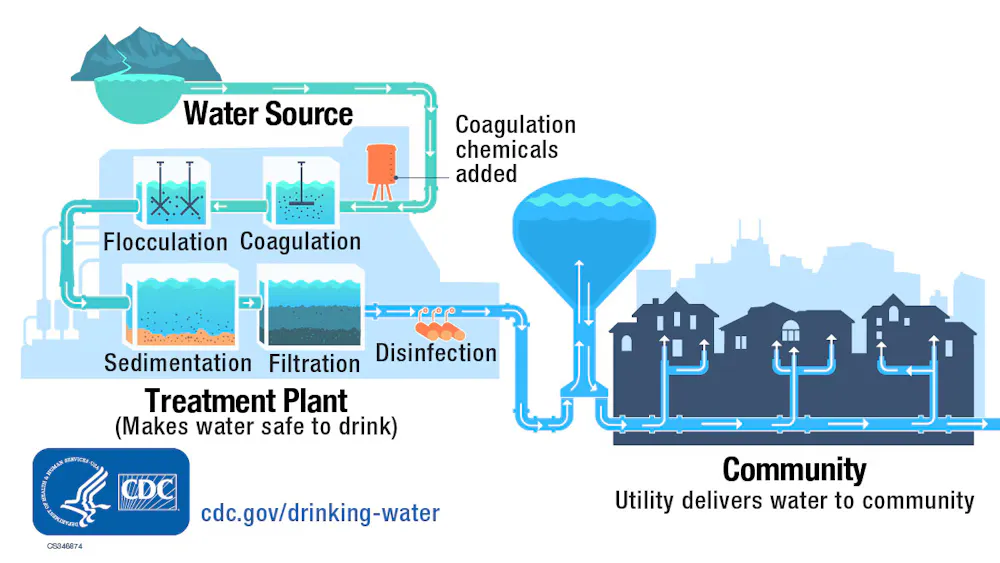
Today, the process of cleaning water begins with the same steps employed by the ancient Egyptians, followed by extensive filtration to get rid of debris as well as most germs and chemicals. Chlorine is added to kill lingering pathogens, including those that may reside in the service pipes carrying the water to the faucet. Beginning in the 1940s, a small amount of fluoride was added as an inexpensive, safe and effective means to improve dental health.
People who champion raw water claim it has health benefits, such as essential minerals and beneficial bacteria called probiotics, that are stripped from tap water. Let’s unpack each of these claims.
Water dissolves bits of soil and rock at its source; therefore, its mineral content depends on the local geology. Areas with a lot of limestone, like the Midwest, have water that is higher in calcium. Water from deeper in the ground may have higher mineral content since it passes through more rock on its way to the surface.
The idea that tap water is depleted of essential minerals is not true, as these nutrients are too small to be excluded by the filtration process. Test kits can determine the mineral content of your water, and if you find it lacking, mineral supplements can be added. Experts suggest, however, that most minerals you need come from your diet, not water.
Some also claim that raw water contains probiotics that are removed from tap water. The amount of probiotics in water would also vary by location, and the notion that health-promoting bacteria reside in raw water has not been proved.
There are no studies associating raw water with any health benefit. Anecdotal claims about smoother skin or increased energy are likely to be placebo effects. Even the idea that raw water tastes better might be more psychological than physiological – a 2018 study showed that most people preferred tap water over bottled water in a blind taste test.
Risks of drinking raw water
Raw water carries the risk of serious gastrointestinal infection from a wide variety of pathogens.
Tap water undergoes several treatment steps before it reaches your faucet. CDC
Carriers of diarrheal infections can transmit them to others if they swim in public pools or fail to properly wash their hands before touching others or preparing food. Norovirus is particularly durable and can survive on surfaces for days, increasing chances of it infecting someone else.
Raw water can also contain algae that release toxins causing abdominal issues and damage to the brain and nervous system.
The Environmental Protection Agency routinely screens for nearly 100 contaminants to ensure tap water is safe. In contrast, raw water remains untested, unregulated and untreated, leaving its safety to drink in question. In terms of risks and benefits, there are no demonstrated health benefits from drinking raw water, but clear evidence that you may be exposing yourself to harmful infectious and toxic contaminants.
Bill Sullivan receives funding from the National Institutes of Health.
When I drive my car on weekends, I emit greenhouse gases – but not enough to change the global climate on my own. But when I, my neighbours and hundreds of millions of other people drive, fly, eat meat and embark on countless other activities that generate greenhouse gas emissions, we raise the Earth’s temperature.
This is what we might call a collective harm problem, where the acts of many together lead to harmful outcomes, but no discrete act by any one person can solve it. Debates on how to fight climate change generally settle on the need for collective action ~ but does that make personal efforts inconsequential, even pointless?
If a single pro-environment lifestyle change – like one person giving up their SUV or cutting out meat in favour of plant-based foods – will not turn the tide of global climate change on its own, it’s reasonable to feel there is little that “doing your bit” can achieve. This mindset is disempowering.
Fortunately, it is not the only way of responding to the challenge. African philosophers have a different way of looking at it.
Individual contributions are not pointless
Studies assessing public willingness to contribute to climate action show that people will act even at a personal cost, given the right motivations. The urgent task for philosophers and environmentalists is to provide them with those motivations. This is where African philosophy is helpful.
By African philosophy, I mean critical reflections on basic questions about the world – spanning the nature of knowledge, existence, morality, meaning and truth, from the perspective of African philosophers.
I am a philosopher who studies the problem of what appear to be collectively insignificant individual actions. There is a concept from African philosophy that I think is helpful to understand this: “complementarity”.
Complementarity denotes a relationship of interdependence among all entities – plants, animals, rivers, humans – in an interconnected community of living and non-living things. As a framework for understanding the world, it holds that everything within the human and non-human environment exists in a relationship of mutual dependence. Everything is connected to everything else. No entity can exist and flourish in isolation.
To that extent, the flourishing of one person depends on and influences the flourishing of other things in the world – including other people and animals as companions, the plants and soil which provide food for survival, rivers and oceans that are a source of water, and the Sun which gives the energy that sustains life on Earth.
Complementarity has been used by African philosophers like Jonathan Chimakonam, Aïda Terblanché-Greeff, Diana-Abasi Ibanga and Kevin Gary Behrens to develop environmental philosophies based on shared relationships. According to these philosophers, a view of the world based on complementarity neither foregrounds nor diminishes humans. Rather, it sketches a relationship of equals defined by the mutual participation of all.
This thinking is averse to hierarchy. No individual can claim to have more value than another. Anything that exists serves as an important part of the environment and matters equally, whether alone or collectively. Complementarity holds that the relationships that unite individual things can extend to prove the value of every contribution, no matter its size.
And so, complementarity rejects the argument that anything you do to help the climate is pointless. Driving my car is not an action that exists in isolation. My emissions are interconnected with other aspects of the environment.
Similarly, individual climate-positive actions occur in relation to others taken globally, so it is a mistake to assume such actions are pointless. Rather, their relation to other actions makes them not just practically useful but necessary, to make a difference at the level of communities and globally.
According to this African concept, the race to reduce greenhouse gas emissions is a complementary effort. And so, do not be discouraged from taking your own step in this direction.
Patrick Effiong Ben receives funding from the AHRC North West Consortium Doctoral Training Partnership (NWCDTP).
Audience with the Presidents of the Episcopal Communication Commissions and Directors of the Communication Offices of the Episcopal Conferences, 27.01.2025
This morning, in the Vatican Apostolic Palace, the Holy Father Francis received in audience the Presidents of the Episcopal Communication Commissions and the Directors of the Communication Offices of the Episcopal Conferences.
The following is the Pope’s address to those present during the meeting:
Address of the Holy Father
I am pleased to welcome you who carry out a service of leadership in the field of communications in your local Churches. It is good to see bishops, priests, men and women religious, lay men and women gathered here, called to communicate the life of the Church and a Christian worldview. Communicating this Christian worldview is beautiful.
We meet today, after celebrating the Jubilee of the World of Communications, to do an assessment together and also an examination of conscience. The Letter to the Hebrews reminds us that faith is the assurance of things hoped for and the conviction of things not seen (cf. 11:1). Motivated by this faith, let us take a moment to reflect on the concrete way we communicate.
Let us ask ourselves: what do we do to sow hope in the midst of all the despair that surrounds and challenges us? What do we do to overcome the virus of division that undermines our communities? Is our communication inspired by prayer? Or do we limit ourselves to communicating about the Church by merely following the rules laid down by corporate marketing? We should ask ourselves all of these questions.
Are we witnessing to the fact that human history is not tied to an inexorable destiny? What are we doing to encourage others to look forward to a future that is not predetermined? I like the expression “writing the future”. It is up to us to write the future. Are we capable of communicating that hope is not an illusion? Hope never disappoints. But are we communicating that? Are we capable of communicating that it is possible to improve the lives of those around us, and that we can play a part? Can I, for my part, bring beauty to the lives of others? Are we able to communicate and convince others that it is possible to forgive? This is very hard to do!
Christian communication is about showing that the kingdom of God is near. It is present here and now, like a miracle that can be experienced by every person and by every culture. A miracle that must be narrated by offering the hermeneutic necessary to look beyond the mundane, beyond evil, beyond prejudices, beyond stereotypes, beyond oneself. The kingdom of God is beyond us. The kingdom of God even comes through our imperfections and this is beautiful. The kingdom of God comes when we show attention to others and carefully analyse the world around us. It comes in the ability to recognize and spread the hope that goodness exists, overcoming a desperate fanaticism.
This may be an institutional service for you, but it is also the vocation of every Christian, of every baptised person. Every Christian is called to recognize and pass on the stories of good that bad journalism tries to erase by only focusing on evil. Evil exists. It must not be hidden, but it should stir us and lead us to produce questions and answers. This is why your task is so important: it demands that you step out of yourself, to dedicate yourself to a “symphonic” work that involves everyone, that values old and young, women and men and takes into account every language, through the use of words, art, music, painting and images. We are all asked to examine how and what we are communicating. Communicate, we must always communicate.
Sisters, brothers, this task is challenging. I therefore encourage you to increase your efforts to cooperate on both a continental and universal level so that we can build a different model of communication. The difference lies in the unlimited spirit, creativity and poetic power that flow from the Gospel. Communication is always original. When we communicate, we create languages and bridges. We become creators. It must be a model of communication that conveys harmony and proposes a concrete alternative to today’s towers of Babel. Think about this: the new towers of Babel. They all spoke but did not understand one other. Reflect on this image.
I leave you with two words: together and network.
Together. Only together can we communicate the beauty we have encountered: not because of our talents or because we have more resources, but because we love one another.
This is where we draw the strength to love even our enemies, to embrace those who have done wrong, to unite what is divided and to resist despair. And to sow hope as well. Do not forget about this: sowing hope. It is not the same as sowing optimism. Not at all. We must sow hope.
Communicating, for us, is not a tactic. It is not a technique. It is not the repetition of catchphrases or slogans, nor is it merely writing press releases. Communicating is an act of love. Only an act of selfless love can produce networks of goodness. These networks of goodness should be regenerated and restored every day, with patience and faith.
Network is the second word I invite you to reflect on. Today, we have forgotten the older meaning of this word, as if it were only linked to the digital world. In fact, it is an ancient word. Before making us think about social networks, it ought to remind us of the fishermen’s nets and of Jesus’ invitation to Peter to become a fisher of men. Doing this means putting skills, knowledge and resources into a network capable of providing adequate information and thus escaping the sea of despair and disinformation. This in itself is already a message, a lesson we can learn.
Let us think of how much we could accomplish together – thanks to the new tools of the digital era and to artificial intelligence – if instead of turning technology into an idol, we were more committed to networking. I have to admit something: what worries me, more than artificial intelligence, is natural intelligence, the intelligence that we must develop.
When we feel as if we have fallen into an abyss, we must look up, beyond ourselves. Nothing is lost. We can always start again by trusting in each other and, together, trusting in God. This is the secret of our power to communicate. Networking! Be a network! Instead of being seduced by the sterile sirens of self-promotion and the celebration of our own initiatives, let us consider how we can build together a tale of hope.
This is your task. It is rooted in antiquity. The greatest miracle Jesus wrought for Simon and the other disappointed and weary fishermen was not so much a net full of fish, but having kept them from falling prey to disappointment and discouragement in the face of defeat. Please, do not give in to that type of interior sadness. Do not lose your sense of humour, which is wisdom, everyday wisdom.
Sisters, brothers, our network is for everyone. For everyone! Catholic communication is not something isolated; it is not just for Catholics. It is not a fenced-in area where we can keep to ourselves, a sect where we can talk to each other. No! It is the open space of a living witness that knows how to listen to and interpret the signs of the kingdom. It is the welcoming place of true relationships. Let us ask ourselves: are our offices and our relationships like this? Our network is the voice of a Church that only finds itself and the reason for its hope by stepping out of herself. The Church must step out of herself. I like to think of that passage in the Book of Revelation when the Lord says, “I am standing at the door, knocking” (3:20). He says this because he wants to come in. But today the Lord often knocks from the inside because he wants us, as Christians, to let him out! Too often we keep the Lord to ourselves. We must let the Lord out – he is knocking at the door to be let out – and not keep him somewhat “enslaved” for own purposes. Do our offices, our relationships and our networks really resemble a missionary Church?
Thank you, thank you for your work! Go forward with courage and the joy that comes from evangelising. I bless you all from my heart. And please do not forget to pray for me. Thank you!
North West Angling Fair to return to banks of the Mourne in March
27 January 2025
Strabane is set to play host to thousands of fishing enthusiasts in March when the North West Angling Fair returns to the Melvin Sports Complex.
The annual celebration of angling will host some of the UK and Ireland’s leading fly dressers, casters and angling specialists and the programme will include professional casting and fly fishing demonstrations on the River Mourne.
The public will also have the opportunity to source angling merchandise from a wide range of fishing tackle producers, fly tying brands and fishing outfitters in the Melvin’s Main Hall. The event is organised by Derry City and Strabane District Council with support from the Loughs Agency. Mayor of Derry and Strabane, formally announced Saturday 29th and Sunday 30th of March as the dates for the event on the Strabane foot bridge on the River Mourne this week. “The North West Angling Fair will bring thousands of visitors to Strabane in a celebration of everything that makes angling such a unique and rewarding pastime,” she said. “Whether you’re a complete beginner looking to try something new or an experienced angler eager to refine your skills, this event has something for everyone. “From expert demonstrations and technique masterclasses to sourcing the latest equipment, it’s a great opportunity to share ideas and connect with others who share a passion for angling.” Festival and Events Officer at Council, Helena Hasson, said the full programme will be released in the coming weeks. “We are looking forward to welcoming an internationally renowned lineup of fly dressers, casters, and instructors to this year’s event,” she said. “The programme will feature demonstrations on the pitches at the Melvin and on the Mourne as well as talks and fly tying demos inside the Melvin where a diverse range of traders will be exhibit in the Main Hall. “We will also showcase and celebrate the many young people in our region who take part in angling and create opportunities for young people who are new to fishing.” Sharon McMahon, Loughs Agency CEO, said: “We’re delighted to once again support Derry City and Strabane District Council in delivering one of the most anticipated events on the angling calendar, right here in the North West. “Angling has played a vital role within our communities, providing enjoyment, tradition, and opportunities for generations.
“Our Fisheries and Angling Improvement Strategy underscores our commitment to enhancing angling experiences for everyone in our catchments, ensuring the sport continues to thrive.
“We are excited to welcome both seasoned anglers and newcomers alike to what is sure to be a fantastic event on the banks of the Mourne in March.” Council are currently accepting applications from individuals, businesses and organisations interested in trading at the fair. You can apply online at https://bit.ly/42bEbnR and the deadline for submission is Friday 31st January at midday. Any queries relating to the application can be sent to [email protected]. For updates and programme information on the North West Angling Fair visit www.derrystrabane.com/anglingfair and follow Northwestangling on facebook.
Foreign Minister Winston Peters has confirmed New Zealand’s aid for Kiribati is being reviewed after its President and Foreign Minister cancelled a meeting with him last week.
Terms of Reference for the review are still being finalised, and it remains unclear whether or not funding will be cut or projects already under way would be affected, with Peters’ office saying no decisions would be made until the review was complete.
His office said Kiribati remained part of the RSE scheme and its eligibility for the Pacific Access Category was unaffected — for now.
Peters had been due to meet with President Taneti Maamau last Tuesday and Wednesday, in what was to be the first trip by a New Zealand foreign minister to Kiribati in five years, and part of his effort to visit every Pacific country early in the government’s term.
Kiribati has been receiving increased aid from China in recent years.
In a statement, a spokesperson for Peters said he was informed about a week before the trip President Maamau would no longer be available.
“Around a week prior to our arrival in Tarawa, we were advised that the President and Foreign Minister of Kiribati, Taneti Maamau, was no longer available to receive Mr Peters and his delegation,” the statement said.
‘Especially disappointing’ “This was especially disappointing because the visit was to be the first in over five years by a New Zealand Minister to Kiribati — and was the result of a months-long effort to travel there.”
The spokesperson said the development programme was being reviewed as a result.
“New Zealand has been a long-standing partner to Kiribati. The lack of political-level contact makes it very difficult for us to agree joint priorities for our development programme, and to ensure that it is well targeted and delivers good value for money.
“That’s important for both the people of Kiribati and for the New Zealand taxpayer. For this reason, we are reviewing our development programme in Kiribati. The outcomes of that review will be announced in due course.
“Other aspects of the bilateral relationship may also be impacted.”
New Zealand spent $102 million on the development cooperation programme with Kiribati between 2021 and 2024, including on health, education, fisheries, economic development, and climate resilience.
Peters’ office said New Zealand deeply valued the contribution Recognised Seasonal Employer workers made to the country, and was committed to working alongside Pacific partners to ensure the scheme led to positive outcomes for all parties.
Committed to positive outcomes “However, without open dialogue it is difficult to meet this commitment.”
They also said New Zealand was committed to working alongside our Pacific partners to ensure that the Pacific Access Category leads to positive outcomes for all parties, but again this would be difficult without open dialogue.
The spokesperson said the Kiribati people’s wellbeing was of paramount importance and the terms of reference would reflect this.
New Zealand stood ready “as we always have, to engage with Kiribati at a high level”.
This article is republished under a community partnership agreement with RNZ.
What is the current situation in North and South Kivu with regards to this crisis?
Since December 2024, several fronts have been opened in the two provinces to control certain key positions. In Lubero territory, in North Kivu province, the conflict resumed in December with massive displacement. It continued in Masisi territory, where intense fighting took place in January 2025, particularly for control of the town of Masisi Centre, before moving down towards South Kivu province, to Minova and Numbi in Kalehe territory.
During the hostilities, the M23/AFC managed to take control of several towns. In recent days the fighting has moved closer to the provincial capital of Goma, with intense clashes in Sake, just 20 kilometres from the city. Artillery explosions can be heard regularly from Goma.
Fighting is taking place on all the roads around Goma and has led to a new influx of displaced people into the city, including from some camps on the outskirts of the city where people flee towards Goma, in a situation of panic.
How is this situation affecting the population?
Unsurprisingly, the humanitarian consequences for people are very serious. Hundreds of thousands of people have once again fled the fighting. According to the United Nations, 400,000 people have already fled since January. Tens of thousands headed for displacement sites around Goma, where more than 650,000 people were already living, exhausted by almost three years of fighting.
The clashes in recent weeks have led to a new influx of people into these completely unhygienic sites where – as we have been saying for far too long – families are surviving without proper shelter and lacking everything: food, water, healthcare, etc.
Unfortunately, these sites are not spared from the fighting. Rockets are being fired near these camps or the health facilities where people have sought shelter. It’s appalling and unacceptable. We are also seeing a very worrying proportion of civilians among the hundreds of wounded we are helping to treat. Some are victims of stray bullets, but others are victims of the warring parties’ failure to respect certain basic rules of conflict.
In Masisi, the hospital we support came under fire while more than 10,000 people were seeking shelter. Two people were hit just outside the hospital and two of our staff were injured by rocket fire. The presence of combatants or artillery positions in close proximity to health facilities and camps for internally displaced people puts lives at immediate risk. It is important for everyone to remember that even war has its rules.
What is MSF’s current response on the ground?
We are doing our utmost to maintain our regular and emergency activities, but in some areas we have had to limit the risks by reducing the size of our teams. Around Goma, for example, direct armed violence has reduced our ability to go to certain affected sites over the past two days, although we continue to supply medical facilities, help them prepare for an influx of wounded, and bring in fuel to run water pumps as soon as conditions allow. This allows these facilities to continue to function, even with a more limited presence of our teams.
In Goma itself, we continue to support the Kyeshero hospital to treat some of the wounded and to relieve the International Committee of the Red Cross (ICRC), which is on the frontline treating the wounded at the Ndosho hospital. It is clear that the hospitals in Goma are completely overwhelmed by the number of wounded.
In the rest of North and South Kivu, despite the security and logistical challenges and restrictions on movement, we are maintaining our presence and continuing to treat patients, including the wounded. In three weeks, nearly 400 casualties have been treated at the Minova General Referral hospital, the Numbi hospital centre, and the Masisi General Referral hospital. We are also continuing to support displaced people in more remote areas, such as Lubero, where we are also working to improve access to water in health facilities and at the Magasin site for displaced people.
A vendor arranges seafood at the Fushansuo Market in Shinan district of Qingdao, east China’s Shandong province, Aug. 7, 2023. [Photo/Xinhua]
Chinese lawmakers are deliberating a draft of the country’s first basic law specifically focused on the development of the private sector.
The law will be conducive to creating a law-based environment that is favorable to the growth of all economic sectors, including the private sector, said He Rong, minister of justice, while explaining the draft on Saturday during the ongoing session of the Standing Committee of the National People’s Congress, the national legislature.
The draft private sector promotion law covers areas such as fair competition, investment and financing environments, scientific and technological innovation, regulatory guidance, service support, rights and interests protection and legal liabilities.
Lawmakers agreed that the law will be of great significance for further optimizing the environment for private sector development, accelerating the formation of a new development paradigm and driving high-quality growth.
The draft has incorporated suggestions solicited from representatives of the private sector, experts, scholars and the general public, He said.
Chinese pop icon Jason Zhang has become the first singer from the Chinese mainland to release a concert film, which debuted on Dec. 20, his birthday. In an exclusive interview with China.org.cn, he shared his aim of transforming his spectacular concerts into a compelling cinematic experience.
Jason Zhangperforms in concertat the National Stadium in Beijing, 2023. [Photo courtesy of Jason Zhang Studio]
“Jason Zhang Brilliance Tour” aims to give fans and cinemagoers an immersive experience that captures the essence of his live performances. “I wanted to condense the great concerts into a film and let everyone see it.”
The film features his best performances of 40 songs from three sold-out concerts at the National Stadium, also known as the Bird’s Nest, in Beijing in August 2023. He specially chose the last three shows of his tour for the filming, considering the high level of coordination between his band and staff, coupled with high-quality stage and recording equipment utilized during those particular performances.
The shows were part of the “Brilliance Tour,” which first kicked off in October 2021 in Suzhou, Jiangsu province, spanning 13 cities and attracting a staggering audience of over 900,000 fans.
Jason Zhang poses for a photo with fans at the premiere of “Jason Zhang Brilliance Tour” in Beijing, Dec. 18, 2024. [Photo courtesy of Taopiaopiao]
Beyond just documenting a successful tour, Zhang’s film serves as an unprecedented treat for fans unable to attend the concerts in person. The result extends the concert’s reach, opening up Zhang’s performances to a wider audience that goes beyond the physical limitations of a concert venue.
Zhang fondly recalls the energy of the tour, emphasizing how the collaboration with his team brought the grandeur of each show to life. According to Zhang, the film is a true reflection of what he envisioned, largely due to his personal involvement in the editing and selection of performances featured in the film, ensuring a high level of authenticity.
His aspirations don’t stop here. When asked about continuing to pioneer concert films in his career, Zhang hinted at even more cinematic ventures that blend his passion for music with the big screen. “I think preparing for the future is worthwhile,” he mentioned, contemplating further on this blend of music and cinematography.
Zhang’s 20-year career, during which he has won more than 210 music awards, illustrates his profound impact on Chinese popular culture, making him a fitting figure to create the mainland’s first Mandarin concert film. When his concert film was first announced, the news immediately topped trending topics, and presales quickly reached more than 20 million yuan.
A poster for “Jason Zhang Brilliance Tour.” [Image courtesy of Taopiaopiao]
The pop star said he felt fortunate to release this film and hopes it can serve as a trailblazing move allowing more Chinese singers to follow suit and produce concert films. This, he believes, will allow people to see more of their favorite singers at the cinema and enjoy an extremely joyful music experience. It sets a fresh paradigm for how modern musicians can innovatively archive and share their artistry on a global scale.
In Zhang’s film, there are plenty of shots of passionate fans offstage, cheering, waving and crying. When they turn on the torch function on their cellphones or wave glow sticks, the concert venue transforms into a galaxy, and the singer makes sure to enjoy these moments, often asking fans to sing along. “I felt very happy and grateful for their support. They know me well and have walked with me through highs and lows,” he said.
He mentioned three songs he always loved: “Love of the North Star,” “The Most Beautiful Sun” and “This is Love,” which he always sang together with the audiences. These are included in the film due to their popularity and emotional resonance, radiating strength and showcasing happiness at the live shows.
Jason Zhang on stage at a concert during his Brilliance Tour at the National Stadium in Beijing, 2023. [Image courtesy of Jason Zhang Studio]
The pop star said that he plans to hold more concerts in stadiums across the country in the future. He shared his reflections on his artistic journey and sources of inspiration: “I think if you love something, you should work hard at it without letting too many concerns hold you back. In the process, you’ll encounter many obstacles that might try to stop you, but if you always remember the passion and purpose you started with, you will never lose your way.”
Today is the Winter Solstice, one of the most important festivals for the Chinese community. First and foremost, I would like to wish everyone a joyful and peaceful reunion on this special occasion. Following the Winter Solstice, we have Christmas, New Year’s Eve, and New Year holidays around the corner. My colleagues and industry friends have already made full preparations for the seamless flow of people and goods, ensuring everyone can enjoy this festive season with their families and friends.
Aviation Capacity Restored to Pre-Pandemic Levels
Hong Kong International Airport (HKIA) successfully operated all three runways simultaneously last month, just in time for the Christmas peak. I believe some of you may have already set off last night as the Airport Authority anticipates that we will see a peak in departures this weekend.
Another piece of good news to share is that the Airport Authority expects daily passenger traffic to reach pre-pandemic peak of approximately 200,000 passengers during Christmas. In fact, we have reached 1,150 flight movements today, which is very close to the pre-pandemic 1,200 daily movement and these all reflect that the airport’s capacity has been fully restored. Local airlines are actively exploring new destinations to support the expansion of HKIA’s network, in order to provide more choices for travellers. To inject new demand into HKIA, we have launched direct passenger services to Xining, Zhoushan, Huangshan, and Yichang in Mainland China; Vientiane, Laos; Riyadh, Saudi Arabia; Sendai and Yonago, Japan; and Cairns, Australia earlier this year. Local airlines will also open direct flights in phases to the Gold Coast, Australia; Dallas, the US; Hyderabad, India; Munich, Germany; and Brussels, Belgium next year.
World-Class Temperature-Controlled Logistics
As the flow of people at HKIA is bustling, the achievements in our logistics industry are equally undeniable. Earlier, I celebrated Christmas with colleagues from my bureau and shared with them seasonal fruits from around the world. Hong Kong’s fruit market gathers top-quality produce with strict temperature requirements from the five continents, all at reasonable prices and arriving fresh to customers. This is made possible by Hong Kong’s world-class and highly efficient air transportation facilities, which clearly demonstrate the city’s advantages in air freight, especially in temperature-controlled logistics.
The Christmas holiday is filled with opportunities for gatherings and feasts. I invite everyone to take the chance to experience the convenience of Hong Kong’s temperature-controlled logistics, enjoying global cuisine right here in the city. The high-quality temperature-controlled goods in Hong Kong not only benefit the 7.8 million residents but also extend their reach to the 86 million people in the Greater Bay Area (GBA).
By the end of next year, the Airport Authority will complete the first phase of the permanent facilities for the “HKIA Dongguan Logistics Park” aiming to gradually handle 1 million tons of cargo annually. To meet the growing demand in the GBA for fresh food, such as high-value frozen tuna, salmon and other seafood, the Airport Authority is working with the Dongguan Municipal Government to establish a new customs-designated supervision area for fresh food at the HKIA Dongguan Logistics Park. The Dongguan Municipal Government has received approval from the General Administration of Customs of People’s Republic of China to establish a new designated customs supervision site for fresh food at the Logistics Park. Facilities such as refrigerated storage and inspection areas are currently being prepared for construction.
As the world’s busiest cargo airport, HKIA has always made me proud. In 2023, HKIA handled 4.3 million tonnes of cargo. This year, the growth momentum continues, with 4.5 million tonnes of cargo processed in the first eleven months alone, surpassing the total cargo volume for the entire previous year. HKIA was named “Cargo Airport of the Year – Asia Pacific” and “Air Cargo Technology Provider of The Year” at the 11th Payload Asia Awards, held in Singapore. I hope HKIA continues their excellent work, propelling both passenger and cargo services to new heights.
Welcoming travellers of Shenzhen’s Multiple-Entry Individual Visit Scheme
The central government has resumed the multiple-entry Individual Visit Scheme (IVS) for Shenzhen permanent residents and is implementing a new arrangement to expand the multiple-entry IVS to Shenzhen residence permit holders on December 1. In addition, various exciting activities are taking place across Hong Kong in December, including the New Year’s Eve countdown fireworks display, and it is expected that the number of visitors to Hong Kong will significantly increase during that period. I sincerely invite travellers from the Mainland and overseas to stay a few more days in Hong Kong to experience the charm of this metropolitan city and the unique blend of Eastern and Western Christmas atmosphere.
We have also made arrangements for transportation on New Year’s Eve. The Transport Department will coordinate with the opening hours of boundary control points to enhance transportation services connecting various ports, including increasing the frequency of the Hong Kong-Zhuhai-Macao Bridge shuttle bus (Gold Bus), the Lok Ma Chau-Huanggang cross-boundary shuttle bus service. Public transport operators will increase their capacity. The Mass Transit Railway (MTR) Corporation will not only provide overnight service on most railway lines on New Year’s Eve but also extend the service of the East Rail Line to and from the MTR Lo Wu Station. There will be a bus route between MTR Sheung Shui Station and San Tin Public Transport Interchange to facilitate East Rail Line passengers in using the 24-hour crossing at Lok Ma Chau/Huanggang after the service to Lo Wu concludes.
Finally, I would like to take this opportunity to wish all citizens a sweet and warm Christmas, and to carry the joy into 2025. I also want to express my heartfelt gratitude to all those who will be on duty in various locations during the holiday period to serve the public.
Secretary for Transport & Logistics Mable Chan wrote this article and posted it on her blog on December 21.
Source: Traditional Unionist Voice – Northern Ireland
Statement by TUV MLA Timothy Gaston:
“On 16th September – more than three months ago – I raised the prospect of biological men being able to access women only prisons in the Assembly. My comments were dismissed with a patronising swipe of the hand.
“Questioning Ms O’Neill on the Executive’s Violence Against Women and Girls Strategy I asked: “In Scotland, there was a ridiculous situation where a rapist was held in a female prison before, rightly, being moved. Is there anything in the strategy to defend women-only rights and women-only spaces and to oppose the efforts of a biological man who thinks he is a woman to gain access to female-only spaces?”
“Ms O’Neill totally ignored the question and responded by saying: “It is unfortunate that you take that approach, but we will not be distracted. We are here to launch a strategy to end violence against women and girls. It is endemic in our society, and it must stop. The focus of the framework is on prevention and tackling the root causes of violence against women. We will remain focused on the work that we are trying to do. It is a whole-society approach. I encourage you even to get behind it, because it is really important. It is about women who are being murdered. We need to end violence against women and girls. I would like to think that everyone who has been elected to the Chamber has the same goal in mind.”
“Now we discover that the Department of Justice has conceded the challenge brought by a biological man to be held in Hydebank Wood because the Department had no clear policy on the issue.
“Presumably a similar challenge could be successfully mounted by rapists as well.
“Such a situation was – as my question three months ago illustrates – entirely predictable. How can the Executive claim to be concerned about violence against women when they fail to have a policy to prevent a man facing charges of threats to kill from being detained in our only female prison?
“Indeed, what is the point of having a female prison if we now face the prospect of men being detained in it as well?
“This is not a case of woke politics but a serious challenge to female safety.”
Source: Hong Kong Government special administrative region
LegCo delegation begins duty visit to Japan (with photo) LegCo delegation begins duty visit to Japan (with photo) ********************************************************
The following is issued on behalf of the Legislative Council Secretariat: The Legislative Council (LegCo) delegation (the delegation), led by the President of LegCo, Mr Andrew Leung, began a four-day duty visit in Japan today (December 21) to strengthen ties with Japan and gain a deeper understanding of the latest situations and opportunities of the country in the areas of trade, culture and tourism, fisheries and agriculture, and food safety. Upon arrival in Tokyo, the delegation had dinner and exchanged views with representatives of the Hong Kong Economic and Trade Office in Tokyo. Members and the Principal Hong Kong Economic and Trade Representative (Tokyo), Miss Winsome Au, discussed issues such as fostering the bilateral economic and trade relations between Hong Kong and Japan, attracting investment, and promoting Hong Kong tourism. Members also gained insight into the latest developments of Japanese culture, and explored the opportunities for collaboration between Hong Kong and Japan’s cultural industries. Mr Leung expressed gratitude to the Hong Kong Economic and Trade Office in Tokyo for their assistance in facilitating this duty visit. The delegation will continue their duty visit in Japan tomorrow (December 22). The delegation is led by Mr Leung. The Deputy delegation leader is the Chairman of the Parliamentary Liaison Subcommittee, Mr Tommy Cheung. Other participating Subcommittee members are Mr Jeffrey Lam, Mr Dominic Lee, Ms Nixie Lam, Ms Joephy Chan, Mr Tang Fei and Mr Yim Kong.
Ends/Saturday, December 21, 2024Issued at HKT 19:11
SALLY BOWREY: Power will be given back to Australian travellers with a raft of new rights for cancelled and delayed flights. The initiative is designed to keep airlines honest and hold the industry accountable in some of the biggest travel reforms in a decade.
JAMES TOBIN: For more, we’re joined by Transport Minister, Catherine King. Good morning Catherine. Now, as someone who does quite a lot of travel, normally on the road with weather, catches a lot of flights, I am all ears on this one. What’s it going to mean for passengers?
CATHERINE KING: Well, what it will mean for passengers is that you get what you pay for, so either you’re able to enforce your rights to be able to get a refund or actually get the flight that you’ve actually asked for. And so, we’ve put out a draft charter of rights today. They’re out for consultation until the 28th of February. And really it is about enforcing the rights that you’ve booked a flight and that you should get what you actually pay for. So, there’s a range of rights in the draft charter that will ensure that airlines, and airports as well, actually lift their game when it comes to delivering the services that so many of us use to get around the country to work, to actually visit family, get to medical appointments, all of those things. So really, that’s what we’re doing today. It forms part of the ombudsman scheme that we’ve developed as part of the Aviation White Paper work we did this year. That scheme will be legislated next year, and the Charter of Rights really does spell out what you should be entitled to. It’s backed up by the Australian Consumer Law, what you’re entitled to if your flight doesn’t go ahead. So, if your flight is delayed by three hours or more at the fault of the airline, you should expect to be able to at no cost to yourself, get your flight rebooked either with that airline or another airline. If, because of time sensitivity, you can’t take another flight, they should be giving you a refund for that. Or if you’re stuck in not in your port where you live, you should be able to get accommodation and meals and again at no cost to yourself.
SALLY BOWREY: And I think anyone, when you pay for something, you expect to actually get the product. And we do, have some pretty dismal stats in terms of, you know, flight delays, 30% of flights are delayed. So, I think the report is showing that it can take also up to almost 100 days for customers when they complain this is way too long. So, it is promising to push airlines to really reduce that. How will the new rules actually hold them to account to make sure that issues are resolved quickly?
CATHERINE KING: Well, the first thing is that the Charter of Rights basically spells out very clearly what travelling public’s rights actually are. And so, we want to make sure that’s got out widely so people are aware of exactly what their rights are to enforce them in the first instance, to try and resolve the dispute with the airline, or if it’s a dispute with the airport, and then it’s backed up by an ombudsman scheme that is legislated. So, in the same way you’ve got a telecommunications ombudsman scheme, people, if they can’t get a remedy, then can go to the ombudsman and basically then have that referred up and they’ll do the work with you to try and make sure that your rights are enforced. It doesn’t preclude you still going to the Australian Human Rights Commissioner if you’ve got an issue in terms of disability access or things like that, but it’s basically underpinned by that. At the moment, if you book a flight, it’s really complicated and it’s often not until you try and get on the phone, try and get your refund that you actually then find out, well, what you booked. You know, they’re saying you can’t have a refund, you can have a flight credit. It’s not something you can use. And so this is really spelling out what the expectations are on the airline and then backed up by the ombudsman.
SALLY BOWREY: Yeah. And I think there is a great deal of room for improvement. Catherine, just before you go, can I just quickly ask obviously in a separate issue in New South Wales, we’ve got trains being delayed and cancelled. It’s causing a lot of stress for people trying to get around at Christmas and also businesses. Is this fair and how do you see this issue being resolved quickly?
CATHERINE KING: Well, I can’t imagine a circumstance where the iconic New Year’s Eve fireworks on Sydney Harbour are coming under pressure. And I think, you know, I’d say really clearly to the union, you know, understand you’ve got a dispute with the New South Wales government, but you need to sort this out because you’re doing yourself quite a bit of damage. This is not a great time of year to be doing this. People are trying to get their last-minute Christmas shopping done. Understand you’ve got a dispute. You need to resolve it quickly, because those fireworks, I mean, you know, everyone watches them. The world.
SALLY BOWREY: Unfortunately, it seems we have just lost the transport minister, Catherine King. They’re just talking about the train strike in New South Wales. Let’s move on now.
Source: Australian Ministers for Regional Development
SALLY BOWREY: Power will be given back to Australian travellers with a raft of new rights for cancelled and delayed flights. The initiative is designed to keep airlines honest and hold the industry accountable in some of the biggest travel reforms in a decade.
JAMES TOBIN: For more, we’re joined by Transport Minister, Catherine King. Good morning Catherine. Now, as someone who does quite a lot of travel, normally on the road with weather, catches a lot of flights, I am all ears on this one. What’s it going to mean for passengers?
CATHERINE KING: Well, what it will mean for passengers is that you get what you pay for, so either you’re able to enforce your rights to be able to get a refund or actually get the flight that you’ve actually asked for. And so, we’ve put out a draft charter of rights today. They’re out for consultation until the 28th of February. And really it is about enforcing the rights that you’ve booked a flight and that you should get what you actually pay for. So, there’s a range of rights in the draft charter that will ensure that airlines, and airports as well, actually lift their game when it comes to delivering the services that so many of us use to get around the country to work, to actually visit family, get to medical appointments, all of those things. So really, that’s what we’re doing today. It forms part of the ombudsman scheme that we’ve developed as part of the Aviation White Paper work we did this year. That scheme will be legislated next year, and the Charter of Rights really does spell out what you should be entitled to. It’s backed up by the Australian Consumer Law, what you’re entitled to if your flight doesn’t go ahead. So, if your flight is delayed by three hours or more at the fault of the airline, you should expect to be able to at no cost to yourself, get your flight rebooked either with that airline or another airline. If, because of time sensitivity, you can’t take another flight, they should be giving you a refund for that. Or if you’re stuck in not in your port where you live, you should be able to get accommodation and meals and again at no cost to yourself.
SALLY BOWREY: And I think anyone, when you pay for something, you expect to actually get the product. And we do, have some pretty dismal stats in terms of, you know, flight delays, 30% of flights are delayed. So, I think the report is showing that it can take also up to almost 100 days for customers when they complain this is way too long. So, it is promising to push airlines to really reduce that. How will the new rules actually hold them to account to make sure that issues are resolved quickly?
CATHERINE KING: Well, the first thing is that the Charter of Rights basically spells out very clearly what travelling public’s rights actually are. And so, we want to make sure that’s got out widely so people are aware of exactly what their rights are to enforce them in the first instance, to try and resolve the dispute with the airline, or if it’s a dispute with the airport, and then it’s backed up by an ombudsman scheme that is legislated. So, in the same way you’ve got a telecommunications ombudsman scheme, people, if they can’t get a remedy, then can go to the ombudsman and basically then have that referred up and they’ll do the work with you to try and make sure that your rights are enforced. It doesn’t preclude you still going to the Australian Human Rights Commissioner if you’ve got an issue in terms of disability access or things like that, but it’s basically underpinned by that. At the moment, if you book a flight, it’s really complicated and it’s often not until you try and get on the phone, try and get your refund that you actually then find out, well, what you booked. You know, they’re saying you can’t have a refund, you can have a flight credit. It’s not something you can use. And so this is really spelling out what the expectations are on the airline and then backed up by the ombudsman.
SALLY BOWREY: Yeah. And I think there is a great deal of room for improvement. Catherine, just before you go, can I just quickly ask obviously in a separate issue in New South Wales, we’ve got trains being delayed and cancelled. It’s causing a lot of stress for people trying to get around at Christmas and also businesses. Is this fair and how do you see this issue being resolved quickly?
CATHERINE KING: Well, I can’t imagine a circumstance where the iconic New Year’s Eve fireworks on Sydney Harbour are coming under pressure. And I think, you know, I’d say really clearly to the union, you know, understand you’ve got a dispute with the New South Wales government, but you need to sort this out because you’re doing yourself quite a bit of damage. This is not a great time of year to be doing this. People are trying to get their last-minute Christmas shopping done. Understand you’ve got a dispute. You need to resolve it quickly, because those fireworks, I mean, you know, everyone watches them. The world.
SALLY BOWREY: Unfortunately, it seems we have just lost the transport minister, Catherine King. They’re just talking about the train strike in New South Wales. Let’s move on now.
Source: Bundesanstalt für Finanzdienstleistungsaufsicht – In English
Very few people can afford to buy a property without financial assistance. That is why so many want to take out loans. Do they think they received good advice? Were they granted the loan? Do they have problems making loan payments? And do they need follow-up financing? These are some of the questions that BaFin sought to answer in its survey of more than 3,000 consumers in summer 2024 (see info box).
The key findings of the BaFin survey:
Überwiegend gute Beratung zur Immobilienfinanzierung
• Around four in five respondents seeking a property loan get professional advice. 88% believe that they are well informed about the risks associated with the loan. • Just under half of respondents with a current fixed-rate property loan will need follow-up financing. 40% of this subset will need it as early as 2025 or 2026. • Almost one in four people who made enquiries about conditions or applications for follow-up financing received one or more rejections. • More than half of the respondents with a property loan find it difficult to cover their costs of living alongside monthly loan payments. • Every fifth woman and every tenth man who is paying off a property loan on their own spends more than 40% of their monthly net income on loan payments.
Advice on property financing generally good
81% of respondents who were looking for a property loan when BaFin conducted its survey had sought professional advice from a bank, savings bank (Sparkasse), insurance company, Bausparkasse or credit intermediary. Almost all of them felt they were well informed. During discussions, respondents were almost always given a precise calculation of the loan payments that would suit their individual circumstances. Most respondents also thought they were well informed about how to safeguard financing arrangements against unfortunate life events, such as unemployment or illness. 88% believed they had been well informed by their advisor about the risks relating to property loans. However, that also means that more than one in ten respondents do not think they were well informed.
Loans rejected if own funds are lacking and income is low
71% of respondents who were looking for a property loan had made one or more loan applications or enquiries about conditions. Almost a third of them received at least one rejection. The rejection rate for applications for follow-up financing was somewhat lower (22%). When providers gave reasons for their rejection, the most frequently cited factors were insufficient own funds or insufficient income. Other reasons for rejection included bounced payments on bank statements, overdrafts exceeding agreed limits and negative Schufa scores.
BaFin survey on property financing
A representative sample of 3,060 people took part in BaFin’s online survey on property financing.
At the time of the survey, 21% (633) of the respondents were seeking a property loan, most commonly to buy or renovate an existing property.
23% (706) of the respondents had a current property loan when the survey was conducted. Just under a quarter of them had two or more such loans.
The main aims of BaFin’s study were to find out:
how respondents rate the quality of the advice they received;
how many loan applications are rejected and why;
whether payments of instalments cause financial difficulties for the respondents; and
the level of demand for follow-up financing as well as the amounts concerned.
Financialshortfalls not unusual
BaFin’s survey also looked into how often borrowers struggle to cover their costs of living alongside monthly loan payments using their regular income. The results showed that more than 50% have such problems at least “rarely” (see infographic 1). In order to cover their expenses, many people dip into savings, postpone planned spending or take on an additional job.
Of the respondents who experienced payment difficulties, more than half stated that they had taken on additional short-term debt, e.g. by paying bills late or using credit cards and arranged overdrafts. “We view this as a problem because short-term borrowing like this is usually quite costly,” explains BaFin Consumer Protection Officer Christian Bock in an interview on the BaFin website. He also noted that consumers might also lose track of their debts and slip into a debt spiral.
Of the respondents who had a property loan at the time BaFin conducted its survey, almost one quarter were concerned that they might not be able to finance it.
Figure 1: Difficulties with loan repayments
On the basis of 706 participantsSource: BaFin
High demand for follow-up financing
Most borrowers (91%) had agreed a fixed interest rate for their current loan. Almost half will need follow-up financing to pay off the remaining debt. Of this amount, 40% will require such financing as early as 2025 or 2026. If mortgage interest rates do not fall significantly by then, many of these borrowers will have to obtain follow-up financing at a substantially higher interest rate, in particular those whose interest rate is currently fixed for a period of five or ten years. Durchschnittliche Kreditrate: 767 Euro
Average monthly payment: €767
The survey also revealed that 44% of respondents finance their loan jointly while 56% do so alone. The average monthly rate paid by the borrowers surveyed is €767. This equates to an average debt-to-income ratio of 27% in the case of those paying off loans alone and only 16% in the case of those paying off loans jointly.
Higher debt-to-income ratio among women
There is also a clear gender gap here. 20% of women paying off loans alone have a debt-to-income ratio of more than 40%. This is the case for just under one in ten men paying off debt alone (see figure 2). Regardless of gender, once they have made their repayments, these respondents have an average of €823 remaining from their net income to cover all other expenses. This group is therefore at a particular risk of becoming overindebted, especially if an unfortunate life event, such as an accident or job loss, further undermines their financial fitness.
Figure 2: Debt-to-income ratio
On the basis of 694 borrowers (167 female, 227 male)Source: BaFin
Information from BaFin
The BaFin website provides consumers with comprehensive information about property loans.
Zhao Leji, chairman of the National People’s Congress (NPC) Standing Committee, presides over the first plenary meeting of the 13th session of the 14th NPC Standing Committee at the Great Hall of the People in Beijing, capital of China, Dec. 21, 2024. (Xinhua/Li Tao) China’s top legislature on Saturday started a regular session to review a raft of bills including law drafts and reports. Zhao Leji, chairman of the 14th National People’s Congress (NPC) Standing Committee, presided over the first plenary meeting of the committee’s 13th session. Lawmakers reviewed a draft value-added tax law, a draft national park law, a draft law on the publicity and education regarding the rule of law, a draft private sector promotion law, and a draft hazardous chemicals safety law. They deliberated a draft amendment to the law on people’s congress deputies, a draft amendment to the supervision law, a draft revision to science and technology popularization law, a draft revision to the anti-unfair competition law, and a draft revision to the fisheries law. Lawmakers also reviewed a draft decision on convening the third session of the 14th NPC, reports on the handling of the suggestions, criticisms and comments submitted by lawmakers at the second session of the 14th NPC, a deputy qualification report, and personnel-related bills, among others.
Source: The Conversation (Au and NZ) – By Saman Khalesi, Senior Lecturer and Discipline Lead in Nutrition, School of Health, Medical and Applied Sciences, CQUniversity Australia
The holiday season can be a time of joy, celebration, and indulgence in delicious foods and meals. However, for many, it can also be an emotional and stressful period.
There are certain foods we tend to eat more of when we’re stressed, and these can affect our health. What’s more, our food choices can influence our stress levels and make us feel worse. Here’s how.
Why we might eat more when stressed
The human stress response is a complex signalling network across the body and brain. Our nervous system then responds to physical and psychological events to maintain our health. Our stress response – which can be subtle or trigger a fight-or-flight response – is essential and part of daily life.
The stress response increases production of the hormones cortisol and insulin and the release of glucose (blood sugars) and brain chemicals to meet demand. Eating when we experience stress is a normal behaviour to meet a spike in energy needs.
Over time, people can start to associate eating with negative emotions – such as anger, sadness, fear or worry. This link can create behavioural cycles of emotional eating. “Emotional eaters” may go on to develop altered brain responses to the sight or smell of food.
What stress eating can do to the body
Stress eating can include binge eating, grazing, eating late at night, eating quickly or eating past the feeling of fullness. It can also involve craving or eating foods we don’t normally choose.
For example, stressed people often reach for ultra-processed foods. While eating these foods is not necessarily a sign of stress, having them can activate the reward system in our brain to alleviate stress and create a pattern.
Short-term stress eating, such as across the holiday period, can lead to symptoms such as acid reflux and poor sleep – particularly when combined with drinking alcohol.
In the longer term, stress eating can lead to weight gain and obesity, increasing the risks of cancer, heart diseases and diabetes.
While stress eating may help reduce stress in the moment, long-term stress eating is linked with an increase in depressive symptoms and poor mental health.
The foods we choose can also influence our stress levels.
Diets high in refined carbohydrates and sugar (such as sugary drinks, sweets, crackers, cakes and most chocolates) can make blood sugar levels spike and then crash.
Diets high in unhealthy saturated and trans fats (processed foods, animal fats and commercially fried foods) can increase inflammatory responses.
Rapid changes in blood sugar and inflammation can increase anxiety and can change our mood.
Meanwhile, certain foods can improve the balance of neurotransmitters in the brain that regulate stress and mood.
Omega-3 fatty acids, found in fish and flaxseeds, are known to reduce inflammation and support brain health. Magnesium, found in leafy greens and nuts, helps regulate cortisol levels and the body’s stress response.
Vitamin Bs, found in whole grains, nuts, seeds, beans and animal products (mostly B12), help maintain a healthy nervous system and energy metabolism, improving mood and cognitive performance.
5 tips for the holiday table and beyond
Food is a big part of the festive season, and treating yourself to delicious treats can be part of the fun. Here are some tips for enjoying festive foods, while avoiding stress eating:
1. slow down: be mindful about the speed of your eating. Slow down, chew food well and put down your utensils after each bite
2. watch the clock: even if you’re eating more food than you normally would, sticking to the same timing of eating can help maintain your body’s response to the food. If you normally have an eight-hour eating window (the time between your first meal and last meal of the day) then stick to this even if you’re eating more
3. continue other health behaviours: even if we are eating more food or different food during the festive season, try to keep up other healthy behaviours, such as sleep and exercise
4. stay hydrated: make sure to drink plenty of fluids, especially water. This helps our body function and can help with feelings of hunger. When our brain gets the message something has entered the stomach (what we drink) this can provide a temporary reduction in feelings of hunger
5. don’t restrict: if we have a big day of eating, it can be tempting to restrict eating in the days before or after. But it is never a good idea to overly constrain food intake. It can lead to more overeating and worsen stress.
Reaching for cookies late at night can be characteristic of stress eating. Stokkete/Shutterstock
Plus 3 bonus tips to manage holiday stress
1. shift your thinking: try reframing festive stress. Instead of viewing it as “something bad”, see it as “providing the energy” to reach your goals, such as a family gathering or present shopping
2. be kind to yourself and others: practise an act of compassion for someone else or try talking to yourself as you would a friend. These actions can stimulate our brains and improve wellbeing
3. do something enjoyable: being absorbed in enjoyable activities – such as crafting, movement or even breathing exercises – can help our brains and bodies to return to a more relaxed state, feel steady and connected.
For support and more information about eating disorders, contact the Butterfly Foundation on 1800 33 4673 or Kids Helpline on 1800 551 800. If this article has raised issues for you, or if you’re concerned about someone you know, call Lifeline on 13 11 14. In an emergency, call 000.
Saman Khalesi was previously supported by a Postdoctoral Fellowship (Award No. 102584) from the National Heart Foundation of Australia.
Talitha Best is affiliated with Australian Psychological Society.
Charlotte Gupta does not work for, consult, own shares in or receive funding from any company or organisation that would benefit from this article, and has disclosed no relevant affiliations beyond their academic appointment.
Summer is here and for many that means going to the beach. You grab your swimmers, beach towel and sunscreen then maybe check the weather forecast. Did you think to grab a first aid kit?
The vast majority of trips to the beach will be uneventful. However, if trouble strikes, being prepared can make a huge difference to you, a loved one or a stranger.
So, what exactly should you be prepared for?
Knowing the dangers
The first step in being prepared for the beach is to learn about where you are going and associated levels of risk.
In Byron Bay, you are more likely to come across a brown snake than a shark.
In the summer of 2023–24, Surf Life Saving Australia reported more than 14 million Australian adults visited beaches. Surf lifesavers, lifeguards and lifesaving services performed 49,331 first aid treatments across 117 local government areas around Australia. Surveys of beach goers found perceptions of common beach hazards include rips, tropical stingers, sun exposure, crocodiles, sharks, rocky platforms and waves.
Sun and heat exposure are likely the most common beach hazard. The Cancer Council has reported that almost 1.5 million Australians surveyed during summer had experienced sunburn during the previous week. Without adequate fluid intake, heat stroke can also occur.
Lacerations and abrasions are a further common hazard. While surfboards, rocks, shells and litter might seem more dangerous, the humble beach umbrella has been implicated in thousands of injuries.
Sprains and fractures are also associated with beach activities. A 2022 study linked data from hospital, ambulance and Surf Life Saving cases on the Sunshine Coast over six years and found 79 of 574 (13.8%) cervical spine injuries occurred at the beach. Surfing, smaller wave heights and shallow water diving were the main risks.
Rips and rough waves present a higher risk at areas of unpatrolled beach, including away from surf lifesaving flags. Out of 150 coastal drowning deaths around Australia in 2023–24, nearly half were during summer. Of those deaths:
56% occurred at the beach
31% were rip-related
86% were male, and
100% occurred away from patrolled areas.
People who had lived in Australia for less than two years were more worried about the dangers, but also more likely to be caught in a rip.
Safety Beach on Victoria’s Mornington Peninsula. Still bring your first aid essentials though. Julia Kuleshova/Shutterstock
So, beach accidents can vary by type, severity and impact. How you respond will depend on your level of first aid knowledge, ability and what’s in your first aid kit.
A first aid training company survey of just over 1,000 Australians indicated 80% of people agree cardiopulmonary resuscitation (CPR) is the most important skill to learn, but nearly half reported feeling intimidated by the prospect.
CPR training covers an established checklist for emergency situations. Using the acronym “DR ABC” means checking for:
Danger
Response
Airway
Breathing
Circulation
A complete first aid course will provide a range of skills to build confidence and be accredited by the national regulator, the Australian Skills Quality Authority.
Whether you buy a first aid kit or put together you own, it should include ten essential items in a watertight, sealable container:
Band-Aids for small cuts and abrasions
sterile gauze pads
bandages (one small one for children, one medium crepe to hold on a dressing or support strains or sprains, and one large compression bandage for a limb)
large fabric for sling
a tourniquet bandage or belt to restrict blood flow
non-latex disposable gloves
scissors and tweezers
medical tape
thermal or foil blanket
CPR shield or breathing mask.
Before you leave for the beach, check the expiry dates of any sunscreen, solutions or potions you choose to add.
If you’re further from help
If you are travelling to a remote or unpatrolled beach, your kit should also contain:
sterile saline solution to flush wounds or rinse eyes
Make sure you carry any “as-required” medications, such as a Ventolin puffer for asthma or an EpiPen for severe allergy.
Vinegar is no longer recommended for most jellyfish stings, including Blue Bottles. Hot water is advised instead.
In remote areas, also look out for Emergency Response Beacons. Located in high-risk spots, these allow bystanders to instantly activate the surf emergency response system.
If you have your mobile phone or a smart watch with GPS function, make sure it is charged and switched on and that you know how to use it to make emergency calls.
First aid kits suitable for the beach range in price from $35 to over $120. Buy these from certified first aid organisations such as Surf Lifesaving Australia, Australian Red Cross, St John Ambulance or Royal Life Saving. Kits that come with a waterproof sealable bag are recommended.
Be prepared this summer for your trip to the beach and pack your first aid kit. Take care and have fun in the sun.
The authors do not work for, consult, own shares in or receive funding from any company or organisation that would benefit from this article, and have disclosed no relevant affiliations beyond their academic appointment.
It’s never been easier to stay connected to work. Even when we’re on leave, our phones and laptops keep us tethered. Many of us promise ourselves we won’t check emails during our break. But we do.
Being away from the workplace, and even in a new location, is often not enough to detach psychologically. We might still be thinking about a demanding project we raced to finish or even feel guilty about leaving others to cover for us.
‘Digital presenteeism’
It mightn’t be spelt out by our employers but having phones and laptops can create an underlying expectation we are constantly available, even outside the usual work hours.
This feeling of connection or “digital presenteeism”, can impact our health by making us stressed, anxious and burnt out.
Switching off our work tools when we are out of the office or on leave can remove these problems as well as helping improve and enjoy our non-work activities and relationships.
Right to disconnect
While recently passed right to disconnect laws in Australia legally support workers to switch off, there’s another option already available to workers. Taking annual leave.
Unfortunately, many workers don’t take advantage of this valuable resource, with an estimated 160 million annual leave days banked up by Australian workers. One in five have more than the typical yearly allocation of four weeks unused.
The benefits of taking a break
Taking a break doesn’t just feel good, it’s been shown to benefit your health.
A 2017 meta-analysis of 86 studies revealed taking holidays can lead to reduced stress and less exhaustion during the holiday period.
So what do we do with all the extra time we have? Sleep more? Do more exercise? Studies show that’s exactly what happens when we are on holiday. We studied movement patterns of 375 adults during annual leave. We found people were more physically active, less sedentary and had more sleep each day – all of which are good for our health.
Holidays can also be associated with changes in how our body functions. A study of 112 holiday makers who attended a wellness resort for six days in the United States had increased heart rate variability which indicates greater resilience to stress.
If you’re male and still not convinced, there is evidence that taking holidays is linked with living longer. Men who take more frequent holidays and more leave days a year have lower mortality rates than those who don’t?
The best type of break?
Simply taking leave is beneficial. Longer breaks do not have increased benefits and where you go is also unimportant.
A study of locations found those who took a short four day break in a hotel did not benefit more than those who took a break at home. Both groups showed positive changes to stress, recovery, strain and wellbeing.
In our study, the largest favourable changes were experienced by people who took one to two weeks’ leave or those who spent time outdoors camping or hiking. However positive changes were observed for all types of holidays.
People who spent time outdoors during their holidays experienced the biggest health benefits. Dimitry Molchanov/Shutterstock
Ultimately, the best vacation is the one that fits your preferences and budget – there’s no such thing as a perfect holiday.
How to make the most of your next break
If you haven’t already, book some time off and get away from the workplace. Here are five ways to make the most of the time:
2. Step away from the normal routine: try to limit work-like activities (such as shopping, cleaning, computer-based tasks) and find environments that feel removed from your typical routine and obligations.
4. Reduce the friction and chaos: avoid putting yourself in settings of conflict (such as visiting a difficult family member), confusion (busy, unfamiliar environments) or tension (excessive travel and/or tight timelines).
5. Take more frequent breaks: aim for multiple short breaks throughout the year, rather than a single longer vacation. This spreads out the benefit with more lead-in time and longer comedown.
The research is clear: vacations are essential for our health and wellbeing. So, if you haven’t already, book some time off and get away from the workplace.
Carol Maher receives funding from the Medical Research Future Fund, the National Health and Medical Research Council, the National Heart Foundation, the SA Department for Education, Preventive Health SA, the Channel 7 Children’s Research Foundation, the South Australian Office for Sport, Recreation and Racing, Healthway, Hunter New England Local Health District, and the Central Adelaide Local Health Network.
Rachel Curtis receives funding from the Medical Research Future Fund, National Health and Medical Research Council, SA Department for Education, SA Office for Recreation, Sport and Racing, Preventive Health SA, Healthway, Hunter New England Local Health District, and SA Department for Innovation and Skills, the Channel 7 Children’s Research Foundation.
Ty Ferguson does not work for, consult, own shares in or receive funding from any company or organisation that would benefit from this article, and has disclosed no relevant affiliations beyond their academic appointment.