Category: Fisheries

  • MIL-OSI USA: Grassley Leads Quad Cities Lawmakers in Pressing U.S. Army for Answers on Rock Island Arsenal

    US Senate News:

    Source: United States Senator for Iowa Chuck Grassley
    WASHINGTON – Sen. Chuck Grassley (R-Iowa) led a group of Quad Cities lawmakers, including Sens. Dick Durbin (D-Ill.) and Tammy Duckworth (D-Ill.) and Reps. Mariannette Miller-Meeks (R-Iowa) and Eric Sorensen (D-Ill.), in a letter to U.S. Army Secretary Daniel Driscoll reemphasizing their request for a briefing to discuss any potential command and personnel changes at the Rock Island Arsenal (RIA). Members of the Iowa and Illinois congressional delegation first requested a dedicated briefing in April. 
    “The details you or Army leadership have reported to Congress differ from those shared with us from the RIA community. As the Army continues to implement transformation initiatives, we hear about the personnel impacts, such as roughly 150 positions within [Joint Munitions Command] headquarters, and 400 positions Arsenal wide that will be eliminated once the initiative is complete. We request a full briefing on the implementation plans, including workforce and mission impacts, and proposed timelines,” the lawmakers said. 
    The lawmakers underscored how the RIA community contributes significantly to the objectives of the Army to deliver warfighting capabilities and will continue to do so in the future.  
    “While we can appreciate and recognize the need to eliminate inefficiencies and support our national defense objectives, which may include reductions in workforce, we would like to understand the obsolete programs that the Army finds are present at RIA … We find that RIA is a highly efficient installation, as demonstrated by the dedicated workforce and capabilities embedded there. Contradictory conclusions should be justified by evidence,” the lawmakers continued. 
    Background:
    Grassley has long been a champion for Rock Island Arsenal, including through his legislation to expand manufacturing opportunities for Army arsenals. He also helped secure provisions in appropriations legislation and the annual defense bill to help ensure the long-term viability of the Rock Island Arsenal. Along with the other signatories, he introduced the Arsenal Workload Sustainment Act in March to boost workload at Army arsenals, including Rock Island Arsenal. 
    Text of the letter can be found HERE or below. 
    VIA ELECTRONIC TRANSMISSION 
    The Honorable Daniel D. Driscoll   
    Secretary of the U.S. Army   
    Dear Secretary Driscoll,  
    We appreciate your recent testimonies before the House and Senate Armed Services Committees in which you highlighted the importance of the Rock Island Arsenal (RIA). As you continue to plan and implement the reorganization outlined in the April 30, 2025, Army Transformation and Acquisition Reform memorandum, we ask that the Department of the Army be forthcoming and transparent with all stakeholders of RIA, especially members of Congress.  
    On April 4, 2025, members of the Iowa and Illinois delegation wrote to you outlining the saliency of RIA and requested a briefing to discuss any potential command and personnel changes to be made at the Arsenal. Unfortunately, our offices have not been provided a dedicated briefing on these plans, regardless of continual follow-up and directives being released to realign the headquarters and units within the Army Material Command (AMC) and Joint Munitions Command (JMC). From our questions during the broader Army transformation brief to the Senate Armed Services Committee (SASC) staff on May 22, and the SASC Army posture hearing on June 5, the last we understand from the Army is that the impact will be the likely removal of 100 personnel and the elimination of a data center. The details you or Army leadership have reported to Congress differ from those shared with us from the RIA community. 
    As the Army continues to implement transformation initiatives, we hear about the personnel impacts, such as roughly 150 positions within JMC headquarters, and 400 positions Arsenal wide that will be eliminated once the initiative is complete. We request a full briefing on the implementation plans, including workforce and mission impacts, and proposed timelines.  
    On May 21, 2025, the Department of the Army provided a response to a letter sent by members of the Iowa and Illinois delegation. While we can appreciate and recognize the need to eliminate inefficiencies and support our national defense objectives, which may include reductions in workforce, we would like to understand the obsolete programs that the Army finds are present at RIA. This includes the outdated, redundant, and inefficient programs cited in the May 21 response. We find that RIA is a highly efficient installation, as demonstrated by the dedicated workforce and capabilities embedded there. Contradictory conclusions should be justified by evidence.  
    It is encouraging to know that you and the Army are willing to work to improve the workload and operations at RIA, which may lead to additional jobs. The RIA community has contributed significantly to the objectives of the Army to deliver warfighting capabilities, and we have no doubt that it will continue to do so in the future. We look forward to hearing from you on the Army’s course of action for RIA and working with you increase the workload at RIA. Thank you for your continued dedication to our soldiers and to Army readiness.  
    -30-

    MIL OSI USA News

  • MIL-OSI USA: Pallone, Huffman, Castor, Booker, Reed, and Padilla Lead Charge to Block Trump’s Dangerous Offshore Drilling Plan

    Source: United States House of Representatives – Congressman Frank Pallone (6th District of New Jersey)

    Washington, D.C. – Today, U.S. House Energy and Commerce Ranking Member Frank Pallone (D-New Jersey), U.S. House Natural Resources Committee Ranking Member Jared Huffman (D-Calif.), Rep. Kathy Castor (D-Fla.), Senator Alex Padilla (D-Calif.), Senator Cory Booker (D-N.J.), and Senator Jack Reed (D-R.I.) along with 40 Democratic colleagues in the House and Senate submitted formal comments to the Bureau of Ocean Energy Management (BOEM), opposing any new or expanded offshore oil and gas leasing in the Trump administration’s proposed updates to the Outer Continental Shelf (OCS) oil and gas leasing program.

    In their letter to Interior Secretary Doug Burgum, the lawmakers warned that more offshore drilling would threaten our national security, coastal communities, marine life, and local economies – all while handing more giveaways to an industry already sitting on millions of acres of unused leases. They urged the agency to exclude any new leasing in the final program. 

    “New or expanded oil and gas leasing poses risks to the health and livelihoods of our constituents, jeopardizes our tourism, fishing, and recreational economies, and threatens the marine life that inhabits our coastlines” the members wrote. “New, unnecessary lease sales will lock in decades more of pollution and climate impacts from an industry that already holds more than 2,000 offshore leases covering more than 12 million acres of federal water, of which only 469 leases are currently producing oil and gas. The United States is already the number one producer of oil and gas in the world. There is no need for increased leasing, especially when oil and gas companies continue to impose environmental and climate consequences, public health risks, and billions of dollars in cleanup costs on the American people.”

    Members also reminded the Secretary of the long-standing legal restrictions that prevent the administration from offering lease sales in protected areas. 

    “We remind the agency that it cannot offer sales in areas permanently protected under Section 12(a) of OCSLA, including areas off the Atlantic coast, the Pacific off the coast of California, Oregon, and Washington, the Eastern Gulf of Mexico, and portions of the Artic Ocean, including the Beaufort Sea and Chukchi Sea planning areas. In 2017, during his first term, President Trump attempted to reverse President Obama’s Arctic and Atlantic withdrawals, but Judge Sharon Gleason for the District Court of Alaska determined that Section 12(a) does not give the president authority to revoke prior withdrawals. President Trump does not have the authority to reverse the Obama and Biden withdrawals, and his Executive Order of January 2025, which attempts to do so, is unlawful.”

    During his first term, the Trump administration proposed 47 lease sales over five years, covering nearly every U.S. coastline. Fortunately, this program was never finalized due to litigation and strong bipartisan opposition. But now, with the Biden administration’s leasing plan under review and Secretary Burgum signaling that protections may be on the chopping block, lawmakers are raising the alarm once again.

    At a budget hearing last week, Secretary Burgum refused to commit to protecting Florida’s Gulf Coast from new oil and gas leasing, saying only that “the administration may be considering opportunities.” This region has long been protected by both bipartisan legislation and administrative withdrawals – protections that are now under threat. 

    Read the full letter here.

    MIL OSI USA News

  • MIL-OSI USA: Chairman Wicker Leads SASC Hearing on the FY26 Defense Budget with Senior Pentagon Leadership

    US Senate News:

    Source: United States Senator for Mississippi Roger Wicker

    Watch Video Here

    WASHINGTON – U.S. Senator Roger Wicker, R-Miss., Chairman of the Senate Armed Services Committee, today led a hearing to receive testimony from the Pentagon’s senior leaders on the department’s fiscal year 2026 budget.


    In his opening remarks, Chairman Wicker praised President Trump’s “peace through strength” leadership and Secretary Hegseth’s achievements in implementing that agenda at the Pentagon. The chairman also noted that maintaining the national defense budget at $893 billion, even with an additive $150 billion from defense reconciliation, would result in United States military spending falling far below 3 percent of GDP by 2029.


    Read Chairman Wicker’s hearing opening statement as delivered.


    The committee convenes this morning to hear testimony concerning the president’s fiscal year 2026 budget request. I welcome Secretary Hegseth, Chairman Caine, and Acting Comptroller MacDonnell.


    As we review the past five months, the president and the Department of Defense have much to be proud of. The administration has largely succeeded in refocusing the Pentagon on warfighting.  Our recruitment numbers have dramatically improved.  That is a very important achievement and one we will continue to celebrate.


    The U.S. military has played a significant supporting role in the president’s wholesale success at our southern border.  He has achieved operational control over the situation – a position the vast majority of Americans support.


    In Operation Rough Rider, the president imposed costs on the Houthis.  The operation was well executed by our service members, and it appears to have achieved its stated objectives for now.  Similarly, the president has relentlessly struck al-Qaeda and ISIS terrorists.  Those strikes have helped to open up space for diplomatic breakthroughs in Syria, and they have prevented significant external attacks that could have emanated from Somalia.


    Unfortunately, the Axis of Aggressors is resilient.  It is hell-bent on challenging American global leadership.


    It is clearer than ever that Vladimir Putin is uninterested in President Trump’s and President Zelenskyy’s offers for real peace negotiations.  The Europeans are heeding the president’s call to re-arm, but we are in a tenuous period: A precipitate withdrawal of U.S. forces from Europe could undo all that progress.


    In Asia, the Chinese Communist Party continues its campaign of aggression against its neighbors and still displays open ambitions to retake Taiwan.  Secretary Hegseth recently made this crucial point in an important speech in Shangri-La. He said, “China seeks to become a hegemonic power in Asia.”  He is right.  China intends to use military force to achieve Xi Jinping’s goals.


    Meanwhile, in the Middle East, the Ayatollah is hiding as his regime crumbles.  He still refusing to negotiate.


    In short, this is the most dangerous national security moment since World War II.  Unconstrained, aggressive dictators are on the move.  And, importantly, the character of warfare is rapidly changing.  That is a dangerous combination. We cannot have an American-led Golden Age of peace and prosperity if we fail to navigate these historic security challenges.


    President Trump is actively working to protect American interests against four main adversaries: Xi Jinping and his Chinese Communist Party, Vladimir Putin’s militarized Russia, Kim Jong Un’s North Korea, and the Ayatollah’s religious fanatics, including his web of terrorists. Our commander-in-chief deserves a military capable of maintaining deterrence and applying force when necessary to protect U.S. interests – as he has done in Yemen.  I regret to say that this fiscal year 2026 budget request will not deliver that military.


    When Secretary Hegseth testified before this committee in his confirmation hearing, he made the correct point that spending less than 3 percent of GDP on defense would be, and I quote, “very dangerous.” What we have in front of us is an inadequate budget request with precious little detail and no follow-on data about fiscal years 2027, 2028, or 2029. We must assume – and, in fact, we have heard – that OMB intends to maintain defense spending at $893 billion across the four years of this administration.  Even with a one-time $150 billion reconciliation infusion, this would leave us at 2.65 percent of GDP by 2029 – below the 3% of GDP, and well below the 5% of GDP that we really really need. Clearly, such a budget plan would allow the military balance to continue – as it has been, to tilt away from the United States and toward Communist China. Communist China has increased its budget by over 7% each year for the past decade.


    I know the secretary fought for a stronger fiscal year 2026 discretionary request, but we need to acknowledge that a flat fiscal year 2026 budget is what OMB delivered.  I expect we will spend today reviewing the numerous significant holes in this request – gaps that will make it much more difficult for President Trump to equip our service members and for his advisors to develop credible military options.


    Across the budget, we see significant holes: shipbuilding, tactical fighters, basic maintenance money, and more – all insufficient.  The budget seems to be written as if there are many items in the reconciliation package that simply are not in that bill.  This is confusing, because the text of the reconciliation bill has been public for quite some time. Chairman Rogers, of the House, and I worked closely with the executive branch on the contents of the package.  This budget threatens to undermine the good work we have done together on that bill, and it leads me to question whether some officials in the administration plan to ignore congressional intent.


    I believe ignoring congressional intent would be a wrong-headed decision for the United States of America. We all work for the American people and share largely identical goals when it comes to deterring Xi Jinping, Vladimir Putin, and other threats.  We need to work much more closely together on investment strategies and actions necessary to rebuild our industrial base.  The president and the Congress want action on reindustrialization.  We want to rebuild the Arsenal of Democracy.  We need action on industrial base integration, streamlined weapons sales, and cooperation with our allies and partners.  We agree on fundamentally changing the way the DOD budgets and handles acquisition.  Now, we need to agree on providing the men and women of the Department of Defense with the resources they need to do their jobs. We have no time to waste, and we must commit to continued collaboration now.

    MIL OSI USA News

  • MIL-OSI USA: Sen. Wicker Applauds Olivia Trusty on Confirmation to the FCC

    US Senate News:

    Source: United States Senator for Mississippi Roger Wicker

    WASHINGTON – U.S. Senator Roger Wicker, R-Miss., released the following statement on the U.S. Senate’s vote to confirm former Senator Wicker staffer, Olivia Trusty, to serve as a Commissioner on the Federal Communications Commission.

    “Congratulations to Olivia Trusty on her confirmation to serve as an FCC commissioner. I have worked with Olivia for over seven years, and can attest that she is one of the most knowledgeable and capable leaders in her area of expertise. When I became Chairman of the Commerce Committee, I was fortunate that Olivia agreed to join my committee staff.  When I became the ranking member of the Armed Services Committee, I knew she was the person I wanted to handle the cyber portfolio. I have seen Olivia assist Senators in advancing initiatives that made Americans more connected, more secure, and fall squarely within the FCC’s jurisdiction.


    She helped pass legislation to improve broadband maps and ensure that broadband funds are directed where they are most needed.  She brought us closer to getting every American connected to high-speed internet. Her work has also contributed to national security. Olivia was instrumental in advancing legislation to protect our domestic networks from communications equipment manufactured by foreign adversaries. Commissioner Trusty has also been a leader on spectrum policy, an area that bridges both technology and national security. She has collaborated across the Commerce and Armed Services Committees to find common ground between commercial and federal interests. Olivia’s work has proved that the U.S. can maintain our leadership without risking national security or public safety.


    The United States is fortunate that Olivia has chosen to be a public servant and work for the American taxpayer. It has been my privilege to witness Olivia’s leadership over the years. She has skillfully and thoughtfully handled some of the most complex challenges facing our nation. I applaud President Trump for nominating one of the most talented individuals to have worked on my team. While I will miss her on my staff, I am confident she will succeed in her role as an FCC commissioner.” 

    MIL OSI USA News

  • MIL-OSI USA: Baldwin, Marshall Introduce Bill to Lower Costs and Improve Reliability of Freight Rail Service for American Businesses

    US Senate News:

    Source: United States Senator for Wisconsin Tammy Baldwin
    WASHINGTON, D.C. – Today, U.S. Senators Tammy Baldwin (D-WI) and Roger Marshall (R-KS) reintroduced the Reliable Rail Service Act to help address the unreliable service and high costs of rail shipping for Wisconsin farmers and manufacturers. The legislation would strengthen our rail supply chain and ensure the largest freight railroads provide American businesses reliable services at reasonable rates so products can get to market more efficiently, and costs are lower for families. The Reliable Rail Service Act is supported by members of the agricultural industry, labor organizations, energy producers, and manufacturers who know firsthand how poor service, significant disruptions, and sky-high prices are impacting their businesses and prices for consumers.
    “Across the Badger State, our farmers, small businesses, and manufacturers rely on rail service to get their products to market and make ends meet,” said Senator Baldwin. “But when rail service is unreliable, it puts their livelihoods on the line, disrupts supply chains, and drives up costs for hardworking Wisconsin families. That’s why I am proud to work with my Republican colleague to once again introduce our Reliable Rail Service Act and help level the playing field for Wisconsin workers, grow our Made in Wisconsin economy, and keep costs down for consumers.”
    “Kansas’s farmers and ranchers depend upon reliable transport of their world-class goods to the rest of the country, and Class 1 railroads are not meeting expectations – this is a disservice to hard-working Kansans,” said Senator Marshall. “This bill lays out reasonable requirements for rail carriers to meet these important obligations, and I look forward to working with Senator Baldwin on getting this to the finish line.”
    Rail shippers including farmers, energy producers, and manufacturers continue to face poor service, significant service disruptions, and sky-high prices that are impacting communities and consumers, all while profits for the nation’s largest railroads are at record highs.
    The Reliable Rail Service Act takes a commonsense approach to addressing high costs and unreliable service by clarifying the “common carrier obligation,” which under current law requires rail carriers to serve the wider shipping public “on reasonable request.” Current ambiguity around this principle has contributed to insufficient rail services and exorbitant costs for American products to get to market. Clearly defining the “common carrier obligation” has taken on greater importance as the railroad industry faces consolidation and has undertaken Wall Street practices that reduce capacity on the rail network.
    The bill establishes specific criteria for the Surface Transportation Board (STB) to consider when evaluating whether carriers are meeting their common carrier obligation to give shippers much-needed certainty that is currently lacking.
    “For years, dairy processors have struggled to use America’s rail system because of lack of reliability and reduced service schedules. The Reliable Rail Service Act is commonsense legislation that will provide greater clarity to the railroad’s common carrier obligations and ensure that they provide more dependable service at sensible rates,” said Dr. Michael Dykes, President and CEO of the International Dairy Foods Association. “IDFA applauds Sen. Baldwin and Sen. Marshall for introducing this legislation to improve transparency in the rail industry and restore the balance between carriers and shippers so the U.S. dairy industry can move products more reliably by rail.”
    “Senators Baldwin and Marshall have proposed smart, and a much-needed reforms to help fix persistent freight rail service failures that are plaguing chemical manufacturers,” said Chris Jahn, President and Chief Executive Officer of the American Chemistry Council. “If members of Congress are serious about bringing jobs back, leading global trade, and making more in America—not China—they should back this bill. We urge Democrats and Republicans to support this important legislation because it will help ensure that railroads deliver on their obligation to provide reliable service to U.S. manufacturers.”
    “IWLA strongly supports the Reliable Rail Service Act and thanks Senator Baldwin for reintroducing this important bill,” said Jay D. Strother, International Warehouse Logistics Association (IWLA) President & CEO. “Clarifying the common carrier obligation is critical to ensuring that railroads provide consistent, fair, and timely service. This legislation gives the Surface Transportation Board the tools it needs to hold carriers accountable, enforce meaningful service standards, and support the 3PL warehouses that keep America’s supply chain moving.”
    “We applaud Senators Baldwin and Marshall for reintroducing the Reliable Rail Service Act to improve our nation’s freight rail network,” said Greg Regan, President of the Transportation Trades Department, AFL-CIO. “Unfortunately, America’s freight rail companies too often fail to provide the equal, timely, and affordable service required of them by federal law. Let’s hold railroads accountable and better serve the small businesses, farmers, and other customers who rely on freight rail to transport their goods.”
    “Clarification of the common carrier obligation has been needed for decades and this bipartisan bill provides STB with clear oversight rules to help address our nation’s freight railroad supply chain challenges and improve rail service for agricultural shippers,” said Mike Seyfert, President and CEO of the National Grain and Feed Association. “NGFA members appreciate Senator Baldwin and Senator Marshall’s leadership in responding to rail service issues and for cosponsoring this legislation, which will help regulators respond to service disruptions that cause hardship for livestock producers, grain exporters, and grain processing facilities.”
    “The Wisconsin Farm Bureau appreciates the work of Sen. Baldwin to address the definition of common carrier service obligation and increase the authority of the Surface Transportation Board to address agricultural rail needs,” said Brad Olson, President of the Wisconsin Farm Bureau Federation. “Wisconsin farmers are dependent on the movement of agricultural goods by rail and we hope this increased authority will lead to greater efficiency within the rail industry.”
    The Reliable Rail Service Act is endorsed by the Agricultural Retailers Association, American Petroleum Institute, American Chemistry Council, American Forest & Paper Association, American Soybean Association, Consumer Brands Association, Essential Minerals Association, Freight Rail Customer Alliance, Glass Packaging Institute, Growth Energy, International Dairy Foods Association, International Warehouse Logistics Association, National Grain and Feed Association, National Industrial Transportation League, National Milk Producers Federation, National Stone, Sand & Gravel Association, North American Millers’ Association, Private Rail Car Food and Beverage Association, The National Grange, Western Coal Traffic League, American Cement Association, Recycled Materials Association, Alliance for Chemical Distribution (ACD), National Farmers Union, Great Lakes Timber Professionals, American Train Dispatchers Association (ATDA), Brotherhood Of Locomotive Engineers and Trainmen (BLET), Brotherhood of Maintenance of Way Employes Division (BMWED)-IBT, Brotherhood of Railway Carmen (BRC), Brotherhood of Railroad Signalmen (BRS), International Association of Machinists and Aerospace Workers (IAM), International Brotherhood of Boilermakers, Iron Ship Builders, Blacksmiths, Forgers and Helpers (IBB), International Brotherhood of Teamsters, Teamsters Rail Conference, National Conference of Firemen and Oilers, SEIU (NCFO), Sheet Metal, Air, Rail and Transportation Workers-Mechanical Division (SMART-MD), Sheet Metal, Air, Rail and Transportation Workers-Transportation Division (SMART-TD), Transportation Communications Union (TCU), Transport Workers Union of America (TWU), and Transportation Trades Department (TTD).
    A one-pager on the legislation is available here. Full text of the legislation is available here.

    MIL OSI USA News

  • MIL-OSI USA: June 18th, 2025 Heinrich Raises Alarm About New Mexico Public Lands at Risk in Republicans’ Reconciliation Bill

    US Senate News:

    Source: United States Senator for New Mexico Martin Heinrich

    WASHINGTON — Today, U.S. Senator Martin Heinrich (D-N.M.), Ranking Member on the U.S. Energy and Natural Resources Committee, released a list of public lands in New Mexico that are at risk of being sold off if Republicans’ reconciliation package becomes law. Senate Republicans’ reconciliation package mandates the unprecedented sale of two to three million acres of public land, including in both Bureau of Land Management and U.S. Forest Service lands.

    “Our public lands hold our shared identity: they are where we gather, fish, hunt, and hike. These lands house our collective history, support jobs, and sustain our rural economies. From the hiking trails near the Sandia Crest to the biking trails of the Monumental Loop to the lands surrounding the Santuario de Chimayo, these places are the anvil on which our identities are forged. We can’t let Republicans take them from us.

    “Republicans can’t fool us: their scheme to sell public lands has nothing to do with affordable housing or lowering costs for families. It’s a direct attack on every New Mexican, whether you have an elk tag, a fishing license, a backpack, a tent, a mountain bike, or a soft spot, special memory, or sacred connection to a particular place important to you, your family, and your ancestors.

    “Now is the time to raise your voices and join our fight to keep public lands in public hands – before we lose these lands forever.”

    The following list includes many, but not all, of the places in New Mexico at risk of being sold off if Senate Republicans’ reconciliation bill becomes law:

    BERNALILLO COUNTY

    • Manzanita Mountains Recreation Zone
      • Oak Flat
      • Pine Flat
      • Tunnel Canyon
      • Cedro Trailheads
    • Sandia Mountains
      • Forest Service Lands East of Sandia Crest
      • 10K Trail

    CHAVES COUNTY

    • BLM Land Surrounding Bitter Lake National Wildlife Refuge

    CIBOLA COUNTY

    • Mount Taylor (Except Mines)
    • Lobo Canyon
    • La Jara Mesa
    • Zuni Canyon
    • Quartz Hill

    DOÑA ANA COUNTY

    • BLM Land Northeast of Las Cruces
    • Monumental Loop Mountain Biking Route

    EDDY COUNTY

    • La Cueva Trail System

    GRANT COUNTY

    • Fort Bayard Trail System
    • Little Walnut Trail
    • Dragonfly Trail

    LINCOLN COUNTY

    • Grindstone Canyon Loop Trail
    • Ski Run Road

    LOS ALAMOS COUNTY

    • St. Peter’s Dome Trail
    • Forest Service Land and Trails Around Pajarito Ski Area
    • Hiking Trails North and East of Los Alamos

    LUNA COUNTY

    • Little Florida Mountains, via Rockhound State Park
    • Florida Mountains Wilderness Study Area
    • Access to Cooke’s Peak WSA

    MCKINLEY COUNTY

    • Quaking Aspen Campground
    • Sixmile Canyon
    • The Hogback
    • Jagged Edge
    • Zuni Mountain Trail System

    OTERO COUNTY

    • Alamo Canyon trail
    • Dog Canyon Trail
    • Lower Karr Campground

    RIO ARRIBA COUNTY

    • Sombrillo Area of Critical Environmental Concern

    SAN JUAN COUNTY

    • Glade Run Recreation Area

    SAN MIGUEL COUNTY

    • Skyline Trailhead
    • Access to Pecos Wilderness

    SANDOVAL COUNTY

    • Ball Ranch/Espinosa Ridge Area of Critical Environmental Concern
    • Placitas Trailhead
    • Crest of Montezuma
    • Buffalo Tract
    • Strip Mine Trailhead

    SANTA FE COUNTY

    • Lands Between Santuario de Chimayo and Santa Cruz Lake
    • Diablo Canyon
    • Caja del Rio
    • Atalaya Trail
    • La Cieneguilla Petroglyph Site
    • Borrego Mesa Trailhead and Campground

    SIERRA COUNTY

    • East Side of Caballo Lake

    SOCORRO COUNTY

    • The Box Recreation Area
    • San Lorenzo Canyon
    • Quebradas Backcountry Byway
    • Socorro Nature Area

    TAOS COUNTY

    • Lands Surrounding Historic High Road to Taos
    • Recreation Areas on Highway 64 Towards Angel Fire
    • Cabresto Lake and Access to the Latir Peak Wilderness
    • NMDGF Unit 49 Hunting Area

    VALENCIA COUNTY

    • Manzano Wilderness Study Area
    • Encino Trailhead
    • Trigo Canyon Trailhead

    MIL OSI USA News

  • MIL-OSI Canada: Farmers’ market program delivers another bountiful harvest

    Source: Government of Canada regional news

    People in British Columbia will continue to have improved access to nutritious, locally grown foods through the B.C. Farmers’ Market Nutrition Coupon Program. 

    “As the weather warms up and more people take advantage of British Columbia’s amazing farmers’ markets, we are helping people and families on lower incomes access fresh and nutritious foods grown in their communities,” said Josie Osborne, Minister of Health. “The Farmers’ Market Nutrition Coupon Program promotes healthy eating and gives people an opportunity to connect with and support local farmers and producers.”

    The B.C. Farmers’ Market Nutrition Program is operating in more than 90 communities throughout the province, reaching families, seniors and pregnant people from more than 8,500 households.

    “We all want people to be able to access nutritious, healthy food in their communities,” said Sheila Malcolmson, Minister of Social Development and Poverty Reduction. “Our funding will help more people, including seniors and families, put fresh food on the table, while also investing in local agriculture.”

    Delivered by the B.C. Association of Farmers’ Markets (BCAFM), the B.C. Farmers’ Market Nutrition Coupon Program is a healthy-eating initiative that strengthens local food systems throughout the province by providing an additional source of income for B.C. farmers during the market season. With funding from the Province, the program provides coupons to community partners supporting people and families with lower incomes. Coupons can be used to buy fresh, nutritious and locally grown food at more than 100 participating B.C. farmers’ markets.

    “This program helps people on a low income get fresh and nutritious food grown by local farmers,” said Lana Popham, Minister of Agriculture and Food. “I’m so thankful farmers in B.C. participate in this program, helping to build community and sharing the bounty of their hard work.”

    This year, the Province is providing the program with $4.25 million. Households enrolled in the program can receive as much as $27 a week in coupons to use at participating farmers’ markets for as long as 16 weeks. The coupons can be used to buy fresh produce, nuts, eggs, dairy products, herbs, vegetable and fruit plants, honey, meat and fish. To receive the coupons, participants register with community partners, which distribute the coupons to those eligible. However, the 2025 program is currently at capacity for this year and is no longer taking applications.

    “The B.C. Association of Farmers’ Markets is grateful and proud to have delivered this beloved program for many, many years,” said Heather O’Hara, executive director, BCAFM. “Through the program, we reach diverse people and communities in all corners of the province every year. In 2025, we know people want to taste B.C. like never before at our incredible farmers’ markets.”

    Farmers’ markets are a central part of many communities in B.C. Every year, they generate more than $232 million for local economies, helping farmers, small businesses and communities thrive. Support for farmers’ markets strengthens local food systems and helps foster the sector’s resilience and self-reliance.

    Quick Facts:

    • The Ministry of Health has been funding the B.C. Farmers’ Market Nutrition Coupon Program since 2012.
    • In 2024, the program supported 8,609 participants through 235 community partners in 94 B.C. communities.
    • Each year, almost five million people visit B.C. farmers’ markets, which are a gateway to experiencing the culture, flavours and food of the province.
    • BCAFM is a registered B.C. non-profit society that strengthens farmers’ markets, supports B.C. farmers and educates the public about choosing healthy, B.C.-grown products.
    • The group is committed to nurturing a secure food system and ensuring the viability of farming for the future.

    Learn More:

    For more information about the B.C. Farmers’ Market Nutrition Coupon Program, visit: https://bcfarmersmarket.org/coupon-program/how-it-works/

    To locate a participating farmers’ market in your community, visit the B.C. Farmers’ Market Trail: https://bcfarmersmarkettrail.com

    To learn more about government supports for B.C. farmers, visit: https://news.gov.bc.ca/releases/2025AF0001-000001

    To discover how you can enjoy more B.C. food and beverages, visit: https://buybc.gov.bc.ca/

    MIL OSI Canada News

  • MIL-Evening Report: Companies are betting on AI to help lift productivity. Workers need to be part of the process

    Source: The Conversation (Au and NZ) – By Llewellyn Spink, AI Corporate Governance Lead, Human Technology Institute, University of Technology Sydney

    The Conversation, CC BY-NC

    Australia’s productivity is flatlining, posting the worst vitals we’ve seen in 60 years.

    Politicians and chief executives are prescribing artificial intelligence (AI) like it’s the new penicillin – a wonder drug with almost magical healing powers. Prime Minister Anthony Albanese, Treasurer Jim Chalmers and the Productivity Commission all see AI as a key part of the plan to cure Australia’s productivity ills, with estimates that automation and AI could add A$600 billion to Australia’s annual economy.

    Unfortunately, AI is no panacea. It’s more like physiotherapy after major surgery: it only delivers if you put in the effort, follow the program and work with experts who know which muscles to strengthen and when.

    AI projects have high fail rates

    AI is a broad suite of tools and techniques, of which generative AI such as ChatGPT is just the latest iteration. When implemented well, AI can undoubtedly lift productivity across a wide variety of applications. Unilever’s legal team reports generative AI tools save its lawyers 30 minutes daily on document review and contract analysis.

    Other AI applications can deliver life-saving results at even greater efficiency. In a German study, AI-supported mammography screening reduced radiologists’ reading time by 43% for examinations tagged as normal, while improving cancer detection rates.


    The federal government is focused on improving productivity. In this five-part series, we’ve asked leading experts what that means for the economy, what’s holding us back and their best ideas for reform.


    But the hard truth is that AI-driven productivity gains like these depend on both smart implementation and trusted adoption. Organisations that skip the tough part – such as staff engagement, training and good governance – often find the promised benefits never materialise.

    The numbers back this up: some 80% of AI projects end up failing, twice the rate of traditional IT projects. Only one in four executives in a global survey report meaningful returns on their AI investments.

    We shouldn’t really be surprised. Other general-purpose technologies, such as electricity and earlier digital technologies followed a similar path. US economist Robert Solow famously said: “You can see the computer age everywhere but in the productivity statistics.”

    Workers don’t trust the technology

    Like the early days of the internet in the 1990s, the success of AI relies on adoption and trust. Without trust, uptake stalls and the benefits evaporate.

    That’s a big challenge in Australia, where public trust and optimism in AI remains comparatively low. Why? Australians also report lower levels of AI use, training and confidence. And people are less likely to trust what they don’t understand.

    Closing that trust gap means involving workers from the start. By listening to worker concerns and identifying existing pain points in processes, companies can deploy AI systems that help, rather than sideline employees.

    Conversely, when workers aren’t meaningfully involved, things don’t go well.

    Take Klarna. The Swedish fintech volunteered to be the generative AI platform OpenAI’s “favourite guinea pig”. It slashed jobs and claimed to have automated the equivalent of 700 employees. But
    CEO Sebastian Siemiatkowski now admits the shift to AI hurt customer service, forcing the company to rehire humans.

    Similarly, Duolingo recently faced a user backlash when it replaced 10% of contractors with AI.

    Workers need to be closely involved in developing AI processes.
    Summit Art Creations/Shutterstock

    Regrets? Bosses have a few

    These aren’t isolated cases. Some 55% of UK executives who replaced workers with AI later regretted it. In the rush to automate, workers are often seen as expendable.

    This attitude to AI leads to what US economists Daron Acemoglu and Pascual Restrepro call “so-so automation”, where technology displaces workers without delivering meaningful productivity gains.

    Rather than trying to replace staff with AI, organisations should be deeply engaging with them. Engaging workers can dramatically boost the AI’s return on investment.

    Like other general-purpose technologies, getting the most out of AI means transforming the way we work. And the data show companies that engage workers in organisational transformations are nine times more likely to succeed.

    The companies that are unlocking the benefit of AI understand it works best when it amplifies human capability, rather than replacing it. Workers still know things that algorithms don’t. They deeply understand the practical realities of their jobs, which is crucial for designing AI systems that actually get things done.

    Designing better solutions

    Our own research confirms this. Australian workers feel AI is being imposed on them without adequate consultation or training. This not only creates resistance to adoption but also means organisations are missing the experience of the people who actually do the work.

    Our most recent report shows worker engagement strengthens competitive advantage and profitability, and leads to better AI solutions rooted in workers’ problems and needs. When workers are involved in deciding how AI is used, the solutions are better designed, more effective and more widely adopted.

    Australia’s new Industry and Innovation Minister, Tim Ayres, recognises this. In a recent speech he emphasised the need to work “cooperatively with workers and their unions” on tech adoption.

    It’s a promising place to start. If AI is going to be an effective treatment for Australia’s productivity challenge, then workers must be an essential part of the recovery team.

    Llewellyn Spink receives funding from the Minderoo Foundation as part of the Human Technology Institute’s AI Corporate Governance Program. HTI is funded by a wide variety of academic, corporate and philanthropic partners.

    Nicholas Davis receives funding from the Minderoo Foundation as part of the Human Technology Institute’s AI Corporate Governance Program. HTI is funded by a wide variety of academic, corporate and philanthropic partners.

    ref. Companies are betting on AI to help lift productivity. Workers need to be part of the process – https://theconversation.com/companies-are-betting-on-ai-to-help-lift-productivity-workers-need-to-be-part-of-the-process-258396

    MIL OSI AnalysisEveningReport.nz

  • MIL-Evening Report: Companies are betting on AI to help lift productivity. Workers need to be part of the process

    Source: The Conversation (Au and NZ) – By Llewellyn Spink, AI Corporate Governance Lead, Human Technology Institute, University of Technology Sydney

    The Conversation, CC BY-NC

    Australia’s productivity is flatlining, posting the worst vitals we’ve seen in 60 years.

    Politicians and chief executives are prescribing artificial intelligence (AI) like it’s the new penicillin – a wonder drug with almost magical healing powers. Prime Minister Anthony Albanese, Treasurer Jim Chalmers and the Productivity Commission all see AI as a key part of the plan to cure Australia’s productivity ills, with estimates that automation and AI could add A$600 billion to Australia’s annual economy.

    Unfortunately, AI is no panacea. It’s more like physiotherapy after major surgery: it only delivers if you put in the effort, follow the program and work with experts who know which muscles to strengthen and when.

    AI projects have high fail rates

    AI is a broad suite of tools and techniques, of which generative AI such as ChatGPT is just the latest iteration. When implemented well, AI can undoubtedly lift productivity across a wide variety of applications. Unilever’s legal team reports generative AI tools save its lawyers 30 minutes daily on document review and contract analysis.

    Other AI applications can deliver life-saving results at even greater efficiency. In a German study, AI-supported mammography screening reduced radiologists’ reading time by 43% for examinations tagged as normal, while improving cancer detection rates.


    The federal government is focused on improving productivity. In this five-part series, we’ve asked leading experts what that means for the economy, what’s holding us back and their best ideas for reform.


    But the hard truth is that AI-driven productivity gains like these depend on both smart implementation and trusted adoption. Organisations that skip the tough part – such as staff engagement, training and good governance – often find the promised benefits never materialise.

    The numbers back this up: some 80% of AI projects end up failing, twice the rate of traditional IT projects. Only one in four executives in a global survey report meaningful returns on their AI investments.

    We shouldn’t really be surprised. Other general-purpose technologies, such as electricity and earlier digital technologies followed a similar path. US economist Robert Solow famously said: “You can see the computer age everywhere but in the productivity statistics.”

    Workers don’t trust the technology

    Like the early days of the internet in the 1990s, the success of AI relies on adoption and trust. Without trust, uptake stalls and the benefits evaporate.

    That’s a big challenge in Australia, where public trust and optimism in AI remains comparatively low. Why? Australians also report lower levels of AI use, training and confidence. And people are less likely to trust what they don’t understand.

    Closing that trust gap means involving workers from the start. By listening to worker concerns and identifying existing pain points in processes, companies can deploy AI systems that help, rather than sideline employees.

    Conversely, when workers aren’t meaningfully involved, things don’t go well.

    Take Klarna. The Swedish fintech volunteered to be the generative AI platform OpenAI’s “favourite guinea pig”. It slashed jobs and claimed to have automated the equivalent of 700 employees. But
    CEO Sebastian Siemiatkowski now admits the shift to AI hurt customer service, forcing the company to rehire humans.

    Similarly, Duolingo recently faced a user backlash when it replaced 10% of contractors with AI.

    Workers need to be closely involved in developing AI processes.
    Summit Art Creations/Shutterstock

    Regrets? Bosses have a few

    These aren’t isolated cases. Some 55% of UK executives who replaced workers with AI later regretted it. In the rush to automate, workers are often seen as expendable.

    This attitude to AI leads to what US economists Daron Acemoglu and Pascual Restrepro call “so-so automation”, where technology displaces workers without delivering meaningful productivity gains.

    Rather than trying to replace staff with AI, organisations should be deeply engaging with them. Engaging workers can dramatically boost the AI’s return on investment.

    Like other general-purpose technologies, getting the most out of AI means transforming the way we work. And the data show companies that engage workers in organisational transformations are nine times more likely to succeed.

    The companies that are unlocking the benefit of AI understand it works best when it amplifies human capability, rather than replacing it. Workers still know things that algorithms don’t. They deeply understand the practical realities of their jobs, which is crucial for designing AI systems that actually get things done.

    Designing better solutions

    Our own research confirms this. Australian workers feel AI is being imposed on them without adequate consultation or training. This not only creates resistance to adoption but also means organisations are missing the experience of the people who actually do the work.

    Our most recent report shows worker engagement strengthens competitive advantage and profitability, and leads to better AI solutions rooted in workers’ problems and needs. When workers are involved in deciding how AI is used, the solutions are better designed, more effective and more widely adopted.

    Australia’s new Industry and Innovation Minister, Tim Ayres, recognises this. In a recent speech he emphasised the need to work “cooperatively with workers and their unions” on tech adoption.

    It’s a promising place to start. If AI is going to be an effective treatment for Australia’s productivity challenge, then workers must be an essential part of the recovery team.

    Llewellyn Spink receives funding from the Minderoo Foundation as part of the Human Technology Institute’s AI Corporate Governance Program. HTI is funded by a wide variety of academic, corporate and philanthropic partners.

    Nicholas Davis receives funding from the Minderoo Foundation as part of the Human Technology Institute’s AI Corporate Governance Program. HTI is funded by a wide variety of academic, corporate and philanthropic partners.

    ref. Companies are betting on AI to help lift productivity. Workers need to be part of the process – https://theconversation.com/companies-are-betting-on-ai-to-help-lift-productivity-workers-need-to-be-part-of-the-process-258396

    MIL OSI AnalysisEveningReport.nz

  • MIL-Evening Report: Jaws at 50: how a single movie changed our perception of white sharks forever

    Source: The Conversation (Au and NZ) – By John Long, Strategic Professor in Palaeontology, Flinders University

    Shane Myers Photography/Shutterstock

    It’s been 50 years since Steven Spielberg’s movie Jaws first cast a terrifying shadow across our screens.

    At a low point during production, Spielberg worried he’d only ever be known for “a big fish story”. The film, however, did not tank.

    Jaws broke box office records and became the highest-grossing movie at the time, only surpassed by the first Star Wars released two years later in 1977.

    A combination of mass advertising, familiar “hero” tropes and old-school showmanship launched Jaws as the first modern blockbuster.

    Hollywood, and our relationship to oceans and the sharks within them, would never be the same.

    The novel Jaws was based on was a bestseller in its own right.
    Snap Shot/Shutterstock

    An unrealistic monster

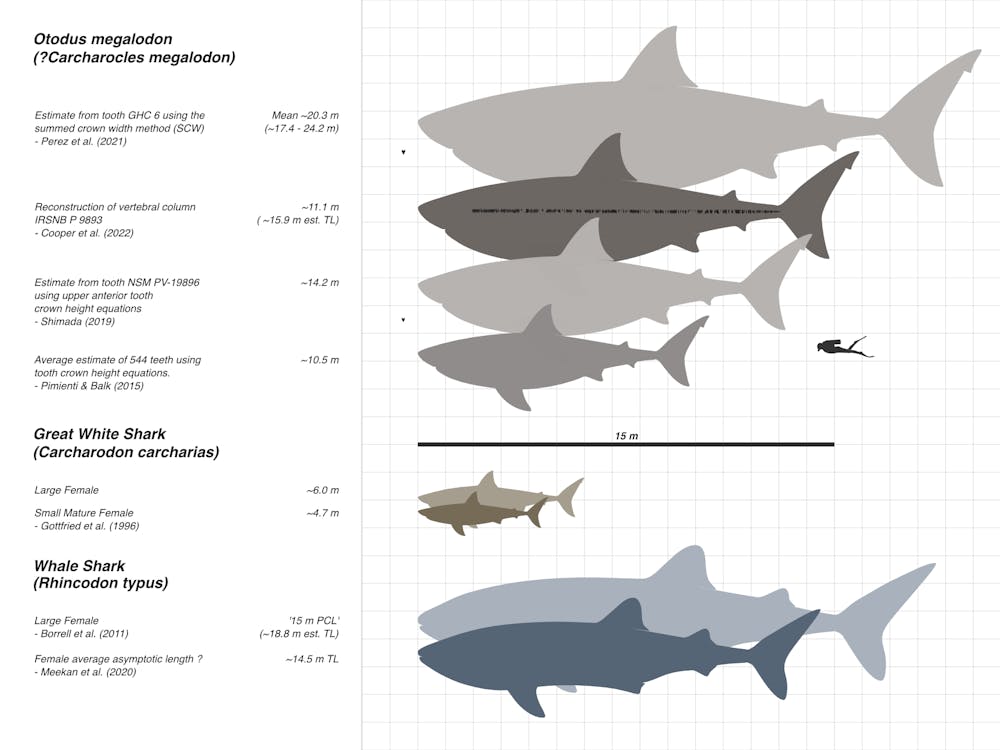
    In Peter Benchley’s 1974 novel that Jaws is based on, the shark is 6 metres long. For added screen excitement, in the movie it grew to a whopping 7.6 metres.

    However, that’s unrealistically large.

    The average size of a mature great white (Carcharodon carcharias, also known as the white shark) is between 4.6 and 4.9 metres for female sharks and up to 4 metres for male sharks.

    The largest recorded living specimens peak at about 6 metres, with one monster specimen caught in Cuba in 1945 reaching 6.4 metres.

    Earth’s oceans have seen bigger predatory sharks in the past. The biggest one of all time was the megalodon (Otodus megalodon) which lived from 23 to 3 million years ago, and may have been up to 24 metres in length. However, it looked nothing like the modern white shark.

    We don’t know precisely how big the megalodon was, but certainly larger than the great white shark.
    Steveoc 86/Wikimedia Commons, CC BY-SA

    They’re not even directly related – another thing scientists learned quite recently.

    Who was the megalodon, then?

    White sharks first evolved between 6 and 4 million years ago in the shadows of the megalodon. A recent study showed the megalodon’s large serrated teeth show signs of it being a supreme opportunistic super-predator.

    That means it ate just about anything, but especially liked whales and marine mammals.


    Read more:
    Friday essay: Giant shark megalodon was the most powerful superpredator ever. Why did it go extinct?


    But white sharks are not directly related to the megalodon, whose lineage began with a shark called Cretalamna during the age of dinosaurs about 100 million years ago.

    By contrast, the white shark lineage began with an ancient mako shark, Carcharodon hastalis. It was 7 to 8 metres long and had large, similarly shaped teeth to the modern white shark but lacking serrated edges.

    A fossil intermediate species, Carcharodon hubbelli shows the transition over time from weakly serrated to strongly serrated teeth.

    White shark fossil species. Left, the serrated fossil tooth teeth of the extant white shark; right, a similarly shaped unserrated tooth of the extinct giant mako shark which gave rise to white sharks.
    John Long, CC BY

    How did Jaws affect white shark populations?

    Last year, the International Shark Attack File reported 47 unprovoked shark bites to humans worldwide, resulting in seven fatalities. This was well below the previous ten-year average of 70 bites per year; your chances of getting bitten by a shark are extremely rare.

    Following the movies that made up the Jaws franchise, there was an increase in hunting and killing sharks – with a particular focus on great white sharks that were already going into a decline due to overfishing, trophy hunting and lethal control programs.

    Between 80% and 90% of white sharks have disappeared globally since the middle of the 20th century. Recent estimates calculate there are probably less than 500 individual white sharks in Australian waters right now.

    When Jaws first aired, scientists didn’t know how long sharks took to reproduce, or how many offspring a white shark could have each year. We now know it takes about 26 years for a male and 33 years for a female to sexually mature before they can start having pups.

    Data about white shark births is sparse, but recently a 5.6-metre-long female caught on a drum line off the coast of Queensland had just four large pups inside her. This is a very small number. Some large sharks, such as the whale shark, can give birth to up to 300 young.

    Now that we know just how slow they are to breed, it’s clear it will take many decades to reestablish the “pre-Jaws” population of white sharks – important apex predators in the marine ecosystem.

    Charlie Huveneers from Flinders University about to take a tissue sample for research on white sharks. There is still a lot we don’t know about their biology.
    Andrew Fox, Adelaide, CC BY

    Will white sharks survive?

    White sharks are currently listed as vulnerable.

    This classification means if we don’t change the current living conditions for white sharks, including impacts caused by human activities such as commercial fishing, and the impacts of climate change and ocean pollution, they will continue to decline and eventually could go extinct.

    Currently, white sharks are protected in several countries and form the basis for an important tourist industry in Australia, South Africa, western United States and most recently Nova Scotia, Canada.

    These sharks are iconic apex predators that fascinate people. One of us (John) went cage diving with them recently off the Neptune Islands of South Australia and can attest to how breathtaking it is to watch them in their natural environment.

    In terms of economic impact, they are worth far more alive than dead.

    White sharks are a growing tourism draw in several countries.
    Andrew Fox, Adelaide, CC BY

    There’s still much we don’t know about white sharks

    The complete white shark genome was first published only in 2019. It has 4.63 billion base pairs, making it much larger than the human genome (3.2 billion base pairs).

    The genome revealed some surprising things, like how white sharks show strong molecular adaptations for wound-healing processes, and a suite of “genome stability” genes – those used in DNA repair or DNA damage response.

    The transcriptome (or sum total of the messenger RNA) of the white shark showed greater similarity to the human transcriptome than to that of other fishes. This hints that “unexpressed genes” in the shark could one day play a role in uncovering genetic pathways for potential cures in human diseases.

    Jaws and its sequels certainly brought white sharks to the attention (and nightmares) of humans, with devastating impacts on how we treated them as a species.

    Our relationship with white sharks reflects our relationship with nature more broadly – a feared antagonist within the current capitalist paradigm; an enemy to be tamed, contained or consumed.

    As we learn more of the peril and potential of these remarkable creatures, we can learn how to live with them, to see beyond our fears and value their role within our delicate ocean ecosystems.

    John Long receives funding from The Australian Research Council.

    Heather L. Robinson does not work for, consult, own shares in or receive funding from any company or organisation that would benefit from this article, and has disclosed no relevant affiliations beyond their academic appointment.

    ref. Jaws at 50: how a single movie changed our perception of white sharks forever – https://theconversation.com/jaws-at-50-how-a-single-movie-changed-our-perception-of-white-sharks-forever-258306

    MIL OSI AnalysisEveningReport.nz

  • MIL-OSI USA: Congressman Gabe Amo Introduces Bill to Close Gun Resale Loophole, Keep Dangerous Firearms from Returning to Rhode Island Streets

    Source: US Congressman Gabe Amo (Rhode Island 1st District)

    Washington, D.C. – Congressman Gabe Amo (D-RI), along with Congressmen Daniel Goldman (D-NY) and Maxwell Frost (D-FL) introduced the Firearm Destruction Licensure Act, legislation to close a gun loophole that is allowing firearms designated for destruction to be sold back into American communities and potentially into the hands of bad actors.

    “Gun violence is fueled by the large number of illegal firearms flooding our streets. Unscrupulous gun disposal companies claim to destroy firearms, when, in reality, they only destroy part of the weapon before reselling the rest as a kit which can be reassembled into a gun. This is unacceptable,” said Congressman Gabe Amo. “The Firearm Destruction Licensure Act would close this loophole and ensure gun disposal companies destroy the entire firearm. I’m grateful for Senator Adam Schiff’s work and the partnership of my colleagues Congressmen Maxwell Frost and Dan Goldman to get guns off our streets, especially during National Gun Violence Awareness Month.”

    Senator Adam Schiff (D-CA) introduced this legislation in the Senate. 

    “Guns that are taken off our streets through law enforcement seizures or buyback programs should stay off our streets for good. Unfortunately, some companies contracted to destroy these firearms are selling off parts for a profit. This bill will eliminate the loophole that allows these companies to turn a profit off of reselling these firearms, rather than destroying them in whole, as they should. This is a commonsense step toward making our neighborhoods safer for everyone,” Senator Schiff said.

    “The gun violence epidemic our communities are living through is being fueled by illegal guns that shouldn’t have been on our streets in the first place. Gun destruction companies that only destroy one part of the gun and resell the rest of the gun as a kit are a huge part of this problem. We need to make sure that every single gun that is retired, seized, and surrendered to a gun disposal company actually gets destroyed, not re-sold,” said Congressman Maxwell Frost.

    “Firearm buyback programs are designed to take dangerous weapons off of the street, not to be recycled and resold,” Congressman Dan Goldman said. “It is outrageous that companies like GunBusters, which claim to destroy firearms, are instead profiting by reselling do-it-yourself ghost gun kits. We must require these companies to be licensed and certified. When someone turns in a gun for destruction, they deserve the basic assurance that it won’t end up back on the street.”

    The bill requires companies that are contracted by local law enforcement to destroy firearms to be licensed, and adds additional guardrails to prevent guns in these programs from returning to the open market.

    Many states and localities are contracting with a growing private industry to handle the dismantling and destruction of hundreds of thousands of firearms each year that have been recovered by law enforcement through criminal investigations, gun buyback programs, or from their own officers at the end of their service. This has unwittingly fueled a secondary market for firearms parts, components, and accessories that are directly contributing to the gun violence epidemic in America.

    Specifically, the Firearm Destruction Licensure Act would:

    • Require those engaged in the business of firearm destruction to become licensed and certify that they will destroy all firearms received by federal, state, local, and tribal law enforcement in their entirety;

    • Direct the Attorney General to prescribe the acceptable methods of firearm destruction, all of which must render a firearm and all parts, attachments, accessories, or other components unable to be restored to working condition and otherwise reduced to scrap;

    • Offset the additional costs local governments or law enforcement may incur to pay for this service by establishing a new grant program for the purposes of having these firearms destroyed.

    The bill is endorsed by Brady,Giffords, and Newtown Action Alliance.

    “Every year, state and local law enforcement dispose of hundreds of thousands of firearms in their possession to firearm destruction companies for the purpose of destruction. However, many of these private companies are destroying only parts of the guns and are reselling their other components for profit — causing law enforcement to unwittingly become an incidental contributor to the criminal market. The Firearm Destruction Licensure Act of 2025 will put an end to this dangerous practice and ensure that law enforcement firearms are destroyed in their entirety so they cannot contribute to gun violence. Brady thanks Senator Schiff and Representative Amo for introducing this important bill and for their steadfast dedication to freeing America from gun violence,” said Mark Collins, Director of Federal Policy, Brady.

    ###

    MIL OSI USA News

  • MIL-OSI Africa: Food and Agriculture Organization (FAO) bilateral meeting with Minister for Food and Agriculture of Ghana Honourable Eric Opoku

    FAO Assistant Director-General and Regional Representative for Africa Abebe Haile-Gabriel met today with the Minister for Food and Agriculture of Ghana, Honourable Eric Opoku, at the Ministry’s headquarters in Accra.

    The FAO Assistant Director-General assured FAO’s continued close collaboration with the Government of Ghana.

    Discussions covered key upcoming global and regional milestones including the FAO 80th anniversary throughout 2025, the 44th  Session of the FAO Conference to be held in Rome from 28 June to 4 July 2025, the World Food Forum scheduled for October 2025, FAO’s global exhibition ‘From Seeds to Foods’ and the launch of the FAO Museum, both also scheduled in October during the World Food Forum, and the ongoing Country Office strengthening process to enhance FAO’s delivery as One FAO.

    The pair reaffirmed the long-standing partnership between FAO and Ghana and exchanged views on collaborating on priority areas for joint action, particularly the Feed Ghana Programme, launched by the Government with a view to boosting agricultural production, creating jobs, and reducing food imports.

    “The two of us have a common goal: achieving food security and nutrition for everybody,” the Minister said.

    FAO and Ghana have a special relationship because the FAO regional headquarters for Africa is based in Accra, as well as the FAO Ghana country office. This makes FAO the largest UN agency in Ghana.

    “We see FAO’s Regional Office for Africa as a huge blessing to the nation. This is an opportunity for us to impact on the lives of the people,” the Minister said. 

    FAO is currently supporting a range of initiatives in Ghana, including improving food security response in northern Ghana in partnership with the European Union, supporting women fonio producers, strengthening the soybean value chain under the One Country One Priority Product initiative, enhancing fisheries governance, and preventing transboundary animal diseases, among others.

    Distributed by APO Group on behalf of Food and Agriculture Organization of the United Nations (FAO): Regional Office for Africa.

    MIL OSI Africa

  • MIL-OSI USA: RIDOH and DEM Recommend Avoiding Contact with Slack Reservoir

    Source: US State of Rhode Island

    The Rhode Island Department of Health (RIDOH) and Rhode Island Department of Environmental Management (DEM) are advising people to avoid contact with Slack Reservoir in Smithfield/Johnston due to harmful algae blooms (HABs). HABs are caused by blue-green algae, also known as cyanobacteria, which are naturally present in bodies of water. HABs can produce toxins which can be harmful to humans and animals. Toxins and/or high cell counts have been detected by the RIDOH State Health Laboratory from water samples collected by DEM at this location.

    Use caution in all areas of Slack Reservoir as HABs can move locations in ponds and lakes. All recreation, including swimming, fishing, boating and kayaking, is high risk to health and recommended to be avoided at this location. People should not drink untreated water or eat fish from affected waterbodies. Pet owners should not allow pets to drink or swim in this water. This advisory recommendation remains in effect until further notice.

    Skin contact with water containing blue-green algae can cause irritation of the skin, nose, eyes, and throat. Symptoms can include stomachache, diarrhea, vomiting, and nausea. Less common symptoms can include dizziness, headache, fever, liver damage, and nervous system damage. Young children and pets are at higher risk for health effects associated with HABs because they are more likely to swallow water when they are in or around bodies of water. People who have had contact with these ponds and experience those symptoms should contact their healthcare provider.

    If you or your pet come into contact with an algal bloom (HAB):

    — Rinse your skin with clean water right away. — Shower and wash your cloths when you get home. — If your pet was exposed, wash it with clean water immediately and don’t let it lick algae from its fur. — Call a vet if your pet shows signs of illness like tiredness, no eating, vomiting, diarrhea or other symptoms within a day. — If you feel sick after contact, call a healthcare provider.

    Other HABs may be affecting other waterbodies in Rhode Island. Affected waters might look bright to dark green, with thick algae floating on the surface. It may resemble green paint, pea soup, or green cottage cheese. If you see water like this, people and pets should avoid contact with the water.

    To report suspected blue-green algae blooms, contact DEM’s Office of Water Resources at 401-222-4700 Press 6 or DEM.OWRCyano@dem.ri.gov and if possible, send a photograph of the reported algae bloom. For more information and the Cyanobacteria Tracker Dashboard that lists current advisories and data, visit: www.dem.ri.gov/bluegreen

    ###

    MIL OSI USA News

  • MIL-Evening Report: Nineteen Eighty-Four might have been inspired by George Orwell’s fear of drowning

    Source: The Conversation (Au and NZ) – By Nathan Waddell, Associate Professor in Twentieth-Century Literature, University of Birmingham

    George Orwell had a traumatic relationship with the sea. In August 1947, while he was writing Nineteen Eighty-Four (1949) on the island of Jura in the Scottish Hebrides, he went on a fishing trip with his young son, nephew and niece.

    Having misread the tidal schedules, on the way back Orwell mistakenly piloted the boat into rough swells. He was pulled into the fringe of the Corryvreckan whirlpool off the coasts of Jura and Scarba. The boat capsized and Orwell and his relatives were thrown overboard.

    It was a close call – a fact recorded with characteristic detachment by Orwell in his diary that same evening: “On return journey today ran into the whirlpool & were all nearly drowned.” Though he seems to have taken the experience in his stride, this may have been a trauma response: detachment ensures the ability to persist after a near-death experience.

    We don’t know for sure if Nineteen Eighty-Four was influenced by the Corryvreckan incident. But it’s clear that the novel was written by a man fixated on water’s terrifying power.


    This article is part of Rethinking the Classics. The stories in this series offer insightful new ways to think about and interpret classic books and artworks. This is the canon – with a twist.


    Nineteen Eighty-Four isn’t typically associated with fear of death by water. Yet it’s filled with references to sinking ships, drowning people and the dread of oceanic engulfment. Fear of drowning is a torment that social dissidents might face in Room 101, the torture chamber to which all revolutionaries are sent in the appropriately named totalitarian state of Oceania.

    An early sequence in the novel describes a helicopter attack on a ship full of refugees, who are bombed as they fall into the sea. The novel’s protagonist, Winston Smith, has a recurring nightmare in which he dreams of his long-lost mother and sister trapped “in the saloon of a sinking ship, looking up at him through the darkening water”.

    George Orwell in 1943.
    National Union of Journalists

    The sight of them “drowning deeper every minute” takes Winston back to a culminating moment in his childhood when he stole chocolate from his mother’s hand, possibly condemning his sister to starvation. These watery graves imply that Winston is drowning in guilt.

    The “wateriness” of Nineteen Eighty-Four may have another interesting historical source. In his essay My Country Right or Left (1940), Orwell recalls that when he had just become a teenager he read about the “atrocity stories” of the first world war.

    Orwell states in this same essay that “nothing in the whole war moved [him] so deeply as the loss of the Titanic had done a few years earlier”, in 1912. What upset Orwell most about the Titanic disaster was that in its final moments it “suddenly up-ended and sank bow foremost, so that the people clinging to the stern were lifted no less than 300 feet into the air before they plunged into the abyss”.

    Sinking ships and dying civilisations

    Orwell never forgot this image. Something similar to it appears in his novel Keep the Aspidistra Flying (1936) where the idea of a sinking passenger liner evokes the collapse of modern civilisation, just as the Titanic disaster evoked the end of Edwardian industrial confidence two decades beforehand.

    The Titanic disaster had a profound impact on Orwell.
    Wiki Commons

    References to sinking ships and drowning people appear at key moments in many other works by Orwell, too. But did the full impact of the Titanic surface in Nineteen Eighty-Four?

    Sinking ships were part of Orwell’s descriptive toolkit. In Nineteen Eighty-Four, a novel driven by memories of unsympathetic water, they convey nightmares. Filled with references to water and liquidity, it’s one of the most aqueous novels Orwell produced, relying for many of its most shocking episodes on imagery of desperate people drowning or facing imminent death on sinking sea craft.

    The thought of trapped passengers descending into the depths survives in Winston’s traumatic memories of his mother and sister, who, in the logic of his dreams, are alive inside a sinking ship’s saloon.


    Looking for something good? Cut through the noise with a carefully curated selection of the latest releases, live events and exhibitions, straight to your inbox every fortnight, on Fridays. Sign up here.


    There’s no way to prove that the Nineteen Eighty-Four is “about” the Titanic disaster, but in the novel, and indeed in Orwell’s wider body of work, there are too many tantalising hints to let the matter rest.

    Thinking about fear of death by water takes us into Orwell’s terrors just as it takes us into Winston’s, allowing readers to see the frightened boy inside the adult man and, indeed, inside the author who dreamed up one of the 20th century’s most famous nightmares.

    Beyond the canon

    As part of the Rethinking the Classics series, we’re asking our experts to recommend a book or artwork that tackles similar themes to the canonical work in question, but isn’t (yet) considered a classic itself. Here is Nathan Waddell’s suggestion:

    As soon as the news broke of the Titanic’s sinking, literary works of all shapes and sizes started to appear in tribute to the disaster and its victims. As the century went on, and as research into the tragedy developed (particularly after the ships wreckage was discovered in 1985), more nuanced literary responses to the sinking became possible.

    One such response is Beryl Bainbridge’s Whitbread-prize-winning novel Every Man for Himself (1996). It reimagines the disaster from the first-person perspective of an imaginary character, Morgan, the fictional nephew of the historically real financier J. P. Morgan (who was due to sail on the Titanic but changed plans before it sailed).

    This article features references to books that have been included for editorial reasons, and may contain links to bookshop.org. If you click on one of the links and go on to buy something from bookshop.org The Conversation UK may earn a commission.

    Nathan Waddell does not work for, consult, own shares in or receive funding from any company or organisation that would benefit from this article, and has disclosed no relevant affiliations beyond their academic appointment.

    ref. Nineteen Eighty-Four might have been inspired by George Orwell’s fear of drowning – https://theconversation.com/nineteen-eighty-four-might-have-been-inspired-by-george-orwells-fear-of-drowning-251289

    MIL OSI AnalysisEveningReport.nz

  • MIL-Evening Report: Nineteen Eighty-Four might have been inspired by George Orwell’s fear of drowning

    Source: The Conversation (Au and NZ) – By Nathan Waddell, Associate Professor in Twentieth-Century Literature, University of Birmingham

    George Orwell had a traumatic relationship with the sea. In August 1947, while he was writing Nineteen Eighty-Four (1949) on the island of Jura in the Scottish Hebrides, he went on a fishing trip with his young son, nephew and niece.

    Having misread the tidal schedules, on the way back Orwell mistakenly piloted the boat into rough swells. He was pulled into the fringe of the Corryvreckan whirlpool off the coasts of Jura and Scarba. The boat capsized and Orwell and his relatives were thrown overboard.

    It was a close call – a fact recorded with characteristic detachment by Orwell in his diary that same evening: “On return journey today ran into the whirlpool & were all nearly drowned.” Though he seems to have taken the experience in his stride, this may have been a trauma response: detachment ensures the ability to persist after a near-death experience.

    We don’t know for sure if Nineteen Eighty-Four was influenced by the Corryvreckan incident. But it’s clear that the novel was written by a man fixated on water’s terrifying power.


    This article is part of Rethinking the Classics. The stories in this series offer insightful new ways to think about and interpret classic books and artworks. This is the canon – with a twist.


    Nineteen Eighty-Four isn’t typically associated with fear of death by water. Yet it’s filled with references to sinking ships, drowning people and the dread of oceanic engulfment. Fear of drowning is a torment that social dissidents might face in Room 101, the torture chamber to which all revolutionaries are sent in the appropriately named totalitarian state of Oceania.

    An early sequence in the novel describes a helicopter attack on a ship full of refugees, who are bombed as they fall into the sea. The novel’s protagonist, Winston Smith, has a recurring nightmare in which he dreams of his long-lost mother and sister trapped “in the saloon of a sinking ship, looking up at him through the darkening water”.

    George Orwell in 1943.
    National Union of Journalists

    The sight of them “drowning deeper every minute” takes Winston back to a culminating moment in his childhood when he stole chocolate from his mother’s hand, possibly condemning his sister to starvation. These watery graves imply that Winston is drowning in guilt.

    The “wateriness” of Nineteen Eighty-Four may have another interesting historical source. In his essay My Country Right or Left (1940), Orwell recalls that when he had just become a teenager he read about the “atrocity stories” of the first world war.

    Orwell states in this same essay that “nothing in the whole war moved [him] so deeply as the loss of the Titanic had done a few years earlier”, in 1912. What upset Orwell most about the Titanic disaster was that in its final moments it “suddenly up-ended and sank bow foremost, so that the people clinging to the stern were lifted no less than 300 feet into the air before they plunged into the abyss”.

    Sinking ships and dying civilisations

    Orwell never forgot this image. Something similar to it appears in his novel Keep the Aspidistra Flying (1936) where the idea of a sinking passenger liner evokes the collapse of modern civilisation, just as the Titanic disaster evoked the end of Edwardian industrial confidence two decades beforehand.

    The Titanic disaster had a profound impact on Orwell.
    Wiki Commons

    References to sinking ships and drowning people appear at key moments in many other works by Orwell, too. But did the full impact of the Titanic surface in Nineteen Eighty-Four?

    Sinking ships were part of Orwell’s descriptive toolkit. In Nineteen Eighty-Four, a novel driven by memories of unsympathetic water, they convey nightmares. Filled with references to water and liquidity, it’s one of the most aqueous novels Orwell produced, relying for many of its most shocking episodes on imagery of desperate people drowning or facing imminent death on sinking sea craft.

    The thought of trapped passengers descending into the depths survives in Winston’s traumatic memories of his mother and sister, who, in the logic of his dreams, are alive inside a sinking ship’s saloon.


    Looking for something good? Cut through the noise with a carefully curated selection of the latest releases, live events and exhibitions, straight to your inbox every fortnight, on Fridays. Sign up here.


    There’s no way to prove that the Nineteen Eighty-Four is “about” the Titanic disaster, but in the novel, and indeed in Orwell’s wider body of work, there are too many tantalising hints to let the matter rest.

    Thinking about fear of death by water takes us into Orwell’s terrors just as it takes us into Winston’s, allowing readers to see the frightened boy inside the adult man and, indeed, inside the author who dreamed up one of the 20th century’s most famous nightmares.

    Beyond the canon

    As part of the Rethinking the Classics series, we’re asking our experts to recommend a book or artwork that tackles similar themes to the canonical work in question, but isn’t (yet) considered a classic itself. Here is Nathan Waddell’s suggestion:

    As soon as the news broke of the Titanic’s sinking, literary works of all shapes and sizes started to appear in tribute to the disaster and its victims. As the century went on, and as research into the tragedy developed (particularly after the ships wreckage was discovered in 1985), more nuanced literary responses to the sinking became possible.

    One such response is Beryl Bainbridge’s Whitbread-prize-winning novel Every Man for Himself (1996). It reimagines the disaster from the first-person perspective of an imaginary character, Morgan, the fictional nephew of the historically real financier J. P. Morgan (who was due to sail on the Titanic but changed plans before it sailed).

    This article features references to books that have been included for editorial reasons, and may contain links to bookshop.org. If you click on one of the links and go on to buy something from bookshop.org The Conversation UK may earn a commission.

    Nathan Waddell does not work for, consult, own shares in or receive funding from any company or organisation that would benefit from this article, and has disclosed no relevant affiliations beyond their academic appointment.

    ref. Nineteen Eighty-Four might have been inspired by George Orwell’s fear of drowning – https://theconversation.com/nineteen-eighty-four-might-have-been-inspired-by-george-orwells-fear-of-drowning-251289

    MIL OSI AnalysisEveningReport.nz

  • MIL-OSI USA: Pingree Leads Bipartisan Push to Save Buoys Essential to Maritime Safety

    Source: United States House of Representatives – Congresswoman Chellie Pingree (1st District of Maine)

    Today, Maine First District Congresswoman Chellie Pingree led a bipartisan group of her colleagues in calling on the U.S. Coast Guard (USCG) to preserve critical navigational buoys along the Northeast coast. In a letter to Admiral Kevin E. Lunday, Acting Commandant of the Coast Guard, the lawmakers warned that removing the buoys could jeopardize maritime safety and urged USCG to ensure modern navigation technology works alongside—not in place of—traditional visual markers like buoys.

    “The northeastern coast has many hazards to avoid, and tides, currents, and difficult weather conditions can make navigation challenging even for experienced mariners. In situations such as these, it is imperative to ensure all safety measures are available, both technological and visual,” the lawmakers wrote.

    “Visual navigation markers are essential to maritime economies and the communities we represent,” Pingree and her colleagues continued. “As fishermen, passenger vessels, and recreational boaters alike use these buoys as a reliable safety measure to maneuver through inclement weather and sporadic access to technology on the water. A local captain of a passenger vessel likened the effort to removing traffic signs from the highways since many drivers now have access to GPS systems. Buoys provide a critical layer of safety while navigating complicated coastline, especially when technology may fail in rural areas. Buoy constellations and technology should work together to create safe and resilient navigational service to mariners, rather than creating a system that overly relies on just one.

    Cosigners include Representatives Jake Auchincloss (D-Mass.), Joe Courtney (D-Conn.), Laura Gillen (D-N.Y.), Nick LaLota (R-N.Y.), Stephen Lynch (D-Mass.), John Larson (D-Conn.), Seth Magaziner (D-R.I.), and Seth Moulton (D-Mass.).

    The letter is available here and copied below. 

    +++

    Dear Acting Commandant Lunday,

    We write today to provide comment to the U.S Coast Guard regarding the First District Coastal Buoy Modernization Initiative Proposal.

    We support the adoption of technologies such as Global Navigation Satellite Systems (GNSS), Electronic Navigation Charts (ENC), and Electronic Chartering Systems (ECS) to enhance maritime navigation and improve efficiency. At the same time, we believe these systems should complement—not replace—the physical buoy infrastructure that remains essential for safety, redundancy, and accessibility across the Northeast. We have deep concerns over buoy discontinuation efforts and urge you to consider the value of visual navigation markers. Safety must be the top priority when maintaining Federal Aids to Navigation (ATON) and supporting mariners. The northeastern coast has many hazards to avoid, and tides, currents, and difficult weather conditions can make navigation challenging even for experienced mariners. In situations such as these, it is imperative to ensure all safety measures are available, both technological and visual.

    Visual navigation markers are essential to maritime economies and the communities we represent.  As fishermen, passenger vessels, and recreational boaters alike use these buoys as a reliable safety measure to maneuver through inclement weather and sporadic access to technology on the water. A local captain of a passenger vessel likened the effort to removing traffic signs from the highways since many drivers now have access to GPS systems. Buoys provide a critical layer of safety while navigating complicated coastline, especially when technology may fail in rural areas. Buoy constellations and technology should work together to create safe and resilient navigational service to mariners, rather than creating a system that overly relies on just one.

    We are grateful to the Coast Guard for your commitment to ensuring the safety of all those who depend on and enjoy our waters and strongly encourage you to recognize the importance of preserving buoy constellations in navigationally complicated areas. We appreciate your engagement with stakeholders who are affected by this proposal, and request that you extend the period for public comment by one month in order to receive the best possible feedback from the maritime community. Please do not hesitate to reach out to our offices if we can provide any further information.

    Sincerely,

    ###

    MIL OSI USA News

  • MIL-OSI Russia: IMF Executive Board Concludes 2025 Article IV Consultation with Iceland

    Source: IMF – News in Russian

    June 18, 2025

    • Growth decelerated in 2024 but is expected to rise to 1.6 percent in 2025 and 2.2 percent in 2026, while inflation is projected to decline to the Central Bank of Iceland’s 2.5 percent target in the second half of 2026. The direct impact of escalating global trade tensions is projected to be limited.
    • The authorities’ plans to turn the fiscal deficit in 2024 into a surplus by 2028 are appropriate given the need to rebuild buffers; details on the planned fiscal measures to achieve these targets have enhanced the credibility of the consolidation. Monetary policy is suitably tight given still elevated inflation, but the monetary stance should be reduced as inflation declines. Efforts to raise foreign exchange reserve coverage are welcome.
    • Investments in physical and human capital, alongside continued efforts to promote innovation and reduce skills mismatches are needed to support medium-term growth. Taxation can play a supportive role in reducing housing market imbalances.

    Washington, DC: The Executive Board of the International Monetary Fund (IMF) completed the Article IV Consultation for Iceland.[1] The authorities have consented to the publication of the Staff Report prepared for this consultation.[2]

    The economy decelerated in 2024 to 0.5 percent due largely to weak exports from a disappointing fishing season and constraints on energy supply that curtailed aluminum production. Growth is expected to rebound to 1.6 percent in 2025 and 2.2 percent in 2026, driven by a recovery in exports, higher real wages, and continued monetary easing that more than offsets the impact of a moderately contractionary fiscal impulse. The impact of escalating global trade tensions is projected to be limited given that most goods exports are destined for Europe. Inflation is expected to gradually decline to the Central Bank of Iceland’s 2.5 percent target in the second half of 2026. Medium-term prospects are favorable, with continued diversification of the economy toward higher value-added export-oriented sectors anticipated to bolster productivity growth and inflows of foreign labor expected to support a modest increase in employment growth.

    Risks to growth are tilted to the downside while risks to inflation are broadly balanced. In particular, the impact of rising global trade tensions could be larger than anticipated if tariffs are extended to currently exempted items (e.g., pharmaceuticals) or if a reduction in travel to and from the US negatively affects tourism. Inflation could increase if trade tensions trigger supply disruptions or capital outflows, if a premature loosening of monetary policy further de-anchors inflation expectations, or as result of second-round effects from higher wage growth. Conversely, capital inflows could result in an appreciation of the exchange rate that would weaken competitiveness and put downward pressure on inflation.

    Executive Board Assessment[3]

    Executive Directors agreed with the thrust of the staff appraisal. They welcomed the prudent macroeconomic policies, which have helped to reduce imbalances. While noting that medium‑term growth prospects are favorable, Directors observed that risks are tilted to the downside, notably from rising trade tensions. They emphasized the need to ensure macroeconomic stability and gradually rebuild fiscal buffers, while supporting stronger growth and reducing vulnerability to shocks.

    Directors welcomed the ambitious fiscal targets and the improved transparency and credibility around the planned consolidation. They highlighted that increased infrastructure spending would help to close gaps in transport and energy and bolster growth prospects. Directors saw merit in implementing additional measures, if necessary, to achieve fiscal objectives. Noting the need to reduce procyclicality in fiscal policy, Directors supported the planned activation of revised fiscal rules in 2026. They also recommended measures to strengthen the Fiscal Council and increase the coverage and frequency of fiscal data. 

    Directors noted that price pressures remain elevated and agreed that tight monetary policy remained appropriate. They encouraged the Central Bank of Iceland (CBI) to gradually loosen the policy stance as inflation declines towards target and expectations become reanchored. Directors saw merit in transitioning to a more forecast‑based inflation targeting framework as uncertainty declines. Noting the importance of increasing reserves to more prudent levels, Directors welcomed the CBI’s decision to commence regular purchases of foreign exchange.  

    Directors welcomed that systemic risks in the financial sector are contained. They highlighted the need to remain vigilant to potential vulnerabilities in the housing market and the corporate sector, and to continue strengthening operational resilience. Directors saw scope to ease macroprudential policies should systemic risks recede as anticipated. While welcoming the progress on implementing FSAP recommendations, Directors urged further efforts to enhance pension fund governance, strengthen AML/CFT supervision of banks, and safeguard the independence and effectiveness of the CBI’s supervisory activities. 

    Directors emphasized the importance of reforms to bolster productivity and diversify the economy, including by improving infrastructure and supporting innovation. Important measures include reducing skill mismatches, maximizing the efficiency of R&D incentives, and promoting AI while mitigating related risks. Directors welcomed plans to increase housing supply and improve housing affordability. 

    It is expected that the next Article IV consultation with Iceland will be held on the standard 12‑month cycle. 

    Table 1. Iceland: Selected Economic Indicators, 2024–30


    2024

    2025

    2026

    2027

    2028

    2029

    2030


    Proj.

    Proj.

    Proj.

    Proj.

    Proj.

    Proj.


    (Percentage change unless otherwise indicated)

    National Accounts (constant prices)


    Gross domestic product

    0.5

    1.6

    2.2

    2.4

    2.4

    2.4

    2.4

    Total domestic demand

    2.3

    1.5

    0.6

    2.2

    2.4

    2.4

    2.3

    Private consumption

    0.6

    2.2

    2.4

    2.5

    2.6

    2.6

    2.6

    Public consumption

    2.5

    1.5

    1.3

    1.0

    1.0

    1.0

    1.0

    Gross fixed investment

    7.5

    4.1

    -3.2

    2.8

    3.2

    3.2

    3.2

    Net exports (contribution to growth)

    -1.8

    -0.3

    1.6

    0.3

    0.1

    0.0

    0.2

    Exports of goods and services

    -1.2

    3.3

    3.0

    3.3

    3.1

    3.0

    3.2

    Imports of goods and services

    2.7

    3.9

    -0.7

    2.7

    2.9

    2.9

    2.9

    Output gap (percent of potential output)

    1.0

    0.2

    0.0

    0.0

    0.0

    0.0

    0.0


    Selected Indicators


    Unemployment rate (percent of labor force)

    3.4

    3.9

    4.0

    4.0

    4.0

    4.0

    4.0

    Employment

    4.1

    0.4

    0.9

    1.1

    1.1

    1.1

    1.1

    Labor productivity

    -3.3

    1.2

    1.3

    1.3

    1.3

    1.3

    1.3

    Real wages

    0.5

    1.4

    1.3

    1.3

    1.3

    1.3

    1.3

    Nominal wages

    6.4

    4.9

    4.4

    3.8

    3.8

    3.9

    3.8

    Consumer price index (average)

    5.9

    3.5

    3.0

    2.5

    2.5

    2.5

    2.5

    Consumer price index (end period)

    4.7

    3.6

    2.5

    2.5

    2.5

    2.5

    2.5

    ISK/€ (average)

    164


    Money and Credit (end period)


    Credit to nonfinancial private sector

    8.1

    5.6

    5.6

    5.6

    5.6

    5.6

    5.7

    Central bank 7 day term deposit rate 1/

    8.50

    7.50


    (Percent of GDP unless otherwise indicated)

    General Government Finances 2/

    Revenue

    42.8

    43.2

    42.4

    42.4

    42.4

    42.5

    42.6

    Expenditure

    46.3

    44.5

    43.2

    42.9

    42.8

    42.7

    42.7

    Overall balance 3/

    -3.5

    -1.3

    -0.7

    -0.5

    -0.3

    -0.2

    -0.1

    Cyclically-adjusted primary balance

    -1.5

    0.7

    0.9

    1.2

    1.4

    1.6

    1.7

    Structural primary balance 4/

    0.7

    1.1

    1.1

    1.3

    1.4

    1.6

    1.7

    Gross debt

    59.1

    47.7

    45.4

    43.6

    41.7

    39.9

    38.1


    Balance of Payments


    Current account balance

    -2.5

    -2.6

    -0.5

    0.0

    0.4

    0.7

    1.0

    Gross external debt

    67.0

    65.4

    61.6

    58.5

    55.4

    52.4

    49.5

    Sources: Central Bank of Iceland; Ministry of Finance; Statistics Iceland; and IMF staff projections.

    1/ For 2025, policy rate as of May.

    2/ In April 2025, an agreement was reached on the settlement of remaining outstanding liabilities in the IL Fund (HFF).

    3/ For 2024, the deficit now includes 1.2 percent of GDP in costs related to the purchase of houses in Grindavík that in the 2024 Article IV were classified below the line due to uncertainty about the correct statistical treatment.

    4/ Cyclically-adjusted primary balance excluding one offs.

    [1] Under Article IV of the IMF’s Articles of Agreement, the IMF holds bilateral discussions with members, usually every year. A staff team visits the country, collects economic and financial information, and discusses with officials the country’s economic developments and policies. On return to headquarters, the staff prepares a report, which forms the basis for discussion by the Executive Board.

    [2] Under the IMF’s Articles of Agreement, publication of documents that pertain to member countries is voluntary and requires the member consent. The staff report will be shortly published on the www.imf.org/iceland page.

    [3] At the conclusion of the discussion, the Managing Director, as Chairman of the Board, summarizes the views of Executive Directors, and this summary is transmitted to the country’s authorities. An explanation of any qualifiers used in summings up can be found here: http://www.IMF.org/external/np/sec/misc/qualifiers.htm.

    IMF Communications Department
    MEDIA RELATIONS

    PRESS OFFICER: Boris Balabanov

    Phone: +1 202 623-7100Email: MEDIA@IMF.org

    https://www.imf.org/en/News/Articles/2025/06/18/pr-25201-iceland-imf-executive-board-concludes-2025-article-iv-consultation

    MIL OSI

    MIL OSI Russia News

  • MIL-OSI United Nations: Ending sexual violence in conflict: breaking the cycle, healing the scars and building a world of peace

    Source: United Nations Population Fund

    Statement by UNFPA Executive Director Dr. Natalia Kanem on the International Day for the Elimination of Sexual Violence in Conflict (19 June)

    In nearly every conflict in every region of the world, sexual violence is on the rise – a weapon of war used most often to terrorize women and girls. 

    The resulting physical and psychological trauma damages individual lives and extends to entire families and communities, with impacts that reverberate across generations.

    Sexual violence is not the unavoidable collateral damage of conflict; it is an egregious violation of women’s rights and bodily autonomy. It is a crime, and it must be stopped. 

    Increasingly women’s organizations and survivors themselves have stepped forward with courage to tell their stories and call for justice, even when speaking out and standing up for their rights may place them at further risk. 

    Still, far too many cases remain unreported, and those that are reported are unlikely to be prosecuted, as inadequate justice systems fail to uphold laws against sexual violence, where such laws exist. Survivors are silenced by fear, stigma and a lack of support services, while perpetrators walk free.

    Much has been said about the urgency of ending sexual violence in conflict, but not nearly enough has been done. Survivors need support, protection and justice, and impunity needs to end – now, not later.  

    Unfortunately, while conflicts and violence continue to escalate, recent global funding cuts have gutted programmes to prevent and respond to gender-based violence. At a time when these services should be scaling up, many organizations globally have been forced to scale back or suspend their services. The consequences of this will be borne by millions of women and girls.

    On this International Day for the Elimination of Sexual Violence in Conflict, it is essential to keep the #LightsOn for women and girls. What does this mean? First, it means fully funding comprehensive, life-saving, survivor-centred services: sexual and reproductive health; mental health and psychosocial support; legal aid; and safe, confidential spaces for healing and reporting – without shame or blame. Second, survivors of sexual violence in conflict should play a leading role in determining paths to recovery and restitution for the crimes committed against them. Finally, we must invest in preventing conflict in the first place.

    It is time to work together, with the urgency required, to make the elimination of sexual violence in conflict not an afterthought but the very first step towards a world of peace – a world that is safe, just and equal for women and girls – and for everyone.

    MIL OSI United Nations News

  • MIL-OSI USA: After celebrating State Parks Week, Newsom administration calls out federal assault on public lands

    Source: US State of California Governor

    Jun 18, 2025

    What you need to know: After more than 170 events last week celebrating California’s state parks, Governor Newsom and his administration are calling out federal cuts to National Parks and public lands.

    SACRAMENTO – As the Trump administration threatens the future of federal public lands, California is celebrating its thriving state park system, the largest in the nation, and its commitment to expanding access to the outdoors. This comes after the state celebrated its fourth annual California State Parks Week with more than 170 events last week, highlighting the people, places and programs that make California’s 280 state parks truly unique.

    On Friday, the Newsom administration sent a letter to the U.S. Department of the Interior warning of public safety risks and reduced access due to major cuts proposed to staff and programs that support National Parks and other federal public lands. In contrast, California is expanding access to the outdoors, investing in communities and laying the groundwork for further expansion.

    As the saying goes, national parks are America’s best idea – and putting them on the chopping block has to be one of the worst. As the Trump administration threatens our public lands, California continues to expand access to achieve our vision of outdoors for all.

    Governor Gavin Newsom

    As outlined in the letter, the Trump administration’s proposed budget cuts to federal agencies like the National Park Service, Bureau of Land Management, Bureau of Reclamation, U.S. Fish and Wildlife Service, and Bureau of Indian Affairs threaten public lands, water supply, wildlife, and tribal sovereignty. These cuts would lead to reduced staff, services, public access, and increased risks such as wildfires and jeopardized public safety. 

    “While we support efforts to improve the efficiency of federal services, current and proposed cuts raise serious concerns regarding public safety, water supplies, public access, and outdoor recreation across California,” wrote California Natural Resources Secretary Wade Crowfoot. “Additionally, these cuts impact the national economy as agriculture and outdoor recreation are critical and powerful economic engines for the country.”

    Outdoors For All

    Connecting people to nature is critical for our physical, mental, and social wellbeing. Outdoor spaces also help communities adapt to climate change, can be good for wildlife and biodiversity, and are reliably a powerful economic engine for the state. Unfortunately, outdoor access and its many benefits are not equitably distributed to all communities.

    Under the leadership of Governor Gavin Newsom and First Partner Jennifer Siebel Newsom, a historic investment of more than $1 billion has been dedicated to expanding parks and nature access, including to Californians who live in underserved communities.

    From the otherworldly beauty of Joshua Tree, to the soul-stirring splendor of Yosemite, our parks are part of our national story. Their very existence reflects the best in us: a century-long, bipartisan tradition to preserve our iconic natural wonders for the next generation — and make them accessible to all.

    In California, we’re not only standing to protect these sacred spaces, we’re working to open them up to even more children, including through our California State Park Adventure Pass, which gives fourth graders in the state and their families free access to 54 California State Parks.

    First Partner Jennifer Siebel Newsom

    The administration’s Outdoor Access for All and California Natural Resources Agency’s Outdoors for All initiatives have created innovative access programs for children and families to explore California’s state parks, mitigated impacts from climate change, and helped the economy.

    Here are some key accomplishments:

    • Free park passes: Three new state park pass programs were created for Californians to access participating park units for free. As of June 1, over the life of these programs more than 104,000 eligible Californians have received a Golden Bear Pass, 83,000-plus fourth graders have signed up for a California State Park Adventure Pass, and more than 33,000 free passes can be checked out at libraries throughout the state.
    • New state park: After more than a decade, California added a new park to the state park system. Located near Modesto in the San Joaquin Valley, Dos Rios is a multi-benefit park providing outdoor recreation opportunities for underserved communities, providing habitat for threatened and endangered wildlife, and advancing the state’s innovative efforts to combat the climate crisis using nature-based solutions. Nearly 10,000 people have visited Dos Rios since its official opening in June 2024, and the park has steadily increased public access to the approximately 1,600-acre property.
    • Cutting green tape: One year after the opening of Dos Rios, the Newsom administration continues to remove bureaucratic hurdles by cutting the green tape to lay the groundwork for potential future expansion of the state park system.  
    • Climate bond: In November 2024, a majority of voters across California approved a $10 billion Climate Bond to ensure resources are available to strengthen the resiliency of California communities to a changing climate. Specifically, the climate bond supports the Wildfire and Forest Resilience Action Plan, Nature-Based Solutions Climate Targets, 30X30, and Outdoors for All. The administration is committed to rolling out these funds in a way that is strategic, coordinated, accessible, accountable, and prioritizes multi-benefit projects when possible.
    • Community investments: It is not just about state parks. State Parks has provided grants to local communities to establish indoor and outdoor recreation in every corner of the state, building trails, acquiring and restoring sensitive habitat, building natural and cultural interpretative facilities, and fostering outdoor natural experiences for thousands of children, youth, and families. This is just a small sampling of what community investments can accomplish.

    State Parks protects the best of the state’s natural and cultural history; more than 340 miles of coastline; the tallest, largest and among the oldest trees in the world; and deserts, lakes, rivers and beaches. There are more than 5,200 miles of trails, and 15,000 campsites, prehistoric and historic archeological sites, ghost towns, historic homes and monuments — all waiting to be explored.

    Press releases, Recent news

    Recent news

    News What you need to know: Two sites in San Francisco are the latest to be transformed under Governor Newsom’s executive order converting excess and underutilized state land into affordable housing.  SAN FRANCISCO — Today, Governor Gavin Newsom announced the…

    News SACRAMENTO – Governor Gavin Newsom recently wrote an op-ed on the dangers of President Trump’s reach at authoritarianism, as well as the solution that lies within the power of each citizen to hold their electeds accountable to the Constitution they have sworn…

    News Sacramento, California – El Gobernador Gavin Newsom escribió recientemente un artículo de opinión sobre los peligros del autoritarismo del Presidente Trump, así como la solución que reside en el poder de cada ciudadano de exigir a sus elegidos que rindan cuentas…

    MIL OSI USA News

  • MIL-OSI Global: Nineteen Eighty-Four might have been inspired by George Orwell’s fear of drowning

    Source: The Conversation – UK – By Nathan Waddell, Associate Professor in Twentieth-Century Literature, University of Birmingham

    George Orwell had a traumatic relationship with the sea. In August 1947, while he was writing Nineteen Eighty-Four (1949) on the island of Jura in the Scottish Hebrides, he went on a fishing trip with his young son, nephew and niece.

    Having misread the tidal schedules, on the way back Orwell mistakenly piloted the boat into rough swells. He was pulled into the fringe of the Corryvreckan whirlpool off the coasts of Jura and Scarba. The boat capsized and Orwell and his relatives were thrown overboard.

    It was a close call – a fact recorded with characteristic detachment by Orwell in his diary that same evening: “On return journey today ran into the whirlpool & were all nearly drowned.” Though he seems to have taken the experience in his stride, this may have been a trauma response: detachment ensures the ability to persist after a near-death experience.

    We don’t know for sure if Nineteen Eighty-Four was influenced by the Corryvreckan incident. But it’s clear that the novel was written by a man fixated on water’s terrifying power.


    This article is part of Rethinking the Classics. The stories in this series offer insightful new ways to think about and interpret classic books and artworks. This is the canon – with a twist.


    Nineteen Eighty-Four isn’t typically associated with fear of death by water. Yet it’s filled with references to sinking ships, drowning people and the dread of oceanic engulfment. Fear of drowning is a torment that social dissidents might face in Room 101, the torture chamber to which all revolutionaries are sent in the appropriately named totalitarian state of Oceania.

    An early sequence in the novel describes a helicopter attack on a ship full of refugees, who are bombed as they fall into the sea. The novel’s protagonist, Winston Smith, has a recurring nightmare in which he dreams of his long-lost mother and sister trapped “in the saloon of a sinking ship, looking up at him through the darkening water”.

    George Orwell in 1943.
    National Union of Journalists

    The sight of them “drowning deeper every minute” takes Winston back to a culminating moment in his childhood when he stole chocolate from his mother’s hand, possibly condemning his sister to starvation. These watery graves imply that Winston is drowning in guilt.

    The “wateriness” of Nineteen Eighty-Four may have another interesting historical source. In his essay My Country Right or Left (1940), Orwell recalls that when he had just become a teenager he read about the “atrocity stories” of the first world war.

    Orwell states in this same essay that “nothing in the whole war moved [him] so deeply as the loss of the Titanic had done a few years earlier”, in 1912. What upset Orwell most about the Titanic disaster was that in its final moments it “suddenly up-ended and sank bow foremost, so that the people clinging to the stern were lifted no less than 300 feet into the air before they plunged into the abyss”.

    Sinking ships and dying civilisations

    Orwell never forgot this image. Something similar to it appears in his novel Keep the Aspidistra Flying (1936) where the idea of a sinking passenger liner evokes the collapse of modern civilisation, just as the Titanic disaster evoked the end of Edwardian industrial confidence two decades beforehand.

    The Titanic disaster had a profound impact on Orwell.
    Wiki Commons

    References to sinking ships and drowning people appear at key moments in many other works by Orwell, too. But did the full impact of the Titanic surface in Nineteen Eighty-Four?

    Sinking ships were part of Orwell’s descriptive toolkit. In Nineteen Eighty-Four, a novel driven by memories of unsympathetic water, they convey nightmares. Filled with references to water and liquidity, it’s one of the most aqueous novels Orwell produced, relying for many of its most shocking episodes on imagery of desperate people drowning or facing imminent death on sinking sea craft.

    The thought of trapped passengers descending into the depths survives in Winston’s traumatic memories of his mother and sister, who, in the logic of his dreams, are alive inside a sinking ship’s saloon.


    Looking for something good? Cut through the noise with a carefully curated selection of the latest releases, live events and exhibitions, straight to your inbox every fortnight, on Fridays. Sign up here.


    There’s no way to prove that the Nineteen Eighty-Four is “about” the Titanic disaster, but in the novel, and indeed in Orwell’s wider body of work, there are too many tantalising hints to let the matter rest.

    Thinking about fear of death by water takes us into Orwell’s terrors just as it takes us into Winston’s, allowing readers to see the frightened boy inside the adult man and, indeed, inside the author who dreamed up one of the 20th century’s most famous nightmares.

    Beyond the canon

    As part of the Rethinking the Classics series, we’re asking our experts to recommend a book or artwork that tackles similar themes to the canonical work in question, but isn’t (yet) considered a classic itself. Here is Nathan Waddell’s suggestion:

    As soon as the news broke of the Titanic’s sinking, literary works of all shapes and sizes started to appear in tribute to the disaster and its victims. As the century went on, and as research into the tragedy developed (particularly after the ships wreckage was discovered in 1985), more nuanced literary responses to the sinking became possible.

    One such response is Beryl Bainbridge’s Whitbread-prize-winning novel Every Man for Himself (1996). It reimagines the disaster from the first-person perspective of an imaginary character, Morgan, the fictional nephew of the historically real financier J. P. Morgan (who was due to sail on the Titanic but changed plans before it sailed).

    This article features references to books that have been included for editorial reasons, and may contain links to bookshop.org. If you click on one of the links and go on to buy something from bookshop.org The Conversation UK may earn a commission.

    Nathan Waddell does not work for, consult, own shares in or receive funding from any company or organisation that would benefit from this article, and has disclosed no relevant affiliations beyond their academic appointment.

    ref. Nineteen Eighty-Four might have been inspired by George Orwell’s fear of drowning – https://theconversation.com/nineteen-eighty-four-might-have-been-inspired-by-george-orwells-fear-of-drowning-251289

    MIL OSI – Global Reports

  • MIL-OSI USA: Congresswoman Tenney Recognizes June as National Dairy Month

    Source: United States House of Representatives – Congresswoman Claudia Tenney (NY-22)

    Washington, DC – Congresswoman Claudia Tenney (NY-24) today introduced a resolution to express support for the designation of June 2025 as National Dairy Month, honoring the hardworking farmers and producers who power one of New York’s most vital industries.

    This legislation is cosponsored by Representatives Russ Fulcher (ID-1), Tony Wied (WI-8), Don Bacon (NE-2), Rob Bresnahan Jr. (PA-8), Elise Stefanik (NY-21), Derrick Van Orden (WI-3), John Moolenaar (MI-2), and Mike Simpson (ID-2).

    New York is home to nearly 3,200 dairy farms that produce 15.7 billion pounds of milk annually, making it the fifth-largest dairy state and third-highest milk-producing state in the country. Wyoming County, located in NY-24, leads the state in milk production with approximately 1.1 billion pounds produced each year. This production is part of the reason why NY-24 is the fourth-largest dairy-producing district in the country. 

    Unfortunately, our nation’s dairy farmers face constant threats of unfair trade practices, overregulation, and rising input costs. Recently, Albany Democrats have even gone so far as to introduce legislation to limit the size of New York dairy farms to 700 cows per farm. This would be a death sentence to New York’s dairy industry. 

    “New York is home to over 3,000 dairy farms, many of which are right here in NY-24. These farmers are the backbone of our agricultural economy, providing nutritious, high-quality products to families across the country. As the Representative of the largest dairy-producing district in the Northeast, I am honored to introduce this resolution to express support for the designation of June as National Dairy Month and give our dairy farmers and producers the honor and recognition they have long earned,” said Congresswoman Tenney.

    ###

    MIL OSI USA News

  • MIL-OSI Global: Why your doctor may not have given you the best advice for your lower back pain

    Source: The Conversation – UK – By Martin Underwood, Chair Professor, Primary Care Research, University of Warwick

    Focus and Blur/Shutterstock.com

    Treating lower back pain is enormously expensive. In the UK it’s estimated to cost the NHS around £3.2 billion a year. So, ensuring patients get the right treatment is critical.

    However, the guidance issued by the UK’s National Institute for Health and Care Excellence (Nice) on how to treat lower back pain was last updated in 2020, meaning many patients may be getting out-of-date advice from their healthcare practitioner.

    Fortunately, most people with lower back pain recover quickly without treatment. But a minority don’t, and they can go on to develop long-term disability.

    People with lower back pain usually see their GP first. The GP may refer the patient to a physiotherapist, or, in some parts of the UK, patients can refer themselves to one.


    Get your news from actual experts, straight to your inbox. Sign up to our daily newsletter to receive all The Conversation UK’s latest coverage of news and research, from politics and business to the arts and sciences.


    However, Nice recommends using a short questionnaire to identify those least likely to recover, so they can be offered more intensive treatment. Those most likely to recover get an initial assessment and advice only.

    This approach was supported by a UK study which found a small benefit compared to offering everyone standard physiotherapy care. But later studies have not confirmed that result. It may not matter if care is targeted at those at highest risk or not.

    Nice also recommends self-management. This means giving patients information and leaving them to handle their own recovery. But recent research found that an online support programme was no better than usual care from their GP.

    For people with at least three months of lower back pain, Nice recommends “radio frequency denervation” as an option. This is a procedure where a probe is inserted into the back next to the nerve carrying pain signals from the back. Heating the probe can disable the nerves that carry pain signals. The problem is that some studies suggest it may help while others show no benefit.

    A more robust study is underway that will hopefully provide us with a more definitive answer. But, for now, we think this treatment should be approached with caution.

    Most Nice recommendations for the use of medications align with the current evidence. Nice recommends against the use of opioids for people with short-term back pain. However, the guidance suggests that weak opioids, such as codeine, can be considered if anti-inflammatory drugs are ineffective or “contraindicated” (should be avoided), for example, for people with previous stomach bleeding.

    This ambiguous approach is confusing and may result in people being given the wrong care. Also, a study published in 2023 showed that a stronger opioid does not help people with short-term back pain. Nice could adopt a clearer stance, explicitly discouraging opioid use for lower back pain.

    The guidance could focus on treatments where there’s strong evidence of benefit. One option is non-steroidal anti-inflammatory drugs, such as ibuprofen, which can be effective for treating people with acute and persistent symptoms. If this medication fails, heat therapy, such as hot packs and heat wraps, can be used for short-term lower back pain.

    Nice suggests that codeine can be used if the patient is unable to take anti-inflammatory medication, such as ibuprofen.
    Matthew Nichols1/Shutterstock.com

    Treating peristant lower back pain

    Exercise programmes can help people with persistent back pain. A recent study found that regular walking can help prevent lower back pain flare-ups.

    Approaches, such as cognitive functional therapy, where physiotherapists address both physical and psychological barriers to recovery, also show great promise. A recent study found that it offers lasting benefits when compared to a sham (placebo) intervention.

    Mindfulness, a type of meditation, also seems a promising approach for persistent pain. A new study, published in The Lancet Rheumatology showed that it can have meaningful and lasting benefits for these patients.

    Guidance from the World Health Organization recommends other treatments, such as manual therapy (spinal manipulation, for instance) and acupuncture, that could help people with persistent symptoms.

    It is clear that the Nice guidelines don’t always reflect what we now know works, and sometimes steer care in the wrong direction.

    Martin Underwood is chief investigator or co-investigator on multiple previous and current research grants from the UK National Institute for Health Research, and is a co-investigator on grants funded by the Australian NHMRC and Norwegian MRC. He is a director and shareholder of Clinvivo Ltd that provides electronic data collection for health services research. He has accepted honoraria for examining theses, and performing peer review. He receives some salary support from University Hospitals Coventry and Warwickshire. He is a co-investigator on two current and one completed NIHR funded studies that have, or have had, additional support from Stryker Ltd. He has accepted travel expenses and accommodation for speaking at academic meetings.

    Gustavo Machado has an investigator grant from the National Health and Medical Research Council. He also holds research grants from the National Health and Medical Research Council, Medical Research Future Fund, and HCF Research Foundation.

    Crystian Bitencourt Soares de Oliveira does not work for, consult, own shares in or receive funding from any company or organisation that would benefit from this article, and has disclosed no relevant affiliations beyond their academic appointment.

    ref. Why your doctor may not have given you the best advice for your lower back pain – https://theconversation.com/why-your-doctor-may-not-have-given-you-the-best-advice-for-your-lower-back-pain-256040

    MIL OSI – Global Reports

  • MIL-OSI USA: NCDHHS Launches PATH NC – Statewide Child Welfare Information System to Support Better Outcomes for Children and Families

    Source: US State of North Carolina

    Headline: NCDHHS Launches PATH NC – Statewide Child Welfare Information System to Support Better Outcomes for Children and Families

    NCDHHS Launches PATH NC – Statewide Child Welfare Information System to Support Better Outcomes for Children and Families
    kcano1

    The North Carolina Department of Health and Human Services today announced the launch of PATH NC (Partnership and Technology Hub for North Carolina), a new statewide information system that marks a major step forward in modernizing the administration of child welfare services. PATH NC equips child welfare staff with real-time data and decision-making tools to better protect children and to improve outcomes for children and families across the state.

    Until now, North Carolina’s 100 county departments of social services, who administer child welfare services, have operated with a patchwork of independent data systems – nearly half of counties are still largely reliant on manual processes and paper records for child welfare operations. PATH NC will bring all 100 counties together for the first time into a unified system.

    “PATH NC is more than a technology upgrade – it’s an investment in North Carolina’s children and families,” said NC Health and Human Services Secretary Dev Sangvai. “By providing social services staff with better tools, clearer data and integrated support, we are laying the foundation for a safer, more responsive child welfare system that delivers better, more consistent results – no matter where you live.”

    NCDHHS’ goal for PATH NC was not merely to create a system that collects information, but also to improve child welfare practice through evidence-based tools and actionable insights for the workforce. While developing the new system, the department worked in close collaboration with county leaders to fully redesign the state’s Structured Decision-Making (SDM) tools. Nationally certified by Evident Change for accuracy and consistent results, the new SDM tools within PATH NC help frontline staff better identify and assess risk and safety concerns when responding to reports of child abuse or neglect.

    Over the last five years, NCDHHS has worked hand-in-hand with North Carolina’s county departments of social services to plan, develop and test both PATH NC and the SDM tools. The department’s projected total investment for the new system’s design, development, training and implementation is approximately $65 million. An early review of cases supported by PATH NC and the new SDM tools shows promising results – county intake decisions are consistently aligned with state policies and best practice in child protective services.

    “We’ve built PATH NC from the ground up in collaboration with county leaders to ensure it meets the current, real-world needs of North Carolina’s child welfare social workers,” said NCDHHS Deputy Secretary for Opportunity and Well-Being Michael Leighs. “It’s designed to improve the everyday experience of staff while making it easier to track, report and respond to what’s happening in real time. PATH NC is a critical part of our work to transform the child welfare system and improve the lives of children and families in North Carolina.”

    The new system aligns with NCDHHS’ broader efforts to strengthen system oversight and modernize service delivery. Key features of PATH NC include:

    • Mobile-Friendly Design – The system supports documentation from the field, including some offline functionality, so that staff can update case records while conducting assessments, facilitating family visits, attending court and more.
    • Decision-Making Tools – PATH NC’s new certified SDM tools provide built-in risk and safety assessments, dashboards and real-time alerts for county staff and supervisors.
    • Advanced Capabilities – The system features global search functionality, comprehensive data analytics and dashboards. The platform also has the capability to add automated policy support functions and dedicated portals for providers and families in the future.
    • Comprehensive Case Management – Fully implemented, PATH NC will include modules for intake, assessment, in-home services, foster care, adoption, financials, licensing and eligibility all together in one system.
    • Data Accessibility – Once all counties have transitioned to PATH NC, staff will be able to access statewide data, including a family’s full history with child welfare services, regardless of whether they move or transfer to a different county.
    • Integrated Systems – PATH NC is designed to interface with other child-serving systems such as NC Medicaid, the NC Department of Public Instruction and other partner agencies in the future, which will streamline information sharing and reduce administrative burden across the system.

    The statewide rollout of PATH NC began June 2, 2025, with an initial cohort of 15 counties using the system to support child welfare intakes and assessments. Over the next eight months, all remaining counties will transition to PATH NC for intake and assessment. Implementation for ongoing case management modules will begin in early 2026 and is anticipated to be completed in summer 2026. This phased rollout allows NCDHHS to provide targeted training and individualized support as each cohort of counties prepares to transition to PATH NC. The department will continue to update and improve the system based on user feedback throughout the implementation process.

    “PATH NC is going to be a game changer for the state, and we’re excited to be among the first counties leading the way,” said Christa Smith, Director of Forsyth County DSS. “The system gives our staff the right tools to make timely, informed decisions, and it gives our supervisors the data they need to identify trends and improve practice. We look forward to seeing everything PATH NC will do for us and our DSS partners across the state.”

    PATH NC is a critical step forward in NCDHHS’ ongoing effort to transform child welfare in North Carolina through systemic change, increased access to services, better data and stronger alignment among state and county systems. By streamlining documentation processes and providing real-time access to child welfare data for users across the system, PATH NC offers more opportunity for state and county staff to pinpoint trends or challenges in child welfare practice and address them sooner – ultimately leading to a stronger system and better outcomes for children and families.

    To learn more about ongoing initiatives to transform child welfare services in North Carolina, read NCDHHS’ Transforming Child Welfare in North Carolina: A Unified Vision for Children and Families. 

    Click here for NCDHHS B-roll footage of PATH NC for intake and assessments.

    El Departamento de Salud y Servicios Humanos de Carolina del Norte anunció hoy el lanzamiento del centro de colaboración y tecnología PATH NC (Partnership and Technology Hub for North Carolina), un nuevo sistema de información estatal que marca un importante paso adelante en la modernización de la administración de los servicios de bienestar infantil. PATH NC equipa al personal de bienestar infantil con datos en tiempo real y herramientas de toma de decisiones para proteger mejor a los niños y mejorar los resultados para los niños y las familias en todo el estado.

    Hasta ahora, los 100 departamentos de servicios sociales del condado de Carolina del Norte que administran los servicios de bienestar infantil han operado con una mezcla de sistemas de datos independientes: casi la mitad de los condados todavía dependen en gran medida de procesos manuales y registros en papel para las operaciones de bienestar infantil. PATH NC reunirá a los 100 condados por primera vez en un sistema unificado.

    “PATH NC es más que una actualización tecnológica: es una inversión en los niños y las familias de Carolina del Norte”, dijo el secretario de Salud y Servicios Humanos de Carolina del Norte, Dev Sangvai. “Al proporcionar al personal de servicios sociales mejores herramientas, datos más claros y apoyo integrado, estamos sentando las bases para un sistema de bienestar infantil más seguro y receptivo que ofrece resultados mejores y más consistentes, sin importar dónde viva”.

    El objetivo del Departamento de Salud y Servicios Humanos de Carolina del Norte (NCDHHS, por sus siglas en inglés) para PATH NC no era simplemente crear un sistema que recopile información, sino también mejorar la práctica de bienestar infantil a través de herramientas basadas en evidencia e información procesable para la fuerza laboral. Mientras desarrollaba el nuevo sistema, el departamento trabajó en estrecha colaboración con los líderes del condado para rediseñar completamente las herramientas de toma de decisiones estructuradas del estado (Structured Decision-Making, o SDM, por sus siglas en inglés). Las nuevas herramientas de SDM dentro de PATH NC están certificadas a nivel nacional por Evident Change por su precisión y resultados consistentes y ayudan al personal de primera línea a identificar y evaluar mejor los riesgos y las preocupaciones de seguridad al responder a los reportes de abuso o negligencia infantil.

    Durante los últimos cinco años, el NCDHHS ha trabajado mano a mano con los departamentos de servicios sociales del condado de Carolina del Norte para planificar, desarrollar y probar tanto PATH NC como las herramientas de SDM. La inversión total proyectada del departamento para el diseño, desarrollo, capacitación e implementación del nuevo sistema es de aproximadamente $ 65 millones. Una revisión temprana de los casos respaldados por PATH NC y las nuevas herramientas de SDM muestra resultados prometedores: las decisiones de admisión del condado están alineadas consistentemente con las políticas estatales y las mejores prácticas en los servicios de protección infantil.

    “Hemos construido PATH NC desde cero en colaboración con los líderes del condado para garantizar que satisfaga las necesidades actuales y reales de los trabajadores sociales de bienestar infantil de Carolina del Norte”, dijo Michael Leighs, subsecretario de Oportunidades y Bienestar del NCDHHS. “Está diseñado para mejorar la experiencia diaria del personal al tiempo que facilita el seguimiento, la presentación de informes y la respuesta a lo que está sucediendo en tiempo real. PATH NC es una parte fundamental de nuestro trabajo para transformar el sistema de bienestar infantil y mejorar las vidas de los niños y las familias en Carolina del Norte “.

    El nuevo sistema se alinea con los esfuerzos más amplios del NCDHHS para fortalecer la supervisión del sistema y modernizar la prestación de servicios. Las características clave de PATH NC incluyen:

    • Diseño compatible con dispositivos móviles: el sistema admite documentación desde el campo, incluidas algunas funciones fuera de línea, para que el personal pueda actualizar los registros de casos mientras realiza evaluaciones, facilita visitas familiares, asiste a la corte y más.
    • Herramientas de toma de decisiones: Las nuevas herramientas certificadas de SDM de PATH NC proporcionan evaluaciones integradas de riesgos y seguridad, tableros y alertas en tiempo real para el personal y los supervisores del condado.
    • Capacidades avanzadas: el sistema cuenta con funcionalidad de búsqueda global, análisis de datos completos y tableros. La plataforma también tiene la capacidad de agregar funciones automatizadas de apoyo de políticas y portales dedicados para proveedores y familias en el futuro.
    • Gestión integral de casos: Completamente implementado, PATH NC incluirá módulos para admisión, evaluación, servicios en el hogar, cuidado de crianza, adopción, finanzas, licencias y elegibilidad, todo en un solo sistema.
    • Acceso a datos: Una vez que todos los condados hayan hecho la transición a PATH NC, el personal podrá acceder a los datos de todo el estado, incluido el historial completo de una familia con los servicios de bienestar infantil, independientemente de si se mudan o se transfieren a un condado diferente.
    • Sistemas integrados: PATH NC está diseñado para interactuar con otros sistemas de servicio infantil como NC Medicaid, el Departamento de Instrucción Pública de Carolina del Norte y otras agencias asociadas en el futuro, lo que agilizará el intercambio de información y reducirá la carga administrativa en todo el sistema.

    El despliegue estatal de PATH NC comenzó el 2 de junio de 2025, con un conjunto inicial de 15 condados que utilizan el sistema para apoyar las admisiones y evaluaciones de bienestar infantil. Durante los próximos ocho meses, todos los condados restantes harán la transición a PATH NC para admisiones y evaluaciones. La implementación de los módulos de gestión de casos en curso comenzará a principios de 2026 y se espera que se complete en el verano de 2026. Esta implementación gradual permite al NCDHHS proporcionar capacitación específica y apoyo individualizado a medida que cada conjunto de condados se prepara para la transición a PATH NC. El departamento continuará actualizando y mejorando el sistema en función de los comentarios de los usuarios durante todo el proceso de implementación.

    “PATH NC va a cambiar las reglas del juego para el estado, y estamos entusiasmados de estar entre los primeros condados que lideran el camino”, dijo Christa Smith, directora del Departamento de Servicios Sociales del condado de Forsyth. “El sistema brinda a nuestro personal las herramientas adecuadas para tomar decisiones oportunas e informadas, y brinda a nuestros supervisores los datos que necesitan para identificar tendencias y mejorar la práctica. Esperamos ver todo lo que PATH NC hará por nosotros y nuestros socios del Departamento de Servicios Sociales en todo el estado “.

    PATH NC es un paso crítico en el esfuerzo continuo del NCDHHS para transformar el bienestar infantil en Carolina del Norte a través de un cambio sistémico, un mayor acceso a los servicios, mejores datos y una mayor alineación entre los sistemas estatales y del condado. Al agilizar los procesos de documentación y proporcionar acceso en tiempo real a los datos de bienestar infantil para los usuarios de todo el sistema, PATH NC ofrece más oportunidades para que el personal estatal y del condado identifique tendencias o desafíos en la práctica de bienestar infantil y los aborde antes, lo que en última instancia conduce a un sistema más sólido y mejores resultados para los niños y las familias.

    Para obtener más información sobre las iniciativas en curso para transformar los servicios de bienestar infantil en Carolina del Norte, lea Transforming Child Welfare in North Carolina: A Unified Vision for Children and Families del NCDHHS

    Haga clic aquí para ver el video adicional del NCDHHS de PATH NC para la admisión y las evaluaciones.

    Jun 18, 2025

    MIL OSI USA News

  • MIL-OSI Banking: Rosneft’s Green Investments Reach RUB 74 Billion in 2024

    Source: Rosneft

    Headline: Rosneft’s Green Investments Reach RUB 74 Billion in 2024

    The 5th of June is World Environment Day and the aim is to raise public interest in actions that protect ecosystems. In Russia, this date coincides with Ecologist’s Day.

    Rosneft carries out a wide range of activities and projects aimed at preserving a healthy environment. In 2024, the Company’s green investments totalled 74 billion roubles, which was a 16% increase on the previous year. Over the past three years, this figure totalled almost 200 billion roubles.

    The key components of the Company’s long-term environmental agenda are captured in the Rosneft 2030: Reliable Energy and Global Transition strategy. The top priorities in this field for the Company and its subsidiaries are the implementation of programmes to remediate land, including historical heritage land; the improvement of pipeline reliability; and the preservation of water resources and biodiversity in the regions where the Company operates.

    For instance, in 2024, Samotlorneftegaz completed a large-scale programme to remediate historical heritage lands, with the total area exceeding 2.2 thousand hectares. Approximately 85% of all remediation works were carried out by the Company’s own environmental department. The project has led to the development of new technologies and unique experiences that are in demand by other enterprises.

    Rosneft devotes considerable attention to reforestation activities, thereby contributing to the sustainable development of ecosystems, preserving biodiversity, and combating climate change. The Company is working in partnership with the Government of the Krasnoyarsk Territory to develop a far-reaching environmental forestation project. This project aims to unlock the region’s forests’ climate-regulating potential and to promote sustainable development. In 2024, the Company and its subsidiaries planted almost 11 million trees of various types in the regions where they operate.

    Rosneft is committed to the principles of the circular economy and is taking positive steps to implement them across its operations. Improving the efficiency of waste management processes is one of the priority goals of the Company’s 2030 strategy. The Company’s production enterprises have been successfully implementing zero-waste technologies that enable the production of artificial soil – an environmentally friendly construction material – from drilling cuttings.

    Furthermore, the Company’s Samara Group enterprises recycled almost 300 tonnes of exhausted catalyst. A total of 8,000+ tonnes of non-ferrous and ferrous metals were sent for processing by the Achinsk, Saratov, Syzran, Kuibyshev, Novokuibyshevsk refineries, RN-Vankor and Bashneft subsidiaries.

    Approximately 4,500 tonnes of waste oils and emulsions were sent for processing by the Kuibyshev Refinery, the Novokuibyshevsk Refinery, RN-Vankor and Bashneft enterprises.

    Biodiversity conservation is another important area of Rosneft’s environmental activities. For over a decade, the Company has been implementing annual initiatives to replenish Russia’s aquatic bioresources. In 2024, Rosneft’s enterprises released over 21.7 million young fish into the country’s water bodies.

    Volunteers from the Company, its subsidiaries and design institutes are also actively involved in various environmental initiatives and contribute to the development of a culture of rational and responsible consumption of natural resources. Employees and their children participate in activities involving the planting of greenery, with a view to enhancing both urban and natural recreational areas. These activities form part of federal environmental campaigns such as Green Spring, Memory Garden, Water of Russia, Clean Shores, etc.

    For more than 15 years, Samotlorneftegaz volunteers have been organising cleanup days to treat the shoreline of Lake Kymyl-Emtor as part of the nation-wide campaign Water of Russia.

    Samara oil workers assist the staff of the Botanical Garden of Samara University in a number of ways. These include the removal of deadwood and leaves, the purchase of rare plant species and plant seedlings, and the restoration and improvement of springs in the region. In 2024, volunteers in the Samara region collected over 30 cubic metres of rubbish from the banks of the Volga and Sok rivers. Volunteers from the Novokuibyshevsk Petrochemical Company participated in an environmental race, collecting a total of 930 kg of household waste.

    In 2024, RN-Nyaganneftegaz oil workers collected approximately 3 tonnes of household rubbish from the shoreline of the Nyagan-Yugan River.

    On the eve of Victory Day, Rosneft employees organised the cleaning of parks, memorial complexes and monuments dedicated to the Soviet people’s military achievements during the Great Patriotic War.

    The Company’s initiatives play a significant role in preserving natural resources by organising campaigns to collect used batteries, plastic, and waste paper for recycling. In 2024, Rosneft employees recycled over 1,100 kg of waste batteries, uninterruptible power supplies, and disposable batteries. They also handed over seven tonnes of plastic for recycling and collected approximately 180 tonnes of waste paper.

    Rosneft volunteers actively promote environmental education among young people, organising environmental quests, workshops, quizzes and eco-classes for schoolchildren. For instance, in 2024, Orenburgneft implemented the Eco-School project, collecting more than 10 tonnes of waste paper, over 70 kg of batteries, and over 17 kg of plastic caps with the help of students from regional schools.

    For the past 14 years, the company has organised annual environmental safety competitions, which contribute to raising the level of environmental awareness and encourage subsidiaries to develop their expertise and improve their work in this area.

    The public highly appreciated the successful environmental activities of Rosneft’s subsidiaries. In 2024, the Company’s Syzran, Novokuibyshevsk and Kuibyshev refineries received top honours at the nationwide Russian Environmental Leader contest.

    Department of Information and Advertising
    Rosneft
    5 June 2025

    MIL OSI Global Banks

  • MIL-OSI United Kingdom: Minister for the Cabinet Office speech at Constitution Unit Conference

    Source: United Kingdom – Government Statements

    Speech

    Minister for the Cabinet Office speech at Constitution Unit Conference

    Delivered on Wednesday 18th of June 2025 by The Rt Hon. Nick Thomas-Symonds MP, Minister for the Cabinet Office.

    Introduction

    It’s a pleasure to be here with you all.

    Before I start, let me commend the Constitution Unit…

    …not just for hosting today’s conference…

    …but for – this year – reaching its 30th birthday. 

    Don’t worry, I’m not going to sing…

    …but I will sing your praises…just a little.

    The esteem in which you are held speaks to the high quality and rigor of your work…

    …and I could not imagine a better audience to speak to on today’s topic.

    Today, I want to focus on Constitutional reform…

    …what it means for our democracy…

    …and, most importantly, what it means for the public.

    But before I start talking about the future, I would like to focus – briefly – on the past.

    Magna Carta

    This year, we celebrate the 800th Anniversary of the 1225 edition of Magna Carta.

    The definitive edition that, arguably, set the template for the United States Declaration of Independence…

    …and the Universal Declaration of Human Rights.

    It may be surprising, then, to learn that the original Magna Carta from 1215 was revoked as quickly as it was ratified.

    King John wrote to Pope Innocent the Third to repudiate the agreement that he himself had struck…

    …and it was annulled a few months after it was sealed.

    As the comedian David Mitchell puts it: “King John thought the country was his to do with what he liked…

    …and the idea that the Kingdom could generate rules that he would then have to obey was absurd to him…

    …as if a billionaire found a ‘No Diving’ sign next to their private swimming pool”.

    But it was the determination of a few people that ensured it was reintroduced…

    …ratified by King John’s son, Henry III, and found its proper place on the statute book.

    Magna Carta began a constitutional thread…

    …to the Bill of Rights in 1689, which established parliamentary sovereignty and the right to free election…

    …the Reform Acts of the 19th Century, which led to the modern electoral system…

    …all the way up to the incorporation of the European Convention on Human Rights into UK law through the Human Rights Act 1998.

    For one of the country’s oldest historic written documents, it still delivers a few new surprises…

    …with Harvard University recently uncovering a Magna Carta original from 1300, after believing it was a much more recent copy. 

    Recent Context

    But what isn’t surprising is what a foundation that Magna Carta creates for our modern constitution…

    …made up of laws, conventions and rules…

    …that, crucially, outlined how no one person is above the law…

    …and that we must all be held to the same standard.

    That’s right in historical principle…

    …but when it comes to Government, has that always been the modern practice?

    To put it plainly: we have reached record levels of distrust and dissatisfaction with how the Government works…

    …and how it can get things done.

    The most recent National Centre for Social Research report found that 45% of people surveyed say they ‘almost never’ trust governments – of any party – to place the needs of the nation above their political party.

    That is at one level a remarkable statistic – but it is hardly surprising. 

    [political content removed]

    No wonder people became exhausted with Westminster… it felt like politics wasn’t working for them.

    What a shocking indictment of our political and constitutional system.

    Especially, when I know the change I can help secure for my constituents through Parliament…

    …and how MPs across parties are motivated by making a difference.

    Parliament remains the forum through which the British people can give an instruction for change.

    …but that is not to say it cannot – or should not – be strengthened.

    Nor is it to say that we should not, always, be looking at the adequacy of checks and balances.

    But, fundamentally, I believe that, through that change, we can restore the public’s faith in our constitution…

    …restore their capacity to feel like political choices can make their lives better… 

    …and make ordinary people feel like they have a stake.

    That couldn’t be more important to this Government. 

    [political content removed]

    Driven by the desire for change. To rebuild our country. National renewal. Returning politics to public service.

    These were not just words on a leaflet. They were something we felt angry about, driven by.

    After fourteen years, we have the opportunity to make people feel like they have a stake in their communities again…

    …a stake in their country again…

    …for people to see their politicians governing as an act of public service, not personal gratification.

    To put country before party.

    Changes to Date

    And we can do this in sensible ways, with tangible steps.

    Take the small task of restoring trust. 

    All of us in this room know that accountability and integrity are core parts of protecting our constitution.

    But what do those things mean to the majority of the population? 

    How can we show action … 

    …convey what that action represents, 

    …and what it will do. 

    If we want to govern in the name of public service, we need to show we care about it.

    That is why we brought in changes – holding our Government Ministers to account in a much stronger way than ever before. 

    The Prime Minister has given the Independent Adviser on Ministerial Standards the power to independently initiate investigations…

    …without retaining a veto. 

    And the new Ministerial Code, published in November last year, strengthened and clarified standards across the board…

    …enshrining the ‘Seven Principles of Public Life’ directly into the Code. 

    For too long, standards slipped…

    …and few were interested in re-establishing the ideals and principles that should define the Government’s work.

    This is precisely what the Prime Minister promised… 

    …that we would get a grip on the problems we face. 

    And, crucially, that we would be judged by our actions, not by our words. 

    This is a Government focused on national renewal…

    …and, as part of that renewal, embedding higher standards in public life. 

    House of Lords

    Nowhere is our desire for sensible change more evident than in the House of Lords…

    …and the reforms we are finally bringing to that Chamber. 

    Now, I know that there are many hardworking Peers across the Lords…

    …I am incredibly fortunate, in working in the Cabinet Office, to work alongside the Leader of the House of Lords. 

    Peers are, undeniably, a crucial part of our democracy…

    …who use their expertise and experience to ensure legislation is scrutinised to an incredibly high standard.

    But that doesn’t mean we cannot improve it. 

    This belief is at the heart of our Hereditary Peers Bill, which is soon to have its Report Stage in the House of Lords.

    It is shaping up to be the largest constitutional reform to Parliament in the last 25 years…

    …and it was introduced in our first 100 days in office. 

    This could not be more important. 

    It is wholly indefensible that, in the 21st century, there are seats in our legislature allocated by an accident of birth. 

    So, finally, that historic wrong is being put right. 

    It is, in an important way, a gesture towards young people across our country. 

    I want people growing up in Blaenavon, Pontypool and Cwmbran in my constituency…

    …and, indeed, in every part of the country…

    …to feel that they have the same chance as anyone else to play a part in making the laws of the land.

    To remove the barriers, piece by piece, to ordinary people being able to feel like they have a stake in politics, and in parliamentary democracy.

    This sits alongside our other manifesto commitments on Lords reform…

    …like setting a retirement age, minimum participation requirements and making the appointments process more transparent

    …all making Parliament fit for modern Britain. 

    House of Commons

    But our ideas of constitutional reform are not solely focused on the House of Lords.

    No, we must look at the Commons, too…

    …and consider what we could improve. 

    So much of our constitution is wrapped up in the tradition displayed in the Commons. 

    Everything from the architecture, the layout, the procedures…

    …so much of it is symbolic of parliamentary sovereignty…

    …and the great tradition of open parliamentary debate. 

    But while tradition and ritual often protects the principles of our constitution, it can sometimes become a barrier if not updated for today’s world.

    I know that the vast majority of our MPs work hard to serve their constituents…

    …but they can often find that work is hamstrung by arcane procedures and outdated working practices.

    We should not forget that over half of MPs elected in the most recent General Election are new to Parliament.

    So, we need to make sure that the Commons is brought into the 21st Century…

    …and that these new MPs are able to navigate the historic system and use it to create modern, progressive change. 

    This is the precise objective of our Modernisation Committee.

    It’s headed up by my ministerial colleague, the Leader of the House of Commons…

    …and is considering many important issues to make the Commons more up-to-date so that MPs are enabled to deliver for their constituents.

    Everything from the accessibility of the physical parliamentary estate…

    …as well as the accessibility of procedures, language and information.

    It will also examine how to use MPs’ time better…

    …ensuring that sitting hours provide enough time to scrutinise legislation…

    …and give backbenchers a fair opportunity to raise issues on behalf of their constituents.

    The Modernisation Committee has, building on the changes we made in July 2024, asked the Committee on Standards to go further… 

    …exploring how the rules on MPs outside interests can be tightened even further, to ensure MPs are prioritising their constituents…

    …as I know the vast majority already do.

    This is all about making sure that those who turn up in Westminster are not blocked from speaking up for those they represent.

    Union and Devolution

    But I wouldn’t want anyone listening to think that we’re solely focused on what’s going on in Westminster. 

    England is one of the most centralised countries…

    …and my colleague the Deputy Prime Minister and I believe that it’s time we change that. 

    That’s why, in the English Devolution White Paper, we set out our plans to move power out of Westminster…

    …and move it back to those who know their areas best.

    We need to ensure that there is proper devolution throughout England…

    …and hand more power over to cities and communities to make the changes they see needed.

    I believe that devolution is crucial if we want communities to combat the challenges they recognise as uniquely their own…

    …while giving ordinary people a greater stake in shaping their region. 

    Only with strong local leadership and empowered institutions will we fix the foundations of the economy…

    …and bring about the kind of economic growth that is at the very heart of our ‘Plan for Change’.

    But it would be a mistake to think that the UK Government is only concerned with England. 

    We are a government of and for the whole of the UK. 

    My own constituency is in Wales…

    …and many of my ministerial colleagues are from Scotland. 

    But even if we weren’t, the UK Government has a responsibility for the entire UK. 

    Which is why the nations are – and always will be – at the heart of our thinking.

    In fact, an important part of delivering on our missions is rebuilding the UK Government’s  relationship with the devolved governments. 

    We’re putting an end to the disrespect that has been shown to the legitimate devolved Governments and Parliaments…

    …and focusing on a future built on partnership and recognition. 

    We introduced the Council of the Nations and Regions…

    …which creates genuine partnership between the UK Government, the devolved governments, and the mayors of England’s regions. 

    This has met twice since the General Election, most recently on 23rd May…

    …when the discussion was on trade and AI…

    …and how we can harness its potential and use it across the public sector to improve services.

    It’s about letting local leaders have more of a say…

    …and we will work together across the UK on legislation…

    …strengthening the Sewel Convention, which defines how the UK Government interacts with devolved legislatures.  

    A new Memorandum of Understanding will underpin this work. 

    It has been 25 years since power was devolved to governments in Scotland, Wales and Northern Ireland…

    …and it is through strengthening this partnership that we can make sure that all UK-wide decisions don’t just benefit one part of our nation…

    …but are made in the national interest – with every region and nation contributing, and shaping, that interest.

    Conclusion

    In conclusion, I would like to thank you for joining me today…

    …and UCL, for putting on this important conference. 

    Outside of these four walls, the phrase ‘constitutional reform’ may not immediately mean much to the ordinary person.

    But they are more than familiar with the rationale for it. 

    Politics that feels divorced from their day-to-day lives…

    …decisions about their local area being made in another nation…

    …a system that seems to safeguard a ‘do as I say, not as I do’ approach to public life. 

    All that has to change…

    …and this Government is making that a reality. 

    We are serious about ensuring our political systems represent every member of our society.

    This isn’t going to be an overnight change…

    …but we have shown – whether it’s in the Lords, the Commons or in our approach to devolution, this is a Government that has heard the calls for change.

    People want to have more of a stake in how they live their lives…

    …and they want a system of Government that represents and empowers them. 

    Through our constitution’s historic foundations, we are building a modern and thriving society…

    …one that serves the people of this country better than before.

    Thank you very much.

    Updates to this page

    Published 18 June 2025

    MIL OSI United Kingdom

  • MIL-OSI USA: Connecting Communities to Ocean Exploration: Outreach from the Aleutian Arc Expedition

    Source: US Geological Survey

    Alaska’s rich and dynamic ecosystems draw scientists from around the world. But for the people who live here—many of whom have deep cultural, historical, and personal connections to the land and sea—it’s especially important that scientific research feels local, accessible, and relevant.

    As part of the deep-sea research and exploration cruise in the Aleutian Arc, the expedition team, including scientists from the U.S. Geological Survey (USGS), the Bureau of Ocean Energy Management (BOEM), the National Oceanic and Atmospheric Administration (NOAA), and the Smithsonian Institute (SI) partnered with local organizations to host a series of community engagement events in Unalaska. These events provided a chance to connect with residents, share deep-sea research, and celebrate the incredible biodiversity and geology of this region. Here’s a look at some of the highlights:

    Ship Tours of the R/V Atlantis

    Community members—including representatives from the Qawalangin Tribe of Unalaska, the Museum of the Aleutians, Unalaska City Council, local students, and other organizations—toured the 274-foot research vessel Atlantis. One of the biggest highlights? Seeing the deep-diving submersible HOV Alvin in person!

    Dive into Tidepools – Museum of the Aleutians

    Christina Bonsell, marine ecologist with BOEM, had the pleasure of leading this hands-on event at the Museum of the Aleutians, where visitors of all ages got an up-close look at the incredible marine life found right in their own backyard. From sea stars to anemones, attendees explored tidepool creatures and learned about local biodiversity through interactive touch tanks and engaging conversations about life in the nearshore ocean.

    “Exploring the Deep Sea: Hidden Habitats, Volcanoes, and More!” – Public Talk at the Unalaska Library

    Scientists from the expedition team—including Bonsell, Cathleen Yung (NOAA), Ashton Flinders (USGS), Katlin Bowman Adamczyk (USGS), and Stephanie Bush (SI)—gave a public presentation at the library, sharing the goals and the exciting science behind the 2025 Aleutian Arc Expedition.

    Ocean Discovery Day – Hands-on Science with Local Students

    In partnership with the Qawalangin Tribe of Unalaska and the Museum of the Aleutians, the science team hosted a day of hands-on activities that brought deep sea science to life for local students:

    • Deep Sea Biodiversity: Students learned how scientists use Alvin to explore life in the deep sea, led by Rhian Waller (Gothenburg University) and Lauren Rice (Florida State University).
    • Traditional Boatbuilding: Keegan Salners, Matt Tutiakoff, and Anfesia Tutiakoff of the Qawalangin Tribe introduced students to iqyax (Aleutian kayak) design—and the students even built their own boats!
    • Volcanoes and Earthquakes: Ashton Flinders (USGS) got students moving and learning as they became “earthquake-makers” and explored seismic waveforms.
    • Archaeological Discoveries: Thomas McLenigan from the Museum of the Aleutians guided students through sorting fish, bird, and mammal bones from ancient midden material to reveal clues about past ecosystems.
    • Deep Sea Pressure: Shannon Cofield (BOEM) explained the effects of deep-sea pressure, and students decorated foam cups that will travel to the ocean depths and shrink to amusingly-small size.
    • Community Science and Ecosystem Knowledge: Shanoy Anderson from the Qawalangin Tribe led a discussion on local ecosystem observations and how to share them using the Local Environmental Observer (LEO) Network.
    Students sort animal bones from ancient midden material in a hands-on archaeological activity during the Ocean Discovery Day. Image courtesy of The Aleutian Arc: Integrated Exploration of Biodiversity at Priority Benthic Habitats. Photographer: Art Howard. 

    It was an honor to collaborate with dedicated local partners and organizations to make this action-packed week of activities a success. These events offered an incredible opportunity to share our science, inspire curiosity, and build lasting connections with the community.

    We can’t wait to share the discoveries we make as this deep-sea expedition unfolds.

    Members of the local community including representatives from the Qawalangin Tribe of Unalaska, the Museum of the Aleutians, Unalaska City Council, local students, and other organizations had the chance to tour the research vessel Atlantis (Woods Hole Oceanographic Institution) in Dutch Harbor, Unalaska. Image courtesy of The Aleutian Arc: Integrated Exploration of Biodiversity at Priority Benthic Habitats. Photographer: Art Howard. 

    MIL OSI USA News

  • MIL-OSI Canada: Minister Asks Finfish Farmers About Community Benefits

    Source: Government of Canada regional news

    The focus on traditional industries and natural resources to build Nova Scotia’s economy is an important and necessary step forward for all Nova Scotians.

    Fisheries and Aquaculture Minister Kent Smith has issued a letter to the five current finfish aquaculture licence holders in the province as well as a licence applicant asking them to identify how they contribute positive benefits to their communities and the province.

    “We have a shared responsibility to ensure that Nova Scotia and Nova Scotians benefit from the natural resources we are blessed with,” said Minister Smith. “Resource development must be done responsibly, safely and with a commitment to provide defined community and social benefits.”

    The letter asks the companies to articulate the social and economic benefits they bring to the communities where they operate. This will be a new requirement in regulations that will apply to all marine finfish licence holders.

    The benefits may include projects or programs such as employee development programs, annual spending at local businesses, corporate and municipal taxes, investments in local infrastructure and support for local community groups.

    Minister Smith will be attending the Aqua Nor conference in Trondheim, Norway, in August to promote Nova Scotia’s farmed seafood and to learn about the advanced technology opportunities to support the aquaculture sector.


    Quick Facts:

    • in 2023, Nova Scotia’s aquaculture sector was valued at $120 million, employing almost 800 people
    • finfish aquaculture accounted for 89 per cent ($108 million) of the value
    • salmon has been sustainably farmed in Nova Scotia for more than 40 years
    • salmon is consistently the most consumed seafood in Canada

    Additional Resources:

    Aqua Nor 2025: https://aquanor.no/en/

    MIL OSI Canada News

  • MIL-OSI Global: 50 years after ‘Jaws,’ researchers have retired the man-eater myth and revealed more about sharks’ amazing biology

    Source: The Conversation – USA – By Gareth J. Fraser, Associate Professor of Evolutionary Developmental Biology, University of Florida

    The shark in ‘Jaws’ became a terrifying icon. Universal Pictures via Getty Images

    The summer of 1975 was the summer of “Jaws.”

    The movie was adapted from a novel by Peter Benchley.
    Universal History Archive/Universal Images Group via Getty Images

    The first blockbuster movie sent waves of panic and awe through audiences. “Jaws” – the tale of a killer great white shark that terrorizes a coastal tourist town – captured people’s imaginations and simultaneously created a widespread fear of the water.

    To call Steven Spielberg’s masterpiece a creature feature is trite. Because the shark isn’t shown for most of the movie – mechanical difficulties meant production didn’t have one ready to use until later in the filming process – suspense and fear build. The movie unlocked in viewers an innate fear of the unknown, encouraging the idea that monsters lurk beneath the ocean’s surface, even in the shallows.

    And because in 1975 marine scientists knew far less than we do now about sharks and their world, it was easy for the myth of the rogue shark as a murderous eating machine to take hold, along with the assumption that all sharks must be bloodthirsty, mindless killers.

    People lined up to get scared by the murderous shark at the center of the ‘Jaws’ movie.
    Bettmann Archive via Getty Images

    But in addition to scaring many moviegoers that “it’s not safe to go in the water,” “Jaws” has over the years inspired generations of researchers, including me. The scientific curiosity sparked by this horror fish flick has helped reveal so much more about what lies beneath the waves than was known 50 years ago. My own research focuses on the secret lives of sharks, their evolution and development, and how people can benefit from the study of these enigmatic animals.

    The business end of sharks: Their jaws and teeth

    My own work has focused on perhaps the most terrifying aspect of these apex predators, the jaws and teeth. I study the development of shark teeth in embryos.

    Small-spotted catshark embryo (Scyliorhinus canicula), still attached to the yolk sac. This is the stage when the teeth begin developing.
    Ella Nicklin, Fraser Lab, University of Florida

    Sharks continue to make an unlimited supply of tooth replacements throughout life – it’s how they keep their bite constantly sharp.

    Hard-shelled prey, such as mollusks and crustaceans, from sandy substrates can be more abrasive for teeth, requiring quicker replacement. Depending on the water temperature, the conveyor belt-like renewal of an entire row of teeth can take between nine and 70 days, for example, in nurse sharks, or much longer in larger sharks. In the great white, a full-row replacement can take an estimated 250 days. That’s still an advantage over humans – we never regrow damaged or worn-out adult teeth.

    Magnified microscope image of a zebra shark (Stegostoma tigrinum) jaw. They have 20 to 30 rows of teeth in each jaw, each a new generation ready to move into position like on a conveyor belt. Humans have only two sets!
    Gareth Fraser, University of Florida

    Interestingly, shark teeth are much like our own, developing from equivalent cells, patterned by the same genes, creating the same hard tissues, enamel and dentin. Sharks could potentially teach researchers how to master the process of tooth renewal. It would be huge for dentistry if scientists could use sharks to figure out how to engineer a new generation of teeth for human patients.

    Extraordinary fish with extraordinary biology

    As a group, sharks and their cartilaginous fish relatives – including skates, rays and chimaeras – are evolutionary relics that have inhabited the Earth’s oceans for over 400 million years. They’ve been around since long before human beings and most of the other animals on our planet today hit the scene, even before dinosaurs emerged.

    Sharks have a vast array of super powers that scientists have only recently discovered.

    Their electroreceptive pores, located around the head and jaws, have amazing sensory capabilities, allowing sharks to detect weak electrical fields emitted from hidden prey.

    CT scan of the head of a small-spotted catshark (Scyliorhinus canicula) as it hatches. Skin denticles cover the surface, and colored rows of teeth are present on the jaws.
    Ella Nicklin, Fraser Lab, University of Florida

    Their skin is protected with an armor of tiny teeth, called dermal denticles, composed of sensitive dentin, that also allows for better drag-reducing hydrodynamics. Biologists and engineers are also using this “shark skin technology” to design hydrodynamic and aerodynamic solutions for future fuel-efficient vehicles.

    Fluorescent skin of the chain catshark (Scyliorhinus retifer).
    Gareth Fraser, University of Florida

    Some sharks are biofluorescent, meaning they emit light in different wavelengths after absorbing natural blue light. This emitted fluorescent color pattern suggests visual communication and recognition among members of the same species is possible in the dark depths.

    Sharks can migrate across huge global distances. For example, a silky shark was recorded traveling 17,000 miles (over 27,000 kilometers) over a year and a half. Hammerhead sharks can even home in on the Earth’s magnetic field to help them navigate.

    Greenland sharks exhibit a lengthy aging process and live for hundreds of years. Scientists estimated that one individual was 392 years old, give or take 120 years.

    Still much about sharks remains mysterious. We know little about their breeding habits and locations of their nursery grounds. Conservation efforts are beginning to target the identification of shark nurseries as a way to manage and protect fragile populations.

    Tagging programs and their “follow the shark” apps allow researchers to learn more about these animals’ lives and where they roam – highlighting the benefit of international collaboration and public engagement for conserving threatened shark populations.

    Sharks under attack

    Sharks are an incredible evolutionary success story. But they’re also vulnerable in the modern age of human-ocean interactions.

    Sharks are an afterthought for the commercial fishing industry, but overfishing of other species can cause dramatic crashes in shark populations. Their late age of sexual maturity – as old as 15 to 20 years or more in larger species or potentially 150 years in Greenland sharks – along with slow growth, long gestation periods and complex social structures make shark populations fragile and less capable of quick recoveries.

    Take the white shark (Carcharodon carcharias), for example – Jaws’ own species. Trophy hunting, trade in their body parts and commercial fishery impacts caused their numbers to dwindle. As a result, they received essential protections at the international level. In turn, their numbers have rebounded, especially around the United States, leading to a shift from critically endangered to vulnerable status worldwide. However, they remain critically endangered in Europe and the Mediterranean.

    Protections and conservation measures have helped white sharks make a comeback.
    Dave Fleetham/Design Pics Editorial/Universal Images Group via Getty Images

    “Jaws” was filmed on the island of Martha’s Vineyard, in Massachusetts. After careful management and the designation of white sharks as a prohibited species in federal waters in 1997 and in Massachusetts in 2005, their populations have recovered well over recent years in response to more seals in the area and recovering fish stocks.

    You might assume more sharks would mean more attacks, but that is not what we observe. Shark attacks have always been few and far between in Massachusetts and elsewhere, and they remain rare. It’s only a “Jaws”-perpetuated myth that sharks have a taste for humans. Sure, they might mistake a person for prey; for instance, surfers and swimmers can mimic the appearance of seals at the surface. Sharks in murky water might opportunistically take a test bite of what seem to be prey.

    But these attacks are rare enough that people can shed their “Jaws”-driven irrational fears of sharks. Almost all sharks are timid, and the likelihood of an interaction – let alone a negative one – is incredibly rare. Importantly, there more than 500 species of sharks in the world’s oceans, each one a unique member of a particular ecosystem with a vital role. Sharks come in all shapes and sizes, and inhabit every ocean, both the shallow and deep-end ecosystems.

    Most recorded human-shark interactions are awe-inspiring and not terrifying. Sharks don’t really care about people – at most they may be curious, but not hungry for human flesh. Whether or not “Jaws” fans have grown beyond the fear of movie monster sharks, we’re gonna need a bigger conservation effort to continue to protect these important ocean guardians.

    Gareth J. Fraser receives funding from the National Science Foundation (NSF).

    ref. 50 years after ‘Jaws,’ researchers have retired the man-eater myth and revealed more about sharks’ amazing biology – https://theconversation.com/50-years-after-jaws-researchers-have-retired-the-man-eater-myth-and-revealed-more-about-sharks-amazing-biology-258151

    MIL OSI – Global Reports

  • MIL-OSI Global: 50 years after ‘Jaws,’ researchers have retired the man-eater myth and revealed more about sharks’ amazing biology

    Source: The Conversation – USA – By Gareth J. Fraser, Associate Professor of Evolutionary Developmental Biology, University of Florida

    The shark in ‘Jaws’ became a terrifying icon. Universal Pictures via Getty Images

    The summer of 1975 was the summer of “Jaws.”

    The movie was adapted from a novel by Peter Benchley.
    Universal History Archive/Universal Images Group via Getty Images

    The first blockbuster movie sent waves of panic and awe through audiences. “Jaws” – the tale of a killer great white shark that terrorizes a coastal tourist town – captured people’s imaginations and simultaneously created a widespread fear of the water.

    To call Steven Spielberg’s masterpiece a creature feature is trite. Because the shark isn’t shown for most of the movie – mechanical difficulties meant production didn’t have one ready to use until later in the filming process – suspense and fear build. The movie unlocked in viewers an innate fear of the unknown, encouraging the idea that monsters lurk beneath the ocean’s surface, even in the shallows.

    And because in 1975 marine scientists knew far less than we do now about sharks and their world, it was easy for the myth of the rogue shark as a murderous eating machine to take hold, along with the assumption that all sharks must be bloodthirsty, mindless killers.

    People lined up to get scared by the murderous shark at the center of the ‘Jaws’ movie.
    Bettmann Archive via Getty Images

    But in addition to scaring many moviegoers that “it’s not safe to go in the water,” “Jaws” has over the years inspired generations of researchers, including me. The scientific curiosity sparked by this horror fish flick has helped reveal so much more about what lies beneath the waves than was known 50 years ago. My own research focuses on the secret lives of sharks, their evolution and development, and how people can benefit from the study of these enigmatic animals.

    The business end of sharks: Their jaws and teeth

    My own work has focused on perhaps the most terrifying aspect of these apex predators, the jaws and teeth. I study the development of shark teeth in embryos.

    Small-spotted catshark embryo (Scyliorhinus canicula), still attached to the yolk sac. This is the stage when the teeth begin developing.
    Ella Nicklin, Fraser Lab, University of Florida

    Sharks continue to make an unlimited supply of tooth replacements throughout life – it’s how they keep their bite constantly sharp.

    Hard-shelled prey, such as mollusks and crustaceans, from sandy substrates can be more abrasive for teeth, requiring quicker replacement. Depending on the water temperature, the conveyor belt-like renewal of an entire row of teeth can take between nine and 70 days, for example, in nurse sharks, or much longer in larger sharks. In the great white, a full-row replacement can take an estimated 250 days. That’s still an advantage over humans – we never regrow damaged or worn-out adult teeth.

    Magnified microscope image of a zebra shark (Stegostoma tigrinum) jaw. They have 20 to 30 rows of teeth in each jaw, each a new generation ready to move into position like on a conveyor belt. Humans have only two sets!
    Gareth Fraser, University of Florida

    Interestingly, shark teeth are much like our own, developing from equivalent cells, patterned by the same genes, creating the same hard tissues, enamel and dentin. Sharks could potentially teach researchers how to master the process of tooth renewal. It would be huge for dentistry if scientists could use sharks to figure out how to engineer a new generation of teeth for human patients.

    Extraordinary fish with extraordinary biology

    As a group, sharks and their cartilaginous fish relatives – including skates, rays and chimaeras – are evolutionary relics that have inhabited the Earth’s oceans for over 400 million years. They’ve been around since long before human beings and most of the other animals on our planet today hit the scene, even before dinosaurs emerged.

    Sharks have a vast array of super powers that scientists have only recently discovered.

    Their electroreceptive pores, located around the head and jaws, have amazing sensory capabilities, allowing sharks to detect weak electrical fields emitted from hidden prey.

    CT scan of the head of a small-spotted catshark (Scyliorhinus canicula) as it hatches. Skin denticles cover the surface, and colored rows of teeth are present on the jaws.
    Ella Nicklin, Fraser Lab, University of Florida

    Their skin is protected with an armor of tiny teeth, called dermal denticles, composed of sensitive dentin, that also allows for better drag-reducing hydrodynamics. Biologists and engineers are also using this “shark skin technology” to design hydrodynamic and aerodynamic solutions for future fuel-efficient vehicles.

    Fluorescent skin of the chain catshark (Scyliorhinus retifer).
    Gareth Fraser, University of Florida

    Some sharks are biofluorescent, meaning they emit light in different wavelengths after absorbing natural blue light. This emitted fluorescent color pattern suggests visual communication and recognition among members of the same species is possible in the dark depths.

    Sharks can migrate across huge global distances. For example, a silky shark was recorded traveling 17,000 miles (over 27,000 kilometers) over a year and a half. Hammerhead sharks can even home in on the Earth’s magnetic field to help them navigate.

    Greenland sharks exhibit a lengthy aging process and live for hundreds of years. Scientists estimated that one individual was 392 years old, give or take 120 years.

    Still much about sharks remains mysterious. We know little about their breeding habits and locations of their nursery grounds. Conservation efforts are beginning to target the identification of shark nurseries as a way to manage and protect fragile populations.

    Tagging programs and their “follow the shark” apps allow researchers to learn more about these animals’ lives and where they roam – highlighting the benefit of international collaboration and public engagement for conserving threatened shark populations.

    Sharks under attack

    Sharks are an incredible evolutionary success story. But they’re also vulnerable in the modern age of human-ocean interactions.

    Sharks are an afterthought for the commercial fishing industry, but overfishing of other species can cause dramatic crashes in shark populations. Their late age of sexual maturity – as old as 15 to 20 years or more in larger species or potentially 150 years in Greenland sharks – along with slow growth, long gestation periods and complex social structures make shark populations fragile and less capable of quick recoveries.

    Take the white shark (Carcharodon carcharias), for example – Jaws’ own species. Trophy hunting, trade in their body parts and commercial fishery impacts caused their numbers to dwindle. As a result, they received essential protections at the international level. In turn, their numbers have rebounded, especially around the United States, leading to a shift from critically endangered to vulnerable status worldwide. However, they remain critically endangered in Europe and the Mediterranean.

    Protections and conservation measures have helped white sharks make a comeback.
    Dave Fleetham/Design Pics Editorial/Universal Images Group via Getty Images

    “Jaws” was filmed on the island of Martha’s Vineyard, in Massachusetts. After careful management and the designation of white sharks as a prohibited species in federal waters in 1997 and in Massachusetts in 2005, their populations have recovered well over recent years in response to more seals in the area and recovering fish stocks.

    You might assume more sharks would mean more attacks, but that is not what we observe. Shark attacks have always been few and far between in Massachusetts and elsewhere, and they remain rare. It’s only a “Jaws”-perpetuated myth that sharks have a taste for humans. Sure, they might mistake a person for prey; for instance, surfers and swimmers can mimic the appearance of seals at the surface. Sharks in murky water might opportunistically take a test bite of what seem to be prey.

    But these attacks are rare enough that people can shed their “Jaws”-driven irrational fears of sharks. Almost all sharks are timid, and the likelihood of an interaction – let alone a negative one – is incredibly rare. Importantly, there more than 500 species of sharks in the world’s oceans, each one a unique member of a particular ecosystem with a vital role. Sharks come in all shapes and sizes, and inhabit every ocean, both the shallow and deep-end ecosystems.

    Most recorded human-shark interactions are awe-inspiring and not terrifying. Sharks don’t really care about people – at most they may be curious, but not hungry for human flesh. Whether or not “Jaws” fans have grown beyond the fear of movie monster sharks, we’re gonna need a bigger conservation effort to continue to protect these important ocean guardians.

    Gareth J. Fraser receives funding from the National Science Foundation (NSF).

    ref. 50 years after ‘Jaws,’ researchers have retired the man-eater myth and revealed more about sharks’ amazing biology – https://theconversation.com/50-years-after-jaws-researchers-have-retired-the-man-eater-myth-and-revealed-more-about-sharks-amazing-biology-258151

    MIL OSI – Global Reports

  • MIL-OSI Canada: Contributing to a stronger economy for Newfoundland and Labrador: Canada announces a sustainable increase in Northern cod TAC

    Source: Government of Canada News (2)

    June 18, 2025

    St. John’s, Newfoundland and Labrador – Cod is an important species to Newfoundland and Labrador. Commercial and recreational fishing has shaped the province’s history, economy, and culture.

    Today, the Minister of Fisheries, the Honourable Joanne Thompson, announced management plans for Northern cod (2J3KL) and Capelin (2J3KLPs) for the 2025-26 seasons, reinforcing support for Newfoundland and Labrador’s coastal communities. Recent scientific data and assessments confirm Northern cod has remained stable since 2017 and is at a higher level than previously understood from the 2024 assessment, allowing for a responsible total allowable catch (TAC) increase from 18,000 tonnes (t) to 38,000 t.

    Capelin is a key food source for Northern cod and other species, and plays a significant role in sustaining the marine ecosystem. While Capelin populations are stable, it is anticipated that stocks will decrease to recent average levels. As such, the TAC for Capelin will remain at 14,533 t.   

    To inform future management decisions for the recreational cod fishery – known to Newfoundlanders and Labradorians as the food fishery –  the government will launch public consultations. The goal is to gather input on this fishery, and discuss the distinct differences in the health of the province’s three cod populations. While the stocks on the south and west coasts remain in the Critical Zone, the Northern cod stock status has improved. Recognizing the importance of cod to coastal communities, the management measures for the recreational groundfish fishery will remain unchanged for 2025.

    The government is launching a new voluntary pilot program for tour boat operations certified by Transport Canada, giving them the flexibility to retain fish seven days a week while eliminating the catch-and-release aspect. With the new tagging system, passengers can now keep two groundfish per day.

    As these measures come into effect this season, we remain committed to ongoing assessment, consultation, and adjustments to ensure responsible fisheries management decisions.

    MIL OSI Canada News