Category: France

  • MIL-OSI Global: Repression of climate and environmental protest is intensifying across the world

    Source: The Conversation – UK – By Oscar Berglund, Senior Lecturer in International Public and Social Policy, University of Bristol

    Climate and environmental protest is being criminalised and repressed around the world. The criminalisation of such protest has received a lot of attention in certain countries, including the UK and Australia. But there have not been any attempts to capture the global trend – until now.

    We recently published a report, with three University of Bristol colleagues, which shows this repression is indeed a global trend – and that it is becoming more difficult around the world to stand up for climate justice.

    This criminalisation and repression spans the global north and south, and includes more and less democratic countries. It does, however, take different forms.

    Our report distinguishes between climate and environmental protest. The latter are campaigns against specific environmentally destructive projects – most commonly oil and gas extraction and pipelines, deforestation, dam building and mining. They take place all around the world.

    Climate protests are aimed at mitigating climate change by decreasing carbon emissions, and tend to make bigger policy or political demands (“cut global emissions now” rather than “don’t build this power plant”). They often take place in urban areas and are more common in the global north.

    Four ways to repress activism

    The intensifying criminalisation and repression is taking four main forms.

    1. Anti-protest laws are introduced

    Anti-protest laws may give the police more powers to stop protest, introduce new criminal offences, increase sentence lengths for existing offences, or give policy impunity when harming protesters. In the 14 countries we looked at, we found 22 such pieces of legislation introduced since 2019.

    2. Protest is criminalised through prosecution and courts

    This can mean using laws against climate and environmental activists that were designed to be used against terrorism or organised crime. In Germany, members of Letzte Generation (Last Generation), a direct action group in the mould of Just Stop Oil, were charged in May 2024 with “forming a criminal organisation”. This section of the law is typically used against mafia organisations and had never been applied to a non-violent group.

    In the Philippines, anti-terrorism laws have been used against environmentalists who have found themselves unable to return to their home islands.

    Criminalising protest can also mean lowering the threshold for prosecution, preventing climate activists from mentioning climate change in court, and changing other court processes to make guilty verdicts more likely. Another example is injunctions that can be taken out by corporations against activists who protest against them.

    3. Harsher policing

    This stretches from stopping and searching to surveillance, arrests, violence, infiltration and threatening activists. The policing of activists is carried out not just by state actors like police and armed forces, but also private actors including private security, organised crime and corporations.

    In Germany, regional police have been accused of collaborating with an energy giant (and its private fire brigade) to evict coal mine protesters, while private security was used extensively in policing anti-mining activists in Peru.

    4. Killings and disappearances

    Lastly, in the most extreme cases, environmental activists are murdered. This is an extension of the trend for harsher policing, as it typically follows threats by the same range of actors. We used data from the NGO Global Witness to show this is increasingly common in countries including Brazil, Philippines, Peru and India. In Brazil, most murders are carried out by organised crime groups while in Peru, it is the police force.

    Protests are increasing

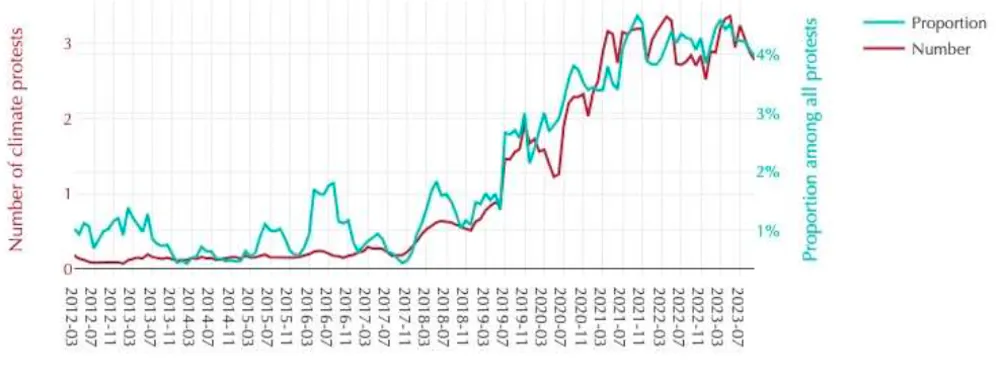
    To look more closely at the global picture of climate and environmental protest – and the repression of it – we used the Armed Conflicts Location Event database. This showed us that climate protests increased dramatically in 2018-2019 and have not declined since. They make up on average about 4% of all protest in the 81 countries that had more than 1,000 protests recorded in the 2012-2023 period:

    Climate protests increased sharply in the late 2010s in the 14 countries studied. (Data is smoothed over five months; number of protests is per country per month.)
    Berglund et al; Data: ACLED, CC BY-SA

    This second graph shows that environmental protest has increased more gradually:

    Environmental protests in the same 14 countries.
    Data: ACLED, CC BY-SA

    We used this data to see what kind of repression activists face. By looking for keywords in the reporting of protest events, we found that on average 3% of climate and environmental protests face police violence, and 6.3% involve arrests. But behind these averages are large differences in the nature of protest and its policing.

    A combination of the presence of protest groups like Extinction Rebellion, who often actively seek arrests, and police forces that are more likely to make arrests, mean countries such as Australia and the UK have very high levels of arrest. Some 20% of Australian climate and environmental protests involve arrests, against 17% in the UK – with the highest in the world being Canada on 27%.

    Meanwhile, police violence is high in countries such as Peru (6.5%) and Uganda (4.4%). France stands out as a European country with relatively high levels of police violence (3.2%) and low levels of arrests (also 3.2%).

    In summary, while criminalisation and repression does not look the same across the world, there are remarkable similarities. It is increasing in a lot of countries, it involves both state and corporate actors, and it takes many forms.

    This repression is taking place in a context where states are not taking adequate action on climate change. By criminalising activists, states depoliticise them. This conceals the fact these activists are ultimately right about the state of the climate and environment – and the lack of positive government action in these areas.

    Oscar Berglund is a member of the Green Party. The report this article is based on was written with Christina Pantazis, Chris Rossdale and Roxana Pessoa Cavalcanti.

    Tie Franco Brotto does not work for, consult, own shares in or receive funding from any company or organisation that would benefit from this article, and has disclosed no relevant affiliations beyond their academic appointment.

    ref. Repression of climate and environmental protest is intensifying across the world – https://theconversation.com/repression-of-climate-and-environmental-protest-is-intensifying-across-the-world-246379

    MIL OSI – Global Reports

  • MIL-OSI Global: Europe’s microstates: the medieval monarchies that survive in our midst

    Source: The Conversation – UK – By Elisa Bertolini, Associate Professor of Comparative Public Law, Bocconi University

    San Marino is one of four microstates with very distinct constitutional arrangements. Shutterstock/kavalenkava

    Continental Europe is home to four microstates with populations of between 30,000 and 80,000 people: Andorra, on the border between France and Spain; Liechtenstein, nestled between Switzerland and Austria; Monaco, which sits on the French Riviera; and San Marino, which is surrounded by northern Italy.

    These states have existed since the medieval period and their tiny size has enabled them to develop and maintain singular constitutional arrangements. They have all developed original solutions to the problems of state architecture, many of which survive today.

    All four of these microstates participate in the Council of Europe (Europe’s human rights organisation) and have therefore had to modernise to meet international standards of governance. This includes the independence of the judiciary.

    However, all four have also implemented these reforms without altering their institutional identity. Their commitment to preserving their distinctiveness from other countries prevents wider reform to their institutions. For them, the protection of national tradition and identity is a form of self-preservation rather than a mere expression of ideology.

    The distinctiveness of the four microstates lies in the survival of institutional arrangements that can no longer to be found practically anywhere else in the world. In the principalities of Liechtenstein and Monaco, for example, the monarchy still has a central role in the constitution.

    Unlike in most European states with a monarchy, in Liechtenstein and Monaco, the royal head of state continues to exercise meaningful power. Andorra and San Marino, meanwhile, operate under a dual head of state arrangement. They effectively have two monarchs.

    The populations of Europe’s medieval microstates.
    World Bank/ Data Commons, CC BY-ND

    Institutional arrangements in these principalities has been shaped by their diminutive size, both in terms of territory and population, and their geographical location. And these arrangements have survived since the middle ages because they have become their identity. While national tradition is an ideological debate in other nations, in these, preserving the past is a survival mechanism.

    Liechtenstein and Monaco

    Liechtenstein and Monaco are constitutional monarchies of the kind that offer substantial power to the royal family. Everything is organised around a prince, who exercises the executive power. Contemporary monarchies in the western legal tradition generally have a ceremonial king or queen but the executive power is held by an elected government. Liechtenstein and Monaco have maintained their historical organisation of government, centred on a very powerful monarch.

    Although his powers are not unlimited, in Monaco, the prince is not even accountable to the parliament for the powers he does hold. Liechtenstein’s prince enjoys even more powers, including the right to appoint half of the members of the constitutional court.

    However, the prince of Liechtenstein’s sovereign power is held in partnership with the people of Liechtenstein. The institutional architecture is built as to allow a system of checks and balances between the prince and the people.

    Since a 2003 constitutional amendment, for example, the people can table a motion of no-confidence in the prince if more than 1,500 citizens are in agreement to do so, which triggers a referendum on confidence in him. The same number of citizens can mount an initiative to abolish the monarchy entirely, should they choose to do so.

    Andorra and San Marino

    The principality of Andorra should more properly be called co-principality, because of its co-princes arrangement. One of the princes is the bishop of Urgell – from Catalonia – and the other is the president of the French Republic (and previously the French king or emperor). So another Andorran peculiarity is that neither of the princes are Andorran nationals.

    Following a 1993 reform that established a fully fledged constitution, neither prince holds sovereign power. Their present constitutional role is almost entirely ceremonial. However, concerns remain over the fact that they are not nationals of the state and that the heads of state are selected neither by the Andorran people nor by their representatives. The historical reason for a foreign head of state is the geographical location of Andorra – wedged between Catalonia and France. Allowing itself to be put under this double sovereignty was a guarantee of survival.

    San Marino also has a two-headed state but both leaders, called the Captains Regent, are Sammarinese nationals. They are elected by the Grand and General Council (the Sammarinese legislative body) and their distinctive trait is that they serve only a six-month term of office.

    The reason for such a short tenure is that San Marino has a population of just under 34,000 people. Everyone knows everyone else, which is a situation that can be detrimental to the independence of elective offices.

    Captains Regent can’t shore up enough power in their short time in office to be able to overthrow the republic. The Captains Regent were first established in 1243, shortly before a number of Italian republics were overthrown by wealthy families. One of the reasons why San Marino has been able to survive is because it has prevented one family from being more powerful than the others for centuries.

    Microstates are, therefore, not like Europe’s regular-sized states. They have distinctive institutional architectures – and often for understandable reasons.

    Elisa Bertolini does not work for, consult, own shares in or receive funding from any company or organisation that would benefit from this article, and has disclosed no relevant affiliations beyond their academic appointment.

    ref. Europe’s microstates: the medieval monarchies that survive in our midst – https://theconversation.com/europes-microstates-the-medieval-monarchies-that-survive-in-our-midst-245328

    MIL OSI – Global Reports

  • MIL-OSI Global: Why there’s no such thing as normal in child development

    Source: The Conversation – UK – By Samuel Forbes, Associate Professor in Psychology, Durham University

    Hasnuddin/Shutterstock

    For parents, carers and teachers, it’s often tempting to base our thinking on a child’s development around what we understand as “normal”. Much of the time we do this without thinking, describing a child as “doing well” in one subject and “behind” in another.

    Whenever we make this sort of comparison, we have some sort of mental benchmark or yardstick in our head: for example, a toddler should be able to climb on furniture by age two. Increasingly, child development researchers are arguing that the same thing happens in child development research — the study of how behaviours and abilities such as language develop.

    Many of the studies that claim to research child development either implicitly, or explicitly, claim that their findings are universal.

    There could be many reasons for this. Sometimes there’s a temptation to oversell conclusions, sometimes it might be the way findings are interpreted by readers or the media. The upshot is that what’s been found in one group of children is then taken as the standard — the yardstick against which future research is compared.

    Most of the research into how children develop comes from wealthier, western countries, in particular the US, the UK, the Netherlands, Germany and France. Chances are, if you’ve heard of milestones in child development, they were developed in one of these countries.

    This is so much so that it can be challenging to do basic research on child development in developing countries, as peers and reviewers will ask for or demand comparisons to western populations to put findings from these regions in context. Of course without realising it, these peers and reviewers have set up western children as a norm.

    Most of the existing academic research on child development comes from western countries.
    Olesia Bilkei/Shutterstock

    But is it fair to make these comparisons? One of the tricky things about researching child development is that it occurs within a cultural and social context it can’t be removed from. But this context is often messy. Differences in physical environment, parenting styles, location, climate and so on all interact to shape how children grow.

    Besides these differences, there is individual variation as well. These could be, for instance, curiosity, shyness and neurodiversity, which can all frame how a child shapes their own learning environment.

    Take for example the field of motor development in infancy – the study of
    how children learn to move. Many parents in particular might be familiar with charts showing when they can expect their child to sit, crawl, stand and run. The existence of these charts make it seem pretty universal, and often a child’s motor development is judged accordingly.

    This makes sense. Early research was preoccupied with finding out what was normal, and it makes sense to try to support children who might be at risk of falling behind. The timing and order investigated back then led to the norms and scales we still use today.

    Is something like motor development timing universal? It’s easy to imagine that it might be. When there are no physical or cognitive barriers we all learn to sit and stand, so on the surface it seems fair to say this could be.

    But it turns out that the context that children develop in plays a huge role even
    in something as seemingly universal as this. In countries and
    cultures where babies routinely receive firm massages from caregivers, such as in Jamaica, motor development is accelerated. It’s clear that a norm developed in one culture might not translate well to another.

    Beyond norms

    It’s clear to see that the problems highlighted above are not unique to motor development. In areas like language development or social development the cultural component is even more compelling.

    There is simply no way of understanding these elements of child development without also understanding the context in which they take place. Every child is developing within a context and however normal our own culture feels to us, there is no objective context-free norm that we can compare other children to. That is, to say, we should embrace the mess.

    If we think of normal child development as being something that just happens, researchers miss out on understanding the dynamics of development itself. But worse, educators and caregivers might not realise development is something we can act upon, and miss an opportunity to enact change.

    An important part of seeing child development as being intertwined with culture is that it doesn’t just mean collecting data from other cultures, but involving local communities and research perspectives. Understanding communities means listening to them, empowering them and making space for them to have a voice.

    Moving beyond a western-centric understanding of child development won’t just benefit researchers and lead to more accurate science, but hopefully benefit everyone working with children around the world.

    The authors do not work for, consult, own shares in or receive funding from any company or organisation that would benefit from this article, and have disclosed no relevant affiliations beyond their academic appointment.

    ref. Why there’s no such thing as normal in child development – https://theconversation.com/why-theres-no-such-thing-as-normal-in-child-development-244681

    MIL OSI – Global Reports

  • MIL-OSI: Boralex adds another 97 MW in its expanding UK portfolio

    Source: GlobeNewswire (MIL-OSI)

    EDINBURGH, United Kingdom, Dec. 23, 2024 (GLOBE NEWSWIRE) — Boralex Inc. (“Boralex” or the “Company”) (TSX: BLX) is pleased to announce that it has entered into a joint venture for the development, construction and operation of the proposed 145MW Clashindarroch Wind Farm Extension and adjacent 50MW Battery Energy Storage System (BESS), for a total capacity of 195MW. The project is located near Dufftown in Moray, Scotland. Boralex has been developing this project for a number of years on behalf of Clashindarroch Wind Farm Extension Ltd.

    Esbjorn Wilmar, Country Director of Boralex in the United Kingdom said: “We are delighted to have become co-owners of this exciting project. We already have extensive experience in the area through the initial development of the 177MW Dorenell Wind Farm. We now look forward to taking Clashindarroch Wind Farm Extension through the remaining stages of development.”

    Nicolas Wolff, Executive Vice President and General Manager of Boralex in Europe said: “This latest achievement by our UK team will enable us to accelerate the deployment of our Strategic Plan. Through this joint venture, we are adding to our already solid portfolio, supported by our organic developments and the recent acquisition of the 50MW Sallachy wind project.”

    Today’s announcement comes at a pivotal moment in the UK. Earlier in the month, the UK government unveiled its Clean Power Action Plan, setting out how it wants to achieve its grid decarbonisation targets by 2030. This plan, seen as a landmark for the clean energy sector, aims to unlock £40 billion annually from the private sector for investments in infrastructure and renewable energy. It also states that onshore wind capacity should be almost doubled to meet the decarbonisation target, from 14GW installed today to 27GW by 2030.

    The Company submitted a Section 36 application to the Scottish Government. The application is currently under consideration by the Government’s Energy Consents Unit (ECU). The Clashindarroch Wind Farm Extension application consists of up to 22 wind turbines each with an installed capacity of up to 6.6MW, as well as a battery storage facility of up to 50MW.

    On this transaction, CMS acted as Boralex’s legal advisers.

    About Boralex

    At Boralex, we have been providing affordable renewable energy accessible to everyone for over 30 years. As a leader in the Canadian market and France’s largest independent producer of onshore wind power, we also have facilities in the United States and development projects in the United Kingdom. Over the past five years, our installed capacity has more than doubled to over 3.1 GW. We are developing a portfolio of more than 7.2 GW in wind, solar projects and storage projects, guided by our values and our corporate social responsibility (CSR) approach. Through profitable and sustainable growth, Boralex is actively participating in the fight against global warming. Thanks to our fearlessness, our discipline, our expertise and our diversity, we continue to be an industry leader. Boralex’s shares are listed on the Toronto Stock Exchange under the ticker symbol BLX.

    For more information, visit boralex.com or sedarplus.com. Follow us on Facebook, LinkedIn and Instagram.

    For more information

    MEDIA  INVESTOR RELATIONS 
    Camille Laventure 
    Senior Advisor, Public Affairs and External Communications
    Boralex Inc. 

    438-883-8580 
    camille.laventure@boralex.com  

    Stéphane Milot 
    Vice President, Investor Relations 

    Boralex Inc. 

    514-213-1045 
    stephane.milot@boralex.com  

    Source: Boralex Inc.        

    The MIL Network

  • MIL-OSI Economics: AD 12-month diagnosed prevalent cases to reach 42.42 million in 7MM by 2033, forecasts GlobalData

    Source: GlobalData

    AD 12-month diagnosed prevalent cases to reach 42.42 million in 7MM by 2033, forecasts GlobalData

    Posted in Pharma

    The burden of 12-month diagnosed prevalent cases of atopic dermatitis (AD) is forecast to increase at an annual growth rate (AGR) of 0.10% from around 42.02 million cases in 2023 to 42.42 million cases in 2033 in the seven major markets (7MM*), according to GlobalData, a leading data and analytics company.

    GlobalData’s latest report, “Atopic Dermatitis (AD): Epidemiology Forecast to 2033”, reveals AD cases are rising because of the increasing prevalence of environmental and lifestyle risk factors and the increase in incidence of AD in adulthood.

    Yixuan Zhang, MSc, Epidemiologist at GlobalData, comments: “The pathogenesis of AD is unclear and most likely stems from the interaction of a combination of genetic susceptibility, environmental and lifestyle risk factors, and dysfunctional cell-mediated immunity.”

    According to GlobalData epidemiologists, there were around 44% of mild 12-month diagnosed prevalent cases of AD, 42% moderate cases of AD, and 14% severe cases of AD in 2023 in the 7MM.

    AD is a complex disease presenting with a range of clinical manifestations and symptoms, depending on the patient demographic and disease severity. In severe cases, AD is associated with sleep disturbances due to the pruritic rashes that appear on the skin during a flare-up, depression and anxiety, and loss of productivity, contributing to the economic and disease burden globally.

    Zhang concludes: “The highest prevalence is seen in childhood, followed by the middle-aged and older population. A positive correlation has been found between a country’s gross domestic product (GDP) and disease burden. However, new epidemiological patterns are slowly emerging, such as AD prevalence increasing in low-income countries and new AD-onset in adults becoming increasingly more common, particularly in the West.”

    *7MM: The US, France, Germany, Italy, Spain, the UK, and Japan.

    MIL OSI Economics

  • MIL-OSI Security: United States Charges Dual Russian and Israeli National as Developer of LockBit Ransomware Group

    Source: United States Attorneys General

    Defendant Rostislav Panev in Custody Pending Extradition from Israel to the United States

    Note: A copy of the superseding criminal complaint can be found here.

    A superseding criminal complaint filed in the District of New Jersey was unsealed today charging a dual Russian and Israeli national for being a developer of the LockBit ransomware group.

    In August, Rostislav Panev, 51, a dual Russian and Israeli national, was arrested in Israel pursuant to a U.S. provisional arrest request with a view towards extradition to the United States. Panev is currently in custody in Israel pending extradition on the charges in the superseding complaint.

    “The Justice Department’s work going after the world’s most dangerous ransomware schemes includes not only dismantling networks, but also finding and bringing to justice the individuals responsible for building and running them,” said Attorney General Merrick B. Garland. “Three of the individuals who we allege are responsible for LockBit’s cyberattacks against thousands of victims are now in custody, and we will continue to work alongside our partners to hold accountable all those who lead and enable ransomware attacks.”

    “The arrest of Mr. Panev reflects the Department’s commitment to using all its tools to combat the ransomware threat,” said Deputy Attorney General Lisa Monaco. “We started this year with a coordinated international disruption of LockBit — the most damaging ransomware group in the world. Fast forward to today and three LockBit actors are in custody thanks to the diligence of our investigators and our strong partnerships around the world. This case is a model for ransomware investigations in the years to come.”

    “The arrest of alleged developer Ratislav Panev is part of the FBI’s ongoing efforts to disrupt and dismantle the LockBit ransomware group, one of the most prolific ransomware variants across the globe,” said FBI Director Christopher Wray. “The LockBit group has targeted both public and private sector victims around the world, including schools, hospitals, and critical infrastructure, as well as small businesses and multi-national corporations.  No matter how hidden or advanced the threat, the FBI remains committed to working with our interagency partners to safeguard the cyber ecosystem and hold accountable those who are responsible for these criminal activities.” 

    “The criminal complaint alleges that Rotislav Panev developed malware and maintained the infrastructure for LockBit, which was once the world’s most destructive ransomware group and attacked thousands of victims, causing billions of dollars in damage,” said Principal Deputy Assistant Attorney General Nicole M. Argentieri, head of the Justice Department’s Criminal Division. “Along with our domestic and international law enforcement partner actions to dismantle LockBit’s infrastructure, the Criminal Division has disrupted LockBit’s operations by charging seven of its key members (including affiliates, developers, and its administrator) and arresting three of these defendants — including Panev. We are especially grateful for our partnerships with authorities in Europol, the United Kingdom, France, and Israel, which show that, when likeminded countries work together, cybercriminals will find it harder to escape justice.”

    “As alleged by the complaint, Rostislav Panev for years built and maintained the digital weapons that enabled his LockBit coconspirators to wreak havoc and cause billions of dollars in damage around the world,” said U.S. Attorney Philip R. Sellinger for the District of New Jersey. “But just like the six other LockBit members previously identified and charged by this office and our FBI and Criminal Division partners, Panev could not remain anonymous and avoid justice indefinitely. He must now answer for his crimes. Today’s announcement represents another blow struck by the United States and our international partners against the LockBit organization, and our efforts will continue relentlessly until the group is fully dismantled and its members brought to justice.”

    According to the superseding complaint, documents filed in this and related cases, and statements made in court, Panev acted as a developer of the LockBit ransomware group from its inception in or around 2019 through at least February 2024. During that time, Panev and his LockBit coconspirators grew LockBit into what was, at times, the most active and destructive ransomware group in the world. The LockBit group attacked more than 2,500 victims in at least 120 countries around the world, including 1,800 in the United States. Their victims ranged from individuals and small businesses to multinational corporations, including hospitals, schools, nonprofit organizations, critical infrastructure, and government and law-enforcement agencies. LockBit’s members extracted at least $500 million in ransom payments from their victims and caused billions of dollars in other losses, including lost revenue and costs from incident response and recovery.

    LockBit’s members comprised “developers,” like Panev, who designed the LockBit malware code and maintained the infrastructure on which LockBit operated. LockBit’s other members, called “affiliates,” carried out LockBit attacks and extorted ransom payments from LockBit victims. LockBit’s developers and affiliates would then split ransom payments extorted from victims.

    As alleged in the superseding complaint, at the time of Panev’s arrest in Israel in August, law enforcement discovered on Panev’s computer administrator credentials for an online repository that was hosted on the dark web and stored source code for multiple versions of the LockBit builder, which allowed LockBit’s affiliates to generate custom builds of the LockBit ransomware malware for particular victims. On that repository, law enforcement also discovered source code for LockBit’s StealBit tool, which helped LockBit affiliates exfiltrate data stolen through LockBit attacks. Law enforcement also discovered access credentials for the LockBit control panel, an online dashboard maintained by LockBit developers for LockBit’s affiliates and hosted by those developers on the dark web.

    The superseding complaint also alleges that Panev exchanged direct messages through a cybercriminal forum with LockBit’s primary administrator, who, in an indictment unsealed in the District of New Jersey in May, the United States alleged to be Dimitry Yuryevich Khoroshev (Дмитрий Юрьевич Хорошев), also known as LockBitSupp, LockBit, and putinkrab. In those messages, Panev and the LockBit primary administrator discussed work that needed to be done on the LockBit builder and control panel.

    Court documents further indicate that, between June 2022 and February 2024, the primary LockBit administrator made a series of transfers of cryptocurrency, laundered through one or more illicit cryptocurrency mixing services, of approximately $10,000 per month to a cryptocurrency wallet owned by Panev. Those transfers amounted to over $230,000 during that period.

    In interviews with Israeli authorities following his arrest in August, Panev admitted to having performed coding, development, and consulting work for the LockBit group and to having received regular payments in cryptocurrency for that work, consistent with the transfers identified by U.S. authorities. Among the work that Panev admitted to having completed for the LockBit group was the development of code to disable antivirus software; to deploy malware to multiple computers connected to a victim network; and to print the LockBit ransom note to all printers connected to a victim network. Panev also admitted to having written and maintained LockBit malware code and to having provided technical guidance to the LockBit group.

    The LockBit Investigation

    The superseding complaint against, and apprehension of, Panev follows a disruption of LockBit ransomware in February by the United Kingdom (U.K.)’s National Crime Agency (NCA)’s Cyber Division, which worked in cooperation with the Justice Department, FBI, and other international law enforcement partners. As previously announced by the Department, authorities disrupted LockBit by seizing numerous public-facing websites used by LockBit to connect to the organization’s infrastructure and by seizing control of servers used by LockBit administrators, thereby disrupting the ability of LockBit actors to attack and encrypt networks and extort victims by threatening to publish stolen data. That disruption succeeded in greatly diminishing LockBit’s reputation and its ability to attack further victims, as alleged by documents filed in this case.

    The superseding complaint against Panev also follows charges brought in the District of New Jersey against other LockBit members, including its alleged primary creator, developer, and administrator, Dmitry Yuryevich Khoroshev. An indictment against Khoroshev unsealed in May alleges that Khoroshev began developing LockBit as early as September 2019, continued acting as the group’s administrator through 2024, a role in which Khoroshev recruited new affiliate members, spoke for the group publicly under the alias “LockBitSupp,” and developed and maintained the infrastructure used by affiliates to deploy LockBit attacks. Khoroshev is currently the subject of a reward of up to $10 million through the U.S. Department of State’s Transnational Organized Crime (TOC) Rewards Program, with information accepted through the FBI tip website at www.tips.fbi.gov/.

    A total of seven LockBit members have now been charged in the District of New Jersey. Beyond Panev and Khoroshev, other previously charged LockBit defendants include:

    • In July, two LockBit affiliate members, Mikhail Vasiliev, also known as Ghostrider, Free, Digitalocean90, Digitalocean99, Digitalwaters99, and Newwave110, and Ruslan Astamirov, also known as BETTERPAY, offtitan, and Eastfarmer, pleaded guilty in the District of New Jersey for their participation in the LockBit ransomware group and admitted deploying multiple LockBit attacks against U.S. and foreign victims. Vasiliev and Astamirov are presently in custody awaiting sentencing.
    • In February, in parallel with the disruption operation described above, an indictment was unsealed in the District of New Jersey charging Russian nationals Artur Sungatov and Ivan Kondratyev, also known as Bassterlord, with deploying LockBit against numerous victims throughout the United States, including businesses nationwide in the manufacturing and other industries, as well as victims around the world in the semiconductor and other industries. Sungatov and Kondratyev remain at large.
    • In May 2023, two indictments were unsealed in Washington, D.C., and the District of New Jersey charging Mikhail Matveev, also known as Wazawaka, m1x, Boriselcin, and Uhodiransomwar, with using different ransomware variants, including LockBit, to attack numerous victims throughout the United States, including the Washington, D.C., Metropolitan Police Department. Matveev remains at large and is currently the subject of a reward of up to $10 million through the U.S. Department of State’s TOC Rewards Program, with information accepted through the FBI tip website at www.tips.fbi.gov/.

    The U.S. Department of State’s TOC Rewards Program is offering rewards of:

    Information is accepted through the FBI tip website at tips.fbi.gov.

    Khoroshev, Matveev, Sungatov, and Kondratyev have also been designated for sanctions by the Department of the Treasury’s Office of Foreign Assets Control for their roles in launching cyberattacks.

    Victim Assistance

    LockBit victims are encouraged to contact the FBI and submit information at www.ic3.gov/. As announced by the Department in February, law enforcement, through its disruption efforts, has developed decryption capabilities that may enable hundreds of victims around the world to restore systems encrypted using the LockBit ransomware variant. Submitting information at the IC3 site will enable law enforcement to determine whether affected systems can be successfully decrypted.

    LockBit victims are also encouraged to visit www.justice.gov/usao-nj/lockbit for case updates and information regarding their rights under U.S. law, including the right to submit victim impact statements and request restitution, in the criminal litigation against Panev, Astamirov, and Vasiliev.

    The FBI Newark Field Office, under the supervision of Acting Special Agent in Charge Nelson I. Delgado, is investigating the LockBit ransomware variant. Israel’s Office of the State Attorney, Department of International Affairs, and Israel National Police; France’s Gendarmerie Nationale Cyberspace Command, Paris Prosecution Office — Cyber Division, and judicial authorities at the Tribunal Judiciare of Paris; Europol; Eurojust; the U.K.’s NCA; Germany’s Landeskriminalamt Schleswig-Holstein, Bundeskriminalamt, and the Central Cybercrime Department North Rhine-Westphalia; Switzerland’s Federal Office of Justice, Public Prosecutor’s Office of the Canton of Zurich, and Zurich Cantonal Police; Spain’s Policia Nacional and Guardia Civil; Japan’s National Police Agency; Australian Federal Police; Sweden’s Polismyndighetens; Canada’s Royal Canadian Mounted Police; Politie Dienst Regionale Recherche Oost-Brabant of the Netherlands; and Finland’s National Bureau of Investigation have provided significant assistance and coordination in these matters and in the LockBit investigation generally.

    Trial Attorneys Debra Ireland and Jorge Gonzalez of the Criminal Division’s Computer Crime and Intellectual Property Section (CCIPS) and Assistant U.S. Attorneys Andrew M. Trombly, David E. Malagold, and Vinay Limbachia for the District of New Jersey are prosecuting the charges against Panev and the other previously charged LockBit defendants in the District of New Jersey.

    The Justice Department’s Cybercrime Liaison Prosecutor to Eurojust, Office of International Affairs, and National Security Division also provided significant assistance.

    Additional details on protecting networks against LockBit ransomware are available at StopRansomware.gov. These include Cybersecurity and Infrastructure Security Agency Advisories AA23-325A, AA23-165A, and AA23-075A. 

    A criminal complaint is merely an allegation. All defendants are presumed innocent until proven guilty beyond a reasonable doubt in a court of law.

    MIL Security OSI

  • MIL-OSI United Kingdom: Joint statement on Afghanistan

    Source: United Kingdom – Executive Government & Departments

    Joint statement on the situation in Afghanistan following a G7+ meeting in Geneva

    Special Envoys and Representatives for Afghanistan of Canada, the European Union, France, Germany, Italy, Japan, Norway, the Republic of Korea, Switzerland, Türkiye, the United Kingdom, and the United States met in Geneva on December 16, 2024 to discuss the situation in Afghanistan. Deputy Special Representative for Afghanistan in the United Nations Assistance Mission in Afghanistan (UNAMA), Special Rapporteur on the situation of human rights, Representatives of the World Bank (WB) and of the Organisation of Islamic Cooperation (OIC) also participated in the meeting as observers.

    The Special Envoys and Representatives for Afghanistan:

    1. Expressed grave concern over the Taliban’s decisions in December 2024 to ban women and girls from attending public and private medical training institutions; and expressed concern that this new ban will have devastating consequences for all Afghans, especially mothers and infants – both born and unborn, both boys and girls – and will further destabilize an already fragile healthcare system. These decisions, which come on the back of the Taliban’s “Law on the Promotion of Virtue and the Prevention of Vice” announced in August 2024, expand upon the already over 80 repressive, discriminatory edicts aimed at excluding Afghan women and girls from education, public and economic life. We call for the immediate reversal of these unacceptable practices and policies.

    2. Noted with grave concern recent terrorist attacks in Kabul and the region, as well as the continuing threat terrorism poses to security and stability in Afghanistan; and acknowledged the Taliban actions to tackle terrorist threats from ISIS-K, while recalling the need for the Taliban to pursue actions to tackle terrorist threats, in accordance with Resolution 2593 of the United Nations Security Council and underscoring that some terrorist groups still reside safely inside Afghanistan and are able to plan and carry-out internal and cross-border terrorist strikes.

    3. Underscored that achieving long-term stability in Afghanistan requires a credible and inclusive national dialogue leading to a constitutional order with a representative and inclusive political system, as well as accountable political leaders and the State of Afghanistan meeting its international obligations.

    4. Emphasized the need for implementation of UN Security Council Resolution 2721 (2023), which took positive note of the UN’s independent assessment prepared pursuant to UNSCR 2679 (2023), encouraged member states and all other relevant stakeholders to consider implementation of its recommendations and requested the UN Secretary General to appoint a Special Envoy for Afghanistan to take forward a process between Afghan stakeholders and the international community for long term peace and stability in Afghanistan.

    5. Commended the work of the United Nations, including the UN-led Doha Process, and recognized the important and specific work of UNAMA, UN agencies present in the country, the World Bank, the Asian Development Bank and the many international and local NGOs and other humanitarian actors that continue to support the people of Afghanistan through ongoing social and humanitarian crisis.

    6. Reaffirmed that international NGOs are indispensable to humanitarian work in Afghanistan; and reinforced the importance of a united humanitarian response that includes representation from UN agencies, international and national NGOs, and other humanitarian actors.

    7. Highlighted the necessity to continue helping Afghans who are suffering in the ongoing humanitarian crisis with appropriate consideration for vulnerable populations, including women and women-led households, children and members of ethnic and religious minority communities.

    8. Looked forward to deepening engagement with neighbouring countries and other countries of the region on a joint response to the developing situation in Afghanistan, including countering potential threats such as terrorism and illegal migration to regional security and stability emanating from Afghanistan; commended the efforts of Muslim-majority countries and the OIC in engaging with the Taliban on women’s and girls’ rights and welcomed the leadership they have demonstrated on issues such as access to education and encouraged them to continue their active engagement on these and related issues.

    9. Expressed their appreciation to Switzerland for organizing these consultations and hosting the meeting; and looked forward to this Group of Special Envoys and Representatives meeting again in the near future.

    Media enquiries

    Email newsdesk@fcdo.gov.uk

    Telephone 020 7008 3100

    Contact the FCDO Communication Team via email (monitored 24 hours a day) in the first instance, and we will respond as soon as possible.

    Updates to this page

    Published 20 December 2024

    MIL OSI United Kingdom

  • MIL-OSI Security: U.S. Charges Dual Russian And Israeli National As Developer Of Lockbit Ransomware Group

    Source: Office of United States Attorneys

    Defendant Rostislav Panev in Custody Pending Extradition from Israel to the United States

    NEWARK, N.J. – A superseding criminal complaint filed in the District of New Jersey was unsealed today charging a dual Russian and Israeli national for being a developer of the LockBit ransomware group, U.S. Attorney Philip R. Sellinger announced.

    In August, Rostislav Panev, 51, a dual Russian and Israeli national, was arrested in Israel pursuant to a U.S. provisional arrest request with a view towards extradition to the United States. Panev is currently in custody in Israel pending extradition on the charges lodged in the superseding complaint.

    “As alleged by the complaint, Rostislav Panev for years built and maintained the digital weapons that enabled his LockBit coconspirators to wreak havoc and cause billions of dollars in damage around the world. But just like the six other LockBit members previously identified and charged by this office and our FBI and Criminal Division partners, Panev could not remain anonymous and avoid justice indefinitely. He must now answer for his crimes. Today’s announcement represents another blow struck by the United States and our international partners against the LockBit organization, and our efforts will continue relentlessly until the group is fully dismantled and its members brought to justice.”

    U.S. Attorney Philip R. Sellinger

    “The Justice Department’s work going after the world’s most dangerous ransomware schemes includes not only dismantling networks, but also finding and bringing to justice the individuals responsible for building and running them,” said Attorney General Merrick B. Garland. “Three of the individuals who we allege are responsible for LockBit’s cyberattacks against thousands of victims are now in custody, and we will continue to work alongside our partners to hold accountable all those who lead and enable ransomware attacks.”

    “The arrest of Mr. Panev reflects the Department’s commitment to using all its tools to combat the ransomware threat,” said Deputy Attorney General Lisa Monaco. “We started this year with a coordinated international disruption of LockBit — the most damaging ransomware group in the world. Fast forward to today and three LockBit actors are in custody thanks to the diligence of our investigators and our strong partnerships around the world. This case is a model for ransomware investigations in the years to come.”

    “The arrest of alleged developer Rostislav Panev is part of the FBI’s ongoing efforts to disrupt and dismantle the LockBit ransomware group, one of the most prolific ransomware variants across the globe,” said FBI Director Christopher Wray. “The LockBit group has targeted both public and private sector victims around the world, including schools, hospitals, and critical infrastructure, as well as small businesses and multi-national corporations. No matter how hidden or advanced the threat, the FBI remains committed to working with our interagency partners to safeguard the cyber ecosystem and hold accountable those who are responsible for these criminal activities.”

    “The criminal complaint alleges that Rotislav Panev developed malware and maintained the infrastructure for LockBit, which was once the world’s most destructive ransomware group and attacked thousands of victims, causing billions of dollars in damage,” said Principal Deputy Assistant Attorney General Nicole M. Argentieri, head of the Justice Department’s Criminal Division. “Along with our domestic and international law enforcement partner actions to dismantle LockBit’s infrastructure, the Criminal Division has disrupted LockBit’s operations by charging seven of its key members (including affiliates, developers, and its administrator) and arresting three of these defendants — including Panev. We are especially grateful for our partnerships with authorities in Europol, the United Kingdom, France, and Israel, which show that, when likeminded countries work together, cybercriminals will find it harder to escape justice.”

    “For five years, Panev helped to grow LockBit into a ransomware machine of deception and extortion,” said Acting Special Agent in Charge Nelson I. Delgado of the FBI Newark Field Office.  “His reach was far and wide but FBI Newark and our international law enforcement partners were able to disrupt his reign. Panev’s arrest marks a victory against these conspirators, and is a step towards upholding justice and neutralizing these criminals.”

    According to the superseding complaint, documents filed in this and related cases, and statements made in court, Panev acted as a developer of the LockBit ransomware group from its inception in or around 2019 through at least February 2024. During that time, Panev and his LockBit coconspirators grew LockBit into what was, at times, the most active and destructive ransomware group in the world. The LockBit group attacked more than 2,500 victims in at least 120 countries around the world, including 1,800 in the United States. Their victims ranged from individuals and small businesses to multinational corporations, including hospitals, schools, nonprofit organizations, critical infrastructure, and government and law-enforcement agencies. LockBit’s members extracted at least $500 million in ransom payments from their victims and caused billions of dollars in other losses, including lost revenue and costs from incident response and recovery.

    LockBit’s members comprised “developers,” like Panev, who designed the LockBit malware code and maintained the infrastructure on which LockBit operated. LockBit’s other members, called “affiliates,” carried out LockBit attacks and extorted ransom payments from LockBit victims. LockBit’s developers and affiliates would then split ransom payments extorted from victims.

    As alleged in the superseding complaint, at the time of Panev’s arrest in Israel in August, law enforcement discovered on Panev’s computer administrator credentials for an online repository that was hosted on the dark web and stored source code for multiple versions of the LockBit builder, which allowed LockBit’s affiliates to generate custom builds of the LockBit ransomware malware for particular victims. On that repository, law enforcement also discovered source code for LockBit’s StealBit tool, which helped LockBit affiliates exfiltrate data stolen through LockBit attacks. Law enforcement also discovered access credentials for the LockBit control panel, an online dashboard maintained by LockBit developers for LockBit’s affiliates and hosted by those developers on the dark web.

    The superseding complaint also alleges that Panev exchanged direct messages through a cybercriminal forum with LockBit’s primary administrator, who, in an indictment unsealed in the District of New Jersey in May, the United States alleged to be Dimitry Yuryevich Khoroshev (Дмитрий Юрьевич Хорошев), also known as LockBitSupp, LockBit, and putinkrab. In those messages, Panev and the LockBit primary administrator discussed work that needed to be done on the LockBit builder and control panel.

    Court documents further indicate that, between June 2022 and February 2024, the primary LockBit administrator made a series of transfers of cryptocurrency, laundered through one or more illicit cryptocurrency mixing services, of approximately $10,000 per month to a cryptocurrency wallet owned by Panev. Those transfers amounted to over $230,000 during that period.

    In interviews with Israeli authorities following his arrest in August, Panev admitted to having performed coding, development, and consulting work for the LockBit group and to having received regular payments in cryptocurrency for that work, consistent with the transfers identified by U.S. authorities. Among the work that Panev admitted to having completed for the LockBit group was the development of code to disable antivirus software; to deploy malware to multiple computers connected to a victim network; and to print the LockBit ransom note to all printers connected to a victim network. Panev also admitted to having written and maintained LockBit malware code and to having provided technical guidance to the LockBit group.

    The LockBit Investigation

    The superseding complaint against, and apprehension of, Panev follows a disruption of LockBit ransomware in February by the U.K. National Crime Agency (NCA)’s Cyber Division, which worked in cooperation with the Justice Department, FBI, and other international law enforcement partners. As previously announced by the Department, authorities disrupted LockBit by seizing numerous public-facing websites used by LockBit to connect to the organization’s infrastructure and by seizing control of servers used by LockBit administrators, thereby disrupting the ability of LockBit actors to attack and encrypt networks and extort victims by threatening to publish stolen data. That disruption succeeded in greatly diminishing LockBit’s reputation and its ability to attack further victims, as alleged by documents filed in this case.

    The superseding complaint against Panev also follows charges brought in the District of New Jersey against other LockBit members, including its alleged primary creator, developer, and administrator, Dmitry Yuryevich Khoroshev. An indictment against Khoroshev unsealed in May alleges that Khoroshev began developing LockBit as early as September 2019, continued acting as the group’s administrator through 2024, a role in which Khoroshev recruited new affiliate members, spoke for the group publicly under the alias “LockBitSupp,” and developed and maintained the infrastructure used by affiliates to deploy LockBit attacks. Khoroshev is currently the subject of a reward of up to $10 million through the U.S. Department of State’s Transnational Organized Crime (TOC) Rewards Program, with information accepted through the FBI tip website at www.tips.fbi.gov/.

    A total of seven LockBit members have now been charged in the District of New Jersey. Beyond Panev and Khoroshev, other previously charged LockBit defendants include:

    • In July, two LockBit affiliate members, Mikhail Vasiliev, also known as Ghostrider, Free, Digitalocean90, Digitalocean99, Digitalwaters99, and Newwave110, and Ruslan Astamirov, also known as BETTERPAY, offtitan, and Eastfarmer, pleaded guilty in the District of New Jersey for their participation in the LockBit ransomware group and admitted deploying multiple LockBit attacks against U.S. and foreign victims. Vasiliev and Astamirov are presently in custody awaiting sentencing.
    • In February, in parallel with the disruption operation described above, an indictment was unsealed in the District of New Jersey charging Russian nationals Artur Sungatov and Ivan Kondratyev, also known as Bassterlord, with deploying LockBit against numerous victims throughout the United States, including businesses nationwide in the manufacturing and other industries, as well as victims around the world in the semiconductor and other industries. Sungatov and Kondratyev remain at large.
    • In May 2023, two indictments were unsealed in Washington, D.C., and the District of New Jersey charging Mikhail Matveev, also known as Wazawaka, m1x, Boriselcin, and Uhodiransomwar, with using different ransomware variants, including LockBit, to attack numerous victims throughout the United States, including the Washington, D.C., Metropolitan Police Department. Matveev remains at large and is currently the subject of a reward of up to $10 million through the U.S. Department of State’s TOC Rewards Program, with information accepted through the FBI tip website at www.tips.fbi.gov/.

    The U.S. Department of State’s Transnational Organized Crime (TOC) Rewards Program is offering rewards of:

    Information is accepted through the FBI tip website at tips.fbi.gov.

    Khoroshev, Matveev, Sungatov, and Kondratyev have also been designated for sanctions by the Department of the Treasury’s Office of Foreign Assets Control for their roles in launching cyberattacks.

    Victim Assistance

    LockBit victims are encouraged to contact the FBI and submit information at www.ic3.gov. As announced by the Department in February, law enforcement, through its disruption efforts, has developed decryption capabilities that may enable hundreds of victims around the world to restore systems encrypted using the LockBit ransomware variant. Submitting information at the IC3 site will enable law enforcement to determine whether affected systems can be successfully decrypted.

    LockBit victims are also encouraged to visit www.justice.gov/usao-nj/lockbit for case updates and information regarding their rights under U.S. law, including the right to submit victim impact statements and request restitution, in the criminal litigation against Panev, Astamirov, and Vasiliev.

    The FBI Newark Field Office, under the supervision of Acting Special Agent in Charge Nelson I. Delgado, is investigating the LockBit ransomware variant. Israel’s Office of the State Attorney, Department of International Affairs, and Israel National Police; France’s Gendarmerie Nationale Cyberspace Command, Paris Prosecution Office — Cyber Division, and judicial authorities at the Tribunal Judiciare of Paris; Europol; Eurojust; the United Kingdom’s National Crime Agency; Germany’s Landeskriminalamt Schleswig-Holstein, Bundeskriminalamt, and the Central Cybercrime Department North Rhine-Westphalia; Switzerland’s Federal Office of Justice, Public Prosecutor’s Office of the Canton of Zurich, and Zurich Cantonal Police; Spain’s Policia Nacional and Guardia Civil; Japan’s National Police Agency; Australian Federal Police; Sweden’s Polismyndighetens; Canada’s Royal Canadian Mounted Police; Politie Dienst Regionale Recherche Oost-Brabant of the Netherlands; and Finland’s National Bureau of Investigation have provided significant assistance and coordination in these matters and in the LockBit investigation generally.

    Assistant U.S. Attorneys Andrew M. Trombly, David E. Malagold, and Vinay Limbachia for the District of New Jersey and Trial Attorneys Debra Ireland and Jorge Gonzalez of the Criminal Division’s Computer Crime and Intellectual Property Section (CCIPS) are prosecuting the charges against Panev and the other previously charged LockBit defendants in the District of New Jersey.

    The Justice Department’s Cybercrime Liaison Prosecutor to Eurojust, Office of International Affairs, and National Security Division also provided significant assistance.

    Additional details on protecting networks against LockBit ransomware are available at StopRansomware.gov. These include Cybersecurity and Infrastructure Security Agency Advisories AA23-325A, AA23-165A, and AA23-075A. 

    The charges and allegations contained in the superseding complaint are merely accusations, and the defendant is presumed innocent unless and until proven guilty.

    Defense counsel: Frank Arleo, Esq.

    MIL Security OSI

  • MIL-OSI United Kingdom: The UK calls on all parties to the conflict to refrain from obstructing MONUSCO operations: UK Statement at the UN Security Council

    Source: United Kingdom – Executive Government & Departments

    Explanation of vote delivered by Ambassador James Kariuki, UK Deputy Permanent Representative to the UN, following the vote on renewing MONUSCO’s mandate.

    The United Kingdom welcomes the adoption of this resolution renewing MONUSCO’s mandate. And we thank France and Sierra Leone for their leadership of the negotiations.

    I would like to make two points.

    First, The UK is disappointed by the postponement of the Luanda Process Heads of State Summit scheduled for 15 December.

    We remain greatly appreciative of Angola’s mediation efforts and urge all parties to engage with the Luanda Process in good faith and deliver on their commitments.

    Second, we are concerned by the surge in violence since the 15 December.

    In this context, the UK is concerned by the presence of Rwanda Defence Forces in DRC, as reported by the Group of Experts. 

    We call on all parties to the conflict to refrain from obstructing MONUSCO operations.

    Updates to this page

    Published 20 December 2024

    MIL OSI United Kingdom

  • MIL-OSI Security: From fake art to money laundering: Eurojust’s cross-border investigations in 2024

    Source: Eurojust

    Some highlights of our 2024 casework:

    EUR 2 billion money laundering network dismantled

    A financial institution in Lithuania was discovered laundering around EUR 2 billion through a worldwide web of shell companies. Italian, Latvian and Lithuanian authorities, supported by Eurojust and Europol, took down the network during an action day on 27 February. Eighteen people were arrested and over EUR 11.5 million in assets and bank accounts were frozen.

    Takedown of online infrastructure used for terrorist propaganda

    After a complex investigation that monitored the online activities of terrorist groups, authorities in Spain traced servers across the globe that were supporting multiple media outlets disseminating worldwide propaganda meant to incite terrorism. A global coalition between Spanish, German, Dutch, American and Icelandic authorities was set up to take the servers offline. With the support of Eurojust and Europol, servers were taken down and nine radicalised individuals were arrested.

    Large anti-mafia operation leads to arrest and freezing of EUR 50 million

    Authorities uncovered an intricate money laundering scheme run by a mafia family in Brazil. Profits of their crimes were reinvested into multiple companies in Brazil, including a well-known hotel. Through a joint investigation team at Eurojust, Italian and Brazilian authorities investigated the activities of the mafia family and planned a large global operation to arrest the suspects. The operation led to the arrest of one of the mafia members and the freezing of financial assets worth EUR 50 million.

    Belarusians Charged for Forced Plane Landing

    Eurojust supported a joint investigation team between Polish and Lithuanian authorities that investigated the forced landing in Belarus of a commercial flight. The unprecedented case shed a light on the real reason behind the flight’s diversion: suspects instructed air traffic controllers to land the aircraft in order to arrest a Belarusian dissident. In September, the investigation led to the arrest warrants for three Belarusian officials.

    Authorities stop malware targeting millions of people

    Two infostealers, malware that is able to steal personal data from infected devices, was taken down by a global operation. Authorities from the Netherlands, the United States, Belgium, Portugal, the United Kingdom, Australia and Eurojust and Europol shut down three servers in the Netherlands and seized two domains. The operation stopped the malware from stealing data such as usernames and passwords that were used to steal money or carry out other hacking activities.

    Fake art network discovered that could have cause losses of EUR 200 million

    Banksy, Andy Warhol, Pablo Picasso, Claude Monet and Vincent van Gogh are among the artists whose work was forged by a criminal group that set up a sophisticated fake art operation. The group produced the art, organised exhibitions of the forged works and worked together with compromised auction houses to sell the pieces. Eurojust supported Italian authorities to dismantle the criminal group and set up the cooperation between Belgian, French and Spanish authorities. During an action day in November, 38 people were arrested and over 2 000 fake art works were seized.

    MIL Security OSI

  • MIL-OSI Europe: In Rome, in the Holy Land and throughout the World. Vademecum to obtain Indulgences in the Jubilee Year 2025

    Source: Agenzia Fides – MIL OSI

    Friday, 20 December 2024

    by Gianni ValenteRome (Agenzia Fides) – In 2025, the Catholic Church will once again celebrate the Jubilee Year, a special time of remission and forgiveness, designed as an opportunity to intensely experience healing and liberation from sins and debts that oppress life and soul.The possibility of requesting and obtaining indulgences constitutes a central aspect of the Jubilee tradition. As Pope Francis points out in the Bull of Indiction of the Jubilee 2025 (Spes non confundit, § 23): «Not by chance, for the ancients, the terms “mercy” and “indulgence” were interchangeable, as expressions of the fullness of God’s forgiveness, which knows no bond».Below is a brief vademecum with the fundamental indications on how to request the gift of indulgences during the Jubilee, both in Rome, in the Holy Land and anywhere in the world.WHAT IS AN INDULGENCE«An indulgence is the remission before God of temporal punishment for sins whose guilt is already forgiven [i.e., for which absolution has already been obtained by confessing, ed.], which a properly disposed member of the Christian faithful gains under certain and defined conditions by the assistance of the Church which as minister of redemption dispenses and applies authoritatively the treasury of the satisfactions of Christ and the saints» (Codex Iuris Canonici, can. 992).WHAT IS TEMPORAL PUNISHMENTSin has a double consequence. Grave sin deprives us of communion with God and therefore makes us incapable of eternal life, the privation of which is called the “eternal punishment” of sin. On the other hand every sin, even venial, entails an unhealthy attachment to creatures, which must be purified either here on earth, or after death in the state called Purgatory. This purification frees one from what is called the “temporal punishment” of sin” (Catechism of the Catholic Church, n. 1472).This second consequence of sin, that is, temporal punishment, to which one may still be obliged despite the forgiveness of sins obtained in Confession, can be fullfilled either here on earth (with voluntary prayers and penances, with works of piety, mortification and charity), or in the afterlife, in purgatory.WHAT IS PLENARY INDULGENCEPlenary indulgence in itself completely remits the temporal punishment resulting from sins that have already been forgiven as to guilt. This remission, in the case of mortal sins, necessarily requires sacramental Confession.WHO CAN OBTAIN INDULGENCESIndulgences can be obtained by all baptized persons who are not in a state of excommunication. However, to receive them, the faithful must be in God’s grace, that is, without mortal sin. This is because the debt of the temporal punishment can only be cancelled after the remission of the guilt and eternal punishment caused by sin, which is achieved through the sacrament of Confession.In cases where confession is not possible, sincere contrition, with the intention of accessing the sacrament of penance as soon as possible, may be sufficient to achieve remission.It is also essential to have the intention of obtaining the indulgence. The benefit of the indulgence is only granted to those who request it consciously and with the purpose of receiving it, with a positive attitude.HOW IS A PLENARY INDULGENCE OBTAINEDTo obtain a Plenary Indulgence, in addition to performing the specific act to which the Church has granted this grace, the following conditions must always be met:- Confession: confession must be individual and complete, that is, without deliberately omitting any sin.- Receive Eucharistic Communion.- Pray according to the Pope’s intentions: for example, an Our Father and a Hail Mary.HOW CAN EVERY FAITHFUL RECEIVE THE DAILY PLENARY INDULGENCE DURING THE JUBILEE OF THE YEAR 2025?The norms for granting the plenary indulgence during the Ordinary Jubilee of the Year 2025, published on May 13, 2024 by the Apostolic Penitentiary, presided over by Cardinal Angelo De Donatis, establish the specific acts that can lead to the acquisition of the daily plenary Indulgence throughout the Holy Year.In addition to fulfilling the usual conditions (detachment from sin, even venial; sacramental confession; Eucharistic communion and prayer according to the intentions of the Holy Father), the faithful will be able to perform a series of specific acts that will allow them to receive the plenary indulgence each day of the Jubilee. These acts are listed below:* PILGRIMAGES AND VISITS TO HOLY PLACESThe faithful can obtain the Jubilee Indulgence if they make a pilgrimage to any holy Jubilee place. During this pilgrimage, they must actively participate in one of the following activities: Holy Mass, or Stations of the Cross, or the Recitation of the Holy Rosary or the Akathist hymn, or a Penitential Celebration, which concludes with the individual confession of the penitents.- IN ROME AND IN ITALYIf they are in Rome, to request the Plenary Indulgence, the faithful can make a pilgrimage to at least one of the four Major Papal Basilicas (Saint Peter’s – the Vatican Basilica, Basilica of Saint John Lateran, Basilica of Saint Mary Major and Basilica of Saint Paul Outside the Walls).On the special occasion of the Jubilee Year, in addition to the places of pilgrimage mentioned above, it will also be possible to visit: Basilica di Santa Croce in Gerusalemme (Basilica of the Holy Cross in Jerusalem), Basilica di San Lorenzo al Verano (The Basilica of Saint Lawrence “Outside the Walls” lies next to the Verano Cemetery), Basilica di San Sebastiano (Basilica of Saint Sebastian, stops that complete the visit known as “the seven Churches”, so dear to St. Philip Neri), il Santuario del Divino Amore (The Sanctuary of Divine Love), la chiesa di Santo Spirito in Sassia (the church of the Holy Spirit in Sassia), la chiesa di San Paolo alle Tre Fontane (Church of St. Paul of Three Fountains – site of the Martyrdom of the Apostle), the Christian Catacombs; in addition, it will be possible to visit (and carry out the pious practices provided there) the churches on the jubilee routes dedicated to the Iter Europaeum and the churches dedicated to the Patronesses of Europe and to the Doctors of the Church, respectively: Basilica di Santa Maria sopra Minerva, Santa Brigida in Campo de’ Fiori, the church of Santa Maria della Vittoria, the church of Trinità dei Monti, Basilica of Santa Cecilia in Trastevere, Basilica of Sant’Agostino in Campo Marzio).In Italy, jubilee pilgrimages can also be made to the two minor Papal Basilicas of Assisi: Basilica di San Francesco d’Assisi (Basilica of Saint Francis of Assisi) and Santa Maria degli Angeli. And the papal basilicas of: Madonna di Loreto (Our Lady of Loreto) della Madonna di Pompei (Our Lady of Pompei), and Sant’Antonio di Padova (Basilica of Saint Anthony of Padu).- IN THE HOLY LANDIn the land of Jesus, it will be possible to make Jubilee pilgrimages and ask for plenary indulgence by visiting at least one of the three Basilicas of the Holy Sepulchre in Jerusalem, of the Nativity in Bethlehem, of the Annunciation in Nazareth.- WORLDWIDEIn other ecclesiastical circumscriptions, the faithful can obtain the jubilee indulgence if, individually or in a group, they devoutly visit any sacred place (minor basilicas, cathedral churches, Marian shrines) designated as a Jubilee place by each diocesan Bishop, as well as national or international shrines, indicated by the Episcopal Conferences. There, for an appropriate time, they must dedicate time to Eucharistic adoration and meditation, concluding with the Our Father, the Profession of Faith in any of its legitimate forms and invocations to Mary, Mother of God.Sincerely repentant faithful who, for serious reasons, cannot participate in pilgrimages and pious visits (for example, cloistered monks and nuns, the sick and those in prison) can obtain the Jubilee Indulgence under the same conditions if, united in spirit with the faithful present, especially at the moments when the words of the Supreme Pontiff or the diocesan Bishops will be disseminated through the media, they recite the Our Father, the Profession of Faith and other prayers in conformity with the purposes of the Holy Year.* WORKS OF MERCY AND PENANCEIn addition to making pilgrimages or pious visits to the Jubilee sites, the faithful can obtain the jubilee indulgence through:- Participation in POPULAR MISSIONS;- Participation in SPIRITUAL EXERCISES or FORMATION MEETINGS on the texts of the Second Vatican Council and the Catechism of the Catholic Church, held in a church or other suitable place.- Performing Corporal and Spiritual WORKS OF MERCY.- Performing PENITENTIAL ACTS, such as:a) Rediscovering the penitential value of Fridays, by abstaining for at least one day from useless distractions (induced, for example, by the media and social networks) and from superfluous consumption (for example, by fasting or practicing abstinence according to the general norms of the Church and donating a proportionate sum of money to the poor).b) Supporting works of a religious or social nature, especially in favor of the defense and protection of life in all its phases, of abandoned children, of young people in difficulty, of the elderly in need or alone, of migrants from various countries.c) Dedicate an appropriate part of one’s free time to voluntary activities of interest to the community or to other similar forms of personal commitment.Despite the general rule according to which only one Plenary Indulgence can be obtained per day (cf. Enchiridion Indulgentiarum, IV ed., norm. 18, § 1), the Instruction issued by the Apostolic Penitentiary with the norms for receiving Plenary Indulgences during the Jubilee Year 2025 states that “the faithful who have performed the act of charity in favor of the souls in Purgatory, if they legitimately approach the sacrament of Communion for the second time on the same day, may obtain a Plenary Indulgence twice on the same day, applicable only to the deceased (it is understood within a Eucharistic celebration). (Agenzia Fides, 20/12/2024)

    Share:

    MIL OSI Europe News

  • MIL-OSI USA: Rapid Health Agrees to Pay $8.2M for Allegedly Billing Medicare for Over-the-Counter COVID-19 Tests That Were Not Provided to Beneficiaries

    Source: US State of California

    Covid Test DMV LLC, doing business as Rapid Health (Rapid Health), a pharmacy located in Los Angeles, has agreed to pay the United States $8,242,860 to resolve allegations that it violated the False Claims Act (FCA) by knowingly submitting or causing the submission of false claims to Medicare for over-the-counter (OTC) Covid-19 tests that were not provided to Medicare beneficiaries.

    Between April 2022 and May 2023, Rapid Health distributed OTC Covid-19 tests in connection with the Centers for Medicare & Medicaid Services (CMS) OTC Covid-19 Test Demonstration Project (Demonstration Project). During the Demonstration Project, Medicare Part B beneficiaries could request OTC Covid-19 tests from participating providers, and CMS would reimburse those providers for up to eight OTC Covid-19 tests per Medicare Part B beneficiary per month at a fixed rate of $12 per test.

    The settlement announced today resolves allegations that Rapid Health knowingly submitted or caused the submission of claims to Medicare for OTC Covid-19 tests that Rapid Health never provided to Medicare beneficiaries. Medicare patients could order OTC Covid-19 tests from Rapid Health during the Demonstration Project through Rapid Health’s website. When Rapid Health received an order, it was supposed to process the order, generate a shipping label, and send the OTC Covid-19 test to the beneficiary. The United States alleged that issues with Rapid Health’s processing procedures caused Rapid Health to bill orders to Medicare without shipping the test to the beneficiary, and that although Rapid Health was aware of these issues it nevertheless continued to bill Medicare for tests that were not shipped.

    “The Demonstration Project was designed to increase the availability of OTC Covid-19 tests to Medicare beneficiaries in an unprecedented time of need,” said Principal Deputy Assistant Attorney General Brian M. Boynton, head of the Justice Department’s Civil Division. “Providers that knowingly billed for tests that were never given to patients failed to support the goals of the project and defrauded the American taxpayers.”

    “This outcome serves as a reminder of our unwavering commitment to combat health care fraud and investigate those who allegedly attempt to exploit and defraud Medicare and other federally funded health care programs,” said Special Agent in Charge Maureen Dixon of the Department of Health and Human Services Office of Inspector General (HHS-OIG). “With our local, state and federal partners, HHS-OIG will continue to work aggressively to ensure the dependability and the integrity of the Medicare program.”

    The resolution obtained in this matter was the result of a coordinated effort between the Justice Department’s Civil Division, Commercial Litigation Branch, Fraud Section, and HHS-OIG.

    Trial Attorney Lindsay DeFrancesco of the Civil Division’s Fraud Section handled the matter.

    On May 17, 2021, the Attorney General established the COVID-19 Fraud Enforcement Task Force to marshal the resources of the Justice Department in partnership with agencies across the federal government to enhance efforts to combat and prevent pandemic-related fraud. The task force bolsters efforts to investigate and prosecute the most culpable domestic and international actors committing civil and criminal fraud and assists agencies tasked with administering relief programs to prevent fraud by, among other methods, augmenting and incorporating existing coordination mechanisms, identifying resources and techniques to uncover fraudulent actors and their schemes and sharing and harnessing information and insights gained from prior enforcement efforts. For more information on the department’s response to the pandemic, please visit www.justice.gov/coronavirus.

    Tips and complaints from all sources about potential fraud affecting COVID-19 government relief programs can be reported by visiting the webpage of the Civil Division’s Fraud Section, which can be found here. Anyone with information about allegations of attempted fraud involving COVID-19 can also report it by calling the Justice Department’s National Center for Disaster Fraud (NCDF) Hotline at 866-720-5721 or via the NCDF Web Complaint Form at www.justice.gov/disaster-fraud/ncdf-disaster-complaint-form.

    The claims resolved by the settlement are allegations only. There has been no determination of liability.

    MIL OSI USA News

  • MIL-OSI Security: Rapid Health Agrees to Pay $8.2M for Allegedly Billing Medicare for Over-the-Counter COVID-19 Tests That Were Not Provided to Beneficiaries

    Source: United States Attorneys General

    Covid Test DMV LLC, doing business as Rapid Health (Rapid Health), a pharmacy located in Los Angeles, has agreed to pay the United States $8,242,860 to resolve allegations that it violated the False Claims Act (FCA) by knowingly submitting or causing the submission of false claims to Medicare for over-the-counter (OTC) Covid-19 tests that were not provided to Medicare beneficiaries.

    Between April 2022 and May 2023, Rapid Health distributed OTC Covid-19 tests in connection with the Centers for Medicare & Medicaid Services (CMS) OTC Covid-19 Test Demonstration Project (Demonstration Project). During the Demonstration Project, Medicare Part B beneficiaries could request OTC Covid-19 tests from participating providers, and CMS would reimburse those providers for up to eight OTC Covid-19 tests per Medicare Part B beneficiary per month at a fixed rate of $12 per test.

    The settlement announced today resolves allegations that Rapid Health knowingly submitted or caused the submission of claims to Medicare for OTC Covid-19 tests that Rapid Health never provided to Medicare beneficiaries. Medicare patients could order OTC Covid-19 tests from Rapid Health during the Demonstration Project through Rapid Health’s website. When Rapid Health received an order, it was supposed to process the order, generate a shipping label, and send the OTC Covid-19 test to the beneficiary. The United States alleged that issues with Rapid Health’s processing procedures caused Rapid Health to bill orders to Medicare without shipping the test to the beneficiary, and that although Rapid Health was aware of these issues it nevertheless continued to bill Medicare for tests that were not shipped.

    “The Demonstration Project was designed to increase the availability of OTC Covid-19 tests to Medicare beneficiaries in an unprecedented time of need,” said Principal Deputy Assistant Attorney General Brian M. Boynton, head of the Justice Department’s Civil Division. “Providers that knowingly billed for tests that were never given to patients failed to support the goals of the project and defrauded the American taxpayers.”

    “This outcome serves as a reminder of our unwavering commitment to combat health care fraud and investigate those who allegedly attempt to exploit and defraud Medicare and other federally funded health care programs,” said Special Agent in Charge Maureen Dixon of the Department of Health and Human Services Office of Inspector General (HHS-OIG). “With our local, state and federal partners, HHS-OIG will continue to work aggressively to ensure the dependability and the integrity of the Medicare program.”

    The resolution obtained in this matter was the result of a coordinated effort between the Justice Department’s Civil Division, Commercial Litigation Branch, Fraud Section, and HHS-OIG.

    Trial Attorney Lindsay DeFrancesco of the Civil Division’s Fraud Section handled the matter.

    On May 17, 2021, the Attorney General established the COVID-19 Fraud Enforcement Task Force to marshal the resources of the Justice Department in partnership with agencies across the federal government to enhance efforts to combat and prevent pandemic-related fraud. The task force bolsters efforts to investigate and prosecute the most culpable domestic and international actors committing civil and criminal fraud and assists agencies tasked with administering relief programs to prevent fraud by, among other methods, augmenting and incorporating existing coordination mechanisms, identifying resources and techniques to uncover fraudulent actors and their schemes and sharing and harnessing information and insights gained from prior enforcement efforts. For more information on the department’s response to the pandemic, please visit www.justice.gov/coronavirus.

    Tips and complaints from all sources about potential fraud affecting COVID-19 government relief programs can be reported by visiting the webpage of the Civil Division’s Fraud Section, which can be found here. Anyone with information about allegations of attempted fraud involving COVID-19 can also report it by calling the Justice Department’s National Center for Disaster Fraud (NCDF) Hotline at 866-720-5721 or via the NCDF Web Complaint Form at www.justice.gov/disaster-fraud/ncdf-disaster-complaint-form.

    The claims resolved by the settlement are allegations only. There has been no determination of liability.

    MIL Security OSI

  • MIL-OSI: Volta Finance Limited – Net Asset Value(s) as at 30 November 2024

    Source: GlobeNewswire (MIL-OSI)

    Volta Finance Limited (VTA / VTAS)
    November 2024 monthly report

    NOT FOR RELEASE, DISTRIBUTION, OR PUBLICATION, IN WHOLE OR PART, IN OR INTO THE UNITED STATES

    Guernsey, December 20th, 2024

    AXA IM has published the Volta Finance Limited (the “Company” or “Volta Finance” or “Volta”) monthly report for November 2024. The full report is attached to this release and will be available on Volta’s website shortly (www.voltafinance.com).

    Performance and Portfolio Activity

    Dear Investors,

    Volta Finance achieved a net performance of +2.1% in November bringing the year-to-date return of the portfolio to +20.9%. Both our CLO Debt and our CLO Equity investments benefitted from a supportive macro backdrop and performed favorably.

    The US presidential elections were obviously the main event of the month, with Donald Trump securing a large and undisputed victory. His election boosted global markets despite the concerns about the potential implementation of a shift in US policies in the context of the geopolitical landscape (tariffs) as well as US domestic fiscal guidance. The dollar and US stocks rose sharply while Bitcoin hit all-time highs with a +90% YTD performance. US Treasuries yields also moved higher testing 4.45% and settling at around 4.2% as the CPI reports came broadly in-line with expectations.

    Credit markets were unsurprisingly much stronger over the month and fully benefited from the rally from the broader markets. High Yield indices in Europe (Xover) were roughly 15bps tighter in the +300bps context while US CDX High-Yield tightened by 40bps to +295bps. On the Loan side, Euro Loans closed slightly higher, 45 cents up at c. 98.00px (Morningstar European Leveraged Loan Index), while their US counterparts closed at 97.22px (up +32 cents). With returns of +20.9% Volta Finance continued to outperform broader Credit on a year-to-date basis: US High Yield returned +8.67%, Euro High Yield +7.93% and Global Loans +7.23% (SPLGAL).

    Primary CLO markets remained extremely busy, we recorded circa USD 62bn of issuance in the US and EUR 12bn in Europe. Spreads closed tighter across the capital structure as BB-rated tranches broke the +600bps resistance level in Europe, and tested sub +500bps in the US.

    Loan fundamentals showed no deviation from the path observed since the beginning of year with contained default rates under 1% and a stable proportion of CCC-rated Loans in CLO collateral portfolios (5% in US CLOs and 4% in Europe). Loan repayment rates kept on increasing at 28% in the US (+1% YoY growth rate of the Loan market) and 14% in Europe (+8% YoY market growth).

    The cashflow generation continued to be steady, highlighting the strength of Volta’s risk positioning. Over the last 6 month period, the cashflow generation was stable at c.€29m equivalent of interests and coupons, representing c.21% of November’s NAV on an annualized basis.

    Looking at Volta’s portfolio, two BB-rated debt tranches paid off at Par ($6.5m) with proceeds reinvested into New Issue US BB-rated CLO tranches. Additionally, c. $4m was reinvested across three CLO Equities and profits were taken on a short-dated European Equity to benefit from market strength and improve the portfolio’s maturity profile.

    Over the month, Volta’s CLO Equity tranches returned +2.3% performance** while CLO Debt tranches returned +1.3% performance**, cash representing c.3% of NAV. The fund being c.25% exposed to USD, the recent appreciation of USD vs EUR had a positive impact of +0.7% on the overall performance.

    As of end of November 2024, Volta’s NAV was €279.2m, i.e. €7.63 per share.

    *It should be noted that approximately 4.29% of Volta’s GAV comprises investments for which the relevant NAVs as at the month-end date are normally available only after Volta’s NAV has already been published. Volta’s policy is to publish its NAV on as timely a basis as possible to provide shareholders with Volta’s appropriately up-to-date NAV information. Consequently, such investments are valued using the most recently available NAV for each fund or quoted price for such subordinated notes. The most recently available fund NAV or quoted price was 0.21% as at 31 October 2024, 4.08% as at 30 September 2024.

    ** “performances” of asset classes are calculated as the Dietz-performance of the assets in each bucket, taking into account the Mark-to-Market of the assets at period ends, payments received from the assets over the period, and ignoring changes in cross-currency rates. Nevertheless, some residual currency effects could impact the aggregate value of the portfolio when aggregating each bucket.

    CONTACTS

    For the Investment Manager
    AXA Investment Managers Paris
    François Touati
    francois.touati@axa-im.com
    +33 (0) 1 44 45 80 22

    Olivier Pons
    Olivier.pons@axa-im.com
    +33 (0) 1 44 45 87 30

    Company Secretary and Administrator
    BNP Paribas S.A, Guernsey Branch
    guernsey.bp2s.volta.cosec@bnpparibas.com 
    +44 (0) 1481 750 853

    Corporate Broker
    Cavendish Securities plc
    Andrew Worne
    Daniel Balabanoff
    +44 (0) 20 7397 8900

    *****
    ABOUT VOLTA FINANCE LIMITED

    Volta Finance Limited is incorporated in Guernsey under The Companies (Guernsey) Law, 2008 (as amended) and listed on Euronext Amsterdam and the London Stock Exchange’s Main Market for listed securities. Volta’s home member state for the purposes of the EU Transparency Directive is the Netherlands. As such, Volta is subject to regulation and supervision by the AFM, being the regulator for financial markets in the Netherlands.

    Volta’s Investment objectives are to preserve its capital across the credit cycle and to provide a stable stream of income to its Shareholders through dividends that it expects to distribute on a quarterly basis. The Company currently seeks to achieve its investment objectives by pursuing exposure predominantly to CLO’s and similar asset classes. A more diversified investment strategy across structured finance assets may be pursued opportunistically. The Company has appointed AXA Investment Managers Paris an investment management company with a division specialised in structured credit, for the investment management of all its assets.

    *****

    ABOUT AXA INVESTMENT MANAGERS
    AXA Investment Managers (AXA IM) is a multi-expert asset management company within the AXA Group, a global leader in financial protection and wealth management. AXA IM is one of the largest European-based asset managers with 2,700 professionals and €844 billion in assets under management as of the end of December 2023.  

    *****

    This press release is published by AXA Investment Managers Paris (“AXA IM”), in its capacity as alternative investment fund manager (within the meaning of Directive 2011/61/EU, the “AIFM Directive”) of Volta Finance Limited (the “Volta Finance”) whose portfolio is managed by AXA IM.

    This press release is for information only and does not constitute an invitation or inducement to acquire shares in Volta Finance. Its circulation may be prohibited in certain jurisdictions and no recipient may circulate copies of this document in breach of such limitations or restrictions. This document is not an offer for sale of the securities referred to herein in the United States or to persons who are “U.S. persons” for purposes of Regulation S under the U.S. Securities Act of 1933, as amended (the “Securities Act”), or otherwise in circumstances where such offer would be restricted by applicable law. Such securities may not be sold in the United States absent registration or an exemption from registration from the Securities Act. Volta Finance does not intend to register any portion of the offer of such securities in the United States or to conduct a public offering of such securities in the United States.

    *****

    This communication is only being distributed to and is only directed at (i) persons who are outside the United Kingdom or (ii) investment professionals falling within Article 19(5) of the Financial Services and Markets Act 2000 (Financial Promotion) Order 2005 (the “Order”) or (iii) high net worth companies, and other persons to whom it may lawfully be communicated, falling within Article 49(2)(a) to (d) of the Order (all such persons together being referred to as “relevant persons”). The securities referred to herein are only available to, and any invitation, offer or agreement to subscribe, purchase or otherwise acquire such securities will be engaged in only with, relevant persons. Any person who is not a relevant person should not act or rely on this document or any of its contents. Past performance cannot be relied on as a guide to future performance.

    *****
    This press release contains statements that are, or may deemed to be, “forward-looking statements”. These forward-looking statements can be identified by the use of forward-looking terminology, including the terms “believes”, “anticipated”, “expects”, “intends”, “is/are expected”, “may”, “will” or “should”. They include the statements regarding the level of the dividend, the current market context and its impact on the long-term return of Volta Finance’s investments. By their nature, forward-looking statements involve risks and uncertainties and readers are cautioned that any such forward-looking statements are not guarantees of future performance. Volta Finance’s actual results, portfolio composition and performance may differ materially from the impression created by the forward-looking statements. AXA IM does not undertake any obligation to publicly update or revise forward-looking statements.

    Any target information is based on certain assumptions as to future events which may not prove to be realised. Due to the uncertainty surrounding these future events, the targets are not intended to be and should not be regarded as profits or earnings or any other type of forecasts. There can be no assurance that any of these targets will be achieved. In addition, no assurance can be given that the investment objective will be achieved.

    The figures provided that relate to past months or years and past performance cannot be relied on as a guide to future performance or construed as a reliable indicator as to future performance. Throughout this review, the citation of specific trades or strategies is intended to illustrate some of the investment methodologies and philosophies of Volta Finance, as implemented by AXA IM. The historical success or AXA IM’s belief in the future success, of any of these trades or strategies is not indicative of, and has no bearing on, future results.

    The valuation of financial assets can vary significantly from the prices that the AXA IM could obtain if it sought to liquidate the positions on behalf of the Volta Finance due to market conditions and general economic environment. Such valuations do not constitute a fairness or similar opinion and should not be regarded as such.

    Editor: AXA INVESTMENT MANAGERS PARIS, a company incorporated under the laws of France, having its registered office located at Tour Majunga, 6, Place de la Pyramide – 92800 Puteaux. AXA IMP is authorized by the Autorité des Marchés Financiers under registration number GP92008 as an alternative investment fund manager within the meaning of the AIFM Directive.

    *****

    Attachment

    The MIL Network

  • MIL-OSI United Nations: Syria transition may fail if support lifeline is delayed, says IOM chief

    Source: United Nations 4

    Humanitarian Aid

    The head of the UN migration agency stressed on Friday that Syria is in no position to take back millions of Syrians following the fall of the Assad regime, while there is an urgent need to “re-evaluate” sanctions impacting the war-ravaged country.

    We are not promoting large-scale returns; the communities frankly are just not ready to absorb the people who are displaced and would come home…it will overwhelm the country,” said Amy Pope, Director General of the International Organization for Migration (IOM). “Many have returned to find their find their homes reduced to rubble,” she noted.

    Speaking in Geneva shortly after returning from Damascus where she held talks with representatives of the caretaker authorities, Ms. Pope described how 14 years of war had destroyed “hospitals, schools, community centres” and much else.

    “Rebuilding homes is just one part of the solution, but [Syrians] also need access to healthcare and essential services to feel secure and lay the foundations for recovery.”

    More than half of Syria’s population has been displaced, some 16.7 million people need humanitarian assistance and well over six million Syrian refugees have sought shelter abroad.

    ‘Enormous’ need for funds

    “The needs for funding – both financial resources, political resources – are going to be enormous,” Ms. Pope continued, confirming that IOM “will be part of any effort to help address the situation there”, including potentially at an upcoming Syria reconstruction conference planned by the French Government in January.

    And yet the task of rebuilding and investing in Syria following the overthrow of the Assad regime by Hayat-Tahrir al-Sham (HTS) fighters and others, remains complicated by sanctions imposed by the United States and the European Union, following the violent repression of pro-democracy protests in 2011 that escalated into civil war.

    On Thursday, UN Secretary-General António Guterres appealed for international solidarity with Syrians “until conditions are met for all sanctions to be removed” by the Member States that imposed them, while also insisting on the urgent need to deliver humanitarian aid and support efforts to rebuild the economy.

    Echoing that appeal, IOM’s Ms. Pope described the impact of sanctions in Syria, where “people do not have access to cash…they do not have access to credit”.

    Goods are exchanged rather than purchased and salaries “are extremely low and often insufficient to meet their most basic of needs…So, to rebuild the situation, there will be a need to re-evaluate those sanctions.”

    Human rights must be paramount

    Also briefing in Geneva, UN human rights office (OHCHR) spokesperson Thameen Al-Kheetan insisted that “whoever is in power, the obligations of the States remain the same, and that is protection of all human rights for all Syrians. When it comes to sanctions, it is important that any sanctions imposed by any party take into consideration the importance of humanitarian aid for the civilians. This should not be affected in any way.”

    Providing insight into her high-level meetings in Damascus, Ms. Pope described a “sense of openness” to the international community and a willingness to engage with it – a message that was “echoed throughout by all members of the caretaker government to all parties, whether they were other members of the diplomatic corps or other members of the UN family”.

    Mass poverty

    IOM has been unable to operate in Syria since 2018. Today, more than 90 per cent of Syrians live below the poverty line and 800,000 people have been newly displaced in recent weeks, presenting a massive new humanitarian emergency.

    “Frankly, across the board we’ve had some pretty serious challenges meeting those humanitarian needs, largely because of the barriers put in place by the Assad government, but also because of the ongoing conflict,” Ms. Pope explained, in reference to ongoing clashes across Syria.

    Important as immediate relief aid is for Syria, the IOM chief said that it should be accompanied by a “stabilizing” of the situation in Syria.

    This would need to involve “justice, reparation and inclusivity”, she said, but also housing, land and property rights that are “key and at the heart of community stabilization in the context of the returns that we anticipate”.

    Healthcare in peril

    Meanwhile, echoing deep concerns over the scale of needs and “tremendous hardships” that Syrians still face, the UN World Health Organization (WHO) launched an appeal on Friday to raise $56.4 million over the next six months.

    Displaced communities continue to live in overcrowded conditions in formal camps and shelters, with too little to eat and succumbing to respiratory infections and other communicable diseases including diarrhoea and scabies, warned Dr. Christina Bethke, Acting WHO Representative in Syria.

    Speaking from Damascus, Dr. Bethke described one WHO assessment team’s mission to Idlib in the northwest of the country. They spoke to “dedicated surgeons who have worked tirelessly during this escalation over the last three weeks, often under attack and in order to save lives. One surgeon shared the words of these patients, saying, ‘We finally sleep at night, no longer worrying about being bombarded.’”

    Funding for WHO’s appeal will sustain critical health services during the transition period, including 141 health facilities in northwest Syria that are at risk of “imminent closure in the coming weeks”, owing to a lack of resources.

    “The health infrastructure is severely strained and we saw in just three weeks during this escalation 36 attacks on health care have been reported and over half the country’s hospitals are non-functional,” Dr. Bethke said.

    Soundcloud

    MIL OSI United Nations News

  • MIL-OSI Security: Nine Quad Cities Men Sentenced to Federal Prison in Violent RICO Conspiracy

    Source: Office of United States Attorneys

    DAVENPORT, Iowa – Nine Quad Cities men, Don Christopher White, Jr., Raheem Jacques Houston, Deaguise Ramont Hall, Michael Linn Cross, Devell Carl Lewis, Lashawn D James Hensley, Simmeon Terrell Hall, Devante Atwell French, and Cortez Deangelo Cooper, Jr., were sentenced to federal prison for their roles in a racketeering conspiracy, which engaged in a years-long pattern of violence, including murder, attempted murder, and drug trafficking.

    According to public court documents and evidence presented at trials and sentencings, these Fifth Street gang members, also known as the “Arsenal Courts Posse,” “Zone Fifth,” “Fifth Street Mafia,” “Rock Town Money Getters (RTMG),” and “Money Team,” were members and associates of a coordinated violent criminal enterprise based out of Rock Island, Illinois, but engaged in racketeering activity in Davenport and Rock Island, whose purpose was to distribute controlled substances, obtain money and shoot at rival gang members, specifically the 12th Street, Savage Life, and Boom Gang street gangs. Evidence at trial demonstrated the criminal enterprise was connected to dozens of shooting investigations and at least seven homicides over the course of two decades. Some of the activity connected to this enterprise included the following incidents:

    • On August 6, 2006, Andrell Hearn was shot and killed in Rock Island.
    • On August 19, 2006, White and other Fifth Street associates drove by an outdoor family gathering in Davenport where 12th Street members were present and discharged firearms into the group resulting in the death of Vincelina Howard.
    • On August 6, 2011, a shooting outside the Mississippi Valley Fairgrounds involving Fifth Street members and members of a rival Davenport group.
    • On September 5, 2012, French and another Fifth Street associate fired shots at a rival gang member in Davenport.
    • On March 31, 2013, several members of a rival Davenport gang were standing in front of the Chorus Line when Fifth Street member Demarko Williams walked into the parking lot and fired multiple shots at the group. In January 2014, Demarko Williams was sentenced to a 100-month federal prison sentence for possessing a firearm as a felon.
    • On September 2, 2015, Fifth Street associate Juwan Johnson shot and killed Lewis Woodson, a rival gang member, in Davenport.
    • On January 3, 2020, officers responded to a shots-fired incident in or near the Davenport parking lot of the Quad City Times building and seized a large number of casings that were later matched to firearms used by Fifth Street members.
    • On May 23, 2020, a dispute over a dice game at a family gathering in Rock Island led to a shootout between Fifth Street associates and others, resulting in the death of Timon Mayfield.
    • Between May 24 and 31, 2020, multiple shootings in the same Rock Island neighborhood where Mayfield was killed left seized casings that were later matched to firearms used by Fifth Street associates.
    • On June 1, 2020, while the City of Davenport was experiencing civil unrest, this criminal enterprise participated in two shootings in Davenport in which they fired in excess of 60 shots and seriously injured two men.
    • Specifically, on June 1, 2020, White, Lewis, Deaguise Hall, Cross, Hensley, and Cooper were present at Necker’s Jewelers to commit a burglary. While there, the group saw a man they had mistaken for a rival gang member. Cooper and others fired 33 rounds from four guns seriously injuring the victim.
    • Just a few hours later, White, Houston, Deaguise Hall, Cross, Hensley, Lewis, and others were in a Davenport alley when a truck occupied by three Davenport police officers entered the alley. Immediately, four Fifth Street associates fired more than 30 rounds at the truck occupied by the officers. Evidence at trial showed Fifth Street members thought the truck was occupied by a rival group. One police officer was struck and injured by the gunfire. One of the officers returned fire. As a result of this exchange, Marquis Tousant died. White, Houston, Deaguise Hall, Cross, Hensley, and Lewis fled the alley shooting in a high-speed car chase through Davenport. They were eventually apprehended. Officers located seven firearms, a large amount of ammunition, large-capacity magazines, including a 50-round drum magazine, face masks, and gloves inside the vehicle. Three of these firearms were later matched to fired casings in the Davenport alley.
    • On December 4, 2021, White and another Fifth Street associate shot at a victim in a vehicle on Middle Road in Davenport.
    • On December 8, 2021, White and another Fifth Street associate were involved in a shooting near the Centennial Bride and River Drive in Davenport. They mistook two men in a vehicle for rivals.
    • On February 25, 2022, White shot a man during a dispute in Moline, Illinois.
    • On March 27, 2022, French shot a victim near the rear door of his residence on Locust Street in Davenport.
    • On April 19, 2022, French shot a victim in the yard of a residence in retaliation for a prior shooting of a Fifth Street associate.

    SENTENCES

    On Wednesday, December 18, 2024, the following defendants were sentenced:

    • Don Christopher White, Jr., 39, was sentenced to 40 years of imprisonment for racketeering conspiracy, and two charges for felon in possession of a firearm, followed by a three-year term of supervised release. White was also ordered to pay $22,784.20 in restitution.
    • Raheem Jacques Houston, 32, was sentenced to 30 years of imprisonment for racketeering conspiracy and felon in possession of a firearm, followed by a three -year term of supervised release. Houston was also ordered to pay $16,012.52 in restitution.
    • Deaguise Ramont Hall, 35, was sentenced to 33 years of imprisonment for racketeering conspiracy and for possession with intent to distribute a controlled substance, followed by a three-year term of supervised release. Hall was also ordered to pay $16,012.52 in restitution.
    • Michael Linn Cross, 32, was sentenced to 18 years of imprisonment for racketeering conspiracy, followed by a three-year term of supervised release. Cross was also ordered to pay $16,012.52 in restitution.
    • LaShawn D. James Hensley, 32, was sentenced to 12 years of imprisonment for racketeering conspiracy, followed by a three-year term of supervised release. Hensley was also ordered to pay $16,012.52 in restitution.

    * * *

    The following defendants were sentenced on December 19, 2024:

    • Devante Atwell French, 31, was sentenced to 30 years of imprisonment for racketeering conspiracy and felon in possession of ammunition, followed by a three-year term of supervised release.
    • Simmeon Terrell Hall, 36, was sentenced to 30 years of imprisonment for racketeering conspiracy and possession with intent to distribute a controlled substance, followed by a three-year term of supervised release.
    • Devell Carl Lewis, 37, was sentenced to 18 1/2 years of imprisonment for racketeering conspiracy, followed by a three-year term of supervised release. Lewis was also ordered to pay $16,012.52 in restitution.
    • Cortez Deangelo Cooper, Jr., 31, was sentenced to 13 1/2 years of imprisonment for racketeering conspiracy and felon in possession of ammunition, followed by a three-year term of supervised release.

    * * *

    Previously, on July 11, 2024, Brandon Deshane Branigan, 34, was sentenced to 18 years of imprisonment for the same racketeering conspiracy, followed by a three-year term of supervised release.

    There is no parole in the federal system.

    * * *

    “Violent crime against our community and attacks on law enforcement will not be tolerated,” said Davenport Police Chief Jeffery Bladel. “These individuals demonstrated a blatant disregard for the safety of our Quad City community; especially in the case of the 2020 ambush and attempted murder of three of our officers. I’m proud of our department’s unwavering dedication to holding criminals accountable and protecting those who serve. My sincere thanks to the U.S. Attorney’s Office for their steadfast commitment to justice.”

    * * *

    Two defendants have pled guilty and are awaiting sentencing:

    Ricky Lee Childs, Jr., 40, is scheduled to be sentenced on January 23, 2025, for racketeering conspiracy. As part of this investigation, he was also charged with felon in possession of a firearm and sentenced to 110 months of imprisonment in case number 3:22-cr-021. Childs faces a maximum sentence of 20 years of imprisonment.

    Timothy Justin Beaver, 30, is scheduled to be sentenced on February 13, 2025, for racketeering conspiracy and for possession with intent to distribute a controlled substance. Beaver faces a maximum sentence of 40 years of imprisonment.

    A federal district court judge will determine the sentence after considering the United States sentencing guidelines and other statutory factors.

    * * *

    Two defendants are awaiting trial. Kylea Dapri Cartwright, Jr., 28, is charged with racketeering conspiracy and felon in possession of ammunition. One of the racketeering acts alleges that on July 5, 2020, Cartwright shot a victim. Rasheem Damonte Bogan, 33, is charged with racketeering conspiracy and felon in possession of a firearm. One of the racketeering acts alleges that on June 1, 2020, Bogan shot a victim. Both are scheduled for a jury trial beginning Monday, February 10, 2025. They each face a maximum of 30 years of imprisonment.

    An indictment is merely an allegation, and all defendants are presumed innocent until proven guilty beyond a reasonable doubt in a court of law.

    * * *

    United States Attorney Richard D. Westphal of the Southern District of Iowa made the announcement. This case was investigated by the Davenport Police Department and the Rock Island Police Department, with assistance from the Scott County Sheriff’s Office, Iowa Department of Public Safety-Division of Criminal Investigations, Bureau of Alcohol, Tobacco, Firearms, and Explosives, Federal Bureau of Investigation, and Drug Enforcement Administration.

    MIL Security OSI

  • MIL-OSI Europe: France: EIB and Rhône department sign first finance contract for lower secondary school construction and refurbishment

    Source: European Investment Bank

    • The EIB will provide a 25-year loan of €45 million for seven collèges (lower secondary schools) in the department.
    • The collèges will be highly energy efficient following the work, reducing their carbon footprint and making operating cost savings.
    • This is the first time the EIB has lent funds to the Rhône department in France.

    The European Investment Bank (EIB) and the Rhône department have signed a 25-year, €45 million finance contract to help modernise educational facilities and adapt them to local demand, with a view to improving the quality of secondary-level education in the area.

    With this funding, the department will be able to improve the quality of the infrastructure of seven new or refurbished collèges. The project also includes investments in digital equipment and the refurbishment of schoolyards.

    The collèges will be highly energy efficient following the work, enabling energy use reduction goals to be achieved and making operating cost savings. Climate change adaptation measures will also be included.

    This project is fully in line not only with the department’s education efforts (2025 New Collèges Plan), but also with the green transition set out in its low-carbon strategy.

    The project focuses on the construction, reconstruction or refurbishment of collèges. It will enable the department to support the adaptation of its network of educational facilities to local demand. This investment will make school infrastructure more resilient to climate risk and school buildings more energy efficient. The work carried out will include a wide range of solutions to adapt to global warming, such as sunshades, rainwater retention systems to supply water for toilet facilities in particular, and permeable soil solutions.

    The project will benefit around 4 020 students enrolled in the department’s lower secondary schools (20% of all students in the department’s collèges). Around 30 000 m2 of educational facilities will be built, expanded or refurbished as part of this project.

    EIB Vice-President Ambroise Fayolle said: “Investing in education is a priority for the EIB, the EU bank. We are very pleased with the trust placed in us by the Rhône department, which we are supporting for the first time in the financing of its public infrastructure. This project will also contribute to the low-carbon transition of collèges through improved energy efficiency and reduced operating costs.”

    Christophe Guilloteau, president of the Rhône department, said: “We are delighted to sign this maiden financing contract with the EIB, which will enable us to carry out the ambitious educational infrastructure projects of our Rhône Bâtisseur programme, such as the 2025 New Collèges Plan.”

    Background information

    About the European Investment Bank (EIB)

    The European Investment Bank (ElB) is the long-term lending institution of the European Union, owned by its Member States. It finances investments that contribute to EU policy objectives. In the education sector, which is one of its priorities, the EIB financed investment projects in France in 2023 to the tune of more than €900 million, a figure that has risen sharply. The EIB finances education infrastructure from nursery schools to higher education in both the public and private sectors. In secondary education, it recently financed school construction and refurbishment projects for lower secondary schools in six departments and for upper secondary schools in the Brittany and Île-de-France regions. In higher education, it financed refurbishment projects on the campuses of CentraleSupélec in Saclay, École Polytechnique in Palaiseau and INSEAD in Fontainebleau.

    About the Rhône department

    The department’s policy regarding collèges relates both to education itself and to work in schools. The educational aspect concerns pupils in the 33 public collèges and the 19 private collèges under contract in the Rhône department (upkeep, catering and maintenance), adaptation to changes in numbers (location and size of collèges, prospective students, allocation of schools by catchment area, transitional measures), development of cross-cutting and multidisciplinary educational actions in the collèges, and also covers the 12 training centres for young people in the Rhône department (environment, sustainable development, food, health, law, ensuring memory of past events, sport, culture). In this context, the department is carrying out major refurbishment work and constructing public collèges to provide the best learning conditions for young people and the best working conditions for all staff and the educational community in the Rhône department.

    MIL OSI Europe News

  • MIL-OSI Economics: Luis de Guindos: Interview with the Telegraaf

    Source: European Central Bank

    Interview with Luis de Guindos, Vice-President of the ECB, conducted by Wouter van Bergen and Martin Visser

    20 December 2024

    What has kept you awake over the past year?

    Looking back at recent times, I would say that my worst nightmare was that a cyber attack would wreak havoc in the payments system. We would have a complicated situation on our hands that would be very difficult to resolve and would have serious consequences for all of us.

    And what do you expect will keep you awake next year?

    For the future, I’m more concerned about trade policy and the potential fragmentation of the global economy. The new US administration has announced far-reaching import tariffs. If they materialise, a wholly new situation could arise, which would go completely against the lessons from the 1930s and the path we have chosen since the end of the Second World War.

    Trump has introduced import tariffs before. What is different this time?

    It’s not only the import tariffs imposed by the United States that are the problem, but also the retaliation by other countries in response. If a trade war erupts, it would be extremely negative for the world economy, mainly for growth but also for inflation. For example, if you impose a 60% tariff on goods from China, which already has excess capacity, it would cause a diversion in trade flows and even impact exchange rates. Nobody knows where that will end.

    What can the ECB do about that?

    We’re not responsible for trade policy. We can provide our advice and explain that a trade war would be extremely detrimental for the world economy and a lose-lose situation for everyone, and that is why it is better to be prudent. But the response is up to the European Commission, and our role is to give our view and deal with the consequences.

    Might it also threaten the euro?

    It should be the other way around. If such threats emerge, the answer lies precisely in more European integration. The euro plays a hugely important role in that.

    But election results indicate that the population in many European countries is not that keen on it…

    I think that the European population is smart, and people are well aware that the uncertainties and risks are intensifying, and that becoming more fragmented within Europe would be the wrong response. My impression of populist politicians is that they propose simple solutions for highly complex problems.

    Immigration is one such complex problem…

    There is talk about restricting immigration, but looking at demographic developments in Europe, you see that the population is ageing. From an economic viewpoint, it is crystal clear that we need ordered immigration, so we should focus on properly managing its social impact.

    Are you concerned about the high levels of public debt in many Member States, such as France?

    Countries need to put in place credible and prudent fiscal consolidation plans. The fiscal rules were suspended for five years due to the COVID-19 pandemic and the energy crisis, but now we have a new fiscal framework, and it’s important to implement it accordingly. France is not the only country whose budget has not yet been approved. The same goes for Germany, Spain, Belgium and Austria. They know what they need to do, and I am convinced that they will act accordingly.

    Relative to GDP, public debt is indeed on average 10% higher than it was before the pandemic. At the same time, the situation in the southern European countries that were in trouble 12 years ago is much better now. Portugal now runs a budget surplus, as do Ireland and Cyprus. Greece and Italy are running primary surpluses. Precisely the ‘usual suspects’ back then are doing well now, thanks to the measures taken at the time.

    Former ECB President Mario Draghi painted a dire picture of the state of European competitiveness in a recent report. What can we do to restore it?

    The demographic reality is that our population is ageing. An ageing society takes less risks and innovates less. That’s why targeted immigration is so important. It’s something that Europe should reflect on from an economic perspective.

    Europe has other structural problems too, like the lack of a genuine single market for goods and services. The array of different rules applying throughout means that Europe is still highly fragmented, in contrast to the United States. We don’t have a real banking union as we don’t have a common deposit insurance scheme. And we don’t have a capital markets union, because there is no single capital market supervisor and insolvency laws still differ across countries. On top of that, we don’t have a fiscal union, unlike the United States. Savings are taxed differently everywhere in Europe, there are disparities in labour market rules and some exceptions to the temporary framework on state aid still have to be fully phased out.

    The list of necessary measures is long…

    Yes, there is a lot of work to do and the world is not going to wait for us. Because of the policies of the new United States administration, we may need to deal with import tariffs, uncertain fiscal policy, the possibility of deregulation in financial markets and, going beyond economics, even defence. This is a wake-up call for Europe.

    How can you remain optimistic in the face of such huge challenges?

    It’s not a question of optimism, but pragmatism. In Europe, there is only one way to preserve our current standard of living, and we will eventually choose the correct path.

    The inflation rate in the Netherlands has risen again to 4%. The ECB’s policy does not suit the situation in our country…

    In the euro area, we have seen that although there is an increase in households’ real disposable income because wages have started to catch up with past inflation, consumption is not recovering well. This is an issue of confidence, which has to do with past inflation, the lagging effects of the pandemic, and the current geopolitical landscape.

    People mainly look at prices and they now see that supermarket prices are much higher than they were two or three years ago. That’s why it’s so important that they realise that price levels are stabilising and wages are catching up. And not everything is negative, as labour markets are doing well.

    As the ECB, we have to look at the euro area average (at 2.2% in November, ed.). Dutch inflation is more volatile than average. We are confident that inflation will gradually decrease in the Netherlands too, and that inflation across the euro area will gradually converge towards our 2% target.

    What message do you have for Dutch consumers?

    You still have higher inflation, but inflation in the euro area has declined substantially and without a recession. You have very high employment, so wages are increasing and catching up with past inflation. The tight labour market also shows the need for targeted immigration.

    Do you already hold bitcoin?

    No, no bitcoin, but I know some people who do.

    You missed out on big gains…

    Yes, but I could just have gone to the casino [laughs]. The world of crypto-assets is a mixed bag, with stablecoins being very different from others like bitcoin. In general though, there are no fundamentals that determine the value of bitcoin, like there are for shares or bonds. There is only scarcity.

    Are crypto-assets a risk for the financial system?

    Not for now, there are few of them and volumes are still too small to pose material risks to the financial system.

    Europe is lagging behind the rest of the world. Out of the 50 largest tech companies, only three are European. Europeans heavily invest their funds on US stock exchanges and European banks can’t keep up with their US competitors. Is there still hope?

    This is an indication that there are some structural issues that we need to improve in Europe, namely by deepening economic integration. I talked earlier about common solvency and taxation rules and a coordinated approach to supervision in capital markets, for example. We have to channel European savings to Europe, and to attract savings from abroad.

    Every cloud has a silver lining. Europe is at a crossroads now. The future is now more uncertain than ever since the pandemic due to geopolitical tensions and the risk of significant frictions in global trade in the advent of the new United States administration. That is why we need more integration, not less. It will take courage, but common sense will ultimately prevail.

    MIL OSI Economics

  • MIL-OSI USA: 25 Years Ago: STS-103, The Hubble Servicing Mission-3A

    Source: NASA

     “Trying to do stellar observations from Earth is like trying to do birdwatching from the bottom of a lake.” James B. Odom, Hubble Program Manager 1983-1990.
    The third servicing mission to the Hubble Space Telescope, placed in orbit in 1990, occurred during the STS-103 mission in December 1999. During the mission, originally planned for June 2000 but accelerated by six months following unexpected failures of the telescope’s attitude control gyroscopes, the astronauts restored the facility to full functionality. During their eight-day mission that featured the first space shuttle crew to spend Christmas in space, the seven-member U.S. and European crew rendezvoused with and captured Hubble, and four astronauts in rotating teams of two conducted three lengthy and complex spacewalks to service and upgrade the telescope. They redeployed the telescope with greater capabilities than ever before to continue its mission to help scientists unlock the secrets of the universe.

    The discovery after the Hubble Space Telescope’s launch in 1990 that its primary mirror suffered from a flaw called spherical aberration disappointed scientists who could not obtain the sharp images they had expected. But thanks to the Hubble’s built-in feature of on-orbit servicing, NASA devised a plan to correct the telescope’s optics during the first planned repair mission in 1993. A second servicing mission in 1997 upgraded the telescope’s capabilities until the next mission planned for three years later. But after three of the telescope’s six gyroscopes failed in 1997, 1998, and 1999, mission rules dictated a call up mission in case additional gyroscope failures sent Hubble into a safe mode. NASA elected to move up some of the servicing tasks from the third mission, splitting it into missions 3A and 3B, planning to fly 3A in October 1999 on Discovery’s STS-103 mission primarily to replace the failed gyroscopes. Delays to the shuttle fleet resulting from anomalies during the launch of STS-93 in July 1993 slipped STS-103 first into November and ultimately into December. Technical issues with Discovery itself pushed the launch date to mid-December, and raised concerns about having a shuttle in orbit during the Y2K transition. Once the launch had slipped to Dec. 19, mission planners cut the mission from 10 to eight days, deleting one of the four spacewalks, to ensure a return before the end of the calendar year. The servicing mission couldn’t come soon enough, as a fourth gyroscope failed aboard Hubble in mid-November, with Discovery already poised on the launch pad to prepare for STS-103. Controllers placed Hubble in a safe mode until the astronauts arrived.

    To execute the third Hubble Servicing Mission, in July 1998 NASA selected an experienced four-person team to carry out a record-breaking six spacewalks on the flight then planned for June 2000. The spacewalkers included Mission Specialists Steven L. Smith serving as payload commander, John M. Grunsfeld, C. Michael Foale, and European Space Agency (ESA) astronaut Claude Nicollier from Switzerland. The addition in March 1999 of Commander Curtis L. Brown, Pilot Scott J. Kelly, and Mission Specialist ESA astronaut Jean-François A. Clervoy of France rounded out the highly experienced crew with 18 previous spaceflights among them. Brown earned the distinction as only the fifth person to fly in space six times. For Kelly, STS-103 marked his first spaceflight. Smith, Clervoy, and Grunsfeld each had flown two previous missions, Foale four including a long-duration mission aboard Mir, and Nicollier three. Smith participated in three spacewalks during the second Hubble Servicing Mission and Nicollier served as the Remote Manipulator System (RMS) or robotic arm operator during the first.

    Discovery arrived back to KSC at the end of the STS-96 mission on June 6, 1999, and workers towed it to the Orbiter Processing Facility the same day to begin readying it for STS-103. The vehicle rolled over to the Vehicle Assembly Building on Nov. 4, where workers mated it with its external tank and twin solid rocket boosters, before rolling the stack out to Launch Pad 39B on Nov. 13.

    Beginning its 27th trip into space, Discovery lifted off from Launch Pad 39B at 7:50 p.m. EST on Dec. 19 to fix the ailing space telescope. Two days later, Brown and Kelly maneuvered Discovery to within range of Hubble so Clervoy operating the 50-foot-long RMS could grapple the telescope and berth it into the payload bay.

    Smith and Grunsfeld conducted the mission’s first spacewalk on Dec. 22, the flight’s fourth day in space. The duo, aided by Clervoy operating the RMS from inside Discovery, completed two of mission’s highest priority objectives. They replaced the failed gyroscopes, installing three new Rate Sensor Units, each containing two gyroscopes, to return control to the ailing telescope. They also installed six Voltage/Temperature Improvement Kits to prevent the telescope’s batteries from overheating as they aged. The excursion lasted eight hours 15 minutes, at the time the second longest spacewalk.

    The next day, Nicollier and Foale conducted the mission’s second spacewalk. The main task for this excursion involved installing a new computer aboard Hubble, replacing the original 1970s vintage unit. The new radiation-hardened system ran 20 times faster and carried six times more memory while using one-third the electrical power. They also installed a fine guidance sensor before concluding the eight-hour 10-minute spacewalk.

    Smith and Grunsfeld ventured outside for a second time to complete the flight’s third and final spacewalk on Dec. 24, the first spacewalk conducted on Christmas Eve day. First, they replaced an old reel-to-reel tape recorder with a solid state unit providing a 10-fold increase in recording capability and replaced a failed data transmitter. They installed seven new covers on Hubble’s electronics bay doors for added protection of the telescope’s insulation. This third spacewalk lasted eight hours eight minutes.

    The next day, the STS-103 astronauts earned the distinction as the first space shuttle crew to spend Christmas Day in space. Clervoy grappled Hubble, lifted it out of the payload bay and released it to continue its mission. Hubble Space Telescope Program Manager John H. Campbell said after the release, “The spacecraft is being guided by its new gyros under the control of its brand new computer. [It] is now orbiting freely and is in fantastic shape.” After deploying Hubble, the astronauts enjoyed a well-deserved Christmas dinner, with Clervoy providing French delicacies. The crew spent Dec. 26 readying Discovery for its return to Earth, including testing its reaction control system thrusters and aerodynamic surfaces and stowing unneeded gear.

    On Dec. 27, the astronauts donned their launch and entry suits and prepared for the return to Earth. They closed the payload bay doors and fired Discovery’s engines to bring them out of orbit. Just before landing, Kelly lowered the craft’s landing gear and Brown guided Discovery to a smooth night landing at KSC, concluding a flight of seven days, 23 hours, 11 minutes. They circled the Earth 119 times. The flight marked Discovery’s last solo flight as all its subsequent missions docked with the International Space Station. Workers at KSC began readying it for its next mission, STS-92 in October 2000.
    The Hubble Space Telescope continues to operate today, far exceeding the five-year life extension expected from the last of the servicing missions in 2009. Joined in space by the James Webb Space Telescope in 2021, the two instruments together continue to image the skies across a broad range of the electromagnetic spectrum to provide scientists with the tools to gain unprecedented insights into the universe and its formation.
    Watch the STS-103 crew narrate a video of their Hubble servicing mission.

    MIL OSI USA News

  • MIL-OSI Security: Former Doctor and Her Wife Sentenced for Fraud and Other Crimes

    Source: Federal Bureau of Investigation (FBI) State Crime News

    HUNTSVILLE, Ala. – A former family practice doctor in Huntsville was sentenced today for drug crimes, health care fraud, and COVID-19 disaster relief fraud, announced U.S. Attorney Prim F. Escalona, FBI Special Agent in Charge Carlton Peeples, Drug Enforcement Administration Special Agent in Charge Steven L. Hofer, and Special Agent in Charge Tamela Miles of the Department of Health and Human Service Office of the Inspector General Atlanta Region. The doctor’s wife, who owned the medical practice, was also sentenced.

    Judge Liles C. Burke sentenced Francene Aretha Gayle, 50, to 87 months in prison on four opioid prescribing charges, one count of health care fraud, and one count of wire fraud. Judge Burke sentenced Schara Monique Davis, 48, to 42 months in prison for one count of health care fraud and one count of wire fraud. Each defendant was also ordered to pay $2.2 million in restitution, forfeit $226,815, and pay a fine.

    According to the defendants’ plea agreements, between about 2014 and early 2020, Gayle was a doctor who operated a multi-clinic practice in Huntsville, Athens, and Killen. Davis owned the practice and served as business manager. In 2019, the Killen clinic shut down. In March 2020, the Alabama Medical Licensure Commission revoked Gayle’s license, and the other two clinics closed shortly after that.

    Gayle admitted that she had unlawfully distributed drugs, including oxycodone, hydrocodone, and methadone.

    Gayle and Davis both admitted to having conspired to commit health care fraud for several years by billing insurers for office visits under Gayle’s name even when she did not see the patients, was not in the same building, and sometimes was not in the same town. The defendants knew that the billing scheme was fraudulent. In 2015, Blue Cross Blue Shield of Alabama audited the practice and discovered that Gayle was absent, other staff were seeing patients, and yet all office visits were being billed under Gayle’s name. Blue Cross flagged the issue, and Gayle promised it would stop. Instead, the practice continued fraudulently billing insurers for office visits for the next four years. In total, between 2015 and 2020, Medicare, Medicaid, and Blue Cross paid more than $2.3 million for office visits billed under Gayle’s name.

    Gayle and Davis both also admitted to having conspired to commit wire fraud. In March 2020, based on concerns about her prescribing and billing practices, Gayle’s Alabama medical license was revoked.  Months later, Gayle and Davis applied for and obtained more than $450,000 in COVID-19 disaster relief funds through the Paycheck Protection Program (PPP) and Economic Injury Disaster Loan (EIDL) program. Those funds were designed to stabilize businesses struggling because of the pandemic. In their funding applications, Gayle and Davis certified that their medical practice needed the money because of economic uncertainty or injury caused by the pandemic. In reality, Gayle and Davis’s practice had closed, and they used COVID-19 funds they received on other things. 

    The FBI, DEA, and HHS-OIG investigated the case. The Medicaid Fraud Control Unit of the Alabama Attorney General’s Office provided exceptional investigative assistance after the Alabama Medicaid Agency’s Program Integrity Division initiated the case and referred it. Assistant U.S. Attorneys J.B. Ward and Ryan Rummage prosecuted the case. 

    MIL Security OSI

  • MIL-OSI United Nations: Security Council Renews Mandate of Stabilization Mission in Democratic Republic of Congo, Unanimously Adopting Resolution 2765 (2024)

    Source: United Nations General Assembly and Security Council

    The Security Council today extended for one year the mandate of the United Nations Organization Stabilization Mission in the Democratic Republic of the Congo (MONUSCO), expressing grave concern over the ongoing offensive by the 23 March Movement (M23) in North Kivu, in violation of the ceasefire, and the unauthorized presence of external forces from a neighbouring State in the eastern part of the country.

    Unanimously adopting resolution 2765 (2024) (to be issued as document S/RES/2765 (2024)), the Council — acting under Chapter VII of the Charter of the United Nations — decided that the new mandate expires on 20 December 2025.  The mandate includes, on an exceptional basis and without precedent to peacekeeping’s basic principles, its Force Intervention Brigade.

    The draft further decided that MONUSCO’s authorized troop ceiling will comprise 11,500 military personnel, 600 military observers and staff officers, 443 police personnel and 1,270 personnel of formed police units.

    The text also decided to retain the Mission’s key strategic priorities — protecting civilians, supporting the stabilization and strengthening of State institutions and key governance and security reforms. In this regard, it authorized MONUSCO to use “all means at its disposal … to promptly and effectively prevent armed groups’ attacks against civilians”.

    By its other terms, the text requested the Secretary-General — in his quarterly reports on MONUSCO — to provide updates on progress towards the implementation of its gradual, responsible and sustainable withdrawal to evaluate the Mission’s performance, including its Force Intervention Brigade, and provide operational assessments and recommendations.

    Furthermore, the text requested a tailored approach to MONUSCO’s gradual, responsible and sustainable withdrawal, considering evolving conflict dynamics and protection risks in hotspot areas across North Kivu and Ituri Provinces.  It requested that this strategy be shared with the Council by 31 March 2025.

    “Today’s adoption can be a moment that will significantly change the trajectory of the situation in the Democratic Republic of the Congo towards the peaceful resolution of the conflict,” said the representative of Sierra Leone, a co-penholder of the draft.  He supported Kinshasa’s efforts to protect civilians and stabilize and strengthen State institutions.  However, he cautioned that M23’s territorial expansion remains deeply concerning, demanding that it end its offensive and cease its expansion in the east of the country without delay.

    France’s delegate, noting that the text reaffirms that protection of civilians will be a priority task for MONUSCO, said the Mission will also continue its disengagement.  Condemning all obstacles to the implementation of its mandate — including the territorial expansion of M23 — he reaffirmed support for the Luanda process and urged all stakeholders to continue negotiations.

    After the vote, Mozambique’s delegate, speaking also for Algeria, Guyana and Sierra Leone, stressed that the resolution arrives “at a pivotal moment” for the Democratic Republic of the Congo and the region.  Highlighting MONUSCO’s efforts to support Kinshasa in addressing the deteriorating security and humanitarian situation in the eastern part of the country, he underscored that effective implementation of its mandate remains crucial to the stability of the country and the protection of civilians.  Effective collaboration with the Government of the Democratic Republic of the Congo is vital, particularly in planning the next steps for the Mission’s drawdown and consolidating the drawdown in South Kivu.

    At the national level, he underlined the critical importance of revitalizing the Nairobi process in sustainably addressing the issue of local armed groups.  Simultaneously, the establishment of a robust State presence in the eastern regions is vital in ensuring a well-equipped State apparatus capable of administering the territory and countering all threats against civilians.  He also highlighted the critical contributions of the African Union in addressing the protracted conflict in the eastern part of the country as well as Angola’s leadership and mediation efforts.  While national and regional efforts are vital, he called on the Security Council to continue playing a constructive role in achieving a peaceful conflict settlement.

    China’s delegate, noting that the peace process in the Democratic Republic of the Congo is at a critical juncture, commended Angola’s efforts to promote the Luanda process.  He further voiced support for Kinshasa in safeguarding its national sovereignty, independence and territorial integrity, adding that the UN should fully respect the views and demands of its Government and ensure that the withdrawal of MONUSCO does not create a security vacuum.

    Meanwhile, the United Kingdom’s delegate expressed disappointment that the Luanda process Heads of State summit was postponed and urged all parties to engage with the process in good faith.  Also expressing concern about the surge in violence since 15 December, including the presence of Rwanda Defence Forces in the Democratic Republic of the Congo, he called on parties to the conflict to refrain from obstructing the Mission’s operations.

    “While we fully support the extension of MONUSCO’s mandate”, the representative of the United States said, “we remain dismayed that some members of the Council resisted the inclusion of language factually describing Rwanda’s role in [the eastern part of the country],” especially in the face of “extensive evidence” of Rwanda’s deployment of troops in the Democratic Republic of the Congo and its influence over M23 operations.  She also expressed disappointment that Rwanda’s President declined to attend the tripartite summit, “forfeiting a significant opportunity to advance peace efforts”.  Highlighting the ceasefire agreement between the Democratic Republic of the Congo and Rwanda and the establishment of the verification mechanism to monitor the ceasefire, she added:  “We must not lose sight of how far we have come.”

    NEW – Follow real-time meetings coverage on our LIVE blog.

    MIL OSI United Nations News

  • MIL-OSI Security: Colorado Man Sentenced To 60 Months In Prison For Assaulting Federal Officer

    Source: Office of United States Attorneys

    DURANGO – The United States Attorney’s Office for the District of Colorado announces that Daniel Lehi, 44, of Towaoc, Colorado, was sentenced to 60 months in prison and three years of supervised release after pleading guilty to one count of assaulting a federal officer.

    On April 5, 2024, a Bureau of Indian Affairs Officer responded to the Ute Mountain Ute Casino in Towaoc, Colorado, within the exterior boundaries of the Ute Mountain Ute Reservation, on a report of an intoxicated person, later identified as Lehi. Lehi lunged at the officer and struck him in the face. When additional security personnel responded to the incident, Lehi continued to fight until officers were able to subdue him.

    United States District Court Judge Gordon P. Gallagher sentenced Lehi after considering numerous sentencing factors, including the defendant’s history of assaults on law enforcement officers.

    “Assault on a law enforcement officer is a serious offense, and this defendant received a serious sentence for his actions,” said Acting United States Attorney for the District of Colorado Matt Kirsch. “I want to acknowledge the BIA officer for deftly handling a challenging situation.”

    “This attack on a federal officer simply doing his job is unacceptable. We fully support the officer who is a victim in this case and are steadfast in our commitment to pursuing justice in cases involving assaults on law enforcement officers,” said FBI Denver Special Agent in Charge Mark Michalek. “Such acts will not go unanswered, and we will work tirelessly to ensure accountability.”

    The Federal Bureau of Investigation Durango Field Office and the Bureau of Indian Affairs handled the investigation. Assistant United States Attorney Lisa Franceware handled the prosecution.

    Case Number: 1:24-cr-00182-GPG

    MIL Security OSI

  • MIL-OSI United Nations: Amid Growing Strength of Terrorist Groups in Sahel, West Africa, Senior Official Urges Security Council to Scale Up Support within Regional Frameworks

    Source: United Nations General Assembly and Security Council

    In a region grappling with escalating threats due to violent non-State actors, civic restrictions, political transitions and heightened humanitarian needs, the head of UN efforts in West Africa and the Sahel called on the Security Council for scaled up support within regional frameworks, as speakers welcomed small signs of progress on the democratic front.

    Leonardo Santos Simão, Special Representative of the Secretary-General and Head of the United Nations Office for West Africa and the Sahel (UNOWAS), presenting the latest Secretary-General’s report (document S/2024/871), reported that he just attended the 15 December Economic Community of West African States (ECOWAS) Summit, where Heads of State took note of the decision of Burkina Faso, Mali and Niger to withdraw from the organization.  ECOWAS responded with an offer of six months for dialogue to encourage those countries to remain, he added.  Regional leaders unanimously acknowledge insecurity as the region’s most urgent concern, with terrorists becoming increasingly aggressive, and utilizing sophisticated weaponry, including drones, he said, also drawing attention the spread, beyond the Sahel, of violent extremism and organized crime to northern Benin and Togo, and the Gulf of Guinea countries.

    To address such threats, he called for the Council to scale up support within regional frameworks.  While the announced operationalization of the ECOWAS Standby Force is a positive step, the Group of Five for the Sahel (G5 Sahel) joint force has ceased operations, and the Accra Initiative is undergoing restructuring, to model the Multinational Joint Task Force, “the primary security cooperation mechanism in the Lake Chad Basin region, and the only functioning platform for cooperation on regional security in West Africa and the Sahel”.  He went on to highlight a trip in November to Chad with Special Representative Abdou Abarry, Head of the United Nations Regional Office for Central Africa (UNOCA), during which they met the Lake Chad Basin Commission as well as a camp for internally displaced persons — of whom the country presently hosts 2 million, amid severe flooding, with the worsening humanitarian situation in other countries leading to further displacement.  In this context, he urged support for the underfunded humanitarian appeal, which is less than 50 per cent funded.  Addressing climate resilience, he spotlighted meetings held between stakeholders to discuss the transboundary management of water at the 2024 UN Climate Change Conference in Baku, and welcomed the visit, in December, of the Council’s informal expert group on climate change, peace and security to the Lake Chad Basin region.

    On human rights issues, he deplored the closing of 8,200 schools in the region, due to insecurity and expressed concern about persisting human rights violations and civic restrictions in Guinea and Central Sahel.  However, he welcomed progress in fighting impunity, citing the conviction of those responsible for the 2009 Guinea stadium massacre.  Detailing progress in the region on the democratic front, he noted his visit to Ghana during the presidential and legislative elections; as well as taking note of legislative elections in Senegal on 17 November, Côte d’Ivoire on track to its 2025 presidential elections and Liberia making progress in democratic consolidation.  However, in Guinea-Bissau, the parliamentary elections planned for November 2024 have been postponed sine die, he said, also pointing out that, in the Gambia, 2025 will be a critical year for the adoption of constitutional reforms, due to a political environment in which consensus has eroded.

    The Council also heard from Levinia Addae-Mensah, Executive Director, West Africa Network for Peacebuilding, a network encompassing 750 civil society organizations across the region, who described a “heightened security threat profile”, leading to expanding zones of instability and ungoverned spaces in the region, due to recent democratic transformations and security challenges stemming from the growing strength of terrorist and violent extremist groups in the Sahel and some coastal States.  Citing data from the group’s early warning system indicates that 76 per cent of armed attacks occurred around tri-border communities with inadequate State presence, she pointed out that “cascaded negative effects” of such dynamics led to challenges, including the closing of 12,000 schools, exacerbating the vulnerability of girls to early marriage, female genital mutilation and trafficking.

    Despite these challenges, she took note of positive trends, including progress towards democratic governance in Liberia, Senegal and Ghana; strengthened early warning systems and response mechanisms; and development of national and local infrastructures for peace.  Despite the shrinking of civic spaces, her organization is strengthening resilience through initiatives, such as Security Consultative Committees, which it introduced in Mali, she said, pointing out that such “a dichotomous reality” underscores the value of organic approaches to peacebuilding.  In closing, she highlighted processes that presented opportunities to reset approaches to addressing threats in the region, including the 2025 review of United Nations Peacebuilding Architecture and the Africa Facility to Support Inclusive Transitions.

    In the ensuing discussion, many speakers echoed concerns about the security situation in the region, with several urging support for regional security initiatives. Among them was the representative of Sierra Leone, co-penholder on the file, speaking also for Algeria, Guyana and Mozambique, who urged predictable funding for regional security mechanisms, spotlighting the importance of the Multinational Joint Task Force in fighting terrorist groups in the Lake Chad Basin, and the potential of a fully operationalized Accra Initiative in addressing security threats, including the recruitment and radicalization of young people in the region.

    Switzerland’s delegate called for a holistic approach to security, stressing that insecurity also hinders the improvement of the socioeconomic and humanitarian situation in the region.  Voicing alarm about the persistence and spread of armed conflict, terrorism and violent extremism, she said:  “It is necessary to engage in actions to maintain and promote dialogue and social cohesion, and to tackle the root causes of fragility.”

    The representative of the Republic of Korea concurred, pointing out that the “lack of coordinated regional responses and fragmented counter-terrorism efforts heighten the risk of terrorist expansion across the Central Sahel and into coastal States”.  He therefore encouraged ECOWAS and regional States to foster effective collaboration to counter terrorism and transnational organized crime, an appeal echoed by the representative of Japan.

    Also on the security front, the United Kingdom underscored that “private military security companies — like the Wagner Group and Africa Corps — are not the answer”.  Rather, these entities have a track record of worsening existing conflicts and undermining long-term development and stability.  On the deteriorating humanitarian situation in the region, he called for more humanitarian access, highlighting his Government’s support for more than 16 million people in the Sahel since 2019.

    Similarly, the representative of the United States, Council President for December, speaking in her national capacity, warned that, amid Governments’ struggle to reclaim control over territory, leaders who engage in heavy-handed counter-terrorism tactics, while neglecting to address the drivers of marginalization, are only worsening the security situation.

    However, the Russian Federation’s delegate countered that the fractious security situation “is the heavy burden of the consequences of the military aggression waged by Western countries against Libya — a burden borne, to this day, by all States in the region”.  Long-term stability in the Sahel requires the international community to support Mali, Niger and Burkina Faso “who stand at the forefront of the fight against pan-African terrorist groups”, she added, also stressing that the Council should respect the decision by members of the Alliance of Sahel States to leave ECOWAS.

    Meanwhile, China’s delegate called for the international community to “maintain necessary patience” with countries in transition and provide them with “small constructive support”. Countries in the region must foster collective security and continuously enhance counter-terrorism cooperation, he said.  To that end, his country, as announced at the Beijing Summit of the Forum on China-Africa Cooperation in September, will provide expertise and support to the African Centre for the Study and Research on Terrorism and United Nations Office of Counter-Terrorism Programme Office for Counter-Terrorism and Training in Africa.

    Malta’s delegate was among several speakers highlighting democratic concerns, welcoming Ghana’s introduction of a 40 to 50 per cent target of women in elected and appointed positions.  However, she urged transitional Governments to adhere to previously agreed electoral timelines, pointing to postponed elections in Guinea-Bissau and Burkina Faso, as well as similar negative trends in the Gambia and Nigeria.

    Addressing the humanitarian picture, Guyana’s representative, also speaking for Switzerland, as the Council’s informal co-focal points on conflict and hunger, noted that, according to the UN Office for the Coordination of Humanitarian Affairs, 48.6  million people throughout the region were projected to experience food insecurity in the “critical June and August lean period”, mainly due to worsening security conditions in Burkina Faso, Mali, Niger and Nigeria.  She called for increased international support, particularly in capacity-building; respect for international humanitarian law to protect humanitarian personnel, as well as objects indispensable to civilian survival; and a comprehensive overview that acknowledges the interrelated nature of existing and emerging challenges, including food insecurity.

    Many delegates drew attention to the exacerbating impact of climate change on the regional humanitarian situation, including Ecuador’s representative, who called on the international community to intensify its efforts in providing aid, and Slovenia’s delegate, who warned that:  “Crop failures, combined with the local grievances and ongoing instability create a fertile ground for recruitment by extremist armed groups.”  In this context, she echoed the Secretary-General’s call for countries in the region and ECOWAS to develop conflict-sensitive climate adaptation plans as part of comprehensive peacebuilding strategies.

    France’s representative concurred, observing that, by making access to resources difficult, climate change impacts “are an additional hurdle in West Africa”.  France has therefore renewed its support to regional climate, peace and security mechanisms to address these challenges.  He added that improving the situation in the region requires a peaceful political climate, common commitment by all actors to pursue dialogue, a return to constitutional order and universal respect for human rights and the freedoms of association and expression.

    NEW – Follow real-time meetings coverage on our LIVE blog.

    MIL OSI United Nations News

  • MIL-OSI United Kingdom: Homegrown seed to kickstart new generation of Douglas fir trees

    Source: United Kingdom – Executive Government Non-Ministerial Departments

    Groundbreaking breeding programme to develop new generation of British grown Douglas fir trees after decades of research.

    Credit: Forestry Commission

    Douglas fir is native to North America and has been used in British forestry for over 100 years. Demand is rising rapidly and currently; we import much of our seed from the USA or France and there is a need to develop a strain that is specialised for British conditions.

    For decades there have been incomplete attempts to develop British Douglas fir seed sources suited to our conditions, but now a government funded project led by the Conifer Breeding Cooperative has overcome this and will grow the next generation of Douglas fir from British tree seeds.

    The project involved the selection of 200 visually superior trees from the best Douglas fir plantations in Britain, as well as 40 genetically superior trees from long-term experiments managed by Forest Research.

    This selection of outstanding Douglas firs will now be used by the Conifer Breeding Cooperative and Forest Research as breeding stock to produce British Douglas Fir seed. The chosen trees will be copied by grafting cuttings onto rootstocks, after the grafted plants will go into seed orchards. In several years, once seeds are available, they will be supplied to forest nurseries to grow the first genetically improved British Douglas fir trees. 

    Richard Whittet, Head of Tree Breeding at Forest Research and Chair of the Conifer Breeding Cooperative, said:  

    “We have selected a new generation of Douglas fir trees for breeding, based on their adaptation to the British climate and timber properties which is an important step forward for the resilience of our nation’s trees. 

    “This achievement is the result of decades of work by Forest Research and our domestic and international partners. Collaboration has enabled us to get things done on the ground and harness new technologies, such as the low-cost DNA marker array for quality assurance.”

    Sir William Worsley, Chair of the Forestry Commission, said:

     “We are facing a changing climate and biodiversity decline, with trees playing a significant role in mitigating some of the worst impacts.

    “We rely too heavily on timber imports in the UK and if we are to strengthen own domestic supply then this type of science will play a huge role in the future. Therefore, there has never been a more crucial time to invest in domestic tree-planting”.

    A DNA fingerprint – which shows the genetic make-up of each tree – has also been taken of each tree by Oxford University. This is the first time this technique has been used at such an early stage of a tree breeding programme in Great Britain. The DNA fingerprint is used as a quality-control tool to track and evaluate the tree’s parentage and enable traceability. This important data will help advance the project. 

    Douglas fir is a desirable timber-producing tree for Britain and this step forward to develop a resilient British population will ensure better yield for our domestic timber industry. Fast growing conifers such at this sequester carbon more quickly than slower growing species.  Using timber in construction, in place of other non-renewable materials, is one of the best ways to reduce emissions from buildings. It also ensures that carbon is locked up long-term.

    Today’s development will help bolster the domestic timber industry as part of the Government’s critical mission to make the UK clean energy superpower and ensure we are resilient to a changing climate. This is the latest government innovation in the fight to protect our nation’s trees and woodlands.

    The project partners involved are Conifer Breeding Coop, University of Oxford, and Forestart and it has been funded by the Department of Environment Food and Rural Affairs.

    Additional Information: 

    • The trials were first established in the 1990s as part of a European Commission project with several international partners including Britain, France, Germany, Italy, Spain and Belgium

    Updates to this page

    Published 21 December 2024

    MIL OSI United Kingdom

  • MIL-OSI United Nations: UN Disarmament Chief Calls Out ‘Unacceptable Levels’ of Civilian Fatalities in Ukraine, as Security Council Debates Western Arms Supplies to Kyiv, Moscow’s Ongoing Attacks

    Source: United Nations General Assembly and Security Council

    Meeting again today to discuss Western arms supplies to Ukraine, the Security Council heard that civilians there continue to be killed and injured by a panoply of deadly munitions, while the organ’s members alternately urged a diplomatic end to the violence and condemned Moscow’s initial — and continued — aggression.

    “More than 1,000 days have passed since the Russian Federation’s full-scale invasion of Ukraine, launched on 24 February 2022 in violation of the UN Charter and of international law,” observed Izumi Nakamitsu, High Representative for Disarmament Affairs.  Since the Council last met on this topic on 31 October, the world has continued to witness “unacceptable levels” of civilian deaths and injuries, she noted, also spotlighting Moscow’s “systematic and deliberate” targeting of Ukraine’s energy infrastructure.

    Transfers of arms and ammunition, and the provision of other forms of military assistance to Ukraine’s Armed Forces, have also continued, she said.  Additionally, there have been reports of States transferring — or planning to transfer — weapons and ammunition to the Russian Federation.  Further reports refer to an increase in military cooperation between the Democratic People’s Republic of Korea and the Russian Federation, including troop deployment by the former into the latter’s Kursk region.

    “I urge all concerned to refrain from any steps that may lead to further spillover and intensification of the conflict, as well as any further harm to civilians,” she said, citing reports by the Office of the United Nations High Commissioner for Human Rights (OHCHR) of over 12,340 civilians killed — and more than 27,836 injured — between 24 February 2022 and 30 November 2024.  She also noted reports of cross-border strikes by Ukraine inside the Russian Federation – with some reportedly resulting in damage to civilian objects.

    Expressing particular concern over the use of explosive weapons in populated areas, the use and transfer of cluster munitions and recent announcements regarding the transfer of non-persistent anti-personnel landmines, she called on States to abide by their international obligations and become parties to disarmament treaties “as a matter of priority”.  Further, universal participation in arms-control instruments is essential to prevent the diversion of conventional arms and to regulate the international arms trade.

    Concluding, she reiterated the Secretary-General’s call for “a just, lasting and comprehensive peace in Ukraine, consistent with the UN Charter”.

    United States’ Speaker:  Permanent Council Member Violating UN Charter

    “This document has meaning,” stressed the representative of the United States, Council President for December, as he took the floor in his national capacity.  For 80 years — “through thick and thin”, he noted — the Council has worked to uphold the Charter’s principles and to oppose territorial conquest.  Now, today, one of the organ’s permanent members is openly, unashamedly violating the Charter, as well as Council resolutions — that it voted for — to prevent a rogue nation from acquiring nuclear weapons.

    He went on to detail Beijing’s continued supply of dual-use items to Moscow’s war-industrial base, stating that China “telegraphs tacit approval for Russia’s war” by doing so.  “Russia listens only to strength and action — something we collectively lacked when Russia invaded Crimea, and when it invaded Georgia before that,” he noted, adding:  “Appeasement didn’t work then, and it won’t work now.”  Therefore, the United States and its partners will continue supporting both Ukraine and the UN Charter.

    Russian Federation’s Speaker:  Ukraine ‘Gold Mine’ for Military-industrial Complex of ‘Anglo-Saxon Countries’

    Meanwhile, the representative of the Russian Federation said that there would have been no war “if the United States had not supported the coup d’état in Kyiv in 2014” and had not “made Ukraine into anti-Russia”.  Noting that Ukraine has become a “gold mine” for the military-industrial complex of “Anglo-Saxon countries”, he said that half of all weapons sales went to 41 United States corporations.  In 2023, the revenue of 100 major weapons manufacturers reached $632 billion, he added.

    “It would be naïve to think that these unprincipled traders will give up on their huge profits for the benefit of the helpless Ukrainians,” he emphasized.  Further, he said that the Pentagon had to admit that the whereabouts of more than half of the Javelin and Stinger missiles sent to Ukraine were unknown, highlighting the corruption that “accompanies Western supplies”.  He concluded:  “My advice to all of those who are hoping that military activities will stop:  don’t have any illusions about the real intent of the comedian Zelenskyy.  We never had them.”

    Ukraine’s Speaker:  Kyiv Strikes Legitimate Military Targets on Its Occupied Territory and in Russian Federation

    “Ukraine never wanted this war and — more than any country across the globe — Ukraine wants the war to end,” stressed that country’s representative.  Noting that the Russian Federation again prefaced today’s meeting “with air terror against Ukrainian cities”, he described Moscow’s behaviour as:  “A — plan a strike; B — call a Security Council meeting; C — carry out a strike; D — call a meeting to complain about Western weapons supplies”.  This correlation has been registered in at least 18 cases, he emphasized.

    Against this backdrop, Ukraine strikes legitimate military targets on its occupied territories and in the Russian Federation, he went on to say, stressing that “it is more than easy” for Moscow to stop the war it launched.  Instead, Russian Federation President Vladimir V. Putin called for a “high-tech duel” between his country and the West, in which Moscow would strike Kyiv with medium-range ballistic missiles while Western missile-defence systems would attempt to protect it.  “Yesterday’s revelations from Putin leave no room for doubt:  his regime must be neutralized as soon as possible,” he urged.

    Council Members Weigh In

    Throughout the meeting, several Council members also pointed out that it was Moscow who originated the war.  “It is quite clear that this conflict began with Russia’s invasion of a neighbouring country in violation of the UN Charter,” stressed the representative of the Republic of Korea.  “Today’s meeting on the issue of weapons transfers to Ukraine is irrelevant,” he added, underscoring:  “The world knows the difference between an aggressor and a victim.”  He also expressed concern over the future of the “illegal coalition” between Moscow and Pyongyang, which is internationalizing the conflict.

    Similarly, Japan’s representative — noting today’s “shamefully familiar topic” — underscored that “there is only one aggressor in this conflict”.  The Russian Federation launched this unprovoked war of aggression, and that country is the one systematically violating international law.  Also expressing concern over Moscow’s military cooperation with Pyongyang and Tehran, he stressed:  “We must focus on Russia’s violations of international law and not fall prey to its disinformation or malicious tactics.”

    Echoing that was France’s delegate, who said that today’s “umpteenth meeting” on arms transfers requested by the Russian Federation was merely “a smokescreen to mask” its treatment of Ukraine’s sovereignty and independence.  “There is one aggressor:  Russia,” he underscored.  Moscow can choose to cease its aggression at any time without harming its own security, but Ukraine’s right to defend itself includes striking Russian Federation military targets.

    “Every country has an inalienable right to defend itself in accordance with Article 51 of the UN Charter,” observed Slovenia’s representative, adding:  “By extension, every country has the right to procure the means to defend themselves.”  As others, he said that “it is worth pointing to the source of inconsistencies with international law during this war — it is Russia that illegally invaded Ukraine”.  Also expressing concern over the extent of mine use in Ukraine, he stressed that these weapons will “pose a threat to the civilian population for years to come”.

    Ukraine Most Mined Country in the World 

    On that, Guyana’s delegate observed that Ukraine is now considered “the most-mined country in the world”, as potentially 23 per cent of its land is at risk of contamination with likely clearing costs of over $34 billion.  Emphasizing that such weapons “have no place in our world”, she called on all States transferring weapons and ammunition into the conflict area to do so within the existing international legal framework — including Council resolutions – and with adequate controls in place to prevent their irregular transfer. 

    In that vein, Mozambique’s delegate called on weapons-exporting States to refrain from transferring arms where risks of human-rights violations or breaches of international humanitarian law exist.  Similarly, recipient States must ensure that the arms transferred are used in a manner consistent with applicable international legal instruments and are not diverted or transferred to other destinations.  Ecuador’s representative concurred, urging States to act responsibly at every stage of the chain of transfer to prevent the diversion or misuse of arms.

    Algeria’s representative, citing the use of modern medium- and long-range missiles in Ukrainian and Russian Federation territory, called on both parties to ensure that these weapons do not fall into the hands of criminals, terrorists or extremist groups — who often use such weapons against defenceless civilians.  Adding to that, the representative of Sierra Leone urged all parties to “refrain from further escalation in pursuit of the option of winning battles at all costs”.  For his part, the representative of Malta stressed:  “The people of Ukraine deserve better.  The people of Russia deserve better.  Both nations deserve a peaceful future.”

    “Weapons may help win a war, but cannot bring about lasting peace,” observed China’s representative, recalling that Beijing has called on the parties to cease hostilities and restore peace for the past three years.  “The United States is the only country that has chosen to turn a blind eye to China’s efforts,” he said, adding that one country’s security cannot be achieved at the expense of another’s.  He also expressed hope that the United States will abandon the “zero-sum mentality of the cold war”.

    Switzerland’s representative, meanwhile, noted that today’s meeting was one of approximately 70 so far dedicated to Ukraine.  “And, for the seventieth time, I repeat that Russia must immediately withdraw its troops from the entire territory of Ukraine,” she said, adding:  “This repetition is important, however; we cannot — and must not — normalize what has happened in Ukraine.”

    “This Christmas, I suggest the Russian delegation reads How Much Land Does a Man Need? by Leo Tolstoy,” said the representative of the United Kingdom.  Noting that this is a story about a man who — in his greed to acquire more and more land — exhausts himself and dies, he said that the man is then buried in a six-foot grave — “which is all the land he ends up with”.  “The moral is quite clear,” he observed, adding: “The Russians would do well to heed the wisdom of their forebears.”

    MIL OSI United Nations News

  • MIL-OSI Security: United States Attorney Announces Appointment of First Assistant U.S. Attorney

    Source: Office of United States Attorneys

    BOSTON – United States Attorney Leah B. Foley has announced that Katherine Ferguson has been appointed to serve as First Assistant United States Attorney for the District of Massachusetts. Ms. Ferguson, a career prosecutor, has served as an Assistant U.S. Attorney for more than a decade.

    “Ms. Ferguson’s leadership, dedication, and prosecutorial excellence have earned her widespread respect within our office and beyond,” said U.S. Attorney Foley. “Her deep understanding of federal law enforcement and her commitment to upholding the rule of law make her an invaluable asset. I am confident that she will bring the same integrity and vision to her new role as First Assistant U.S. Attorney as she has throughout her career.”

    Ms. Ferguson has served as Deputy Chief of the Narcotics & Money Laundering Unit for the U.S. Attorney’s Office since 2017 and Lead Task Force Attorney for the District’s Organized Crime Drug Enforcement Task Force since 2021. As Deputy Chief of the Narcotics & Money Laundering Unit, Ms. Ferguson was responsible for overseeing federal narcotics and money laundering investigations and prosecutions. As an Assistant U.S. Attorney for 15 years, she has extensive experience working collaboratively with other federal, state and local partners to dismantle multi-jurisdictional and international drug trafficking and money laundering organizations.

    Prior to joining the U.S. Attorney’s Office, Ms. Ferguson served as an Assistant District Attorney for the Suffolk County District Attorney’s Office. There, she handled over 600 cases in Boston Municipal Court from arraignment to disposition and oversaw the prosecution of child abuse and narcotics offenses in Superior Court. From 2006-2007, Ms. Ferguson served as a law clerk for the Honorable Sandra L. Lynch with the First Circuit Court of Appeals.

    Ms. Ferguson graduated from Princeton University, where she earned a Bachelor of Arts Degree in Economics with Highest Honors, Phi Beta Kappa. While at Princeton, Ms. Ferguson earned Certificates in Political Economy and French Language & Culture. She also received a Masters in Public Policy from the John F. Kennedy School of Government and graduated cum laude from Harvard Law School, where she was an Executive Editor for the Harvard Law Review.

    MIL Security OSI

  • MIL-OSI USA: Sens. Johnson, Grassley Launch Congressional Investigation into Deadly New Year’s Day Attacks

    US Senate News:

    Source: United States Senator for Wisconsin Ron Johnson
    WASHINGTON – On Tuesday, Senate Permanent Subcommittee on Investigations Chairman Ron Johnson (R-Wis.) and Judiciary Committee Chairman Chuck Grassley (R-Iowa) called for answers in the aftermath of the tragic New Year’s Day attacks in New Orleans and Las Vegas. 
    Sens. Johnson and Grassley are demanding the Department of Justice (DOJ), the Federal Bureau of Investigation (FBI), the Department of Defense (DOD), and the Department of Homeland Security (DHS) provide further information on the backgrounds and motives of the ISIS-inspired New Orleans attacker, Shamsud-Din Jabbar, and Las Vegas perpetrator, Matthew Alan Livelsberger. 
    Additionally, the chairmen are requesting records from Meta regarding Jabbar’s Facebook activity leading up to his deadly assault in New Orleans’ French Quarter. Jabbar posted five videos to his Facebook page in the hours before the attack describing his ISIS allegiance and harmful intent.
    “The public deserves complete transparency and the truth regarding the New Orleans terrorist attack and the Las Vegas car explosion,” the chairmen wrote. “While we understand the investigation into both of these incidents is ongoing, we expect your agencies to be forthcoming and responsive to oversight requests from Congress on this very serious matter.”
    The senators are also following up on legally protected whistleblower disclosures that the FBI Special Agent in Charge (SAC) of the New Orleans field office was on vacation during the New Year’s attack. Since receiving the senators’ letters, the FBI has confirmed the New Orleans SAC was on vacation at the time and did not return to New Orleans until January 2.
    “These are major public events that a SAC should be present for. The FBI failed to note this in any of the joint briefings it provided to Congress and must provide more information,” the chairmen noted.
    Sens. Johnson and Grassley’s letters are linked below:

    MIL OSI USA News

  • MIL-OSI Banking: Xbox Developer_Direct 2025 recap: Everything we announced

    Source: Microsoft

    Headline: Xbox Developer_Direct 2025 recap: Everything we announced

    In addition to Xbox Cloud Gaming, all the games in our show also support Xbox Play Anywhere, meaning when you buy them through the store on Xbox or Windows, they’re yours to play on Xbox and Windows PC at no additional cost, and your game progress and achievements are saved across Xbox and Windows PC.

    Here’s a summary of everything we announced and covered during Developer_Direct today:

    DOOM: The Dark Ages – Launching May 15, 2025

    Xbox Series X|S, Xbox App for Windows PC, Steam, PlayStation 5, and play it day one with Game Pass*

    [embedded content]

    The team at id Software shared a deep dive into DOOM: The Dark Ages and revealed that the cinematic, epic first-person shooter will launch on May 15, 2025.

    DOOM: The Dark Ages, a prequel to the critically acclaimed DOOM (2016) and DOOM Eternal, is set in a dark fantasy/sci-fi world with DOOM’s immediately recognizable hellish twist. In the segment, three core pillars of the game were explored: Combat, which dug into deadly new weapons of mass destruction the Slayer can wield; Exploration, which offered a glimpse at an incredible new medieval-inspired setting that will take players to never-before-seen dark and sinister realms; and Story, which gave an overview of the characters and stakes the Slayer will face in his journey to turn the tides of a war.

    This is the most ambitious DOOM game to date. id Software is seizing the chance to present both newcomers and long-time fans alike with an epic adventure as the super weapon in a medieval war against hell itself. Find out more about the game, with extra information from the developers in our Xbox Wire article.

    South of Midnight – Launching April 8, 2025

    Xbox Series X|S, Xbox App for Windows PC, Steam, cloud, and play it day one with Game Pass*

    [embedded content]

    Compulsion Games took us behind the scenes at their studio in Montreal, Canada to learn more about South of Midnight, their new third-person action adventure game which releases on April 8, 2025.

    In Compulsion’s segment, we learned more about the journey of Hazel, the game’s protagonist, which leads her into a darkly magical world where she discovers her new abilities as a Weaver. Her story is filled with macabre Southern Gothic folklore and encounters with mythical larger-than-life creatures that shape her growth and understanding of her newfound powers.

    You can see more of South of Midnight’s hand-crafted art style, world building, and combat in South of Midnight’s new story trailer and get ready to explore the American Deep South with Hazel by pre-ordering today – and play up to five days early with the South of Midnight Premium Edition. Find out more about the game’s story in our exclusive Xbox Wire article here.

    Clair Obscur: Expedition 33 – Launching April 24, 2025

    Xbox Series X|S, Xbox App for Windows PC, and play it day one with Game Pass* (see developer website for other platforms)

    [embedded content]

    We visited Montpellier, France, home of Sandfall Interactive, as they develop their first game, Clair Obscur: Expedition 33. This turn-based RPG is set in a fantasy version of late 19th Century France, where the world is facing an existential threat, one year at a time. The developer shared a deeper look at the game’s innovative mechanics, such as the “Reactive Turn-Based” system, and the unique art direction that brings the game’s world to life. We even got a first look at Expedition 33’s expansive overworld map.

    As the coup de grace, Sandfall Interactive confirmed the game’s release date: our journey to stop the Paintress begins April 24. For more on the team’s creative vision and deep customization options, we’ve got more on Xbox Wire here.

    NINJA GAIDEN 4 – Launching Fall 2025

    Xbox Series X|S, Xbox App for Windows PC, Steam, cloud, PlayStation 5, and play it day one with Game Pass*

    [embedded content]

    Team NINJA announced the return of a beloved franchise with the reveal of NINJA GAIDEN 4. After more than a decade, the masters of action at Team NINJA and PlatinumGames have partnered with Xbox Game Studios Publishing to bring us an exciting new chapter in the NINJA GAIDEN series, a series with a long history on Xbox.

    We were introduced to Yakumo, a new protagonist whose objective lies at the heart of a devastated Tokyo. On his mission, Yakumo will not only encounter fiends and demons , but also the legendary master ninja himself: Ryu Hayabusa. Gameplay footage showed that Yakumo will introduce players to a stylish new take on ninja action with Bloodbind Ninjutsu, alongside legacy techniques like the Flying Swallow and Izuna Drop. Ryu will also return as a playable character with a revamped arsenal that stays true to his signature brutality and precision.

    During the segment, developers from both PlatinumGames and Team NINJA shared details about the game’s story, the setting in a near-future Tokyo, and its action-packed combat mechanics. We also got a glimpse into the creative process behind this highly anticipated title, which will be released in Fall 2025, and can be wishlisted on Xbox, PC, and PlayStation 5. For the latest information, follow Team Ninja on social media (YouTube, X, Facebook, Instagram). Check out an exclusive interview with the developers on Xbox Wire.

    NINJA GAIDEN 2 Black – Available Today!

    Xbox Series X|S, Xbox App for Windows PC, and play it day one with Game Pass*

    [embedded content]

    The highly-acclaimed and legendary game from 2008 returns graphically remastered! NINJA GAIDEN 2 Black features the high-speed ninja action of iconic hero Ryu Hayabusa and his deadly Dragon Sword. Embark on a global battle against formidable foes, engage in relentless combat, and play as additional characters Momiji, Ayana and Rachel.

    Looking Ahead

    As with every Developer_Direct, today’s show marks just a selection of the games coming to Xbox this year. Next up is Avowed, Obsidian Entertainment’s upcoming fantasy RPG, which launches on February 18, 2025 for Xbox Series X|S, the Xbox app for Windows PC, Battle.net, Steam, cloud, and will be available on day one with Game Pass. With our own studios and incredible partners working on new experiences, stay tuned to Xbox Wire and Xbox social channels this year to see why there’s never been a better time to be an Xbox player.

    *Game catalog varies by plan – Xbox.com/gamepass.

    MIL OSI Global Banks

  • MIL-Evening Report: China has invested billions in ports around the world. This is why the West is so concerned

    Source: The Conversation (Au and NZ) – By Claudio Bozzi, Lecturer in Law, Deakin University

    Shutterstock

    On his way to the G20 summit in Rio de Janeiro in November, Chinese President Xi Jinping met with Peruvian President Dina Boluarte to officially open a new US$3.6 billion (A$5.8 billion) deepwater mega-port in Peru called Chancay.

    China’s state-owned Cosco shipping giant had purchased a 60% stake in the port for US$1.6 billion (A$2.6 billion), which gave the company exclusive use of the port for 60 years.

    Days later, the first ship departed for Shanghai loaded with blueberries, avocados and minerals.

    Chancay is part of China’s vision of a 21st century maritime Silk Road that will better connect China’s manufacturing hubs with its trading partners around the world. This has involved a heavy investment in ports in many countries, which has the West concerned about China’s expanding influence over global shipping routes.

    Newly re-elected US President Donald Trump made clear these concerns when he claimed China was “operating” the Panama Canal and the US intended to take it back.

    China does not operate the canal, though. Rather, a Hong Kong company operates two ports on either side of it.

    A booming port expansion

    The scale and scope of the maritime Silk Road is impressive. China has invested in 129 ports in dozens of countries through its state-owned enterprises, mostly in the Global South. Seventeen of these ports have majority-Chinese ownership.

    According to one estimate, Chinese companies invested US$11 billion (A$17.7 billion) in overseas port development from 2010–19. More than 27% of global container trade now passes through terminals where leading Chinese firms hold direct stakes.

    China has entered Latin America aggressively, becoming the region’s top trading partner. Its port strategy has clearly signalled a long-term goal to access the exports essential to its food and energy security: soybeans, corn, beef, iron ore, copper and battery-grade lithium.

    Last year, for example, Portos do Paraná, the Brazilian state-owned enterprise that acts as the port authority in the state of Paraná, signed a letter of intent with China Merchants Port Holdings to expand Paranaguá Container Terminal, the second-largest terminal in South America. China may invest in even more Brazilian ports, as 22 terminals are scheduled to be auctioned before the end of 2025.

    In Africa, Chinese investment grew from two ports in 2000 to 61 facilities in 30 countries by 2022.

    And in Europe, Chinese enterprises have complete or majority ownership of two key ports in Belgium and Greece – the so-called “dragon’s head” of the Belt and Road Initiative in Europe.

    What’s driving this port strategy?

    China’s emergence as a maritime and shipping power is central to Xi’s ambition for global economic dominance.

    For one, China requires stable access to key trading routes to continue meeting the demand for Chinese exports globally, as well as the imports Beijing needs to keep its economy humming.

    Controlling ports also enables China to create economic zones in other countries that give port owners and operators privileged access to commodities and products. Some fear this could allow China to disrupt supplies of certain goods or even exert influence over other countries’ politics or economies.

    Another key driver of this strategy is the metals and minerals needed to fuel China’s rise as a tech superpower. Beijing has concentrated its port investment in regions where these critical resources are located.

    For example, China is the world’s largest importer of copper ore, mainly from Chile, Peru and Mexico. It is also one of the world’s major lithium carbonate importers.), mainly from Chile and Argentina. And its port deals in Africa give it access to rare earths and other minerals.

    In addition, tapping into Latin America counteracts the trade tensions China has experienced recently with Europe. It also preempts concerns about possible US tariffs imposed on Chinese goods by Trump.

    Military concerns

    These moves have prompted concern in Washington that China is challenging US influence in its own backyard.

    China maintains that its seaport diplomacy is market oriented. However, it has established one naval base in the strategically located African nation of Djibouti. And it is believed to be building another naval base in Equatorial Guinea.

    According to a recent report by the Asia Society Policy Institute, strategy analysts believe China is seeking to “weaponise” the Belt and Road Initiative.

    One way it is doing this is by requiring the commercial ports it invests in to be equally capable of acting as naval bases. So far, 14 of the 17 ports in which it has a majority stake have the potential to be used for naval purposes. These ports can then serve a dual function and support the Chinese military’s logistics network and allow Chinese naval vessels to operate further away from home.

    US officials are also concerned China could leverage its influence over private companies to disrupt trade during a time of war.

    How is the West responding?

    While China’s investments are raising suspicions, the West’s willingness to invest in ports at this scale is limited. The US International Development Finance Corporation, for instance, has a much slower, rigorous process for its investments, which generally leads to fairer outcomes for both investors and host nations.

    However, some Western companies are acquiring stakes in established and newly built ports in other countries, albeit not to the extent of Chinese enterprises.

    The French shipping and logistics company CMA CGM’s global port development strategy, for example, includes investments in 60 terminals worldwide. In 2024, it acquired control over South America’s largest container terminal in the Port of Santos, Brazil.

    Trump has threatened tariffs as one way of countering China’s global sea power. An advisor on his transition team has proposed a 60% tariff on any product transiting through the Chancay port in Peru or any other Chinese-owned or controlled port in South America.

    Rather than making nations reluctant to sign port deals with Beijing, however, this kind of action just erodes Washington’s regional influence. And China is likely to take retaliatory measures, like banning the export of critical minerals to the US.

    Host nations like Peru and Brazil, meanwhile, are using the competition for port investment to their advantage. Attracting interest from both the West and China, they are increasingly asserting their autonomy and adopting a strategy of using ports to “play everywhere” on the global stage.

    Claudio Bozzi does not work for, consult, own shares in or receive funding from any company or organisation that would benefit from this article, and has disclosed no relevant affiliations beyond their academic appointment.

    ref. China has invested billions in ports around the world. This is why the West is so concerned – https://theconversation.com/china-has-invested-billions-in-ports-around-the-world-this-is-why-the-west-is-so-concerned-244733

    MIL OSI AnalysisEveningReport.nz

  • MIL-OSI China: Europe gravitates to greater self-reliance as Trump begins new term

    Source: China State Council Information Office

    This photo taken on Dec. 18, 2024 shows a view of the Voelklingen Ironworks in Saarland, Germany. [Photo/Xinhua]

    U.S. President Donald Trump’s first days in the White House have sent ripples of unease through Europe. Accusing the EU of unfair treatment, Trump has vowed to impose tariffs to address trade imbalances.

    In response, French President Emmanuel Macron and German Chancellor Olaf Scholz met in Paris on Wednesday, describing Trump as “a challenge” for Europe while stressing Europe’s strength and unity.

    Trump’s policies are poised to affect not just U.S.-Europe trade relations but also Europe’s territorial integrity, defense priorities and economic outlook.

    “President Trump’s initial statements and executive orders put transatlantic relations under pressure, not only because of their unpredictability, but also because raw power seems to be more important than legality and international cooperation,” said Philippe Monnier, former executive director of the Greater Geneva Berne Area’s Economic Development Agency.

    Bleak economic outlook

    The specter of U.S. tariffs on EU imports threatens to send shockwaves through the European economy. Although many EU countries have taken lessons from Trump’s first term and braced themselves for such scenarios, the potential impact remains significant.

    Yannis Stournaras, governor of the Bank of Greece, warned that the projected eurozone economic growth of 1.1 percent in 2025 could decline by 0.5 percentage point within two years if the United States imposes 10-percent tariffs.

    The effects are expected to be more pronounced in European economies with substantial exports to the United States. Export-oriented countries like Germany are likely to bear the brunt first.

    Germany’s exports to America could decline by 10-15 percent in the long term, potentially reducing its GDP by 0.3 percent, said Moritz Schularick, president of the Kiel Institute for the World Economy. “It might not sound like much, but we’ve barely had any growth beyond that level recently.”

    “Trump isn’t concerned with the interests of the Old Continent. He just wants to squeeze more money out of Europeans,” Francois Heisbourg, special advisor at the International Institute for Strategic Studies, told Austrian newspaper Der Standard.

    Italy, a close U.S. ally notwithstanding, is also expected to face challenges. With its significant trade surplus with the United States and relatively low defense spending, Italy is likely to be targeted by Trump’s tariff policies, according to the Italian Institute for International Political Studies.

    Speaking at the Handelsblatt Energy Summit in Berlin on Tuesday, German Vice Chancellor and Economy Minister Robert Habeck said that while Germany should engage with the new government under Trump with “an outstretched hand… We should not crawl in submission.”

    He warned that Germany is ready with countermeasures should tariffs be imposed. “We do not need to be pushed around.”

    Valdis Dombrovskis, the EU’s economy commissioner, also affirmed the EU’s readiness to respond in “a proportionate way” to any U.S. actions.

    Monnier cautioned that strained transatlantic ties could escalate further.

    Pushback in Europe

    On top of trade, Trump’s decision to withdraw from the Paris Climate Agreement and the World Health Organization (WHO) has deepened rifts with his European counterparts, who remain strong advocates of climate action and global health initiatives.

    Addressing the 54th annual meeting of the World Economic Forum in Davos on Tuesday, European Commission President Ursula von der Leyen said: “The world is not at a single inflection point; it is at multi-inflection points.” She reaffirmed the EU’s commitment to the Paris Climate Agreement and urged countries to “deepen global collaboration more than ever before.”

    In an interview on Tuesday with Bel RTL, a local media outlet, Belgian Foreign Minister Bernard Quintin voiced concerns over Trump’s isolationist tendencies, viewing them as a culmination of a longstanding trend of U.S. unilateralism.

    Critics argue that Trump’s withdrawals allow the United States to evade its financial responsibilities toward global climate protection and public health initiatives.

    “This is certainly not a good sign for international climate protection” if the United States is not included, climate researcher Niklas Hoehne from the NewClimate Institute told Germany’s dpa news agency, saying such moves made global climate achievements “more difficult.”

    An analysis by Climate Action Tracker, a Berlin-based non-profit climate science and policy institute, estimates that the U.S. withdrawal alone could add 0.04 degree Celsius to global warming by the end of the century.

    Europe’s sense of urgency

    Trump’s “America First” agenda has galvanized European leaders to advocate for greater autonomy from Washington.

    In the realm of defense, Macron has called for a reevaluation of Europe’s defense spending. He said on Monday that Europe’s military budgets of billions of euros should not be directed toward purchasing American weapons.

    A report on Europe’s future competitiveness authored by Mario Draghi, former Italian prime minister and former European Central Bank president, revealed that between June 2022 and June 2023, nearly two-thirds of the EU’s defense spending was directed to U.S. companies.

    During a joint press conference with Scholz on Wednesday, Macron stressed the need for Europeans “to play their full part in consolidating a united, strong and sovereign Europe.” France and Germany should ensure that Europe is capable of defending its interests while maintaining transatlantic ties, he said.

    The recent revelation of Trump’s interest in acquiring Greenland, an autonomous territory of Denmark, has further alarmed European nations.

    French Foreign Minister Jean-Noel Barrot has warned of the resurgence of “might makes right” policies, calling on Europe to bolster its strength. Speaking to France Inter radio recently, Barrot noted that Greenland is a “territory of the European Union and of Europe.”

    “It is undoubtedly no way that the European Union would let other nations of the world, whoever they are, attack its sovereign borders,” he said.

    Schularick, the Kiel Institute president, said: “What is certain is that Trump is more interested in deals than in a rules-based global economy. The era of faster globalization, lower tariffs and dispute resolution within the framework of the World Trade Organization is now temporarily over.”

    “Europeans cannot remain passive at the risk of disappearing tomorrow,” Jordan Bardella, president of France’s National Rally party and member of the European Parliament, said at the European Parliament on Tuesday.

    With Trump’s comeback, Europe faces a critical juncture — whether to remain tethered to Washington or chart its own course in the face of renewed challenges.

    “The EU needs to make changes, and this is a good opportunity to get rid of its dependence on Washington and implement its own independent policies by cooperating with other countries in Asia, South America and Africa,” said Croatian political analyst Robert Frank.

    MIL OSI China News