Category: France

  • MIL-OSI Global: Israel’s relations with the UN hit a new low with Unrwa ban

    Source: The Conversation – UK – By Lisa Strömbom, Ph D, Associate Professor, Lund University

    Israel’s relationship with the United Nations has historically been strained, but over the past year, tensions have reached new levels. On October 28, the Israeli parliament (the Knesset) passed a law to prohibit operations of the UN’s relief and works agency (Unrwa) – the UN body responsible for Palestinian refugees – within the territory it controls. It’s a legal and political development which many fear will have grave humanitarian consequences for Palestinians in Gaza and beyond.

    The decision also prompts questions about what lies ahead for the increasingly divisive relationship between the government of Benjamin Netanyahu and the UN. There is even speculation that the Unrwa ban could lead to Israel being expelled from the UN general assembly.

    Israel’s relations with the UN have long been fractious. But Unrwa has come in for particular criticism from successive Israeli governments over the years.

    The agency was set up in 1949 to support Palestinian refugees displaced during the 1948 Arab-Israeli war. What was originally intended to be a temporary agency has now operated for more than seven decades, thanks to the unending hostilities between Israel and the Palestinian people. In addition to humanitarian assistance, Unrwa provides education, healthcare and a range of social services to Palestinians in Gaza and the West Bank.

    Unrwa’s schools have been a particular bugbear for Israeli critics. It has been pointed out that textbooks provided by the Palestinian Authority and used in some Unrwa schools were “pivotal in radicalising generations of Gazans”. There have also been allegations that money intended to support Unrwa relief works has been finding its way to Hamas.

    But it was the alleged involvement of Unrwa employees in the October 7 attack on Israel, spearheaded by Hamas, that brought the issue to a head earlier this year. In January, Israel presented Joe Biden’s US administration with a dossier that purported to present evidence that 12 Unrwa staff had taken an active part in the attack. The UN announced it had dismissed the surviving staff named in the dossier – but the accusations led several countries to suspend their Unrwa funding.


    Read more:
    Gaza conflict: what is UNRWA and why is Israel calling for its abolition?


    Unrwa’s commissioner-general, Philippe Lazzarini, described the suspension of funding as a “collective punishment”. He said it would have grave consequences for Gaza’s civilians who were – and remain – at high risk of famine.

    An independent review set up by Lazzarini reported in April and found no evidence that the agency had been infiltrated by Hamas. Instead, it stressed how Unrwa’s work was an “indispensable lifeline” for civilians in Gaza and the West Bank. As a result, international funding of Unrwa was resumed by all countries but the US.

    At loggerheads

    Now Israel has gone a step further and banned Unrwa operations. This appears to be the latest blow in a campaign of hostility against the UN that has been years in the making.

    In recent years, Netanyahu’s anti-UN rhetoric has escalated considerably. In 2022, the UN general assembly (UNGA) voted in favour of a resolution calling for the International Court of Justice to give its opinion on Israel’s “prolonged occupation, settlement and annexation of Palestinian territory”. Netanyahu called the decision “despicable”. He refused to recognise the vote, saying:

    Like hundreds of the twisted decisions against Israel taken by the UNGA over the years, today’s despicable decision will not bind the Israeli government. The Jewish nation is not an occupier in its own land and its own eternal capital, Jerusalem.

    Netanyahu condemns ‘despicable’ UN vote.

    During the past year, as it has continued its assault on Gaza, Israel’s efforts to delegitimise the UN have also intensified. At the beginning of October, after Iran had launched a barrage of rockets at Israeli military installations, Israel barred the UN secretary general, António Guterres, from entering the country. Foreign minister Israel Katz commented: “Anyone who cannot unequivocally condemn Iran’s heinous attack on Israel … does not deserve to set foot on Israeli soil.”

    Meanwhile, units of the Israeli Defense Forces (IDF) have been involved in a number of incidents which have threatened the safety of UN peacekeepers in southern Lebanon (Unifil). The peacekeepers are there under a mandate to safeguard Lebanese civilians in the area, where Israel has been conducting what it calls its “military operation” since the beginning of October. Many scholars of international law believe the IDF’s actions could be interpreted as war crimes.


    Read more:
    Is targeting UN peacekeepers in Lebanon a war crime? Here’s what international law says


    This in turn led to a public spat with the French president, Emmanuel Macron. Calling on Israel to respect the neutrality of Unifil peacekeepers, Macron said Netanyahu should “not forget that his country was created by a decision of the UN” – to which Netanyahu replied:

    It was not the UN resolution that established the state of Israel, but rather the victory achieved in the war of independence with the blood of heroic fighters, many of whom were Holocaust survivors, including from the Vichy regime in France.

    The last clause was a pointed reminder that a section of the French government collaborated with the Nazi regime in the extermination of French Jews.

    International condemnation

    But it’s the decision to bar Unrwa from Israel that has drawn the harshest international criticism, and which threatens to further isolate the country diplomatically. The UN secretary general has been joined by the EU and US in urging Israel to reconsider.

    Washington has already been highly critical of what it describes as “Israeli efforts to starve Palestinians” in parts of Gaza, and the US and UK are both reported to be considering suspending arms sales to Israel.

    Amnesty International, meanwhile, said the law “amounts to the criminalisation of humanitarian aid and will worsen an already catastrophic humanitarian crisis”. But Israel has signalled it intends to hold firm, while insisting it will “continue to do everything in its power” to ensure that aid continues to reach “ordinary Gazans”.

    But the vast majority of Gaza’s population is now displaced. Most of the built infrastructure – including hospitals – has been destroyed. And Israel’s military operations are forcing most civilians out of the north of the Gaza Strip. So, the question now is whether the effective crippling of the largest international aid agency working in Gaza will simply make matters worse for the people living there.

    Lisa Strömbom does not work for, consult, own shares in or receive funding from any company or organisation that would benefit from this article, and has disclosed no relevant affiliations beyond their academic appointment.

    ref. Israel’s relations with the UN hit a new low with Unrwa ban – https://theconversation.com/israels-relations-with-the-un-hit-a-new-low-with-unrwa-ban-242512

    MIL OSI – Global Reports

  • MIL-OSI Security: Defense News: USS Oak Hill Arrives in Limassol, Cyprus

    Source: United States Navy

    While in Limassol, embassy leadership from Australia, France, the U.K., and the U.S., are scheduled to visit Oak Hill for a key-leadership engagement.

    Marines assigned to the 24th Marine Expeditionary Unit (24th MEU) Special Operations Capable (SOC) will be returning to Oak Hill from a two-week training exercise conducted in Cyprus.
    “Our visit to Cyprus enables us to re-embark the 24th MEU who recently executed some interoperability training with the Cypriots, and also host key leadership from other partner nations to continue to build and strengthen our relationships,” said Cmdr. Jason Nowell, Oak Hill’s commanding officer.

    Oak Hill previously visited Limassol in September for a 10-day port visit and conducted a mid-deployment voyage repair (MDVR) and preventative, scheduled maintenance.
    Oak Hill’s return to Limassol allows the embarked Sailors and Marines to further explore the Cypriot culture, food, and history within the city.

    “The Sailors and Marines onboard Oak Hill are excited to return to Limassol,” said Nowell. “We were recently here to conduct some scheduled maintenance, and the crew was able to enjoy the rich culture, food and are eager to return.”

    Oak Hill is conducting operations as part of the Wasp Amphibious Ready Group (WSP ARG)-24th MEU (SOC) in the U.S. 6th Fleet and U.S. Naval Forces Europe-U.S. Naval Forces Africa (NAVEUR-NAVAF) areas of operations, supporting U.S., Allied and partner interests in the region, including in the Eastern eastern Mediterranean Sea, to continue promoting regional stability and deterring aggression.
    The WSP ARG-24th MEU (SOC) is comprised of its flagship namesake, the amphibious assault ship USS Wasp (LHD 1), San Antonio-class amphibious transport dock ship USS New York (LPD 21), Oak Hill, and the embarked 24th MEU (SOC).

    The 24th MEU (SOC) is a Marine Air-Ground Task Force (MAGTF) with a command element, Aviation Combat Element, Marine Medium Tiltrotor Squadron 365 (Reinforced), Ground Combat Element, Battalion Landing Team 1/8, and Logistics Combat Element, Combat Logistics Battalion 24.

    To learn more about USS Oak Hill, please visit our Facebook page: https://www.facebook.com/ussoakhilllsd51
    To learn more about WSP ARG-24th MEU (SOC), please visit our DVIDS feature page: https://www.dvidshub.net/feature/wasparg24thmeu

    MIL Security OSI

  • MIL-OSI Canada: Collaboration Agreement for the Development of Arts and Culture in the Francophone Minority Communities of Canada renewed

    Source: Government of Canada News

    News release

    OTTAWA, October 31, 2024

    Showcasing Francophone artists and their work strengthens the vitality of Canada’s official language minority communities. More than ever, it is crucial to be collaborative and inclusive in increasing the visibility and outreach of minority artists, arts and culture organizations and industries.

    With these goals in mind, the Honourable Randy Boissonnault, Minister of Employment, Workforce Development and Official Languages, met with the leaders of the National Arts Centre, the Canada Council for the Arts, the Fédération culturelle canadienne-française, the Canadian Broadcasting Corporation, the National Film Board of Canada and Telefilm Canada at the annual forum of the network of members of the Fédération culturelle canadienne-française. They announced the renewal of the Collaboration Agreement for the Development of Arts and Culture in the Francophone Minority Communities of Canada. Minister Boissonault took part in the signing ceremony on behalf of the Honourable Pascale St-Onge, Minister of Canadian Heritage.

    The Agreement aims to strengthen consultation and collaboration among stakeholders, while allowing each of them to meet their obligations under the Official Languages Act. It proposes to implement concrete positive measures to ensure the sustainable cultural development of Canada’s Francophone minority communities as well as the vitality of Francophone minority culture.

    This agreement was signed 25 years ago and was recently renewed as part of the Action Plan for Official Languages 2023–2028. It plays an essential role in the promotion and support of arts and culture in Canada’s Francophone minority communities.

    Quotes

    “Arts and culture, like language, promote people’s expressions, shape their identity and contribute to the vitality of their communities. That’s why, today, we are renewing this Collaboration Agreement for the Development of Arts and Culture in the Francophone Minority Communities. This agreement will give Francophone minority communities across the country the tools they need to continue grow, learn and innovate through the arts.”

    – The Honourable Randy Boissonnault, Minister of Employment, Workforce Development and Official Languages

    “By renewing this agreement, we’re empowering the arts and culture sector to drive economic growth and celebrate the rich diversity of Francophone Canada—amplifying its voice at home and around the world.”

    – The Honourable Pascale St-Onge, Minister of Canadian Heritage

    “The National Arts Centre has been part of this important agreement since its very beginning. Our commitment to artists from Francophone minority communities remains just as strong, as demonstrated by the renewal of this agreement. We will remain actively engaged in supporting expressions of Francophone culture and the French language across the country, and in partnering with Francophone performing arts organizations and artists.”

    – Christopher Deacon, President and Chief Executive Officer, National Arts Centre

    “I am extremely proud to sign the renewed Collaboration Agreement until 2028. This new version reflects the full extent of legislative improvements resulting from the modernization of the Official Languages Act, including the duty to implement positive measures to support the development of our communities and promote their growth.”

    – Nancy Juneau, President of the Fédération culturelle canadienne-française

    “In collaboration with our partners, the Canada Council for the Arts is proud to renew this agreement, which celebrates and develops the essential links between culture, official languages and identity. Artists from Francophone minority communities across the country help shape a rich and diverse artistic scene. Their contributions embody and strengthen Canada’s unique linguistic tapestry.”

    – Michelle Chawla, Director and Chief Executive Officer, Canada Council for the Arts

    “With its firm roots in the communities it serves, particularly those in linguistic minority settings, Radio-Canada plays an active role in expanding the reach of French-language culture and bringing Francophones across the country together. The renewal of this agreement gives us an additional tool to promote dialogue and collaboration with the federations and associations that, like us, are committed to securing the future of the French language and Francophone arts and culture in their rich diversity.”

    – Dany Meloul, Executive Vice-President, Radio-Canada

    “With the renewal of this agreement, the NFB is renewing its commitment, in collaboration with its valued partners, to showcasing French culture and ensuring it thrives throughout Canada. This is another concrete action in supporting and showcasing rich French culture, and the diversity of our communities where it originates, throughout the country.”

    – Suzanne Guèvremont, Government Film Commissioner and Chairperson, National Film Board of Canada

    “The unifying power of cinema resonates naturally within communities evolving in minority settings across Canada. This collaborative agreement allows us to maximize our impact in order to support the growth of artists in these communities and ensure that their stories are heard here and around the world. Telefilm Canada remains committed to achieving concrete results in implementing the Official Languages Act and actively pursues collaboration with cultural partners and key players in the audiovisual industry.” 

    – Julie Roy, Executive Director and Chief Executive Officer, Telefilm Canada

    Quick facts

    • In June 1998, a first Collaboration Agreement for the Development of Arts and Culture in the Francophone Minority Communities of Canada was signed to encourage structured dialogue and concerted action between federal agencies and Francophone communities. It is a pillar in the implementation of the Government of Canada’s official language commitments, supporting community development and cultural outreach through concrete projects.

    • The Action Plan for Official Languages 2023‑2028: Protection-Promotion-Collaboration represents a $4.1-billion investment in support of seven government departments and 33 new or enhanced initiatives aimed at protecting and promoting the country’s official languages.

    • This action plan is the fifth five-year official languages plan in 20 years. The 33 initiatives included in the plan have been structured around four pillars. In addition, they are inspired by government priorities and issues raised by Canadian communities during the Cross-Canada Official Languages Consultations 2022, which was the basis for the Report on the consultations – Cross-Canada Official Languages Consultations 2022.

    • On June 20, 2023, the Government of Canada received Royal Assent for Bill C-13, An Act for the Substantive Equality of Canada’s Official Languages. Among other goals, the Act aims to address the decline of French in the country and to clarify and strengthen the promotion of official languages, while supporting official language minority communities.

    • Every province and territory has official language minority communities, each with its own particular reality and needs. The Action Plan is designed to address the unique challenges facing Francophone communities outside Quebec and English-speaking communities in Quebec.

    Associated links

    Contacts

    For more information (media only), please contact:

    John Fragos
    Communications Advisor
    Office of the Minister of Employment, Workforce Development and Official Languages
    john.fragos@hrsdc-rhdcc.gc.ca

    Media Relations
    Canadian Heritage
    media@pch.gc.ca

    MIL OSI Canada News

  • MIL-OSI: International Petroleum Corporation Announces Results of Normal Course Issuer Bid and Updated Share Capital

    Source: GlobeNewswire (MIL-OSI)

    International Petroleum Corporation (IPC or the Corporation) (TSX, Nasdaq Stockholm: IPCO) is pleased to announce that IPC repurchased a total of 66,800 IPC common shares (ISIN: CA46016U1084) during the period of October 28 to 31, 2024 under IPC’s normal course issuer bid / share repurchase program (NCIB).

    IPC’s NCIB, announced on December 1, 2023, is being implemented in accordance with the Market Abuse Regulation (EU) No 596/2014 (MAR) and Commission Delegated Regulation (EU) No 2016/1052 (Safe Harbour Regulation) and the applicable rules and policies of the Toronto Stock Exchange (TSX) and Nasdaq Stockholm and applicable Canadian and Swedish securities laws.

    During the period of October 28 to 31, 2024, IPC repurchased a total of 52,500 IPC common shares on Nasdaq Stockholm. All of these share repurchases were carried out by Pareto Securities AB on behalf of IPC.

    For more information regarding transactions under the NCIB in Sweden, including aggregated volume, weighted average price per share and total transaction value for each trading day during the period of October 28 to 31, 2024, see the following link to Nasdaq Stockholm’s website:

    www.nasdaqomx.com/transactions/markets/nordic/corporate-actions/stockholm/repurchases-of-own-shares

    A detailed breakdown of the transactions conducted on Nasdaq Stockholm during the period of October 28 to 31, 2024 according to article 5.3 of MAR and article 2.3 of the Safe Harbour Regulation is available with this press release on IPC’s website: www.international-petroleum.com/news-and-media/press-releases.

    During the same period, IPC purchased a total of 14,300 IPC common shares on the TSX. All of these share repurchases were carried out by ATB Capital Markets Inc. on behalf of IPC.

    All common shares repurchased by IPC under the NCIB will be cancelled. During October 2024, IPC cancelled 506,400 common shares repurchased under the NCIB. As at October 31, 2024, the total number of issued and outstanding IPC common shares is 120,244,638 with voting rights and IPC holds 44,400 common shares in treasury.

    Since December 5, 2023 up to and including October 31, 2024, a total of 8,024,582 IPC common shares have been repurchased under the NCIB through the facilities of the TSX and Nasdaq Stockholm. A maximum of 8,342,119 IPC common shares may be repurchased over the period of twelve months commencing December 5, 2023 and ending December 4, 2024, or until such earlier date as the NCIB is completed or terminated by IPC.

    International Petroleum Corp. (IPC) is an international oil and gas exploration and production company with a high quality portfolio of assets located in Canada, Malaysia and France, providing a solid foundation for organic and inorganic growth. IPC is a member of the Lundin Group of Companies. IPC is incorporated in Canada and IPC’s shares are listed on the Toronto Stock Exchange (TSX) and the Nasdaq Stockholm exchange under the symbol “IPCO”.

    For further information, please contact:

    Rebecca Gordon
    SVP Corporate Planning and Investor Relations
    rebecca.gordon@international-petroleum.com
    Tel: +41 22 595 10 50
      Robert Eriksson
    Media Manager
    reriksson@rive6.ch
    Tel: +46 701 11 26 15

    This information is information that International Petroleum Corporation is required to make public pursuant to the Swedish Financial Instruments Trading Act. The information
    was submitted for publication, through the contact persons set out above, at 17:30 CET on October 31, 2024.

    Forward-Looking Statements
    This press release contains statements and information which constitute “forward-looking statements” or “forward-looking information” (within the meaning of applicable securities legislation). Such statements and information (together, “forward-looking statements”) relate to future events, including the Corporation’s future performance, business prospects or opportunities. Actual results may differ materially from those expressed or implied by forward-looking statements. The forward-looking statements contained in this press release are expressly qualified by this cautionary statement. Forward-looking statements speak only as of the date of this press release, unless otherwise indicated. IPC does not intend, and does not assume any obligation, to update these forward-looking statements, except as required by applicable laws.

    All statements other than statements of historical fact may be forward-looking statements. Any statements that express or involve discussions with respect to predictions, expectations, beliefs, plans, projections, forecasts, guidance, budgets, objectives, assumptions or future events or performance (often, but not always, using words or phrases such as “seek”, “anticipate”, “plan”, “continue”, “estimate”, “expect”, “may”, “will”, “project”, “forecast”, “predict”, “potential”, “targeting”, “intend”, “could”, “might”, “should”, “believe”, “budget” and similar expressions) are not statements of historical fact and may be “forward-looking statements”. Forward-looking statements include, but are not limited to, statements with respect to: the ability and willingness of IPC to continue the NCIB, including the number of common shares to be acquired and cancelled and the timing of such purchases and cancellations; and the return of value to IPC’s shareholders as a result of any common share repurchases.

    The forward-looking statements are based on certain key expectations and assumptions made by IPC, including expectations and assumptions concerning: prevailing commodity prices and currency exchange rates; applicable royalty rates and tax laws; interest rates; future well production rates and reserve and contingent resource volumes; operating costs; our ability to maintain our existing credit ratings; our ability to achieve our performance targets; the timing of receipt of regulatory approvals; the performance of existing wells; the success obtained in drilling new wells; anticipated timing and results of capital expenditures; the sufficiency of budgeted capital expenditures in carrying out planned activities; the timing, location and extent of future drilling operations; the successful completion of acquisitions and dispositions and that we will be able to implement our standards, controls, procedures and policies in respect of any acquisitions and realize the expected synergies on the anticipated timeline or at all; the benefits of acquisitions; the state of the economy and the exploration and production business in the jurisdictions in which IPC operates and globally; the availability and cost of financing, labour and services; our intention to complete share repurchases under our normal course issuer bid program, including the funding of such share repurchases, existing and future market conditions, including with respect to the price of our common shares, and compliance with respect to applicable limitations under securities laws and regulations and stock exchange policies; and the ability to market crude oil, natural gas and natural gas liquids successfully.

    Although IPC believes that the expectations and assumptions on which such forward-looking statements are based are reasonable, undue reliance should not be placed on the forward-looking statements because IPC can give no assurances that they will prove to be correct. Since forward-looking statements address future events and conditions, by their very nature they involve inherent risks and uncertainties. Actual results could differ materially from those currently anticipated due to a number of factors and risks. These include, but are not limited to: general global economic, market and business conditions; the risks associated with the oil and gas industry in general such as operational risks in development, exploration and production; delays or changes in plans with respect to exploration or development projects or capital expenditures; the uncertainty of estimates and projections relating to reserves, resources, production, revenues, costs and expenses; health, safety and environmental risks; commodity price fluctuations; interest rate and exchange rate fluctuations; marketing and transportation; loss of markets; environmental and climate-related risks; competition; innovation and cybersecurity risks related to our systems, including our costs of addressing or mitigating such risks; the ability to attract, engage and retain skilled employees; incorrect assessment of the value of acquisitions; failure to complete or realize the anticipated benefits of acquisitions or dispositions; the ability to access sufficient capital from internal and external sources; failure to obtain required regulatory and other approvals; geopolitical conflicts, including the war between Ukraine and Russia and the conflict in the Middle East, and their potential impact on, among other things, global market conditions; and changes in legislation, including but not limited to tax laws, royalties and environmental regulations. Readers are cautioned that the foregoing list of factors is not exhaustive.

    Additional information on these and other factors that could affect IPC, or its operations or financial results, are included in IPC’s annual information form for the year ended December 31, 2023 (See “Cautionary Statement Regarding Forward-Looking Information”, “Risks Factors” and “Reserves and Resources Advisory” therein), in the management’s discussion and analysis (MD&A) for the three and six months ended June 30, 2024 (See “Cautionary Statement Regarding Forward-Looking Information”, “Risks Factors” and “Reserves and Resources Advisory” therein) and other reports on file with applicable securities regulatory authorities, including previous financial reports, management’s discussion and analysis and material change reports, which may be accessed through the SEDAR+ website (www.sedarplus.ca) or IPC’s website (www.international-petroleum.com).

    Attachment

    The MIL Network

  • MIL-OSI: Q3 & 9 MONTHS 2024 RESULTS

    Source: GlobeNewswire (MIL-OSI)

    Paris (France), October 31st, 2024, 17h45 CET

    Q3 & 9 MONTHS 2024 RESULTS

    DELIVERING ON CASH GENERATION AND FINANCIAL ROADMAP

    ON TRACK TO HIT OUR FULL YEAR TARGET

      Q3 9M1
    Revenue2 $246m $778m (-3%)
    Adjusted EBITDA2 $98m $298m (+7%)
    Net Cash-Flow $10m $34m (vs -$15m in 9M 2023)

    Sophie Zurquiyah, Chief Executive Officer of Viridien, said:

    “Our results since the start of the year demonstrate the strength of our strategic vision, with technology leadership, new business growth, and cash flow all showing significant progress.

    Geoscience was particularly strong this quarter, leveraging its clear differentiation, best-in class imaging technology and HPC computing power to achieve a record high order book. In Earth Data, the Laconia project, using our most advanced technology, saw increased prefunding and is continuing to progress well.

    Sensing & Monitoring is actively implementing its adaption plan and is on track to achieve in 2025 the expected outcomes in cost reduction and operational flexibility to improve performance across the industry cycles.

    Lastly, we continue to address our financial roadmap with the implementation of the bond buyback program and looking forward, reaffirm our full-year targets”.

    Third Quarter Highlights2

    • Group2
      • IFRS Revenue, EBITDA and Net Income of respectively $219 million, $71 million, $(10) million.
      • Overall group revenue decline in absence of mega crew in Sensing & Monitoring (SMO, revenue down 50%) compared to Q3 2023. Stable DDE revenue, with very strong momentum at Geoscience (revenue + 32% and order intake +91%).
      • Group adjusted EBITDA of $98M, including -$12M penalty fees from vessel commitment. DDE Adjusted EBITDA of $108 million, up 5% thanks to strong Geoscience performance. SMO adjusted EBITDA of $1M (vs $12M).  
    • Net Cash flow of $10 million, including -$18 million contractual fees from vessel commitment.
    • Implementation of the bond buy back program. $25M already bought on the $30M 2024 program as of October 31 (o.w. $12M bought and cancelled as of September 30).
    • Liquidity at $442 million (including $100 million undrawn RCF).
    • Digital, Data and Energy Transition (DDE)
      • Revenue $187 million, up 1%: strong revenue growth at Geoscience offset by lower level of aftersale at Earth Data.
      • Adjusted EBITDA $108 million, up 5%: profitability impacted by -$12 million in penalty fees from vessel commitments (vs -$20 million during Q3 2003).
      • Geoscience
        • Revenue at $103 million (+32%).
        • Geoscience performance continues to be driven by technology leadership. Order intake (up 91%) benefits from best in class imaging technology, new UK HPC hub and increased activity in the Middle East.
        • The new businesses confirm positive momentum, both in CCUS with the release of the latest phase of Gulf of Mexico Carbon Storage Study to support upcoming lease rounds and in Minerals & Mining with the award of a sensing program in Oman, to identify, map and rank mineralization prospectivity potential.
      • Earth Data
        • Revenue: $83 million (-22%).
        • Prefunding revenue at $58 million (+4%). First contribution of the Laconia project in the Gulf of Mexico. Weaker after-sales in Q3 (down 50% at $26 million) with unfavorable cut offs.
        • New businesses: revenue from the Norwegian survey for Carbon storage leading to the reprocessing of legacy data in the area.
    • Sensing and Monitoring (SMO)
      • Revenue at $59 million, down 51% across land and marine products, following delivery of the “mega crew” systems in 2023.
      • Adjusted EBITDA at $1 million (vs $12M).
      • Transformation plan on track to achieve the expected cost reduction and operational flexibility.
      • New businesses representing 17% of revenue. Delivery of land seismic nodes for large-scale seismic surveys planned in urban areas to target energy resources, including geothermal.
    • 2024 Financial objectives
      • The Group reiterates its 2024 financial objectives and confirms its 2024-2025 financial roadmap.
        • Revenue expected to be in line with 2023
        • EBITDA to be positively impacted by business mix
        • Earth Data cash Capex expected at $230-250M
        • Net Cash Flow to reach similar level as 2023
    • Q3 2024 Conference call
      • The press release and the presentation are available on our website www.viridiengroup.com at 5:45 pm (CET)
      • An English language analysts conference call is scheduled today at 6.00 pm (CET)

    Participants should register for the call here to receive a dial-in number and code or participate in the live webcast from here.

    A replay of the conference call will be made available the day after for a period of 12 months in audio format on the Company’s website.

    The Board of Directors met on October 31, 2024 and approved the consolidated financial statements ending September 30, 2024.

    About Viridien:

    Viridien (www.viridiengroup.com) is an advanced technology, digital and Earth data company that pushes the boundaries of science for a more prosperous and sustainable future. With our ingenuity, drive and deep curiosity we discover new insights, innovations, and solutions that efficiently and responsibly resolve complex natural resource, digital, energy transition and infrastructure challenges. Viridien employs around 3,500 people worldwide and is listed as VIRI on the Euronext Paris SA (ISIN until July 30: FR0013181864 and ISIN as from July 31: FR001400PVN6).

    Contact:

     VP Corporate Finance

    Jean-Baptiste Roussille
    jean-baptiste.roussille@viridiengroup.com

    Q3 2024 – Financial Results

     CONSOLIDATED FINANCIAL STATEMENTS – September 30th, 2024

    Unaudited Interim Consolidated statement of operations – Year-To-Date

        Nine months ended September 30,
    (In millions of US$, except per share data) Notes 2024 2023
    Operating revenues   784.8 810.4
    Other income from ordinary activities   0.1 0.2
    Total income from ordinary activities   784.9 810.6
    Cost of operations   (587.1) (578.0)
    Gross profit   197.8 232.6
    Research and development expenses – net   (15.2) (20.5)
    Marketing and selling expenses   (28.6) (26.6)
    General and administrative expenses   (55.9) (54.2)
    Other revenues (expenses) – net 8 (3.6) (0.9)
    Operating income (loss)   94.6 130.4
    Cost of financial debt – gross   (82.3) (79.5)
    Income provided by cash and cash equivalents   8.7 4.0
    Cost of financial debt, net   (73.6) (75.5)
    Other financial income (loss) 9 (0.9) (1.6)
    Income (loss) before incomes taxes and share of income (loss) from companies accounted for under the equity method   20.1 53.3
    Income taxes   (14.2) (24.6)
    Net income (loss) before share of income (loss) from companies accounted for under the equity method   6.0 28.7
    Net income (loss) from companies accounted for under the equity method   0.9 0.5
    Net income (loss) from continuing operations   6.9 29.2
    Net income (loss) from discontinued operations 3 14.7 2.3
    Consolidated net income (loss)   21.6 31.5
    Attributable to :      
    Owners of Viridien S.A $ 21.2 28.0
    Non-controlling interests $ 0.4 3.5
    Net income (loss) per share      
    Basic $ 2.97 0.04
    Diluted $ 2.95 0.04
    Net income (loss) from continuing operations per share      
    Basic $ 0.91 0.04
    Diluted $ 0.91 0.04
    Net income (loss) from discontinued operations per share (a)      
    Basic $ 2.06
    Diluted $ 2.05

    (a)   Earning per share is presented as nil being less than US$0.01 at September 30,2023.

    See the notes to the Unaudited Interim Consolidated Financial Statements

    Unaudited Interim Consolidated statement of comprehensive income (loss) – Year-To-Date

        Nine months ended September 30,
    (In millions of US$) Notes 2024 (a) 2023 (a)
    Net income (loss) from statements of operations   21.6 31.5
    Net gain (loss) on cash flow hedges   0.2 0.2
    Variation in translation adjustments   3.3 10.5
    Net other comprehensive income (loss) to be reclassified in profit (loss) in subsequent period (1)   3.5 10.7
    Net gain (loss) on actuarial changes on pension plan   0.4 (0.7)
    Net other comprehensive income (loss) not to be reclassified in profit (loss) in subsequent period (2)   0.4 (0.7)
    Total other comprehensive income (loss) for the period. net of taxes (1) + (2)   3.9 10.0
    Total comprehensive income (loss) for the period   25.5 41.5
    Attributable to:    
    Owners of Viridien S.A.   24.7 39.2
    Non-controlling interests   0.8 2.3

    (a)  Including other comprehensive income related to the discontinued operations.

    Unaudited Interim Consolidated statement of financial position

    (In millions of US$) Notes September 30,
    2023
    December 31, 2023
    ASSETS      
    Cash and cash equivalents   341.7 327.0
    Trade accounts and notes receivable, net   287.3 310.9
    Inventories and work-in-progress, net   207.1 212.9
    Income tax assets   37.0 30.8
    Other current assets, net   67.4 92.1
    Total current assets   940.5 973.7
    Deferred tax assets   35.5 29.9
    Other non-current assets, net   7.8 6.8
    Investments and other financial assets, net   25.3 22.7
    Investments in companies under the equity method   2.6 2.2
    Property, plant and equipment, net 4 230.7 206.1
    Intangible assets, net   611.5 579.7
    Goodwill, net   1 098.1 1 095.5
    Total non-current assets   2 011.4 1 942.9
    TOTAL ASSETS   2 951.9 2 916.6
    LIABILITIES AND EQUITY      
    Financial debt – current portion 5 79.8 58.0
    Trade accounts and notes payables   94.1 86.4
    Accrued payroll costs   87.9 89.1
    Income taxes payable   21.2 12.5
    Advance billings to customers   19.1 24.0
    Provisions — current portion   8.1 8.7
    Other current financial liabilities   5.9 21.3
    Other current liabilities   233.6 250.3
    Total current liabilities   549.8 550.3
    Deferred tax liabilities   22.1 24.3
    Provisions — non-current portion   32.8 30.1
    Financial debt – non-current portion 5 1 265.1 1 242.8
    Other non-current financial liabilities   0.5
    Other non-current liabilities   1.7 4.3
    Total non-current liabilities   1 321.7 1 302.0
    Common stock: 11,212,215 shares authorized and 7,161,465 shares with a €1.00 nominal value outstanding at September 30, 2024   8.7 8.7
    Additional paid-in capital   118.7 118.7
    Retained earnings   1 004.0 980.4
    Other Reserves   19.8 27.3
    Treasury shares   (20.1) (20.1)
    Cumulative income and expense recognized directly in equity   (1.2) (1.4)
    Cumulative translation adjustment   (87.9) (90.8)
    Equity attributable to owners of Viridien S.A.   1 042.0 1 022.8
    Non-controlling interests   38.5 41.5
    Total equity   1 080.5 1 064.3
    TOTAL LIABILITIES AND EQUITY   2 951.9 2 916.6

    See the notes to the Unaudited Interim Consolidated Financial Statements

    Unaudited Interim Consolidated statement of cash flows

        Nine months ended September 30,
    (In millions of US$) Notes 2024 2023
    OPERATING ACTIVITIES      
    Consolidated net income (loss)   21.6 31.5
    Less: Net income (loss) from discontinued operations 3 (14.7) (2.3)
    Net income (loss) from continuing operations   6.9 29.2
    Depreciation, amortization and impairment   71.8 63.3
    Earth Data surveys impairment and amortization   144.0 99.8
    Depreciation and amortization capitalized in Earth Data surveys   (11.6) (11.8)
    Variance on provisions   0.2 0.5
    Share-based compensation expenses   2.2 1.7
    Net (gain) loss on disposal of fixed and financial assets   0.1 0.1
    Share of (income) loss in companies recognized under equity method   (0.9) (0.5)
    Other non-cash items   (2.5) 1.8
    Net cash-flow including net cost of financial debt and income tax   210.2 184.1
    Less : Cost of financial debt   73.6 75.5
    Less : Income tax expense (gain)   14.2 24.6
    Net cash-flow excluding net cost of financial debt and income tax   297.9 284.2
    Income tax paid   (10.0) (3.8)
    Net cash-flow before changes in working capital   287.9 280.4
    Changes in working capital   10.0 (23.5)
    – change in trade accounts and notes receivable   (2.3) (29.4)
    – change in inventories and work-in-progress   7.0 17.4
    – change in other current assets   14.9 6.6
    – change in trade accounts and notes payable   10.6 (0.4)
    – change in other current liabilities   (20.2) (17.7)
    Net cash-flow from operating activities   297.8 256.9
    INVESTING ACTIVITIES      
    Total capital expenditures (tangible and intangible assets) net of variation of fixed assets suppliers, excluding Earth Data surveys) 4 (24.3) (48.3)
    Investment in Earth Data surveys   (180.1) (141.7)
    Proceeds from disposals of tangible and intangible assets   1.1
    Dividends received from investments in companies under the equity method   0.5
    Total net proceeds from financial assets   (1.9)
    Variation in other non-current financial assets   (2.1) (2.9)
    Net cash-flow used in investing activities   (205.0) (194.8)
        Nine months ended September 30
    (In millions of US$) Notes 2024 2023
    FINANCING ACTIVITIES      
    Repayment of long-term debt 5 (12.2) (1.5)
    Total issuance of long-term debt 5 0.1 23.0
    Lease repayments 5 (43.4) (37.9)
    Financial expenses paid 5 (42.2) (46.5)
    Dividends paid and share capital reimbursements:    
    — to owners of Viridien   0.0
    — to non-controlling interests of integrated companies   (3.8) (0.8)
    Net cash-flow provided by (used in) financing activities   (101.6) (63.7)
    Effects of exchange rates on cash   1.1 (4.3)
    Net cash flows incurred by discontinued operations 3 22.4 (17.0)
    Net increase (decrease) in cash and cash equivalents   14.7 (22.9)
    Cash and cash equivalents at beginning of year   327.0 298.0
    Cash and cash equivalents at end of period   341.7 275.1

    See the notes to the Interim Consolidated Financial Statements

    Unaudited Interim Consolidated statements of changes in equity

    Amounts in millions of
    US$. except share data
    Number of Shares issued Share capital Additional paid-in capital Retained earnings Other reserves Treasury shares Income and expense recognized directly in equity Cumulative translation adjustment Equity attributable to owners of Viridien S.A. Non-controlling interests Total equity
    Balance at January 1, 2023 7 123 573 8.7 118.6 967.9 50.0 (20.1) (3.4) (102.4) 1 019.3 39.5 1 058.8
    Net gain (loss) on actuarial changes on pension plan (1)       (0.7)         (0.7)   (0.7)
    Net gain (loss) on cash flow hedges (2)             0.2   0.2   0.2
    Net gain (loss) on translation adjustments (3)               11.7 11.7 (1.2) 10.5
    Other comprehensive income (1)+(2)+(3) (0.7) 0.2 11.7 11.2 (1.2) 10.0
    Net income (loss) (4)       28.0         28.0 3.5 31.5
    Comprehensive income (1)+(2)+(3)+(4) 27.3 0.2 11.7 39.2 2.3 41.5
    Exercise of warrants 238   0.1           0.1   0.1
    Dividends                 (0.9) (0.9)
    Cost of share-based payment 12 951     1.7         1.7   1.7
    Variation in translation adjustments generated by the parent company         (10.7)       (10.7)   (10.7)
    Balance at September 30, 2023 7 136 763(a) 8.7 118.7 996.9 39.3 (20.1) (3.2) (90.7) 1 049.6 40.9 1 090.5
    Amounts in millions of
    US$. except share data
    Number of Shares issued Share capital Additional paid-in capital Retained earnings Other reserves Treasury shares Income and expense recognized directly in equity Cumulative translation adjustment Equity attributable to owners of Viridien S.A. Non-controlling interests Total equity
    Balance at January 1, 2024 7 136 763 8.7 118.7 980.4 27.3 (20.1) (1.4) (90.8) 1 022.8 41.5 1 064.3
    Net gain (loss) on actuarial changes on pension plan (1)       0.4         0.4   0.4
    Net gain (loss) on cash flow hedges (2)             0.2   0.2   0.2
    Net gain (loss) on translation adjustments (3)               2.9 2.9 0.4 3.3
    Other comprehensive income (1)+(2)+(3) 0.4 0.2 2.9 3.5 0.4 3.9
    Net income (loss) (4)       21.2         21.2 0.4 21.6
    Comprehensive income (1)+(2)+(3)+(4) 21.6 0.2 2.9 24.7 0,8 25.5
    Dividends                 (3.8) (3.8)
    Cost of share-based payment 24 703     2.0         2.0   2.0
    Variation in translation adjustments generated by the parent company         (7.5)       (7.5)   (7.5)
    Balance at September 30, 2024 7 161 465(b) 8.7 118.7 1 004.0 19.8 (20.1) (1.2) (87.9) 1 042.0 38.5 1 080.5

    (a)   Pro forma following Reverse Share Split

    (b)   Reverse Share Split: Pursuant to a delegation from the Combined General Meeting of shareholders of May 15, 2024, and a sub-delegation from the Board of Directors held on the same day, the Company’s Chief Executive Officer has decided to implement a reverse share split on the basis of 1 new share of €1.00 nominal value for 100 old shares of €0.01 nominal value.


    1All variations refer to the same period last year
    2Unless otherwise stated, all figures and comments are referring to “Segment” (i.e. pre-IFRS 15), as defined in the 2023 Universal Registration Document’s glossary, under section 8.7

    Attachment

    The MIL Network

  • MIL-OSI: Viridien: Viridien announces the departure of Helen LEE BOUYGUES from the Board of Directors and the co-optation of Amélie OYARZABAL

    Source: GlobeNewswire (MIL-OSI)

    Paris (France), October 31, 2024

    Viridien announces the departure of Helen LEE BOUYGUES from the Board of Directors and the co-optation of Amélie OYARZABAL

    Helen LEE BOUYGUES resigned from her position as Director, effective as of September 11, 2024, to fully dedicate herself to new responsibilities.

    On October 31, 2024, upon recommendation of the Appointment, Remuneration and Governance Committee, the Board of Directors co-opted Amélie OYARZABAL as new independent Director for the remainder of Helen LEE BOUYGUES’ term of office, i.e. until the Annual General Meeting called to approve the financial statements for the year ending December 31, 2027. The co-optation of Amélie OYARZABAL as Director will then be submitted for ratification at the 2025 General Meeting.

    The Board also appointed Amélie OYARZABAL as member of the Audit & Risk Management Committee and of the New Businesses and M&A Committee. Sophie ZURQUIYAH, CEO and Director will serve as interim Chairman of the New Businesses and M&A Committee, until a successor is appointed.

    Philippe SALLE, as Chairman of the Board of Directors of Viridien said: “ We are delighted to welcome Amélie OYARZABAL to the Board of Directors of Viridien. Her extensive experience and accomplishments in finance will be highly valuable to our Company. On behalf of the Board of Directors, I would like to extend my warmest thanks to Helen LEE BOUYGUES for her commitment as a Director of the Company since 2018. Her insightful guidance  has greatly contributed to the Group’s transformation strategy.”

    Biography of Amélie Oyarzabal:
    Amélie Oyarzabal graduated from Sciences Po, Paris and from the London School of Economics and Political Science (LSE).
    Amélie Oyarzabal has more than 25 years of financial advisory experience. Partner at Lazard Frères for 16 years, Amélie Oyarzabal also played leadership roles in launching Lazard’s Beijing office and later in Chicago. In 2019, Amélie Oyarzabal joined Greenhill & Co., Inc. as a Managing Director to open the French office of Greenhill for which she is responsible.

    About Viridien:

    Viridien (www.viridiengroup.com) is an advanced technology, digital and Earth data company that pushes the boundaries of science for a more prosperous and sustainable future. With our ingenuity, drive and deep curiosity we discover new insights, innovations, and solutions that efficiently and responsibly resolve complex natural resource, digital, energy transition and infrastructure challenges. Viridien employs around 3,500 people worldwide and is listed as VIRI on the Euronext Paris SA (ISIN: FR001400PVN6).

    Contact: Legal Department, 27 avenue Carnot, 91300 Massy

    Attachment

    The MIL Network

  • MIL-OSI: Proactis SA – Financial Information 6m 07 24

    Source: GlobeNewswire (MIL-OSI)

    Proactis SA announces financial information for the 6 months period ended 31 July 2024

    Paris – 31 October 2024 – Proactis SA (Euronext: PROAC), a leading provider of comprehensive spend management and business process collaboration solutions, today announced financial information for the 6 months period ended 31 July 2024, in accordance with the “European Transparency Obligations Directive” financial disclosure requirements.

    Financial data

    € Million   H1 FY2023
    6 months period
    from 1 August 2022
    to 31 January 2023
      H1 FY2025
    6 months period
    from 1 February 2024 to 31 July 2024
      % Change
    2025 / 2023
     
                   
    Revenue   6.5   4.3   (34)%  
    EBITDA (*)   0.2   0.8   408%  
    Net Earnings   (1.2)   (0.9)      
    Operating Cashflow   0.3   0.5   50%  
    Cash   0.2   0.5   257%  
                   
    (*) EBITDA: Operating result before depreciation and non-recurring items.        

    Subsequent to the previous fiscal year year-end date change to align with the Proactis UK Group year-end date change to 31 January, the fiscal year to consider is now 2025 to cover the period from February 1st 2024 to January, 31st 2025 (previous FY period was running from August 2022 until January 2024 – 18 months).

    Accounts for the 6 months period to 31 July 2024 have been reviewed by auditors and were approved by the Proactis SA Board of Directors on 17 October 2024.

    Revenue split is as follow:

    € Million   6 months period ended
    31 January 2023
      6 months period ended
    31 July 2024
             
    Revenue   6.5   4.3
             
    Operating revenue   4.4   2.9
    Revenue from intercompany re-invoicing   2.1   1.4

    Operating revenue is at €2.9m, 35% lower than the period to 31 January 2023. As previously communicated in August, this revenue decrease is principally due to customer churn where contracts were incorporating third party software. The change to Service revenues reflects a large implementation project in the FY23 comparative that has since been completed.

    The EBITDA (*) has increased from €0.2m in the 6 months period to 31 January 2023 to €0.8m in the 6 months period to 31 July 2024. Increased EBITDA performance is driven by a rationalisation of the cost base and lower external charges on subcontracted projects that were included in H1 FY23 not repeated in H1 FY25.

    At 31 July 2024 the cash position was of €0.5m; aligned with the position recorded on 31 January 2024 (€0.6m).

    * * * *

    About Proactis SA (https://www.proactis.com/proactis-sa), a Proactis Company

    Proactis SA connects companies by providing business spend management and collaborative business process automation solutions for both goods and services, through The Business Network. Our solutions integrate with any ERP or procurement system, providing our customers with an easy-to-use solution which drives adoption, compliance and savings.

    Proactis SA has operations in France, Germany, USA and Manila.

    Listed in Compartment C on the Euronext Paris Eurolist.

    ISIN: FR0004052561, Euronext: PROAC, Reuters: HBWO.LN, Bloomberg: HBW.FP

    Contacts
    E-mail: investorContact@proactis.com

    * * * *

    Attachment

    The MIL Network

  • MIL-OSI: Societe Generale: Availability of the third amendment to the 2024 Universal Registration Document

    Source: GlobeNewswire (MIL-OSI)

    AVAILABILITY OF THE THIRD AMENDMENT TO 2024 UNIVERSAL REGISTRATION DOCUMENT
    Regulated Information

    Paris, 31 October 2024

    Societe Generale hereby informs the public that the third amendment to the 2024 Universal Registration Document filed on 11th March 2024 under number D.24-0094, has been filed with the French Financial Markets Authority (AMF) on 31st October 2024 under number D-24-0094-A03.
    This document is made available to the public, free of charge, in accordance with the conditions provided for by the regulations in force and may be consulted in the “Regulated information” section of
    the Company’s website (https://investors.societegenerale.com/en/financial-and-non-financial-information/regulated-information) and on the AMF’s website.

    Press contacts:

    Jean-Baptiste Froville_+33 1 58 98 68 00_ jean-baptiste.froville@socgen.com
    Fanny Rouby_+33 1 57 29 11 12_ fanny.rouby@socgen.com

    Societe Generale

    Societe Generale is a top tier European Bank with more than 126,000 employees serving about 25 million clients in 65 countries across the world. We have been supporting the development of our economies for nearly 160 years, providing our corporate, institutional, and individual clients with a wide array of value-added advisory and financial solutions. Our long-lasting and trusted relationships with the clients, our cutting-edge expertise, our unique innovation, our ESG capabilities and leading franchises are part of our DNA and serve our most essential objective – to deliver sustainable value creation for all our stakeholders.

    The Group runs three complementary sets of businesses, embedding ESG offerings for all its clients:

    • French Retail, Private Banking and Insurance, with leading retail bank SG and insurance franchise, premium private banking services, and the leading digital bank BoursoBank.
    • Global Banking and Investor Solutions, a top tier wholesale bank offering tailored-made solutions with distinctive global leadership in equity derivatives, structured finance and ESG.
    • Mobility, International Retail Banking and Financial Services, comprising well-established universal banks (in Czech Republic, Romania and several African countries), Ayvens (the new ALD I LeasePlan brand), a global player in sustainable mobility, as well as specialized financing activities.

    Committed to building together with its clients a better and sustainable future, Societe Generale aims to be a leading partner in the environmental transition and sustainability overall. The Group is included in the principal socially responsible investment indices: DJSI (Europe), FTSE4Good (Global and Europe), Bloomberg Gender-Equality Index, Refinitiv Diversity and Inclusion Index, Euronext Vigeo (Europe and Eurozone), STOXX Global ESG Leaders indexes, and the MSCI Low Carbon Leaders Index (World and Europe).

    In case of doubt regarding the authenticity of this press release, please go to the end of the Group News page on societegenerale.com website where official Press Releases sent by Societe Generale can be certified using blockchain technology. A link will allow you to check the document’s legitimacy directly on the web page.

    For more information, you can follow us on Twitter/X @societegenerale or visit our website societegenerale.com.

    Attachment

    The MIL Network

  • MIL-OSI Global: World Update: how Israel’s relations with the UN hit rock bottom

    Source: The Conversation – UK – By Jonathan Este, Senior International Affairs Editor, Associate Editor

    With the clock ticking down to November 5 and what just about everyone agrees is the most consequential US presidential election in living memory, various of the Biden administration’s top brass have jetted out to the Middle East for one last try to get a deal over the line.

    The most likely area where progress could be made is the conflict in Lebanon between Israel and Hezbollah. The militant group announced the appointment of a new general secretary on October 29. Naim Qassem is, as the BBC puts it, “one of the few senior Hezbollah leaders who remains alive after Israel killed most of the group’s leadership in a series of attacks”. He is reportedly making noises about possible change in Hezbollah policy that would separate any negotiations over the conflict in Lebanon with any talks over Gaza.

    If true, it’s a major shift from the policy of recently assassinated leader Hassan Nasrallah, which previously indelibly linked a ceasefire in Gaza with the cessation of Lebanon’s rocket attacks on northern Israel. Full details of the deal remain under wraps, but a draft was leaked to Israel’s state broadcaster Kan.

    Post on X by Kann reporter, Suleiman Maswadeh, with details of a proposed Middle East peace deal.
    X

    For Israel’s part, Prime Minister Benjamin Netanyahu has said the initial phase of Israel’s operation inside Lebanon is drawing to a close. As for what comes next, the New York Times reported on October 28 that Netanyahu is “waiting to see who will succeed President Biden before committing to a diplomatic trajectory”.

    The diplomatic trajectory has been made more complicated of late by a big spat between Israel and the UN. The two have had a fractious relationship since the very start. But under the Netanyahu government, things have steadily deteriorated to the stage that Israel actually barred UN secretary general António Guterres from entering the country at the beginning of October.

    This week Israel’s parliament, the Knesset, passed a new law banning the UN relief and works agency (Unrwa) from operating on any territory it controls. Unrwa was set up after the war of 1948 to help displaced Arabs and has since morphed into what an independent review this year said was an “indispensable lifeline” for civilians in Gaza and the West Bank.

    The trouble is that the reason the independent review was reporting at all was that Israel was alleging Unrwa staff had taken part in the October 7 massacres alongside Hamas. Unwra subsequently fired nine staff members. But Israel’s contention that Unrwa is a “rotten tree entirely infected with terrorist operatives” remains unproved.

    Lisa Strömbom of Sweden’s Lund University, who has been following the conflict for many years, has traced the deterioration of relations between Israel and Unrwa over several decades. She now believes that Israel’s ban will make it nigh on impossible for Unrwa to fulfil its mission in Gaza. This can only make things worse for a civilian population in Gaza which is already trying to survive in the most difficult circumstances possible.


    Read more:
    Israel’s relations with the UN hit a new low with Unrwa ban


    The Netanyahu government’s decision to ban Unrwa has been roundly condemned on all sides. Some voices have even called for Israel’s membership of the UN to be suspended. That’s a complicated issue, writes Aidan Hehir, who has published widely on conflict resolution and treaty making.

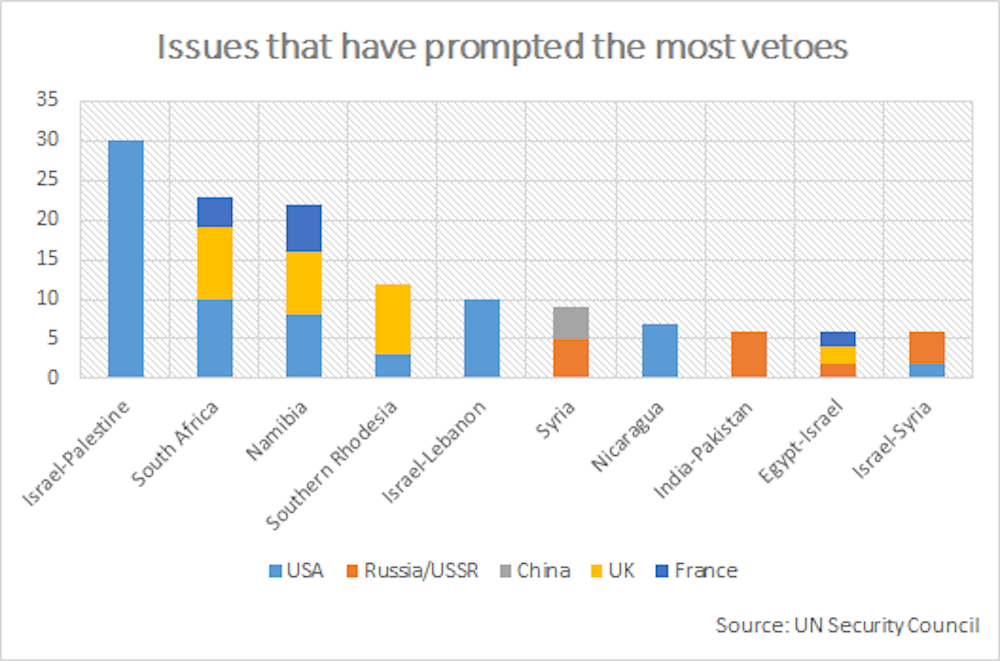
    For a start, it would need to get past the UN security council which means being subject to a veto from any one of the five permanent members (P5). We published an article on this issue some years ago with the help of UN expert Emma McClean, which looked at the issues which had prompted members of the P5 to wield their vetos. It found that Israel-Palestine was hands-down the most common issue that led to a veto – and all those vetoes had been instigated by the US.

    UN security council vetoes.
    UN security council


    Read more:
    Hard Evidence: who uses veto in the UN Security Council most often – and for what?


    So suspending Israel from the UN would appear to be a non-starter. But Hehir tells the story of the way the UN managed to circumvent the P5 and suspend South Africa in 1974 over apartheid. Having failed to get the suspension past the security council after the UK and France vetoed the move, the credentials committee of the general assembly simply refused to renew South Africa’s credentials. It remained suspended for two decades until the end of apartheid in 1994.


    Read more:
    Gaza: can the UN suspend Israel over its treatment of Palestinians? It’s complicated, but yes


    Meanwhile Israel’s assault on Gaza continues and the death toll continues to mount. Israeli Defense Forces (IDF), supported by airstrikes, continue to bombard what the IDF says are Hamas positions in the towns of Beit Lahia and Jabalia but which the Gaza health ministry say are residential buildings sheltering hundreds of civilians. On October 29, the health ministry said at least 93 people, including 25 children, were killed by an Israeli airstrike.


    Now, more than ever, it’s vital to be informed about the important issues affecting global stability. Sign up to receive our weekly World Update newsletter. Every Thursday we’ll you expert analysis of the big stories making international headlines.


    Much of the population of the north of Gaza has been evacuated south of what is known as the Netzarim corridor. Israel’s Haaretz newspaper claims that it’s part of an operation known as the “generals’ plan”, which calls for the north to be cleared of civilian residents and locked down as a military zone. This is presented as a national security measure, but Leonie Fleischmann reports that there are those who believe the military operation will be followed by an influx of Israeli settlers.

    Fleischmann points to a conference held on the Israeli side of the border with north Gaza, attended by members of Netanyahu’s Likud party as well as by several government ministers, which actively promoted the idea of settling north Gaza. Memories and historical legend mingle with ideology that holds Gaza had a Jewish population from biblical times through to 1929, when an Arab revolt killed 133 Jewish people living there and drove the rest out.

    The prospect of a land grab is clearly exercising minds at the UK foreign office. UK ambassador to the United Nations, Barbara Woodward said on October 29: “We reiterate that northern Gaza must not be cut off from the south. Palestinian civilians, including those evacuated from northern Gaza must be permitted to return. There must be no forcible transfer of Gazans from or within Gaza, nor any reduction in the territory of the Gaza Strip.”


    Read more:
    Israel’s ‘generals’ plan’ to clear Palestinians from north of Gaza could pave the way for settlers to return


    All eyes on Washington

    It’s highly unlikely that we’ll know by this time next week who has prevailed in the US presidential election. But the Middle East will be one of the first big ticket items on the Resolute desk.

    The issue has already proved to be a tricky one for Kamala Harris. Her support base is deeply divided on the issue, with large numbers of Democrats – particularly young people, as well as Muslims and black voters – unsettled by her perceived part in the Biden administration’s “steadfast” support for Israel over the past four years.

    It’s hard to tell whether these voters consider that the people of Gaza would fare any better under a Trump White House. But Natasha Lindstaedt and Faten Ghosn believe that Netanyahu’s continuing aggression in Gaza may well play out in the Republican contender’s favour.


    Read more:
    How the Middle East conflict could influence the US election – and why Arab Americans in swing states might vote for Trump


    Meanwhile, to guide us through how the two candidates are likely to approach the big foreign policy issues, we can turn to Garret Martin of the Transatlantic Policy Center at the American University in Washington.


    Read more:
    On foreign policy, Trump opts for disruption and Harris for engagement − but they share some of the same concerns


    World Update is available as a weekly email newsletter. Click here to get our updates directly in your inbox.


    ref. World Update: how Israel’s relations with the UN hit rock bottom – https://theconversation.com/world-update-how-israels-relations-with-the-un-hit-rock-bottom-242632

    MIL OSI – Global Reports

  • MIL-OSI Canada: The NFB at FICFA 2024. Natalie Robichaud’s Trécarré opening the festival and Kim O’Bomsawin’s Ninan Auassat: We the Children screening in competition. Fest marking 50 years of NFB film production in Acadie.

    Source: Government of Canada News (2)

    The National Film Board of Canada (NFB) returns to the Festival international du cinéma francophone en Acadie (FICFA) with two documentaries. Trécarré: à la source du son de la Baie Sainte-Marie (Trécarré: Exploring the Saint Mary’s Bay Sound), by Acadian filmmaker Natalie Robichaud, will be opening the festival with its world premiere. And Ninan Auassat: Nous, les enfants (Ninan Auassat: We, the Children), by Abenaki filmmaker Kim O’Bomsawin, is screening in competition and making its Atlantic début.

    October 29, 2024 – Moncton – National Film Board of Canada

    The National Film Board of Canada (NFB) returns to the Festival international du cinéma francophone en Acadie (FICFA) with two documentaries. Trécarré: à la source du son de la Baie Sainte-Marie (Trécarré: Exploring the Saint Mary’s Bay Sound), by Acadian filmmaker Natalie Robichaud, will be opening the festival with its world premiere. And Ninan Auassat: Nous, les enfants (Ninan Auassat: We, the Children), by Abenaki filmmaker Kim O’Bomsawin, is screening in competition and making its Atlantic début. The festival’s opening night will also be celebrating 50 years of NFB French film production in Acadie and the contribution of late filmmaker Léonard Forest, one of the great pioneers of French-language production. The 38th FICFA will be held November 19 to 24, 2024, in Greater Moncton.

    Quote

    “For 50 years, the NFB has been a privileged witness to the creativity and originality of Acadian cinema. As Natalie Robichaud’s film Trécarré illustrates, Acadian cultural heritage is still a powerful source of inspiration for younger generations who are reaffirming its vitality and relevance. This work is the ideal opening film for FICFA and offers an opportunity for the NFB to reiterate its commitment to supporting filmmakers and production partners in creating original works. Have a wonderful festival!” – Nathalie Cloutier, Executive Producer, NFB French Documentary Unit

    Opening night

    Trécarré: à la source du son de la Baie Sainte-Marie (Trécarré: Exploring the Saint Mary’s Bay Sound) by Natalie Robichaud (30 min) – WORLD PREMIERE
    Produced at the NFB (Moncton) by Christine Aubé
    Press kit: mediaspace.nfb.ca/epk/trecarre

    • Musical culture is part of the DNA in the Nova Scotia Acadian community of Baie Sainte-Marie. Brimming with talent, members of the local music scene are reinventing tradition and taking their vibrant rhythms far beyond the region’s boundaries. Rich in dialect and bursting with local tunes, Trécarré invites us to discover the magic of music that asks us not just to listen, but to share it, dance to it and live it.
    • The film will have its world premiere on opening night, Tuesday, November 19, at 7 p.m. at the Théâtre l’Escaouette in Moncton with the filmmaker in attendance.
    • Born in Saulnierville, Nova Scotia, Natalie Robichaud has served as executive director of the Société acadienne de Clare since 2017. As part of her role, she’s led numerous cultural projects and helped preserve Acadian heritage while always being on the lookout for sources of vitality and inspiration in her community. In 2023, Francopresse named Natalie one of the most influential members of Canada’s francophone community outside Quebec. Trécarré is her first professional film.

    50 years of French NFB film production in Acadie

    • Opening night will also highlight this major milestone in Acadian and French-Canadian cinema, with Suzanne Guèvremont, Government Film Commissioner and Chairperson of the NFB, and Nathalie Cloutier, Executive Producer of the NFB’s French Documentary Unit, in attendance.
    • In 1974, the NFB launched francophone film production in Acadie. In large part, the NFB’s production unit came to be through the tireless efforts of the great NFB Acadian filmmaker Léonard Forest, who FICFA will also be honouring on this occasion.

    Documentary feature film competition

    Ninan Auassat: Nous, les enfants (Ninan Auassat: We, the Children) by Kim O’Bomsawin (93 min) – ATLANTIC PREMIERE
    Produced at the NFB by Mélanie Brière, Nathalie Cloutier and Colette Loumède
    Press kit: mediaspace.nfb.ca/epk/ninan_auassat_en

    • Ninan Auassat is a captivating documentary celebrating the power and vitality of Indigenous youth. Shot over more than six years, the film brings us the moving stories of three groups of children from three different Indigenous nations—Atikamekw, Eeyou Cree and Innu. Filmed from “a child’s eye-view” and without adult voices and “experts” on young people, the film powerfully reveals the dreams of a new generation poised to take flight.
    • Winner of the Tides Award for Best Canadian Documentary at the Vancouver International Film Festival, the film will have its Atlantic premiere with the filmmaker in attendance on Wednesday, November 20, at 3 p.m. at the Dieppe Arts and Culture Centre.
    • Kim O’Bomsawin is an award-winning Abenaki documentary filmmaker and sociologist who’s deeply passionate about sharing the stories of Indigenous Peoples. Her recent credits include the feature-length documentary Call me Human (Je m’appelle Humain), honoured at the Gémeaux Awards in 2020, and her series Telling Our Story, shown in TIFF’s Primetime program in 2023.

    – 30 –

    Stay Connected

    Online Screening Room: NFB.ca
    NFB Facebook | NFB Twitter | NFB Instagram | NFB Blog | NFB YouTube | NFB Vimeo
    Curator’s perspective | Director’s notes

    About the NFB

    Lily Robert
    Director, Communications and Public Affairs, NFB
    C.: 514-296-8261
    l.robert@nfb.ca

    MIL OSI Canada News

  • MIL-OSI Video: Occupied Palestinian Territory: Human rights situation – Special Rapporteur | United Nations

    Source: United Nations (Video News)

    Press conference by Francesca Albanese, Special Rapporteur on the situation of human rights in the Palestinian Territory occupied since 1967.

    https://www.youtube.com/watch?v=Pb833UFbnEM

    MIL OSI Video

  • MIL-OSI Europe: Written question – Placing Ryplazim on the market in Europe – E-002234/2024

    Source: European Parliament

    23.10.2024

    Question for written answer  E-002234/2024
    to the Commission
    Rule 144
    Chiara Gemma (ECR), Sergio Berlato (ECR), Stefano Cavedagna (ECR), Alessandro Ciriani (ECR), Giovanni Crosetto (ECR), Elena Donazzan (ECR), Carlo Fidanza (ECR), Pietro Fiocchi (ECR), Alberico Gambino (ECR), Paolo Inselvini (ECR), Lara Magoni (ECR), Mario Mantovani (ECR), Giuseppe Milazzo (ECR), Denis Nesci (ECR), Michele Picaro (ECR), Daniele Polato (ECR), Nicola Procaccini (ECR), Ruggero Razza (ECR), Antonella Sberna (ECR), Marco Squarta (ECR), Francesco Torselli (ECR), Francesco Ventola (ECR), Mariateresa Vivaldini (ECR)

    Severe hypoplasminogenemia (HPG), or plasminogen deficiency type 1(PLGD-1) is a rare systemic disease characterised by abnormal extracellular fibrinolysis. It affects 0.02 in 10 000 people in the EU, usually manifesting in early childhood.

    There exists only one effective treatment, now available in the form of Ryplazim, an experimental drug already approved in 2019 by the US Food and Drug Administration and available on the American market since May 2024.

    The medicine was so successful that the manufacturer Kedrion received the prestigious Industry Innovation Award from the American National Organization for Rare Diseases (NORD).

    However, the adoption of Ryplazim has not yet been authorised by the European Medicines Agency (EMA), which in 2015 granted orphan designation to ProMetic BioTherapeutics Ltd for human plasminogen with opinion EU/3/15/1511.

    Not having the possibility of using Ryplazim in national healthcare systems means outdated therapies will be used instead.

    In view of the above:

    • 1.Was the Commission aware of this situation?
    • 2.What concrete steps does the Commission intend to take with regard to the EMA in order to ensure that people suffering from severe hypoplasminogenemia have safe access to life-saving medicines at the dosage necessary for treatment, even if experimental?

    Submitted: 23.10.2024

    MIL OSI Europe News

  • MIL-OSI Europe: Answer to a written question – Measures to support the Spanish and Portuguese fleets affected by the proliferation of the invasive species of Asian seaweed ( Rugulopteryx okamurae ) – E-001853/2024(ASW)

    Source: European Parliament

    The Commission is aware of the serious problems that the species Rugulopteryx okamurae is causing in various coastal areas of Andalucía and in other Spanish areas such as Ceuta and south of Portugal.

    On the basis of a risk assessment submitted by the competent Spanish authorities, Rugulopteryx okamurae was included in 2022 on the list of the invasive alien species to which priority should be given[1]. Regrettably, this invasive alga continues to expand, and has reached France and Italy in recent years.

    The affected Member States can decide how and when to provide financial support to fishers affected by invasive species through their European Maritime, Fisheries and Aquaculture (EMFAF) programme.

    This can include measures for tackling the spread of the species, as well as directly supporting fishers for example with cleaning, repairing equipment and antifouling.

    Based on the information received from the Spanish authorities, it appears that the Spanish Ministry of Environment has been working on research and plans to manage the crisis.

    The Commission has also been informed that the Spanish EMFAF Managing Authority has carried out an analysis on support options.

    The Commission is however not aware of financing decisions by this Authority. Nevertheless, the Commission has also been informed that the authorities provided de minimis State aid to the sector for the loss of fishing activity and damaged fishing gear outside the EMFAF programme.

    In the case of Portugal, the national authorities informed the Commission that no support under EMFAF was provided or is planned at this stage.

    For more information on the national/regional support measures implemented, we refer the Honourable Member to the competent authorities in the Member States.

    • [1] Commission Implementing Regulation (EU) 2022/1203 of 12 July 2022 amending Implementing Regulation (EU) 2016/1141 to update the list of invasive alien species of Union concern. OJ L 186, 13.07.2022, p. 10-13.

    MIL OSI Europe News

  • MIL-OSI United Nations: Experts of the Committee against Torture Welcome Namibia’s Commitment to the Mandela and Bangkok Rules, Ask about Harmful Traditional Practices and Lengthy Pretrial Detention Periods

    Source: United Nations – Geneva

    The Committee against Torture today concluded its consideration of the third periodic report of Namibia, with Committee Experts welcoming the State’s commitment to the Nelson Mandela and Bangkok Rules, international norms on the treatment of prisoners, and raising questions about harmful traditional practices and lengthy pretrial detention periods.

    Erdogan Iscan, Country Rapporteur and Committee Expert, welcomed the commitment of the State party to complying with the Nelson Mandela Rules and the Bangkok Rules.

    Mr. Iscan raised the issue of traditional practices that were harmful to women and girls, including the ritual of Olufuko, which involved child marriage and sexual initiation rites.  Had the State party made progress in terms of awareness-raising as well as eliminating such practices?  What further steps had been taken to prevent and criminalise the practice of forced sterilisation?

    Jorge Contesse, Country Rapporteur and Committee Expert, said pretrial detention seemed to routinely exceed legal limits, with above 50 per cent of the prison population awaiting trial.  The low usage of alternatives to detention and an unaffordable bail system seemed to be contributing to the large backlog of cases of pretrial detainees.  What measures had been adopted to address these challenges?

    Introducing the report, Yvonne Dausab, Minister of Justice of Namibia and head of the delegation, said the Namibian correctional service included human rights instruments, including the Nelson Mandela Rules, in the curriculum at its Training College.  The service had undertaken measures to renovate all the country’s correctional facilities with the aim of improving the living conditions of offenders.

    Ms. Dausab said the Government continued to conduct awareness campaigns targeting traditional and religious leaders on positive gender roles and the elimination of harmful cultural practices.  The Childcare and Protection Act 2015 had measures to protect children from harmful cultural and religious practices, strictly prohibiting child marriage in all setups.

    The delegation said Olufuko had taken on a more cultural image and profile, as opposed to a platform for sexual initiation and child marriage.  That may have been the case in the past, but this had changed over the past 10 to 15 years.  Namibia had taken steps to ensure that acts of enforced sterilisation of individuals were not carried out.

    Pretrial detention could run for any time between six to 12 months, the delegation said, and courts could decide to withdraw charges before the six-month period based on available evidence.  The State party was working to strengthen community courts and establish small claims courts to address overcrowding in prisons and holding cells. Since the report was sent, there had also been parole releases and the President had pardoned some persons.

    In closing remarks, Claude Heller, Committee Chair, said that the Committee understood that the political context in Namibia was difficult.  The Committee would make efforts to provide the State party with relevant and achievable recommendations within its concluding observations.  The Committee was interested in maintaining an open dialogue with the State party through its follow-up mechanism.

    In her concluding remarks, Ms. Dausab said Namibia was committed to addressing all forms of torture and other cruel, inhuman or degrading treatment.  More needed to be done to prevent torture, including the enactment of specific legislation criminalising it.  The Committee’s recommendations would help to enhance mechanisms to prevent torture.

    The delegation of Namibia consisted of representatives from the Ministry of Justice; Ministry of Home Affairs, Immigration, Safety and Security; Namibia Correctional Service; and the Permanent Mission of Namibia to the United Nations Office at Geneva.

    The Committee will issue concluding observations on the report of Namibia at the end of its eighty-first session on 22 November.  Those, and other documents relating to the Committee’s work, including reports submitted by States parties, will be available on the session’s webpage.  Summaries of the public meetings of the Committee can be found here, and webcasts of the public meetings can be found here.

    The Committee will next meet in public on Tuesday, 5 November at 10 a.m. to begin its examination of the second periodic report of Thailand (CAT/C/THA/2).

    Report

    The Committee has before it the third periodic report of Namibia (CAT/C/NAM/3).

    Presentation of Report

    YVONNE DAUSAB, Minister of Justice of Namibia and head of the delegation, said

    Namibia had suffered a great loss at the beginning of the year when the third President, Dr. Hage Gottfried Geingob, a strong champion of human rights, passed away on 4 February 2024.  He was greatly missed.  Additionally, Namibia was currently going through a devastating drought which had impacted food security and economic development; the Government was navigating this climate-related crisis with the assistance of developmental partners. Namibia offered a sincere apology for the non-submission of the written responses to the list of issues.

    The torture bill remained under consideration following deliberations in the National Assembly.  The Convention was directly applicable and enforceable in Namibia without the ‘domestic’ legislation.  Article 144 had been used by Namibian courts which had cited United Nations Conventions in their judgments, making their provisions applicable directly in Namibia. The Namibian Constitution prohibited torture as well cruel, inhuman or degrading treatment or punishment, and the Criminal Procedure Act of 1977 criminalised murder as well as assault, including assault with intent to cause grievous bodily harm. 

    Members of the police force, correctional service and defence force accused of using excessive force were investigated under internal complaints units and those found to have acted outside the scope of what was reasonable in the circumstances were subjected to prosecution.  The Government had also been ordered to pay damages to complainants and their families in civil matters brought due to allegations of assault or use of excessive force by law enforcement officers. 

    The Namibian Constitution prohibited arbitrary arrest or detention and required that an arrested person be brought before a court within 48 hours after the arrest.  All police officials were trained and required to inform an accused person upon arrest of their rights, reasons for their arrest, and charges against them.  The Directorate of Legal Aid within the Ministry of Justice had appointed 69 in-house lawyers across the country to represent members of society who could not afford legal representation. 

    The Government had enhanced the independence of the Ombudsman by reforming the current Ombudsman Act 1990 to make provision for the Ombudsman’s Office to be established as a separate agency in the public service, with its own budget and accounting officer.  The Office of the Ombudsman had launched a training manual against torture for law enforcement agencies, and visited and inspected places of detention, police holding cells, and correctional facilities to monitor human rights compliance.

    Namibia continued to be marred by incidents of gender-based and sexual violence, including online child sexual exploitation.  The Government had developed a national plan of action on gender-based violence 2019-2023 to address the root causes and provide a well-coordinated approach to the prevention, response, monitoring and evaluation of gender-based violence initiatives.  Additionally, Namibia had established special courts for gender-based violence offences country-wide to provide a victim-friendly environment. 

    The Government continued to conduct awareness campaigns targeting traditional and religious leaders on positive gender roles and the elimination of harmful cultural practices.  Namibia had developed and implemented a national plan of action to address violence against children.  The Childcare and Protection Act 2015 had measures to protect children from harmful cultural and religious practices, strictly prohibiting child marriage in all setups. 

    The Ombudsman had been instrumental in ensuring that the Namibian police force was adequately trained on the ‘prevention of torture training manual for police officers.’ The Namibian police force also conducted ongoing workshops to train police officers on human rights.  The Namibian correctional service included human rights instruments in its curriculum, including the Nelson Mandela Rules, at the Namibian Correctional Service Training College.  The service had undertaken measures to renovate all of the country’s correctional facilities with the aim of improving the living conditions of offenders.  The implementation of the Namibian correctional service’s health policy had brought about significant changes in managing communicable diseases such as tuberculosis, HIV and hepatitis, as well as mental health support. 

    All asylum seekers went through a refugee status determination process and those who met the criteria were granted refugee status.  If an application for refugee status was unsuccessful, the applicant was advised they could appeal the decision to the Namibian Refugee Appeal Board. Namibia was implementing the national action plan on statelessness, and a national committee had been established. The review of the legislative framework, which was a key milestone, had begun. 

    The Police Act allowed police officials to be investigated for misconduct and human right violations, inclusive of torture.  Officials found guilty of acting outside the scope of their duties were subject to laid down procedures, including arraignment before a competent court. In Namibia, the State was represented by the Prosecutor General in criminal cases; therefore, the prosecution of all allegations of torture lay with the State.  Ms. Dausab concluded by stating that the Namibian Government remained committed to protecting and promoting human rights in the country. 

    Questions by Committee Experts 

    ERDOGAN ISCAN, Committee Expert and Rapporteur, said the Committee expressed its condolences for the death of Namibia’s third President earlier this year.  The State party did not reply to the list of issues adopted by the Committee and chose to submit a report in May 2021 under the traditional reporting procedure.

    The dialogue with the State party would be conducted against this background.

    Mr. Iscan called on Namibia to continue to support the treaty body system. 

    Had measures been taken to improve prison conditions in conformity with the Nelson Mandela Rules? Research indicated that the total prison population was close to 9,000 inmates, of which 54 per cent were pretrial detainees in police custody.  Occupancy level in the prison system was 75 per cent.  Could the Committee be updated on the current situation?  Could details be provided about the health policy and practice developed by the Namibian correctional service? 

    How many individuals were currently in pretrial detention?  What was the average length of pretrial detention and steps taken to reduce its use?  Could statistical data be provided on deaths in custody; investigations carried out into these deaths; and the number of police or prison staff who had been subjected to criminal or disciplinary punishment in cases involving death in custody? Had there been cases of inter-prisoner violence, and what had been measures implemented in such incidents?

    The Committee noted that corporal punishment was prohibited in schools by the Basic Education Act of 2020, but it still lacked an explicit prohibition in the home. What was the current status of the Correctional Service Act 2012 with respect to explicitly prohibiting corporal punishment following the Supreme Court’s judgment of 5 April 1991?  What steps were being taken to totally prohibit corporal punishment in all settings and develop campaigns for awareness raising?

    Could data on all complaints received by the Ombudsman and the number of complaints received by the Internal Investigation Directorate be provided?  How many of these complaints were investigated and how many resulted in disciplinary sanctions?  Had the perpetrators been punished with appropriate penalties commensurate with the gravity of the crime?  How many complaints had been received concerning sexual abuse and the exploitation of refugees by public officials or non-governmental workers at the Osire refugee camp?  Had these complaints been investigated and prosecuted and had victims obtained redress? 

    The Caprivi high treason trial ended in September 2015 and the Committee noted that about 30 persons were found guilty and sentenced to various imprisonment terms; 79 persons were found not guilty and released from custody.  Could

    information on investigations into or prosecutions of members of the Namibian police force regarding alleged acts of torture of suspected participants in the secession attempt in the Caprivi region in 1999 be provided?  What steps had been taken by the authorities to investigate reports of enforced disappearances in the context of the liberation struggle, including the disappearance of former members of the Southwest Africa People’s Organization?  Had alleged victims and their families obtained redress?

    Was the legislation on excessive use of force compatible with the Convention, as well as the basic principles on the use of force and firearms by law enforcement officials?  Were the reports of excessive use of force by law enforcement officers investigated promptly, effectively and impartially?  Were the perpetrators prosecuted and, if convicted, punished with commensurate penalties?  Were victims of violations remedied adequately?  The Committee had received allegations that members of the police force detained and sexually abused sex workers.  What was the State party’s response to these reports? 

    The Committee took note of the Joint Communication by a group of Special Procedure mandate holders, who examined the document which evaluated the “Joint Declaration by the Federal Republic of Germany and the Republic of Namibia: United in remembrance of our colonial past, united in our will to reconcile, united in our vision of the future”, dated June 2021, and developed observations in connection with international human rights law.  It was understood that follow-up negotiations were ongoing between Namibia and Germany.

    With respect to traditional practices that were harmful to women and girls, including the ritual of Olufuko, which involved child marriage and sexual initiation rites, had the State party made progress in terms of awareness-raising as well as eliminating such practices?  What further steps had been taken to prevent and criminalise the practice of forced sterilisation?  What measures were in place to ensure that all acts of violence that targeted persons on the basis of their sexual orientation or gender identity were properly and promptly investigated and prosecuted? 

    It was reported that the Supreme Court issued a ruling last year recognising the right of spouses of Namibian citizens to regularise their immigration status based on same-sex marriages.  Later, parliament passed legislation banning same-sex marriages.  If enacted, it could nullify the Supreme Court ruling.  What was the current status of this legislation? The Committee had received information that the High Court issued a decision on 21 June 2024, which declared the common law offences of sodomy and unnatural sexual offences unconstitutional. It seemed that the State party continued to criminalise same-sex relationships and the Government had lodged an appeal against this decision which was currently pending before the Supreme Court.  What was the current situation? 

    Could the State party clarify its policy, legislation and practice with respect to prisons, hospitals, schools and institutions that engaged in the care of children, older persons or persons with disabilities?  What was the legal permissibility and use of the measures such as seclusion, physical and chemical restraints, and other restrictive practices? Were net beds and cage beds used in psychiatric and social welfare institutions?  Did the Office of the Ombudsman have unrestricted access to monitor these institutions?  Had any progress been achieved in regard to protecting the human rights of older persons?

    The Committee noted the commitment of the State party to complying with the Nelson Mandela Rules and the Bangkok Rules.  Could the State party clarify its policy, legislation and practice with respect to solitary confinement?  What was the incommunicado detention regime in Namibia?  If the State party maintained this practice, under what circumstances was incommunicado detention authorised and what was the competent organ to authorise incommunicado detention?  Would the State party consider abolishing incommunicado detention? 

    Could Namibia comment on the status of the recommendation to ratify the Optional Protocol to the Convention, and other international instruments to which it was not a party?  Was there any update in this regard? 

    JORGE CONTESSE, Committee Expert and Rapporteur, said torture was currently not a specific criminal offence in Namibia and Namibian law did not expressly criminalise any other forms of cruel, inhuman or degrading treatment or punishment.  Could information be received on the status of the draft prevention of torture bill?  What amendments to the bill sought to bring it further into line with the State party’s obligations under the Convention, as previously recommended by the Committee, including provisions that criminalised the acquiescence and complicity of State officials, or officials acting in an official capacity, to acts of torture?  Were acts amounting to torture subject to a statute of limitations?  Were there any cases where Namibia had invoked the Convention directly before domestic courts? 

    What initiatives had been taken by the State party to enshrine in its legislation fundamental legal safeguards, in particular the right to have access to a lawyer, including the right to access free and effective legal aid; the right to receive a medical examination by an independent physician; the right for individuals, at the time of arrest, to be informed of their rights; the right to be brought promptly before a judge; the right to notify a person of one’s choice of one’s deprivation of liberty; and the obligation of the authorities to maintain detention registers at places of detention?  Were there any cases in which the authorities had failed to comply with these safeguards?  How many such complaints had been registered and what was their outcomes? 

    Were there any cases in which disciplinary measures were taken against officials found responsible for violations?  What complaints mechanisms were available to report violations, and how did they function in practice?  Could the State party specify the circumstances in which a right to counsel could be waived?

    The 2022 annual report of the Ombudsman described visitation and inspection of places of detention in Namibia, noting that some of the most appalling facilities had been closed.  When this happened, where were the detainees who had been held there sent?  What was the timetable for the cleaning and renovation of these facilities?  Pretrial detention seemed to routinely exceed legal limits, with above 50 per cent of the prison population awaiting trial.  In addition, the reported shortcomings in the criminal justice system, such as the significant delays between arrest and trial, the low usage of alternatives to detention, and an inaccessible and unaffordable bail system, seemed to be the contributing factors to the large backlog of cases of pretrial detainees.  What measures had been adopted to address these shortcomings and challenges?

    It was understood that the child justice bill, which had not yet been adopted, endorsed 14 years of age to be considered criminally responsible and abolished the common law presumption.  What was the status and content of the bill?  What measures were adopted to ensure that children were not detained in detention centres for adults?  The Committee understood that no legal provision authorised the Ombudsman to make unannounced visits to places of detention; would the new legislation provide the Ombudsman with such power? 

    Violence against women, including rape, domestic violence, sexual exploitation and abuse of children, and violence against women from indigenous communities, continued to be extremely high, and the root causes of such violence had not been adequately addressed.  According to the national gender-based violence baseline study, “most drivers of gender-based violence were relationship factors that were deeply entrenched within socio–cultural norms and escalated to societal level factors.” What concrete measures had the State party adopted to address these issues, including policies and plans to address ongoing challenges; the number of complaints of gender-based, domestic, or sexual violence received by the authorities; the number of investigations and prosecutions undertaken regarding gender-based, domestic or sexual violence; and the protection and support services available to victims?

    The recommendation to remove the crime of sodomy as a ground for entry refusal into Namibia remained unaddressed.  What measures would the State party adopt to address this and other pending concerns? Could data be provided on the number of asylum applications received during the period under review, the number of successful applications, and the number of asylum seekers whose applications were accepted because they had been tortured or might be tortured if returned to their country of origin? 

    What were the existing appeals mechanisms and other mechanisms in place to identify individuals in need of international protection?  What was the procedure followed when a person invoked this right? Were individuals facing expulsion informed of their right to seek asylum and appeal a deportation decision?  How many stateless persons were living in the country?  What measures were being taken by the State party to mitigate the risk of torture or ill treatment faced by stateless persons. 

    How many law enforcement officials, prison staff, military officers, investigators, judicial personnel and border guards had attended educational programmes which included instruction on the provisions of the Convention against Torture?  How were officers were trained on investigating and handling forms of prohibited ill treatment, like cruel, inhuman or degrading treatment?  To what extent was the Ombudsman responsible for training other law enforcement agencies on investigating torture claims?  What specific initiatives were in place to train officials to prevent the traumatisation of victims of torture or ill treatment.  What steps had been taken to improve methods of investigation, including training programmes on non-coercive interrogation techniques?  Had any training programmes been developed for judges, prosecutors, forensic doctors and medical personnel dealing with detained persons on detecting and documenting the physical and psychological signs of torture?

    Responses by the Delegation 

    The delegation said any international instrument that Namibia ratified became part of their system. Namibia took the work of the treaty bodies very seriously.  Namibia’s prison capacity across the country was around 5,400.  The bed capacity was around 4,700.  Since the report was sent, there had been parole releases, persons had completed their sentences, and the President had pardoned some persons. Pretrial detention could run for any time between six to 12 months.  There was no deliberate attempt on the part of the State to keep people in pretrial detention; the authorities were trying to clear them as quickly as possible to decongest prison facilities. 

    Namibia did not have inter-prison violence in the form that was premeditated, organised, or gang related.  There were isolated incidents of inter-prison fights which were dealt with quickly.  In the rare instances when these incidents occurred, the prisoners would be separated from each other.  Namibia had made a proposal to improve community service orders. 

    It was agreed that the Ombudsman needed to be extricated from the Ministry of Justice. However, there was no evidence that there had been any interference in the work of the Ombudsman.  The Ombudsman bill was ready to go before the National Assembly for Legislative Consultation, which would help with establishing the Office of the Ombudsman.  Currently in Namibia, the Ombudsman was at the level of a judge.  Whether there should be a fixed-term or the security of tenure of the Ombudsman was currently under debate.  Since his appointment, the Ombudsman had been quite vocal about his findings and his displeasure at the conditions of prisons.  The Ombudsman had unfettered access to those facilities; however, unannounced visits could be impractical.  Namibia was doing enough to ensure those institutions which had the mandate to investigate violations of human rights were able to be supported in their work. 

    There had been no prosecutions for prostitution or sex work in Namibia.  There was some fairly outdated legislation, but these laws had not been activated because the State did not feel they were consistent with the spirit of the Namibian Constitution.  Namibia was constantly working on reforming legislation which offended the values of the Constitution.

    The Joint Declaration was the result of an open and frank conversation in Namibia’s National Assembly, reflecting the gravity of the first genocide which took place in Namibia during the twentieth century. 

    Olufuko had taken on a more cultural image and profile, as opposed to a platform for sexual initiation and child marriage.  That may have been the case in the past, but this had changed over the past 10 to 15 years.  Namibia had taken steps to ensure that acts of enforced sterilisation of individuals were not carried out.  The discussion around the reform of abortion and sterilisation was ongoing.  Namibia was concerned about the number of cases of persons who identified as persons of the lesbian, gay, bisexual, transgender and intersex community, who had lost their lives.  However, the State could not say that these crimes happened specifically due to their sexual orientation.  All of those incidents of people who had been killed over the past few months were being investigated and prosecutions would take place. 

    Homosexuality in Namibia was not a crime. 

    Namibia had an excellent proposal for child justice.  The State had engaged in extensive consultation with and received feedback from the United Nations Children’s Fund.  Early next year, the child justice bill would be considered in the Assembly.  Children were kept in facilities separate from adults, and were provided with significant social support.  Gender-based violence was a concern for Namibia.  Every year, the State commemorated the 16 days of violence against women.  There was increasing collaboration between the State and civil society organizations to increase visibility.  The text and the language of legislation combatting rape had been strengthened in 2022, as had the domestic violence legislation. 

    Questions by Committee Experts 

    ERDOGAN ISCAN, Committee Expert and Rapporteur, said the Committee appreciated the fact that they had a high-level delegation here, headed by the Minister in the lead-up to the country’s elections, and wished Namibia all the best in their democratic elections.  The Committee needed information on the reflection of policy and legislation in practice, which was why statistical information was important. 

    Could the State party inform the Committee on the policies, legislation and practices on counter-terrorism measures?  It was a fundamental obligation of States to fight terrorism, while still respecting human rights and the rule of law. 

    Could information be provided on the legislative and executive measures under the state of emergency?  Did they comply with the absolute and non-derogable prohibition of torture? 

    JORGE CONTESSE, Committee Expert and Rapporteur, said it was necessary to have a specific crime which defined the contours of torture.  What were the requirements that members of parliament had, which resulted in seven years of there being no torture bill?  It seemed that the child justice bill moved down the minimum age of criminal responsibility to 12 years; how was this consistent with human rights law? 

    Responses by the Delegation

    The delegation said Namibia’s President could declare a state of emergency in situations where there were natural disasters or threats to the State.  At no time had the declaration of a state of emergency suspended the prohibition of torture or the protection of fundamental rights and freedoms.

    Persons who engaged in terrorist activities against Namibia inside or outside of the State could face life imprisonment.  Law enforcement agencies recently attended training on counterterrorism, which reinforced the obligation to protect human rights and the rule of law.

    The anti-torture bill included definitions of torture and other cruel, inhuman or degrading treatment that were in line with the Convention.  The bill included punishments of imprisonment of varying lengths for acts of torture and other cruel, inhuman or degrading treatment.

    The child justice bill had been developed after broad consultation with international partners. It set the age of criminal responsibility at 12 years, considering the domestic context.

    International human rights instruments ratified by the State were applicable directly before the courts, and the International Covenant on Civil and Political Rights had been applied in one case.

    The Refugee Recognition and Control Act called for compliance with due process regarding detention and expulsions of asylum seekers.  Asylum seekers could be represented by legal practitioners in appeals to detention and expulsion procedures.  Namibia respected the principle of non-refoulement.

    The Government was working to regularise the status of stateless persons.  Under the birth outreach programme, teams had been deployed to rural areas to facilitate birth registration.  Bills promoting civil registration, regularisation and statelessness determination were being considered in Parliament.  Namibia was exerting efforts to eradicate statelessness.

    The Namibian police had conducted investigations into alleged cases of enforced disappearance conducted by two individuals with Angolan citizenship.  These cases had been finalised.  A bill had been developed on the training of police and military officers.  Training was aligned with the Istanbul Protocol and developed skills in investigating allegations of torture and helping victims to access redress. Police officers could not question suspects before informing them of their rights.

    The Constitution prohibited corporal punishment and State legislation prohibited such punishment in school settings.  Schools were mandated to create mechanisms that allowed learners to report incidents of corporal punishment.  In August 2024, a teacher was relieved of his duties following reports of him engaging in corporal punishment of learners.  Parents and guardians needed to respect children’s right to dignity.

    The State party had established an appeal committee and set up regulations to prevent the abuse of legal aid resources.  There had been an increase in applications for legal aid this year, with the number of applications for legal aid having increased to more than 10,000.  Measures were in place to respond to this increase in applications.

    The Mental Health Act of 1973 was outdated and used language that was not consistent with the Convention on the Rights of Persons with Disabilities.  A new bill dealing with mental health had been proposed, which set regulations regarding the limited use of seclusion, coercive methods, and restraint of persons with disabilities, and promoted de-escalation techniques.  The bill called for coercive methods to be removed within two hours at most.  There was a clear prohibition of forced sterilisation of women with mental disabilities in the bill.  It was expected to be finalised next year.

    Questions by Committee Experts 

    ERDOGAN ISCAN, Committee Expert and Country Rapporteur, said that the State’s Constitution and legislation determined that statements made as a result of torture were inadmissible in a court of law.  Were there examples of court cases in which courts had found that evidence was inadmissible because it was obtained through torture?  Had there been investigations into allegations that evidence used in the Caprivi trials was obtained through torture?

    The Committee welcomed that the State party had accepted the simplified reporting procedure, which provided for improved cooperation between the State party and the Committee.  However, the State party had submitted its last report under the traditional procedure. Mr. Iscan called on the State party to submit its next report under the simplified procedure.

    The State party had failed to respond to the Committee’s previous concluding observations and the report on follow-up to concluding observations.  The Committee hoped that the State party would respond to the next concluding observations within the given timeframe.

    JORGE CONTESSE, Committee Expert and Country Rapporteur, said that the torture bill had been pending for a number of years.  The definition of torture within the proposed legislation was very good; it was identical to that of the Convention.  Were there any persons who had been specifically convicted of the crime of torture using the Convention?  It was critical that the anti-torture bill addressed the issues of the statute of limitations and universal jurisdiction.  Article eight of the bill addressed extraterritorial jurisdiction, not universal jurisdiction.

    There was a discrepancy between international human rights law and the child justice bill. What was the domestic context that prevented Namibia from setting the age of criminal responsibility at 14? 

    There was another discrepancy between Namibia’s law on refugee control and international human rights law, which defined the prohibition of non-refoulement as absolute. Why was refoulement allowed in certain circumstances?

    There was a lack of information provided by the State party on allegations of sexual assault by police officers against asylum seekers.  Asylum seekers reportedly lived in settlements with poor conditions. Could the delegation comment on these issues?

    Trafficking in persons reportedly remained prevalent in Namibia.  The rate of reported cases seemed very low, and there was limited progress in investigations and convictions for these cases, with only two convictions between 2014 and 2019.  What progress had been made in tackling trafficking in persons?

    How would the State party address challenges that prevented the Ombudsperson from making unannounced visits to places of detention?

    Another Committee Expert said unannounced inspections of places of detention were an international standard.  The State party needed to reconsider its position on this issue.  Were there time limits for pretrial detention?  It was very impressive that it had been deemed unconstitutional to implement solitary confinement.

    Responses by the Delegation

    The delegation said the State party noted the Committee’s comments regarding the simplified reporting procedure.  There were court cases in which evidence obtained through torture was deemed inadmissible.  In such cases, additional investigations were undertaken into the identified acts of torture.

    The State party also noted the Committee’s concerns and suggestions regarding the anti-torture bill.  Namibia wished to comply with international best practices regarding non-refoulement. Legislation on deportations intended to protect Namibia from external threats while respecting the principle of non-refoulement.

    All allegations of trafficking in persons were taken very seriously.  The judicial system was independent and competent, but had limited resources, which was influencing the rate at which trafficking cases were processed. The State party was exerting efforts to prevent trafficking in persons.

    Any allegations of sexual assault and crimes against the refugee community were investigated. The State party was not aware of allegations of poor conditions in asylum shelters; it would investigate any such allegations if it received them.

    Pretrial detention could be implemented for six to 12 months, and courts could decide to withdraw charges before the six-month period based on available evidence.  The State party was working to strengthen community courts and establish small claims courts to address overcrowding in prisons and holding cells.

    The delegation had taken note of the Committee’s comments regarding unannounced visits to places of detention.  There were no cases in which attempted unannounced visits had been blocked.  The State party would continue conversations on the age of criminal responsibility.

    The Constitutional Court had decided that the implementation of solitary confinement at one prison had been unconstitutional, however, the judgement had not made the implementation of solitary confinement unconstitutional in all contexts.  The imposition of solitary confinement needed to respect legal safeguards and the fundamental freedoms of those subjected to it.

    Questions by a Committee Expert 

    JORGE CONTESSE, Committee Expert and Country Rapporteur, asked if there were examples in which refugees or asylum seekers had threatened national sovereignty. What was the Refugee Control Act trying to address in this regard?  What were the reasons behind setting the age of criminal responsibility at 12?  The possibility of unannounced visits was an effective way to prevent torture and ill treatment in places of detention. Mr. Contesse called for such visits to be conducted.

    Responses by the Delegation

    The delegation said Namibia’s law on refugee control anticipated potential crimes committed by refugees and asylum seekers.  There had been no incidents thus far in which a refugee had threatened national security, but there needed to be a law in place to address such an act.  The domestic court system was sufficiently able to analyse the constitutionality of the Refugee Control Act.

    Concerns had been raised that increasing the age of criminal responsibility would make young children more likely to engage in criminal acts.  The State party noted the Committee’s discomfort regarding this legislation.

    The Ombudsperson was independent and had the opportunity to propose unannounced visits to places of detention.  It and all State actors, as well as civil society, had access to prisons in Namibia. Representatives of the African Union had written extensive reports on prison conditions, which helped the State party to improve these conditions.  Civilians had also taken the State to court concerning prison conditions.

    There were no examples of court cases in which findings of torture had been made, but there were cases in which crimes against humanity had been recognised.  The State party took on board the Committee’s concerns regarding the torture bill.

    Concluding Remarks 

    CLAUDE HELLER, Committee Chair, said that the Committee understood that the political context in Namibia was difficult.  It would make efforts to provide the State party with relevant and achievable recommendations within its concluding observations.  The Committee was interested in maintaining an open dialogue with the State party through its follow-up mechanism.  The dialogue had been rich and was conducted in a constructive spirit.

    YVONNE DAUSAB, Minister of Justice of Namibia and head of the delegation, said the State party had provided information on the efforts it had made to implement the Convention.  The Committee’s recommendations would help to enhance mechanisms to prevent torture. Namibia was committed to addressing all forms of torture and other cruel, inhuman or degrading treatment. More needed to be done to prevent torture, including the enactment of specific legislation criminalising it. The State party was committed to protecting the rights of its people, in consideration of the domestic context. Ms. Dausab closed by thanking the Committee and all who had contributed to the dialogue.


    Produced by the United Nations Information Service in Geneva for use of the media; 
    not an official record. English and French versions of our releases are different as they are the product of two separate coverage teams that work independently.


    CAT24.020E

    MIL OSI United Nations News

  • MIL-Evening Report: Forum troika’s visit highlights value of regionalism for New Caledonia

    ANALYSIS: By Patrick Decloitre, RNZ Pacific correspondent French Pacific desk

    As a three-day fact-finding mission from a group of Pacific leaders drew to a close in New Caledonia, and with the outcomes report not expected before next year, the visit to the riot-hit French Pacific territory seems to have triggered a new sense of awareness locally about the values of Pacific regional mechanisms of “talanoa” embodied by the Pacific Islands Forum (PIF).

    Local President Louis Mapou stressed on several occasions during the visit that New Caledonia’s situation was the “subject of much attention” in the Pacific region.

    He suggested that one of the reasons for this could be because of a potential “spillover” effect that could “jeopardise cohesion in the Pacific”.

    However, Mapou also stressed that he had received the message conveyed by the PIF “Troika-Plus” group that “they’re ready to take part in [New Caledonia’s] reconstruction”.

    ‘New Caledonia’s regional integration in its region’
    Mapou said that one of the recurrent themes during the PIF visit was “New Caledonia’s regional integration in its region”.

    “Whatever might be said, in many ways, New Caledonia does not know its [Pacific] region very well. Because it has this affiliation relationship to Europe and France that has prevailed over all these years,” he told local media.

    “So, in a certain way, we’re just discovering our region. And in this process, the Pacific Islands Forum could bring a sort of leverage,” he said.

    Kanaky New Caledonia, as well as French Polynesia — both French Pacific entities — became full members of the Pacific Islands Forum in 2016, after several years of “associate members” status.

    Mapou said New Caledonia’s current status vis-à-vis France was mentioned during talks with the PIF mission.

    “I spoke with them about obstacles that should be removed, that are directly related to our current status. This is part of topics on which we should be working in future,” he said.

    “They’re very open-minded, they don’t have any preconceived ideas, they’re happy to talk equally about the concepts of independence, just as they are for keeping [New Caledonia] within the French Republic,” he revealed.

    One of the unexpected outcomes, beyond the specific fact-finding mission that brought this PIF “Troika-Plus” leaders’ delegation to New Caledonia, seems to have underlined the values of regionalism, as well as New Caledonia’s long-awaited and genuine integration in its “regional environment”.

    These values seem to have been recognised by all sides of New Caledonia’s political spectrum, as well as all walks of life within the civil, economic, educational and religious society.

    PIF’s “Troika-Plus” leaders meet with Southern Province President Sonia Backès (third from left) at SPC headquarters last Monday. Image: PIF/RNZ Pacific

    Pacific diversity in status
    During the past few days, informal exchanges with the Pacific leaders have also allowed New Caledonia’s authorities to share and compare possible ways forward regarding the territory’s political status.

    “They readily exchanged their own experiences with our government. The Cook Islands, which is a self-governing state in ‘free association’ with New Zealand; Tonga, which has never been colonised; and the Solomon Islands, who have also undergone inter-ethnic conflicts and where the young population was also involved. And Fiji, which obtained independence (in 1970), had decided to withdraw from the Commonwealth and is finally re-discussing its link with Great Britain,” Mapou briefed local media on Tuesday.

    The leaders spent three days (October 27-29) in the French Pacific territory to gather information on the ground, after destructive riots broke out in May, resulting in 13 deaths and extensive economic damage estimated at €2.2 billion.

    During the three days, the PIF leaders met a wide range of political, business, religious, and civil society leaders to get a first-hand account of the situation.

    On Tuesday, the “plus” component of the troika, Fiji Prime Minister Sitiveni Rabuka, reiterated the mission’s assigned mantra in a manner of conclusion to their mission.

    “We were here to understand and make recommendations. We have heard many extremely different attitudes. We hope it will be possible to find a solution for the people and the government,” Rabuka told religious leaders.

    Bitterness from civil society
    The long series of talks, within a particularly tight schedule, also allowed groups within New Caledonia’s civil society — including traditional chiefs, youth, human rights activists, educationists, mayors and women — to express their views directly during the Pacific leaders’ visit.

    Some of these groups also took the opportunity to point out that they were not always listened to in other circumstances.

    “Today, peace has just been through a rough episode. And we, women, are being asked to help. But when was the last time we were heard?

    “We’ve already said women should be part of all levels of decision-making, including on matters of dealing with violence and access for women to economic empowerment.

    “We were ignored. And then, when fire breaks out, we’re being asked for help because this is the foundation of Pacific values,” said Sonia Tonga, the president of the Oceania Union of Francophone Women, which groups women’s groups from New Caledonia, French Polynesia, Wallis-and-Futuna and Vanuatu.

    Talking about the youth, she said there was an “ill-being”, “they don’t recognise themselves in this system, including for education. We’re trying to fit an Oceanian society into a framework that has not been designed for them.

    “When will we be heard in our country?”.

    As part of talks with church leaders, it was also pointed out that there were benefits from sharing experiences with Pacific leaders.

    “I’ve been many times in Fiji, Tonga, the Solomon Islands, Vanuatu and other Pacific islands. They too have had their hard times.

    “And they too are familiar with the experience of violence which is difficult to bring back to a path of dialogue,” said 80-year-old Nouméa Catholic Archbishop Michel-Marie Calvet, a respected figure.

    In terms of earlier crises in the Pacific region, among PIF member island states, in the early 2000s, civil unrest occurred in both Fiji and the Solomon Islands, with shops being targeted and looted.

    Under Pacific Islands Forum mechanisms, especially the declaration of Biketawa, this prompted in 2003 the setting up of “RAMSI” (Regional Assistance Mission to Solomon Islands), with mostly Australia and New Zealand military and police as its main contributors, with additional input from other Pacific island countries.

    In Fiji, the mission to defuse the crisis, associated with an attempted coup and a MPs hostage situation within Parliament buildings in May 2000, was mainly achieved by the Republic of Fiji Military Forces (RFMF) through protracted negotiations and without violence.

    Forum “Troika-Plus” leaders in New Caledonia conducting a fact-finding mission to assess the situation on ground. Image: X /@ForumSEC/RNZ Pacific

    Supporting Pacific dialogue
    In the political sphere, there was a recognition of the benefits of a Pacific perspective.

    “There is a Pacific tradition of dialogue and talanoa. So, I think [the PIF leaders] can invite pro-independence parties to come to the [negotiating] table,” said New Caledonia’s Mayors’ Association president Pascal Vittori.

    “We’re actually expecting PIF will back this notion of dialogue — that’s what’s important now,” he told local media.

    Sonia Backès, one of the staunchest defenders of New Caledonia remaining part of France, told reporters on Monday: “We didn’t ask for this [mission]. Now we’re waiting for this (troika) report based on their observing mission.

    “We all know that there are biased views on the part of some, one way or the other.

    “So we hope the final report will be as fair and neutral as possible so as not to add fuel to the fire.”

    Following their visit to New Caledonia and based on the information gathered, the Forum “Troika-Plus” leaders are expected to compile a “comprehensive report” to be submitted to the next annual Forum Leaders’ Summit in the Solomon Islands in 2025.

    “The terms of reference of this mission were discussed beforehand between the government of New Caledonia, the Pacific Islands Forum and the (French) State. We all agreed that what was most important was to have an assessment of the situation.

    “There is a need to provide information to the public so that it is an informed opinion leader. It’s important in those times of misinformation and manipulation from one side or the other,” French ambassador for the Pacific Véronique Roger-Lacan told public broadcaster NC la 1ère TV on Tuesday evening.

    Rioting damage in Nouméa’s Ducos industrial zone. Image: LNC TV/RNZ Pacific

    Business sector now needs Pacific market overtures
    Even the business sector now seems to believe that, as a result of the widespread destruction caused by the riots, which has left more than 800 companies burnt down and looted, as well as thousands jobless, the wider Pacific region has now become a new potentially attractive market.

    “Our local market has just shrunk considerably and so we will need to find new openings for our products. In that perspective, our cooperation with the Pacific is very, very strategic”, said business leaders association MEDEF-NC president Mimsy Daly.

    She had once again presented a detailed view of the widespread devastation caused by the recent riots and those who took part.

    “‘Were they aware of what they were doing?’ is one of the questions I was asked,” she wrote on social networks after her encounter with the “Troika-Plus”.

    “A logical question when you know that what has been destroyed equals about 70 percent of the GDP of the Cook Islands, 100 percent of the GDP of the Solomon Islands and 40 percent of the GDP of Fiji.”

    But she admitted the response to this complex question was “primordial” and “every light will have to be shed on the matter”.

    In a wrap-up of the three days, President Mapou held a final meeting with the group on Tuesday.

    Wide circle of ‘concertation’ needed
    French High Commissioner Louis Le Franc, after a final meeting with the delegation, said: “They have come here to seek the profound causes of what happened on May 13. They have been listening very closely.

    “I understand their view is that a wide circle of concertation [cooperation] will be required to reach an agreement,” he said.

    He elaborated, saying that the Pacific Forum leaders seemed to place a lot of hope in the notions of “trust”, the “necessity of living together” and the PIF’s “will to help, while saying that, at the same time, the solution lies in the hands of New Caledonia”.

    French President Macron (right) with New Caledonia’s President Louis Mapou (left) and former New Caledonia Congress President Roch Wamytan (centre) earlier this year. Image: RNZ Pacific

    Next: another ‘concertation and dialogue’ mission
    Following the PIF “Troika-Plus” mission, another visit is expected in New Caledonia in the next few days — this time coming from Paris.

    This new high-level visit will be headed by the presidents of both houses of Parliament in France (Senate and National Assembly), respectively Gérard Larcher and Yaël Braun-Pivet, from November 9-14.

    They will lead what is described as a “mission of concertation and dialogue”.

    The dates come as a top-level meeting took place last week, presided by French Head of State Emmanuel Macron and attended by French minister for Overseas François-Noël Buffet (who had just returned from New Caledonia), French PM Barnier, Larcher and Braun-Pivet.

    The objective, once again, was to reinforce the signal that the time had come to resume political dialogue.

    Macron indicated earlier that he still intended to host a meeting in Paris sometime in November.

    Buffet was also in New Caledonia earlier this month for four days to assess the situation and try to restore a path to dialogue between all political stakeholders, both pro-independence and pro-France.

    This article is republished under a community partnership agreement with RNZ.

    MIL OSI AnalysisEveningReport.nz

  • MIL-OSI China: China publishes world’s 1st standard for stem cell data

    Source: China State Council Information Office 2

    The world’s first international standard for stem cell data, ISO8472-1, has been officially released, the Institute of Zoology of the Chinese Academy of Sciences said Wednesday.
    This standard is expected to enhance global stem cell data management and make contributions to the advancement of stem cell research and applications, according to the institute.
    As biotechnology advances rapidly worldwide, stem cell data is proliferating. However, the lack of international standards for stem cell data has resulted in issues such as unregulated data management and low efficiency in data sharing and application.
    ISO8472-1, co-formulated by experts from China, Japan, the Republic of Korea, Germany, the United Kingdom, the United States, France, and other countries, stipulates a framework for the interoperability of stem cell data. It is applicable to related databases, data management systems, web interfaces, and more in the field of stem cell research.
    The release of ISO8472-1 will provide standard and guidance for data management in the field of stem cells and offer a systematic framework for the development of subsequent international standards for stem cell data, said Qiao Gexia, director of the Institute of Zoology. 

    MIL OSI China News

  • MIL-OSI USA: North Dakota Family to Receive the Purple Heart, Quilt of Valor in Honor of WWII Hero

    US Senate News:

    Source: United States Senator Kevin Cramer (R-ND)
    Ceremony to be held Nov. 4 at the AMVETS in Bismarck
     ***Click here to download audio.***
    BISMARCK, N.D. – A ceremony will be held on Monday, Nov. 4 in Bismarck to present a Purple Heart medal to honor the service and sacrifice of Private Franklin Joseph DuFrame, who gave his life in service to our nation in World War II. The replacement medal will be presented to Pvt. DuFrame’s son, Donald Franklin DuFrame of Lincoln, who served and enlisted in the Navy Reserve at 18 as a machinist mate 3rd class during the Vietnam War from 1962 to 1967.
    U.S. Senator Kevin Cramer (R-ND), a member of the Senate committees on Armed Services and Veterans’ Affairs, will present the family with a Purple Heart medal to honor and recognize the sacrifices of Franklin DuFrame. This replaces a previous Purple Heart awarded to Pvt. DuFrame, which had been lost. Cramer will present the family with a flag flown over the United States Capitol in honor of Pvt. DuFrame’s heroic service.
    The ceremony will also include the presentation of the Vietnam Commemorative Pin to recognize Donald DuFrame’s service, and a Quilt of Valor by Missouri River Quilts of Valor members. 
    Purple Heart medals are awarded to service members who are wounded or killed because of enemy action in an armed conflict. It is the nation’s oldest military honor still awarded today, and was established by President George Washington as the Badge of Military Merit in 1782.
    “This Purple Heart medal is much more than an award; it’s really a symbol of our nation’s eternal gratitude for Franklin DuFrame’s bravery, and heroism, and sacrifice,” said Cramer. “Private DuFrame gave his life for our country, and it’s really an honor for me to be able to present his family with this replacement medal to recognize his valiant service. It’s a repeated honor that I get to have as a member of Congress to intervene on behalf of a family who lost just a small part, but an important part, of their loved one’s legacy. This award represents that legacy, and it’s something tangible they can hang on to and that they can pass down to generation after generation as they tell the story of dad, of grandpa, of great-grandpa, of great-great-grandpa’s legacy in historical contribution to the freedom of America. It’s just a privilege and a joy.”
    Born in August 1920 in Maine, Pvt. DuFrame served in the U.S. Army, C Company, 10th Infantry Battalion, 4th Armored Division. He was married to Elma Leona Helman DuFrame, and they had three children. 
    On March 24, 1945, he was wounded in action and transported to an evacuation hospital in Bad Kreuznach, Germany. Pvt. DuFrame died of his wounds two days later on March 26 at the age of 24. He was temporarily interned at the military cemetery in Stromberg and permanently laid to rest, at his family’s request, at the Lorraine American War Cemetery in France.
    The ceremony, which is open to the public, will be held Monday, Nov. 4 at 6:30 p.m. CT at AMVETS Post #9, 2402 Railroad Ave., Bismarck.

    MIL OSI USA News

  • MIL-OSI China: Introducing France to China, word by word

    Source: China State Council Information Office 3

    The 16th edition of the Fu Lei Translation and Publishing Prize will be held on Nov 30 and Dec 1 in Beijing. The event is part of the cultural activities commemorating the 60th anniversary of diplomatic relations between China and France, Nicolas Pillerel, minister counselor for culture, education and scientific affairs at the French embassy in China, announced during a news conference on Oct 24.

    Established in 2009 by the French Embassy in China and French-speaking Chinese intellectuals, including Dong Qiang, author, translator and professor of French literature at Peking University, the Fu Lei prize is awarded for the translation of French books into Chinese, and also promotes the dissemination of these translations.

    Supported by intellectuals, including Nobel laureates in literature Jean-Marie Gustave Le Clezio and Mo Yan, the prize acknowledges the crucial role of translators as conveyors of words, as well as their role in bolstering cultural exchange between France and China.

    The prize is given in three categories — “Literature”, “Essay”, and since 2013, the “Young Shoots” category to encourage the next generation of translators.

    “We are aware that without the participation and involvement of young people, and without the emergence of outstanding young translators, the translation industry will inevitably face a talent gap,” says Dong.

    This year, 47 titles are competing for the Fu Lei prize, with 28 in the “Essay” category and 19 in the “Literature” category. Notably, 42 of the 60 translators were born after 1980.

    Yu Zhongxian, chairman of the jury this year, says that the finalists are younger than those in previous years, and a majority are women.

    In the “Essay” category, the original versions of some of the translations are lengthy, difficult books on which multiple people worked to complete the translation.

    In the “Literature” category, translations cover an impressive array, including not only books from the last century, but also those that reflect the contemporary lifestyles of young people in France.

    Yu says that, given the increasing variety of books introduced in recent years, there is a need for younger publishers to discover them, and for younger translators to translate them.

    Ten books — five about social sciences and five literary titles — made it to the final list and the winners will be announced in Beijing on Nov 30.

    The finalists include Francois Furet and Mona Ozouf’s A Critical Dictionary of the French Revolution, Delphine de Vigan’s novel Children Are Kings, which addresses the pitfalls of social networks, Dany Sandron’s Notre-Dame de Paris: History and Archaeology of a Cathedral, and Nastassja Martin’s In the Eye of the Wild, which explores the relationship between humans and nature. These books demonstrate the diversity and vitality of French-to-Chinese translations today.

    Since 2013, China has been the largest buyer of French copyrights abroad. Last year, 1,383 contracts were signed between French and Chinese publishers.

    “The enduring appeal of French literature and thought is inseparable from the contribution of translators, and we should be grateful for their work. For this reason, we place great importance on supporting translators,” says Pillerel.

    He says that translators are usually obscure like shadows, but that at least once a year, there is a need to “cast the spotlight” on them.

    In addition, the French embassy in China financially supports the publishing of at least 30 translations, in addition to translation training programs to nurture more young talent.

    This year marks the 60th anniversary of the establishment of Sino-French diplomatic ties, as well as the China-France Year of Culture and Tourism. Pillerel says that the series of activities organized by the French embassy around both themes throughout the year culminates with the prize.

    MIL OSI China News

  • MIL-OSI China: Eurozone GDP up 0.4% in Q3

    Source: China State Council Information Office

    The eurozone’s seasonally adjusted gross domestic product (GDP) grew by 0.4 percent in the third quarter of 2024, marking an improvement from the 0.2 percent growth seen in the previous quarter, according to preliminary data released Wednesday by Eurostat.

    The GDP in the European Union (EU) grew by 0.3 percent in the third quarter, maintaining the same pace as in the second quarter, according to data from the EU’s statistical office.

    Year-on-year, seasonally adjusted GDP grew by 0.9 percent in both the euro area and the EU from July to September, up from a 0.6 percent increase in the euro area and 0.8 percent in the EU in the second quarter.

    Germany, the eurozone’s largest economy, reversed its second-quarter contraction to achieve 0.2 percent growth in the third quarter, according to Eurostat data. Meanwhile, France and Spain saw growth rates of 0.4 percent and 0.8 percent, respectively.

    Ireland posted the highest growth rate in the third quarter, with a 2 percent increase, while Hungary saw a significant decline of 0.7 percent. Latvia and Sweden also reported negative growth during the same period.

    Bert Colijn, senior economist at ING, noted that third-quarter GDP growth in the eurozone was partly fueled by one-off factors, including Ireland’s volatile GDP growth influenced by multinational accounting activities and a boost in French GDP driven by the Olympics.

    Colijn expressed caution regarding the eurozone’s economic outlook, forecasting weaker GDP growth in the fourth quarter. In a research report, he noted that “the eurozone economy remains sluggish for the moment.”

    MIL OSI China News

  • MIL-OSI China: Sino-French agricultural trade cooperation center unveiled

    Source: China State Council Information Office

    The Guangdong-Hong Kong-Macao Greater Bay Area Agricultural Produce Trading Center was inaugurated on Tuesday in Guangzhou, capital of south China’s Guangdong Province, marking a new chapter in Sino-French agricultural trade cooperation.

    The joint endeavor was launched by China’s KINGOLD Group and France’s Rungis International Market, and is set to become the largest “vegetable basket” project in the region, aiming to bring high-quality French farm products directly to Chinese consumers.

    Located in Guangzhou’s Baiyun District, the center spans an area of 2,000 mu (approximately 133 hectares), with its first phase covering over 910,000 square meters.

    The complex will feature multi-level trading centers, a global food showcase center, a smart cold chain center, urban distribution hubs and an international exhibition center, catering to such products as fresh produce, imported ingredients, seafood and cut flowers. Its first phase is expected to host more than 2,000 vendors.

    “The trading center will serve as a one-stop, high-quality procurement platform with an expected annual turnover exceeding 100 billion yuan (about 14 billion U.S. dollars),” said Zhou Zerong, chairman of KINGOLD Group.

    According to Zhou, Rungis’ well-established management and operational expertise will contribute to an internationally oriented platform with standards that can facilitate the global flow of premium Chinese and French products.

    Rungis International Market, known worldwide for its sophisticated food safety management and logistics systems, signed a close cooperation agreement with KINGOLD Group in April 2024.

    Sylvain Fourriere, consul general of France in Guangzhou, said that the center will not only meet local needs but will also be an international hub for agricultural products, connecting the Greater Bay Area to global supply chains. It will launch a new era for agri-food trade, setting high standards in quality, sustainability and logistics.

    “Among our strengths of cooperation, agri-food is a sector where our two countries share complementary expertise and know-how, as well as a real passion for gastronomy, particularly in the province of Guangdong,” Fourriere said.

    MIL OSI China News

  • MIL-Evening Report: Cats and dogs shaped our world – and art: the NGV gives us the definitive exhibition

    Source: The Conversation (Au and NZ) – By Sasha Grishin, Adjunct Professor of Art History, Australian National University

    Marguerite Mahood, Feline design, 1930s colour linocut, with hand-colouring 36.0 × 22.5 cm (image and block). National Gallery of Victoria, Melbourne Gift of Andrée Fay Harkness through the Australian Government’s Cultural Gifts Program, 2020 © MTH Mahood

    After a new relationship with pets was forged during COVID lockdown and the phenomenon of Bluey, we now have the definitive cats and dogs show presented by the National Gallery of Victoria.

    Can there be an intelligent show about canines and felines that goes beyond a collection of feelgood images of our favourite pets? This exhibition sets out to achieve this and, at least in part, succeeds.

    A central question concerning pets and people is how we position ourselves in relationship to animals. If we adopt a Judeo-Christian position – that of Adam naming and having power over all of the animals on earth – then there is the power relationship of ownership.

    Venkat Raman Singh Shyam, The world of the Gonds, 2017. Synthetic polymer paint on canvas 125.0 × 91.0 cm.
    National Gallery of Victoria, Melbourne Purchased NGV Foundation, 2019 © Venkat Shyam, courtesy of Minhazz Majumdar

    Alternatively, as understood by many First Nations peoples, many Asian civilisations and popularised by such writers as Joseph Campbell, there are common animal powers that mystically unite humankind with nature.

    The dogs and cats that share our lives are also our distant (perhaps not that distant) ancestors. They understand us so intimately because they are part of us and we are part of them.

    Most pet owners already know this. We did not need Rupert Sheldrake to tell us that dogs know when their owners are coming home, but, by him telling us, this confirms in our minds we are not simply crazy.

    Nomenclature also matters – “owners”. As pointed out in the excellent book that accompanies this exhibition, dogs may have masters, while cats have only servants.

    Do we really own our dogs and cats or simply provide for their physical needs while they support us in countless ways?

    Companions over time

    When it comes to dogs and cats represented in art, the weirdness exposed in this exhibition lies in the social and ideological values held in various human societies.

    The Christian tradition saw cats as sinister – Satan’s little helpers and the essential attribute of witches – while dogs are noble and above all else designate fidelity. The dog is a symbol of faith, protection and companionship. The Bible is silent on cats, with a single possible passing reference in the Old Testament, while dogs are mentioned over 40 times.

    Albrecht Dürer, Adam and Eve, 1504. Engraving 25.0 × 19.3 cm (image and sheet)
    National Gallery of Victoria, Melbourne Felton Bequest, 1956

    Albrecht Dürer’s magnificent engraving Adam and Eve (1504) sums up much of the traditional Christian attitude to cats. The cat at Eve’s foot represents the choleric humour – cruelty and pride – and its tail entwines Eve’s feet echoing that of the serpent who gives her the forbidden fruit that leads to their expulsion from Paradise and the advent of death.

    In the etchings of Rembrandt and the aquatints of Goya, the demonic cat joins witches and other powers of darkness.

    Francisco Goya y Lucientes, Where is mother going? (Donde vá mamá?), 1797–98. Etching, aquatint and drypoint printed in sepia ink 18.2 × 11.9 cm (image) 20.6 × 16.2 cm (plate) 23.9 × 16.4 cm (sheet trimmed within platemark at left edge).
    National Gallery of Victoria, Melbourne, Felton Bequest, 1976

    A mysterious kind of folk

    The cat in many cultures is also associated with seduction, debauchery and eroticism. The NGV exhibition is particularly rich in examples of this category.

    This includes Jan Steen’s tavern interior (1661–65), Henri Toulouse-Lautrec’s May Belfort (1895) and the great painting by Balthus, Nude with cat (1949).

    Balthus, French, 1908-2001, worked in Italy 1961–77. Nude with cat, 1949. Oil on canvas 65.1 x 80.5 cm.
    National Gallery of Victoria Felton Bequest 1952 (2949 – 4)

    While the cat may be omnipresent, its actual participation in the events surrounding it frequently remain ambiguous.

    As the great observer of human behaviour, Sir Walter Scott, once commented: “Cats are a mysterious kind of folk”.

    Man’s best friend

    Dogs, in keeping with their reputation as man’s best friend, are superficially more knowable to people because dogs already know what to expect.

    Rembrandt, in Christ at Emmaus: the smaller plate (1634) has the faithful dog standing at Christ’s feet ready to protect the Saviour.

    Rembrandt Harmensz. van Rijn, Christ at Emmaus: the smaller plate, 1634. Etching and touches of drypoint 9.7 × 7.2 cm (image) 10.3 × 7.3 cm (sheet, trimmed to platemark).
    National Gallery of Victoria, Melbourne Felton Bequest, 1958

    In Dürer’s Saint Eustace (ca.1501), the dogs are not only noble witnesses to the conversion of the Roman general to Christianity, but the five dogs are shown from different angles and positions to celebrate the beauty of the canine.

    This is one of the great dog studies of Western civilisation.

    Albrecht Dürer, Saint Eustace, 1501. Engraving 35.9 × 26.1 cm (image) 36.0 × 26.2 cm (sheet; inlaid onto cream wove sheet 39.6 × 29.9 cm).
    Etching: five dogs, a horse and a man.

    The exhibition features Aboriginal dog dreaming barks and wooden sculptures of dingos. In the coastal community of Aurukun in Far North Queensland, the dingo, or ku’, are ancestral beings that carry a special significance for the artists and their community.

    The dogs are unique with their specific characters but also tap into an ancestral history.

    Installation view of Cats & Dogs on display at The Ian Potter Centre: NGV Australia from November 1 2024 to July 20 2025.
    Photo: Tom Ross

    Throughout human history, dogs were also status symbols and an expression of their owner’s personality from William Hogarth’s pug, called Trump, to David Hockney’s dachshunds, Stanley and Boodgie.

    Many a maiden in 19th and 20th century Europe would establish their reputation through their highly groomed and ridiculously attired poodle or lapdog as richly testified to in this exhibition.

    Dogs also carried their owner’s personality. Pierre Bonnard’s dogs and Grace Cossington Smith’s cats tell us as much about their owners as they do about the personality of the animal.

    Grace Cossington Smith, Quaker girl, 1915. Oil on canvas 67.0 × 51.6 cm.
    National Gallery of Victoria, Melbourne Presented by the National Gallery Society of Victoria, 1967 © Estate of Grace Cossington Smith

    Humour and reverence

    About 250 furry creatures from the collection of the NGV have been brought together for this exhibition by curators Laurie Benson and Imogen Mallia-Valjan. You meet farm dogs and Felix the Cat with cats and dogs kept separate on different sides of the rooms.

    Thomas Gainsborough, Richard St George Mansergh – St George, c. 1776–80. Oil on canvas 230.2 × 156.1 cm.
    National Gallery of Victoria, Melbourne Felton Bequest, 1922

    Although this exhibition is raining cats and dogs, they are presented with respect, sometimes with humour and occasionally with reverence.

    In the past we thought about how we shaped the world of our canine and feline companions – now we increasingly are starting to understand how they have shaped and enriched our world.

    This wonderful exhibition explores part of this journey of realisation.

    Disclaimer: Sasha Grishin all of his life has shared his home with dingos and dogs.


    Cats & Dogs is at the Ian Potter Centre: NGV Australia until July 20 2025.

    Sasha Grishin does not work for, consult, own shares in or receive funding from any company or organisation that would benefit from this article, and has disclosed no relevant affiliations beyond their academic appointment.

    ref. Cats and dogs shaped our world – and art: the NGV gives us the definitive exhibition – https://theconversation.com/cats-and-dogs-shaped-our-world-and-art-the-ngv-gives-us-the-definitive-exhibition-241365

    MIL OSI AnalysisEveningReport.nz

  • MIL-OSI: Societe Generale: Third quarter 2024 earnings

    Source: GlobeNewswire (MIL-OSI)

    RESULTS AT 30 SEPTEMBER 2024

    Press release                                                        
    Paris, 31 October 2024

    SOLID BUSINESS PERFORMANCE IN Q3 24,
    GROUP NET INCOME OF EUR 1.4 BILLION

    Revenues of EUR 6.8 billion, up +10.5% vs. Q3 231, driven notably by the strong rebound in net interest income in France, in line with end of year estimate, and by another solid performance of Global Banking and Investor Solutions, in particular in Equities and Transaction Banking

    Strong positive jaws, control of operating expenses, down by -0.8% vs. Q3 23

    Cost-to-income ratio at 63.3% in Q3 24, improved by 7.1 points vs. Q3 23

    Stable cost of risk at 27 basis points in Q3 24

    Profitability (ROTE) at 9.6% vs. 3.8% for Q3 23

    9M 24 NET INCOME UP 53% VS. 9M 23 AT EUR 3.2 BILLION,
    DRIVEN BY THE IMPROVEMENT IN OPERATING PERFORMANCE

    Revenues of EUR 20.2 billion, up +5.3% vs. 9M 23

    Stable operating expenses, +0.1% vs. 9M 23

    Cost-to-income ratio at 68.8%, improved by 3.6 percentage points vs. 9M 23

    Profitability (ROTE) at 7.1% vs. 5.0% for 9M 23

    SOLID CAPITAL AND LIQUIDITY RATIOS

    CET 1 ratio of 13.2%2at end of Q3 24, around 300 basis points above the regulatory requirement

    Liquidity Coverage Ratio at 152% at end of Q3 24

    Distribution provision of EUR 1.663per share at end-September 2024

    DECISIVE EXECUTION OF THE STRATEGIC PLAN

    Capital build-up ahead of Capital Markets Day trajectory

    Continuous improvement in efficiency and profitability

    Reshaping of the business portfolio well underway

    Slawomir Krupa, the Group’s Chief Executive Officer, commented:
    “We are publishing solid quarterly results that continue to show strong improvement. It demonstrates that we are executing our strategic plan which is impacting our results in a positive and tangible way. Our revenues are up thanks to the solid performance of our businesses with a strong rebound of the net interest income in France and another remarkable contribution from Global Banking and Investor Solutions. Operating expenses are stable and cost of risk is contained. We are posting a clear improvement of cost-to-income ratio and profitability, and our capital ratio continues to strengthen.
    For the past year we have been working relentlessly. Our teams are mobilized and we have made progress in three fundamental areas: capital build-up, improvement of profitability, and the reshaping of our business portfolio. We continue to implement our various strategic initiatives such as BoursoBank’s development, LeasePlan’s integration within Ayvens and the acceleration of our contribution to the energy transition. Our goal remains unchanged: a sustainable performance that will create long-term value.”

    1. GROUP CONSOLIDATED RESULTS
    In EURm Q3 24 Q3 23 Change 9M 24 9M 23 Change
    Net banking income 6,837 6,189 +10.5% +11.8%* 20,167 19,147 +5.3% +6.5%*
    Operating expenses (4,327) (4,360) -0.8% -0.3%* (13,877) (13,858) +0.1% +0.5%*
    Gross operating income 2,511 1,829 +37.3% +41.0%* 6,290 5,289 +18.9% +22.4%*
    Net cost of risk (406) (316) +28.4% +30.5%* (1,192) (664) +79.6% +81.0%*
    Operating income 2,105 1,513 +39.1% +43.2%* 5,098 4,625 +10.2% +13.9%*
    Net profits or losses from other assets 21 6 x 3.5 x 3.4* (67) (92) +27.5% +27.3%*
    Income tax (535) (624) -14.3% -12.7%* (1,188) (1,377) -13.7% -11.3%*
    Net income 1,591 563 x 2.8 x 3.0* 3,856 2,836 +35.9% +41.3%*
    O.w. non-controlling interests 224 268 -16.5% -16.1%* 696 774 -10.1% -11.2%*
    Reported Group net income 1,367 295 x 4.6 x 5.1* 3,160 2,062 +53.2% +62.2%*
    ROE 8.4% 0.9%     6.2% 3.6% +0.0% +0.0%*
    ROTE 9.6% 3.8%     7.1% 5.0% +0.0% +0.0%*
    Cost to income 63.3% 70.4%     68.8% 72.4% +0.0% +0.0%*

    Societe Generale’s Board of Directors, which met on 30 October 2024 under the chairmanship of Lorenzo Bini Smaghi, examined Societe Generale Group’s results for Q3 24 and for the first nine months of 2024.

    Net banking income 

    Net banking income stood at EUR 6.8 billion, up by +10.5% vs. Q3 23.

    Revenues of French Retail, Private Banking and Insurance were up by +18.7% vs. Q3 23 and totalled EUR 2.3 billion in Q3 24. Net interest income continued its rebound in Q3 24 (+43% excluding PEL/CEL provision vs. Q3 23), in line with latest estimates, in the context of a still muted loan environment and the pursuit of increasing interest-bearing deposits. Assets under management in the Private Banking and Insurance businesses continued to rise, respectively recording a growth of +8% and +10% in Q3 24 vs. Q3 23. Last, BoursoBank continued its controlled client acquisition, onboarding once again more than 300,000 new clients over the quarter, reaching close to 6.8 million clients at end-September 2024. Likewise, assets under administration rose by over 14% vs. Q3 23. As in Q2 24, BoursoBank posted a positive contribution to Group net income in Q3 24.

    Global Banking and Investor Solutions registered a +4.9% increase in revenues relative to Q3 23. Revenues totalled EUR 2.4 billion over the quarter, still driven by strong dynamics of Global Markets’ and Global Transaction & Payment Services’ activities, with revenues increasing by a respective +7.6% and +9.0% in Q3 24 vs. Q3 23. Within Global Markets, revenues of Equity businesses grew by +10.1%. This is the second best third quarter ever. Fixed income and Currencies also recorded a solid performance, with a +6.1% increase in revenues amid a falling interest rates. Financing and Advisory’s revenues totalled EUR 843 million, stable vs. Q3 23. The commercial momentum in the securitisation businesses remained very solid and the performance of financing activities continued to be good, albeit slower relative to an elevated Q3 23. Likewise, Global Transaction & Payment Services’ activities posted an +9.0% increase in revenues vs. Q3 23, driven by a favourable market environment and sustained commercial development in the cash management and correspondent banking activities.

    Mobility, International Retail Banking and Financial Services’ revenues were down by -5.4% vs. Q3 23 mainly owing to base effects at Ayvens. International Retail Banking recorded a +1.4% increase in revenues vs. Q3 23 to EUR 1.1 billion, driven by favourable momentum across all regions. Mobility and Financial Services’ revenues contracted by -11.4% vs. Q3 23 owing to an unfavourable non-recurring base effect on Ayvens.

    The Corporate Centre recorded revenues of EUR +54 million in Q3 24. They include the booking of exceptional proceeds of approximately EUR 0.3 billion4.

    Over 9M 24, net banking income increased by +5.3% vs. 9M 23.

    Operating expenses 

    Operating expenses came to EUR 4,327 million in Q3 24, down -0.8% vs. Q3 23.

    The cost-to-income ratio stood at 63.3% in Q3 24, a sharp decrease vs. Q3 23 (70.4%) and Q2 24 (68.4%).

    Over 9M 24, operating expenses were stable (+0.1% vs. 9M 23) and the cost-to-income ratio came to 68.8% (vs. 72.4% for 9M 23), which is lower than the 71% target set for FY 2024.

    Cost of risk

    The cost of risk was stable and contained over the quarter at 27 basis points, i.e., EUR 406 million. This comprises a EUR 400 million provision for doubtful loans (around 27 basis points) and a provision on performing loan outstandings for EUR +6 million.

    At end-September 2024, the Group’s provisions on performing loans amounted to EUR 3,122 million, down by a slight EUR -56 million relative to 30 June 2024 notably as per the application of IFRS5 accounting standards on activities under disposal. The EUR -450 million contraction relative to 31 December 2023 is mainly owing to the application of IFRS 5 accounting standards for activities under disposal.

    The gross non-performing loan ratio stood at 2.95%5,6 at 30 September 2024, down vs. end of June 2024 (3.03%). The net coverage ratio on the Group’s non-performing loans stood at 84%7 at 30 September 2024 (after netting of guarantees and collateral).

    Net profits from other assets

    In Q3 24, the Group booked net profit of EUR 21 million driven, on the one hand, by the sale of the headquarters of KB in the Czech Republic and, on the other hand, by the accounting impacts mainly owing to the current sale of assets.

    Group net income

    Group net income stood at EUR 1,367 million in Q3 24, equating to a Return on Tangible Equity (ROTE) of 9.6%.

    Over 9M 24, Group net income came to EUR 3,160 million, equating to a Return on Tangible Equity (ROTE) of 7.1%.

    2.   STRATEGIC PLAN FULLY ON TRACK

    Since announcing its strategic plan in September 2023, the Group has made significant progress in its implementation, the benefits of which are starting to materialise, including on financials aspects. Fundamental milestones have notably been reached in three major areas: capital build-up, the continuous improvement in efficiency and profitability and the reshaping of the business portfolio.

    Regarding the business portfolio, the Group has been proactive in recent months, announcing the disposal of several non-core and non-synergistic assets. These latest divestments not only contribute to simplifying the Group but will also reinforce the capital ratio by around 60 basis points, of which around 15 basis points are expected by year-end.

    At the same time, the Group is preparing the future by investing in our core franchises, as demonstrated by the development of BoursoBank, the integration of LeasePlan in Ayvens, the creation of Bernstein, the partnership with Brookfield, the merger of our networks in France and the digitalization of our networks in the Czech Republic.

    The rollout of our ESG roadmap is also progressing well, particularly on the alignment of our portfolio. The Group has already reduced by more than 50% its upstream Oil & Gas exposure at Q2 24 compared to 20198.

    Last quarter, the Group reached its EUR 300 billion sustainable finance target set between 2022-2025. Societe Generale announces today a new sustainable finance target to facilitate EUR 500 billion over the 2024-2030 period that breaks down as follows:
    – EUR 400 billion in financing and EUR 100 billion in sustainable bonds9
    – EUR 400 billion in environmental activities and EUR 100 billion in social

    A major portion of financing will be for dedicated transactions in clean energy, sustainable real estate, low carbon mobility, and other industry and environmental transition topics.

    3.   THE GROUP’S FINANCIAL STRUCTURE

    At 30 September 2024, the Group’s Common Equity Tier 1 ratio stood at 13.2%10, around 300 basis points above the regulatory requirement. Likewise, the Liquidity Coverage Ratio (LCR) was well ahead of regulatory requirements at 152% at end-September 2024 (156% on average for the quarter), and the Net Stable Funding Ratio (NSFR) stood at 116% at end-September 2024.

    All liquidity and solvency ratios are well above the regulatory requirements.

      30.09.2024 31.12.2023 Requirements
    CET1(1) 13.2% 13.1% 10.22%
    CET1 fully loaded 13.2% 13.1% 10.22%
    Tier 1 ratio (1) 15.5% 15.6% 12.15%
    Total Capital(1) 18.2% 18.2% 14.71%
    Leverage ratio (1) 4.25% 4.25% 3.60%
    TLAC (% RWA)(1) 27.8% 31.9% 22.29%
    TLAC (% leverage)(1) 7.6% 8.7% 6.75%
    MREL (% RWA)(1) 32.2% 33.7% 27.56%
    MREL (% leverage)(1) 8.8% 9.2% 6.23%
    End of period LCR 152% 160% >100%
    Period average LCR 156% 155% >100%
    NSFR 116% 119% >100%
    In EURbn 30.09.2024 31.12.2023
    Total consolidated balance sheet 1,580 1,554
    Group shareholders’ equity 67 66
    Risk-weighted assets 392 389
    O.w. credit risk 331 326
    Total funded balance sheet 948 970
    Customer loans 453 497
    Customer deposits 608 618

    At 11 October 2024, the parent company had issued a total of EUR 38.0 billion in medium/long-term debt, of which EUR 17.5 billion in vanilla notes. The 2024 long-term vanilla funding programme is completed. The subsidiaries had issued EUR 4.6 billion. In all, the Group has issued a total of EUR 42.6 billion.

    The Group is rated by four rating agencies: (i) FitchRatings – long-term rating “A-”, stable outlook, senior preferred debt rating “A”, short-term rating “F1” (ii) Moody’s – long-term rating (senior preferred debt) “A1”, negative outlook, short-term rating “P-1” (iii) R&I – long-term rating (senior preferred debt) “A”, stable outlook; and (iv) S&P Global Ratings – long-term rating (senior preferred debt) “A”, stable outlook, short-term rating “A-1”.
    4.   FRENCH RETAIL, PRIVATE BANKING AND INSURANCE

    In EURm Q3 24 Q3 23 Change 9M 24 9M 23 Change
    Net banking income 2,254 1,900 +18.7% 6,390 6,090 +4.9%
    Net banking income excl. PEL/CEL 2,259 1,895 +19.2% 6,392 6,090 +5.0%
    Operating expenses (1,585) (1,608) -1.4% (4,962) (5,073) -2.2%
    Gross operating income 669 292 x 2.3 1,428 1,017 +40.5%
    Net cost of risk (178) (144) +23.4% (597) (342) +74.7%
    Operating income 491 148 x 3.3 831 675 +23.1%
    Net profits or losses from other assets (1) 0 n/s 7 4 x 2.1
    Reported Group net income 368 109 x 3.4 631 506 +24.8%
    RONE 9.4% 2.8%   5.4% 4.4%  
    Cost to income 70.3% 84.7%   77.7% 83.3%  

    Commercial activity

    SG Network, Private Banking and Insurance 

    Average outstanding deposits of the SG Network amounted to EUR 236 billion in Q3 24, up by +0.6% vs. the previous quarter (-1% vs. Q3 23), with a continued rise in interest-bearing deposits and financial savings.

    The SG Network’s average loan outstandings contracted by -5% vs. Q3 23 to EUR 195 billion. Outstanding loans to corporate and professional clients were stable vs. Q3 23 (excluding government-guaranteed PGE loans), with the share of medium to long-term loans increasing relative to Q2 24. Home loan production continued its recovery (2.4x vs. Q3 23 and +15% vs. Q2 24).

    The average loan to deposit ratio came to 82.5% in Q3 24, down by -3.3 percentage points relative to Q3 23.

    Private Banking activities saw their assets under management11 reach a new record of EUR 154 billion in Q3 24, up by +8% vs. Q3 23. Net gathering stood at EUR 5.9 billion in 9M 24, the net asset gathering pace (net new money divided by AuM) has risen by +5.5% since the start of the year. Net banking income stood at EUR 368 million over the quarter, stable vs. Q3 23. Over 9M 24, net banking income came to EUR 1,121 million, a +1% increase vs. 9M 23.

    Insurance, which covers activities in and outside France, posted a very strong commercial performance. Life insurance outstandings increased sharply by +10% vs. Q3 23 to reach a record EUR 145 billion at end-September 2024. The share of unit-linked products remained high at 40%. Gross life insurance savings inflows amounted to EUR 3.6 billion in Q3 24, up by +35% vs. Q3 23.

    Personal protection and P&C premia were up by +5% vs. Q3 23.

    BoursoBank 

    BoursoBank registered almost 6.8 million clients at end-September 2024, a +27% increase vs. Q3 23 (an increase of around 1.4 million clients year on year). The pace of new client acquisition (around 310,000 new clients in Q3 24) is fully in line with the target of 7 million clients by the end of 2024. BoursoBank can build on an active, loyal and high-quality client base. The brokerage activity registered two million transactions, up by +18% vs. Q3 23. Last, proof of the efficiency of the model and of the very high client satisfaction level, the churn rate has remained low at around 3% and below the market rate.

    Average loan outstandings rose by +4,2% compared to Q3 23, at EUR 15 billion in Q3 24.

    Average outstanding savings including deposits and financial savings were +13.8% higher vs. Q3 23 at EUR 63 billion. Deposits outstanding totalled EUR 38 billion at Q3 24, posting another sharp increase of +16.2% vs. Q3 23. Life insurance outstandings came to EUR 12 billion in Q3 24 and rose by +7.3% vs. Q3 23 (o/w 47% unit-linked products, a +3.3 percentage points increase vs. Q3 23). The activity continued to register strong gross inflows over the quarter (+55% vs. Q3 23, around 53% unit-linked products).

    For the second quarter in a row, BoursoBank recorded a positive contribution to Group net income in Q3 24.

    Net banking income

    Over the quarter, revenues came to EUR 2,254 million, up +19% vs. Q3 23 and up +6% vs Q2 24. Net interest income grew by +43% vs. Q3 23 (excluding PEL/CEL) and +19% (EUR 169 million) vs. Q2 24. Fee income rose by +5.0% relative to Q3 23.

    Over 9M 24 revenues came to EUR 6,390 million, up by +4.9% vs. 9M 23. Net interest income excluding PEL/CEL was up by +15.9% vs. 9M 23. Fee income increased by +1.7% relative to 9M 23.

    Operating expenses

    Over the quarter, operating expenses came to EUR 1,585 million, down -1.4% vs. Q3 23. Operating expenses for Q3 24 include EUR 12 million in transformation costs. The cost-to-income ratio stood at 70.3% for Q3 24, improving by more than +14 percentage points vs. Q3 23.

    Over 9M 24, operating expenses came to EUR 4,962 million (-2.2% vs. 9M 23). The cost-to-income ratio stood at 77.7% and improved by +5.7 percentage points vs. 9M 23.

    Cost of risk

    In Q3 24, the cost of risk amounted to EUR 178 million or 30 basis points stable on Q2 24
    (29 basis points).

    Over 9M 24, the cost of risk totalled EUR 597 million or 34 basis points.

    Group net income

    Over the quarter, Group net income totalled EUR 368 million. RONE stood at 9.4% in Q3 24.

    Over 9M 24, Group net income totalled EUR 631 million. RONE stood at 5.4% in 9M 24.
    5.   GLOBAL BANKING AND INVESTOR SOLUTIONS

    In EUR m Q3 24 Q3 23 Variation 9M 24 9M 23 Change
    Net banking income 2,422 2,309 +4.9% +5.2%* 7,666 7,457 +2.8% +2.8%*
    Operating expenses (1,494) (1,478) +1.1% +1.3%* (4,898) (5,187) -5.6% -5.5%*
    Gross operating income 928 831 +11.6% +12.0%* 2,768 2,270 +21.9% +21.8%*
    Net cost of risk (27) (14) +95.3% x 2.0* (29) 8 n/s n/s
    Operating income 901 817 +10.2% +10.5%* 2,739 2,278 +20.2% +20.0%*
    Reported Group net income 699 645 +8.2% +8.5%* 2,160 1,814 +19.1% +18.8%*
    RONE 18.0% 16.8% +0.0% +0.0%* 19.0% 15.6% +0.0% +0.0%*
    Cost to income 61.7% 64.0% +0.0% +0.0%* 63.9% 69.6% +0.0% +0.0%*

    Net banking income

    Global Banking and Investor Solutions continued to deliver very strong performances, posting revenues of EUR 2,422 million, up +4.9% versus Q3 23.

    Over 9M 24, revenues climbed by +2.8% vs. 9M 23 (EUR 7,666 million vs. EUR 7,457 million).

    Global Markets and Investor Services recorded a rise in revenues over the quarter vs. Q3 23 of +7.6% to EUR 1,579 million. Over 9M 24, revenues totalled EUR 5,063 million, i.e., a +3.1% increase vs. 9M 23. Growth was mainly driven by Global Markets which recorded revenues of EUR 1,410 million in Q3 24, up by +8.6% relative to Q3 23 amid a positive environment that was particularly conducive to Equities. Over 9M 24, revenues totalled EUR 4,553 million, up by +4.5% vs. 9M 23.

    The Equities business again delivered a solid performance, recording revenues of EUR 880 million in Q3 24, up by a strong +10.1% vs. Q3 23, notably on the back of a very good performance from derivatives amid favourable market conditions. This is the second best third quarter ever. Over 9M 24, revenues increased sharply by +12.9% relative to 9M 23 to EUR 2,739 million.

    Fixed Income and Currencies registered a +6.1% increase in revenues to EUR 530 million in Q3 24, notably owing to robust demand for rates and forex flow activities, particularly from US clients. Over 9M 24, revenues decreased by -6.0% to EUR 1,814 million.

    Securities Services’ revenues were up +0.6% versus Q3 23 at EUR 169 million, but increased by +9.9% excluding the impact of equity participations. The business continued to reap the benefit of a positive fee generation trend and robust momentum in private market and fund distribution. Over 9M 24, revenues were down by -8.2%, but rose by +2.1% excluding equity participations. Assets under Custody and Assets under Administration amounted to EUR 4,975 billion and EUR 614 billion, respectively.

    The Financing and Advisory business posted revenues of EUR 843 million, stable versus Q3 23. Over 9M 24, revenues totalled EUR 2,602 million, up by +2.3% vs. 9M 23.

    The Global Banking and Advisory business posted a -3.2% decline in revenues relative to Q3 23. Securitised products again delivered a solid performance and momentum was strong in the distribution activity. Financing activities posted a good performance, albeit down on the high baseline in Q3 23. Investment banking activities turned in resilient performances. Over 9M 24, revenues dipped slightly by -0.3% relative to 9M 23.

    Global Transaction & Payment Services again delivered a very robust performance compared with Q3 23, posting an +9.0% increase in revenues, driven by strong momentum in cash management and the correspondent banking activities. Over 9M 24, revenues grew by +10.1%.

    Operating expenses

    Operating expenses came to EUR 1,494 million over the quarter and included EUR 21 million in transformation costs. Operating expenses rose by +1.1% compared with Q3 23, equating to a cost-to-income ratio of 61.7% in Q3 24.

    Over 9M 24, operating expenses decreased by -5.6% compared with 9M 23 and the cost-to-income ratio came to 63.9%.

    Cost of risk

    Over the quarter, the cost of risk was low at EUR 27 million, or 7 basis points vs. 3 basis points in Q3 23.

    Over 9M 24, the cost of risk was EUR 29 million, or 2 basis points.

    Group net income

    Group net income increased by +8.2% vs. Q3 23 to EUR 699 million. Over 9M 24, Group net income rose sharply by +19.1% to EUR 2,160 million.

    Global Banking and Investor Solutions reported high RONE of 18.0% for the quarter and RONE of 19.0% for 9M 24.

    6.   MOBILITY, INTERNATIONAL RETAIL BANKING AND FINANCIAL SERVICES

    In EURm Q3 24 Q3 23 Change   9M 24 9M 23 Change
    Net banking income 2,108 2,228 -5.4% -2.8%*   6,403 6,491 -1.4% +1.8%*
    Operating expenses (1,221) (1,239) -1.4% +0.3%*   (3,832) (3,479) +10.2% +12.7%*
    Gross operating income 887 989 -10.4% -6.6%*   2,570 3,013 -14.7% -10.9%*
    Net cost of risk (201) (175) +14.9% +18.1%*   (572) (349) +63.7% +65.9%*
    Operating income 685 814 -15.8% -12.0%*   1,998 2,663 -25.0% -21.2%*
    Net profits or losses from other assets 94 1 x 77.0 x 76.7*   98 0 x 375.7 x 304.1
    Non-controlling interests 223 237 -6.1% -3.6%*   623 674 -7.6% -7.8%*
    Reported Group net income 367 377 -2.4% +3.1%*   956 1,325 -27.8% -22.1%*
    RONE 14.1% 14.9%       12.2% 18.6%    
    Cost to income 57.9% 55.6%       59.9% 53.6%    

    (122)()

    Commercial activity

    International Retail Banking

    International Retail Banking1 posted robust commercial momentum in Q3 24, with an increase in loan outstandings of +4.2%* vs. Q3 23 (+1.8%, outstandings of EUR 68 billion in Q3 24) and growth of +4.1%* vs. Q3 23 (+1.2%, outstandings of EUR 83 billion in Q3 24).

    Activity in Europe was solid across client segments for both entities. Loan outstandings increased by +6.0%* vs. Q3 23 (+3.1% at current perimeter and exchange rates, outstandings of EUR 43 billion in Q3 24), driven by home loans and medium and long-term corporate loans in a lower rates environment. Deposit outstandings increased by +4.6%* vs. Q3 23 (+1.9% at current perimeter and exchange rates, outstandings of EUR 55 billion in Q3 24), mainly on interest-bearing products.

    In Africa, Mediterranean Basin and French Overseas Territories, loan outstandings totalled EUR 25 billion in Q3 24 (+1.2%* vs. Q3 23, stable at current perimeter and exchange rates) on back of a +5.6%* rise vs. Q3 23 in sub-Saharan Africa (stable vs. Q3 23 at current perimeter and exchange rates). Deposit outstandings totalled EUR 27 billion at Q3 24. They increased by +3.0%* vs. Q3 23 (stable at current perimeter and exchange rates) across all client segments in Africa.

    Mobility and Financial Services

    Overall, Mobility and Financial Services maintained a good commercial performance.

    Ayvens’ earning assets totalled EUR 53.1 billion at end-September 2024, a +5.8% increase vs.                                end-September 2023.

    The Consumer Finance business posted loans outstanding of EUR 23 billion for Q3 24, down -4.5% vs. Q3 23 in a still uncertain environment.

    Equipment Finance posted outstandings of EUR 15 billion in Q3 24, the same level as in Q3 23.

    Net banking income

    Over the quarter, Mobility, International Retail Banking and Financial Services’ revenues totalled EUR 2,108 million, a decrease of -2.8%* vs. Q3 23 (-5.4% at current perimeter and exchange rates).

    Over 9M 24, revenues came to EUR 6,403 million, up slightly by +1.8%* vs. 9M 23 (-1.4% at current perimeter and exchange rates).

    International Retail Banking recorded a solid performance over the quarter, with a net banking income of EUR 1,058 million, up by +5.1%* vs. Q3 23 (+1.4% at current perimeter and exchange rates). Over 9M 24, revenues totalled EUR 3,131 million, a +4.0%* increase vs. 9M 23 (stable at current perimeter and exchange rates).

    Europe recorded revenues of EUR 506 million in Q3 24, an increase for both entities (+3.0%* vs. Q3 23, stable at current perimeter and exchange rates).

    The Africa, Mediterranean Basin and French Overseas Territories region continued to post robust commercial momentum with revenues of EUR 552 million in Q3 24. These increased by +7.2%* vs. Q3 23 (+2.8% at current perimeter and exchange rates), driven by a significant rise in net interest income in Africa (+10.5%* vs. Q3 23).

    In Q3 24, Mobility and Financial Services’ revenues decreased by -11.4% vs. Q3 23 to EUR 1,049 million. Over the first nine months of 2024, they contracted by -2.9% to EUR 3,271 million.

    Ayvens’ net banking income stood at EUR 732 million, a decrease of -14,8% in Q3 24 vs. Q3 23 and of
    -4,0% restated from non-recurring items13. The amount of underlying margins was stable vs. Q3 23 at around EUR 690 million1. The average used car sale result per vehicle (UCS) continued to normalise but remained at a high level of EUR 1,4201 per unit in Q3 24 vs. EUR 1,4801 in Q2 24.

    Consumer Finance activities, down by -3.5% vs. Q3 23, have stabilised since Q2 24 with the business posting net banking income of EUR 218 million in Q3 24. Equipment Finance revenues were also stable vs. Q3 23 (EUR 99 million in Q3 24).

    Operating expenses

    Over the quarter, operating expenses were stable (+0.3%* vs. Q3 23, -1.4%) at EUR 1,221 million and included EUR 29 million in transformation costs. The cost-to-income ratio came to 57.9% in Q3 24.

    Over 9M 24, operating expenses totalled EUR 3,832 million, up +12.7%* vs. 9M 23 (+10.2% at current perimeter and exchange rates). They include around EUR 148 million of transformation charges.

    In a context of a strong transformation, International Retail Banking costs rose by +3.4%* vs. Q3 23 (stable at current perimeter and exchange rates, EUR 567 million in Q3 24), notably due to the impact of a new banking tax in Romania which entered into force in January 2024.

    The Mobility and Financial Services business recorded a decrease in operating expenses compared to Q3 23 (-2.4% vs. Q3 23, EUR 654 million in Q3 24).

    Cost of risk

    Over the quarter, the cost of risk normalised at 48 basis points (or EUR 201 million).

    Over 9M 24, the cost of risk stood at 45 basis points vs. 32 basis points in 9M 23.

    Group net income

    Over the quarter, Group net income came to EUR 367 million, down -2.4% vs. Q3 23. RONE stood at 14.1% in Q3 24. RONE was 21.4% for International Retail Banking (positive impact on Group net income of around EUR 40 million related to the sale of KB head office premises), and 9.2% in Mobility and Financial Services in Q3 24.

    Over 9M 24, Group net income came to EUR 956 million, down by -27.8% vs. 9M 23. RONE stood at 12.2% for 9M 24. RONE was 16.4% in International Retail Banking, and 9.5% in Mobility and Financial Services in 9M 24.
    7.   CORPORATE CENTRE

    In EURm Q3 24 Q3 23 Change 9M 24 9M 23 Change
    Net banking income 54 (249) n/s n/s (291) (891) +67.3% +67.8%*
    Operating expenses (27) (35) -22.8% -25.8%* (185) (119) +55.2% +48.2%*
    Gross operating income 27 (283) n/s n/s (476) (1,010) +52.9% +54.2%*
    Net cost of risk 1 17 +95.9% +95.9%* 6 19 +70.6% +70.6%*
    Net profits or losses from other assets (73) 4 n/s n/s (172) (96) -78.9% -79.1%*
    Income tax (26) (214) -87.7% -87.5%* 118 (85) n/s n/s
    Reported Group net income (67) (836) +92.0% +92.2%* (587) (1,582) +62.9% +63.7%*

    The Corporate Centre includes:

    • the property management of the Group’s head office,
    • the Group’s equity portfolio,
    • the Treasury function for the Group,
    • certain costs related to cross-functional projects, as well as several costs incurred by the Group that are not re-invoiced to the businesses.

    Net banking income

    Over the quarter, the Corporate Centre’s net banking income totalled EUR +54 million vs.  EUR -249 million in Q3 23. It includes the booking of exceptional proceeds received of approximately EUR 0.3 billion14.

    Operating expenses

    Over the quarter, operating expenses totalled EUR 27 million vs. EUR 35 million in Q3 23.

    Net losses from other assets

    Pursuant notably to the application of IFRS 5, the Group booked in Q3 24 various impacts from ongoing disposals of assets.

    Group net income

    Over the quarter, the Corporate Centre’s Group net income totalled EUR -67 million vs. EUR -836 million in Q3 23.

    8.   2024 AND 2025 FINANCIAL CALENDAR

    2024 and 2025 Financial communication calendar
    February 6th, 2025 Fourth quarter and full year 2024 results
    April 30th, 2025 First quarter 2025 results
    May 20th, 2025 2024 Combined General Meeting
    The Alternative Performance Measures, notably the notions of net banking income for the pillars, operating expenses, cost of risk in basis points, ROE, ROTE, RONE, net assets and tangible net assets are presented in the methodology notes, as are the principles for the presentation of prudential ratios.

    This document contains forward-looking statements relating to the targets and strategies of the Societe Generale Group.

    These forward-looking statements are based on a series of assumptions, both general and specific, in particular the application of accounting principles and methods in accordance with IFRS (International Financial Reporting Standards) as adopted in the European Union, as well as the application of existing prudential regulations.

    These forward-looking statements have also been developed from scenarios based on a number of economic assumptions in the context of a given competitive and regulatory environment. The Group may be unable to:

    – anticipate all the risks, uncertainties or other factors likely to affect its business and to appraise their potential consequences;

    – evaluate the extent to which the occurrence of a risk or a combination of risks could cause actual results to differ materially from those provided in this document and the related presentation.

    Therefore, although Societe Generale believes that these statements are based on reasonable assumptions, these forward-looking statements are subject to numerous risks and uncertainties, including matters not yet known to it or its management or not currently considered material, and there can be no assurance that anticipated events will occur or that the objectives set out will actually be achieved. Important factors that could cause actual results to differ materially from the results anticipated in the forward-looking statements include, among others, overall trends in general economic activity and in Societe Generale’s markets in particular, regulatory and prudential changes, and the success of Societe Generale’s strategic, operating and financial initiatives.

    More detailed information on the potential risks that could affect Societe Generale’s financial results can be found in the section “Risk Factors” in our Universal Registration Document filed with the French Autorité des Marchés Financiers (which is available on https://investors.societegenerale.com/en).

    Investors are advised to take into account factors of uncertainty and risk likely to impact the operations of the Group when considering the information contained in such forward-looking statements. Other than as required by applicable law, Societe Generale does not undertake any obligation to update or revise any forward-looking information or statements. Unless otherwise specified, the sources for the business rankings and market positions are internal.

    9.   APPENDIX 1: FINANCIAL DATA

    GROUP NET INCOME BY CORE BUSINESS

    In EURm Q3 24 Q3 23 Variation 9M 24 9M 23 Variation
    French Retail, Private Banking and Insurance 368 109 x 3.4 631 506 +24.8%
    Global Banking and Investor Solutions 699 645 +8.2% 2,160 1,814 +19.1%
    Mobility, International Retail Banking & Financial Services 367 377 -2.4% 956 1,325 -27.8%
    Core Businesses 1,434 1,131 +26.7% 3,747 3,644 +2.8%
    Corporate Centre (67) (836) +92.0% (587) (1,582) +62.9%
    Group 1,367 295 x 4.6 3,160 2,062 +53.2%

    MAIN EXCEPTIONAL ITEMS

    In EURm Q3 24 Q3 23 9M 24 9M 23
    Net Banking Income – Total exceptional items 287 0 287 (240)
    One-off legacy items – Corporate Centre 0 0 0 (240)
    Exceptional proceeds received – Corporate Centre 287 0 287 0
             
    Operating expenses – Total one-off items and transformation charges (62) (145) (538) (662)
    Transformation charges (62) (145) (538) (627)
    Of which French Retail, Private Banking and Insurance (12) (46) (139) (330)
    Of which Global Banking & Investor Solutions (21) (41) (204) (102)
    Of which Mobility, International Retail Banking & Financial Services (29) (58) (148) (195)
    Of which Corporate Centre 0 0 (47) 0
    One-off items 0 0 0 (35)
    Of which French Retail, Private Banking and Insurance 0 0 0 60
    Of which Global Banking & Investor Solutions 0 0 0 (95)
             
    Other one-off items – Total 13 (625) 13 (704)
    Net profits or losses from other assets 13 (17) 13 (96)
    Of which Mobility, International Retail Banking and Financial Services 86 0 86 0
    Of which Corporate Centre (73) (17) (73) (96)
    Goodwill impairment – Corporate Centre 0 (338) 0 (338)
    Provision of Deferred Tax Assets – Corporate Centre 0 (270) 0 (270)

    CONSOLIDATED BALANCE SHEET

    In EUR m   30.09.2024 31.12.2023
    Cash, due from central banks   199,140 223,048
    Financial assets at fair value through profit or loss   528,259 495,882
    Hedging derivatives   8,265 10,585
    Financial assets at fair value through other comprehensive income   93,795 90,894
    Securities at amortised cost   29,908 28,147
    Due from banks at amortised cost   87,153 77,879
    Customer loans at amortised cost   446,576 485,449
    Revaluation differences on portfolios hedged against interest rate risk   (330) (433)
    Insurance and reinsurance contracts assets   438 459
    Tax assets   4,535 4,717
    Other assets   75,523 69,765
    Non-current assets held for sale   39,940 1,763
    Investments accounted for using the equity method   384 227
    Tangible and intangible fixed assets   60,970 60,714
    Goodwill   5,031 4,949
    Total   1,579,587 1,554,045
    In EUR m   30.09.2024 31.12.2023
    Due to central banks   10,134 9,718
    Financial liabilities at fair value through profit or loss   391,788 375,584
    Hedging derivatives   14,621 18,708
    Debt securities issued   162,997 160,506
    Due to banks   105,320 117,847
    Customer deposits   526,100 541,677
    Revaluation differences on portfolios hedged

    against interest rate risk

      (5,074) (5,857)
    Tax liabilities   2,516 2,402
    Other liabilities   93,909 93,658
    Non-current liabilities held for sale   29,802 1,703
    Insurance contracts related liabilities   150,295 141,723
    Provisions   3,954 4,235
    Subordinated debts   15,985 15,894
    Total liabilities   1,502,347 1,477,798
    Shareholder’s equity  
    Shareholders’ equity, Group share  
    Issued common stocks and capital reserves   21,166 21,186
    Other equity instruments   8,918 8,924
    Retained earnings   34,074 32,891
    Net income   3,160 2,493
    Sub-total   67,318 65,494
    Unrealised or deferred capital gains and losses   128 481
    Sub-total equity, Group share   67,446 65,975
    Non-controlling interests   9,794 10,272
    Total equity   77,240 76,247
    Total   1,579,587 1,554,045

    10.    APPENDIX 2: METHODOLOGY

    1 –The financial information presented for the third quarter and nine-month 2024 was examined by the Board of Directors on October 30th, 2024 and has been prepared in accordance with IFRS as adopted in the European Union and applicable at that date. This information has not been audited.

    2 – Net banking income

    The pillars’ net banking income is defined on page 42 of Societe Generale’s 2024 Universal Registration Document. The terms “Revenues” or “Net Banking Income” are used interchangeably. They provide a normalised measure of each pillar’s net banking income taking into account the normative capital mobilised for its activity.

    3 – Operating expenses

    Operating expenses correspond to the “Operating Expenses” as presented in note 5 to the Group’s consolidated financial statements as at December 31st, 2023. The term “costs” is also used to refer to Operating Expenses. The Cost/Income Ratio is defined on page 42 of Societe Generale’s 2024 Universal Registration Document.

    4 – Cost of risk in basis points, coverage ratio for doubtful outstandings

    The cost of risk is defined on pages 43 and 770 of Societe Generale’s 2024 Universal Registration Document. This indicator makes it possible to assess the level of risk of each of the pillars as a percentage of balance sheet loan commitments, including operating leases.

    In EURm   Q3 24 Q3 23 9M 24 9M 23
    French Retail, Private Banking and Insurance Net Cost Of Risk 178 144 597 342
    Gross loan Outstandings 234,420 243,740 236,286 248,757
    Cost of Risk in bp 30 24 34 18
    Global Banking and Investor Solutions Net Cost Of Risk 27 14 29 (8)
    Gross loan Outstandings 163,160 167,057 163,482 170,165
    Cost of Risk in bp 7 3 2 (1)
    Mobility, International Retail Banking & Financial Services Net Cost Of Risk 201 175 572 349
    Gross loan Outstandings 168,182 162,873 167,680 145,227
    Cost of Risk in bp 48 43 45 32
    Corporate Centre Net Cost Of Risk (1) (17) (6) (19)
    Gross loan Outstandings 25,121 22,681 24,356 19,364
    Cost of Risk in bp (1) (31) (3) (13)
    Societe Generale Group Net Cost Of Risk 406 316 1,192 664
    Gross loan Outstandings 590,882 596,350 591,804 583,512
    Cost of Risk in bp 27 21 27 15

    The gross coverage ratio for doubtful outstandings is calculated as the ratio of provisions recognised in respect of the credit risk to gross outstandings identified as in default within the meaning of the regulations, without taking account of any guarantees provided. This coverage ratio measures the maximum residual risk associated with outstandings in default (“doubtful”).

    5 – ROE, ROTE, RONE

    The notions of ROE (Return on Equity) and ROTE (Return on Tangible Equity), as well as their calculation methodology, are specified on pages 43 and 44 of Societe Generale’s 2024 Universal Registration Document. This measure makes it possible to assess Societe Generale’s return on equity and return on tangible equity.
    RONE (Return on Normative Equity) determines the return on average normative equity allocated to the Group’s businesses, according to the principles presented on page 44 of Societe Generale’s 2024 Universal Registration Document.
    Group net income used for the ratio numerator is the accounting Group net income adjusted for “Interest paid and payable to holders if deeply subordinated notes and undated subordinated notes, issue premium amortisation”. For ROTE, income is also restated for goodwill impairment.
    Details of the corrections made to the accounting equity in order to calculate ROE and ROTE for the period are given in the table below:

    ROTE calculation: calculation methodology

    End of period (in EURm) Q3 24 Q3 23 9M 24 9M 23
    Shareholders’ equity Group share 67,446 68,077 67,446 68,077
    Deeply subordinated and undated subordinated notes (8,955) (11,054) (8,955) (11,054)
    Interest payable to holders of deeply & undated subordinated notes, issue premium amortisation(1) (45) (102) (45) (102)
    OCI excluding conversion reserves 560 853 560 853
    Distribution provision(2) (1,319) (1,059) (1,319) (1,059)
    Distribution N-1 to be paid
    ROE equity end-of-period 57,687 56,715 57,687 56,715
    Average ROE equity 57,368 56,572 56,896 56,326
    Average Goodwill(3) (4,160) (4,279) (4,079) (3,991)
    Average Intangible Assets (2,906) (3,390) (2,933) (3,128)
    Average ROTE equity 50,302 48,903 49,884 49,207
             
    Group net Income 1,367 295 3,160 2,063
    Interest paid and payable to holders of deeply subordinated notes and undated subordinated notes, issue premium amortisation (165) (165) (521) (544)
    Cancellation of goodwill impairment 338 338
    Adjusted Group net Income 1,202 468 2,639 1,858
    ROTE 9.6% 3.8% 7.1% 5.0%

    151617

    RONE calculation: Average capital allocated to Core Businesses (in EURm)

    In EURm Q3 24 Q3 23 Change 9M 24 9M 23 Change
    French Retail , Private Banking and Insurance 15,695 15,564 +0.8% 15,602 15,457 +0.9%
    Global Banking and Investor Solutions 15,490 15,324 +1.1% 15,149 15,485 -2.2%
    Mobility, International Retail Banking & Financial Services 10,433 10,136 +2.9% 10,425 9,505 +9.7%
    Core Businesses 41,618 41,024 +1.4% 41,177 40,448 +1.8%
    Corporate Center 15,750 15,548 +1.3% 15,719 15,878 -1.0%
    Group 57,368 56,572 +1.4% 56,896 56,326 +1.0%

    6 – Net assets and tangible net assets

    Net assets and tangible net assets are defined in the methodology, page 45 of the Group’s 2024 Universal Registration Document. The items used to calculate them are presented below:
    1819

    End of period (in EURm) 9M 24 H1 24 2023
    Shareholders’ equity Group share 67,446 66,829 65,975
    Deeply subordinated and undated subordinated notes (8,955) (9,747) (9,095)
    Interest of deeply & undated subordinated notes, issue premium amortisation(1) (45) (19) (21)
    Book value of own shares in trading portfolio 97 96 36
    Net Asset Value 58,543 57,159 56,895
    Goodwill(2) (4,178) (4,143) (4,008)
    Intangible Assets (2,895) (2,917) (2,954)
    Net Tangible Asset Value 51,471 50,099 49,933
           
    Number of shares used to calculate NAPS(3) 796,498 787,442 796,244
    Net Asset Value per Share 73.5 72.6 71.5
    Net Tangible Asset Value per Share 64.6 63.6 62.7

    7 – Calculation of Earnings Per Share (EPS)

    The EPS published by Societe Generale is calculated according to the rules defined by the IAS 33 standard (see page 44 of Societe Generale’s 2024 Universal Registration Document). The corrections made to Group net income in order to calculate EPS correspond to the restatements carried out for the calculation of ROE and ROTE.
    The calculation of Earnings Per Share is described in the following table:

    Average number of shares (thousands) 9M 24 H1 24 2023
    Existing shares 802,314 802,980 818,008
    Deductions      
    Shares allocated to cover stock option plans and free shares awarded to staff 4,548 4,791 6,802
    Other own shares and treasury shares 2,930 3,907 11,891
    Number of shares used to calculate EPS(4) 794,836 794,282 799,315
    Group net Income (in EUR m) 3,160 1,793 2,493
    Interest on deeply subordinated notes and undated subordinated notes (in EUR m) (521) (356) (759)
    Adjusted Group net income (in EUR m) 2,638 1,437 1,735
    EPS (in EUR) 3.32 1.81 2.17

    20
    8 – The Societe Generale Group’s Common Equity Tier 1 capital is calculated in accordance with applicable CRR2/CRD5 rules. The fully loaded solvency ratios are presented pro forma for current earnings, net of dividends, for the current financial year, unless specified otherwise. When there is reference to phased-in ratios, these do not include the earnings for the current financial year, unless specified otherwise. The leverage ratio is also calculated according to applicable CRR2/CRD5 rules including the phased-in following the same rationale as solvency ratios.

    9 – Funded balance sheet, loan to deposit ratio

    The funded balance sheet is based on the Group financial statements. It is obtained in two steps:

    • A first step aiming at reclassifying the items of the financial statements into aggregates allowing for a more economic reading of the balance sheet. Main reclassifications:

    Insurance: grouping of the accounting items related to insurance within a single aggregate in both assets and liabilities.
    Customer loans: include outstanding loans with customers (net of provisions and write-downs, including net lease financing outstanding and transactions at fair value through profit and loss); excludes financial assets reclassified under loans and receivables in accordance with the conditions stipulated by IFRS 9 (these positions have been reclassified in their original lines).
    Wholesale funding: Includes interbank liabilities and debt securities issued. Financing transactions have been allocated to medium/long-term resources and short-term resources based on the maturity of outstanding, more or less than one year.
    Reclassification under customer deposits of the share of issues placed by French Retail Banking networks (recorded in medium/long-term financing), and certain transactions carried out with counterparties equivalent to customer deposits (previously included in short term financing).
    Deduction from customer deposits and reintegration into short-term financing of certain transactions equivalent to market resources.

    • A second step aiming at excluding the contribution of insurance subsidiaries, and netting derivatives, repurchase agreements, securities borrowing/lending, accruals and “due to central banks”.

    The Group loan/deposit ratio is determined as the division of the customer loans by customer deposits as presented in the funded balance sheet.

    NB (1) The sum of values contained in the tables and analyses may differ slightly from the total reported due to rounding rules.
    (2) All the information on the results for the period (notably: press release, downloadable data, presentation slides and supplement) is available on Societe Generale’s website www.societegenerale.com in the “Investor” section.

    Societe Generale

    Societe Generale is a top tier European Bank with more than 126,000 employees serving about 25 million clients in 65 countries across the world. We have been supporting the development of our economies for nearly 160 years, providing our corporate, institutional, and individual clients with a wide array of value-added advisory and financial solutions. Our long-lasting and trusted relationships with the clients, our cutting-edge expertise, our unique innovation, our ESG capabilities and leading franchises are part of our DNA and serve our most essential objective – to deliver sustainable value creation for all our stakeholders.

    The Group runs three complementary sets of businesses, embedding ESG offerings for all its clients:

    • French Retail, Private Banking and Insurance, with leading retail bank SG and insurance franchise, premium private banking services, and the leading digital bank BoursoBank.
    • Global Banking and Investor Solutions, a top tier wholesale bank offering tailored-made solutions with distinctive global leadership in equity derivatives, structured finance and ESG.
    • Mobility, International Retail Banking and Financial Services, comprising well-established universal banks (in Czech Republic, Romania and several African countries), Ayvens (the new ALD I LeasePlan brand), a global player in sustainable mobility, as well as specialized financing activities.

    Committed to building together with its clients a better and sustainable future, Societe Generale aims to be a leading partner in the environmental transition and sustainability overall. The Group is included in the principal socially responsible investment indices: DJSI (Europe), FTSE4Good (Global and Europe), Bloomberg Gender-Equality Index, Refinitiv Diversity and Inclusion Index, Euronext Vigeo (Europe and Eurozone), STOXX Global ESG Leaders indexes, and the MSCI Low Carbon Leaders Index (World and Europe).

    For more information, you can follow us on Twitter/X @societegenerale or visit our website societegenerale.com. or visit our website societegenerale.com.


    Asterisks* in the document refer to data at constant perimeter and exchange rates
    1 +5.8% excluding exceptional proceeds recorded in Corporate Centre (~EUR 0.3bn)
    2 Including IFRS 9 phasing, proforma including Q3 24 results
    3 Based on a pay-out ratio of 50% of the Group net income, at the high-end of the 40%-50% pay-out ratio, as per regulation, restated from non-cash items and after deduction of interest on deeply subordinated notes and undated subordinated notes
    4 As stated in Q2 24 results press release
    5 Ratio calculated according to European Banking Authority (EBA) methodology published on 16 July 2019
    6 Ratio excluding loans outstanding of companies currently being disposed of in compliance with IFRS 5
    7 Ratio of S3 provisions, guarantees and collaterals over gross outstanding non-performing loans
    8 Target: -80% upstream exposure reduction by 2030 vs. 2019, with an intermediary step in 2025 at -50% vs. 2019
    9 Only the Societe Generale participation is taken into account
    10 Including IFRS 9 phasing, proforma including Q3 24 results
    11 France and International, including Switzerland and United Kingdom
    1 Including entities reported under IFRS 5
    1 Excluding non-recurring items on either margins or UCS (mainly linked to fleet revaluation at EUR 114m in Q3 23 vs EUR 0m in Q3 24, the net impact related to prospective depreciation and Purchase Price Allocation for ~EUR 35m vs. Q3 23, hyperinflation in Turkey at EUR 46m in Q3 23 vs. EUR 10m in Q3 24 and MtM of derivatives at EUR -82m in Q3 23 vs. EUR -55m in Q3 24)
    14 As stated in Q2 24 results press release
    15 Interest net of tax
    16 The dividend to be paid is calculated based on a pay-out ratio of 50%, restated from non-cash items and after deduction of interest on deeply subordinated notes and on undated subordinated notes
    17 Excluding goodwill arising from non-controlling interests
    18 Interest net of tax
    19 Excluding goodwill arising from non-controlling interests
    20 The number of shares considered is the number of ordinary shares outstanding at end of period, excluding treasury shares and buybacks, but including the trading shares held by the Group (expressed in thousand of shares)
    4 The number of shares considered is the average number of ordinary shares outstanding during the period, excluding treasury shares and buybacks, but including the trading shares held by the Group.

    Attachment

    The MIL Network

  • MIL-OSI: Societe Generale: Managerial changes within the Group

    Source: GlobeNewswire (MIL-OSI)

    SOCIETE GENERALE: MANAGERIAL CHANGES WITHIN THE GROUP

    Press release
    Paris, 31 October 2024

    Societe Generale announces managerial changes within the Group.

    Within General Management:

    Following a proposal by Slawomir Krupa, Chief Executive Officer, the Societe Generale Board of Directors, under the chairmanship of Lorenzo Bini Smaghi, approved on 30 October 2024 the reduction of the number of General Management executive officers to two: Slawomir Krupa, Chief Executive Officer, and Pierre Palmieri, Deputy Chief Executive Officer.

    Philippe Aymerich, Deputy Chief Executive Officer, will step down from his role on 31 October 2024. 

    As part of this change, Slawomir Krupa will assume direct supervision of Retail Banking activities in France (SG Network and BoursoBank), Private Banking, and Insurance.

    Within Retail Banking and Private Banking:

    Bertrand Cozzarolo and Thierry Le Marre are appointed Co-Heads of the SG Retail Banking network in France, effective 1 November 2024. They have been serving Societe Generale and its clients since 2004 and 1998, respectively. Their extensive experience in retail banking activities in France and abroad, as well as their direct contribution to the development of SG Retail Banking, will be essential assets in implementing our ambitious commercial roadmap to deliver sustainable performance.

    They replace Marie-Christine Ducholet, who will pursue projects outside the Group, effective 31 October 2024.

    Mathieu Vedrenne is appointed Head of Private Banking activities, effective 1 November 2024, replacing Bertrand Cozzarolo. At the service of the Group and its clients since 2001, he is currently Deputy Head of Private Banking, with particular responsibility for Private Banking in France, where he has successfully led its many years of sustainable growth.

    Within Financial Management:

    Leopoldo Alvear is appointed Chief Financial Officer of the Group, effective 7 January 2025. He will also become a member of the Group Executive Committee. With over 27 years of banking experience, including 12 years as head of financial departments at banking institutions (successively at Bankia and currently at Banco Sabadell), Leopoldo Alvear has demonstrated outstanding professional and leadership qualities.

    He will succeed Claire Dumas, who will ensure a seamless transition of the Chief Financial Officer duties until the end of January 2025, before pursuing professional opportunities outside the Group.

    The role of the Chief Financial Officer remains a direct report to Slawomir Krupa.

    Slawomir Krupa, Chief Executive Officer, comments: “Over the past 18 months, we have initiated numerous transformation, development and efficiency initiatives to strengthen our Group and increase the sustainability of our performance. We are already realizing the tangible benefits in our results. The trajectory of our improvement is clear, and our determination is unwavering.
    I would like to warmly thank Philippe and Marie-Christine for their commitment throughout the many years they have served our Group, and I wish them every success in their new projects.
    I am proud to promote our internal talents, Bertrand, Thierry and Mathieu, to continue building the new model of our SG Network in France while also developing our Private Banking activities, and strengthening commercial dynamics, synergies, and financial performance of our retail banking activities in France.
    I would also like to thank Claire for all the work she has done for Societe Generale over the past two decades, which she will continue during the transition period until the end of January.
    I am delighted to welcome Leopoldo to our team starting 7 January. His experience as a chief financial officer of other banking institutions, as well as his professional and personal qualities, will be valuable assets in ensuring the flawless execution of our strategic plan.
    Our ambition remains the same: to build a stronger and more profitable bank and create more long-term value for all our stakeholders.”

    Press contact:
    Jean-Baptiste Froville_+33 1 58 98 68 00_ jean-baptiste.froville@socgen.com

    Biographies

      Bertrand Cozzarolo began his career in 2000 in the General Inspection teams of the Ministry of Finance before joining Societe Generale in 2004 as a financial analyst. He subsequently held several management positions within retail banking subsidiaries in Egypt and Bulgaria before returning to France in 2011 as Executive Management Chief of Staff. In 2015, he joined Retail Banking in France, where he held various key positions in commercial management and customer relations before being appointed as the Commercial and Marketing Director in 2021. In December 2022, he was appointed as the Head of Societe Generale Private Banking.
    He is a graduate of the Paris Institute of Political Studies and a former student of the National School of Administration.


      Thierry Le Marre began his career in 1990 as a consultant at Coopers & Lybrand before joining the Societe Generale Group in 1998 in the Organization department. In 2002, he became the Chief of Staff of the Chairman and Secretary of the Board of Directors. From 2007 to 2014, he held various management positions in international consumer credit activities. In 2014, he joined retail banking in France, where he successively led two regional delegations. In January 2021, he was appointed co-responsible for the “Clients and network organization” project within the merger project between Credit du Nord and Societe Generale. He has been the Regional Director of SG Societe Generale Ile-de-France Sud since 2023.
    He is a graduate of the Paris Institute of Political Studies.


      Mathieu Vedrenne began his career as a consultant at PriceWaterhouseCoopers in 1998 before joining the General Inspection of Societe Generale in 2001, and then the Strategy Department in 2005. In 2008, he was appointed as Executive Management Chief of Staff. He joined Private Banking in 2011, where he held several positions in Switzerland and France and contributed to the commercial development of the activities. He has been Head of Societe Generale Private Banking France since 2019 and Deputy Head of Private Banking since 2023.
    He is a graduate of the Swiss Federal Institute of Technology Lausanne (EPFL).


      Leopoldo Alvear has over 27 years of experience in financial services. Since 2021, he has been the General Manager and Chief Financial Officer of Banco Sabadell. Previously, he spent 11 years at Bankia, where he successively held the positions of first Head of Financial Management & Rating, and then, since 2012 Group CFO. He began his career at PWC in Corporate Finance before joining Caja Madrid as head of Equity Capital Markets.
    He is a graduate of the Complutense University of Madrid.


    Societe Generale

    Societe Generale is a top tier European Bank with more than 126,000 employees serving about 25 million clients in 65 countries across the world. We have been supporting the development of our economies for 160 years, providing our corporate, institutional, and individual clients with a wide array of value-added advisory and financial solutions. Our long-lasting and trusted relationships with the clients, our cutting-edge expertise, our unique innovation, our ESG capabilities and leading franchises are part of our DNA and serve our most essential objective – to deliver sustainable value creation for all our stakeholders.

    The Group runs three complementary sets of businesses, embedding ESG offerings for all its clients:

    • French Retail, Private Banking and Insurance, with leading retail bank SG and insurance franchise, premium private banking services, and the leading digital bank BoursoBank.
    • Global Banking and Investor Solutions, a top tier wholesale bank offering tailored-made solutions with distinctive global leadership in equity derivatives, structured finance and ESG.
    • Mobility, International Retail Banking and Financial Services, comprising well-established universal banks (in Czech Republic, Romania and several African countries), Ayvens (the new ALD I LeasePlan brand), a global player in sustainable mobility, as well as specialized financing activities.

    Committed to building together with its clients a better and sustainable future, Societe Generale aims to be a leading partner in the environmental transition and sustainability overall. The Group is included in the principal socially responsible investment indices: DJSI (Europe), FTSE4Good (Global and Europe), Bloomberg Gender-Equality Index, Refinitiv Diversity and Inclusion Index, Euronext Vigeo (Europe and Eurozone), STOXX Global ESG Leaders indexes, and the MSCI Low Carbon Leaders Index (World and Europe).

    In case of doubt regarding the authenticity of this press release, please go to the end of the Group News page on societegenerale.com website where official Press Releases sent by Societe Generale can be certified using blockchain technology. A link will allow you to check the document’s legitimacy directly on the web page.

    For more information, you can follow us on Twitter/X @societegenerale or visit our website societegenerale.com.

    Attachment

    The MIL Network

  • MIL-OSI Europe: Christine Lagarde: Interview with Le Monde

    Source: European Central Bank

    Interview with Christine Lagarde, President of the ECB, conducted by Eric Albert, Philippe Escande and Béatrice Madeline on 28 October 2024

    31 October 2024

    In September, former ECB President Mario Draghi published an alarming report on how the European economy is falling behind. Do you agree with this assessment?

    Europe is falling behind. It’s true. And so is France. Mario Draghi’s report highlights the productivity gap, which is largely due to the tech sector. Tech players in Europe and the United States believe that the gap first emerged during the digital revolution that began in the mid-1990s.

    The question now is whether the boost that the United States got from the mid-1990s will continue with artificial intelligence, the accumulation of data centres and the exploitation of these data. This is the key issue. In Europe we need to roll up our sleeves and make an effort to keep those companies that start out here and then develop themselves elsewhere. We need to try to make them stay.

    So what is the solution? Do you think the gap will remain?

    We need to look at why Europe is falling behind. The energy component is key, especially as regards data centres. Labour is also important, with mobility being much greater in the United States. And regulation is a crucial issue, too. In overly simple terms, the United States is developing AI very quickly, and already has a number of major players. In the meantime, not only is Europe lacking such big players, but it has also become a pioneer in AI regulation. This causes players in this sector to say “OK, let’s do this elsewhere. It’ll be easier and we’ll have fewer obstacles and fewer restrictions”.

    What about the public funding provided to businesses in the United States?

    The fourth factor that is contributing to Europe falling behind is the “light” industrial policy pursued by the United States. It’s not light in terms of money because the Inflation Reduction Act of August 2022 is very large, but there are relatively few criteria to qualify for funding to start a company on US soil. When I ask manufacturers, they pretty much all agree that in Europe, the process is complicated and unwieldy. And on top of the multi-layered European system, you then have those of the Member States.

    The final factor is private funding. In the United States there are pension fund plans and other financial instruments that make it possible to channel savings and get savers (employees or retirees) interested in the future of the economy or the evolution of the stock market. In many European countries, these plans are still a long way off of those mechanisms, especially share participation and company profit sharing. Hence the need to develop a capital markets union.

    But we have been talking about this project for the past 15 years. And when Mario Draghi’s report was published, Germany immediately opposed common borrowing. Is Europe really capable of reacting?

    You’re right. We have been talking about a capital markets union since the time of Jean-Claude Juncker (President of the European Commission from 2014 to 2019), and little progress has been made. The Letta and Draghi reports are a wake-up call for Europeans, a warning. The assessment is severe but fair and provides specific recommendations. It suggests that all Europeans should gear up and be ready to give up a bit of sovereignty to ‘combine the best,’ to paraphrase what Paul Valéry once said. But what gives me hope is the engagement of all European institutions on the capital markets union. The ECB’s Governing Council is firmly engaged as well. We must use this momentum.

    In 2020, the plan for a collective European loan of €750 billion was a major step forward. Four years later, less than half of the loan has been allocated. Should we see this as another example of European slowness?

    We had exactly the same problem during the Greek crisis. The administrations of the different countries are not always able to quickly manage the incoming funds. The finance ministers of countries receiving a lot of funds tell you that they have of course identified what bridge or railway line should be constructed, but that they need to obtain local authorisations as well as permissions to expropriate property, and that environmental organisations are taking court actions. All of this takes a lot of time.

    In this context, what consequences could the US elections on Tuesday 5 November have for Europe?

    I do not want to give an opinion on any particular candidate. But US international trade policy will of course have an impact on economic activity in the rest of the world, and primarily on China. Whoever wins, if trade fragmentation worsens, the effect on global GDP will be negative, with losses reaching 9% in a severe scenario of full decoupling according to ECB simulations. But remember: when Joe Biden was elected, everyone thought that he would remove the customs barriers erected by his predecessor (Donald Trump). Nothing came of that.

    Between China, which is withdrawing towards Asia, and the United States, which is closing up again, isn’t Europe, as a partner to both powers, the big loser?

    That’s why we need to act and roll up our sleeves. Will Europe need to undergo another crisis for it to bring about reforms? It’s always in times of crisis that we are able to make things happen. That may be why Mario Draghi speaks of “agony”, it’s a way of saying “the crisis is here, now, do something!”.

    There is talk of a European decoupling. But isn’t there a French decoupling within Europe?

    If you compare today’s GDP figures with those of 2019, the United States has grown by 10.7%, the European average by 4.8% and France by 3.7%. France is lagging behind the European average.

    What is your view of the surge in the French deficit?

    The prospect of returning in line with European standards by applying European fiscal rules should serve as a binding guideline.

    And are the French promises to restore public finances credible?

    As I said, applying European fiscal rules should serve as a binding guideline.

    Will we be heading towards a recession in Europe in 2025?

    Based on the information now available and our current assessment, we don’t see a recession in 2024, nor in 2025, nor in 2026.

    What will drive this growth, given the weakness in demand?

    The two levers are exports and domestic demand, which is set to pick up. Today, with wages rising and inflation falling, disposable income is increasing. For the moment, this benefits savings more than consumption. But we are convinced, and economic history shows us, that this additional disposable income will ultimately flow towards consumption.

    How do you explain the fact that it is proving so difficult for consumption to recover?

    We can indeed ask why households are choosing to save their money instead of spending it. It could be that people are reluctant to make major purchases owing to geopolitical uncertainty. A second explanation could be related to the return on their savings, which is still fairly high in the euro area. A third could be that people are deciding it’s better to save rather than spend when they expect their taxes or other contributions to go up.

    Euro area inflation was at 1.7% in September, below your 2% target. Is it now under control?

    The target is in sight but I’m not going to tell you that inflation is defeated yet. Inflation stood at 1.7% in September. Excluding energy and food, it was still at 2.7%. We are pleased about the 1.7% figure, but we also know that inflation is going to rise again in the coming months simply because of base effects. In September energy prices were 6.1% lower than a year earlier, bringing down the cost of the consumption basket. Besides, inflation in the services sector – which is highly dependent on wages – is still at 3.9%. So, prudence is warranted.

    How do you respond to those who say the ECB was too late in reacting to the rise in inflation?

    I tell them we should look at the facts. Don’t forget that inflation was at 10.6% two years ago. It has fallen back to 1.7%. Perhaps we could have started a few months earlier. But we raised rates at the fastest pace ever and we managed to bring down inflation considerably in a short period of time. I now want to see inflation reach the 2% target on a sustained and durable basis. Unless there is a major shock, this will happen during the course of 2025.

    And what do you say to those who now accuse you of cutting rates too late and not quickly enough?

    The pace at which interest rates are cut will be determined by the economic data we receive in the coming weeks and months – based on our updated assessment of the inflation outlook, the dynamics of underlying inflation and the strength of monetary policy transmission. And to revitalise growth, urgent action is needed in the area of structural reforms.

    The spread between France and Germany has increased from 0.5% to 0.8% since the French National Assembly was dissolved. The ECB has an instrument that it can use to intervene and calm the markets. Are you ready to use it?

    We have clearly outlined the conditions under which we will use this instrument. And that is not an issue today.

    A number of emerging countries brought together by the BRICS (Brazil, Russia, India, China and South Africa) are thinking about a payments system to circumvent the dollar. Is dedollarisation happening?

    That would require another country to be able to take on the role of reserve currency. China is preparing for that, but it isn’t ready yet. I won’t see the renminbi take the place of the dollar in my lifetime.

    MIL OSI Europe News

  • MIL-OSI: STMicroelectronics Reports 2024 Third Quarter Financial Results

    Source: GlobeNewswire (MIL-OSI)

    PR No: C3290C

    STMicroelectronics Reports 2024 Third Quarter Financial Results

    • Q3 net revenues $3.25 billion; gross margin 37.8%; operating margin 11.7%; net income $351 million
    • YTD net revenues $9.95 billion; gross margin 39.9%; operating margin 13.1%; net income $1.22 billion
    • Business outlook at mid-point: Q4 net revenues of $3.32 billion and gross margin of 38%
    • Launch of a new company-wide program to reshape our manufacturing footprint accelerating our wafer fab capacity to 300mm Silicon and 200mm Silicon Carbide and resizing our global cost base

    Geneva, October 31, 2024 – STMicroelectronics N.V. (“ST”) (NYSE: STM), a global semiconductor leader serving customers across the spectrum of electronics applications, reported U.S. GAAP financial results for the third quarter ended September 28, 2024. This press release also contains non-U.S. GAAP measures (see Appendix for additional information).

    ST reported third quarter net revenues of $3.25 billion, gross margin of 37.8%, operating margin of 11.7%, and net income of $351 million or $0.37 diluted earnings per share.

    Jean-Marc Chery, ST President & CEO, commented:

    • “Q3 net revenues were in line with the midpoint of our business outlook range. Our revenues, compared to our expectations, were higher in Personal Electronics, declined less in Industrial and were lower in Automotive. Q3 gross margin of 37.8% was broadly in line with the mid-point of our business outlook range.”
    • “First nine months net revenues decreased 23.5% year-over-year across all reportable segments, particularly in Microcontrollers, which is impacted by a continuing weakness in the Industrial market. Operating margin was 13.1% and net income was $1.22 billion.”
    • “Our fourth quarter business outlook, at the mid-point, is for net revenues of $3.32 billion, decreasing year-over-year by 22.4% and increasing sequentially by 2.2%; gross margin is expected to be about 38%, impacted by about 400 basis points of unused capacity charges.”
    • “The midpoint of this outlook translates into full year 2024 revenues of about $13.27 billion, representing a 23.2% year-over-year decrease, in the low-end of the range indicated in the previous quarter, and a gross margin slightly below that provided in such indication.”
    • “Based on our current customer order backlog and demand visibility, we anticipate a revenue decline between Q4 2024 and Q1 2025 well above normal seasonality.”
    • “We are launching a new company-wide program to reshape our manufacturing footprint accelerating our wafer fab capacity to 300mm Silicon (Agrate and Crolles) and 200mm Silicon Carbide (Catania) and resizing our global cost base. This program should result in strengthening our capability to grow our revenues with an improved operating efficiency resulting in annual cost savings in the high triple-digit million-dollar range exiting 2027.”

    Quarterly Financial Summary (U.S. GAAP)

    (US$ m, except per share data) Q3 2024 Q2 2024 Q3 2023 Q/Q Y/Y
    Net Revenues $3,251 $3,232 $4,431 0.6% -26.6%
    Gross Profit $1,228 $1,296 $2,109 -5.2% -41.8%
    Gross Margin 37.8% 40.1% 47.6% -230 bps -980 bps
    Operating Income $381 $375 $1,241 1.8% -69.3%
    Operating Margin 11.7% 11.6% 28.0% 10 bps -1,630 bps
    Net Income $351 $353 $1,090 -0.6% -67.8%
    Diluted Earnings Per Share $0.37 $0.38 $1.16 -2.6% -68.1%

    Third Quarter 2024 Summary Review

    Reminder: On January 10, 2024, ST announced a new organization which implied a change in segment reporting starting Q1 2024. Prior year comparative periods have been adjusted accordingly. See Appendix for more detail.

    Net Revenues by Reportable Segment (US$ m) Q3 2024 Q2 2024 Q3 2023 Q/Q Y/Y
    Analog products, MEMS and Sensors (AM&S) segment 1,185 1,165 1,367 1.7% -13.3%
    Power and discrete products (P&D) segment 807 747 989 7.9% -18.4%
    Subtotal: Analog, Power & Discrete, MEMS and Sensors (APMS) Product Group 1,992 1,912 2,356 4.2% -15.5%
    Microcontrollers (MCU) segment 829 800 1,466 3.6% -43.4%
    Digital ICs and RF Products (D&RF) segment 426 516 605 -17.4% -29.7%
    Subtotal: Microcontrollers, Digital ICs and RF products (MDRF) Product Group 1,255 1,316 2,071 -4.6% -39.4%
    Others 4 4 4
    Total Net Revenues 3,251 3,232 4,431 0.6% -26.6%

    Net revenues totaled $3.25 billion, representing a year-over-year decrease of 26.6%. Year-over-year net sales to OEMs and Distribution decreased 17.5% and 45.4%, respectively. On a sequential basis, net revenues increased 0.6%, in line with the mid-point of ST’s guidance.

    Gross profit totaled $1.23 billion, representing a year-over-year decrease of 41.8%. Gross margin of 37.8%, 20 basis points below the mid-point of ST’s guidance, decreased 980 basis points year-over-year, mainly due to product mix and, to a lesser extent, to sales price and higher unused capacity charges.

    Operating income decreased 69.3% to $381 million, compared to $1.24 billion in the year-ago quarter. ST’s operating margin decreased 1,630 basis points on a year-over-year basis to 11.7% of net revenues, compared to 28.0% in the third quarter of 2023.

    By reportable segment1, compared with the year-ago quarter:

    In Analog, Power & Discrete, MEMS and Sensors (APMS) Product Group:

    Analog products, MEMS and Sensors (AM&S) segment:

    • Revenue decreased 13.3% mainly due to decreases in Imaging and in Analog.   
    • Operating profit decreased by 41.2% to $175 million. Operating margin was 14.8% compared to 21.8%.

    Power and Discrete products (P&D) segment:

    • Revenue decreased 18.4%.
    • Operating profit decreased by 54.0% to $121 million. Operating margin was 15.0% compared to 26.5%. 

    In Microcontrollers, Digital ICs and RF products (MDRF) Product Group:

    Microcontrollers (MCU) segment:

    • Revenue decreased 43.4% mainly due to a decrease in GP MCU.
    • Operating profit decreased by 78.2% to $116 million. Operating margin was 14.0% compared to 36.4%.

    Digital ICs and RF products (D&RF) segment:

    • Revenue decreased 29.7% mainly due to a decrease in ADAS (automotive ADAS and infotainment).
    • Operating profit decreased by 49.5% to $114 million. Operating margin was 26.8% compared to 37.3%. 

    Net income and diluted Earnings Per Share decreased to $351 million and $0.37 respectively compared to $1.09 billion and $1.16 respectively in the year-ago quarter.

    Cash Flow and Balance Sheet Highlights

            Trailing 12 Months
    (US$ m) Q3 2024 Q2 2024 Q3 2023 Q3 2024 Q3 2023 TTM Change
    Net cash from operating activities 723 702 1,881 3,764 6,062 -37.9%
    Free cash flow (non-U.S. GAAP)2 136 159 707 813 1,725 -52.9%

    Net cash from operating activities was $723 million in the third quarter compared to $1.88 billion in the year-ago quarter.

    Net Capex (non-U.S. GAAP) was $565 million in the third quarter compared to $1.15 billion in the year-ago quarter.

    Free cash flow (non-U.S. GAAP) was $136 million in the third quarter, compared to $707 million in the year-ago quarter.

    Inventory at the end of the third quarter was $2.88 billion, compared to $2.81 billion in the previous quarter and $2.87 billion in the year-ago quarter. Days sales of inventory at quarter-end was 130 days, similar to the previous quarter, and compared to 114 days in the year-ago quarter.

    In the third quarter, ST paid cash dividends to its stockholders totaling $80 million and executed a $92 million share buy-back, as part of its current share repurchase program.

    ST’s net financial position (non-U.S. GAAP) was $3.18 billion as of September 28, 2024, compared to $3.20 billion as of June 29, 2024 and reflected total liquidity of $6.30 billion and total financial debt of $3.12 billion. Adjusted net financial position (non-U.S. GAAP), taking into consideration the effect on total liquidity of advances from capital grants for which capital expenditures have not been incurred yet, stood at $2.82 billion as of September 28, 2024.

    Corporate developments

    Since the beginning of 2024, ST has made significant changes in the way it is structured and operates, including the re-organization of its Product Groups. Since October 1, 2024, Lorenzo Grandi, President and CFO, has taken additional responsibilities, with a perimeter now also covering Supply Chain, Corporate Development and Integrated External Communication in addition to Finance, Global Procurement, Digital Transformation and Information Technology, Enterprise Risk Management and Resilience. ST’s Executive Committee remains unchanged and continues to report to Jean-Marc Chery, ST President and CEO.

    Business Outlook

    ST’s guidance, at the mid-point, for the 2024 fourth quarter is:

    • Net revenues are expected to be $3.32 billion, an increase of 2.2% sequentially, plus or minus 350 basis points.
    • Gross margin of 38%, plus or minus 200 basis points.
    • This outlook is based on an assumed effective currency exchange rate of approximately $1.11 = €1.00 for the 2024 fourth quarter and includes the impact of existing hedging contracts.
    • The fourth quarter will close on December 31, 2024.

    Conference Call and Webcast Information

    ST will conduct a conference call with analysts, investors and reporters to discuss its third quarter 2024 financial results and current business outlook today at 9:30 a.m. Central European Time (CET) / 4:30 a.m. U.S. Eastern Time (ET). A live webcast (listen-only mode) of the conference call will be accessible at ST’s website, https://investors.st.com, and will be available for replay until November 15, 2024.

    2024 Capital Markets Day

    ST will conduct a live webcast of its 2024 Capital Markets Day meeting from Paris, France, on Wednesday, November 20, 2024, from 9:00 a.m. to 1:15 p.m. Central European Time (CET) / 3:00 a.m. to 7:15 a.m. U.S. Eastern Time (ET). The live webcast featuring video, audio and presentation slides will be accessible at ST’s website, https://investors.st.com. Copies of the presentations and a recording of the event will be made available at https://investors.st.com.

    Use of Supplemental Non-U.S. GAAP Financial Information

    This press release contains supplemental non-U.S. GAAP financial information.

    Readers are cautioned that these measures are unaudited and not prepared in accordance with U.S. GAAP and should not be considered as a substitute for U.S. GAAP financial measures. In addition, such non-U.S. GAAP financial measures may not be comparable to similarly titled information from other companies. To compensate for these limitations, the supplemental non-U.S. GAAP financial information should not be read in isolation, but only in conjunction with ST’s consolidated financial statements prepared in accordance with U.S. GAAP.

    See the Appendix of this press release for a reconciliation of ST’s non-U.S. GAAP financial measures to their corresponding U.S. GAAP financial measures.

    Forward-looking Information

    Some of the statements contained in this release that are not historical facts are statements of future expectations and other forward-looking statements (within the meaning of Section 27A of the Securities Act of 1933 or Section 21E of the Securities Exchange Act of 1934, each as amended) that are based on management’s current views and assumptions, and are conditioned upon and also involve known and unknown risks and uncertainties that could cause actual results, performance or events to differ materially from those anticipated by such statements due to, among other factors:

    • changes in global trade policies, including the adoption and expansion of tariffs and trade barriers, that could affect the macro-economic environment and adversely impact the demand for our products;
    • uncertain macro-economic and industry trends (such as inflation and fluctuations in supply chains), which may impact production capacity and end-market demand for our products;
    • customer demand that differs from projections which may require us to undertake transformation measures that may not be successful in realizing the expected benefits in full or at all;
    • the ability to design, manufacture and sell innovative products in a rapidly changing technological environment;
    • changes in economic, social, public health, labor, political, or infrastructure conditions in the locations where we, our customers, or our suppliers operate, including as a result of macroeconomic or regional events, geopolitical and military conflicts, social unrest, labor actions, or terrorist activities;
    • unanticipated events or circumstances, which may impact our ability to execute our plans and/or meet the objectives of our R&D and manufacturing programs, which benefit from public funding;
    • financial difficulties with any of our major distributors or significant curtailment of purchases by key customers;
    • the loading, product mix, and manufacturing performance of our production facilities and/or our required volume to fulfill capacity reserved with suppliers or third-party manufacturing providers;
    • availability and costs of equipment, raw materials, utilities, third-party manufacturing services and technology, or other supplies required by our operations (including increasing costs resulting from inflation);
    • the functionalities and performance of our IT systems, which are subject to cybersecurity threats and which support our critical operational activities including manufacturing, finance and sales, and any breaches of our IT systems or those of our customers, suppliers, partners and providers of third-party licensed technology;
    • theft, loss, or misuse of personal data about our employees, customers, or other third parties, and breaches of data privacy legislation;
    • the impact of intellectual property (“IP”) claims by our competitors or other third parties, and our ability to obtain required licenses on reasonable terms and conditions;
    • changes in our overall tax position as a result of changes in tax rules, new or revised legislation, the outcome of tax audits or changes in international tax treaties which may impact our results of operations as well as our ability to accurately estimate tax credits, benefits, deductions and provisions and to realize deferred tax assets;
    • variations in the foreign exchange markets and, more particularly, the U.S. dollar exchange rate as compared to the Euro and the other major currencies we use for our operations;
    • the outcome of ongoing litigation as well as the impact of any new litigation to which we may become a defendant;
    • product liability or warranty claims, claims based on epidemic or delivery failure, or other claims relating to our products, or recalls by our customers for products containing our parts;
    • natural events such as severe weather, earthquakes, tsunamis, volcano eruptions or other acts of nature, the effects of climate change, health risks and epidemics or pandemics in locations where we, our customers or our suppliers operate;
    • increased regulation and initiatives in our industry, including those concerning climate change and sustainability matters and our goal to become carbon neutral by 2027 on scope 1 and 2 and partially scope 3;
    • epidemics or pandemics, which may negatively impact the global economy in a significant manner for an extended period of time, and could also materially adversely affect our business and operating results;
    • industry changes resulting from vertical and horizontal consolidation among our suppliers, competitors, and customers; and
    • the ability to successfully ramp up new programs that could be impacted by factors beyond our control, including the availability of critical third-party components and performance of subcontractors in line with our expectations.

    Such forward-looking statements are subject to various risks and uncertainties, which may cause actual results and performance of our business to differ materially and adversely from the forward-looking statements. Certain forward-looking statements can be identified by the use of forward-looking terminology, such as “believes”, “expects”, “may”, “are expected to”, “should”, “would be”, “seeks” or “anticipates” or similar expressions or the negative thereof or other variations thereof or comparable terminology, or by discussions of strategy, plans or intentions.

    Some of these risk factors are set forth and are discussed in more detail in “Item 3. Key Information — Risk Factors” included in our Annual Report on Form 20-F for the year ended December 31, 2023 as filed with the Securities and Exchange Commission (“SEC”) on February 22, 2024. Should one or more of these risks or uncertainties materialize, or should underlying assumptions prove incorrect, actual results may vary materially from those described in this press release as anticipated, believed or expected. We do not intend, and do not assume any obligation, to update any industry information or forward-looking statements set forth in this release to reflect subsequent events or circumstances.

    Unfavorable changes in the above or other factors listed under “Item 3. Key Information — Risk Factors” from time to time in our Securities and Exchange Commission (“SEC”) filings, could have a material adverse effect on our business and/or financial condition.

    About STMicroelectronics

    At ST, we are over 50,000 creators and makers of semiconductor technologies mastering the semiconductor supply chain with state-of-the-art manufacturing facilities. An integrated device manufacturer, we work with more than 200,000 customers and thousands of partners to design and build products, solutions, and ecosystems that address their challenges and opportunities, and the need to support a more sustainable world. Our technologies enable smarter mobility, more efficient power and energy management, and the wide-scale deployment of cloud-connected autonomous things. We are committed to achieving our goal to become carbon neutral on scope 1 and 2 and partially scope 3 by 2027. Further information can be found at www.st.com.

    For further information, please contact:

    INVESTOR RELATIONS:
    Jérôme Ramel
    EVP Corporate Development & Integrated External Communication
    Tel: +41 22 929 59 20
    jerome.ramel@st.com

    MEDIA RELATIONS:
    Alexis Breton
    Corporate External Communications
    Tel: + 33 6 59 16 79 08
    alexis.breton@st.com

    STMicroelectronics N.V.    
    CONSOLIDATED STATEMENTS OF INCOME    
    (in millions of U.S. dollars, except per share data ($))    
         
      Three months ended
      September 28, September 30,
      2024 2023
      (Unaudited) (Unaudited)
         
    Net sales 3,245 4,416
    Other revenues 6 15
    NET REVENUES 3,251 4,431
    Cost of sales (2,023) (2,322)
    GROSS PROFIT 1,228 2,109
    Selling, general and administrative expenses (385) (407)
    Research and development expenses (492) (519)
    Other income and expenses, net 30 58
    Total operating expenses (847) (868)
    OPERATING INCOME 381 1,241
    Interest income, net 55 44
    Other components of pension benefit costs (4) (5)
    INCOME BEFORE INCOME TAXES AND NONCONTROLLING INTEREST 432 1,280
    Income tax expense (71) (188)
    NET INCOME 361 1,092
    Net income attributable to noncontrolling interest (10) (2)
    NET INCOME ATTRIBUTABLE TO PARENT COMPANY STOCKHOLDERS 351 1,090
         
    EARNINGS PER SHARE (BASIC) ATTRIBUTABLE TO PARENT COMPANY STOCKHOLDERS 0.39 1.20
    EARNINGS PER SHARE (DILUTED) ATTRIBUTABLE TO PARENT COMPANY STOCKHOLDERS 0.37 1.16
         
    NUMBER OF WEIGHTED AVERAGE SHARES USED IN CALCULATING DILUTED EPS 938.6 943.8
         
    STMicroelectronics N.V.    
    CONSOLIDATED STATEMENTS OF INCOME    
    (in millions of U.S. dollars, except per share data ($))    
         
      Nine months ended
      September 28, September 30,
      2024 2023
      (Unaudited) (Unaudited)
         
    Net sales 9,915 12,977
    Other revenues 32 27
    NET REVENUES 9,947 13,004
    Cost of sales (5,980) (6,666)
    GROSS PROFIT 3,967 6,338
    Selling, general and administrative expenses (1,229) (1,215)
    Research and development expenses (1,554) (1,579)
    Other income and expenses, net 123 44
    Total operating expenses (2,660) (2,750)
    OPERATING INCOME 1,307 3,588
    Interest income, net 166 114
    Other components of pension benefit costs (12) (14)
    Loss on financial instruments, net (1)
    INCOME BEFORE INCOME TAXES AND NONCONTROLLING INTEREST 1,460 3,688
    Income tax expense (231) (547)
    NET INCOME 1,229 3,141
    Net income attributable to noncontrolling interest (13) (6)
    NET INCOME ATTRIBUTABLE TO PARENT COMPANY STOCKHOLDERS 1,216 3,135
         
    EARNINGS PER SHARE (BASIC) ATTRIBUTABLE TO PARENT COMPANY STOCKHOLDERS 1.35 3.47
    EARNINGS PER SHARE (DILUTED) ATTRIBUTABLE TO PARENT COMPANY STOCKHOLDERS 1.29 3.32
         
    NUMBER OF WEIGHTED AVERAGE SHARES USED IN CALCULATING DILUTED EPS 940.2 944.7
         
           
    STMicroelectronics N.V.      
    CONSOLIDATED BALANCE SHEETS      
    As at September 28, June 29, December 31,
    In millions of U.S. dollars 2024 2024 2023
      (Unaudited) (Unaudited) (Audited)
    ASSETS      
    Current assets:      
    Cash and cash equivalents 3,077 3,092 3,222
    Short-term deposits 977 975 1,226
    Marketable securities 2,242 2,218 1,635
    Trade accounts receivable, net 1,730 1,708 1,731
    Inventories 2,875 2,810 2,698
    Other current assets 1,062 1,066 1,295
    Total current assets 11,963 11,869 11,807
    Goodwill 303 296 303
    Other intangible assets, net 354 353 367
    Property, plant and equipment, net 11,258 10,869 10,554
    Non-current deferred tax assets 547 575 592
    Long-term investments 20 20 22
    Other non-current assets 1,071 924 808
      13,553 13,037 12,646
    Total assets 25,516 24,906 24,453
           
    LIABILITIES AND EQUITY      
    Current liabilities:      
    Short-term debt 1,003 236 217
    Trade accounts payable 1,585 1,577 1,856
    Other payables and accrued liabilities 1,327 1,344 1,525
    Dividends payable to stockholders 177 257 54
    Accrued income tax 116 131 78
    Total current liabilities 4,208 3,545 3,730
    Long-term debt 2,112 2,850 2,710
    Post-employment benefit obligations 397 375 372
    Long-term deferred tax liabilities 60 37 54
    Other long-term liabilities 935 951 735
      3,504 4,213 3,871
    Total liabilities 7,712 7,758 7,601
    Commitment and contingencies      
    Equity      
    Parent company stockholders’ equity      
    Common stock (preferred stock: 540,000,000 shares authorized, not issued; common stock: Euro 1.04 nominal value, 1,200,000,000 shares authorized, 911,281,920 shares issued, 901,550,639 shares outstanding as of September 28, 2024) 1,157 1,157 1,157
    Additional Paid-in Capital 3,032 2,985 2,866
    Retained earnings 13,118 12,813 12,470
    Accumulated other comprehensive income 657 421 613
    Treasury stock (400) (354) (377)
    Total parent company stockholders’ equity 17,564 17,022 16,729
    Noncontrolling interest 240 126 123
    Total equity 17,804 17,148 16,852
    Total liabilities and equity 25,516 24,906 24,453
           
           
    STMicroelectronics N.V.      
           
    SELECTED CASH FLOW DATA      
           
    Cash Flow Data (in US$ millions) Q3 2024 Q2 2024 Q3 2023
           
    Net Cash from operating activities 723 702 1,881
    Net Cash used in investing activities (601) (628) (1,756)
    Net Cash from (used in) financing activities (142) (112) (223)
    Net Cash decrease (15) (41) (100)
           
    Selected Cash Flow Data (in US$ millions) Q3 2024 Q2 2024 Q3 2023
           
    Depreciation & amortization 440 439 396
    Net payment for Capital expenditures (601) (546) (1,152)
    Dividends paid to stockholders (80) (73) (58)
    Change in inventories, net (17) (136) 147
           

    Appendix
    ST
    New organization

    On January 10, 2024, ST announced a new organization to deliver enhanced product development innovation and efficiency, time-to-market as well as customer focus by end market. This new organization implies a change in segment reporting which is applied from January 1, 2024.

    ST moved from three reportable segments (ADG, AMS and MDG) to four reportable segments as follows:

    • In Analog, Power & Discrete, MEMS and Sensors (APMS) Product Group:
      • Analog products, MEMS and Sensors (AM&S) segment, comprised of ST analog products, MEMS sensors and actuators, and optical sensing solutions.
      • Power and Discrete products (P&D) segment comprised of discrete and power transistor products.

    In this Press Release, “Analog” refers to ST analog products, “MEMS” to MEMS sensors and actuators and “Imaging” to optical sensing solutions.

    • In Microcontrollers, Digital ICs and RF products (MDRF) Product Group:
      • Microcontrollers (MCU) segment, comprised of general-purpose and automotive microcontrollers, microprocessors and connected security products (including EEPROM).
      • Digital ICs and RF Products (D&RF) segment, comprised of automotive ADAS, infotainment, RF and communications products.

    In this Press release, “Auto MCU” refers to Automotive microcontrollers and microprocessors, “GP MCU” to general purpose microcontrollers and microprocessors, “Connected Security” to connected security products (including EEPROM), “ADAS” to automotive ADAS and infotainment, “RF Communications” to RF and communications products.

    Prior year quarters comparative information has been adjusted accordingly.

    (Appendix – continued)
    ST
    Supplemental Financial Information

      Q3 2024 Q2 2024 Q1 2024 Q4 2023 Q3 2023
    Net Revenues By Market Channel (%)          
    Total OEM 76% 73% 70% 70% 67%
    Distribution 24% 27% 30% 30% 33%
               
    €/$ Effective Rate 1.08 1.08 1.09 1.08 1.09
               
    Reportable Segment Data (US$ m)          
    Analog products, MEMS and Sensors (AM&S) segment          
    – Net Revenues 1,185 1,165 1,217 1,418 1,367
    – Operating Income 175 144 185 300 298
    Power and Discrete products (P&D) segment          
    – Net Revenues 807 747 820 965 989
    – Operating Income 121 110 138 245 262
    Subtotal: Analog, Power & Discrete, MEMS and Sensors (APMS) Product Group          
    – Net Revenues 1,992 1,912 2,037 2,383 2,356
    – Operating Income 296 254 323 545 560
    Microcontrollers (MCU) segment          
    – Net Revenues 829 800 950 1,272 1,466
    – Operating Income 116 72 185 378 534
    Digital ICs and RF Products (D&RF) segment          
    – Net Revenues 426 516 475 623 605
    – Operating Income 114 150 150 223 226
    Subtotal: Microcontrollers, Digital ICs and RF products (MDRF) Product Group          
    – Net Revenues 1,255 1,316 1,425 1,895 2,071
    – Operating Income 230 222 335 601 760
    Others (a)          
    – Net Revenues 4 4 3 4 4
    – Operating Income (Loss) (145) (101) (107) (123) (79)
    Total          
    – Net Revenues 3,251 3,232 3,465 4,282 4,431
    – Operating Income 381 375 551 1,023 1,241

    (a)  Net revenues of Others include revenues from sales assembly services and other revenues. Operating income (loss) of Others include items such as unused capacity charges, including incidents leading to power outage, impairment and restructuring charges, management reorganization costs, start-up and phase out costs, and other unallocated income (expenses) such as: strategic or special research and development programs, certain corporate-level operating expenses, patent claims and litigations, and other costs that are not allocated to reportable segments, as well as operating earnings of other products. Others includes:

    (US$ m) Q3 2024 Q2 2024 Q1 2024 Q4 2023 Q3 2023
    Unused capacity charges 104 84 63 57 46

    (Appendix – continued)
    ST
    Supplemental Non-U.S. GAAP Financial Information
    U.S. GAAP – Non-U.S. GAAP Reconciliation

    The supplemental non-U.S. GAAP information presented in this press release is unaudited and subject to inherent limitations. Such non-U.S. GAAP information is not based on any comprehensive set of accounting rules or principles and should not be considered as a substitute for U.S. GAAP measurements. Also, our supplemental non-U.S. GAAP financial information may not be comparable to similarly titled non-U.S. GAAP measures used by other companies. Further, specific limitations for individual non-U.S. GAAP measures, and the reasons for presenting non-U.S. GAAP financial information, are set forth in the paragraphs below. To compensate for these limitations, the supplemental non-U.S. GAAP financial information should not be read in isolation, but only in conjunction with our consolidated financial statements prepared in accordance with U.S. GAAP.

    ST believes that these non-U.S. GAAP financial measures provide useful information for investors and management because they offer, when read in conjunction with ST’s U.S. GAAP financials, (i) the ability to make more meaningful period-to-period comparisons of ST’s on-going operating results, (ii) the ability to better identify trends in ST’s business and perform related trend analysis, and (iii) to facilitate a comparison of ST’s results of operations against investor and analyst financial models and valuations, which may exclude these items.

    Net Financial Position and Adjusted Net Financial Position (non-U.S. GAAP measures)

    Net Financial Position, a non-U.S. GAAP measure, represents the difference between our total liquidity and our total financial debt. Our total liquidity includes cash and cash equivalents, restricted cash, if any, short-term deposits, and marketable securities, and our total financial debt includes short-term debt and long-term debt, as reported in our Consolidated Balance Sheets. Starting Q4 2023, ST also presents adjusted net financial position as a non-U.S. GAAP measure, to take into consideration the effect on total liquidity of advances received on capital grants for which capital expenditures have not been incurred yet. Reporting periods prior to Q4 2023 are not impacted.

    ST believes its Net Financial Position and Adjusted Net Financial Position provide useful information for investors and management because they give evidence of our global position either in terms of net indebtedness or net cash by measuring our capital resources based on cash and cash equivalents, restricted cash, if any, short-term deposits and marketable securities and the total level of our financial debt. Our definitions of Net Financial Position and Adjusted Net Financial Position may differ from definitions used by other companies, and therefore, comparability may be limited.

    (US$ m) Sep 28
    2024
    June 29
    2024
    Mar 30
    2024
    Dec 31
    2023
    Sep 30
    2023
    Cash and cash equivalents 3,077 3,092 3,133 3,222 3,011
    Short term deposits 977 975 1,226 1,226 506
    Marketable securities 2,242 2,218 1,880 1,635 1,537
    Total liquidity 6,296 6,285 6,239 6,083 5,054
    Short-term debt (1,003) (236) (238) (217) (173)
    Long-term debt (a) (2,112) (2,850) (2,875) (2,710) (2,418)
    Total financial debt (3,115) (3,086) (3,113) (2,927) (2,591)
    Net Financial Position 3,181 3,199 3,126 3,156 2,463
    Advances received on capital grants (366) (402) (351) (152)
    Adjusted Net Financial Position 2,815 2,797 2,775 3,004 2,463

    (a)  Long-term debt contains standard conditions but does not impose minimum financial ratios. Committed credit facilities for $701 million equivalent, are currently undrawn.

    (Appendix – continued)

    Net Capex and Free Cash Flow (non-U.S. GAAP measures)

    ST presents Net Capex as a non-U.S. GAAP measure, which is reported as part of our Free Cash Flow (non-US GAAP measure), to take into consideration the effect of advances from capital grants received on prior periods allocated to property, plant and equipment in the reporting period.

    Net Capex, a non-U.S. GAAP measure, is defined as (i) Payment for purchase of tangible assets, as reported plus (ii) Proceeds from sale of tangible assets, as reported plus (iii) Proceeds from capital grants and other contributions, as reported plus (iv) Advances from capital grants allocated to property, plant and equipment in the reporting period.

    ST believes Net Capex provides useful information for investors and management because annual capital expenditures budget includes the effect of capital grants. Our definition of Net Capex may differ from definitions used by other companies.

    (US$ m) Q3
    2024
    Q2
    2024
    Q1
    2024
    Q4
    2023
    Q3
    2023
    Payment for purchase of tangible assets, as reported (669) (690) (1,145) (1,076) (1,158)
    Proceeds from sale of tangible assets, as reported 2 1 2 1
    Proceeds from capital grants and other contributions, as reported 66 143 149 278 5
    Advances from capital grants allocated to property, plant and equipment 36 18 27
    Net Capex (565) (528) (967) (798) (1,152)

    Free Cash Flow, which is a non-U.S. GAAP measure, is defined as (i) net cash from operating activities plus (ii) Net Capex plus (iii) payment for purchase (and proceeds from sale) of intangible and financial assets and (iv) net cash paid for business acquisitions, if any.

    ST believes Free Cash Flow provides useful information for investors and management because it measures our capacity to generate cash from our operating and investing activities to sustain our operations.

    Free Cash Flow reconciles with the total cash flow and the net cash increase (decrease) by including the payment for purchases of (and proceeds from matured) marketable securities and net investment in (and proceeds from) short-term deposits, the net cash from (used in) financing activities and the effect of changes in exchange rates, and by excluding the advances from capital grants received on prior periods allocated to property, plant and equipment in the reporting period. Our definition of Free Cash Flow may differ from definitions used by other companies.

    (US$ m) Q3
    2024
    Q2
    2024
    Q1
    2024
    Q4
    2023
    Q3
    2023
    Net cash from operating activities 723 702 859 1,480 1,881
    Net Capex (565) (528) (967) (798) (1,152)
    Payment for purchase of intangible assets, net of proceeds from sale (20) (15) (26) (28) (22)
    Payment for purchase of financial assets, net of proceeds from sale (2) (2)
    Free Cash Flow 136 159 (134) 652 707

    1See Appendix for the definition of reportable segments.

    2Non-U.S. GAAP. See Appendix for reconciliation to U.S. GAAP and information explaining why ST believes these measures are important.

    Attachment

    The MIL Network

  • MIL-OSI: CREDIT AGRICOLE SA: Crédit Agricole Leasing & Factoring accelerates the development of its business in Germany, and announces the signing of an agreement to acquire Merca Leasing

    Source: GlobeNewswire (MIL-OSI)

    Montrouge – October 31, 2024

    Crédit Agricole Leasing & Factoring accelerates the development of its business in Germany, and announces the signing of an agreement to acquire Merca Leasing

    Crédit Agricole Leasing & Factoring (CAL&F) announces the signing of a Share Purchase Agreement (SPA), subject to obtaining the necessary regulatory approvals, to acquire Merca Leasing, one of the top ten independent Leasing companies in Germany1.

    This operation is in line with CAL&F’s development strategy, which aims to round out its offering in the European market, and particularly in the dynamic German leasing market.

    Founded in 1989, Merca Leasing is based in Kronberg, near Frankfurt, with branches in Hamburg and Berlin. Mainly focused on SMEs, Merca Leasing offering them tailor-made Leasing solutions with a strong expertise in financing industrial equipment, through Direct Sales channel. As a partner of the German manufacturing industry for more than three decades, Merca Leasing manages leasing assets with an acquisition cost of approximately €750m (outstanding receivables).

    CAL&F has been present on the German Factoring market for over 30 years and started its Leasing activities in 2020 via its branch “CAL&F Germany” 2. With the acquisition of Merca Leasing, CAL&F is expanding its presence in Germany, a very dynamic Leasing market, where 3 out of 4 companies include Leasing solutions in their investment plans3 and where Leasing is perceived as an enabler for innovation for SMEs.

    By incorporating the expertise of Merca Leasing, CAL&F is accelerating its European development and broadening its offering, especially on Mobility, IT and Machine-Tools. It is as well an opportunity for CAL&F to strengthen its position in the Direct Sales channel, while gradually expanding into new distribution channels, such as the Vendor Program4.

    The agreement was signed on 30 October, after consultation with the employee representatives’ bodies. The transaction is expected to be completed in early 2025, subject to obtaining the required authorisations from German BaFin and the German Competition Authority.

    **********

    The impact of the transaction on Crédit Agricole S.A.’s CET1 ratio is not significant.

    “Today, with Frédéric MADALLE, Deputy Chief Executive Officer of CAL&F (International Development and Factoring Pole), we are carrying out an important operation for Crédit Agricole Leasing & Factoring Groupe. It allows us to integrate a stable and profitable activity on the direct channel in Germany and to develop a Vendor offer. The acquisition of Merca Leasing is fully in line with our strategy and the implementation of our MTP 2025 « Transitions to the Future » for two main raisons: it allows us to strengthen our expertise and service offering in Mobility as well as to accelerate our growth in a very fragmented German market and which constitutes one of Crédit Agricole Leasing & Factoring Group’s development priorities.”

    Hervé VARILLON, Chief Executive Officer of Crédit Agricole Leasing & Factoring

    “From the very first exchanges with Crédit Agricole Leasing & Factoring, I felt that we share common values and that the views on Merca Leasing’s strategic positioning and development are aligned for the benefit of our customers. Merca’s ambition for growth will be strengthened and sustained with the backing of the Crédit Agricole Group. Andreas Werner, who is with Merca since 2013 will continue and become part of the Management to ensure continuity for employees, clients, and partners. I will fully support this transition.”

    Ulrich HELMDACH, Founder and CEO of Merca Leasing

    About Crédit Agricole Leasing & Factoring
    With a presence in 10 countries in Europe, Crédit Agricole Leasing & Factoring (CAL&F) is a key player in Leasing, Factoring and Energy and Infrastructure Financing, in France and Europe. CAL&F offers specialised financing for corporates, professionals, farmers, and local authorities.
    Key figures (end of 2023): France and international: 257,000 clients – 2,703 employees – €32bn in outstanding financed (of which 28% abroad).
    For further information: www.ca-leasingfactoring.com  

    About Merca Leasing GmbH
    Merca Leasing was founded in 1989 by Kredietbank N.V., Brussels, Belgium, & U. Helmdach and integrated into the KBC Bank & Insurance Group in 1998. In 2012, the KBC Lease (Deutschland) Group was taken over by the management, renamed Merca Leasing again, based in Kronberg / Taunus (near Frankfurt).
    The group offers financing solutions for business-critical movable equipment focusing on production machinery through leasing, hire purchase, sale-and-lease-back, retrofitting funding services and forfaiting solutions (through Merca Vendor).
    Key figures (end of 2023): 37 employees – €240m production – €420m Portfolio (actual outstanding)
    For further information: www.merca-leasing.de  

    (CAL&F) Press contact
    Sophie Leplus     sophie.leplus@ca-lf.com +33 (0)1 43 23 30 87 / +33 (0)6 24 87 16


    1 – Source: BDL / Bundesverband Deutscher Leasing-Unternehmen (Federal Association of German Leasing Companies)
    2 – Crédit Agricole Leasing & Factoring SA – Niederlassung Deutschland Branch (branch of CAL&F SA).
    3 – Source: BDL / Bundesverband Deutscher Leasing-Unternehmen (Federal Association of German Leasing Companies)
    4 – Supplier sales financing

    Attachment

    The MIL Network

  • MIL-OSI: LanzaTech and Eramet announce plans for first-of-a-kind integrated Carbon Capture, Utilization and Storage (CCUS) project in Norway

    Source: GlobeNewswire (MIL-OSI)

    CHICAGO, Oct. 31, 2024 (GLOBE NEWSWIRE) — LanzaTech Global, Inc. (NASDAQ: LNZA) (“LanzaTech”), the carbon recycling company transforming above-ground carbon into sustainable fuels, chemicals, materials, and proteins, today announced plans to develop a commercial-scale Carbon Capture and Utilization (“CCU”) facility (the “facility”, “plant”, or “project”) at Herøya Industrial Park in Porsgrunn, Norway. The plant will produce ethanol and is expected to begin operations in 2028. Eramet will supply furnace gas as feedstock to the facility from the Porsgrunn Manganese Alloys smelter but will not participate in its financing.

    To unlock further emissions reductions, the two companies also intend to build upon the CCU infrastructure and, if demonstrated to be feasible, integrate Carbon Capture and Storage (“CCS”) technology as part of a second phase of the project. The integration of LanzaTech’s CCU technology with CCS, two commercially proven carbon management solutions, is expected to establish a first-of-a-kind, integrated facility that drives leading-edge carbon abatement metrics.

    The new plant at Herøya will complement the six other commercial scale plants already using LanzaTech’s carbon recycling technology to produce ethanol and the first for which LanzaTech will manage the full scope of project design, construction, and operations. The project’s Front-end Engineering Design (FEED) phase was completed with global engineering firm Fluor Corporation, which brings deep experience and expertise across the project scope and has partnered with LanzaTech in creating a baseline plant design that can be replicated for projects around the world. The project is also being supported by Sweco Group, which brings best-in-class sustainability expertise and design acumen. From a project financing standpoint, LanzaTech’s infrastructure investment partner Brookfield Asset Management will have right of first refusal for financing and owning the project, with a Final Investment Decision (FID) expected within the next six months.

    LanzaTech’s proprietary technology is a fermentation process that biologically converts carbon-rich gases into sustainable raw materials, such as ethanol, for use in clothing, personal care products, packaging, fuel, and more. The facility’s maximum production capacity is expected to be 24 kilotons per annum of fuel-grade ethanol. Demand markets for this ethanol are wide ranging and include chemicals and sustainable aviation fuel. Given LanzaTech’s growing ethanol product sales business, the company intends to market the produced ethanol through its existing and emerging sales channels.

    Eramet Norway’s Porsgrunn smelter has two closed furnaces producing manganese alloys. Manganese smelting falls into the category of hard-to-abate, as carbon is necessary for the chemical reduction of manganese ore. Eramet Group, headquartered in France, is engaged in an ambitious decarbonization pathway, with a target of a 40% reduction of its scope 1 & 2 emissions by 2035 set by the company’s “Act for positive mining” CSR roadmap. CCUS has been identified by Eramet as a major lever of decarbonization for its metallurgical assets. Since metallurgy represents ~90% of Eramet’s scope 1 & 2 emissions, this project makes an important contribution to the validation of a path to Near Zero CO2-emission Manganese Alloys.

    The planned integration of LanzaTech’s CCU process with CCS technology demonstrates the ability of LanzaTech’s carbon recycling platform to partner with and enable other carbon management technologies to further reduce carbon footprints. Residual output from LanzaTech’s gas fermentation process at this facility will take the form of highly concentrated CO2, suitable for CCS, which reduces further operating and capital costs compared to a standalone CCS project.

    “We are thrilled to announce plans for Norway’s first commercial carbon recycling facility using LanzaTech’s technology,” said Dr. Jennifer Holmgren, CEO of LanzaTech. “Carbon is an incredibly important resource that requires a wide range of solutions to manage responsibly. By recycling above-ground carbon with our CCU process, this groundbreaking project gets us another step closer to realizing an enduring global circular carbon economy.”

    The facility in Porsgrunn would allow the Eramet Norway Porsgrunn smelter to achieve a significant reduction in its CO2 emissions. The potential inclusion of CCS in the project is pending results of a feasibility study and financing, though the companies remain optimistic about its implementation as further support of Norway’s position as a frontrunner in the deployment of CCUS.

    In addition to CO2 emissions reductions, the LanzaTech-Eramet collaboration will positively impact the local community by creating new jobs in the thriving industrial region of Grenland, and furthers the municipality’s reputation for technological innovation.

    Geoff Streeton, Chief Development Officer, in charge of strategy, innovation and business development at Eramet, stated (to be quoted for the global version), ‘Eramet is pleased to be collaborating with LanzaTech on this first-of-its-kind decarbonization project of our manganese smelters. Firstly, to ensure optimal circular value creation in the use our energy-rich furnace gas. Secondly, this creates an attractive option to further liquefy and ultimately sequester the remaining CO2streams. On a combined basis these CCU & CCS projects at Porsgrunn could bring a reduction of the company’s CO2emissions by ~200 kt of Eramet’s Scope 1 & 2 emissions. This project brings Eramet closer towards its target of producing and offering a Zero CO2manganese alloy product for the benefit of decarbonizing the value chain of steel.’

    About LanzaTech
    LanzaTech Global, Inc. (NASDAQ: LNZA) is the carbon recycling company transforming waste carbon into sustainable fuels, chemicals, materials, and protein for everyday products. Using its biorecycling technology, LanzaTech captures carbon generated by energy-intensive industries at the source, preventing it from being emitted into the air. LanzaTech then gives that captured carbon a new life as a clean replacement for virgin fossil carbon in everything from household cleaners and clothing fibers to packaging and fuels. By partnering with companies across the global supply chain like ArcelorMittal, Zara, H&M Move, Coty, On, and LanzaJet, LanzaTech is paving the way for a circular carbon economy. For more information about LanzaTech, visit https://lanzatech.com.

    About Eramet
    Eramet transforms the Earth’s mineral resources to provide sustainable and responsible solutions to the growth of the industry and to the challenges of the energy transition. Its employees are committed to this through their civic and contributory approach in all the countries where the mining and metallurgical group is present. Manganese, nickel, mineral sands, and lithium: Eramet recovers and develops metals that are essential to the construction of a more sustainable world. As a privileged partner of its industrial clients, the Group contributes to making robust and resistant infrastructures and constructions, more efficient means of mobility, safer health tools and more efficient telecommunications devices. Fully committed to the era of metals, Eramet’s ambition is to become a reference for the responsible transformation of the Earth’s mineral resources for living well together.
    www.eramet.com

    Eramet Norway
    Operating manganese smelters in Porsgrunn, Sauda and Kvinesdal, Eramet Norway AS is fully owned by the French mining and metallurgical group Eramet SA and part of the Group’s manganese alloy business unit.
    Eramet Norway AS has a world leading market position on refined manganese alloys with one of the industry’s lowest carbon footprints, and is ambitiously pursuing the ultimate target of producing Zero CO2 manganese alloys for the benefit of decarbonizing the value chain of steel.
    www.eramet.no

    Forward Looking Statements
    This press release includes forward-looking statements regarding, among other things, the plans, strategies, and prospects, both business and financial, of LanzaTech. These statements are based on the beliefs, assumptions, projections and conclusions of LanzaTech’s management. Forward-looking statements are inherently subject to risks, uncertainties and assumptions, many of which are outside LanzaTech’s control, that could cause actual results or outcomes to differ materially from those discussed in the forward-looking statements. LanzaTech cannot assure you that it will achieve or realize these plans, intentions or expectations. Forward-looking statements are not guarantees of future performance, conditions or results, and you should not rely on forward-looking statements.

    Generally, statements that are not historical facts, including those concerning possible or assumed future actions, business strategies, events or results of operations, are forward-looking statements. These statements may be preceded by, followed by or include the words “believes,” “estimates,” “expects,” “projects,” “forecasts,” “may,” “will,” “should,” “seeks,” “plans,” “scheduled,” “anticipates,” “intends” or similar expressions. Important factors that could cause our actual results and financial condition to differ materially from those indicated in the forward-looking statements include, among others, the following: (a) timing delays in the advancement of projects to the final investment decision stage or into construction; (b) failure by customers to adopt new technologies and platforms; (c) fluctuations in the availability and cost of feedstocks and other process inputs; (d) the availability and continuation of government funding and support; (e) broader economic conditions, including inflation, interest rates, supply chain disruptions, employment conditions, and competitive pressures; (f) unforeseen technical, regulatory, or commercial challenges in scaling proprietary technologies, business functions or operational disruptions; and (g) other economic, business, or competitive factors, and other risks and uncertainties, including the risk factors and other information contained in LanzaTech’s most recent Annual Report on Form 10-K and any subsequent Quarterly Reports on Form 10-Q, as well as other existing and future filings with the U.S. Securities and Exchange Commission.

    Any forward-looking statement herein is based only on information currently available to LanzaTech and speaks only as of the date on which it is made. LanzaTech undertakes no obligations to update or revise publicly any forward-looking statements, whether as a result of new information, future events or otherwise, except as required by law.

    Media contact LanzaTech:
    LanzaTech Global, Inc.
    Investor Relations
    Kate Walsh
    VP, Investor Relations & Tax
    Investor.Relations@lanzatech.com

    Media Relations
    Kit McDonnell
    Director of Communications
    press@lanzatech.com

    Media contact Eramet:
    Fanny Mounier
    Media Manager
    fanny.mounier@eramet.com
    +33 145383732

    Media contact Eramet Norway:
    Kåre Bjarte Bjelland
    Director Public Affairs
    kare.bjarte.bjelland@eramet.com
    +47 91636493

    The MIL Network

  • MIL-OSI Economics: Panasonic Holdings Reports Consolidated Financial Results for Six Months Ended September 30, 2024

    Source: Panasonic

    Headline: Panasonic Holdings Reports Consolidated Financial Results for Six Months Ended September 30, 2024

    The content in this website is accurate at the time of publication but may be subject to change without notice.Please note therefore that these documents may not always contain the most up-to-date information.Please note that German, French and Chinese versions are machine translations, so the quality and accuracy may vary.

    MIL OSI Economics

  • MIL-OSI New Zealand: Surveys – New Zealand outranks Australia as the country that Americans want to relocate to the most, according to new research

    Source: Journo Research

    New Zealand ranks in eighth place with 11,866 average monthly searches, beating Australia with 10,919 searches.
    Canada is the country that Americans want to relocate to the most, with 28,722 average monthly relocation-related searches.
    The study analysed Google search data for keywords related to relocation inquiries to rank the countries Americans are most interested in moving to.

    New research reveals that Canada is the country Americans want to relocate to the most.
     
    Experts at QR Code Generator ranked countries by the average number of monthly Google searches for relocation-related terms, such as “move to Canada” and “Brazil visa.” The findings identified which countries Americans would like to relocate to the most.
     
    Canada ranks in first place with 28,722 average monthly searches. The country is the most searched in every state except California and Hawaii, where Japan holds the top spot.
     
    Vermont has the highest average monthly searches for Canada-related relocation terms per 100,000 of its population, at 20.34 searches.
     
    With 21,584 average monthly searches, Japan places second. Hawaii searches for Japan the most, with 26.36 average monthly searches per 100,000 locals. This search volume is also the highest out of any state’s interest in any country.
     
    Third place goes to Costa Rica with 15,511 average monthly searches. Montana has the highest average monthly searches for Costa Rica, with 8.90 searches per 100,000 residents.
     
    Brazil ranks in fourth place with 14,613 average monthly searches. With 7.64 average monthly searches per 100,000 locals, Massachusetts is the most interested in moving to Brazil.
     
    Earning fifth place, Mexico has 13,221 average monthly searches. South Dakota is the most interested in moving to Mexico, with 8.52 average monthly searches per 100,000 residents.

    Countries that Americans want to relocate to the most


    Ranking 

    Country 

    Average Monthly Google Searches  

    1 

    Canada 

    28,722 

    2 

    Japan 

    21,584 

    3 

    Costa Rica 

    15,511 

    4 

    Brazil 

    14,613 

    5 

    Mexico 

    13,221 

    6 

    Switzerland 

    12,963 

    7 

    Spain 

    12,592 

    8 

    New Zealand 

    11,866 

    9 

    Ireland 

    11,732 

    10 

    Italy 

    11,711 

     
    Switzerland ranks sixth, with 12,963 average monthly searches. With 5.08 average monthly searches per 100,000 locals, Massachusetts is the state that is the most interested in moving to the Central European country.
     
    With 12,592 average monthly searches, Spain takes seventh place. Even though Spain reaches its highest rank of fourth-most searched in New York, the state that has the highest volume of Spain-related searches is Rhode Island, with 7.98 searches per 100,000 residents.
     
    In eighth place, New Zealand has 11,866 average monthly searches. The country in Oceania was the second-most popular in Wyoming, Montana, and Hawaii, with 13.27, 9.42, and 11.85 average monthly searches per 100,000 locals, respectively.
     
    Ireland ranks in ninth place with 11,732 average monthly searches. Ireland was the second-most popular country with Vermont, Maine and West Virginia, receiving 13.77, 8.42, and 5.08 average monthly searches per 100,000 residents, respectively.
     
    Italy just makes the list in tenth place, with 11,711 searches. Alaska, Delaware, and Rhode Island had Italy as their second-most searched destination, with 12.84, 8.80, and 9.88 average monthly searches per 100,000 locals, respectively.  
     
    Marc Porcar, CEO of QR Code Generator PRO S.L, commented on the findings:
     
    “With its proximity and cultural similarities, Canada has emerged as the clear favorite for Americans considering a move abroad.

    “Yet some of the other top choices, like Japan, Costa Rica, and Brazil, are surprising, given the language barriers, unique cuisines, and distinct cultural landscapes they offer.

    “These findings reveal that many Americans aren’t just looking for an easy transition, but are drawn to the adventure of a richer, more diverse experience overseas.”

    If you publish these insights, please credit and link to QR Code Generator, as they conducted this research.
     
    Methodology
     
    To determine which countries have the highest interest for Americans looking to relocate, data from Google Keyword Planner was examined.  
     
    Terms like “move to [country]” and “visa [country]” were searched, and the average monthly search volume over the past 12 months was analysed to rank countries by the frequency of relocation searches.
     
    State data was compared to its respective populations.

    The 193 countries were taken from this United Nations source:

    https://www.un.org/en/about-us/member-states

    The combined search volume for each country’s 22 terms was calculated and used to rank the countries from highest to lowest average monthly searches.

    Full ranking: The countries Americans want to relocate to the most


    Ranking 

    Country 

    Average Monthly Google Searches  

    1 

    Canada 

    28,722 

    2 

    Japan 

    21,584 

    3 

    Costa Rica 

    15,511 

    4 

    Brazil 

    14,613 

    5 

    Mexico 

    13,221 

    6 

    Switzerland 

    12,963 

    7 

    Spain 

    12,592 

    8 

    New Zealand 

    11,866 

    9 

    Ireland 

    11,732 

    10 

    Italy 

    11,711 

    11 

    Portugal 

    11,057 

    12 

    Australia 

    10,919 

    13 

    Thailand 

    9,228 

    14 

    Germany 

    9,193 

    15 

    Turkey 

    9,089 

    16 

    Iceland 

    8,557 

    17 

    Norway 

    8,274 

    18 

    Sweden 

    7,696 

    19 

    France 

    7,685 

    20 

    United Kingdom 

    7,523 

    21 

    Greece 

    6,957 

    22 

    Netherlands 

    6,705 

    23 

    Kenya 

    6,632 

    24 

    Philippines 

    6,309 

    25 

    Finland 

    6,079 

    26 

    Denmark 

    6,013 

    27 

    Vietnam 

    6,005 

    28 

    Belize 

    5,838 

    29 

    Ghana 

    5,756 

    30 

    Panama 

    5,647 

    31 

    North Korea 

    5,441 

    32 

    South Korea 

    5,133 

    33 

    Dominican Republic 

    5,098 

    34 

    Russia 

    4,947 

    35 

    The Bahamas 

    4,851 

    36 

    South Africa 

    4,813 

    37 

    Argentina 

    4,769 

    38 

    Singapore 

    4,753 

    39 

    China 

    4,482 

    40 

    Taiwan 

    4,283 

    41 

    Poland 

    4,168 

    42 

    Israel 

    3,913 

    43 

    Colombia 

    3,910 

    44 

    India 

    3,906 

    45 

    Ecuador 

    3,885 

    46 

    Austria 

    3,648 

    47 

    Malaysia 

    3,633 

    48 

    Uruguay 

    3,510 

    49 

    Jamaica 

    3,386 

    50 

    Chile 

    3,356 

    MIL OSI New Zealand News

  • MIL-OSI: CoinShares Appoints Lisa Avellini as Group General Counsel

    Source: GlobeNewswire (MIL-OSI)

    31stOctober 2024 | SAINT HELIER, Jersey | CoinShares International Limited (“CoinShares” or “the Group”) (Nasdaq Stockholm: CS; US OTCQX: CNSRF), the leading European investment company specialising in digital assets, is pleased to announce the appointment of Lisa Avellini as Group General Counsel, effective November 4, 2024.

    Lisa brings a wealth of valuable experience to CoinShares, with an extensive background in legal and compliance roles within leading global financial institutions. She joins CoinShares after three years at Balyasny Asset Management, where she oversaw global legal and compliance requirements for the credit division.

    Prior to her tenure at Balyasny, Lisa spent three years at Citadel, where she provided strategic legal guidance across a range of complex financial transactions and regulatory matters.

    Jean-Marie Mognetti, CEO of CoinShares, commented:

    “As the digital asset ecosystem increasingly aligns with traditional finance and its regulatory frameworks, Lisa’s extensive legal and regulatory experience with established investment firms strengthens our expertise to navigate this evolving landscape.

    Lisa’s appointment reinforces our leadership team and underscores our unwavering commitment to exemplary legal and regulatory compliance. Her arrival not only enhances our capabilities but also signifies CoinShares’ entry into a new growth phase, demonstrating our ability to attract premier talent from the world’s foremost investment companies.”

    Lisa Avellini added:

    “I am excited to join CoinShares at such a pivotal time in the company’s development. My career has always been driven by curiosity and innovation, and the digital asset industry presents unique challenges and opportunities. This is why I have decided to join a leader in this emerging industry. I look forward to contributing my experience to support CoinShares’ strategic objectives and to further enhance its strong compliance culture.”

    In her role as Group General Counsel, Lisa will oversee all legal and regulatory matters for CoinShares globally, providing strategic advice to the executive team and supporting the company’s growth initiatives.

    ABOUT COINSHARES

    CoinShares is the leading European investment company specialising in digital assets, that delivers a broad range of financial services across investment management, trading and securities to a wide array of clients that includes corporations, financial institutions and individuals. Focusing on crypto since 2013, the firm is headquartered in Jersey, with offices in France, Sweden, Switzerland, the UK and the US. CoinShares is regulated in Jersey by the Jersey Financial Services Commission, in France by the Autorité des marchés financiers, and in the US by the Securities and Exchange Commission, National Futures Association and Financial Industry Regulatory Authority. CoinShares is publicly listed on the Nasdaq Stockholm under the ticker CS and the OTCQX under the ticker CNSRF.

    For more information on CoinShares, please visit: https://coinshares.com
    Company | +44 (0)1534 513 100 | enquiries@coinshares.com
    Investor Relations | +44 (0)1534 513 100 | enquiries@coinshares.com

    PRESS CONTACT

    CoinShares
    Benoît Pellevoizin
    bpellevoizin@coinshares.com

    M Group Strategic Communications
    Peter Padovano
    press@coinshares.com

    The MIL Network