Category: France

  • MIL-OSI Canada: Canada to re-open 10-year green bond

    Source: Government of Canada News

    This re-opening follows the successful issuance of a 10-year, $4 billion green bond in February 2024, which saw robust investor demand as demonstrated by a final order book of $7.4 billion. The February issuance is the government’s second green bond, following the successful issuance of Canada’s first 7.5-year, $5 billion green bond in March 2022.

    October 8, 2024 – Ottawa, Ontario – Department of Finance Canada

    The Government of Canada is announcing its plan to re-open its second Canadian-dollar-denominated green bond this week, subject to market conditions.

    This re-opening follows the successful issuance of a 10-year, $4 billion green bond in February 2024, which saw robust investor demand as demonstrated by a final order book of $7.4 billion. The February issuance was the government’s second green bond, following the successful issuance of Canada’s first 7.5-year, $5 billion green bond in March 2022.

    The government’s intent is to proceed with two transactions in fiscal year 2024-25—today’s re-opening and a separate offering at a later date—to meet the planned green bond issuance target outlined in Budget 2024.

    This offering will be the second under Canada’s updated Green Bond Framework, released on November 21, 2023. Canada is the first sovereign borrower to include certain nuclear expenditures in a green bond, demonstrating Canada’s commitment to being a global leader in clean nuclear power.

    Canada’s green bond program is supporting the growth of the sustainable finance market in Canada, and around the world, and advancing Canada’s investments in clean growth, renewable energy, climate action, and environmental protection. Green bonds unlock private financing to speed up projects such as green infrastructure and nature conservation.

    The Government of Canada’s green bonds will meet demand from investors seeking green investment opportunities backed by Canada’s AAA credit rating, while contributing to the development of a stronger sustainable finance market in Canada.

    • To support the growth of the sustainable finance market in Canada, in March 2022 the government launched the federal green bond program. Mobilizing capital through green bonds is an important element of Canada both meeting its 2030 emissions reduction targets and achieving net-zero emissions by 2050. Green bond projects will grow Canada’s economy and create more good-paying jobs across the country.

    • In March 2023, the government published its inaugural allocation report on the distribution of green bond proceeds, and an allocation and impact report in 2024. 

    • In November 2023, the Government of Canada updated its Green Bond Framework to make certain nuclear expenditures eligible, in line with the government’s position that nuclear power is vital, clean technology for Canada’s path to net-zero emissions by 2030, as well as updated taxonomies, international best practices, and evolving investor preferences.

    • Canada’s Green Bond Framework is aligned with the green bond frameworks of other sovereign issuers that have been widely accepted by green bond investors and market indices. Other sovereign green bond issuers include France, Germany, Sweden, Spain, Italy, and the United Kingdom.

    • Green bonds issued under the initial Framework continue under its parameters, and no proceeds from the first green bond issued in March 2022 will be allocated to nuclear related expenditures by the Government of Canada.

    • Sustainalytics, an independent environmental, social and governance (ESG) research group, concluded that Canada’s Green Bond Framework is a credible and transparent plan to deliver positive environmental benefits.

    MIL OSI Canada News

  • MIL-OSI Africa: Media Invitation: Online Press Conference with France’s Mr. Africa, Robert Bourgi, to Celebrate the Release of the English Version of His Book, They Know I Know Everything: My Life in Françafrique

    Source: Africa Press Organisation – English (2) – Report:

    PARIS, France, October 8, 2024/APO Group/ —

    Join us for an online press conference featuring France’s Mr. Africa, Robert Bourgi, to celebrate the release of the English version of his book, They Know I Know Everything: My Life in Françafrique.

    The online press conference will be held in French, with simultaneous translation available in English.

    Both English and French-speaking journalists will have the opportunity to ask questions.

    Date: Tuesday 29 October 2024

    Time: 12 PM (GMT) / London Time: 1PM / Paris Time: 2PM  

    Speakers: Robert Bourgi and Frédéric Lejeal

    Language: English and French 

    Media can register here to receive a Zoom link: https://apo-opa.co/3NhCBIr

    A symbol of ‘Françafrique,’ Robert Bourgi’s book examines his life, his relationship with his mentor Jacques Foccart, and the ‘missions’ he undertook over nearly forty years on behalf of African and French presidents, including prominent figures on the Right (Jacques Chirac, Nicolas Sarkozy, Charles Pasqua, Jacques Toubon, Dominique de Villepin, Claude Guéant, François Fillon, etc.).

    He reveals the financing circuits of French political parties, drawing from personal notes kept over four decades. Bourgi also deciphers the sensitive issues in which he was involved: the release of French journalists from Lebanon in the 1980s, the rehabilitation of Mobutu Sese Seko, the release of French hostage Clothilde Reiss in Iran, the rescue of Laurent Gbagbo, the resignation of Jean-Marie Bockel, the appointment of French ambassadors to Africa, and lobbying the Élysée Palace on behalf of African heads of state, among others.

    From Félix Houphouët-Boigny and Laurent Gbagbo (Côte d’Ivoire) to Mobutu Sese Seko (DR Congo), through Blaise Compaoré (Burkina Faso), Mathieu Kérékou (Benin), Abdoulaye Wade and Macky Sall (Senegal), Mohamed ould Abdel Aziz (Mauritania), and Gnassingbé Eyadéma (Togo), as well as Pascal Lissouba and Denis Sassou Nguesso (Congo), and notably Omar and Ali Bongo (Gabon), Bourgi lifts the veil on the psychology of many presidents south of the Sahara and their regimes, providing readers with a fresh perspective on France’s African policy over several decades.

    Link to the Book on Amazon in English: https://apo-opa.co/3ZVwZeD

    Robert Bourgi: Born on April 4, 1945, in Dakar, Robert Bourgi, nicknamed ‘Bob’ by Jacques Foccart, is a Franco-Lebanese lawyer, lobbyist, and political adviser. With a doctorate in public law, this former teacher was responsible for relations with Africa at Club 89, an influential think tank of the Rassemblement des Républicains (RPR), before becoming a key figure in the transfer of funds between African presidencies and various political parties in France.

    Frédéric Lejeal: A political scientist by training, Frédéric Lejeal has been a journalist specializing in Africa for twenty-five years. A former contributor to Jeune Afrique, he spent ten years running La Lettre du Continent, a confidential publication focused on politics and business networks in West Africa and the Gulf of Guinea.

    MIL OSI Africa

  • MIL-OSI Europe: Challenges to the fundamental right to monitor assemblies in focus at ODIHR event

    Source: Organization for Security and Co-operation in Europe – OSCE

    Headline: Challenges to the fundamental right to monitor assemblies in focus at ODIHR event

    Mathilde Nilsson, a French legal observer from the Ligue des droits de l’Homme, speaking at the launch of a new report by the OSCE Office for Democratic Institutions and Human Rights (ODIHR) on the right to monitor assemblies during a side event at the Warsaw Human Dimension Conference, 7 October 2024. (OSCE/Piotr Dziubak) Photo details

    A new report by the OSCE Office for Democratic Institutions and Human Rights (ODIHR) on the right to monitor assemblies was discussed during a side event at the Warsaw Human Dimension Conference this week.
    “The right to monitor assemblies is a vital aspect of the human right to share and receive information,” said Anete Erdmane, a human rights adviser and monitoring and response coordinator at ODIHR who worked on the report. “This is increasingly recognized, as it ensures that the right to peaceful assemblies is respected and that law enforcement and state authorities remain transparent and accountable for all their actions.”
    Discussions focused on ODIHR’s new report, based on interviews with assembly monitors from 16 OSCE countries. Participants also debated about existing legislative and policy initiatives and particularly about the challenges that monitors face, including denial of access by law enforcement officials, the use of indiscriminate and disproportionate force, and the harassment and detention of monitors.
    “Independent observers ensure respect for the freedom of peaceful assembly and provide the public with independent information about the conduct of demonstrations. Their role is essential in any democracy, and in the face of threats to the rule of law, their work needs to be protected now more than ever,” said Mathilde Nilsson, a French legal observer from the Ligue des droits de l’Homme.
    The event helped to raise awareness of the right to monitor assemblies as an essential element of the right to freedom of peaceful assembly, as well as provide recommendations to OSCE participating States on how to ensure respect for this right in line with international human rights standards.

    MIL OSI Europe News

  • MIL-OSI Africa: Senegal’s female rappers aren’t letting obstacles get in their way – who the rising voices are

    Source: The Conversation – Africa – By Mamadou Dramé, enseignant-chercheur, Université Cheikh Anta Diop de Dakar

    In Senegal, rap music and hip-hop culture emerged in the 1980s, driven by the urban youth. It has grown to be one of the most popular music genres in the country. But what role do female Senegalese artists play in developing and promoting hip-hop? And what challenges do they face in this male-dominated industry? Mamadou Dramé, who has done several studies on Senegalese hip-hop, answers these and other questions.


    What characterises Senegalese hip-hop?

    The year 1988 marks the beginning of rap in Senegal. After a phase of imitation, artists set themselves apart from the rest of the world by incorporating local languages such as Wolof, Serer, Pulaar and Joola alongside French and English.

    They went on to infuse Senegalese rhythms into the music by using traditional instruments like the kora, peule flute and xalam. They also started collaborating with musicians from other genres such as mbalakh, also known as mbalax (think Daara J with Youssou Ndour, PBS with Baaba Maal, Pacotille with Fatou Laobé).

    Unfortunately this originality faded by the late 1990s, particularly when it came to the use of local sounds. This followed the rise of hardcore rap – a genre marked by its intense, politically charged lyrics and rejection of making music just for fun.

    That said, Senegalese rap has always been political and socially engaged, rarely seen as art for art’s sake. As a result, rappers have influenced Senegal’s political landscape. They made raising awareness among young people a priority, helping them realise they could help shape their country’s political trajectory. In 2000, for example, hip-hop helped topple the regime of Abdou Diouf and bring about a change of government.

    What role does rap play in the popular music scene today?

    Rap has played a crucial role in the local music scene in Senegal. At one point, it was the most listened to and widely performed genre in the country. Radio stations dedicated prime afternoon slots for rap shows to build their reputations. Artists who understood the importance of rappers and their ability to mobilise young people often created duets with them or used them as opening acts for their concerts.


    Read more: Hip hop and Pan Africanism: from Blitz the Ambassador to Beyoncé


    Rappers have also shown that music can be a pathway to entrepreneurship. Many rappers have developed side ventures and business structures to generate income, in the process making a positive impact on the lives of young people in their communities. This is why it’s more common in Senegal to find rappers as opinion leaders than artists from other genres. For example, Malal Talla, known by his stage name Fou Malade (Crazy Sick), has become a prominent figure in the broadcasting landscape and is regularly invited to comment on current political issues.

    When it comes to pan-Africanism, Didier Awadi is a sought after voice. In the realm of youth employment and training, rapper Amadou Fall Ba has played such a pivotal role that Dakar’s city council was able to establish the Maison des Cultures Urbaines, which works closely with Guédiawaye Hip Hop, a collective of rappers.

    Women are reported to be emerging in rap. What is the current situation?

    For a long time, the rap scene was very misogynistic, with a very minimal female presence. There have been female rappers like Fatim de BMG 44, Sister Yaki in the group Timtimol, and Syster Joyce, to name a few. However, apart from a few like Fatim, women have often played second fiddle or been confined to the role of backing singers.

    There have been attempts to form all-female groups, such as Alif (Attaque Libératrice pour l’Infanterie Féministe), but many either left rap or music altogether, or transitioned to other genres. In recent years, we are witnessing Senegalese women asserting themselves in rap and taking on leading roles. While their numbers are still small compared to men, they are certainly present and making their mark.

    Which female voices stand out?

    We could mention Mounaaya, who is very well known. She’s been in the business for a very long time. Toussa is from the same generation. She’s famous for her song Rap bou Djigene bi (Female Rap).

    Mamy Victory rose to prominence by winning Best Female Artist 2016 at Senegal’s Galsen Hip Hop Awards. There’s also OMG, who was a double finalist for the Prix Découvertes RFI reality singing competition in 2019. She was also named Best Female Artist at the 2018 Galsen awards.

    What challenges do women rappers face?

    For a long time, women have been subjected to prejudices and social pressures. The negative perception surrounding rap in its early days did not make things any easier. Navigating a predominantly male environment has been challenging for young women. Parents often wouldn’t allow their daughters to associate with men, especially since many events take place at night.

    Women face many biases and social judgements that have caused them to drop out of music. Many are expected to marry and take on family responsibilities rather than make rap. These are all obstacles that make it difficult for women to maintain a permanent presence in hip-hop.

    However, female rappers are gradually carving out their space. While they still have a long way to go due to their relatively small numbers, they are not backing down; instead they are increasingly asserting their talent and individuality.

    – Senegal’s female rappers aren’t letting obstacles get in their way – who the rising voices are
    https://theconversation.com/senegals-female-rappers-arent-letting-obstacles-get-in-their-way-who-the-rising-voices-are-240237

    MIL OSI Africa

  • MIL-OSI Global: Senegal’s female rappers aren’t letting obstacles get in their way – who the rising voices are

    Source: The Conversation – Africa – By Mamadou Dramé, enseignant-chercheur, Université Cheikh Anta Diop de Dakar

    In Senegal, rap music and hip-hop culture emerged in the 1980s, driven by the urban youth. It has grown to be one of the most popular music genres in the country. But what role do female Senegalese artists play in developing and promoting hip-hop? And what challenges do they face in this male-dominated industry? Mamadou Dramé, who has done several studies on Senegalese hip-hop, answers these and other questions.


    What characterises Senegalese hip-hop?

    The year 1988 marks the beginning of rap in Senegal. After a phase of imitation, artists set themselves apart from the rest of the world by incorporating local languages such as Wolof, Serer, Pulaar and Joola alongside French and English.

    They went on to infuse Senegalese rhythms into the music by using traditional instruments like the kora, peule flute and xalam. They also started collaborating with musicians from other genres such as mbalakh, also known as mbalax (think Daara J with Youssou Ndour, PBS with Baaba Maal, Pacotille with Fatou Laobé).

    Unfortunately this originality faded by the late 1990s, particularly when it came to the use of local sounds. This followed the rise of hardcore rap – a genre marked by its intense, politically charged lyrics and rejection of making music just for fun.

    That said, Senegalese rap has always been political and socially engaged, rarely seen as art for art’s sake. As a result, rappers have influenced Senegal’s political landscape. They made raising awareness among young people a priority, helping them realise they could help shape their country’s political trajectory. In 2000, for example, hip-hop helped topple the regime of Abdou Diouf and bring about a change of government.

    What role does rap play in the popular music scene today?

    Rap has played a crucial role in the local music scene in Senegal. At one point, it was the most listened to and widely performed genre in the country. Radio stations dedicated prime afternoon slots for rap shows to build their reputations. Artists who understood the importance of rappers and their ability to mobilise young people often created duets with them or used them as opening acts for their concerts.


    Read more:
    Hip hop and Pan Africanism: from Blitz the Ambassador to Beyoncé


    Rappers have also shown that music can be a pathway to entrepreneurship. Many rappers have developed side ventures and business structures to generate income, in the process making a positive impact on the lives of young people in their communities. This is why it’s more common in Senegal to find rappers as opinion leaders than artists from other genres. For example, Malal Talla, known by his stage name Fou Malade (Crazy Sick), has become a prominent figure in the broadcasting landscape and is regularly invited to comment on current political issues.

    When it comes to pan-Africanism, Didier Awadi is a sought after voice. In the realm of youth employment and training, rapper Amadou Fall Ba has played such a pivotal role that Dakar’s city council was able to establish the Maison des Cultures Urbaines, which works closely with Guédiawaye Hip Hop, a collective of rappers.

    Women are reported to be emerging in rap. What is the current situation?

    For a long time, the rap scene was very misogynistic, with a very minimal female presence. There have been female rappers like Fatim de BMG 44, Sister Yaki in the group Timtimol, and Syster Joyce, to name a few. However, apart from a few like Fatim, women have often played second fiddle or been confined to the role of backing singers.

    There have been attempts to form all-female groups, such as Alif (Attaque Libératrice pour l’Infanterie Féministe), but many either left rap or music altogether, or transitioned to other genres. In recent years, we are witnessing Senegalese women asserting themselves in rap and taking on leading roles. While their numbers are still small compared to men, they are certainly present and making their mark.

    Which female voices stand out?

    We could mention Mounaaya, who is very well known. She’s been in the business for a very long time. Toussa is from the same generation. She’s famous for her song Rap bou Djigene bi (Female Rap).

    Mamy Victory rose to prominence by winning Best Female Artist 2016 at Senegal’s Galsen Hip Hop Awards. There’s also OMG, who was a double finalist for the Prix Découvertes RFI reality singing competition in 2019. She was also named Best Female Artist at the 2018 Galsen awards.

    What challenges do women rappers face?

    For a long time, women have been subjected to prejudices and social pressures. The negative perception surrounding rap in its early days did not make things any easier. Navigating a predominantly male environment has been challenging for young women. Parents often wouldn’t allow their daughters to associate with men, especially since many events take place at night.

    Women face many biases and social judgements that have caused them to drop out of music. Many are expected to marry and take on family responsibilities rather than make rap. These are all obstacles that make it difficult for women to maintain a permanent presence in hip-hop.

    However, female rappers are gradually carving out their space. While they still have a long way to go due to their relatively small numbers, they are not backing down; instead they are increasingly asserting their talent and individuality.

    Mamadou Dramé does not work for, consult, own shares in or receive funding from any company or organisation that would benefit from this article, and has disclosed no relevant affiliations beyond their academic appointment.

    ref. Senegal’s female rappers aren’t letting obstacles get in their way – who the rising voices are – https://theconversation.com/senegals-female-rappers-arent-letting-obstacles-get-in-their-way-who-the-rising-voices-are-240237

    MIL OSI – Global Reports

  • MIL-OSI: Capgemini SE: Neutralization of the 2024 ESOP dilutive impact

    Source: GlobeNewswire (MIL-OSI)

    Media relations:
    Victoire Grux
    Tel.: +33 6 04 52 16 55
    victoire.grux@capgemini.com

    Investor relations:
    Vincent Biraud
    Tel.: +33 1 47 54 50 87
    vincent.biraud@capgemini.com

    Capgemini’s eleventh Employee Share Ownership Plan:
    share buyback to neutralize dilution

    Paris, October 8, 2024 – As part of its eleventh Employee Share Ownership Plan (ESOP), Capgemini is announcing the launch of a share buyback to neutralize the shareholder dilution associated with this plan.

    Capgemini will allocate in advance the proceeds of this eleventh ESOP plan – which takes the form of a capital increase reserved for employees – to the repurchase of existing shares. This share buyback operation is designed to neutralize the shareholder dilution resulting from the capital increase and will take place before December 19, 2024, the date on which the capital increase will become effective. On this date, employee shareholding will be increased by a maximum of 2.7 million shares (representing 1.56% of existing share capital), with no material impact on the Group’s cash position and no significant dilution of existing shareholders.

    On October 8, 2024, Capgemini SE entered into a share buyback agreement with an investment services provider, which is also the institution structuring the employee share ownership plan. Capgemini has thus undertaken to buy back its own shares, up to a limit of 2.7 million shares and 675 million euros, for the purpose of cancellation. The main terms and conditions of the share buyback agreement are detailed in the appendix to this press release.

    As a reminder, this share buyback transaction follows the announcement on September 11, 2024 of the launch of the eleventh ESOP plan and the decision by Capgemini SE’s Board of Directors to authorize a dedicated share buyback program. The terms of these two transactions fall within the scope of authorizations granted by the Shareholders’ Meeting of May 16, 2024.

    DISCLAIMER
    This press release may contain forward-looking statements. Such statements may include projections, estimates, assumptions, statements regarding plans, objectives, intentions and/or expectations with respect to future financial results, events, operations and services and product development, as well as statements, regarding future performance or events. Forward-looking statements are generally identified by the words “expects”, “anticipates”, “believes”, “intends”, “estimates”, “plans”, “projects”, “may”, “would”, “should” or the negatives of these terms and similar expressions. Although Capgemini’s management currently believes that the expectations reflected in such forward-looking statements are reasonable, investors are cautioned that forward-looking statements are subject to various risks and uncertainties (including, without limitation, risks identified in Capgemini’s Universal Registration Document available on Capgemini’s website), because they relate to future events and depend on future circumstances that may or may not occur and may be different from those anticipated, many of which are difficult to predict and generally beyond the control of Capgemini. Actual results and developments may differ materially from those expressed in, implied by or projected by forward-looking statements. Forward-looking statements are not intended to and do not give any assurances or comfort as to future events or results. Other than as required by applicable law, Capgemini does not undertake any obligation to update or revise any forward-looking statement.

    This press release does not contain or constitute an offer of securities for sale or an invitation or inducement to invest in securities in France, the United States or any other jurisdiction.

    ABOUT CAPGEMINI
    Capgemini is a global business and technology transformation partner, helping organizations to accelerate their dual transition to a digital and sustainable world, while creating tangible impact for enterprises and society. It is a responsible and diverse group of 340,000 team members in more than 50 countries. With its strong over 55-year heritage, Capgemini is trusted by its clients to unlock the value of technology to address the entire breadth of their business needs. It delivers end-to-end services and solutions leveraging strengths from strategy and design to engineering, all fueled by its market leading capabilities in AI, cloud and data, combined with its deep industry expertise and partner ecosystem. The Group reported 2023 global revenues of €22.5 billion.

    Get the Future You Want | http://www.capgemini.com

    * *

    *

    APPENDIX

    Main terms and conditions of the share buyback agreement

    Capgemini SE undertakes to buy back its own shares up to a limit of 2,700,000 shares and 675 000 000 euros, with a view to cancelling them. The price per share to be paid will be calculated based on the volume-weighted average daily share prices over a maximum period of 20 trading days starting on October 10, 2024, and corresponding to the period for setting the reference price of the shares to be issued under the new ESOP plan.

    Share buyback transactions by the investment services provider under this agreement will cease no later than November 6, 2024.

    Attachment

    The MIL Network

  • MIL-OSI: LECTRA: Monthly declaration of the total number of shares and voting rights composing the company’s capital (at September 30th, 2024)

    Source: GlobeNewswire (MIL-OSI)

    Monthly declaration of the total number of shares and voting rights composing the company’s capital (at September 30th, 2024)

    This declaration is established in accordance with Article L.233-8 II of the French Code de Commerce and of Article 223-11 of the Règlement Général of the Autorité des marchés financiers (AMF).

    Date:

    September 30th, 2024

    Total number of shares composing the capital:

    37,954,585

    Total number of voting rights, gross (1):

    38,146,735

    Total number of voting rights, net (2):

    38,113,978

    (1) In accordance with the second paragraph of article 223-11 of the Règlement Général of the AMF, the gross total of voting rights is based on the total number of shares composing the company’s capital which have voting rights, including shares deprived of their voting rights

    (2) The net total of voting rights is equal to the gross total, minus the number of shares deprived of their voting rights (treasury shares)

    Other than the legal notification requirements for crossing the thresholds established by French law, there is no special statutory obligation.

    Attachment

    The MIL Network

  • MIL-OSI Global: Flooded industrial sites and toxic chemical releases are a silent, growing threat in hurricanes like Milton and Helene

    Source: The Conversation – USA – By James R. Elliott, Professor of Sociology, Rice University

    An industrial storage tank overturned by Hurricane Helene in Asheville, N.C., shows the power of fast-moving floodwater. Sean Rayford/Getty Images

    Hundreds of industrial facilities with toxic pollutants are in Hurricane Milton’s path as it heads toward Florida, less than two weeks after Hurricane Helene flooded communities across the Southeast.

    Milton, expected to make landfall as a major hurricane late on Oct. 9, is bearing down on boat and spa factories along Florida’s west-central coast, along with the rubber, plastics and fiberglass manufacturers that supply them. Many of these facilities use tens of thousands of registered contaminants each year, including toluene, styrene and other chemicals known to have adverse effects on the central nervous system with prolonged exposure.

    Farther inland, hundreds more manufacturers that use and house hazardous chemicals onsite lie along the Interstate 4 and Interstate 75 corridors and their feeder roads. And many are in the path of the storm’s intense winds and heavy rainfall.

    Black dots indicate facilities in EPA’s 2022 Toxic Release Inventory within Hurricane Milton’s projected impact zone.
    Rice University Center for Coastal Futures and Adaptive Resilience, CC BY-ND

    Helene’s heavy rainfall in late September 2024 flooded industrial sites across the Southeast. A retired nuclear power plant just south of Cedar Key, Florida, was flooded by Helene’s storm surge.

    In disasters like these, the industrial damage can unfold over days, and residents may not hear about releases of toxic chemicals into water or the air until days or weeks later, if they find out at all.

    Yet pollution releases are common.

    After Hurricane Ian broadsided Florida’s western coast in 2022, runoff that included hazardous materials from damaged storage tanks and local fertilizer mining facilities, in addition to millions of gallons of wastewater, was visible from space, spilling across the coastal wetlands into the Gulf of Mexico. A year earlier, Hurricane Ida triggered more than 2,000 reported chemical spills.

    During Hurricane Harvey in 2017, floodwater surrounded chemical facilities near Houston. Some caught fire as cooling systems failed, releasing huge volumes or pollutants into the air. Emergency responders and residents, who didn’t know what risks they might face, blamed the chemicals for causing respiratory illnesses.

    Many types of toxic material can spread, settle and change the long-term health and environmental safety of surrounding communities – often with little notice to residents. Our team of environmental sociologists and anthropologists has mapped hazardous industrial sites across the country and paired them with hurricanes’ projected impact maps to help communities hold nearby facilities accountable.

    Major polluters on Gulf Coast at high risk”

    The risks from industrial facilities are most obvious along the U.S. Gulf Coast, where many major petrochemical complexes are clustered in harm’s way. These refineries, factories and storage facilities are often built along rivers or bays for easy shipping access.

    But those rivers can also bring storm surge flooding that can raise the ocean by several feet during hurricanes. The storm surge from Helene was over 10 feet above ground level in Florida’s Big Bend and over 6 feet in Tampa Bay. With Milton, forecasters warning of a 10- to 15-foot storm surge at Tampa Bay.

    A boom surrounds flooded railcars to try to contain leaks at a chemical plant in Braithwaite, La., after Hurricane Isaac in 2012.
    AP Photo/David J. Phillip

    A recent study found evidence of two to three times more pollution releases during hurricanes in the Gulf of Mexico than during normal weather from 2005 to 2020.

    The effects of these pollution releases fall disproportionately on low-income communities and people of color, further exacerbating environmental health risks.

    Why residents may not hear about toxic releases

    The statistics are disconcerting, yet they get little attention. That is because hazardous releases remain largely invisible due to limited disclosure requirements and scant public information. Even emergency responders often don’t know exactly which hazardous chemicals they are facing in emergency situations.

    The U.S. Environmental Protection Agency requires major polluters to file only very general information about chemicals and on-site risks in their risk management plans. Some large-scale fuel storage facilities, such as those holding liquefied natural gas, are not even required to do that.

    These risk management plans outline “worst-case” scenarios and are supposed to be publicly accessible. But, in reality, we and others have found them difficult to access, heavily redacted and housed in federal reading rooms with limited access. The reason local officials and national scientific review panels often give for the secrecy is to protect the facilities from terrorist attack.

    Oil storage tanks and industrial facilities line the Houston Ship Channel, which is vulnerable to storm surge from Gulf of Mexico hurricanes.
    AP Photo/David J. Phillip

    Adding to this opacity is the fact that many states – including those along the Gulf – suspend restrictions on pollution releases during emergency declarations. Meanwhile, real-time incident notifications from the National Response Center – the federal government’s repository for all chemical discharges into the environment – typically lag by a week or more,

    We believe this limited public information on rising chemical threats from our changing climate should be front-page news every hurricane season. Communities should be aware of the risks of hosting vulnerable industrial infrastructure, particularly as rising global temperatures increase the risk of extreme downpours and powerful hurricanes.

    Mapping the risks nationwide to raise awareness

    To help communities understand their risks, our team at Rice University’s new Center for Coastal Futures and Adaptive Resilience investigates how industrial communities in flood-prone areas nationwide can better adapt to such threats, socially as well as technologically.

    Our interactive map shows where elevated future flood risks threaten to inundate major polluters that we identify using the EPA’s Toxic Release Inventory.

    The U.S. has several hot spots with clusters of flood-prone polluters. Houston’s Ship Channel, Chicago’s waterfront steel industries and the harbors at Los Angeles and New York/New Jersey are among the biggest.

    Three of the biggest hot spots, where large numbers of industrial facilities with toxic materials face elevated future flood risks, are in the Northeast, the northwestern Gulf Coast and the southern end of the Great Lakes.
    Rice University Center for Coastal Futures and Adaptive Resilience, CC BY-ND

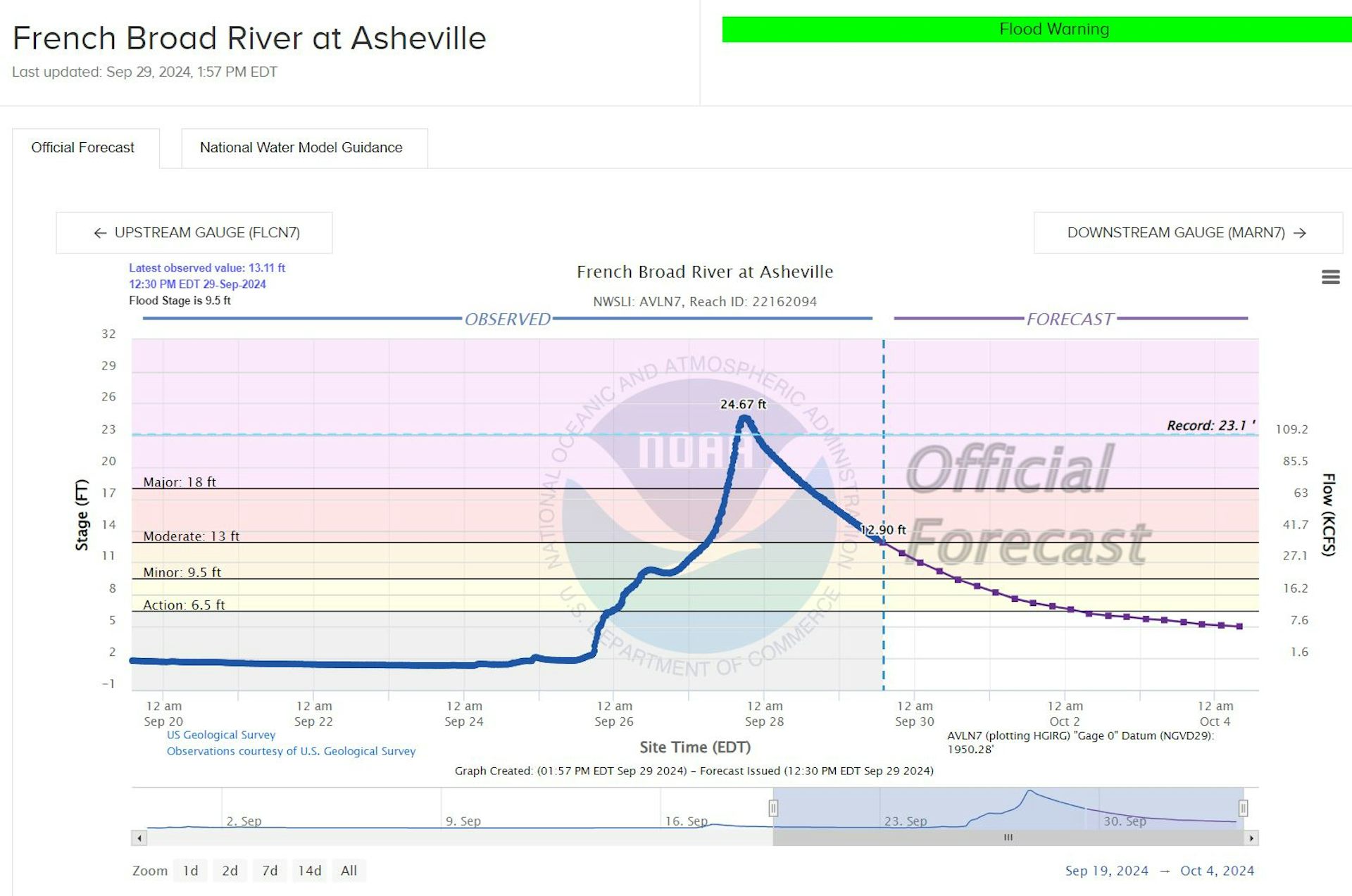
    But, as Helene revealed, there can also be great concern in less obvious spots. Inland, particularly in the mountains, runoff can quickly turn normally tame rivers into fast-rising torrents. The French Broad River at Asheville, North Carolina, rose about 12 feet in 12 hours during Helene and set a new flood stage record.

    When hurricanes and tropical storms are headed for the U.S., our interactive maps show where major polluters are located in the storm’s projected cone of impact. The maps identify hazardous flood-prone facilities down to the address, anywhere in the country.

    Knowledge is the first step

    Knowing where these sites are located is only the first step. Often, it’s up to communities themselves, many of them already overexposed and historically underserved, to raise concerns and demand strategies for mitigating the health, economic and environmental risks that industrial sites at risk of flooding and other damage can pose.

    These discussions can’t wait until a disaster is on the way. By knowing where these risks may be, communities can take steps now to build a safer future.

    This article, originally published Sept. 30, has been updated with Hurricane Milton.

    James R. Elliott receives funding from the National Science Foundation and the National Renewable Energy Lab.

    Dominic Boyer receives funding from the National Science Foundation, NOAA and Texas Sea Grant.

    Phylicia Lee Brown has nothing to disclose.

    ref. Flooded industrial sites and toxic chemical releases are a silent, growing threat in hurricanes like Milton and Helene – https://theconversation.com/flooded-industrial-sites-and-toxic-chemical-releases-are-a-silent-growing-threat-in-hurricanes-like-milton-and-helene-239977

    MIL OSI – Global Reports

  • MIL-OSI Economics: WTO Chairs Programme expands academic network to under-represented regions

    Source: World Trade Organization

    Following the addition of these five universities, the programme’s network will comprise a total of 40 Chairs. This expansion is anticipated to strengthen the impact of regional and global initiatives within the network and to promote deeper collaboration and knowledge sharing among academics, policymakers and trade experts.

    The five selected institutions will join the programme’s next four-year cycle, which is slated to begin in 2025. They will contribute to the programme’s research, curriculum development and outreach and will benefit from mentoring provided by other Chairs to ease their integration into the network. They will also engage in collaborative events, conferences and seminars to extend the academic and practical impact of their work on trade policies at the national and international levels.

    The fourth cycle of the WTO Chairs Programme also marks a transition to a more frequent admission of institutions into the network to further the global reach and impact of the programme. Greater synergies with the WTO’s other technical assistance activities are also anticipated.

    This expansion builds on the WTO’s longstanding efforts to ensure that academic institutions play a crucial role in shaping trade policy and deepening the understanding of the multilateral trading system. Funded by France, Austria, the Republic of Korea and Australia, the WTO Chairs Programme has grown from strength to strength as it seeks to address current and emerging global trade challenges.

    The selection of universities follows a rigorous review process of applications led by the WTO Chairs Programme Academic Advisory Board.

    More information about the Chairs Programme is available here.

    Selected institutions

    Member

    Academic Institution

    Dominican Republic

    Universidad Iberoamericana

    Nigeria

    Nnamdi Azikiwe University

    Qatar

    Hamad Bin Khalifa University

    Togo

    Université de Lomé

    Vanuatu

    National University of Vanuatu

    Share

    MIL OSI Economics

  • MIL-OSI United Nations: Experts of the Committee on the Elimination of Discrimination against Women Commend the Lao People’s Democratic Republic for Elevating Gender Equality to the National Level, Raise Questions on the Treatment of Women Human Rights Defenders and on Human Tra

    Source: United Nations – Geneva

    The Committee on the Elimination of Discrimination against Women today concluded its consideration of the tenth periodic report of the Lao People’s Democratic Republic, with Committee Experts commending the State for elevating the issue of gender equality to the national level, while raising questions on its treatment of women human rights defenders, and how it was combatting human trafficking.

    Jie Xia, Committee Expert and Country Rapporteur, said the Committee commended the Lao People’s Democratic Republic for elevating the issue of gender equality to the national level through domesticating the Convention, developing a law on gender equality, and developing a national action plan and strategy on gender equality, among other measures. 

    A Committee Expert said the Committee had received several names of female human rights defenders who had been poorly treated by the Government and the judiciary.  Could the State party outline recent efforts to review and amend any existing laws, regulations, or decrees that may unduly restrict freedom of expression to ensure that these legal frameworks complied with international human rights standards, including the Convention? What measures was the State taking to investigate the disappearance, maltreatment and deaths of female human rights activists? 

    Another Expert said the Lao People’s Democratic Republic continued to be a renowned source of origin for migrant workers as well as increasingly becoming a country of transit and destination for sexual exploitation and human trafficking.  What were some of the key policies that the National Steering Committee on Anti-Human Trafficking had introduced and implemented in terms of effective anti-trafficking measures?  How was the implementation of the national plan on anti-trafficking carried out?  How did the State ensure that the security forces were working effectively to address the prevalence of trafficking within the Golden Triangle Special Economic Zone? 


    The delegation said the Committee operated on reports from non-governmental organizations, which were often exaggerated.  It was important to look at the reality in the country, rather than organizations that operated reports, which sometimes fit the category of disinformation.  For example, regarding the cases of the so-called female human rights defenders, they were not human rights defenders. They had organised propaganda against the State and had violated criminal law, and were therefore prosecuted and imprisoned. 

    The delegation said a national commission on human trafficking had been established at the provincial, district and national levels.  Focus was directed to the protection of victims.  Trainings were conducted for law enforcement staff on how to identify victims of trafficking, how to refer their cases, and how to further protect them.  The Women’s Union had expanded the shelter services to six provinces in the country. There was a police headquarters located within the Golden Triangle to prevent violations of human rights. Companies operating in this area were encouraged to ensure their staff received medical examinations. 

    Introducing the report, Chansoda Phonethip, Vice President of the Lao People’s Democratic Republic Women’s Union and Vice President of the National Commission for the Advancement of Women, Mothers and Children, and head of delegation, said the promotion and protection of women’s rights were at the core of the Government policy of the Lao People’s Democratic Republic.  In 2019, the National Assembly adopted the law on gender equality, which introduced a wide range of measures to address gender disparities across various sectors.  Under this law, gender-based discrimination was classified as a criminal offense. The Lao People’s Democratic Republic was dedicated to eliminating child marriage through strengthening legal and administrative frameworks, investing in education, and encouraging communities to collectively address the challenges posed by harmful practices such as early marriage and pregnancy. 

    In closing remarks, Ms. Phonethip thanked the Committee for the dialogue, which helped the Lao People’s Democratic Republic fulfil its obligations under the Convention. The Committee’s insights were instrumental to advancing the rights of women and girls in the country.  The State welcomed any support from the international community to help in meeting its obligations under the Convention. 

    Esther Eghobamien-Mshelia, Committee Vice Chair, thanked the delegation for the constructive dialogue with the Committee, which helped it to better understand the situation of women and girls in the Lao People’s Democratic Republic.

    The delegation of the Lao People’s Democratic Republic was comprised of representatives from the National Commission for the Advancement of Women, Mothers and Children; the Ministry of Foreign Affairs; the Lao Women’s Union; and the Permanent Mission of the Lao People’s Democratic Republic to the United Nations Office at Geneva.

    The Committee on the Elimination of Discrimination against Women’s eighty-ninth session is being held from 7 October to 25 October.  All documents relating to the Committee’s work, including reports submitted by States parties, can be found on the session’s webpage.  Meeting summary releases can be found here.  The webcast of the Committee’s public meetings can be accessed via the UN Web TV webpage.

    The Committee will next meet in public at 10 a.m. on Wednesday, 9 October to consider the fifth periodic report of Saudi Arabia (CEDAW/C/SAU/5).

    Report

    The Committee has before it the tenth periodic report of the Lao People’s Democratic Republic (CEDAW/C/LAO/10).

    Presentation of Report

    CHANSODA PHONETHIP, Vice President of the Lao People’s Democratic Republic Women’s Union and Vice President of the National Commission for the Advancement of Women, Mothers and Children, and head of delegation, said the promotion and protection of women’s rights were at the core of the Government policy of the Lao People’s Democratic Republic.  All citizens, regardless of sex, had equal rights in political, economic, social and family life, in compliance with the principles and norms of the Convention. The Government had implemented supportive measures in response to the COVID-19 pandemic, which was a key challenge for the country.  These included financial subsidies which particularly targeted unemployed individuals and women factory workers, with a total of 61,511 people benefitting from these initiatives.  The Government also introduced two national agendas, one focusing on addressing economic and financial difficulties, and the other on combatting drug trafficking. 

    In 2019, the National Assembly adopted the law on gender equality, which introduced a wide range of measures to address gender disparities across various sectors. Under this law, gender-based discrimination was classified as a criminal offense.  Over 50 laws had been revised and newly adopted over the past five years, including those aimed at improving women’s rights and ensuring gender equality. The Government had made great efforts to provide legal aid free of charge for disadvantaged people, as outlined in the law on lawyers, and the decree on legal aid.  The Lao People’s Democratic Republic actively maintained three national mechanisms for promoting gender equality and empowering women. These included the Government, represented by the National Commission for the Advancement of Women, Mothers and Children; the mass organization, represented by the Lao People’s Democratic Republic Women’s Union; and the legislature, represented by the National Assembly’s Women’s Caucus. 

    The Government remained committed to reviewing and strengthening its legal frameworks to further enhance protection from violence, particularly through the law on the protection and development of women and the law on the protection of the rights and interests of children.  The State had strengthened its national mechanisms for assisting women and girls who were victims of violence by adopting the “No Wrong Door” approach, ensuring that victims could access essential services, including healthcare, legal aid, and coordinated case management.  Counselling and protection centres had also been extended to five provinces.

    Awareness raising on gender-based violence was conducted and legal information and resources, such as handouts, posters and brochures on violence were widely distributed. 

    The Lao People’s Democratic Republic was dedicated to eliminating child marriage through strengthening legal and administrative frameworks, investing in education, and encouraging communities to collectively address the challenges posed by harmful practices such as early marriage and pregnancy.  The Government undertook a national study on early marriage and pregnancy, which would guide the formulation of policies and action plans to effectively tackle these issues.  The Government was also committed to protecting and supporting children affected by early marriage, ensuring their successful reintegration into society.  The State was dedicated to preventing human trafficking, with a strong focus on vulnerable groups, particularly women in border regions and high-risk communities. 

    Despite advancements made, the representation of female members in the Ninth National Assembly did not meet the set target of 30 per cent.  In response, the Government was actively undertaking a comprehensive review to identify the underlying factors contributing to this decline, particularly focusing on the various barriers that women faced in attaining high-ranking positions.  The outcomes of this study would serve to address these challenges and promote the participation of women in the upcoming elections for the Tenth National Assembly in 2026.  On the other hand, the number of female members of Provincial People’s Assemblies was higher than the set target.  Most recently, three women were promoted to the rank of Brigadier General, a historical moment in the Lao People’s Democratic Republic army. 

    The Government was actively promoting healthier lifestyles by raising awareness about sanitation, nutrition, and comprehensive pre- and post-natal care for women. Recent data reflected a significant decrease in the maternal mortality rate, now at 36.6 per 100,000 live births.  Ms. Phonethip said in 2026, the Lao People’s Democratic Republic would celebrate the forty-fifth anniversary of its ratification of the Convention. While significant achievements had been made in more than four decades, there were still challenges to overcome. It was hoped that the constructive dialogue with the Committee would produce meaningful outcomes. 

    Questions by Committee Experts

    JIE XIA, Committee Expert and Country Rapporteur, thanked the State party for sending a high-level delegation.  The Committee welcomed positive measures taken by the State party since 2018 to advance the status of women, promote gender equality, and eliminate discrimination against women.  The Committee commended the Lao People’s Democratic Republic for elevating the issue of gender equality to the national level through domesticating the Convention, developing a law on gender equality, and developing a national action plan and strategy on gender equality, among other measures. 

    It was noted that the Criminal Code penalised discriminatory acts based on gender.  Had there been any actions taken to directly penalise gender-based discrimination?  How many cases had been brought under article 204?  The Committee commended the Lao People’s Democratic Republic for domesticating the Convention; what measures had been taken to advance this process?  Could the judiciary apply the relevant laws in its rulings?  How many trainings had covered the Convention?  Could up to date information be provided on efforts made to implement the law on gender equality and the third national strategy on gender equality?  Did the State party encourage mediation through legal means?  How was it ensured that people did not escape legal sanctions by taking advantage of mediation? 

    A Committee Expert said the State party had repeatedly declared it was not able to establish a human rights institution in line with the Paris Principles.  What obstacles did the State party face in this regard?  If a female leader wished to establish a federal liberal party for the upcoming elections, would this be allowed?  If not, why not? 

    There were reports that the Government severely restricted non-governmental organizations. Women rights groups were confined to working through the Lao People’s Democratic Republic Women’s Union, which was a State body.  The Penal Code was also used to prosecute activists and restrict freedom of assembly. The Committee had received several names of female human rights defenders who had been poorly treated by the Government and the judiciary?  Could the State party outline recent efforts to review and amend any existing laws, regulations, or decrees that may unduly restrict freedom of expression to ensure that these legal frameworks complied with international human rights standards, including the Convention?  What measures was the State taking to investigate the disappearance, maltreatment and deaths of female human rights activists?  Was there a public site where detailed statistics related to sex and gender were published annually? 

    Another Expert commended the State party for its initiatives, including training programmes for women in leadership roles.  However, the Committee was concerned that the State party had not instituted temporary special measures to improve specific situations for women and girls.  What was the State party’s concerns regarding the use of temporary special measures?  What steps had been taken to demonstrate the values of temporary special measures and to provide explanations to the general public on the failure to employ these measures?  Would the State party consider the adoption of temporary special measures to fulfil the rights of disadvantaged women and ensure their participation in all areas of life?  What steps was the State party taking to collaborate with stakeholders, including civil society, to implement temporary special measures? 

    Responses by the Delegation

    The delegation said the Penal Code provided for the criminalisation of discrimination against women, and stated that anyone who discriminated against women due to gender would be punished, including by deprivation of liberty and fines.  There had been no cases enacted in the courts so far. The Government paid attention to the functioning of the mediation unit.  It was important to prioritise this mechanism to help avoid people going to the courts, which took time.  Harmony and non-confrontation were important in the Lao People’s Democratic Republic. This was why the Government placed significant importance on the functioning of the village mediation unit. Anyone dissatisfied with the outcome of the mediation unit could escalate it to the courts. 

    The Lao People’s Democratic Republic was preparing for the fourth cycle of the Universal Periodic Review early next year, and was working hard in this regard.  Several recommendations pertained to the Convention, which was a key focus of the Government.  The State was also preparing for the forthcoming visit of the Special Rapporteur on cultural rights in November this year.  Law dissemination campaigns were conducted to people in the provinces.  The budget reflected the implementation of the law on gender equality. 

    The delegation said the Government recognised the importance of national human rights institutions.  The Paris Principles had been studied carefully and research had been conducted on examples of such institutions in different countries.  Workshops had been organised, including with Commissioners from India, Indonesia and Myanmar, to learn how their national human rights institutions worked.  The State had different mechanisms in place and a new commission would involve increased resources.  There were established human rights focal points in each sector and issues could be conveyed through them.  Sometimes, taskforces were established to investigate particular human rights issues. The Lao People’s Democratic Republic was trying to strengthen the current mandates of what they had now. Only 118 Member States of the United Nations had established human rights commissions; in Asia, this number was only 15. 

    The Committee operated on reports from non-governmental organizations, which were often exaggerated.  It was important to look at the reality in the country, rather than organizations that operated reports, which sometimes fit the category of disinformation.  For example, regarding the cases of the so-called female human rights defenders, they were not human rights defenders. They had organised propaganda against the State and had violated criminal law, and were therefore prosecuted and imprisoned.  They used the pretext of freedom of expression to violate the law.  Freedom of expression had limits; it was not absolute. 

    The Lao People’s Democratic Republic planned to conduct an economic survey.  From 2017, the State had made efforts to improve existing databases throughout the sectors.  The Government had made efforts to mobilise women to take part in elections. Capacity training was provided to women. An action plan was in place to empower women to hold leadership positions in the commerce sector.  Women were present in all branches of the economy. 

    Questions by Committee Experts

    A Committee Expert was pleased to hear that the Lao People’s Democratic Republic was considering establishing a human rights institution; how long would this process take? How many cases related to gender-based discrimination were conducted in the State party before the courts in the last five years, and how did they end?  It was sad to hear about the State’s general position regarding human rights defenders.  However, it was pleasing to hear the Criminal Code was being reviewed to enhance freedom of expression; how long would this review process take? 

    Another Expert asked what were the concerns and challenges the State faced in regard to using temporary special measures to advance the rights of women in the country? Could these measures be used to reallocate resources to women? 

    Responses by the Delegation 

    The delegation said it was not practical for the State to provide a timeline on establishing a national human rights institution, as they were learning from other countries and strengthening existing mechanisms.  In some cases, people misused and abused human rights treaties, using freedom of expression as a pretext.  In the case of one woman in prison, she had used propaganda to distort information and criticise the Government.  Every 10 years, the Government amended the Constitution and focused on articles which were relevant.  Next year, the Government would organise a population Census which would be gender disaggregated.  This would be used to prepare the next five-year development plan. 

    There were plans to increase the number of women in Government by 2026.  A survey would be conducted to determine why there were decreasing numbers of female parliamentarians.  Regarding temporary special measures, there were challenges in human and financial resources, as well as changing the mindsets of some people who still discriminated against women.  There were few cases of gender discrimination in the courts due to the use of the peaceful mediation resolution, which prevented cases from going to the courts. 

    Questions by Committee Experts

    A Committee Expert said the Lao People’s Democratic Republic had yet to promulgate a national action plan for women, peace and security, in accordance with the Committee’s recommendations.  Would the State consider including the rise of artificial intelligence and its impact on women’s security in the plan?  Would the impact of militarisation be addressed?  What was being done to address harmful stereotypes of women and girls, particularly in rural areas?  Would the law on domestic violence be revised to address cybercrime against women and scams against impoverished women?  It was concerning that there was no specific law against spousal rape.  Would affirmative consent be included as an essential component of rape?  Economic turmoil had led to an increase in domestic violence and child marriage. How would economic policies take the most vulnerable into account?  What steps had been taken to assess the impact of the economic crisis on women? 

    Another Expert commended the State’s efforts to address trafficking in persons, including through the enactment of the 2016 anti-trafficking law and the inclusion of article 215 in the 2018 Penal Code, which criminalised both sex and labour trafficking.  The national plan on anti-trafficking in persons combatting and prevention phase III (2021-2025) and the establishment of the National Steering Committee on Anti-Human Trafficking were positive steps.  However, the Lao People’s Democratic Republic continued to be a renowned source of origin for migrant workers as well as increasingly becoming a country of transit and destination for sexual exploitation and human trafficking. What were some of the key policies that the Committee had introduced and implemented in terms of effective anti-trafficking measures?  How was the implementation of the national plan on anti-trafficking carried out? 

    Concerns persisted around the prevalence of trafficking within the Golden Triangle Special Economic Zone.  Sources reported the sale and trafficking of girls as young as 13 and 14 to China increasingly happening unrestricted through flourishing internet trade.  How did the State ensure that the security forces were working effectively to address such challenges?  What specific actions were being taken to combat the impunity in the Special Economic Zone?  How did the Government plan to strengthen the capacity of law enforcement and judiciary personnel to investigate, prosecute, and secure convictions in trafficking cases? 

    It was positively noted that under the national plan of action on anti-trafficking in persons, a temporary shelter for victims of trafficking in persons was established. Did the State party have any plans to strengthen survivor services and increase resources as well as expand the capacity of shelters, legal aid services, and vocational training programmes, particularly in provinces with higher trafficking risks and women and girls from rural and ethnic minority communities?  Given that many trafficking cases involved border crossings, how was work done with cross-border countries to strengthen the approach against trafficking?  Did the State’s COVID-19 response plan address the heightened risk of trafficking? 

    Responses by the Delegation

    The delegation said that the Lao People’s Democratic Republic was translating the Association of Southeast Asian Nations’ women, peace and security plan and would disseminate this.  The State’s national plan of action for 2026 to 2030 was being drafted, and women, peace and security would be integrated into this.  Workshop seminars were organised to look at the traditional practice. To ensure gender equality, the Lao People’s Democratic Republic Women’s Union had made efforts to develop guidelines for domestic violence and promote the reproductive health of women. Projects had been piloted in six provinces in the country. 

    A national commission on human trafficking had been established at the provincial, district and national levels.  Focus was directed to the protection of victims.  The Government focused on preventing trafficking in persons, particularly for women working in factories and those living in remote villages.  The Government also organised anti-human trafficking days in July each year, at the central and local levels.  Trainings were conducted for law enforcement staff on how to identify victims of trafficking, how to refer their cases, and how to further protect them. 

    The Women’s Union had expanded the shelter services to six provinces in the country.  After being rescued, victims were referred to the Union and were provided with shelter and mental and physical support, and they were then reintegrated back into society.  Work was done with the Ministry of Justice to ensure victims could receive justice and the traffickers could be prosecuted.  From June 2024, professional training had been provided for more than 600 people in the area of human trafficking.  There was a police headquarters located within the Golden Triangle to prevent violations of human rights.  Companies operating in this area were encouraged to ensure their staff received medical examinations.  The Government of the Lao People’s Democratic Republic had developed a legal framework on human trafficking.

    Rape was clarified within the Penal Code; however, the element of affirmative consent was not present. The State needed to explore this option and conduct studies in this regard.  The Lao People’s Democratic Republic had made efforts to cooperate within the multilateral framework and on bilateral mechanisms with neighbouring countries. 

    In the Lao People’s Democratic Republic, more than 200,000 people had been infected by COVID-19. More than 60,000 had died of the virus. The country still faced the continuing impact of COVID-19, and was in the process of recovering.  The country had been faced with economic and financial difficulties, as well as natural disasters and climate change.  The Government had taken concrete measures to address this situation, including for women, to ensure no one was left behind. 

    Questions by Committee Experts

    A Committee Expert commended the Lao People’s Democratic Republic for making equality a driver towards peace.  The number of women in parliament had improved to 22 per cent, and there was a parliamentary commission, which was positive.  However, parity meant 50/50; it needed to be seen as a relevant solution to poverty.  In the absence of political pluralism, how could the electoral base be expanded to ensure women had access to political parties and leadership?  How could it be ensured that there was a large-scale effort to ensure women had access to voting and being candidates?  How could these developments be accelerated?  What initiatives could be undertaken to ensure real parity for women in the life of the party and the central congress?  What role could the Women’s Union play to train candidates and create momentum?  What could be done to support civil society?  What initiatives could be taken to help women participate in a more effective way?  How was it ensured that ethnic minorities could participate in local development? 

    Another Expert underscored the importance of documentation as proof of nationality. The guide to birth registration and other measures were well noted.  Was information on birth registration from provinces gathered on an annual basis?  What had the percentage increase in registration been?  What target had been reached as of today?  What were the key challenges and what incentives were being considered for the still unregistered 30 per cent?  Was disaggregated data on registrations available?  What measures and incentives were taken to improve birth registration and encourage ethnic minority groups and rural women to register births?  How was the documentation system used to track the State party’s migrant women population?  Could stateless children or children born to immigrant women obtain the nationality of the Lao People’s Democratic Republic?  How many had been granted nationality so far? 

    Responses by the Delegation

    The delegation said female diplomats in the Lao People’s Democratic Republic played an impressive role in the country’s foreign affairs work.  In 2024, out of 914 diplomats working in the Ministry, 322 were female diplomats, representing 32.5 per cent.  Of 27 ambassador posts, five were women, which was equivalent to 19 per cent.  Of three minister posts, one was a woman.  When there were opportunities such as scholarships, the policy now stated these should be offered to female diplomats first.  This month, the Lao People’s Democratic Republic Women’s Union had successfully completed hosting the Association of Southeast Asian Nations’ Women Entrepreneurs’ Conference 2024.   

    The Ministry of Home Affairs had carried out many activities to raise awareness of birth registration, including printing, publishing and distributing information. If a child was born to stateless parents who had fully integrated into the Lao People’s Democratic Republic culture, the child could obtain nationality on request.  There were several conditions, including speaking the language and respecting the Constitution.  These laws aimed to reduce statelessness.  There were not many stateless people in the Lao People’s Democratic Republic.

    Questions by Committee Experts

    A Committee Expert said the Committee welcomed that the State party was making efforts to increase the enrolment of girls and women in education.  However, there was a significant gender gap in non-traditional fields, including science, technology, engineering and mathematics. What concrete measures had been taken to ensure parents understood the importance of sending girls to schools? How was the effectiveness of gender-sensitive curricula ensured in order to change gender stereotypes from an early age?  What were the specific measures to increase the access of girls to education? 

    What were the plans to provide necessary education in native languages?  What steps were being taken to improve the infrastructure and resources in schools in remote areas?  What steps were being taken to ensure quality access to education for all women and girls with disabilities?  How would the State party sustain the school lunch programme in rural and remote areas?  How was the issue of child marriage monitored and addressed?  Parents needed to understand that education was important for girls; maybe training and awareness raising was needed for the parents. 

    Another Expert said that since the 1990s, the State party had made efforts to increase women’s participation in the labour market.  Yet despite this, women’s participation had steadily declined since 2012. The gender pay gap in the capital showed that 52 per cent of women employed took home only 77 per cent of men’s average wages.  What were the legislative measures for ensuring equal pay and equal and just working conditions?  What was the State’s assessment of the sharp decrease in women’s participation in the labour market, and what was being done to combat this?  How would these plans target women in vulnerable groups?  What policies were in place to protect migrant women workers?  What were the measures provided under the sexual harassment law? 

    A Committee Expert said the Lao People’s Democratic Republic had approved a decree to establish health insurance which was positive.  One of the key issues recognised by the Government was HIV/AIDS. What were the main results of efforts taken to prevent HIV/AIDS?  What steps had been taken to adopt HIV/AID legislation to expand access to services and combat discrimination?  Could updated information on rural women be provided, including access to services? What was the main reason for the criminalisation of abortion?  What were the main barriers which women and girls in poverty faced when accessing health services?  What access did women in detention have to reproductive health services?

    Responses by the Delegation

    The delegation said a group of parents had been created in primary schools to enable them to understand the importance of education.  Lunch boxes had been created for poor students and those who lived in rural areas, which had seen an increase in school enrolment.  A new curriculum had been developed for the schools and teachers had been trained on this.  Scholarships were provided to poor students and job training was provided to give students access to the labour market.  The law on disability aimed to protect the rights of those with disabilities. Within this law, children with disabilities could access educational facilities, the same as anyone else. Special equipment was provided to help these children receive an education.  The Lao People’s Democratic Republic provided tools for developing skills in the labour market. 

    The delegation said a national action plan had been implemented to combat HIV/AIDS and sexually transmitted diseases.  In addition to reducing the stigma, the 161 HIV/AIDS centres provided counselling services, with 11 centres providing treatment.  Testing kits for HIV detection were distributed within the communities.  Poor women could give birth in public hospitals free of charge.  In each detention centre, there were medical staff on hand to provide healthcare to detainees.  Other statistics would be provided in writing. 

    Questions by Committee Experts

    A Committee Expert commended the State party’s efforts to expand social protection coverage. Despite institutional efforts, feminised poverty persisted, and women continued to face great difficulties in gaining access to economic, social and cultural activities.  Could comprehensive data be provided on how women had benefitted from the small and medium enterprise law?  What targeted policies and measures existed to increase access to finances for women?  What gender-specific outcomes existed to demonstrate effectiveness and uptake in the banking sector? 

    What steps were being taken to adopt specific legislation on women’s rights to land? How could women’s roles at village and community levels be increased?  Could updated information be provided on measures taken to allow women in the informal sector to access benefits?  What was the impact of national and international cooperation programmes?  What plans existed to develop opportunities for women in sports?  How strong was the country’s economic, social and cultural framework on gender commitment? 

    Another Expert noted the different actions taken by the Lao People’s Democratic Republic to integrate gender equality into different sectors, including in agriculture and fisheries, to benefit rural women and other marginalised groups. However, there were clear gender gaps in the implementation of Government policies.  What concrete actions would the State party consider taking to ensure the effective implementation of Government initiatives to benefit vulnerable women?  How was gender-responsive climate financing integrated in the national budget?  What concrete steps had been taken to increase rural and other vulnerable women’s access to quality social services? 

    The Committee had received reports of indigenous people evicted from their ancestral land. What steps was the Lao People’s Democratic Republic taking to preserve ancestral land and mitigate the gendered impact of the climate crisis?  What concrete steps were being taken to protect the Hmong people from forceful evictions from their land?  What concrete steps were being taken to provide compensation to women evicted from their land? 

    A Committee Expert said the Constitution of the Lao People’s Democratic Republic called for the independence of the judiciary.  How was the Supreme Court trained on the rule of law and the independence of the judiciary? Did women human rights defenders have access to free legal counsel?  How were the village chiefs who were trained to implement the laws monitored?  It was understood that customary laws were part of a traditional system, but these might be outdated in 2024 and could create a stigma for women.  Women were often abandoned with their children in a time of profound economic crisis. Would the State consider social security and childcare arrangements? 

    Responses by the Delegation 

    The delegation said a law existed in the Lao People’s Democratic Republic which defined the right for individual or legal entities to use land, without any discrimination on the grounds of gender.  These were part of the efforts to promote women’s access to land.  The Lao People’s Democratic Republic was in the process of transforming the economy to make it digitalised.  The State had joined the international community in the Global Digital Compact.  Social protection efforts gave women in vulnerable situations top priority. Women were covered as a target group under the Government policy under the Sustainable Development Goals.  The issue of land was very important as many women were engaged in agriculture.  For this reason, the Government aimed to ensure women had access to land.  The Government had a legislative framework on the law of land. 

    Within the legal system of the Lao People’s Democratic Republic, a foreigner could not own land, but had the right to use the land.  The country prioritised the need for foreign investors to protect the environment.  Foreign entities did not own 50 per cent of land in the Lao People’s Democratic Republic. 

    A committee had been appointed to implement the climate action plan.  Human resources were allocated to implement this plan. Trainings on national disasters were provided in the provinces.  The national disaster preparedness plan had been piloted. Gender equality was mainstreamed across policies in all sectors.  A vaccination campaign was conducted to help prevent communicable disease.  Guidelines were developed to help increase the quality of health coverage. 

    The Lao People’s Democratic Republic Women’s Union was in the process of revising the law on the protection of women.  Specific rights had been added, including for the labour market.  The Government issued a decree on lifelong learning in 2020 to develop a policy for rural women and girls to have access to education. 

    Agriculture was the basis of the economy of the Lao People’s Democratic Republic.  A group of female farmers had been established which provided benefits, including generating income for their families. Currently, the Lao People’s Democratic Republic did not have a specific law on anti-discrimination.  However, the Government had adopted the law on gender equality.  Civil and criminal proceedings were required to be conducted on the basis that all civilians were equal before the law. 

    Campaigns were organised around land ownership to ensure all women understood their rights when it came to inheriting land, as well as the importance of putting their name on the land title.  The Lao People’s Democratic Republic categorically rejected the allegations of forced evictions.  Before being relocated, people were extensively consulted. 

    Closing Remarks

    CHANSODA PHONETHIP, Vice President of the Lao People’s Democratic Republic Women’s Union and Vice President of the National Commission for the Advancement of Women, Mothers and Children and head of delegation, thanked the Committee for the dialogue, which helped the Lao People’s Democratic Republic fulfil its obligations under the Convention.  The Committee’s insights were instrumental to advancing the rights of women and girls in the country.  The Lao People’s Democratic Republic would address the challenges highlighted by the Committee.  The State welcomed any support from the international community to help in meeting its obligations under the Convention. 

    ESTHER EGHOBAMIEN-MSHELIA, Committee Vice Chair, thanked the delegation for the constructive dialogue with the Committee, which helped it to better understand the situation of women and girls in the Lao People’s Democratic Republic.


    Produced by the United Nations Information Service in Geneva for use of the media; 
    not an official record. English and French versions of our releases are different as they are the product of two separate coverage teams that work independently.


    CEDAW24.024E

    MIL OSI United Nations News

  • MIL-OSI Europe: Written question – Upsurge in violent incidents among young people – E-001929/2024

    Source: European Parliament

    Question for written answer  E-001929/2024
    to the Commission
    Rule 144
    Eleonora Meleti (PPE)

    Europe is greatly saddened to see the serious problem of juvenile violence taking on increasingly worrying proportions. Every day, in every Member State, we see incidents of extreme violence where those involved – perpetrators and victims alike – are teenagers and young people who do not hold back from unthinkably brutal behaviour. Young people in Europe, in countries such as Greece, France, Germany, Sweden and many other Member States, seem in greater need of help and care than ever before.

    Knowing, as we all do, that we as adults should take responsibility for the young and act immediately to ensure their protection and healthy development, does the Commission:

    • 1.Intend to adopt measures to prevent, manage and combat this phenomenon and, if so, what are these measures?
    • 2.How does the Commission intend to protect and support juvenile victims and juvenile offenders?
    • 3.Does it intend to fund national bodies to create an action plan for providing information and preventing and managing juvenile violence through extensive educational programmes and related actions?

    Submitted: 2.10.2024

    Last updated: 8 October 2024

    MIL OSI Europe News

  • MIL-OSI USA: USGS experts responding simultaneously to two major natural hazards

    Source: US Geological Survey

    RESTON, Va. – As U.S. Geological Survey staff prepare for Hurricane Milton to hit Florida’s west coast as soon as Wednesday, agency experts are still dealing with the after-effects of Hurricane Helene that made landfall in Florida late last month and continued a path of destruction north through Georgia, North Carolina, South Carolina and Tennessee.

    While USGS experts are deploying wave sensors and forecasting coastal change in anticipation of Milton’s arrival, many of their agency colleagues have been hard at work mapping landslides, repairing and replacing damaged streamgages, and analyzing sensor data to provide the science information needed to help emergency responders and local officials with ongoing Helene recovery efforts.

    “Thank you to all our USGS employees and our partners for their dedication and commitment in supporting hurricane response efforts throughout the region,” said Holly Weyers, USGS Southeast Regional Director. “I’ve seen remarkable resiliency exhibited by our entire team in the face of incredible challenges. I’m proud of all our USGS employees and our partners and their ability to work together to find effective solutions, even in the most demanding situations, as we continue to support the needs of the communities in the affected areas. You have all made a remarkable difference.”

    To meet requests for local technical assistance, USGS activated its landslide event team last week to collect remotely sensed imagery and map landslides to gain a better picture of the extent and severity of landslide impacts. USGS continues to support requests from the North Carolina and Tennessee geological survey offices to identify landslide locations and landslide impacts to state transportation networks and the infrastructure environments. Hurricanes are known to lead to landslide and debris flow hazards in the southern Appalachian Mountains so experts at the USGS Geologic Hazards Science Center helped create a multi-agency Landslides Observations Dashboard to map landslides associated with Helene and aid state officials in determining the extent and severity of landslide occurrence and impacts. At time of publication, the dashboard shows more than 450 landslides across North Carolina, South Carolina, Tennessee and Virginia, with nearly 320 of these having impacted rivers, roads or structures. 

    Two USGS landslide experts conducted aerial reconnaissance flights between October 3 and October 5 in partnership with U.S. Fish & Wildlife Services to obtain a better understanding of the extent and severity of landslide impacts in the southern Appalachian region. USGS experts continue to review the data and imagery from these flights to confirm locations of some landslides and assist local authorities as they work to protect lives and vital infrastructure. 

    Locations of landslides identified by the team can be viewed on the USGS Landslide Observations Dashboard.

    Well before deadly Hurricane Helene made landfall September 26 on the Florida Big Bend region, USGS water monitoring, coastal storm hazards, and modeling experts were preparing for its arrival and gathering data needed to help emergency managers and communities prepare for and respond to the onset of the large and powerful storm.

    Days prior to the storm striking, hydrographers from the USGS Caribbean Florida Water Science Center in Davie, Florida, deployed wave sensors and barometric pressure sensors to monitor large waves and surge along the coasts. USGS also activated seasonal hurricane real-time gauges in Florida and USGS crews in several other states in Helene’s projected track maintained streamgages critical to helping with flood forecasting. 

    After making landfall as a Category 4 storm with 140 mph winds, Hurricane Helene caused coastal flooding along the entire west coast of Florida and damaged multiple gauging stations that are operated out of the Caribbean Florida Water Science Center. Due to the speed of the storm, the state did not receive a high amount of rainfall, so there was minimal inland flooding and USGS teams were not deployed for high water measurements. 

    Helene quickly moved north and further inland, bringing heavy rain and destructive winds across Georgia and the southern Appalachian region, resulting in widespread power outages. Areas such as Atlanta, eastern Tennessee, and western North Carolina experienced extreme or record high river levels, flash floods, landslides, and extensive river flooding. The mountainous terrain around Asheville, North Carolina, and upstate South Carolina worsened the flooding, creating dangerous conditions for local communities.

    The storm saturated the region and many USGS streamgages recorded extreme and historic water levels. Several gauges exceeded the peak of record in north Georgia and western parts of the Carolinas. According to the USGS Asheville field office, dozens of sites serviced by the office observed peak gauge heights that exceeded the current ratings following the storm runoff. Major basins affected included the French Broad and Catawba Basins in western North Carolina, urban tributaries of the Chattahoochee Basin in low-lying parts of Atlanta, and the Ogeechee and Savannah River Basin in Georgia and South Carolina. USGS officials estimated 10 to 20 gauges in Asheville and the upstate South Carolina area were damaged or inundated because of the storm.

    USGS experts from the South Atlantic Water Science Center and the Lower Mississippi-Gulf Water Science Center conducted post-storm field operations at safely accessible sites, obtaining high-flow measurements, completing repairs and needed equipment checks, and conducting verifications for streamgages that were inundated but not destroyed during the catastrophic flooding. USGS crews from the Virginia-West Virginia Water Science Center field offices in Marion and Leetown conducted discharge measurements and water-quality sampling in the New River, Shenandoah, and Potomac basins. The most significant flooding was found in the New River basin, with the peak at New River at Galax reaching the second highest peak of record ever documented. New River at Glen Lynn, at the West Virginia border, reached the fourth highest peak on record, which dates back over 100 years.

    With federal and state emergency response agencies conducting extensive rescue and recovery operations, and numerous washed out and blocked roads in the region causing unsafe conditions, it’s no surprise that USGS teams were limited in their immediate ability to assess damage to streamgage networks and replace equipment in several states. Response team members estimate that some locations where streamgages are located still won’t be accessible for at least several weeks. 

    Despite some limitations, dozens of USGS experts were able to safely deploy to other areas to collect sensors, repair gauges and gather scientific data about the storm surge and flooding Helene caused. A USGS team retrofitted a radar gauge at the Nolichucky River below the Nolichucky Dam in Tennessee to bring data back online, while a second team conducted survey work to verify peaks of record at several locations in Tennessee where crest stage gauges were either overtopped or destroyed. In North Carolina, crews from the USGS Asheville and Raleigh field offices continue to repair damaged gauges, flag and survey high water marks, and conduct post-storm field operations for completion of indirect discharge measurements needed for more than 40 streamgages.

    USGS scientists and field crews in Florida continue to access the damage to the streamgage network and replace equipment across three of the hardest hit counties in the state. Crews also retrieved the 13 wave sensors that were deployed between Venice and Panama City days before the hurricane hit the Florida coast. The sensors measure water levels and provide insight on wave height and frequency, storm tide and storm surge. USGS scientists are analyzing the collected data to help identify areas hit the hardest by storm surge and guide emergency responders and local officials with recovery efforts. The resulting information can be used to fine-tune future storm surge and coastal change forecasts during what is proving to be a busy hurricane season. 

    MIL OSI USA News

  • MIL-OSI Translation: The S2R plan has attracted strong support from the population and stakeholders consulted

    MIL OSI Translation. French Polynesian to English –

    Source: Government of New Caledonia

    The 17th government is currently working on implementing the Safeguarding, Rebuilding and Reconstruction Plan (S2R), an initiative launched in the public interest. Following the public consultation, which was a great success, the government wishes to continue meetings with the stakeholders concerned before the conference scheduled for 17 and 18 October.

    3,000 is the number of contributions collected by the public consultation open from August 29 to September 19 in order to collect the thoughts, observations and aspirations of the population regarding the S2R plan and the future Caledonian model.

    “This first step met our objective, which was to see if we could involve New Caledonia in a process with the broadest possible support,” said government president Louis Mapou. “All the communities were involved in the process and a certain number of them asked to have more time to finalize their work.”

    The government has therefore decided to continue consulting stakeholders before the conference scheduled for 17 and 18 October, during which the results of the work undertaken will be presented.

    “This will allow us to meet in particular with the Congress, the working group of executive presidents (GTPE), the NC Éco consortium and the unions,” added the president.

    A common approach for a new Caledonian model

    As a reminder, the S2R plan was designed to enable the organisation of short-term safeguard measures for New Caledonia, to define the major principles of reconstruction on which the new Caledonian model will be based and to identify priority avenues for reconstruction. It is divided into three parts.

    The backup

    This emergency component of the S2R plan, designed for the very short term (end of 2024), aims solely at the survival of the economic and social system of New Caledonia, which has been severely affected by the consequences of the abuses that began in May 2024. It will be applied around 11 themes identified as priorities (health and RUAMM, electricity system, retirement, housing, air transport, maritime transport, land transport, public finances, economy, businesses, employees, training, associations and purchasing power, solidarity and food emergency, priority reconstructions).

    Reconstruction and Refoundation

    The reconstruction-rebuilding components consist of developing an appropriate response that is up to the challenges that New Caledonia must face. Recent events and the resulting situation now require us to reexamine the foundations on which New Caledonia has developed over the past three decades. It is now crucial to engage the territory in a rebuilding process involving a transformation of its economic and social model, its societal model and its institutional model.

    EDITOR’S NOTE: This article is a translation. Apologies should the grammar and/or sentence structure not be perfect.

    MIL Translation OSI

  • MIL-OSI New Zealand: EU/UK Upcoming Travel Changes

    Source: New Zealand Ministry of Foreign Affairs and Trade – Safe Travel

    New Zealand citizens planning on travelling to the UK or within Europe and the Schengen Zone should be aware of upcoming changes to border controls.

    UK Electronic Travel Authority (ETA)
    From 8 January the UK government is introducing an Electronic Travel Authorisation (ETA).

    New Zealand passport holders travelling to the UK visa free will need to apply for an ETA. New Zealanders will be able to apply for an ETA from 27 November 2024.

    More information including how to apply for a UK ETA, is on this UK government website. 

    Apply for an electronic travel authorisation (ETA) – GOV.UK (http://www.gov.uk)

    Further guidance is available here Electronic travel authorisation (ETA): help videos – GOV.UK (www.gov.uk)

    Entering and exiting the Schengen Area
    New Zealand travellers should be aware that from November 2024, the EU will introduce a digital border system to strengthen the security of its external Schengen border. 

    The new registration process is called the Entry/Exit System (EES). The EU has not yet confirmed a specific date in November for the introduction of the EES.

    The EES will register when non-EU nationals cross external borders of Schengen countries and will more accurately identify overstayers. It will require most citizens of countries outside the EU to create a digital record and register biometric details, such as fingerprints and photos, when then enter the Schengen area. The EES will replace passport stamping.

    New Zealanders travelling to Europe can still enter visa-free, but the length of time you can stay may vary depending on where you are travelling. You need to know what the visa-free travel rules are to ensure you don’t overstay. Read the visa/entry information on the websites of the Embassies of the relevant EU/Schengen countries you intend to visit or transit (e.g. the French Embassy in Wellington if you are intending to travel to France. You may also like to consult with a travel agent.

    More information can also be found on our Safe Travel page here: Travel tips – travel to Europe | SafeTravel.

    In addition, from sometime in the first half of 2025 travellers will also be required to complete an European Travel Information and Authorisation System (ETIAS) travel authorisation before travelling. Further information about the ETIAS can be found on the EU’s official travel website here.

    As the New Zealand Ministry of Foreign Affairs and Trade does not issue visas for foreign countries, we cannot provide definitive advice on the requirements to enter or exit countries within Europe and the Schengen area. Our New Zealand Embassies and High Commissions overseas also cannot advise on your right to enter or stay in a foreign country.

    Associated Advisories:

    Share this page:

    MIL OSI New Zealand News

  • MIL-OSI China: Jing’an showcases sculptures from around the world

    Source: China State Council Information Office 3

    Thirty-five sculptures by 31 artists from 10 countries are showcased at the Jing’an International Sculpture Project, a biennial event jointly hosted by the municipal administration for planning and natural resources and the Jing’an district in Shanghai.

    While most of the sculptures are on exhibition at the Jing’an Sculpture Park, six pieces are placed at urban squares, parks and other landmark locations by the Suzhou Creek and the Nanjing Road West.

    This year the exhibition has been curated by UCCA Lab, a branch institution of the UCCA Center for Contemporary Art. Philip Tinari, director of the center, hoped to leverage the institution’s distinctive global perspective to achieve new breakthroughs in the selection as well as the quality of the exhibits of the JISP, which features 22 new commissioned works for the occasion.

    Since the first installment of JISP in 2010, the biennial exhibition has become a renowned public art brand of Shanghai, said Gong Mingjun, deputy director of the Shanghai Landscaping & City Appearance Administrative Bureau. This year the exhibition features the theme Echoes among us, exploring the harmonious co-existence between art, the city, and the people.

    France is the guest-of-honor of JISP this year in celebration of the 60th anniversary of the diplomatic ties between China and France. Among the featured artists from France are Martial Raysse, one of the most celebrated French artists in the world; Marc Fornes, an architect specializing in large-scale, site-specific structures; and Pablo Reinoso, who brought to Shanghai a work of his signature Spaghetti Bench series.

    The exhibition is ongoing until the end of the year.

    MIL OSI China News

  • MIL-OSI Security: Philippine Navy and U.S. Navy commence Sama Sama 2024

    Source: United States INDO PACIFIC COMMAND

    The U.S. Navy, ​U.S. ​Marine Corps, Armed Forces of the Philippines​, and allied forces commenced the eighth iteration of Exercise Sama Sama in the vicinity of Subic Bay, the ​Republic of the ​Philippines, marking the beginning of two weeks of maritime engagements designed to enhance interoperability and strengthen security ties among regional partners, Oct. 7.

    ​​Sama Sama 2024, part of the Cooperation Afloat Readiness and Training (CARAT) series, builds on the legacy of ​previous maritime ​collaboration​,​ ​expanding its​ scope of operations​ with​​ both shore and sea phases​.​ ​Participants ​will engage ​​in specialized training across a wide range of disciplines, including medicine, legal operations, engineering, logistics, and public affairs. ​

    “This exercise has evolved significantly since its inception. What began as a bilateral event between the United States and the Philippines has grown into a multilateral and multiplatform operation, bringing together like-minded partners from across the Indo-Pacific,” said the U.S. Head of Delegation, Rear Adm. Todd Cimicata, Commander Logistics Western Pacific, and Task Force 73. “This development highlights the strength of our alliances and our shared commitment to peace, security, and cooperation in the maritime domain and it’s never been more important.”

    ​​Working alongside naval vessels and maritime surveillance aircraft, ​​​​specialized teams​, including ​diving and explosive ordnance disposal units​,​​ ​will conduct high-intensity drills focusing on anti-submarine warfare​, ​anti-​surface warfare​, ​anti-​air warfare​, and maritime domain awareness.

    “Sama Sama”​,​ which means “togetherness​” ​in Tagalog, reflects ​​the spirit of the decades-long partnership between allies in the region. Sama Sama 2024, a Philippine-U.S. bilateral exercise with invited allied and partner participants, continues to evolve in both complexity and scope into a more sophisticated and multinational environment with each iteration.
    This year​’s​ ​exercise includes participants from ​Australia, Japan, Canada, France​, and​ Japan, representing a collective ​commitment ​to stability and security in the Indo-Pacific region.

    “Today we witness the deepening of ties between the Philippine Navy and the U.S. Navy along with our partners from Australia, Canada, France, United Kingdom, and Japan” said the Philippine Navy Head of Delegation, Rear Adm. Jose Ma. Ambrosio Ezpeleta, Vice Commander of the Philippine Navy. “This exercise is a powerful investment for our collective movement and an opportunity to address regional challenges together.”

    ​​Participating assets​ from the United States​ include the​ Navy’s​ Arleigh Burke-class guided-missile destroyer USS Howard (DDG 83), and a P-8A Poseidon ​maritime surveillance aircraft​.​ ​P​​ersonnel from ​U.S. 7th Fleet​;​ Command Task Forces (CTF) 76, 75 and 72​;​ Command, Destroyer Squadron Seven (DESRON 7)​;​ and the Marine Corps’ ​​Marine Rotational Force​ – Southeast Asia​ (MRF-SEA)​​,​​ are also taking part in Sama Sama 2024​.​

    From partner nations, we welcome the Philippine Navy’s BRP Jose Rizal (FF 150)​;​ BRP Waray (LC-288)​;​​ BRP Nestor Reinoso (PC 380)​;​​ a Force Reconnaissance Group, Naval Special Operations Unit 2​;​ and supporting units ​that include​ a medical and media team. ​The Royal Canadian Navy​ will bring the Halifax-class frigate ​​HMCS Vancouver (FFH 331) and a CH-148 Cyclone helicopter​. A​ ​Japa​n Maritime Self-Defense Force​Shin Maywa US-2 amphibious aircraft and Kawasaki P-1 maritime patrol aircraft​ ​​are​​​ also participating.

    “Through exercises like Sama Sama, we continue to improve our interoperability and our readiness while deepening our understanding of each other’s capabilities. This exercise reflects our enduring partnership—one built on trust, shared values, and mutual defense,” said Cimicata. “Together, we will refine our ability to respond to natural disasters, maritime threats, and humanitarian crises, while ensuring the safety and security of this vital region.

    This year marks the 30th iteration of CARAT, a multinational exercise series designed to enhance U.S. and partner navies’ abilities to operate together in response to traditional and non-traditional maritime security challenges in the Indo-Pacific region.

    As the U.S. Navy’s forward-deployed DESRON in Southeast Asia, DESRON 7 serves as the primary tactical and operational commander of littoral combat ships rotationally deployed to Singapore​. DESRON 7 also​​ functions as ​the ​​​CTF ​​76 Sea Combat

    ​​Commander and​ builds partnerships through training exercises and military-to-military engagements as the executing agent of Commander, Task Group CARAT.

    ​​U.S. ​7th Fleet is the​ ​Navy’s largest forward-deployed numbered fleet, and routinely interacts and operates with allies and partners in preserving a free and open Indo-Pacific region.

    MIL Security OSI

  • MIL-OSI Security: International appeal seeks to uncover identities of 46 deceased women

    Source: Interpol (news and events)

    8 October 2024

    LYON, France – Six European countries and INTERPOL have joined forces to solve 46 cold cases involving unidentified women whose remains were found across Europe years ago.

    Most of the women were either murdered or had died in suspicious or unexplained circumstances. Some of the cases date from decades ago.

    The initiative builds on the success of the Identify Me appeal launched in May 2023 to identify 22 deceased women, with some 1,800 tips received from the public. It has now been expanded to include additional cold cases from Belgium, Germany, and the Netherlands, as well as cases from new participating countries France, Italy, and Spain.

    The appeal highlights the importance of public involvement and international cooperation in solving cold cases. It provides hope that crucial leads can be generated, so more of these women can be identified and that justice is served if murder has been established.

    Identify Me has already seen noteworthy results after a case was solved after 31 years. Within two days of the launch of the first phase of Identify Me on 10 May 2023, relatives of Rita Roberts in the United Kingdom contacted the appeal hotline after they recognized their relative’s tattoo from news coverage.

    Rita Roberts was 31 when she left Cardiff, Wales in February 1992. Her family last heard from her in May 1992, and her unidentified body was discovered in Antwerp on 3 June 1992. An investigation determined that she was a victim of murder. That case remains part of the international effort to request information, identify and seek justice for these deceased women.

    Celebrity ambassadors

    The appeal features the strong support – including in the video below – of the following leading actresses, singers, and sports figures from the participating countries, to help raise awareness of the cold cases and encourage public involvement:

    Belgium: Veerle Baetens and Axelle Red

    France: Marie-José Pérec and Sarah Biasini

    Germany: Regina Halmich and Katrin Müller-Hohenstein

    Italy: Carolina Kostner and Alice Bellandi

    Netherlands: Carice van Houten and Stien den Hollander

    Spain: Luisa Martin and Mabel Lozano

    The cold cases

    Details on each case have been made available on INTERPOL’s Identify Me web page, depicting facial reconstructions of some of the women.

    There are also images of items such as jewellery and clothing which were discovered at the various land and water sites where the women’s remains were abandoned.

    These cases underscore the difficulties in identifying human remains, often found years ago in remote or isolated locations, as well as the challenge of tracing some of these deceased women back to their home countries.

    INTERPOL Secretary General Jürgen Stock said:

    “Our goal in the Identify Me campaign is simple. We want to identify the deceased women, bring answers to families, and deliver justice to the victims. But we can’t do it alone. That is why we are appealing to the public to join us in this effort. Their help could make the difference.

    “Even the smallest piece of information can be vital in helping solve these cold cases. Whether it is a memory, a tip, or a shared story, the smallest detail could help uncover the truth. The public could be the key to unlocking a name, a past, and in delivering long-overdue justice.”

    Role of forensics in cold cases

    The participating member countries and INTERPOL are working closely together in the appeal to leverage their analytical capabilities and advanced forensic methods, such as DNA profiling, facial reconstruction, and isotopic analysis. These techniques can provide significant clues about the victim’s origin, lifestyle, and cause of death. 

    Since 2021, INTERPOL has been providing investigators with a new global tool, the I-Familia database, which contains some 20,000 profiles from almost 80 countries. It has already solved cases by helping identify unknown bodies through international family DNA kinship matching.

    Such cases draw on the voluntary DNA contributions made by relatives of the missing, and underline the role played by the public and partners when it comes to identifying missing persons.

    INTERPOL Black Notices

    INTERPOL has published a Black Notice alert for each of the unknown women, to seek information on the unidentified bodies and determine the circumstances of their death.

    While these alerts are intended for the police only, Identify Me represents the first time INTERPOL has publicly released extracts from Black Notices.

    Black Notices can include information on the location where the body was found, biometric information (DNA, fingerprints, facial images), dental charts, physical descriptions of the body or clothing, and any other details relevant to identifying the deceased.

    What you can do

    Each of these deceased women has a story and relatives who deserve answers. We urge anyone with information to come forward and assist in this vital effort.

    Members of the public, particularly those who remember a missing friend or family member, are invited to consult the INTERPOL website and contact the relevant national police team should they have any information. Details can be found on http://www.interpol.int/IM

    For biological relatives who believe one of the women could be their missing loved one, national police can liaise with INTERPOL for international DNA comparison.

    Contact forms are at the bottom of each case summary, providing a crucial link for families seeking answers and justice.

    MIL Security OSI

  • MIL-OSI China: Music festival harmonizes past and present

    Source: China State Council Information Office 3

    The Beijing Music Festival opened on Saturday with a stunning fusion of the East and the West. As dusk settled over the capital city, the National Centre for the Performing Arts concert hall glowed against the cool autumn evening, inviting the audience into a world where music and nature seemed to harmonize.

    The China National Symphony Orchestra and composer-conductor Tan Dun opened the concert with the Golden Bell Chimes (bianzhong) of the Qing Dynasty (1644-1911), a remarkable artifact housed at the Palace Museum in Beijing.

    The opening piece Ancient Bells of Peking’s Central Axis is composed by Tan and features pipa (four-stringed Chinese lute) player Zhao Cong.

    The music piece was inspired by Beijing’s Central Axis — the 7.8-kilometer north-south line through the capital’s historical center, inscribed on the UNESCO World Heritage List on July 27.

    As Zhao’s fingers move across the strings of the pipa, the instrument’s ancient timbre felt as timeless as the city itself, invoking images of iconic buildings from the past, such as the Forbidden City, China’s imperial palace from 1420 to 1911, now known as the Palace Museum, Jingshan Park and the Bell and Drum Towers, blending seamlessly with the contemporary orchestral sounds behind her.

    An old friend of the Beijing Music Festival, the annual classical music event launched in 1998 by maestro Yu Long, Tan made his debut at the festival in 2001, performing his Oscar-winning music piece Crouching Tiger, Hidden Dragon, a film score Tan composed for director Ang Lee’s 2001 film of the same name.

    “I have performed at the festival many times and every time it feels like a reunion with old friends,” says Tan a day before the concert in Beijing. “Music is like a flowing river; a continuous, ever-evolving force that transcends time. Just as a river never stops moving, music flows from generation to generation, carrying the contributions of countless musicians across eras.”

    “The Beijing Music Festival, over nearly 30 years, carries stories, emotions and historical contexts, acting as a bridge between the past and the present, the East and the West. Many great musicians from around the world perform during the festival. Just like a river connecting different lands and people, the festival connects generations of cultures,” Tan says.

    During the first half of the concert, Tan also led the China National Symphony Orchestra to perform his music piece Passacaglia: Secret of Wind and Birds, during which the orchestra members held up their phones to play the recordings of birds chirping to traditional Chinese instruments.

    Young Chinese suona player Liu Wenwen, a first-time performer at the Beijing festival, shared the stage with the orchestra and Tan, performing the famous suona piece Hundreds of Birds Paying Homage to Phoenix. As the nation’s first student in a doctoral program for the suona at the Shanghai Conservatory of Music, Liu, a 13th-generation suona player, is also one of the most active young players in China.

    “We had many discussions about programs for the opening concert for this year’s Beijing Music Festival. Thanks to Tan, we presented Chinese music works during the first half of the concert and Western music pieces in the second half, bringing a sonic journey that bridges Chinese heritage with Western traditions,” says Zou Shuang, artistic director of the Beijing festival, from Oct 5 to 13, with nine concerts by international musicians.

    One of the highlights during the second half of the concert was cellist Wang Jian and violinist Lu Wei playing Mozart’s Symphonie Concertante in E-flat Major, K 364 under Tan’s baton.

    Composed in 1779, the piece, one of Mozart’s most famous works written specifically for the violin, the viola and the orchestra, is played in three movements, showcasing the interplay between the violin and viola supported by a full orchestra.

    “If a cellist were to attempt to play the viola part, there would be both technical and musical challenges. The highly skilled cellist Wang Jian did a great job,” says Yu, an old friend of Wang who first invited the cellist to perform at the Beijing Music Festival in 1999.

    “How hard is it for the cellist to interpret the viola part? Just imagine star tennis player Zheng Qinwen playing ping-pong using a tennis racket and winning,” adds Yu.

    “The viola’s range sits higher than a cello, which can be physically demanding and requires mastery of the thumb position and fluent shifting. Mozart’s style calls for light, delicate articulation, especially in the interplay between the violin and viola,” he says. “The cellist would need to overcome challenges in range, articulation, tone production, and ensemble balance to maintain the integrity of Mozart’s delicate and intricate writing.”

    Considered a child prodigy, Wang was enrolled in the primary school affiliated to the Shanghai Conservatory of Music at 9.

    In 1979, celebrated violinist Isaac Stern made a historic visit to China with a documentary crew. In 1981, the documentary about Stern’s visit titled From Mao to Mozart: Isaac Stern in China was released, winning an Oscar for Best Documentary. Wang became known internationally as the child prodigy in the film who played the cello with seriousness.

    In 1985, Wang entered the Yale School of Music. The following year, he made his debut at Carnegie Hall. Since then, he has embarked on an international career.

    “When I first performed at the Beijing Music Festival in 1999, I had lived and toured abroad for decades. The festival’s atmosphere created an intimate connection between the performers and the audience, which impressed me and allowed me to frequently return to my home country,” says Wang, 56. “The festival has made great contributions to the country’s booming classical music scene.”

    Tan says he will embark on a trip to France with the China National Symphony Orchestra from Wednesday to Oct 15, performing in Toulouse, Aix-en-Provence and Paris to celebrate the 60th anniversary of China-France diplomatic relations.

    They will bring the same programs as the Beijing concert, which also include French composer Maurice Ravel’s famous Bolero and Russian composer Igor Stravinsky’s The Firebird.

    “The concert celebrates musical diversity and cultural fusion. It is a powerful reminder of music’s ability to transcend boundaries, inspiring us for the upcoming performances in France,” says Tan.

    MIL OSI China News

  • MIL-OSI USA: Kugler, The Global Fight Against Inflation

    Source: US State of New York Federal Reserve

    Thank you, Isabel, and thank you for the opportunity to speak here at the ECB today.1 I am particularly pleased to be part of this year’s conference because the theme you have chosen has, for some time now, also been a theme of my career as an academic and public servant. Every day, of course, central bankers must bridge science and practice, drawing on the insights that research provides, specifically, because the economy and the world are continuously subject to new circumstances. We must do so, and put those insights into practice, because everyone in the United States, and in Europe, and around the world, depends on a healthy and growing economy, and depends on policymakers making the right decisions to help keep it that way.

    But well before I came to the Federal Reserve, I was also bridging science and practice. First, as a labor economist, when, for example, I was exploring how employment, productivity, and earnings are influenced not only by educational attainment and experience, but also by policies. Later, as chief economist at the Department of Labor, I brought science to bear in carrying out its mission of supporting workers. As the U.S. representative at the World Bank, economic science was likewise crucial in deciding how to best direct the institution’s resources to where they were needed the most. In each of these roles, I have learned a bit more about the need to balance rigorous scientific understanding of the problems that people face with the real-world experiences of those people, which sometimes do not fit so neatly into an economic theorem or principle.
    Most recently, my colleagues and I on the Federal Open Market Committee (FOMC) have been focused on the very practical task of reducing inflation while keeping employment at its maximum level. To understand the recent experience of high inflation in the United States, it is helpful to consider how inflation behaved around the world after the advent of the COVID-19 pandemic. In the remainder of my remarks, I will discuss the global dimensions of the recent bout of high inflation in different economies, both comparing similarities and contrasting differences, with a special emphasis on the factors that enabled the United States to achieve disinflation while having stronger economic activity relative to its peers. I will then conclude with some comments on the U.S. economic outlook and the implications for monetary policy.
    Starting with the similarities in our inflationary experiences, in early 2020, a worldwide pandemic disrupted the global economy and ultimately caused a surge of inflation around the world. Global goods production was hobbled, transportation and other aspects of supply chains became entangled, and there were significant labor shortages, all combining to cause a severe imbalance between supply and demand in much of the world. Sharp increases in commodity prices were exacerbated by Russia’s invasion of Ukraine. The result was a global escalation of inflation. As you can see by the black line on slide 2, a measure of world headline inflation in 26 economies accounting for 60 percent of global gross domestic product (GDP) rose to a degree that had not been experienced since the early 1980s.
    This worldwide increase of inflation was synchronized and widespread across advanced and emerging economies. To measure the synchronization and breadth of this inflationary period, Federal Reserve Board researchers have employed a dynamic factor model to estimate a common component of inflation across these 26 economies.2 As you can see by the blue line on slide 2, the estimated global component accounts for a large share of the variation of headline inflation among these economies after inflation began rising sharply in 2021. This evidence is consistent with the familiar story of widespread lockdowns, shutdowns of manufacturing plants in different parts of the world, disrupted logistic networks, increases in shipping costs, and longer delivery times. In the recovery, we also saw globally higher demand for commodities, intermediate inputs, and final goods and services, with demand exceeding a still-constrained supply.
    Indeed, one important contributor to the recent co-movement in inflation across the world has been food and energy prices. As you know, most of the time variations in inflation are heavily influenced by food and energy prices, which tend to be more volatile than the prices for other goods and services. Because many food and energy commodities are traded internationally, retail prices paid by consumers also tend to have some degree of global synchronization. Thus, as you would expect, the black line in the left chart on slide 3 shows that food and energy inflation faced by consumers around the world—here called noncore inflation—rose substantially in the recent inflationary episode. Moreover, world noncore inflation is largely accounted for by its global component in yellow, thus also showing a high degree of global synchronization.
    Another thing we can say about the recent worldwide escalation of inflation is how widely diffused it was across different price categories. Core inflation excludes food and energy prices, and it includes many categories more exposed to domestic conditions such as housing and medical services. Yet, as shown by the black and red lines in the right chart on slide 3, the recent rise in core inflation showed a high degree of global synchronization, with the global component accounting for a large share of the post-pandemic inflation. Looking back in history, this is the first time since the 1970s that we saw a rise in core inflation so widespread across such a large number of countries. Moreover, underlying this rise in core inflation in the United States and other advanced economies, research carried out by Federal Reserve Board economists shows that there was a widespread rise in prices across the whole range of categories within the core basket.3
    Academics and policymakers have debated about the possible reasons explaining the recent co-movement of inflation around the world. The COVID-19 pandemic was a global phenomenon and had effects on supply and demand that were similar in many countries. On the supply side, businesses closed, affecting goods production and the provision of services. There were labor shortages due to illness, social distancing, early retirements, and declines in immigration, with all of these factors making it harder to produce goods and services.4 Production disruptions and labor shortages propagated around the world due to long and intricate supply chains forged over several decades of growing globalization in trade. The imbalance between supply and demand widened as consumers switched their spending from services to goods, straining transportation capacity that further disrupted supply chains.5 This re-allocation of demand from services to goods also strained the ability of firms to produce, as they struggled to find qualified workers due to the needed re-allocation of workers across sectors.6 This demand was also likely fueled by the fiscal response to COVID-19 in 2020 and 2021. All of these factors drove up costs, and there were others. Russia’s war on Ukraine intensified the increases in energy and food commodity prices during the recovery from the pandemic. And the interaction of these different forces also likely played a role.7 For example, as Asia increased production to meet higher demand for goods in the U.S., this may have driven up wages and other input costs in Asia, increasing demand for imports from other places and, in turn, raising costs there, and so on. My assessment is that both supply and demand contributed to the recent global inflationary episode, including in the United States, with international trade of goods, including commodities, and services playing an important role in disseminating these forces around the world.
    One salient aspect of past inflationary episodes is the observation that core inflation typically falls more slowly than it increases. As we can see by the red lines on slide 4, world core inflation rose more quickly than it decreased in the three most recent episodes of significant inflation and disinflation—from a trough in 1972 to a new trough in 1978; from 1978 to a trough in 1986; and then the recent episode, from the end of 2020 through the first quarter of 2024. In these episodes, the escalation of four-quarter core inflation increased by an average of 7/10 percentage point per quarter to its peak, while it decreased by an average of only 3/10 percentage point per quarter to the trough.8
    Still, it is important that central bankers not only compare similarities across economies in the recent inflation fight, but also contrast the differences. Notably, another important feature of the last three inflation and disinflation periods is that though the share of core inflation explained by the common component increases when inflation rises, this share decreases when inflation falls, as can be seen by the black shaded areas of the three panels on slide 4. This suggests that while the reasons underlying the co-movement of inflation across the world—such as global supply disruptions and commodity price shocks—may have been important when prices were increasing, they have been less important when prices have decreased. This evidence indicates that factors that vary from economy to economy become more relevant in the disinflationary period.
    Economic researchers have raised several possible explanations for the different inflation trajectories experienced by different economies during this post-pandemic period. For example, some point to differences in the magnitudes of the demand and supply imbalances driven by the shutdown and reopening of each economy, with this imbalance possibly playing a larger role on inflation in the euro area relative to the United States.9 While noting that differences in the size of fiscal stimulus in different countries were likely important, the targeting of that stimulus also differed, in some cases with a greater emphasis on addressing supply disruptions.10 Global factors also affect various economies differently, with studies showing that the exposures to fluctuations in commodity prices are an important issue.11 For instance, Europe was heavily affected by natural gas shortages related to Russia’s war on Ukraine, while gas supplies in the United States were more plentiful during this period. Also, supply chains were untangled at different speeds in different parts of the world, with, for instance, low water levels in the Panama Canal and attacks in the Red Sea by Houthi rebels affecting different shipping routes differently around the world. And, last but not least, differences in labor market tightness very likely played a role, with evidence pointing to its importance in the United States in driving up nominal wage growth, a factor that likely helped keep employment and economic activity at healthy levels.12
    Researchers at the Board of Governors also find that differences in the pace of disinflation across countries have been largely driven by different trajectories of services price inflation.13 As shown on slide 5, they find that the dispersion of inflation across countries peaked in 2023 and has been declining since then for headline and core goods, but not so much for core services inflation, with housing developments helping to account for the differences in services inflation. Other cross-country research suggests that wage developments help explain services inflation dynamics.14 Indeed, services inflation from both the United States and the euro area have been elevated. Still, while U.S. housing services inflation has been running higher than the wage-driven nonhousing component, the reverse is true in the euro area.
    While the cross-country differences during the recent bout of high inflation have emerged more prominently during the disinflationary period, economic growth has been very heterogenous since the onset of the COVID-19 pandemic. Generally speaking, the U.S. has experienced a significantly stronger recovery than other advanced economies. As we can see in the left panel on slide 6, real GDP has grown substantially more in the United States since 2021. This is also the case with respect to the larger components of GDP, such as consumption and investment, shown in the right two panels.
    In explaining why the U.S. has managed to bring down inflation and experience strong economic activity, I believe that the combination of restrictive monetary policy together with convex supply curves can help explain these developments.15 In addition, there are three supply-related factors that have also made significant contributions to the combination of rapid disinflation together with continued and resilient growth.
    First, there are important factors that have affected total factor productivity differently across countries. For instance, the U.S. has seen greater business dynamism, as reflected in a higher rate of new business formation, shown in the left panel on slide 7. This is important because while most new firms fail, a small share of those that survive grow rapidly and make significant contributions to aggregate productivity.16 Moreover, the pandemic-era business creation surge has been particularly strong in high-tech sectors, such as computer systems design as well as research and development services.17 In fact, we have also seen greater growth in total factor productivity in the U.S. relative to other advanced economies, as shown in the right figure on slide 7. In addition, while the artificial intelligence (AI) technology is still in its nascency, U.S. businesses across different sectors of the economy are investing in and adopting AI. According to the Business Trends and Outlook Survey of the Census, more than 20 percent of companies in 15 sectors have adopted AI.18 It may be too early to tell, but additional productivity gains may be coming from tasks that are enhanced by AI through process improvements.19
    Second, we have seen a stronger rate of labor productivity growth in the United States as shown in the left panel on slide 8.20 The economic policy response to the pandemic in the U.S. was robust, but it was different from the response in many other advanced economies. In other economies, the emphasis was on maintaining employment, and specifically keeping workers employed in their existing firms when the pandemic arrived. This was the case, for example, in the euro area, and the middle panel indeed shows that the unemployment rate peaked several times higher in the United States. This approach minimized euro-area job losses, but it may have limited the flow of workers to more-productive sectors of the economy, which is supported by Federal Reserve Board research showing substantially more sectoral re-allocation of workers in the United States compared to the euro area, as seen in the right figure on slide 8.21
    Third, the U.S. labor supply has grown in the post-pandemic period. The labor force participation rate increased solidly, especially from the beginning of 2021 through the middle of 2023, and the U.S. population increased strongly because of high levels of immigration. While recent immigration flows into some European countries have been comparable in proportion to those into the U.S., as seen in the left figure on slide 9, new immigrants may have contributed relatively more to U.S. growth because they often integrate more quickly into the labor force, as seen in the right figure.22
    Finally, and turning our focus to monetary policy, this stronger economic performance, with falling inflation, has allowed the FOMC to be patient about the timing in reducing our policy rate. This performance gave us time to strongly focus on the inflation side of our mandate. And this, together with the bump in inflation early this year, helps explain why we began to ease monetary policy to less-restrictive levels only after other central banks of advanced economies had done so. But now, the combination of significant ongoing progress in reducing inflation and a cooling in the labor market means that the time has come to begin easing monetary policy, and I strongly supported the decision by the FOMC in our September meeting to cut the federal funds rate by 50 basis points.
    Looking ahead, while I believe the focus should remain on continuing to bring inflation to 2 percent, I support shifting attention to the maximum-employment side of the FOMC’s dual mandate as well. The labor market remains resilient, but I support a balanced approach to the FOMC’s dual mandate so we can continue making progress on inflation while avoiding an undesirable slowdown in employment growth and economic expansion. If progress on inflation continues as I expect, I will support additional cuts in the federal funds rate to move toward a more neutral policy stance over time.
    Still, my approach to any policy decision will continue to be data dependent and to rely on multiple and diverse sources of data to form my view of how the economy is evolving. For instance, I am closely monitoring the economic effects from Hurricane Helene and from geopolitical events in the Middle East, since these could affect the U.S. economic outlook. If downside risks to employment escalate, it may be appropriate to move policy more quickly to a neutral stance. Alternatively, if incoming data do not provide confidence that inflation is moving sustainably toward 2 percent, it may be appropriate to slow normalization in the policy rate.
    As I have described, the escalation of inflation unleashed by the pandemic was global in scope, and the fight to reduce inflation has also been global. Each of our economies faces its own unique mixture of challenges, but by comparing our similarities and contrasting our differences, I believe we can learn from each other’s experiences.
    In conclusion, let me thank those of you in this room who contribute to bridging science and practice. For those working on the policy side, thank you for the hard work you do each day to analyze the economic data that allows not only policymakers like me, but also consumers and businesses to gain a better understanding of ongoing developments in the global economy. On the academic side, thank you for your creativity and ingenuity in asking policy-relevant questions and pushing the boundaries of our understanding of an ever-changing economic landscape.

    1. The views expressed here are my own and are not necessarily those of my colleagues on the Federal Reserve Board or the Federal Open Market Committee. Return to text
    2. See Danilo Cascaldi-Garcia, Luca Guerrieri, Matteo Iacoviello, and Michele Modugno (2024), “Lessons from the Co-Movement of Inflation around the World,” FEDS Notes (Washington: Board of Governors of the Federal Reserve System, June 28). Return to text
    3. I refer to updated estimates from the following works: Hie Joo Ahn and Matteo Luciani (2020), “Common and Idiosyncratic Inflation,” Finance and Economics Discussion Series 2020-024 (Washington: Board of Governors of the Federal Reserve System, March; revised August 2024); and Eli Nir, Flora Haberkorn, and Danilo Cascaldi-Garcia (2021), “International Measures of Common Inflation,” FEDS Notes (Washington: Board of Governors of the Federal Reserve System, November 5). Return to text
    4. See Danilo Cascaldi-Garcia, Musa Orak, and Zina Saijid (2023), “Drivers of Post-Pandemic Inflation in Selected Advanced Economies and Implications for the Outlook,” FEDS Notes (Washington: Board of Governors of the Federal Reserve System, January 13). Return to text
    5. See Gianluca Benigno, Julian di Giovanni, Jan J.J. Groen, and Adam I. Noble (2022), “The GSCPI: A New Barometer of Global Supply Chain Pressures,” Staff Reports 1017 (New York: Federal Reserve Bank of New York, May). Return to text
    6. See Francesco Ferrante, Sebastian Graves, and Matteo Iacoviello (2023), “The Inflationary Effects of Sectoral Reallocation,” Journal of Monetary Economics, vol. 140, supplement (November), pp. S64–S81. Return to text
    7. See Paul Ho, Pierre-Daniel Sarte, and Felipe Schwartzman (2022), “Multilateral Comovement in a New Keynesian World: A Little Trade Goes a Long Way (PDF),” Working Paper Series 22-10 (Richmond: Federal Reserve Bank of Richmond, November). Return to text
    8. For the 1972–78 period, we define the inflation ascent path as 1972:Q3 to 1974:Q4, while its descent path is 1975:Q1 to 1978:Q2. For the 1978–86 period, we define the inflation ascent path as 1978:Q3 to 1980:Q2, while its descent path is 1980:Q3 to 1986:Q2. For the 2020–24 period, we define the inflation ascent path as 2021:Q1 to 2022:Q4, while its descent path is 2023:Q1 to 2024:Q1 because it is the latest available data. Return to text
    9. See Domenico Giannone and Giorgio Primiceri (2024), “The Drivers of Post-Pandemic Inflation,” NBER Working Paper Series 32859 (Cambridge, Mass.: National Bureau of Economic Research, August). Return to text
    10. For the economic effects on the size of fiscal stimuli, see Oscar Jorda and Fernanda Nechio (2023), “Inflation and Wage Growth since the Pandemic,” European Economic Review, vol. 156, 104474. Return to text
    11. See Christiane Baumeister, Gert Peersman, and Ine Van Robays (2010), “The Economic Consequences of Oil Shocks: Differences across Countries and Time (PDF),” in Renee Fry, Callum Jones, and Christopher Kent, eds., Inflation in an Era of Relative Price Shocks (Sydney: Reserve Bank of Australia), pp. 91–128; and Andrea De Michelis, Thiago Ferreira, and Matteo Iacoviello (2020), “Oil Prices and Consumption across Countries and U.S. States,” International Journal of Central Banking, vol. 16 (March), pp. 3–43. Return to text
    12. For the effects of labor market tightness on price and wage inflation, see Olivier J. Blanchard and Ben S. Bernanke (2022), “What Caused the U.S. Pandemic-Era Inflation?” NBER Working Paper Series 31417 (Cambridge, Mass.: National Bureau of Economic Research, June); Olivier J. Blanchard and Ben S. Bernanke (2024), “An Analysis of Pandemic-Era Inflation in 11 Economies,” NBER Working Paper Series 32532 (Cambridge, Mass.: National Bureau of Economic Research, May). Return to text
    13. See Maria Aristizabal-Ramirez, Dylan Moore, and Eva Van Leemput (forthcoming), “What Goes Up Together Must Not Come Down Together: An Analysis of Services Disinflation,” Forthcoming as an International Finance Discussion Paper (Washington: Board of Governors of the Federal Reserve System). Return to text
    14. See Pongpitch Amatyakul, Deniz Igan, and Marco Jacopo Lombardi (2024), “Sectoral Price Dynamics in the Last Mile of Post-COVID-19 Disinflation,” BIS Quarterly Review, March, pp. 45–57. Return to text
    15. See Adriana D. Kugler (2024), “Disinflation without a Rise in Unemployment? What Is Different This Time Around,” speech delivered at the 2024 Stanford Institute for Economic Policy Research Economic Summit, Stanford University, Stanford, Calif., March 1. Return to text
    16. See Titan Alon, David Berger, Robert Dent, and Benjamin Pugsley (2018), “Older and Slower: The Startup Deficit’s Lasting Effects on Aggregate Productivity Growth,” Journal of Monetary Economics, vol. 93 (January), pp. 68–85; and Ryan Decker, John Haltiwanger, Ron Jarmin, and Javier Miranda (2014), “The Role of Entrepreneurship in U.S. Job Creation and Economic Dynamism,” Journal of Economic Perspectives, vol. 28 (Summer), pp. 3–24. Return to text
    17. See Ryan Decker and John Haltiwanger (2024), “High Tech Business Entry in the Pandemic Era,” FEDS Notes (Washington: Board of Governors of the Federal Reserve System, April 19). Return to text
    18. In data released September 23, 2024, the share of firms reporting the use of AI to perform tasks previously done by employees in producing goods or services was 27 percent. Return to text
    19. See Lisa D. Cook (2024), “Artificial Intelligence, Big Data, and the Path Ahead for Productivity,” speech delivered at “Technology-Enabled Disruption: Implications of AI, Big Data, and Remote Work,” a conference organized by the Federal Reserve Banks of Atlanta, Boston, and Richmond, Atlanta, October 1. Return to text
    20. See Francois de Soyres, Joaquin Garcia-Cabo Herrero, Nils Goernemann, Sharon Jeon, Grace Lofstrom, and Dylan Moore (2024), “Why Is the U.S. GDP Recovering Faster than Other Advanced Economies?” FEDS Notes (Washington: Board of Governors of the Federal Reserve System, May 17). Return to text
    21. See Joaquin García-Cabo, Anna Lipińska, and Gaston Navarro (2023), “Sectoral Shocks, Reallocation, and Labor Market Policies,” European Economic Review, vol. 156 (July), 104494. Return to text
    22. See Courtney Brell, Christian Dustmann, and Ian Preston (2020), “The Labor Market Integration of Refugee Migrants in High-Income Countries,” Journal of Economic Perspectives, vol. 34 (Winter), pp. 94–121. Return to text

    MIL OSI USA News

  • MIL-OSI: NowCM and White & Case established for Haniel the world’s first fully digital, end-to-end automated commercial paper programme

    Source: GlobeNewswire (MIL-OSI)

    Luxembourg/Frankfurt/Duisburg, 8 October 2024 –

    NowCM, global technology leader in digital and automated bond issuance, and leading international law firm White & Case have teamed up to provide breakthrough technology and legal advice to the dated and manual commercial paper (CP) market by creating the NextGenCP for corporates and other CP issuers. Family-owned investment holding Franz Haniel & Cie. GmbH (Haniel) has led the way together with NowCM and White & Case in implementing this programme.

    As a long-term, purpose-driven investor, Haniel aims to create value for generations. Led by Dr. Axel Gros, treasurer of Haniel, and Birgit Sommer, head of CP at Haniel, creating the NextGenCP reinforces Haniel’s commitment to digital transformation, marking a significant step in modernizing the CP market.

    The new set-up includes several wide-reaching innovations in technology and law:

    • Fast set-up: NowCM has automated the setup of the NextGenCP based on White & Case’s state-of-the-art legal work. This innovation significantly reduces costs and allows for the establishment of NextGenCP in a matter of days, rather than the traditional months-long process.
    • High-volume facility: NextGenCP offers issuers the ability to conduct transactions with no volume limitations, for example Haniel aiming to reach three transactions per week. This supports high-frequency issuance, even several issuances in parallel, providing a streamlined and efficient process for managing large-scale CP programmes.
    • Arranger-less set-up: The NextGenCP setup requires no arranger bank, addressing a problem in market structure where banks are often reluctant to engage in lengthy, burdensome processes with low or no fees. Instead, NowCM Luxembourg, as a regulated entity, acts as the arranger with support from White & Case, enabling deployment without the need for an arranger bank. This allows issuers and banks to focus on their core businesses while simplifying the process.
    • Multi-dealer capability: Even though no arranger bank is needed, the NextGenCP operates in a traditional intermediated manner with dealer banks. It allows dealer banks to participate either in specific transactions or at the programme level, providing flexibility while maintaining the benefits of traditional market structures.
    • Fully automated: The NextGenCP is fully automated in its operation, allowing dealer banks to simply email their trade confirmation to NowCM. All subsequent steps, including life cycle events such as settlement and repayment, are executed without human intervention, streamlining the entire process for maximum efficiency.
    • Touchless: In the issuance process, there is no need for drafting or sending any documents. Everything is handled seamlessly through NowCM’s cloud-based platform. If the issuer wants, an additional approval step before the issuance can be implemented, adding flexibility without complicating the process.
    • Entirely digital: The CP, like all securities on NowCM’s platform, is represented by a full digital twin in a machine-readable and structured format. This digital twin contains all relevant information about the CP, its lifecycle, and other metadata, which were previously only available in unstructured formats such as PDFs and Word documents.
    • Golden source: NowCM’s structured data and document repository serves as the golden source for all data related to the CP, enabling seamless integration with other stakeholders and IT infrastructure. This ensures error-free data transmission and supports digital issuance, including under the German Electronic Securities Act, further enhancing efficiency and compliance in the issuance process.
    • AI-enabled: The process developed by NowCM incorporates the latest in AI technology, enabling fully automated, real-time handling of data.
    • STEP compliant and ECB eligible: Like traditional CP, NextGenCP is STEP compliant and, consequently, ECB eligible making it suitable for collateral. By using NextGenCP issuers not only future proof their CP issuance but also ensure that all data required under the new ECB “Single Collateral Management Rulebook for Europe” (SCoRE) is readily available in machine-readable form.
    • CP primary marketplace: NowCM operates the world’s first and only fully regulated primary marketplace. The Paris-based multilateral trading facility (MTF), comparable to a German exchange Freiverkehr or the EuroMTF in Luxembourg, offers the possibility to digitalise the only remaining manual step in the value chain. Instead of negotiating trades via phone or chat, issuers and dealers can directly negotiate and transact on the NowCM MTF simplifying the issuance of CP to the push of a button.
    • Optional – use of regulated issuance vehicle: For issuers looking to avoid all the hassle of managing the entire value chain of CP issuance, NowCM offers the use of its fully regulated issuance vehicle in Luxembourg, where NowCM takes over the entire issuance process.

    Haniel is the first issuer making use of NextGenCP and has already transacted several tens of millions in various transactions since the recent go-live using NowCM’s issuance vehicleunder the name “Haniel enkelfaehig”.

    Dr. Axel Gros, treasurer of Haniel, states: “We are very pleased with the implementation of this state-of-the-art CP programme. Leveraging NowCM’s advanced technology and White & Case outstanding legal expertise, NextGenCP offers a process flow beyond straight-through process (STP), ensuring seamless execution from issuance to settlement to repayment, thereby helping us to efficiently manage our liquidity needs”.

    Karsten Woeckener, Head of Germany of White & Case and its DCM practice group leader, adds: “As a global law-firm that is supporting the latest technology we were delighted to support this project and to help unlock the German CP market. We certainly hope that the combination of our legal expertise, Haniel invaluable insights and NowCM’s technology to create NextGenCP will attract many followers and usher a new age of funding in the money markets”.

    NowCM’s founder and CEO, Robert Koller, says: “We are delighted to have brought NextGenCP to life with our exceptional partners at White & Case and the incredible support and innovation leadership of Haniel and, not to forget, the many dealer banks involved. The simplicity of using NextGenCP is based on more than a decade of research and development, a data model of thousands of variables and business rules, a highly secure cloud platform and above all the interaction with our clients who contributed countless hours and ideas. We will see further announcements soon on bringing the funding business into the 21st century.”

    Thanks to the successful collaboration between Haniel, White & Case, and NowCM, the implementation of NextGenCP sets a new benchmark for digital innovation in the industry. As the first of its kind, the touchless NextGenCP is poised to revolutionize the issuance and management of commercial paper and money markets, paving the way for more advanced and efficient funding processes and liquidity management. NextGenCP is also available for CP issuers with an existing programme that want to convert their issuance into a fully digital experience.

    About Franz Haniel & Cie. GmbH

    Franz Haniel & Cie. GmbH is 100 percent family-owned and has been based in Duisburg since the company was founded in 1756. It manages a portfolio of independent companies with the goal to create value for generations as a leading purpose-driven investor.

    To this end, we align our portfolio strictly “enkelfähig,” that means: along clear performance and sustainability criteria. Currently, the Haniel portfolio comprises ten investments: BauWatch, BekaertDeslee, CWS Cleanrooms, CWS Fire Safety, CWS Hygiene, CWS Workwear, Emma – The Sleep Company, KMK kinderzimmer, ROVEMA and TAKKT. In addition, Haniel manages a financial stake in CECONOMY and minority stakes in high-growth start-ups.

    In 2023, the Haniel Group employed nearly 22,000 people and generated sales of EUR 4.4 billion.

    About White & Case

    White & Case is one of the leading international law firms and is present in the world’s key economic centres at 44 locations in 30 countries. In Germany, around 250 lawyers, tax advisors and notaries work in Berlin, Düsseldorf, Frankfurt am Main and Hamburg (http://www.whitecase.com).

    About NowCM

    NowCM is the leading market infrastructure and issuance provider within the primary debt capital markets. It offers an unparalleled, highly secure, cloud-native data platform for creating, negotiating, and managing debt, along with an end-to-end digital workflow platform. These tools enable all participants in the primary bond and CP markets to collaborate in real-time, fostering an open and cooperative environment. NowCM facilitate access to primary markets for inaugural and infrequent issuers through its Treasury-as-a-Service (TaaS) facility. This entity is regulated by the CSSF in Luxembourg and operates as a “funding subsidiary” using standardised yet flexible documentation and fully automated digital workflows. NowCM’s 360-degree suite of services is completed by a multi-lateral trading facility (MTF) that NowCM owns and operates. It stands as the world’s first and only regulated primary marketplace, subject to the supervision of the ACPR and AMF in France.

    Connect with:

    Franz Haniel & Cie. GmbH:
    Website: http://www.haniel.de   
    LinkedIn: http://www.linkedin.com/company/franz-haniel-&-cie–gmbh     

    White & Case:
    Website: http://www.whitecase.com  
    LinkedIn: http://www.linkedin.com/company/white-&-case  

    Media Contact:
    Nils Repke
    Senior Manager, Communications – Germany
    Phone: +49 69 29994-1310
    Email: nils.repke@whitecase.com
                                       
    NowCM:
    Website: http://www.nowcm.eu
    LinkedIn: http://www.linkedin.com/company/nowcm    
    X (former Twitter): http://www.twitter.com/NowCM_EU    

    Media Contact:
    Kristina Kuzmina,
    Chief Communications and Marketing Officer
    Phone: +351 93247 8202 (PT)
    or +44 7490 373030 (UK)
    Email: kk@nowcm.eu    

    The MIL Network

  • MIL-OSI: The Eclipse Foundation Launches ThreadX Alliance to Champion the Growth and Sustainability of the World’s First and Only Safety-Certified Open Source RTOS

    Source: GlobeNewswire (MIL-OSI)

    BRUSSELS, Oct. 08, 2024 (GLOBE NEWSWIRE) — The Eclipse Foundation, one of the world’s largest open source software foundations, has announced the launch of the ThreadX Alliance, a new initiative dedicated to ensuring the continued growth and sustainability of the Eclipse ThreadX real-time operating system (RTOS) and its dynamic ecosystem. ThreadX, the world’s first and only safety-certified open source RTOS, powers billions of devices across a broad range of industries, including automotive, medical, aerospace, home appliances, and industrial controls.

    With ThreadX already a proven solution trusted by companies worldwide, the ThreadX Alliance ensures the ongoing sustainability of its robust code base, platform enhancements, and crucial safety certification efforts. By joining the alliance, organisations can access exclusive resources while contributing to the evolution of the next generation of embedded systems.

    “ThreadX is the only open source safety-certified RTOS on the market today, powering over 12 billion devices and trusted in a vast array of embedded applications,” said Mike Milinkovich, executive director of the Eclipse Foundation. “The ThreadX Alliance is an important step in ensuring the platform’s future, allowing companies to actively support its sustainability while gaining valuable tools and resources to streamline their development efforts, reduce costs, and bring products to market.”

    Key benefits of joining the ThreadX Alliance include:

    • Exclusive Early Access to the ThreadX Marketplace: Be first in line to access the future ThreadX marketplace, including pre-sales and pre-development support from leading service providers.
    • Access to Safety Manuals: Unlock read-only, non-commercial access to essential safety manuals, offering critical insights to enhance your development processes.
    • Licensing Opportunities for Safety Certifications: Gain access to licensing agreements for ThreadX safety artefacts (additional fees apply), accelerating your products’ functional safety certifications.
    • Exclusive Marketing and Branding Opportunities: Proudly display the ThreadX Alliance participant logo to showcase your commitment to the growth and sustainability of the industry’s only safety-certified open source RTOS.

    The launch of the ThreadX Alliance represents a significant leap forward in supporting the open source embedded systems ecosystem, especially in industries where safety and reliability are critical. Companies looking to take part in this influential community are invited to visit threadxalliance.org to learn more about how to contribute to and benefit from the program.

    About Eclipse ThreadX
    Eclipse ThreadX (formerly Azure RTOS) is the world’s first and only safety-certified open source real-time operating system (RTOS), and has been trusted by industries for over two decades. Deployed in over 12 billion devices since its launch in 1997, ThreadX offers an MIT-licensed, robust, modular platform that includes advanced subcomponents for graphical interfaces (GUIX), networking (NetX Duo), file storage (FileX), and USB connectivity (USBX). To learn more about how ThreadX powers next-generation embedded systems, visit threadx.io.

    About the Eclipse Foundation
    The Eclipse Foundation provides our global community of individuals and organisations with a business-friendly environment for open source software collaboration and innovation. We host the Eclipse IDE, Adoptium, Software Defined Vehicle, Jakarta EE, and over 420 open source projects, including runtimes, tools, specifications, and frameworks for cloud and edge applications, IoT, AI, automotive, systems engineering, open processor designs, and many others. Headquartered in Brussels, Belgium, the Eclipse Foundation is an international non-profit association supported by over 385 members. Visit us at this year’s Open Community Experience (OCX) conference on 22-24 October 2024 in Mainz, Germany. To learn more, follow us on social media @EclipseFdn, LinkedIn, or visit eclipse.org.

    Third-party trademarks mentioned are the property of their respective owners.

    Media contacts:
    Schwartz Public Relations (Germany)
    Gloria Huppert/Marita Bäumer
    Sendlinger Straße 42A
    80331 Munich
    EclipseFoundation@schwartzpr.de
    +49 (89) 211 871 -70/ -62

    514 Media Ltd (France, Italy, Spain)
    Benoit Simoneau
    benoit@514-media.com
    M: +44 (0) 7891 920 370

    Nichols Communications (Global Press Contact)
    Jay Nichols
    jay@nicholscomm.com
    +1 408-772-1551

    The MIL Network

  • MIL-OSI Europe: Answer to a written question – Connectivity of the Alpine passes: the consequences of prolonging the closure of the Frejus rail tunnel – E-001506/2024(ASW)

    Source: European Parliament

    1. The Commission acknowledges that the situation created by the landslide near La Praz and the ensuing closure of the Fréjus railway line in August 2023 is serious. Renovation works on the line will take some time due to their challenging nature. At this stage, the Commission has no evidence that not all is done to reopen the line as soon as possible.

    2. Coordination of trans-Alpine transport is already addressed by existing coordination structures, in particular the Zurich Process[1] and the EU strategy for the Alpine region (EUSALP)[2]. These structures should be used to the largest extent possible in situations such as the current interruption of the Fréjus rail line following the landslide in August 2023 to ensure that traffic can continue on the most efficient routes and that excessive detours are avoided.

    3. The EU does not have the financial programmes or resources to provide subsidies to operators in such cases. Funding from the Connecting Europe Facility is only available for financing of trans-European transport (TEN-T) infrastructure and cannot be used to provide a short-term relief to users of infrastructure that has suffered the damage. Concerning potential support from the European Regional Development Fund (ERDF), the agreement in place with the French authorities specifically exclude support to this kind of infrastructure and cannot be used to provide disaster-related damage.

    Where Member States concerned consider financial compensations from national resources, such financing would have to be in line with the applicable EU State aid rules.

    • [1] https://acrossthealps.org/
    • [2] https://alpine-region.eu/
    Last updated: 8 October 2024

    MIL OSI Europe News

  • MIL-OSI Europe: Written question – Allegations of ‘greenwashing’ concerning JBS – E-001854/2024

    Source: European Parliament

    Question for written answer  E-001854/2024
    to the Commission
    Rule 144
    Miriam Lexmann (PPE), Christine Singer (Renew), Pina Picierno (S&D), Engin Eroglu (Renew)

    Earlier this year, the New York Attorney General filed a lawsuit against the American subsidiary of JBS, the world’s largest producer of beef products, for misleading the public about its environmental impact. JBS has claimed that it will achieve net zero greenhouse gas emissions by 2040, despite plans to increase production and thereby increase its carbon footprint.

    JBS has a well-documented history of environmental degradation, deforestation and unsustainable agricultural practices in the Amazon rainforest and other sensitive ecosystems. JBS has by far the highest emissions of any company in agriculture, and the company’s methane emissions exceed the combined total methane emissions of France, Germany, Canada and New Zealand.

    On top of this, there have been a litany of abuses, price manipulation practices and what has been dubbed ‘the largest corruption inquiry in history’ linked with the Batista brothers, who de facto control JBS through a holding company.

    Even while interinstitutional negotiations on the ‘green claims’ directive are still ongoing:

    • 1.Can the Commission confirm whether it is aware of ‘greenwashing’ allegations against JBS, and the potential impact of this on EU consumers?
    • 2.What concrete steps will the Commission take to protect EU consumers?

    Submitted: 27.9.2024

    Last updated: 8 October 2024

    MIL OSI Europe News

  • MIL-OSI Europe: Press release – Five countries to receive over €1 billion in EU aid following natural disasters

    Source: European Parliament 3

    On Tuesday, MEPs approved over €1 billion in EU Solidarity Fund aid to support recovery efforts in five EU countries due to severe floods that occurred in 2023.

    The €1,028,541,689 in aid from the European Union Solidarity Fund (EUSF) will be distributed as follows:

    • Italy: €378.8 million for the Emilia-Romagna region following flood damages in May 2023, and an additional €67.8 million for the Tuscany region after floods in October and November 2023.
    • Slovenia: €428.4 million to address the consequences of the floods in August 2023.
    • Austria: €5.2 million to assist with flood damages from August 2023.
    • Greece: €101.5 million to support recovery efforts following the floods in September 2023.
    • France: €46.7 million for flood damages suffered by the Hauts-de-France region in November 2023.

    The EUSF assistance will cover part of the costs of emergency and recovery operations, including repairing damaged infrastructure, safeguarding cultural heritage, and conducting clean-up operations.

    MEPs express their “deepest solidarity with all the victims, their families and all the individuals affected by the destructive floods in Italy, Slovenia, Austria, Greece and France as well as with the national, regional and local authorities involved in the relief efforts”. They point to the “increasing number of severe and destructive natural disasters in Europe” and consider that the “budget of the EUSF or its equivalent should be expanded in view of the upcoming Commission proposal on the new Multiannual Financial Framework”.

    The aid package was approved by 632 votes in favour, 7 votes against and 3 abstentions.

    More information can be found here  (Commission proposal) and in the  EP report  by rapporteur  Georgios Aftias (EPP, Greece). Watch the rapporteur’s plenary speech following this link.


    Background

    Since its inception in 2002, the EUSF has mobilised over €8.6 billion for 130 disasters (110 natural disasters and 20 health emergencies) in 24 member states (plus the UK), and four accession countries (Albania, Montenegro, Serbia and Türkiye).

    MIL OSI Europe News

  • MIL-OSI United Nations: New Permanent Representative of Ecuador Presents Credentials to the Director-General of the United Nations Office at Geneva

    Source: United Nations – Geneva

    Marcelo Vàzquez Bermúdez, the new Permanent Representative of Ecuador to the United Nations Office at Geneva, today presented his credentials to Tatiana Valovaya, the Director-General of the United Nations Office at Geneva.

    Prior to his appointment to Geneva, Mr. Vàzquez Bermúdez had served as the Legal Adviser of the Ministry of Foreign Affairs of Ecuador since 2020. From 2014 to 2019, he was Ecuador’s Deputy Permanent Representative to the Organization of American States.  He was Legal Adviser of the Vice Minister of Foreign Affairs of Ecuador from 2011 to 2013, and the Permanent Delegate of Ecuador to the United Nations Educational, Scientific and Cultural Organization from 2006 to 2011.  He also served as Legal Adviser of the Ministry of Foreign Affairs from 2003 to 2006, and Legal Adviser of the Permanent Mission of Ecuador to the United Nations in New York from 1998 to 2003.

    Mr. Vàzquez Bermúdez has been First Vice-Chairman and then Chairman of the International Law Commission of the United Nations since 2023, and has served as its Special Rapporteur for General Principles of Law since 2018.  He has held other positions with the Commission over the years.  He has also lectured at several Universities and has published books and articles on international law.

    Mr. Vàzquez Bermúdez is a Doctor of Law and Attorney at Law, School of Law of the Pontificia Universidad Católica del Ecuador, Quito.  He also holds a Master of Laws in International Law from the School of Law of the Pontificia Universidad Católica del Perú, Lima; a graduate diploma from Andrés Bello Diplomatic Academy, Chile; and he studied international law at Columbia University, New York.


    Produced by the United Nations Information Service in Geneva for use of the media; 
    not an official record. English and French versions of our releases are different as they are the product of two separate coverage teams that work independently.


    CR24.038E

    MIL OSI United Nations News

  • MIL-OSI United Nations: New Permanent Representative of Panama Presents Credentials to the Director-General of the United Nations Office at Geneva

    Source: United Nations – Geneva

    Juan Alberto Castillero Correa, the new Permanent Representative of Panama to the United Nations Office at Geneva, today presented his credentials to Tatiana Valovaya, the Director-General of the United Nations Office at Geneva.

    Mr. Castillero Correa served as the Permanent Representative of Panama to the United Nations Office at Geneva from 2019 until June 2024.  He also held the same post from 2004 to 2009. He served as non-resident Ambassador to Qatar from 2008 to 2009, and as ad hoc and ad Honorem Ambassador of Panama in special mission from 1996 until 1999.

    Since 1975, Mr. Castillero Correa has worked as a lawyer, practicing public and private international law in relation to treaties and contracts, corporate law, maritime law, air law, privatisation, and tenders. 

    Mr. Castillero Correa was born in 1948. He holds a Bachelor of Science from the National Institute of Panama (1966) and a degree in law and political science from the University of Panama (1975).  He attended the French Language and Civilization School of the University of Geneva (1975), and studied private international law at the Faculty of Law of the University of Geneva (1976).  He is a member of the Panamanian Bar Association and the Maritime Law Association of Panama.


    Produced by the United Nations Information Service in Geneva for use of the media; 
    not an official record. English and French versions of our releases are different as they are the product of two separate coverage teams that work independently.


    CR24.039E

    MIL OSI United Nations News

  • MIL-OSI: Eviden launches PQC HSMaaS, a EU sovereign, Post-Quantum Cryptography Hardware Security Module as a Service

    Source: GlobeNewswire (MIL-OSI)

    Press Release

    Eviden launches PQC HSMaaS, a EU sovereign, Post-Quantum Cryptography
    Hardware Security Module as a Service

    This secure cloud-independent solution, based on ANSSI’s Highest Qualified HSM,
    helps organizations meet the most stringent NIS2 requirements

    Les Assises de la Sécurité, Monaco and Paris, France – October 8, 2024Eviden, the Atos Group business leading in digital, cloud, big data and security today announces PQC HSMaaS, its EU sovereign, post-quantum cryptography Hardware Security Module (HSM) as a Service, powered by the Eviden HSM Trustway Proteccio™ brand.

    This secure, cloud-independent solution is the only HSM available on the market today which is based on ANSSI’s (Agence Nationale de la Sécurité des Systèmes d’Information1) Highest Security Qualification (“reinforced qualification”), thereby providing businesses with the highest level of security possible.

    Post-quantum-ready and EU sovereign for NIS2 compliance

    In addition to being based upon one of the most certified HSM on the market, Eviden’s PQC HSMaaS supports Post-Quantum Cryptography (PQC) algorithms, providing encryption that is future-proof against the advances of quantum computing.

    As a fully EU sovereign solution, Eviden’s PQC HSMaaS is hosted in resilient, sovereign data centers in France and managed by French teams, ensuring full control over sensitive data. This minimizes dependence on public cloud providers, reinforcing both data sovereignty and regulatory compliance. Furthermore, Eviden’s PQC HSMaaS helps businesses meet the stringent requirements of the NIS22Directive, securing sensitive data with robust encryption practices that guarantee confidentiality, integrity, and availability.

    Antoine Schweitzer-Chaput, Head of Trustway Business Unit, Eviden, Atos Group said: This solution not only empowers companies to protect against emerging threats such as quantum computing through Post-Quantum Cryptography support, but it also established us as a strategic partner in helping organizations meet the stringent requirements of the NIS2 Directive. We take pride in offering an HSMaaS that blends the highest levels of security with the flexibility and control businesses need in today’s evolving landscape.”

    Eviden customers can now benefit from the PQC HSMaaS solution, via a monthly subscription. For more information, please visit : https://eviden.com/solutions/digital-security/data-encryption/trustway-proteccio-nethsm/

    ***

    About Eviden

    Eviden is a next-gen technology leader in data-driven, trusted and sustainable digital transformation with a strong portfolio of patented technologies. With worldwide leading positions in advanced computing, security, AI, cloud and digital platforms, it provides deep expertise for all industries in more than 47 countries. Bringing together 47,000 world-class talents, Eviden expands the possibilities of data and technology across the digital continuum, now and for generations to come. Eviden is an Atos Group company with an annual revenue of c. € 5 billion.

    About Atos

    Atos is a global leader in digital transformation with c. 92,000 employees and annual revenue of c. € 10 billion. European number one in cybersecurity, cloud and high-performance computing, the Group provides tailored end-to-end solutions for all industries in 69 countries. A pioneer in decarbonization services and products, Atos is committed to a secure and decarbonized digital for its clients. Atos is a SE (Societas Europaea) and listed on Euronext Paris.

    The purpose of Atos is to help design the future of the information space. Its expertise and services support the development of knowledge, education and research in a multicultural approach and contribute to the development of scientific and technological excellence. Across the world, the Group enables its customers and employees, and members of societies at large to live, work and develop sustainably, in a safe and secure information space.

    Press contact

    Zohra Dali – zohra.dali.external@eviden.com – +33 (0) 6 71 92 71 87


    1 National Cybersecurity Agency of France responsible for ensuring the security of information systems across France, particularly within government institutions and critical infrastructure.
    2 The NIS2 Directive (Directive on security of network and information systems) is a European Union regulation aimed at enhancing cybersecurity across the EU. It updates and expands upon the original NIS Directive (2016) to address the evolving landscape of cyber threats and improve the overall level of cybersecurity within member states.

    3 Eviden business is operated through the following brands: AppCentrica, ATHEA, Cloudamize, Cloudreach, Cryptovision, DataSentics, Edifixio, Energy4U, Engage ESM, Evidian, Forensik, IDEAL GRP, In Fidem, Ipsotek, Maven Wave, Profit4SF, SEC Consult, Visual BI, Worldgrid, X-Perion.

    Eviden is a registered trademark. © Eviden SAS, 2024.

    Attachment

    The MIL Network

  • MIL-OSI USA: U.S. International Trade in Goods and Services, August 2024

    Source: US Bureau of Economic Analysis

    The U.S. Census Bureau and the U.S. Bureau of Economic Analysis announced today that the goods and services deficit was $70.4 billion in August, down $8.5 billion from $78.9 billion in July, revised.

    U.S. International Trade in Goods and Services Deficit
    Deficit: $70.4 Billion  –10.8%°
    Exports: $271.8 Billion  +2.0%°
    Imports: $342.2 Billion  –0.9%°

    Next release: Tuesday, November 5, 2024

    (°) Statistical significance is not applicable or not measurable. Data adjusted for seasonality but not price changes

    Source: U.S. Census Bureau, U.S. Bureau of Economic Analysis; U.S. International Trade in Goods and Services, October 8, 2024

    Exports, Imports, and Balance (exhibit 1)

    August exports were $271.8 billion, $5.3 billion more than July exports. August imports were $342.2 billion, $3.2 billion less than July imports.

    The August decrease in the goods and services deficit reflected a decrease in the goods deficit of $8.4 billion to $94.9 billion and an increase in the services surplus of $0.1 billion to $24.4 billion.

    Year-to-date, the goods and services deficit increased $47.1 billion, or 8.9 percent, from the same period in 2023. Exports increased $79.0 billion or 3.9 percent. Imports increased $126.1 billion or 4.9 percent.

    Three-Month Moving Averages (exhibit 2)

    The average goods and services deficit decreased $1.6 billion to $74.1 billion for the three months ending in August.

    • Average exports increased $3.7 billion to $267.8 billion in August.
    • Average imports increased $2.0 billion to $342.0 billion in August.

    Year-over-year, the average goods and services deficit increased $11.1 billion from the three months ending in August 2023.

    • Average exports increased $13.3 billion from August 2023.
    • Average imports increased $24.4 billion from August 2023.

    Exports (exhibits 3, 6, and 7)

    Exports of goods increased $4.4 billion to $179.4 billion in August.

      Exports of goods on a Census basis increased $4.9 billion.

    • Capital goods increased $1.7 billion.
      • Telecommunications equipment increased $0.5 billion.
      • Civilian aircraft increased $0.4 billion.
      • Computer accessories increased $0.4 billion.
      • Other industrial machinery increased $0.4 billion.
      • Semiconductors decreased $0.8 billion.
    • Consumer goods increased $1.0 billion.
      • Pharmaceutical preparations increased $1.0 billion.
    • Industrial supplies and materials increased $0.9 billion.
      • Nonmonetary gold increased $1.5 billion.
      • Crude oil decreased $1.1 billion.
    • Automotive vehicles, parts, and engines increased $0.8 billion.
      • Passenger cars increased $0.6 billion.

      Net balance of payments adjustments decreased $0.5 billion.

    Exports of services increased $0.9 billion to $92.3 billion in August.

    • Travel increased $0.5 billion
    • Government goods and services increased $0.2 billion.
    • Transport decreased $0.2 billion.

    Imports (exhibits 4, 6, and 8)

    Imports of goods decreased $3.9 billion to $274.3 billion in August.

      Imports of goods on a Census basis decreased $3.8 billion.

    • Industrial supplies and materials decreased $3.9 billion.
      • Nonmonetary gold decreased $1.2 billion.
      • Finished metal shapes decreased $1.0 billion.
      • Crude oil decreased $1.0 billion.
    • Automotive vehicles, parts, and engines decreased $1.3 billion.
      • Passenger cars decreased $1.1 billion.

      Net balance of payments adjustments decreased $0.2 billion.

    Imports of services increased $0.7 billion to $67.9 billion in August.

    • Travel increased $0.4 billion.
    • Charges for the use of intellectual property increased $0.4 billion.
    • Transport decreased $0.3 billion.

    Real Goods in 2017 Dollars – Census Basis (exhibit 11)

    The real goods deficit decreased $8.6 billion, or 8.9 percent, to $88.6 billion in August, compared to an 8.5 percent decrease in the nominal deficit.

    • Real exports of goods increased $5.5 billion, or 3.8 percent, to $150.1 billion, compared to a 2.9 percent increase in nominal exports.
    • Real imports of goods decreased $3.2 billion, or 1.3 percent, to $238.7 billion, compared to a 1.4 percent decrease in nominal imports.

    Revisions

    Revisions to July exports

    • Exports of goods were revised down less than $0.1 billion.
    • Exports of services were revised down $0.1 billion.

    Revisions to July imports

    • Imports of goods were revised up $0.1 billion.
    • Imports of services were revised down $0.1 billion.

    Goods by Selected Countries and Areas: Monthly – Census Basis (exhibit 19)

    The August figures show surpluses, in billions of dollars, with Netherlands ($5.5), South and Central America ($4.0), Australia ($1.9), Hong Kong ($1.6), Brazil ($0.8), Singapore ($0.5), and United Kingdom ($0.3). Deficits were recorded, in billions of dollars, with China ($24.7), European Union ($19.1), Mexico ($14.3), Vietnam ($9.8), Ireland ($8.0), Taiwan ($7.3), Germany ($6.6), Japan ($4.9), South Korea ($4.9), Canada ($3.9), Italy ($2.9), India ($2.7), Switzerland ($2.5), France ($1.7), Malaysia ($1.1), Israel ($1.0), Belgium ($0.6), and Saudi Arabia ($0.1).

    • The deficit with Canada decreased $3.8 billion to $3.9 billion in August. Exports increased $1.1 billion to $28.5 billion and imports decreased $2.7 billion to $32.3 billion.
    • The deficit with China decreased $2.6 billion to $24.7 billion in August. Exports increased $1.1 billion to $12.6 billion and imports decreased $1.5 billion to $37.3 billion.
    • The balance with Belgium shifted from a surplus of $1.0 billion in July to a deficit of $0.6 billion in August. Exports decreased $0.1 billion to $2.8 billion and imports increased $1.5 billion to $3.4 billion.

    All statistics referenced are seasonally adjusted; statistics are on a balance of payments basis unless otherwise specified. Additional statistics, including not seasonally adjusted statistics and details for goods on a Census basis, are available in exhibits 1-20b of this release. For information on data sources, definitions, and revision procedures, see the explanatory notes in this release. The full release can be found at http://www.census.gov/foreign-trade/Press-Release/current_press_release/index.html or http://www.bea.gov/data/intl-trade-investment/international-trade-goods-and-services. The full schedule is available in the Census Bureau’s Economic Briefing Room at www.census.gov/economic-indicators/ or on BEA’s website at http://www.bea.gov/news/schedule.

    Next release: November 5, 2024, at 8:30 a.m. EST
    U.S. International Trade in Goods and Services, September 2024

    MIL OSI USA News

  • MIL-OSI USA: Hurricane Helene update #10 from Congressman Edwards

    Source: United States House of Representatives – Congressman Chuck Edwards (NC-11)

    Dear enewsletter.salutation_for_merging.merge,

    Here’s to hope: 6,586 people have been rescued, evacuated or assisted by search and rescue teams since Hurricane Helene hit, including 39 survivors being rescued on Saturday, October 5, over eight full days into rescue efforts.

    More than 4,000 first responders, national guardsmen, and active-duty military are in Western North Carolina looking for your friends, your family, or if you’re still stranded waiting for help – they’re looking for you. And they won’t stop until every missing person is accounted for.

    I’m sure many of you have heard that there is a second hurricane brewing on the coast of Florida. It is not expected to hit Western North Carolina, but if it maintains it’s intensity as a Category 4 hurricane, it is expected to be catastrophic. I’m here to tell you that we will support Florida in any way we can, but I am also committed to making sure Western North Carolina does not get left behind in place of the newest natural disaster.

    The resources and help I have listed over the last nine days are here to stay.

    Today is update number 10 and includes details on where to find critical health care services including orthopedic care, dialysis treatments, and oxygen tanks, and an updated timeline on power restoration for individuals in the hardest hit areas. More information is to come in the following days.

    As always, please make sure to read everything and share it with your friends and family.

    • Supplying drinkable water remains a top priority for emergency crews.
      • 84 water systems are on a boil advisory.
      • 24 treatment plants have reported having no power and 33 systems are out of water.
        • Water restoration trends continue to move in a positive direction.
    • The Federal Emergency Management Agency has promised 120 truckloads a day of food and water with no specified end date.
      • FEMA has shipped 13 million meals and 13 million liters of water utilizing the $20 billion in funds that I helped to draft and pass for disaster relief just two days before Hurricane Helene hit.
        • Of the shipped food and water, more than 6 million liters of water and 4 million individual meals have already been delivered to Western NC communities.
    • Walmart is hosting activities at the following locations:
      • Hendersonville, NC Store 1242
        • 250 Highlands Square Dr., Hendersonville, NC 28792
          • Portable restrooms
          • Serving hot meals at 12:00 p.m. and 4:00 p.m. daily
      • Arden, NC Store 1179
        • 60 Airport Rd., Arden, NC 28704
          • Portable restrooms
          • Laundry
          • Showers
          • Wi-fi hotspot and charging stations
        • Buncombe County
          • Buncombe County has begun water distribution at multiple sites. Each will be available daily from 1:00 -7:00 p.m.:
            • Pack Square Park – you MUST bring your own container for this site
              • 80 Court Plz., Asheville, NC 28801
            • William W. Estes Elementary School
              • 275 Overlook Rd., Asheville, NC 28803
            • Sand Hill-Venable Elementary
              • 154 Sand Hill School Rd., Asheville, NC 28806
            • North Windy Ridge Intermediate School
              • 20 Doan Rd., Weaverville, NC 28787
            • Fairview Elementary
              • 1355 Charlotte Hwy., Fairview, NC 28730
          • The following major feeding site is available in Buncombe County, where citizens can access food, water and other basic necessities:
            • Biltmore Baptist Church
              • 35 Clayton Rd., Arden, NC 28704
                • Distribution and bulk pickup for volunteers looking to take bulk loads of supplies to in-need community members
                  • Saturday hours: 10:00 a.m. – 1:00 p.m.
                • Community drive-thru for anyone in the community needing supplies
                  • Saturday hours: 3:00-6:00 p.m.
            • First Baptist Church – Weaverville
              • 63 N. Main St., Weaverville, NC 28787
                • Hot showers available from 10:00 a.m. to 6:00 p.m.
                • Unlimited clean drinking water is available, bring your own container.
                • Supplies and bottled water.
                • Hot lunch served at 1:30 p.m.
          • Food and drinking water are available from 9:00 a.m. to 7:00 p.m. daily at the following locations:
            • Asheville Middle School
              • 211 S. French Broad Ave., Asheville, NC 28801
            • Ingles
              • 550 NC-9, Black Mountain, NC 28711
                • This location also has handwashing stations and portable restrooms
            • Linwood Crump Shiloh Community Center
              • 121 Shiloh Rd., Asheville, NC 28803
            • Lucy Herring Elementary
              • 98 Sulphur Springs Rd., Asheville, NC 28806
            • Oakley Elementary School
              • 753 Fairvew Rd., Asheville, NC 28803
        • Haywood County
          • The following locations are providing community members with essential resources such as but not limited to, food, water, cleaning products, baby formula, and pet food, Monday through Fridays:
            • Fines Creek Community Center
              • 190 Fines Creek Rd., Clyde, NC 28721
              • Open every day until 6:00 p.m.
            • Pigeon Community Center
              • 450 Pigeon St., Waynesville, NC 28786
                • Also offering hot meals every day at 2:00 p.m.
                • Daily Hours: 9:00 a.m. – 4:00 p.m.
            • Cruso Community Center
              • 13186 Cruso Rd., Canton, NC 28716
                • Daily Hours: 10:00 a.m. to 2:00 p.m.
            • First United Methodist Church
              • 566 S. Haywood St., Waynesville, NC 28786
                • Includes shower access.
                • Daily Hours: 9:00 a.m. to 12:00 p.m.
            • Maggie Valley Pavilion
              • 3935 Soco Rd., Maggie Valley, NC 28751
                • Daily Hours: 8:00 a.m. to 8:00 p.m.
            • Woodland Baptist Church
              • 545 Crabtree Rd., Waynesville, NC 28786
                • Daily Hours: 9:00 a.m. to 6:00 p.m.
            • Bethel Elementary School
              • 4700 Old River Rd., Canton, NC 28716
                • Daily Hours: 9:00 a.m. to 6:00 p.m.
            • Jonathan Valley Elementary School
              • 410 Hall Dr., Waynesville, NC 28786
                • Daily Hours: 9:00 a.m. to 6:00 p.m.
                • Monday through Friday
            • St. John the Evangelist Catholic Church – in the Parish Hall
              • 234 Church St., Waynesville, NC 28786
                • Daily Hours: 9:00 a.m. to 5:00 p.m.
                  • Monday to Friday
                • Hot food available from 4:00 p.m. to 7 :00 p.m. daily.
            • St. Barnabas Catholic Church
              • 109 Crescent Hill Rd., Arden, NC 28704
                • Daily Hours: 10:00 a.m. to 2:00 p.m.
            • Reynolds Baptist Church – Family Life Center
              • 520 Rose Hill Rd., Asheville, NC 28803
                • Daily Hours: 9:00 a.m. to 4:00 p.m.
                • This location also has potable water available to residents who bring their own vessels to fill.
          • The following location offers hot meals daily:
            • Maggie Valley Fire Department
              • 2901 Soco Rd., Maggie Valley, NC 28751
          • The following location offers showers daily from 7:00 a.m. to 7:00 p.m.:
            • Calvary Baptist Church
              • 2701 Soco Rd., Maggie Valley, NC 28751
        • Henderson County
          • Henderson County has stood up Resource Hub locations for water distribution and other supplies as they become available.
          • Distribution will be taking place daily from 10:00 a.m. – 4:00 p.m. on Sunday, October 6 at the following locations:
            • Etowah Elementary: 320 Etowah School Rd., Etowah, NC 28729
            • Rugby Middle School: 3345 Haywood Rd., Hendersonville, NC 28791
            • East Henderson High School: 150 Eagle Pride Dr., East Flat Rock, NC 28726
            • North Henderson High School: 35 Fruitland Rd., Hendersonville, NC 28792
            • Mills River Town Hall: 124 Town Center Dr., Mills River, NC 28759
            • Fletcher Town Hall: 300 Old Cane Creek Rd., Fletcher, NC 28732
          • Each family unit will be provided supplies for one day’s meal and water as available.
          • Individuals are asked to enter the drive-through and remain in your car unless otherwise instructed by volunteers to ensure an efficient process.
        • Jackson County
          • In partnership with the Red Cross, the following is available for citizens of Jackson County:
            • The Boys & Girls Club of the Plateau are providing shelf-stable meals at the following location:
              • 558 Frank Allen Rd., Cashiers, NC 28717
              • Hours of operation to come.
              • The Canada Fire Department is distributing emergency supplies at the following location:
                • 149 Charleys Creek Rd., Tuckasegee, NC 28783
                • Hours of operation to come.
        • Madison County
          • The following locations are offering food, water, and some supply distribution in Madison County:
            • Beech Glen Community Center
              • 2936 Beech Glen Rd., Mars Hill, 28754
              • Daily hours: Unable to locate daily hours at this time.
            • Center Community Center
              • 1300 Grapevine Rd., Marshall, NC 28753
              • Daily hours: 8:00 a.m. – 4:00 p.m.
            • Ebbs Chapel Community Center
              • 281 Laurel Valley Rd., Mars Hill, NC 28754
              • Daily hours: 9:00 a.m. – 5:00 p.m.
            • Enon Baptist Church
              • 174 Ammons Branch Rd., Marshall, NC 28753
              • Open Sunday 12:00-4:00 p.m.
            • Freedom Christian Church
              • 7350 US 25/70 Bypass, Marshall, NC 28753
              • Daily hours: 10:00 a.m. – 5:00 p.m.
              • This location offers additional resources such as hygiene products, blankets, clothes, cleaning supplies, diapers, pet food, etc.
            • Laurel Community Center – also has supplies
              • 4100 NC 212 Hwy., Marshall, NC 28753
              • Daily Hours: 8:00 a.m. – 8:00 p.m.
            • Revere-Rice Community Center
              • 3980 Revere Rd., Marshall, NC 28753
              • Daily hours: 11:00 a.m. – 2:00 p.m. (Mon-Sat)
            • Spring Creek Community Center
              • 13075 NC 209 Hwy., Hot Springs, NC 28743
              • Daily hours: 11:00 a.m. – 5:00 p.m.
              • This location also has additional resources such as pet food, livestock feed and hay.
            • Walnut Community Center – also has supplies
              • 46 School Rd., Marshall, NC 28753
              • Daily hours: Unable to locate daily hours at this time.
            • N.C. Cooperative Extension – Madison County Center
              • 258 Carolina Ln., Marshall, NC 28753
              • Daily hours: 10:00 a.m. – 6:00 p.m.
              • This location is offering drive-thru food distribution only.
        • McDowell County
          • McDowell County has established multiple points of distribution that are open daily from 10:00 a.m. – 12:00 p.m. and 4:00-6:00 p.m., depending on supply levels.
          • Distribution takes place daily at the following locations:
            • Former TJ’s Discounts – North Cove
              • 8153 US 221 N., Marion, NC 28752
            • Old Fort Town Hall
              • 38 Catawba Ave., Old Fort, NC 28762
            • New Manna Baptist Church
              • 225 E. Court St., Marion, NC 28752
            • Solid Rock Free Will Baptist Church – Dysartsville 
              • 7860 NC 226 S., Nebo, NC 28761
            • Zion Hill Baptist Church
              • 1036 Zion Hill Rd., Marion, NC 28752
          • Hot meals are also being provided at the following location:
            • Grace Community Church
              • 5182 US 70 W., Marion, NC 28752
                • Lunch is served every day from 11:00 a.m. to 12:30 p.m.
                • Dinner is available from 4:00-5:30 p.m.
          • First Baptist Church of Marion is offering hot showers, air conditioning, and areas to charge devices.
            • Current hours: 9:00 a.m. – 12:00 p.m. and 2:00-5:00 p.m., Monday-Saturday.
        • Polk County
          • The following locations are offering food and water distribution for residents in need from 1:00-5:00 p.m.:
            • Mill Spring/Green Creek Community
              • 25 International Blvd., Mill Spring, NC 28756
            • Columbus Community
              • 95 Walker St., Columbus, NC 28722
            • Saluda Community Bus Parking Lot
              • 214 E. Main St., Saluda, NC 28773
            • Tryon Community
              • 301 N. Trade St., Tryon, NC 28782
            • Sunny View
              • 86 Sunny View School Rd., Mill Spring, NC 28756
        • Rutherford County
          • The following locations are open from 9:00 a.m. – 6:00 p.m. for citizens to get food and emergency supplies:
            • Thomas Jefferson High School
              • 2527 US-221A Hwy., Mooresboro, NC 28114
            • Florence Baptist Church
              • 201 S. Broadway St., Forest City, NC 28043
            • Rutherford County Health Department
              • 221 Callahan Koon Rd., Spindale, NC 28160
            • Gilkey Church of God
              • 255 Oak Springs Rd., Rutherfordton, NC 28139
            • Parks, Recreation, & Lake Office
              • 658 Memorial Hwy., Lake Lure, NC 28746
            • Lake Lure Baptist Church
              • 6837 US-74 ALT, Lake Lure, NC 28746
            • Ingles at Lake Lure – meals only
              • 276 NC-9, Lake Lure, NC 28746
                • Offers hot meals at 11:30 a.m. – 1:30 p.m. and 4:30-6:30 p.m.
                • Also offers showers, restrooms, a mobile health van, a tool trailer, a charging station (please bring your own charging cord), and wi-fi.
            • Father’s Vineyard – also has shower and charging stations
              • 724 Oakland Rd., Spindale, NC 28160
            • Spencer Baptist Church – water distribution only
              • 187 N Oak St., Spindale, NC 28160
            • United Way of Rutherford County – water distribution and charging stations only
              • 668 Withrow Rd., Forest City, NC 28043
            • The Church at Sapphire – through October 10
              • 620 Whitewater Rd., Sapphire, NC 28774
              • Daily hours: 12:00 – 4:00 p.m.
            • Little River Baptist Church – through October 11
              • 51 Little River Church Rd., Penrose, NC 28766
              • Breakfast hours: 8:00-10:00 a.m.
              • Lunch hours: 12:30-2:00 p.m.
              • Dinner hours: 6:00-7:30 p.m.
        • Transylvania County
          • The following locations are providing hot meals to county residents:
            • The Church at Sapphire – through October 10
              • 620 Whitewater Rd., Sapphire, NC 28774
                • Daily hours: 12:00-4:00 p.m.
              • Little River Baptist Church – through October 11
                • 51 Little River Church Rd., Penrose, NC 28766
                  • Breakfast hours: 8:00-10:00 a.m.
                  • Lunch hours: 12:30-2:00 p.m.
                  • Dinner hours: 6:00-7:30 p.m.
              • Cedar Mountain Community Center
                • 10635 Greenville Hwy., Cedar Mountain, NC 28718
                  • Breakfast hours: 9:00-11:00 a.m.
                  • Lunch hours: 12:00-2:00 p.m.
                  • Dinner hours: 4:00-6:00 p.m.
              • Balsam Grove Community Center – daily until power is fully restored
                • 8732 Parkway Rd., Balsam Grove, NC 28708
                  • Daily hours: 11:00 a.m. – 4:00 p.m.Resource pick-up locations are listed below by county. As I learn more, I will keep you posted:
          • Bottled water is available daily at local fire departments and 9:00 a.m. – 5:00 p.m. at Anchor Baptist Church located at:
            • 3232 Hendersonville Hwy., Pisgah Forest, NC 28768
          • Water filling stations can be found at the following locations:
            • City Sports Complex
              • 824 Ecusta Rd., Brevard, NC 28712
              • Daily hours: 10:00 a.m. – 2:00 p.m.
            • Cedar Mountain Outpost
              • 8431 Greenville Hwy., Brevard, NC 28712
              • No posted daily hours.
            • Territory Brevard
              • 43 S. Broad St, Brevard, NC 28712
              • No posted daily hours.
            • DD Bullwinkles
              • 60 E. Main St., Brevard, NC 28712
              • No posted daily hours.
            • First United Methodist Church
              • 325 N. Broad St., Brevard, NC 28712
              • Daily hours: 9:00 a.m. – 12:00 p.m.
            • Pisgah Forest Baptist Church
              • 494 Hendersonville Hwy., Pisgah Forest, NC 28768
              • Daily hours: 10:00 a.m. – 4:00 p.m.
            • Newfound Artisan
              • 22 W. Jordan St., Brevard, NC 28712
              • Through today, October 6.
              • Hours: 12:00-5:00 p.m.
          • Food, water, and other supplies such as hygiene products are being distributed at the following locations:
            • Anchor Baptist Church
              • 3232 Hendersonville Hwy., Pisgah Forest, NC 28768
              • Daily hours: 9:00 a.m. – 5:00 p.m.
            • The Church at Sapphire
              • 620 Whitewater Rd., Sapphire, NC 28774
              • Through October 10.
              • Daily hours: 12:00-4:00 p.m.
        • Yancey County
          • Yancey County has transitioned to one centralized distribution site for water, food and ice located at the following address:
            • Altec
              • 150 Altec Rd., Burnsville, NC 28714
          • Mobile laundry facilities are available in the GO Grocery parking lot located at the following address:
            • 631 W Hwy. 19E Bypass, Burnsville, NC 28714

    • Additionally, the following counties have resources for where to take debris waste.
      • Buncombe
        • Curbside collection will begin Monday for City of Asheville sanitation customers.
          • There will be no recycling pick up until the recycling plant is operational.
          • Residents can use both recycling and trash carts for household waste.
            • The following materials cannot be collected at this time: Mud, construction debris, concrete and other bulky or hazardous items.
          • Debris collection is estimated to start in mid-October.
        • The Town of Black Mountain Public Works Department has secured four 15-yard dumpsters located in two sites for Black Mountain residents to throw away household trash ONLY:
          • Tractor Supply: 125 Old US Hwy. 70 E., Black Mountain, NC 28711
          • Ingles: 550 NC-9, Black Mountain, NC 28711
          • Please Note: Yard waste, bulk item, separate recycling and debris collection are not available at this time. 
        • Waste Pro collection service will resume today, October 7, for regular Monday route customers.
          • Recycling services are currently suspending while repair work is underway at the recycling process facility.
      • Haywood
        • Household waste will be accepted at the Materials Recovery Facility at 247 Recycle Rd., Clyde and at Convenience Centers at Jonathan Creek, Beaverdam, Bethel, Hazelwood, Mauney Cove, Jones Cove and Highway 110.
        • White Oak Landfill has reopened.
      • Henderson
        • Henderson County Transfer Station is open and accepting storm debris with normal fees.
        • Henderson County has begun curbside storm debris removal to county residents as a free service.
          • The county will pick up storm debris for free if it is pushed to the right of way of a property.
        • Storm debris includes tree branches, leaves, logs, building materials, furniture, paint etc.
          • Please be patient.
          • The county will pick up storm debris for free as quickly as possible.
      • Madison
        • The Hot Springs collection center is operating on normal hours for household trash ONLY:
          • Monday: 7:30 a.m. – 6:00 p.m.
          • Wednesday: 7:30 a.m. – 5:30 p.m.
          • Friday: 7:30 a.m. – 6:00 p.m.
          • Saturday: 8:00 a.m. – 5:00 p.m.
        • Hot Springs trash pickup is returning to Mondays like usual.
          • Please only use this pickup service if you cannot bring it to the collection center yourself.
          • The pickup service is being led by volunteers at this time.
      • Polk
        • The Polk County landfill is open Monday-Friday, 8:00 a.m. – 4:30 p.m. and Saturday 8:00 a.m. – 4:30 p.m.
          • 322 Landfill Rd., Mill Spring, NC 28756
          • The service fee is waived through October 8.
          • Beginning on October 9, drop off of residential trash will be $10.
        • GFL trash services will continue on the regular schedule. However, certain areas may be inaccessible due to ongoing power outages from Hurricane Helene.
          • Two dumpsters are located on Gibson Street for immediate trash disposal due to road inaccessibility.
      • Transylvania
        • The City of Brevard has resumed regular trash pickup.
      • Yancey
        • The Riverside and East Yancey Recycling Centers were expected to resume operations by yesterday, October 5.
        • No update has been published, but I will keep you posted once I have received confirmation that the facilities have been reopened.

    • The North Carolina State Board of Elections has provided pertinent information and recommendations for voters in the Helene disaster area during the 2024 general election.
      • To review information on voting in the 2024 general election after Hurricane Helene, you can follow this link.
        • The site provides information on absentee voting, how to change your polling location, county board of elections, office closures and more.
        • For any additional questions on voting post-hurricane, please contact your county Board of Elections.
          • Please note: Your county Board of Elections is the best place to get any questions answered.
            • I have been permitted to share the above, nonpartisan information but am prohibited from answering any questions related to the 2024 general election.

    • USPS anticipates continued improvement of mail delivery operations with local recovery efforts, to include power, connectivity, and roads.
    • There are some facilities unable to provide full retail and mail delivery due to road closures and current conditions.
      • No drop shipments will be accepted at any of the locations listed below.
        • The following sites are closed with no retail or delivery:
          • Barnardsville – 28709
          • Cedar Mountain – 28718
          • Hot Springs – 28743
          • Rosman – 28772
          • Swannanoa – 28778
        • The following site is closed with no retail, but delivery is being attempted where it is safe to do so:
          • Newland – 28657
        • The following sites are closed with alternative facilities listed:
          • Alexander – 28701
          • Alternative location: 270 N. Main St., Weaverville, NC 28787
            • Daily hours M-F: 8:45 a.m. – 5:00 p.m.
            • Open Saturdays: 9:00 a.m. – 12:00 p.m.
          • Bat Cave – 28710
            • Alternative location: 1800 Four Season Blvd., Ste. 11, Hendersonville, NC 28739
              • Daily hours M-F: 9:00 a.m. – 5:00 p.m.
              • Open Saturdays: 9:00 a.m. – 12:00 p.m.
          • Chimney Rock – 28720
            • Alternative location: 2432 Memorial Hwy., Lake Lure, NC 28746
            • Daily hours M-F: 8:00 a.m. – 4:00 p.m., closed 12:00-1:00 p.m.
          • Edneyville – 28727
            • Alternative location: 1800 Four Seasons Blvd., Ste. 11, Hendersonville, NC 28739
              • Daily hours M-F: 9:00 a.m. – 5:00 p.m.
              • Open Saturdays: 9:00 a.m. – 12:00 p.m.
          • Gerton – 28735
            • Alternative location: 1352 Charlotte Hwy., Fairview, NC 28730
              • Daily Hours M-F: 8:30 a.m. – 4:30 p.m.
              • Open Saturdays: 10:00 a.m. – 12:00 p.m.
          • Green Mountain – 28740
            • Alternative location: 670 W. Main St., Burnsville, NC 28714
            • Daily hours M-F: 8:30 a.m. – 4:30 p.m.
            • Open Saturdays: 9:00 a.m. – 12:00 p.m.
          • Marshall – 28753
            • Alternative Location: 270 N. Main St., Weaverville, NC 28787
              • Daily hours M-F: 8:45 a.m. – 5:00 p.m.
              • Open Saturdays: 9:00 a.m. – 12:00 p.m.
          • Micaville – 28755
            • Alternative location: 670 W. Main St., Burnsville, NC 28714
              • Daily hours M-F: 8:30 a.m. – 4:30 p.m.
              • Open Saturdays: 9:00 a.m. – 12:00 p.m.
          • Montreat – 28757
            • Alternative location: 2 Tucker Rd., Ridgecrest, NC 28770
              • Daily hours M-F: 12:30-4:30 p.m.
          • Penland – 28765
            • Alternative location: 899 Oak Ave., Spruce Pine, NC 28777
              • Daily hours M-F: 8:00 a.m. – 4:30 p.m.
              • Open Saturdays: 10:00 a.m. – 12:00 p.m.
        • All remaining locations are attempting delivery where it is safe to do so.
        • Due to internet outages and connectivity issues, the following sites are providing retail services with cash only, PO Box only:
          • Dana – 28724
          • Enka – 28728
          • Flat Rock – 28731
          • Hendersonville MPO – 28739
          • Lake Lure (OIC) – 28746
          • Little Switzerland – 28749
          • Mountain Home – 28758
          • Naples – 28760
          • Pisgah Forest – 28768
          • Ridgecrest – 28770
          • Skyland – 28776
          • Zirconia – 28790
          • Bostic – 28018
      • Multiple United Parcel Service (UPS) sites continue to be affected by power, flooding, and downed trees/power and lines/storm related obstacles.
        • The Hendersonville and Asheville UPS buildings in North Carolina are currently operational and are being powered by portable generators.
        • Delivery of packages in these areas is increasing as road conditions improve daily.

    • The Administration for Strategic Preparedness and Response under the Department of Health and Human Services has activated the Emergency Prescription Assistance Program (EPAP) for North Carolinians as of Friday, October 4.
      • The EPAP program helps uninsured residents replace prescription medication or certain medical equipment lost or damaged during Hurricane Helene.
      • Through the program, uninsured residents can:
        • Request a free 30-day supply of certain prescription medications at any EPAP-participating pharmacy which can be renewed every 30 days while the EPAP is active.
        • Replace certain medical equipment and supplies such as canes, crutches, walkers, wheelchairs, blood sugar meters and blood sugar test strips for diabetics.
          • Uninsured North Carolina residents affected by the recent hurricane can call the EPAP hotline, 855-793-7470, or visit the EPAP website to check their eligibility, determine if their medications or medical equipment are covered, or locate a participating pharmacy.
      • Prescription Pad is open from 9:00 a.m. – 5:00 p.m. and filling prescriptions for Yancey County residents at the following location:
        • 730 E. Main St., Burnsville, NC 28714
    • For individuals able to safely travel to fill a prescription, CVS at the following locations are actively open as of October 2:
      • 324 Long Shoals Rd., Arden, NC 28704
      • 505 Smokey Park Hwy., Asheville, NC 28806
      • 371 Asheville Hwy., Brevard, NC 28712
      • 3450 Hendersonville Rd., Fletcher, NC 28732
      • 1605 Four Seasons Blvd., Hendersonville, NC 28792
      • 2001 Spartanburg Hwy., Hendersonville, NC 28792
      • 111 S Main St., Rutherfordton, NC 28139
      • 773 Russ Ave., Waynesville, NC 28786
    • You can also use this link to locate non-CVS pharmacy locations open to the public by county.
    • How to Acquire a Prescription:
      • If a store is closed, you can still call the number and the pharmacy’s phone lines have been rerouted to a nearby CVS Pharmacy that is open to help patients access their prescriptions.
      • Patients can visit any CVS Pharmacy for assistance with immediate prescription needs.

    • There is a field hospital with physicians, nurses and paramedics who can treat patients at the Burnsville Fire Department. The address is as follows:
      • 305 Pineola St., Burnsville, NC 28714
    • The following urgent cares are open and accessible for community members with non-life-threatening illnesses and injuries:
      • Locations open between 8:30 a.m. – 6:00 p.m.:
        • Mercy Urgent Care Weaverville
          • 61 Weaver Blvd., Weaverville, NC 28787
        • Mercy Urgent Care West Asheville
          • 1201 Patton Ave., Asheville, NC 28806
        • Mercy Urgent Care Waynesville
          • 120 Frazier St., Ste. 6, Waynesville, NC 28786
      • Locations open between 9:00 a.m. – 5:00 p.m.:
        • Mercy Urgent Care Brevard
          • 22 Trust Ln., Brevard, NC 28712
      • Locations open between 8:30 a.m. – 5:00 p.m.:
        • Mercy Urgent Care Columbus
          • 140 West Mills St., Columbus, NC 28722
      • Locations open between 9:00 a.m. – 6:00 p.m.:
        • Mobile Urgent Care Clinic
          • 12 Florida Ave., Black Mountain, NC 28711
        • Mental Health & Basic Medical Support Center
          • 130 Montreat Rd., Black Mountain, NC 28711
        • Pardee Urgent Care
          • 45 Hendersonville Hwy., Ste. A, Pisgah Forest, NC 28768
      • Locations open from 12:00-5:00 p.m.
        • Hot Springs Elementary School – Art Room (mental health services only)
        • 63 N. Serpentine Ave., Hot Springs, NC 28743
      • The following emergency orthopedic offices are open from 8:00 a.m. to 4:00 p.m. daily:
        • 800 Fleming St., Hendersonville, NC 28791
        • 2585 Hendersonville Rd., Arden, NC 28704
        • 9 Haywood Office Park, Ste. 102 and 103, Waynesville, NC 28785
        • Please Note: Emergency orthopedic phone services are down so patients will be seen on a walk-in basis without appointment.

    • The following location is open and available for dialysis treatments in NC-11:
      • Pardee Hospital
        • 800 N. Justice St., Hendersonville, NC 28791
          • This location can dialyze 30 patients a day.
        • DaVita Kidney Care nurses are reaching out to their patients to coordinate treatment, but the following DaVita locations are available:
          • DaVita Greer South Dialysis
            • 3254 Brushy Greek Rd., Greer, SC 29650
            • Contact Number: (864) 801-2065
          • DaVita Saluda River Dialysis
            • 8080 Augusta Rd., Piedmont, SC 29673
            • Contact Number: (833) 378-2702
          • DaVita Wofford at Home
            • 8024 White Ave., Spartanburg, SC 29303
            • Contact Number: (864) 583-4788
          • DaVita Boiling Springs Dialysis
            • 196 Sloane Garden Rd., Boiling Springs, SC 29316
            • Contact Number: (833) 458-4809

    • Hendersonville High School
      • 1 Bearcat Blvd., Hendersonville, NC 28791
        • Must be assessed through Pardee Hospital.
      • Lincare is only serving established patients.
        • Patients must bring in empty tanks to one of the following locations:
          • Asheville Lincare
            • 103 Elk Park Dr., Asheville, NC 28804
            • Fax number: (866) 234-6698
          • Greenville Lincare
            • 355 Woodruff Rd., Ste. 204 and 205, Greenville, SC 29607
            • Fax Number: (864) 288-0339
      • The following locations are available for oxygen refills, but patients must bring their own oxygen equipment – fire departments are available 24/7:
        • Boiling Springs Fire Department
          • 186 Rainbow Lake Rd., Boiling Springs, SC 29316
        • Reidville Fire Department
          • 7450 Reidville Rd., Woodruff, SC 29388
        • Inman City Fire Department
          • 6 Humphrey St., Inman, SC 29349
        • First Presbyterian Church
          • 393 E. Main St., Spartanburg, SC 29302
          • Daily hours: 9:00 a.m. to 8:00 p.m.
        • Greer Relief Indigo Hope Neighborhood Impact Center
          • 113C Berry Ave., Greer, SC 29651
          • Daily hours: 2:00-5:00 p.m.
        • Croft Fire Department
          • 370 Cedar Springs Rd., Spartanburg, SC 29302
        • Arkwright Fire Department
          • 1070 Southport Rd., Spartanburg, SC 29306
        • Roebuck Fire Department
          • 2639 Stone Station Rd., Roebuck, SC 29376
        • North Spartanburg Fire Department
          • 8767 Asheville Hwy., Spartanburg, SC 29316

    • Legionnaires, Sons of the American Legion members and Legion Posts that have been displaced from their primary residence due to damage sustained during Hurricane Helene may be eligible for financial assistance through the American Legion.
      • Legionnaires and Sons of the American Legion members may be eligible for up to $3,000.
      • Legion Posts may be eligible for up to $10,000.
        • To learn more or to request assistance, please use this link.
        • Applications must be submitted within 90 days of the disaster: Dec. 26, 2024.
    • The Charles George VA Medical Center in Asheville and Master Sergeant Jerry K. Crump VA Clinic in Forest City are open for essential and emergency services.
      • Veterans can:
        • Visit the Asheville VA Hospital pharmacy for medication refills or:
        • Call the Regional Clinical Contact Center at (855) 679-0074 and press 1 for pharmacy representatives.
      • Local pharmacies in the VA’s community care network will also fill written prescriptions, or prescriptions as they appear on an active VA prescription bottle that is not older than six months and has available refills, to provide a 30-day supply.
    • Hickory and Franklin outpatient VA clinics are now operating regularly.
      • Due to the damage and personal losses caused by Hurricane Helene to the staff of the VA, it will take some time to bring staffing to full capacity.
      • Please be patient as the VA works to rebuild their workforce.

    • The United States Department of Agriculture is beginning to put together a list of resources for farmers and other agricultural industry members.
      • If your agricultural operation has been impacted by Hurricane Helene, you can review this link, farmers.gov, for emergency and disaster assistance programs.

    • About 117,000 customers remain without power in Western North Carolina.
      • Customers whose properties are inaccessible or not able to receive power may be without electricity for an extended period of time as Duke Energy works to rebuild critical infrastructure.
    • Restoration of service for all other customers in the heavily impacted areas is anticipated within a week, by Sunday, October 13.
      • Crews are working around the clock to restore power as quickly as possible.
    • As work on substations conclude, Duke Energy is moving personnel to work on the power grid’s thousands of miles of lines and poles that serve individual homes and businesses.
      • This work can feel slower because the same amount of work restores fewer customers.
    • For more information on Duke Energy’s power restoration efforts, you can review the following links:

    • A “DO NOT DRIVE” message remains in place from the North Carolina Department of Transportation for most of Western North Carolina.
      • Unless it is an emergency, please do not travel to the hardest hit communities.
      • Cherokee, Graham, Clay and Swain counties ARE FULLY OPEN to people who can access them through safe routes.
        • Please DO NOT try to visit or travel through the areas hardest hit by the storm such as Henderson and Buncombe counties.
    • USDOT approved an initial $100 million in Emergency Repair funds to NCDOT.
      • Damage to our mountain roads exceeds $100 million but USDOT’s investment is a significant and most welcome start.
    • A total of 2,050 DOT employees are working to restore and repair road access in WNC.
      • NCDOT also has:
        • DOT also has:
          • 1,100 pieces of heavy equipment for debris clearance and road repairs in affected areas, including dump trucks, backhoes, loaders, graders, etc.
          • More than 50 personnel from neighboring states on the ground providing assistance.
    • NCDOT is reporting about 650 road closures, 106 of which are to primary routes.
      • Now that communications have been largely restored, NCDOT has a more comprehensive picture of debris blocking roadways, road damage, and necessary repairs in our mountains.
      • At least 100 bridges are irreparable and will require replacement.
    • All roadways in Alleghany, Ashe, Avery, Caldwell, and Wilkes counties are accessible, although some are requiring four-wheel drive.
      • While none of the above-listed counties are in NC-11, they are a welcome sign of what’s to come.
    • Progress has been made on NCDOT and Tennessee DOT’s plans for reconstruction of I-40 in the Pigeon River Gorge.
      • Bids for stabilization of the westbound lanes of I-40 where the eastbound lanes no longer exist will be opening today, October 7.
      • A contract will be awarded shortly after the bid closes.
      • NCDOT is working to expedite the necessary repairs to restore mobility to the area as soon as possible.
    • Air traffic has sustained at 300 percent above pre-hurricane levels in Western NC.
      • NCDOT’s aviation division continue to work to make sure flight operations are safe coming into and out of airports, including by:
        • Scheduling landing/unloading times and aircraft parking so aircraft are spaced out and to reduce the risk of incidents.
        • Establishing a first of its kind “corridors in the sky” to separate civilian and military aircraft in the air.
        • Having search and rescue partners use short, time and location specific restrictions on air operations to enhance safety when multiple helicopters are engaged in search and rescue efforts.
      • The state of North Carolina is NOT turning away civil aviation support so long as it has been coordinated through the proper channels with NC Emergency Management.
        • If you or someone you know is interested in providing civil aviation support and don’t know where to coordinate your efforts, please call my office and we will help you get in touch with the right folks.
    • NCDOT has launched a detour map to show motorists how to get around closures on I-26 and I-40 at the Tennessee border.
      • You can access the map here.

    • Internet providers are working with local energy and cell providers to restore service for customers across Western North Carolina.
      • Restoration timelines are not available at this time.
    • Internet providers including Optimum and Spectrum are working around the clock to restore service for customers. However, part of the network’s infrastructure was destroyed by mudslides and collapsed bridges making restoration a lengthy process.
      • As a result, some impacted areas will require a rebuild of the network from scratch.
    • To mitigate the lack of service, Optimum, formerly Altice USA, has set up an Optimum Wi-Fi Trailer that is open from 8:00 a.m. to 8:00 p.m. at the following locations:
      • 717 S. Grove St., Hendersonville, NC 28792
      • 1800 Four Seasons Blvd., Hendersonville, NC 28792
    • The following locations are offering free public wi-fi:
      • First Baptist Church – Weaverville
        • 63 N. Main St, Weaverville, NC 28787
      • Downtown Franklin
        • The Town of Franklin has free wi-fi on the town hill area in downtown.
      • Transylvania County Library – 24/7
        • 212 S. Gaston St., Brevard, NC 28712
      • Newfound Artison through today, October 6
        • High-speed internet and charging outlets
        • Available 12:00-5:00 p.m.
      • The Yard Brevard
        • 284 Railroad Ave., Brevard, NC 28712
      • Brevard Visitor Center
        • 175 E. Main St., Brevard, NC 28712
        • Available daily from 9:00 a.m. – 5:00 p.m.

    • Communications in the region are improving rapidly.
      • Cell service providers reported significant gains in service coverage on Sunday, October 6.
      • Roughly 80 percent of access to cell service has been restored in Western North Carolina.
      • More than 100 temporary network assets have been deployed across all service providers in NC-11 to assist with service quality.
    • Cell service providers have implemented disaster roaming for any phone located in Western North Carolina to maximize phone service for all users.
      • Disaster roaming allows users to connect to any mobile network during a disaster when other networks are down.
        • This allows users to access emergency services, such as 911, even when their own network is out.
      • If you have service one moment, but experience a reduction in service the next, try restarting your phone to jumpstart disaster roaming again.
    • UpCycle Tech in Transylvania County is offering free computers and phones for use at the following location:
      • 470 Asheville Hwy., Brevard, NC 28712
    • AT&T has deployed its Mobile Connectivity Center to the following location:
      • Sam’s Club: 645 Patton Ave., Asheville, NC 28806
        • The Mobile Connectivity Center is an air-conditioned mobile unit open to the public, equipped with laptops, charging stations and wi-fi.
        • The public can use the center for various needs including contacting your insurance company, filling out paperwork or connecting with loved ones.
    • Verizon has deployed Wireless Emergency Communication Centers to help hurricane survivors stay connected to their friends, family and other important contacts.
      • Wireless Emergency Communication Centers are generator-powered mobile units that have device charging and computer workstations, along with wireless phones, tablets, and other devices available for use.
      • Verizon’s Wireless Emergency Communication Centers have been set up at the following locations:
        • A-B Technical Community College
          • 340 Victoria Rd., Asheville, NC 28801
        • Asheville YMCA
          • 30 Woodfin St., Asheville, NC 28801
        • Family Justice Center
          • 35 Woodfin St., Asheville, NC 28801
        • Groce United Methodist Church
          • 954 Tunnel Rd., Asheville, NC 28805
      • Verizon also has charging stations at the following locations:
        • YMCA of Western North Carolina
          • 348 Grace Corpening Dr., Marion, NC 28752
            • Two charging stations at this location
        • WNC Agricultural Center
          • 761 Boylston Hwy., Fletcher, NC 28732
            • Three charging stations at this location
        • A-B Technical Community College
          • 340 Victoria Rd., Asheville, NC 28801
          • One charging station at this location
    • T-Mobile has set up satellite cellular on light trucks (SatCOLTs), providing cellular voice and data along with wi-fi and charging stations at the following locations:
      • Asheville Middle School
        • 211 S. French Broad Ave., Asheville, NC 28801
      • Dr. Wesley Grant Sr. Southside Community Center
        • 285 Livingston St., Asheville, NC 28801
      • First Baptist Church
        • 130 Montreat Rd., Black Mountain, NC 28711
    • Additional T-Mobile satellite cell on trucks are located in Hendersonville and at a Tractor Supply Co. in Asheville, with others planned for Mission Hospital in Asheville, Cherokee County Emergency Operations Center in Murphy, and in Cherokee.

    • Almost 1,800 North Carolina National Guard soldiers and airmen have been deployed to provide support to Western North Carolina so far.
      • The total number of deployed guardsmen will continue to increase over the coming days.
    • The National Guard has more than 700 vehicles and 50 helicopters from six states and two active-duty units in Western NC for rescue and recovery, debris clearing, and other missions.
      • So far, the National Guard has:
        • Delivered more than 2,614 tons of commodities to affected areas
        • Cleared 1,052 obstacles
        • Rescued nearly 1,000 individuals
    • The Guard’s key tasks continue to be search and rescue of impacted civilian personnel, followed by:
      • Delivery of essential relief supplies to points of need
      • Clearing of routes to gain access to isolated communities
    • Although airspace is limited due to ongoing missions by the National Guard and Department of Defense, a process has been established for private pilots seeking to fly in humanitarian relief to coordinate with local authorities.
      • If you are looking to fly in resources and don’t know where to turn, call my office and we will get you in contact with the right coordinators.
    • On October 2, the Secretary of Defense authorized the movement of up to 1,000 active-duty soldiers, including soldiers from the 82nd Airborne Division from Ft. Liberty (formerly Ft. Bragg).
      • Nearly all 1,000 of the authorized active-duty soldiers have been mobilized to support the residents and affect counties devastated by Hurricane Helene in Western NC.
      • These soldiers are providing additional manpower and logistics capabilities to reach the hardest hit areas as quickly as possible.
    • In addition to the 1,000 previously authorized soldiers, another 500 troops with advanced technological assets were approved for deployment to Western NC to provide greater situational awareness on the ground.
      • These troops are not yet in NC-11, but coordination is taking place for rapid deployment over the coming days.
      • The Department of Defense has also committed 22 helicopters to assist with search and rescue operations.
    • Here are a few key phone numbers from the NCNG:
      • HOTLINE: 888-892-1162
      • Emergency management watch: 919-733-3300
      • Donated goods: 919-825-2474
        • These lines have very high call volumes. If you do not get through the first try, keep calling.

    • Asheville Regional Airport closed mid-day on Friday, September 27, due to risk of flooding.
    • Commercial flights at Asheville Regional Airport have resumed.
    • If you parked your car in an Asheville Regional Airport lot and could not retrieve the vehicle due to the storm, great news – none of the airport’s lots flooded and all cars are fine.
      • Stay safe and pick up your car when you are able.
    • PLEASE NOTE:
      • No general aviation pilots are allowed to land at Asheville Regional Airport without prior clearance from FEMA to ensure the safety of aircraft and personnel.
        • Supply deliveries by civilian pilots ARE permitted to land at Asheville Regional Airport so long as they have prior clearance from FEMA.
        • FEMA is not turning away any pilot that has gone through the proper channels to coordinate delivery and ensure the safety of his fellow aircraft and personnel.

    Federal Nutrition Programs

      • SNAP
        • North Carolina was granted a waiver for the 10-day reporting requirement for the replacement of food purchased with SNAP benefits lost because of the hurricane.
        • This waiver provides additional time beyond the standard 10-day time frame for households to report food losses and receive replacement benefits for food that was destroyed and previously purchased with SNAP benefits.
      • Child Nutrition
        • The North Carolina Department of Public Instruction was approved for a waiver pertaining to the child nutrition programs.
          • Under the waiver approval, NCDPI’s local program operators may:
            • Serve meals in a non-congregate setting
            • Adjust the time of meal service
            • Allow parent pick-up
            • Allow service of meals at school sites
      • Food and Nutrition Services Program
        • People and families in North Carolina who are enrolled in the Food and Nutrition Services program can now use their EBT card to purchase hot food.
          • This flexibility will remain in effect until November 3.
      • Special Supplemental Nutrition Program for Women, Infants, & Children (WIC)
        • Families participating in WIC who may have relocated to a new area can go to any NC WIC agency to:
          • Have a new eWIC card issued
          • Request replacement breastfeeding supplies or breast pumps
          • Request replacement food that was purchased with current WIC benefits and lost due to Hurricane Helene

    • If you own a medical practice in NC-11 and are experiencing financial hardship due to Hurricane Helene, the North Carolina Medical Society will be reactivating its Financial Recovery Program (FRP) to help you recover and open your doors again.
      • The FRP will be back online to provide much needed assistance soon.
      • More information to follow.
    • The Department of Health and Human Services through the Centers for Medicare & Medicaid Services (CMS) has made available:
      • Accelerated payments to Medicare Part A providers affected by Hurricane Helene
      • Advance payments to Medicare Part B suppliers affected by Hurricane Helene

    • For county leaders: This is a reminder to make sure your Emergency Operation Center has submitted the request for gasoline, food, water, cell service deployables, etc. with North Carolina Emergency Management to have your request processed and resources delivered.
      • My office stands ready to assist with checking the status of your request if the county or municipality has not heard back from NC Emergency Management within 24 hours.

    North Carolina received a Major Disaster Declaration for the following counties: Buncombe, Clay, Haywood, Henderson, Jackson, Macon, Madison, McDowell, Polk, Rutherford, Swain, Transylvania and Yancey counties and the Eastern Band of Cherokee Indians.

    People with damage to their homes or personal property who live in one of the above-listed counties should apply for Individual Assistance through FEMA, which may include upfront funds to help with essential items like food, water, baby formula and other emergency supplies.

    • Funds may also be available to repair storm-related damage to homes and personal property, as well as assistance to find a temporary place to stay.

    Individual Assistance provides financial aid and services to eligible individuals and households that have been affected by a disaster to assist with the recovery process. Individuals can officially begin applying for Individual Assistance online at www.DisasterAssistance.gov, or by calling the application phone number at 1-800-621-3362 (TTY: 800-462-7585) between 7:00 a.m. and 10:00 p.m. EST.

    • To date, FEMA has paid out more than $30 million in housing and other types of assistance and more than 96,000 Western North Carolinians have registered for Individual Assistance.

    • Residents trying to connect with family members may call NC 211 (or 1-888-892-1162 if calling from out-of-state) to report missing loved ones or request a welfare check.
    • People in the impacted areas can indicate that they are safe by reporting themselves safe through Red Cross Reunification by calling 1-800-RED-CROSS (1-800-733-2767).
      • Please only use 911 for life-threatening emergencies so the lines remain open for critical situations.
    • If you are still trying to locate a friend or family member, please complete this form to notify local officials of their missing status.
      • The form was created by Buncombe County but information is being shared amongst all counties.
      • Regardless of which county your loved one was last known to be in, you can still submit the form.
        • Buncombe County will share the information with the appropriate officials to initiate search and rescue efforts.
      • United Way is also fielding missing person/welfare check requests.
        • Text PERSON to 40403 to add a loved one to search and rescue efforts or fill out this form.

    For information on the status of utilities, debris sites, etc., we want to share the following resources. As communications are restored and more information becomes available, these sites will continue to be updated.

      • Filing FEMA claims and appeals (a process which can be overwhelmingly bureaucratic and burdensome)
      • Replacement of lost or destroyed legal and government documents, including driver’s licenses and identification cards
      • Medical and insurance claims
      • Home repair contracts
      • Utility disputes related to restoration of services
      • Consumer protection issues like construction fraud, price-gouging on repairs and identity theft
      • Housing issues such as unlawful eviction and foreclosures
      • Bankruptcy
      • Probate and clearing title for survivors living in generational homes without a clear title
      • Family law cases and children in need of services (unfortunately, domestic violence tends to rise following a natural disaster)
    • If you need civil legal assistance, please contact Legal Aid of North Carolina via the following toll-free hotline:
      • (866) 219-LANC or (866) 219-5262
        • The hotline is available from:
          • 8:30 a.m. to 1:30 p.m., Monday through Friday; and 5:30 p.m. to 8:30 p.m. on Monday and Thursdays.
        • Constituents can also apply online at legalaidnc.org/get-help/ between 1:00-4:30 p.m., Monday – Friday.

      • IRS has extended various filing deadlines for taxpayers in impacted areas, including 2024 individual/business returns, certain quarterly estimated income tax payments, and certain payroll/excise taxes.
      • Tax relief for qualified payments, disaster-related losses:
        • IRS released provided guidance to taxpayers on how to address disaster-related losses in their 2024 tax return, as well as providing guidance on how qualified disaster relief payments – like government assistance payments – are generally excluded from gross income.

    • For those unable to evacuate to a safe location or in need of a place to go, the following shelters are currently open and available as of October 5:
      • Buncombe
        • A-B Technical Community College
          • 340 Victoria Rd., Asheville, NC 28801
        • Gold’s Gym
          • 801 Fairview Rd, Asheville, NC 28803
        • WNC Agricultural Center
          • 1301 Fanning Bridge Rd., Fletcher, NC 28732
      • Haywood
        • Haywood County Government Armory
          • 285 Armory Dr., Clyde, NC 28781
      • Henderson
        • Edneyville Elementary School
          • 2875 Pace Rd., Hendersonville, NC 28792
        • Henderson County Recreation Center
          • 708 S. Grove St., Hendersonville, NC 28792
      • Madison
        • Madison Early College High School
          • 5374 US Hwy 25-70, Marshall, NC 28755
      •  McDowell
        • Glenwood Baptist Church
          • 1550 Glenwood Baptist Church Rd., Marion, NC 29640
        • YMCA of Western North Carolina
          • 348 Grace Corpening Dr., Marion, NC 28752
      • Polk
        • Polk County High School
          • 1681 NC 108 Hwy. E., Columbus, NC 28722
      • Rutherford
        • Rutherfordton/Spindale Central High School
          • 641 US 221 Hwy. N., Rutherfordton, NC 28139
      • Transylvania
        • Transylvania Parks & Rec
          • 1078 Ecusta Rd., Brevard, NC 28712
      • Yancey
        • Blue Ridge Elementary
          • 910 Cane River School Rd., Burnsville, NC 28714
        • Cane River Middle School
          • 1128 Cane River School Rd., Burnsville, NC 28714

    With my warmest regards,

    Chuck Edwards
    Member of Congress

    MIL OSI USA News

  • MIL-OSI: RCI BANQUE: ISSUANCE OF A 5 YEAR FIXED RATE BOND FOR CHF 120 MILLION

    Source: GlobeNewswire (MIL-OSI)

    October 7th, 2024

    RCI BANQUE: ISSUANCE OF A 5 YEAR FIXED RATE BOND FOR CHF 120 MILLION

    RCI Banque announces the issuance of a CHF 120 M bond with a 5 year maturity and a 2.015% coupon.

    The success of this transaction demonstrates investors’ interest in RCI Banque’s name and the company’s ability to diversify its funding sources.


    About Mobilize Financial Services  
    Attentive to the needs of all its customers, Mobilize Financial Services, a subsidiary of Renault Group, creates innovative financial services to build sustainable mobility for all. Mobilize Financial Services, which began operations nearly 100 years ago, is the commercial brand of RCI Banque SA, a French bank specializing in automotive financing and services for customers and networks of Renault Group, and also for the brands Nissan and Mitsubishi in several countries.  
    With operations in 35 countries and nearly 4,000 employees, Mobilize Financial Services financed more than 1,2 million contracts (new and used vehicles) in 2023 and sold 3,9 million services. At the end of June 2024, average earning assets stood at 54,9 billion euros of financing and pre-tax earnings at 553 million euros.   
    Since 2012, the Group has deployed a deposit-taking business in several countries. At the end of June 2024, net deposits amounted to 29,4 billion euros, or 50 % of the company’s net assets.   
    To find out more about Mobilize Financial Services: http://www.mobilize-fs.com/  
    Follow us on Twitter: @Mobilize_FS 

    Attachment

    The MIL Network