Category: Germany

  • MIL-OSI Asia-Pac: Chaudhary Charan Singh Exemplified Transparency, Accountability, Integrity, And Fearless Statesmanship, Says Vice-President.

    Source: Government of India

    The Vice-President of India, Shri Jagdeep Dhankhar today conferred the Chaudhary Charan Singh Awards 2024, honouring outstanding achievements in agriculture, rural development, and journalism. Speaking at the event, Shri Dhankhar lauded the extraordinary legacy of Chaudhary Charan Singh, emphasizing his relentless dedication to rural development, farmers’ welfare, and inclusive growth.

    “Chaudhary Charan Singh was one of the finest persons in the country. A person who encapsulates transparency, accountability, integrity, commitment to rural development, commitment to farmer, and was all throughout fearless in expression of his views,” stated the Vice-President.

    Reflecting on his leadership, Shri Dhankhar said, “Chaudhary Charan Singh is defined by sublimity, statesmanship, farsightedness, and growth that is inclusive. No wonder he became the first Chief Minister of the largest state of the Republic of India, and then Prime Minister.”

    Expressing concern over the lack of recognition of his contributions, he remarked, “It pains the heart when people are short-sighted in assessing the great contributions of this man. His astounding qualities, his deep dedication, and his knowledge of rural India are subjects of reflection for enlightened individuals worldwide. A son of the soil, he was mindful not just of rural India but urban India as well, with a vision aligned with our civilisational ethos.”

    Addressing the awardees of the Chaudhary Charan Singh Awards 2024 in New Delhi today, the Vice-President said, “Agriculture is the spine of rural development. Unless agriculture develops, the rural landscape cannot be changed. And unless the rural landscape changes, we cannot aspire to have a developed nation.”

    Discussing India’s economic trajectory, he added, “Undoubtedly, at the moment, India is on the rise as never before. Indisputably, our economy is blossoming. We are the fifth largest globally and on track to becoming the third largest, ahead of Japan and Germany. But to be a developed nation by 2047, our income must increase eightfold—a daunting challenge.”

    Addressing this challenge, Shri Dhankhar stressed the need for strengthening the village economy: “Village economy can look up only when the farmer and their family are involved in marketing, value addition, and generating clusters all around, leading to self-sufficiency. The greatest market we have is agricultural produce, yet farming communities are hardly involved with it. The farming sector must be prioritized by governments for it to become an engine of economic development.”

    The Vice-President also underscored the essence of democracy: “Expression and dialogue define democracy. How democratic a nation is defined by the state of expression of its individuals and organizations. For any democracy to succeed, expression and dialogue must go hand in hand with great responsibility on both sides.”

    Calling for accountability among parliamentarians, he said, “It is time for every thinking Indian to scratch his brains and to generate a deep sense of accountability with all those who are enjoined with obligations. Make no mistake, I am referring to parliamentarians. People have learned to take disorder as order. There is no sense of revulsion. मैंउम्मीदकरताहूंलोगोंकीकलमचलेगी, लोगोंकेविचारचलेंगे, लोगमजबूरकरेंगेकिआपसोचिएआपक्योंगएथेवहां? I leave it with this thought.”

    Reflecting on the Chaudhary Charan Singh Awards, the Vice-President emphasized their sustainability: “These awards, over a period of time, must be structured for posterity to be self-sustaining. Fiscal strength is fundamental for flexibility of functioning. Anyone who has at heart the welfare of rural India, the welfare of the farmer—be it from the corporate sector, intelligentsia, or other walks of life—must come forward to nurture a trust like this, as we will not have for a long time to come another Chaudhary Charan Singh.”

    The Chaudhary Charan Singh Awards 2024 celebrated remarkable contributions to agriculture, rural development, and journalism. The Kalam Ratna Award was presented to Ms. Neerja Chowdhury for her dedication to insightful journalism. The Sewa Ratna Award was conferred upon Dr. Rajendra Singh, the “Waterman of India,” for his pioneering efforts in water conservation. The Krishak Utthan Award went to Dr. Firoz Hossain for advancing agricultural research and innovation. Lastly, the Kisan Award was bestowed upon Mr. Pritam Singh for his contributions to agricultural excellence.

    Shri Jayant Chaudhary, Union Minister of State (Independent Charge) for Skill Development and Entrepreneurship and other dignitaries were also present on the occasion.

    MIL OSI Asia Pacific News

  • MIL-OSI Asia-Pac: English rendering of PM’s address at the Indian Community Event ‘Hala Modi’ in Kuwait

    Source: Government of India (2)

    Posted On: 21 DEC 2024 9:22PM by PIB Delhi

    Bharat Mata ki—Jai!

    Bharat Mata ki—Jai!

    Bharat Mata ki—Jai!

    Namaskar!

    I arrived in Kuwait just two or two and a half hours ago. And ever since I set foot here, I have felt a unique sense of belonging and warmth all around. You all have come from different states of Bharat, but looking at all of you, it feels as if a mini Hindustan has come alive before me. Here, I see people from North, South, East, and West, speaking different languages and dialects. Yet, there is one common echo in everyone’s hearts, one resounding chant in everyone’s hearts – Bharat Mata ki Jai, Bharat Mata ki—Jai.

    Here, there is a festive atmosphere of culture. Right now, you are preparing for Christmas and New Year. Soon, Pongal will arrive. Whether it’s Makar Sankranti, Lohri, Bihu, or many such festivals, they are not far away. I extend my heartfelt wishes to all of you for Christmas, New Year, and all the festivals celebrated in every corner of the country.

    Friends,

    Today, this moment is very special for me personally. After 43 years—more than four decades—a Prime Minister of Bharat has come to Kuwait. It takes just four hours for you to travel from Bharat to Kuwait, but it took a Prime Minister four decades to make this journey. Many of you have been living in Kuwait for generations. Some of you were even born here. And every year, hundreds of Indians join your community.  You have added a touch of Indian flavour to Kuwaiti society, painted the canvas of Kuwait with the colours of Indian skills, and blended Bharat’s talent, technology, and tradition into the fabric of Kuwait.  That is why I am here today—not just to meet you, but to celebrate your achievements.

    Friends,

    A little while ago, I met Indian workers and professionals working here. These friends are involved in construction work and are contributing their hard work in many other sectors as well. Members of the Indian community, as doctors, nurses, and paramedics, are a significant strength of Kuwait’s medical infrastructure.  Those among you who are teachers are contributing to strengthening Kuwait’s next generation. Those of you who are engineers and architects are building the next generation of infrastructure in Kuwait.

    And friends,

    Whenever I speak with the leadership of Kuwait, they always praise you all immensely. The citizens of Kuwait also hold great respect for you because of your hard work, honesty, and skills.  Today, Bharat is the world leader in remittances, and a significant share of the credit for this achievement goes to all of you hardworking friends. Your contribution is deeply respected by your fellow countrymen back home.

    Friends,

    The relationship between Bharat and Kuwait is one of civilizations, of the sea, of affection, and of trade. Bharat and Kuwait are situated on opposite shores of the Arabian Sea. It is not just diplomacy that binds us, but also the connection of hearts. Our present ties are as strong as our shared history.  There was a time when pearls, dates, and magnificent breeds of horses from Kuwait were sent to Bharat, while many goods from Bharat made their way here. Indian rice, tea, spices, fabrics, and wood were regularly brought to Kuwait. The teakwood from Bharat was used to build ships on which Kuwaiti sailors undertook long voyages.  The pearls of Kuwait have been as precious as diamonds to Bharat. Today, Indian jewellery is renowned worldwide, and Kuwaiti pearls have contributed to that legacy.  In Gujarat, we often hear stories from our elders about how, in past centuries, there was constant travel and trade between Kuwait and Bharat. Particularly in the 19th century, Kuwaiti traders started coming to Surat. At that time, Surat was an international market for Kuwaiti pearls. Ports like Surat, Porbandar, and Veraval in Gujarat stand as witnesses to these historic connections.

    Kuwaiti traders have even published numerous books in the Gujarati language. After Gujarat, Kuwaiti traders established a distinct presence in Mumbai and other markets as well. One notable example is the renowned Kuwaiti merchant Abdul Latif Al Abdul Razzak, whose book ‘How to Calculate Pearl Weight’ was published in Mumbai. Many Kuwaiti traders opened offices in Mumbai, Kolkata, Porbandar, Veraval, and Goa for their export and import businesses. Even today, many Kuwaiti families reside in Mumbai’s Mohammad Ali Street.  It might surprise many to learn that 60-65 years ago, the Indian rupee was used in Kuwait just as it was in Bharat. Back then, if someone purchased something from a shop in Kuwait, Indian rupees were accepted as currency. Terms like “Rupiya,” “Paisa,” and “Aana,” which were part of Indian currency vocabulary, were very familiar to the people of Kuwait.

    Friends,

    Bharat was one of the first countries in the world to recognize Kuwait after its independence. That is why visiting a country and society with which we share so many memories and such deep connections in both our past and present is truly memorable for me.  I am deeply grateful to the people of Kuwait and its government. I would like to especially thank His Highness The Amir for his kind invitation.

    Friends,

    The bond forged through culture and commerce in the past is now reaching new heights in this new century. Today, Kuwait is a very significant energy and trade partner for Bharat, and Bharat is also a major investment destination for Kuwaiti companies. I vividly recall a saying mentioned by His Highness, The Crown Prince of Kuwait, during our meeting in New York. He said, “When you are in need, India is your destination.” The citizens of Bharat and Kuwait have always stood by each other during difficult times and crises. During the Corona pandemic, both countries supported each other at every level. When Bharat needed help the most, Kuwait supplied liquid oxygen to us. His Highness, The Crown Prince, personally stepped forward to inspire everyone to work swiftly.  I am satisfied that Bharat, too, extended its support by sending vaccines and medical teams to help Kuwait fight the crisis. Bharat kept its ports open to ensure there were no shortages of essential food supplies for Kuwait and its surrounding regions.  In June of this year, a heart-breaking incident occurred here in Kuwait—the fire tragedy in Mangaf—which claimed the lives of many Indians. When I heard this news, I was deeply concerned. However, the way the Kuwaiti government extended its support during that time was like that of a true brother. I salute Kuwait’s spirit and compassion.

    Friends,

    This tradition of standing by each other in both happiness and sorrow forms the foundation of our mutual relationship and trust. In the coming decades, we will become even greater partners in prosperity. Our goals are not very different. The people of Kuwait are working towards building New Kuwait, and the people of Bharat are also dedicated to making the country a developed nation by 2047.  Kuwait aims to become a dynamic economy through trade and innovation, and Bharat, too, is focusing on innovation and continuously strengthening its economy. These two goals complement each other.  The innovation, skills, technology, and manpower required for the creation of New Kuwait are all available in Bharat. Bharat’s start-ups, ranging from fintech to healthcare, smart cities to green technologies, can provide cutting-edge solutions for every need of Kuwait. Bharat’s skilled youth can also add new strength to Kuwait’s future journey.

    Friends,

    Bharat has the potential to become the world’s skill capital. Bharat will remain the youngest country in the world for many decades to come. In this context, Bharat has the capacity to meet the global demand for skills. To achieve this, Bharat is focusing on skill development and skill upgrading for its youth, in line with global needs.  In recent years, Bharat has signed migration and employment agreements with nearly two dozen countries, including Gulf nations, Japan, Australia, France, Germany, Mauritius, the UK, and Italy. Countries around the world are also opening their doors to Bharat’s skilled manpower.

    Friends,

    Many agreements are being made with different countries to ensure the welfare and facilities of Indians working abroad. You may be familiar with the e-Migrate portal. Foreign companies and registered agents have been brought onto a single platform through this portal. This makes it easy to identify where there is a demand for manpower, what type of manpower is needed, and which company requires it.  Thanks to this portal, millions of workers have come to Gulf countries in the past 4-5 years. Every such initiative has a single goal—to ensure that the talent from Bharat contributes to the world’s progress and that those who go abroad for work always have the necessary support.  You all in Kuwait will also benefit greatly from Bharat’s efforts in this regard.

    Friends,

    Wherever we live in the world, we respect the country we are in, and we feel immense joy in seeing Bharat reach new heights. You all came from Bharat, lived here, yet you have preserved your Indian identity in your hearts. Now, tell me, which Indian wouldn’t feel proud of the success of Mangalyaan? Which Indian wouldn’t have been overjoyed by the landing of Chandrayaan on the moon? Am I not right? Today, Bharat is advancing with a new spirit. Bharat is now the world’s fifth-largest economy. It is home to the world’s number one fintech ecosystem. Bharat also boasts the world’s third-largest start-up ecosystem and is the second-largest mobile phone manufacturer in the world.

    Let me share a statistic with you, and I’m sure you will be pleased to hear it. In the past 10 years, the length of optical fiber laid across Bharat is eight times greater than the distance between the Earth and the Moon. Today, Bharat is one of the most digitally connected countries in the world. Every Indian is using digital tools from small towns to villages. Smart digital systems in Bharat are no longer a luxury; they are now a part of the everyday life of the common man. Whether it’s enjoying a cup of tea, buying fruits on the street, or making digital payments, Bharat has embraced digital convenience. Ordering groceries, food, fruits, vegetables, or everyday household items is now done in a matter of moments, and payments are made via mobile phones.  People have DigiLocker for storing documents, DigiYatra for seamless travel at airports, and FASTag to save time at toll booths. Bharat is becoming increasingly digitally smart, and this is just the beginning. The future of Bharat lies in innovations that will set the direction for the entire world. The future Bharat will be the hub of global development, the growth engine of the world. The time is not far when Bharat will become the hub of Green Energy, Pharma, Electronics, Automobiles, Semiconductors, Legal, Insurance, Contracting, and Commercial sectors. You will see the major economic centres of the world establishing themselves in Bharat. Bharat will emerge as a massive hub for Global Capability Centres, Global Technology Centres and Global Engineering Centres.

    Friends,

    We consider the entire world to be one family. Bharat is moving forward as a ‘Vishwa Bandhu’ (global friend), thinking of the world’s welfare. The world, too, is acknowledging this spirit of Bharat. Today, on December 21, 2024, the world is celebrating its first World Meditation Day, dedicated to Bharat’s thousands of years of meditation tradition. Since 2015, the world has been celebrating International Yoga Day on June 21, also dedicated to Bharat’s yoga tradition. In 2023, the world celebrated the International Year of Millets, which was made possible through Bharat’s efforts and proposal. Today, Bharat’s yoga is uniting every region of the world. Bharat’s traditional medicine, our Ayurveda, and our Ayush products are enriching global wellness. Our superfoods, millets, and Shri Anna are becoming a major foundation for nutrition and a healthy lifestyle. From Nalanda to the IITs, Bharat’s knowledge system is strengthening the global knowledge ecosystem. Today, Bharat is also becoming a key link in global connectivity. During the G-20 summit held in Bharat last year, the announcement of the India-Middle East-Europe Corridor was made. This corridor is set to provide a new direction for the future of the world.

    Friends,

    The journey of a ‘Viksit Bharat’ (Developed India) is incomplete without your support and the participation of the Indian diaspora. I invite you all to join the resolve for a ‘Viksit Bharat’. The first month of the new year, January 2025, will be a month of many national celebrations. From January 8 to 10 this year, the Pravasi Bharatiya Divas will be held in Bhubaneswar, with people from all over the world coming together. I invite you all to be a part of this event.  On this journey, you can take blessings from Lord Jagannath in Puri. After that, do visit Prayagraj to take part in the Maha Kumbh Mela, which will be held from January 13 to February 26, lasting for about a month and a half. Make sure to return after watching the Republic Day celebrations on January 26. And yes, bring your Kuwaiti friends to Bharat, show them around, and let them experience Bharat. There was a time when Dilip Kumar Saheb inaugurated the first Indian restaurant here. The real taste of Bharat can only be experienced there. So, make sure to prepare your Kuwaiti friends for this experience.

    Friends,

    I know that all of you are very excited about the Arabian Gulf Cup that is starting today. You are eager to cheer for the Kuwait team. I am grateful to His Highness, The Amir, for inviting me as the Guest of Honour for the opening ceremony. This reflects the immense respect that the royal family, the government of Kuwait, have for all of you and Bharat. I hope that you continue to strengthen the Bharat-Kuwait relationship in this way. With this wish, once again, a heartfelt thank you to all of you!

    Bharat Mata ki—Jai!

    Bharat Mata ki—Jai!

    Bharat Mata ki—Jai!

    Thank you very much. 

    DISCLAIMER: This is the approximate translation of the PM’s speech. Original speech was delivered

    MIL OSI Asia Pacific News

  • MIL-OSI Australia: Doorstop interview, Wollongong City Centre

    Source: Australian Treasurer

    STEPHEN JONES:

    I want to start by expressing on behalf of the Albanese government our deepest sympathy for the people of Germany who have lost their lives or suffered terrible injury in a terrible tragedy overnight. The mind boggles what might lead somebody to drive a car into a crowded market in the days before Christmas. It’s a tragedy and I know all Australians share their sympathy to the people of Germany. And, of course, our consular officials are busy to ensure that all Australians are safe and there’ll be more information on the matter in the course of the day. But, first and foremost, our message of sympathy goes out to the German people, particularly the families of those involved.

    Now Christmas time and particularly in the few days before Christmas, everybody is out there trying to do their Christmas shopping and get a bargain. Whenever something big like this is going on, the criminals, the fraudsters and the scammers are out as well. So the government’s sending a message to all Australians just to be careful, particularly when shopping online. We know that the scammers like to take advantage of people in a rush, spending their money, people going online perhaps for the first time and making a purchase. Scammers like to take advantage of people going online for the first time to make a purchase. So a few quick tips. Never press those blue links that you’re getting in an email or an SMS. That’s how scammers drag you off to a fake website. If something looks too good to be true, then it probably is too good to be true. Just stop, check, protect your information. Don’t give your information out to people who are calling you with unsolicited calls and just be careful online over the Christmas period.

    We know a lot of people are shopping online but a message for all of our shoppers. Bear in mind your local retailers. They’ve been doing it tough this year. If you’ve got a few dollars to spend, do some shopping at one of your local shops to ensure that we’re spreading the love around. Happy to take questions.

    JOURNALIST:

    Thank you, Stephen. Just on Germany before I go to retail spending, if that’s okay. I know that the government’s put out a travel warning for Australians in Germany and they’ve labelled this a suspected terrorist incident, what’s your message to Australian travellers in Germany right now and would you go as far as calling this out as a terrorist incident?

    JONES:

    We’re not going to get ahead of ourselves. I’ll leave it to the authorities in Germany who are doing the investigation for them to determine the motivation behind this terrible tragedy. And any Australians who are travelling in Europe, particularly in Germany at the moment, just check in with the consular information. Smartraveller is always up‑to‑date on the latest advice for people travelling in that region, but we won’t get ahead of ourselves before we start labelling the motivation behind this terrible tragedy.

    JOURNALIST:

    Thank you. Now, on retail spending, there’s the new data out that Australians are tipped to spend 2.7 per cent more this Christmas than they did last Christmas. Good news for retail outlets but definitely not for an interest rate cut. Is this extra spending what Labor really wants right now, especially heading into an election?

    JONES:

    Our thoughts are with the retailers who’ve had a really tough year and we want to ensure that they can continue to keep their doors open into next year. So, for Aussie shoppers who are bagging a bargain over the next few weeks, don’t forget your local retailers. Shop locally. Sure, you’re going to shop online as well but we want you to spread some love around your local retailers. Good news for retailers who’ve been doing it tough. But, of course, when it comes to the independent Reserve Bank, we know they tend to look through these seasonal periods. We know that every year there’s an uptick in consumption around Christmas time, as there should be. People have had a tough year. They’re looking forward to taking some time out with family and celebrating with their loved ones. We welcome that and want to ensure that people can have a great Christmas. And, as far as the Australian Government’s concerned, we’re doing our job to ensure that we’re providing cost‑of‑living support while we can while responsibly managing our spend through the Budget.

    JOURNALIST:

    Even though people are spending more this Christmas, they are doing it tough and there’s some concerns that it means they could be – if they’re not being savvy and looking at, you know, savings and sales, they could be cutting out on other things like essentials. And it’s yeah, obviously clear that Australians are still doing it tough. What would your response be to how people are feeling right now in this climate and any criticism that Labor is to blame for particularly inflation?

    JONES:

    Well, look, I think the government has really tried to balance this right to ensure that we provide cost‑of‑living support and tax relief support where we can. Had we followed the advice of Peter Dutton, we’d be in recession today. We know that Australians have saved up over the course of the year to spend a little more with their family and loved ones over Christmas time and that’s a great thing. We won’t be taking the advice of Peter Dutton who would have seen Australian retailers in an even tougher position today, Australia in recession and those million people who are in a job today who wouldn’t have been, would be out of work. And that’s not a price that we’re willing to pay for a few headlines. We want to ensure that we’re responsibly managing the economy, keeping Australians in jobs and keeping the economy out of recession and that’s been our priority.

    JOURNALIST:

    And as far as, is this the burst that businesses need right now who are struggling with, you know, rising energy costs, wages, the increasing costs everywhere they look.

    JONES:

    Look, after a tough year with retailers, I know a lot of businesses in my area and around the country are hoping to make some good money over Christmas so they can even things out a bit and keep trading in the new year, but we acknowledge it’s been a really tough time for Australian business, particularly retailers and small businesses, which is why we hope they’re going to have a profitable time over the next month or so.

    JOURNALIST:

    I understand there’s more details on the cash mandate you’re pursuing and there’s carve‑outs for bottle shops, cafés, jewellers, takeaway food and hairdressers. Can you talk me through the reasoning behind this?

    JONES:

    We know that the majority of Australians, for the majority of their purchases are using some form of tap‑and‑go digital payment but around about 13 per cent of retail transactions are still using cash and around 1.5 million Australians are using cash for over 80 per cent of their purchases. We’ll protect their right to do so, and that’s what the cash mandate’s all about. But we also know that it does impose some costs on small businesses. Most small businesses, in fact close to 99 per cent of businesses, are still accepting cash. We want to ensure that it stays that way for essential transactions. We’re consulting. We’ve put some proposals out overnight on what we think the right balance is. But what’s our objective? Ensuring that those Australians who want to use cash can. But there’s another reason for it as well. Every Australian’s had the experience where they’ve got to the cash register, the machine’s not working, their tap‑and‑go won’t work, so we need cash as a backup for when digital payments aren’t working. So whether you’re an Australian who loves using cash or you’ve got an insurance that you’ve got a payment method when electronic payment systems go down, we’ve all got an interest in ensuring this works properly.

    JOURNALIST:

    Why not have a blanket rule? Why carve out some businesses? For example, a person might be able to go to a pharmacist and have cash accepted and they could go to the next shop which is a café or a bottle shop and the business might say, ‘Sorry, we don’t accept cash.’

    JONES:

    This is a genuine consultation. We’ve put some proposals out there around where we think the boundaries are for essential versus non‑essential goods. We’re not going to have a situation where every online purchase or every small marketplace in the country is required to go back to accepting cash when they’ve been digital from the very beginning. We want to get the balance right. It’s about essential purchases. It’s about protecting the right of Australians to use cash for those essential purchases if they choose to do so.

    MIL OSI News

  • MIL-OSI: Himax to Unveil State-of-the-Art WiseEye Module Solutions at CES 2025 Empowering Seamless AIoT Integration

    Source: GlobeNewswire (MIL-OSI)

    TAINAN, Taiwan, Dec. 23, 2024 (GLOBE NEWSWIRE) — Himax Technologies, Inc. (“Himax” or “Company”) (Nasdaq: HIMX), an industry leader in fabless display driver ICs and other semiconductors, today announced that the Company and its AI ecosystem partners will unveil a suite of innovative, production-ready AIoT applications at CES 2025, powered by Himax’s groundbreaking ultralow power WiseEye Module solutions. These designs will showcase intuitive, user-friendly AI capabilities set to transform multiple industries by improving productivity, scalability, automation, and efficiency, all while delivering better performance and lower power consumption. Himax’s ultralow power WiseEye Module solutions are leading the AIoT revolution with their advanced, efficient, and scalable AI-driven technologies.

    The Himax WiseEye Module seamlessly integrates ultralow power WiseEye AI processors and proprietary always-on CMOS sensors, designed with compact form factors, high integration, and plug-and-play functionality. Characterized by remarkably low power consumption at just single-digit milliwatts, it is ideal for battery-powered endpoint devices that cater to everyday life. The WiseEye Module incorporates versatile AI models from in-house or third-party partners, enabling no-code/low-code AI development for use cases like people counting, gesture recognition, human detection, face recognition, and audio command classification. This simplifies the AI development process, reducing cost and time, allowing AI developers, even those with limited AI expertise, to easily integrate advanced AI features into their systems and applications. Given their versatility, WiseEye Modules are poised to become foundational technology for a wide range of IoT applications.

    At the event, a visionary and innovative lineup of ultralow power WiseEye Module solutions will be on display, showcasing their potential to revolutionize AI-powered applications across industries.

    • WiseEye PalmVein Module: Offers secure, reliable contactless biometric authentication by utilizing unique vein patterns, ensuring robust security and privacy through on-device inferencing
    • AI Baby Cry Detection Module: Accurately detects infant and child crying even in noisy environments, enhancing child safety and enabling timely, automated caregiving
    • Dynamic Gesture Module: Enables intuitive human-machine interaction, supporting a wide range of static and dynamic gestures for seamless control, enhancing accessibility and convenience without the need for traditional input methods
    • Human Sensing Module: Provides precise and energy-efficient human presence detection, creating more responsive and convenient environments in smart homes and offices
    • People Flow Management Solution: Improves space optimization and operational efficiency by analyzing human movement patterns, enabling better resource planning and allocation

    More compelling joint demonstrations with ecosystem partners will also be showcased at the event, including the world-first AI agent SenseCAP Watcher developed with Seeed Studio, mixed reality eye-tracking solutions with Ganzin, and AI-enabled thermal sensing modules in collaboration with leading thermal sensor partners, among others.

    “Our WiseEye™ Modules are designed to drive innovation and enhance lives through advanced, seamless AI integration, all while consuming ultralow power,” said Mark Chen, Vice President of Smart Sensing Business at Himax. “At Himax, we are dedicated to advancing the future of AI vision with innovative, ultralow power, easy-to-adopt AI solutions, enabling seamless integration of advanced vision AI into diverse IoT applications that power the next generation of intelligent, connected devices, enhancing everyday life,” concluded Mark.

    Himax invites all interested parties to stop by our exhibition booth at The Venetian Las Vegas Hotel (3355 Las Vegas Boulevard S, Las Vegas, Nevada, U.S.A.) Venetian Tower Suite 34-208 to experience the Company and partners’ cutting-edge WiseEye Module solutions. To schedule a meeting or booth tour, please contact Himax at: Himax_CES2025@himax.com.tw.

    About Himax Technologies, Inc.

    Himax Technologies, Inc. (NASDAQ: HIMX) is a leading global fabless semiconductor solution provider dedicated to display imaging processing technologies. The Company’s display driver ICs and timing controllers have been adopted at scale across multiple industries worldwide including TVs, PC monitors, laptops, mobile phones, tablets, automotive, ePaper devices, industrial displays, among others. As the global market share leader in automotive display technology, the Company offers innovative and comprehensive automotive IC solutions, including traditional driver ICs, advanced in-cell Touch and Display Driver Integration (TDDI), local dimming timing controllers (Local Dimming Tcon), Large Touch and Display Driver Integration (LTDI) and OLED display technologies. Himax is also a pioneer in tinyML visual-AI and optical technology related fields. The Company’s industry-leading WiseEyeTM Ultralow Power AI Sensing technology which incorporates Himax proprietary ultralow power AI processor, always-on CMOS image sensor, and CNN-based AI algorithm has been widely deployed in consumer electronics and AIoT related applications. Himax optics technologies, such as diffractive wafer level optics, LCoS microdisplays and 3D sensing solutions, are critical for facilitating emerging AR/VR/metaverse technologies. Additionally, Himax designs and provides touch controllers, OLED ICs, LED ICs, EPD ICs, power management ICs, and CMOS image sensors for diverse display application coverage. Founded in 2001 and headquartered in Tainan, Taiwan, Himax currently employs around 2,200 people from three Taiwan-based offices in Tainan, Hsinchu and Taipei and country offices in China, Korea, Japan, Germany, and the US. Himax has 2,683 patents granted and 390 patents pending approval worldwide as of September 30, 2024.

    http://www.himax.com.tw

    Forward Looking Statements

    Factors that could cause actual events or results to differ materially from those described in this conference call include, but are not limited to, the effect of the Covid-19 pandemic on the Company’s business; general business and economic conditions and the state of the semiconductor industry; market acceptance and competitiveness of the driver and non-driver products developed by the Company; demand for end-use applications products; reliance on a small group of principal customers; the uncertainty of continued success in technological innovations; our ability to develop and protect our intellectual property; pricing pressures including declines in average selling prices; changes in customer order patterns; changes in estimated full-year effective tax rate; shortage in supply of key components; changes in environmental laws and regulations; changes in export license regulated by Export Administration Regulations (EAR); exchange rate fluctuations; regulatory approvals for further investments in our subsidiaries; our ability to collect accounts receivable and manage inventory and other risks described from time to time in the Company’s SEC filings, including those risks identified in the section entitled “Risk Factors” in its Form 20-F for the year ended December 31, 2023 filed with the SEC, as may be amended.

    Company Contacts:

    Eric Li, Chief IR/PR Officer
    Himax Technologies, Inc.
    Tel: +886-6-505-0880
    Fax: +886-2-2314-0877
    Email: hx_ir@himax.com.tw
    www.himax.com.tw

    Karen Tiao, Investor Relations
    Himax Technologies, Inc.
    Tel: +886-2-2370-3999
    Fax: +886-2-2314-0877
    Email: hx_ir@himax.com.tw
    www.himax.com.tw

    Mark Schwalenberg, Director
    Investor Relations – US Representative
    MZ North America
    Tel: +1-312-261-6430
    Email: HIMX@mzgroup.us
    www.mzgroup.us

    The MIL Network

  • MIL-OSI Global: Repression of climate and environmental protest is intensifying across the world

    Source: The Conversation – UK – By Oscar Berglund, Senior Lecturer in International Public and Social Policy, University of Bristol

    Climate and environmental protest is being criminalised and repressed around the world. The criminalisation of such protest has received a lot of attention in certain countries, including the UK and Australia. But there have not been any attempts to capture the global trend – until now.

    We recently published a report, with three University of Bristol colleagues, which shows this repression is indeed a global trend – and that it is becoming more difficult around the world to stand up for climate justice.

    This criminalisation and repression spans the global north and south, and includes more and less democratic countries. It does, however, take different forms.

    Our report distinguishes between climate and environmental protest. The latter are campaigns against specific environmentally destructive projects – most commonly oil and gas extraction and pipelines, deforestation, dam building and mining. They take place all around the world.

    Climate protests are aimed at mitigating climate change by decreasing carbon emissions, and tend to make bigger policy or political demands (“cut global emissions now” rather than “don’t build this power plant”). They often take place in urban areas and are more common in the global north.

    Four ways to repress activism

    The intensifying criminalisation and repression is taking four main forms.

    1. Anti-protest laws are introduced

    Anti-protest laws may give the police more powers to stop protest, introduce new criminal offences, increase sentence lengths for existing offences, or give policy impunity when harming protesters. In the 14 countries we looked at, we found 22 such pieces of legislation introduced since 2019.

    2. Protest is criminalised through prosecution and courts

    This can mean using laws against climate and environmental activists that were designed to be used against terrorism or organised crime. In Germany, members of Letzte Generation (Last Generation), a direct action group in the mould of Just Stop Oil, were charged in May 2024 with “forming a criminal organisation”. This section of the law is typically used against mafia organisations and had never been applied to a non-violent group.

    In the Philippines, anti-terrorism laws have been used against environmentalists who have found themselves unable to return to their home islands.

    Criminalising protest can also mean lowering the threshold for prosecution, preventing climate activists from mentioning climate change in court, and changing other court processes to make guilty verdicts more likely. Another example is injunctions that can be taken out by corporations against activists who protest against them.

    3. Harsher policing

    This stretches from stopping and searching to surveillance, arrests, violence, infiltration and threatening activists. The policing of activists is carried out not just by state actors like police and armed forces, but also private actors including private security, organised crime and corporations.

    In Germany, regional police have been accused of collaborating with an energy giant (and its private fire brigade) to evict coal mine protesters, while private security was used extensively in policing anti-mining activists in Peru.

    4. Killings and disappearances

    Lastly, in the most extreme cases, environmental activists are murdered. This is an extension of the trend for harsher policing, as it typically follows threats by the same range of actors. We used data from the NGO Global Witness to show this is increasingly common in countries including Brazil, Philippines, Peru and India. In Brazil, most murders are carried out by organised crime groups while in Peru, it is the police force.

    Protests are increasing

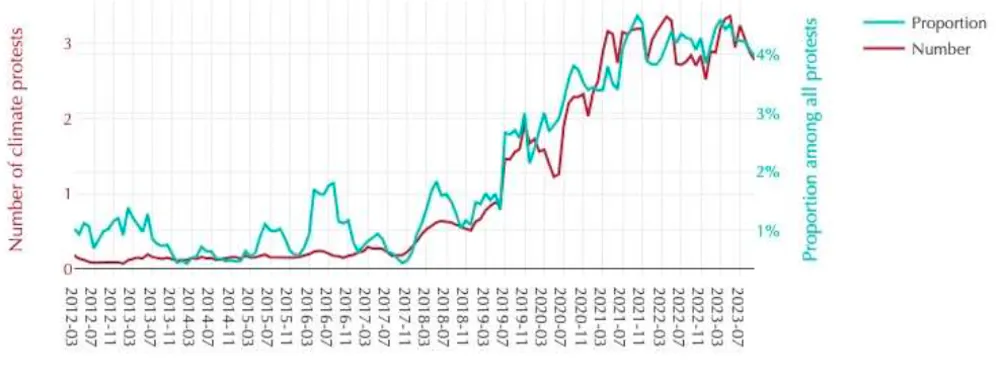
    To look more closely at the global picture of climate and environmental protest – and the repression of it – we used the Armed Conflicts Location Event database. This showed us that climate protests increased dramatically in 2018-2019 and have not declined since. They make up on average about 4% of all protest in the 81 countries that had more than 1,000 protests recorded in the 2012-2023 period:

    Climate protests increased sharply in the late 2010s in the 14 countries studied. (Data is smoothed over five months; number of protests is per country per month.)
    Berglund et al; Data: ACLED, CC BY-SA

    This second graph shows that environmental protest has increased more gradually:

    Environmental protests in the same 14 countries.
    Data: ACLED, CC BY-SA

    We used this data to see what kind of repression activists face. By looking for keywords in the reporting of protest events, we found that on average 3% of climate and environmental protests face police violence, and 6.3% involve arrests. But behind these averages are large differences in the nature of protest and its policing.

    A combination of the presence of protest groups like Extinction Rebellion, who often actively seek arrests, and police forces that are more likely to make arrests, mean countries such as Australia and the UK have very high levels of arrest. Some 20% of Australian climate and environmental protests involve arrests, against 17% in the UK – with the highest in the world being Canada on 27%.

    Meanwhile, police violence is high in countries such as Peru (6.5%) and Uganda (4.4%). France stands out as a European country with relatively high levels of police violence (3.2%) and low levels of arrests (also 3.2%).

    In summary, while criminalisation and repression does not look the same across the world, there are remarkable similarities. It is increasing in a lot of countries, it involves both state and corporate actors, and it takes many forms.

    This repression is taking place in a context where states are not taking adequate action on climate change. By criminalising activists, states depoliticise them. This conceals the fact these activists are ultimately right about the state of the climate and environment – and the lack of positive government action in these areas.

    Oscar Berglund is a member of the Green Party. The report this article is based on was written with Christina Pantazis, Chris Rossdale and Roxana Pessoa Cavalcanti.

    Tie Franco Brotto does not work for, consult, own shares in or receive funding from any company or organisation that would benefit from this article, and has disclosed no relevant affiliations beyond their academic appointment.

    ref. Repression of climate and environmental protest is intensifying across the world – https://theconversation.com/repression-of-climate-and-environmental-protest-is-intensifying-across-the-world-246379

    MIL OSI – Global Reports

  • MIL-OSI Economics: sante-Itd.com.co: BaFin investigates Sante Limited

    Source: Bundesanstalt für Finanzdienstleistungsaufsicht – In English

    The Federal Financial Supervisory Authority (BaFin) warns consumers about the company Sante Limited and the services it is offering. BaFin has information that the company is offering banking business and/or financial services on its website sante-Itd.com.co without the required authorisation. The company is not supervised by BaFin.

    Banking business and financial services may only be offered in Germany with authorisation from BaFin. However, some companies offer these services without the required authorisation. Information on whether particular companies have been authorised by BaFin can be found in BaFin’s database of companies.

    The information provided by BaFin is based on section 37 (4) of the German Banking Act (Kreditwesengesetz – KWG).

    Please be aware:

    BaFin, the German Federal Criminal Police Office (BundeskriminalamtBKA) and the German state criminal police offices (Landeskriminalämter) recommend that consumers seeking to invest money online should exercise the utmost caution and do the necessary research beforehand in order to identify fraud attempts at an early stage.

    MIL OSI Economics

  • MIL-OSI Global: Why there’s no such thing as normal in child development

    Source: The Conversation – UK – By Samuel Forbes, Associate Professor in Psychology, Durham University

    Hasnuddin/Shutterstock

    For parents, carers and teachers, it’s often tempting to base our thinking on a child’s development around what we understand as “normal”. Much of the time we do this without thinking, describing a child as “doing well” in one subject and “behind” in another.

    Whenever we make this sort of comparison, we have some sort of mental benchmark or yardstick in our head: for example, a toddler should be able to climb on furniture by age two. Increasingly, child development researchers are arguing that the same thing happens in child development research — the study of how behaviours and abilities such as language develop.

    Many of the studies that claim to research child development either implicitly, or explicitly, claim that their findings are universal.

    There could be many reasons for this. Sometimes there’s a temptation to oversell conclusions, sometimes it might be the way findings are interpreted by readers or the media. The upshot is that what’s been found in one group of children is then taken as the standard — the yardstick against which future research is compared.

    Most of the research into how children develop comes from wealthier, western countries, in particular the US, the UK, the Netherlands, Germany and France. Chances are, if you’ve heard of milestones in child development, they were developed in one of these countries.

    This is so much so that it can be challenging to do basic research on child development in developing countries, as peers and reviewers will ask for or demand comparisons to western populations to put findings from these regions in context. Of course without realising it, these peers and reviewers have set up western children as a norm.

    Most of the existing academic research on child development comes from western countries.
    Olesia Bilkei/Shutterstock

    But is it fair to make these comparisons? One of the tricky things about researching child development is that it occurs within a cultural and social context it can’t be removed from. But this context is often messy. Differences in physical environment, parenting styles, location, climate and so on all interact to shape how children grow.

    Besides these differences, there is individual variation as well. These could be, for instance, curiosity, shyness and neurodiversity, which can all frame how a child shapes their own learning environment.

    Take for example the field of motor development in infancy – the study of
    how children learn to move. Many parents in particular might be familiar with charts showing when they can expect their child to sit, crawl, stand and run. The existence of these charts make it seem pretty universal, and often a child’s motor development is judged accordingly.

    This makes sense. Early research was preoccupied with finding out what was normal, and it makes sense to try to support children who might be at risk of falling behind. The timing and order investigated back then led to the norms and scales we still use today.

    Is something like motor development timing universal? It’s easy to imagine that it might be. When there are no physical or cognitive barriers we all learn to sit and stand, so on the surface it seems fair to say this could be.

    But it turns out that the context that children develop in plays a huge role even
    in something as seemingly universal as this. In countries and
    cultures where babies routinely receive firm massages from caregivers, such as in Jamaica, motor development is accelerated. It’s clear that a norm developed in one culture might not translate well to another.

    Beyond norms

    It’s clear to see that the problems highlighted above are not unique to motor development. In areas like language development or social development the cultural component is even more compelling.

    There is simply no way of understanding these elements of child development without also understanding the context in which they take place. Every child is developing within a context and however normal our own culture feels to us, there is no objective context-free norm that we can compare other children to. That is, to say, we should embrace the mess.

    If we think of normal child development as being something that just happens, researchers miss out on understanding the dynamics of development itself. But worse, educators and caregivers might not realise development is something we can act upon, and miss an opportunity to enact change.

    An important part of seeing child development as being intertwined with culture is that it doesn’t just mean collecting data from other cultures, but involving local communities and research perspectives. Understanding communities means listening to them, empowering them and making space for them to have a voice.

    Moving beyond a western-centric understanding of child development won’t just benefit researchers and lead to more accurate science, but hopefully benefit everyone working with children around the world.

    The authors do not work for, consult, own shares in or receive funding from any company or organisation that would benefit from this article, and have disclosed no relevant affiliations beyond their academic appointment.

    ref. Why there’s no such thing as normal in child development – https://theconversation.com/why-theres-no-such-thing-as-normal-in-child-development-244681

    MIL OSI – Global Reports

  • MIL-OSI Economics: AD 12-month diagnosed prevalent cases to reach 42.42 million in 7MM by 2033, forecasts GlobalData

    Source: GlobalData

    AD 12-month diagnosed prevalent cases to reach 42.42 million in 7MM by 2033, forecasts GlobalData

    Posted in Pharma

    The burden of 12-month diagnosed prevalent cases of atopic dermatitis (AD) is forecast to increase at an annual growth rate (AGR) of 0.10% from around 42.02 million cases in 2023 to 42.42 million cases in 2033 in the seven major markets (7MM*), according to GlobalData, a leading data and analytics company.

    GlobalData’s latest report, “Atopic Dermatitis (AD): Epidemiology Forecast to 2033”, reveals AD cases are rising because of the increasing prevalence of environmental and lifestyle risk factors and the increase in incidence of AD in adulthood.

    Yixuan Zhang, MSc, Epidemiologist at GlobalData, comments: “The pathogenesis of AD is unclear and most likely stems from the interaction of a combination of genetic susceptibility, environmental and lifestyle risk factors, and dysfunctional cell-mediated immunity.”

    According to GlobalData epidemiologists, there were around 44% of mild 12-month diagnosed prevalent cases of AD, 42% moderate cases of AD, and 14% severe cases of AD in 2023 in the 7MM.

    AD is a complex disease presenting with a range of clinical manifestations and symptoms, depending on the patient demographic and disease severity. In severe cases, AD is associated with sleep disturbances due to the pruritic rashes that appear on the skin during a flare-up, depression and anxiety, and loss of productivity, contributing to the economic and disease burden globally.

    Zhang concludes: “The highest prevalence is seen in childhood, followed by the middle-aged and older population. A positive correlation has been found between a country’s gross domestic product (GDP) and disease burden. However, new epidemiological patterns are slowly emerging, such as AD prevalence increasing in low-income countries and new AD-onset in adults becoming increasingly more common, particularly in the West.”

    *7MM: The US, France, Germany, Italy, Spain, the UK, and Japan.

    MIL OSI Economics

  • MIL-OSI Security: United States Charges Dual Russian and Israeli National as Developer of LockBit Ransomware Group

    Source: United States Attorneys General

    Defendant Rostislav Panev in Custody Pending Extradition from Israel to the United States

    Note: A copy of the superseding criminal complaint can be found here.

    A superseding criminal complaint filed in the District of New Jersey was unsealed today charging a dual Russian and Israeli national for being a developer of the LockBit ransomware group.

    In August, Rostislav Panev, 51, a dual Russian and Israeli national, was arrested in Israel pursuant to a U.S. provisional arrest request with a view towards extradition to the United States. Panev is currently in custody in Israel pending extradition on the charges in the superseding complaint.

    “The Justice Department’s work going after the world’s most dangerous ransomware schemes includes not only dismantling networks, but also finding and bringing to justice the individuals responsible for building and running them,” said Attorney General Merrick B. Garland. “Three of the individuals who we allege are responsible for LockBit’s cyberattacks against thousands of victims are now in custody, and we will continue to work alongside our partners to hold accountable all those who lead and enable ransomware attacks.”

    “The arrest of Mr. Panev reflects the Department’s commitment to using all its tools to combat the ransomware threat,” said Deputy Attorney General Lisa Monaco. “We started this year with a coordinated international disruption of LockBit — the most damaging ransomware group in the world. Fast forward to today and three LockBit actors are in custody thanks to the diligence of our investigators and our strong partnerships around the world. This case is a model for ransomware investigations in the years to come.”

    “The arrest of alleged developer Ratislav Panev is part of the FBI’s ongoing efforts to disrupt and dismantle the LockBit ransomware group, one of the most prolific ransomware variants across the globe,” said FBI Director Christopher Wray. “The LockBit group has targeted both public and private sector victims around the world, including schools, hospitals, and critical infrastructure, as well as small businesses and multi-national corporations.  No matter how hidden or advanced the threat, the FBI remains committed to working with our interagency partners to safeguard the cyber ecosystem and hold accountable those who are responsible for these criminal activities.” 

    “The criminal complaint alleges that Rotislav Panev developed malware and maintained the infrastructure for LockBit, which was once the world’s most destructive ransomware group and attacked thousands of victims, causing billions of dollars in damage,” said Principal Deputy Assistant Attorney General Nicole M. Argentieri, head of the Justice Department’s Criminal Division. “Along with our domestic and international law enforcement partner actions to dismantle LockBit’s infrastructure, the Criminal Division has disrupted LockBit’s operations by charging seven of its key members (including affiliates, developers, and its administrator) and arresting three of these defendants — including Panev. We are especially grateful for our partnerships with authorities in Europol, the United Kingdom, France, and Israel, which show that, when likeminded countries work together, cybercriminals will find it harder to escape justice.”

    “As alleged by the complaint, Rostislav Panev for years built and maintained the digital weapons that enabled his LockBit coconspirators to wreak havoc and cause billions of dollars in damage around the world,” said U.S. Attorney Philip R. Sellinger for the District of New Jersey. “But just like the six other LockBit members previously identified and charged by this office and our FBI and Criminal Division partners, Panev could not remain anonymous and avoid justice indefinitely. He must now answer for his crimes. Today’s announcement represents another blow struck by the United States and our international partners against the LockBit organization, and our efforts will continue relentlessly until the group is fully dismantled and its members brought to justice.”

    According to the superseding complaint, documents filed in this and related cases, and statements made in court, Panev acted as a developer of the LockBit ransomware group from its inception in or around 2019 through at least February 2024. During that time, Panev and his LockBit coconspirators grew LockBit into what was, at times, the most active and destructive ransomware group in the world. The LockBit group attacked more than 2,500 victims in at least 120 countries around the world, including 1,800 in the United States. Their victims ranged from individuals and small businesses to multinational corporations, including hospitals, schools, nonprofit organizations, critical infrastructure, and government and law-enforcement agencies. LockBit’s members extracted at least $500 million in ransom payments from their victims and caused billions of dollars in other losses, including lost revenue and costs from incident response and recovery.

    LockBit’s members comprised “developers,” like Panev, who designed the LockBit malware code and maintained the infrastructure on which LockBit operated. LockBit’s other members, called “affiliates,” carried out LockBit attacks and extorted ransom payments from LockBit victims. LockBit’s developers and affiliates would then split ransom payments extorted from victims.

    As alleged in the superseding complaint, at the time of Panev’s arrest in Israel in August, law enforcement discovered on Panev’s computer administrator credentials for an online repository that was hosted on the dark web and stored source code for multiple versions of the LockBit builder, which allowed LockBit’s affiliates to generate custom builds of the LockBit ransomware malware for particular victims. On that repository, law enforcement also discovered source code for LockBit’s StealBit tool, which helped LockBit affiliates exfiltrate data stolen through LockBit attacks. Law enforcement also discovered access credentials for the LockBit control panel, an online dashboard maintained by LockBit developers for LockBit’s affiliates and hosted by those developers on the dark web.

    The superseding complaint also alleges that Panev exchanged direct messages through a cybercriminal forum with LockBit’s primary administrator, who, in an indictment unsealed in the District of New Jersey in May, the United States alleged to be Dimitry Yuryevich Khoroshev (Дмитрий Юрьевич Хорошев), also known as LockBitSupp, LockBit, and putinkrab. In those messages, Panev and the LockBit primary administrator discussed work that needed to be done on the LockBit builder and control panel.

    Court documents further indicate that, between June 2022 and February 2024, the primary LockBit administrator made a series of transfers of cryptocurrency, laundered through one or more illicit cryptocurrency mixing services, of approximately $10,000 per month to a cryptocurrency wallet owned by Panev. Those transfers amounted to over $230,000 during that period.

    In interviews with Israeli authorities following his arrest in August, Panev admitted to having performed coding, development, and consulting work for the LockBit group and to having received regular payments in cryptocurrency for that work, consistent with the transfers identified by U.S. authorities. Among the work that Panev admitted to having completed for the LockBit group was the development of code to disable antivirus software; to deploy malware to multiple computers connected to a victim network; and to print the LockBit ransom note to all printers connected to a victim network. Panev also admitted to having written and maintained LockBit malware code and to having provided technical guidance to the LockBit group.

    The LockBit Investigation

    The superseding complaint against, and apprehension of, Panev follows a disruption of LockBit ransomware in February by the United Kingdom (U.K.)’s National Crime Agency (NCA)’s Cyber Division, which worked in cooperation with the Justice Department, FBI, and other international law enforcement partners. As previously announced by the Department, authorities disrupted LockBit by seizing numerous public-facing websites used by LockBit to connect to the organization’s infrastructure and by seizing control of servers used by LockBit administrators, thereby disrupting the ability of LockBit actors to attack and encrypt networks and extort victims by threatening to publish stolen data. That disruption succeeded in greatly diminishing LockBit’s reputation and its ability to attack further victims, as alleged by documents filed in this case.

    The superseding complaint against Panev also follows charges brought in the District of New Jersey against other LockBit members, including its alleged primary creator, developer, and administrator, Dmitry Yuryevich Khoroshev. An indictment against Khoroshev unsealed in May alleges that Khoroshev began developing LockBit as early as September 2019, continued acting as the group’s administrator through 2024, a role in which Khoroshev recruited new affiliate members, spoke for the group publicly under the alias “LockBitSupp,” and developed and maintained the infrastructure used by affiliates to deploy LockBit attacks. Khoroshev is currently the subject of a reward of up to $10 million through the U.S. Department of State’s Transnational Organized Crime (TOC) Rewards Program, with information accepted through the FBI tip website at www.tips.fbi.gov/.

    A total of seven LockBit members have now been charged in the District of New Jersey. Beyond Panev and Khoroshev, other previously charged LockBit defendants include:

    • In July, two LockBit affiliate members, Mikhail Vasiliev, also known as Ghostrider, Free, Digitalocean90, Digitalocean99, Digitalwaters99, and Newwave110, and Ruslan Astamirov, also known as BETTERPAY, offtitan, and Eastfarmer, pleaded guilty in the District of New Jersey for their participation in the LockBit ransomware group and admitted deploying multiple LockBit attacks against U.S. and foreign victims. Vasiliev and Astamirov are presently in custody awaiting sentencing.
    • In February, in parallel with the disruption operation described above, an indictment was unsealed in the District of New Jersey charging Russian nationals Artur Sungatov and Ivan Kondratyev, also known as Bassterlord, with deploying LockBit against numerous victims throughout the United States, including businesses nationwide in the manufacturing and other industries, as well as victims around the world in the semiconductor and other industries. Sungatov and Kondratyev remain at large.
    • In May 2023, two indictments were unsealed in Washington, D.C., and the District of New Jersey charging Mikhail Matveev, also known as Wazawaka, m1x, Boriselcin, and Uhodiransomwar, with using different ransomware variants, including LockBit, to attack numerous victims throughout the United States, including the Washington, D.C., Metropolitan Police Department. Matveev remains at large and is currently the subject of a reward of up to $10 million through the U.S. Department of State’s TOC Rewards Program, with information accepted through the FBI tip website at www.tips.fbi.gov/.

    The U.S. Department of State’s TOC Rewards Program is offering rewards of:

    Information is accepted through the FBI tip website at tips.fbi.gov.

    Khoroshev, Matveev, Sungatov, and Kondratyev have also been designated for sanctions by the Department of the Treasury’s Office of Foreign Assets Control for their roles in launching cyberattacks.

    Victim Assistance

    LockBit victims are encouraged to contact the FBI and submit information at www.ic3.gov/. As announced by the Department in February, law enforcement, through its disruption efforts, has developed decryption capabilities that may enable hundreds of victims around the world to restore systems encrypted using the LockBit ransomware variant. Submitting information at the IC3 site will enable law enforcement to determine whether affected systems can be successfully decrypted.

    LockBit victims are also encouraged to visit www.justice.gov/usao-nj/lockbit for case updates and information regarding their rights under U.S. law, including the right to submit victim impact statements and request restitution, in the criminal litigation against Panev, Astamirov, and Vasiliev.

    The FBI Newark Field Office, under the supervision of Acting Special Agent in Charge Nelson I. Delgado, is investigating the LockBit ransomware variant. Israel’s Office of the State Attorney, Department of International Affairs, and Israel National Police; France’s Gendarmerie Nationale Cyberspace Command, Paris Prosecution Office — Cyber Division, and judicial authorities at the Tribunal Judiciare of Paris; Europol; Eurojust; the U.K.’s NCA; Germany’s Landeskriminalamt Schleswig-Holstein, Bundeskriminalamt, and the Central Cybercrime Department North Rhine-Westphalia; Switzerland’s Federal Office of Justice, Public Prosecutor’s Office of the Canton of Zurich, and Zurich Cantonal Police; Spain’s Policia Nacional and Guardia Civil; Japan’s National Police Agency; Australian Federal Police; Sweden’s Polismyndighetens; Canada’s Royal Canadian Mounted Police; Politie Dienst Regionale Recherche Oost-Brabant of the Netherlands; and Finland’s National Bureau of Investigation have provided significant assistance and coordination in these matters and in the LockBit investigation generally.

    Trial Attorneys Debra Ireland and Jorge Gonzalez of the Criminal Division’s Computer Crime and Intellectual Property Section (CCIPS) and Assistant U.S. Attorneys Andrew M. Trombly, David E. Malagold, and Vinay Limbachia for the District of New Jersey are prosecuting the charges against Panev and the other previously charged LockBit defendants in the District of New Jersey.

    The Justice Department’s Cybercrime Liaison Prosecutor to Eurojust, Office of International Affairs, and National Security Division also provided significant assistance.

    Additional details on protecting networks against LockBit ransomware are available at StopRansomware.gov. These include Cybersecurity and Infrastructure Security Agency Advisories AA23-325A, AA23-165A, and AA23-075A. 

    A criminal complaint is merely an allegation. All defendants are presumed innocent until proven guilty beyond a reasonable doubt in a court of law.

    MIL Security OSI

  • MIL-OSI United Kingdom: Joint statement on Afghanistan

    Source: United Kingdom – Executive Government & Departments

    Joint statement on the situation in Afghanistan following a G7+ meeting in Geneva

    Special Envoys and Representatives for Afghanistan of Canada, the European Union, France, Germany, Italy, Japan, Norway, the Republic of Korea, Switzerland, Türkiye, the United Kingdom, and the United States met in Geneva on December 16, 2024 to discuss the situation in Afghanistan. Deputy Special Representative for Afghanistan in the United Nations Assistance Mission in Afghanistan (UNAMA), Special Rapporteur on the situation of human rights, Representatives of the World Bank (WB) and of the Organisation of Islamic Cooperation (OIC) also participated in the meeting as observers.

    The Special Envoys and Representatives for Afghanistan:

    1. Expressed grave concern over the Taliban’s decisions in December 2024 to ban women and girls from attending public and private medical training institutions; and expressed concern that this new ban will have devastating consequences for all Afghans, especially mothers and infants – both born and unborn, both boys and girls – and will further destabilize an already fragile healthcare system. These decisions, which come on the back of the Taliban’s “Law on the Promotion of Virtue and the Prevention of Vice” announced in August 2024, expand upon the already over 80 repressive, discriminatory edicts aimed at excluding Afghan women and girls from education, public and economic life. We call for the immediate reversal of these unacceptable practices and policies.

    2. Noted with grave concern recent terrorist attacks in Kabul and the region, as well as the continuing threat terrorism poses to security and stability in Afghanistan; and acknowledged the Taliban actions to tackle terrorist threats from ISIS-K, while recalling the need for the Taliban to pursue actions to tackle terrorist threats, in accordance with Resolution 2593 of the United Nations Security Council and underscoring that some terrorist groups still reside safely inside Afghanistan and are able to plan and carry-out internal and cross-border terrorist strikes.

    3. Underscored that achieving long-term stability in Afghanistan requires a credible and inclusive national dialogue leading to a constitutional order with a representative and inclusive political system, as well as accountable political leaders and the State of Afghanistan meeting its international obligations.

    4. Emphasized the need for implementation of UN Security Council Resolution 2721 (2023), which took positive note of the UN’s independent assessment prepared pursuant to UNSCR 2679 (2023), encouraged member states and all other relevant stakeholders to consider implementation of its recommendations and requested the UN Secretary General to appoint a Special Envoy for Afghanistan to take forward a process between Afghan stakeholders and the international community for long term peace and stability in Afghanistan.

    5. Commended the work of the United Nations, including the UN-led Doha Process, and recognized the important and specific work of UNAMA, UN agencies present in the country, the World Bank, the Asian Development Bank and the many international and local NGOs and other humanitarian actors that continue to support the people of Afghanistan through ongoing social and humanitarian crisis.

    6. Reaffirmed that international NGOs are indispensable to humanitarian work in Afghanistan; and reinforced the importance of a united humanitarian response that includes representation from UN agencies, international and national NGOs, and other humanitarian actors.

    7. Highlighted the necessity to continue helping Afghans who are suffering in the ongoing humanitarian crisis with appropriate consideration for vulnerable populations, including women and women-led households, children and members of ethnic and religious minority communities.

    8. Looked forward to deepening engagement with neighbouring countries and other countries of the region on a joint response to the developing situation in Afghanistan, including countering potential threats such as terrorism and illegal migration to regional security and stability emanating from Afghanistan; commended the efforts of Muslim-majority countries and the OIC in engaging with the Taliban on women’s and girls’ rights and welcomed the leadership they have demonstrated on issues such as access to education and encouraged them to continue their active engagement on these and related issues.

    9. Expressed their appreciation to Switzerland for organizing these consultations and hosting the meeting; and looked forward to this Group of Special Envoys and Representatives meeting again in the near future.

    Media enquiries

    Email newsdesk@fcdo.gov.uk

    Telephone 020 7008 3100

    Contact the FCDO Communication Team via email (monitored 24 hours a day) in the first instance, and we will respond as soon as possible.

    Updates to this page

    Published 20 December 2024

    MIL OSI United Kingdom

  • MIL-OSI Security: U.S. Charges Dual Russian And Israeli National As Developer Of Lockbit Ransomware Group

    Source: Office of United States Attorneys

    Defendant Rostislav Panev in Custody Pending Extradition from Israel to the United States

    NEWARK, N.J. – A superseding criminal complaint filed in the District of New Jersey was unsealed today charging a dual Russian and Israeli national for being a developer of the LockBit ransomware group, U.S. Attorney Philip R. Sellinger announced.

    In August, Rostislav Panev, 51, a dual Russian and Israeli national, was arrested in Israel pursuant to a U.S. provisional arrest request with a view towards extradition to the United States. Panev is currently in custody in Israel pending extradition on the charges lodged in the superseding complaint.

    “As alleged by the complaint, Rostislav Panev for years built and maintained the digital weapons that enabled his LockBit coconspirators to wreak havoc and cause billions of dollars in damage around the world. But just like the six other LockBit members previously identified and charged by this office and our FBI and Criminal Division partners, Panev could not remain anonymous and avoid justice indefinitely. He must now answer for his crimes. Today’s announcement represents another blow struck by the United States and our international partners against the LockBit organization, and our efforts will continue relentlessly until the group is fully dismantled and its members brought to justice.”

    U.S. Attorney Philip R. Sellinger

    “The Justice Department’s work going after the world’s most dangerous ransomware schemes includes not only dismantling networks, but also finding and bringing to justice the individuals responsible for building and running them,” said Attorney General Merrick B. Garland. “Three of the individuals who we allege are responsible for LockBit’s cyberattacks against thousands of victims are now in custody, and we will continue to work alongside our partners to hold accountable all those who lead and enable ransomware attacks.”

    “The arrest of Mr. Panev reflects the Department’s commitment to using all its tools to combat the ransomware threat,” said Deputy Attorney General Lisa Monaco. “We started this year with a coordinated international disruption of LockBit — the most damaging ransomware group in the world. Fast forward to today and three LockBit actors are in custody thanks to the diligence of our investigators and our strong partnerships around the world. This case is a model for ransomware investigations in the years to come.”

    “The arrest of alleged developer Rostislav Panev is part of the FBI’s ongoing efforts to disrupt and dismantle the LockBit ransomware group, one of the most prolific ransomware variants across the globe,” said FBI Director Christopher Wray. “The LockBit group has targeted both public and private sector victims around the world, including schools, hospitals, and critical infrastructure, as well as small businesses and multi-national corporations. No matter how hidden or advanced the threat, the FBI remains committed to working with our interagency partners to safeguard the cyber ecosystem and hold accountable those who are responsible for these criminal activities.”

    “The criminal complaint alleges that Rotislav Panev developed malware and maintained the infrastructure for LockBit, which was once the world’s most destructive ransomware group and attacked thousands of victims, causing billions of dollars in damage,” said Principal Deputy Assistant Attorney General Nicole M. Argentieri, head of the Justice Department’s Criminal Division. “Along with our domestic and international law enforcement partner actions to dismantle LockBit’s infrastructure, the Criminal Division has disrupted LockBit’s operations by charging seven of its key members (including affiliates, developers, and its administrator) and arresting three of these defendants — including Panev. We are especially grateful for our partnerships with authorities in Europol, the United Kingdom, France, and Israel, which show that, when likeminded countries work together, cybercriminals will find it harder to escape justice.”

    “For five years, Panev helped to grow LockBit into a ransomware machine of deception and extortion,” said Acting Special Agent in Charge Nelson I. Delgado of the FBI Newark Field Office.  “His reach was far and wide but FBI Newark and our international law enforcement partners were able to disrupt his reign. Panev’s arrest marks a victory against these conspirators, and is a step towards upholding justice and neutralizing these criminals.”

    According to the superseding complaint, documents filed in this and related cases, and statements made in court, Panev acted as a developer of the LockBit ransomware group from its inception in or around 2019 through at least February 2024. During that time, Panev and his LockBit coconspirators grew LockBit into what was, at times, the most active and destructive ransomware group in the world. The LockBit group attacked more than 2,500 victims in at least 120 countries around the world, including 1,800 in the United States. Their victims ranged from individuals and small businesses to multinational corporations, including hospitals, schools, nonprofit organizations, critical infrastructure, and government and law-enforcement agencies. LockBit’s members extracted at least $500 million in ransom payments from their victims and caused billions of dollars in other losses, including lost revenue and costs from incident response and recovery.

    LockBit’s members comprised “developers,” like Panev, who designed the LockBit malware code and maintained the infrastructure on which LockBit operated. LockBit’s other members, called “affiliates,” carried out LockBit attacks and extorted ransom payments from LockBit victims. LockBit’s developers and affiliates would then split ransom payments extorted from victims.

    As alleged in the superseding complaint, at the time of Panev’s arrest in Israel in August, law enforcement discovered on Panev’s computer administrator credentials for an online repository that was hosted on the dark web and stored source code for multiple versions of the LockBit builder, which allowed LockBit’s affiliates to generate custom builds of the LockBit ransomware malware for particular victims. On that repository, law enforcement also discovered source code for LockBit’s StealBit tool, which helped LockBit affiliates exfiltrate data stolen through LockBit attacks. Law enforcement also discovered access credentials for the LockBit control panel, an online dashboard maintained by LockBit developers for LockBit’s affiliates and hosted by those developers on the dark web.

    The superseding complaint also alleges that Panev exchanged direct messages through a cybercriminal forum with LockBit’s primary administrator, who, in an indictment unsealed in the District of New Jersey in May, the United States alleged to be Dimitry Yuryevich Khoroshev (Дмитрий Юрьевич Хорошев), also known as LockBitSupp, LockBit, and putinkrab. In those messages, Panev and the LockBit primary administrator discussed work that needed to be done on the LockBit builder and control panel.

    Court documents further indicate that, between June 2022 and February 2024, the primary LockBit administrator made a series of transfers of cryptocurrency, laundered through one or more illicit cryptocurrency mixing services, of approximately $10,000 per month to a cryptocurrency wallet owned by Panev. Those transfers amounted to over $230,000 during that period.

    In interviews with Israeli authorities following his arrest in August, Panev admitted to having performed coding, development, and consulting work for the LockBit group and to having received regular payments in cryptocurrency for that work, consistent with the transfers identified by U.S. authorities. Among the work that Panev admitted to having completed for the LockBit group was the development of code to disable antivirus software; to deploy malware to multiple computers connected to a victim network; and to print the LockBit ransom note to all printers connected to a victim network. Panev also admitted to having written and maintained LockBit malware code and to having provided technical guidance to the LockBit group.

    The LockBit Investigation

    The superseding complaint against, and apprehension of, Panev follows a disruption of LockBit ransomware in February by the U.K. National Crime Agency (NCA)’s Cyber Division, which worked in cooperation with the Justice Department, FBI, and other international law enforcement partners. As previously announced by the Department, authorities disrupted LockBit by seizing numerous public-facing websites used by LockBit to connect to the organization’s infrastructure and by seizing control of servers used by LockBit administrators, thereby disrupting the ability of LockBit actors to attack and encrypt networks and extort victims by threatening to publish stolen data. That disruption succeeded in greatly diminishing LockBit’s reputation and its ability to attack further victims, as alleged by documents filed in this case.

    The superseding complaint against Panev also follows charges brought in the District of New Jersey against other LockBit members, including its alleged primary creator, developer, and administrator, Dmitry Yuryevich Khoroshev. An indictment against Khoroshev unsealed in May alleges that Khoroshev began developing LockBit as early as September 2019, continued acting as the group’s administrator through 2024, a role in which Khoroshev recruited new affiliate members, spoke for the group publicly under the alias “LockBitSupp,” and developed and maintained the infrastructure used by affiliates to deploy LockBit attacks. Khoroshev is currently the subject of a reward of up to $10 million through the U.S. Department of State’s Transnational Organized Crime (TOC) Rewards Program, with information accepted through the FBI tip website at www.tips.fbi.gov/.

    A total of seven LockBit members have now been charged in the District of New Jersey. Beyond Panev and Khoroshev, other previously charged LockBit defendants include:

    • In July, two LockBit affiliate members, Mikhail Vasiliev, also known as Ghostrider, Free, Digitalocean90, Digitalocean99, Digitalwaters99, and Newwave110, and Ruslan Astamirov, also known as BETTERPAY, offtitan, and Eastfarmer, pleaded guilty in the District of New Jersey for their participation in the LockBit ransomware group and admitted deploying multiple LockBit attacks against U.S. and foreign victims. Vasiliev and Astamirov are presently in custody awaiting sentencing.
    • In February, in parallel with the disruption operation described above, an indictment was unsealed in the District of New Jersey charging Russian nationals Artur Sungatov and Ivan Kondratyev, also known as Bassterlord, with deploying LockBit against numerous victims throughout the United States, including businesses nationwide in the manufacturing and other industries, as well as victims around the world in the semiconductor and other industries. Sungatov and Kondratyev remain at large.
    • In May 2023, two indictments were unsealed in Washington, D.C., and the District of New Jersey charging Mikhail Matveev, also known as Wazawaka, m1x, Boriselcin, and Uhodiransomwar, with using different ransomware variants, including LockBit, to attack numerous victims throughout the United States, including the Washington, D.C., Metropolitan Police Department. Matveev remains at large and is currently the subject of a reward of up to $10 million through the U.S. Department of State’s TOC Rewards Program, with information accepted through the FBI tip website at www.tips.fbi.gov/.

    The U.S. Department of State’s Transnational Organized Crime (TOC) Rewards Program is offering rewards of:

    Information is accepted through the FBI tip website at tips.fbi.gov.

    Khoroshev, Matveev, Sungatov, and Kondratyev have also been designated for sanctions by the Department of the Treasury’s Office of Foreign Assets Control for their roles in launching cyberattacks.

    Victim Assistance

    LockBit victims are encouraged to contact the FBI and submit information at www.ic3.gov. As announced by the Department in February, law enforcement, through its disruption efforts, has developed decryption capabilities that may enable hundreds of victims around the world to restore systems encrypted using the LockBit ransomware variant. Submitting information at the IC3 site will enable law enforcement to determine whether affected systems can be successfully decrypted.

    LockBit victims are also encouraged to visit www.justice.gov/usao-nj/lockbit for case updates and information regarding their rights under U.S. law, including the right to submit victim impact statements and request restitution, in the criminal litigation against Panev, Astamirov, and Vasiliev.

    The FBI Newark Field Office, under the supervision of Acting Special Agent in Charge Nelson I. Delgado, is investigating the LockBit ransomware variant. Israel’s Office of the State Attorney, Department of International Affairs, and Israel National Police; France’s Gendarmerie Nationale Cyberspace Command, Paris Prosecution Office — Cyber Division, and judicial authorities at the Tribunal Judiciare of Paris; Europol; Eurojust; the United Kingdom’s National Crime Agency; Germany’s Landeskriminalamt Schleswig-Holstein, Bundeskriminalamt, and the Central Cybercrime Department North Rhine-Westphalia; Switzerland’s Federal Office of Justice, Public Prosecutor’s Office of the Canton of Zurich, and Zurich Cantonal Police; Spain’s Policia Nacional and Guardia Civil; Japan’s National Police Agency; Australian Federal Police; Sweden’s Polismyndighetens; Canada’s Royal Canadian Mounted Police; Politie Dienst Regionale Recherche Oost-Brabant of the Netherlands; and Finland’s National Bureau of Investigation have provided significant assistance and coordination in these matters and in the LockBit investigation generally.

    Assistant U.S. Attorneys Andrew M. Trombly, David E. Malagold, and Vinay Limbachia for the District of New Jersey and Trial Attorneys Debra Ireland and Jorge Gonzalez of the Criminal Division’s Computer Crime and Intellectual Property Section (CCIPS) are prosecuting the charges against Panev and the other previously charged LockBit defendants in the District of New Jersey.

    The Justice Department’s Cybercrime Liaison Prosecutor to Eurojust, Office of International Affairs, and National Security Division also provided significant assistance.

    Additional details on protecting networks against LockBit ransomware are available at StopRansomware.gov. These include Cybersecurity and Infrastructure Security Agency Advisories AA23-325A, AA23-165A, and AA23-075A. 

    The charges and allegations contained in the superseding complaint are merely accusations, and the defendant is presumed innocent unless and until proven guilty.

    Defense counsel: Frank Arleo, Esq.

    MIL Security OSI

  • MIL-OSI: Canadian Nuclear Laboratories and Karlsruhe Institute of Technology to Collaborate on Fusion, Materials and Hydrogen Science & Technology

    Source: GlobeNewswire (MIL-OSI)

    CHALK RIVER, Ontario, Dec. 20, 2024 (GLOBE NEWSWIRE) — Canadian Nuclear Laboratories (CNL), Canada’s premier nuclear science and technology organization, is pleased to announce that it has signed an agreement with the Karlsruhe Institute of Technology (KIT), Germany’s premier research institution, to pursue collaborative research related to fusion, materials characterization and hydrogen science and technology. With shared scientific missions to address national priorities in clean energy and environmental sciences, the agreement serves as a framework through which the national research organizations can collaborate in areas of mutual interest, leveraging their individual resources, facilities, and expertise.

    According to terms of the agreement, the organizations will explore collaborative research projects in fields that include tritium analytics, tritium barriers and surface analysis, tritium fuel cycle optimization, characterization and metallurgy of irradiated materials, and hydrogen safety. Working together, the organizations hope to realize important progress in the advancement of these fields of research and others, which are priorities to both country’s domestic clean energy research programs.

    “CNL is a world leader in nuclear science and technology, including hydrogen. We are now working to re-establish ourselves in fusion, which is yielding some very exciting commercial opportunities, and drawing the attention of other leading research organizations who share our goals in clean energy,” commented Dr. Stephen Bushby, CNL’s Vice-President of Science and Technology. “With the signing of this agreement with the Karlsruhe Institute of Technology, a leading German research institution that has complementary capabilities, CNL continues to expand its network and pursue even more ambitious collaborative research. By working together, I think we can help to accelerate these promising fields of study and contribute to much-needed progress in clean energy.”

    “With fusion taking momentum all around the world, Germany investing substantial amounts to promote the cooperation between National Labs and private actors in the field, and KIT being at the centre of fusion technologies and materials development in Germany and in Europe, it is quite straightforward for us to engage in an international cooperation that offers plenty of opportunities for world-leading developments, e.g., in the fusion fuel cycle, hydrogen, and materials areas,” said Dr. Klaus Hesch, Head of KIT´s Fusion Programme. “CNL´s tritium expertise derived from decades of scientifically-technically accompanying and enabling the operation of the CANDU reactors perfectly complements the experience we have acquired in our Tritium Laboratory Karlsruhe with regard to tritium handling and processing for fusion. There is interest to extend the cooperation both towards other fusion companies as well as to the European Fusion Programme.”

    CNL has decades of experience and expertise in materials characterization, hydrogen production, safety and storage, and tritium research, among other related fields of research. The Chalk River campus is also home to a state-of-the-art Tritium Facility and a Hydrogen Isotopes Technology Laboratory, as well as a rapidly growing fusion energy program. Not only did CNL recently announce the expansion of two of its flagship clean energy programs to include fusion – its advanced reactor siting program and the Canadian Nuclear Research Initiative (CNRI) – but CNL also invested $10 million into General Fusion, an international leader in commercial fusion energy. This is in addition to the launch of a new joint venture with Kyoto Fusioneering known as Fusion Fuel Cycles Inc. (FFC), which is moving forward with a globally unique test facility available to industry to test and refine their unique processes.

    All of these projects, programs and resources are complemented by those at KIT, which serves as one of the largest science institutions in Europe, with over 5,000 people conducting research on a broad range of disciplines, from natural sciences to engineering. KIT is also home to research centers that focus on problems of fundamental importance to the existence and further development of society, and on key issues resulting from the striving for knowledge, which includes climate and environment, energy, materials in technical and life sciences, and elementary particle and astroparticle physics, among others. With the agreement now serving as a framework to facilitate collaborative research activities, both organizations believe that it could also act as a first step towards a broader relationship that expands into other fields of research.

    If you’d like to learn more about CNL or its projects in clean energy and environmental sciences, please visit www.cnl.ca. For more information on KIT and its programs of work, please visit www.kit.edu.

    About CNL

    As Canada’s premier nuclear science and technology laboratory and working under the direction of Atomic Energy of Canada Limited (AECL), CNL is a world leader in the development of innovative nuclear science and technology products and services. Guided by an ambitious corporate strategy known as Vision 2030, CNL fulfills three strategic priorities of national importance – restoring and protecting the environment, advancing clean energy technologies, and contributing to the health of Canadians.

    By leveraging the assets owned by AECL, CNL also serves as the nexus between government, the nuclear industry, the broader private sector and the academic community. CNL works in collaboration with these sectors to advance innovative Canadian products and services towards real-world use, including carbon-free energy, cancer treatments and other therapies, non-proliferation technologies and waste management solutions.

    To learn more about CNL, please visit www.cnl.ca.

    About KIT

    Being “The Research University in the Helmholtz Association”, KIT creates and imparts knowledge for the society and the environment. It is the objective to make significant contributions to the global challenges in the fields of energy, mobility, and information. For this, about 10,000 employees cooperate in a broad range of disciplines in natural sciences, engineering sciences, economics, and the humanities and social sciences. KIT prepares its 22,800 students for responsible tasks in society, industry, and science by offering research-based study programs. Innovation efforts at KIT build a bridge between important scientific findings and their application for the benefit of society, economic prosperity, and the preservation of our natural basis of life. KIT is one of the German universities of excellence.

    To learn more about KIT, please visit www.kit.edu.

    CNL Contact:
    Philip Kompass
    Director, Corporate Communications
    1-866-886-2325
    media@cnl.ca

    A photo accompanying this announcement is available at https://www.globenewswire.com/NewsRoom/AttachmentNg/2147c02c-0c21-421c-8a37-e6f279aeb3ea

    The MIL Network

  • MIL-OSI Economics: Luis de Guindos: Interview with the Telegraaf

    Source: European Central Bank

    Interview with Luis de Guindos, Vice-President of the ECB, conducted by Wouter van Bergen and Martin Visser

    20 December 2024

    What has kept you awake over the past year?

    Looking back at recent times, I would say that my worst nightmare was that a cyber attack would wreak havoc in the payments system. We would have a complicated situation on our hands that would be very difficult to resolve and would have serious consequences for all of us.

    And what do you expect will keep you awake next year?

    For the future, I’m more concerned about trade policy and the potential fragmentation of the global economy. The new US administration has announced far-reaching import tariffs. If they materialise, a wholly new situation could arise, which would go completely against the lessons from the 1930s and the path we have chosen since the end of the Second World War.

    Trump has introduced import tariffs before. What is different this time?

    It’s not only the import tariffs imposed by the United States that are the problem, but also the retaliation by other countries in response. If a trade war erupts, it would be extremely negative for the world economy, mainly for growth but also for inflation. For example, if you impose a 60% tariff on goods from China, which already has excess capacity, it would cause a diversion in trade flows and even impact exchange rates. Nobody knows where that will end.

    What can the ECB do about that?

    We’re not responsible for trade policy. We can provide our advice and explain that a trade war would be extremely detrimental for the world economy and a lose-lose situation for everyone, and that is why it is better to be prudent. But the response is up to the European Commission, and our role is to give our view and deal with the consequences.

    Might it also threaten the euro?

    It should be the other way around. If such threats emerge, the answer lies precisely in more European integration. The euro plays a hugely important role in that.

    But election results indicate that the population in many European countries is not that keen on it…

    I think that the European population is smart, and people are well aware that the uncertainties and risks are intensifying, and that becoming more fragmented within Europe would be the wrong response. My impression of populist politicians is that they propose simple solutions for highly complex problems.

    Immigration is one such complex problem…

    There is talk about restricting immigration, but looking at demographic developments in Europe, you see that the population is ageing. From an economic viewpoint, it is crystal clear that we need ordered immigration, so we should focus on properly managing its social impact.

    Are you concerned about the high levels of public debt in many Member States, such as France?

    Countries need to put in place credible and prudent fiscal consolidation plans. The fiscal rules were suspended for five years due to the COVID-19 pandemic and the energy crisis, but now we have a new fiscal framework, and it’s important to implement it accordingly. France is not the only country whose budget has not yet been approved. The same goes for Germany, Spain, Belgium and Austria. They know what they need to do, and I am convinced that they will act accordingly.

    Relative to GDP, public debt is indeed on average 10% higher than it was before the pandemic. At the same time, the situation in the southern European countries that were in trouble 12 years ago is much better now. Portugal now runs a budget surplus, as do Ireland and Cyprus. Greece and Italy are running primary surpluses. Precisely the ‘usual suspects’ back then are doing well now, thanks to the measures taken at the time.

    Former ECB President Mario Draghi painted a dire picture of the state of European competitiveness in a recent report. What can we do to restore it?

    The demographic reality is that our population is ageing. An ageing society takes less risks and innovates less. That’s why targeted immigration is so important. It’s something that Europe should reflect on from an economic perspective.

    Europe has other structural problems too, like the lack of a genuine single market for goods and services. The array of different rules applying throughout means that Europe is still highly fragmented, in contrast to the United States. We don’t have a real banking union as we don’t have a common deposit insurance scheme. And we don’t have a capital markets union, because there is no single capital market supervisor and insolvency laws still differ across countries. On top of that, we don’t have a fiscal union, unlike the United States. Savings are taxed differently everywhere in Europe, there are disparities in labour market rules and some exceptions to the temporary framework on state aid still have to be fully phased out.

    The list of necessary measures is long…

    Yes, there is a lot of work to do and the world is not going to wait for us. Because of the policies of the new United States administration, we may need to deal with import tariffs, uncertain fiscal policy, the possibility of deregulation in financial markets and, going beyond economics, even defence. This is a wake-up call for Europe.

    How can you remain optimistic in the face of such huge challenges?

    It’s not a question of optimism, but pragmatism. In Europe, there is only one way to preserve our current standard of living, and we will eventually choose the correct path.

    The inflation rate in the Netherlands has risen again to 4%. The ECB’s policy does not suit the situation in our country…

    In the euro area, we have seen that although there is an increase in households’ real disposable income because wages have started to catch up with past inflation, consumption is not recovering well. This is an issue of confidence, which has to do with past inflation, the lagging effects of the pandemic, and the current geopolitical landscape.

    People mainly look at prices and they now see that supermarket prices are much higher than they were two or three years ago. That’s why it’s so important that they realise that price levels are stabilising and wages are catching up. And not everything is negative, as labour markets are doing well.

    As the ECB, we have to look at the euro area average (at 2.2% in November, ed.). Dutch inflation is more volatile than average. We are confident that inflation will gradually decrease in the Netherlands too, and that inflation across the euro area will gradually converge towards our 2% target.

    What message do you have for Dutch consumers?

    You still have higher inflation, but inflation in the euro area has declined substantially and without a recession. You have very high employment, so wages are increasing and catching up with past inflation. The tight labour market also shows the need for targeted immigration.

    Do you already hold bitcoin?

    No, no bitcoin, but I know some people who do.

    You missed out on big gains…

    Yes, but I could just have gone to the casino [laughs]. The world of crypto-assets is a mixed bag, with stablecoins being very different from others like bitcoin. In general though, there are no fundamentals that determine the value of bitcoin, like there are for shares or bonds. There is only scarcity.

    Are crypto-assets a risk for the financial system?

    Not for now, there are few of them and volumes are still too small to pose material risks to the financial system.

    Europe is lagging behind the rest of the world. Out of the 50 largest tech companies, only three are European. Europeans heavily invest their funds on US stock exchanges and European banks can’t keep up with their US competitors. Is there still hope?

    This is an indication that there are some structural issues that we need to improve in Europe, namely by deepening economic integration. I talked earlier about common solvency and taxation rules and a coordinated approach to supervision in capital markets, for example. We have to channel European savings to Europe, and to attract savings from abroad.

    Every cloud has a silver lining. Europe is at a crossroads now. The future is now more uncertain than ever since the pandemic due to geopolitical tensions and the risk of significant frictions in global trade in the advent of the new United States administration. That is why we need more integration, not less. It will take courage, but common sense will ultimately prevail.

    MIL OSI Economics

  • MIL-OSI United Kingdom: Homegrown seed to kickstart new generation of Douglas fir trees

    Source: United Kingdom – Executive Government Non-Ministerial Departments

    Groundbreaking breeding programme to develop new generation of British grown Douglas fir trees after decades of research.

    Credit: Forestry Commission

    Douglas fir is native to North America and has been used in British forestry for over 100 years. Demand is rising rapidly and currently; we import much of our seed from the USA or France and there is a need to develop a strain that is specialised for British conditions.

    For decades there have been incomplete attempts to develop British Douglas fir seed sources suited to our conditions, but now a government funded project led by the Conifer Breeding Cooperative has overcome this and will grow the next generation of Douglas fir from British tree seeds.

    The project involved the selection of 200 visually superior trees from the best Douglas fir plantations in Britain, as well as 40 genetically superior trees from long-term experiments managed by Forest Research.

    This selection of outstanding Douglas firs will now be used by the Conifer Breeding Cooperative and Forest Research as breeding stock to produce British Douglas Fir seed. The chosen trees will be copied by grafting cuttings onto rootstocks, after the grafted plants will go into seed orchards. In several years, once seeds are available, they will be supplied to forest nurseries to grow the first genetically improved British Douglas fir trees. 

    Richard Whittet, Head of Tree Breeding at Forest Research and Chair of the Conifer Breeding Cooperative, said:  

    “We have selected a new generation of Douglas fir trees for breeding, based on their adaptation to the British climate and timber properties which is an important step forward for the resilience of our nation’s trees. 

    “This achievement is the result of decades of work by Forest Research and our domestic and international partners. Collaboration has enabled us to get things done on the ground and harness new technologies, such as the low-cost DNA marker array for quality assurance.”

    Sir William Worsley, Chair of the Forestry Commission, said:

     “We are facing a changing climate and biodiversity decline, with trees playing a significant role in mitigating some of the worst impacts.

    “We rely too heavily on timber imports in the UK and if we are to strengthen own domestic supply then this type of science will play a huge role in the future. Therefore, there has never been a more crucial time to invest in domestic tree-planting”.

    A DNA fingerprint – which shows the genetic make-up of each tree – has also been taken of each tree by Oxford University. This is the first time this technique has been used at such an early stage of a tree breeding programme in Great Britain. The DNA fingerprint is used as a quality-control tool to track and evaluate the tree’s parentage and enable traceability. This important data will help advance the project. 

    Douglas fir is a desirable timber-producing tree for Britain and this step forward to develop a resilient British population will ensure better yield for our domestic timber industry. Fast growing conifers such at this sequester carbon more quickly than slower growing species.  Using timber in construction, in place of other non-renewable materials, is one of the best ways to reduce emissions from buildings. It also ensures that carbon is locked up long-term.

    Today’s development will help bolster the domestic timber industry as part of the Government’s critical mission to make the UK clean energy superpower and ensure we are resilient to a changing climate. This is the latest government innovation in the fight to protect our nation’s trees and woodlands.

    The project partners involved are Conifer Breeding Coop, University of Oxford, and Forestart and it has been funded by the Department of Environment Food and Rural Affairs.

    Additional Information: 

    • The trials were first established in the 1990s as part of a European Commission project with several international partners including Britain, France, Germany, Italy, Spain and Belgium

    Updates to this page

    Published 21 December 2024

    MIL OSI United Kingdom

  • MIL-OSI Banking: Expressing Firm Determination to Solve Global Environmental Problems and Promote Business Transformation Using AI

    Source: Panasonic

    Headline: Expressing Firm Determination to Solve Global Environmental Problems and Promote Business Transformation Using AI

    He introduced the example of Panasonic HX, which efficiently supplies renewable energy by controlling the coordination of pure hydrogen fuel cells, solar cells, and storage batteries using an advanced energy management system while responding to changes in electric power demand and weather conditions. This solution is already in operation at the Kusatsu site in Japan and a manufacturing site in the UK, and it will be deployed in an office building in Munich, Germany, this spring.
    Kusumi also spoke about the OASYS residential central air conditioning system to be released in the US market, which air conditions and ventilates an entire house using a combination of a mini split air conditioner, an energy recovery ventilator, and transfer fans using a DC motor-driven ventilation system. He pointed out that it is at least 50% more energy efficient*1 than conventional air-conditioning systems.
    *1: Conventional air-conditioning systems use a heat pump cooling system (14.2 SEER2) and a gas furnace (80% AFUE) for houses that are performance-compliant with IECC 2015. OASYS uses Panasonic’s mini split air conditioners and transfer fans for both cooling and heating functions in houses that are performance-compliant with OASYS-required specifications (estimated by converting gas energy consumption to electricity).
    In recent years, electric vehicles (EVs) have taken the spotlight for their contribution to reducing CO2 emissions. Regarding automotive cylindrical lithium-ion batteries that support the widespread use of EVs, Kusumi mentioned that Panasonic has supplied a total of 15 billion cells to power over 3 million EVs. He also introduced the 2170 cell with the world’s highest energy density,*2 the high-capacity 4680 cell, whose mass production will begin soon, and the company’s collaboration with major carmakers. Furthermore, he mentioned the partnership with Redwood Materials Inc. in the US for the purchase of recycled cathode active materials and copper foil. JB Straubel, CEO of Redwood Materials, joined Kusumi and offered words of encouragement, “Panasonic is an incredible leader when it comes to technology and their commitment to sustainability.”
    *2: As of January 8, 2025, survey by Panasonic Energy Co., Ltd.
    Upcoming issues will introduce key figures engaged in Panasonic HX, OASYS, and the automotive cylindrical lithium-ion battery business.

    MIL OSI Global Banks

  • MIL-OSI China: Europe gravitates to greater self-reliance as Trump begins new term

    Source: China State Council Information Office

    This photo taken on Dec. 18, 2024 shows a view of the Voelklingen Ironworks in Saarland, Germany. [Photo/Xinhua]

    U.S. President Donald Trump’s first days in the White House have sent ripples of unease through Europe. Accusing the EU of unfair treatment, Trump has vowed to impose tariffs to address trade imbalances.

    In response, French President Emmanuel Macron and German Chancellor Olaf Scholz met in Paris on Wednesday, describing Trump as “a challenge” for Europe while stressing Europe’s strength and unity.

    Trump’s policies are poised to affect not just U.S.-Europe trade relations but also Europe’s territorial integrity, defense priorities and economic outlook.

    “President Trump’s initial statements and executive orders put transatlantic relations under pressure, not only because of their unpredictability, but also because raw power seems to be more important than legality and international cooperation,” said Philippe Monnier, former executive director of the Greater Geneva Berne Area’s Economic Development Agency.

    Bleak economic outlook

    The specter of U.S. tariffs on EU imports threatens to send shockwaves through the European economy. Although many EU countries have taken lessons from Trump’s first term and braced themselves for such scenarios, the potential impact remains significant.

    Yannis Stournaras, governor of the Bank of Greece, warned that the projected eurozone economic growth of 1.1 percent in 2025 could decline by 0.5 percentage point within two years if the United States imposes 10-percent tariffs.

    The effects are expected to be more pronounced in European economies with substantial exports to the United States. Export-oriented countries like Germany are likely to bear the brunt first.

    Germany’s exports to America could decline by 10-15 percent in the long term, potentially reducing its GDP by 0.3 percent, said Moritz Schularick, president of the Kiel Institute for the World Economy. “It might not sound like much, but we’ve barely had any growth beyond that level recently.”

    “Trump isn’t concerned with the interests of the Old Continent. He just wants to squeeze more money out of Europeans,” Francois Heisbourg, special advisor at the International Institute for Strategic Studies, told Austrian newspaper Der Standard.

    Italy, a close U.S. ally notwithstanding, is also expected to face challenges. With its significant trade surplus with the United States and relatively low defense spending, Italy is likely to be targeted by Trump’s tariff policies, according to the Italian Institute for International Political Studies.

    Speaking at the Handelsblatt Energy Summit in Berlin on Tuesday, German Vice Chancellor and Economy Minister Robert Habeck said that while Germany should engage with the new government under Trump with “an outstretched hand… We should not crawl in submission.”

    He warned that Germany is ready with countermeasures should tariffs be imposed. “We do not need to be pushed around.”

    Valdis Dombrovskis, the EU’s economy commissioner, also affirmed the EU’s readiness to respond in “a proportionate way” to any U.S. actions.

    Monnier cautioned that strained transatlantic ties could escalate further.

    Pushback in Europe

    On top of trade, Trump’s decision to withdraw from the Paris Climate Agreement and the World Health Organization (WHO) has deepened rifts with his European counterparts, who remain strong advocates of climate action and global health initiatives.

    Addressing the 54th annual meeting of the World Economic Forum in Davos on Tuesday, European Commission President Ursula von der Leyen said: “The world is not at a single inflection point; it is at multi-inflection points.” She reaffirmed the EU’s commitment to the Paris Climate Agreement and urged countries to “deepen global collaboration more than ever before.”

    In an interview on Tuesday with Bel RTL, a local media outlet, Belgian Foreign Minister Bernard Quintin voiced concerns over Trump’s isolationist tendencies, viewing them as a culmination of a longstanding trend of U.S. unilateralism.

    Critics argue that Trump’s withdrawals allow the United States to evade its financial responsibilities toward global climate protection and public health initiatives.

    “This is certainly not a good sign for international climate protection” if the United States is not included, climate researcher Niklas Hoehne from the NewClimate Institute told Germany’s dpa news agency, saying such moves made global climate achievements “more difficult.”

    An analysis by Climate Action Tracker, a Berlin-based non-profit climate science and policy institute, estimates that the U.S. withdrawal alone could add 0.04 degree Celsius to global warming by the end of the century.

    Europe’s sense of urgency

    Trump’s “America First” agenda has galvanized European leaders to advocate for greater autonomy from Washington.

    In the realm of defense, Macron has called for a reevaluation of Europe’s defense spending. He said on Monday that Europe’s military budgets of billions of euros should not be directed toward purchasing American weapons.

    A report on Europe’s future competitiveness authored by Mario Draghi, former Italian prime minister and former European Central Bank president, revealed that between June 2022 and June 2023, nearly two-thirds of the EU’s defense spending was directed to U.S. companies.

    During a joint press conference with Scholz on Wednesday, Macron stressed the need for Europeans “to play their full part in consolidating a united, strong and sovereign Europe.” France and Germany should ensure that Europe is capable of defending its interests while maintaining transatlantic ties, he said.

    The recent revelation of Trump’s interest in acquiring Greenland, an autonomous territory of Denmark, has further alarmed European nations.

    French Foreign Minister Jean-Noel Barrot has warned of the resurgence of “might makes right” policies, calling on Europe to bolster its strength. Speaking to France Inter radio recently, Barrot noted that Greenland is a “territory of the European Union and of Europe.”

    “It is undoubtedly no way that the European Union would let other nations of the world, whoever they are, attack its sovereign borders,” he said.

    Schularick, the Kiel Institute president, said: “What is certain is that Trump is more interested in deals than in a rules-based global economy. The era of faster globalization, lower tariffs and dispute resolution within the framework of the World Trade Organization is now temporarily over.”

    “Europeans cannot remain passive at the risk of disappearing tomorrow,” Jordan Bardella, president of France’s National Rally party and member of the European Parliament, said at the European Parliament on Tuesday.

    With Trump’s comeback, Europe faces a critical juncture — whether to remain tethered to Washington or chart its own course in the face of renewed challenges.

    “The EU needs to make changes, and this is a good opportunity to get rid of its dependence on Washington and implement its own independent policies by cooperating with other countries in Asia, South America and Africa,” said Croatian political analyst Robert Frank.

    MIL OSI China News

  • MIL-OSI China: WEF calls for global cooperation

    Source: China State Council Information Office

    This photo taken on Jan. 20, 2025 shows the logo of the World Economic Forum (WEF) in Davos, Switzerland. [Photo/Xinhua]

    Amid unprecedented global uncertainty and rising protectionism, the ongoing World Economic Forum (WEF) annual meeting has emphasized the urgent need for an open, inclusive global economy and strengthened international cooperation to address economic challenges and ensure a sustainable recovery.

    Weak recovery

    The global economy is poised for another year of uncertainty and uneven growth, according to the WEF’s latest Chief Economists Outlook, which was launched ahead of the annual meeting that is themed “Collaboration for the Intelligent Age” this year.

    The outlook said 56 percent of surveyed chief economists expected the global economy to weaken in 2025, compared to only 17 percent anticipating improvement. In addition, key discussions at the annual meeting were dominated by phrases such as “extremely high uncertainty” and “at a crossroads.”

    The International Monetary Fund (IMF) released an update to its global outlook on Jan. 17 projecting the global economic growth at 3.3 percent both in 2025 and 2026. However, the figure is below the average of 3.7 percent during the period from 2000 to 2019.

    Global solution for global problems

    The escalation of geopolitical conflicts and regional instability have brought the level of global cooperation to a low point, according to the Global Cooperation Barometer 2025 report released by the WEF on Jan. 7.

    Speaking at the WEF annual meeting on Tuesday, European Commission President Ursula von der Leyen noted that the world has entered a new era of harsh geostrategic competition. “We will need to work together to avoid a global race to the bottom, because it is in no-one’s interest to break the bonds in the global economy,” she said.

    While acknowledging the current climate of competition and inward-looking tendencies in many countries, WEF President Borge Brende has reiterated that cooperation remains the only way to address the world’s common challenges. “For global problems, you have to find global solutions,” he told Xinhua in an interview.

    The United Nations Secretary-General Antonio Guterres also issued a stark warning about mounting global crises, including the climate crisis and geopolitical divisions. Calling the challenges a “Pandora’s box of troubles,” Guterres urged the international community to prioritize collaboration. “As a global community, we must live up to these responsibilities,” he said, echoing the WEF’s call for unity.

    Free trade, no protectionism

    Protectionism emerged as a focal point of concern at the meeting. The WEF’s Chief Economists Outlook report warned that rising trade barriers and geopolitical conflicts could cause lasting disruptions to trade patterns. Over half of surveyed economists foresee a grim future driven by trade barriers, soaring public debt and uneven recovery.

    The IMF also warned against unilateral measures such as tariffs, non-tariff barriers or subsidies that could hurt trading partners and spur retaliation.

    Brende warned that decoupling would have a significant negative impact on the global economy. The IMF estimates that severe decoupling, combined with high tariffs, could shrink the global economy by as much as 7 percent. He urged all countries to engage in dialogue, address tariff issues constructively, and avoid the pitfalls of decoupling and protectionism.

    The World Trade Organization Director-General Ngozi Okonjo-Iweala also voiced strong opposition to protectionism. “We do not want tariffs. We do not want a tariff war,” she said during the “Finding Growth in Uncertain Times” panel on Tuesday.

    “This will not really benefit anyone, the U.S. and the rest of the world. It’s going to be inflationary in many cases,” she noted, “We still need try to work together to make sure we keep open and predictable markets.”

    In his speech at the WEF annual meeting, German Chancellor Olaf Scholz stressed that Germany would be defending free trade as the basis of prosperity, including in cooperation with other partners.

    MIL OSI China News

  • MIL-OSI New Zealand: Universities – Historian Dr Toby Boraman announced as 2025 JD Stout Fellow – Vic

    Source: Te Herenga Waka—Victoria University of Wellington

    Historian Dr Toby Boraman has been appointed as the 2025 JD Stout Fellow by the Stout Research Centre for New Zealand Studies at Te Herenga Waka—Victoria University of Wellington.

    As the JD Stout Fellow, Dr Boraman will continue his in-depth research for his upcoming book, provisionally titled Knocking Off: A History of Strikes in Aotearoa New Zealand from the late 1960s to the mid-1980s.  

    Dr Boraman says this was the most popular and lengthy period of strike action in Aotearoa New Zealand’s history, yet it has been often overlooked.

    “It was a time of profound strike activity, yet it has remained largely unexplored in historical scholarship.

    “This project will explore the extent to which the period under study was a key transitional phase that has profoundly shaped the present. Much like today, it also demonstrates how political polarisation, and right-populism, can develop rapidly in response to major crises and conflict.”

    A specialist in the labour history and social movements of Aotearoa New Zealand, Toby has published numerous articles and chapters on the political and social turbulence of the 1970s and 1980s. He has also worked as a historian at the Waitangi Tribunal and served as a politics lecturer at Massey University. His international experience includes a fellowship at the re:work International Research Centre studying the global history of work at Humboldt University in Germany.

    His research aims to uncover the hidden history of strikes, amplifying voices that have long been excluded—Māori workers, migrant Pasifika workers, women workers, and rank-and-file unionists—while offering a comprehensive, multi-dimensional history of workplace conflict, combining critical analysis of the causes, reactions, lasting impacts, and contested legacies of these disputes.

    “This research project will close a significant gap in our knowledge of the period in question. I am very much looking forward to hosting Toby at the centre,” says Professor Brigitte Bönisch-Brednich, Director of the Stout Research Centre.

    The JD Stout Fellowship is funded from the legacy of John David Stout and stewarded by Perpetual Guardian. It awards a scholar of high standing the opportunity to research an area of New Zealand society, history, or culture.  

    The Fellowship, which was established in 1985, has resulted in a body of influential publications in the field of New Zealand studies.

    Dr Boraman will take up the Fellowship on 1 March 2025.

    Learn more about the Fellowship on the Stout Research Centre’s website: https://www.wgtn.ac.nz/stout-centre/research-opportunities/the-john-david-stout-fellowship-in-new-zealand-studies/jd-stout-info

    MIL OSI New Zealand News

  • MIL-OSI Economics: skainetsystems.com: BaFin investigates the company Cermak LLC

    Source: Bundesanstalt für Finanzdienstleistungsaufsicht – In English

    The Federal Financial Supervisory Authority (BaFin) warns consumers about the company Cermak LLC and the services it is offering. BaFin has information that the company is offering banking business and/or financial services on its website skainetsystems.com without the required authorisation. The company is not supervised by BaFin.

    Banking business and financial services may only be offered in Germany with authorisation from BaFin. However, some companies offer these services without the required authorisation. Information on whether particular companies have been authorised by BaFin can be found in BaFin’s database of companies.

    The information provided by BaFin is based on section 37 (4) of the German Banking Act (Kreditwesengesetz – KWG).

    Please be aware:

    BaFin, the German Federal Criminal Police Office (BundeskriminalamtBKA) and the German state criminal police offices (Landeskriminalämter) recommend that consumers seeking to invest money online should exercise the utmost caution and do the necessary research beforehand in order to identify fraud attempts at an early stage.

    MIL OSI Economics

  • MIL-OSI Europe: ECB commemorates International Holocaust Remembrance Day with ceremony and temporary exhibition

    Source: European Central Bank

    27 January 2025

    • ECB and City of Frankfurt honour Holocaust victims, particularly those deported from Grossmarkthalle between 1941 and 1945
    • Opening of exhibition entitled “Survivors: Faces of Life after the Holocaust” by photographer Martin Schoeller at ECB from 29 January to 26 February 2025

    The European Central Bank (ECB) is hosting a commemorative event on International Holocaust Remembrance Day, 27 January 2025, at its main building in Ostend, Frankfurt. This year’s ceremony holds particular significance as it marks the 80th anniversary of the liberation of the Auschwitz-Birkenau concentration and extermination camp. The event will feature addresses by ECB President Christine Lagarde; Mike Josef, Lord Mayor of the City of Frankfurt am Main; and Professor Mirjam Wenzel, the Director of the Jewish Museum Frankfurt.

    “In today’s world, where rising populism and intolerance pose significant challenges, commemorating the Holocaust serves as an indispensable reminder of the need for vigilance and unity against hate and antisemitism,” said President Lagarde.

    “Remembering the crimes perpetrated by the Nazis during the Second World War is both our duty and our obligation. It is our responsibility to remember and visualise the reality of Jewish communities in Germany and Europe today. Let us together protect Jewish life now and in the future, and take a firm stand against antisemitism and racism,” said Lord Mayor Mike Josef.

    As part of the commemoration activities, the ECB is hosting a temporary photo exhibition by photographer Martin Schoeller in its main building, entitled “Survivors: Faces of Life after the Holocaust”. Maurice Gluck is one of the 56 Holocaust survivors featured in the exhibition. He will be present at the opening to share his personal story of how he survived the Holocaust after he was separated from his parents and hidden by a Catholic family in Brussels. The exhibition will be open to the public from 29 January until 26 February 2025, with a limited number of guided tours available.

    For more information on the temporary exhibition and to book a tour, please visit the Kulturothek website.

    Photos of the event can be found on the ECB’s Flickr account.

    For media queries, please contact Lena-Sophie Demuth, tel.: + 49 1622952316.

    Notes

    • The ECB’s location at the Grossmarkthalle carries deep historical significance. From 1941 to 1945, the basement of its eastern wing was used as a gathering point for carrying out the deportation of over 10,000 Jewish people to concentration camps. Working with the Jewish Community Frankfurt and the City of Frankfurt am Main, the ECB has established a memorial designed by architects KatzKaiser. The memorial is engraved with testimonies from victims and observers, creating a story that symbolises the extent of the deportations without diverting attention from the actual site.
    • Every year the ECB honours the memory of the Holocaust victims, including those deported from Frankfurt’s Grossmarkthalle, with a solemn ceremony at the memorial site.

    MIL OSI Europe News

  • MIL-OSI United Kingdom: Government to clean up communities with deposit return scheme for plastic bottles and cans

    Source: United Kingdom – Executive Government & Departments

    Introduction of deposit return scheme will be a step forward in ending the throwaway society and cleaning up Britain

    The Government has today (Monday 27 January) pledged to end the throwaway society and clean up Britain, as it implements legislation for the deposit return scheme for drinks containers in England and Northern Ireland. 

    Once the scheme launches in October 2027, consumers will have a financial incentive to return empty containers to a collection point, such as at their local supermarket, so that the bottle or can will be recycled. 

    Used in more than 50 countries worldwide as a common-sense means of encouraging people to recycle more single-use bottles and cans, a DRS sees people being paid back for returning the container.  

    Countries such as Germany, Sweden and the Republic of Ireland have successfully implemented schemes, ensuring valuable materials are collected, recycled and made back into new drinks containers – a truly circular approach easily grasped by the public. The average return rate for European countries with a DRS is 90%, according to global eNGO Reloop, with Germany showing the best results at 98%. 

    Introducing such a scheme in England, Northern Ireland and Scotland is a simple yet hugely effective way of addressing problems with rubbish building up on our streets and in our rivers and oceans, while also ensuring the public gets money back on their bottle.  

    Across England, Northern Ireland and Scotland, consumers buy an estimated 30 billion single-use drinks containers each year – including 12 billion plastic drinks bottles and 13 billion drinks cans. An estimated 6.5 billion single-use drinks bottles and cans per year go to waste rather than being recycled, with many ending up littered. Research from the Marine Conservation Society shows 97% of surveyed beaches were polluted with drinks-related items in 2023. 

    Encouraging everyone to get involved in recycling, the DRS will be introduced in October 2027, with 150ml to three-litre single-use drinks containers made from plastic and metal included in the scheme. 

    Delivering these reforms and driving investment in the recycling sector delivers on the Government’s Plan for Change through kickstarting growth, ensuring economic stability, greater efficiency, and jobs fit for the future. 

    Circular Economy Minister Mary Creagh said:

    This Government will clean up Britain and end the throwaway society.  

    This is a vital step as we stop the avalanche of rubbish that is filling up our streets, rivers and oceans and protect our treasured wildlife. Turning trash into cash also delivers on our Plan for Change by kickstarting clean growth, ensuring economic stability, more resilient supply chains, and new green jobs.

    Northern Ireland’s Agriculture, Environment and Rural Affairs Minister Andrew Muir said:

    I have ambitious goals to protect our climate, drive green growth and reduce unnecessary waste. The creation of a Deposit Return Scheme plays a key part in delivering those goals.   

    The introduction of the new parliamentary regulations is a significant step in that process and signals our commitment to move forward together to make those ambitions a reality.

    New legislation for England and Northern Ireland has now come into force, enabling the appointment of the scheme administrator – known as the Deposit Management Organisation – in April 2025. This will be a not-for-profit, industry-led body responsible for the administration and day-to-day running of the scheme.    

    With Scotland’s own regulations also progressing, this marks a major step forward for the introduction of the scheme across the three nations.   

    The three governments will ensure the scheme is implemented effectively, working closely with businesses to provide the infrastructure and investment to make it a success.   

    Allison Ogden-Newton OBE, Chief Executive of environmental charity Keep Britain Tidy, said:

    A Deposit Return Scheme really is a silver bullet that will get plastic drinks bottles and aluminium cans out of our parks, off our streets and away from our rivers and seas.  

    Depressingly we litter, burn or bury millions of drinks containers each and every day. This legislation will end all that, save the taxpayer millions in clean-up costs and give recycling a real shot in the arm.  

    Backed and paid for by producers, this method of retrieval and recycling is tried and tested the world over so at Keep Britain Tidy we are putting out the bunting that this government is committed to make it happen, for us all.

    Stephen Moorhouse, Vice President and General Manager of Coca-Cola Europacific Partners GB Business Unit, said:

    We’ve been supportive of launching a DRS across the UK for a number of years as they are a proven way of increasing recycling, reducing waste and tackling litter. Therefore, we welcome the clarity provided by the regulation for England and Northern Ireland and are encouraged by recent developments that will ensure an aligned scheme with Scotland, despite wider challenges around a UK-wide approach. 

    Delivering to the timelines will be challenging but achievable, and now is the time for industry to roll up its sleeves to create a well-designed system that works for businesses, shoppers and the environment.

    Association of Convenience Stores chief executive James Lowman said:  

    We are pleased to have certainty on the DRS regulations so local shops can start to prepare for October 2027 and our communities can realise the benefits of reduced litter and higher quality recycled materials.  

    Now the real work begins to make the deposit return scheme a success through cross-industry partnership and a planned network of return points that work for customers.

    Sandy Luk, Chief Executive at the Marine Conservation Society, said:

    Today marks a fantastic win for our seas, as MPs voted in favour of a deposit return scheme in England and Northern Ireland. With plans already in motion in Scotland and the Welsh Government exploring an ambitious scheme to include reuse, this is a great step towards schemes starting across the UK in October 2027.  

    Last year, 97% of surveyed UK beaches were polluted with bottles and cans, posing threat to marine life like seabirds and seals. Deposit return schemes will not only boost recycling and move us towards a circular economy where nothing is thrown away but also significantly reduce this kind of beach pollution.  

    We’re excited to support governments and industry in launching these schemes as soon as possible.

    Hitting this milestone is another big step forward for the Government’s collection and packaging reforms, which together will support 21,000 new jobs and stimulate more than £10 billion of investment in recycling over the next decade. 

    The action to clean up Britain doesn’t end there – there is more to come as the Government moves to ensure the throwaway society is ended for good.  

    Legislation has been laid to ban the sale of single-use vapes from 1 June 2025 and prevent the waste of precious resources – eNGO Material Focus estimates almost five million single-use vapes were either littered or thrown away in general waste every week in 2023.  

    In December 2024, the Government moved to stop recycling rates stagnating and the reliance on the burning of household waste by announcing that new waste incinerators will only receive planning approval if they meet strict new local and environmental conditions.  

    The Government has also announced that a £15 million government fund will help deliver thousands of tonnes of food from farms which would otherwise go to waste to those who need it most.

    Updates to this page

    Published 27 January 2025

    MIL OSI United Kingdom

  • MIL-Evening Report: Albanese records worst Newspoll ratings this term; Victorian Labor’s primary plunges

    Source: The Conversation (Au and NZ) – By Adrian Beaumont, Election Analyst (Psephologist) at The Conversation; and Honorary Associate, School of Mathematics and Statistics, The University of Melbourne

    A national Newspoll, conducted January 20–24 from a sample of 1,259, gave the Coalition a 51–49 lead, a one-point gain for the Coalition since the previous Newspoll in early December. Primary votes were 39% Coalition (steady), 31% Labor (down two), 12% Greens (up one), 7% One Nation (steady) and 11% for all Others (up one).

    In three of the last four Newspolls, the Coalition has had a 51–49 lead. This is the consensus of the polls at the moment, as can be seen from the graph below. The federal election is not due until May, and this position is recoverable for Labor, but they would probably lose now. I had more comments on this last Thursday.

    The worst news from Newspoll for Labor was Anthony Albanese’s ratings, which slumped six points since December to a term-low net approval of -20, with 57% dissatisfied and 37% satisfied.

    Peter Dutton’s net approval increased one point to -11. Albanese led Dutton by 44–41 as better PM (45–38 in December). This three-point margin for Albanese is a term low.

    The graph below shows Albanese’s Newspoll ratings this term. The individual polls are marked with plus signs and a smoothed line has been fitted.

    There have been five polls in January of leaders’ ratings from Freshwater, YouGov, Resolve, Essential and Newspoll. On average, Albanese is at -15 net approval and Dutton at -3.2. If not for a net zero approval from Essential, Albanese’s ratings would be worse.

    Additional Resolve questions

    I previously covered the mid-January Resolve poll for Nine newspapers that gave Dutton a 39–34 preferred PM lead over Albanese. In additional questions, by 61–24, voters supported keeping Australia’s national day on January 26 over changing to another date (47–39 in January 2023).

    The thumping defeat of the October 2023 Voice referendum has damaged the push to change the date. By 52–24, voters supported legislating so that January 26 is enshrined in law as Australia’s national day.

    By 54–9, respondents thought there had been more antisemitism over more Islamophobia in recent months (32–14 in October). By 51–24, they thought the conflict in the Middle East had made Australia a less safe place (45–26 in October).

    Victorian Resolve poll: Labor’s primary plunges to 22%

    A Victorian state Resolve poll
    for The Age, conducted with the federal December and January Resolve polls from a sample of over 1,000, gave the Coalition 42% of the primary vote (up four since November), Labor 22% (down six), the Greens 13% (steady), independents 17% (up three) and others 6% (down one).

    Resolve doesn’t usually give a two-party estimate, but The Age’s article said that on 2022 election preference flows, the Coalition would have a 55.5–44.5 lead. Independents would be unlikely to get 17% at an election, but they are on the readout everywhere in Resolve polls until after nominations close.

    In late December, Brad Battin was elected Liberal leader in a party room vote, replacing John Pesutto. From just the January sample, Battin led Labor incumbent Jacinta Allan as preferred premier by 36–27 (30–29 to Pesutto in November).

    Victorian Labor’s unpopularity is hurting federal Labor in Victoria. The Poll Bludger’s BludgerTrack has a 5.3% swing against Labor in Victoria, with swings in the other mainland states at 2% or less.

    By the November 2026 election, Labor will have governed in Victoria for 12 successive years and for 23 of the 27 years since 1999. An “it’s time” factor is probably contributing to Labor’s woes.

    State byelections will occur on February 8 in Labor-held Werribee and Greens-held Prahran. At the 2022 election, Labor won Werribee by a 60.9–39.1 margin against the Liberals, while the Greens won Prahran by 62.0–38.0 against the Liberals.

    In Prahran, which Labor is not contesting, Tony Lupton, who was the Labor MP from 2002 to 2010, is running as an independent. The Liberals and Lupton will swap preferences on their how to vote material. Voters can choose their own preferences instead of following their candidate’s recommendations, but many will follow those recommendations.

    Germany and Canada

    I covered German and Canadian electoral developments for The Poll Bludger on Saturday. The German federal election is in about four weeks, on February 23. Polls are bleak for the left, with big gains likely for the far-right AfD.

    Justin Trudeau announced he would resign as Canadian Liberal leader and PM on January 6 once a new Liberal leader had been elected, which will occur on March 9. The Conservatives had a big lead in last Monday’s update to the CBC Poll Tracker, but there’s a new poll that gives the Conservatives just a 3.8-point lead. Trudeau promised to reform Canada’s electoral system before he won the October 2015 election, but did nothing.

    Adrian Beaumont does not work for, consult, own shares in or receive funding from any company or organisation that would benefit from this article, and has disclosed no relevant affiliations beyond their academic appointment.

    ref. Albanese records worst Newspoll ratings this term; Victorian Labor’s primary plunges – https://theconversation.com/albanese-records-worst-newspoll-ratings-this-term-victorian-labors-primary-plunges-248222

    MIL OSI AnalysisEveningReport.nz

  • MIL-OSI China: Chinese premier holds symposium with foreign experts in China

    Source: People’s Republic of China – State Council News

    Chinese Premier Li Qiang holds a symposium with representatives of foreign experts who have won the 2024 Chinese Government Friendship Award and those who are working in China ahead of the Chinese New Year at the Great Hall of the People in Beijing, capital of China, Jan. 26, 2025. Chinese Vice Premier Ding Xuexiang attended the symposium. [Photo/Xinhua]

    BEIJING, Jan. 26 — Chinese Premier Li Qiang on Sunday held a symposium at the Great Hall of the People with representatives of foreign experts who have won the 2024 Chinese Government Friendship Award and those who are working in China.

    Li extended Chinese Lunar New Year wishes and sincere greetings to the foreign experts, and thanked them for their long-term concern and support for China’s modernization efforts. He also listened to their opinions and suggestions on China’s reform, development and government work.

    Experts from countries including the United Kingdom, Poland, Mali, Romania, Germany and Pakistan delivered speeches on topics such as scientific and technological innovation, economic and trade cooperation, people-to-people and cultural exchanges, international communication and talent development.

    Foreign experts have made positive contributions to China’s new achievements in development in the past year, Li said. Their experiences of working and living in China exemplify the positive interaction and deep integration between China and the world, he said.

    Noting that the world needs communication and the process of globalization is irreversible, Li said China consistently advocates strengthening international dialogue and will continue to uphold openness and inclusiveness while actively promoting international exchanges in various fields.

    The premier stressed that innovation requires cooperation, and as the new round of technological revolution and industrial transformation deepens, scientific research has become increasingly complex and systematic, making open cooperation both a trend and an inevitable choice.

    China will continue to expand openness in science and technology, broaden and deepen joint research, actively participate in global technology governance, collaborate with all nations to solve practical problems and jointly address global challenges, he said.

    He said China’s doors will always remain open to talents from all countries. The Chinese government will further optimize relevant policies, enhance service guarantees, and build more international exchange and cooperation platforms, continuously creating favorable conditions for foreign talents to work in China, said the premier.

    Vice Premier Ding Xuexiang attended the symposium.

    MIL OSI China News

  • MIL-Evening Report: Elon Musk now has an office in the White House. What’s his political game plan?

    Source: The Conversation (Au and NZ) – By Henry Maher, Lecturer in Politics, Department of Government and International Relations, University of Sydney

    Shutterstock/The Conversation

    Elon Musk has emerged as one of the most influential and controversial powerbrokers in the new Trump administration. He spent at least US$277 million (about A$360 million) of his own money to help Donald Trump win re-election, campaigning alongside him around the country.

    This significant investment of time and money raises the question of what the world’s wealthiest person hopes to receive in return. Critics have wondered whether Musk’s support for Trump is just a straightforward commercial transaction, with Musk expecting to receive political favours.

    Or does it reflect Musk’s own genuinely held political views, and perhaps personal political ambition?

    From left to alt-right

    Decoding Musk’s political views and tracking how they have changed over time is a complex exercise. He’s hard to pin down, largely by design.

    Musk’s current X feed, for example, is a bewildering mix of far-right conspiracy theories about immigration, clips of neoliberal economist Milton Friedman warning about the dangers of inflation, and advertisements for Tesla.

    Historically, Musk professes to have been a left libertarian. He says he voted for Barack Obama in 2008 and 2012, Hillary Clinton in 2016 and Joe Biden in 2020.

    Musk claims that over time, the Democratic party has moved further to the left, leaving him feeling closer politically to the Republican party.

    Key to Musk’s political shift, at least by his own account, is his estrangement from his transgender daughter, Vivian Jenna Wilson.

    After Vivian’s transition, Musk claimed she was “dead, killed by the woke mind virus”. She is very much alive.

    He’s since repeatedly signalled his opposition to transgender rights and gender-affirming care, and diversity, equity and inclusion policies more broadly.

    However, if the mere existence of a trans person in his family was enough to cause a political meltdown, Musk was clearly already on a trajectory towards far-right politics.

    Rather than responding to a shift in the Democratic Party, it makes more sense to understand Musk’s changing politics as part of a much broader recent phenomenon known as as “the libertarian to alt-right pipeline”.

    The political science, explained

    Libertarianism has historically tended to be divided between left-wing and right-wing forms.

    Left libertarians support economic policies of limited government, such as cutting taxes and social spending, and deregulation more broadly. This is combined with progressive social policies, such as marriage equality and drug decriminalisation.

    By contrast, right libertarians support the same set of economic policies, but hold conservative social views, such as opposing abortion rights and celebrating patriotism.

    Historically, the Libertarian Party in the United States adopted an awkward middle ground between the two poles.

    The past decade, though, has seen the Libertarian Party, and libertarianism more generally, move strongly to the right. In particular, many libertarians have played leading roles in the alt-right movement.

    The alt-right or “alternative right” refers to the recent resurgence of far-right political movements opposing multiculturalism, gender equality and diversity, and supporting white nationalism.

    The alt-right is a very online movement, with its leading activists renowned for internet trolling and “edgelording” – that is, the posting of controversial and confronting content to deliberately stoke controversy and attract attention.

    Though some libertarians have resisted the pull of the alt-right, many have been swept along the pipeline, including prominent leaders in the movement.

    Making sense of Musk

    While this discussion of theory may seem abstract, it helps to understand what Musk’s values are (beneath the chaotic tweets and Nazi salutes).

    In economic terms, Musk remains a limited-government libertarian. He advocates cutting government spending, reducing taxes and repealing regulation – especially regulations that put limits on his businesses.

    His formal role in the Trump administration as head of the “Department of Government Efficiency”, also known as DOGE, is targeted at these goals.

    Musk has suggested that in cutting government spending, he will particularly target diversity, equity and inclusion (DEI) initiatives. This is the alt-right influence on display.

    Alt-right sensibilities are most evident, however, in Musk’s online persona.

    On X, Musk has deliberately stoked controversy by boosting and engaging with white nationalists and racist conspiracy theories.

    For example, he has favourably engaged with far-right politicians advocating for the antisemitic “Great Replacement theory”. This theory claims Jews are encouraging mass migration to the global north as part of a deliberate plot to eliminate the white race.

    More recently, Musk has endorsed the far-right in Germany. He’s also shared videos from known white supremacists outlining the racist “Muslim grooming gangs” conspiracy theory in the United Kingdom.

    Whether Musk actually believes these outlandish racist conspiracy theories is, in many ways, irrelevant.

    Rather, Musk’s public statements are better understood as reflecting philosopher Harry Frankfurt’s famous definition of “bullshit”. For Frankfurt, “bullshit” refers to statements made to impress or provoke in which the speaker is simply not concerned with whether the statement is actually true.

    Much of Musk’s online persona is part of a deliberate alt-right populist strategy to stoke controversy, upset “the left”, and then claim to be a persecuted victim when criticised.

    Theory vs practice

    Though Musk’s public statements might fit nicely into contemporary libertarianism, there are always contradictions when putting ideology into practice.

    For example, despite Musk’s oft-stated preference for limited government, it’s well documented that his companies have received extensive subsidies and support from various governments.

    Musk will expect this special treatment to continue under a quintessentially transactional president such as Trump.

    The vexed issue of immigration also presents some contradictions.

    Across the campaign, both Musk and Trump repeatedly criticised immigration to the US. Reprising the themes of the far-right Great Replacement theory, Musk claimed illegal immigration was a deliberate plot by Democrats to “replace” the existing electorate with “compliant illegals”.

    However, after the election Musk has argued Trump should preserve categories of skilled migration such as the H1-B visas. This angered more explicit white supremacists, such as Trump advisor Laura Loomer.

    Musk’s motives in arguing for the visas are not humanitarian. H1-B visas allow temporary workers to enter the country for up to six years, making them entirely dependent on the sponsoring company. It’s a situation some have called “indentured servitude”.

    These visas have been used heavily in the technology sector, including in companies owned by both Musk and Trump.

    An unsteady alliance

    So what might we expect from Musk now that he has both political office and influence?

    Musk’s stated aim of using DOGE to cut $2 trillion from the US budget would represent an unprecedented transformation of government. It also seems highly unlikely.

    Instead, expect Musk to focus on creating controversy by cutting DEI initiatives and other politically sensitive programs, such as support for women’s reproductive rights.

    Musk will clearly use his political influence to look after the interests of his companies. Shares in Tesla surged to record highs following Trump’s re-election, suggesting investors believe Musk will be a major financial beneficiary of the second Trump administration.

    Finally, Musk will undoubtedly use his new position to remain in the public eye. This last part might lead Musk into conflict with another expert in shaping the media cycle – Trump himself.

    Musk has already reportedly fallen out with Vivek Ramaswamy, who will now no longer co-lead DOGE with Musk.

    Exactly how stable the alliance between Trump and Musk is, and whether the egos and interests of the two billionaires can continue to coexist, remains to be seen.

    If the alliance persists, it will be a key factor in shaping what many are terming the emergence of a “new gilded age” of political corruption and soaring inequality.

    Henry Maher does not work for, consult, own shares in or receive funding from any company or organisation that would benefit from this article, and has disclosed no relevant affiliations beyond their academic appointment.

    ref. Elon Musk now has an office in the White House. What’s his political game plan? – https://theconversation.com/elon-musk-now-has-an-office-in-the-white-house-whats-his-political-game-plan-248011

    MIL OSI AnalysisEveningReport.nz

  • MIL-OSI Global: How Jan. 27 came to be International Day of Commemoration in Memory of the Victims of the Holocaust

    Source: The Conversation – Canada – By Robert Jan van Pelt, Professor, School of Architecture, University of Waterloo

    When, in the late 1980s, I began my research on the architectural history of the Auschwitz death camp, Jan. 27 wasn’t marked on any official calendar as a special day of commemoration.

    Since then, as a historian who has focused on the history of the Holocaust in general and the history of Auschwitz in particular, and who has with collaborators curated the Auschwitz exhibition now showing in Toronto, I have seen changes in terms of how the Holocaust generally, and Auschwitz in particular, is publicly remembered and commemorated.

    Jan. 27 is now identified as an annual International Day of Commemoration in Memory of the Victims of the Holocaust. On Jan. 27 1945, the Red Army liberated some 7,000 remaining prisoners in Auschwitz, located in south-central Poland. How was this date chosen, and what issues or reflection might it raise?

    Poland

    With 1.1 million murdered victims — of whom one million were Jews — Auschwitz was the most murderous of the German death camps. It had already become by the mid-1970s a powerful symbol of the Holocaust.

    Yet during the Cold War, European nations commemorated the dead of the Second World War on dates that were anniversaries of the end of the war. In Poland, a profoundly Roman Catholic country, the observances of the victims of the war were held on All Saints Day or, since 1955, the Sunday closest to the Ides of April, not Jan. 27.

    In the early 1990s, the Polish government led by President Lech Walesa decided to make the 50th anniversary of the arrival of the liberating Red Army at the gates of Auschwitz into a major international commemoration in 1995.

    Seventeen heads of state, including German Federal President Roman Herzog, attended the occasion on Jan. 27, 1995. It was, in a sense, a “coming-out” of the now firmly democratic Polish Republic. At that time, Warsaw was eyeing membership of NATO and the EU, which had been formally established by means of the Maastricht Treaty two years earlier.

    In the 1995 commemoration, Jews were largely invisible — in fact, Walesa forgot to mention the Jews in his speech.

    Dates in the Hebrew calendar

    Among Jews, primarily in North America and Israel, Holocaust commemorations are typically associated with three dates in the Hebrew (lunar) calendar:

    1. The ninth day of the Jewish month of Av: Since time immemorial, Jews commemorated on this day the destruction of the First Temple (in 586 BCE) and the destruction of the Second Temple (in 70 CE).

    2. The 10th day of the Jewish month of Tevet: This day, King Nebuchadnezzar II began the siege of Jerusalem that was to lead to the destruction of the First Temple. Traditionally on this day, Jews say the prayer of the dead for family members whose date of death is unknown. As the date of death of most of the Jews murdered in the Holocaust is indeed unknown, the 10th of Tevet became quite prominent in Israel as a date of Holocaust commemoration.

    3. The 27th day of the Jewish month of Nisan: This day, established in 1953 as Yom Hashoah (Shoah Day) by the Israeli government, coincides with the Warsaw Ghetto Uprising, which is a point of great pride to Jews. Thus, Yom Hashoah was meant to commemorate not only the depth of the catastrophe, but at the same time one of the few points of light within the Holocaust.

    In American society, a custom arose in the 1980s to hold a commemorative day of the Holocaust in the period that stretches from the Sunday preceding Yom Hashoah to the Sunday following Yom Hashoah, creating a clear link with the Jewish practice. In Canada, Jews mobilized to introduce provincial days of remembrance, insisting that they would follow Jewish practice and be held on Yom Hashoah.

    Germany

    Months after the 1995 Polish commemoration, the leaders of the allied nations and Germany gathered in Berlin on May 8, 1995 to observe the 50th anniversary of the end of the Second World War. German President Herzog noted that while many Germans still remembered May 8 as a day of defeat, in fact that day had opened a door to a future of peace and co-operation in Europe.

    However, some Germans believed that it was now time to move on and stop talking about the the Nazis, the war and the Holocaust.

    Herzog decided something had to be done to force continued engagement with the Nazi past, and to shut up revisionists who stressed German victimhood. He proclaimed Jan. 27 as Day of Commemoration of the Victims of National Socialism. It was a politically astute move. He knew that in any discussion about the meaning of the Third Reich, the name “Auschwitz” was the ultimate trump card that could not be beaten.

    Sweden, U.K., EU, UN

    In 1998, Swedish Prime Minister Göran Persson declared Jan. 27 to be an official day of Holocaust Remembrance. This move was to lay the groundwork for a larger Swedish-led inter-governmental educational initiative founded to combat rising antisemitism.

    In support of this project, which lead to the Stockholm Declaration and the establishment of the International Holocaust Remembrance Alliance (IHRA), the British and Italian governments adopted Jan. 27 as a day of commemoration in 1999 and 2000.

    A few years later, the Czech Republic, Estonia, Hungary, Latvia, Lithuania, Poland, Slovakia and Slovenia — plus Malta and Cyprus — joined the EU. Until then, it had consisted of countries that had been either stable liberal democracies since 1945, or had become such in the 1970s.

    Most of the new members had been communist-ruled. There was nervousness about the baggage they would bring — especially persistent antisemitism. On Jan. 27, 2005, the European Parliament called on the European Council, Commission and member states to make Jan. 27 European Holocaust Memorial Day, to be observed across the EU.

    The effects were profound: Aleida Assmann, a prominent historian of collective memory, observed that pan-European importance of the Jan. 27 day of commemoration since 2005 confirmed the Holocaust as a common “europäischer Gründungsmythos” or European foundation narrative

    Later in 2005, the General Assembly of the United Nations made Jan. 27 an annual International Day of Commemoration in Memory of the Victims of the Holocaust. The resolution establishing the date invoked the Universal Declaration of Human Rights and reaffirmed “that the Holocaust, which resulted in the murder of one third of the Jewish people, along with countless members of other minorities, will forever be a warning to all people of the dangers of hatred, bigotry, racism and prejudice.”

    What to think of Jan. 27?

    While deeply committed to the study of the history of Auschwitz and profoundly engaged with the commemoration of both the Holocaust in general and Auschwitz in particular, if forced to choose, I have a clear preference for Yom Hashoah over Jan. 27.

    Jan. 27 as a day of commemoration emerged from initiatives taken by non-Jews at the highest political level, without much consultation with Jews.

    A few of my now-deceased Auschwitz survivor friends told me that the entire Jan. 27 date should be cancelled as it has no or little meaning for Jews, and it certainly had no meaning for them as Auschwitz survivors, because they had been taken away from Auschwitz in a death march before the arrival of the Red Army.

    Yet now it exists, and better to work with it. All the good reasons why Auschwitz became a symbol of the Holocaust are still valid — especially the fact that it ties a very complex series of events to a real place that everyone can visit.

    But I would like to invite all who gather on Jan. 27 to remember the Holocaust to consider also its profoundly political origins. And I hope that they will decide to also attend a similar event a few months later, on Yom Hashoah.

    Robert Jan van Pelt is curator for the Auschwitz exhibit at the ROM.

    ref. How Jan. 27 came to be International Day of Commemoration in Memory of the Victims of the Holocaust – https://theconversation.com/how-jan-27-came-to-be-international-day-of-commemoration-in-memory-of-the-victims-of-the-holocaust-248104

    MIL OSI – Global Reports

  • MIL-OSI Africa: What France loses by closing its military bases in Africa

    Source: The Conversation – Africa – By Thierry Vircoulon, Coordinateur de l’Observatoire pour l’Afrique centrale et australe de l’Institut Français des Relations Internationales, membre du Groupe de Recherche sur l’Eugénisme et le Racisme, Université Paris Cité

    Senegalese president Bassirou Diomaye Faye announced on 31 December 2024 that all foreign military bases in his country would close by 2025. On the same day, the Ivorian president said France would hand over control of the Abidjan military base to his country’s army.

    These announcements followed the planned withdrawal of French forces from Chad, Burkina Faso, Mali and Niger. Researcher Thierry Vircoulon discusses the potential implications of these decisions for France.

    What advantages could France lose by withdrawing its troops from African countries?

    France’s military presence in French-speaking Africa has evolved in strategic importance over the past 65 years. Over time, the significance of this presence has diminished. By the end of the 20th century, some French military bases had been closed and the number of pre-positioned troops had reduced from 20,000 in 1970 to 6,000 in 2022.

    Military bases have been a strategic asset for France, initially securing newly independent and fragile regimes in the aftermath of independence. They also played a key role in conducting external operations. These bases served as logistical hubs that enabled French military interventions and the evacuation of French nationals during crises.

    For instance, Operation Sagittarius, which evacuated European nationals from Sudan at the start of the war in April 2023, relied on the resources of the French base in Djibouti.

    Without these logistical points, projecting military strength becomes much more challenging and, in some cases, impossible. The closure of these military bases implies the end of major French military interventions, such as Operation Licorne (2002-2015) or Barkhane (2014-2022).

    In recent years, the cost-benefit analysis of these bases has been questioned in Paris. They have become a political and strategic issue. On one hand, these bases symbolise the old post-independence security pact between Paris and the leaders of some countries, making them appear as a legacy of neocolonialism.

    On the other hand, from a strategic point of view, having a pre-positioned military presence in Africa serves little purpose when the main threats to France come from elsewhere (for instance, eastern Europe and the Middle East). As a result, the strategic value of France’s military bases in Africa has diminished in recent years.

    What impact could military withdrawal have on France’s political and diplomatic influence in its former African colonies?

    The closure of the bases would signal the end of France’s capacity to intervene – whether justified or not – in certain conflicts across Africa.

    This would weaken its influence in the region, particularly as conflicts intensify across the continent, with more and more African countries seeking security providers. Addressing, stabilising or resolving these conflicts requires a combination of diplomacy and military intervention.

    It’s important to distinguish between countries that have chosen to sever military cooperation agreements with Paris (such as Chad and Senegal) and those that have simply closed military bases but maintained the military cooperation (like Ivory Coast).

    The announcement of base closures by African leaders, rather than by Paris, symbolises a rejection of French policy. This marks a significant loss of influence for France in the countries involved.

    Could this withdrawal reduce France’s influence in managing security crises in Africa?

    As part of the informal division of security responsibilities among western nations, France has long been considered the “gendarme of Africa”.

    Between 1964 and 2014, France conducted no fewer than 52 military operations across the continent. At the start of the 21st century, it played the role of lead nation in European military interventions in Africa. Other western powers recognised France’s expertise in managing African crises. In most cases, they either supported or simply followed its policies.

    This was reflected in France’s diplomatic responsibilities within the European Union and at the United Nations. French diplomacy is well represented in the Africa division of the European External Action Service. The French delegation is tasked with drafting UN security council resolutions on Africa. The peacekeeping department at the UN is led by a French diplomat.

    People protest against the presence of French soldiers in Mali, and more broadly in west Africa, as part of Operation Barkhane in Toulouse in 2021. Alain Pitton/NurPhoto via Getty Images

    The end of France’s military interventionism will have diplomatic repercussions beyond Africa. They are already being felt in Brussels, Washington and New York.

    In Niger, the United States did not follow France’s hard line stance after the coup that ousted President Mohamed Bazoum in 2023. Instead it attempted to engage with the junta. This effort ultimately failed.

    In Chad, while Paris was complacent towards the dynastic succession from Idriss Déby to his son, Berlin took a critical stance. This led to a diplomatic crisis and the expulsion of ambassadors from Chad and Germany in 2023. In Italy, prime minister Giorgia Meloni publicly criticised French policy in Africa, causing tensions between Paris and Rome.

    How will the reduction in military presence affect France’s ability to protect its economic interests, particularly in the mining and energy sectors?

    In 2023, Africa accounted for only 1.9% of France’s foreign trade, 15% of its supply of strategic minerals, and 11.6% of its oil and gas supply.

    France’s top two trading partners in sub-Saharan Africa are Nigeria and South Africa – former British colonies which have never hosted a French military base.

    Since the beginning of the century, relations between France and African countries have been marked by a clear separation between economic and military interests. France not only has diminishing economic interests in Africa, but these are concentrated in countries that do not host French military bases.

    – What France loses by closing its military bases in Africa
    – https://theconversation.com/what-france-loses-by-closing-its-military-bases-in-africa-247898

    MIL OSI Africa

  • MIL-OSI Global: What France loses by closing its military bases in Africa

    Source: The Conversation – Africa – By Thierry Vircoulon, Coordinateur de l’Observatoire pour l’Afrique centrale et australe de l’Institut Français des Relations Internationales, membre du Groupe de Recherche sur l’Eugénisme et le Racisme, Université Paris Cité

    Senegalese president Bassirou Diomaye Faye announced on 31 December 2024 that all foreign military bases in his country would close by 2025. On the same day, the Ivorian president said France would hand over control of the Abidjan military base to his country’s army.

    These announcements followed the planned withdrawal of French forces from Chad, Burkina Faso, Mali and Niger. Researcher Thierry Vircoulon discusses the potential implications of these decisions for France.

    What advantages could France lose by withdrawing its troops from African countries?

    France’s military presence in French-speaking Africa has evolved in strategic importance over the past 65 years. Over time, the significance of this presence has diminished. By the end of the 20th century, some French military bases had been closed and the number of pre-positioned troops had reduced from 20,000 in 1970 to 6,000 in 2022.

    Military bases have been a strategic asset for France, initially securing newly independent and fragile regimes in the aftermath of independence. They also played a key role in conducting external operations. These bases served as logistical hubs that enabled French military interventions and the evacuation of French nationals during crises.

    For instance, Operation Sagittarius, which evacuated European nationals from Sudan at the start of the war in April 2023, relied on the resources of the French base in Djibouti.

    Without these logistical points, projecting military strength becomes much more challenging and, in some cases, impossible. The closure of these military bases implies the end of major French military interventions, such as Operation Licorne (2002-2015) or Barkhane (2014-2022).

    In recent years, the cost-benefit analysis of these bases has been questioned in Paris. They have become a political and strategic issue. On one hand, these bases symbolise the old post-independence security pact between Paris and the leaders of some countries, making them appear as a legacy of neocolonialism.

    On the other hand, from a strategic point of view, having a pre-positioned military presence in Africa serves little purpose when the main threats to France come from elsewhere (for instance, eastern Europe and the Middle East). As a result, the strategic value of France’s military bases in Africa has diminished in recent years.

    What impact could military withdrawal have on France’s political and diplomatic influence in its former African colonies?

    The closure of the bases would signal the end of France’s capacity to intervene – whether justified or not – in certain conflicts across Africa.

    This would weaken its influence in the region, particularly as conflicts intensify across the continent, with more and more African countries seeking security providers. Addressing, stabilising or resolving these conflicts requires a combination of diplomacy and military intervention.

    It’s important to distinguish between countries that have chosen to sever military cooperation agreements with Paris (such as Chad and Senegal) and those that have simply closed military bases but maintained the military cooperation (like Ivory Coast).

    The announcement of base closures by African leaders, rather than by Paris, symbolises a rejection of French policy. This marks a significant loss of influence for France in the countries involved.

    Could this withdrawal reduce France’s influence in managing security crises in Africa?

    As part of the informal division of security responsibilities among western nations, France has long been considered the “gendarme of Africa”.

    Between 1964 and 2014, France conducted no fewer than 52 military operations across the continent. At the start of the 21st century, it played the role of lead nation in European military interventions in Africa. Other western powers recognised France’s expertise in managing African crises. In most cases, they either supported or simply followed its policies.

    This was reflected in France’s diplomatic responsibilities within the European Union and at the United Nations. French diplomacy is well represented in the Africa division of the European External Action Service. The French delegation is tasked with drafting UN security council resolutions on Africa. The peacekeeping department at the UN is led by a French diplomat.

    The end of France’s military interventionism will have diplomatic repercussions beyond Africa. They are already being felt in Brussels, Washington and New York.

    In Niger, the United States did not follow France’s hard line stance after the coup that ousted President Mohamed Bazoum in 2023. Instead it attempted to engage with the junta. This effort ultimately failed.

    In Chad, while Paris was complacent towards the dynastic succession from Idriss Déby to his son, Berlin took a critical stance. This led to a diplomatic crisis and the expulsion of ambassadors from Chad and Germany in 2023. In Italy, prime minister Giorgia Meloni publicly criticised French policy in Africa, causing tensions between Paris and Rome.

    How will the reduction in military presence affect France’s ability to protect its economic interests, particularly in the mining and energy sectors?

    In 2023, Africa accounted for only 1.9% of France’s foreign trade, 15% of its supply of strategic minerals, and 11.6% of its oil and gas supply.

    France’s top two trading partners in sub-Saharan Africa are Nigeria and South Africa – former British colonies which have never hosted a French military base.

    Since the beginning of the century, relations between France and African countries have been marked by a clear separation between economic and military interests. France not only has diminishing economic interests in Africa, but these are concentrated in countries that do not host French military bases.

    Thierry Vircoulon is a research associate at the Institut Français des Relations Internationales and an expert on the Global Initiative against Transnational Organized Crime.

    ref. What France loses by closing its military bases in Africa – https://theconversation.com/what-france-loses-by-closing-its-military-bases-in-africa-247898

    MIL OSI – Global Reports

  • MIL-OSI Australia: G7 and Partners Foreign Ministers Statement: 5 November 2024

    Source: Australian Government – Minister of Foreign Affairs

    We, the Foreign Ministers of Australia, Canada, France, Germany, Italy, Japan, Republic of Korea, New Zealand, the United Kingdom, the United States and the High Representative of the European Union express our grave concerns regarding the deployment of DPRK troops to Russia, potentially for the use on the battlefield against Ukraine.

    Several thousands of DPRK troops have been deployed to Russia. The DPRK’s direct support for Russia’s war of aggression against Ukraine, besides showing Russia’s desperate efforts to compensate its losses, would mark a dangerous expansion of the conflict, with serious consequences for European and Indo-Pacific peace and security. It would be a further breach of international law, including the most fundamental principles of the UN Charter.

    We condemn in the strongest possible terms the increasing military cooperation between the DPRK and Russia, including the DPRK’s export and Russia’s unlawful procurement of DPRK ballistic missiles in breach of multiple UN Security Council resolutions (UNSCRs), as well as Russia’s use of these missiles and munitions against Ukraine. DPRK soldiers receiving or providing any training or other assistance related to the use of ballistic missiles or arms is a direct violation of UN Security Council resolutions 1718, 1874 and 2270. We are also deeply concerned about the potential for any transfer of nuclear or ballistic missile-related technology from Russia to the DPRK in violation of the relevant UNSCRs. We urge the DPRK to stop providing assistance to Russia’s war of aggression.

    We reaffirm our unwavering commitment to support Ukraine as it defends its freedom, sovereignty, independence and territorial integrity. We are working with our international partners for a coordinated response to this new development.

    MIL OSI News

  • MIL-OSI China: Global climate crisis requires cooperation, not geopolitics

    Source: China State Council Information Office

    Participants pose for a group photo during the sixth Friends of the Paris Agreement High-Level Dialogue in Paris, France, on Oct. 28, 2024. [Photo/The European Climate Foundation]

    Climate change knows no borders and demands a coordinated global response. The 2015 Paris Agreement was a landmark achievement in multilateral climate governance, with countries pledging collective action to mitigate carbon emissions.

    However, geopolitical tensions increasingly complicate the path to unified global climate action. Some nations are undermining international trust through protectionist policies and trade barriers driven by self-interest.

    Amid this backdrop, the recent sixth Friends of the Paris Agreement High-Level Dialogue, held in Paris on Oct. 28-29, offered a platform to reflect on the progress and challenges of global climate cooperation.

    In an exclusive interview with China.org.cn, Jiang Feng, a researcher at Shanghai International Studies University and chairman of the Shanghai Academy of Global Governance & Area Studies, emphasized that combating climate change requires international collaboration rather than divisive geopolitics. 

    He emphasized the need for stronger China-Europe cooperation, warning that recent countervailing duties on Chinese electric vehicles (EVs) could undermine global efforts to reduce emissions.

    Jiang noted that the Paris Agreement established ambitious, binding targets for global carbon emissions reduction, reflecting a consensus on the urgency of climate action. China, instrumental in shaping and committing to the Paris goals, has made notable progress and received widespread recognition. However, not all countries are showing the same level of commitment; some engage in more rhetoric than action and politicize the transfer of technology.

    Participants at the Paris meeting expressed concerns about the possible negative impact of the upcoming U.S. election on global emissions reduction efforts.

    A key takeaway from the dialogue was the need to broaden the focus of climate measures beyond just emissions reduction targets. Jiang stressed that technological innovation, biodiversity preservation and energy structure transformation should also be prioritized.

    “The Paris Agreement represents a shift – a need for humanity to transition from fossil fuels to renewable energy,” he stated, calling it a historic opportunity for sustainable development.

    Such a transition requires countries to rethink their development philosophies and models to address the core issues of climate change. Jiang pointed to China’s investment in renewable energy as a key example. With strong policies, substantial investments, and technological innovation, China has fueled significant growth in renewables, supporting its economy while also aiding the global energy transition and emissions reduction.

    Jiang also highlighted the ambitious goals set by the European Union and some member states in their fight against climate change. For example, Aachen in Germany and RWTH Aachen University aim for carbon neutrality by 2030 – 15 years ahead of Germany’s national target. Jiang noted that this and other examples show a strong awareness among several countries in addressing climate change, bringing together governments, universities, businesses, and civil society.

    Yet, despite significant achievements, many challenges remain, particularly in the transfer of green technology. “Many innovative technologies are not being fully utilized due to rising geopolitics and trade protectionism, which politicize and instrumentalize the transfer of essential technologies and products globally,” Jiang lamented.

    The EU’s recent five-year imposition of countervailing duties on Chinese EVs illustrates this dilemma. Jiang stated that some countries have maliciously labeled China’s success in the photovoltaic and electric vehicle sectors as “overcapacity.” While the measure aims to give European manufacturers a “window” to strengthen their industries, experts fear it creates unnecessary barriers to technology exchange. Given that European industries require China’s advanced EV technology, such measures may ultimately hinder both Europe’s and global progress toward renewable energy. Instead of imposing trade restrictions, Jiang urged nations to create a supportive and collaborative environment for green technology transfer.

    During the dialogue, Chinese representatives met with experts from the International Energy Agency and European institutions to discuss enhancing mutual understanding and cooperation.

    Jiang emphasized the importance of China-Europe collaboration, suggesting that as key global players, they should jointly plan technology research, development, and transfer projects for third parties or other regions, making these technologies more market-oriented and industrialized.

    “This can not only aid third-party countries and regions but also open up new opportunities for China-Europe collaboration, creating growth drivers for their relationship,” he explained.

    MIL OSI China News

  • MIL-OSI: Credit Agricole Sa: Third quarter and first nine months 2024 results – VERY STRONG QUARTER, 2024 INCOME TARGET CONFIRMED

    Source: GlobeNewswire (MIL-OSI)

    VERY STRONG QUARTER, 2024 INCOME TARGET CONFIRMED
    CASA AND CAG STATED AND UNDERLYING DATA Q3-2024
               
      CRÉDIT AGRICOLE S.A.   CRÉDIT AGRICOLE GROUP
        Stated   Underlying     Stated   Underlying
    Revenues   €6,487m
    +2.3% Q3/Q3
      €6,484m
    +7.0% Q3/Q3
        €9,213m
    -0.4% Q3/Q3
      €9,210m
    +4.1% Q3/Q3
    Expenses   -€3,689m
    +9.2% Q3/Q3
      -€3,654m
    +8.2% Q3/Q3
        -€5,590m
    +6.2% Q3/Q3
      -€5,556m
    +5.5% Q3/Q3
    Gross Operating Income   €2,799m
    -5.7% Q3/Q3
      €2,830m
    +5.5% Q3/Q3
        €3,623m
    -9.1% Q3/Q3
      €3,654m
    +2.0% Q3/Q3
    Cost of risk   -€433m
    +0.9% Q3/Q3
      -€433m
    +0.9% Q3/Q3
        -€801m
    +15.6% Q3/Q3
      -€801m
    +15.6% Q3/Q3
    Net income group share   €1,666m
    -4.7% Q3/Q3
      €1,686m
    +10.9% Q3/Q3
                €2,080m

    -12.8% Q3/Q3

      €2,100m
    +1.5% Q3/Q3
    C/I ratio   56.9%
    +3.6 pp Q3/Q3
      56.4%
    +0.6 pp Q3/Q3
        60.7%
    +3.7 pp Q3/Q3
      60.3%
    +0.8 pp Q3/Q3
    RESULTS UP FOR THE FIRST NINE MONTHS OF THE YEAR; TARGET CONFIRMED OF >€6BN IN NET INCOME GROUP SHARE FOR 2024

    STRONG QUARTERLY RESULT

    • +8.2% growth in net income Group share excluding base effect related to reversals of Home Purchase Savings Plan provisions in Q3-23
    • High level of revenues, sharply up in underlying vision
    • Low cost/income ratio; support for business line development with a +4.1% increase in recurring expenses

    STRONG ACTIVITY IN ALL BUSINESS LINES

    • Solid performance in retail banking and consumer finance, supported by a good level of customer capture, higher on-balance sheet deposits in France and stable on-balance sheet deposits in Italy, gradual recovery in home loan activity and increased corporate loan production in France, continued momentum in international loan activity, and consumer finance activity stable at a high level
      • Excellent business momentum in CIB, asset management and insurance, reflected in high gross inflows in life insurance, continued brisk business in property and casualty and personal insurance, solid level of inflows and a record level of assets under management, CIB business still robust and record nine-month revenues

    CONTINUED STRATEGIC PROJECTS

    • Partnership with GAC in China on leasing and in Europe on automotive financing
    • Signing of an agreement to acquire Merca Leasing
    • Acquisition of Nexity Property Management

    VERY SOLID CAPITAL AND LIQUIDITY POSITIONS

    • Crédit Agricole S.A. phased-in CET1 11.7%
    • CA Group phased-in CET1 17.4%
     

    Dominique Lefebvre,
    Chairman of SAS Rue La Boétie and Chairman of the Crédit Agricole S.A. Board of Directors

    The Group reports solid results this quarter. These results reinforce its desire to be useful to all its customers and to play a leading role in actively supporting the economy.”  


    Philippe Brassac,
    Chief Executive Officer of Crédit Agricole S.A.

    Quarter after quarter, the Group publishes high-level results confirming the outlook for a 2024 result that is one year ahead of Crédit Agricole S.A.’s Ambitions for 2025.”


    This press release comments on the results of Crédit Agricole S.A. and those of Crédit Agricole Group, which comprises the Crédit Agricole S.A. entities and the Crédit Agricole Regional Banks, which own 62.4% of Crédit Agricole S.A. Please see the appendices to this press release for details of specific items, which are restated in the various indicators to calculate underlying income.

    Crédit Agricole Group

    Group activity

    The Group’s commercial activity during the quarter continued at a steady pace across all business lines, with a good level of customer capture. During the third quarter of 2024, the Group recorded +482,000 new customers in retail banking, and the customer base grew by +104,000 customers. More specifically, over the quarter, the Group recorded +383,000 new customers for Retail Banking in France and +99,000 new International Retail Banking customers (Italy and Poland), and the customer base also grew (+64,000 and +40,000 customers, respectively).

    At 30 September 2024, retail banking on-balance sheet deposits totalled €830 billion, up +2.8% year-on-year in France and Italy (+3.1% for Regional Banks and LCL and -0.4% in Italy). Outstanding loans totalled €876 billion, up +0.4% year-on-year in France and Italy (+0.2% for Regional Banks and LCL and +3.0% in Italy). Home loan production picked up gradually in France during this quarter, recording an increase of +20% for the Regional Banks and +73% for LCL compared to the second quarter of 2024, and -11% and +17% respectively compared to the third quarter of 2023. In Italy, home loan production was down -12% for CA Italy due to a base effect related to successful marketing campaigns in the third quarter of 2023. However, they were still up on second quarter 2024. The property and casualty insurance equipment rate1 rose to 43.8% for the Regional Banks (+0.7 percentage points compared to the third quarter of 2023), 27.9% for LCL (+0.3 percentage point) and 20.0% for CA Italy (+1.7 percentage point).

    In asset management, inflows remained healthy (+€14.4 billion excluding an insurance mandate withdrawal totalling -€11.6 billion), particularly with regard to medium/long-term assets excluding JVs (+€9 billion). Commercial momentum within JVs was also solid. In savings/retirement, Crédit Agricole Assurances posted a high level of gross inflows (€7.2 billion, up +56% year-on-year), the unit-linked rate remained high in production (32.8%), and net inflows were positive (+€1.6 billion) and growing. In property and casualty insurance, the portfolio grew by +5.1% year-on-year to 16.6 million policies. Assets under management were once again at their highest level ever, rising compared to the end of September 2023 in asset management (€2,192 billion, or +11.1%), life insurance (€343.2 billion, or +5.8%) and wealth management, which benefited from the integration of Degroof Petercam (IWM and Private Banking of LCL €274 billion, or +46.9%).

    SFS business line registered an activity stable at a high level, with an increase in consumer finance outstandings at CAPFM (+5.2% compared to the end of September 2023), driven by automotive activities, which account for 53%2 of total outstandings, and growth in production and leasing outstandings at CAL&F (€20.1 billion, or +8.8% compared to the end of September 2023).

    Momentum is strong in Large Customers, with record revenues in corporate and investment banking (best nine-month cumulative total), with capital markets and investment banking being driven by capital market activities, and financing activities benefiting from growth in commercial banking. CACEIS also posted a high level of assets under custody (€5,061 billion, +12.1% compared to the end of September 2023) and assets under administration (€3,386 billion, +4.2% compared to the end of September 2023). It benefited during the quarter from strong commercial momentum and positive market effects.

    Each of the Group’s business lines posted strong activity (see Infra).

    Continued support of transition

    Crédit Agricole Assurances has set out its new climate commitments, announcing its target to reduce carbon intensity of its portfolio3 by -50% by 2029 (compared to 2019).

    Crédit Agricole Group has also decided to participate in CDC’s energy and ecological transition financing support scheme. The Group will thus be able to raise up to €5.3 billion in liquidity by November 2025, exclusively for financing new projects contributing to the energy and ecological transition.

    The Group is continuing the mass roll-out of financing and investment to promote the transition. As such, the Crédit Agricole Group doubled its exposure to low-carbon energy financing4 between the end of 2020 and September 2024, with €21.9 billion at 30 September 2024. In addition, Crédit Agricole Assurances’s financing of renewable energy production capacity increased by +17% compared to the end of 2022, representing 13.8 gigawatts at 30 June 2024.

    Lastly, Crédit Agricole CIB’s green loan portfolio5 grew by +67% between the end of 2022 and September 2024, and represented €20.7 billion at 30 September 2024.

    Group results

    In the third quarter of 2024, the Crédit Agricole Group’s stated net income Group share came to €2,080 million, down -12.8% compared to the third quarter of 2023. This was due to significant specific items in the third quarter of 2023.

    Specific items in the third quarter of 2024 had a negative net impact of -€20 million on the net income Group share of the Crédit Agricole Group. These items comprise the following recurring accounting items: recurring accounting volatility items, namely the DVA (Debt Valuation Adjustment), the issuer spread portion of the FVA, and secured lending for +€3 million in net income Group share from capital markets and investment banking, and the hedging of the loan book in Large Customers for -€1 million in net income Group share. In addition to these recurring items, there were other items specific to this quarter: ISB integration costs of -€14 million in net income Group share of Large Customers, the Degroof Petercam integration costs of -€6 million in net income Group share of Asset Gathering, and the acquisition costs of Degroof Petercam totalling -€2 million in net income Group share of private banking.

    Specific items in the third quarter of 2023 had a cumulative positive impact of +€317 million in net income Group share and comprised DVA and hedging items for +€1 million under Large Customers, reversals of the Home Purchase Savings Plan provisions for +€297 million (+€38 million for LCL, +€171 million for the Corporate Centre and +€88 million for the Regional Banks), and the impact of the SFS division’s Mobility6 business for -€26 million under the equity method and +€45 million under gains and losses on other assets.

    Excluding these specific items, Crédit Agricole Group’s underlying net income Group share7 amounted to €2,100 million, up +1.5% compared to third quarter 2023.

    Crédit Agricole Group – Stated and underlying results, Q3-24 and Q3-23

    €m Q3-24
    stated
    Specific items Q3-24
    underlying
    Q3-23
    stated
    Specific items Q3-23
    underlying
    ∆ Q3/Q3
    stated
    ∆ Q3/Q3
    underlying
                     
    Revenues 9,213 3 9,210 9,249 402 8,847 (0.4%) +4.1%
    Operating expenses excl.SRF (5,590) (34) (5,556) (5,265) 0 (5,265) +6.2% +5.5%
    SRF n.m. n.m.
    Gross operating income 3,623 (31) 3,654 3,984 402 3,582 (9.1%) +2.0%
    Cost of risk (801) 0 (801) (693) 0 (693) +15.6% +15.6%
    Equity-accounted entities 61 61 37 (26) 63 +65.7% (3.5%)
    Net income on other assets (5) (3) (2) 69 61 9 n.m. n.m.
    Change in value of goodwill n.m. n.m.
    Income before tax 2,877 (34) 2,912 3,397 436 2,961 (15.3%) (1.6%)
    Tax (587) 8 (595) (810) (120) (691) (27.6%) (13.8%)
    Net income from discont’d or held-for-sale ope. 2 2 (100.0%) (100.0%)
    Net income 2,291 (26) 2,317 2,588 317 2,272 (11.5%) +2.0%
    Non controlling interests (211) 6 (217) (204) (204) +3.4% +6.5%
    Net income Group Share 2,080 (20) 2,100 2,384 317 2,068 (12.8%) +1.5%
    Cost/Income ratio excl.SRF (%) 60.7%   60.3% 56.9%   59.5% +3.7 pp +0.8 pp

    In the third quarter of 2024, underlying revenues amounted to €9,210 million, up +4.1% compared to the third quarter of 2023, driven by favourable results from most of the business lines. Underlying revenues were up in French Retail Banking (+1.8%), while the Asset Gathering division benefited from good business momentum and the integration of Degroof Petercam, and the Large Customers division enjoyed a high level of revenues across all of its business lines, in addition to the integration of ISB. Meanwhile, revenues were down slightly for International Retail Banking and Specialised Financial Services, which were penalised by the drop in interest rates. Underlying operating expenses increased by +5.5% in the third quarter of 2024 to €5,556 million. This was due to scope effects, base effects on taxes and support for business line development. Overall, the Group saw its underlying cost/income ratio reach 60.3% in the third quarter of 2024, a moderate rise of +0.8 percentage point. As a result, the underlying gross operating income stood at €3,654 million, up +2.0% compared to the third quarter of 2023.

    The underlying cost of credit risk stood at -€801 million, a year-on-year increase of +15.6%. This figure comprises an addition of -€93 million for prudential provisions on performing loans (stages 1 and 2), an addition of -€709 million for the cost of proven risk (stage 3), the consequence of an increase in defaults in the corporate market, and additional provisioning for a number of corporate-specific files. There was also a reversal of +€1 million on other risks. The provisioning levels were determined by taking into account several weighted economic scenarios and by applying some flat-rate adjustments on sensitive portfolios. The weighted economic scenarios for the third quarter were unchanged from the second quarter, with a favourable scenario (French GDP at +1.2% in 2024, +1.5% in 2025) and an unfavourable scenario (French GDP at -0.2% in 2024 and +0.5% in 2025). The cost of risk/outstandings8reached 26 basis points over a four rolling quarter period and 27 basis points on an annualised quarterly basis9.

    Underlying pre-tax income stood at €2,912 million, a year-on-year decrease of -1.6%. This includes the contribution from equity-accounted entities of €61 million (down -3.5%) and net income on other assets, which came to -€2 million this quarter. The underlying tax charge fell by -13.8% over the period, the tax rate this quarter falling by -3.0 percentage points to 20.9%. Underlying net income before non-controlling interests was up +2.0% to €2,317 million. Non-controlling interests rose +6.5%. Lastly, underlying net income Group share was €2,100 million, +1.5% higher than in the third quarter of 2023.

    Crédit Agricole Group – Stated and underlying results 9M-24 and 9M-23

    €m 9M-24
    stated
    Specific items 9M-24
    underlying
    9M-23
    stated
    Specific items 9M-23
    underlying
    ∆ 9M/9M
    stated
    ∆ 9M/9M
    underlying
                     
    Revenues 28,244 117 28,127 27,722 758 26,965 +1.9% +4.3%
    Operating expenses excl.SRF (16,866) (84) (16,782) (15,782) (18) (15,764) +6.9% +6.5%
    SRF (620) (620) (100.0%) (100.0%)
    Gross operating income 11,378 33 11,345 11,321 739 10,581 +0.5% +7.2%
    Cost of risk (2,324) (20) (2,304) (2,179) (84) (2,095) +6.6% +10.0%
    Equity-accounted entities 203 (0) 203 190 (39) 229 +6.7% (11.2%)
    Net income on other assets (19) (23) 4 107 89 18 n.m. (78.5%)
    Change in value of goodwill n.m. n.m.
    Income before tax 9,238 (10) 9,248 9,438 705 8,733 (2.1%) +5.9%
    Tax (2,104) (4) (2,100) (2,293) (180) (2,113) (8.2%) (0.6%)
    Net income from discont’d or held-for-sale ope. 7 7 (100.0%) (100.0%)
    Net income 7,134 (14) 7,148 7,153 525 6,628 (0.3%) +7.9%
    Non controlling interests (643) 17 (659) (619) (0) (619) +3.8% +6.5%
    Net income Group Share 6,491 3 6,489 6,534 525 6,009 (0.6%) +8.0%
    Cost/Income ratio excl.SRF (%) 59.7%   59.7% 56.9%   58.5% +2.8 pp +1.2 pp

    In the first nine months of 2024, stated net income Group share amounted to €6,491 million, compared with €6,534 million in the first nine months of 2023, a difference of just -0.6%.

    Specific items for the first nine months of 2024 include the specific items of the Regional Banks for the first nine months of 2024 (+€47 million in reversals of Home Purchase Savings Plan provisions) and Crédit Agricole S.A. specific items, which are detailed in the Crédit Agricole S.A. section.

    Excluding specific items, underlying net income Group share reached €6,489 million, up +8.0% compared to the first nine months of 2023.

    Underlying revenues totalled €28,127 million, up +4.3% compared to the first nine months of 2023. This increase is attributable to growth in all business lines, reaching a total, excluding the Corporate Centre division, of +4.6% compared to the first nine months of 2023.

    Underlying operating expenses amounted to -€16,782 million, up +6.5% excluding SRF compared to the first nine months of 2023, mainly due to higher compensation in an inflationary environment, support for business development, IT expenditure and scope effects as detailed for each division. The underlying cost/income ratio for the first nine months of 2024 was 59.7%, up +1.2 percentage points compared to the first nine months of 2023 excluding SRF. The SRF stood at -€620 million in 2023.

    Underlying gross operating income totalled €11,345 million, up +7.2% compared to the first nine months of 2023.

    The underlying cost of risk for the first nine months of 2024 rose to -€2,304 million (of which -€178 million in cost of risk on performing loans (stages 1 and 2), -€2,148 million in cost of proven risk, and +€22 million in other risks corresponding mainly to reversals of legal provisions), i.e. an increase of +10.0% compared to the first nine months of 2023.

    As at 30 September 2024, risk indicators confirm the high quality of Crédit Agricole Group’s assets and risk coverage level. The diversified loan book is mainly geared towards home loans (45% of gross outstandings) and corporates (33% of gross outstandings). Loan loss reserves amounted to €21.3 billion at the end of September 2024 (€11.7 billion for Regional Banks), 41% of which represented provisioning of performing loans (47% for Regional Banks). The prudent management of these loan loss reserves meant that the Crédit Agricole Group’s overall coverage ratio for doubtful loans at the end of September 2024 was 82.8%.

    Underlying net income on other assets stood at €4 million in the first nine months of 2024, versus €18 million in the first nine months of 2023. Underlying pre-tax income before discontinued operations and non-controlling interests rose by +5.9% to €9,248 million. The tax charge was -€2,100 million, a change of just -0.6%, with an underlying effective tax rate of 23.2%, down -1.6 percentage points compared to the first nine months of 2023. Underlying net income before non-controlling interests was therefore up by +7.9%. Non-controlling interests amounted to -€659 million in the first nine months of 2023, up +6.5%.

    Underlying net income Group share for first nine months of 2024 thus stood at €6,489 million, up +8.0% compared to the first nine months of 2023.

    Regional banks

    Gross customer capture stands at +275,000 new customers and the customer base grew by +27,000 new customers over the same period. The percentage of customers using demand deposits as their main account and those who use digital tools continued to increase.

    Loan production was down -7% compared to the third quarter of 2023, reflecting the -11% drop in home loans and the decline in specialised markets. Home loan production has been gradually recovering since the beginning of the year (+20% compared to the second quarter 2024). The average lending production rate for home loans stood at 3.47%10 over July and August 2024, -16 basis points lower than in the second quarter of 2024. By contrast, the global loan stock rate showed a gradual improvement (+27 basis points compared to the third quarter of 2023). Outstanding loans totalled €646 billion at the end of September 2024, stable year-on-year across all markets but up slightly by +0.5% over the quarter.

    Customer assets were up +3.6% year-on-year to reach €903 billion at the end of September 2024. This growth was driven both by on-balance sheet deposits, which reached €601 billion (+2.5% compared to end September year-on-year), and off-balance sheet deposits, which reached €302 billion (+5.9% year-on-year) benefiting from favourable market effects and strong inflows in unit-linked bonds (€8 billion cumulative year-on-year). The mix of on-balance sheet deposits for the quarter remained almost unchanged, with demand deposits and term deposits fluctuating by -0.6% and +1% respectively from end-June 2024.

    The equipment rate for property and casualty insurance11 was 43.8% at the end of September 2024 and continues to rise (up +0.7 percentage point compared to the end of September 2023). In terms of payment instruments, the number of cards rose by +1.7% year-on-year, as did the percentage of premium cards in the stock, which increased by 1.9 percentage points year-on-year to account for 16.0% of total cards.

    In the third quarter of 2024, the Regional Banks’ consolidated revenues including the SAS Rue La Boétie dividend12 stood at €3,220 million, down -2.1% compared to the third quarter of 2023, notably impacted by a base effect of +€118 million13 related to the reversal of the Home Purchase Savings Plan provision in the third quarter of 2023. Excluding this item, revenues were up +1.5% year-on-year, the decline in the net interest margin (-11.6% excluding the Home Purchase Savings Plan13 base effect) being offset by the rise in portfolio revenues (+41.8%) and fee and commission income (+4.9%), itself driven by buoyant business in life insurance and account management. Operating expenses were up +3.5%, due to an increase in staff costs, property expenses and IT costs. Gross operating income was down -15.3% year-on-year (-3.8% excluding the Home Purchase Savings Plan13 base effect). The cost of risk was up by +43.7% compared to the third quarter of 2023 to stand at -€369 million. mainly due to the increase in proven risk in the corporate sector. Cost of risk/outstandings remained under control, at 22 basis points.

    The Regional Banks’ consolidated net income, including the SAS Rue La Boétie dividend,12 amounted to €351 million, down -38.0% compared to the third quarter of 2023 (-26.5% excluding the base effect13).

    The Regional Banks’ contribution to net income Group share was €371 million in the third quarter of 2024, down -36.9% compared to the third quarter of 2023.

    In the first nine months of 2024, revenues including the SAS Rue La Boétie dividend were up +2.2% compared to the same period in 2023. Operating expenses rose by +1.7%, resulting in a rise in gross operating income of +3% for the first nine months of 2024. Finally, with a cost of risk up +29%, the Regional Banks’ net income Group share, including the SAS Rue La Boétie dividend, amounted to €3,051 million, up +0.5% compared to the first nine months of 2023 (+1.9% excluding the Home Purchase Savings Plan base effect).

    The Regional Banks’ contribution to the results of Crédit Agricole Group in the first nine months of 2024 amounted to €1,021 million in stated net income Group share (-28.1% compared to the same period in 2023), with revenues of €9,834 million (-2%), expenses of -€7,453 (+3.3%) and a cost of risk of -€1,056 million (+27%).

    Crédit Agricole S.A.

    Results

    Crédit Agricole S.A.’s Board of Directors, chaired by Dominique Lefebvre, met on 5 November 2024 to examine the financial statements for third quarter 2024.

    Crédit Agricole S.A. – Stated and underlying results, Q3-24 and Q3-23

    €m Q3-24
    stated
    Specific items Q3-24
    underlying
    Q3-23
    stated
    Specific items Q3-23
    underlying
    ∆ Q3/Q3
    stated
    ∆ Q3/Q3
    underlying
                     
    Revenues 6,487 3 6,484 6,343 284 6,060 +2.3% +7.0%
    Operating expenses excl.SRF (3,689) (34) (3,654) (3,376) 0 (3,376) +9.2% +8.2%
    SRF n.m. n.m.
    Gross operating income 2,799 (31) 2,830 2,967 284 2,684 (5.7%) +5.5%
    Cost of risk (433) 0 (433) (429) 0 (429) +0.9% +0.9%
    Equity-accounted entities 42 42 23 (26) 50 +81.3% (15.3%)
    Net income on other assets (4) (3) (1) 69 61 8 n.m. n.m.
    Change in value of goodwill n.m. n.m.
    Income before tax 2,404 (34) 2,438 2,630 318 2,312 (8.6%) +5.4%
    Tax (476) 8 (484) (633) (89) (544) (24.8%) (11.0%)
    Net income from discont’d or held-for-sale ope. 2 2 n.m. n.m.
    Net income 1,928 (26) 1,954 1,999 229 1,770 (3.5%) +10.4%
    Non controlling interests (262) 6 (268) (251) (2) (250) +4.2% +7.5%
    Net income Group Share 1,666 (20) 1,686 1,748 227 1,520 (4.7%) +10.9%
    Earnings per share (€) 0.50 (0.01) 0.51 0.53 0.07 0.46 (5.5%) +11.4%
    Cost/Income ratio excl. SRF (%) 56.9%   56.4% 53.2%   55.7% +3.6 pp +0.6 pp

    In the third quarter of 2024, Crédit Agricole S.A.’s stated net income Group share came to €1,666 million, down -4.7% compared to the third quarter of 2023, having benefited from non-recurring items related to reversals of the Home Purchase Savings Plan provisions (see below). This was an excellent result for the third quarter of 2024, based on high revenues and a cost/income ratio kept at a low level.

    Specific items for this quarter had a cumulative impact of -€20 million on net income Group share, and included the following recurring accounting items: recurring accounting volatility items in revenues, such as the DVA (Debt Valuation Adjustment), the issuer spread portion of the FVA and secured lending for +€3 million in net income Group share in the Large Customers segment, and the hedging of the loan book in the Large Customers segment for -€1 million in net income Group share. In addition to these recurring items, there were a number of items specific to this quarter: Degroof Petercam integration costs of -€6 million in the net income Group share in Asset Gathering; ISB integration costs for -€14 million in the net income Group share in Large Customers, and the acquisition costs of Degroof Petercam for -€2 million in the net income Group share in Asset Gathering.

    Specific items for the third quarter of 2023 had a cumulative impact of +€227 million on net income Group share, and comprised recurring accounting items amounting to +€208 million (primarily reversals of Home Purchase Savings Plan provisions for +€37 million at LCL and +€171 million at the Corporate Centre). Non-recurring items were related to the ongoing reorganisation of the SFS division’s Mobility business amounting to +€19 million.

    Excluding a positive base effect related to the reversals of Home Purchase Savings Plan provisions, net income Group share was up +8.2% for the period.

    Excluding specific items, underlying net income Group share14 stood at €1,686 million in the third quarter of 2024, up +10.9% compared to the third quarter of 2023.

    In the third quarter of 2024, underlying revenues were at a high level, standing at €6,484 million. They were up sharply by +7.0% compared to the third quarter of 2023. This growth was driven by the Asset Gathering business line, which recorded growth of +12.9% as a result of strong business momentum and the integration of Degroof Petercam15; the Large Customers business line (+8.7%), which saw good results from all business lines with continued revenue growth in the third quarter in Corporate and Investment Banking, in addition to an improvement in the net interest margin and fee and commission income within CACEIS; Specialised Financial Services (-1.5%), which benefited from favourable scope and volume effects as well as a more stable margin in the Personal Finance and Mobility business line; French Retail Banking (+3.7%), which was boosted by an improved net interest margin and higher fee and commission income; and lastly, International Retail Banking (-1.8%), which was essentially impacted by the decline in the net interest margin in Italy. The Corporate Centre division recorded an increase in revenues of +€43 million.

    Underlying operating expenses totalled -€3,654 million in the third quarter of 2024, an increase of +8.2% compared to the third quarter of 2023, reflecting the support given to business line development. The -€278 million year-on-year increase in expenses was mainly due to a -€112 million scope effect,16 integration costs of -€29 million17, and a positive tax-related base effect of -€30 million. Recurring expenses were up by -€141 million, or +4.1% (-€38 million in staff costs, -€76 million in IT investments and -€27 million in other expenses).

    The underlying cost/income ratio in the third quarter of 2024 thus stood at 56.4%, an increase of +0.6 percentage points compared to the third quarter of 2023.

    Underlying gross operating income in the third quarter of 2024 stood at €2,830 million, an increase of +5.5% compared to the third quarter of 2023. It was up +4.2% when restated solely for reversals of the Home Purchase Savings Plan provisions.

    As at 30 September 2024, risk indicators confirm the high quality of Crédit Agricole S.A.’s assets and risk coverage level. The diversified loan book is mainly geared towards home loans (26% of gross outstandings) and corporates (43% of Crédit Agricole S.A. gross outstandings). The Non Performing Loans ratio showed little change from the previous quarter and remained low at 2.5%. The coverage ratio18 was high at 71.4%, up +0.1 percentage points over the quarter. Loan loss reserves amounted to €9.6 billion for Crédit Agricole S.A., a -€0.1 billion decline from end-June 2024. Of those loan loss reserves, 34% were for performing loans (percentage in line with previous quarters).

    The underlying cost of risk showed a net addition of -€433 million, up +0.9% from the third quarter of 2023, which included a -€38 million addition for performing loans (stages 1 and 2) (versus a reversal of +€59 million in the third quarter of 2023) and -€388 million in provisioning for proven risks (stage 3) (versus -€487 million in the third quarter of 2023). There was also a small addition of -€7 million for other items (legal provisions). By business line, 52% of the net addition for the quarter came from Specialised Financial Services (unchanged from end-September 2023), 19% from LCL (16% at end-September 2023), 14% from International Retail Banking (28% at end-September 2023), 4% from Large Customers (3% at end-September 2023) and 8% from the Corporate Centre (zero at end-September 2023). The increase in the cost of risk for the Corporate Centre was mainly due to the increase in the risk on financing secured by Foncaris. The provisioning levels were determined by taking into account several weighted economic scenarios and by applying some flat-rate adjustments on sensitive portfolios. The weighted economic scenarios for the third quarter were unchanged from the second quarter, with a favourable scenario (French GDP at +1.2% in 2024, +1.5% in 2025) and an unfavourable scenario (French GDP at -0.2% in 2024 and +0.5% in 2025). In the third quarter of 2024, the cost of risk/outstandings was 32 basis points over a rolling four-quarter period19 and 32 basis points on an annualised quarterly basis20 (an improvement of 1 basis point compared to the third quarter of 2023 for both bases).

    The underlying contribution from equity-accounted entities amounted to €42 million in the third quarter of 2024, down -15.3% compared to the third quarter of 2023, driven in particular by the strong growth of equity-accounted entities in asset management and a decline in the Personal Finance and Mobility business line.

    Underlying income21before tax, discontinued operations and non-controlling interests was up +5.4% to €2,438 million. The underlying effective tax rate stood at 20.2%, i.e. down -3.8 percentage points compared to the third quarter of 2023. The underlying tax charge was -€484 million, down -11% mainly due to the impact of reduced-tax disposals of equity interests and the revaluation of securities at fair value in the Insurance business line, partially offset by the increase in the tax rate in Ukraine. Underlying net income before non-controlling interests was up +10.4% to €1,954 million. Non-controlling interests amounted to -€268 million in the third quarter of 2024, an increase of +7.5%.

    Underlying earnings per share in third quarter of 2024 reached €0.51, increasing by +11.4% compared to the third quarter of 2023.

    Crédit Agricole S.A. – Stated and underlying results, 9M-24 and 9M-23

    €m 9M-24
    stated
    Specific items 9M-24
    underlying
    9M-23
    stated
    Specific items 9M-23
    underlying
    ∆ 9M/9M
    stated
    ∆ 9M/9M
    underlying
                     
    Revenues 20,089 53 20,036 19,140 598 18,542 +5.0% +8.1%
    Operating expenses excl.SRF (10,978) (84) (10,894) (9,922) (18) (9,904) +10.6% +10.0%
    SRF (509) (509) (100.0%) (100.0%)
    Gross operating income 9,111 (30) 9,141 8,709 580 8,129 +4.6% +12.5%
    Cost of risk (1,256) (20) (1,236) (1,338) (84) (1,253) (6.1%) (1.3%)
    Equity-accounted entities 132 (0) 132 136 (39) 175 (3.4%) (24.7%)
    Net income on other assets 5 (23) 28 102 89 13 (95.3%) x 2.1
    Change in value of goodwill n.m. n.m.
    Income before tax 7,991 (73) 8,064 7,609 545 7,064 +5.0% +14.2%
    Tax (1,790) 12 (1,803) (1,832) (149) (1,682) (2.3%) +7.1%
    Net income from discont’d or held-for-sale ope. 7 7 n.m. n.m.
    Net income 6,201 (61) 6,262 5,785 396 5,389 +7.2% +16.2%
    Non controlling interests (803) 16 (820) (771) (2) (769) +4.2% +6.6%
    Net income Group Share 5,397 (45) 5,442 5,014 394 4,620 +7.6% +17.8%
    Earnings per share (€) 1.59 (0.01) 1.60 1.53 0.13 1.40 +3.8% +14.5%
    Cost/Income ratio excl.SRF (%) 54.6%   54.4% 51.8%   53.4% +2.8 pp +1.0 pp

    In the first nine months of 2024, stated net income Group share amounted to €5,397 million, compared with €5,014 million in the first nine months of 2023, an increase of +7.6%.

    Specific items in the first nine months of 2024 had a negative impact of -€45 million on stated net income Group share, and comprise +€39 million in recurring accounting items and -€84 million in non-recurring items. The recurring items mainly correspond to the reversals of and additions to the Home Purchase Savings Plans provisions for +€1 million net, as well as the accounting volatility items of the Large Customers division (the DVA for +€33 million and loan book hedging for +€5 million). Non-recurring items relate to the costs of integrating and acquiring Degroof Petercam (-€27 million) within the Asset Gathering division, the costs of integrating (-€37 million) and acquiring (-€17 million) ISB within the Large Customers division and an additional provision for risk in Ukraine (-€20 million) within the International Retail Banking division.

    Excluding specific items, underlying Net income Group share reached €5,442 million, up +17.8% compared to the first nine months of 2023.

    Underlying revenues were up +8.1% compared to the first nine months of 2023, driven by all business lines. Underlying operating expenses were +10% higher than in 2023, essentially reflecting the development of the Group’s business lines and the integration of scope effects, partially offset by the end of the SRF22 building-up period. The underlying cost/income ratio excluding SRF for the period was 54.4%, an increase of 1 percentage point compared to the same period in 2023. Underlying gross operating income totalled €9,141 million, up +12.5% compared to the first nine months of 2023. The underlying cost of risk decreased by -1.3% over the period to -€1,236 million, versus -€1,253 million in 2023. Lastly, underlying contributions from equity-accounted entities amounted to €132 million, down -24.7% over the period.

    Underlying earnings per share were €1.60 per share in the first nine months of 2024, up +14.5% compared to the first nine months of 2023.

    Underlying RoTE 23, which is calculated on the basis of an annualised underlying Net Income Group Share 24 and IFRIC charges linearised over the year, net of annualised Additional Tier 1 coupons (return on equity Group share excluding intangibles) and net of foreign exchange impact on reimbursed AT1, and restated for certain volatile items recognised in equity (including unrealised gains and/or losses), reached 14.5% over the first nine months of 2024, up by +1 percentage point compared to the first nine months of 2023.

    Analysis of the activity and the results of Crédit Agricole S.A.’s divisions and business lines

    Activity of the Asset Gathering division

    In the third quarter of 2024, assets under management in the Asset Gathering division (AG) totalled €2,809 billion, up +€46 billion over the quarter (or +1.7%), mainly due to a positive market effect and a good level of net inflows in the three business lines of Asset Management, Insurance and Wealth Management. Over the year, assets under management rose by +13.1%.

    Insurance activity (Crédit Agricole Assurances) was very strong with total premium income of €9.7 billion – a record level for a third quarter – up +38.9% compared to the third quarter of 2023, and up in all three segments: savings/retirement, property and casualty, and death & disability/creditor/group insurance. In total, overall premium income stood at €32.8 billion, up +18.2% compared to the first nine months of 2023.

    In Savings/Retirement, third-quarter premium income stood at €7.2 billion, up +56.4% compared to the third quarter of 2023. Business was driven by euro payment bonus campaigns in France, launched during the first quarter, which boosted gross euro inflows, as well as by a confirmed upturn in international business. The unit-linked rate accounted for 32.8% of gross inflows, down -7.5 percentage points compared to the third quarter of 2023. This decline is linked to the recovery in gross euro inflows and less favourable market conditions for unit-linked products, in particular the reduced attractiveness of unit-linked bond products. Net inflows totalled +€1.6 billion this quarter, on par with last quarter. This level is made up of positive net inflows from unit-linked contracts (+€0.9 billion) and also from euro funds (+€0.8 billion). In total, Savings/Retirement premium income reached €23.9 billion at the end of September, up +23.1% compared to the end of September 2023.

    Assets under management (savings, retirement and funeral insurance), which stood at €343.2 billion, continued to rise and reached their highest level ever. They were up +€19.0 billion over one year, or +5.8%, and +€12.9 billion since the beginning of the year, or +3.9%. The growth of assets under management was supported by a positive market effect and positive net inflows. Unit-linked contracts reached 29.9% of assets under management, up +2.3 percentage points over one year and +1.0 percentage point compared to the end of December 2023.

    In property and casualty insurance, premium income stood at €1.2 billion in the third quarter of 2024, up +9.2%25 compared to the third quarter of 2023. This growth was driven by volume and price effects. Indeed, at the end of September 2024, the portfolio stood at nearly 16.6 million26 contracts, up +5.1% year-on-year. At the same time, the average premium was up, benefiting from rate revisions in addition to changes in the product mix.  Lastly, the combined ratio at the end of September 2024 stood at 95.5%27, a deterioration of +0.3 percentage point year-on-year due to the unfavourable impact of discounting. In total, at the end of September 2024, premium income stood at €4.9 billion, an increase of +7.8% compared to the first nine months of 2023.

    In death & disability/creditor/group insurance, premium income for the third quarter of 2024 stood at €1.3 billion, up +2.2% compared to the third quarter of 2023. Creditor insurance premium income rose by +1.6% compared to the third quarter of 2023, thanks to an upturn in consumer finance and good performance in real estate. Death and disability was up +3.5% compared to the third quarter of 2023, mainly driven by group insurance, which posted an increase of +9.5%. In group insurance, an agreement was signed with Industries Electriques et Gazières in October 2024, with effect from the second half of 2025. In total, at the end of September, premium income from personal protection stood at €4.0 billion, an increase of +5.7% compared to the first nine months of 2023.

    In Asset Management (Amundi), Amundi’s assets under management saw a +11.1% increase year-on-year at 30 September 2024 and a +1.6% increase over the quarter to €2,192 billion, an all-time high. The +€35.4 billion increase in assets under management over the quarter was due to a positive market and foreign exchange impact of +€32.5 billion and positive net inflows of +€2.9 billion.

    This quarter’s net inflows include the exit from a mandate worth €11.6 billion with a European insurer, which was not generating much revenue. Adjusted for this outflow, net inflows for the quarter stood at +€14.4 billion, including +€9.1 billion in medium- and long-term assets28, driven by active management and ETFs. Structured products and real and alternative assets also recorded positive inflows, while treasury products28 were stable. Lastly, the JVs continued their solid commercial momentum, with net inflows of +€5.3 billion, reflecting a positive contribution from India and South Korea.

    By customer segment, Retail inflows (+€6.3 billion in the third quarter of 2024) were driven by the excellent momentum of third-party distributors (+€6.8 billion), across all regions and with good diversification of inflows by asset class. Excluding the loss of the insurance mandate mentioned above, the Institutional segment recorded very positive inflows in MLT assets across all segments, in particular Institutional and Sovereign, and on mandates from insurers in the Crédit Agricole Groupe and the Société Générale group, thanks to the continued recovery in the euro-denominated life insurance policies market in France during the quarter. Treasury products, on the other hand, experienced sharp seasonal outflows in this segment.

    In Wealth Management, total assets under management (CA Indosuez Wealth Management and LCL Private Banking) amounted to €274 billion at the end of September 2024, and were up +2.7% compared to June 2024 and +46.9% compared to September 2023.

    Indosuez Wealth Management had assets under management of €209.2 billion29 at the end of September, up +2.1%, or +€4.2 billion, compared to the end of June 2024 due to a positive market effect of +€2.5 billion and good level of activity with positive net inflows of +€1.8 billion, driven in particular by Switzerland and Asia. The quarter also saw Degroof Petercam funds begin to be marketed to Indosuez clients. Compared with the end of September 2023, assets under management were up by +€84.3 billion (or +67.5%), taking into account a scope effect of €69 billion (integration of Degroof Petercam in June 2024), a positive market effect and a good level of net inflows.

    In LCL’s Private Banking division, assets under management at the end of September totalled €64.8 billion, up by +€1.0 billion or +1.5% compared to the end of June 2024, thanks to a positive market effect and positive net inflows. Compared with the end of September 2023, assets under management were up by +€3.2 billion (or +5.3%), mainly due to a positive market effect, and also to positive net inflows.

    Results of the Asset Gathering division

    In the third quarter of 2024, AG generated €1,870 million in revenues, up +12.9% compared to the third quarter of 2023. Expenses rose by +20.9% to -€868 million. Thus, the cost/income ratio stood at 46.4%, up +3.0 percentage points compared to the third quarter of 2023. Gross operating income stood at €1,002 million, up +6.9% compared to the third quarter of 2023. Taxes stood at -€157 million, compared with -€221 million at the end of September 2023 (down -29.1%). The net income Group share of AG stood at €728 million, up +17.1% compared to the third quarter of 2023.

    At the end of September 2024, AG generated revenues of €5,603 million, up +9.1% compared to the end of September 2023. The increase is explained by a very high level of revenues in all three business lines: Insurance, Asset Management and Wealth Management. Costs excluding SRF increased +13.4%. As a result, the cost/income ratio excluding SRF stood at 43.5%, up +1.6 percentage points compared to the end of September 2023. Gross operating income stood at €3,168 million, an increase of +6.3% compared to the end of September 2023. Taxes stood at -€659 million, compared with -€699 million at the end of September 2023 (down -5.7%). The net income Group share of AG stood at €2,180 million, up +9.3% compared to the first nine months of 2023. Net income Group share increased between the first nine months of 2023 and the first nine months of 2024 in Asset Management (+10.2%) and the Insurance business lines (+11.3%), but was down in Wealth Management (-18.9%).

    At the end of September 2024, the Asset Gathering division contributed by 37% to the underlying net income Group share of the Crédit Agricole S.A. core businesses (excluding Corporate Centre division) and 27% to underlying revenues excluding the Corporate Centre division.

    As at 30 September 2024, equity allocated to the division amounted to €12.6 billion, including €10.4 billion for Insurance, €1.3 billion for Asset Management, and €0.8 billion for Wealth Management. The division’s risk-weighted assets amounted to €58.7 billion, including €35.7 billion for Insurance, €14.1 billion for Asset Management and €8.9 billion for Wealth Management.

    The underlying RoNE (return on normalised equity) stood at 27.1% for the first nine months of 2024.

    Insurance results

    In the third quarter of 2024, insurance revenues amounted to €635 million, down -1.2% compared to the third quarter of 2023. This includes €418 million from savings/retirement30, €117 million from personal protection31 and €40 million from property and casualty insurance32. Against a backdrop of increased business activity, the decline in revenues is explained in particular by the change in Property & Casualty claims, which were low in the third quarter of 2023 and higher in the third quarter of 2024, particularly for crop insurance, as well as by an unfavourable effect linked to the replacement of AT1 debt (for which the expense was recorded as minority interests) by Tier 2 debt (the cost of which is deducted from revenues).

    The contractual service margin (CSM) stood at €24.9 billion, up +4.5% since 31 December 2023. In the first nine months of 2024, the impact of the stock revaluation was positive, and the impact of new business exceeded the CSM allocation.

    Non-attributable expenses for the quarter stood at €85 million, up +5.1% over the third quarter of 2023. Gross operating income stood at €550 million, down -2.1% compared to the third quarter of 2023. Taxes stood at -€51 million, compared with -€131 million for the third quarter of 2023. This decline is due to a re-estimation of the tax rate including the impact of reduced-tax disposals of equity interests and the revaluation of securities at fair value, which took place during the quarter. Net income Group share stood at €478 million, up +16.2% compared to the third quarter of 2023.

    Revenues from insurance in the first nine months of 2024 came to €2,130 million, up +5.4% compared to the total at the end of September 2023. Non-attributable expenses came to €264 million, i.e. an increase of +11.4%. The cost/income ratio stood at 12.4%, below the target ceiling of 15% set by the Medium-Term Plan. Gross operating income stood at €1,866 million, up +4.6% compared to the first nine months of 2023. The tax charge stood at -€354 million, below the September 2023 level of -€411 million. Net income Group share amounted to €1,466 million, up +11.3% compared to the first nine months of 2023.

    Insurance contributed by 25% to the underlying net income Group share of the Crédit Agricole S.A. core businesses (excluding the Corporate Centre division) at the end of September 2024 and by 10% to their underlying revenues.

    Asset Management results

    In the third quarter of 2024, revenues amounted to €838 million, showing double-digit growth (+10.3% compared to the third quarter of 2023). The +9.2% increase in management fee and commission income compared to the third quarter of 2023 reflects the good level of activity and the increase in average assets under management excluding JVs (which increased by +8.6% over the same period, and by +1.2% between the second and third quarter). Performance fees increased by +€10 million compared with the third quarter of 2023, but there were fewer crystallisation dates in the third quarter than in the second or fourth quarters. Amundi Technology’s revenues increased by +41.8% compared to the third quarter of 2023. Financial revenues were down by -10.6% compared to third quarter of 2023. Operating expenses stood at -€466 million, up +7.5% mainly due to the consolidation of Alpha Associates, accelerated investment and the impact of revenue growth on variable compensation. The jaws effect was positive over the quarter. The cost/income ratio thus stood at 55.6%, an improvement year-on-year (-1.5 percentage point). Gross operating income increased by +14.1% compared to the third quarter of 2023. The contribution from equity-accounted entities, comprising the contribution from Amundi’s Asian joint ventures, stood at €33 million, up +36.4% from the third quarter of 2023, driven mainly by the strong growth of the contribution from SBI MF in India. The income tax charge stood at -€92 million, up +14.9%. Net income before non-controlling interests was €312 million, up +16.4% compared to the total at the end of September 2023. Net income Group share stood at €208 million, up +16.8% compared to the third quarter of 2023.

    In the first nine months of 2024, revenues rose by +7.2% in asset management, reflecting sustained growth in management fee and commission income and a sharp increase in Amundi Technology revenues (€54m, +28.2%) and net financial income. Performance fees were down slightly (-2.0%). Operating expenses excluding SRF increased by +6.3%. The cost/income ratio excluding SRF was 55.3%, stable compared to the total at the end of September 2023. As a result, gross operating income was up +8.8% compared to the first nine months of 2023. The net income of equity-accounted entities increased by +28.4%. All in all, net income Group share for the half-year stood at €623 million, an increase of +10.2%.

    Asset management contributed 10% to the underlying net income Group share of Crédit Agricole S.A.’s core businesses (excluding the Corporate Centre division) at end September 2024 and by 12% to their underlying revenues.

    At 30 September 2024, equity allocated to the Asset Management business line amounted to €1.3 billion, while risk-weighted assets totalled €14.1 billion.

    Wealth Management results33

    Revenues of Wealth Management stood at €397 million in the third quarter of 2024, up +56.6% compared to the third quarter of 2023. Revenues benefited from the impact of the integration of Degroof Petercam in June 2024; excluding this effect, they were supported by the good momentum of management fee and commission income, which offset the erosion of interest revenues. Expenses totalled -€317 million, up +55.5% compared to the third quarter of 2023, due to the impact of the integration of Degroof Petercam in June 202434 and integration costs of -€8 million in the third quarter. Restated for these impacts, growth in expenses is stable (+0.2% compared to the third quarter of 2023). The cost/income ratio in the third quarter of 2024 stood at 79.9%, down -0.6 percentage points compared to the third quarter of 2023. Gross operating income stood at €80 million, up +61.4% compared to the third quarter of 2023. Cost of risk was -€11 million in the third quarter of 2024, including the recognition of litigations and provisions for various cases. Net income on other assets stood at -€3 million in the third quarter of 2024, corresponding to the Degroof Petercam acquisition costs, restated as specific items. Net income Group share amounted to €42 million, up +30.6% compared to the third quarter of 2023.

    In the first nine months of 2024, Wealth Management’s revenues rose by +24.7% compared to the end of September 2023, notably benefiting from the integration of Degroof Petercam in June 2024 to reach €967 million. Expenses excluding SRF rose by +29.3% due to the impact of the integration of Degroof Petercam in June 2024 and the €14 million in integration costs. Restated for these impacts, growth in expenses is under control, increasing by +3.6% compared to the first nine months of 2023, due in particular to an unfavourable base effect in 2023. Gross operating income thus rose by +10.0% to €181 million. The cost of risk was -€12 million at the end of September 2024 (it was +€1 million at the end of September 2023). Net income on other assets stood at -€23 million at the end of September 2024, corresponding to the Degroof Petercam acquisition costs, restated as specific items. Net income Group share stood at €91 million for the first nine months of 2024, down -18.9% compared to the first nine months of 2023, but up +4.5% after restatement for integration and acquisition costs.

    Wealth Management contributed 2% of Crédit Agricole S.A.’s business lines underlying net income Group share. (excluding the Corporate Centre division) at end September 2024 and by 5% to their underlying revenues.

    At 30 September 2024, equity allocated to Wealth Management was €0.8 billion and risk-weighted assets totalled €8.9 billion.

    Activity of the Large Customers division

    Corporate and Investment Banking (CIB) once again posted a very good performance in the third quarter of 2024 (best third quarter and best year-to-date in terms of both revenues and results). Asset servicing also recorded strong business momentum during the period.

    CIB third-quarter underlying revenues rose sharply to €1,528 million, an increase of +8.0% compared to the third quarter of 2023, driven by growth in its two business lines. Revenues from Financing activities were up +7.2% compared to the third quarter of 2023, at €809 million. This was mainly due to the excellent performance of Commercial Banking (+9.5% compared to the third quarter of 2023), driven by the development of Corporate activities, especially in the Telecom sector, and a good level of revenues from asset financing and project financing. Capital Markets and Investment Banking also reported revenue growth of +9.0% compared to the third quarter of 2023, at €719 million, driven by the continued high level of performance of Capital Markets (+6.2% compared to the third quarter of 2023 for FICC) and the good level of activity in Investment Banking, (+22.8% compared to the third quarter of 2023), confirming the trend observed at the end of the first half of 2024.

    Financing activities thus confirmed its leading position in syndicated loans (#2 in France35 and #2 in EMEA35). Crédit Agricole CIB reaffirmed its strong position in bond issues (#3 All bonds in EUR Worldwide35) and was ranked #2 in Green, Social & Sustainable bonds in EUR36. Average regulatory VaR stood at €10.1 million in the third quarter of 2024, unchanged from the second quarter of 2024 when it was €10.1 million. It remained at a level that reflected prudent risk management.

    In addition, the third quarter of 2024 saw the continued migration of ISB (formerly RBC Investor Services in Europe) customer portfolios to CACEIS platforms, following the effective merger of the legal entities with those of CACEIS on 31 May 2024. Customer migration is expected to continue until the end of 2024. As a reminder, ISB integration costs will be recorded during the year for an amount of around €80 million to €100 million, including €25.9 million in the third quarter of 2024, i.e. €70 million recorded in the first nine months of 2024.

    In the third quarter of 2024, solid customer business and market effects supported growth in assets over the year. Assets under custody increased by +1.9% at the end of September 2024 compared to the end of June 2024 and increased by +12.1% compared to the end of September 2023, to reach €5,061 billion. Assets under administration were down -1.2% over the quarter (planned exit of some ISB customers) and up +4.2% year-on-year, reaching €3,386 billion at the end of September 2024.

    Results of the Large Customers division

    In the third quarter of 2024, stated revenues of the Large Customers division once again reached a record level of €2,054 million, up +8.8% compared to the third quarter of 2023, buoyed by excellent performance in the Corporate and Investment Banking and Asset Servicing business lines. The division’s specific items this quarter had an impact of +€2.8 million on Corporate and Investment Banking and comprised the DVA, the issuer spread portion of the FVA and secured lending amounting to +€3.6 million, and loan book hedging totalling -€0.8 million. Operating expenses were up compared to the third quarter of 2023 (+8.8%), due, on the one hand, to IT investments and the development of the business lines’ activity and, on the other hand, to the recognition of ISB integration costs of -€25.9 million, restated as specific items. As a result, the division’s gross operating income was up +8.8% from the third quarter of 2023 to €814 million. The division recorded an overall net addition for cost of risk of -€19 million in the third quarter of 2024, compared with an addition of -€13 million in the third quarter of 2023. Stated pre-tax income totalled €800 million, an increase over the period (+8.2%). The tax charge was
    -€234 million. Lastly, stated Net income Group share reached €520 million in the third quarter of 2024, compared with stated income of €488 million in the third quarter of 2023. Underlying net income Group share came to €532 million in the third quarter of 2024, versus €488 million in the third quarter of 2023.

    Over the first nine months of 2024, stated revenues of the Large Customers division amounted to a record high of €6,543 million, i.e. +12.0% compared to the first nine months of 2023. Operating expenses excluding SRF rose +13.4% compared to the same period to -€3,298 million, largely related to employee expenses and IT investments, and including ISB integration costs of -€70 million. Gross operating income for the first nine months of 2024 totalled €2,802 million, representing an increase of +25.4% compared to the first nine months of 2023. Over the period, the cost of risk recorded a net addition of -€25 million, compared to an addition of -€81 million in the same period. The business line’s contribution to stated Net income Group share was €1,936 million, a strong increase of +30.3% compared to the first nine months of 2023. Underlying net income Group share came to €1,935 million in the first nine months of 2024, versus €1,520 million in the first nine months of 2023.

    The division contributed 33% to the underlying net income Group share of Crédit Agricole S.A.’s core businesses (excluding the Corporate Centre division) at end September 2024 and 31% to underlying revenues excluding the Corporate Centre.

    At 30 September 2024, the equity allocated to the division was €13.3 billion and its risk-weighted assets were €140.5 billion.

    Underlying RoNE (return on normalised equity) stood at 19.0% at the end of September 2024.

    Corporate and Investment Banking results

    In the third quarter of 2024, Corporate and Investment Banking stated revenues reached a record at €1,531 million, up +8.2% from the third quarter of 2023. The Corporate and Investment Banking division’s specific items this quarter had an impact of +€2.8 million and comprised the DVA, the issuer spread portion of the FVA, and secured lending amounting to +€3.6 million, and loan book hedging totalling -€0.8 million. Operating expenses rose by +7.2% to -€864 million, mainly due to IT investments and the development of business line activities. Gross operating income rose sharply by +9.5% compared to the third quarter of 2023, taking it to a high level of +€667 million. The cost/income ratio was 56.4%, a slight change of -0.5 percentage point over the period. The cost of risk recorded a limited net provision of -€14 million, stable compared to the third quarter of 2023. Lastly, pre-tax income in the third quarter of 2024 stood at €653 million, versus €596 million in the third quarter of 2023. The tax charge stood at -€195 million. Lastly, stated net income Group share rose sharply by +10.3% to €446 million in the third quarter of 2024.

    Over the first nine months of 2024, stated revenues rose by +7.6% compared to the excellent level recorded in the first nine months of 2023, to a record level of €4,995 million. The specific items over the period had an impact of +€52.2 million and comprised the DVA (the issuer spread portion of the FVA and secured lending) amounting to +€45.8 million, and loan book hedging totalling +€6.3 million. Operating expenses excluding SRF rose +5.1%, mainly due to variable compensation and investments in IT and employees to support the development of the business lines. Thus, gross operating income of €2,370 million was up sharply (+26.5% compared to the first nine months of 2023). The cost of risk recorded a net provision of -€7 million in the first nine months of 2024, compared to a net provision of -€80 million in the first nine months of 2023. The income tax charge stood at -€609 million, up +27.1%. Lastly, stated net income Group share stood at €1,715 million for the first nine months of 2024, an increase of +33.6% over the period, the highest historical level. Underlying Net income Group share stood at €1,677 million over the first nine months of 2024, versus €1,318 million over the same period in 2023.

    Risk-weighted assets at the end of September 2024 were down -€2.7 billion compared to the end of June 2024 at €128.6 billion, still well under control with business growth.

    Asset servicing results

    In the third quarter of 2024, the revenues of Asset Servicing were up +10.7% compared to the third quarter of 2023, standing at €523 million. This rise was driven in particular by high fee and commission income, itself driven by the increase in assets and by the favourable trend in NIM. Operating expenses rose by +12.8% to
    -€376 million, including -€4 million in scope effects linked to the consolidation of the remaining ISB entities and a -€25.8 million in ISB integration costs restated as specific items. Excluding these effects, the increase in expenses was +5.5% compared to the third quarter of 2023. As a result, gross operating income was up by +5.7% to €147 million in the third quarter of 2024. Thus, the cost/income ratio stood at 71.9%, up +1.3 percentage points. Excluding ISB integration costs and the consolidation of the remaining ISB entities, it stood at 66.2%, an improvement of 3.3 percentage points compared to the third quarter of 2023. The quarter also recorded +€6 million in income from equity-accounted entities. Net income thus totalled €109 million, down -10.8% compared to the third quarter of 2023. Adjusted for the €35 million share of non-controlling interests, the business line’s contribution to stated net income Group share totalled €74 million in the third quarter of 2024, down -11.7% compared to the third quarter of 2023. Excluding ISB integration costs, net income Group share was up +4.8% compared to the third quarter of 2023.

    Stated revenues for the first nine months of 2024 were up +28.7% compared to the same period in 2023, buoyed by the integration of ISB, strong commercial momentum and a favourable trend in the interest margin over the period. Expenses excluding SRF were up +39.2% and included a scope effect of -€207 million over the first six months of 2024 and -€70 million in ISB integration costs. Gross operating income was up +20.0% compared to the first nine months of 2023. The cost/income ratio stood at 72.1%, an improvement of 5.5 points compared to the third quarter of 2023. Net income thus rose by +10.1%. The overall contribution of the business line to net income Group share in the first nine months of 2024 was €221 million, a +9.3% increase compared to the first nine months of 2023.

    Specialised financial services activity

    Crédit Agricole Personal Finance & Mobility’s (CAPFM) commercial production totalled €11.6 billion in the third quarter of 2024, stable compared to the third quarter of 2023. The share of automotive financing37 in quarterly new business production stood at 50.6% this quarter. The average customer rate for production was down -24 basis points from the second quarter of 2024. CAPFM’s assets under management stood at €116.8 billion at the end of September 2024, up +5.2% compared to the end of September 2023, driven by all activities (Automotive +6,9%38; LCL and Regional Banks +5.6%; Other entities +3.3%). Lastly, consolidated outstandings totalled €68.9 billion at the end of September 2024, up +4.7% compared to the third quarter of 2023.

    CAPFM has announced a number of recent developments: a plan to acquire 50% of GAC Leasing; a pan-European partnership with GAC Motor International to entrust CA Auto Bank with the financing of vehicles made by Chinese manufacturer GAC; a partnership with FATEC to offer a fleet management service to its customers; and an agreement with EDF to ramp up the installation of electric charging stations in France.

    Crédit Agricole Leasing & Factoring (CAL&F) commercial production increased by +13.6% compared to the third quarter of 2023. It was driven by all business lines, and was particularly strong in property leasing and renewable energy financing. Property leasing continued to grow in France and abroad. Leasing outstandings rose +8.8% year-on-year, both in France (+6.7%) and internationally (+17.4%), to reach €20.1 billion at the end of September 2024 (of which €15.9 billion in France and €4.2 billion internationally). Commercial factoring production fell by -17% compared to the third quarter of 2023. As a reminder, the third quarter of 2023 was marked by record production in Germany. Factoring outstandings at the end of September 2024 were stable compared to the end of September 2023.

    On 31 October 2024, Crédit Agricole Leasing & Factoring announced that it had signed an agreement to acquire Merca Leasing in Germany.

    Specialised financial services’ results

    The revenues of Specialised Financial Services rose to €869 million in the third quarter of 2024, down slightly by -1.6% compared to the third quarter of 2023. Expenses stood at -€437 million, up +3.1% compared to the third quarter of 2023. The cost/income ratio stood at 48%, up +2.3 percentage points compared to the same period in 2023. Gross operating income thus stood at €433 million, down -5.9% compared to the third quarter of 2023. Cost of risk reached -€223 million, stable compared to the third quarter of 2023. Net income from equity-accounted entities rose significantly (x4.5 compared to the third quarter of 2023) to €23 million. Excluding the base effect39 related to the reorganisation of Mobility activities at CAPFM, the change was -20.7%. Net income on other assets stood at -€2 million, versus €57 million in the third quarter of 2023. Excluding the base effect39 related to the reorganisation of Mobility activities at CAPFM, the change was -52.5%. The division’s Net income Group share amounted to €172 million, down -15.6% compared to the same period in 2023, and down -7% excluding the base effect39.

    Over the first nine months of 2024, revenues for the Specialised Financial Services division fell by-4.1%, but rose by +7.8% excluding the base effect40 related to the reorganisation of Mobility activities at CAPFM, compared to the first nine months of 2023. This favourable trend was driven by a good performance in CAL&F (+8.5%) and by higher revenues for CAPFM excluding the base effect40 (+7,6%), benefiting from the scope effects linked to the strategic pivot around Mobility at CAPFM, which led to the 100% consolidation of Crédit Agricole Auto Bank from the second quarter of 2023 and of ALD and LeasePlan activities in six European countries, as well as the acquisition of a majority stake in the capital of Hiflow in the third quarter of 2023. Underlying costs excluding SRF increased by +8.9% compared to the first nine months of 2023. Expenses excluding SRF, the base effect40 and scope effects rose by +3.1%. The cost/income ratio stood at 51.2%, or +6.1 percentage points versus the same period in 2023; excluding the base effect40, the change was +1.3 percentage points. The cost of risk was down -4.9% compared to the first nine months of 2023, to -€653 million, and up +8.4% excluding the base effect40. This increase incorporated in particular the impact of scope effects. The contribution from equity-accounted entities was down -8.5% versus the same period in 2023, and down -35.9% excluding the base effect40, due to the full consolidation of Crédit Agricole Auto Bank in the second quarter of 2023, which was previously accounted for using the equity method. Net income on other assets amounted to -€3 million at the end of September 2024, compared to €81 million at the end of September 2023 (-€7 million excluding the base effect40). Net income Group share thus came to €502 million, down -21% compared to the first nine months of 2023, but up +5.4% excluding the base effect40 related to the reorganisation of Mobility activities at CAPFM.

    The business line contributed 8% to the underlying net income Group share of Crédit Agricole S.A.’s core businesses. (excluding the Corporate Centre division) at the end of September 2024 and 13% to underlying revenues excluding the Corporate Centre.

    At 30 September 2024, the equity allocated to the division was €6.8 billion and its risk-weighted assets were €71.8 billion.

    The underlying RoNE (return on normalised equity) stood at 9.0% for the first nine months of 2024.

    Personal Finance and Mobility results

    CAPFM revenues totalled €678 million in the third quarter of 2024, down -4.2% compared to the third quarter of 2023. The price effect remained negative in the third quarter of 2024 compared to the third quarter of 2023, but stabilised compared to the second quarter of 2024, thanks in particular to an improved production margin rate over the last few quarters (stable in the third quarter of 2024 compared to the second quarter of 2024, and up by +86 basis points compared to the third quarter of 2023). Expenses remained under control at -€338 million, up +2.4% compared to the same period in 2023. Gross operating income stood at €340 million, down -10%. The cost/income ratio stood at 49.8%, up +3.2 percentage points compared to the same period in 2023. The cost of risk stood at -€201 million, down -2.4% from the third quarter of 2023. The cost of risk/outstandings thus stood at 112 basis points41, an improvement of -16 basis points compared to the third quarter of 2023. The Non Performing Loans ratio was 4.5% at the end of June 2024, up +0.2 percentage point compared to the end of June 2024, while the coverage ratio reached 74.2%, down -1.6 percentage points compared to the end of June 2024. The contribution from equity-accounted entities rose sharply (x5.1) compared to the same period in 2023, and fell by -20.7% excluding the base effect related to the reorganisation of Mobility activities39. Net income on other assets amounted to -€2 million in the third quarter of 2024, compared to €57 million in the third quarter of 2023. Excluding the base effect39, net income on other assets of the third quarter of 203 amounted to -€4 million. As a result, net income Group share totalled €118 million in the third quarter of 2024, i.e. -20.9% compared to the same period the previous year. Excluding the base effect39, net income Group share was down -9.3%.

    In the first nine months of 2024, CAPFM’s revenues totalled €2,042 million, down -7.1% compared with the first nine months of 2023, but up +7.6% excluding the base effect related to the reorganisation of Mobility activities42. Revenues benefited from scope effects related to the strategic pivot around Mobility, leading to the full consolidation of Crédit Agricole Auto Bank from the second quarter of 2023 and the consolidation of the ALD and LeasePlan activities in six European countries, as well as the acquisition of a majority stake in the capital of Hiflow in the third quarter of 2023. Expenses excluding SRF stood at -€1,035 million, an increase of +9.9% on 2023. Expenses excluding SRF, excluding the base effect42 and scope effects, were up +2.2%. Gross operating income therefore came in at €1,007 million, which was a drop of -19% but an increase of +4.7% excluding the base effect42. The cost/income ratio stood at 50.7%, or +7.9 percentage points versus the same period in 2023. When restated for the base effect, the change was +2.1 percentage points. Cost of risk fell -7.3% compared with the first nine months of 2023 to -€591 million, but rose +6.8% when the base effect42 is excluded. This rise notably includes the impact of scope effects. The contribution from equity-accounted entities was down -5.4% versus the same period in 2023, and down -33.1% excluding the base effect42 related to the scope effects of Crédit Agricole Auto Bank, which was fully consolidated in the second quarter of 2023 having previously been accounted for using the equity method. Income on other assets fell -55.5%, or -63,4% excluding the base effect42. As a result, net income Group share stood at €349 million in the first nine months of 2024, i.e. -31.3% from the same period one year earlier. Excluding the base effect42, net income Group share was stable at -0.1% compared with the same period in 2023.

    Leasing & Factoring results

    CAL&F’s revenues totalled €192 million, up +8.5% compared with the third quarter of 2023. This increase was driven by all business lines and benefited from volume effects (increase in factored revenues and equipment leasing outstandings). Expenses remained under control with an increase of +4.8%, while the cost/income ratio stood at 51.6%, an improvement of -1.8 percentage points from the third quarter of 2023. Gross operating income rose +12.7% to €93 million, with a positive jaws effect of +3.7 percentage points. Cost of risk totalled -€22 million, up +25.1% compared with the same period in 2023, linked to economic conditions in the corporate market. Cost of risk/outstandings stood at 22 basis points41, down slightly from the third quarter of 2023. As a result, net income Group share was €54 million, down -1.8% compared with the third quarter of 2023.

    In the first nine months of 2024, revenues totalled €563 million, an increase of +8.5% compared with the first nine months of 2023. Costs excluding SRF increased by +5.7% to €298 million. Gross operating income rose sharply to €265 million, a +19.8% increase compared with the first nine months of 2023. The underlying cost/income ratio excluding SRF amounted to 53%, an improvement of -1.4 percentage points compared with the first nine months of 2023. Cost of risk was up compared with the same period of 2023 (+26.7%). The business line’s contribution to underlying net income Group share was €153 million, up +20.2% compared with the first nine months of 2023.

    Crédit Agricole S.A. Retail Banking activity

    Activity in Crédit Agricole S.A.’s Retail Banking business was solid during the quarter, with customer capture continuing at a good pace and an increasing number of customers taking out insurance policies. Home loan production in France is steadily recovering, while continuing to rise for corporate loans. Outside France, loan activity was dynamic.

    Retail banking activity in France

    In the third quarter of 2024, activity remained buoyant with the confirmed recovery in mortgage lending and the continued stabilisation of the mix of inflows.

    Gross customer capture for the quarter stood at 76,000 new customers and net customer capture came in at 9,700 customers. The equipment rate for car, multi-risk home, health, legal, all mobile phones or personal accident insurance rose by +0.3 percentage points to stand at 27.9% at end-September 2024.

    Loan production totalled €7.5 billion, representing a year-on-year increase of +11%. The third quarter of 2024 confirmed the recovery in home loan production (+17% compared to the third quarter of 2023 and +73% compared to the second quarter of 2023), boosted by the proactive pricing policy. The average production rate for home loans came to 3.38%, down -46 basis points from the second quarter of 2024 and -32 basis points year on year. The home loan stock rate improved by +5 basis points over the quarter and by +18 basis points year on year. The solid momentum continued in the corporate market (+16% year on year). Production for small businesses declined in a competitive market and challenging economic environment.

    Outstanding loans stood at €169 billion at end-September 2024, representing a quarter-on-quarter increase of +0.4% and a year-on-year increase of +0.5% (of which +0.6% for home loans, +0.7% for loans to small businesses, +1.0% for consumer finance and -0.1% for corporate loans). Customer assets totalled €253.3 billion at end-September 2024, up +5.1% year on year, driven by interest-earning deposits and off-balance sheet funds. Customer assets also edged up +0.6% during the quarter. This was accompanied by the continued stabilisation of demand deposit volumes (+0.4% compared with end-June 2024) in a still-uncertain environment, as well as term deposits (-2.9% compared with end-June 2024). Off-balance sheet deposits benefited from a positive year-on-year market effect across all segments and positive net inflows in life insurance.

    Retail banking activity in Italy

    In the third quarter of 2024, CA Italy posted a gross customer capture of 43,000, while the customer base grew by around 13,000 customers.

    Loan outstandings at CA Italy stood at €61.3 billion43 at end-September 2024, up +3.0% compared with end-September 2023. This was despite the downturn in the Italian market44, mostly in the retail segment, which posted an increase in outstandings of +3.6%. Loan production, buoyed by the solid momentum in all markets, rose 7.5% compared with the third quarter of 2023. Home loan production remained steady (+7% compared with the second quarter of 2024), despite a -12% year-on-year decline due to a base effect linked to the success of the promotional campaign which ran in the third quarter of 2023. The loan stock rate was down -17 basis points on the second quarter of 2024, in line with the general trend in Italian market rates.

    Customer assets at end-September 2024 totalled €117.4 billion, up +3.7% compared with end-September 2023; on-balance sheet deposits were relatively unchanged from the previous year at +0.4%, while the cost of inflows decreased. Lastly, off-balance sheet deposits rose +9.2%, benefiting from a market effect and positive net inflows.

    CA Italy’s equipment rate in car, multi-risk home, health, legal, all mobile phones or personal accident insurance increased to 20.0%, up 1.7 percentage points compared with the third quarter of 2023.

    International Retail Banking activity excluding Italy

    For International Retail Banking excluding Italy, loan outstandings were up +4.2% at current exchange rates at end-September 2024 compared with end-September 2023 (+6.7% at constant exchange rates). Customer assets rose slightly by +0.4% over the same period at current exchange rates (+8.1% at constant exchange rates).

    In Poland in particular, loan outstandings increased by +11.8% versus September 2023 (+3.6% at constant exchange rates) and customer assets by +14% (+5.5% at constant exchange rates), against a backdrop of fierce competition for deposits. Loan production in Poland also remained strong, rising +32.4% compared with the third quarter of 2023 at current exchange rates (up +26% at constant exchange rates).

    In Egypt, loan outstandings rose -18.3% between end-September 2024 and end-September 2023 (+34.6% at constant exchange rates). Over the same period, inflows fell by -36.6% but were still up +4% at constant exchange rates.

    The surplus of deposits over loans in Poland and Egypt amounted to €1.6 billion at 30 September 2024, and totalled €3.2 billion including Ukraine.

    French retail banking results

    In the third quarter of 2024, LCL’s revenues stood at €979 million, down -1.7% compared with the third quarter of 2023 due to a base effect related to the reversal of the provision for Home Purchase Saving Plans in the third quarter of 202345. Excluding this base effect, revenues grew by +3.7% as a result of both net interest margin and fee and commission income. Net interest margin, excluding the Home Purchase Saving Plan base effect45, rose +2.3%45 year on year, benefiting from positive exceptional items related to the revaluation of equity investments. In addition, the increase in the cost of funding continued to weigh on the net interest margin, partially offset by the positive impact of gradual loan repricing and the favourable impact of the contribution of macro-hedging (virtually unchanged year on year). Fee and commission income was up +5.1% compared with the third quarter of 2023, driven by all activities.

    Expenses rose +3.2% to stand at -€608 million. The increase for the period is mainly related to the increase in property expenses and IT costs. The cost/income ratio stood at 62.1%, a rise of +2.9 percentage points compared with the third quarter of 2023. Gross operating income was down -8.8%, to €371 million (up +4.5% excluding the Home Purchase Saving Plan base effect45).

    The cost of risk was up +17% compared with the third quarter of 2023 to -€82 million (including +€18 million in cost of risk on performing loans, -€94 million in proven risk, and -€5 million in other risks). This increase was mainly due to corporate specific files and to the consumer finance segment. The cost of risk/outstandings remained under control, at 23 basis points. The coverage ratio stood at 59.8% at end-September 2024 (-1 percentage point compared with end-June 2024). The Non Performing Loans ratio reached 2.1% at end-September 2024, stable compared with end-June 2024 (+0.1 percentage point). As a result, net income Group share decreased by -19.2% compared with the third quarter of 2024 (-6.2% excluding the Home Purchase Saving Plan base effect45).

    In the first nine months of 2024, LCL revenues totalled €2,912 million, a +0.7% increase compared with the first nine months of 2023. The net interest margin was slightly up (+0.5%), benefiting from gradual loan repricing and the positive impact of macro-hedging, in the context of rising refinancing and funding costs, and positive exceptional items in the second and third quarters of 2024 (positive valuation effects on equity investments). Fee and commission income was up +0.9% compared with the first nine months of 2023 (impacted by the base effect of Image cheque in 202346, particularly in the life insurance and payment instrument segments. Expenses excluding SRF rose +3.4% over the period as a result of the increase in staff and IT costs, partially offset by a one-off impact on taxation and a base effect related to end-of-career allowances. The cost/income ratio excluding SRF stood at 61.8% (+1.6 percentage points compared with the first nine months of 2023). Gross operating income grew slightly by +0.5% year on year. Cost of risk increased by +44.3%, impacted by the rise in proven risk from corporates and recent consumer finance production. All in all, the business line’s contribution to net income Group share stood at €607 million, down -9.8% (-5% excluding Home Purchase Saving Plan base effect)

    In the end, the business line contributed 10% to the underlying net income Group share of Crédit Agricole S.A.’s core businesses. (excluding the Corporate Centre division) in the first nine months of 2024 and 14% to underlying revenues excluding the Corporate Centre.

    At 30 September 2024, the equity allocated to the business line stood at €5.3 billion and risk-weighted assets amounted to €55.3 billion. LCL’s underlying RoNE (return on normalised equity) stood at 14.4% for the first nine months of 2024.

    International Retail Banking results47

    In the third quarter of 2024, revenues for International Retail Banking totalled €1,006 million, falling slightly by -1.8% (+1.2% at constant exchange rates) compared with the third quarter of 2023. Operating expenses were under control at €519 million, an increase of +3.1% (+4.4% at constant exchange rates) Gross operating income consequently totalled €486 million, down -6.5% (-2.1% at constant exchange rates) for the period. Cost of risk amounted to -€59 million, down -51.1% compared with the third quarter of 2023 (-50.1% at constant exchange rates).

    All in all, net income Group share for CA Italy, CA Egypt, CA Poland and CA Ukraine amounted to €194 million in the third quarter of 2024, up +13.9% (-12.9% at constant exchange rates). This included a negative impact of -€40 million following the change in the corporate income tax rate in Ukraine.

    For the first nine months of 2024, International Retail Banking revenues rose by +3.9% to €3,090 million (+0.6% at constant exchange rates). Expenses excluding SRF and DGS stood at -€1,522 million, an increase of 2.1% compared with the first nine months of 2023. Gross operating income totalled €1,510 million, up +4.6% (+1.1% at constant exchange rates). Cost of risk fell by -41.0% (-23.0% at constant exchange rates) to -€213 million compared with the first nine months of 2023. In the end, net income Group share for International Retail Banking came to €678 million, versus €600 million in the first nine months of 2023, and included a negative impact of around -€40 million following the change in corporate income tax rate in Ukraine.

    In the first nine months of 2024, International Retail Banking contributed 12% to the underlying net income Group share of Crédit Agricole S.A.’s core businesses (excluding the Corporate Centre) and 15% to underlying revenues excluding the Corporate Centre.

    As at 30 September 2024, the capital allocated to International Retail Banking was €4.4 billion and risk-weighted assets totalled €46.3 billion.

    Results in Italy

    In the third quarter of 2024, revenues for Crédit Agricole Italy amounted to €764 million, down -2.5% compared with the third quarter of 2023. Revenues were impacted by a -2.5% decline in net interest margin compared with the third quarter of 2023 but were boosted by fee and commission income from assets under management, which remained relatively unchanged at +0.7%. Operating expenses were stable at 0.9% compared with the third quarter of 2023.

    Cost of risk amounted to -€48 million in the third quarter of 2024, down -43.4% from the third quarter of 2023, and corresponded almost entirely to provisions for proven risk. Cost of risk/outstandings48 stood at 44 basis points, an improvement of 6 basis points compared with the second quarter of 2024. The Non Performing Loans ratio improved compared with the first quarter of 2024 to stand at 3.0%, while the coverage ratio was 73.6% (+1.2 percentage points compared with the second quarter of 2024). Net income Group share for CA Italy was €164 million, down -1.3% compared with the third quarter of 2023.

    In the first nine months of 2024, revenues for Crédit Agricole Italy rose slightly by +0.8% to €2,323 million. Expenses excluding SRF and DGS (deposit guarantee fund in Italy) were under control at €1,161 million, a slight decrease of -0.2% compared with the first nine months of 2023. Gross operating income stood at €1,105 million, a slight increase of +0.3% compared with the first nine months of 2023. Cost of risk amounted to -€170 million, down -27.2% compared with the first nine months of 2023. As a result, CA Italy’s net income Group share totalled €497 million, an increase of +4.4% compared with the first nine months of 2023.

    CA Italy’s underlying RoNE (return on normalised equity) was 22.6% at 30 September 2024.

    International Retail Banking results – excluding Italy

    In the third quarter of 2024, revenues for International Retail Banking excluding Italy totalled €242 million, up +0.4% (+14.8% at constant exchange rates) compared with the third quarter of 2023. Revenues in Poland were up +22.2% compared with the third quarter of 2023 (+16.1% at constant exchange rates), boosted by a higher net interest margin and a strong upwards trend in fee and commission income. Revenues in Egypt were down (-19.9% compared with the third quarter of 2023) due to foreign exchange rate movements (depreciation of the Egyptian pound), but were particularly buoyant at constant exchange rates (+32.7%), benefiting from a sharp increase in the interest margin. Operating expenses for International Retail Banking excluding Italy amounted to €122 million, up +11.0% compared with the third quarter of 2023 (+17.8% at constant exchange rates). Gross operating income amounted to €120 million, a decrease of -8.5% (+11.8% at constant exchange rates) compared with the third quarter of 2023. Cost of risk amounted to -€11 million, down -68.9% (-68.9% at constant exchange rates). Furthermore, at end-September 2024, the coverage ratio for loan outstandings remained high in Poland and Egypt, at 121% and 139% respectively. In Ukraine, the local coverage ratio remains prudent (335%). All in all, the contribution of International Retail Banking excluding Italy to net income Group share was €30 million, down 49.1% compared with the third quarter of 2023.

    In the first nine months of 2024, revenues for International Retail Banking excluding Italy totalled €767 million, up +14.3% (+25.0% at constant exchange rates) compared with the first nine months of 2023, driven by the increase in net interest margin. Operating expenses amounted to -€361 million, up +10.2% compared with the first nine months of 2023 (+12.8% at constant exchange rates). The cost/income ratio at end-September 2024 was 47.1% (an improvement of 1.8 points on the cost/income ratio at end-September 2023). Thanks to strong growth in revenues, gross operating income came to €406 million, up 18.3% (+38.4% at constant exchange rates) from the first nine months of 2023. Cost of risk amounted to -€43 million, down -66.4% (-65.8% at constant exchange rates) compared with the first nine months of 2023. All in all, International Retail Banking excluding Italy contributed €182 million to net income Group share.

    The underlying RoNE (return on normalised equity) of Other IRB (excluding CA Italy) stood at 33.0% at 30 September 2024.

    At 30 September 2024, the entire Retail Banking business line contributed 22% to the underlying net income Group share of Crédit Agricole S.A.’s core businesses (excluding the Corporate Centre division) and 29% to underlying revenues excluding the Corporate Centre.

    At 30 September 2024, the division’s equity amounted to €9.7 billion. Its risk-weighted assets totalled €101.6 billion.

    Corporate Centre results

    The net income Group share of the Corporate Centre was -€161 million in the third quarter of 2024, down -€106 million compared with the third quarter of 2023. The negative contribution of the Corporate Centre division can be analysed by distinguishing between the “structural” contribution (-€161 million) and other items (+€1 million).
    The contribution of the “structural” component (-€161 million) decreased by -€138 million compared with the third quarter of 2023 and can be broken down into three types of activity:

    • The activities and functions of the Corporate Centre of the Crédit Agricole S.A. Parent Company. This contribution amounted to -€140 million in the third quarter of 2024, down -€75 million, notably due to a base effect of -€171 million related to reversals of provisions for Home Purchase Saving Plans recorded in the third quarter of 2023.
    • The business lines that are not part of the core businesses, such as CACIF (private equity), CA Immobilier, CATE and BforBank (equity-accounted). They contributed -€28 million in the third quarter of 2024, down -€65 million from the third quarter of 2023. This was due to the unfavourable impact of the revaluation of Banco BPM securities for -€35 million (+€5 million in the third quarter of 2024, against +€40 million in the third quarter of 2023), as well as a deterioration in the portfolio which pushed up the cost of potential risk (stages 1 and 2), particularly on financing guaranteed by Foncaris49
    • Group support functions. Their contribution amounted to +€7 million this quarter (+€3 million compared with the third quarter of 2023).

    The contribution of “other items” was up +€32 million compared with the third quarter of 2023.
    The “internal margins” effect at the time of the consolidation of the insurance activity at the Crédit Agricole level was accounted for through the Corporate Centre. Over the quarter, the impact of internal margins was -€211 million in revenues and +€211 million in expenses.

    In the first nine months of 2024, underlying net income Group share of the Corporate Centre division was -€506 million, down -€131 million compared with the first nine months of 2023. The structural component contributed -€513 million and other items of the division recorded a positive contribution of +€7 million in the first nine months.
    The “structural” component contribution was down -€2 million compared with the first nine months of 2023. It can be broken down into three types of activities:

    • The activities and functions of the Corporate Centre of the Crédit Agricole S.A. Parent Company. This contribution amounted to -€767 million in the first nine months of 2024, down -€55 million compared with the first nine months of 2023, including a base effect of -€171 million related to the reversal of the provision for Home Purchase Saving Plans recorded in the third quarter of 2023;
    • Business lines not attached to the core businesses, such as CACIF (private equity), CA Immobilier and BforBank: their contribution, at +€234 million in the first nine months of 2024, was up on the first nine months of 2023 (+€46 million), primarily due to the end of the SRF building-up period (-€77 million in the first half of 2023), as well as the impact of the valuation and dividend of Banco BPM securities for +€99 million;
    • The Group’s support functions: their contribution for the first nine months of 2024 was +€20 million, up +€7 million compared with the first nine months of 2023.

    The contribution of “other items” was down -€129 million compared with the first nine months of 2023.

    At 30 September 2024, risk-weighted assets stood at €29.6 billion.

    Financial strength

    Crédit Agricole Group

    At 30 September 2024, the phased-in Common Equity Tier 1 (CET1) ratio of Crédit Agricole Group was 17.4%, an increase of +0.1 percentage point compared with end-June 2024. Therefore, the Crédit Agricole Group posted a substantial buffer of 7.6 percentage points between the level of its CET1 ratio and the 9.8% SREP requirement. The fully loaded CET1 ratio was 17.3%.

    During the third quarter 2024:

    • The CET1 ratio benefited from an impact of +25 basis points related to retained earnings.
    • Changes in risk-weighted assets related to business lines organic growth impacted the Group’s CET1 ratio by -27 basis points (see below).
    • The methodological and other effects have a favourable impact of +4 basis points and include the contribution of the capital increase reserved for employees and a favourable change in unrealised gains and/or losses.

    The phased-in Tier 1 ratio stood at 18.3%, while the phased-in total ratio was 21.0% at end-September 2024.

    The phased-in leverage ratio stood at 5.5%, remaining stable compared with end-June 2024, well above the regulatory requirement of 3.5%.

    Risk-weighted assets for the Crédit Agricole Group amounted to €636 billion, up +€8.2 billion compared with 30 June 2024. The change can be broken down by business line as follows: Retail Banking +€7.3 billion, Asset Gathering +€3.2 billion (including +€3.1 billion in Insurance equity-accounted value), Specialised Financial Services +€0.3 billion, Large Customers -€2.3 billion (benefiting from favourable foreign exchange and regulatory impacts for Crédit Agricole CIB) and Corporate Centre -€0.2 billion.

    Maximum Distributable Amount (MDA and L-MDA) trigger thresholds

    The transposition of Basel regulations into European law (CRD) introduced a restriction mechanism for distribution that applies to dividends, AT1 instruments and variable compensation. The Maximum Distributable Amount (MDA, the maximum sum a bank is allowed to allocate to distributions) principle aims to place limitations on distributions in the event the latter were to result in non-compliance with combined capital buffer requirements.

    The distance to the MDA trigger is the lowest of the respective distances to the SREP requirements in CET1 capital, Tier 1 capital and total capital.

    At 30 September 2024, Crédit Agricole Group posted a buffer of 670 basis points above the MDA trigger, i.e. €43 billion in CET1 capital.

    Failure to comply with the leverage ratio buffer requirement would result in a restriction of distributions and the calculation of a maximum distributable amount (L-MDA).

    At 30 September 2024, Crédit Agricole Group posted a buffer of 196 basis points above the L-MDA trigger, i.e. €42 billion in Tier 1 capital. At the Crédit Agricole Group level, it is the distance to the L-MDA trigger that determines the distance to distribution restriction.

    At 30 September 2024, Crédit Agricole S.A. posted a buffer of 280 basis points above the MDA trigger, i.e. €11 billion in CET1 capital. Crédit Agricole S.A. is not subject to the L-MDA requirement.

    The issuance of a new AT1 instrument carried out by Crédit Agricole S.A. on 2 October 2024, for a nominal amount of US$1.25 billion, has a positive impact of 18 basis points on the Tier 1 and Total capital ratios of Crédit Agricole Group, as well as a positive impact of 5 basis points on its leverage ratio. This issuance also has a positive impact of 28 basis points on the Tier 1 and Total capital ratios of Crédit Agricole S.A. Taking this issuance into account in the solvency ratios at 30 September 2024, Crédit Agricole Group would post a buffer of 688 basis points above the MDA trigger, i.e. €44 billion in CET1 capital, and 201 basis points above the L-MDA trigger, i.e. €43 billion in Tier 1 capital. Crédit Agricole S.A. would post a buffer of 308 basis points above the MDA trigger, i.e. €12 billion in CET1 capital.

    TLAC

    Crédit Agricole Group must comply with the following TLAC ratio requirements at all times:

    • a TLAC ratio above 18% of risk-weighted assets (RWA), plus – in accordance with EU directive CRD 5 – a combined capital buffer requirement (including, for Crédit Agricole Group, a 2.5% capital conservation buffer, a 1% G-SIB buffer, the counter-cyclical buffer set at 0.77% and the 0.01% systemic risk buffer for CA Group at 30 September 2024). Considering the combined capital buffer requirement, Crédit Agricole Group must adhere to a TLAC ratio of above 22.3%;
    • a TLAC ratio of above 6.75% of the Leverage Ratio Exposure (LRE).

    The Crédit Agricole Group’s 2025 target is to maintain a TLAC ratio greater than or equal to 26% of RWA excluding eligible senior preferred debt.

    At 30 September 2024, Crédit Agricole Group’s TLAC ratio stood at 27.3% of RWA and 8.2% of leverage ratio exposure, excluding eligible senior preferred debt50, which is well above the requirements. The TLAC ratio, expressed as a percentage of risk weighted assets, increased by 20 basis points over the quarter, due to equity and eligible items increasing more rapidly than risk-weighted assets over the period. Expressed as a percentage of leverage ratio exposure (LRE), the TLAC ratio was up 20 basis points compared with June 2024.

    The Group thus has a TLAC ratio excluding eligible senior preferred debt that is 510 basis points higher, i.e. €32 billion, than the current requirement of 22.3% of RWA.

    At end-September 2024, €10.4 billion equivalent had been issued in the market (senior non-preferred and Tier 2 debt) as well as €1.25 billion of AT1. The amount of Crédit Agricole Group senior non-preferred securities taken into account in the calculation of the TLAC ratio was €35.2 billion.

    MREL

    The required minimum levels are set by decisions of resolution authorities and then communicated to each institution, then revised periodically. At 30 September 2024, Crédit Agricole Group has to meet a minimum total MREL requirement of:

    • 22.01% of RWA, plus – in accordance with EU directive CRD 5 – a combined capital buffer requirement (including, for Crédit Agricole Group, a 2.5% capital conservation buffer, a 1% G-SIB buffer, the counter-cyclical buffer set at 0.77% and the 0.01% systemic risk buffer for CA Group at 30 September 2024). Considering the combined capital buffer requirement, the Crédit Agricole Group has to meet to a total MREL ratio of above 26.3%;
    • 6.25% of the LRE.

    At 30 September 2024, the Crédit Agricole Group had a total MREL ratio of 32.9% of RWA and 9.8% of leverage exposure, well above the requirement.

    An additional subordination requirement (“subordinated MREL”) is also determined by the resolution authorities and expressed as a percentage of RWA and LRE. At 30 September 2024, this subordinated MREL requirement for the Crédit Agricole Group was:

    • 18.25% of RWA, plus a combined capital buffer requirement. Considering the combined capital buffer requirement, the Crédit Agricole Group has to meet to a subordinated MREL ratio of above 22.5%;
    • 6.25% of leverage exposure.

    At 30 September 2024, Crédit Agricole Group had a subordinated MREL ratio of 27.3% of RWA and 8.2% of leverage exposure, well above the requirement.

    The distance to the maximum distributable amount trigger related to MREL requirements (M-MDA) is the lowest of the respective distances to the MREL, subordinated MREL and TLAC requirements expressed in RWA.

    At 30 September 2024, Crédit Agricole Group had a buffer of 480 basis points above the M-MDA trigger, i.e. €31 billion in CET1 capital; the distance to the M-MDA trigger corresponds to the distance between the subordinated MREL ratio and the corresponding requirement.

    Crédit Agricole S.A.

    At 30 September 2024, Crédit Agricole S.A.’s solvency ratio was higher than the Medium-Term Plan target, with a phased-in Common Equity Tier 1 (CET1) ratio of 11.7%, up +0.1 percentage point from end-June 2024. Crédit Agricole S.A. therefore had a comfortable buffer of 3.1 percentage points between the level of its CET1 ratio and the 8.6% SREP requirement. The fully loaded CET1 ratio was 11.7%.

    During the third quarter 2024:

    • The CET1 ratio benefited this quarter from a positive impact of +19 basis points linked to retained earnings. This impact corresponds to net income Group share net of AT1 coupons (impact of +38 basis points) and of the distribution of 50% of earnings, i.e. a provision for dividends of 25 euro cents per share in third quarter 2024 (-19 basis points).
    • Changes in risk-weighted assets related to business line organic growth impacted the CET1 ratio by
      -14 basis points, of which -5 basis points in the Insurance business line (increase in the equity-accounted value over the quarter).
    • Methodological and other effects had a positive impact of +10 basis points and included the contribution of the capital increase reserved for employees and a favourable trend in unrealised gains and/or losses.

    The phased-in leverage ratio was 3.8% at end-September 2024, stable compared to end-June 2024 and above the 3% requirement.

    The phased-in Tier 1 ratio stood at 13.2% and the phased-in total ratio at 17.3% this quarter.

    Risk weighted assets for Crédit Agricole S.A. amounted to €402 billion at end of September 2024, up by +€3.1 billion compared to 30 June 2024. The change can be broken down by core business line as follows:

    • The Retail Banking divisions showed an increase of +€1.7 billion, particularly in France.
    • Asset Gathering posted an increase of +€3.2 billion, including +€3.1 billion in RWA for Insurance (increase in the equity-accounted value in the third quarter of 2024).
    • Specialised Financial Services remained stable at +€0.2 billion.
    • Large Customers recorded a decrease in risk-weighted assets of -€2.4 billion over the quarter, mainly as a result of foreign exchange and regulatory impacts in CIB.
    • The Corporate Centre divisions posted an increase in risk-weighted assets of +€0.4 billion.

    Liquidity and Funding

    Liquidity is measured at Crédit Agricole Group level.

    In order to provide simple, relevant and auditable information on the Group’s liquidity position, the banking cash balance sheet’s stable resources surplus is calculated quarterly.

    The banking cash balance sheet is derived from Crédit Agricole Group’s IFRS financial statements. It is based on the definition of a mapping table between the Group’s IFRS financial statements and the sections of the cash balance sheet and whose definition is commonly accepted in the marketplace. It relates to the banking scope, with insurance activities being managed in accordance with their own specific regulatory constraints.

    Further to the breakdown of the IFRS financial statements in the sections of the cash balance sheet, netting calculations are carried out. They relate to certain assets and liabilities that have a symmetrical impact in terms of liquidity risk. Deferred taxes, fair value impacts, collective impairments, short-selling transactions and other assets and liabilities were netted for a total of €68 billion at end-September 2024. Similarly, €157 billion in repos/reverse repos were eliminated insofar as these outstandings reflect the activity of the securities desk carrying out securities borrowing and lending operations that offset each other. Other nettings calculated in order to build the cash balance sheet – for an amount totalling €181 billion at end September 2024 – relate to derivatives, margin calls, adjustment/settlement/liaison accounts and to non-liquid securities held by Corporate and Investment banking (CIB) and are included in the “Customer-related trading assets” section.

    Note that deposits centralised with Caisse des Dépôts et Consignations are not netted in order to build the cash balance sheet; the amount of centralised deposits (€105 billion at end-September 2024) is booked to assets under “Customer-related trading assets” and to liabilities under “Customer-related funds”.

    In a final stage, other restatements reassign outstandings that accounting standards allocate to one section, when they are economically related to another. As such, Senior issuances placed through the banking networks as well as financing by the European Investment Bank, the Caisse des Dépôts et Consignations and other refinancing transactions of the same type backed by customer loans, which accounting standards would classify as “Medium long-term market funds”, are reclassified as “Customer-related funds”.

    Medium to long-term repurchase agreements are also included in “Long-term market funds”.

    Finally, the CIB’s counterparties that are banks with which we have a commercial relationship are considered as customers in the construction of the cash balance sheet.

    Standing at €1,719 billion at 30 September 2024, the Group’s banking cash balance sheet shows a surplus of stable funding resources over stable application of funds of €188 billion, down -€10 billion compared with end-June 2024.

    Total T-LTRO 3 outstandings for Crédit Agricole Group amounted to €0.7 billion at 30 September 2024.

    Furthermore, given the excess liquidity, the Group remained in a short-term lending position at 30 September 2024 (central bank deposits exceeding the amount of short-term net debt).

    Medium-to-long-term market resources were €263 billion at 30 September 2024, up slightly from end-June 2024.

    They included senior secured debt of €76 billion, senior preferred debt of €125 billion, senior non-preferred debt of €37 billion and Tier 2 securities amounting to €25 billion.

    The Group’s liquidity reserves, at market value and after haircuts, amounted to €466 billion at 30 September 2024, down -€12 billion compared to 30 June 2024.

    They covered short-term net debt more than two times over (excluding the replacements with Central Banks).

    The decrease in liquidity reserves was mainly due to:

    • The decrease in Central Bank deposits for -€15 billion;
    • The decrease in eligible claims to Central Bank (mainly due to the temporary removal of TRICP credit claims with an internal rating) for -€3 billion;
    • The increase in the securities portfolio for +€6 billion (+€3 billion of HQLA securities/+€3 billion of non-HQLA securities).

    Crédit Agricole Group also continued its efforts to maintain immediately available reserves (after recourse to ECB financing). Central bank eligible non-HQLA assets after haircuts amounted to €152 billion.

    Credit institutions are subject to a threshold for the LCR ratio, set at 100% on 1 January 2018.

    At 30 September 2024, the end of month LCR ratios were 147% for Crédit Agricole Group (representing a surplus of €97.7 billion) and 152% for Crédit Agricole S.A. (representing a surplus of €92.2 billion). They were higher than the Medium-Term Plan target (around 110%).

    In addition, the NSFR of Crédit Agricole Group and Crédit Agricole S.A. exceeded 100%, in accordance with the regulatory requirement applicable since 28 June 2021 and above the Medium-Term Plan target (>100%).

    The Group continues to follow a prudent policy as regards medium-to-long-term refinancing, with a very diversified access to markets in terms of investor base and products.

    At 30 September 2024, the Group’s main issuers raised the equivalent of €51 billion51,52in medium-to-long-term debt on the markets, 47% of which was issued by Crédit Agricole S.A. In particular, the following amounts are noted for the Group:

    • Crédit Agricole CIB issued €17.9 billion in structured format, including €1.2 billion in Green Bond format;
    • Crédit Agricole Personal Finance & Mobility issued €2 billion equivalent in EMTN issuances through Crédit Agricole Auto Bank (CAAB) and €0.7 billion equivalent in securitisations;
    • CA Italy issued two senior secured debt issuances for a total of €1.5 billion, of which €500 million in Green Bond format;
    • Crédit Agricole next bank (Switzerland) issued two tranches in senior secured format for a total of 200 million Swiss francs, of which 100 million Swiss francs in Green Bond format;
    • Crédit Agricole Assurances issued a €750 million Tier 2 10-year bullet subordinated bond and made a tender offer on two subordinated perpetual issuances (FR0012444750 & FR0012222297) for €788.5 million in September.

    The Group’s medium-to-long-term financing can be broken down into the following categories:

    • €9.0 billion in secured financing;
    • €22.0 billion in plain-vanilla unsecured financing;
    • €17.9 billion in structured financing;
    • €2.3 billion in long-term institutional deposits and CDs.

    In addition, €11.7 billion was raised through off-market issuances, split as follows:

    • €9.5 billion from banking networks (the Group’s retail banking or external networks);
    • €0.65 billion from supranational organisations or financial institutions;
    • €1.6 billion from national refinancing vehicles (including the credit institution CRH).

    At 30 September 2024, Crédit Agricole S.A. raised the equivalent of €24.1 billion on the market53,54representing 93% of its 2024 refinancing programme:

    The bank raised the equivalent of €24.1 billion, of which €7.3 billion in senior non-preferred debt and €3.1 billion in Tier 2 debt, as well as €7.2 billion in senior preferred debt and €6.5 billion in senior secured debt at end-September. The financing comprised a variety of formats and currencies, including:

    • €6.3 billion55;
    • 6.35 billion US dollars (€5.8 billion equivalent);
    • 1.1 billion pounds sterling (€1.3 billion equivalent);
    • 230 billion Japanese yen (€1.4 billion equivalent);
    • 0.8 billion Swiss francs (€0.8 billion equivalent);
    • 1.75 billion Australian dollars (€1.1 billion equivalent);
    • 7 billion renminbi (€0.9 billion equivalent).

    At end-September, Crédit Agricole S.A. had issued 64% of its funding plan in currencies other than the euro56,57.

    In addition, on 2 January 2024, Crédit Agricole S.A. issued a PerpNC6 AT1 bond for €1.25 billion at an initial rate of 6.5% and, on 24 September 2024, a PerpNC10 AT1 bond for $1.25 billion at an initial rate of 6.7%.

    Appendix 1 – Specific items, Crédit Agricole Group et Crédit Agricole S.A.

    Crédit Agricole Group – Specific items

      Q3-24 Q3-23 9M-24 9M-23
    €m Gross
    impact*
    Impact on
    Net income
    Gross
    impact*
    Impact on
    Net income
    Gross
    impact*
    Impact on
    Net income
    Gross
    impact*
    Impact on
    Net income
                     
    DVA (LC) 4 3 2 2 46 34 (21) (15)
    Loan portfolio hedges (LC) (1) (1) (2) (1) 6 5 (26) (19)
    Home Purchase Savings Plans (LCL) 52 38 1 1 52 38
    Home Purchase Savings Plans (CC) 230 171 (0) (0) 230 171
    Home Purchase Savings Plans (RB) 118 88 63 47 118 88
    Mobility activities reorganisation (SFS) 1 0 300 214
    Check Image Exchange penalty (CC) 42 42
    Check Image Exchange penalty (LCL) 21 21
    Check Image Exchange penalty (RB) 42 42
    Total impact on revenues 3 2 402 298 117 87 758 581
    Degroof Petercam integration costs (AG) (8) (6) (14) (10)
    ISB integration costs (LC) (26) (14) (70) (37)
    Mobility activities reorganisation (SFS) (18) (13)
    Total impact on operating expenses (34) (20) (84) (47) (18) (13)
    Mobility activities reorganisation (SFS) (85) (61)
    Provision for risk Ukraine (IRB) (20) (20)
    Total impact on cost of credit risk (20) (20) (85) (61)
    Mobility activities reorganisation (SFS) (26) (26) (39) (39)
    Total impact equity-accounted entities (26) (26) (39) (39)
    Degroof Petercam aquisition costs (AG) (3) (2) (23) (17)
    Mobility activities reorganisation (SFS) 61 45 89 57
    Total impact on Net income on other assets (3) (2) 61 45 (23) (17) 89 57
                     
    Total impact of specific items (34) (20) 436 317 (10) 3 705 525
    Asset gathering (11) (8) (37) (27)
    French Retail banking 170 126 65 48 233 189
    International Retail banking (20) (20)
    Specialised financial services 35 19 247 159
    Large customers (23) (12) 1 0 (18) 1 (47) (35)
    Corporate centre 230 171 (0) (0) 272 213
    * Impact before tax and before minority interests                

    Crédit Agricole S.A. – Specific Items

      Q3-24 Q3-23 9M-24 9M-23
    €m Gross
    impact*
    Impact on
    Net income
    Gross
    impact*
    Impact on
    Net income
    Gross
    impact*
    Impact on
    Net income
    Gross
    impact*
    Impact on
    Net income
                     
    DVA (LC) 4 3 2 2 46 33 (21) (15)
    Loan portfolio hedges (LC) (1) (1) (2) (1) 6 5 (26) (19)
    Home Purchase Savings Plans (FRB) 52 37 3 2 52 37
    Home Purchase Savings Plans (CC) 230 171 (2) (1) 230 171
    Mobility activities reorganisation (SFS) 1 0.5 300 214
    Check Image Exchange penalty (CC) 42 42
    Check Image Exchange penalty (LCL) 21 20
    Total impact on revenues 3 2 284 209 53 39 598 450
    Degroof Petercam integration costs (AG) (8) (6) (14) (10)
    ISB integration costs (LC) (26) (14) (70) (37)
    Mobility activities reorganisation (SFS) (18) (13)
    Total impact on operating expenses (34) (19) (84) (47) (18) (13)
    Provision for risk Ukraine (IRB) (20) (20)
    Mobility activities reorganisation (SFS) (85) (61)
    Total impact on cost of credit risk (20) (20) (85) (61)
                     
    Mobility activities reorganisation (SFS) (26) (26) (39) (39)
    Total impact equity-accounted entities (26) (26) (39) (39)
    Degroof Petercam aquisition costs (AG) (3) (2) (23) (17)
    Mobility activities reorganisation (SFS) 61 45 89 57
    Total impact Net income on other assets (3) (2) 61 45 (23) (17) 89 57
                     
    Total impact of specific items (34) (20) 318 227 (73) (45) 545 394
    Asset gathering (11) (8) (37) (26)
    French Retail banking 52 37 3 2 73 57
    International Retail banking (20) (20)
    Specialised financial services 35 19 247 159
    Large customers (23) (12) 1 0 (18) 1 (47) (34)
    Corporate centre 230 171 (2) (1) 272 213
    * Impact before tax and before minority interests          

    Appendix 2 – Crédit Agricole Group: income statement by business line

    Crédit Agricole Group – Results by business line, Q3-23 and Q3-24

      Q3-24 (stated)
    €m RB LCL IRB AG SFS LC CC Total
                     
    Revenues 3,266 979 1,029 1,857 869 2,054 (842) 9,213
    Operating expenses excl. SRF (2,409) (608) (539) (868) (437) (1,240) 511 (5,590)
    SRF
    Gross operating income 857 371 490 989 433 814 (331) 3,623
    Cost of risk (364) (82) (60) (13) (223) (19) (40) (801)
    Equity-accounted entities 0 33 23 6 61
    Net income on other assets 0 0 0 (3) (2) (0) (2) (5)
    Income before tax 493 290 430 1,006 231 801 (372) 2,877
    Tax (122) (66) (176) (156) (42) (234) 210 (587)
    Net income from discont’d or held-for-sale ope.
    Net income 371 224 254 850 189 566 (162) 2,291
    Non controlling interests (1) (0) (40) (128) (17) (35) 10 (211)
    Net income Group Share 371 223 214 722 172 531 (153) 2,080
      Q3-23 (stated)
    €m RB LCL IRB AG SFS LC CC Total
                     
    Revenues 3,345 996 1,046 1,657 883 1,888 (567) 9,249
    Operating expenses excl. SRF (2,328) (589) (522) (718) (424) (1,139) 454 (5,265)
    SRF
    Gross operating income 1,018 407 524 939 460 749 (113) 3,984
    Cost of risk (254) (70) (126) (0) (224) (13) (6) (693)
    Equity-accounted entities 1 1 24 5 6 0 37
    Net income on other assets 0 18 1 (5) 57 (2) (0) 69
    Income before tax 765 355 400 958 298 740 (119) 3,397
    Tax (178) (79) (118) (221) (77) (203) 65 (810)
    Net income from discont’d or held-for-sale ope. (0) 2 (0) 2
    Net income 587 277 284 737 220 537 (53) 2,588
    Non controlling interests (0) (0) (42) (110) (17) (39) 4 (204)
    Net income Group Share 587 277 242 628 204 497 (49) 2,384

    Crédit Agricole Group – Results by business line, 9M-24 et 9M-23

      9M-24 (stated)
    €m RB LCL IRB AG SFS LC CC Total
                     
    Revenues 9,834 2,912 3,161 5,596 2,605 6,544 (2,407) 28,244
    Operating expenses excl. SRF (7,453) (1,801) (1,637) (2,435) (1,333) (3,741) 1,535 (16,866)
    SRF
    Gross operating income 2,381 1,111 1,523 3,161 1,272 2,803 (872) 11,378
    Cost of risk (1,056) (295) (219) (18) (653) (25) (59) (2,324)
    Equity-accounted entities 7 94 83 20 203
    Net income on other assets 3 5 0 (23) (3) 2 (3) (19)
    Income before tax 1,335 820 1,305 3,214 699 2,800 (935) 9,238
    Tax (313) (185) (436) (658) (138) (717) 343 (2,104)
    Net income from discontinued or held-for-sale operations
    Net income 1,022 635 869 2,557 560 2,083 (592) 7,134
    Non controlling interests (1) (0) (129) (364) (59) (104) 15 (643)
    Net income Group Share 1,021 635 739 2,193 502 1,979 (577) 6,491
      9M-23 (stated)
    €m RB LCL IRB AG SFS LC CC Total
                     
    Revenues 10,032 2,891 3,040 5,144 2,717 5,844 (1,946) 27,722
    Operating expenses excl. SRF (7,217) (1,742) (1,542) (2,148) (1,224) (3,298) 1,389 (15,782)
    SRF (111) (44) (40) (6) (29) (312) (77) (620)
    Gross operating income 2,704 1,105 1,458 2,989 1,465 2,234 (634) 11,321
    Cost of risk (831) (205) (366) (1) (686) (81) (8) (2,179)
    Equity-accounted entities 9 1 73 90 17 190
    Net income on other assets 6 21 1 (5) 81 3 (1) 107
    Income before tax 1,887 921 1,095 3,057 950 2,173 (643) 9,438
    Tax (467) (217) (321) (696) (254) (561) 222 (2,293)
    Net income from discontinued or held-for-sale operations (0) 7 1 (0) 7
    Net income 1,421 704 781 2,361 696 1,612 (421) 7,153
    Non controlling interests (1) (0) (121) (343) (61) (93) (0) (619)
    Net income Group Share 1,420 704 660 2,018 635 1,519 (421) 6,534

    Appendix 3 – Crédit Agricole S.A.:   Results by business line

    Crédit Agricole S.A. – Results by business line, Q3-24 et Q3-23

      Q3-24 (stated)
    €m AG LC SFS FRB (LCL) IRB CC Total
                   
    Revenues 1,870 2,054 869 979 1,006 (290) 6,487
    Operating expenses excl. SRF (868) (1,240) (437) (608) (519) (17) (3,689)
    SRF
    Gross operating income 1,002 814 433 371 486 (307) 2,799
    Cost of risk (13) (19) (223) (82) (59) (37) (433)
    Equity-accounted entities 33 6 23 (19) 42
    Net income on other assets (3) (0) (2) 0 0 0 (4)
    Income before tax 1,019 800 231 290 427 (363) 2,404
    Tax (157) (234) (42) (66) (176) 199 (476)
    Net income from discontinued or held-for-sale operations
    Net income 862 566 189 224 252 (164) 1,928
    Non controlling interests (135) (46) (17) (10) (58) 4 (262)
    Net income Group Share 728 520 172 214 194 (161) 1,666
      Q3-23 (stated)
    €m AG LC SFS FRB (LCL) IRB CC Total
                   
    Revenues 1,656 1,888 883 996 1,024 (103) 6,343
    Operating expenses excl. SRF (718) (1,139) (424) (589) (504) (2) (3,376)
    SRF
    Gross operating income 937 748 460 407 520 (105) 2,967
    Cost of risk (0) (13) (224) (70) (121) (2) (429)
    Equity-accounted entities 24 6 5 1 (12) 23
    Net income on other assets (5) (2) 57 18 1 (0) 69
    Income before tax 956 739 298 355 401 (119) 2,630
    Tax (221) (203) (77) (79) (118) 65 (633)
    Net income from discontinued or held-for-sale operations (0) 2 2
    Net income 736 536 220 277 285 (55) 1,999
    Non controlling interests (114) (48) (17) (12) (60) 0 (251)
    Net income Group Share 621 488 204 264 225 (55) 1,748

    Crédit Agricole S.A. – Results by business line, 9M-24 et 9M-23

      9M-24 (stated)
    €m AG LC SFS FRB (LCL) IRB CC Total
                   
    Revenues 5,603 6,543 2,605 2,912 3,090 (665) 20,089
    Operating expenses excl. SRF (2,435) (3,741) (1,333) (1,801) (1,580) (88) (10,978)
    SRF
    Gross operating income 3,168 2,802 1,272 1,111 1,510 (752) 9,111
    Cost of risk (18) (25) (653) (295) (213) (53) (1,256)
    Equity-accounted entities 94 20 83 (65) 132
    Net income on other assets (23) 2 (3) 5 0 24 5
    Change in value of goodwill
    Income before tax 3,221 2,800 699 820 1,297 (846) 7,991
    Tax (659) (717) (138) (185) (435) 343 (1,790)
    Net income from discontinued or held-for-sale operations
    Net income 2,563 2,083 560 635 862 (503) 6,201
    Non controlling interests (382) (147) (59) (28) (184) (3) (803)
    Net income Group Share 2,180 1,936 502 607 678 (506) 5,397
      9M-23 (stated)
    €m AG LC SFS FRB (LCL) IRB CC Total
                   
    Revenues 5,133 5,844 2,717 2,891 2,975 (421) 19,140
    Operating expenses excl. SRF (2,148) (3,298) (1,224) (1,742) (1,491) (20) (9,922)
    SRF (6) (312) (29) (44) (40) (77) (509)
    Gross operating income 2,979 2,234 1,465 1,105 1,444 (519) 8,709
    Cost of risk (1) (81) (686) (205) (362) (2) (1,338)
    Equity-accounted entities 73 17 90 2 (45) 136
    Net income on other assets (5) 3 81 21 1 (0) 102
    Change in value of goodwill
    Income before tax 3,047 2,173 950 921 1,085 (566) 7,609
    Tax (699) (561) (254) (217) (320) 218 (1,832)
    Net income from discontinued or held-for-sale operations 1 (0) 7 7
    Net income 2,349 1,612 696 704 772 (348) 5,785
    Non controlling interests (353) (125) (61) (31) (172) (27) (771)
    Net income Group Share 1,996 1,486 635 673 600 (375) 5,014

    Appendix 4 – Data per share

    Crédit Agricole S.A. – Earnings p/share, net book value p/share and RoTE
    (€m)   Q3-2024 Q3-2023   9M-24 9M-23
                 
    Net income Group share – stated   1,666 1,748   5,397 5,014
    – Interests on AT1, including issuance costs, before tax   (130) (136)   (351) (371)
    – Foreign exchange impact on reimbursed AT1   (19)   (266)
    NIGS attributable to ordinary shares – stated [A] 1,517 1,612   4,780 4,643
    Average number shares in issue, excluding treasury shares (m) [B] 3,031 3,043   3,007 3,031
    Net earnings per share – stated [A]/[B] 0.50 € 0.53 €   1.59 € 1.53 €
    Underlying net income Group share (NIGS)   1,686 1,520   5,442 4,620
    Underlying NIGS attributable to ordinary shares [C] 1,537 1,384   4,825 4,249
    Net earnings per share – underlying [C]/[B] 0.51 € 0.46 €   1.60 € 1.40 €
                 
                 
    (€m)         30/09/2024 30/09/2023
    Shareholder’s equity Group share         71,386 69,416
    – AT1 issuances         (6,102) (7,235)
    – Unrealised gains and losses on OCI – Group share         1,042 1,644
    Net book value (NBV), not revaluated, attributable to ordin. sh. [D]       66,326 63,825
    – Goodwill & intangibles* – Group share         (17,778) (17,255)
    Tangible NBV (TNBV), not revaluated attrib. to ordinary sh. [E]       48,548 46,570
    Total shares in issue, excluding treasury shares (period end, m) [F]       3,040 3,052
    NBV per share , after deduction of dividend to pay (€) [D]/[F]       21.8 € 20.9 €
    TNBV per share, after deduction of dividend to pay (€) [G]=[E]/[F]       16.0 € 15.3 €
    * including goodwill in the equity-accounted entities            
                 
    (€m)         9M-24 9M-23
    Net income Group share – stated [K]       5,397 5,014
    Impairment of intangible assets [L]       0 0
    IFRIC [M]       -110 -542
    Stated NIGS annualised [N] = ([K]-[L]-[M])*2+[M]       7,233 6,866
    Interests on AT1, including issuance costs, before tax, foreign exchange impact, annualised [O]       -734 -495
    Stated result adjusted [P] = [N]+[O]       6,499 6,371
    Tangible NBV (TNBV), not revaluated attrib. to ord. sh. – avg *** (3) [J]       45,219 43,200
    Stated ROTE adjusted (%) = [P] / [J]       14.4% 14.7%
    Underlying Net income Group share [Q]       5,442 4,620
    Underlying NIGS annualised [R] = ([Q]-[M])*2+[M]       7,293 6,341
    Underlying NIGS adjusted [S] = [R]+[O]       6,559 5,846
    Underlying ROTE adjusted(%) = [S] / [J]       14.5% 13.5%
    *** including assumption of dividend for the current exercise         0.0%

    (1) Underlying: see appendixes for more details on specific items
    (2) Underlying ROTE calculated on the basis of an annualised underlying net income Group share and linearised IFRIC costs over the year
    (3) Average of the NTBV not revalued attributable to ordinary shares, calculated between 31/12/2023 and 30/09/2024 (line [E]), restated with an assumption of dividend for current exercises

    Alternative Performance Indicators58

    NBV Net Book Value (not revalued)
    The Net Book Value not revalued corresponds to the shareholders’ equity Group share from which the amount of the AT1 issues, the unrealised gains and/or losses on OCI Group share and the pay-out assumption on annual results have been deducted.

    NBV per share Net Book Value per share – NTBV Net Tangible Book Value per share
    One of the methods for calculating the value of a share. This represents the Net Book Value divided by the number of shares in issue at end of period, excluding treasury shares.

    Net Tangible Book Value per share represents the Net Book Value after deduction of intangible assets and goodwill, divided by the number of shares in issue at end of period, excluding treasury shares.

    EPS Earnings per Share
    This is the net income Group share, from which the AT1 coupon has been deducted, divided by the average number of shares in issue excluding treasury shares. It indicates the portion of profit attributable to each share (not the portion of earnings paid out to each shareholder, which is the dividend). It may decrease, assuming the net income Group share remains unchanged, if the number of shares increases.

    Cost/income ratio
    The cost/income ratio is calculated by dividing operating expenses by revenues, indicating the proportion of revenues needed to cover operating expenses.

    Cost of risk/outstandings
    Calculated by dividing the cost of credit risk (over four quarters on a rolling basis) by outstandings (over an average of the past four quarters, beginning of the period). It can also be calculated by dividing the annualised cost of credit risk for the quarter by outstandings at the beginning of the quarter. Similarly, the cost of risk for the period can be annualised and divided by the average outstandings at the beginning of the period.

    Since the first quarter of 2019, the outstandings taken into account are the customer outstandings, before allocations to provisions.

    The calculation method for the indicator is specified each time the indicator is used.

    Doubtful loan
    A doubtful loan is a loan in default. The debtor is considered to be in default when at least one of the following two conditions has been met:

    • a payment generally more than 90 days past due, unless specific circumstances point to the fact that the delay is due to reasons independent of the debtor’s financial situation.
    • the entity believes that the debtor is unlikely to settle its credit obligations unless it avails itself of certain measures such as enforcement of collateral security right.

    Impaired loan
    Loan which has been provisioned due to a risk of non-repayment.

    MREL
    The MREL (Minimum Requirement for Own Funds and Eligible Liabilities) ratio is defined in the European “Bank Recovery and Resolution Directive” (BRRD). This Directive establishes a framework for the resolution of banks throughout the European Union, with the aim to provide resolution authorities with shared instruments and powers to pre-emptively tackle banking crises, preserve financial stability and reduce taxpayers’ exposure to losses. Directive (EU) 2019/879 of 20 May 2019 known as “BRRD2” amended the BRRD and was transposed into French law by Order 2020-1636 of 21 December 2020.

    The MREL ratio corresponds to an own funds and eligible liabilities buffer required to absorb losses in the event of resolution. Under BRRD2, the MREL ratio is calculated as the amount of eligible capital and liabilities expressed as a percentage of risk weighted assets (RWA), as well as a leverage ratio exposure (LRE). Are eligible for the numerator of the total MREL ratio the Group’s regulatory capital, as well as eligible liabilities issued by the corporate centre and the Crédit Agricole network affiliated entities, i.e. subordinated notes, senior non-preferred debt instruments and certain senior preferred debt instruments with residual maturities of more than one year.

    Impaired (or non-performing) loan coverage ratio 
    This ratio divides the outstanding provisions by the impaired gross customer loans.

    Impaired (or non-performing) loan ratio 
    This ratio divides the impaired gross customer loans on an individual basis, before provisions, by the total gross customer loans.

    TLAC
    The Financial Stability Board (FSB) has defined the calculation of a ratio aimed at estimating the adequacy of the bail-in and recapitalisation capacity of Global Systemically Important Banks (G-SIBs). This Total Loss Absorbing Capacity (TLAC) ratio provides resolution authorities with the means to assess whether G-SIBs have sufficient bail-in and recapitalisation capacity before and during resolution. It applies to Global Systemically Important Banks, and therefore to Crédit Agricole Group. Agricole. The TLAC ratio requirement was transposed into European Union law via CRR2 and has been applicable since 27 June 2019.

    The Group’s regulatory capital as well as subordinated notes and eligible senior non-preferred debt with residual maturities of more than one year issued by Crédit Agricole S.A. are eligible for the numerator of the TLAC ratio.

    Net income Group share
    Net income/(loss) for the financial year (after corporate income tax). Equal to net income Group share, less the share attributable to non-controlling interests in fully consolidated subsidiaries.

    Underlying Net income Group share
    The underlying net income Group share represents the stated net income Group share from which specific items have been deducted (i.e., non-recurring or exceptional items) to facilitate the understanding of the company’s actual earnings.

    Net income Group share attributable to ordinary shares
    The net income Group share attributable to ordinary shares represents the net income Group share from which the AT1 coupon has been deducted, including issuance costs before tax.

    RoTE Return on Tangible Equity
    The RoTE (Return on Tangible Equity) measures the return on tangible capital by dividing the Net income Group share annualised by the Group’s NBV net of intangibles and goodwill. The annualised Net income Group share corresponds to the annualisation of the Net income Group share (Q1x4; H1x2; 9Mx4/3) excluding impairments of intangible assets and restating each period of the IFRIC impacts in order to linearise them over the year.

    Disclaimer

    The financial information on Crédit Agricole S.A. and Crédit Agricole Group for the third quarter and the first nine months of 2024 comprises this presentation and the attached appendices and press release which are available on the website: https://www.credit-agricole.com/en/finance/financial-publications.

    This presentation may include prospective information on the Group, supplied as information on trends. This data does not represent forecasts within the meaning of EU Delegated Act 2019/980 of 14 March 2019 (Chapter 1, article 1, d).

    This information was developed from scenarios based on a number of economic assumptions for a given competitive and regulatory environment. Therefore, these assumptions are by nature subject to random factors that could cause actual results to differ from projections. Likewise, the financial statements are based on estimates, particularly in calculating market value and asset impairment.

    Readers must take all these risk factors and uncertainties into consideration before making their own judgement.

    Applicable standards and comparability

    The figures presented for the nine-month period ending 30 September 2024 have been prepared in accordance with IFRS as adopted in the European Union and applicable at that date, and with prudential regulations currently in force. This financial information does not constitute a set of financial statements for an interim period as defined by IAS 34 “Interim Financial Reporting” and has not been audited.

    Note: The scopes of consolidation of the Crédit Agricole S.A. and Crédit Agricole Groups have not changed materially since the Crédit Agricole S.A. 2023 Universal Registration Document and its A.01 update (including all regulatory information about the Crédit Agricole Group) were filed with the AMF (the French Financial Markets Authority).

    The sum of values contained in the tables and analyses may differ slightly from the total reported due to rounding.

    At 30 June 2024, Indosuez Wealth Management had completed the acquisition of Degroof Petercam and now holds 65% of Banque Degroof Petercam alongside with CLdN Cobelfret, its historical shareholder, which would maintain a 20% stake in capital. As of 30 September 2024, Indosuez Wealth Management’s stake in Degroof Petercam has increased to 76%.

    At 30 June 2024, Amundi had completed the acquisition of Alpha Associates, an independent asset manager offering multi-management investment solutions in private assets.

    Financial Agenda

    05 February 2025        Publication of the 2024 fourth quarter and full year results
    30 April 2025                Publication of the 2025 first quarter results
    14 May 2025                General Meeting
    31 July 2025                Publication of the 2025 second quarter and the first half-year results
    30 October 2025                Publication of the 2025 third quarter and first nine months results

    Contacts

    CREDIT AGRICOLE PRESS CONTACTS

    CRÉDIT AGRICOLE S.A. INVESTOR RELATIONS CONTACTS

    Institutional investors + 33 1 43 23 04 31 investor.relations@credit-agricole-sa.fr
    Individual shareholders + 33 800 000 777 (freephone number – France only) relation@actionnaires.credit-agricole.com
         
    Cécile Mouton + 33 1 57 72 86 79 cecile.mouton@credit-agricole-sa.fr
     

    Equity investor relations:

       
    Jean-Yann Asseraf
    Fethi Azzoug
    + 33 1 57 72 23 81
    + 33 1 57 72 03 75
    jean-yann.asseraf@credit-agricole-sa.fr fethi.azzoug@credit-agricole-sa.fr
    Oriane Cante + 33 1 43 23 03 07 oriane.cante@credit-agricole-sa.fr
    Nicolas Ianna + 33 1 43 23 55 51 nicolas.ianna@credit-agricole-sa.fr
    Leila Mamou + 33 1 57 72 07 93 leila.mamou@credit-agricole-sa.fr
    Anna Pigoulevski + 33 1 43 23 40 59 anna.pigoulevski@credit-agricole-sa.fr
         
         
    Credit investor and rating agency relations:  
    Gwenaëlle Lereste + 33 1 57 72 57 84 gwenaelle.lereste@credit-agricole-sa.fr
    Florence Quintin de Kercadio + 33 1 43 23 25 32 florence.quintindekercadio@credit-agricole-sa.fr


    See all our press releases at: www.credit-agricole.com  


    1 Car, home, health, legal, all mobile phones or personal accident insurance.
    2 CA Auto Bank, automotive JVs and automotive activities of other entities
    3 50% reduction in the carbon footprint (tonnes of CO equivalent/€m invested) of its equity-listed and corporate bond investment portfolios and directly held property. (The previous target was a 25% reduction in the carbon footprint of its equity-listed and corporate bond investment portfolio in 2025 vs 2019.)

    4 Low-carbon energy outstandings made up of renewable energy produced by the clients of all Crédit Agricole Group entities, including nuclear energy outstandings for Crédit Agricole CIB.
    5 Crédit Agricole CIB green asset portfolio, in line with the eligibility criteria of the Group Green Bond Framework published in November 2023.
    6 The reorganisation of the Mobility activities of the CA Consumer Finance Group had a non-recurring impact in Q3 2023 due to the transfer of business assets, indemnities received and paid, the accounting treatment of the 100% consolidation of CA Auto Bank (formerly FCA Bank) and the reorganisation of the automotive financing activities within the CA Consumer Finance Group (particularly the review of application solutions).
    7 See Appendixes for more details on specific items.
    8 The cost of risk/outstandings (in basis points) on a four-quarter rolling basis is calculated on the cost of risk of the past four quarters divided by the average outstandings at the start of each of the four quarters
    9 The cost of risk/outstandings (in basis points) on an annualised basis is calculated on the cost of risk of the quarter multiplied by four and divided by the outstandings at the start of the quarter
    10 Average rate of loans to monthly production for July and August 2024.
    11 Equipment rate – Home-Car-Health policies, Legal, All Mobile/Portable or personal accident insurance
    12 SAS Rue La Boétie dividend paid annually in Q2
    13 Home Purchase Savings Plan base effect (reversal of the Home Purchase Savings Plan provision) in Q3-23 totalling +€118m in revenues and +€88m in net income Group share. 

    14 Underlying, excluding specific items.
    15 Scope effect of Degroof Petercam revenues: +€140 million in the third quarter of 2024.
    16 Scope effect in expenses in the third quarter of 2024: Degroof Petercam for -€104 million and miscellaneous others.
    17 Costs related to the integration of ISB (CACEIS): -€26 million in third quarter 2024 versus -€5 million in third quarter 2023; costs related to the integration of Degroof Petercam: -€8 million in third quarter 2024.

    18 Provisioning rate calculated with outstandings in Stage 3 as denominator, and the sum of the provisions recorded in Stages 1, 2 and 3 as numerator.
    19 The cost of risk/outstandings (in basis points) on a four-quarter rolling basis is calculated on the cost of risk of the past four quarters divided by the average outstandings at the start of each of the four quarters
    20 The cost of risk/outstandings (in basis points) on an annualised basis is calculated on the cost of risk of the quarter multiplied by four and divided by the outstandings at the start of the quarter
    21         See Appendixes for more details on specific items.
    22 SRF costs amounted to -€509 million over the first nine months of 2023

    23 See Appendixes for details on the calculation of the RoTE (return on tangible equity)
    24 The annualised underlying net income Group share corresponds to the annualisation of the underlying net income Group share (Q1x4; H1x2; 9Mx4/3) by restating each period for IFRIC impacts to linearise them over the year
    25 Property and casualty insurance premium income includes a scope effect linked to the first consolidation of CATU (a property and casualty insurance entity in Poland): Impact of +0.5% on growth in property and casualty insurance premium income (+8.7% change in premium income excluding CATU between the third quarter of 2023 and the third quarter of 2024); Impact of +2.0% on portfolio growth, i.e. an impact of 314,000 contracts (+3.1% growth excluding CATU between September 2023 and September 2024).

    26 Scope: property and casualty in France and abroad
    27 P&C combined ratio in France (Pacifica) including discounting and excluding undiscounting, net of reinsurance: (claims + operating expenses + fee and commission income) to gross earned premiums; the ratio is calculated for the first nine months of 2024. The net combined ratio excluding the effect of discounting for the first nine months of 2024 is 97.7% (-0.2 percentage point year-on-year).
    28 Excl. JVs
    29 Excluding assets under custody for institutional clients
    30 Amount of allocation of Contractual Service Margin (CSM) and Risk Adjustment (RA) including funeral guarantees
    31 Amount of allocation of CSM and RA
    32 Net of cost of reinsurance, excluding financial results
    33 Indosuez Wealth Management scope
    34 Degroof Petercam data for the quarter included in Wealth Management results: Revenues of €140m and expenses of -€104m (excluding integration costs partly borne by Degroof Petercam)

    35 Refinitiv LSEG
    36 Bloomberg in EUR
    37 CA Auto Bank, automotive JVs and auto activities of other entities
    38 CA Auto Bank and automotive JVs
    39 Base effect related to the reorganisation of Mobility activities in Q3-23: +€1m in revenues, -€26m in equity-accounted entities, +€61m in net income on other assets, -€16m in corporate income tax, i.e. +€19m in net income Group share
    40 Base effect related to the reorganisation of Mobility activities in 9M-23: +€300 million in revenues, -€18 million in expenses, -€85 million in cost of risk, -€39 million in equity-accounted entities, +€89 million in net income on other assets, -€89 million in corporate income tax, i.e. +€159 million in net income Group share.
    41 Cost of risk for the last four quarters as a proportion of the average outstandings at the beginning of the period for the last four quarters.
    42 Base effect related to the reorganisation of Mobility activities in 9M-23: +€300 million in revenues, -€18 million in expenses, -€85 million in cost of risk, -€39 million in equity-accounted entities, +€89 million in net income on other assets, -€89 million in corporate income tax, i.e. +€159 million in net income Group share.
    43 Net of POCI outstandings
    44 Source: Abi Monthly Outlook, July 2024: -1.9% June/June and -1.2% year to date for all loans
    45 Home Purchase Saving Plan base effect (reversal of the provision for Home Purchase Saving Plans) in Q2-23 of +€52 million in revenues and +€37 million in net income Group share.
    46 Reversal of provision for Cheque Image Exchange Provision of + €21m in Q2-23
    47 At 30 September 2024 this scope includes the entities CA Italy, CA Polska, CA Egypt and CA Ukraine.

    48 Over a rolling four quarter period.
    49 A credit institution that is a wholly owned subsidiary of Crédit Agricole S.A. Large credit exposures borne by the Regional Banks must be presented to Foncaris, which partially guarantees such exposures.
    50 As part of its annual resolvability assessment, Crédit Agricole Group has chosen to waive the possibility offered by Article 72ter(3) of the Capital Requirements Regulation (CRR) to use senior preferred debt for compliance with its TLAC requirements in 2024.
    51 Gross amount before buy-backs and amortisations
    52 Excl. AT1 issuances
    53 Gross amount before buy-backs and amortisations
    54 Excl. AT1 issuances
    55 Excl. senior secured debt
    56 Excl. senior secured debt
    57 Excl. AT1 issuances
    58 APMs are financial indicators not presented in the financial statements or defined in accounting standards but used in the context of financial communications, such as underlying net income Group share or RoTE. They are used to facilitate the understanding of the company’s actual performance. Each APM indicator is matched in its definition to accounting data.

    Attachment

    The MIL Network