Category: Germany

  • MIL-OSI China: 31st Lanzhou investment and trade fair draws global participation

    Source: People’s Republic of China – State Council News

    LANZHOU, July 6 – The 31st China Lanzhou Investment and Trade Fair opened on Sunday in Lanzhou, the capital of northwest China’s Gansu Province, attracting over 2,000 domestic and international enterprises.

    This year’s fair features Indonesia as its guest country of honor. Participation has surpassed previous fairs, with representatives of over 20 nations, including Germany, Spain, Russia, Malaysia and Iran, attending alongside representatives of 18 Chinese municipalities, provinces and autonomous regions, as well as the Hong Kong Special Administrative Region.

    The fair has four exhibition zones — covering international Silk Road cooperation, regional exchange, consumer goods, and featured Gansu industries — showcasing products across the fields of equipment manufacturing, petrochemicals, biomedicine, new materials, new energy, aerospace, agriculture, and data information, according to its organizers.

    More than 30 forums and trade events have been scheduled for the fair.

    Indonesian Ambassador to China Djauhari Oratmangun noted that Indonesia’s 16 attending enterprises were presenting coffee, foods, handicrafts and traditional batik, and expressed the hope that the two countries would deepen cooperation on renewable energy, modern agriculture and cultural tourism.

    As Gansu’s flagship international economic event since 1993, the fair has this year secured deals for 1,181 investment projects totaling over 650 billion yuan (about 90.9 billion U.S. dollars) in sectors such as new energy equipment, agricultural processing, new materials, and digital technology.

    MIL OSI China News

  • MIL-OSI Russia: The government has approved a decree on holding the International Junior Science Olympiad in Russia

    Translation. Region: Russian Federal

    Source: Government of the Russian Federation – Government of the Russian Federation –

    An important disclaimer is at the bottom of this article.

    Order dated July 1, 2025 No. 1768-r

    Document

    Order dated July 1, 2025 No. 1768-r

    The 22nd International Junior Science Olympiad (IJSO 2025) will be held in Russia from November 23 to December 2. The order to this effect has been signed.

    The federal territory of Sirius will be the venue for the Olympiad. By July 16, the Ministry of Education must approve the composition of the organizing committee for its preparation and holding, as well as the plan of relevant events.

    The Ministry of Foreign Affairs will provide visas to participants and guests of the event, as well as journalists, without charging fees.

    IJSO is an international multidisciplinary Olympiad for schoolchildren under 15 years old. The students are required to have both theoretical knowledge and experimental skills in 3 subjects: physics, chemistry and biology.

    The Olympiad has been held annually in December since 2004. In previous years, IJSO was held in Germany, the Netherlands, Romania, Azerbaijan, the UAE, Indonesia, Thailand, Taiwan, South Korea, India, Iran, South Africa, Qatar, Argentina, Brazil, Columbia, Nigeria, and Botswana. Teams from over 70 countries participate in it.

    The Russian team has been participating in competitions since the very first Olympiad and is considered one of the strongest – traditionally, Russian schoolchildren bring home several gold medals from tournaments.

    The preparation and holding of the Olympiad in Russia will be ensured within the framework of the implementation of the events of the federal project “All the Best for Children”, which is part of the new national project “Youth and Children”.

    Please note: This information is raw content obtained directly from the source of the information. It is an accurate report of what the source claims and does not necessarily reflect the position of MIL-OSI or its clients.

    .

    MIL OSI Russia News

  • MIL-OSI China: German chancellor meets Chinese FM in Berlin

    Source: People’s Republic of China – State Council News

    BERLIN, July 4 — German Chancellor Friedrich Merz met with Chinese Foreign Minister Wang Yi here on Friday, pledging to work with China to uphold openness and mutual benefit, promote fair trade, and jointly address global crises and challenges.

    Merz said that such efforts serve the interests of both countries, citing the positive development of Germany-China relations and sustained progress in cooperation across various fields including politics, and economy and trade.

    Merz also reaffirmed the new German government’s adherence to the one-China policy.

    Wang, also a member of the Political Bureau of the Communist Party of China Central Committee, said that Chinese President Xi Jinping and German Chancellor Merz had recently held an important phone conversation, which has provided strategic guidance and political assurance for the development of bilateral relations.

    As a mature and successful relationship between two major countries, China-Germany ties are not targeted at, dependent on, or subject to any third party, Wang said, adding that such relationship enjoys strong internal momentum and demonstrates a high degree of stability.

    China appreciates the new German government’s constructive and pragmatic approach to advancing bilateral ties, Wang noted, adding that China stands ready to maintain close high-level exchanges and make full use of various dialogue mechanisms to promote the sustained, sound and stable development of China-Germany relations.

    This, he said, will not only serve the interests of both countries, but also contribute to the well-being of Europe and the broader international community.

    Wang also said that China is pleased to see Germany develop and prosper and play a greater role in Europe and the world.

    He expressed confidence that the new German government will take a positive view of China’s development, adhere to a rational and pragmatic policy towards China, earnestly respect China’s core interests, support China in achieving national reunification, just as China unconditionally supported German reunification back then, and continue to strictly stick to the one-China principle.

    China is committed to building a new system for a higher-level open economy, and its door to the world will only open wider, said Wang, adding that China is ready to share its market opportunities with Germany and jointly create new prospects for development.

    During the talks, the two sides also exchanged views on Ukraine crisis and agreed to maintain strategic communication to promote a peaceful resolution.

    MIL OSI China News

  • MIL-OSI United Nations: ‘This is not just ice’: Glaciers support human livelihoods, UN deputy chief says

    Source: United Nations MIL OSI b

    She said that since 1975, glaciers have lost more than 9,000 billion tons of ice –  equivalent to a 25-metre-thick block covering all of Germany.

    “At current rates, many glaciers may not survive this century, reshaping landscapes, ecosystems, livelihoods and water security on a global scale,” she warned.

    “This is not just a mountain crisis – it is a slow-moving global catastrophe with far-reaching consequences for planet and people.”

    Not just ice

    Ms. Mohammed was speaking a day after visiting the Vanj Yakh Glacier in north-central Tajikistan where she witnessed the “breathtaking beauty” of this crucial mass of dense ice.  

    The glacier is a vital water source for many communities in Central Asia, feeding rivers and helping to sustain millions of lives and livelihoods.

    But due to climate change, it is melting. Quickly. Over the past 80 years, it lost the equivalent of 6.4 million Olympic sized pools of water.

    The International Conference on Glaciers’ Preservation, held 29 May to 1 June in Tajikistan’s capital, is highlighting the ways in which glacier retreat threatens lives and livelihoods worldwide.

    “This is not just ice. This is food, water and security for generations to come,” said Ms. Mohammed.

    ‘Our glaciers are dying’

    Glaciers, along with ice sheets, store approximately 70 per cent of the world’s freshwater, making them essential for human survival and economies. But five of the past six years have witnessed the most rapid glacier retreat on record.

    “Our glaciers are dying,” said Celeste Saulo, Secretary-General of the World Meteorological Organization (WMO), a co-organizer of the conference.

    “The death of a glacier means much more than the loss of ice. It is a mortal blow to our ecosystems, economies, and social fabric.”

    Melting glaciers increase the likelihood and severity of floods and mudslides, in addition to impacting various industries such as agriculture and forestry.  

    Bridging science and action 

    Ms. Mohammed said that the rate of glacier retreat means that the international community must take immediate action. 

    “The time to act is now for our people and our planet,” she said.  

    The conference in Dushanbe has worked to elevate glacier preservation to the top of the worldwide climate agenda ahead of the UN COP30 climate change conference in Brazil this November.

    Ms. Saulo emphasized that strengthening glacier monitoring and improving warning systems for glacier collapse will help “bridge science and services.” She also said that this must all translate into concrete action to slow glacier retreat.  

    In Tajikistan specifically, Parvathy Ramaswami — the UN Resident Coordinator in the country — said that they have focused on supporting farmers through training and knowledge transfer for local communities.  

    “[The training] means that more children are safe from disasters, they can go to school, learn and grow,” she explained. “Families and communities become resilient and prosper.” 

    UN Tajikistan

    Deputy Secretary-General Amina Mohammed (centre) with Model UN youths and Ambassador for a Day in Tajikistan.

    Intergenerational conversations

    In Tajikistan, the Deputy Secretary-General met with many youth climate activists. She emphasized that actions to address glacier retreat must be intergenerational, much like the conversations which the conference encouraged. 

    “The global decisions we are shaping today will affect [young people’s] lives. So to think that we can begin to shape a person’s future without them, really doesn’t bode well for the rights that they have to determine their future, their aspirations,” she said.

    In giving advice to younger generations, she expressed hope that young activists would continue to advocate for their vision of the future. 

    “They should continue to raise their voices, they should continue to have their courage of conviction, they should remember that this is about a life journey and they need to make every step count.” 

    MIL OSI United Nations News

  • MIL-OSI United Nations: MIDDLE EAST CRISIS LIVE: ‘Give peace a chance’ UN chief urges Israel and Iran

    Source: United Nations MIL OSI

    One week since the Israel-Iran conflict erupted, diplomatic efforts to end the war are ramping up in Geneva as foreign ministers from France, Germany, the UK and the EU prepare to meet their Iranian counterpart. In New York, meanwhile, the UN Security Council heard the UN Secretary-General warn ambassadors that “we are on course to chaos” if the war widens “which could ignite a fire that no one can can control.” UN News app users can follow here.

    MIL OSI United Nations News

  • MIL-OSI United Nations: ‘Smart grid’ helps accelerate energy transition in Indonesia

    Source: United Nations 2-b

    With support from the United Nations, the electricity grid on the central islands of Java, Madura, and Bali – home to over 160 million people – is now being upgraded and modernized to accommodate fluctuating energy loads from solar and wind power.

    “As a result of our cooperation with the UN, we now have a blueprint for a smart grid and are working to enable it to seamlessly integrate electricity from renewables in line with national priorities,” said Evy Haryadi, Director of Transmission and System Planning at state-owned electricity company PT Perusahaan Listrik Negara (PLN). “This will represent a huge step forward in decarbonizing Indonesia’s energy system.”

    As emphasized during a recent visit to Jakarta by the UN Secretary-General’s Special Advisor on Climate Action and Just Transition, Selwin Hart, the smart grid initiative—supported by the United Nations Office for Project Services (UNOPS)—is an integral part of the broader UN assistance in Indonesia to ensure a just energy transition.

    UN Indonesia

    Solar power is widely used on the islands of Java, Madura, and Bali.

    This includes work by the United Nations Development Programme (UNDP) to bring renewable energy to remote islands not connected to the national grid, and by the International Labour Organization (ILO) to support the government in developing green skills.

    “The UN in Indonesia works in close partnership with the government to support its energy transition targets in line with the Sustainable Development Goals (SDGs),” said Gita Sabharwal, United Nations Resident Coordinator for Indonesia. “We provide fast response solutions and technical expertise to help accelerate progress toward government objectives in green energy.”

    The country’s 2025–2034 Electricity Supply Business Plan, launched in May, outlines a strategic shift toward a cleaner and investment-driven energy future. It targets 42.6 GW of new renewable power capacity and 10.3 GW of storage, while limiting new fossil fuel capacity to 16.6 GW. The plan is designed to align Indonesia’s climate commitments with the SDGs and enhance national energy resilience.

    The smart grid and, at its core, the control centre that manages electricity supply and demand, are crucial to this effort. The country expects a surge in renewable generation construction once the modernization of the JAMALI Control Center is completed.

    Historically, power grids were designed to receive electricity from sources with relatively constant output—such as coal, natural gas, or hydropower. However, some renewable sources function differently: solar plants generate electricity only when the sun is shining, and wind power only when the wind is blowing. In a so-called “smart grid,” the control centre must be able to adjust electricity intake from renewables and balance it with stable sources like coal, based on real-time weather conditions and consumption patterns. It will also utilize large-scale batteries to store excess electricity—for example, solar energy generated during particularly sunny periods.

    Established in the early 1980s, the JAMALI grid control center covers 79% of Indonesia’s generation capacity. The smart grid system design, delivered by UNOPS, enables the control centre to incorporate renewable energy forecasting capabilities and grid analysis tools to support stability and security, among other advanced features.

    The detailed engineering design for the JAMALI Main Control Center includes plans to consolidate five regional control centres into two to improve efficiency while maintaining redundancy. UNOPS also completed the tendering process and vendor selection for the design’s implementation and is building the capacity of PLN staff involved in control centre operations to manage the new technology effectively.

    From design to implementation

    Construction workers and engineers are now hard at work at PLN’s campus in Depok, just outside Jakarta, implementing the design provided by UNOPS. Completion of the control centre is expected by the end of 2025. During this phase, UNOPS is responsible for monitoring the selected vendors who are constructing, installing, configuring, and ultimately commissioning the new centre.

    UN Indonesia

    Indonesia is modernizing its electricity grid.

    “UNOPS has the project management expertise and know-how to continue supporting us and ensure the seamless and timely delivery of the project, in line with the original specifications,” said PLN’s Mr. Haryadi. “At the same time, we are building our internal capacity to eventually take over the task.”

    The work is progressing on schedule. The new buildings are largely completed, and installation of the industrial monitoring system—central to the control centre’s operation—is about 40 per cent complete. Based on the success of the initiative, discussions are underway to replicate the design for the four control centres that manage electricity supply on other islands across the country.

    UNOPS supports this modernization under the Southeast Asia Energy Transition Partnership (ETP), which provides technical expertise to partner countries in the region to help their national energy commitments in line with Paris Agreement and the SDGs. ETP is a multi-donor partnership, supported by the governments of Australia, Canada, France, Germany, the United Kingdom and philanthropic donors.  ETP operates in Indonesia, the Philippines and Viet Nam, as well as at the ASEAN regional level, and works collaboratively to mobilize and coordinate resources to facilitate a just energy transition in the region.

    “The control centre upgrade promises to be a game-changer for Indonesia’s energy mix,” Ms Sabharwal said. “Our support is an impactful example of the UN’s assistance in middle-income countries: working behind the scenes and providing core technical expertise, we support the government’s priority of energy security by fast-tracking the green transformation.” 

    MIL OSI United Nations News

  • MIL-OSI United Nations: World News in Brief: Global growth slows, deadly Ukraine attacks, Haiti hurricane hunger risk, legal migration for refugees

    Source: United Nations 4

    Growth is projected to weaken to 2.3 per cent, or nearly half a percentage point lower than expected at the start of the year, according to the Global Economic Prospects report.

    “The global outlook is predicated on tariff rates close to those of late May prevailing,” it said.

    “Accordingly, pauses to previously announced tariff hikes between the United States and its trading partners are assumed to persist.”

    Although a global recession is not expected, average global growth is on track to be the slowest of any decade since the 1960s.

    Poor countries suffer

    Growth forecasts are being slashed in nearly 70 per cent of all economies, with the poorest countries most affected.

    In most developing countries, nearly 60 per cent, growth should average 3.8 per cent in 2025 before reaching an average 3.9 per cent in the following two years – more than a percentage lower than the average in the 2010s.

    The slowdown will impact efforts by developing countries in areas such as job creation, poverty reduction and closing income gaps with richer economies.

    “The world economy today is once more running into turbulence. Without a swift course correction, the harm to living standards could be deep,” said Indermit Gill, Senior Vice President and Chief Economist.

    The report calls for rebuilding trade relations as “economic cooperation is better than any of the alternatives – for all parties,” he said.

    Countries are also urged to improve business climates and to promote employment by ensuring workers are equipped with necessary skills.

    At least three dead in new Russian drone assault on Ukrainian cities 

    A massive new wave of Russian drone attacks has killed at least three civilians and left Kyiv, Odesa and Zaporizhzhia engulfed in clouds of thick smoke, aid teams said on Tuesday. 

    The attack was reportedly one of the largest since Russia’s full-scale invasion more than three years ago.

    In an online update, the UN aid coordinating office, OCHA, said that a maternity ward in Odesa had come under fire, causing injuries and widespread damage to homes. 

    Another terrible night

    The UN Children’s Fund, UNICEF, underscored the impact of the violence on civilians, citing 16-year-old Sonya from Kyiv in an online post. “It was a terrible night,” she said. “The sounds were so frightening – a buzzing sound that was getting closer and explosions every five minutes.”

    Russia has intensified its airstrikes on Ukraine in recent days. 

    According to Moscow, it stepped up its bombing campaign in retaliation for Ukraine’s surprise drone attacks deep inside Russian territory last week codenamed operation spiderweb.

    Amid the ongoing conflict, UN humanitarian teams and partners continue to work to help civilians in cities across Ukraine.

    They provide first aid, protection services, food, construction materials and other support including counselling and legal advice.

    Haiti: Hurricane season is here, but there are no food supplies

    The World Food Programme (WFP) has reported that for the first time ever, it has no prepositioned food supplies in Haiti for the hurricane season, which lasts from June to November. 

    WFP also said staffers do not have the financial resources to respond quickly to an emergency weather event in the country. 

    Other UN agencies have prepositioned water and sanitation kits for 100,000 and health supplies for 20,000 people. However, these are not sufficient, especially in the absence of food, to meet needs during an emergency. 

    “The current lack of contingency stocks and operational funds leaves Haiti’s most at-risk communities dangerously unprotected at a time of heightened vulnerability,” Deputy Spokesperson Farhan Haq said in a briefing Tuesday. 

    Famine-like conditions

    Food insecurity and malnutrition are already rampant, with over half the population facing acute hunger. Haiti is one of five countries worldwide which is experiencing famine-like conditions. 

    Continuing armed violence by gangs in the capital and in other regions has displaced over one million people, compounding the hunger crisis and limiting access to other basic services such as clean water and health care. 

    UN agencies in the country estimate that they will need $908 million to continue providing life-saving resources in Haiti, but currently, they have only received $78 million in emergency support. 

    Refugees find hope through legal migration

    Nearly one million refugees from eight countries with high asylum recognition rates were granted entry permits to 38 destination countries between 2019 and 2023, according to a new report from UN refugee agency, UNHCR, and the Organisation for Economic Co-operation and Development (OECD), Safe Pathways for Refugees

    These permits were issued through existing systems for work, study, or family reunification.

    “Refugees are using the same legal channels that millions rely on every day,” said Ruven Menikdiwela, UNHCR’s Assistant High Commissioner for Protection. 

    “We don’t need new systems – just safer access to the ones already in place.”

    In 2023 alone, nearly 255,000 permits were issued, marking a 14 per cent increase from 2022 and the highest number recorded since tracking began in 2010. 

    Countries such as Germany, Canada, the United States, the United Kingdom and Sweden have played a leading role. 

    UNHCR is urging States to remove obstacles for refugees and integrate them into regular migration systems. It also calls for stronger partnerships to expand access to legal pathways amid growing displacement and strained asylum systems. 

    MIL OSI United Nations News

  • MIL-OSI United Nations: No green without blue: Young ocean explorers set sail for a sustainable future

    Source: United Nations MIL OSI b

    In the old town of Nice, the 98-meter-long, three-masted barque arrived last week at Port Lympia, where UNOC3 is now under way. Built in 1914 and owned by Norway since 1921, the Statsraad Lehmkuhl – named for former Norwegian minister Kristofer Lehmkuhl – was refitted last year with state-of-the-art ocean science instruments, transforming it into a floating university.

    Now, more than a century after its construction, the vessel has become a cutting-edge research platform, bringing together scientists, students, and explorers to unravel the ocean’s secrets.

    This transformation is central to the ship’s second One Ocean Expedition, launched on April 11 from Bergen, Norway, with a mission to bridge ocean science, education, and sustainability. The expedition aims to raise awareness and share knowledge about the ocean’s crucial role in a sustainable future for all. It is expected to return to Bergen a year from now.

    As part of the UN Decade of Ocean Science for Sustainable Development, a global initiative aimed at reversing the decline in ocean health, this expedition partnered with the ESA Advanced Training Course on ocean synergy remote sensing. Together, they assembled young talent from 28 countries to cross-reference ocean observations from space and sea, bridging the gap between satellite data and in-situ research.

    ESA/Ocean Media Lab

    Demonstration of ESA satellite remote sensing.

    Space-ocean synergy

    “Marrying … the science, oceanographic and sailing traditions is the best way to get inside the ocean from the surface,” said Craig Donlon, the ESA ocean scientist who led the expedition. He also told UN News that real-time satellite data is used to guide on-board research and point students towards areas that need more and better measurement.

    Each day, the ESA transmits space-collected data to the ship, delivering it approximately three and a half hours after processing. “Then we come to the captain, and we upset him by saying, we’ve just discovered this new thing, can please we move here?” laughs Mr. Donlon.

    Student’s hard work bearing fruit

    Mr. Donlon said that cutting-edge oceanographic instruments, including an acoustic Doppler current profiler (ADCP) to measure water movement, hydrophone arrays to capture underwater soundscapes, and Conductivity, Temperature, Depth (CTD) sensors to analyze seawater properties, work together to decode the ocean’s hidden dynamics.

    Leveraging these, the students can cross-pollinate between their findings in physics, biology, and air-sea interaction, working individually or in groups on projects including internal solitary waves, drifter trajectories and ocean biodiversity studies.

    “It’s quite tough, because they have to work eight hours a day on deck, and the remaining time they have to eat and sleep, but they also find ways to work together,” Mr. Dolon explained. “They made a huge number of measurements […] it’s an amazing journey that they’ve made. We have nearly 15 terabytes of in-situ observations taken aboard this scientific vessel.”

    He also spoke highly of the value of these works as evidence-based tools that can ensure the data sets sensibly underpin policies and promote ratification.

    “It’s our one Ocean, and we must learn to live in harmony with its majesty because it’s beautiful but fragile. It’s not a global dumping ground. Our future ocean ambassadors, the students aboard this ship, will lead this endeavor,” he insisted.

    UN News/Heyi Zou

    Pablo Álvarez, an ESA training astronaut, talks to UN News.

    An astronaut’s blue ambition

    Among these young explorers is Pablo Álvarez, an ESA training astronaut set to join the International Space Station before 2030. Before launching into orbit, he’s honing his skills and deepening his knowledge aboard this tall ship – trading the vastness of space for the mysteries of the sea.

    He specializes in remote sensing of the ocean’s surface. By analyzing satellite imagery, such as patterns formed by sunlight reflecting off waves, known as ‘sun glitter’, he uncovers insights into surface roughness, wind behavior, and ocean dynamics. These key data points aid both marine scientists and astronauts studying Earth from afar, offering valuable clues that may help predict the ocean’s movement.

    “In both fields [Ocean Science and Earth System Science] you’re moving the human knowledge a bit farther with everything you do,” added Mr. Álvarez, “I think it’s in our DNA to explore and to learn more about our environment, and the universe where we are living.” 

    UN News/Heyi Zou

    Lena Schaffeld (second from the right) is among students presenting their studies on board.

    Women improve scientific study

    Among the students aboard, Lena Schaffeld, from Germany, found the expedition particularly inspiring. She felt empowered knowing that female students outnumbered their male peers – a rare and meaningful shift in a field often dominated by men.

    “I think we need a lot of women in science, especially ocean science. So, it’s quite nice to be one of them,” Ms. Schaffeld said proudly.

    Focused on the increasing abundance and distribution of microplastic pollution in the ocean, Ms. Schaffeld went on to tell UN News that the journey has benefitted her studies as well. “We’ve been passing different seas. We’ve come from the Norwegian Sea and the Arctic Sea, towards the open Atlantic Ocean, and now into the Mediterranean,” she said.

    UN News/Heyi Zou

    The marine debris monitoring project is conducted by Lena Schaffeld with other two students.

    Collecting data along the way, she said she has found more visible plastics in samples taken from the Mediterranean.

    “Microplastics are pieces of plastic that are smaller than 5 millimeters, and most of them are invisible,” explained Ms. Schaffeld, who stressed that her work is just beginning and it’s too soon to draw any conclusions.

    “Only after [the filtration process] and when I look under the microscope, which is going to happen at the end of this voyage, will we know how much plastic there actually is.”

    Looking forward to further studying these samples, she said she will also try to explore ways to use satellite data to detect microplastics in the water, and to lay out a bigger picture about how plastic moves with the currents.

    “The water is always moving and plastic on the surface moves along with these currents. So, we’re also going to be applying some numerical modeling to predict or even backtrack [to] where that plastic came from. It’s going to interesting,” she noted with hope.

    UN News/Heyi Zou

    ‘A sustainable ocean is a necessity’

    Many students on board the Statsraad Lehmkuhl expressed their gratitude to take part in the training course and to be able to share their stories and experiences as part of UNOC3.

    “Bringing the ocean to the people is a job that we’ve tasked our students with,” stressed Mr. Donlon. “They’ve engaged with Peter Thomson, the United Nations Special Envoy (for the ocean). He gave us a mandate to run this course, and we’ve followed that mandate.”

    In Mr. Donlon’s eyes, “the UNOC3 is the place where we come together. We discuss the most relevant topics, and we bring a ministerial element to that, to ratify evidence-based decisions”.

    He said that he is convinced that the science-based decisions and discussions taking place at the Conference “will make lives and societies stronger”, while at the same time help to protect the environment for future generations. “A sustainable ocean is not a luxury; it is an absolute necessity. There can be no green unless we have a blue thriving ocean,” he reiterated.

    MIL OSI United Nations News

  • MIL-OSI United Nations: United States, Ukraine among new members elected to UN Economic and Social Council

    Source: United Nations MIL OSI

    Croatia, Russia and Ukraine secured seats from the Eastern European regional group, which had three available seats. Russia was elected in a run-off against Belarus, as both nations failed to secure the required two-thirds majority in the first round of voting. North Macedonia, the fifth candidate from the group, did not meet the two-thirds threshold and did not advance.

    Germany and the United States were also elected in a by-election to replace Liechtenstein and Italy, which relinquished their seats. Their terms will run through 2026 and 2027, respectively.

    Other countries elected to ECOSOC – for three year terms – include Australia, Burundi, Chad, China, Ecuador, Finland, India, Lebanon, Mozambique, Norway, Peru, Sierra Leone, Saint Kitts and Nevis, Türkiye, and Turkmenistan.

    The terms of all new members will begin on 1 January 2026.

    Vote tally

    ECOSOC membership is allocated based on equitable geographical representation across five regional groups: African States, Asia-Pacific States, Eastern European States, Latin American and Caribbean States, and Western European and other States.

    A total of 189 Member States participated in the first round of balloting, and 187 in the runoff. A two-thirds majority of valid votes cast was required for election; abstentions and invalid ballots were not counted in the total.

    A – African States (four seats) required majority 126
    Mozambique: 186
    Sierra Leone: 186
    Burundi: 184
    Chad: 183

    B – Asia-Pacific States (four seats) required majority 125
    Lebanon: 183
    Turkmenistan: 183
    India: 181
    China: 180

    C – Eastern European States (three seats)
    First round – required majority 123
    Croatia: 146 
    Ukraine: 130
    Russia: 108 
    Belarus: 96
    North Macedonia: 59

    Second round runoff – required majority 108
    Russia: 115
    Belarus: 46

    D – Latin American and Caribbean States (three seats) required majority 125
    Ecuador: 182
    Peru: 182
    Saint Kitts and Nevis: 180

    E – Western European and other States (four seats) required majority 120
    Türkiye: 174
    Finland: 173
    Australia: 172
    Norway: 169
    Andorra: 1

    By-elections (two seats, independent elections) required majority 114
    Germany: 171
    United States: 170
    Andorra: 1

    The Economic and Social Council

    ECOSOC is one of the six main organs of the United Nations and consists of 54 Member States elected for overlapping three-year terms. It plays a central role in advancing the international development agenda and fostering international cooperation across economic, social, and environmental spheres.

    The General Assembly, comprising all 193 UN Member States, elects ECOSOC members annually by secret ballot.

    MIL OSI United Nations News

  • MIL-OSI China: Global strategists, decision-makers address key security, development issues at Beijing peace forum

    Source: People’s Republic of China – State Council News

    Ex-President of the European Council Herman van Rompuy speaks at the 13th World Peace Forum in Beijing, capital of China, July 3, 2025. More than 1,200 guests from 86 countries and regions have gathered in Beijing to exchange views on maintaining global peace and addressing conflicts at the ongoing 13th World Peace Forum. (Xinhua)

    The 13th World Peace Forum in Beijing, which ended on Friday, saw experts, strategists and statespersons from across the globe exchanging views in the Chinese capital, with their focus on solving some of the most pressing issues threatening world peace.

    Themed “advancing global peace and prosperity: shared responsibility, benefit and achievement,” the forum, which ran from July 2 to 4, was hosted by Tsinghua University and the Chinese People’s Institute of Foreign Affairs.

    ADDRESSING PAN-SECURITIZATION

    Pan-securitization was the focus of discussion in one plenary of the forum, where participants shared views on how certain countries continuously expand the boundaries of “security.” From the perspective of Cui Tiankai, Chinese ambassador to the United States from 2013 to 2021, the key promoters of pan-securitization are also prominent disruptors of global security.

    The reason why these countries now feel insecure is that many other countries are no longer tolerating their unilateral, hegemonic behavior, said Cui.

    The solution, he stated, is to act based on the vision of common, comprehensive, cooperative and sustainable security, where no country is excluded or targeted. “It is not only necessary to address some security issues at the superficial level, but also to pay attention to the deep-seated factors and root causes of security problems,” he added.

    Former Singaporean Foreign Minister George Yeo Yong-Boon, meanwhile, highlighted the role of morality in resolving the pan-securitization conundrum.

    “If we don’t have peace in our heart, then no matter how clever our diplomats are, we cannot achieve world peace,” he said, adding that it is important to develop a new sense of what is moral. He also noted that in this regard, the Chinese proposal of building a human community with shared future is a moral necessity.

    GREATER EMPHASIS ON MULTILATERALISM

    Throughout the forum, a recurring view in the speeches and dialogues of all participants was that global peace and security should not be only in the hands of major powers. Middle powers, as well as countries of the Global South, should also have a say in this matter.

    Global South countries share a common experience of colonialism and imperialism oppression, and have mutual goals such as poverty alleviation, reduction of inequality and greater participation in international affairs, said Shivshankar Menon, who served as the national security advisor to the prime minister of India from 2012 to 2014.

    In the meantime, due to expansion of the geopolitical space, the current lack of order in the world has given Global South countries the room to try to achieve their goals, said Menon. This means the fragmented security order in various regions is both a challenge and an opportunity for the Global South.

    Expressing a similar view, former Republic of Korea (ROK) Foreign Minister Kim Sung-hwan spoke of the role of middle powers in moderating major power disputes. He noted that middle powers do not seek hegemony, and have certain strengths and sincere desires to encourage everyone to cooperate and solve problems.

    Taking the case of northeast Asia as an example, Kim said cooperation between Japan, the ROK and China is of great significance. He expressed belief that enhancement of this trilateral cooperation endeavor can reduce the risk of confrontation between China and the United States.

    POSITIVE OUTLOOK ON CHINA-EU RELATIONS

    With a summit marking the 50th anniversary of diplomatic ties between China and the European Union (EU) drawing near, some participants at the 13th World Peace Forum also held positive views on the development of China-EU relations.

    Former President of the European Council Herman Van Rompuy, who called for more dialogues between countries, governments and peoples in his address to the forum, expressed optimism regarding an upcoming China-EU summit.

    Earlier, Chinese Foreign Minister Wang Yi confirmed the summit as one of the important events China will hold to mark the 50th anniversary of the establishment of China-EU diplomatic relations.

    “Hopefully, dialogue can bring about a return to realism, and a move away from ideological or nationalist models,” Van Rompuy said in the speech.

    His opinions on China-EU relations was echoed by Shi Mingde, former Chinese ambassador to Germany. When speaking at a panel discussion focusing on China-Europe ties, Shi reiterated that China-Europe relations should not be affected by a third country.

    “The upcoming China-EU summit will be a valuable opportunity where both sides can reflect on the achievements we made over the past 50 years, and take a closer look at the problems at hand,” said Shi. “Chinese and European leaders have not met for quite some time, so the fact that the summit will be held is in and of itself a success.”

    MIL OSI China News

  • MIL-OSI China: Global strategists, decision-makers address key security, development issues at Beijing peace forum

    Source: People’s Republic of China – State Council News

    Ex-President of the European Council Herman van Rompuy speaks at the 13th World Peace Forum in Beijing, capital of China, July 3, 2025. More than 1,200 guests from 86 countries and regions have gathered in Beijing to exchange views on maintaining global peace and addressing conflicts at the ongoing 13th World Peace Forum. (Xinhua)

    The 13th World Peace Forum in Beijing, which ended on Friday, saw experts, strategists and statespersons from across the globe exchanging views in the Chinese capital, with their focus on solving some of the most pressing issues threatening world peace.

    Themed “advancing global peace and prosperity: shared responsibility, benefit and achievement,” the forum, which ran from July 2 to 4, was hosted by Tsinghua University and the Chinese People’s Institute of Foreign Affairs.

    ADDRESSING PAN-SECURITIZATION

    Pan-securitization was the focus of discussion in one plenary of the forum, where participants shared views on how certain countries continuously expand the boundaries of “security.” From the perspective of Cui Tiankai, Chinese ambassador to the United States from 2013 to 2021, the key promoters of pan-securitization are also prominent disruptors of global security.

    The reason why these countries now feel insecure is that many other countries are no longer tolerating their unilateral, hegemonic behavior, said Cui.

    The solution, he stated, is to act based on the vision of common, comprehensive, cooperative and sustainable security, where no country is excluded or targeted. “It is not only necessary to address some security issues at the superficial level, but also to pay attention to the deep-seated factors and root causes of security problems,” he added.

    Former Singaporean Foreign Minister George Yeo Yong-Boon, meanwhile, highlighted the role of morality in resolving the pan-securitization conundrum.

    “If we don’t have peace in our heart, then no matter how clever our diplomats are, we cannot achieve world peace,” he said, adding that it is important to develop a new sense of what is moral. He also noted that in this regard, the Chinese proposal of building a human community with shared future is a moral necessity.

    GREATER EMPHASIS ON MULTILATERALISM

    Throughout the forum, a recurring view in the speeches and dialogues of all participants was that global peace and security should not be only in the hands of major powers. Middle powers, as well as countries of the Global South, should also have a say in this matter.

    Global South countries share a common experience of colonialism and imperialism oppression, and have mutual goals such as poverty alleviation, reduction of inequality and greater participation in international affairs, said Shivshankar Menon, who served as the national security advisor to the prime minister of India from 2012 to 2014.

    In the meantime, due to expansion of the geopolitical space, the current lack of order in the world has given Global South countries the room to try to achieve their goals, said Menon. This means the fragmented security order in various regions is both a challenge and an opportunity for the Global South.

    Expressing a similar view, former Republic of Korea (ROK) Foreign Minister Kim Sung-hwan spoke of the role of middle powers in moderating major power disputes. He noted that middle powers do not seek hegemony, and have certain strengths and sincere desires to encourage everyone to cooperate and solve problems.

    Taking the case of northeast Asia as an example, Kim said cooperation between Japan, the ROK and China is of great significance. He expressed belief that enhancement of this trilateral cooperation endeavor can reduce the risk of confrontation between China and the United States.

    POSITIVE OUTLOOK ON CHINA-EU RELATIONS

    With a summit marking the 50th anniversary of diplomatic ties between China and the European Union (EU) drawing near, some participants at the 13th World Peace Forum also held positive views on the development of China-EU relations.

    Former President of the European Council Herman Van Rompuy, who called for more dialogues between countries, governments and peoples in his address to the forum, expressed optimism regarding an upcoming China-EU summit.

    Earlier, Chinese Foreign Minister Wang Yi confirmed the summit as one of the important events China will hold to mark the 50th anniversary of the establishment of China-EU diplomatic relations.

    “Hopefully, dialogue can bring about a return to realism, and a move away from ideological or nationalist models,” Van Rompuy said in the speech.

    His opinions on China-EU relations was echoed by Shi Mingde, former Chinese ambassador to Germany. When speaking at a panel discussion focusing on China-Europe ties, Shi reiterated that China-Europe relations should not be affected by a third country.

    “The upcoming China-EU summit will be a valuable opportunity where both sides can reflect on the achievements we made over the past 50 years, and take a closer look at the problems at hand,” said Shi. “Chinese and European leaders have not met for quite some time, so the fact that the summit will be held is in and of itself a success.”

    MIL OSI China News

  • MIL-OSI Analysis: AI applications are producing cleaner cities, smarter homes and more efficient transit

    Source: The Conversation – Canada – By Mohammadamin Ahmadfard, Postdoctoral Fellow, Mechanical & Industrial Engineering, Toronto Metropolitan University

    Artificial intelligence (AI) is quietly transforming how cities generate, store and distribute energy, acting as the invisible conductor that orchestrates cleaner, smarter and more resilient cities.

    By integrating renewables — from solar panels and wind turbines to geothermal grids, hydrogen plants, electric vehicles and batteries — AI can enable cities to manage diverse energy sources as a single, intelligent system.

    One striking example is the Oya Hybrid Power Station in South Africa. Here, AI-driven controls seamlessly co-ordinate solar, wind and battery storage to deliver reliable power to up to 320,000 households. Using AI makes this kind of integration not only possible, but dramatically more efficient.

    Recent research shows AI can also optimize how batteries, solar and the grid interact in buildings. A 2023 study found that deep learning and real-time data helped a boarding school in Turin, Italy increase low-cost energy purchases and cut its electricity bill by more than half.

    Cleaner, smarter energy grids

    AI models are increasingly able to predict weather with greater precision. These predictions allow electric grid operators to plan hours ahead, storing excess energy in batteries or adjusting supply to meet demand before a storm or heatwave hits.

    Using AI to respond strategically to weather is a game-changer. In Cambridge, England, a system called Aardvark uses satellite and sensor data to generate rapid, accurate forecasts of sun and wind patterns.

    Unlike traditional supercomputer-driven weather models, Aardvark’s AI can deliver precise local forecasts in minutes on an ordinary computer. This makes advanced weather prediction more accessible and affordable for cities, utilities and even smaller organizations — potentially transforming how communities everywhere plan for and respond to changing weather.

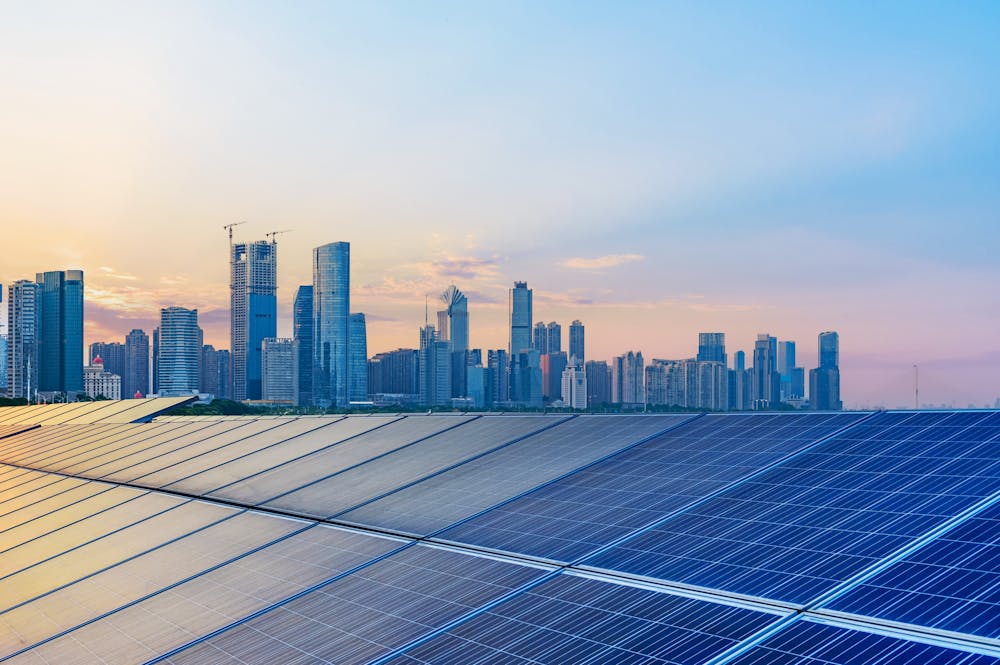
    solar panels with a city skyline in the background.
    AI models are increasingly able to predict weather with greater precision, allowing electric grid operators to plan ahead, storing excess energy in batteries or adjusting supply to meet demand before a storm or heat wave hits.
    (Shutterstock)

    AI for smarter district heating and cooling

    In Munich, Germany, AI is improving geothermal district heating by using underground sensors to monitor temperature and moisture levels in the ground.

    The collected data feeds into a digital simulation model that helps optimize network operations. In more advanced versions, during winter cold snaps, such systems can suggest lowering flow to underused spaces like half-empty offices and boosting heat where demand is higher, such as in crowded apartments.

    This intelligent, self-optimizing approach extends the life of equipment and delivers more warmth with the same energy input.

    This is a breakthrough with enormous potential for cities in cold climates with established geothermal networks, such as Winnipeg in Canada and Iceland’s Reykjavik.

    Although these cities have not yet adopted AI-driven monitoring systems, they could benefit from AI’s real-time improvements in efficiency, comfort and energy savings during harsh winters — a principle that holds true wherever geothermal district heating and cooling exists.

    a person adjusting a digital thermostat
    Inside the home, AI-managed smart climate systems can factor in how many people are in each room, which appliances are in use, how much natural sunlight each space receives.
    (Shutterstock)

    Smart buildings

    Inside the home, AI-managed smart climate systems can factor in how many people are in each room, which appliances are in use, how much natural sunlight each space receives and how much electricity or heat a home’s solar panels generate throughout the day.

    Based on this, AI determines how to heat or cool rooms efficiently, and can transfer energy from one space to another, balancing comfort with minimal energy use.

    Coastal cities and those in wind-heavy regions are using AI in other creative ways. In Orkney, Scotland, excess wind and tidal energy are converted into green hydrogen. Instead of letting that surplus power go to waste, an AI system called HyAI controls when to generate hydrogen based on wind forecasts, electricity prices and how full the hydrogen storage tanks are.

    When winds are strong at night and electricity is cheap, the AI can divert surplus power to produce hydrogen and store it for later use. On calmer days, that stored hydrogen can power fuel cells or buses.

    Energy storage

    AI is transforming energy storage into a smart, revenue-generating force. In Finland, a startup called Capalo AI has developed Zeus VPP, an AI-powered virtual power plant that aggregates distributed batteries from homes, businesses and other sites.

    Zeus VPP uses advanced forecasting and AI algorithms to decide when batteries should charge or discharge, factoring in energy prices, local consumption and weather forecasts. This enables battery owners to earn revenue by participating in electricity markets, while also supporting grid stability and making better use of renewable energy.

    Utility companies are also using AI to monitor everything from high-voltage transmission lines to neighbourhood transformers, dramatically increasing reliability.

    AI-powered dynamic line rating adjusts how much electricity a line can carry in real time, boosting capacity by 15 to 30 per cent when conditions allow. This helps utilities maximize the use of existing infrastructure instead of relying on costly upgrades.

    At the local level, AI analyzes smart metre data to predict which transformers are overheating due to rising EV and heat pump use.

    By forecasting these stress points, utilities can proactively upgrade equipment before failures happen — a shift from reactive to predictive maintenance that makes the grid stronger and cities more resilient.

    AI-powered public transit and mobility

    Transportation innovation is becoming part of the energy solution, with AI at the centre of this transformation. In New York City, energy company Con Edison has installed major battery storage systems to help manage peak electricity demand and reduce reliance on polluting peaker plants, which supply energy only during high-demand periods.

    More broadly, Con Edison is deploying advanced AI-powered analytics software across its electric grid — optimizing voltage, enhancing reliability and enabling predictive maintenance. Together, these efforts show how combining energy storage and AI-driven analytics can make even the world’s busiest cities more resilient and efficient.

    AI is also powering “vehicle-to-grid” innovations in California, where an AI-driven platform manages electric school buses that can supply stored energy back to the grid during periods of high demand.

    By carefully managing when buses charge and discharge, these systems help keep the grid reliable and ensure vehicles are ready for their daily routes. As this technology expands, parked electric vehicles could serve as valuable backup resources for the electricity system.

    lights moving along a highway
    Transportation innovation is becoming part of the energy solution.
    (Shutterstock)

    AI for clean energy initiatives

    AI is rapidly transforming cities by revolutionizing how energy is used and managed. Google, for example, has slashed cooling energy at its data centres by up to 40 per cent using AI that fine-tunes fans, pumps and windows more efficiently than any human operator.

    Organizations like the Electric Power Research Institute (EPRI), in collaboration with NVIDIA, Microsoft and others, have launched the Open Power AI Consortium, which is creating open-source AI tools for utilities worldwide.

    These tools will enable even the most resource-constrained cities to deploy advanced AI capabilities, without having to start from scratch, helping to level the playing field and accelerate the global energy transition.

    The result is not just cleaner air and lower energy bills, but a path to fewer blackouts and more resilient homes.

    The Conversation

    Mohammadamin Ahmadfard receives funding from the Natural Sciences and Engineering Research Council of Canada (NSERC) and Mitacs Inc. for his postdoctoral research at Toronto Metropolitan University.

    ref. AI applications are producing cleaner cities, smarter homes and more efficient transit – https://theconversation.com/ai-applications-are-producing-cleaner-cities-smarter-homes-and-more-efficient-transit-256291

    MIL OSI Analysis

  • MIL-OSI Analysis: Misogyny has become a political strategy — here’s how the pandemic helped make it happen

    Source: The Conversation – Canada – By Brianna I. Wiens, Assistant Professor of Digital Media and Rhetoric, University of Waterloo

    Since the COVID-19 pandemic, more overt forms of gendered hate have jumped from obscure internet forums into the mainstream, shaping culture and policy.

    Social media doesn’t just reflect sexist, anti-feminist views; it helps to organize, amplify and normalize them.

    Backlash against women and LGBTQ+ communities has become more overt, co-ordinated and is gaining political traction. As the United States rolls back reproductive rights and passes anti-LGBTQ+ laws, it is important to understand how digital culture fuels this regression.

    While these shifts may seem distant, Canadian politics are not immune. Similar rhetoric has emerged in debates over education, gender identity, health care and so-called “parental rights.”


    Read more:
    ‘Parental rights’ lobby puts trans and queer kids at risk


    Our ongoing research maps how the pandemic accelerated the rise of online misogyny, especially through “manosphere” influencers and far-right rhetoric.

    Drawing from more than 21,000 podcast episodes and digital artifacts, we are investigating how everyday online content works to erode women’s and LGBTQ+ rights. This rhetoric normalizes misogynistic, transphobic and homophobic views and repackages gender inequities as common sense.

    How the pandemic fuelled digital misogyny

    COVID-19 lockdowns set the stage for a surge in online radicalization. Isolated men and boys increasingly turned to social media for connection — spaces where manosphere personalities like English-American social media influencer Andrew Tate and American conservative political commentator Ben Shapiro gained momentum.

    These figures blend anti-feminist messaging with broader pandemic-era anxieties, turning gender roles into moral and political battlegrounds.

    Conservative influencers who once focused on vaccine skepticism began pivoting to anti-gender content. Steve Bannon’s podcast, for example, moved from pedalling public health disinformation to pushing narratives that feminism and LGBTQ+ rights are threats to western civilization.

    Before the internet, radicalization usually required personal contact. Now, people can self-radicalize online, engaging with algorithm-driven content and communities that reinforce extremist beliefs, often without ever interacting with a recruiter. This shift coincided with a marked rise in reported online hate speech and offline hate crimes.

    Misogyny as a mobilizing force

    Meanwhile, women’s experiences during the pandemic — over half of whom are caregivers in Canada — involved increased labour at home and in front-line jobs. This left little time or energy for the organizational work necessary to combat the rising tides of sexism and misogyny.

    Instead, public discourse began to increasingly valourize “tradwife” ideals and homemaking. This ensured traditional gender roles were brought back into the mainstream, not just as personal preferences, but as broader cultural expectations.

    Though this misogyny appears to be fringe, it echoes mainstream policies that threaten reproductive health care, restrict gender expression and paint feminism as a threat to national stability.

    Project 2025, the well-known policy platform from U.S. conservative think tank The Heritage Foundation, lays out an agenda to repeal reproductive rights, undermine LGBTQ+ protections and expand state control over gender and family life.


    Read more:
    How Project 2025 became the blueprint for Donald Trump’s second term


    How misogynist narratives are normalized

    These misogynist ideas are reinforced in popular culture. In May 2024, NFL player Harrison Butker used his commencement address at Benedictine College to tell women graduates that their true calling was to become wives and mothers.

    Such rhetoric serves to re-establish patriarchal hierarchies by narrowing women’s roles to domestic life. But this isn’t about family values, it’s about power. Moves in the U.S. to restrict women’s reproductive autonomy and democratic access to vote make this abundantly clear.

    While feminists pushed back, manosphere podcast influencers rushed to Butker’s defense. American white supremacist Nick Fuentes celebrated the speech as a manifesto, while Shapiro framed it as uncontroversial truth.

    Our analysis of podcast episodes from Shapiro and Fuentes, among others, shows how misogynist and racist narratives are reinforced through repetition and emotional framing. In episodes focused on Butker’s commencement speech, there were significant concentrations of hate speech and misogyny in the episodes.

    Both Shapiro and Fuentes positioned feminism as a threat and framed motherhood as women’s true vocation. Shapiro downplayed the backlash against Butker as liberal outrage through calculatedly mainstream language that used sanitized, “family values” language.

    Fuentes promoted an extreme theocratic vision rooted in white Catholic nationalism. In Episode 1,330 of his America First podcast, he said, “I want women to be veiled. I don’t want them to be seen. I want them to be listening to their husbands.”

    These talking points consistently align with Butker’s original sentiment and reflect broader political efforts to erode gender equity, as seen in political documents like Project 2025.

    Other public figures like Texan megachurch pastor Joel Webbon went even further, advocating for the public execution of women who accuse men of sexual assault — a horrifying example that circulated in manosphere circles.

    From the fringes to the mainstream

    What’s happening online is not just cultural noise; it’s a co-ordinated effort by conservative political organizations, media outlets and right-wing influencers to shape gender norms, undermine equality and roll back decades of feminist progress.

    When misogyny becomes a political strategy, it doesn’t stay confined to podcasts or memes. It seeps into everyday vernacular, court rulings and public policy, and it’s global in scope.

    This isn’t new, either. In 2012, Australia’s then-prime minister, Julia Gillard, called out sexist language in parliament, including being labelled a “witch” and subjected to dismissive catcalls. Her speech highlighted the normalization of misogynistic vernacular in politics, but also triggered public backlash, including having anti-immigration remarks misattributed to her.

    Similarly, in the lead-up to Germany’s 2021 federal election, Greens party candidate Annalena Baerbock faced co-ordinated disinformation and smear campaigns from foreign entities aimed at undermining her credibility and questioning her “maternal suitability” in the public eye. Digitally altered nude photos, fake protest images and disinformation graphics were circulated.

    These campaigns reflect how misogyny is weaponized to influence elections, and how such campaigns can be a threat to national security.

    A 2022 #MeToo litigation analysis showed how, despite increasing awareness around sexual assault and harassment, U.S. courts often use legal language that reinforces victim-blaming by placing victims in the grammatical subject position of sentences. For example, phrases like “the victim failed to resist” or “the victim did not report the incident immediately” shift focus onto the victim’s behaviour rather than the perpetrator’s actions.

    These details continue to affect broader legal narratives and public acceptance.

    Digital platforms are battlegrounds

    Recognizing these connections is crucial. As far-right movements gain ground by repackaging ideas about gender as nostalgic “truth” or “tradition,” we need to recognize that digital platforms are not neutral, nostalgic spaces.

    Rather, they are conversational battlegrounds where power is contested and jokes, tweets and speeches carry real political weight.

    In the fight for gender equity, the internet is not just a mirror that reflects multiple realities. It’s a tool built by the tech industry that was never intended to democratize communication, labour or social roles. Right now, that tool is being weaponized to signal and reassert patriarchal control.

    The Conversation

    Brianna I. Wiens receives research funding from the Social Sciences and Humanities Research Council.

    Nick Ruest receives funding from the Social Sciences and Humanities Research Council.

    Shana MacDonald receives funding from the Social Sciences and Humanities Research Council.

    ref. Misogyny has become a political strategy — here’s how the pandemic helped make it happen – https://theconversation.com/misogyny-has-become-a-political-strategy-heres-how-the-pandemic-helped-make-it-happen-256043

    MIL OSI Analysis

  • MIL-OSI Analysis: Indonesia can expand its gastrodiplomacy via plant-based meals in Europe: Research

    Source: The Conversation – Indonesia – By Meilinda Sari Yayusman, Researcher in International Relations and European Studies, Badan Riset dan Inovasi Nasional (BRIN)

    Raw vegetable and lettuce salad with Indonesian fried tempeh. Gekko Gallery/Shutterstock

    Gastrodiplomacy as the practice of a country’s diplomacy by promoting its cuisine, is now gaining popularity in several countries across the globe, including South Korea and Thailand.

    South Korea, for example, has introduced its so-called “Kimchi Diplomacy” in the world for the past years as part of the country’s soft power in promoting culinary culture. Thailand, meanwhile, has been spreading the influence of Thai food and expanding Thai restaurants around the globe, attracting the global communities to eat authentic Thai cuisine.

    Indonesia, with diverse food and beverages as well as indigenous spices, has also started to resort to this strategy to promote the country in the global forum.

    Our unpublished observation based on fieldwork in May 2023 and literature reviews since mid-2021 resulted in a recommendation for the Indonesian government to take advantage of its diverse menu for its gastrodiplomacy agenda.

    We recommend Indonesia emphasise plant-based dishes for its gastrodiplomacy strategy in Europe, given the region’s rising trend of plant-based food consumption.

    Why plant-based food

    A growing number of people are increasingly considering plant-based food as a dietary alternative to maintain their health following global concerns on the negative impacts of processed foods on health, society and the environment.

    Gado-gado (Indonesian authentic salad with peanut dressing).
    Endah Kurnia P/Shutterstock

    Indonesia has a lot of ingredients and spices to create plant-based menus that have met global healthy standards.

    Among them are tempeh, a traditional Indonesian food made from fermented soybeans. The fermentation increases its nutritional quality. Tempeh has been known in the Netherlands and already has consumers in Europe. However, it is not widespread yet in the whole continent.

    Gado-gado, the famous Indonesian salad with its authentic peanut butter dressing, has also seen an emerging popularity in the global market. From our fieldwork, we have learned that almost all Indonesian restaurants worldwide, such as in The Hague and Amsterdam, the Netherlands, usually have gado-gado on their menus.

    Other plant-based cuisines that have potential to gain popularity abroad are asinan (fruit salad preserved with vinegar) and gudeg (jackfruit stewed in coconut milk).

    However, our observation shows that Indonesian vegan menus have yet to be widely known in Europe and other continents. Indonesia should promote them in the global market.

    Why Europe

    Plant-based food trend has been currently growing in many industrialised countries, especially in Europe.

    Gudeg, a traditional Javanese dish from Indonesia’s Yogyakarta, is made from young unripe jack fruit stewed for several hours with palm sugar, and coconut milk.
    Ricky_herawan/Shutterstock

    In Europe, the value of plant-based food sales increased by 49% between 2018 and 2020. This includes an expansion in the market for plant-based substitutes for meat and dairy.

    In the Netherlands, for example, sales rose by 50% during the same period. Germany and Poland have also witnessed a notable surge in the sales of plant-based food products, with an increase of 97% and 62%, respectively.

    With the change in people’s food consumption habits, Europe can be a significant, promising market for Indonesia to expand the promotion of its plant-based food products.

    Taking advantage of current presence

    The fact that Indonesia’s culinary presence in Europe is already evident, particularly in the Netherlands, should benefit Indonesia.

    Based on our finding, no less than 392 Indonesian restaurants are operating in West and South Europe, majority of which (295) is in the Netherlands. They have become popular since the 1970s.

    For hundreds of years, the Netherlands colonised parts of what is now Indonesia. The colonial history between the two nations has created a sense of romanticism, including what and how they ate in the past.

    Many Indonesian citizens living in European countries own Indonesian cuisine restaurants, and recently, they have started to develop plant-based menus in their kitchens.

    The Netherlands offers a promising hub for introducing Indonesian foods and establishing Indonesian restaurants in other parts of Europe.

    Tofu is an Indonesian traditional food made from soybean.
    Erly Damayanti/Shutterstock

    As part of our observation, we visited some Indonesian restaurants in the Netherlands that are developing plant-based menus in their kitchens for vegans and vegetarians, in response to the rising popularity of plant-based food in European society.

    Among them were De Vegetarische Toko, Toko Kalimantan, Bali Brunch 82 and Praboemoelih. They serve gado-gado, variants of tempeh and tofu and tumis buncis (vegetable stir-fry).

    De Vegetarische Toko, for example, has creatively transformed some authentic Indonesian foods into vegan and vegetarian-friendly versions. They replace the meats in menus like rendang (slow-cooked beef stew in coconut milk and spices) and semur (beef stew) with tempeh, tofu, beans and peanuts.

    With these creative innovations, these restaurants may have an excellent opportunity to extend and promote Indonesian plant-based meals more widely to other parts of Europe, thus supporting Indonesia’s gastrodiplomacy.

    More support needed

    Indonesia has acknowledged its gastrodiplomacy potential through several programs.

    In 2021, Indonesia launched “Indonesia Spice Up the World”. It becomes the country’s first-ever concrete initiative to promote Indonesian cuisine and attract investment opportunities in local spices and herbs.

    The initiative aims to increase Indonesian spice exports to US$2 billion, launch approximately 4,000 Indonesian restaurants abroad by 2024 and make Indonesia a culinary destination in the future.

    To support this kind of initiative, the Indonesian government should regularly and intensively communicate with all stakeholders involved in the Indonesian culinary industry. The partnership should aim to support Indonesian diaspora entrepreneurs looking to start businesses in the food sector abroad.

    One example is offering soft loans to these food entrepreneurs.
    Bank BNI, Indonesia’s fourth-largest bank, has begun offering this kind of loan.

    It is time for Indonesia to strengthen its international existence through gastrodiplomacy by taking advantage of the rising consumption of plant-based meals among global communities. Tempeh, gado-gado, asinan and gudeg can become a powerful weapon of Indonesia’s soft diplomacy on the global stage.

    The Conversation

    Meilinda Sari Yayusman receives funding by the Institute of Social Sciences and Humanities, National Research and Innovation Agency (BRIN), Indonesia.

    Andika Ariwibowo receives funding by the Institute of Social Sciences and Humanities, National Research and Innovation Agency (BRIN), Indonesia.

    Prima Nurahmi Mulyasari receives funding by the Institute of Social Sciences and Humanities, National Research and Innovation Agency (BRIN), Indonesia.

    Ahmad Nuril Huda tidak bekerja, menjadi konsultan, memiliki saham, atau menerima dana dari perusahaan atau organisasi mana pun yang akan mengambil untung dari artikel ini, dan telah mengungkapkan bahwa ia tidak memiliki afiliasi selain yang telah disebut di atas.

    ref. Indonesia can expand its gastrodiplomacy via plant-based meals in Europe: Research – https://theconversation.com/indonesia-can-expand-its-gastrodiplomacy-via-plant-based-meals-in-europe-research-209193

    MIL OSI Analysis

  • MIL-OSI Analysis: Thumbs up: good or passive aggressive? How emojis became the most confusing kind of online language

    Source: The Conversation – Global Perspectives – By Brittany Ferdinands, Lecturer in Digital Content Creation, Discipline of Media and Communications, University of Sydney

    The Conversation, CC BY

    Emojis, as well as memes and other forms of short-form content, have become central to how we express ourselves and connect online. Yet as meanings shift across different contexts, so too does the potential for misunderstanding.

    A senior colleague of mine recently encountered some commentary about the “slightly smiling” face emoji: 🙂

    They approached me, asking whether it represented joy, as they had assumed, or if it had a more ominous meaning.

    As a chronically-online millennial, who unironically identifies as a gen Z, I bore the news that I, along with most younger internet users, only ever use it sarcastically.

    “It doesn’t actually signify happiness – more so fake happiness, or dry humour,” I explained.

    I also told them how the thumbs up emoji is often interpreted as passive aggressive, and that the only time I’d use the laughing-crying (“face with tears of joy”) emoji is under duress.

    Despite seeming like a universal language – and sometimes they do function that way – emojis can be at once more vague, and more specific, than words. That’s because you can’t separate the meaning of a smiley from the person who sent it, nor from the person receiving it.

    Markers of age and identity

    While emojis were originally developed in the late 1990s by Japanese artist Shigetaka Kurita to add emotional nuance to text-based messaging, their function has since evolved.

    Today, emojis are not just emotional cues; they also operate as cultural symbols and markers of identity.

    Research published last year highlights how these symbols can create subtle communication barriers across age groups. For instance, a study of Chinese-speaking WeChat users found younger and older people differed not only in how frequently they used emojis, but in how they interpreted and aesthetically preferred them.

    One emoji that’s increasingly becoming a distinct marker of age is the previously mentioned laughing-crying emoji (😂). Despite being named Oxford Dictionary’s 2015 word of the year, and frequently topping the most-used emoji charts, this smiley is on the decline among gen Z – who decided in 2020 that it wasn’t cool anymore.

    Instead, they prefer the skull emoji (💀), which is shorthand for the gen Z catch phrase “I’m dead”. This means something is funny (not that they’re literally deceased).

    Such shifts may understandably be perplexing for older generations who are unfamiliar with evolving norms and slang.

    A digital body language

    Emojis can also take on distinct meanings on different platforms. They are embedded within “platform vernaculars”: the ever-evolving styles of communication that are unique to specific digital spaces.

    For example, a thumbs up emoji (👍) from your boss at work is seemingly more acceptable, and less anxiety inducing, than from a romantic interest you’ve just sent a risky text to.

    This dilemma was echoed in a recent viral TikTok by user @kaitlynghull, which prompted thousands to comment about their shared confusion over emoji use in the workplace.

    This reaction highlights a deeper communication issue.

    A survey of 10,000 workers across the US, France, Germany, India and Australia, conducted by YouGov and software company Atlassian, found 65% of workers used emojis to convey tone in the workplace. But while 88% of gen Z workers thought emojis were helpful, this dropped to 49% for baby boomers and gen X.

    The survey concluded some emojis can be interpreted in multiple ways, and these double meanings aren’t always safe for work.

    In with the ‘it’ crowd

    Another example of platform-specific emoji use comes from social media content creators who deploy emojis to curate a certain aesthetic.

    Under the Tiktok tag #emojicombo, you’ll find thousands of videos showcasing emoji combinations that provide aesthetic “inspo”. These combinations are used to represent different online identities or subcultures, such as “that girl”, “clean girl” or “old money”.

    Users may include the combinations in their captions or videos to signal their personal style, or to express the mood or vibe of their online persona. In this way, the emojis help shape how they present themselves on the platform.

    This example of emoji use is also a display of symbolic capital. It signals social alignment, in an environment where a user’s visibility (and popularity) is determined by their platform fluency.

    Emojis, then, aren’t just tools for expression. They are badges of identity that index where a user stands in the online cultural hierarchy.

    There’s a fragmentation in how we relate

    A single emoji might communicate irony, sincerity or sarcasm, depending on who is using it, what platform they’re using it on, and what generation they belong to.

    This gap points to deeper questions around online access and participation, and the systems that shape online cultures.

    And when the meaning of an emoji is platform-dependent and socially stratified, it can become as much about fitting in with a cultural in-group than conveying emotion.

    Brittany Ferdinands does not work for, consult, own shares in or receive funding from any company or organisation that would benefit from this article, and has disclosed no relevant affiliations beyond their academic appointment.

    ref. Thumbs up: good or passive aggressive? How emojis became the most confusing kind of online language – https://theconversation.com/thumbs-up-good-or-passive-aggressive-how-emojis-became-the-most-confusing-kind-of-online-language-259151

    MIL OSI Analysis

  • MIL-OSI Analysis: How the myth of ‘Blitz spirit’ defined and divided London after 7/7

    Source: The Conversation – UK – By Darren Kelsey, Reader in Media and Collective Psychology, Newcastle University

    The “Blitz spirit” is one of Britain’s most enduring national myths – the stories we tell ourselves about who we were, and who we still believe we are today. Growing up among football fans, I heard constant nostalgic refrains about England and Germany, wartime bravery and national pride.

    Chants about “two world wars and one World Cup” or “ten German bombers in the air” were cultural rituals, flexes of a shared memory that many had never experienced themselves.

    Blitz spirit refers to the resilience, unity and stoic determination of civilians during the German bombing raids (the Blitz) of the second world war. It has reemerged time and again, symbolising a collective pride in facing adversity with courage, humour and a “keep calm and carry on” attitude.

    After the July 7 bombings in 2005, which killed 52 people and injured more than 700, I noticed how quickly the Blitz spirit reappeared. British newspapers reached into the past and pulled the myth forward.


    Get your news from actual experts, straight to your inbox. Sign up to our daily newsletter to receive all The Conversation UK’s latest coverage of news and research, from politics and business to the arts and sciences.


    The Independent on July 8 said, “London can take it, and it can do so because its stoicism is laced as it always has been with humour.” The Daily Mail evoked images of “London during the Blitz… with everyone dancing through the bombs”.

    Tony Parsons opened his Daily Mirror column with “07/07 war on Britain: We can take it; if these murderous bastards go on for a thousand years, the people of our islands will never be cowed”, alongside an image of St Paul’s Cathedral during the Blitz.

    The spirit of working-class wartime London was, ironically, even applied to bankers and City traders who “kept the economy alive” after the attacks. A July 8 Times article claimed: “A Dunkirk spirit spread through London’s financial districts as Canary Wharf and City workers vowed they would not be deterred.”

    The use of river transport to evacuate workers reinforced the analogy. The Times described how “bankers and lawyers in London’s riverside Canary Wharf complex experienced their own version of the Dunkirk-style evacuations”, assisted by a “flotilla of leisure vessels and little ships”.

    I was fascinated: why this story, and why now? That question became the heart of a book I published in 2015 – one that explored how a myth born in 1940 was reborn in 2005, repurposed for a very different London.

    What I found was that the “Blitz spirit” wasn’t a lie, but it was a myth in the academic sense: a simplified, selective story built from the most comforting parts of the past.

    Wartime Britain was not uniformly united, stoic and proud. There were deep class divides. Looting occurred. Morale was rock-bottom in many cities and communities. Evacuees weren’t always welcomed with open arms. Government censorship and transnational propaganda masked social unrest.

    Understandably, these messy realities were left out of the postwar narrative. But what happens when we bring that myth into the present?

    The myth of the ‘Blitz spirit’

    Londoners did come together after the 7/7 bombings – there were undoubtedly examples of communities and strangers supporting each other and maintaining a sense of resilience that enabled them to continue their lives undeterred.

    But it was not one single unified message. Hate crimes against British Muslim communities in the weeks after the 2005 attacks exposed cracks in the narrative of national unity.

    Some used the Blitz spirit to support Tony Blair and George W. Bush, casting them as Churchillian leaders standing firm against a new fascism in the form of global terrorism. For others, the same figures represented a betrayal of British values.

    They were evoked instead to shame Blair and Bush. The Express made its feelings clear when it said: “It was throw up time when Blair was compared to Churchill by some commentators. What an insult!”

    The Blitz spirit also became a weapon in anti-immigration discourse. Some argued that Britain, unlike in 1940, had become a “soft touch” – compromised by EU human rights laws, welfare handouts and multiculturalism. The underlying message: today’s London could never be as brave or unified as wartime London.

    Writing in The Sun, Richard Littlejohn said: “War office memo. Anyone caught fighting on the beaches will be prosecuted for hate crimes.”

    An article in the Express condemning human rights laws said: “What a good thing these people weren’t running things when Hitler was doing his worst. Would the second world war have been more easily won if we had spent more time talking about freedom of speech than bombing Nazi Germany?”

    Multicultural resilience

    And yet, another narrative emerged – one that saw London’s multicultural identity as a strength, not a weakness. Here, the Blitz spirit wasn’t just a historical relic, but a kind of transcendental force. The city’s soul, it was said, remained resilient – passed down across generations, regardless of race, class or religion. For some, this was proof that Britain had evolved and still held fast to its best values.

    A letter to the Daily Mirror (July 17) invoked the Blitz spirit through a cross-cultural lens: “Colour, creed and cultures forgotten, black helping white and vice versa… We stood firm in the Blitz and we’ll do so again, going about our business as usual.”

    The Sunday Times quoted Michael Portillo, who framed London’s resilience as multicultural continuity: “Fewer than half the names of those killed on the 7th look Anglo-Saxon… Today’s Londoners come in all colours and from every cultural background. Yet they have inherited the city’s historic attitudes of nonchalance, bloody-mindedness and defiance.”

    The Blitz spirit, as my research revealed, is not a single story. It is a narrative tool used for many different – often opposing – purposes. It can bring people together, or be used to divide. It can inspire pride, or be weaponised in fear.

    National myths don’t just reflect who we were – they shape who we think we are. They’re never neutral. They’re always curated, always contested. If we want to be genuinely proud of our country – and we should – then we also have to be honest about the stories we cling to. We must ask: what’s left out, and who decides?

    Darren Kelsey does not work for, consult, own shares in or receive funding from any company or organisation that would benefit from this article, and has disclosed no relevant affiliations beyond their academic appointment.

    ref. How the myth of ‘Blitz spirit’ defined and divided London after 7/7 – https://theconversation.com/how-the-myth-of-blitz-spirit-defined-and-divided-london-after-7-7-259948

    MIL OSI Analysis

  • MIL-OSI Analysis: Will the Oasis reunion usher in a Britpop summer – or is it just a marketing ploy?

    Source: The Conversation – UK – By Glenn Fosbraey, Associate Dean of Humanities and Social Sciences, University of Winchester

    Ink Drop/Shutterstock

    The trend for naming summers has become something of a cultural phenomenon. Think for example of 2019, which was branded a “hot girl summer”, inspired by rapper Megan Thee Stallion’s song.

    In 2021 there was the much-ridiculed “white boy summer” (named after a song of the same name by Tom Hanks’s son, Chet). Then 2022 was “feral girl summer” and 2024, of course, was a “brat summer”, after Charli XCX’s cultural phenomenon album Brat.

    And this summer? Well, with the likes of Oasis, Pulp, Supergrass, Suede, Shed Seven and Cast all playing UK dates between June and August, it’s “Britpop summer”, of course. The question is, though, whether these names are actually (and accurately) representing the zeitgeist, or if they are just the result of savvy marketing strategies.


    Read more:
    Brat by Charli XCX is a work of contemporary imagist poetry – and a reclamation of ‘bratty’ women’s art


    Such things may now be occurring more frequently, but they’re nothing new. The year 1967 was famously coined “the summer of love”, a moniker supposedly invented by the Californian local government to put a positive spin on the druggy, hairy, hippy gatherings taking place across the state.

    Then, just over two decades later, there came the imaginatively titled “second summer of love” in 1988 which, like its predecessor was drug-inspired, but this time involved British ravers taking ecstasy in London warehouses instead of hippies “dropping acid” in San Franciscan parks.


    Looking for something good? Cut through the noise with a carefully curated selection of the latest releases, live events and exhibitions, straight to your inbox every fortnight, on Fridays. Sign up here.


    The “summer of love” has largely been presented to us as a psychedelic utopia, wherein London was the “swinging, cool and hip” epicentre of a new cultural movement. Everyone was blissfully stoned, with messages of peace and love on their lips, kaftans and floral blouses on their bodies and flowers in their hair.

    In reality, though, in the UK at least only 8% of adults had actually tried cannabis and fewer than 1% had taken LSD or acid, and the fashion of the day (for men, anyway) involved sensible slacks and short-back-and-sides.

    Such un-psychedelic appetites also spilled over into mainstream music. Although it’s now the UK’s bestselling album ever, in 1967, The Beatles’ Sgt. Pepper’s Lonely Hearts Club Band was only the sixth-biggest album of the year in terms of sales. It was bested by the very suitably non-flower-power Herb Alpert, The Monkees and The Sound of Music soundtrack.

    Pink Floyd’s debut album, The Piper at the Gates of Dawn – “the founding masterpiece in psychedelic music” – sold 275,000 copies in 1967 in the UK (compared to The Sound of Music’s 2.4 million) and was number 34 on the list of big-selling albums in the UK that year.

    The same year, 1967, also saw the “best double-A side ever released”, The Beatles’ Penny Lane and Strawberry Fields Forever. It was kept off the number one spot by Engelbert Humperdinck’s Please Release Me.

    Inside the so-called ‘second summer of love’.

    It seems, then, that for most of the British public, it was less a “summer of love” and more a “summer of Humperdinck”. Fast-forward five decades, and we see the same kinds of things happening. The year 2019 was a “hot girl summer”, Megan Thee Stallion’s song only peaked at 40 in the UK singles charts and her gigs sold poorly.

    Like our “summer of Humperdinck”, were such things based on popularity, we may have expected a “Sheeran summer”, with Ed Sheeran’s duet with Justin Bieber, I Don’t Care, dominating the charts and airwaves.

    Similarly, although 2024 was a “brat summer”, Charli XCX’s album was actually only the UK’s eighth-biggest selling album of the year, with Taylor Swift’s very un-Brat-like The Tortured Poets Department achieving 783,820 salesalmost double Brat’s.


    Read more:
    Taylor Swift’s The Tortured Poets Department and the art of melodrama


    Britpop summer

    Britpop itself may have peaked in 1995, but in the summer of 1996, with Oasis and Blur still omnipresent, Tony Blair talking about the prospect of freedom, aspiration and ambition, England progressing through the Euros on home soil, and sunny day after sunny day, it was (according to The Guardian, at least) the most optimistic period in recent British history where anything seemed possible.

    Pulp performed a secret set at Glastonbury 2025 to huge crowds.

    We may all have become more cynical in the intervening years, but in the midst of another heatwave, with Pulp at Glastonbury, and the Gallaghers reunited, it does feel like there’s something in the air again.

    Indeed, standing among tens of thousands of fellow music fans in the sweltering heat watching Jarvis Cocker strutting his gangly stuff, if I ignored the grey in his beard, the iPhones in the crowd, and the aching in my legs, it could have been the nineties all over again.

    Britpop summer? I’m all for it. And maybe this will be one time that the name really does represent the nation’s mood.

    Glenn Fosbraey does not work for, consult, own shares in or receive funding from any company or organisation that would benefit from this article, and has disclosed no relevant affiliations beyond their academic appointment.

    ref. Will the Oasis reunion usher in a Britpop summer – or is it just a marketing ploy? – https://theconversation.com/will-the-oasis-reunion-usher-in-a-britpop-summer-or-is-it-just-a-marketing-ploy-260256

    MIL OSI Analysis

  • MIL-OSI Analysis: Rare wooden tools from Stone Age China reveal plant-based lifestyle of ancient lakeside humans

    Source: The Conversation – Global Perspectives – By Bo Li, Professor, Environmental Futures Research Centre, School of Science, University of Wollongong

    Excavation at the Gantangqing site. Liu et al.

    Ancient wooden tools found at a site in Gantangqing in southwestern China are approximately 300,000 years old, new dating has shown. Discovered during excavations carried out in 2014–15 and 2018–19, the tools have now been dated by a team of archaeologists, geologists, chronologists (including me) and paleontologists.

    The rare wooden tools were found alongside an assortment of animal and plant fossils and stone artifacts.

    Taken together, the finds suggest the early humans at Gantangqing were surprisingly sophisticated woodworkers who lived in a rich tropical or subtropical environment where they subsisted by harvesting plants from a nearby lake.

    The location of the Gantangqing site and excavation trenches.
    Liu et al. / Science

    Why ancient wooden tools are so rare

    Wood usually decomposes relatively rapidly due to microbial activity, oxidation, and weathering. Unlike stone or bone, it rarely survives more than a few centuries.

    Wood can only survive for thousands of years or longer if it ends up buried in unusual conditions. Wood can last a long time in oxygen-free environments or extremely dry areas. Charred or fire-hardened wood is also more durable.

    At Gantangqing, the wooden objects were excavated from low-oxygen clay-heavy layers of sediment formed on the ancient shoreline of Fuxian Lake.

    Wooden implements are extremely rare from the Early Palaeolithic period (the first part of the “stone age” from around 3.3 million years ago until 300,000 years ago or so, in which our hominin ancestors first began to use tools). Indeed, wooden tools more than even 50,000 years old are virtually absent outside Africa and western Eurasia.

    As a result, we may have a skewed understanding of Palaeolithic cultures. We may overemphasise the role of stone tools, for example, because they are what has survived.

    What wooden tools were found at Gantangqing?

    The new excavations at Gantangqing found 35 wooden specimens identified as artificially modified tools. These tools were primarily manufactured from pine wood, with a minority crafted from hardwoods.

    Some of the tools had rounded ends, while others had chisel-like thin blades or ridged blades. Of the 35 tools, 32 show marks of intentional modification at their tips, working edges, or bases.

    Two large digging implements were identified as heavy-duty digging sticks designed for two-handed use. These are unique forms of digging implements not documented elsewhere, suggesting localised functional adaptations. There were also four distinct hook-shaped tools — likely used for cutting roots — and a series of smaller tools for one-handed use.

    Nineteen of the tools showed microscopic traces of scraping from shaping or use, while 17 exhibit deliberately polished surfaces. We also identified further evidence of intensive use, including soil residues stuck to tool tips, parallel grooves or streaks along working edges, and characteristic fracture wear patterns.

    The tools from Gantangqing are more complete and show a wider range of functions than those found at contemporary sites such as Clacton in the UK and Florisbad in South Africa.

    The wooden tools from Gantangqing took a variety of forms.
    Liu et al. / Science

    How old are the Gantangqing wooden tools?

    The team used several techniques to figure out the age of the wooden tools. There is no way to determine their age directly, but we can date the sediment in which they were found.

    Using a technique called infrared stimulated luminescence, we analysed more than 10,000 individual grains of minerals from different layers. This showed the sediment was deposited roughly between 350,000 and 200,000 years ago.

    Dating the different layers of sediment excavated at the site produced a detailed timeline.
    Liu et al. / Science

    We also used different techniques to date a mammal tooth found in one of the layers to roughly 288,000 years old. This was consistent with the mineral results.

    Next we used mathematical modelling to bring all the dating results together. Our model indicated that the layers containing stone tools and wooden implements date from 360–300,000 years ago to 290–250,000 years ago.

    What was the environment like?

    Our research indicates the ancient humans at Gantangqing inhabited a warm, humid, tropical or subtropical environment. Pollen extracted from the sediments reveals 40 plant families that confirm this climate.

    Plant fossils further verify the presence of subtropical-to-tropical flora dominated by trees, lianas, shrubs and herbs. Wet-environment plants show the local surroundings were a lakeside or wetlands.

    Animal fossils also fit this picture, including rhinoceros and other mammals, turtles and various birds. The ecosystem was likely a mosaic of grassland, thickets and forests. Evidence of diving ducks confirms the lake must have been at least 2–3 metres deep during human occupation.

    Examples of stone and bone tools found at Gantangqing.
    Liu et al. / Science

    What were the Gantangqing wooden tools used for?

    The site contained evidence of plants such as storable pine nuts and hazelnuts, fruit trees such as kiwi, raspberry-like berries, grapes, edible herbs and fern fronds.

    There were also aquatic plants that would have provided edible leaves, seeds, tubers and rhizomes. These were likely dug up from shallow mud near the shore, using wooden tools.

    These findings suggest the Gantangqing hominins may have made expeditions to the lake shore, carrying purpose-made wooden digging sticks to harvest underground food sources. To do this, they would have had to anticipate seasonal plant distributions, know exactly what parts of different plants were edible, and produce specialised tools for different tasks.

    Why the Gantangqing site is important

    The wooden implements from Gantangqing represent the earliest known evidence for the use of digging sticks and for the exploitation of underground plant storage organs such as tubers within the Oriental biogeographic realm. Our discovery shows the use of sophisticated wood technology in a very different environmental context from what has been seen at sites of similar age in Europe and Africa.

    The find significantly expands our understanding of early hominin woodworking capabilities.

    The hominins who lived at Gantangqing appear to have lived a heavily plant-based subsistence lifestyle. This is in contrast to colder, more northern settings where tools of similar age have been found (such as Schöningen in Germany), where hunting large mammals was the key to survival.

    The site also shows how important wood – and perhaps other organic materials – were to “stone age” hominins. These wooden artifacts show far more sophisticated manufacturing skill than the relative rudimentary stone tools found at sites of similar age across East and Southeast Asia.

    The excavation, curation, and research of the Gantangqing site were supported by
    National Cultural Heritage Administration (China), Yunnan Provincial Institute of
    Cultural Relics and Archaeology, Yuxi Municipal Bureau of Culture and Tourism,
    Chengjiang Municipal Bureau of Culture and Tourism, Australian Research Council
    (ARC) Discovery Projects, Strategic Priority Research Program of the Chinese
    Academy of Sciences, Hong Kong Research Grants Council (RGC), National Natural
    Science Foundation of China (NSFC).

    ref. Rare wooden tools from Stone Age China reveal plant-based lifestyle of ancient lakeside humans – https://theconversation.com/rare-wooden-tools-from-stone-age-china-reveal-plant-based-lifestyle-of-ancient-lakeside-humans-260204

    MIL OSI Analysis

  • MIL-OSI Analysis: Hong Kong’s light fades as another pro-democracy party folds

    Source: The Conversation – Global Perspectives – By Brendan Clift, Lecturer in Law & Justice, UNSW Sydney

    Thomas Yau/Shutterstock

    The demise of one of Hong Kong’s last major pro-democracy parties, the League of Social Democrats, is the latest blow to the city’s crumbling democratic credentials.

    The league is the third major opposition party to disband this year. The announcement coincides with the fifth anniversary this week of the national security law, which was imposed by Beijing to suppress pro-democracy activity.

    The loss of this grassroots party, historically populated by bold and colourful characters, vividly illustrates the dying of the light in once-sparkling Hong Kong.

    The city is now greyed and labouring under a repressive internal security regime that has crushed civil society’s freedoms and democratic ambitions.

    Authoritarian crackdown

    The world witnessed Hong Kong at its brightest during the 2014 Umbrella Movement, when hundreds of thousands of pro-democracy protesters camped out on city streets for several months.

    We also saw the brutal sequel in 2019, when paramilitarised police sought to put down further civil unrest and protesters fought back.

    Since then, “lawfare” has been the preferred strategy of China’s national government and its Hong Kong satellite. The new approach has included a vast security apparatus and aggressive prosecutions.

    When Beijing intervened in July 2020, it was nominally about national security. In reality, the new law was designed and used to bring Hongkongers to heel.

    Civil freedoms were further curtailed by a home-grown security law, introduced last year to fill the gaps.

    International standards such as the Johannesburg Principles, endorsed by the United Nations, require national security laws to be compatible with democratic principles, not to be used to eliminate democratic activity.

    Prison or exile

    The League of Social Democrats occupied the populist left of the pro-democracy spectrum. It stood apart from contemporaries such as the Democratic Party and the Civic Party, which were dominated by professionals and elites, and have since been disbanded.

    The League was most notably represented by the likes of “Long Hair” Leung Kwok-hung– known for his Che Guevara t-shirts and banana-throwing – and broadcaster and journalism academic Raymond Wong Yuk-man, also known as “Mad Dog”.

    Despite their rambunctious styles, these men had real political credentials and were repeatedly elected to legislative office. But Leung is now imprisoned for subversion, while Wong has left for Taiwan.

    Leung Kwok-hung was sentenced to subversion under the national security law.
    Edwin Kwok/Shutterstock

    Party leaders such as Jimmy Sham Tsz-kit and Figo Chan Ho-wun were also prominent within the Civil Human Rights Front. It was responsible for the annual July 1 protest march that attracted hundreds of thousands of people every year. The front is yet another pro-democracy organisation that has dissolved.

    Sham and Chan have been jailed for subversion and unlawful assembly under the colonial-era Public Order Ordinance, which has been used to prosecute hundreds of activists.

    Zero tolerance

    The demise of these diverse organisations are not natural occurrences, but the result of a deliberate authoritarian programme.

    Under China, Hong Kong’s political system has been half democratic at best. But it now resembles something from the darkest days of colonialism, with pre-approved candidates, appointed legislators and zero tolerance for critical voices.

    The effort to eliminate opposition has seen the pro-independence National Party formally banned and scores of pro-democracy figures jailed after mass trials.

    Activists and watchdogs are stymied by the national security law. It criminalises – among other things – engagement and lobbying with international organisations and foreign governments.

    Distinctive voices such as law professor Benny Tai Yiu-ting, media mogul Jimmy Lai Chee-ying and firebrand politician Edward Leung Tin-kei have been jailed and silenced, as have many moderates and lesser-known figures.

    Shattered dreams

    Then there are the millions of ordinary Hongkongers whose dreams of a liberal and self-governing region under mainland China’s umbrella – as promised in the lead up to the 1997 handover – have been shattered.

    Some activists have fled overseas. The more outspoken are the subjects of Hong Kong arrest warrants.

    But countless ex-protesters remain in the city, where it is impermissible to speak critically of power, and where mandatory patriotic education may ensure new generations will never even think to speak up.

    Much blame lies with the British, who failed to institute democratic elections until the last gasp of their rule in Hong Kong. This was despite the colony tolerating liberalism and habit-forming democratic activity over a longer period.

    Now China, after almost three decades in charge, has responded to democratic challenges by defaulting to authoritarian control. Hong Kong can only be grateful it has been spared a Tiananmen-style incident. Nor has it experienced the full genocidal extent of the so-called “peripheries playbook” Beijing has used in Tibet and Xinjiang.

    Turmoil and authoritarian swings in the United States and elsewhere give China an opportunity to present as a voice of reason on the international stage.

    But we should not forget its commitment to repressive politics at home, nor what its support of belligerent regimes such as Putin’s Russia might mean for Taiwan, the region and the world.

    Above all, we should not forget the people, in Hong Kong and elsewhere, who made it their life’s work to achieve democracy only to be rewarded with prison or exile.

    Brendan Clift does not work for, consult, own shares in or receive funding from any company or organisation that would benefit from this article, and has disclosed no relevant affiliations beyond their academic appointment.

    ref. Hong Kong’s light fades as another pro-democracy party folds – https://theconversation.com/hong-kongs-light-fades-as-another-pro-democracy-party-folds-260186

    MIL OSI Analysis

  • MIL-OSI Analysis: How Canadian nationalism is evolving with the times — and will continue to do so

    Source: The Conversation – Canada – By Eric Wilkinson, Postdoctoral Fellow in Philosophy, University of British Columbia

    Tariffs imposed on Canada by the United States have fuelled a surge in nationalist sentiment that played a significant role in the outcome of April’s federal election.

    Mark Carney’s new Liberal government has signalled an interest in pursuing nation-building projects that hearken back to an earlier period in Canadian history.

    Economic, cultural and social policy in Canada has often served the purpose of building national unity to facilitate cohesion and collective action. But some commentators have cautioned Canadians to dampen their reinvigorated sense of pride in their nation.


    Read more:
    Canadians are more patriotic than ever amid Trump’s trade war — but it’s important not to take national pride too far


    Those on the right view Canadian nationalism as an obstacle to neo-liberal economic policies while the left perceives it as irredeemably flawed.

    For people on the right, free trade and globalization are thought to produce the best economic outcomes, and nationalism obstructs those outcomes. But those on the progressive left argue that Canada was founded on racist policies and settler colonialism, so nationalism should be rejected because of this original sin.


    Read more:
    This Canada Day, settler Canadians should think about ‘land back’


    What is a nation?

    Both perspectives — and the public discussion of Canada’s national identity more generally — remain mired in confusion over the nature of nations. As a political philosopher, I have worked to clear up this confusion by determining what nations are and how they evolve.

    In the 19th century, French scholar Ernest Renan outlined a definition of nation that has yet to be improved upon. For Renan, a nation consists of two things: the daily commitment of a people to continue to live and work together and a collective memory of a shared past together.

    In contemporary times, Irish social scientist Benedict Anderson described nations as “imagined communities,” since the character of the nation is determined by the limits of the collective imagination of its citizens.

    These are subjective definitions of nations because they define national communities in terms of the identification of their members with the community.

    There are other, more common objective definitions of a nation involving identity, including shared ethnicity, religion or culture. But these definitions have long been criticized since many national identities transcend ethnicity, religion, culture or any other identity markers.

    Nations vs. states

    A national community is distinct from a state. The state constitutes the formal political institutions of a society, while the nation is the community of people within that society who view each other as compatriots. This is why the phrase “the people” is often used as a synonym for the national community.

    While some nations are stateless, in other cases, multiple nations co-exist within a single state.

    In Canada, there is the Québécois nation and many Indigenous nations within the Canadian nation. Although they are distinct, states and their governments will often build national identities around themselves to enable cohesion and collective action. Canada’s national identity was systematically shaped by successive governments — from Confederation onward — to build the society that Canadians live in today.

    The character of a particular nation is not fixed.

    The beliefs, practices and culture of the people who choose to live and work together can be shaped into anything they collectively decide on. A nation can adopt new values, redefine its membership or have one of its definitive characteristics fade from prominence.

    Accordingly, there is no reason to think that moral failings of a national community’s past must compromise it forever. A nation can, and sometimes does, recognize its past failures and become something better.

    Patriotism vs. nationalism

    A distinction is sometimes drawn between “patriotism” and “nationalism,” with the most famous being made by English social critic and novelist George Orwell.

    For Orwell, patriotism is devotion to a particular way of life without the desire to force it on other people, while nationalism denotes an impulse to seek power for one’s nation. Patriotism, then, is a benign, ethical form of partiality to one’s nation.

    Other thinkers have sought to explain how national identities and communities can be cultivated in an ethical way, described by Israeli philosopher Yael Tamir as “liberal nationalism.”

    The liberal nationalist, according to Tamir, seeks to construct a national identity that adopts the correct ethical values. They hope to harness the energy of nationalism to build a nation committed to liberty, inclusivity and progress.

    In 1867, George-Étienne Cartier described the Canadian identity that he and the other Fathers of Confederation sought to create as a “political nationality.” He viewed Canadian identity as being defined by shared principles rather than language or ethnicity.

    More than 150 years later, political theorist Michael Ignatieff made a similar distinction between ethnic and civic nationalism. In an ethnic nation, citizens identify with each other because they belong to the same ethnic, religious or cultural community. Meanwhile, in a civic nation, the people unite behind certain civic principles, like a commitment to democracy.

    Cartier’s concept of a political nationality was crucial to making sense of the political experiment that was Confederation. Having mostly abandoned their efforts to assimilate the French-Canadians, the British settlers in North America would now join with them to build a new national identity instead.

    Reshaping Canadian identity

    In his recent book, historian Raymond Blake explains how Canada’s post-Second World War prime ministers, through their speeches and public statements, reshaped Canada’s national identity.


    Read more:
    40 years later: A look back at the Pierre Trudeau speech that defined Canada


    Up through Louis St-Laurent, various prime ministers would refer to the “deux nations” origin of Canada as inspirational. British and French settlers had come together despite their differences to build a new society together, they pointed out.

    As time went on, it became clear this definition of Canada’s national identity wasn’t nearly inclusive enough, making no mention of Indigenous Peoples.

    The multicultural character of Canadian society was increasingly acknowledged by the government and Canadians at large until it was central to Canada’s identity. Canada’s national narrative has been reframed in recent years to recognize Indigenous Peoples as one of the three founding pillars of Canadian society. This evolution exemplifies exactly the change citizens should expect in a national community.

    This transformation in Canadian national identity shows that national communities can change over time — including, perhaps, in response to U.S. President Donald Trump’s threats against Canada.

    In the end, Canadians decide what sort of nation they want to inhabit. Canada’s political nationality has proven more resilient than even some of its founders might have anticipated, but not for lack of effort. There will always remain the work of building a better nation — and it’s work worth doing.

    Eric Wilkinson does not work for, consult, own shares in or receive funding from any company or organisation that would benefit from this article, and has disclosed no relevant affiliations beyond their academic appointment.

    ref. How Canadian nationalism is evolving with the times — and will continue to do so – https://theconversation.com/how-canadian-nationalism-is-evolving-with-the-times-and-will-continue-to-do-so-259352

    MIL OSI Analysis

  • MIL-OSI Submissions: How Canadian nationalism is evolving with the times — and will continue to do so

    Source: The Conversation – Canada – By Eric Wilkinson, Postdoctoral Fellow in Philosophy, University of British Columbia

    Tariffs imposed on Canada by the United States have fuelled a surge in nationalist sentiment that played a significant role in the outcome of April’s federal election.

    Mark Carney’s new Liberal government has signalled an interest in pursuing nation-building projects that hearken back to an earlier period in Canadian history.

    Economic, cultural and social policy in Canada has often served the purpose of building national unity to facilitate cohesion and collective action. But some commentators have cautioned Canadians to dampen their reinvigorated sense of pride in their nation.


    Read more:
    Canadians are more patriotic than ever amid Trump’s trade war — but it’s important not to take national pride too far


    Those on the right view Canadian nationalism as an obstacle to neo-liberal economic policies while the left perceives it as irredeemably flawed.

    For people on the right, free trade and globalization are thought to produce the best economic outcomes, and nationalism obstructs those outcomes. But those on the progressive left argue that Canada was founded on racist policies and settler colonialism, so nationalism should be rejected because of this original sin.


    Read more:
    This Canada Day, settler Canadians should think about ‘land back’


    What is a nation?

    Both perspectives — and the public discussion of Canada’s national identity more generally — remain mired in confusion over the nature of nations. As a political philosopher, I have worked to clear up this confusion by determining what nations are and how they evolve.

    In the 19th century, French scholar Ernest Renan outlined a definition of nation that has yet to be improved upon. For Renan, a nation consists of two things: the daily commitment of a people to continue to live and work together and a collective memory of a shared past together.

    In contemporary times, Irish social scientist Benedict Anderson described nations as “imagined communities,” since the character of the nation is determined by the limits of the collective imagination of its citizens.

    These are subjective definitions of nations because they define national communities in terms of the identification of their members with the community.

    There are other, more common objective definitions of a nation involving identity, including shared ethnicity, religion or culture. But these definitions have long been criticized since many national identities transcend ethnicity, religion, culture or any other identity markers.

    Nations vs. states

    A national community is distinct from a state. The state constitutes the formal political institutions of a society, while the nation is the community of people within that society who view each other as compatriots. This is why the phrase “the people” is often used as a synonym for the national community.

    While some nations are stateless, in other cases, multiple nations co-exist within a single state.

    In Canada, there is the Québécois nation and many Indigenous nations within the Canadian nation. Although they are distinct, states and their governments will often build national identities around themselves to enable cohesion and collective action. Canada’s national identity was systematically shaped by successive governments — from Confederation onward — to build the society that Canadians live in today.

    The character of a particular nation is not fixed.

    The beliefs, practices and culture of the people who choose to live and work together can be shaped into anything they collectively decide on. A nation can adopt new values, redefine its membership or have one of its definitive characteristics fade from prominence.

    Accordingly, there is no reason to think that moral failings of a national community’s past must compromise it forever. A nation can, and sometimes does, recognize its past failures and become something better.

    Patriotism vs. nationalism

    A distinction is sometimes drawn between “patriotism” and “nationalism,” with the most famous being made by English social critic and novelist George Orwell.

    For Orwell, patriotism is devotion to a particular way of life without the desire to force it on other people, while nationalism denotes an impulse to seek power for one’s nation. Patriotism, then, is a benign, ethical form of partiality to one’s nation.

    Other thinkers have sought to explain how national identities and communities can be cultivated in an ethical way, described by Israeli philosopher Yael Tamir as “liberal nationalism.”

    The liberal nationalist, according to Tamir, seeks to construct a national identity that adopts the correct ethical values. They hope to harness the energy of nationalism to build a nation committed to liberty, inclusivity and progress.

    In 1867, George-Étienne Cartier described the Canadian identity that he and the other Fathers of Confederation sought to create as a “political nationality.” He viewed Canadian identity as being defined by shared principles rather than language or ethnicity.

    More than 150 years later, political theorist Michael Ignatieff made a similar distinction between ethnic and civic nationalism. In an ethnic nation, citizens identify with each other because they belong to the same ethnic, religious or cultural community. Meanwhile, in a civic nation, the people unite behind certain civic principles, like a commitment to democracy.

    Cartier’s concept of a political nationality was crucial to making sense of the political experiment that was Confederation. Having mostly abandoned their efforts to assimilate the French-Canadians, the British settlers in North America would now join with them to build a new national identity instead.

    Reshaping Canadian identity

    In his recent book, historian Raymond Blake explains how Canada’s post-Second World War prime ministers, through their speeches and public statements, reshaped Canada’s national identity.


    Read more:
    40 years later: A look back at the Pierre Trudeau speech that defined Canada


    Up through Louis St-Laurent, various prime ministers would refer to the “deux nations” origin of Canada as inspirational. British and French settlers had come together despite their differences to build a new society together, they pointed out.

    As time went on, it became clear this definition of Canada’s national identity wasn’t nearly inclusive enough, making no mention of Indigenous Peoples.

    The multicultural character of Canadian society was increasingly acknowledged by the government and Canadians at large until it was central to Canada’s identity. Canada’s national narrative has been reframed in recent years to recognize Indigenous Peoples as one of the three founding pillars of Canadian society. This evolution exemplifies exactly the change citizens should expect in a national community.

    This transformation in Canadian national identity shows that national communities can change over time — including, perhaps, in response to U.S. President Donald Trump’s threats against Canada.

    In the end, Canadians decide what sort of nation they want to inhabit. Canada’s political nationality has proven more resilient than even some of its founders might have anticipated, but not for lack of effort. There will always remain the work of building a better nation — and it’s work worth doing.

    Eric Wilkinson does not work for, consult, own shares in or receive funding from any company or organisation that would benefit from this article, and has disclosed no relevant affiliations beyond their academic appointment.

    ref. How Canadian nationalism is evolving with the times — and will continue to do so – https://theconversation.com/how-canadian-nationalism-is-evolving-with-the-times-and-will-continue-to-do-so-259352

    MIL OSI

  • MIL-OSI Submissions: Rare wooden tools from Stone Age China reveal plant-based lifestyle of ancient lakeside humans

    Source: The Conversation – Global Perspectives – By Bo Li, Professor, Environmental Futures Research Centre, School of Science, University of Wollongong

    Excavation at the Gantangqing site. Liu et al.

    Ancient wooden tools found at a site in Gantangqing in southwestern China are approximately 300,000 years old, new dating has shown. Discovered during excavations carried out in 2014–15 and 2018–19, the tools have now been dated by a team of archaeologists, geologists, chronologists (including me) and paleontologists.

    The rare wooden tools were found alongside an assortment of animal and plant fossils and stone artifacts.

    Taken together, the finds suggest the early humans at Gantangqing were surprisingly sophisticated woodworkers who lived in a rich tropical or subtropical environment where they subsisted by harvesting plants from a nearby lake.

    The location of the Gantangqing site and excavation trenches.
    Liu et al. / Science

    Why ancient wooden tools are so rare

    Wood usually decomposes relatively rapidly due to microbial activity, oxidation, and weathering. Unlike stone or bone, it rarely survives more than a few centuries.

    Wood can only survive for thousands of years or longer if it ends up buried in unusual conditions. Wood can last a long time in oxygen-free environments or extremely dry areas. Charred or fire-hardened wood is also more durable.

    At Gantangqing, the wooden objects were excavated from low-oxygen clay-heavy layers of sediment formed on the ancient shoreline of Fuxian Lake.

    Wooden implements are extremely rare from the Early Palaeolithic period (the first part of the “stone age” from around 3.3 million years ago until 300,000 years ago or so, in which our hominin ancestors first began to use tools). Indeed, wooden tools more than even 50,000 years old are virtually absent outside Africa and western Eurasia.

    As a result, we may have a skewed understanding of Palaeolithic cultures. We may overemphasise the role of stone tools, for example, because they are what has survived.

    What wooden tools were found at Gantangqing?

    The new excavations at Gantangqing found 35 wooden specimens identified as artificially modified tools. These tools were primarily manufactured from pine wood, with a minority crafted from hardwoods.

    Some of the tools had rounded ends, while others had chisel-like thin blades or ridged blades. Of the 35 tools, 32 show marks of intentional modification at their tips, working edges, or bases.

    Two large digging implements were identified as heavy-duty digging sticks designed for two-handed use. These are unique forms of digging implements not documented elsewhere, suggesting localised functional adaptations. There were also four distinct hook-shaped tools — likely used for cutting roots — and a series of smaller tools for one-handed use.

    Nineteen of the tools showed microscopic traces of scraping from shaping or use, while 17 exhibit deliberately polished surfaces. We also identified further evidence of intensive use, including soil residues stuck to tool tips, parallel grooves or streaks along working edges, and characteristic fracture wear patterns.

    The tools from Gantangqing are more complete and show a wider range of functions than those found at contemporary sites such as Clacton in the UK and Florisbad in South Africa.

    The wooden tools from Gantangqing took a variety of forms.
    Liu et al. / Science

    How old are the Gantangqing wooden tools?

    The team used several techniques to figure out the age of the wooden tools. There is no way to determine their age directly, but we can date the sediment in which they were found.

    Using a technique called infrared stimulated luminescence, we analysed more than 10,000 individual grains of minerals from different layers. This showed the sediment was deposited roughly between 350,000 and 200,000 years ago.

    Dating the different layers of sediment excavated at the site produced a detailed timeline.
    Liu et al. / Science

    We also used different techniques to date a mammal tooth found in one of the layers to roughly 288,000 years old. This was consistent with the mineral results.

    Next we used mathematical modelling to bring all the dating results together. Our model indicated that the layers containing stone tools and wooden implements date from 360–300,000 years ago to 290–250,000 years ago.

    What was the environment like?

    Our research indicates the ancient humans at Gantangqing inhabited a warm, humid, tropical or subtropical environment. Pollen extracted from the sediments reveals 40 plant families that confirm this climate.

    Plant fossils further verify the presence of subtropical-to-tropical flora dominated by trees, lianas, shrubs and herbs. Wet-environment plants show the local surroundings were a lakeside or wetlands.

    Animal fossils also fit this picture, including rhinoceros and other mammals, turtles and various birds. The ecosystem was likely a mosaic of grassland, thickets and forests. Evidence of diving ducks confirms the lake must have been at least 2–3 metres deep during human occupation.

    Examples of stone and bone tools found at Gantangqing.
    Liu et al. / Science

    What were the Gantangqing wooden tools used for?

    The site contained evidence of plants such as storable pine nuts and hazelnuts, fruit trees such as kiwi, raspberry-like berries, grapes, edible herbs and fern fronds.

    There were also aquatic plants that would have provided edible leaves, seeds, tubers and rhizomes. These were likely dug up from shallow mud near the shore, using wooden tools.

    These findings suggest the Gantangqing hominins may have made expeditions to the lake shore, carrying purpose-made wooden digging sticks to harvest underground food sources. To do this, they would have had to anticipate seasonal plant distributions, know exactly what parts of different plants were edible, and produce specialised tools for different tasks.

    Why the Gantangqing site is important

    The wooden implements from Gantangqing represent the earliest known evidence for the use of digging sticks and for the exploitation of underground plant storage organs such as tubers within the Oriental biogeographic realm. Our discovery shows the use of sophisticated wood technology in a very different environmental context from what has been seen at sites of similar age in Europe and Africa.

    The find significantly expands our understanding of early hominin woodworking capabilities.

    The hominins who lived at Gantangqing appear to have lived a heavily plant-based subsistence lifestyle. This is in contrast to colder, more northern settings where tools of similar age have been found (such as Schöningen in Germany), where hunting large mammals was the key to survival.

    The site also shows how important wood – and perhaps other organic materials – were to “stone age” hominins. These wooden artifacts show far more sophisticated manufacturing skill than the relative rudimentary stone tools found at sites of similar age across East and Southeast Asia.

    The excavation, curation, and research of the Gantangqing site were supported by
    National Cultural Heritage Administration (China), Yunnan Provincial Institute of
    Cultural Relics and Archaeology, Yuxi Municipal Bureau of Culture and Tourism,
    Chengjiang Municipal Bureau of Culture and Tourism, Australian Research Council
    (ARC) Discovery Projects, Strategic Priority Research Program of the Chinese
    Academy of Sciences, Hong Kong Research Grants Council (RGC), National Natural
    Science Foundation of China (NSFC).

    ref. Rare wooden tools from Stone Age China reveal plant-based lifestyle of ancient lakeside humans – https://theconversation.com/rare-wooden-tools-from-stone-age-china-reveal-plant-based-lifestyle-of-ancient-lakeside-humans-260204

    MIL OSI

  • MIL-OSI Submissions: Will the Oasis reunion usher in a Britpop summer – or is it just a marketing ploy?

    Source: The Conversation – UK – By Glenn Fosbraey, Associate Dean of Humanities and Social Sciences, University of Winchester

    Ink Drop/Shutterstock

    The trend for naming summers has become something of a cultural phenomenon. Think for example of 2019, which was branded a “hot girl summer”, inspired by rapper Megan Thee Stallion’s song.

    In 2021 there was the much-ridiculed “white boy summer” (named after a song of the same name by Tom Hanks’s son, Chet). Then 2022 was “feral girl summer” and 2024, of course, was a “brat summer”, after Charli XCX’s cultural phenomenon album Brat.

    And this summer? Well, with the likes of Oasis, Pulp, Supergrass, Suede, Shed Seven and Cast all playing UK dates between June and August, it’s “Britpop summer”, of course. The question is, though, whether these names are actually (and accurately) representing the zeitgeist, or if they are just the result of savvy marketing strategies.


    Read more:
    Brat by Charli XCX is a work of contemporary imagist poetry – and a reclamation of ‘bratty’ women’s art


    Such things may now be occurring more frequently, but they’re nothing new. The year 1967 was famously coined “the summer of love”, a moniker supposedly invented by the Californian local government to put a positive spin on the druggy, hairy, hippy gatherings taking place across the state.

    Then, just over two decades later, there came the imaginatively titled “second summer of love” in 1988 which, like its predecessor was drug-inspired, but this time involved British ravers taking ecstasy in London warehouses instead of hippies “dropping acid” in San Franciscan parks.


    Looking for something good? Cut through the noise with a carefully curated selection of the latest releases, live events and exhibitions, straight to your inbox every fortnight, on Fridays. Sign up here.


    The “summer of love” has largely been presented to us as a psychedelic utopia, wherein London was the “swinging, cool and hip” epicentre of a new cultural movement. Everyone was blissfully stoned, with messages of peace and love on their lips, kaftans and floral blouses on their bodies and flowers in their hair.

    In reality, though, in the UK at least only 8% of adults had actually tried cannabis and fewer than 1% had taken LSD or acid, and the fashion of the day (for men, anyway) involved sensible slacks and short-back-and-sides.

    Such un-psychedelic appetites also spilled over into mainstream music. Although it’s now the UK’s bestselling album ever, in 1967, The Beatles’ Sgt. Pepper’s Lonely Hearts Club Band was only the sixth-biggest album of the year in terms of sales. It was bested by the very suitably non-flower-power Herb Alpert, The Monkees and The Sound of Music soundtrack.

    Pink Floyd’s debut album, The Piper at the Gates of Dawn – “the founding masterpiece in psychedelic music” – sold 275,000 copies in 1967 in the UK (compared to The Sound of Music’s 2.4 million) and was number 34 on the list of big-selling albums in the UK that year.

    The same year, 1967, also saw the “best double-A side ever released”, The Beatles’ Penny Lane and Strawberry Fields Forever. It was kept off the number one spot by Engelbert Humperdinck’s Please Release Me.

    Inside the so-called ‘second summer of love’.

    It seems, then, that for most of the British public, it was less a “summer of love” and more a “summer of Humperdinck”. Fast-forward five decades, and we see the same kinds of things happening. The year 2019 was a “hot girl summer”, Megan Thee Stallion’s song only peaked at 40 in the UK singles charts and her gigs sold poorly.

    Like our “summer of Humperdinck”, were such things based on popularity, we may have expected a “Sheeran summer”, with Ed Sheeran’s duet with Justin Bieber, I Don’t Care, dominating the charts and airwaves.

    Similarly, although 2024 was a “brat summer”, Charli XCX’s album was actually only the UK’s eighth-biggest selling album of the year, with Taylor Swift’s very un-Brat-like The Tortured Poets Department achieving 783,820 salesalmost double Brat’s.


    Read more:
    Taylor Swift’s The Tortured Poets Department and the art of melodrama


    Britpop summer

    Britpop itself may have peaked in 1995, but in the summer of 1996, with Oasis and Blur still omnipresent, Tony Blair talking about the prospect of freedom, aspiration and ambition, England progressing through the Euros on home soil, and sunny day after sunny day, it was (according to The Guardian, at least) the most optimistic period in recent British history where anything seemed possible.

    Pulp performed a secret set at Glastonbury 2025 to huge crowds.

    We may all have become more cynical in the intervening years, but in the midst of another heatwave, with Pulp at Glastonbury, and the Gallaghers reunited, it does feel like there’s something in the air again.

    Indeed, standing among tens of thousands of fellow music fans in the sweltering heat watching Jarvis Cocker strutting his gangly stuff, if I ignored the grey in his beard, the iPhones in the crowd, and the aching in my legs, it could have been the nineties all over again.

    Britpop summer? I’m all for it. And maybe this will be one time that the name really does represent the nation’s mood.

    Glenn Fosbraey does not work for, consult, own shares in or receive funding from any company or organisation that would benefit from this article, and has disclosed no relevant affiliations beyond their academic appointment.

    ref. Will the Oasis reunion usher in a Britpop summer – or is it just a marketing ploy? – https://theconversation.com/will-the-oasis-reunion-usher-in-a-britpop-summer-or-is-it-just-a-marketing-ploy-260256

    MIL OSI

  • MIL-OSI Submissions: Hong Kong’s light fades as another pro-democracy party folds

    Source: The Conversation – Global Perspectives – By Brendan Clift, Lecturer in Law & Justice, UNSW Sydney

    Thomas Yau/Shutterstock

    The demise of one of Hong Kong’s last major pro-democracy parties, the League of Social Democrats, is the latest blow to the city’s crumbling democratic credentials.

    The league is the third major opposition party to disband this year. The announcement coincides with the fifth anniversary this week of the national security law, which was imposed by Beijing to suppress pro-democracy activity.

    The loss of this grassroots party, historically populated by bold and colourful characters, vividly illustrates the dying of the light in once-sparkling Hong Kong.

    The city is now greyed and labouring under a repressive internal security regime that has crushed civil society’s freedoms and democratic ambitions.

    Authoritarian crackdown

    The world witnessed Hong Kong at its brightest during the 2014 Umbrella Movement, when hundreds of thousands of pro-democracy protesters camped out on city streets for several months.

    We also saw the brutal sequel in 2019, when paramilitarised police sought to put down further civil unrest and protesters fought back.

    Since then, “lawfare” has been the preferred strategy of China’s national government and its Hong Kong satellite. The new approach has included a vast security apparatus and aggressive prosecutions.

    When Beijing intervened in July 2020, it was nominally about national security. In reality, the new law was designed and used to bring Hongkongers to heel.

    Civil freedoms were further curtailed by a home-grown security law, introduced last year to fill the gaps.

    International standards such as the Johannesburg Principles, endorsed by the United Nations, require national security laws to be compatible with democratic principles, not to be used to eliminate democratic activity.

    Prison or exile

    The League of Social Democrats occupied the populist left of the pro-democracy spectrum. It stood apart from contemporaries such as the Democratic Party and the Civic Party, which were dominated by professionals and elites, and have since been disbanded.

    The League was most notably represented by the likes of “Long Hair” Leung Kwok-hung– known for his Che Guevara t-shirts and banana-throwing – and broadcaster and journalism academic Raymond Wong Yuk-man, also known as “Mad Dog”.

    Despite their rambunctious styles, these men had real political credentials and were repeatedly elected to legislative office. But Leung is now imprisoned for subversion, while Wong has left for Taiwan.

    Leung Kwok-hung was sentenced to subversion under the national security law.
    Edwin Kwok/Shutterstock

    Party leaders such as Jimmy Sham Tsz-kit and Figo Chan Ho-wun were also prominent within the Civil Human Rights Front. It was responsible for the annual July 1 protest march that attracted hundreds of thousands of people every year. The front is yet another pro-democracy organisation that has dissolved.

    Sham and Chan have been jailed for subversion and unlawful assembly under the colonial-era Public Order Ordinance, which has been used to prosecute hundreds of activists.

    Zero tolerance

    The demise of these diverse organisations are not natural occurrences, but the result of a deliberate authoritarian programme.

    Under China, Hong Kong’s political system has been half democratic at best. But it now resembles something from the darkest days of colonialism, with pre-approved candidates, appointed legislators and zero tolerance for critical voices.

    The effort to eliminate opposition has seen the pro-independence National Party formally banned and scores of pro-democracy figures jailed after mass trials.

    Activists and watchdogs are stymied by the national security law. It criminalises – among other things – engagement and lobbying with international organisations and foreign governments.

    Distinctive voices such as law professor Benny Tai Yiu-ting, media mogul Jimmy Lai Chee-ying and firebrand politician Edward Leung Tin-kei have been jailed and silenced, as have many moderates and lesser-known figures.

    Shattered dreams

    Then there are the millions of ordinary Hongkongers whose dreams of a liberal and self-governing region under mainland China’s umbrella – as promised in the lead up to the 1997 handover – have been shattered.

    Some activists have fled overseas. The more outspoken are the subjects of Hong Kong arrest warrants.

    But countless ex-protesters remain in the city, where it is impermissible to speak critically of power, and where mandatory patriotic education may ensure new generations will never even think to speak up.

    Much blame lies with the British, who failed to institute democratic elections until the last gasp of their rule in Hong Kong. This was despite the colony tolerating liberalism and habit-forming democratic activity over a longer period.

    Now China, after almost three decades in charge, has responded to democratic challenges by defaulting to authoritarian control. Hong Kong can only be grateful it has been spared a Tiananmen-style incident. Nor has it experienced the full genocidal extent of the so-called “peripheries playbook” Beijing has used in Tibet and Xinjiang.

    Turmoil and authoritarian swings in the United States and elsewhere give China an opportunity to present as a voice of reason on the international stage.

    But we should not forget its commitment to repressive politics at home, nor what its support of belligerent regimes such as Putin’s Russia might mean for Taiwan, the region and the world.

    Above all, we should not forget the people, in Hong Kong and elsewhere, who made it their life’s work to achieve democracy only to be rewarded with prison or exile.

    Brendan Clift does not work for, consult, own shares in or receive funding from any company or organisation that would benefit from this article, and has disclosed no relevant affiliations beyond their academic appointment.

    ref. Hong Kong’s light fades as another pro-democracy party folds – https://theconversation.com/hong-kongs-light-fades-as-another-pro-democracy-party-folds-260186

    MIL OSI

  • MIL-OSI Submissions: How the myth of ‘Blitz spirit’ defined and divided London after 7/7

    Source: The Conversation – UK – By Darren Kelsey, Reader in Media and Collective Psychology, Newcastle University

    The “Blitz spirit” is one of Britain’s most enduring national myths – the stories we tell ourselves about who we were, and who we still believe we are today. Growing up among football fans, I heard constant nostalgic refrains about England and Germany, wartime bravery and national pride.

    Chants about “two world wars and one World Cup” or “ten German bombers in the air” were cultural rituals, flexes of a shared memory that many had never experienced themselves.

    Blitz spirit refers to the resilience, unity and stoic determination of civilians during the German bombing raids (the Blitz) of the second world war. It has reemerged time and again, symbolising a collective pride in facing adversity with courage, humour and a “keep calm and carry on” attitude.

    After the July 7 bombings in 2005, which killed 52 people and injured more than 700, I noticed how quickly the Blitz spirit reappeared. British newspapers reached into the past and pulled the myth forward.


    Get your news from actual experts, straight to your inbox. Sign up to our daily newsletter to receive all The Conversation UK’s latest coverage of news and research, from politics and business to the arts and sciences.


    The Independent on July 8 said, “London can take it, and it can do so because its stoicism is laced as it always has been with humour.” The Daily Mail evoked images of “London during the Blitz… with everyone dancing through the bombs”.

    Tony Parsons opened his Daily Mirror column with “07/07 war on Britain: We can take it; if these murderous bastards go on for a thousand years, the people of our islands will never be cowed”, alongside an image of St Paul’s Cathedral during the Blitz.

    The spirit of working-class wartime London was, ironically, even applied to bankers and City traders who “kept the economy alive” after the attacks. A July 8 Times article claimed: “A Dunkirk spirit spread through London’s financial districts as Canary Wharf and City workers vowed they would not be deterred.”

    The use of river transport to evacuate workers reinforced the analogy. The Times described how “bankers and lawyers in London’s riverside Canary Wharf complex experienced their own version of the Dunkirk-style evacuations”, assisted by a “flotilla of leisure vessels and little ships”.

    I was fascinated: why this story, and why now? That question became the heart of a book I published in 2015 – one that explored how a myth born in 1940 was reborn in 2005, repurposed for a very different London.

    What I found was that the “Blitz spirit” wasn’t a lie, but it was a myth in the academic sense: a simplified, selective story built from the most comforting parts of the past.

    Wartime Britain was not uniformly united, stoic and proud. There were deep class divides. Looting occurred. Morale was rock-bottom in many cities and communities. Evacuees weren’t always welcomed with open arms. Government censorship and transnational propaganda masked social unrest.

    Understandably, these messy realities were left out of the postwar narrative. But what happens when we bring that myth into the present?

    The myth of the ‘Blitz spirit’

    Londoners did come together after the 7/7 bombings – there were undoubtedly examples of communities and strangers supporting each other and maintaining a sense of resilience that enabled them to continue their lives undeterred.

    But it was not one single unified message. Hate crimes against British Muslim communities in the weeks after the 2005 attacks exposed cracks in the narrative of national unity.

    Some used the Blitz spirit to support Tony Blair and George W. Bush, casting them as Churchillian leaders standing firm against a new fascism in the form of global terrorism. For others, the same figures represented a betrayal of British values.

    They were evoked instead to shame Blair and Bush. The Express made its feelings clear when it said: “It was throw up time when Blair was compared to Churchill by some commentators. What an insult!”

    The Blitz spirit also became a weapon in anti-immigration discourse. Some argued that Britain, unlike in 1940, had become a “soft touch” – compromised by EU human rights laws, welfare handouts and multiculturalism. The underlying message: today’s London could never be as brave or unified as wartime London.

    Writing in The Sun, Richard Littlejohn said: “War office memo. Anyone caught fighting on the beaches will be prosecuted for hate crimes.”

    An article in the Express condemning human rights laws said: “What a good thing these people weren’t running things when Hitler was doing his worst. Would the second world war have been more easily won if we had spent more time talking about freedom of speech than bombing Nazi Germany?”

    Multicultural resilience

    And yet, another narrative emerged – one that saw London’s multicultural identity as a strength, not a weakness. Here, the Blitz spirit wasn’t just a historical relic, but a kind of transcendental force. The city’s soul, it was said, remained resilient – passed down across generations, regardless of race, class or religion. For some, this was proof that Britain had evolved and still held fast to its best values.

    A letter to the Daily Mirror (July 17) invoked the Blitz spirit through a cross-cultural lens: “Colour, creed and cultures forgotten, black helping white and vice versa… We stood firm in the Blitz and we’ll do so again, going about our business as usual.”

    The Sunday Times quoted Michael Portillo, who framed London’s resilience as multicultural continuity: “Fewer than half the names of those killed on the 7th look Anglo-Saxon… Today’s Londoners come in all colours and from every cultural background. Yet they have inherited the city’s historic attitudes of nonchalance, bloody-mindedness and defiance.”

    The Blitz spirit, as my research revealed, is not a single story. It is a narrative tool used for many different – often opposing – purposes. It can bring people together, or be used to divide. It can inspire pride, or be weaponised in fear.

    National myths don’t just reflect who we were – they shape who we think we are. They’re never neutral. They’re always curated, always contested. If we want to be genuinely proud of our country – and we should – then we also have to be honest about the stories we cling to. We must ask: what’s left out, and who decides?

    Darren Kelsey does not work for, consult, own shares in or receive funding from any company or organisation that would benefit from this article, and has disclosed no relevant affiliations beyond their academic appointment.

    ref. How the myth of ‘Blitz spirit’ defined and divided London after 7/7 – https://theconversation.com/how-the-myth-of-blitz-spirit-defined-and-divided-london-after-7-7-259948

    MIL OSI

  • MIL-OSI Russia: China, Germany pledge to deepen ties and cooperation

    Translation. Region: Russian Federal

    Source: People’s Republic of China in Russian – People’s Republic of China in Russian –

    Source: People’s Republic of China – State Council News

    BERLIN, July 4 (Xinhua) — Chinese Foreign Minister Wang Yi met with German Chancellor’s Foreign Policy Adviser Gunther Sautter in Berlin on Friday. The two sides agreed to promote the steady, healthy and stable development of bilateral ties.

    The interlocutors stressed that they attach great importance to the Chinese-German comprehensive strategic partnership and positively assessed its maturity and stability, which is growing day by day.

    They agreed to make thorough preparations for the next stage of high-level exchanges, make full use of the mechanisms of intergovernmental consultations and strategic dialogue, strengthen strategic communication and deepen mutual understanding, so as to jointly promote the sustainable, healthy and stable development of bilateral ties.

    The parties also agreed to resolve differences constructively and expand mutually beneficial cooperation.

    Wang Yi, also a member of the Politburo of the CPC Central Committee, said that China-Germany relations go beyond bilateral cooperation, and expressed hope that Germany will play a constructive role in the European Union to safeguard the legitimate rights and interests of both sides and jointly respond to challenges. –0–

    MIL OSI Russia News

  • MIL-OSI Russia: German Chancellor Meets with Chinese Foreign Minister

    Translation. Region: Russian Federal

    Source: People’s Republic of China in Russian – People’s Republic of China in Russian –

    Source: People’s Republic of China – State Council News

    BERLIN, July 4 (Xinhua) — German Chancellor Friedrich Merz met with Chinese Foreign Minister Wang Yi in Berlin on Friday, vowing to work with China to uphold openness and mutual benefit, promote fair trade and jointly address global crises and challenges.

    F. Merz stated that the efforts aimed at this are in the interests of both countries, noting the positive development of German-Chinese relations and the continuous development of cooperation in various areas, including politics, economics and trade.

    The Chancellor also reaffirmed the new German government’s commitment to the one-China policy.

    Wang Yi, also a member of the Politburo of the CPC Central Committee, recalled that Chinese President Xi Jinping and German Chancellor Friedrich Merz recently held an important telephone conversation, which provided strategic guidance and political guarantees to bilateral relations.

    China-Germany relations, as a mature and successful relationship between great powers, do not target, depend on or obey any third party, Wang said, adding that the relations have strong internal momentum and exhibit a high degree of stability.

    China highly appreciates the constructive and pragmatic approach of the new German government in promoting China-Germany ties, Wang continued, adding that China is willing to maintain close high-level exchanges and make full use of various consultation mechanisms to promote the steady, healthy and stable development of China-Germany relations.

    According to him, this will not only serve the interests of both countries, but will also benefit Europe and the whole world.

    Wang Yi also noted that China is pleased to see Germany developing and prospering and playing an increasingly important role in Europe and the world.

    The minister expressed confidence that the new German government will positively assess China’s development, adhere to a rational and pragmatic policy towards it, respect China’s fundamental interests in practice, support China in achieving national reunification just as China once unconditionally supported the reunification of Germany, and continue to firmly adhere to the one-China principle.

    China is committed to building a new open economic system at a higher level, and the doors of its openness will be opened wider and wider, Wang Yi assured, adding that China is willing to share its market opportunities with Germany and jointly create new development prospects.

    During the meeting, the parties also exchanged views on the Ukrainian crisis and agreed to maintain strategic communication to facilitate its peaceful resolution. –0–

    MIL OSI Russia News

  • MIL-OSI Europe: Written question – Dispute between Türkiye and Germany on Traditional Specialities Guaranteed status for döner – E-002591/2025

    Source: European Parliament

    Question for written answer  E-002591/2025
    to the Commission
    Rule 144
    Kosma Złotowski (ECR)

    In April 2024, Türkiye submitted an application to the Commission for döner to be granted Traditional Specialities Guaranteed status (TSG). If this status were to be granted, kebab would have to be prepared and served following a strictly defined Turkish recipe, among other things requiring specific marinated meats to be used.

    Germany, where Turkish migrants popularised döner kebab in the 1970s, opposed the request, arguing that the dish has become integral to German culinary culture and can be found in a range of forms that reflect the country’s own diversity. The German method of preparing döner kebab has gained widespread popularity across Europe, especially in Poland where research shows that the kebab industry is worth over PLN 2.5 billion, with Poles consuming up to 5 million kebabs every day. Kebabs are now served in a variety of ways, including vegetarian versions.

    The Commission gave the two parties six months to reach a compromise. However, no such understanding was reached and the Commission committed to making a decision itself as to whether or not döner kebab would be granted TSG status.

    • 1.Why has the Commission still not made a final decision in this case and when will it do so?
    • 2.If TSG status is granted to döner kebabs, will it really become obligatory to follow one specific recipe across the EU and, if so, will regional variations of the dish be recognised as their own specialities?
    • 3.What action will the Commission take if Member States object to the decision to grant TSG status?

    Submitted: 26.6.2025

    Last updated: 4 July 2025

    MIL OSI Europe News

  • MIL-OSI NGOs: Sky-high protest: activists confront fossil gas in Croatia during heatwave emergency

    Source: Greenpeace Statement –

    Pula, Croatia – Greenpeace Central and Eastern Europe (CEE) activists from six countries have climbed 135 meters (the height of a skyscraper) up a towering fossil gas installation platform known as a Jackup rig, to stage a protest in Pula on the Croatian Adriatic Sea. They unfurled two banners saying “Stop Gas” and “Start Future”, illustrated with solar and wind energy. Greenpeace is calling for an immediate ban on all new fossil fuel projects in the European Union and a fossil gas phase-out by 2035 through a swift, fair transition to renewable energy.

    Photos and videos are available in the Greenpeace Media Library.

    As a record-breaking heatwave is sweeping across Croatia and much of Europe and North Africa, activists from Austria, Hungary, Croatia, Poland, Germany and Slovenia climbed up the platform at the port of Pula before unfurling their 45-metre long banners. This action comes just days after the first legal step in the groundbreaking anti-SLAPP case to protect freedom of expression and stop abusive lawsuits initiated by Greenpeace International in the EU, after US oil company Energy Transfer’s attempt to silence the organisation.

    Eszter Matyas,  Greenpeace CEE campaigner with the European Fossil-Free Future campaign said: “No matter how hard fossil fuel companies try to silence us, we will keep fighting their destructive business. Europe is the fastest-warming continent, and fossil gas is fuelling that crisis. Today, we’re taking a stand at a pivotal site: a facility used to explore and develop new gas drilling projects in the Adriatic. No matter where it comes from, fossil gas is driving us deeper into climate chaos. We have a message to EU leaders: stop greenlighting new fossil gas infrastructure. Phase out fossil gas by 2035.”

    Petra Andrić, Greenpeace Croatia climate campaigner, added: “Floods, heatwaves and wildfires are sweeping the globe as the oil and gas industry drives us deeper into the climate crisis. Croatia must stop funding outdated fossil fuel infrastructure and invest in solar, wind, energy storage and energy efficiency. Every delay tightens our dependence on dirty, dangerous fuel and makes the transition more difficult and expensive. We’re fighting for a greener, fairer future with clean, sustainable energy for all. That future starts now.”

    Greenpeace’s Fossil-Free Future campaign is currently on an expedition across Europe with the Greenpeace ship Arctic Sunrise to spark debate about Europe’s energy system and question its dependence on fossil gas. Campaigners are confronting the fossil fuel industry and promoting a fair phase-out of fossil gas, through a just transition to renewable energy that allows everyone to meet their energy needs at a decent price, without harming people, the planet or the environment.[1] In March, the Arctic Sunrise was in Belgium to denounce how Europe’s reliance on fossil gas fuels geopolitical instability, while leaving households burdened with skyrocketing energy costs. Last week in Italy as the latest European heatwave began, activists protested the toxic alliance on fossil gas between US President Trump and Italy Prime Minister Meloni.

    ENDS

    Photos and videos are available in the Greenpeace Media Library.

    Notes:

    [1] Greenpeace is gathering support for a ban on all new fossil gas -and fossil fuel- infrastructure projects in the EU. The Fossil-Free Future campaign’s Open Letter to the EU and national governments has already gathered 82.000 signatures.

    Contacts:

    Manon Laudy, Press Officer, Fossil-Free Future Campaign, Greenpeace Netherlands, +336 49 15 69 83, [email protected]

    Greenpeace International Press Desk, +31 (0)20 718 2470 (available 24 hours), [email protected]

    MIL OSI NGO

  • MIL-OSI Russia: FlixBus bus overturns in northeastern Germany, injuring at least 23

    Translation. Region: Russian Federal

    Source: People’s Republic of China in Russian – People’s Republic of China in Russian –

    Source: People’s Republic of China – State Council News

    BERLIN, July 4 (Xinhua) — At least 23 people were injured, one of them seriously, after a FlixBus long-distance bus traveling from Denmark to Austria overturned early Friday in northeastern Germany, German police said.

    The accident occurred at around 2:40 a.m. local time on the A19 motorway in the state of Mecklenburg-Vorpommern as the bus traveled to Berlin. According to law enforcement, the passenger with the most serious injuries remained trapped inside the vehicle for two hours before being rescued and airlifted to a Berlin hospital.

    The police noted that information about the number of victims and the severity of their injuries is not final, since the investigation is ongoing.

    There were 54 passengers and two drivers on the bus at the time of the accident. According to local media, the passengers included citizens of at least 20 countries, including Germany, Denmark, Ukraine, France, Italy, Australia, Syria, Japan and China. –0–

    MIL OSI Russia News