Category: Global

  • MIL-OSI Global: Microplastic pollution is everywhere, even in the exhaled breath of dolphins – new research

    Source: The Conversation – USA – By Leslie Hart, Associate Professor of Public Health, College of Charleston

    Microplastics are invisible but omnipresent. Musat/iStock via Getty Images Plus

    Bottlenose dolphins in Sarasota Bay in Florida and Barataria Bay in Louisiana are exhaling microplastic fibers, according to our new research published in the journal PLOS One.

    Tiny plastic pieces have spread all over the planet – on land, in the air and even in clouds. An estimated 170 trillion bits of microplastic are estimated to be in the oceans alone. Across the globe, research has found people and wildlife are exposed to microplastics mainly through eating and drinking, but also through breathing.

    A plastic microfiber found in the exhaled breath of a bottlenose dolphin is nearly 14 times smaller than a strand of hair and can be seen only with a microscope.
    Miranda Dziobak/College of Charleston, CC BY-SA

    Our study found the microplastic particles exhaled by bottlenose dolphins (Tursiops truncatus) are similar in chemical composition to those identified in human lungs. Whether dolphins are exposed to more of these pollutants than people are is not yet known.

    Why it matters

    In humans, inhaled microplastics can cause lung inflammation, which can lead to problems including tissue damage, excess mucus, pneumonia, bronchitis, scarring and possibly cancer. Since dolphins and humans inhale similar plastic particles, dolphins may be at risk for the same lung problems.

    Research also shows plastics contain chemicals that, in humans, can affect reproduction, cardiovascular health and neurological function. Since dolphins are mammals, microplastics may well pose these health risks for them, too.

    As top predators with decades-long life spans, bottlenose dolphins help scientists understand the impacts of pollutants on marine ecosystems – and the related health risks for people living near coasts. This research is important because more than 41% of the world’s human population lives within 62 miles (100 km) of a coast.

    What still isn’t known

    Scientists estimate the oceans contain many trillions of plastic particles, which get there through runoff, wastewater or settling from the air. Ocean waves can release these particles into the air.
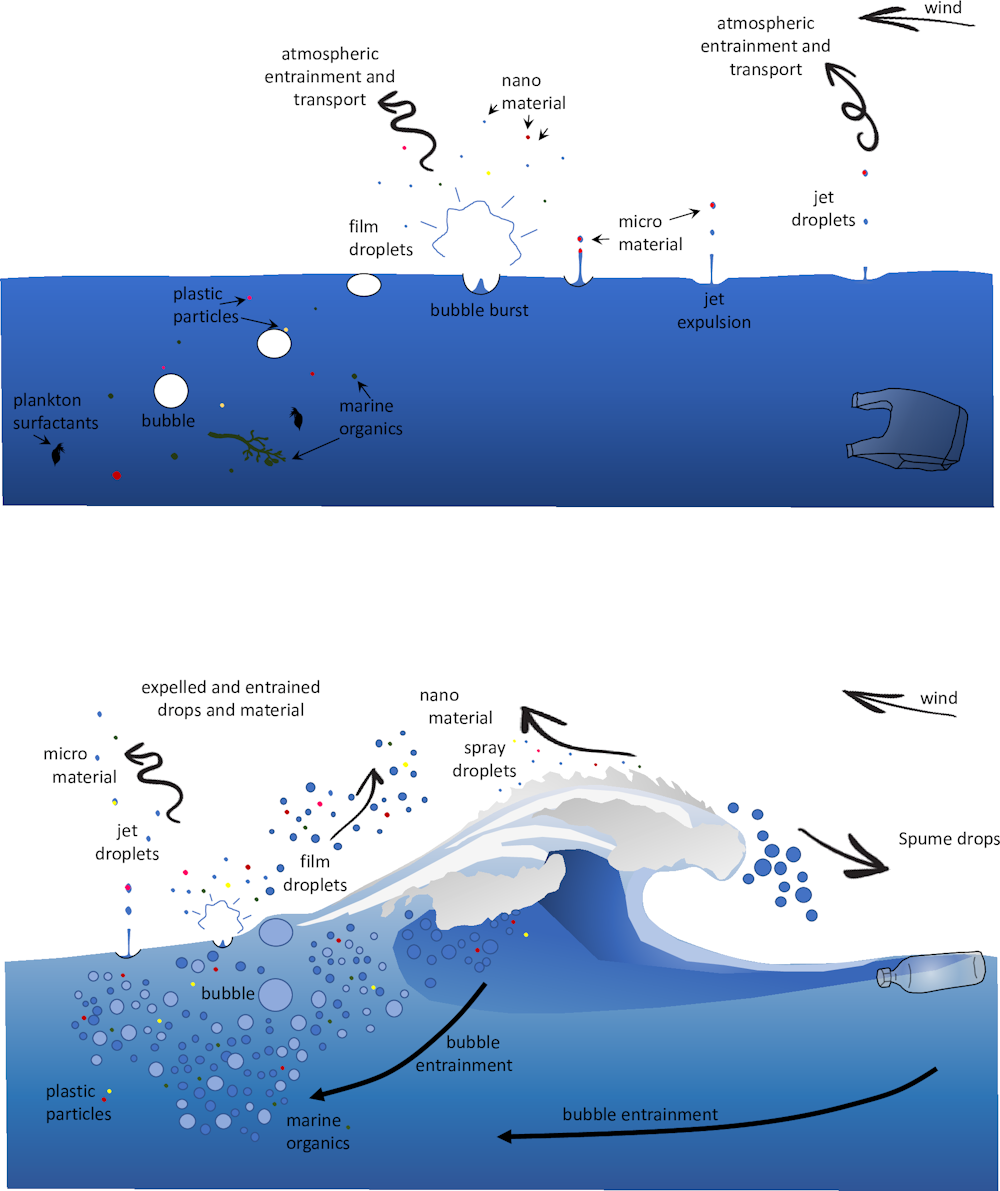
    The ocean releases microplastics into the air through surface froth and wave action. Once the particles are released, wind can transport them to other locations.
    Steve Allen, CC BY-SA

    In fact, bubble bursts caused by wave energy can release 100,000 metric tons of microplastics into the atmosphere each year. Since dolphins and other marine mammals breathe at the water’s surface, they may be especially vulnerable to exposure.

    Where there are more people, there is usually more plastic. But for the tiny plastic particles floating in the air, this connection isn’t always true. Airborne microplastics are not limited to heavily populated areas; they pollute undeveloped regions, too.

    Our research found microplastics in the breath of dolphins living in both urban and rural estuaries, but we don’t yet know whether there are major differences in amounts or types of plastic particles between the two habitats.

    How we do our work

    Breath samples for our study were collected from wild bottlenose dolphins during catch-and-release health assessments conducted in partnership with the Brookfield Zoo Chicago, Sarasota Dolphin Research Program, National Marine Mammal Foundation and Fundación Oceanogràfic.

    Exhaled breath is collected from a dolphin during a wild dolphin health assessment in Barataria Bay in Louisiana.
    Todd Speakman/National Marine Mammal Foundation, CC BY-SA

    During these brief permitted health assessments, we held a petri dish or a customized spirometer – a device that measures lung function – above the dolphin’s blowhole to collect samples of the animals’ exhaled breath. Using a microscope in our colleague’s lab, we checked for tiny particles that looked like plastic, such as pieces with smooth surfaces, bright colors or a fibrous shape.

    Since plastic melts when heated, we used a soldering needle to test whether these suspected pieces were plastic. To confirm they were indeed plastic, our colleague used a specialized method called Raman spectroscopy, which uses a laser to create a structural fingerprint that can be matched to a specific chemical.

    Our study highlights how extensive plastic pollution is – and how other living things, including dolphins, are exposed. While the impacts of plastic inhalation on dolphins’ lungs are not yet known, people can help address the microplastic pollution problem by reducing plastic use and working to prevent more plastic from polluting the oceans.

    Leslie Hart receives funding from the National Institute of Environmental Health Sciences of the National Institutes of Health, Sea Grant, and the National Science Foundation. Research reported in this article was supported by the National Institute of Environmental Health Sciences of the National Institutes of Health under Award Number R15ES034169 and the College of Charleston’s School of Health Sciences. The content is solely the responsibility of the authors and does not necessarily represent the official views of the National Institutes of Health.

    Leslie Hart is an epidemiological consultant for the National Marine Mammal Foundation; however, this study was not conducted as a consultant.

    Bottlenose dolphin health assessments were conducted under Scientific Research Permit #26622 and #24359, issued by the National Oceanic and Atmospheric Administration’s (NOAA) National Marine Fisheries Service (NMFS). Research studies were reviewed and approved by Mote Marine Laboratory and NMFS Atlantic Institutional Animal Care and Use Committees (IACUC).

    Miranda Dziobak does not work for, consult, own shares in or receive funding from any company or organization that would benefit from this article, and has disclosed no relevant affiliations beyond their academic appointment.

    ref. Microplastic pollution is everywhere, even in the exhaled breath of dolphins – new research – https://theconversation.com/microplastic-pollution-is-everywhere-even-in-the-exhaled-breath-of-dolphins-new-research-237932

    MIL OSI – Global Reports

  • MIL-OSI Global: Donald Trump’s attack on overseas voters is erroneous and dangerous

    Source: The Conversation – Canada – By Jennifer Saul, Chair in Social and Political Philosophy of Language, University of Waterloo

    I do research on racist and xenophobic speech. I am also an American citizen, and have voted from overseas since 1996 (first in the U.K., and now in Canada).

    This makes me especially well-placed to explain why Donald Trump’s Truth Social post about overseas voters in late September and Republican efforts to undermine those voters are factually wrong and politically dangerous.

    The current law giving Americans overseas the right to vote in federal elections is the Uniformed and Overseas Citizens Absentee Voting Act, which was signed into law by Ronald Reagan, a Republican president.

    The federal program to help American citizens vote while living overseas is overseen by the Department of Defense — which makes sense, given that a large number of them are members of the United States military. All of this should give pause to anyone who thinks that allowing overseas citizens to vote is some sort of left-wing conspiracy.

    Complex process

    Nor is it an easy matter to vote from overseas. Every state has its own process for verifying citizenship after the registration and request form reaches them, and each has its own rules that voters must follow in order for their ballot to be counted.

    My own state, New Jersey, is relatively simple: I can email my registration/request form, get my ballot by e-mail, and email it back. But I must also remember to mail in the paper version of my ballot or my vote won’t count.

    This is easy enough for me, from Canada or previously the U.K. But it’s much more difficult for American citizens living in places that lack reliable postal services who often have to use expensive courier services to carry out their duty as citizens.

    My husband’s state is New York. He is allowed to e-mail his ballot request, but he must also mail a paper version of the request. And the ballot itself comes with an elaborate set of envelope templates that require precise folding — and must arrive by a strict deadline, no matter where they’re being mailed from.

    He’s a former graphic designer, and comfortable performing this task. But imagine trying to do so while suffering from arthritis or vision problems — especially when the home-printed version has tiny text. In short, there is nothing easy about voting from abroad.

    So why use inflammatory language to pretend it’s an easy matter to generate many thousands of fraudulent overseas votes? One explanation would be to sow doubt about the election results. Anything that can introduce uncertainty and slow down the counting process can be exploited in an effort that could allow Trump and his allies to falsely declare him the winner on Nov. 5.

    Trump’s campaign has made no secret about its plan to follow this path.

    Language that suggests American citizens abroad are not really American also fits into a larger pattern of stoking divisions — and of drawing ever tighter boundaries around who would be counted as “real” Americans. This is a classic fascist power move, one that leads to a sharply defined “us,” who are worthy of moral consideration, as opposed to “them,” who are not.

    Disenfranchising citizens abroad

    Importantly, the movement against overseas voters is not just confined to a social media post. There are lawsuits in several states designed to disenfranchise American citizens abroad. These are citizens who may have gone to enormous lengths to carry out their duties by asking for and sending in election ballots, often at substantial personal expense and faced with substantial barriers.

    Trump and his allies are working hard to prevent Americans abroad from exercising their most basic rights of citizenship. When Trump uses language that accuses overseas voters of fraud and foreign interference, it suggests we’re not really Americans.

    There’s a major problem in doing so. As mentioned, a large segment of American citizens abroad are members of the U.S. armed forces. Efforts to disenfranchise Americans abroad are also efforts to disenfranchise the military.

    ‘Figleaf’ language

    That’s why Trump’s allegation on Truth Social that Democrats “want to dilute the TRUE vote of our beautiful military” makes no sense. This is especially true given it’s coming from someone who’s attacking the very law that allows members of the military to vote from abroad, including casting ballots for him if they’re so inclined.

    This is what I call a figleaf — an additional bit of speech that provides just a bit of cover for saying something else that is much less acceptable. The allegation suggests, to someone who doesn’t understand overseas voting, that Trump somehow supports the military.

    Trump’s “diluting the vote” rhetoric also plays into the deeply racist Great Replacement Theory. This theory holds that Democrats and other shadowy forces (often cast as Jewish) are plotting to replace white Americans with foreigners, in part as a way to secure electoral victory.

    Overseas voting might seem like a niche issue. But overseas citizens could make all the difference in a close election. The attack on overseas voting is part of a much larger pattern of destructive suggestions from Trump about who is and is not a real American.

    I am a member of the Democratic Party

    ref. Donald Trump’s attack on overseas voters is erroneous and dangerous – https://theconversation.com/donald-trumps-attack-on-overseas-voters-is-erroneous-and-dangerous-241332

    MIL OSI – Global Reports

  • MIL-OSI Global: Canada’s agricultural policies are falling short of health and sustainability goals

    Source: The Conversation – Canada – By Kathleen Kevany, Professor, Sustainable Food Systems, Dalhousie University

    Oct. 16 marks World Food Day, a global initiative drawing attention to the “right to foods for a better life and a better future.” However, Canada’s food and agricultural policies are falling short of this objective.

    Canada’s current agricultural policies are not serving the well-being of the public. Canada’s agricultural program payments and subsidies are not aligned with the government’s dietary guidelines and health goals.

    Very few agriculture investments go to the production of fruits and vegetables, even though Canadians under-consume them. Instead, financial support overwhelmingly goes to feed crops, agricultural export crops and foods high in saturated fat. This is particularly troubling, given the rise of food and lifestyle diseases in Canada, such as diabetes, obesity, coronary heart disease and high cholesterol.

    The health-care costs of diet-related diseases from not meeting the dietary guidelines are at least two per cent of all health-care costs in Canada, with some estimates putting it as high as 19 per cent. Agricultural policy is not just about food; it influences health, the economy and the environment.

    Climate change and agriculture

    Trying to address greenhouse gas emissions without paying attention to agriculture is like heating your home while not ensuring doors and windows are closed. Agriculture is a big contributor to Canada’s greenhouse gas emissions.

    As climate change intensifies, bringing more frequent and severe wildfires, droughts, floods, and heat domes , agriculture is being impacted. Instability in weather patterns threatens regional and global social stability and may require Canada to rethink the dominant role of international trade in shaping its current agricultural policies.


    Read more:
    How to fight climate change in agriculture while protecting jobs


    Government policies that largely support input-intensive crops and animal agriculture contribute significantly to methane and nitrous oxide emissions and global warming.

    Despite these concerns, Canada is not investing strategically or sufficiently in agriculture. Despite $12.5 billion dollars in annual agricultural supports, a surprising portion of Canadian farmers continue to financially struggle to survive. According to the National Farmers Union:

    “Over the last three decades, the agribusiness corporations that supply fertilizers, chemicals, machinery, fuels, technologies, services, credit, and other materials and services have captured 95 per cent of all farm revenues, leaving farmers just five per cent.”

    In 2016, 66 per cent of all farms in Canada were in the revenue class of $10,000 to $249,999. On average, these farms had expenses exceeding their revenue by a large margin.

    While Canada spends a large share of its budget on addressing the negative outcomes of how we produce and consume food, there remain greater opportunities for investing in preventive measures that promote a healthier, more sustainable food system. Canada’s 20th century agriculture policy regime is woefully insufficient for the challenges of the 21st century.

    Solutions to the crisis

    Transforming our food systems will help to avert devastating climate change and ecological devastation. Many Canadian farmers are already leading the way by incorporating principles of sustainability into their practices. And the good news is that healthy diets are also environmentally sustainable.

    Food outlets and school cafeterias can play a role in reducing inefficiencies in the food system, like food waste, and improving sustainability by promoting healthy eating. To make this happen, schools need more resources and autonomy to counter misinformation about food and position Canadians for success by making healthy choices attractive.


    Read more:
    How schools and families can take climate action by learning about food systems


    Many Canadians support local, bioregional food systems as an alternative to anonymous, transnational food systems. However, these local initiatives are not enough on their own to meet our health, community vitality and environmental goals.

    To truly make an impact, local food movements must be part of a larger, co-ordinated effort supported by policies that align agricultural production with healthy diets.
    A new approach to food policies that considers them from a holistic perspective, beyond GDP, and respects farmers while creating food systems based on the One Planet and One Health frameworks is needed.

    It’s important to recognize that farmers are not only just business operators; they are our neighbours, and are integral to our communities. Supporting them with better policies and giving everyone equitable access to nourishing and sustainable foods will ensure a healthier, more resilient future for all Canadians.

    Canada needs to provide stronger support for family farms practising agroecologically sound production methods. Government programs that support greater production and purchasing of grains, fruits and vegetables for direct human consumption are also needed. These initiatives would reduce Canada’s reliance on imports of these critical foods.

    In addition, federal and municipal governments should strengthen and broaden Canada’s bioregional food systems while also fostering the growth of small- and medium-sized food businesses. It’s also important to reduce the political and market power of oligopolies in Canada’s food system.

    A call for change

    None of these changes can happen without moving beyond the current, outdated productionist model that views agriculture in isolation and relies on the belief that only global-industrial food systems can feed the world.

    In fact, smaller-scale agroecological farmers operating in bioregional food systems are key. Achieving our broader societal goals means thinking of food through agriculture, human health and environmental sustainability lenses.

    Canada needs a new vision of agriculture that connects health and environment goals with sustainable diets and prosperous family farming. This vision must prioritize nutritious diets, human and environmental health, and the overall well-being of society beyond profits, market share and food exports. Also it must be formed collectively by decision-makers, farmers, food processors, community groups and the public.

    In Canada, governments, organizations and citizens must work together to create a food system vision for Canada, much like Food Secure Canada’s Resetting the Table process previously did.

    Further collaboration among agriculture, environment and health professionals can arise from these efforts, as can be seen with Canada’s National School Food program, which is aligning local farmers and suppliers of local options to meet Canada’s Food Guide. This is also an opportunity for Canada’s Food Policy Advisory Council to gain greater influence in shaping policy.

    Just as calls for health-care reform often focus on improving services, Canadians have the right to expect better outcomes from agricultural subsidies. By prioritizing economic, environmental and public health sustainability, Canada can ensure its agricultural policy is fit for its 21st-century food system.

    Kathleen Kevany received funding from Protein Industries Canada. She is an advisor to Farm to Cafeteria Canada.

    Howard Nye receives funding from the Social Sciences and Humanities Research Council of Canada. He is a board member and research lead for Canadians for Responsible Food Policy.

    Mark Kent Mullinix receives funding from Social Sciences and Humanities Research Council, Agriculture and Agri-Food Canada. Government of British Columbia, various foundations

    Talan B. Iscan is a project lead and receives funding from MacEachen Institute for Public Policy and Governance at Dalhousie University. He is a board member with the Halifax Cycling Coalition, a non-profit.

    ref. Canada’s agricultural policies are falling short of health and sustainability goals – https://theconversation.com/canadas-agricultural-policies-are-falling-short-of-health-and-sustainability-goals-239560

    MIL OSI – Global Reports

  • MIL-OSI Global: Canada’s medical cannabis system changed but didn’t disappear after recreational legalization

    Source: The Conversation – Canada – By Michael J. Armstrong, Associate Professor, Operations Research, Brock University

    When Canada legalized recreational cannabis use on Oct. 17, 2018, there were concerns about the potential impacts. Would it trigger greater cannabis use, boost economic growth or otherwise affect the country’s health, safety and finances?

    Patients already using cannabis legally for medical purposes were especially concerned. They worried that recreational legalization might prompt physicians to stop authorizing cannabis treatments. Or that cannabis producers would abandon the small medical market to pursue the larger recreational one.

    After recreational legalization, the medical cannabis system did see declines. Between June 2018 and December 2022, the number of registered patients fell 32 per cent, while product sales fell 29 per cent. Some people thought the medical cannabis system had failed or become obsolete.

    As someone who studies the business aspects of cannabis legalization, I wondered about these issues, too. It wasn’t clear how patients, producers or health-care providers would react to recreational legalization. Legal medical use itself had only become accessible a few years earlier.

    Accessing medical cannabis

    Canada began allowing medical use of cannabis in 1999. But it remained difficult to get until regulations changed during 2014-15.

    The new rules allowed any physician to authorize patients to use cannabis. Those patients could then register to buy products online from licensed cannabis producers. Online orders could not exceed a 30-day supply.

    (Instead of buying cannabis products, some patients grew their own plants instead. My research hasn’t examined that.)

    Under this new procedure, the number of patients registering to buy cannabis soared. They grew from 7,914 in June 2014 to 330,344 in June 2018, nearly one per cent of Canada’s population.

    However, registration levels differed greatly between provinces. In June 2018, registrations represented almost three per cent of Alberta’s population, versus only 0.1 per cent of Québec’s.

    Interestingly, less than half of registrants bought medical cannabis in any given month. Perhaps they simply didn’t need the full dose. Or maybe they found it too expensive, inconvenient or ineffective.

    June 2018 was also when the federal government passed its new cannabis legislation. The law took effect in October 2018, when recreational sales of dried cannabis and cannabis oils began. After initial product shortages were overcome, recreational cannabis sales grew rapidly as more stores opened, even during the COVID-19 pandemic. Consumer choice expanded in December 2019 when edibles and vapes became available.

    This is where my new study came in. I analyzed government data on patients’ use of Canada’s medical cannabis system between 2017 and 2022. This included how many patients registered, how often they placed orders, and how much cannabis they bought.

    Evolving system usage

    I found that as soon as parliament passed the new cannabis law, medical registrations began slowing down, despite recreational legalization still being four months away.

    But the response differed noticeably between provinces. For example, registrations kept growing steadily in Québec but plummeted rapidly in Alberta. Other provinces were in between.

    My data doesn’t say why those changes occurred. Perhaps Alberta, with its copious cannabis clinics, had many patients only mildly interested in using cannabis medically. Conversely, maybe Québec was still catching up with other provinces on medical use.

    When recreational sales started in October 2018, patient registrations seemed unaffected. Their average purchase sizes didn’t change either. But they bought medical cannabis slightly less often.

    This might have been due to retail convenience. At that time, medical producers and recreational stores were selling similar products: dried cannabis and cannabis oils. So, perhaps some patients started topping up their supplies occasionally at recreational stores but saw no reason to leave the online medical system completely.

    When edibles and other processed products began selling in December 2019, registrations dropped further. But the patients who remained bought medical cannabis slightly more often and in increasingly larger quantities.

    Product selections might explain this patient split. Perhaps producers with good edible products retained their customers and received larger orders from them. Conversely, maybe medical producers offering few edibles lost their patients to the recreational shops and their vast product assortments.

    In summary, Canada’s medical cannabis system experienced big changes after recreational legalization. But it didn’t disappear.

    Will other countries see similar outcomes if they allow recreational cannabis?

    A changing world

    In Europe, for example, The Netherlands is experimenting with recreational sales. Meanwhile, Germany has legalized recreational use but not retail sales. Will those countries experience medical cannabis changes like Canada did?

    Conversely, some countries barely tolerate even medical use. It is very difficult to legally obtain medical cannabis in the United Kingdom, for example, much like in Canada 20 years ago. And France has only conducted a few medical cannabis trials.

    Other countries, like Australia and New Zealand, are somewhere in between. They’re seeing rapid growth in legal medical use and illegal recreational use, but haven’t legalized recreationally. That’s roughly where Canada was 10 years ago.

    Will Canada’s medical and recreational cannabis experiences make these other countries more interested in legalization, or less? Either way, I hope they can learn from our experiences as they chart their own cannabis paths.

    Michael J. Armstrong does not work for, consult, own shares in or receive funding from any company or organisation that would benefit from this article, and has disclosed no relevant affiliations beyond their academic appointment.

    ref. Canada’s medical cannabis system changed but didn’t disappear after recreational legalization – https://theconversation.com/canadas-medical-cannabis-system-changed-but-didnt-disappear-after-recreational-legalization-240796

    MIL OSI – Global Reports

  • MIL-OSI Global: Wildlife, climate and plastic: how three summits aim to repair a growing rift with nature

    Source: The Conversation – UK – By Jack Marley, Environment + Energy Editor, UK edition

    By the end of 2024, nearly 200 nations will have met at three conferences to address three problems: biodiversity loss, climate change and plastic pollution.

    Colombia will host talks next week to assess global progress in protecting 30% of all land and water by 2030. Hot on its heels is COP29 in Azerbaijan. Here, countries will revisit the pledge they made last year in Dubai to “transition away” from the fossil fuels driving climate breakdown. And in December, South Korea could see the first global agreement to tackle plastic waste.

    Don’t let these separate events fool you, though.

    “Climate change, biodiversity loss and resource depletion are not isolated problems” say biologist Liette Vasseur (Brock University), political scientist Anders Hayden (Dalhousie University) and ecologist Mike Jones (Swedish University of Agricultural Sciences).


    Read more:
    Humanity’s future depends on our ability to live in harmony with nature


    “They are part of an interconnected web of crises that demand urgent and comprehensive action.”

    Let’s start with the climate.


    This roundup of The Conversation’s climate coverage comes from our award-winning weekly climate action newsletter. Every Wednesday, The Conversation’s environment editor writes Imagine, a short email that goes a little deeper into just one climate issue. Join the 35,000+ readers who’ve subscribed.


    Earth’s fraying parasol

    “How hot is it going to get? This is one of the most important and difficult remaining questions about our changing climate,” say two scientists who study climate change, Seth Wynes and H. Damon Matthews at the University of Waterloo and Concordia University respectively.

    The answer depends on how sensitive the climate is to greenhouse gases like CO₂ and how much humanity ultimately emits, the pair say. When Wynes and Matthews asked 211 authors of past reports by the Intergovernmental Panel on Climate Change, their average best guess was 2.7°C by 2100.

    “We’ve already seen devastating consequences like more flooding, hotter heatwaves and larger wildfires, and we’re only at 1.3°C above pre-industrial levels — less than halfway to 2.7°C,” they say.


    Read more:
    New survey of IPCC authors reveals doubt, and hope, that world will achieve climate targets


    There is a third variable that is harder to predict but no less important: the capacity of forests, wetlands and the ocean to continue to offset warming by absorbing the carbon and heat our furnaces and factories have released.

    This blue and green carbon pump stalled in 2023, the hottest year on record, amid heatwaves, droughts and fires. The possibility of nature’s carbon storage suddenly collapsing is not priced into the computer models that simulate and project the future climate.

    Parched forests can emit more carbon than they soak up.
    Matthew James Ferguson/Shutterstock

    However, the ecosystems that buffer human-made warming are clearly struggling. A new report from the World Wildlife Fund (WWF) showed that the average size of monitored populations of vertebrate wildlife (animals with spinal columns – mammals, birds, fish, reptiles and amphibians) has shrunk by 73% since 1970.


    Read more:
    Wildlife loss is taking ecosystems nearer to collapse – new report


    Wildlife could become so scarce that ecosystems like the Amazon rainforest degenerate, according to the report.

    “More than 90% of tropical trees and shrubs depend on animals to disperse their seeds, for example,” says biodiversity scientist Alexander Lees (Manchester Metropolitan University).

    “These ‘biodiversity services’ are crucial.”


    Read more:
    Without birds, tropical forests won’t bounce back from deforestation


    The result could be less biodiverse and, importantly for the climate, less carbon-rich habitats.

    Plastic in a polar bear’s gut

    Threats to wildlife are numerous. One that is growing fast and still poorly understood is plastic.

    Bottles, bags, toothbrushes: a rising tide of plastic detritus is choking and snaring wild animals. These larger items eventually degrade into microplastics, tiny fragments which now suffuse the air, soil and water.

    “In short, microplastics are widespread, accumulating in the remotest parts of our planet. There is evidence of their toxic effects at every level of biological organisation, from tiny insects at the bottom of the food chain to apex predators,” says Karen Raubenheimer, a senior lecturer in plastic pollution at the University of Wollongong.


    Read more:
    Scientists reviewed 7,000 studies on microplastics. Their alarming conclusion puts humanity on notice


    Plastic is generally made from fossil fuels, the main agent of climate change. Activists and experts have seized on a similar demand to address both problems: turn off the taps.

    In fact, the diagnosis of Costas Velis, an expert in ocean litter at the University of Leeds, sounds similar to what climate scientists say about unrestricted fossil fuel burning:

    “Every year without production caps makes the necessary cut to plastic production in future steeper – and our need to use other measures to address the problem greater.”


    Read more:
    A global plastic treaty will only work if it caps production, modelling shows


    A production cap hasn’t made it into the negotiating text for a plastic treaty (yet). And while governments pledged to transition away from coal, oil and gas last year, a new report on the world’s energy use shows fossil fuel use declining more slowly than in earlier forecasts – and much more slowly than would be necessary to halt warming at internationally agreed limits. The effort to protect a third of earth’s surface has barely begun.

    Each summit is concerned with ameliorating the effects of modern societies on nature. Some experts argue for a more radical interpretation.

    “Even if 30% of Earth was protected, how effectively would it halt biodiversity loss?” ask political ecologists Bram Büscher (Wageningen University) and Rosaleen Duffy (University of Sheffield).


    Read more:
    Biodiversity treaty: UN deal fails to address the root causes of nature’s destruction


    “The proliferation of protected areas has happened at the same time as the extinction crisis has intensified. Perhaps, without these efforts, things could have been even worse for nature,” they say.

    “But an equally valid argument would be that area-based conservation has blinded many to the causes of Earth’s diminishing biodiversity: an expanding economic system that squeezes ecosystems by turning ever more habitat into urban sprawl or farmland, polluting the air and water with ever more toxins and heating the atmosphere with ever more greenhouse gas.”

    ref. Wildlife, climate and plastic: how three summits aim to repair a growing rift with nature – https://theconversation.com/wildlife-climate-and-plastic-how-three-summits-aim-to-repair-a-growing-rift-with-nature-241419

    MIL OSI – Global Reports

  • MIL-OSI Global: How the invasive spiny water flea spread across Canada, and what we can do about it

    Source: The Conversation – Canada – By Sam Lucy Behle, PhD Student, Université du Québec en Abitibi-Témiscamingue (UQAT)

    Across the tranquil waters of Canada’s vast network of lakes and rivers, a quiet invader is on the move. The spiny water flea, Bythotrephes cederströmii, is a microscopic predator that is forever altering the ecological fabric of aquatic habitats in Canada.

    Originally from Eurasia, Bythotrephes casts a long shadow over the ecosystems it invades. Its presence in Canadian waters represents an ongoing ecological challenge, one that intertwines the fate of native species with the spectre of climate change.


    Our lakes: their secrets and challenges, is a series produced by La Conversation/The Conversation.

    This article is part of our series Our lakes: their secrets and challenges. The Conversation and La Conversation invite you to take a fascinating dip in our lakes. With magnifying glasses, microscopes and diving goggles, our scientists scrutinize the biodiversity of our lakes and the processes that unfold in them, and tell us about the challenges they face. Don’t miss our articles on these incredibly rich bodies of water!


    Diminutive and destructive

    Despite its name, Bythotrephes is neither a flea nor a parasite.

    A member of the crustacean zooplankton family, the Bythotrephes belongs to a group of microscopic arthropods that are near the base of the aquatic food web and related to other crustaceans like shrimp and lobsters.

    Its diet primarily consists of other crustacean zooplankton, with herbivores being the preferred food source. By preying on these critical organisms, Bythotrephes can destabilize a local food web. This destabilization leads to a decrease in native fish populations that rely on zooplankton for nourishment.

    The Bythotrephes is equipped with a long, barbed tail spine, which makes it difficult prey for most fish, further allowing its populations to grow mostly unchecked in many lakes.

    The Bythotrephes is well protected against predation and feeds on a number of key species.

    Alarmingly, the Bythotrephes is spreading rapidly.

    Human activities, particularly recreational boating and fishing, serve as the primary vectors for this invasive species. Boats and equipment used in infested waters can harbour Bythotrephes’ and its eggs, which are remarkably resistant to freezing and drying and able to survive out of water for extended periods of time.

    Unknowingly, outdoor enthusiasts can transport these invaders to uninvaded habitats, sometimes seeding new infestations far from the original point of invasion. However, the insidious spread of Bythotrephes is not solely the direct result of human activities but is also exacerbated by climate change.

    Changing conditions

    The Canadian climate has been historically hostile to the Bythotrephes. But as global temperatures rise and weather patterns shift, more and more of Canada is experiencing conditions favourable for the proliferation of invasive species like Bythotrephes.

    Warmer water temperatures, in particular, extend its breeding season, allowing for more reproductive cycles within a single year. This amplifies their population growth and colonization potential, hastening their spread across Canadian waters.


    Read more:
    Climate change means we may have to learn to live with invasive species


    Milder winters and earlier ice melt may also enable Bythotrephes to survive and reproduce in regions where it was previously unable to establish populations. These changes in environmental conditions create novel opportunities for Bythotrephes to expand its range and out-compete native species for resources, exacerbating the ecological disruption caused by its invasion.

    As we confront the dual challenges of invasive species management and climate change adaptation, it becomes increasingly clear that addressing the spread of Bythotrephes requires a holistic and interdisciplinary approach.

    Commonly viewed as fleas, the Bythotrephes actually possess a number of key differences.

    Solutions remain

    The battle against the spread of Bythotrephes is multifaceted, requiring a blend of scientific research, policy action and public participation. After prevention, monitoring for early detection is critical.

    Enhanced surveillance of known potential habitats can help identify new infestations early, enabling quicker actions to contain or eradicate outbreaks.

    Public awareness and education are equally important. The adage “clean, drain, dry” should become a mantra for anyone engaging in aquatic recreation. By thoroughly cleaning and drying boats, gear and equipment, individuals can dramatically reduce the risk of transporting Bythotrephes and other invasive species to new locations.

    Awareness campaigns can also inform the public about the critical role they play in stopping the spread of invasive species and protecting Canada’s aquatic biodiversity.

    Investing in research to understand the ecological impact of Bythotrephes and to develop effective control measures is vital. Biological control strategies, habitat restoration and public education programs can all contribute to a comprehensive approach to managing this invasive threat.


    Read more:
    Invasive species are reshaping aquatic ecosystems, one lake at a time


    The invasion of Bythotrephes in Canada is a stark reminder of the fragility of aquatic ecosystems and the complexity of managing invasive species in the face of climate change. By understanding the impact of Bythotrephes and taking deliberate steps to curb its spread, Canadians can protect their waterways and the diverse life they support.

    There is power in informed action and collective will. It is a battle that requires the engagement of all — from scientists and policymakers to local communities and individuals. Together, we can halt the forward march of Bythotrephes cederströmii and preserve the ecological integrity of Canada’s precious aquatic ecosystems for future generations.

    Sam Lucy Behle receives funding from MRC-Abitibi, NSERC, MELCCFP, CREAT and Fondation de la Faune du Québec.

    Beatrix Beisner receives funding from NSERC and the FRQNT. She is Co-Director of the Groupe de recherche interuniversitaire en limnologie (GRIL), a research network of 12 Québec universities.

    Guillaume Grosbois receives funding from MRC-Abitibi, NSERC, MELCCFP, CREAT and Fondation de la Faune du Québec.

    ref. How the invasive spiny water flea spread across Canada, and what we can do about it – https://theconversation.com/how-the-invasive-spiny-water-flea-spread-across-canada-and-what-we-can-do-about-it-227546

    MIL OSI – Global Reports

  • MIL-OSI Global: Socially distanced layout of the world’s oldest cities helped early civilization evade diseases

    Source: The Conversation – USA – By R. Alexander Bentley, Professor of Anthropology, University of Tennessee

    Excavations at Çatalhöyük show how closely people lived before the settlement collapsed. Mark Nesbitt/Wikimedia Commons, CC BY

    In my research focused on early farmers of Europe, I have often wondered about a curious pattern through time: Farmers lived in large dense villages, then dispersed for centuries, then later formed cities again, only to abandon those as well. Why?

    Archaeologists often explain what we call urban collapse in terms of climate change, overpopulation, social pressures or some combination of these. Each likely has been true at different points in time.

    But scientists have added a new hypothesis to the mix: disease. Living closely with animals led to zoonotic diseases that came to also infect humans. Outbreaks could have led dense settlements to be abandoned, at least until later generations found a way to organize their settlement layout to be more resilient to disease. In a new study, my colleagues and I analyzed the intriguing layouts of later settlements to see how they might have interacted with disease transmission.

    Modern excavations at what was once Çatalhöyük, where inhabitants lived in mud-brick houses that weren’t separated by paths or streets.
    Murat Özsoy 1958/Wikimedia Commons, CC BY-SA

    Earliest cities: Dense with people and animals

    Çatalhöyük, in present-day Turkey, is the world’s oldest farming village, from over 9,000 years ago. Many thousands of people lived in mud-brick houses jammed so tightly together that residents entered via a ladder through a trapdoor on the roof. They even buried selected ancestors underneath the house floor. Despite plenty of space out there on the Anatolian Plateau, people packed in closely.

    Homes at Çatalhöyük were so tightly packed that people entered through the roof and even buried some ancestors beneath the floor.
    Illustration by Kathryn Killackey and The Çatalhöyük Research Project

    For centuries, people at Çatalhöyük herded sheep and cattle, cultivated barley and made cheese. Evocative paintings of bulls, dancing figures and a volcanic eruption suggest their folk traditions. They kept their well-organized houses tidy, sweeping floors and maintaining storage bins near the kitchen, located under the trapdoor to allow oven smoke to escape. Keeping clean meant they even replastered their interior house walls several times a year.

    These rich traditions ended by 6000 BCE, when Çatalhöyük was mysteriously abandoned. The population dispersed into smaller settlements out in the surrounding flood plain and beyond. Other large farming populations of the region had also dispersed, and nomadic livestock herding became more widespread. For those populations that persisted, the mud-brick houses were now separate, in contrast with the agglomerated houses of Çatalhöyük.

    Was disease a factor in the abandonment of dense settlements by 6000 BCE?

    At Çatalhöyük, archaeologists have found human bones intermingled with cattle bones in burials and refuse heaps. Crowding of people and animals likely bred zoonotic diseases at Çatalhöyük. Ancient DNA identifies tuberculosis from cattle in the region as far back as 8500 BCE and TB in human infant bones not long after. DNA in ancient human remains dates salmonella to as early as 4500 BCE. Assuming the contagiousness and virulence of Neolithic diseases increased through time, dense settlements such as Çatalhöyük may have reached a tipping point where the effects of disease outweighed the benefits of living closely together.

    A new layout 2,000 years later

    By about 4000 BCE, large urban populations had reappeared, at the mega-settlements of the ancient Trypillia culture, west of the Black Sea. Thousands of people lived at Trypillia mega-settlements such as Nebelivka and Maidanetske in what’s now Ukraine.

    If disease was a factor in dispersal millennia before, how were these mega-settlements possible?

    Geophysical plot of Nebelivka settlement shows its circular layout, divided into neighborhoods.
    Duncan Hale and Nebelivka Project, CC BY-NC

    This time, the layout was different than at jam-packed Çatalhöyük: The hundreds of wooden, two-story houses were regularly spaced in concentric ovals. They were also clustered in pie-shaped neighborhoods, each with its own large assembly house. The pottery excavated in the neighborhood assembly houses has many different compositions, suggesting these pots were brought there by different families coming together to share food.

    This layout suggests a theory. Whether the people of Nebelivka knew it or not, this lower-density, clustered layout could have helped prevent any disease outbreaks from consuming the entire settlement.

    Archaeologist Simon Carrignon and I set out to test this possibility by adapting computer models from a previous epidemiology project that modeled how social-distancing behaviors affect the spread of pandemics. To study how a Trypillian settlement layout would disrupt disease spread, we teamed up with cultural evolution scholar Mike O’Brien and with the archaeologists of Nebelivka: John Chapman, Bisserka Gaydarska and Brian Buchanan.

    Simulating socially distanced neighborhoods

    To simulate disease spread at Nebelivka, we had to make a few assumptions. First, we assumed that early diseases were spread through foods, such as milk or meat. Second, we assumed people visited other houses within their neighborhood more often than those outside of it.

    Would this neighborhood clustering be enough to suppress disease outbreaks? To test the effects of different possible rates of interaction, we ran millions of simulations, first on a network to represent clustered neighborhoods. We then ran the simulations again, this time on a virtual layout modeled after actual site plans, where houses in each neighborhood were given a higher chance of making contact with each other.

    Based on our simulations, we found that if people visited other neighborhoods infrequently – like a fifth to a tenth as often as visiting other houses within their own neighborhood – then the clustering layout of houses at Nebelivka would have significantly reduced outbreaks of early foodborne diseases. This is reasonable given that each neighborhood had its own assembly house. Overall, the results show how the Trypillian layout could help early farmers live together in low-density urban populations, at a time when zoonotic diseases were increasing.

    The residents of Nebilevka didn’t need to have consciously planned for their neighborhood layout to help their population survive. But they may well have, as human instinct is to avoid signs of contagious disease. Like at Çatalhöyük, residents kept their houses clean. And about two-thirds of the houses at Nebelivka were deliberately burned at different times. These intentional periodic burns may have been a pest extermination tactic.

    Re-creation of a Trypillian house-burning, with additional straw and wood necessary to burn hot enough to match archaeological evidence.
    Arheoinvest/Wikimedia Commons, CC BY

    New cities and innovations

    Some of the early diseases eventually evolved to spread by means other than bad foods. Tuberculosis, for instance, became airborne at some point. When the bacterium that causes plague, Yersinia pestis, became adapted to fleas, it could be spread by rats, which would not care about neighborhood boundaries.

    Were new disease vectors too much for these ancient cities? The mega-settlements of Trypillia were abandoned by 3000 BCE. As at Çatalhöyük thousands of years before, people dispersed into smaller settlements. Some geneticists speculate that Trypillia settlements were abandoned due to the origins of plague in the region, about 5,000 years ago.

    The first cities in Mesopotamia developed around 3500 BCE, with others soon developing in Egypt, the Indus Valley and China. These cities of tens of thousands were filled with specialized craftspeople in distinct neighborhoods.

    This time around, people in the city centers weren’t living cheek by jowl with cattle or sheep. Cities were the centers of regional trade. Food was imported into the city and stored in large grain silos like the one at the Hittite capital of Hattusa, which could hold enough cereal grain to feed 20,000 people for a year. Sanitation was helped by public water works, such as canals in Uruk or water wells and a large public bath at the Indus city of Mohenjo Daro.

    These early cities, along with those in China, Africa and the Americas, were the foundations of civilization. Arguably, their form and function were shaped by millennia of diseases and human responses to them, all the way back to the world’s earliest farming villages.

    R. Alexander Bentley does not work for, consult, own shares in or receive funding from any company or organization that would benefit from this article, and has disclosed no relevant affiliations beyond their academic appointment.

    ref. Socially distanced layout of the world’s oldest cities helped early civilization evade diseases – https://theconversation.com/socially-distanced-layout-of-the-worlds-oldest-cities-helped-early-civilization-evade-diseases-239586

    MIL OSI – Global Reports

  • MIL-OSI Global: Somalia and Turkey are becoming firm allies – what’s behind this strategy

    Source: The Conversation – Africa – By Federico Donelli, Assistant Professor of International Relations, University of Trieste

    Turkey has ramped up its partnership with Somalia in recent months. It is helping Somalia defend its waters, and has signed a deal to explore for oil and gas off the east African nation’s coast.

    There have also been reports of advanced discussions to have Turkey set up a missile and rocket testing site in Somalia.

    These agreements underscore Turkey’s strategic and economic aspirations in the broader Horn of Africa region.

    Over the past four years, there has been a steady increase in Turkish partnerships and agreements for the export of defence-related products to the region. This has included the use of Turkish drones in conflict zones, such as Libya and Ethiopia.

    I have studied Turkey’s historical and current involvement in Somalia to understand what’s driving Ankara’s policy in the Horn of Africa. In my view, Turkey’s involvement is driven by multiple factors. These include international status-seeking, regional balance and strategic concerns.

    The opening of a training facility in Mogadishu has increased Turkey’s strategic depth in the Horn of Africa, projecting the country towards both sub-Saharan Africa and the Indian Ocean. And the use of Turkish drones in Ethiopia’s Tigray conflict has shown Turkish defence arrangements have become a factor in local dynamics.

    Somalia’s appeal

    Turkey’s interest in Somalia dates back to 2010-2011. At the time, Somalia was grappling with the devastating effects of 20 years of civil war, failed international interventions and the emergence of the al-Qaeda-linked al-Shabaab terror group. In addition, the country was devastated by a famine that claimed more than 250,000 lives.

    Somalia presented Turkey with several opportunities to establish a footprint in a region of high geostrategic value, and to enhance its image in Africa and globally.

    First, there was a lack of interest in the country from major international players. Apart from anti-piracy initiatives in the Gulf of Aden and the US focus on the war on terror, international players watched Somalia with a certain detachment.

    Turkey saw an opportunity to benefit from taking a leading role in an international crisis scenario.


    Read more:
    Al-Shabaab is just a symptom of Somalia’s tragedy – the causes are still in place


    Second, the world’s attention focused on the Arab world. The region was facing a wave of pro-democracy protests dubbed the Arab Spring. Somalia and the suffering of the Somali people were quickly forgotten by the international community.

    Turkish policymakers saw the country’s isolation as an opportunity to gain international popularity and visibility on the continent.

    Turkey took a multifaceted approach in Somalia. This encompassed humanitarian aid, diplomatic initiatives and economic investment. Turkey also supported state-building efforts and the reconstruction of Somalia’s security apparatus.

    Internal dynamics

    The financial and political resources that Turkey has invested in Somalia are driven by regional and domestic political considerations.

    Regionally, 2016 to 2021 was a period of tension between Turkey, and Saudi Arabia and the United Arab Emirates. Somalia and the competition for influence in its politics became one of the main areas of confrontation.

    Domestically, Turkey has been able to portray its involvement in a way that’s boosted the ruling party’s standing. In addition, engagement in the Horn of Africa meets the demands of various business groups. This includes construction and defence companies that are close to the ruling political elite.

    Intervention in Somalia plays an important role in the narrative of Turkish political elites associated with Turkey’s ruling party, Adalet ve Kalkınma Partisi (Justice and Development Party).

    The party is a conservative but non-confessional party with Islamist roots. A significant proportion of the party’s supporters consider voluntary charity (sadaqa) to be the duty of a good Muslim. As a result, Turkey’s foreign and domestic interests converged with the government’s policy to support crisis-stricken Muslim communities. This includes those in Somalia. Here, Turkey has framed its involvement as a political and humanitarian success story. The Turkish public views it as such.


    Read more:
    Turkey’s foray into Somalia is a huge success, but there are risks


    Turkey has been able to bolster its security and defence ties at a rapid pace. The country’s Savunma Sanayii Başkanlığı (Defence Industry Agency of Turkey) reports directly to the president. Established as a state body in 1985, the agency gained prominence in 2017 when President Recep Tayyip Erdogan had it placed under the direct authority of the presidency.

    This has made concluding defence agreements – a key factor of Ankara’s foreign policy – much faster.

    Turkey has also used the opportunity to increase its involvement in the energy sector. Ankara has long aspired to play a pivotal role as a major energy hub in the wider region. It has considered establishing exploration operations off the coast of Somalia. Like all emerging powers, Turkey has a thirst for energy. This explains its July 2024 oil and gas exploration deal with Somalia.

    Turning point

    Ankara’s February 2024 defence agreement marked a significant turning point in Turkey-Somalia cooperation.

    The agreement deepens defence ties between the two countries. Under the deal, Turkey has agreed to train and equip the Somali navy. It will also help patrol Somalia’s extensive 3,333-kilometre coastline. Turkey’s focus is on maritime activities. This is a strategic choice largely influenced by the unstable conditions in Somalia, where exerting control over territory is difficult.


    Read more:
    Red Sea politics: why Turkey is helping Somalia defend its waters


    The deal is a response to changes in the regional landscape and the ongoing reconfiguration of power dynamics in the Horn of Africa.

    This has included:

    Somalia’s decision to pursue diplomatic ties and defence agreements with Turkey needs to be understood against this backdrop.

    Federico Donelli is a Senior Research Associate at the Istituto di Studi di Politica Internazionale (ISPI) in Milan and a Non-Resident Fellow at the Orion Policy Institute (OPI) in Washington D.C.

    ref. Somalia and Turkey are becoming firm allies – what’s behind this strategy – https://theconversation.com/somalia-and-turkey-are-becoming-firm-allies-whats-behind-this-strategy-240578

    MIL OSI – Global Reports

  • MIL-OSI Global: Ghana’s informal settlements are not all the same – social networks make a difference in community development

    Source: The Conversation – Africa – By Seth Asare Okyere, PhD, Visiting lecturer, University of Pittsburg and Adjunct Associate Professor, Osaka University, University of Pittsburgh

    Informal settlements in Africa are diverse. Across regions and even in the same city, socioeconomic and physical conditions vary. One thing is common though: upgrading them is a challenge.

    Among the challenges are issues of including people, having enough funding and sustaining improvements. That’s why attention is shifting to community driven development. This concept refers to local interventions that are started or led by community groups with support from the local government, private or civil society organisations.

    Community driven development has gained support from international agencies such as the World Bank. The World Bank Group is estimated to have invested about US$30 billion in projects like this across 94 countries.

    These initiatives are considered more affordable, efficient and durable. Communities often contribute local resources and labour, and residents can learn skills from service providers which enable them to manage projects in the long term. When residents work together it can also strengthen bonds and build social capital. Social capital generally refers to the ties, bonds, relationships and trust found in a community. It is an important resource in informal settlements.

    We are a group of urban and development planners who examined the role of social capital in community driven development in urban Ghana.

    We conducted our study in the Abese Quarter (La township) and Old Tulaku communities, in the Greater Accra metropolitan area. These are both informal settlements but have different social characters.

    Our findings highlight the need for local governments to tailor development to the social context of informal settlements. Development planning institutions should use the networks already present in communities, as well as providing external help and resources.

    The research

    Our analysis was based on questionnaire responses from 300 residents of informal settlements in Greater Accra. Abese Quarter is what we call an indigenous settlement. It it composed of residents from the local Ga ethnic group with similar cultural practices. Old Tulaku is a migrant settlement. It includes a mix of residents originally from other regions in Ghana who moved to Accra in search of economic opportunities.

    We observed community water and sanitation projects planned and carried out by local residents.

    In doing so, we considered the role of two types of social capital: bonding and bridging.

    Bonding social capital deals with the personal relationships between individuals based on shared identity. It’s about family, close companionship, culture and ethnicity. Bridging social capital refers to the connection between people and external groups.

    In the indigenous settlement, bonding social capital had a positive influence on community driven development. Bridging social capital showed a negative relationship with it. For example, the public toilet in the community was in a deplorable state. This seemed to be explained by an inability to build wider connections outside the community to get the support needed. We reason that socially homogeneous communities tend to generate inward-looking networks that limit access to resources from beyond the group. Overemphasis on social ties can impede long-term community development.

    In the migrant informal settlement, our research revealed the opposite. Without shared identities (like ethnicity, language and social norms), migrant residents drew on shared challenges and goals. They organised and built connections to get support from businesses and donors for community projects.

    Our research reinforces the argument that the relationship between social capital and community-driven development of informal settlements is not straightforward. The social character of the settlement, be it indigenous or migrant, produces different outcomes.

    Bonding and bridging social capital

    Informal settlements are often neglected by local government and planning authorities. In such poor conditions, social connections influence the local capacity to carry out improvement projects.

    Typically, high levels of bonding social capital are seen to promote collective action in communities that share similar social and cultural norms and practices. However, the long term benefits of such projects may require building partnerships with external support organisations and service providers.

    Bridging social capital goes beyond shared identities. It fosters connection between people and external organisations.

    Generally, community-driven development success is greatest when both forms of social capital are high and used together. For instance, in the Ubungo Darajani informal settlement in Kinondoni Municipality in Dar es Salaam, Tanzania, landholders relied on both to secure land for community development.

    What next?

    Local government and community-based organisations should harness the different forms of social capital for development.

    Policymakers can learn from the creative and innovative ways that informal communities solve problems. This could help improve informal settlements equitably and sustainably.

    Beatrice Eyram Afi Ziorklui, a registered valuer and auditor at the Performance and Special Audit Department of the Ghana Audit Service, was part of the research team and contributed to this article.

    Louis Kusi Frimpong receives funding from Social Science Research Council (SSRC) through the African Peacebuilding Network (APN) Individual Research Fellowship Program.

    Matthew Abunyewah receives funding from the Foundation for Rural and Regional Renewal (FRRR) and Northern Western Australia and Northern Territory Drought Resilience Adoption and Innovation Hub (Northern Hubb)

    Stephen Leonard Mensah receives funding from the Works, Inc. Memphis, Tennessee, USA for his PhD studies.

    Seth Asare Okyere, PhD does not work for, consult, own shares in or receive funding from any company or organisation that would benefit from this article, and has disclosed no relevant affiliations beyond their academic appointment.

    ref. Ghana’s informal settlements are not all the same – social networks make a difference in community development – https://theconversation.com/ghanas-informal-settlements-are-not-all-the-same-social-networks-make-a-difference-in-community-development-239133

    MIL OSI – Global Reports

  • MIL-OSI Global: Trump’s musical interlude is a twist on the long tradition of candidates enlisting musicians’ support, from Al Jolson to Springsteen to Swift

    Source: The Conversation – USA – By Matt Harris, Associate Professor of Political Science, Park University

    Donald Trump dances to the song “Y.M.C.A.” with South Dakota Gov. Kristi Noem, during a town hall event in Pennsylvania on Oct. 14, 2024. Jabin Botsford/The Washington Post via Getty Images

    Donald Trump made liberal use of music in what’s being called a “surreal” or “bizarre” town hall meeting on Oct. 14, 2024, in Oaks, Pennsylvania. After two attendees at the event had medical problems, Trump declared he would stop answering audience questions, and music would be played instead.

    Then, as the Washington Post reported, “For 39 minutes, Trump swayed, bopped — sometimes stopping to speak — as he turned the event into almost a living-room listening session of his favorite songs from his self-curated rally playlist.”

    The music included “YMCA” by the Village People and Sinead O’Connor’s “Nothing Compares 2 U.”

    The use of music in campaigns is a long tradition, although this may be the first time a playlist has substituted for talking points. While Trump is bopping at campaign events, both Democrats and Republicans anticipate what looks to be another coin flip election that could come down to a few hundred thousand votes in a handful of states. Every voter matters – no matter how you reach them. With that in mind, Democrats are communicating not just on matters of policy, but matters of pop culture.

    Specifically, Democrats are embracing football and Taylor Swift. The Harris-Walz campaign trotted out endorsements from 15 Pro Football Hall of Famers and sells Swiftie-style friendship bracelets on its campaign website, among other overtures. Swift herself has endorsed Kamala Harris.

    The Harris-Walz campaign is definitely stressing Walz’s football coach background.
    Bill Clark/CQ-Roll Call, Inc via Getty Images

    Tim Walz cited his experience as a football coach and mentioned Swift in the vice presidential debate.

    Democratic challenger and former NFLer Colin Allred, who is running to unseat GOP Sen. Ted Cruz of Texas, has put out ads in which he appears moments from taking to the gridiron.

    But how much does pop culture campaigning, if you will, matter? Does trying to link a campaign to a sport, or a culture, or a style of music actually influence elections? Looking to five different election campaigns in the past can give a sense of the effects, or lack thereof, of such campaigning.

    An ad for Texas Democrat Rep. Colin Allred, a former NFL player, stresses his football past in his bid to unseat GOP Sen. Ted Cruz.

    Reagan and Springsteen

    Any discussion of the embrace of pop culture by candidates should probably start with Ronald Reagan’s Bruce Springsteen era.

    Reagan, attempting to reach beyond his base, viewed 1984 as a vibes-based election and cited Springsteen as an exemplar of the hope his campaign wished to inspire. Springsteen rejected a request from Reagan’s camp to use his often-misunderstood “Born in the U.S.A.” on the campaign trail. The song’s lyrics describe a down-on-his-luck Vietnam War veteran, but if you don’t listen carefully to the lyrics, the song can sound like a celebration of veterans and being American.

    While Reagan went on to win 49 states in that year’s election, perhaps the biggest long-term impact of his courtship of Springsteen fans was to turn Springsteen from a relatively apolitical performer to a staunch supporter of the Democratic Party.

    In this way, Springsteen’s transformation mirrors that of Taylor Swift, with Marsha Blackburn, the Tennessee Republican senator, serving as her Reagan – the person who pushed the performer into the political arena after years on the sidelines.

    Springsteen and Kerry

    Springsteen’s foray into politics eventually led him to back Democratic presidential nominee John Kerry in 2004 with a series of concerts called the “Vote for Change” tour.

    Democratic presidential candidate John Kerry greets the crowd with musician Bruce Springsteen while campaigning in Columbus, Ohio, on Oct. 28, 2004.
    AP Photo/Laura Rauch

    Kerry, meanwhile, undertook his own efforts at cultural turf claiming. His attempts to demonstrate his bona fides as a sports-loving everyman went awry at times, when he flubbed the name of “Lambeau Field,” home of Wisconsin’s Green Bay Packers, and referred to a nonexistent Boston Red Sox player, “Manny Ortez.” The ill-fated sports references arguably didn’t hurt his campaign – he won Wisconsin and Massachusetts – but he was ridiculed for a photo-op hunting trip late in the campaign and went on to lose rural Midwestern voters decisively – as well as the election.

    Kerry’s dabbling with hunting imagery was perhaps an attempt to dull President George W. Bush’s advantage in perceived strength of leadership, which was in part burnished by his adoption of a cowboy persona.

    Harding, Jolson and the Cubs

    While Reagan’s attempt to woo 1980s rock fans is one of the best-known attempts to campaign on a mantra of popular culture, it was far from the first.

    Sen. Warren Harding’s 1920 front porch campaign for president was given a jolt of enthusiasm by a visit from singer and actor Al Jolson. Harding was also visited in his hometown, Marion, Ohio, by other actors and celebrities and the Chicago Cubs.

    Harding’s strategy probably better serves as a template for things to come than a decisive move in the 1920 election: His victory with over 60% of the popular vote suggests no celebrity could have saved Democrat James Cox.

    Bill Clinton and MTV

    As the Harris-Walz campaign tries to draw votes from Swift’s young fans, parallels can be drawn to Democratic Arkansas Gov. Bill Clinton’s attempts to embrace youth culture in the 1992 presidential election. Among other appearances, Clinton took questions from young voters on MTV and played saxophone on “The Arsenio Hall Show.”

    While the direct effect of Clinton’s forays into youth culture is difficult to measure, he did surge among young voters relative to Democrat Michael Dukakis’ 1988 presidential campaign.

    In his 1992 campaign, Bill Clinton went on MTV to answer young people’s questions, which included ‘If you had it to do over again, would you inhale?’

    Ford and football

    Any discussion of politicians embracing football culture would be incomplete without a discussion of the American president best at playing football, Gerald Ford, the vice president who became the nation’s 38th president in 1974, when Richard Nixon resigned during the Watergate scandal.

    Ford played center on two national championship teams at the University of Michigan. While not using his football player background to the same level as former football coach Walz did at the Democratic National Convention, Ford did make use of his football credentials on the stump during the 1976 presidential campaign and was joined on the campaign trail by Alabama football coach Paul “Bear” Bryant.

    But the votes of football fans were apparently not enough to keep Ford in the White House for long. He lost the 1976 election to Democrat Jimmy Carter.

    Potentially fruitful pickups

    Will the Harris-Walz strategy of recruiting voters through pop culture be successful? Swift’s fans are largely young, suburban women, and NFL fans are strewn across the political spectrum. There are potentially fruitful pickups in both camps. The candidates certainly think it matters: Walz said he “took football back” from Republicans, a claim disputed by Trump.

    Stressing pop culture credentials can also provide attention to a campaign, regardless of persuasion. Clinton’s pop culture appearances generated coverage beyond the appearances themselves and were cost-effective for a campaign short on funds.

    This type of pop culture campaigning generates coverage, then, even if voters aren’t moved by thinking a candidate shares their love of football or pop music.

    This story has been updated to include the Trump town hall in Oaks, Pennsylvania, on Oct. 14.

    Matt Harris does not work for, consult, own shares in or receive funding from any company or organization that would benefit from this article, and has disclosed no relevant affiliations beyond their academic appointment.

    ref. Trump’s musical interlude is a twist on the long tradition of candidates enlisting musicians’ support, from Al Jolson to Springsteen to Swift – https://theconversation.com/trumps-musical-interlude-is-a-twist-on-the-long-tradition-of-candidates-enlisting-musicians-support-from-al-jolson-to-springsteen-to-swift-239381

    MIL OSI – Global Reports

  • MIL-OSI Global: Who really holds the purse strings? Why it matters which partner decides where the money goes

    Source: The Conversation – UK – By Ran Gu, Lecturer in Economics, University of Essex

    Kmpzzz/Shutterstock

    In an era of increasing financial complexity, who really calls the shots when it comes to investing your household’s savings? This question has significant implications for financial health and overall wellbeing.

    As economists, we specifically wanted to understand how “bargaining power” is distributed between men and women in a mixed-sex household when it comes to finances. This bargaining power refers to the ability of one partner to influence decisions that affect the household – the partner with more bargaining power has a greater say.

    To investigate this, my research partners and I analysed household investment decisions in Australia, Germany and the US. Our recent research reveals a persistent gender gap in household investment decisions, with men often wielding greater influence, even when their female partners may be more risk-averse.

    This isn’t just a matter of who manages the online brokerage account – it has real consequences for families. In many households, partners have different levels of risk tolerance.

    In Australia, this was the case for 43% of households, increasing to 57% in Germany and 65% in the US. This suggests that disagreements over investment decisions are common.

    For example, a man might prefer high-risk, high-reward stocks, while his female partner prioritises safer, long-term investments. If the man dominates the decision-making, the family portfolio might be exposed to a level of risk the woman finds uncomfortable, potentially jeopardising their financial security.

    But how do we measure this “bargaining power” within households? We developed an approach that goes beyond simply asking couples who makes the decisions. Instead, we looked at actual investment choices and combined this with data on individual risk tolerances. This allowed us to estimate how much each partner’s preferences influenced the final investment decisions.

    Across all three countries, men tend to have more control over investment decisions than their female partners. In an average Australian household, the man’s bargaining power is 60%, compared to 40% for the woman.

    In the US and Germany, men hold even greater sway, with their bargaining power rising to 61% and 69% respectively. While men’s greater bargaining power could be justified if they were better traders, evidence suggests they tend to trade more frequently and underperform compared to women.

    This power imbalance stems from two main sources.

    The first of these is individual characteristics. In our study, male partners are often older, more likely to be employed, and have higher incomes – factors that tend to increase their influence in financial decision-making. These characteristics can give male partners a sense of authority and control over financial matters, leading to an unequal balance of power in investment decisions.

    Our study found that personality traits also play a part, with individuals who are less agreeable and less extroverted – typically more likely to be men – tending to have more bargaining power.

    And the second is traditional gender norms. Typically, men tend to have extra bargaining power – this can be due to deeply rooted societal expectations about them being the primary breadwinners and financial decision-makers. This effect is amplified when women also adhere to these norms.

    Of the two, we found that gender norms are a far more powerful force than individual characteristics in explaining the gender gap in bargaining power.

    Why this matters

    This gender gap in investment decision-making is closely linked to other household money matters, such as day-to-day spending and large purchases. Household investment and consumption decisions are highly correlated and usually made by the same person, with male partners often appearing to have the upper hand.

    This imbalance can have significant implications for women’s financial wellbeing. Being exposed to higher investment risk than they are comfortable with can leave female partners feeling vulnerable and undermine their sense of financial security.

    The gender patterns spill over into other financial decisions too.
    fizkes/Shutterstock

    Our research provides evidence that supports the idea that gender inequality is not just a public issue but one that exists in private spaces as well. By showing that men often hold more bargaining power in discussions around investments, it underscores the need for policies that address gender disparities at home, not just in the workplace.

    So, what can be done? Promoting gender equality in financial decision-making starts with open communication and recognising that both partners’ perspectives are valuable. Couples should discuss their financial goals, risk tolerance and investment strategies together, ensuring that both partners feel heard and understood.

    Beyond individual households, challenging traditional gender norms is a crucial step towards creating a more equitable financial future for everyone. This isn’t just about fairness; it’s about ensuring that families make sound financial decisions that reflect the needs and preferences of all members. By empowering women to take an active role in investment decisions, we can help to create a more secure and equitable financial future for families everywhere.

    Ran Gu receives funding from the British Academy, award reference RG1920101488, and the Keynes Fund at Cambridge. He is affiliated with the Institute for Fiscal Studies.

    ref. Who really holds the purse strings? Why it matters which partner decides where the money goes – https://theconversation.com/who-really-holds-the-purse-strings-why-it-matters-which-partner-decides-where-the-money-goes-241089

    MIL OSI – Global Reports

  • MIL-OSI Global: A brief history of deadly dolls in horror cinema – from Annabelle to M3gan

    Source: The Conversation – UK – By Sandra Mills, Associate researcher, faculty of arts, cultures and education, University of Hull

    From Longlegs (2024) to M3GAN (2022) to Annabelle Comes Home (2019), creepy dolls are eerily at home on the big screen. Their cinematic history can be traced back to The Doll’s Revenge (1907) in which a young boy witnesses his previously destroyed sister’s doll reassemble itself, before tearing him apart and devouring him.

    Over the course of the 20th century, cinematic dolls became more aggressively homicidal and the 1980s saw a significant shift in the killer toy sub-genre of horror cinema. Previously governed by puppets and ventriloquist dummies, as seen in Dead of Night (1945) and Magic (1978), in the eighties, the horror output spotlighted malevolent dolls, as can be seen in Curtains (1983) and Black Devil Doll from Hell (1984).

    It was the latter part of the decade though, specifically the release of Dolls (1987) and Child’s Play (1988), that really won over horror fans.

    Dolls is a somewhat unique film in that the other-worldly dolls it spotlights play the part of both antagonist and hero. The suggestion that these dolls possess a morality – however erroneous that morality may be – adds an additional dimension to the killer doll archetype presented to genre fans so far.

    Indeed, Dolls actively encourages the viewer to favour these murderous dolls over their human victims. The transgressions these mortals commit, including theft and parental neglect, make them seemingly worthy of this unique form of punishment.

    These dolls are not the glossy, mass-produced figures of Child’s Play. Instead they are humans metamorphosed into dolls as penance for their indiscretions. There is an inherent sentimentality to Dolls, echoes of which can be found in Annabelle (2014), Robert (2015) and The Boy (2016).

    Dolls of the 2000s

    Child’s Play was the first instalment in the “living doll” sub-genre’s most prevalent and durable cinematic franchise – Chucky. Charles Lee Ray, nicknamed “Chucky”, is a serial killer who moves his life-force into a doll, and persistently attempts to transfer his soul from the toy to a mortal body.

    The Chucky films span five decades and six direct cinematic sequels alongside a TV series and film reboot. And a new Chucky film is anticipated in 2026.

    In the 2000s, cinema-goers were gripped by haunted house horror, as seen in The Others (2001) and Paranormal Activity (2007) and exorcism horror, as seen in The Exorcism of Emily Rose (2005) and The Last Exorcism (2010).

    Chucky’s first appeared in Child’s Play (1988).

    The Conjuring (2013) deftly married these two subgenres to produce a purportedly true account of domestic horror that introduced viewers to demonic doll, Annabelle. The doll here exists primarily as a conduit – a haunted object that can manipulate the people and objects around her to do her macabre bidding.

    Annabelle is notable for both her stillness and silence – something of an anomaly in a subgenre that tends to favour a “they walk, they talk, they kill” approach. The doll’s motion is largely limited to occasional subtle movements of the head, and she doesn’t speak throughout the series.

    Instead, Annabelle prefers to occupy others, carrying out her will through unsuspecting hosts and purging the susceptible victims of their own autonomy in the process.

    Annabelle, Chucky and other lesser-known icons of the deadly dolls horror subgenre, typify our enduring cultural fascination with animism (the attribution of life, and on occasion a soul, to an inanimate object) and anthropomorphism (the attribution of human-like characteristics or personality traits to an inanimate object). And more recent films, including M3GAN, are articulating new anxieties surrounding digital surveillance and artificial intelligence.


    Read more:
    M3gan review: an animatronic doll is out to destroy the nuclear family – much to fans’ delight


    The horror of “living” dolls, after all, lies in their uncanny resemblance to something that it is inherently not human. Their faces, whether of porcelain or plastic, mimic our own and so are imbued with an eerily uncanny hue.

    While the fantasy of a treasured toy coming to life may be a bewitching possibility, horror cinema directly threatens that notion as the childhood playthings it portrays become sources of suspicion, trepidation and terror, rather than pleasure.


    Looking for something good? Cut through the noise with a carefully curated selection of the latest releases, live events and exhibitions, straight to your inbox every fortnight, on Fridays. Sign up here.


    Sandra Mills does not work for, consult, own shares in or receive funding from any company or organisation that would benefit from this article, and has disclosed no relevant affiliations beyond their academic appointment.

    ref. A brief history of deadly dolls in horror cinema – from Annabelle to M3gan – https://theconversation.com/a-brief-history-of-deadly-dolls-in-horror-cinema-from-annabelle-to-m3gan-238128

    MIL OSI – Global Reports

  • MIL-OSI Global: Lebanon: assassinating sectarian leaders has always led to instability – this time will be no different

    Source: The Conversation – UK – By Mohamad El Kari, PhD Candidate in the Department of War Studies, King’s College London

    Aleksey Klints / Shutterstock

    The assassination of Hezbollah’s leader, Hassan Nasrallah, in September sent shock waves through the Middle East and beyond. Nasrallah had evolved into the very embodiment of Hezbollah over his 32 years in charge, and had established himself as a key figure in Iran’s so-called axis of resistance.

    At the height of his influence, Nasrallah was so widely admired from North Africa to Iran that shops sold DVDs of his speeches, cars were embellished with his image, and many Lebanese even used his quotes as ringtones.

    He is not the first sectarian leader to have been assassinated in Lebanon. And on each occasion the killings have intensified sectarian tensions in the country and have jeopardised social stability. The impact of Nasrallah’s death will, in my opinion, probably be no different.

    His killing could destabilise the fragile balance of power in the country. And it could also trigger a reshuffling of political alliances within Lebanon’s complex sectarian power-sharing framework that was established in 1990 after the end of the civil war.

    In 1977, the leftist leader of the Druze community, Kamal Jumblatt, was assassinated by two unidentified gunmen in his stronghold in the Shouf mountains of central Lebanon. Many of his followers believed they knew who was responsible, and channelled their anger toward Lebanon’s Christian community.

    Security officials reported that more than 250 Christians were killed in revenge, many brutally, with their throats cut by Druze assailants. At least 7,000 Christians fled their villages after the killings, with around 700 of them travelling to the presidential palace in Baabda, a suburb of Beirut, to request government protection.

    This spell of fighting marked a significant escalation of sectarian violence during the civil war, and resulted in a persistent cycle of retaliation, deepening division and entrenched sectarian identities.


    The world is watching the US election campaign unfolding. Sign up to join us at a special Conversation event on October 17. Expert panellists will discuss with the audience the upcoming election and its possible fallout.


    Then, in June 1982, a powerful bomb explosion killed Lebanon’s Maronite Christian president, Bashir Gemayel. The assassination was carried out by two members of the Syrian Social Nationalist party, reportedly under orders from Syria’s then president, Hafez al-Assad.

    The next day, Israeli troops entered west Beirut in support of the Phalange, a Lebanese Christian militia that blamed the Palestinian Liberation Organisation (PLO) for Gemayel’s death. Israel had earlier that month launched a massive invasion of Lebanon to destroy the PLO, which had been carrying out attacks on Israel from southern Lebanon.

    Knowing that the Phalangists sought revenge for Gemayel’s death, Israeli forces allowed them to enter the Shatila refugee camp and the adjacent Sabra neighbourhood in Beirut and carry out a massacre a few months later. Lebanese Christian militiamen, in coordination with the Israeli army, killed between 2,000 and 3,500 Palestinian refugees and Muslim Lebanese civilians in just two days.

    Scores of witness and survivor accounts say women were routinely raped, and some victims were buried alive or shot in front of their families. Women and children were crammed into trucks and taken to unknown destinations. These people were never seen again.

    Following the end of Lebanon’s civil war, there was a period of relative stability as a delicate balance of power was established between Lebanese sects. But a car bomb in downtown Beirut in 2005 killed the country’s former prime minister, Rafic Hariri, and again altered the dynamics of sectarian rivalry in Lebanon.

    Lebanon lost one of its central figures, while fury over Syria’s alleged involvement in Hariri’s murder raised international pressure on Syria to end its 29-year occupation. The withdrawal diminished Syria’s influence as the primary mediator in the country, and the underlying tension between the two main sectarian groups vying for power, the Sunnis and Shia, surfaced abruptly.

    Lebanon experienced 18 months of political deadlock and protests, with Hezbollah and its allies pushing for a veto power in the government. Hostilities intensified and violence became a constant threat.

    Then, in May 2008, the Lebanese government attempted to remove a Hezbollah-aligned security officer and investigate the organisation’s private communications network. This ignited fierce clashes between supporters of the government and the Hezbollah-led opposition.

    Hezbollah and its allies occupied west Beirut and at least 71 people, including 14 civilians, were killed over the following fortnight.

    Hezbollah steadily expanded and enhanced its military capabilities over the next ten years. And it also emerged as a powerful regional player by joining Iran and Russia in supporting Bashar al-Assad’s regime in the Syrian civil war.

    The organisation assumed an increasingly central role in Lebanese politics, and secured a majority of seats in the 2018 parliamentary elections.

    What happens now?

    Lebanon’s modern history is rife with conflict. The assassination of Nasrallah marks the latest in a series of bloody milestones that have served as sharp turning points – and even transformational moments – in Lebanon’s sectarian politics.

    Christian and Sunni factions in Lebanon have for years viewed Hezbollah as effectively commandeering the state, leveraging its powerful military wing and Iranian backing. With Hezbollah now visibly weakened in the absence of its powerful and charismatic leader, this longstanding power dynamic may be set for a shift.

    There are signs that divisions are already deepening. Videos from Tripoli, a predominantly Sunni city in northern Lebanon, show residents dancing in the streets in celebration of Nasrallah’s death. Other videos show people removing Hezbollah stickers from the vehicles of displaced Shias.

    Meanwhile, Hezbollah supporters have pledged retaliation for Nasrallah’s elimination. Lebanon once again finds itself on the verge of fierce sectarian tension and instability.

    This research is carried out as part of the XCEPT programme, which is funded by UK International Development from the UK government. The views expressed do not necessarily reflect the UK government’s official policies.

    ref. Lebanon: assassinating sectarian leaders has always led to instability – this time will be no different – https://theconversation.com/lebanon-assassinating-sectarian-leaders-has-always-led-to-instability-this-time-will-be-no-different-240717

    MIL OSI – Global Reports

  • MIL-OSI Global: Moldova votes on whether to join EU as Russia intensifies vast disinformation campaign

    Source: The Conversation – UK – By Stefan Wolff, Professor of International Security, University of Birmingham

    Moldova is emerging as a major strategic battleground in a fierce competition between Russia and the west. A Kremlin-backed disinformation campaign has intensified over the last few months, in the run-up to Moldova’s presidential elections.

    One of the key reasons for this is that a referendum on EU membership has been scheduled for the same day, October 20.

    The challenges for this small country, wedged between Ukraine and Romania, are complex. Russia continues to foment instability through its persistent disinformation initiatives, instigation of anti-government protests, and acts of sabotage and vandalism.

    Add to this credible allegations of vote buying, and efforts to call into question the legitimacy of a pro-European election and referendum result, and the situation in Moldova appears highly combustible.

    Moldova gained its independence in 1991 after the fall of the Soviet Union. A brief civil war between the government and separatists in the eastern Transnistria region, supported by remnants of the Soviet army stationed there, ended with the de-facto division of the country.


    Read more:
    Moldova: Russia continues its mischief-making in breakaway Transnistria


    Attempts to settle this conflict have made little progress over the past three decades. And living with an unresolved conflict within its borders has held Moldova back in its development, and contributed to economic problems.

    Voting on EU membership

    Moldova’s incumbent, staunchly pro-western president, Maia Sandu, has tied the EU referendum to her re-election campaign. The referendum could be the country’s best chance to finally break free from its Soviet past.

    If recent polls are accurate, a clear majority of the electorate is likely to vote “yes” on whether they support joining the EU, which would be the first step in a lengthy process.

    Moldova’s president speaks to the European parliament in 2022.

    For many Moldovans, EU membership is associated with better economic development in one of Europe’s poorest countries. The October 10 visit of Ursula von der Leyen, president of the European Commission, suggested that the EU could help.

    Von der Leyen did not merely offer political support for Sandu, she also brought with her a financial support package worth €1.8 billion (£1.5 billion) over the next three years to boost economic growth.

    But this vision that the EU can help Moldova’s economy is fiercely contested by Russia and its proxies in Moldova. They exploit the anxiety among a significant number of Moldovans that a vote to join the EU is one that will force the country towards higher inflation, more immigration, politicised anti-corruption measures, mandatory English-language proficiency, and the sale of Moldovan land to foreigners.


    Shutterstock

    Persistent domestic issues such as the economy have been skilfully targeted in a vast Kremlin-backed influencing campaign.

    For a long time, Moldova has suffered from a lack of social, political, institutional and territorial cohesion. The country has significant social divisions between different ethnic and linguistic groups, as well as urban-rural and rich-poor divides.

    Politically, the party system remains highly fractured and increasingly polarised, and lacking common ground over what Moldovan national identity stands for.

    Moldova’s challenges

    Moldova’s territorial disputes also remain challenging. This is most obvious in the pro-Russian Transnistria region and in Gagauzia, but also in ethnically and culturally distinct regions such as Balti and Taraclia.

    These regions will require careful management to prevent a major political and economic crisis in the aftermath of October 20 and beyond. Some of the reforms in the country as part of the integration process, such as EU regulations on competition, subsidies and market access, will have a short-term cost for Moldova. Moldovans who oppose the country’s westward orientation are likely to exploit this in anti-EU narratives.

    So far, Russian destabilisation operations don’t seem to have eroded most Moldovans’ European aspirations. But the mix of blunt disinformation and skilfully capitalising on the cost of living crisis, which has hit Moldova hard as a result of the war against Ukraine, has given Russia and its allies tools to entrench, and in some cases deepen, divisions here.


    The world is watching the US election campaign unfolding. Sign up to join us at a special Conversation event on October 17. Expert panellists will discuss with the audience the upcoming election and its possible fallout.


    Much of the pro-European campaigning has been framed as anti-Russian. But one of the cleverer moves by the pro-Russian movement is to suggest that Moldovans can be both a friend to Moscow and Brussels, and don’t have to choose.

    If a Sandu government is building a pro-European alliance, she will want to grow support from the Russian-speaking part of the population. This will be essential to both counter Russian destabilisation efforts and to build a broader coalition.

    As countries that have joined the EU – from the Baltic to the Balkans – have demonstrated over the past two decades, the EU accession process can help reshape political and economic institutions, and can ultimately help create a more optimistic vision of the future.

    Crucially, this is not something that Russia’s narrative of fear can credibly offer to the majority of Moldovans.

    Stefan Wolff is a past recipient of grant funding from the Natural Environment Research Council of the UK, the United States Institute of Peace, the Economic and Social Research Council of the UK, the British Academy, the NATO Science for Peace Programme, the EU Framework Programmes 6 and 7 and Horizon 2020, as well as the EU’s Jean Monnet Programme. He is a Trustee and Honorary Treasurer of the Political Studies Association of the UK and a Senior Research Fellow at the Foreign Policy Centre in London.

    ref. Moldova votes on whether to join EU as Russia intensifies vast disinformation campaign – https://theconversation.com/moldova-votes-on-whether-to-join-eu-as-russia-intensifies-vast-disinformation-campaign-240657

    MIL OSI – Global Reports

  • MIL-OSI Global: Songwriters have long revealed the ugly side of ‘love’ – from John Lennon to Mariah Carey

    Source: The Conversation – UK – By Glenn Fosbraey, Associate Dean of Humanities and Social Sciences, University of Winchester

    For as long as pop music has existed, there have been love songs. And as long as there have been love songs, songwriters have been wrestling with what love means to them. We have been told that love is the best, that it can mend our souls, and keep us alive. But we have also been warned that love is a battlefield upon which we will be torn apart, and eventually killed.

    Sitting somewhere between these mixed messages is what I will call the “ugly love songs” category. These are songs that focus on concepts like control, jealousy and emotional blackmail, all presented (to paraphrase U2) in the name of love. It’s unlikely you’ll ever see ugly love songs popping up as a genre search option on Spotify, but here’s what you might find if it did.

    First, songs with themes of control and possession. In 2020, a group of psychology researchers used the phrase “you belong to me” in the title of a piece of research which focused on male control, dominance and manipulation of women. Yet these words have been sung in over 600 songs, by artists as diverse as Boyz II Men and Slipknot and used as a song title for the likes of Brian Adams, Steve Perry, Elvis Costello, Dean Martin, Suede and Sam Cooke.

    Similarly possessive phrases are also commonplace in lyrics such as “never gonna let you go” (Led Zeppelin, Kiss and Jay Sean) “won’t let you leave” (Nas, Trey Songz and Air Supply) and “won’t let you go” (Daniel Bedingfield, Three Dog Night and Elvis Presley).

    The phrase “you’re mine” (or variations thereof) has also been frequently used, showing up in hundreds of songs. And then there are artists that make possessions of themselves, like Little Mix and Selena Gomez singing “I’m yours” on Secret Love Song and Come and Get It respectively, and Destiny’s Child on Cater 2 U with the vomit-inducing lyrics: “What you wanna eat, boo? Let me feed you / Let me run your bathwater / Baby, I’m yours, I wanna cater to you, boy.” Shudder.

    Cater 2 U by Destiny’s Child.

    Songs about jealousy

    A complex emotion which contains varying levels of anger, sadness, irrationality, fear and resentment, jealousy has found its way into several ugly love songs over the years. The most famous example came courtesy of John Lennon with Jealous Guy (1971), which saw him rework the lyrics of White Album-era Beatles demo Child of Nature into a display of chronic insecurity.

    Lines like “I was feeling insecure / You might not love me anymore” make listeners sympathise with him. But perhaps less so “I began to lose control/ I’m sorry that I made you cry”, which show how hurtful and damaging the emotion can be to the other person in the relationship.

    No One Else by Weezer.

    Elsewhere, alt-rock band Weezer’s song No One Else is described by its songwriter Rivers Cuomo as being “about the jealous-obsessive asshole in me freaking out on my girlfriend” and contains the lyrics “I want a girl who will laugh for no one else / When I’m away, she puts her makeup on the shelf / When I’m away, she never leaves the house.”

    Then there’s The Police’s infamously creepy Every Breath You Take which sees our heartsick narrator begging for his former lover’s embrace (“I keep crying, baby, baby please”) before really overstepping the mark and, now in full-on stalker mode, informing them that he’ll be watching their every move, breath and step. And not just occasionally, either, but every single day.

    Emotional blackmail

    Emotional blackmail is the act of using a person’s feelings of kindness, sympathy, or duty in order to persuade them to do something or feel something, and it has cropped up in a number of songs over the years.

    Without You, originally by the group Badfinger, and later covered by both Harry Nilsson and Mariah Carey, suggests that “it’s only fair” to let their departing lover know what they “should know” – which is that they’ll be unable to go on living if they follow through on their desire to leave the relationship.

    If You Buy This Record Your Life Will Be Better by The Tamperer feat. Maya.

    LeAnn Rimes goes down a similar route with her 1997 hit How Do I Live?, where she tells her “baby” that they are “everything good” in her life, and that (I guess logically) their exit would leave her unable to survive.

    To end on a lighter note, a year later, with tongue firmly in cheek, The Tamperer (featuring Maya) took the manipulation angle to the extreme by singing over and over that “if you buy this record your life will be better, your life will be better, your life will be better”. Note: I didn’t buy it, so can’t comment, but maybe if I had, I’d be writing this from my private beach in the Maldives.


    Looking for something good? Cut through the noise with a carefully curated selection of the latest releases, live events and exhibitions, straight to your inbox every fortnight, on Fridays. Sign up here.


    Glenn Fosbraey does not work for, consult, own shares in or receive funding from any company or organisation that would benefit from this article, and has disclosed no relevant affiliations beyond their academic appointment.

    ref. Songwriters have long revealed the ugly side of ‘love’ – from John Lennon to Mariah Carey – https://theconversation.com/songwriters-have-long-revealed-the-ugly-side-of-love-from-john-lennon-to-mariah-carey-240501

    MIL OSI – Global Reports

  • MIL-OSI Global: Why might people believe in human-made hurricanes? Two conspiracy theory psychologists explain

    Source: The Conversation – UK – By Iwan Dinnick, Research Fellow, Psychology, University of Nottingham

    Hurricane Milton slammed into the west coast of Florida on October 9, becoming the second powerful hurricane to hit the state in just two weeks.

    While most people turned to meteorologists for explanations, a vocal minority remained sceptical, proposing that the hurricanes were engineered, that Florida’s weather was being manipulated, or even that it was targeted at Republican voters.

    These ideas aren’t new. As psychologists, we research the roots of conspiracy theories, and have found they often emerge in the wake of natural disasters. Investigating these theories is especially crucial as extreme weather events are projected to become more severe and frequent.

    Conspiracy theories explain important events by attributing them to the secret actions of a small, powerful group. Yet, if we take a step back from this psychological definition, something striking becomes apparent.

    If conspiracy theories explain events as the actions of a small group, then conspiracy theories should only apply to events where such a group’s influence is plausible.

    For example, faking the moon landing would have required Nasa to create an elaborate set, costumes, actors, and maintain secrecy. While unlikely, it is conceivable because humans can design sets, make costumes, and act. However, climate-based conspiracy theories don’t fit this mould as easily.

    Unlike movie sets or staged events, humans don’t control the climate in the same direct way. While we can seed individual clouds to encourage rain, for instance, a whole hurricane is simply far too big and too powerful for human technology to have any impact. This makes climate conspiracy theories seem less plausible, as the climate is beyond the direct manipulation that other conspiracy theories depend on.

    Why people turn to weather conspiracies

    People have a fundamental need to feel safe and secure in their environment. If climate change is real, it poses an existential threat, leading some to reject it in favour of conspiracy theories that preserve their sense of safety.

    Additionally, individuals desire a sense of control and agency over their environment. When faced with the uncontrollable nature of climate change, people often embrace conspiracy theories to regain that sense of control. Notably, recent psychological research has shifted focus from macro-level conspiracy beliefs, like climate change, to micro-level beliefs concerning local natural disasters.

    The first psychological study of this kind looked at a major tornado outbreak in the US midwest in 2019. Researchers found that people more affected by the outbreak were more likely to believe the tornadoes were controlled by the government. Importantly, this belief was explained by the fact that those affected by the tornadoes felt like they had no control over their own life.

    Tornado aftermath in Dayton, Ohio, May 2019. Tornadoes killed 42 in the US that year.
    CiEll / shutterstock

    Building on these initial findings, another study asked participants to imagine living in a fictional country called Nebuloria. Half were told that natural disasters might occur soon, prompting them to take precautions for their safety, while the others were told that such disasters were rare and that there was no need to worry.

    Participants were then asked about various conspiracy beliefs, such as whether the contrails left by planes Nebuloria were “evidence of weather manipulation”. Results showed those in the high-risk scenario were more likely to endorse conspiracy beliefs.

    Notably, what explained this increase in conspiracy beliefs was the fact that high-risk participants felt a sense of existential threat. This suggests that when people feel vulnerable due to environmental risks, they turn to conspiracies to regain control, even if the threats are beyond their reach.

    A self-perpetuating cycle

    It might seem intuitive that if you don’t believe in something, you won’t act as though it were true. Thus, if you don’t believe that climate change is true you are not going to act as if it is. Indeed, a large and growing amount of psychological research bares this out.

    The more that people ascribe to climate-related conspiracy beliefs the less likely they are to believe in the scientific consensus of human-made climate change, the less likely they are to have any pro-environmental concern, and the less likely they are to trust in the scientists that produce the evidence.

    These beliefs do not remain abstract. The more that people believe in climate conspiracy theories, the less likely they are to take action to mitigate climate change. Research has shown that merely exposing people to climate change conspiracies is sufficient to decrease their desire to sign a petition to support pro-environmental policies.

    This has serious implications. First, if people don’t believe in climate change, they won’t take action, accelerating its progression. Second, the more that climate change accelerates, the more frequent natural disasters become. As we’ve seen, an increase in natural disasters leads to a rise in conspiracy beliefs, creating a harmful and self-perpetuating cycle.

    Research shows that natural disasters can fuel conspiratorial thinking about unrelated events, which harms democratic engagement, public health and social cohesion. In short, climate-based conspiracy theories can have wide-ranging negative effects beyond climate-related matters.

    What can be done?

    There are reasons to be hopeful that certain interventions that foster analytical thinking or a critical mindset can reduce conspiracy beliefs. For example, exposing people to scientific reasoning that challenged the assumptions behind COVID-19 conspiracies significantly reduced their belief in those conspiracy theories. Also, a better use of resources and skills to cope with natural disasters can reduce conspiracy theories.

    If we don’t act on climate change, the rise in natural disasters will likely lead to more conspiracy theories. The stakes are high, but with thoughtful interventions, we can break this harmful cycle.


    Don’t have time to read about climate change as much as you’d like?

    Get our award-winning weekly roundup in your inbox instead. Every Wednesday, The Conversation’s environment editor writes Imagine, a short email that goes a little deeper into just one climate issue. Join the 35,000+ readers who’ve subscribed so far.


    Iwan Dinnick is employed as a Research Fellow at the University of Nottingham through a Leverhulme funded Research Project.

    Daniel Jolley has received funding from the Leverhulme Trust, the British Academy, and the Engineering and Physical Sciences Research Council (EPSRC).

    ref. Why might people believe in human-made hurricanes? Two conspiracy theory psychologists explain – https://theconversation.com/why-might-people-believe-in-human-made-hurricanes-two-conspiracy-theory-psychologists-explain-241098

    MIL OSI – Global Reports

  • MIL-OSI Global: Universities all want higher fees and funding – but the government may prefer a more targeted approach

    Source: The Conversation – UK – By Chris Millward, Professor of Practice in Education Policy, University of Birmingham

    Chay_Tee/Shutterstock

    Like most of the UK, universities were surprised by the timing of July’s general election. They had no time to influence the incoming Labour government’s policy commitments.

    Labour’s manifesto acknowledged the financial problems suffered by England’s universities, which are caused by a real-terms decline in the maximum fee they are allowed to charge UK undergraduates. But it did not explain how they would be resolved.

    However, universities have used the summer to sharpen their case. This is detailed in a new report, which is timed to influence the new government’s first budget at the end of October. It calls for a rise in tuition fees, increased research funding and grants for students from poorer backgrounds.

    Many of the report’s authors have served as senior ministers and public officials. They have direct experience of the difficult choices made in government.

    But the report has been put together by Universities UK, which represents all types of universities. So it seeks more funding for all university activities, and does not help the government make choices between potential investments. The government could, for example, increase student numbers and research funding throughout higher education or concentrate on particular subjects and places.

    This is quite different to the new government’s approach. It wants to provide confidence in university finances. Then set priorities for investment and identify how to address them.

    The higher education regulator, the Office for Students, has a new chair – senior public servant Sir David Behan – and a new remit. The regulator will switch resources previously devoted to culture wars issues, such as campus debate, towards closer engagement with universities on their financial health.

    In parallel, the government is establishing a new agency called Skills England to set priorities throughout tertiary education. This embraces learning in universities, further education colleges and private training providers, both in the classroom and the workplace. These priorities will be part of a broader industrial strategy, which will be finalised early next year.

    In its green paper on the industrial strategy, the government highlights the importance of place. By supporting the clustering of industries in specific locations, it wants not only to stimulate economic growth but also to create education and job opportunities in those places. Different regions have strengths in life sciences, advanced manufacturing, digital industries and clean energy, and different types of cultural industries.

    This strategy will require alignment of the diverse influences shaping tertiary education. That includes the choices made by students about what and where to study, employers about the use of a growth and skills levy, and local mayors who already fund adult learning and have been promised more powers. The strategy will also include visas for graduate and other migrant workers, which will become increasingly tied to the government’s priorities.

    Suggestions and requests

    Some aspects of Universities UK’s report are consistent with this approach. It advocates closer collaboration between universities, colleges and employers in local areas, and joined up funding and regulation to encourage this.

    It sets an ambition for 70% of all young people to take part in tertiary education. This contrasts with the last Labour government’s target for 50% in higher education alone.

    The report also shows how universities and government could share evidence to set joint objectives. That could enable a more common understanding of the costs and benefits of international students, and the impact of universities in their local areas.

    Crucially, the Universities UK report asks the government for more money. The most substantial changes involve raising UK undergraduate fees alongside inflation, reintroducing government maintenance grants for the poorest students, and increasing funding for research.

    This injection of funds would be accompanied by a transformation scheme to improve efficiency. But the report does not identify whether that should lead universities and subjects in some places to grow, while others reconfigure and consolidate.

    Universities have successfully argued for higher fees on three occasions during the 21st century to date. In 2004, 2010 and 2016, Labour, the coalition and then Conservative governments agreed to raise the maximum fee for UK undergraduates to £3,000, £9,000 and £9,250 respectively.

    These changes were backed by income-contingent student loans and supplemented by increasing research funding. On each occasion, governments were persuaded about the benefits of a financially sustainable, globally competitive and expanding university sector. These changes allowed all universities to increase their income and grow.

    However, there is now sharper recognition that increasing the supply of graduates and research can yield unequal opportunities and growth.

    Analysis of student migration patterns shows the inequalities arising from unfocused growth, including an increasing concentration of highly skilled jobs in particular areas, such as London.

    Labour’s manifesto stated that “the country remains too centralised, with the economic potential of too many regions and communities ignored”. So the government may prefer not to invest more in higher education unless it is focused on specific activities and places.

    Since July, universities have enjoyed a more engaged and supportive government. The minister responsible for research has announced that the war on universities is over. And his counterpart in education is welcoming international students to the UK. Any increase to fees and funding will, though, incur political and financial costs. That will require ministers to set priorities and make choices.

    Chris Millward is employed by the University of Birmingham, which is directly affected by the issues addressed in this article. He is also a Trustee of the Academy of Social Sciences and the Society for Research into Higher Education, and a member of MEDR, which is the Commission for Tertiary Education and Research in Wales.

    ref. Universities all want higher fees and funding – but the government may prefer a more targeted approach – https://theconversation.com/universities-all-want-higher-fees-and-funding-but-the-government-may-prefer-a-more-targeted-approach-240142

    MIL OSI – Global Reports

  • MIL-OSI Global: Decline of X is an opportunity to do social media differently – but combining ‘safe’ and ‘profitable’ will still be a challenge

    Source: The Conversation – UK – By Andy Tattersall, Information Specialist, University of Sheffield

    BongkarnGraphic / Shutterstock

    It’s now almost two years since Elon Musk concluded his takeover of Twitter (now called X) on 27 October 2022. Since then, the platform has become an increasingly polarised and divisive space.

    Musk promised to deal with some of the issues which had already frustrated users, particularly bots, abuse and misinformation. In 2023, he said there was less misinformation on the platform because of his efforts to tackle the bots. But others disagree, claiming that misinformation is still rife there.

    A potential reaction to this may be apparent in recent data highlighted by the Financial Times, which showed the number of UK users of the platform had fallen by one-third, while US users had dropped by one-fifth. The the data used to reach these conclusions may be open to question, as it is hard to find out user numbers directly from X.

    The figures also come out against the background of a disagreement over whether X’s traffic is waning or not. But there has been a notable trend in academia for individuals and some organisations to leave for alternative platforms such as Bluesky and Threads, or to quit social media altogether.

    Elon Musk has claimed that X is hitting record highs in user-seconds, a measure of how long users are spending on the site. But advertising revenue is reported to have dropped sharply amid Musk’s controversial changes, such as his “free speech” approach on the platform. If so, it will be reflected in the platform’s financial performance which has been dire. The platform currently has no clear pathway to profitability.

    X’s loss has naturally been a gain for its competitors. Despite a rather slow start due to its “invite only” model, Bluesky recently announced that it had topped 10 million users. This is still quite small compared to X’s 550 million users and Threads’ 200 million users.

    But there are questions with all platforms over how active users are and the proportion of bots versus human users. Threads also benefits by being connected to Instagram.

    The world’s richest man can afford to let X devalue from his purchase price of US$44 billion (£33.7 billion). Likewise, Meta can probably afford to prop up Threads. But Bluesky will have to find inventive ways to remain viable as a platform. So is it the right time for users to try something completely different on social media?

    Alternatives to X have to be mindful of striking the right balance between being a viable social media platform and not developing the same issues that have turned X toxic for many users.

    Elon Musk bought Twitter in 2022.
    Frederic Legrand – Comeo / Shutterstock

    The approach taken by Bluesky and Mastodon is to engage with their community more to deal with issues such as abuse and fake information. Moderating content is tricky, as it requires a lot of resources and support for those using the platform.

    But the contrast with Elon Musk’s approach to ownership is stark.

    The problem for Bluesky, and to a lesser extent Mastodon, is that once a platform gains traction it also attracts those with bad intent. Think of it as the one nice, cool bar in town that suddenly becomes popular. Once everyone hears about the bar, the troublemakers start to arrive.

    When that happens, the good people have to find a bar elsewhere. Once an alternative platform becomes a means to reach many millions, the people that drove users away from X may head there like moths to a light.

    Alternative approaches

    One possible solution is a subscription model for social media alongside paid advertisements. For growing platforms, such as Bluesky, sponsored posts and adverts will come as the user base grows in numbers.

    But as was evident with X, that is unlikely to be enough. X’s annual revenue peaked at US$5 billion (£3.8 billion) in 2021 and has been in decline ever since. This also takes into account how the platform has culled thousands of jobs in the past two years.

    The subscription model is not new to social media. X has its own paid-for blue checkmark and LinkedIn has a premium subscription. This alone still does not guarantee a profitable or functioning social media platform.

    Having a subscription-based social media platform is not exactly equitable either, as not everyone can afford to pay. The question is how much people would be willing to pay for a social media subscription that guarantees no adverts and bots, as well as proper moderation to remove abusive and fake information accounts.

    The trade off is that free users would have to deal with the inconvenience of adverts on their timelines. There could be other models floated where non-profit and student accounts are cheaper, but this again excludes other users. It also may not sit well with shareholders focused on profitability.

    As it stands, if all 10 million Bluesky users paid £5 a month to the platform, it would generate £60 million a year. That is not even close to X’s revenue of US$300 million (£230 million) back in 2012.

    Real change

    People moving to a new social media platform will want assurances that it won’t turn into another X. Organisations and individuals with large followings may also be reluctant to invest time in new platforms when they still get something out of the old. There are big, mainstream alternatives of course: Instagram, Facebook and TikTok, but Twitter offered something different.

    Real change could happen when the organisations leaving X due to how it has been run reaches a critical mass, though what that threshold represents is open to question. Those in the world of academia are cautious and at best hedging their bets, as I have found with my own search.

    Just as X increasingly fails to deal with misinformation, it is leaning further into the same headwind as right-wing platforms such as Truth Social. The newer platforms might find themselves a safer haven for now, but that is likely to change if lessons around ownership, funding and moderation are not learned.

    Andy Tattersall does not work for, consult, own shares in or receive funding from any company or organisation that would benefit from this article, and has disclosed no relevant affiliations beyond their academic appointment.

    ref. Decline of X is an opportunity to do social media differently – but combining ‘safe’ and ‘profitable’ will still be a challenge – https://theconversation.com/decline-of-x-is-an-opportunity-to-do-social-media-differently-but-combining-safe-and-profitable-will-still-be-a-challenge-241228

    MIL OSI – Global Reports

  • MIL-OSI Global: Trying to lose weight? Here’s why your genetics could be just as important as your exercise regime

    Source: The Conversation – UK – By Henry Chung, Lecturer in Sport and Exercise Science, University of Essex

    The more genes associated with weight loss a participant had, the more they responded to exercise. Chalermpon Poungpeth/ Shutterstock

    Weight loss is a complicated process. There are so many factors involved including your diet, how much sleep you get each night and the kind of exercise you do. Our recent study shows that your specific genetic profile may also have a dominant effect on how well you lose weight through exercise. This might explain why two people who do an identical workout will see very different results.

    We identified 14 genes that appeared to significantly contribute to how much weight a person lost through running. This suggests that some of us have a natural talent when it comes to burning fat and losing weight through exercise.

    To conduct our study, we recruited 38 men and women born in the UK aged between 20 and 40. None of the participants regularly exercised at the start of the study. The group was randomly divided, with one half following a strict eight-week endurance programme that consisted of three weekly runs of 20-30 minutes.

    The other group acted as a control. They were instructed to refrain from exercise and continue their daily routines as normal over this study period, including diet and lifestyle habits.

    All participants conducted a running test to see how far they could run in 12 minutes, and were weighed before and after the study period. This was to gauge their initial fitness level and see how much they changed over the duration of the study. Body mass index (BMI) was also calculated.

    Additionally, a saliva sample was collected from each person with a DNA test kit at the end of the study to assess their unique genetic profile.

    It’s important to note that everyone who participated in the study had a similar body weight, BMI and aerobic fitness level at the start of the study. This is beneficial for multiple reasons. It meant everyone was at the same starting point, and some confounding variables were already controlled for such as fitness level. This ultimately improves accuracy in interpreting the results.

    Exercise genes

    Everyone in the exercise group managed to lose weight – around 2kg on average. The control group, on the other hand, put on a little bit of weight.

    While a 2kg weight loss may not sound like a lot, it’s significant considering the exercise regime only lasted eight weeks and participants made no changes to their diet.

    More significant, however, was the large variation in results among those that exercised – with an up to 10kg difference in weight loss between some of the participants. In fact, everyone within the exercise group improved at different rates.

    Since we controlled for factors such as the intensity, duration and frequency of the exercises and used participants who’d had a similar body weight and fitness level at the start of the study, this suggests that some people naturally benefited more than others from endurance training.

    When we looked at the genetic profiles of our participants, we found that differences in each person’s response to the exercise was strongly associated with their specific genetics.

    We showed there was a strong linear correlation between the amount of weight participants lost and 14 genes that have previously been shown to be associated with body weight, metabolism or psychological conditions that affect BMI. The greater number of these genes a participant had, the more weight they lost. Our results also revealed that around 63% of the variance in weight lost among participants were explained by the genes identified.

    For example, research has shown the PPARGC1A gene plays a role in metabolism and the use of fats for energy while exercising. Our study found that all participants who lost more than 1.5kg from exercise had this gene. Those who lost less than this did not have this gene.

    Genes are only one part of the equation, however.
    EvMedvedeva/ Shutterstock

    Our findings align with what previous studies have shown. But while previous papers have only looked at the link between individual genes and weight loss, ours is the first to show that 14 different genes appear to work in combination to affect whether a person loses weight from endurance exercise.

    Piece of the puzzle

    Our study also suggests that while some people possess genes that make it easier for them to get fit and lose weight, people with these favourable genetics can only flourish if they actually exercise. In fact, our control group also had a number of these listed genes, but without exercise these genes could not activate, and so the participants did not lose any weight.

    While our study provides compelling findings, it’s not without limitations. Since we only looked at endurance-based exercise, it will be important for future studies to investigate whether there are similar links between weight loss, genetics and combinations of different types of training (such as a mixture of endurance and strength sessions into a training plan).

    It’s also worth mentioning that exercise is only one piece of the puzzle when it comes to weight loss. So even if you have all 14 of these genes, you won’t lose any weight or get fit if you don’t exercise and maintain a healthy diet and sleep pattern.

    On the flip side, someone that only has a few of these favourable genes can still benefit if they exercise and are mindful of other aspects of their lifestyle.

    Henry Chung receives funding from Innovate UK, the Biotechnology and Biological Sciences Research Council (BBSRC), and UK Research and Innovation (UKRI). No funding from this organisations was received for the study described in this article.

    Chris McManus receives funding from Innovate UK, the Biotechnology and Biological Sciences Research Council (BBSRC), and UK Research and Innovation (UKRI). No funding from these organisations was received for the study described in this article.

    Sally Waterworth receives funding from receives funding from Innovate UK, the Biotechnology and Biological Sciences Research Council (BBSRC), and UK Research and Innovation (UKRI). No funding from these organisations was received for the study described in this article.

    ref. Trying to lose weight? Here’s why your genetics could be just as important as your exercise regime – https://theconversation.com/trying-to-lose-weight-heres-why-your-genetics-could-be-just-as-important-as-your-exercise-regime-240506

    MIL OSI – Global Reports

  • MIL-OSI Global: In the age of supposed anti-ambition, is Kamala Harris’s pro-work message resonating?

    Source: The Conversation – Canada – By Scott Schieman, Professor of Sociology and Canada Research Chair, University of Toronto

    “Our ambition and aspiration should be baseline, and we should aspire and have the ambition and plan to do more … I want Americans and families to not just get by but to be able to get ahead.” United States Vice President Kamala Harris, outlining her plan to build an “opportunity economy” in a recent speech.

    As a sociologist who studies how people think and talk about getting ahead in life, I’ve been struck by the tsunami of anti-ambition rhetoric in recent years that seems at odds with Harris’s messaging.

    A prominent 2022 feature in The New York Times Magazine’s Future of Work issue, for example, proclaimed a new “Age of Anti-Ambition.”

    While many joined the “ambition is out” chorus, a softer refrain suggested that ambition had merely become quiet as Fortune magazine reported people were “no longer chasing achievement for achievements’ sake.”

    Given all the anti-ambition rhetoric, it’s reasonable to ask: is Harris’s message about ambition resonating with voters with less than a month until the presidential election? Does anyone still believe ambition is important for getting ahead?

    Shifts in sentiment

    Let’s look at some data. The General Social Survey (GSS) — the gold standard for tracking American attitudes and beliefs since the 1970s — asks a set of questions about the importance that people give to different ways of getting ahead in life.

    The list includes “ambition,” “hard work,” “a good education,” “coming from a wealthy family,” “knowing the right people,” etc. For each, respondents select from these response options: “essential,” “very important,” “fairly important,” “not very important” and “not at all important.”

    In 1987, the first time the GSS presented these questions, 43 per cent of American workers said that ambition was “essential” to getting ahead; 44 per cent said it was “very important;” 11 per cent said it was “fairly important;” and only two per cent said “not very/not at all important.”

    Most respondents to the GSS say ambition is important or very important to success, both years ago and more recently.
    (Mimi Thian/Unsplash)

    I didn’t believe that Americans had ditched ambition since then, but I needed data to test my hunch, so I solicited the research firm YouGov in 2023 and 2024 for two national surveys of 7,500 American workers. I call my study the MESSI (Measuring Employment Sentiments and Social Inequality).

    My 2024 survey finds that most American workers still believe in the importance of ambition, but sentiments have shifted.

    The share who now say ambition is “essential” dropped nine percentage points from 1987 to 34 per cent. While the share who said ambition was “very important” dipped by two points (now 42 per cent), the percentage who felt ambition was “fairly important” or “unimportant” increased by 11 points.

    This softening is noteworthy. But, then again, if we are truly in an anti-ambition era, would three-quarters of American workers still see ambition as very important or essential?

    Message falling flat?

    In her stump speeches, Harris often mentions the “dignity of work” and the power of “hard work.” But after years of anti-work rhetoric mixed with new anti-ambition language like “quiet quitting,” a message celebrating the importance of hard work to get ahead might fall flat.


    Read more:
    If companies want to stop quiet quitting they need to take burnout seriously


    Let’s return to the 1987 GSS. Back then, 91 per cent of working Americans said hard work was “very important” or “essential” to getting ahead.

    That dipped slightly to 89 per cent in 2021 and then dropped to 77 per cent by 2024.

    On one hand, an 11-point plunge might be seen as a concern. On the other hand, we could interpret the fact that almost eight in 10 American workers say that they still value hard work as a sign of its resilience — especially given the cultural onslaught against work’s reputation and the persistent narrative about employees being miserable in their jobs since 2021.


    Read more:
    New research debunks the ‘unhappy worker’ narrative, but finds most still believe it


    Willing to work harder

    According to a viral video on TikTok, quiet quitting is when you “quit the idea of going above and beyond.”

    Given quiet quitting’s popularity among anti-ambition/anti-work narratives, I wondered how Americans would respond to a GSS question that asks the extent of agreement or disagreement with the following: “I am willing to work harder than I have to in order to help the firm or organization I work for succeed.”

    If quiet quitting has truly reached astronomical levels, wouldn’t it make sense that most Americans would strongly disagree with that statement?

    Two GSS data points in 2006 and 2016, well before the COVID-19 pandemic, show that eight in 10 American workers said they were willing to work harder than necessary. In my 2023 and 2024 MESSI surveys, I found that dropped to six in 10. Now, a greater share neither endorses nor rejects giving a little extra. Ambivalence is a bit more of a standard response.

    ‘Hard work is good work’

    What’s the takeaway? Sweeping sociological claims that we’re living in an age of anti-ambition and that most people are quiet quitting simply aren’t justified.

    Yes, sentiments about the importance of ambition and hard work — and going above and beyond — have shifted. And even though that shift is quieter than media discourse would have you believe, economic pessimism remains entrenched despite objective evidence to the contrary.

    Harris may therefore have her work cut out for her in selling an “opportunity economy” message as election day draws closer. But as she has said: “Hard work is good work.”

    Scott Schieman receives funding from Social Science and Humanities Research Council.

    ref. In the age of supposed anti-ambition, is Kamala Harris’s pro-work message resonating? – https://theconversation.com/in-the-age-of-supposed-anti-ambition-is-kamala-harriss-pro-work-message-resonating-240427

    MIL OSI – Global Reports

  • MIL-OSI Global: Who cares? How virtual health is changing in-home caregiving

    Source: The Conversation – Canada – By Alexandra Beukens, Research Assistant, Faculty of Health Sciences, Simon Fraser University

    Some patients who have limited knowledge of digital technology rely on a caregiver to facilitate virtual appointments. (Shutterstock)

    Seventy-five per cent of health care in Canada is provided at home by unpaid family caregivers. Not only is this essential health-care work often unrecognized and under-supported, it is rapidly changing.

    Since the COVID-19 pandemic, many health-care appointments have shifted to telephone and videoconferencing. This change in the mode of health-care delivery has now become more fully integrated into the Canadian health-care system.

    While a lot of policy and research has focused on the impact of this transition on doctors and patients, these changes also have important implications for caregivers.

    With a growing portion of Canadians opting to age in place at home, family members will increasingly be relied upon to provide care. However, unlike professional health-care workers, family caregivers are generally not compensated for their labour.

    With a growing portion of Canadians opting to age in place at home, family members will increasingly be relied upon to provide care.
    (Shutterstock)

    In fact, the act of caregiving is associated with personal costs. Caregivers often must take time away from paid work to provide care, which in turn affects their financial security. Notably, women make up the major share of caregivers in Canada.

    To better understand the needs of caregivers, our research team reviewed existing studies, and conducted interviews and workshops with caregivers and others taking part in virtual health. Our findings shed light on how virtual care has so far interacted with existing inequities to create opportunities and challenges for caregivers.

    The impact of virtual care

    For example, virtual care has reduced the economic costs of attending appointments by lessening the need for caregivers to take time off work. It has also expanded caregiver networks, allowing those living at a distance to be involved in a loved one’s care, and opened new avenues for caregivers to find supportive communities and services online.

    However, caregivers also report encountering challenges with virtual care. Among these are experiences overcoming the “digital divide,” which acknowledges differences in access to technology (such as limited internet access) and/or a lack of operational knowledge of digital devices.

    Establishing rapport with health-care professionals during virtual health consultations can be a challenge.
    (Shutterstock)

    Although technology and internet usage have become increasingly ingrained in the day-to-day lives of Canadians, individuals living with limited incomes, or who live in remote areas, still face barriers to reliable internet.

    Our research suggests this limits options for accessing virtual forms of health care. Meanwhile, some patients who have more limited knowledge of digital technology rely on a caregiver to facilitate virtual appointments.

    Other challenges with virtual care identified by caregivers include difficulty establishing rapport with a clinician during virtual meetings. This can be especially true for those without a designated family physician, who instead regularly meet with virtual walk-in doctors.

    For Indigenous communities, this lack of a consistent point of care undermine efforts to access care that is free from racism, stigma and discrimination — something that is largely achieved through the long-term establishment of trusting relationships with patients and their caregivers in a community setting.

    For caregivers of diverse languages, we found that virtual appointments outside of formal health-care spaces where interpretation services are more readily available often mean that they are called upon to translate language and cultural nuances with clinicians, adding to their responsibilities as caregivers.

    Barriers and stressors

    Many caregivers are seniors themselves, who are taking care of a spouse or an elderly parent.
    (Shutterstock)

    Navigating new virtual health-care tools can also create new stressors for caregivers. For instance, uncertainty as to where and how to follow up with a clinician, or concerns related to privacy and confidentiality. These concerns, amidst other barriers, can compound feelings of anxiety for caregivers already grappling with the stress of their loved one’s care.

    One community support worker we interviewed for our study noted that most caregivers in their program were seniors themselves, who were taking care of a spouse or an elderly parent. “So, they are seniors, too … they may not have the technology skills to access to the virtual care.” This includes hardware. The support worker noted that older caregivers may not have smartphones, tablets, laptops or even internet. This can create a financial barrier as well as a technological one: “For some low-income seniors, it’s very difficult,” they said.

    These experiences make clear that, although virtual health care brings new opportunities that can alleviate access barriers for caregivers, there is also a risk of new challenges being introduced.

    Health policymakers and clinicians must be attentive to caregivers’ unique needs if we are to have truly equitable models for virtual care. Meaningful engagement with caregivers of diverse socioeconomic and cultural backgrounds is a necessary first step.

    Alexandra Selinger receives funding from the Canadian Institutes of Health Research.

    Julia Smith receives funding from the Canadian Institutes of Health Research, Social Sciences and Humanities Research Council of Canada and Health Research BC

    Lindsay Hedden receives funding from the Canadian Institutes of Health Research, Social Sciences and Health Research BC.

    Muhammad Haaris Tiwana receives funding from the Canadian Institutes of Health Research, and Social Sciences and Humanities Research Council of Canada.

    ref. Who cares? How virtual health is changing in-home caregiving – https://theconversation.com/who-cares-how-virtual-health-is-changing-in-home-caregiving-232023

    MIL OSI – Global Reports

  • MIL-OSI Global: Latest Canada-India diplomatic tensions are another serious obstacle to an improved relationship

    Source: The Conversation – Canada – By Saira Bano, Assistant Professor in Political Science, Thompson Rivers University

    Canada-India relations have suffered a major setback after Canadian law enforcement authorities accused Indian agents of involvement in “homicides, extortion, and violent acts” on Canadian soil.

    In response, Canada expelled six Indian diplomats, including High Commissioner Sanjay Kumar Verma.

    In a tit-for-tat move, India expelled six Canadian diplomats, rejecting Canada’s allegations as “preposterous” and politically motivated, particularly given the Sikh diaspora’s political significance as a key voting bloc for Justin Trudeau’s Liberal government.

    India has consistently denied the accusations and refused to co-operate with the Canadian investigation, which ultimately compelled the federal government to make these allegations public.

    Trudeau has acknowledged the importance of maintaining strong relations with India, but condemned India’s actions targeting pro-Khalistan leaders as “unacceptable.”

    But without a shared understanding of the pro-Khalistan issue, the relationship between the two countries is likely to remain strained. Both nations continue to approach the situation from fundamentally different perspectives.


    Read more:
    The fraught history of India and the Khalistan movement


    Nijjar’s assassination fallout

    Canada-India relations have been strained since Trudeau’s bombshell statement in September 2023, when he accused India of being involved in the assassination of Hardeep Singh Nijjar, a pro-Khalistan leader based in Canada.

    The Khalistan movement is a separatist movement that aims to establish an independent Sikh state in northern India.

    The assassination led to the expulsion of a senior Indian diplomat linked to the case and a rapid deterioration of bilateral ties, with India expelling Canadian diplomats and suspending visa services. India later demanded the repatriation of 41 Canadian diplomats, citing the principle of diplomatic parity.


    Read more:
    Alleged assassination plots in the U.S. and Canada signal a more assertive Indian foreign policy


    India has long accused Canada of being too lenient on the Khalistan movement, which it views as a serious threat to its national security and territorial integrity.

    The Sikh diaspora in Canada, the largest in the world, includes elements that have supported the pro-Khalistan cause, fuelling India’s concerns. Canada, however, emphasizes the right to freedom of expression, including peaceful protests, as a core tenet of its democratic values.

    In a related incident, the United States revealed in November 2023 that it had thwarted an alleged Indian plot to assassinate a Sikh separatist leader in New York. This development, coupled with Trudeau’s statement in 2023 that there was “credible evidence” linking India to Nijjar’s slaying, has further substantiated concerns over India’s alleged covert actions targeting pro-Khalistan activists.

    India’s strategic calculations

    India’s strategic significance, particularly in counterbalancing China’s growing assertiveness in the Indo-Pacific region, adds complexity to its diplomatic relations.


    Read more:
    Justin Trudeau’s India accusation complicates western efforts to rein in China


    India views its alliance with the United States as essential for safeguarding its interests, given the power imbalance with China. The U.S., in turn, sees India as a cornerstone of its Indo-Pacific strategy, with initiatives like the Quadrilateral Security Dialogue (Quad). It includes the U.S., India, Japan and Australia and is designed to promote the region as an “arc of democracy.”

    Bipartisan support in the U.S. for deepening ties with India has led to expanding defence and economic partnerships, with a growing emphasis on technology transfer as a critical pillar of this relationship.

    During Indian Prime Minister Narendra Modi’s state visit to Washington, D.C. in June 2023, President Joe Biden’s administration finalized an agreement for the joint production of General Electric (GE) F-414 jet engines.

    At present, only four nations — the U.S., U.K., Russia and France — have the capability to manufacture jet engines, with China still lacking this advanced technology. The GE F-414 collaboration is intended to strengthen U.S.-India defence co-operation and improve their collective ability to counter China’s advancements in defence technology.

    India also plays a central role in Canada’s Indo-Pacific strategy, unveiled in 2022. In the official document outlining the strategy, Ottawa described China as a “disruptive power” and emphasized the need to strengthen ties with Indo-Pacific nations, particularly India.

    The strategy highlights “India’s growing strategic, economic, and demographic importance” as key to achieving Canada’s geo-strategic objectives. As part of this approach, Canada committed to negotiating a Comprehensive Economic Partnership Agreement with India. But due to the diplomatic tensions sparked by Canada’s allegations, these negotiations have been suspended.

    The West’s disapproval

    The Modi government may have calculated that India’s strategic value to the West would shield it from criticism over its handling of pro-Khalistani activists abroad. However, the unequivocal response from both the U.S. and Canada suggests otherwise, with the West making it clear that such actions are unacceptable, regardless of India’s strategic significance.

    India will probably continue to deny Canada’s accusations and further sever diplomatic ties in an enduring dispute that will affect all aspects of the bilateral relationship.

    From Canada’s perspective, Indian actions on Canadian soil represent a blatant violation of sovereignty. Ottawa expects co-operation and assurances from India that such transnational repression will not occur in the future. From India’s point of view, it’s a matter of national security issue as Canada appeases pro-Khalistan elements.

    While the Indian diaspora has generally been an asset for the Modi government in fostering relations with western countries, the Sikh diaspora in Canada has been a significant hurdle in improving ties.

    Without a common denominator to reconcile these differing perspectives, the relationship between the two countries is likely to remain strained, despite broader strategic factors that would otherwise encourage closer ties.

    Saira Bano does not work for, consult, own shares in or receive funding from any company or organisation that would benefit from this article, and has disclosed no relevant affiliations beyond their academic appointment.

    ref. Latest Canada-India diplomatic tensions are another serious obstacle to an improved relationship – https://theconversation.com/latest-canada-india-diplomatic-tensions-are-another-serious-obstacle-to-an-improved-relationship-241406

    MIL OSI – Global Reports

  • MIL-OSI Global: As automation showdowns with workers continue, India’s Kerala state offers an important lesson

    Source: The Conversation – Canada – By Sanjith Gopalakrishnan, Assistant Professor of Operations Management, McGill University

    Nearly 50,000 dockworkers from the International Longshoremen’s Association went on strike across the United States Eastern Seaboard in October. The strike, which lasted three days, ended on Oct. 3 after a tentative wage agreement was reached between the union and the United States Maritime Alliance.

    Yet the agreement doesn’t resolve the union’s concerns over automation. For dockworkers, machines like automated stacking cranes pose a direct threat to job security. The union is still aiming to prohibit the operators of U.S. marine terminals from automating cargo handling.

    However, this trend is not isolated to the shipping industry. In retail, frictionless stores are reducing the need for cashiers, while self-driving trucks are poised to replace drivers, at least on some routes.

    The dockworker strike may have been resolved for now, but it was neither the first, nor will it be the last, showdown between labour and automation.

    Indian communism

    May 1 saw rallies take place all over the world, celebrating the labour movement and commemorating American workers who, in 1886, marched in Chicago for an eight-hour workday.

    May Day holds particular significance in the southern Indian state of Kerala, a heartland of Indian communism. It had one of the earliest democratically elected communist governments in the world. In 1957, the Communist Party of India won the Assembly election in Kerala, setting a precedent for parliamentary communism in the country.


    Read more:
    May Day 2024: Workers on a warming planet deserve stronger labour protections


    But, on May 1, 2018, the state government in Kerala led by the Communist Party of India (Marxist) abolished a practice that even it deemed far too proletarian — the nokku kooli.

    Commonplace until recently, nokku kooli literally translates to “wages for looking on.” It was a practice where private individuals and businesses were forced to compensate worker unions for using industrial equipment towards productive ends, even if no labour was done.

    For instance, a construction company moving material using cranes was still expected to pay wages at negotiated or union mandated rates to the workers who would have otherwise been needed to load and unload goods.

    Describing this extortionary practice, Keralan writer Paul Zacharia once wrote:

    “The revolution in Kerala says the worker must be paid even if he doesn’t work. That is a kind of workers’ paradise even Marx did not anticipate.”

    Widespread opposition to this practice eventually led to its 2018 abolition. In 2022, the High Court declared it “illegal and unconstitutional.”

    A cautionary tale

    The origins of nokku kooli stem from opposition to automation. As India’s economy liberalized and rapidly industrialized in the late 20th century, Kerala’s labour unions correctly identified mechanization as a threat to their jobs.

    In response, powerful unions backed the nokku kooli system, with the government turning a blind eye. The system ensured workers would still receive a share of the economic pie, even as technology rendered their labour increasingly unnecessary.

    Kerala’s nokku kooli practice, however, serves as a cautionary tale. What may have started as a natural immediate response of organized labour facing a rapid industrial transition eventually became increasingly extortionary, with predictable and damaging economic consequences.

    In the decades that followed, the state’s reputation for militant trade unionism hindered its ability to attract private investment. Kerala experienced labour shortages in several sectors, while workers in automated roles, such as loading and unloading, continued to expect compensatory wages for little effort.

    Same old fears

    Today, fears of automation causing job losses are still prompting calls for policy fixes. Bill Gates and others have called for a “robot tax” — a tax on automation.

    The revenue from such a tax would offset reduced income tax collections. Proponents argue it could be invested in worker retraining programs or for income replacement. These proposals mirror the spirit of nokku kooli: businesses should compensate workers, directly or indirectly, when machines replace their jobs.

    This speaks to a tension between short- and long-term approaches in addressing the impacts of technological disruption. Short-term fixes, like a robot tax, may mitigate immediate job losses and give workers a safety net.

    However, some economists argue this is a misguided response to a “techno-panic” and risks stifling innovation, which could reduce productivity and hinder companies that rely on efficiency to stay viable in a global market.

    Moreover, safety nets such as replacement incomes for displaced workers can also have unintended consequences in the long run, as seen in Kerala. While easing the transition, these measures risk creating a dependent workforce disincentivized to adapt to new economic realities.

    Short-term fixes better than none

    Still, perhaps short-term fixes — even ones that may eventually need undoing — are better than entirely ignoring the immediate and real impacts on workers, or offering glib solutions such as asking displaced industrial workers to learn to code.

    Globalization’s benefits were unevenly distributed across the world, and widening inequality is argued to be a driver of sociopolitical polarization. As automation advances, the same risk looms large.

    We still lack mechanisms to adequately redistribute economic gains due to technological innovation. Ignoring the disruptive impacts, however transitory, could still leave entire segments of the workforce behind, compounding inequality and social unrest.

    In the end, the lesson from Kerala might not just be about avoiding excess. It is also a reminder that policies that no longer work can, and should, be undone. As we embrace technological progress, we must not risk losing sight of the real people whose livelihoods are at stake in the here and now.

    Sanjith Gopalakrishnan does not work for, consult, own shares in or receive funding from any company or organisation that would benefit from this article, and has disclosed no relevant affiliations beyond their academic appointment.

    ref. As automation showdowns with workers continue, India’s Kerala state offers an important lesson – https://theconversation.com/as-automation-showdowns-with-workers-continue-indias-kerala-state-offers-an-important-lesson-240304

    MIL OSI – Global Reports

  • MIL-OSI Global: The lasting scars of war: How conflict shapes children’s lives long after the fighting ends

    Source: The Conversation – Canada – By Kerry McCuaig, Fellow in Early Childhood Policy, Atkinson Centre, Ontario Institute for Studies in Education, University of Toronto

    The world is witnessing some of the highest levels of conflict in decades, with more than 110 armed conflicts occurring across Africa, the Middle East, Asia, Latin America and Europe.

    The impact of these wars on children is vast and multifaceted. The trauma inflicted is enduring and will shape the rest of their lives — and by extension, the societies in which they, and we live.

    As researchers who study how public policies can intervene to reduce adverse outcomes for children, we contend that wars are not bound by geography. Airstrikes terrorize children in conflict zones, while those living in the nations involved in these conflicts also experience trauma in the form of poverty, neglect, and discrimination.

    Children as collateral — and targets

    In the first decade of the 21st century, civilians accounted for 90 per cent of deaths in armed conflicts. Of these casualties, a significant number were children.

    Modern conflicts are markedly lop-sided where often only one combatant has fighter jets, tanks, and explosives. Entire cities become war zones where children are not just caught in the crossfire, but are deliberately targeted.

    War is the ultimate abuse of children’s rights. According to the United Nations there were a record 32,990 grave violations against 22,557 children in 26 conflict zones, in 2023. “The highest numbers of grave violations occurred in Israel and the Occupied Palestinian Territories, the Democratic Republic of the Congo, Myanmar, Somalia, Nigeria and Sudan.”

    The United Nations Children’s Fund and other global humanitarian organizations have raised the alarm, saying women and children “are disproportionately bearing the burden” of the violence.

    Beyond direct violence, children are subjected to the toxic stress of war. Suspended supply chains and agricultural production leave besieged populations vulnerable to acute and chronic malnutrition, with devastating consequences for children’s growth, immune and metabolic systems, and cognitive development. The destruction of schools, hospitals, and homes compounds the trauma, while attacks on humanitarian assistance eliminate any respite.

    The disruption of vaccination programs allows preventable diseases to proliferate. Polio, once on the verge of global eradication, is spreading in Gaza. The direct targeting of sanitation and water treatment facilities creates conditions ripe for cholera outbreaks. Mpox, a deadly virus that causes painful blistering rashes, kills children at a far higher rate than adults and is prevalent in the Democratic Republic of Congo.

    The situation is particularly dire for infant and maternal health. Pregnancy in war zones is associated with fewer live births, increased preterm delivery, and low birth weight. War-generated pollution has been linked to birth defects. The fallout reaches beyond the war zone. A study found greater incidents of pregnancy complications and birth defects in the children of U.S. war veterans.

    The psychological toll of war

    Witnessing constant violence, death and destruction can permanently change how a child’s brain develops. Research has shown that trauma in early childhood particularly affects the areas of the brain responsible for stress responses. This means that children who experience war are more likely to suffer from anxiety, depression, and stress disorders.

    As they grow into adulthood, these mental health issues can manifest in more profound ways, increasing the likelihood of depression and even neurodegenerative diseases such as Alzheimer’s.

    Extreme stress also affects parenting, putting children at risk for maltreatment and neglect. Even when the fighting stops or families leave combat zones, parental substance abuse or deteriorating mental health can leave children vulnerable. Studies have documented increased physical and emotional mistreatment among the children of returning U.S. military personnel.

    The experiences of trauma are cumulative and far-reaching, not only affecting children’s immediate mental health, but also their ability to form relationships, learn, and thrive later in life.

    Impact on education

    Armed conflicts devastate the critical infrastructure needed to support healthy child development. Children can spend months fleeing war zones or sheltering against bombardment disrupting their education. Schools are often destroyed or repurposed. Teachers are displaced or killed. For many, attending school is simply too dangerous, leaving millions of children without basic education, significantly reducing their future opportunities.

    Girls are more likely to be kept out of school to fill in for absent or deceased adults. Those separated from their family are at increased risk for gender violence, exploitation, and teen pregnancy, further entrenching cycles of poverty and inequality that are difficult to break even after the conflict ends.

    A BBC news report about a school in Yemen destroyed during the war.

    Children in other countries also suffer, as public revenues are diverted from schools, health care, and other poverty-reduction measures to finance the machinery of war.

    The long-term societal impact is profound. Education is one of the strongest tools for reducing violence and rebuilding societies. Yet tragically, less than three per cent of humanitarian aid funding goes towards education in war zones.


    Read more:
    The war in Gaza is wiping out Palestine’s education and knowledge systems


    Breaking the cycle of violence

    Despite the enormous challenges, there are pathways to reduce the harm inflicted on children. Humanitarian organizations work to provide safe spaces for children to play, learn, and heal.

    These interventions, while often simple, are crucial for giving children a sense of normalcy during chaos. Supporting caregivers is another essential element, as the mental health of parents and guardians directly affects their children’s well-being.

    While invaluable, these efforts are only band-aid solutions. The international community must increase funding for child protection and education in humanitarian responses and undertake serious action to eliminate the causes of war.

    Kerry McCuaig receives funding from the Margaret and Wallace McCain Family Foundation, the Atkinson Foundation and the Lawson Foundation.

    Emis Akbari receives funding from The Margaret and Wallace McCain Family Foundation, The Lawson Foundation and The Atkinson Foundation.

    ref. The lasting scars of war: How conflict shapes children’s lives long after the fighting ends – https://theconversation.com/the-lasting-scars-of-war-how-conflict-shapes-childrens-lives-long-after-the-fighting-ends-240640

    MIL OSI – Global Reports

  • MIL-OSI Global: Rain may have helped form the first cells, kick-starting life as we know it

    Source: The Conversation – USA – By Aman Agrawal, Postdoctoral Scholar in Chemical Engineering, University of Chicago Pritzker School of Molecular Engineering

    How did early cells keep themselves distinct while allowing for some amount of exchange? UChicago Pritzker School of Molecular Engineering/Peter Allen, Second Bay Studios, CC BY-ND

    Billions of years of evolution have made modern cells incredibly complex. Inside cells are small compartments called organelles that perform specific functions essential for the cell’s survival and operation. For instance, the nucleus stores genetic material, and mitochondria produce energy.

    Another essential part of a cell is the membrane that encloses it. Proteins embedded on the surface of the membrane control the movement of substances in and out of the cell. This sophisticated membrane structure allowed for the complexity of life as we know it. But how did the earliest, simplest cells hold it all together before elaborate membrane structures evolved?

    In our recently published research in the journal Science Advances, my colleagues from the University of Chicago and the University of Houston and I explored a fascinating possibility that rainwater played a crucial role in stabilizing early cells, paving the way for life’s complexity.

    The origin of life

    One of the most intriguing questions in science is how life began on Earth. Scientists have long wondered how nonliving matter like water, gases and mineral deposits transformed into living cells capable of replication, metabolism and evolution.

    Chemists Stanley Miller and Harold Urey at the University of Chicago conducted an experiment in 1953 demonstrating that complex organic compounds – meaning carbon-based molecules – could be synthesized from simpler organic and inorganic ones. Using water, methane, ammonia, hydrogen gases and electric sparks, these chemists formed amino acids.

    The Miller-Urey experiment showed that complex organic compounds can be made from simpler organic and inorganic materials.
    Yoshua Rameli Adan Perez/Wikimedia Commons, CC BY-SA

    Scientists believe the earliest forms of life, called protocells, spontaneously emerged from organic molecules present on the early Earth. These primitive, cell-like structures were likely made of two fundamental components: a matrix material that provided a structural framework and a genetic material that carried instructions for protocells to function.

    Over time, these protocells would have gradually evolved the ability to replicate and execute metabolic processes. Certain conditions are necessary for essential chemical reactions to occur, such as a steady energy source, organic compounds and water. The compartments formed by a matrix and a membrane crucially provide a stable environment that can concentrate reactants and protect them from the external environment, allowing the necessary chemical reactions to take place.

    Thus, two crucial questions arise: What materials were the matrix and membrane of protocells made of? And how did they enable early cells to maintain the stability and function they needed to transform into the sophisticated cells that constitute all living organisms today?

    Bubbles vs droplets

    Scientists propose that two distinct models of protocells – vesicles and coacervates – may have played a pivotal role in the early stages of life.

    Miniature compartments, such as lipid bilayers configured into capsules like liposomes and micelles, are important for cellular organization and function.
    Mariana Ruiz Villarreal, LadyofHats/Wikimedia Commons

    Vesicles are tiny bubbles, like soap in water. They are made of fatty molecules called lipids that naturally form thin sheets. Vesicles form when these sheets curl into a sphere that can encapsulate chemicals and safeguard crucial reactions from harsh surroundings and potential degradation.

    Like miniature pockets of life, vesicles resemble the structure and function of modern cells. However, unlike the membranes of modern cells, vesicle protocells would have lacked specialized proteins that selectively allow molecules in and out of a cell and enable communication between cells. Without these proteins, vesicle protocells would have limited ability to interact effectively with their surroundings, constraining their potential for life.

    Coacervates, on the other hand, are droplets formed from an accumulation of organic molecules like peptides and nucleic acids. They form when organic molecules stick together due to chemical properties that attract them to each other, such as electrostatic forces between oppositely charged molecules. These are the same forces that cause balloons to stick to hair.

    One can picture coacervates as droplets of cooking oil suspended in water. Similar to oil droplets, coacervate protocells lack a membrane. Without a membrane, surrounding water can easily exchange materials with protocells. This structural feature helps coacervates concentrate chemicals and speed up chemical reactions, creating a bustling environment for the building blocks of life.

    Thus, the absence of a membrane appears to make coacervates a better protocell candidate than vesicles. However, lacking a membrane also presents a significant drawback: the potential for genetic material to leak out.

    Unstable and leaky protocells

    A few years after Dutch chemists discovered coacervate droplets in 1929, Russian biochemist Alexander Oparin proposed that coacervates were the earliest model of protocells. He argued that coacervate droplets provided a primitive form of compartmentalization crucial for early metabolic processes and self-replication.

    Subsequently, scientists discovered that coacervates can sometimes be composed of oppositely charged polymers: long, chainlike molecules that resemble spaghetti at the molecular scale, carrying opposite electrical charges. When polymers of opposite electrical charges are mixed, they tend to attract each other and stick together to form droplets without a membrane.

    Coacervate droplets resemble oil suspended in water.
    Aman Agrawal, CC BY-SA

    The absence of a membrane presented a challenge: The droplets rapidly fuse with each other, akin to individual oil droplets in water joining into a large blob. Furthermore, the lack of a membrane allowed RNA – a type of genetic material thought to be the earliest form of self-replicating molecule, crucial for the early stages of life – to rapidly exchange between protocells.

    My colleague Jack Szostak showed in 2017 that rapid fusion and exchange of materials can lead to uncontrolled mixing of RNA, making it difficult for stable and distinct genetic sequences to evolve. This limitation suggested that coacervates might not be able to maintain the compartmentalization necessary for early life.

    Compartmentalization is a strict requirement for natural selection and evolution. If coacervate protocells fused incessantly, and their genes continuously mixed and exchanged with each other, all of them would resemble each other without any genetic variation. Without genetic variation, no single protocell would have a higher probability of survival, reproduction and passing on its genes to future generations.

    But life today thrives with a variety of genetic material, suggesting that nature somehow solved this problem. Thus, a solution to this problem had to exist, possibly hiding in plain sight.

    Rainwater and RNA

    A study I conducted in 2022 demonstrated that coacervate droplets can be stabilized and avoid fusion if immersed in deionized water – water that is free of dissolved ions and minerals. The droplets eject small ions into the water, likely allowing oppositely charged polymers on the periphery to come closer to each other and form a meshy skin layer. This meshy “wall” effectively hinders the fusion of droplets.

    Next, with my colleagues and collaborators, including Matthew Tirrell and Jack Szostak, I studied the exchange of genetic material between protocells. We placed two separate protocell populations, treated with deionized water, in test tubes. One of these populations contained RNA. When the two populations were mixed, RNA remained confined in their respective protocells for days. The meshy “walls” of the protocells impeded RNA from leaking.

    In contrast, when we mixed protocells that weren’t treated with deionized water, RNA diffused from one protocell to the other within seconds.

    Inspired by these results, my colleague Alamgir Karim wondered if rainwater, which is a natural source of ion-free water, could have done the same thing in the prebiotic world. With another colleague, Anusha Vonteddu, I found that rainwater indeed stabilizes protocells against fusion.

    Rain, we believe, may have paved the way for the first cells.

    Droplets with meshy walls resist fusion and prevent leakage of their RNA. In this image, each color represents a different type of RNA.
    Aman Agrawal, CC BY-SA

    Working across disciplines

    Studying the origins of life addresses both scientific curiosity about the mechanisms that led to life on Earth and philosophical questions about our place in the universe and the nature of existence.

    Currently, my research delves into the very beginning of gene replication in protocells. In the absence of the modern proteins that make copies of genes inside cells, the prebiotic world would have relied on simple chemical reactions between nucleotides – the building blocks of genetic material – to make copies of RNA. Understanding how nucleotides came together to form a long chain of RNA is a crucial step in deciphering prebiotic evolution.

    To address the profound question of life’s origin, it is crucial to understand the geological, chemical and environmental conditions on early Earth approximately 3.8 billion years ago. Thus, uncovering the beginnings of life isn’t limited to biologists. Chemical engineers like me, and researchers from various scientific fields, are exploring this captivating existential question.

    Aman Agrawal does not work for, consult, own shares in or receive funding from any company or organization that would benefit from this article, and has disclosed no relevant affiliations beyond their academic appointment.

    ref. Rain may have helped form the first cells, kick-starting life as we know it – https://theconversation.com/rain-may-have-helped-form-the-first-cells-kick-starting-life-as-we-know-it-238291

    MIL OSI – Global Reports

  • MIL-OSI Global: This course explores the history of contested presidential elections

    Source: The Conversation – USA – By Sarah J. Purcell, Professor of History, Grinnell College

    The 2000 election featuring George W. Bush and Al Gore was ultimately decided by the Supreme Court. Tannen Maury via Getty Images

    Uncommon Courses is an occasional series from The Conversation U.S. highlighting unconventional approaches to teaching.

    Title of course:

    Contested U.S. Presidential Elections

    What prompted the idea for the course?

    I was looking for a way to make history relevant to students. Since I research and teach a lot about U.S. politics, I decided to focus on presidential elections that had contested results. Contested elections have happened when candidates failed to win a majority of electoral votes, meaning the House of Representatives had to decide the election; when electoral votes themselves were contested; when problems with vote counts necessitated courts intervening in an election; or when states or candidates refused to accept the results.

    Coming out of 2020, I saw a lot of anxiety among students – and in society in general – about gearing up for the 2024 election. Offering historical context seemed like a good way to enrich students’ current civic engagement.

    What does the course explore?

    We are studying the most-contested U.S. presidential elections: 1800, 1824, 1860, 1876, 2000 and 2020.

    Candidates failed to win a majority of electoral votes in 1800 and 1824. Sectional rancor over slavery caused states to reject the results in 1860. Disputed electoral votes in 1876 led to a political compromise that resolved the electoral votes in favor of Rutherford B. Hayes in exchange for ending Reconstruction.

    Problems with vote counting in Florida in 2000 led the Supreme Court to essentially decide the election in Bush v. Gore. And most recently in 2020, then-President Donald Trump disputed the results unsuccessfully.

    We are covering a wide swath of U.S. political history in just eight weeks. Students are also writing a blog for public audiences and submitting other public writing, like op-ed pieces, to stretch their own historical thinking and communication skills and help the public contextualize the present election.

    Why is this course relevant now?

    People are asking whether U.S. democracy can survive the 2024 election. Students are learning how the system has been shaped by previous crises in legitimacy.

    One example is when the electoral tie between Thomas Jefferson and Aaron Burr in 1800 led to the ratification of the 12th Amendment that established separate electoral votes for the president and vice president. The worst crisis came when Southern states rejected Abraham Lincoln’s election in 1860 and decided to secede from the United States, leading to the Civil War.

    What’s a critical lesson from the course?

    History can’t predict the future, but it can provide key context to understand the present. The U.S. electoral system has weaknesses, such as the Electoral College, built in by the Constitution, but the acceptance of the results by losers has been a key to U.S. political stability through many different contested elections over time. Before 2020, no presidential candidate had ever contested the final election results.

    For instance, Andrew Jackson won both the popular vote and a plurality of the Electoral College vote in 1824, but Jackson accepted John Quincy Adams as the legitimate president when the House of Representatives decided the winner. Jackson, however, accused Speaker of the House Henry Clay of a “corrupt bargain” to hand Adams the presidency in return for appointing Clay as secretary of state. Jackson still recognized Adams as the legitimate president but beat him badly in the next election in 1828.

    What materials does the course feature?

    The students have analyzed scholarly articles and many primary sources, mostly collected by the Library of Congress. Several important books have also shaped their thinking: Jim Downs’ 2024 “January 6 and the Politics of History”; E. J. Dionne and William Kristol’s 2001 “Bush v. Gore: The Court Cases and the Commentary”; and Kate Cote Gillin’s 2014 “Shrill Hurrahs: Women, Gender, and Racial Violence in South Carolina, 1865-1900.”

    What will the course prepare students to do?

    Students in the class are using historical skills and ways of thinking to help themselves, their friends and anyone else to put the current election into perspective. They are all doing final projects that use what they’ve learned in class to communicate with the public through op-eds, social media projects, websites and other creative projects in the lead-up to the 2024 election. They are prepared for their own civic engagement and with skills in journalism and public communication.

    Sarah J. Purcell does not work for, consult, own shares in or receive funding from any company or organization that would benefit from this article, and has disclosed no relevant affiliations beyond their academic appointment.

    ref. This course explores the history of contested presidential elections – https://theconversation.com/this-course-explores-the-history-of-contested-presidential-elections-240420

    MIL OSI – Global Reports

  • MIL-OSI Global: South Africa’s 36.1% electricity price hike for 2025: why the power utility Eskom’s request is unrealistic

    Source: The Conversation – Africa – By Steven Matome Mathetsa, Senior Lecturer at the African Energy Leadership Centre, Wits Business School, University of the Witwatersrand

    South Africa’s state-owned electricity company, Eskom, has applied to the National Energy Regulator of South Africa to approve a 36.1% electricity price hike from April 2025, a 11.8% price increase in 2026 and an 9.1% increase in 2027. Steven Mathetsa teaches and researches sustainable energy systems at the University of the Witwatersrand’s African Energy Leadership Centre. He explains some of the problems with the planned tariff increase.

    Why such a big hike?

    Eskom says the multi-year price increase is because of the need to move closer a cost-reflective tariff that reflects the actual costs of supplying electricity.

    However, Eskom’s electricity tariff increases have been exorbitant for several years – an 18% increase in 2023 and a 13% increase in 2024. This is a price increase far above inflation, which is currently at 4.4%.

    Some companies have installed their own generation capacity, and individuals have moved to rooftop solar systems. As a result electricity sales have fallen by about 2% , resulting in a drop in revenue.

    There’s a knock on effect for municipalities, the biggest distributors of electricity, which have also been forced to hike tariffs in line with Eskom’s increases.

    All these costs are passed onto the consumers.

    What will the impact be on South Africans?

    If the hike is approved it will certainly worsen the economic difficulties facing
    South Africa. One of the most unequal countries in the world, South Africa has an extremely high unemployment rate – 33.5%at the last count.

    Economic growth is also very slow, at a mere 0.6% in 2023. The cost of living is high.

    Exorbitant increases in electricity costs aggravate these problems.

    South Africans and businesses in the country have little choice about where they source their energy. Eskom is still the sole supplier for nearly all the country’s electricity needs. This means that ordinary citizens are likely to continue relying on electricity supplied by Eskom, irrespective of the costs.

    The high costs affect businesses negatively. Large industrial and small, medium, and micro enterprises have all highlighted that costs associated with utilities, mainly electricity, are affecting their sustainability.


    Read more:
    Competition in South Africa’s electricity market: new law paves the way, but it won’t be a smooth ride


    The Electricity Regulation Amendment Act implementation will make major changes to Eskom. The reforms establish an independent Transmission Systems Operator tasked with connecting renewable energy providers to the grid. This will allow the creation of a competitive market where renewable energy providers can sell power to the grid.

    But it’s not yet clear if these changes will address the issue of exorbitant electricity price rises.

    What are the problems?

    The country’s energy frameworks are drafted on the basis of the World Energy Trilemma Index. The index promotes a balanced approach between energy security, affordability, and sustainability. In other words, countries must be able to provide environmentally friendly and reliable electricity that their residents can afford.

    South Africa is currently unable to meet these goals because of different energy policies that do not align, a lack of investment in electricity and dependency on coal-fired power. Electricity is increasingly becoming unaffordable in the country. Although there’s been a recent reprieve from power cuts, security of supply is still uncertain.


    Read more:
    South Africa’s new energy plan needs a mix of nuclear, gas, renewables and coal – expert


    Furthermore, over 78% of the country’s electricity is produced by burning coal. This means South Africa is also far from attaining its 2015 Paris Agreement greenhouse gas reduction goals.

    Compounding this problem is that Eskom is financially unstable – it needed R78 billion from the government in debt relief in 2024. For years, there was a lack of effective maintenance on the aging infrastructure.

    The country has made some inroads into improving security of supply. To date, recent interventions have resulted in over 200 days without power cuts. This should be commended. The same focus must be placed on ensuring that electricity remains affordable while giving attention to meeting the goals of the Paris Agreement.

    What needs to change?

    South Africa’s 1998 Energy Policy White Paper and the new Electricity Regulation Amendment Act promote access to affordable electricity. However, they’ve been implemented very slowly. Affordable electricity needs to be taken seriously.

    The question is whether the country’s electricity tariff methodology is flexible enough to accommodate poor South Africans, especially during these challenging economic times.

    In my view, it is not. In its current form, vulnerable communities continue to foot the bill for various challenges confronting Eskom, including financial mismanagement, operational inefficiencies, municipal non-payment, and corruption.

    I believe the following steps should be taken.

    Firstly, South Africa should revise its tariff application methodologies so that consumers, especially unemployed and impoverished people, are protected against exorbitant increases.

    Secondly, the National Energy Regulator of South Africa should strengthen its regulations to ensure its compliance and enforcement systems are effective. For example, Eskom should be held accountable when it does not deliver efficient services or mismanages funds, and be transparent about costs associated with its processes. Municipalities should also be held accountable for non-payment and other technical issues they regularly struggle with. Both affect the revenue of the power utility.


    Read more:
    South Africa’s economic growth affected by mismatch of electricity supply and demand


    Thirdly, the government must make sure that price increases are affordable and don’t hurt the broader economy. It can do this by adjusting its policies to make sure that increases in electricity tariffs are in line with the rate of inflation.

    Fourthly, communities can play a vital role in saving electricity at a household level. This will reduce the country’s overall energy consumption. Furthermore, both small and large businesses should continue to consider alternative energy technologies while implementing energy saving technologies.

    Lastly, the level of free-basic electricity is not sufficient for poor households. Subsidy policies should also be reviewed to allow users access to affordable electricity as their financial situation changes negatively.

    Steven Matome Mathetsa does not work for, consult, own shares in or receive funding from any company or organisation that would benefit from this article, and has disclosed no relevant affiliations beyond their academic appointment.

    ref. South Africa’s 36.1% electricity price hike for 2025: why the power utility Eskom’s request is unrealistic – https://theconversation.com/south-africas-36-1-electricity-price-hike-for-2025-why-the-power-utility-eskoms-request-is-unrealistic-240941

    MIL OSI – Global Reports

  • MIL-OSI Global: 9 million Mozambicans live below the poverty line – what’s wrong with the national budget and how to fix it

    Source: The Conversation – Africa – By Felix Mambo, Country Economist, London School of Economics and Political Science

    Mozambique ranks in the bottom 20 of the human development index. This measures a country’s progress based on key dimensions such as a long and healthy life and a decent standard of living. Nearly two-thirds of Mozambicans – 18.9 million people – live below the national poverty line of US$0.70-a-day.

    The country also struggles to finance public spending, consistently running state budget deficits . At the same time it also fails to spend all the money that’s been budgeted.

    Mozambique’s frequent budget deficits are no surprise. The country has a rapidly growing population, increasing needs of the poor populations, dilapidated infrastructure, and very limited revenue generation.

    In a recent study on budget credibility in Mozambique we explored how the government’s challenges in meeting its revenue and expenditure targets harm the overall economy. And we suggest solutions.

    Our study focused on public expenditures on the social sector. This included education, health, social protection and public works (which includes water and sanitation). All are vital for human capital generation and poverty reduction. The social sector accounts for 40% of budgeted expenditure. Education is the largest at about 20% of the overall pie.

    Our study introduces – and successfully tests – a simple method that can be easily applied by budget oversight entities. This includes the parliament budget oversight unit and the accounts court. It can also be applied by planning units within ministries, especially the ministry of finance. Finally, it can be used by civil society budget watchdogs, as it relies on public information.

    Adopting it will provide tools to improve budget management in turn leading to more credible budget execution.

    Assessing public financial management

    The Public Expenditure and Financial Accountability programme was initiated in 2001 by the European Commission, International Monetary Fund, World Bank, and the governments of France, Norway, Switzerland and the UK. The aim was is to improve fiscal outcomes. It has conducted 533 assessments in 155 countries, including 47 countries in sub-Saharan Africa. Ten assessments have been completed in Mozambique.

    The programme defines budget credibility as the extent to which the government’s budget is realistic and implemented as intended. A credible budget reassures a range of stakeholders on the predictability of public expenditure and services. This includes taxpayers, donors and lenders, the firms that supply the government, public workers and the recipients of public services.

    The credibility question

    To measure the credibility of the budget in Mozambique, we used publicly available state budget data. We looked at both planned spending and actual execution.

    In its previous assessments, the Public Expenditure and Financial Accountability programme had identified several weaknesses. These included deviations, sector-specific variability, revenue shortfalls and mid-year budget adjustments.

    However, these insights didn’t explore the origins of the underlying budget discrepancies. The assessments therefore didn’t allow for in-depth insights.

    In our study, we further analysed the credibility of the budget measured along expenditure types and the fiscal year.

    Our findings revealed consistent under-execution of budgeted expenditures. This was the case even in years with sufficient revenue. Significant disparities existed along sectors. For example, education and health showed relatively credible budgets compared to public works, social protection and overall non-social expenditures.

    A comparison between types of expenditure showed interesting patterns. An example is the investment expenditures in social sectors (such as schools, health facilities, water, and sanitation). These were primarily externally funded, showed higher volatility and lower credibility than current expenditures. Current expenditures include teachers’ payments and, more generally, overall salaries.

    We also found a strong indication of resource reallocation outside of regular budgetary rules. For example, we found a suggestion that resources initially allocated for investments were redirected to fund current expenditures.

    Finally, we found no strong evidence that mid-fiscal year budget adjustments improved reliability. This was in line with Public Expenditure and Financial Accountability reports.

    Causes and potential solutions

    The Government of Mozambique’s State Budget Account attributes budget inconsistencies to two main factors.

    On one hand, slower economic growth and inefficient tax collection lead to revenue shortfalls. On the other, there were expenditure overruns due to a range of developments. These included natural disasters, health shocks (such as COVID-19), inflation, exchange rate fluctuations and delays in donor disbursements. Administrative and logistical issues that delayed projects also played a role.

    The government has taken steps to mitigate these vulnerabilities. These include:

    • establishing a reserve fund under the new sovereign fund

    • increasing tax collection

    • it has initiated VAT reform. This was suggested by the IMF.

    These efforts are coupled with measures to address expenditure overruns. These include improving transparency and accountability in public budgets. They also include efforts to limit the overall public sector wage expenditure.

    Our study recommends additional strategies to boost budget credibility:

    Sectoral focus: enhance expenditure targeting in social sectors. This includes education, health, social protection and social work. And improve related budgeting processes

    Enhanced investment management: strengthen oversight mechanisms for externally financed projects. The aim would be to reduce fund diversion to unplanned purposes. And better alignment with long term development goals

    Budget adjustments reassessment: focus mid-fiscal-year budget adjustments on strategic reallocation rather than ad-hoc adjustments

    Improved monitoring: implement a system that enables the Ministry of Economy and Finance to identify areas for improvement, potential quick wins and best practices

    Budget credibility is crucial for Mozambique’s economic development and public trust. Effective budget management ensures transparency, predictability, and accountability. All are essential for sustainable growth.

    This is an modified version of a blog, Budget credibility in Mozambique – challenges and solutions, originally published by UNU-WIDER.

    An extended discussion of the topics covered in the blog, Understanding Mozambique’s budget credibility issues and solutions, was published by the International Growth Centre (IGC).

    The authors do not work for, consult, own shares in or receive funding from any company or organisation that would benefit from this article, and have disclosed no relevant affiliations beyond their academic appointment.

    ref. 9 million Mozambicans live below the poverty line – what’s wrong with the national budget and how to fix it – https://theconversation.com/9-million-mozambicans-live-below-the-poverty-line-whats-wrong-with-the-national-budget-and-how-to-fix-it-240027

    MIL OSI – Global Reports

  • MIL-OSI Global: ‘Childless cat ladies’ is a political catchphrase that doesn’t match reality − Democrats and Republicans have similar demographics and experiences when it comes to parenthood

    Source: The Conversation – USA – By Laurel Elder, Professor of Political Science, Hartwick College

    Republicans and Democrats tend to have children at around the same rates and ages and to view parenthood in a similar way. iStock / Getty Images Plus

    Republican vice presidential candidate JD Vance infamously said in 2021 that the Democratic Party is run by “a bunch of childless cat ladies who are miserable at their own lives and the choices they’ve made” – and do not have a “direct stake” in the future of the United States.

    Three years later, after Vance’s selection as Trump’s vice presidential pick, these comments resurfaced and quickly became a cultural touchstone.

    In July 2024, Vance clarified his controversial comments, saying that what he meant was that the Democratic Party has become anti-family and anti-child.

    At a September 2024 campaign event alongside Donald Trump, Arkansas Gov. Sarah Huckabee Sanders echoed Vance’s sentiments about Democrats being anti-family. “My kids keep me humble. Unfortunately, Kamala Harris doesn’t have anything keeping her humble,” she said.

    The single cat lady theme was amplified further when singer Taylor Swift used it to sign off on her Instagram endorsement of Harris.

    While the cat lady framing is new, politicians making parenthood and family a centerpiece in their appeals to the American public has a long history.

    As we show in our 2012 book, “The Politics of Parenthood,” and subsequent research, politicians have been using messages about parenthood as a way to appeal to voters since the 1980s. eg: link wouldn’t work for me

    Content analysis of party platforms and speeches by presidential candidates reveals that both parties have devoted more and more time and space to making the case that they are the true pro-family party. Republicans argue that lower taxes and smaller government strengthen American families, while Democrats argue that strengthening social welfare programs represents the best way to support families.

    Despite the parties’ contrasting pro-family messages and the image conjured by Vance’s childless cat lady comments, Republicans and Democrats are not really that different when it comes to their actual experiences having and raising children.

    Our analysis shows that the age at which Americans have children, how many children they have and whether parents work outside the home are surprisingly similar across partisan lines.

    A woman attends a CatCon event in Pasadena, Calif., in August 2024 and wears a ‘Childless cat ladies for Kamala’ shirt.
    Genaro Molina/Los Angeles Times via Getty Images

    Democrats and Republicans find parenting rewarding

    To explore whether there are differences between Republicans and Democrats in terms of their families, we analyzed data from the 2022 General Social Survey, which had 4,149 respondents. GSS is a nationally representative and well recognized survey of American adults that has been conducted since 1972. We also analyzed data from a 2022 Pew survey of 3,757 mothers and fathers focused on parenting in America.

    This data shows that both Republicans and Democrats deeply value their roles as parents. In the Pew survey, 87% of parents said that their role as a parent is the most important or one of the most important aspects of their identity. Our analysis shows this is true for parents in both parties – 86% of Democrats and 88% of Republicans said they value their role as parents as the most or one of the most important aspects of their identity.

    Similarly, our analysis of the Pew data reveals that Democrats and Republicans both enjoy being parents – 84% of Republicans say they find parenting enjoyable most or all of the time, compared with 81% of Democrats.

    That said, contemporary parenting is also challenging.

    The 2022 Pew survey showed that 29% of parents describe raising children as stressful most or all of the time. And 42% of parents report that raising children is tiring all or most of the time. Our analysis shows that this is equally true for Republicans and Democrats.

    Indeed, the stresses of modern parenthood led the U.S. surgeon general in August 2024 to issue a public health advisory about parents’ declining mental well-being.

    One of the reasons for this stress is that most parents today are balancing parenthood with work. The Republican Party has long embraced “traditional marriage,” meaning a marriage between a man and a woman, where the mother stays home to raise the children. Yet the reality is that most moms have jobs outside the home. In our analysis of the 2022 Pew data, we find that about the same portion of Republican moms – 67% – work outside the home as Democratic moms, who totaled 69%.

    Both Republican and Democratic moms do more parenting

    Another way that the experience of parenthood is similar across partisan lines is that moms spend more time parenting than dads. Pew asked parents with partners and spouses about the division of labor around a variety of child care tasks in 2022.

    In our analysis of the full set of this data, which Pew provided us, we found that 77% of Democratic mothers and 80% of Republican mothers report doing more than their spouse or partner when it comes to managing their children’s activities. And 60% of Democratic mothers and 58% of Republican mothers report providing more comfort and emotional support to their children than their spouses or partners do.

    This may account for why the Pew data reveals that mothers, more so than fathers, report parenting being tiring most or all of the time – 47% for moms, compared with 34% for dads. Once again, our analysis shows that mothers’ higher levels of fatigue hold true for both Republican and Democratic mothers compared with Republican and Democratic dads.

    To assess the demographics of parenthood, we analyzed the 2022 General Social Survey data and found that Republicans and Democrats start their families at a similar age, just as they did a decade ago.

    On average, male and female Democrats are 26 when they have their first kid, while Republicans are 25. Higher levels of education are associated with starting families later, but this is true for those in both parties.

    Looking at women specifically, we find that Democratic women have their first child at 25 years old, and Republican women at 24. There is no evidence that Democratic women – more so than Republican women – are delaying having children so that they can pursue their careers, as suggested by Vance and Sanders in their critiques of the Democratic Party and Harris specifically.

    It is true that Americans are having fewer children compared with a few decades ago. But this drop in having children is nearly universal in high-income democracies, even despite some government policies that seek to increase the birth rate in the U.S.

    Our analysis reveals that the gap between Republicans and Democrats on this issue is modest. On average, Democrats are having 1.53 children, compared with 1.86 for Republicans.

    And the 2022 General Social Survey data shows that Democrats do report having no children at a modestly higher rate than Republicans, but it is men – more than women – who report being childless at higher rates. Among Americans over 40, 22% of Democratic men and 16% of Republican men have no kids, compared with 17% of Democratic women and 10% of Republican women.

    Despite political rhetoric suggesting there is a deep partisan divide among Americans on issues of families and child-rearing, the data tells a different story. It paints a picture of Americans, whether Democrats or Republicans, as remarkably similar in the basic demographics of parenting, as well as in their views about the joys and challenges of parenthood.

    The authors do not work for, consult, own shares in or receive funding from any company or organization that would benefit from this article, and have disclosed no relevant affiliations beyond their academic appointment.

    ref. ‘Childless cat ladies’ is a political catchphrase that doesn’t match reality − Democrats and Republicans have similar demographics and experiences when it comes to parenthood – https://theconversation.com/childless-cat-ladies-is-a-political-catchphrase-that-doesnt-match-reality-democrats-and-republicans-have-similar-demographics-and-experiences-when-it-comes-to-parenthood-238960

    MIL OSI – Global Reports

  • MIL-OSI Global: On crime and justice, Trump and Harris records differ widely

    Source: The Conversation – USA – By Austin Sarat, William Nelson Cromwell Professor of Jurisprudence and Political Science, Amherst College

    Though crime and criminal justice policy are central issues in many elections, that’s not true in 2024. Surveys show that relatively few American voters rank crime as their most important concern.

    Yet both former President Donald Trump and Vice President Kamala Harris say they take those problems seriously. Trump and the Republicans have focused attention on the problem of illegal immigration and the crimes that he says immigrants commit.

    Harris, as The Economist noted, “is using her history as a prosecutor in San Francisco to burnish her tough-on-crime bona fides.” She has mentioned that background in connection with immigration, drug policy and corporate wrongdoing.

    As someone who studies crime and justice in the United States, it is clear to me that there are substantial differences between the two candidates, though each of their records contains some interesting twists and turns.

    Kamala Harris gives her first news conference as attorney general of California in November 2010.
    AP Photo/Damian Dovarganes

    Kamala Harris, the prosecutor

    Harris has a long record of working in the criminal justice system. She worked in the Alameda County district attorney’s office in California, starting in 1990, where she specialized in child sexual assault cases. She then served as district attorney in San Francisco from 2004 to 2010 and as attorney general of California from 2010 to 2017, when she was elected to the U.S. Senate.

    Axios reported that during her term as district attorney, “the number of violent crimes rose steadily in the city of San Francisco during her first five years in office then fell 15% in her last two years.” And when she served as the state’s attorney general, “the violent crime rate in the state was 439.6 per 100,000 residents the year before she took office and fell to 396.4 by 2014. … However, violent crime surged to 444.8 in 2016 during her last year in office to a six-year high,” Axios reported.

    In both offices, Harris undertook a number of reforms in criminal justice policy.

    For example, in San Francisco she developed a “Back on Track” initiative“ that aimed to help nonviolent drug offenders between the ages of 18 and 30. According to The New York Times, its key promise was that ”after a full year of employment, education, community service, regular meetings with a supervising judge and crime-free behavior, the charge would be expunged from the offender’s record.“ It was generally well received, especially among progressives.

    When Harris became the state’s attorney general, she reformed California’s approach to school truancy by focusing on the parents of truant children. As The New York Times reported, she threatened them ”with fines or even imprisonment if they did not ensure that their children attended class.“ FactCheck.org found that as a result of her policy, ”district attorneys reported prosecuting 3 to 6 … cases per year,“ on average.

    Considering Harris’ record in California, The Desert Sun (Palm Springs, California) said Harris ”earned a reputation as tough on sexual abuse, human trafficking and organized crime, and did not shy away from pursuing incarceration.“

    Throughout her career, Harris has been an opponent of the death penalty. During her first campaign for San Francisco district attorney, she promised that she would never seek a death sentence no matter how heinous the crime. She stuck to that promise, but as attorney general she went to court to defend death sentences that had been imposed under prior administrations.

    The Los Angeles Times said her decision to do so was an appropriate one for the attorney general, ”putting professional responsibility over personal politics.“

    CNN summarized her record on capital punishment by saying it ”broke hearts on both sides.“

    Donald Trump speaks at a meeting about prison reform in 2018.
    AP Photo/Carolyn Kaster

    Donald Trump’s record as president

    Trump, by contrast, was a strong proponent of the death penalty during his time in the Oval Office. In March 2018, he directed the Department of Justice to seek the death penalty in cases involving drug traffickers. The department also vigorously pursued new death penalty prosecutions in other areas and defended existing death sentences in court.

    After a long time without any federal executions, the Trump administration carried out 13 of them in the last seven months of his term. ProPublica said Trump’s administration ”executed more federal prisoners than any presidency since Franklin Delano Roosevelt’s” and more than the prior 10 presidents combined.

    In other areas, the Trump administration stepped in to stop some criminal justice reform initiatives. For example, according to ABC News, Trump’s first attorney general, Jeff Sessions, stopped former President Barack Obama’s effort to end prison privatization, and then began distributing contracts for new privately run detention centers.

    But during his presidency, Trump was not consistent in being tough on crime. For instance, in March 2018, he signed an executive order creating the Federal Interagency Crime Prevention and Improving Reentry Council. He charged it with identifying ways “to provide those who have engaged in criminal activity with greater opportunities to lead productive lives” and to develop “a comprehensive strategy that addresses a range of issues, including mental health, vocational training, job creation, after-school programming, substance abuse, and mentoring.”

    The Biden administration built on and extended those efforts.

    And in December 2018, Trump supported the so-called “First Step Act,” which passed Congress with bipartisan support. It funded efforts to reduce the likelihood that inmates would be convicted again after their release, including by providing addiction treatment, mental health care, education and job training.

    Trump also commuted the sentences of more than 90 people and pardoned more than 140 others. His use of clemency power was quite controversial, as some of its beneficiaries were Trump associates, such as Steve Bannon and Paul Manafort, who led Trump’s 2016 presidential campaign and had committed financial fraud.

    As far as the crime rate during Trump’s presidency, the Dallas Morning News reported that “During the first three years of Trump’s presidency, the violent crime rate per 100,000 population … fell each year. But, the Morning News – citing Politifact – said that in 2020, “the violent crime rate spiked,” though it was slightly lower than it had been in Obama’s final year in office.

    Crime and criminal justice in the next administration

    The next president will have choices to make about the crime and justice policies that the federal government will pursue and about whether to emphasize reform or harsh punishment. He or she will also have to decide whether, and how, the federal government should use grants and other funding, guidelines and enforcement to further those goals.

    Their records suggest that Harris and Trump would make very different choices about those and other crime and criminal justice issues.

    Austin Sarat does not work for, consult, own shares in or receive funding from any company or organization that would benefit from this article, and has disclosed no relevant affiliations beyond their academic appointment.

    ref. On crime and justice, Trump and Harris records differ widely – https://theconversation.com/on-crime-and-justice-trump-and-harris-records-differ-widely-240004

    MIL OSI – Global Reports