Category: Global

  • MIL-OSI Global: Batman Begins turns 20: Nolan’s trilogy challenged power, but still sided with the system

    Source: The Conversation – UK – By Irene Zarza-Rubio, PhD Candidate, Film Theory and Media Industries, University of York

    Christopher Nolan’s Dark Knight trilogy is often praised for bringing gritty realism and deeper political themes to superhero films. When Batman Begins premiered in 2005, it reimagined Gotham as a city undone by corruption, inequality and institutional collapse.

    The trilogy may feature masked villains and high-tech gadgets, but at its core, it grapples with what happens when the systems meant to protect people start to fail. Throughout the trilogy, each of the central villains exposes a different aspect of Gotham’s dysfunction.

    In Batman Begins, Ra’s al Ghul (Liam Neeson) sees Gotham as beyond saving, believing its destruction is the only path to renewal. In The Dark Knight, the Joker (Heath Ledger) reveals how fragile the city’s moral and social order truly is, pushing its citizens to the brink with chaos and manipulation. Then in The Dark Knight Rises, Bane (Tom Hardy) harnesses class resentment to stage a violent revolution, blaming Gotham’s wealthy elite for systemic injustice.

    While these antagonists raise serious questions about the city’s foundations, the films ultimately pull back from endorsing their challenges. Instead, they reaffirm that Gotham’s institutions, however flawed, must endure. Radical change, the trilogy suggests, is more dangerous than the corruption already in place.


    Looking for something good? Cut through the noise with a carefully curated selection of the latest releases, live events and exhibitions, straight to your inbox every fortnight, on Fridays. Sign up here.


    Batman (Christian Bale) is central to this message. He doesn’t work to change Gotham’s broken structures. Instead, he tries to keep them from falling apart completely. In The Dark Knight, he faces the Joker’s chaos using extreme measures, including mass surveillance. Though he’s troubled by it, the film still frames it as necessary.

    In The Dark Knight Rises, Bane’s rebellion taps into real fears about inequality and corruption. But instead of taking those concerns seriously, the story presents them as a threat that Batman must shut down. Rather than offering hope for a better system, the film reassures audiences that the existing one, while imperfect, is still the best option.

    The original trailer for Batman Begins (2005).

    While the trilogy appears to challenge authority and institutional power, it effectively offers a reassuring message rather than a radical one. Philosopher Slavoj Žižek argued that The Dark Knight transforms a lie into a stabilising force.

    This is embodied in Batman’s decision to let the public believe he was responsible for Harvey Dent’s (Aaron Eckhart) crimes, preserving Dent’s reputation to maintain hope in Gotham’s legal system. As Batman tells Commissioner Gordon (Gary Oldman): “Sometimes the truth isn’t good enough. Sometimes people deserve more. Sometimes people deserve to have their faith rewarded.”

    The implication is clear: some truths are too dangerous, and maintaining public faith is more important than exposing systemic failure. The films do question the status quo, but only within safe boundaries. They propose that society’s problems can be managed by exceptional individuals rather than through structural reform.

    In doing so, they frame flawed institutions not as entities to be dismantled, but as pillars that must be upheld, even if only symbolically.

    Individual heroes over collective change

    You can see the trilogy’s impact in later films like Joker (2019) and The Batman (2022). Both explore the collapse of society and what happens to people caught in the middle.

    But like Nolan’s films, they centre on lone characters, not collective solutions. They continue the pattern of showing that things are broken, while still trusting that a single hero can fix them.

    Batman takes the fall for Harvey Dent’s crimes in The Dark Knight.

    Two decades after Batman Begins, the trilogy’s legacy feels more relevant than ever. As debates over truth, institutional trust and political extremism continue to dominate global headlines, Nolan’s films resonate with their portrayal of a society teetering on the edge. In an era marked by public disillusionment and the growing sense that “the system” is broken, The Dark Knight trilogy explores the discomforting idea that institutions may be flawed but necessary – and that stability sometimes requires myth, not truth.

    By positioning Batman as a lone moral figure who preserves order at great personal cost, the trilogy reflects a widespread longing for strong leadership amid institutional failure. Yet it also reveals a troubling tendency in popular culture to offer catharsis without change, examination without consequence. As viewers, we are encouraged to acknowledge the depth of societal problems – but not to demand solutions.

    In that sense, The Dark Knight remains not just a compelling superhero story, but a mirror for our continuing struggles with power, truth, and the difficult question of whether our institutions are worth saving, or simply the only ones we’ve got.

    Irene Zarza-Rubio does not work for, consult, own shares in or receive funding from any company or organisation that would benefit from this article, and has disclosed no relevant affiliations beyond their academic appointment.

    ref. Batman Begins turns 20: Nolan’s trilogy challenged power, but still sided with the system – https://theconversation.com/batman-begins-turns-20-nolans-trilogy-challenged-power-but-still-sided-with-the-system-255271
    MIL OSI – Global Reports

  • MIL-Evening Report: Israelis ‘now realise’ what Palestinians and Lebanese have been suffering, says analyst

    Asia Pacific Report

    A Paris-based military and political analyst, Elijah Magnier, says he believes the hostilities between Israel and Iran will only get worse, but that Israeli support for the war may wane if the destruction continues.

    “I think it’s going to continue escalating because we are just in the first days of the war that Israel declared on Iran,” he told Al Jazeera in an interview.

    “And also the Israeli officials, the prime minister and the army, have all warned Israeli society that this war is going to be heavy and . . .  the price is going to be extremely high.

    “But the society that stands behind [Prime Minister] Benjamin Netanyahu and supports the war on Iran did not expect this level of destruction because, since 1973, Israel has not waged a war on a country and never been attacked on this scale, right in the heart of Tel Aviv,” Magnier said.

    “So now they are realising what the Palestinians have been suffering, what the Lebanese have been suffering, and they see the destruction in front of them — buildings in Tel Aviv, in Haifa destroyed, fire everywhere.

    “The properties no longer exist. Eight people killed, 250 wounded in one day.

    “That’s unheard of since a very long time in Israel. So, all that is not something that the Israeli society has been ready for,” added Magnier, veteran war correspondent and political analyst with more than 35 years of experience covering decades of war in the Middle East and North Africa.

    Peters criticised over ‘craven’ statement
    Meanwhile, in Auckland, the Palestine Solidarity Network Aotearoa (PSNA) criticised New Zealand Foreign Minister Winston Peters for “refusing to condemn Israel for its egregious war crimes of industrial-scale killing and mass starvation of civilians in Gaza”.

    It also said that Peters had “outdone himself with the most craven of tweets on Israel’s massive attack on Iran”.


    Iran missiles strikes on Israel for third day in retaliation to the surprise attack. Video: Al Jazeera

    Co-chair Maher Nazzal said in a statement that minister Peters had said he was “gravely concerned by the escalation in tensions between Israel and Iran” and that “all actors” must “prioritise de-escalation”.

    But there was no mention of Israel as the aggressor and no condemnation of Israel’s attack launched in the middle of negotiations between Iran and the US on Iran’s nuclear programme, said Maher.

    “It’s Mr Peters’ most obsequious tweet yet which leaves a cloud of shame hanging over the country.

    “Appeasement of this rogue state, as our government and other Western countries have done over 20 months, have led Israel to believe it can attack any country it likes with absolute impunity.”

    MIL OSI AnalysisEveningReport.nz

  • MIL-Evening Report: Issa Amro: Youth Against Settlements – ‘life is very hard, the Israeli soldiers act like militia’

    RNZ News

    Palestinian advocate Issa Amro has been nominated for the Nobel Peace Prize this year for his decades of work advocating for peaceful resistance against Israel’s illegal settlements in the occupied West Bank.

    The settlements are illegal under international law — and a record 45 were established last year under cover of the war on Gaza,

    Advocacy against the settlements has seen Amro become a target.

    He is based in the occupied West Bank, in Hebron — a city of about 250,000 mostly Palestinian people. He founded Youth Against Settlements.

    He paints a picture about what daily life is like.

    “Our life in West Bank was very hard and difficult before October 7 [2023 – the date of the Hamas resistance movement attack on southern Israel]. And after October 7, life became much harder. . . .

    ‘Daily harassment, violence’
    “So there are hard conditions. No jobs. No work. No movement in the West Bank. Schools are affected . . . There is daily harassment and violence — they attack the Palestinian villages, they attack the Palestinian cities, they attack the Palestinian roads.

    “In my city Hebron, it has got much, much harder. People are not able to leave their homes because of the closure of the checkpoints. The [Israeli] soldiers are very mean and adversarial . . .

    “The soldiers close the checkpoints whenever they want. In fact, the soldiers act like militia, not like a regular army.

    “My house was attacked in the last 20 months . . . ”

    • At least 55,104 people, including at least 17,400 children, have been killed in Israel’s war on Gaza. At least 943 Palestinians, more than 200 of them minors, have been killed in the occupied West Bank.

    This article is republished under a community partnership agreement with RNZ.

    MIL OSI AnalysisEveningReport.nz

  • MIL-OSI Global: Israel’s attacks on Iran are already hurting global oil prices, and the impact is set to worsen

    Source: The Conversation – Global Perspectives – By Joaquin Vespignani, Associate Professor of Economics and Finance, University of Tasmania

    The weekend attacks on Iran’s oil facilities – widely seen as part of escalating hostilities between Israel and Iran – represent a dangerous moment for global energy security.

    While the physical damage to Iran’s production facilities is still being assessed, the broader strategic implications are already rippling through global oil markets. There is widespread concern about supply security and the inflationary consequences for both advanced and emerging economies.

    The global impact

    Iran, which holds about 9% of the world’s proven oil reserves, currently exports between 1.5 and 2 million barrels per day, primarily to China, despite long-standing United States sanctions.

    While its oil output is not as globally integrated as that of Saudi Arabia or the United Arab Emirates, any disruption to Iranian production or export routes – especially the Strait of Hormuz, through which about 20% of the world’s oil supply flows – poses a systemic risk.

    Markets have already reacted. Brent crude prices rose more than US 6%, while West Texas Intermediate price increased by over US 5% immediately after the attacks.

    These price movements reflect not only short-term supply concerns but also the addition of a geopolitical risk premium due to fears of broader regional conflict.

    International oil prices may increase further as the conflict continues. Analysts expect that Australian petrol prices will increase in the next few weeks, as domestic fuel costs respond to international benchmarks with a lag.

    Escalation and strategic intentions

    There is growing concern this conflict could escalate further. In particular, Israel may intensify its targeting of Iranian oil facilities, as part of a broader strategy to weaken Iran’s economic capacity and deter further proxy activities.

    Should this occur, it would put even more upward pressure on global oil prices. Unlike isolated sabotage events, a sustained campaign against Iranian energy infrastructure would likely lead to tighter global supply conditions. This would be a near certainty if Iranian retaliatory actions disrupt shipping routes or neighbouring producers.

    Countries most affected

    Countries reliant on oil imports – especially in Asia – are the most exposed to such shocks in the short term.

    India, Pakistan, Indonesia and Bangladesh rely heavily on Middle Eastern oil and are particularly vulnerable to both supply interruptions and price increases. These economies typically have limited strategic petroleum reserves and face external balance pressures when oil prices rise.

    China, despite being Iran’s largest oil customer, has greater insulation due to its diversified suppliers and substantial reserves.

    However, sustained instability in the Persian Gulf would raise freight and insurance costs even for Chinese refiners, especially if the Strait of Hormuz becomes a contested zone. The strait, between the Persian Gulf and the Gulf of Oman, provides the only sea access from the Persian Gulf to the open ocean.

    Australia’s exposure

    Australia does not import oil directly from Iran. Most of its crude and refined products are sourced from countries including South Korea, Malaysia, the United Arab Emirates and Singapore.

    However, because Australian fuel prices are pegged to international benchmarks such as Brent and Singapore Mogas, domestic prices will rise in response to the global increase in oil prices, regardless of whether Australian refineries process Iranian oil.

    These price increases will have flow-on effects, raising transport and freight costs across the economy. Industries such as agriculture, logistics, aviation and construction will feel the pinch, and higher operating costs are likely to be passed on to consumers.

    Broader economic impacts

    The conflict could also disrupt global shipping routes, particularly if Iran retaliates through its proxies by targeting vessels in the Red Sea, Arabian Sea, or Hormuz Strait.

    Any such disruption could drive up shipping insurance, delay delivery times, and compound existing global supply chain vulnerabilities. More broadly, this supply shock could rekindle inflationary pressures in many countries.

    For Australia, it could delay monetary easing by the Reserve Bank of Australia and reduce consumer confidence if household fuel costs rise significantly. Globally, central banks may adopt a more cautious approach to rate cuts if oil-driven inflation proves persistent.

    The attacks on Iran’s oil fields, and the likelihood of further escalation, present a renewed threat to global energy stability. Even though Australia does not import Iranian oil, it remains exposed through price transmission, supply chain effects and inflationary pressures.

    A sustained campaign targeting Iran’s energy infrastructure by Israel could amplify these risks, leading to a broader energy shock that would affect oil-importing economies worldwide.

    Strategic reserve management and diplomatic engagement will be essential to contain the fallout.

    Joaquin Vespignani is affiliated with the Centre for Australian Macroeconomic Analysis, Australian National University.

    ref. Israel’s attacks on Iran are already hurting global oil prices, and the impact is set to worsen – https://theconversation.com/israels-attacks-on-iran-are-already-hurting-global-oil-prices-and-the-impact-is-set-to-worsen-259013

    MIL OSI – Global Reports

  • MIL-OSI Global: As war breaks out with Israel, Iran has run out of good options

    Source: The Conversation – Global Perspectives – By Ali Mamouri, Research Fellow, Middle East Studies, Deakin University

    The scale of Israel’s strikes on multiple, sensitive Iranian military and nuclear sites on Friday was unprecedented. It was the biggest attack on Iran since the Iran–Iraq War in the 1980s.

    As expected, Iran responded swiftly, even as Israeli attacks on its territory continued. The unfolding conflict is reshaping regional dynamics, and Iran now finds itself with no easy path forward.

    Strikes come at a delicate time

    The timing of the Israeli strikes was highly significant. They came at a critical point in the high-stakes negotiations between Iran and the United States over Tehran’s nuclear program that began earlier this year.

    Last week, the International Atomic Energy Agency (IAEA) issued a report accusing Tehran of stockpiling highly enriched uranium at levels dangerously close to weaponisation.

    According to the report, Iran has accumulated around 400 kilograms of uranium enriched to 60% purity. If this uranium is further enriched to 90% purity, it would be enough to build nine to ten bombs.

    The day before Israel’s attack, the IAEA board of governors also declared Iran to be in breach of its non-proliferation obligations for the first time in two decades.

    The nuclear talks recently hit a stumbling block over a major issue – the US refusal to allow Iran to enrich any uranium at all for a civilian nuclear program.

    Iran has previously agreed to cap its enrichment at 3.67% under the Joint Comprehensive Plan of Action, a nuclear deal between Iran, the US and other global powers agreed to in 2015 (and abandoned by the first Trump administration in 2018). But it has refused to relinquish its right to enrichment altogether.

    US President Donald Trump reportedly urged Israeli Prime Minister Benjamin Netanyahu not to attack Iran last week, believing he was close to a deal.

    But after the attack, Trump ramped up his threats on Iran again, urging it to agree to a deal “before there is nothing left”. He called the Israeli strikes “excellent” and suggested there was “more to come”.

    Given this context, it is understandable why Iran does not view the US as an impartial mediator. In response, Iran suspended its negotiations with the US, announcing it would skip the sixth round of talks scheduled for Sunday.

    Rather than compelling Iran to agree to a deal, the excessive pressure could risk pushing Iran towards a more extreme stance instead.

    While Iranian officials have denied any intention to develop a military nuclear program, they have warned that continued Israeli attacks and US pressure might force Tehran to reconsider as a deterrence mechanism.


    Read more:
    As its conflict with Israel escalates, could Iran now acquire a nuclear bomb?


    Why surrender could spell the regime’s end

    On several occasions, Trump has insisted he is not seeking “regime change” in Iran. He has repeatedly claimed he wants to see Iran be “successful” – the only requirement is for it to accept a US deal.

    However, in Iran’s view, the US proposal is not viewed as a peace offer, but as a blueprint for surrender. And the fear is this would ultimately pave the way for regime change under the guise of diplomacy.

    Supreme Leader Ali Khamenei responded to the latest US proposal by insisting that uranium enrichment remains a “red line” for Iran. Abandoning this right from the Iranian perspective would only embolden its adversaries to escalate their pressure on the regime and make further demands – such as dismantling Iran’s missile program.

    The fear in Tehran is this could push the country into a defenceless state without a way to deter future Israeli strikes.

    Furthermore, capitulating to the US terms could ignite domestic backlash on two fronts: from an already growing opposition movement, and from the regime’s base of loyal supporters, who would see any retreat as a betrayal.

    In this context, many in Iran’s leadership believe that giving in to Trump’s terms would not avert regime change – it would hasten it.

    What options remain for Iran now?

    Caught between escalating pressure and existential threats, Iran finds itself with few viable options other than to project strength. It has already begun to pursue this strategy by launching retaliatory missile strikes at Israeli cities.

    This response has been much stronger than the relatively contained tit-for-tat strikes Israel and Iran engaged in last year. Iran’s strikes have caused considerable damage to government and residential areas in Tel Aviv and Jerusalem.

    Iran sees no alternative but to push forward, having already been drawn into open confrontation. Any sign of weakness would severely undermine the regime’s legitimacy at home and embolden its adversaries abroad.

    Moreover, Tehran is betting on Trump’s aversion to foreign wars. Iranian leaders believe the US is neither prepared nor willing to enter another costly conflict in the region – one that could disrupt global trade and jeopardise Trump’s recent economic partnerships with Persian Gulf states.

    Therefore, Iran’s leadership likely believes that by standing firm now, the conflict will be limited, so long as the US stays on the sidelines. And then, Iran’s leaders would try to return to the negotiating table, in their view, from a position of strength.

    Ali Mamouri does not work for, consult, own shares in or receive funding from any company or organisation that would benefit from this article, and has disclosed no relevant affiliations beyond their academic appointment.

    ref. As war breaks out with Israel, Iran has run out of good options – https://theconversation.com/as-war-breaks-out-with-israel-iran-has-run-out-of-good-options-258916

    MIL OSI – Global Reports

  • MIL-OSI Global: ‘No kings!’: like the LA protesters, the early Romans hated kings, too

    Source: The Conversation – Global Perspectives – By Peter Edwell, Associate Professor in Ancient History, Macquarie University

    Protesters across the United States have brandished placards declaring “no kings!” in recent days, keen to send a message one-man rule is not acceptable.

    The defeat of the forces of King George III in the United States’ revolutionary war of 1775–83 saw the end of royal rule in the US. Touting itself as the world’s leading democracy, kings have not been welcome in America for 250 years. But for many, Donald Trump is increasingly behaving as one and now is the time to stop him.

    Having studied ancient Roman politics for years, America’s rejection of kingship reminds me vividly of the strong aversion to it in the Roman republic.

    Early Romans too, sought a society with “no kings!” – up until, that is, the period following the assassination of Julius Caesar, when everything changed.

    The seven kings of Rome

    Seven kings ruled Rome, one after the other, after the city was founded in 753 BCE. The first was Romulus who, according to some legends, gave the city its name.

    When the last of the kings of Rome was driven from the city in 509 BCE, his key opponent, Lucius Junius Brutus, vowed:

    I will pursue Lucius Tarquinius Superbus and his wicked wife and all his children, with sword, with fire, with whatever violence I may; and I will suffer neither him nor anyone else to be king in Rome!

    Tarquinius Superbus (meaning “the proud”) had ruled Rome for 25 years. He began his reign by executing uncooperative Senators.

    When Tarquinius’ son raped a noblewoman named Lucretia, the Roman population rebelled against the king’s long-running tyranny. The hubris of the king and his family was finally too much. They were driven from Rome and never allowed to return.

    A new system of government was ushered in: the republic.

    The rise of the Roman republic

    In the new system, power was shared among elected officials – including two consuls, who were elected annually.

    The consuls were the most powerful officials in the republic and were given power to wage war.

    The Senate, which represented the wealthiest sections of society (initially the patrician class), held power in some key areas, including foreign policy.

    Less affluent citizens elected tribunes of the plebs who had various powers, including the right to veto laws.

    In the republican system, the term king (rex in Latin) quickly became anathema.

    “No kings” would effectively remain the watchword through the Roman republic’s entire history. “Rex” was a word the Romans hated. It was short-hand for “tyranny”.

    The rise and fall of Julius Caesar

    Over time, powerful figures emerged who threatened the republic’s tight power-sharing rules.

    Figures such as the general Pompey (106–48 BCE) broke all the rules and behaved in suspiciously kingly ways. With military success and vast wealth, he was a populist who broke the mould. Pompey even staged a three-day military parade, known as a triumph, to coincide with his birthday in 61 BCE.

    But the ultimate populist was Julius Caesar.

    Born to a noble family claiming lineage from the goddess Venus, Caesar became fabulously wealthy.

    He also scored major military victories, including subduing the Gauls (across modern France and Belgium) from 58–50 BCE.

    In the 40s BCE, Caesar began taking offices over extended time frames – much longer periods than the rules technically allowed.

    Early in 44 BCE he gave himself the formal title “dictator for life” (Dictator Perpetuo), having been appointed dictator two years earlier. The dictatorship was only meant to be held in times of emergency for a period of six months.

    When Caesar was preparing a war against Parthia (in modern day Iran), some tried to hail him as king.

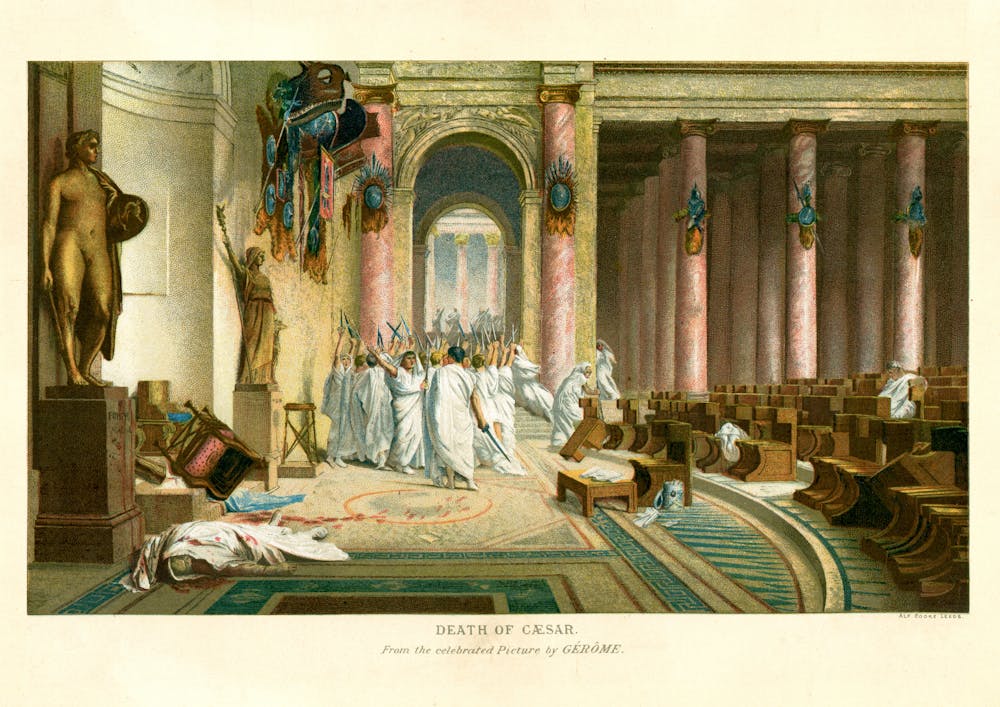
    Soon after, an angry group of 23 senators stabbed him to death in a vain attempt to save the republic. They were led by Marcus Junius Brutus, a descendant of the Brutus who killed the last Roman king, Tarquinius Superbus.

    The Roman republic was beyond saving despite Caesar’s death.
    duncan1890/Getty Images

    However, the Roman republic was beyond saving despite Caesar’s death. His great nephew Octavian eventually emerged as leader and became known as Augustus (27 BCE – 14 CE). With Augustus, an age of emperors was born.

    Emperors were kings in all but name. The strong aversion to kingship in Rome ensured their complete avoidance of the term rex.

    ‘No kings!’

    American protesters waving placards shouting “no kings!” are expressing clear concerns that their beloved democracy is under threat.

    Donald Trump has already declared eight national emergencies and issued 161 executive orders in his second term.

    When asked if he needs to uphold the Constitution, Trump declares “I don’t know.” He has joked about running for a third term as president, in breach of the longstanding limit of two terms.

    Like Caesar, is Donald Trump becoming a king in all but name? Is he setting a precedent for his successors to behave increasingly like emperors?

    The American aversion to “king” likely ensures the term will never return. But when protesters and others shout “no kings!”, they know the very meaning of the term “president” is changing before their eyes.

    Peter Edwell receives funding from the Australian Research Council.

    ref. ‘No kings!’: like the LA protesters, the early Romans hated kings, too – https://theconversation.com/no-kings-like-the-la-protesters-the-early-romans-hated-kings-too-259011

    MIL OSI – Global Reports

  • MIL-OSI Global: What’s the difference between barista milk and regular milk? It’s what gets added to it

    Source: The Conversation – Global Perspectives – By David Chua, Senior Research Projects Officer, Centre for Community Health and Wellbeing, The University of Queensland

    I love coffee/Shutterstock

    If you start reading the labels of the various milks at the supermarket, you’ll quickly find different fat levels, added nutrients like calcium, lactose-free options, milk from goats or sheep, and ones made from plants.

    Both at the supermarket and at your local café you’ve probably also seen cartons labelled “barista milk”. These can be dairy or plant milks marketed for making specialist coffee drinks such as flat whites, lattes and others.

    But what exactly makes a product a barista milk, and how does it differ from regular milk?

    What is ‘milk’, anyway?

    “Milk” is a regulated term. Food Standards Australia New Zealand sets requirements on fat and protein contents for dairy milk, and it has to come from “milking animals”. These standards also state what can be added or modified; only plant sterols (a supplement to reduce blood cholesterol) are allowed.

    Despite the name, plant-based milks aren’t bound by a specific “milk” standard. Instead, they fall under broader beverage regulations, which is why you’ll see a wide variety of ingredients, protein levels, sugars and fats from one brand to the next.

    Because of this regulation, manufacturers are careful to make it absolutely clear what is in the carton or bottle so there’s no confusion between cow’s milk and soy milk, for example.

    What is barista milk, then?

    Barista milks, whether dairy or plant-based, are specifically formulated to foam more reliably, with a finer texture and longer-lasting bubbles.

    For cow’s milk, this almost always means higher protein content: about 4–5% in barista milk compared to the 3.3–3.5% in regular milk. You’ll often see “milk solids” listed in the ingredients; this is another name for dried skim milk, added to boost the protein content.

    Plant-based barista milks (such as soy, oat or almond) will vary a lot more, depending on the manufacturer and the plant base.

    The most common additives in plant-based barista milks are:

    • vegetable oils for creaminess and thickness
    • gums (such as gellan or locust bean gum) to increase thickness
    • maltodextrin (a processed starch), also for thickness, and
    • emulsifiers such as lecithin – to help stop the fats and water from splitting apart.
    The foam in frothed milk happens through a complex interaction of ingredients and temperature.
    Dmytro Vietrov/Shutterstock

    The science of a good foam

    Foam is essentially gas bubbles suspended in a liquid. Its stability depends on a complex interaction of proteins, fats, sugars and other components, as well as the temperature at which the milk was foamed.

    In cow’s milk, proteins such as casein and whey form ball-like structures that easily rearrange to stabilise foam. These proteins help the milk fat and water stay held together, which is why dairy-based barista milks foam easily and the foam lasts longer.

    Fat plays a more complex role depending on temperature – there’s a sweet spot for a good foam.

    In cold cow’s milk, the fats are semi-solid and will make the foam collapse by breaking the bubble walls. But when heated above 40°C, these fats melt, spread better throughout the milk and easily interact with proteins to help form and stabilise the bubbles.

    However, overheating the milk (above 70°C) cooks and breaks the whey protein balls, making it harder to create foam.

    How barista plant milks work

    Plants make vastly different proteins compared to cows. However, the physical shape of proteins found in soy and oat milks is also ball-like, making them good for foaming just like cow’s milk.

    That’s generally why you see soy and oat milks used in cafes. Barista versions of plant milks often have added vegetable oils to help mimic the fat–protein interaction in dairy. It’s what makes the milk foam stable and the liquid feel creamy.

    Some – but not all – barista plant milks will also have thickeners because they help the foam last longer.

    Compared to soy and oat, almond milk is naturally low in protein. So almond barista milks will almost always contain gums, starches and emulsifiers along with added vegetable oil.

    Many plant milks also contain added sugars for flavour, since they lack the natural lactose found in dairy.

    Is barista milk worth it?

    Many plant-based milk formulations, especially barista ones, contain added gums, manufactured starches and emulsifiers. This qualifies them as “ultra-processed foods”, according to the United Nations’ classification system.

    While the plant-based milk might not be inherently overly harmful, this classification invites reflection on how far these products have moved from their original, natural source.

    On the environmental side, plant-based milks typically have a lower impact than cow’s milk. They use less land and water and produce fewer greenhouse gases.

    Barista milks usually cost significantly more than their regular counterpart. This premium reflects the added ingredients and research and development cost of optimising foaming and drinking characteristics.

    For cafés, the cost is often justified because barista milks produce a more predictable and consistent end product, leading to better customer satisfaction.

    For home use, it depends on your own level of foaming skill and how much you value a perfect flat white every time.

    David Chua’s work is partly supported by the National Health and Medical Research Council, Mater Research Foundation, and the Heart Foundation. He is employed by Inala Primary Care (a not-for-profit general practice clinic) and Metro South Health, where his role is supported by a Metro South Health Researcher Support Grant. His PhD (2010–2014) received partial funding from Dairy Australia Limited, though he currently has no industry affiliations. In 2009, he was awarded the Royal National Agricultural and Industrial Association of Queensland undergraduate student prize.

    Lauren Ball receives funding from the National Health and Medical Research Council, Queensland Health, Heart Foundation and Mater Misericordia. She is a Director of Dietitians Australia, a Director of the Darling Downs and West Moreton Primary Health Network, a Director of Food Standards Australia and New Zealand and an Associate Member of the Australian Academy of Health and Medical Sciences.

    ref. What’s the difference between barista milk and regular milk? It’s what gets added to it – https://theconversation.com/whats-the-difference-between-barista-milk-and-regular-milk-its-what-gets-added-to-it-258583

    MIL OSI – Global Reports

  • MIL-OSI Global: Seabed mining is becoming an environmental flashpoint – NZ will have to pick a side soon

    Source: The Conversation – Global Perspectives – By Myra Williamson, Senior Lecturer in Law, Auckland University of Technology

    Getty Images

    Seabed mining could become one of the defining environmental battles of 2025. Around the world, governments are weighing up whether to allow mining of the ocean floor for metal ores and minerals. New Zealand is among them.

    The stakes are high. Deep-sea mining is highly controversial, with evidence showing mining activity can cause lasting damage to fragile marine ecosystems. One area off the east coast of the United States, mined as an experiment 50 years ago, still bears scars and shows little sign of recovery.

    With the world facing competing pressures – climate action and conservation versus demand for resources – New Zealand must now decide whether to fast-track mining, regulate it tightly, or pause it entirely.

    Who controls international seabed mining?

    A major flashpoint is governance in international waters. Under international law, seabed mining beyond national jurisdiction is managed by the International Seabed Authority (ISA), created by the United Nations Convention on the Law of the Sea (UNCLOS).

    But the US has never ratified UNCLOS. In April this year, President Donald Trump issued an executive order to bypass the ISA and allow companies to begin mining in international waters.

    The ISA has pushed back, warning unilateral action breaches international law. However, the declaration from the recently concluded UN Ocean Conference in France does not urge countries to adopt a precautionary approach, nor does it ban deep seabed mining.

    The declaration does “reiterate the need to increase scientific knowledge on deep sea ecosystems” and recognises the role of the ISA in setting “robust rules, regulations and procedures for exploitation of resources” in international waters.

    So, while the international community supports multilateralism and international law, deep-sea mining in the near future remains a real possibility.

    Fast-track approvals

    In the Pacific, some countries have already made up their minds about which way they will go. Nauru recently updated its agreement with Canadian-based The Metals Company to begin mining in the nearby Clarion Clipperton Zone. The deal favours the US’s go-it-alone approach over the ISA model.

    By contrast, in 2022, New Zealand’s Labour government backed the ISA’s moratorium and committed to a holistic ocean management strategy. Whether that position still holds is unclear, given the current government’s policies.

    The list of applications under the Fast-track Approvals Act 2024described by Regional Development Minister Shane Jones as “arguably the most permissive regime” in Australasia – includes two controversial seabed mining proposals in Bream Bay and off the Taranaki coast:

    • Trans-Tasman Resources’ proposal to extract up to 50 million tonnes of Taranaki seabed material annually to recover heavy mineral sands that contain iron ore as well as rare metal elements titanium and vanadium.

    • McCallum Brothers Ltd’s Bream Bay proposal to dredge up to 150,000 cubic metres of sand yearly for three years, and up to 250,000 cubic metres after that.

    Legal landscape changing

    Māori and environmental groups have opposed the fast-track policy, and the Treaty of Waitangi has so far been a powerful safeguard in seabed mining cases.

    Provisions referencing Treaty principles appear in key laws, including the Crown Minerals Act and the Exclusive Economic Zone and Continental Shelf (Environmental Effects) Act.

    In 2021, the Supreme Court cited these obligations when it rejected a 2016 marine discharge application by Trans-Tasman Resources to mine the seabed in the Taranaki Bight. The court ruled Treaty clauses must be interpreted in a “broad and generous” way, recognising tikanga Māori and customary marine rights.

    But that legal landscape could soon change. The Regulatory Standards Bill, now before parliament, would give priority to property rights over environmental or Indigenous protections in the formulation of new laws and regulations.

    The bill also allows for the review of existing legislation. In theory, if the Regulatory Standards Bill becomes law, it could result in the removal of Treaty principles clauses from legislation.

    This in turn could deny courts the tools they’ve previously used to uphold environmental and Treaty-based protections to block seabed mining applications. That would make it easier to approve fast-tracked projects such as the Bream Bay and Taranaki projects.

    Setting a precedent

    Meanwhile, Hawai’i has gone in a different direction. In 2024, the US state passed a law banning seabed mining in state waters – joining California (2022), Washington (2021) and Oregon (1991).

    Under the Hawai’i Seabed Mining Prevention Act, mining is banned except in rare cases such as beach restoration. The law cites the public’s right to a clean and healthy environment.

    As global conflict brews over seabed governance, New Zealand’s eventual position could set a precedent.

    Choosing to prohibit seabed mining in New Zealand waters, as Hawai’i has done, would send a strong message that environmental stewardship and Indigenous rights matter more than short-term resource extraction interests.

    If New Zealand does decide to go ahead with seabed mining, however, it could trigger a cascade of mining efforts across New Zealand and the Pacific. A crucial decision is fast approaching.

    Myra Williamson does not work for, consult, own shares in or receive funding from any company or organisation that would benefit from this article, and has disclosed no relevant affiliations beyond their academic appointment.

    ref. Seabed mining is becoming an environmental flashpoint – NZ will have to pick a side soon – https://theconversation.com/seabed-mining-is-becoming-an-environmental-flashpoint-nz-will-have-to-pick-a-side-soon-258908

    MIL OSI – Global Reports

  • MIL-OSI Global: What actually happens to my skin when I have a really, really hot shower or bath?

    Source: The Conversation – Global Perspectives – By Amanda Meyer, Senior Lecturer, Anatomy and Pathology in the College of Medicine and Dentistry, James Cook University

    MART PRODUCTION/Pexels

    The weather is getting cooler and many of us are turning to hot showers and baths to warm up and wind down.

    But what actually happens to your skin when you have really hot showers or baths?

    Your largest organ

    Your skin is your largest organ, and has two distinct parts: the epidermis on the outside, and the dermis on the inside.

    The epidermis is made up of billions of cells that lay in four layers in thin skin (such as on your eyelids) and five layers in thick skin (such as the on sole of your foot).

    The cells (keratinocytes) in the deeper layers are held together by tight junctions. These cellular bridges make waterproof joins between neighbouring cells.

    The cells on the outside of the epidermis have lost these cellular bridges and slough off at a rate of about 1,000 cells per one centimetre squared of skin per hour. For an average adult, that’s 17 million cells per hour, every day.

    Under the epidermis is the dermis, where we have blood vessels, nerves, hair follicles, pain receptors, pressure receptors and sweat glands.

    Together, the epidermis and dermis (the skin):

    • protect you from ultraviolet radiation from the Sun
    • synthesise vitamin D3, which helps your intestines absorb calcium
    • protect you against bacteria, parasites, fungi and viruses
    • regulate your body temperature via the dilation of blood vessels and sweat glands releasing sweat
    • help display how we’re feeling (think, for example, of blushing or goosebumps)
    • allow us to feel sensations such as touch, pressure, pain and temperature.

    So, your skin is important and worth looking after.

    Washing daily can help prevent disease, and really hot baths often feel lovely and can help you relax. That said, there are some potential downsides.

    Gosh, it’s nice though.
    brazzo/Getty Images

    The skin microbiota

    Normally we have lots of healthy organisms called Staphyloccocus epidermis on the skin. These help increase the integrity of our skin layers (they make the bonds between cells stronger) and stimulate production of anti-microbial proteins.

    These little critters like an acidic environment, such as the skin’s normal pH of between 4-6.

    If the skin pH increases to around 7 (neutral), Staphyloccocus epidermis’ nasty cousin Staphyloccocus aureus – also known as golden staph – will try to take over and cause infections.

    Having a hot shower or bath can increase your skin’s pH, which may ultimately benefit golden staph.

    Being immersed in really hot water also pulls a lot of moisture from your dermis, and makes you lose water via sweat.

    This makes your skin drier, and causes your kidneys to excrete more water, making more urine.

    Staying in a hot bath for a long time can reduce your blood pressure, but increase your heart rate. People with low blood pressure or heart problems should speak to their doctor before having a long hot shower or bath.

    Heat from the shower or bath can activate the release of cytokines (inflammatory molecules), histamines (which are involved in allergic reactions), and increase the number of sensory nerves. All of this can lead to itchiness after a very hot shower or bath.

    Some people can get hives (itchy raised bumps that look red on lighter skin and brown or purple on darker skin) after hot showers or baths, which is a form of chronic inducible urticaria. It’s fairly rare and is usually managed with antihistamines.

    People with sensitive skin or chronic skin conditions such as urticaria, dermatitis, eczema, rosacea, psoriasis or acne should avoid really hot showers or baths. They dry out the skin and leave these people more prone to flare ups.

    The skin on your hands or feet is least sensitive to hot and cold, so always use your wrist, not your hands, to test water temperature if you’re bathing a child, older person, or a disabled person.

    The skin on your buttocks is the most sensitive to hot and cold. This is why sometimes you think the bath is OK when you first step in, but once you sit down it burns your bum.

    You might have heard women like hotter water temperature than men but that’s not really supported by the research evidence. However, across your own body you have highly variable areas of thermal sensitivity, and everyone is highly variable, regardless of sex.

    Many of us turn to hot showers and baths to warm up and wind down.
    PeopleImages.com – Yuri A/Shutterstock

    Making the most of moisturising

    Moisturising after a hot bath or shower can help, but check if your moisturiser is up to the task.

    To improve the skin barrier, your moisturiser needs to contain a mix of:

    • an emollient such as ceramides, squalanes or dimethicone (emollients incorporate themselves into the lipid barrier in the epidermis to reduce water loss)
    • a humectant such as glycerin or hyaluronic acid (humectants draw moisture from the dermis into the epidermis)
    • an occlusive such as petroleum jelly or Vaseline, mineral oil, or cocoa butter (occlusives reduce water loss through the skin and increase the production of anti-microbial peptides).

    Not all moisturisers are actually good at reducing the moisture loss from your skin. You still might experience dryness and itchiness as your skin recovers if you’ve been having a lot of really hot showers and baths.

    I’m itchy again, what should I do?

    If you’re itching after a hot shower or bath, try taking cooler, shorter showers and avoid reusing sponges, loofahs, or washcloths (which may harbour bacteria).

    You can also try patting your skin dry, instead of rubbing it with a towel. Applying a hypoallergenic moisturising cream, like sorbolene, to damp skin can also help.

    If your symptoms don’t improve, see your doctor.

    Amanda Meyer is affiliated with the Australian and New Zealand Association of Clinical Anatomists, the American Association for Anatomy, and the Global Neuroanatomy Network.

    Monika Zimanyi is affiliated with Global Neuroanatomy Network.

    ref. What actually happens to my skin when I have a really, really hot shower or bath? – https://theconversation.com/what-actually-happens-to-my-skin-when-i-have-a-really-really-hot-shower-or-bath-257900

    MIL OSI – Global Reports

  • MIL-OSI Global: Netanyahu has two war aims: destroying Iran’s nuclear program and regime change. Are either achievable?

    Source: The Conversation – Global Perspectives – By Ian Parmeter, Research Scholar, Middle East Studies, Australian National University

    Israeli Prime Minister Benjamin Netanyahu has said Israel’s attack on Iran’s nuclear facilities could last for at least two weeks.

    His timing seems precise for a reason. The Israel Defence Forces and the country’s intelligence agencies have clearly devised a methodical, step-by-step campaign.

    Israeli forces initially focused on decapitating the Iranian military and scientific leadership and, just as importantly, destroying virtually all of Iran’s air defences.

    Israeli aircraft can not only operate freely over Iranian air space now, they can refuel and deposit more special forces at key sites to enable precision bombing of targets and attacks on hidden or well-protected nuclear facilities.

    In public statements since the start of the campaign, Netanyahu has highlighted two key aims: to destroy Iran’s nuclear program, and to encourage the Iranian people to overthrow the clerical regime.

    With those two objectives in mind, how might the conflict end? Several broad scenarios are possible.

    A return to negotiations

    US President Donald Trump’s special envoy for the Middle East, Steve Witkoff, was to have attended a sixth round of talks with his Iranian counterparts on Sunday aimed at a deal to replace the Iran nuclear agreement negotiated under the Obama administration in 2015. Trump withdrew from that agreement during his first term in 2018, despite Iran’s apparent compliance to that point.

    Netanyahu was opposed to the 2015 agreement and has indicated he does not believe Iran is serious about a replacement.

    So, accepting negotiations as an outcome of the Israeli bombing campaign would be a massive climbdown by Netanyahu. He wants to use the defanging of Iran to reestablish his security credentials after the Hamas attacks of October 2023.

    Even though Trump continues to press Iran to accept a deal, negotiations are off the table for now. Trump won’t be able to persuade Netanyahu to stop the bombing campaign to restart negotiations.

    Complete destruction of Iran’s nuclear program

    Destruction of Iran’s nuclear program would involve destroying all known sites, including the Fordow uranium enrichment facility, about 100 kilometres south of Tehran.

    According to International Atomic Energy Agency (IAEA) Director General Rafael Grossi, the facility is located about half a mile underground, beneath a mountain. It is probably beyond the reach of even the US’ 2,000-pound deep penetration bombs.

    The entrances and ventilation shafts of the facility could be closed by causing landslides. But that would be a temporary solution.

    Taking out Fordow entirely would require an Israeli special forces attack. This is certainly possible, given Israel’s success in getting operatives into Iran to date. But questions would remain about how extensively the facility could be damaged and then how quickly it could be rebuilt.

    And destruction of Iran’s nuclear centrifuges – used to enrich uranium to create a bomb – would be only one step in dismantling its program.

    Israel would also have to secure or eliminate Iran’s stock of uranium already enriched to 60% purity. This is sufficient for up to ten nuclear bombs if enriched to the weapons-grade 90% purity.

    But does Israeli intelligence know where that stock is?

    Collapse of the Iranian regime

    Collapse of the Iranian regime is certainly possible, particularly given Israel’s removal of Iran’s most senior military leaders since its attacks began on Friday, including the heads of the Islamic Revolutionary Guard Corps and the Iranian armed forces.

    And anti-regime demonstrations over the years, most recently the “Women, Life, Freedom” protests after the death in police custody of a young Iranian woman, Mahsa Amini, in 2022, have shown how unpopular the regime is.

    That said, the regime has survived many challenges since coming to power in 1979, including war with Iraq in the 1980s and massive sanctions. It has developed remarkably efficient security systems that have enabled it to remain in place.

    Another uncertainty at this stage is whether Israeli attacks on civilian targets might engender a “rally round the flag” movement among Iranians.

    Netanyahu said in recent days that Israel had indications the remaining senior regime figures were packing their bags in preparation for fleeing the country. But he gave no evidence.

    A major party joins the fight

    Could the US become involved in the fighting?

    This can’t be ruled out. Iran’s UN ambassador directly accused the US of assisting Israel with its strikes.

    That is almost certainly true, given the close intelligence sharing between the US and Israel. Moreover, senior Republicans, such as Senator Lindsey Graham, have called on Trump to order US forces to help Israel “finish the job”.

    Trump would probably be loath to do this, particularly given his criticism of the “forever wars” of previous US administrations. But if Iran or pro-Iranian forces were to strike a US base or military asset in the region, pressure would mount on Trump to retaliate.

    Another factor is that Trump probably wants the war to end as quickly as possible. His administration will be aware the longer a conflict drags on, the more likely unforeseen factors will arise.

    Could Russia become involved on Iran’s side? At this stage that’s probably unlikely. Russia did not intervene in Syria late last year to try to protect the collapsing Assad regime. And Russia has plenty on its plate with the war in Ukraine.

    Russia criticised the Israeli attack when it started, but appears not to have taken any action to help Iran defend itself.

    And could regional powers such as Saudi Arabia or the United Arab Emirates become involved?

    Though they have a substantial arsenal of US military equipment, the two countries have no interest in becoming caught up in the conflict. The Gulf Arab monarchies have engaged in a rapprochement with Iran in recent years after decades of outright hostility. Nobody would want to put this at risk.

    Uncertainties predominate

    We don’t know the extent of Iran’s arsenal of missiles and rockets. In its initial retaliation to Israel’s strikes, Iran has been able to partially overwhelm Israel’s Iron Dome air defence system, causing civilian casualties.

    If it can continue to do this, causing more civilian casualties, Israelis already unhappy with Netanyahu over the Gaza war might start to question his wisdom in starting another conflict.

    But we are nowhere near that point. Though it’s too early for reliable opinion polling, most Israelis almost certainly applaud Netanyahu’s action so far to cripple Iran’s nuclear program. In addition, Netanyahu has threatened to make Tehran “burn” if Iran deliberately targets Israeli civilians.

    We can be confident that Iran does not have any surprises in store. Israel has severely weakened its proxies, Hezbollah and Hamas. They are clearly in no position to assist Iran through diversionary attacks.

    The big question will be what comes after the war. Iran will almost certainly withdraw from the Nuclear Non-Proliferation Treaty and forbid more inspections by the International Atomic Energy Agency.

    Israel will probably be able to destroy Iran’s existing nuclear facilities, but it’s only a question of when – not if – Iran will reconstitute them.

    This means the likelihood of Iran trying to secure a nuclear bomb in order to deter future Israeli attacks will be much higher. And the region will remain in a precarious place.

    Ian Parmeter does not work for, consult, own shares in or receive funding from any company or organisation that would benefit from this article, and has disclosed no relevant affiliations beyond their academic appointment.

    ref. Netanyahu has two war aims: destroying Iran’s nuclear program and regime change. Are either achievable? – https://theconversation.com/netanyahu-has-two-war-aims-destroying-irans-nuclear-program-and-regime-change-are-either-achievable-259014

    MIL OSI – Global Reports

  • MIL-OSI Global: Millions rally against authoritarianism, while the White House portrays protests as threats – a political scientist explains

    Source: The Conversation – USA – By Jeremy Pressman, Professor of Political Science, University of Connecticut

    Protesters parade through the Marigny neighborhood of New Orleans as part of the nationwide No Kings protest against President Donald Trump, on June 14, 2025. Patt Little/Anadolu via Getty Images

    At the end of a week when President Donald Trump sent Marines and the California National Guard to Los Angeles to quell protests, Americans across the country turned out in huge numbers to protest Trump’s attempts to expand his power. In rallies on June 14, 2025, organized under the banner “No Kings,” millions of protesters decried Trump’s immigration roundups, cuts to government programs and what many described as his growing authoritarianism.

    The protests were largely peaceful, with relatively few incidents of violence.

    Protests and the interactions between protesters and government authorities have a long history in the United States. From the Boston Tea Party to the Civil Rights movement, LBGTQ Stonewall uprising, the Tea Party movement and Black Lives Matter, public protest has been a crucial aspect of efforts to advance or protect the rights of citizens.

    But protests can also have other effects.

    In the last few months, large numbers of anti-Trump protesters have come out in the streets across the U.S., on occasions like the April 5 Hands Off protests against safety net budget cuts and government downsizing. Many of those protesters assert they are protecting American democracy.

    The Trump administration has decried these protesters and the concept of protest more generally, with the president recently calling protesters “troublemakers, agitators, insurrectionists.” A few days before the June 14 military parade in Washington, President Donald Trump said of potential protesters: “this is people that hate our country, but they will be met with very heavy force.”

    Trump’s current reaction is reminiscent of his harsh condemnation of the Black Lives Matter protests in the summer of 2020. In 2022, former Secretary of Defense Mark Esper said that Trump had asked about shooting protesters participating in demonstrations after the 2020 shooting of George Floyd.

    As co-director of the Crowd Counting Consortium, which compiles information on each day’s protests in the U.S., I understand that protests sometimes can advance the goals of the protest movement. They also can shape the goals and behavior of federal or state governments and their leaders.

    Opportunity for expressing or suppressing democracy

    Protests are an expression of democracy, bolstered by the right to free speech and “the right of the people peaceably to assemble” in the First Amendment of the U.S. Constitution.

    At the same time, clamping down on protests is one way to rebut challenges to government policies and power.

    For a president intent on the further centralization of executive power, or even establishing a dictatorship, protest suppression provides multiple opportunities and pitfalls.

    Widespread, well-attended demonstrations can represent a mass movement in favor of democracy or other issues as well as serve as an opportunity to expand participation even further. Large events often lead to significant press coverage and plenty of social media posting. The protests may heighten protesters’ emotional connection to the movement and increase fundraising and membership numbers of sponsoring organizations.

    Though it is not an ironclad law, research shows that when at least 3.5% of the total population is involved in a demonstration, protesters usually prevail over their governments. That included the Chilean movement in the 1980s that toppled longtime dictator Augusto Pinochet. Chileans used not only massive demonstrations but also a wide array of creative tactics like a coordinated slowdown of driving and walking, neighbors banging pots outside homes simultaneously, and singing together.

    Protests are rarely only about protesting. Organizers usually seek to involve participants in many other activities, whether that is contacting their elected officials, writing letters to the editor, registering to vote or running a food drive to help vulnerable populations.

    In this way of thinking, participation in a major street protest like No Kings is a gateway into deeper activism.

    Risks and opportunities

    Of course, protest leaders cannot control everyone in or adjacent to the movement.

    Other protesters with a different agenda, or agitators of any sort, can insert themselves into a movement and use confrontational tactics like violence against property or law enforcement.

    In one prominent example from Los Angeles, someone set several self-driving cars on fire. Other Los Angeles examples included some protesters’ throwing things like water bottles at officers or engaging in vandalism. Police officers also use coercive measures such as firing chemical irritants and pepper balls at protesters.

    When leaders want to concentrate executive power and establish an autocracy, where they rule with absolute power, protests against those moves could lead to a mass rejection of the leader’s plans. That is what national protest groups like 50501 and Indivisible are hoping for and why they aimed to turn out millions of people at the No Kings protests on June 14.

    But while the Trump administration faces risks from protests, it also may see opportunities.

    Misrepresenting and quashing dissent

    Protests can serve as a justification for a nascent autocrat to further undermine democratic practices and institutions.

    Take the recent demonstrations in Los Angeles protesting the Trump administration’s immigration raids conducted by Immigration and Customs Enforcement, or ICE.

    Autocrats seek to politicize independent institutions like the armed forces. The Los Angeles protests offered the opportunity for that. Trump sent troops from the California National Guard and Marines to Los Angeles to contain the protests. That domestic deployment of the military is rare but not unheard of in U.S. history.

    And the deployment was ordered against the backdrop of the president’s partisan June 10 speech at a U.S. military base in North Carolina. The military personnel in attendance cheered and applauded many of Trump’s political statements. Both the speech and audience reactions to it appeared to violate the U.S. military norm of nonpartisanship.

    This deployment of military personnel in a U.S. city also dovetails with the expansion of executive power characteristic of autocratic leaders. It is rare that presidents call up the National Guard; the Guard is traditionally under the control of the state governor.

    Yet the White House disregarded that Los Angeles’ mayor and California’s governor both objected to the deployment.

    The state sued the Trump administration over the deployment. The initial court decision sided with California officials, declaring the federal government action “illegal.” The Trump administration has appealed.

    Autocrats seek to spread disinformation. In the case of the Los Angeles protests, the Trump administration’s narrative depicted a chaotic, gang-infested city with violence everywhere. Reports on the ground refuted those characterizations. The protests, mostly peaceful, were confined to a small part of the city, about a 10-block area.

    More generally, a strong executive leader and their supporters often want to quash dissent. In the Los Angeles example, doing that has ranged from the military deployment itself to targeting journalists covering the story to arresting and charging prominent opponents like SEIU President David Huerta or shoving and handcuffing U.S. Sen. Alex Padilla, a California Democrat.

    The contrast on June 14 was striking. In Washington, D.C., Trump reviewed a parade of troops, tanks and planes, leaning into a display of American military power.

    At the same time, from rainy Bethlehem, Pennsylvania, to sweltering Yuma, Arizona, millions of protesters embraced their First Amendment rights to oppose the president. It perfectly illustrated the dynamic driving deep political division today: the executive concentrating power while a sizable segment of the people resist.

    Jeremy Pressman does not work for, consult, own shares in or receive funding from any company or organization that would benefit from this article, and has disclosed no relevant affiliations beyond their academic appointment.

    ref. Millions rally against authoritarianism, while the White House portrays protests as threats – a political scientist explains – https://theconversation.com/millions-rally-against-authoritarianism-while-the-white-house-portrays-protests-as-threats-a-political-scientist-explains-258963

    MIL OSI – Global Reports

  • MIL-OSI Global: Millions rally against authoritarianism, while the White House portrays protests as threats – a political scientist explains

    Source: The Conversation – USA – By Jeremy Pressman, Professor of Political Science, University of Connecticut

    Protesters parade through the Marigny neighborhood of New Orleans as part of the nationwide No Kings protest against President Donald Trump, on June 14, 2025. Patt Little/Anadolu via Getty Images

    At the end of a week when President Donald Trump sent Marines and the California National Guard to Los Angeles to quell protests, Americans across the country turned out in huge numbers to protest Trump’s attempts to expand his power. In rallies on June 14, 2025, organized under the banner “No Kings,” millions of protesters decried Trump’s immigration roundups, cuts to government programs and what many described as his growing authoritarianism.

    The protests were largely peaceful, with relatively few incidents of violence.

    Protests and the interactions between protesters and government authorities have a long history in the United States. From the Boston Tea Party to the Civil Rights movement, LBGTQ Stonewall uprising, the Tea Party movement and Black Lives Matter, public protest has been a crucial aspect of efforts to advance or protect the rights of citizens.

    But protests can also have other effects.

    In the last few months, large numbers of anti-Trump protesters have come out in the streets across the U.S., on occasions like the April 5 Hands Off protests against safety net budget cuts and government downsizing. Many of those protesters assert they are protecting American democracy.

    The Trump administration has decried these protesters and the concept of protest more generally, with the president recently calling protesters “troublemakers, agitators, insurrectionists.” A few days before the June 14 military parade in Washington, President Donald Trump said of potential protesters: “this is people that hate our country, but they will be met with very heavy force.”

    Trump’s current reaction is reminiscent of his harsh condemnation of the Black Lives Matter protests in the summer of 2020. In 2022, former Secretary of Defense Mark Esper said that Trump had asked about shooting protesters participating in demonstrations after the 2020 shooting of George Floyd.

    As co-director of the Crowd Counting Consortium, which compiles information on each day’s protests in the U.S., I understand that protests sometimes can advance the goals of the protest movement. They also can shape the goals and behavior of federal or state governments and their leaders.

    Opportunity for expressing or suppressing democracy

    Protests are an expression of democracy, bolstered by the right to free speech and “the right of the people peaceably to assemble” in the First Amendment of the U.S. Constitution.

    At the same time, clamping down on protests is one way to rebut challenges to government policies and power.

    For a president intent on the further centralization of executive power, or even establishing a dictatorship, protest suppression provides multiple opportunities and pitfalls.

    Widespread, well-attended demonstrations can represent a mass movement in favor of democracy or other issues as well as serve as an opportunity to expand participation even further. Large events often lead to significant press coverage and plenty of social media posting. The protests may heighten protesters’ emotional connection to the movement and increase fundraising and membership numbers of sponsoring organizations.

    Though it is not an ironclad law, research shows that when at least 3.5% of the total population is involved in a demonstration, protesters usually prevail over their governments. That included the Chilean movement in the 1980s that toppled longtime dictator Augusto Pinochet. Chileans used not only massive demonstrations but also a wide array of creative tactics like a coordinated slowdown of driving and walking, neighbors banging pots outside homes simultaneously, and singing together.

    Protests are rarely only about protesting. Organizers usually seek to involve participants in many other activities, whether that is contacting their elected officials, writing letters to the editor, registering to vote or running a food drive to help vulnerable populations.

    In this way of thinking, participation in a major street protest like No Kings is a gateway into deeper activism.

    Risks and opportunities

    Of course, protest leaders cannot control everyone in or adjacent to the movement.

    Other protesters with a different agenda, or agitators of any sort, can insert themselves into a movement and use confrontational tactics like violence against property or law enforcement.

    In one prominent example from Los Angeles, someone set several self-driving cars on fire. Other Los Angeles examples included some protesters’ throwing things like water bottles at officers or engaging in vandalism. Police officers also use coercive measures such as firing chemical irritants and pepper balls at protesters.

    When leaders want to concentrate executive power and establish an autocracy, where they rule with absolute power, protests against those moves could lead to a mass rejection of the leader’s plans. That is what national protest groups like 50501 and Indivisible are hoping for and why they aimed to turn out millions of people at the No Kings protests on June 14.

    But while the Trump administration faces risks from protests, it also may see opportunities.

    Misrepresenting and quashing dissent

    Protests can serve as a justification for a nascent autocrat to further undermine democratic practices and institutions.

    Take the recent demonstrations in Los Angeles protesting the Trump administration’s immigration raids conducted by Immigration and Customs Enforcement, or ICE.

    Autocrats seek to politicize independent institutions like the armed forces. The Los Angeles protests offered the opportunity for that. Trump sent troops from the California National Guard and Marines to Los Angeles to contain the protests. That domestic deployment of the military is rare but not unheard of in U.S. history.

    And the deployment was ordered against the backdrop of the president’s partisan June 10 speech at a U.S. military base in North Carolina. The military personnel in attendance cheered and applauded many of Trump’s political statements. Both the speech and audience reactions to it appeared to violate the U.S. military norm of nonpartisanship.

    This deployment of military personnel in a U.S. city also dovetails with the expansion of executive power characteristic of autocratic leaders. It is rare that presidents call up the National Guard; the Guard is traditionally under the control of the state governor.

    Yet the White House disregarded that Los Angeles’ mayor and California’s governor both objected to the deployment.

    The state sued the Trump administration over the deployment. The initial court decision sided with California officials, declaring the federal government action “illegal.” The Trump administration has appealed.

    Autocrats seek to spread disinformation. In the case of the Los Angeles protests, the Trump administration’s narrative depicted a chaotic, gang-infested city with violence everywhere. Reports on the ground refuted those characterizations. The protests, mostly peaceful, were confined to a small part of the city, about a 10-block area.

    More generally, a strong executive leader and their supporters often want to quash dissent. In the Los Angeles example, doing that has ranged from the military deployment itself to targeting journalists covering the story to arresting and charging prominent opponents like SEIU President David Huerta or shoving and handcuffing U.S. Sen. Alex Padilla, a California Democrat.

    The contrast on June 14 was striking. In Washington, D.C., Trump reviewed a parade of troops, tanks and planes, leaning into a display of American military power.

    At the same time, from rainy Bethlehem, Pennsylvania, to sweltering Yuma, Arizona, millions of protesters embraced their First Amendment rights to oppose the president. It perfectly illustrated the dynamic driving deep political division today: the executive concentrating power while a sizable segment of the people resist.

    Jeremy Pressman does not work for, consult, own shares in or receive funding from any company or organization that would benefit from this article, and has disclosed no relevant affiliations beyond their academic appointment.

    ref. Millions rally against authoritarianism, while the White House portrays protests as threats – a political scientist explains – https://theconversation.com/millions-rally-against-authoritarianism-while-the-white-house-portrays-protests-as-threats-a-political-scientist-explains-258963

    MIL OSI – Global Reports

  • MIL-OSI Global: Habitat loss and over-exploitation are leading to a decline in salmon populations

    Source: The Conversation – Canada – By Kyleisha Foote, Postdoctoral Fellow, Department of Biology, Memorial University of Newfoundland

    One-quarter of freshwater animals are now threatened with extinction, and population declines in fresh waters outpace those in marine and terrestrial systems. Reports of salmonid fish decline are stark, with many populations and species listed as threatened or endangered.

    Salmonids are a large family of ray-finned fish. In North America, it includes Pacific salmon on the west coast, Atlantic salmon on the east, and trout and char species such as brook trout and the introduced brown trout.

    Salmonid fish are extremely important. Ecologically, they provide food and nutrients for other animals and are indicators of ecosystem health. Culturally, they hold places in stories and worldviews, provide sustenance for humans and foster a deep connection to our rivers, lakes and oceans.


    Read more:
    Learning from Indigenous knowledge holders on the state and future of wild Pacific salmon


    Economically, they sustain communities around the world, as people travel to see these captivating creatures. Beyond all this, they have intrinsic value within river ecosystems.

    Although the salmonid family is undoubtedly one of the most studied groups of fish, we still don’t know much about the relative abundance of these fishes globally.

    We did a systematic review of published literature for reports of salmonid biomass (the total weight of fish in a particular area) in rivers around the world. The result was the largest dataset of salmonid biomass as we know it: more than 1,000 rivers across 27 countries, with fish sampling spanning 84 years (1937-2021).

    Habitat degradation

    This unique dataset enabled us to test several hypotheses, including temporal trends in salmonid populations. We found that average biomass declined 38 per cent from pre-1980 levels compared to post-2000 levels. Real declines are likely to be even higher, due to a publication bias towards reporting on rivers with higher biomass.

    Reasons for the decline will be unique to each population and often due to a combination of factors that include habitat loss and degradation, river regulation, over-exploitation, aquaculture and climate change.

    Freshwater ecosystems are among the most threatened and degraded environments in the world. The way we use the land surrounding waterways can have devastating impacts on aquatic life.

    Excessive nutrient loads from agriculture can lead to harmful algal blooms, which can choke waterways and lead to oxygen depletion, killing fish.

    Contaminants from pesticides, mining waste, oil and gas production, and urban areas can lead to decreased abundance and growth, declines in genetic diversity and effects on reproductive potential.

    Forest clearing destroys stream habitat by removing shade and shelter-providing plants along stream banks. Without this vegetation, excessive sediment can be washed into the stream, filling gaps between rocks and stones and further degrading important fish habitats and increasing water temperatures.

    Human activity disrupting migrations

    Many salmonid species are anadromous, meaning they migrate from freshwater to the sea and return to freshwater to complete their life cycle. Adult salmon will swim into the headwaters of streams to spawn, so access to these habitats is essential.

    Dams and other structures sever the pathway for many migratory fish and are perhaps the most significant disturbance in river ecosystems. Sixty-three per cent of large rivers (over 1,000 kilometres) are no longer connected across their whole length.

    While many salmonids may be able to scale small waterfalls, a dam or structure with smooth surfaces and no water are virtually impossible to pass. Fish passes (human-made pathways alongside barriers that fish can move through) can provide access upstream of dams. However, not all fish passes work as intended, and older dams will likely lack these facilities.

    Even if fish can migrate above a dam, the natural flow of water and movement of substrate is disrupted, causing major effects downstream. These natural regimes of water and substrate are crucial for maintaining habitat for aquatic species.

    Dam removal is becoming more common as a restoration technique, which leads to improved connectivity of sediment and fish. For example, fish numbers increased after removal of two dams on the Elwha River in Washington state, which reconnected 60 kilometres of previously inaccessible salmonid habitat.

    Climate change

    A warming climate, with more frequent droughts and flood events, is predicted to have negative impacts on salmon growth and survival, leading to deteriorating habitats and a reduction in abundance.

    Warming waters may cause shifts in salmonid abundance and distribution, with some species unable to adapt or move in time. Warming can also lead to increased stress and mortality for these cold-water fishes, reductions in body size and spawning success.

    Unfortunately, it was not possible to include temperature in our global dataset, as it is not systematically reported in studies.

    A salmon run on the Humber River in October 2023.
    (Shutterstock)

    Biomass not evenly distributed

    In our study, we found that salmonid biomass is not evenly distributed. Most streams have a relatively low biomass (average of 5.2 g/m2). However, a few outstanding streams exhibit much higher biomass than average (over 36.5 g/m2).

    It remains difficult to determine which variables contribute the most to this high productivity. High biomass may be related to local factors (temperature, flow, rock sizes in the river, presence of wood), which are not represented in our global dataset.

    Investigating what makes these streams so productive is a key question for scientists. Our dataset can help fuel researchers curiosity and promote habitat restoration and enhancement for all freshwater life.

    The dataset, which currently includes biomass data for 11 salmonid species and contains multiple variables that could affect biomass (stream width, season, sampling methods, area sampled and elevation), is publicly available. Scientists around the world can update the dataset in the coming years with additional data, such as temperature, which will help us understand the impact of climate change.

    Restoring habitats

    A lot of effort has gone into restoring and enhancing the habitats of salmonid species.

    While we are seeing local improvements in some populations — for example after habitat restoration with large wood or bouldersrestoration efforts are often short-lived and target very small areas. These efforts should encompass whole watersheds to be most effective.

    Rivers are naturally dynamic, shifting their course as they move across floodplains. Improving river mobility, by allowing a river to restore itself and providing it space to move, will lead to more long-term sustainable restoration. This will be beneficial for not only salmonids but other aquatic animals.

    Kyleisha Foote received funding from Fonds de recherche du Québec Nature et technologies (FRQNT) – Bourses de doctorat en recherche (https://doi.org/10.69777/) and Groupe de Recherche Interuniversitaire en Limnologie (GRIL).

    James W.A. Grant receives funding from the Natural Sciences and Engineering Research Council of Canada.

    Pascale Biron receives funding from the Natural Science and Engineering Research Council and Natural Resources Canada.

    ref. Habitat loss and over-exploitation are leading to a decline in salmon populations – https://theconversation.com/habitat-loss-and-over-exploitation-are-leading-to-a-decline-in-salmon-populations-257782

    MIL OSI – Global Reports

  • MIL-OSI Global: Why we still need a women’s prize for fiction

    Source: The Conversation – Canada – By Binhammer, Katherine, Professor of Literary History, University of Alberta

    As we make summer reading lists, some of us will turn to lists of prize winners for recommendations.

    One influential prize, the Women’s Prize for Fiction, recently celebrated its 30th award winner, The Safekeep by Dutch writer Yael van der Wouden.

    The international prize honours the best novel by a woman written in English and published in the United Kingdom. The prize, first awarded in 1996, was founded after no women writers made the 1991 Booker Prize shortlist.

    Considering that fiction by women now regularly makes the shortlists of major prizes, it seems timely to ask: do we still need a prize dedicated to women?

    We explored this question by creating a new dataset containing information on 15 British literary prizes, with demographic information for 682 shortlisted and winning authors. Our analysis of the dataset shows how there is still a ways to go before women’s writing is valued — awarded, remunerated and read — equally to men’s.

    Who wins what prizes?

    We are four research collaborators affiliated with the University of Alberta’s Orlando Project, a project that harnesses the power of digital tools and methods to provide new knowledge about feminist literary scholarship. The Orlando Project has published a searchable digital archive with original coding that focuses of women’s relationship to literary production.

    We compiled a new dataset to explore how gender, ethnicity and educational achievement impacts who wins what prizes.

    When the Women’s Prize first came on the scene in 1996, the average percentage of women winning other U.K. literary prizes actually dropped. The average only began to rise around 2003 when it steadily increased until 2012.

    Women won just eight per cent of the prizes in our dataset in 2003, whereas they won 53 per cent in 2012. But that increase plateaued in 2012, and for the next decade it held steady at a running average of 45 per cent. As well, we note no steady linear progression upwards or downwards on average, but there were highs and lows (21 per cent in 2016 followed by 64 per cent in 2017).

    Booker winners

    Some fluctuation in the winners’ genders is, of course, to be expected. But as is apparent by looking at the percentage of women winners year to year, we should not assume things will always get better.

    Other insights from our dataset suggest caution is required in assuming women’s fiction is now equally valued by the literary establishment.

    Thirty-nine per cent of Booker shortlisted writers were women, but women have only won 32 per cent of the time. The claim that we don’t need a prize for women since many recent shortlists have been dominated by women needs to be tempered with the fact that while women have made up 57 per cent of the Booker’s shortlist since 2016, only 33 per cent of winners have been women.

    Gender and genre

    While we expected some differences between genres, we were surprised by just how gendered certain genres are. Seventy-one per cent of the winners of the (now defunct) Costa Children’s Book Award were women, whereas women only constituted 21 per cent for the British Science Fiction Award and 31 per cent for the Crime Writers Association Gold Dagger Award.

    Non-fiction writing — which includes history, political science, sport and current affairs — remains male-dominated: the Baillie Gifford award, which bills itself as “U.K.’s premier annual prize for non-fiction books,” has one of the higher percentages of winners who are men, at 67 per cent.

    Race and ethnicity

    Our dataset includes demographic information on race and ethnicity. It shows that amplifying women’s voices is not simultaneously connected with amplifying all women’s voices.

    The Women’s Prize may have succeeded in pushing the Booker to include more women’s fiction (from zero shortlisted when the Women’s Prize was announced in 1990, to 26 per cent when it made its first award in 1996, to 58 per cent in 2022). But the Booker marginally out-performed the Women’s Prize in relation to racialized writers over the period of our dataset (26 per cent for the former, 22 per cent for the latter).

    A recent book on white literary taste concentrates on the Women’s Prize to show how prizes in general are part of a literary eco-system that is racially biased.

    Fiction reading not as valued as used to be

    We also question what it means that women’s fiction has greater visibility at the same time when fewer and fewer people, and especially men, read fiction.

    Using Nielsen BookScan data, the Women’s Prize 2024 Impact Report points to statistics on fiction authorship and gendered readership: women published 57 per cent of the top 500 bestselling novels in 2023, but while women constitute 44 per cent of readers of the top men’s fiction, men only account for 19 per cent of readers of fiction by women.

    The fact that fewer people are reading fiction at the same time that women are winning more awards, could suggest we are witnessing a repeat of the familiar pattern in women’s history where, at the same historical moment when women achieve dominance, or increase, in a field, and it becomes “feminized,” the field as a whole loses its value or prestige. Examples are family medicine or humanities professors.

    Pattern around gender and genre

    The Orlando Project’s research on 800 years of women’s writing in Britain reveals a pattern around gender and genre when in comes to remuneration and literary prestige. Genres where women writers dominate, like children’s literature and romance, tend to be the least lucrative.

    Novels in the time of Jane Austen illustrate the point. Before Walter Scott and other male writers developed a highbrow “serious” Victorian novel over what they saw as trashy romances, women writers temporarily dominated fiction like they do today. As one of us has argued, when women writers published more novels than men did in the 1790s, novels were the literary genre that paid the least.

    There remains a gender pay equity gap in writing: British women earned 58.6 per cent of what men did in 2022, mostly because the genres they chose to write in do not garner the highest earnings.

    Rewarding women authors

    One way to answer our question of whether we still need a Women’s Prize is this: we will no longer need it when women begin to dominate prizes for prestige genres such as non-fiction; when men read as much writing by women as that by men; and when we pay authors as much as football players.

    So far, we’re not there. We therefore celebrate that in 2023, the Women’s Prize added a new award in non-fiction to address that genre’s gender disparity. The Story of a Heart by practising palliative care doctor Rachel Clarke won this year.

    We encourage readers to take all the Women’s Prize-winning and nominated books to the beach this summer.

    Binhammer, Katherine receives funding from the Social Science and Humanities Research Council of Canada.

    Kanika Batra receives funding from Fulbright Canada.

    Maryse Jayasuriya and Theo Gray do not work for, consult, own shares in or receive funding from any company or organisation that would benefit from this article, and have disclosed no relevant affiliations beyond their academic appointment.

    ref. Why we still need a women’s prize for fiction – https://theconversation.com/why-we-still-need-a-womens-prize-for-fiction-257494

    MIL OSI – Global Reports

  • MIL-OSI Global: Canada’s ‘jail not bail’ trend: 4 ways to support victims

    Source: The Conversation – Canada – By Carolyn Yule, Associate Professor of Sociology, University of Guelph

    Tough-on-crime rhetoric is reshaping bail laws to correct a perceived imbalance that “tips the scales in favour of the criminals against the victims.”

    But do these changes reflect what victims actually want and need?

    We argue that victims are positioned as both “sword and shield” in bail reform debates — as a sword, to advocate for more restrictive laws, and as a shield, to defend those laws from criticism.

    The appeal of ‘jail not bail’

    Victims have been a central focus of those arguing in favour of changes to the bail system as they suggest a need to “crack down with tougher rules” to “protect victims” and to stop turning “loose the most violent, rampant criminals into our communities to destroy our families.”

    These concerns culminated in the passage of the federal government’s Bill C-48, which introduced additional reverse-onus provisions — shifting the burden onto the accused to demonstrate why they should be released as opposed to the Crown — in cases involving weapons and repeat intimate partner violence.

    Largely absent from these discussions is the possibility that more restrictive measures may actually have negative consequences for victims.

    In cases of intimate partner violence, for instance, dual charging policies — when both parties involved in a domestic incident are charged with an offence, even when one person may be primarily the victim and the other primarily the aggressor — risks criminalizing and incarcerating women pre-trial. These victims are also disproportionately Indigenous, Black and racialized. This risks deepening systemic inequalities rather than providing meaningful protection for survivors.

    Furthermore, victims may hesitate to call the police, knowing that doing so may result in indeterminate detention before trial. Expanding reverse-onus provisions could also lead to false guilty pleas to avoid pre-trial detention.

    Politicizing crime victims

    While media coverage on victims’ experiences at bail hearings is emotionally compelling and expedient, it does not necessarily reflect what victims want with any accuracy.

    Certainly, some victims view the bail system as a slap in the face. Others call for a stronger social safety net to address the root causes of crime.


    Read more:
    The grieving mother of a murdered teen pleads for a stronger social safety net


    Our preliminary research exploring how victims are presented in news media amid bail proceedings supports other evidence that victims’ voices are often used strategically by politicians and lobbyists to amplify concerns about public safety.

    News media can be an effective tool to provide education about the causes and consequences of victimization. When it comes to bail, however, victims are often characterized as “ideal types” — people who were subjected to severe violence at the hands of a stranger while engaging in “respectable” activities at the time of the offence.

    In reality, victims represent a diverse group, with a wide range of needs, identities and experiences that are not always captured in media coverage or political debates.

    What do victims really need at bail hearings?

    Prior research focuses on the rights of the accused concerning bail reform, yet pre-trial decisions are a pivotal moment for crime victims. They can determine whether those accused of crimes are detained or released with conditions.

    The Canadian Victims Bill of Rights stipulates victims have the right to be informed of case matters, to express their views and to have their perspectives considered at all stages of the legal process, including at bail. During bail proceedings, justices must record that they have considered victim safety and security when imposing conditions, and victims may receive a copy of a bail order upon request.

    In practice, however, victims are rarely consulted on how the release of an accused may affect their safety, and are often left unaware of bail outcomes. That’s because there’s no legal requirement for police or Crown attorneys to inform them.

    While programs are available to support victims during the pre-trial phase — such as those offered by Victims Services and Victim/Witness Assistance — access can vary widely across jurisdictions.

    4 ways to support victims’ needs at bail

    We offer four strategies to create more responsive and equitable bail processes to better support victims:

    1. Better understand victims’ needs: Victims have diverse perspectives and differing priorities regarding how to protect their safety, and their voices deserve to be meaningfully included in decision-making processes.
    2. Uphold victims’ rights: Protecting the rights of the accused at bail is not incompatible with upholding victims’ rights. Access to information and communication concerning bail decisions should be better prioritized to position victims to undertake informed safety planning.
    3. Invest in victim resources: Dedicated and sustained funding for community-based supports will directly enhance the safety and well-being of victims, including access to social services, advocacy and legal resources, as well as counselling.
    4. Address the causes of crime: Long-term victim and community safety depends on addressing underlying causes of crime like poverty, mental health, addiction, trauma and systemic discrimination.

    Systemic reform needed

    Throughout the criminal legal system, victims’ voices are frequently ignored, disbelieved or dismissed. Too often, victims are excluded from the very policy decisions made in their name.

    While high-profile bail cases tend to dominate media coverage, policy on criminal and legal matters must be guided by evidence, not headlines.

    Without broader systemic reform, legislation will remain an important but insufficient tool for upholding victims’ rights and community safety.

    Carolyn Yule receives funding from the Social Sciences and Humanities Research Council (SSHRC).

    Kaitlin Humer, Laura MacDiarmid, and Sophia Lindstrom do not work for, consult, own shares in or receive funding from any company or organisation that would benefit from this article, and have disclosed no relevant affiliations beyond their academic appointment.

    ref. Canada’s ‘jail not bail’ trend: 4 ways to support victims – https://theconversation.com/canadas-jail-not-bail-trend-4-ways-to-support-victims-258365

    MIL OSI – Global Reports

  • MIL-OSI Global: Canadian international relations experts share their views on global politics and Canada’s role

    Source: The Conversation – Canada – By Anessa L. Kimball, Professor of Political Science; Director, Centre for International Security, ESEI, Université Laval

    A survey of Canadian international relations professors has found they disagree on how to respond to potential Chinese aggression against Taiwan and which global regions will matter most to Canada in the future.

    For the past 20 years, the Teaching, Research and International Policy (TRIP) survey has asked university professors about how they teach international relations and what they think about global affairs. Originally based in the United States, the survey expanded to Canada in 2006 and is now conducted regularly in many countries.

    The Canadian faculty survey was conducted from March 5 to July 12, 2024. Of the 109 who participated, most held permanent academic positions, including 22 full professors, 31 associate professors and six emeritus professors.

    Participants were asked to agree or disagree with statements about global politics. Seventy-five experts agreed that states are the main players in global politics, but there was less agreement on the importance of domestic politics.

    Most felt that international institutions help bring order to the chaotic global system. However, whether globalization has made people better off — even if there are some losers — divided experts, with 21 believing no one is better off due to globalization while two-thirds believed the opposite.

    Major themes

    When it came to more critical or less mainstream ideas — such as whether major international relations theories are rooted in racist assumptions — opinions were split.

    More than 50 agreed, but more than a third disagreed, and many gave neutral responses. Disagreement over the role of racism in shaping world politics highlights the difficulty of decolonizing international relations and incorporating post-colonial perspectives — particularly when trying to understand complex “failed cases” like United Nations peacekeeping efforts in Haiti.


    Read more:
    For Haitian migrants in the Dominican Republic, ‘reproduction is like a death sentence’


    Professors were also asked where they get their international news. Most rely on major newspapers, international media and internet sources.

    When asked which world region is strategically most important for Canada today, nearly half — or 43 of 97 experts opting to respond to the question — chose North America (excluding Mexico); in other words, the United States. Sixteen selected the Arctic and another 16 chose East Asia.

    Very few picked regions like the Middle East, Europe or Russia. Looking ahead 20 years, 10 experts shifted their answer from North America to the Arctic.

    Views on China and Taiwan, and Justin Trudeau

    Experts were asked what Canada should do if China attacks Taiwan. Most supported non-military responses: 72 supported sanctions and 69 supported taking in refugees.

    About half supported sending weapons or banning Chinese goods. Fewer supported cyberattacks (18), sending troops (15) or a no-fly zone (14).

    Surprisingly, six said Canada should launch military action against China.

    Justin Trudeau was prime minister when the survey was conducted. When asked about his performance, 50 per cent rated him poorly or very poorly, 30 per cent were neutral and only a small minority rated him positively.

    Key takeaways

    Canadian international relations professors don’t always agree, but a few trends stand out.

    Despite recent government focus on the Arctic in terms of its Our North, Strong and Free policy, many professors still view the U.S. as Canada’s most important strategic region. East Asia drew some attention, but few see it growing in importance.

    With a new government under Prime Minister Mark Carney, there may be opportunities to improve on areas where Trudeau was seen as weak by respondents to the survey.

    For example, despite having developed a strategy for the Indo-Pacific region, vital Canadian trade and maritime security interests were minimized by the previous Liberal government. Carney could therefore contemplate expanding Canada’s maritime assets, improving its artificial intelligence and cybersecurity capacity and investing in digital infrastructure and quantum computing.


    Read more:
    Defence policy update focuses on quantum technology’s role in making Canada safe


    Carney had pledged to fulfil Canada’s commitment to NATO’s target of two per cent of GDP spent on defence, saying Canada will meet the threshold by the end of 2025.

    However, Canada will still lag behind. NATO is calling on allies to invest five per cent of GDP in defence, comprising 3.5 per cent on core defence spending as well as 1.5 per cent of GDP per year on defence and security-related investment, including in infrastructure and resilience.

    Canada’s 2024 GDP was $2.515 trillion, which means a five per cent defence investment of nearly $125 billion annually would have accounted for more than a quarter of a federal budget (which was under $450 billion in 2024-2025).

    Canada, a founding NATO member, leads a multinational brigade in Latvia and supports Ukraine in other ways.

    Ukraine seems on an irreversible path towards NATO membership. Though 69 per cent of respondents supported NATO membership for Ukraine, only 44 per cent felt it was likely. Though the U.S. tariff crisis attracts attention, some experts are increasingly looking to the Arctic to understand Canada’s strategic interests — a trend sure to be reflected in future surveys of Canadian international relations experts.

    Anessa L. Kimball does not work for, consult, own shares in or receive funding from any company or organisation that would benefit from this article, and has disclosed no relevant affiliations beyond their academic appointment.

    ref. Canadian international relations experts share their views on global politics and Canada’s role – https://theconversation.com/canadian-international-relations-experts-share-their-views-on-global-politics-and-canadas-role-257949

    MIL OSI – Global Reports

  • MIL-OSI Global: The politics of blame: Accusing immigrants won’t solve Germany’s antisemitism problem

    Source: The Conversation – Canada – By Oliver Schmidtke, Professor, Director of the Centre for Global Studies, University of Victoria

    In response to a report on the virulence of antisemitism in Germany, Chancellor Friedrich Merz recently cast the blame on attitudes held by immigrants.

    Merz stated in a Fox News interview that Germany has “imported antisemitism with the big numbers of migrants we have within the last 10 years.”

    Merz is pointing to a real and pressing issue. Yet his emphasis on so-called “imported antisemitism” serves as a convenient diversion from Germany’s persistent failure to confront home-grown antisemitism.

    His remarks also risk emboldening those who weaponize antisemitism as a rhetorical tool to fuel anti-immigrant sentiments.

    Antisemitism in Germany

    Antisemitic incidents in Germany have been on the rise since the Oct. 7, 2023 attack on Israel by Hamas and the subsequent war in Gaza.

    According to a survey by the Research and Information Centre on Antisemitism (RIAS), antisemitic occurrences rose by more than 80 per cent in 2023. That year, 4,782 occurrences were documented, the highest number since the organization began tracking such cases in 2017.

    However, RIAS’s most recent report found that the primary motive behind antisemitic crimes remained right-wing extremist ideology (48 per cent). It also noted that, since 2023, there has been a marked increase in incidents attributed to “foreign ideology.” These are understood as originating outside Germany and often linked to Islamist or anti-Israel sentiments, which accounted for 31 per cent of cases in 2024.

    It should be noted that RIAS’s approach to classifying antisemitism has been subject to controversy, especially with regard to its treatment of criticism of or protest against the Israeli government’s actions.

    The ‘imported antisemitism’ narrative

    A recent survey of antisemitic attitudes among immigrants in Germany found that such attitudes are more prevalent among Muslim respondents compared to their Christian or religiously unaffiliated counterparts. The study revealed particularly high levels of antisemitism among individuals from the Middle East and North Africa.

    Approximately 35 per cent of Muslim respondents — especially those with strong religious convictions and lower levels of formal education — “strongly agreed with classical antisemitic statements.” These statements reflect classical antisemitic tropes, such as attributing too much influence over politics or finance to Jews, accusing Jews of driving the world into disaster or relativizing the Holocaust.

    At the same time, there is evidence that immigrants successfully integrating into German society is associated with lower levels of antisemitism.

    Yet blaming a rise in antisemitism on “imported” attitudes or “foreign ideologies” signals a crude simplification. Antisemitism has remained prevalent in German society even after the Second World War, and political movements or leaders can easily mobilize it.

    Although Holocaust education is mandatory in German schools, knowledge about the Shoah and the legacy of antisemitism remains limited among younger generations. A recent study by the Jewish Claims Conference found that among Germans aged 18 to 29, around 40 per cent were not aware that approximately six million Jews were killed by the Nazis and their collaborators.

    According to a 2023 MEMO survey, more than 50 per cent of 14- to 16-year-old students in Germany did not know what Auschwitz was.

    Blaming immigrants for challenges in Germany’s memory culture oversimplifies a deeper issue: the growing difficulty of making the country’s dominant remembrance — centred on the horrors of the Nazi dictatorship and the Holocaust — politically meaningful and emotionally resonant for younger generations.

    For many young Germans, the memory of the Holocaust feels increasingly remote, lacking the emotional immediacy that vanishing eyewitnesses once provided.

    This problem is further exacerbated by the absence of innovative, impactful teaching capable of conveying the continued relevance of Holocaust memory and its political message.

    In a 2023 article, American journalist Masha Gessen highlighted how Holocaust remembrance in Germany was becoming an elite-driven ritual, one that risks preventing a meaningful connection between its moral imperatives and today’s political realities.

    The threat from Alternative for Germany

    At the same time, the rise of the far-right Alternative for Germany (AfD) party poses a direct threat to Germany’s culture of remembrance.

    The AfD has made it a central objective to challenge the primacy of Holocaust memory, calling for a U-turn in Germany’s remembrance culture.

    Leading party members have labelled Holocaust memorials “monuments of shame,” reflecting the party’s broader effort to promote nationalist reinterpretations of history.

    Furthermore, the AfD’s staunchly anti-immigrant stance exposes a fundamental flaw in the imported antisemitism narrative. Across Europe, populist right-wing movements have increasingly mobilized anti-Muslim rhetoric under the banner of defending so-called “Judeo-Christian values,” even as they simultaneously draw on classic antisemitic tropes targeting “globalist elites” and conspiratorial power structures.

    This use of Jewish identity as a rhetorical weapon against Islam, while perpetuating antisemitism in other forms, reveals the deep contradictions and opportunism underlying imported antisemitism claims.

    Blaming Muslim immigrants for the rise of antisemitism offers German political leaders a convenient excuse for their own failure to confront entrenched antisemitic beliefs within German society.

    In addition, Holocaust remembrance can sometimes exclude immigrants. For example, Germany recently added questions about the Holocaust and Nazi crimes to its citizenship test, committing newcomers to its memory culture.

    Research shows this kind of policy can have unintended effects. It can make immigrants feel excluded if they are seen as not fully sharing in “our” nation and “our” history. Given the universalist values it is meant to embody, the commemoration of the Holocaust can also serve to alienate immigrants from full cultural citizenship.

    Framing antisemitism primarily as an imported problem risks strengthening those forces that actively seek to undermine and ignore Germany’s confrontation with its Nazi past.

    Instead, what is needed is a more nuanced approach, one that bridges the divide between antiracist and anti-antisemitism efforts, and aligns more faithfully with the moral and political commitments that this collective memory is meant to uphold.

    Oliver Schmidtke receives funding from the Social Sciences and Humanities Research Council of Canada.

    ref. The politics of blame: Accusing immigrants won’t solve Germany’s antisemitism problem – https://theconversation.com/the-politics-of-blame-accusing-immigrants-wont-solve-germanys-antisemitism-problem-258705

    MIL OSI – Global Reports

  • MIL-Evening Report: Why Israel’s shock and awe has proven its power but lost the war

    COMMENTARY: By Antony Loewenstein

    War is good for business and geopolitical posturing.

    Before Israeli Prime Minister Benjamin Netanyahu arrived in Washington in early February for his first visit to the US following President Donald Trump’s inauguration, he issued a bold statement on the strategic position of Israel.

    “The decisions we made in the war [since 7 October 2023] have already changed the face of the Middle East,” he said.

    “Our decisions and the courage of our soldiers have redrawn the map. But I believe that working closely with President Trump, we can redraw it even further.”

    How should this redrawn map be assessed?

    Hamas is bloodied but undefeated in Gaza. The territory lies in ruins, leaving its remaining population with barely any resources to rebuild. Death and starvation stalk everyone.

    Hezbollah in Lebanon has suffered military defeats, been infiltrated by Israeli intelligence, and now faces few viable options for projecting power in the near future. Political elites speak of disarming Hezbollah, though whether this is realistic is another question.

    Morocco, Bahrain and the UAE accounted for 12 percent of Israel’s record $14.8bn in arms sales in 2024 — up from just 3 percent the year before

    In Yemen, the Houthis continue to attack Israel, but pose no existential threat.

    Meanwhile, since the overthrow of dictator Bashar al-Assad in late 2024, Israel has attacked and threatened Syria, while the new government in Damascus is flirting with Israel in a possible bid for “normalisation“.

    The Gulf states remain friendly with Israel, and little has changed in the last 20 months to alter this relationship.

    According to Israel’s newly released arms sales figures for 2024, which reached a record $14.8bn, Morocco, Bahrain and the United Arab Emirates accounted for 12 percent of total weapons sales — up from just 3 percent in 2023.

    It is conceivable that Saudi Arabia will be coerced into signing a deal with Israel in the coming years, in exchange for arms and nuclear technology for the dictatorial kingdom.

    An Israeli and US-assisted war against Iran began on Friday.

    In the West Bank, Israel’s annexation plans are surging ahead with little more than weak European statements of concern. Israel’s plans for Greater Israel — vastly expanding its territorial reach — are well underway in Syria, Lebanon and beyond.

    Shifting alliances
    On paper, Israel appears to be riding high, boasting military victories and vanquished enemies. And yet, many Israelis and pro-war Jews in the diaspora do not feel confident or buoyed by success.

    Instead, there is an air of defeatism and insecurity, stemming from the belief that the war for Western public opinion has been lost — a sentiment reinforced by daily images of Israel’s campaign of deliberate mass destruction across the Gaza Strip.

    What Israel craves and desperately needs is not simply military prowess, but legitimacy in the public domain. And this is sorely lacking across virtually every demographic worldwide.

    It is why Israel is spending at least $150 million this year alone on “public diplomacy”.

    Get ready for an army of influencers, wined and dined in Tel Aviv’s restaurants and bars, to sell the virtues of Israeli democracy. Even pro-Israel journalists are beginning to question how this money is being spent, wishing Israeli PR were more responsive and effective.

    Today, Israeli Jews proudly back ethnic cleansing and genocide in Gaza in astoundingly high numbers. This reflects a Jewish supremacist mindset that is being fed a daily diet of extremist rhetoric in mainstream media.

    There is arguably no other Western country with such a high proportion of racist, genocidal mania permeating public discourse.

    According to a recent poll of Western European populations, Israel is viewed unfavourably in Germany, Denmark, France, Italy and Spain.

    Very few in these countries support Israeli actions. Only between 13 and 21 percent hold a positive view of Israel, compared to 63-70 percent who do not.

    The US-backed Pew Research Centre also released a global survey asking people in 24 countries about their views on Israel and Palestine. In 20 of the 24 nations, at least half of adults expressed a negative opinion of the Jewish state.

    A deeper reckoning
    Beyond Israel’s image problems lies a deeper question: can it ever expect full acceptance in the Middle East?

    Apart from kings, monarchs and elites from Dubai to Riyadh and Manama to Rabat, Israel’s vicious and genocidal actions since 7 October 2023 have rendered “normalisation” impossible with a state intent on building a Jewish theocracy that subjugates millions of Arabs indefinitely.

    While it is true that most states in the region are undemocratic, with gross human rights abuses a daily reality, Israel has long claimed to be different — “the only democracy in the Middle East”.

    But Israel’s entire political system, built with massive Western support and grounded in an unsustainable racial hierarchy, precludes it from ever being fully and formally integrated into the region.

    The American journalist Murtaza Hussain, writing for the US outlet Drop Site News, recently published a perceptive essay on this very subject.

    He argues that Israeli actions have been so vile and historically grave — comparable to other modern holocausts — that they cannot be forgotten or excused, especially as they are publicly carried out with the explicit goal of ethnically cleansing Palestine:

    “This genocide has been a political and cultural turning point beyond which we cannot continue as before. I express that with resignation rather than satisfaction, as it means that many generations of suffering are ahead on all sides.

    “Ultimately, the goal of Israel’s opponents must not be to replicate its crimes in Gaza and the West Bank, nor to indulge in nihilistic hatred for its own sake.

    “People in the region and beyond should work to build connections with those Israelis who are committed opponents of their regime, and who are ready to cooperate in the generational task of building a new political architecture.”

    The issue is not just Netanyahu and his government. All his likely successors hold similarly hardline views on Palestinian rights and self-determination.

    The monumental task ahead lies in crafting an alternative to today’s toxic Jewish theocracy.

    But this rebuilding must also take place in the West. Far too many Jews, conservatives and evangelical Christians continue to cling to the fantasy of eradicating, silencing or expelling Arabs from their land entirely.

    Pushing back against this fascism is one of the most urgent generational tasks of our time.

    Antony Loewenstein is an Australian/German independent, freelance, award-winning, investigative journalist, best-selling author and film-maker. In 2025, he released an award-winning documentary series on Al Jazeera English, The Palestine Laboratory, adapted from his global best-selling book of the same name. It won a major prize at the prestigious Telly Awards. This article is republished from Middle East Eye with permission.

    MIL OSI AnalysisEveningReport.nz

  • MIL-Evening Report: Why Israel’s shock and awe has proven its power but lost the war

    COMMENTARY: By Antony Loewenstein

    War is good for business and geopolitical posturing.

    Before Israeli Prime Minister Benjamin Netanyahu arrived in Washington in early February for his first visit to the US following President Donald Trump’s inauguration, he issued a bold statement on the strategic position of Israel.

    “The decisions we made in the war [since 7 October 2023] have already changed the face of the Middle East,” he said.

    “Our decisions and the courage of our soldiers have redrawn the map. But I believe that working closely with President Trump, we can redraw it even further.”

    How should this redrawn map be assessed?

    Hamas is bloodied but undefeated in Gaza. The territory lies in ruins, leaving its remaining population with barely any resources to rebuild. Death and starvation stalk everyone.

    Hezbollah in Lebanon has suffered military defeats, been infiltrated by Israeli intelligence, and now faces few viable options for projecting power in the near future. Political elites speak of disarming Hezbollah, though whether this is realistic is another question.

    Morocco, Bahrain and the UAE accounted for 12 percent of Israel’s record $14.8bn in arms sales in 2024 — up from just 3 percent the year before

    In Yemen, the Houthis continue to attack Israel, but pose no existential threat.

    Meanwhile, since the overthrow of dictator Bashar al-Assad in late 2024, Israel has attacked and threatened Syria, while the new government in Damascus is flirting with Israel in a possible bid for “normalisation“.

    The Gulf states remain friendly with Israel, and little has changed in the last 20 months to alter this relationship.

    According to Israel’s newly released arms sales figures for 2024, which reached a record $14.8bn, Morocco, Bahrain and the United Arab Emirates accounted for 12 percent of total weapons sales — up from just 3 percent in 2023.

    It is conceivable that Saudi Arabia will be coerced into signing a deal with Israel in the coming years, in exchange for arms and nuclear technology for the dictatorial kingdom.

    An Israeli and US-assisted war against Iran began on Friday.

    In the West Bank, Israel’s annexation plans are surging ahead with little more than weak European statements of concern. Israel’s plans for Greater Israel — vastly expanding its territorial reach — are well underway in Syria, Lebanon and beyond.

    Shifting alliances
    On paper, Israel appears to be riding high, boasting military victories and vanquished enemies. And yet, many Israelis and pro-war Jews in the diaspora do not feel confident or buoyed by success.

    Instead, there is an air of defeatism and insecurity, stemming from the belief that the war for Western public opinion has been lost — a sentiment reinforced by daily images of Israel’s campaign of deliberate mass destruction across the Gaza Strip.

    What Israel craves and desperately needs is not simply military prowess, but legitimacy in the public domain. And this is sorely lacking across virtually every demographic worldwide.

    It is why Israel is spending at least $150 million this year alone on “public diplomacy”.

    Get ready for an army of influencers, wined and dined in Tel Aviv’s restaurants and bars, to sell the virtues of Israeli democracy. Even pro-Israel journalists are beginning to question how this money is being spent, wishing Israeli PR were more responsive and effective.

    Today, Israeli Jews proudly back ethnic cleansing and genocide in Gaza in astoundingly high numbers. This reflects a Jewish supremacist mindset that is being fed a daily diet of extremist rhetoric in mainstream media.

    There is arguably no other Western country with such a high proportion of racist, genocidal mania permeating public discourse.

    According to a recent poll of Western European populations, Israel is viewed unfavourably in Germany, Denmark, France, Italy and Spain.

    Very few in these countries support Israeli actions. Only between 13 and 21 percent hold a positive view of Israel, compared to 63-70 percent who do not.

    The US-backed Pew Research Centre also released a global survey asking people in 24 countries about their views on Israel and Palestine. In 20 of the 24 nations, at least half of adults expressed a negative opinion of the Jewish state.

    A deeper reckoning
    Beyond Israel’s image problems lies a deeper question: can it ever expect full acceptance in the Middle East?

    Apart from kings, monarchs and elites from Dubai to Riyadh and Manama to Rabat, Israel’s vicious and genocidal actions since 7 October 2023 have rendered “normalisation” impossible with a state intent on building a Jewish theocracy that subjugates millions of Arabs indefinitely.

    While it is true that most states in the region are undemocratic, with gross human rights abuses a daily reality, Israel has long claimed to be different — “the only democracy in the Middle East”.

    But Israel’s entire political system, built with massive Western support and grounded in an unsustainable racial hierarchy, precludes it from ever being fully and formally integrated into the region.

    The American journalist Murtaza Hussain, writing for the US outlet Drop Site News, recently published a perceptive essay on this very subject.

    He argues that Israeli actions have been so vile and historically grave — comparable to other modern holocausts — that they cannot be forgotten or excused, especially as they are publicly carried out with the explicit goal of ethnically cleansing Palestine:

    “This genocide has been a political and cultural turning point beyond which we cannot continue as before. I express that with resignation rather than satisfaction, as it means that many generations of suffering are ahead on all sides.

    “Ultimately, the goal of Israel’s opponents must not be to replicate its crimes in Gaza and the West Bank, nor to indulge in nihilistic hatred for its own sake.

    “People in the region and beyond should work to build connections with those Israelis who are committed opponents of their regime, and who are ready to cooperate in the generational task of building a new political architecture.”

    The issue is not just Netanyahu and his government. All his likely successors hold similarly hardline views on Palestinian rights and self-determination.

    The monumental task ahead lies in crafting an alternative to today’s toxic Jewish theocracy.

    But this rebuilding must also take place in the West. Far too many Jews, conservatives and evangelical Christians continue to cling to the fantasy of eradicating, silencing or expelling Arabs from their land entirely.

    Pushing back against this fascism is one of the most urgent generational tasks of our time.

    Antony Loewenstein is an Australian/German independent, freelance, award-winning, investigative journalist, best-selling author and film-maker. In 2025, he released an award-winning documentary series on Al Jazeera English, The Palestine Laboratory, adapted from his global best-selling book of the same name. It won a major prize at the prestigious Telly Awards. This article is republished from Middle East Eye with permission.

    MIL OSI AnalysisEveningReport.nz

  • MIL-OSI Global: 5 indie art spaces in African cities worth knowing more about

    Source: The Conversation – Africa – By Kim Gurney, Senior Researcher, Centre for Humanities Research — Platform: SA-UK Bilateral Digital Humanities Chair in Culture & Technics, University of the Western Cape

    Independent art spaces are collectives of artists (and others) who club together to set up a communal space – often in former industrial sites and more affordable parts of the city – to further their practice. These spaces are DIY art institutions, if you like, that operate largely under the radar. In art world lingo, “offspaces”.

    Designed for purpose over profit, they encourage experimental work and creative risk-taking. They also favour art in public space, which provides an intriguing lens on the city.

    My Africa-wide research took me to five such spaces, each at least 10 years old, so that I could learn their secret sauce of sustainability. I found it’s largely about shapeshifting, a capacity for constant reinvention. The key ingredient is artistic thinking, made up of five key principles highlighted in the examples below.


    Read more:
    Koyo Kouoh – tribute to a curator who fiercely promoted African art


    Offspaces are found everywhere but have notably grown across Africa over the past couple of decades, along with fast-changing cities and a resurgent art scene. One big picture point is crucial, and that’s about urbanisation. Globally, more and more people are moving to cities and most of them are young – by 2050, one in three young people in the world will be of African origin and the continent will be largely urban.

    There can be a lack of imagination about what all this means and that’s where artists come in. They offer new ideas to help build the world we want to live in, rather than reinforce the one we already have.

    Offspaces in Africa have to navigate prevailing uncertainty, which is a daily reality for most people living in cities. In response, artists band together to build their own pseudo institutions, bit by bit. These self-made pathways offer useful navigational tactics for others – or “panya routes”, as Kenyans call the trails that motorbike taxis invent.

    The spaces I visited were all moving away from reliance on foreign donor funding (given little or no state support) towards a hybrid model that blends with local philanthropy, collaborative economies and self-generated income schemes. They also want to own their own land and hold assets so that they can think about the future.

    1. The GoDown Arts Centre – Nairobi, Kenya

    Murals at the former GoDown (2010), currently being rebuilt.
    Katy Fentress/Flickr, CC BY-NC-SA

    The GoDown Arts Centre was established in 2003. Previously a large compound of repurposed warehouses (“godowns”) in Nairobi’s industrial area, right now it’s a construction site as it morphs into an iconic cultural hub. GoDown 2.0 is a multipurpose vision that works at different scales, like a fractal. There will be a large, welcoming facade leading into a semi-public section for music and dance, with artist studios at the heart. Plus galleries, library, museum, auditorium, offices, hotel, a restaurant, conference facilities and parking.


    Read more:
    Kenyan artists reflect Gen Z hopes and frustrations in new exhibition


    Its rebuild is a great example of how artists create public space: in phases. It follows a radical “design-with-people” approach, starting with years of input from all directions to reconsider the building and its relationship to the city.

    This ground-up ethos of horizontality, the first key principle, also shapes its signature event, an annual public arts festival called Nai Ni Who? (Who is Nairobi?). Local residents are the curators, and the everyday city is the artwork. Participants are taken around neighbourhoods on foot to experience the good, the bad, and the possibilities. These grounded insights also inform ongoing engagements GoDown has with policymakers about the shape of a future Nairobi.

    2. ANO Institute – Accra, Ghana

    ANO, established in 2002, repurposed a former workshop for car repairs into a gallery, after starting life in a public park. On the other side of the road, opposite the gallery, stood its office, residency space and growing library.

    Most intriguingly, a striking rectilinear structure was positioned alongside. This Mobile Museum mimics the trading kiosks that line every street. Many are also shapeshifters: kindergarten by day, church by night, for example.

    ANO’s empty museum, collapsible and see-through, went on a countrywide adventure in 2018 and 2019, asking people to imagine its contents, and later revisited with the results. It signalled a larger and ongoing effort, Future Museum, to find a more relevant exhibition form that’s alive to the fluid way culture is threaded here into everyday life.

    ANO demonstrates the second principle of performativity – that is, not only saying things with art but doing things too. More recently, it rebuilt on a new site in central Accra, designed by 87-year-old Ophelia Akiwumi, entirely from raffia palm in a focus on indigenous knowledge systems.

    3. Townhouse Gallery – Cairo, Egypt

    I visited Townhouse just after it reclaimed its inner-city premises following a partial physical collapse. But this turned out to be a false restart. It closed for good not long after, citing a complex brew of factors that ended 21 years of various battles and resurrections. That it survived so long – from 1998 until 2019 – is remarkable for an offspace.

    Part of the reason was its solidarity networks, including with neighbourhood communities – mostly mechanic shops and other artisanal trades who even helped Townhouse rebuild. In its heyday, Townhouse comprised an art gallery, library, theatre and performance venue, and notably hatched other spaces.

    The latest rose like a phoenix from its ashes – Access Art Space, which reanimates the same physical space with visual art exhibitions. The legacy of Townhouse is the third principle of elasticity – responding nimbly to constant flux but also being able to refuse impossible conditions with “the right no” (a necessary response in certain situations).

    4. ZOMA Museum – Addis Ababa, Ethiopia

    ZOMA Museum has also lived many lives. Starting small, its roots were in a three-day public arts festival called Giziawi #1 (Temporary). It comprised performances and exhibitions across the city but focused on Meskel Square, a key public space.

    Zoma Contemporary Art Centre grew out of that in 2002, followed in 2019 by Zoma Museum when its co-founders bought a plot of polluted land. Its rehabilitation into an ecological haven has become a case study in sustainable architecture.

    Zoma is built by local artisans from mud and straw using indigenous technologies going back centuries. Yet its elegant buildings look futuristic. Zoma is all about the fourth principle of convergence – the past, present and future all happening at once. It’s also about doing multiple things, like running Zoma School, an inherited kindergarten. The land is part of the curriculum.

    Just a year after it opened, Zoma spawned yet another life, an offshoot in a newly opened park blending nature with culture and recreation.

    5. Nafasi Art Space – Dar es Salaam, Tanzania

    Nafasi is Swahili for opportunity or chance, which fittingly describes the workings of Nafasi Art Space, established in 2008 – that is, second chance. This fifth and final principle of artistic thinking means giving materials, people and situations another go.

    A good example of this is Nafasi’s new art school, built using repurposed shipping containers, like the rest of its premises – artist studios, a spacious gallery and performance arena. In the 2022 academy cohort, a general practice lawyer and an accountant were learning alongside artists, with a biologist at the helm.

    Nafasi Art Academy cites the city’s biggest local market, Kariakoo, as design reference, particularly its distinctive elevated canopy and swirling stairwell. The curriculum also takes local context as a starting point, structured in themes to answer community-led questions. Its key function, like all the other offspaces, is storytelling. And the story it tells best is about institution-building as art.

    The research behind this article was supported by the South African Research Chair in Urban Policy at UCT’s African Centre for Cities, where the author was previously affiliated.

    ref. 5 indie art spaces in African cities worth knowing more about – https://theconversation.com/5-indie-art-spaces-in-african-cities-worth-knowing-more-about-258009

    MIL OSI – Global Reports

  • MIL-OSI Global: 5 indie art spaces in African cities worth knowing more about

    Source: The Conversation – Africa – By Kim Gurney, Senior Researcher, Centre for Humanities Research — Platform: SA-UK Bilateral Digital Humanities Chair in Culture & Technics, University of the Western Cape

    Independent art spaces are collectives of artists (and others) who club together to set up a communal space – often in former industrial sites and more affordable parts of the city – to further their practice. These spaces are DIY art institutions, if you like, that operate largely under the radar. In art world lingo, “offspaces”.

    Designed for purpose over profit, they encourage experimental work and creative risk-taking. They also favour art in public space, which provides an intriguing lens on the city.

    My Africa-wide research took me to five such spaces, each at least 10 years old, so that I could learn their secret sauce of sustainability. I found it’s largely about shapeshifting, a capacity for constant reinvention. The key ingredient is artistic thinking, made up of five key principles highlighted in the examples below.


    Read more:
    Koyo Kouoh – tribute to a curator who fiercely promoted African art


    Offspaces are found everywhere but have notably grown across Africa over the past couple of decades, along with fast-changing cities and a resurgent art scene. One big picture point is crucial, and that’s about urbanisation. Globally, more and more people are moving to cities and most of them are young – by 2050, one in three young people in the world will be of African origin and the continent will be largely urban.

    There can be a lack of imagination about what all this means and that’s where artists come in. They offer new ideas to help build the world we want to live in, rather than reinforce the one we already have.

    Offspaces in Africa have to navigate prevailing uncertainty, which is a daily reality for most people living in cities. In response, artists band together to build their own pseudo institutions, bit by bit. These self-made pathways offer useful navigational tactics for others – or “panya routes”, as Kenyans call the trails that motorbike taxis invent.

    The spaces I visited were all moving away from reliance on foreign donor funding (given little or no state support) towards a hybrid model that blends with local philanthropy, collaborative economies and self-generated income schemes. They also want to own their own land and hold assets so that they can think about the future.

    1. The GoDown Arts Centre – Nairobi, Kenya

    Murals at the former GoDown (2010), currently being rebuilt.
    Katy Fentress/Flickr, CC BY-NC-SA

    The GoDown Arts Centre was established in 2003. Previously a large compound of repurposed warehouses (“godowns”) in Nairobi’s industrial area, right now it’s a construction site as it morphs into an iconic cultural hub. GoDown 2.0 is a multipurpose vision that works at different scales, like a fractal. There will be a large, welcoming facade leading into a semi-public section for music and dance, with artist studios at the heart. Plus galleries, library, museum, auditorium, offices, hotel, a restaurant, conference facilities and parking.


    Read more:
    Kenyan artists reflect Gen Z hopes and frustrations in new exhibition


    Its rebuild is a great example of how artists create public space: in phases. It follows a radical “design-with-people” approach, starting with years of input from all directions to reconsider the building and its relationship to the city.

    This ground-up ethos of horizontality, the first key principle, also shapes its signature event, an annual public arts festival called Nai Ni Who? (Who is Nairobi?). Local residents are the curators, and the everyday city is the artwork. Participants are taken around neighbourhoods on foot to experience the good, the bad, and the possibilities. These grounded insights also inform ongoing engagements GoDown has with policymakers about the shape of a future Nairobi.

    2. ANO Institute – Accra, Ghana

    ANO, established in 2002, repurposed a former workshop for car repairs into a gallery, after starting life in a public park. On the other side of the road, opposite the gallery, stood its office, residency space and growing library.

    Most intriguingly, a striking rectilinear structure was positioned alongside. This Mobile Museum mimics the trading kiosks that line every street. Many are also shapeshifters: kindergarten by day, church by night, for example.

    ANO’s empty museum, collapsible and see-through, went on a countrywide adventure in 2018 and 2019, asking people to imagine its contents, and later revisited with the results. It signalled a larger and ongoing effort, Future Museum, to find a more relevant exhibition form that’s alive to the fluid way culture is threaded here into everyday life.

    ANO demonstrates the second principle of performativity – that is, not only saying things with art but doing things too. More recently, it rebuilt on a new site in central Accra, designed by 87-year-old Ophelia Akiwumi, entirely from raffia palm in a focus on indigenous knowledge systems.

    3. Townhouse Gallery – Cairo, Egypt

    I visited Townhouse just after it reclaimed its inner-city premises following a partial physical collapse. But this turned out to be a false restart. It closed for good not long after, citing a complex brew of factors that ended 21 years of various battles and resurrections. That it survived so long – from 1998 until 2019 – is remarkable for an offspace.

    Part of the reason was its solidarity networks, including with neighbourhood communities – mostly mechanic shops and other artisanal trades who even helped Townhouse rebuild. In its heyday, Townhouse comprised an art gallery, library, theatre and performance venue, and notably hatched other spaces.

    The latest rose like a phoenix from its ashes – Access Art Space, which reanimates the same physical space with visual art exhibitions. The legacy of Townhouse is the third principle of elasticity – responding nimbly to constant flux but also being able to refuse impossible conditions with “the right no” (a necessary response in certain situations).

    4. ZOMA Museum – Addis Ababa, Ethiopia

    ZOMA Museum has also lived many lives. Starting small, its roots were in a three-day public arts festival called Giziawi #1 (Temporary). It comprised performances and exhibitions across the city but focused on Meskel Square, a key public space.

    Zoma Contemporary Art Centre grew out of that in 2002, followed in 2019 by Zoma Museum when its co-founders bought a plot of polluted land. Its rehabilitation into an ecological haven has become a case study in sustainable architecture.

    Zoma is built by local artisans from mud and straw using indigenous technologies going back centuries. Yet its elegant buildings look futuristic. Zoma is all about the fourth principle of convergence – the past, present and future all happening at once. It’s also about doing multiple things, like running Zoma School, an inherited kindergarten. The land is part of the curriculum.

    Just a year after it opened, Zoma spawned yet another life, an offshoot in a newly opened park blending nature with culture and recreation.

    5. Nafasi Art Space – Dar es Salaam, Tanzania

    Nafasi is Swahili for opportunity or chance, which fittingly describes the workings of Nafasi Art Space, established in 2008 – that is, second chance. This fifth and final principle of artistic thinking means giving materials, people and situations another go.

    A good example of this is Nafasi’s new art school, built using repurposed shipping containers, like the rest of its premises – artist studios, a spacious gallery and performance arena. In the 2022 academy cohort, a general practice lawyer and an accountant were learning alongside artists, with a biologist at the helm.

    Nafasi Art Academy cites the city’s biggest local market, Kariakoo, as design reference, particularly its distinctive elevated canopy and swirling stairwell. The curriculum also takes local context as a starting point, structured in themes to answer community-led questions. Its key function, like all the other offspaces, is storytelling. And the story it tells best is about institution-building as art.

    The research behind this article was supported by the South African Research Chair in Urban Policy at UCT’s African Centre for Cities, where the author was previously affiliated.

    ref. 5 indie art spaces in African cities worth knowing more about – https://theconversation.com/5-indie-art-spaces-in-african-cities-worth-knowing-more-about-258009

    MIL OSI – Global Reports

  • MIL-OSI Global: Small towns are growing fast across Ghana – but environmental planning isn’t keeping up

    Source: The Conversation – Africa – By Seth Asare Okyere, Visiting lecturer, University of Pittsburg and Adjunct Associate Professor, Osaka University, University of Pittsburgh

    Africa’s urban future will be shaped not only by large cities and capitals but also by its many small and medium-sized towns.

    Large capital cities are no longer the hotspots of rapid urban growth. According to the United Nations Human Settlements Programme (UN Habitat), small and medium-sized towns are growing faster than large cities. These smaller towns often start as rural settlements.

    Despite their rapid growth, many small towns lack infrastructure and planning capacity, leaving them vulnerable to environmental risks.

    Ghana offers a telling example. While the spotlight is often on the rapid growth of the two major cities, Accra or Kumasi, dozens of smaller towns across the country are booming. At the same time, they are struggling with environmental problems such as decline in green spaces, flooding and pollution, usually associated with much larger cities.

    Our research examined this issue, arguing that overlooking small towns has put them on an unsustainable path. In Ghana, small towns often “rest in the shadows” of bigger cities when it comes to resource distribution and development priorities. They receive less funding, fewer services, and scant regulatory oversight compared to major urban centres.

    We conducted research in Somanya, Ghana. It lies in the eastern region, about 70km from Accra, the national capital. Our aim was to establish whether emerging sites of urbanisation like Somanya were developing in ways that made them sustainable, or replicating environmental problems seen in large cities.

    To identify the drivers of environmental risks in the town, we used geographic information data and interviewed residents, institutional representatives and local assembly members.

    We found that the urban growth of Somanya was linked with a decline in vegetation cover and loss of biodiversity. The main factors at play were: pollution from mining, political neglect, and lack of infrastructure facilities and services.

    We concluded that current realities pointed towards unsustainable futures where environmental problems will become pronounced and the impacts on everyday life will be destructive. Based on our findings we recommend that Ghana’s national urban sustainable development policies and international development programmes must not fixate solely on big cities. Small towns require attention and investment commensurate with their growth.

    Environmental risks in a rapidly growing small town

    Somanya’s population grew from 88,000 people in 2010 to over 122,000 by 2021. The proportion of the municipality’s population living in urban areas jumped from 31% to 47% in that period.

    Local leaders and officials we interviewed painted a worrying picture of a town rapidly growing without proactive environmental planning, grappling with multiple hazards at once.

    Declining ecological resources: Rapid expansion has led to the loss of green spaces and forests around Somanya. Hillsides that used to be covered with vegetation have been cleared for large mango plantations or speculative estate development. This situation has made the area more prone to erosion and flash floods. One community elder observed:

    The trees on the hills are almost all gone now. Without those natural buffers, flooding has become more frequent and severe, threatening homes built in low-lying areas.

    Pollution and toxicity from industry: Somanya’s growth has attracted extractive industries, notably stone quarries and small-scale mining. These bring jobs, but also environmental hazards. Residents described clouds of dust hanging over communities near a quarry. There are also reports of chemical runoff polluting local streams and soil. Heavy dust and particulate pollution have become part of daily life, and people worry about the health effects. One resident said:

    The dusty conditions are not only an infrastructure problem, but also an environmental risk for us, especially if you have underlying health conditions.

    Strained and inadequate infrastructure: Basic environmental infrastructure in Somanya has not kept pace with its growth. The town’s drains and gutters are few and often clogged, so even moderate rainstorms result in street flooding. Proper sewage and waste treatment facilities are non-existent. Piles of uncollected refuse are commonly seen, sometimes burnt in the open, posing health risks. One community leader remarked that:

    It is only when there’s a major flood or disaster outbreak that they pay us attention.

    These infrastructure deficits mean that as the town grows, so do the environmental health risks – from water-borne diseases to flooding and pollution.

    Governance lapses and political indifference: Underlying many of these problems is a sense of neglect and weak institutional capacity. Local authorities in Somanya operate with limited funding and fragmented responsibilities, and higher-level support from the central government is minimal. As an Assembly member put it:

    We live in a constant state of perpetual waiting for the crumbs after big cities have taken their lion’s share of available funding. If you are not connected to the ruling party, it’s hard to get the support you need.

    All these factors put small towns on a path to unsustainable futures.

    Steering towards sustainable urban futures

    Our research highlights the need to adopt a cross-sector, integrated approach to environmental planning at the local level. In practice, that means urban planners, environmental agencies, and community leaders all working together on development plans. For example, in Koa Hill settlement, Solomon Islands, a community-led development team with support from local groups and university experts led to the successful pilot of nature-inspired disaster risk reduction programmes.

    Therefore, communities should be involved in co-designing solutions, from problem identification to experimenting strategies and evaluating outcomes. After all, residents know the local risks and resources best.

    The authors do not work for, consult, own shares in or receive funding from any company or organisation that would benefit from this article, and have disclosed no relevant affiliations beyond their academic appointment.

    ref. Small towns are growing fast across Ghana – but environmental planning isn’t keeping up – https://theconversation.com/small-towns-are-growing-fast-across-ghana-but-environmental-planning-isnt-keeping-up-257766

    MIL OSI – Global Reports

  • MIL-Evening Report: Vehicle issued to Fiji assistant minister involved in fatal accident – driver’s son implicated

    By Anish Chand in Suva

    The son of a Fiji assistant minister is under investigation for allegedly driving a government vehicle without authority and causing an accident that killed two men.

    The accident took place along Bau Road, Nausori, last night.

    The vehicle involved in the accident was the official government vehicle issued for the assistant minister.

    It is alleged the 17-year-old took the vehicle without the knowledge of his father.

    Police have confirmed the incident.

    “The suspect is alleged to have taken the keys of the vehicle from his father while he slept and was driving along Bau Road, when he bumped the two victims standing on the roadside, and he fled the scene,” said the Fiji Police Force.

    “He later relayed the matter to his father who reported the matter to police.

    “The two victims in their 40s were conveyed to the Nausori Health Centre where their deaths were confirmed by medical officials.”

    Republished from The Fiji Times with permission.

    MIL OSI AnalysisEveningReport.nz

  • MIL-Evening Report: NZ’s Islamic Council calls on Luxon to condemn Israel over ‘unprovoked’ military strikes

    Asia Pacific Report

    The Islamic Council of New Zealand (ICONZ) has protested over Israel’s “unprovoked military strikes” against Iran, killing at least 80 people — 20 of them children, and called on the NZ government to publicly condemn Israeli’s actions.

    An open letter to Prime Minister Christopher Luxon, read out to a Palestine rally in Henderson yesterday by advocate Dr Adnan Ali, said the attacks — targeting residential areas as well as military and nuclear facilities — represented a “grave escalation in regional tensions and pose a serious threat to global peace and stability”.

    “This act of aggression undermines international diplomatic efforts and risks igniting a broader conflict that could engulf the Middle East and beyond,” the letter said.

    The council’s letter, signed by ICONZ president Dr Muhammad Sajjad Haider Naqvi, said it was “particularly alarmed by the timing of the strikes, which come amid ongoing negotiations over Iran’s nuclear programme”.

    The ICONZ letter sent to Prime Minister Christopher Luxon on Friday protesting over the Israeli attacks on Iran. Image: APR

    It said the Israeli attack set a “dangerous precedent” and violated international law and sovereignty.

    The council urged the NZ government to:

    • Publicly condemn the Israeli government’s actions and call for an immediate cessation of hostilities;
    • Engage diplomatically with international partners to de-escalate tensions and promote peaceful resolution;
    • Support humanitarian efforts to assist affected civilians in Iran; and
    • Reaffirm NZ’s commitment to international law, peace and justice.

    The council said New Zealand had “long been a voice of reason and compassion on the global stage” and it hoped that this would guide Luxon’s leadership.

    In retaliatory missile attacks by Iran, at least four people have been killed and 200 wounded in Israel.

    Meanwhile, Al Jazeera’s Bernard Smith, reporting from Amman, Jordan, because Israel has banned Al Jazeera from reporting on its territory, said attacking Iran allowed Israel to deflect attention away from Gaza.

    “Israel says the focus of its military activities is now on Iran and not on Gaza. But it also conveniently allows . . . the focus of attention on what’s happening in Israel to move from Gaza to Iran,” he said.

    “Until Israel hit those targets in Iran, it was coming under increasing international scrutiny over the conduct of the war in Gaza.”

    MIL OSI AnalysisEveningReport.nz

  • MIL-Evening Report: NZ’s Islamic Council calls on Luxon to condemn Israel over ‘unprovoked’ military strikes

    Asia Pacific Report

    The Islamic Council of New Zealand (ICONZ) has protested over Israel’s “unprovoked military strikes” against Iran, killing at least 80 people — 20 of them children, and called on the NZ government to publicly condemn Israeli’s actions.

    An open letter to Prime Minister Christopher Luxon, read out to a Palestine rally in Henderson yesterday by advocate Dr Adnan Ali, said the attacks — targeting residential areas as well as military and nuclear facilities — represented a “grave escalation in regional tensions and pose a serious threat to global peace and stability”.

    “This act of aggression undermines international diplomatic efforts and risks igniting a broader conflict that could engulf the Middle East and beyond,” the letter said.

    The council’s letter, signed by ICONZ president Dr Muhammad Sajjad Haider Naqvi, said it was “particularly alarmed by the timing of the strikes, which come amid ongoing negotiations over Iran’s nuclear programme”.

    The ICONZ letter sent to Prime Minister Christopher Luxon on Friday protesting over the Israeli attacks on Iran. Image: APR

    It said the Israeli attack set a “dangerous precedent” and violated international law and sovereignty.

    The council urged the NZ government to:

    • Publicly condemn the Israeli government’s actions and call for an immediate cessation of hostilities;
    • Engage diplomatically with international partners to de-escalate tensions and promote peaceful resolution;
    • Support humanitarian efforts to assist affected civilians in Iran; and
    • Reaffirm NZ’s commitment to international law, peace and justice.

    The council said New Zealand had “long been a voice of reason and compassion on the global stage” and it hoped that this would guide Luxon’s leadership.

    In retaliatory missile attacks by Iran, at least four people have been killed and 200 wounded in Israel.

    Meanwhile, Al Jazeera’s Bernard Smith, reporting from Amman, Jordan, because Israel has banned Al Jazeera from reporting on its territory, said attacking Iran allowed Israel to deflect attention away from Gaza.

    “Israel says the focus of its military activities is now on Iran and not on Gaza. But it also conveniently allows . . . the focus of attention on what’s happening in Israel to move from Gaza to Iran,” he said.

    “Until Israel hit those targets in Iran, it was coming under increasing international scrutiny over the conduct of the war in Gaza.”

    MIL OSI AnalysisEveningReport.nz

  • MIL-Evening Report: A video like no other – why the Israeli military revealed its own failure

    By Ramzy Baroud and Romana Rubeo

    Unlike the Palestinian message, the Israeli message is not global, but very much a localised cry for help — get us out of Gaza.

    This is not your typical video. The event itself might be similar to numerous other events in Gaza — a fighter emerging from a tunnel, placing a bomb under an Israeli Merkava tank, and returning to his tunnel before a massive explosion takes place.

    This is what is called an operation from zero distance. But the video, this time, is different, as it was not released by the Al-Qassam Brigades or any other group.

    There is no foreboding music in the background, no slick edits, no red triangles. The reason? The video was released by the Israeli army itself.

    This raises many questions, including why the Israeli army would report the bravery of a Palestinian fighter and the successful blowing up of the pride and joy of the Israeli military  — the Merkava.

    The answer might lie in the sense of despair in the Israeli military, an army that knows well that it has lost the war or, at best, is unable to clinch victory, even after it laid Gaza to waste and exterminated nearly 10 percent of its 2.3 million population (between the killed, wounded, and missing).

    This sentiment is now very well-known among Israelis, as Israeli media, which initially touted the idea of “total victory”, is now the one promoting a version of Israel’s own total defeat.

    On verge of ‘collective suicide’
    Writing in the Israeli newspaper Maariv, retired Major-General Itzhak Brik said that Israel was on the verge of “collective suicide” and that the army has effectively been defeated by Hamas in Gaza.

    “With a political and military echelon of this type, there is no need for external enemies; they will bring disaster upon us in their stupidity,” he warned, adding:

    “We may soon reach a point of no return, and the only thing left for us to do is pray to our God to come to our aid, and then we will all become messiahs who pray for miracles.”

    General Brik can no longer be accused of being the detached former soldier who is horribly misreading the situation on the ground. Even those on the ground are expressing the exact same sentiment.

    On Tuesday, June 4, the Israeli newspaper Yedioth Ahronoth quoted an Israeli infantry soldier who expressed a feeling of brokenness after returning to fighting in Gaza, stating that “everyone is exhausted and uncertain”.

    The Israeli soldier reportedly added that he feelt there was no appreciation for the lives of soldiers fighting in Gaza and that they had moved from offence to defence, noting that the soldiers “doubt the objectives of the war”.

    ‘Hamas has Defeated Us’ – Ret. Israeli Maj. Gen. Brik Speaks of ‘Collective Suicide’

    Dominant global narrative
    Many in the pro-Palestine circle, which now represents the dominant global narrative on the war, are celebrating the bravery of the young men in the video and, by extension, the bravery of Gaza, deeply wounded but still fighting — in fact, winning.

    But there is more to the story than this. The fact that a tank belonging to the 401st Brigade would be blown up in such a way, under the watchful eye of Israeli drones, which could only report the event without being able to change it, is telling us something.

    But unlike the Palestinian message, the Israeli message is not global, but very much a localised cry for help — get us out of Gaza.

    Whether Israeli politicians, lead among them the master of political survival, Israeli Prime Minister Benjamin Netanyahu, will listen or not, that is a completely different question.

    Republished with permission from The Palestine Chronicle.

    MIL OSI AnalysisEveningReport.nz

  • MIL-Evening Report: Twyford condemns weak action by NZ over Israel’s ‘ruthless’ apartheid

    Asia Pacific Report

    Labour MP for Te Atatu Phil Twyford criticsed the New Zealand government today for failing to take stronger action against Israel over its genocide and starvation strategy in Gaza, saying that at the very least the ambassador should be expelled.

    Speaking at a rally in Henderson organised by the Palestine Solidarity Network Aotearoa in West Auckland suburbs for the first time in the 88th week of protest, Twyford said: “The Israeli government is operating in an apartheid state.

    “They subject the Palestinian people under their military.

    “People who are under international law they are obliged to protect,” he told about 500 protesters.

    “They are subjecting them to the most ruthless, most brutal system of apartheid.”

    It was a story of “ethnic cleansing, dispossesion, terror routinely visited upon Palestinian people on a daily basis in their land”, said Twyford, who is Labour Party spokesperson on immigration, disarmament and foreign affairs.

    “And it is being done, not only by the forces of Zionism, but by the Western world complicit, knowing, understanding and actively conniving in that dispossession and repression.”

    Widely condemned move
    Twyford referred to the government’s move this week alongside four other countries to impose sanctions on two far-right ministers in the the Israeli cabinet, illegal settlers Bezalel Smotrich and Itamar Ben Gvir, which has been widely condemned as too little and too late.

    Labour MP Phil Twyford speaking at the Henderson pro-Palestinian humanitarian rally today . . . Palestinians are subjected by Israel to “the most ruthless, most brutal, system of apartheid.” Image: Asia Pacific Report

    Leading British journalist Jonathan Cook this week criticised Britain, Australia, Canada and Norway along with New Zealand, saying they may have been “seeking strength in numbers” to withstand retaliation from Israel and the United States.

    “But in truth, they have selected the most limited and symbolic of all the possible sanctions they could have imposed on the Israeli government.”

    Israel was also condemned by speakers at the rally for its “unprovoked attack” on Iran and its strategy of forced starvation on the Palestinian people in Gaza and the repression in occupied West Bank.

    The death toll in Gaza was almost 62,000 Palestinians — more than 17,000 of them children — and Israel had also killed at least 78 people in the first waves of attacks on Iran.

    Meanwhile, in a statement today, the PSNA said it was appalled at the deportation of a Palestinian New Zealander from Egypt.

    PSNA said it had conveyed to the Egyptian government its “shock and anger” at the deportation of Rana Hamida who had travelled to Egypt to take part in the Global March to Gaza.

    “This Jew stands for Palestine” and “Sanction Israel now” placards at today’s Henderson rally. Image: APR

    Egyptian deportations over ‘global march’
    Egyptian authorities have deported dozens of people, including Spanish, Swedish, Finnish, Moroccan, Greek and US citizens.

    The Global March to Gaza is due to start this weekend in Egypt with thousands of people from throughout the world taking part.

    PSNA co-chair John Minto said the march was to “express humanity’s outrage” at the ongoing Gaza-wide bombing and starving of the Palestinian population by Israel.

    “Egypt’s action in deporting activists can only be seen as assisting Israel’s attacks against the Palestinian population,” he said.

    “Unfortunately, Egypt has a long history of collaboration with the US and Israel to stifle the Palestine liberation struggle. This is in sharp contrast to the Egyptian people who are as appalled and angry as the rest of humanity at Israel’s horrendous war crimes.”

    Minto said the following message from Rana as she returned to New Zealand — she was due at Auckland International Airport this afternoon:

    ‘The more we will roar’
    “The Egyptian authorities, along with other governments, think that blocking humanity from this act of solidarity will stop because of them blocking people from being there and doing the job that they continue failing to do.

    “They are so mistaken — the more complicit and enabling they get in their inaction and in this case their active participation, the more we will rise, and roar.

    “We are escalating as you awaken the dragons within us.

    “We will sing louder and we will walk longer — with our hiking shoes in the Sinai desert, or barefoot towards your embassies.

    “We will disrupt your meetings, we will crowd your phone with calls and emails, and we will be the light that blinds your robotic heart and melts it alongside the lies you stand for.

    “This is not about us, it is about HUMANITY within us that is dying and being oppressed in various forms, it is about the humans enduring hell in Gaza, West Bank and Falastine as a whole.

    “Muslims, Jews and Christians together.

    “It is about NEVER AGAIN.

    “Boycott, divest — we will not stop we will not rest.”

    Pro-Palestinian and anti-genocide protesters at the Henderson rally today with Te Atatu MP Phil Twyford speaking. Image: APR

    Expel Israeli ambassador call
    In an earlier statement in the wake of Israel’s attack on Iran, PSNA called on the government to immediately expel the Israeli ambassador from New Zealand.

    Minto said Israel’s strikes on Iran were “unprovoked, unilateral and a massive threat to humanity everywhere”.

    “This is such a dangerous action, that diplomatic weasel words about Israel are not acceptable. Israel is an out-of-control rogue state playing with the future of humanity. We must send it the strongest possible message.”

    “Israel’s using its often repeated lies and misinformation to attempt to justify it’s unconscionable violence and aggression.”

    Minto pointed to Iran’s right to enrich uranium for civilian purposes.

    “Even US intelligence officials have made is clear very recently that Iran is NOT on the way to produce a nuclear weapon.”

    “And neither is Iran committed to the ‘annihilation’ of Israel.

    ‘Liberation for Palestine’
    “Iran does not support Israel as a racist, apartheid state and wants to see liberation for Palestine.

    “In this, Iran has, along with the overwhelming majority of countries in the world, called for an end to Israel’s military occupation of Palestine, the end of its apartheid policies directed against Palestinians and the return of Palestinian refugees.”

    New Zealand had the same policies, Minto said.

    However, he condemned NZ’s “appeasement of this apartheid state, as our government and other Western countries have done over 20 months”.

    A “Save the world from evil Zionism” placard at the Henderson rally today. Image: APR

    MIL OSI AnalysisEveningReport.nz

  • MIL-Evening Report: Fijian in Abu Dhabi worried about Pacific communities in Middle East

    By Susana Suisuiki, Presenter/producer of RNZ Pacific Waves

    Fiji’s Embassy in Abu Dhabi says it is closely monitoring the situation in Iran and Israel as tensions remain high.

    Israel carried out a dozen strikes against Iranian military and nuclear sites on Friday, claiming it acted out of “self-defence”, saying Iran is close to building a nuclear weapon.

    Iran’s Supreme Leader Ayatollah Ali Khamenei warned Israel that “severe punishment” would follow and two waves of missiles were fired at Israel.

    Fiji’s Embassy in Abu Dhabi is urging the Fijian community there to remain calm, stay informed, and reach out to the Embassy should they have any concerns or require assistance during this period of heightened regional tensions.

    A Fiji national in Abu Dhabi said he had yet to hear how other Pacific communities in the Middle East were coping amid the Israel-Iran conflict.

    Speaking to RNZ Pacific Waves from Abu Dhabi, Fiji media specialist Kelepi Abariga said the situation was “freaky and risky”.

    Abariga has lived in Abu Dhabi for more than a decade and while he was far from the danger zones, he was concerned for his “fellow Pacific people”.

    ‘I hope they are safe’
    “I just hope they are safe as of now, this is probably the first time Israel has attacked Iran directly,” he said.

    “Everybody thinks that Iran has a huge nuclear deposit with them, that they could use it against any country in the world.

    “But you know, that is yet to be seen.

    “So right now, you know we from the Pacific, we’re right in the middle of everything and I think you know, our safety is paramount.”

    Abariga was not aware of any Pacific people in Tehran but said if they were, they were most likely to be working for an NGO or the United Nations.

    However, Abariga said there were Fiji nationals working at the International Christian embassy in Jerusalem and Solomon Island students in the south of Israel.

    He also said that Fijian troops were stationed at Golan Heights occupied by Israel.

    While Abariga described Abu Dhabi as the safest country in the Middle East, he said the politics in the region were volatile.

    “It’s been intense like that for all this time, and I think when you mention Iran in this country [UAE], they have all the differences so it’s probably something that has started a long way before.”

    This article is republished under a community partnership agreement with RNZ.

    MIL OSI AnalysisEveningReport.nz

  • MIL-OSI Global: What does Israel’s strike mean for US policy on Iran and prospects for a nuclear deal?

    Source: The Conversation – USA – By Javed Ali, Associate Professor of Practice of Public Policy, University of Michigan

    Smoke rises over Tehran, Iran, following an Israeli strike on June 13, 2025. SAN/Middle East Images/AFP via Getty Images

    Israel’s strike on Iranian nuclear and military facilities has pushed the Middle East one step closer to a far wider, more dangerous regional war. It also has implications for recent U.S. diplomatic efforts toward a deal with Tehran over its nuclear program.

    Iran’s immediate response – the firing of about 100 drones into Israel, many of which were shot down – appears an opening gambit; meanwhile, Israeli Prime Minister Benjamin Netanyahu has said his country’s airstrikes would continue “for as many days as it takes.”

    The Conversation turned to Javed Ali, an expert on Middle East affairs at the University of Michigan and a former senior official at the National Security Council during the first Trump administration, to talk through why Israel chose now to strike and what the implications are for U.S. policy on Iran.

    Why did Israel strike now?

    There was a combination of factors that led up to this moment.

    One of the more immediate reasons was that an International Atomic Energy Agency report found that Iran was making progress toward enriching uranium to a degree that, in theory at least, would allow Tehran to very quickly upgrade to a weapons-grade level. That is the thrust of what Netanyahu has said by way of reason for the attack now – that intelligence shows that Iran was getting closer to a possible breakout status for a nuclear weapon.

    But there is a confluence of other factors that have built up over the last year and a half, ever since the Oct. 7, 2023, attack by Hamas in Israel.

    Iran’s proxy Axis of Resistance – that is, regional groups aligned with Iran and supported militarily by Tehran, including Hamas and Hezbollah – doesn’t present the same level of threat to Israel as it did in the pre-Oct. 7 landscape.

    In the past, an Israeli attack of the sort we are seeing now would have invited a multidirectional response from all corners of the resistance – and we saw this in the early days after the Oct. 7 attack.

    As of now, none of Iran’s resistance partners have done anything in response to the latest strike – and that is, in large part, due to the fact that Israel has successfully degraded these group’s capabilities through a series of campaigns and operations. The United States has also contributed to this effort to a degree with sustained operations against the Houthis in Yemen from March to May this year, including hundreds of airstrikes.

    Further, Israel’s previous attacks on Iran in April and October 2024 managed to degrade Iran’s ballistic and surface-to-air missiles and air defense radar systems. This likely played into Israel’s calculations, too.

    Lastly, Israel knows that it has a strong supporter in the White House with President Donald Trump and Republicans in Congress. Washington may not be 100% aligned with Tel Aviv on every issue, but at the moment there is no criticism from the the White House or Republican members of Congress on Israel’s attacks.

    But why attack before the planned US-Iran talks?

    The sixth round of talks was due to take place on June 15, led by White House envoy Steve Witkoff and Iranian Foreign Minister Abbas Araghchi. Iran has signaled that the talks won’t take place now.

    There may have been some dialogue between Netanyahu and the Trump administration over the timing of the Israeli strike preceding yesterday’s attacks, during which Israel would have made the case that the time is right now to launch a very different type of campaign to really set back Iran’s nuclear program. In recorded remarks about Israel’s operations, Netanyahu stated he directed his national security team to begin planning for a large-scale campaign against Iran’s nuclear program last November.

    Perhaps the White House did push back, saying that it wanted to see if any progress could be made in the talks. Certainly, it has been reported that Trump told Netanyahu in a phone call on June 10 that he believed a deal with Tehran could be negotiated.

    Regardless, Netanyahu still went ahead with the strike.

    Indeed some observers have posited that collapsing the negotiations between the U.S. and Iran may have been one of the intentions of Netanyahu, who has long opposed any deal with Tehran and has reportedly been irked by Trump’s reversal on the issue. During his first administration, Trump unilaterally pulled the U.S. out of a previous nuclear deal.

    A newspaper shows the portraits of Iranian Foreign Minister Abbas Araghchi and White House special envoy Steve Witkoff, who were due to meet in Oman.
    Morteza Nikoubazl/NurPhoto via Getty Images

    What should we make of the US response to the strike?

    The White House hasn’t criticized Israel in its response to the strike, merely stating that it wasn’t involved.

    In my assessment, the White House appears to be sincere in the substance of what it is saying: that there was no overt and direct U.S. involvement with Israel during the actual strike. As for U.S. involvement in any planning or intelligence sharing ahead of the strike, we may never know.

    But this is largely messaging for Iran: “We didn’t attack you. Israel attacked you.”

    The U.S. is clearly worried that any response in Tehran may involve U.S. assets in the region. In the past, parts of Iran’s proxy network have hit American bases in Jordan and Iraq. Backing up this being a real concern in Washington is the fact that in advance of Israel’s strike, it already made moves to protect some of its assets in the region and remove personnel.

    Has Iran said whether US targets will be included in its response?

    On June 11, Iranian Defense Minister Aziz Nasrizadeh warned that if Israel were to attack, Tehran would respond against U.S. personnel and bases in the region – but that hasn’t happened yet.

    Iranian Supreme Leader Ali Khamenei and military officials must know that attacking U.S. targets would be very risky and would lead to a significant response that would likely be even more damaging than Israel’s latest attacks – including putting a potential deal over its nuclear program at risk. And the U.S. has the capability to hit Iran even harder than Israel, both militarily and through the extension of sanctions that have already been very punishing to the Iranian economy.

    Benjamin Netanyahu, prime minister of Israel, points to a red line he drew on a graphic of a bomb while addressing the United Nations on Sept. 27, 2012.
    Mario Tama/Getty Images

    Ultimately, it will be Khamenei who decides Iran’s response – and he remains firmly in control of Iran’s national security apparatus despite his advanced age. He knows he will have to walk a fine line to avoid drawing the U.S. into a military campaign.

    So how might Iran respond in coming weeks?

    Despite the challenges facing Iran at the moment, Iran will, I believe, have to respond in a way that goes beyond its previous attacks on Israel.

    Reports of drone attacks against Israel on June 13 fit within the framework of the attack Iran launched against Israel in April 2024 that included a combined salvo of almost 300 ballistic missiles, cruise missiles and drones over several hours. Despite the damage Israel has inflicted against Iran through its series of operations, Iran probably still possesses thousands or tens of thousands of these types of weapons that it can use against various targets in the region.

    Iran could look at targets outside Israel, without necessarily hitting the U.S. directly – for example, by attacking maritime targets in the Persian Gulf and in effect closing the Strait of Hormuz. U.S. military planners have long been concerned about Iranian naval attacks using small boats for ramming or small arms attacks against shipping in the Persian Gulf.

    Another option would be for Iran to increase its involvement in terrorism activities in the region. Tehran’s proxy groups may be diminished, but Iran still has its Quds Force, through which the Islamic Revolutionary Guard Corps conducts nonstate and unconventional warfare. Will the Quds Force look toward targeted assassinations, bombings, or kidnappings as part of Iran’s retaliatory options? It has employed such tactics in the past.

    And beyond conventional weapons, Iran also has pretty significant cyber capabilities that it has used against Israel, the United States and Saudi Arabia, among others.

    Where does this leave US-Iran talks?

    It would appear Trump is still holding open the possibility of some kind of deal with Iran. In his statement following the Israel attack, he warned Tehran that if it didn’t come back to the table and cut a deal, the next Israeli attack would be “even more brutal.”

    The attack could push Iran into reengaging in talks that were seemingly stalling in recent weeks. Certainly that seems to be the thrust of Trump’s messaging.

    But the killing of Iranian nuclear scientists in the attack, and the apparent wounding of one of the negotiators, may convince Tehran to double down on a path toward a nuclear weapon as the only means of a deterrence against Israel, especially if it suspects U.S. involvement.

    Javed Ali does not work for, consult, own shares in or receive funding from any company or organization that would benefit from this article, and has disclosed no relevant affiliations beyond their academic appointment.

    ref. What does Israel’s strike mean for US policy on Iran and prospects for a nuclear deal? – https://theconversation.com/what-does-israels-strike-mean-for-us-policy-on-iran-and-prospects-for-a-nuclear-deal-258947

    MIL OSI – Global Reports

  • MIL-OSI Global: Forcible removal of US Sen. Alex Padilla signals a dangerous shift in American democracy

    Source: The Conversation – USA – By Charlie Hunt, Associate Professor of Political Science, Boise State University

    U.S. Sen. Alex Padilla of California is pushed out of the room after he interrupted Homeland Security Secretary Kristi Noem during a news conference in Los Angeles on June 12, 2025. David Crane/MediaNews Group/Los Angeles Daily News via Getty Images

    Democratic leaders and a lone Republican senator, Alaska’s Lisa Murkowski, quickly decried the treatment of U.S. Sen. Alex Padilla of California and called for an investigation after he was removed from a press conference with Department of Homeland Security Secretary Kristi Noem on June 12, 2025, in Los Angeles, handcuffed and forced to the ground.

    “Sir! Sir! Hands off!” Padilla, 52, shouted as several federal agents surrounded and moved him out of the room where Noem was speaking about the Los Angeles protests against immigration enforcement. “I am Senator Alex Padilla. I have a question for the secretary.”

    Padilla, who unexpectedly appeared at the press conference and interrupted Noem as she was speaking during her prepared remarks, was released soon after and met with Noem. Tricia McLaughlin, the assistant secretary at the Department of Homeland Security, shared a video of the incident with Padilla on X, and wrote, “Incredibly aggressive behavior from a sitting US Senator. No one knew who he was.”

    Amy Lieberman, a politics and society editor at The Conversation, spoke with Boise State University political scientist Charlie Hunt, an expert on Congress, to understand how political polarization and a shift in American political decorum may have contributed to the shocking moment of an American senator being forcibly removed from a press conference.

    What is striking to you about what happened to Sen. Padilla?

    What stood out to me was the aggressiveness with which Noem’s security officers detained Sen. Padilla and took him out of the room. We do not ever see something like this happen to members of Congress and particularly members of the Senate. Sen. Padilla represents 39 million people – he is not some back-bencher member of the House of Representatives. I think it’s safe to say that no other modern presidential administration has come close to treating an individual member of Congress in this way.

    This is also a real turn in terms of the completely autocratic way in which Department of Homeland Security staff responded to the incident. They claimed in a social media post that Padilla didn’t identify himself at the briefing, even though, “I’m Senator Alex Padilla” were the first words out of his mouth in the video that they themselves shared.

    What safeguards, if any, do members of Congress have that might protect their ability to speak freely, and publicly oppose the executive branch?

    Members of Congress enjoy the same basic free speech rights that all Americans do, but they do also have an additional set of protections that are relevant to this incident.

    Members of Congress have significant oversight power, which involves doing due diligence on what actions the executive branch is taking and making sure they’re complying with laws that Congress has passed.

    As a Senate member from California, it’s perfectly legitimate for Padilla to want clarity on immigration enforcement actions that are taking place in Los Angeles. Padilla even clarified after the incident that he was at the press conference to get answers from the Department of Homeland Security that he and other Senate members have been seeking for weeks about deportations.

    This is completely in line with Congress’ oversight power. Senators often question officials in committee hearings like we typically see, but they also conduct fact-finding missions to learn how executive actions are affecting their constituents.

    Congress members also have protections stemming from the Constitution’s speech and debate clause. Essentially, they cannot be arrested or indicted for things they say in their official capacity, which – because of Congress’ oversight responsibility – Padilla was clearly within the bounds of here.

    Yes, of course, Padilla was also trying to draw attention to himself and the issues he’s focused on. But it’s not against the law to be a little bit disruptive or to engage in political theater, especially thanks to these additional protections members of Congress typically enjoy.

    What other factors led to this moment?

    Something I’ve written about previously is a phenomenon called negative partisanship. This means that voters and Congress members alike are driven not so much by loyalty to their own party but instead a sort of seething hatred for the other political party. What gets the most clicks and views, and what drives voters more and more, is the idea that “we don’t just want to see voting along the party line – we want to see our team beating the other side into submission.” This incident with Sen. Padilla was a very literal embodiment of this principle.

    More broadly, this helps explain why political violence is becoming a more accepted form of political speech, particularly on the far right.

    We have seen violence during Trump’s campaigns, where hecklers would be roughed up by participants at rallies, at Trump’s encouragement. Certainly, we saw it at the Capitol attack on Jan. 6, 2021, and Trump’s subsequent pardons of those rioters.

    Does Padilla’s removal have anything to do with Donald Trump specifically?

    We can’t ignore the singular role Trump has played here. This is a uniquely authoritarian presidency, even much more so than the first Trump administration. By authoritarian, I mean a leader who tries to rule on his own and suppress all dissent. Trump didn’t create partisanship, political violence or negative partisanship. But there’s no getting around the fact that his past behavior and openness to violence have lowered the bar for decorum in American politics.

    For example, if you have convinced your supporters that the people on the other side of the political aisle are “sick” or “nasty,” that they are going to ruin the country, then those supporters will become more willing to accept some of the actions Trump has taken, such as calling in the Marines on protesters in Los Angeles, or pardoning the Capitol attackers – even if they wouldn’t have been willing to accept that kind of response 20 years ago.

    All of these things combined – negative partisanship, plus having a leader on one side that is willing to lower the decorum bar beyond where we thought was possible – is a recipe for things unfolding like we saw with Padilla.

    U.S. Sen. Alex Padilla, a Democrat from California, speaks to news reporters outside the Wilshire Federal Building after he was forcibly removed from a press conference on June 12, 2025.
    Patrick T. Fallon/AFP via Getty Images

    What will you be watching for as this situation plays out?

    My concern is the balance of powers between the executive and legislative branches of government. We expect competition between the branches, for “ambition to counteract ambition,” as James Madison put it, to ensure one branch doesn’t get too powerful. This incident was a huge step in the wrong direction.

    As Congress has been steadily torn apart by partisanship, it’s given up lots of its power over the past half-century and no longer seems to see itself as a coequal branch of government with the executive.

    As a result, authoritarian presidents and administrations see an opening to treat them this way without consequences. What Congress does in the next several days about this episode will speak volumes – or not – about whether it intends to ever reassert itself as an equal branch of government.

    Democrats held the floor in the Senate all afternoon to demand answers about Padilla’s treatment. It will be revealing how Senate Majority Leader John Thune and others respond. Lisa Murkowski has said she’s pretty appalled by what happened. Meanwhile, Lindsey Graham seemed to imply that Padilla deserved what he got. Which route will Republicans, who control Congress, take?

    Charlie Hunt does not work for, consult, own shares in or receive funding from any company or organization that would benefit from this article, and has disclosed no relevant affiliations beyond their academic appointment.

    ref. Forcible removal of US Sen. Alex Padilla signals a dangerous shift in American democracy – https://theconversation.com/forcible-removal-of-us-sen-alex-padilla-signals-a-dangerous-shift-in-american-democracy-258900

    MIL OSI – Global Reports