Category: Global

  • MIL-OSI Global: 4 creative ways to engage children in STEM over the summer: Tips to foster curiosity and problem-solving at home

    Source: The Conversation – USA – By Amber M. Simpson, Associate Professor of Mathematics Education, Binghamton University, State University of New York

    Families and caregivers can boost children’s confidence and interest in science, technology, engineering and mathematics while school is out for summer. heshphoto/Getty Images

    The Trump administration is reshaping the pursuit of science through federal cuts to research grants and the Department of Education. This will have real consequences for students interested in science, technology, engineering and mathematics, or STEM learning.

    One of those consequences is the elimination of learning opportunities such as robotics camps and access to advanced math courses for K-12 students.

    As a result, families and caregivers are more essential than ever in supporting children’s learning.

    Based on my research, I offer four ways to support children’s summer learning in ways that feel playful and engaging but still foster their interest, confidence and skills in STEM.

    1. Find a problem

    To support STEM learning outside of school, encourage children to find and solve problems.
    kali9/Getty Images

    Look for “problems” in or around your home to engineer a solution for. Engineering a solution could include brainstorming ideas, drawing a sketch, creating a prototype or a first draft, testing and improving the prototype and communicating about the invention.

    For example, one family in our research created an upside-down soap dispenser for the following problem: “the way it’s designed” − specifically, the straw − “it doesn’t even reach the bottom of the container. So there’s a lot of soap sitting at the bottom.”

    To identify a problem and engage in the engineering design process, families are encouraged to use common materials. The materials may include cardboard boxes, cotton balls, construction paper, pine cones and rocks.

    Our research found that when children engage in engineering in the home environment with caregivers, parents and siblings, they communicate about and apply science and math concepts that are often “hidden” in their actions.

    For instance, when building a paper roller coaster for a marble, children think about how the height will affect the speed of the marble. In math, this relates to the relationship between two variables, or the idea that one thing, such as height, impacts another, the speed. In science, they are applying concepts of kinetic energy and potential energy. The higher the starting point, the more potential energy is converted into kinetic energy, which makes the marble move faster.

    In addition, children are learning what it means to be an engineer through their actions and experience. Families and caregivers play a role in supporting their creative thinking and willingness to work through challenging problems.

    2. Spark curiosity

    Spontaneous learning moments can lead to deep engagement and learning of STEM concepts.
    cglade/Getty Images

    Open up a space for exploration around STEM concepts driven by their interests.

    Currently, my research with STEM professionals who were homeschooled talk about the power of learning sparked by curiosity.

    One participant stated, “At one time, I got really into ladybugs, well Asian Beatles I guess. It was when we had like hundreds in our house. I was like, what is happening? So, I wanted to figure out like why they were there, and then the difference between ladybugs and Asian beetles because people kept saying, these aren’t actually ladybugs.”

    Researchers label this serendipitous science engagement, or even spontaneous math moments. The moments lead to deep engagement and learning of STEM concepts. This may also be a chance to learn things with your child.

    3. Facilitate thinking

    In my research, being uncertain about STEM concepts may lead to children exploring and considering different ideas. One concept in particular − playful uncertainties − is when parents and caregivers know the answer to a child’s uncertainties but act as if they do not know.

    For example, suppose your child asks, “How can we measure the distance between St. Louis, Missouri, and Nashville, Tennessee, on this map?” You might respond, “I don’t know. What do you think?” This gives children the chance to share their ideas before a parent or caregiver guides them toward a response.

    4. Bring STEM to life

    Overhearing or participating in budget talks can help children develop math skills and financial literacy.
    SeizaVisuals/Getty Images

    Turn ordinary moments into curious conversations.

    “This recipe is for four people, but we have 11 people coming to dinner. What should we do?”

    In a recent interview, one participant described how much they learned from listening in on financial conversations, seeing how decisions got made about money, and watching how bills were handled. They were developing financial literacy and math skills.

    As they noted, “By the time I got to high school, I had a very good basis on what I’m doing and how to do it and function as a person in society.”

    Globally, individuals lack financial literacy, which can lead to negative outcomes in the future when it comes to topics such as retirement planning and debt.

    Why is this important?

    Research shows that talking with friends and family about STEM concepts supports how children see themselves as learners and their later success in STEM fields, even if they do not pursue a career in STEM.

    My research also shows how family STEM participation gives children opportunities to explore STEM ideas in ways that go beyond what they typically experience in school.

    In my view, these kinds of STEM experiences don’t compete with what children learn in school − they strengthen and support it.

    Amber M. Simpson receives funding from the U.S. National Science Foundation.

    ref. 4 creative ways to engage children in STEM over the summer: Tips to foster curiosity and problem-solving at home – https://theconversation.com/4-creative-ways-to-engage-children-in-stem-over-the-summer-tips-to-foster-curiosity-and-problem-solving-at-home-257407

    MIL OSI – Global Reports

  • MIL-OSI Global: Debates over presidential power to suspend habeas corpus resurface in Trump administration

    Source: The Conversation – USA – By Brooks D. Simpson, Foundation Professor of History, Arizona State University

    There’s a conflict brewing over the rights of the arrested and detained; it’s not a new conflict. busra İspir, iStock/Getty Images Plus

    The principle of habeas corpus, a legal phrase, is a simple one: Translated from the Latin as “produce the body,” it provides that a judge may compel prosecutors to supply evidence to determine whether someone has been legally detained or arrested.

    In the U.S., a detained or arrested individual, or their legal representative, may ask a judge to decide based on the evidence presented whether the detainee has been legally confined. That process is termed “seeking a writ.”

    Suspending the privilege of the writ, also known as “suspending the writ,” denies that individual or their representation from making that request or a judge from honoring it. The “privilege” in that phrase is a right of the accused.

    In the past few months, members of the Trump administration have raised the issue of the president’s power to suspend the privilege of habeas corpus.

    White House Deputy Chief of Staff Stephen Miller in May 2025 shared with the media the news that administration officials were exploring the possibility of suspending the privilege of the writ to help the administration deport immigrants quickly.

    Eleven days later, Secretary of Homeland Security Kristi Noem declared at a congressional hearing that habeas corpus “is a constitutional right that the president has to be able to remove people from this country,” a misunderstanding of this foundational legal right immediately challenged by New Hampshire Senator Maggie Hassan.

    Article I of the U.S. Constitution declares that “the Privilege of the Writ of Habeas Corpus shall not be suspended, unless when in Cases of Rebellion or Invasion the public Safety may require it.” Suspension is thus a grave and serious matter.

    This is not the first time that Americans have debated which branch of government – the executive branch or Congress – has the power to suspend the privilege of the writ and under what circumstances it may do so.

    Sen. Maggie Hassan asks Homeland Security Secretary Kristi Noem to define habeas corpus; Noem can’t.

    Lincoln and the Great Writ

    Habeas corpus became a major point of controversy during the Civil War, when President Abraham Lincoln suspended the privilege of the writ, first in parts of Maryland and later throughout the nation, without seeking prior congressional approval.

    While the Constitution provides for the suspension of the writ, the document is silent as to who has the power to exercise this authority. Although most of this section of the Constitution concerns the powers of Congress, it also addresses the power and authority of other branches in specific instances. And the use of the passive voice – “shall not be suspended” – in this section leaves the question of who can suspend the writ open to interpretation.

    The questions of who may suspend the privilege of the writ and under what circumstances emerged in the spring of 1861.

    On April 12, Confederate forces fired on U.S.-controlled Fort Sumter in Charleston Harbor, South Carolina, an act that is considered the formal start of the war. A week later, Marylanders supporting secession clashed with militia from Massachusetts and Pennsylvania who were making their way through Baltimore to defend Washington.

    Lincoln refused to honor requests from Maryland Governor Thomas Hicks and Baltimore Mayor George Brown to avoid transporting reinforcements through Baltimore. The president initially tried to skirt any conflict by routing the reinforcements through Annapolis.

    This proved a stopgap measure. On April 27, Lincoln authorized General Winfield Scott, commanding general of the U.S. Army, to suspend the privilege of the writ between Philadelphia and Washington, if necessary. This would permit arbitrary arrests and detaining of people determined to be acting in support of the insurrection.

    Taney challenges Lincoln

    To protect national security, U.S. military authorities arrested John Merryman on May 25, 1861. Merryman, who was from Baltimore, was suspected of involvement in destroying railroad bridges to obstruct Union troop movements.

    Chief Justice Roger B. Taney honored a request from Merryman’s lawyers to issue a writ of habeas corpus, only to have federal military authorities refuse to produce Merryman, who remained at his cell in Fort McHenry.

    Taney then ruled that neither Lincoln nor military personnel under his command could suspend the privilege of the writ when it came to civilians such as Merryman.

    “If at any time the public safety should require the suspension of the powers vested by this act in the courts of the United States, it is for the Legislature to say so,” wrote Taney, quoting an 1807 opinion by Chief Justice John Marshall.

    Days later, on June 1, Taney offered a more extended decision reflecting his reasoning that Congress, not the president, could suspend the privilege of the writ.

    Taney was challenging the president’s authority to act unilaterally.

    Lincoln ignored Taney’s ruling. He reasoned that in time of emergency, especially with Congress not in session, he – as president – was compelled to act in the interests of national security. He did so to protect the movement of troops through Maryland to defend the national capital.

    Not only did Lincoln’s order remain in place, but the president later expanded its geographic scope in several instances, most notably in September 1862. On the heels of issuing the preliminary Emancipation Proclamation, Lincoln authorized the detention of individuals accused of obstructing efforts to raise troops or who sought to support the rebellion.

    Unwilling to concede that Lincoln’s actions need not seek congressional approval, Congress, first in 1861, then through the Habeas Corpus Act of 1863 offered retroactive sanction of the actions of the executive branch and, in 1863, empowered Lincoln to suspend the privilege of the writ in the future in the interests of national security for the duration of the rebellion.

    Democrats, however, criticized Lincoln’s actions as arbitrary, unconstitutional and smacking of tyranny.

    President Abraham Lincoln’s 1862 proclamation suspending the use of habeas corpus.
    Mississippi State University

    Executive overreach?

    Almost a decade later, in 1871, President Ulysses S. Grant declined to act on his own to suspend the privilege of the writ to prosecute white supremacist terrorists in the Reconstruction South, requiring that Congress first pass legislation authorizing him to do so.

    Since the Civil War, only once has a president unilaterally suspended the privilege of the writ without prior congressional authorization. That’s what President Franklin D. Roosevelt did in Hawaii after the attack on Pearl Harbor in 1941, in order to combat any suspicious activity that might be construed as espionage.

    With Congress currently in session, lawmakers could authorize the president to suspend the privilege of the writ to set aside debates over executive overreach. Otherwise, presidents might define as emergencies situations that do not meet the extreme circumstances envisioned by the Constitution while sidestepping congressional approval.

    Brooks D. Simpson does not work for, consult, own shares in or receive funding from any company or organization that would benefit from this article, and has disclosed no relevant affiliations beyond their academic appointment.

    ref. Debates over presidential power to suspend habeas corpus resurface in Trump administration – https://theconversation.com/debates-over-presidential-power-to-suspend-habeas-corpus-resurface-in-trump-administration-257195

    MIL OSI – Global Reports

  • MIL-OSI Global: Was the Boulder attack terrorism or a hate crime? 2 experts unpack the complexities

    Source: The Conversation – USA – By Frederic Lemieux, Professor of the Practice and Faculty Director of the Master’s in Applied Intelligence, Georgetown University

    A woman places flowers outside the Boulder, Colo., courthouse after an attack that injured 12 people. David Zalubowski/AP Photo

    Twelve people in Boulder, Colorado, were injured by a man wielding a makeshift flamethrower and Molotov cocktails on June 1, 2025. Those burned in the attack were taking part in a peaceful, silent walk on Pearl Street, a pedestrian mall, with the aim of raising awareness about Israeli hostages held by Hamas in Gaza.

    The suspect, Mohamed Sabry Soliman, 45, yelled, “Free Palestine,” according to local news reports. Soliman is an Egyptian immigrant who was living in the U.S. illegally after his tourist visa and work authorization both expired.

    On June 3, Soliman’s family, who lived with him in Colorado Springs, were detained by federal immigration authorities. Soliman’s wife and five children were placed in expedited removal proceedings.

    The FBI and local authorities initially said they were investigating a “targeted terror attack”. But Soliman was later charged with hate crimes in federal court. He also faces attempted murder and other charges in state court.

    We study terrorism and hate crimes.

    Whether an attack like the one in Boulder is considered an act of terrorism or a hate crime changes the way a suspect is charged and sentenced.

    Let’s look at how these two terms differ.

    What is a hate crime?

    Hate crimes are crimes motivated by bias on the basis of race, religion, sexual orientation or ethnicity. In some states, gender, age and gender identity are also included. Hate crime laws have been passed by 47 states and the federal government since the 1980s, when activists first began to press state legislatures to recognize the role of bias in violence against minority groups. Today, only Arkansas, South Carolina and Wyoming do not have hate crime laws.

    Colorado’s 2024 statute prohibits bias-motivated attacks based on a wide variety of categories, from ancestry to gender identity.

    In order to be charged as a hate crime, attacks – whether vandalism, assault or killings – must be directed at individuals because of the prohibited biases. Hate crimes, in other words, punish motive; the prosecutor must convince the judge or jury that the victim was targeted because of their race, religion, sexual orientation or other protected characteristic.

    If the defendant is found to have acted with bias motivation, hate crimes often add an additional penalty to the underlying charge. Charging people with a hate crime, then, presents additional layers of complexity to what may otherwise be a straightforward case for prosecutors. Bias motivation can be hard to prove, and prosecutors can be reluctant to take cases that they may not win in court.

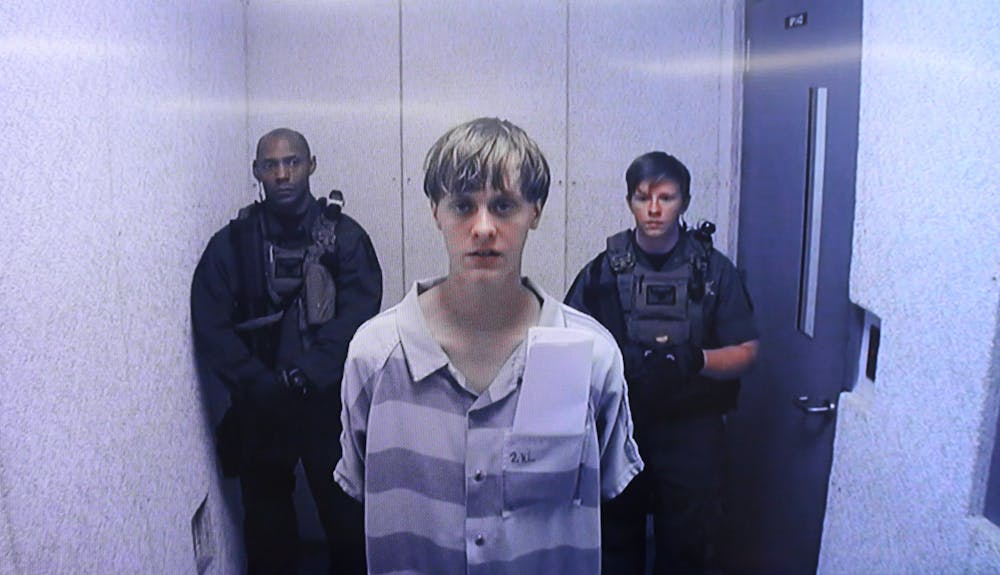
    Dylann Roof, who killed nine worshipers at a Black church in South Carolina in 2015, was convicted of 33 charges, including hate crimes.
    Grace Beahm-Pool/Getty Images

    What is terrorism?

    Terrorism is a violent tactic – a strategy used to achieve a specific end.

    This strategy is often used in asymmetric power struggles when a weaker person, or group, is fighting against a powerful nation-state. The violence is aimed at creating fear in the targeted population.

    Terrorists often justify their bloody acts on the basis of perceived social, economic and political unfairness. Or they take inspiration from religious beliefs or spiritual principles.

    Many forms of terrorism were inspired by struggle between races, the rich and poor, or political outcasts and elites.

    How different terrorist groups act is informed by what they are trying to achieve. Some adopt a reactionary perspective aimed at stopping or resisting social, economic and political changes. Others adopt a revolutionary doctrine and want to provoke change.

    In the United States, terrorism attacks were in sharp decline from 1970 to 2011, decreasing from approximately 475 incidents a year to fewer than 20.

    The U.S. government began to take more note of domestic terrorism after the Oklahoma City bombing in 1995. And the number of domestic terrorism incidents began to rise after 2011, with notable increases in the mid-to-late 2010s and early 2020s.

    Data compiled by the Center for Strategic and International Studies shows right-wing terrorist attacks and plots grew substantially during the past decade, with right-wing extremists being responsible for the majority of attacks and plots each year since 2011, except for 2013. There were 44 incidents in 2019 alone.

    The Department of Homeland Security’s 2025 Homeland Threat Assessment indicates that the terrorism threat environment in the United States remains high, driven largely by domestic violent extremists motivated by a mix of racial, religious and anti-government grievances.

    Terrorism is not a successful tactic. American University professor Audrey Cronin studied 457 terrorist groups worldwide going back to 1968. The groups lasted an average of eight years before they lost support or were dismantled. No terrorist organizations that she studied were able to conquer a state, and 94% were unable to achieve even one of their strategic goals.

    Portions of this article originally appeared in articles published on March 19, 2021, and May 23, 2017.

    Read more of our stories about Colorado.

    The authors do not work for, consult, own shares in or receive funding from any company or organization that would benefit from this article, and have disclosed no relevant affiliations beyond their academic appointment.

    ref. Was the Boulder attack terrorism or a hate crime? 2 experts unpack the complexities – https://theconversation.com/was-the-boulder-attack-terrorism-or-a-hate-crime-2-experts-unpack-the-complexities-258217

    MIL OSI – Global Reports

  • MIL-Evening Report: ‘They cannot block us,’ says activist on Madleen flotilla aid ship to Gaza

    Pacific Media Watch

    One of the 12 activists on board the Gaza Freedom Flotilla aid vessel Madleen has posted an update on their progress, saying the mission would not be deterred by Israel’s threats to block them.

    In a video posted to X, Thiago Ávila said the crew, which includes high-profile Swedish climate activist Greta Thunberg, was not intimidated by a message they had received from Israel on Thursday, reports Al Jazeera.

    He said Israeli authorities had said that the Madleen, which is carrying food and medical supplies, would be blocked from entering Gaza — and that if they attempted to deliver them, they would come under attack.

    “It’s important that we understand that [Prime Minister Benjamin] Netanyahu and any other repressive regime throughout history, they actually fear the people, we do not fear them,” he said.

    “We know that this is part of a global uprising much larger than this humble mission of 12 people on a small boat. It will not be through force that they will make a way to defeat us.”

    While crossing international waters in the Central Mediterranean on its way to Gaza yesterday, the Madleen received a mayday call relayed through one of the Frontex drones operated by Europe’s border security agency.

    With no other vessel able to respond, the Madleen diverted to the distressed vessel, where it found 30 to 40 people trapped in a rapidly deflating dinghy.

    While the crew of the Madleen were attempting a rescue of their own, they were approached at speed by a unit of the Libyan Coast Guard, specifically one belonging to the Tareq Bin Zayed brigade, which Al Jazeera has previously reported upon.

    On realising that the approaching vessel belonged to the Libyan Coast Guard, four dinghy passengers jumped into the water and swam to the Madleen, where they were rescued.

    The remainder were taken on board the Libyan Coast Guard’s vessel and presumably returned to Libya.

    MIL OSI AnalysisEveningReport.nz

  • MIL-OSI Global: Why Kissinger would have been a Fortnite champ − and other foreign policy lessons from the gaming world

    Source: The Conversation – Global Perspectives – By Michael A. Allen, Professor of Political Science, Boise State University

    Charlemagne, the medieval King of the Franks, has taken control of modern-day America and is looking to expand his borders by invading your neighboring country.

    Now, I’m not a historian. But the above example makes perfect sense to me as both a gamer and a professor of international relations.

    It is a possible outcome in the recently released video game Civilization VII, or Civ 7, in which different historical figures can govern people far removed – both in time and geography – from their actual historical role. In this case, Charlemagne has become displeased with the little empire you control due to friction along a shared border and is likely to invade soon.

    I have been an avid player of games like Civ 7 my entire life. I tend to play strategic games, be they video, card, board or role-playing games. And I’m not alone. An estimated 190.6 million people in the U.S. regularly play video games in some form.

    While my primary reason for playing may be enjoyment, they also inform the discipline I teach. In fact, I just published a book, “The Gamer’s Guide to International Relations,” that explains how some of the most popular games around include lessons for people seeking to understand how diplomacy works and how different nations interact.

    A visitor walks past the booth of Civilization VII at the Gamescom video games trade fair in Cologne, Germany, on Aug. 21, 2024.
    Ina Fassbender/AFP via Getty Images

    While Civ 7 may seek to emulate this world of conflict and cooperation, other games with no apparent connection to geopolitics can also provide lessons. In particular, Fortnite, League of Legends and Minecraft invite gamers to interact with the world in a way that models how leaders, governments and countries behave.

    Here are three ways in which games create worlds that model key concepts from international relations:

    1. Fortnite as realpolitik

    Fortnite, a video game focused on crafting weapons and survival that launched in 2017, can be used as an introduction to the concept of realpolitik.

    The core part of Fortnite is its battle-royale, third-person shooting game. In a battle royale, you are fighting against 99 other players to be the last person standing.

    The “everyone for themselves” ethos can be chaotic and challenging, with death and defeat lurking in every shrub.

    It brings to mind the thinking behind the international relations theory of realism. Realists see the world as anarchic, with no overarching moral or physical authority telling states what to do – in other words, one with no world government.

    It is a self-help system where states survive, thrive or die based on accruing power, finding security and using force to resolve disputes.

    The theory of realism hearkens back to the ancient Greek historian Thucydides, who famously noted that the “strong do what they can and the weak suffer what they must.”

    That phrase has become a central tenet of foreign policy realists. Henry Kissinger, secretary of state under U.S. President Richard Nixon, saw foreign policy as a strategic enterprise based on power, while largely ignoring other imperatives such as human rights and justice.

    Even in international anarchy, however, cooperation can be attractive to a realist. Kissinger, for example, sought positive relations with China and foresaw that by working with China the U.S. could exploit a growing division between the Soviet Union and China.

    From Kissinger’s perspective, it mattered less that China was communist and more that it was powerful and distrustful of the Soviet Union.

    How does this apply to Fortnite? Well, in the game, you may come across two players fighting. When this happens, a player must quickly decide to either retreat or join the fray. If you enter the fight, you could either team up with the weaker player and eliminate a stronger foe or join the strong and remove the weak.

    In Fortnite, and occasionally in international politics, whomever you choose as your temporary ally will become your rival immediately after – so you have to choose wisely. The enemy of your enemy is not going to stay your friend forever.

    LoL and enduring allies

    League of Legends, known as LoL or League to fans, is a game that offers a deceptively simple idea: A team of five players battles another to destroy their base.

    Mastering the game is far from simple. Along the way, you can pick up valuable international relation lessons on the importance of forging lasting alliances.

    Fans watch the final of an esports competition to determine the winner of South Korea’s largest online game.
    Kim Jae-Hwan/SOPA Images/LightRocket via Getty Images

    Players remain anonymous and can be pretty toxic toward each other – tending to blame a team’s failings on anyone but themselves.

    If you join as a solo player, you will join four other people you do not know and spend the next 30 minutes either winning or losing a game.

    You’ll build a rapport with some teammates and want to keep playing with them. Other times, you find someone who complements your skills, and you can join a ranked competition as a pair and work together toward victory.

    In this, LoL is more akin to the international relations theory of liberalism. Liberalism, which should not be confused with the political identity in U.S. politics, holds realism’s view of the world to be limited. Instead, it teaches that cooperation can endure beyond pure power politics.

    Instead of a temporary alliance that falls apart immediately after you achieve your goal, liberalism suggests that alliances can mutually benefit two countries in the long run.

    Take for example the United States and the United Kingdom. The two countries allied during the crises of two worlds wars. By the end of World War II, they had established a long-term partnership, resulting in the establishment of international institutions that have endured for 80 years.

    Liberalism argues that countries can find solutions where both sides benefit without one side being disadvantaged. This contrasts with realism’s views of the world as zero-sum – where one side benefits at the other’s expense.

    Under both liberalism and League of Legends, interactions can create positive-sum outcomes for both parties.

    Minecraft and constructing the world

    Turning to Minecraft, one of the most popular games in the world, we find valuable lessons on a third international relations concept: constructivism.

    Constructivism argues that the world is socially constructed. That is, the rules of international politics are something that humans and countries have created, chosen to abide by and are willing to enforce.

    And this works well with Minecraft. People of all ages can enjoy it – but it is up to players to choose how to play. You can build houses or castles, or you can choose to find and defeat the Ender Dragon. Or you can turn on creative mode and decide to make art or large engineering projects.

    Constructing a love for all things foreign policy.
    Georg Wendt/picture alliance via Getty Images

    The point is that it’s up to you and your friends to determine joint goals or collectively decide to pursue your own interests – and that concept is at the heart of constructivism. States can decide to create a more liberal world by jointly signing treaties or joining international organizations that alter what nations can and cannot do. Alternatively, states may see such ventures as facades and decide that the most important things are power and security. Both realist and liberal states can exist in the same world.

    Like players in Minecraft, states may view the world as one where everyone is a threat, in line with realism. Or they may view the world as one where institutions and cooperation provide a better experience for everyone.

    In Minecraft as in international politics, the goals, rules and punishments for those who deviate are determined collectively.

    Digging deeper

    Games such as Minecraft, League of Legends and Fortnite may seem to many as a pastime rather than a learning experience. But they can help people connect with concepts that attempt to explain a vast and confusing world. Being able to grasp the arcane and complicated world of international relations can make the world slightly more manageable.

    Michael A. Allen does not work for, consult, own shares in or receive funding from any company or organization that would benefit from this article, and has disclosed no relevant affiliations beyond their academic appointment.

    ref. Why Kissinger would have been a Fortnite champ − and other foreign policy lessons from the gaming world – https://theconversation.com/why-kissinger-would-have-been-a-fortnite-champ-and-other-foreign-policy-lessons-from-the-gaming-world-253594

    MIL OSI – Global Reports

  • MIL-OSI Global: ‘The Eternal Queen of Asian Pop’ sings one last encore from beyond the grave

    Source: The Conversation – USA – By Xianda Huang, PhD student in Asian Languages and Cultures, University of California, Los Angeles

    Teresa Teng, who died in 1995, still has legions of fans around the world. Nora Tam/South China Morning Post via Getty Images

    Several years ago, an employee at Universal Music came across a cassette tape in a Tokyo warehouse while sorting through archival materials. On it was a recording by the late Taiwanese pop star Teresa Teng that had never been released; the pop ballad, likely recorded in the mid-1980s while Teng was living and performing in Japan, was a collaboration between composer Takashi Miki and lyricist Toyohisa Araki.

    Now, to the delight of her millions of fans, the track titled “Love Songs Are Best in the Foggy Nightwill appear on an album set to be released on June 25, 2025.

    Teng died 30 years ago. Most Americans know little about her life and her body of work. Yet the ballads of Teng, who could sing in Mandarin, Cantonese, Japanese and Indonesian, continue to echo through karaoke rooms, on Spotify playlists, at tribute concerts and at family gatherings across Asia and beyond.

    I study how pop music has served as a tool of soft power, and I’ve spent the past several years researching Teng’s music and its legacy. I’ve found that Teng’s influence endures not just because of her voice, but also because her music transcends Asia’s political fault lines.

    From local star to Asian icon

    Born in 1953 in Yunlin, Taiwan, Teresa Teng grew up in one of the many villages that were built to house soldiers and their families who had fled mainland China in 1949 after the communists claimed victory in the Chinese civil war. Her early exposure to traditional Chinese music and opera laid the foundation for her singing career. By age 6, she was taking voice lessons. She soon began winning local singing competitions.

    “It wasn’t adults who wanted me to sing,” Teng wrote in her memoir. “I wanted to sing. As long as I could sing, I was happy.”

    At 14, Teng dropped out of high school to focus entirely on music, signing with the local label Yeu Jow Records. Soon thereafter, she released her first album, “Fengyang Flower Drum.” In the 1970s, she toured and recorded across Taiwan, Hong Kong, Japan and Southeast Asia, becoming one of Asia’s first truly transnational pop stars.

    Teng’s career flourished in the late 1970s and 1980s. She released some of her most iconic tracks, such as her covers of Chinese singer Zhou Xuan’s 1937 hit “When Will You Return?” and Taiwanese singer Chen Fen-lan’s “The Moon Represents My Heart,” and toured widely across Asia, sparking what came to be known as “Teresa Teng Fever.”

    In the early 1990s, Teng was forced to stop performing for health reasons. She died suddenly of an asthma attack on May 8, 1995, while on vacation in Chiang Mai, Thailand, at the age of 42.

    China catches Teng Fever

    Perhaps the most remarkable aspect of Teng’s story is that Teng Fever peaked in China.

    Teng was ethnically Chinese, with ancestral roots in China’s Shandong province. But the political divide between China and Taiwan following the Chinese civil war had led to decades of hostility, with each side refusing to recognize the legitimacy of the other.

    Teng speaks at a press conference in Hong Kong in 1980.
    P.Y. Tang/South China Morning Post via Getty Images

    During the late 1970s and 1980s, however, China began to relax its political control under Deng Xiaoping’s Reform and Opening Up policy. This sweeping initiative shifted China toward a market-oriented economy, encouraged foreign trade and investment, and cautiously reintroduced global cultural influences after decades of isolation.

    Pop music from other parts of the world began trickling in, including Teng’s tender ballads. Her songs could be heard in coastal provinces such as Guangdong and Shanghai, inland cities such as Beijing and Tianjin, and even remote regions such as Tibet. Shanghai’s propaganda department wrote an internal memo in 1980 noting that her music had spread to the city’s public parks, restaurants, nursing homes and wedding halls.

    Teng’s immense popularity in China was no accident; it reflected a time in the country’s history when its people were particularly eager for emotionally resonant art after decades of cultural propaganda and censorship.

    For a society that had been awash in rote, revolutionary songs like “The East is Red” and “Union is Strength,” Teng’s music offered something entirely different. It was personal, tender and deeply human. Her gentle, approachable style – often described as “angelic” or like that of “a girl next door” – provided solace and a sense of intimacy that had long been absent from public life.

    Teng performs ‘Fly Me to the Moon’ in Taipei in 1984.

    Teng’s music was also admired for her ability to bridge eras. Her 1983 album “Light Exquisite Feeling” fused classical Chinese poetry with contemporary Western pop melodies, showcasing her gift for blending the traditional and the modern. It cemented her reputation not just as a pop star but as a cultural innovator.

    It’s no secret why audiences across China and Asia were so deeply drawn to her and her music. She was fluent in multiple languages; she was elegant but humble, polite and relatable; she was involved in various charities; and she spoke out in support of democratic values.

    A sound of home in distant lands

    Throughout the 1990s and early 2000s, the Chinese immigrant population in the United States grew to over 1.1 million. Teng’s music has also deeply embedded itself within Chinese diasporic communities across the country. In cities such as Los Angeles, San Francisco and New York, Chinese immigrants played her music at family gatherings, during holidays and at community events. Walk through any Chinatown during Lunar New Year and you’re bound to hear her voice wafting through the streets.

    Teng visits New York City’s Chinatown during her 1980 concert tour in the U.S.
    Wikimedia Commons

    For younger Chinese Americans and even non-Chinese audiences, Teng’s music has become a window into Chinese culture.

    When I was studying in the U.S., I often met Asian American students who belted out her songs at karaoke nights or during cultural festivals. Many had grown up hearing her music through their parents’ playlists or local community celebrations.

    The release of her recently discovered song is a reminder that some voices do not fade – they evolve, migrate and live on in the hearts of people scattered across the world.

    Teresa Teng’s music is still celebrated in Chinatowns across the U.S.

    In an age when global politics drive different cultures apart, Teng’s enduring appeal reminds us of something quieter yet more lasting: the power of voice to transmit emotion across time and space, the way a melody can build a bridge between continents and generations.

    I recently rewatched the YouTube video for Teng’s iconic 1977 ballad “The Moon Represents My Heart.” As I read the comments section, one perfectly encapsulated what I had discovered about Teresa Teng in my own research: “Teng’s music opened a window to a culture I never knew I needed.”

    Xianda Huang does not work for, consult, own shares in or receive funding from any company or organization that would benefit from this article, and has disclosed no relevant affiliations beyond their academic appointment.

    ref. ‘The Eternal Queen of Asian Pop’ sings one last encore from beyond the grave – https://theconversation.com/the-eternal-queen-of-asian-pop-sings-one-last-encore-from-beyond-the-grave-255560

    MIL OSI – Global Reports

  • MIL-OSI Global: AmeriCorps is on the chopping block – despite research showing that the national service agency is making a difference in local communities

    Source: The Conversation – USA – By Pamela Paxton, Professor of Sociology, The University of Texas at Austin

    Many AmeriCorps crews, like this one seen at work in Maine in 2011, restore and renovate public parks. John Patriquin/Portland Press Herald via Getty Images

    Hundreds of thousands of U.S. nonprofits provide vital services, such as running food banks and youth programs, supporting public health initiatives and helping unemployed people find new jobs. Although this work helps sustain local communities, obtaining the money and staff they require is a constant struggle for many of these groups.

    That’s where AmeriCorps often comes in. The independent federal agency for national service and volunteerism has facilitated the work of approximately 200,000 people a year, placing them through partnerships with thousands of nonprofits that provide tutoring, disaster relief and many other important services.

    But Americorps’ fate is now uncertain. In April 2025, the Trump administration canceled more than 1,000 grants, suddenly ending the stipends that were supporting more than 32,000 AmeriCorps volunteers. On June 5, a judge ordered that these grants be restored in Washington D.C. and 24 states in response to a lawsuit they had filed. The judge also ordered that all volunteers who had been deployed in those places be reinstated “if they are willing and able to return.”

    The Trump administration has also put most of AmeriCorps administrative staff on leave and indicated that it wants to eliminate the independent agency, along with its US$1.2 billion annual budget. AmeriCorps doesn’t appear in a detailed 2026 budget request the administration released on May 30.

    I’m a sociology and public affairs professor who has studied nonprofits and volunteering for decades. My research suggests that dismantling AmeriCorps would harm the organizations that rely on national service members and take a toll on the communities that benefit from their work.

    AmeriCorps explains what the independent national service agency does.

    What AmeriCorps does

    AmeriCorps traces its roots to the mid-1960s, when Volunteers in Service to America, known as VISTA, was founded as a domestic counterpart to the Peace Corps. Several earlier service programs were consolidated when Congress passed the National and Community Service Trust Act in 1993. AmeriCorps was officially launched in 1994 – and VISTA became one of its programs.

    Since then, AmeriCorps members have built housing and infrastructure, delivered disaster relief, tutored in low-income schools, provided health care and helped older adults age with dignity in both urban and rural communities across the nation.

    AmeriCorps includes a variety of programs, each designed to address specific public needs. Some AmeriCorps volunteers provide direct services, such as tutoring, food delivery and in disaster response efforts. Others focus on building the long-term capacity of local nonprofits through volunteer recruitment, fundraising strategy and community outreach.

    AmeriCorps volunteers, whom the agency calls “members,” are placed in thousands of nonprofits, schools and local agencies. Many of them are recent college graduates or early-career professionals. Some programs specifically ask people over 55 to serve. Those “senior” volunteers support children through the Foster Grandparents program, volunteer for organizations or assist other older people through the Senior Companions program.

    Many AmeriCorps volunteers are paid a modest allowance for this work that runs about $500 per week. AmeriCorps senior volunteers receive smaller sums in hourly stipends to offset the costs of volunteering.

    Fox40 News in Sacramento, Calif., covers the Trump administration’s reduction of AmeriCorps’ ranks in April 2025.

    Helping nonprofits gain traction

    AmeriCorps has long funded research that assesses its impact.

    One such study found that every dollar invested in national service generates $11.80 in benefits for society, such as higher earnings, better mental and physical health, and economic growth. Additionally, every federal dollar spent on national service produces $17.30 in savings across other government programs through reductions in public assistance, health and criminal justice spending.

    As part of AmeriCorps’ research grants program, I have received funding to study civic engagement and AmeriCorps programming.

    In one of those studies, which I conducted with two former colleagues at the University of Texas at Austin in 2021, we found that VISTA volunteers were able to help nonprofits gain volunteers. After two years, an organization with that support had 71% more volunteers than those that didn’t participate in the VISTA program.

    We also found that the longer a nonprofit had a staffer supported by the VISTA program, the more its overall pool of volunteers increased.

    Nonprofits with VISTA volunteers also had three times as many donations two years later, compared with nonprofits without VISTA service members. But the total value of donations the nonprofit obtained didn’t always rise. That is, we found that VISTA builds people power, but not necessarily fundraising revenue.

    Findings like these indicate that AmeriCorps hasn’t just helped the people it serves or the people who volunteer through the program. It also strengthens nonprofits and increases engagement within local communities, reinforcing the civic fabric that knits communities together.

    As members of Congress and the White House decide whether to preserve AmeriCorps, I hope they consider the evidence that demonstrates this worthwhile program’s positive impact.

    Pamela Paxton has received funding from the Office of Research and Evaluation at AmeriCorps.

    ref. AmeriCorps is on the chopping block – despite research showing that the national service agency is making a difference in local communities – https://theconversation.com/americorps-is-on-the-chopping-block-despite-research-showing-that-the-national-service-agency-is-making-a-difference-in-local-communities-257430

    MIL OSI – Global Reports

  • MIL-OSI Global: US health care is rife with high costs and deep inequities, and that’s no accident – a public health historian explains how the system was shaped to serve profit and politicians

    Source: The Conversation – USA – By Zachary W. Schulz, Senior Lecturer of History, Auburn University

    Concessions to the private sector are one reason why health care is so costly. FS Productions/Tetra images via Getty Images

    A few years ago, a student in my history of public health course asked why her mother couldn’t afford insulin without insurance, despite having a full-time job. I told her what I’ve come to believe: The U.S. health care system was deliberately built this way.

    People often hear that health care in America is dysfunctional – too expensive, too complex and too inequitable. But dysfunction implies failure. What if the real problem is that the system is functioning exactly as it was designed to? Understanding this legacy is key to explaining not only why reform has failed repeatedly, but why change remains so difficult.

    I am a historian of public health with experience researching oral health access and health care disparities in the Deep South. My work focuses on how historical policy choices continue to shape the systems we rely on today.

    By tracing the roots of today’s system and all its problems, it’s easier to understand why American health care looks the way it does and what it will take to reform it into a system that provides high-quality, affordable care for all. Only by confronting how profit, politics and prejudice have shaped the current system can Americans imagine and demand something different.

    Decades of compromise

    My research and that of many others show that today’s high costs, deep inequities and fragmented care are predictable features developed from decades of policy choices that prioritized profit over people, entrenched racial and regional hierarchies, and treated health care as a commodity rather than a public good.

    Over the past century, U.S. health care developed not from a shared vision of universal care, but from compromises that prioritized private markets, protected racial hierarchies and elevated individual responsibility over collective well-being.

    Employer-based insurance emerged in the 1940s, not from a commitment to worker health but from a tax policy workaround during wartime wage freezes. The federal government allowed employers to offer health benefits tax-free, incentivizing coverage while sidestepping nationalized care. This decision bound health access to employment status, a structure that is still dominant today. In contrast, many other countries with employer-provided insurance pair it with robust public options, ensuring that access is not tied solely to a job.

    In 1965, Medicare and Medicaid programs greatly expanded public health infrastructure. Unfortunately, they also reinforced and deepened existing inequalities. Medicare, a federally administered program for people over 64, primarily benefited wealthier Americans who had access to stable, formal employment and employer-based insurance during their working years. Medicaid, designed by Congress as a joint federal-state program, is aimed at the poor, including many people with disabilities. The combination of federal and state oversight resulted in 50 different programs with widely variable eligibility, coverage and quality.

    Southern lawmakers, in particular, fought for this decentralization. Fearing federal oversight of public health spending and civil rights enforcement, they sought to maintain control over who received benefits. Historians have shown that these efforts were primarily designed to restrict access to health care benefits along racial lines during the Jim Crow period of time.

    Bloated bureaucracies, ‘creeping socialism’

    Today, that legacy is painfully visible.

    States that chose not to expand Medicaid under the Affordable Care Act are overwhelmingly located in the South and include several with large Black populations. Nearly 1 in 4 uninsured Black adults are uninsured because they fall into the coverage gap – unable to access affordable health insurance – they earn too much to qualify for Medicaid but not enough to receive subsidies through the Affordable Care Act’s marketplace.

    The system’s architecture also discourages care aimed at prevention. Because Medicaid’s scope is limited and inconsistent, preventive care screenings, dental cleanings and chronic disease management often fall through the cracks. That leads to costlier, later-stage care that further burdens hospitals and patients alike.

    Meanwhile, cultural attitudes around concepts like “rugged individualism” and “freedom of choice” have long been deployed to resist public solutions. In the postwar decades, while European nations built national health care systems, the U.S. reinforced a market-driven approach.

    Publicly funded systems were increasingly portrayed by American politicians and industry leaders as threats to individual freedom – often dismissed as “socialized medicine” or signs of creeping socialism. In 1961, for example, Ronald Reagan recorded a 10-minute LP titled “Ronald Reagan Speaks Out Against Socialized Medicine,” which was distributed by the American Medical Association as part of a national effort to block Medicare.

    The health care system’s administrative complexity ballooned beginning in the 1960s, driven by the rise of state-run Medicaid programs, private insurers and increasingly fragmented billing systems. Patients were expected to navigate opaque billing codes, networks and formularies, all while trying to treat, manage and prevent illness. In my view, and that of other scholars, this isn’t accidental but rather a form of profitable confusion built into the system to benefit insurers and intermediaries.

    President Donald Trump’s proposed cuts would reduce Medicaid spending by about US$700 billion.

    Coverage gaps, chronic disinvestment

    Even well-meaning reforms have been built atop this structure. The Affordable Care Act, passed in 2010, expanded access to health insurance but preserved many of the system’s underlying inequities. And by subsidizing private insurers rather than creating a public option, the law reinforced the central role of private companies in the health care system.

    The public option – a government-run insurance plan intended to compete with private insurers and expand coverage – was ultimately stripped from the Affordable Care Act during negotiations due to political opposition from both Republicans and moderate Democrats.

    When the U.S. Supreme Court made it optional in 2012 for states to offer expanded Medicaid coverage to low-income adults earning up to 138% of the federal poverty level, it amplified the very inequalities that the ACA sought to reduce.

    These decisions have consequences. In states like Alabama, an estimated 220,000 adults remain uninsured due to the Medicaid coverage gap – the most recent year for which reliable data is available – highlighting the ongoing impact of the state’s refusal to expand Medicaid.

    In addition, rural hospitals have closed, patients forgo care, and entire counties lack practicing OB/GYNs or dentists. And when people do get care – especially in states where many remain uninsured – they can amass medical debt that can upend their lives.

    All of this is compounded by chronic disinvestment in public health. Federal funding for emergency preparedness has declined for years, and local health departments are underfunded and understaffed.

    The COVID-19 pandemic revealed just how brittle the infrastructure is – especially in low-income and rural communities, where overwhelmed clinics, delayed testing, limited hospital capacity, and higher mortality rates exposed the deadly consequences of neglect.

    A system by design

    Change is hard not because reformers haven’t tried before, but because the system serves the very interests it was designed to serve. Insurers profit from obscurity – networks that shift, formularies that confuse, billing codes that few can decipher. Providers profit from a fee-for-service model that rewards quantity over quality, procedure over prevention. Politicians reap campaign contributions and avoid blame through delegation, diffusion and plausible deniability.

    This is not an accidental web of dysfunction. It is a system that transforms complexity into capital, bureaucracy into barriers.

    Patients – especially the uninsured and underinsured – are left to make impossible choices: delay treatment or take on debt, ration medication or skip checkups, trust the health care system or go without. Meanwhile, I believe the rhetoric of choice and freedom disguises how constrained most people’s options really are.

    Other countries show us that alternatives are possible. Systems in Germany, France and Canada vary widely in structure, but all prioritize universal access and transparency.

    Understanding what the U.S. health care system is designed to do – rather than assuming it is failing unintentionally – is a necessary first step toward considering meaningful change.

    Zachary W. Schulz does not work for, consult, own shares in or receive funding from any company or organization that would benefit from this article, and has disclosed no relevant affiliations beyond their academic appointment.

    ref. US health care is rife with high costs and deep inequities, and that’s no accident – a public health historian explains how the system was shaped to serve profit and politicians – https://theconversation.com/us-health-care-is-rife-with-high-costs-and-deep-inequities-and-thats-no-accident-a-public-health-historian-explains-how-the-system-was-shaped-to-serve-profit-and-politicians-256393

    MIL OSI – Global Reports

  • MIL-OSI Global: Early visions of Mars: Meet the 19th-century astronomer who used science fiction to imagine the red planet

    Source: The Conversation – USA – By Matthew Shindell, Curator, Planetary Science and Exploration, Smithsonian Institution

    Camille Flammarion’s work imagined what might exist beyond Earth in the universe. Three Lions/Hulton Archive via Getty Images

    Living in today’s age of ambitious robotic exploration of Mars, with an eventual human mission to the red planet likely to happen one day, it is hard to imagine a time when Mars was a mysterious and unreachable world. And yet, before the invention of the rocket, astronomers who wanted to explore Mars beyond what they could see through their telescopes had to use their imaginations.

    As a space historian and author of the book “For the Love of Mars: A Human History of the Red Planet,” I’ve worked to understand how people in different times and places imagined Mars.

    The second half of the 19th century was a particularly interesting time to imagine Mars. This was a period during which the red planet seemed to be ready to give up some of its mystery. Astronomers were learning more about Mars, but they still didn’t have enough information to know whether it hosted life, and if so, what kind.

    With more powerful telescopes and new printing technologies, astronomers began applying the cartographic tools of geographers to create the first detailed maps of the planet’s surface, filling it in with continents and seas, and in some cases features that could have been produced by life. Because it was still difficult to see the actual surface features of Mars, these maps varied considerably.

    During this period, one prominent scientist and popularizer brought together science and imagination to explore the possibilities that life on another world could hold.

    Camille Flammarion

    The 19th-century astronomer and writer Camille Flammarion.
    Av Ukjent/The New York Public Library Digital Collections

    One imaginative thinker whose attention was drawn to Mars during this period was the Parisian astronomer Camille Flammarion. In 1892, Flammarion published “The Planet Mars,” which remains to this day a definitive history of Mars observation up through the 19th century. It summarized all the published literature about Mars since the time of Galileo in the 17th century. This work, he reported, required him to review 572 drawings of Mars.

    Like many of his contemporaries, Flammarion concluded that Mars, an older world that had gone through the same evolutionary stages as Earth, must be a living world. Unlike his contemporaries, he insisted that Mars, while it might be the most Earth-like planet in our solar system, was distinctly its own world.

    It was the differences that made Mars interesting to Flammarion, not the similarities. Any life found there would be evolutionarily adapted to its particular conditions – an idea that appealed to the author H.G. Wells when he imagined invading Martians in “The War of the Worlds.”

    An illustrated plate from ‘Astronomie Populaire – Description Generale du Ciel’ by Camille Flammarion. This map of Mars shows continents and oceans. In this, his best-selling epic work, Flammarion speculated that Mars was ‘an earth almost similar to ours [with] water, air, showers, brooks and fountains. This is certainly a place little different from that which we inhabit.’
    Science & Society Picture Library via Getty Images

    But Flammarion also admitted that it was difficult to pin down these differences, as “the distance is too great, our atmosphere is too dense, and our instruments are not perfect enough.” None of the maps he reviewed could be taken literally, he lamented, because everyone had seen and drawn Mars differently.

    Given this uncertainty about what had actually been seen on Mars’ surface, Flammarion took an agnostic stance in “The Planet Mars” as to the specific nature of life on Mars.

    He did, however, consider that if intelligent life did exist on Mars, it would be more ancient than human life on Earth. Logically, that life would be more perfect — akin to the peaceful, unified and technologically advanced civilization he predicted would come into being on Earth in the coming century.

    “We can however hope,” he wrote, “that since the world of Mars is older than our own, its inhabitants may be wiser and more advanced than we are. Undoubtedly it is the spirit of peace which has animated this neighboring world.”

    A plate from ‘Les Terres du Ciel’ (The Worlds of the Sky) written by Camille Flammarion. The plate is an artist’s impression of how canals on Mars might have looked.
    Science & Society Picture Library via Getty Images

    But as Flammarion informed his readers, “the Known is a tiny island in the midst of the ocean of the Unknown,” a point he often underscored in the more than 70 books he published in his lifetime. It was the “Unknown” that he found particularly tantalizing.

    Historians often describe Flammarion more as a popularizer than a serious scientist, but this should not diminish his accomplishments. For Flammarion, science wasn’t a method or a body of established knowledge. It was the nascent core of a new philosophy waiting to be born. He took his popular writing very seriously and hoped it could turn people’s minds toward the heavens.

    Imaginative novels

    Without resolving the planet’s surface or somehow communicating with its inhabitants, it was premature to speculate about what forms of life might exist on Mars. And yet, Flammarion did speculate — not so much in his scientific work, but in a series of novels he wrote over the course of his career.

    In these imaginative works, he was able to visit Mars and see its surface for himself. Unlike his contemporary, the science fiction author Jules Verne, who imagined a technologically facilitated journey to the Moon, Flammarion preferred a type of spiritual journey.

    Camille Flammarion looking through the telescope at the Observatory at Juvisy-sur-Orge.
    duncan1890/iStock via Getty Images Plus

    Based on his belief that human souls after death can travel through space in a way that the living body cannot, Flammarion’s novels include dream journeys as well as the accounts of deceased friends or fictional characters.

    In his novel “Urania” (1889), Flammarion’s soul visits Mars in a dream. Upon arrival, he encounters a deceased friend, George Spero, who has been reincarnated as a winged, luminous, six-limbed being.

    “Organisms can no more be earthly on Mars than they could be aerial at the bottom of the sea,” Flammarion writes.

    Later in the same novel, Spero’s soul visits Flammarion on Earth. He reveals that Martian civilization and science have progressed well beyond Earth, not only because Mars is an older world, but because the atmosphere is thinner and more suitable for astronomy.

    Flammarion imagined that practicing and popularizing astronomy, along with the other sciences, had helped advance Martian society.

    Flammarion’s imagined Martians lived intellectual lives untroubled by war, hunger and other earthly concerns. This was the life Flammarion wanted for his fellow Parisians, who had lived through the devastation of the Franco-Prussian war and suffered starvation and deprivation during the Siege of Paris and its aftermath.

    Today, Flammarion’s Mars is a reminder that imagining a future on Mars is as much about understanding ourselves and our societal aspirations as it is about developing the technologies to take us there.

    Flammarion’s popularization of science was his means of helping his fellow Earth-bound humans understand their place in the universe. They could one day join his imagined Martians, which weren’t meant to be taken any more literally than the maps of Mars he analyzed for “The Planet Mars.” His world was an example of what life could become under the right conditions.

    Matthew Shindell does not work for, consult, own shares in or receive funding from any company or organization that would benefit from this article, and has disclosed no relevant affiliations beyond their academic appointment.

    ref. Early visions of Mars: Meet the 19th-century astronomer who used science fiction to imagine the red planet – https://theconversation.com/early-visions-of-mars-meet-the-19th-century-astronomer-who-used-science-fiction-to-imagine-the-red-planet-254005

    MIL OSI – Global Reports

  • MIL-OSI Global: Golden Dome dangers: An arms control expert explains how Trump’s missile defense threatens to make the US less safe

    Source: The Conversation – USA – By Matthew Bunn, Professor of the Practice of Energy, National Security, and Foreign Policy, Harvard Kennedy School

    President Donald Trump has grandiose plans for Golden Dome. AP Photo/Alex Brandon

    President Donald Trump’s idea of a “Golden Dome” missile defense system carries a range of potential strategic dangers for the United States.

    Golden Dome is meant to protect the U.S. from ballistic, cruise and hypersonic missiles, and missiles launched from space. Trump has called for the missile defense to be fully operational before the end of his term in three years.

    Trump’s goals for Golden Dome are likely beyond reach. A wide range of studies makes clear that even defenses far more limited than what Trump envisions would be far more expensive and less effective than Trump expects, especially against enemy missiles equipped with modern countermeasures. Countermeasures include multiple warheads per missile, decoy warheads and warheads that can maneuver or are difficult to track, among others.

    Regardless of Golden Dome’s feasibility, there is a long history of scholarship about strategic missile defenses, and the weight of evidence points to the defenses making their host country less safe from nuclear attack.

    I’m a national security and foreign policy professor at Harvard University, where I lead “Managing the Atom,” the university’s main research group on nuclear weapons and nuclear energy policies. For decades, I’ve been participating in dialogues with Russian and Chinese nuclear experts – and their fears about U.S. missile defenses have been a consistent theme throughout.

    Russian President Vladmir Putin and Chinese leader Xi Jinping have already warned that Golden Dome is destabilizing. Along with U.S. offensive capabilities, Golden Dome poses a threat of “directly undermining global strategic stability, spurring an arms race and increasing conflict potential both among nuclear-weapon states and in the international arena as a whole,” a joint statement from China and Russia said. While that is a propaganda statement, it reflects real concerns broadly held in both countries.

    Golden Dome explained.

    History lessons

    Experience going back half a century makes clear that if the administration pursues Golden Dome, it is likely to provoke even larger arms buildups, derail already-dim prospects for any negotiated nuclear arms restraint, and perhaps even increase the chances of nuclear war.

    My first book, 35 years ago, made the case that it would be in the U.S. national security interest to remain within the 1972 Anti-Ballistic Missile Treaty, which strictly limited U.S. and Soviet – and later Russian – missile defenses. The United States and the Soviet Union negotiated the ABM Treaty as part of SALT I, the first agreements limiting the nuclear arms race. It was approved in the Senate 98-2.

    The ABM Treaty experience is instructive for the implications of Golden Dome today.

    Why did the two countries agree to limit defenses? First and foremost, because they understood that unless each side’s defenses were limited, they would not be able to stop an offensive nuclear arms race. If each side wants to maintain the ability to retaliate if the other attacks – “don’t nuke me, or I’ll nuke you” – then an obvious answer to one side building up more defenses is for the other to build up more nuclear warheads.

    For example, in the 1960s and 1970s, the Soviets installed 100 interceptors to defend Moscow – so the United States targeted still more warheads on Moscow to overwhelm the defense. Had it ever come to a nuclear war, Moscow would have been even more thoroughly obliterated than if there had been no defense at all. Both sides came to realize that unlimited missile defenses would just mean more offense on both sides, leaving both less secure than before.

    In addition, nations viewed an adversary’s shield as going hand in hand with a nuclear sword. A nuclear first strike might destroy a major part of a country’s nuclear forces. Missile defenses would inevitably be more effective against the reduced, disorganized retaliation that they knew would be coming than they would be against a massive, well-planned surprise attack. That potential advantage to whoever struck first could make nuclear crises even more dangerous.

    Post-ABM Treaty world

    Unfortunately, President George W. Bush pulled the United States out of the ABM Treaty in 2002, seeking to free U.S. development of defenses against potential missile attacks from small states such as North Korea. But even now, decades later, the U.S. has fewer missile interceptors deployed (44) than the treaty permitted (100).

    The U.S. pullout did not lead to an immediate arms buildup or the end of nuclear arms control. But Putin has complained bitterly about U.S. missile defenses and the U.S. refusal to accept any limitation at all on them. He views the U.S. stance as an effort to achieve military superiority by negating Russia’s nuclear deterrent.

    Russia is investing heavily in new types of strategic nuclear weapons intended to avoid U.S. missile defenses, from an intercontinental nuclear torpedo to a missile that can go around the world and attack from the south, while U.S. defenses are mainly pointed north toward Russia.

    Russia maintains a large force of nuclear weapons like this mobile intercontinental ballistic missile.
    Russian Defense Ministry Press Service via APPEAR

    Similarly, much of China’s nuclear buildup appears to be driven by wanting a reliable nuclear deterrent in the face of the United States’ capability to strike its nuclear forces and use missile defenses to mop up the remainder. Indeed, China was so angered by South Korea’s deployment of U.S.-provided regional defenses – which they saw as aiding the U.S. ability to intercept their missiles – that they imposed stiff sanctions on South Korea.

    Fuel to the fire

    Now, Trump wants to go much further, with a defense “forever ending the missile threat to the American homeland,” with a success rate “very close to 100%.” I believe that this effort is highly likely to lead to still larger nuclear buildups in Russia and China. The Putin-Xi joint statement pledges to “counter” defenses “aimed at achieving military superiority.”

    Given the ease of developing countermeasures that are extraordinarily difficult for defenses to overcome, odds are the resulting offense-defense competition will leave the United States worse off than before – and a good bit poorer.

    Putin and Xi made clear that they are particularly concerned about the thousands of space-based interceptors Trump envisions. These interceptors are designed to hit missiles while their rockets are still burning during launch.

    Most countries are likely to oppose the idea of deploying huge numbers of weapons in space – and these interceptors would be both expensive and vulnerable. China and Russia could focus on further developing anti-satellite weapons to blow a hole in the defense, increasing the risk of space war.

    Already, there is a real danger that the whole effort of negotiated limits to temper nuclear arms racing may be coming to an end. The last remaining treaty limiting U.S. and Russian nuclear forces, the New START Treaty, expires in February 2026. China’s rapid nuclear buildup is making many defense officials and experts in Washington call for a U.S. buildup in response.

    Intense hostility all around means that for now, neither Russia nor China is even willing to sit down to discuss nuclear restraints, in treaty form or otherwise.

    A way forward

    In my view, adding Golden Dome to this combustible mix would likely end any prospect of avoiding a future of unrestrained and unpredictable nuclear arms competition. But paths away from these dangers are available.

    It would be quite plausible to design defenses that would provide some protection against attacks from a handful of missiles from North Korea or others that would not seriously threaten Russian or Chinese deterrent forces – and design restraints that would allow all parties to plan their offensive forces knowing what missile defenses they would be facing in the years to come.

    I believe that Trump should temper his Golden Dome ambitions to achieve his other dream – of negotiating a deal to reduce nuclear dangers.

    Matthew Bunn is a member of the National Academies Committee on International Security and Arms Control and a board member of the Arms Control Association. He is a member of the Academic Alliance of the United States Strategic Command and a consultant to Oak Ridge National Laboratory.

    ref. Golden Dome dangers: An arms control expert explains how Trump’s missile defense threatens to make the US less safe – https://theconversation.com/golden-dome-dangers-an-arms-control-expert-explains-how-trumps-missile-defense-threatens-to-make-the-us-less-safe-258048

    MIL OSI – Global Reports

  • MIL-OSI Global: Beyond de-extinction and dire wolves, gene editing can help today’s endangered species

    Source: The Conversation – USA – By Alex Erwin, Assistant Professor of Law, Florida International University

    Only a few hundred red wolves still exist, most in captivity. JeffGoulden/E+ via Getty Images

    Have you been hearing about the dire wolf lately? Maybe you saw a massive white wolf on the cover of Time magazine or a photo of “Game of Thrones” author George R.R. Martin holding a puppy named after a character from his books.

    The dire wolf, a large, wolflike species that went extinct about 12,000 years ago, has been in the news after biotech company Colossal claimed to have resurrected it using cloning and gene-editing technologies. Colossal calls itself a “de-extinction” company. The very concept of de-extinction is a lightning rod for criticism. There are broad accusations of playing God or messing with nature, as well as more focused objections that contemporary de-extinction tools create poor imitations rather than truly resurrected species.

    While the biological and philosophical debates are interesting, the legal ramifications for endangered species conservation are of paramount importance. As a legal scholar with a Ph.D. in wildlife genetics, my work focuses on how we legally define the term “endangered species.” The use of biotechnology for conservation, whether for de-extinction or genetic augmentation of existing species, promises solutions to otherwise intractable problems. But it needs to work in harmony with both the letter and purpose of the laws governing biodiversity conservation.

    All that’s left of dire wolves today are bones, like these skulls on display in a museum.
    Patrick T. Fallon/AFP via Getty Images

    Of dire wolves and de-extinction

    What did Colossal actually do? Scientists extracted and sequenced DNA from Ice Age-era bones to understand the genetic makeup of the dire wolf. They were able to piece together around 90% of a complete dire wolf genome. While the gray wolf and the dire wolf are separated by a few million years of evolution, they share over 99.5% of their genomes.

    The scientists scanned the recovered dire wolf sequences for specific genes that they believed were responsible for the physical and ecological differences between dire wolves and other species of canids, including genes related to body size and coat color. CRISPR gene-editing technology allows scientists to make specific changes in the DNA of an organism. The Colossal team used CRISPR to make 20 changes in 14 different genes in a modern gray wolf cell before implanting the embryo into a surrogate mother.

    While the technology on display is marvelous, what should we call the resulting animals? Some commentators argue that the animals are just modified gray wolves. They point out that it would take far more than 20 edits to bridge the gap left by millions of years of evolution. For instance, that 0.5% of the genome that doesn’t match in the two species represents over 12 million base pair differences.

    More philosophically, perhaps, other skeptics argue that a species is more than a collection of genes devoid of environmental, ecological or evolutionary context.

    Colossal, on the other hand, maintains that it is in the “functional de-extinction” game. The company acknowledges it isn’t making a perfect dire wolf copy. Instead it wants to recreate something that looks and acts like the dire wolf of old. It prefers the “if it looks like a duck, and quacks like a duck, it’s a duck” school of speciation.

    Disagreements about taxonomy – the science of naming and categorizing living organisms – are as old as the field itself. Biologists are notorious for failing to adopt a single clear definition of “species,” and there are dozens of competing definitions in the biological literature.

    Biologists can afford to be flexible and imprecise when the stakes are merely a conversational misunderstanding. Lawyers and policymakers, on the other hand, do not have that luxury.

    President Richard Nixon signed the Endangered Species Act in December 1973.
    Associated Press

    Deciding what counts as an endangered ‘species’

    In the United States, the Endangered Species Act is the main tool for protecting biodiversity.

    To be protected by the act, an organism must be a member of an endangered or threatened species. Some of the most contentious ESA issues are definitional, such as whether the listed species is a valid “species” and whether individual organisms, especially hybrids, are members of the listed species.

    Colossal’s functional species concept is anathema to the Endangered Species Act. It shrinks the value of a species down to the way it looks or the way it functions. When passing the act, however, Congress made clear that species were to be valued for their “aesthetic, ecological, educational, historical, recreational, and scientific value to the Nation and its people.” In my view, the myopic focus on function seems to miss the point.

    Despite its insistence otherwise, Colossal’s definitional sleight of hand has opened the door to arguments that people should reduce conservation funding or protections for currently imperiled species. Why spend the money to protect a critter and its habitat when, according to Interior Secretary Doug Burgum, you can just “pick your favorite species and call up Colossal”?

    Putting biotechnology to work for conservation

    Biotechnology can provide real conservation benefits for today’s endangered species. I suggest gene editing’s real value is not in recreating facsimiles of long-extinct species like dire wolves, but instead using it to recover ones in trouble now.

    Projects, by both Colossal and other groups, are underway around the world to help endangered species develop disease resistance or evolve to tolerate a warmer world. Other projects use gene editing to reintroduce genetic variation into populations where genetic diversity has been lost.

    For example, Colossal has also announced that it has cloned a red wolf. Unlike the dire wolf, the red wolf is not extinct, though it came extremely close. After decades of conservation efforts, there are about a dozen red wolves in the wild in the reintroduced population in eastern North Carolina, as well as a few hundred red wolves in captivity.

    Most of the tiny population of red wolves live in captivity.
    Cornell Watson for The Washington Post via Getty Images

    The entire population of red wolves, both wild and captive, descends from merely 14 founders of the captive breeding program. This limited heritage means the species has lost a significant amount of the genetic diversity that would help it continue to evolve and adapt.

    In order to reintroduce some of that missing genetic diversity, you’d need to find genetic material from red wolves outside the managed population. Right now that would require stored tissue samples from animals that lived before the captive breeding program was established or rediscovering a “lost” population in the wild.

    Recently, researchers discovered that coyotes along the Texas Gulf Coast possess a sizable percentage of red wolf-derived DNA in their genomes. Hybridization between coyotes and red wolves is both a threat to red wolves and a natural part of their evolutionary history, complicating management. The red wolf genes found within these coyotes do present a possible source of genetic material that biotechnology could harness to help the captive breeding population if the legal hurdles can be managed.

    This coyote population was Colossal’s source for its cloned “ghost” red wolf. Even this announcement is marred by definitional confusion. Due to its hybrid nature, the animal Colossal cloned is likely not legally considered a red wolf at all.

    Under the Endangered Species Act, hybrid organisms are typically not protected. So by cloning one of these animals, Colossal likely sidestepped the need for ESA permits. It will almost certainly run into resistance if it attempts to breed these “ghost wolves” into the current red wolf captive breeding program that has spent decades trying to minimize hybridization. How much to value genetic “purity” versus genetic diversity in managed species still proves an extraordinarily difficult question, even without the legal uncertainty.

    Biotechnology could never solve every conservation problem – especially habitat destruction. The ability to make “functional” copies of a species certainly does not lessen the urgency to respond to biodiversity loss, nor does it reduce human beings’ moral culpability. But to adequately respond to the ever-worsening biodiversity crisis, conservationists will need all available tools.

    Alex Erwin does not work for, consult, own shares in or receive funding from any company or organization that would benefit from this article, and has disclosed no relevant affiliations beyond their academic appointment.

    ref. Beyond de-extinction and dire wolves, gene editing can help today’s endangered species – https://theconversation.com/beyond-de-extinction-and-dire-wolves-gene-editing-can-help-todays-endangered-species-254670

    MIL OSI – Global Reports

  • MIL-OSI Global: Why the Musk and Trump relationship is breaking down – a psychologist explains

    Source: The Conversation – UK – By Geoff Beattie, Professor of Psychology, Edge Hill University

    It is not a good break-up. These were always two big beasts used to getting their own way. Two alpha males, if you like the evolutionary metaphor, trying to get along. And now the Donald Trump and Elon Musk relationship is in meltdown.

    Who could forget that iconic image from just a few short weeks back? Elon Musk standing behind the seated the US president, Donald Trump, in the Oval Office, towering over him. Trump, his hands clasped, having to turn awkwardly to look up at him. That silent language of the body. Musk accompanied by his four-year old, a charming and informal image, or that great evolutionary signal of mating potential and dominance, depending on your point of view.

    These were also clearly two massive narcissistic egos out in their gleaming open-top speedster. Musk was appointed special advisor to Trump, heading the Department of Government Efficiency, cutting excess and waste. The backseat driver for a while.

    There were a lot of bureaucratic casualties already, road kill at the side of the highway as the sports car roared on with frightening speed. But things were always going to be difficult if they hit a bump in the road. And they did. Perhaps, more quickly than many had imagined.


    Get your news from actual experts, straight to your inbox. Sign up to our daily newsletter to receive all The Conversation UK’s latest coverage of news and research, from politics and business to the arts and sciences.


    There were differing views on what caused the crash. Many pointed to the dramatic fall in the sales of Tesla, a 71% fall in profits in one quarter, and the inevitable impact on Musk’s reputation. And yesterday Tesla shares were falling even faster, as investors panicked. The attacks on Tesla showrooms couldn’t have helped either.

    Others pointed to Trump’s proposed removal of the tax credit for owners of electric vehicles, or the political backlash in Washington over Space X’s potential involvement in Trump’s proposed “golden dome” anti-missile defense system.

    However, according to former White House strategist Steve Bannon, what really caused the crash was when the president refused to show Musk the Pentagon’s attack plans for any possible war with China. There’s only so far being the president’s best buddy can get you. Bannon is reported as saying: “You could feel it. Everything changed.” That, according to Bannon, was the beginning of the end.


    Read more:
    Trump sees himself as more like a king than president. Here’s why


    Elon Musk has criticised Trump’s ‘big, beautiful bill’.

    So now we watch Trump and Musk stumbling away from the crash scene. One minute Trump is putting on a show for the cameras. He’s beaming away and introducing the “big, beautiful bill”, a budget reconciliation bill that rolls together hundreds of controversial proposals. Next, he is accusing Musk of “going crazy” and talking about withdrawing government contracts from the Musk empire.

    Musk is unhappy too. “I’m sorry, but I just can’t stand it anymore. This massive, outrageous, pork-filled Congressional spending bill is a disgusting abomination,” he wrote on X. “Shame on those who voted for it: you know you did wrong.”

    Rejection and repositioning

    He says he’s disgusted by the bill. Disgust is one of the most primitive of all the emotions. A survival mechanism – you must avoid what disgusts you. He’s social signalling here, alerting others, warning them that there’s something disgusting in the camp.

    Musk is highly attuned to public perception, perhaps even more so than Trump (which is saying something). With his acquisition of X (formerly Twitter), Musk was able to direct (and add to) online discourse, shaping public conversations.

    Psychologically, Musk’s rejection of Trump is an attempt to simultaneously elevate himself and diminish the man behind the bill. He can call out the president’s action like nobody else. He is positioning himself anew as that free thinker, that risk taker, innovative, courageous, unfettered by any ties. That is his personality, his brand – and he’s reasserting it.

    Trump on Musk’s criticism of the ‘big beautiful bill’

    But it’s also a vengeful act. And it’s perhaps reminiscent of another political insider (and geek), former Downing Street adviser Dominic Cummings, who was sacked by the then UK prime minister, Boris Johnson, in 2020. Cummings was accused of masterminding leaks about the social gatherings in Downing Street.

    He went on to criticise Johnson as lacking the necessary discipline and focus for a prime minister as well as questioning his competence and decision-making abilities. The revenge of a self-proclaimed genius.

    And revenge is sweet. In a 2004 study, researchers scanned participants’ brains using positron emission tomography (PET) – a medical imaging technique that is used to study brain function (among other things) – while the participants played an economic game based on trust. When trust was violated, participants wanted revenge, and this was reflected in increased activity in the reward-related regions of the brain, the dorsal striatum.

    Revenge, in other words, is primarily about making yourself feel better rather than righting any wrongs. Your act may make you appear moral but it may be more selfish.

    But revenge for what here? That’s where these big narcissistic egos come into play.

    Psychologically, narcissists are highly sensitive to perceived slights – real or imagined. Musk may have felt Trump was attempting to diminish his achievements for political gain, violating this pact of mutual respect. This kind of sensitivity can quickly transmogrify admiration into contempt.

    Contempt, coincidentally, is the single best predictor of a breakdown in very close relationships.

    Disgust and contempt are powerful emotions, evolving to protect us – disgust from physical contamination (spoiled food, disease), and contempt from social or moral contamination (betrayal, incompetence). Both involve rejection – disgust rejects something physically; contempt rejects something socially or morally. Musk may be giving it to Trump with both barrels here.

    Break-ups are always hard, they get much harder when emotions like these get intertwined with the process.

    But how will the most powerful man in the world respond to this sort of rejection from the richest man in the world? And where will it end?

    Geoff Beattie does not work for, consult, own shares in or receive funding from any company or organisation that would benefit from this article, and has disclosed no relevant affiliations beyond their academic appointment.

    ref. Why the Musk and Trump relationship is breaking down – a psychologist explains – https://theconversation.com/why-the-musk-and-trump-relationship-is-breaking-down-a-psychologist-explains-258213

    MIL OSI – Global Reports

  • MIL-OSI Global: US state passes law allowing experimental drugs to be prescribed – a model for the future?

    Source: The Conversation – UK – By Dipa Kamdar, Senior Lecturer in Pharmacy Practice, Kingston University

    fizkes/Shutterstock.com

    The US state of Montana has become the first in the country to let patients try experimental drugs – even if they are not terminally ill.

    The new law allows doctors to refer patients to licensed “experimental treatment centres”, where they can access drugs that have only passed phase 1 clinical trials – the earliest stage of testing in humans.

    This goes far beyond existing federal law, which only allows terminally ill patients to access such drugs under the Right to Try Act, passed in 2017.

    Montana already had a fairly permissive right to try law, which was originally designed to let terminally ill patients access treatments that hadn’t yet received full approval by the drug regulator.

    In 2023, that law was expanded to include patients with any medical condition. The latest law goes even further, creating a formal system for clinics to offer these experimental treatments.

    According to an article in MIT Technology Review, the new law was shaped and promoted by a group of longevity advocates – a mix of scientists and influencers who are focused on extending human life.


    Get your news from actual experts, straight to your inbox. Sign up to our daily newsletter to receive all The Conversation UK’s latest coverage of news and research, from politics and business to the arts and sciences.


    Before new medicines reach the market, they usually go through several stages of testing. A phase 1 trial is the first step in human studies and is designed to find a safe dose and spot early side-effects. It typically involves a small group – between 20 and 100 people – and does not prove the drug works.

    Only around 12% of drugs that enter phase 1 trials go on to gain full approval. Many fail due to safety issues or lack of effectiveness.

    Montana’s new law allows access to these early-stage treatments with a doctor’s recommendation – even for patients who are not terminally ill. Clinics must be licensed as experimental treatment centres, and 2% of their profits must be used to help low-income patients access these therapies.

    Supporters say it gives people more control over their own health and could help boost innovation in areas like cancer, neurodegenerative disease and age-related decline. There is also hope it could turn Montana into a destination for medical tourism, attracting biotech investment.

    But critics warn that the move could put vulnerable patients at risk.

    Drugs in phase 1 trials may be safe enough to test – but their long-term effects are still unknown, and they may not work. There are also concerns over whether insurers will cover complications, since the drugs are not approved. Legal protections for both patients and doctors remain unclear.

    Longevity advocates could use the new law to try experimental anti-ageing drugs.
    Hyejin Kang/Shutterstock.com

    The situation in other countries

    Elsewhere in the world, access to experimental drugs is more tightly controlled.

    In the UK, experimental drugs are usually only available through formal clinical trials or special “compassionate use” requests – all subject to strict oversight by regulators like the Medicines and Healthcare products
    Regulatory Agency
    and the Health Research Authority.

    The same applies across the EU, where compassionate use is typically limited to drugs in later stages of testing.

    Japan has a similar system, called “expanded access clinical trials”, which also limits use to drugs already in phase 2 or beyond.

    And in South America, some countries allow patients to keep receiving experimental drugs after trials end – but not to start them outside of a trial.

    Montana’s decision marks a bold new approach in the continuing debate over patient rights. It raises big questions about safety, ethics, regulation and the role of government in balancing innovation with public health. It could end up being a model for other states – or a cautionary tale.

    Dipa Kamdar does not work for, consult, own shares in or receive funding from any company or organisation that would benefit from this article, and has disclosed no relevant affiliations beyond their academic appointment.

    ref. US state passes law allowing experimental drugs to be prescribed – a model for the future? – https://theconversation.com/us-state-passes-law-allowing-experimental-drugs-to-be-prescribed-a-model-for-the-future-256991

    MIL OSI – Global Reports

  • MIL-OSI Global: Six TV moments that changed British LGBTQ+ history – and what we can learn from them

    Source: The Conversation – UK – By Kate McNicholas Smith, Lecturer in Television Theory, University of Westminster

    The past two decades have seen a notable rise in LGBTQ+ representation on TV. Recent shifts, however, seem to threaten that progress. LGBTQ+ characters continue to meet tragic ends on screen – while off-screen, queer shows are being cancelled, media companies in the US have joined others in rolling back DEI initiatives and anti-LGBTQ+ violence is on the rise.

    At this critical moment, it feels apt to take a look back at some of the moments that made British LGBTQ+ TV history, exploring why they mattered and what we can learn from them.


    Looking for something good? Cut through the noise with a carefully curated selection of the latest releases, live events and exhibitions, straight to your inbox every fortnight, on Fridays. Sign up here.


    1. Man Alive (1967)

    In June 1967, the BBC documentary and current affairs series Man Alive focused two episodes on homosexuality. These episodes featured interviews with gay men and lesbian women about their lives and experiences, and how society treats them.

    The episode on “the women” featured an interview set in The Gateways club, a long-running lesbian nightclub on the Kings Road in west London (it closed in 1985). The Gateways also appeared in 1968 film, The Killing of Sister George, one of the first mainstream film representations of lesbian characters.

    ‘The Women’ episode of Man Alive.

    The month after the Man Alive documentaries aired, the Sexual Offences Act legalised homosexual acts between men over the age of 21 in England and Wales, so long as they took place consensually and in private.

    Documentaries such as these took an outside-looking-in approach to the subject matter, but nonetheless addressed the significant (albeit limited) shifts seen in this period.

    2. Girl (1974)

    In 1974, an episode of BBC Birmingham’s anthology series Second City Firsts featured the first kiss between two women on British television. The post-watershed television play portrayed a past relationship between Myra Francis’ army corporal, Chrissie, and Alison Steadman’s recruit Jackie. While this is no happily-ever-after romance, happier flashbacks do show the two women in bed together – a brief, but radical for its time, representation of queer intimacy.

    The broadcast was, unsurprisingly, controversial and was preceded by a special announcement from the controller of BBC. The rights of LGBTQ+ people in the military later became a major campaign, with the ban on openly gay and lesbian people serving lifted in the UK in 2000.

    Notably, fights for LGBTQ+ rights in the military demand equality, but also raise questions around the kinds of inclusions LGBTQ+ people are fighting for. As many activists and writers have argued, LGBTQ+ rights can be co-opted in ways that include some but exclude others, or justify other oppressive forces (for example in what is often referred to as pinkwashing).

    3. Lesbian activists protest Section 28 on the six o’clock news (1988)

    In May 1988, Margeret Thatcher’s Conservative government brought in Section 28: legislation that prohibited local authorities and schools from “promoting” homosexuality, reflecting the powerful anti-LGBTQ+ prejudice of the period.

    The lesbian protestors remember the moment they stormed the studio.

    The evening before the legislation was passed in parliament, a group of lesbian activists interrupted the live broadcast of the six o’clock news. As one of the protesters, Booan Temple, reflected: “By getting on the news, we would be the news.”

    The bill still passed, and Section 28 remained in place until 2000 in Scotland, and 2003 in England and Wales, but the power of LGBTQ+ resistance was palpable. Looking back today, there are worrying echoes of the moral panics of the 1980s to be found in the current climate.

    4. The Brookside kiss (1994)

    In 1985, Gordan Collins (Mark Burgess) came out on Channel 4’s popular soap opera, Brookside – making him the first openly gay character on a British television series. Five years later the soap featured the first pre-watershed kiss between two women, when Beth Jordache (Anna Friel) kissed Margaret Clemence (Nicola Stephenson).

    Anna Friel looks back on her lesbian kiss scene from Brookside.

    The kiss was so culturally significant that it later featured in Danny Boyle’s 2012 Olympics Opening Ceremony. Just one year after the episode, however, Beth died off screen in prison, an example of the “bury your gays” trope (where LGBTQ+ characters are frequently killed off in TV and film).

    Meanwhile, 1994 also saw Eastenders introduce Della Alexander (Michelle Joseph), the soap’s first lesbian and one of the first Black LGBTQ+ characters on British television. Della and girlfriend Binnie departed the soap a year later.

    Bisexual actor Pam St Clement, who played Eastenders matriarch Pat Butcher reflected: “Having given themselves that brief, they didn’t know what the fuck to do with it.”

    5. Coronation Street’s Hayley Cropper (1998)

    In 1998 it was Coronation Street’s turn to make LGBTQ+ TV history, when the ITV soap introduced Hayley Cropper (Julie Hesmondhalgh), a transgender woman initially intended for a comic “bad date” storyline.

    Julie Hesmondhalgh reflecting on Hayley Cropper’s ‘coming out’ scene many years later.

    Following criticism from trans activists, ITV recruited trans actress Annie Wallace as a research assistant to work with Hesmondhalgh on the role. In 2015, Wallace joined Hollyoaks, becoming the first transgender person to play a regular transgender character on a British soap opera.

    Hayley went on to exceed her problematic origins and win the hearts of audiences, educating them, as she did so, on the prejudices and legal barriers trans people faced. Hesmondhalgh, a trans ally and supporter of the charity Trans Media Watch, has, however, reflected that, as a cis actor, she “definitely wouldn’t take it” if the role was offered to her today.

    6. Queer as Folk (1999)

    Back on Channel 4, 1999 saw the broadcast of another groundbreaking show: Queer as Folk, written by Russell T Davies. Based around Manchester’s gay village, Queer as Folk broke boundaries with an unapologetic portrayal of the lives, loves and lusts of a group of queer characters.

    From explicit sex scenes to queer family making, the series’ represented LGBTQ+ lives in previously unseen ways. This radical visibility was, however, largely limited to white gay male characters – reflecting longstanding inequalities in media representation.

    The trailer for Queer as Folk.

    In later work, Davies has represented a more diverse spectrum of LGBTQ+ experience. Returning to Manchester’s queer scene again in 2015, anthology series Banana (2015) began with the story of Dean, a young Black gay man portrayed by British Nigerian actor Fisayo Akinade, and featured Bethany Black as the first trans actor to play a trans role in a British series (a few months before Annie Wallace joined Hollyoaks).

    The following years have seen more, and more diverse, examples of LGBTQ+ representation on TV. But tired tropes and exclusions continue, and the power of representation to shape possibilities, protections and prejudices is more pressing than ever.

    Kate McNicholas Smith does not work for, consult, own shares in or receive funding from any company or organisation that would benefit from this article, and has disclosed no relevant affiliations beyond their academic appointment.

    ref. Six TV moments that changed British LGBTQ+ history – and what we can learn from them – https://theconversation.com/six-tv-moments-that-changed-british-lgbtq-history-and-what-we-can-learn-from-them-258126

    MIL OSI – Global Reports

  • MIL-OSI Global: 3 things Ngũgĩ wa Thiong’o taught me: language matters, stories are universal, Africa can thrive

    Source: The Conversation – Global Perspectives – By Charles Cantalupo, Distinguished Professor Emeritus of English, Comparative Literature, and African Studies, Penn State

    Ngũgi wa Thiong’o reads from his work in Mexico in 2017. He wrote across a huge variety of genres. Tania Victoria/Secretaría de Cultura CDMX/Flickr, CC BY-SA

    Celebrated Kenyan writer and decolonial scholar Ngũgĩ wa Thiong’o passed away on 28 May at the age of 87. Many tributes and obituaries have appeared across the world, but we wanted to know more about Thiong’o the man and his thought processes. So we asked Charles Cantalupo, a leading scholar of his work, to tell us more.


    Who was Ngũgĩ wa Thiong’o – and who was he to you?

    When I heard that Ngũgĩ had died, one of my first thoughts was about how far he had come in his life. No African writer has as many major, lasting creative achievements in such a wide range of genres as Ngũgĩ wa Thiong’o. His books include novels, plays, short stories, essays and scholarship, criticism, poetry, memoirs and children’s books.


    Read more:
    Five things you should know about Ngũgĩ wa Thiong’o, one of Africa’s greatest writers of all time


    His fiction, nonfiction and plays from the early 1960s until today are frequently reprinted. Furthermore, Ngũgĩ’s monumental oeuvre is in two languages, English and Gĩkũyũ, and his works have been translated into many other languages.

    From a large family in rural Kenya and a son of his father’s third wife, he was saved by his mother’s pushing him to be educated. This included a British high school in Kenya and Makerere University in Uganda.

    When the brilliant young writer had his first big breakthrough at a 1962 meeting in Kampala, the Conference of African Writers of English Expression, he called himself “James Ngũgi”. This was also the name on the cover his first three novels. He had achieved fame already as an African writer but, as is often said, the best was yet to come.

    Not until he co-wrote the play I Will Marry When I Want with Ngũgĩ wa Mirii was the name “Ngũgĩ wa Thiong’o” on the cover of his books, including on the first modern novel written in Gĩkũyũ, Devil on the Cross (Caitaani Mũtharaba-inĩ).

    I Will Marry When I Want was performed in 1977 in Gĩkũyũ in a local community centre. It was banned and Ngũgĩ was imprisoned for a year.

    And still so much more was to come: exile from Kenya, professorships in the UK and US, book after book, fiction and nonfiction, myriad invited lectures and conferences all over the world, a stunning collection of literary awards (with the notable exception of the Nobel Prize for Literature), honorary degrees, and the most distinguished academic appointments in the US, from the east coast to the west.

    Yet besides his mother’s influence and no doubt his own aptitude and determination, if one factor could be said to have fuelled his intellectual and literary evolution – from the red clay of Kenya into the firmament of world literary history – it was the language of his birth: Gĩkũyũ. From the stories his mother told him as a child to his own writing in Gĩkũyũ for a local, pan-African and international readership. He provided every reason why he should choose this path in his books of criticism and theory.

    Ngũgĩ was also my friend for over three decades – through his US professorships, to Eritrea, to South Africa, to his finally moving to the US to live with his children. We had an ongoing conversation – in person, during many literary projects, over the phone and the internet.

    Our friendship started in 1993, when I first interviewed him. He was living in exile from Kenya in Orange, New Jersey, where I was born. We both felt at home at the start of our working together. We felt the same way together through the conferences, books, translations, interviews and the many more literary projects that followed.

    What are his most important works?

    Since Ngũgĩ was such a voluminous and highly varied writer, he has many different important works. His earliest and historical novels like A Grain of Wheat and The River Between. His regime-shaking plays.

    His critical and controversial novels like Devil on the Cross and Petals of Blood. His more experimental and absolutely modern novels like Matigari and Wizard of the Crow.

    His epoch-making literary criticism like Decolonising the Mind. His informal and captivating three volumes of memoirs written later in life. His retelling in poetry of a Gĩkũyũ epic, The Perfect Nine, his last great book. A reader of Ngũgĩ can have many a heart’s desire.

    My book, Ngũgĩ wa Thiong’o: Texts and Contexts, was based on the three-day conference of the same name that I organised in the US. At the time, it was the largest conference ever held on an African writer anywhere in the world.

    What I learned back then applies now more than ever. There are no limits to the interest that Ngũgĩ’s work can generate anytime anywhere and in any form. I saw it happen in 1994 in Reading, Pennsylvania, and I see it now 30 years later in the outpouring of interest and recognition all over the world at Ngũgĩ’s death.

    In 1993, he had published a book of essays titled Moving the Centre: The Struggle for Cultural Freedoms. Focusing on Ngũgĩ’s work, the conference and the book were “moving the centre” in Ngũgĩ’s words, “to real creative centres among the working people in conditions of gender, racial, and religious equality”.

    What are your takeaways from your discussions with him?

    First, African languages are the key to African development, including African literature. Ngũgĩ comprehensively explored and advocated this fundamental premise in over 40 years of teaching, lectures, interviews, conversations and throughout his many books of literary criticism and theory. Also, he epitomised it, writing his later novels in Gĩkũyũ, including his magnum opus, Wizard of the Crow.

    Moreover, he codified his declaration of African language independence in co-writing The Asmara Declaration, which has been widely translated. It advocates for the importance and recognition of African languages and literatures.

    Second, literature and writing are a world and not a country. Every single place and language can be omnicentric: translation can overcome any border, boundary, or geography and make understanding universal. Be it Shakespeare’s English, Dante’s Italian, Ngugi’s Gĩkũyũ, the Bible’s Hebrew and Aramaic, or anything else, big or small.

    Third, on a more personal level, when I first met Ngũgĩ, I was a European American literary scholar and a poet with little knowledge of Africa and its literature and languages, much less of Ngũgĩ himself. He was its favourite son. But this didn’t stop him from giving me the idea and making me understand how African languages contained the seeds of an African Renaissance if only they were allowed to grow.

    I knew that the historical European Renaissance rooted, grew, flourished and blossomed through its writers in European vernacular languages. English, French, German, Italian, Spanish and more took the place of Latin in expressing the best that was being thought and said in their countries. Yet translation between and among these languages as well as from classical Latin and Greek culture, plus biblical texts and cultures, made them ever more widely shared and understood.


    Read more:
    Drama that shaped Ngũgĩ’s writing and activism comes home to Kenya


    From Ngũgĩ discussing African languages I took away a sense that African writers, storytellers, people, arts, and cultures could create a similar paradigm and overcome colonialism, colonial languages, neocolonialism and anything else that might prevent greatness.

    Charles Cantalupo does not work for, consult, own shares in or receive funding from any company or organisation that would benefit from this article, and has disclosed no relevant affiliations beyond their academic appointment.

    ref. 3 things Ngũgĩ wa Thiong’o taught me: language matters, stories are universal, Africa can thrive – https://theconversation.com/3-things-ngugi-wa-thiongo-taught-me-language-matters-stories-are-universal-africa-can-thrive-258074

    MIL OSI – Global Reports

  • MIL-OSI Global: The pursuit of eternal youth goes back centuries. Modern cosmetic surgery is turning it into a reality – for rich people

    Source: The Conversation – Global Perspectives – By Margaret Gibson, Associate Professor of Sociology, Griffith University

    The Conversation, CC BY-SA

    Kris Jenner’s “new” face sparked myriad headlines about how she can look so good at 69 years old. While she’s not confirmed what sort of procedures she’s undergone, speculation abounds.

    As a US reality TV personality, socialite and Kardashian matriarch, Jenner has long curated her on-screen identity. Her fame and fortune are intimately tied to a multinational cosmetics industry that has, for centuries, bartered in the illusion of timeless beauty.

    The pursuit of cosmetic enhancement can be traced back as far as Ancient Egypt, reminding us the desire to look younger is hardly new.

    But while many women try in vain to battle the ageing process, Jenner is an example of someone who’s actually succeeded, at least visually. What does that mean for the rest of us?

    Decades of surgeries

    Modern cosmetic plastic surgery has its roots in compassion. It was developed to help disfigured first world war soldiers rebuild their faces and identities.

    But this origin story has been sidelined. Today, aesthetic procedures are overwhelmingly pursued by women and marketed as lifestyle enhancements rather than medical interventions.

    Advancements in reconstructive surgery were made after both world wars with treatments on wounded soldiers.
    AFP/Getty Images

    Plastic surgery, once considered extreme or shameful, began to gain popularity in the 1960s, and is now widespread.

    Hollywood has long played a role in shaping these standards. During its Golden Age, stars like Marilyn Monroe and John Wayne are reported to have undergone cosmetic surgeries – rhinoplasty (nose jobs), chin implants, facelifts – to preserve their screen personas.

    Even before Instagram, before-and-after images were a cultural obsession, often used to shame or expose.

    From taboo to trend

    The digital age has further normalised cosmetic enhancements, with social media influencers and celebrities promoting procedures alongside beauty products.

    It’s estimated Jenner spent upwards of US$130,000 (around A$200,000) on cosmetic interventions, resulting in a look that some media outlets suggest places her in her 30s.

    There’s been similar speculation about Lindsay Lohan, Christina Aguilera and Anne Hathaway, though none of the women have confirmed anything themselves.

    On Jenner, social media users are split. Some offer aspirational praise (“If I had the money, I’d get it all done!”), while others criticise her rejection of “ageing gracefully”.

    Today, celebrities increasingly control the narrative. Jenner has embraced her past cosmetic transformations, sharing them openly on social media and in interviews. The taboo is evolving.

    Yet many stars, including Courtney Cox, Ariana Grande, and Mickey Rourke, have spoken openly about regrets and the psychological toll of these procedures. Even with agency, the pressure remains immense.

    Youth as a cultural ideal

    This obsession with agelessness reflects a deeper societal discomfort with visible ageing, particularly in women.

    Celebrities, with access to elite medical professionals and procedures, seem to cheat time.

    Yet the outcome of is often disorienting: when Jenner appears younger than her children, the generational lines blur.

    This erasure of age difference entrenches youth as an end in itself. It also destabilises how we perceive kinship and mortality.

    Supermodel Bella Hadid has said she regrets getting a rhinoplasty as a teenager. Of Palestinian descent, she said “I wish I’d kept the nose of my ancestors”.

    In my own research, I’ve argued cosmetic enhancement is tied to a cultural denial of death.

    The ageing isn’t the problem – it’s our refusal to accept it.

    The desperate clinging to youth reflects a collective resistance to change. Celebrity culture and consumer capitalism exploit this vulnerability, making age a problem to be solved rather than a life stage to be honoured.

    We should mourn our ageing, not erase it. In another world, we could witness it, share it, and celebrate its quiet, powerful beauty.

    So what about us?

    But that’s not the world many live in, and the pressure extends beyond Hollywood.

    With filters, apps, and social media platforms, ordinary people also curate and enhance their images, playing their part in a fantasy of perfection.

    A recent study looked at the way young Australians use selfie editing tools. It found the widespread use of such apps have a significant effect on the body image of young people.


    Read more:
    ‘Perfect bodies and perfect lives’: how selfie-editing tools are distorting how young people see themselves


    The line between self-care and self-deception has never been blurrier. We all want to present the best version of ourselves, even if reality slips into illusion.

    So while women have long tried to outrun visible ageing, whether that be through anti-wrinkle creams or more invasive means, Jenner is an example of something relatively rare: a woman who’s actually managed to do it.

    In doing so, she and her celebrity counterparts set a new youthful beauty standard in what ageing should (or shouldn’t) look like.

    And while that standard may be felt by a variety of women, few will be able to achieve it.

    Extremely wealthy beauty moguls like Kris Jenner can afford elite treatments, while most people face growing financial pressure and a cost-of-living crisis. The divide isn’t just aesthetic – it’s economic.

    Beauty, in this context, is both a product and a privilege.

    And of course, judgement of women’s appearances remains a powerful force for discrediting their political, social, and moral worth. For every bit of praise there is for Jenner’s “youthful” appearance, there are videos claiming she’s “ruined her face” and questioning of whether she should spend so much money on such a cause.

    As long as gender inequality persists and beauty remains a currency of value, the pressure to conform will endure.

    Margaret Gibson does not work for, consult, own shares in or receive funding from any company or organisation that would benefit from this article, and has disclosed no relevant affiliations beyond their academic appointment.

    ref. The pursuit of eternal youth goes back centuries. Modern cosmetic surgery is turning it into a reality – for rich people – https://theconversation.com/the-pursuit-of-eternal-youth-goes-back-centuries-modern-cosmetic-surgery-is-turning-it-into-a-reality-for-rich-people-257969

    MIL OSI – Global Reports

  • MIL-OSI Global: Dehorning rhinos tips the balance against poaching – new study

    Source: The Conversation – Global Perspectives – By Timothy Kuiper, Senior Lecturer – Biodiversity and Statistics, Nelson Mandela University

    Black and white rhino populations in the Greater Kruger (Kruger National Park and surrounding reserves) in South Africa have plummeted from over 10,000 rhinos in 2010 to around 2,600 in 2023. Hundreds of rhinos are killed each year by poachers for their horns. These are sold on the illegal global market.

    Nature reserve managers, rangers, international funders, and local non-profit organisations have invested millions of dollars in anti-poaching interventions. These include tracking dogs to track poachers, artificial intelligence-enabled detection cameras, helicopters to monitor reserves and, more recently, dehorning (removing rhinos’ horns reduces the incentive for poachers).

    To see if these were working, the Greater Kruger Environmental Protection Foundation set up a research project involving several reserve managers, rangers, and scientists from the University of Cape Town, Nelson Mandela University, University of Stellenbosch, and the University of Oxford.

    The South African National Parks, World Wildlife Fund South Africa, and the Rhino Recovery Fund were also involved.


    Read more:
    Why military and market responses are no way to save species from extinction


    Together, managers and scientists gathered seven years of rhino poaching data across 2.4 million hectares in the north-eastern region of South Africa and western Mozambique. During this time, we documented the poaching of 1,985 rhinos across 11 reserves in the Greater Kruger area. This number is about 6.5% of the rhino populations in these reserves annually.

    This landscape is a critical global stronghold that conserves around 25% of all Africa’s rhinos.

    Our study’s headline result was that dehorning rhinos to reduce incentives for poaching achieved a 78% reduction in poaching (average reduction across implementing reserves). This was based on comparison between sites with and without dehorning as well as changes in poaching before and after dehorning. Exactly 2,284 rhinos were dehorned across eight reserves over the seven years of our research – this was most of the rhino in the region.

    Our findings show that significant progress can be made against rhino poaching by reducing the reward attached to poaching (removing the horn). This is a strategic shift in focus away from purely focusing on increasing risks to poachers.


    Read more:
    Chopping off the rhino’s horn and the war on wildlife crime


    But we are being careful to note that dehorning is not a complete solution. Our research found that 111 rhinos were poached even though they had been dehorned. This is because up to 15cm of horn is left on the rhino when it is dehorned by veterinarians. This is to protect the growth plate at the base of the horn.

    Rhinos’ horns regrow over time. During our fieldwork, we also noticed that criminal syndicates remain willing to kill rhinos for their stumps, even if they do this at lower rates than before dehorning.

    It may be best to think of dehorning as a very effective but short-term solution that buys us time to address the more ultimate drivers of poaching: horn demand, socio-economic inequality, corruption, and organised criminal networks.

    A different approach to pinning down the problem

    Part of what made our study special was its strong focus on collaboration between managers and scientists. The project was first conceived by reserve managers at the frontline of rhino conservation and led by Sharon Haussmann, chief executive officer of the Greater Kruger Environmental Protection Foundation. They recognised the need to take a look at whether their investments into tracking dogs, artificial intelligence cameras and other anti-poaching interventions were paying off.

    Faced with a poaching crisis despite millions of dollars invested in law enforcement, security and technology, Sharon and the team were bold enough to ask: “Why are we still losing so many rhinos? What could we do differently?” These managers then began working closely with scientists to tackle this problem together through our research.

    Tragically, Sharon died unexpectedly on 31 May, less than a week before our research was published. We want to dedicate this research to her legacy.

    Detecting and arresting poachers alone is not enough

    The nature reserves we studied had invested US$74 million (R1 billion) in anti-poaching interventions between 2017 and 2021. Most of the investment focused on reactive law enforcement – rangers, tracking dogs, helicopters, access controls and detection cameras. This helped achieve over 700 poacher arrests. Yet we found no statistical evidence that these interventions significantly reduced poaching.

    Why? These interventions are a necessary element of the anti-poaching toolkit. But they were compromised by bigger challenges. For example, stark socio-economic inequality in the region creates the ideal conditions for crime to thrive, and criminal syndicates find it easy to recruit people willing to take the large risk of poaching rhino.


    Read more:
    Rhino poaching in South Africa has dipped but corruption hinders progress


    Entrenched corruption among police and reserve staff allowed offenders access to inside information on the locations of dogs, cameras and rhinos. This meant that poaching was not deterred as much as it could have been.

    Finally, ineffective criminal justice systems mean that arrested offenders often escape punishment, with evidence from the Greater Kruger of poachers who were multiple repeat offenders.

    What can be done differently?

    A range of interventions will be needed to complement dehorning, particularly as poaching for stumps would probably continue if there were no risk to poachers. There is also some evidence that dehorning rhino in one area means poachers may move to another area where rhino still have horns and poach there instead. (This has happened in South Africa’s second largest rhino stronghold in Hluhluwe-iMfolozi Park where rhino have not been dehorned.)


    Read more:
    The fight against poaching must shift to empowering communities


    Our findings challenge the conventional wisdom that detecting and arresting poachers is enough on its own. Instead, we recommend these measures:

    1. Give local people a voice and a stake. Many people affected by rhino conservation have no say and don’t share in the benefits of the industry.

    2. Disrupt transnational criminal networks outside protected areas through intelligence-led investigations (follow the money).

    3. Continue supporting dehorning in the short term. This will buy time to solve the biggest drivers of wildlife crime: inequality, horn demand, and corruption.

    4. Dehorning needs to be supported by other measures to protect the rhino.

    5. Support people first, then interventions. Rangers are key here – their welfare, wages, training and safety are not always given the attention or funding they deserve.

    6. Keep loving rhinos and buying your kids pyjamas with them on.

    Timothy Kuiper has received funding from the National Research Foundation in South Africa.

    ref. Dehorning rhinos tips the balance against poaching – new study – https://theconversation.com/dehorning-rhinos-tips-the-balance-against-poaching-new-study-258315

    MIL OSI – Global Reports

  • MIL-OSI Global: ‘Godfather of AI’ now fears it’s unsafe. He has a plan to rein it in

    Source: The Conversation – Global Perspectives – By Armin Chitizadeh, Lecturer, School of Computer Science, University of Sydney

    fran_kie/Shutterstock

    This week the US Federal Bureau of Investigation revealed two men suspected of bombing a fertility clinic in California last month allegedly used artificial intelligence (AI) to obtain bomb-making instructions. The FBI did not disclose the name of the AI program in question.

    This brings into sharp focus the urgent need to make AI safer. Currently we are living in the “wild west” era of AI, where companies are fiercely competing to develop the fastest and most entertaining AI systems. Each company wants to outdo competitors and claim the top spot. This intense competition often leads to intentional or unintentional shortcuts – especially when it comes to safety.

    Coincidentally, at around the same time of the FBI’s revelation, one of the godfathers of modern AI, Canadian computer science professor Yoshua Bengio, launched a new nonprofit organisation dedicated to developing a new AI model specifically designed to be safer than other AI models – and target those that cause social harm.

    So what is Bengio’s new AI model? And will it actually protect the world from AI-faciliated harm?

    An ‘honest’ AI

    In 2018, Bengio, alongside his colleagues Yann LeCun and Geoffrey Hinton, won the Turing Award for groundbreaking research they had published three years earlier on deep learning. A branch of machine learning, deep learning attempts to mimic the processes of the human brain by using artificial neural networks to learn from computational data and make predictions.

    Bengio’s new nonprofit organisation, LawZero, is developing “Scientist AI”. Bengio has said this model will be “honest and not deceptive”, and incorporate safety-by-design principles.

    According to a preprint paper released online earlier this year, Scientist AI will differ from current AI systems in two key ways.

    First, it can assess and communicate its confidence level in its answers, helping to reduce the problem of AI giving overly confident and incorrect responses.

    Second, it can explain its reasoning to humans, allowing its conclusions to be evaluated and tested for accuracy.

    Interestingly, older AI systems had this feature. But in the rush for speed and new approaches, many modern AI models can’t explain their decisions. Their developers have sacrificed explainability for speed.

    Bengio also intends “Scientist AI” to act as a guardrail against unsafe AI. It could monitor other, less reliable and harmful AI systems — essentially fighting fire with fire.

    This may be the only viable solution to improve AI safety. Humans cannot properly monitor systems such as ChatGPT, which handle over a billion queries daily. Only another AI can manage this scale.

    Using an AI system against other AI systems is not just a sci-fi concept – it’s a common practice in research to compare and test different level of intelligence in AI systems.

    Adding a ‘world model’

    Large language models and machine learning are just small parts of today’s AI landscape.

    Another key addition Bengio’s team are adding to Scientist AI is the “world model” which brings certainty and explainability. Just as humans make decisions based on their understanding of the world, AI needs a similar model to function effectively.

    The absence of a world model in current AI models is clear.

    One well-known example is the “hand problem”: most of today’s AI models can imitate the appearance of hands but cannot replicate natural hand movements, because they lack an understanding of the physics — a world model — behind them.

    Another example is how models such as ChatGPT struggle with chess, failing to win and even making illegal moves.

    This is despite simpler AI systems, which do contain a model of the “world” of chess, beating even the best human players.

    These issues stem from the lack of a foundational world model in these systems, which are not inherently designed to model the dynamics of the real world.

    Yoshua Bengio is recognised as one of the godfathers of AI.
    Alex Wong/Getty Images

    On the right track – but it will be bumpy

    Bengio is on the right track, aiming to build safer, more trustworthy AI by combining large language models with other AI technologies.

    However, his journey isn’t going to be easy. LawZero’s US$30 million in funding is small compared to efforts such as the US$500 billion project announced by US President Donald Trump earlier this year to accelerate the development of AI.

    Making LawZero’s task harder is the fact that Scientist AI – like any other AI project – needs huge amounts of data to be powerful, and most data are controlled by major tech companies.

    There’s also an outstanding question. Even if Bengio can build an AI system that does everything he says it can, how is it going to be able to control other systems that might be causing harm?

    Still, this project, with talented researchers behind it, could spark a movement toward a future where AI truly helps humans thrive. If successful, it could set new expectations for safe AI, motivating researchers, developers, and policymakers to prioritise safety.

    Perhaps if we had taken similar action when social media first emerged, we would have a safer online environment for young people’s mental health. And maybe, if Scientist AI had already been in place, it could have prevented people with harmful intentions from accessing dangerous information with the help of AI systems.

    Armin Chitizadeh does not work for, consult, own shares in or receive funding from any company or organisation that would benefit from this article, and has disclosed no relevant affiliations beyond their academic appointment.

    ref. ‘Godfather of AI’ now fears it’s unsafe. He has a plan to rein it in – https://theconversation.com/godfather-of-ai-now-fears-its-unsafe-he-has-a-plan-to-rein-it-in-258288

    MIL OSI – Global Reports

  • MIL-Evening Report: Marshall Islands nuclear legacy: report highlights lack of health research

    By Giff Johnson, editor, Marshall Islands Journal, and RNZ Pacific correspondent

    A new report on the United States nuclear weapons testing legacy in the Marshall Islands highlights the lack of studies into important health concerns voiced by Marshallese for decades that make it impossible to have a clear understanding of the impacts of the 67 nuclear weapons tests.

    The Legacy of US Nuclear Testing in the Marshall Islands, a report by Dr Arjun Makhijani of the Institute for Energy and Environmental Research, was released late last month.

    The report was funded by Greenpeace Germany and is an outgrowth of the organisation’s flagship vessel, Rainbow Warrior III, visiting the Marshall Islands from March to April to recognise the 40th anniversary of the resettlement of the nuclear test-affected population of Rongelap Atoll.

    Dr Mahkijani said that among the “many troubling aspects” of the legacy is that the United States had concluded, in 1948, after three tests, that the Marshall Islands was not “a suitable site for atomic experiments” because it did not meet the required meteorological criteria.

    “Yet testing went on,” he said.

    “Also notable has been the lack of systematic scientific attention to the accounts by many Marshallese of severe malformations and other adverse pregnancy outcomes like stillbirths. This was despite the documented fallout throughout the country and the fact that the potential for fallout to cause major birth defects has been known since the 1950s.”

    Dr Makhijani highlights the point that, despite early documentation in the immediate aftermath of the 1954 Bravo hydrogen bomb test and numerous anecdotal reports from Marshallese women about miscarriages and still births, US government medical officials in charge of managing the nuclear test-related medical programme in the Marshall Islands never systematically studied birth anomalies.

    Committed billions of dollars
    The US Deputy Secretary of State in the Biden-Harris administration, Kurt Cambell, said that Washington, over decades, had committed billions of dollars to the damages and the rebuilding of the Marshall Islands.

    “I think we understand that that history carries a heavy burden, and we are doing what we can to support the people in the [Compact of Free Association] states, including the Marshall Islands,” he told reporters at the Pacific Islands Forum leaders’ meeting in Nuku’alofa last year.

    “This is not a legacy that we seek to avoid. We have attempted to address it constructively with massive resources and a sustained commitment.”

    Among points outlined in the new report:

    • Gamma radiation levels at Majuro, the capital of the Marshall Islands, officially considered a “very low exposure” atoll, were tens of times, and up to 300 times, more than background in the immediate aftermaths of the thermonuclear tests in the Castle series at Bikini Atoll in 1954.
    • Thyroid doses in the so-called “low exposure atolls” averaged 270 milligray (mGy), 60 percent more than the 50,000 people of Pripyat near Chernobyl who were evacuated (170 mGy) after the 1986 accident there, and roughly double the average thyroid exposures in the most exposed counties in the United States due to testing at the Nevada Test Site.
    Women from the nuclear test-affected Rongelap Atoll greeted the Rainbow Warrior and its crew with songs and dances as part of celebrating the 40th anniversary of the evacuation of Rongelap Atoll in 1985 by the Rainbow Warrior. Image: RNZ Pacific/Giff Johnson

    Despite this, “only a small fraction of the population has been officially recognised as exposed enough for screening and medical attention; even that came with its own downsides, including people being treated as experimental subjects,” the report said.

    Women reported adverse outcomes
    “In interviews and one 1980s country-wide survey, women have reported many adverse pregnancy outcomes,” said the report.

    “They include stillbirths, a baby with part of the skull missing and ‘the brain and the spinal cord fully exposed,’ and a two-headed baby. Many of the babies with major birth defects died shortly after birth.

    “Some who lived suffered very difficult lives, as did their families. Despite extensive personal testimony, no systematic country-wide scientific study of a possible relationship of adverse pregnancy outcomes to nuclear testing has been done.

    “It is to be noted that awareness among US scientists of the potential for major birth defects due to radioactive fallout goes back to the 1950s. Hiroshima-Nagasaki survivor data has also provided evidence for this problem.

    “The occurrence of stillbirths and major birth defects due to nuclear testing fallout in the Marshall Islands is scientifically plausible but no definitive statement is possible at the present time,” the report concluded.

    “The nuclear tests in the Marshall Islands created a vast amount of fission products, including radioactive isotopes that cross the placenta, such as iodine-131 and tritium.

    “Radiation exposure in the first trimester can cause early failed pregnancies, severe neurological damage, and other major birth defects.

    No definitive statement possible
    “This makes it plausible that radiation exposure may have caused the kinds of adverse pregnancy outcomes that were experienced and reported.

    “However, no definitive statement is possible in the absence of a detailed scientific assessment.”

    Scientists who traveled with the Rainbow Warrior III on its two-month visit to the Marshall Islands earlier this year collected samples from Enewetak, Bikini, Rongelap and other atolls for scientific study and evaluation.

    This article is republished under a community partnership agreement with RNZ.

    MIL OSI AnalysisEveningReport.nz

  • MIL-OSI Global: Four years after a 15% global minimum tax deal, the world remains divided on how to implement it – podcast

    Source: The Conversation – UK – By Mend Mariwany, Producer, The Conversation Weekly Podcast, The Conversation

    Dilok Klaisataporn/Shutterstock

    In October 2021, 136 countries agreed to establish new tax rules requiring large multinational companies to pay at least 15% in corporate tax. Nearly four years later, this ambitious agreement is finally being implemented around the world, but its success faces big challenges.

    The Organisation for Economic Cooperation and Development (OECD) tax framework aims to end the so-called race to the bottom, where corporations pit countries against each other to pay less tax and shift profits to jurisdictions with lower tax rates.

    In the second part of The 15% solution from The Conversation Weekly podcast, we examine progress towards implementing the global tax deal.

    The OECD’s two-pillar system fundamentally changes how multinationals are taxed. Pillar One determines where companies pay taxes. Pillar Two establishes how much they must pay: a minimum of 15% for any multinational with yearly revenues above US$850 million. The innovative aspect of the system is that it is self-enforcing. If a company pays less than 15% in any country, other nations where it operates can charge a supplementary tax to meet that minimum.

    However, implementation faces significant obstacles. So far around 140 countries have signed up. President Donald Trump withdrew the US from the negotiations in February 2025. China supports the framework in theory but is slow to fully implement it. And some low- and middle-income countries have also not signed up, citing technical complexity or bias toward higher-income countries.

    Martin Hearson, a research fellow at the Institute of Development Studies in the UK, explains that for countries with fewer legal and administrative resources, even good rules can be counterproductive due to their complexity. This has led some countries to look for alternatives, including a new UN Framework Convention on International Tax Cooperation, for which negotiations began in February 2025.

    Despite these challenges, the OECD expects that approximately 80% of profits previously taxed at low rates will now be appropriately taxed.

    Listen to part two of The 15% solution on The Conversation Weekly podcast. Part one is available here.


    This episode of The Conversation Weekly was written and produced by Mend Mariwany. Gemma Ware is the executive producer. Mixing and sound design by Eloise Stevens and theme music by Neeta Sarl.

    Newsclips in this episode from DW News, Arirang News, and Bloomberg.

    Listen to The Conversation Weekly via any of the apps listed above, download it directly via our RSS feed or find out how else to listen here. A transcript of this episode is available on Apple Podcasts.

    Martin Hearson’s research has been supported by the UK Foreign, Commonwealth and Development Office, the Norwegian Agency for Development Cooperation, the Gates Foundation, the Intergovernmental Group of 24, the World Bank, the UN Department for Economic and Social Affairs, and ActionAid International.

    ref. Four years after a 15% global minimum tax deal, the world remains divided on how to implement it – podcast – https://theconversation.com/four-years-after-a-15-global-minimum-tax-deal-the-world-remains-divided-on-how-to-implement-it-podcast-257695

    MIL OSI – Global Reports

  • MIL-OSI Global: African countries are bad at issuing bonds, so debt costs more than it should: what needs to change

    Source: The Conversation – Africa – By Misheck Mutize, Post Doctoral Researcher, Graduate School of Business (GSB), University of Cape Town

    Over the past two decades, African countries have increasingly turned to international capital markets to meet their development financing needs. For example, Kenya and Benin raised a combined US$2.5 billion through bond issuances during the first half of 2025. Proceeds were used to repay maturing bonds. This means new bonds, with unfavourable terms, are being issued to pay previous lenders.

    Yet African bonds are substantially mispriced, resulting in excessively high yields that are not justified by fundamentals – based on economic, fiscal and institutional strengths. Mispricing occurs when a country has high economic growth, stable institutions that support government policy implementation, rule of law and accountability, yet its bonds trade at higher yields than those of its peers. In other words, there will be every reason for investors to trust that the country will repay what it owes, but they still expect a higher return. This is happening because of lack of information and biases perpetuated by global entities that are facilitating bond sells in Africa.

    Côte d’Ivoire and Senegal have strong growth (5% to 6.5%), yet they face high yields on their bonds (7.8% to 8.2%) compared to Namibia and Morocco with approximately 3% growth and bond interest of 6%.

    This mispricing imposes a heavy debt servicing burden on already constrained public budgets.

    At the same time African countries face a puzzling paradox: while they’re paying more for the debt they’re raising, the demand for these bonds is much higher (oversubscribed). All bond issuances in Africa are subscribed by as much as over five times. This has only been common in Africa. It is puzzling why governments are not leveraging on the high demand to bargain for lower interest rates.

    In my view, based on my bond pricing modelling expertise, I believe that mispricing of Eurobonds in Africa – debt instruments issued by a country in a currency different from its own – is not a market anomaly. It shows internal capacity failures in African countries, structural market biases and insufficient understanding of the complex mechanics of global debt markets.

    Oversubscription of Eurobonds should be a source of power for African governments, not a missed opportunity. African countries can move from being price takers to price negotiators. They should be able to reduce debt costs, freeing up resources for development.

    But to get there African countries need to address the power imbalance in the markets.

    Governments need to invest in bond pricing expertise to increase their negotiating power.

    The false success signal of oversubscription

    There are several reasons why African bonds remain mispriced at a higher interest despite the oversubscriptions.

    Firstly, a lack of technical expertise in primary bond issuance in the debt management offices of the majority of African governments. Very few on the continent have intelligence systems for gathering information on financial markets and formal investor relations programmes. Neither do they have in-house quantitative analysts or pricing specialists capable of engaging investment banks on an equal footing during roadshows and negotiations.

    The debt management offices are unable to engage confidently and critically with financial intermediaries to challenge assumptions, simulate pricing scenarios and conduct their own comparative market analysis.

    After initial public offers, most governments don’t engage with holders of their bonds on the secondary market. Nor do they monitor bond post-issuance performance. The lack of interest in the secondary market has created a feedback loop where poor market intelligence has contributed to high coupons on new issuances.

    Secondly, advanced economies engage investors regularly through briefings, roadshows and timely reports. Communication by African governments is often ad hoc and usually limited to the period around a new bond issuance.

    This prevents investors from forming informed, long-term views. It leads to a default risk premium in pricing.

    Thirdly, debt issuance by African governments is often politically driven rather than strategically timed. Often this leads to rushed or ill-prepared entries.

    Sometimes it’s done when the cost of debt is rising globally, close to election cycles, or because governments are facing a financial crunch caused by falling reserves.


    Read more:
    African governments have developed a taste for Eurobonds: why it’s dangerous


    Fourth, African sovereigns often approach the Eurobond market with weak negotiating power. They are heavily reliant on a small pool of western investment banks as technical advisors to manage the bond issuance. These banks tend to be more inclined towards their own global investment client networks. Their incentives are not aligned with achieving the lowest possible yield for the issuers.

    African issuers often accept the initial price guidance from advisors and agree to high yields even in oversubscribed situations. Even when demand could support a lower yield, African issuers fail to negotiate pricing downwards. Issuing syndicates have no incentive to push for optimal pricing for the issuer as they receive transaction-based fees.


    Read more:
    African countries aren’t borrowing too much: they’re paying too much for debt


    The role of bond issuing syndicates is a major factor in the mispricing. In bond issuance, a syndicate is a group of financial institutions that structures the bond, price and market (also known bookbuilding), underwrite the unsold portion of the bond, sell the bond to their investors, and ensure compliance and documentation. These syndicates set coupon rates higher than necessary as a conservative hedge against perceived investor scepticism.

    African governments have become passive participants rather than active price-setters. African-based bond syndicates are systematically bypassed despite growing regional capacity and distribution networks. Bond issues are also allocated to offshore buyers, sidelining local institutional investors.

    Breaking the cycle of mispricing

    To correct the systemic Eurobond mispricing and reduce debt servicing costs, African countries must undertake reforms.

    First, governments should invest in debt management capacity.

    Second, they must actively monitor secondary market trading to identify opportunities such as bond buybacks and exchanges that could improve the debt profile. Real-time analytics on bond trading performance should inform future issuance terms and investor communication strategies.

    Third, governments must build institutional routines for submitting data, and proactively engage investors and rating agencies. This will challenge and influence risk assumptions. Investors need consistent assurances, especially on the ability to easily exit positions.

    Fourth, African countries need to maintain and monitor up-to-date benchmarks from peers with comparable pricing data. Without accurate comparisons, it is difficult to know whether the proposed bond pricing by syndicates is fair and accurate. They must stop solely relying on what investment banks recommends.

    Lastly, African governments should involve at least one African-based syndicate member, prioritise allocation to African institutional investors and promote regional arrangements with international banks to ensure knowledge transfer and equitable participation.

    Misheck Mutize is affiliated with the African Union as a Lead Expert on Credit Ratings

    ref. African countries are bad at issuing bonds, so debt costs more than it should: what needs to change – https://theconversation.com/african-countries-are-bad-at-issuing-bonds-so-debt-costs-more-than-it-should-what-needs-to-change-257128

    MIL OSI – Global Reports

  • MIL-OSI Global: We tracked 13,000 giants of the ocean over 30 years, to uncover their hidden highways

    Source: The Conversation – Global Perspectives – By Ana M. M. Sequeira, Associate Professor, Research School of Biology, Australian National University

    Alexandra Vautin, Shutterstock

    Big animals of the ocean go about their days mostly hidden from view. Scientists know this marine megafauna – such as whales, sharks, seal, turtles and birds – travel vast distances to feed and breed.

    But almost a third are now at risk of extinction due largely to fishing, shipping, pollution and global warming.

    Protecting them can be difficult, because we don’t often know where these animals are.

    New research I led sought to shed light on the issue. My colleagues and I gathered 30 years of satellite tracking data to map hotspots of megafauna activity around the globe.

    We tracked 12,794 animals from 111 species to find out where they go. The results reveal underwater “highways” where megafauna crisscross the global Ocean. They also show where megafauna dwell for feeding and breeding. Now we know where these special places are, we have a better chance of protecting them.

    Satellite tracking reveals marine megafauna migration pathways and places of residence.
    Sequeira et al (2025) Science

    Pulling all the data together: a mega task

    For more than 30 years, marine biologists have tagged large animals in the sea with electronic devices and tracked their movements via satellite. The trackers capture data on everything from speed of travel, to direction of movement and where the animals spend most of their time.

    I put a call out to the global research community to bring together the tracking data. I hoped it would help scientists better understand the animals’ movements and identify their favourite places.

    Some 378 scientists from 50 countries responded. We assembled the world’s largest tracking dataset of marine megafauna. It includes species of flying birds, whales, fishes (mostly sharks), penguins, polar bears, seals, dugongs, manatees and turtles. They were tracked between 1985 and 2018, throughout the world’s oceans.

    Ana Sequeira swimming with a whale shark in Ningaloo Reef, Western Australia, to collect samples.
    Australian Institute of Marine Science

    Mapping reveals a lack of protection

    When we started analysing the data, it showed the tagged animals used some parts of the ocean more frequently than others. Most of them travelled to the central Indian Ocean, northeast Pacific Ocean, Atlantic north, and waters around Mozambique and South Africa.

    It’s likely this reflects a lack of data from elsewhere. However, these species are known to go to places where they are most likely to find food, so we expect some areas to be used more than others (including the areas we detected).

    Then we were able to identify the world’s most “ecologically and biologically significant areas” for the tracked animals.

    Currently only about 8% of the global ocean is protected. And only 5% of the important marine megafauna areas we identified occur within these existing marine protected areas.

    This leaves all of the other important marine megafauna areas we identified unprotected. In other words, the species using those areas are likely to suffer harm from human activities taking place at sea.

    More than 90% of the important marine megafauna areas we identified are exposed to high plastic pollution, shipping traffic or to intensifying global warming. And about 75% are exposed to industrial fishing.

    We also found marine megafauna tend to spend most of their time within exclusive economic zones. This area lies beyond the territorial sea or belt of water 12 nautical miles from the coast of each country, extending 200 nautical miles from shore. The presence of megafauna in these exclusive economic zones means individual countries could increase the protection afforded within their jurisdictions.

    About 40% of the important marine megafauna areas were located in these zones. But about 60% were on the high seas.

    The future of marine megafauna conservation

    The High Seas Treaty, recently adopted by the United Nations and signed by 115 countries, governs the conservation and sustainable use of marine biological biodiversity on the open ocean.

    Working alongside this treaty, the Kunming-Montreal Global Biodiversity Framework aims to protect 30% of the global ocean by 2030. This presents an opportunity to ensure important marine megafauna areas are well represented.

    We used an optimisation algorithm to identify the best areas to protect, when it comes to marine megafauna. We gave priority to areas that are potentially used for feeding, breeding, resting and migrating across all the different species.

    But even if important marine megafauna areas are selected when 30% of the ocean is protected, about 60% of these areas would still stay unprotected.

    Significant risks from human activities will remain. Management efforts must also focus on reducing harm from fishing and shipping. Fighting climate change and cutting down noise and plastic pollution should also be key priorities.

    Like for most megafauna on land, the reign of marine megafauna might come to an end if humanity does not afford these species greater protection.

    Ana M. M. Sequeira receives funding from the Australian Research Council and a Pew Marine Fellowship from the Pew Charitable Trusts. She is also affiliated with the University of Western Australia.

    ref. We tracked 13,000 giants of the ocean over 30 years, to uncover their hidden highways – https://theconversation.com/we-tracked-13-000-giants-of-the-ocean-over-30-years-to-uncover-their-hidden-highways-254610

    MIL OSI – Global Reports

  • MIL-OSI Global: Is black mould really as bad for us as we think? A toxicologist explains

    Source: The Conversation – Global Perspectives – By Ian Musgrave, Senior lecturer in Pharmacology, University of Adelaide

    Peeradontax/Shutterstock

    Mould in houses is unsightly and may cause unpleasant odours. More important though, mould has been linked to a range of health effects – especially triggering asthma.

    However, is mould exposure linked to a serious lung disease in children, unrelated to asthma? As we’ll see, this link may not be real, or if it is, it’s so rare to not be a meaningful risk. Yet we still hear mould in damp homes described as “toxic”.

    Indeed, mouldy homes can harm people’s health, but not necessarily how you might think.

    What is mould?

    Mould is the general term for a variety of fungi. The mould that people have focused on in damp homes is “black mould”. This forms unsightly black patches on walls and other parts of damp-affected buildings.

    Black mould is not a single fungus. But when people talk about black mould, they generally mean the fungus Stachybotrys chartarum or S. chartarum for short. It’s one of experts’ top ten feared fungi.

    The focus on this species comes from a report in the 1990s on cases of haemorrhagic lung disease in a number of infants. This is a rare disease where blood leaks into the lungs, and can be fatal. The report suggested chemicals known as mycotoxins associated with this species of fungus were responsible for the outbreak.

    What are mycotoxins?

    A variety of fungi produce mycotoxins to defend themselves, among other reasons.

    Hundreds of different chemicals are listed as myocytoxins. These include ones in poisonous mushrooms, and ones associated with the soil fungi Aspergillus flavus and A. parasiticus.

    The fungus typically associated with black mould S. chartarum can produce several mycotoxins. These include roridin, which inhibits protein synthesis in humans and animals, and satratoxins, which have numerous toxic effects including bleeding in the lungs.

    While the satratoxins, in particular, were mentioned in the report from the 90s in children, there are some problems when we look at the evidence.

    The amount of mycotoxins S. chartarum makes can vary considerably. Even if significant amounts of mycotoxin are present, getting them into the body in the required amount to cause damage is another thing.

    Inhaling spores in contaminated (mouldy) homes is the most probable way mycotoxins enter the body. For instance, we know mycotoxins can be found in S. chartarum spores. We also know direct injection of high concentrations of mycotoxin-bearing spores directly in the noses of mice can cause some lung bleeding.

    Stachybotrys chartarum mycotoxins have been blamed for lung issues after exposure to black mould.
    Kateryna Kon/Shutterstock

    But just because inhaling spores is the probable route of contamination doesn’t mean this is very likely.

    That’s because S. chartarum doesn’t release a lot of spores. Its spores are typically embedded in a slimy mass and it rarely produces the spore densities needed to replicate the animal studies.

    The original reports suggesting the US infants who were diagnosed with haemorrhagic lung disease were exposed to toxic levels of mycotoxins were also flawed.

    Among other issues, the concentrations of mould spores was calculated incorrectly. Subsequent correction for these issues resulted in the association between S. chartarum and this disease cluster basically disappearing.

    The American Academy of Asthma Allergy and Immunology states while there is a clear, well-established relationship between damp indoor spaces and detrimental health effects, there is no good evidence black mould mycotoxins are involved.

    But mould can cause allergies

    Moulds can affect human health in ways unrelated to mycotoxins, typically through allergic reactions. Moulds including black moulds can trigger or worsen asthma attacks in people with mould allergies.

    Some rarer but severe reactions can include allergic fungal sinusitis, allergic bronchopulmonary aspergillosis and rarer still, hypersensitivity pneumonitis.

    These can typically be controlled by removing the mould (or removing the person from the source of mould).

    People with impaired immune systems (such as people taking immune-suppressant medications) may also be prone to mould infections.

    In a nutshell

    There is sufficient evidence that household mould is associated with respiratory issues attributable to their allergic effects.

    However, there is no strong evidence mycotoxins from household mould – and in particular black mould – are associated with substantial health issues.

    Ian Musgrave has received funding from the National Health and Medical Research Council to study adverse reactions to herbal medicines and has previously been funded by the Australian Research Council to study potential natural product treatments for Alzheimer’s disease. He is currently a member of one of the Therapeutic Goods Administration’s statutory councils.

    ref. Is black mould really as bad for us as we think? A toxicologist explains – https://theconversation.com/is-black-mould-really-as-bad-for-us-as-we-think-a-toxicologist-explains-258173

    MIL OSI – Global Reports

  • MIL-OSI Global: Trump’s justifications for the latest travel ban aren’t supported by the data on immigration and terrorism

    Source: The Conversation – USA – By Charles Kurzman, Professor of Sociology, University of North Carolina at Chapel Hill

    Taliban fighters guard the former U.S. Embassy in Kabul, Afghanistan, on June 5, 2025. AP Photo/Ebrahim Noroozi

    The Trump administration on June 4, 2025, announced travel restrictions targeting 19 countries in Africa and Asia, including many of the world’s poorest nations. All travel is banned from 12 of these countries, with partial restrictions on travel from the rest.

    The presidential proclamation, entitled “Restricting the Entry of Foreign Nationals to Protect the United States from Foreign Terrorists and Other National Security and Public Safety Threats,” is aimed at “countries throughout the world for which vetting and screening information is so deficient as to warrant a full or partial suspension on the entry or admission of nationals from those countries.”

    In a video that accompanied the proclamation, President Donald Trump said: “The recent terror attack in Boulder, Colorado, has underscored the extreme dangers posed to our country by the entry of foreign nationals who are not properly vetted.”

    The latest travel ban reimposes restrictions on many of the countries that were included on travel bans in Trump’s first term, along with several new countries.

    But this travel ban, like the earlier ones, will not significantly improve national security and public safety in the United States. That’s because migrants account for a minuscule portion of violence in the U.S. And migrants from the latest travel ban countries account for an even smaller portion, according to data that I have collected. The suspect in Colorado, for example, is from Egypt, which is not on the travel ban list.

    As a scholar of political sociology, I don’t believe Trump’s latest travel ban is about national security. Rather, I’d argue, it’s primarily about using national security as an excuse to deny visas to nonwhite applicants.

    Terrorism and public safety

    In the past five years, the U.S. has witnessed more than 100,000 homicides. Political violence by militias and other ideological movements accounted for 354 fatalities, according to an initiative known as the Armed Conflict Location & Event Data, which tracks armed conflict around the world. That’s less than 1% of the country’s homicide victims. And foreign terrorism accounted for less than 1% of this 1%, according to my data.

    The Trump administration says the U.S. cannot appropriately vet visa applicants in countries with uncooperative governments or underdeveloped security systems. That claim is false.

    The State Department and other government agencies do a thorough job of vetting visa applicants, even in countries where there is no U.S. embassy, according to an analysis by the CATO Institute.

    The U.S. government has sophisticated methods for identifying potential threats. They include detailed documentation requirements, interviews with consular officers and clearance by national security agencies. And it rejects more than 1 in 6 visa applications, with ever-increasing procedures for detecting fraud.

    Members of the Yemeni community and others wave American and Yemeni flags as they gather on the steps of Brooklyn’s Borough Hall to protest President Donald Trump’s first travel ban on Feb. 2, 2017, in New York.
    AP Photo/Kathy Willens

    The thoroughness of the visa review process is evident in the numbers.

    Authorized foreign-born residents of the U.S. are far less likely than U.S.-born residents to engage in criminal activity. And unauthorized migrants are even less likely to commit crimes. Communities with more migrants – authorized and unauthorized – have similar or slightly lower crime rates than communities with fewer migrants.

    If vetting were as deficient as Trump’s executive order claims, we would expect to see a significant number of terrorist plots from countries on the travel ban list. But we don’t.

    Of the 4 million U.S. residents from the 2017 travel ban countries, I have documented only four who were involved in violent extremism in the past five years.

    Two of them were arrested after plotting with undercover law enforcement agents. One was found to have lied on his asylum application. One was an Afghan man who killed three Pakistani Shiite Muslim immigrants in New Mexico in 2022.

    Such a handful of zealots with rifles or homemade explosives can be life-altering for victims and their families, but they do not represent a threat to U.S. national security.

    Degrading the concept of national security

    Trump has been trying for years to turn immigration into a national security issue.

    In his first major speech on national security in 2016, Trump focused on the “dysfunctional immigration system which does not permit us to know who we let into our country.”

    His primary example was an act of terrorism by a man who was born in the U.S.

    The first Trump administration’s national security strategy, issued in December 2017, prioritized jihadist terrorist organizations that “radicalize isolated individuals” as “the most dangerous threat to the Nation” – not armies, not another 9/11, but isolated individuals.

    If the travel ban is not really going to improve national security or public safety, then what is it about?

    Protesters wave signs during a demonstration against President Donald Trump’s revised travel ban on May 15, 2017, in Seattle.
    AP Photo/Ted S. Warren

    Linking immigration to national security seems to serve two long-standing Trump priorities. First is his effort to make American more white, in keeping with widespread bias among his supporters against nonwhite immigrants.

    Remember Trump’s insults to Mexicans and Muslims in his escalator speech announcing his presidential campaign in 2015. He has also expressed a preference for white immigrants from Norway in 2018 and South Africa in 2025.

    Trump has repeatedly associated himself with nationalists who view immigration by nonwhites as a danger to white supremacy.

    Second, invoking national security allows Trump to pursue this goal without the need for accountability, since Congress and the courts have traditionally deferred to the executive branch on national security issues.

    Trump also claims national security justifications for tariffs and other policies that he has declared national emergencies, in a bid to avoid criticism by the public and oversight by the other branches of government.

    But this oversight is necessary in a democratic system to ensure that immigration policy is based on facts.

    Charles Kurzman has received funding for research on terrorism from the National Institute of Justice and the National Science Foundation.

    ref. Trump’s justifications for the latest travel ban aren’t supported by the data on immigration and terrorism – https://theconversation.com/trumps-justifications-for-the-latest-travel-ban-arent-supported-by-the-data-on-immigration-and-terrorism-255471

    MIL OSI – Global Reports

  • MIL-OSI Global: The proposed Strong Borders Act gives police new invasive search powers that may breach Charter rights

    Source: The Conversation – Canada – By Robert Diab, Professor, Faculty of Law, Thompson Rivers University

    The new Liberal government has tabled its first bill in Parliament, the Strong Borders Act, or Bill C-2. Buried within it are several new powers that give police easier access to our private information.

    The bill responds to recent calls to beef up the enforcement of our border with the United States. It gives customs and immigration officials new powers: to search items being exported, like potentially stolen vehicles, and to deport migrants believed to be abusing Canada’s refugee protections.

    New police powers

    But while facing pressure from the U.S. to act, the Canadian government is using the apparent urgency of the moment to give police and intelligence agents a host of new powers to search our private data — powers that have nothing to do with the border.

    Some of them are already controversial and will no doubt be tested in the Supreme Court of Canada, if and when they’re passed. But many have also been on the wish list of previous governments, as part of “lawful access” bills that would make it easier for police to obtain details about a person’s online activity in cases involving child pornography, financial or gang-related crime.

    Why now? Why make another attempt to lower the barriers to police access to private data? And what is the controversy over these new powers?

    Gaps in the law

    The Charter of Rights and Freedoms protects the right to privacy of anyone in Canada. Police need authority — explicit permission set out somewhere in the law — to carry out a search or seizure of our private data for an investigative purpose.

    A law that allows police to do this must itself be reasonable, in the sense of striking the right balance between law enforcement and individual privacy.

    For the first 20 years of the web, it wasn’t clear what the police could or couldn’t do to gather information about us online.

    The Supreme Court held in 2014 that when police ask Shaw or Telus to give them a name attaching to an online account, this amounts to a search. While a person’s name and address may not reveal much on its own, the court held, it opens a door to something very private: a person’s entire search history.

    But the court in that case did not decide what kind of power police needed to make this demand, only that police need permission in law to make it.

    In Canadian law, requesting a name and address attached to an online account amounts to a search.
    (Shutterstock)

    In 2024, the Supreme Court held that when police ask for an internet protocol (IP) address linked to a person’s online activity, even that is private because it can open a window onto a lot more personal information.

    Police have been using warrant provisions in the Criminal Code to make a demand for an IP address, or the name and address linked to an online account. To get a warrant, in most cases, they need to show a judge they have reason to believe a crime has been committed that is linked to the account — in other words, they must show probable cause.

    Police have complained about how difficult this can be in some cases. They’ve long been calling for more tools.

    Expansive new powers

    The Strong Borders Act makes it easier for police and other state agents in a few ways.

    It will be easier to get a warrant because the new bill allows police to ask service providers like Shaw or Telus — without a warrant — whether they have information about an IP address or a person’s account.

    To then obtain that information, police need a warrant — but on the lower standard of reasonable suspicion of a crime, instead of probable cause. This can also apply to foreign entities like Google or Meta.

    Canadian Security Intelligence Service agents can ask a provider like Shaw or Google whether they have information about an account holder on no grounds at all. But in this case, the person of interest can’t be a citizen or a permanent resident.

    Compelling providers

    More concerning are powers in the bill compelling companies like Google or Apple, along with Shaw and Telus, to assist police in obtaining access to private data.

    Any company that provides Canadians with a service that stores or transmits information in digital form — pretty much anything we do on a phone or computer — can be ordered to help police gain immediate access to our data.

    The bill does this by stipulating that a company can be told to install “any device, equipment or other thing that may enable an authorized person to access information.”

    There are important limits on this. Police can only gain access if they have a warrant or other lawful permission. And a service provider need not comply with any order that would “introduce a systemic vulnerability,” like compelling them to install a backdoor to encryption.

    But the point is that these new powers compel companies to implement “capabilities” for “extracting… information that is authorized to be accessed.” They turn the brands we have an intimate relationship with — gmail, iCloud, Instagram and many others — into tools of the state.

    Future challenges

    For some of us, the thought that Apple or Google can now be conscripted to serve as a state agent to facilitate ready access to private data is unsettling. Even if there are safeguards.

    Courts will have to decide at some point whether searches conducted under these new powers strike a reasonable balance between law enforcement and personal privacy. Courts have held that our privacy interest in personal data is high.

    Whether police interest in quicker and easier access to that data in certain cases is equally high is an open question. But one thing is clear: it doesn’t seem to have much to do with the border.

    Robert Diab does not work for, consult, own shares in or receive funding from any company or organisation that would benefit from this article, and has disclosed no relevant affiliations beyond their academic appointment.

    ref. The proposed Strong Borders Act gives police new invasive search powers that may breach Charter rights – https://theconversation.com/the-proposed-strong-borders-act-gives-police-new-invasive-search-powers-that-may-breach-charter-rights-258257

    MIL OSI – Global Reports

  • MIL-OSI Global: Labubus, Sonny Angels and Smiskis: Are blind toy boxes just child’s play or something more concerning?

    Source: The Conversation – Canada – By Eugene Y. Chan, Associate Professor of Marketing, Toronto Metropolitan University

    Collectible figurines on display at Pop Mart in Ivano-Frankivsk, Ukraine, on April 29, 2025. (Shutterstock)

    If you’ve seen videos of people tearing into tiny toy packages online, or noticed teens obsessing over pastel-coloured figurines at the mall, you’ve probably encountered the global craze for blind box toys.

    These small collectibles — usually figures of cartoonish characters — are sold in sealed packaging that hides which specific item is inside. You might get the one you want, or you might not. That uncertainty is part of the thrill.

    Unlike traditional toys, these figures are marketed as collectibles. Many are part of themed series, with some designs labelled as “rare” or “secret,” appearing in as few as one in every 144 boxes. This sense of exclusivity fuels repeat purchases and has spawned a resale market where rare figures can command hundreds of dollars.

    Popular among children and adults alike, blind box toys have grown into a billion-dollar industry. One of the more popular brands is Pop Mart, a Chinese toy company founded in 2010 known for its collectible designer toys sold in mystery packs.

    Gen Z consumers, in particular, have embraced blind box toys both as a nostalgic pastime and as a form of legitimate collecting. The proliferation of unboxing videos on platforms like TikTok and YouTube, where creators open dozens of blind boxes on camera, has added to their appeal.

    For many fans, these toys offer more than just cuteness: they also provide suspense, surprise and a rush of dopamine with every box opened. But how did this niche product become a global obsession?

    From Tokyo streets to western malls

    The origins of blind box toys trace back to East Asia. Capsule toy vending machines called gashapon originated in Japan in the 1960s. By the 1980s, they had become a cultural fixture. These machines dispense small toys in opaque plastic balls, with customers never quite sure which item they’ll receive.

    In the early 2010s, Chinese companies like Pop Mart adapted the gashapon model for the mainstream retail space. Instead of vending machines, they began selling artist-designed vinyl toys in blind boxes at dedicated boutiques.

    A tourist uses a gashapon machine in Osaka, Japan, in 2024. Gashapon machines are similar to the coin-operated toy vending machines seen outside grocery stores and other retailers in North America.
    (Shutterstock)

    Pop Mart’s success helped transform the blind box into a mainstream commercial phenomenon. Characters like Molly, Skullpanda and Dimoo became instant hits, combining Japanese kawaii esthetics with western pop art sensibilities.

    Pop Mart figures have since developed a cult-like following. Many consumers treat the toys as affordable art objects, displayed in cabinets, on purses or traded online.

    Today, blind box retail stores have expanded globally from Asia to Europe and North America. In October 2024, Pop Mart opened its first store in the Midwestern United States, located on Chicago’s Magnificent Mile at The Shops at North Bridge. The store offers exclusive products and taps into the growing demand for collectibles among American consumers.

    The psychology behind the mystery

    What makes blind box toys so hard to resist?

    Their success relies on a psychological principle known as variable-ratio reinforcement — the same reward pattern that makes slot machines so addictive.

    You never know exactly when you’ll score the item you’re after, but the possibility that the next box might contain it keeps people coming back. This unpredictability keeps people engaged, especially when the potential reward is framed as rare or valuable.

    Cconsumer psychology research also suggests that anticipation plays a major role. Studies show that dopamine, the brain’s reward chemical, spikes not just when we get what we want, but when we anticipate it. The sealed packaging, the suspense of unwrapping and the hope for a rare figure all heighten this effect.

    Sonny Angels on display in a store in Shenzhen, China, in March 2019.
    (Shutterstock)

    For younger collectors, the excitement of “the chase” can foster compulsive buying habits. This effect is amplified by the social influence of watching unboxings online or seeing friends complete their sets, and it becomes a powerful loop.

    Even when buyers don’t get the figure they want, the sunk cost fallacy — the feeling that they’ve already invested too much time or money to walk away — keeps them buying more.

    The hidden costs of blind boxes

    As blind box toys surge in popularity, they have drawn criticism from consumer advocates, psychologists and environmentalists alike.

    Some worry that blind boxes normalize gambling-like behaviours, especially among children. The randomness, excitement and promise of rare rewards closely mirror the mechanisms behind loot boxes in video games — another product that has sparked global concern over youth exposure to gambling psychology.

    Several countries, including Belgium and the Netherlands, have regulated loot boxes under gambling laws. Blind boxes, though currently unregulated, may be next in line for scrutiny.


    Read more:
    Blind bags: how toy makers are making a fortune with child gambling


    There are also environmental concerns. Many blind box toys come in excessive packaging — plastic wraps, foil bags, cardboard boxes — most of which is discarded immediately. The collectibles themselves are often made of non-recyclable plastics, raising questions about sustainability in an era of rising consumer awareness over waste.

    Even among adult fans, some critics question whether blind boxes are designed less to bring joy and more to trigger compulsive consumption. The joy of collecting, they argue, is increasingly overshadowed by the mechanics of engineered desire.

    What should we make of the blind box boom?

    Blind box toys are not inherently harmful, and for many, they’re a source of fun, nostalgia and self-expression. They also offer an accessible way for consumers to engage with designer art in a collectible, miniature form, as many of them are created by individual artists.

    But blind box toys also raise deeper questions about how modern marketing leverages psychological triggers associated with gambling, especially when it comes to children.

    As these toys continue to gain traction in the West, it’s worth asking more critical questions, like: are we buying into mystery or are we being sold obsession and compulsion?

    The blind box trend reflects broader shifts in how products are marketed, how value is perceived and how consumer behaviour is shaped in a digital, attention-driven economy. Understanding the forces at play may be the first step toward more informed — and perhaps more mindful — collecting.

    Eugene Y. Chan does not work for, consult, own shares in or receive funding from any company or organisation that would benefit from this article, and has disclosed no relevant affiliations beyond their academic appointment.

    ref. Labubus, Sonny Angels and Smiskis: Are blind toy boxes just child’s play or something more concerning? – https://theconversation.com/labubus-sonny-angels-and-smiskis-are-blind-toy-boxes-just-childs-play-or-something-more-concerning-257611

    MIL OSI – Global Reports

  • MIL-OSI Global: How Trump’s ‘gold standard’ politicizes federal science

    Source: The Conversation – USA – By H. Christopher Frey, Glenn E. Futrell Distinguished University Professor of Environmental Engineering, North Carolina State University

    President Donald Trump holds up an executive order promoting coal production, with Environmental Protection Agency Administrator Lee Zeldin, left, and the secretaries of Interior and Energy behind him. AP Photo/Evan Vucci

    The first time Donald Trump was president, the head of the U.S. Environmental Protection Agency developed a regulation known as the “science transparency” rule. The administration liked to call it the “secret science” rule.

    “Transparency” sounds positive, but this rule instead prevented the EPA from using some of the best available science to protect human health.

    For example, it required the EPA to ignore or downplay studies that established links between exposure to chemicals and health damage if those studies were based on confidential patient information that could not be released to the public. The problem: Many health studies, including those underpinning many U.S. pollution rules, rely on confidential patient information.

    A U.S. District Court struck down the rule on procedural grounds a few weeks after it was issued. But now, the idea is back.

    Trump’s so-called Restoring Gold Standard Science executive order of May 23, 2025, resurrects many features of the EPA’s vacated rule, but it applies them to all federal agencies.

    To many readers, the executive order might sound reasonable. It mentions “transparency,” “reproducibility” and “uncertainty.” However, the devil is in the details.

    What’s wrong with transparency and reproducibility?

    Transparency” implies that scientists should adequately explain all elements of their work, including hypotheses, methods, results and conclusions in a way that helps others see how those conclusions were reached.

    Data transparency” is an expectation that scientists should share all data used in the study so other scientists can recalculate the results. This is also known as “reproducibility.”

    Trump’s executive order focuses on reproducibility. However, if there are errors in the data or methods of the original study, being able to reproduce its results may only ensure consistency but not scientific rigor.

    More important to scientific rigor is “replicability.” Replicability means different scientists, working with different data and different methods, can arrive at consistent findings. For example, studies of human exposure to a set of pollutants at different locations, and with different populations, that consistently find relationships to health effects, such as illness and premature death, can increase confidence in the findings.

    Replicability doesn’t require releasing confidential health data, as reproducibility would. Instead, it looks for the same results broadly from other sources.

    During the first Trump administration, people in cities across the U.S. participated in marches for science, protesting the administration’s actions to cut the use of scientific evidence out of policymaking.
    Michael Siluk/UCG/Universal Images Group via Getty Images

    The science transparency rule in the first Trump administration was intended to limit the EPA’s ability to consider epidemiologic studies like those that established the health harms from exposure to secondhand smoke and to PM2.5, fine particles often from pollution.

    Many large-scale studies that assess how exposure to pollution can harm human health are based on personal data collected according to strict protocols to ensure privacy. Preventing policymakers from considering those findings means they are left to make important decisions about pollution and chemicals without crucial evidence about the health risks.

    These attempts to create barriers to using valid science echoed tactics used by the tobacco industry from the 1960s well into the 1990s to deny that tobacco use harmed human health.

    Uncertainty: A matter of balance

    Trump’s new executive order also emphasizes “uncertainty.”

    In the first Trump administration, the EPA administrator and his hand-picked science advisers, none of whom were epidemiologists, focused on “uncertainty” in epidemiological studies used to inform decisions on air quality standards.

    The EPA’s scientific integrity policy requires that policymakers “shall not knowingly misrepresent, exaggerate, or downplay areas of scientific uncertainty associated with policy decisions.”

    That might sound reasonable. However, in the final 2020 rule for the nation’s PM2.5 air quality standard, EPA Administrator Andrew Wheeler stated that “limitations in the science lead to considerable uncertainty” to justify not lowering the standard, the level considered unhealthy. PM2.5 comes largely from fossil fuel combustion in cars, power plants and factories.

    In contrast, an independent external group of scientific experts, which I was part of as an environmental engineer and former EPA adviser, reviewed the same evidence and came to a very different conclusion. We found clear scientific evidence supporting a more stringent standard for PM2.5.

    Skepticism versus denial

    The executive order also requires that science be conducted in a manner that is “skeptical of its findings and assumptions.”

    A true skeptic can be swayed to change an inference based on evidence, whereas a denialist holds a fixed view irrespective of evidence. Denialists tend to cherry-pick evidence, set impossible levels of evidence and engage in logical fallacies.

    The first Trump administration stacked the EPA Clean Air Scientific Advisory Committee, which advises EPA on setting health-protective air quality standards, with opponents of environmental regulation, including people connected to industries the EPA regulates. The committee then amplified uncertainties. It also shifted the burden of proof in ways inconsistent with the statutory requirement to protect public health with an adequate margin of safety.

    The current administration has been dismantling science advisory committees in various agencies again and purging key EPA committees of independent experts.

    Who decides when politics trumps science

    According to Trump, “violations” of his executive order will be determined by a “senior appointee designated by the agency head.” This means a political appointee accountable to the White House. Thus, science in each federal agency will be politicized.

    The political appointee is required to “correct scientific information.”

    Anyone can file a “request for correction” regarding a published agency report. During the first Trump administration, chemical companies or their representatives repeatedly filed requests for changes to final EPA toxicity assessments on ethylene oxide and chloroprene. The administration delayed health-protective actions, which were finally addressed during the Biden administration for both chemicals.

    The request for correction process is intended to correct errors, not to bias assessments to be more favorable to industry and to delay protective actions.

    The bottom line on Trump’s ‘gold standard’

    While the language of the executive order may seem innocuous based on a casual reading, it risks undermining unbiased science in all federal agencies, subject to political whims.

    Setting impossible bars for “transparency” can mean regulators ignore relevant and valid scientific studies. Overemphasizing uncertainties can be used to raise doubt and unduly undermine confidence in robust findings.

    A politicized process also has the potential to punish federal employees and to ignore external peer reviewers who have the temerity to advance evidence-based findings contrary to White House ideology.

    Thus, this executive order could be used to deprive the American public of accurate and unbiased information regarding chemicals in the environment. That would prevent the development of effective evidence-based policies necessary for the protection of human health, rather than advancing the best available science.

    H. Christopher Frey receives funding from the California Air Resources Board via a research grant to North Carolina State University. He was on leave from NCSU to the U.S. Environmental Protection Agency from 2021 to 2024. From 2021 to 2022, he served as Deputy Assistant Administrator of Science Policy. From 2022-20224, he served as the senate-confirmed Assistant Administrator of the Office of Research and Development and concurrently served as the EPA Science Advisor. He was a member of the EPA Clean Air Scientific Advisory Committee from 2008 to 2012, and chaired CASAC from 2012 to 2015.

    ref. How Trump’s ‘gold standard’ politicizes federal science – https://theconversation.com/how-trumps-gold-standard-politicizes-federal-science-258277

    MIL OSI – Global Reports

  • MIL-OSI Global: Why Canada needs a law that gives workers the right to govern their workplace

    Source: The Conversation – Canada – By Tom Malleson, Associate Professor of Social Justice & Peace Studies, Western University

    Democratic worker co-operatives are workplaces where workers collectively own the firm and elect the governing board. (Shutterstock)

    A major fault line in contemporary society is that while our political lives are governed by democratic principles, our economic lives largely are not.

    At the height of the COVID-19 pandemic, for example, Maple Leaf Foods experienced an outbreak in its Brandon, Man. factory. Not only were workers ordered to keep working in unsafe conditions, they were forced to work overtime.

    Walmart has long been accused of forbidding its cashiers from sitting down, even during long shifts.

    At one of its warehouses in Pennsylvania, Amazon allowed the temperature to reach an unbearable 102 F in 2011. When employees pleaded to open the loading doors to let in fresh air, management refused, claiming this would lead to employee theft. Instead, Amazon parked ambulances outside and waited for employees to collapse from heat stroke. Employees who were sent home because of the heat were given demerits for missing work, and fired if they accumulated too many.

    These examples reflect the fact that, in most workplaces, employees have no say in who manages them or how major decisions are made. Entering the workplace typically means leaving the freedoms of democratic society behind and entering a private domain unilaterally controlled by an employer. For most workers who are not in senior management, the main job of every job is to follow orders. Functionally speaking, workers are servants.

    In its governance structure, the modern workplace operates as a kind of mini dictatorship. Although workplace discipline isn’t enforced with physical violence, supervisors still have the power to discipline or punish those who dissent.

    But what if there were an actual legal right to workplace democracy?

    My research scrutinized the pros and cons of such novel legislation by drawing on decades of research comparing conventional, top-down firms with democratic worker co-operatives (where workers collectively own the firm and elect the governing board).

    Why workplace democracy matters

    In large American firms, the average CEO-to-worker pay ratio is now a jaw-dropping 351 to one. As CEO, Jeff Bezos made roughly 360,000 times more than Amazon’s minimum wage workers. This inequality ripples across society with significant consequences.

    By contrast, most worker co-ops maintain a pay ratio of three to one and only very rarely exceed 10 to one.

    There’s also a stark difference in how workers are treated. While conventional firms lay off workers whenever it’s profitable to do so, co-ops do everything in their power to save jobs.

    Top-down decision-making also breeds degradation and disrespect. A 2016 Oxfam report, for instance, documented how some Tyson Foods employees were prevented from using the bathroom to the point where some urinated themselves and other felt compelled to wear diapers to work.

    A Gallup survey from 2021 found that across the American economy as a whole, only 20 per cent of workers strongly agreed with the statement that “my opinions seem to count.”

    In co-ops, workers are generally treated with more respect and dignity. They typically participate more in decision-making, have higher job satisfaction and have less antagonism with management.

    In conventional workplaces, many employees hate or fear their boss. Roughly 17 per cent of the workforce opt for self-employment in order to get away from the tyranny of the boss, even though self-employed workers typically earn about 15 per cent less than their salaried counterparts and receive less than half the benefits.

    Worker co-operatives are typically less dominating than conventional firms because workers elect their managers and can create self-managing teams where workers have more autonomy over matters like scheduling and how tasks are carried out. Though co-ops are far from perfect, with workers often feeling that they aren’t able to participate in decision-making as much as they would like.

    Most workers are trapped in undemocratic jobs

    Most workers have no viable alternative to undemocratic work, and so no choice but to suffer its harms. While in theory, workers can quit and rely on welfare or social assistance, in practice, this isn’t viable because welfare rates are often too low to live on.

    Starting a business or becoming self-employed is another theoretical option, but it’s too financially risky to be a serious alternative for most.

    Joining a worker co-operative is the most promising alternative, but there were less than 400 worker co-ops in Canada in 2022, representing less than one per cent of employment.

    Converting an existing workplace into a co-op faces serious barriers too. Even if the workers desperately want a conversion, if the employer doesn’t, they’re out of luck; their employer owns the organization and can simply say no.

    So what’s the solution?

    Canada needs a new law to expand democracy by granting workers the legal right to collectively buy into the firms they work for. The process would resemble how unionization works today.

    It would start after a majority of employees sign a declaration stating their intent to form a worker co-operative. After this threshold is reached, a formal process would be triggered: employers would be required to disclose all relevant financial documents with the workers, and workers would receive education on the managerial, technical and legal requirements of co-ops. Co-op development bankers would provide loans and financing options.

    Once this is done, workers would hold a final vote. If a simple majority (50 per cent plus one) votes in favour, the employer would be paid the fair market value for the firm and the business would be restructured as a worker co-operative.

    Importantly, the law would allow this transition even if the employer is opposed, just as collective bargaining legislation allows workers to unionize without employer approval. It would also ensure owners are fairly compensated; owners shouldn’t lose their property, but they should lose the right to unilaterally govern other human beings in perpetuity, especially when those others are willing and ready to govern themselves.

    Of course, this law might bring some economic disruption. It’s possible that certain owners might oppose democratic ownership so strongly that they would rather shut down the business altogether than work as equals, but such cases would likely be rare.

    On the other hand, research shows that worker co-ops are just as productive as conventional firms (if not more so) and they have similar survival rates. This is highly reassuring for the overall well-being of the economy.

    Moreover, workers would need to invest significant amounts of their own money in order to buy out the firm, so conversions will occur only after serious consideration.

    The bottom line is that while the costs of this legislation would likely be modest, the benefits to workers and society at large would be substantial: reduced inequality and domination, increased job security and respect. Canada should establish a right to buy-in as soon as possible.

    Tom Malleson has received funding from the Social Sciences and Humanities Research Council.

    ref. Why Canada needs a law that gives workers the right to govern their workplace – https://theconversation.com/why-canada-needs-a-law-that-gives-workers-the-right-to-govern-their-workplace-257776

    MIL OSI – Global Reports

  • MIL-OSI Global: Inside Ukraine’s remarkable drone attack

    Source: The Conversation – UK – By Jonathan Este, Senior International Affairs Editor, Associate Editor

    You can generally tell when Vladimir Putin appears rattled by an adverse event in his war on Ukraine. He (or one of his proxies) ramps up the bloodcurdling rhetoric. And so it is with Ukraine’s “Spiderweb” drone attack on four airbases inside Russia, which reportedly destroyed or damaged as many as 40 warplanes, a good chunk of Russia’s fleet of strategic nuclear-capable bombers.

    These aircraft have been used during the war to deliver cruise missiles at targets within Ukraine and have been kept on airbases far enough from Ukraine to be well out of range of anything Kyiv could fire at them. So Ukraine’s secret intelligence service, the SBU, hatched a plot to send truckloads of home-grown drones in vans to locations close to airbases as far away as Irkutsk in Siberia and Murmansk close to the top of Finland.

    Technological savvy aside, perhaps the most remarkable thing about the plan was that it was 18 months in the making and yet the SBU managed to keep it a secret shared by only a few, including Ukrainian president, Volodymyr Zelensky. Significantly, the plan was reportedly kept from the US government.


    Sign up to receive our weekly World Affairs Briefing newsletter from The Conversation UK. Every Thursday we’ll bring you expert analysis of the big stories in international relations.


    An angry Putin is reported to have accused Ukraine of “organising terrorist attacks”, saying to aides: “How can we have meetings like this under these conditions? What is there to talk about? Who has negotiations with  … terrorists?”

    Nothing much has been revealed as to what was actually said about the drone attack when delegates for the two sides met on Monday, apparently for barely an hour, to continue their peace talks. But as Stefan Wolff and Tetyana Malyarenko suggest, the fact that both sides have continued to land blows against each other is hardly a sign of a sincere commitment to serious negotiations.

    As it is, both sides restated their maximalist positions. For Kyiv this means that any concessions over territory or sovereignty are out of the question. For Moscow this means Ukrainian and international recognition of Russian sovereignty over Crimea as well as four provinces it has partially occupied since 2014, no Ukrainian membership of Nato and limits to Ukraine’s armed forces.

    Wolff and Malyarenko, experts in international security and politics at the University of Birmingham and National University Odesa Law Academy, respectively, believe that little will change on the battlefield in the foreseeable future. A lot will now depend on Washington. And it should be noted that the US president had a lengthy chat with Putin on June 4, after which Trump delivered the Kremlin’s message that: “President Putin did say, and very strongly, that he will have to respond to the recent attack on the airfields.”

    We’ve already seen a blitz on the southern city of Kherson, where Russia launched glide bombs and attacked with drones and artillery this morning. But Trump’s envoy to Russia, Keith Kellog, among other senior officials have talked about the drone strike being an attack on part of Russia’s [nuclear] triad, impying the threat level is actually far greater.


    Read more:
    Ukraine ‘spiderweb’ drone strike fails to register at peace talks as both sides dig in for the long haul


    Ukraine gave up its nuclear arsenal in 1994 in return for an undertaking, signed by Russia, the US, UK and France, to guarantee the inviolability of Ukraine’s borders. So as Matthew Sussex of the Australian National University in Canberra writes, the drone attack was very much a case of a David striking a clever blow against a Goliath.

    Sussex says this and other missions, such as the targeting of the Kerch bridge – Putin’s pride and joy – and the relentless attacks on Russia’s power infrastructure, are an effective counter to Russia’s attritional style of warfare. This involves throwing as many men as possible at its objectives, something Ukraine cannot hope to compete directly with. The truth is, writes Sussex, that Kyiv “has focused on winning the war they are in, rather than those of the past”.


    Read more:
    The secret to Ukraine’s battlefield successes against Russia – it knows wars are never won in the past


    “This isn’t just asymmetric warfare, it’s a different kind of offensive capability,” concludes Michael A Lewis, an expert in autonomous vehicles at the University of Bath. Lewis notes that both sides have been using drones almost continuously on the frontlines of the war and each has developed their own strategy for countering the threat.

    But this operation combined the use of drones with smart intelligence planning. The key was getting the drones to where they could exploit vulnerabilities in Russia’s air defence systems. “In low-level airspace, visibility drops, responsibility fragments, and detection tools lose their edge,” he writes. “Drones arrive unannounced, response times lag, coordination breaks.”

    The attack will have defence planners around the world scratching their heads as to how to cope with this emerging threat. Lewis believes the operation exposed the problems with centralised airspace management which will require new and better detection systems and faster responses to counter. “Operation Spiderweb didn’t just reveal how Ukraine could strike deep into Russian territory,” he writes. “It showed how little margin for error there is in a world where cheap systems can be used quietly and precisely.”


    Read more:
    Ukraine drone strikes on Russian airbase reveal any country is vulnerable to the same kind of attack


    Not that Russia has exactly been standing still when it comes to drone warfare. As Marcel Plichta of the University of St Andrews writes, having initially relied on Iran for the supply of its Shahed drones, Russia has been quick to establish its own sizeable drone manufacturing industry. Plichta, a drone specialist and former US government intelligence analyst, walks us through some of the innovations that Russian-made drones are now employing, including Sim cards which can transmit data back to Russia via mobile networks, carbon coating to avoid radar detection, and enhanced incendiary and fragmentation warheads that can start fires or spread large volumes of shrapnel to make them more deadly.

    But also notable is the sheer volume of drones that Russia is deploying – 472 against Ukrainian cities on June 1, as well as large numbers of decoys – with the aim of simply exhausting Ukrainian air defences. Even if Ukraine manages to shoot down 80% as it claims, that still leaves enough to wreak utter havoc for the defenders.


    Read more:
    Russia has been working on creating drones that ‘call home’, go undercover and start fires. Here’s how they work


    From the Oval Office

    The latest controversial measure announced by the White House is the planned travel ban on people from 12 countries thought by the Trump administration to pose a threat. The ban is scheduled to come into effect on June 9.

    Less than a week later, the US will host – jointly with Mexico and Canada – the Fifa Club World Cup, which will feature players from some of these countries. Next year the US hosts the Men’s World Cup and in 2028 the Olympics are scheduled to be held in Los Angeles.

    The announcement of the ban said that “any athlete or member of an athletic team, including coaches, persons performing a necessary support role, and immediate relatives travelling for the World Cup, the Olympics, or other major sporting events as defined by the Secretary of State” will be exempted.

    But, as Eric Storm from Leiden University points out, this does not include fans who might have been planning to travel to these major sporting carnivals. Storm, a historian who has researched the intersection of politics and tourism, says that the way geopolitical tensions manifested themselves at big sporting events was a feature of the cold war, but that these sorts of tensions largely dissipated after 1991. Now we may see politics being played out on the pitch, once again.


    Read more:
    Trump’s travel ban casts shadow over the upcoming Fifa Club World Cup and other US-hosted sporting events


    South Korea’s new president

    Voters in South Korea backed the liberal candidate, Lee Jae-myung for the Democratic Party, by nearly 50% in the June 3 election. This gave the man who led the campaign to topple former president Yoon Suk Yeol a clear mandate in what is reported to have been the election with the highest turnout since 1997.

    But while women had been very prominent in the campaign to oust Yoon, there were no female presidential candidates and very little discussion of some of the massive gender issues besetting Korea, including structural inequality, harassment and domestic violence, write Ming Gao of Lund University and Joanna Elfving-Hwang of Curtin University, both experts in South Korean politics and society. In fact, some candidates actively campaigned in a manner they clearly hoped would engage with disenchanted young men who feel their position may be under threat from women.


    Read more:
    South Korea election: Lee Jae-myung takes over a country split by gender politics


    The new South Korean president will bring with him what he calls a “pragmatic” approach to foreign affairs. He has restated his commitment to the longstanding alliance with the US, but has also stressed the need for his country to improve relations with China and North Korea, believing that South Korea should not be wholly dependent on Washington.

    This, writes Christoph Bluth, could become a point of tension between Seoul and Washington. “The Trump administration has taken a hawkish approach towards China and wants its allies to do the same,” he says.

    Lee has made it quite clear that while Seoul’s relationship with Washington is the “basic axis of [South Korea’s] diplomacy,” the country “should not put all [its] eggs in one basket”. He has already signalled that he would resist any attempts by the US to draw South Korea into a conflict with China over Taiwan.


    Read more:
    Why South Korea’s new leader may be on a collision course with Trump


    Gaza: when aid is politicised

    There was yet more tragedy in Gaza this week as the new aid distribution scheme backed by Israel and the US got underway and quickly descended into chaos, with Israeli troops shooting at people it claimed were Hamas militants, resulting in the deaths of dozens of people.

    The new plan handed control of aid distribution to a private company called Gaza Humanitarian Foundation, which established four depots, three in the very south of the Strip and one in the centre, close to Israeli checkpoints. As a result many people had to travel considerable distances to get desperately needed supplies.

    As Irit Katz of the University of Cambridge writes here, the GHF plan is similar in character to a scheme put forward last December by an Israeli veterans group that prioritises control over humanitarianism. She says the resulting chaos and violence should come as no surprise.


    Read more:
    Lethal humanitarianism: why violence at Gaza aid centres should not come as a surprise


    World Affairs Briefing from The Conversation UK is available as a weekly email newsletter. Click here to get updates directly in your inbox.


    ref. Inside Ukraine’s remarkable drone attack – https://theconversation.com/inside-ukraines-remarkable-drone-attack-258326

    MIL OSI – Global Reports

  • MIL-OSI Global: Japanese walking: the benefits of this fitness trend

    Source: The Conversation – UK – By Sean Pymer, Academic Clinical Exercise Physiologist, University of Hull

    A fitness trend known as Japanese walking is capturing attention online, promising major health benefits with minimal equipment and time.

    Based on interval-style bursts of fast and slow walking, Japanese walking was developed by Professor Hiroshi Nose and Associate Professor Shizue Masuki at Shinshu University in Matsumoto, Japan. It involves alternating between three minutes of walking at a higher intensity and three minutes at a lower intensity, repeated for at least 30 minutes, four times per week.

    The higher-intensity walking should be done at a level that is “somewhat hard”. At this level, it is still possible to talk, but holding a full conversation would be more difficult.

    The lower-intensity walking should be done at a level that is “light”. At this level, talking should be comfortable, though a little more laboured than an effortless conversation.


    Get your news from actual experts, straight to your inbox. Sign up to our daily newsletter to receive all The Conversation UK’s latest coverage of news and research, from politics and business to the arts and sciences.


    Japanese walking has been likened to high-intensity interval training or Hiit, and has been referred to as “high-intensity walking”, although it is less taxing than true Hiit and is performed at lower intensities.

    It is also easy to perform and requires only a stopwatch and space for walking. It requires little planning and is less time-consuming than other walking targets, such as achieving 10,000 steps a day. This makes it suitable for most people.

    What does the evidence show?

    Japanese walking offers significant health benefits. A 2007 study from Japan compared this method to lower-intensity continuous walking, with a goal of achieving 8,000 steps per day. Participants who followed the Japanese walking approach experienced notable reductions in body weight. Blood pressure also dropped – more so than in those following the lower-intensity continuous walking routine.

    Leg strength and physical fitness were also measured in this study. Both improved to a greater extent in those following the Japanese walking programme, compared to those completing moderate-intensity continuous walking.

    A longer-term study also found that Japanese walking protects against the reductions in strength and fitness that happen with ageing.

    These improvements in health would also suggest that Japanese walking can help people live longer, though this has not yet been directly studied.

    There are a few things to consider with this new walking trend. In the 2007 study, around 22% of people did not complete the Japanese walking programme. For the lower intensity programme, with a target of 8,000 steps per day, around 17% did not complete it. This means that Japanese walking may not be suitable for everyone, and it might not be any easier or more attractive than simple step-based targets.

    Achieving a certain number of steps per day has also been shown to help people live longer. For those aged 60 and older, the target should be around 6,000 to 8,000 steps a day and 8,000 to 10,000 for those aged under 60. Similar evidence does not appear to exist for Japanese walking… yet.

    So is this walking trend really the be-all and end-all? Or does it matter less about what exercise you do and more about how often and how hard you do it? The answer is likely to be the latter.

    Research tells us that people who regularly perform more bouts of moderate to vigorous physical activity live longer, regardless of how long each bout is.

    This means that we should focus on ensuring we perform regular moderate to vigorous physical activity and make it habitual. If that activity happens to be Japanese walking, then it’s a worthwhile choice.

    Sean Pymer receives funding from The National Institute for Health and Care Research.

    ref. Japanese walking: the benefits of this fitness trend – https://theconversation.com/japanese-walking-the-benefits-of-this-fitness-trend-257302

    MIL OSI – Global Reports