Category: Global

  • MIL-OSI Global: Viking pregnancy was deeply political – new study

    Source: The Conversation – UK – By Marianne Hem Eriksen, Associate Professor of Archaeology, University of Leicester

    Britomart by Walter Crane (1900). Library of Decorative Arts, Paris

    Pregnant women wielding swords and wearing martial helmets, foetuses set to avenge their fathers – and a harsh world where not all newborns were born free or given burial.

    These are some of the realities uncovered by the first interdisciplinary study to focus on pregnancy in the Viking age, authored by myself, Kate Olley, Brad Marshall and Emma Tollefsen as part of the Body-Politics project. Despite its central role in human history, pregnancy has often been overlooked in archaeology, largely because it leaves little material trace.

    Pregnancy has perhaps been particularly overlooked in periods we mostly associate with warriors, kings and battles – such as the highly romanticised Viking age (the period from AD800 until AD1050).

    Topics such as pregnancy and childbirth have conventionally been seen as “women’s issues”, belonging to the “natural” or “private” spheres – yet we argue that questions such as “when does life begin?” are not at all natural or private, but of significant political concern, today as in the past.

    In our new study, my co-authors and I puzzle together eclectic strands of evidence in order to understand how pregnancy and the pregnant body were conceptualised at this time. By exploring such “womb politics”, it is possible to add significantly to our knowledge on gender, bodies and sexual politics in the Viking age and beyond.


    Looking for something good? Cut through the noise with a carefully curated selection of the latest releases, live events and exhibitions, straight to your inbox every fortnight, on Fridays. Sign up here.


    First, we examined words and stories depicting pregnancy in Old Norse sources. Despite dating to the centuries after the Viking age, sagas and legal texts provide words and stories about childbearing that the Vikings’ immediate descendants used and circulated.

    We learned that pregnancy could be described as “bellyful”, “unlight” and “not whole”. And we gleaned an insight into the possible belief in personhood of a foetus: “A woman walking not alone.”

    Helgi and Guðrún in the Laxdæla saga, as depicted by Andreas Bloch (1898).
    Wiki Commons

    An episode in one of the sagas we looked at supports the idea that unborn children (at least high-status ones) could already be inscribed into complex systems of kinship, allies, feuds and obligations. It tells the story of a tense confrontation between the pregnant Guðrún Ósvífrsdóttir, a protagonist in the Saga of the People of Laxardal and her husband’s killer, Helgi Harðbeinsson.

    As a provocation, Helgi wipes his bloody spear on Guđrun’s clothes and over her belly. He declares: “I think that under the corner of that shawl dwells my own death.” Helgi’s prediction comes true, and the foetus grows up to avenge his father.

    Another episode, from the Saga of Erik the Red, focuses more on the agency of the mother. The heavily pregnant Freydís Eiríksdóttir is caught up in an attack by the skrælings, the Norse name for the indigenous populations of Greenland and Canada. When she cannot escape due to her pregnancy, Freydís picks up a sword, bares her breast and strikes the sword against it, scaring the assailants away.

    While sometimes regarded as an obscure literary episode in scholarship, this story may find a parallel in the second set of evidence we examined for the study: a figurine of a pregnant woman.

    This pendant, found in a tenth-century woman’s burial in Aska, Sweden, is the only known convincing depiction of pregnancy from the Viking age. It depicts a figure in female dress with the arms embracing an accentuated belly — perhaps signalling connection with the coming child. What makes this figurine especially interesting is that the pregnant woman is wearing a martial helmet.

    The figurine of a pregnant woman that was analysed in the study.
    Historiska Museet, CC BY-ND

    Taken together, these strands of evidence show that pregnant women could, at least in art and stories, be engaged with violence and weapons. These were not passive bodies. Together with recent studies of Viking women buried as warriors, this provokes further thought to how we envisage gender roles in the oft-perceived hyper-masculine Viking societies.

    Missing children and pregnancy as a defect

    A final strand of investigation was to look for evidence for obstetric deaths in the Viking burial record. Maternal-infant death rates are thought to be very high in most pre-industrial societies. Yet, we found that among thousands of Viking graves, only 14 possible mother-infant burials are reported.

    Consequently, we suggest that pregnant women who died weren’t routinely buried with their unborn child and may not have been commemorated as one, symbiotic unity by Viking societies. In fact, we also found newborns buried with adult men and postmenopausal women, assemblages which may be family graves, but they may also be something else altogether.

    Interpretative drawing of a grave from Fjälkinge, Sweden, of an adult woman buried together with newborn placed between her thighs. Note that the legs of the woman’s body have been weighed down by a boulder.
    Matt Hitchcock / Body-Politics, CC BY-SA

    We cannot exclude that infants – underrepresented in the burial record more generally – were disposed of in death elsewhere. When they are found in graves with other bodies, it’s possible they were included as a “grave good” (objects buried with a deceased person) for other people in the grave.

    This is a stark reminder that pregnancy and infancy can be vulnerable states of transition. A final piece of evidence speaks to this point like no other. For some, like Guđrun’s little boy, gestation and birth represented a multi-staged process towards becoming a free social person.

    For people lower on the social rung, however, this may have looked very different. One of the legal texts we examined dryly informs us that when enslaved women were put up for sale, pregnancy was regarded as a defect of their bodies.

    Pregnancy was deeply political and far from uniform in meaning for Viking-age communities. It shaped – and was shaped by – ideas of social status, kinship and personhood. Our study shows that pregnancy was not invisible or private, but crucial to how Viking societies understood life, social identities and power.

    Marianne Hem Eriksen leads the BODY-POLITICS project, funded by the European Research Council (ERC) under the European Union’s Horizon 2020 research and innovation programme (grant agreement no. 949886).

    This research was also supported by The Leverhulme Trust through a Philip Leverhulme Prize awarded to Marianne Hem Eriksen (PLP-2022-285).

    ref. Viking pregnancy was deeply political – new study – https://theconversation.com/viking-pregnancy-was-deeply-political-new-study-254738

    MIL OSI – Global Reports

  • MIL-Evening Report: AWPA calls on Albanese to raise West Papuan human rights with Prabowo

    Asia Pacific Report

    An Australian solidarity group for West Papuan self-determination has called on Australian Prime Minister Anthony Albanese to raise the human rights crisis in the Melanesian region with the Indonesian president this week.

    Albanese is visiting Indonesia for two days from tomorrow.

    AWPA has written a letter to Albanese making the appeal for him to raise the issue with President Prabowo Subianto.

    “The Australian people care about human rights and, in light of the ongoing abuses in West Papua, we are urging Prime Minister Albanese to raise the human rights situation in West Papua with the Indonesian President during his visit to Jakarta,” said Joe Collins of AWPA.

    He said the solidarity group was urging Albanese to support the West Papuan people by encouraging the Indonesian government to allow the UN High Commissioner for Human Rights to visit West Papua to investigate the human rights situation in the territory.

    The West Papuan people have been calling for such a visit for years.

    Concerned over military ties
    “We are also concerned about the close ties between the ADF [Australian Defence Force] and the Indonesian military,” Collins said.

    “We believe that the ADF should be distancing itself from the Indonesian military while there are ongoing human rights abuses in West Papua, not increasing ties with the Indonesian security forces as is the case at present.”

    Collins said that the group understood that it was in the interest of the Australian government to have good relations with Indonesia, “but good relations should not be at the expense of the West Papuan people”.

    “The West Papuan people are not going to give up their struggle for self-determination. It’s an issue that is not going away,” Collins added.

    MIL OSI AnalysisEveningReport.nz

  • MIL-OSI Global: Physicists at the Large Hadron Collider turned lead into gold – by accident

    Source: The Conversation – Global Perspectives – By Ulrik Egede, Professor of Physics, Monash University

    Sunny Young / Unsplash

    Medieval alchemists dreamed of transmuting lead into gold. Today, we know that lead and gold are different elements, and no amount of chemistry can turn one into the other.

    But our modern knowledge tells us the basic difference between an atom of lead and an atom of gold: the lead atom contains exactly three more protons. So can we create a gold atom by simply pulling three protons out of a lead atom?

    As it turns out, we can. But it’s not easy.

    While smashing lead atoms into each other at extremely high speeds in an effort to mimic the state of the universe just after the Big Bang, physicists working on the ALICE experiment at the Large Hadron Collider in Switzerland incidentally produced small amounts of gold. Extremely small amounts, in fact: a total of some 29 trillionths of a gram.

    How to steal a proton

    Protons are found in the nucleus of an atom. How can they be pulled out?

    Well, protons have an electric charge, which means an electric field can pull or push them around. Placing an atomic nucleus in an electric field could do it.

    However, nuclei are held together by a very strong force with a very short range, imaginatively known as the strong nuclear force. This means an extremely powerful electric field is required to pull out protons – about a million times stronger than the electric fields that create lightning bolts in the atmosphere.

    The way the scientists created this field was to fire beams of lead nuclei at each other at incredibly high speeds – almost the speed of light.

    The magic of a near-miss

    When the lead nuclei have a head-on collision, the strong nuclear force comes into play and they end up getting completely destroyed. But more commonly the nuclei have a near miss, and only affect each other via the electromagnetic force.

    The strength of an electric field drops off very quickly as you move away from an object with an electric charge (such as a proton). But at very short distances, even a tiny charge can create a very strong field.

    So when one lead nucleus just grazes past another, the electric field between them is huge. The rapidly changing field between the nuclei makes them vibrate and occasionally spit out some protons. If one of them spits out exactly three protons, the lead nucleus has turned into gold.

    Counting protons

    So if you have turned a lead atom into gold, how do you know? In the ALICE experiment, they use special detectors called zero-degree calorimeters to count the protons stripped out of the lead nuclei.

    They can’t observe the gold nuclei themselves, so they only know about them indirectly.

    The ALICE scientists calculate that, while they are colliding beams of lead nuclei, they produce about 89,000 gold nuclei per second. They also observed the production of other elements: thallium, which is what you get when you take one proton from lead, as well as mercury (two protons).

    An alchemical nuisance

    Once a lead nucleus has transformed by losing protons, it is no longer on the perfect orbit that keeps it circulating inside the vacuum beam pipe of the Large Hadron Collider. In a matter of microseconds it will collide with the walls.

    This effect makes the beam less intense over time. So for scientists, the production of gold at the collider is in fact more of a nuisance than a blessing.

    However, understanding this accidental alchemy is essential for making sense of experiments – and for designing the even bigger experiments of the future.

    Ulrik Egede does not work for, consult, own shares in or receive funding from any company or organisation that would benefit from this article, and has disclosed no relevant affiliations beyond their academic appointment.

    ref. Physicists at the Large Hadron Collider turned lead into gold – by accident – https://theconversation.com/physicists-at-the-large-hadron-collider-turned-lead-into-gold-by-accident-256478

    MIL OSI – Global Reports

  • MIL-Evening Report: New Caledonia riots one year on: ‘Like the country was at war’

    SPECIAL REPORT: By Lydia Lewis, RNZ Pacific presenter/bulletin editor

    Stuck in a state of disbelief for months, journalist Coralie Cochin was one of many media personnel who inadvertently put their lives on the line as New Caledonia burned.

    “It was very shocking. I don’t know the word in English, you can’t believe what you’re seeing,” Cochin, who works for public broadcaster NC la 1ère, said on the anniversary of the violent and deadly riots today.

    She recounted her experience covering the civil unrest that broke out on 13 May 2024, which resulted in 14 deaths and more than NZ$4.2 billion (2.2 billion euros) in damages.

    “It was like the country was [at] war. Every[thing] was burning,” Cochin told RNZ Pacific.

    The next day, on May 14, Cochin said the environment was hectic. She was being pulled in many directions as she tried to decide which story to tell next.

    “We didn’t know where to go [or] what to tell because there were things happening everywhere.”

    She drove home trying to dodge burning debris, not knowing that later that evening the situation would get worse.

    “The day after, it was completely crazy. There was fire everywhere, and it was like the country was [at] war suddenly. It was very, very shocking.”

    Over the weeks that followed, both Cochin and her husband — also a journalist — juggled two children and reporting from the sidelines of violent demonstrations.

    “The most shocking period was when we knew that three young people were killed, and then a police officer was killed too.”

    She said verifying the deaths was a big task, amid fears far more people had died than had been reported.

    Piled up . . . burnt out cars block a road near Nouméa after last year’s riots in New Caledonia. Image NC 1ère TV screenshot APR

    ‘We were targets’
    After days of running on adrenaline and simply getting the job done, Cochin’s colleagues were attacked on the street.

    “At the beginning, we were so focused on doing our job that we forgot to be very careful,” she said.

    But then,”we were targets, so we had to be very more careful.”

    News chiefs decided to send reporters out in unmarked cars with security guards.

    They did not have much protective equipment, something that has changed since then.

    “We didn’t feel secure [at all] one year ago,” she said.

    But after lobbying for better protection as a union representative, her team is more prepared.

    She believes local journalists need to be supported with protective equipment, such as helmets and bulletproof vests, for personal protection.

    “We really need more to be prepared to that kind of riots because I think those riots will be more and more frequent in the future.”

    Protesters at Molodoï, Strasbourg, demanding the release of Kanak indigenous political prisoners being detained in France pending trial for their alleged role in the pro-independence riots in May 2024. Image: @67Kanaky/X

    Social media
    She also pointed out that, while journalists are “here to inform people”, social media can make their jobs difficult.

    “It is more difficult now with social media because there was so [much] misinformation on social media [at the time of the rioting] that we had to check everything all the time, during the day, during the night . . . ”

    She recalled that when she was out on the burning streets speaking with rioters from both sides, they would say to her, “you don’t say the truth” and “why do you not report that?” she would have to explain to then that she would report it, but only once it had been fact-checked.

    “And it was sometimes [it was] very difficult, because even with the official authorities didn’t have the answers.”

    This article is republished under a community partnership agreement with RNZ.

    MIL OSI AnalysisEveningReport.nz

  • MIL-Evening Report: Indigenous Kanaks support New Caledonia’s 50-year ban on seabed mining

    By Andrew Mathieson

    New Caledonia has imposed a 50-year ban on deep-sea mining across its entire maritime zone in a rare and sweeping move that places the French Pacific territory among the most restricted exploration areas on the planet’s waters.

    The law blocks commercial exploration, prospecting and mining of mineral resources that sits within Kanaky New Caledonia’s exclusive economic zone.

    Nauru and the Cook Islands have already publicly expressed support for seabed exploration.

    Sovereign island states discussed the issue earlier this year during last year’s Pacific Islands Forum, but no joint position has yet been agreed on.

    Only non-invasive, scientific research will be permitted across New Caledonia’s surrounding maritime zone that covers 1.3 million sq km.

    Lawmakers in the New Caledonian territorial Congress adopted a moratorium following broad support mostly from Kanak-aligned political parties.

    “Rather than giving in to the logic of immediate profit, New Caledonia can choose to be pioneers in ocean protection,” Jérémie Katidjo Monnier, the local government member responsible for the issue, told Congress.

    A ‘strategic lever’
    “It is a strategic lever to assert our environmental sovereignty in the face of the multinationals and a strong signal of commitment to future generations.”

    New Caledonia’s location has been a global hotspot for marine biodiversity.

    Its waters are home to nearly one-third of the world’s remaining pristine coral reefs that account for 1.5 percent of reefs worldwide.

    Environmental supporters of the new law argue that deep-sea mining could cause a serious and irreversible harm to its fragile marine ecosystems.

    But the pro-French, anti-independence parties, including Caledonian Republicans, Caledonian People’s Movement, Générations NC, Renaissance and the Caledonian Republican Movement all planned to abstain from the vote the politically conservative bloc knew they could not win.

    The Loyalists coalition argued that the decision clashed with the territory’s “broader economic goals” and the measure was “too rigid”, describing its legal basis as “largely disproportionate”.

    “All our political action on the nickel question is directed toward more exploitation and here we are presenting ourselves as defenders of the environment for deep-sea beds we’ve never even seen,” Renaissance MP Nicolas Metzdorf said.

    Ambassador’s support
    But France’s Ambassador for Maritime Affairs, Olivier Poivre d’Arvor, had already asserted “the deep sea is not for sale” and that the high seas “belong to no one”, appearing to back the policy led by pro-independence Kanak alliances.

    The vote in New Caledonia also coincided with US President Donald Trump signing a decree a week earlier authorising deep-sea mining in international waters.

    “No state has the right to unilaterally exploit the mineral resources of the area outside the legal framework established by UNCLOS,” said the head of the International Seabed Authority (ISA), Leticia Carvalho, in a statement referring back to the United Nations’ Convention on the Law of the Sea.

    Republished from the National Indigenous Times.

    MIL OSI AnalysisEveningReport.nz

  • MIL-Evening Report: Pope Leo XIV expresses solidarity for ‘persecuted’ journalists seeking truth, calls for their freedom

    By Devin Watkins of Vatican News

    Only four days have passed since his election to the papacy, and Pope Leo XIV has made it a point to hold an audience with the men and women who were in Rome to report on the death of Pope Francis, the conclave, and the first days of his own ministry.

    He met media professionals in the Vatican’s Paul VI Hall yesterday, and thanked reporters in Italian for their tireless work over these intense few weeks.

    The newly-elected Pope began his remarks with a call for communication to foster peace by caring for how people and events are presented.

    He invited media professionals to promote a different kind of communication, one that “does not seek consensus at all costs, does not use aggressive words, does not follow the culture of competition, and never separates the search for truth from the love with which we must humbly seek it.”

    “The way we communicate is of fundamental importance,” he said. “We must say ‘no’ to the war of words and images; we must reject the paradigm of war.”

    Solidarity with persecuted journalists
    The Pope went on to reaffirm the Church’s solidarity with journalists who have been imprisoned for reporting the truth, and he called for their release.

    He said their suffering reminded the world of the importance of the freedom of expression and the press, adding that “only informed individuals can make free choices”.

    Service to the truth
    Pope Leo XIV then thanked reporters for their service to the truth, especially their work to present the Church in the “beauty of Christ’s love” during the recent interregnum period.

    He commended their work to put aside stereotypes and clichés, in order to share with the world “the essence of who we are”.


    Pope Leo XIV calls for release of journalists imprisoned for ‘seeking truth’   Video: France 24

    Our times, he continued, present many issues that were difficult to recount and navigate, noting that they called each of us to overcome mediocrity.

    Facing the challenges of our times
    “The Church must face the challenges posed by the times,” he said. “In the same way, communication and journalism do not exist outside of time and history.

    “Saint Augustine reminds of this when he said, ‘Let us live well, and the times will be good. We are the times’.”

    Pope Leo XIV said the modern world could leave people lost in a “confusion of loveless languages that are often ideological or partisan.”

    The media, he said, must take up the challenge to lead the world out of such a “Tower of Babel,” through the words we use and the style we adopt.

    “Communication is not only the transmission of information,” he said, “but it is also the creation of a culture, of human and digital environments that become spaces for dialogue and discussion.”

    AI demands responsibility and discernment
    Pointing to the spread of artificial intelligence, the Pope said AI’s “immense potential” required “responsibility and discernment in order to ensure that it can be used for the good of all, so that it can benefit all of humanity”.

    Pope Leo XIV also repeated Pope Francis’ message for the 2025 World Day of Social Communication.

    “Let us disarm communication of all prejudice and resentment, fanaticism and even hatred,” he said. “Let us disarm words, and we will help disarm the world.”

    The Paris-based global media freedom watchdog Reporters Without Borders (RSF) welcomed the Pope’s commitment and has issued five concrete recommendations to the new head of the Catholic Church and Vatican City.

    As censorship, misinformation and violence against journalists are on the rise worldwide, RSF has called on the Holy See to maintain a strong, committed voice for press freedom and the protection of journalists everywhere.

    “The fact that one of Pope Leo XIV’s first speeches addressed press freedom and the protection of journalists sends a strong signal to news professionals around the world. RSF salutes Pope Leo XIV’s commitment to press freedom and calls on him to build on his declaration with concrete actions to promote the right to information,” said RSF director-generalThibaut Bruttin.

    In his first Sunday noon blessing, Pope Leo XIV called for genuine peace in Ukraine and an immediate ceasefire in Israel’s war on Gaza.

    “No more war,” the pontiff said, adding a warning against “the dramatic scenario of a third world war being fought piecemeal.”

    Devin Watkins writes for Vatican News. Republished under Creative Commons.

    MIL OSI AnalysisEveningReport.nz

  • MIL-OSI Global: Trump’s bid to end birthright citizenship heads to the Supreme Court

    Source: The Conversation – USA – By Jean Lantz Reisz, Clinical Associate Professor of Law, Co-Director, USC Immigration Clinic, University of Southern California

    President Donald Trump’s executive order on birthright citizenship resurrects a dissenting argument in an 1898 case that went before the Supreme Court. iStock/Getty Images Plus

    For more than 150 years, people who were born within U.S. territory automatically received citizenship – regardless of their parents’ immigration status.

    President Donald Trump’s January 2025 executive order on birthright citizenship – stating that children born in the U.S. to parents who are not in the country legally, or who are not permanent residents, cannot receive citizenship – threatens to upend this precedent.

    The Supreme Court is set to hear arguments on the case on May 14, 2025.

    This comes after federal judges in three cases that took place in Maryland, Massachusetts and Washington banned Trump’s order from going into effect, determining that the president cannot change or limit the Constitution by executive order.

    The Trump administration has argued that courts previously did not interpret the 14th Amendment’s citizenship clause correctly. But the administration’s argument in its emergency appeal to the Supreme Court is different. The administration is asking the Supreme Court to narrow the federal judges’ bans on implementing the order so their rulings apply only to the noncitizen plaintiffs named in those specific cases. If the Supreme Court justices agree, that could mean Trump’s executive order could apply to all of the other noncitizens not named in the cases at hand.

    The president has broad powers when enforcing immigration laws and has the most discretion to use this authority when immigration is a national security issue.

    At the same time, as an immigration law scholar, I understand that the president’s immigration power is limited by federal laws and the Constitution. American citizenship is a right that is spelled out in the Constitution – and the Constitution does not give the president the power to change how someone gets citizenship in the country.

    Washington state Attorney General Nick Brown speaks to the media after a federal judge blocked President Donald Trump’s executive order on birthright citizenship on Feb. 6, 2025.
    Jason Redmond/AFP via Getty Images

    What the Constitution says about birthright citizenship

    Ratified in 1868, the 14th Amendment citizenship clause states, “All persons born or naturalized in the United States, and subject to the jurisdiction thereof, are citizens of the United States. …”

    There are currently two exceptions to who can receive birthright citizenship: children of war enemies who are occupying the U.S. and children of noncitizens working as foreign diplomats in the U.S.

    Trump’s executive order states there is now a third exception – the child of a mother who is living in the country without legal authorization, or has a temporary visa, if the father is also not a lawful permanent resident or U.S. citizen.

    Since Trump’s Jan. 20 executive order, multiple states, cities, immigration rights organizations and private individuals, including pregnant mothers, have sued Trump. They have also sued the government agencies he instructed to deny citizenship to children born in the U.S. to noncitizens.

    If the president’s executive order were to fully take effect, hundreds of thousands of babies born in the U.S. would be living in the country illegally. They could be deported by the U.S. government and would potentially be stateless, meaning without citizenship in any country.

    If these babies stayed in the U.S., they would also be denied basic rights and privileges given to U.S. citizens, such as government-provided health care insurance and legal identification documents.

    Once these children became adolescents and then adults, they could not receive federal financial aid for education, may not be eligible to legally work and could not vote.

    This would create a vast and indefinitely growing population of noncitizens who are born and raised in the U.S. but do not have the legal right to stay there.

    What led to the 14th Amendment

    In 1868, the required 28 of the then 37 U.S. states ratified the 14th Amendment. This ensured that certain states did not deny citizenship to freed former slaves, who were of African descent and forcibly sent to the U.S., as well as their children.

    About 30 years later, a U.S.-born man of Chinese descent named Wong Kim Ark was returning home to San Francisco after visiting his parents in China. U.S. authorities would not let him leave a steamship docked in the San Francisco harbor and enter the U.S.

    Government officials prevented his entry under the Chinese Exclusion Act of 1882, a discriminatory law that barred Chinese nationals from entering the U.S. and becoming naturalized citizens, among other restrictions.

    Wong argued that he was a U.S. citizen at birth and not barred by the exclusion laws.

    The Supreme Court, albeit not unanimously, decided in 1898 that Wong was a citizen, since he was born in a U.S. territory.

    The Supreme Court noted that the framers of the 14th Amendment relied on the British legal principle of “jus soli,” a Latin term meaning right of soil, to give automatic citizenship to anyone born on U.S. soil. Under jus soli, any person born within the kingdom of the British king was a citizen of that kingdom.

    U.S. courts and lawmakers have similarly interpreted the 14th Amendment to automatically give citizenship to all children born in the U.S., even if their parents are immigrants.

    In 1952, Congress passed the Immigration and Nationality Act, which incorporated language from the 14th Amendment into immigration law. This included the phrase that “any person born in the United States, and subject to the jurisdiction thereof” is a “citizen of the United States at birth.”

    The 1952 statute did not exclude children born to immigrants living in the U.S. without legal authorization or immigrants with a temporary visa.

    In 1995, the Office of Legal Counsel for the Department of Justice evaluated proposed federal legislation that would deny birthright citizenship to certain children, based on their parents’ immigration status. The Department of Justice determined the legislation would be “unquestionably unconstitutional” and it did not become law.

    Less than 10 years later, the Supreme Court recognized in 2004 that accused Taliban fighter Yasser Hamdi had certain rights as a U.S. citizen. Hamdi was born in Louisiana to Saudi Arabian parents who had temporary visas.

    Wong Kim Ark was born in the U.S. but denied reentry in 1895 in a case that went to the Supreme Court.
    National Archives/Interim Archives/Getty Images

    Trump’s 14th Amendment claims

    Whether Trump’s executive order ultimately survives depends on how the Supreme Court interprets the phrase “subject to the jurisdiction thereof” in the 14th Amendment.

    The Trump administration argues that this phrase was never meant to include the children of immigrants who were living in the U.S. without legal authorization or with temporary visas. The administration also says the phrase “subject to the jurisdiction thereof” means more than just being born in U.S. territory. It means having undivided sovereign allegiance to the U.S. government.

    The Trump administration argues that U.S.-born children of noncitizens owe allegiance to a different country.

    This is an old argument, based on the dissenting opinion in the Wong Kim Ark case in 1898. The Supreme Court already rejected this argument in that case.

    The courts are following historical precedent

    Three federal judges in the cases before the Supreme Court all determined in 2025 that Trump’s executive order is likely unconstitutional.

    The Washington judge, for example, said in February that the administration was rehashing a century-old losing argument.

    The appellate courts have also denied the government’s requests to change the preliminary injunctions.

    For over a century, the federal government has recognized that nearly every child born in the U.S., regardless of who their parents are, automatically becomes a U.S. citizen.

    Now, the Supreme Court will decide whether there is merit to the Trump administration’s technical argument that the federal judges’ block on its executive order should apply to plaintiffs in the three cases – an option that could permit the executive order to apply to all other noncitizens, even if it is unconstitutional.

    Whether the executive order itself is constitutional would be a question left for a later date. However, that date may come after the executive order causes irreversible damage to U.S. citizens.

    Jean Lantz Reisz does not work for, consult, own shares in or receive funding from any company or organization that would benefit from this article, and has disclosed no relevant affiliations beyond their academic appointment.

    ref. Trump’s bid to end birthright citizenship heads to the Supreme Court – https://theconversation.com/trumps-bid-to-end-birthright-citizenship-heads-to-the-supreme-court-248819

    MIL OSI – Global Reports

  • MIL-OSI Global: Feeling anxious before surgery? Anxiety can harm healing but innovative mental health support could help

    Source: The Conversation – Canada – By Renée El-Gabalawy, Associate Professor and Clinical Psychologist, University of Manitoba

    Poor mental health before surgery is linked to worse outcomes. (Unsplash), CC BY

    Feeling anxious before surgery is normal — but for many patients, it goes far beyond nerves. There is a growing body of research showing that poor mental health before surgery can derail recovery in ways that extend far beyond the operating room.

    For example, in recent research, my colleagues and I found that anxiety and depressive symptoms before surgery are linked to poorer surgical outcomes. This includes higher complication rates within 30 days and even increased risk of death within a year.

    On top of this, many patients rank anxiety as one of the worst parts of their surgical experience, worse than pain or other aspects of surgical recovery.

    Both patients and clinicians identify a need for mental health support, yet this need is often overlooked. As an expert in perioperative mental health, I have some solutions to offer.

    Demand for surgery is accelerating

    The growing number of surgical patients — driven by an aging population, rising rates of chronic diseases and advancements in medicine — has intensified pressure on the health-care system.

    Rising demand has led to longer wait times and increases in surgery delays and cancellations. This situation has been made even worse by the COVID-19 pandemic. Patients can be left suffering in limbo for weeks, months or even years.

    My colleagues and I have found these surgery delays and cancellations to be linked with even further negative impacts on mental and physical health. Patients are getting worse while they wait.

    While this growing backlog represents a significant challenge, it also presents an opportunity.

    The opportunity

    The surgical waiting period, which is too often prolonged, offers a critical window to identify patients at highest risk for poor mental health. Identifying those in need is critical to deliver targeted and scientifically supported psychological treatments. It’s a time when patients are already engaged with the health-care system, motivated to do well and receptive to guidance.

    Evidence-based psychological treatments like cognitive behavioural therapy before surgery have been shown to improve outcomes like pain and function.

    International organizations, such as the World Health Organization, highlight the importance of including mental health support into hospital settings including surgical care.

    In the United States, the Center for Perioperative Mental Health, originating from Washington University, is one of the first large-scale initiatives of its kind aiming to integrate personalized pathways to support mental health for older adults.

    As the external advisory chair for this centre, I have seen how initiatives like these can significantly enhance perioperative care and patient outcomes.

    Globally, efforts such as pre-habilitation programs — which aim to enhance surgical readiness through exercise, nutrition and mental health support — are emerging. While these represent progress, they are not routinely implemented, often lack integration of evidence-based mental-health care, and show mixed results due to variability in design and delivery.

    There is strong evidence linking poor pre-operative mental health to worse outcomes, along with clear patient demand and promising results from existing programs. Yet, perioperative mental health support in Canada remains underfunded and far from standard clinical care.

    Mental health continues to be unaddressed in surgical settings.

    Leverage technological advancements

    Given the significant shortcomings of accessible mental-health care in Canada, creative solutions are critical. One way forward is to make the most of fast-growing technology.

    For example, our team has developed an innovative virtual reality (VR) program using patient input and strategies backed by science to support mental health before surgery.

    Patients found this both acceptable and helpful. These platforms assist patients to mentally prepare for surgery, familiarize themselves with the environment and feel more in control.

    Other large-scale digital initiatives such as the Power Over Pain Portal offer free evidence-based online psychological treatments for pain management from the comfort of your home. And pain management is especially important for those waiting extended periods for many types of surgeries.

    Our multidisciplinary team at the University of Manitoba believes these types of digital approaches can be delivered at scale, relatively low cost, and with high patient acceptability and satisfaction. This is not meant to replace human care, but to extend it.

    These are not just flashy gadgets but clinical tools with real potential to integrate evidence-based mental health treatments.

    Prepare physically and mentally

    Health-care systems are often under-resourced, and Canada is no exception. To address this, surgical care should prioritize greater investment in mental health support, including integration of technology. These efforts can better prepare patients physically and mentally for surgery and aid in their surgical recovery.

    Encouraging sign made for children with cancer at the National Institutes of Health Clinical Center in Bethesda, Maryland.
    (National Cancer Institute/Unsplash), CC BY

    Mental health is central to surgical outcomes — not secondary. We need a national strategy to fund the research and ultimately routinely apply accessible mental health treatments for surgical patients. This is especially important for those at highest risk.

    Patients have told us what they need. The evidence is undeniable. And the opportunity for change has never been greater. We need to build a system that truly cares for the whole patient.

    Renée El-Gabalawy received research funding for virtual reality projects from the New Frontiers in Research Fund – Exploration, National Research Council New Beginning Initiative, and the Winnipeg Foundation Innovation Fund. She is also the external advisory chair of the Center of Perioperative Mental Health and receives an honorarium for her involvement.

    ref. Feeling anxious before surgery? Anxiety can harm healing but innovative mental health support could help – https://theconversation.com/feeling-anxious-before-surgery-anxiety-can-harm-healing-but-innovative-mental-health-support-could-help-255354

    MIL OSI – Global Reports

  • MIL-OSI Global: AI can guess racial categories from heart scans – what it means and why it matters

    Source: The Conversation – UK – By Tiarna Lee, Doctoral Candidate, School of Biomedical Engineering & Imaging Sciences, King’s College London

    Radiological imaging/Shutterstock

    Imagine an AI model that can use a heart scan to guess what racial category you’re likely to be put in – even when it hasn’t been told what race is, or what to look for. It sounds like science fiction, but it’s real.

    My recent study, which I conducted with colleagues, found that an AI model could guess whether a patient identified as Black or white from heart images with up to 96% accuracy – despite no explicit information about racial categories being given.

    It’s a striking finding that challenges assumptions about the objectivity of AI and highlights a deeper issue: AI systems don’t just reflect the world – they absorb and reproduce the biases built into it.


    Get your news from actual experts, straight to your inbox. Sign up to our daily newsletter to receive all The Conversation UK’s latest coverage of news and research, from politics and business to the arts and sciences. Join The Conversation for free today.


    First, it’s important to be clear: race is not a biological category. Modern genetics shows there is more variation within supposed racial groups than between them.

    Race is a social construct, a set of categories invented by societies to classify people based on perceived physical traits and ancestry. These classifications don’t map cleanly onto biology, but they shape everything from lived experience to access to care.

    Despite this, many AI systems are now learning to detect, and potentially act on, these social labels, because they are built using data shaped by a world that treats race as if it were biological fact.

    AI systems are already transforming healthcare. They can analyse chest X-rays, read heart scans and flag potential issues faster than human doctors – in some cases, in seconds rather than minutes. Hospitals are adopting these tools to improve efficiency, reduce costs and standardise care.

    Bias isn’t a bug – it’s built in

    But no matter how sophisticated, AI systems are not neutral. They are trained on real-world data – and that data reflects real-world inequalities, including those based on race, gender, age, and socioeconomic status. These systems can learn to treat patients differently based on these characteristics, even when no one explicitly programs them to do so.

    One major source of bias is imbalanced training data. If a model learns primarily from lighter skinned patients, for example, it may struggle to detect conditions in people with darker skin.
    Studies in dermatology have already shown this problem.

    Even language models like ChatGPT aren’t immune: one study found evidence that some models still reproduce outdated and false medical beliefs, such as the myth that Black patients have thicker skin than white patients.

    Sometimes AI models appear accurate, but for the wrong reasons – a phenomenon called shortcut learning. Instead of learning the complex features of a disease, a model might rely on irrelevant but easier to spot clues in the data.

    Imagine two hospital wards: one uses scanner A to treat severe COVID-19 patients, another uses scanner B for milder cases. The AI might learn to associate scanner A with severe illness – not because it understands the disease better, but because it’s picking up on image artefacts specific to scanner A.

    Now imagine a seriously ill patient is scanned using scanner B. The model might mistakenly classify them as less sick – not due to a medical error, but because it learned the wrong shortcut.

    This same kind of flawed reasoning could apply to race. If there are differences in disease prevalence between racial groups, the AI could end up learning to identify race instead of the disease – with dangerous consequences.

    In the heart scan study, researchers found that the AI model wasn’t actually focusing on the heart itself, where there were few visible differences linked to racial categories. Instead, it drew information from areas outside the heart, such as subcutaneous fat as well as image artefacts – unwanted distortions like motion blur, noise, or compression that can degrade image quality. These artefacts often come from the scanner and can influence how the AI interprets the scan.

    In this study, Black participants had a higher-than-average BMI, which could mean they had more subcutaneous fat, though this wasn’t directly investigated. Some research has shown that Black individuals tend to have less visceral fat and smaller waist circumference at a given BMI, but more subcutaneous fat. This suggests the AI may have been picking up on these indirect racial signals, rather than anything relevant to the heart itself.

    This matters because when AI models learn race – or rather, social patterns that reflect racial inequality – without understanding context, the risk is that they may reinforce or worsen existing disparities.

    This isn’t just about fairness – it’s about safety.

    Solutions

    But there are solutions:

    Diversify training data: studies have shown that making datasets more representative improves AI performance across groups – without harming accuracy for anyone else.

    Build transparency: many AI systems are considered “black boxes” because we don’t understand how they reach their conclusions. The heart scan study used heat maps to show which parts of an image influenced the AI’s decision, creating a form of explainable AI that helps doctors and patients trust (or question) results – so we can catch when it’s using inappropriate shortcuts.

    Treat race carefully: researchers and developers must recognise that race in data is a social signal, not a biological truth. It requires thoughtful handling to avoid perpetuating harm.

    AI models are capable of spotting patterns that even the most trained human eyes might miss. That’s what makes them so powerful – and potentially so dangerous. It learns from the same flawed world we do. That includes how we treat race: not as a scientific reality, but as a social lens through which health, opportunity and risk are unequally distributed.

    If AI systems learn our shortcuts, they may repeat our mistakes – faster, at scale and with less accountability. And when lives are on the line, that’s a risk we cannot afford.

    Tiarna Lee receives funding from the EPSRC.

    ref. AI can guess racial categories from heart scans – what it means and why it matters – https://theconversation.com/ai-can-guess-racial-categories-from-heart-scans-what-it-means-and-why-it-matters-254416

    MIL OSI – Global Reports

  • MIL-OSI Global: For children with a rare form of dementia, music could be a powerful therapy tool

    Source: The Conversation – UK – By Rebecca Atkinson, Researcher in Music Therapy, Anglia Ruskin University

    Music therapy may be helpful for children with a rare form of dementia. adriaticfoto/ Shutterstock

    When we hear the word “dementia”, we usually think of memory loss in older adults. But there’s another, much rarer form of the disease that strikes far earlier in life – childhood dementia, also known as Batten disease.

    Batten disease is a rare but serious genetic disorder that affects the brain and nervous system. It is unknown how many children in the UK are living with this heartbreaking condition, but recent estimates show between 150-200 are affected.

    It often appears in early in life – usually between the ages of 12 months to 12 years. The condition can lead to problems with vision, movement and thinking. And, because the condition is genetic, it often means that more than one child in a family can be affected.

    Right now, there’s no cure for Batten disease. Sadly, many children with the condition don’t survive into adulthood. Scientists and doctors are working hard to change that, but there’s still a long way to go.


    Get your news from actual experts, straight to your inbox. Sign up to our daily newsletter to receive all The Conversation UK’s latest coverage of news and research, from politics and business to the arts and sciences. Join The Conversation for free today.


    While a promising drug has been shown to slow progression of one type of Batten disease, access to it is now under review in the UK. This leaves many children and families at risk of losing this lifesaving treatment.

    Without a viable cure, treatment for Batten disease mainly focuses on easing symptoms. Children often need physiotherapy, prescription drugs and educational support. But this care has been shown to be fragmented, with services spread across different providers. This lack of coordination makes it challenging for families to access consistent support.

    Families are open to looking for alternative forms of therapy – such as music therapy. Emerging research suggests that music and music therapy can be beneficial for children with Batten disease.

    Music therapy

    Researchers have begun exploring music therapy as a way of managing symptoms and possibly enhancing quality of life for children with Batten disease. Research in this area is still in its early stages. But if proven to be effective, music therapy could offer new opportunities and comfort to patients and their families.

    Music therapy uses music to help with emotional expression, psychological health and functional improvements. A typical music therapy session involves playing instruments, singing, listening to music or song writing to help patients improve psychological wellbeing, and cope with emotional or communication difficulties.

    For children with Batten disease, clinical researchers consider music therapy – when used alongside other standard therapies (such as physiotherapy and speech therapy) – to alleviate pain and anxiety in patients and improve their social interaction and enjoyment.

    In one case study, it was found that weekly music therapy sessions helped one ten-year-old child with Batten disease better express her feelings and memories through writing and singing songs. Not only this, these songs became a lasting legacy, helping loved ones stay connected to her after she passed away.

    An international survey of 182 parents and professionals who support children with Batten disease also found music therapy was beneficial. Around 80% of the people in the study said music helped their children communicate. In some cases, children who could no longer speak were still able to sing. Music also helped the children access memories, and generally improved their quality of life.

    Music therapy may help children with Batten disease to communicate and access memories.
    Da Antipina/ Shutterstock

    One specific strand of music therapy is neurologic music therapy. This approach can help people with neurological conditions manage their symptoms and function better in their everyday life through practical musical exercises. This is done through specific singing or rhythm exercises to help with speech, or targeted movement activities to help with mobility.

    Currently, no research has been conducted on the use of neurologic music therapy for children with Batten disease. But, research on other neurological conditions shows it can be very beneficial.

    For instance, research shows neurologic music therapy can improve speech, language, cognition and movement for some Parkinson’s sufferers and quality of life and well being for adults with dementia.


    Read more:
    Why researchers are turning to music as a possible treatment for stroke, brain injuries and even Parkinson’s


    Studies have also shown the practice can help children with neurological conditions similar to Batten disease, such as cerebral palsy and Rett’s syndrome. When added to standard rehabilitation programmes that target motor, language, movement and psychological goals, neurologic music therapy increased brain plasticity (meaning it strengthened connections in the brain).

    The children who received the therapy became more engaged and focused. These findings indicate that adding music therapy could speed up progress toward rehabilitation goals.

    For children with epilepsy, listening to music has even been shown to reduce the number of seizures over a six month period. Many children with Batten disease experience epileptic seizures which can become more unmanageable as the disease progresses. This suggests that music therapy could potentially be useful for managing seizures in children with Batten disease.

    The uniquely powerful effect of music could be explained by the fact that it activates multiple regions of the brain at once – including those linked to movement, memory, emotion and language.

    This global activation can be especially helpful for children with Batten disease, as it may stimulate areas of the brain that are still functioning. Music may also help with emotional expression and social connection, offering comfort and a sense of identity even as the disease progresses.

    While early findings from this field are promising, larger and more targeted studies are needed to confirm the benefits of music therapy for children with Batten disease and explore how it might be integrated into standard care.

    As Batten disease progresses, families face the heartbreaking reality of their child’s diminishing future. Many turn to supportive therapies and palliative care in their child’s final stages of life.

    Early findings on music therapy suggest that it may help children with Batten disease express themselves, stay connected and hold on to moments of independence for a little longer.

    Rebecca Atkinson is a board member of Chiltern Music Therapy, and has received funding from The Musicians Company to carry out research activities for children with Batten disease.

    ref. For children with a rare form of dementia, music could be a powerful therapy tool – https://theconversation.com/for-children-with-a-rare-form-of-dementia-music-could-be-a-powerful-therapy-tool-171688

    MIL OSI – Global Reports

  • MIL-OSI Global: Syria faces renewed sectarian violence as government fails to deliver inclusivity

    Source: The Conversation – UK – By Katya Alkhateeb, Senior Researcher in International Human Rights Law & Humanitarian Law at Essex Law School and Human Rights Centre, University of Essex

    A recent surge in violence against Syria’s Druze religious community has reportedly seen over 100 people killed since the start of May. This is a grim extension of sectarian targeting that began with the massacre of Alawite civilians in March.

    Both crises are grounded in the same religious justifications, revealing problems in Syria’s transition following the end of the Assad family’s 53-year rule.

    Specifically these atrocities are linked by the misuse of nafir aam – a general call to arms or mass mobilisation. It is an Arabic term rooted in classical Islamic jurisprudence, especially in discussions about jihad and collective defence.

    It is declared only when the Muslim community faces an existential threat, such as an invasion or overwhelming danger from an enemy.


    Get your news from actual experts, straight to your inbox. Sign up to our daily newsletter to receive all The Conversation UK’s latest coverage of news and research, from politics and business to the arts and sciences. Join The Conversation for free today.


    Recently though, it has been used by extremist groups such as Islamic State and al-Qaeda to summon Muslims to fight supposed enemies of the faith. These enemies have, in most cases, been innocent civilians.

    In March, when gunmen loyal to Syria’s former leader Bashar al-Assad (who is an Alawite) clashed with security forces, the transitional government issued a nafir aam. Loudspeakers in mosques across northern Syria broadcast mobilisation calls, tribal groups pledged support, and recruitment links flooded social media.

    The UK-based Syrian Observatory for Human Rights reported that close to 1,400 Alawite civilians were subsequently murdered, with the final death toll likely to be much higher.

    A post on the Telegram channel of Syria’s ruling Hayat Tahrir al-Sham organisation reading: ‘General mobilisation now being announced via loudspeakers in Idlib and Aleppo toward the coast. Listen to the important and urgent announcement directly.’
    Telegram

    The same sectarian machinery has now been turned against the Druze. This latest wave of violence was triggered by the unproven allegation that a Druze cleric was responsible for an audio recording containing anti-Islamic remarks. Despite the cleric’s immediate denial, armed groups launched assaults on Druze areas near Syria’s capital, Damascus.

    Israel’s prime minister, Benjamin Netanyahu, vowed to protect the Druze and the Israeli military subsequently carried out a series of airstrikes across Syria. These included strikes near the presidential palace. While Netanyahu has positioned these actions as protecting a vulnerable minority, they risk further destabilising Syria’s fragile transition.

    Deeply entrenched sectarianism

    Syria’s transitional government is led by the Islamist group Hayat Tahrir al-Sham (HTS). Following its campaign against Assad, HTS has been implementing a new policy of tolerance towards minority groups. The Syrian president, Ahmed al-Sharaa, has vowed to protect minorities and pursue more inclusive policies.

    But HTS is arguably failing to deliver the inclusive governance it promised when seizing control of the country in December 2024. The seven-member committee for the national dialogue conference, which began in February to discuss a new path for the nation, lacked Alawite, Kurdish and Druze representation.

    The resulting constitutional declaration offered no explicit protections for Syria’s religious diversity. It also centralises power in ways that undermine pluralism.

    Article 3 of the constitutional declaration states that the “religion of the president of the republic is Islam” and “Islamic jurisprudence is the principal source of legislation”. Officials have clarified that any future parliament would remain subordinate to Islamic law.

    The ideological basis and policy for sectarian violence in Syria remains deeply entrenched. A 14th-century fatwa (a religious edict) by Sunni Muslim scholar Ibn Taymiyyah branded Alawites as “infidels”. This fatwa continues to circulate in areas under government control.

    At the Brussels donors’ conference on Syria in March, Syrian foreign minister Asaad al-Shibani blamed “54 years of minority rule” for mass displacement and deaths – raising concerns about sectarian narratives. And the integrity of the investigation into the recent massacres have been questioned, notably by the Syrians for Truth and Justice human rights group.

    Criticisms have also been made over the inclusion of controversial figures to the newly formed Civil Peace Committee, which is tasked with healing the sectarian wounds left by Assad family rule. One of these figures, Sheikh Anas Ayrout, was reported 12 years ago to have made inciting comments against Alawites.

    Civil society organisations, including the Syrian Observatory for Human Rights, have called on the government to issue protective religious rulings for minority communities. But their appeals have gone unanswered. And violence, particularly against Alawites in Homs and Aleppo, has surged dramatically.

    Five months after Assad’s fall, it seems that Syria is not witnessing the long hoped for fruition of its 2011 revolution, where pro-democracy protests swept through the country, but rather its continuing unravelling.

    The groups now in power had little to do with the revolution’s early democratic hopes. They have emerged from transnational jihadist networks with a radically different vision for Syria’s future.

    In the view of prominent Syrian intellectual Yassin al-Haj Saleh, Syria urgently needs a period of de-escalation and genuine political concessions. He argues for “taking two or three steps back … to move more firmly forward”. Political solutions must precede the creation of public institutions, not the other way around.

    If the cycle of sectarian violence is not broken, Syria risks sliding deeper into communal bloodshed that could permanently fracture the nation’s social fabric.

    The international community must act decisively. It has to apply concrete political pressure that makes the protection of all Syrians – regardless of sect – a non-negotiable foundation for Syria’s path forward.

    The authors do not work for, consult, own shares in or receive funding from any company or organisation that would benefit from this article, and have disclosed no relevant affiliations beyond their academic appointment.

    ref. Syria faces renewed sectarian violence as government fails to deliver inclusivity – https://theconversation.com/syria-faces-renewed-sectarian-violence-as-government-fails-to-deliver-inclusivity-255974

    MIL OSI – Global Reports

  • MIL-OSI Global: How the weather got ‘stuck’ over the UK – and produced an unusually dry and warm spring

    Source: The Conversation – UK – By Simon H. Lee, Lecturer in Atmospheric Science, University of St Andrews

    Wildfires have ignited in forests and on moorland across the UK in recent months. LSP EM/Shutterstock

    A “blocking” weather system lingering high above the UK has produced one of the driest, warmest and brightest starts to spring on record.

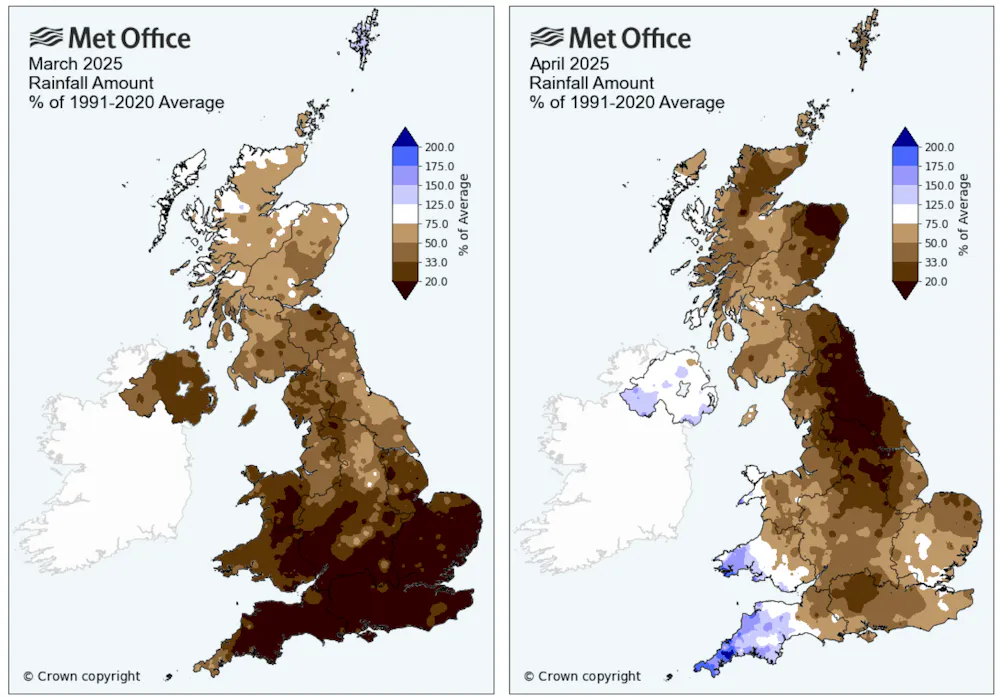
    April 2025 was the sunniest since records began in 1910. This followed the third-sunniest March, and both months saw temperatures well above average nationwide. On May 1, the temperature reached 29.3°C in Kew Gardens in London – a new record for the date.

    Meteorologists are warning of the potential for a summer drought, as the UK has seen roughly half its usual amount of rainfall for March and April. While farmers fret about this year’s harvest, some water companies are urging customers to help reservoir levels recover by limiting water use.

    Meanwhile, wildfires have engulfed forest and moorland in areas of Scotland, Wales and England.

    Most of the UK has experienced a record-dry spring so far.
    Met Office

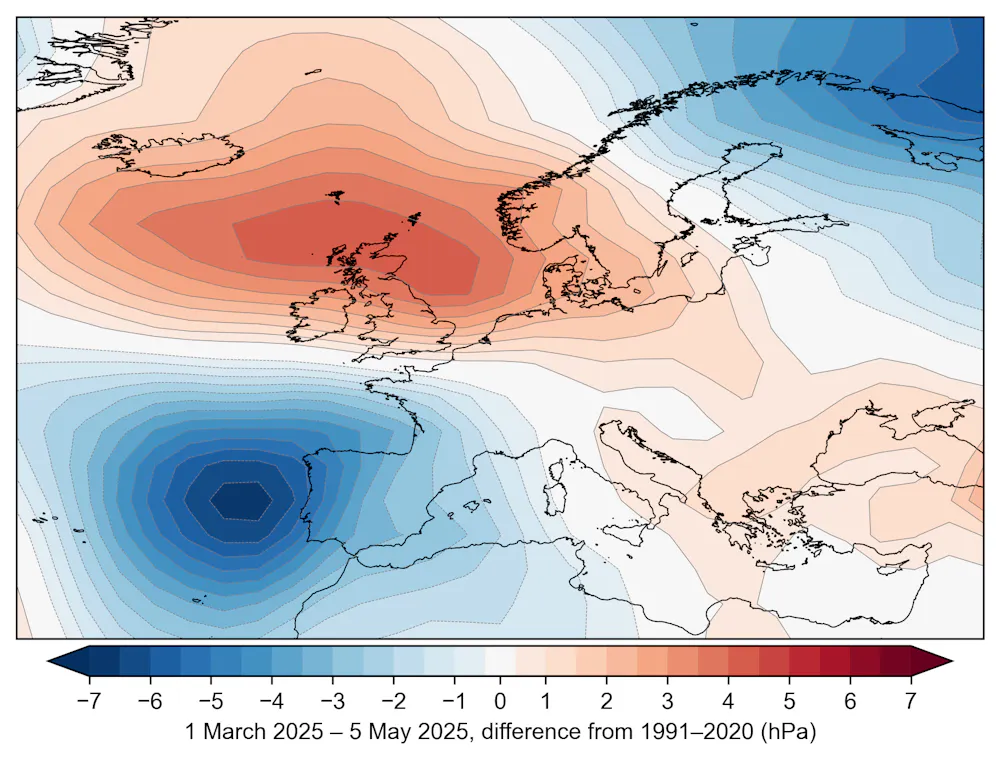
    For several weeks, a stubborn area of high pressure over the UK has diverted the usual flow of mild, moist air from the North Atlantic like a boulder in a river. This is known as a blocking weather system.

    Within it, air descends, warms and dries, which is why this weather pattern tends to be linked to heatwaves and drought. Blocking is usually persistent, making it seem like the weather is stuck.

    Here’s how climate change may have played a role in setting up this unusual spring.


    Get your news from actual experts, straight to your inbox. Sign up to our daily newsletter to receive all The Conversation UK’s latest coverage of news and research, from politics and business to the arts and sciences. Join The Conversation for free today.


    The human fingerprint

    The warming climate means that unusually warm weather is occurring more often and becoming more intense. At the same time, we can expect more periods of both severe drought and extreme rainfall. Sudden changes from drought to deluge, termed “weather whiplash”, are due to the intensification of the water cycle in a warmer atmosphere that can hold more water vapour.

    However, certain weather patterns are necessary to produce extreme weather. More blocking events in future could increase the chance of heatwaves or drought. But are blocking weather patterns becoming more common?

    It’s difficult to determine how weather patterns will change as a result of the rising concentration of greenhouse gases in the atmosphere, which is predominantly caused by the burning of fossil fuels.

    Part of the difficulty arises from the fact that weather patterns vary year to year. Several years in a row with more blocking events than usual could make it seem like blocking is increasing due to climate change, but it could simply be down to chance.

    As a result, it is difficult to detect the fingerprint of human activity from weather observations alone. For example, blocking weather patterns over Greenland during summer have happened more often in recent decades, which can enhance the melting of the ice sheet. But it isn’t clear that this trend is the result of human-induced climate change.

    Climate models do suggest future changes in the occurrence of blocking, however. These computer simulations, consisting of equations that describe the fundamental physics of the atmosphere, are the main tool scientists use to perform experiments that parse how the climate will behave in future.

    The blocking system is visible in the area of high pressure over Britain and Ireland.
    National Centers for Environmental Prediction/National Center for Atmospheric Research/NOAA Physical Sciences Laboratory, CC BY

    When scientists run climate model simulations with increased greenhouse gas concentrations the results consistently show a decrease in blocking events. But blocking generally happens more often in real life than model simulations, which reduces the confidence scientists have in future projections.

    Keeping track of the jet stream

    The movement of weather systems in Earth’s mid-latitudes – including over the UK – is linked to the jet stream, which is a fast-flowing river of air driven by the contrast in temperature between the poles and mid-latitudes.

    Some researchers have suggested that, because the Arctic is warming faster than the tropics, the jet stream may weaken and become more “wavy”, increasing the occurrence of blocking events, contrary to what most climate models show.

    Outside of the scientific community, this idea has become popular. However, the hypothesis remains controversial among scientists, and observational evidence has weakened in recent years.

    In fact, tens of kilometres above the Earth’s surface, near commercial aircraft cruising altitudes, the opposite trends are occurring: the temperature difference between the Arctic and mid-latitudes is increasing, acting to increase the strength of the jet stream.

    There are considerable challenges with understanding how climate change is affecting the large-scale atmospheric patterns which drive the weather we experience. These include large natural variability and imperfect climate models. Models mostly suggest a decline in blocking events with climate change, though this remains relatively uncertain compared with other aspects of the science.

    Overall, we can be confident that climate change is bringing warmer conditions in all seasons. Scientists also have strong evidence to suggest that drought conditions will become more common. These changes are already affecting food production, energy generation and water availability and these impacts will continue to worsen with climate change.


    Don’t have time to read about climate change as much as you’d like?

    Get a weekly roundup in your inbox instead. Every Wednesday, The Conversation’s environment editor writes Imagine, a short email that goes a little deeper into just one climate issue. Join the 45,000+ readers who’ve subscribed so far.


    Simon H. Lee has received funding from the Natural Environment Research Council and the National Science Foundation.

    Matthew Patterson receives funding from the Natural Environment Research Council in the UK via the the National Centre for Atmospheric Science.

    ref. How the weather got ‘stuck’ over the UK – and produced an unusually dry and warm spring – https://theconversation.com/how-the-weather-got-stuck-over-the-uk-and-produced-an-unusually-dry-and-warm-spring-255987

    MIL OSI – Global Reports

  • MIL-OSI Global: AI can guess racial categories from heart scans – they’re detecting bias not biological differences

    Source: The Conversation – UK – By Tiarna Lee, Doctoral Candidate, School of Biomedical Engineering & Imaging Sciences, King’s College London

    Radiological imaging/Shutterstock

    Imagine an AI model that can use a heart scan to guess what racial category you’re likely to be put in – even when it hasn’t been told what race is, or what to look for. It sounds like science fiction, but it’s real.

    My recent study, which I conducted with colleagues, found that an AI model could guess whether a patient identified as Black or white from heart images with up to 96% accuracy – despite no explicit information about racial categories being given.

    It’s a striking finding that challenges assumptions about the objectivity of AI and highlights a deeper issue: AI systems don’t just reflect the world – they absorb and reproduce the biases built into it.


    Get your news from actual experts, straight to your inbox. Sign up to our daily newsletter to receive all The Conversation UK’s latest coverage of news and research, from politics and business to the arts and sciences. Join The Conversation for free today.


    First, it’s important to be clear: race is not a biological category. Modern genetics shows there is more variation within supposed racial groups than between them.

    Race is a social construct, a set of categories invented by societies to classify people based on perceived physical traits and ancestry. These classifications don’t map cleanly onto biology, but they shape everything from lived experience to access to care.

    Despite this, many AI systems are now learning to detect, and potentially act on, these social labels, because they are built using data shaped by a world that treats race as if it were biological fact.

    AI systems are already transforming healthcare. They can analyse chest X-rays, read heart scans and flag potential issues faster than human doctors – in some cases, in seconds rather than minutes. Hospitals are adopting these tools to improve efficiency, reduce costs and standardise care.

    Bias isn’t a bug – it’s built in

    But no matter how sophisticated, AI systems are not neutral. They are trained on real-world data – and that data reflects real-world inequalities, including those based on race, gender, age, and socioeconomic status. These systems can learn to treat patients differently based on these characteristics, even when no one explicitly programs them to do so.

    One major source of bias is imbalanced training data. If a model learns primarily from lighter skinned patients, for example, it may struggle to detect conditions in people with darker skin.
    Studies in dermatology have already shown this problem.

    Even language models like ChatGPT aren’t immune: one study found evidence that some models still reproduce outdated and false medical beliefs, such as the myth that Black patients have thicker skin than white patients.

    Sometimes AI models appear accurate, but for the wrong reasons – a phenomenon called shortcut learning. Instead of learning the complex features of a disease, a model might rely on irrelevant but easier to spot clues in the data.

    Imagine two hospital wards: one uses scanner A to treat severe COVID-19 patients, another uses scanner B for milder cases. The AI might learn to associate scanner A with severe illness – not because it understands the disease better, but because it’s picking up on image artefacts specific to scanner A.

    Now imagine a seriously ill patient is scanned using scanner B. The model might mistakenly classify them as less sick – not due to a medical error, but because it learned the wrong shortcut.

    This same kind of flawed reasoning could apply to race. If there are differences in disease prevalence between racial groups, the AI could end up learning to identify race instead of the disease – with dangerous consequences.

    In the heart scan study, researchers found that the AI model wasn’t actually focusing on the heart itself, where there were few visible differences linked to racial categories. Instead, it drew information from areas outside the heart, such as subcutaneous fat as well as image artefacts – unwanted distortions like motion blur, noise, or compression that can degrade image quality. These artefacts often come from the scanner and can influence how the AI interprets the scan.

    In this study, Black participants had a higher-than-average BMI, which could mean they had more subcutaneous fat, though this wasn’t directly investigated. Some research has shown that Black individuals tend to have less visceral fat and smaller waist circumference at a given BMI, but more subcutaneous fat. This suggests the AI may have been picking up on these indirect racial signals, rather than anything relevant to the heart itself.

    This matters because when AI models learn race – or rather, social patterns that reflect racial inequality – without understanding context, the risk is that they may reinforce or worsen existing disparities.

    This isn’t just about fairness – it’s about safety.

    Solutions

    But there are solutions:

    Diversify training data: studies have shown that making datasets more representative improves AI performance across groups – without harming accuracy for anyone else.

    Build transparency: many AI systems are considered “black boxes” because we don’t understand how they reach their conclusions. The heart scan study used heat maps to show which parts of an image influenced the AI’s decision, creating a form of explainable AI that helps doctors and patients trust (or question) results – so we can catch when it’s using inappropriate shortcuts.

    Treat race carefully: researchers and developers must recognise that race in data is a social signal, not a biological truth. It requires thoughtful handling to avoid perpetuating harm.

    AI models are capable of spotting patterns that even the most trained human eyes might miss. That’s what makes them so powerful – and potentially so dangerous. It learns from the same flawed world we do. That includes how we treat race: not as a scientific reality, but as a social lens through which health, opportunity and risk are unequally distributed.

    If AI systems learn our shortcuts, they may repeat our mistakes – faster, at scale and with less accountability. And when lives are on the line, that’s a risk we cannot afford.

    Tiarna Lee receives funding from the EPSRC.

    ref. AI can guess racial categories from heart scans – they’re detecting bias not biological differences – https://theconversation.com/ai-can-guess-racial-categories-from-heart-scans-theyre-detecting-bias-not-biological-differences-254416

    MIL OSI – Global Reports

  • MIL-OSI Global: Is matcha a healthier alternative to coffee? Here’s what you need to know

    Source: The Conversation – UK – By Anthony Booker, Reader in Ethnopharmacology, University of Westminster

    Ekateryna Zubal/Shutterstock

    Matcha, with its vibrant green hue and centuries-old tradition, is often celebrated as a health boosting superfood. But what exactly sets it apart from regular green tea, or even your morning coffee?

    Like green and black tea, matcha comes from
    the camellia sinensis plant. The difference lies in how it’s grown and processed. While black tea is fermented and regular green tea is simply dried, matcha is shade-grown for several weeks before harvest.

    This unique method alters the plant’s chemistry, boosting certain compounds like chlorophyll and amino acids and giving matcha its distinct flavour and rich green colour. The leaves are then dried and finely ground into a powder – hence its name, which literally translates to “powdered tea” in Japanese.


    Get your news from actual experts, straight to your inbox. Sign up to our daily newsletter to receive all The Conversation UK’s latest coverage of news and research, from politics and business to the arts and sciences. Join The Conversation for free today.


    Although widely associated with Japanese culture and Zen tea ceremonies, matcha actually originated in China. It was brought to Japan in the 12th century by Buddhist monks, who used it to support meditation. Over time, it became a staple in Japanese tea culture, especially in formal tea ceremonies.

    From a health perspective, matcha offers many of the same benefits as green tea – thanks to its high content of polyphenols, including flavonoids, which are known antioxidants. However, because the leaves are consumed whole in powdered form, matcha may provide a more concentrated dose of these beneficial compounds.

    Lots of potential, relatively little research

    Matcha is touted for its wide range of potential health benefits: antioxidant, antimicrobial, anti-inflammatory, anti-obesity and even anti-cancer effects, as well as potential improvements in brain function, stress relief, heart health and blood sugar regulation.

    But there’s a catch: most of the evidence supporting these claims comes from lab studies (on cells or animals), not robust clinical trials in humans. So while the early research is promising, it’s far from conclusive.

    One thing we do know: matcha contains caffeine – more than regular green tea, though typically less than coffee. Caffeine itself has well documented health benefits when consumed in moderation, including improved focus, mood, metabolism and even reduced risk of certain diseases like Alzheimer’s and Parkinson’s.

    But high doses can cause side effects like insomnia, anxiety and elevated blood pressure. The “more is better” approach doesn’t apply here, and the optimal dose of caffeine remains unclear.

    When comparing matcha to coffee, both offer similar antioxidant properties and cardiovascular benefits. However, coffee has been studied more extensively, with clearer guidelines: three to four cups a day appears to be a safe upper limit for most people.

    For matcha, the guidance is slightly more conservative, with sources suggesting one to three cups a day, probably due to the higher levels of polyphenols.


    Read more:
    All the reasons a cup of coffee really can be good for you


    Tannins and polyphenols in both tea and coffee can interfere with iron absorption, especially from plant-based foods. Drinking large amounts regularly, particularly around mealtimes, may increase the risk of iron-deficiency anaemia.

    That’s why it’s recommended to enjoy these beverages at least two hours before or after meals, especially for people who follow a predominantly plant-based diet or are already prone to low iron levels.

    Jitter-free

    Another consideration: both coffee and matcha are mildly acidic and can cause digestive discomfort or reflux in people with sensitive stomachs. That said, matcha may be a better choice for some. Unlike coffee, it contains L-theanine, an amino acid that promotes relaxation and may counteract the jittery effects of caffeine, making it a gentler alternative for people prone to anxiety.

    Both matcha and coffee have potential health benefits and the right choice depends on your personal needs and preferences. Coffee is better studied and may be ideal for those who tolerate caffeine well and enjoy several cups a day. Matcha, on the other hand, is a great option for those looking to consume less caffeine while still benefiting from antioxidants – and without the crash or jitters.

    Just remember to enjoy either in moderation, especially if you’re managing iron levels or digestive issues.

    Anthony Booker does not work for, consult, own shares in or receive funding from any company or organisation that would benefit from this article, and has disclosed no relevant affiliations beyond their academic appointment.

    ref. Is matcha a healthier alternative to coffee? Here’s what you need to know – https://theconversation.com/is-matcha-a-healthier-alternative-to-coffee-heres-what-you-need-to-know-255729

    MIL OSI – Global Reports

  • MIL-OSI Global: The Climate Fiction Prize 2025: the five shortlisted books reviewed by our experts

    Source: The Conversation – UK – By Louisa Egbunike, Associate Professor in African Literature, Durham University

    Five novels have been shortlisted for the 2025 Climate Fiction Prize. Our academics review the finalists ahead of the announcement of the winner on May 14.

    And So I Roar by Abi Daré

    Abi Daré’s poignant second novel, And So I Roar, charts the parallel stories of Tia, an environmental advocate, and Adunni, a Nigerian teenager first introduced in The Girl with the Louding Voice (2020).

    Now under Tia’s care in Lagos, Adunni has escaped child marriage and domestic abuse.

    When she returns to her village, Ikati, where she and other girls are blamed for the drought and face the threat of violence, the novel unravels long-held secrets. Daré masterfully explores how environmental crises intersect with gendered violence, showing how impoverished women disproportionately bear the burden of climate change.

    And So I Roar highlights intergenerational, inter-ethnic and cross-class solidarity, celebrating the courage of women and girls who defy society’s expectations. It is a powerful testament to resilience, as women and girls confront injustice and find the strength to lift their voices and, finally, roar.

    By Louisa Uchum Egbunike, associate professor in African literature

    The Morningside by Téa Obreht

    Obreht’s The Morningside is a quietly dazzling piece of climate fiction – more adjacent to our world than removed from it, and all the more unsettling for it.

    Set in Island City, a place marked by an unnamed tragedy, the novel centres on Sil, an 11-year-old girl who moves into the Morningside apartment complex with her mother.

    Both are climate refugees, though the novel wears this reality lightly – what matters more are the small acts of home-making, the search for belonging and the ghosts that travel with them. Magical realism is deftly handled here, interlaced with hints of folklore that feel entirely plausible within the book’s fragile ecology.

    The Morningside is deeply readable – generous, tender and brimming with quiet unease. It never tips into bleakness, but its warnings are clear enough. “The things you had, the things you saw,” Sil’s mother tells us, “will probably be gone by the time [your children are] born.”

    By Sam Illingworth, professor of creative pedagogies

    Briefly Very Beautiful by Roz Dineen

    Roz Dineen’s Briefly Very Beautiful immerses readers in a world that both is and is not a familiar fiction. Crisply written, in direct, unfussy prose, it is, at one level, a story of a woman, Cass, trying to protect her children as her relationship unravels.

    At the same time, a parallel social collapse triggered by climate change puts the ordinary in an extraordinary frame.

    Much of the effect of this novel comes from Cass’s utterly believable responses to what is taking place around her, her almost peripheral awareness of other people fleeing the city, her own craving for fresh air “like she’d craved things in pregnancy, with a scary gorging hunger”.

    Briefly Very Beautiful is a novel brave enough to recognise that there is no simple, heroic response to some situations. That sometimes, the determination to live an ordinary life is the truly heroic course of action.

    By Christopher Morash, professor of Irish writing

    Orbital by Samantha Harvey

    Samantha Harvey’s Orbital skilfully exposes the human cost of space flight, set against the urgency of the climate crisis. While a typhoon of life-threatening proportions gathers across south-east Asia, six cosmonauts hurtle around Earth on the International Space Station.

    Their everyday routine of tasteless food and laboratory work is in stark contrast to the awesome spectacle of the blue planet, oscillating between night and day, dark and light, where international borders are meaningless.

    While they teach laboratory mice to orient themselves in micro-gravity, they rigorously document their own bodily functions to satisfy some “grand abstract dream of interplanetary life” away from “the planet held hostage by humans, a gun to its vitals”. These are humans, Harvey tells us, “with a godly view that’s the blessing and also the curse”. Harvey has written a novel for the end of the world as we know it. The hope it offers is that we might learn to know it differently.

    By Debra Benita Shaw, reader in cultural theory

    The Ministry of Time by Kaliane Bradley

    The best novels defy easy categorisation, and The Ministry of Time covers many genres: climate fiction, sci-fi, speculative fiction, romance, action.

    It tells the story of a female civil servant who is a handler for one of five people plucked from history before their death. It was fun to imagine how today’s world would be perceived from various perspectives, including a zesty young lesbian woman from the 17th century, a shy young lieutenant from the first world war and a 19th-century naval officer.

    The story adopts the usual dystopian tropes of a world that has destroyed itself through greed, power-seeking and over-indulgence. In the final plea to the reader not to let this terrible future unfold, the assumption is that if we’re scared enough, we’ll all give up red meat, stop flying and campaign for climate policies.

    My research, and psychological studies of fear caution us that the response is just as likely to be voting for far-right leaders, marginalisation of innocent victims, and buying up all the toilet rolls. I loved this book, but to inspire greener behaviour, showing visions of what a sustainable society might look like if we did things right would be a welcome change.

    By Denise Baden, professor of sustainable business


    Looking for something good? Cut through the noise with a carefully curated selection of the latest releases, live events and exhibitions, straight to your inbox every fortnight, on Fridays. Sign up here.


    The authors do not work for, consult, own shares in or receive funding from any company or organisation that would benefit from this article, and have disclosed no relevant affiliations beyond their academic appointment.

    ref. The Climate Fiction Prize 2025: the five shortlisted books reviewed by our experts – https://theconversation.com/the-climate-fiction-prize-2025-the-five-shortlisted-books-reviewed-by-our-experts-253056

    MIL OSI – Global Reports

  • MIL-OSI Global: Medetomidine: what you need to know about the animal sedative turning up in opioid deaths

    Source: The Conversation – UK – By Paul Chazot, Professor of Pharmacology, Durham University

    Michael O’Keene/Shutterstock.com

    The opioid crisis, increasingly driven by synthetic opioids, continues to claim tens of thousands of lives annually in the US alone. Similar crises have arisen all over the western world.

    The crisis has become more complex as powerful synthetic opioids like fentanyl, nitazenes and oxycodone are now being “cut” (mixed) with other drugs that slow brain activity, including animal tranquillisers.

    The emergence of medetomidine as a new contaminant in the US illicit drug market signals a worrying development in this escalating crisis. When public health officials in Philadelphia first began testing for the drug in May last year, medetomidine was found in 29% of fentanyl samples analysed. Six months later, the drug was found in 87% of fentanyl samples.

    Medetomidine, a drug approved only for veterinary use as a sedative and painkiller, has increasingly been implicated in illicit fentanyl-related overdoses.


    Get your news from actual experts, straight to your inbox. Sign up to our daily newsletter to receive all The Conversation UK’s latest coverage of news and research, from politics and business to the arts and sciences. Join The Conversation for free today.


    Like xylazine – another veterinary tranquilliser recently detected in street drugs – it is believed that medetomidine is added to fentanyl to boost its euphoric effects and hence make it more appealing to users. However, medetomidine is even more potent and longer-lasting than xylazine.

    An overdose of medetomidine can cause extreme sleepiness, very low blood pressure, slow heart rate, trouble breathing (respiratory failure), and even coma or death. This is because medetomidine rapidly depresses the central nervous system and slows the heart rate significantly.

    When medetomidine is used with opioids, the risk is even greater because both drugs can slow breathing, and together they can make it much worse.

    Overdose-reversing drugs

    Police and paramedics use naloxone to reverse fentanyl overdoses. But if the drug is mixed with medetomidine, naloxone won’t work because medetomidine affects the body in a different way.

    Naloxone won’t reverse the effects of animal tranquillisers.
    oasisamuel / Shutterstock.com

    Atipamezole can reverse the effects of medetomidine – such as sedation, slowed breathing and slowed heart rate – but it’s only been tested in dogs. The US Food and Drug Administration has not approved the drug for human use.

    Overdoses from fentanyl and high-potency nitazenes are also common in the UK and across Europe. The spread of medetomidine in street drugs in other parts of the world needs urgent attention.

    The first death in the UK involving xylazine was reported by the National Programme on Substance Abuse Deaths in December 2022. Between April 2023 and January 2024, 17 cases were reported in the UK, in a range of opioid tablets and powders, including codeine, tramadol and heroin.

    So far, no confirmed cases involving medetomidine have been reported in the UK. If trends in the US are reliable indicators, the UK may face similar challenges soon.

    Paul Chazot does not work for, consult, own shares in or receive funding from any company or organisation that would benefit from this article, and has disclosed no relevant affiliations beyond their academic appointment.

    ref. Medetomidine: what you need to know about the animal sedative turning up in opioid deaths – https://theconversation.com/medetomidine-what-you-need-to-know-about-the-animal-sedative-turning-up-in-opioid-deaths-256015

    MIL OSI – Global Reports

  • MIL-OSI Global: Deadly blood clots, risky treatments: The high-stakes battle against deep vein thrombosis in sports and beyond

    Source: The Conversation – Canada – By Peter Anthony Andrisani, PhD Candidate, Medical Sciences, McMaster University

    Seven-time NBA all-star Damian Lillard, 34, recently joined a growing list of NBA athletes to be sidelined by a diagnosis of deep-vein thrombosis, or DVT.

    The Milwaukee Bucks player joins Victor Wembanyama, 21, a rising star in the NBA who was diagnosed with the life-threatening condition earlier this season, along with Chris Bosh and Brandon Ingram, who were also sidelined with DVT during their careers.

    DVT in athletes

    DVT is caused by blood clots in the veins of the arms or legs. The condition is commonly associated with age, decreased mobility, obesity, some estrogen-containing medications and smoking, among other factors. Repetitive arm action above the head, like throwing a basketball, can also increase the risk of DVT.

    Typically, DVT causes swelling, pain and bruising in the affected limb. DVT on its own is not lethal, but left untreated, it can have serious consequences.

    Without treatment, pieces of blood clots that cause DVT can break off and travel to the lungs in a condition called pulmonary embolism (PE), which can result in severe damage to the lungs. Both DVT and PE are venous thromboembolic diseases, which are the third most common cause of deaths associated with the vascular system after heart attack and stroke.

    Tennis superstar Serena Williams developed PE twice. Like many people who develop it, she had trouble breathing, shortness of breath and chest pain.

    Although it might be scary to be diagnosed with DVT or PE, there are effective medicines to treat the conditions.

    My lab’s research focuses on identifying new blood-thinning drugs to treat blood-clotting conditions like DVT and stroke. Surgery and blood thinners are often combined to combat DVT and PE by removing the original blood clot and reducing the chances of a new clot forming.

    Despite their name, blood thinners do not literally make blood thinner. Instead, they make it harder for blood clots to form. Three general classes of blood thinners can be prescribed for DVT and PE: vitamin K antagonists such as warfarin, heparin and direct oral anticoagulants.

    Despite the help blood thinners provide, they create risks of their own, as they can increase the risk of bleeding, because blood clotting is a normal and necessary physiological process.

    Clot risks vs. bleeding risks

    Taking blood thinners is like walking a tightrope. The person taking the blood thinner is in a constant state of balance between preventing abnormal blood clots and excessive bleeding, which depends on the strength of the blood thinner. If you lean too far in either direction, you might fall off the tightrope, with serious consequences.

    The challenges of managing bleeding risk while preventing DVT was amplified in the case of Williams. Immediately after delivering her second child, Williams underwent a PE event and was placed on intravenous heparin. While heparin did prevent blood clots, Williams did have significant bleeding at the site of her C-section.

    The risk of bleeding often extends past the hospital. Typically, blood thinners are given to people with DVT for months, even years, to prevent ongoing risk of clot formation. The risk of bleeding persists as long as the person is taking the drug.

    Athletes on blood thinners playing contact sports are more vulnerable to injuries compared to others. Players commonly fall, which is more likely to cause potentially life-threatening internal bleeding.

    Due to this risk, athletes often must take to the sidelines to avoid injury after a DVT diagnosis.

    Balanced blood thinners

    The challenge of creating balanced blood-thinning drugs is of great interest to my lab at McMaster University’s Thrombosis and Atherosclerosis Research Institute. A promising candidate for treating clotting disorders is ADAMTS13. It’s a protein that plays a role in the typical maintenance of blood clots but shows great potential as a blood-thinning medication.

    Previous research with this protein has found that in acute blood-clotting conditions such as ischemic stroke, ADAMTS13 is effective at breaking apart blood clots but does not result in the same risk of bleeding. Further testing on the protein in chronic conditions like DVT still needs to be performed, but there is potential for it to act as a long-term blood thinner.

    The use of safer blood thinners will not only allow athletes like Lillard and Wembanyama to continue playing their respective sports, but will also help the general population.

    Approximately seven million new blood-thinner prescriptions for DVT and other conditions are written each year in Canada, highlighting the need for better therapeutics across the board.

    Peter Anthony Andrisani receives funding from CanVECTOR.

    Colin Kretz receives funding from the Canadian Institutes of Health Research, the Natural Sciences and Engineering Research Council of Canada, and the National Heart, Lung, and Blood Institute of the National Institutes of Health (R01HL172780).

    ref. Deadly blood clots, risky treatments: The high-stakes battle against deep vein thrombosis in sports and beyond – https://theconversation.com/deadly-blood-clots-risky-treatments-the-high-stakes-battle-against-deep-vein-thrombosis-in-sports-and-beyond-253985

    MIL OSI – Global Reports

  • MIL-OSI Global: The Moomins drift through time like a myth – that’s why they resist meaning and endure

    Source: The Conversation – UK – By Steve Nash, Lecturer in Literature, Media, and Creative Writing, Leeds Beckett University

    The Moomins may look like hippos in aprons and top hats, but they’re more than just adorable characters from children’s books. Over the decades, these gentle creatures have become part of a living mythology – one that drifts across time, borders and generations.

    Created by Finnish-Swedish author Tove Jansson in the 1940s, the Moomins live in stories that blur the lines between fairy tale, folk wisdom and quiet philosophy. And perhaps that’s the secret to their enduring appeal: they resist being pinned down.

    Unlike traditional children’s characters tied to a tidy moral or neat storyline, the Moomins meander literally and metaphorically. Their world is one of seasonal migrations, long silences, floods, comets and unexpected departures.


    This is part of a series of articles celebrating the 80th anniversary of the Moomins. Want to celebrate their birthday with us? Join The Conversation and a group of experts on May 23 in Bradford for a screening of Moomins on the Riviera and a discussion of the refugee experience in Tove Jansson’s work. Click here for more information and tickets.


    Moominvalley isn’t a safe haven – it’s a landscape shaped by change. In that sense, Jansson’s stories echo something far older than modern literature: the mythic rhythms of Nordic storytelling, where time loops, endings blur and characters return in altered forms.

    A myth that moves

    The Viking sagas, for instance, were not written down at first but passed from voice to voice, reshaped with each telling. They weren’t concerned with tidy endings or moral clarity. Characters disappeared and reappeared. Time looped and fragmented.

    Similarly, Jansson’s stories don’t build to a climax. They wander. One book might end with a mystery, a quiet mood or a long silence. It’s a narrative style that feels strangely modern – and yet deeply ancient.

    Jansson herself resisted giving her stories a single message. In letters and interviews, she said she disliked moralising and preferred ambiguity. “A good story,” she wrote, “has no need to be explained; its truth lies in its telling, not in its conclusion.” That idea – of a truth that doesn’t depend on being pinned down – is at the heart of what makes the Moomins mythic.

    Of course, myths evolve. And the Moomins have evolved spectacularly. After the books found international success, the characters were adapted into Japanese anime, Nordic theatre, British radio and global branding campaigns.

    Each version tells a slightly different story. In Japan, the Moomins became symbols of warmth and nostalgia – gentle mascots of a simpler life. In the UK and US, early translations softened the melancholy and existential tones. More recently, new editions and critical reappraisals have returned to Jansson’s deeper themes of loss, solitude and transformation.

    The many lives of the Moomins

    This global journey has parallels with the evolution of Viking mythology. Once oral stories shared around fires, Norse myths have been repackaged for everything from national pride to Hollywood action. Like the Moomins, they’ve become flexible cultural symbols – used and re-used in ways that often have little to do with their original context.

    But unlike the fierce warriors of Norse myth, the Moomins are gentle, uncertain creatures. They worry. They drift. They don’t fight monsters – they reflect, explore, adapt. In Moominland Midwinter, Moomintroll wakes from hibernation to find the world cold and unfamiliar.

    His journey isn’t about conquering the landscape, it’s about learning how to live in it. That emotional honesty resonates with readers of all ages. It also reflects something uniquely Nordic: an existential awareness of solitude, change and survival.

    Folklore, loneliness and the Groke

    One character, the Groke, captures this beautifully. She’s a shadowy figure who creates frost wherever she walks. She’s not a villain, she’s just lonely. Children often fear her, but readers grow to understand her.

    She recalls Nordic spirits like the huldra or tomte – ghostly beings that live in the forests, blurring the line between human and otherworldly. In Jansson’s hands, this folklore becomes a way to explore anxiety, estrangement and the human need for warmth.

    The Moomins’ refusal to settle – geographically or philosophically – also speaks to today’s world of cultural fluidity. Jansson was from Finland’s Swedish-speaking minority and grew up between languages, cultures and post-war upheaval.

    Her books reflect that liminal identity, and they’ve found a home among readers who don’t always fit neatly into one place. That might be why the Moomins are particularly popular in countries dealing with identity shifts or cultural nostalgia.

    A myth for a shifting world

    As with all mythologies, there’s also a commercial side. The Moomins are now a global brand, with theme parks, merchandise, museums and a thriving fanbase. Some of this has softened their original complexity.

    But even through plush toys and animation, something essential remains: the feeling that these characters, like the stories they inhabit, can’t be reduced to one message. They are always slightly mysterious, slightly out of reach.

    In a world that often demands quick answers and strong opinions, the Moomins offer something gentler: ambiguity, openness and quiet reflection. They remind us that not all stories are meant to be solved with a neat conclusion. Some are meant to be returned to – revisited like familiar places in the mind, reshaped each time we arrive.

    That’s what makes the Moomins mythic. Not just their age or popularity, but their ability to change – and to change us – with every retelling. They invite us to wander, like Snufkin, and to sit still, like Moominmamma.

    They show us that myth isn’t just about gods and monsters – it’s about living with uncertainty, embracing return, and finding meaning in the stories that help us feel at home in the world.

    Steve Nash works for Leeds Beckett University.

    ref. The Moomins drift through time like a myth – that’s why they resist meaning and endure – https://theconversation.com/the-moomins-drift-through-time-like-a-myth-thats-why-they-resist-meaning-and-endure-254742

    MIL OSI – Global Reports

  • MIL-OSI Global: Nineteen Eighty-Four and Brave New World should be read in tandem to understand today’s troubled times

    Source: The Conversation – UK – By Emrah Atasoy, Associate Fellow of English and Comparative Literary Studies & Honorary Research Fellow of IAS, University of Warwick

    Is there any past work of fiction that can help us make sense of today’s troubling trends? Taking into account the proliferation of references to obfuscating “Newspeak”, Big Brother-style leaders and impossible-to-circumvent surveillance systems in newspaper articles, this question cries out for a simple answer: “Yes – and that work is George Orwell’s Nineteen Eighty-Four.”

    People on both the political left and right see Orwell’s 1949 novel as the book from the last century that speaks to the present most powerfully. But there are others who regard consumer culture and social media obsession as the primary concerns of today. They have a different answer: “Yes – and that work is Aldous Huxley’s Brave New World.”

    We, however, think the answer is “both”.


    Looking for something good? Cut through the noise with a carefully curated selection of the latest releases, live events and exhibitions, straight to your inbox every fortnight, on Fridays. Sign up here.


    In the long-running debate over who was the most prophetic writer of their era, Orwell, who was a pupil of Huxley’s at Eton, is generally the favourite.

    One reason for this is that international alliances that long seemed stable are now in flux. In Nineteen Eighty-Four, his final novel, Orwell envisioned a future tri-polar world divided into competing blocks with shifting allegiances.

    In the short time since the US president, Donald Trump, began his second term, his policies and statements have triggered surprising realignments. The US and Canada, close partners for more than a century, have faced off against each other. And in April, an official from Beijing joined with his counterparts from South Korea and Japan to push back as an unlikely trio against Trump’s new tariffs.

    That is perhaps why there is a booming field of “Orwell studies”, with its own academic journal, but not “Huxley studies”. It also probably explains why Nineteen Eighty-Four, but not Brave New World, keeps making its way on to bestseller lists – sometimes in tandem with Margaret Atwood’s The Handmaid’s Tale (1985). “Orwellian” (unlike the rarely heard “Huxleyan”) has few competitors other than “Kafkaesque” as an immediately recognisable adjective linked to a 20th-century author.

    Trailer for the film 1984, an adaptation of Orwell’s novel.

    As wonderful as Atwood and Kafka are, we are convinced that combining Orwell’s vision with Huxley’s offers scope for deeper analysis. This is true in part because of, not despite, how common it has been to contrast the modes of autocracy Orwell and Huxley describe.

    Orwellian and Huxleyan visions as one world

    We live in an era when all sorts of systems of control limit our freedoms of expression, identity and religion. Many do not quite fit the template that either Orwell or Huxley imagined, but instead combine elements.

    There are certainly places, such as Myanmar, where those in power rely on techniques that immediately bring Orwell to mind, with his focus on fear and surveillance. There are others, such as Dubai, that more readily evoke Huxley, with his focus on pleasure and distraction. In many cases, though, we find a mixture.

    This is especially clear if you take a global view. That’s something we specialise in as international and interdisciplinary researchers – a literary scholar from Turkey based in the UK, and a Californian cultural historian of China who has also published on southeast Asia.

    Like Orwell, Huxley wrote many books that were not dystopian fiction, but his foray into that genre became his most influential. Brave New World was well known throughout the cold war. In courses and commentaries, it was commonly paired with Nineteen Eighty-Four as a narrative illustrating a shallow society based on indulgence and consumerism, as opposed to the bleaker Orwellian world of suppression of desire and strict control.

    While it is common to approach the two books via their contrasts, they can be treated as interconnected and entangled works as well.

    Trailer for an adaptation of Brave New World, released in 2020.

    During the cold war, some commentators felt that Brave New World showed where capitalist consumerism in the age of television could lead. The west, according to this interpretation, could become a world in which autocrats like those in the novel stayed on top. They would do this by keeping people busy and divided among themselves, happily distracted by entertainment and the drug “soma”.

    Orwell, by contrast, seemed to provide a key to unlock the harder mode of control in non-capitalist, Communist Party-run lands, especially those of the Soviet bloc.

    Huxley himself in Brave New World Revisited, a non-fiction book he published in the 1950s, thought it was important to think about ways the techniques of power and societal engineering in the two novels could be combined, approached and analysed. And there is even more value in combining the approaches now, when capitalism has gone so global and the autocratic wave keeps reaching new shores in the so-called post-truth era.

    Orwellian hard-edged and Huxleyan soft-edged approaches to control and social engineering can be and often are combined. We see this within countries such as China, where the crude repressive methods of a Big Brother state are used against the Uyghur population, while cities such as Shenzhen evoke Brave New World.

    We see this mixing of dystopian elements in many countries – variations on the way that science fiction writer William Gibson, author of novels such as Neuromancer (1984), wrote about Singapore with a phrase that had a soft-edged first half and a hard-edged second: “Disneyland with the death penalty.”

    This can be a useful first step toward better understanding, and perhaps beginning to try to find a way of improving the troubling world of the mid-2020s. A world in which the smartphone in your pocket both keeps track of your actions and provides an endless set of enticing distractions.

    The authors do not work for, consult, own shares in or receive funding from any company or organisation that would benefit from this article, and have disclosed no relevant affiliations beyond their academic appointment.

    ref. Nineteen Eighty-Four and Brave New World should be read in tandem to understand today’s troubled times – https://theconversation.com/nineteen-eighty-four-and-brave-new-world-should-be-read-in-tandem-to-understand-todays-troubled-times-253872

    MIL OSI – Global Reports

  • MIL-OSI Global: UK’s India trade deal offers wider access to a surging economy – and could make food imports cheaper

    Source: The Conversation – UK – By Sangeeta Khorana, Professor of International Trade Policy, Aston University

    India’s economy is growing rapidly. Radiokafka/Shutterstock

    After more than three years and 14 rounds of negotiations, the UK and India have finally announced a free trade agreement (FTA). UK Prime Minister Keir Starmer will formally sign the deal on a visit to India later this year. This is the biggest and most economically significant bilateral trade deal the UK has struck since leaving the EU. It will have implications for both businesses and workers.

    In 2024, the UK’s trade with India was worth £43 billion – £17.1 billion of exports and £25.5 billion of imports. Government modelling estimates that trade between the nations will increase by as much as 39% and the UK’s GDP will expand by £4.8 billion or 0.1 percentage points per year as a result.

    India’s economy is growing fast. It is expected to expand by 6% annually, becoming the world’s third largest economy by 2028 after the US and China. This certainly makes the deal with the UK very timely.

    With a population of more than 1.4 billion and a growing middle class, the country offers huge market potential. Its import demand is predicted to grow by 144% between 2021 and 2035. This combination of strong economic growth and increasing numbers of citizens with disposable cash makes a compelling case for the deal.


    Get your news from actual experts, straight to your inbox. Sign up to our daily newsletter to receive all The Conversation UK’s latest coverage of news and research, from politics and business to the arts and sciences. Join The Conversation for free today.


    Both the UK and India have agreed to reduce tariffs under the deal. India will immediately lower its 150% tariffs on Scotch whisky and gin to 75%, and then to 40% within ten years. Tariffs on foodstuffs such as lamb, salmon and cheeses will fall from around 30% to zero.

    Simplified trade rules, including faster customs processing, reduced barriers such as complex labelling requirements, and enhanced support for small businesses should bring gains for companies. Timely customs clearance will support exports of perishable items like Scottish salmon, where delays reduce the product’s shelf life. Similarly, exporters of things like biscuits and cheese will benefit from streamlined paperwork and be able to compete in India’s growing market.

    There will no longer be limits on the number of UK businesses allowed to provide telecommunications, environmental and construction services. And UK businesses will not need to set up a company in India or be a resident in India to supply their services in these sectors.

    Once the FTA comes into force, which could take up to a year, the UK will allow 99% of Indian imports duty-free access into the UK. The sectors set to benefit most are footwear, textiles and clothing, as well as processed prawns, basmati rice and ready meals. These reductions will mean lower prices for UK consumers, given tariffs on clothing and footwear are 12% and 16% respectively.

    Clothing and textile imports to the UK will have tariff-free access.
    Yevhen Prozhyrko/Shutterstock

    Tariffs on luxury cars will also be reduced from more than 100% to 10% under quotas on both sides. The FTA locks in zero tariffs on industrial machinery, advanced materials for use in hi-tech industries, and components for electric vehicles. This will position British suppliers inside a manufacturing market ranked the world’s second-most attractive after China.

    In terms of workers, there were well publicised fears that the agreement might lead to UK workers being undercut by Indian counterparts. Plans for a so-called “double contribution convention” grants a three-year exemption from national insurance contributions for Indian employees temporarily working in the UK. But this is a reciprocal deal and is likely to apply only to workers who are seconded from one country to the other, so should not result in UK workers being more expensive to hire.

    And although no changes to immigration policy are planned, the FTA will offer easier movement for skilled workers. UK providers of services like construction and telecoms will have access to India’s growing market.

    Both countries have committed to encouraging the recognition of professional qualifications. A professional services working group for UK and Indian government officials will provide a forum to monitor and support this initiative.

    Timing is everything

    Against a backdrop of rising protectionism and geopolitical tensions, the UK-India FTA stands out as a strategic deal. It is also a significant milestone in Britain’s Indo-Pacific “tilt”. This approach gives UK firms a hedge against over-reliance on any single region or country-centric supply chains, to keep trade flowing in the event of more US tariff shocks, for example.

    With the US fixation on tariffs, and global supply chains facing continued disruption, securing preferential access to the world’s fastest-growing major economy is a strategic win for the UK. From India’s perspective, the trade deal is aligned with its rise as a “China-plus-one” manufacturing hub (where businesses diversify to ensure they do not invest only in China).

    The UK and India share historical ties that are underpinned by cultural, educational and people-to-people links. The UK-India FTA marks a new phase in this relationship, where shared economic interests define a forward-looking partnership between the two countries.

    And in terms of its ongoing talks with the EU, India could use the agreement to showcase its willingness to negotiate ambitious trade deals. For the UK, given its own upcoming trade and cooperation talks with the EU, the FTA with India demonstrates that new partnerships can be built while maintaining vital European ties.

    Sangeeta Khorana has received funding from UK-ESRC, EU and other international organisations. She is affiliated with Chartered Institute of Export and International Trade as a Trustee Director.

    ref. UK’s India trade deal offers wider access to a surging economy – and could make food imports cheaper – https://theconversation.com/uks-india-trade-deal-offers-wider-access-to-a-surging-economy-and-could-make-food-imports-cheaper-256387

    MIL OSI – Global Reports

  • MIL-OSI Global: From Zoo Quest to Ocean: The evolution of David Attenborough’s voice for the planet

    Source: The Conversation – UK – By Neil J. Gostling, Associate Professor in Evolution and Palaeobiology, University of Southampton

    Over the course of seven decades, Sir David Attenborough’s documentaries have reshaped how we see the natural world, shifting from colonial-era collecting trips to urgent calls for environmental action.

    His storytelling has inspired generations, but has only recently begun to confront the scale of the ecological crisis. To understand how far nature broadcasting has come, it helps to return to where it started.

    When Attenborough’s broadcasting career began in the 1950s, Austrian filmmakers Hans and Lotte Hass were already pushing the boundaries of what was possible by taking cameras below the sea and touring the world aboard their schooner, the Xafira.

    In one of their 1953 Galapagos films, a crewman handled a sealion pup, having crawled across the volcanic rock of Fernandina honking at sealions to attract them. A penguin and giant tortoise were brought on board Xafira. And as Lotte Hass took photographs, she’d beseech some poor creature to “not be frightened” and “look pleasant”.

    This is a world away from today’s expectations, where both research scientists and amateur naturalists are taught to observe without touching or disturbing wildlife. When the Hasses visited the Galápagos, it was still five years before the creation of the national park and the founding of the island’s conservation organisation Charles Darwin Foundation. Now, visitors must stay at least two metres from all animals – and never approach them.


    Get your news from actual experts, straight to your inbox. Sign up to our daily newsletter to receive all The Conversation UK’s latest coverage of news and research, from politics and business to the arts and sciences. Join The Conversation for free today.


    At the same time, television was beginning to shape public perceptions of the natural world. In 1954, Attenborough was working as a young producer on Zoo Quest. By chance, he became its presenter when zoologist Jack Lester became ill.

    The programme followed zoologists collecting animals from around the world for London Zoo. Zoo Quest was filmed in exotic locations around the world and then in the studio where the animals found on the expedition were shown “up close”.

    Attenborough has since acknowledged that Zoo Quest reflected attitudes that would not be acceptable today. The series showed animals being captured from the wild and transported to London Zoo – practices which mirrored extractive, colonial-era approaches to science.

    David Attenborough’s Zoo Quest for a Dragon aired in 1956.

    Yet, Zoo Quest was also groundbreaking. The series brought viewers face-to-face with animals they might never have seen before and pioneered a visual style that made natural history television both entertaining and educational. It helped establish Attenborough’s reputation as a compelling communicator and laid the foundations for a new genre of science broadcasting – one that has evolved, like its presenter, over time.

    After a decade in production, Attenborough returned to presenting with Life on Earth (1979), a landmark series that traced the evolution of life from single-celled organisms to birds and apes. Drawing on his long-standing interest in fossils, the series combined zoology, palaeobiology and natural history to create an ambitious new template for science broadcasting.

    Life on Earth helped cement Attenborough’s reputation as a trusted communicator and became the foundation of the BBC’s “blue-chip” natural history format – big-budget, internationally produced films that put high-quality cinematic wildlife footage at the forefront of the story. The series did not simply document the natural world. It reframed it, using presenter-led storytelling and global spectacle to shape how audiences understood evolutionary processes.

    For much of his career, Attenborough has been celebrated for showcasing the beauty of the natural world. Yet, he has also faced criticism for sidestepping the environmental crises threatening it. Commentators such as the environmental journalist George Monbiot argued that his earlier documentaries, while visually stunning, often avoided addressing the human role in climate change, presenting nature as untouched and avoiding difficult truths about ecological decline.

    Building on the legacy of Life on Earth, Attenborough’s later series began to respond to these critiques. Blue Planet (2001) expanded the scope of nature storytelling, revealing the mysteries of the ocean’s most remote and uncharted ecosystems. Its 2017 sequel, Blue Planet II, introduced a more urgent tone, highlighting the scale of plastic pollution and the need for marine conservation.

    Although Blue Planet II significantly increased viewers’ environmental knowledge, it did not lead to measurable changes in plastic consumption behaviour – a reminder that awareness alone does not guarantee action. The subsequent Wild Isles (2023) continued the shift towards conservation messaging. While the main series aired in five parts, a sixth episode – Saving Our Wild Isles – was released separately and drew controversy amid claims the BBC had sidelined it for being too political. In reality, the episode delivered a clear call to action.

    Attenborough’s latest film, Ocean, continues in this more urgent register, pairing breathtaking imagery with an unflinching assessment of ocean health. After decades of gentle narration, he now speaks with sharpened clarity about the scale of the crisis and the need to act.

    A voice for action

    In recent years, Attenborough has taken on a new role – not just as a broadcaster, but as a powerful voice in environmental diplomacy. He has addressed world leaders at major summits such as the UN climate conference Cop24 and the World Economic Forum, calling for urgent action on climate change. He was also appointed ambassador for the UK government’s review on the economics of biodiversity.

    On the subject of environmemtal diplomacy, Monbiot recently wrote: “A few years ago, I was sharply critical of Sir David for downplaying the environmental crisis on his TV programmes. Most people would have reacted badly but remarkably, at 92, he took this and similar critiques on board and radically changed his approach.”

    Attenborough not only speaks. He listens. This is part of his charm and popularity. He is learning and evolving as much as his audience.

    What makes Attenborough stand out is the way he speaks. While official climate treaties often rely on technical or legal language, he communicates in emotional, accessible terms – speaking plainly about responsibility, urgency and the moral imperative to protect life on Earth. His calm authority and familiar voice make complex issues easier to grasp and harder to dismiss.

    Frequently named Britain’s most trusted public figure, Attenborough has become something of an unofficial diplomat for the planet – apolitical, measured, and often seen as a voice of reason amid populist noise. Despite his criticisms, Attenborough’s documentaries walk a careful line between fragility and resilience, using emotionally ambivalent imagery to prompt reflection. He shares his wonder with the natural world and brings people along with him

    Ocean shows our blue planet in more spectacular fashion than Lotte and Hans Hass could ever have imagined. But it is also Attenborough’s most direct reckoning with environmental collapse. With clarity and urgency, it confronts the damage wrought by industrial trawling and habitat destruction.

    After 70 years of gently guiding viewers through the natural world, Attenborough’s voice has sharpened. If he once opened our eyes to nature’s wonders, he now challenges us not to look away. As he puts it: “If we save the sea, we save our world. After a lifetime filming our planet, I’m sure that nothing is more important.”


    Don’t have time to read about climate change as much as you’d like?

    Get a weekly roundup in your inbox instead. Every Wednesday, The Conversation’s environment editor writes Imagine, a short email that goes a little deeper into just one climate issue. Join the 45,000+ readers who’ve subscribed so far.


    The authors do not work for, consult, own shares in or receive funding from any company or organisation that would benefit from this article, and have disclosed no relevant affiliations beyond their academic appointment.

    ref. From Zoo Quest to Ocean: The evolution of David Attenborough’s voice for the planet – https://theconversation.com/from-zoo-quest-to-ocean-the-evolution-of-david-attenboroughs-voice-for-the-planet-251727

    MIL OSI – Global Reports

  • MIL-OSI Global: Keir Starmer’s immigration plans: research shows you don’t beat the far right by becoming them

    Source: The Conversation – UK – By Katy Brown, Research Fellow in Language and Social Justice, Manchester Metropolitan University

    Keir Starmer gives press conference on migration Flickr/Number 10, CC BY-NC-ND

    As British prime minister Keir Starmer vowed to “finally take back control of our borders” in a landmark speech on immigration on May 12, it felt a little like déjà vu.

    Some nine years earlier, we had heard those exact words repeated over and over in the build-up to the Brexit referendum from former prime minister Boris Johnson and the Leave campaign. It was a refrain also used by Nigel Farage and UKIP.

    Of course, this direct reference was the point. Starmer used it to claim that the Labour government’s white paper on immigration was finally going to deliver on what had been promised and desired for many years.

    In these opening lines, the tone was set. And as the speech went on, there were echoes of far-right language and ideas reverberating throughout. Starmer lamented the “squalid” state of contemporary politics, the “forces” pulling the country apart, and the previous government’s so-called “experiment in open borders”.

    This speech and the white paper that it unveiled are but the latest indication of the rightward direction of travel within UK politics, led by mainstream and far-right parties alike – as exemplified in recent months by the footage released of immigration raids and deportations.

    Some will argue this is Labour’s response to the rising threat of Reform UK, with results in the recent local elections seen as evidence of the far right’s growing popularity. So the story goes, Labour is proving that they can be tough on immigration, showing would-be Reform defectors that they can be trusted after all.

    This familiar narrative seems to follow a prevailing wisdom which is parroted in political, media and public debates – that appeasing the far right is the way to defeat it. Rather than beating the far right at their own game, however, research shows that these techniques simply legitimise their key talking points and further normalise exclusionary politics.

    Starmer’s speech is a case in point. In using “take back control” from the outset, there was no hiding the intended audience or message. Starmer claimed that this project would “close the book on a squalid chapter for our politics, our economy, and our country”, implying that excessive immigration has directly caused these problems and that stopping it solves them. This chimes with classic far-right narratives where migration is framed as the root of all societal ills.

    When these kinds of ideas are pushed by those in government, with great authority and influence, they are given greater credence and weight. A strikingly clear example of this came in the summer of 2024 when participants in racist riots waved posters containing the slogan “stop the boats” (a phrase popularised by the previous Tory government).

    Another component of the speech that was reminiscent of far-right tropes was the idea that increased immigration was a deliberate tactic by the previous government. Starmer suggested that the Conservatives were actively pursuing a “one-nation experiment in open borders” while deceiving the British public of their intentions.

    Far-right conspiracies are often premised on the idea that elites are deliberately encouraging mass immigration. It’s not hard to see how Starmer’s words could act as a dog whistle in this scenario.

    These claims are especially damaging when we think about the draconian measures introduced under former Conservative governments, such as the Rwanda policy. Labour is now indicating that these proposals didn’t go far enough.

    To justify bringing far stricter immigration rules, Starmer stated that “for the vast majority of people in this country, that is what they have long wanted to see”. As far-right parties so often do, Labour suggests that they are delivering on “people’s priorities”. Yet are they really a priority for people, or are we told that they are a priority which then makes them more of a priority?

    Research by Aurelien Mondon, senior lecturer in politics at the University of Bath, illustrates how people’s personal and national priorities differ dramatically. When people in the UK were asked to name the two most important issues facing them personally, immigration didn’t even make it into the top ten.

    However, when asked the same question about the issues facing their country, immigration topped the list. How can something that doesn’t affect you in your day-to-day life suddenly become a top priority for your country? We need to challenge the narrative that the government is simply acting on people’s wishes and acknowledge its own capacity to set the agenda.

    Other priorities

    Some will say that harsher anti-immigration policies are a necessary evil to defeat the far right. However, if people’s personal priorities are really the cost of living, housing and education, why is the government not focusing more of its energy on these things rather than scapegoating migrants?

    What’s more, research shows that even based on these terms, these strategies are ineffective and can actually boost the success of the far right electorally. After all, its ideas are being repeatedly normalised.

    In all this tactical talk, we lose sight of the fact that people are living the consequences of this rhetoric and policies right now. Rather than focus on Reform’s potential performance in a general election that is probably years away, we should recognise the immediate consequences of the rhetoric that has accompanied this white paper. Even if this did put a dent in Reform’s prospects, what is the meaning of defeating them if the policies they promote become part of the mainstream in the process?

    The bottom line is that you do not beat the far right by becoming them. It doesn’t work electorally or ideologically, and even if it did, minoritised communities suffer the consequences regardless. The far right is not some threat lying waiting in the future – its normalisation is happening now.

    Katy Brown has received funding from UK Research and Innovation and the Irish Research Council. She is affiliated with the Reactionary Politics Research Network and Manchester Centre for Research in Linguistics.

    ref. Keir Starmer’s immigration plans: research shows you don’t beat the far right by becoming them – https://theconversation.com/keir-starmers-immigration-plans-research-shows-you-dont-beat-the-far-right-by-becoming-them-256499

    MIL OSI – Global Reports

  • MIL-OSI Global: ‘Elbows up’ in Canada means sustainable resource development

    Source: The Conversation – Canada – By Steven J Cooke, Canada Research Professor, Conservation Physiology, Carleton University

    “Elbows up” means many things today in Canada, including using the country’s rich natural resources more effectively to support a strong, independent economy that benefits people and society.

    We agree with the need to ensure economic stability and independence in Canada — but as scientists, we know this is only possible if resource development and exploitation are done responsibly and sustainably. Otherwise, Canada will be burdening itself and future generations with immeasurable costs to the economy, health and quality of life.

    Politicians and decision-makers from across Canada have called for radical changes to how development proposals are evaluated. The recent federal election saw the leaders of the major parties all signalling that they intend to get resource development projects done faster.

    Several provinces have already brought forward legislation in recent days, including British Columbia’s Infrastructure Projects Act, while an Ontario act aimed ostensibly at “unleashing the economy” is under consideration by the provincial government.

    Cutting red tape can certainly speed up new development, but environmental regulations are not just red tape. They are designed to ensure the short- and long-term potential consequences of development decisions are fully considered, and are then minimized or avoided.

    Without strong environmental impact assessments, development can have devastating impacts on human health, resource sustainability and the rich natural resources Canadians rely upon. We are fearful of a future where obsolete infrastructure and exhausted resources are abandoned by the proponents of development, burdening the public with the cleanup or long-term consequences.

    Resources aren’t infinite

    Canada has a large land mass bordering three oceans and bountiful freshwater resources, including the Great Lakes. But its resources are not infinite.

    Impacts of resource development also extend to people. Effective impact assessment must recognize Indigenous rights and sovereignty, in keeping with the right to self-determination reinforced by the United Nations Declaration on the Rights of Indigenous Peoples.

    Effective land stewardship by Indigenous nations is the foundation of Canada’s rich natural heritage. When Canadian politicians talk about fast-tracking developments and resource exploitation, they inherently ignore the moral and legal rights of Indigenous Peoples and governments that are enshrined in Canada’s Constitution and in international law.


    Read more:
    Mark Carney wants to make Canada an energy superpower — but what will be sacrificed for that goal?


    Circular economy

    Outdated business models that threaten health and the future of resources won’t propel Canada into a new era of prosperity.

    Canada lags behind in innovation and labour productivity growth (GDP per person hour worked), which are predictors of standard of living. This lag is known as Canada’s “innovation problem.”

    Simply harvesting and selling raw logs or minerals as fast as possible will not solve it. However, Canada can escape its innovation problem by using resources more efficiently in a value-added, circular economy.


    Read more:
    Recycling more than pop cans: A circular economy for our energy landscapes


    The boreal forests and wetlands found in Canada represent the lungs and kidneys of the planet. Canada’s boreal forest is the largest intact forest in the world.

    Canada also contains 20 per cent of the Earth’s surface freshwater — more than any other nation — and 10 per cent of the world’s glacial waters.

    Canada’s wildlife is iconic and careful management of our wildlife benefits both Canada and the world. Canada’s current environmental policies and regulations represent the collective effort of opposing political parties that have recognized the shared need for clean air and water are non-partisan issues.

    Environmental requirements

    As Canada aggressively explores markets other than the United States for its resources, including the European Union, it will gain a competitive advantage by ensuring exports are sustainable and extracted without harming the environment and local people.

    That’s because markets like the European Union now require that all importers of many agricultural and household products prove that their production did not contribute to deforestation. As other jurisdictions see the fallacy of short-term gains at the expense of the environment, Canada can be ahead of the curve in providing sustainable products.

    The long-term health of Canada’s economy relies on sustainable resource management, and polling repeatedly shows that Canadians want a healthy environment. Sustainable resource extraction can deliver long-term benefits for nature and future generations, rather than short-term, financial benefits to only a select few.

    Boom-and-bust policies have failed before — think about the collapse of the Atlantic cod fishery, the acid rain crisis associated with unchecked emissions or the Klondike gold rush.

    We implore politicians to ensure that development decisions are informed by rigorous and diverse forms of evidence, and robust and equitable policies that consider environmental justice. They should refrain from focusing solely on the short-term economic windfall. Instead, they must plan for resource use that is sustainable and equitable over the long term.

    Four ways to ensure sustainability

    We recognize that resource development is integral to maintaining Canadian prosperity and sovereignty — and the good news is that it can be done sustainably.

    The details may be complex, but the big picture is simple:

    1. Ensure that Indigenous rights-holders are not simply consulted but actively involved in planning, managing and leading development activities.
    2. Maintain strong environmental protection while cutting truly unnecessary red tape.
    3. Ensure that development does not cause harm to individuals, species or landscapes.
    4. Embrace evidence-informed decision-making processes that are robust, transparent and inclusive.

    Some of Canada’s international neighbours are enacting short-term actions, including cutting environmental regulations and spurring unfettered resource development.

    These actions are simultaneously a threat to Canada and an opportunity for Canadians to reject that approach and do better. If Canada chooses that path, it can gain a distinct competitive advantage today and long into the future and become less vulnerable to the political whims of other countries.

    Elbows up, Canada — let’s be proud of protecting what we have.

    Steven J Cooke receives funding from various government, NGO and industry partners. He is affiliated with the Great Lakes Fishery Commission, the Collaboration for Environmental Evidence, KeepFishWet, and the Canadian Centre for Evidence-Informed Conservation.

    Christina Davy receives funding from various Canadian government, NGO and industry partners. She is affiliated with the Canadian Herpetological Society.

    Dalal Hanna receives funding from various Canadian Government and NGO partners. She is affiliated with Ripara.

    Joseph Bennett receives funding from various government and NGO sources. He is affiliated with the Canadian Institute for Ecology and Evolution and the Canadian Centre for Evidence-Informed Conservation.

    ref. ‘Elbows up’ in Canada means sustainable resource development – https://theconversation.com/elbows-up-in-canada-means-sustainable-resource-development-255669

    MIL OSI – Global Reports

  • MIL-OSI Global: How Donald Trump could remain president of the United States

    Source: The Conversation – Canada – By Pascal Lupien, Assistant Professor, Political Science, University of Alberta

    United States President Donald Trump has repeatedly floated the idea of remaining in office after his second term ends in 2029. Since the 22nd Amendment of the U.S. Constitution was ratified in 1951, no U.S. president has challenged the two-term limit it established.

    However, attempts to circumvent constitutional term limits are not unprecedented elsewhere.

    Virtually every country in Latin America has enshrined constitutional term limits as a safeguard against tyranny. These rules vary: some allow only a single term, some permit two, while others enable non-consecutive re-election. Yet several presidents have managed to defy these provisions.

    Recent examples include Daniel Ortega in Nicaragua, Hugo Chávez in Venezuela, Evo Morales in Bolivia, Rafael Correa in Ecuador and Nayib Bukele in El Salvador.

    Although the institutional norms and political cultures of these countries differ from those of the U.S., examining how term limits have been dismantled offers valuable insights into how any similar efforts by Trump might unfold.

    How presidents have overstayed their term

    The most common tactic is for presidents to first ensure their political party in the legislature is fully subservient to them, and then leverage a loyal majority to amend the constitution — a move that has already been initiated in the U.S.

    Ortega and Correa successfully used their legislative majorities to pass constitutional amendments that eliminated term limits in Nicaragua and Ecuador.

    Whether Trump has achieved the same level of unwavering loyalty among Republicans is debatable, but getting amendments through the U.S. Congress is significantly more difficult. The process requires a two-thirds majority vote in both houses, followed by ratification from three-quarters of state legislatures.

    In contrast, Nicaragua’s constitution can be amended with a 60 per cent majority and, as in Ecuador, sub-national jurisdictions have no say in the matter.

    Another crucial step involves co-opting or capturing the judiciary. In Bolivia, Morales achieved a controversial third term in 2014 supported by a partisan Constitutional Tribunal. More recently, El Salvador’s Bukele secured a 2021 Supreme Court ruling (from judges he appointed) allowing him to seek immediate re-election in 2024, despite a constitutional prohibition on consecutive terms.

    We have seen a worrying pattern of subservience to Trump by the U.S. Supreme Court. The limits of this deference are increasingly uncertain.

    Securing popular support

    Some presidents have turned to plebiscites to legitimize constitutional tampering by appealing directly to the electorate and framing the move as a democratic exercise. Chávez employed this strategy in Venezuela, winning a 2009 referendum to abolish term limits.

    The absence of a national referendum mechanism in the U.S. — where popular consultations are organized at the sub-national (state) level — limits the options available to a president seeking to remove term limits through this type of populist ploy.

    Related to this, populist presidents who have successfully circumvented term limits have typically done so while enjoying extraordinarily high levels of public support.

    Correa maintained approval ratings near 70 per cent during much of his presidency, while independent polls have put Bukele’s support at well over 80 per cent. Both, along with Morales and Chávez, leveraged their popularity to justify constitutional changes through legislative and judicial channels, framing their actions as carrying out the will of the people.

    In contrast, Trump’s approval ratings have consistently remained far lower. Currently, his favourability sits in the low 40s, making any attempt to claim a broad popular mandate for a third term both dubious and precarious.

    The military matters

    Due to inevitable opposition, military support is central to any leader’s attempt to defy the constitution. In much of Latin America, the military is highly politicized, and armed forces have historically been shaped by doctrines of internal control rather than external defence.

    Rooted in Cold War-era national security ideologies, this orientation casts domestic dissenters (“socialists,” Indigenous movements, unionists) as internal enemies, legitimizing repression as a patriotic duty.

    In some countries, military oaths reflect this politicization. In both Nicaragua and Venezuela, these oaths increasingly emphasize loyalty to the president or ruling party and their revolutionary legacy, undermining institutional neutrality.

    By contrast, in the U.S., military personnel swear an oath to defend the Constitution, not the president. While they must follow orders, these must align with constitutional and legal boundaries.

    The absence of a tradition of using soldiers against American citizens and an institutional culture of constitutional loyalty and political neutrality may, at least in principle, provide some protection against the authoritarian overreach that has allowed certain Latin American presidents to remain in power indefinitely.

    But a substantial portion of the U.S. armed forces leans politically to the right, like their counterparts in Latin America, raising concerns that partisan sympathies within the military could influence its response to a constitutional crisis.

    Furthermore, the increasing use of non-military security forces — such as local police and Immigration and Customs Enforcement (ICE) — against civilians demonstrates that the state has a range of instruments at its disposal for exercising control.

    The U.S. government’s use of ICE is reminiscent of how governments in countries like Venezuela and Nicaragua have used police and paramilitary units loyal to the president with impunity to suppress dissent.


    Read more:
    How ICE is becoming a secret police force under the Trump administration


    The perils of complacency

    Many in the West still hold on to the belief that constitutional erosion is something that only happens in the Global South. Some believe that American institutions are uniquely resilient and therefore capable of withstanding any attempt to subvert the constitution.

    For much of U.S. history, this confidence may have been justified, but today, it’s not only complacent but dangerous.

    The strength of democratic institutions depends on the political will to defend them. Time will tell if the barriers that exist in the U.S. are strong enough to withstand the pressures now being placed upon them. What is clear is that relying on increasingly tenuous institutional resilience or historical exceptionalism is no substitute for vigilance and active defence of democratic norms.

    Pascal Lupien does not work for, consult, own shares in or receive funding from any company or organisation that would benefit from this article, and has disclosed no relevant affiliations beyond their academic appointment.

    ref. How Donald Trump could remain president of the United States – https://theconversation.com/how-donald-trump-could-remain-president-of-the-united-states-255589

    MIL OSI – Global Reports

  • MIL-OSI Global: What causes inequality in African countries? New book traces a vicious cycle

    Source: The Conversation – Africa – By Murray Leibbrandt, UCT Chair in Poverty and Inequality Research; Director of ARUA’s African Centre of Excellence for Inequality Resaearch with the Southern Africa Labour and Development Research Unit., University of Cape Town

    Inequality is a problem that exists in various forms in sub-Saharan Africa.

    Inequality is created by, among other factors, where you are born and live. Alongside this, income, assets, and access to education and healthcare differ among and between populations. These inequalities reinforce each other. The result is persistent poverty, lack of social mobility across generations, increased exposure to climate change, and a lack of inclusive economic growth.

    Our recently published book Inequalities in Sub-Saharan Africa: Multidimensional Perspectives and Future Challenges presents an overview of the current situation. It identifies the key dimensions, challenges and causes of inequalities in the region. The book also proposes some solutions for equitable and sustainable development. These include progressive taxation and policies that address inequalities at their roots.

    The impact of inequality

    Migration: On a global scale, the greatest determinant of individual incomes – and thus of inequalities between individuals – is place of birth. More than half of income’s variability is explained by the country of residence and by the given circumstances at birth. These include being born in a rural environment.

    In sub-Saharan Africa, especially in low-income countries, internal migration remains the most prevalent migration pattern. Migration is often the chosen route for people seeking to escape poverty. The rural exodus that characterises many countries in sub-Saharan Africa illustrates this well. Young people in Africa, faced with high unemployment rates, often see migration as the only opportunity for social mobility.

    The dynamics of international migration are more complex. Given the high costs involved, international migration concerns only 2.5% of the population in sub-Saharan Africa. This is mostly intra-continental.

    Labour market: Access to the labour market remains the main
    determinant of inequalities in sub-Saharan Africa.

    Labour markets in the region are characterised by high proportions of informal employment. Formal sectors are relatively small (about 15% of total employment on the continent). Since the turn of the century, countries like Kenya have seen their share of informal employment increase significantly (from 73% in 2001 to 83% in 2017). At the same time formal wage employment has declined.

    This amplifies inequality because the informal sector is characterised by a lack of protection and high vulnerability. But not all informal activities are precarious. Some serve as springboards into formal jobs.

    In the formal sector, wage inequality in Africa is among the highest in the world.
    In South Africa, workers in high-skilled jobs earn nearly five times more than those in low-skilled jobs.

    Young people entering the labour market have much higher unemployment rates and little chance of regular employment.

    Gender inequality: Many gender inequalities persist, particularly access to the labour market. Unpaid care work makes women’s work invisible. In many African countries, women and girls spend more time on unpaid care which limits their economic opportunities.

    These inequalities are reinforced by inequalities in access to resources. About 38% of African women report owning land, compared to 51% of African men.

    Climate change: Africa is suffering the most severe impacts – droughts, floods and food insecurity – while contributing less than 5% of global carbon emissions.

    Arid conditions affect 43.5% of agricultural land in sub-Saharan Africa compared to an estimated global average of 29%. Similarly, climate change mitigation costs, such as finding alternatives to hydroelectric power, are higher for low-income countries.

    In sub-Saharan Africa, the richest 10% emit seven times more tonnes of carbon dioxide than the poorest 50%. Disadvantaged groups are more vulnerable to adverse climate effects as their housing and wealth are more likely to be damaged by storms and floods.

    Skewed economic growth benefits: Economic growth has led to notably lower reductions in poverty in African countries than elsewhere. Unequal distribution of growth and its capture by those at the top of the income distribution ladder are evidence of non-inclusive economic growth. The richest 1% of Africans received 27% of the total revenue from growth on the continent.

    What needs to be done

    It is vital to give priority to promoting social and economic inclusion in the development strategies of African countries. Importantly, multidimensional inequalities such as income and health persist because they reinforce each other. Tackling them therefore requires coordinated and coherent policies.

    Murray Leibbrandt receives funding from the National Research Foundation of South Africa, the Agence Française de Développement, UK Research and Innovation, the World Institute for Development Economics Research and the International Inequalities Institute of the London School of Economics. He is affiliated with the United Nations University’s World Institute for Development Economics Research and the Jackson School of Global Affairs at Yale University.

    Anda David, Rawane Yasser, and Vimal Ranchhod do not work for, consult, own shares in or receive funding from any company or organisation that would benefit from this article, and have disclosed no relevant affiliations beyond their academic appointment.

    ref. What causes inequality in African countries? New book traces a vicious cycle – https://theconversation.com/what-causes-inequality-in-african-countries-new-book-traces-a-vicious-cycle-253376

    MIL OSI – Global Reports

  • MIL-OSI Global: Marketing unhealthy food as good for kids is fuelling obesity in South Africa: how to curb it

    Source: The Conversation – Africa – By Aisosa Jennifer Omoruyi, Research fellow, University of the Western Cape

    Childhood overweight and obesity are a growing public health challenge in South Africa. In 2016, 13% of the country’s children were reported to be obese. This is predicted to double by 2030.

    This problem has been linked to the regular consumption of calorie-dense foods high in sugar, salt and fat.
    South African children are growing up in a food environment that tends to cause obesity.

    One of its key features is intense marketing of unhealthy food and beverages, using various channels and appealing strategies. Misleading health and nutrition claims are sometimes made.

    Children are considered lucrative consumers because they can sometimes buy food themselves, influence their parents’ food purchases (they have “pester power”, for one thing), and are future consumers.

    Marketers use several strategies that children find appealing, such as cartoon characters, brand mascots, bright colours, colourful packages, catchy songs and slogans.

    Although there is no specific regulation of marketing to children in South Africa, the Consumer Protection Act 58 of 2008 has important provisions that guide the marketing of goods and services. The law prohibits false, deceptive marketing.

    As a researcher into children’s rights and nutrition I coauthored a recent paper examining how the Consumer Protection Act could be used to address the misleading marketing of unhealthy foods and beverages to children.

    In our view, the South African consumer protection legal framework has the necessary scope to address misleading forms of marketing of unhealthy foods to children. But there needs to be better enforcement.


    Read more:
    Profit versus health: 4 ways big global industries make people sick


    Health claims: not always the full package

    A common strategy in food marketing is the use of misleading health or nutrition claims. These are often written (“contains vitamin C”, “high fibre”, “boosts immunity”, “supports brain health”), or implied by images of fruits and vegetables on the packaging of products.

    Some studies in South Africa have demonstrated the misleading use of these claims in television and magazine
    advertisements and food packages, including products meant for children.

    For instance, fruit juices often claim to be rich in vitamin C, but they have a high sugar content. Dairy products typically boast a high calcium content, but are also high in added sugar. Breakfast cereals frequently highlight their fibre content, despite being ultra-processed and containing a high amount of total carbohydrates and added sugar.

    Packaged foods often contain nutrition labels, but the printed words are small and usually obscured by the “healthy” claims. Those are positioned more prominently to capture the attention of the consumer.

    Health and nutrition claims can strongly influence purchasing decisions, especially in the South African context. Research has shown that many South African consumers do not read nutrition labels on packaged foods.


    Read more:
    Half of all South Africans are overweight or obese. Warning labels on unhealthy foods help change that


    What the law says

    Firstly, the Consumer Protection Act recognises children as vulnerable or disadvantaged consumers who deserve special protection (section 3(1)(b)(iii). This is because they have limited capacity to understand marketing strategies or defend themselves against their persuasive effects.

    Secondly, the Consumer Protection Act, in sections 29 and 41, prohibits the marketing of goods in a way that is reasonably likely to imply a false or misleading representation of facts such as their ingredients, benefits and qualities.

    Thirdly, the Consumer Protection Act provisions do not require a consumer to show that they were actually misled by the claim or that children’s health was negatively affected by consuming the food product. It is enough that it has been marketed in a manner that is reasonably likely to mislead children or their parents or caregivers into buying the product.

    Consumers have various ways to seek redress for misleading marketing. These include the Consumer Goods and Services Ombud and the Advertising Regulatory Board, the National Consumer Commission, the National Consumer Tribunal and the courts.

    However, delays and poor compliance with decisions can put consumers off.


    Read more:
    South Africa must ban sugary drinks sales in schools. Self regulation is failing


    Food for thought: the way forward

    Mandatory front-of-pack labels are needed in South Africa. They should be easy to understand and highlight nutrients of concern – salt, fat, sugar and artificial sweeteners – to reflect the overall nutritional profile of food products. They can also override the misleading “health halo” effect generated by health or nutrition claims.

    The public should support the Draft Regulation R3337 Relating to the Labelling and Advertising of Foodstuffs made under the Foodstuffs, Cosmetic, and Disinfectant Act 54 of 1972. It specifically prohibits marketing unhealthy food to children.

    The act needs to be used more and this requires much greater consumer activism.

    Dispute mechanisms could be stronger and the processes could be streamlined to encourage consumer participation.

    The government and public interest organisations need to create greater public awareness of consumer rights.

    Aisosa Jennifer Omoruyi is a Research Fellow at the Dullah Omar Institute, University of the Western Cape, which receives funding from the Global Center for Legal Innovation on Food Environments at the O’Neill Institute for National and Global Health Law, Georgetown University Law Center, Washington, DC.

    ref. Marketing unhealthy food as good for kids is fuelling obesity in South Africa: how to curb it – https://theconversation.com/marketing-unhealthy-food-as-good-for-kids-is-fuelling-obesity-in-south-africa-how-to-curb-it-253994

    MIL OSI – Global Reports

  • MIL-OSI Global: US funding cuts have crippled our HIV work – what’s being lost

    Source: The Conversation – Africa – By Glenda Gray, Distinguished Professor, Infectious Disease and Oncology Research Institute, Faculty of Heath Sciences, University of the Witwatersrand, Executive Director Perinatal HIV Research Unit, Chief Scientific Officer, South African Medical Research Council

    The loss of research capability means losing an understanding of how to prevent or treat HIV. Photo by sergey mikheev on Unsplash

    The Trump administration’s cuts to funding for scientific research have left many scientists reeling and very worried. At the National Institutes of Health in the US, which has an annual budget of US$47 billion to support medical research both in the US and around the world, nearly 800 grants have been terminated. The administration is considering cutting the overall budget of the National Institutes of Health by 40%.

    In South Africa, where tensions are running high with the new Trump administration over land reform and other diplomatic fault lines, scientists have had research grants from the National Institutes of Health suspended. Glenda Gray, who has been at the forefront of HIV/Aids scientific research for decades, assesses the impact of these cuts.

    How have the cuts affected your research? When did you start worrying?

    There was subliminal fear that started to percolate at the end of January. I said to my team, we need to start looking at our grants. We need to start looking at our exposure.

    The first institute to go under the Trump administration’s cuts was USAID. The multibillion-dollar agency that fought poverty and hunger around the world was the first to face the chop.

    As a result, a USAID-funded US$46 million consortium on HIV vaccine discovery and experimental medicine to evaluate first in Africa or first in human HIV vaccines was terminated.

    Then in mid-April, funding for a clinical trial in Soweto near Johannesburg in South Africa was marked as “pending”. The unit was involved in trials for HIV vaccines. On top of that,  four global research networks on HIV/Aids prevention and treatment strategies were told by the National Institutes of Health in the US that they could no longer spend any money in South Africa. The Soweto unit was affiliated with those networks.

    So basically you can’t start new studies in South Africa?

    There is a great deal of uncertainty. I’m sitting on many calls, working out how we survive in the next couple of months.

    I’m going from bankrupt to absolutely bankrupt in terms of our ability to do work.

    We’ve been doing scenario planning, looking at all our contingencies, but it’s very hard to know exactly what you’re doing until you have the relevant documentation in front of you.

    To all intents and purposes for the next period, South Africa is eliminated from the National Institutes of Health networks and its scientific agenda.

    How is the South African government responding?

    The government doesn’t have the kind of money to replace the substantial amount of finances that we got through the National Institutes of Health competitive processes. However scientists have been working together with the Medical Research Council, Treasury and various government departments to plot the best way forward.

    Everyone’s been writing grant proposals, speaking to the Gates Foundation, speaking to the Wellcome Trust, looking at public-private partnerships, talking to other philanthropists. But the bottom line is that funding is never going to be at the kind of level that will replace the research infrastructure that we’ve got.

    To get money from the National Institutes of Health we had to compete with all scientists all over the world. This wasn’t just aid being doled out to us.

    Where does this leave the future of research in South Africa for HIV vaccine trials?

    South Africa has been able to contribute to global guidelines to improve care. The loss of research capability means that you lose the knowledge or the value of understanding HIV prevention, HIV vaccines or therapeutics.

    We in South Africa have the infrastructure, we have the burden of disease, the sciences, the regulator and ethical environment and the ability to answer these questions. And so it’s going to take the world a lot longer to answer these questions without South Africa.

    If we slow down research, we slow down HIV vaccine research, we slow down cures and we slow down other HIV prevention methodologies.

    And so basically you slow down the process of knowledge generation.

    What does it feel like to be a scientist right now in South Africa?

    South African scientists are resilient. We’ve had to weather many storms, from the explosion of HIV to Aids denialism … watching people die, getting people onto treatment, having vaccine trials that have failed.

    You have to be resilient to be a scientist in this field.

    It’s going to be very hard to bring the fight against HIV/Aids back to the current level again.

    It feels now like we are deer in the headlights because we don’t know how to pivot.

    This is an edited transcript of an interview with Professor Gray aired in a podcast produced by The Conversation UK. You can listen to the full podcast here.

    Glenda Gray receives funding from US-NIH which is currently being evaluated. .

    ref. US funding cuts have crippled our HIV work – what’s being lost – https://theconversation.com/us-funding-cuts-have-crippled-our-hiv-work-whats-being-lost-255645

    MIL OSI – Global Reports

  • MIL-OSI Global: Trump heads to the Gulf aiming to bolster trade ties – but side talks on Tehran, Gaza could drive a wedge between US and Israel

    Source: The Conversation – Global Perspectives – By Asher Kaufman, Professor of History and Peace Studies, University of Notre Dame

    President Donald Trump and Saudi Arabia’s Crown Prince Mohammed Bin Salman attend the G20 Summit in Japan in 2019. Eliot Blondet/AFP via Getty Images

    President Donald Trump will sit down with the Saudi crown prince and Emirati and Qatari leaders on May 14, 2025, in what is being heavily touted as a high-stakes summit. Not invited, and watching warily, will be Israeli Prime Minister Benjamin Netanyahu.

    Like many other members of his right-wing coalition, Netanyahu appeared delighted at the election of Trump as U.S. president in November, believing that the Republican’s Middle East policies would undoubtedly favor Israeli interests and be coordinated closely with Netanyahu himself.

    But it hasn’t quite played out that way. Of course, Washington remains – certainly in official communications – Israel’s strongest global ally and chief supplier of arms. But Trump is promoting a Middle East policy that is, at times, distinctly at odds with the interests of Netanyahu and his government.

    In fact, in pushing for an Iran nuclear deal – a surprise reversal from Trump’s first administration – Trump is undermining long-held Netanyahu positions. Such is the level of alarm in Israeli right-wing circles that rumors have been circulating of Trump announcing unilateral U.S. support for a Palestinian state ahead of the Riyadh visit – something that would represent a clear departure for Washington.

    As a historian of Israel and the broader Middle East, I recognize that in key ways Trump’s agenda in Riyadh represents a continuation of the U.S. policies, notably in pursuing security relationships with Arab Gulf monarchies – something Israel has long accepted if not openly supported. But in the process, the trip could also put significant daylight between Trump and Netanyahu.

    Trump’s official agenda

    The four-day trip to the Gulf, Trump’s first policy-driven foreign visit since being elected president, is on the surface more about developing economic and security ties between the U.S. and traditional allies in the Persian Gulf.

    Trump is expected to cement trade deals worth tens of billions of dollars between the U.S. and Arab Gulf States, including unprecedented arms purchases, Gulf investments in the U.S. and even the floated Qatari gift of a palatial 747 intended for use as Air Force One.

    There is also the possibility of a security alliance between the U.S. and Saudi Arabia.

    So far, so good for Israel’s government. Prior to the Oct. 7 attacks, Israel was already in the process of forging closer ties to the Gulf states, with deals and diplomatic relations established with the United Arab Emirates and Bahrain through the Abraham Accords that the Trump administration itself facilitated in September 2020. A potential normalization of ties with Saudi Arabia was also in the offing.

    Dealing with Tehran

    But central to the agenda this week in Riyadh will be issues where Trump and Netanyahu are increasingly not on the same page. And that starts with Iran.

    While the country won’t be represented, Iran will feature heavily at Trump’s summit, as it coincides with the U.S. administration’s ongoing diplomatic talks with Tehran over its nuclear program. Those negotiations have now concluded four rounds. And despite clear challenges, American and Iranian delegations continue to project optimism about the possibility of reaching a deal.

    The approach marks a change of course for Trump, who in 2018 abandoned a similar deal to the one he is now largely looking to forge. It also suggests the U.S. is currently opposed to the idea of direct armed confrontation with Iran, against Netanayhu’s clear preference.

    Diplomacy with Tehran is also favored by Gulf states as a way of containing Iran’s nuclear ambitions. Even Saudi Arabia – Tehran’s long-term regional rival that, like Israel, opposed the Obama-era Iran nuclear diplomacy – is increasingly looking for a more cautious engagement with Iran. In April, the Saudi defense minister visited Tehran ahead of the recent U.S.-Iranian negotiations.

    Netanyahu has built his political career on the looming threat from a nuclearized Iran and the necessity to nip this threat in the bud. He unsuccessfully tried to undermine President Barack Obama’s initial efforts to reach an agreement with Iran – resulting in 2015’s Iran nuclear deal. But Netanyahu had more luck with Obama’s successor, helping convince Trump to withdraw from the agreement in 2018.

    So Trump’s about-turn on Iran talks has irked Netanyahu – not only because it happened, but because it happened so publicly. In April, the U.S. president called Netanyahu to the White House and openly embarrassed him by stating that Washington is pursuing diplomatic negotiations with Tehran.

    Split over Yemen

    A clear indication of the potential tension between the Trump administration and the Israeli government can be seen in the ongoing skirmishes involving the U.S., Israel and the Houthis in Yemen.

    After the Houthis fired a missile at the Tel Aviv airport on May 4 – leading to its closure and the cancellation of multiple international flights – Israel struck back, devastating an airport and other facilities in Yemen’s capital.

    But just a few hours after the Israeli attack, Trump announced that the U.S. would not strike the Houthis anymore, as they had “surrendered” to his demands and agreed not to block passage of U.S. ships in the Red Sea.

    It became clear that Israel was not involved in this new understanding between the U.S. and the Houthis. Trump’s statement was also notable in its timing, and could be taken as an effort to calm the region in preparation of his trip to Saudi Arabia. The fact that it might help smooth talks with Iran too – Tehran being the Houthis’ main sponsor – was likely a factor as well.

    Timing is also relevant in Israel’s latest attack on Yemeni ports. They took place on May 11 – the eve of Trump setting off for his visit to Saudi Arabia. In so doing, Netanyahu may be sending a signal not only to the Houthis but also to the U.S. and Iran. Continuing to attack the Houthis might make nuclear talks more difficult.

    Bibi’s political survival-first approach

    Critical observers of Netanyahu have long argued that he prioritizes continued war in Gaza over regional calm for the sake of holding together his far-right coalition, members of which desire full control of the Gaza Strip and de-facto annexation of the West Bank.

    Israel’s Prime Minister Benjamin Netanyahu warns of the Iran nuclear threat at the United Nations in 2012.
    Mario Tama/Getty Images

    This, many political commentators have argued, is the main reason why Netanyahu backed off from the last stage of the ceasefire agreement with Hamas in March – something which would have required the withdrawal of the Israeli army from the Gaza Strip.

    Since the collapse of the ceasefire, Israel’s army has mobilized in preparation for a renewed Gaza assault, scheduled to start after the end of Trump’s trip to the Gulf.

    With members of the Netanayhu government openly supporting the permanent occupation of the strip and declaring that bringing back the remaining Israeli hostages is no longer a top priority, it seems clear to me that deescalation is not on Netanyahu’s agenda.

    Trump himself has noted recently both the alarming state of the hostages and the grave humanitarian crisis in Gaza. Now, in addition to the release of Israeli-American hostage Edan Alexander, the U.S. is also engaged in negotiations with Hamas over ceasefire and aid – ignoring Netanyahu in the process.

    The bottom dollar

    Current U.S. policy in the region may all be serving a greater aim for Trump: to secure billions of dollars of Gulf money for the American economy and, some have said, himself. But to achieve that requires a stable Middle East, and continued war in Gaza and Iran inching closer to nuclear capabilities might disrupt that goal.

    Of course, a diplomatic agreement over Tehran’s nuclear plans is still some way off. And Trump’s foreign policy is notably prone to abrupt turns. But whether guided by a dealmaker’s instincts to pursue trade and economic deals with wealthy Gulf states, or by a genuine – and related – desire to stabilize the region, his administration is increasingly pursuing policies that go against the interests of the current Israeli government.

    Asher Kaufman does not work for, consult, own shares in or receive funding from any company or organization that would benefit from this article, and has disclosed no relevant affiliations beyond their academic appointment.

    ref. Trump heads to the Gulf aiming to bolster trade ties – but side talks on Tehran, Gaza could drive a wedge between US and Israel – https://theconversation.com/trump-heads-to-the-gulf-aiming-to-bolster-trade-ties-but-side-talks-on-tehran-gaza-could-drive-a-wedge-between-us-and-israel-256371

    MIL OSI – Global Reports

  • MIL-OSI Global: If you really want to close the US trade deficit, try boosting innovation in rural manufacturing

    Source: The Conversation – USA – By Amitrajeet A. Batabyal, Distinguished Professor, Arthur J. Gosnell Professor of Economics, & Interim Head, Department of Sustainability, Rochester Institute of Technology

    President Donald Trump has long been preoccupied by the trade deficit — the gap between what the U.S. sells to the rest of the world and what it buys from it. He recently declared the issue a national emergency and used trade deficit data to calculate so-called “reciprocal tariffs” targeting nearly 100 countries. Although those specific tariffs are now on pause, Trump’s concern with the trade deficit persists.

    As an economist, I know there are two basic ways for a country to reduce a trade deficit: import less or export more. While Trump has focused on the former strategy, a more productive path may lie in the latter – especially by looking at untapped opportunities in rural America.

    Economists have long studied the differences between rural and urban regions. But while research shows that urban areas tend to be more technologically advanced, fast-growing and economically dynamic, economists have historically paid less attention to how regional differences affect export performance.

    New research is starting to fill that gap. Economists recently found that urban businesses export significantly more than rural ones – a difference with significant implications for national trade.

    The urban-rural export gap

    Looking at data from the Census Bureau’s Annual Business Survey as well as trade statistics from 2017 to 2020, researchers used econometric techniques to measure the urban-rural export gap. They also examined two categories of potential causes – “explained” and “unexplained.”

    The first is due to differences in what economists call “endowments” – for example, a region’s digital infrastructure, its access to renewable energy and its opportunities for high-tech employment. These endowments can be observed and therefore explained.

    The second is due to what economists call “structural advantage.” This refers to attributes of a region that matter for export performance but can’t be observed and, as a result, remain unexplained.

    They found that most of the urban-rural export gap is due to explained differences. That means rural businesses could close the export gap if they were provided with similar endowments – meaning comparable access to renewable energy, similar digital infrastructure and analogous opportunities for high-tech employment – to their urban counterparts.

    Even more strikingly, the unexplained component was negative – which means rural businesses outperform expectations given their characteristics. That suggests rural regions have significant untapped export potential.

    Several factors collectively account for the urban export advantage. First, urban regions have a greater concentration of highly educated science and technology workers. Urban businesses also tend to be larger and more tech-savvy, and because they have better access to broadband, they use cloud technology more frequently. Urban areas also have more foreign-born business owners who may leverage their international networks.

    However, many of these differences suggest possible policy solutions. For instance, since cloud adoption depends on broadband availability, it follows that investing in digital infrastructure could boost rural exports. Also, rural manufacturers, especially in sectors like metals manufacturing, show comparable or higher export intensity per worker than their urban counterparts. So encouraging rural manufacturing would be one way to reduce the urban-rural export gap.

    Rethinking trade and rural development

    I think this research has important policy implications.

    First, it shifts some of the focus away from other countries as the root cause of the trade deficit. And second, it bolsters the case for what economists call “place-based policies” targeting specific geographic areas – as opposed to “people-based policies,” which provide support directly to individuals.

    Even though many economists dislike place-based policies, they are increasingly attracting both academic and governmental attention.

    The 2022 CHIPS and Science Act had special significance to rural areas.

    During the Biden administration, three major laws – the Inflation Reduction Act, the CHIPS and Science Act and the Infrastructure Investment and Jobs Act – directed significant federal funds to rural areas. About 43% of funds from those laws – or US$440 billion – was designated as either “rural relevant” or as “rural stipulated,” meaning the funds were either geographically targeted or designed to address disproportionately rural challenges.

    Such massive investments in rural regions have led researchers and policymakers to question whether rural export underperformance stems from differences in observable endowments – in other words, things like access to broadband – or from inherent disadvantages that are much harder to deal with.

    In my view, this research provides compelling evidence that much of the urban-rural export gap is due to unequal distribution of productive assets, rather than inherent rural disadvantages. With appropriate investments in digital infrastructure, human capital and support for export-capable industries, America’s rural regions could play a much larger role in global trade. These findings also suggest the value of continued federal support for rural development efforts.

    In other words, if the U.S. wants to shrink its trade deficit, one answer could be more innovation in rural manufacturing.

    Amitrajeet A. Batabyal does not work for, consult, own shares in or receive funding from any company or organization that would benefit from this article, and has disclosed no relevant affiliations beyond their academic appointment.

    ref. If you really want to close the US trade deficit, try boosting innovation in rural manufacturing – https://theconversation.com/if-you-really-want-to-close-the-us-trade-deficit-try-boosting-innovation-in-rural-manufacturing-255851

    MIL OSI – Global Reports

  • MIL-OSI Global: Smartwatches promise all kinds of quality-of-life improvements − here are 5 things users should keep in mind

    Source: The Conversation – USA – By James Gilmore, Associate Professor of Media and Technology Studies, Clemson University

    That smarts! Photo by Lorena Sopena/Anadolu via Getty Images

    Smartwatches and other wearable devices can feel almost magical. Strap on a Fitbit, Apple Watch or Samsung Gear and you’re suddenly presented with a stream of data generated by – and about – your body: step counts, heart rate, blood oxygen level, calories burned and more.

    Wearables offer tools that help people monitor and understand their bodies and, so the promise goes, improve their lives. Apple CEO Tim Cook has even said the technology company aspires to save your life.

    As a professor who studies technology, I’ve spent the past decade researching smartwatches and other wearables. My new book, “Bringers of Order: Wearable Technologies and the Manufacturing of Everyday Life,” considers the gap between what these products promise and what they actually do.

    Wearables rely on complicated sets of sensors and computer systems to create data for each user. As these devices become more common – and more complex – I worry that people may be tempted to think less about how they work. As a result, they might accept data at face value without considering how it was generated, whether it’s accurate, or even if it could put them at risk.

    So to get the maximum value from wearable technologies, it’s worth reflecting on the differences between what these devices seem to do and what’s actually happening behind the screen. Here are a few key points to remember.

    1. Steps aren’t really steps

    Wearable fitness trackers gained popularity in the early 2010s for their ability to count steps and measure things such as distance, calories burned and flights of stairs climbed. While it’s tempting to think so-called step counts reflect the number of times a wearer’s feet have completed the action of taking a step, that is not the case.

    In reality, a combination of sensors and algorithms work together to produce a data point called “a step.” In most instances, something called an accelerometer measures change in the wearable’s velocity. This is checked against an algorithm, which provides an automatic assessment of whether enough velocity has been reached to count as a step. These components measure how much the wearable moves, not the person. Shaking one’s wrist very quickly can sometimes create a “step,” while walking in place might not count steps.

    2. Some skin tones don’t ‘work’ as well as others

    Blood oxygen sensors have become incorporated into many smartwatches. They use a process called photoplethysmography, which uses tiny green LED lights on the underside of a smartwatch to track how blood flows through your wrist.

    In 2022, a lawsuit alleged Apple was perpetuating racial bias, as its blood oxygen sensors didn’t work as well on darker skin. The case was dismissed, partly because these limitations of blood oxygen sensors have been known to researchers and medical practitioners for years. In other words, it is accepted that some features will not work as well for some people.

    3. Your location may not be a secret

    There’s an entire industry made up of people called data brokers who buy large datasets from technology companies and then sell them to advertisers, market analysts or other groups that may be interested in acquiring them.

    While some companies have taken more steps to reduce or eliminate the sharing of data with third parties, and government agencies have offered strategies for users to limit location sharing, others may still share data among affiliates and service providers.

    It’s important to check all settings for options to reduce or eliminate data sharing. Otherwise, your private information might not remain private for long. In 2018, for example, the exercise app Strava released a “heat map” showing the running and cycling routes of all its users through the location data it had collected – and accidentally disclosed the location of multiple secret military bases around the world.

    4. Wearables for consumers aren’t medical grade

    With wearables, as with other tech, it’s important to look carefully at the terms of use.

    Most devices include boilerplate language about how the data they provide the wearer should be used recreationally and not replace formal diagnostics from doctors. Even though Apple has received FDA clearance for some of its health testing features and they may be quite useful for monitoring purposes, if you’re relying on data for health purposes, it’s important to consult a doctor.

    5. Wearables can’t predict the future

    OK, maybe this seems like it should be obvious. But it’s not.

    Oura Ring, which pioneered measurements such as “restfulness” that try to measure how well you sleep, recently added a “symptom radar” to try to detect when you might be getting sick.

    These technologies use sensors such as heart rate monitors and thermometers to detect changes in a wearer’s baseline. While these sickness forecasts may be helpful, they’re like weather reports for the body, detecting changes in the body’s internal atmosphere using available sensors and algorithms. Any claim to predict the future is based on looking for patterns in information from the past.

    While wearable tech can offer powerful insights, understanding how devices work is crucial for making sense of the data they produce. A little skepticism goes a long way: It can challenge inflated promises and protect users. In the end, wearables are best understood as interesting but imperfect tools − not magic wands.

    James Gilmore does not work for, consult, own shares in or receive funding from any company or organization that would benefit from this article, and has disclosed no relevant affiliations beyond their academic appointment.

    ref. Smartwatches promise all kinds of quality-of-life improvements − here are 5 things users should keep in mind – https://theconversation.com/smartwatches-promise-all-kinds-of-quality-of-life-improvements-here-are-5-things-users-should-keep-in-mind-251754

    MIL OSI – Global Reports