Wildfires have ignited in forests and on moorland across the UK in recent months.LSP EM/Shutterstock
A “blocking” weather system lingering high above the UK has produced one of the driest, warmest and brightest starts to spring on record.
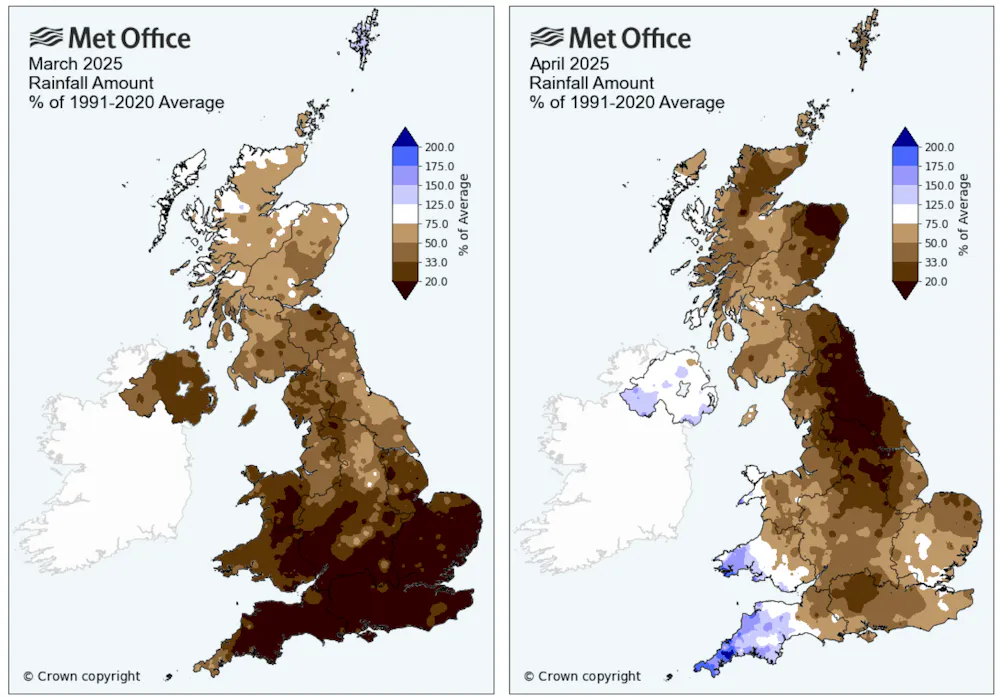
April 2025 was the sunniest since records began in 1910. This followed the third-sunniest March, and both months saw temperatures well above average nationwide. On May 1, the temperature reached 29.3°C in Kew Gardens in London – a new record for the date.
Meteorologists are warning of the potential for a summer drought, as the UK has seen roughly half its usual amount of rainfall for March and April. While farmers fret about this year’s harvest, some water companies are urging customers to help reservoir levels recover by limiting water use.
Meanwhile, wildfires have engulfed forest and moorland in areas of Scotland, Wales and England.
Most of the UK has experienced a record-dry spring so far. Met Office
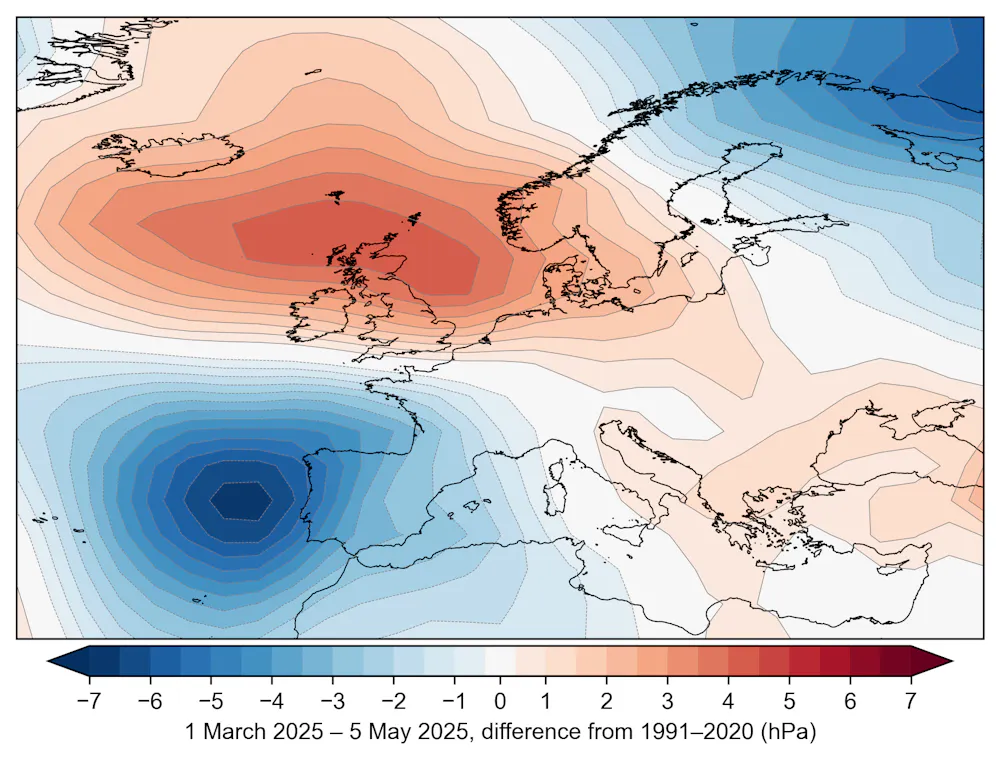
For several weeks, a stubborn area of high pressure over the UK has diverted the usual flow of mild, moist air from the North Atlantic like a boulder in a river. This is known as a blocking weather system.
Within it, air descends, warms and dries, which is why this weather pattern tends to be linked to heatwaves and drought. Blocking is usually persistent, making it seem like the weather is stuck.
Here’s how climate change may have played a role in setting up this unusual spring.
The warming climate means that unusually warm weather is occurring more often and becoming more intense. At the same time, we can expect more periods of both severe drought and extreme rainfall. Sudden changes from drought to deluge, termed “weather whiplash”, are due to the intensification of the water cycle in a warmer atmosphere that can hold more water vapour.
However, certain weather patterns are necessary to produce extreme weather. More blocking events in future could increase the chance of heatwaves or drought. But are blocking weather patterns becoming more common?
It’s difficult to determine how weather patterns will change as a result of the rising concentration of greenhouse gases in the atmosphere, which is predominantly caused by the burning of fossil fuels.
Part of the difficulty arises from the fact that weather patterns vary year to year. Several years in a row with more blocking events than usual could make it seem like blocking is increasing due to climate change, but it could simply be down to chance.
As a result, it is difficult to detect the fingerprint of human activity from weather observations alone. For example, blocking weather patterns over Greenland during summer have happened more often in recent decades, which can enhance the melting of the ice sheet. But it isn’t clear that this trend is the result of human-induced climate change.
Climate models do suggest future changes in the occurrence of blocking, however. These computer simulations, consisting of equations that describe the fundamental physics of the atmosphere, are the main tool scientists use to perform experiments that parse how the climate will behave in future.
When scientists run climate model simulations with increased greenhouse gas concentrations the results consistently show a decrease in blocking events. But blocking generally happens more often in real life than model simulations, which reduces the confidence scientists have in future projections.
Keeping track of the jet stream
The movement of weather systems in Earth’s mid-latitudes – including over the UK – is linked to the jet stream, which is a fast-flowing river of air driven by the contrast in temperature between the poles and mid-latitudes.
Some researchers have suggested that, because the Arctic is warming faster than the tropics, the jet stream may weaken and become more “wavy”, increasing the occurrence of blocking events, contrary to what most climate models show.
Outside of the scientific community, this idea has become popular. However, the hypothesis remains controversial among scientists, and observational evidence has weakened in recent years.
In fact, tens of kilometres above the Earth’s surface, near commercial aircraft cruising altitudes, the opposite trends are occurring: the temperature difference between the Arctic and mid-latitudes is increasing, acting to increase the strength of the jet stream.
There are considerable challenges with understanding how climate change is affecting the large-scale atmospheric patterns which drive the weather we experience. These include large natural variability and imperfect climate models. Models mostly suggest a decline in blocking events with climate change, though this remains relatively uncertain compared with other aspects of the science.
Overall, we can be confident that climate change is bringing warmer conditions in all seasons. Scientists also have strong evidence to suggest that drought conditions will become more common. These changes are already affecting food production, energy generation and water availability and these impacts will continue to worsen with climate change.
Don’t have time to read about climate change as much as you’d like?
The survey is part of USGS Earth Mapping Resources Initiative, a partnership with the geological surveys of Connecticut, Massachusetts, New Hampshire, Rhode Island and Vermont as well as other states.
“Increasing knowledge of New England’s geologic framework will help with national priorities, like sourcing critical minerals, and regional concerns – like mapping pyrrhotite to minimize its use in local infrastructure,” said Jamey Jones, science coordinator for the USGS Earth Mapping Resources Initiative.
Pyrrhotite, a mineral found in bedrock under certain parts of Connecticut and Massachusetts, can cause long-term structural weakness in construction when used in cement.
The survey is being coordinated by the U.S. Geological Survey as part of a larger, nationwide effort to provide data and images that expand the fundamental knowledge of geology across the nation. The data collected will be made freely available to the public once complete.
During the survey, which will be conducted in spring to fall 2025, instruments on the airplane will measure variations in the Earth’s magnetic field and natural, low-level radiation created by different rock types beneath vegetation and up to several miles below the surface. This information will help researchers develop geologic maps of resources and hazards in three dimensions.
The aircraft will be equipped with an elongated “boom” that extends either in front of or behind the main cabin that houses sensors. These scientific instruments are completely passive with no emissions that pose a risk to humans, animals, or plant life. No photography or video data will be collected.
The aircraft will be flown by experienced pilots who are specially trained and approved for low-level flying. These pilots work with the FAA to ensure flights are safe and in accordance with U.S. law. The surveys will be conducted during daylight hours only.
The aircraft will fly along pre-planned fight paths relatively low to the ground at about 300 feet (100 meters) above the surface in some areas. The ground clearance will be increased to 1,000 feet (300+ meters) over populated areas and will comply with Federal Aviation Administration (FAA) regulations.
Funding by the Infrastructure Investment and Jobs Act has facilitated coverage of such a large area.
Flights will cover areas within the following counties:
Connecticut: Fairfield, Hartford, Litchfield, Middlesex, New Haven, New London, Tolland, Windham. Massachusetts: Berkshire, Franklin, Hampden, Hampshire, Middlesex, Worcester. New Hampshire: Cheshire, Hillsborough. Rhode Island: Kent, Providence, Washington. Vermont: Bennington, Windham, as well as Fisher’s Island, New York.
Source: United Kingdom – Executive Government & Departments
Oral statement to Parliament
Immigration White Paper oral statement
The Home Secretary giving an oral statement to the House of Commons on 12th May to introduce the ‘Restoring Control over the Immigration System’ White Paper.
Madam Deputy Speaker, with your permission, I will make a statement on the government’s White Paper on Restoring Control over the Immigration System.
Five months ago, the figures were published that showed net migration had reached a record high of more than 900,000 under the last Conservative government – a figure that had quadrupled in the space of just four years.
It was the consequence of specific government choices made from 2020 onwards, including introducing what was effectively a free market experiment on immigration – encouraging employers to recruit from abroad, loosening controls in different areas but without any requirement to tackle skills and labour shortages here at home. Choices which undermined the immigration system and the economy too.
This government is making very different choices. We made clear at that time, just as we had set out in our manifesto, this government would restore order and control to the immigration system, bringing net migration substantially down but also boosting skills and training here at home.
The White Paper we are publishing today does exactly that and it is built on five core principles.
First, that net migration must come down so the system is properly managed and controlled.
Second, that the immigration system must be linked to skills and training here in the UK, so that no industry is allowed to rely solely on immigration to fill its skills shortages.
Third, that the system must be fair and effective, with clearer rules in areas like respect for family life, to prevent perverse outcomes that undermine public confidence.
Fourth, that the rules must be respected and enforced – including tackling illegal and irregular migration and deporting foreign criminals.
And finally, that the system must support integration and community cohesion, including new rules on the ability to speak English and the contribution that people can bring to the UK.
The United Kingdom is an interconnected and outward-looking nation. Our history and our geography mean that, for generations, British people have travelled overseas to live and work, and people have come to the UK to study, work, invest or seek refuge. And British citizens draw on heritage from all over the world and that has made us the country we are today.
Through many years our country has been strengthened by those who have come here to contribute – from the doctors in our NHS to the entrepreneurs founding some of our biggest businesses to those who came through generations to work in jobs from coal mining to caring for our loved ones to serving in our armed forces. People often coming to do some of the most difficult jobs of all.
Our trading nation, global leading universities and strong historic international connections mean that migration will always be part of our country’s future as well as our past.
But that is exactly why immigration needs to be properly controlled and managed. It hasn’t been.
Overseas recruitment shot up while training in the UK was cut.
Lower skilled migration soared while the proportion of UK residents in work plummeted.
In 2019 10% of skilled work visas went to non-graduate jobs; by 2024 that had risen to 60%.
Employers were even given a 20% wage discount if they recruited for shortage jobs from abroad – actively discouraging them from paying the going rate or training here at home.
Education institutions were allowed to substantially expand the number of overseas students without proper compliance checks.
Social care providers were encouraged to recruit from abroad with no proper regulation.
So we saw a serious increase in exploitation – deeply damaging for those who came to work here in good faith, and also for other workers and responsible companies who were being undercut.
The rules and laws that are supposed to the immigration system were too often ignored.
By 2024, returns of people with no right to be in the UK were down over a third compared to 2010.
And, of course, criminal gangs were allowed to build an entire smuggling industry along our borders, undermining security and creating a crisis in the asylum system.
Madam Deputy Speaker, later this year we will set out further reforms on asylum and border security, and on tackling illegal and irregular migration, building on the new counter-terrorism powers in the Border Security, Asylum and Immigration Bill before the House this evening, because no one should be making these dangerous crossings on small boats.
But this White Paper sets out how we restore that control to the legal migration system so it is sustainable, fair and works for the UK.
First, we are overhauling the approach to labour market policy so for the first time we properly link the immigration system to skills and training here in the UK.
So that where there are skills or labour shortages in the UK, immigration should not always be the answer to which employers turn. Because that long-term failure to tackle skills shortages, to bring in proper workforce planning, to get UK residents back into work, or to improve pay, terms and conditions here at home is bad for our economy as well as for the immigration system because it undermines our productivity and growth.
So we will lift the threshold for skilled worker visas back to graduate level and above, removing up to 180 different jobs from the list, increasing salary thresholds.
Access to the Points-Based System for lower skilled jobs will be limited to areas on a new Temporary Shortage List, including jobs which are critical to the Industrial Strategy, but access will be time limited. There must be a domestic workforce strategy in place, and employers must be acting to increase domestic recruitment.
We will expect workforce strategies to be drawn up more widely in other higher skilled areas too where there is overreliance on recruitment from abroad.
To support that work we will establish the new Labour Market Evidence Group, bringing together skills bodies from England, Scotland, Wales and Northern Ireland, the Department for Work and Pensions, the Industrial Strategy Council and the Migration Advisory Committee to gather and share evidence on shortage occupations in different parts of the country and also to highlight the role that skills, training, pay and conditions and other policies can play in improving domestic recruitment, so that increased migration is never again the only answer to the shortages the economy faces.
This new approach means we also need to act on social care.
The introduction of the Social Care Visa led not only to a huge increase in migration but also to a shameful and deeply damaging increase in abuse and exploitation.
When proper checks were finally brought in, 470 care providers had their licence to sponsor international staff suspended. 39,000 care workers were displaced.
Overseas recruitment for care jobs has since dropped but it must not surge like that again. And it’s time we addressed domestic issues, including a proper Fair Pay Agreement to show respect to people who do some of the most important jobs in the country.
We are therefore ending overseas recruitment of care workers. It will continue to be possible to extend existing visas and to recruit displaced care workers and people already in the UK with working rights on other visas.
Alongside the new visa controls and workforce strategies, we will also increase the Immigration Skills Charge paid by employers who recruit from abroad by 32%. That money will be invested through the Spending Review in supporting skills and training here in the UK.
We will ensure that Britain continues to attract the brightest and best global talent, by enhancing visa routes for very high skilled individuals, top scientific and design talent, and people with the right experience to support growth in key strategic industries.
Madam Deputy Speaker, international students bring huge benefits to the UK – supporting our world-leading universities, bringing in top talent and investment.
But we will strengthen compliance requirements and checks to prevent visa misuse.
Currently, too many people on the Graduate Visa are not doing graduate jobs. So we will reduce the unrestricted period from two years to 18 months. Those who want to stay will need to get a graduate job on a skilled worker visa so that we can ensure they are contributing to the economy.
Just as our rules on work visas are based on the contribution we expect people to make when they come to our country, we will consult later this year on new earned settlement and citizenship rules that apply the same approach, extending the principles of the Points-Based System, doubling the standard qualifying period for settlement to ten years with provisions to qualify more swiftly that take account of the contribution people have made.
Because the ability to speak English is integral to the ability for everyone to contribute and integrate, we will introduce new, higher language requirements across a range of visa routes, for both main applicants and their dependants. So family, too, can work, integrate and contribute.
The system for family migration has become overly complex with policies increasingly developed around case law from court decisions rather than a coordinated framework set out by Parliament. So we will set out a new clearer framework, to be endorsed by Parliament, including clarifying how Article 8 rules should be interpreted and applied to prevent confusion or perverse conclusions.
We will review current community sponsorship schemes that support recognised refugees and will continue to take action against trafficking and modern slavery. And we will shortly appoint a new Windrush Commissioner to ensure that Windrush lessons continue to be learnt and the Home Office also makes sure its standards are upheld.
But the rules must be respected and enforced across the board. So we will also bring in stronger controls where there is evidence of visa misuse. We are also rolling out e-visas and digital ID, including better use of technology to monitor when people are overstaying on their visa, or to support the increase in illegal working raids. Since the election we have increased returns and we will go further.
Those who come to our country must abide by our laws.
So we will develop new procedures to ensure the Home Office is informed of all foreign nationals convicted of offences – not just those who go to prison – so we can also revoke visas and remove other offenders in a wide range of crimes who are abusing our system.
Madam Deputy Speaker, already we are reducing the number of visas being granted this year, and updated figures will be published before the end of the month.
Already we are increasing returns with over 24,000 people in the first 9 months, the highest 9-month period for eight years.
The impact of the changes to skilled worker visas, care worker visas, settlement, students and English language is expected to reduce visas by around 100,000 a year. In addition, the new workforce strategies, Immigration Skills Charge, family and asylum reforms will further bring numbers down on top of that. And as the Prime Minister has said, where we need to go further to restore a sustainable system, we will.
Conclusion
In conclusion, Madam Deputy Speaker, throughout our history, Britain has been strengthened by people coming to start new businesses, study at our universities, contribute to our cultural and sporting excellence, and do some of the toughest, most essential jobs in our country.
But to be successful, effective and fair, our immigration must be properly controlled and managed. This White Paper sets out how we will restore control, fairness and order to the system, how we will continue to bring net migration down, and how we will turn the page on the chaos and failure of the past. I commend this statement to the House.
Plymouth has been recognised as a Tree City of the World on back of another exceptional planting season this winter.
Since November 2024, thanks in part to a huge new partnership effort, there are over 35,000 new trees growing and establishing across the city.
In the city, Council teams have helped to plant over 5,700 new trees of all shapes, species and sizes all over the city to further enhance the successful legacy of the Plymouth and South Devon Community Forest.
Be it parks and open spaces, road verges, residential streets or in school grounds, Council teams have been busy delivering a positive impact for people and nature across the city.
Extra specially, this year a massive 658 standard and fruit trees have been established. Standards are large trees that at the time of planting are already six to ten feet tall with this year’s number nearly double that of 2024.
On top of the standards, a further 5,102 whips have been planted as hedgerows and high-density planting areas which will become the wildlife corridors, edible hedgerows, and wooded areas of the future.
Over the course of the season teams have engaged with hundreds of people of all ages through various community events and groups including Plymouth Tree People, Headway, Societree, and the Hoe Gardening Group, as well as through partnerships with landowners like Plymouth Community Homes and the Learning Academy Trust.
The successful season, plus ongoing work behind the scenes, has led to Plymouth being awarded the coveted status as an official Tree City of the World.
Tree Cities of the World programme is an international effort to recognise cities and towns committed to ensuring that their urban forests and trees are properly maintained, sustainably managed, and celebrated.
2024-2025 Planting Season in Numbers
5,727 planted across the city
658 standards and fruit trees
5,102 whips planted as hedgerows and high density areas
30,000 planted in partnership with the MOD on land near Ernesettle RNAD
21 sites planted, 6 of which were not on PCC owned land
11 sites delivered through successful Trees for Climate grant applications
246 active community volunteers on planting days over 13 sites
40+ species of tree planted, 30+ of which are native
45+ varieties of fruit tree planted, creating five new community orchards
The status is awarded when a city can demonstrated having; policies for tree management; an inventory to determine what trees it has; a budget to care for those trees; a group dedicated to the care of those trees; and an annual celebration of its trees.
Plymouth was awarded the status after a joint bid between Plymouth and South Devon Community Forest, the Council and local charity Plymouth Tree People, in recognition of the innovative approach to bring our community forest to life.
Councillor Tom Briars-Delve, Cabinet Member for the Environment and Climate Change, said: “Another year, another incredible amount of trees planted across our beautiful city. Just marvellous.
“Then to be become a Tree Cities of World is a real honour for our city.
“Since taking control in 2023, this administration has championed tree planting and the natural environment so this international recognition as a leading tree city, achieved thanks to positive collaborations with local community groups, shows just how far we’ve come.”
Penny Tarrant, Chair of Plymouth Tree People, said: “We are delighted to have worked in partnership to achieve this accolade for Plymouth. It demonstrates the commitment to and the value in working together.
“As a local charity, our core work is to Plant, Care and Learn. As partners we have played our part in planting many street trees across the city, caring for trees via our broad Tree Warden network and in teaching about and celebrating trees through the Plymouth Urban Tree Festival, between 11 and 18 May.”
The prolific 2024-25 planting season means that that over 17,500 trees have been planted across more than 120 sites since 2021, when the Plymouth and South Devon Community Forest was first launched.
The Defra funded Community Forest project boundary stretches from the South Devon coast, across Plymouth and right across to the rolling landscape of Dartmoor National Park.
By April 2026 a further 300 hectares will be planted creating a mosaic of orchards, hedgerows, areas of natural regeneration, native broadleaf, and productive woodland.
Unlike traditional forests, the community forest isn’t geographically restricted to one place. Instead, it encompasses a wide variety of planting styles from community accessible woodland, private woodland, highway verge planting, urban wooded areas , habitat corridors and hedgerows contributing the wider England’s Communty Forests.
Find out more about Community Forest and how to get involved at https://psdcf.com
Source: United Kingdom – Executive Government & Departments
News story
New local guidance to tackle synthetic opioid threat
Communities across England will be better equipped to combat the increasing threat of dangerous synthetic drugs, following new advice issued by the Home Office.
Image: Getty Images
In an effort make streets safer, the government has set out new recommendations to local authorities, police and public health organisations to better prepare against synthetic opioids. This includes making sure police officers have the skills and confidence needed to carry and administer naloxone, a lifesaving drug to tackle illicit drug use.
Synthetic opioids are extremely dangerous substances and their presence in the UK illegal drugs market has risen over the past 2 years, during which time there have been over 450 drug-related deaths where synthetic opioids were present. Although they are most commonly found in heroin, they are also becoming increasingly present in illicit painkillers and sedative pills.
As part of the government’s Plan for Change, 12 new recommendations have been issued to local authorities, to ensure staff are able to help save lives and support those at risk of overdose.
This advice for local areas includes:
making ‘out of hours’ resources available to respond to incidents around the clock
sharing data between coroners, police and health services
fast-tracked testing of seized drugs when synthetic opioids are suspected
improving identification and monitoring of all at-risk groups, not just opioid users
reviewing naloxone supplies in their area to make sure they are at sufficient capacity
These recommendations follow an exercise in November last year which saw local partners across health and policing, as well as national organisations, work together to respond to different scenarios relating to synthetic opioids. The exercise was organised by the government’s Joint Combating Drugs Unit and chaired by the National Police Chiefs’ Council.
Policing Minister Dame Diana Johnson said:
Synthetic drugs have no place on Britain’s streets, which is why we must do everything we can to tackle this evolving threat.
This advice will help save lives by ensuring local authorities know how to respond to incidents more quickly and efficiently, as will the vital rollout of naloxone across our police forces.
Already there are hundreds of examples of police officers carrying this lifesaving medicine. I am deeply grateful for their unwavering commitment to protect some of the most vulnerable people in our communities, part of the government’s Plan for Change to keep streets safe.
Alongside this report, the government is also publishing national data on police use of naloxone for the first time. Naloxone is a medicine used to reverse the effects of an opioid overdose.
According to new data released today, as of December 2024, there are approximately 20,650 police officers and 880 police staff carrying the medicine daily across the UK.
The data also shows that police officers across the UK have administered naloxone more than 1,200 times since June 2019. 32 UK police forces are currently using the naloxone provision or piloting it, and another 12 forces have committed to either pilot or roll out its use in the near future.
National Police Chiefs’ Council lead for Drugs, Chief Constable Richard Lewis said:
Synthetic drug use, like all illegal drug use, is incredibly dangerous for those who use them as well as carrying high risks of overdosing and we welcome the governments recommendations in how we collectively respond to this particular threat.
We have long supported the use of the anti-overdose drug Naloxone, which has dramatically reduced the chance of drug-related deaths when dispensed by officers who have been equipped with it and encourage its use further.
We remain steadfast in doing all we can to protect the people we serve alongside partners, including the most vulnerable in our society and this tool is just one option we can take to achieve this.
The government supports more police officers carrying naloxone and see this is an important part of steps to reduce opioid deaths across the country.
Michael Kill, CEO of the Night Time Industries Association, said:
We welcome the Home Office initiative supporting police officers in carrying naloxone, which represents a vital step forward in the fight against opioid overdoses. Communities across England are increasingly facing the threat of dangerous synthetic drugs, and this move ensures a faster, more effective response at the most critical moment.
The immediate administration of naloxone can mean the difference between life and death, particularly as synthetic opioids – now more prevalent in the UK’s illegal drug market – have contributed to over 450 drug-related deaths in the past 2 years.
Equipping frontline officers with this life-saving tool, alongside the government’s new recommendations to local authorities, police, and public health organisations, shows a commitment to public safety and harm reduction. We look forward to the upcoming findings that will guide a more robust, informed approach to protecting our communities.
The law was also recently changed to widen access to take-home naloxone without a prescription. This is part of a series of initiatives designed to reduce the threat from synthetic opioids and reduce drug-related harms.
A generic definition of nitazenes, a type of synthetic opioid, was also introduced which will help prevent serious and organised criminal groups from adjusting drug recipes to bypass UK drug laws.
You can read more about this topic on the following pages on GOV.UK:
This file may not be suitable for users of assistive technology.
Request an accessible format.
If you use assistive technology (such as a screen reader) and need a version of this document in a more accessible format, please email alternativeformats@communities.gov.uk. Please tell us what format you need. It will help us if you say what assistive technology you use.
Details
Decision letter and Inspector’s Report for a recovered appeal for outline planning permission for demolition and clearance of existing buildings and hardstandings to allow for the construction of a data centre of up to 84,000 square metres (GEA) delivered across 2 no. buildings, engineering operations and earthworks to create development platforms, site wide landscaping and the creation of a country park.
The data centre buildings include ancillary offices, internal plant and equipment and emergency back-up generators. Other works include:
an ancillary innovation
education and training centre of up to 300 square metres
internal roads and footpaths
cycle and car parking
hard and soft landscaping
security perimeter fence
lighting, drainage, substation, and other associated works and infrastructure
BOSTON — U.S. Immigration and Customs Enforcement arrested a former private school music teacher and a Filipino man on charges alleging that the two produced videos depicting the sexual exploitation of minor boys in the Philippines.
ICE Homeland Security Investigations special agents arrested Joshua DeWitte, 50, of Cambridge on May 8 and Christopher Allan Tisoy, 27, a Filipino national residing in Baltimore, Maryland on May 7. Both were charged with one count each of sexual exploitation of minors, attempt, and conspiracy.
According to the charging documents, at the time of the alleged conduct, DeWitte was a music teacher at a local school in Massachusetts. Tisoy, a citizen of the Philippines who lawfully entered the United States in September 2024 on a H-1B Visa, is employed as a medical technologist at the Sinai Hospital of Baltimore.
According to the charging documents, in December 2024, DeWitte was allegedly identified as the owner of a Snapchat account that uploaded a file of suspected child sexual abuse material depicting the abuse of a boy who appears to be between approximately eight and 10 years old. Records obtained from Snapchat allegedly showed that, in September 2024, DeWitte engaged in multiple conversations that were sexual in nature with users who presented themselves as minors. In those conversations, it is alleged that DeWitte requested nude pictures from the purported minors; sent pictures of his penis to the purported minors; and discussed previous and potential in-person meetups for sexual relations with minors.
Additionally, it is further alleged that DeWitte paid, and offered to pay, another Snapchat user to obtain and produce child pornography and to recruit minor boys for himself.
Based on that information, state law enforcement obtained a search warrant for DeWitte’s Cambridge residence in January 2025. DeWitte was then arrested and charged in Cambridge District Court with six counts of disseminating obscene material to a child, one count of distribution of material depicting a child in a sexual act and one count of possession of child pornography. He was later released on conditions.
According to the charging documents, HSI’s forensic examination of DeWitte’s cell phone seized at the time of his January 2025 arrest allegedly revealed a Telegram conversation between DeWitte and another user in which DeWitte allegedly shared three video files and stated, “I was in the Philippines. Most of my vids are from there and that’s where I was with a 10 yo and 12. 16 yo in Japan and Korea;” and “I have a contact there…He only records vids of the boys or arranges for my visit.”
It is alleged that a separate Telegram conversation between DeWitte and Tisoy was located on DeWitte’s phone, in which they discussed four minor boys by name and arranged for the production of videos depicting the sexual exploitation of at least two minor boys in the Philippines.
Specifically, it is alleged that in the conversations, DeWitte and Tisoy negotiated the terms of creating sexually explicit videos involving minors, including which minors should be involved; which sex acts the minors should perform; who should film, including whether a third party or one of the minors themselves should film; what angles should be filmed; and how much DeWitte should pay Tisoy for each video. The negotiation allegedly incorporated the sexual preferences of both DeWitte and Tisoy, with both agreeing on what they would each find sexually gratifying. Tisoy then allegedly relayed instructions to the minor victims to create a video.
DeWitte allegedly paid Tisoy for each video Tisoy produced and sent. It is alleged that, between July 3, 2023, and Dec. 27, 2024, DeWitte sent 87 PayPal payments to Tisoy, in amounts ranging from $27 to $958, to film the sexual exploitation of minors in the Philippines — totaling to approximately $23,752.
Members of the public who have questions, concerns or information regarding this case should call 617-748-3274 or contact USAMA.VictimAssistance@usdoj.gov.
The charge of sexual exploitation of minors, attempt, and conspiracy provides for a mandatory minimum sentence of 15 years and up to 30 years in prison, at least five years and up to a lifetime of supervised release and a fine of up to $250,000. Sentences are imposed by a federal district court judge based upon the U.S. Sentencing Guidelines and statutes which govern the determination of a sentence in a criminal case.
The investigation was led by HSI New England’s Child Exploitation group with valuable assistance from the Cambridge Police Department, HSI Baltimore, the Maryland Department of State Police, and the Middlesex District Attorney’s Office.
The details contained in the charging documents are allegations. The defendants are presumed innocent unless and until proven guilty beyond a reasonable doubt in a court of law.
Report suspected child exploitation to the ICE Tip Line at 866-347-2423 or through the CyberTipline on the National Center for Missing & Exploited Children’s website.
Lord Mayor of Armagh City, Banbridge and Craigavon, Councillor Sarah Duffy, joins Gallery Curator and Manager Dr Riann Coulter and Council Chief Executive Roger Wilson to mark the start of the F.E. McWilliam Gallery’s multi-million pound expansion.
Construction work on a major multi-million pound expansion and upgrade of theF.E. McWilliam Gallery & Studio in Banbridge will commence today (Monday 12th May).The award-winning accredited museum will continue to host exhibitions and remain open and accessible to the public throughout much of the 15-month contract period.
Armagh City, Banbridge and Craigavon Borough Council has appointed McKelvey Construction Ltd to bring this large-scale capital project to fruition and transform this facility so that it can further capitalise on its A1 location and expand its role as a cultural hub attracting significantly more local, national and international visitors.
Opened in 2008 to celebrate the life and work of Banbridge-born, internationally renowned sculptor Frederick Edward McWilliam, the gallery has established a reputation as one of the best regional arts museums in the UK and Ireland. Recognised for its high-quality exhibitions, inclusive education programmes and excellent customer service, the venue has outgrown its current facilities with visitor numbers now surpassing 50,000 a year.
The development, designed by Belfast-based Hall Black Douglas Architects, has been driven by an ambition to transform the experience of visiting F.E. McWilliam Gallery and to offer a suite of modern facilities that ensure the museum along with its collection are more accessible to more people and meet the needs of the wider community.
Welcoming the start of construction work, Lord Mayor Councillor Sarah Duffy said:
“Getting this once-in-a-generation project off the ground is a major feat. I applaud everyone involved in the planning and design process for helping us reach this significant milestone.
“This redevelopment is a testament to the gallery’s emergence as a nationally significant cultural destination. We are proud to be building uponMcWilliam’s legacy andleading the way with this arts and culture investment.
“Our vision is to create a stunning and dynamic museum fordisplaying more ofMcWilliam’swork as well asshowcasing both established and emerging artists.
“Due to complete in autumn 2026, this project will significantly increase visitor capacity and further the gallery’s ability to serve as athriving hub for artistic expression, learningand engagement as well as a much-enhanced space encouraging connection, providing inspiration and enhancing the wellbeing of all who walk through its doors.
“The expanded and upgraded gallery will be a major gateway for boosting tourism across the wider region. I look forward to seeing this project become a reality and yielding positive benefits for local people for generations to come.”
The programme of works will double the size of the facility and introduce a swathe of improvements.
A new climate-controlled collection gallery will allow an increased number of artworks to be taken out of storage and put on permanent display, making more of F.E. McWilliam’s work accessible to the public and ensuring the collection’s long-term preservation.
The provision of a large, well-resourced education and community space will help meet demand from schools and other education providers, increase engagement with community groups and create opportunities for the gallery to host workshops, classes and events that are currently limited due to lack of space.
The popular craft shop will double in size, providing a platform for craftspeople and artisans from the borough and beyond to showcase their work.
The car park will be reconfigured to provide a turning point and parking bay for coaches and buses, enabling the facility to cater for large school groups and visiting coach trips. EV charging points will also be installed.
Two multi-purpose meeting rooms will be created, allowing the gallery to expand its programme of events and activities. These rooms will be available for hire by arts and community groups as well as businesses.
The extended reception area will incorporate a Banbridge Visitor Information office. Additional seating capacity will be provided within the popular Quails café. More toilets and a Changing Places facility will also be provided.
The new building has been designed to be more energy efficient and sustainable, and provision will also be made to increase storage space and improve staff accommodation.
Gallery Curator and Manager Dr Riann Coulter added: “We are delighted that the gallery, including its popular Quails café, will continue to welcome visitors over the summer months and beyond as this project progresses with minimal disruption expected.
“The expansion and upgrade of this distinctive building will enable us to realise our ambitions and increase the scope and impact of our arts and education programmes, championing the importance of art, culture, and public space that is free to all.
“We are committed to elevating the visitor experience and making the museum more open, engaging, accessible and inviting to new and diverse audiences.
“The F.E. McWilliam Gallery & Studio isset to become the jewel in the crown of our region’s rich cultural offering. We aregrateful to our funders for their incredible support.”
This project is one of ten key infrastructure projects across Northern Ireland to receive substantial funding from the UK Government’s Levelling Up Fund.
The Council has also secured funding from the Wolfson Foundation to fit out the new collection gallery and improve interpretation through multi-lingual video guides and accessible tours of the F.E. McWilliam collection in both British and Irish Sign Language.
The North East Scotland Pension Fund will publish the unaudited Annual Accounts for the financial year 2024/25 on 23 June 2025.
The accounts provide information which can help the public assess how the Pension Fund has performed during the year and understand its position as at 31 March 2025. Full details are available in the Council and Democracy pages.
This election in Hamilton, Larkhall and Stonehouse is an opportunity to stop Farage in Scotland.
His Reform party is gaining support down south, but we can take the wind out of his sails with a victory here.
The SNP is stepping in where Labour have let you down and, crucially, offering hope for a better future.
The SNP is committed to ensuring that people receive the support they need by saving you money:
Free Prescriptions:We continue to make sure that no one in Scotland has to pay for essential medications.
Free Bus Travel:Including under-22s, those aged 60 and over, to travel for free, reducing the cost of getting out and about.
Universal Free School Meals for primary school children:A vital step to ease the pressure on family budgets and ensure all children in primary 1 to 5, regardless of their financial circumstances, are getting the nutrition they need.
Free Childcare: Offering 1,140 hours of free early learning and childcare to families for children aged 3- to 5-year-old, helping working parents save money.
In Katy Loudon, you have an SNP candidate that will always be on Scotland’s side, putting your community first.
People are in contact with us sharing stories of excellent NHS care but also expressing frustration of long waiting times.
We know there’s more to do to support our NHS. We’ve listened and acted.
With a £30 million investment, we’ve delivered over 105,000 extra NHS appointments, exceeding our target, and reducing waiting times for vital treatments.
We’re committed to further action, with 150,000 more appointments planned for next year, and a focus on improving GP access through expanded Pharmacy First services and 100,000 extra GP appointments.
In Katy Loudon, you have an SNP candidate that will always be on Scotland’s side, putting your community first.
Katy Loudon, the SNP’s candidate in the Hamilton, Larkhall and Stonehouse by-election, has called on the Labour candidate to apologise to pensioners in the constituency after the Daily Record revealed that 36,057 pensioners in South Lanarkshire lost out last year because of Labour’s cut to the benefit.
When Labour entered government last July, one of the first decisions made by Keir Starmer was to cut the Winter Fuel Payment, withdrawing vital support from 900,000 Scottish pensioners.
This decision was endorsed by both Scottish Labour MPs in September 2024, and by leading Scottish Labour MSPs in October 2024 – despite pretending in this by-election they are against the cut!
Katy Loudon described Scottish Labour’s position as having some “brass neck” pretending it was not their decision that resulted in tens of thousands of pensioners losing this vital support.
In contrast the SNP government is reinstating this payment with support worth at least £100 going to all pensioners from this year.
Highlighting how a vote for the SNP would send a message to Labour about cutting the Winter Fuel Payment, Katy Loudon said:
“The sheer brass neck of Scottish Labour is astonishing.
“Again and again they have let Scotland down; treating the people of Scotland as nothing more than an afterthought and now indulging in a staggering level of political spin to escape responsibility for one of Labour’s first acts in office – cutting the Winter Fuel Payment.”
Councillor Loudon added that the Labour party had failed pensioners in South Lanarkshire and across Scotland; and it was the SNP government stepping in to reinstate universal support for pensioners.
She concluded by saying, “David Russell should be ashamed to stand on a platform built on broken promises and must apologise to the tens of thousands who had vital support taken away by this UK Labour government.”
A decision by the Broadcasting Standards Authority to uphold a complaint against a 1News broadcast last November is a warning to news media, says the Palestine Solidarity Network Aotearoa.
1News described violence in the streets of Amsterdam on November 7 and 8 following a soccer match as “disturbing” and ‘antisemitic’ and stated the graphic video of beatings were Maccabi Tel Aviv fans under attack just for being Jewish.
Videographers who took the footage which 1News had used, complained to their news agencies that this description was wrong. The violence had been perpetrated by the Israeli Maccabi Tel Aviv fans against those they suspected of being Arab or supporters of Palestine.
The visiting Israelis were the attackers — not the victims, said the PSNA statement, as widely reported by global media correcting initial reports.
Before the match these same Maccabi fans had gathered in large groups to chant “Death to Arabs” — a racist genocidal chant which if used with the races reversed (“Arabs” replaced by Jews”) “would have been rightly condemned in purple prose by Western news media such as TVNZ”, said PSNA co-chair John Minto in the statement.
“But no such sympathy for Palestinians or Arabs,” he added.
Requested broadcast correction PSNA said in its statement that it had immediately requested that TVNZ broadcast a correction. TVNZ refused, though admitting they had got the story wrong.
PSNA then referred a complaint to the BSA which upheld the complaint as failing to meet the accuracy standard.
Minto said in the statement that the BSA decision should be seen as a warning to news media to be aware that Israel was using “fabricated charges of antisemitism, to justify and divert attention from its genocide in Gaza and silence its critics”.
“Just because [Israeli Prime Minister] Benjamin Netanyahu and the then US President Joe Biden made statements turning Amsterdam attackers into victims, doesn’t mean TVNZ news should automatically parrot them,” Minto said.
“That’s effectively what the BSA concluded.”
Framing violence: How Israel shaped the narrative and the impact on Dutch politics Video: Al Jazeera
Minto also pointed to what he called a recent fabricated hysteria about antisemitism in Sydney, which the New South Wales police found to be completely based on hoaxes by a criminal gang.
“In the US, Trump is using the same charge as an excuse to close down university courses and expel anyone who protests against the Israeli genocide in Gaza,” Minto said.
“Of course, we strongly condemn the real antisemitism of anti-Jewish, Nazi-type Islamophobic groups,” Minto says.
Call for media ‘self education’ “It should be easy for professional reporters and editors to tell the difference between criticism of Israeli apartheid, ethnic cleansing and violence on one hand, and on the other hand Nazis and their fellow travellers who condemn Jews because they are Jews.
“The BSA is, in effect, demanding the news media educate themselves.”
In a half-hour report on 16 November 2024 headlined “Media bias, inaccuracy and the violence in Amsterdam”, Al Jazeera’s global mediawatch programme The Listening Post said “one night of violence revealed … Western media’s failings on Israel and Palestine”.
“In the wake of an ugly eruption of violence on the streets of Amsterdam, the media coverage of the story [was] put under the microscope with editors scrambling to revise headlines, rework narratives, and reframe video content.”
In an investigative documentary, The Full Report, on 22 January 2025, Al Jazeera’s Dutch correspondent Step Vaessen reported how Israel had framed the violence, shaped the narrative, manipulated the global media, and impacted on Dutch politics.
Source: United Kingdom – Executive Government & Departments
News story
Vital support for victims in £20 million funding boost
Thousands more victims to access life-saving support through a £19.9 million investment in specialist services.
Minister Jess Phillips on a visit to Refuge, a charity supporting victims of domestic abuse
Thousands more victims of domestic abuse, sexual violence, ‘honour’-based abuse and stalking will have access to specialist support services thanks to a boost of nearly £20 million announced by the Safeguarding Minister today.
Part of this funding will go towards backing helplines which can offer potentially life-saving support for survivors of abuse. Victims can find these experiences incredibly hard to talk about and contacting helplines for advice is often the first critical step in their journey to escape abuse, access vital support and eventually seek justice.
To help more victims access support at the most vulnerable moments in their lives, a range of helplines supporting victims of domestic abuse, sexual violence, ‘honour’-based abuse and stalking will benefit from £6 million in investment this year – an increase of around a fifth compared to the previous year.
This investment is designed to reach as many different communities as possible and will bolster a range of vital specialist services in England and Wales supporting victims and survivors who face unique and challenging circumstances.
Nine helplines across 8 charities, including: Refuge who run the National Domestic Abuse helpline; Hourglass, a charity supporting older victims; SignHealth who support victims who are Deaf; Galop; The Suzy Lamplugh Trust; Karma Nirvana; and Respect will receive funding to continue providing vital helpline services to victims, recruit more staff and support more victims escaping abuse.
Minister for Safeguarding and Violence against Women and Girls, Jess Phillips said:
No victim should ever feel abandoned when trying to escape abuse. But the harsh reality is that too many do – especially those from marginalised communities who face significant additional hurdles.
Last week, I met survivors who felt the system wasn’t built for people like them. I hope this funding will change that. It’s about smashing down barriers and making sure every single person facing abuse has somewhere to turn when they make the brave decision to seek help.
The funding package announced today also includes £5.3 million for services supporting children affected by domestic abuse, who are often the hidden victims of this devastating crime, to support them through one-to-one and group counselling, classroom-based assistance and help for their non-abusive parents across 8 specialist services nationwide.
Charity Southall Black Sisters will receive £2.4 million to support migrant victims of abuse who are not able to access public funds.
And to give victims direct access to financial support to escape abusive relationships, a wide range of specialist domestic abuse services will receive around £2 million through the Women’s Aid Flexible Fund. Through the fund, organisations across England and Wales, including Welsh Women’s Aid, will give payments of up to £500 to help victims secure safety and one-off payments of up to £2,500 for deposits for rental accommodation to help secure sustainable and independent futures.
This is underscored by £2.5 million for projects to help prevent and improve the response to violence and abuse against women and girls, raise awareness of these issues and protect victims who are at risk.
The government was elected on a mission to make our streets safer for everyone as part of the Prime Minister’s Plan for Change.
Today’s announcement marks a vital step in our pledge to halve violence against women and girls in a decade, ensuring victims of these appalling crimes have somewhere to turn and the support they need to recover from abuse.
Whether fearing for their lives or growing up in a home filled with stress and anxiety, victims should feel confident that support will be there to help them recover, but sadly too often this isn’t the case.
This funding for struggling specialist domestic abuse services, especially those supporting children, will bring much needed relief to survivors and services, who have been doing all they can to ensure help is there for people during one of their most vulnerable moments in life.
Tackling domestic abuse requires drive, ambition and political will. I look forward to seeing how the government’s forthcoming violence against women and girls’ strategy builds on this investment by ensuring every victim and survivor gets what they need – exactly when they need it – so they can recover from abuse.
Last week, the Minister for Safeguarding visited Refuge’s headquarters to meet with charity leaders and victims and discuss the unique challenges facing vulnerable individuals and harder to reach communities when they seek help. She also saw the National Domestic Abuse helpline in action and spoke to call handlers about the vital work they do.
CEO of Refuge, Gemma Sherrington said:
The National Domestic Abuse Helpline, operated by Refuge, offers a lifeline for thousands of survivors every year. Open 7 days a week and 365 days a year, the support given by the helpline often represents the first step towards a life free from abuse and fear.
We are incredibly grateful for this much-needed funding boost, which will sustain this vital service for the coming year. Rather than covering the running costs of the helpline, our fundraised resources can now be directed towards supporting survivors, while bringing us one step closer to a world where domestic abuse is not tolerated.
The funding will also allow us to extend our live chat hours and make accessibility improvements to the helpline website, meaning we can reach more survivors than ever before.
Esther*, a survivor of domestic abuse supported by Refuge, said:
Funding for domestic abuse services is not only vital but absolutely necessary. Domestic abuse, in all its shapes, is still very much a problem and I’m hearing more and more tragic stories than ever before. Funding is needed for not only the aftercare for victims/survivors but also for the services that provide advice and support for people that are fleeing abuse.
The transition from deciding to leave and actually leaving is one of the scariest experiences and it’s important that support and guidance is on hand. I know for certain that without help from these services, my story would have ended very differently, and I would not be here to talk at all. They gave me the courage and opportunity to live and smile again. I will always be forever grateful.
Alongside Raneem’s Law, with domestic abuse specialists embedded in the first 999 control rooms across the country, this £19.9 million investment will help ensure that wherever victims of these crimes reach out for help – whether to police or charities – they will receive a specialist response tailored to their needs.
This announcement follows a £13.1 million investment in a new policing centre to tackle violence against women and girls and enable police to better target these crimes, an uplift of nearly £2 million.
Nikita Kanda, broadcaster and Refuge ambassador, said:
I welcome today’s announcement of almost £20 million in funding for a range of vital and specialist services including Refuge’s National Domestic Abuse helpline. With this investment we will be able to strengthen our commitment to support all communities and empower those enduring domestic violence.
UK Government urged to work with Scottish Government on plans.
The Equalities Minister Kaukab Stewart has urged the UK Government to rethink its immigration white paper to take account of Scotland’s distinct population needs.
Following publication of new proposals from the Home Office on immigration, the Scottish Government has called on the UK Government to take account of its own proposals on immigration.
The Minister said the UK Government must engage the Scottish Government on its immigration policy, reflecting that migration enriches Scotland’s communities, supports economic growth and addresses population challenges.
Equalities Minister Kaukab Stewart said:
“The UK Government’s plans on migration stand in stark contrast to our values and they do not reflect Scotland’s distinct population needs. The Scottish Government is proud to welcome and support people from around the world to live, work and build their lives in Scotland. Not only does migration enrich our communities and culture, it is vital for economic growth, public services like the NHS and addressing our population challenges.
“Scotland needs talented and committed people from across the world to live, work and study here without excessive barriers. A one-size fits all approach to immigration fails to meet the needs of Scotland and much of the UK. In particular, any plans to end international recruitment of care workers will be devastating for the care sector in Scotland and across the UK.
“We are deeply disappointed that the UK Government’s white paper on immigration fails to take on board our proposals to help meet Scotland’s distinct demographic and economic requirements. I call on the Home Secretary to urgently work with us to deliver an immigration system which is reflective of Scotland’s needs, and avoids the harm to our economy, communities, and public services which the policy decisions in the white paper will lead to.
“If it does not, then it becomes ever clearer that Scotland needs full powers over immigration. Independence would give Scotland control over migration policy and provide an opportunity to introduce a new, welcoming immigration system that supports our economy and public services.”
Background
In March, the Scottish Government provided a set of policy proposals to the Home Office during development of its white paper on immigration. The Scottish Government will shortly publish these proposals online and will write to the UK Government this week to call for meaningful discussions.
To date, there has been no substantive engagement from the Home Office on any of the policy proposals contributed by the Scottish Government during the development of the White Paper.
A new national recruitment campaign to help find more foster carers has been launched by First Minister John Swinney.
The Scottish Government campaign, which was announced at John Lewis in Edinburgh to mark the start of Foster Care Fortnight, aims to support the recruitment of more Local Authority foster carers. The Fostering Network estimates that Scotland needs at least 400 additional foster carers, and this campaign seeks to raise awareness of the benefits of fostering and encourage people across the country to consider if they could support a child or young person in the care system.
John Lewis – a key campaign partner – are a foster friendly employer providing extra support to employees who are foster carers, something the Scottish Government has recently introduced to its own staff. The company also run a Care Experienced internship which supports hundreds of young people with care experience to get work experience.
The campaign will be running in May and June, with a new website and an advice line for anyone interested in finding out more.
As he met foster carers at the new campaign launch, the First Minister said:
“Foster carers play a vital role supporting and providing safe and loving foster homes to children and young people. They are key to our ambition of delivering The Promise by 2030.
“Across Scotland, foster carers provide stability, care and connection to support children and young people to thrive.
“Our campaign importantly focuses on how the everyday ‘ordinary’ can be extraordinary for a child in foster care. Fostering can be transformational for a child or young person and by stepping forward, foster carers offer not just a home, but the relationships and support that help shape brighter futures.”
Anne Currie, Assistant Director for Scotland at The Fostering Network, said:
“We welcome the launch of the Scottish Government’s national campaign to recruit foster carers, and we’re proud to back this initiative by providing additional support to our Fosterline service to specifically manage enquiries.
“We hope this leads to more people stepping forward to become foster carers in Scotland, and raises awareness of the vital role fostering plays. The need has never been more urgent – as over 350 foster carers leave each year, it’s critical that we take action now.”
Ceira Thom, Head of Learning, Inclusion and Belonging at the John Lewis Partnership, said:
“At the John Lewis Partnership, we believe that every child deserves a safe, loving home where they can grow and flourish.
“As the UK’s largest Fostering Friendly employer, we’re proud to support this vital campaign and to help raise awareness of the life-changing role foster carers play in young people’s lives.”
Background
Fostering is open to people of all ethnicities, religions, sexual orientations, genders, and family structures. Foster carers do not need any specific qualifications, and don’t need to have children of their own.
The ‘Ordinary can be extraordinary for a child in foster care’ campaign runs for four weeks across TV, video on demand, radio and press, and for seven weeks across digital channels.
It was May 4 1975. The Japanese Women’s Everest Expedition team had been living at a high altitude for six weeks, and were less than a week away from their scheduled bid for the summit of Mount Everest. Exhausted, having established camp five at just below 8,000m on the south side of the mountain, Junko Tabei and the team descended to camp two at 6,300m to rest.
Then – avalanche!
In the early hours, tons of ice and snow engulfed the camp, burying several of the teammates. Crushed by the snow and ice, Tabei was unable to move. It took the strength of four Sherpas, the elite Nepali climbing guides assisting the expedition, to pull her out. Suffering severe bruising, Tabei argued that she did not need to be returned to base camp to recover, and would remain at camp two.
“There was no way I was leaving the mountain,” she later recalled in her memoir.
It had taken five years for this group – the first all-women team – to get to Everest. The pressure on them to succeed was immense, given the limited number of annual international permits to climb Mount Everest issued by the Nepalese government. If they gave up, they might have to wait several years to make another attempt.
Meanwhile, on the Tibetan side of the mountain, Tabei’s team had competition. A 200-strong Chinese team was also working to place a woman on the summit at the same time.
From the late 1950s, Tibetan women were recruited to participate in state-sponsored Chinese mountaineering expeditions. In 1958, Pan Duo had been selected to participate in the successful Chinese 1960 Everest expedition – but was ordered to remain below 6,400 metres because above that height was “a man’s world”. Nonetheless, Pan Duo – referred to as “Mrs Phanthog” in some older accounts – was celebrated in her country and elected deputy captain of the 1975 Chinese Everest Expedition.
Unfortunately, the Chinese team suffered a climbing accident resulting in the death of a team member. They retreated to recover – only to be ordered by the Chinese government to “climb ahead of the Japanese women”.
They were too late. On May 16 1975, the all-women Japanese expedition worked together to place Tabei on the summit of Everest. Two team members – Tabei and Yuriko Watanabe – had been nominated to make the summit attempt. However, other teammates were suffering from altitude sickness, so Watanabe was assigned to help return them to camp two.
The ascent Tabei was making was arduous. Given her injuries, it took great tenacity to muster the strength to continue. But finally, she took her last steps to the summit, becoming the first woman and 40th person, according to the latest official record, to summit the peak. She was part of only the tenth successful Everest expedition, later recalling:
I felt pure joy as my thoughts registered: ‘Here is the summit. I don’t have to climb any more.’
Eleven days later, the Chinese team returned to the high slopes to make another attempt. Using minimal oxygen, Pan Duo was also successful, becoming the second woman to summit Everest – and the first to climb the harder northern side of the mountain.
Prior to these two successful expeditions, only 38 people had summited Everest – all of them men. News of Tabei’s feat travelled fast across Asia, leading to national celebrations in Japan, Nepal and India. But it made little impact in the west.
In my own career as both a mountaineer and researcher of adventure tourism, I had been struck by how few women I encountered on the mountainside. I wanted to understand why this might be, and what women had achieved. It was through this research that I discovered Tabei’s story.
I was astonished both by her achievements – she is also the first woman to complete the “Seven Summits”, climbing the highest peaks on every continent – and by how few prominent mountaineering organisations and mountaineers appeared to know about her.
Tabei’s bravery helped her lead record-setting all-women expeditions and overcome the mountain of sexism in this male-dominated space. Yet very few organisations, even in Japan, have thought to celebrate the 50th anniversary of the first ascent of Everest by a woman.
Breaking the mould
Historically, men have dominated the public record in mountaineering. In the last few years, the 70th anniversary of the first summit of Everest in 1953 by Sir Edmund Hillary and Tenzing Norgay has been marked, along with the centenary of the unsuccessful and fatal attempt by George Mallory and Andrew Irvine in 1924.
During that period, women were excluded from many mountaineering clubs. When they did join, they often faced prejudice, were discouraged and sometimes not permitted to publish records of their adventures. In 1975, women were finally admitted to the Alpine Club, the first and one of the most prestigious climbing institutions.
At a time when Japanese women were expected to remain at home, many members of the Japanese Women’s Everest Expedition, including Tabei, were working, with two of them also raising children. Tabei’s daughter, Noriko, was three at the time of her Everest summit. Tabei later revealed that the expedition encountered significant resistance:
Most of the men in the alpine community opposed our plan, claiming it would be impossible for a women-only expedition to reach Everest.
As a married woman and the assistant expedition leader, Tabei felt torn between motherhood and mountaineering, explaining: “Although I would never forfeit Everest, I felt pulled in the two directions of mountains and motherhood.”
Facing unsympathetic attitudes from team members when childcare conflicts arose, Tabei realised she needed to put in extra effort to prove herself as a leader.
The Insights section is committed to high-quality longform journalism. Our editors work with academics from many different backgrounds who are tackling a wide range of societal and scientific challenges.
Years before the Everest expedition, Tabei and other Japanese women were already logging major climbing achievements across the globe. These included the first ascent of the north face of the Matterhorn by an all-women’s team in 1967, and the first all-women’s Japanese expedition to the Himalayas in 1970 to climb Annapurna III. Tabei was both the first woman and Japanese person to ascend the peak.
This set the scene for the Japanese Women’s Everest Expedition. To locate and train suitable candidates for the expedition, Tabei helped establish the Joshi-Tohan Japanese Ladies Climbing Club, founded on the slogan: “Let’s go on an overseas expedition by ourselves.”
Tabei’s contribution to women’s high-altitude mountaineering was astounding. To reach Everest, she defied mid-20th-century social norms that tied Japanese women to domestic roles, later musing: “I tried to picture myself as a traditional Japanese wife who followed her husband. The idea never sat well with me.”
Throughout her career, Tabei contributed significantly to the emerging culture of women’s climbing and mountaineering expeditions. She felt strongly that climbing with other women was more rewarding because there was greater physical equality.
In 1992, she became the first woman to ascend the highest peaks on all seven continents. Using her celebrity, Tabei was also an activist for environmental change in high-altitude regions, having grown appalled by the degradation of fragile mountain glaciers that was being caused by the mountaineering industry.
Film by 4GTV Nepal.
With her friend and Everest teammate Setsuko Kitamura, Tabei established the first Mount Everest conference in 1995, inviting all 32 women who had by then successfully climbed Everest (not all attended). Under her leadership, this transnational exchange created a space to celebrate women’s mountaineering achievements.
Soon after her Everest achievement, Tabei had been a symbol of social progress and women’s emancipation at the UN International Women’s Year world conference. Yet her status as one of the greatest high-altitude mountaineers has since faded from the public eye. This has much to do with the stories we tell about man – and it’s almost always a man – vs. nature.
Telling her own story
Hillary’s much-lauded autobiography, High Adventure (1955), was published two years after his first successful ascent of Everest. In contrast, it was 42 years after her ascent before Tabei’s memoir, Honouring High Places, was published and translated.
The way Japanese women’s experiences were represented in the media did not, in Tabei’s view, represent the reality of women’s experiences. She was particularly perplexed by the inability of the press to see beyond her gender. She was repeatedly asked how it felt “as a woman” to climb at high altitudes.
Portrayals of Tabei focused on her stature as a small Japanese woman. This only reinforced the perception that women like her did not fit the norm of the heroic white, male mountaineer. She reflected:
When people meet me for the first time, they are surprised by my size. They expect me to be bigger than I am, more strapping, robust, like a wrestler … I was always puzzled by this, by people’s obsession with the physical appearance of a mountaineer.
To counter this narrative, Tabei brought a new approach to writing about Japanese women mountaineers’ achievements – challenging the tendency of traditional Japanese expedition publications to gloss over the harsh realities of expedition life.
Critical of the flowery and vain writing style of these reports, Tabei’s frank accounts reported on the “unkinder side of human behaviour”. Making tough choices was particularly difficult for women, she wrote, because of their social conditioning to be a “good person”:
It was unusual enough to be a female climber in that era of yesteryear, let alone to make a stand in front of your friends that would possibly upset them.
Transcending these social norms had a personal impact. Tabei lamented that, although “I remained strong-willed about Everest, tears of doubt fell down my cheeks at night”.
Her honesty was criticised by some in the established mountaineering community in Japan, particularly in her published account, Annapurna: Women’s Battle, which expressed the raw emotions and feelings experienced on their 1970 expedition. Tabei shared “the feelings of the team members when things failed to go in the direction they had envisioned … We put our honest experiences on paper”.
Reflecting on how she had to overcome social norms to lead the expedition – “In my day, we were strictly advised that being different was abnormal” – Tabei concluded that: “A person must be able to voice her opinion without worrying about criticism.”
A problem of representation
Ever since the late 1850s, women have made a significant yet often-hidden contribution to mountaineering. It retains a powerful legacy of male-dominated clubs and governing institutions founded on masculine norms such as risk-taking. This has often cast mountaineering achievements in a way that privileges men.
Clubs established traditions based on the first ascents of mountains – very few of which were made by women. Their absence from leading mountaineering clubs and lack of representation in published club journals meant their achievements were often attributed to male companions.
In 1872, the American climber Meta Brevoort felt it best, due to social prejudice, to publish her extraordinary first ascents in the European Alps under the name of her nephew, William A.B. Coolidge. Mountaineer and author David Mazel notes that Brevoort’s account was “carefully written to conceal the author’s sex”.
Mountain exploration and climbing have traditionally been framed as heroic endeavours dominated by men. Figures such as Hillary, Mallory and Reinhold Messner are celebrated for their bravery, strength and leadership — traits associated with masculinity.
Early mountaineering narratives often emphasised physical endurance, dominance over nature, and the ability to withstand extreme conditions – reinforcing ideas of masculine heroism. Mountains as towering, imposing and seemingly unconquerable landscapes have been metaphorically linked to power and challenge.
Traditions that have been passed down through generations – from ascent styles to route names – have also been synonymous with masculinity. In the words of mountaineering historian Walt Unsworth, climbing Everest “is the story of Man’s attempts to climb a very special mountain”.
This has had real-world consequences for mountaineering. Today, only 6% of British mountain guides are women, while globally, less than 2% of those registered to the International Federation of Mountain Guide Association (IFMGA) are women. If you don’t see your face reflected, it becomes a daunting prospect to imagine yourself in mountaineering – whether as a mountain guide, or an amateur mountaineer like me.
By 2024, women represented 13% of all Everest summiteers since 1953, yet their stories are seldom told. White, male, able-bodied and middle-class voices dominate representations in published records and popular portrayals of adventure on the world’s highest mountain.
As anthropologist Sherry B. Ortner attests, this is not surprising given mountaineering’s history as a western imperialist and colonising project that aimed to conquer nations and nature, built upon all-male institutions. Yet men and women have the same statistical odds of making a successful summit or dying on Everest.
Julie Rak, in her book False Summit, shows how some accounts can treat women’s achievements with ambivalence, and at worst question their authenticity. It has even been suggested that Tabei was effectively dragged up the mountain by her friend, the male Sherpa Ang Tsering.
Having suffered significant trauma following the avalanche that nearly wiped out their 1975 expedition, Tabei showed enormous courage and resilience to summit Everest just a few days later. She describes the ascent as difficult – and yes, accepted help from Ang Tsering – but this was her achievement, not a “stunt” to be denied by those who were not even present.
Diversity on the mountain
Since Tabei’s Everest summit, mountaineering has undergone changes as a sport, shifting from an elite, exploratory pursuit to a commercialised industry where wealthy clients can hire companies to reach summits with professional support.
From the late 1980s, high-altitude mountaineering became a valuable tourism commodity. Seizing the opportunity to boost tourism, the Nepalese government began to issue more permits, fuelling the growth of commercial companies offering clients the opportunity to be guided up 8,000-metre summits. In 2023, Nepal welcomed over 150,000 high-altitude trekking and mountaineering visitors, with 47 teams attempting to climb Everest.
Yet despite the popularity and commercialisation of the sport, mountaineering remains stubbornly resistant to diversity.
Scholar Jennifer Hargreaves argues that women have been excluded from being represented as the “sporting hero”. What constitutes our cultural identity, meaning and values almost exclusively solidifies heroic masculinity in most forms of sport, including mountaineering.
And much of this is due to the stories that are – not – told.
Delphine Moraldo’s research found that of the mountaineering autobiographies published in Britain and Europe from the late 1830s to 2013, only 6% were written by women.
Historically, literary representations of women mountaineers have often been met with ambivalence, their achievements portrayed as lesser. Women are stereotyped as weaker, bound to domesticity and lacking the hardiness required to be a “good mountaineer”.
These perceptions, coupled with a lack of representation, have reduced women’s opportunities to secure funding for expeditions, or to access female-specific clothing and equipment. Tabei and her team had to make their own expedition clothing because women’s sizes did not exist, a problem that remains today. When raising sponsorship for Everest, she was told: “Raise your children and keep your family tight, rather than do something like this.”
But while there is still a mountain to climb when it comes to attaining equality in adventure sports, there is a growing body of research and media celebrating women’s achievements – from campaigns such as Sport England’s This Girl Can to films charting the lives of some women mountaineers.
A hidden sisterhood
Junko Tabei and Pan Duo’s names may never be as well known as Edmund Hillary’s. But they are just two of many women whose achievements reach far beyond the peaks. I’ve written about many of them in my research.
Polish mountaineer Wanda Rutkiewicz was the third woman and first from Europe to summit Everest. When asked in 1979 by high-altitude record holder Maurice Herzog why she had climbed Everest, Rutkiewicz responded that she did it for “women’s liberation”. By the late 1980s, such activism was harnessed by large sponsors such as Tata Steel, who recruited Indian mountaineer Bachendri Pal, the fifth woman to summit Everest, to lead a women’s adventure programme.
Corporate sponsorship has, however, eluded many leading women mountaineers. Despite all her outstanding achievements – including holding a world-record ten Everest summits by a woman – Lhakpa Sherpa struggled for years to achieve recognition and the status of her male contemporaries. In 2019, writer Megan Mayhew Bergman asked why she didn’t have sponsors.
More recently, however, Lhakpa Sherpa’s mountaineering career was documented in the 2023 Netflix documentary Mountain Queen, which raised her profile and has led to new sponsorship opportunities.
Film by Netflix.
There is also work being done to change the exclusion of women from mountaineering. In Nepal and around the world, charitable organisations have been initiated by women mountaineers to help their fellow women climbers, including Empowering Women Nepal and 3Sisters Adventure Trekking.
My research has shown how women and mountaineers from other marginalised backgrounds can use their successes to become role models for and drivers of social change.
Tabei, for example, was appalled at the degradation mountaineering had caused to Mount Everest, and spoke out about the need for responsible mountaineering and conservation. She led cleanup expeditions and researched the environmental impact of tourism and climate change on both mountain ecosystems and local communities.
Tabei’s efforts helped bring global attention to the need for conservation in high-altitude environments, inspiring climbers to take a more responsible approach to their expeditions.
In research about Asian women’s contribution to climbing Everest, I examined how the struggle for women’s emancipation, empowerment and recognition is a phenomenon that is shared globally. A new generation of Asian women mountaineers such as Dawa Yangzum Sherpa, the first woman to achieve IFMGA status, and Shailee Basnet are defying gender norms and achieving status as internationally recognised mountaineers and mountaineering guides.
Basnet became one of ten women to scale Everest in 2008 as part of Sagarmatha Expedition, which was established to draw attention to climate change and gender equality, and to reclaim the Nepali name for the mountain: Sagarmatha. The expedition brought together ten women from six different religious, caste and ethnic backgrounds. All ten reached the summit, making it the most successful women’s expedition to date.
Following this, in 2014 Basnet led the formation of the first all-women Seven Summits project to climb the highest peak on every continent. Importantly, she harnessed the team’s newfound profile to undertake a large-scale social justice programme, visiting hundreds of schools, leading hikes and giving talks across the Kathmandu Valley. Their mission was to improve educational awareness concerning opportunities for women and girls, and also to protect the environment.
Since the mid-1950s, a hidden sisterhood has forged a route for women to access high-altitude mountaineering. Their impact has reached far beyond the expeditions they led.
Women have used their status as mountaineers to empower and support other women to achieve social, political and environmental justice, and raise awareness about poverty, sex trafficking, religious and ethnic marginalisation, environmental degradation and the impact of mass tourism.
Junko Tabei was a pioneer whose tenacity helped a whole generation of women in mountaineering. By not recognising their achievements, we deny an important part of our cultural heritage – and miss the opportunity to learn and share the inspirational work that women continue to undertake.
Tabei’s memoir is not simply a remarkable mountaineering account, it is, in the words of Julie Rak, a feminist text that challenges what society has always thought it means to be heroic, brave and adventurous.
Tabei died in 2016 at the age of 77. On the 50th anniversary of one of her many achievements, it’s fitting to end with these words from her memoir:
My approach was one of not worrying about the loss of a job or missing out on a promotion. I felt it was important to live a life we would never regret.
To hear about new Insights articles, join the hundreds of thousands of people who value The Conversation’s evidence-based news. Subscribe to our newsletter.
Jenny Hall does not work for, consult, own shares in or receive funding from any company or organisation that would benefit from this article, and has disclosed no relevant affiliations beyond their academic appointment.
Source: United Kingdom – Executive Government & Departments
Press release
England’s peatlands mapped for first time in major step towards their recovery
England’s most in-depth peatland map shows the extent, depth and condition of our peatlands
Scientific first made possible due to satellite imagery, AI and in-depth data analysis showing the extent, depth and condition of our peatlands
Data reveals that around 80% of England’s peatlands are in dry and degraded states, but targeted mapping will now help aid their recovery
Restoring 55% of peatland would have a value of around £50 billion in reduced carbon emissions alongside benefits for water storage and purification
Scientists have mapped England’s peatlands to a level of extraordinary detail never achieved before – revealing their worrying, degraded state and need for recovery.
The England Peat Map launched today (Saturday 10th May) is the most complete map of England’s peatlands and peaty soils to date and one’s of the world’s most comprehensive peat maps in existence. Our peatlands are a critical natural resource providing essential public goods such as carbon sequestration , water purification and storage – helping protect communities from flooding.
The map models the extent, depth, and important aspects of the condition of our peat, including vegetation, and even shows gullies and man-made and natural drainage channels and has been produced using cutting edge techniques.
Researchers used AI, satellite data from the European Space Agency, individual data sets from field surveys and modelled to identify the likelihood of peaty soils, and marks a step change in our ability to make decisions about land use and target conservation activities where they’re most needed.
The map, published alongside key research, shows:
Peaty soil covers roughly 8.5% of England’s surface
Around 80% of England’s peatlands are in dry and degraded states, making this an area in need of urgent action
Around three quarters of our peat is covered by plants and land use types associated with dryer conditions such as heather, while only 1% is covered by important peat forming plants such as sphagnum moss
The most extensive peatland habitat is to be found across the Pennines, North York Moors, parts of the Lake District, and in the uplands of the South West.
The findings present a worrying picture of widely degraded peat from the blanket bog most associated with our northern uplands to the lowland deep peat found most commonly in the fens of the East England.
Degraded peat also emits carbon, meaning that our peatlands are releasing carbon into the atmosphere and helping drive global heating. Understanding how much peat we have is the first step to calculating how much carbon it holds and how much it’s releasing – vital information as we work together to combat climate change.
The open source map available today on gov.uk will empower land managers and key decision makers to better understand and restore the nation’s peatland– for example, blocking drainage channels to re-wet the land and support better informed decisions on how to effectively balance biodiversity and carbon storage with food security in some of England’s most fertile farmland.
Restoring peatland will bring benefits for nature, communities, and the wider economy. Estimates suggest restoring 55% of peatland to near-natural condition will have a value of around £50 billion in reduced carbon emissions, while their value as a source of drinking water and recreation space is worth many hundreds of millions of pounds.
Natural England’s Chief Scientist Dr Sallie Bailey said:
Trying to map something that’s largely underground, changes in volume depending whether it’s rained recently, and tries to swallow you up every time you set foot in it comes with its challenges, which makes this map extraordinary in its accomplishment and something of a global first.
Mapping peat to this level of detail will help us maximise the benefits of peat and massively advances our understanding the role our peatlands are playing in a changing climate.
Natural England Chair Tony Juniper said:
The benefits of healthy peatlands are well documented – they are our biggest natural carbon stores, essential to the water cycle, and refuge to some of our rarest plants and wildlife, such as the carnivorous sundew plant, marsh violet, and charismatic birds like golden plover and curlew.
The England Peat Map will allow us to make far better and more informed decisions when it comes to managing peatlands – targeting restoration efforts to the most degraded peat and identifying the best opportunities for nature recovery.
Nature Minister Mary Creagh said:
Our peatlands are this country’s Amazon Rainforest and in desperate need of restoration and protection, as this mapping and research work starkly demonstrates.
That is why we have announced up to £400m for nature restoration, including of our peatlands, and are consulting on new plans to extend the ban on burning deep peat. This government, as part of our Plan for Change, are committed to expanding nature-rich habitats and turning the tide on nature’s decline after years of neglect.
The new school badge for Greenfield Academy has been revealed.
V&A Dundee has supported a committee of primary 7 pupils from all feeder schools for Greenfield Academy to become designers of their new school badge.
During the project they have learnt how to distil information and collaborate with their peers. The pupils have co-designed along with the expertise of designers Cara Rooney and Linsey McIntosh, and the assistance of Dundee City Council.
The pupils have created icons to represent the Greenfield Academy school values of Love, Ambition, and Perseverance.
The Dandelion was central to capturing the spirit and values of new school – growing in the most unlikely of places and thriving, transforming on the inside and outside over time, being deep rooted and spreading their seeds(ideas), signalling the change of seasons and next phases.
The co-design process has empowered the pupils to make critical design decisions ensuring their badge is fit for purpose and communicates a visual values story.
Children, Families and Communities Convener Stewart Hunter said: “It’s great to have the future pupils of the school involved in creating the badge and playing such a huge role in shaping the future identity of the school.
“I want to thank everyone involved who worked with the pupils, providing them with a valuable opportunity to learn more about design and working as part of team.”
Greenfield Academy is part of the new £100 millionDrumgeithCommunity Campus,which is the largest investment in education, sport and community provision in the city and will deliver state-of-the-art facilities and services to the area.
The currentBraeviewAcademy and Craigie High School will come together to form the new school, which is set to open in August this year.
Cara Rooney, illustrator said: “”It was a joy to collaborate with the future pupils of Greenfield Academy, to co-design this badge that will symbolise the new school and its community for many years to come.
“The ideas the pupils created through the process of the workshops were so inspiring, and it was wonderful to work with them to establish a design combining the values of the school. It has been so rewarding to see their reactions to the final design, and how proud they are to have ownership of its development.”
Linsey McIntosh, Designer said:“Co-design is fantastic because it opens up the process to everyone. The pupils involved from the various primary schools made new friendships as they worked collaboratively for the first time, while learning design skills for decision-making and creativity. The story behind the badge design isreally meaningfulas their abundance of thoughtful ideas are woven through it.
“There’s a brilliant legacy to this project as the badge will be used to represent Greenfield Academy for many years to come. The young people involved should be hugely proud of what they’ve achieved together, and the positive impact that will have on shaping the new school communitythrough the use ofdesign.”
Johnny Lothian,DrumgeithCommunity Campus Leader, said: “We set our young designers the brief of creating a school badge that would communicate who we are and what we value as a learning community. Our young designers have exceeded all expectations in providing us with an identity that I find to be authentic, positive and striking.”
Gary Jamieson, V&A Dundee Schools Development Officer said: “V&A Dundee is an invaluable resource for our city’s communities and schools, offering a space where design comes alive through real-world relevance.
“It empowers young people to explore creativity, contribute their voices, and actively shape their environments through co-design. By placing design education at the heart of community learning, we’re helping the next generation see themselves as changemakers.”
Source: United Kingdom – Executive Government & Departments
News story
Government announces confirmed Chair and Board appointments to the S4C Board
Delyth Evans is confirmed as the new Chair of S4C. Denise Lewis Poulton is reappointed and five new appointments have been made to the Board.
Delyth Evan
Delyth Evans’ term as Chair commenced on 1 May 2025 and will last for 4 years. Delyth Evans appeared before the Welsh Affairs Committee on Wednesday 23rd April for pre- appointment scrutiny. The Committee published their report on Friday 25 April, endorsing the appointment. The Government’s response to the Committee’s report was published on 30 April 2025.
This process for appointing the Chair of S4C is set out in the Broadcasting Act 1990.
Ministers were assisted in their decision-making by an Advisory Assessment Panel which included a departmental official and a senior independent panel member approved by the Commissioner for Public Appointments. The Welsh Government and UK Government Wales office were also represented on the Panel.
Delyth has declared she worked as a speechwriter for John Smith MP, Leader of the Labour Party between 1992-94. She worked as a special adviser to Alun Michael, First Minister of the Welsh Assembly between 1999-2000. She became a Member of the Welsh Assembly, representing the Mid and West Wales constituency for the Labour Party, between 2000-2003. She stood as a Labour Parliamentary Candidate for the Carmarthen West and South Pembrokeshire Constituency at the 2015 General Election. She has not undertaken any political activity since 2015.
Denise Lewis Poulton is reappointed to the Board
Denise is an experienced non-executive director, trustee and senior advisor to private, public and third sector bodies. She specialises in strategic communications, brand and corporate affairs. She spent her corporate career primarily as a senior director at international telecommunications companies such as Bell Canada plc, Cable & Wireless Communications plc and Orange plc. She went on to set up a consultancy business advising a number of cultural, media and public sector organisations including the Welsh Government, The Senedd S4C and the Millennium Centre in Cardiff.
Denise is a Trustee of the National Lottery Heritage Fund and National Heritage Memorial Fund and Chair of the Wales Committee. She has also chaired the NLHF’s Grant-in-Aid programme on behalf of Welsh Government. She has served as a Trustee and Non-Executive Director with several charitable and national cultural organisations including The Welsh National Opera, the Hay Literary Festival and The Wallace Collection in London. She is an Honorary Lifetime Fellow of BAFTA.
Five new Board Members have been appointed to the Board of S4C
William Dyfrig Davies
William Dyfrig Davies is an experienced leader in the Welsh media industry with 30 years of experience in radio, television, and digital content creation. Starting as a researcher, he was trained as Director, Producer, Executive Producer, and ultimately Managing Director of Telesgop Independent Media Company before retiring earlier this year. Davies played a key role in TAC (Independent TV Production Association) for many years, serving as Chair for over three years. His extensive expertise in the Welsh production sector equips him to tackle the challenges faced by industry professionals. He is experienced in dealing with broadcasters, politicians and industry leaders. He chaired the Urdd, the youth movement of Wales, where he honed skills in guiding organizations through strategic changes during the covid pandemic. He remains a trustee and believes strongly in promoting opportunities for the youth of Wales.
A strong advocate for S4C’s independence, Dyfrig Davies believes in its vital role in promoting Welsh language, culture, and the economy. His interests lie in Welsh culture and sports. Recently, he returned to his roots to support family businesses in west Wales.
William Dyfrig Davies declared he has canvassed in the past on behalf of Plaid Cymru for county council/local authority, Senedd and Parliament elections, but not for at least 10 years.
Dr Gwennllian Lansdown-Davies
Dr Gwenllian Lansdown Davies is originally from Bangor but now lives with her husband and four children in Llanerfyl, Powys. After being elected to represent Riverside on Cardiff County Council in 2004, she worked as Office Manager for Leanne Wood MS in the Rhondda before being appointed Plaid Cymru’s Chief Executive in 2007. After working for the Coleg Cymraeg Cenedlaethol at Aberystwyth University, she became Chief Executive of Mudiad Meithrin (a voluntary organisation and main provider and enabler of Welsh- medium early years childcare and education in the voluntary sector with over 1000 settings all over the country) in 2014.
Gwenllian is on the Board of the Commission for Tertiary Education and Research and the National Lottery Fund in Wales and volunteers at her local Cylch Meithrin on the committee as the RI.
Dr Gwenllian Lansdown Davies declared she obtained office as a Plaid Cymru Councillor (2004-2011), Stood as a candidate for Plaid Cymru where she stood for the last time in 2008 as Councillor and MEP and has spoken on behalf of the Plaid Cymru CEO until 2011. She has acted as a political agent for the Plaid Cymru CEO until 2011 and was a branch official. She has also canvassed on behalf of the party until 2011.
Catryn Ramasut
Catryn Ramasut is a strategic leader and entrepreneurial media practitioner with over 25 years of experience in the creative industries and arts organisations. A Cardiff-born, Welsh-speaking woman of mixed heritage, she brings a unique perspective to Wales’s cultural landscape. Catryn co-founded and served as Managing Director of award-winning ie ie productions, producing acclaimed films like “American Interior” and “Rockfield: The Studio on the Farm,” alongside critically recognised television content. Recently, she co-produced “Brides,” which premiered at the 2025 Sundance Film Festival.
She represents Wales on the DCMS Creative Industries Council, was the inaugural Chair of Creative Wales, Welsh Government and a board member of Chapter Arts Centre. Catryn has recently been appointed Director of Arts at Arts Council of Wales, where she provides strategic leadership across the sector. Committed to revitalising Wales’s creative industries, Catryn combines cultural sensitivity with strategic innovation to develop a forward-thinking vision that embraces diversity, nurtures talent, and showcases Welsh creativity on the international stage.
Catryn has declared she has applied independently but has no other political activity.
Wyn Innes
Wyn is a Chartered Accountant, who trained with Grant Thornton and Price Waterhouse with over 30 years experience working in both the Public and Private Sectors. He is currently Chief Financial Officer and Board Director of Ogi, Wales’s largest independent full fibre broadband business.
Previously Wyn worked in both London and Cardiff in executive, financial and commercial roles. He was Managing Director of S4C’s commercial companies for 7 years. This included being CEO of SDN, a Digital Television Multiplex Company which he oversaw the sale of to ITV. Wyn was born in Cardiff and attended Bryntaf Cardiff’s only Welsh language Primary school at the time, and Ysgol Gyfun Llanhari. He is passionate about extending the role of the Welsh language and sees S4C as having a pivotal role in this endeavour. Married with three grown up children, in his spare time he enjoys playing cricket, golf and running whenever he can.
Wyn Innes declared he has undertaken no political activity.
Betsan Powys
Betsan Powys was, for nearly three decades, a BBC journalist, a news and current affairs reporter and for some years, a member of the ITV Wales Current Affairs team. She won BT and BAFTA Wales journalism awards and became part of the prestigious BBC Panorama reporting team, before returning to Cardiff to cover the impact of devolution as BBC Wales Political Editor. She was responsible for leading BBC Wales’ election and referendum broadcasting for many years, appearing regularly on both network television and radio. Betsan became Editor of Welsh language radio and online services and subsequently, a BBC Wales board member. For some years now she’s been working as a freelance and is proud to have been honoured with fellowships of Aberystwyth University and the Radio Academy.
Betsan Powys has declared she has undertaken no political activity.
Notes to Editors
S4C (Sianel Pedwar Cymru, meaning “Channel 4 Wales”) is a British Welsh-language free-to-air television channel.
The Chair of S4C is remunerated at £40,000 per annum and the time commitment will be equivalent to an average of two days a week.
The Board members of S4C are remunerated at £9,650 per annum and the time commitment is on average of one day a week.The Broadcasting Act sets out how the Chair will be appointed.
DCMS has around 400 regulated Public Appointment roles across 42 Public Bodies including Arts Council England, Theatres Trust, the National Gallery, UK Sport and the Gambling Commission. We encourage applications from talented individuals from all backgrounds and across the whole of the United Kingdom. To find out more about Public Appointments or to apply visit the HM Government Public Appointments Website.
NHS Grampian has been escalated to Stage 4 of NHS Scotland’s National Performance Framework for finance, leadership and governance.
This follows concerns about the board’s financial position, plans, leadership and governance and the impact these may have on the delivery of local services.
The Scottish Government will oversee the development and delivery of NHS Grampian’s Improvement Plan to address concerns in spending.
Health Secretary Neil Gray said:
“Staff in NHS Grampian continue to work tirelessly to deliver the high quality care we expect. However there are continuing concerns about financial management and associated operational pressures.
“Escalation to Stage 4 will bring enhanced scrutiny and support from the Scottish Government and we will work with Grampian to ensure sustained improvement. This will include a whole system diagnostic to be carried out by an external consultancy to help inform a tailored package of support.
“I am confident that, through these actions, we will soon have a clear plan to stabilise the system and set the right conditions for the necessary, longer term transformational work – with the key aim being to ensure the sustainable delivery of high quality healthcare services for the benefit of local people.”
Source: United Kingdom – Executive Government & Departments
Press release
Regeneration expert appointed to kickstart Oxford growth drive
Regeneration expert Neale Coleman CBE has been appointed as Chair of the Oxford Growth Commission.
Neale Coleman CBE, Chair of the Oxford Growth Commission.
Neale Coleman CBE appointed as Chair of the Oxford Growth Commission to accelerate plans for new housing, jobs and infrastructure across the city
New group to play vital role in delivering Oxford-Cambridge Growth Corridor, improving transport links alongside boosting energy and water security
Supporting the government’s Plan for Change to secure Britain’s future and unleash growth in every region across the country
A leading regeneration expert has been appointed today as the Chair of a major government programme to grow the UK economy with new homes, infrastructure, transport links and jobs in the heart of the country’s oldest university city.
Neale Coleman will chair the Oxford Growth Commission that will identify how best to unlock new development and accelerate growth across Oxford and the surrounding areas. Neale already has a proven track record in delivering growth and regeneration, including his work for the 2012 Olympic and Paralympic Games in London and the 2022 Commonwealth Games in Birmingham.
Working in lockstep with local partners and industry, the Commission forms part of wider government plans to deliver the Oxford-Cambridge Growth Corridor that will inject up to £78 billion into the UK economy by 2035, including new investment for the Abingdon Reservoir and funding for East-West Rail to deliver new services between Oxford and Milton Keynes.
The Commission’s pro-growth mission includes helping to unblock sites already identified for development, assessing areas of potential investment, and bringing councils and developers to the table so they can assemble land faster for major infrastructure projects.
Their work will support the government’s Plan for Change to build 1.5 million homes and new critical infrastructure, which will in turn create jobs, boost living standards, and put more money into working people’s pockets.
Housing and Planning Minister, Matthew Pennycook said:
“Unlocking Oxford’s full potential would make a significant contribution to kickstarting economic growth and so the appointment of Neale Coleman as the Chair of the Oxford Growth Commission marks an important step forward in the government’s Plan for Change”.
“I know Neale will use his invaluable expertise to help remove barriers holding up the delivery of essential housing and critical infrastructure in the city, and that he will ensure the Commission is effectively supporting the government’s wider plans for the Oxford-Cambridge Growth Corridor to raise living standards, create new jobs and bolster the country’s connectivity and energy security.”
Chair of the Oxford Growth Commission, Neale Coleman CBE said:
“I’m delighted to take on this role of chairing the Growth Commission. The Commission brings together national government with partners from business, higher education and local government.
“Together we can provide new and united leadership in accelerating growth and opportunity and improving the quality of life for everyone who lives in Oxford and the surrounding areas. Oxford starts with amazing resources in the world-leading quality of its universities, the talents of its people and its innovative businesses.
“We can use all this as a springboard to accelerate and unblock barriers to sustainable growth delivering new job opportunities and more affordable housing as well as investing in sustainable travel and energy and nature recovery.”
The new group will deliver growth objectives through five initial workstreams and their focus in Oxford and the surrounding areas include:
Facilitating the delivery of priority transport infrastructure, such as buses and rail, and ensuring investment in new projects is aligned to areas under development.
Addressing utilities constraints, including the capacity of sewage treatment facilities, water and energy to dismantle barriers holding up new homes and jobs.
Identifying a pipeline of priority housing projects that includes more affordable homes, amenities and green spaces.
Working in partnership with the universities to encourage more private investment in skills and talent to boost local employment.
Piloting new investment models to unlock the financing and funding needed to accelerate infrastructure projects.
To drive growth across the region, the Commission will work closely with Lord Vallance as Oxford-Cambridge Growth Corridor Champion as well as Peter Freeman as Chair of the Cambridge Growth Company.
Science Minister and Oxford Cambridge Growth Corridor Champion, Lord Vallance said:
“Oxford is a byword, the world over, for invention, innovation, and aspiration. This city helps drive the economy of the entire country, and its deep skills base and world-class institutions are key to attracting the vital investment that will help us deliver on our Plan for Change.
“I welcome Neale’s appointment, and I hope that his leadership will help the Oxford Growth Commission unlock further investment, pinpointing the best places for development and testing new ways of funding innovative projects, as the next step in our mission to champion the Oxford-Cambridge Corridor.”
Yesterday marked the first 100 days since the new Growth Corridor was announced by the Chancellor, and significant progress is already underway.
This includes confirmed funding to upgrade the A428 and reduce journey times between Cambridge and Milton Keynes, a new Health Data Research Service to accelerate the discovery of life-saving drugs, significant investment for nine new reservoirs to tackle water scarcity, and support for the East Coast Mainline station to expand the region’s economy.
Building on the Growth Corridor’s progress so far, the Commission will go even further to unleash the economic power of Oxford and Oxfordshire which will not only benefit the wider region but also help drive growth in every corner of the country.
Professor Irene Tracey, Vice Chancellor at the University of Oxford said:
“The University of Oxford attracts millions in investment through its thriving spin-out ecosystem as a world-class hub for research and innovation. It is proud to create new companies and jobs every year across the region, and as part of the Oxford-Cambridge supercluster it is committed to furthering its economic contribution to the region and UK. This ambition and growth will be realised more quickly through the Oxford Growth Commission under Neale’s outstanding leadership, and I look forward to working with him and his team on this exciting and crucial endeavour.”
Councillor Susan Brown, Leader of Oxford City Council said:
“Oxford has the ideas, skills and track record to drive inclusive local and national economic growth, but we have always known we need the right conditions to go further, faster. We have big ambitions for the future of Oxford. I welcome today’s appointment of Neale Coleman as the chair of the Oxford Growth Commission. The City Council and universities lobbied government to create this Commission to help us collectively address local infrastructure needs and barriers to growth. Neale’s track record in delivering large-scale projects, such as the Olympic Games, securing growth and propelling regeneration aligns with our own.
“I look forward to working with him, and the wider Growth Commission, to unlock new opportunities that benefit the people here in Oxford – such as reopening the Cowley Branch Line, bringing forward Oxford West End and a new Oxford station – as well as supporting the Oxford-Cambridge Growth Corridor and driving economic growth across the UK. This is a chance to work together to deliver the infrastructure, housing and employment opportunities we need to secure a sustainable future for our children and grandchildren.”
Sarah Haywood, Managing Director at Advanced Oxford said:
“The Oxford region is already an important contributor to the UK economy, with the potential to contribute even greater sustainable growth as part of the Oxford to Cambridge Growth Corridor. To realise this potential, we need to unlock the barriers that are holding us back. Oxfordshire is home to world-leading science and technology companies, working to address global problems, but we need to see these companies scale. That means expanding and developing innovation-focused hubs, improving transport links, aligning our labour markets, and providing the housing needed to attract and retain talent to ensure inclusive growth. These developments will benefit the region, the Growth Corridor, and the UK as a whole. I welcome Neale Coleman’s appointment, and the establishment of the Oxford Growth Commission. Advanced Oxford is committed to supporting its work.”
Further information:
The Oxford Growth Commission is a joint endeavour with membership consisting of government, Oxford City Council, Oxfordshire County Council, the University of Oxford, and Oxford Brookes, as well as a representative from the local Business Community, Advanced Oxford.
Membership of the Commission will be made up of 9 representatives including the Ministry of Housing and Homes England, engaging with a range of local partners across the academic, innovation and infrastructure sectors to support delivery of its objectives.
Neale Coleman’s appointment letter can be read in full here.
The Commission was previously announced by the Chancellor as part of her growth speech on 29 January.
Neale Coleman CBE biography:
Neale led the work on the bid, delivery and legacy of the 2012 Olympic and Paralympic Games at the Greater London Authority from 2000, co-chairing the Olympic Delivery Group and supporting former Mayors of London. He was a Board Member of the Olympic Delivery Authority throughout its life.
He then took a leading role in embedding the regeneration and growth legacy of the Olympics in East London as Deputy Chair and Chair of the London Legacy Development Corporation.
Neale chaired the Capital Programme Delivery Board for the successful Commonwealth Games in Birmingham 2022.
He was a National Infrastructure Commissioner between 2021 and April 2025 and was then appointed as a member of the Advisory Council to the National Infrastructure and Service Transformation Authority (NISTA), the Government’s new centre of expertise for infrastructure and major project strategy and delivery.
Labour’s anti-migrant policy announcements are a cynical, cruel and authoritarian attempt to appease Reform, say the Scottish Greens.
The Scottish Greens have accused the Prime Minister of using real people’s lives as political props and choosing to blame migrant workers for Labour’s refusal to improve wages and conditions.
“It is staggering to think that Keir Starmer was once a human rights lawyer, because this whole speech has been ripped right out of Nigel Farage’s playbook.
“The UK government has the power to improve wages and conditions in workplaces across our country any time that it wants to. But Labour is refusing to do this, instead choosing to scapegoat and blame migrant communities, outdoing the Tories.
“It is a cynical, cruel and authoritarian response to Reform. It will only serve to damage public services while throwing migrant workers under the bus with racist, restrictive and totally self-defeating policies.
“This approach will harm public services while fuelling the most toxic elements of our politics. You don’t beat the far right by pandering to them, but Labour seems determined to test this to destruction.
“Real people’s lives should not be used as political props in a contest between Labour, the Tories and Reform to see who can be the most hostile.
“It is time for Scotland to have powers over immigration so that we can build a system that welcomes and respects migrants and supports our services rather than undermining them.”
Cash-first approach to keeping tenants in their homes.
A partnership programme to help prevent people from becoming homeless has been launched by the Social Justice Secretary Shirley-Anne Somerville. This is in addition to the £4 million investment in homelessness prevention pilots in 2025-26 highlighted by the First Minister in the Programme for Government.
The £1 million Upstream Homelessness Prevention Fund will bring together Registered Social Landlords (RSLs), third sector organisations, community groups and other local partners to expand on existing successful approaches to preventing homelessness and explore innovative ways to sustain tenancies.
Partnerships funded by the programme will receive a cash fund for individual payments of up to £1,300 to help prevent people becoming homeless. The year long programme will also help to inform how RSLs will carry out the new Ask and Act prevention duties outlined in the Housing Bill currently progressing through Parliament.
The Scottish Federation of Housing Associations and Homeless Network Scotland will administer the Scottish Government funded scheme which is open for applications.
Ms Somerville said:
“The aim of the fund is to break the cycle of repeat homelessness by providing targeted joined-up support for people struggling to pay their rent while also having to navigate housing, health and social care services.
“This early intervention approach will help to minimise evictions by upstream prevention activity and identifying opportunities to build up support systems where they are needed. This will help people to keep their tenancies and prevent them from becoming homeless.
“The scheme will also provide valuable feedback for the wider RSL network and provide examples of service design and delivery that can be replicated in other places and contexts.”
Scottish Federation of Housing Associations Chief Executive Sally Thomas said:
“We are delighted to administer this important funding, which will complement the significant efforts housing associations make to help people remain in their homes. This could include providing direct cash interventions to those facing financial difficulties, or forming local partnerships to make use of shared spaces and staff to create joined-up approaches to homelessness prevention.
“Beyond the funding, this programme will also provide vital insights on the support needed to help people at risk of homelessness and inform future approaches to partnership working to deliver the Ask and Act duty.”
“Housing associations and third sector organisations are ideally positioned to prevent homelessness by delivering early, community-focused interventions. This Scottish Government funding will support local partnerships, enabling tailored solutions that tackle material hardship and leverage community resources to help people remain in their homes.
The Housing Minister, Matthew Pennycook, has appointed Neale Coleman CBE as the Chair of the Oxford Growth Commission to support the delivery of infrastructure, housing and employment to unleash Oxford and Oxfordshire’s economic power.
The Housing and Planning Minister has appointed Neale Coleman CBE as Chair of the Oxford Growth Commission. The Commission will review how best to unlock and accelerate growth in the city and surrounding area, working with central and local partners to maximise the benefits of growth to the local area and to the UK as a whole.
Neale has a proven track record in delivering growth and regeneration, including his work for the 2012 Olympic and Paralympic Games in London and the 2022 Commonwealth Games in Birmingham.
The Oxford Growth Commission will support the delivery of infrastructure, housing and employment to unleash Oxford and Oxfordshire’s economic power, accelerating growth in the Oxford-Cambridge Growth Corridor, and driving economic growth across the UK.
England’s former Chief Nursing Officer Professor Dame Ruth May DBE has taken up a professorial role with Anglia Ruskin University (ARU), bringing a wealth of experience to ARU’s health provision.
Professor May has joined ARU as Professor of Nursing and Health Systems Leadership, within the Faculty of Health, Medicine and Social Care.
An operating theatre nurse by background, Professor May retired from her role as NHS England’s Chief Nursing Officer in July 2024 after five years in the role. This was a culmination of several decades working in the NHS, including a number of roles in the East of England.
Among her many accomplishments as Chief Nursing Officer was her leadership through the Covid-19 pandemic, directly advising the Government on nursing policy during one of the greatest challenges facing the health service in modern times. She also led the Stop the Pressure campaign to raise awareness and reduce the incidence of pressure ulcers among hospital patients.
In 2009, Professor May was given the award of Honorary Doctor of Science by ARU in recognition of her leadership skills within the health service.
She was appointed Dame Commander of the Order of the British Empire (DBE) in the 2022 Birthday Honours for services to nursing, midwifery and the NHS.
Professor May’s new role involves working closely with staff and students, partners, and wider stakeholders, supporting ARU’s ambitions in its delivery of high-quality education and meeting NHS workforce needs, as well as supporting ARU’s collaborative endeavours through innovation, knowledge exchange and research.
Among the key areas that Professor May will focus on in her new role is ensuring an excellent experience for health and social care students, particularly in the context of practice learning and employability.
“ARU has a special place in my heart and, as a local resident too, it will be a great privilege to continue to play a part in helping the next generation of nurses, midwives and other health professionals on their path to an incredibly rewarding career.”
Professor Ruth May
“I congratulate Professor Dame Ruth May DBE on her appointment as Professor of Nursing and Health Systems Leadership at ARU, we are delighted that Ruth has joined the team in the Faculty of Health, Medicine and Social Care.
“We look forward to drawing from Ruth’s vast knowledge and expertise developed over an impactful career in the NHS including overseeing the health service during the Covid-19 pandemic, one of the most significant global societal events in recent history. Ruth will make a unique contribution, further enhancing our students’ experience, partnership collaboration and the impact of ARU across the region.
“ARU is proud to be the largest provider of healthcare education in the East of England. Our graduates play an important role in this region’s workforce and beyond, positively contributing to health and care delivery and optimising population health outcomes.”
Professor Jackie Kelly, Pro Vice Chancellor and Dean of the Faculty of Health, Medicine and Social Care at Anglia Ruskin University (ARU)
For more information about studying Nursing at ARU, please visit aru.ac.uk/nursing
Lord Mayor, Councillor Sarah Duffy, with Colm O’Farrell, Executive Chairman of The Deluxe Group, and Roger Wilson, ABC Council Chief Executive
Lord Mayor of Armagh City, Banbridge and Craigavon Borough, Councillor Sarah Duffy has warmly welcomed the announcement that Portadown-based company, The Deluxe Group, has been honoured with the King’s Award for Enterprise in International Trade.
The award – one of the UK’s most prestigious business honours – recognises the company’s extraordinary 575% increase in overseas revenue over the past three years, with exports now accounting for over half of its total turnover.
Renowned for creating world-class, story-led interiors across the luxury hospitality, residential, cruise, and theme park sectors, The Deluxe Group has firmly established itself as a leader in immersive and experiential design. With over 50 years of experience, the company combines creativity, digital innovation, and artisan craftsmanship to deliver captivating environments for global clients.
Lord Mayor, Cllr Sarah Duffy meets staff from The Deluxe Group in their Portadown Office.
The firm’s impressive portfolio includes projects across the USA, Japan, the Middle East, and Europe, with standout work including the celebrated Game of Thrones Studio Tour in Banbridge.
Welcoming the announcement, the Lord Mayor, Councillor Sarah Duffy said:
“This is a truly outstanding achievement and a moment of great pride not just for The Deluxe Group, but for the entire borough. This prestigious honour is a reflection of the company’s exceptional vision, craftsmanship and global ambition. It’s a tremendous achievement and we’re incredibly proud of their success.”
This latest recognition reinforces the region’s growing reputation for design and manufacturing excellence on the international stage.
Dozens of families struggling to afford a safe and decent home are set to benefit from a new development agreement aimed at easing the region’s housing crisis.
Nearly 300 affordable homes, including 150 for social rent, are to be built on the site of the former Yardley Sewage Works in Stechford, Birmingham.
Birmingham City Council owns the land in Cole Hall Lane and has worked with housing developer Morro Partnerships, housing association Midland Heart, Homes England, the region’s elected Mayor and the West Midlands Combined Authority (WMCA) to facilitate the deal.
On a visit to the site, Richard Parker, Mayor of the West Midlands, announced a £4.5m WMCA package for the scheme, the latest investment he has made as part of his mission to kickstart the biggest social housing programme the West Midlands has seen in decades.
Birmingham City Council has invested in the scheme, along with Homes England and the WMCA providing funding to clean up the brownfield site so it is suitable for house building. Morro and Midland Heart will begin construction of the homes before the end of the year.
The development deal comes as latest figures show that across the West Midlands there are 7,148 households, including 14,229 children, living in temporary accommodation and 65,335 households on the region’s social housing waiting lists.
Cllr Jayne Francis, Cabinet Member for Housing and Homeless, said:
“The national housing crisis means that we have several people on lists waiting for a home, the need for affordable homes has never been more urgent.
“Tackling this crisis is a key priority for this council, and this development demonstrates how we can do this by leading and working in partnership with others.
“We will continue discussions with developers and housing associations to facilitate deals that can provide our residents with warm, safe, and energy-efficient homes.”
Richard Parker, Mayor of the West Midlands, said,
“In my first year in office, I’ve funded schemes that will provide more than 500 new social homes – that’s more than in all the schemes we have ever grant funded.
“Too many families in this region are living in cold, damp houses waiting too long for a home to call their own. This cannot be allowed to continue which is why I am helping to build more warm and safe homes for everyone.
“My target is clear: 2,000 new social homes a year by 2028 to tackle our housing crisis. We cannot do this alone – I am calling on housing associations and private sector developers to come together, just as we have at Yardley Brook, to build these homes and change the lives of thousands of families here in the West Midlands.”
Joe Reeves, Deputy Chief Executive at Midland Heart, said:
“As one of the largest housing providers in the Midlands, we have a key role to play in addressing the shortage of homes and providing decent, affordable housing for local people across the region.
“We are aiming to deliver 2,250 new homes by 2030, which, combined with the 4,000 we have already delivered during our last corporate plan period to 2025, will mean we will have delivered well over 6,000 new homes in a decade. Yardley Brook will be a huge part of this, and we look forward to working with our partner Morro, to transform this site, and develop and deliver almost 300 new homes.”
Tom Broadway, Managing Director for the West Midlands at Morro Partnerships, said:
“We are all aware of the shortage of affordable housing across the country, and Birmingham is no different. This deal will go some way to increasing and improving the housing stock in an underserved region.
“Sustainability is a fundamental aspect of our work and is an inherent part of each development we build. Helping to make housing more affordable, accessible, and ready for the future forms part of our commitment to building responsibly and is an immensely rewarding undertaking in its own right.
“We look forward to completing construction on this development and seeing it evolve into a thriving community over the coming years.”
The focus for this year’s campaign is the power of relationships and the extraordinary impact that foster parents can have on children and young people who, for a wide range of reasons, are unable to remain with their birth families.
Carers can offer a home to a child or young person, for as long as is required – from just a few days or weeks to months or years. Personal qualities, and experience with children and/or young people, are more important than age or qualifications. Carers need to have experience of and enjoy spending time with children and young people and have a good sense of humour, lots of compassion, tolerance and bags of energy.
Councillor John Rebbeck, Convener of Learning and Families said: “All kinds of people can become foster carers – it is an extremely rewarding role to take on, not without its challenges, but the impact that carers have for children and young people can make a real, powerful difference to their lives.
“We have fantastic foster carers working with us here in Perth and Kinross and we are always keen to welcome more prospective carers to join them. In Foster Care Fortnight, I would urge anyone interested in making positive changes in a child’s life to get in touch with our Family Based Care Team.”
You can contact the Family Based Care Team by calling 01738 477806 or email ecsfpduty@pkc.gov.uk. For more information, visit our Fostering page.