Category: Great Britain

  • MIL-OSI Global: What food did the real St Patrick eat? Less corned beef and cabbage, more oats and stinky cheese

    Source: The Conversation – UK – By Regina Sexton, Food and culinary historian, University College Cork

    Every St Patrick’s day, thousands of Americans eat corned beef and cabbage as a way of connecting to Ireland. But this association sits uncomfortably with many Irish people.

    That’s because the dish, while popular in the past, has nothing to do with St Patrick himself. St Patrick (also known as Patricius or Pádraig) was born in Roman Britain in the 5th century. He is the patron saint of Ireland and in later biographies, legend and folklore, he is depicted as almost single-handedly converting the Irish to Christianity, and breaking the power of the druids.

    The entangled mix of history, myth and folklore that has been attached to the saint makes it difficult to isolate historical fact from hagiographical and folklore embellishments. So what, if anything, do the celebratory foods of today have to do with the real St Patrick? And would he have eaten any of those same foods himself?


    Looking for something good? Cut through the noise with a carefully curated selection of the latest releases, live events and exhibitions, straight to your inbox every fortnight, on Fridays. Sign up here.


    The real St Patrick

    The little we know about the real Patrick comes from two, probably 5th-century, short Latin texts written by the saint himself. Those are the Confessio, which is believed to be Patrick’s autobiography, and the Epistola, a letter of excommunication to the soldiers of a British king Coroticus, after they killed and enslaved some of his converts.

    A St Patrick’s Day greeting card from 1909.
    Missouri History Museum

    In these texts, food is only mentioned in the context of hunger and the miraculous appearance of pigs that are slaughtered to sustain starving travellers.

    Other important biographies of St Patrick were written in the 7th and somewhere between the 9th and 12th century. The two 7th-century Latin texts were written by churchmen, Muirchú and Tírechán. The author of the later biography, The Tripartite Life of Saint Patrick, is not known, but it was written partly in Latin and partly in Irish. These hagiographies (writing on the lives of saints) were works in legend-building with little connection to the real Patrick.

    They do, however, give us a glimpse of the food culture of early medieval Ireland, when Patrick lived. They make references to dairy produce, salmon, bread, honey and meats, including beef, goat and a “ram for a king’s feast”.

    Herb gardens are discussed alongside details of the cooking culture with mention of copper cauldrons, kitchens and cooking women. Grain and dairy foods would have most common, with white meats abundant in summer, and grain – especially oats – associated with the winter and early spring.

    It is these foods, along with cultivated cabbage and onion-type vegetables and wild greens and fruit, that most likely would have sustained Patrick.

    Delicious miracles

    Food is frequently the subject of Saint Patrick’s miracles. As a child, he is said to have turned snow into butter and curds. On his missionary work, he was said to have changed water to honey, and cheese into stone and back to cheese again. In another miracle, he turned rushes into chives to satisfy a pregnant woman’s craving.

    The bountiful fish stocks of certain rivers are also attributed to the saint’s blessing. One such example is the River Bann in Northern Ireland which was known for its salmon.

    The food in Patrick’s world had a defined Irish signature. There is an emphasis in the hagiographies on a range of fresh, cultured and preserved dairy produce and the use of byproducts such as whey-water.

    Corned beef and cabbage has become a popular St Patrick’s Day meal, but bears little connection to the real Patrick.
    Brent Hofacker/Shutterstock

    The extensive and later abandoned Irish cheese-making tradition is referenced in mention of curds and fáiscre grotha (pressed curds). The differentiation between new milk and milk may indicate a skills-based culture of working with dairy in the preparation of a family of thickened, soured and fermented milks. The associated communities, of which Patrick would have been part, probably had a taste for highly flavoured and cultured milk and cheese products.

    These foods are typical of a self-sufficient agrarian economy, producing food that was suited to Irish soil and climatic conditions including wild and managed woodland, coastline and farmland. It is this vision of an untouched Ireland that continues to inspire Irish food culture today.

    Regina Sexton does not work for, consult, own shares in or receive funding from any company or organisation that would benefit from this article, and has disclosed no relevant affiliations beyond their academic appointment.

    ref. What food did the real St Patrick eat? Less corned beef and cabbage, more oats and stinky cheese – https://theconversation.com/what-food-did-the-real-st-patrick-eat-less-corned-beef-and-cabbage-more-oats-and-stinky-cheese-251746

    MIL OSI – Global Reports

  • MIL-OSI Global: Cuts and caps to benefits have always harmed people, not helped them into work

    Source: The Conversation – UK – By Ruth Patrick, Professor in Social Policy, University of York

    fizkes/Shutterstock

    Keir Starmer’s government is expected to announce a host of cuts to sickness and disability support in the coming days. The UK’s ageing and increasingly unwell population has led to what has been described as “unsustainable” and “indefensible” spending on benefits.

    As researchers of poverty and welfare reform, we find it both shocking and sadly unsurprising that, after more than a decade of cuts to social security, the government seems to have once again decided that austerity is the answer to the economic pressures they are facing.

    We have spent many years documenting the real harms created by reforms to social security. It was disappointing to hear Starmer describe Britain’s social security system as an expensive way to “trap” people on welfare, rather than helping them find work.

    The expected proposals are intended to incentivise people into work, by reducing the generosity of support offered to people claiming disability-related benefits. But in reality, many of the measures already implemented to reduce spending by cutting or capping benefits have pushed people further away from the labour market.

    The relationship between welfare and work is more complex than it first appears. Around 37% of people on universal credit are currently in work.

    Approximately 23% of those out of work are engaging with advisers whose job is to support them back into the labour market. The majority of the rest of universal credit claimants are people who are not expected to be in work – often people who have health challenges that make it difficult for them to work most jobs.

    The UK’s social security payments cover a much smaller proportion of the average wage than most other countries in Europe.

    A single person’s allowance on universal credit is £393.45 per month if they are 25 or over, while under-25s receive £311.68. This averages out at less than £100 a week to meet all essential living costs, bar support with housing.

    Disabled people received additional support in the form of personal independence payments (Pip) or disability living allowance if you live in England, Wales or Northern Ireland, and adult or child disability payments in Scotland.

    This support is designed to help people meet the additional costs that come with disabilities and long-term health conditions. It is not means-tested, and is available to people in employment as well as those not currently working.

    Ministers are expected to make it more difficult to access Pip, freezing its value so this does not rise with inflation, and to reduce the amount of universal credit received by those judged unable to work. These proposals are likely to face strong opposition from many Labour MPs.


    Want more politics coverage from academic experts? Every week, we bring you informed analysis of developments in government and fact check the claims being made.

    Sign up for our weekly politics newsletter, delivered every Friday.


    Currently, if people are not able to engage in paid work for long periods, they are entitled to an additional payment through universal credit. This amount – equivalent to approximately £400 a month – could go down. The problem is that this is already not enough to live on, and often necessitates going without essentials, such as food or electricity.

    Families with dependent children receive additional support through child elements of universal credit, and through child benefit. But this support is subject to caps – the controversial and poverty-producing two-child limit, and the benefit cap, which restricts the support any household can receive where no one is working or claiming disability benefits.

    Our research has shown that these restrictions do not work. The two-child limit is not helping families get into work, and nor is it affecting whether families have more children.

    The benefit cap harms mental health, pushes people deep into poverty, and increases economic inactivity. Both policies are punitive and, in our view, need to be removed.

    Other reforms to disability-related social security have left people hungry, pushed people into economic inactivity, increased depression, and may have even raised the suicide rate.

    Getting Britain working?

    The government is trying to solve the wrong problem. They are focusing on those who are out of work, when it is increasingly clear that one big reason people with disabilities are not in employment is because work environments have fewer roles they can fill.

    While spending on disability-related support has gone up in recent years, the overall welfare bill has not. On top of that, the proportion of people who are not in work and who are claiming disability-related social security is actually about the same as it has been for the last 40 years. Indeed, the fact it is so low, given population ageing, could be read as good news.

    Research shows cutting access to benefits does not necessarily get people into work.
    Shutterstock

    There have also been wider changes in the labour market. There has been a rapid decline in “light work”, like lift attendants, cinema ushers, or low-physical exertion roles in factories. As work environments have become more intense, people with disabilities have found it increasingly difficult to stay in work.

    So, what would work to entice more people into work? The truth is we know far more about what does not work than what does.

    The best evidence we have right now suggests that making it more difficult to claim social security and placing more strenuous work-search requirements on claimants will simply push people with poor health (particularly mental ill-health) further away from the labour market.

    The welfare narrative

    Behind the cuts currently being trailed is a popular but ill-founded logic which views social security as the cause of the country’s economic woes. Welfare itself is seen as the problem, with whole generations supposedly left parked on what is depicted as too-easy-to-claim and too-generous support.

    But this narrative grossly misrepresents what it’s actually like to try and claim social security. It is, in fact, notoriously complex. Often, this complexity is intentional.

    Making accessing social security difficult is not necessarily (or always) about meanness, but this “nasty strategy” is a product of a system that assumes that many people are not eligible for the support they claim.

    The system has always assessed eligibility for benefits, but the way these assessments have been done in recent years has often been experienced as degrading and dehumanising. On the flip side, some have claimed that people are not being assessed regularly enough, and suggest that some people who have claimed benefits in the past may now be fit to work.

    Where this is true is unclear, but the failure to reassess is also a product of cuts to this system – so taking more money out will not address this problem either.

    Britain’s social security system has been stripped to the bones: it provides neither security nor enough support to those who receive it, and is ripe for reform. But the reform required is not of the type Labour is proposing, which will succeed only in further decimating what little remains of our social security safety net.

    This article was co-published with LSE Blogs at the London School of Economics.

    Ruth Patrick receives funding for her research from organisations including Nuffield Foundation, The Robertson Trust, Trust for London, Abrdn Financial Fairness Trust and Joseph Rowntree Foundation. Ruth is a member of the Labour Party.

    Aaron Reeves has received funding from the European Research Council, Nuffield Foundation, and the Wellcome Trust.

    ref. Cuts and caps to benefits have always harmed people, not helped them into work – https://theconversation.com/cuts-and-caps-to-benefits-have-always-harmed-people-not-helped-them-into-work-252110

    MIL OSI – Global Reports

  • MIL-OSI Global: Keir Starmer’s civil service reforms: what is mission-led government and why is it so hard to achieve?

    Source: The Conversation – UK – By Patrick Diamond, Professor of Public Policy, Queen Mary University of London

    All governments, it seems, are destined to go to war with Whitehall. The administration of Keir Starmer has been in power only nine months, but there are clear indications ministers are frustrated and dissatisfied with civil service performance.

    They have so far avoided the temptation to publicly vilify Whitehall officials for the government’s inability to deliver rapid progress. There is no repeat of the rhetoric that a hard rain is about to fall on the civil service, as Boris Johnson and his chief adviser, Dominic Cummings, threatened in the aftermath of Brexit.

    Yet it is obvious that behind the scenes, senior figures in the Starmer administration believe the civil service is not functioning as it should. We’ve seen a flurry of announcements on reforming the machinery of government.

    The Cabinet Office minister, Pat McFadden, unveiled plans to subject officials to performance reviews, while removing poorly performing civil servants from their posts. The prime minister made it clear he wants to cut back quangos (notably scrapping the health agency, NHS England) and ensure ministers, not regulators, take significant policy decisions.

    Meanwhile, there is a determination to unleash artificial intelligence, ensuring public sector productivity improves. Starmer believes the British state has become “flabby”, slow-moving and ineffectual.


    Want more politics coverage from academic experts? Every week, we bring you informed analysis of developments in government and fact check the claims being made.

    Sign up for our weekly politics newsletter, delivered every Friday.


    The apparent disconnect between ministers and the bureaucracy is scarcely surprising. Before coming to power, Labour had detailed plans to make British government “mission-orientated”.

    The Starmer administration declared in its first king’s speech that “mission-based government” would entail “a whole new way of governing” addressing “long-term, complex problems”. This mission mind-set is exemplified by the American general George S. Paton: “Never tell people how to do things. Tell them what you want them to achieve and they will surprise you with their ingenuity.”

    Missions are intended to galvanise UK government, involving the whole of society in the drive for once-in-a-generation reforms without micro-managing from the centre.

    At the outset, there was too little appreciation among officials of the challenge that mission-orientated government posed to traditional ways of working in Whitehall. Starmer’s first chief of staff, Sue Gray, was determined to emphasise a return to reciprocal partnership between ministers and mandarins given the turmoil and instability that afflicted British government in the Johnson/Liz Truss era.

    Yet the prime minister now appears more focused on change than continuity. The implications of mission-orientated governance are potentially transformational.

    Mission-led government in a nutshell

    The concept of mission-led government essentially rests on four principles:

    1. Bringing a long-term, strategic perspective to policy development. Missions focus on long-term goals for society, instead of short-term targets or milestones.

    2. Breaking down silos across the public sector. Different government services and agencies work together on missions, ensuring issues do not slip between the institutional cracks.

    3. Giving professionals working on the front line of public service delivery greater agency. The idea is that fewer rules and edicts mean staff can respond to pressing challenges, adapting organisations accordingly.

    4. Incorporating ideas and insights generated outside the civil service, challenging the traditional monopoly over policy and implementation. Missions involve external organisations at the outset.

    The reality on the ground

    Each of these ideas are important, yet there is too little recognition of the significant challenge they pose to the culture and practices of Whitehall.

    UK central government does not do strategy well – and the past 15 years have witnessed a cull of what strategic capability there was. Day-to-day operational management and cost-cutting has long been prized over long-term thinking.

    Breaking down silos is necessary, yet difficult to achieve. The problem isn’t so much the mindset or recalcitrance of civil servants, but the prevailing system of parliamentary accountability.

    Ministers are responsible for the public money that has been allocated to their department. This reinforces boundaries and makes shared working across departments less tenable. No government has resolved the problem of how to achieve joint working on key programmes with the right blend of incentives, including shared budgets.

    Moreover, civil servants, like ministers, are reluctant to give frontline staff greater autonomy. There is a culture of mistrust after 40 years of public management reform.

    There is also a prevailing belief that many public sector professionals are ultimately self-interested. Leaving professionals at the front line to get on with implementation is an attractive proposition, but difficult to achieve given Whitehall’s instinct to impose rules, regulations, oversight and monitoring.

    Constitutional arrangements are central to civil service reform.
    Shutterstock/Adam Cowell

    Meanwhile, many in Whitehall believe giving a voice to outside “interest groups” potentially corrupts the policy process. Officials view the ideas of thinktanks as flimsy and insubstantial (in fairness, proposals such as universal credit originated by the Centre for Social Justice in the late 2000s scarcely stood the test of time).

    None of this makes change in central government unattainable. But it emphasises that all governments need a concerted strategy for reform, including being willing to devote political resources, as few recent prime ministers have done.

    And, if the Starmer administration pursues a genuinely mission-orientated approach, it must confront the fundamental question of the constitutional relationship between ministers and civil servants. This is an issue successive governments have avoided since the late 1960s.

    There is a compelling argument that in delivering missions, senior officials ought to be publicly accountable for delivery, as is the case, for example, in New Zealand. Yet that would require the doctrine of ministerial responsibility to be overhauled. Many will agree it is an unhelpful facade that should have been dismantled a long time ago anyway.

    Patrick Diamond is a member of the Labour Party and the Fabian Society. He is a former government special adviser.

    ref. Keir Starmer’s civil service reforms: what is mission-led government and why is it so hard to achieve? – https://theconversation.com/keir-starmers-civil-service-reforms-what-is-mission-led-government-and-why-is-it-so-hard-to-achieve-252230

    MIL OSI – Global Reports

  • MIL-OSI Global: The government has revealed its plans to get Britain building again. Some of them might just work

    Source: The Conversation – UK – By Graham Haughton, Professor, Urban and Environmental Planning, University of Manchester

    SARAWUT KAEWKET/Shutterstock

    The UK government has published its planning and infrastructure bill, a cornerstone of its strategy for growth. The bill aims to “get Britain building again and deliver economic growth” and includes the hugely ambitious target of building 1.5 million homes in England over this parliament.

    The bill is ambitious in scope – 160 pages long and very technical. But what does it promise exactly?

    On infrastructure, it outlines reforms to limit vexatious repeat use of judicial review to block development. There are also some measures for a stronger electricity grid to ease the move towards renewable energy. While the plan to reward people living near new pylons with £250 off their bills grabbed headlines, just as important are measures for energy storage to level out peaks in demand and supply.

    On the planning side, planning departments will be allowed to charge more to those making applications. This should speed up decisions by funding more planning officer roles. But there are no measures to increase funding for drawing up local plans. This is important because councils often fall behind schedule in producing these. And where there is no up-to-date plan, there is a danger that developers will push through controversial proposals.

    The bill also provides for more decisions to be delegated to planning officials rather than planning committees – this means council staff rather than elected representatives. This already happens for smaller planning applications, so is not entirely new. But it does raise concerns about democratic scrutiny.

    The government argues that local democracy will not be undermined, as planning officers will be making their decisions in the context of democratically approved local plans as well as national legislation. But this could be misleading, unless planning authorities have the funds to update local plans regularly.

    There are also changes to existing development corporation legislation, to support the building of new towns. Particularly welcome is the responsibility on development corporations – government organisations dealing with urban development – to consider climate change and design quality. This is in order to hit net-zero targets and avoid cookie-cutter housing estates.

    Other measures are aimed at ensuring appropriate infrastructure is built to serve these new towns.


    Read more:
    Why building new towns isn’t the answer to the UK’s housing crisis


    There are changes planned too on when compulsory purchase orders can be used to buy sites that are broadly to be used for the public good. This could be for affordable homes, health or education facilities, for instance. It would work by reducing payments to the actual value of the land rather than its “hope value” (when landholders hold out for price rises once planning permission is granted).

    There is also a commitment to creating a nature restoration fund, which the government hopes will overcome some of the delays to approving new housing caused by potential threats to wildlife.

    The fund will aim to unblock development in general rather than specific sites, as happens at the moment, and will pool contributions from developers to fund nature recovery. Where there are concerns for wildlife, experts will develop a long-term mitigation plan that will be paid for by the fund while allowing the development to go ahead in the meantime.

    Will it work?

    As a professor of urban and environmental planning, the question for me is will the bill encourage development to progress more speedily? Almost certainly – probably mostly in terms of bringing forward improvements to critical national infrastructure schemes such as the electric grid. For residential development, some incremental speeding up is likely as developers crave certainty in planning decisions.

    But on their own, these measures are unlikely to be enough to provide the 1.5 million new homes set out in the government’s target. They offer nothing to tackle critical bottlenecks in terms of both labour and materials. It is also difficult to see the target being met without much more government involvement – by building social housing in particular.

    Will the bill result in better quality development? There is surprisingly little in the plans about improving design quality, other than in development corporation areas. This is disappointing, and a missed opportunity to ensure that developers raise their game in residential building and neighbourhood quality.

    And might it override local democracy? Arguably yes, but in practice not as much as some critics might argue. Most of the reforms are finessing existing practices, such as delegated powers to planning officers. Much depends on what the national government guidance turns out to be.

    The biggest concern is that it might increase invisible political pressures on planning officers by councillors and senior officials. It would have been good to have seen more measures to protect their independence and professional judgement.

    Hopefully the bill will speed up delivery of nationally important schemes for critical infrastructure. This means things like modernising the electricity grid and removing repeated use of judicial review to block a development. These elements should create jobs sooner and support economic growth.

    Where the bill will make absolutely no difference is in improving living standards for people with older homes. This bill is focused on new builds and has little to offer those hoping for support in retrofitting ageing housing stock with more energy-efficient features or creating green spaces in areas where new development is increasingly in demand.

    Development should be compatible with nature restoration.
    Nick Beer/Shutterstock

    Despite some of the ministerial bluster about removing red tape, much of the content of this bill is not about removing planning regulations. It is much more about improving them. Some measures will work better than others, but overall, given the government’s electoral mandate to deliver growth and protect the environment, this is a reasonable balancing act.

    It’s unlikely to deliver much growth in its own right, but as an enabler of growth, it is promising. More worrying is whether it will lead to poor-quality housing built at pace and massive scale to inadequate energy-efficiency and design standards. This would fail to deliver on net-zero and biodiversity ambitions. It is very much a minor win for facilitating growth, but for nature it is nothing more than maintaining the status quo.

    Graham Haughton does not work for, consult, own shares in or receive funding from any company or organisation that would benefit from this article, and has disclosed no relevant affiliations beyond their academic appointment.

    ref. The government has revealed its plans to get Britain building again. Some of them might just work – https://theconversation.com/the-government-has-revealed-its-plans-to-get-britain-building-again-some-of-them-might-just-work-252231

    MIL OSI – Global Reports

  • MIL-OSI Global: Two charts that explain why Reform isn’t being dented by its scandals

    Source: The Conversation – UK – By Paul Whiteley, Professor, Department of Government, University of Essex

    The spat between Nigel Farage, the leader of the Reform party, and Rupert Lowe, the MP for Great Yarmouth, burst into the open when Lowe was suspended from the party. The allegation was that he had threatened violence to the party leadership, which he denies. The matter is currently being investigated by the police.

    The row does not appear to have affected support for Reform in the polls. A YouGov poll completed on March 10, after Lowe’s suspension, shows Reform on 23% in vote intentions, compared with 24% for Labour and 22% for the Conservatives. It is still a three-party race at the top of British party politics.

    In the 2024 general election a good deal of Reform’s support came from protest voters. These are voters who dislike all the mainstream parties and so see a vote for the party as a way of choosing “none of the above”. They are not attached to any party and can easily switch support when circumstances change. So why has support for the party not been affected by this row?

    Protest politics and support for Reform

    The answer to this question is that while Reform attracted a lot of discontented protest voters in the election, it has since acquired a more stable niche in British party politics. It is primarily a party of English nationalism, equivalent to the SNP in Scotland and Plaid Cymru in Wales. These three parties differ greatly in outlook and politics, but they occupy a similar place in the public’s minds.


    Want more politics coverage from academic experts? Every week, we bring you informed analysis of developments in government and fact check the claims being made.

    Sign up for our weekly politics newsletter, delivered every Friday.


    To examine Reform’s support from protest voters we can look at the relationship between spoilt ballots in the 2024 general election and support for the party in the 632 constituencies in England, Scotland and Wales. Normally, observers of British elections pay little attention to spoilt ballots (or “invalid votes” as they are described in official statistics). However, it turns out that they played an important role in the 2024 election which has a bearing on support for Reform.

    Research shows that voters who spoil their ballots can be classified into two categories: those who simply make a mistake when filling in the ballot and those who are protesting about the current system.

    Mistakes are easy to make in countries with complex electoral systems. However, in Britain, the first-past-the-post system in which everyone has just one vote, ensures that this is not a significant factor because ballot papers are so simple. The bulk of spoilt ballots are protests of various kinds, taking the form of blank ballots, write-in candidates, or abusive messages about parties and candidates.

    This is illustrated in the Lancashire seat of Chorley, which is held by the speaker of the House of Commons, Lindsay Hoyle. By tradition none of the major parties challenge the Speaker by campaigning in his constituency. In the election there were no less than 1,198 spoilt ballots in his constituency. It is fairly clear that these were a result of some voters feeling disenfranchised by the absence of their preferred party on the ballot paper.

    The relationship between the Reform vote share and the number of spoilt ballots in constituencies in the 2024 election

    Protest voting takes different forms.
    P Whiteley, CC BY-ND

    There is a strong negative relationship (a correlation of -0.46) between the share of a constituency vote that went to Reform in 2024 and the number of ballots spoiled in that constituency. Where people were voting Reform, in other words, fewer people were spoiling their ballots. The implication is that the party picked up votes from people who would normally spoil their ballots or would not have voted at all if Reform had not stood in their constituency. These are the protest voters.

    Identity politics and support for Reform

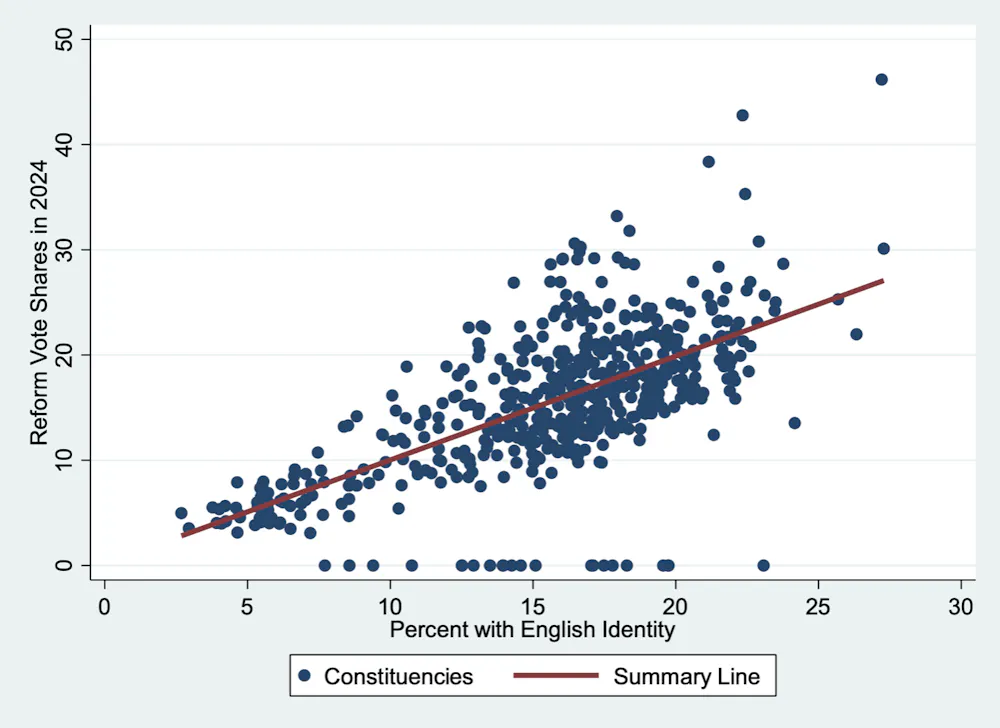
    Not all support for Reform came from protest voters, however. The chart below compares the percentage of Reform voters with those who identified as English in the 2021 census in England. There is a strong relationship between the two measures (a correlation of 0.66). The more English identifiers there are in a constituency, the greater support for Reform. In effect, Reform has become an English national party.

    The relationship between Reform voting and English identity in 2024

    An English national party in the making.
    P Whiteley, CC BY-ND

    National identities can change over time, but the process of change is slow. There has been a growth in “Englishness” at the expense of “Britishness” over time and this is undoubtedly reinforcing support for Reform.

    It means the party has a relatively solid base of supporters to rely on in future elections. While the row between the party’s leader and one of his MPs could play out in any number of different directions at this early stage, it would be wrong to suggest that Reform isn’t thinking big picture and long term.

    Farage has clearly learnt from his past and will not let his current party disintegrate into chaos like UKIP or the Brexit party before it.

    Paul Whiteley has received funding from the British Academy and the ESRC.

    ref. Two charts that explain why Reform isn’t being dented by its scandals – https://theconversation.com/two-charts-that-explain-why-reform-isnt-being-dented-by-its-scandals-252201

    MIL OSI – Global Reports

  • MIL-OSI Global: Keir Starmer to abolish NHS England – the pros and cons

    Source: The Conversation – UK – By Peter Sivey, Reader in Health Economics, Centre for Health Economics, University of York

    The UK government has announced the abolition of NHS England, phased over two years. In practice, this will involve merging some functions and staff from NHS England into the Department for Health and Social Care (DHSC). As part of the change, the government has stated that it expects to reduce duplication and save hundreds of millions of pounds.

    NHS England was established under the Health and Social Care Act of 2012 (the Lansley reforms) and is responsible for commissioning care and overseeing the day-to-day running of the NHS. This involves negotiating budgets for local care provision with bodies like integrated care boards and hospitals; performance management such as monitoring waiting times and quality measures; and implementing national initiatives across NHS organisations.

    NHS England was established to provide operational autonomy, shielding the health service from daily political interference. It is an “arm’s-length body”, meaning it operates independently from the government but remains accountable to it. The DHSC sets strategic goals and oversees NHS England activities.

    In practice, NHS England and DHSC have distinct roles, although they overlap in some areas. DHSC staff typically have broader policy expertise – for example, many have worked in other areas of the civil service, whereas NHS England staff often have more detailed knowledge of how the NHS works on the ground.

    Risks

    The loss of expertise within NHS England is probably the largest risk of the abolition. Alongside very experienced NHS managers and analysts, NHS England employs senior doctors and other health care workers who contribute valuable practical knowledge from the NHS frontline into policy roles.

    A major risk of this move is the potential loss of this clinical expertise and operational insight into policymaking. Lord Darzi’s report on the NHS specifically cited the loss in management talent that occurred as a result of the 2012 reforms, and cautioned against further reorganisation that might repeat that disruption.

    Another risk is that bringing NHS England functions directly under ministerial control risks increased politicisation of day-to-day NHS management.

    The government will argue that other policy areas like defence, education and policing do not have such a large arm’s-length body between the department and the frontline. However, health and social care is a uniquely large (11% of GDP) and highly political organisation, with a fast-growing budget and faster-growing challenges.

    NHS policy is already highly politicised, but abolishing NHS England risks the DHSC and the ministers being on the hook for every operational decision. This could lead to operational decisions being made to appease public opinion rather than promoting public health.

    The government faces significant practical challenges in merging two organisations with different cultures, working practices and pay structures. Currently, NHS England (about 16,000 staff) is much larger than DHSC (about 3,000 staff). Many NHS England roles will have to move into the much smaller DHSC.

    The transition itself will require investment, so the promised savings are unlikely to be achieved in the short term.

    Opportunities

    The main opportunity of the abolition is the removal of duplication between DHSC and NHS England.

    Currently, both organisations maintain separate policy teams covering similar areas – for example, elective surgery waiting times or cancer care. And sometimes, it is unclear how well they work together or why both are necessary.

    By consolidating within the DHSC, there is an opportunity to strengthen policy analysis. With one strong policy team in the DHSC, policy advice to ministers (DHSC) and policy implementation on the ground (previously NHS England) could be better coordinated and aligned with the government’s objectives.

    Lord Darzi’s report on the NHS highlighted the growth of regulatory roles within NHS England, questioning whether too much accountability could be counterproductive.

    The abolition of NHS England is also an opportunity to streamline regulation while strengthening local management roles and valuable policy analysis.

    Another opportunity from the abolition of the organisation would be the strengthening of local NHS bodies like integrated care boards. These local bodies, designed to tailor healthcare to local area needs, may sometimes have been stymied by excessive central control.

    The health secretary, Wes Streeting, has already expressed his desire to see more devolution of power and responsibility within the NHS. This process provides the opportunity to enact that promise.

    What will happen next?

    The abolition of NHS England and the transfer of some responsibilities back to the DHSC will take time and incur significant costs and disruption. Any benefits are likely to emerge only in the long term.

    Before the introduction of NHS England, there were larger regional organisations (strategic health authorities) that were responsible for implementing policy at a regional level. Perhaps the re-emergence of similar regional bodies could smooth the transition from a central NHS England to a more decentralised health service.

    Peter Sivey receives funding from the National Institute for Health and Care Research.

    ref. Keir Starmer to abolish NHS England – the pros and cons – https://theconversation.com/keir-starmer-to-abolish-nhs-england-the-pros-and-cons-252237

    MIL OSI – Global Reports

  • MIL-OSI United Kingdom: Improving communities’ mental wellbeing

    Source: Scottish Government

    £30 million for grassroots projects for adults

    Community-led mental health and wellbeing projects are to benefit from £30 million Scottish Government funding over the next two years.

    The Communities Mental Health and Wellbeing Fund for Adults – first launched in 2021 – supports local groups to deliver programmes for adults which build resilience and tackle social isolation, loneliness and mental health inequalities. It is expected the Fund will open to applications this Autumn.

    In the first three years around 4,800 grants were made to a wide range of grassroots community projects focused on connecting people and providing peer support through activities such as sport, outdoor activities, and the arts.

    The charity, Empower Women for Change, has secured grant awards in all rounds of the Fund to date. This year, the group is using its grant to support lone parents, families with a disabled family member, Minority Ethnic families, and young mothers. Visiting their office in Glasgow Mental Wellbeing Minister Maree Todd said:  

    “I am pleased to meet staff and service users at Empower Women for Change and hear more about the valuable work they do in the community they support. It is inspiring to see first-hand the impact that this funding can have.

    “Since the fund was established, we have invested £66 million, reaching a variety of groups supporting those at increased risk of poor mental health and wellbeing – including people facing socio-economic disadvantage, older people and ethnic minority communities. I look forward to seeing the positive impact that this further £30 million investment will make to the wellbeing of people and communities across Scotland.”

    Empower Women for Change CEO and Founder Asma Abdalla said:

    “We are delighted and honoured to welcome the Minister Maree Todd to our organisation. The Wellbeing Fund has played a transformative role in improving the lives of our service users of ethnic minority women and girls and our volunteers, members, and staff.

    “Through our Inspired Women projects, we have provided vital mental health support, resilience, and community connection, changing lives and strengthening communities. We are looking forward to continuing this work, with support from the Wellbeing Fund.

    “We welcome this unique opportunity to share Inspired Women participants’ testimonies, their voices highlight the urgent need for sustained investment in grassroots wellbeing services. Please join us in amplifying their stories and celebrating the power of community-led change.”

    Partnership Manager at Glasgow Council for the Voluntary Sector Sheena Arthur said:

    “We are delighted that the Scottish Government’s Communities Mental Health and Wellbeing Fund is continuing. This fund delivers small grants which make a positive difference and so far, has supported over 900 Third Sector organisations and community groups across Glasgow.

    “In increasingly challenging times, the Third Sector plays a crucial role. This fund enables the development of existing projects as well as emerging ideas from the community. It helps to bring people together- contributing to better health and wellbeing of people and families, strengthening social connections and tackling inequality and poverty.”

    Background

    Within the first three years, the Communities Mental Health and Wellbeing Fund for Adults has provided around 4,800 grants to community organisations delivering mental health and wellbeing support.

    Wellbeing and prevention – Mental health – gov.scot

    Empower Women for Change

    MIL OSI United Kingdom

  • MIL-OSI United Kingdom: Sustainability support for universities

    Source: Scottish Government

    Further £10 million for Scottish Funding Council to support the sector.

    Additional support will be made available through the Scottish Funding Council (SFC) to support universities facing financial challenges.

    Education Secretary Jenny Gilruth said an additional £10 million will be provided to the SFC to support higher education institutions such as the University of Dundee as they navigate current financial challenges.

    It brings total additional support for the sector from the Scottish Government to £25 million, on top of the £1.1 billion in the 2025-26 budget for university teaching and research.

    The Scottish Government will convene a range of expertise from across the higher education sector, government, and Dundee City Region to support the University of Dundee while it develops its Financial Recovery Plan. This is in addition to work already underway by the SFC, which engages closely with universities on financial sustainability.

    Ms Gilruth said:

    “The Scottish Government is providing an additional £10 million support package to assist universities such as Dundee with navigating immediate financial challenges. This is on top of the £15 million of extra support previously announced for the sector in February.

    “Ministers have held further meetings with the University of Dundee, unions and the Scottish Funding Council this week, building on the extensive engagement that has already taken place with the institution since financial issues came to light.

    “Both the Higher Education Minister and I have conveyed our deep concern at the level of job losses currently being discussed at the University. While the University is an autonomous institution, it is our clear expectation that the University’s leadership works with us, and engages fully with staff and trade unions, to explore all options to protect jobs.

    “Work will continue in the coming days to convene the right range of expertise from across government, the sector, and the wider city region to support the institution as it continues to develop its Financial Recovery Plan.

    “Scotland’s universities play a pivotal role in the economy and wider society, and they must be supported to thrive into the future. This support package is another clear sign of the Scottish Government’s commitment to support the sector with financial challenges – challenges which have been compounded by UK Government policies on migration and employer National Insurance contributions.” 

    Chief Executive of Scottish Funding Council Francesca Osowska said:

    “We welcome Scottish Ministers’ continued commitment to the tertiary sector and confirmation of this additional funding. Recognising the particular challenges facing the University of Dundee, we look forward to engaging with a wide range of partners to secure its continued success as a world-renowned University delivering excellent outcomes for learners and researchers and contributing to economic growth and social wellbeing.”

    Background

    The additional £10 million capital funding has been identified from within the education portfolio.

    The Scottish Government has put forward proposals for a Scottish Graduate Visa and the First Minister wrote to the UK Government in January seeking clarity on changes to employers National Insurance contributions.

    MIL OSI United Kingdom

  • MIL-OSI United Kingdom: Martyn Oliver’s speech at the ASCL Annual Conference

    Source: United Kingdom – Government Statements

    Speech

    Martyn Oliver’s speech at the ASCL Annual Conference

    Sir Martyn Oliver, Ofsted’s Chief Inspector, spoke at the 2025 Association of School and College Leaders (ASCL) Annual Conference in Liverpool.

    Hello, and thank you so much for inviting me back to speak to you again.

    You may recall that I gave my first major speech as Chief Inspector here last year.

    It’s also great to be back as ASCL was my union for nearly 2 decades prior to taking on this role.

    Last year, I told you that I wanted “Ofsted to be a modern, world-class inspectorate and regulator – fit for purpose and also trusted by parents, by children and by you, the sectors we work with”.

    And I told you that I needed your help to do that.

    And that has not changed. I still have incredibly high ambitions for Ofsted, and I still need your help.

    But it has been a whirlwind year, and a lot has changed.

    The Big Listen, which I launched at last year’s conference, heard from tens of thousands of people, including many of you.

    We heard your voices, we responded in full, and we are acting.

    We’ve had a change in government since I last stood on this stage. And that too has brought changes, not least the abolition of the overall effectiveness grades and the expected reforms in the Children’s Wellbeing and Schools Bill.

    And we’ve made changes where we can:

    • we’ve brought in mental health awareness training
    • we reformed how we handle complaints
    • we developed our inspection pausing policy
    • we dropped deep dives in ungraded inspections
    • we’ve launched the Ofsted Academy
    • we’ve established external reference groups to offer independent advice and challenge
    • and many more changes

    These changes are important, and I know they have made a real difference to you.

    ASCL and some of you individually have been kind enough to share some really positive feedback about these changes and how these have impacted your work.

    But they have often been changes made to tackle specific challenges or issues.

    Which is why we are now consulting on a whole new approach to inspection.

    This will build on those things that were already working well, and on the interim reforms we have made, and of course on everything we heard in the Big Listen.

    I hope it too will make a real positive difference to all of you. But, as before, I need your help.

    And while the consultation, by the nature of such an exercise, mostly talks about the details of the framework, it is the methodology of inspection which will make the biggest impact.

    Which will build on the improvements you’ve seen in the last year.

    And which will ultimately reduce the pressure I know that you feel.

    New approach

    I have heard from some of you already. I know some of you have concerns about what we’re proposing. But I also know some of you are really positive about the changes.

    All I ask is that you give it proper consideration and take part in the consultation.

    I know that might be a big ask. I’ve been a deputy head, a head, and a MAT leader. I know how busy you are.

    But it’s really important that we hear from serving practitioners like you. People who are out there every day, doing the real and vital work of educating children.

    I hope that you will find that what we’re proposing is helpful, supportive, and intuitive.

    That it will reduce pressure on you, improve the information we give to families and to government, and support you to drive ever higher standards for children.

    But I’m sure you will also see things that we haven’t. Things that we may have missed or that could be clearer or stronger, or tighter or firmer.

    So please take part. Make sure we get an accountability system that is better for you, better for parents, and most importantly better for children.

    Because I know we can all agree that must be our top priority. We’re all on the same side, and all working towards the same goal. We all work for children.

    Report cards

    Perhaps understandably, our proposed report cards have gained a lot of the media attention so far.

    Much of the discussion has been encouraging. We’ve had thoughtful contributions. We’ve had support and we’ve had suggestions for improvements.

    I was particularly gratified by the support we had from parents. Schools Week commissioned a poll which told us that nearly two thirds of parents prefer this new approach and over 80% said they found it easy to understand.

    But we have also heard a small number of rather surprising responses. Responses seemingly built on a misunderstanding of what report cards are.

    So, I do want to be clear here today.

    Report cards are not and never were going to bring about the end of grading.

    They are not and never were going to sacrifice the much needed clarity for parents.

    And they are not and never were going to be about less accountability.

    You know, and I know, that we need a way of reporting that is reliable, clear and accessible.

    That informs government, that informs parents, and that helps you in your efforts to always do better for children.

    I believe our proposed report cards will do that. They will bring about better, more helpful, more nuanced, more detailed, and more precise accountability. They are about recognising strengths and being honest about weaknesses.

    Anyone who thought that report cards were going to be an end to assessment was mistaken. And they weren’t paying close enough attention to what parents want, what politicians promised, and what children deserve.

    They only get one childhood, one chance. Making sure we are getting it right, and striving for better every day, is not just important, it is absolutely vital.

    I’m sorry if that’s blunt. But I don’t believe in dodging the difficult.

    I hope what I’ve said is obvious to you, as it is to most people.

    But the most vocal critics of the proposed reforms seem to be under the misapprehension that a new low-accountability system is possible.

    It isn’t.

    Ofsted will always put children and their parents first – just as you all do, every day of your careers.

    We can, however, move from low-quality information and high-stakes inspection to a much richer, more nuanced set of information and sensible, supportive and proportionate accountability.

    I am delighted that the DfE has put out their consultation on accountability alongside our consultation – please do look at both, and if possible, complete, both.

    Our proposed grades

    If we can agree on that, then I hope you will also be able to see what we are trying to achieve with our proposed report cards.

    Of course, our top priority has to be giving parents and families the information they need in a clear and accessible way.

    That’s not a nice-to-have for them, it’s a must have.

    But I also believe we have designed them in a way that will help you.

    First and foremost, they are truly the end of the blunt overall effectiveness grades. Because they were not working. They hid strengths and weaknesses alike.

    So, we are proposing that we will instead grade and report on a wide range of evaluation areas. And we are proposing 5 new grades.

    There will be ‘causing concern’ for when something just isn’t good enough.

    There will be ‘attention needed’ when something needs focus from you.

    There will be ‘secure’, for where you are performing well and consistently.

    There will be ‘strong’, for where you are exceeding expectations.

    And there will be ‘exemplary’ for the truly exceptional practice worthy of being highlighted as something for others to learn from.

    I know there are some who want a system without grades. But Ofsted is not there to just divide schools into those who are meeting a minimum set of standards and those who aren’t.

    That wouldn’t be right, and that wouldn’t be fair.

    I know this because I have worked in schools at all levels and all grades. Some of the best and some of the worst schools in the country. And none of them would have been served by a met/not met system.

    Even the weakest had strengths worth noting. And even the strongest had things that I know that they needed to work on.

    Our proposed system recognises this complexity. It recognises that you can be doing great work and still have things to improve. And it recognises that you can need to improve and still have things worth celebrating.

    The alternative, that wouldn’t be fair.

    It wouldn’t be fair to those who fall below the line. Their strengths would be hidden or ignored. And they wouldn’t get the detailed feedback and subsequent support that they need.

    And it wouldn’t be fair to those above the line either. They deserve more than a tick in a box. They deserve to have the things they do well celebrated and perhaps even held up for others to learn from.

    But they also shouldn’t miss out on the benefit of an independent and expert viewpoint on what they could work on to be even better.

    It especially wouldn’t be fair to those on the edge. Imagine the pressure of a pass or fail distinction for them. For me, that doesn’t bear thinking about.

    And of course, it wouldn’t be fair to parents. They told us in the Big Listen, incredibly clearly, that they want a broad evaluative approach with clear reporting on what their child’s school is doing well and what it needs to work on.

    ‘This school is good enough’ is not something any parent wants to hear. I know it’s not something any of you would want to tell your communities either.

    I know you would much rather celebrate your successes with them and bring them with you on your improvement journeys.

    We see daily examples of people celebrating their grades, grateful that their hard work has been recognised. I would never want to lose that side of what we do.

    Our proposed evaluation areas

    So, we will grade. And we will grade on a range of evaluation areas, allowing for more detail and nuance than the current 4 or 5 sub-judgements.

    We’re proposing to evaluate many of the areas that you at ASCL suggested in your Blueprint for a Fairer Education System.

    You suggested a ‘balanced scorecard’ with measures including ‘pupil outcomes’, ‘curriculum provision’, ‘staff development’, and ‘inclusion.’ That is exactly what we are proposing.

    I’m particularly proud that we are proposing an evaluation area for inclusion, and that we’re threading inclusion through all other areas.

    As I said at this conference last year, and regularly since: “If you get it right for the most disadvantaged, you get it right for everyone.”

    Our proposals will put that sentiment at the heart of everything we do.

    Because there’s so much to applaud about England’s schools. About the work you all do every single day. But we have to recognise that there continue to be some children for whom it doesn’t work.

    Some who are the most disadvantaged and most vulnerable. Some children with SEND. Some children who don’t feel like they belong in our schools.

    We are ahead of many countries in many ways, but until we make sure that high performance delivers for every child, there will still be work to do.

    I hope our proposals around inclusion will accelerate these efforts for those who need our help the most.

    So, we are proposing to report on inclusion, and on curriculum. On achievement and on developing teaching. On a full range of areas covering all of your work.

    And I believe that this approach will allow you, and parents, to really see the detail of what you’re doing well, where you can improve, and perhaps, where your practice is truly exceptional.

    By breaking down what we’ve seen into more areas and a broader spectrum of grades, we can be more positive about the great things you’re doing, and clearer about anything that might need work or support.

    Context and consistency

    Of course, the proposals are not just about how we report. That’s just one part of the proposed new approach.

    And as I’ve said, I believe this approach will reduce pressure on you, as well as better inform parents and drive ever higher standards.

    A big part of that is by doing far more to take your context into account. We know that your schools don’t operate in bubbles.

    You will all have a unique set of challenges and opportunities based on the community you serve, on local economic factors, on access to services, on the availability of high-quality staff, and on hundreds of other things.

    We will recognise that and what you have been able to achieve in spite of or because of those factors.

    What’s more, you will be both reliant on and benefit from the relationships that you have. Relationships with other schools, with nurseries, with local authorities, with trusts, with alternative provision, and with many other agencies and contractors.

    Some of these will be positive and productive, some maybe less so. Again, we will recognise that, we will consider it as part of your context, and place accountability where it truly lies.

    ASCL’s Blueprint for a Fairer Education System called for an “accountability system [that] recognises the different contexts in which different schools and colleges operate”.

    Again, that is exactly what we’re proposing.

    Of course, we need to be careful in how we do this. We need to make sure we don’t lower standards for the most disadvantaged.

    And we need to balance context with consistency. We know we can and must do more to maintain consistency.

    But that cannot be through a tick box system that serves nobody. We need consistency in a way that also understands your individuality.

    Consistency does not mean an identical approach to every type of provider in every corner of the country. That too would serve nobody.

    I believe that what we are proposing strikes the right balance. It acknowledges and celebrates the rich variety of education in England.

    It tailors our approach both to what sort of provision you offer, but also the circumstances in which you are doing that.

    But it will also deliver a reliable and consistent approach that you, that government, and that parents can have faith in.

    But again, we will need your help, through the consultation.

    Transparency

    A big part of how we are proposing to do this is by being more transparent in everything that we do. That starts by being clearer about when we announce an inspection and the type of inspection you will receive.

    Routine notification calls will all continue to be made on Mondays, and there will now be only a single type of inspection.

    But transparency also extends to what we will look at on inspection.

    We are proposing new toolkits that clearly set out the standards for every grade in every evaluation area. These are bespoke to each type of education, so there’s one tailored to schools like you.

    I hope, by spelling out in more detail what each standard entails, we will remove any mystery or guesswork on your part.

    You should be able to read and understand each standard in exactly the same way as my inspectors.

    We want inspection to be a collaborative dialogue on an equal footing. We want you and our inspectors to be able to openly discuss where you are and where you’re heading.

    And we want to do that with a shared conception of what high-quality provision looks like.

    But please be reassured that we will not be going through everything line-by-line or ticking things off one-by-one.

    Once our inspectors are assured that you’re meeting a secure standard, they will let you know and move on.

    Please also be reassured, that nothing in these standards should be a surprise or require extra work from you.

    I don’t want you to be doing anything ‘for Ofsted’.

    We have based them firmly around the existing professional standards and expectations that you are already working to. The statutory and non-statutory guidance that underpins your work. The professional standards you qualified at.

    I hope that you will find nothing in there that you are not already doing, or at least aspire to be doing.

    Or to put it another way, I hope there’s nothing in there that you would just stop doing if we didn’t exist.

    More supportive

    We also want to do more to support improvement where it is needed, and work with you to deliver it.

    A big part of this will be through quicker and more iterative monitoring visits.

    If something needs attention, we will come back more quickly to check on progress and make sure you aren’t stuck with a grade that no longer reflects your school.

    I know the thought of inspectors coming back might be the last thing you want after an inspection, but I also know how helpful monitoring visits can be.

    I had several when I was running schools. Ofsted came with support and expertise, to make sure we had a realistic, precise and ambitious improvement plan and to check our progress.

    Because ultimately, we were all there for the same reason – to make sure we did the best for children, as quickly as we could.

    That is the spirit in which these visits will operate. Collaborative and open discussions about the progress you’re making, and any work still to do.

    We always want to improve

    Just as we want to help you improve, we want your help to improve too.

    We are already testing the proposed approach, identifying what works, and learning lessons.

    And we are already hearing feedback from those tests.

    I’m happy to hear both inspectors and leaders report that they found the new approach to be more flexible and more collaborative. And that we are able to get a better understanding of the school, while being less disruptive to you, your teachers, and your children.

    But we are also hearing that we have more to do on defining the differences between grades, particularly between secure and strong, so that work has begun too.

    This testing will continue, as will our work to resolve problems and improve the proposals.

    I want to give a big thank you to everyone who volunteered to help with these tests, including your president, past president, and some of you in the audience.

    But we also need all of your help. So please take part in the consultation before it closes on 28th April.

    This is a genuine chance to help develop the best approach to inspection for you, for families, and for children.

    Please don’t miss that chance.

    I don’t expect you to like absolutely everything we’re proposing.

    No accountability system can be perfect for all those it inspects and those it serves.

    Sometimes we have to balance what might be preferable for you against what is crucial for children and families.

    But I believe we are close to a system that reduces the pressure on you, improves the reporting we give to families, and focuses on what really matters to drive higher standards for every child.

    And with your help, I think we can get there.

    So, if you think something could be improved, please let us know.

    If you think we are missing something or need to go further, tell us.

    Perhaps you think you could help us even more by becoming an Ofsted Inspector and being a part of this new approach? Do it!

    But whatever you do, don’t just stand by. Take part.

    Thank you.

    Updates to this page

    Published 14 March 2025

    MIL OSI United Kingdom

  • MIL-OSI United Kingdom: Insolvency and Fair Competition

    Source: United Kingdom – Government Statements

    Press release

    Insolvency and Fair Competition

    At a recent public inquiry, Traffic Commissioner for the West of England, Kevin Rooney refused PHS Group SW Ltd’s application for a restricted goods vehicle operator’s licence, citing serious concerns over fair competition and tax compliance.

    The application sought authorisation for fifteen vehicles to support the company’s tool and plant hire operations. However, investigations revealed significant overlaps between PHS Group SW Ltd and the recently insolvent Purple Hire Solutions Ltd, including shared business addresses, contact details, operating centres, and familial ties among directors.

    Notably, Purple Hire Solutions Ltd had substantial unpaid tax liabilities, with a shortfall to HM Revenue and Customs (HMRC) amounting to £818,253. The company had previously prioritised payments to suppliers over settling its obligations to the public purse, a practice that undermines fair competition and places compliant businesses at a disadvantage.

    Commissioner Rooney also noted that Purple Hire Solutions Ltd was itself granted at a hearing following the insolvency of YHC Hire Services Ltd with a deficiency of £7.3 Million. Of that, £5.2 Million was expected to be novated to Purple Hire Solutions Ltd leaving £2.1 Million of which £680,000 was owed to the public purse.

    The commissioner emphasised that such practices not only violate legal obligations but also erode the integrity of the industry by allowing entities to operate without fulfilling their tax responsibilities. This behaviour distorts the competitive landscape, disadvantaging businesses that adhere to fiscal and regulatory requirements.

    Commissioner Rooney said “The Parker family business has gained liquidity to the sum of £1.5 Million at the expense of the UK taxpayer. That is clear unfair competition and makes the applicant unfit to hold a restricted goods vehicle operator’s licence. For the avoidance of doubt, it would also fail to establish good repute.”

    In light of these findings, the Traffic Commissioner concluded that PHS Group SW Ltd failed to meet the mandatory requirements of fitness to hold a restricted goods vehicle operator’s licence, leading to the refusal of their application.

    This decision underscores the commitment of regulatory authorities to uphold fair competition, maintaining a level playing field within the industry. Further information can be found here.

    Updates to this page

    Published 14 March 2025

    MIL OSI United Kingdom

  • MIL-OSI United Kingdom: First uncrewed mine countermeasures vessel delivered to UK Royal Navy, supporting British jobs and boosting British security

    Source: United Kingdom – Government Statements

    Press release

    First uncrewed mine countermeasures vessel delivered to UK Royal Navy, supporting British jobs and boosting British security

    British defence jobs have been boosted and British sailors will be better protected following delivery of the first end-to-end autonomous UK mine hunting vessel, known as ‘Ariadne’, which will boost as Royal Navy capabilities.

    • UK’s first vessel for detecting and destroying sea mines has been delivered to the Royal Navy.  

    • More than 200 UK jobs have been supported through the investment with Thales UK and its supply chain.   

    • The new technology enables mines to be detected rapidly and eliminates the need for sailors to enter dangerous mined areas.  

    British defence jobs have been boosted and British sailors will be better protected following delivery of the first end-to-end autonomous UK mine hunting vessel, known as ‘Ariadne’, which will boost as Royal Navy capabilities.  

    The vessel was designed and manufactured in the UK under a £184 million deal with Thales UK, which supports more than 200 jobs across Somerset, Plymouth, Portsmouth, and Scotland. This represents another example of the government delivering on its Plan for Change, by supporting jobs, boosting economic growth, whilst improving the UK’s defence capabilities.  

    The autonomous system, which includes the Unmanned Surface Vessel (USV) RNMB ARIADNE, enables the Royal Navy to locate and destroy sea mines faster and more efficiently, without putting personnel at risk.  

    RNMB ARIADNE is 12 metres long, the same size as an average bus, and can be deployed from a harbour or mother ship to hunt the seabed for mines using the Thales TSAM system, one of the world’s most sophisticated towed sonars. It is likely to be used both at home and overseas.  

    This announcement comes following the Prime Minister’s commitment to increase defence spending to 2.5% of GDP from 2027, with a clear ambition to hit 3% of GDP in the next Parliament.   

    Minister for Defence Procurement and Industry, Rt Hon Maria Eagle MP, said: 

    This delivery marks a significant milestone in our mine-hunting capabilities and the autonomous technology will keep Britain and our Royal Navy sailors safer by identifying & removing mines.   

    It has also supported hundreds of skilled jobs across UK industry – a clear demonstration that defence is an engine for economic growth.

    The programme forms part of a joint UK-France initiative with a total contract value of £361 million, managed by the Organisation for Joint Armament Co-operation (OCCAR).  

    The delivery is part of the Defence Equipment and Support (DE&S)-led Mine Hunting Capability Programme, which aims to transition from conventional Mine Counter Measures Vessels to Maritime Autonomous Systems.  

    Rear Admiral Steve McCarthy, Director of Maritime Environment at DE&S, said:  

    This is a significant first delivery for the Royal Navy and is a proud moment for all those involved in bringing this transformative capability into service. This project contributes to the growth and prosperity of our nation and will strengthen UK security through enhanced maritime operations.  

    Following successful trials of the prototype vessel RNMB APOLLO in the Firth of Clyde in September 2024, Royal Navy personnel will now undertake training with Thales’ support before conducting a thorough Operational Evaluation and beginning to deploy MMCM systems on active duty.  

    Phil Siveter, CEO of Thales in the UK, said: 

    We are incredibly proud to deliver this world-first autonomous mine hunting system to the UK Royal Navy. With the introduction of AI and advanced sensor technology, this innovation represents a new era in maritime defence technology and demonstrates our unwavering commitment to providing cutting-edge solutions that enhance the capabilities of our defence forces. The Royal Navy will now have a powerful tool to safeguard national interests and maintain security at sea.  

    The Royal Navy plans to gradually phase out conventional crewed mine hunting vessels as additional autonomous systems are delivered over the next five years or so. This transition represents a fundamental shift in naval operations, creating additional skilled employment opportunities in the maritime technology sector while establishing the UK as a leader in autonomous maritime systems.

    Updates to this page

    Published 14 March 2025

    MIL OSI United Kingdom

  • MIL-OSI United Kingdom: South West Water legal challenge to reduce charges fails

    Source: United Kingdom – Government Statements

    Press release

    South West Water legal challenge to reduce charges fails

    The water company tried to have 12 charges against it for sewage spills from two sewage pumping stations in Cornwall dropped.

    The charges relate to alleged offences between 2016 and 2021 at two sewage pumping stations.

    The Environment Agency has won a case against South West Water which tried to prevent 12 charges relating to sewage discharges in Cornwall being taken forward in an impending prosecution. 

    South West Water had launched an abuse of process case against the agency, but District Judge Matson gave a written judgment on Friday 7 March against the company following a hearing held at Plymouth Magistrates’ Court in January. 

    Clarissa Newell of the Environment Agency said:  

    We are a firm but fair regulator which takes pride in knowing our work protects the environment. South West Water’s attempt to cut down the number of charges we intend to prosecute it with only benefits the water company and we would rather see its effort spent on compliance.  

    Our duty is to hold those suspected of harming the environment to account and now this hurdle has been overcome we will proceed with our legal action.

    The charges relate to alleged offences between 2016 and 2021 at both the Harlyn and Holywell sewage pumping stations for sewage discharges outside of the company’s environmental permits.  

    The company argued the charges should be dropped claiming that the agency had acted contrary to its own policy of consistency, saying data had been treated differently from other water companies’ data. They also said that the installation and collection of environmental data monitoring (EDM) equipment that the company was required by the agency to use was inconsistent with agency policies. 

    But the agency successfully argued that it had called for the EDM equipment to be installed at the two sites as they were close to bathing waters which could be affected by sewage spills. 

    The agency also maintained that South West Water did not fully understand its sewage pumping station assets or the permitting process and relevant policies relating to them. 

    There was no evidence, said the agency, that EDM coverage did not meet Environment Agency polices and so was not inconsistent.   

    South West Water will appear in court at a date yet to be fixed to give its plea to the charges and for a full hearing on the case. 

    Background

    The charges: 

    1. That you from 1 January 2016 to 31 December 2016 at Harlyn Sewage Pumping Station, Cornwall, otherwise than in accordance with an environmental permit, caused a number of water discharge activities, namely discharges into the Harlyn Stream. Contrary to Regulations 12(1)(b) and 38(1)(a) Environmental Permitting (England and Wales) Regulations 2010.  

    2. That you from 1 January 2017 to 31 December 2017 at Harlyn Sewage Pumping Station, Cornwall, otherwise than in accordance with an environmental permit, caused a number of water discharge activities, namely discharges into the Harlyn Stream. Contrary to Regulations 12(1)(b) and 38(1)(a) Environmental Permitting (England and Wales) Regulations 2016.  

    3. That you from 1 January 2018 to 31 December 2018 at Harlyn Sewage Pumping Station, Cornwall, otherwise than in accordance with an environmental permit, caused a number of water discharge activities, namely discharges into the Harlyn Stream. Contrary to Regulations 12(1)(b) and 38(1)(a) Environmental Permitting (England and Wales) Regulations 2016.  

    4. That you from 1 January 2019 to 31 December 2019 at Harlyn Sewage Pumping Station, Cornwall, otherwise than in accordance with an environmental permit, caused a number of water discharge activities, namely discharges into the Harlyn Stream. Contrary to Regulations 12(1)(b) and 38(1)(a) Environmental Permitting (England and Wales) Regulations 2016.  

    5. That you from 1 January 2020 to 31 December 2020 at Harlyn Sewage Pumping Station, Cornwall, otherwise than in accordance with an environmental permit, caused a number of water discharge activities, namely discharges into the Harlyn Stream. Contrary to Regulations 12(1)(b) and 38(1)(a) Environmental Permitting (England and Wales) Regulations 2016.  

    6. That you from 1 January 2021 to 31 December 2021 at Harlyn Sewage Pumping Station, Cornwall, otherwise than in accordance with an environmental permit, caused a number of water discharge activities, namely discharges into the Harlyn Stream. Contrary to Regulations 12(1)(b) and 38(1)(a) Environmental Permitting (England and Wales) Regulations 2016. 

    7. That you from 1 January 2016 to 31 December 2016 at Holywell Sewage Pumping Station, Cornwall, otherwise than in accordance with an environmental permit, caused a number of water discharge activities, namely discharges into an unnamed stream that flows onto Holywell Bay Beach. Contrary to Regulations 12(1)(b) and 38(1)(a) Environmental Permitting (England and Wales) Regulations 2010.  

    8. That you from 1 January 2017 to 31 December 2017 at Holywell Sewage Pumping Station, Cornwall, otherwise than in accordance with an environmental permit, caused a number of water discharge activities, namely discharges into an unnamed stream that flows onto Holywell Bay Beach. Contrary to Regulations 12(1)(b) and 38(1)(a) Environmental Permitting (England and Wales) Regulations 2016.  

    9. That you from 1 January 2018 to 31 December 2018 at Holywell Sewage Pumping Station, Cornwall, otherwise than in accordance with an environmental permit, caused a number of water discharge activities, namely discharges into an unnamed stream that flows onto Holywell Bay Beach. Contrary to Regulations 12(1)(b) and 38(1)(a) Environmental Permitting (England and Wales) Regulations 2016.  

    10. That you from 1 January 2019 to 31 December 2019 at Holywell Sewage Pumping Station, Cornwall, otherwise than in accordance with an environmental permit, caused a number of water discharge activities, namely discharges into an unnamed stream that flows onto Holywell Bay Beach. Contrary to Regulations 12(1)(b) and 38(1)(a) Environmental Permitting (England and Wales) Regulations 2016.  

    11. That you from 1 January 2020 to 31 December 2020 at Holywell Sewage Pumping Station, Cornwall, otherwise than in accordance with an environmental permit, caused a number of water discharge activities, namely discharges into an unnamed stream that flows onto Holywell Bay Beach. Contrary to Regulations 12(1)(b) and 38(1)(a) Environmental Permitting (England and Wales) Regulations 2016.  

    12. That you from 1 January 2021 to 31 December 2021 at Holywell Sewage Pumping Station, Cornwall, otherwise than in accordance with an environmental permit, caused a number of water discharge activities, namely discharges into an unnamed stream that flows onto Holywell Bay Beach. Contrary to Regulations 12(1)(b) and 38(1)(a) Environmental Permitting (England and Wales) Regulations 2016.

    Updates to this page

    Published 14 March 2025

    MIL OSI United Kingdom

  • MIL-OSI United Kingdom: Council leaders unite to raise awareness of social care careers

    Source: City of Portsmouth

    Council leaders from children and adult social care have joined forces during Social Work Week to highlight the rewarding careers in the sector.

    This initiative is part of a national campaign led by Social Work England, taking place from 17 – 21 March, aimed at raising awareness of the wide-ranging opportunities within the social care sector.

    Councillor Nick Dorrington, Cabinet Member for Children, Families and Education at Portsmouth City Council, said:

    “Social care practitioners support families across the city on a daily basis in a range of different roles. This makes for a dynamic and interesting career that will see you work with some of the more vulnerable people in society to enable change and improve outcomes.

    “We need more professionals who can step up and make a difference in Portsmouth. Social Work Week provides an opportunity to showcase the full range of jobs and the significant impact made by those who work within them.”

    Portsmouth City Council provides a range of opportunities for those wishing to take a step into the profession with extensive training and development pathways.

    This includes apprenticeships to upskill existing staff members as well as employment programmes such as the Assessed and Supported Year in Employment (ASYE) programme and the Step Up to Social Work scheme.

    Councillor Matthew Winnington, Cabinet Member for Community Wellbeing, Health and Care at Portsmouth City Council, added:

    “Through this national awareness campaign, we want to showcase the rewards and challenges of working in this sector.

    “Our hopes for the future in Portsmouth are centred on building a robust and resilient social care workforce. By attracting passionate and dedicated individuals to the profession, we can ensure that our community continues to flourish.”

    As part of the week, Foster Portsmouth, a council service that supports foster families in the city, will be celebrating their community and foster carers.

    The service will be encouraging people to start their fostering journey, providing information on the extensive local support networks provided by social workers and the other professionals who make up their ‘team around the child’, the application process and the financial assistance that is available.

    Careers in adult social care

    Adult social care is about supporting people to live their best lives possible, whether it’s providing a bit of help to get back on their feet after a fall or supporting them to keep their independence and stay in their home.

    Debbie Lucas, a social work apprentice at Portsmouth City Council said: “I feel lucky to be working in adult social care as a social work apprentice. It’s a brilliant job, working with people in a wide range of situations and settings within the community. Learning the skills to make a difference to people’s lives, there’s no better feeling.”

    If you want to make a difference, you can find out more about careers in social care on the Portsmouth City Council website at portsmouth.gov.uk/workincare.

    Careers in children’s social care 

    Social workers who support children, young people and their families provide a restorative approach using Portsmouth’s unique model of family practice.

    Liam Mills, an advanced social worker at Portsmouth City Council said: “We pride ourselves on being creative and relationship focused. I am enjoying my new role as an advanced social worker. It’s incredibly rewarding to be part of the conversation on improving our practice and fostering a culture of learning.”

    If you are an experienced social worker looking at your next steps, you can search for children social care jobs on the Stronger Futures website.

    Learn more about Foster Portsmouth

    Discover the team who support foster carers and the extensive range of services available.

    Claire Young, an experienced social worker in children’s social care at Portsmouth City Council said:

    “It is really rewarding to help people prepare to offer safe, happy, loving homes for the children we care for.”

    If you are interested in becoming a foster carer, visit the Foster Portsmouth website today.

    MIL OSI United Kingdom

  • MIL-OSI United Kingdom: Plymouth champions coastal community growth

    Source: City of Plymouth

    A new, major study aimed at revitalising Britain’s coastal communities was launched at Parliament this week, with representatives from Plymouth playing a pivotal role in its development.  

    On the Waterfront is groundbreaking research and was unveiled at an All-Party Parliamentary Group meeting by Key Cities. The report underscores the immense potential of coastal communities to drive national growth and calls for urgent investment and strategic focus. 

    Councillor Tudor Evans, Leader of Plymouth City Council and the portfolio lead for Coastal Communities and Ports for Key Cities, opened the launch event, he said: “This report is a game-changer and Plymouth, with its rich maritime heritage, is ready to lead the charge.  

    “Our coastal communities can be engines of creativity and growth, and it’s time we harness that potential. The strategies outlined in this report—focused on empowerment, protection, connection, and investment—are foundational to our success. I hope this serves as a clarion call for our new Government to act swiftly and decisively. 

    “As Britain’s Ocean City, Plymouth is at the forefront of this movement, ready to create a vibrant and sustainable future for all coastal communities.” 

    The report, was produced by the Key Cities Innovation Network, in collaboration with the Centre for Coastal Communities at the University of Plymouth and other universities across the country. It reveals the stark socioeconomic disparities faced by traditional coastal communities across the country. However, despite half a century of decline, these areas hold the key to economic resilience, social equity, and environmental stewardship. The message is in the report is clear; those living in coastal communities may have a different type of identity to that of the big-city dwellers, yet their livelihood remains just as important.  

    The event was attended by City Leaders, Parliamentarians, university leaders and stakeholders from across the Key Cities network, highlighting the growing ambition for the UK’s coastal communities. This includes a host of Plymouth representatives, including Councillor Evans, along with Professor Sheena Asthana and Professor Sheela Agarwal from the University of Plymouth, along with Councillor Jemima Laing, Councillor Rebecca Smith MP and Richard Allan, Harbour Master.  

    The report sets out 28 exciting recommendations to empower, protect, connect, and invest in coastal communities. These include engaging with coastal communities to innovate hyperlocal public services, coordinating policy through a Cross-Departmental Task Force, and establishing long-term funding streams for strategic development 

    Other recommendations focus on adopting inclusive definitions of coastal communities in official statistics, and reviewing funding allocation criteria to better reflect deprivation and opportunity. 

    Cllr John Merry, Chair of Key Cities and Deputy City Mayor of Salford, added: “The nature of many of our member cities is that while they have urban centres, they are inextricably connected with their surrounding area – the peri-urban, the rural, the coastal. Around half of our members have significant coastal areas and ports. 

    “At Key Cities we learn from each other, and there are insights in this report that are valuable to all places that seek to create successful and sustainable futures in the face of deep-rooted barriers and challenges. The reality for many of our traditional communities on the coast is that older people are less well-served in health and care, younger people lack opportunities, and investment in their future is impeded by climate threats and outdated funding rules. 

    “The coast can be a source of strength and inspiration underpinning our national renewal, but only if we confront its decline head on with a strategic approach to regeneration. This report offers a framework for doing so.” 

    Key Cities is a dynamic network of 27 urban centres across England and Wales, including Plymouth. The Key Cities Innovation Network brings together universities to develop innovative solutions for urban and coastal challenges. This collaboration aims to promote economic growth, social equity, and environmental sustainability by advocating for policies tailored to the unique needs of these communities. 

    See the full report.

    MIL OSI United Kingdom

  • MIL-OSI United Kingdom: ‘Get Moving Business Games’ put workplace wellbeing into action!

    Source: Northern Ireland City of Armagh

    The winning team from the Get Moving ABC Business Games, Tarasis Enterprises, pictured with Deputy Lord Mayor Councillor Kyle Savage.

    Our Get Moving ABC business partners swapped their desks, screens and to-do-lists for a morning of fun, games and a helping of healthy competition at our first ever Business Games at South Lake Leisure Centre.

    The event was hosted by Armagh City, Banbridge and Craigavon Borough Council’s Sports Development Team who deliver the council’s Get Moving ABC framework.

    Get Moving ABC is a borough-wide targeted initiative, with a collective effort by a range of local organisations and groups to motivate and support as many people as possible, to work towards and achieve the recommended physical activity levels.

    Speaking at the business games, Deputy Lord Mayor Councillor Kyle Savage said:

    “Get Moving ABC is about working together to make life better for people. It’s about creating the conditions for people to make well informed choices about their lifestyle and health. It’s about organisations across all sectors making the best use of resources to achieve this.

    “As a Get Moving ABC partner, these companies are committed to creating the conditions to support the health and wellbeing of their employees, with an emphasis on being physically active, which will undoubtedly benefit both employees and employers.”

    Six businesses participated in the business games – Ripple Creative, Tarasis Enterprises, Interface, Turkington Construction, Southern GP Referral Support Unit and IncredABLE.

    As a Get Moving ABC business partner, companies experience the benefits of joining a corporate indoor leisure membership scheme, receive support and guidance on the council’s Couch to 5K/10K programmes, receive guidance on signing up to an active travel scheme, collaborate with the NI Chest, Heart and Stroke ‘Live Well Work Well’ programme and much more!

    The Get Moving ABC Workplace Scheme is supported by the Southern Health and Social Care Trust, Sport NI, The Community and Voluntary Sector Panel, Public Health Agency, Education Authority, NI Chest Heart and Stroke, Ulster GAA and ABC Council.

    For more information on becoming a Get Moving ABC business, please contact Edel Ferson

    *protected email*

    MIL OSI United Kingdom

  • MIL-OSI United Kingdom: Council services update for St Patrick’s Day Bank Holiday

    Source: Northern Ireland – City of Derry

    Council services update for St Patrick’s Day Bank Holiday

    14 March 2025

    Derry City and Strabane District Council have reassured residents that many council services will remain undisrupted over the St Patrick’s Day Bank Holiday on Monday 17th March.

    Recycling Centres across the city and district will open with their usual opening hours on St Patrick’s Day. Residents are reminded that bin collections will also operate as normal on Monday 17th March.

    A number of Leisure Centres will close on St Patrick’s Day including Riversdale Leisure Centre, Melvin Sports Complex, Derg Valley Leisure Centre, Templemore Sports Complex, City Baths, Brooke Park Leisure & Sports Centre and Bishop’s Field. The Foyle Arena will operate as normal on Monday, 17th March.

    Cemeteries, Museums and Visitor Services will also run as normal with the Guildhall and the Tower Museum opening as usual on St Patrick’s Day. 

    The Registrar’s office in both Derry and Strabane will close on Monday 17th March, reopening as normal on Tuesday 18th March.

    Council’s dog wardens and kennels will be open as normal.

    Council offices on Strand Road, Derry and on Derry Road, Strabane will remain closed on Monday 17th March and reopen as normal on Tuesday 18th March.

    The Alley Theatre, Strabane will be open from 1pm until 4pm on St Patrick’s Day with entertainment for all the family. 

    For more information, please visit https://www.derrystrabane.com/services/opening-hours

    MIL OSI United Kingdom

  • MIL-OSI United Kingdom: Factory Girls unwrap special tribute artwork today

    Source: Northern Ireland – City of Derry

    Factory Girls unwrap special tribute artwork today

    13 March 2025

    Representatives of Derry’s Factory Girls had the honour today of unwrapping the new sculpture for the first time which will be the centrepiece of the public realm works currently underway at Harbour Square in the city.

    They joined the Mayor of Derry and Strabane, Councillor Lilian Seenoi Barr, and artist Chris Wilson who created the sculpture ‘Memory Lines’, a piece dedicated to the many generations of shirt factory workers who powered the city’s economy for over a century. The design is based on the shapes of spools of thread used in the shirt factories and the piece will be the focal point of the reimagined public realm area beside the Guildhall.

    The sculpture is supported by the Department for Communities and Derry City and Strabane District Council, as a key element of an exciting wider project that will transform Harbour Square, Custom House Street, Guildhall Street, Whittaker Street, and the Foyle Embankment and other parts of Derry’s city centre and riverfront area.

    An official opening event is planned in the coming weeks, with project partners, political representatives and the local community all invited to mark the completion of the Harbour Square works, and the long-awaited tribute to the factory workers.

    MIL OSI United Kingdom

  • MIL-OSI United Kingdom: Diverse team represents city in major energy conference

    Source: Scotland – City of Aberdeen

    A ‘Team Aberdeen’ of academics, students and energy business experts joined Aberdeen City Council representatives this week at the world’s premier energy conference in Houston.

    The Aberdeen delegation at the CERAWeek Conference comprised representatives  from the Council, including Council Co-leader Councillor Christian Allard, the Net Zero Technology Centre, Peterson Energy Logistics, Robert Gordon University, and the University of Aberdeen.

    Councillor Allard was present during two panel sessions at the conference and the diverse group worked to underline Aberdeen’s credentials as one of the world’s leading energy cities.

    Robert Gordon University student Lara Pedrosa, whose participation at the conference along with fellow Msc students Alex Sinclair and Erin Koon was made possible with the support of the SRM Foundation, said before the event:  “Absolutely thrilled to be part of the NEXTGen cohort.”

    “I’m looking forward to understanding how energy leaders are using data and AI to aid energy transition and what may be applicable to Aberdeen in its own journey.

    “I’m excited to engage with experts and academics from a range of disciplines centred around energy transition.  I am extremely grateful to the SRM Foundation and Robert Gordon University for creating this opportunity and supporting me throughout the week.”

    Councillor Allard said: “The world faces the pressing challenges of climate change and the need for sustainable and secure energy solutions. The importance of collaboration in the energy transition has never been more critical.

    “We seek to innovate, implement, and scale the technologies and practices that will drive a cleaner, more resilient energy future investment in the city, bringing the world of oil gas and renewable energy together for a just transition as well as bringing people back to Offshore Europe in Aberdeen in September.

    “No single organisation will achieve Net Zero on their own, all of the energy sector is mobilised to achieve this in Aberdeen.  It’s collaboration from the public and private sector, like we’re seeing here in Houston this week, and a ‘Team Aberdeen’ approach that will ensure we meet our Net Zero and Climate goals.”

    As a founding member of the World Energy Cities Partnership (WECP), Aberdeen attends CERAWeek in Houston to participate in the conference and the annual WECP Board Working Group.

    The world cities of the partnership are home to many of the world’s largest energy companies which are leading initiatives to build a lower-carbon energy future, developing the full range of energy sources to power the world today and into tomorrow.
     

    Photograph shows: Aberdeen City Council Co-leader, Councillor Christian Allard (2nd from left) with mayors from the World Energy Cities Partnership

    MIL OSI United Kingdom

  • MIL-OSI United Kingdom: Green, growing and successful: latest numbers add up for Edinburgh

    Source: Scotland – City of Edinburgh

    Edinburgh remains one of the most prosperous and green places to live in the UK, according to findings collated by the City of Edinburgh Council. 

    The 18th annual Edinburgh by Numbers is based on data from a variety of sources including the ONS, National Records of Scotland and the Scottish Household Survey.

    Looked at together, the figures reveal that residents in the Scottish capital are 1.5 times more likely to take up cycling and running – with most (74%) able to enjoy local green spaces within a five minute walk from home.

    With 144 parks making up almost half of the city (49%), 92% of people surveyed are satisfied with local green spaces and Edinburgh has almost halved greenhouse gas emissions over the last decade (by 40.9% since 2012).

    Highlighting the city’s economic resilience, Edinburgh has retained its position as the UK’s most economically productive city outside of London with some of the highest wages, skilled workers and employment.

    Tourism continues to recover from the pandemic, with hotel occupancy rates at their highest in 6 years (81.4%) and 5 million visitors staying overnight in Edinburgh, and air and travel also rebounding.

    The city is growing almost three times faster than the rest of Scotland and house prices are valued at the highest in the country. In 10 years, our population has grown by 8.4% to 523,250 people but for the first time, fewer babies are being born.

    Further statistics reveal:  

    • Edinburgh’s weather is changing, with April to June now the wettest months
    • Finance leads Edinburgh’s local economy, generating £7.2 billion – that’s as much as the next three largest sectors combined
    • Satisfaction with public transport is very high at 86% of those surveyed, well above Scotland’s 64% average
    • There are more university students in Edinburgh than school pupils (together, they make up 161,000 of the population)
    • 75.8% of workers have a degree, which is far higher than other UK cities
    • Audiences are eager to return to top rated visitor attractions and events with visitors flocking to Edinburgh Castle (1.9m visitors) the National Museum of Scotland (2.19 million visitors) and the festivals (4.59 million in person and online attendees).

    Council Leader Jane Meagher said

    This edition of Edinburgh by Numbers reminds us of the strength and success of our capital city, which continues to punch far above its weight as a place to live, work, invest in and visit.

    Thanks to our fantastic parks and air quality, ‘Auld Reekie’ is no more. We’re leading the way in climate consciousness and outdoor living – with the data pointing to more of us cycling and running, high satisfaction rates with public transport and positive scores for wellbeing.

    We know that the results of Edinburgh by Numbers are hotly anticipated by professionals from across the tourism sector at home and abroad, and the outlook for hospitality is healthy – people are flocking back to the city’s main attractions and festivals and 5 million visitors are staying overnight. That’s 40% of Scotland’s total overnight tourism with hotel occupancy rates their highest in six years (81.4%).

    So, we’re getting outdoors and we’re enjoying our city and, in this report, there is much to celebrate. That said, these numbers also speak to the challenges Edinburgh faces. Drawn by good jobs and a good quality of life, migration means our population is growing three times faster than other Scottish cities. We’re living longer, but the birth rate has dropped. Many residents are struggling with the cost of living – meaning poverty and homelessness remain two of the biggest challenges of our time.

    All of this leads to unprecedented demand for homes and public services. Initiatives such as our affordable housebuilding programme, Visitor Levy, climate adaptation and better connectivity around the city will give us more resources and solutions for sustainably managing Edinburgh’s continued economic success and growth.

    Denise Hamilton, Head of Communications at Cycling Scotland, commented:

    “It’s really encouraging to see 68% of short trips now being made on foot or by bike in Edinburgh. New dedicated cycle routes, like the City Centre West to East Link and Leith Walk, are showing big increases in the proportion of journeys being cycled, compared with other transport. 

    “As Edinburgh continues to build its planned citywide network of safe, on-street cycle lanes, it’s likely more and more people will choose to get around by bike and benefit from being active, saving money and getting to their destination quickly. And everyone living in or visiting Edinburgh can enjoy cleaner air and less congestion.”

    MIL OSI United Kingdom

  • MIL-OSI United Kingdom: Southern Cemetery named city’s latest Local Nature Reserve

    Source: City of Manchester

    Part of Southern Cemetery has today (Friday 14 March) been designated as Manchester’s 11th Local Nature Reserve.

    The Council’s Executive has backed the status for a 28 hectare section of the old part of the cemetery in Chorlton Park ward, which opened in 1879, and is the largest municipal cemetery in the UK and the second largest in Europe. It features tree-lined avenues of mature beach and plane trees and has many magnificent specimen trees of significant age and ecologicial value.  

    The site, in Chorlton Park ward, is the latest across the city to be awarded the status, following the designation of Broadhurst Clough in Moston in 2023. 

    Local nature reserves are sites that contain wildlife and/or geological features that are of specific, local interest. They are effectively great places for nature. 

    Manchester is committed to delivering its biodiversity strategy, which was adopted in 2022. One of the key actions in the strategy is to increase the number of Local Nature Reserves in Manchester and it is proposed that further sites will be declared over the coming years. 

    Declaring sites as Local Nature Reserves offers increased benefits not only to wildlife but also to residents and visitors to the city. Designation can offer recognition for a site’s wildlife value and natural features, increase community awareness of natural environments and provide opportunities to learn about nature. 

    The section of the old part of the cemetery designated a nature reserve excludes areas which are in current use for burials or storage.  

    Local Nature Reserve Status is subject to formal approval by Natural England.

    Councillor Tracey Rawlins, Executive Member for Environment, said: “Green spaces across our city have a vital role to play in our wellbeing and we are determined to support and celebrate biodiversity in these special places.  

    “Local Nature Reserves are selected because of their rich flora and fauna but also their strong Friends group which show how much they mean to the community.” 

    Councillor Lee-Ann Igbon, Executive Member for Vibrant Neighbourhoods, said: “Southern Cemetery is a flourishing and well-loved green space that rightly deserves its Local Nature Reserve status to go alongside the Green Flag it already has in recognition of how well-managed it is.”  

    MIL OSI United Kingdom

  • MIL-OSI United Kingdom: Fashion Designer Helps Pupils Create New School Tie

    Source: Scotland – City of Dundee

    Pupils from Braeview Academy and Craigie High School have been working with Hayley Scanlan, alongside V&A Dundee, to create a new tie for Greenfield Academy. 

    S3 and S4 pupils from both schools were challenged to design the tartan which will be used as part of the identity of the new secondary school. 

    The efforts of Eilidh Shearer, an S3 student at Craigie High School were chosen for the tie. 

    Her design weaves the light blue of Braeview and the black of Craigie into a new tartan identify, adding green to represent the new school and white and dark blue to provide contrast and a fresh, natural look. 

    Hayley Scanlan said: “It was fantastic working with the Greenfield Academy students— they brought so much creativity and enthusiasm to the process. I always find it such a rewarding experience working with younger people, this opportunity will be a story told in generations to come. 

    “Giving young people a voice in designing their own school tie is incredibly important; it fosters a sense of pride, ownership, and identity within their school community. They all did a wonderful job.” 

    Eilidh said: “Working with Hayley and the V&A was really fun and gave us confidence as designers. It’s pretty special to think that the tie will be around for years, something I have designed.” 

    Greenfield Academy is part of the £100 million Drumgeith Community Campus, which is the largest investment in education, sport and community provision in the city. The flagship campus will bring state-of-the-art facilities and services to the area. 

    Children, Families and Communities Convener Stewart Hunter said: “Having Hayley Scanlan, one of the country’s top fashion designers, working with our young people on this design is an incredible opportunity and an experience they will treasure. 

    “I would like to thank Hayley and V&A Dundee for giving up their time to help our young people do this and provide them with a valuable design experience. 

    “This is another exciting step on the journey to the opening of the new school.” 

    Julie Muir, Learning Manager, V&A Dundee, said: “V&A Dundee are delighted to support the pupils through their design process with a local expert and designer, Hayley Scanlan.  Good design can empower and spark joy within a community which is what we aim to do with every learning project.  

    “The pupils have had the opportunity to work on a design brief for something they can see and feel in their everyday lives. I hope this process ignites them to become agents of change in their community going forward. We can’t wait to see the final result.” 

    Johnny Lothian, Greenfield Academy Headteacher, added: “This co-design project brought together the best of Dundee. Our wonderful design museum, one of the city’s most inspiring international designers, and the brilliant young people of Greenfield Academy. Together they have created a new design that our school community can be proud of for generations to come.” 

    MIL OSI United Kingdom

  • MIL-OSI United Kingdom: Live Digital Music Festival hosted by Heart of England Music

    Source: City of Coventry

    Students at Bluecoat School.

    Heart of England Music, The Music Hub for Coventry, Solihull and Warwickshire, hosted a successful Digital Music Festival on Thursday 13 and Friday 14 March.

    The event celebrated music making across the Hub where Thursday’s event saw a one-minute music showcase on YouTube. Submissions came from schools, music service groups, individual pupils and music organisations across the Hub region.

    Everyone came together to celebrate music education pathways and opportunities across the hub region and share their amazing work.

    Earlier today (14 March), the hub facilitated a live streamed free concert. This included Raga Garage – live from The Royal Pump Rooms in Leamington Spa, hosted by Hub partner, Leamington Music, who performed a hot melting pot of musical influences, culminating in a sound both new and unique. Inspirational musicians Jyotsna Srikanth and Robert Atchison Violins, Shadrach Solomon Piano and Karthik Mani Percussion performed.

    The musicians have tailored their work to attract both classical and contemporary music fans of all ages and cultures.

    Heart of England Music was established in September 2024 and brought together the three local authority areas to work strategically together across the geographical area.

    Councillor Dr Kindy Sandhu, Cabinet Member Education and Skills at Coventry City Council said: “It was great that schools experienced a unified moment by joining the live stream together. The Hub works with approximately 22,000 students per week.

    “With the live stream showing the fusion between western classical and bhangra music, it has no doubt inspired young people to take their skills further and continue making music with other Hub members or music services.

    “There’s something really special about mixing the diversity of music sounds from diverse cultures.”

    The festival has been led through the events group in the Hub, with leaders from each music service helping develop the programme.

    Mark Steele, Coventry Music Lead at Coventry City Council said: “The event was a great way to enable pupils and families to see the opportunities across the region and to see they are just one of many pupils learning instruments.

    “We would encourage all young people to watch the videos and if a music group looks exciting, for them to get in touch and give it a go!”

    Watch the Live Music Festival videos

    To keep up to date with the latest news, sign up for our Your Coventry email newsletter or follow the Council on FacebookX (formerly Twitter), YouTubeInstagramLinkedIn and TikTok.

    Published: Friday, 14th March 2025

    MIL OSI United Kingdom

  • MIL-OSI United Kingdom: Social Work Forum 2025

    Source: Scotland – Highland Council

    Social Workers in The Highland Council in partnership with NHS Highland are hosting a Joint Social Workers’ Forum to celebrate World Social Worker’s Day 2025 on 18 March 2025 at The Barn Church, Inverness.

    This year’s event theme: “Strengthening Intergenerational Solidarity for Enduring Wellbeing” – will see a celebration of the profession. Workers from Justice, Child Health, Adult Services, Children’s Services, and Emergency Social Work Service will come together for a day of inputs and workshops.

    In attendance will be, Iain Ramsay, Professional Social Work Adviser Scottish Government and Karin Herber, Professional Officer SASW (Scottish Association of Social Workers) to Highland.

    Iain Ramsay will deliver a presentation on the role of Social Workers and their value and positive influence in today’s society. Followed by workshops on the Social Work Education and Learning and how to sustain our love for Social Work and keeping ourselves well.

    Also in attendance is Dr Vik Kelly-Teare, Associate Dean of Health Social Care and Life Sciences at UHI who will present her research on Domestic Abuse in Same Sex relationships.

    The Forum will be opened by Fiona Duncan, Chief Social Work Officer (Highland Council), alongside Simon Steer, Director of Adult Social Care (NHS Highland).

    Fiona Duncan commented “As Social Workers, we are looking forward to this annual conference to share practice both locally and nationally, network within Highland and reflect on the positive and invaluable contributions Social Workers make across the Highlands”. 

    14 Mar 2025

    MIL OSI United Kingdom

  • MIL-OSI Global: Why are suicide rates so high in bipolar disorder, and what can we do about it?

    Source: The Conversation – UK – By Marcos del Pozo Banos, Senior Research Data Analyst, Swansea University

    Heston Blumenthal, the celebrity chef known for his experimental cuisine, recently shared his experience of being sectioned under the UK’s Mental Health Act, saying it was “the best thing” that could have happened to him. His openness about living with bipolar disorder highlights the little-discussed fact that people with this condition face one of the highest suicide risks of any mental illness.

    Bipolar disorder is a severe mental illness characterised by episodes of mania (high energy, impulsivity) and depression (hopelessness, fatigue). Suicidal thoughts and behaviour are a core feature of the disorder, with fluctuating risk that can persist over long periods.

    Although bipolar disorder affects around 2% of the population, studies suggest that up to 50% of people with the condition attempt suicide at least once, and 15-20% die by suicide – a rate much higher than in the general population. Unlike global suicide rates, suicide deaths in bipolar disorder have not declined.

    Understanding why suicide is so common in people with this disorder is difficult. But one major factor is mood instability. Rapid shifts between emotional highs and lows, as well as mixed states where symptoms of mania (impulsivity) and depression (despair) occur together, can be particularly dangerous.

    Social and economic factors also play a role. Research we conducted at Swansea University shows that the population suffering from bipolar disorder has become poorer over the last two decades. Financial strain, social isolation and poorer access to healthcare all lead to worse outcomes. Beyond suicide, people with the condition die up to 20 years earlier than the general population, often from preventable health problems such as heart disease.

    While bipolar disorder cannot be cured, it can be managed. The most commonly used drug, lithium, has been found to reduce suicide risk significantly in some patients. However, people with the condition struggle to take it regularly.

    The drug’s side-effects can affect the kidneys, thyroid, metabolism, cognition and cardiovascular health. Managing these side-effects requires regular blood tests and continuous monitoring, making long-term treatment difficult.

    Many people stop taking their medication during manic phases, believing they are cured.

    Other treatments, such as antipsychotics, mood stabilisers and electroconvulsive therapy (where electric currents are passed through the brain while the patient is under anaesthesia), can also be effective in some types and phases of bipolar – for example, in states of mixed mania and depression where there is a high risk of suicide – but they come with their own harms and limitations.

    Some psychiatrists now question whether continuous lifelong treatment is necessary for all patients.

    Even when people seek help, healthcare systems often fail to intervene effectively. Suicide risk is highest in the days following discharge from a psychiatric hospital. Many people who later die by suicide have recently visited emergency rooms after hurting themselves, but the help they received was either delayed or not enough to prevent further harm.

    Existing tools to identify and measure suicide risk, such as checklists, questionnaires and structured interviews, are ineffective. Many people with bipolar disorder who die by suicide are assessed as “low risk” shortly beforehand, exposing a crucial gap between doctor and patient perceptions. This is in great part because these tools rely too heavily on past factors such as suicide attempts (which may not be disclosed), rather than dynamic, real-time distress or mood instability.

    Despite the significant effect that bipolar disorder has on individuals, families and society, the development of new drugs has been frustratingly slow. Lithium, first used in the 1940s, remains the go-to treatment, while most other drugs were originally designed to treat schizophrenia. No truly new treatments have emerged in decades.

    Not a single disorder

    One difficulty is that bipolar is not a single disorder but a spectrum of conditions, rendering the one-size-fits-all approach inadequate — lithium is effective in only about one in three patients.

    Drug development for bipolar disorder is particularly challenging. The complexity of bipolar disorder calls for equally complex trials that need to consider patient variability, ethical concerns and strict safety requirements. New treatments also face strict approval hurdles because lithium – despite its limitations – is highly effective for some patients. This results in slow treatment development, leaving patients with limited options.

    Research is also slowed by concerns about whether it’s ethical to involve patients in trials. But it’s important to include people with the disorder who have experienced suicidal thoughts and behaviour, to better understand their mindset and decision-making.

    However, new approaches offer hope. Several research projects, such as Datamind, are developing artificial intelligence platforms to help find new drugs quicker and to personalise treatments based on patients’ genetic and clinical profiles. AI could lead to faster, more effective therapies tailored to individual needs.

    Blumenthal’s story highlights that being sectioned, while traumatic, can save lives and keep people safe. Yet the stigma around psychiatric hospitalisation prevents many from seeking care. There is a widespread belief that hospitalisation should be avoided at all costs – but for some, it can be the difference between life and death.

    However, hospitalisation alone is not enough. The mental health system must do better to ensure that people with bipolar disorder receive long-term care, particularly during high-risk periods like hospital discharge. To prevent suicide, we need to rethink how risk is assessed, improve follow-up care, and reduce barriers to treatment.

    While the statistics on bipolar are alarming, the message should be one of hope. The condition is treatable and suicide is preventable, but only if we commit to improving access to care, reducing stigma and advancing research.

    Marcos del Pozo Banos research is funded by UKRI – Medical Research Council through the DATAMIND Hub (MRC reference: MR/W014386/1), and the Wolfson Centre for Young People’s Mental Health (established with support from the Wolfson Foundation).

    Ann John receives funding from Health and Care Research Wales, NIHR, Wolfson Foundation and MRC (DATAMIND).

    Tania Gergel works for Bipolar UK as the Director of Research. She receives research funding from National Institute of Health Research, the Medical Research Council and King’s College London. She is also on the Board of the National Centre for Mental Health in Wales, and is an Honorary Visiting Professor at Cardiff University and Honorary Senior Research Fellow in the Division of Psychiatry at University College London.

    ref. Why are suicide rates so high in bipolar disorder, and what can we do about it? – https://theconversation.com/why-are-suicide-rates-so-high-in-bipolar-disorder-and-what-can-we-do-about-it-251376

    MIL OSI – Global Reports

  • MIL-OSI Global: Keir Starmer promises more ‘democratic control’ of the NHS – how do other European countries do it?

    Source: The Conversation – UK – By Nick Fahy, Director of the Health and Care Research Group, RAND Europe

    Sir Keir Starmer, the UK prime minister, announced on March 13 that the government will move to abolish NHS England in the next two years. During this period, the government plans to bring its functions under the UK’s health ministry, with the aim of bringing the health service “into democratic control”. What does this mean, and what difference will it make?

    When the NHS was established in 1948, part of the aim was to make the local health problems of patients across the country the concern of the national government. The plan succeeded. Today, the NHS is politically highly important – it matters enormously to patients and the public, and has one of the largest spending budgets in the UK.

    At the same time, it is technically difficult to manage, with local needs and opportunities and complex organisation that are hard and sometimes inefficient to manage centrally.

    Striking the balance between delivering high-quality patient care and addressing the technical complexity of doing so is a continual challenge for governments. The solution chosen as part of the 2012 health and welfare reforms was to establish NHS England as an organisationally independent government body to provide technical and operational leadership for the NHS – leaving ministers insulated from those day-to-day issues and free to set an overall strategy.

    The government’s decision to abolish NHS England marks a change back to direct ministerial grip on the system. This may reflect high public concern about the NHS and pressure on its services, as well as a desire by the recently elected government to exercise more direct control over the health service.

    How does this compare to other health systems?

    The NHS has long been an unusually centralised system. Although the English NHS covers more than 55 million people, it has historically been run by central government, which this change reinforces.

    In contrast, although Spain has a similar NHS-style system, the Spanish health system is run by the 17 regional governments through their departments of health, with the largest covering 8.6 million people.

    Europe’s other large national health system, in Italy, now also has a decentralised system. The national government sets the overall principles and benefits, but the actual services are under the control of regional governments.

    Italy also has a decentralised health system.
    Massimo Todaro/Shutterstock

    These decentralised systems strike a different balance between political control and operational management, by bringing them together at a more local level.

    If the UK government was to extend its aim of bringing the NHS into democratic control by taking a similar decentralisation approach to other NHS-style systems in Europe, what would this look like?

    The NHS already has 42 integrated care systems at the local level. These already work with upper-tier local authorities, such as county councils, and are mostly aligned with their boundaries, but are under the control of central government.

    Other countries already decentralise their health systems to similar levels. In Sweden, for example, the 21 counties are responsible for financing, purchasing and providing their health services, under the democratic control of the county councillors. While there might be questions about the capacity of local government in England to take on such a role, experience from elsewhere shows that it should be possible.

    Compared with those decentralised systems, the abolition of NHS England is a relatively minor change. It puts ministers more directly in charge of the English NHS, but does not change the basic structure of the service nor its control by central government.

    Examples from other countries suggest that if the ambition is to bring the health service more into democratic control, there are options for much more profound change. This would strike a whole new balance between political control and local management.

    Tom Ling is a member of the Labour party.

    Hampton Toole and Nick Fahy do not work for, consult, own shares in or receive funding from any company or organisation that would benefit from this article, and have disclosed no relevant affiliations beyond their academic appointment.

    ref. Keir Starmer promises more ‘democratic control’ of the NHS – how do other European countries do it? – https://theconversation.com/keir-starmer-promises-more-democratic-control-of-the-nhs-how-do-other-european-countries-do-it-252313

    MIL OSI – Global Reports

  • MIL-OSI Global: Abolishing NHS England could shift power from the centre – but health service overhauls rarely go well

    Source: The Conversation – UK – By Judith Smith, Professor of Health Policy and Management, University of Birmingham

    The UK prime minister, Keir Starmer, has announced plans to abolish NHS England, the organisation that oversees and manages the NHS in England, employing 19,000 people.

    He declared he was bringing the NHS back under “democratic control” and cutting unnecessary bureaucracy by moving oversight of the NHS back into the Department of Health and Social Care (DHSC). This will reverse plans put in place by the Conservative-led coalition government in 2013 when it tried to “take the politics out of the NHS” by having NHS England as an independent body.

    The NHS is the largest public sector organisation in England, seeing 1.7 million people each day including in patients’ own homes, local GP surgeries, pharmacies and hospitals. It employs 1.7 million people, is funded largely out of general taxation, and has an annual budget of about £190 billion.

    The NHS is, however, one of the most centrally organised health systems in the world. This contrasts with many European and other countries where there is typically a national ministry of health to set strategy, with the detail of how this is implemented being left to regional and local councils, health authorities and hospitals.

    Some analysts have suggested that the NHS has become even more centrally managed in recent years, but the truth is it has always been held very close by its political masters.

    On the face of it, there are advantages to abolishing NHS England, allowing DHSC to focus on clarifying politicians’ priorities for how and on what NHS funding will be spent. These will include reducing waiting lists for operations, making it easier to get an appointment with a GP, and ensuring that emergency departments can deal quickly with patients without resorting to “corridor care”.

    In turn, local NHS organisations such as integrated care boards (who among other things organise GP, dental, pharmacy and optometry services) and NHS trusts (who run hospitals, community, mental health and ambulance services) can concentrate on making sure these policy priorities are put into practice in ways that work best for local communities.

    NHS England has a range of other important roles that will need to be reallocated, whether to an expanded DHSC or elsewhere. These include planning the training of healthcare staff, organising vaccination and screening programmes, purchasing medicines, and collating huge amounts of data about NHS activity and performance.

    The government has also announced plans to halve staffing in the 42 local integrated care boards, so any move of former NHS England roles to this level will probably only happen if these local boards merge, which now seems likely.

    The government appears therefore to have signalled another NHS management “redisorganisation” – something the NHS has suffered on a periodic basis, a consequence of its highly centralised and political nature. Research evidence is clear that management reorganisations struggle to achieve their objectives, causing instead significant distraction away from work to improve services for patients.

    In his major review of the NHS for the new Labour government in September 2024, Lord Ara Darzi – a former Labour health minister – highlighted the urgent need for more skilled and effective managers to support NHS staff in restoring and improving the service after years of economic austerity and the challenges of the pandemic. This seems to run counter to recent announcements about “cutting bureaucracy”.

    With careful planning, there is, however, potential for the abolition of NHS England to lead to a slimmer DHSC (more akin to some of its European counterparts) with a smaller number of well-resourced and managed integrated care boards who could effectively steer, support and monitor local NHS trusts and primary care services.

    In 2002, Alan Milburn, then secretary of state for health in Tony Blair’s government, issued a white paper called Shifting the Balance of Power Within the NHS. Milburn is now a leading figure in the Starmer government’s health team, so it is perhaps not surprising that we have these new plans to slim the policy centre, shift power and decision-making more locally, and enable stronger accountability to politicians and the public.

    What is likely to happen?

    What will matter as much as what is done is how these changes are made. The government has Lord Darzi’s clear and comprehensive diagnosis of the NHS’s problems. It now needs to prioritise what should be done first and what can wait, and has made a good start on this with its recent planning guidance to the NHS.

    What will be much more difficult will be to decide exactly how to reduce and then abolish NHS England – doing this in a way that ensures important roles are moved smoothly to DHSC, integrated care boards and NHS trusts.

    History is not encouraging. There is a big risk that NHS managers will find themselves focusing too much attention on handling a major reorganisation when they (and patients) would rather they concentrate on improving services.

    The government clearly wants to hold on to setting policy direction for the NHS while letting go of the detail of implementation to local level. But ultimately, it will be held to account by a population impatient for improvements to NHS services.

    Judith Smith receives funding from the National Institute for Health and Care Research for research and evaluation of health services. She has been funded by the Health Foundation to provide expert primary care policy advice. Judith is Trustee and Chair of Health Services Research UK and Director of Health Services Research with Birmingham Health Partners. She is a Senior Associate of the Nuffield Trust.

    ref. Abolishing NHS England could shift power from the centre – but health service overhauls rarely go well – https://theconversation.com/abolishing-nhs-england-could-shift-power-from-the-centre-but-health-service-overhauls-rarely-go-well-252240

    MIL OSI – Global Reports

  • MIL-OSI Global: Waiting lists, crumbling buildings, staff burnout: five years on, COVID is still hurting the financial health of the NHS

    Source: The Conversation – UK – By Catia Nicodemo, Professor of Health Economics, Brunel University of London

    The NHS was hit hard by COVID. And no amount of appreciative clapping or painted rainbows could distract from the vulnerabilities which were exposed by the pandemic – or the challenges it created.

    Some of those challenges – like the staggering backlog in patient care, or the huge mental and physical toll experienced by staff – will take years to overcome.

    And anyone compelled to attend a hospital in the UK at the moment can see the evidence at first hand. Wards are very busy and staff are overstretched.

    This is part of the legacy of a fast-spreading virus which killed 232,112 people in the UK and left an estimated 2 million suffering from the effects of long-COVID. It demanded urgent action from hospitals and health workers and brought immediate and widespread disruption to routine care, with appointments for elective surgery, cancer screenings and chronic disease management all delayed.

    One 2024 study I worked on analysed appointment cancellations for cancer patients during the pandemic, and found that they waited an average of 19 days longer than before for rescheduled appointments. (Mortality rates remained stable though, indicating that the NHS effectively prioritised the most urgent cases.)

    This kind of disruption has left the healthcare system facing a monumental backlog, with treatment waiting lists soaring to record levels. According to the British Medical Association, there are over 7.5 million people now on waiting lists (compared to 4.5 million before the pandemic) – and those waiting times are longer.

    Cutting this waiting list is apparently one of the prime ministers’s priorities. But there is no easy fix.

    The basic infrastructure of the NHS – the buildings, IT equipment, offices – is creaking, with outdated facilities, insufficient beds and a lack of specialised equipment. And one study suggests that capital funding – investment in assets that will be used for more than a year – for NHS trusts in England is down by 21% over the past five years.

    This is primarily because the Department of Health and Social Care has been diverting long-term investment funds to cover day-to-day operational costs such as staff salaries and medicines.

    Since 2019, £500 million of capital investment has been cancelled or postponed. And while overall NHS budgets have been growing, the increased spending has often been absorbed by inflation, rising demand and the need to address immediate pressures. This leaves little for infrastructure upgrades, new equipment or technological advancements.

    The Health Foundation has warned that the lack of a long-term capital funding strategy could further jeopardise patient care in the future. Many NHS facilities no longer meet the needs of a modern health service, with some hospitals requiring complete refurbishment or replacement rather than just repairs.

    And of course, treating patients is not just about equipment and buildings. Nurses and doctors are under extreme pressure, facing unprecedented levels of stress, burnout and trauma. A recent survey revealed that one in three NHS doctors are experiencing extreme tiredness, impairing their ability to treat patients effectively.

    NHS key workers wave from inside Chelsea and Westminster Hospital, May 2020.
    Guy William/Shutterstock

    A similar number said their ability to practice medicine may have been negatively affected by fatigue, with some even reporting cases of patient harm or a near-miss incident.

    Stressed NHS

    And although the NHS workforce has actually grown over the past five years, it has not been sufficient to reduce waiting lists, deal with growing demand, or improve staff morale. Anxiety, stress and depression accounted for for over 624,300 working days lost in one month last year.

    Without a healthy and motivated workforce, the NHS’s recovery efforts will remain severely hampered. Other contributing factors include increased demand for healthcare services, partly due to an ageing population and the growing prevalence of chronic conditions.

    To address these challenges, the NHS needs a modernised approach to patient care. Research suggests that technology including telemedicine (online consultations) and AI-driven diagnostics, could streamline services and reduce waiting times.

    Other possible steps include the expansion of community diagnostic centres, to ease access to tests, and screenings, to improve efficiency.

    Overall, the pandemic has underscored the critical importance of a robust and resilient healthcare system. As the NHS navigates its own path to recovery, it must prioritise both immediate solutions to the backlog crisis and long-term strategies. This will require significant investment, but also a commitment to innovation and the wellbeing of healthcare workers.

    The road ahead for the NHS will be tricky, but with the right measures in place, it could emerge stronger and more resilient than ever. The lessons learned from COVID should serve as a catalyst for transformative change, ensuring that the UK’s healthcare system is better prepared to face whatever the future may hold.

    Catia Nicodemo does not work for, consult, own shares in or receive funding from any company or organisation that would benefit from this article, and has disclosed no relevant affiliations beyond their academic appointment.

    ref. Waiting lists, crumbling buildings, staff burnout: five years on, COVID is still hurting the financial health of the NHS – https://theconversation.com/waiting-lists-crumbling-buildings-staff-burnout-five-years-on-covid-is-still-hurting-the-financial-health-of-the-nhs-251637

    MIL OSI – Global Reports

  • MIL-OSI USA News: Remarks by President Trump and NATO Secretary General Mark Rutte Before Bilateral Meeting

    Source: The White House

    class=”has-text-align-center”>Oval Office

    12:33 P.M. EDT

         PRESIDENT TRUMP:  Hello, everybody.  It’s great to be with a friend of mine, who was prime minister of the Netherlands, so I got to know him very well.  We had a great relationship always.

    SECRETARY GENERAL RUTTE:  Absolutely.

    PRESIDENT TRUMP:  Mark Rutte.  Now he’s secretary general of NATO and doing a fantastic job.  Everybody — every report I’ve gotten is what a great job he did.  And I’m not at all surprised when I hear it.  We had to support him, and we supported him as soon as I heard the name.  

    SECRETARY GENERAL RUTTE:  Thank you.

    PRESIDENT TRUMP:  But he was a fantastic prime minister, and he’s doing a fantastic job. An even tougher job.  Which is tougher: being the prime minister of Netherlands or?

    SECRETARY GENERAL RUTTE:  This job is quite tough.  Yeah.  (Laughter.)

    PRESIDENT TRUMP:  I would think this is a little tougher.

    SECRETARY GENERAL RUTTE:  But — but Dutch politics is also brutal.  So — (laughter).

    PRESIDENT TRUMP:  Yeah.  But this is pretty tough. 

    SECRETARY GENERAL RUTTE:  Yeah.

    PRESIDENT TRUMP:  But you’re doing good. 

    SECRETARY GENERAL RUTTE:  Thank you.

    PRESIDENT TRUMP:  We’re going to be discussing a lot of things.  Obviously, we’ll be discussing what’s happening with respect to Ukraine and Russia. 

    At this moment, we have people talking in Russia.  We have representatives over there — Steve Witkoff and others.  And they’re in very serious discussions.  As you know, Ukraine has agreed, subject to this — what’s happening today — to a complete ceasefire, and we hope Russia will do the same. 

    Thousands of people are being killed — young people, usually, mostly young people.  We were just talking about it.  Thousands of young people are being killed a week, and we want to see that stop.  And they’re not Americans, and they’re not from the Netherlands for the most part.

    SECRETARY GENERAL RUTTE:  No.

    PRESIDENT TRUMP:  They’re not from — they’re from Russia and they’re from Ukraine, but they’re people.  And I think everybody feels the same way.  We want it to stop.

    It’s also a tremendous cost to the United States and to other countries.  And it’s something that would have never happened if I were president, and it makes me very angry to see that it did happen.  But it happened, and we have to stop it.  

    And Mark has done some really good work over the last week.  We’ve been working together, and he’s done some really good work.  So, I’m very happy about that. 

    We’ll also be talking about trade and various other things, and I think we’ll have a very, very strong day.  We’re going to have lunch afterwards.  That’ll go.  And then we’ll see you all later. 

    But, Mark, would you like to say something?

    SECRETARY GENERAL RUTTE:  Yeah.  First of all, thank you so much, Mr. President, dear Donald, again for hosting me and — but also for taking time in Florida a couple of weeks after you —

    PRESIDENT TRUMP:  Right.  That’s right.

    SECRETARY GENERAL RUTTE:  — you were reelected. 

    PRESIDENT TRUMP:  That’s right.

    SECRETARY GENERAL RUTTE:  And, of course, our phone call a couple of weeks ago.  And I must say, Trump 45 — you basically — you originated the fact that in Europe we are now spending, when you take it to aggregate, $700 billion more on defense —

    PRESIDENT TRUMP:  Yeah.

    SECRETARY GENERAL RUTTE:  — than when you came in office in 2016 — in 2017.

    But that was Trump 45.  But when look at Trump 47 —

    PRESIDENT TRUMP:  Going to be hard to top.  (Laughter.)

    SECRETARY GENERAL RUTTE:  — what happened the last couple of weeks is really staggering.  The Europeans committing to a package of $800 billion defense spending.  The Germans now —

    PRESIDENT TRUMP:  Yeah.

    SECRETARY GENERAL RUTTE:  — potentially up to half a trillion extra in defense spending.  And then, of course, you have Keir Starmer here, the British prime minister, and others all committing to much higher defense spending.  

    They’re not there.  We need to do more.  But I really want to work together with you in a run-up to The Hague summit to make sure that we will have a NATO which is really reinvigorated under your leadership.  And we are getting there.  

    We also discussed defense production, because we need to produce more weaponry.  We are not doing enough — not in the U.S., not in Europe.  And we are lagging behind when you compare to the Russians and the Chinese.  And you have a huge defense industrial base, Europeans buying mo- — four times more here than the other — the other way around, which is good, because you have a strong defense industry. 

    But we need to do more there to make sure that we ramp up production and kill the red tape.  So, I would love to work with you on that. 

    And finally, Ukraine — you broke the deadlock.  As you said, all the killing, the young people dying, cities getting destroyed.  The fact that you did that, that you started the dialogue with the Russians and the successful talks in Saudi Arabia now with the Ukrainians — I really want to commend you for this.

    So, well, The Hague is my hometown.  I’d love to host you there in the summer and work together to make sure that —

    PRESIDENT TRUMP:  We’ll do that.

    SECRETARY GENERAL RUTTE:  — that will be a splash, a real success, projecting American power on the world stage. 

    PRESIDENT TRUMP:  What Mark is saying is: When I first went to NATO, my first meeting, I noticed that very few people were paying.  And if they were, they weren’t paying their fair share.  There were only seven countries that were paying what they were supposed to be paying, which was —

    SECRETARY GENERAL RUTTE:  It’s even worse, there were three.

    PRESIDENT TRUMP:  Yeah.

    SECRETARY GENERAL RUTTE:  That’s even worse.

    PRESIDENT TRUMP:  It could be even worse. 

    SECRETARY GENERAL RUTTE:  Yeah.

    PRESIDENT TRUMP:  But there were just very few countries that were paying.  And even the paying, it was at 2 percent, which is too low.  It should be higher.  It should be quite a bit higher.

    But you had Poland and I remember Poland was actually paying a little bit more than they were supposed to, which I was very impressed with.  And they’ve been actually terrific and some of the others.  But most of them weren’t paying or they were paying very little.  

    And I didn’t think it was appropriate to bring it up there, but I said, “It’s going to be brought up at my next meeting.”  And my next meeting — you know, the first meeting, you want to give them a little break.  The second meeting, it began.

    And I was able to raise —

    SECRETARY GENERAL RUTTE:  You did.  (Laughs.)

    PRESIDENT TRUMP:  — hundreds of billions of dollars.  I just said, “We’re not going to be involved with you if you’re not going to pay.”  And the money started pouring in.  And NATO became much stronger because of my actions and working along with a lot of people, including Mark.

    But they would not pay for other presidents.  I don’t think other presidents even knew that they weren’t paid.  I asked, first question, “Has everybody paid up?”  And literally, I mean, they showed — they told me seven.  You could be right.  It could be three.  But — that makes it even worse — but they just weren’t paying. 

    And I said, “No, I won’t protect if you’re not paying.  If you’re delinquent or if the money isn’t paid, why would we do that?”

    And as soon as I said that, got a little hit from the press, because they said, “Oh, gee, that’s not very nice.”  But if you said the other, nobody would have paid.  And the money started coming in by the billions.  

    And, you know, hundreds of billions of dollars flowed into NATO, and NATO became strong.

    SECRETARY GENERAL RUTTE:  Yeah.

    PRESIDENT TRUMP:  And you remember that.  And your predecessor, who I thought was a very good man actually.

    SECRETARY GENERAL RUTTE:  Absolutely.  Jens Stoltenberg.  He sends his best greetings.

    PRESIDENT TRUMP:  Yeah.  He was terrific.

    SECRETARY GENERAL RUTTE:  Yeah.

    PRESIDENT TRUMP:  Stoltenberg, secretary general.

    SECRETARY GENERAL RUTTE:  Great man.

    PRESIDENT TRUMP:  And he made the statement that when Trump came in, the money started coming in like we never saw before.  Hundreds of billions — it was actually probably close to $600 billion came in.  And NATO became strong from that standpoint.

    And now, we have to use it wisely.  And we have to get this war over with.  And you’ll be back to a normal — much more normal life. 

    And maybe we’re close.  We’re getting words that things are going okay in Russia, and it doesn’t mean anything until we hear what the final outcome is. 

    But they have very serious discussions going on right now with President Putin and others.  And hopefully, they all want to end this nightmare.  It’s a nightmare.  It’s a horrible thing, when you look.  I get pictures every week.  They give me the pictures of the battlefield, which I almost don’t want to see.  It’s so horrible to see.

    SECRETARY GENERAL RUTTE:  It’s so terrible.

    PRESIDENT TRUMP:  Young people laying — arms and legs and heads laying all over the field.  It’s the most terrible thing that you’ll ever see. 

    And it’s got to stop.  These are young people with mothers and fathers and sisters and brothers and friends, and it’s got to stop. 

    So, we hopefully are going to be in a good position sometime today to have a good idea.  We’ll have — we know where we are with Ukraine, and we are getting good signals outside of Russia as to where we are with Russia, and hopefully they’ll do the right thing.  

    It’s a really — humanity — we’re talking about humanity.  We’re not talking about the money.  But then you add the money to it, and, you know, hundreds of billions of dollars is being spent and, really, wasted so unnecessarily.  It should have never happened.  

    So, it’s an honor to have you here.  They picked a great gentleman.  I’ll tell you, that was — I was so happy to hear, because you had somebody — Stoltenberg was really good.  And you have somebody that’s going to do an incredible job.  And I was so much in favor of you, you have no idea. 

    They had another person that I did not like.  (Laughter.)  I was not happy.  And I think I kept him from — you know what I’m talking about.  I said, “This is the right man to do it.”  And he really did.  He was a great prime minister of the Netherlands.  He did a great job.  And that’s what he’s doing right now. 

    So, thank you, everybody, for being here.  And very great honor to have you.  And we even have some of our great energy people here today, right?  We have the governor, and we have Chris.  You know Chris.

    SECRETARY GENERAL RUTTE:  Yeah.  Absolutely.

    PRESIDENT TRUMP:  He’s supposed to be the most talented man in the world of energy, according to the governor.  (Laughter.)  So, I don’t know if he’s right.

    And we have — General, you’ve been fantastic.  Thank you very much. 

    And we have a lot of good people that won’t be so much involved with this, but they wanted to see what was happening.  It’s become a little bit of a show — (laughter) — but they wanted to see what was happening.  And I think a lot of good things are happening.  

    So, with that, if anybody would have a question.

    (Cross-talk.) 

    Q    Mr. President, o- — on Russia. 

    PRESIDENT TRUMP:  Please, go ahead.

    Q    Vlad- —

         Q    Sorry.  Sorry, Mary.  Steve Witkoff’s trip to Moscow, you spoke about it.  What sort of agreement do you hope he comes away from there with?

    PRESIDENT TRUMP:  Well, we’d like to see a ceasefire from Russia.  And we have, you know, not been working in the dark.  We’ve been discussing with Ukraine land and pieces of land that would be kept and lost and all of the other elements of a final agreement.  

    There’s a power plant involved — you know, a very big power plant involved.  Who’s going to get the power plant and who’s going to get this and that.  And so, you know, it’s not an easy process.

    But phase one is the ceasefire.  A lot of the individual subjects have been discussed, though.  You know, we’ve been discussing concepts of land, because you don’t want to waste time with the ceasefire if it’s not going to mean anything.  So, we’re saying, “Look, this is what you can get.  This is what you can’t get.” 

    They discussed NATO and being in NATO, and everybody knows what the answer to that is.  They’ve known that answer for 40 years, in all fairness. 

    So, a lot of the details of a final agreement have actually been discussed.  Now we’re going to see whether or not Russia is there, and if they’re not, it’ll be a very disappointing moment for the world. 

    Yeah. 

    Q    And Vladimir Putin just said he is open to a ceasefire, but he does still have some concerns.  He suggested that you two should speak directly.  Do you have plans to speak to him soon?  If so, when?

    PRESIDENT TRUMP:  Well, I would.  Yeah, sure.

    Q    And are you confident you can get this across the finish line?

    PRESIDENT TRUMP:  Sure.  He did say that today.  It was a very promising statement, because other people are saying different things, and you don’t know if they have anything to really — if they have any meaning, or I don’t know.  I think some of them were making statements.  I don’t think they have anything to do with it.

    No, he put out a very promising statement, but it wasn’t complete.  And, yeah, I’d love to meet with him or talk to him, but we have to get it over with fast.  You know, every day people are being killed.  It’s not like — as we sit here, two people will be killed.  Think of it.  Two people are going to be killed during this little period of time. 

         Thousands of people a week are dying, so we really don’t have very much time.  We have to make this fast.  It shouldn’t be very complicated.

    (Cross-talk.) 

    Yes.

    Q    Thank you, Mr. President.  A representative of Canada, the finance minister, are in town and will meet members of your administration during the day. 

    PRESIDENT TRUMP:  Sure.  Yeah.

    Q    Any chances that you will ban on the tariffs on aluminum and — and the — the ones that are planned for April 2nd?

    PRESIDENT TRUMP:  No.

    Q    You are not going to change your mind? 

    PRESIDENT TRUMP:  No, I’m not.  Look, we’ve been ripped off for years, and we’re not going to be ripped off anymore.  No, I’m not going to bend at all on aluminum or steel or cars.  We’re not going to bend.  We’ve been ripped off as a country for many, many years.  We’ve been subjected to costs that we shouldn’t be subjected to. 

    In the case of Canada, we’re spending $200 billion a year to subsidize Canada.  I love Canada.  I love the people of Canada. I have many friends in Canada.  “The Great One,” Wayne Gretzky, the great.  Hey, how good is Wayne Gretzky?  He’s the Great One.  

    But we have — I know many people from Canada that are good friends of mine.  But, you know, the United States can’t subsidize a country for $200 billion a year.  We don’t need their cars.  We don’t need their energy.  We don’t need their lumber.  We don’t need anything that they give. 

    We do it because we want to be helpful, but it comes a point when you just can’t do that.  You have to run your own country.  And to be honest with you, Canada only works as a state.  We don’t need anything they have.  As a state, it would be one of the great states anywhere.  

    This would be the most incredible country visually.  If you look at a map, they drew an artificial line right through it — between Canada and the U.S.  Just a straight artificial line.  Somebody did it a long time ago — many, many decades ago — and makes no sense.  

    It’s so perfect as a great and cherished state, keeping “O Canada,” the national anthem.  I love it.  I think it’s great.  Keep it, but it’ll be for the state.  One of our greatest states.  Maybe our greatest state.  

    But why should we subsidize another country for $200 billion?  It costs us $200 billion a year.  And again, we don’t need their lumber.  We don’t need their energy.  We have more than they do.  We don’t need anything.  We don’t need their cars.  I’d much rather make the cars here.  

    And there’s not a thing that we need.  Now, there’ll be a little disruption, but it won’t be very long.  But they need us.  We really don’t need them.  And we have to do this.  I’m sorry, we have to do this.  

    Yes. 

    Q    Mr. President — 

    PRESIDENT TRUMP:  Yeah. 

    Q    — you have made it very clear that NATO needs to step up, although great progress —

    PRESIDENT TRUMP:  Yeah.

    Q    — has been made in your first mandate.  How do you envision this new transatlantic —

    PRESIDENT TRUMP:  Are you talking about NATO stepping up?

    Q    Yes.

    PRESIDENT TRUMP:  Well, NATO is stepping up through this man. This man is a man that only knows how to step up.  And we have the same goal in mind: We want the war ended.  And he’s doing his job.  He only knows how to do a good job.  That’s one thing.  That’s why I fought for him to get that job —

    SECRETARY GENERAL RUTTE:  Thank you so much.

    PRESIDENT TRUMP:  — because they had some other candidates that I’ll tell you would not have done a very good job.

    SECRETARY GENERAL RUTTE:  I need this part of the — of the movie for my family.  (Laughter.)

         PRESIDENT TRUMP:  That’s right.  That’s right.  We’ll get you a clip. 

         SECRETARY GENERAL RUTTE:  Yeah.  Exactly.  (Laughs.)

         PRESIDENT TRUMP:  We’re going to get him a clip of that — of that little last essay.  But the rest of the statements he doesn’t care about.

    Q    Sir, how does this new transatlantic cooperation — how do you envision it?  What is it going to look like?

    PRESIDENT TRUMP:  Well, we have — that’s one thing.  I mean, you know, we’re the other side of the ocean, and they’re right there.  And yet, we’re in for $350 billion because of Biden, and they’re in for $100 billion.  So, it’s a big difference, and it’s unfair.  

    And I said, “You have to equalize.”  They should equalize.  They should have — it should have never happened, where Biden just gave his money away. 

    Now, as you know, we have an agreement with Ukraine on the rare earths and other things, and that’ll get us

    something back — a lot back.  It’ll get us our money back.  We’re not doing it for that, though.  We’re doing — I’m just doing this to get the war stopped.  I’m doing it, really, to save lives.

    But, at the same time, we were treated very unfairly, as we always are by every country.  And we’re in for very substantially more than the European nations are in for, and that shouldn’t be.

    You know, they’re much more affected by it than we are, because we do have an ocean in between. 

    But I don’t know.  I think good things are going to happen.  I really do.  I think good things are going to happen. 

    I do say — we were talking before, and Mark was very nice.  He said, “If you wouldn’t get involved, there would be” — you’d just be going on.

    SECRETARY GENERAL RUTTE:  Yeah.

    PRESIDENT TRUMP:  This thing would have gone on for a long time.

    SECRETARY GENERAL RUTTE:  Breaking a deadlock.  It was crucial.

    PRESIDENT TRUMP:  Yeah, we broke a deadlock. 

    SECRETARY GENERAL RUTTE:  Yeah. 

    PRESIDENT TRUMP:  We did break a deadlock.  I hope it’s meaningful. 

    SECRETARY GENERAL RUTTE:  Yeah. 

    PRESIDENT TRUMP:  Yes, did you have one?

    Q    Mr. President — 

    PRESIDENT TRUMP:  Yeah, please.

    Q    Yes, sir.  Thank you, Mr. President.  Amanda Head with Just the News.  On the southern border, you’ve got DHS and ICE, who are reporting that there was a little bit of fudging of numbers during the Biden administration —

    PRESIDENT TRUMP:  Yeah.

    Q    — on both the catch and the release side with respect to reporting the number of illegals coming into the country who were released.

    PRESIDENT TRUMP:  They cheated on the numbers.  They were — the numbers were — I love that question.

    Q    Right.

    PRESIDENT TRUMP:  Who are you with?

    Q    Just the News.  Amanda Head.

    PRESIDENT TRUMP:  Very nice.  That’s good.  That’s good.

    Q    Do you know how many of those are criminal illegal aliens? 

    PRESIDENT TRUMP:  Many of them.

    Q    And Biden is out of office —

    PRESIDENT TRUMP:   Yeah.

    Q    — Alejandro Mayorkas.  Who gets held accountable?

    PRESIDENT TRUMP:  No, Biden fudged the numbers.  The numbers were totally fake, and he gave fake numbers.  I knew they were fake.  Everybody knew they were fake, but now it came out.  And terrible what — what they did.  That administration was a horror show for this country.

    Q    Can you hold anyone accountable?

    PRESIDENT TRUMP:  Well, I don’t know.  They gave phony numbers, and phony numbers are a very bad thing to give.  But I’m not sure about that.  I don’t know how it would play.  We want to get it straightened out.  

    We have — we’re after many, many bad people that were let into our country.  And Kristi Noem and my friend Homan — how good is Tom Homan doing, right?  And they’re after them.  And they — I mean, you see: They’re taking them out in record numbers.  Gang members, gang leaders, drug dealers. 

    This is a problem the Netherlands does not have.  The Netherlands never had this problem.  If you’d like to take —

    SECRETARY GENERAL RUTTE:  We have a few drug- — drug dealers, I’m afraid.  (Laughter.)

    PRESIDENT TRUMP:  I could deliver some people.  I could deliver some nice people to the Netherlands if you’d like.  (Laughter.)

    SECRETARY GENERAL RUTTE:  I’m not sure.  (Laughs.)

    PRESIDENT TRUMP:  No, what he did to this country, letting 21 million people flow through an open border — many of those people were hard criminals from prisons and jails, from mental institutions, and I always say “insane asylums,” because they were seriously deranged.  And they’re here from not South America, from all over the world.  From South America, but from all over the world.  And it’s so sad. 

    You’d say, “Why would anybody do this?  Why?”

    Yeah, go ahead.

    Q    And — and one more.  There’s some new internal Democrat polling that doesn’t look great for Democrats, but it also has 54 percent unfavorability for Republicans in swing states and battlegrounds for the midterms.  Do you consider those voters cap- — capturable for — for Republicans?

    PRESIDENT TRUMP:  Yeah, well, we did — you know, I won every swing state, as you know, by a lot, and I won the popular vote by a lot, and we won the counties.  If you look at the counties and district plan, we had 2,725, and they had 501.  That’s a real — that’s why the map is all red.  So, we had a great thing.

    Yeah, I think winning from the Democrats — I saw — if you looked the other night, I made a speech, and I introduced two young ladies who were killed.  Two killed.  Viciously, violently killed.  Young.  Unbelievable.  Both outstanding people.  They were killed by illegal aliens.  And the Democrats wouldn’t get up and applaud.  The mothers were, I mean, inconsolable.  They were crying, and everybody was crying.  The Democrats sat there with stone faces.  They didn’t clap, they didn’t stand, they didn’t do anything.  

    We had a young man with very serious cancer, wanted to — his dream is to be with the police department someday, and he was introduced. 

    SECRETARY GENERAL RUTTE:  That was very touching.

    PRESIDENT TRUMP:  They didn’t even clap.

    SECRETARY GENERAL RUTTE:  Yeah, I saw it.

    PRESIDENT TRUMP:  I mean, they were disgusting.  Frankly, they were disgusting.  There’s something wrong with them.  They’re deranged.  They’re deranged.  Like Jack Smith, they’re deranged people. 

    And I never saw anything like it.  I’m standing up, and I introduce the mother and the parents of these two young girls that were just recently, essentially, killed.  Violently killed.  And the Democrats are like this.  It’s so sad.  

    And I saw this morning where — one of them is pretty well-known — one is arguing, fighting like crazy over men being able to play in women’s sports.  I said, “Yeah, I thought that was tried.”  I thought that was about a 95 — I think it’s a 95 percent issue.  

    But, in a way, I want them to keep doing it, because I don’t think they can win a race.  I mean — and I tell the Republicans, I said, “Don’t bring that subject up, because there’s no election right now.  But about a week before the election, bring it up, because you can’t lose.”  

    And everything is “transgender this, transgender that.”  You know, they have bad politics. 

    But one thing: They stick together.  You know?

    I wish — and the Republicans stick together, mostly, but we have a couple that are grandstanders.  You know, you always have grandstanders in life.

    But the Democrats, they don’t seem — they have grandstanders, but when it comes to a vote, they do stick together, right?

    VICE PRESIDENT VANCE:  They get in line.  Yes, sir.

    PRESIDENT TRUMP:  So.

    Q    It seems like they’ll stick together on the shutdown.  Will that hurt Democrats going into midterms?

    PRESIDENT TRUMP:  Well, if they do a shutdown and, ultimately, that might lead to very, very high taxes, because we’re talking about a shutdown.  We’re talking about getting to work immediately on the greatest tax bill ever passed.  That was the one we did.  It’s a renewal, and it’s an addition to it.  And we’re going to cut people’s taxes. 

    And if we don’t open, the Democrats are stopping all of these good things that we’re providing.  We’re providing the greatest package of benefits that this country has ever provided. 

    The biggest part of that’s going to be tax cuts for the middle class and for businesses, small businesses, employers — people that hire people and jobs. 

    And if it’s shut down, it’s only going to be — if there’s a shutdown, it’s only because of the Democrats, and they would really be taking away a lot from our country and from the people of our country.

    Q    Mr. President, on — on tariffs.  You made clear you’re not backing down from this, but many American small-business owners say they are concerned that these tariffs are going to hurt them.  What’s your message to them?

    PRESIDENT TRUMP:  They’re going to be so much richer than they are right now.

    And we have many — yesterday, General Motors was in.  They want to invest $60 billion.  The people from Facebook were in yesterday.  They’re going to invest $60 billion by the end of the year.  Other people are talking about numbers.  

    Apple, as you know, a few days ago, announced $500 billion investment.  They’re going to build their plants in the United States, which, as you know, almost all of their plants are in China.  Now they’re building in the United States.

    Look, the reason is two things.  Number one, the election. November 5th.  And the other thing is tariffs.  I think, probably, in that order. 

    But Tim Cook came in and he announced 500 — think of it, $500 billion, not million.  Five hundred million is a lot, when you think about it, right?  But —

    VICE PRESIDENT VANCE:  Yes, sir.

    PRESIDENT TRUMP:  I would have been happy with $500 million.  But it’s $500 billion investment by Apple in the United States, and that’s because of the election result and it’s because of the tariffs and the tax incentives too.  You know, tariffs and tax incentives.  And I’ve never seen anything like it. 

    We have plants going up now in Indiana.  We have plants going up in Michigan.  A lot of plants going to be planned from — I’m trying to steer them to Michigan, because Michigan got so badly beaten by, you know, what happened with Europe.

    You know, if you look at Europe. Take a look at the EU.  We’re not allowed to sell cars there.  It’s prohibitive because of their policies, and also their nonmonetary tariffs.  They put obstacles in your way that you can do nothing about.  

    But if you take a look at what happens — so, we sell no cars to Europe — I mean, virtually no cars — and they sell millions of cars to us.  They don’t take our agriculture.  We take their agriculture. It’s like a one-way street with them.

    The European Union is very, very nasty. 

    They sue our companies.  Apple was forced to pay $16 billion on a case that — very much like my cases that I won.  They shouldn’t have been even cases.  But we felt they had no case, and they ended up having an extremely favorable judge and decision.  

    But they’re suing Google, they’re suing Facebook, they’re suing all of these companies, and they’re taking billions of dollars out of American companies, many more than the ones I just mentioned.  And I guess they’re using it to run Europe or something.  I don’t know what they’re using it for. 

    But they treat us very badly.  China obviously treats this very badly.  Almost everybody does.  And I blame past presidents, to be honest. 

    Because when I was president, I — we received, so far, about $700 billion from China, over the years, on the tariffs that I put in.  No other president got 10 cents from China.  And that was only beginning.  Except for COVID, it would have — I would have been able to finish the process.  But we had to fight the COVID thing, and we did really well with it.  But we had to fight.

    And then we had actually — as you remember, Mark, we actually handed over the stock market.  It was higher than just previous to COVID coming in, which was sort of a miracle, frankly.  We did a good job.

    But the tariffs are very important.  And I think the psychology — there’s great spirit.  When Mark came in, he said, “Congratulations.  There’s a whole new spirit.  There’s a whole new light over this country, and really over the world” —

    SECRETARY GENERAL RUTTE:  Yeah.

    PRESIDENT TRUMP:  — because you have somebody that — a whole group of people, really, because I talk about this whole group, that we know what we’re doing.  And a lot of great things are happening.

    But I’ve never seen investment like this.  Trillions of dollars is being invested in the United States now that would have never — our country could have failed.  Another four years of this, what happened in the last four years, our country would have been a crime-ridden mess.  

    And I don’t know if you noticed — a little thing, they call it, but it’s not a little thing if you don’t have — if you like eggs and you don’t have a lot of money — eggs have gone down 25 percent in the last couple of weeks.  We inherited that problem: eggs.  

    Groceries have gone down a little bit.  Energy has gone down. 

    Do you want to speak to that for a second, Governor?  Would you just say a couple of words, you and Chris, about energy, what’s happened?

    SECRETARY BURGUM:  Well, happy to, but I think that — Chris and I just came from CERAWeek, which is the largest conference in the world.  So, global leaders, people from the EU, officials from all the energy-producing countries all there.  And all the global nationals, all the U.S.  The — the spirit of that group is through the roof, because now they realize that in the United States, that President Trump’s policies are pro — pro developing more energy, as opposed to we’re trying to shut down energy.  

    And that pro-growth, pro-business, pro- — pro-energy approach is giving people the optimism.  So, then the markets are reacting to that, and energy prices on the futures market are going to go down because people know we’re — we’re not going to be killing off the energy we need for prosperity in all of our countries, but also for peace, because people have used energy to fuel these wars that President Trump is working so hard to end.  And — and we — we know that energy — high energy prices were driving the inflation that he talked about. 

    So, it accomplishes two goals for us — which is prosperity for the world, peace for the world — when we have smart energy policies.  And — and President Trump has brought common sense back to how we think about energy.

    PRESIDENT TRUMP:  And it’s brought down now $65 a barrel,  I saw this morning.  That’s phenomenal news, and that’s going to bring — that’s what brought it up.  The energy went — they took our beautiful energy policies and they just messed them up.  And then they went immediately back to them, because — but by that time, they lost it.  They lost that bronco, as the expression goes.

    Chris, do you have something to say?

    SECRETARY WRIGHT:  I think Doug said it well, but you just can’t overstate how important the return of common sense, the return of knowledge about energy and pro-American consumers, pro investment in our country.  I think, globally, that was welcomed.  It means capital flows.  It means more sobriety and lower energy prices, more economic opportunity for Americans. 

    So, yeah, it was elated atmosphere at a global energy conference. 

    PRESIDENT TRUMP:  Well, we’re working on one project, and it should be very easy.  It’s a pipeline going through a small section of New York.  New York has held it up for years, actually.  For years they’ve wanted to do it. For years and years.  And it will reduce — 

    The most expensive energy, almost, in the world is in New England, because they have no way of getting it there because it’s been held up by New York.  And the whole of New England and Connecticut and New York — the energy prices are through the roof.  And this one pipeline will save per family, $2,500 just on heating and another $2,500 on everything else.  So, the energy — by just a simple pipeline going through an area that wants it — an area that’s not a rich area; it’s actually a very poor area — would create jobs and everything else.

    And it’s going to be way underground.  Nobody’s going to see it.  Once they fill it up, nobody’s going to see it.  Nobody’s going to know it’s there. 

    And families in New York and Connecticut and New England are going to save $5,000 a family.  Think of that.  Because, right now, they have the highest energy prices maybe in the world, they say.  New England is a disaster.  

    So, we’re working on that.  In fact, the governor is coming in — governor of New York, Kathy Hochul, who’s a very nice woman.  She’s coming in tomorrow morning at 9 o’clock to meet me on that and other things — not only that, but other things.

    So, I hope we don’t have to use the extraordinary powers of the federal government to get it done, but if we have to, we will.  But I don’t think we’ll have to. 

    I can tell you, Connecticut wants it and all of New England wants it.  And who wouldn’t want it?  And it’s also jobs on top of everything else.  So, that’s going to be very exciting.  So, we’re meeting with the governor tomorrow morning. 

    (Cross-talk.)

    Yeah. 

    Q    Thank you, Mr. President.  Greenland.  What is your vision for the potential annexation of Greenland and getting them, potentially, to —

    PRESIDENT TRUMP:  Yeah.

    Q    — to statehood?

    PRESIDENT TRUMP:  Well, I think it’ll happen.  And I’m just thinking — I didn’t give it much thought before, but I’m sitting with a man that could be very instrumental.  You know, Mark, we need that for international security — not just security, international.  We have a lot of our favorite players, you know, cruising around the coast, and we have to be careful.  And we’ll be talking to you.

    And it’s a very appropriate — really, a very appropriate question. 

    SECRETARY GENERAL RUTTE:  It’s an —

    PRESIDENT TRUMP:  Thank you very much.

    SECRETARY GENERAL RUTTE:  — an issue in the high north, so the Arctic.  So, what you did —

    So, when it comes to Greenland, yes or no, joining the U.S., I would leave that outside, for me, this discussion, because I don’t want to drag NATO in that. 

    But when it comes to the high north in the Arctic, you are totally right.  The Chinese and — are using these routes.  We know that the Russians already arming.  We know we have a lack of icebreakers.  So, the fact that the seven — outside of Russia, there are seven Arctic countries — working together on this, under U.S. leadership — it’s very important to make sure that that region, that that a part of the world stays safe.  And — and we know things are changing there, and we have to be there.

    Q    Well, they just had an election there the other day.  I mean, do you see a referendum, a plebiscite where the people of Greenland would be in a position to decide if they want to become part of the United States? 

    PRESIDENT TRUMP:  Yeah, it was a good election for us, as you know.  It was not a referendum.  It wouldn’t be called that.  It was an individual election.  But the person that did the best is a very good person, as far as we’re concerned.  And so, we’ll be talking about it.  And it’s very important. 

    Mark mentioned the word “icebreaker.”  So, we’re in the process of ordering 48 icebreakers, and Canada wants to know if they could use them.  I said, “Well, you know, you got to pay for them.”  Think of it.  Canada.  We pay for their military.  You know, Canada pays very little for their military, because they think we’re going to protect them, but — even with the icebreakers. 

    So, we’re going to order 48, and Canada wants to be part of the deal.  I say, “You got to get your own icebreakers.  I mean, if you’re a state, you can be part of the deal, but if you’re a separate country, you’ve got to get your own icebreakers.”  

    Russia, as you know, has about 40 of them, and we have 1 big icebreaker.  But that whole area is becoming very important and for a lot of reasons.  The routes are, you know, very direct to Asia, to Russia, and you have ships all over the place.  And we have to have protection.  So, we’re going to have to make a deal on that.

    And Denmark is not able to do that.  You know, Denmark is very far away and really has nothing to do. 

    What happens?  A boat landed there 200 years ago or something, and they say they have rights to it.  I don’t know if that’s true.  I’m not — I don’t think it is, actually.

    But we’ve been dealing with Denmark.  We’ve been dealing with Greenland.  And we have to do it.  We really need it for national security.  I think that’s why NATO might have to get involved in a way, because we really need Greenland for national security.  It’s very important.  

    You know, we have a couple of bases on Greenland already, and we have quite a few soldiers that — maybe you’ll see more and more soldiers go there.  I don’t know.

    What do you think about that, Pete? Don’t answer that, Pete.  (Laughter.)  Don’t answer that question.  

    But we have bases, and we have quite a few soldiers on Greenland already. 

    Q    Mr. President, some people question your commitment to NATO.  Will everything — anything change?

    Your com- — your commitment to NATO, will anything change?  Same amount of money?

    PRESIDENT TRUMP:  Well, I think they made —

    Q    Same number of troops?

    PRESIDENT TRUMP:  — a great step by putting Mark in charge.  I think, to me, that’s a great step, because he and I have seen eye to eye on everything for a long time.  We’ve been doing this a long time now.

    SECRETARY GENERAL RUTTE:  Nine years now.

    PRESIDENT TRUMP:  And so, that’s a great step. 

    You have to keep NATO strong.  You have to keep it relevant. 

    But the biggest thing we have to worry about right now is what’s going on right now.  I think the rest is going to take care of itself. 

    I don’t see this having — this was a fluke.  This was something that if we had a competent president, it would not have happened.  The man was grossly incompetent.  All you have to do is look in — take a look at — he signs by autopen.

    Who was signing all this stuff by autopen?  Who would think you signed important documents by autopen?  You know, these are major documents you’re signing.  You’re proud to sign them.  You have your signature on something — in 300 years, they say, “Oh, look.”  Can you imagine?  Everything was signed by autopen — almost everything.  Nobody has ever heard of such a thing. 

    Q    Do you —

    PRESIDENT TRUMP:  So —

    Q    Sorry. 

    PRESIDENT TRUMP:  Should have never happened. 

    Q    You’re speaking tomorrow at the Justice Department about law and order.  Could you tell us a little bit about that? 

    PRESIDENT TRUMP:  Yeah, we’re going to be with the Justice Department.  We have a great Justice Department.  Pam Bondi is so fantastic.  And Todd Blanche and Emil — you got to know him a little bit; he was acting for a little while — and some other people are incredible in the Justice Department. 

    And I consider the FBI to be a part of it, in a sense, and Kash is going to be fantastic, and all the people he’s — Dan Bongino, I love that.  I mean, I love that.  I think Dan is great. 

    I think we have unbelievable people.  And all I’m going to do is set out my vision.  It’s going to be their vision, really, but it’s my ideas.  And basically, we don’t want to have crime in the streets.  We don’t want to have people pushed into subways and killed, and then the — the person that did the pushing ends up in a 15-year trial and gets off scot-free.  We want to have justice, and we want to have safety in our cities, as well as our communities. 

    And we’ll be talking about immigration.  We’ll be talking about a lot of things.  Just the complete gamut.  So, I look forward to that.  That will be tomorrow at the Justice Department. 

    Q    Mr. President, you are a man of peace.  You’ve said it several times and made it very clear.  A man of peace dealing with belligerent people. 

    PRESIDENT TRUMP:  Yeah.

    Q    And I’m thinking we saw you handled Zelenskyy in this very own room.  What is your leverage on Putin?  Are you thinking sanctions?  What if he refuses to —

    PRESIDENT TRUMP:  Well, I do have leverage, but I don’t want to talk about leverage now, because right now we’re talking to him.  And based on the statements he made today, they were pretty positive, I think, so I don’t want to talk about that.  

    I hope Russia is going to make the deal too.  And I think once that deal happens, you’re never going to be in a process.  I don’t think they’re going back to shooting again.  I really believe if we get a peace treaty, a ceasefire treaty, I think that leads to peace.  That’s going to really lead to a —

    I don’t think anyone wants to go back.  They’ve been doing this for a long time, and it’s vicious and violent.  And I think if President Putin agrees and does a ceasefire, I think we’re going to be in very good shape to get it done.  We want to get it over with.  That’s why — it was very important what I instructed everybody, including Steve, what we’re looking for: to discuss concepts of land, concepts of —

    MR. WALTZ:  Yes, sir.   

    PRESIDENT TRUMP:  — of power plants because it’s complicated.  You know, you have a whole — you’re sort of creating the edge of a country. 

    The sad part is that country, if they didn’t — if this didn’t happen — and it wouldn’t have happened — I don’t know if they would have to give anything back.  I guess Crimea? 

    You know, I said it last time, Crimea was given by Obama, Biden gave them the whole thing, and Bush gave them Georgia.  And Trump didn’t give them anything. 

    I gave them — you know what I gave them?  I gave them Javelins.  And the Javelins were very effective, as you know.  I gave them nothing —

    SECRETARY GENERAL RUTTE:  2019. 

    PRESIDENT TRUMP:  And then also, if you take a look, I was the one that stopped the pipeline going into Europe.  It was totally stopped: Nord Stream 2.  Nobody ever heard of Nord Stream 2 before I came along.

    But I got along very well with President Putin.  I got along with most of them.  I get along great with President Xi.  I got along great with Kim Jong Un.  I got along great with all of them.  And we had no wars.  We had no problems.  We wiped out ISIS in record time. General “Razin” Kane.  And he wiped them out. 

    And he is going to be our new chief, right?  He’s going to be —

    SECRETARY HEGSETH:  Yes, sir.

    PRESIDENT TRUMP:  — the head of Joint Chiefs of Staff, and he’s a highly respected man.  He’s going to be great. 

    Pete is going to be fantastic.  I have no doubt about it.  We have a great team.  A really great team. 

    Yeah, please.  Go ahead, please.

    Q    Mr. President, some of our allies have said that they’re worried that they could be the next to be attacked by Russia.  You’ve spoken directly with the Russian president.

    PRESIDENT TRUMP:  Yeah.

    Q    Do you think those fears are justified?

    PRESIDENT TRUMP:  No, I don’t.  I think when this gets done, it’s done.  They’re going to all want to go home and rest.  I don’t see it happening.  Nope, I don’t see that happening.  And we’ll make sure it doesn’t happen.  Not going to happen.  But we’ll make sure it doesn’t happen. 

    Yeah, go ahead, please. 

    Q    Leaders from Russia and Iran are heading to Beijing tomorrow to discuss nuclear programs.  What do you hope to get out of that?

    PRESIDENT TRUMP:  Well, maybe they’re going to talk about non-nuclear programs.  Maybe they’re going to be talking about the de-escalation of nuclear weapons, because, you know, I was talking about that with President Putin very strongly.  And we could have done something.  Had that election not been rigged, we would have had something.  I think I would have made a deal with Putin on de-escalation, denuclearization, as they say.  But we would have de-escalated nuclear weapons, because the power of nuclear weapons is so great and so devastating. 

    And, right now, Russia and us have by far the most, but China will catch us within five years.  China doesn’t have — but they’re in the process of building.

    SECRETARY GENERAL RUTTE:  Yeah.

    PRESIDENT TRUMP: And they build.  And within four or five years, they’ll probably have the same.

    SECRETARY GENERAL RUTTE:  And, by the way, you — this is a Republican tradition.  Ronald Reagan, when he negotiated with Gorbachev —

    PRESIDENT TRUMP:  Right. 

    SECRETARY GENERAL RUTTE:  — in the 1980s —

    PRESIDENT TRUMP:  That’s right.

    SECRETARY GENERAL RUTTE:  — about bringing down the number of nuclear weapons is what you have been doing your first term.  And it is important. 

    PRESIDENT TRUMP:  It would be a great achievement if we could bring down the number.  We have so many weapons, and the power is so great. 

    And we — number one, you don’t need them to that extent.  And then we’d have to get others, because, as you know, in a smaller way — Kim Jong Un has a lot of nuclear weapons, by the way — a lot — and others do also.  You have India.  You have Pakistan.  You have others that have them, and we’d get them involved. 

    But we started off with Russia and us.  We have, by far — actually, by far, the most.  And we were going to denuclearize, and that was going to happen. 

    And then we were going to China.  And I spoke to China.  I spoke to President Xi about it.  And he really liked the idea.  You know, he’d like not to spend trillions of dollars building weapons that, hopefully, he’s never going to have to use.  And — because they are very expensive also.  So, that would have been great. 

    Okay, one or two more. 

    (Cross-talk.)

    Yeah, go ahead.  

    Q    Thank you.  We are looking at an impending government shutdown Friday at midnight.

    PRESIDENT TRUMP:  Yeah. 

    Q    Democrats, for 30 years straight, have said, if there’s a shutdown, bad things happen.  Do you anticipate direct negotiations yourself with conference leader of the Democrats, Chuck Schumer?

         PRESIDENT TRUMP:  Yeah, if they need me, I’m there a hundred percent.  It’s — right now, it’s two or three people.  If it shuts down, it’s not the Republicans’ fault.  You know, we passed a bill where we had an incredible Republican vote.  We only had one negative vote, a grandstander.  You know, one grandstander.  There’s always a grandstander in the lot. 

         But it was amazing.  People were amazed that the Republicans were able to vote in unison like that so strongly. 

         If there’s a shutdown, even the Democrats admit it will be their fault.  And I’m hearing a lot of Democrats are going to vote for it, and I hope they do.  This is an extension. 

         But ultimately, we want to vote for one big, beautiful bill where we put the taxes in, we put everything in.  We’re going to have big tax cuts.  We’re going to have tremendous incentives for companies coming into our country and employing lots of people.  

         It’ll be — I called it, in a rare moment, one big, beautiful bill.  That’s what I like.  And it seems to be that’s where they’re heading.  And we’ll have to take care of something to do with Los Angeles. 

         A place called Los Angeles almost burned to the ground.  By the way, I broke into Los Angeles.  Can you believe it?  I had to break in. 

         SECRETARY GENERAL RUTTE:  Yeah?

         PRESIDENT TRUMP:  I invaded Los Angeles.  And we opened up the water, and the water is now flowing down.  They have so much water, they don’t know what to do.  They were sending it out to the Pacific for environmental reasons.  Okay?  Can you believe it?  And in the meantime, they lost 25,000 houses.  They lost — and nobody’s ever seen anything like it. 

         But we have the water.  I’d love to show you a picture.  You’ve seen the picture.  The water is flowing through the half pipes.  You know, we have the big half pipes that go down.  Used to — 25 years ago, they used to have plenty of water, but they turned it off for — again, for environmental reasons.  Well, I turned it on for environmental reasons and also fire reasons. 

         And I’ve been asking them to do that during my first term.  I said, “Do it.”  I didn’t think anything like — could happen like this, but they didn’t have enough water. 

         Now the farmers are going to have water for their land, and the water is in there. 

         But I actually had to break in.  We broke in to do it because we had people that were afraid to give water.

         SECRETARY GENERAL RUTTE:  Yeah.

         PRESIDENT TRUMP:  They were — in particular, they were trying to protect a certain little fish.  And I say, “How do you protect a fish if you don’t have water?”  They didn’t have any water, so they’re protecting a fish, and that didn’t work out too well, by the way.  

         So, they have a lot of water going down throughout California, all coming out from the Pacific Northwest, even some from Canada. 

         Thank you, Canada, very much.  I appreciate it. 

         Next thing you know, they’ll want to turn the water off.  They’ll want to charge us for the water.

         But it comes up from the Pacific Northwest, and it’s a beautiful thing to see.  I mean, it is brimming with water. 

         Now, if they would have had that done, you wouldn’t have had the damage, because the fire would have been put out.  The fire hydrants would have been loaded.  The sprinklers in people’s living rooms and bedrooms would have been loaded up with the — they had no water.  The government makes them put sprinklers in.  They had no water in the sprinklers because they had no water. 

         So, the water is flowing, and we’re going to have to give a lot of money to Los Angeles to help them, and the Democrats are going to want to do that.  So, that’s the one thing different. 

         And I frankly, I think that makes it a lot easier.  But one of the big thing is we have the big, beautiful bill.  We got to get that done.  And that will put our country in a position like it’s never been in. 

         It’s a reduction of taxes.  It’s tremendous incentives for companies to come from all over the world into our country.  It’s great environmentally, but it’s not this environmental scam that we went through — that we all went through.  It provides for everything.  

         It’s a big, beautiful bill, and I hope we can get it approved.  And that will be next. 

         But in the meantime, we have the continuing resolution, and the Republicans have approved it, and now the Democrats have to approve it.  And I hope they will. 

         And I think a lot of them — I can tell you, they want to.  I’ve spoken to some of them.  They really want to.  Their leadership may not want them to.  And if it closes, it’s purely on the Democrats. 

         All right, one more.

         Q    On Korea, sir.  We’ve seen tension increasing in the Peninsula.  You’ve talked about Kim Jong Un.  Do you have any plans of getting — of reestablishing the relationship you had during the first meeting?

         PRESIDENT TRUMP:  Yeah.  Well, I would.  I had a great relationship with Kim Jong Un, North Korea.  If I wasn’t elected, if Hillary got in, you would have had a nuclear war with North Korea.  He expected it.  He expected it.  And they said, “Oh, thousands of people.”  No, millions of people would have been killed.  

         But I got in.  We went to Singapore.  We met.  We went to — to Vietnam.  We met.  We got along really good.  We had a very good relationship.  And we still do.  We still do.  You don’t have that threat that you had.

         Q    You have talked with — have you talked to him?  

         PRESIDENT TRUMP:  I mean, look, when I was running the first time, it looked like there was going to be a war with North Korea.  You know that better than anyone.

         SECRETARY GENERAL RUTTE:  Tensions were high.  Yes.  Yeah.

         PRESIDENT TRUMP.  Yeah.  And it started off —

         SECRETARY GENERAL RUTTE:  And everybody was — was startled that you —

         PRESIDENT TRUMP:  Yeah.

         SECRETARY GENERAL RUTTE:  — invited him for talks. 

         PRESIDENT TRUMP:  Right.

         SECRETARY GENERAL RUTTE:  But you did, and it —

         PRESIDENT TRUMP:  It started out very rough.  

         SECRETARY GENERAL RUTTE:  Yeah.  Yeah.

         PRESIDENT TRUMP:  And he wouldn’t meet with Obama.  Wouldn’t take his calls.  I said, “How many times did you call?” They called a lot.  He wouldn’t take their call.  He told me, “I wouldn’t take his call.” 

         But with me, it did start off rough, if you remember.  Very rough, actually.  Very nasty.  And — 

         SECRETARY GENERAL RUTTE:  That was in Singapore, the first one?

         PRESIDENT TRUMP:  Yeah, but then — no, before that.  Then it stopped.  The rhetoric was extremely tough.  It was a little bit —

         SECRETARY GENERAL RUTTE:  You had it in your speech at the U.N. I remember.  (Laughs.)

         PRESIDENT TRUMP:  Yeah, that’s right.  It was a little bit dangerous.  

         And then we met.  They asked for a meeting, and then we met.  And the meeting caused the Olympics, which was in South Korea, to become a tremendous success.  Nobody was buying tickets for the Olympics because they didn’t want to be nuked.  

         And I met, and not only did the Olympics become successful, but North Korea participated in the Olympics.

         SECRETARY GENERAL RUTTE:  Yeah.  His sister visited.

         PRESIDENT TRUMP:  It was an amazing thing.

         SECRETARY GENERAL RUTTE:  Yeah.

         PRESIDENT TRUMP:  And that was something that was an achievement of the Trump administration. Great achievement.  And so, I have a great relationship with Kim Jong Un.  And we’ll see what happens. 

         But certainly, he’s a nuclear power.

         Okay?  Thank you very much, everybody.  Thank you.  Thank you very much.

                                      END            1:20 P.M. EDT

    MIL OSI USA News

  • MIL-OSI USA: ICE Boston arrests Turkish alien charged with raping Massachusetts resident

    Source: US Immigration and Customs Enforcement

    BURLINGTON, Mass. — U.S. Immigration and Customs Enforcement arrested an illegal Turkish national charged with raping a Massachusetts resident when officers with ICE Boston apprehended Bilal Karayigit, 26, in Burlington Feb. 19.

    “Bilal Karayigit stands accused of brutally victimizing a resident of our community,” said ICE Enforcement and Removal Operations Boston acting Field Office Director Patricia H. Hyde. “He represents a significant threat to the members of our Massachusetts neighborhoods that ICE will not tolerate. We will continue to prioritize public safety by arresting and removing illegal alien threats to New England.”

    Karayigit lawfully entered the United States July 12, 2022, at JFK International Airport in New York but later violated the terms of his lawful admission.

    The Brighton District Court in Massachusetts arraigned Karayigit Dec. 5, 2023, for rape and indecent assault and battery on a person over 14 years of age. ICE lodged an immigration detainer later that day against Karayigit with the court.

    The Brighton District Court ignored the detainer and released Karayigit from custody April 24, 2024.

    The Suffolk Superior Court in Boston arraigned Karayigit June 11, 2024, for rape, indecent assault and battery on a person over 14 years of age, and kidnapping.

    The Boston Police Department arrested Karayigit Sept. 19, 2024, on warrants stemming from his pending charges. ICE lodged an immigration detainer against Karayigit with the Nashua Street Jail in Boston later that day. The jail ignored the immigration detainer and released Karayigit from custody Sept. 26, 2024. 

    ICE served Karayigit with a notice to appear before a Justice Department immigration judge after his arrest and he remains in ICE custody.

    Members of the public can report crimes or suspicious activity by dialing the ICE Tip Line at 866-DHS-2-ICE (866-347-2423) or completing the online tip form.

    Learn more about ICE’s mission to increase public safety in our communities on X: @EROBoston.

    MIL OSI USA News

  • MIL-OSI United Kingdom: Import ban of cattle, pigs, sheep and deer from Hungary and Slovakia to protect farmers after foot and mouth case

    Source: United Kingdom – Executive Government & Departments

    News story

    Import ban of cattle, pigs, sheep and deer from Hungary and Slovakia to protect farmers after foot and mouth case

    Import ban introduced to prevent the spread of foot and mouth disease.

    The government has stepped up measures to prevent the spread of foot and mouth disease (FMD), following a confirmed case in Hungary. 

    The Government has acted immediately to prevent the commercial import from Hungary and Slovakia of cattle, pigs, sheep, goats and other non- domestic ruminants and porcines such as deer and their untreated products, such as fresh meat and dairy. This will protect farmers and their livestock. 

    The case has been found on a cattle farm in the North West of Hungary, near the border with Slovakia. Observed clinical signs were reported to national authorities who have now formally confirmed infection with FMD following testing.   

    Action is already underway with local authorities and traders to address possible risks from goods on the way to GB. Such goods must be pre-notified and wider border systems in place will prevent consignments entering GB. This is in addition to restrictions already in place for equivalent exports from Germany, following an outbreak in a water buffalo herd in Brandenburg on 10 January 2025.   

    In addition, as of 8 March, travellers will no longer be able to bring meat, meat products, milk and dairy products, certain composite products and animal by products of pigs and ruminants from Hungary and Slovakia to Great Britain.    

    The UK Chief Veterinary Officer is urging livestock keepers to remain vigilant to the clinical signs of FMD following the recent outbreaks in Hungary and Germany. There are no cases in the UK currently.  

    FMD poses no risk to human or food safety, but is a highly contagious viral disease of cattle, sheep, pigs and other cloven-hoofed animals such as deer, llamas and alpacas. Rodents can also be affected. Livestock keepers should therefore be absolutely rigorous about their biosecurity.  

    FMD causes significant economic losses due to production losses in the affected animals as well as loss of access to foreign markets for animals, meat and milk for affected countries.  

    UK Chief Veterinary Officer Dr Christine Middlemiss said:  

    We remain in contact with our Hungarian counterparts to understand the latest situation following their confirmation of a single case of foot and mouth disease, measures are now being taken to contain and eradicate the outbreak.

    I would urge livestock keepers to exercise the upmost vigilance for signs of disease, follow scrupulous biosecurity and report any suspicion of disease immediately to the Animal and Plant Health Agency.  

    Farming Minister Daniel Zeichner said:  

    The government will do whatever it takes to protect our nation’s farmers from the risk posed by foot and mouth disease.  

    That is why restrictions have immediately been brought in on animal products from Hungary and Slovakia to prevent an outbreak. We will not hesitate to add additional countries to the list if the disease spreads. We will continue to keep the situation under review working closely with the Hungarian and Slovakian authorities.

    Action is already underway with local authorities and traders to address possible risks from goods on the way to GB. Such goods must be pre-notified and wider border systems in place will prevent consignments entering GB. This is in addition to restrictions already in place for equivalent exports from Germany, following an outbreak in a water buffalo herd in Brandenburg on 10 January 2025.   

    This comes as the government announced a £200 million investment in the UK’s main research and laboratory testing facilities at Weybridge to bolster protection against animal disease.  

    What you can do  

    If you’re an animal keeper, read about how to spot foot and mouth disease and report it.  

    If you’re an importer or exporter, read about the import restrictions for foot and mouth disease.   

    Clinical signs to be aware of vary depending on the animals, but in cattle the main signs are sores and blisters on the feet, mouth and tongue with potentially a fever, lameness and a reluctance to feed. In sheep and pigs, signs tend to manifest with lameness with potential for blistering.    

    Maintaining good biosecurity is essential to protecting the health and welfare of herds and critical to preventing the spread of diseases such as FMD and preventing an outbreak spreading.  

    Foot and mouth disease is a notifiable disease and must be reported. If you suspect foot and mouth disease in your animals, you must report it immediately by calling:  

    • 03000 200 301 in England   

    • 0300 303 8268 in Wales   

    • your local  Field Services Office in Scotland  

    For more information, visit: Imports, exports and EU trade of animals and animal products: topical issues – GOV.UK

    Updates to this page

    Published 7 March 2025

    MIL OSI United Kingdom