Category: Great Britain

  • MIL-OSI United Kingdom: New Earlier Cancer Detection campaign focuses on head and neck cancers

    Source: Scottish Government

    People across Scotland encouraged to get potential symptoms checked earlier.

    EMBARGO: 0001 Thursday 6th March 2025

    The latest phase of the Scottish Government’s ‘Be the Early Bird’ campaign has a new focus on head and neck cancer symptoms.

    Around 1,300 new cases are diagnosed each year – Scotland’s sixth most common cancer – yet only one third are detected early. The campaign encourages people to recognise possible cancer symptoms and not delay contacting their GP practice or dentist.

    To emphasise this message, a group of people who had cancer detected early, the ‘early birds’, met Health Secretary Neil Gray to share their stories of how this provided more treatment options, helped them live well and allowed them to continue doing the things they love. The group are urging people with unusual, persistent symptoms to do the same and act early.

    Cabinet Secretary for Health and Social Care Neil Gray said: “Early detection is so important to cancer care. The stories from our ‘early birds’ demonstrate the positive impact it can have on treatment and outcomes.

    “So, I’m urging everyone to make sure they contact their GP practice about any unusual, persistent symptoms. The sooner we act, the better the chances for treatment and recovery. So, let’s be vigilant – if something doesn’t feel right, don’t wait, get checked early.”

    Dr Gillian Leslie, Deputy Chief Dental Officer for Scotland, said: “Head and neck cancer incidence rates have gradually increased over the past decade, making early detection more important than ever. Dentists play a vital role in detecting signs of cancer. Routine dental examinations allow us to identify subtle changes in the mouth and throat, and surrounding tissues that could signal early-stage cancer.

    “Early diagnosis leads to better treatment options, so we urge people to attend their check-ups. Most importantly, if you notice any sores, lumps, red or white patches that do not go away after three weeks, don’t wait until your next appointment – we want to see you. It’s crucial not to dismiss any potential symptoms. Get checked right away.”

    Dr Douglas Rigg, GP said: “If you are worried about unexplained bleeding, an unusual lump, unexplained weight loss or something that doesn’t feel normal for you, we want to know. Don’t be embarrassed or sit at home worrying, give your GP practice a call. It probably won’t be cancer but if it is, finding cancer earlier can mean a much wider range of treatment options being available, and a better chance of living well again.”

    Case study

    Daniel Morrison, 30, from Cambuslang, Lanarkshire, was one of the early birds at the breakfast meeting with Neil Gray. He was diagnosed with salivary gland cancer but is now recovering and living well with his young family thanks to early detection at his GP practice.

    Daniel said: “It’s thanks to spotting my cancer early that I’m now delighted to say I’m in recovery and able to look forward excitedly to the future with my young family.

    “I’d noticed fluid under my tongue and felt really fatigued but it’d be easy to try and ignore as nothing. I’m so thankful however that I got checked early, treated and looked after by a team of amazing medical experts throughout.

    “This is why I’m passionate about the Scottish Government’s Be the Early Bird campaign – it’s so important that people understand the difference contacting your GP practice early can make.”

    Background

    The Scottish Government’s ‘Be the Early Bird’ campaign, aims to reinforce the benefits of finding cancer at an earlier stage when there are more treatment options available, a greater likelihood of living well after treatment, and better news to tell the family.

    The campaign features a new early bird ‘Bonnie the Seagull’ who has a neck lump to highlight possible head and neck symptoms. The campaign runs throughout March across Out of Home advertising, digital platforms and targeted field activity in supermarkets.

    Watch the campaign film here.

    For more information on ‘Be the Early Bird’ and to use the symptom checker, please visit getcheckedearly.org.

    MIL OSI United Kingdom

  • MIL-OSI United Kingdom: Government funding for rural communities set out

    Source: United Kingdom – Executive Government & Departments

    News story

    Government funding for rural communities set out

    Rural communities are set to benefit from up to £38 million in funding.

    Up to £33 million will be directed to the Rural England Prosperity Fund (REPF), which is used to improve local infrastructure and essential services that benefit rural communities and help businesses in rural areas to expand, creating jobs and kickstarting the rural economy. 

    Examples of the types of projects that will be eligible for funding from the REPF include: 

    • Creation of rural business hubs providing shared workspace and networking opportunities for rural businesses. 

    • Development of new products, facilities or building conversions to help rural businesses diversify outside of agriculture. 

    • Community gardens and greenspaces.  

    • The creation of new footpaths and development of local visitor trails.  

    • Kitchens in community hubs and improvements to premises used by local volunteering groups, such as youth charities or carers groups. 

    In addition, Defra has also announced up to a further £5 million in funding to go towards the continuation of important services for rural communities. Part of this funding will go towards The Rural Community Assets Fund, which provides capital funding for the refurbishment and development of community-owned assets, such as village halls or community centres. 

    This funding will also support Rural Housing Enablers, who help to bring forward sites to provide affordable housing opportunities in rural areas with people who need them. This comes alongside a grant for Action with Communities in Rural England (ACRE) to provide advice and support to rural community and voluntary groups that offer social inclusion activities, affordable warmth advice, and community transport. 

    As part of the Plan for Change, the Government is working to promote economic growth across the country, including in rural areas. This funding will help to support local economies and sustain communities across the countryside 

    REPF allocations to individual local authorities will be made in line with the existing allocations methodology, with final confirmed allocations to be published in due course.

    Updates to this page

    Published 4 March 2025

    MIL OSI United Kingdom

  • MIL-OSI United Kingdom: Statement to the 108th Session of the Executive Council of the OPCW

    Source: United Kingdom – Executive Government & Departments

    Speech

    Statement to the 108th Session of the Executive Council of the OPCW

    Statement to the 108th Session of the Executive Council of the Organisation for the Prohibition of Chemical Weapons, by Her Excellency Joanna Roper, Permanent Representative of the United Kingdom of Great Britain and Northern Ireland

    Mr Chairperson, Director General, Excellencies, Distinguished Delegates,

    Let me start by extending my thanks to His Excellency, Director General Fernando Arias, for his comprehensive report demonstrating the significant and increasing demands on this organisation and the progress he has made. I would also like to thank His Excellency, Ambassador Terán Parral for chairing this session and for his excellent leadership of the Executive Council since May 2023.

    Mr Chairperson,

    At long last, with the collapse of the Assad regime, Syria is now in a position to take a fresh approach to its engagement with the OPCW and finally close the file on the chemical weapons programme. This is an opportunity that few could have imagined 12 months ago.

    We welcome commitments made by Syria’s Interim Authorities to cooperate with the Technical Secretariat and international community to this end. We warmly welcome the DG’s report of his recent visit and note on the way forward. We look ahead to the rapid deployment of OPCW technical teams on the ground to help Syria deliver a full, complete and accurate declaration; and to start destruction. And I would like to thank the Permanent Representative of Qatar for representing Syria’s interests at the OPCW since December so effectively. 

    After more than a decade, we are urging Syria to turn the page on the horrific legacy of Assad’s chemical weapons programme and we must support it to do so. We call on States Parties to support the Technical Secretariat and the Syrian Arab Republic to complete the job of destroying the Assad Regime’s chemical weapons. The UK has recently announced additional funding for the OPCW’s Syria Missions – we have given a total of more than £1m to the OPCW’s Syria Trust Fund over the past year. And yesterday, Mr Chairperson, I sent a letter to the Director General, confirming that we will provide a comprehensive offer of practical support to him and his team later this month.

    Mr Chairperson,

    I wish that I could reflect positive progress on other states of concern. Russia continues to undermine the Chemical Weapons Convention. It is now three years since Russia started a war of aggression against Ukraine – a brutal attack on the sovereignty, political independence and territorial integrity of a democratic state. As my Prime Minister said last week: “For three years we have been united in opposition to Russia’s barbaric invasion. And for three years we have been full of admiration for the incredible response of the Ukrainian people.”

    Let there be no doubt, UK support to Ukraine will remain steadfast.

    Russia continues to use chemical weapons in Ukraine. We note the conclusions of the Technical Secretariat’s most recent Technical Assistance Visit report issued on 14 February. This report confirmed the presence of CS gas in samples taken from three separate incidents in Ukraine, establishing a pattern of violations of the CWC across a wide geographic area. There must now be attribution for such attacks, and the perpetrators must be held to account.

    We must not forget Russia has form in regularly violating international law concerning chemical weapons. Seven years ago today, on 4 March 2018, Russia deployed Novichok nerve agent on the streets of the United Kingdom. This attack resulted in the tragic death of Dawn Sturgess. Russia also used Novichok to poison Alexei Navalny in Russia in 2020. 

    Mr Chairperson,

    Russia has set a damaging example. We must defend the fundamental principles of the Chemical Weapons Convention. We are extremely concerned by reports which suggest that the Sudanese Armed Forces have used chemical weapons in Sudan. Sudan, like any other State Party to the Chemical Weapons Convention, must abide by its obligations.

    Mr Chairperson,

    We also welcome the Technical Secretariat’s response to the opportunities and risks of emerging technology. The excellent Morocco AI Conference in October, and the AI Research Challenge, co-funded by the UK, provide a sound foundation for our collective efforts to capture the benefits of new technologies, and to understand the security risks they will pose.

    Mr Chairperson,

    The Director General is critical to the success of this organisation. This body has important work to do over the coming months to find a worthy successor to Director General Arias.  As the British say, they will have big shoes to fill.

    Events in Syria and continuing Russian breaches demonstrate that the OPCW remains central to international security. This Council must provide its unwavering support for every aspect of the OPCW’s work at this critical juncture.

    Updates to this page

    Published 4 March 2025

    MIL OSI United Kingdom

  • MIL-OSI United Kingdom: NI Secretary announces Equality Commission apppointments

    Source: United Kingdom – Executive Government & Departments

    Press release

    NI Secretary announces Equality Commission apppointments

    Secretary of State announces appointment of commissioners to the Equality Commission for Northern Ireland

    The Secretary of State for Northern Ireland, the Right Honourable Hilary Benn MP, has announced the reappointment of seven Commissioners (Maureen Brunt, Siobhan Cullen, Ellen Finlay, Monica Fitzpatrick, Colin Kennedy, John McCallister and Preeti Yellamaty) and the new appointment of Harry Robinson to the Equality Commission for Northern Ireland.

    Background

    The Equality Commission was established in 1999, as part of the implementation of the Good Friday Agreement. It took over the functions of the Fair Employment Commission, Equal Opportunities Commission, and Council for Racial Equality and Northern Ireland Disability Council.

    The Commission is responsible for policing the Statutory Duty on all public authorities in Northern Ireland to have due regard to the need to promote equality of opportunity across a range of areas including religion, political opinion, gender, race, age, marital status, sexual orientation, disability and those with and without dependants. The Commission is funded and sponsored by The Executive Office.  Further information about the work of the Commission can be found at: 

    https://www.equalityni.org/Home

    Biographies for the seven re-appointees can be found on the Equality Commission for Northern Ireland website:

    https://www.equalityni.org/HeaderLinks/About-Us/Our-structure#gsc.tab=0

    In addition, Harry Robinson is currently employed as Head of School at Belfast Metropolitan College and has a background of over 20 years working in Further Education to provide equality of opportunity for those facing barriers to education. He has a lead role in the provision of English for Speakers of Other Languages (ESOL) for refugees and those seeking asylum in Northern Ireland as well as the delivery of Community Education and Lifelong Learning. Harry is also a member of the Board of Trustees for Voice of Young People in Care (VOYPIC) a local charity that works to promote the rights and voice of children in care and care leavers in Northern Ireland.

    Terms of Appointment

    • These positions are part-time for a period of three years ending on 31 May 2028. Both the reappointments and new appointment will commence from 1 June 2025.
    • The positions receive a fixed annual remuneration of £5,000.
    • The positions are not pensionable.

    Political Activity

    All appointments are made on merit and with regards to the statutory requirements. Political activity plays no part in the selection process. However, in accordance with the original Nolan recommendations, there is a requirement for appointees’ political activity in defined categories to be made public. 

    None have declared any political activity in the past five years. 

    Regulation

    These appointments are regulated by the Office of the Commissioner for Public Appointment (OCPA).

    Statutory Requirements

    The Secretary of State makes appointments to the Equality Commission for Northern Ireland in accordance with the Northern Ireland Act 1998.

    Updates to this page

    Published 4 March 2025

    MIL OSI United Kingdom

  • MIL-OSI United Kingdom: Ready, steady, grow at Kinnego Community Garden

    Source: Northern Ireland City of Armagh

    ABC Council staff, NWP staff and volunteers help create the No Dig beds at the Kinnego Bushcraft Community Garden in Oxford Island.

    With the first signs of Spring finally beginning to appear, an exciting new programme of both weekly and monthly gardening workshops are planned for the Kinnego Bushcraft Community Garden at Oxford Island.

    The Bushcraft Team in ABC Council are hosting weekly sessions on Thursday evenings from 6pm to 8.30pm, starting from Thursday 6 March, while on the last Thursday of each month, the council staff will again join with Natural World Products to deliver a series of No Dig workshops.

    No-dig gardening cares for soil by cutting out the need for cultivation which damages soil structure and disrupts the natural processes which makes no-dig a better choice for soil health.

    Natural World Products process the organic waste from brown bins collected in the ABC Borough and produce peat free composts one of which ‘New Leaf Compost’ is being used at the Kinnego Community Garden.

    The Community Garden offers a wide range of benefits including shared beds to plant crops; supportive, friendly community of gardeners; and a share of the seasonal harvest.

    Whether you’re an experienced gardener or a complete novice, the workshops will cover a wide range of topics with helpful advice on; No Dig practices; crop planning; composting; pest control; backyard gardening; chemical free fruit and veggie growing; seed sowing and transplanting.

    Contact Sandra or Wayne by email at

    *protected email*

    to register up for the workshops, or find out more information.

    Keep an eye on the ‘Oxford Island’ and ‘getactiveabc’ Facebook pages for details on the events at the Kinnego Bushcraft Community Garden throughout the year.

    Craigavon Building Sustainable Communities Project at Bushcraft is funded by Department of Communities.

    MIL OSI United Kingdom

  • MIL-OSI United Kingdom: Protecting national security

    Source: United Kingdom – Executive Government & Departments 3

    Oral statement to Parliament

    Protecting national security

    Statement by the Security Minister on new measures to tackle state threats from Iran.

    With your permission Madam Deputy Speaker, I will make a statement on the growing threat to the UK from Iran and the steps the government is taking to combat these threats.

    The threat from Iran sits in a wider context of the growing, diversifying and evolving threat that the UK faces from malign activity by a number of states.

    The threat from states has become increasingly interconnected in nature, blurring the lines between: domestic and international; online and offline; and states and their proxies.

    In the last year, the number of state threat investigations being run by MI5 has jumped by 48%.

    This statistic is a stark indication of the increased threat.

    Iranian threats

    Turning specifically to Iran, the regime has become increasingly emboldened, asserting itself more aggressively to advance their objectives and undermine ours.

    This is evidenced by the fact that direct action against UK targets has substantially increased over recent years.

    The Director General of MI5 recently stated that since the start of 2022 the UK has responded to 20 Iran-backed plots, presenting potentially lethal threats to British citizens and UK residents.

    The Iranian regime is targeting dissidents.

    And it is targeting media organisations and journalists reporting on the violent oppression of the regime.

    It is also no secret that there is a long-standing pattern of targeting Jewish and Israeli people internationally by the Iranian Intelligence Services.

    It is clear that these plots are a conscious strategy of the Iranian regime to stifle criticism through intimidation and fear.

    These threats are unacceptable. They must and will be defended against at every turn.

    Now it is a testament to our world-leading law enforcement and intelligence services that through their tireless commitment, so many plots have been thwarted.

    And I am sure the whole House will join me in paying tribute to the brave men and women of our law enforcement and intelligence agencies who work day in, day out to keep us safe.

    In seeking to tackle this threat, we must understand it.

    The Iranian Intelligence Services, which include the Islamic Revolutionary Guard Corps, the IRGC, and the Ministry of Intelligence and Security, or MOIS, direct this damaging activity.

    But often, rather than working directly on UK shores, they use criminal proxies to do their bidding. This helps to obfuscate their involvement, while they sit safely ensconced in Tehran.  

    We see that in intelligence, but we have also seen it publicly, with the conviction in 2023 of the Chechen born Austrian national, who was imprisoned for conducting surveillance on Iran International’s UK headquarters.

    These threats are not only physical in nature.

    The National Cyber Security Centre has also seen malicious cyber activity conducted by Iranian state-affiliated actors targeting a range of state sectors, including in the UK.

    Our response

    The government is absolutely committed to ensuring that our intelligence and law enforcement agencies have the tools they need to disrupt and degrade the threats that we face from Iran.

    So I can announce today that we will place the whole of the Iranian State – including Iran’s intelligence services, the IRGC and MOIS – on to the enhanced tier of the new Foreign Influence Registration Scheme.

    The Foreign Influence Registration Scheme, or FIRS, is a critical disruptive tool for the UK.

    This action will mean that those who are directed by Iran to conduct activities in the UK – such as criminal proxies – must register that activity, whatever it is, or face 5 years in prison.

    They will face a choice – expose their actions to the government, or face jail.

    The Home Office will lay regulations in Parliament as soon as possible, with a view to having the scheme up and running by the summer.

    On proscription, as members will know, we do not routinely comment on groups being considered for proscription, but I can assure the House that we do and will continue to keep the list of groups considered under constant review.

    However, what has become increasingly clear is the challenges inherent in applying our existing counter-terror legislation to state and state-linked threats to our national security.

    This challenge was first raised by the Home Secretary in Opposition. She warned of a lack of a comprehensive strategic approach for state threats to mirror that adopted on terrorism, and the specific difficulties in using a proscription mechanism, designed for groups like Al Qaeda, on state bodies.

    We are progressing work at pace to address this challenge.

    So I can announce today that Jonathan Hall KC has been asked to review the parts of our counter-terrorism framework which could be applied to modern day state threats, such as those from Iran.

    This includes giving specific consideration to the design of a proscription mechanism for state and state-linked bodies, providing more flexibility than is offered under the existing powers.

    As the Independent Reviewer of both State Threats Legislation and of Terrorism Legislation, Mr Hall is perfectly placed to undertake this review and we are grateful for his agreement to provide this advice.

    Let there be no doubt: we are utterly determined to stay ahead of those who threaten our country – and any step that could aid us in that critical endeavour will be considered. 

    But the UK is not alone in facing this threat. States across the western world are threatened by Iran.

    So we will work with our allies to better understand, expose and condemn Iranian actions – and bring Iranian-linked criminals to justice wherever in the world they may be. We regularly collaborate with our Five Eyes and European partners to protect our democracies from hostile Iranian attack.

    Here at home, we are going further too.

    The National Security Act 2023, which was supported on both sides of the House, has given the police new powers to target evolving activity.

    For example, the act criminalises assisting a foreign intelligence service, such as the IRGC or MOIS. The maximum penalty for these offences is 14 years in prison, the same maximum as for a proscription offence.

    And I can also announce that training and guidance on state threats activity is now being offered by Counter Terrorism Policing to all 45 territorial police forces across the UK.

    This will mean that when any frontline officer encounters a suspected state threats incident, they will know what to do and what to look for to ensure that our communities are kept safe. 

    Furthermore, we have recently issued guidance on the National Security Act and how it applies to the UK security profession, including private investigators.

    This ensures they are aware of the law and understand where they may be criminally liable if they are working for any foreign power, such as Iran.

    We will also continue to go after the criminal networks and enablers that Iran uses to carry out its work. The leader of the Zindashti organised crime group, a group frequently used by the Iranian regime, has already been sanctioned.

    We will explore further sanctions against other Iranian-linked criminals and the National Crime Agency will target those who assist the IRGC and others to launder their money.

    Alongside the recently launched Border Security Command, which strengthens Britain’s border security and disrupts criminal smuggling gangs, I have asked officials to consider new ways to enforce our robust immigration rules to specifically address threats from Iran.

    This work will focus on further protecting the UK from Iranian infiltration, including those who promote Iranian interference in the UK.

    I am clear that our response must be a UK-wide effort. So I welcome the Charity Commission’s statutory inquiries into both the Islamic Centre of England and the Al-Tawheed Charitable Trust.

    I have also asked officials to review where any Iranian interference is being conducted in the UK and FIRS will shine more light on any undisclosed relationships between the Iranian state and UK-based institutions and individuals.

    Finally, the National Protective Security Authority and Counter Terrorism Policing will continue to provide protective security advice and support to individuals and organisations threatened by the Iranian regime and its criminal proxies, including Persian language media organisations and their employees.

    And we will continue to maintain funding for protective security measures to synagogues, Jewish community centres and schools, ensuring we do all we can to keep our Jewish communities safe.

    Conclusion

    Madam Deputy Speaker, in a dangerous, volatile world, Britain must lead the way.

    That means proudly promoting our values and straining every sinew to keep our people safe.

    The measures I have set out today should reassure the House and the public about our unflinching commitment to these objectives.

    Under this government, security will be the foundation on which everything else is built.

    We will resist attacks on our way of life as vigorously as we counter threats to life – whatever their source.

    …we will work relentlessly to root out those intent on causing harm on our streets.

    …and we will do whatever it takes to protect our country and our democracy.

    I commend this statement to the House.
    Updates to this page

    Published 4 March 2025

    MIL OSI United Kingdom

  • MIL-OSI United Kingdom: Further breakthrough in using mine water to provide green heat

    Source: United Kingdom – Executive Government & Departments

    Press release

    Further breakthrough in using mine water to provide green heat

    Construction has begun on a major mine water heat project in Seaham that uses a mine water treatment scheme to provide low-carbon heating to affordable homes.

    Work starts at the Seaham Energy Centre.

    Construction has officially begun on a landmark large-scale mine water heat project, building on our ongoing efforts to harness geothermal heat from disused coal mines.

    By utilising water already being pumped to the surface, this project marks a crucial step forward in expanding renewable heat solutions across former coalfield areas.

    The Energy Centre, being built next to the Mining Remediation Authority’s Dawdon mine water treatment scheme in County Durham, will tap into the mine water already being treated there.

    The mine treatment scheme will now provide heat for a new housing development as well as protecting a vital drinking water source.

    Seaham Garden Village is a new mixed-use sustainable community located to the south of Seaham, comprising 1,500 homes, a new primary school, village centre and innovation hubs.

    The mine water heating will provide power to 750 of the homes on the development, delivered by northern housing association Karbon Homes, in partnership with Esh Group.

    The district heat network project has been led by Durham County Council, with the Mining Remediation Authority spearheading the development of the mine water heating initiative.

    Multiple organisations have been involved including Karbon Homes, which is now set to provide 750 affordable homes on the site and has led the way in adopting the mine water heat technology.

    Vital Energi has been appointed to design, build and operate the low-carbon system, and will run the district heat network for the next 40 years.

    The project has benefited from a grant from the Government’s Heat Networks Investment Project which has enabled the project to be delivered. 

    Seaham Garden Village will offer a thriving, sustainable new community on Durham’s heritage coast and play a vital role in local growth.

    The state-of-the-art Energy Centre will capture the geothermal heat from the warm mine water, which remains at a stable underground temperature.

    This heat will be upgraded to domestic heating levels via a heat pump, delivering low-cost and low-carbon heat to new Karbon homes.

    Graphic detailing how the Seaham Garden Village Mine Water Heat scheme will work.

    Richard Bond, innovation and services director at the Mining Remediation Authority, said:

    This scheme is a further milestone in our journey to harness mine water heat to provide sustainable heating solutions across the former coalfields. 

    There is huge potential to utilise our GB-wide water treatment facilities where warm mine water is already being pumped to the surface, and we’re progressing opportunities in multiple regions.

    The mine water heat scheme at Dawdon paves the way demonstrating a further route for mine water to provide low-carbon heat, building on the success of schemes in Gateshead and at Lanchester Wines.

    The Dawdon scheme began treating mine water in 2009 and the Mining Remediation Authority has been researching the possibility of ‘bolting on’ the heat feature to these treatment sites as part of their pioneering work in the geothermal arena.

    This new development follows the success of the Gateshead scheme, the UK’s first large-scale mine water heat network, which began providing heat to homes and businesses in March 2023, as well as another pioneering privately funded scheme nearby at Lanchester Wines warehouses.

    Unlike Seaham Garden Village, the Gateshead projects used boreholes, which were drilled up to 150 metres underground to tap into water in disused mines.

    Mr Bond added:

    With more than 80 mine water treatment schemes across the UK, we see great potential to deliver dual-purpose facilities that protect water supplies and generate renewable heat.

    Whether accessing mine water heat via our treatment schemes or boreholes, the Mining Remediation Authority are proud to offer innovative ways to reduce carbon emissions by repurposing the amazing UK coal-mining heritage.

    Councillor Mark Wilkes, Durham County Council’s cabinet member for neighbourhoods and climate change, said:

    We are delighted to have started work on what will be the UK’s first large-scale mine water heat project that uses a mine water treatment scheme, right here in County Durham.

    This innovative project will have significant environmental benefits – making use of currently untapped heat to keep houses warm, and potentially a school and innovation hubs, and in doing so avoiding the need to use non-renewable sources of energy.

    The affordable properties will also provide a welcome boost to county residents looking to get on the housing ladder, while the prospect of more homes, a school and innovation hubs in the future will attract people looking for somewhere to live, families and those seeking work.

    A lot of planning has gone into this in recent years involving a number of organisations and it’s therefore really exciting to have all the necessary agreements in place and work starting on the ground.

    Paul Fiddaman, chief executive at Karbon Homes, said:

    Our involvement in the delivery of Seaham Garden Village shows our commitment to investing in the area, working with our delivery partner Esh Group to build new affordable homes that help meet local housing need.

    With further commitments to ensuring the homes we build are of the highest quality and energy efficiency, it’s fantastic to partner with Durham County Council and the Mining Remediation Authority to connect our homes to this innovative low carbon heat system, one of the first of its kind in the country.

    Paired with boasting a range of energy efficiency technologies, like solar PV panels, these homes will be well on the way to net zero.

    The new homes from Karbon are part-funded by Homes England through the housing association’s strategic partnership with the government’s housing delivery agency, which has provided Karbon with £165 million in funding, to deliver 2,200 new affordable homes across the North East and Yorkshire over the next few years.

    For media enquiries contact the community response team

    Email communityresponse@miningremediation.gov.uk

    Telephone 0800 288 4211

    For emergency media enquiries (out of hours) call: 0800 288 4242.
    Only urgent media calls will be attended to.

    Updates to this page

    Published 4 March 2025

    MIL OSI United Kingdom

  • MIL-OSI United Kingdom: 30 projects awarded funding to celebrate Windrush Day

    Source: United Kingdom – Government Statements

    Press release

    30 projects awarded funding to celebrate Windrush Day

    Ahead of Windrush Day on 22 June, 30 projects have received funding to celebrate the Windrush Generation and their descendants

    • Ahead of Windrush Day on 22 June, 30 projects have received funding to celebrate the Windrush Generation and their descendants
    • The money will support community-led initiatives across England to take place this summer, creating more opportunities for people to learn about and commemorate their contribution to the UK
    • An array of projects will receive a share of £500,000 funding to support their activities in celebration of Windrush Day

    Thirty groups have been awarded a share of a £500,000 funding pot dedicated to supporting organisations and projects that commemorate, celebrate and educate people on the contribution of the Windrush Generation.  

    Funding will support projects to deliver an array of events across the country on National Windrush Day, 22 June, that will engage with people across generations to celebrate the legacy of the Windrush Generation and their descendants and the significant contributions they’ve made to the UK’s social, economic and cultural life.

    The funding will support organisations in delivering their projects, helping towards our Plan for Change mission of breaking down barriers to opportunity and enhancing the education of our young people.

    Minister for Faith, Lord Khan said:  

    Our diversity is a great strength of our country, and the Windrush Generation has been fundamental in creating the Britain we have today.  

    Their contributions are vast and broad, extending into all aspects of life, and I’m grateful to all the wonderful organisations we’ve funded this year for their hard work to celebrate their legacy and keep the Windrush memory alive.

    We’re on a mission to break down barriers to opportunity through our Plan for Change and this funding is crucial in helping organisations continue with their incredible work and in supporting the education of our young people on such a vital part of our country’s history.

    Among the many organisations being funded is theatre and arts company Sudden Productions in Birmingham that is bringing older members of the Windrush generation together with African Caribbean Artists to revive songs that bring their memories of Windrush to life. In doing so, they will work together to devise a one-man show, My Songs of Windrush.

    Another, production company Inspiring Audio in South East London, is working with radio station Fun Kids to create a unique three week radio station for children that celebrates Caribbean music while educating the younger generation on the contributions of the Windrush Generation and their descendants.

    Gregory Watson, director at Inspiring Audio said:

    Inspiring Audio is very excited to have been awarded a Windrush Day Grant to create a special radio station – ‘Fun Kids Windrush’ – which will give children a unique opportunity to learn about the arrival and contribution of the Windrush generation and its descendants, and celebrate the sound of the Caribbean – from calypso and soca to steel pan and reggae.

    Between the arrival of HMT Empire Windrush in 1948 and 1971, thousands of people from the Caribbean, including Jamaica, Trinidad, St Lucia, Grenada and Barbados, arrived in the UK to support the county in rebuilding after World War II. In coming to the UK, they helped to rebuild Britain by filling the significant labour shortage as a result of the loss of life during the war. Many had also contributed to the war effort too and were veterans themselves, having bravely answered the call to support the British Armed Forces. 

    Since then, they and their descendants have become leaders and entrepreneurs, nurses and doctors, musicians and athletes – contributing to and enhancing every aspect of our national life to make Britain what it is today.

    This year saw a record number of applicants to the Windrush Day Grant Scheme, reflecting the enthusiasm in communities across the country to celebrate the legacy of the Windrush Generation and ensure generations to come are able to learn about the significant contributions they have had to our national life.

    A full list of projects supported by the Windrush Day Grant Scheme can be found here.

    Notes to editors:

    • Since the Windrush Day Grant Scheme began seven years ago, 268 projects have been funded by a total £3.75m.

    Updates to this page

    Published 4 March 2025

    MIL OSI United Kingdom

  • MIL-OSI United Kingdom: Nobody should be harassed accessing healthcare

    Source: Scottish Greens

    Abortion rights are human rights.

    The anti-choice protests beginning this week will be a major test of Scotland’s safe access zones, says Scottish Green MSP Gillian Mackay.

    Speaking on the morning of expected protests near to the Queen Elizabeth Hospital in Glasgow, Ms Mackay has said that she will work with Police Scotland to ensure that laws are followed.

    Ms Mackay introduced the bill that secured 200 metre wide safe access zones, or buffer zones, around abortion service providers to stop the intimidating anti-choice protests that have taken place across Scotland.

    Ms Mackay said:

    “The days ahead will be a real test of my Safe Access Zones Act. I will work with Police Scotland and health providers to ensure that it is upheld and that people are able to access healthcare free from intimidation and harassment.

    “For far too long women have had to endure totally unacceptable abuse and obstruction outside hospitals. It should never have happened, and my Act to stop it received the overwhelming support of our parliament.

    “I urge anyone else who is planning to protest to look at the testimonies from people who have had to endure gauntlets of graphic banners and ask themselves if they really want to be responsible for causing even more pain and upset.”

    Ms Mackay added:

    “Abortion rights are human rights. They were long fought for and, especially when they are being undermined and eroded in the US and beyond, I will always stand up for the right to choose.”

    MIL OSI United Kingdom

  • MIL-Evening Report: Brisbane on alert: these maps show the suburbs most likely to flood during Cyclone Alfred

    Source: The Conversation (Au and NZ) – By Matt Garrow, Editorial Web Developer

    Tropical Cyclone Alfred is forecast to strike densely populated areas of southeast Queensland and northeast New South Wales. Brisbane, home to more than 2.5 million people, is among the places in the storm’s path.

    Brisbane City Council says almost 20,000 properties in the Queensland capital could be affected by storm surge or flooding. Residents have been urged to consider relocating ahead of the cyclone’s arrival.

    Peak flooding and storm surges are expected from Thursday. The cyclone is expected to cross the coast early on Friday morning.

    The warning is based on new modelling produced by the council, based on the latest Bureau of Meteorology forecasts. Affected properties could experience damage ranging from mild inundation in yards to significant flooding inside homes.

    The council says impacts may extend beyond those areas highlighted in the modelling. Suburbs identified as most at risk include Nudgee Beach, Brighton, Windsor, Ashgrove, Morningside and Rocklea.

    The maps below show the predicted flood extent based on advice issued by the bureau.

    For cyclone preparedness and safety advice, go to Get Ready Queensland. For emergency assistance call the State Emergency Service (SES) in NSW or Queensland on 132 500.

    This new article in The Conversation also outlines how to prepare for the cyclone, including what to pack, how to soothe children and how to protect your home.


    Read more:
    Cyclone Alfred is bearing down. Here’s how it grew so fierce – and where it’s expected to hit


    Read more:
    ‘Don’t panic, do prepare’: why it’s not too late to plan for Cyclone Alfred


    ref. Brisbane on alert: these maps show the suburbs most likely to flood during Cyclone Alfred – https://theconversation.com/brisbane-on-alert-these-maps-show-the-suburbs-most-likely-to-flood-during-cyclone-alfred-251478

    MIL OSI AnalysisEveningReport.nz

  • MIL-OSI Australia: NSW Government enables delivery of new MS Plus centre

    Source: New South Wales Government 2

    Headline: NSW Government enables delivery of new MS Plus centre

    Published: 5 March 2025

    Released by: Minister for Disability Inclusion, Minister for Lands and Property


    A new health and wellbeing centre has opened its doors in a major boost for people living with progressive neurological conditions across the state.

    MS Plus officially opens its new Lidcombe Wellbeing and Accommodation Precinct today, courtesy of a $16 million funding agreement with the NSW Government. 

    The new centre at Betty Cuthbert Drive will provide important allied health and support services, including exercise physiology, physiotherapy, occupational therapy and dietetics, for people living with neurological conditions including multiple sclerosis, Parkinson’s disease, motor neurone disease, muscular dystrophy, epilepsy, dementia and strokes. 

    The NSW Government provided MS Plus with a 8,900 square metre parcel of land to ensure it has a new permanent home to continue its important work. The $16 million funding was allocated to support the construction of the centre. 

    The Lidcombe Wellbeing Centre includes eight therapy areas, a large multipurpose space for various activities; a purpose-built gym, lounge and café areas, a children’s play area, a sensory garden, landscaped outdoor spaces, and accessible parking, toilets, showers and lockers. 

    For more information, visit the 80 Betty Cuthbert Drive, Lidcombe webpage

    Minister for Lands and Property Steve Kamper said: 

    “I am delighted that MS Plus has opened the doors to its new state-of-the-art wellbeing centre, which will provide critical care and support for so many in our community. 

    “This is a great example of the work of Property and Development NSW, which has facilitated MS Plus’ access to land so that it can be put to best use for community benefit.” 

    Minister for Disability Inclusion, Kate Washington said: 

    “The NSW Government is proud to partner with MS Plus, helping deliver this impressive precinct which will make a real difference to people’s lives. 

    “By bringing together specialist services, accessible accommodation, and a strong network of support, it ensures more people with disability can live independently and with dignity.” 

    MS Plus Chief Executive Officer John Blewonski said: 

    “The Lidcombe Wellbeing Centre provides everything needed for vital connection, health and wellbeing in one place: a one-stop-shop for neuro and ageing support, and a place of solace, where patients are understood, and can be supported to live well. 

    “We know that more people are being diagnosed with a variety of neurological conditions — often lifelong and requiring ongoing care. Living with a neuro condition can mean a lot of appointments, and being able to access multiple health professionals from one familiar, welcoming place is so important for people living in Sydney.”

    MIL OSI News

  • MIL-OSI Australia: Acting Children’s Guardian appointed

    Source: New South Wales Government 2

    Headline: Acting Children’s Guardian appointed

    Published: 5 March 2025

    Statement by: Minister for Families and Communities


    This morning, the Governor of NSW appointed Ms Rachael Ward as the Acting Children’s Guardian while a Special Ministerial Inquiry is conducted into the Office of the Children’s Guardian.

    Mr Steve Kinmond, who commenced as Children’s Guardian in January 2023, has agreed to step aside from that role for the duration of the Inquiry. 

    Ms Ward has more than 23 years’ experience specialising in child protection law and is a member of the Children’s Court Advisory Committee. She has, most recently, served as Director of Child Law within the Department of Communities and Justice.  I am confident Ms Ward’s knowledge and experience will be an asset to the Office of the Children’s Guardian during this time.

    MIL OSI News

  • MIL-OSI USA: Governor Lamont Statement on President Trump’s Joint Address to Congress

    Source: US State of Connecticut

    (HARTFORD, CT) – Governor Ned Lamont released the following statement regarding President Donald Trump’s joint address to Congress:

    “Tonight, President Trump delivered a joint address to Congress, and while I appreciate the opportunity to hear directly about his administration’s priorities, I urge him to focus on policies that lift up everyday American families and provide states with the predictability we need to deliver our budgets efficiently.

    “The rising cost of living is one of the biggest challenges for Americans. The administration’s new tariffs on our closest trading partners will further drive up costs, including the cost of energy in New England, at a time when we’re working to find ways to lower rates. These abrupt shifts in trade policy create further uncertainty for businesses, discouraging investment and hiring as companies navigate an increasingly unstable economic environment.

    “Perhaps most troubling are the proposed cuts in Medicaid and food assistance programs currently being debated in Congress. These programs provide a lifeline for our most vulnerable populations, and reducing them would have devastating consequences for families, children, and seniors across our state. I strongly urge Congress and the administration to reconsider these harmful policies and instead work with states on responsible solutions that support – not undermine – our economic security.

    “Despite this, I remain committed to working on areas where we can find common ground, especially on tackling the high cost of energy, rebuilding our infrastructure, and lowering the cost of healthcare. These are challenges that demand bipartisan solutions, and I will continue working to ensure policies that strengthen Connecticut’s economy and safeguard our communities.”


    MIL OSI USA News

  • MIL-Evening Report: ‘Don’t panic, do prepare’: why it’s not too late to plan for Cyclone Alfred

    Source: The Conversation (Au and NZ) – By Yetta Gurtner, Adjunct senior lecturer, Centre for Disaster Studies, James Cook University

    For millions of people in southeast Queensland and northern New South Wales, Cyclone Alfred will be their first experience living through a cyclone. Alfred is forecast to make landfall about 2am on Friday morning.

    I am a disaster expert based in northern Queensland, which regularly experiences cyclones. In my other role as an acting SES public information officer, I’m heading south to the Gold Coast to help residents prepare and respond.

    Here’s what I want you to know. First, don’t panic. Second, do prepare.

    Preparation has several steps. It’s important to clearly assess your specific threat. If you live near the sea, storm surges – where the sea spills inland – could be a significant threat, while flooding might pose a large risk if you live near a river – especially in the few days after Alfred passes. The highest rainfall is likely on Alfred’s southern flank from the Gold Coast down to northern New South Wales.

    Having enough food, water and medication is vital. Be ready to evacuate too, in case authorities deem it necessary. Check your local council’s disaster website, disaster apps and stay tuned to the ABC, which will run disaster alerts.

    The Bureau of Meteorology’s latest update on Cyclone Alfred’s path and likely impact, as of the morning of Wed 5th March.

    What should I do right now?

    If you’re in the danger zone, make preparations now, before the full intensity of the cyclone arrives.

    Tie down loose objects. Clean gutters to avoid overflow from torrential rain. And prepare your “go bag” – a bag of essentials you can throw in the car if authorities tell you to leave immediately. Don’t take too much – just the bare necessities.

    Buy an AM/FM radio and tune it to ABC National, as you cannot be sure mobile networks will function. Radio is a reliable way to get good information from the ABC, Australia’s designated emergency channel.

    Make sure the car is fuelled or charged. If you’ve got a generator, make sure you have fuel and the generator is positioned outside in a well-ventilated area. Water is often unreliable after disasters. Fill your bathtub or front-loader washing machine with water. Put containers of water in your freezer, to keep food cold if the power goes out and as another water source. Plan for days of power outages. Protect windows with plywood, heavy blankets or mattresses. Put a mattress between your car and garage roller door to stop it blowing in.

    Turn off gas, electricity and solar power.

    Authorities recommend using sandbags to reduce the chance of water getting in. You can get sacks from hardware stores or council-run emergency centres, if available, who also provide sand. You also need plastic sheeting.

    If there’s a shortage of sand, you can use garden soil or commercial bagged soil. If you can’t get sacks, large plastic shopping bags will do.

    Tape strong plastic sheeting around the door or low window where water might get in. This is the barrier that actually keeps water out – sandbags keep it in place.

    Fill sandbags and lay them like bricks. Lay one row, and lay the next row offset for strength.

    Sandbags are good, but they have limits. There’s little point in piling sandbags higher than about 30 centimetres. If floodwaters edge higher, water will get through.

    Many people have had the unpleasant experience of having effluent come back up through toilets during cyclones and subsequent flooding. To stop this, cover your toilet with plastic sheeting (directly on the porcelain) and put a sandbag on top for weight. Do the same for any drains where water might flow back up.

    To reduce water damage, put valuable or important items up high, atop tables or bunk beds or upstairs if you have a second storey.


    Read more:
    How to prepare for a cyclone, according to an expert


    What will it be like when Alfred hits?

    When the cyclone first hits, it can be overwhelming. The sound is like a roaring jet engine.

    If you haven’t been advised to evacuate by authorities, you will be sheltering in place.

    This means finding the safest room in the house, to avoid damage from flying objects. Choose the smallest room with the fewest windows – a bathroom or a room under the stairs. Basements are very safe, but will be the first affected by water.

    As the cyclone picks up intensity, set up inside this safe room with your pets and children. Do not leave this room until you have been told it’s safe by authorities.

    At the centre of strong cyclones is the eye of the storm, which we experience as a period of sudden calm. People often make the mistake of thinking it’s over. But in fact, it’s just a brief reprieve before the intense winds pick up again. Don’t make the mistake of leaving the house – check with authoritative sources.

    Cyclone Alfred is a slow-moving cyclone, which means you might be stuck inside for a while. Be prepared to be inside your house for up to 24 hours, even after the worst has passed. This is because there may well be downed powerlines with live electricity, broken glass, falling trees and so on.

    For your children (and yourself), being in the cyclone is frightening. Young kids find the sound chilling. You can play music through headphones to help soothe them. Board games, books and puzzles can help pass the time. You will need distraction. Have a bucket in the corner for emergency toilet needs.

    Keep track of the storm and any emerging dangers through your radio and internet-enabled phone (if still functioning).

    What if I have to evacuate?

    Authorities are working to set up evacuation centres for people whose homes may not be safe. Authorities will go door-to-door to tell affected residents to leave, as well as broadcasting the information on radio and online.

    You’re more likely to have to evacuate if your house is on low-lying land near the sea, as a storm surge is likely. How much water is pushed ashore will depend on the tide, but it could be as high as 70cm above the high tide line if we’re unlucky.

    Evacuations can happen after the cyclone too. Alfred is packing a lot of rain – up to a metre in some areas. That’s very likely to cause flooding, both flash floods and rivers breaking their banks.

    If you are asked to evacuate, you can go to the house of a friend or family member if it’s on higher ground and outside the flood risk zones. Or you can go to a local evacuation centre – check your council website to see where your closest one is. Take as little as possible with you.

    Many people who choose not to evacuate do so because they’re worried about their pets. This is risky. Some evacuation centres do take pets, so check now. If they don’t, look for other options with friends and family. Staying put after an evacuation order is dangerous.

    What will happen after the cyclone?

    Cyclone Alfred brings three threats: intense winds, high seas and heavy rain.

    After the intense winds die down, the seas will be dangerous for days after Alfred. There are coastal hazard warnings for about 1,000km of coastline.

    Cyclones also often decay into tropical low weather systems, which dump heavy rain for days. This is likely.

    As you move into recovery phase, don’t relax your guard. In far north Queensland, 16 people have now died after being infected with melioidosis, a bacterium found in mud. The bug is more prevalent after heavy rainfall.

    Wear protective gear such as gloves and face masks when dealing with water-damaged goods and mud, and pay close attention to the latest advice authorities are giving.

    But remember – don’t panic. We will get through this.

    Yetta Gurtner has received funding in the past from the Bureau of Meteorology. She is a community engagement officer with the Queensland State Emergency Services.

    ref. ‘Don’t panic, do prepare’: why it’s not too late to plan for Cyclone Alfred – https://theconversation.com/dont-panic-do-prepare-why-its-not-too-late-to-plan-for-cyclone-alfred-251463

    MIL OSI AnalysisEveningReport.nz

  • MIL-Evening Report: Cyclone Alfred is bearing down. Here’s how it grew so fierce – and where it’s expected to hit

    Source: The Conversation (Au and NZ) – By Steve Turton, Adjunct Professor of Environmental Geography, CQUniversity Australia

    Bureau of Meteorology, Himawari-9 satellite, CC BY-SA

    Tropical Cyclone Alfred is strengthening as it bears down on the coast of southern Queensland and northern New South Wales, prompting fears it may become a destructive category 3 cyclone before it makes landfall.

    As of Wednesday, the cyclone was a category 2 and had begun moving west towards land. It is forecast to maintain intensity on Thursday and cross the coast early on Friday morning, probably between Maroochydore and Coolangatta.

    According to the Bureau of Meteorology, the possibility of the system reaching a low-end category 3 was a low risk but “cannot be ruled out”.

    The bureau has issued warnings from Double Island Point in Queensland to Grafton in NSW. The area includes Brisbane, the Gold Coast, the Sunshine Coast, Byron Bay and Ballina.

    Brisbane Lord Mayor Adrian Schrinner says modelling shows 20,000 properties in Brisbane could be affected by storm surge or flooding.

    The intensifying cyclone is a major concern, and makes Cyclone Alfred an unusual phenomenon. Cyclones typically lose strength as they approach the coast – especially this far south. It means Alfred may cause extensive damage, including to inland areas. We can expect it to last well into Friday before petering out and heading south on Saturday.

    What to expect in the next few days

    From Wednesday afternoon and into Thursday, the bureau forecasts gales, with damaging wind gusts to 120km an hour, along the coast from southeast Queensland to northeast NSW.

    From Thursday afternoon, destructive wind gusts of up to 155km an hour may develop around the coast and islands as Alfred’s “destructive core” approaches and crosses the coast, the bureau says.

    If Alfred crosses the coast on Friday morning during high tide, it may cause a dangerous storm surge along the coast, especially in waterfront suburbs near and south of the cyclone’s centre. This may inundate low-lying areas, such as canal communities of the Gold Coast.

    In Brisbane, peak storm surges are expected from Thursday onwards. Some 20,000 properties have been warned of impacts ranging from minor inundation in yards to significant flooding inside homes. Areas most at risk include Nudgee Beach, Brighton, Windsor, Ashgrove, Morningside and Rocklea.


    Damaging surf may also cause serious erosion at open beaches between Sandy Cape and Grafton, and further south into NSW.

    From Thursday, residents in southeastern Queensland and northeastern NSW have been told to expect heavy to intense rain. It may lead to life-threatening flash flooding – again, near and south of the cyclone centre.

    Northern NSW has already been hit by devastating flooding in recent years, most recently in February 2022. Many of its settlements, including Lismore, are along or close to major river courses. Residents are understandably anxious about what the next few days may bring.

    The bureau released the below map on Wednesday morning. It shows the bureau’s best estimate of the cyclone’s future movement and intensity.

    The grey zone indicates the range of tracks the cyclone centre may follow. The bureau says winds will almost certainly extend to regions outside the rings on this map.

    Cyclone Alfred tracking map released by the Bureau of Meteorology on Wednesday morning shows it circling of the coast of southeast Queensland.
    BoM

    Why is Alfred so fired up?

    Cyclone Alfred has been meandering off Queensland’s coast for almost two weeks. Unusually, it has maintained its cyclonic structure and intensity much further south than is typical.

    Over the past two days, unique atmospheric and oceanic conditions have allowed Cyclone Alfred to intensify.

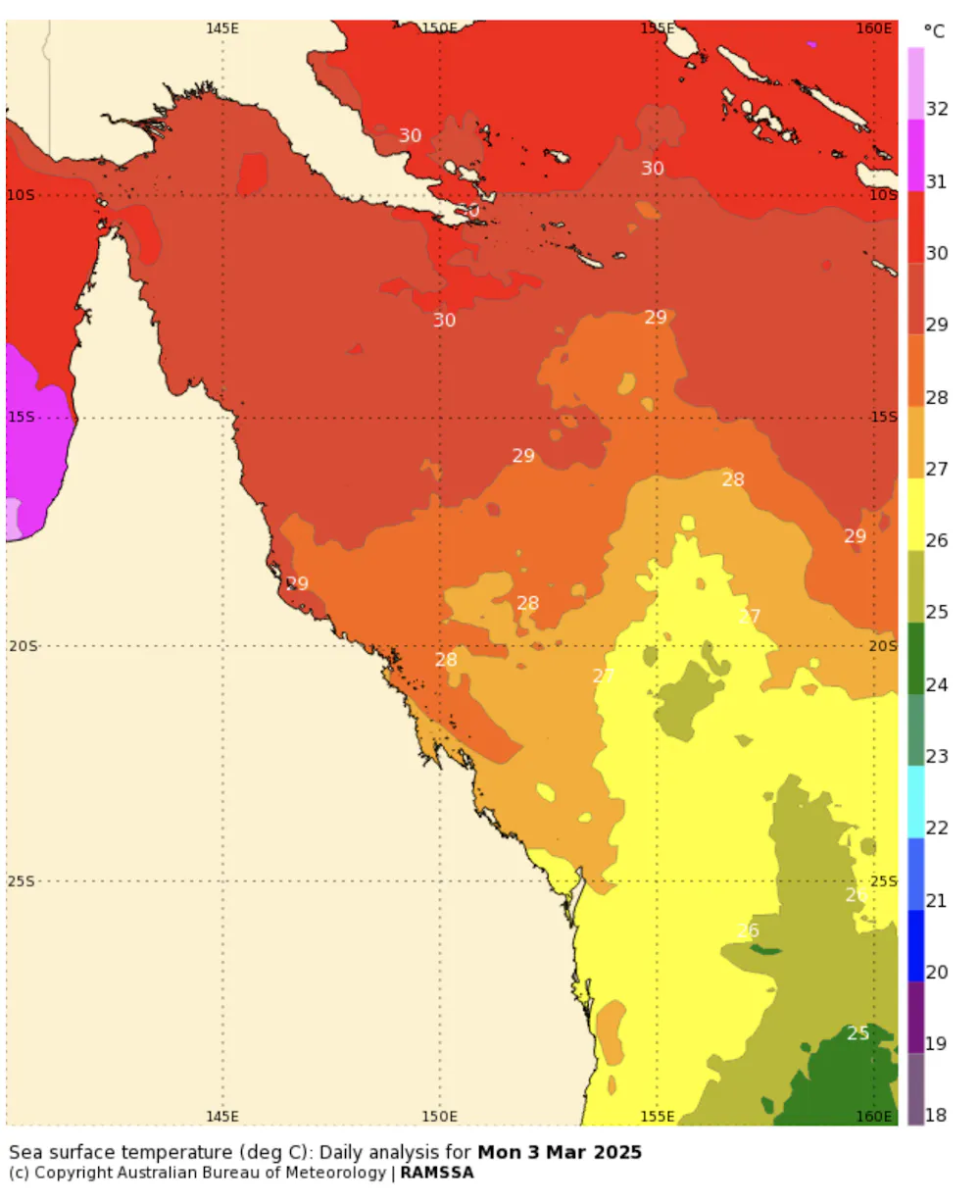
    It moved towards an area of warmer coastal water (around 27°C), which caused it to strengthen. It also moved into an area of reduced “vertical wind shear” – a variation in wind speed running at right angles to prevailing winds, which often acts to weaken a cyclone.

    Image showing high sea surface temperatures which are fuelling the cyclone.
    BoM

    Usually, cyclones in this part of Australian waters may brush the coast, but are soon pulled south or east by an upper trough of cold air and then flicked away into the cooler waters of the Tasman Sea – to an area known as the “cyclone graveyard”.

    The current situation is unusual because that upper trough is absent. At the same time, a high pressure system in the Tasman Sea is steering the cyclone towards the coast.

    The big question now is whether Alfred reaches category 3 – that is, very destructive winds of 165–224km per hour.

    Should the cyclone’s forward motion towards the coast slow, it raises the chances of becoming a category 3 storm. That’s because it would spend more time passing over the warm area of coastal water.

    Category 3 winds are likely to cause significant structural damage to some buildings. Brisbane is, to some extent, sheltered from the winds by offshore islands. Other areas, such as the Gold Coast, do not have such protections.

    How long will the cyclone last?

    As I write, gales are starting to rake the coast – including where I live, on the Sunshine Coast. Conditions will continue to deteriorate this afternoon and into tonight.

    The cyclone will bring gale-force winds to a large area of coastline – from Double Island Point in the north to potentially as far south as Coffs Harbour.

    By Thursday afternoon, conditions on land and just offshore will be pretty rough. If the cyclone keeps travelling at a constant speed, it will cross the coast in the early hours of Friday morning.

    This is less than ideal. It will be dark and people can’t see what’s going on. But there is much affected communities can do to prepare, as outlined here.

    For cyclone preparedness and safety advice, go to Get Ready Queensland. For emergency assistance call the State Emergency Service (SES) in NSW or Queensland on 132 500.

    A Bureau of Meteorology update on Cyclone Alfred dated March 5.

    Steve Turton has previously received funding from the federal government.

    ref. Cyclone Alfred is bearing down. Here’s how it grew so fierce – and where it’s expected to hit – https://theconversation.com/cyclone-alfred-is-bearing-down-heres-how-it-grew-so-fierce-and-where-its-expected-to-hit-251358

    MIL OSI AnalysisEveningReport.nz

  • MIL-OSI Australia: Councils should apply flexibility to keep shelves stocked as Tropical Cyclone Alfred approaches

    Source: New South Wales Government 2

    Headline: Councils should apply flexibility to keep shelves stocked as Tropical Cyclone Alfred approaches

    Published: 5 March 2025

    Statement by: Minister for Planning and Public Spaces


    The Minns Government is asking councils to take into consideration the need for additional supply chain support when responding to any complaints about operations at warehouses and distribution centres, wholesale and retail centres.

    As the community prepares for the impacts of Tropical Cyclone Alfred, the NSW Government is asking councils to be considerate of the exceptional circumstances and support supermarkets and other essential retailers to help keep their shelves stocked.

    The Environmental Planning and Assessment Act 1979 and its regulation authorises councils to take compliance action in response to breaches of conditions of a development consent relating to operating hours, noise limits and vehicle movement caps.

    We are reminding councils they also have discretion in choosing whether to exercise their enforcement powers. This includes considering the temporary nature of any breach, the low level of harm caused and the broader public interest in restoring supply chains.

    MIL OSI News

  • MIL-Evening Report: AI deepfakes threaten democracy and people’s identities. ‘Personality rights’ could help

    Source: The Conversation (Au and NZ) – By Wellett Potter, Lecturer in Law, University of New England

    Ray Bond/Shutterstock

    How much is your voice worth?

    It could be as little as roughly A$100. That was how much ABC News Verify recently spent to clone federal senator Jacqui Lambie’s voice – with her permission – using an easily accessible online platform.

    This example highlights how artificial intelligence (AI) apps which create a synthetic replica of a person’s image and/or voice in the form of deepfakes or voice cloning are becoming cheaper and easier to use.

    This poses a serious threat not only to the functioning of democracy (especially around elections), but also to a person’s identity.

    Current copyright laws in Australia are inadequate when it comes to protecting people if their image or voice is digitally cloned without their permission. Establishing “personality rights” could help.

    Detecting what’s fake is difficult

    Deepfake technology is able to produce content which seems increasingly real. This makes it harder to detect what is fake and what is not. Indeed, several people for whom the ABC played the voice clone of Senator Lambie did not initially realise it was fake.

    This shows how unauthorised deepfakes and voice cloning can be easily used to generate misinformation. They can also be extremely damaging to individuals.

    This was highlighted back in 2020, when one of Australia’s first political deepfake videos was released. It featured the then Queensland premier Annastacia Palaszczuk claiming the state was “cooked” and in “massive debt”.

    The video received around 1 million views on social media.

    What laws cover this?

    In Australia, defamation, privacy, image-based abuse laws, passing off and consumer protection laws might be applicable to situations involving deepfake video or audio clips. You may also be able to lodge a complaint with the eSafety commissioner.

    In theory copyright law can also protect a person’s image and voice. However, its application is more nuanced.

    First, a person whose likeness has been cloned by an AI platform often does not own the source material. This material could be an image, video or voice recording which has been copied and uploaded. Even if your image and voice is depicted, if you are not the owner of the source material, you cannot sue for infringement.

    Using Senator Lambie as an example, the ABC only needed 90 seconds of original voice recording to create the AI clone. Senator Lambie’s voice itself is not able to be copyright-protected. That’s because copyright can only attach to a tangible expression, say in written or recorded form. It cannot attach to speech or unexpressed ideas.

    As the ABC arranged, recorded and produced the original 90-second recording, the broadcaster could hold copyright in it as a sound recording. It is a fixed, tangible expression of Senator Lambie’s voice. However, unless the senator and the ABC made an agreement, Senator Lambie would have no economic rights, such as the right to reproduction, to the original voice recording. Nor would she have any rights to the clone of her voice.

    In fact, the AI-generated clone itself is unlikely to be protected by copyright, as it is considered authorless under Australian copyright law. Many AI-generated creations are currently unable to be protected under Australian copyright, due to a lack of original, identifiable human authorship.

    Moral rights – including the right of attribution (to be credited as the performer), the right against false attribution and the right of integrity – are also limited in scope. They could apply to the original audio clip, but not to a deepfake.

    What are ‘personality rights’?

    In most jurisdictions in the United States, there exist what are commonly known as “personality rights”. These rights include the right of publicity, which acknowledges that an individual’s name, likeness, voice and other attributes are commercially valuable.

    Celebrities such as Bette Midler and Johnny Carson have successfully exercised this right to prevent companies using elements of their identity for commercial purposes without permission.

    However, personality rights might not always apply to AI voice clones, with some lawyers arguing that only actual recorded voices are protectable, not clones of voices. This has led to states such as Tennessee introducing legislation to specifically address AI-generated content. The Ensuring Likeness, Voice, and Image Security Act, introduced in 2024, addresses the misappropriation of an individual’s voice through generative AI use.

    Urgent steps are needed

    There has been longstanding scholarly debate about whether Australia should introduce statutory publicity rights.

    One of the challenges is overlap with pre-existing laws, such as Australian consumer law and tort law. Policymakers might be hesitant to introduce a new right, as these other areas of the law may provide partial protection. Another challenge is how to enforce these rights if an AI-generated deepfake is created overseas.

    Australia could also consider introducing a similar law to the “No Fakes Bill” currently being debated in the US. If passed, this bill would allow people to protect their image and voice through intellectual property rights. This should be given serious consideration in Australia too.

    Deepfakes are becoming more and more common, and are now widespread during elections. Because of this, it’s important that Australians remain vigilant to them in the lead up to this year’s federal election.

    And let’s hope that whoever wins that election takes urgent steps to better protect everyone’s image and voice.

    Wellett Potter does not work for, consult, own shares in or receive funding from any company or organisation that would benefit from this article, and has disclosed no relevant affiliations beyond their academic appointment.

    ref. AI deepfakes threaten democracy and people’s identities. ‘Personality rights’ could help – https://theconversation.com/ai-deepfakes-threaten-democracy-and-peoples-identities-personality-rights-could-help-251267

    MIL OSI AnalysisEveningReport.nz

  • MIL-OSI Australia: Australia’s newest city starting to take shape

    Source: New South Wales Premiere

    Published: 5 March 2025

    Released by: The Premier, Deputy Premier, Minister for Planning and Public Spaces


    The Western Sydney Aerotropolis is set to take-off, with the official opening of the first building at Bradfield City Centre and the release of the Minns Labor Government’s infrastructure delivery plan which will drive further investment into the region.

    The Advanced Manufacturing Readiness Facility (AMRF) – is the first step in delivering the new city of Bradfield at the heart of the Western Sydney Aerotropolis and the start of an innovation ecosystem that will boost the NSW manufacturing industry.

    A landmark partnership agreement between the AMRF and 11 NSW and ACT universities will see this ecosystem rapidly evolve with the world class research capabilities of the universities combined with the AMRF’s industrial expertise and infrastructure.

    Under the agreement, the parties will work together to translate research into production and develop the next generation of advanced manufacturing experts through a paid internship program.

    Critical to facilitating further growth in the precinct, the NSW Government has released the Aerotropolis Sector Plan, which sets out how essential government infrastructure will be delivered quickly and efficiently to service the development of thousands of hectares of employment land.

    The Sector Plan, developed by Infrastructure NSW, provides certainty to industry, the community, and all levels of government around how infrastructure will be sequenced and prioritised in the Aerotropolis.

    This will enhance the State’s competitiveness and boost the supply of serviced land to combat the critical shortage across NSW. It will also assist planning assessment authorities to align development with infrastructure capacity in the region.

    This is the first time the Aerotropolis has had a concrete road map that brings together planning and infrastructure coordination.

    With the Western Sydney International (Nancy-Bird Walton) Airport due to open by the end of 2026, investment in Bradfield City Centre and the Western Sydney Aerotropolis capitalises on the opportunity to deliver more than 120,000 high-quality jobs and new industries that will see the Western Sydney economy boom.

    This work builds on the Minns Labor Government’s historic investment in Western Sydney to deliver more homes, jobs and investment to the region.     

    To find out more about Bradfield City Centre, First Building and AMRF collaboration with NSW VCC visit: Bradfield Development Authority | NSW Government

    To find out more and read the Aerotropolis Sector Plan, visit: Aerotropolis Sector Plan  | NSW Government

    Premier of New South Wales Chris Minns said:

    “The Aerotropolis is almost 40 times the size of Sydney CBD and provides an unprecedented economic opportunity for Western Sydney.

    “We’re backing the region with over $25 billion of infrastructure investment that is going to ensure the critical roads and services are delivered as quickly as possible to give industry certainty and confidence to invest in the area.

    “We asked Infrastructure NSW to develop the Aerotropolis Sector Plan to identify how and when we will do this. Today’s announcement demonstrates the value in utilising whole-of-government coordination to deliver on our commitments.

    “With Bradfield and the Advanced Manufacturing Readiness Facility (AMRF), we’re showcasing the NSW Government’s commitment to rebuilding the state’s critical manufacturing capability and delivering economic growth in the region.”

    Deputy Premier and Minister for Western Sydney Prue Car said:

    “Western Sydney is a rich and diverse region set to boom with the opening of the new Airport. We’re building better communities by investing in the region.

    “With Bradfield and the Aerotropolis, we’re giving kids in Western Sydney the opportunity to dream about a future with high quality jobs close to home.”

    Minister for Planning and Public Spaces Paul Scully said:

    “The First Building opening is another example of the genuine momentum building around Australia’s first new city in over 100 years.

    “This is just the beginning of Bradfield’s future growth as it evolves into a world class city with 10,000 homes, 20,000 high quality jobs, and critical green open spaces for residents and visitors to enjoy.”

    MIL OSI News

  • MIL-OSI Australia: Work ramping up to rebuild Hume Highway at Marulan

    Source: New South Wales Government 2

    Headline: Work ramping up to rebuild Hume Highway at Marulan

    Published: 5 March 2025

    Released by: Minister for Regional Transport and Roads


    The Minns Labor Government is ramping up work to build a better Hume Highway at Marulan as part of a $35 million investment into rebuilding a key section of highway corridor.

    To improve safety and provide a smoother journey for motorists, crews will carry out the next stage of repair work on a 1.1 kilometre stretch of the northbound carriageway from the Marulan South Road intersection.

    The work, starting from March 17, will include the use of a high-strength asphalt road pavement to replace 500 damaged concrete slabs on a 600-metre section the highway.

    This change from the concrete base to asphalt pavement is expected to mean less disruptions to motorists while repairs are carried out.

    Once the work has been completed around mid-April, weather permitting, Transport for NSW will evaluate the impact of the change and determine if the new approach should be rolled out on other sections of the highway.

    More details of staged future upgrade work will be announced progressively by Transport for NSW.

    Minister for Regional Transport and Roads, Jenny Aitchison said:

    “The Hume Highway is the second largest freight route in Australia, linking Sydney and Melbourne and used by more than 37,000 vehicles daily.

    “The Marulan bypass was built in 1986 as part of the Hume Highway upgrade program and since that time the large growth in traffic volumes have put extra pressure on the existing road surface.

    “We understand motorists are frustrated by the quality of this section of road and that’s why we have invested $35 million in rebuilding and improvement work.

    “We thank the community for its ongoing patience while this essential repair work is carried out.”

    MIL OSI News

  • MIL-OSI Australia: Building the allied health workforce in Hunter New England Local Health District

    Source: New South Wales Premiere

    Published: 5 March 2025

    Released by: Minister for the Hunter, Minister for Regional Health, Minister for Regional NSW


    The Rural Allied Health Educator Pilot Program, a joint venture between NSW Health and the Department of Primary Industries and Regional Development (DPIRD), is building a pipeline of allied health clinicians in rural, regional and remote communities, by boosting the number of student placements in Hunter New England Local Health District (HNELHD).

    A cohort of 50 university students and early career clinicians have been supported since the introduction of the Rural Allied Health Educator Pilot Program in HNELHD.

    Allied health educators have also established a Year 10 Rural Allied Health Work Experience initiative, providing local high school students with hands-on exposure to careers in allied health. So far, 89 students from the New England region have participated.

    The program is enticing allied health students to stay and take up full time roles in rural, regional and remote locations.

    A survey of participating university students found before commencing placement, only 56.2 per cent were interested in working for NSW Health in a rural area as a graduate.

    Following completion of placement, 85 per cent were more interested in working for NSW Health in a rural area as an allied health graduate and 95 per cent of students were satisfied with their placement experience and would recommend a rural placement to other students.

    Allied health clinical placements typically take 4-6 weeks and give students experience across various clinical areas relevant to their profession.

    Allied health educators supervise students directly and work with universities to coordinate placements.

    Omara De Carlos completed her final adult clinical placement at Tamworth Hospital in September 2024, where she gained valuable experience in speech pathology and rural practice, prompting her to apply for a permanent role in HNELHD.

    In February 2025, Omara started at Gunnedah Community Health as a generalist speech pathologist; a position which had been vacant for more than two years. Omara, along with other speech pathology and occupational therapy early career clinicians, will continue to be supported by the district’s rural allied health educators as they progress their careers.

    The $1 million Rural Allied Health Educator Pilot Program is a joint venture between NSW Health and the Department of Primary Industries and Regional Development, operating across Hunter New England, Western NSW, Far West, Murrumbidgee, and Southern NSW Local Health Districts.

    DPIRD has invested $1 million per year over three years into the Rural Allied Health Educator Pilot Program. 

    For further information visit the Allied health professions in NSW Health webpage

    Quotes attributable to Regional Health Minister Ryan Park:

    “Staffing is one of the most critical issues we face in the healthcare system, and in regional, rural and remote locations that problem is amplified.

    “I am really proud a program like this is having great results at encouraging students to take up a rewarding role in the bush.

    “The Minns Labor Government is committed to boosting our allied health workforce by increasing training and education pathways for students in rural and regional NSW.”

    Quotes attributable to Minister for the Hunter Yasmin Catley:

    “The Hunter is a fantastic place to work and live and it’s great to see this program is having a real impact on encouraging more healthcare workers and young people to consider a career here.

    “Everyone deserves accessible, quality healthcare and only the NSW Labor Government is delivering this.”

    Quotes attributable to Minister for Regional NSW Tara Moriarty:

    “We support the Rural Allied Health Educator Program through funding these important regional allied health workforces.   

    “Getting essential workers into regional NSW is a major focus of the Government and this program plays a role in that plan. 

    “The students also have the opportunity to participate in The Welcome Experience while on placement. 

    “The Welcome Experience is a service which provides essential workers the support they need to make the move into live and work in regional communities by assisting them to get to know the local area and people first.”  

    Quotes attributable to Allied Health Educator Patricia Webb:

    “The Rural Allied Health Educator Pilot Program is making a real difference in the Hunter New England region.

    “The increase in student placements and the positive feedback from staff and students is incredibly encouraging. We are working hard to create opportunities for students to pursue allied health careers and develop our rural the workforce pipeline.”

    Quotes attributable to Allied Health Student Omara De Carlos:

    “My placement at Tamworth Hospital last year opened my eyes to the unique rewards of working in a rural community.

    “I gained practical skills and confidence in speech pathology, and I received incredible support from the allied health educators. I’m excited to apply what I’ve learned at Gunnedah Community Health.”

    MIL OSI News

  • MIL-OSI Australia: South West Metro conversion period to be extended into 2026

    Source: New South Wales Premiere

    Published: 5 March 2025

    Released by: Minister for Transport


    The complex extension of Sydney Metro services from Sydenham to Bankstown will be completed in 2026 due to the ongoing impacts that industrial action has had on the project.

    This conversion of a century old train line to a brand-new state of the art metro is a very complex and difficult project that the NSW Government warned last year could take over 1 year to complete.

    The complexity of this project has been compounded by more than 130 days of work on the project that have been impacted by industrial action and its subsequent effects, placing increasing pressure on the construction and testing programs.

    Industrial action limited access to work sites and restricted the provision of crucial work permits, which are required for contractors to safely complete work in a live electrical network environment.

    This is particularly crucial at the interfaces between the future metro network and the existing Sydney Trains assets.

    This has required significant reprogramming of vital construction activities including overhead wiring upgrades, electrification changes, disconnection from adjoining rail networks, track improvements, and platform extensions at Bankstown Station.

    This resulted in a delay to the commencement of dynamic train testing, a crucial component of safely testing and commissioning the new railway.

    Despite the significant disruptions, the project team and delivery partners have worked tirelessly to progress the Southwest Conversion.

    Dynamic testing of Metro Trains on the Southwest conversion is imminent, following approval by the Office of the National Rail Safety Regulator.

    Passengers on the M1 Line will have experienced some disruption to their commutes with partial closures of the service to allow for work to progress when possible. These disruptions will continue as the testing program commences. We acknowledge passengers will be frustrated and apologise for any inconvenience caused. These possessions will allow the team to complete necessary work to extend metro services to Bankstown.

    All platform screen doors and mechanical gap fillers along the line from Marrickville to Bankstown have been installed, taking teams approximately 500 hours to fit out each station.

    Since the conversion began a large portion of works have been completed including new lifts installed at Wiley Park, Dulwich Hill, Hurlstone Park, Punchbowl and Canterbury Stations, as well as new kiss and ride zones and refurbishing of station buildings and platform surfaces.

    A total of 28.3 kilometres of high-tech railway fencing has been installed along the alignment, which is made up of 5.8km of segregation fencing to separate the existing freight line and the metro corridor and 22.5km of security fencing.

    The security fencing includes first-of-its-kind intrusion and object detection system which uses fibre optic cables to monitor for possible intrusions.

    Southwest Link buses will continue to operate and will continue to be free for passengers until the new Southwest Metro opens.

    Minister for Transport John Graham said:

    “The Government has always said that this complex and difficult project may take longer than 1 year. We need to let people know that over 130 days of work have been impacted by industrial action. That means we’ll complete this project in 2026.

    “Works like upgrades to overhead wiring and station platforms, as well as electrical work to disconnect the line from the wider train network haven’t been able to proceed on schedule. Testing will start soon but industrial action has been very disruptive.

    “Converting a 130-year-old rail line to metro standards is a highly complex project and we are very sorry that passengers will have to wait a bit longer to jump on the metro from Bankstown to the Sydney CBD.

    “We promise it will be worth the wait – passengers can look forward to fast, safe and reliable trips, with a train arriving every 4 minutes in the peak.

    “When the extension to Bankstown opens in 2026, a trip from Bankstown to Central will take just 28 minutes, Marrickville to Macquarie University will take just 36 minutes and Dulwich Hill to Victoria Cross will take 21 minutes.”

    MIL OSI News

  • MIL-Evening Report: Fires used to terrify city residents. New research suggests climate change could see this fear return

    Source: The Conversation (Au and NZ) – By David Bowman, Professor of Pyrogeography and Fire Science, University of Tasmania

    Fire rages in the Pacific Palisades area of Los Angeles in January 2025 eley archives/Shutterstock

    For centuries, fire was one of the major fears for city-dwellers. Dense cities built largely of wood could – and did – burn. In 1666, a fire in a bakery went on to destroy two-thirds of the city of London, leaving 85% of residents homeless. In 1871, fire burned out huge areas of Chicago. In World War II, bombing raids by Allied forces largely destroyed cities such as Dresden in Germany and Tokyo in Japan.

    The threat of large-scale urban fires drove authorities to spend more on urban firefighting and require buildings to use less flammable material. Fire alarms, fire engines and automatic sprinklers have done much to reduce the chance of uncontrolled spread.

    But will our sense of safety endure in the age of climate change? In January, we saw swathes of Los Angeles burn – even in the northern winter. Driven by low humidity and high winds, numerous large fires encroached on the city, destroying outlying suburbs. Climate change made the fires worse, according to climate scientists.

    Now we have new research on the question of whether climate change will make large city fires more likely. A research team from China, Singapore and Australia have gathered a decade’s worth of data on fires from almost 3,000 cities in 20 nations, home to one-fifth of the world’s population.

    The researchers found for every 1°C increase in air temperature, outdoor fires (rubbish and landfill) increase 4.7% and vehicle fires 2.5%. If the world accelerates its burning of fossil fuels under a high emissions scenario compatible with a 4.3°C temperature rise by century’s end, outdoor fires in cities would soar 22% and vehicle fires 11%. But building fires are projected to actually fall 5%. Thankfully, this emissions scenario is now less likely.

    The Great Fire of London destroyed most of the city in 1666.
    HodagMedia/Shutterstock

    What did this research find?

    To make these findings, the researchers aggregated the fire incident data from 2,847 cities located in 20 countries over the 2011–20 decade and analysed them to see how air temperature influences the frequency of three types of fires: outdoor, structural and vehicle. They found a strong correlation.

    Of the 20 nations, New Zealand looks likely to have the highest increase in fires, soaring 140% over 2020 figures by 2100.

    When we think of fires in a city, we usually think of structural fires – a building going up in flames.

    The research suggests building fires would actually decrease 5% by 2100. This is unexpected, and might suggest uncertainty about this finding.

    Interestingly, this research found the fewest structural fires occurred at air temperatures of 24°C, a temperature which humans find optimal. When it’s hotter or cooler than that, more buildings catch fire.

    Why? It’s likely due to our behaviour. We spend more time indoors when it’s very cold or very hot outside, which the authors suggest could make us more likely to accidentally cause fires by using electrical appliances and fireplaces which have a fire risk.

    By contrast, outdoor and vehicle fires do increase linearly as temperatures rise. Most vehicle fires come from an equipment or heat source failure, which are both likely to increase as temperatures rise. We are also more likely to have a car crash when it’s hotter, and vehicle fires often come after a crash.

    Vehicle fires will become more common as the climate changes, according to this research.
    Rodrigo Teixeira/Pexels, CC BY-NC-ND

    Outdoor fires become more likely because heat dries out fuels and favours fire spread. Rubbish dumps can spontaneously catch fire when temperatures are too high – even underground. This happens because chemical reactions are accelerated in warmer temperatures, causing waste materials to heat up faster. If the extra heat isn’t dissipated, waste can become so hot that it catches fire on its own.

    We should take these estimates with a grain of salt. This is because they project recent statistical patterns into an uncertain future, and draw on a data set not perfectly suited to the task. The data set stops in 2020, before the electric vehicle transition gathered speed. EVs have a different risk profile for accidental fires.

    As the authors note, there are large barriers to getting a coherent understanding of fire risk. “Despite multiple efforts, we have been unsuccessful in obtaining fire data from Africa and South America,” they write.

    Their estimates also relate to a high-emissions future which is hopefully becoming less likely, though the general pattern of the results are similar under less severe climate projections.

    Most importantly, it’s not yet clear why temperature influences urban fires. This uncertainty raises questions over whether simple projections of current patterns into the future are realistic or appropriate.

    Cities aflame?

    Arguably the most important contribution of this new research is to show us that our cities are not inherently protected from fire.

    For city authorities, this research points to the need to manage combustible materials, from piles of mulch to dry urban parks and even home gardens. Storage yards, rubbish dumps and recycling centres will also need to be managed.

    Fire used to be a major concern for cities, and it could be again. Cities and fire are uneasy bedfellows, and climate change will worsen the situation.

    David Bowman is an Australian Research Council Laureate Fellow and also receives funding from the New South Wales Bushfire and Natural Hazards Research Centre, and Natural Hazards Research Australia.

    Calum Cunningham receives funding from the Australian Research Council.

    ref. Fires used to terrify city residents. New research suggests climate change could see this fear return – https://theconversation.com/fires-used-to-terrify-city-residents-new-research-suggests-climate-change-could-see-this-fear-return-251056

    MIL OSI AnalysisEveningReport.nz

  • MIL-Evening Report: Police are seizing 3D-printed guns across Australia, but our laws aren’t keeping up

    Source: The Conversation (Au and NZ) – By Andrew Hemming, Associate Professor of Law, School of Law and Justice, University of the Sunshine Coast

    Shutterstock

    After Martin Bryant killed 35 people and wounded 23 others at Port Arthur in 1996, Australia made fundamental changes to its gun laws. The use of automatic and semi-automatic weapons became restricted and a national gun registry was established.

    As a result, unlike the situation in the United States where automatic weapons can be readily obtained, mass shootings are a rarity in Australia.

    However, a new and pressing danger in the form of 3D guns, or “ghost guns”, threatens to undermine Australia’s strict gun control laws.

    The reason is simple: 3D guns can be manufactured in a suburban garage. In a process like making a dress from a pattern, a digital blueprint for the manufacture of a firearm can be downloaded from the internet. Then, instead of a sewing machine, you need a 3D printer or an electronic milling machine.

    The emergence of these types of firearms reveal big loopholes in many of our gun laws. These need urgent attention.

    How are these guns made?

    A 3D gun is manufactured in stages, with each part of the gun printed separately and assembled manually.

    Think of yourself as making a toy LEGO gun, but instead of taking the parts from the LEGO box, you make the parts on your 3D printer based on your digital blueprint and you then assemble your gun. Your raw materials are thermoplastic polymers and metal for the barrel and firing pin.

    High-end, industrial-grade 3D printers are priced between $2,000 and $10,000, and are readily available.

    This technology has been around for more than a decade.

    The first 3D printed handgun was designed by Cody Wilson in 2013, which he christened The Liberator. It was made of 15 parts of plastic and a nail for the ring pin.

    Also in 2013, reporters from the Daily Mail newspaper in London 3D-printed a Liberator pistol and smuggled the disassembled gun onto a Eurostar train. They reassembled the gun in the toilet.

    As the gun was made of plastic, metal detectors were not activated, demonstrating the danger these weapons pose even in high-security locations such as airports and public transport.

    In the recent high-profile murder in New York of Brian Thompson, chief executive of the US health insurance company United Healthcare, the suspect, Luigi Mangione, when arrested was found to be in possession of a similar 3D-printed gun and 3D-printed suppressor to those allegedly used in the shooting.

    Leaps forward in technology

    In the 12 years since the designs for The Liberator were posted on the internet, the quality and range of 3D guns have greatly improved and expanded.

    According to Detective Inspector Brad Phelps from Queensland’s Crime and Intelligence Command Drug Squad, the technology has advanced sufficiently that:

    now you wouldn’t be able to tell the difference between a privately manufactured firearm and a traditional firearm in many instances […] every jurisdiction in Australia has reported an increase, particularly in the last 18 months to two years.

    As 3D guns are untraceable, the actual prevalence of 3D guns is unknown, other than the growing number of 3D guns seized in police raids. According to gun safety groups, 3D guns can now fire up to 40 rounds and use standard gauge ammunition.

    Police predict homemade guns will soon overtake illicit weapon imports.

    In October 2024, Western Australian police seized 21 privately made 3D-printed firearms from a home in Perth.

    Fixing the legal loopholes

    So, with all these alarm bells ringing in the ears of law enforcement agencies, what steps have authorities taken to meet the threat 3D guns pose to community safety?

    Indeed, what effective steps are being taken to prevent further advances in the technology and thwart any efforts to produce these guns en masse?

    The answer would appear to be that little attention has been directed towards the dangers 3D guns represent. Legislation across Australian jurisdictions is inconsistent.

    At present, only New South Wales and Tasmania have legislated to make it an offence to possess a digital blueprint for the manufacture of a firearm on a 3D printer or electronic milling machine. The maximum penalties are imprisonment for 14 years and 21 years, respectively.

    In 2022, WA took a step in the right direction by making unauthorised possession of firearms technology an offence. This included possession of a 3D printer or milling device.

    The slow progress on this issue is well illustrated by South Australia. There have been 23 incidents in which police have seized 3D-printed firearms and firearm parts between 2020 and 2023.

    But the drafting of proposed legal amendments to address these incidents started in 2024 and are still to be introduced into the SA parliament.

    There needs to be a national sense of urgency similar to the federal government’s response to the Port Arthur massacre in 1996. Existing laws are inadequate as there is no uniformity in the legislation covering 3D-printed firearms and their digital blueprints.

    There was a senate inquiry into gun violence in 2014, which found 3D printers “were by no means integral to the illegal manufacture of firearms”. This is no longer accurate.

    Ironically, the senate committee recommended “Australian governments investigate the requirement for uniform regulations in all jurisdictions covering the manufacture of 3D-printed firearms and firearm parts”. A decade on, little progress has been made.

    New laws could distinguish between possessing of a digital blueprint for a 3D gun and actually manufacturing a firearm. This could look like a scale of penalties, such as those imposed for the possession and manufacture of illegal drugs, which are based on the category of drug and the quantity seized.

    Andrew Hemming does not work for, consult, own shares in or receive funding from any company or organisation that would benefit from this article, and has disclosed no relevant affiliations beyond their academic appointment.

    ref. Police are seizing 3D-printed guns across Australia, but our laws aren’t keeping up – https://theconversation.com/police-are-seizing-3d-printed-guns-across-australia-but-our-laws-arent-keeping-up-250255

    MIL OSI AnalysisEveningReport.nz

  • MIL-OSI Security: New Jersey Company Sentenced for Clean Water Act Violations that Caused Fish Kill in Cheshire, Will Pay $1 Million

    Source: Office of United States Attorneys

    Marc H. Silverman, Acting United States Attorney for the District of Connecticut, and Kathryn Rivera, Acting Assistant Special Agent in Charge of EPA’s Criminal Investigation Division for New England, announced that NATIONAL WATER MAIN CLEANING COMPANY (“NWMCC”) was sentenced today by U.S. District Judge Kari A. Dooley in Bridgeport for a felony violation of the Clean Water Act (“CWA”) for knowingly discharging a pollutant into Cuff Brook while refurbishing a large culvert pipe in Cheshire, Connecticut, in July 2019.  The company’s unauthorized discharge of uncured geopolymer mortar killed more than 150 fish and contaminated Cuff Brook.

    Judge Dooley sentenced NWMCC to a term of federal probation with environmental conditions for three years, a $500,000 federal penalty, and a payment of $500,000 to the Connecticut Department of Energy and Environmental Protection (“CT DEEP”) to fund aquatic ecosystem enhancement projects in the South Central Coastal Watershed, where both Cheshire and Cuff Brook are located.

    NWMCC is based in New Jersey and owned by Carylon Corporation based in Chicago, Illinois.

    According to court documents and statements made in court, NWMCC had submitted the lowest bid and entered into a contract with the Town of Cheshire (“Cheshire”) to repair a decaying 11-foot culvert pipe underneath Marion Road.  Cheshire’s project specifications required that the work be done under dry conditions along with environmental controls to prevent uncured geopolymer mortar from leaking into Cuff Brook.

    With a Cheshire Department of Public Works (“DPW”) representative present each day, NWMCC began work on July 15, 2019.  However, from July 16 to July 18, 2019, NWMCC sprayed geopolymer mortar onto the culvert pipe without the mandated environmental controls.  On July 17, 2019, NWMCC crews continued to work despite heavy rain, which led to uncured geopolymer mortar seeping into Cuff Brook.  On July 18, 2019, a Cheshire resident with property abutting Cuff Brook observed dead fish and discolored water with an oily sheen in the brook, and smelled a chemical odor similar to lighter fluid.  CT DEEP responded and determined that NWMCC was responsible for the pollutant release, thereby killing more than 150 fish and contaminating the waterway.  CT DEEP estimated that Cuff Brook would not return to its prior state for three to five years.

    The government’s investigation revealed that NWMCC was aware that its environmental controls were deficient, but did not remediate these deficiencies during the project.  Although the company attempted to blame the pollutant release and fish kill on a single employee, the investigation showed that he had been inadequately trained, directed to complete the job in an unrealistic timeframe, and was never informed that the uncured geopolymer mortar was hazardous to the environment.

    The investigation also revealed that NWMCC lacked a meaningful and comprehensive environmental training program for its employees, particularly with respect to the CWA, even though NWMCC’s core business is repairing and rehabilitating infrastructure that interfaces with public waterways.  In addition, NWMCC’s bonus policy incentivized site supervisors and executives to push their work crews to perform projects quickly and maximize the number of jobs completed.  At the time of Cheshire project, NWMCC was operating under a Code of Conduct as part of a 2014 settlement with the Massachusetts Attorney General’s Office to resolve civil allegations involving environmental pollution. 

    NWMCC pleaded guilty to the offense on January 17, 2025.

    This matter was investigated by the U.S. Environmental Protection Agency – Criminal Investigation Division with the assistance of the Connecticut Department of Energy and Environmental Protection and the Connecticut Office of the Attorney General.  The case was prosecuted by Assistant U.S. Attorney Hal Chen with the assistance of EPA Regional Criminal Enforcement Counsel Man Chak Ng.

    MIL Security OSI

  • MIL-OSI Security: Violent Bridgeport Gang Member Sentenced to 25 Years in Federal Prison

    Source: Office of United States Attorneys

    TREVON WRIGHT, also known as “Tre,” 23, was sentenced today U.S. District Judge Victor A. Bolden in New Haven to 300 months of imprisonment, followed by five years of supervised release, for his involvement in a violent Bridgeport street gang, multiple shootings, and his murder of a rival gang member in 2020. 

    Today’s announcement by Marc. H. Silverman, Acting United States Attorney for the District of Connecticut; Joseph T. Corradino, State’s Attorney for the Fairfield Judicial District; Bridgeport Police Chief Roderick Porter; Anish Shukla, Acting Special Agent in Charge of the New Haven Division of the Federal Bureau of Investigation; James Ferguson, Special Agent in Charge, ATF Boston Field Division; Stephen Belleau, Acting Special Agent in Charge of the Drug Enforcement Administration for New England, and Acting U.S. Marshal Lawrence Bobnick.

    According to court documents, statements made in court, and the evidence presented during a month-long trial, the FBI, ATF, DEA, U.S. Marshals Service and Bridgeport Police have been investigating multiple Bridgeport-based gangs whose members are involved in narcotics trafficking, murder and other acts of violence.  Wright has been a member of the “East End gang,” which began as a local street gang based in the East End of Bridgeport, but currently has members and associates who are either incarcerated or living throughout Bridgeport and surrounding towns.  The East End gang has been aligned with other groups, including the PT Barnum Gang, the East Side gang and 150, which is a geographic gang based on the West Side of Bridgeport.  These groups were aligned against rival organizations in Bridgeport, including the “Original North End” (“O.N.E.”) and the “Greene Homes Boyz,” (“GHB/Hotz”), based in the Charles F. Greene Homes Housing Complex in Bridgeport’s North End.

    Due to the level of gun violence Bridgeport was experiencing, the investigation commenced shortly before East End members shot and killed Myreke Kenion and shot and attempted to kill D’Andre Brown, both members and associates of the GHB/Hotz gang, on January 26, 2020.  The next day, in retaliation for these shootings, GHB/Hotz and O.N.E. members attempted to kill East End gang members and associates in a brazen afternoon shooting in front of a state courthouse on Golden Hill Street in Bridgeport that resulted in four victims being shot while sitting inside a car.

    Wright and other East End members distributed heroin, crack cocaine, marijuana and Percocet pills; used and shared firearms; and committed at least six murders and other acts of violence against rival gang members and other individuals.  East End members celebrated their criminal conduct on social media websites such as Facebook and YouTube, and committed acts of intimidation and made threats to deter potential witnesses to their crimes and to protect gang members and associates from detection and prosecution by law enforcement authorities.

    The investigation determined that on August 23, 2019, Wright shot and wounded an associate of the GHB/Hotz gang and a female companion; on September 15, 2019, Wright shot and attempted to kill Marquis Isreal, also known as “Garf” or “Gbaby,” a member and associate of the O.N.E. gang; on December 8, 2019, Wright shot and attempted to kill Arvan Smith, also known as “Arv Barkley,” an associate of the O.N.E. gang; and on January 26, 2020, Wright shot and killed Myreke Kenion and shot and attempted to kill D’Andre Brown, both members and associates of the GHB/Hotz gang.

    On December 5, 2023, a jury found Wright and three associates guilty of conspiring to engage in a pattern of racketeering activity.

    Wright has been detained since January 21, 2021.

    Approximately 47 members and associates of the East End, O.N.E. and the GHB/Hotz gangs have been convicted of federal offenses stemming from this investigation, which has and solved eight murders and approximately 20 attempted murders.

    This investigation has been conducted by the FBI’s Safe Streets and Violent Crimes Task Forces, ATF, DEA, U.S. Marshals Service, Bridgeport Police Department, Connecticut State Police and the Bridgeport State’s Attorney’s Office, with the assistance of the U.S. Postal Inspection Service, Connecticut Forensic Science Laboratory and the Waterbury Police Department.  These cases are being prosecuted by Assistant U.S. Attorneys Jocelyn C. Kaoutzanis, Stephanie T. Levick, Rahul Kale, and Karen L. Peck.

    This prosecution is a part of the Justice’s Department’s Project Safe Neighborhoods (PSN), Project Longevity and Organized Crime Drug Enforcement Task Forces (OCDETF) programs.

    PSN is the centerpiece of the Department of Justice’s violent crime reduction efforts.  PSN is an evidence-based program proven to be effective at reducing violent crime.  Through PSN, a broad spectrum of stakeholders work together to identify the most pressing violent crime problems in the community and develop comprehensive solutions to address them.  As part of this strategy, PSN focuses enforcement efforts on the most violent offenders and partners with locally based prevention and reentry programs for lasting reductions in crime.

    Project Longevity is a comprehensive initiative to reduce gun violence in Connecticut’s major cities.  Through Project Longevity, community members and law enforcement directly engage with members of groups that are prone to commit violence and deliver a community message against violence, a law enforcement message about the consequences of further violence and an offer of help for those who want it.  If a group member elects to engage in gun violence, the focused attention of federal, state and local law enforcement will be directed at that entire group.

    OCDETF identifies, disrupts, and dismantles drug traffickers, money launderers, gangs, and transnational criminal organizations through a prosecutor-led and intelligence-driven approach that leverages the strengths of federal, state, and local law enforcement agencies.  Additional information about the OCDETF Program can be found at https://www.justice.gov/OCDETF.

    MIL Security OSI

  • MIL-OSI Australia: NSW Industry Policy to set ambitious new Local Manufacturing targets

    Source: New South Wales Premiere

    Published: 5 March 2025

    Released by: Minister for Industry and Trade


    The Minns Labor Government has today released the state’s first NSW Industry Policy to promote collaboration across industry, the innovation sector, and trade businesses, to give firms the confidence they need to invest and grow in NSW.

    Built around three connected missions – Housing, Net Zero & Energy Transition, and Local Manufacturing – the NSW Industry Policy sets out the Government’s approach to the NSW economy of the future.

    The policy will also set three ambitious new Local Manufacturing targets to position NSW manufacturing to capitalise on global market opportunities.

    The Minns Labor Government is committed to building a better NSW with a thriving and diversified economy, and the NSW Industry Policy will provide a clear strategic direction across all Government agencies and programs.

    This approach will ensure industry support is clear and consistent, driving investment to help build a productive and resilient economy fit for the future.

    This first-of-a-kind policy, consolidates actions from the private sector, research institutions, and Government agencies to help address some of the most significant current and future challenges facing the state.

    The NSW Industry Policy was informed by extensive consultation with industry peak bodies, academia, and engagement with NSW Government agencies.

    It consolidates targets across numerous government initiatives and identifies key sectors to enable success across all industries.

    The Minns Labor Government will use regulation, procurement, planning, strategic land use, and infrastructure building to help drive change.

    The Government will also partner with industry and other stakeholders to deliver on skills and education, innovation and technology, and trade and investment, to help ensure the policy’s success. 

    A thriving economy in NSW benefits everyone, creates more and better jobs, improves the way we make and do things, and grows the prosperity and wellbeing of the people of NSW.

    Key to this is a diversified industry base and protecting our economy from future shocks which the three central missions will help address.

    Mission 1: NSW residents have access to safe, secure, affordable, well-designed and sustainable housing

    Housing affordability and availability has become one of the state’s biggest challenges.

    Due to the Liberal-National decade of delay, housing supply has not kept up with demand, contributing to increased pressure on prices and rents.

    To improve productivity and sustainability, put downward pressure on construction costs, and increase supply, the Minns Labor Government will focus on increasing the uptake of advanced technologies and innovation in the production and use of sustainable building materials.

    Innovative methods, including modular construction and the potential use of automation and robotics, will help the delivery of new homes.

    The Minns Labor Government is investing more than $8.5 billion to address the housing challenge through investment in social housing and homelessness services, planning reforms, and housing-enabling infrastructure and rental housing.

    Mission 2: NSW is a globally competitive clean energy, sustainable and low carbon economy

    NSW has the potential be a leading force in the global net zero economy, including through our abundance of critical minerals, which are essential components of clean energy and low carbon technologies.

    Developing sustainable industries that export goods and services to other decarbonising markets is critical to offsetting the decline in carbon-intensive industries.

    Renewable fuels are one opportunity for NSW to reduce emissions in hard-to-abate industries such as freight, while contributing to fuel security and growing regional NSW economies.

    The progression of a commercial green hydrogen sector would also produce low-emissions products and fuels for domestic trade purposes.

    The Minns Labor Government invested $3.5 billion in Climate Change and Energy initiatives in the 2024-25 Budget, including $3.1 billion in NSW’s Renewable Energy Zones, getting more clean energy into the grid while creating secure jobs for communities across the state.

    Mission 3: NSW is a dynamic and resilient economy supported by local manufacturing

    Manufacturing declined nationally over the past two decades.

    NSW manufacturers face significant challenges, including high costs and weak supply chains.

    In light of these challenges, growing local manufacturing will require NSW to leverage its comparative advantages including its skilled workforce, infrastructure, and abundant resources.

    In order to combat these challenges, the Minns Labor Government has set three new Local Manufacturing targets:

    Target 1: NSW Gross Value Added for manufacturing achieves real growth on average over the years to 2031.

    Target 2: NSW Gross Value Added for manufacturing achieves growth equal to, or greater than Gross State Product on average in the years between 2031 and 2040.

    Target 3: Achieve a 50% minimum local content target for future rolling transport stock by 2035.

    Advanced manufacturing technologies will also provide new opportunities for NSW to be globally competitive in complex and high-value products while NSW manufacturers can benefit from the global transition to net zero.

    Innovative new technologies in big data, artificial intelligence, quantum, virtual reality, and robotics are dramatically changing manufacturing processes, from design and prototyping to the actual fabrication of products.

    The Minns Labor Government has already committed over $600 million to drive investment in local manufacturing.

    This investment has helped manufacturing in NSW grow two consecutive years for the first time in two decades.

    Link to the NSW Industry Policy available here: https://www.investment.nsw.gov.au/why-nsw/resources/nsw-industry-policy/

    Quotes attributable to the Minister for Industry and Trade Anoulack Chanthivong:

    “The NSW Industry Policy details the Minns Labor Government’s vision and plans for the economic future of NSW and provides the strategic direction across all Government agencies and programs to drive industry investment.

    “This is a clear and stable policy approach to help guide private sector investment needed to increase jobs and productivity in NSW.

    “Addressing the housing crisis, supporting NSW through the transition to Net Zero, and growing our local manufacturing industry are among our key priorities.

    “NSW manufacturing grew in only two years in the 2010s under the previous Liberal-National Government.

    “With three new Local Manufacturing targets, we have demonstrated a real commitment to supporting local manufacturing to promote a dynamic, sustainable, and diversified economy.

    “We want to see a manufacturing industry that is innovative, productive, and boosts Australia’s sovereign capability.

    “Our ambition is clear: to build a better NSW and to make our state the most attractive place for people to live and work, and for local businesses to thrive.”

    Quotes attributable to State Secretary of the AMWU Brad Pidgeon:

    “This policy, particularly the three new Local Manufacturing targets, provides a huge boost for manufacturing workers right across the state.

    “We need an ambitious vision for and support for our local manufacturing industry and this policy provides just that.”

    Quotes attributable to NSW Head of Australian Industry Group Helen Waldron:

    “The NSW Industry Policy provides the certainty and clarity that NSW businesses need to thrive in our rapidly changing economy.

    “Having a clear, overarching strategic vision from the NSW Government provides NSW industry with the tools it needs to attract and grow investment supported by Government policy settings.”

    MIL OSI News

  • MIL-OSI Australia: 59-2025: Regulatory Services preparedness for Tropical Cyclone Alfred

    Source: Australia Government Statements – Agriculture

    5 March 2025

    Who does this notice affect?

    All internal and external stakeholders who may require Department of Agriculture, Fisheries and Forestry regulatory services across southern Queensland and northern New South Wales. 

    What has changed?

    The department is preparing for the forecasted severe weather event anticipated across southern Queensland and northern New South Wales coastal on Thursday 6and Friday 7 March 2025, associated with Tropical Cyclone…

    MIL OSI News

  • MIL-OSI USA: RI250 Commission, Elected Officials, Community Leaders Hold Portrait Presentation Commemorating First Rhode Island Regiment

    Source: US State of Rhode Island

    PROVIDENCE, RI � Secretary of State Gregg M. Amore, Chair of the RI250 Commission, was joined by Governor Dan McKee, Speaker of the House K. Joseph Shekarchi, Senator Walter S. Felag, Jr., Executive Director of the Tomaquag Museum Lor�n Spears, historian and author of From Slaves to Soldiers Bob Geake, Founder and Executive Director of Rhode Island Slave History Medallions Charles Roberts, Executive Director of the Newport Historical Society Rebecca Bertrand, and Collections Manager and Registrar at the Museum of the American Revolution Keith Minsinger for a special presentation of “Brave Men as Ever Fought,” a portrait commemorating the First Rhode Island Regiment.

    “The history of the First Rhode Island Regiment is unique to Rhode Island, and all Rhode Islanders should know the story of these brave individuals who fought in the first integrated military regiment,” said Secretary of State Gregg M. Amore. “It’s truly an honor to display this portrait. I thank both the Museum of the American Revolution for their partnership and the historians who joined us today for ensuring this history is never forgotten.”

    In 1778, Rhode Island reorganized its regiments of the Continental Army and authorized the recruitment of enslaved men into the First Rhode Island Regiment. Over 130 free Black men and formerly enslaved men joined the regiment that year. The enslaved men were granted their freedom immediately upon their enlistment, the first and only time such an offer had been made by a state government during the Revolutionary War.

    The First Rhode Island Regiment, comprised of Black, Indigenous, and white soldiers, would go on to fight during the Battle of Rhode Island in 1778. In 1780, Rhode Island united its two Continental Army regiments into a unit known as the Rhode Island Regiment. Two full companies of that regiment were made up of Black and Indigenous enlisted men. The Rhode Island Regiment would go on to serve in the decisive Siege of Yorktown in 1781.

    Commissioned by the Museum of the American Revolution in 2020, renowned historical military artist Don Troiani (b.1949) recreated what the Rhode Island Regiment’s march through Philadelphia in 1781 might have looked like. As part of the scene, 15-year-old African American sailor James Forten looks on as the Regiment marches past the brick fa�ade of the Pennsylvania State House (now known as Independence Hall). Later in life, Forten became a successful business owner, abolitionist, and community leader, and he described what he witnessed back in 1781 to his friend and fellow abolitionist William Lloyd Garrison:

    “I well remember that when the New England Regiment marched through this city on their way to attack the English Army under the command of Lord Cornwallis, there was several Companies of Coloured People, as brave Men as ever fought.”

    Forten was referring to the Rhode Island Regiment.

    “As our nation prepares to celebrate its 250th anniversary in 2026, it is timely and appropriate to ensure that we remember all those who served, struggled, and sacrificed to secure American Independence,” said Museum of the American Revolution President and CEO Dr. R. Scott Stephenson. “We owe a debt of gratitude to those Rhode Islanders of color who wore the uniform and saluted the flag of the fledgling United States in spite of the fact that for most of them, equality was an elusive dream. The Museum is thrilled to loan ‘Brave Men as Ever Fought’ to the Rhode Island Department of State to commemorate the Rhode Island Regiment’s service.”

    The portrait is on loan to the RI Department of State from the Museum of the American Revolution. After the portrait presentation ceremony, the portrait will be displayed in the State House Royal Charter Museum on the first floor of the building until late June.

    ###

    MIL OSI USA News

  • MIL-OSI United Kingdom: Budget investment proposals aim to improve care and respite for Highland families.

    Source: Scotland – Highland Council

    ‘Improving care and respite for families’ is one of The Highland Council Administration’s investment proposals to be considered by councillors when they meet to decide the budget on Thursday 6 March.

    Council will consider a recurring £0.250m investment to employ six family support workers to improve care and respite arrangements for families with the greatest needs.

    Chair of Health, Social Care and Wellbeing Cllr David Fraser commented: “We said we would improve outcomes for all children and young people across Highland with a particular focus on our most vulnerable.

    “This proposed investment aims to provide a greater availability of service provision for those who need it most and with a greater degree of inclusion. If approved, it will help support a future respite model, adding to the existing funding for short breaks, which will provide a greater degree of wrap around support for families.”

    Cllr Fraser added: “In addition there is a proposed £1.048m investment Additional Support Needs (ASN) and an another of £0.200m to add to the Community and Family Wellbeing Fund.  Taken together, these investments represent a significant commitment by the Administration to support children, young people and families across the Highlands.”

    The proposal is based on the outcome of a review previously undertaken into respite services in the area, which has considered the needs and concerns of families of children with additional support needs.

    If approved, the future model for respite will provide support across three centres located in north, west and south Highland – but available to families across the whole Highland area as part of a wider plan for children and families. By providing appropriate levels of respite and support, young people are more likely to be able to remain within their families and communities which has wide reaching financial and non-financial benefits.

    Other benefits of the proposed future model are that it should help to ensure that families’ needs are met more effectively while ensuring the GIRFEC processes (Getting it Right for Every Child) work effectively on their behalf. In addition to respite care, the new service would also aim to provide positive support to families by providing more advice, assistance and guidance.

    The budget report and proposals are available on the Council’s website and the Special Meeting of the Council starts at 09:30 on Thursday 6 March which will be webcast.

    MIL OSI United Kingdom

  • MIL-OSI United Kingdom: Highland-wide virtual jobs fair week opens new opportunities 17-21 March 2025

    Source: Scotland – Highland Council

    Following the success of our winter virtual job fair, The Highland Council’s Employability team has announced details of their spring fair, to highlight new job opportunities, and will run from the 17 to the 21 March 2025.

    The week-long virtual event is being delivered by the Local Employability Partnership – Work. Life. Highland in partnership with, The Highland Council, Skills Development Scotland, Highlands and Islands Enterprise, Department for Work and Pensions, Developing the Young Workforce and UHI North West and Hebrides.

    Economy and Infrastructure Committee Chair, Cllr Ken Gowans, said: “The Highland-wide virtual jobs fair proved very successful last year, and therefore I’m delighted that another has been organised entering the spring/summer months, to offer people and businesses the opportunity to connect and showcase the wide range of opportunities there are to develop and learn new skills. Employers and The Highland Council’s Employability team will be on hand to support attendees, answer questions and explain what opportunities they have for training and up-skilling people.

    “Being held online works well as it offers flexibility, without the need for travel. The sessions are designed for people to drop in and out of throughout the week. It will be accessible to everyone no matter their location or circumstances and will directly connect potential employees with the businesses providing information about work opportunities.”

    Programme Manager at DYW West Highland, Jennifer Grant, said: “This virtual jobs fair is an exciting way for employers to showcase their offer to a wider audience. It’s also a superb opportunity for job seekers of all ages across the Highlands to connect with a range of employers in areas which interest them. We’re delighted to be part of the team working on delivering this opportunity and look forward to further initiatives as our contribution to the Highland Employability Partnership group.”

    Spring is good time to consider employment opportunities, as many businesses gear up for the busy months ahead. Anyone interested in finding out more about career opportunities, looking to change careers or to return to work after a break will be able to log onto sessions hosted by businesses from the comfort of their own home.

    Employers taking part include Balfour Beatty, Cross Reach, RAF, NHSH, Norscot, BBM Solicitors. Castle Project, Go Green, CALA, Glenmorangie House, High Life Highland, Highland Home Carers, Careers At Sea, Police Scotland and The Highland Council. More businesses still to be added.

    They will host sessions to provide information about the full-time and part-time opportunities their businesses have, along with apprenticeship schemes and initiatives to attract seasonal and year-round workers.

    Work. Life. Highland is the brand name for the Highland Employability Partnership (HEP).  The Partnership brings together public, private and third sector organisations supporting individuals on their journey towards, into and within employment.

    To register your interest and receive further information, please email: employ.ability@highland.gov.uk

    MIL OSI United Kingdom