Category: Great Britain

  • MIL-Evening Report: Head lice are getting harder to kill. Here’s how to break the nit cycle

    Source: The Conversation (Au and NZ) – By Cameron Webb, Clinical Associate Professor and Principal Hospital Scientist, University of Sydney

    DGLimages/Shutterstock

    Wrangling head lice, and the children they infest, must be up there with the most challenging duties a parent or carer has to face.

    And the job is getting harder. Commonly used chemical products aren’t working as well as they once did, meaning head lice are harder to kill.

    You can still rid your children of lice – but it’s likely to take some patience and persistence.

    Remind me, what are head lice? And nits?

    Head lice are tiny six-legged insects that are only found in the hair on a human’s head – most commonly in the hair of primary school-aged children.

    Head lice have been a constant companion for humans throughout their millions of years of evolution.

    Lice love living in our hair. But they scoot down to our scalp up to a half dozen times a day to drink our blood.

    Their claws are perfectly designed to scuttle up and down shafts of hair. But while they’re nimble on our hair, once they’re off, they don’t last long –they’re clumsy, uncoordinated and die quickly.

    The term “nits” actually describes the eggs of head lice. They’re often the first sign of an infestation. And with one louse laying more than 100 in their month-long lifespan, there can be a lot of them.
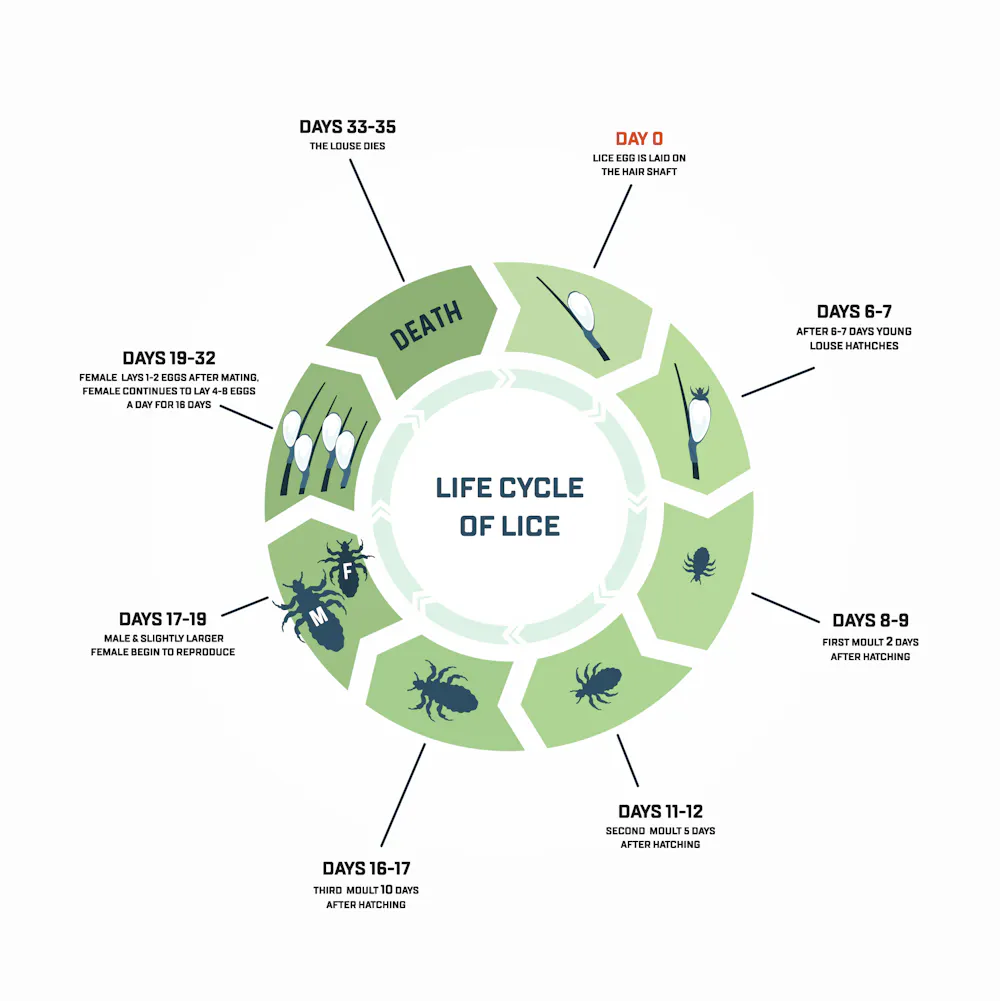
    Head lice live for around a month.
    logika600/Shutterstock

    Can they spread diseases?

    No. Head lice are annoying and their bites may cause skin reactions. But Australian health authorities don’t consider lice a health risk. There is no evidence that head lice can spread pathogens that cause disease.

    The stigma of head lice infestations can be greater than any direct health consequences for infested children.

    Why do my children always pick up lice?

    From child care through to primary school, it’s likely your child has had a head lice infestation at least once. One Australian study found the infestation rate in Australian classrooms ranged from no cases to 72% of children affected.

    Girls are more likely to be carry head lice than boys. Long hair means it’s easier for the head lice to hitch a ride.

    One study found that in some classrooms, almost three in four children had head lice.
    CDC/Unsplash

    Head lice don’t jump or fly, they move from head to head via direct contact.

    Head lice come home with your children because they spend time in close contact with other children, hugging, playing or crowding around books or screens. Any head-to-head contact is a pathway of infections.

    Rules differ slightly between states but in New South Wales and Queensland, children don’t need to be kept home from school because of head lice.

    How can I keep my home free of head lice?

    Keeping the house clean and tidy won’t keep head lice away. They don’t care how clean your bed sheets and towels are, or how frequently you vacuum carpets and rugs.

    There may be a risk of head lice transfer on shared pillows, but even that risk is low.

    There’s no need to change the child’s or other family member’s bedding when you find lice in a child’s hair. Research-based recommendations from NSW Health are that “bed linen, hats, clothing and furniture do not harbour or transmit lice or nits and that there is no benefit in washing them as a treatment option”.

    I’ve used nit solution. Why isn’t it working?

    A wide range of products are available at your local pharmacy to treat head lice. Australia’s Therapeutic Goods Administration assesses products to ensure that they are both safe and effective.

    The problem is that most of these products are insecticides that kill the lice on contact but may not kill the eggs.

    Also, if treatments aren’t completed as directed on product labels, some head lice won’t be killed.

    Head lice also seem to be fighting back against the chemicals we’ve been using against them and it’s getting harder to clear children of infestations.

    So how can you get rid of them?

    You’ll need conditioner and a nit comb.
    riopatuca/Shutterstock

    Don’t expect any miracle cures but health authorities in Australia generally recommend the “conditioner and comb” or “wet comb” method. This means you physically remove the lice without the need for chemical applications.

    There are three key steps:

    1. immobilise the lice by applying hair conditioner to the child’s damp hair and leaving it there for around 20 minutes

    2. systematically comb through the hair using a fine toothed “lice comb”. The conditioner and lice can be wiped off on paper towels or tissues. Only adult lice will be collected but don’t worry, we’ll deal with the eggs later

    3. repeat the process twice, about a week apart, to break the life cycle of the head lice.

    Repeating the process after a week allows the remaining eggs to hatch. It sounds counter-intuitive but by letting them hatch, the young lice are easier to remove than the eggs. You just need to remove them before they start laying a fresh batch of eggs and the infestation continues.

    While children are much more likely to have head lice, the reality is that everyone in the household is just as likely to host a head louse or two. You don’t necessarily need everyone to have a treatment but “grown ups” should be on the lookout for lice too.

    Cameron Webb and the Department of Medical Entomology, NSW Health Pathology and University of Sydney, have been engaged by a wide range of insect repellent and insecticide manufacturers to provide testing of products and provide expert advice on medically important arthropods. Cameron has also received funding from local, state and federal agencies to undertake research into various aspects of management of various medically important arthropods.

    ref. Head lice are getting harder to kill. Here’s how to break the nit cycle – https://theconversation.com/head-lice-are-getting-harder-to-kill-heres-how-to-break-the-nit-cycle-250397

    MIL OSI AnalysisEveningReport.nz

  • MIL-Evening Report: Keith Rankin Chart Analysis – Germany’s stale (and still pale) political mainstream

    Analysis by Keith Rankin.

    Chart by Keith Rankin.

    The above chart traces the vote-share of Germany’s establishment political parties: the right-wing CDU/CSU and the now-centre-right SPD (essentially the Christian Democrats, just like National in New Zealand) and the Social Democrats (just like Labour). And it compares Germany with England to show a similar process there.

    An increasingly stale political centre has consolidated power in both Germany and the United Kingdom, despite record low vote-shares for these establishment parties. In Germany, the ‘major party’ combined vote has fallen to 45% (nearly as low as that in last year’s election in France, for the Centre and the traditional Right). In the United Kingdom, the establishment (Labour, Conservative) vote has fallen to 60%; though, given a much lower turnout in the United Kingdom than Germany, 60% there represents a similar level of support to that of the equivalent parties in Germany.

    With these outcomes being at-best borderline-democratic (JD Vance had a point about the shutting-out of alternative voices), neither country is scheduled to have another election until 2029. And the ‘left’ establishment parties – in office in both countries in March 2025 – are as right-wing as their centre-right predecessor governments of Merkel and Sunak.

    We note that, for Germany, elections before 1991 are for West Germany only. And, for the United Kingdom, my aim has been to focus on England, where Celtic nationalist parties have not played a role; thus until 1979, the British data is for the United Kingdom, whereas from 1983 the data is for England only. We also note that Germany shows few signs of promoting the literally colourful characters who play such an important part in contemporary British politics.

    The waxing and waning of the postwar German mainstream

    Postwar German politics began in 1949, with its new MMP voting system; proportional voting featuring two disqualification mechanisms, a five percent party-vote threshold, and the failure to gain a local electorate using the simple-plurality (FPP) criterion. (In Germany, in the 1950s, the latter disqualification rule was tightened; three electorate seats were required, rather than one.)

    The rise in the two-party vote from 1949 to 1972 represented the consolidation of the major-party system, essentially in line with the post-war German economic miracle. From 1949 to 1969, the government was CDU-led. The SPD led the government from 1969 to 1982 (though with fewer votes than the CDU/CSU). All subsequent governments have been CDU-led, except for the relatively short-lived administrations of Gerhard Schröder (c.2000) and Olaf Scholz.

    The fall in establishment-party vote-share reflects the rise of the Green Party in Germany, which itself reflects the waning of the economic miracle.

    The 1990s’ political stability reflects the reunification era, the political dominance of Helmut Kohl; and the fact that, due to reunification, German politics suspended its characteristic debt-phobia.

    The 2000s and 2010s represents the Angela Merkel era. The 2009 result reflects the Global Financial Crisis. The 2005 vote reflects the early Eurozone period, in which investment within the European Union was diverted into the development of the southern EU countries (and to Ireland). In particular, the 2000s saw the rise of The Left Party, which was shunned by the Establishment parties; this was the beginning of the German ‘firewall’, which meant that ‘grand coalitions’ were favoured over the inclusion of ‘outsider’ parties into government. In that time, the Green Party became a centrist party; inside rather than outside ‘the tent’.

    In 2014 the debt-phobic way Germany ‘resolved’ the Euro crisis was popular in Germany, though ‘austerity’ ushered in the deflationary bias that has characterised subsequent fiscal policy in the European Union. (The adverse effect of deflationary fiscal policy was the use of a zero-interest-rate monetary policy by the European Central Bank; so the adverse consequences of the austerity policies played out more slowly than they might have.)

    Since the initial ‘triumph’ of austerity in 2014, we have seen a substantial and ongoing decline in the vote for the establishment parties. However, these parties managed to consolidate power despite haemorrhaging votes. The new 2025 Government will be a substantially right-wing government made up of German-National (CDU 28.5%) and German-Labour (SPD 16.4%); this represents easily the worst vote ever for the ‘left’ SPD and easily the second-worst vote ever for the ‘winning’ CDU/CSU.

    And, in the United Kingdom, the vote for Labour in 2024 was easily the worst vote of any ‘winning’ party in any election since 1945 (and possible since the time of Walpole in the 1720s).

    Democracy anyone?

    Postscript UK

    In the UK, the highest percentage vote for a political party in the postwar era was 48.8% for Clement Attlee’s Labour Party, seeking a third term in office (in a very-early election which Attlee was tricked into calling). Labour was defeated, despite its record-high poll! Winston Churchill’s Conservatives got 48.0% of the vote; but, crucially, more seats. Attlee’s government was the least stale government in the United Kingdom’s post-war history; Attlee, in the UK, had a popularity and significance comparable to that of Michael Joseph Savage in New Zealand.

    *******

    Keith Rankin (keith at rankin dot nz), trained as an economic historian, is a retired lecturer in Economics and Statistics. He lives in Auckland, New Zealand.

    MIL OSI AnalysisEveningReport.nz

  • MIL-OSI United Kingdom: Public invited to have say on water sector fit for the future

    Source: United Kingdom – Executive Government & Departments

    Press release

    Public invited to have say on water sector fit for the future

    Independent Water Commission explores fresh ideas on water sector reforms, both evolutionary and revolutionary.

    The public, environment groups, investors and others are invited to share their views from today (27 February) on future changes to the water sector.

    How customer bills are set, environmental regulation, the financial resilience of water companies and how to attract long-term investment in the sector are among the areas where the Commission is seeking views. 

    The wide-ranging Call for Evidence is open for views from all interested parties until 23 April. The Independent Water Commission will make its final recommendations to both UK and Welsh Governments this summer.

    Sir Jon Cunliffe, Chair of the Independent Water Commission and Former Deputy Governor of the Bank of England, will give a speech in Manchester today where he will share his reflections since taking up the role.

    Commenting ahead of the event, Sir Jon said: 

    The Commission’s initial work has highlighted a range of serious and often interlocking concerns. Ambitious changes will be needed to address these concerns and rebuild the trust in the system that has broken down on all sides – customers, environmental groups, investors and companies.

    The Call for Evidence will play a key role in shaping the Commission’s thinking going forward and I welcome input from all those who want to contribute to our work.

    There are six key areas where the Commission is seeking views. These are: 

    1. The strategic management of water. This seeks views on how to manage the many competing pressures and demands on the water system, and how strategic direction and management can be set at both national and regional levels. 

    2. The overarching regulatory system. This covers the volume and complexity of legislation in the water sector, and the overall functions and responsibilities of the four regulators (Ofwat, Environment Agency, Drinking Water Inspectorate, Natural Resources Wales).

    3. Economic regulation. This seeks views on the five-yearly Price Review process and the weight placed upon industry-wide benchmarking. It also covers customer protections, financial resilience and investor returns. This includes how to attract the necessary finance for future investment, with a fair balance between risk and reward.

    4. Environmental and drinking water regulation. This covers how regulation can better protect the environment, public health and the country’s finite water resources. It seeks views on how water companies are held to account for non-compliance.

    5. Water company ownership models. This includes the impact of public listing versus private ownership and how to ensure financial resilience.

    6. Asset health and supply chains. This seeks views on improving the resilience of water company infrastructure – its pipes, water treatment plants, reservoirs and pumping stations. It also covers the capacity and robustness of water industry supply chains.

    Sir Jon continued:

    The problems we see today have not emerged overnight. Nor, do I believe, are they the inevitable consequence of a privatised regulated company model.

    Rather, they have developed over time and due to factors including poor decisions and poor performance by companies, regulatory gaps, policy instability and a history of ad-hoc changes that have left an increasingly complex system that is no longer working well for anyone. Our task is to stand back from the current system and explore, with an open mind, potential changes.

    We should not forget that the prize here is significant – cleaner waters, growth and a stable, well-funded sector that can deliver essential, world-class services for future generations.

    Sir Jon is speaking today (27 February) at Mayfield Depot in Manchester, with environmental groups, investors, regulators, industry leaders and government ministers among those present.

    The site is in the city’s first new park in over 100 years and includes the River Medlock, which was restored to create new habitats for wildlife such as kingfishers and brown trout. It demonstrates integrated water management principles – local groups working together to improve water management.

    The Independent Water Commission was announced by the UK and Welsh governments in October 2024. It is operating independently of UK and Welsh Ministers.

    It is supported by an advisory panel, with leading voices from areas including the environment, public health and investment.

    All responses to the Call for Evidence must be received by midnight on Wednesday 23 April 2025.

    Updates to this page

    Published 27 February 2025

    MIL OSI United Kingdom

  • MIL-OSI United Kingdom: Ministers approve long awaited A47 road scheme to support over 40,000 homes and 30,000 new jobs

    Source: United Kingdom – Executive Government & Departments

    Press release

    Ministers approve long awaited A47 road scheme to support over 40,000 homes and 30,000 new jobs

    Road scheme will speed up journeys and revive economic growth across Norwich.

    • A47 road scheme which was held up in the courts given the green light for construction as the government delivers another vital road project
    • long-awaited A47/A11 Thickthorn junction scheme will speed up journey times, support 44,000 new homes in the area and creating 33,000 new jobs as part of the wider city deal
    • over £200 million set aside for the scheme as part of the government’s commitment to renew national infrastructure and drive growth as part of the Plan for Change

    Norwich residents are set to see faster journeys and thousands of new homes and jobs in the region as ministers approve the long delayed A47/A11 Thickthorn Junction scheme, the government has announced today (27 February 2025).

    Backed by over £200 million, this road development will significantly speed up journey times, reduce pressure on the junction and save commuters, businesses and freight hundreds of hours off journeys each week.

    On the eastbound A11 to A47, drivers will save 3 to 4 minutes off journeys in the morning and afternoon travel peaks. Along the A11, the route will also shave off 2 to 3 minutes in the morning and afternoon peaks.

    The scheme is supporting the Greater Norwich City Deal, attracting more businesses to operate in Norwich and is expected to create over 44,000 homes, 33,000 new jobs and 360 additional hectares of new commercial land by 2038. 

    Today’s announcement follows the Prime Minister’s commitment to ‘clear the path to get Britain building’ by overhauling rules that allow vital infrastructure projects including the A47 to be challenged in courts 3 times – causing years of delays and costing taxpayers hundreds of millions of pounds.

    The A47 is an example of an infrastructure project which has been delayed by over a year due to expensive legal challenges which have been dismissed by the courts as having ‘no logical basis’ – preventing areas like Norwich from unlocking their full potential.

    Ministers have now finally given the go ahead to the project as part of a wider drive to unblock vital transport infrastructure development. Since entering office, the government has approved the A130 Fairglen Interchange, the A647 scheme in Leeds and is supporting expansion of Heathrow Airport.

    This is an important milestone for this pro-growth and pro-infrastructure government, cutting the red tape which has for too long held up vital schemes and cost the taxpayer millions as part of the Plan for Change.

    To mark this significant milestone for drivers in Norwich, the Future of Roads Minister, Lilian Greenwood, has visited the A47 to mark the approval of the scheme and understand its impact on the local economy.

    The Future of Roads Minister, Lilian Greenwood, said:

    This scheme is finally getting to go-ahead it deserves, after years of expensive legal blocks, as we are now able to unlock this vital scheme that Norwich has waited long for. We are determined to get Britain building again as this scheme is set to not only improve journeys but create thousands of new homes and jobs. 

    To help deliver our Plan for Change, we’re investing in more vital road schemes such as this over £200 million funding for Norwich, and the recently announced £90 million for other schemes across England, to renew our national infrastructure, speed up journeys and revive economic growth.

    The upgraded junction will also improve links between Norwich and Peterborough, expanding job opportunities and better connecting communities, and is also a key route to Norwich University Hospital.

    The new design will also improve safety, with rerouted traffic and safer pedestrian and cycle routes, projected to save as many as 26 fatal or serious injury collisions over the next 60 years.

    The plans include the construction of 2 new free-flowing slip roads that will connect the A47 with the A11, re-routing traffic away from the junction and flowing it under new underpasses.

    The government is providing over £200 million for the scheme which is expected to generate millions more for the local economy of Norfolk. It is part of the government’s Plan for Change to renew infrastructure and grow the economy.

    With the aim to accelerate the delivery of infrastructure across the UK, the government is focused on improving the UK’s road network to increase economic growth.

    As well as faster journeys, drivers in Norfolk are also set to benefit from improved road surfaces, thanks to a recently announced £56 million uplift in highway maintenance funding for Norfolk. This is part of the government’s record £1.6 billion investment to fill the equivalent of 7 million potholes and repair roads across England.

    Nicola Bell, Executive Director of Major Projects at National Highways, said:

    Getting the green light to improve the junction at Thickthorn is great news for local people and those who regularly work or travel in and around Norwich.

    This will help support economic growth in the area, significantly reduce congestion, improve journey times, and make the road safer.

    Councillor Graham Plant, Cabinet member for Highways Infrastructure and Transport, Norfolk County Council, said:

    We’re thrilled that this long-anticipated project has received approval. Thickthorn Junction has been a persistent bottleneck and we’ve been pushing for these improvements for a number of years.

    This scheme will unlock significant economic growth, helping to supercharge the vital connection between the A11 and the nationally significant businesses that have found a home in Norfolk. Norfolk residents will benefit from safer and more reliable journeys as they make their way to Norwich and beyond.

    Nova Fairbank, Chief Executive, Norfolk Chambers of Commerce, said:

    The Norfolk business community has long campaigned for improvements to the whole of the A47, our main route from east to west and a key part of this route is the Thickthorn Junction, which connects the A11 to the A47. As a result, they welcome the allocation of much needed funding for the Thickthorn Junction scheme. Businesses are looking forward to seeing safety improvements and the reduction of congestion and journey times.

    The ability to deliver further housing, jobs and new commercial opportunities, as a result of this junction upgrade, will make a significant difference. This infrastructure investment will give more businesses confidence to invest in their own growth and thus, help unlock wider economic growth for our region.

    Roads media enquiries

    Media enquiries 0300 7777 878

    Switchboard 0300 330 3000

    Updates to this page

    Published 27 February 2025

    MIL OSI United Kingdom

  • MIL-OSI United Kingdom: Scottish businesses sell to the world with £42 million lift

    Source: United Kingdom – Executive Government & Departments

    Press release

    Scottish businesses sell to the world with £42 million lift

    £42 million of export finance deals brokered with Scottish businesses over the last six months.

    • £42 million of export finance deals brokered with Scottish businesses since July
    • Boosting Scottish exports plays a vital role in growing the economy, a key part of the Plan for Change
    • Companies from a range of sectors including food and drink and offshore wind are benefitting from credit guarantees and insurance

    Businesses behind Scotland’s most emblematic exports have been able to grow thanks to £42 million in UK Export Finance (UKEF) deals brokered so far since the summer.

    Enabling companies such as Ferguson Whisky and manufacturer of fire and rescue vehicles Emergency One, which the government of Iraq has contracted to replace some of its fleet of fire engines, to expand to markets abroad helps to grow the economy and create jobs, delivering on the Plan for Change. 

    The latest Scottish business to benefit from support is Aberdeen-based First Tech – one of many offshore services firms in Scotland driving the energy transition and making the country a world-renowned centre of engineering skills. Scotland’s marine economy generated around £4.9 billion in 2022.

    UKEF is renewing a £12 million support package delivered with Virgin Money for First Tech subsidiary First Subsea, allowing it to continue its growth into the offshore wind market and provide UK-made products like cable protections systems, bend restrictor products or heavy lift connectors, across the globe.

    Minister Douglas Alexander will join UKEF representatives today at the ‘Made in Scotland’ roadshow, where he will encourage Scottish businesses to take advantage of the opportunities to sell abroad and hear first-hand about the support UKEF has provided.

    Minister for Trade Policy Douglas Alexander said:

    “Growing the economy is a key part of this UK Government’s Plan for Change, and we recognise the importance of boosting Scottish exports in achieving this.

    “We’re working hard to ensure that Scottish businesses have the support they need to sell to the world and grow, and the help that UK Export Finance provides is a crucial part of this.”

    Martin Suttie, First Tech Ltd Chairman said:

    “First Tech is very proud to be at the forefront of the energy transition story with our continued expertise in oil and gas being a launchpad to make meaningful developments in both the fixed and floating offshore wind market through First Subsea and also First Marine Solutions. 

    “Floating wind technology enables almost every country in the world to integrate floating wind renewable energy into their energy mix.  It is therefore vitally important that the industry continues to develop and prove large scale commercial developments if we are going to genuinely change the energy mix around the globe. The First Tech Group is excited to play an important part in making this transition happen.”

    UKEF is the UK government’s export credit agency, providing credit guarantees and insurance helping smaller businesses to overcome financial barriers to exporting.  Export credit is an integral part of the government trade support being promoted at the first ‘Made in Scotland, Sold to the World’ trade fair of 2025. 

    In 2021, Scotland’s exports were worth £50.1 billion, of which the majority – £33.5 billion – were goods.

    UKEF’s specialised trade finance offer sits alongside other sources of support from public organisations like the Export Support Service, UK Export Academy and British Business Bank, which can offer more general access to finance.

    Notes to editors:

    • UKEF is a UK government ministerial department and the nation’s export credit agency (ECA). UKEF helps exporters access working capital and manage the risk of not getting paid by offering a government guarantee. It supports companies of all sizes and multiple sectors across the UK.

    • UKEF works alongside other sources of public financing and business support in Scotland, including DBT Scotland, Scottish Enterprise, UK Infrastructure Bank, British Business Bank and Scottish National Investment Bank.

    • In 2024, Ferguson Whisky Limited secured a new £450,000 funding package from Virgin Money thanks to UKEF support. Ferguson can support investments in whisky and also organises distillery tours and other events.

    • Based in Cumnock, Emergency One is the UK’s leading manufacturer of fire and rescue vehicles. A UKEF loan has allowed the Iraqi government to purchase 31 Emergency One vehicles and deliver one of its biggest-ever investments into its emergency services. The vehicles will help to tackle the frequent fires which break out in Iraq, especially in the summer.

    Updates to this page

    Published 27 February 2025

    MIL OSI United Kingdom

  • MIL-OSI Security: Apartment Renter for High-End Brothel Network Pleads Guilty

    Source: Office of United States Attorneys

    BOSTON – A Torrance, Calif. man pleaded guilty today in federal court in Boston to his involvement in operating sophisticated high-end brothels in greater Boston and eastern Virginia and to his involvement in fraudulently obtaining over $580,000 in COVID-19 relief funds.

    James Lee, 70, pleaded guilty to one count of conspiracy to persuade, induce, entice, and coerce one or more individuals to travel in interstate or foreign commerce to engage in prostitution; one count of money laundering conspiracy; and one count of wire fraud. U.S. District Court Judge Julia E. Kobick scheduled sentencing for April 29, 2025. James Lee was arrested and charged in November 2023 with co-defendants Han Lee, 42, of Cambridge, Mass. and Junmyung Lee, 31, of Dedham, Mass. The defendants were subsequently indicted by a federal grand jury in February 2024.

    From at least January 2022 through and including November 2023, James Lee knowingly conspired with Han Lee and Junmyung Lee to operate an interstate prostitution network with multiple brothels in greater Boston and eastern Virginia designed to entice women to travel interstate to engage in prostitution. James Lee and his co-conspirators also knowingly conspired with one another, and others, to launder the proceeds of the prostitution network by concealing that the money was derived from the prostitution conspiracy.

    James Lee rented several high-end apartments in Boston and Eastern Virginia that were used as brothel locations. James Lee was the sole and legal tenant of at least six locations used by this prostitution network. In addition to using his own name to lease the apartments, James Lee would use fraudulent identities and, at times, stolen identities of actual people. James Lee was regularly compensated by his co-conspirators for both leasing apartments and for his travel to and from the brothel locations. Han Lee paid James Lee approximately $1,000 per month per active lease as a commission. James Lee served as a liaison between the females working in the units and the property managers by fielding calls and coordinating any issues that arose relating to maintenance and inspections.

    James Lee and his co-conspirators concealed the proceeds of the prostitution network by depositing hundreds of thousands of dollars of cash proceeds into their personal bank accounts and peer-to-peer transfers. Additionally, the defendants regularly used hundreds of thousands of dollars of the cash proceeds from the prostitution business to purchase money orders (in values under an amount that would trigger reporting and identification requirements) to conceal the source of the funds. These money orders were then used to pay for rent and utilities at brothel locations in Massachusetts and Virginia.

    Beginning in our around March 2020 through September 2021, James Lee submitted fraudulent information in an effort to obtain loans through CARES Act and the Small Business Administration’s programs like the Economic Injury Disaster Loan (“EIDL”) program and the Paycheck Protection Program (PPP). James Lee used personal identifying information of a third-party to submit false loan applications and open bank accounts used to accept COVID-19 relief funds. In addition James Lee fraudulently applied for PPP Loans and EIDL funds using the names of businesses that did not exist or served as shell companies in furtherance of the scheme. In support of the loan applications, James Lee submitted fraudulent tax documents in the name of the third party and a fraudulent lease between himself and his fraudulent identity. As a result of the scheme, James Lee obtained at least $580,000 in fraudulent EIDL funds and PPP loans.

    Han Lee pleaded guilty in September 2024 and is scheduled to be sentenced on March 19, 2025. In October 2024, Junmyung Lee pleaded guilty and is scheduled to be sentenced on April 18, 2025.

    Members of the public who have questions, concerns or information regarding this case should contact USAMA.VictimAssistance@usdoj.gov.

    The charge of conspiracy to persuade, induce, entice, and coerce one or more individuals to travel in interstate or foreign commerce to engage in prostitution provides for a sentence of up to five years in prison, three years of supervised release and a fine of up to $250,000. The charge of money laundering conspiracy provides for a sentence of up to 20 years in prison, three years of supervised release and a $500,000 fine or twice the value of funds laundered, whatever is greater. The charge of wire fraud provides for a sentence of up to 20 years in prison, three years of supervised release and a fine of up to $250,000 or twice the loss from the scheme. Sentences are imposed by a federal district court judge based upon the U.S. Sentencing Guidelines and statutes which govern the determination of a sentence in a criminal case.

    United States Attorney Leah B. Foley; Michael J. Krol, Special Agent in Charge of Homeland Security Investigations in New England; and Cambridge Police Commissioner Christine Elow made the announcement today. Valuable assistance was provided by the Central District of California; Eastern District of Virginia; U.S. Postal Service; and Watertown Police Department. Assistant U.S. Attorney Lindsey E. Weinstein of the Criminal Division and Assistant U.S. Attorney Raquelle Kaye, of the Asset Recovery Unit are prosecuting the case.

    MIL Security OSI

  • MIL-OSI Australia: ACCC authorises major supermarkets to continue cooperation on soft plastics recycling

    Source: Australian Competition and Consumer Commission

    The ACCC has granted authorisation with conditions to the major supermarkets Coles Group, Woolworths Group and ALDI Stores, to continue their collaboration to recycle stockpiled soft plastics and implement the pilot in-store collection program until 31 July 2026.

    The ACCC first authorised this collaboration granting interim authorisation in November 2022, following the collapse of REDcycle, which operated a nationwide soft plastics collection and recycling program.

    “Our decision today allows the supermarkets to continue working together to process the remaining REDcycle legacy stockpiles,” ACCC Deputy Chair Mick Keogh said.

    “Whilst it is encouraging to see that some progress is now being made as processing capacity improves, the ACCC expects that the supermarkets will continue to prioritise stockpile remediation efforts to prevent further delays.”

    The ACCC has decided to impose the same reporting conditions as the previous authorisation, requiring the major supermarkets to provide the ACCC with quarterly progress reports and minutes of each meeting of the Soft Plastics Taskforce. These reports and minutes will be published on the ACCC’s public register.

    It is also a condition that all arrangements must immediately stop when the authorisation expires or is revoked.

    “This is a significant issue for many consumers, so continued transparency about what progress the supermarkets are making in their processing of the soft plastic stockpiles is important,” Mr Keogh said.

    Authorisation will also allow the soft plastics instore collection pilot program to continue operating in Victoria and New South Wales and expand to other areas.

    “It has been encouraging to see the pilot program expand under the current interim authorisation,” Mr Keogh said.

    “Whilst we recognise that further expansion needs to be in line with available processing capacity, the ACCC expects that the supermarkets will continue with some urgency to expand these operations so that more consumers have the option of recycling their soft plastics.”

    The ACCC’s authorisation is also subject to a new condition to prevent the major supermarkets from restricting recycling or logistic providers from supplying services to another customer.

    Following the ACCC’s draft determination proposing to grant authorisation in December 2024, the ACCC received a small number of submissions, some of which were supportive while others called for broader involvement of the supermarkets in developing industry solutions to soft plastics.

    The ACCC understands that any long-term soft plastics solution, whether in the form of an industry-led stewardship scheme or otherwise, is likely to be the subject of a separate, future application for authorisation and considers that the proposed conditions by interested parties are outside the scope of this authorisation.

    Today’s authorisation does not include authorisation for any conduct of the supermarkets and their program partners with respect to any proposed stewardship scheme.

    More information about the application including a copy of the decision is available here on  the ACCC’s website.

    Note to editors

    ACCC authorisation provides statutory protection from court action for conduct that might otherwise raise concerns under the competition provisions of the Competition and Consumer Act (CCA).

    Section 91 of the CCA allows the ACCC to grant interim authorisation when it considers it is appropriate and in the public benefit. This allows the parties to engage in proposed conduct while the ACCC is considering the merits of the substantive CCA authorisation application.

    Broadly, the ACCC may grant an authorisation when it is satisfied that the public benefit from the conduct outweighs any public detriment.

    Background

    REDcycle was an industry-led return-to-store soft plastics collection and recycling program developed and operated by RG Programs and Services Pty Ltd. The major supermarkets partnered with REDcycle to provide collection points for consumers to return their soft plastics instore for collection by REDcycle for processing into durable recycled plastic products.

    On 8 November 2022, REDcycle announced the indefinite suspension of its soft plastics collection program as its recycling partners had temporarily stopped accepting and processing soft plastics. Following REDcycle’s announcement, Coles and Woolworths each announced the suspension of soft plastic collections from their stores until further notice.

    The supermarkets sought authorisation from the ACCC in November 2022 to enable them to collaborate to consider and develop solutions for the recycling of soft plastics. The ACCC’s interim authorisation on 25 November 2022 led to the establishment of the Soft Plastics Taskforce, chaired by the Department of Climate Change, Energy, the Environment and Water.

    On 26 February 2023, the supermarkets assumed responsibility for the REDcycle stockpiles. It was later reported that approximately 11,000 tonnes of soft plastics had been stockpiled in over 44 locations. REDcycle’s parent company was declared insolvent on 27 February 2023 with a liquidator appointed.

    The ACCC granted authorisation on 30 June 2023 for a period of 12 months to allow the supermarkets to collaborate with the Soft Plastics Task force to process the soft plastic stockpiles.

    On 18 July 2024, the ACCC granted interim authorisation for substantially the same conduct authorised on 30 June 2023 while the ACCC considered the merits of the substantive application.

    As part of the authorisation the supermarkets must submit a quarterly progress report to the ACCC. The 22 January 2025 Progress Report provided by the supermarkets details the level of stockpiles remaining in each state and territory:

    • Victoria current stockpiles are approximately 2,200 tonnes
    • NSW current stockpiles are approximately 1,700 tonnes
    • South Australia current stockpiles are approximately 3,500 tonnes

    Processing of stockpiles in Queensland and Western Australia has been completed.

    The supermarkets report that as at end of December 2024, 45 tonnes of soft plastics have been collected through the instore collection pilot program, which is now operating in 107 stores across New South Wales and Victoria.

    MIL OSI News

  • MIL-OSI Australia: Independent experts selected to advise Government on investments from Regional Development Trust

    Source: New South Wales Government 2

    Headline: Independent experts selected to advise Government on investments from Regional Development Trust

    Published: 27 February 2025

    Released by: Minister for Regional NSW


    Six independent experts across regional and rural economics, primary industries, natural resources, and Aboriginal economic development have been appointed to help guide the NSW Government as it invests in new regional businesses and job creation projects throughout NSW.

    The NSW Government’s Regional Development Trust and its Advisory Council are part of the Minns Labor Government’s long-term commitment to regional NSW, jobs creation and businesses development and a direct response to a decade of pork barrelling and poor decision making by the previous National Liberal Government.

    The 2025 Regional Development Advisory Council has been appointed by the Minister for Regional NSW, Tara Moriarty, to ensure regional and rural communities continue to be placed at the centre of government investment decision making.

    Through the Advisory Council the Minns Government has restored integrity to how government funds are used, ensuring they reflect the needs of regional communities and deliver real outcomes.

    The Council provides independent and strategic advice to support investment decisions made from the Regional Development Trust, ensuring independent oversight and transparency for the allocation of public funds.

    Since the Regional Development Trust was announced in September 2023 more than $37 million has been invested in strategic initiatives that are evidence-based, meet regional needs and achieve real outcomes for communities, including:

    • $15 million to upgrade airstrips in Deniliquin, Bourke and White Cliffs to future proof access to essential services in these communities.
    • $10 million to improve workforce participation in Western NSW by supporting increased childcare availability and service upgrades in Bourke, Broken Hill and Cobar.
    • $5 million to support Aboriginal businesses and organisations in regional NSW to expand and reach their potential, delivering improved economic and employment outcomes.
    • $5 million for alow interest loans pilot program to enable eligible small and medium enterprises in the food and beverage manufacturing sectors to increase productivity and create jobs in regional NSW.
    • $2 million to support the continuation of subsidised commercial flights to Cobar, Bourke, Walgett and Lightning Ridge.

    In addition, a further $50 million is currently being assessed to fund regional projects and programs. Successful applicants will be announced within the coming months following advice from the new Advisory Council.

    The 2025 Advisory Council members have been appointed for a 12-month term following an extensive public expression of interest process.

    Regional Development Advisory Council members

    Professor Alison Sheridan – Chairperson  

    Professor Alison Sheridan is Emeritus Professor at the University of New England (UNE). Professor Sheridan holds a Bachelor of Agricultural Economics (Hons) from the University of Sydney and PhD in Management from the University of New England (UNE).

    Professor Sheridan has been based in regional NSW for 35 years and was previously head of UNE’s Business School. In this role, she led the establishment of the UNE Smart Region Incubator and co-led the development of the Master of Economic and Regional Development course.

    Alison Stone – Member

    Alison Stone is an executive leader with 40 years’ experience working across rural and regional communities in the public sector, board and advisory roles. Ms Stone specialises in land and infrastructure management and development, fire and emergency management and primary industries at state and national levels. Ms Stone is also the first statutory Agriculture Commissioner for NSW.  

    David Harding – Member

    David Harding is Executive Director at Business NSW. In this role, he provides leadership and a voice to businesses across metropolitan and regional NSW.  Mr Harding is experienced in policy and major projects development working with all three levels of government.

    Dianna Somerville – Ex-Officio member

    Dianna Somerville is Chairperson of Regional Development Australia Riverina. She holds a Bachelor of Arts from the Australian Defence Force Academy University of New South Wales.

    Mrs Somerville has extensive experience working across the public and not-for-profit sectors including with defence industries.

    Phil Usher – Member

    Phil Usher is a Wiradjuri man, born and raised on Gomeroi Country. 

    Mr Usher is the CEO of First Nations Foundation, which works to build capacity and financial prosperity of Aboriginal organisations, businesses and communities. 

    Thomas McKeon – Member

    Thomas McKeon is an accomplished professional with over 40 years of experience in the agriculture, asset, and investment management industries.

    Based in South East NSW, and having strong connections to regional areas and communities, Mr McKeon has an extensive background in senior and executive management roles both in Australia and internationally.

    For more information visit the Regional Development Advisory Council webpage.

    Minister for Regional NSW Tara Moriarty said:

    “The Regional Development Advisory Council and the Regional Development Trust Fund ensure NSW Government investments are made where they are needed most in regional NSW.”

    “The 2025 Advisory Council members have been appointed following an extensive public expression of interest process. I congratulate all the members on their appointment and look forward to working with them for the next year.”

    “I’d also like to congratulate the Interim Council who helped steer the Trust investment decisions over the course of its 12-month term.”

    “The Regional Development Trust and its Advisory Council marks a completely new direction in the way the NSW Government supports rural and regional development in NSW.”

    “After a decade of waste and poor decision making by the former Government, the establishment of the Regional Development Advisory Council is an important step towards the provision of independent and expert advice on what projects and programs should be funded.”

    “Our intention is to ensure rural, remote and regional communities receive their fair share and money is spent on projects that are actually needed and will be delivered.”

    Advisory Council Chairperson Professor Alison Sheridan said:

    “This is a wonderful opportunity to deliver robust and sustainable investment for regional and rural NSW, knowing how important strategic investment is for achieving real outcomes for our communities.”

    MIL OSI News

  • MIL-OSI Australia: People before private health funds

    Source: New South Wales Government 2

    Headline: People before private health funds

    Published: 27 February 2025

    Statement by: Treasurer


    I congratulate Federal Health Minister Mark Butler for delivering a health insurance premium decision that puts people before private health funds.

    The Minister has rejected the private health insurers’ wild bid to slug their own members with a 6 per cent premium hike during this cost-of-living crisis.

    These funds made record profits in recent years while campaigning for endless subsidies from NSW taxpayers.

    Last year the government took action to make sure private insurers paid their bills in full when using public hospitals – saving NSW $140 million per annum.

    The NSW Liberal and National Parties backed the big health insurers as they tried to continue avoiding paying their bills.

    Mark Speakman should now either promise to reintroduce taxpayer subsidies for the big health insurers, or he should instead apologise for aiding and abetting their disgraceful misinformation campaign.

    MIL OSI News

  • MIL-OSI Australia: New appointments to Australia Council Board and Maritime Museum

    Source: Australian Ministers for Regional Development

    The Australian Government is making appointments to arts bodies and collecting institutions to ensure they remain under strong leadership.

    Ms Lauren Moss has been appointed as a member of the Australia Council Board of Creative Australia for a four-year term, replacing Ms Christine Simpson Stokes AM.

    The Hon Don Harwin has been appointed as a member of the Council of the Australian National Maritime Museum for a three-year term.

    Minister for the Arts, Tony Burke, said the appointees would lend a deep well of expertise to guide the administration of these important organisations.

    “Lauren has extensive experience having previously worked in the Northern Territory Legislative Assembly for almost a decade. Her sound understanding of governance, arts and cultural issues within the Northern Territory will provide another great regional perspective to the Board.

    “Don served in the NSW Parliament for many years and his time spent as Minister for the Arts will be a great asset for the Council’s governance.”    

    Creative Australia plays a vital role in growing Australia’s cultural infrastructure, through investing in creative talent and stimulating the market for Australian stories to be told on a national and international scale.

    The Australian National Maritime Museum is dedicated to exploring Australia’s maritime history through topics of migration, archaeology, ocean science, commerce, culture and lifestyle, and  honours the stories of First Nations peoples’ living cultural connection to ancestral waters. 

    Ms Lauren Moss was elected at 27 years old as a member of the Northern Territory Legislative Assembly, having served as the Member for Casuarina for almost ten years. She has held portfolio positions in Equality and Inclusion, Environment, Climate Change and Water Security, Mental Health and Suicide Prevention, Youth and Seniors, Education, Children, Women, Tourism, Sport and Culture, including the Arts. As Minister for Tourism, Sport and Culture, Ms Moss was responsible for initiatives including the establishment of Arts Trail funding and the Street Art Festival, increased funding for the screen sector and promotion of the economic value of the Territory’s Creative Industries. Before entering Parliament, Ms Moss was involved in various roles focusing on youth advocacy, alcohol harm minimisation and mental health, and was involved as a Youth Ambassador, Advisor and member to a number of youth mental health and youth affairs organisations. 

    The Hon Don Harwin served in the New South Wales Parliament for 23 years in a range of roles, including five years as the Minister for the Arts and 6 years as President of the Legislative Council. Mr Harwin has considerable background and experience in leadership, governance, policy, and arts advocacy. Mr Harwin currently holds a number of Board memberships including Chair of Music in the Regions Ltd and as a director of the Australia Youth Trust which supports initiatives to secure better health and education outcomes for young people in developing Commonwealth countries. Mr Harwin previously served as a Member of the Australia Council for the Arts, now operating as Creative Australia.

    MIL OSI News

  • MIL-OSI Australia: Australian Deputy PM: New appointments to Australia Council Board and Maritime Museum

    Source: Minister of Infrastructure

    The Australian Government is making appointments to arts bodies and collecting institutions to ensure they remain under strong leadership.

    Ms Lauren Moss has been appointed as a member of the Australia Council Board of Creative Australia for a four-year term, replacing Ms Christine Simpson Stokes AM.

    The Hon Don Harwin has been appointed as a member of the Council of the Australian National Maritime Museum for a three-year term.

    Minister for the Arts, Tony Burke, said the appointees would lend a deep well of expertise to guide the administration of these important organisations.

    “Lauren has extensive experience having previously worked in the Northern Territory Legislative Assembly for almost a decade. Her sound understanding of governance, arts and cultural issues within the Northern Territory will provide another great regional perspective to the Board.

    “Don served in the NSW Parliament for many years and his time spent as Minister for the Arts will be a great asset for the Council’s governance.”    

    Creative Australia plays a vital role in growing Australia’s cultural infrastructure, through investing in creative talent and stimulating the market for Australian stories to be told on a national and international scale.

    The Australian National Maritime Museum is dedicated to exploring Australia’s maritime history through topics of migration, archaeology, ocean science, commerce, culture and lifestyle, and  honours the stories of First Nations peoples’ living cultural connection to ancestral waters. 

    Ms Lauren Moss was elected at 27 years old as a member of the Northern Territory Legislative Assembly, having served as the Member for Casuarina for almost ten years. She has held portfolio positions in Equality and Inclusion, Environment, Climate Change and Water Security, Mental Health and Suicide Prevention, Youth and Seniors, Education, Children, Women, Tourism, Sport and Culture, including the Arts. As Minister for Tourism, Sport and Culture, Ms Moss was responsible for initiatives including the establishment of Arts Trail funding and the Street Art Festival, increased funding for the screen sector and promotion of the economic value of the Territory’s Creative Industries. Before entering Parliament, Ms Moss was involved in various roles focusing on youth advocacy, alcohol harm minimisation and mental health, and was involved as a Youth Ambassador, Advisor and member to a number of youth mental health and youth affairs organisations. 

    The Hon Don Harwin served in the New South Wales Parliament for 23 years in a range of roles, including five years as the Minister for the Arts and 6 years as President of the Legislative Council. Mr Harwin has considerable background and experience in leadership, governance, policy, and arts advocacy. Mr Harwin currently holds a number of Board memberships including Chair of Music in the Regions Ltd and as a director of the Australia Youth Trust which supports initiatives to secure better health and education outcomes for young people in developing Commonwealth countries. Mr Harwin previously served as a Member of the Australia Council for the Arts, now operating as Creative Australia.

    MIL OSI News

  • MIL-OSI Australia: Consumer warning as NSW Fair Trading odometer tampering crackdown fines 28 sellers in one month

    Source: New South Wales Ministerial News

    Published: 27 February 2025

    Released by: Minister for Better Regulation and Fair Trading


    Used-car buyers are being urged to check a vehicle’s history before purchase after NSW Fair Trading issued 28 fines in a month and a man was sentenced to a nine-month intensive corrections order for unlicensed motor dealing and odometer tampering.

    During the crackdown, NSW Fair Trading issued 54 penalty notices in relation to car sales and repairs valued at more than $100,000. While more than half were for odometer interference, other offences included the non-supply of goods and services, and unlicensed vehicles and sales.

    Additionally, Andrew Rodney Leech pled guilty to operating without a motor dealer’s licence and odometer tampering. Between 2020 and 2022 Leech sold 16 vehicles while unlicensed, online with one car having an odometer that had been wound back by more than 200,000 kilometres. 

    Buyers of used vehicles are being urged to research the car’s history to ensure it has no outstanding finance, has not been written off in a crash, and has accurate odometer readings. 

    The NSW Government offers a free vehicle registration check where prospective buyers have access to a NSW-registered vehicle’s previous three annual odometer readings, as well as basic details like vehicle make, registration and insurance history.

    Across the motor vehicle industry in 2024, NSW Fair Trading took disciplinary action against 21 licensed motor vehicle dealers and repairers, resulting in 10 licence cancellations, 13 disqualifications including three permanent, and one suspension.

    For more information on consumer protections relating to purchasing a used vehicle visit the NSW Fair Trading website.

    To check registration, including odometer reading visit the website of Service NSW or the Service NSW App.

    Quotes to be attributed to Minister for Better Regulation and Fair Trading Anoulack Chanthivong:

    “Odometer tampering is used by unscrupulous sellers to increase the value of a vehicle leaving the buyer with a vehicle which is not in the condition advertised, and likely to require repairs at cost and inconvenience to the buyer.

    “Sellers of used cars who reduce the number of kilometres displayed on the vehicle can be fined $1,100 per offence, and if taken to court can receive a penalty of up to $55,000 per offence.

    “Any buyer of a used car from any source, whether that be online like Facebook Marketplace or through a licenced car dealer, should do their homework including visiting the Service NSW website to run a free history check on the car they wish to purchase.”

    MIL OSI News

  • MIL-OSI Australia: Busiest hospitals in Australia reducing wait times

    Source: New South Wales Ministerial News

    Published: 27 February 2025

    Released by: Minister for Health


    Some of the busiest hospitals in Australia have significantly reduced the time people are waiting for treatment to commence in emergency departments.

    Liverpool ED – which receives more than  90,000 presentations each year – has halved average time to treatment for triage 2 emergency patients, from 18 minutes to 9 minutes over the past year.

    Westmead ED – which receives close to 80,000 presentations each year – has reduced average time to treatment for triage 2 emergency patients by over a third, from 15 minutes to 9 minutes.

    Nepean ED – which receives close to 90,000 presentations each year – has seen the percentage of patients transferred from paramedics to ED staff on time increase from 65.1 per cent to 82.2 per cent. This figure also indicates significant a improvement to ambulance access at the hospital.

    Triage 2 emergency cases are categorised as people with an imminently life-threatening condition.

    People in this category could be suffering from chest pain, difficulty breathing, stroke, or severe fractures.

    Meanwhile, Gosford ED – which receives almost 80,000 presentations each year – has seen a reduction in wait times for non-urgent conditions from 86 minutes to 72 minutes.

    It follows the Minns Labor Government’s investment of half a billion dollars to relieve pressure on NSW EDs – designed to create more pathways to care outside the hospital, as well as improve patient flow inside the hospital – which includes:

    • $171.4 million to introduce three additional virtual care services helping 180,000 avoid a trip to the ED;
    • $100 million to back in our urgent care services to become a mainstay and key instrument of the health system in providing a pathway to care outside of our hospitals for an estimated 114,000 patients;
    • $70 million to expand ED short stay units to improve patient flow to reduce ED wait times by nearly 80,000 hours;
    • $15.1 million for an Ambulance Matrix that provides real time hospital data to enable paramedics to transport patients to emergency departments with greater capacity and reducing wait times;
    • $31.4 million to increase Hospital in the Home across the state allowing over 3,500 additional patients each year to be cared for in their home rather than a hospital bed; and
    • $53.9 million to improve patient flow and support discharge planning by identified  patients early on that are suitable to be discharged home with the appropriate supports in place.

    Quotes attributable to Minister for Health Ryan Park:

    “I don’t want us to get ahead of ourselves because these figures while encouraging, will fluctuate.

    “Our EDs continue to grapple with record pressure and demand, and we mustn’t forget that.

    “These reduced wait times are a testament to the hard working health staff in some of the busiest hospitals in one of the busiest health systems in the world.

    “I want to remind people who struggle to find a GP, you can ring HealthDirect on 1800 022 222 where you will speak with a registered nurse who can direct you to an urgent care service or clinic.

    “It’s free and it could save you waiting unnecessarily in an ED.”

    MIL OSI News

  • MIL-OSI Australia: Housing Delivery Authority fast tracks 18 projects as State Significant Developments

    Source: New South Wales Ministerial News

    Published: 27 February 2025

    Released by: The Premier, Minister for Planning and Public Spaces


    The Minister for Planning and Public Spaces has declared a further 18 housing proposals State Significant Developments (SSDs) following the second round of recommendations from the Housing Delivery Authority.

    The new housing proposals, if approved, could deliver more than 8600 much-needed new homes.

    At its first two meetings, the authority has declared 29 proposals with more than 15,000 potential homes as state significant.

    The Housing Delivery Authority (HDA) has been established by the Minns Labor Government with a strong mandate to speed up assessment timeframes.

    This is part of the Minns Labor Government’s plan to build a better NSW with more homes and services, so young people, families and key local workers have somewhere to live and in the communities they choose.

    The HDA is now accepting expressions of interest for major residential developments above $60 million in metropolitan areas and $30 million in regional NSW.

    To date, the authority has received over 200 expressions of interest since it first invited proposals in January 2025. At its latest meeting, a further 39 proposals were examined.

    The authority is prioritising high-quality housing projects with detailed plans that can be submitted within nine months and can begin construction within 12 months of approval.

    All proposals declared as an SSD will have their development applications assessed by the Department of Planning, Housing and Infrastructure.

    Without needing to be approved by councils, this can cut approval times and speed up the delivery of new homes.

    These complex proposals often require greater resources and planning capabilities and as a result, the projects can get stuck in council planning systems for years.

    The HDA offers proponents a new State Significant Development pathway, with the option of concurrent rezoning and assessment.

    The SSD applications will be publicly exhibited before they are determined, and the planning department will seek input from councils.

    The HDA builds on the Minns Government’s recent reforms to the planning system to speed up the delivery of more homes, including:

    • The development of the NSW Pattern Book and accelerated planning pathway for those who use the pre-approved patterns.
    • The largest rezoning in NSW history around transport hubs.
    • The largest ever investment in the delivery of social and affordable housing in NSW.
    • $200 million in financial incentives for councils that meet the new expectations for development applications, planning proposals and strategic planning.
    • $450 million to build new apartments for essential workers including nurses, paramedics, teachers, allied health care workers, police officers and firefighters.

    Once a project has been declared SSD, the proponent will be issued Secretary’s Environmental Assessment Requirements (SEAR). Proponents then have nine months to prepare their Environmental Impact Statement or the SEARs will be revoked.

    Clear advice and guidance will be provided to all applicants by the department on the next steps to take with their development proposal. This advice includes an alternative planning pathway for major housing projects that may require a concurrent rezoning but do not satisfy the criteria of the HDA pathway.

    Recommendations from the HDA are published as required under the Environmental Planning and Assessment Act 1979 before the SSD declaration. For more information visit the Housing Delivery Authority webpage.

    Premier of New South Wales Chris Minns said:

    “We are fast-tracking quality housing proposals to help deliver homes our state desperately needs.

    “These major projects could deliver thousands of homes for young people, families and workers.

    “The Housing Delivery Authority is a major change that is already making it easier and faster to get started.

    “Without our changes to increase housing supply, Sydney risks becoming a city without a future because it’s simply too expensive to put a roof over your head.”

    Minister for Planning and Public Spaces Paul Scully said:

    “The Minns Labor Government established the HDA to reduce the time it takes for proposals to progress through a planning pathway, and it is pleasing to see the that the first two HDA meetings have delivered quality proposals that will now develop detailed proposals.

    “So far, 29 proposals amounting to more than 15,000 potential homes have been declared state significant.

    “The quality of proposals recommended to me by the HDA shows that developers are hearing the message, we’re looking for major housing developments that can get out of the ground quickly.”

    MIL OSI News

  • MIL-OSI USA: Kennedy renews calls to protect Diego Garcia military base ahead of UK PM Starmer’s visit to Washington

    US Senate News:

    Source: United States Senator John Kennedy (Louisiana)

    Watch Kennedy’s comments here.

    WASHINGTON – Sen. John Kennedy (R-La.) urged United Kingdom Prime Minister Keir Starmer not to move forward with his plan to hand over the Chagos Islands, including the U.S.-U.K. military base on Diego Garcia, to Mauritius in a speech on the Senate floor. Starmer will travel to Washington this week to meet with President Trump.  

    Key excerpts of the speech are below:

    “Now, there is one other thing you need to know. Mauritius is very close to China. Mauritius has a very lucrative trade agreement with China, and you’ll not be surprised to learn that, after all of this has been developing, China all of a sudden is Mauritius’s best friend. Do you know why? Because if Prime Minister Starmer does this, Mauritius is going to own the base. They are going to own the base.”

    . . .

    “I don’t care what Prime Minister Starmer promises you. The only reason he is doing this is because he feels guilty because the United Nations has said that the United Kingdom should be ashamed of its history and ashamed that it at one time owned colonies. 

    “People of the United Kingdom can feel what they want. That is none of my business. But we have got an American military base there, and it is very important to defend the Indian Ocean against China. . . . I am sorry he feels guilty. He needs to go buy an emotional support pony, but he doesn’t need to give away an American military base.”

    Background

    • The U.K. had previously announced on Oct. 3, 2024, that it had reached a deal with Mauritius to cede the sovereignty of the Chagos Islands. This deal between the U.K. and Mauritius would jeopardize the security of a key U.S.-U.K. military base on Deigo Garcia by potentially exposing the island to Chinese espionage efforts, according to a report from the Policy Exchange.
    • Negotiations between the U.K. and Mauritius followed a years-long pressure campaign from the United Nations to get England out of the Chagos Islands. The Biden administration also reportedly pressured the U.K. to enter the deal with Mauritius before the American and Mauritian elections took place—an idea Prime Minister Keir Starmer initially endorsed. 
    • On Oct. 23, 2024, Kennedy wrote to then-Secretary of State Antony Blinken seeking answers about the Biden administration’s involvement in the deal between the U.K. and Mauritius.
    • Kennedy also penned this op-ed in Oct. 2024 arguing that the Biden administration owes the American people an explanation for its decision to allow this deal between the U.K. and Mauritius to move forward.
    • On Jan. 15, 2025, Starmer announced that he wanted President Trump and his administration to weigh in on any deal struck between the U.K. and Mauritius regarding the transfer of the Chagos Islands, including the transfer of the U.S.-U.K. shared military base on the island of Diego Garcia. 
    • Kennedy published this op-ed in Jan. 2025 welcoming the U.K.’s change of heart after Starmer announced that he would include the Trump administration in the ongoing negotiations with Mauritius.
    • As a congressman, National Security Advisor Mike Waltz has criticized the Oct. 2024 deal, saying, “Should the U.K. cede control of the Chagos to Mauritius, I have no doubt that China will take advantage of the resulting vacuum.” 
    • As a senator, Secretary of State Marco Rubio has similarly condemned the deal and said it “poses a serious threat to our national security interests in the Indian Ocean and threatens critical U.S. military posture in the region.”

    Watch Kennedy’s full speech here.

    MIL OSI USA News

  • MIL-OSI United Kingdom: Secretary of State for Northern Ireland meets Tánaiste in Dublin

    Source: United Kingdom – Executive Government & Departments

    Press release

    Secretary of State for Northern Ireland meets Tánaiste in Dublin

    The Secretary of State for Northern Ireland, Rt Hon Hilary Benn MP met with the Tánaiste, Minister for Foreign Affairs, Trade and Minister for Defence, Simon Harris TD, this evening at Iveagh House, Dublin.

    Secretary of State for Northern Ireland, Rt Hon Hilary Benn MP and the Tánaiste, Minister for Foreign Affairs, Trade and Minister for Defence, Simon Harris TD.

    The Secretary of State for Northern Ireland, Rt Hon Hilary Benn MP, and the Tánaiste, Minister for Foreign Affairs, Trade and Minister for Defence, Simon Harris TD, met this evening [Wednesday 26 February] at Iveagh House, Dublin.

    The discussions marked the first official in-person engagement between the two following the formation of the new Irish Government.

    Speaking afterwards, the Secretary of State said:

    It was a pleasure to meet with the Tánaiste this evening in Dublin, to congratulate him in person, and wish him well in his new role. The UK’s relationship with Ireland is of great importance and I look forward to continuing to work closely with the Tánaiste, and the whole Irish Government, to further enhance the partnership between our two countries.

    We had a warm and productive discussion, focusing on the strength of the bilateral relationship, our shared commitment to the Good Friday Agreement, and the importance of upholding political stability in Northern Ireland. I also outlined the importance of the Northern Ireland Executive’s work to reform and modernise public services, an issue that is so important to people, as I set out in my speech at Ulster University last month.

    In addition, the Tánaiste and I discussed progress in discussions between our two governments in seeking an approach to addressing the legacy of the past in Northern Ireland that all communities can have confidence in.

    We agreed on the importance of a continuing strong and close relationship between the UK and Irish Governments as we work together on a range of issues. This will be reaffirmed by the first UK-Ireland Summit next month between the Prime Minister and Taoiseach.

    Updates to this page

    Published 26 February 2025

    MIL OSI United Kingdom

  • MIL-OSI USA: Senators Collins, Gillibrand Introduce Bipartisan Bill to Increase Transparency of Milk Pricing

    US Senate News:

    Source: United States Senator for Maine Susan Collins
    Washington, D.C. – U.S. Senators Susan Collins and Kirsten Gillibrand (D-NY) introduced the Fair Milk Pricing for Farmers Act. This bipartisan legislation would require manufacturers to report dairy processing costs every 2 years, which would help dairy farmers make sure that their prices accurately reflect the costs of production.
    “Maine’s dairy farmers work hard to produce high-quality milk, but they often don’t have clear information on how processing costs affect the prices they receive for their product,” said Senator Collins. “This bipartisan bill would increase transparency across the dairy industry by requiring processors to report the costs of turning raw milk into products like cheese, butter, and yogurt, giving farmers the information they need to advocate for fairer pricing.”
    “New York dairy farmers deserve to be paid a fair price for their milk, and they need a milk pricing system that they can count on,” said Senator Gillibrand. “Requiring manufacturers to report dairy processing costs on a biennial basis will give dairy producers, processors, and cooperatives the data they need to ensure that their prices accurately reflect the costs of production. After successfully championing dairy pricing reforms in the last Congress, I look forward to supporting New York’s dairy industry by passing this vital bipartisan bill.”
    The Fair Milk Pricing for Farmers Act is endorsed by the International Dairy Foods Association, the National Milk Producers Federation, and Northeast Dairy Farmers Cooperatives.
    “Timely authorization for regularly updated cost of processing surveys will provide dairy processors and producers the transparent data to ensure that the Federal Milk Marketing Orders accurately reflect ‘make allowances’ for manufacturing dairy products,” said Michael Dykes, D.V.M., President and CEO of the International Dairy Foods Association. “This is critical to ensuring more accurate milk pricing, supporting continued investment in dairy, fostering innovation to meet consumer preferences, and driving overall demand for milk. IDFA is grateful to Senators Gillibrand and Collins for their leadership to advance this issue on behalf of the entire dairy industry.”
    “We thank Senators Kirsten Gillibrand, D-NY, and Susan Collins, R-ME, for once again writing bipartisan legislation to require USDA to conduct mandatory dairy manufacturing cost surveys every two years,” said the National Milk Producers Federation. “Regular studies on the costs of processing raw milk into manufactured dairy products would make future dairy pricing conversations more accurate and based on better information, allowing future adjustments to reflect market conditions. We look forward to working with the bill’s sponsors to enact it into law this year, as soon as possible.”
    “The Northeast Dairy Farmers Cooperatives (NDFC), representing dairy farmer families in New York and New England, supports the Fair Milk Pricing for Farmers Act,” said Northeast Dairy Farmers Cooperatives. “We commend Sens. Gillibrand (D-NY) and Collins (R-ME) for their prodigious leadership in introducing this legislation, which will empower the USDA to conduct mandatory, auditable surveys every two years. This will ensure accurate cost data to stabilize dairy programs and support systems.”
    Senator Collins has long been a champion for fair market practices in the dairy industry. Senator Collins is an original cosponsor of the DAIRY PRIDE Act, bipartisan legislation that would combat the unfair practice of mislabeling non-dairy products using dairy names by requiring non-dairy products made from nuts, seeds, plants, and algae to no longer be mislabeled with dairy terms such as milk, yogurt, or cheese.
    Additionally, Last September, Senator Collins, along with Senators Tammy Baldwin (D-WI), James Risch (R-ID), and Peter Welch (D-VT), sent a letter to the U.S. Department of Health and Human Services and U.S. Department of Agriculture urging the Departments to carefully consider any changes to the upcoming Dietary Guidelines for Americans that could add plant-based imitation products into the dairy category, despite their nutritional differences.

    MIL OSI USA News

  • MIL-OSI USA: Welch Introduces Vermont Dairy Farmer During Agriculture Committee Hearing on Farmer and Rancher Views of the Economy

    US Senate News:

    Source: United States Senator Peter Welch (D-Vermont)
    WASHINGTON, D.C. – U.S. Senator Peter Welch (D-Vt.) today introduced Mr. Harold Howrigan, a Vermont dairy farmer and Board Member of the National Milk Producers Federation, as he testified before the Senate Agriculture Committee. Senator Welch highlighted obstacles facing farmers and producers and asked witnesses about how President Trump’s illegal federal funding freeze has impacted rural economies and Vermont’s specialty crop growers. 
    “Farmers are the lifeblood of our local rural communities, and nobody works harder,” said Senator Welch. “Mr. Howrigan is here from the dairy capital of the United States of America: Sheldon, Vermont. And we are glad to have him, Harold, and his wife, Bet—she’s an elementary teacher—are the sixth generation on their family farm…I am delighted to have you here representing Vermont dairy, it’s just wonderful, and we’re going to see a great farmer.” 
    Watch Senator Welch’s full remarks below: 
    Read key excerpts from Senator Welch’s exchange with witnesses: 
    Senator Welch asked witnesses: “I’m just shocked that where there have been agreements made—and we have farmers in Vermont who under the Inflation Reduction Act, made an agreement—and in response to that agreement borrowed money. And then did the work they promised to do—it might be solar, it might be streambed protection—and now got an email saying the federal government’s going to stiff them. You know, what I so admire about farmers: a promise made is a promise kept. I mean, this is like impossible for the folks who do this farming to imagine that you have an agreement and then it’s violated. So, my hope is that the committee would weigh in here and insist that these deals that have been signed—and where our farmers now have put the money out, done the work, and are getting stiffed—that we really strongly object and call on the administration to reverse that.  
    “I just want to ask some questions about specialty crops…My view is we need more, not less of the specialty crops. A lot of our specialty crop farmers got really hurt by the floods we had in July of 2023 in July of 2024, and our crop insurance program really needs to be improved…My question is, what can we do to provide specialty crop growers the support they need to ensure the continuation of their family farms with all the changes in weather?  
    Dr. Tim Boring, Director of the Michigan Department of Agriculture and Rural Development responded: “I think that’s an excellent question…I think we need more certainty for specialty crop growers. I think so much of the questions, the issues we’re talking about today come down to providing more certainty for producers. And, in some ways, better evaluating the impacts of what these crops are, not only for farms but for the rural economies that process so many of them, that the communities that they feed. We’ve touched on some points around revisions to crop insurance, certainly. We need better management tools so that we can deal with increasingly extreme and erratic weather. I think there’s promise about looking at how we broaden out conservation practices and the impact of resiliency there.” 
    Sen. Welch: “I think we need to have more emphasis on them, because the real opportunity is, it’s local, it’s nutritious. The people in the communities really support it, and it’s an entry point for some younger farmers that doesn’t have as many financial barriers.  
    “You know, just as an example, the USDA has a specialty crop block grant program, and Vermont received $334,000. That’s not a lot of money in the scheme of things, but it did a lot in Vermont. With a $56,000 grant, one USDA recipient in Vermont was able to expand the market opportunities for 60 local farmers. And a lot of this is like the farm stand type of situation. This is tiny compared to the $6.3 billion that we spend on the commodity crop program…So, tell me, how has the federal funding freeze affected our specialty crop growers?  
    Dr. Boring: “It creates uncertainty. And I think that’s the biggest question of what those risk mitigation tools are going to be into the future of the reliability and access to markets when crops might be harvested later this fall. There’s uncertainty on the research front as researchers are working on this. So, in essence, uncertainty.” 
    ■■■
    Mr. Harold Howrigan and his family are sixth-generation dairy farmers. His four family farms in Fairfield and Fairfax, Vermont, milk 1,400 herds and crop around 3,400 acres in Northern Vermont. The family also has a large maple sugaring operation. Mr. Howrigan serves as treasurer of the New England Dairy Promotion Board and is also a board member of Dairy Management Inc. and United Dairy Industry Association. He was recently inducted into the Vermont Agricultural Hall of Fame. Read Mr. Howrigan’s full testimony here. 

    MIL OSI USA News

  • MIL-OSI United Kingdom: British Ambassador presents credentials to Paraguayan Government

    Source: United Kingdom – Executive Government & Departments

    Press release

    British Ambassador presents credentials to Paraguayan Government

    HMA Danielle Dunne presented her credentials to President Santiago Peña as the new British Ambassador to Paraguay.

    Danielle Dunne, British Ambassador to Paraguay, presents credential letters to Paraguayan President Santiago Peña

    In a protocol act held this morning at the Government Palace, Her Excellency Danielle Dunne, Ambassador of the United Kingdom of Great Britain and Northern Ireland to Paraguay, made the official presentation of her credentials to Paraguayan President, Santiago Peña.

    Foreign Minister, Rubén Ramírez Lezcano, together with other national authorities and diplomatic representatives of Paraguay and the United Kingdom, attended the ceremony. On the occasion, President Peña also received the credential letters of the United Arab Emirates ambassador, Arsaghira Wabran Hamad Mubarak al-Ahbabi.

    Next, Ambassador Dunne went to Panteón de los Héroes, a memorial site in the city of Asuncion, to make a floral offering to the Paraguayan national heroes on the occasion of the next commemoration of the Heroes Day in country.

    During the meeting, Ambassador Dunne reaffirmed the United Kingdom’s commitment to continue strengthening bilateral ties with Paraguay, through an approach oriented to the development of bilateral trade, the fight against climate change and sustainable development.

    Danielle Dunne has been appointed Ambassador of His Majesty King Charles III in succession of Mr. Ramin Navai, who moved to another destination within the British diplomatic service. Mrs. Dunne arrived in the country in early 2025 and served as director of the Western African anti -terrorism network and Sahel in Abuja, Nigeria, before arriving in Paraguay.

    Updates to this page

    Published 26 February 2025

    MIL OSI United Kingdom

  • MIL-Evening Report: Australians can wait at least 258 days for their first psychiatry appointment, our new study shows

    Source: The Conversation (Au and NZ) – By Yuting Zhang, Professor of Health Economics, The University of Melbourne

    chainarong06/Shutterstock

    Anyone who needs to make their first appointment with a psychiatrist may expect a bit of a wait. Our new research shows Australians are waiting an average 77 days for this initial appointment. But some were waiting for at least eight months.

    We also showed people are waiting longer and longer for these appointments over the past decade or so, particularly in regional and remote areas. And telehealth has not reduced this city-country disparity.

    Our study is the first of its kind to look at the national picture of wait times for a first appointment with a psychiatrist. Here’s why our findings are so concerning.

    What we did

    We analysed data from the Medicare Benefits Schedule from 2011 to 2022. This allowed us to analyse trends in wait times without accessing individual patients’ medical records.

    The particular dataset we used allowed us to look at the time from a GP referral to the first appointment with a private psychiatrist.

    A first appointment with a psychiatrist is crucial as it may lead to an official diagnosis if there is not one already, or it may map out future treatment options, including whether medicine or hospital admission is needed. Depending on the situation, treatment may start immediately, then be reviewed at subsequent appointments. However, with a delayed initial appointment, there’s the risk of delayed diagnosis and treatment, and symptoms worsening.

    We focused on wait times for initial outpatient appointments with private psychiatrists, and looked at wait times for face-to-face and telehealth attendances separately.

    We did not include wait times to see psychiatrists at public hospitals. And we couldn’t see what psychiatry appointments were for, and how urgent it was for a patient to see a psychiatrist at short notice.

    What we found

    We found wait times for the first psychiatry appointment after a GP referral had increased steadily in the past decade or so, especially since 2020. In 2011, the mean waiting time was 51 days, rising to 77 days by 2022.

    Waiting times varied substantially between patients. For example, in 2022, 25% of the wait times for a face-to-face appointment were under ten days. But 95% of wait times were under 258 days. This means the longest wait times were more than 258 days.

    For telehealth services in 2022, the equivalent wait times ranged from 11 to 235 days.

    Wait times also varied by location. People in regional and remote areas consistently had longer wait times than those living in major cities, for both in-person and telehealth services.

    The disparity remained over time, except for in-person services during the early years of the COVID pandemic. This is when rural areas in Australia had fewer lockdowns and less stringent movement restrictions compared to major cities.


    Why didn’t telehealth help?

    Our study did not look at reasons for increasing wait times. However, longer waits do not appear to be due to increased demand, considering the total number of visits has not gone up. For example, we showed the total number of visits for combined in-person and telehealth first appointments was 108,630 in 2020, 111,718 in 2021, and 104,214 in 2022.

    But what about telehealth? This has widely been touted as a boon for regional and remote Australians, as it allows them to access psychiatry services without the time and expense of having to travel long distances.

    Telehealth took off in 2020 due to COVID. There were 2,066 total first psychiatry visits between 2011 and 2019, increasing to 12,860 in 2020. But in 2022, there were 27,527.

    However, we found the number of telehealth visits offset the number of face-to-face visits, and the total visits remained stable in recent years. As telehealth still takes up psychiatrists’ time, it did not help to reduce wait times.

    What are the implications?

    The national rise in wait times over the past decade or so is concerning, especially for high-risk patients with severe mental disorders, such as schizophrenia, severe depression and bipolar disorder. Any delays in treatment for these patients could cause substantial harms to them and others in their communities.

    Our results also come at a time of increased pressure on mental health services more broadly including:

    Now, more than ever, we need to pay continued attention to access and distribution of psychiatric services across Australia.

    Yuting Zhang has received funding from the Australian Research Council (future fellowship project ID FT200100630), Department of Veterans’ Affairs, the Victorian Department of Health, and National Health and Medical Research Council. In the past, Professor Zhang has received funding from several US institutes including the US National Institutes of Health, Commonwealth fund, Agency for Healthcare Research and Quality, and Robert Wood Johnson Foundation. She has not received funding from for-profit industry including the private health insurance industry.

    Ou Yang does not work for, consult, own shares in or receive funding from any company or organisation that would benefit from this article, and has disclosed no relevant affiliations beyond their academic appointment.

    ref. Australians can wait at least 258 days for their first psychiatry appointment, our new study shows – https://theconversation.com/australians-can-wait-at-least-258-days-for-their-first-psychiatry-appointment-our-new-study-shows-248012

    MIL OSI AnalysisEveningReport.nz

  • MIL-OSI NGOs: Scotland: Amnesty welcomes review of Scottish Enterprise human rights checks

    Source: Amnesty International –

    Amnesty International have today welcomed the Scottish Government’s agreement to review the human rights checks conducted by Scottish Enterprise, following a Scottish Parliament debate brought by the Scottish Greens in which MSPs from a range of parties expressed concerns about Scottish Enterprise grants to arms companies.

    Commenting after the debate, Neil Cowan (Scotland Programme Director at Amnesty International UK) said:

    “Today’s debate made clear that is simply not acceptable to continue to award Scottish Enterprise grants to companies involved in the manufacture and sale of arms to states accused of grave human rights abuses, including Israel.

    So we strongly welcome the fact that the Scottish Government have listened to Amnesty’s long-standing call, and the call of many others including MSPs from a range of parties, and agreed to conduct a review of the human rights checks in place at Scottish Enterprise. It has long been clear that, with no company ever failing one of the checks, they are not credible and require overhaul.

    It is now essential that the Scottish Government sets out what that review will involve, with it being critical that it includes independent input, review and analysis, and that it is focused on meeting Scotland’s international obligations.”

    View latest press releases

    MIL OSI NGO

  • MIL-OSI United Kingdom: Results of the Rapid Flood Guidance service 2024 trial

    Source: United Kingdom – Executive Government & Departments

    News story

    Results of the Rapid Flood Guidance service 2024 trial

    Positive feedback informs plans for a 2025 service.

    The Rapid Flood Guidance trial service

    The Flood Forecasting Centre (FFC) Rapid Flood Guidance (RFG) service trial ran from 14 May to 30 September 2024.

    It gave short notice updates for England and Wales to supplement the Flood Guidance Statement (FGS). It provided:

    • an advisory badge on the front page of the FGS for days when there was a heightened risk of rapid flooding
    • RFG updates on heightened risk days

    The service made use of new convective weather forecasting (nowcasting) capability from the Met Office’s Expert Weather Hub combined with information from the FFC’s hydrometeorologists.

    During the trial:

    • there were over 1,700 signups to the service
    • the RFG badge appeared on the FGS on 52 days
    • RFG updates were issued on 19 days
    • a total of 55 RFG updates were issued – and downloaded over 16,000 times

    Rapid Flood Guidance trial research

    We undertook a programme of research during the trial to understand:

    • how engaged and satisfied responders were with the RFG service
    • to what extent the RFG service improved the response to rapid flooding

    To do this we used:

    • an in-trial feedback form
    • post-event short surveys – sent out after an event to RFG users in the relevant geographical areas
    • a post-trial online survey – sent out to all registered RFG users at the end of the trial
    • post-event and post-trial interviews with RFG users

    Our research included 655 individual engagements with RFG users.

    User satisfaction

    The research showed that users were very satisfied with the RFG service.  

    84% rated their experience as positive. 

    Users said that the RFG:

    • provided an extra level of information and detail – allowing them to focus their efforts on high-risk areas
    • was easy to use and understand
    • used language which was clear and concise
    • was easy to access through email and SMS

    Improved response to rapid flooding

    The trial results show that the RFG service has improved the response to rapid flooding.

    When we asked users if the RFG updates helped them over and above any other information they had at the time:

    • 88% agreed that it improved their situational awareness of the emerging situation (43% strongly agreed)
    • 74% agreed that it helped them communicate the flood situation to others (33% strongly agreed)
    • 60% agreed that it helped them make operational decisions ahead of flood events (24% strongly agreed)
    • 30% agreed that is helped them in other ways (12% strongly agreed)

    Typically, the RFG was being used:

    • to alert relevant departments like highways and welfare services
    • to inform others, either directly or as part of a summary of multiple sources of information
    • in combination with other sources of information, particularly the National Severe Weather Warning Service (NSWWS)
    • in combination with responders’ local knowledge to understand the potential impacts

    Value of the service

    The research showed that benefits that can be attributed to the RFG include:

    • financial
    • improved public, staff and patient safety
    • better human resource and task allocation

    We were able to identify case studies to illustrate the value of the RFG, including:

    • an emergency planning officer deciding not to stand up tanker operations – saving the council money and reducing unnecessary fatigue for staff
    • a response officer packing extra personal protective equipment (PPE) – and communicating the RFG to his team so they were prepared for the day ahead
    • fire and rescue using the RFG information to plan an evacuation of a mobile home site at risk of flooding in good time
    • mountain rescue coordinating volunteers so that their time was used effectively – and ensuring they could travel safely to where they were needed
    • a hospital coordinator being able to schedule investigative and maintenance work better – and allocate tasks more efficiently

    Looking to the future

    The research showed that there is an appetite for a continuation of the service.

    94% would sign up to receive the RFG in future, if it was made available.

    Users see potential for it to be incorporated into their operational procedures and processes. However, they would be reluctant to do this until:

    • there is confidence that the RFG will become a permanent service
    • there is more clarity on how the RFG fits in with existing severe weather and flood warning services

    FFC Head of Centre, Russell Turner said:

    I’m really excited to see how the RFG has helped the responder community make improved decisions – and that they have continued to engage with the trial so positively.  It shows the responder community is keen to tackle this difficult issue. We are already using the results from the trial to develop the RFG further, as part of the FFC’s commitment to improving our services – and we hope to be running an updated service during summer 2025.  

    An RFG service for summer 2025

    We are developing plans for a summer 2025 RFG service, incorporating what our users have told us in the trial. These are likely to include improvements to:

    • user customisation, including local authority (rather than regional) level sign up
    • clarity and readability of content
    • mapping

    In addition to the RFG service, further investments are planned in the science and forecasting of rapid flooding and its impacts.

    Further details of the 2025 service will be communicated when they are available.

    Part of a wider investment in improved forecasting

    The RFG trial service is part of the Surface Water Flood Forecasting Improvement Project (SWFFIP) which is:

    Updates to this page

    Published 26 February 2025

    MIL OSI United Kingdom

  • MIL-OSI United Kingdom: SNP block action to halt funding for companies arming Israel

    Source: Scottish Greens

    Not a penny of public money should go to companies arming genocide.

    The SNP has used a wrecking amendment to keep grants for arms companies complicit in Israel’s genocidal assault on Gaza.

    The Scottish Government has rightly and strongly opposed the bombing and collective punishment of Gaza. Despite this, since the war began, it has given over £1 million to companies that have armed Israel via Scottish Enterprise.

    Scottish Green Co-leader Lorna Slater said:

    “The humanitarian crisis in Gaza is one of the worst in the world, and this was an opportunity for our parliament to take concrete steps to ensure that Scotland is playing no part in it. It is deeply disappointing that the SNP chose to block action.

    “The Scottish Government is right to support a ceasefire in Gaza, but it is simply hypocritical for them to continue backing companies who are enabling and profiting from the atrocities that have been inflicted by Israeli forces.

    “When Russia invaded Ukraine the Scottish Government rightly took action against companies who were supporting Putin and his war machine, with measures that went far further than arms companies. It is time for them to do the same for Israel.

    “Not a penny of public money should be given to companies that are profiting from genocide or war crimes whether they are being carried out by Russian forces or by Israel.”

    As part of the debate the SNP agreed to review the human rights checks which are applied by public bodies to grant applicants. To date, no company has ever failed one of the existing tests, including many of the world’s biggest arms companies.

    Ms Slater added:

    “We welcome the SNP’s commitment to review the human rights checks that are applied, but it should not have taken our debate to make them do that.

    “The new tests need to be far more robust than anything we have had to date, as no human rights check worthy of the name would allow grants to companies that are complicit in genocide.”

    MIL OSI United Kingdom

  • MIL-OSI United Kingdom: Vote to keep peak rail fares a hammer blow for commuters

    Source: Scottish Greens

    Fares in Scotland are already among the most expensive in Europe.

    The Scottish Parliament’s vote to keep peak rail fares and an above inflation hike is a ‘hammer blow’ for commuters who deserve cheaper, accessible travel options, say the Scottish Greens.

    The party used opposition debate time for a motion calling for the Scottish Government to halt the inflation-busting rail fare hikes due in April, and to permanently remove peak rail fares.

    The SNP and Liberal Democrats joined forces to stop the motion, backing an SNP amendment that blocked it.

    Scottish Greens spokesperson for transport Mark Ruskell MSP said:

    “I am deeply disappointed that MSP’s across the chamber voted to oppose our motion and to keep these punishing fares in place.

    “This is another hammer blow to workers, students and commuters who are already struggling with rising bills in every corner of their lives.

    “Fares in Scotland are already among the most expensive in Europe. We badly need action to cut the cost and make rail travel more affordable for all.

    “We need to stop financially penalising people who have no say in the times they have to catch the train.

    “ScotRail is publicly owned. We need to use that control to build a modern green railway and encourage people to leave their cars at home.

    “If we are serious about cutting emissions then we need to boost public transport, and rail is a crucial part of that.

    “Travelling by car should never seem like the only option available, because it costs both people and planet in the long run.”

    MIL OSI United Kingdom

  • MIL-OSI United Kingdom: UK sets out biodiversity commitments to protect nature

    Source: United Kingdom – Executive Government & Departments

    Press release

    UK sets out biodiversity commitments to protect nature

    Commitments set out during conference as COP16 negotiations resume in Rome on delivering global nature goals

    The UK has today (Wednesday 26 February) outlined its commitment to the implementation of UN COP15 biodiversity framework by publishing its National Biodiversity Strategy & Action Plan (NBSAP) – showing how we intend to meet all the global targets and goals . 

    The resumed session of the 16th meeting of the Conference of the Parties (COP16) in Rome, Italy, will focus on unresolved items from Calì, Colombia in October 2024, including an international strategy to mobilise finance for nature and the mechanism to review global progress against the Kunming-Montreal Global Biodiversity Framework (GBF).

    A partnership between Defra, the Scottish Government, the Welsh Government and Northern Ireland’s Department of Agriculture, Environment and Rural Affairs, the NBSAP commits the UK to achieving all 23 of the Global Biodiversity Framework targets at home and outlines how its four countries will work together to fully implement each of these, including commitments to:

    • Expand protected areas to at least 30% of the land and seas
    • Reduce pollution from all sources to levels that are not harmful to biodiversity
    • Enhance biodiversity and sustainability in agriculture, aquaculture, fisheries, and forestry
    • Ensure sustainable, safe and legal harvesting and trade of wild species 

    The NBSAP draws on commitments made by the UK, its Overseas Territories and Crown Dependencies – which make a significant contribution to global biodiversity – to summarise our collective ambition to work together to address biodiversity loss.

    Achieving these goals to halt and reverse biodiversity loss by 2030 will be part of the global pathway towards a world living in harmony with nature by 2050.

    Nature Minister Mary Creagh said:

    “The UK continues to drive progress on nature protection and restoration both at home and across the world.  

    “It’s never been more important to tackle the nature and climate crises, and that’s why we will continue to press for concerted action to ensure full implementation of the Global Biodiversity Framework.

    “There is more work to do with our international partners, and the UK will be at the forefront of negotiations in Rome.”

    Ruth Davis, the UK’s Special Representative for Nature, said:

    “We need urgent action to address the nature crisis and that means working to halt biodiversity loss both internationally and at home.

    “The launch of the NBSAP is a signal of the UK’s commitment to match international co-operation on nature with domestic activity to protect and enhance our natural world.

    “We will continue to play our part in achieving our international nature targets, while working with other nations to make a difference across the globe.”

    Natural England Chair Tony Juniper said:

    “Nature underpins our economy, health and security. We rely on ecosystems for food, water and air, for resilience in the face of climate change and in sustaining our physical and psychological wellbeing.

    ”Just five years remain for us to meet the ambitious but critical Global Biodiversity targets agreed by world leaders at COP15. It is crucial that we ramp up action and work together to protect and restore our natural environment, including for the benefit of future generations. 

    “The Plan published today sets out how international commitments will translate into action on the ground across the UK and we look forward to working with government and our many partners to deliver what’s needed to recover nature.”

    The Plan published today sets out how international commitments will translate into action on the ground, so that we can deliver the changes needed to recover nature.”

    The UK is also supporting other countries to ensure that this global agreement is implemented, including by sharing technical and scientific expertise with partners all around the world, and supporting work to halt and reverse nature loss across the globe.

    The Government is committed to protecting and restoring nature, and has launched a rapid review of the Environmental Improvement plan so that we can now meet our domestic and international targets and re-establish the UK as an international leader on the environment, as part of the Plan for Change.

    We will honour the UK’s international commitments to deliver 30by30 – protecting 30% of the UK’s land and sea by 2030 – to ensure that at least 30% of the Earth’s land and ocean is being effectively conserved and managed by 2030, and to playing our part in achieving the global 30by30 target adopted at the UN Biodiversity Summit COP15 in December 2022. 

    Additional information:

    • Blueprint for halting and reversing biodiversity loss: the UK’s National Biodiversity Strategy and Action Plan for 2030, jointly published by Defra, the Scottish Government, the Welsh Government and Northern Ireland’s Department of Agriculture, Environment and Rural Affairs, summarises the UK’s response to the GBF to drive action at UK level to change the global picture.

    • In December 2022, 196 Parties to the Convention on Biological Diversity came together to agree the GBF, which consists of four goals and 23 targets, with the overall mission of halting and reversing biodiversity loss globally by 2030 to put nature on a path to recovery for the benefit of people and planet,

    • The UK will also support other countries to deliver the National Biodiversity Strategy, from sharing technical and scientific expertise with partners all around the world, to supporting work to halt and reverse nature loss across the globe.

    Updates to this page

    Published 26 February 2025

    MIL OSI United Kingdom

  • MIL-OSI United Kingdom: Ambitious budget set to empower communities and support the most vulnerable

    Source: Scotland – City of Perth

    Despite the costs of providing essential services continuing to rise, flexibility from a three-year Council Tax strategy and additional funding from the Scottish Government meant that Councillors were able to agree a budget for each of the next three years which prioritises services for the most vulnerable, avoids further public sector job cuts, and invests in community empowerment and business growth. All with a lower Council Tax increase than originally proposed.

    The agreed Council Tax increase for 2025/26 is 9.5%. This follows a freeze in the current year. For people living in a Band D property, this represents a £2.56 weekly increase, or £11.11 more a month. Provisional increases have also been agreed of 9.5% for 2026/27 and 6% for 2027/28.

    Key investments agreed:

    • Protecting vital services for residents in the greatest need – the budget prioritises vulnerable residents, with almost £7 million to maintain health and social care services, plus £1 million over two years to support innovation and provide new models of delivering care in our communities. 
    • Protecting frontline jobs – no further job cuts are required as part of the budget decisions made today, with over £2 million being put back into Education and Learning to reverse proposed reductions in teacher numbers and £400,000 to prevent further cuts to teams supporting vulnerable children and families. Council officers are continuing to deliver on phase 2 of the leadership savings agreed last year.
    • Empowering communities – the budget includes £1 million to support community resilience, £1 million for Culture Perth and Kinross services, and almost £150,000 in community sports.

    Council Leader, Councillor Grant Laing, said: “Community groups are an essential part of delivering on local ambitions, and I’m proud that this budget creates more opportunities than ever before to put them at the heart of local decision-making. From additional funding for Bloom groups and Community Councils, to investing in community resilience and community sports, there’s lots we have been able to do.

    “We’ve also listened to the community members who have campaigned in support of their rural libraries, and allocated money over two years to allow Culture Perth and Kinross to maintain current premises and opening hours. But, this funding is contingent upon the energy and commitment shown by those supporters now being directed towards working with CPK to plan and implement sustainable futures for those libraries.”

    Additional key investments include:

    • Economic growth – £9 million over four years in the Commercial Property Investment Programme to make more units available for new and growing businesses, particularly in rural Perth and Kinross.
    • Environmental initiatives – £200,000 to provide practical support to Bloom and biodiversity groups to accelerate the delivery of the biodiversity aims of our Grow Wild approach to greenspaces. And, another £200,000 to deliver a new round of the Green Living Fund for community projects.
    • Public transport – almost £170,000 to extend the offer for free bus travel on the first Saturday of every month for another year, adding extra free travel for Clean Air Day in June and for an additional free Saturday in December in the peak Christmas shopping season. Plus, almost £70,000 for rural bus services and community transport initiatives.
    • Tackling poverty – adding £2 million to target anti-poverty initiatives, including continuing school holiday food and fun activities, and investing in efforts to tackle poverty in rural areas.

    Councillor Laing added: “One of our key priorities is to tackle poverty head-on. We are investing in job creation and growth schemes, such as apprenticeships and rural employability programs, to provide more opportunities for our residents. Additionally, we are adding £2 million to our anti-poverty funding and allocating £600,000 to the Financial Insecurity Fund and Scottish Welfare Fund. This will ensure that we can support those facing financial challenges and help them access the discounts and benefits they are entitled to.

    “Our Welfare Rights Team does a fantastic job in helping maximise income for households in financial need. By investing further in this team, we can support even more households and ensure that everyone in our community has the resources they need to thrive.
    “With this ambitious budget, we are not only addressing immediate needs but also laying the foundations for a resilient and thriving community. Together, we are building a brighter future for Perth and Kinross.”

    MIL OSI United Kingdom

  • MIL-OSI United Kingdom: First Minister to convene gathering on democracy and respect

    Source: Scottish Government

    A new initiative to unite Scotland together against extremism.

    First Minister John Swinney will convene a pivotal gathering of Scottish society to work together and unite Scotland against the “increasingly extreme far right”. 

    Representatives from key organisations across Scotland including churches, trades unions and charities will be invited to attend a gathering in April, alongside the leaders of Scotland’s parliamentary parties.

    Speaking at a press conference at Bute House, following the passage of the 2025-26 Budget, the First Minister said the new gathering will be an opportunity renew public trust in politics and unite Scotland in a common cause – “for democracy and respect.” 

    The First Minister said:

    “At the start of the year, I warned that failure to pass the budget would send a signal that Parliament and politics could not deliver. That failure would only serve the interests of an increasingly extreme far right and leave devolution dangerously exposed.

    “But the budget has passed, and a different story can be told. Yesterday’s vote demonstrated that partnership and collaboration are possible. And that is something precious, something vitally important itself.

    “But we must do more. It is time to come together to draw a line in the sand. To set out who we are and what we believe in. 

    “The threat from the far right is real. But that leaves me all the more convinced that working together is not only the right choice, but the only choice. 

    “That is why I want to share a new initiative to bring Scotland together in common cause. I want us to work together to agree a common approach to asserting the values of our country, to bringing people together and creating a cohesive society where everyone feels at home.

    “It was a mobilisation of mainstream Scotland that delivered our parliament a quarter of a century ago. And I have no doubt, it is only by mobilising mainstream Scotland that we can protect those things we care most about, those things that are most important to us today.”

    Background

    The First Minister will write to all party leaders and the leaders of civic organisations with the details of the upcoming gathering in due course. 

    A new initiative to bring Scotland together: First Minister’s speech – 26 February 2025 – gov.scot

    MIL OSI United Kingdom

  • MIL-OSI United Kingdom: RSE award success for University of Aberdeen Groundbreaking research from the University of Aberdeen has been recognised in the autumn 2024 RSE Research Awards open call.

    Source: University of Aberdeen

    Groundbreaking research from the University of Aberdeen has been recognised in the autumn 2024 RSE Research Awards open call.

    Ten researchers from the University will share the £686,000 total funding alongside a number of other Scottish higher education institutions. Recipients will use the funding to further their research across a diverse range of topics including international child protection laws, real estate advertising and biological diversity. 

    The Aberdeen researchers who received the funding are: 

    Dr Jesse Barker, whose research project Out of frame: Ecomedia in Spain examines how Spanish media has engaged with environmental themes amid a history of civil war and dictatorship. 

    Dr Vasilis Louca, who will use hydrophones to record the diversity of underwater sounds emitted by aquatic plants and invertebrates in Scottish wetlands, with the aim of understanding how sound diversity reflects actual levels of biological diversity in these ecosystems. 

    Dr Miracle Israel Nazarious with collaborators Professor Javier Martin-Torres and Dr Bartosz Kurjanski. Their project will advance a novel liquid sampling and ion analysis technology specifically designed for long-term deployments. The technology could have benefits from monitoring the quality of our local water supplies, to investigating the role of liquid environments such as rivers, lakes and oceans on Earth’s climate. 

    Professor Katarina Trimmings, whose project Cross-border protection of children: The 1996 Hague Child Protection Convention will investigate the legal challenges surrounding the protection of children in cross-border situations involving transnational families. 

    Dr Rainer Schulz, who will examine strategies of real estate agents when they advertise residential properties on local listings platforms. 

    Dr Arianna Zampollo and Professor Beth Scott, whose collaborative project with the CNR Institute of Marine Sciences in Italy will study the impacts of blue renewable energy (wind farms and floating solar panels) on hydrodynamics and nutrient dispersion in Scottish and northern Adriatic coastal waters. 

    And Professor Marian Wiercigroch’s project, Advanced modelling techniques for energy transition technologies, will explore the cutting edge nonlinear structural dynamics experimental methods for offshore wind turbine monitoring, which support the GB Energy agenda. 

    The RSE’s Research Awards Programme runs twice a year in spring and autumn. It aims to support Scotland’s research sector by nurturing promising talent, stimulating research in Scotland, and promoting international collaboration. Aberdeen is one of 10 of the 19 Scottish higher education institutions successful in this round of funding.  

    Professor Nick Forsyth, Vice-Principal (Research) said: “The University of Aberdeen has been at the forefront of groundbreaking interdisciplinary research for more than 500 years and these projects are testament to the commitment and ambition of our researchers. Recognition in this latest round of RSE funding demonstrates the global impact of work undertaken at the University and my congratulations go to our researchers for this exceptional achievement.” 

    RSE Vice President, Research, Professor Anne Anderson OBE FRSE said: “The RSE’s Research Awards Programme is crucial in supporting Scotland’s vibrant research community. These awardees will drive forward knowledge, address global challenges, and make valuable contributions to Scottish society. On behalf of the RSE, I congratulate these outstanding researchers and their international collaborators, and I look forward to following the outcomes of their work.” 

    MIL OSI United Kingdom

  • MIL-OSI United Kingdom: Greens press government to act on Grenfell oversight

    Source: Green Party of England and Wales

    Responding to the government’s announcement that it will accept all the recommendations from the Grenfell Tower Inquiry (1), Green MP Carla Denyer urged the government to accept her Private Members’ Bill on preventing future deaths. 

    Carla’s Bill calls for the creation of a National Oversight Mechanism which would have responsibility for ensuring that recommendations made following inquests and inquiries are followed. Currently, there is no body which has this responsibility. 

    Reacting to the government’s statement, Carla Denyer MP said: 

    “The deaths of 72 people in the Grenfell tower fire was an unimaginable tragedy, but worse, it was an avoidable tragedy. We owe it to those who lost their lives to make sure nothing like this happens again. 

    “I welcome the Government’s commitment to taking forward all of the report’s recommendations, a vital first step towards justice. 

    “The Grenfell Inquiry recognised a failure of the state to properly follow up on the recommendations made by inquests and inquiries – meaning that too often, changes needed to prevent people from harm are simply not made. Time and time again, bereaved families go through the trauma of reliving the circumstances of a loved one’s death at an inquest only for the lessons from that death to be forgotten.

    “We urgently need an organisation responsible for making sure that recommendations from inquests and inquiries are actually followed, rather than being forgotten. I have put forward a Bill to create a National Oversight Mechanism for state-related deaths, which would do just that. It would be an independent body, able to scrutinise government action so bereaved families don’t have to be the ones fighting for change.

    “The National Oversight Mechanism proposal has the support of over 70 organisations, including Grenfell United, Amnesty, the Mayor of London, and the Institute for Government. It recently featured as a recommendation in the Health Services Safety Investigations Body’s report on deaths of mental health patients. It’s clear that this is badly needed, and I hope the government will support my Bill.” 

    (1) Government responds in full to Grenfell Tower Inquiry, setting out tough new reforms to fix building safety and strengthen accountability  – GOV.UK

    MIL OSI United Kingdom

  • MIL-OSI Global: How tourism and fish farming can thrive together

    Source: The Conversation – UK – By Mausam Budhathoki, Postdoctoral Researcher, Institute of Aquaculture, University of Stirling

    The tourism and aquaculture sectors have been working together in Oban, on Scotland’s west coast. Rab Woods/Shutterstock

    In many coastal regions, tourism and fish farms are vital industries that drive economic growth. Yet, they often compete for space, raising concerns about how to balance these two sectors without compromising the environment or local livelihoods.

    In Oban, on the west coast of Scotland, the twin industries of tourism and aquaculture are learning to coexist – and even thrive together. Coastal communities can face economic challenges due to the seasonal nature of tourism as well as often limited job options. Their reliance on coastal resources, which are increasingly affected by environmental changes, can heighten the difficulties.

    Aquaculture in high-income countries hasn’t always had the best reputation. Public perception can be negative due to concerns about the environmental impact and resource use. But when it’s practised sustainably, aquaculture can in fact help meet global food demands and contribute to the UN’s sustainable development goals, a blueprint for economic growth that’s equitable and environmentally aware.

    Our recent study explored how tourists perceive aquaculture during their holiday and whether exposure to fish farms influences their willingness to consume locally farmed seafood. The results suggest that integrating aquaculture and tourism can increase awareness of sustainable seafood and create economic opportunities.

    Oban’s coastline is home to salmon farms, shellfish cultivation, including mussels and oysters, and new seaweed farms. All of these sit in waters popular for marine tours. The tours attract visitors eager to learn more about local wildlife and history. But, aquaculture often faces criticism due to its impact on the landscape and marine ecosystems.

    This tension is not unique to Oban. Across Europe, aquaculture growth has stagnated despite its potential to improve food security and sustainability. Regulatory challenges and conflicts over space are significant hurdles. This is especially true in coastal communities where the acceptance and support of the community – known as a “social licence to operate” – is crucial.

    But our study offers a promising solution: aquaculture–tourism integration. By showcasing aquaculture as part of the tourism experience, Oban can educate visitors, encourage greater acceptance of sustainable farming practices and boost the local economy.

    What tourists think about aquaculture

    We surveyed 200 tourists on marine tours in Oban to understand how they view aquaculture. The responses revealed three main types of tourists. These are those with multiple motivations (visitors drawn by nature, socialising and learning); “relaxers” (tourists seeking rest and relaxation, often with little previous knowledge of aquaculture); and outgoing nature enthusiasts (active travellers who value wildlife and environmental conservation).

    Despite their different motivations, most tourists responded positively to seeing fish farms during their tours. The most notable shift was among the “relaxers”, who were more interested in eating locally farmed seafood after learning about sustainable farming practices. This shows how education and direct experience can reshape the way seafood production is perceived.

    Aquaculture sites are often viewed as eyesores, but our findings show that when framed as part of local culture, they can actually enrich the tourist experience. Tourists appreciated learning about sustainable seafood production as the boats approached floating net cages and began to view aquaculture as a positive part of the community.

    Marine tours could include stops at aquaculture sites to let visitors see the operation, hear from farmers and even sample the products. This would present an opportunity to engage tourists and encourage a connection with the industry – potentially building trust with the public.

    A successful hybrid venture in the seas around Rhodes, Greece.

    This kind of integration offers several advantages. First, it can drive economic growth by attracting tourists interested in sustainable food and environmental practices. This can create a new revenue stream for both the aquaculture and tourism sectors. For example, a small farm on the Greek island of Rhodes partners with a diving centre to offer marine biology tours and dives around its site. Visitors learn about sustainable aquaculture and swim with sea bream in net pens, exploring how these practices support environmental conservation.

    Beyond the economic benefits, it can also raise environmental awareness. As tourists learn about sustainable seafood farming, they are more likely to support more environmentally friendly food production in general.

    By understanding how aquaculture contributes to food security, public perceptions could shift, leading to broader acceptance of aquaculture as a solution for global food challenges. And positive experiences of aquaculture not only shift perceptions but also make it easier for operators to win support from the community and encourage a more responsible approach to farming practices. However, it’s important that these efforts are honest and truly focused on environmental and social responsibility.

    While many of the benefits are clear, there are challenges. Both aquaculture and tourism can damage the environment. Tourism can lead to habitat disruption and pollution, while poorly managed aquaculture can affect water quality and marine biodiversity.

    But when farms are regularly visited as part of tourism activities such as boat tours or guided farm visits, there is a greater incentive to maintain high environmental standards. Nonetheless, careful planning and regulation are essential to ensure both sectors operate sustainably without harming ecosystems.

    Another challenge is the aesthetic impact of aquaculture, a common issue with industrial food production. Fish farms inevitably alter coastal landscapes, but operators can choose design solutions that balance production needs with preserving the outlook.

    Finally, competition for resources and space can lead to conflicts between tourism and aquaculture. Coastal communities must manage these demands carefully to ensure both sectors can thrive. This requires collaboration between tourism operators and aquaculture farmers to prevent clashes over infrastructure and resources.

    Oban’s successful integration of aquaculture and tourism offers a model that can could be replicated by coastal communities globally. But barriers, such as the remoteness of some farms or regulatory requirements, may limit feasibility. However, by transforming fish farms into educational attractions, Oban demonstrates how sustainable practices can benefit both sectors.

    With a focus on cooperation, education and responsible farming, an integrated approach between tourism operators and aquaculture companies could strengthen the reputation of local seafood. Ultimately, it offers a sustainable model for coastal communities.

    Mausam Budhathoki receives funding from the EATFISH project, funded by the European Union’s Horizon 2020 Research and Innovation Programme (Grant 956697).

    Dave Little receives funding from EATFISH project, funded by the European Union’s Horizon 2020 Research and Innovation Programme (Grant 956697).

    ref. How tourism and fish farming can thrive together – https://theconversation.com/how-tourism-and-fish-farming-can-thrive-together-249835

    MIL OSI – Global Reports