Category: Great Britain

  • MIL-OSI Australia: A million new jobs under Labor

    Source: Australian Treasurer

    Under the Albanese Government, more Australians are working, earning more and keeping more of what they earn, with today’s ABS Labour Force figures showing well over a million jobs (1,039,300) have now been created since Labor came to office in 2022.

    This is the first and only time any government of any political persuasion has overseen the creation of a million new jobs in a single parliamentary term.

    This is a remarkable achievement, in the context of a slowing economy and a labour market that is expected to soften.

    Today’s result means the Albanese Government continues to oversee the largest increase in employment in a single parliamentary term in Australia’s history.

    In September, 64,100 jobs were created – 51,600 of which were full‑time positions.

    It’s also encouraging to note that the labour force participation rate continued to increase over the month, rising by 0.1 percentage points in September, to stand at a record high of 67.2 per cent.

    That equates to an additional 54,900 people entering the labour force over the month.

    Importantly, the female participation rate increased to a record high of 63.2 per cent, equating to an additional 23,100 women entering the labour force.

    Strong jobs growth was recorded across most Australian states and territories in September with employment now at a record high in five jurisdictions.

    Particularly positive results were recorded in New South Wales (with employment up by 23,100 or 0.5 per cent), followed by Victoria (up by 21,700 or 0.6 per cent) and Western Australia (up 8,300 or 0.5 per cent).

    Helping all Australians find work and delivering higher wages is one of the best ways we can support households with current cost‑of‑living pressures.

    The average full‑time worker is now earning $159 extra per week since the Albanese Government was elected. And the average full‑time worker is also receiving a tax cut of $44 per week because of the Government’s cost‑of‑living tax cuts.

    But while the Albanese Labor Government is focused on supporting more well‑paid, secure jobs, Peter Dutton and the Coalition have promised to cut wages and working conditions if they’re elected.

    Just this week, Shadow Finance Minister Jane Hume told Sky News the Coalition will “definitely consider” a request to allow medium sized businesses to unfairly dismiss their workers, without repercussions.

    This is on top of earlier promises from Peter Dutton to cut labour hire workers’ pay and scrap the rights of casual workers and the Right to Disconnect, forcing Australians into more unpaid overtime.

    At a time when many Australians are doing it tough, Peter Dutton and the Coalition will make things worse.

    We’re all about more people working, earning more and keeping more of what they earn and this shows we’re making good progress.

    Peter Dutton and the Coalition want you to work longer for less.

    Quotes attributable to Prime Minister Anthony Albanese

    “Today’s data shows that one million new jobs have been created since our election, and that our Government has helped more Australians than ever into secure, well‑paid jobs – earning more and keeping more of what they earn.

    “This is the most jobs ever created in a parliamentary term in Australian history.

    “The majority of our one million new jobs are full‑time, around half are for women and the gender pay gap is at a record low.

    Quotes attributable to Treasurer Jim Chalmers

    “More than a million new jobs in one parliamentary term is a pretty remarkable achievement in a slowing economy, and it means more new jobs have been created on our watch than any other government at any time.

    “This is the first and only time any government of any political persuasion has overseen the creation of a million new jobs in a single parliamentary term.

    “It’s a tribute to Australian workers and employers and it justifies the responsible way we’re managing the economy.”

    Quotes attributable to Minister for Employment and Workplace Relations Murray Watt

    “This is a great result that is helping more Australians deal with cost of living pressures.

    “There’s nothing more important than having a well‑paid job, so that you can pay your bills, and that’s what the Albanese Government is delivering.

    “In contrast, Peter Dutton has promised to make life harder for people, by cutting wages and conditions and making it easier to get the sack.”

    MIL OSI News

  • MIL-Evening Report: Severe thunderstorms are sweeping through southern Australia. But what makes a thunderstorm ‘severe’?

    Source: The Conversation (Au and NZ) – By Andrew Brown, Research Fellow in Climate Science, The University of Melbourne

    Jamestorm/Shutterstock

    Clusters of severe thunderstorms are expected to strike Australia’s southern regions over Thursday and Friday.

    The Bureau of Meteorology has issued severe weather warnings and forecasts related to these unusually widespread stormy conditions as they move through South Australia today and into Victoria.

    As of October 17th, there’s a risk of severe thunderstorms for parts of central and southern Australia.

    Some areas have already experienced golf ball-sized hail and intense winds.

    While we might not always think of thunderstorms as a threat, severe storms can be surprisingly damaging. The enormous Sydney thunderstorm of 1999 dropped an estimated 500,000 tonnes of hail, causing widespread damage to cars and roofs. At the time, it was the most expensive natural disaster on record, overtaken only by the unprecedented 2022 floods across eastern Australia – which were themselves partly caused by severe thunderstorms in addition to other weather systems.

    When severe thunderstorms bring torrential rain, they can often trigger flash flooding. This is because extreme rain from thunderstorms usually falls over a relatively short time – less than an hour or two in many cases. Lightning can also pose a threat.

    In recent years, severe thunderstorms have also shown they can damage the power grid. In 2016, huge rotating supercell storms brought intense winds and at least seven tornadoes to South Australia, toppling transmission towers and causing a statewide blackout. Smaller thunderstorms caused major outages in Victoria in February this year after taking down six towers.

    But what makes a thunderstorm “severe”?

    The ingredients for a storm

    What triggers thunderstorms? Climate scientists and meteorologists often talk about the ingredients necessary for thunderstorms.

    To make a normal thunderstorm, you need to have a lot of moisture in the air. Then you need vertical instability in the atmosphere, meaning relatively warm moist air near the surface and very cold air above. You also need a mechanism to lift warmer surface air up to a level where the atmospheric instability can be released.

    For a severe thunderstorm, you need all those ingredients and usually one more: vertical wind shear. This means that wind speeds and direction differ with height. For example, you might have strong northerly winds down low, and strong southerly winds up higher.

    Vertical wind shear can make a run-of-the-mill thunderstorm much more intense, in a range of ways. For instance, wind shear can help warm updrafts stay separate from cold downdrafts and rainfall, which can help make the storm last longer.

    If a thunderstorm has large hail, damaging wind gusts or could trigger a tornado or flash flooding, this makes it a severe thunderstorm, according to Bureau of Meteorology classification.

    You might have also heard of supercell storms. These are convective thunderstorms, characterised by strong, rotating updrafts that last for a long time.

    Forecasters can predict the potential for severe thunderstorms several days out by looking for moisture-laden air and winds. But predicting exactly where and when they might pop up is extremely challenging.

    Severe storms can bring lightning, hail, intense winds and rain. Pictured: a previous thunderstorm over Perth’s northern suburbs.
    cephotoclub/Shutterstock

    What’s unusual about these storms?

    The storms this week are unusually widespread, with thunderstorms possible from Kalbarri in central Western Australia down through Esperance, across into South Australia, into Victoria and up through New South Wales and southern Queensland.

    These conditions are due to a large-scale low pressure system moving west to east.

    As this large low pressure system moves east, it brings thunderstorms. This map shows the low pressure system on October 16th.
    Bureau of Meteorology, CC BY-NC-ND

    Ahead of the arrival of this low pressure system, winds from the north are bringing down moisture and instability and priming the system for thunderstorms. When air near the low pressure system begins to rise, energy from the warm, moisture-laden and unstable air can be released. This includes energy release due to condensation of water vapour. These rising air currents can travel several kilometres up into the atmosphere, even reaching the top of the troposphere, 10–15km up.

    Severe thunderstorms in southern Australia are more likely in spring and summer. That’s because there’s plenty of moisture available from the tropics and the warm oceans around Australia, while low pressure systems and cold fronts can still emerge from the cold oceans to our south.

    Thunderstorms, tornadoes and fire

    Severe thunderstorms can also pack a hidden punch. They can trigger tornadoes in extreme cases.

    In August, severe thunderstorms hit northern Victoria and triggered a tornado, a destructive whirling column of air that damaged houses and farms in the high country.

    This surprised many people. It’s generally known that Australia has tropical cyclones in the north, intense tropical storms coming in off the sea, but not as well known to have tornadoes.

    In fact, Australia does get tornadoes – an estimated 30–80 each year. In 2013, a total of 69 known tornadoes caused almost 150 injuries. Many of these tornadoes spin out of supercells.

    In Australia’s hotter months, many fires burn around the country. Thunderstorms can make fires worse by bringing strong, warm northerly winds, often with rapid variations in speed and direction that can increase the rate of spread of a fire.

    Firefighters and first responders dread these conditions. Australia’s most deadly bushfire was Black Saturday in 2009, which killed 173 people. One reason it was so dangerous was its suddenness. Intense northerly winds brought down powerlines and started fires, which were quickly whipped into intense firestorms, including thunderstorms generated in the fire plumes.

    Will climate change bring more severe storms?

    As the world heats up, more water is evaporating off warm sea surfaces and hanging in the air as water vapour. This means there’s more of this ingredient necessary to fuel severe thunderstorms and more intense rain from thunderstorms.

    What we don’t know for certain yet is how prevailing air currents over Australia are changing. This could shift moisture to different regions, or affect other thunderstorm ingredients like vertical wind shear, instability, and lifting mechanisms. If circulation patterns do change, we could see severe storms develop in new areas, or different times of the year.


    Read more:
    We can’t say yet if grid-breaking thunderstorms are getting worse – but we shouldn’t wait to find out


    Andrew Brown receives funding from the ARC Centre of Excellence for 21st Century Weather.

    Andrew Dowdy receives funding from University of Melbourne, including through the Centre of Excellence for Climate Extremes and the Melbourne Energy Institute.

    ref. Severe thunderstorms are sweeping through southern Australia. But what makes a thunderstorm ‘severe’? – https://theconversation.com/severe-thunderstorms-are-sweeping-through-southern-australia-but-what-makes-a-thunderstorm-severe-241555

    MIL OSI AnalysisEveningReport.nz

  • MIL-OSI Security: KC Man Pleads Guilty to Three Fentanyl Overdose Deaths

    Source: United States Bureau of Alcohol Tobacco Firearms and Explosives (ATF)

    KANSAS CITY, Mo. – A Kansas City, Mo., man pleaded guilty in federal court today to distributing fentanyl, which resulted in three overdose deaths in Belton and Raymore, Mo., as part of a drug-trafficking conspiracy.

    Tiger Dean Draggoo, 24, pleaded guilty before U.S. District Judge Roseann A. Ketchmark to one count of conspiracy to distribute fentanyl and three counts of distributing fentanyl resulting in death.

    By pleading guilty today, Draggoo admitted that he distributed fentanyl on Sept. 3, 2022, the use of which caused the death of another person. Draggoo admitted that he distributed fentanyl between Aug. 22 and Sept. 13, 2022, the use of which caused the death of another person. Draggoo admitted that he distributed fentanyl between Dec. 7 and 20, 2022, the use of which caused the death of another person.

    Draggoo also admitted that the government’s evidence of the total amount of drugs he is responsible for distributing or possessing is at least 22,364 pills that contained a total of 2,460 grams of fentanyl.

    Victim #1 Fatality

    On Sept. 4, 2022, Cass County, Mo., sheriff’s deputies found a juvenile, identified in court documents as “Victim #1,” deceased in her bedroom. An autopsy report identified “Fentanyl Intoxication” as the cause of death. Investigators determined that Draggoo was selling fentanyl pills to the victim and had supplied her with fentanyl pills on the evening of Sept. 3, 2022.

    Victim #2 Fatality

    On Sept. 13, 2022, a deceased person, identified in court documents as “Victim #2,” was found in the Belton residence where she lived with her mother. A blue pill was found in her bedroom, which was tested and determined to contain fentanyl. An autopsy report identified the cause of death as “Acute Fentanyl Toxicity.” Investigators learned that Draggoo was selling fentanyl pills to Victim #2. Draggoo typically would drop off pills near midnight at Victim #2’s bedroom window, and cell phone GPS information indicated Draggoo was in the area of Victim #2’s residence at approximately 12:20 a.m on Sept. 13, 2022.

    Attempted Arrest of Draggoo

    On Sept. 22, 2022, law enforcement officers conducted surveillance of Draggoo’s apartment and attempted to arrest him. Draggoo got into a Jeep Renegade driven by his brother, co-defendant Colt Justin Draggoo, 21, of Kansas City, Mo. Officers attempted to conduct a traffic stop of the vehicle, but the vehicle fled. Tiger and Colt Draggoo later returned to the apartment complex, but when an officer drove into the parking lot, Tiger Draggoo ran into the apartment building and was able to escape.

    Colt Draggoo was arrested. Officers found a loaded Springfield Armory 9mm handgun sitting on the driver’s seat of the Jeep. A laundry bag in the back seat contained two fire safes that had a total of $184,500 in cash. Colt Draggoo has pleaded guilty to his role in the drug-trafficking conspiracy.

    Officers searched Tiger Draggoo’s apartment and found 17 firearms, including two machine guns, ammunition of various calibers, $246,769 in cash, a ballistic vest with plates, a money counter, numerous pills that contained fentanyl, eight suspected LSD tabs, and marijuana. The 17 firearms included a Del-Ton 5.56-caliber rifle (converted into a machine gun), a Glock switch (used to convert a Glock pistol into a machine gun), three Marlin .22-caliber rifles, a Norinco 7.62-caliber rifle, a Mosin-Nagant rifle, an Anderson Manufacturing AM-15 .223-caliber rifle, a Mossberg 12-gauge shotgun, an Armscorp USA .308-caliber rifle, a Century Arms 7.62-caliber rifle, a Herbert Schmidt .22-caliber revolver, a New England Firearms .22-caliber revolver, a Kimber 9mm pistol, a Glock 9mm pistol, a Sig Sauer 9mm pistol, and a Metro Arms .45-caliber pistol.

    Victim #3 Fatality

    On Dec. 20, 2022, Raymore police officers were dispatched to a residence in Raymore regarding a non-breathing female, identified in court documents as Victim #3. Victim #3 was transported to a local hospital where she was pronounced deceased. A small jewelry box in Victim #3’s bedroom contained three broken segments of a blue pill that were tested and determined to contain fentanyl. An autopsy report identified the cause of death as “Acute Fentanyl Toxicity.” Investigators learned that Tiger Draggoo had been selling fentanyl to Victim #3 since as early as May 31, 2022. The last Facebook Messengers conversation between Tiger Draggoo and Victim #3 occurred on Dec. 7, 2022, when they agreed to meet and an amount of $50 was agreed upon.

    Arrest of Draggoo

    Tiger Draggoo was arrested at his residence on Jan. 20, 2023. Tiger Draggoo was in possession of almost $2,000 in cash in his billfold and pockets. Officers searched Tiger Draggoo’s apartment and recovered pills from the toilet. Officers also found suspected psilocybin mushrooms, 144 grams of yellow THC wax, and more than $62,000 in additional cash. Officers searched Tiger Draggoo’s Honda Accord and found three handguns, a Palmetto State Armory multi-caliber rifle, an unregistered short-barreled 12-gauge shotgun, and $1,250 in cash. Officers searched his girlfriend’s Jeep Renegade, which was located at the apartment complex, and found a backpack that contained more than $82,000 in cash.

    Under federal statutes, Tiger Draggoo is subject to a mandatory minimum sentence of 20 years in federal prison without parole, up to a sentence of life in federal prison without parole. The maximum statutory sentence is prescribed by Congress and is provided here for informational purposes, as the sentencing of the defendant will be determined by the court based on the advisory sentencing guidelines and other statutory factors. A sentencing hearing will be scheduled after the completion of a presentence investigation by the United States Probation Office.

    This case is being prosecuted by Assistant U.S. Attorneys Brad K. Kavanaugh and Robert Smith. It was investigated by the Jackson County Drug Task Force, the Bureau of Alcohol, Tobacco, Firearms and Explosives, the Belton, Mo., Police Department, the Raymore, Mo., Police Department, the Cass County, Mo., Sheriff’s Department, and the FBI.

    MIL Security OSI

  • MIL-OSI Submissions: WHO – Despite health gains, urgent action needed to meet health-related Sustainable Development Goals in the Western Pacific Region

    SOURCE: World Health Organization (WHO)

    Manila, Philippines, 17 October 2024 – According to a new report released today, countries in the World Health Organization (WHO) Western Pacific Region experienced the smallest decline in life expectancy during the COVID-19 pandemic compared to other WHO regions. Life expectancy in the Western Pacific fell by only 0.07 years during 2020-21, a minimal drop compared to the global average decline of 1.7 years. The Western Pacific now has the highest life expectancy among WHO’s six regions, rising from 72.0 years in 2000 to 77.4 years in 2021.

    However, despite this progress, the Region – comprising 37 countries and areas across Asia and the Pacific – is still grappling with critical challenges and is off-track in achieving the health-related Sustainable Development Goals (SDGs). The SDGs are the global goals adopted by world leaders to end poverty and inequality, protect the planet and ensure that all people enjoy health, justice and prosperity by 2030. The new WHO report, Health statistics in the Western Pacific Region 2023: Monitoring health for the SDGs, highlights advancements made across the Region while also emphasizing the urgent need for action. The report shows that while the COVID-19 pandemic may have done less damage to life expectancy in the Western Pacific than other regions, it nevertheless exacerbated health inequalities and disrupted progress in other areas.

    Noncommunicable diseases on the rise

    While infectious diseases and injuries were previously major causes of illness and death in the Western Pacific, the Region is undergoing a significant epidemiological shift. Noncommunicable diseases (NCDs) like heart disease, stroke, diabetes and cancer now account for nearly nine in 10 deaths. While the probability of premature death from NCDs has declined in the Region by over 25% since 2000, major challenges remain. Moreover, the Region is experiencing rapid population ageing. There are now more than 245 million people aged 65 and older in the Region – a number that is projected to double by 2050. And many older people are living with NCDs.

    A major risk factor for NCDs is alcohol and tobacco use. Consumption of alcohol in the Region has risen by 40% since 2000. Despite a decline from 7.2 litres per capita per year in 2015 to 6.1 litres in 2019, the overall increase highlights an ongoing concern for public health. Similarly, although tobacco use declined from 28.0% of adults smoking in 2000 to 22.5% in 2022, this was still above the global average of 20.9%.

    Mental health issues are also taking their toll on the population, with alarmingly high suicide rates in some countries of the Western Pacific Region, influenced by factors such as stigma, limited access to mental health services and socioeconomic challenges.

    Climate- and environment-related health concerns are yet another major challenge. While air pollution in urban areas of the Region was found to have decreased from 2010 to 2019, air quality levels are still much worse than the WHO-recommended levels. Populations living in urban areas are therefore continuing to breathe unhealthy air.

    Mixed progress towards universal health coverage

    Universal health coverage (UHC) is another important SDG target for which the Western Pacific Region has had mixed progress. The UHC service coverage index measures access to essential health services such as reproductive, maternal, newborn and child care, and prevention and treatment services for both NCDs and infectious diseases. Over the past 20 years, the overall UHC service coverage index in the Western Pacific increased impressively, from 49 to 79 points out of 100 between 2000 and 2021. However, people’s ability to access health-care services varies greatly across the Region. In some countries, the UHC service coverage index score is as low as 30, meaning many people struggle to access basic health care, while in others, it exceeds 80, indicating a much higher level of service availability and coverage. Despite these advancements, progress has slowed and stagnated since the adoption of the SDGs in 2015, and particularly since 2019.

    Despite the growing burden of noncommunicable diseases, access to essential health services for NCDs did not improve significantly, increasing only slightly from 52 points in 2000 to 58 points in 2010. Even more troubling, there has been no further progress since 2010, and access to services remains low, particularly in Pacific island countries and areas.

    In contrast, access to services for infectious diseases improved significantly, rising from just 18 points in 2000 to 82 points in 2021. Immunization coverage for the WHO-recommended three doses against diphtheria, tetanus and pertussis, or DTP3, showed mixed results from 2000 to 2023: coverage increased in 15 countries, while four countries experienced no change and eight saw a decrease.

    In the Western Pacific Region, average health spending has increased substantially, tripling from around US$ 383 per person in 2000 to US$ 1336 in 2021. On average, health spending accounted for 6.6% of gross domestic product (GDP) at country level in 2000, and rose to 8.2% by 2021. However, despite efforts to increase public spending for health, the proportion of people in the Western Pacific experiencing catastrophic health expenditure − defined as spending more than 10% of their income on health-care − has nevertheless doubled, rising from 9.9% in 2000 to 19.8% in 2019.

    Critical action needed to achieve SDGs

    “While we celebrate the significant health gains that the Western Pacific Region has achieved, we must also acknowledge urgent challenges in sustaining progress,” said Dr Saia Ma’u Piukala, WHO Regional Director for the Western Pacific. “We are living longer than ever, and more than any other region of the world, but this isn’t enough. We’re off-track to meet many of the SDG targets, and the COVID-19 pandemic exacerbated health disparities. Now is the time for concerted action to address these issues. We look forward to working with health leaders from across the Region next week to finalize our new vision to weave health for families, communities and societies.”

    New vision for health in the Region

    Ministers of health and other senior officials are preparing for discussions at the seventy-fifth session of the WHO Regional Committee for the Western Pacific in Manila on 21−25 October 2024. The meeting will focus on the most pressing health needs in the Region and chart a course to address them.

    Weaving health for families, communities and societies in the Western Pacific Region (2025-2029): Working together to improve health, well-being and save lives is the proposed new vision for the Region. The vision centres on the analogy of weaving a mat – a traditional activity across Asia and the Pacific – symbolizing the collaborative efforts required by WHO, governments and partners to improve population health and well-being. The vision centres on five vertical strands of action led by governments interwoven with three horizontal strands of action by WHO.

    The five vertical strands of action led by governments, working with WHO and other stakeholders include:

    Transformative primary health care for UHC
    Climate-resilient health systems
    Resilient communities, societies and systems for health security
    Healthier people throughout the life course
    Technology and innovation for future health equity.

    The three horizontal strands of action by WHO are:

    Country offices equipped with skills for scaling up and innovation
    Nimble support teams in the Regional Office
    Effective communication for public health.

    These strands reflect the reality that the Western Pacific Region faces complex health challenges that cannot be addressed by the health sector alone. Achieving the goals of SDG 3 − Good health and well-being – will require a concerted effort from multiple sectors. Social determinants of health, including education, housing, employment, social protection, gender equality and the environment, significantly impact health outcomes. Therefore, collaboration between the health, education, urban planning, agriculture and environmental sectors, to name but a few, is crucial. Collaboration can create synergies and co-benefits for all these sectors while accelerating progress towards achieving SDG 3.

    “The commitment of governments, WHO and partners to achieving the Sustainable Development Goals by 2030 is a commitment to health and well-being for all,” added Dr Piukala. “We must work together to ensure that no one is left behind as we weave a healthier future.”

    In addition to the vision, the Regional Committee will also consider new regional action frameworks on digital health and on health financing to achieve UHC and sustainable development. There will be panel discussions on climate-resilient health-care facilities, transformative primary health care and oral health, as well as a special event on the Investment Round to resource WHO’s work for 2025–2028.

    Notes:

    The seventy-fifth session of the Western Pacific Regional Committee will run from Monday, 21 October through Friday, 25 October, at the WHO Regional Office for the Western Pacific in Manila, Philippines. The Agenda and timetable are available online. A livestream of proceedings, all other official documents, as well as fact sheets and videos on the issues to be addressed can be accessed here. For real-time updates, follow @WHOWPRO on Facebook, X, Instagram and YouTube and the hashtag #RCM75.

    Working with 194 Member States across six regions, WHO is the United Nations specialized agency responsible for public health. Each WHO region has its regional committee – a governing body composed of ministers of health and senior officials from Member States. Each regional committee meets annually to agree on health actions and to chart priorities for WHO’s work.

    The WHO Western Pacific Region is home to more than 1.9 billion people across 37 countries and areas: American Samoa (United States of America), Australia, Brunei Darussalam, Cambodia, China, Cook Islands, Fiji, French Polynesia (France), Guam (United States of America), Hong Kong SAR (China), Japan, Kiribati, the Lao People’s Democratic Republic, Macao SAR (China), Malaysia, the Marshall Islands, the Federated States of Micronesia, Mongolia, Nauru, New Caledonia (France), New Zealand, Niue, the Commonwealth of the Northern Mariana Islands (United States of America), Palau, Papua New Guinea, the Philippines, Pitcairn Islands (United Kingdom of Great Britain and Northern Ireland), the Republic of Korea, Samoa, Singapore, Solomon Islands, Tokelau, Tonga, Tuvalu, Vanuatu and Viet Nam, Wallis and Futuna (France).

    Related links:

    Health statistics in the Western Pacific Region 2023: Monitoring health for the SDGs
    Draft vision Weaving health for families, communities and societies in the Western Pacific Region (2025−2029): Working together to improve health and well-being and save lives
    WHO data on progress towards universal health coverage (UHC)
    Other WHO data which can be searched by country.

    MIL OSI – Submitted News

  • MIL-OSI United Kingdom: Grave of missing World War Two soldier identified in Italy

    Source: United Kingdom – Executive Government & Departments

    The grave of a Scottish soldier who lost his life in Italy during World War Two has been identified and rededicated 80 years after his death.

    A bugler and piper from the Royal Regiment of Scotland at Bolsena War Cemetery (Crown Copyright)

    Today’s service for Private (Pte) George Alister Walker Ewan was organised by the MOD’s Joint Casualty and Compassionate Centre (JCCC), also known as the ‘War Detectives’. 

    The service was held at the Commonwealth War Graves Commission’s (CWGC) Bolsena War Cemetery in Italy. 

    George Alister Walker Ewan was born in Edmonton, Alberta, Canada in 1915 to Scottish parents Thomas Ewan, a farmer, and his wife Christina Walker Alister. George was their second, and youngest child – having a sister called Catherine, who was five years older than him.  

    The family returned to Scotland in the summer of 1916, living initially in Dollar with Thomas’ mother. Sadly, Christina died in 1919 and following this the family were separated for a time with George and Catherine living away from their father.

    George Ewan joined the army in June 1940 and spent two years on home defence duties with a Territorial battalion of the Argyll and Sutherland Highlanders. In late 1941 he was transferred to the 8th Battalion and embarked with them for North Africa in October 1942. He was posted as missing in November 1942 during the second battle of El Alamein but was able to rejoin his battalion a few weeks later.   

    Padre David Anderson leads the service for Pte George Ewan at Bolsena War Cemetery (Crown Copyright)

    Pte Ewan was wounded in an action in the Vaiano area in late June 1944, he was initially posted as missing, but this was later revised to record that he was presumed to have died of his wounds on or soon after 21 June 1944.  He was buried at the civilian cemetery at Castiglione del Largo, possibly by the German army or by local civilians though the records are not clear. Either way, his name was not recorded, and he was listed in the cemetery records as an unknown British soldier.  

    Following the war, his remains were recovered from Castiglione del Largo and moved to the war cemetery at Bolsena, his cap badge showed that he had been a member of the Argyll & Sutherland Highlanders, but no other identifying artefacts were found. 

    Recently an independent researcher submitted evidence to the CWGC hoping to have located the final resting place of Pte Ewan. This research was reviewed, and extra work was conducted by the National Army Museum and the JCCC which concluded that now, 80 years after his death, it was possible to clearly identify where Pte Ewan was buried and notify his family that he had been found. Pte Ewan’s cousins were in attendance at the service. 

    Pte Ewan’s cousins stand at his graveside with members of the military party (Crown Copyright)

    JCCC Caseworker, Alexia Clark, said: 

    I am grateful to the researcher who submitted this case. Their work has led us to recognise the final resting place of Pte Ewan, to restore his name to him and to allow his family to honour his sacrifice. It has been a privilege for me to have contributed to this case and to have organised the service for the rededication of Pte Ewan’s grave today. 

     Director for Central and Southern Europe at the CWGC, Geert Bekaert, said:  

    We are grateful to everyone involved in identifying the grave of this brave soldier, who died 80 years ago today. It is our duty – and privilege – to care for the grave of Private Ewan, in perpetuity.

    Updates to this page

    Published 17 October 2024

    MIL OSI United Kingdom

  • MIL-OSI United Kingdom: Wheelyboat 123 report published

    Source: United Kingdom – Executive Government & Departments

    Capsize of a recreational craft on Roadford Lake, Devon with the loss of two lives.

    Today, we have published our accident investigation report into the capsize of Wheelyboat 123 on Roadford Lake, Devon, England on 8 June 2022, resulting in two fatalities.

    Chief Inspector of Marine Accidents, Andrew Moll OBE, said:

    Trips on the wheelyboat were beneficial for the continuing wellbeing and therapy of the residents of the care home; however, no-one had taken time to properly consider the risks associated with taking the wheelchair users afloat, either before the accident or on the day itself.

    The condition of the wheelyboat had been allowed to deteriorate so water could enter it, and on the day no-one recognised the implications of carrying vulnerable people who were strapped into heavy motorised wheelchairs around a lake in an open boat. In short, no-one had their eye on the risk, and tragically Alison Tilsley and Alex Wood lost their lives.

    As well as the catalogue of failings highlighted by the report, the investigation has also uncovered a worrying lack of oversight which must be seen as an impetus for urgent action. Charitable activities such as this seem to fall into a grey zone with no organisation or authority in a position of oversight. This meant that no-one stepped in to question what had become custom and practice. Addressing this is not simple and may only be possible with a change in the law; however, the current situation is not something that should be tolerated.

    Media enquiries (telephone only)

    Media enquiries during office hours 01932 440015

    Media enquiries out of hours 0300 7777878

    Updates to this page

    Published 17 October 2024

    MIL OSI United Kingdom

  • MIL-OSI United Kingdom: UK and New Zealand agree blueprint for satellite removal and servicing missions

    Source: United Kingdom – Executive Government & Departments

    The UK and New Zealand space agencies have signed a blueprint for the removal and servicing of operational satellites that are very close together or making contact with one another.

    Contains modified Copernicus Sentinel data, processed by ESA

    The arrangement, signed at the International Astronautical Congress in Milan, is designed to support missions in the fast-growing areas of in-orbit servicing, space debris removal and satellite refuelling, known as ‘rendezvous and proximity’ operations.  

    Modern society is increasingly reliant on satellite technology and the Earth’s orbits are more crowded than ever before. There is an urgent need to invest in new technologies that can help remove debris from space and keep satellites operating for longer.  

    However, these complex missions involve moving spacecraft close to one another, and the novel nature of these missions raises difficult questions around the application of international rules and guidelines, particularly if launched and operated by more than one nation. Given the importance of improving space sustainability, New Zealand and the UK have been exploring ways to reduce the legal, policy, and regulatory barriers, and uncertainty associated with multistate rendezvous and proximity missions. 

    The work between the UK and New Zealand is designed to demonstrate how international corporation in this area can keep space sustainable for current and future generations. It provides a set of principles for allocating liability between different states involved in the different stages of these missions. It does this within the framework set out in the Convention on International Liability for Damage Caused by Space Objects (the ‘Liability Convention’), as well as principles around licensing and information sharing.  

    As the Liability Convention was established in 1972, when most space missions were led by governments rather than companies, the UK and New Zealand are hoping to make its application to the current space age easier to navigate, reducing barriers for industry to carry out these important mission types.    

    Iain Cossar, Head of the New Zealand Space Agency and Dr Paul Bate, Chief Executive of the UK Space Agency sign the arrangement at IAC 2024 in Milan.

    Dr Paul Bate, Chief Executive of the UK Space Agency said:  

    As space leaders from across the world gather in Milan this week, we’re pleased to agree with our partners in New Zealand a world-first arrangement to help ease the way for future missions that can help keep space sustainable.  

    In-orbit servicing and manufacturing and space debris removal are high-growth areas for the global space sector, and we hope our work with New Zealand can act as a blueprint for other nations to follow and benefit from.

    Iain Cossar, Head of the New Zealand Space Agency said: 

    We place a lot of importance on space sustainability in New Zealand, and this agreement with the UK demonstrates our commitment to ensuring our space environment is safe and sustainable.  

    The arrangement outlines how we will cooperate on active debris removal and in-orbit servicing missions.  

    The principles and guidance we have developed could apply more broadly to other states, and like the UK, we hope this work can serve as a blueprint to enable these important activities internationally as we look to address the challenges posed by orbital debris.

    New Zealand is home to the world’s first private spaceport which has conducted 49 launches to date. The UK is due to host its first vertical orbital launches from spaceports in Scotland in 2025, following the first horizontal launch attempt from Spaceport Cornwall last year.  

    Independent research published in 2022 estimates the global market for In-Orbit Services and Manufacturing to be $14.3 billion. A 2023 report from the UKspace trade association puts the opportunity for the UK at £2.7 billion.

    Joanne Wheeler, Managing Director of the Earth & Space Sustainability Initiative, said:

    This agreement between the UK and New Zealand space agencies for the removal and servicing of satellites shows real leadership in this important area of space sustainability and is an excellent example of the all-important international collaboration that is vital to the sustainability of space.

    Updates to this page

    Published 17 October 2024

    MIL OSI United Kingdom

  • MIL-OSI United Kingdom: Stormont has no idea how many times Michael McMonagle entered Stormont since being charged

    Source: Traditional Unionist Voice – Northern Ireland

    Statement by TUV MLA Timothy Gaston:

    “While there has been justified focus on the pay arrangements for Michael McMonagle, something which has received relatively little attention is the fact that because Sinn Fein, and specifically North Antrim MLA Philip McGuigan, failed to cancel his pass he could come and go as he pleased from Parliament Buildings.

    “In order to probe this issue I asked the Assembly Commission to detail the number of times, including dates, that Michael McMonagle entered Parliament Buildings since being charged with sexual offences against children; and any groups, including schools and youth groups, that visited Parliament Buildings on the dates Michael McMonagle was in Parliament Buildings during this period.

    “The Commission has now confirmed, as I suspected they would, that they have no idea.

    “We therefore have a situation where someone suspected of sexual offences against children – who has since admitted his guilt – was left with the means to come and go from Parliament Buildings while charged with serious offences and no one has any idea if he availed of the opportunity, facilitated by Philip McGuigan, to do so.

    “There are profoundly serious child protection issues involved here – issues which should not be ignored merely because the political and media establishment believe that the rotten institutions of the Belfast Agreement are more important than child safety.”

    Note to editors

    Mr Gaston’s question and the Commission’s answer are as follows:

    To ask the Assembly Commission to detail (i) the number of times, including dates, that Michael McMonagle entered Parliament Buildings since being charged with sexual offences against children; and (ii) any groups, including schools and youth groups, that visited Parliament Buildings on the dates Michael McMonagle was in Parliament Buildings during this period.
    (AQW 16576/22-27)

    Data relative to the use of Assembly ID passes is retained on the Assembly’s Visitor Management System for a period of 90 days after use. The pass issued to Michael McMonagle was cancelled on 1 October 2024, and there is no record of it being used in the preceding 90 days which extend back until 4 July 2024. It has been widely reported that Mr McMonagle attended a publicity event in the Great Hall on 14 February 2023.

    When Mr McMonagle attended the Great Hall on 14 February 2023, he used a visitor pass. These passes are valid for one day and are issued to any visitor to Parliament Buildings.

    Yours sincerely
    Trevor Clarke MLA

    (On behalf of the Assembly Commission)

    MIL OSI United Kingdom

  • MIL-OSI United Kingdom: Passengers to enjoy cleaner travel between UK and Europe  

    Source: United Kingdom – Executive Government & Departments

    New green corridors could boost use of sustainable fuels, secure green jobs of the future and advance environmentally friendly travel within Europe.

    • world’s first ‘green shipping corridors’ to be created between the UK and Europe, accessing prime destinations like Amsterdam, Oslo, Copenhagen and Dublin  
    • up to £9 million investment to decarbonise shipping and turbocharge green jobs of the future  
    • 30 projects across the country will also receive a share of funding to make smarter, cleaner shipping a reality 

    Passengers could reap the rewards of greener travel by sea thanks to the development of new shipping routes only accessible to zero emission vessels. 

    Maritime Minister Mike Kane today (17 October 2024) announced the new projects which will receive funds to develop these future routes, including the Port of Tyne to the Port of Ijmuiden (Netherlands) and the Port of Holyhead to the Port of Dublin.   

    The Department for Transport (DfT) is also funding the development of green shipping routes from the UK to Norway and Demark – the organisations that will lead these are soon to be announced.   

    Green corridors are zero emission maritime routes between 2 or more ports. The UK led the development of green corridors through the launch of the Clydebank Declaration at COP26.

    Once developed, should the world’s biggest shipping companies operate along these greener routes, it could transform the ‘fast shopping’ industry, making the global shipment of goods more environmentally friendly.

    Maritime Minister, Mike Kane, said:   

    Shipping is a big contributor to global greenhouse gas emissions, so these new green corridors could be a real game changer for industry.   

    This is exactly the direction we need to be going in to achieve our mission of becoming a clean energy superpower.   

    These new corridors could turbocharge the use of sustainable fuels, secure the green jobs of the future and advance environmentally friendly travel to major European capitals like Amsterdam and Dublin.

    The funding comes from the  fifth round of the government’s Clean Maritime Demonstration Competition (CMDC5), which focuses on driving innovative solutions and new technologies to decarbonise the industry and grow the economy.    

    Matt Beeton, CEO of the Port of Tyne, said:

    Today’s funding announcement will support the development of port infrastructure for electrification and the refuelling of state-of-the-art clean powered vessels. This important green infrastructure will ensure that the Port of Tyne and the Port of Ijmuiden are supporting decarbonised routes between the North East of England and Europe with the aim of saving up to 850,000 tonnes of CO2 annually.

    Bolstered by the Maritime Innovation Hub, the Port of Tyne continues to drive sustainable innovation and act as a focal point for a growing European decarbonised distribution network for green trade and passenger journeys.

    The River Tyne fuelled the industrial revolution and now it’s at the forefront of greening international logistics.

    Visiting the Port of Tyne, the Maritime Minister also announced separate funding to help make sea travel cleaner and smarter.   

    Up to £8 million of match funding will be given to 30 projects across the UK to accelerate plans to develop smart technologies, such as autonomous systems, AI, robotics and sensors.   

    These technologies will help position the UK as a world leader in maritime decarbonisation and will support economic growth and coastal communities by delivering local jobs and boosting local businesses.  

    Mike Biddle, Executive Director for Net Zero at Innovate UK, said:

    Like so many industries, the maritime sector is under immense pressure to decarbonise its transport and process methods. Innovate UK is proud to be a key delivery partner for DfT’s UK SHORE programme, which provides a unique platform for innovators and collaborators to demonstrate real-world solutions to some of the sector’s most pressing challenges.

    With this year’s round of competitions delivering a host of exciting prospective technologies, from smart shipping drones to methanol-fuelled vessels, UK SHORE looks to accelerate the adoption of these sustainable solutions and help the UK drive towards its net zero targets.

    This latest round of funding comes from the £206 million UK SHORE programme which is focused on decarbonising the UK maritime sector through tech innovation.

    Maritime media enquiries

    Media enquiries 0300 7777 878

    Switchboard 0300 330 3000

    Updates to this page

    Published 17 October 2024

    MIL OSI United Kingdom

  • MIL-OSI Australia: Minister Rishworth Melbourne doorstop

    Source: Ministers for Social Services

    E&OE TRANSCRIPT

    PETER KHALIL MP, MEMBER FOR WILLS: Thanks everyone, I’m Peter Khalil MP, Member for Wills. Today I’m joined by Amanda Rishworth, Claudia Johnson, Assistant Principal here at Brunswick Secondary College and Hunter Johnson, the CEO of The Man Cave and these wonderful young leaders here, these young men – I’m going to get this right – Jethro, Campbell, Harry, and Marco, who have demonstrated some amazing leadership in the way that they role model to younger kids and teach respectful relationships. They’re doing a terrific job, as is the school. So it’s great to have the Minister here to hear about the work that the Man Cave is doing, and the Brunswick Secondary College are doing, and I want to hand over now to Minister Amanda Rishworth. Welcome to Wills, thanks for coming.  

    AMANDA RISHWORTH, MINISTER FOR SOCIAL SERVICES: Thank you. Well, look, it’s really wonderful to be here, and I’d like to firstly acknowledge the advocacy that Peter Khalil does do, particularly about getting the right supports for adolescent men and boys. I’d also like to thank Hunter from The Man Cave and Claudia from Brunswick Secondary College for having us here today. We are announcing today the three providers that will be delivering our Healthy Mate program. The three providers are the Jesuit Social Services, the Foundation for Positive Masculinity and also The Man Cave. These three organisations will be delivering, in-person conversation and connection with young men, talking about what it means to be a young man: what some of the challenges they’re facing, how can they develop positive relationships with their peers, how can they develop positive relationships with their wider community. We know that there are many influences out there. Some role models are great, and it was wonderful to speak with these young men about some of those really good role models. But we know that many young men are being influenced by not-so-good role models. Influencers like Andrew Tate, and other online influencers that are really promoting really rigid, negative, aggressive, and violent portrayals of what it is to be a man. And so it’s really important that we get in and have these conversations with young men, and I’d like to thank The Man Cave for the proposal they put in. Their work really goes to actually having deep conversations, making sure that there are really healthy role models for young men to help them be able to realise that talking about your emotions is really important. We were talking before just about the fact that everyone feels sad from time to time, and that it’s not a sign of weakness for young men to talk about being sad. So this is what this program is doing, is making sure that we can work with young men and boys to make sure that we are developing healthy men into the future. This is, of course, really important for those young men as individuals, but really important as we tackle gender-based violence and this has been a critical area that not only was highlighted in the rapid review, but in our National Plan, that we must engage and work with young men and boys into the future. So I’m really pleased to hand over to Hunter now from The Man Cave, that is going to be one of the three organisations that will be delivering this important program.

    HUNTER JOHNSON: Thank you, Minister. And thank you Peter, great to see you again. Thank you, Claudia as well. Amazing to be at Brunswick Secondary College, which is local for us. We really focus on boys’ strengths rather than their deficits. It is absolutely an inflection point for masculinity right now, it’s a really confusing time for many young men, but we’re surrounded by four, incredible, positive role models here today. The funding for us will allow us to scale to the many – to the hundreds of schools that reach out to us that have economic barriers to entry. It allows us to subsidise the program so that we can get it out far and wide, and really, it’s focussing on the character development, the social and emotional intelligence, and their relationship skills, the sex education in a way that really meets boys where they’re at. It can be, as I said, very confusing, a lot of these messages, but also we work with tens of thousands of boys on the front line every day and I can tell you from a position of hope, there are thousands of young men who want to be allies, both for supporting themselves but their relationships, their communities, too. So just recognise it’s such an important time in Australian culture, whether it’s men’s mental illness, men’s suicide prevention or men’s violence against women, a lot of the funding traditionally has gone to crisis management, and I fully understand why and I back it, but we’re also at a really exciting point with this generational moment where we can invest in the future generation to create a positive future state for masculinity. So this is a real landmark investment, I really back the courage of the Australian Government to do this and we’re excited to work alongside the other members of the collective to scale this work into the communities that need it most. So thank you very much and I’ll pass over to Claudia.  

    CLAUDIA JOHNSON: Thanks, Hunter. I’m really grateful to you, Minister Rishworth, and to The Man Cave for including Brunswick Secondary College in this wonderful opportunity. We know that young men need particular support, and they specifically need different ways to receive support. So it just can’t be one single program. It needs to be a whole range of things and certainly The Man Cave’s program will fit perfectly with what we’re doing at the school. The Man Cave, the program’s going to benefit our wonderful young men, but it also benefits the young women in our school as well and the community more broadly. So, again, we’re really grateful for this partnership and we’re excited for where it’s going to bring to our school.  Thank you.
     
    JOURNALIST: Minister, whereabouts is this program? What parts of the country is it actually rolled out in?

    AMANDA RISHWORTH: Well, this is a trial and at the moment we’re looking at predominantly rolling it out in New South Wales and Victoria, but very much looking at continuing to see the results and looking at other opportunities which allows us to roll this program out.
     
    JOURNALIST: How long’s the trial going to go for?

    AMANDA RISHWORTH: The trial is over the next year, and we will hopefully get a good evaluation of the trial. We know already anecdotally this is having a positive influence, even just speaking recently, from speaking to participants in the program, hearing directly the benefits before this trial even began about the Man Cave program. But this will allow greater accessibility and evaluation and then we’ll look at where else we can extend it to.  

    JOURNALIST: What about in areas like the Northern Territory? Just yesterday another woman was killed, this is the seventh woman since July in the Territory. What else needs to be done in areas like that where we don’t have access to services like this and enough help for women up there?

    AMANDA RISHWORTH: In terms of particularly for Aboriginal and Torres Strait Islander people, we have a separate action plan that was developed with States and Territories about how we address the disproportionately high rate of violence against Aboriginal women and children. And in particular, we’ve announced a number of actions, including men’s wellness camps. We are currently rolling those out, which provide culturally appropriate healing for men across the country, but there has been a particular focus on the Northern Territory under that program. These aren’t run by government. This is run by those with a cultural appropriateness to connect with men. When it comes to adolescent boys who have experienced violence, that’s another challenge because we know that trauma, in particular, can have an impact. We’ve recently announced the roll out of a number of programs to support those adolescent boys who have experienced family domestic violence themselves and that is about stopping the cycle, the generational cycle of violence. So this program is, in itself, is not the only program. In fact, under our Aboriginal and Torres Strait Islander Action Plan, there’s $263 million. When it comes to support in the Northern Territory, we have put close to $180 million extra into support within the Northern Territory.  

    JOURNALIST: Something’s obviously not working up there, though?

    AMANDA RISHWORTH: Well, I would make the point about the National Plan. The National Plan is about a plan to change generations. We know that, for example, this program is about changing the attitudes and stereotypes that come along with a rigid masculinity that can lead to violence. So this is about making sure that we have adolescent boys that grow up healthy. That obviously, to see the benefits when it comes to violence, will take some time. I just visited, just then, new safe places accommodation here in Victoria, but equally we’re rolling them out across the country. This is building crisis accommodation as well. So we need to make sure that we’re investing in prevention, early intervention, crisis response and healing and recovery. We’ve invested as a Government, in the last two and a half years, an extra $3.4 billion. Obviously we’re rolling this out to get it on the ground. But some of this is about generational change, it is about culture change in Australia, and I would invite everyone to work with all levels of government, and I will remind that all levels of government have signed up to this National Plan, along with how we create change in our broader community if we’re going to achieve our goal.
     
    JOURNALIST: How important is cracking down on social media? Obviously a lot of young people use TikTok and things like that, a lot of misinformation, a lot of values posted on TikTok. How important is cracking down on that for young kids?

    AMANDA RISHWORTH: Look, obviously what we know is that social media in particular feeds up information that causes a stir and what that can mean is that there is a lot of quite aggressive footage on there. There can often be views that condone violence against women, encourage violence against women, and if you’re at a particularly young age, then this could be quite influential. We were just talking before about the importance of role models at the home, and it was really lovely to hear some of the young men here talking about what an important role model their father was in particular. But we also need to acknowledge that young people are being really bombarded by some really very toxic attitudes and viewpoints on social media. So it is important that we do crack down on social media and that is why our government’s committed to having an age limit on social media in legislation introduced by the end of the year.  

    JOURNALIST: Can I ask Hunter a quick question about the program? In terms of how you’re going to see how effective it is in schools, how are you actually going to look at that data?

    HUNTER JOHNSON: Sure, so we work with schools based on their socioeconomic status, which is basically called an ICSEA status. So we will charge a school based on how high or affluent or disadvantaged they may be. We’ve also got an in-house impact evaluation team that monitors the short, long-term behavioural change and the attitudinal change, and we partner with educational institutions like universities to measure the effectiveness.  

    JOURNALIST: Just a couple of questions. Obviously the Prime Minister’s just purchased that $4.3 million home. Do you think he’s shown a lack of judgment by purchasing this multi-million dollar property during a cost-of-living crisis?

    AMANDA RISHWORTH: I don’t accept that. The purchase of this house is really a matter for the Prime Minister and his fiancé. And he won’t be the first person or the last person, politician or other person, to buy a property. But I think what’s important is you need to look at the actions that this Government has taken when it comes to cost of living. Actions like our immediate support for a 45 per cent increase in Commonwealth Rent Assistance, whether it’s our $32 billion in investment, whether that’s in social and affordable housing, whether that’s in our rent-to-buy plan, whether that is in our home equity scheme that supports people become homeowners. I mean, really, the Greens and the Liberal Party need to front up and explain why they are standing in the way. So we’ve got to judge us by the actions, our cheaper medicines, these are the things that our government is taking action on and are critical to support people with cost-of-living pressures.
     
    JOURNALIST: A recent survey that was released just last week said around 80 per cent of people believed that young people aren’t going to be able to buy a new home without the help of a family member and that they’re unlikely to ever be able to purchase a new home. Does this indicate that the public doesn’t believe your government is doing enough to help first homebuyers?

    AMANDA RISHWORTH: Firstly, I would say that it is a challenge, of course, to get more supply online. We’ve had inaction by the previous Federal Government, the Liberal Government that did nothing when it came to housing supply in this country. So from the very beginning, we’ve been delivering things like the Housing Australia Future Fund, but also this is where our help-to-buy scheme is so important. It is providing the opportunity for 40,000 Australians to have a share – to be part of a shared equity scheme to help them own their first home. And so it is quite appalling that the Liberal Party and the Greens are standing in the way of this legislation. So I’m not surprised that Australians are feeling pretty disappointed because this legislation has been stalled in the Senate.  

    JOURNALIST: Is Labor divided on its housing tax policy?

    AMANDA RISHWORTH: No.
     
    JOURNALIST: Would you like to see any change to negative gearing arrangements?

    AMANDA RISHWORTH: That is not part of our housing policy. As I said, we’ve committed to $32 billion extra funding when it comes to our housing policies and that includes things like the 45 per cent in Commonwealth Rent Assistance, which is flowing to people now. But it also includes increasing supply across the domains of social and affordable housing. We know that social housing has been ignored for so many years and our housing Australia Future Fund is delivering that. Our housing funding to States and Territories is delivering on that. But, of course, in addition to that, private rental and, of course, looking at home ownership. We are looking right across the board to support people. I tell you one thing that won’t help the cost of housing and that is the Liberal Party, A, standing in the way with the Greens blocking of our bill, but also, their plans that means that people have to dig into their retirement savings and to own a house. That will only ensure that more people rely on the pension and push up house prices. So it’s only Labor with a credible plan to address housing shortages in this country.
     
    JOURNALIST: Will you rule out making any changes to the housing tax mix before the next election?

    AMANDA RISHWORTH: Well, look, as the Prime Minister, Housing Minister, Treasurer said, that is not part of our plan. We have put our plans forward and we will keep talking about how important our homes for Australia plan is, that’s delivering houses now. I just recently, just before, went out to see the capital build that will happen for crisis accommodation for women and children fleeing domestic and family violence. Our funding is allowing for over 100 safe places for women and children leaving violent circumstances. That wouldn’t have been able to be done without the investment from the Commonwealth, a capital investment, to actually build those places. Thank you.

    MIL OSI News

  • MIL-OSI Global: Meet the winners of this year’s Three Minute Thesis competition

    Source: The Conversation – UK – By Adam Smith, Senior Consultant, Universal Impact

    Tae PY15MU/Shutterstock

    The winners of a competition which challenges academics to explain their research in just three minutes have been announced.

    A total of 850 researchers from across the UK entered the tenth annual Vitae Three Minute Thesis (3MT®) competition, which was sponsored by The Conversation through its Universal Impact training and mentoring subsidiary.

    These were narrowed down first to 65 competitors and then six finalists, before a judging panel and a public vote determined the winning three.

    The overall judges’ award went to Jo Baker from Newcastle University for her presentation on children’s speech difficulties, which was perfectly illustrated through the use of an original cartoon.

    Speech and language therapist Jo Baker impressed the judges.

    Ulster University’s James McMullan captured the public’s imagination with his presentation on whether eating fish could be the secret to healthy ageing, winning the people’s choice award.

    Universal Impact also had the chance to pick an editor’s champion. We chose Muhammad Muddasar at University of Limerick for his research looking at whether the heat we waste on a daily basis could be transformed into a new energy source.

    The other finalists were Ferdinando Sereno at UCL, Natalie Weir at University of Derby and Charlie Gerlis from the University of the West of England.

    Originally developed by the University of Queensland, the competition challenges doctoral researchers to communicate their research to a non-expert audience – in three minutes or less.

    As a judge, I was blown away by the overall standard of the entries – this really was a masterclass in research communications.

    All of the academics involved spoke passionately about their research, explaining how it could contribute to making the world a better place.

    Each of these researchers deserved their place in the final and it took lengthy discussions before the panel was able to pick a winner.

    This year’s final was broadcast live online with the winners announced on Friday, October 4.

    The presentations were recorded and uploaded online ahead of a public vote.

    ‘It opens minds and opens doors’**

    At Universal Impact, we have been delighted to support this mission by joining the judging panel and mentoring the champions (who also receive a coveted trophy and small grant) to help them build on their success and take their research to an even wider audience.

    Vitae, which organised the competition, is a non-profit organisation that supports the professional development of researchers.

    Rachel Cox, head of membership and engagement at Vitae, said: “The Vitae Three Minute Thesis is a fantastic competition which provides a unique opportunity for doctoral researchers to think differently about how they communicate work that is meaningful to them to a wider audience.

    “It opens minds and opens doors for the individuals involved, as it can be a pathway to a wide variety of future careers, as previous participants have shown.

    “At Vitae, we are proud of the impact this competition has had over the past ten years, and we are excited to see what it can do over the next decade.

    “We are also delighted that Universal Impact and The Conversation are supporting this year’s event.”

    You can find out more about the competition and the work of Vitae here.

    ref. Meet the winners of this year’s Three Minute Thesis competition – https://theconversation.com/meet-the-winners-of-this-years-three-minute-thesis-competition-240740

    MIL OSI – Global Reports

  • MIL-OSI United Kingdom: Regulator intervenes to improve governance and safeguarding at Birmingham mosque

    Source: United Kingdom – Executive Government & Departments

    Today (17 October 2024), the Charity Commission has published findings of its inquiry into Dar ul Uloom Islamia Rizwia (Bralawai).

    The regulator found the trustees were responsible for misconduct and/or mismanagement but following the Commission’s intervention, they have taken positive steps to address failures and weaknesses in how the charity operated.

    The charity provides a place of worship, religious teachings, community services and also operates an educational centre for the benefit of the local community of Small Heath, Birmingham.

    In 2019, a safeguarding incident occurred at the charity’s education centre, prompting the regulator to open a compliance case. During this period, the trustees temporarily closed the education centre. The Commission found that the charity had no safeguarding policies in place at the time of the incident, constituting a serious breach of duty. As a result, it provided the trustees with detailed regulatory advice and guidance, requiring them to implement safeguarding measures before reopening the centre.

    In November 2021, the regulator escalated its engagement to a statutory inquiry after carrying out a monitoring inspection which found the charity had reopened its education centre without implementing appropriate safeguarding measures. The Commission’s regulatory advice had not been sufficiently followed. The charity attempted to reopen again without complying in 2022, which amounted to misconduct and/or mismanagement. In light of the continued failures, the Commission used its powers to appoint an Interim Manager to undertake a governance review.

    The inquiry identified several regulatory issues, most of which were the result of a poor practice around implementing and following the charity’s own governance policies. This included policies on social media use, conflicts of interest and safeguarding. Additionally, the charity failed to file its accounts for financial years ending in March 2019 and 2020 – all of which amounted to misconduct and/or mismanagement.

    The charity’s failure to use or complete its draft social media policy contributed to the issuing of multiple inappropriate social media posts by trustees and staff which resulted in the charity receiving negative media attention. The Commission considered this as part of its inquiry and determined the trustees’ failure to have oversight or appropriately manage risks amounted to misconduct and/or mismanagement. The posts have since been deleted and an apology was issued at the time.

    During the inquiry, the Commission made an Order to direct the trustees to take specified action to address these issues and to improve best practice around governance.

    Following this intervention, the trustees closed the education centre again and took steps to address the concerns. They provided evidence that staff Disclosure and Barring Service (DBS) checks had been carried out, that safeguarding practices had been reviewed and implemented, and that safeguarding leads had been appointed.

    The trustees have now evidenced their use and adherence to a robust social media policy, drafted in line with regulatory guidance, and the charity’s accounts have since been brought up to date. Further positive steps have been taken by trustees to adopt all recommendations made by the Interim Manager and they have evidenced their use of the regulator’s advice and guidance. In light of this progress, the Commission has now concluded its inquiry.

    Joshua Farbridge, Head of Compliance Visits and Inspections at the Commission, said:

    Our inquiry found a number of regulatory concerns and several instances of misconduct and/or mismanagement but the trustees have taken significant steps to improve how the charity operates.

    We are now closing our inquiry with the expectation that the current trustees will continue to make necessary changes to help ensure this charity is providing a safe and trusted environment for all.

    This case demonstrates how important it is for all trustees to agree and use their charity’s internal policies. Failing to do so can leave a charity and those it serves at risk.

    The inquiry report detailing the Commission’s full findings can be found on gov.uk.

    Notes to editors:

    1. The Charity Commission is the independent, non-ministerial government department that registers and regulates charities in England and Wales. Its ambition is to be an expert regulator that is fair, balanced, and independent so that charity can thrive. This ambition will help to create and sustain an environment where charities further build public trust and ultimately fulfil their essential role in enhancing lives and strengthening society. Find out more: About us – The Charity Commission

    Press office

    Email pressenquiries@charitycommission.gov.uk

    Out of hours press office contact number: 07785 748787

    Updates to this page

    Published 17 October 2024

    MIL OSI United Kingdom

  • MIL-OSI United Kingdom: Levelling Up Home Building Fund: Esquire Developments Ltd

    Source: United Kingdom – Executive Government & Departments

    How Homes England supported an ambitious developer based in Kent.

    Levelling Up Home Building Fund Developer Case Study: Esquire Developments Ltd

    Esquire Developments Ltd, an award-winning SME housebuilder, was established in 2011 and currently delivers approximately 120 homes annually across Kent and the South East.

    Esquire Developments approached Homes England to support their project Millers Field, a 1.21-acre site in Maidstone, Kent and we provided a £2.68 million loan to transform the site into 9 attractive family homes.

    Esquire Developments is known for its dedication to quality and sustainability, achieving up to 50% carbon reduction in their developments compared to current building standards. They also prioritise sourcing materials and supply chains locally, and all the homes in this project were equipped with air source heat pumps and electric vehicle charging stations.

    Following the successful completion of Millers Field, Homes England has supported Esquire Developments with a second scheme, Hill Farm in Sittingbourne, which is made up of 30 homes, 3 key worker homes and an overflow carpark for Demelza Children’s Hospice situated next to the development.

    More information about the Levelling Up Home Building Fund can be found on our Levelling Up Home Building Fund — development finance page, and you can also arrange a call with one of our regional specialists by: 

    Updates to this page

    Published 17 October 2024

    MIL OSI United Kingdom

  • MIL-OSI United Kingdom: The Social Fund Winter Fuel Payments Regulations 2024

    Source: United Kingdom – Executive Government & Departments

    A letter from SSAC’s Chair to Secretary of State for Work and Pensions about means-testing of Winter Fuel Payments.

    Applies to England and Wales

    Documents

    Details

    A letter form the Social Security Advisory Committee’s (SSAC’s) Chair to Secretary of State for Work and Pensions about Winter Fuel Payments in England and Wales from Winter 2024 to 2025, and the European Economic Area and Switzerland for winter 2024 to 2025.

    The Social Security Advisory Committee considers it essential that the Department for Work and Pensions takes every reasonable step to ensure that all those eligible for a Winter Fuel Payment are supported in accessing it in a timely manner and accordingly provides a number of observations and recommendations for the Secretary of State to consider.

    Updates to this page

    Published 17 October 2024

    Sign up for emails or print this page

    MIL OSI United Kingdom

  • MIL-OSI United Kingdom: CMA response to Consumer Scotland’s call for information: ‘Converting Scotland’s home heating’

    Source: United Kingdom – Executive Government Non-Ministerial Departments

    The Competition and Markets Authority (CMA) has published its response to Consumer Scotland’s call for information, as part of Consumer Scotland’s review of consumer protection frameworks in the market for energy efficiency and low carbon heating products.

    Documents

    Details

    The CMA has published its response to Consumer Scotland’s call for information, as part of Consumer Scotland’s review of consumer protection frameworks in the market for energy efficiency and low carbon heating products. 

    Our response was informed by our own review of consumer protection in the UK green heating and insulation sector. It focuses on our key findings and recommendations, and our further work to build additional consumer confidence.

    We will continue to co-operate with Consumer Scotland as its investigation progresses.

    Updates to this page

    Published 17 October 2024

    Sign up for emails or print this page

    MIL OSI United Kingdom

  • MIL-OSI United Kingdom: Conference highlights personal experiences during Hate Crime Awareness Week

    Source: Northern Ireland City of Armagh

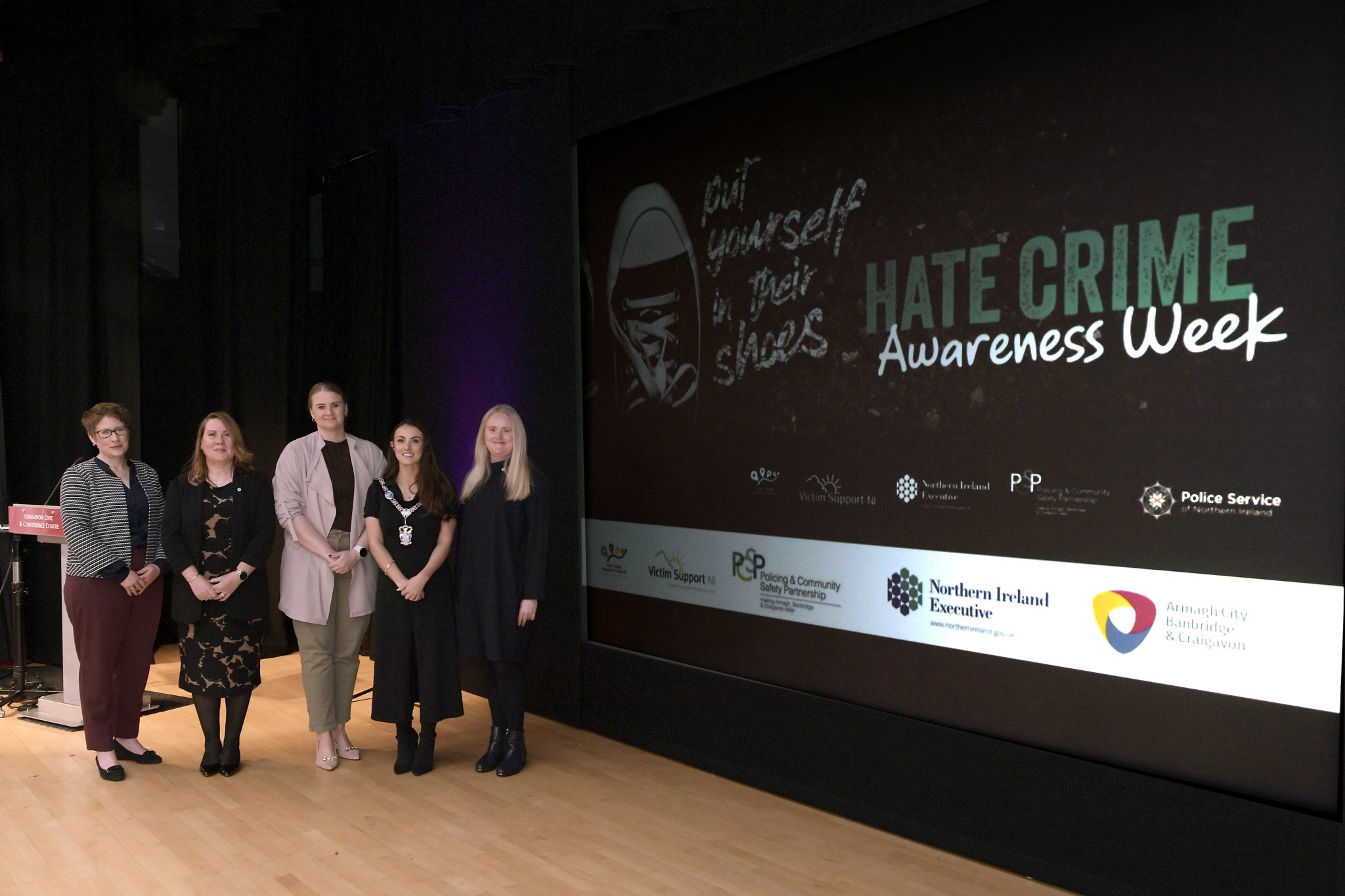
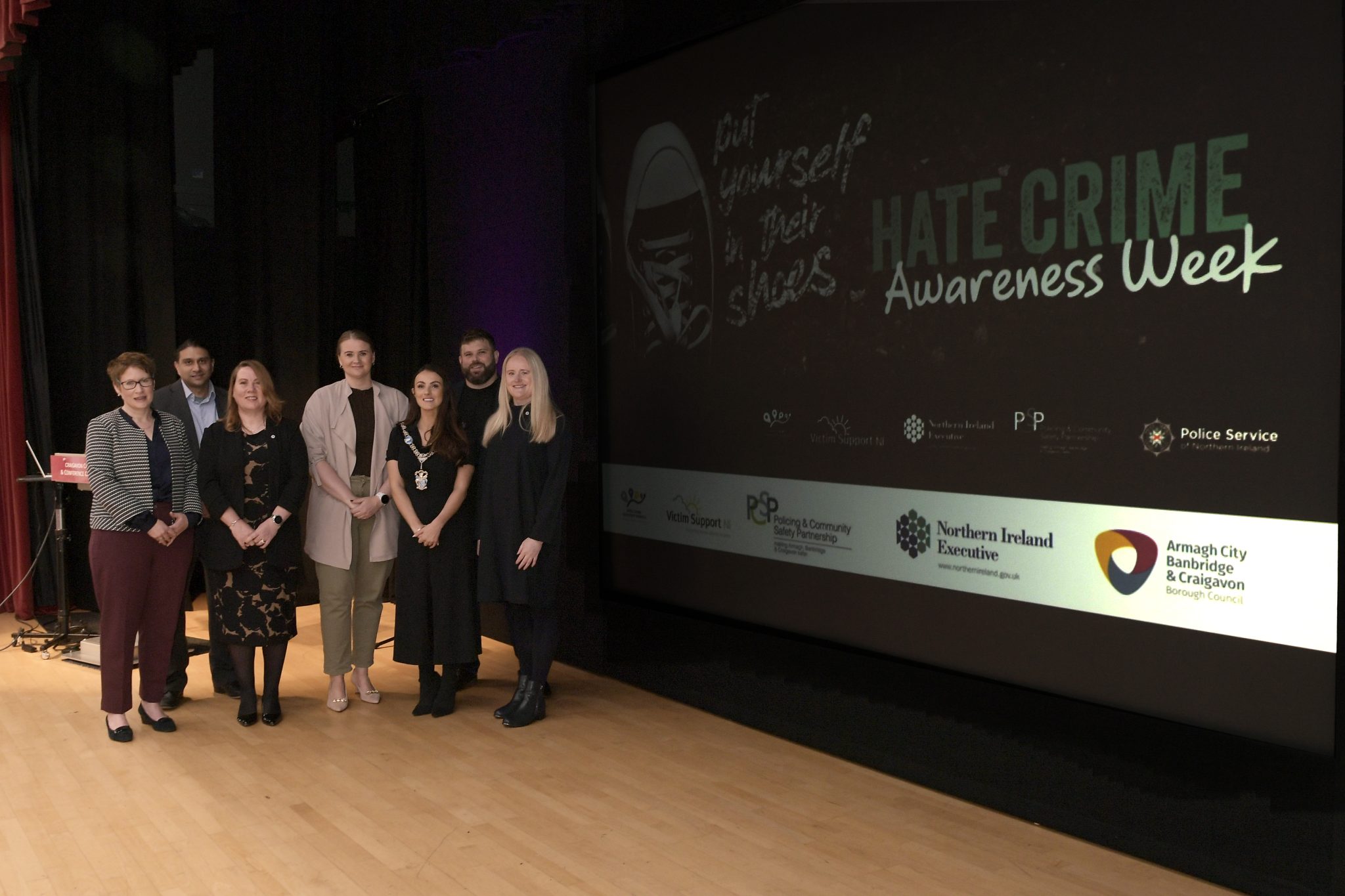
    Pictured at the recent Hate Crime Conference are: Back Row: Temporary /Superintendent Sue Steen MBE, Vishal Bedi, Ethnic Minority Police Association, Michael Avila, Hate Crime Advocacy Service, Adam Corner, Temporary Chief Inspector, Sgt Sinead Loughlin, Annette Blaney, PCSP Project Coordinator. Front Row: Patricia Gibson, PCSP Manager, Junior Minister Aisling Reilly, Lord Mayor of Armagh City, Banbridge and Craigavon, Councillor Sarah Duffy, Geraldine Hanna, Commissioner Designate for Victims of Crime for Northern Ireland and Ruth Allen, Head of Community Development.

    A hard-hitting conference to raise awareness of Hate Crime was held recently at Craigavon Civic and Conference Centre – and left a huge impact on those in attendance.

    Attended by Minister Aisling Reilly, the ‘Put Yourself in their Shoes’ event gave voice to a number of guest speakers from a variety of walks of life, who shared their very personal experiences of being a victim of Hate Crime.

    Organised in partnership with Armagh, Banbridge & Craigavon Policing & Community Safety Partnership (PCSP) and Victim Support NI, this event also focused on the Victim Support NI Hate Crime Manifesto which highlights how statutory, community and private sector partners can work collaboratively to improve support to victims and curb hate in society.

    “Hate Crime incidents are something we unfortunately now hear about on an almost daily basis and everyone should be able to live a life free from fear and isolation,” commented the Lord Mayor of Armagh City, Banbridge and Craigavon Councillor Sarah Duffy.

    “The individuals who spoke today were incredibly brave to share their story to help raise awareness of Hate Crime, and really made us all think about how we would feel if we were on the receiving end of it.”

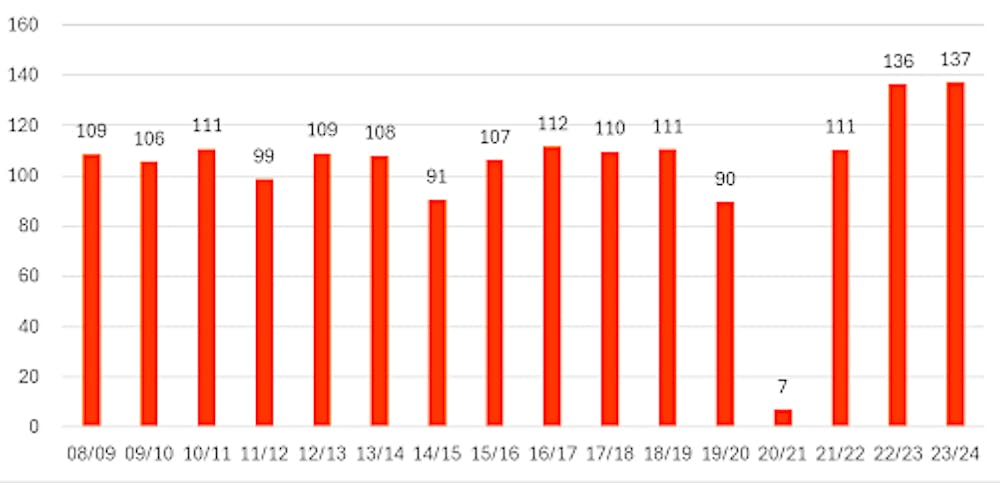
    Hate Crime is the perpetrator’s hostility or prejudice against any person or property on the grounds of the victim’s ethnicity, sexual orientation, gender identity, religion, political opinion or disability – and these incidents have continued to rise in Northern Ireland over the past decade.

    “This conference was really informative and helped to increase awareness and understanding about Hate Crime and in particular, really opened our eyes to the hate incidents that people have experienced in our communities,” commented Alderman Mark Baxter, Chair of the PCSP.

    “We would encourage everyone to report any incidents of Hate Crime and to never be afraid to speak out against it. We all need to tackle this together.”

    To report a Hate Crime please contact the Police on 101 or online https://www.psni.police.uk/report You can also call Crimestoppers on 0800 555 111 with complete anonymity.

    For help, support and advice on Hate Crime, click here: https://hcasni.com/

    This event was part funded by Armagh City, Banbridge and Craigavon Borough Council and The Executive Office.

    MIL OSI United Kingdom

  • MIL-OSI United Kingdom: Fostering is Everything

    Source: City of Derby

    Foster East Midlands, in partnership with CAN Media, is proud to present ‘Everything’ – a powerful new fostering film that highlights how fostering can truly mean everything to those involved. This film was created in collaboration with over 100 local authorities, including Derby City, Derbyshire County Council, Nottingham City, and Nottinghamshire County Council.

    ‘Everything’ follows foster carer Mike and his family on a journey through time with two of the children they have looked after, who are now adults. A surprise 60th birthday party for Mike gives Will and Zara a chance to reflect on how being fostered made a difference to their lives, thanking him for everything.

    Thanks to footage shot on a genuine old camcorder, we are taken to the 1990s, to see how Will settles into the family. We also jump back to the 2010s, when a young Zara is being taught to play the guitar by Mike, something that comes full circle when she performs a song at the party. Mike’s son Chris is involved throughout, showing the important role the children of foster carers play.

    All of the house and garden scenes were filmed in Chilwell, Nottinghamshire, adding a local and authentic touch to the film.

    The concluding message of the film is that what you do with your life could forever change someone else’s – encouraging people to foster in order to make that change.

    The film was developed with the input and insight of foster carers and people with care experience, was produced by Reel TwentyFive and project managed by public sector media partner CAN.

    Project Director for CAN Media, Rachel Brown describes the main message of the film:

    Many people don’t realise how common it is for relationships made through fostering to last well beyond the ‘official’ caring role. This has a huge impact on the lives of those who have been fostered, giving them stability and security well into adulthood.

    We also wanted to reflect how the children of foster carers make a difference to children when they come into care, helping them to feel part of the family.

    Having over 100 councils taking part in the project, the film will reach a very wide audience, encouraging people to find out more and take the steps towards becoming a foster carer.

    Fostering with your local council or children’s trust means you can better support local children and young people who need a safe and nurturing home where they can grow and thrive.

    Cllr Paul Hezelgrave, Lead Council’s Cabinet Member for Foster East Midlands said:

    The ‘Everything’ project has given our fostering service an amazing film that shows the long-term impact fostering can have, with relationships between carers and children lasting well into adulthood.

    All councils need to recruit more foster carers, and by collaborating to produce this emotionally powerful film, we will show people how rewarding and life-changing fostering is.

    The message is the same for all of us – we need more people to step forward and become foster carers. ‘Everything’ will help us to reach more people in our communities and encourage them to find out more about this really rewarding role.

    We are committed to giving vulnerable children and young people we care for the best chance to thrive, which for many of them is with local fostering families.

    Sarah Thomas, chief executive of the Fostering Network says:

    The Fostering Network has been proud to support the collaborative film projects since ‘Giants’ in 2017. It’s great to see local authority fostering services pooling resources to produce another amazing film. ‘Everything’ will help to amplify their message about the chronic shortage of fostering households, encouraging more people to come forward and foster.

    One of the main characters in the film, Chris, shows how important other family members are when it comes to fostering. This is something we champion throughout October, which is Children of Foster Carers Month.

    ‘Everything’ is the latest in a series of film collaborations that started in 2017 with ‘Giants’, which was supported by a small number of local authorities in the midlands and has now grown into a national project across England, reflecting the need to recruit more foster carers.

    Watch the full version of the ‘Everything’ Film on Foster for East Midlands YouTube channel or view the 30 second shortened version

    If you’re interested in becoming a foster carer or want to learn more, visit Foster for East Midlands webpage, email hello@fosterforeastmidlands.org.uk or call 03033 132950

    Be inspired and watch the ‘Everything’ foster film 

    MIL OSI United Kingdom

  • MIL-OSI United Kingdom: Environment Agency works to preserve North East salmon stocks

    Source: United Kingdom – Executive Government & Departments

    Atlantic salmon stocks in the Tyne remain buoyant despite stocks across England reaching new lows according to a report released last week (Monday 7 October).

    An image of an adult salmon.

    Atlantic salmon stocks in the Tyne remain buoyant despite stocks across England reaching new lows according to a report released last week (Monday 7 October).  

    According to the Atlantic Salmon Stock Assessment for 2024 from the Environment Agency and the Centre for Environment, Fisheries and Aquaculture Science (Cefas), 90% of principal salmon rivers in England are classified as either “at risk” or “probably at risk,” meaning salmon numbers are below minimum levels to support sustainable populations.

    However, the River Tyne’s salmon stocks are the only location where they remain “not at risk” and the Coquet and Wear are amongst only three rivers nationally where stocks are deemed to be “probably not at risk”.

    The Environment Agency is working with partners to reduce impacts affecting stocks globally, including barriers to migration, water scarcity from abstraction and the persistent challenge from climate change, including warming seas.

    The Environment Agency and Natural England are calling on everyone from landowners and farmers to energy, waste and water companies to do more to protect this iconic and pivotal species.  

    Jon Shelley, Fisheries Technical Specialist at the Environment Agency said:

    We are proud that the Salmon Stocks in the Tyne remain “not at risk” and that rivers across the North East are providing a safe haven for salmon.

    However, we know the importance of this report and are not complacent in the North East. Action is needed to combat all pressures impacting salmon, to help maintain the salmon stocks in the region and improve the stocks across the country. 

    We will continue our vital work to help preserve the salmon stocks in our area by working closely with our partners and the community.

    Updates to this page

    Published 17 October 2024

    MIL OSI United Kingdom

  • MIL-OSI United Kingdom: Progress for investment in Grangemouth’s future

    Source: United Kingdom – Executive Government & Departments

    UK and Scottish Governments step up plans to support workers at Grangemouth refinery, with immediate investment in skills and training.

    • UK and Scottish Governments respond to Petroineos’ decision to close the refinery with investment in local community
    • Forth Valley College mobilised to support affected workers with bespoke skills support
    • Energy Secretary reiterates UK Government’s willingness to engage on how the National Wealth Fund could fund viable Project Willow outcomes, working with trade unions and industry

    The UK and Scottish Governments are jointly stepping up plans to support workers at the Grangemouth refinery affected by the risk of redundancy, with immediate investment in skills and training. 

    In addition to UK Government and Scottish Government’s joint £100m investment in the Falkirk and Grangemouth Growth Deal, Forth Valley College will receive funding to deliver bespoke support for workers affected by Petroineos’ decision to decommission the oil refinery.  

    Backed by this £100m funding, workers at Grangemouth refinery at risk of redundancy will be contacted in the coming weeks and offered tailored support to access new jobs in the local area that will shape the future of Grangemouth as an industrial hub for years to come.   

    Forth Valley College will shortly begin contacting workers to start building a skills and support package to meet their individual needs, mapping their current skills and qualifications to the future skills needed for local clean energy roles in the area and analysing where the gaps are. 

    The UK and Scottish Governments will use the findings to deliver targeted interventions to upskill the local workforce ahead of redundancies next year.  

    It comes as UK Energy Secretary Ed Miliband and Cabinet Secretary Gillian Martin attended a meeting of the Grangemouth Future Industry Board today (Thursday 17 October) at Forth Valley College alongside UK Energy Minister Michael Shanks, Scotland Secretary Ian Murray, local industry leaders, Falkirk Council, trade bodies and trade unions.  

    The £100 million Falkirk and Grangemouth Growth Deal will support projects and skills interventions in the local area. It is estimated that the Falkirk & Grangemouth Growth Deal will deliver over £628 million in economic benefits and create 1,660 jobs across the Falkirk Council area. 

    The Energy Secretary also reiterated the UK Government’s willingness to engage on how the National Wealth Fund could back projects that have the potential to yield a viable long-term future for the site, as part of the ongoing Project Willow investigation into a viable industrial Grangemouth.  

    Project Willow is urgently assessing credible options to begin building a new long-term industry at the refinery site, including low carbon hydrogen, clean eFuels and sustainable aviation fuels on the site. The Scottish Government will also soon publish the draft Grangemouth Industrial Just Transition Plan. 

    UK Government Energy Secretary Ed Miliband said:

    We continue to stand with Grangemouth workers and we are putting money on the table to secure workers good onward employment.

    By working in partnership with the Scottish Government, we’ve unlocked an unprecedented joint investment plan to support workers and secure Grangemouth’s future, and I will continue to spare no effort to drive this work forward.

    Scottish Government Cabinet Secretary for Net Zero and Energy Gillian Martin said:

    Our immediate priority remains to support the workers directly affected by the regrettable closure of the refinery. We will do everything we can to ensure they are supported to retrain and move into adjacent industries within the wider Grangemouth area.

    These workers are highly skilled and have an important contribution to make locally and nationally.  Our investment will help to unlock valuable new opportunities for them and ensure that their skills and experience continue to benefit industry in the area and the wider community.

    The new skills and training package is open to workers at both Grangemouth and Finnart Oil Terminal and will also be supported by the UK Government’s Office for Clean Energy Jobs.

    Kenny MacInnes, Principal of Forth Valley College, said:

    Forth Valley College are uniquely placed to help and upskill any Petroineos employees who are impacted as a result of the closure of the oil refinery, and we will be there to offer the necessary training and support with the help of funding from the Scottish and UK Governments.

    The College is proud to have had a long term partnership with the Grangemouth Refinery – helping to train their Modern Apprentices – and will continue to build on this in our role of making learning work for the people of Forth Valley to ensure they have the skills for the future.

    We are committed to working with PACE (Partnership Action for Continuing Employment) and Falkirk Council to help guide former Petroineos employees onto courses at Forth Valley College which will help them transfer to new jobs in another industry or sector.

    Notes to editors 

    See details of the joint investment plan.

    Updates to this page

    Published 17 October 2024

    MIL OSI United Kingdom

  • MIL-OSI United Kingdom: Increased sentencing powers for magistrates to address prisons crisis

    Source: United Kingdom – Executive Government & Departments

    More victims will get the justice they deserve sooner under plans to give magistrates greater sentencing powers.

    • Magistrates can send offenders to prison for up to one year
    • New powers to ease historic crisis in prisons and deal with court backlog
    • Next step in government’s plan to resolve inherited long-term prison capacity issues

    More victims will get the justice they deserve sooner under plans to give magistrates greater sentencing powers, announced by Lord Chancellor Shabana Mahmood.

    The changes, the latest step in the government’s plans to tackle the inherited crisis in our prisons, will allow magistrates to hand-down prison sentences of up to a year. This will help to tackle the record remand population in jails and address the Crown Court backlog, also at a historic high.

    The Lord Chancellor confirmed the plans to allow magistrates to issue custodial sentences for up to 12 months for a single offence – a doubling of their current powers. The move will save approximately 2,000 days in the Crown Court, so that time can be reserved for the most serious and complex cases.

    Bolstered powers will better support victims, with some who have been waiting months and even years to see justice done due to a system in disarray.

    It will also help the government drive down the record remand population – those who are in prison while they await their trial – and relieve pressure on prison capacity which was left at the brink of collapse.

    Lord Chancellor and Secretary of State for Justice Shabana Mahmood said:

    This government inherited a criminal justice system in crisis, with dangerously overcrowded prisons and victims waiting far too long to see justice.

    This marks a further step towards addressing the deep challenges in our criminal justice system, both reducing the record remand population in our jails and delivering swifter justice for victims.

    The significant increase in the remand population, which currently stands at a record 17,000, is one of the key factors in the current prison capacity crisis. This is because remand prisoners can only be held in “reception prisons” where the capacity in the prison estate is most acute, where some of our most dangerous offenders must be held, and where all new prisoners are sent to begin their sentences.

    Tackling the backlog of those awaiting trial in prison is a key priority and these reforms build on the government’s work to reduce pressure on the prison estate ahead of launching a sentencing review later this year.

    Mark Beattie, national chair of the Magistrates’ Association said:

    Magistrates are flexible and support the efficient and fair administration of justice. By being able to take on this additional responsibility and hear cases that carry a maximum sentence of 12 months, our members will be able to help prevent an increase in the backlog of cases in the crown courts, enabling the most serious offences to be dealt with quicker in crown courts; speeding justice for all.

    I know our members and colleagues will take up this increased responsibility with professionalism and integrity and will – as always – strive to deliver the highest quality of justice in their courts.

    Allowing magistrates to deal with more cases will also free up valuable Crown Court time in order to try and reduce the outstanding backlog.

    There are currently over 14,000 magistrates in England and Wales who play a vital role in our justice system hearing over a million cases on average every year. Coming from all walks of life they hear cases ranging from petty theft to serious assault. Magistrates and legal advisers will be fully trained in these new measures by the Judicial College in order to deliver longer sentences effectively.  The previous government extended sentencing powers in May 2022 but deactivated them in March 2023.

    Further information

    The Statutory Instrument to increase sentencing powers is due to be laid on 28 October and changes will come into force on 18 November.

    The Magistrates’ Association is a national charity and the membership body for the magistracy. With more than 12,000 members across England and Wales, it is a unique source of information and insight, and the only independent voice of the magistracy.

    The Magistrates’ Association will be available for media interviews stories. Please email media@magistrates-association.org.uk or call 020 3937 8863.

    A sentencing review will be published later this year.

    This power was previously activated in May 2022 and closed in March 2023.

    Updates to this page

    Published 17 October 2024

    MIL OSI United Kingdom

  • MIL-OSI United Kingdom: Regulators urge safer giving to help people impacted by humanitarian crisis in the Middle East

    Source: United Kingdom – Executive Government & Departments

    The Charity Commission for England and Wales and the Fundraising Regulator advise people to give support via registered charities.

    Today (17 October 2024) the Charity Commission for England and Wales and the Fundraising Regulator have published advice on how people can help civilians impacted by the ongoing conflict in the Middle East.

    The advice comes as the Disasters Emergency Committee (DEC) launches a humanitarian appeal to help civilians affected by humanitarian crises in Gaza and Lebanon caused by conflict.

    DEC brings together 15 leading registered UK aid charities to raise funds quickly and efficiently in times of crisis overseas.

    The appeal will fund the distribution of emergency items such as mattresses, blankets, tents, food and water to those in need of basic humanitarian relief in the region.

    The government has pledged to match donations received by the DEC appeal, up to £10million, which will make the public’s generosity go up to twice as far to help those in need.

    Many people in the UK will separately be wishing to support charities operating in or supporting those across communities impacted by recent events in Israel. Checking charity registers before donating will ensure that support reaches its intended cause.

    By supporting existing, registered charities, including through the DEC, people can be assured that they are giving safely.  

    David Holdsworth, Chief Executive of the Charity Commission said:

    As we’ve watched the appalling humanitarian crisis unfold in the Middle East, many of us will be asking how best to help the millions of people in need of basic aid.

    Registered charities with experience working in incredibly complex and dangerous circumstances, across and within borders, are the best organisations to support financially to ensure donations reach civilians in need.

    That’s why we’re reminding people to give with confidence through registered charities, including the appeal launched by the Disasters Emergency Committee.

    Gerald Oppenheim, Chief Executive of the Fundraising Regulator said:

    The ongoing humanitarian crisis in the Middle East is devastating for so many people. The generosity of the British public means that many will be eager to support those affected in any way they can.

    Supporting registered charities, which have infrastructure established within the region, ensures that your donations will reach those who need it.

    Steps to giving safely 

    People can give with confidence to relief efforts by following a few simple steps: 

    • consider donating through the DEC’s emergency appeal
    • for those who choose to donate to other charities, the charity regulator is reminding people to check charities are registered and legitimate
    • look out for the Fundraising Badge – the logo that says ‘registered with Fundraising Regulator’ – and check the Fundraising Regulator’s Directory of organisations committed to fundraise in line with its Code of Fundraising Practice. 
    • contact a charity directly or find out more online about the charity that you’re seeking to donate to or work with to understand how it is spending funds 
    • make sure the charity is genuine before giving any financial information 
    • be careful when responding to emails or clicking on links within them 
    • check the charity’s name and registration number on the Charity Register – most charities with an annual income of £5,000 or more must be registered in England and Wales 

    ENDS  

    Notes to editors:  

    1. Further tips on donating with confidence to registered charities are available on GOV.UK 
    2. The Charity Commission for England and Wales is the independent, non-ministerial government department that registers and regulates charities in England and Wales. Its purpose is to ensure charity can thrive and inspire trust so that people can improve lives and strengthen society. It can be reached on 
    3. There are separate registers for charities in England and Wales, charities in Scotland and charities in Northern Ireland. Charities can be on more than one register, reflecting the nations where they operate
    4. The Fundraising Regulator is the independent regulator of charitable fundraising in England, Wales and Northern Ireland. Further guidance on giving safely to charity is available on the Fundraising Regulator’s website. It can be reached on FR@pagefield.co.uk

    Press office

    Email pressenquiries@charitycommission.gov.uk

    Out of hours press office contact number: 07785 748787

    Updates to this page

    Published 17 October 2024

    MIL OSI United Kingdom

  • MIL-OSI United Kingdom: G7 Cyber Expert Group recommends action to combat financial sector risks from quantum computing

    Source: United Kingdom – Executive Government & Departments

    G7 Cyber Expert Group publishes guidance for the finance sector on planning for quantum computing.

    The G7 Cyber Expert Group (CEG) – chaired by the U.S. Department of the Treasury and the Bank of England – released a public statement on 25 September highlighting the potential cybersecurity risks associated with developments in quantum computing and recommending steps for financial authorities and institutions to take to address those risks.

    Quantum computers are being built that will be able to solve computational problems currently deemed impossible for conventional computers to solve within a reasonable amount of time.  While potentially providing significant benefits to the financial system, these powerful computers will also carry with them unique cybersecurity risks.  One of the most significant is that cyber threat actors could use quantum computers to defeat certain cryptographic techniques that secure communications and IT systems, potentially exposing financial entity data, including customer information.

    While the exact timeline for developing quantum computers with these capabilities is uncertain, there is a real possibility that such capabilities could emerge within a decade. These quantum computers would not only put future data at risk, but also any previously transmitted data that cyber adversaries have been able to intercept and store with the intent of decrypting later with quantum computers. Due to the potentially long lead time needed to put in place quantum-resilient technologies, the time to start planning is now.

    An initial set of quantum-resilient encryption standards was released by the National Institute of Standards and Technology (NIST) last month. Additional standards from NIST and other standard-setting bodies are expected in the future. It is important for financial entities to maintain the agility required to incorporate new encryption standards in a timely and appropriate manner as they become available.

    With the availability of NIST’s standards, some financial entities may be in a position now to start making the needed changes to implement quantum resilient technologies within their systems. Others may be dependent on vendors and other third parties to develop implementations of the new standards that can be incorporated once they become available. No matter where entities are in their adoption timelines, the G7 CEG strongly encourages financial authorities and institutions to begin taking the following steps to build resilience against quantum computing risks:

    1. Develop a better understanding of the issue, the risks involved, and strategies for mitigating those risks.
    2. Assess quantum computing risks in their areas of responsibility.
    3. Develop a plan for mitigating quantum computing risks.

    The CEG statement provides additional details on quantum computing risks and the specific actions that financial entities can start taking to build quantum resilience within the financial system.

    The G7 CEG’s membership includes representatives of financial authorities across all G7 jurisdictions as well as the European Central Bank.  It was founded in 2015 to serve as a multi-year working group that coordinates cybersecurity policy and strategy across the member jurisdictions.  In addition to policy coordination, the G7 CEG also acts as a vehicle for information sharing, cooperation, and incident response.

    Updates to this page

    Published 17 October 2024

    MIL OSI United Kingdom

  • MIL-OSI United Kingdom: Celebrating 40 years of offshore wildlife recording Four decades of a unique partnership to chronicle the birds and other wildlife seen from North Sea oil and gas platforms has been celebrated in a new book.

    Source: University of Aberdeen

    Four decades of a unique partnership to chronicle the birds and other wildlife seen from North Sea oil and gas platforms has been celebrated in a new book.
    From 1979 to 2019 the North Sea Bird Club and the University of Aberdeen worked together to record and identify birds, marine animals, bats and moths and butterflies viewed from more than 250 offshore installations by over 400 observers.
    While it had been known for many years that birds cross the North Sea in very large numbers – especially in spring and autumn – it was quickly noted that those working offshore were in a unique situation to provide details of the species involved and their numbers.
    In November 1984, one offshore worker on the Maureen platform was recorded as saying: “On opening the door from the control room it appeared to be snowing. The sky was full of birds in every direction – Blackbirds, thrushes, Snow Buntings, Lapwings and even some Canada Geese. In addition there were at least 50+ owls. I’d estimate the numbers to be hundreds of thousands around the platform”
    To take advantage of this unique viewpoint, in 1979 the North Sea Bird Club was formed by a group of senior oil industry executives, and a collaboration with the University of Aberdeen began which would see more than 120,000 records sent in over the next four decades.
    The history of the partnership and the fascinating wildlife sightings and identification it led to has been set out in a book by Andrew Thorpe, the club’s former Recorder who was employed on a part-time basis by the University as a Research Assistant between 1999 and 2019.
    The North Sea Bird Club 1979-2019 mixes entertaining anecdotes, interesting facts and hard data to tell the story.
    Andrew said: “Back in 1979, it was thanks to the foresight of Professor George Dunnet, Regius Professor of Natural History at the University and other associates that the Club was created.
    “He continued to act as an adviser to the club and we drew heavily on University expertise. Being located within the Zoology Department, we were able to access other specialists – Dr Mark Young  provided support with identification of butterflies and moths sent from offshore, Professor Paul Racey provided guidance for those who found bats on offshore installations and Mr Kenn Watt was a hoverfly expert in the department who helped with identification.
    “Marine animals offshore were also recorded and the University’s Oceanlab staff were able to assist here.”
    Although the club was wound up with the downturn of the industry in 1999, the records it received, maintained by the University, continue to be used for academic research.
    “A Club Secretary in 1990 wrote ‘The North Sea Bird Club is a unique organisation operating in a unique environment’ and that remained true throughout the 40 years,” Andrew added.
    “Records came from all over the North Sea and allowed us to put together a picture of where birds were moving at peak migration times and this could often be related to similar patterns of arrival onshore.
    “The 120,000 record database the University helped us to create has been used to provide data to many interested parties. For example several different University students requested data on Buzzard feathers, Twite records offshore, Porbeagle shark and bat records.
    “Professor Racey, formerly of the University, informed us that much valuable information about the occurrence of Nathusius’ pipistrelle bat had been obtained from offshore records of that species. Certain corpses of dead birds found offshore were passed to The National Museum Scotland for their collections.
    The North Sea Bird Club 1979-2019 is available at £21.00 (inc p&p) to purchase directly from Andrew Thorpe by emailing Andrew.Thorpe147@btinternet.com.
     
    Interesting Facts from the North Sea Bird Club         
    Many common ‘garden’ birds regularly cross the North Sea;
    Blackbirds, robins, chaffinches, blue tits, crows and owls are all regularly reported from rigs in the North sea;
    Even tiny wrens cross the North Sea.  In 1998, a total of 58 wrens was reported from offshore installations;
    Blackbirds and thrushes can cross the North Sea in large numbers, usually in autumn.  In 1979, over 30,000 blackbirds were reported offshore;
    In November 1984, an exceptional number of birds landed on the Maureen platform during very bad weather – some 200-300,000 were estimated including 40-50 owls;
    Starlings regularly cross the North Sea in spring and autumn in very large numbers.  A flock of an estimated 50,000 was seen to pass by Auk Alpha in 1984!
    Ringed birds are often found dead on rigs;
    A Starling that was ringed in Poland in May 1992 was found on the Hewett platform in December that year.  It had travelled over 1500km;
    A Blue Tit ringed in Norway in July 1988 was found on Beryl B, halfway between Norway and the Shetland Isles;
    The first British record of a Pacific Swift came from Shell BT platform in 1981.  It normally breeds in the Far East and migrates to Australia!
    It’s not only birds that were reported:
    Over 300 killer whales have been seen offshore and reported. 20-30 were around Brae B in April 1988 and one remained there for almost a year (photo);
    Butterflies, moths and dragonflies are regularly reported too;
    A Blue Dasher dragonfly from America which was found on an unmanned rig near Shetland was the first record in Europe!
    Bats are occasionally found and sent in;
    The NSBC has provided much valuable information on the Nathusius’ pipistrelle bat which previously was rarely recorded in the UK.

    MIL OSI United Kingdom

  • MIL-OSI United Kingdom: Asda Stores Ltd Fined £250,000 after Trading Standards investigation

    Source: City of Derby

    Asda Stores Ltd has been handed a £250,000 fine for displaying food beyond its use-by date, following an investigation by Derby City Council’s Trading Standards Team.

    The case was heard at Southern Derbyshire Magistrates Court, where, on Wednesday 16 October, District Judge Jonathan Taaffe found Asda Stores Ltd guilty of 11 offences. These related to having unsafe food on offer for sale contrary to regulation 19 of the Food Safety and Hygiene (England) Regulations 2013.

    Asda Stores Ltd were then handed down a fine of £250,000 and ordered to pay costs of £74,117.69 and a victim surcharge of £190.

    This sizeable fine comes after an inspection at Asda’s Sinfin store on 15 July 2021. During the inspection, Trading Standards officers found 18 food items on shelves past their use-by date. This followed previous warnings on two occasions from Senior Trading Standards Officers.

    Use-by dates are applied to highly perishable food items by the manufacturer and are crucial to ensuring customers are buying and consuming safe items. According to the Food Standards Agency, these dates are the most important to remember for food products. Shoppers are advised never to eat food beyond the use-by date, even if it looks and smells ok.

    District Judge Taaffe determined that Asda Stores Ltd did not provide a satisfactory defence, but instead failed to prove that they had implemented their system properly and failed to show that they had made improvements following the warnings received from the Trading Standards team.

    Councillor Shiraz Khan, Cabinet Member for Housing and Regulatory Services, said:

    A fine of this scale reflects the seriousness of the situation and the risk it posed to the people of Derby.

    “We are lucky that we have a Trading Standards team who are committed to keeping our city safe, and I am incredibly proud of the work that they continue to do. This case serves as a reminder that we are prepared to take whatever action necessary against businesses that break the rules, no matter how big or small.

    The investigation was led by Victoria Rose, Senior Trading Standards Officer, who said:

    Customers should be able to rely on stores such as Asda to supply food that is safe to eat. It’s my role as a Senior Trading Standards Officer to help protect the public when this is not the case, especially when some of these foods were aimed at children and found to be on the shelves six months past their use-by date.

    Donna Dowse, Trading Standards Service Manager, added:

    This was not an easy case to bring before the courts, and as a service we faced many barriers put before us due to the nature of Primary Authority Partnerships when trying to take enforcement action.

    The Primary Authority blocked our enforcement action in this case. As such, Victoria Rose had to take the matter first to the Office for Product Safety and Standards (OPSS) and then to the Secretary of State before we could look at a prosecution. If it wasn’t for this commitment to keeping the public safe, then Asda would not have been held accountable for their failings as they have been today.

    A Primary Authority Partnership is an agreement in law between a business and a local authority. If the local authority provides that business with “assured” advice, then the business can rely on that advice when being investigated by other local authorities, and the Primary Authority can block enforcement action being taken in respect of that advice.

    MIL OSI United Kingdom

  • MIL-OSI Global: Why America is buying up the Premier League – and what it means for the future of football

    Source: The Conversation – UK – By Kieran Maguire, Senior Teacher in Accountancy and member of Football Industries Group, University of Liverpool

    When the Premier League broke away from the rest of English football in 1992, its 22 clubs generated £205 million in its debut season, and the average player earned £2,050 a week. Thirty years later, despite having two fewer clubs, the league’s revenue had increased by 2,850% to £6.1 billion and the average player earned £93,000 a week.

    At the heart of this extraordinary growth is an American revolution. In the Premier League’s inaugural season, football was still in recovery from the horrors of the stadium disasters at Hillsborough and Heysel. Owners tended to be from the local area and with a business background. The only foreign owner was Sam Hamman at Wimbledon, a Lebanese millionaire who bought the club on a whim having reportedly been much more interested in tennis. The season ended with Manchester United (under Alex Ferguson) winning the English game’s top league for the first time in 26 years.

    Now, if the bid for Everton by the Friedkin Group (TFG) is ratified, 11 of the 20 Premier League clubs will be controlled or part-owned by American investors. The US – long seen as football’s final frontier when it comes to the men’s game – suddenly can’t get enough of English “soccer”.

    Four of the Premier League’s “big six” are American-owned – Manchester United, Liverpool, Arsenal and Chelsea – while a fifth, Manchester City, has a significant US minority shareholding. Aston Villa, Fulham, Bournemouth, Crystal Palace, West Ham and Ipswich Town also have varying degrees of American ownership.

    And it’s not even just the glamour clubs at the top of the tree. American investment has also been significant lower down the football pyramid, led by the high-profile acquisition of then non-league Wrexham by Hollywood actors Ryan Reynolds and Rob McElhenny, and Birmingham City’s purchase by US investors including seven-time Super Bowl winner Tom Brady. American investment in football has reached places as geographically diverse as Carlisle and Crawley in England, and Aberdeen and Edinburgh in Scotland.

    So why the American obsession with English football? And how real are concerns that these US owners could collude to “Americanise” the traditions of the Premier League – whether by reducing the risk of relegation, introducing some form of “draft pick” system, or moving matches and even clubs to other cities?

    The Premier League’s first US owner

    Manchester United was the first Premier League club to come under American ownership – after a row about a horse.

    In 2005, United was owned by a variety of investors including Irish businessmen and racehorse owners John Magnier and J.P. McManus. Their erstwhile friend Ferguson, the United manager, thought he co-owned the champion racehorse Rock of Gibraltar with them – a stallion worth millions in stud rights. They disagreed – and their bitter dispute was such that Magnier and McManus decided to sell their shares in the football club.

    The Miami-based Glazer family – already involved in sport as owners of NFL franchise the Tampa Bay Buccaneers – had already been buying up small tranches of shares in United, but the sudden availability of the Irish shares allowed Malcolm Glazer to acquire a controlling stake for £790 million (around £1.5 billion at today’s prices).

    The fact Glazer did not actually have sufficient funds to pay for these shares was a solvable problem. In the some-might-say commercially naive world of top-flight English football before the Premier League, Manchester United was a club without debt, paying its way without leveraging its position as one of the world’s most famous football clubs. Glazer saw the opportunity this presented and arranged a leveraged buy-out (LBO), whereby the football club borrowed more than £600 million secured on its own assets to, in effect, “buy itself” in 2005.

    Despite the need to meet the high interest costs to fund the LBO, United continued winning trophies under Ferguson – including three Premier League titles in a row in 2007, 2008 and 2009, as well as a Champions League victory in 2008. Amid this success, the club felt that ticket prices were too low and set about increasing them, with matchday revenue increasing from £66 million in 2004/05 to over £101 million by 2007/08.

    Commercial income was another area the Glazers were keen to increase. United set up offices in London and adopted a global approach to finding new official branding deals ranging from snacks to tractor and tyre suppliers – doubling revenues from this income source too.

    But in this new, more aggressive world of “sweating the asset”, the debts lingered – and most United fans remained deeply suspicious of their American owners. (Following their father’s death in 2014, the club was co-owned by his six children, with brothers Avram and Joel Glazer becoming co-chairmen.)

    Today, despite its partial listing on the New York Stock Exchange and the February 2024 sale of 27.7% of the club to British billionaire Sir Jim Ratcliffe for a reputed £1.25 billion, United still has borrowings of more than £546 million, having paid cumulative interest costs of £969 million since the takeover in 2005. But with the club now valued at US$6.55 billion (around £5bn), it represents a very smart investment for the Glazer family.

    Indeed, while the prices being paid for football clubs across Europe have reached record levels, they are still seen as cheap investments compared with US sports’ leading franchises. Forbes’s annual list of the world’s most valuable sports teams has American football (NFL), baseball (MLB) and basketball (NBA) teams occupying the top ten positions, with only three Premier League clubs – Manchester United, Liverpool and Manchester City – in the top 50.

    With NFL teams having an average franchise value of US$5.1 billion and NBA $3.9 billion, many English football clubs still look like a bargain from the other side of the pond.

    The risk of relegation

    The latest to join this US bandwagon, TFG – a Texas-based portfolio of companies run by American businessman and film producer Dan Friedkin – is reported to have offered £400m to buy Everton, despite the club’s poor financial state.

    “The Toffees” have been hit by loss of sponsorships as well as two sets of points deductions for breaching the Premier League’s financial rules, leading to revenue losses from lower league positions. While the new stadium being built at Liverpool’s Bramley-Moore dock has been yet another financial constraint, it will at least increase matchday income from the start of next season.

    Everton’s new stadium at Bramley-Moore dock will open in time for the start of the 2025-26 season.
    Phil Silverman / Shutterstock

    A wider reason for the relative bargain in valuations of European football clubs is the risk of relegation – something that is not part of the closed leagues of most US sports. While the threat of relegation (and promise of promotion) has always been an integral part of English and European football, the jeopardy this brings for supporters – and a club’s finances – does not exist in the NFL, NBA, Major League Soccer and similar competitions.

    The Premier League, with its three relegation spots at the end of each season, has featured 51 different clubs since it launched in 1992. Only six clubs – Arsenal, Spurs, Chelsea, Manchester United, Liverpool and Everton – have been ever present, with Arsenal now approaching 100 years of consecutive top-flight football.

    Other Premier League clubs have experienced the dramatic cost-benefit of relegation and promotion. Oldham Athletic, who were in the Premier League for its first two seasons, now languish in the fifth tier of the game, outside the English Football League (EFL). In contrast, Luton Town, who were in the fifth tier as recently as 2014, were promoted to the Premier League in 2023 – only to be relegated at the end of last season.

    While it is difficult to compare football clubs with basketball and American football teams, the financial difference between having an open league, with relegation, and a closed league becomes apparent when you look at women’s football on both sides of the Atlantic.

    Angel City, a women’s soccer team based in Los Angeles, only entered the National Women’s Soccer League (NWSL) in 2022 and is yet to win an NWSL trophy. But last month, the club was sold for US$250 million (£188m) to Disney’s CEO Bob Iger and TV journalist Willow Bay – the most expensive takeover in the history of women’s professional sport.

    In comparison, Chelsea – seven-time winners of the English Women’s Super League and one of the most successful sides in Europe – valued its women’s team at £150 million ($US196m) earlier this summer. While there are a number of factors to this price differential, the confidence that Angel City will always be a member of the big league of US soccer clubs – and share very equally in its revenue – will have made its new owners very confident in the long-term soundness of their deal.

    The story of Angel City FC, the most expensive team in women’s sport.

    A further attraction for American investors is the potential to enter two markets – one mature (men’s football) and one effectively a start-up (the women’s game) – in a single purchase. In the US, the top men’s and women’s clubs are completely separate. But in Europe, most top-flight women’s teams are affiliated to men’s clubs – with the exception of eight-time Women’s Champions League winners Olympique Lyonnais Feminin, which split from the French men’s club when Korean-American businesswoman Michele Kang bought a majority stake in the women’s team in February 2024).

    While interest in, and hence value of, the WSL is now growing fast, the women’s game in England is dwarfed by viewer ratings for the Premier League – the most watched sporting league in the world, viewed by an estimated 1.87 billion people every week across 189 countries.

    These figures dwarf even the NFL which, while currently still the most valuable of all sporting leagues in terms of its broadcasting deals, must be looking at the growth of the Premier League with some jealousy. This may explain why some US franchise owners, such as Stan Kroenke, the Glazer family, Fenway Sports Group and Billy Foley, have subsequently purchased Premier League football clubs.

    Ironically, for many spectators around the world, it is the intensity and competitiveness of most Premier League matches – brought on in part by the threat of relegation and prize of European qualification – that makes it so captivating. However, billionaire investors like guaranteed numbers and dislike risk – especially the degree of financial risk that exists in the Premier League and English Football League.

    European not-so-Super League

    In April 2021, 12 leading European clubs (six from England plus three each from Spain and Italy) announced the creation of the European Super League (ESL). This new mid-week competition was to be a high-revenue generating, closed competition with (eventually) 15 permanent teams and five annual additions qualifying from Europe. According to one of the driving forces behind the plan, Manchester United co-chairman Joel Glazer:

    By bringing together the world’s greatest clubs and players to play each other throughout the season, the Super League will open a new chapter for European football, ensuring world-class competition and facilities, and increased financial support for the wider football pyramid.

    The problem facing the Premier League’s “big six” clubs – and their ambitious owners – is there are currently only four slots available to play in the Champions League. So, their thinking went, why not take away the risk of not qualifying? However, the proposal was swiftly condemned by fans around Europe, together with football’s governing bodies and leagues – all of whom saw the ESL proposal as a threat to the quality and integrity of their domestic leagues. Following some large fan protests, including at Chelsea’s Stamford Bridge, Manchester City was the first club to withdraw – followed, within a couple of days, by the rest of the English clubs.

    Under the terms of the ESL proposals, founding member clubs would have been guaranteed participation in the competition forever. Guaranteed participation means guaranteed revenues. The current financial gap between the “big six” and the other members of the Premier League, which in 2022/23 averaged £396 million, would have widened rapidly.

    For example, these clubs would have been able to sell the broadcast rights for some of their ESL home fixtures direct to fans, instead of via a broadcaster. All of a sudden, that database of fans who have downloaded the official club app, or are on a mailing list, becomes far more valuable. These are the people most willing to watch their favourite team on a pay-per-view basis, further increasing revenues.

    At the same time, a planned ESL wage cap would have stopped players taking all these increased revenues in the form of higher wages, allowing these clubs to become more profitable and their ownership even more lucrative.

    American-owned Manchester United and Liverpool had previously tried to enhance the value of their investments during the COVID lockdowns era via ProjectBig Picture – proposals to reduce the size of the Premier League and scrap one of the two domestic cup competitions, thus freeing up time for the bigger clubs to arrange more lucrative tours and European matches against high-profile opposition.

    Most importantly, Project Big Picture would have resulted in changing the governance of the domestic game. Under its proposals, the “big six” clubs would have enjoyed enhanced voting rights, and therefore been able to significantly influence how the domestic game was governed.

    Any attempt to increase the concentration of power raises concerns of lower competitive balance, whereby fewer teams are in the running to win the title and fewer games are meaningful. This is a problem facing some other major European football leagues including France’s Ligue 1, where interest among broadcasters has dwindled amid the perceived dominance of Paris St-Germain.

    So while to date, American-led attempts to change the structure of the Premier League have been foiled, it’s unlikely such ideas have gone away for good. The near-universal fear of fans – even those who welcome an injection of extra cash from a new billionaire owner – is that the spectacle of the league will only be diminished if such plans ever succeed.

    And there is evidence from the women’s game that the US closed league format is coming under more pressure from football’s global forces. The NWSL recently announced it is removing the draft system that is designed (as with the NFL and NBA) to build in jeopardy and competitive balance when there is no risk of relegation.

    Top US women’s football clubs are losing some of their leading players to other leagues, in part because European clubs are not bound by the same artificial rules of employment. In a truly global professional sport such as football, international competition will always tend to destabilise closed leagues.

    Why do they keep buying these clubs?

    Does this mean that American and other wealthy owners of Premier League clubs seeking to reduce their risks are ultimately fighting a losing battle? And if so, given the potential risks involved in owning a football club – both financial and even personal – why do they keep buying them?

    The motivations are part-financial, part technological and, as has always been the case with sports ownership, part-vanity.

    The American economy has grown far faster than that of the EU or UK in recent years. Consequently, there are many beneficiaries of this growth who have surplus cash, and here football becomes an attractive proposition. In fact, football clubs are more resilient to recessions than other industries, holding their value better as they are effectively monopoly suppliers for their fans who have brand loyalty that exists in few other industries.

    From 1993 to 2018, a period during which the UK economy more than doubled, the total value of Premier League clubs grew 30 times larger. And many fans are tied to supporting one club, helping to make the biggest clubs more resilient to economic changes than other industries. While football, like many parts of the entertainment industry, was hit by lockdown during Covid, no clubs went out of business, despite the challenges of matches being played in empty stadiums.

    Added to this, the exchange rates for US dollars have been very favourable until recently, making US investments in the UK and Europe cheaper for American investors.


    This article is part of Conversation Insights.

    Our co-editors commission long-form journalism, working with academics from many different backgrounds who are engaged in projects aimed at tackling societal and scientific challenges.


    So, while Manchester United fans would argue that the Glazer family have not been good for the club, United has been good for the Glazers. And Fenway Sports Group (FSG), who bought Liverpool for £300 million in 2010, have recouped almost all of that money in smaller share sales while remaining majority owners of Liverpool.

    Despite this, the £2.5 billion price paid for Chelsea by the US Clearlake-Todd Boehly consortium in May 2022 took markets by surprise.

    The sale – which came after the UK government froze the assets of the club’s Russian oligarch owner, Roman Abramovich, following the invasion of Ukraine – went through less than a year after Newcastle United had been sold by Sports Direct founder Mike Ashley to the Saudi Arabian Public Investment Fund for £305 million – approximately twice that club’s annual revenues. Yet Clearlake-Boehly were willing to pay over five times Chelsea’s annual revenues to acquire the club, even though it was in a precarious financial position.

    Clearlake is a private equity group whose main aim is to make profits for their investors. But unlike most such investors, who tend to focus on cost-cutting, the Chelsea ownership came in with a high-spending strategy using new financial structuring ideas, such as offering longer player contracts to avoid falling foul of football’s profitability and sustainability rules (although this loophole has since been closed with Uefa, European football’s governing body, limiting contract lengths for financial regulation purposes to five years).

    Chelsea’s location in the one of the most expensive areas of London, combined with its on-field success under Abramovich, all added to the attraction, of course. But there are other reasons why Clearlake, along with billionaire businessman Boehly, were willing to stump up so much for the club.

    From Hollywood to the metaverse

    While some British football fans may have viewed the Ted Lasso TV show as an enjoyable if slightly twee fictional account of American involvement in English soccer, it has enhanced the attraction of the sport in the US. So too Welcome To Wrexham – the fly-on-the-wall series covering the (to date) two promotions of Wales’s oldest football club under the unlikely Hollywood stewardship of Reynolds and McElhenney.

    Welcome To Wrexham, season one trailer.

    The growth in US interest in English football is reflected in the record-breaking Premier League media rights deal in 2022, with NBC Sports reportedly paying $2.7 billion (£2.06bn) for its latest six-year deal.

    But as well as football offering one of increasingly few “live shared TV experiences” that carry lucrative advertising slots, there may also be more opportunity for more behind-the-scenes coverage of the Premier League – as has long been seen in US coverage of NBA games, for example, where players are interviewed in the locker room straight after games.

    According to Manchester United’s latest annual report, the club now has a “global community of 1.1 billion fans and followers”. Such numbers mean its owners, and many others, are bullish about the potential of the metaverse in terms of offering a matchday experience that could be similar to attending a match, without physically travelling to Manchester.

    Their neighbours Manchester City, part-owned by American private equity company Silverlake, broke new (virtual) ground by signing a metaverse deal with Sony in 2022. Virtual reality could give fans around the world the feeling of attending a live match, sitting next to their friends and singing along with the rest of the crowd (for a pay-per-view fee).

    Some investors are even confident that advancements in Abba-style avatar technology could one day allow fans to watch live 3D simulations of Premier League matches in stadiums all over the world. Having first-mover advantage by being in the elite club of owners who can make use of such technology could prove ever more rewarding.

    More immediately, there are some indications that competitive matches involving England’s top men’s football teams could soon take place in US or other venues. Boehly, Chelsea’s co-owner, has already suggested adopting some US sports staples such as an All-Star match to further boost revenues. Indeed, back in 2008, the Premier League tentatively discussed a “39th game” taking place overseas, but that idea was quickly shelved.

    The American owners of Birmingham City were keen to play this season’s EFL League One match against Wrexham in the US, but again this proposal did not get far. Liverpool’s chairman Tom Werner says he is determined to see matches take place overseas, and recent changes to world governing body Fifa’s rulebook could make it easier for this proposal to succeed.

    The potential benefits of hosting games overseas include higher matchday revenues, increased brand awareness, and enhanced broadcast rights. While there is likely to be significant opposition from local fans, at least American owners know they would not face the same hostility about rising matchday prices in the US as they have encountered in England.

    When the Argentinian legend Lionel Messi signed for new MLS franchise Inter Miami in 2023, season ticket prices nearly doubled on his account. And while there is vocal opposition to higher ticket prices in England, this is not borne out in terms of lower attendances for matches against high-calibre opposition – as evidenced by Aston Villa charging up to £97 for last week’s Champions League meeting with Bayern Munich.

    Villa’s director of operations, Chris Heck, defended the prices by saying that difficult decisions had to be made if the club was to be competitive.

    Manchester United’s matchday revenue per EPL season (£m)


    Kieran Maguire/Christina Philippou, CC BY

    For much of the 2010s, with broadcast revenues increasing rapidly, many Premier League owners made little effort to stoke hostilities with their loyal fan bases by putting up ticket prices. Indeed, Manchester United generated little more from matchday income in the 2021-22 season, as football emerged from the pandemic, than the club had in 2010-11 (see chart above).

    However, this uneasy truce between fans and owners has ceased. The relative flatlining of broadcast revenues since 2017, along with cost control rules that are starting to affect clubs’ ability to spend money on player signings and wages, has changed club appetites for dampened ticket prices. This has resulted in noticeable rises in individual ticket and season ticket prices by some clubs.

    However, season ticket and other local “legacy” fans generate little money compared with the more lucrative overseas and tourist fans. They may only watch their favourite team live once a season, but when they visit, they are far more likely not only to pay higher matchday prices, but to spend more on merchandise, catering and other offerings from the club.

    Today’s breed of commercially aware, profit-seeking US Premier League owners – pioneered by the Glazer family, who saw that “sweating the asset” meant more than watching football players sprinting hard – understand there is a lot more value to come from English football teams. The clubs’ loyal local supporters may not like it, but English football’s American-led revolution is not done yet.


    For you: more from our Insights series:

    To hear about new Insights articles, join the hundreds of thousands of people who value The Conversation’s evidence-based news. Subscribe to our newsletter.

    Kieran Maguire has taught courses and presented on football finance for the Professional Footballers Association, League Managers Association, FIFA and national football associations in Europe.

    Christina Philippou is affiliated with the RAF FA, and Premier League education programs.

    ref. Why America is buying up the Premier League – and what it means for the future of football – https://theconversation.com/why-america-is-buying-up-the-premier-league-and-what-it-means-for-the-future-of-football-240695

    MIL OSI – Global Reports

  • MIL-OSI USA: Gov. Kemp Announces 107 Appointments to Boards, Authorities, and Commissions

    Source: US State of Georgia

    For Immediate Release

    Friday, October 11, 2024

    Gov. Kemp Announces 107 Appointments to Boards, Authorities, and Commissions

    Atlanta, GA – Today, Governor Brian P. Kemp announced 107 appointments and reappointments to various state boards, authorities, and commissions.


    Georgia Maternal and Infant Health Advisory Commission 

    Keisha Callins is an accomplished obstetrician-gynecologist and public health expert with extensive experience in clinical practice, academic leadership, research, and community service. She holds a Doctor of Medicine from Morehouse School of Medicine and a Master of Public Health from the University of Alabama. Currently, she serves as an OB-GYN at Community Health Care Systems in Georgia and holds multiple faculty appointments, including a professorship at Mercer University School of Medicine. Callins has held various leadership roles, including serving as the Chair of the National Advisory Council on the National Health Service Corps. Callins has received numerous awards and recognitions for her contributions, including the 2024 Ruth Hartley Mosely “Pioneer of Community Advancement” Award and the 2024 Macon Volunteer Clinic Healthcare Hero award. She is actively involved in various professional organizations and community initiatives, advocating for maternal and women’s health, rural healthcare, and medical education. Additionally, she has published various research articles and contributed to discussions on healthcare policies, particularly in underserved communities.

    Amanda “Shea” Evans is a board-certified neonatologist. She is a partner in Marietta Neonatology and currently serves as the Wellstar Health System Medical Director of Neonatal Intensive Care Services and the medical director of the Level 3 Neonatal Intensive Care Unit at Wellstar Kennestone Regional Hospital. Evans completed her medical degree at Mercer University School of Medicine and went on to complete her residency in Pediatrics and Fellowship in Neonatal-Perinatal Medicine at Emory University School of Medicine. Throughout her career, Evans has been dedicated to advancing the care of high-risk infants in community-based hospitals. In addition to her clinical work, Evans is actively involved in hospital committees and initiatives. Evans has received several accolades, including the March of Dimes Heroes in Action Award. She is a proud member of the American Academy of Pediatrics and is committed to the advancement of neonatal care.

    Shannon Mayfield is a nurse midwife at Advanced Women’s Care Center, where she provides comprehensive care to women across various socioeconomic backgrounds. She specializes in cost-effective, patient-centered care; emphasizes education on maternal health; and collaborates with perinatology for high-risk cases. Mayfield received her education from Gordon State College, Clayton State College and University, and Frontier Nursing Academy. Previously, she worked as a Registered Nurse at Piedmont Henry. Her earlier roles include serving as a Certified Nurse Midwife at New Beginnings Comprehensive Women’s Healthcare and Life Cycle OB/GYN.

    Monica Newton began her education at Auburn University studying pre-med psychology followed by medical school at Midwestern University in Chicago. While in Family Medicine residency at the University of Alabama at Birmingham, she obtained a Master of Public Health in International Health. After residency, she began teaching at UAB-Selma Family Medicine Residency Program while completing a fellowship in obstetrics. Recognizing the overwhelming needs in her community, she completed a faculty fellowship in underserved medicine through the University of California-San Diego. Moved to action, she started a free clinic called “Family Doc in a Bus” with grant funding from the Alabama Department of Public Health and FEMA. She was elected by the community to serve on the Selma City Council and the Alabama Academy of Family Physicians as a regional vice president. After serving 11 years as an associate professor of family medicine, Newton moved with her family to Gainesville, Georgia, and joined the Northeast Georgia Physicians Group. To meet the current challenges in health care, Newton completed a master’s in population health from Thomas Jefferson University in 2016.

    Marlo Vernon is an associate professor at the Georgia Prevention Institute, with an appointment in the Department of Obstetrics and Gynecology at the Medical College of Georgia, Augusta University, and memberships with the Georgia Cancer Center, the Institute for Public and Preventive Health, and the Georgia Prevention Institute. She is the Principal Investigator and developer of VidaRPM – a remote self-monitoring application for blood pressure and mental health. Additionally, Vernon is the Project Director of Mothers Informed Lactation Knowledge and Support (MILKS) and the Co-Project Director for Access to Services for Pregnant and Postpartum Persons in Northeast Georgia (ASPiriNG).

    Padmashree “Champa” Woodham is a professor in the Division of Maternal-Fetal Medicine, MFM Fellowship Program Director at the Medical College of Georgia, and Director of the Regional Perinatal Center at Wellstar MCG Health. She received her bachelor’s degree from Emory University in 2001. She attended Emory University School of Medicine to complete her MD and remained at Emory to finish her Internship and Residency in the Department of Obstetrics and Gynecology in 2009. Woodham went on to complete a fellowship in Maternal-Fetal Medicine at the University of North Carolina at Chapel Hill. She is board-certified in Obstetrics and Gynecology and Maternal-Fetal Medicine. Woodham joined the faculty of Mercer School of Medicine at the Medical Center Atrium Health Navicent in Macon as the Director of Maternal-Fetal Medicine in August 2012, where she spent the first 10 years of her career. During that time, Woodham served numerous leadership roles, including Director of the Regional Perinatal Center, Chair of the Finance Council, and Vice Chair of the Atrium Health Navicent Leadership Council. Among her various honors and achievements, she received the ACOG/CREOG National Faculty Award. Woodham was the 2022-2023 President of the Georgia OBGYN Society. She provides high-risk obstetric care to patients with a range of complex maternal and fetal conditions. Her research involves predictive markers for preeclampsia and techniques to better predict growth restriction on fetal ultrasound.


    Georgia Motor Vehicle Crime Prevention Advisory Board 

    Woodrow W. Blue, Jr is the Chief of Police for the City of Forsyth. He has over 44 years of law enforcement experience and over 40 years as a Chief of Police. Blue began his career in law enforcement with the Hahira Police Department, where he was appointed Chief of Police at the age of 26. In September of 2000, he accepted the position of Deputy Police Chief of the City of Milledgeville and, in 2002, he was appointed Police Chief. He has also served as Chief of Police for the City of Eastpoint and for the City of Donaldsonville. Blue graduated from Valdosta State University with a bachelor’s degree in criminal justice and earned a master’s degree in public administration from Columbus State University. He is a 2003 graduate of the Georgia Command College, Class 8, and a 2004 graduate of the Georgia International Law Enforcement Exchange Program. Blue has served as president of the Georgia Association of Chiefs of Police, is a former member of the Board of Private Detectives and Security Agencies, and has served on the Peace Officer Standard and Training Board as the Georgia Association Chief of Police representative. Blue and his wife, Elese, have two kids and three grandchildren.  

    Derick Corbett is the senior vice president of external affairs at Pull-A-Part, where he oversees all government and regulatory affairs, compliance, and community relations work for Pull-A-Part’s 37 facilities in the 16 states it serves. Upon graduating from the University of Georgia with degrees in political science and economics, Corbett began what would become a 20 year career in public service. Corbett served with Congressman John Linder from October 2000 to December 2010, holding various positions on his Congressional staff and campaign staff, including communications director, deputy chief of staff, and chief of staff. In 2010, he served as campaign manager for Rob Woodall and went on to become Congressman Woodall’s chief of staff and campaign manager until 2020. He currently serves as a board member for the Georgia Recycling Association, the State Recycling Association of Alabama, and the Recycling Association of North Carolina. Corbett also serves as Chairman of the Automotive Recycling Committee for the Institute of Scrap Recycling Industries, the largest international recycling trade association in the world. Corbett is a member of the Georgia Chamber of Commerce and serves on the Energy and Natural Resources and Government Affairs Committees.

    John “Herb” Cranford, Jr. is the District Attorney for the Coweta Judicial Circuit, comprised of Carroll, Coweta, Heard, Meriwether, and Troup Counties. Cranford was born and raised in Coweta County and is a third generation prosecutor. He obtained a Bachelor of Arts in Religion from the University of Georgia and a Juris Doctor from Mercer University’s Walter F. George School of Law. During law school, Cranford worked as a judicial clerk for the Honorable W. Homer Drake, Jr. of the United States Bankruptcy Court for the Northern District of Georgia and then as an intern for the Coweta Circuit District Attorney’s Office. Upon graduating law school, he was hired as an Assistant District Attorney in the same office, working in Carroll County and Coweta County. In February 2018, Governor Nathan Deal appointed him as District Attorney to fill the remainder of his predecessor’s term and he has since been re-elected twice. Cranford has received recognition for his focus on prosecuting criminal street gangs, including obtaining the first guilty verdict in a gang trial in the Coweta Judicial Circuit. In 2021, he was appointed by the Supreme Court of Georgia to serve on the State Bar’s Disciplinary Board and he was elected by his fellow Georgia District Attorneys to serve as Treasurer for the District Attorneys’ Association of Georgia and the Georgia representative to the National District Attorneys Association.

    Harshida Davis is the group risk manager-Atlanta for Enterprise Holdings Inc., which does business as Enterprise Rent-A-Car, Alamo Rent-A-Car, National Car Rental, Enterprise Car Sales, Enterprise Truck Rental, and Commute with Enterprise. In her role, she oversees the Risk Management Department. After earning her bachelor’s degree from the State University of New York at Geneseo with a major in sociology and psychology, she started with Enterprise in 2001 as a rental management trainee and was promoted to the risk management department in 2002. Before joining the Atlanta group in 2019, Davis managed risk programs for Enterprise Truck Rental in North Carolina; Enterprise on the southside of Chicago and northwest Indiana; Enterprise, Alamo, and National at O’Hare and Midway; and all divisions in southwest Florida. In addition to her day-to-day responsibilities, Davis is also a member of the Georgia Auto Theft Intelligence Council and most recently spearheaded the addition of the Top Investigator of the Year-Crimes against property and Top Investigator of the Year-Crimes against persons awards at the annual ASIS Law Enforcement Appreciation Day. Dedicated to her community, Davis has sat on the board of the Literacy Council of the Gulf Coast and was a leader on the Go Red for Women Committee for the American Heart Association – Gulf Coast. Davis and her husband, Jon, have two children and reside in Atlanta.  

    Scott Goss is a senior manager of Geico’s Special Investigation Unit. He attended Georgia State University and studied criminal justice. Later, he attended Reinhardt College and studied business administration. He lives in Carnesville with his wife and family.

    Stacey Ellis Hodges takes an active role in Jim Ellis Automotive. Hodges has been working in the dealership in a full-time capacity since graduating with a bachelor’s in marketing from Georgia Southern University in 1999. Initially, her summer jobs involved administrative positions from accounting to cashiering. Once she returned from college in Statesboro, her full-time career began as a service advisor for the Audi and Porsche brands. Hodges soon moved into Audi sales, then transitioned into management. She has been a general manager for Saab, Mazda, and Maserati brands at Jim Ellis, becoming a vice president of Audi Atlanta in 2015. Today, Ellis oversees the automotive group’s directors, keeping her close to the operations as a whole and up to date on technologies and processes for the dealership group. She also serves as a corporate officer over the Company’s associated business entities. Hodges and her husband, Greg, reside in Cumming. She is actively involved in her children’s schools, recreational activities, their local church, and various charities.

    Chip Koplin has over 35 years of experience in the scrap recycling and used auto parts industries. He is the government and public affairs manager for the southeast region of Radius Recycling (formerly Schnitzer Steel Industries), focusing on metals recycling, steel manufacturing, and auto parts recovery. Previously, he served as Vice President of External Affairs at Pull-A-Part, LLC and worked for 23 years at Macon Iron & Paper Stock, a multi-generation family business before its sale to Schnitzer Steel Industries. Koplin has also co-owned General Steel Company and Commercial Doors and Associates. He is deeply involved in trade associations, including the Institute of Scrap Recycling Industries, where he serves as chair of the Material Theft Subcommittee and has held various leadership roles. Koplin is also a past president and founding board member of the Georgia Recyclers Association. His extensive board involvement includes the Georgia Chamber of Commerce, Stonecrest Industrial Council, and various other organizations. He is a 2009 Graduate of Leadership Georgia, a 2012 program chair, and a member of the Georgia Professional Lobbyists Association. Koplin attended Georgia State University where he earned a bachelor’s degree in real estate.  He and his two children reside in Atlanta.  

    Josh Lamb serves as the director of administrative services of the Department of Public Safety. In his role, he oversees the Office of Professional Standards, the Human Resources Division, the Public Information Office, and Legislative Affairs. Previously, he served as the chief of staff. Lamb began his law enforcement career as a Special Agent with the Tri-Circuit Drug Task Force in 1996. In 1999, he joined the Georgia State Patrol after he graduated from the 74th Georgia State Patrol Trooper School. Throughout his career, he has served as Corporal at Post 11 – Hinesville; Sergeant in Post 45 – Statesboro; and Sergeant First Class at Post 45, Post 16 – Helena and Post 18 – Reidsville. Lamb also spent eight years as a member of the State of Georgia SWAT team.  He served as lieutenant in the Planning and Research Unit where he created departmental policy, assisted in planning special events such as the 2018 National College Championship Game and Super Bowl LIII, and worked on legislative affairs such as the distracted driving law. Lamb has been the Director of Training, SWAT Team Commander, Executive Officer to the Deputy Commissioner, and Chief of Staff. Lamb holds a bachelor’s degree in justice studies from Georgia Southern University and a master’s degree in public administration from Columbus State University. He also attended the 259th Session of the FBI National Academy. Lt. Colonel Lamb and his wife, Alison, have two daughters.

    Scott Poole earned his Bachelor of Arts in Political Science from Berry College in 1994 before attending Georgia State University College of Law. While in law school, he completed internships with Superior Court Judge Stanley Gault and Fulton Senior Superior Court Judge William Daniel. After graduating, Scott served as an Assistant District Attorney in Cherokee County from 1997 to 2008, handling a range of cases from theft to murder and successfully prosecuting the county’s first racketeering case under the Georgia RICO statute. In 2008, he joined the Appalachian Judicial Circuit as Senior Assistant District Attorney in Pickens County, managing the office and focusing on severe cases like violent offenses and drug trafficking. Scott built a reputation as an effective litigator and teacher, instructing drug prosecutors through the Prosecuting Attorney’s Council of Georgia and being certified by the Georgia Peace Officer Standards and Training Council. In January 2013, he transitioned to private practice, co-founding Grisham & Poole, P.C. Recognized as a Super Lawyer since 2021, he was appointed Municipal Court Judge for the City of Ball Ground in 2022. He and his wife, Jennifer, have one daughter and reside in Ball Ground.

    Rick Redd has been employed with the National Insurance Crime Bureau (NCIB) as a special agent since 2018, where he covers the State of Georgia. Prior to working for the NICB, Redd retired as Detective Sergeant of the Marietta Police Department after 30 years of service, mostly spent in the Investigative Services Division. He is currently the president of the Georgia Auto Theft Intelligence Council, past president of the International Association of Auto Theft Investigators (southeast chapter), and a board member of the International Association of Special Investigation Units. Redd resides with his wife of 40 years in Canton.

    Matthew Rollins serves on the Superior Court of the Paulding Judicial Circuit, appointed by Governor Kemp in March 2024. He previously served as the District Attorney of the Paulding Judicial Circuit and as an Assistant District Attorney in the same office. Rollins served four years on active duty in the United States Marine Corps. After receiving an Honorable Discharge, he attended Kennesaw State University, where he received his bachelor’s in political science, and Mercer Law School, where he received his J.D. An active member of his community, Rollins is a member of the Dallas Lodge, the Paulding Rotary Club, and the Paulding Bar Association. Rollins and his wife, Minna, have one child and live in Acworth

    Lori Silverman attended Tulane University in New Orleans LA where she majored in Spanish. Upon graduating from Tulane, Silverman received her J.D.  from Emory University. After graduating from Emory, she began working for the Fulton County Public Defender. She then worked in private practice for many years. Silverman volunteered with the Consumer Action Center for five years before becoming the director in 2013.

    Lenn Wood is the Sheriff of Coweta County. He has dedicated over 40 years to law enforcement, starting with the Newnan Police Department before joining the Coweta County Sheriff’s Office. His extensive career includes roles in Patrol, Investigations, School Resource, Training, Jail, and Court Services. His transparency initiatives include working with international broadcast projects like Investigative ID and “On Patrol Live” to build trust with the community. He has also led efforts against human trafficking, improving victim recognition and collaborating with state and federal agencies. His emphasis on comprehensive training—requiring officers to complete at least forty hours of continuing education annually—demonstrates his dedication to maintaining high-performance standards.


    State Board of Occupational Therapy 

    Betsy McDaniel is the Chair of the Department of Rehabilitation Science and Fitness at Middle Georgia State University. McDaniel holds a master’s degree in health & human performance from Georgia College and State University, along with dual associate degrees and a bachelor’s degree from Middle Georgia State University. At Middle Georgia State University, she has served as Occupational Therapy Assistant (OTA) Program Director and Academic Fieldwork Coordinator, where she has been instrumental in overseeing curriculum development, faculty management, and maintaining program accreditation. McDaniel has developed and enhanced various OTA courses. She is actively involved in university committees and professional associations, including the American Occupational Therapy Association and the Georgia Occupational Therapy Association. Additionally, McDaniel maintains her clinical skills as a PRN Certified Occupational Therapy Assistant at Southwest Georgia Rehab.


    State Workforce Development Board 

    Lindsay Hill serves as the senior vice president of human resources at Georgia Power, where she spearheads initiatives in talent management; diversity, equity and inclusion; labor relations; safety; facilities; and HR delivery. Hill is a member of Georgia Power’s Management Council. Since joining Georgia Power in 2001, she has served as vice president of human resources at Southern Company Gas and HR director at Georgia Power. In addition to her professional responsibilities, Hill is active in the community. She is the president and CEO of the board for Bright Generations Childcare Centers and serves on the boards of the Atlanta Women’s Foundation and the Atlanta Ballet. Hill earned a bachelor’s degree in business administration with a focus on marketing from Valdosta State University and a master’s degree in organizational leadership from Troy University. She was named a 2023 Valdosta State University Distinguished Alumni recipient, and she is a 2024 participant in Leadership Georgia.

    Amy Jordon is the chief nursing officer currently overseeing Advent Health Redmond and the southeast region. In this role, Jordon manages care integration, performance improvement, and nursing education while collaborating on regional and system-wide initiatives. She is focused on clinical workforce planning and academic partnerships to enhance the clinician pipeline and improve care delivery across the network. Since 2005, she has held CNO roles at Advent Health Gordon and Advent Health Murray, showcasing a deep expertise in nursing leadership and patient care. She earned her bachelor’s and master’s in nursing from the University of West Georgia.


    State Licensing Board for Residential and General Contractors 

    Omar Ali was reappointed.


    State Commission on Family Violence 

    Michael Moore is the Madison County Sheriff. Moore began his law enforcement career at the Clarke County Jail. In 2003, he graduated from the Northeast Georgia Police Academy as a certified peace officer and began as a deputy sheriff with the Madison County Sheriff’s Office until he was elected sheriff in 2016. Moore has earned more than 1400 total law enforcement training hours throughout his career. He became a member of the Neese Sanford Volunteer Fire Department at age 18 and then transferred to the Colbert Volunteer Fire Department where he worked to the rank of Captain. Moore is a member of the Madison County Rotary Club and the Madison County Board of Education Governance Committee for Madison County Middle School. A Madison County business owner, Moore owned and operated Moore’s Trucking and Moore Tire in Colbert.  He and his wife, Toni, reside in Colbert and have four children.


    Board of Directors of the Georgia Emergency Communications Authority 

    Sam Couvillon is the Mayor of Gainesville, Georgia and a partner with Norton Insurance. At Norton, he is the area president of the Benefits Department. Couvillon began his insurance career in 2002 with New England Financial as both a financial planner and employee benefits agent.  Holding true to the values of Norton, he is very involved in the community. In addition to serving as mayor, Couvillon serves on numerous boards in the community. He previously served on the city council serving Ward 1 from 2014-2021. Couvillon received his bachelor’s degree in communication from the University of Georgia. He and his wife, Margie, have two children.  

    Michael Persley is the Chief of Police for the City of Albany. He was promoted to Chief on May 23, 2015. Persley has been employed with the Albany Police Department for 30 years and has held numerous positions within the department. He was previously the gang unit commander, east district police commander, and assistant commander of the Albany-Dougherty Metro SWAT Team where he has served as an entry team member, assistant team leader, team leader, and negotiations commander. His other assignments have included working in narcotics, general, and gang investigations. Persley has a master’s degree in administration/justice and security from the University of Phoenix, and a bachelor’s degree in criminal justice from Troy University. Persley has over 2800 hours of basic and advanced police training. He is a graduate of the IACP Leadership in Police Organization and the Northwestern School of Police Staff and Command. Persely is a member of the Georgia Association Chiefs of Police, where he serves as a district representative, and the International Association of Chiefs of Police, where he serves on the board of directors. He serves on several community boards and committees, including Stop the Violence and the Dougherty County Rotary Club. Persley is retired from the Georgia Army National Guard after serving for over 22 years. He served on deployments to Bosnia-Herzegovina, Iraq, and Afghanistan.

    Mikki Quinones serves as the division commander for Houston County E-911, with a distinguished career spanning over three decades in public safety communications. She began her career in 1991 as one of the first civilian personnel at Houston County E-911 and, by 1994, she had advanced to shift supervisor. In 2000, Quinones became the 911 operations coordinator, where she spearheaded the implementation of a countywide CAD system and an 800MHz radio system. Quinones is a certified peace officer and has led multi-million-dollar projects, including the redesign of the 911 center and the upgrade of the 800MHz system. She was instrumental in achieving CALEA accreditation for Houston County E-911, which has since earned four reaccreditations. In 2021, she was promoted to captain and completed NENA’s Center Manager Certification Program and the Georgia 911 Director’s Academy. She is a certified instructor with Peace Officer Standards and Training and also serves as an emergency medical dispatch instructor. Beyond her professional work, she is a member of the Houston County Department of Family and Children Services Board. She and her husband, Manny, have three children and two grandchildren.


    State Rehabilitation Council 

    Juliet Hardeman, Jerry Haywood, Kathryn Hearn, and Joy Norman were reappointed.


    Georgia Driver’s Education Commission 

    Andrea Daniel currently serves as the president of Athens Technical College. She has served the College for over 27 years. Daniel began her career working in the office of Senator Sam Nunn and supported the work of the Armed Services Committee. She went on to work as a senior planning analyst for the Atlanta Regional Commission on projects such as the Outer Loop Study, Vision 2020 Education Stakeholder Committee, planning and zoning studies, and Olympic Transportation Planning. Daniel has completed the Executive Leadership Academy of the Technical College System of Georgia and she is a graduate of L.E.A.D. Athens Class of 2008. She has also completed the Georgia Tech Annual Basic Economic Development Course, and the Georgia Regional Academy for Economic Development Essentials of Economic Development course. In January 2020, Daniel was elected and nominated by a group of her peers to serve on the Southern Association of Colleges and Schools Commission on Colleges (SACSCOC) Board of Trustees. For her efforts in demonstrating excellence, creativity and success in business and furthering the goals or other professional women, Daniel was presented the Athena Award in February 2020. In November 2020, she received the Elbert County Native Citizen Award during the annual meeting of the Elbert County Chamber of Commerce. Daniel has a bachelor’s degree in political science from Lander University, a master’s degree in public administration from the University of Georgia, and a PhD in business administration specializing in organizational leadership from Northcentral University. She and her husband, Sterling, have one daughter.


    Sexual Offender Risk Review Board 

    Mindy Ackerman, Jerry Bruce, J. Robert Frederick, Katie Gropper, James Morton and Bert Reeves were reappointed. 

    Elizabeth Bigham has been a special agent with the Georgia Bureau of Investigation for 17 years. Currently, she works in GBI’s Office of Special Investigations in the Cold Case Unit. For most of her career with the GBI, she was assigned to the Child Exploitation and Computer Crimes Unit (CEACC), conducting over 600 criminal investigations involving child exploitation. Bigham received a bachelor’s in criminology from Florida State University and has used her degree to instruct others at conferences in Georgia and around the world. Bingham has also provided expert testimony to General Assembly study committees and Georgia state courts.

    Meghan Thurmond serves as a victim advocate at the Paulding County District Attorney’s Office. In this role, she has supported victims and witnesses, managed crime victim compensation referrals, and worked towards becoming a nationally certified advocate. She is passionate about advocating on behalf of victims, especially those unable to voice their needs. She began her career in 2007 at the Cobb County Solicitor General’s Office as a traffic secretary, where she supported staff in a 100 person office to ensure traffic compliance. In 2017, she became a judicial administrative assistant at the Cobb County District Attorney’s Office, providing her with extensive experience in case management and fostering professional relationships.


    Georgia Council on Developmental Disabilities 

    Wesley Ford, Lisa Newbern, and Sharia Stripling were reappointed.

    Jessica Cowell is from Columbus, Georgia. She earned her G.E.D. after attending Central High School. She went to Columbus State University to study theatre.

    Dayna Holbel is an educational consultant and member of the Education Transition Team at the Emory Autism Center. In her role, she works closely with students, parents, and school personnel to support successful post-secondary outcomes for autistic students through the Individual Transition to Adulthood (ITAP) project. Holbel received her bachelor’s in English and history from the University of Michigan, and her master’s degree in education in transition specialist and special education from Wayne State University. She also has experience working in Fulton County Schools as a transition services teacher and currently operates a tutoring company called Wonder Tree Tutoring.

    Tais Keyser is a stay-at-home mom and advocate for disability rights and awareness. Two of her children are differently abled. She has worked with Unlock GA, a broad-based coalition whose mission is to expand and enhance home and community-based services to support Georgians with developmental disabilities.

    Brook Kubik is a part-time instructor at the University of North Georgia, teaching primarily chemistry, biology, and environmental science to undergraduate students through the online eCore platform.  Previously, she was an analytical research chemist at the Centers for Disease Control and Prevention (CDC) in Atlanta. She holds a bachelor’s degree in biology from the University of West Georgia, a master’s in chemistry and a C.P.H. in Epidemiology from Georgia State University, and an Ed.S. in Curriculum and Instruction from Lincoln Memorial University. Kubik is a mother of five children ages 18 and under, three of whom are differently abled. After having children with various intellectual, developmental, and physical disabilities, and experiencing first-hand the lack of services and needs that we have in our communities, her passion has turned to providing support and education to disability families within her community and state.  Currently, Kubik is a parent advisory board member at the Marcus Autism Center and works with Georgia Swimming LSC/USA Swimming to bring inclusive competitive and learning opportunities to athletes of all abilities across the State of Georgia.

    Crystal St. Pierre-Stackpole is a dedicated special education teacher and community volunteer in Lafayette, Georgia. St. Pierre-Stackpole is committed to serving her local community, particularly those with special needs. Her career spans a variety of roles in education, including teaching nature-based pre-K, middle school resource classes, and high school vocational instruction. Currently, she works with elementary students with autism. Before she began teaching, St. Pierre-Stackpole worked in Chattanooga, Tennessee with local nonprofits as a volunteer coordinator, event planner, and outdoor educator. She has also worked as a CNA and home health worker while pursuing her education at Dalton State College. Inspired by her personal experiences supporting her brother, who has Down syndrome, she passionately advocates for families navigating special education and state services. St. Pierre-Stackpole actively participates in advocacy events, helping families understand their rights and connect with necessary resources. Her commitment to service and advocacy reflects her belief in the power of every individual’s voice and the need for collective advocacy.

    Jennifer Snyder is an outreach and advocacy coordinator for Living Independence for Everyone (LIFE ). In her role, she works to help people with significant disabilities transition from nursing homes and other institutions to home and community-based residences. She resides in Chatham County.

    Leslie Kate Thornton advocates for the human and civil rights of all people and equality for people with disabilities, especially in employment. She has spent several years working as a social media content developer. Thornton is passionate about community engagement and empowering individuals to make a positive impact. She resides in St. Mary’s, Georgia. 

    Dave Ward is the president & CEO of Tommy Nobis Center, bringing over 30 years of nonprofit experience. He previously served as executive vice president at the Wounded Warrior Project, executive director at Big Brothers Big Sisters, and regional director at Make-A-Wish Foundation. He also held a role at Best Buddies International and was a licensed psychotherapist. Ward is a Leadership Atlanta Class of 2020 graduate and a Governor-appointed member of the Georgia Employment First Council. He served as president of the Georgia Association of Training, Employment and Supports (GATES) from 2019-2023 and was nominated for the Turknett Leadership Group’s 2018 Leadership Character Award. He holds a bachelor’s in sociology and criminal justice and a master’s in rehabilitation counseling. Ward resides in Kennesaw with his family.


    State Water Well Standards Advisory Council 

    Clayton Wayne McKinnon, Sr. was reappointed.


    Board of Human Services

    Douglas Aldridge, Jr., David Barbee, Monica Walters, and Rochard White were reappointed.


    Board of Control for Southern Regional Education

    Greg Dozier and Matthew Dubnik were reappointed.


    Board of Early Care and Learning 

    Kristin Morrissey and Cristina Washell were reappointed.

    Kristy Beam will now serve as the Fourth Congressional District Representative.

    Jennifer Bennecke will now serve as the Sixth Congressional District Representative.

    Karla Zisook will now serve as the Fifth Congressional District Representative.

    Maria Franklin is a board-certified behavior analyst with a strong educational background and work experience in behavior analysis and support. She earned a graduate certificate in behavior analysis from Florida Institute of Technology in May 2023 and holds a master’s in applied psychology (developmental psychology) and a bachelor’s in psychology from Liberty University. Currently, Franklin works as a board-certified behavior analyst at North Georgia Autism Center, where she develops individualized therapeutic plans and conducts initial client assessments. Her previous roles include registered behavior technician at the same center providing one-on-one ABA therapy and various positions such as behavior support clinician and field trip coordinator. Franklin also served as a motor transport operator in the U.S. Army Reserve.

    Joyce Freeman is the early childhood care and education program chair and a full-time ECCE instructor at West Georgia Technical College(WGTC). In 2016, Freeman began her career at WGTC as an early childhood care and education adjunct instructor. Previously, she was a lead teacher, trainer, and supervisor at Western Arkansas Child Development and served as a lead teacher and assistant director at Early Head Start Child and Family Services. Freeman holds a Master of Arts in teaching early childhood from Arkansas Tech University, a Bachelor of Arts in organizational leadership from the University of Arkansas Fort Smith, and an Associate of Arts in early childhood education from Carl Albert University. Some of her notable accomplishments include serving on a workgroup writing team to revise the workforce knowledge competencies for program administrators and education leaders, implementing the federal work-study program at WGTC, and serving as a certified trainer in first aid/CPR and child protection. She is an active member of the Southern Early Childhood Association.

    Karen Jones has been an educator for 27 years and is currently employed with Houston County School District as a program specialist. A graduate of Georgia Southern University, she holds advanced degrees from Valdosta State University and Columbus State University. She has worked as a preschool teacher, elementary school teacher, and district-level administrator. She worked in New York, Germany, South Carolina, and Nebraska before arriving back home in Georgia. She has a wealth of knowledge in the field of early childhood education, special education, educational leadership, and curriculum. Jones has served as a member on the Middle Georgia Community Action Agency (MGCCA) Health Advisory team, Middle Georgia RESA Preschool Consortium Lead, and an instructor for MGRESA Dyslexia Endorsement Cohort. She is passionate about improving the outcomes of young children and supporting their families with early intervention resources.

    Sylvia Washington is a pediatrician with a background in clinical practice, academia, and community service. Board-certified in general pediatrics since 2011, she completed her Pediatric Residency at Mercer University Medical Center in 2010 and holds a Doctor of Medicine from New Jersey Medical School.  Washington graduated summa cum laude with a bachelor’s degree in biology from Howard University. She has served as a general pediatrician at Atrium Health Floyd Pediatrics since 2013, where she also chaired the Department of Pediatrics and directed the Reach Out and Read Program. Her previous roles include similar positions at East Albany Pediatric and Adolescent Center. Washington contributes to medical education as a preceptor for various institutions and has been involved in significant publications and research. Active in community service, she holds leadership roles with the Georgia Chapter of the American Academy of Pediatrics and engages in medical missions and youth outreach programs.


    State Board of Examiners for Speech Pathology and Audiology 

    Douglas Mattox was reappointed.


    Council on American Indian Concerns 

    Heidi Altman, Paul Brannen, Nealie McCormick, and Royce McCrary were reappointed.

    Maureen Meyers is a senior archaeologist with New South Associates, Inc. in Stone Mountain. She is an expert on pre-contact Native Americans of the southeast and has researched extensively on Native American settlement, households, ceramics, and fiber production. She is also an expert on archaeological field safety, sexual harassment and assault, and disability in archaeology. She received her bachelor’s from Radford University in Virginia, her master’s from the University of Georgia, and a Ph. D from the University of Kentucky. Meyers has over two dozen publications, many focused on her work on Mississippian period Native American mound sites in southwestern Virginia and north Georgia. She is the past president of the Southeastern Archaeological Conference, where she created partnerships with public outreach groups, scholarships for tribal and HBCU students, instituted organizational policy for addressing sexual harassment, and helped create and pass an image policy regarding Native American burial remains and associated objects.  

    Frank Williams is a full professor with tenure at Georgia State University, specializing in biological anthropology. He received his bachelor’s from the University of Florida and his master’s and Ph.D. from the University of Massachusetts, Amherst. Prior to coming to Georgia State University, he was a postdoctoral research assistant at Pennsylvania State University. Williams teaches courses in forensic anthropology, human paleontology, human osteology, statistical methods, and primate behavioral ecology. In 2020, he was the recipient of the University Faculty Award for Undergraduate Mentored Research in Policy, Entrepreneurship, Education, and Social Sciences. Williams has published extensively on reconstructing Neandertal diets using dental microwear, vertebral osteoarthritis, paleopathology, fossil primates, and dental morphology. He has received two U.S. Fulbright awards, a Fulbright Specialist Award to the University of Calgary, Canada (2014), and a Fulbright Core Scholars Award to the Royal Museum of Central Africa, Belgium (2016). He has previously served as director of undergraduate studies, department chair of anthropology, NAGRA coordinator, and faculty associate for tenure-track faculty development and review for the College of Arts and Sciences at Georgia State University.


    Georgia Real Estate Commission 

    Edward Lee Dollar was reappointed.


    Georgia Board of Dentistry 

    Glenn Maron was reappointed.


    Georgia Joint Defense Commission 

    Henry Childs, John L. Eunice, III, Peter Jones, and Al Konetzni were reappointed.


    Behavioral Health Reform and Innovation Commission 

    Kevin Tanner was reappointed as chairman.

    Karen Bailey, Jason Downey, Nora Haynes, Miriam Shook, Sarah Vinson, DeJuan White, and Michael Yochelson were reappointed.

    Melanie Dallas is the CEO of Highland Rivers Behavioral Health and a licensed professional counselor with 35 years of experience in behavioral health. Throughout her career she has held roles in crisis stabilization, mobile crisis assessment, and in-home care, working with children, families, and adults in both the public and private sectors. Dallas specializes in trauma and attachment issues. In 2019, she served on the Appalachian Regional Commission Substance Abuse Advisory Council and is currently the chair of the Policy Committee for the Georgia Association of Community Service Boards. Dallas holds a bachelor’s in marketing from the University of Kentucky and a master’s in counseling from Georgia State University. She has worked as a military family life consultant with the Department of Defense and helped develop a network of clinicians for the Georgia Army National Guard and Georgia State Defense Force. She has contributed to Georgia co-response programs, is trained in Critical Incident Stress Management (CISM), and leads a CISM team within her agency.


    Georgia Film, Music, and Digital Entertainment Advisory Council 

    Walker Dalton is the executive director of the Savannah Regional Film Commission. Previously, he served as the Savannah College of Art and Design’s director of content, where he led a team of creatives that produced art, fashion, and documentary films. Before moving to Savannah, he was a producer for 10 years on Jay Leno’s Garage and, for five years, served in NBC Universal’s digital marketing department. In 2017, Dalton earned an Emmy nomination for Jay Leno’s Garage. His leadership as the film commissioner for the region around Savannah, Georgia is reinforced by his 25 years of entertainment industry experience.

    Maria Guerra-Stoll is the president and CEO of PAM Studios and founder of GSB Architects + Interiors Inc. She began her career in film studio design working at Tyler Perry Studios in 2007 and has since overseen projects for major clients including Netflix and AT&T. Guerra-Stoll’s firm has extensive experience in designing entertainment facilities across the U.S. and internationally. She founded PAM Studios LLC, focused on fostering local talent and providing production facilities in Rome, Georgia. A native of Caracas, Venezuela, she graduated from the University of Tennessee at Knoxville with a Bachelor of Architecture. She has also completed two MBE programs at the Tuck School of Business at Dartmouth College. Guerra-Stoll serves as an executive board member of the Latin American Chamber of Commerce. She served as chairman of the Board of the Georgia Hispanic Chamber of Commerce. Additionally, Guerra-Stoll is a former board member of the Georgia Latino Film Festival, the Georgia Chamber of Commerce, Habitat for Humanity, and the YWCA.

    Pamela Thompson has been the owner-operator of Dillard House Stables since 1989. Along with her crew of experienced trail guides, she strives to keep the horseback riding tradition alive. Thompson’s lifetime of experience with horses and 25 years in the “trail riding” business allows her the opportunity to offer a safe and enjoyable horseback ride for every level rider. Additionally, she serves as president of the Dillard Tourism Association and as a camera-ready liaison for Rabun County to the Georgia film industry.

    Scott Votaw is the Assistant Vice Chancellor of the Georgia Film Academy. With over 25 years of experience working for production companies including Saban, Fox, Lucasfilm Ltd., and others, Votaw has a deep knowledge base of film production, 2D/3D animation, special FX, motion capture, and post-production. With a decade of experience in education, he also holds expertise in current and trending production needs, training educational circular creation, and workforce development. As an international consultant with CSV-Consulting, Votaw worked for studio infrastructure providers, workforce development, and emerging technology companies within the film and entertainment production sectors in the Asia-Pacific region. Prior to this, Votaw supported efforts to grow the film and TV production industry in Georgia by maintaining a highly trained and industry-standard workforce by creating/advising some of the most successful educational programs globally.


    State Board of Registration of Used Motor Vehicle Dealers and Used Motor Vehicle Parts Dealers 

    Azfar Haque, Jimmy Lydon, and Tyler Wood were reappointed. 


    Division on Family and Children Services State Advisory Board  

    Pam Clayton is the vice president of Quality Advancement & Regulatory Affairs at the Georgia Health Care Association. In her role, Clayton supports members in regulatory compliance and quality improvement, building strong relationships with stakeholders at all levels. She previously held various leadership roles at Ethica Health and Retirement Communities, where she developed and implemented strategic initiatives in skilled nursing and ancillary services. She holds a Bachelor of Science in organizational management from Covenant College and an Associate of Science in nursing from Dalton College. An active member of several professional organizations, Clayton serves on the American Health Care Association’s Quality Cabinet and co-chairs the AHCA/NCAL Quality Committee.

    Belinda Davis is the senior field operations manager of the southeast area at the Georgia Department of Corrections (GDC). Davis began her career with the GDC in 1991 as an accounting technician at Burruss Correctional Training Center (CTC). In 1997, Davis was promoted to business manager of Burruss CTC, and, later that year, she was promoted to deputy warden of administration at Metro State Prison. In 2003, Davis transferred to Georgia Diagnostic & Classification Prison to serve as the deputy warden of administration. In 2005, Davis was promoted to superintendent at McEver Probation Detention Center. In 2008, she was promoted to warden of Dooly State Prison. Before its closure, Davis was the warden of Metro State Prison and subsequently became the warden of Pulaski State Prison. Davis earned her Bachelor of Business Administration from Mercer University and a Master of Public Administration degree from Columbus State University. She has completed basic correctional officer training, basic management training, Corrections Leadership Institute, Warden’s Pre-Command, and Georgia Law Enforcement Command College. Davis is the chair of the Butts County DFACS Board.

    Lesli Reece is a seasoned professional with over 30 years of experience. While she is retired now, she serves as the director of Fostering Together, a part of North Point Ministries that she has been involved in since 2011. She has also owned L & R Real Estate Services since 2009. Prior to her current endeavors, Reece spent 11 years at the Coca-Cola Company where she served in various roles, including corporate business development and director of US & Global Staffing. Based in Alpharetta, she is passionate about making a positive impact in her community and leveraging her extensive background in business and leadership to help people.


    Georgie Behavior Analyst Licensing Board 

    Brandy Locchetta is an Assistant Professor and Applied Behavior Analysis Program Coordinator at the University of West Georgia. She holds a Ph.D. in Early Childhood Education and Applied Behavior Analysis from Vanderbilt University, a master’s in early childhood special education from Vanderbilt University, and a bachelor’s in early childhood education from Georgia State University. Locchetta’s recent roles include serving as an editorial board member on topics in early childhood special education. Previously, she was adjunct faculty at York College of Pennsylvania and held leadership positions at the Georgia Department of Early Care and Learning. She has received notable awards such as the Leading the Pack Focused on the Future Award from the University of West Georgia and the Shores Award for Excellence in Teacher Education from Vanderbilt University.


    Georgia Board of Health Care Workforce

    Steven Gautney was reappointed.


    Georgia Composite Board of Professional Counselors, Social Workers, and Marriage and Family Therapists

    Brent Herrin and Bridget Knowles were reappointed.


    Georgia Commission on Civics Education

    Wes Cantrell, Kurt Doehrman, Judy Teasley, and Randy Trammell were reappointed


    MIL OSI USA News

  • MIL-OSI United Kingdom: AI model that checks for skin cancer shows promise

    Source: Anglia Ruskin University

    Published: 17 October 2024 at 14:45

    Research found model outperformed existing methods of finding suspicious lesions

    Scientists in the East of England have developed a way of using artificial intelligence to check for skin cancer, with the AI tool outperforming existing methods in a new study.

    Researchers from Anglia Ruskin University, Check4Cancer, University of Essex and Addenbrooke’s Hospital worked on the AI model which was trained on data from 53,601 skin lesions from 25,105 patients.

    In this study, researchers used machine learning and combination theory to distil 22 clinical features down to the seven most important that predict if a skin lesion might be suspicious or not. These features include: whether the lesion has recently changed size, colour or shape; whether the lesion was pink or inflamed; and hair colour at age 15.

    Researchers applied proportional weighting to these seven features to create the new C4C Risk Score which has an accuracy of 69%. In the study it significantly outperformed existing methods such as 7PCL (62%) and Williams score (60%).

    Some of the new risk factors they discovered, such as lesion age, pinkness, and hair colour, were important for all types of skin cancer but were not included in the older methods, which only focused on melanoma, a specific type of skin cancer.

    Professor Gordon Wishart, Visiting Professor of Cancer Surgery at Anglia Ruskin University and Chief Medical Officer at Check4Cancer, said:

    “This study shows the importance of using clinical data in skin lesion classification, which should help to improve the detection of skin cancer.

    “Our new AI model, which combines the C4C risk score together with skin lesion images, could lead to a reduction in the need for patient referrals for biopsies, shorter waiting times for skin cancer diagnosis and treatment, and improved outcomes for patients.”

    Consultant Plastic Surgeon Per Hall, who recently retired from Addenbrooke’s, said:

    “The added value that this paper brings is the ability to help identify patients whose skin lesions are suspicious enough to justify onward referral for face-to-face analysis.  

    “Emphasis in the past has been on pigmented lesions and melanoma but other things grow on the skin that need sorting out such as basal cell carcinomas and squamous cell carcinomas.  

    “The NHS is deluged with referrals for skin lesion analysis – the vast majority are in fact innocent.  This work is geared towards sifting out lesions that are potentially serious and identifying those patients whose skin is more prone to developing cancers so they can be seen quickly.”

    The study, which was part-funded by a Knowledge Transfer Partnership (KTP) Grant from Innovate UK, was published in the Nature journal Scientific Reports.

    It is hoped that regulatory approval for the AI model can be given in 2025.

    MIL OSI United Kingdom

  • MIL-OSI Asia-Pac: Lo Chung-mau meets Hainan officials

    Source: Hong Kong Information Services

    Secretary for Health Prof Lo Chung-mau met a delegation led by Hainan Vice Governor Xie Jing today to introduce the initiatives on developing Hong Kong into an international health and medical innovation hub as set out in the 2024 Policy Address.
     
    At the meeting, Prof Lo updated the delegation on the latest development of Hong Kong’s healthcare policy, including initiatives put forward in the Policy Address, including complementing technological innovation with institutional innovation through expediting the reform of the approval mechanism for drugs and medical devices, and strengthening research and development and translation of biomedical technology.
     
    The Hong Kong Special Administrative Region Government will support the innovation and application of advanced biomedical technology, with a view to attracting the world’s top-notch biomedical enterprises and research organisations to set up operations in Hong Kong, Prof Lo stressed.
     
    Additionally, the progress of hospital accreditation of public hospitals in the Hong Kong SAR through the adoption of “China’s International Hospital Accreditation Standards (2021 Version)” was discussed during the meeting.
     
    Prof Lo pointed out that the Hong Kong SAR Government will continue to actively promote the adoption of the accreditation standards by more public hospitals, including extending the adoption of the standards to two to three more public hospitals in addition to Pamela Youde Nethersole Eastern Hospital and Prince of Wales Hospital.
     
    The participation of public hospitals in the accreditation programme can serve as a demonstration to the international community the national hospital accreditation standards, with Hong Kong acting as a gateway to facilitate the national standards to go global, he highlighted.
     
    In this connection, both parties also explored ways to further encourage more hospitals in the two places to pursue accreditation so as to amplify the impact of the standards.
     
    “Looking ahead, we will remain committed to fostering cross-boundary medical co-operation so as to propel the important national strategy of ‘Healthy China’ through concerted contributions,” the health chief added.

    MIL OSI Asia Pacific News

  • MIL-OSI United Kingdom: Spelthorne Borough Council: Assistant Best Value Inspector appointment letters

    Source: United Kingdom – Executive Government & Departments

    Letters appointing Assistant Best Value Inspectors in relation to Spelthorne Borough Council.

    Applies to England

    Documents

    Details

    Copies of the letters from Max Soule, Deputy Director Local Government Stewardship and Interventions at the Ministry of Housing, Communities and Local Government to Deborah McLaughlin, Mervyn Greer and Peter Robinson, detailing the decision by ministers to appoint them as Assistant Inspectors in relation to Spelthorne Borough Council under section 10 of the Local Government Act 1999.

    Updates to this page

    Published 17 October 2024

    Sign up for emails or print this page

    MIL OSI United Kingdom

  • MIL-OSI United Kingdom: Your Dog’s Care Is Our Business

    Source: Scotland – Highland Council

    Natalie Thorpe and Cllr Paul Oldham pictured with four-legged friends.

    Highland Opportunity (Investments) Limited HOIL has recently provided Inverness Dog Daycare Ltd with loan funding towards the purchase of an existing dog care business based in the Carse Industrial Estate in Inverness.

    HOIL, The Highland Council’s business loan company, supports Highland based businesses and encourages applications from all business sectors, including community organisations. Interested businesses benefit from straightforward loan conditions and a tailored offer to support their project.  HOIL has financially supported more than 1,200 local start-up businesses, community organisations and growth projects within the Highland Business community since it was established in 1986.

    Inverness Dog Daycare Ltd approached HOIL for a start-up loan to purchase and expand a licenced dog daycare centre in Inverness. The new owner has growth aspirations for the business and aims to double the availability of dog care provision, as well as introduce new services.  A pick-up and drop-off service will be available to transport dogs from their homes to the daycare centre.  The unit will also be available for use by third party dog trainers, behaviourists and various groups for rental in the evenings and weekends. The business will also hold “dog parties” at the weekend where people are invited to join and allow their dog off lead and the freedom to play with other dogs in a safe and secure area. These parties may be size, age or breed specific.

    Natalie Thorpe, who currently runs her own dog walking business on a part time basis, was looking to expand her current operations. On hearing that Playful Paws Ltd was up for sale she saw this as an opportunity to achieve her business aspirations. Natalie, who is the sole director of Inverness Dog Daycare Ltd, has taken over the lease of the business premises from The Highland Council and is excited to provide a safe and secure environment for dogs to be looked after during the day, with support from existing experienced employees.

    Councillor Paul Oldham, Chair of HOIL said: “Inverness Dog Daycare is a prime example of the sort of business we are keen to help, and indeed one I might use myself for Skye, our border collie. It is also a particular pleasure when we are supporting young entrepreneurs as we are keen to encourage people to stay in the Highlands rather than heading south to find opportunities.

    “HOIL’s accessible and affordable business finance helps promote business across the area, both to begin and expand. It is an important part of the Council’s aim to keep business vibrant and growing in the Highlands.”

    Natalie Thorpe Director of Inverness Dog Day Care Ltd said: “At Inverness Dog Daycare we provide a fun, safe and secure environment for dogs to play and rest during the day. We are a team of experienced dog handlers and always ensure the dogs’ health and wellbeing are being put first, whilst still having a great time.  We have purchased a well-established dog daycare business in Inverness and could not have done this without financing from HOIL.  The process of obtaining financing was straight forward and well guided by the team at HOIL.”

    MIL OSI United Kingdom