Reacting to the close of the NATO Summit, Green Party MP Ellie Chowns said:
“NATO leaders have fawned over a bullying, bellicose US President and agreed to a long-term doubling of arms spending that will come at the cost of cuts in vital health and public services across member states.
“The NATO summit has left us all more exposed to the threat of nuclear war and failed to offer people across the world a strategic vision of a more peaceful world.
“Here in the UK, the Labour government has already slashed aid for the most vulnerable around the world to make way for increased arms spending and next week will try to force through cuts to disability support to pay for more.
“We do not need new US-controlled fighter jets to carry US-controlled nuclear weapons paid for by UK taxpayers that will make the world a more dangerous place.
“The UK government should be leading efforts to reduce and eliminate nuclear arsenals, not paying for the US to base more of them here.
“There is a choice to be made between welfare and warfare.
“Genuine security means making sure the most vulnerable have the support needed for a decent life and we all have a government focussed on tackling the biggest long-term threats to human security – climate breakdown, global inequality, pandemics.
“Real security is built on social, economic, and environmental resilience, not more nuclear weapons.
“Green MPs will be opposing the government’s welfare cuts next week and offering a real alternative that puts people’s welfare and the planet’s future first.”
Twenty-five years ago, “The Perfect Storm” roared into movie theaters. The disaster flick, starring George Clooney and Mark Wahlberg, was a riveting, fictionalized account of commercial swordfishing in New England and a crew who went down in a violent storm.
The anniversary of the film’s release, on June 30, 2000, provides an opportunity to reflect on the real-life changes to New England’s commercial fishing industry.
Fishing was once more open to all
In the true story behind the movie, six men lost their lives in late October 1991 when the commercial swordfishing vessel Andrea Gail disappeared in a fierce storm in the North Atlantic as it was headed home to Gloucester, Massachusetts.
At the time, and until very recently, almost all commercial fisheries were open access, meaning there were no restrictions on who could fish.
There were permit requirements and regulations about where, when and how you could fish, but anyone with the means to purchase a boat and associated permits, gear, bait and fuel could enter the fishery. Eight regional councils established under a 1976 federal law to manage fisheries around the U.S. determined how many fish could be harvested prior to the start of each fishing season.
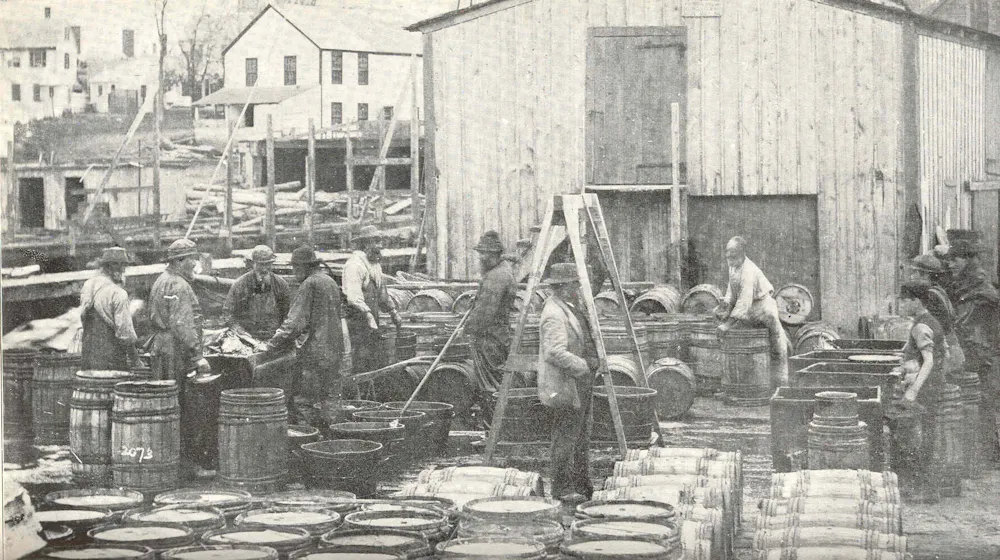
Fishing has been an integral part of coastal New England culture since its towns were established. In this 1899 photo, a New England community weighs and packs mackerel. Charles Stevenson/Freshwater and Marine Image Bank
Fishing started when the season opened and continued until the catch limit was reached. In some fisheries, this resulted in a “race to the fish” or a “derby,” where vessels competed aggressively to harvest the available catch in short amounts of time. The limit could be reached in a single day, as happened in the Pacific halibut fishery in the late 1980s.
As populations declined, managers responded by cutting catch limits to allow more fish to survive and reproduce. Fishing seasons were shortened, as it took less time for the fleets to harvest the allowed catch. It became increasingly hard for fishermen to catch enough fish to earn a living.
Saving fisheries changed the industry
In the early 2000s, as these economic and environmental challenges grew, fisheries managers started limiting access. Instead of allowing anyone to fish, only vessels or individuals meeting certain eligibility requirements would have the right to fish.
The most common method of limiting access in the U.S. is through limited entry permits, initially awarded to individuals or vessels based on previous participation or success in the fishery. Another approach is to assign individual harvest quotas or “catch shares” to permit holders, limiting how much each boat can bring in.
Today, limited access is common, and there are positive signs that the management change is helping achieve the law’s environmental goal of preventing overfishing. Since 2000, the populations of 50 major fishing stocks have been rebuilt, meaning they have recovered to a level that can once again support fishing.
Forty fish stocks are currently being managed under rebuilding plans that limit catch to allow the stock to grow, including Atlantic cod, which has struggled to recover due to a complex combination of factors, including climatic changes.
The lingering effect on communities today
While many fish stocks have recovered, the effort came at an economic cost to many individual fishermen. The limited-access Northeast groundfish fishery, which includes Atlantic cod, haddock and flounder, shed nearly 800 crew positions between 2007 and 2015.
The loss of jobs and revenue from fishing impacts individual family income and relationships, strains other businesses in fishing communities, and affects those communities’ overall identity and resilience, as illustrated by a recent economic snapshot of the Alaska seafood industry.
When original limited-access permit holders leave the business – for economic, personal or other reasons – their permits are either terminated or sold to other eligible permit holders, leading to fewer active vessels in the fleet. As a result, the number of vessels fishing for groundfish has declined from 719 in 2007 to 194 in 2023, meaning fewer jobs.
A fisherman unloads a portion of his catch for the day of 300 pounds of groundfish, including flounder, in January 2006 in Gloucester, Mass. AP Photo/Lisa Poole
Because of their scarcity, limited-access permits can cost upward of US$500,000, which is often beyond the financial means of a small businesses or a young person seeking to enter the industry. The high prices may also lead retiring fishermen to sell their permits, as opposed to passing them along with the vessels to the next generation.
These economic forces have significantly altered the fishing industry, leading to more corporate and investor ownership, rather than the family-owned operations that were more common in the Andrea Gail’s time.
Similar to the experience of small family farms, fishing captains and crews are being pushed into corporate arrangements that reduce their autonomy and revenues.
Consolidation can threaten the future of entire fleets, as New Bedford, Massachusetts, saw when Blue Harvest Fisheries, backed by a private equity firm, bought up vessels and other assets and then declared bankruptcy a few years later, leaving a smaller fleet and some local business and fishermen unpaid for their work. A company with local connections bought eight vessels from Blue Harvest along with 48 state and federal permits the company held.
New challenges and unchanging risks
While there are signs of recovery for New England’s fisheries, challenges continue.
Warming water temperatures have shifted the distribution of some species, affecting where and when fish are harvested. For example, lobsters have moved north toward Canada. When vessels need to travel farther to find fish, that increases fuel and supply costs and time away from home.
Fisheries managers will need to continue to adapt to keep New England’s fisheries healthy and productive.
One thing that, unfortunately, hasn’t changed is the dangerous nature of the occupation. Between 2000 and 2019, 414 fishermen died in 245 disasters.
Stephanie Otts receives funding from the NOAA National Sea Grant College Program through the U.S. Department of Commerce. Previous support for fisheries management legal research provided by The Nature Conservancy.
A new report published today (25 June) highlights the positive impacts of open green and blue spaces on the health and wellbeing of Aberdonians and visitors.
The 2024 Open Space Audit is used to assist in protecting and enhancing green spaces through the planning process and by supporting blue and green infrastructure policies.
Aberdeen City Councillor Miranda Radley, Communities, Housing and Public Protection committee said: “Aberdeen’s open spaces are essential for our health and wellbeing.
“Aberdeen’s Open Space Audit provides key information on the types, quality and accessibility of open and green spaces in the city that are critical to directing greenspace policies, management of spaces, and the interventions of partners, the community and other organisations.”
The audit covers various types of open spaces, including parks, gardens, playing fields, woodlands, play areas, allotments, and civic spaces. These spaces are managed by various stakeholders, including Aberdeen City Council, community groups, volunteers, businesses and partners.
By providing information on information on the types, quality and accessibility of publicly accessible open green spaces, the audit plays a key role in directing the policies and management and the interventions of communities and other Council partners in shaping those spaces for the benefit of users.
Together, these help to deliver the outcomes set out in the Net Zero Aberdeen Natural Environment Strategy, Aberdeen Adapts, Council Climate Change Plan, Aberdeen Local Outcome Improvement Plan 2016-2026, and the Scottish Biodiversity Strategy.
Open spaces improve quality of life by giving citizens opportunities to connect with nature and people, tackle the global climate-nature crisis, promote nature recovery, and make positive environmental changes.
Key findings include: • 82% of respondents said they would like to see more greenspaces managed in a more natural way for the benefit of wildlife and nature • 79% of respondents were satisfied with the overall quality of open spaces, with parks and woodlands receiving the highest satisfaction • Survey respondents highlighted the critical role that green spaces play in promoting overall health and well-being, with physical exercise or health reasons, to be in nature and to socialise given as the top three reasons why people use open spaces • Open space quality indicators showed that accessibility and attractive and appealing place categories scored the highest
The audit also provides insights into access to open space, with approximately 63% of households within 1,500m of a major open space, 45% within 400m of a natural greenspace over 2 hectares and 75% within 710m of a public park or garden. Additionally, the report assesses the quality of open spaces, through accessibility, attractive and appealing place, health, community value and biodiversity quality indicators.
The findings, Audit Mapping, and Audit Data Dashboard are publicly available for use by everyone with an interest in helping to drive positive environmental changes, identify projects and secure funding for environmental improvements at site, community, and city-wide levels.
The Audit is a snapshot in time and how spaces are used and their quality can change over time. However periodic updates to the Audit mapping will be made. The Audit findings, mapping and Data Dashboard can be viewed on the Open Space webpage Aberdeen Open Space Audit 2024
London, UK, June 25, 2025 (GLOBE NEWSWIRE) — Imagine earning daily cryptocurrency income without touching a single mining rig. No wires. No heat. No noise. Just simple, secure, automated cloud mining — this is exactly what Rich Miner now offers to a rapidly growing global audience.
In an era when crypto volatility has left many investors unsure of where to turn, Rich Miner has emerged as a stable, high-yield platform designed for users who value transparency, efficiency, and peace of mind. With more than 5 million users across 100+ countries, it’s quickly becoming the go-to destination for intelligent, contract-based cloud mining.
“We didn’t just build another mining platform — we built a system that works for real people,” said a Rich Miner spokesperson. “Whether you’re tech-savvy or brand new to crypto, you can start mining in minutes and withdraw real rewards.”
What Makes Rich Miner Different?
No Hardware. No Hassle. You don’t need to buy expensive equipment or worry about electricity bills. Rich Miner runs on globally distributed data centers powered by clean energy. It’s mining — without the heavy lifting.
AI-Driven Performance Behind the scenes, smart algorithms allocate power dynamically across top-tier hardware (Bitmain, Nvidia, Canaan), ensuring you receive optimized returns every day.
Real-Time Earnings Log in to your dashboard and watch your crypto balance grow. Withdraw anytime. No delays. No hidden fees.
Invite and Earn Share your referral link and earn up to 3% commission on each referred user’s contract. The more your network grows, the more you earn. Referral program: https://richminer.com
Whether you’re a casual investor looking for side income or someone building long-term crypto wealth, Rich Miner delivers a streamlined way to participate — no coding, no configuration, just consistent results.
All contract earnings are fair and open – control your wealth freedom anytime, anywhere, and download the official APP with one click. (Click to download the mobile APP) RICH Miner provides a trustworthy, transparent and environmentally friendly way to accumulate wealth with minimal effort.
Start earning daily crypto income automatically
Invite friends and grow your passive earnings
Rich Miner believes crypto should be accessible and rewarding. Its mission is to remove complexity, automate results, and help more people build digital wealth without limits.
About Rich Miner Rich Miner is a UK-based cloud mining platform offering intelligent, secure, and energy-efficient mining solutions to users worldwide. With 60+ data centers and a focus on regulatory transparency, Rich Miner makes crypto mining easy, profitable, and accessible — all without the need for physical equipment.
Media Contact Rich Miner info@richminer.com 70 High Street, Chislehurst, England, BR7 5AQ https://richminer.com
London, UK, June 25, 2025 (GLOBE NEWSWIRE) — Imagine earning daily cryptocurrency income without touching a single mining rig. No wires. No heat. No noise. Just simple, secure, automated cloud mining — this is exactly what Rich Miner now offers to a rapidly growing global audience.
In an era when crypto volatility has left many investors unsure of where to turn, Rich Miner has emerged as a stable, high-yield platform designed for users who value transparency, efficiency, and peace of mind. With more than 5 million users across 100+ countries, it’s quickly becoming the go-to destination for intelligent, contract-based cloud mining.
“We didn’t just build another mining platform — we built a system that works for real people,” said a Rich Miner spokesperson. “Whether you’re tech-savvy or brand new to crypto, you can start mining in minutes and withdraw real rewards.”
What Makes Rich Miner Different?
No Hardware. No Hassle. You don’t need to buy expensive equipment or worry about electricity bills. Rich Miner runs on globally distributed data centers powered by clean energy. It’s mining — without the heavy lifting.
AI-Driven Performance Behind the scenes, smart algorithms allocate power dynamically across top-tier hardware (Bitmain, Nvidia, Canaan), ensuring you receive optimized returns every day.
Real-Time Earnings Log in to your dashboard and watch your crypto balance grow. Withdraw anytime. No delays. No hidden fees.
Invite and Earn Share your referral link and earn up to 3% commission on each referred user’s contract. The more your network grows, the more you earn. Referral program: https://richminer.com
Whether you’re a casual investor looking for side income or someone building long-term crypto wealth, Rich Miner delivers a streamlined way to participate — no coding, no configuration, just consistent results.
All contract earnings are fair and open – control your wealth freedom anytime, anywhere, and download the official APP with one click. (Click to download the mobile APP) RICH Miner provides a trustworthy, transparent and environmentally friendly way to accumulate wealth with minimal effort.
Start earning daily crypto income automatically
Invite friends and grow your passive earnings
Rich Miner believes crypto should be accessible and rewarding. Its mission is to remove complexity, automate results, and help more people build digital wealth without limits.
About Rich Miner Rich Miner is a UK-based cloud mining platform offering intelligent, secure, and energy-efficient mining solutions to users worldwide. With 60+ data centers and a focus on regulatory transparency, Rich Miner makes crypto mining easy, profitable, and accessible — all without the need for physical equipment.
Media Contact Rich Miner info@richminer.com 70 High Street, Chislehurst, England, BR7 5AQ https://richminer.com
Companies receiving funds through Scottish Enterprise are meant to be subject to a human rights due diligence check, but no company has ever failed these checks.
A new report in The Ferret has highlighted that despite a genocide taking place in Gaza, only four human rights checks were carried out on arms companies between January 2022 and April 2025, all of which have passed.
The Scottish Greens used a parliamentary debate in February to force the Scottish Government into undertaking a review of these human rights checks to ensure that Scotland is meeting its international obligations.
The review has concluded that despite funding the manufacturer of parts for F-35s and other military technology, Scottish Enterprise have never funded munitions – completely missing the point of the review.
Since the review began in February over 10,000 people have been murdered in Palestine.
Reacting to the review, Scottish Greens Co-Leader Lorna Slater MSP said:
“I am honestly shocked at this outcome, the SNP have been right to call out Westminster’s disgraceful complicity in Israel’s war crimes but when it came to taking action here in Scotland the SNP have shamefully chosen the future of war profiteers over the lives of innocent Palestinians.
“Not a single penny of public money should be spent on funding arms companies that are profiting from war crimes and genocide in Gaza and the West Bank.
“This decision shows that the SNP not only know about their funding of Israel’s arms dealers, but they are happy to green light future deals!
“The SNP have been happy to talk the talk when it comes to rightly condemning Labour’s bloody hands in this conflict, but when it really counted they’ve done nothing but try to sweep their continued funding of these arms dealers under the rug.
“We cannot sit back and continue to allow Scottish tax payers money to be spent on funding war profiteers. Scottish Greens will continue our fight to end Scotland’s complicity in Israel’s genocide.”
A “vibrant and thoughtful” design by Marley Smith, a Primary Six pupil, at Broomhill School, has been selected as the artwork to be printed on 2,000 hand-held flags for Aberdeen’s Armed Forces Day parade on Saturday (28 June).
The Lord Provost of Aberdeen, Dr David Cameron, in his role as His Majesty’s Lord-Lieutenant and the Lady Provost of Aberdeen Hazel Cameron chose Marley’s artwork, from 278 entries.
The Lord-Lieutenant of Aberdeen, Dr David Cameron said: “The Lady Provost and I found it very difficult to choose the winners and overall winner as the artwork submitted from pupils from across the city was outstanding. We both agreed that Marley’s vibrant and thoughtful design which is now on 2,000 hand-held flags will look great as spectators wave them as the parade goes by.
“The ‘design a flag’ competition not only showcases the creativity of our young people but also highlights the community’s strong support for our Armed Forces.”
Residents and visitors alike are invited to watch the parade, which will feature more than 1,000 serving military personnel, veterans, and cadets, who will parade through the city centre, where they will be joined by massed pipes and drums and vintage military vehicles.
The parade will start at Albyn Place at 11am, then make its way along Union Street, Union Terrace, Schoolhill, Upperkirkgate, Broad Street, and finish at the Castlegate, at approximately 11.30am.
On Broad Street, the Lord-Lieutenant, joined by representatives from the UK’s Armed Forces, will take the salute outside Marischal College in front of the City’s official flagpole.
More information about the parade including details of temporary road closures, can be viewed here.
While Marley Smith was the winner of the 8-10 year age group category and overall winner, Ebonie Ross, from Kirkhill School won the 5-7 year old age group category, and Olivia Munro, from Hazlehead School, was the winner of the 11-12 year old age group category.
The three winners each received a family pass to the Gordon Highlanders Museum and a Hobbycraft gift voucher.
Council Leader Jane Meagher writes in the Evening News today to welcome positive news for Edinburgh’s economy.
Edinburgh has long been Scotland’s economic powerhouse and we’re now ahead of London for the first time.
The value of goods and services produced here in Edinburgh per person has now surpassed London’s. That’s according to economic data recently published by the Office for National Statistics.
The figures reveal gross domestic product per head of £69,809 in Edinburgh, compared to £69,077 in London. This steady growth of Edinburgh’s economy to outperform that of London’s is no small feat. Twenty-five years ago, this same data put London 19% ahead of Edinburgh, highlighting just how well we perform as a city.
This is good news for our local businesses, and it shows that Edinburgh is an environment in which small, local enterprises can thrive. It also demonstrates the confidence global investors have in Edinburgh. In the last year alone, we’ve welcomed 27 instances of foreign direct investment, from shops like Søstrene Grene and MINISO to major renewable energy consultants PSC.
This is impressive and is in part thanks to the city’s resilient business community and strong employment opportunities. The economy in the city has been driven forward by a combination of relying on established sectors such as, financial services and our universities, as well as embracing new and emerging opportunities in areas such as life sciences and technology.
Linked to this, we’ve seen the UK Chancellor commit up to £750 million for the city and the region for a next generation ‘Exascale super-computer’ at the University of Edinburgh. This will be a national asset supporting jobs and investment and reaffirms the region’s role as an economic powerhouse. This is in keeping with the eight growth-driving sectors identified in the new Industrial Strategy, placing Edinburgh and the region in a strong position to continue to receive investment and grow the local economy.
On top of this, £410 million will be shared across the devolved nations for a Local Innovation Partnership Fund and it makes great sense for our City Region to lead on this in Scotland. From artificial intelligence to data and robotics, this money could unlock a huge amount of investment, building on the successful projects we’ve already delivered, including the National Robotarium, the Usher Institute and Easter Bush which is now the global location of ‘Agritech’ excellence.
Given Edinburgh’s longstanding innovation capabilities it is fantastic that we will be able to reap the associated economic, social and environmental benefits. That said, our challenge is to manage Edinburgh’s success and growth, and ensure it is fair and sustainable. To keep thriving, we need to manage the pressures placed on our housing, environment and our residents. This is the fastest growing city in Scotland, with the population expected to increase by 60,000 over the next 20 years and over four million visitors every year.
Everyone should be able to benefit from Edinburgh’s continued economic success. We are clearly contributing more than our share to the Scottish and UK economies and both governments should continue to take note.
On Friday 20 June, over 1,100 children from 22 City of Edinburgh primary schools joined together for the Edinburgh 900 Big Sing event at the prestigious Usher Hall.
Taking to the stage was an orchestra of 70 primary school aged musicians, eight singers from Edinburgh Schools Rock Ensemble and a choir of pupils from Castlebrae Community High School and Tynecastle High Schools.
The event showcased collaborative performances from the City of Edinburgh Instrumental Music Service, Youth Music Initiative Music Instructors, Royal Conservatoire of Scotland students and Love Music.
During the event, pupils were invited to join in and sing six songs, taught and led by presenter and choir leader, Stephen Deazley. The event also featured the world premiere of a song written especially for the event by the award-winning Scottish indie-pop band, Sacred Paws, called ‘Better Side Of Town’.
Musicians Ray Aggs and Eilidh Rodgers worked with pupils from Castlebrae Community High School and Tynecastle High Schools to write lyrics and musical material for the song alongside Love Music’s Artistic Director, Stephen Deazley.
This event formed part of the celebration of Edinburgh 900, marking 900 years of formal ‘local democracy’ when, in 1124 King David I created the royal burgh of Edinburgh, one of the oldest in Scotland. This year, a series of events, talks, tours and tales will help to tell the fascinating and diverse stories of Edinburgh’s journey and unique story.
Councillor James Dalgleish, Convener Education, Children and Families Committee commented:
It was a real pleasure to hear the musical talents of Edinburgh primary school children on display in the setting of the Usher Hall. Music has a unique ability to unite and inspire, and it was fantastic to see the way that pupils from across our schools joined together to in a fun and inclusive way. I want to thank our Instrumental Music Service teachers and school staff who made this event possible, and congratulate our young musicians on a brilliant performance.
Stephen Deazley, Love Music Artistic Director said:
Creating space and opportunity for joyful communal singing is so important for our young people and school communities. Nothing lifts your spirit like it, which is why we were delighted to be invited to work alongside amazing musicians from Edinburgh’s instrumental Music Service to bring this ambitious project to the Usher Hall.
HUNDREDS of people in a Dundee community are enjoying reliable and robust lighting thanks to more than £1m of investment by the city council.
A total of 93 blocks of flats in Menzieshill are having new communal lighting installed to replace the ageing systems previously in the buildings.
Kevin Cordell, convener of Dundee City Council’s neighbourhood regeneration, housing and estate management committee has been in Menzieshill to see the work for himself.
He said: “Quality of life for the people of Dundee remains one of the council’s key priorities, and over many years communities have been transformed. New communal lighting like this helps us to deliver strong communities where people feel empowered, safe and proud to live.
“This type of work benefits hundreds of residents who have external and, in some cases, communal lighting that complies with the relevant British Standards and enhances their quality of life.”
The contract, awarded to the council’s Construction Services division late last year, sees them stripping out and removing general communal lighting, with a team of in-house electricians, including two apprentices.
New systems are being supplied, installed, tested, commissioned and certified within six months at a total cost of £1,046,057.
Source: United Kingdom – Executive Government & Departments
News story
Negotiations update on an enhanced UK-Switzerland FTA
The seventh round of negotiations on an enhanced Free Trade Agreement (FTA) with Switzerland took place in London between 5 and 13 June 2025.
Economic growth is our first mission in government and FTAs have an important role to play in achieving this. An enhanced trade agreement with Switzerland will support British businesses, back British jobs, and put more money in people’s pockets.
Switzerland is the UK’s 10th biggest trading partner and the UK-Swiss trade relationship was worth more than £45 billion in 2024. Services exports account for more than £18 billion of this, making Switzerland the UK’s 6th largest services export partner. This included over £700 million from Scotland and £1 billion from the North West in 2022. The trading relationship supported 130,000 services jobs across the UK in 2020.
An enhanced FTA with Switzerland aims to deliver long-term certainty for UK services firms, by locking in access to the Swiss market, guaranteeing the free flow of data and cementing business travel arrangements.
Provisional agreement was reached on a number of areas, including Rules of Origin, Dispute Settlement, Development, Consumer Protection, Anti-Corruption, and Animal Welfare.
Round 8 of negotiations is set to take place in Switzerland in Autumn 2025.
The government will only ever sign a trade agreement which aligns with the UK’s national interests, upholding our high standards across a range of sectors, alongside protections for the National Health Service.
Any organisations or individuals interested in speaking to the Department for Business and Trade about negotiations with Switzerland should do so by emailing ch.fta.engagement@businessandtrade.gov.uk.
Source: United Kingdom – Executive Government & Departments
Press release
Landmark plan to rebuild NHS in working class communities
The 10 Year Health Plan will set out how the government plans to tackle inequalities in people’s health through fundamental reforms to our health system
Billions freed up to move critical resources like medicines and equipment to regions that most need them
Major changes to how GP funding is distributed to help working class communities and coastal areas
Health Secretary to speak in Blackpool on 10 Year Health Plan’s focus on closing health inequalities
People living in working class communities and areas where medical resources are desperately needed are set to benefit from a huge boost in support, with billions of pounds diverted to deprived areas regions, as the Government’s 10 Year Health Plan takes unprecedented action to tackle the nation’s stark health inequalities.
After years of neglect, areas where people need the NHS most often have the fewest GPs, the worst performing services, and the longest waits – a phenomenon dubbed the inverse care law. People in working class areas and coastal towns spend more of their lives in ill health and life expectancy among women with the lowest incomes has fallen in recent years, after decades of progress.
The 10 Year Health Plan will set out how the government plans to rebuild the NHS and tackle widening inequalities in people’s health through fundamental reforms to our health system, putting an end to a postcode lottery of care.
In recent months, the NHS has driven trusts and ICBs hard to cut out wasteful spending and tackle projected deficits. By driving out the culture of deficits, around £2.2 billion previously set aside for deficit support will be freed up, so it can be reinvested in critical resources like staff, medicines, new technology and equipment where they are most needed. This will support millions of people in parts of England that have historically been left behind – such as in rural communities, coastal towns, and working-class communities.
The Health Secretary will announce the change during a speech in the North West.
Speaking in the North West today, Health and Social Care Secretary Wes Streeting is expected to say:
The truth is, those in greatest need often receive the worst quality healthcare. It flies in the face of the values the NHS was founded on. The circumstances of your birth shouldn’t determine your worth. A core ambition of our ten-year plan will be to restore the promise of the NHS, to provide first class healthcare for everyone in our country and end the postcode lottery.
Last year we sent crack teams of top clinicians to hospitals in parts of the country with the highest waiting lists and levels of economic inactivity. It has seen waiting lists in those areas falling twice as fast as the rest of the country, helping get sick Brits back to health and back to work.
Thanks to the reforms we’ve made to bear down on wasteful spending, we can now invest the savings in working class communities that need it most. Where towns have the greatest health needs and the fewest GPs, we will prioritise investment to rebuild your NHS and rebuild the health of your community.
Over the past 14 years, NHS trusts have relied heavily on deficit support, with the taxpayer forced to cover the shortfall in their budgets, even when finances have been managed badly. Since becoming NHSE Chief Executive, Jim Mackey has driven down billions in planned deficits, cutting out spending on agency staff and back office costs.
This year, the £2.2 billion in deficit support funding will not go to systems that fail to meet their agreed financial plans. Deficit support funding will be phased out entirely from 2026/27, with no more reward for failure. Instead, the Government will introduce a transparent financial regime for this year that properly holds leaders to account over financial plans. Struggling trusts will be required to set out activity and costs so they can take steps to improve. The tougher financial regime will free up funding that will be reinvested in frontline services in working class communities.
The government’s 10 Year Health Plan will also address the inequalities in GP services across England. Currently, GP surgeries which serve working class areas receive on average 10% less funding per patient than practices in more affluent areas. Royal College of GP data shows that practices in some of the country’s poorest areas have roughly 300 more patients per GP than the most affluent regions.
Through the 10 Year Health Plan, the Government will review into the way formula through which GP funding is allocated across the nation – so working-class areas receive their fair share of resources.
Dr Amanda Doyle, NHS England national director for primary care said:
It is essential that GP practices serving our most deprived communities, where health challenges are often greatest, receive a fair share of resources that reflects their need.
The NHS is committed to ensuring people can access the help they need as quickly and easily as possible and ensuring funding reflects this will help us to do just that.
This work will look at how health needs are reflected in the distribution of funding through the GP contract, drawing on evidence and advice from experts such as The Advisory Committee on Resource Allocation (ACRA), and in consultation with the GP committee of the BMA and other stakeholders.
The Government has already sent top doctors to support hospital trusts in areas where more people are out of work and waiting for treatment. The crack teams have been sent into NHS hospitals serving communities with high levels of economic inactivity, helping trusts go further and faster to improve care in these areas, where more people are neither employed nor actively seeking work, for reasons including ill health.
Earlier this year, the government struck a new agreement with the independent sector as part of the Government’s plans to end the hospital waiting list backlog – giving patients in more deprived areas, where NHS provision is more limited, a greater choice over where they are treated.
This comes after the Health and Social Care Secretary announced a series of new measures to tackle inequalities in maternity care earlier this week. The rapid national investigation will provide truth and accountability for impacted families and drive urgent improvements to care and safety. It will also focus on inequalities in maternal care, which see black women almost three times as likely to die from childbirth as white women.
Jacob Lant, Chief Executive of National Voices, said:
Lord Darzi said in his review last summer that the inverse care law was still very real, with those who need the NHS the most often living in areas that have gotten the least investment.
The NHS 10 Year Plan needs to turn this completely on its head if the Government is to achieve its election promise on health inequalities and halve the gap in healthy life expectancy between different communities by 2035.
Shifting the money is only half the battle. We need to see outcomes on health inequalities used as one of the key success measures for NHS leaders as a new culture of accountability is developed post publication of the Plan.
Cllr Louise Gittins, Chair of the Local Government Association, said:
Across the country, councils are working tirelessly to incorporate fairness into housing, employment, and public health initiatives, often in the face of significant challenges.
Health inequalities are the stark and often unjust differences in health outcomes seen across various communities. These disparities may present themselves as variations in life expectancy, the prevalence of chronic diseases, and access to healthcare services.
Addressing these issues requires concerted efforts and targeted support. Health inequalities are estimated to cost the NHS an extra £4.8 billion a year, society around £31 billion in lost productivity, and between £20 and £32 billion a year in lost tax revenue and benefit payments. Health is therefore a major determinant of economic performance and prosperity.
Councils are pivotal in addressing health inequalities. By collaborating closely with local communities, businesses, and organisations, local authorities and the NHS can develop targeted interventions to improve health outcomes.
Notes to editors
The Royal College of GP data on patient numbers can be found here.
India’s Rishabh Pant and England’s Ben Duckett have achieved career-best ratings in the latest ICC Men’s Test Batting Rankings following their impressive performances with the bat in the first Test at Headingley, according to the official ICC website.
Pant became just the second wicket-keeper after Zimbabwe’s Andy Flower to score two centuries in the same Test match, scoring 134 and 118 in the thrilling Leeds contest that England won by five wickets. He earned a career-best rating, moving up one spot to seventh overall in the Test batting rankings.
Duckett claimed Player of the Match honors for his innings of 62 and 149, also achieving a new career-best rating by jumping five places to eighth in the updated Test batting rankings.
Duckett’s England teammates Ollie Pope (up three spots to 19th) and Jamie Smith (up eight places to 27th) also gained ground in this week’s rankings update. Meanwhile, India captain Shubman Gill moved up five spots to 20th overall after his century in the first innings of the match.
England veteran Joe Root remains the No.1-ranked Test batter, with teammate Harry Brook his closest challenger.
The drawn first Test between Sri Lanka and Bangladesh also saw a host of players improve their positions in the batting rankings, with Mushfiqur Rahim leading the way after his innings of 163 in Galle.
Rahim gained 11 spots to reach 28th among Test batters, while teammate Najmul Hossain Shanto surged 21 places to 29th after scoring two centuries in the same match.
There was little change in the latest Test bowlers’ rankings, with India’s pace spearhead Jasprit Bumrah maintaining his top position after another five-wicket haul in the Headingley Test.
There was also joy for England captain Ben Stokes, who gained three spots to move up to fifth in the Test all-rounder rankings, following his strong contributions with both bat and ball in the same Test.
Changes were also seen in the latest T20I rankings after the completion of the tri-series between Scotland, Nepal, and the Netherlands, which the hosts won in Glasgow.
Netherlands’ dasher Michael Levitt rose 16 spots to 14th, and Scotland all-rounder Brandon McMullen moved up 20 places to joint-38th on the latest T20I batters list, while spinner Mark Watt climbed two spots to 38th in the T20I bowlers’ rankings.
Nepal spinner Lalit Rajbanshi also made notable progress, jumping 29 places to 54th following his four wickets in the tri-series.
Measures to protect the public and establish industry standards.
New proposals to improve safety and standards in the non-surgical cosmetic procedures sector have been set out as the Scottish Government publishes its response to a consultation on the issue.
The proposals, informed by over 2,200 responses and broad stakeholder engagement, intends to introduce a minimum age of 18 for all procedures and classify treatments into three distinct groups which will be regulated to reflect the associated risk:
group 1 procedures – such as microneedling and non-ablative laser treatments – will require both a premises licence and individual practitioner licences issued by local authorities
group 2 procedures – including injectables like Botox® and dermal fillers – will have to be supervised by a qualified health care professional in a setting regulated by Healthcare Improvement Scotland (HIS)
group 3 procedures – for instance, breast and buttock augmentation – will have to be performed by a qualified healthcare professional in an HIS-regulated setting
The Scottish Government will take forward a combination of primary and secondary legislation to implement the proposals. A new Bill regulating Group 2 and Group 3 procedures will be introduced later this year. Secondary legislation under the Civic Government (Scotland) Act 1982 will establish the licensing regime for Group 1 procedures.
Public Health Minister Jenni Minto said:
“It is deeply upsetting to hear of cases where people have suffered as a result of non-surgical cosmetic procedures going wrong.
“The current gaps in regulation mean that anyone can perform most of these procedures without the need for any formal training or qualifications. These proposals reflect our determination to protect the public and ensure high standards across this growing industry.
“I am particularly heartened by the broad support for action to make the sector safer, and we will continue to work closely with Healthcare Improvement Scotland, local authorities, and the wider industry to support a smooth and effective implementation.”
Background
The latest consultation built on a previous one in 2020 and put forward more detailed proposals for what that further regulation could look like. The recent consultation on the licensing and regulation of non-surgical cosmetic procedures received over 2,200 responses from individuals, businesses, professional bodies, and medical experts. There was widespread support for increased regulation to improve safety and accountability across the sector.
Members of the Education and Children’s Services Committee were today (Tuesday 24 June) updated on the significant strides made by Aberdeen schools in educating young people about Climate Change, Biodiversity and the city’s Net Zero ambitions during the 2024-25 school session.
The report, which detailed a wide range of impactful events and initiatives delivered across schools, as well as the continued efforts of the Youth Climate Change Group, was approved by committee with the exception of recommendation 2.3. The full report can be viewed here.
Councillor Martin Greig, convener, of the Education and Children’s Services Committee, said: “Our schools are playing a vital role in preparing young people to meet the challenges of the climate emergency. Through innovative learning and strong partnerships, we are empowering the next generation to lead the way towards a more sustainable and equitable future for Aberdeen and beyond.”
Councillor Jessica Mennie, vice-convener of the Education and Children Services Committee, said: “The enthusiasm and creativity shown by our young people in tackling climate change is truly inspiring. By embedding sustainability into everyday learning and supporting youth-lead initiatives, we are not only educating but also encouraging future leaders to help shape a greener Aberdeen.”
Aberdeen’s schools continue to embrace the Learning for Sustainability (LfS) agenda, integrating sustainable development, biodiversity, climate change, outdoor learning, and global citizenship into the Curriculum for Excellence.
These themes are explored through interdisciplinary learning, project-based learning, science, social studies, and outdoor education, empowering young people to take meaningful action for a better future. Aberdeen now has 11 schools that are recognised as Eco Schools and awarded Green Flag status by Keep Scotland Beautiful.
St Joseph’s RC School won the Scottish Fair Trade ‘In the Bag’ award in recognition of its 10-year commitment to fair and ethical trade, including being the first school in Scotland to commit to supporting and working with communities in India.
The Youth Climate Change Group remains a vital platform for pupil voice and leadership and the committee thanked pupils for their significant efforts in promoting and actioning environmental work in school and citywide.
Committee members agreed that this important area of focused activity should continue and instructed the Chief Officer for Education and Lifelong Learning to support the Youth Climate Change Group to collate and share a yearly summary of the most impactful projects in their schools, through means to be determined by the group, to inspire other young people across the city.
The committee agreed that representatives from the Youth Climate Change Group should be invited to present the Climate Change report to committee in subsequent years.
In partnership with the City Development and Regeneration Service, the Education Service will launch the ABZ Pipeline – a new initiative designed to create curriculum-linked pathways into the renewable sector. This programme will connect learners with employers, offering real-world experiences and helping pupils align their career planning with Aberdeen’s green economy.
Aberdeen for a Fairer World (AFW) continues to play a key role in supporting schools with climate-related activities. Their work includes developing projects with local authorities, ETZ, and employers, identifying skills and employment opportunities, and assessing the impact of in-school activities.
A comprehensive record of school participation during Climate Week North East 2025 will be published in the summer term.
Beyond the classroom, pupils are engaging in film screenings, workshops, barista events, and Fair Trade initiatives – demonstrating their commitment to sustainability and community action. These efforts also contribute to wider achievement and support National Qualifications.
These initiatives also align with the Local Outcome Improvement Plan (LOIP) Stretch Outcome 13, which aims to reduce Aberdeen’s carbon emissions by at least 61% by 2026. As the city works towards Net Zero by 2045, the continued focus on climate education and youth engagement is essential to building a resilient, sustainable future.
The committee instructed the Chief Officer of Education and Lifelong Learning to provide a progress update within one calendar year.
Primary 7 pupils heading to Greenfield Academy have taken part in a special transition day at the Regional Performance Centre for Sport.
With Greenfield Academy set to open in August for the new school year, pupils from the feeder primary schools have gathered at the Regional Performance Centre (RPC) to mark this important step in their journey.
Over 300 new s1 pupils took part in a range of indoor and outdoor activities and had the opportunity to meet their new classmates and teachers. The activities were organised by the school in partnership with Dundee Active Schools, Community Learning and Development East Youth Team, and the Dundee Battalion Army Cadet Force.
Greenfield Academy is part of the new £100 millionDrumgeithCommunity Campus, which is the largest investment in education, sport and community provision in the city and will deliver state-of-the-art facilities and services to the area.
Children, Families and Communities Convener Stewart Hunter said: “This isa really excitingtime for our young people who will be attending the new Greenfield Academy.
“It’s great that even though they can’t go and do this at the school, they are still able to come together, get to know each other, and meet their future teachers.
“I know a lot of work has gone into making this possible, and I would like to thank everyone involved.”
Greenfield Academy Headteacher, Johnny Lothian said: “Our students are looking forward to taking the step to their new Secondary School and in August will become Greenfield Academy first-ever S1 intake. Already they are showing themselves to be a superb year group with great potential.”
The feeder primary schools areClaypottsCastle, Rowantree, Fintry,Ballumbie, Mill of Mains, andLonghaugh.
Source: The Conversation – UK – By John Barrett, Professor of Energy and Climate Policy, Deputy Director of the Priestly Centre for Climate Futures, Theme Lead for the UKRI Energy Demand Research Centre, University of Leeds
Each year, the Climate Change Committee – the UK’s independent advisory body tasked with monitoring the country’s movement toward its legally binding climate goals – gives a report on the government’s progress over the last year.
The Climate Change Committee’s new 2025 progress report is a mix of good and bad news about whether the UK is on track to meet its greenhouse gas emissions targets. These include a 68% reduction by 2030 and an 81% reduction by 2035, relative to 1990 levels.
Meeting these targets requires long lead times. It takes years to develop and deploy low-carbon technologies, change social practices and align industrial and economic policy with net zero ambitions. The Climate Change Committee’s analysis goes beyond simply measuring emissions — it also evaluates whether the right policies are in place across sectors such as transport, buildings, energy and industry.
So how is the UK doing? Between 1990 and 2024, the UK halved its greenhouse gas emissions, primarily by decarbonising the power sector, improving energy efficiency and shifts in the UK’s industrial base. This equates to an average annual reduction of 0.7%.
Since the committee was established in 2008, the rate of reduction has more than doubled. In the last decade, since the Paris agreement was signed in 2015, the UK has decarbonised at around 3.4% per year. To meet the 2030 and 2035 targets, the pace of reduction has to continue at this level, but from a wider set of sectors.
However, the analysis in the CCC report suggests that even this may not be fast enough. A major scientific review recently warned the world has just three years left in its global carbon budget if we are to stay within the 1.5°C temperature limit agreed in the Paris agreement.
A mixed picture
We are both involved with the committee and its work. Piers Forster, a climate scientist, has served on the committee since 2018 and is currently its chair. John Barrett provides key data on imported emissions and regularly provides analysis into the committee’s work.
On the positive side, the UK continues to expand renewable energy capacity, which not only cuts emissions but lowers energy bills and improves energy security. Emissions from the energy supply sector decreased 17% last year.
A fifth of new vehicles sold are now electric. For the first time, evidence shows that electric cars are causing transport emissions to decline, even as people are travelling more. Tree planting rates also increased by 56% last year, mainly in Scotland.
However, this report highlights serious gaps. With only five years left until 2030, the Climate Change Committee estimates that 39% of the required emissions reductions are not adequately backed by government policy.
Growing demand in high-carbon sectors like aviation is offsetting gains made in electricity generation. Aviation emissions are now scarily largely than those from electricity generation and rising fast.
Although nearly 100,000 heat pumps were installed last year, emissions from buildings are still rising. In road transport, while electric vehicle adoption is growing, there’s been little shift towards shared public transport options such as buses and trains. In industry, policies around resource efficiency and consumption remain underdeveloped.
Critically, the Climate Change Committee notes that electricity currently accounts for just 18% of the UK’s total energy demand, and suggests that 80% of required emissions reductions must come from sectors beyond energy supply. The rates of decarbonisation need to more than double in these other sectors.
Yet, policy to reduce overall energy demand remains weak. This is a broader agenda than reducing household energy bills but a more fundamental appreciation of how the UK’s energy demand can be shaped in the future.
The UK cannot rely on technology alone. The climate transition can benefit from changes in how we live, move, consume and produce. Making such changes would make us less dependent on fossil fuel imports, put more money in our pockets from efficiency savings and make us healthier by improving air quality, increase exercise levels through more active travel such as walking and cycling and make our homes more comfortable in both hot and cold conditions.
A truly credible response to the climate crisis demands a whole-system approach. That means aligning climate goals with economic and social policy, and recognising the broader benefits — from improved health to reduced inequality — that come with reducing energy demand.
The window to act is closing. The UK has made progress, but without more ambitious and integrated action, it risks falling short when it matters most.
According to the Climate Change Committee report, the UK can deliver both its legislated targets and its internationally-committed emission reduction targets if it takes decisive policy action. And with the right political will that’s possible in a cost-effective way that improves the lives of its citizens.
Don’t have time to read about climate change as much as you’d like?
Emergency services are at the scene of a truck crash on the Sturt Highway, Kingsford.
Two trucks collided about 6.45pm on Wednesday 25 June on the Sturt Highway, near Argent Road, Kingsford, just north-east of Gawler in the Barossa Valley.
Fortunately, there are no reports of serious injuries at this time.
The crash is affecting northbound traffic on the Sturt Highway.
Motorists are advised to take an alternate route if possible.
Scottish Greens call for buses in Glasgow to be nationalised
More in Transport
The Scottish Greens have called for Glasgow’s buses to be brought back into public ownership to deliver cheaper fares and a better service for passengers.
Later today (Wednesday 25th June), the Scottish Greens will use a Members’ Business debate to call on the Scottish Government to support the expansion of publicly owned bus services in Glasgow to deliver high-quality, affordable and reliable services.
Whilst local authorities in Scotland have the power to bring bus services in-house, the Scottish Government has made this process complicated and slow. SPT – Strathclyde Partnership for Transport – has recently consulted the public on their plans to either commission or run bus services in Glasgow, however, campaigners are concerned about ongoing delays and the lack of funding available.
Ahead of a Green debate in Holyrood about bringing buses back into public hands, party co-leader and sponsor of the Members Business Debate Patrick Harvie said:
“Glasgow deserves world-class public transport, but everyone who uses it can see that it’s confusing, expensive and unreliable. Fares have increased, routes have been cut, and passengers have been left stranded.
“But if we had publicly owned bus companies we’d deliver great results for communities.
“You just have to look at Lothian buses in Edinburgh – over the last decade, they’ve paid back a £36 million dividend to the Council that runs them. That’s the norm in many parts of Europe, and cities like Manchester have made great progress in recent years too.
“So why shouldn’t we be running our own buses here in Glasgow?”
Mr Harvie called on the Scottish Government to follow the Scottish Greens’ lead to make public transport cheaper and more accessible for all. He added:
“The Scottish Greens have a track record of making public transport cheaper for people across Scotland. We delivered free bus travel for young people under the age of 22 and were the first to scrap peak rail fares.
“Bus fares should be cheap or free for everyone, all the time. But without reliable, accessible and integrated buses even free travel won’t get you very far.
“Councils desperately need the power to plan the routes they need and cap fares. But that’s only the first step – from there we need to properly support new publicly owned operators.
“If we get this right, Glasgow and the wider region can achieve better buses for everyone. Glasgow deserves nothing less.”
Over 5,000 schoolchildren will continue to enjoy free literary events from the Edinburgh International Book Festival over the next three years, thanks to a £300,000 grant from the Scottish Government.
The one-off funding will support the festival’s acclaimed schools programme with more than 60 in-person and livestreamed events, including author talks with How to Train Your Dragon author Cressida Cowell and award-winning storyteller Frank Cottrell-Boyce.
The grant will also maintain travel cost support and free tickets for pupils whose families are unable to cover the cost of ticketed events, ensuring young people of all backgrounds across Edinburgh have an opportunity to participate in the internationally renowned festival. Children attending will receive a free book through the philanthropy of Book Festival donors as well.
This investment comes as part of a record £34 million increase in Scotland’s Culture budget for 2025-26, which includes an increase of £4 million for Scottish Festivals, towards the government’s commitment to invest an additional £100 million annually in the arts and culture by 2028-29.
Creative Scotland has already awarded the Edinburgh International Book Festival £1,880,000 in public multi-year funding for the next three years, more than doubling previous support.
Minister for Business and Employment Richard Lochhead said:
“The Edinburgh International Book Festival is one the country’s most significant cultural institutions. Its schools programme has been crucial in fostering literacy and cultural engagement among young people, with thousands of pupils benefiting annually from free events and resources.
“This funding secures those benefits for young readers across Edinburgh, helping schools that might otherwise struggle with travel costs, and ensuring they have the same opportunity to take part in one of the world’s leading literary festivals.”
Jenny Niven, Festival Director & CEO of Edinburgh International Book Festival said:
“The work the Book Festival does for children and young people is a cornerstone of what we do. Publishing for children and young people has never been more vibrant, and the benefits of reading never better evidenced.
“The Festival is perfectly positioned to help children engage with the amazing range and breadth of stories around them, to support teachers to use books imaginatively and creatively in learning, and to supply older kids with the tools to think critically, and learn to evaluate the deluge of info around them. This aspect of what we do is vital, and we’re delighted to have specific public funding support to develop this work further in the coming years.
“We’ve identified the cost of transport as a key barrier to a wider cohort of schools joining us in August, and are committed to maintaining free access for as many children as possible. We’re delighted that the Scottish Government’s increased support for festivals has delivered public funding to develop this work further in the coming years and we look forward to widening our reach across Scotland and exploring further the digital potential of what we do.”
Many women have been supported to help quit for good through help from the Health Trainers.
Cllr Lucy Steels- Walshaw, Executive Member for Health, Wellbeing and Adult Social Care at City of York Council, said “Stopping smoking during pregnancy is a positive step you can take for the health of you and your baby.
“Stopping smoking can be challenging, but you do not have to face this alone. The council’s health trainers can offer support tailored to your needs and look at techniques and strategies to keep you motivated on your journey to becoming smoke free”.
The Health Trainers offer an incentive scheme of £170 in shopping vouchers which are offered, if they continue to quit during their pregnancy and quit for good.
Lucy Evans, from Acomb, gave birth at full term to a 7lb 14oz healthy baby girl, Violet, 12 weeks ago. She stopped smoking a week after her first health trainer appointment early in her pregnancy, and received free nicotine gum and patches as well as one-to-one support sessions.
She has just received her final voucher this week, which she plans to spend on clothes for Violet and a treat for herself.
She said: “I wanted to quit to make sure my baby was healthy and would definitely recommend this scheme, you get so much support and help and it makes you want to quit even more.
“I feel a lot healthier, I’m not coughing as much and am breathing better, and I feel like I can handle stress a lot better as I’m not relying on smoking.”
The service offers personalised, individual support and advice, and signing up is really simple.
Across the region, the Smoking at Time of Delivery (SATOD) data shows that 7.5 per cent (3,901) of pregnant women across Yorkshire and the Humber were recorded as smoking in 2024/25.
This is 1.8 per cent lower than the previous year, when maternal smoking rates were 9.3 per cent across the region. This equates to 642 fewer women smoking compared to last year.
This is the lowest rate of smoking during pregnancy recorded in Yorkshire and the Humber since data began to be collected. This also reflects improvement across England as a whole, where SATOD rates fell to 6.1 per cent from 7.4 per cent last year.
Smoking during pregnancy significantly increases the risk of harm to both mother and baby. It increases the risk of stillbirth, miscarriage, and sudden infant death. Children born to parents who smoke are also more likely to experience respiratory illness, learning difficulties, and diabetes, and are more likely to grow up to be smokers when compared to children born into smoke-free households.
As well as the health harms caused by smoking during pregnancy, it also adds to the cost of living and pushes families further into poverty. The average smoker spends £3,000 per year on tobacco, with younger women from the most deprived areas being the most likely to smoke and be exposed to second-hand smoke during pregnancy.
A recent review of Additional Support Needs (ASN) spaces across Aberdeen City Council’s School Estate has highlighted a range of good practices, with schools demonstrating creativity and flexibility in how they use space to support pupils with ASN.
The findings were presented today (Tuesday 24 June) to the Education and Children’s Services Committee, where members heard that while many schools are making effective use of available space, there are also significant challenges – both in existing buildings and in the planning and design of future school infrastructure. The full report can be viewed here.
Councillor Martin Greig, convener of the Education and Children’s Services Committee, said: “This review highlights the dedication and creativity of our schools in supporting pupils with additional needs. It’s encouraging to see so many examples of good practice across the city. At the same time, we must acknowledge the challenges that exist and ensure our planning and investment in school buildings reflect the evolving needs of all learners.”
Councillor Jessica Mennie, vice-convener of Education and Children’s Services Committee, said: “Providing inclusive and supportive learning environments is a key priority. This review gives us valuable insight into how we can better design and adapt our school spaces to meet the needs of pupils with ASN. I am grateful to all the staff who contributed to this work and who continue to make a difference every day in our schools.”
The review was carried out collaboratively by officers in the Corporate Landlord cluster and colleagues in Education and Lifelong Learning, who assessed current usage of ASN spaces and identified examples of innovative and effective practice.
The work also drew on the Exploration of Learners’ Needs conducted by the Educational Psychology Service (EPS) in November 2024, and considered the findings of Audit Scotland’s February 2025 report on Additional Support for Learning.
While some of the challenges identified may require national-level policy decisions, the committee agreed that there are important local considerations for how the Council plans and manages its school estate moving forward.
As a result, the committee noted the current provision of spaces offered across the whole school estate and instructed the Chief Officer – Corporate Landlord to:
identify any opportunities for sharing good practice in order to develop support for ASN for the benefit of pupils and school communities;
bring back a report as soon as possible based on the adequacy or otherwise of spaces for ASN within each school across the city, in order to truly understand the actual requirements for each school.
249 High street is to the right of the arches in front of the City Chambers
Edinburgh’s visitor information centre at 249 High Street has been secured for the next 25 years.
Councillors on the Finance and Resources Committee have unanimously agreed to lease the prominent location for £150,000 a year to the Cobbs group, a family-run hospitality business with 35 sites across Scotland.
The decision follows the departure of Visit Scotland from the building in March, as it closes all of its in-person tourism hubs in Scotland.
With Living Wage employer Cobbs at the helm, up to 15 jobs are expected to be created at the visitor information centre. It will feature stalls promoting Edinburgh attractions and Scottish tour operators, a Cobbs café selling traditional Scottish baking and a ‘Made in Scotland’ showcase as part of the centre’s retail offering.
Councillor Mandy Watt, Finance and Resources Convener, said:
While more and more visitors are planning their trips to Edinburgh online, you can’t beat a warm Scottish welcome face to face.
We believe there remains an appetite for this type of in-person experience for visitors, particularly with the draw of a shop and a café, so I’m pleased that we’ve been able to secure the visitor information centre’s future.
This will prove invaluable as we encourage tourists to visit all parts of the city in all seasons as part of the city’s tourism strategy, and as we introduce Edinburgh’s Visitor Levy next summer. The lease will also support us to raise income worth £3.5 million over the next 25 years.
Cobbs is well established throughout Scotland with the family nearing 40 years of tourism experience and we’re looking forward to welcoming them into the space.
Fraser Campbell, Managing Director of the Cobbs Group, said:
We’re well established in Scotland as the Cobbs group and we proudly operate 35 sites across the country. Opening a tourism office in the heart of Edinburgh is a dream and we’re excited to take over the lease. Right in the heart of Edinburgh’s festival action, it is the ideal site for showcasing everything the city and Scotland has to offer.
We’re particularly keen to highlight local experiences and ‘Made in Scotland’ items where we can and I’d urge makers and crafters to please get in touch so that we can offer a unique and authentic range for tourists to enjoy on Edinburgh’s famous Royal Mile.
Makers, crafters and businesses selling locally produced products are welcome to contact irene.hurwood@cobbs.info to express an interest in collaborating with Cobbs on their ‘Made in Scotland’ retail showcase.
Council Leader Jane Meagher writes in the Evening News today to welcome positive news for Edinburgh’s economy.
Edinburgh has long been Scotland’s economic powerhouse and we’re now ahead of London for the first time.
The value of goods and services produced here in Edinburgh per person has now surpassed London’s. That’s according to economic data recently published by the Office for National Statistics.
The figures reveal gross domestic product per head of £69,809 in Edinburgh, compared to £69,077 in London. This steady growth of Edinburgh’s economy to outperform that of London’s is no small feat. Twenty-five years ago, this same data put London 19% ahead of Edinburgh, highlighting just how well we perform as a city.
This is good news for our local businesses, and it shows that Edinburgh is an environment in which small, local enterprises can thrive. It also demonstrates the confidence global investors have in Edinburgh. In the last year alone, we’ve welcomed 27 instances of foreign direct investment, from shops like Søstrene Grene and MINISO to major renewable energy consultants PSC.
This is impressive and is in part thanks to the city’s resilient business community and strong employment opportunities. The economy in the city has been driven forward by a combination of relying on established sectors such as, financial services and our universities, as well as embracing new and emerging opportunities in areas such as life sciences and technology.
Linked to this, we’ve seen the UK Chancellor commit up to £750 million for the city and the region for a next generation ‘Exascale super-computer’ at the University of Edinburgh. This will be a national asset supporting jobs and investment and reaffirms the region’s role as an economic powerhouse. This is in keeping with the eight growth-driving sectors identified in the new Industrial Strategy, placing Edinburgh and the region in a strong position to continue to receive investment and grow the local economy.
On top of this, £410 million will be shared across the devolved nations for a Local Innovation Partnership Fund and it makes great sense for our City Region to lead on this in Scotland. From artificial intelligence to data and robotics, this money could unlock a huge amount of investment, building on the successful projects we’ve already delivered, including the National Robotarium, the Usher Institute and Easter Bush which is now the global location of ‘Agritech’ excellence.
Given Edinburgh’s longstanding innovation capabilities it is fantastic that we will be able to reap the associated economic, social and environmental benefits. That said, our challenge is to manage Edinburgh’s success and growth, and ensure it is fair and sustainable. To keep thriving, we need to manage the pressures placed on our housing, environment and our residents. This is the fastest growing city in Scotland, with the population expected to increase by 60,000 over the next 20 years and over four million visitors every year.
Everyone should be able to benefit from Edinburgh’s continued economic success. We are clearly contributing more than our share to the Scottish and UK economies and both governments should continue to take note.
Leeds is set to come out to bat as a global sporting city as it prepares to host the ICC Women’s T20 World Cup next year.
Following on from hosting England men’s triumph against India in the first Test this week, Headingley stadium will once again be placed firmly on the worldwide cricket stage as it welcomes the landmark women’s tournament in 2026.
The iconic venue is scheduled to host five nail-biting showdowns as the likes of Australia, India, West Indies, Pakistan and England battle it out for the prestigious trophy, currently held by New Zealand.
The action initially kicks off on Friday June 12, 2026, marking the start of a whirlwind month of world-class cricket, with fixtures in Headingley set for:
June 17 (Australia Women vs Qualifier at 10.30am and India Women vs Qualifier at 2.30pm);
June 18 (West Indies Women vs Qualifier at 6.30pm);
June 20 (England Women vs Qualifier at 6.30pm); and
June 23 (Australia Women vs Pakistan Women at 6.30pm)
And from today (Wednesday June 25) for the next 12 days, people in Leeds and beyond will have the opportunity to gain exclusive, priority tickets via an online link.
The access window opened at 10am today and ends at midnight on July 8, to help the city’s fans beat the ballot and secure a seat to watch the action in Leeds and other venues across the country.
The announcement of Headingley as a host venue for the high-profile tournament further bolsters Leeds’s reputation as an all-rounder when it comes to global sporting events.
Recent prominent national and international events hosted by the city include the AJ Bell World Triathlon Championship Series, the Westfield Health British Transplant Games, a number of fixtures for 2022’s Rugby League World Cup and the ICC Cricket World Cup in 2019.
As well as raising Leeds’s profile as a sporting heavyweight, such occasions also provide a massive boost to the city’s and regional economy, as evidenced by 2014’s Tour de France Grand Depart bringing in more than £100m in addition to other long-term benefits including increased tourism and trade deals.
The council also works alongside individual organisers to ensure that large-scale events follow robust sustainability strategies that support the city’s net zero ambitions.
Councillor Salma Arif, Leeds City Council’s executive member for adult social care, active lifestyles and culture, said: “Hosting the ICC Women’s T20 World Cup is great news for Leeds, enhancing our already-impressive track record of staging major events of all kinds.
“It’s a privilege to be among the many iconic venues up and down the country showcasing world-class cricket and propelling the women’s game into the mainstream – and hopefully inspiring new generations to get involved in the sport.
“With the opening today of the priority window to access tickets, now is the chance for fans across Leeds and beyond to snap up the opportunity to enjoy what promises to be thrilling days of cricketing action right here in city.”
Yorkshire CCC Chief Executive Officer Sanjay Patel said: “We are delighted to be hosting five fixtures in the 2026 ICC Women’s T20 World Cup.
“Headingley has an incredible track record of hosting entertaining matches, and I’m sure it’ll be no different next summer.
“The opportunity to host some of the world’s best cricketers is really exciting, and I’m sure the population of Leeds and the surrounding areas will come out in their numbers to support the teams.
“Alongside this, the potential legacy that a tournament like this can have on the game is transformative and we will be working hard with a range of partners to maximise its impact.”
Tournament director Beth Barrett-Wild said: “The ICC Women’s T20 World Cup provides us with an unparalleled opportunity to transform a month of sporting excellence into a movement that will rewrite the narrative about women’s cricket.
“At iconic venues like Headingley, we’ll see incredible, world-class athletes battling it out in front of hundreds of thousands of fans, who with every ball bowled and run scored, will be contributing to lasting change.
“It’s our opportunity to give women’s cricket the stage it deserves, and to inspire fans across Leeds to get involved!”
A 36-year-old man is in hospital following a two-vehicle crash on Cambridge Road at Cambridge about 2pm today (Wednesday).The man was driving what was believed to be a stolen vehicle, a white Mitsubishi Express van, when he was observed by police.Police attempted to intercept the vehicle, activating their lights.The driver then allegedly evaded police, driving dangerously before crashing, rolling the van, and colliding with another vehicle.The man, who was the sole occupant of the van, was taken to the Royal Hobart Hospital.The female driver, and sole occupant of the second vehicle, was not physically injured in the crash.Cambridge Road was closed for about 4.5 hours while the scene was examined. As at 6.35pm, the road was clear.As is normal practice, a Professional Standards investigation will be conducted into the incident to determine the circumstances surrounding the crash.Police are calling for witnesses of the crash or any person who observed a white Mitsubishi Express van being driven around the time of the crash to come forward.Anyone with dash cam footage or information should contact Police on 131 444 or report anonymously to Crime Stoppers on 1800 333 000 or crimestopperstas.com.au. Please quote OR778445.
The study confirmed that the boost in chicks per hen was directly linked to a higher chance that a hen had a brood at all, indicating that diversionary feeding reduces catastrophic brood failure often caused, by nest predation.
A study focused on protecting Scotland’s capercaillie population by managing predators through non-lethal means has seen brood numbers double in target areas.
The capercaillie is a ground-nesting bird that, with just over 500 left in the wild, is in danger of extinction in the UK. One contributor to its decline is the eating of eggs and chicks by predators, including another protected species, the pine marten.
Diversionary feeding is a conservation technique designed to reduce predator impacts on vulnerable species without harming the predators themselves. By providing an alternative, easy meal – deer carrion in this study – it gives predators a readily accessible food source so they don’t need to search for rarer food like capercaillie nests in the same area.
Conducted over three years in the Cairngorms, the research is the result of a partnership between the University of Aberdeen, the University of St Andrews, Forestry and Land Scotland, RSPB Scotland, NatureScot and Wildland Ltd working under the umbrella of the Cairngorms Connect Predator Project.
It used camera traps to monitor capercaillie broods in locations where diversionary feeding was in place. Researchers found that in areas where alternative food was available, 85% of capercaillie hens detected had chicks, compared to just 37% in unfed sites.
This resulted in an increase in the number of predicted chicks per hen, more than doubling, rising from 0.82 chicks per hen without feeding to 1.90 with feeding – an increase in capercaillie productivity by 130%.
The study confirmed that the boost in chicks per hen was directly linked to a higher chance that a hen had a brood at all, indicating that diversionary feeding reduces catastrophic brood failure often caused, by nest predation.
These findings build on earlier results from an artificial-nest study published in 2024 that found a nearly 83% increase in artificial nest survival from a 50% reduction in pine marten predation, with diversionary feeding.
The latest research shows the results translate to real-life breeding outcomes.
“This study provides compelling, robust, landscape-scale evidence that diversionary feeding can reduce the impact of recovering predators, without killing them, aligning with shifting ethical and ecological goals for conservation management in the UK,” said Dr Jack Bamber, lecturer in Ecology and Conservation at the University of Aberdeen’s School of Biological Sciences, who led the research project.
“The combination of rigorous experimentation and innovative monitoring indicates that this method is worth exploration for other species vulnerable to predation, with land managers concerned with other rare prey, and land managers aiming to help capercaillie elsewhere in Europe already considering this tool as an option for them to trial and apply in future.”
This exemplary research has yielded a management technique that changes the foraging behaviour of pine martens and doubles the breeding success of the rapidly declining capercaillie – it has the potential to reverse the fortunes of this amazing bird.” Kenny Kortland, lead for the Cairngorms Connect Predator Project
The new research, which has been published in the journal Proceedings of the Royal Society B, also outlines how deer carrion was offered only during a focussed eight week window when capercaillie were nesting and chicks hatching, ensuring it reduced nest predation at the most critical time.
“This short-term feeding period is carefully selected to reduce the chance of increasing predator populations. Using waste products from ongoing deer culling makes it a sustainable and ethical approach for protecting endangered species,” added Jack.
Diversionary feeding is now a key element of the Capercaillie Emergency Plan with 15 sites already deploying the tool as part of the plan. This is set to increase with the aim for diversionary feeding to be delivered on all sites with recent hen records in the Cairngorms National Park by 2026.
Dr Chris Sutherland from the Centre for Research into Ecology and Environmental Modelling at the University of St Andrews said: “This project is an excellent example of how the impact of research can be maximised when it is co-designed in close collaboration with the wildlife managers and policy makers. Doing so enabled us to deliver timely decision-ready evidence underpinned by scientific and statistical rigour.”
Colin Leslie, Forestry Land Scotland Environment Advisor, said: “Over the past 20 years, we have implemented a range of conservation measures to try to boost capercaillie numbers, including fence removal, habitat improvements and, more recently, diversionary feeding to reduce predator impacts on breeding capercaillie. Diversionary feeding enables FLS to continue to avoid using legal forms of predator control, which have not proven to be effective in the past.
“This combination of techniques has seen an increase in capercaillie breeding success even as the number and diversity of predators was increasing and balancing itself out to the levels that the habitat can naturally sustain. This research will very helpfully inform and shape conservation action for years to come and we are pleased to see it being adopted widely by managers of other capercaillie forests.”
Kenny Kortland, lead for the Cairngorms Connect Predator Project, said: “This exemplary research has yielded a management technique that changes the foraging behaviour of pine martens and doubles the breeding success of the rapidly declining capercaillie – it has the potential to reverse the fortunes of this amazing bird.”
Carolyn Robertson, Cairngorms Nature Manager at the Cairngorms National Park Authority, said: “These findings are very encouraging for the Capercaillie Emergency Plan, which aims to improve capercaillie survival across the Cairngorms National Park, the last stronghold for the species in the UK. We look forward to supporting more land managers in capercaillie areas to deploy this technique to reduce the impact of predation during the breeding season.”
Richard Mason, site manager at RSPB Scotland Abernethy, said: “Capercaillie are still struggling in Scotland, but there is renewed hope thanks to innovative research and delivery projects like diversionary feeding.
“At RSPB Scotland Abernethy we have embedded diversionary feeding in our annual work programme and alongside other large-scale projects such as cattle grazing, heather cutting, bog woodland restoration and reducing human disturbance, we have seen the Capercaillie population at Abernethy slowly increase for the last five years. It is exciting that many land holdings are deploying diversionary feeding, and we hope that together we can save this special species in Scotland.”
This project was funded through a NERC Scottish Universities Partnership for Environmental Research Doctoral Training Partnership (SUPER DTP) studentship (grant reference number NE/S007342/1). Additional funding was provided by the University of Aberdeen and Forestry and Land Scotland.
Lifestyles service Live Well Wolverhampton offers a free weight management programme for adults with a Body Mass Index (BMI) of 30+, or 27.5+ for those of Black African, African Caribbean and Asian origin. To check your BMI, visit NHS.
The service provides confidential information, advice, guidance, self-help tools and lifestyle interventions including face-to-face sessions with Slimming World or Gro Health over a period of 12 weeks to enable and maintain positive lifestyle choices. Gro Health also offers a 12-week support service via a digital app.
Commissioned by the council’s Public Health team, Live Well Wolverhampton is open to adults who live in Wolverhampton or who are registered with a GP in the city.
Councillor Obaida Ahmed, Cabinet Member for Health, Wellbeing and Community, said: “In England, it is estimated that around a quarter of adults live with obesity, and in Wolverhampton that number is even higher at 29.7%.
“This matters because obesity increases the risk of a range of conditions, including cardiovascular disease and cancer, which are major causes of premature mortality in Wolverhampton.
“It can also contribute to type 2 diabetes and stroke, affect quality of life and self-esteem and contribute to mental health challenges, such as depression. Maintaining a healthy weight therefore helps reduce these risks.
“Providing services such as Live Well Wolverhampton underpins our ambition to support Wulfrunians to live longer, healthier, lives and, working in partnership with local GP practices, we are proactively inviting eligible residents to access these services.
“If you live with obesity and would like structured support to manage your weight, we encourage you to think about taking advantage of the free support on offer through Live Well Wolverhampton.”
Availability is limited and referrals can only be accepted from health care professionals, so interested individuals are urged to speak to their GP practice for more information.