Category: India

  • MIL-OSI Africa: Africa’s traditional fermented foods – and why we should keep consuming them

    Source: The Conversation – Africa – By Florence Malongane, Senior lecturer, University of South Africa

    Fermentation is a process where microorganisms like bacteria and yeast work together to break down complex carbohydrates and protein into simpler, more digestible forms.

    The fermentation process not only extends the shelf life of food but also enhances its nutritional content. During fermentation, beneficial microorganisms produce essential vitamins and minerals.

    Fermented foods have many benefits and have been shown to reduce inflammation and infections.

    As nutrition researchers we undertook an in-depth assessment of fermented African foods and their potential to improve human health cost-effectively.

    By gaining a deeper understanding of the diverse microbiomes present in various fermented indigenous African foods, we aim to enhance human health through targeted dietary interventions.

    Going back in history

    Fermentation as a preservation method can be traced back a long way.

    In the Middle East, between 1,000 and 15,000 years ago, people moved from foraging and hunting to organised food cultivation and production.

    Evidence of the alcoholic fermentation of barley into beer and grapes into wine dates back to between 2000 and 4000 BC.

    In the Middle East and the Indian subcontinent milk was fermented to create yoghurt and other sweet and savoury fermented milks. White cabbage pickles and fermented olives are very popular in the Middle East.

    In India and the Philippines, rice flour was fermented to produce products like noodles.

    Africa’s traditions

    In Africa, fermented foods hold great cultural significance and health benefits, yet this topic has not been thoroughly researched.

    Foods are mostly fermented at home and trends vary by region.

    The primary ingredients in African fermented foods are mainly cereals, tubers and milk.

    Most of the fermented foods are plants that grow on their own in the wild and are often considered weeds in cropped and cultivated land. These include amaranths, Bidens pilosa, cleome and Corchorus species. The increased availability of African indigenous foods could expand the range of commercially available fermented African foods.

    While some products like marula beer have entered the commercial market, the overall consumption of fermented foods among Africans has declined.

    This drop is largely due to the widespread availability of refrigeration systems and a growing loss of interest in traditional African foods.

    Harvesting baobab fruits in Limpopo province in South Africa. Getty Images

    Improving health in Africa

    Fermented root plants such as cassava and yam have been shown to decrease creatinine levels, which may indicate enhanced renal function and kidney health. This suggests that the fermentation process not only enriches these root plants with probiotics, but also promotes better physiological responses in the body.

    Among the diverse array of fruits native to Africa, baobab and marula are the most popular fermented fruits. Fermenting them enhances their protein and fibre content. Consuming fermented baobab fruits has been shown to reduce the activity of α-amylase, an enzyme that may have implications for regulating blood sugar.

    Millet, maize, African rice and sorghum are the most fermented grains in Africa. When these foods are fermented, they can help reduce blood glucose levels, serum triglycerides and cholesterol.

    Amahewu is a traditional beverage produced through the fermentation of sorghum or maize, mostly enjoyed in South Africa and Zimbabwe for its tangy flavour and smooth texture.

    In Kenya, a similar fermented cereal beverage known as uji is made of millet and flavoured with milk, adding to its rich and nutritious profile.

    Ghana boasts its own version called akasa, which is prepared from a combination of sorghum, corn and millet and known for its unique taste and cultural significance.

    In Sudan, the beverage referred to as abreh varies in preparation but shares the same essence of fermentation, while in Nigeria, ogi is another fermented cereal paste, from similar small grains like sorghum and millet, which produce a creamy beverage.

    Fermenting sorghum and millet provides essential nutrients and supports metabolic health and gut function.

    In Nigeria, fermented cereal beverages are widely used to control diarrhoea in young children.

    Sour milk is the most fermented food in Africa, celebrated for its rich flavour and numerous health benefits.

    During the fermentation process, bacteria convert the milk sugar, called lactose, into lactic acid.

    Kulenaoto, a traditional fermented milk drink enjoyed in Kenya, is known for its creamy texture and slightly tangy flavour. South Africa produces sour milk known as amasi. Nigeria and Togo share a common fermented dairy product known as wara, which is made from fermented soybeans and is often served as a snack.

    In Ghana, nyamie is a rich, thick yogurt-like product. In Cameroon, pendidam is a unique fermented milk product that is cherished for its distinctive taste and nutritional benefits, making it a staple in many households.

    Regular consumption of fermented sour milk can play a significant role in weight management, decreasing visceral (gut) fat, which is a risk factor for cardiovascular diseases.

    Moreover, fermented milk offers valuable protection against folate deficiency.

    Looking forward

    African fermented foods could be the easiest and least expensive way of introducing beneficial microbes to the gastrointestinal tract, replacing expensive pharmaceutical probiotics.

    These processes should be encouraged, and younger generations need to be exposed to the benefits of these traditions.

    Vanishing plants could be preserved and distributed through seed banks.

    The tradition of fermentation should be encouraged at both household and commercial levels to promote overall health.

    – Africa’s traditional fermented foods – and why we should keep consuming them
    – https://theconversation.com/africas-traditional-fermented-foods-and-why-we-should-keep-consuming-them-243287
    MIL OSI Africa

  • MIL-OSI USA: Attorney General Alan Wilson defends President Trump’s authority to restructure federal workforce and return control of education to the statesRead More

    Source: US State of South Carolina

    (COLUMBIA, S.C.) – South Carolina Attorney General Alan Wilson joined a multistate friend-of-the-court brief defending President Trump and Secretary Linda McMahon in New York v. McMahon. The case arises from a challenge by several Democrat-led states seeking to reinstate federal employees placed on administrative leave and stop upcoming reductions-in-force. The lawsuit seeks to block the administration’s efforts to reduce the size of the U.S. Department of Education, thereby returning power to the states. 

    The brief, filed in the U.S. District Court for the District of Massachusetts, argues that the Constitution vests authority over the federal workforce in the President under Article II, and that the states, not the courts, should lead on education policy.  

    “President Trump was elected to clean up bloated federal agencies and put power back where it belongs, with the states and the people,” said Attorney General Wilson. “This lawsuit is nothing more than an attempt to tie the hands of the President and preserve the failing status quo in education.” 

    The brief makes clear that managing executive branch employees is a core presidential power, and that Congress created a specific legal process, under the Civil Service Reform Act, for federal employment disputes. The plaintiffs in the case are attempting to bypass that process by asking the courts to reinstate federal workers without following established rules. 

    The coalition also points out that some states have shown major academic gains after reclaiming control over education policy. Mississippi and Louisiana have seen dramatic improvement in reading and math scores, proof that restoring authority to the states can lead to real results for students. 

    “South Carolina knows what our students need better than Washington bureaucrats do,” Attorney General Wilson said. “We’re proud to stand with President Trump as he fights to drain the swamp and empower states to fix a broken education system.” The brief cautions the court against interfering in the constitutional separation of powers, noting that the President must be free to manage the federal workforce and set policy priorities without judicial micromanagement.  

    South Carolina joined Montana, Arkansas, Florida, Georgia, Idaho, Indiana, Iowa, Kansas, Mississippi, Missouri, North Dakota, Ohio, South Dakota, and Texas in filing the amicus brief. 

    Read the full brief here.  

    MIL OSI USA News

  • MIL-OSI Global: Africa’s traditional fermented foods – and why we should keep consuming them

    Source: The Conversation – Africa – By Florence Malongane, Senior lecturer, University of South Africa

    Fermentation is a process where microorganisms like bacteria and yeast work together to break down complex carbohydrates and protein into simpler, more digestible forms.

    The fermentation process not only extends the shelf life of food but also enhances its nutritional content. During fermentation, beneficial microorganisms produce essential vitamins and minerals.

    Fermented foods have many benefits and have been shown to reduce inflammation and infections.

    As nutrition researchers we undertook an in-depth assessment of fermented African foods and their potential to improve human health cost-effectively.

    By gaining a deeper understanding of the diverse microbiomes present in various fermented indigenous African foods, we aim to enhance human health through targeted dietary interventions.

    Going back in history

    Fermentation as a preservation method can be traced back a long way.

    In the Middle East, between 1,000 and 15,000 years ago, people moved from foraging and hunting to organised food cultivation and production.

    Evidence of the alcoholic fermentation of barley into beer and grapes into wine dates back to between 2000 and 4000 BC.

    In the Middle East and the Indian subcontinent milk was fermented to create yoghurt and other sweet and savoury fermented milks. White cabbage pickles and fermented olives are very popular in the Middle East.

    In India and the Philippines, rice flour was fermented to produce products like noodles.

    Africa’s traditions

    In Africa, fermented foods hold great cultural significance and health benefits, yet this topic has not been thoroughly researched.

    Foods are mostly fermented at home and trends vary by region.

    The primary ingredients in African fermented foods are mainly cereals, tubers and milk.

    Most of the fermented foods are plants that grow on their own in the wild and are often considered weeds in cropped and cultivated land. These include amaranths, Bidens pilosa, cleome and Corchorus species. The increased availability of African indigenous foods could expand the range of commercially available fermented African foods.

    While some products like marula beer have entered the commercial market, the overall consumption of fermented foods among Africans has declined.

    This drop is largely due to the widespread availability of refrigeration systems and a growing loss of interest in traditional African foods.

    Improving health in Africa

    Fermented root plants such as cassava and yam have been shown to decrease creatinine levels, which may indicate enhanced renal function and kidney health. This suggests that the fermentation process not only enriches these root plants with probiotics, but also promotes better physiological responses in the body.

    Among the diverse array of fruits native to Africa, baobab and marula are the most popular fermented fruits. Fermenting them enhances their protein and fibre content. Consuming fermented baobab fruits has been shown to reduce the activity of α-amylase, an enzyme that may have implications for regulating blood sugar.

    Millet, maize, African rice and sorghum are the most fermented grains in Africa. When these foods are fermented, they can help reduce blood glucose levels, serum triglycerides and cholesterol.

    Amahewu is a traditional beverage produced through the fermentation of sorghum or maize, mostly enjoyed in South Africa and Zimbabwe for its tangy flavour and smooth texture.

    In Kenya, a similar fermented cereal beverage known as uji is made of millet and flavoured with milk, adding to its rich and nutritious profile.

    Ghana boasts its own version called akasa, which is prepared from a combination of sorghum, corn and millet and known for its unique taste and cultural significance.

    In Sudan, the beverage referred to as abreh varies in preparation but shares the same essence of fermentation, while in Nigeria, ogi is another fermented cereal paste, from similar small grains like sorghum and millet, which produce a creamy beverage.

    Fermenting sorghum and millet provides essential nutrients and supports metabolic health and gut function.

    In Nigeria, fermented cereal beverages are widely used to control diarrhoea in young children.

    Sour milk is the most fermented food in Africa, celebrated for its rich flavour and numerous health benefits.

    During the fermentation process, bacteria convert the milk sugar, called lactose, into lactic acid.

    Kulenaoto, a traditional fermented milk drink enjoyed in Kenya, is known for its creamy texture and slightly tangy flavour. South Africa produces sour milk known as amasi. Nigeria and Togo share a common fermented dairy product known as wara, which is made from fermented soybeans and is often served as a snack.

    In Ghana, nyamie is a rich, thick yogurt-like product. In Cameroon, pendidam is a unique fermented milk product that is cherished for its distinctive taste and nutritional benefits, making it a staple in many households.

    Regular consumption of fermented sour milk can play a significant role in weight management, decreasing visceral (gut) fat, which is a risk factor for cardiovascular diseases.

    Moreover, fermented milk offers valuable protection against folate deficiency.

    Looking forward

    African fermented foods could be the easiest and least expensive way of introducing beneficial microbes to the gastrointestinal tract, replacing expensive pharmaceutical probiotics.

    These processes should be encouraged, and younger generations need to be exposed to the benefits of these traditions.

    Vanishing plants could be preserved and distributed through seed banks.

    The tradition of fermentation should be encouraged at both household and commercial levels to promote overall health.

    The authors do not work for, consult, own shares in or receive funding from any company or organisation that would benefit from this article, and have disclosed no relevant affiliations beyond their academic appointment.

    ref. Africa’s traditional fermented foods – and why we should keep consuming them – https://theconversation.com/africas-traditional-fermented-foods-and-why-we-should-keep-consuming-them-243287

    MIL OSI – Global Reports

  • MIL-OSI Security: Fentanyl and Firearms Trafficker Sentenced to Fifteen Years in Federal Prison

    Source: United States Bureau of Alcohol Tobacco Firearms and Explosives (ATF)

    Richard G. Frohling, Acting United States Attorney for the Eastern District of Wisconsin, announced that on April 11, 2025, Azjuan Meriwether (age: 25) of Milwaukee, was sentenced to 15 years in federal prison for drug and firearm offenses. 

    According to court records, a proactive law enforcement investigation revealed that Meriwether was the leader of an armed drug trafficking organization responsible for distributing at least 32 kilograms of fentanyl, at least 375 grams of para-fluorofentanyl (a fentanyl analogue), as well as methamphetamine, cocaine, and other drugs.  Meriwether and his organization also engaged in firearms trafficking involving the illegal sale of firearms, machinegun-conversion devices, also known as “switches,” and “ghost guns.” “Ghost guns” are privately made firearms, often assembled from pre-made kits, that do not possess serial numbers or other identifying markings, which make the firearms difficult to trace back to the original purchaser and manufacturer. As part of his plea agreement, Meriwether agreed that he personally and illegally sold 18 firearms and 6 “switches.”  Below is a photograph from the court record of firearms recovered as a result of this investigation.

    As a result of the investigation, Meriwether was arrested in Indiana. Before his arrest, Meriwether led officers on a high-speed chase that lasted approximately 2 hours and involved Meriwether driving his vehicle the wrong way on a highway, endangering civilians and officers. Law enforcement ultimately recovered approximately 375 grams of para-fluorofentanyl combined with heroin, approximately 165 grams of methamphetamine, and approximately 29 grams of cocaine from Meriwether’s vehicle.

    “The conduct at issue in this case presented layer upon layer of danger to the community,” said Acting U.S. Attorney Frohling. “This individual and his organization not only distributed dangerous – potentially lethal — controlled substances but also further endangered others through the sale of switches and ghost guns. The sentence imposed in this case is the direct result of strong partnerships among federal and local agencies, supported by the North Central High Intensity Drug Trafficking Areas (HIDTA). I commend the agents, task force officers, and support personnel who worked tirelessly to build this investigation and hold Mr. Meriwether accountable for his actions.”

    “Meriwether’s possession and sale of fentanyl and Machine Gun Conversion Devices posed a dual threat to our communities,” stated Bureau of Alcohol, Tobacco, Firearms & Explosives (ATF) Chicago Field Division Special Agent-in-Charge Christopher Amon. “Through the use of NIBIN and collaborations like those seen in the Waukesha County Drug Task Force, law enforcement was able to link firearms possessed by Meriwether to violent acts. 

    Taking him off the streets helps stop the flow of drugs and Machine Gun Conversion Devices into our communities, which reduces crime, protects residents, and fosters safer neighborhoods.”

    “The DEA and their partners from the Waukesha County Sheriff’s Department continue to relentlessly pursue dangerous fentanyl traffickers like Meriwether. The DEA is grateful to the Waukesha County Sheriff’s Department for their unwavering commitment to dismantle violent drug-trafficking organizations and keep our communities safe,” said U.S. Drug Enforcement Administration (DEA) Milwaukee District Office Assistant Special Agent in Charge John G. McGarry.

    “This investigation originated in a small Waukesha County community and through the hard work of our local Drug Task Force, and their partnership with federal law enforcement agencies, a criminal organization was dismantled.  These law enforcement relationships are paramount to effectively maintaining safety in our communities,” said Captain Tony Kasta, Waukesha County Drug Task Force.

    This prosecution was part of an Organized Crime Drug Enforcement Task Forces (OCDETF) investigation. OCDETF identifies, disrupts, and dismantles the highest-level drug traffickers, money launderers, gangs, and transnational criminal organizations that threaten the United States by using a prosecutor-led, intelligence-driven, multi-agency approach that leverages the strengths of federal, state, and local law enforcement agencies against criminal networks.

               This matter was investigated by ATF, the Drug Enforcement Administration (DEA), and Waukesha County Drug Task Force, through a coordinated partnership supported by the North Central HIDTA. 

               In addition to the investigating agencies noted above, multiple law enforcement agencies participated in arrests, the execution of search warrants, and other matters related to the case, including the United States Marshals Service (USMS), the Wisconsin Department of Justice, Division of Criminal Investigation (WI DOJ-DCI), the Waukesha County Sheriff’s Department, the Milwaukee County Sheriff’s Department, the Washington County Sheriff’s Department, the Milwaukee Police Department, the West Allis Police Department, as well as the Indiana State Patrol, Vermillion County (Indiana) Sheriff’s Office, and the Vermillion County District Attorney’s Office. 

               The case was prosecuted by Assistant United States Attorneys Katherine Halopka-Ivery and Patricia Daugherty.


    MIL Security OSI

  • MIL-OSI Economics: RBI cancels the licence of Colour Merchants Co-operative Bank Ltd., Ahmedabad, Gujarat

    Source: Reserve Bank of India

    The Reserve Bank of India (RBI), vide order April 15, 2025, has cancelled the licence of “Colour Merchants Co-operative Bank Ltd., Ahmedabad, Gujarat”. Consequently, the bank ceases to carry on banking business with effect from the close of business on April 16, 2025. Registrar of Cooperative Societies, Gujarat has also been requested to issue an order for winding up the bank and appoint a liquidator for the bank.

    The Reserve Bank cancelled the licence of the bank as:

    1. The bank does not have adequate capital and earning prospects. As such, it does not comply with the provisions of Section 11(1) and Section 22(3)(d) read with Section 56 of the Banking Regulation Act, 1949.

    2. The bank has failed to comply with the requirements of Sections 22(3)(a), 22(3)(b), 22(3)(c), 22(3)(d) and 22(3)(e) read with Section 56 of the Banking Regulation Act, 1949;

    3. The continuance of the bank is prejudicial to the interest of the depositors;

    4. The bank with its present financial position would be unable to pay its present depositors in full; and

    5. Public interest would be adversely affected if the bank is allowed to carry on its banking business any further.

    2. Consequent to the cancellation of its licence “Colour Merchants Co-operative Bank Ltd., Ahmedabad, Gujarat” is prohibited from conducting the business of ‘banking’ which includes, among other things, acceptance of deposits and repayment of deposits as defined in Section 5(b) read with Section 56 of the Banking Regulation Act, 1949 with immediate effect.

    3. On liquidation, every depositor would be entitled to receive deposit insurance claim amount of his/her deposits up to a monetary ceiling of ₹5,00,000/- (Rupees five lakh only) from Deposit Insurance and Credit Guarantee Corporation (DICGC) subject to the provisions of DICGC Act, 1961. As per the data submitted by the bank, about 98.51% of the depositors are entitled to receive full amount of their deposits from DICGC. As on March 31, 2024, DICGC has already paid ₹13.94 crore of the total insured deposits under the provisions of Section 18A of the DICGC Act, 1961 based on the willingness received from the concerned depositors of the bank.

    (Puneet Pancholy)  
    Chief General Manager

    Press Release: 2025-2026/119

    MIL OSI Economics

  • MIL-OSI Global: Donald Rodney: Visceral Canker – noteworthy retrospective of an artist as ambitious as he was audacious

    Source: The Conversation – UK – By Richard Hylton, Lecturer in Contemporary Art, SOAS, University of London

    Donald Rodney’s art (1961-98) has been familiar to me for many years. But only rarely has it been possible to experience, at close quarters, anything approximating the sheer range and depth of his practice. In his first retrospective exhibition in over a decade and a half, Rodney’s remarkable work is given the platform it deserves.

    Spanning painting, drawing, oil pastels, photography, sculptural assemblages, installation and computer-generated art, Donald Rodney: Visceral Canker at London’s Whitechapel Gallery reveals an artist who was ambitious and prolific, audacious and innovative. An anathema to today’s market-driven art world.

    Invention was central to Rodney’s inimitable practice, but it was also integral to his life and upbringing. Growing up in what was often a racially and socially fractured Britain became central to his artistic concerns.

    Born in West Bromwich in 1961, Rodney was the youngest child of Harold and Iris, Jamaican immigrants, who settled in Britain in the late 1950s. They, like many postwar Caribbean arrivals, had to invent a new way of living and of surviving.


    Looking for something good? Cut through the noise with a carefully curated selection of the latest releases, live events and exhibitions, straight to your inbox every fortnight, on Fridays. Sign up here.


    Rodney was brought up in Smethwick, a district on the outskirts of Birmingham. During the 1964 general election it became notorious for an anti-immigrant campaign led and won by Conservative MP Peter Griffiths. He helped set the stage for later, more extreme acts of racism – including new immigration laws meant to limit Black immigration, Enoch Powell’s Rivers of Blood speech, and the rise of the far-right National Front.

    However, by the 1970s and early 1980s, as Black children were becoming adults, new forms of British political and cultural identity were being fomented. This included an outpouring of artistic expression in Britain.

    With the likes of fellow art student Keith Piper, Rodney became part of the first generation of British-born Black students to attend art school in the UK, heralding a new chapter in British art.

    The painting How the West Was Won (1982) is named after John Ford’s epic western from 1962. It’s the earliest example of Rodney’s fledgling ability to sample and incorporate a wide variety of sources in his work – from Hollywood film and childhood memories of “cowboys and Indians”, to reimagining the cover of post-punk band Gang of Four’s influential debut album Entertainment (1979).

    Rodney’s composition used child-like mark-markings, vivid colours and crude portraiture, typifying a certain irreverence towards “proper” painting.

    While at Slade School of Fine Art between 1985-87, Rodney began making works using discarded X-rays.

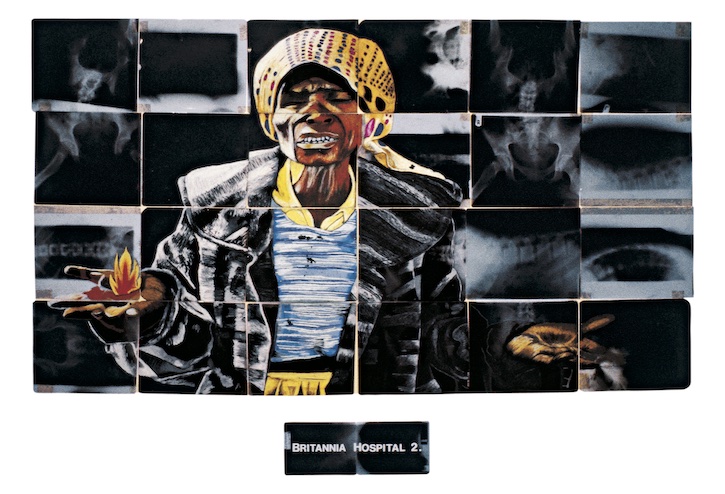
    Visually alluring, these anonymous X-rays became his canvas. The House That Jack Built (1987), included in this exhibition, involved meticulous scalpel incisions of words and elaborate prose. X-ray was used as a metaphor for looking beneath the surface of images and society to better understand the workings of inequality and racism.

    The sculptural work Doublethink (1992), remade for this retrospective, comprises over 100 cheap sporting trophies, each emblazoned with shocking racial insults. These are intended to explore the paradoxes and pathologies of race-based discrimination.

    Rodney took his title from George Orwell’s dystopian novel Nineteen Eighty-Four, in which the language of Newspeak produces “doublethink”, a process in which two opposing ideas are truths, such as “ignorance is strength”. This, once again, demonstrates his capacity for invention.

    Self-portrait as social critique

    Nothing typified that capacity for invention more than Rodney’s approach to self-portraiture, which was often a conduit for wider social and political commentary.

    Rodney suffered from the hereditary blood disorder sickle cell anaemia. The relationship between his illness and art has routinely misunderstood to the detriment of his artistic ingenuity. Being X-rayed, having regular blood transfusions and invasive surgery were Rodney’s personal experiences. Transfigured into art, such medical predicaments became conduits for reinterpreting history and contemporary society.

    Visceral Canker (1990) is a circulatory blood pumping system overlaid on fabricated heraldic shields of Elizabeth I and slave trader Sir John Hawkins. It explored the intertwined relationships between Rodney’s Black British identity, slavery and British history.

    The photographic light-box Self Portrait: Black Men, Public Enemy (1990) and the analogue slide projection Cataract (1991) sought to question the perpetual representation of Black men in British society as criminal and deviant. Psalms (1997) is a poignant and affecting self-portrait in which an unoccupied and computer-powered wheelchair moves eerily in response to the gallery visitor.

    Rodney’s art-making process was resourceful. For example, the production of his important large oil pastel drawings on X-rays, including Britannia Hospital 2 (1988), were made in sections. This enabled Rodney to work at scale at a desk at home or in hospital.

    The photographic work In the House of My Father (1997), depicting a minuscule house made of the artist’s skin, was shot in King’s College hospital, London. Rodney was also a master at enlisting the active support from family, friends and associates to realise the production of entire exhibitions, including 9 Night in Eldorado (1997).

    The Whitechapel Gallery show is the final leg of a three-gallery tour which began in 2024. It was first presented at Spike Island, Bristol, the city in which Rodney first exhibited in 1982, followed by Nottingham Contemporary where he studied fine art as an undergraduate at Trent Polytechnic between 1981-85.

    London was where Rodney lived for most of his 16-year career. This retrospective brings together nearly all of the artist’s surviving works. However, about two-thirds of Rodney’s artistic output work has either been lost or destroyed. This does not diminish the retrospective but imbues archival material held by his estate and public collections with particular significance.

    The prominent role assigned to sketchbooks, working drawings and the screening of Three Songs on Pain, Light and Time (1995), directed by the Black Audio Film Collective, play an important supplementary role in narrating Rodney’s singular practice.

    Donald Rodney: Visceral Canker is at the Whitechapel Gallery until May 4.

    Richard Hylton does not work for, consult, own shares in or receive funding from any company or organisation that would benefit from this article, and has disclosed no relevant affiliations beyond their academic appointment.

    ref. Donald Rodney: Visceral Canker – noteworthy retrospective of an artist as ambitious as he was audacious – https://theconversation.com/donald-rodney-visceral-canker-noteworthy-retrospective-of-an-artist-as-ambitious-as-he-was-audacious-254535

    MIL OSI – Global Reports

  • MIL-OSI Asia-Pac: ‘Dalit Chetna’ Programme Organized by Sahitya Akademi

    Source: Government of India

    ‘Dalit Chetna’ Programme Organized by Sahitya Akademi

    Six Eminent Writers Read Out from their Literature

    Posted On: 16 APR 2025 1:08PM by PIB Delhi

    Six eminent writers read out from their works in the ‘Dalit Chetna’ programme organized by Sahitya Akademi on the occasion of Dr. Babasaheb Ambedkar’s birth anniversary.  Mahendra Singh Beniwal, Mamta Jayant, Namdev and Neelam recited poems and Puran Singh and Tekchand read out short stories.  In their presentations, all highlighted the basic teachings of Dr Ambedkar and his vision with the help of which a discrimination-free society could be created.  First of all, Mamta Jayant presented her five poems, titled “Sabhi Ne Chhua Tha”, “Jeevit Imaraten”, “Ishwar”, “Nahi Chahiye” and “Baheliyon Ke Naam”.  Namdev read out his poems titled “Baba Bhim”, “Gaadiwaan”, “Kuan” and “Pehchaan”, which reflected the current status of Dr Ambedkar’s dreams.  The titles of Neelam’s poems were “Sabse Buri Ladki”, “Nayi Duniya Ke Rachhayita”, “Tumhari Umeedon Pe Khare Utrenge Hum” and “Utho Sangharsh Karo”. The poem “Sabse Buri Ladki” inspired the struggle for women’s rights and equality.  Mahendra Singh Beniwal read out poems titled “Tasveer”, “Aur Kab Tak Mare Jaoge”, “Bhediya” and “Aag”, which very accurately brought out the dual mentality of modern society.  The story presented by Tekchand was titled “Gubaar”.  In this, the deep roots of ignorance among some communities of the Dalits were shown in a very simple way. Puran Singh read out his story “Hawa Ka Rukh”, which focused on the irony of a writer having to compromise as a result of various pressures.  The programme was conducted by Sri Anupam Tiwari, Editor (Hindi).  A large number of writers, journalists and students were present at the programme.


    ***

    Sunil Kumar Tiwari

    pibculture[at]gmail[dot]com

    (Release ID: 2122040) Visitor Counter : 76

    MIL OSI Asia Pacific News

  • MIL-OSI Asia-Pac: Kashi Ringing the Bells of Progress

    Source: Government of India

    Kashi Ringing the Bells of Progress

    Building Modern India

    Posted On: 16 APR 2025 2:28PM by PIB Delhi

    Today, Kashi stands not only as a symbol of antiquity but also as a beacon of progress.

    ~ Prime Minister Narendra Modi

    Introduction

    On April 11, PM Modi launched development projects worth ₹3,880 crore in Kashi. The ancient city is getting a modern makeover. Roads are being widened; schools are being upgraded and new power stations are coming up. Kashi is growing while keeping its roots alive. From 2014 to March 2025, 580 projects were taken up under Kashi Development with a total investment of ₹48,459 crore. The aim is to improve infrastructure, preserve heritage and support tourism in Varanasi.

    Kashi’s Development Journey: Key Milestones

    🗓️ November 7, 2014: The Powerloom Service Centre was inaugurated and a ₹2,375 crore revival package was announced for district cooperative banks.

    🗓️ September 18, 2015: ₹572 crore was announced for Kashi’s upgrade, along with ₹11,000 crore for roads connecting nearby districts.

    🗓️ December 22, 2016: Projects worth ₹2,100 crore were inaugurated, including foundation stones of various projects.

    🗓️ September 22, 2017: PM Modi dedicated the Deendayal Hastkala Sankul, a trade facilitation centre for handicrafts.

    🗓️ July 14, 2018: Foundation stone of key projects worth over ₹900 crore was laid.

    🗓️ March 8, 2019: The Prime Minister laid the foundation stone for the Kashi Vishwanath Corridor.

    🗓️ November 30, 2020: The 73 km six-lane NH19 built at ₹2,447 crore was inaugurated to ease travel between Prayagraj and Varanasi. The Maha Kaal Express India’s first overnight private train was also launched.

    🗓️December 13-14, 2021: Phase 1 of Shri Kashi Vishwanath Dham, constructed at a cost of around Rs 339 crores inaugurated.

    🗓️ July 7, 2022: PM Modi inaugurated and laid the foundation stone of development projects worth over ₹1,800 crore. This includes ₹590 crore under Varanasi Smart City and Urban Projects.

    🗓️ January 13, 2023: PM Modi flagged off the world’s longest river cruise ‘MV Ganga Vilas.’ 🗓️ December 18, 2023: The Prime Minister laid the foundation stone and dedicated to the nation several development projects worth over ₹19,150 crore in Varanasi.

    🗓️ October 10, 2024: The Prime Minister, Shri Narendra Modi laid the foundation stone and inaugurated multiple development projects worth Rs 6,100 crores.

    From Pilgrimage to Premium Experiences

    Tourism in Varanasi is more than just travel, it’s a journey through history, faith and vibrant culture. Below are key initiatives that are reshaping the tourism experience in the city:

    1. MV Ganga Vilas: World’s Longest River Cruise

    Launched by PM Narendra Modi on January 13, 2023, the MV Ganga Vilas is the world’s longest river cruise, starting from Varanasi and culminating in Dibrugarh on 28th February 2023.


    2. Tent City: Riverside Luxury Experience

    The Tent City was inaugurated on January 13, 2023 on the opposite bank of the Ganga from the city ghats. Open from October to June annually, the Tent City helps manage the increasing tourist flow by providing a unique and peaceful riverside stay experience.


    3. Shri Kashi Vishwanath Corridor

    Inaugurated on December 13, 2021, the Kashi Vishwanath Corridor is a transformative ₹355-crore project that spans an area of 5.5 acres. It connects the Kashi Vishwanath Temple directly to the Ganges River via a four-lane pathway, making the temple more accessible to pilgrims.


    4. Monument Illumination Projects

    To enhance the visual appeal of Varanasi’s historic monuments, several illumination projects have been undertaken: In 2015, ₹5.12 crore was sanctioned for lighting up monuments like Dhamekh Stupa, Chaukhandi Stupa, Tomb of Lalkan, and Man Mahal. In 2017, ₹2.93 crore were sanctioned to illuminate Dashashwamedh to Darbhanga Ghat, Tulsi Manas Mandir, and the Sarnath Museum.


    Kashi’s Infrastructure Boost

    Kashi’s infrastructure development has seen major progress from 2021 to 2025. The Varanasi-Gorakhpur NH-20 (Package-2), a 72.16 km road was inaugurated on October 25, 2021. The project cost was ₹3,509 crore. The redevelopment of Namo Ghat (Khidkiya Ghat) was completed on November 15, 2024. The cost of the redevelopment was ₹95.2 crore. The ghat now features a cafeteria, viewing platforms and heritage murals. The construction of the jetty at Rajghat costed approximately Rs.10 crore. Each cruise boat was procured at a cost of Rs.20 crore. Furthermore, the tourism circuit along the riverfront will feature the construction of a walkway, a viewing deck, and a food court. The operation of cruise boats started in March, 2023.  Additionally, over ₹980 crore is allocated for flyovers, road bridges, and an airport underpass on April 11, 2025.

    Urban Transformation in Kashi

    Varanasi is undergoing a major urban makeover with focus on sustainability and civic upgrades. To reduce pollution in the Ganga, diesel/petrol boats were converted to CNG. This project, worth ₹29.7 crore, was inaugurated by the Prime Minister on July 7, 2022. It is being executed by Varanasi Smart City Ltd. and GAIL. The Goitha Sewage Treatment Plant (STP), with a capacity of 120 million litres per day (MLD), was inaugurated on February 19, 2019. Built at a cost of ₹217.57 crore, it was aimed at treating sewage and reducing pollution in the Ganga. Under the Namami Gange scheme, a Sewage Treatment Plant (STP) with a capacity of 55 million litres per day (MLD) is also being built at a cost of ₹300 crore. On April 11, 2025, ₹345 crore has been allocated under Jal Jeevan Mission for rural drinking water schemes. Varanasi connected 55,000 houses to sewer lines under AMRUT (Atal Mission for Rejuvenation and Urban Transformation), using ₹105 crore, by March 2017. For better parking and traffic flow, the Godowlia Multilevel Two-wheeler Parking, a four-storey facility for 375 vehicles, was built for ₹19.55 crore and operates 24/7 with full security.

    Varanasi’s Handloom and Handicraft Revival

    Varanasi is renowned not just for its spiritual aura, but also for its rich tradition of handlooms and handicrafts. Generations of artisans have mastered the art of silk weaving, wood and stone carving, metalwork, pottery and jewellery making. Their creations reflect incredible skill and cultural heritage. Many of these crafts, like Banarasi sarees, Soft Stone Jali work, Banaras Gulabi Meenakari and Wooden Lacquerware & Toys etc, have received Geographical Indication (GI) tags, marking their authenticity and excellence.

    To support and promote these traditional arts the government announced the establishment of a Trade Facilitation Centre and Crafts Museum in the 2014-15 Union Budget. This initiative aimed to help weavers, artisans, and entrepreneurs market their products. The complex was built over 7.93 acres with a total cost of ₹300 crore, providing a space for showcasing, training and selling local crafts. The Centre was inaugurated on September 22, 2017 and today stands as a key step in preserving Varanasi’s artistic legacy.

    Kashi’s Education and Health Drive

    Kashi is witnessing rapid growth through major investments in research, healthcare, energy, and education. The Inter-University Teacher Education Center (IUTEC) at BHU, Varanasi, was inaugurated on December 23, 2021. Built at a cost of ₹107.36 crore, it will offer a two-year M.Ed. program for 1,000 students. In February 2019, PM inaugurated the PARAM Shivay Supercomputing Center at BHU, with a peak performance of 3.3 petaflops and a cost of ₹32.5 crore. In agriculture, ₹105 crore bonus was transferred to Banas Dairy milk suppliers in April 11, 2025. In the power sector, ₹1,820 crore has been allocated for new substations and transmission upgrades. The redevelopment of Sports Stadium in Sigra is an ambitious project with a total budget of ₹180.03 crore (Phase 1: ₹90.01 crore, Phase 2: ₹90.02 crore). It was designed as a world-class hub for sports. It was inaugurated by PM Narendra Modi on October 20, 2024.

    Conclusion

    Kashi stands today as a shining example of how heritage and modernity can thrive together. With transformative projects in infrastructure, tourism, health, education, and culture, the city is not just preserving its spiritual essence but also creating a vibrant, future-ready identity. From ghats to gateways of development, Kashi is truly ringing the bells of progress.

    References

    Click here to see PDF.

    *****

    Santosh Kumar/ Sarla Meena/ Kamna Lakaria/ Kritika Rane

    (Release ID: 2122058) Visitor Counter : 54

    MIL OSI Asia Pacific News

  • MIL-OSI Asia-Pac: WAVES Cosplay Championship Finalists Announced — A Celebration of Creativity and Fandom Culture

    Source: Government of India

    Posted On: 16 APR 2025 2:01PM by PIB Mumbai

    Mumbai, 16 April 2025


    Last Saturday, the city of Hyderabad witnessed an explosion of creativity & fandom as the World Audio Visual & Entertainment Summit (WAVES) Cosplay Championship Meetup unfolded at Mindspace Social. Organized by MEAI, Indian Comics Association, and Creators Street, powered by Epiko-con, and in collaboration with Ministry of Information and Broadcasting, TVAGA and Forbidden Verse, the event was a massive success, becoming a trending topic across cosplay communities and anime forums throughout the weekend.

    Now, after an intensive nationwide hunt and a series of high-energy meetups across Hyderabad and Mumbai, the organizers have unveiled 29 of the most talented cosplayers who have earned their place on the final stage of the WAVES Cosplay Championship. These finalists will showcase their skills and creativity at Creatosphere during WAVES 2025.

    Ajay Krishna, Founder of Forbidden Verse and one of the organizers for the Cosplay event, said that what makes this championship different from other such contests is that it is specially designed to shift the focus to Indian mythology and pop culture apart from the other popular characters that are portrayed regularly in other such events.

    The next in line before the main championship at WAVES is the Mumbai Wildcard Meetup on 19th April. At this event, a select number of Wildcard Entries will be added to the finalists, bringing unexpected talent and raising the competition to an entirely new level. Prepare for a championship filled with surprises, intensity, and world-class cosplay!

    Official Finalists:

    1. KaizadSheshbaradaran – Mumbai
    2. Puneeth V – Bengaluru
    3. Shaikh Sameer Kalim – Latur
    4. Tejal Sanjay Mulik – Mumbai
    5. Anup Bhatia – Pune
    6. Navdeep Singh Pannu – Mumbai
    7. Akashi Gautam – Lucknow
    8. Aditya Kalebere – Pune
    9. Swaraj Kalebere – Pune
    10. Shreeharsh Narwade – Pune
    11. Vivek Dilip Mane – Pune
    12. Esha Joshi – Mumbai
    13. Kedar Pandit – Mumbai
    14. ArshyDeori – Guwahati
    15. Marshy Deori – Guwahati
    16. Md Piyal Shaikh – Mumbai
    17. Pranay Panpatil – Mumbai
    18. Gaurav Vishwakarma – Pune
    19. Akhil – Hyderabad
    20. Staya – Hyderabad
    21. Nupur Munda – Hyderabad
    22. Nakshatra – Hyderabad
    23. Ruchira Corolin – Hyderabad
    24. Sonali – Hyderabad
    25. Neeraj Kumar – Hyderabad
    26. Sravani – Hyderabad
    27. Akhil C.H. – Hyderabad
    28. Nayana Sai Sree – Hyderabad
    29. Leeladhar – Hyderabad

    The finalists were selected based on their craftsmanship, originality, performance, and dedication to character authenticity.


    About WAVES

    The first World Audio Visual & Entertainment Summit, a milestone event for the media & entertainment sector, will be hosted by the Government of India in Mumbai, Maharashtra, from May 1 to 4, 2025.

    Whether you’re an industry professional, investor, creator, or innovator, the Summit offers the ultimate global platform to connect, collaborate, innovate and contribute to the M&E landscape.

    WAVES is set to magnify India’s creative strength, amplifying its position as a hub for content creation, intellectual property, and technological innovation. Industries and sectors in focus include Broadcasting, Print Media, Television, Radio, Films, Animation, Visual Effects, Gaming, Comics, Sound and Music, Advertising, Digital Media, Social Media Platforms, Generative AI, Augmented Reality (AR), Virtual Reality (VR), and Extended Reality (XR).

    Have questions? Find answers here

    Stay updated with the latest announcements from PIB Team WAVES

    Come, Sail with us! Register for WAVES now


    * * *

    PIB TEAM WAVES 2025 | Riyas Babu/ Darshana | 94


    Follow us on social media: @PIBMumbai    /PIBMumbai     /pibmumbai   pibmumbai[at]gmail[dot]com  /PIBMumbai     /pibmumbai

    (Release ID: 2122055) Visitor Counter : 35

    MIL OSI Asia Pacific News

  • MIL-OSI Asia-Pac: PM shares an article on how Dr. Ambedkar shaped some of India’s earliest and most impactful economic ideas rooted in justice, dignity and self-reliance

    Source: Government of India

    Posted On: 16 APR 2025 1:33PM by PIB Delhi

    The Prime Minister, Shri Narendra Modi today shared an article by Union Minister Shri Arjun Ram Meghwal on how Dr. Ambedkar shaped some of India’s earliest and most impactful economic ideas rooted in justice, dignity and self-reliance.

    The Prime Minister’s Office handle on X posted:

    “Union Minister Shri @arjunrammeghwal elaborates on how Dr. Ambedkar shaped some of India’s earliest and most impactful economic ideas rooted in justice, dignity and self-reliance.
    https://indianexpress.com/article/opinion/arjun-ram-meghwal-writes-ambedkar-the-economist-9946393/ 

    via NaMo App”


    ***

    MJPS/SR

    (Release ID: 2122045) Visitor Counter : 140

    MIL OSI Asia Pacific News

  • MIL-OSI Asia-Pac: INDIA- UZBEKISTAN JOINT MILITARY EXERCISE DUSTLIK-VI COMMENCES AT FOREIGN TRAINING NODE, AUNDH

    Source: Government of India

    Posted On: 16 APR 2025 2:39PM by PIB Delhi

    The 6th edition of India- Uzbekistan Joint Military Exercise DUSTLIK-VI commenced today, at Foreign Training Node, Aundh (Pune). The Exercise is scheduled to be conducted from 16 to 28 Apr 2025.

    Indian contingent comprising of 60 personnel is being represented by a Battalion of JAT Regiment and IAF. The Uzbekistan contingent is being represented by personnel from Uzbekistan Army. Joint Exercise DUSTLIK -VI is an annual training event conducted alternatively in India and Uzbekistan. Last edition was conducted in Termez District, Uzbekistan in April 2024.

    The theme of the exercise will be based on the theme of Joint Multi Domain Sub Conventional operations in Semi-Urban Scenario. It will focus on responding to a terrorist action involving the capture of a defined territory. It will also include the establishment of a Joint Operations Centre at the battalion level for continuous joint operations, the execution of counterterrorism missions such as population control measures, raids, search-and-destroy operations, and the employment of firepower, including air assets, to neutralise terrorists. Special forces from the Army and Air Force, during the Exercise, will secure a helipad for use as a mounting base for further operations. The Exercise will also cover the deployment of drones, counter-UAS measures, and logistics support by the Air Force to sustain forces in hostile areas. Additionally, helicopters will be utilised for reconnaissance and observation, special heliborne operations (SHBO), small team insertion and extraction (STIE) and other associated missions.

    Joint Exercise DUSTLIK -VI will enable both sides to share best practices in Tactics, Techniques and Procedures of conducting Joint Sub Conventional operations. It will facilitate developing inter-operability, bonhomie and camaraderie between the two armies. The Joint Exercise will also enhance defence cooperation, further augmenting bilateral relations between the two friendly nations.

    ****

    SC

    (Release ID: 2122061) Visitor Counter : 105

    MIL OSI Asia Pacific News

  • MIL-OSI Asia-Pac: In a first, ECI trains Booth Level Agents (BLAs) to strengthen grassroot participation by political parties

    Source: Government of India

    In a first, ECI trains Booth Level Agents (BLAs) to strengthen grassroot participation by political parties

    Around 280 BLAs from Bihar of 10 recognised political parties take part in the 2-day training programme

    Posted On: 16 APR 2025 1:17PM by PIB Delhi

    The Election Commission of India (ECI) has commenced the training of Booth Level Agents (BLAs) from Bihar in view of the forthcoming elections in the State. Around 280 BLAs from the State associated with 10 recognised political parties are taking part in the 2-day training programme being organised at the India International Institute for Democracy and Election Management, IIIDEM, New Delhi.

    Chief Election Commissioner Shri Gyanesh Kumar along with Election Commissioners Dr. Sukhbir Singh Sandhu and Dr. Vivek Joshi addressed the BLAs in a first of its kind training programme.  The training was conceptualised during the Chief Electoral Officers (CEO) conference held on the 4th of March, 2025. The Commission underscored the importance of BLAs in the election processes and asserted that the training programme would help them fulfil their responsibilities as delineated in the Representation of People act, 1950 and 1951, Registration of Elector Rules 1960, Conduct of Election Rules 1961 and the manuals, guidelines and instructions issued by ECI from time to time.

    The BLAs were given an overview of their appointment, roles, and responsibilities as per the legal framework. The training programme familiarised them with various aspects of the election processes including the preparation, updation and revision of electoral rolls and the associated forms and formats associated. BLAs are appointed by recognised political parties and play an important role in ensuring error-free electoral rolls as per the provisions of the RP act, 1950. The BLAs were also trained in the use of the provision of first and second appeals under sections 24(a) and 24(b) of the RP Act 1950 in case they are aggrieved of the final electoral rolls as published.

    ******

    PK/GDH/RP

    (Release ID: 2122044) Visitor Counter : 14

    MIL OSI Asia Pacific News

  • MIL-OSI Asia-Pac: Karad, Maharashtra has set a benchmark in sanitary waste management by ensuring the safe disposal of sanitary waste

    Source: Government of India

    Posted On: 16 APR 2025 11:09AM by PIB Delhi

    Sanitary waste management remains a major challenge across India, with improper disposal leading to environmental and health hazards. However, Karad, a small city in Maharashtra’s Satara district, has emerged as a role model in tackling this issue. With 100% segregation, collection, and processing of sanitary and biomedical waste, Karad has set a benchmark for effective and sustainable waste management. Ensuring the proper disposal of sanitary waste—such as sanitary napkins, diapers, and other hygiene products—has helped prevent health risks, environmental harm, and social stigma in Karad.

    In Karad, approximately 300 to 350 kg of sanitary waste is collected daily from hospitals, clinics, households, and other facilities. One of the key steps taken by the administration was to break the taboo surrounding sanitary waste. This involved raising awareness and educating the community about the importance of proper sanitary waste management and the potential health risks associated with improper disposal. The city has adopted innovative strategies to educate residents on waste segregation via initiatives like workshops, community outreach programs, and public service announcements which played a key role in promoting responsible waste segregation and disposal.

    Karad Municipal Council (KMC) collaborated with female residents, leading to the formation of women groups that played a pivotal role in raising awareness on proper sanitary waste disposal and segregation in the residential areas. To facilitate this, separate red bins have been installed in public toilets across the city, making it easier for women to dispose of sanitary waste responsibly.


    Schools are also encouraged to install sanitary pad vending machines and disposal systems. Additionally, the city’s IEC team promote hygienic disposal practices, such as wrapping used sanitary pads in paper before discarding them. This initiative has led many schools to install incinerators, ensuring proper processing of sanitary waste, with the remaining residue sent to the biomedical waste treatment plant. 


    The Garbage Collection Vehicle in the city carries a separate bin for collection of sanitary waste. To ensure proper disposal, sanitation staff collect this waste separately, allowing only suitable materials to be incinerated. The sorted waste is then processed at a high-temperature incinerator, operated by the Karad Hospital Association, where it is burned at high temperatures. During incineration, organic materials are oxidized, generating heat, gas, and ash. To minimize environmental impact, the gases produced are filtered to remove harmful substances. The facility’s emissions are continuously monitored to meet air quality standards, with real-time data linked to the State Pollution Control Board (SPCB) monitoring system for regulatory oversight.

    To enhance sanitary waste disposal, the Karad Municipal Council (MC) has partnered with the Karad Hospital Association for the treatment of sanitary and biomedical waste. Under this agreement, KMC has allocated land for the construction of a biomedical waste treatment plant, which the hospital association is responsible for operating and maintaining. As part of the arrangement, the hospital association established the 600 kg/day ‘Common Biomedical Waste Treatment Facility’ (CBWTF) where the sanitary waste collected by the municipal council free of charge is processed. All sanitary waste in the city is incinerated at this facility, which houses a centralized incinerator capable of reaching temperatures up to 1200°C. This high-temperature incineration effectively minimizes contamination risks and health hazards, ensuring a safer working environment for sanitation staff.

    The improved sanitary waste management system in Karad City has had a significant positive impact on both public health and environmental sustainability. The agreement with the Karad Hospital Association has notably reduced the financial burden on the Karad Municipal Council, as it only bears the cost of waste collection and transportation. This partnership highlights the effectiveness of the Public-Private Partnership (PPP) model in solid waste management. The high-temperature incineration of sanitary waste has greatly minimized health risks and contamination, particularly safeguarding sanitation workers who handle the waste. By eliminating the open dumping of sanitary waste, the city has also prevented environmental degradation and curbed the spread of diseases.

    By implementing proper waste segregation, increasing awareness, and developing more effective infrastructure, Karad prevented the public health and environmental hazards posed by inadequate sanitary waste management. This is not only contributed to the city’s cleanliness but also helped to improve the quality of life for the residents, particularly women, who are most directly affected by the challenges surrounding sanitary waste disposal.

    ****

    SK

    (Release ID: 2122026) Visitor Counter : 49

    MIL OSI Asia Pacific News

  • MIL-OSI Asia-Pac: Ambassadors’ Meet Organized by MDoNER Garners Huge Support from Foreign Diplomats to Explore Endless Possibilities in NER

    Source: Government of India

    Posted On: 16 APR 2025 11:01AM by PIB Delhi

    In a significant step toward enhancing international cooperation and fostering global investment in India’s vibrant North East, Ministry of Development of North Eastern Region (MDoNER)  organized Ambassadors’ Meet  in New Delhi on April 15, 2025.  Ambassadors, High Commissioners, and senior diplomatic representatives from over 80 countries participated . The event was aimed at showcasing the immense potential of the North Eastern Region (NER) and strengthening bilateral ties for sustainable development.

    The Ambassadors’ Meet was graced by Hon’ble Minister of Development of North Eastern Region, Shri Jyotiraditya M. Scindia, who emphasized the strategic importance of the region, both economically and geopolitically. In his keynote address, the Hon’ble Minister highlighted Indian Government’s commitment to transforming the North East into a hub of connectivity, trade, and innovation. He also underlined that each of the eight states of the North East embodies unique strengths, resources and opportunities, making the region an invaluable asset in India’s growth story. From its rich cultural diversity to its natural beauty and strategic location, the North Eastern Region holds immense potential to emerge as one of the country’s leading economic powerhouses. Its proximity to Southeast Asia also positions the North Eastern Region as a gateway to South East Asian countries, aligning with India’s Act East Policy. Hon’ble Minister extended an invitation to the participating countries to explore opportunities in NER, capitalizing on the region’s rich resources and craftsmanship.

    Hon’ble Minister of State, MDoNER, Dr. Sukanta Majumdar, in his address highlighted the immense potential of North Eastern region. Sharing the vision of Hon’ble Prime Minister, he explained how North Eastern States offers great aspects for investment opportunities and building a “Viksit Bharat” together. He highlighted the major development initiatives in the infrastructure sector that have taken place in the North Eastern Region under the leadership of Hon’ble Prime Minister during the last 10 years, inter-alia, including expanding air, road and rail connectivity, waterways etc. He also underlined that Hon’ble Prime Minister emphasized North East as India’s Asthalakshmi, a key economic asset poised for rapid industrialization. He stated that with ample opportunities across multiple sectors, North East India welcomes investors to explore its vast potential and be part of its growth journey.

    Shri Pema Khandu, Hon’ble Chief Minister of Arunachal Pradesh, spoke about the unique strengths of Northeast Region including Arunachal Pradesh.

    Hon’ble Minister of External Affairs, Shri S. Jaishankar, through a video message highlighted that NER has been at the forefront of India’s development policies. He mentioned about the importance of Kaladan multi-modal transit project and NER’s potential to be the gateway for south east Asian markets.

    Secretary, MDoNER, Shri Chanchal Kumar delivered a detailed presentation on the investment opportunities in NER and highlighted untapped potential  of the region. He also highlighted the opportunities available in the region in across various sectors like IT & ITES, Healthcare, Agri and allied, Education & Skill Development, Sports & Entertainment, Tourism & Hospitality, Infrastructure and logistics; Textiles, Handlooms and Handicrafts and Energy. He stated that with ample opportunities across multiple sectors, North East India welcomes investors to explore its vast potential and be part of its growth journey. He stated that MDoNER is committed to work closely with diplomatic missions, international development agencies, and global investors to channel resources and expertise toward projects that will boost employment, infrastructure, and human capital in the North Eastern Region.

    Secretary(East), Ministry of External Affairs Shri Periasamy Kumaran in his address stated that the North Eastern Region shares international borders of with neighboring countries Bangladesh, Bhutan, China, Nepal and Myanmar making it a strategic location and the Gateway to Southeast Asia for India. Therefore, the region can be developed as a base for India’s growing economic links not only with the Association of Southeast Asian Nations (ASEAN) but also with neighbouring countries, viz. Bangladesh, Bhutan, and Nepal. He underlined that North Eastern Region is a treasure trove of diverse cultures, traditions, and breathtaking natural beauty. He stated that Ambassadors Meet is a crucial platform for engaging in constructive dialogues, building partnerships, and attracting investments that will drive inclusive growth and prosperity. This platform is an opportunity to come forward and explore the diverse opportunities offered by the Northeast.

    The Ambassadors’ Meet was the one of the pre-summit activities of the North East Investors Summit to be organized by MDoNER on 23rd and 24th  May, 2025. The event received an overwhelming response, with Ambassadors and diplomatic envoys expressing keen interest in partnering with Indian stakeholders to explore the possibilities offered by the North Eastern states – Arunachal Pradesh, Assam, Manipur, Meghalaya, Mizoram, Nagaland, Sikkim, and Tripura.  The event not only fostered meaningful dialogue but also laid the groundwork for future partnerships, driving economic growth and sustainable development in the region.

    The event was  seniors officials Ministry of Development of North Eastern Region  and State Government  of NER.

    *****

    Samrat

    (Release ID: 2122025) Visitor Counter : 26

    MIL OSI Asia Pacific News

  • MIL-OSI Asia-Pac: National Technical Textile Mission in association with M/s SYSTEM 5S Pvt. Ltd developing an innovative Firefighting Suit

    Source: Government of India

     National Technical Textile Mission in association with M/s SYSTEM 5S Pvt. Ltd developing an innovative Firefighting Suit

    The specialized Firefighting Suit is developed using aluminised coated glass fabrics

    Posted On: 16 APR 2025 3:14PM by PIB Delhi

    The National Technical Textile Mission (NTTM), an initiative by the Ministry of Textiles, Government of India, has supported an innovative project titled “Development of Specialized Fire fighting Suit.” These specialized fire fighter suits are used by Firefighting & Emergency services, Defence forces, Oil & Gas industry, Aerospace & Aviation, Power Plants & Thermal Industry, etc. Manufacturing of firefighting suits in India is in its nascent stage and currently, in India, specialized firefighting suits (also known as fire entry suits) are imported mostly from Europe, the USA, and China. The NTTM project is implemented by Northern India Textile Research Association (NITRA), in collaboration with its industrial partner, M/s System 5S Private Ltd.

    The annual current consumption would be approximately 1000 sets by various End Users in India. However, with the introduction of an Indian Certified Aluminized suit, the consumption could go up exponentially. M/s SYSTEM 5S Pvt. Ltd has an annual production capacity of 1000 suits with this commercialisation.

    According to EN 1486 (a European Standard that specifies the requirements and test methods for protective clothing for fire fighters), protective clothing for specialized fire fighting must protect the full body, including the head, hands, and feet, against radiant heat and flame impingement. This protective gear includes a garment, a hood (integrated or separate), gloves, and over boots. Additionally, the design of such suits is intended for use with respiratory protection, with designs varying on whether the breathing apparatus is worn inside or outside the protective clothing.

    M/s System 5S Private Ltd, has developed an indigenous Specialized Fire Fighting Suit, designed to meet the EN 1486 or ISO 15538 standards. The development process prioritised the safety, comfort, and ease of donning and doffing for fire fighters. The suit is developed using aluminised coated glass fabrics, OPAN (Oxidized Polyacrylonitrile) Nonwoven battings and FR (Flame Resistant) viscose fabric. All the inner layers are quilted together. The industrial partner has already begun manufacturing these suits for trial purposes, and commercial manufacturing will commence once the fire manikin test is completed successfully, as per the EN ISO 13506 (a standard that defines a test method for evaluating the performance of protective clothing against heat and flame) standard, to ensure the suit meets all necessary performance requirements.

    ***

    Dhanya Sanal K

    Director

    (Release ID: 2122075) Visitor Counter : 26

    MIL OSI Asia Pacific News

  • MIL-OSI Asia-Pac: Over 1.3 Crore Persons Insured through GeM in FY 2024-25

    Source: Government of India

    Over 1.3 Crore Persons Insured through GeM in FY 2024-25

    GeM facilitates hiring of 1 million people in FY 2024-25

    Posted On: 16 APR 2025 10:53AM by PIB Delhi

    Government e Marketplace (GeM), India’s largest e-marketplace for public procurement, sets yet another milestone in services delivery in the FY 24-25. Apart from facilitating hiring of 1 million manpower resources in FY 24-25, GeM has successfully facilitated insurance of more than 1.3 crore individuals covering Health, Life and Personal Accident Insurance policies.

    The Insurance Services category was introduced on GeM in January 2022 to bring greater efficiency, transparency and cost-effectiveness in procuring insurance policies. By ensuring that only Insurance Regulatory and Development Authority of India (IRDAI) -approved service providers are onboarded. GeM has established a reliable and trusted mechanism for availing insurance services. Through this platform, buyer organizations can seamlessly procure Group Mediclaim, Personal Accident and Term Insurance policies, thereby offering financial security to a vast number of beneficiaries.

    While commenting on this milestone, CEO-GeM Shri Ajay Bhadoo said, “GeM remains committed to continuously enhancing its platform to provide seamless, secure and cost-effective procurement solutions. The milestone of 1.3 crore insured persons reflects the growing confidence of government organizations in leveraging GeM for their insurance needs, reaffirming its role as a transformative force in public procurement.”

    A key advantage of GeM’s insurance services is that it facilitates direct transactions between government buyers and insurance providers without intermediaries. This streamlined approach has significantly expedited the process while also reducing insurance premiums thereby ensuring cost savings for government organisations.

    Beyond Life and Health insurance, the platform has expanded its insurance offerings to include a comprehensive range of insurance services such as Asset Insurance, Transit and Marine Insurance, Liability Insurance, Livestock Insurance, Motor Insurance, Crop Insurance and Cyber Insurance. Such broad spectrum of services ensures that various insurance needs are met through a single, transparent and efficient platform to enhance accessibility and cost-effectiveness in availing Insurance services by Government Buyers.

    ****

    Abhishek Dayal/Nihi Sharma

    (Release ID: 2122023) Visitor Counter : 95

    MIL OSI Asia Pacific News

  • MIL-OSI Asia-Pac: The cumulative exports (merchandise & services) during FY 2024-25 (April-March) is estimated to grow by 5.50% at US$ 820.93 Billion, as compared to US$ 778.13 Billion in FY 2023-24 (April-March).

    Source: Government of India

    Posted On: 16 APR 2025 8:48AM by PIB Delhi

     The cumulative value of merchandise exports during FY 2024-25 (April-March) was US$ 437.42 Billion, registering a positive growth of 0.08%, as compared to US$ 437.07 Billion during FY 2023-24 (April-March).

    The cumulative Non-Petroleum exports in FY 2024-25 (April-March) valued at US$ 374.08 Billion registered an increase of 6.0% as compared to US$ 352.92 Billion in FY 2023-24

    Major drivers of merchandise exports growth in FY 2024-25 (April-March) include Coffee, Tobacco, Electronic Goods, Rice, Jute Mfg. including Floor Covering, Meat, dairy & poultry products, Tea, Carpet, Plastic & Linoleum, RMG of all Textiles, Drugs & Pharmaceuticals, Cereal preparations & miscellaneous processed items, Mica, Coal & Other Ores, Minerals including processed minerals, Engineering Goods and Fruits & Vegetables.

    Coffee exports increased by 40.37% from US$ 1.29 Billion in FY 2023-24 (April-March) to US$ 1.81 Billion in FY 2024-25 (April-March).

    Tobacco exports increased by 36.53% from US$ 1.45 Billion in FY 2023-24 (April-March) to US$ 1.98 Billion in FY 2024-25 (April-March).

    Electronic Goods exports increased by 32.47% from US$ 29.12 Billion in FY 2023-24 (April-March) to US$ 38.58 Billion in FY 2024-25 (April-March).

    Rice exports increased by 19.73% from US$ 10.42 Billion in FY 2023-24 (April-March) to US$ 12.47 Billion in FY 2024-25 (April-March).

    Jute Mfg. including Floor Covering exports increased by 13.35% from US$ 0.34 Billion in FY 2023-24 (April-March) to US$ 0.38 Billion in FY 2024-25 (April-March).

    Meat, dairy & poultry products exports increased by 12.57% from US$ 4.53 Billion in FY 2023-24 (April-March) to US$ 5.1 Billion in FY 2024-25 (April-March).

    Tea exports increased by 11.84% from US$ 0.83 Billion in FY 2023-24 (April-March) to US$ 0.92 Billion in FY 2024-25 (April-March).

    Carpet exports increased by 10.46% from US$ 1.4 Billion in FY 2023-24 (April-March) to US$ 1.54 Billion in FY 2024-25 (April-March).

    Plastic & Linoleum exports increased by 10.23% from US$ 8.09 Billion in FY 2023-24 (April-March) to US$ 8.92 Billion in FY 2024-25 (April-March).

    RMG of all Textiles exports increased by 10.03% from US$ 14.53 Billion in FY 2023-24 (April-March) to US$ 15.99 Billion in FY 2024-25 (April-March).

    Drugs & Pharmaceuticals exports increased by 9.39% from US$ 27.85 Billion in FY 2023-24 (April-March) to US$ 30.47 Billion in FY 2024-25 (April-March).

    Cereal preparations & miscellaneous processed items exports increased by 8.71% from US$ 2.85 Billion in FY 2023-24 (April-March) to US$ 3.1 Billion in FY 2024-25 (April-March).

    Mica, Coal & Other Ores, Minerals including processed minerals exports increased by 6.95% from US$ 4.68 Billion in FY 2023-24 (April-March) to US$ 5.01 Billion in FY 2024-25 (April-March).

    Engineering Goods exports increased by 6.74% from US$ 109.3 Billion in FY 2023-24 (April-March) to US$ 116.67 Billion in FY 2024-25 (April-March).

    Fruits & Vegetables exports increased by 5.67% from US$ 3.66 Billion in FY 2023-24 (April-March) to US$ 3.87 Billion in FY 2024-25 (April-March).

    India’s total exports (Merchandise and Services combined) for March 2025* is estimated at US$ 73.61 Billion, registering a positive growth of 2.65 percent vis-à-vis March 2024. Total imports (Merchandise and Services combined) for March 2025* is estimated at US$ 77.23 Billion, registering a positive growth of 4.90 percent vis-à-vis March 2024.

    Table 1: Trade during March 2025*

    March 2025

    (US$ Billion)

    March 2024

    (US$ Billion)

    Merchandise

    Exports

    41.97

    41.69

    Imports

    63.51

    57.03

    Services*

    Exports

    31.64

    30.01

    Imports

    13.73

    16.60

    Total Trade

    (Merchandise +Services) *

    Exports

    73.61

    71.71

    Imports

    77.23

    73.63

    Trade Balance

    -3.63

    -1.92

    * Note: The latest data for services sector released by RBI is for February 2025. The data for March 2025 is an estimation, which will be revised based on RBI’s subsequent release. (ii) Data for FY 2023-24 (April-March) and April-December 2024 has been revised on pro-rata basis using quarterly balance of payments data.

    Fig 1: Total Trade during March 2025*

    • India’s total exports during FY 2024-25 (April-March)* is estimated at US$ 820.93 Billion registering a positive growth of 5.50 percent. Total imports during FY 2024-25 (April-March)* is estimated at US$ 915.19 Billion registering a growth of 6.85 percent.


    Table 2: Trade during FY 2024-25 (April-March)*

    FY 2024-25

     (US$ Billion)

    FY 2023-24

     (US$ Billion)

    Merchandise

    Exports

    437.42

    437.07

    Imports

    720.24

    678.21

    Services*

    Exports

    383.51

    341.06

    Imports

    194.95

    178.31

    Total Trade

    (Merchandise +Services) *

    Exports

    820.93

    778.13

    Imports

    915.19

    856.52

    Trade Balance

    -94.26

    -78.39


    Fig 2: Total Trade during FY 2024-25 (April-March)*

    MERCHANDISE TRADE

    • Merchandise exports during March 2025 were US$ 41.97 Billion as compared to US$ 41.69 Billion in March 2024.
    • Merchandise imports during March 2025 were US$ 63.51 Billion as compared to US$ 57.03 Billion in March 2024.


    Fig 3: Merchandise Trade during March 2025

    • Merchandise exports during FY 2024-25 (April-March) were US$ 437.42 Billion as compared to US$ 437.07 Billion during FY 2023-24 (April-March).
    • Merchandise imports during FY 2024-25 (April-March) were US$ 720.24 Billion as compared to US$ 678.21 Billion during FY 2023-24 (April-March).
    • Merchandise trade deficit during FY 2024-25 (April-March) was US$ 282.83 Billion as compared to US$ 241.14 Billion during FY 2023-24 (April-March).


    Fig 4: Merchandise Trade during FY 2024-25 (April-March)

    • Non-petroleum and non-gems & jewellery exports in March 2025 were US$ 34.17 Billion compared to US$ 33.66 Billion in March 2024.
    • Non-petroleum, non-gems & jewellery (gold, silver & precious metals) imports in March 2025 were US$ 37.76 Billion compared to US$ 35.85 Billion in March 2024.

    Table 3: Trade excluding Petroleum and Gems & Jewellery during March 2025

    March 2025

    (US$ Billion)

    March 2024

    (US$ Billion)

    Non- petroleum exports

    37.07

    36.28

    Non- petroleum imports

    44.50

    40.68

    Non-petroleum & Non-Gems & Jewellery exports

    34.17

    33.66

    Non-petroleum & Non-Gems & Jewellery imports

    37.76

    35.85

    Note: Gems & Jewellery Imports include Gold, Silver & Pearls, precious & Semi-precious stones


    Fig 5: Trade excluding Petroleum and Gems & Jewellery during March 2025


    • Non-petroleum and non-gems & jewellery exports in FY 2024-25 (April-March) were US$ 344.26 Billion, compared to US$ 320.21 Billion in FY 2023-24 (April-March).
    • Non-petroleum, non-gems & jewellery (gold, silver & precious metals) imports in FY 2024-25 (April-March) were US$ 453.62 Billion, compared to US$ 424.67 Billion in FY 2023-24 (April-March).

    Table 4: Trade excluding Petroleum and Gems & Jewellery during FY 2024-25 (April-March)

    FY 2024-25

     (US$ Billion)

    FY 2023-24

     (US$ Billion)

    Non- petroleum exports

    374.08

    352.92

    Non- petroleum imports

    534.46

    499.48

    Non-petroleum & Non Gems & Jewellery exports

    344.26

    320.21

    Non-petroleum & Non Gems & Jewellery imports

    453.62

    424.67

    Note: Gems & Jewellery Imports include Gold, Silver & Pearls, precious & Semi-precious stones

    Fig 6: Trade excluding Petroleum and Gems & Jewellery during FY 2024-25 (April-March)

    SERVICES TRADE

    • The estimated value of services export for March 2025* is US$ 31.64 Billion as compared to US$ 30.01 Billion in March 2024.
    • The estimated value of services imports for March 2025* is US$ 13.73 Billion as compared to US$ 16.60 Billion in March 2024.


    Fig 7: Services Trade during March 2025*


    • The estimated value of service exports during FY 2024-25 (April-March)* is US$ 383.51 Billion as compared to US$ 341.06 Billion in FY 2023-24 (April-March).
    • The estimated value of service imports during FY 2024-25 (April-March)* is US$ 194.95 Billion as compared to US$ 178.31 Billion in FY 2023-24 (April-March).
    • The services trade surplus for FY 2024-25 (April-March)* is US$ 188.57 Billion as compared to US$ 162.75 Billion in FY 2023-24 (April-March).

    Fig 8: Services Trade during FY 2024-25 (April-March)*

    • Exports of  Coffee (39.2%), Drugs & Pharmaceuticals (31.21%), Electronic Goods (29.57%), Marine Products (28.56%), Jute Mfg. Including Floor Covering (21.67%), Meat, Dairy & Poultry Products (16.62%), Tobacco (13.95%), Tea (11.25%), Gems & Jewellery (10.62%), Fruits & Vegetables (8.57%), Rice (7.62%), Carpet (6.52%), Mica, Coal & Other Ores, Minerals Including Processed Minerals (6.35%), Rmg Of All Textiles (3.97%), Leather & Leather Products (3.48%), Cereal Preparations & Miscellaneous Processed Items (3.35%), Cotton Yarn/Fabs./Made-Ups, Handloom Products Etc. (2.16%), and Plastic & Linoleum (1.56%) record positive growth during March 2025 over the corresponding month of last year.
    • Exports of Tea (11.84%), Coffee (40.37%), Rice (19.73%), Tobacco (36.53%), Spices (4.78%), Fruits & vegetables (5.67%), Cereal preparations & miscellaneous processed items (8.71%), Marine products (0.45%), Meat, dairy & poultry products (12.57%), Mica, coal & other ores, minerals including processed minerals (6.95%), Leather and leather products (2.06%), Drugs and pharmaceuticals (9.39%), engineering goods (6.74%), Electronics goods (32.47%), Cotton yarn/fabs/makeups etc (3.19%), Man-made/ yarn/Fabs/made ups etc (4.07%), RMG of Textiles (10.03%), Jute Mfg. including Floor Covering (13.35%), Carpet (10.46%), and Plastic & Linoleum (10.23%) registered positive growth during FY 2024-25 over the previous FY 2023-24.
    • Imports of Project Goods (-87.25%), Silver (-85.39%), Coal, Coke & Briquettes, Etc. (-30.18%), Transport Equipment (-25.53%), Pulses (-23.45%), Newsprint (-17.99%), Pearls, Precious & Semi-Precious Stones (-13.77%) and Pulp and Waste Paper (-11.8%) record negative growth during March 2025 over the corresponding month of last year.
    • Imports of Fertilisers, Crude & Manufactured (-2.21%), Coal, coke & briquettes (20.03%), Dyeing/tanning/colouring materials (-13.42%), Newsprint (-2.71%), Pearls, precious & semi-precious stones (-24.41%), Iron & Steel (-4.61%), Project goods (-18.45%), and Silver (-11.24%) registered negative growth during FY 2024-25 over the previous year FY 2023-24.
    • Services exports is estimated to grow by 12.45 percent during FY 2024-25 (April-March)* over FY 2023-24 (April-March).
    • Top 5 export destinations, in terms of change in value, exhibiting positive growth in March 2025 vis a vis March 2024 are U S A (35.06%), Australia (70.81%), Kenya (98.46%), Togo (46.52%) and             U K (8.43%).
    • Top 5 export destinations, in terms of change in value, exhibiting positive growth in FY 2024-25 (April-March) vis a vis FY 2023-24 (April-March) are U S A (11.59%), U K (12.08%), Japan (21.12%), U Arab Emts (2.84%) and France (11.42%).
    • Top 5 import sources, in terms of change in value, exhibiting growth in March 2025 vis a vis March 2024 are U Arab Emts (57.25%), China P Rp (25.02%), Saudi Arab (44.03%), Kuwait (93.8%) and Ireland (208.09%).
    • Top 5 import sources, in terms of change in value, exhibiting growth in FY 2024-25 (April-March) vis a vis FY 2023-24 (April-March) are U Arab Emts (32.06%), China P Rp (11.52%), Thailand (43.99%), U S A (7.44%) and Russia (4.39%).

    *Link for Quick Estimates

    ***

    Abhishek Dayal

    (Release ID: 2122016) Visitor Counter : 49

    MIL OSI Asia Pacific News

  • MIL-OSI Asia-Pac: National Highways Excellence Awards 2023

    Source: Government of India

    Posted On: 16 APR 2025 8:45AM by PIB Delhi

    To recognize professionals delivering excellence in National Highway development, the sixth edition of ‘National Highways Excellence Awards 2023’ (NHEA 2023) were held at Bharat Mandapam in New Delhi. Hon’ble Minister for Road Transport and Highways, Shri Nitin Gadkari along with Shri Harsh Malhotra, Hon’ble Minister of State and Dr V.K. Saraswat, Member, NITI Aayog; senior officials from MoRTH, NHAI and other stakeholders were present on the occasion.   

    NHEA 2023 commemorated various officials and concessionaire/contractors for their innovation and exceptional performance. Out of total 125 nominations, 22 entries were shortlisted by the jury through multiple assessment rounds and five awards for outstanding projects were awarded in different categories. In the ‘Excellence in Project Management (PPP) category, the winner H.G. Infra Engineering Ltd was conferred with the Silver Award for the project Ateli Mandi to Narnaul section of NH-11 & Narnaul Bypass as an economic corridor in Haryana. Under the ‘Excellence in Project Management (EPC)’ category, Bhartia Infra Projects was awarded the Silver Award for Hakanjuri to Khonsa section of NH-315A in Arunachal Pradesh. The ‘Excellence in Operation & Maintenance (Flexible)’ category had Nanguneri Kanyakumari Tollway Pvt Ltd being bestowed with the Gold Award for Madurai to Kanyakumari of NH-7 Package 4 in Tamil Nadu. In the Green Highways category, Ashoka Buildcon Ltd won the Gold award for Kandi to Ramsanpalle section of NH-161 in Telangana and Deccan Tollways Ltd won the Silver Award for Maharashtra-Karnataka border to Sangareddy section of NH-65 in Karnataka and Andhra Pradesh.

    The Best Engineer Award was conferred to Shri Navratan, DGM & PD, NHAI, Shri Devender Kumar, GM, NHIDCL and Shri Subhash Chandra, RO Itanagar, MoRTH. Special recognition was given to Uralungal Labour Contract Co-operative Society (ULCCS) for its unwavering commitment to quality, transparency and social responsibility. 

    During the day long event, winners of the पथ चिंतन Hackathon were also felicitated for their innovative ideas and tech-driven solutions that will contribute in transforming India’s National Highway infrastructure.

    Encouraging adoption of innovative practices in National Highway development, Hon’ble Minister for Road Transport and Highways, Shri Nitin Gadkari in his keynote address said, “Our goal is to raise the bar for quality, ownership & decision-making in road construction. With collective responsibility, we can create global benchmarks & achieve higher daily construction targets.” 

    Addressing the audience, Hon’ble Minister of State for MoRTH & Corporate Affairs, Shri Harsh Malhotra said “Our highways are just not concrete roads, they are the roads of progress for our country. The Ministry of Road Transport and Highways is going to play a very important role in the vision of Viksit Bharat in 2047.” 

    In his address Shri V. Umashankar, Secretary, MoRTH said “As we advance rapidly in National Highway development, we are equally prioritizing quality construction. The quality of highways we give right now is the legacy we will be leaving behind for the next generation. Highway construction is not just a technical endeavor, but a collective effort of vision, innovation, and pride. Our goal is to set new benchmarks in engineering excellence and embracing new technologies for highway development, that will contribute towards our shared commitment towards nation-building.”

    In his address NHAI Chairman Shri Santosh Kumar Yadav highlighted the importance of enhancing collaboration between different stakeholders to achieve excellence in National highway development. He also underlined the collective impact of regular capacity-building of all stakeholders to create a world class National Highway network.  

    Focused panel discussions with senior officials, academicians from various IITs, representatives of research institutes and industry experts were also held on various aspects of highway development which included deliberations on ‘New technologies in Highway Construction and Use of Technology in Quality Control’, ‘Highway Development in Hilly Areas’, ‘Rating of DPR Consultants/AEs and Road Construction Agencies’ and ‘Emergence of Indian Construction Companies as Global Players’.     

    Institutionalized in 2018, National Highway Excellence Awards aims to incentivize and encourage key stakeholders and to create a spirit of healthy competition amongst all the stakeholders involved in the development of National Highway infrastructure in the country.

    ***

    GDH


    (Release ID: 2122004) Visitor Counter : 40

    MIL OSI Asia Pacific News

  • MIL-OSI Asia-Pac: Union Minister Shri Jyotiraditya Scindia appreciates BSNL’s efforts and stresses importance of measurable outcomes in customer experience and revenue generation

    Source: Government of India

    Posted On: 15 APR 2025 9:20PM by PIB Delhi

    Union Minister of Communications, Shri Jyotiraditya Scindia, met with the Chief General Managers (CGMs) of Bharat Sanchar Nigam Limited (BSNL) circles today at Sanchar Bhawan, New Delhi, along with CMD BSNL and the board of directors of BSNL, as part of a comprehensive review and strategic alignment of BSNL’s ongoing transformation journey. Secretary Telecom and other senior officers of DoT also graced the occasion.

    The meeting involved wide-ranging discussions focused on growth strategy, improvement in network performance, customer service delivery, and organizational modernization. It also reinforced BSNL’s positioning as a consumer-centric telecom service provider with a clear mandate of “Revenue First” targets across all business units.

    As a government-owned CPSE, BSNL is undergoing a major service transformation and has declared April 2025 as “Customer Service Month” across all circles, business areas, and units. This initiative reflects BSNL’s renewed focus on “Customer First” culture, emphasizing proactive customer engagement, service responsiveness, and grievance redressal.

    During the two-day CGM meet, Circle Heads are being briefed and aligned on re-engaging customers across rural, urban, enterprise, and retail segments. Special focus areas included:

    • Reconnecting with customers across rural, urban, enterprise, and retail segments
    • Enhancing Quality of Service (QoS) in mobile networks and FTTH
    • Addressing customer grievances in billing, provisioning, and uptime
    • Driving accountability and revenue-first targets at every operational level
    • Enterprise connectivity, VPN solutions, leased line services, other new business areas.

    The Hon’ble Minister appreciated BSNL’s efforts and stressed the importance of measurable outcomes in customer experience and revenue generation.

    BSNL has recently launched several new initiatives to enhance service offerings and customer value:

    • 4G expansion and rollout in multiple circles
    • Introduction of IFTV and BiTV platforms for next-gen infotainment
    • BSNL National Wi-Fi Roaming
    • Tailored BSNL VPN and bundled packages for enterprise and government users
    • CNPN Projects for High-reliability connectivity for mission-critical national infrastructure.
    • Spam! Free Network for the First of its kind–BSNL’s solution for eliminating scam and spam communications in real-time
    • Direct-to-Device Service.

    With a focus on execution, BSNL is driving a renewed push towards becoming a digitally empowered, service-oriented, and financially sustainable telecom operator, committed to connecting and empowering Bharat.

    ****

    Samrat/Allen

    (Release ID: 2122005) Visitor Counter : 17

    MIL OSI Asia Pacific News

  • MIL-OSI Economics: Underwriting Auction for sale of Government Securities for ₹30,000 crore on April 17, 2025

    Source: Reserve Bank of India

    Government of India has announced the sale (re-issue) of Government Securities, as detailed below, through auctions to be held on April 17, 2025 (Thursday).

    As per the extant scheme of underwriting commitment notified on November 14, 2007, the amounts of Minimum Underwriting Commitment (MUC) and the minimum bidding commitment under Additional Competitive Underwriting (ACU) auction, applicable to each Primary Dealer (PD), are as under:

    (₹ crore)
    Security Notified Amount MUC amount per PD Minimum bidding commitment per PD under ACU auction
    6.79% GS 2031 11,000 262 262
    6.98% GOI SGrB 2054 5,000 120 120
    7.09% GS 2074 14,000 334 334

    The underwriting auction will be conducted through multiple price-based method on April 17, 2025 (Thursday). PDs may submit their bids for ACU auction electronically through Core Banking Solution (E-Kuber) System between 09:00 A.M. and 09:30 A.M. on the day of underwriting auction.

    The underwriting commission will be credited to the current account of the respective PDs with RBI on the day of issue of securities.

    Ajit Prasad          
    Deputy General Manager
    (Communications)    

    Press Release: 2025-2026/112

    MIL OSI Economics

  • MIL-OSI Economics: Money Market Operations as on April 15, 2025

    Source: Reserve Bank of India


    (Amount in ₹ crore, Rate in Per cent)

      Volume
    (One Leg)
    Weighted
    Average Rate
    Range
    A. Overnight Segment (I+II+III+IV) 6,26,000.41 5.76 3.00-6.80
         I. Call Money 14,971.25 5.84 5.00-5.95
         II. Triparty Repo 4,07,428.90 5.74 5.55-5.80
         III. Market Repo 2,01,961.26 5.79 3.00-6.80
         IV. Repo in Corporate Bond 1,639.00 5.96 5.90-6.05
    B. Term Segment      
         I. Notice Money** 125.97 5.65 5.50-5.90
         II. Term Money@@ 604.00 5.75-6.10
         III. Triparty Repo 11,500.70 5.90 5.85-6.00
         IV. Market Repo 487.46 6.10 6.10-6.10
         V. Repo in Corporate Bond 0.00
      Auction Date Tenor (Days) Maturity Date Amount Current Rate /
    Cut off Rate
    C. Liquidity Adjustment Facility (LAF), Marginal Standing Facility (MSF) & Standing Deposit Facility (SDF)
    I. Today’s Operations
    1. Fixed Rate          
    2. Variable Rate&          
      (I) Main Operation          
         (a) Repo          
         (b) Reverse Repo          
      (II) Fine Tuning Operations          
         (a) Repo Tue, 15/04/2025 1 Wed, 16/04/2025 9,564.00 6.01
         (b) Reverse Repo          
    3. MSF# Tue, 15/04/2025 1 Wed, 16/04/2025 32.00 6.25
    4. SDFΔ# Tue, 15/04/2025 1 Wed, 16/04/2025 1,77,126.00 5.75
    5. Net liquidity injected from today’s operations [injection (+)/absorption (-)]*       -1,67,530.00  
    II. Outstanding Operations
    1. Fixed Rate          
    2. Variable Rate&          
      (I) Main Operation          
         (a) Repo          
         (b) Reverse Repo          
      (II) Fine Tuning Operations          
         (a) Repo          
         (b) Reverse Repo          
    3. MSF#          
    4. SDFΔ#          
    D. Standing Liquidity Facility (SLF) Availed from RBI$       7,804.70  
    E. Net liquidity injected from outstanding operations [injection (+)/absorption (-)]*     7,804.70  
    F. Net liquidity injected (outstanding including today’s operations) [injection (+)/absorption (-)]*     -1,59,725.30  
    G. Cash Reserves Position of Scheduled Commercial Banks
         (i) Cash balances with RBI as on April 15, 2025 9,28,892.68  
         (ii) Average daily cash reserve requirement for the fortnight ending April 18, 2025 9,31,571.00  
    H. Government of India Surplus Cash Balance Reckoned for Auction as on¥ April 15, 2025 9,564.00  
    I. Net durable liquidity [surplus (+)/deficit (-)] as on March 21, 2025 1,11,247.00  
    @ Based on Reserve Bank of India (RBI) / Clearing Corporation of India Limited (CCIL).
    – Not Applicable / No Transaction.
    ** Relates to uncollateralized transactions of 2 to 14 days tenor.
    @@ Relates to uncollateralized transactions of 15 days to one year tenor.
    $ Includes refinance facilities extended by RBI.
    & As per the Press Release No. 2019-2020/1900 dated February 06, 2020.
    Δ As per the Press Release No. 2022-2023/41 dated April 08, 2022.
    * Net liquidity is calculated as Repo+MSF+SLF-Reverse Repo-SDF.
    ¥ As per the Press Release No. 2014-2015/1971 dated March 19, 2015.
    # As per the Press Release No. 2023-2024/1548 dated December 27, 2023.
    Ajit Prasad          
    Deputy General Manager
    (Communications)    
    Press Release: 2025-2026/110

    MIL OSI Economics

  • MIL-Evening Report: This election, disinformation is swirling on Chinese social media. Here’s how it spreads

    Source: The Conversation (Au and NZ) – By Fan Yang, Research fellow at Melbourne Law School, the University of Melbourne and the ARC Centre of Excellence for Automated Decision-Making and Society., The University of Melbourne

    Shutterstock/The Conversation

    Since 2024, the RECapture research team has been monitoring political disinformation and advertising in Australia.

    Our focus is on WeChat, the primary news and information platform for Chinese speakers in Australia, and RedNote (Xiaohongshu), an emerging Chinese information sharing platform similar to Instagram.

    Hundreds of thousands of people in Australia use these platforms. They’re often a main source of news.

    Our research reveals while Australian news media often focus on foreign interference, in this election cycle, disinformation is being driven by commercial and domestic political interests.

    These pose substantial threats to Chinese Australian communities and our democracy.

    What is disinformation?

    Defining disinformation often hinges on three criteria:

    • the truthfulness of the content

    • the intent behind its creation and dissemination

    • the harm it causes.

    However, findings from our 2023 study on the Voice referendum challenge those assumptions. Disinformation isn’t as simple as true or false. It can involve ambiguous intent and produce harm that’s difficult to measure.

    Further, Australia’s lack of clear definition for online misinformation and disinformation presents significant challenges for researchers and regulators.

    With these limitations, we focus on deliberate misrepresentations of policy positions and the manipulation of political speech intended to influence voter behaviour.

    What have we discovered?

    We found examples that misrepresented political statements and policies and capitalised on preexisting concerns within migrant communities.

    Concerns include potential changes to investor visas, undocumented migration, humanitarian programs and Australia’s diplomatic relations with India, the US and China.

    We also found several strategies, such as:

    • exaggerating the likelihood of events (like the revival of the Significant Investment Visa – an invitation-only visa for those investing at least A$5 million in certain sectors)

    • manipulating timelines and contexts (like re-hyping past news stories to create the impression the events are happening in the present)

    • and misaligning visuals and text to suggest misleading interpretations.

    While we’re working to better understand who’s behind these cases, we know they’re not political parties. Here are two examples.

    This post on RedNote, published in April, referred to several statements, including Prime Minister Anthony Albanese’s speech at the Future of Western Sydney Summit. Albanese stated the government had a “balanced” immigration ratio.

    However, the Chinese-language text accompanying the post omitted Labor’s past immigration policies and misrepresented the speech:

    Labor grants amnesty to all? Albo embraces immigrants! Good news for Chinese people!

    Discussions in the comments largely favoured a class-based immigration system. Users argued the Labor government disproportionately favoured humanitarian immigrants and greater preference should be given to upper and middle-class migrants.

    We also found examples on WeChat.

    On March 4, the Chinese-language media outlet AFN Daily published an article with the provocative headline:

    I am furious! How shameless! Australia is really going to be in chaos!

    The headline was sensational and intentionally ambiguous. It attracted reader attention to click through past four advertisements, including one political ad by the Liberal candidate for Bennelong, Scott Yung.

    The article claimed the Coalition’s support had surpassed Labor’s, while presenting a segment of a poll in which Labor had actually received greater voter support for its welfare, healthcare and education policies.

    The article further claimed the Labor Party had naturalised 12,500 new citizens – predominantly of Indian origin – in an attempt to sway the Chinese audience.

    This claim had been explicitly refuted by Tony Burke back in February.

    The article challenged this assertion by Burke and reinforced anti-Labor sentiment through racially charged narratives. It emphasised the strengthening diplomatic relations between Australia and India, and highlighted the growing number of South Asian and Middle Eastern migrants in comparison to Chinese migrants.

    We also observed ad hoc disinformation narratives triggered by natural disasters or public emergencies.

    For example, there was a claim on WeChat suggesting “the election is cancelled because of Cyclone Alfred.” Such disinformation requires timely intervention to prevent its rapid spread and impact.

    Why is this so harmful?

    The harms of disinformation are often more severe on digital media used by marginalised communities. Our research shows a few reasons why.

    The limited regulatory oversight of these platforms makes the harms hard to fully identify and prevent.

    Australian regulatory bodies keep intervention to address disinformation on these platforms to a minimum. This reflects broader national concerns around cybersecurity and foreign interference.

    Unfortunately, this has resulted in a largely unregulated environment where political disinformation thrives during election cycles.

    Finally, we see persistent disinformation narratives – from 2019, 2022, 2023 (around the Voice referendum), through to 2025 – where racial stereotypes intersect with partisan biases.

    What can be done?

    For Chinese-language platforms, our findings suggest disinformation might be less a product of foreign political actors, propaganda or linguistic barriers. What’s more important are the insular structure of WeChat and RedNote’s media ecosystems.

    Tailored civic education and media literacy initiatives can help users to spot disinformation. Currently, grassroots debunking efforts are largely done by community members who comment beneath posts.

    But more broadly, we need to support the public to think critically when reading digital news. This would help mitigate the exploitation of racial and gender biases for clicks and political point-scoring.

    While automation is sometimes used to detect and debunk disinformation, its application is limited here. WeChat and RedNote prohibit external automated tools. Their own systems for flagging content generated by artificial intelligence don’t always work either.

    Individual and coordinated human effort remains the best way to accurately inform Australian communities of their choices this election. This applies whether these communities tune in to mainstream broadcasts, major US-based social media platforms or Chinese language apps.


    The authors would like to thank researchers Dan Dai, Stevie Zhang, and Mengjie Cai for their contributions to this project.

    The research project is funded by the Susan McKinnon Foundation for the period 2024-2025.

    Robbie Fordyce is a member of the grants panel for the Australian Communication Consumer Action Network (ACCAN). He has previously worked on studies of online political content that has been funded by the Australian Research Council and by ACCAN.

    Luke Heemsbergen does not work for, consult, own shares in or receive funding from any company or organisation that would benefit from this article, and has disclosed no relevant affiliations beyond their academic appointment.

    ref. This election, disinformation is swirling on Chinese social media. Here’s how it spreads – https://theconversation.com/this-election-disinformation-is-swirling-on-chinese-social-media-heres-how-it-spreads-253849

    MIL OSI AnalysisEveningReport.nz

  • MIL-OSI: Proto Hologram Expands in India with Amitabh Bachchan & Sourav Ganguly

    Source: GlobeNewswire (MIL-OSI)

    Hyderabad, India, April 15, 2025 (GLOBE NEWSWIRE) — Proto Hologram has expanded rapidly across India, with the launch of AI Avatars of Amitabh Bachchan and Sourav “Dada” Ganguly. Based on IP deals created by Hyderbad-based company Ikonz, the Proto avatars are hyper-real, volumetric, digital twins of the icons, that are capable of fully interactive conversations. 

    The AI Proto Hologram of Mr. Bachchan, one of the biggest international film stars of all time, has already been helping visitors at six branches of IDFC FIRST Bank with information and transactions. It is among the first in the world to enable hologram banking transactions. 

    Mr. Ganguly’s Proto avatar debuted at an event in Kolkata on April 11th. The newly reappointed chairman of the ICC Men’s Cricket Committee became the first ever cricket star to become a Proto hologram, and was there in person to show, side-by-side, how real the hologram looks. Mr. Ganguly joins Dallas Cowboys owner Jerry Jones, UFC CEO Dana White, Formula One CEO Stefano Domenicali and other top sports execs and athletes to appear as an AI hologram via Proto.

    “It’s an incredible honor to have the great Amitabh Bachchan and Sourav Ganguly appear in Proto hologram form,” said Proto Hologram Founder and Inventor David Nussbaum. “Proto’s AI Persona tools let them – and other spokesmen, experts, executives, doctors, or celebrities –  have hyper-real, conversational interactions with customers and fans in any language. It’s perfect for India where there are 22 officially recognized languages — and in reality, over 100 more.”

    Proto partner Ikonz is a specialist in licensing IP rights. Ikonz has secured exclusive global rights to Mr. Ganguly’s voice, likeness and mannerisms, enabling the creation of an avatar that authentically captures the charisma, energy, and unique presence of one of cricket’s most celebrated figures. Ikonz’ brands the Proto activations in India HXR. 

    Amitabh Bachchan said, “This initiative by IDFC FIRST Bank highlights the role of technology in creating immersive customer experiences. It is fascinating to see how innovation continues to redefine connections. I am pleased to see my digital avatar playing a part in this journey.”

    See Amitabh Bachchan’s Proto AI Hologram in action at IDFC FIRST bank

    Shreepad Shende, Head of Business Excellence and Corporate Strategy at IDFC FIRST Bank, said, “​​This technology makes banking simpler, faster, and more engaging.” 

    Mr. Ganguly said he is excited to see his digital avatar come to life via Proto Hologram and to explore the technology’s potential across sports, entertainment, education, and beyond. “Ikonz’s commitment to authenticity and respect for my personal brand gives me full confidence in this partnership,” said Sourav Ganguly.

    “Dada has always been at the forefront of cricketing excellence and innovation. With this digital avatar, we’re thrilled to bring his spirit to new audiences and industries around the world. The avatar speaks, moves, and emotes exactly as Sourav Ganguly would,” said Abinav Varma Kalidindi, CEO of Ikonz.

    See Sourav Ganguly’s Proto Hologram in action

    Proto also counts dozens of Fortune 500 companies as partners and clients, as well as dozens of major universities, major airports, museums, hospitals, retailers and more. Partners and clients include AARP, Accenture, Amazon AWS, CBS, Delta Airways, HPE, Intec, PwC, Siemens, Softbank, Walmart and Verizon. 

    The sports world includes over 65 active and retired professional athletes who have invested in Los Angeles-based Proto. The technology has been installed in over 50 major stadiums and arenas, been utilized by the NFL, NBA, WNBA, MLB, NHL, Major League Soccer, NCAA, UFC, WWE, PFL and at events such as the Woman’s World Cup. Most recently Tiger Woods appeared via Proto at his TGL Golf arena in Florida in a partnership with Best Buy. Other athletes who have used Proto include Usain Bolt, Lewis Hamilton, Mary Fowler, Nick Kyrgios, Francis Ngannou and Son Hueng-min. 

    Among other activations in India, Proto has been seen on the show Bigg Boss Telugu, featuring host Nagarjuna.

    About its role managing Mr. Ganguly’s  IP, Ikonz states, “By securing exclusive IP rights to Dada’s voice, likeness, and mannerisms, Ikonz ensures that any organisation or brand seeking to leverage the digital avatar will engage directly with Ikonz as the sole representative and licensor. This strategic approach safeguards the integrity of Sourav Ganguly’s personal brand while opening limitless possibilities.”

    For more information contact hello@protohologram.com

    About Proto Inc.: Proto Inc. is the patented leader in hologram technology and AI spatial computing. Proto devices and its platform are in use across enterprise, finance, healthcare, education, retail, hospitality, sports and entertainment. Invented in Los Angeles and with showrooms and distribution partners around the globe, Proto distributes the large Proto Epic and Proto Luma, the desktop-sized Proto M, and a suite of hologram AI and spatial computing services. Learn more at protohologram.com

    The MIL Network

  • MIL-OSI USA: SBA Offers Relief to Kentucky Small Businesses and Private Nonprofits Affected by Excessive Rain

    Source: United States Small Business Administration

    ATLANTA – The U.S. Small Business Administration (SBA) announced the availability of low interest federal disaster loans to small businesses and private nonprofit (PNP) organizations in Kentucky who sustained economic losses caused by excessive rain, flash flooding and high winds occurring July 30 through August 2, 2024. 

    The disaster declaration covers the primary county of Breckinridge; and the adjacent counties of Grayson, Hancock, Hardin, Meade and Ohio in Kentucky; as well as Perry in Indiana. 

    Under this declaration, the SBA’s Economic Injury Disaster Loan (EIDL) program is available to eligible small businesses, small agricultural cooperatives, nurseries, and PNPs with financial losses directly related to this disaster. The SBA is unable to provide disaster loans to agricultural producers, farmers, or ranchers, except for aquaculture enterprises. 

    EIDLs are available for working capital needs caused by the disaster and are available even if the small business or PNP did not suffer any physical damage. The loans may be used to pay fixed debts, payroll, accounts payable, and other bills not paid due to the disaster. 

    “Through a declaration by the U.S. Secretary of Agriculture, SBA provides critical financial assistance to help communities recover,” said Chris Stallings, associate administrator of the Office of Disaster Recovery and Resilience at the SBA. “We’re pleased to offer loans to small businesses and private nonprofits impacted by these disasters.”  

    The loan amount can be up to $2 million with interest rates as low as 4% for small businesses and 3.250% for PNPs, with terms up to 30 years. Interest does not accrue, and payments are not due, until 12 months from the date of the first loan disbursement. The SBA sets loan amounts and terms based on each applicant’s financial condition. 

    To apply online visit sba.gov/disaster. Applicants may also call SBA’s Customer Service Center at (800) 659-2955 or email disastercustomerservice@sba.gov for more information on SBA disaster assistance. For people who are deaf, hard of hearing, or have a speech disability, please dial 7-1-1 to access telecommunications relay services. 

    The deadline to return economic injury applications is December 1, 2025. 

    ### 

    About the U.S. Small Business Administration 

    The U.S. Small Business Administration helps power the American dream of business ownership. As the only go-to resource and voice for small businesses backed by the strength of the federal government, the SBA empowers entrepreneurs and small business owners with the resources and support they need to start, grow, expand their businesses, or recover from a declared disaster. It delivers services through an extensive network of SBA field offices and partnerships with public and private organizations. To learn more, visit www.sba.gov. 

    MIL OSI USA News

  • MIL-OSI USA: Senate Democrats Highlight How DOGE Social Security Takeover Hurts Americans

    US Senate News:

    Source: United States Senator for Massachusetts – Elizabeth Warren
    April 15, 2025
    Democrats mark “Save Social Security Day of Action”
    Trump, Musk, DOGE continue to fire staff, close offices, cut vital services
    Washington, D.C. – On the “Save Social Security Day of Action,” Senate Democrats are highlighting how Donald Trump and Elon Musk’s Department of Government Efficiency (DOGE) takeover of the Social Security Administration is hurting Americans. 
    Read these stories from communities across the country:
    New York Times: ‘Just a Mess’: Staff Cuts, Rushed Changes and Anxiety at Social Security: “‘I didn’t know he was going to pull this,’ said Teresa Boswell, whose vote for Mr. Trump in November helped flip Arizona, but who found herself fuming outside the Social Security office in Glendale last week, unable to sign up for $1,200 in monthly benefits after she retired from her job processing legal papers. ‘This is a joke.’
    Virender Kanwal, a biology professor in New Jersey, applied for retirement benefits online at the end of February, a few months before her 70th birthday. She said she knew she would have to provide proof of her citizenship to complete the process but did not want to risk mailing in her passport, so she planned to visit a field office. To do so, she needed an appointment, and those need to be secured over the phone. Ms. Kanwal said she called daily for weeks but never got through…She began calling every few minutes, and said she was eventually placed on hold for six and a half hours before an agent finally answered just before midnight and gave her an appointment. “This is not what we expect from our country,” Ms. Kanwal said.
    In Poughkeepsie, N.Y., a 90-year-old man using a walker came to a field office because he thought he had to prove he was still alive. In Clinton, S.C., a woman with one leg fell down in the parking lot after coming into the office to show her identification.
    In Southern California, older people with disabilities are spending hours taking public buses to get to Social Security offices only to be turned away, nonprofit groups said.
    ‘People just don’t know what’s going to happen,’ said Bob Kelley, founder of the San Diego Seniors Foundation. ‘Everything is up in the air, so it’s just confusion right now.’
    Bonnie Baum, 68, a resident of the sprawling 55-and-older community Sun City West, decided to stick it out in the hopes of talking to someone. She said her application for $1,800 in monthly retirement benefits had been rejected because she did not file the paperwork on time. She had been unable to reach anyone on the phone, and said she had enough difficulty navigating her smartphone, much less Social Security’s online system. ‘It’s just a mess,” she said.”
    Washington Post: Social Security website keeps crashing, as DOGE demands cuts to IT staff: “The [Social Security] website has crashed repeatedly in recent weeks, with outages lasting anywhere from 20 minutes to almost a day, according to six current and former officials with knowledge of the issues. Even when the site is back online, many customers have not been able to sign in to their accounts — or have logged in only to find information missing. For others, access to the system has been slow, requiring repeated tries to get in.
    In Upland, California, 72-year-old Kathy Stecher began trying to apply for retirement benefits more than a week ago. One of her first steps was to visit the Social Security website to book a required appointment at her local field office, because she believed she had to authenticate her identity in person first. But over several days stretching from last month through Wednesday, the website wouldn’t let Stecher schedule a visit…When she finally reached someone on the phone, the website’s booking tool wasn’t working, she said. The employee sighed and told her that similar problems have become routine, forcing customers to wait on hold for hours.
    In recent weeks, Robert Raniolo, 67, a retired financial analyst in New York, found himself stuck when he tried to update his emergency contact by designating his niece instead of his wife, who has dementia. Since he began receiving retirement benefits five years ago, Raniolo has never missed a payment or had trouble getting online, he said. But this time he got an error message — and kept getting them. ‘Bad Request,’ read one notification, according to a screenshot he provided to The Washington Post. ‘There has been an unexpected system error,’ read another. He was directed to try again during ‘regular service hours’ on the East Coast. So Raniolo kept trying…Nothing worked.’
    CBS: Social Security wrongly told disabled people and some seniors their benefits ended, causing alarm: “Chris Hubbard, whose 37-year-old disabled adult son relies on the program to pay for his group home, told CBS MoneyWatch she became aware of the problem on March 31, when people in a Facebook group for mothers of autistic children flagged the problem. 
    Hubbard, who lives with her husband in Westborough, Massachusetts, said she checked her son’s account and was alarmed to find a similar message, leading her to stay up through the night to keep refreshing the page. She fell asleep at 5 a.m. without seeing a change, she said.
    ‘I was continuing to be worried because the message was still on the site, saying this beneficiary doesn’t receive payments,’ Hubbard said.
    The next morning, however, the correct information was on her son’s page, and the money was deposited on April 1, as scheduled. But she and her husband say they received no outreach from Social Security about the problem, or an explanation of the error. They opted against calling the agency because of the long waits now often required to get someone on the phone.
    The Hubbards said they’re worried the glitch could signal more problems with the service, pointing to the potential impact of cuts to SSA’s workforce.”
    Washington Post: Long waits, waves of calls, website crashes: Social Security is breaking down: “The Social Security Administration website crashed four times in 10 days this month because the servers were overloaded, blocking millions of retirees and disabled Americans from logging in to their online accounts. In the field, office managers have resorted to answering phones in place of receptionists because so many employees have been pushed out. Amid all this, the agency no longer has a system to monitor customer experience because that office was eliminated as part of the cost-cutting efforts led by Elon Musk. And the phones keep ringing. And ringing.
    The recording that 66-year-old Kathy Martinez heard when she called the toll-free number two weeks ago from the San Francisco Bay Area said her hold time would be more than three hours — she was calling to ask what her retirement benefits would come to if she filed for them now or waited until she turned 70. She hung up and tried again last week at 7 a.m. Pacific time. The wait was more than 120 minutes, but she was offered a callback option, and in two hours she spoke with a ‘phenomenally kind person who called me,’ she said. Martinez said she wants to wait to file for benefits to maximize her check. But ‘I’m kind of thinking, I wonder if I should take it now. When I apply, I will do it over the phone. But will there still be a phone system?’
    In one office in central Indiana, the phone lines are jammed by 9 a.m. with hundreds of retirees, further taxing a staff of less than a dozen that is responsible for nearly 70,000 claimants across the state, according to one employee. That worker, who like others spoke on the condition of anonymity for fear of retribution, said the questions have become predictable: What is the U.S. DOGE Service doing to Social Security? Will the office close? Will my benefits continue?
    In one Philadelphia office, the federal government’s return-to-office edict has left 1,200 staffers competing for about 300 parking spots, according to an employee. Staffers wake up as early as 4:30 a.m. to try to snag a space, and some are buying backup spots for $200 a month nearby. As morale has cratered, some employees have stopped wearing business clothes and now come to work in jeans and a T-shirt because, as they tell colleagues, they no longer take pride in their work, the employee said.
    In Baltimore, an employee who works on critical payment systems said nearly a quarter of his team is already gone or will soon be out the door as a result of resignations and retirements. Talented software developers and analysts were quick to secure high-paying jobs in the private sector, he said — and the reduction in highly skilled staff is already having consequences. His office is supposed to complete several software updates and modernization processes required by law within the next few weeks and months, he said. But with the departures, it seems increasingly likely that it will miss those deadlines.”
    Today, Senator Elizabeth Warren (D-Mass.) published an op-ed in Fox News arguing that Trump and Musk gutting Social Security isn’t “efficiency” — it’s a broken promise to the American people.
    Senate Democrats’ Social Security War Room is a coordinated effort to fight back against the Trump administration’s attack on Americans’ Social Security. The War Room coordinates messaging across the Senate Democratic Caucus and external stakeholders; encourages grassroots engagement by providing opportunities for Americans to share what Social Security means to them; and educates Senate staff, the American public, and stakeholders about Republicans’ agenda and their continued cuts to Americans’ Social Security services and benefits.

    MIL OSI USA News

  • MIL-OSI USA: Justice Department Continues Efforts to Stop Unlawful Tax Return Preparers

    Source: US State of North Dakota

    Today, the federal tax filing deadline, the Justice Department’s Tax Division acknowledges the majority of taxpayers and tax return preparers who voluntarily meet their yearly filing obligations. The Tax Division also cautions taxpayers to choose their return preparers carefully and to look out for unscrupulous preparers who make promises of tax reductions not based on legitimate positions and who include errors or false information on tax returns that could leave a taxpayer subject to liability for unpaid taxes, penalties, and interest.

    Over the last year, the Tax Division has worked with U.S. Attorneys’ Offices around the country to bring civil and criminal actions against dishonest tax preparers. These actions include criminal indictments and prison sentences when appropriate as well as civil injunctions to stop ongoing fraud, civil penalties, and disgorgement of ill-gotten proceeds when appropriate. The Justice Department’s message has been clear: those who prepare fraudulent returns will face serious and lasting consequences.

    Examples of civil injunctions obtained by the Tax Division over the last and current filing seasons include:

    • On Oct. 28, 2024, a federal district court in the Southern District of Indiana permanently enjoined Juan Santiago and his tax preparation business, Madison Solutions LLC, from preparing tax returns for others or employing any person acting as a federal tax return preparer. The government’s complaint alleged that Santiago and his business engaged in fraudulent filing schemes by improperly claiming Head of Household filing status, the Child Tax Credit, and business deductions to which their clients were not entitled. The government estimated that these false returns cost the government over $1 million each filing season.
    • On Oct. 3, 2024, a federal district court in the Southern District of Florida entered a permanent injunction against George and Luis Brito and their business, Brito and Brito Accounting USA Inc. The injunction prohibits them from preparing tax returns for others. The government’s complaint alleged that since 2019, the Britos had prepared thousands of tax returns annually, and that they prepared returns that understated their clients’ income by claiming false or inflated business expenses and fabricating residential energy credits.
    • On March 29, 2024, following a 12-day trial, a federal district court in the Eastern District of Michigan permanently enjoined Annetta Powell and seven of her businesses from preparing tax returns for others. The court found that Powell and her businesses prepared returns that reported fake Schedule C businesses and business expenses, claimed household help income they knew the customers did not qualify for, and claimed head of household filing status without doing the required due diligence. The court also ordered Powell to disgorge $697,797 in ill-gotten profits.

    The Tax Division has also sought to strip fraudulent preparers of ill-gotten gains and to hold in contempt those who attempt to flout court-ordered restraints on further fraudulent activity. Over the last year, the division has brought these cases to court, including:

    • On Oct. 24, 2024, a federal district court in the Northern District of Texas held that Jennifer Murley violated a previous injunction against returning tax returns for others. The IRS had suspended Murley’s Electronic Filing Identification Number (EFIN), but she and her tax preparation firm misappropriated EFINs assigned to others. The court ordered Murley to disgorge over $700,000 in ill-gotten gains she received for preparing returns in violation of the previous court order.
    • On Oct. 23, 2024, a federal district court in the Southern District of Florida found Gerald Vito and James Eleby in contempt for violating a previous injunction from 2021 that enjoined them from preparing tax returns for others. Vito and Eleby worked with Kwame Thomas to continue to file returns after being barred from doing so, and the court ordered them to disgorge a total of $988,789.56 in ill-gotten and to notify their clients of the injunction or face possible incarceration.

    Criminal indictments and convictions against fraudulent preparers obtained by the Tax Division since the 2024 filing season include the following :

    • Thierry Musese, who ran a return preparation business from his barbershop located in Auburn, Maine, was charged with preparing false returns and generating fraudulent refunds for clients by including bogus business losses, fuel and residential energy credits. Musese also allegedly defrauded his clients by diverting a portion of their tax refund to himself without their permission. If convicted Musese faces a maximum penalty of three years in prison for each count of preparing a false tax return and a maximum penalty of 20 years in prison for wire fraud.
    • John Borgela, a Florida return preparer, was sentenced to 30 months in prison for conspiring to file hundreds of false tax returns for clients from his business, Empire Tax services. Borgela typically inflated tax withholdings and reported fictitious itemized deductions to reduce his clients’ tax liability or to generate refunds. He concealed his involvement in the fraud by not including his name as the person who prepared the return on his clients’ tax returns.
    • Vervia Watts, a return preparer in Illinois, was sentenced to one year and a day in prison for preparing and filing false returns for clients. Watts prepared over 900 fraudulent income tax returns for her clients, reporting false education expenses and business income to obtain larger refunds from the IRS. She caused a tax loss to the United States of approximately $1.3 million.
    • On April 17, 2024, Jonathan Barefoot, a Mississippi return preparer, was sentenced to 30 months in prison for preparing false tax returns for clients. Barefoot conspired with others to claim inflated tax refunds for clients by reporting false education credits, itemized deductions, and business losses. He and his co-conspirators caused a loss to the United States of approximately $3.5 million.

    The Tax Division reminds taxpayers that the IRS has information, tips, and reminders on its site for choosing a tax preparer carefully (Choosing a Tax Professional and How to Choose a Tax Return Preparer) and has launched a free directory of credentialed federal tax preparers. The IRS also offers taxpayers tips to protect their identities and wallets when filing their taxes.

    In addition, IRS Free File, a public-private partnership, offers free online tax preparation and filing options on IRS partner websites for individuals whose adjusted gross income is under $79,000. For individuals whose income is over that threshold, IRS Free File offers electronic federal tax forms that can be filled out and filed online for free. The IRS has tips on how seniors and individuals with low to moderate income can get other help or guidance on tax return preparation, too.

    In the past decade, the Tax Division has obtained civil injunctions and criminal convictions against hundreds of unscrupulous tax preparers. Information about these cases is available on the Justice Department’s website. An alphabetical listing of persons enjoined from preparing returns and promoting tax schemes can be found on this page. If you believe that one of the enjoined persons or businesses may be violating an injunction, please contact the Tax Division with details. 

    MIL OSI USA News

  • MIL-OSI Security: Justice Department Continues Efforts to Stop Unlawful Tax Return Preparers

    Source: United States Department of Justice

    Today, the federal tax filing deadline, the Justice Department’s Tax Division acknowledges the majority of taxpayers and tax return preparers who voluntarily meet their yearly filing obligations. The Tax Division also cautions taxpayers to choose their return preparers carefully and to look out for unscrupulous preparers who make promises of tax reductions not based on legitimate positions and who include errors or false information on tax returns that could leave a taxpayer subject to liability for unpaid taxes, penalties, and interest.

    Over the last year, the Tax Division has worked with U.S. Attorneys’ Offices around the country to bring civil and criminal actions against dishonest tax preparers. These actions include criminal indictments and prison sentences when appropriate as well as civil injunctions to stop ongoing fraud, civil penalties, and disgorgement of ill-gotten proceeds when appropriate. The Justice Department’s message has been clear: those who prepare fraudulent returns will face serious and lasting consequences.

    Examples of civil injunctions obtained by the Tax Division over the last and current filing seasons include:

    • On Oct. 28, 2024, a federal district court in the Southern District of Indiana permanently enjoined Juan Santiago and his tax preparation business, Madison Solutions LLC, from preparing tax returns for others or employing any person acting as a federal tax return preparer. The government’s complaint alleged that Santiago and his business engaged in fraudulent filing schemes by improperly claiming Head of Household filing status, the Child Tax Credit, and business deductions to which their clients were not entitled. The government estimated that these false returns cost the government over $1 million each filing season.
    • On Oct. 3, 2024, a federal district court in the Southern District of Florida entered a permanent injunction against George and Luis Brito and their business, Brito and Brito Accounting USA Inc. The injunction prohibits them from preparing tax returns for others. The government’s complaint alleged that since 2019, the Britos had prepared thousands of tax returns annually, and that they prepared returns that understated their clients’ income by claiming false or inflated business expenses and fabricating residential energy credits.
    • On March 29, 2024, following a 12-day trial, a federal district court in the Eastern District of Michigan permanently enjoined Annetta Powell and seven of her businesses from preparing tax returns for others. The court found that Powell and her businesses prepared returns that reported fake Schedule C businesses and business expenses, claimed household help income they knew the customers did not qualify for, and claimed head of household filing status without doing the required due diligence. The court also ordered Powell to disgorge $697,797 in ill-gotten profits.

    The Tax Division has also sought to strip fraudulent preparers of ill-gotten gains and to hold in contempt those who attempt to flout court-ordered restraints on further fraudulent activity. Over the last year, the division has brought these cases to court, including:

    • On Oct. 24, 2024, a federal district court in the Northern District of Texas held that Jennifer Murley violated a previous injunction against returning tax returns for others. The IRS had suspended Murley’s Electronic Filing Identification Number (EFIN), but she and her tax preparation firm misappropriated EFINs assigned to others. The court ordered Murley to disgorge over $700,000 in ill-gotten gains she received for preparing returns in violation of the previous court order.
    • On Oct. 23, 2024, a federal district court in the Southern District of Florida found Gerald Vito and James Eleby in contempt for violating a previous injunction from 2021 that enjoined them from preparing tax returns for others. Vito and Eleby worked with Kwame Thomas to continue to file returns after being barred from doing so, and the court ordered them to disgorge a total of $988,789.56 in ill-gotten and to notify their clients of the injunction or face possible incarceration.

    Criminal indictments and convictions against fraudulent preparers obtained by the Tax Division since the 2024 filing season include the following :

    • Thierry Musese, who ran a return preparation business from his barbershop located in Auburn, Maine, was charged with preparing false returns and generating fraudulent refunds for clients by including bogus business losses, fuel and residential energy credits. Musese also allegedly defrauded his clients by diverting a portion of their tax refund to himself without their permission. If convicted Musese faces a maximum penalty of three years in prison for each count of preparing a false tax return and a maximum penalty of 20 years in prison for wire fraud.
    • John Borgela, a Florida return preparer, was sentenced to 30 months in prison for conspiring to file hundreds of false tax returns for clients from his business, Empire Tax services. Borgela typically inflated tax withholdings and reported fictitious itemized deductions to reduce his clients’ tax liability or to generate refunds. He concealed his involvement in the fraud by not including his name as the person who prepared the return on his clients’ tax returns.
    • Vervia Watts, a return preparer in Illinois, was sentenced to one year and a day in prison for preparing and filing false returns for clients. Watts prepared over 900 fraudulent income tax returns for her clients, reporting false education expenses and business income to obtain larger refunds from the IRS. She caused a tax loss to the United States of approximately $1.3 million.
    • On April 17, 2024, Jonathan Barefoot, a Mississippi return preparer, was sentenced to 30 months in prison for preparing false tax returns for clients. Barefoot conspired with others to claim inflated tax refunds for clients by reporting false education credits, itemized deductions, and business losses. He and his co-conspirators caused a loss to the United States of approximately $3.5 million.

    The Tax Division reminds taxpayers that the IRS has information, tips, and reminders on its site for choosing a tax preparer carefully (Choosing a Tax Professional and How to Choose a Tax Return Preparer) and has launched a free directory of credentialed federal tax preparers. The IRS also offers taxpayers tips to protect their identities and wallets when filing their taxes.

    In addition, IRS Free File, a public-private partnership, offers free online tax preparation and filing options on IRS partner websites for individuals whose adjusted gross income is under $79,000. For individuals whose income is over that threshold, IRS Free File offers electronic federal tax forms that can be filled out and filed online for free. The IRS has tips on how seniors and individuals with low to moderate income can get other help or guidance on tax return preparation, too.

    In the past decade, the Tax Division has obtained civil injunctions and criminal convictions against hundreds of unscrupulous tax preparers. Information about these cases is available on the Justice Department’s website. An alphabetical listing of persons enjoined from preparing returns and promoting tax schemes can be found on this page. If you believe that one of the enjoined persons or businesses may be violating an injunction, please contact the Tax Division with details. 

    MIL Security OSI

  • MIL-OSI: Diginex Limited and AIKYA Announce Strategic Alliance to Launch diginexESG in Malaysia, Advancing ESG Reporting and Sustainable Finance

    Source: GlobeNewswire (MIL-OSI)

    LONDON, April 15, 2025 (GLOBE NEWSWIRE) — Diginex Limited (“Diginex”) (NASDAQ: DGNX), a leading impact technology company specializing in environmental, social, and governance (“ESG”) solutions, today announced a strategic alliance with AIKYA, a leading AI & big data technology company with around 2.5 million users, to launch its award-winning ESG reporting platform, diginexESG, in Malaysia that was signed on March 18, 2025 with upfront license fee tranche due to Diginex completed today. This collaboration aims to empower Malaysian businesses to enhance ESG transparency, streamline compliance, and drive sustainable finance initiatives in alignment with Malaysia’s sustainability goals.

    The alliance combines Diginex’s cutting-edge technology, including blockchain and AI-driven data analytics, with AIKYA’s deep expertise in technology deployment. Together, they will deliver diginexESG to Malaysian companies of all sizes, enabling them to meet global ESG standards, such as the Global Reporting Initiative or “GRI”, the Sustainability Accounting Standards Board or “SASB”, and the Taskforce on Climate-related Financial Disclosure or “TCFD,” while addressing local frameworks like Bursa Malaysia’s Sustainability Reporting Guidelines. The platform offers intuitive tools for data collection, materiality assessments, and report generation, helping businesses unlock the commercial benefits of sustainability.

    “This strategic relationship with AIKYA marks a significant milestone in expanding our presence in Southeast Asia,” said Mark Blick, CEO of Diginex. “Malaysia is a dynamic market with a strong commitment to sustainable development. By combining diginexESG with AIKYA’s product expertise, we aim to empower businesses to lead in ESG reporting and access sustainable finance opportunities, contributing to Malaysia’s Vision 2030 and net-zero ambitions.”

    AIKYA, known for its expertise in large financial inclusion projects with major government organisations, sees the alliance as a transformative step for Malaysian enterprises. “Our collaboration with Diginex brings world-class ESG technology to Malaysia, enabling companies to navigate complex reporting requirements and attract ESG-focused investments,” said Ramesh CR, Director of AIKYA. “We will support businesses from our Malayia operations in integrating sustainability into their core strategies, fostering resilience and long-term growth.”

    The launch of diginexESG in Malaysia comes at a pivotal time, as sustainable finance grows rapidly, with Malaysia’s green bond and sukuk market gaining traction. The platform’s ESG Ratings Support Service will help companies secure scores from agencies like CDP and Sustainalytics, enhancing their appeal to global investors. This initiative aligns with Malaysia’s leadership in ASEAN’s sustainable finance ecosystem, where green bonds issuance reached USD 4.8 billion in 2023, see ASEAN Sustainable Finance Report.

    About Diginex Limited

    Diginex Limited (Nasdaq: DGNX; ISIN KYG286871044), headquartered in London, is a sustainable RegTech business that empowers businesses and governments to streamline ESG, climate, and supply chain data collection and reporting. The Company utilizes blockchain, AI, machine learning and data analysis technology to lead change and increase transparency in corporate regulatory reporting and sustainable finance. Diginex’s products and services solutions enable companies to collect, evaluate and share sustainability data through easy-to-use software. 

    The award-winning diginexESG platform supports 17 global frameworks, including GRI (the “Global Reporting Initiative”), SASB (the “Sustainability Accounting Standards Board”), and TCFD (the “Task Force on Climate-related Financial Disclosures”). Clients benefit from end-to-end support, ranging from materiality assessments and data management to stakeholder engagement, report generation and an ESG Ratings Support Service.

    For more information, please visit the Company’s website: https://www.diginex.com/.

    About AIKYA

    AIKYA Business Solution Private Limited (AIKYA) is a dynamic and innovative company headquartered in Bangalore, India, with operations in Malaysia. Specializing in providing comprehensive business solutions, AIKYA leverages cutting-edge technology and deep industry expertise to empower organizations across various sectors. With a focus on streamlining operations and enhancing productivity, AIKYA offers a wide range of services, including digital transformation, software development, and consulting.

    AIKYA’s mission is to foster growth and efficiency for its clients by delivering tailored solutions that meet their unique requirements. AIKYA is committed to building long-term partnerships with customers, ensuring they achieve their strategic objectives through effective and sustainable business practices. With a team of skilled professionals dedicated to excellence, AIKYA stands out as a trusted partner in navigating the complexities of the modern business landscape.

    For more information about their services and approach, you can visit their website at (https://aikya.net).

    Forward-Looking Statements

    Certain statements in this announcement are forward-looking statements. These forward-looking statements involve known and unknown risks and uncertainties and are based on the Company’s current expectations and projections about future events that the Company believes may affect its financial condition, results of operations, business strategy and financial needs. Investors can identify these forward-looking statements by words or phrases such as “approximates,” “believes,” “hopes,” “expects,” “anticipates,” “estimates,” “projects,” “intends,” “plans,” “will,” “would,” “should,” “could,” “may” or other similar expressions. The Company undertakes no obligation to update or revise publicly any forward-looking statements to reflect subsequent occurring events or circumstances, or changes in its expectations, except as may be required by law. Although the Company believes that the expectations expressed in these forward-looking statements are reasonable, it cannot assure you that such expectations will turn out to be correct, and the Company cautions investors that actual results may differ materially from the anticipated results and encourages investors to review other factors that may affect its future results disclosed in the Company’s filings with the SEC.

    For investor and media inquiries, please contact:

    Diginex
    Investor Relations
    Email: ir@diginex.com  

    IR Contact – Europe
    Anna Höffken
    Phone: +49.40.609186.0
    Email: diginex@kirchhoff.de

    IR Contact – US
    Jackson Lin
    Lambert by LLYC
    Phone: +1 (646) 717-4593
    Email: jian.lin@llyc.global  

    IR Contact – Asia
    Shelly Cheng
    Strategic Public Relations Group Ltd.
    Phone: +852 2864 4857
    Email: sprg_diginex@sprg.com.hk

    AIKYA Contact
    Ramesh CR
    Email: Ramesh.cr@aikya.net

    The MIL Network

  • MIL-OSI USA: Mountain Gateway Museum and McDowell Public Library to Launch Historical Book Club

    Source: US State of North Carolina

    Headline: Mountain Gateway Museum and McDowell Public Library to Launch Historical Book Club

    Mountain Gateway Museum and McDowell Public Library to Launch Historical Book Club
    jejohnson6

     Mountain Gateway Museum, in partnership with the McDowell County Public Library, soon will launch a new monthly book club exploring regional history through literature.

    The first gathering of the Mountain Stories Book Club will be held on Wednesday, June 25, from 6-7:30 p.m. at the museum’s new location (78-C Catawba Ave., Old Fort). The featured book is “Guests on Earth” by Lee Smith, a historical novel set in Asheville’s Highland Hospital during the 1930s.

    This free event is open to the public and will highlight a different book each month that connects to western North Carolina’s rich and complex history.

    Copies of “Guests on Earth” are available through McDowell County Public Library in multiple formats. While the Old Fort Branch remains closed because of storm damage, the MCPL Bookmobile will visit the Piggly Wiggly on Tuesdays and Arrowhead Gallery & Studios on Thursdays from 5-6 p.m. For more information, call 828-785-9528 or visit mgmnc.org.

    About the North Carolina Department of Natural and Cultural Resources
    The N.C. Department of Natural and Cultural Resources (DNCR) manages, promotes, and enhances the things that people love about North Carolina – its diverse arts and culture, rich history, and spectacular natural areas. Through its programs, the department enhances education, stimulates economic development, improves public health, expands accessibility, and strengthens community resiliency.

    The department manages over 100 locations across the state, including 27 historic sites, seven history museums, two art museums, five science museums, four aquariums, 35 state parks, four recreation areas, dozens of state trails and natural areas, the North Carolina Zoo, the State Library, the State Archives, the N.C. Arts Council, the African American Heritage Commission, the American Indian Heritage Commission, the State Historic Preservation Office, the Office of State Archaeology, the Highway Historical Markers program, the N.C. Land and Water Fund, and the Natural Heritage Program. For more information, please visit www.dncr.nc.gov.
    Apr 15, 2025

    MIL OSI USA News

  • MIL-OSI USA: Fort Dobbs State Historic Site Prepares to Start Construction on New Visitor Center

    Source: US State of North Carolina

    Headline: Fort Dobbs State Historic Site Prepares to Start Construction on New Visitor Center

    Fort Dobbs State Historic Site Prepares to Start Construction on New Visitor Center
    jejohnson6

    STATESVILLE

    Fort Dobbs State Historic Site will start construction on a new $2 million visitor center on Monday, April 28. This will be the first major improvement at the site since the opening of the reconstructed fort in 2019.

    At nearly 3,700 square feet, the new facility will be more than five times larger than the current visitor center. In addition to a contemporary exhibit gallery, modern restrooms, and paved parking, the new building will have an expanded gift shop, lobby, and office spaces for staff. The Friends of Fort Dobbs, the site’s non-profit support group, will oversee the project. Construction is expected to take 6-8 months with the grand opening anticipated by early 2026.

    The current visitor center is housed in a log cabin built by the Fort Dobbs Chapter of the Daughters of the American Revolution (DAR) as a meeting house in 1941. Though important to the site’s preservation story, the cabin is ill-equipped to serve the site’s thousands of visitors and school children each year.

    “Thanks to the tireless advocacy of the Friends of Fort Dobbs, there will be a purpose-built visitor center at this historic site for the first time,” said Site Manager Scott Douglas. “I am thrilled to have more space and a proper museum gallery in which to tell the larger story of North Carolina in the French and Indian War!”

    The site will continue to serve the public while work is underway. However, there will be periods of closure and times when tours are limited or unavailable. Visitors are encouraged to monitor Fort Dobbs’ website and social media accounts for operations updates and pay attention to directional signage at the site, as access routes and parking areas will shift for construction. The site will not be able to accommodate large groups traveling by bus once work begins.

    About Fort Dobbs
    Situated in the Piedmont region of North Carolina near the foothills of the Blue Ridge Mountains, Fort Dobbs interprets the French and Indian War (1754-1763) or Seven Years War. As the only state historic site associated with the period, it represents the state’s link with a global war for empire that crossed five continents, lasted nearly a decade, and sowed the seeds for independence. The site is located at 438 Fort Dobbs Rd, Statesville, NC and is open Tuesday-Saturday, 9 a.m.-5 p.m. Special events and living history weekends are offered throughout the year. It is part of the Division of State Historic Sites within the N.C. Department of Natural and Cultural Resources.

    About the North Carolina Department of Natural and Cultural Resources
    The N.C. Department of Natural and Cultural Resources (DNCR) manages, promotes, and enhances the things that people love about North Carolina – its diverse arts and culture, rich history, and spectacular natural areas. Through its programs, the department enhances education, stimulates economic development, improves public health, expands accessibility, and strengthens community resiliency.

    The department manages over 100 locations across the state, including 27 historic sites, seven history museums, two art museums, five science museums, four aquariums, 35 state parks, four recreation areas, dozens of state trails and natural areas, the North Carolina Zoo, the State Library, the State Archives, the N.C. Arts Council, the African American Heritage Commission, the American Indian Heritage Commission, the State Historic Preservation Office, the Office of State Archaeology, the Highway Historical Markers program, the N.C. Land and Water Fund, and the Natural Heritage Program. For more information, please visit www.dncr.nc.gov.
    Apr 15, 2025

    MIL OSI USA News