Category: India

  • MIL-OSI Asia-Pac: Union Minister Shri Shivraj Singh Chouhan inaugurates the National Geospatial Knowledge-based Land Survey of Urban Habitations (NAKSHA) at Raisen, Madhya Pradesh

    Source: Government of India (2)

    Posted On: 18 FEB 2025 9:30PM by PIB Delhi

    Union Minister for Rural Development and Agriculture & Farmers’ Welfare Shri Shivraj Singh Chouhan inaugurated the National Geospatial Knowledge-based Land Survey of Urban Habitations (NAKSHA) Pilot programme of the Department of Land Resources, Ministry of Rural Development, Government of India at Raisen, Madhya Pradesh. The Union Minister also launched the Standard Operating Procedure (SoP) Booklet, Video and Flyers on  NAKSHA Programme, and flagged off  WDC Yatra. WDC video was screened and Watershed Anthem was played on the occasion. The NAKSHA launch functions have also been parallelly organized in 122 ULBs and some LSG / Revenue Department Headquarters across 26 States and 3 Union Territories. The occasion marked the demonstration of technological advancement in land surveying like use of drones, GNSS Rovers etc. Drone flying was one of the main features at the national launch at Raisen and in other ULBs.


    The function was presided over by Dr Mohan Yadav, Chief Minister of Madhya Pradesh. The event was also graced by Dr Chandrashekhar Pemmasani, Minister of State for Rural Development and Communications, Government of India, Shri Prahlad Singh Patel, Minister for Panchayati Raj and Rural Development, Madhya Pradesh, Shri Karan Singh Verma, Revenue Minister,  Madhya Pradesh, Shri Narayan Singh Panwar, Minister for Fishermen Welfare and Fisheries Development Department, Madhya Pradesh, MLA, Sanchi,  Shri Prabhu Ram Chaudhary, Shri Manoj Joshi, Secretary,  Department of Land Resources, Government of India and other officers from Government of India and Madhya Pradesh State Government. People from across  Madhya Pradesh and other parts of the country was present at the function.


    The participating ULBs and departments across the States and UTs have given wide publicity to the NAKSHA programme for creating awareness about the aim, objective and the benefits of the programme, which includes creation and updation of land records in urban and peri urban areas thereby empowering citizens, improving ease of living, enhancing urban planning, and reducing land-related disputes. The action under the programme also includes establishing IT-based system for property record administration to foster transparency, efficiency, and support sustainable development.


    *****

    MG/RN

    (Release ID: 2104583) Visitor Counter : 37

    MIL OSI Asia Pacific News

  • MIL-OSI: Stock Yards Bancorp Declares Quarterly Cash Dividend of $0.31 per Common Share

    Source: GlobeNewswire (MIL-OSI)

    LOUISVILLE, Ky., Feb. 19, 2025 (GLOBE NEWSWIRE) — Stock Yards Bancorp, Inc. (NASDAQ: SYBT), parent company of Stock Yards Bank & Trust Company, with offices in the Louisville, central, eastern and northern Kentucky, as well as the Indianapolis, Indiana and Cincinnati, Ohio metropolitan markets, announced that its Board of Directors has declared a quarterly cash dividend of $0.31 per common share. The dividend will be paid on April 1, 2025, to stockholders of record as of March 17, 2025.

    Louisville, Kentucky-based Stock Yards Bancorp, Inc., with $8.86 billion in assets, was incorporated in 1988 as a bank holding company. It is the parent company of Stock Yards Bank & Trust Company, which was established in 1904. The Company’s common shares trade on The NASDAQ Stock Market under the symbol “SYBT.” For more information about Stock Yards Bancorp, visit the Company’s website at www.syb.com.

    Contact: T. Clay Stinnett
      Executive Vice President, Treasurer
      and Chief Financial Officer
      (502) 625-0890

    The MIL Network

  • MIL-OSI Economics: Samsung India Launches Galaxy A06 5G: ‘Kaam ka 5G’ with Superfast Connectivity & Powerful Performance at an Affordable Price

    Source: Samsung

     
    Samsung, India’s largest consumer electronics brand, today announced the launch of Galaxy A06 5G, bringing an awesome 5G experience at an affordable price. As the most affordable budget Galaxy A series 5G smartphone, Galaxy A06 5G is designed to offer consumers maximum value with its reliable performance and longevity.
     
    Starting today, Galaxy A06 5G will be available across all retail outlets in India, Samsung exclusive stores, as well as other offline channels, in multiple storage variants. Starting just INR 10499 for the 4GB RAM variant with 64GB storage, Galaxy A06 5G comes in three sleek and attractive colours – Black, Gray and Light Green. As a special launch offer, customers can avail one-year screen protection plan with Samsung Care+ package at just INR 129, providing additional protection and peace of mind.
     
    “With the launch of Galaxy A06 5G, we are bringing segment-leading 12 5G bands for a great 5G experience. Designed to offer awesome connectivity, powerful performance, and segment leading innovations, the device reaffirms our commitment to making cutting-edge technology accessible to everyone. With this device, we are also ensuring that users can enjoy high-speed connectivity for work and entertainment along with unmatched durability,” said Akshay S Rao, General Manager, MX Business, Samsung India.
     
     
    Awesome Performance
    Galaxy A06 5G supports all network compatibility, 12 5G bands and features carrier aggregation for enhanced network connectivity and faster speeds across all telecom operators. Powered by the MTK D6300 processor, Galaxy A06 5G ensures powerful performance and makes multitasking, gaming, and streaming an effortless exercise. The smartphone also provides RAM up to 12GB with RAM Plus feature.
     
     
    Awesome Camera and Display
    The device is equipped with a 50MP main rear camera for capturing sharp and detailed images and a 2MP depth camera for enhanced clarity, while the 8MP front camera ensures high-quality selfies and video calls. The smartphone also features a sleek and stylish design while ensuring a vivid visual experience with its expansive 6.7-inch HD+ display with a 20:9 aspect ratio. The smartphone also features a 5,000 mAh battery with best in segment 25W fast charging support.
     
     
    Awesome Trustworthiness
    Galaxy A06 5G will be available with Android 15 and Samsung’s One UI 7, ensuring users get the latest software experience. Samsung is redefining reliability with Galaxy A06 5G, offering an impressive 4 generations of OS upgrades and 4 years of security updates, a commitment that sets it apart in this segment. These industry-leading upgrades and updates are set to keep the device always up to date and ensure smoother usage experiences for users for a long period. Built for durability, Galaxy A06 5G comes with an IP54 rating, providing protection against dust and splashes.
     
     
    Awesome Galaxy Experience
    Samsung is also introducing ‘Voice Focus’ in the smartphone for the first time, an India-first innovation designed to enhance call clarity in noisy environments, making conversations clearer and more effective. This feature reflects Samsung’s commitment to bringing meaningful innovations tailored to the needs of Indian consumers. The device also prioritizes security and privacy by incorporating Samsung’s defense-grade Knox Vault security that empowers users to manage their data securely, enhancing their overall experience.
     
     
    Price and Launch Offers
    Product
    Colors
    Variant
    Price (INR)
    Offers
     
    Galaxy A06 5G
    Black, Gray, Light Green
    4GB + 64GB
    10499
    One year screen protection plan @ INR 129 with Samsung Care + package against standard market price of INR 699
    4GB + 128GB
    11499
    6GB + 128GB
    12999
     
    Galaxy A06 5G also comes with attractive EMI offers with Samsung Finance+, NBFC and banks, wherein consumers can own the smartphone for as low as INR 875 per month.

    MIL OSI Economics

  • MIL-OSI: Broctagon Partners with Level2 to Simplify Strategy Creation for AXIS CRM Brokers

    Source: GlobeNewswire (MIL-OSI)

    LONDON, Feb. 19, 2025 (GLOBE NEWSWIRE) —

    Level2 and Broctagon Partner to Bring No-Code Automated Trading to Brokers Using AXIS CRM
    This innovative collaboration aims to simplify the strategy creation process for brokers and all their traders currently using Broctagon’s AXIS CRM platform.

    Level2’s intuitive no-code EA solution allows traders of all experience levels to easily create, deploy, and automate strategies using a fully visual, drag-and-drop approach. This no-code approach eliminates the need for technical expertise, enabling traders to configure strategies, analyse performance, and execute trades with ease. By integrating Level2’s capabilities, brokers utilising Broctagon’s AXIS CRM – known for its multi-tier IB module, prop trading features, and API app marketplace – will now be able to offer their traders cutting-edge automated trading tools that drive engagement and unlock greater market potential.

    Key Features for Active Traders:

    • No-Code, Visual Strategy Creation: Level2’s platform allows traders to configure and deploy strategies through an intuitive interface, without any coding skills required.
    • Real-Time Backtesting: Traders can instantly test their strategies using historical data, gaining valuable insights to optimise performance and make data-driven decisions in real time.
    • Seamless Analysis to Execution: With Level2’s visual tools, traders can connect market insights directly to execution, streamlining the entire trading process for increased efficiency.
    • Collaborative Social Trading: Level2 introduces a community-driven approach to trading, where users can share, follow, and collaborate on strategies, enhancing engagement and empowering traders of all skill levels.

    “Broctagon is a forward-thinking organisation that prioritises innovation. Through this partnership, we’ve created a solution that will make technical analysis and fully automated trading more accessible than ever before, giving Axis CRM brokers a competitive edge to captivate traders and drive demand” — Andrew Grevett, Co-founder & CEO of Level2. “Algorithmic trading has traditionally been reserved for those with coding expertise, creating a barrier for many traders. Level2’s no-code EA builder removes that barrier, revolutionising the way traders of all skill levels access and implement automated strategies. By partnering with Level2, Broctagon reinforces its commitment to innovation, empowering all AXIS FX CRM brokers with cutting-edge automation tools that drive engagement, retention, and trading volume” — Don Guo, Founder & CEO of Broctagon

    About Level2
    Level2 is a pioneering technology company focused on transforming the way active traders engage with financial markets. Through its intuitive, fully visual platform, Level2 simplifies strategy creation and automation for traders of all experience levels, eliminating the need for complex coding or technical expertise. With a commitment to innovation and accessibility, Level2 is helping shape the future of active trading by making professional-grade tools available to a broader audience, driving smarter, more efficient trading.

    About Broctagon Fintech Group
    Broctagon Fintech Group is a leading multi-asset liquidity and FX technology provider headquartered in Singapore, with over 15 years of global presence in Hong Kong, Malaysia, India, Cyprus, Thailand, and China. We specialize in performance-driven, bespoke solutions, serving over 350 clients in more than 50 countries with our liquidity aggregator technology, brokerage and prop trading solutions, and enterprise blockchain development.

    Users can experience Level2 now or contact us to arrange a personalised demonstration.

    Contact

    Co-founder & CEO
    Andrew Grevett
    Level2
    andrew@trylevel2.com

    A photo accompanying this announcement is available at https://www.globenewswire.com/NewsRoom/AttachmentNg/fe7bd9b0-2951-46f0-b696-453b6ae50c34

    The MIL Network

  • MIL-OSI Economics: Spam and phishing in 2024

    Source: Securelist – Kaspersky

    Headline: Spam and phishing in 2024

    The year in figures

    • 27% of all emails sent worldwide and 48.57% of all emails sent in the Russian web segment were spam
    • 18% of all spam emails were sent from Russia
    • Kaspersky Mail Anti-Virus blocked 125,521,794 malicious email attachments
    • Our Anti-Phishing system thwarted 893,216,170 attempts to follow phishing links
    • Chat Protection in Kaspersky mobile solutions prevented more than 60,000 redirects via phishing links from Telegram

    Phishing and scams in 2024

    Phishing for travelers

    In 2024, cybercriminals targeted travel enthusiasts using fake hotel and airline booking websites. In one simple scheme, a fraudulent site asked users to enter their login credentials to complete their booking — these credentials ended up in criminal hands. Sometimes, the fake login form appeared under multiple brand names at once (for example, both Booking and Airbnb).

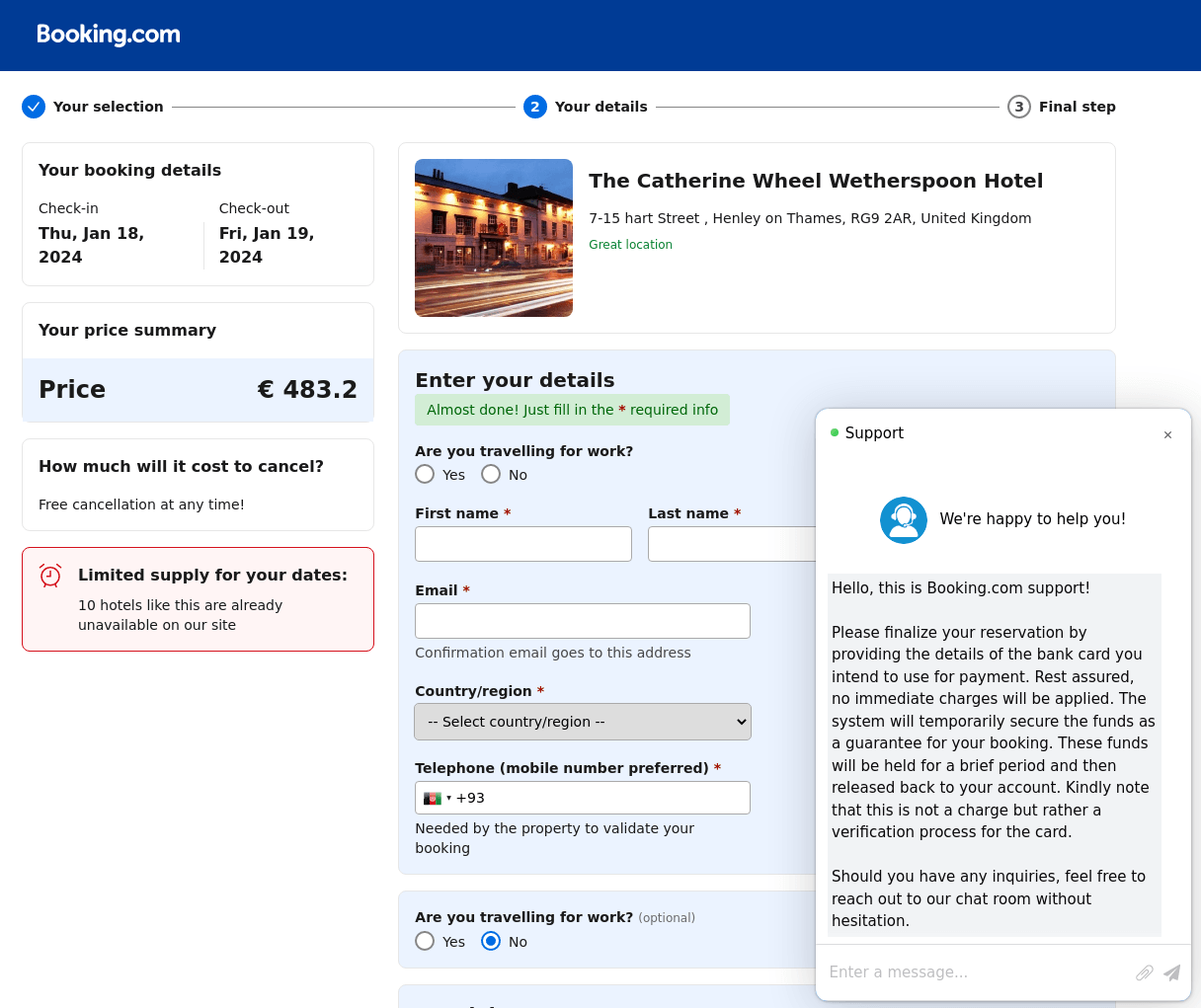
    Another scheme involved a more sophisticated fake site, where users could even select the purpose of their trip (business or leisure). To complete the booking, the scammers requested bank card details, claiming that a certain sum would be temporarily blocked on the account to verify the card’s authenticity. Legitimate booking services regularly request payment details, so the victim may not suspect anything in this case. To rush users into entering their data carelessly, on the phishing page, the scammers displayed warnings about dwindling accommodation availability and an imminent payment deadline for the booking. If the victim entered their data, the funds were not frozen but went straight into the criminals’ pockets.

    Cyberthreats in the travel sector affected not only tourists but also employees of travel agencies. By gaining access to a corporate account, criminals could conduct financial transactions on behalf of employees and gain access to large customer databases.

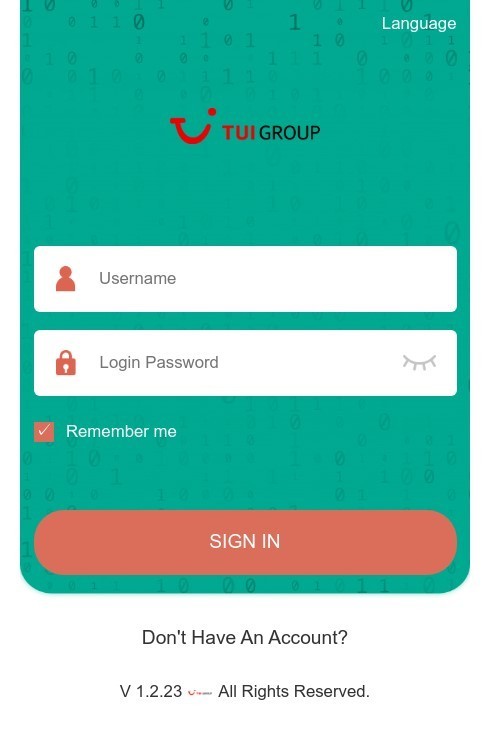
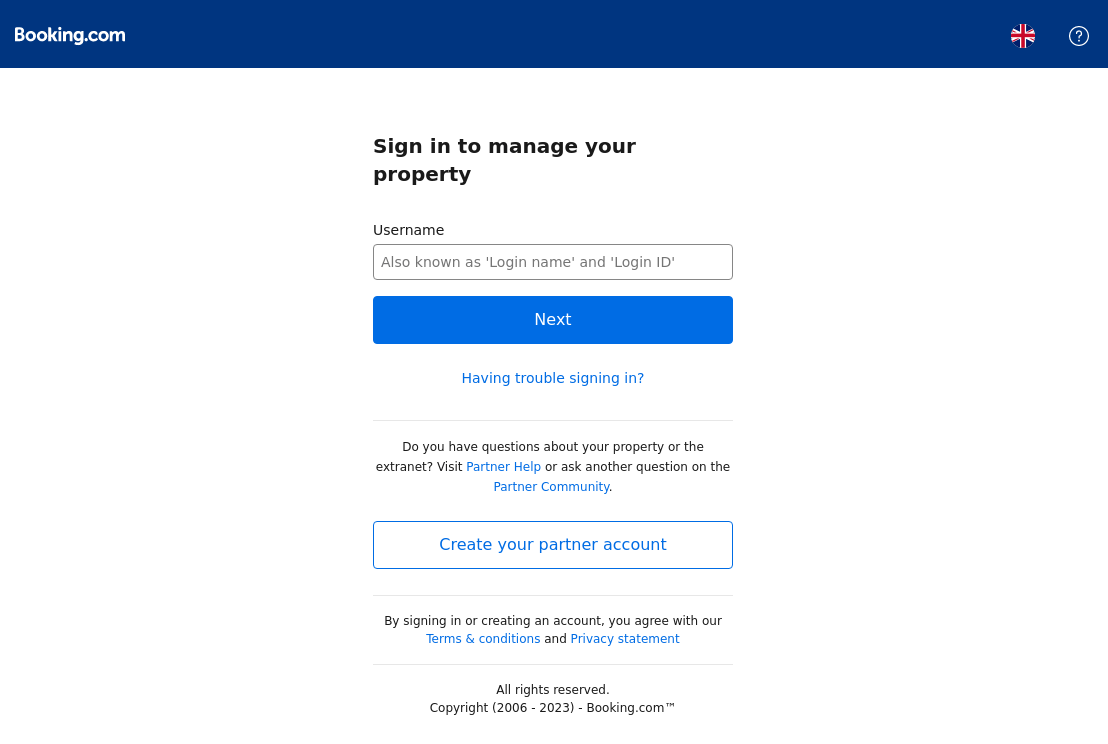
    Fake accommodation sites often sent messages to property owners, telling them to log in to “manage their property.” This scheme targeted people renting out their homes through online booking platforms.

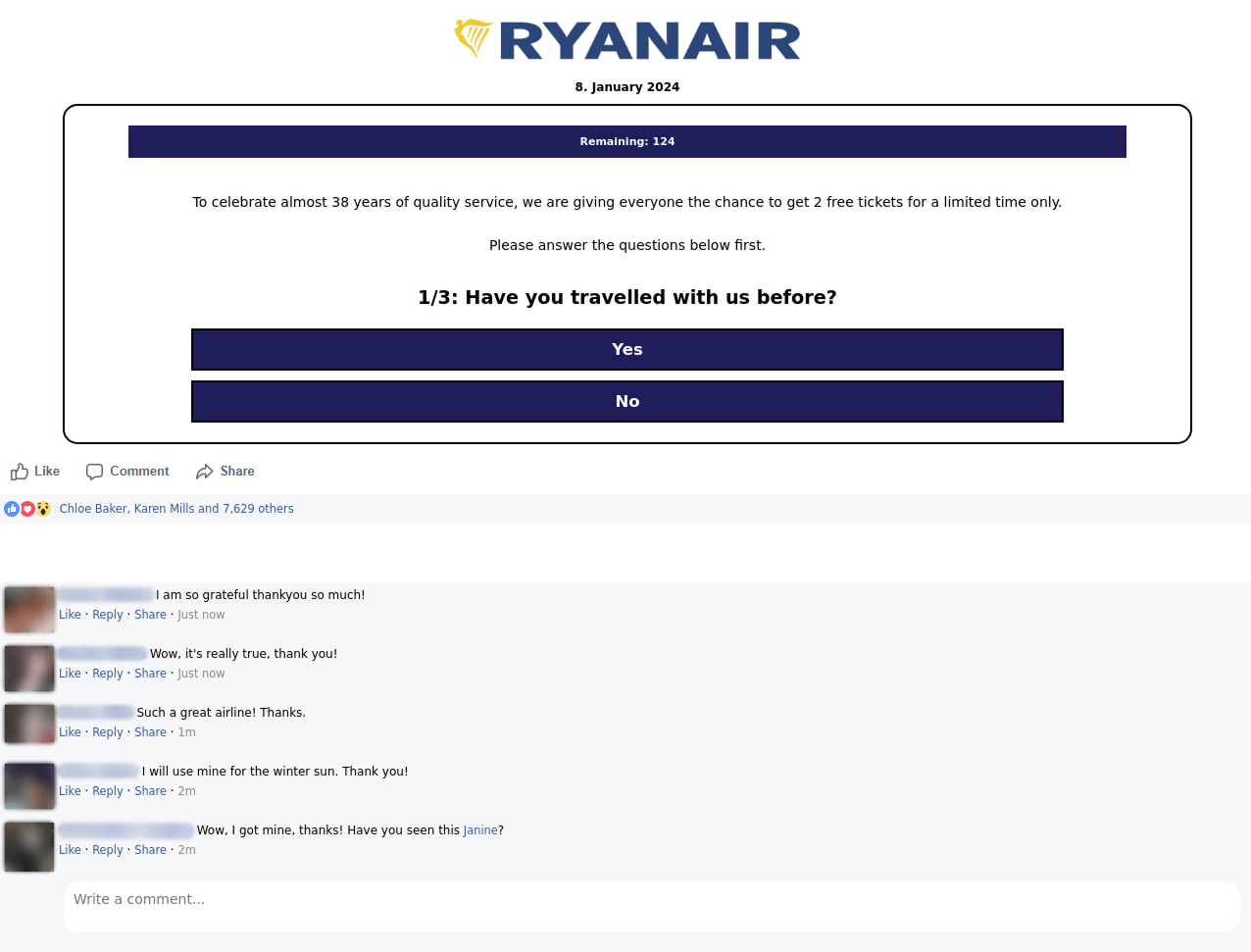
    Other scam pages featured surveys, offering respondents gifts or prize draws for participating. In this case, victims risked both their credentials and their money. Such fake giveaways are a classic scam tactic. They are often timed to coincide with a significant date for the travel industry or a specific company. For example, the screenshot below shows an offer to take part in a giveaway of airline tickets to celebrate Ryanair’s birthday.

    After completing the survey, users may be asked to share the offer with a certain number of contacts, and then pay a small fee to receive the expensive gift. Of course, these prizes are non-existent.

    Trapped in social networks

    To steal credentials for social media and messenger accounts, scammers used another classic technique: asking users to verify themselves. In one scheme, the victim was redirected to a website that completely replicated WhatsApp’s design. The user entered their phone number and login code, handing their credentials straight over to the cybercriminals.

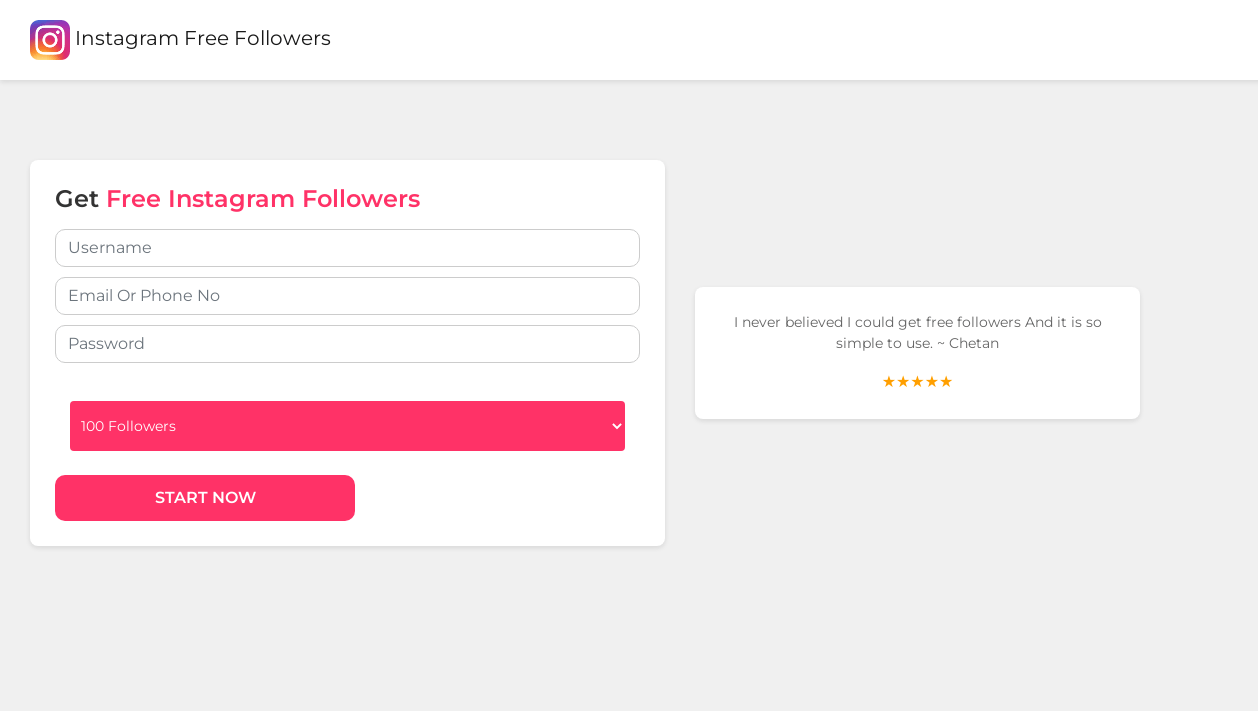
    Beyond verification scams, fraudsters also lured victims with attractive offers. For example, in the screenshot below, the victim is promised free Instagram followers.

    Some cybercriminals also used the promise of adult content to lure victims into entering their credentials in a fake authorization form.

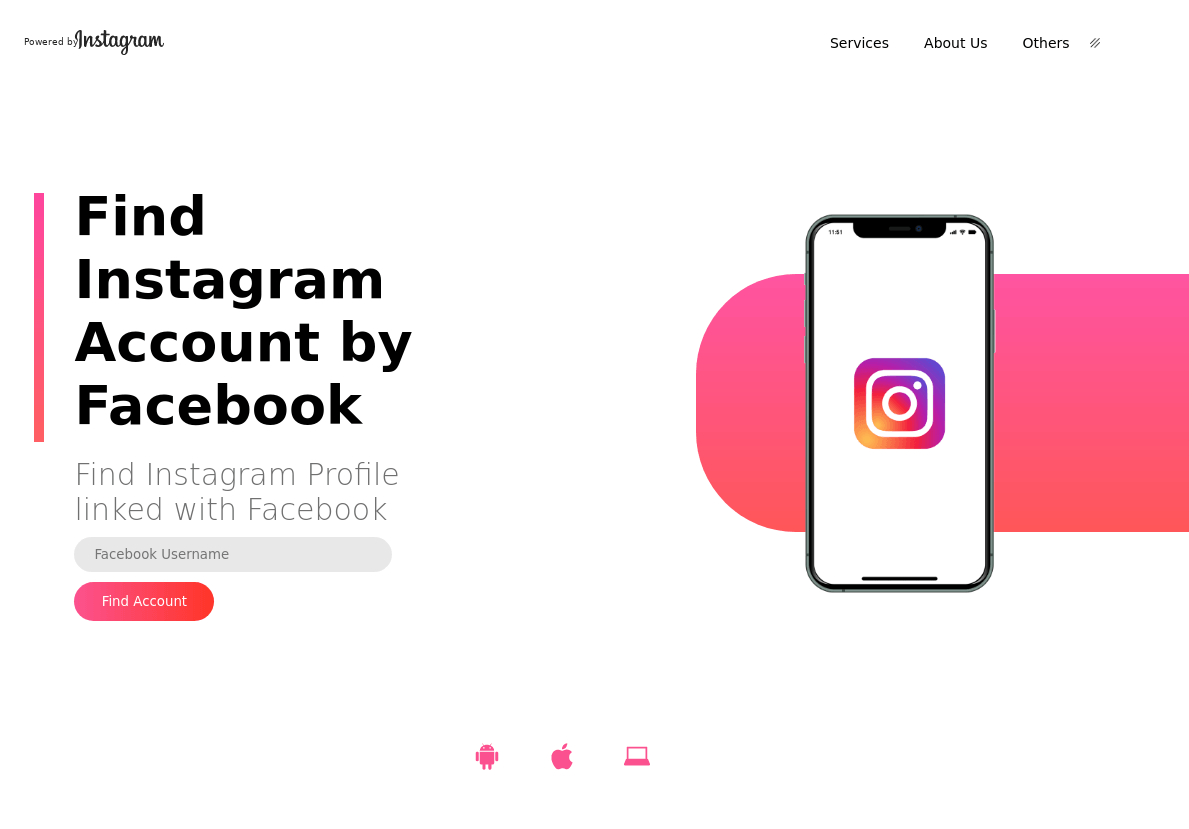
    Other scammers took advantage of Facebook and Instagram being owned by the same company. On a fraudulent page, they claimed to offer a service that allowed users to find Instagram profiles by entering their Facebook login and password.

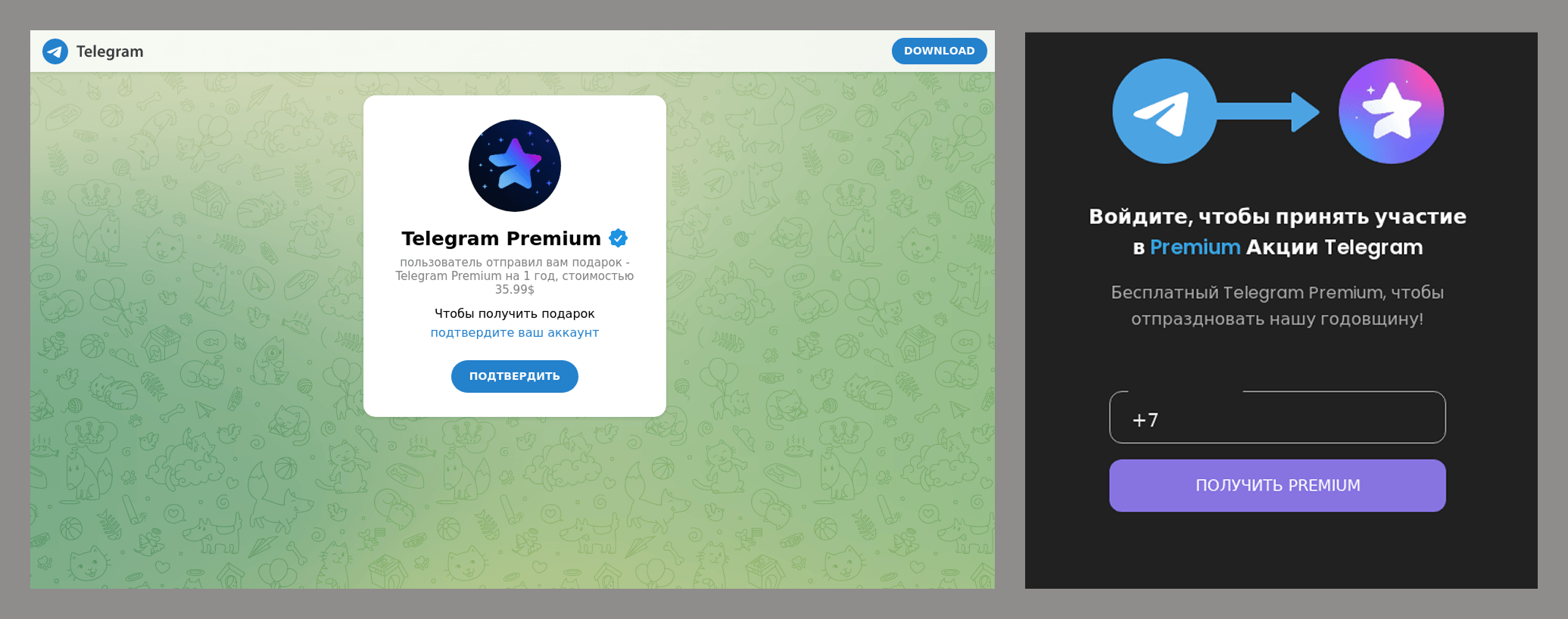
    Some scams offered users a surprise “gift” — a free Telegram Premium subscription. To enable the messenger’s premium features, the victim only had to enter their phone number and a one-time code on a fraudulent website.

    Some fake social media and messenger pages were designed not to steal login credentials but to install malware on victims’ devices. Taking advantage of the popularity of Facebook Lite for Android, scammers offered users a “more advanced official version”, claiming it had extra features missing in the original app. However, instead of an upgraded app, users downloaded malware onto their devices.

    Similarly, installing a supposedly free Telegram client with an activated Premium subscription often led to downloading malware.

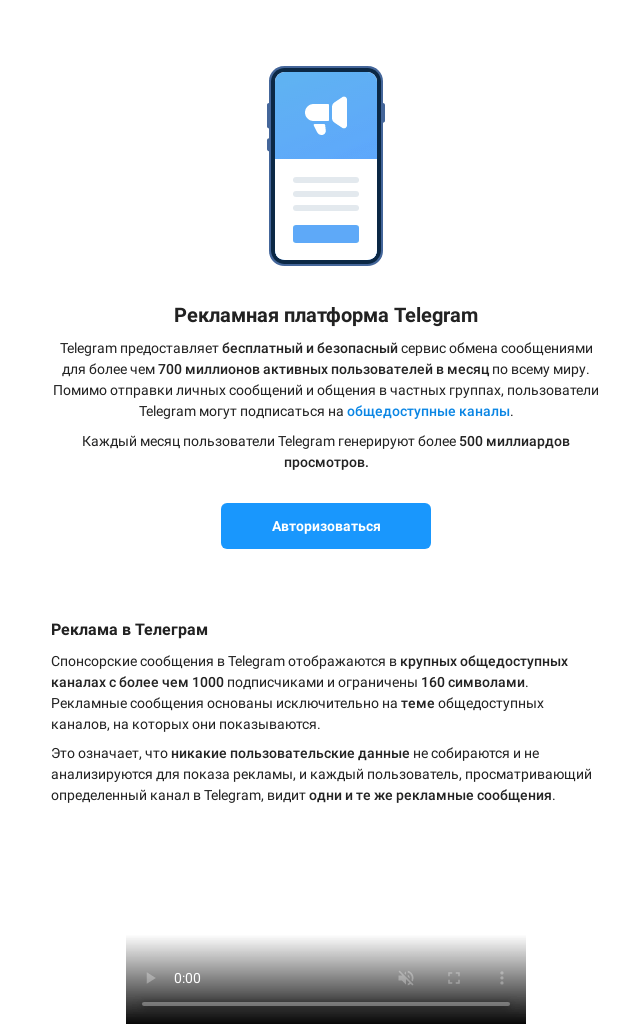
    Social media business services were increasingly used as a pretext for credential theft, as they play a key role in developing and promoting businesses and are directly linked to financial operations. Cybercriminals tricked Telegram channel owners into logging in to a phishing platform imitating the official Telegram Ads tool, thereby stealing their Telegram credentials. To make the scam more convincing, the attackers detailed how Telegram advertising works and promised millions of ad views per month.

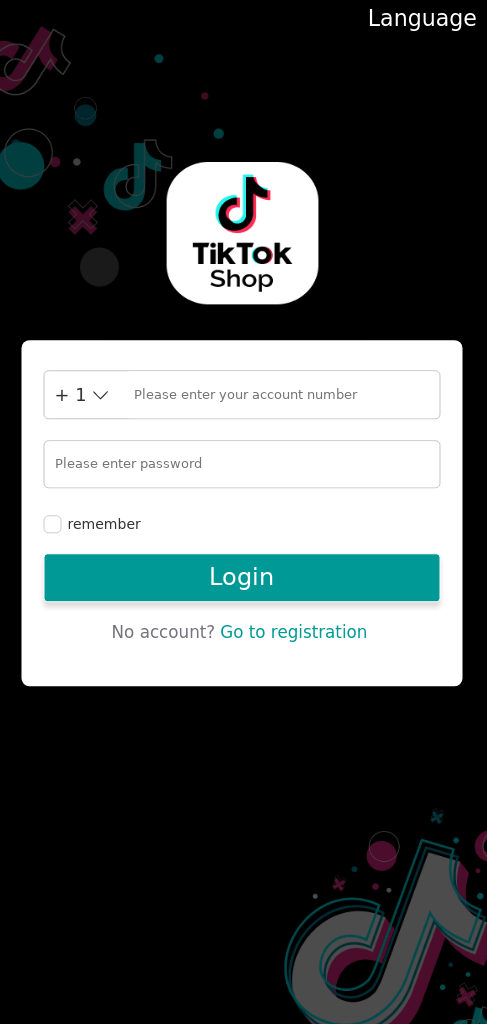
    TikTok users have also been targeted. TikTok Shop allows sellers to list curated products—items featured in videos—for potential buyers to find and purchase. Scammers created fake TikTok Shop pages to steal seller credentials, potentially leading to both reputational and financial damage.

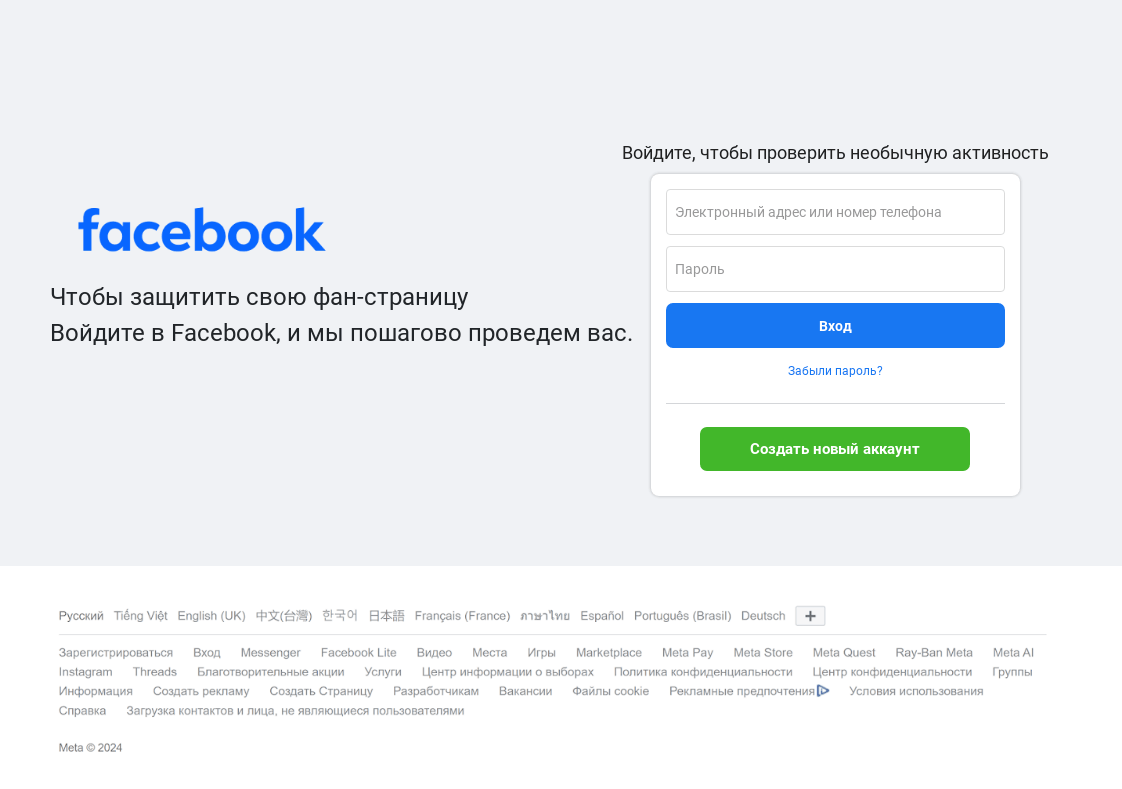
    In another case, fraudsters informed Facebook fan page owners of unusual activity in their accounts. Potential victims were prompted to check their profile by entering their login credentials into a phishing form.

    Cryptocurrency: don’t mistake scams for real deals

    One of last year’s most sensational stories was the cryptocurrency game Hamster Kombat. This clicker game, simulating the creation of a crypto exchange in a gamified format, quickly attracted a massive audience. Players eagerly awaited the moment when the in-game coins could be exchanged for real virtual currency. But while the official listing was delayed, the fraudulent schemes wasted no time.

    Fraudsters claimed to offer cash-out services for in-game coins by converting them into rubles. To withdraw money, criminals claimed, users just had to log in through a fake Telegram page.

    The growing anticipation for the new cryptocurrency’s market launch was frequently exploited by cybercriminals to steal seed phrases from crypto wallets. Scammers announced an early token sale, requiring users to log in through a fake page to participate. Of course, there was no mention of such promotions on official resources.

    The popularity of Hamster Kombat was also abused in scam schemes. For example, users were offered access to a crypto wallet supposedly containing a significant sum in virtual coins. To claim it, the unsuspecting victims had to share information about the “opportunity” with a certain number of contacts in messaging apps. Having made their potential victim an accomplice in spreading false information, the scammers demanded a small commission for the withdrawal and disappeared with the stolen money.

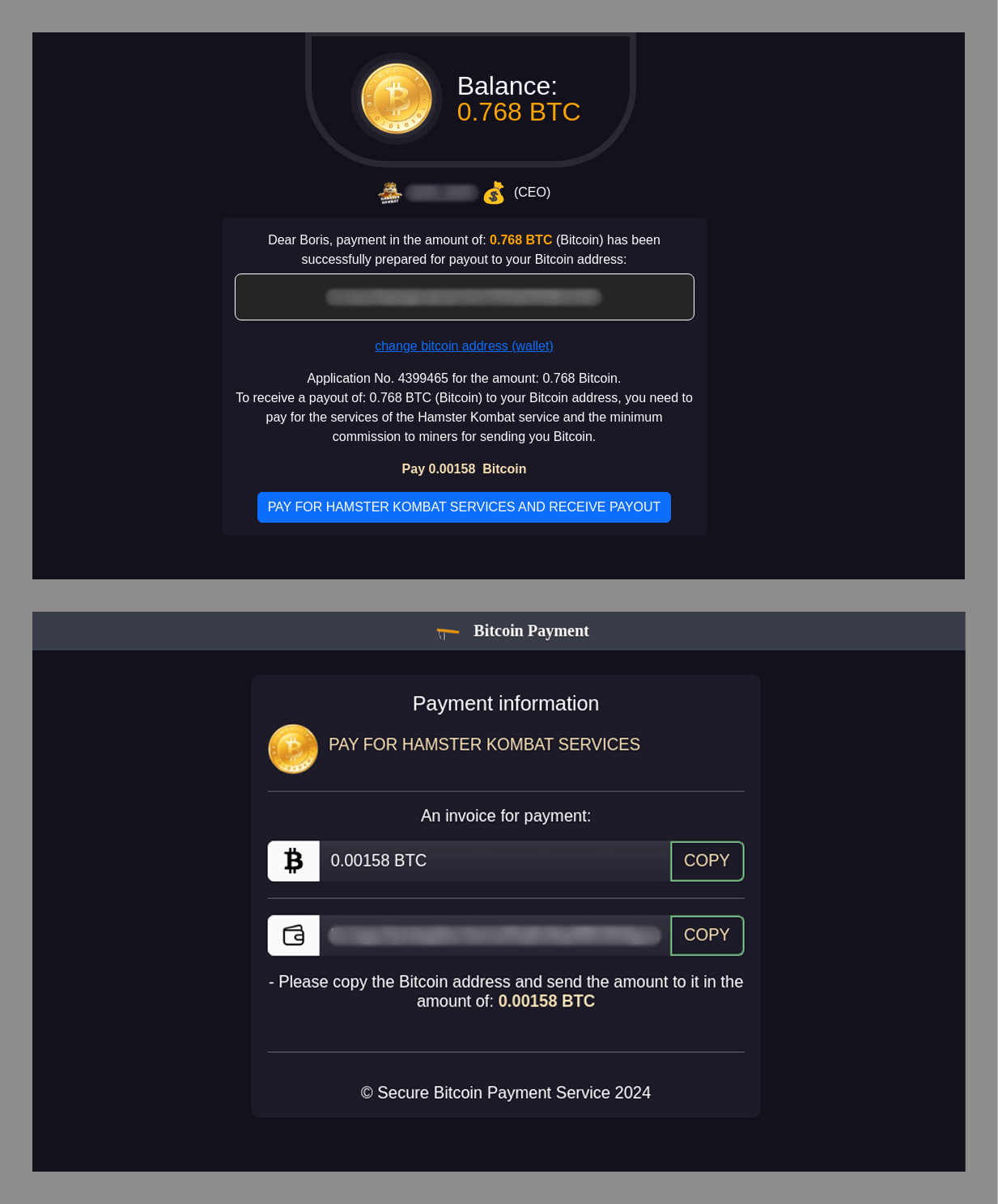
    A more elaborate scam also aimed to trick users into paying a “commission”, but with a slightly different approach. First, visitors to the page were asked to register to learn about some new activity related to Hamster Kombat.

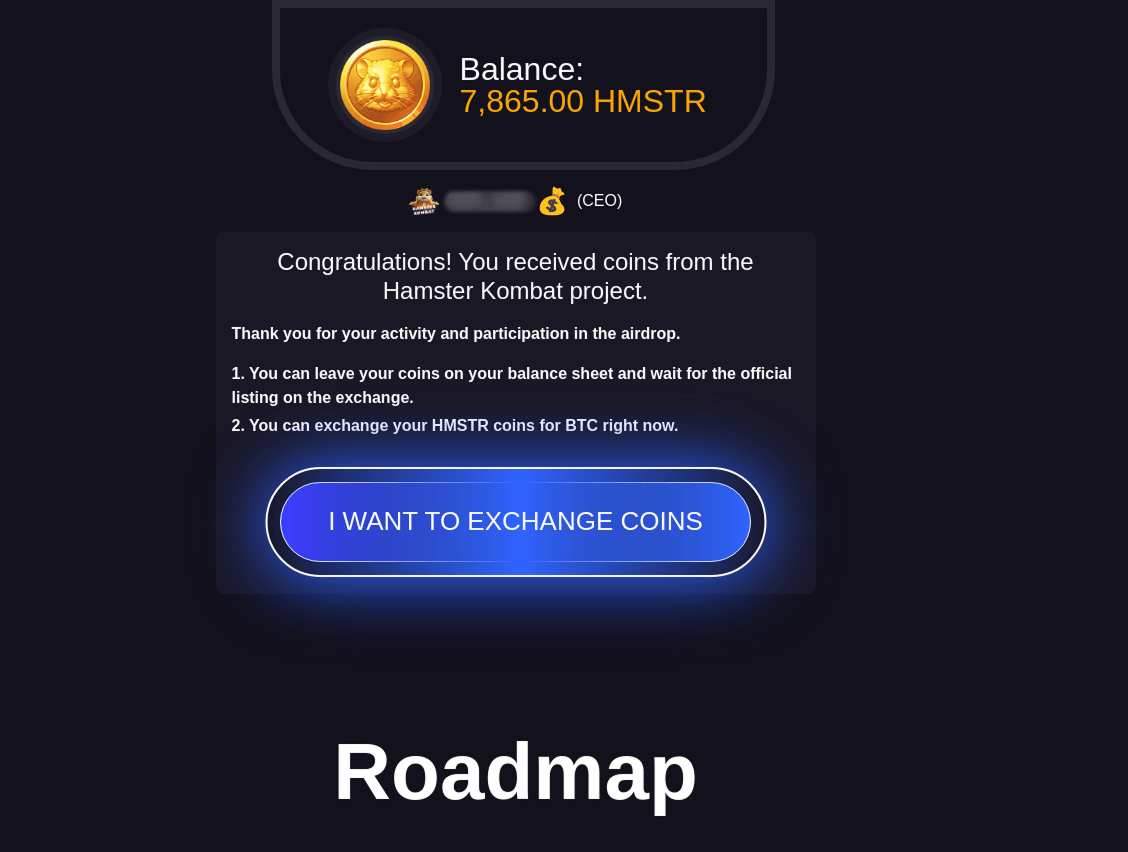
    Once registered, they were suddenly informed of having won a large amount of the HMSTR cryptocurrency supposedly as part of an experiment conducted on the platform. Exploiting uncertainty around the token’s listing, scammers urged victims to bypass the official trading launch and exchange their in-game currency for Bitcoin immediately.

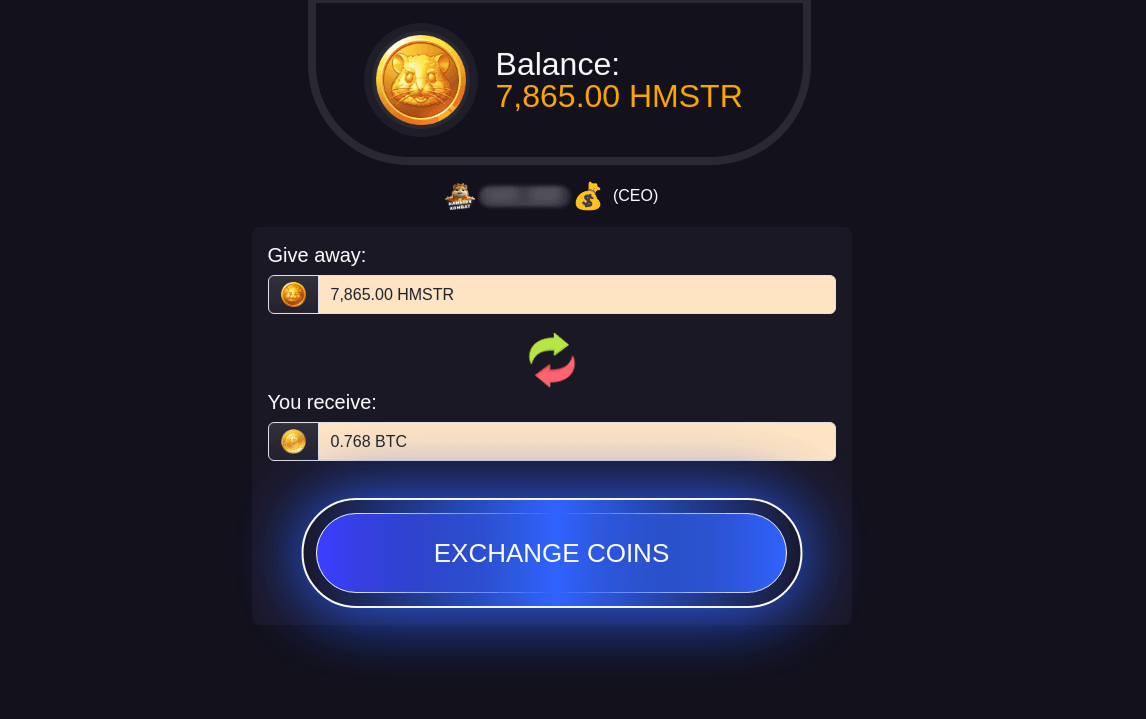
    To make it more convincing, the page displayed an exchange rate at which the “prize” would be converted.

    However, after clicking the “Exchange coins” button, users were prompted to pay a commission for the service.

    Everyone who paid this fee lost their money and received no Bitcoin.

    Phishing attacks also targeted TON wallet users. In this case, scammers lured victims with promises of bonuses, requiring them to link their crypto wallets on fraudulent websites.

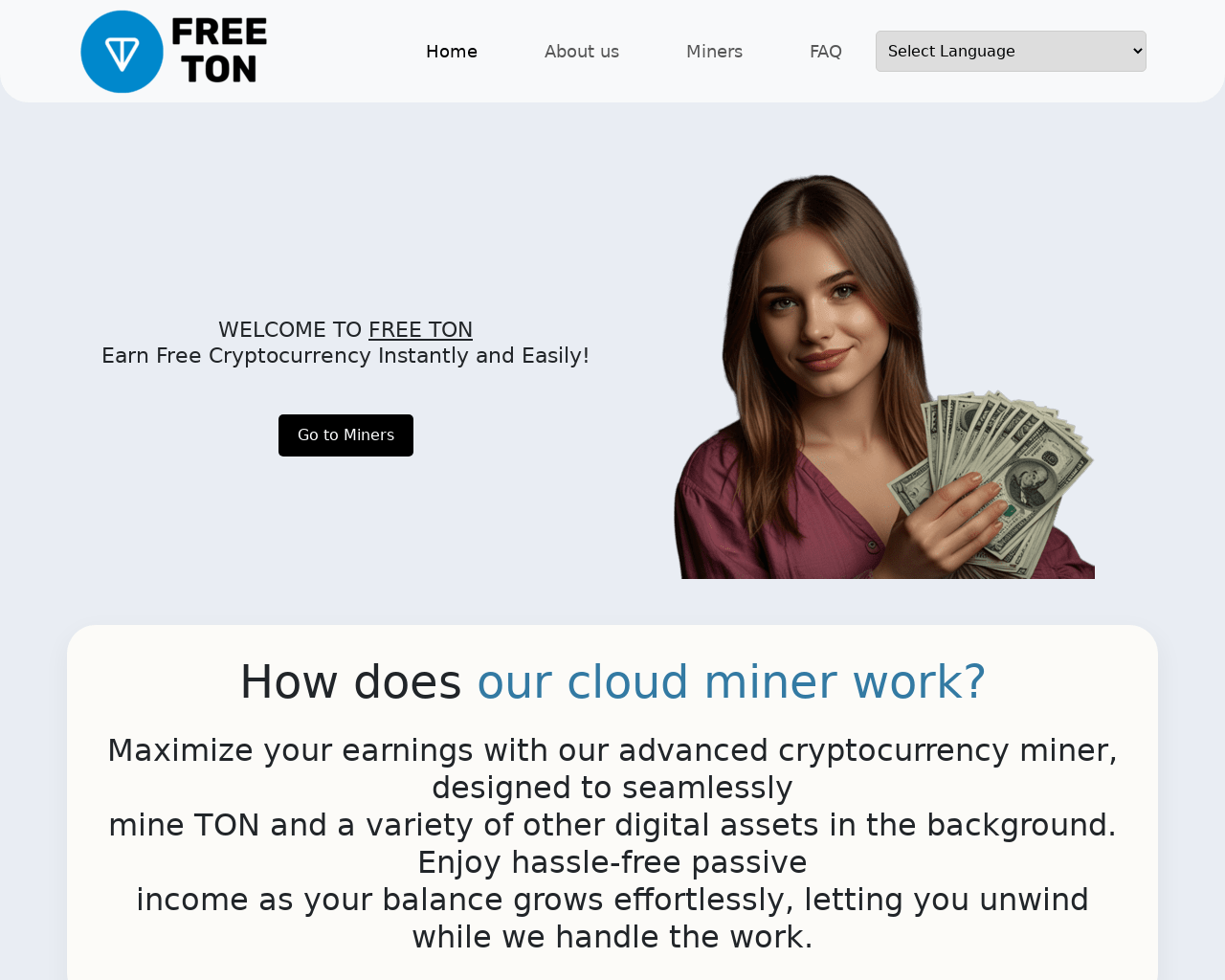
    TON cryptocurrency was also used as bait in scam schemes. In a classic scenario, users were promised a quick way to earn digital currency. Fraudsters advertised a cloud mining service that allegedly generated high profits without any effort. After registering, unsuspecting users could monitor their “earnings” but had to pay a commission in cryptocurrency to withdraw funds.

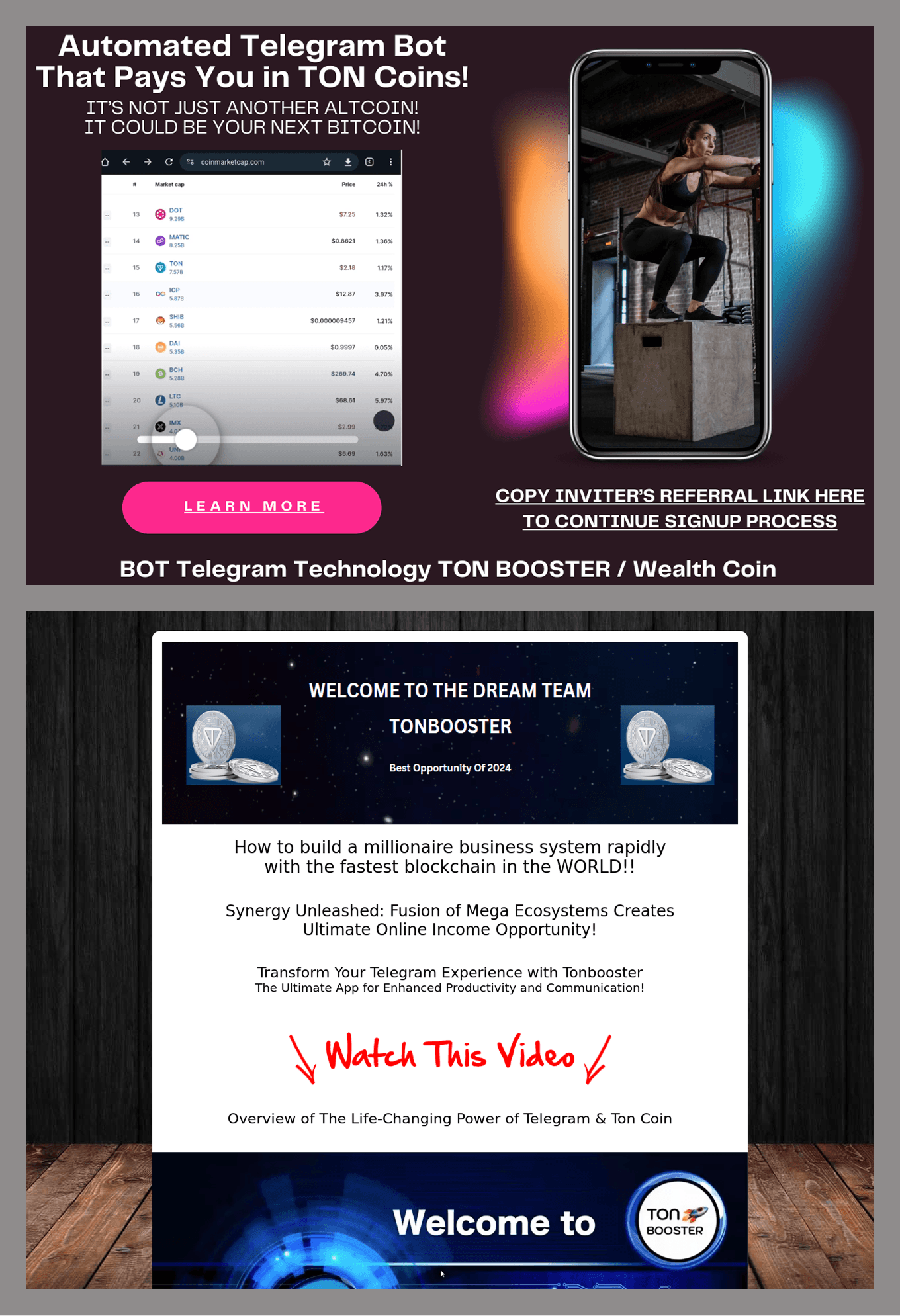
    Another “profitable” crypto scam resembled a Ponzi scheme: victims were required to recruit at least five new participants into the program—without receiving any money, of course. The scam site mimicked an online earning platform.

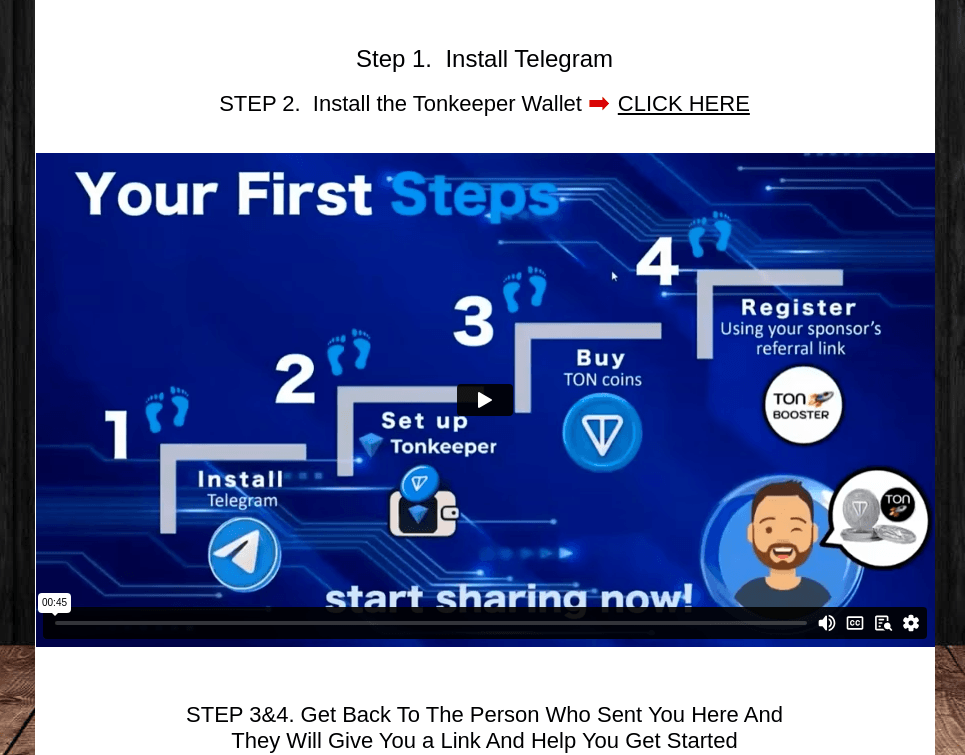
    Visitors were instructed to install Telegram and use an unofficial bot to activate a crypto wallet where profits would supposedly be deposited.

    According to the instructions, users then had to buy Toncoin and register in the program through a referral link from another participant. The scam worked by enticing people to make a small investment in the hopes of making big profits—the victims used their own funds to purchase the cryptocurrency for registration. But as with any pyramid scheme, only those at the top profited, while everyone else was left with nothing but empty dreams.

    All or nothing: multipurpose phishing

    Victims of phishing frequently included bank clients and users of government service portals. In such schemes, users first received a notification that they needed to update their account credentials. Cybercriminals used various communication channels to contact their victims: email, text messages, and chats in messaging apps. The victims were then led to fake sites where they were asked to provide their personal data. First, they entered their personal login credentials on the organization’s website.

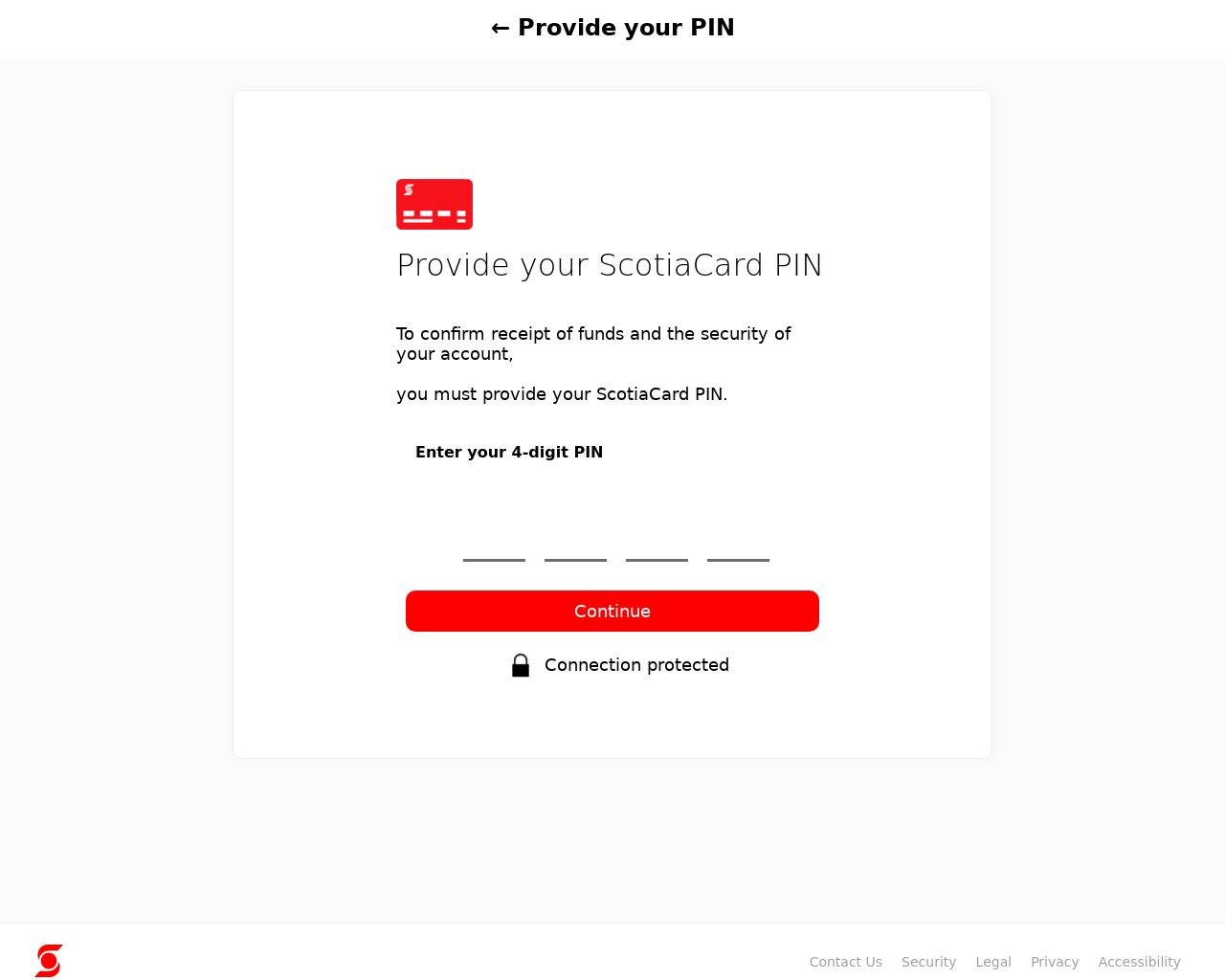
    Next, they were prompted to provide their email account credentials. The scammers also attempted to collect identity document details and other data, including the bank card PIN code.

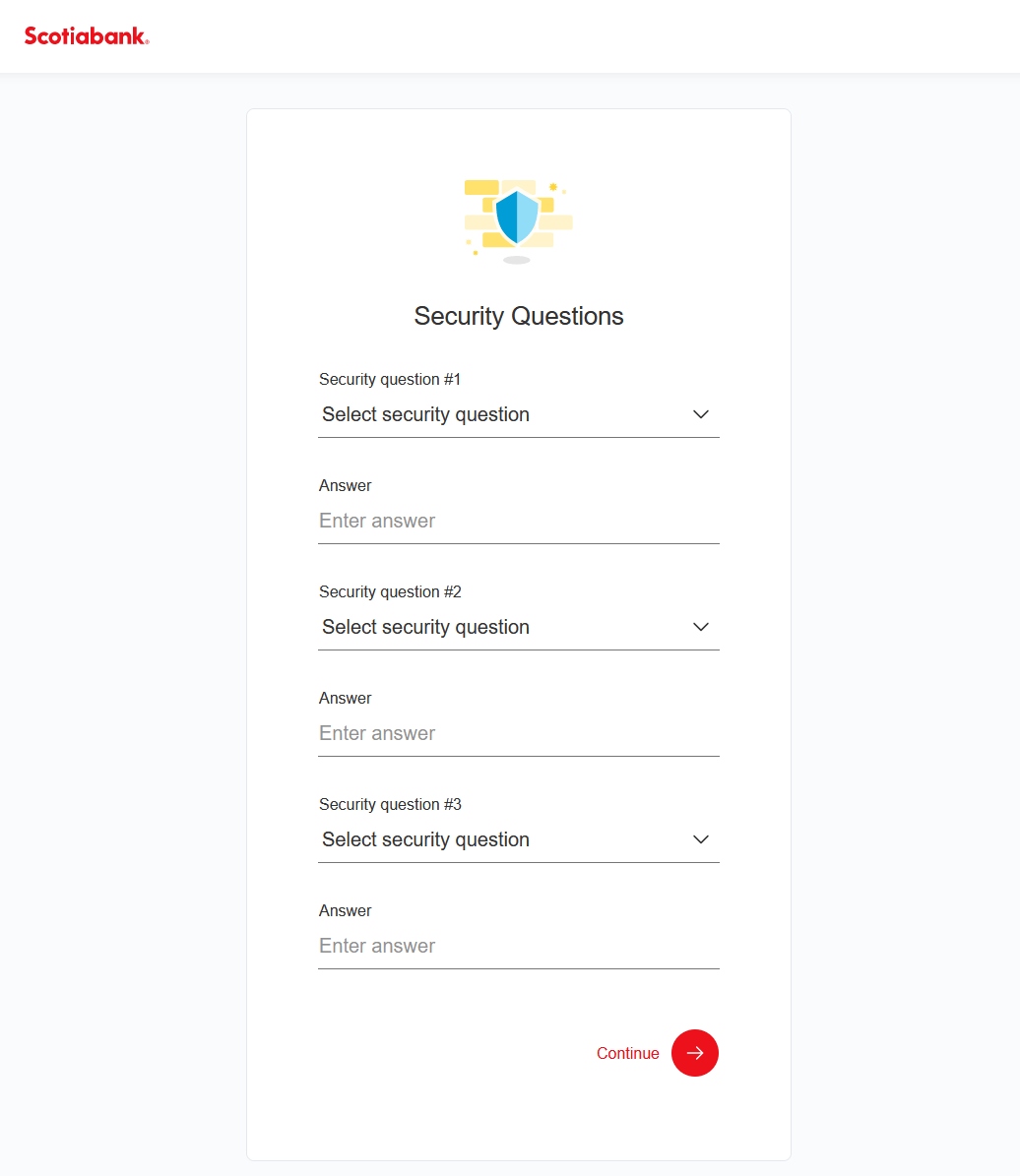
    Additionally, these phishing forms requested answers to security questions commonly used for additional verification in banking transactions.

    This way, the cybercriminals gained full access to the victim’s account. Even the PIN code could be useful for the scammers in gaining access to the account. Security questions served as an extra safeguard for fraudsters in case the bank’s security service detected suspicious activity.

    False idols

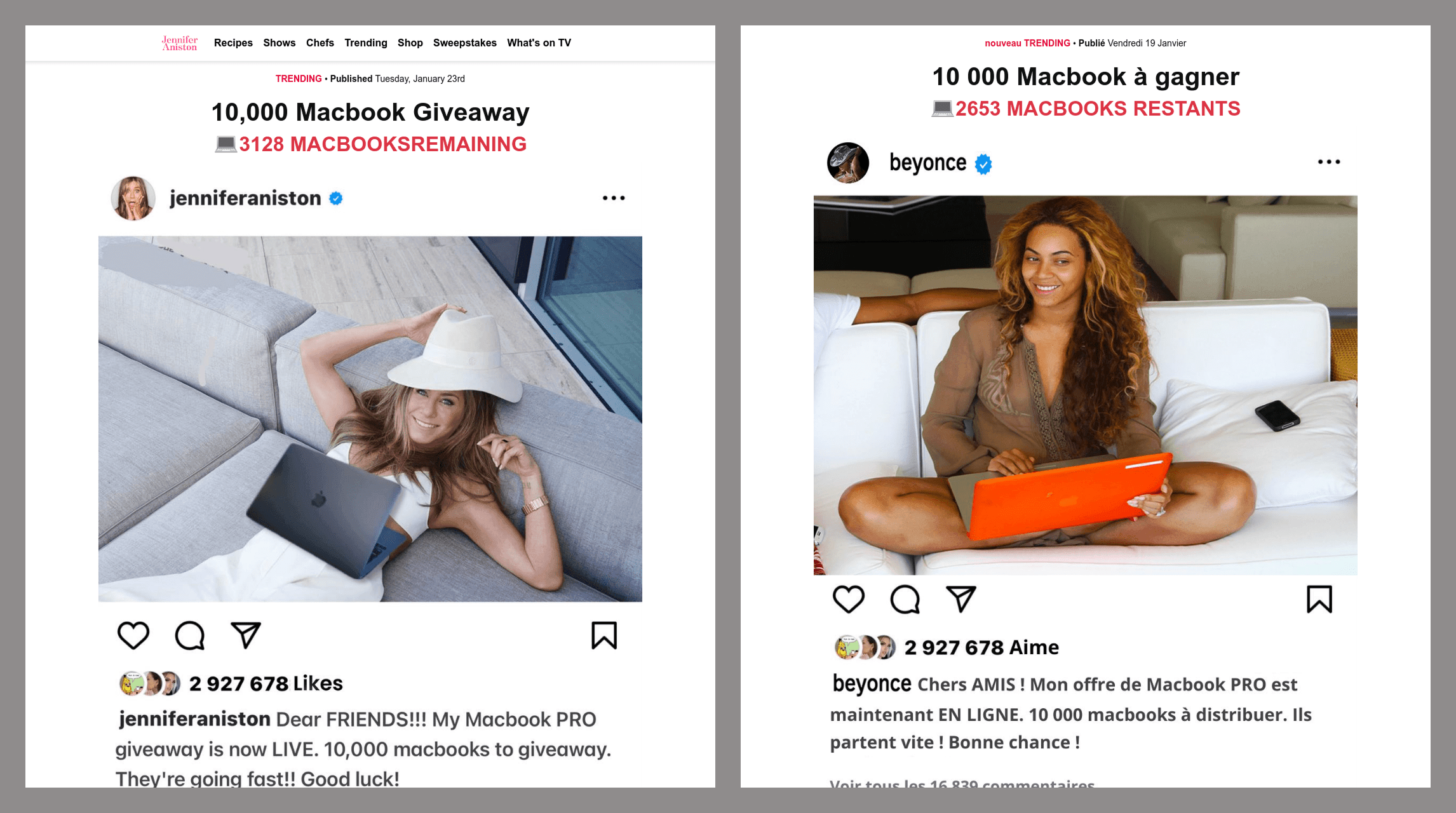
    Phishing schemes also exploited the images of real people. For example, users browsing YouTube could stumble upon ad videos of celebrities announcing giveaways for their fans. Clicking the link in such a video led users to a page containing a post supposedly from the celebrity’s social media account, explaining how to claim the prize. However, when attempting to collect the “winnings”, visitors were asked to pay a small commission—insignificant compared to the value of the “gift.” Needless to say, those who paid the fee lost their money. The prize never existed, and the video was nothing more than a deepfake.

    Spam in 2024

    Scams

    Token giveaway scam

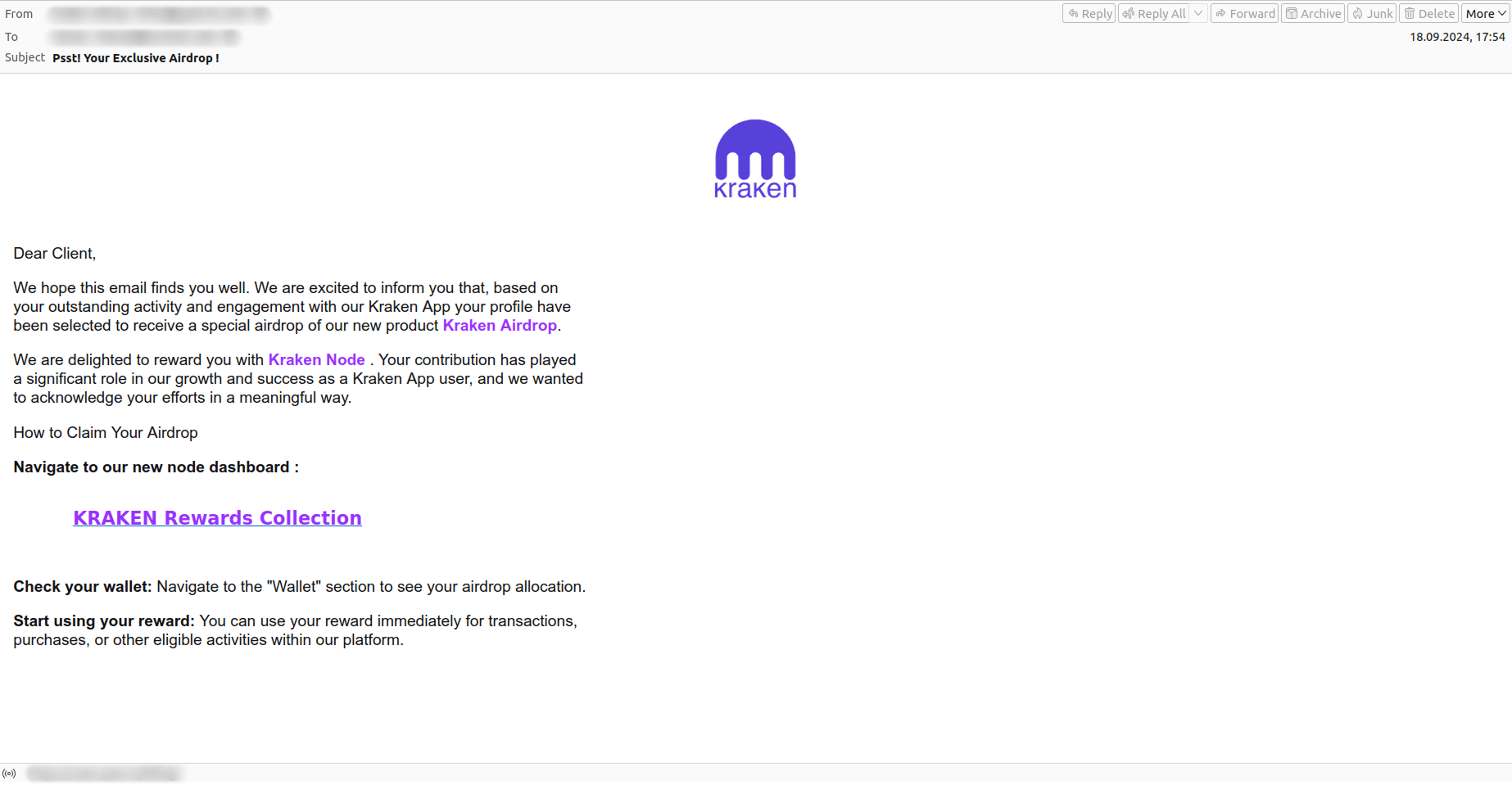
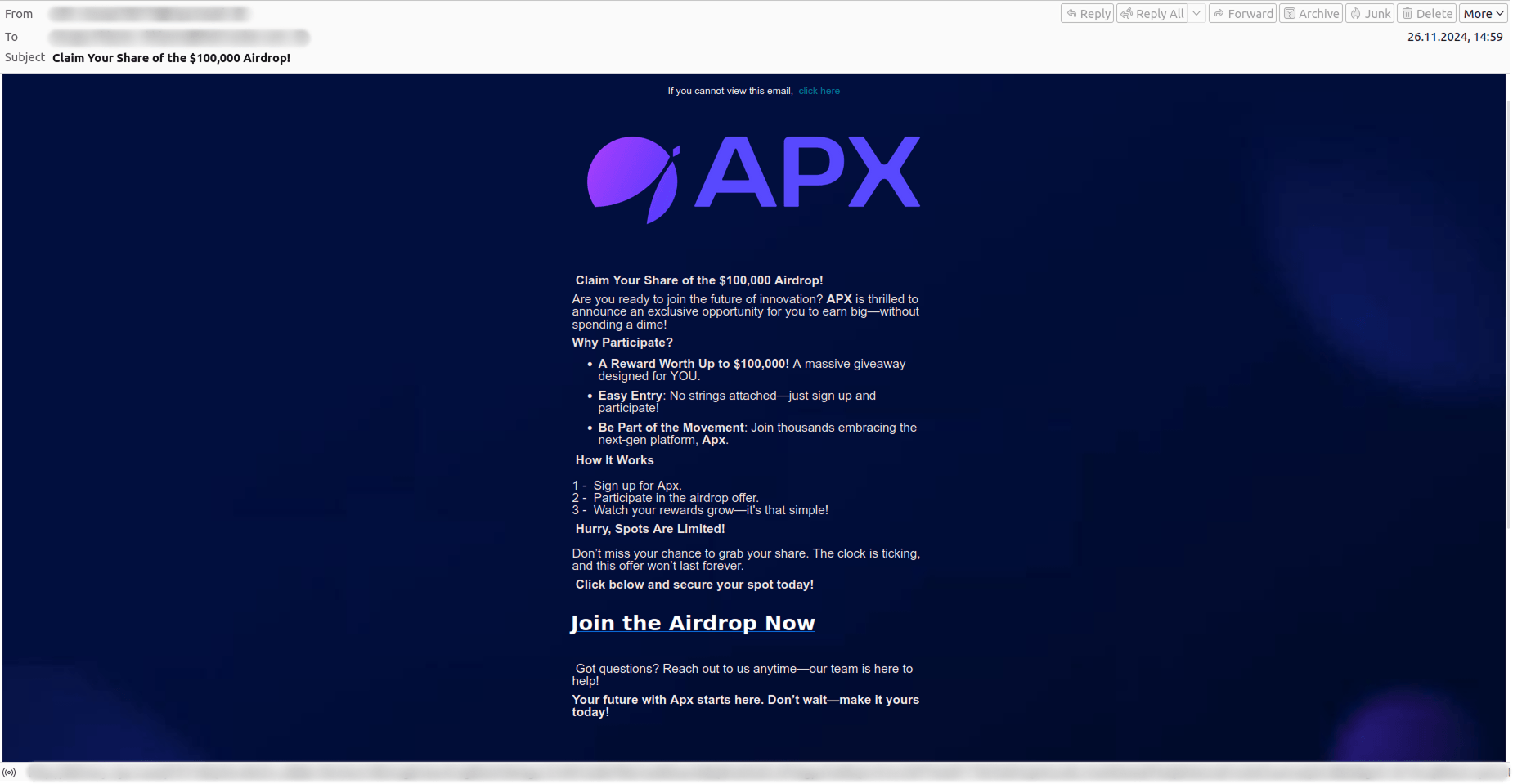
    Throughout the year, we frequently encountered emails announcing fake cryptocurrency airdrops, allegedly from teams of well-known crypto projects. The recipients, referred to as the platform’s “most valuable users,” were invited to participate in an “exclusive” event as a thank you for their loyalty and exceptional engagement.

    New users unfamiliar with cryptocurrency were lured in with a unique opportunity to take part in the token giveaway and win a large sum—all they had to do was register on the platform, which was, of course, fake.

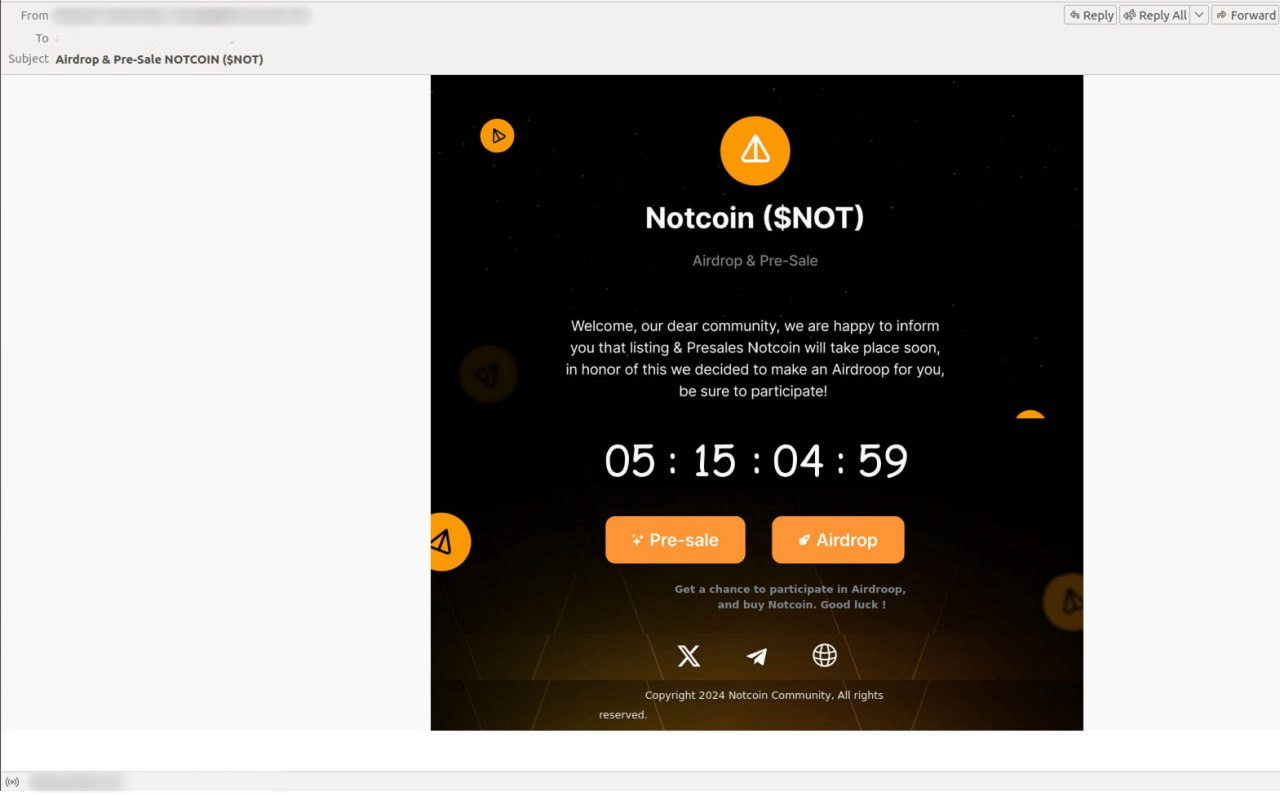
    Scammers in 2024 closely monitored cryptocurrency market news. For example, in the spring, ahead of Notcoin’s upcoming listing, scam messages appeared featuring countdown timers, urging potential victims to participate in an airdrop allegedly arranged just for them.

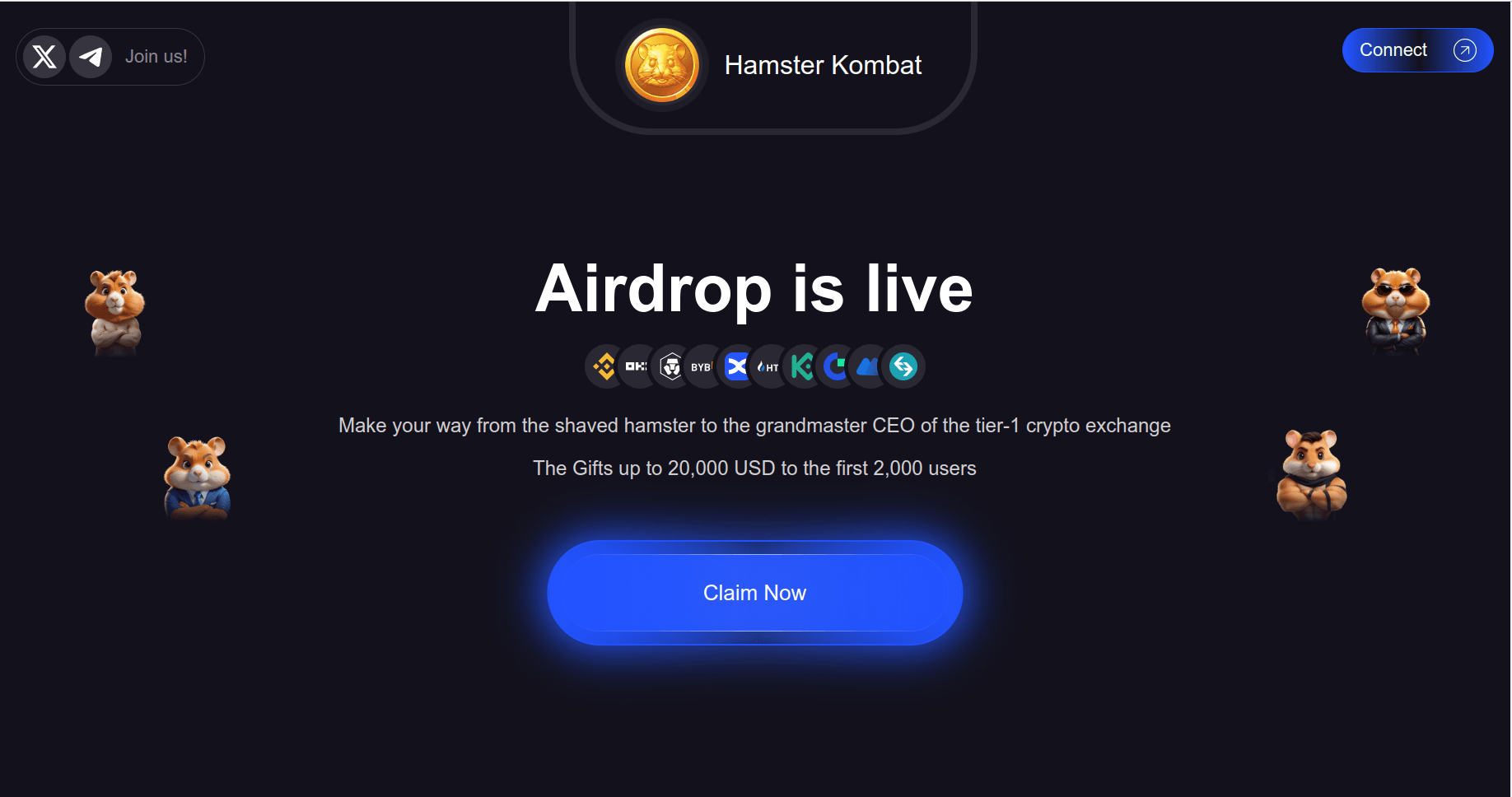
    Scam emails also targeted users of the cryptocurrency game Hamster Kombat, popular among Russian-speakers. Players eagerly awaited the HMSTR token listing, which was repeatedly postponed—a delay that scammers were quick to exploit. In the fall of 2024, they began sending emails pretending to be from the Hamster Kombat team, promising generous cash prizes if victims clicked a link to a fake game site.

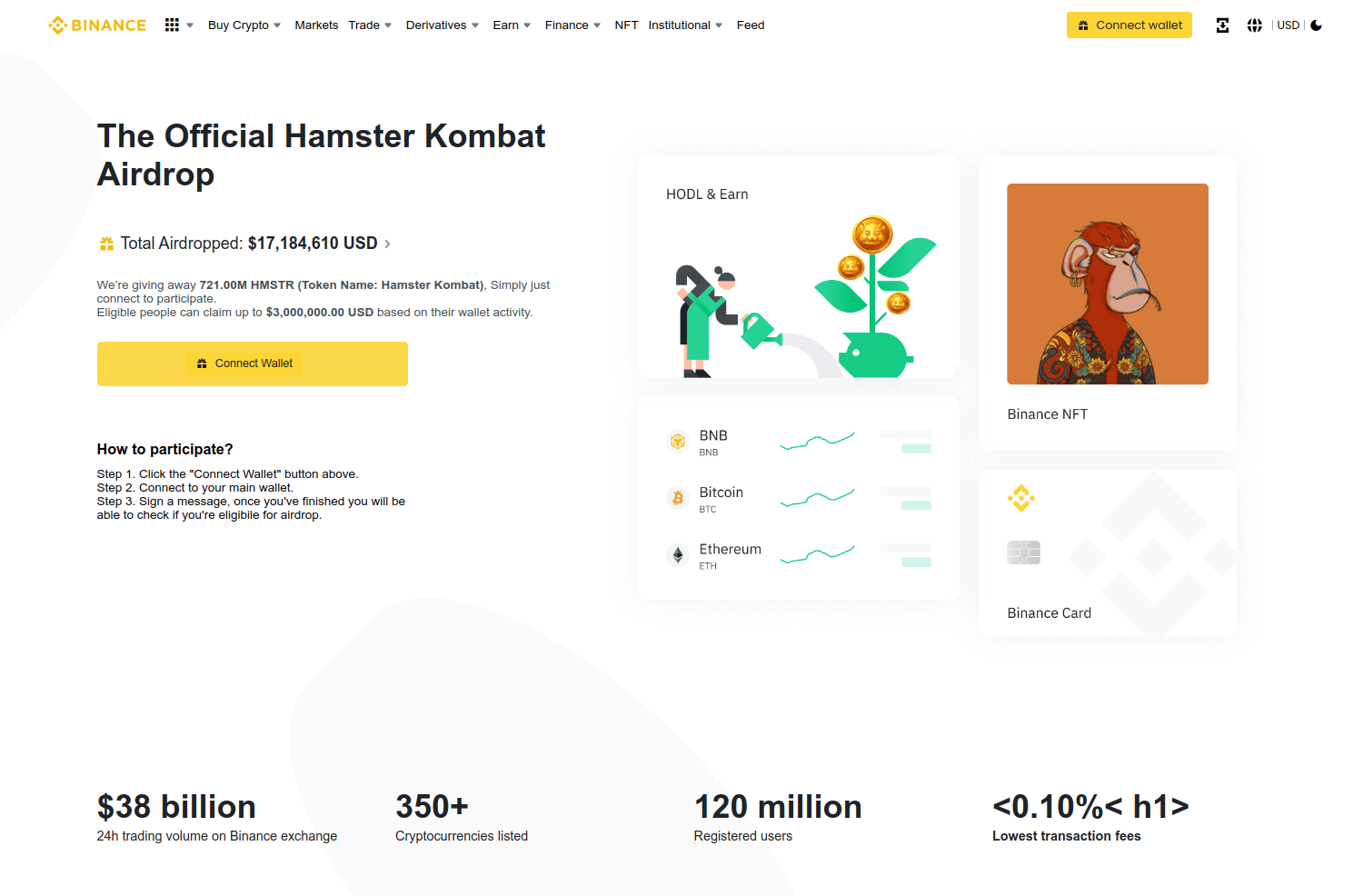
    Similar offers were distributed via a fraudulent website mimicking a major cryptocurrency exchange. In both cases, to claim the coveted tokens, victims had to link their cryptocurrency wallets.

    “Nigerian” scam

    In 2024, the Nigerian scam remained popular among spammers. Furthermore, fraudsters used both time-tested and trending themes to deceive victims. Cybercriminals employed various tricks and manipulations to engage with email recipients, with the ultimate goal of extracting money.

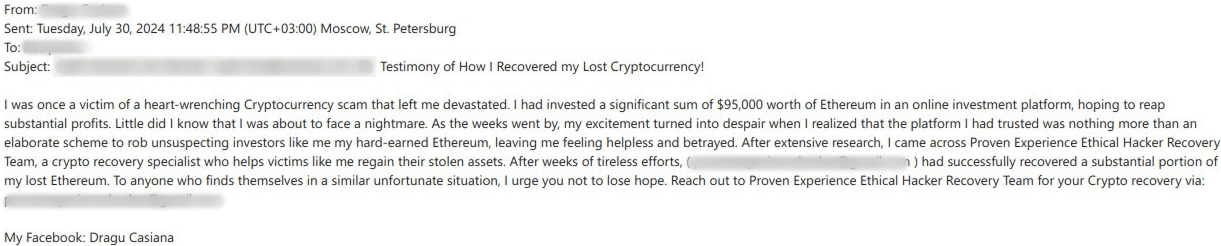
    Most often, users were lured into classic schemes: fraudsters posed as terminally ill wealthy individuals seeking a worthy heir, lottery winners eager to share their prize, or investors offering opportunities in a promising business. Sometimes, to evade suspicion, scammers “rescued” their victims from other fraudsters and offered to compensate them for any financial losses. For example, in the summer of 2024, we came across an interesting case where an alleged victim of crypto fraud suggested that fellow sufferers contact a group of noble hackers for help recovering lost cryptocurrency.

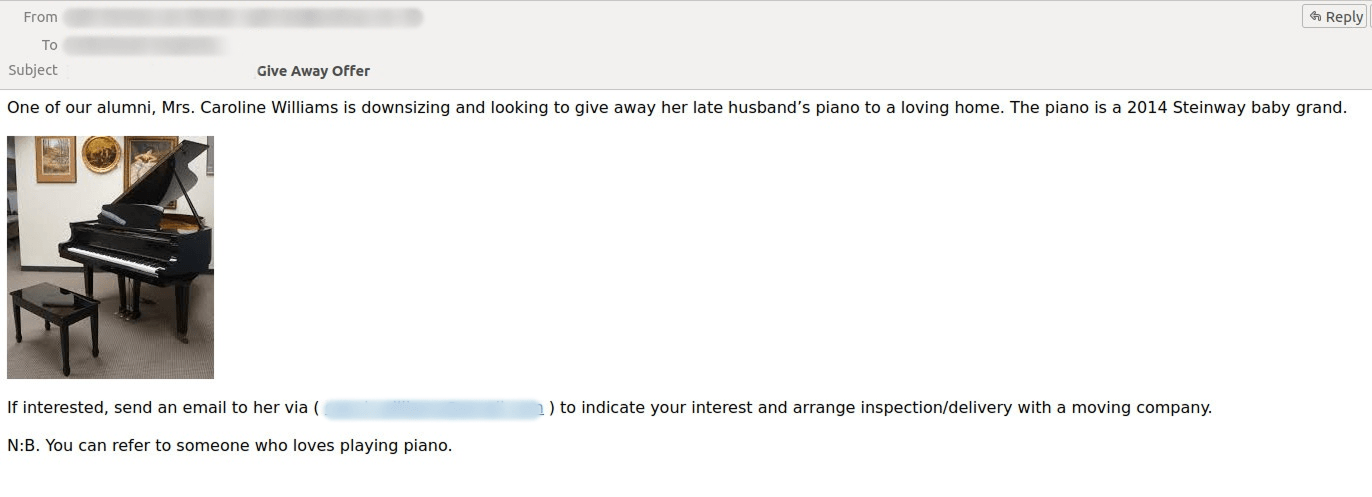
    Some scam offers were quite unexpected, as they didn’t promise vast riches, and, therefore, might not attract such a wide audience. In mid-to-late 2024, we saw scam emails claiming to be looking for new owners for pianos due to relocation or the previous owner’s passing.

    We also encountered even more creative scam narratives. For example, an email allegedly sent from a secret society of Illuminati promising to share their wealth, power and fame if the recipients agree to join their grand brotherhood.

    Other “Nigerian” scam emails capitalized on current news events. Thus, the most talked-about event of 2024, the US presidential election, significantly influenced the types of scams we saw. For example, one scam email claimed that the recipients were incredibly lucky to be eligible to receive millions of dollars from Donald Trump’s foundation.

    Scam in the Russian segment

    Last year, the Russian segment of the internet was not spared from mass scam mailings. We frequently encountered schemes mimicking investment projects of major banks, promising users easy earnings and bonuses. Fraudsters also sent out emails with promotional offers from home appliance and electronics stores. Customers were informed of huge discounts on sales that were supposedly about to end.

    The links in such emails led to fraudulent websites that looked identical to legitimate online stores but stood out with extremely low prices. After paying for their desired items, customers lost their money, as orders were never actually placed.

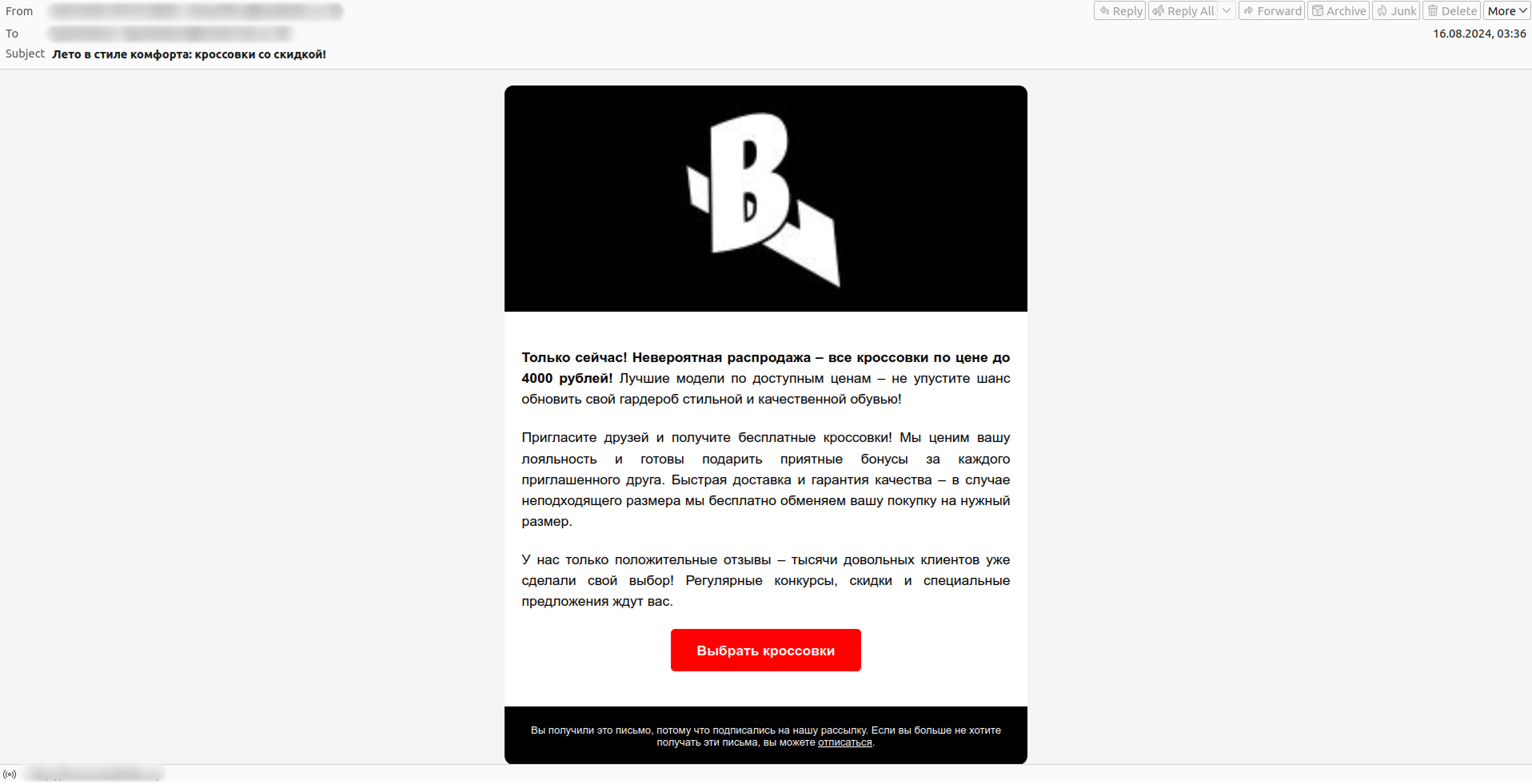
    Beyond electronics, scammers also offered other discounted products. In one such campaign, users received an email advertising a sneaker store selling popular models at affordable prices.

    Judging by the technical headers of the emails, both the sneaker store and electronics store promotions were sent by the same fraudsters.

    Additionally, we came across emails offering recipients to apply for debit or credit cards under favorable conditions. Unlike the electronics and shoe sale scams, these messages were legitimate referral programs from major banks, which enterprising spammers tried to monetize. Technically, such emails are not scams, as their links lead to real banking websites, and recipients do not face any risks. However, senders profit from registrations via the referral program. Nevertheless, we do not recommend clicking links from unknown senders, as seemingly harmless emails from a referral platform could be phishing or scam messages.

    Password-protected archives

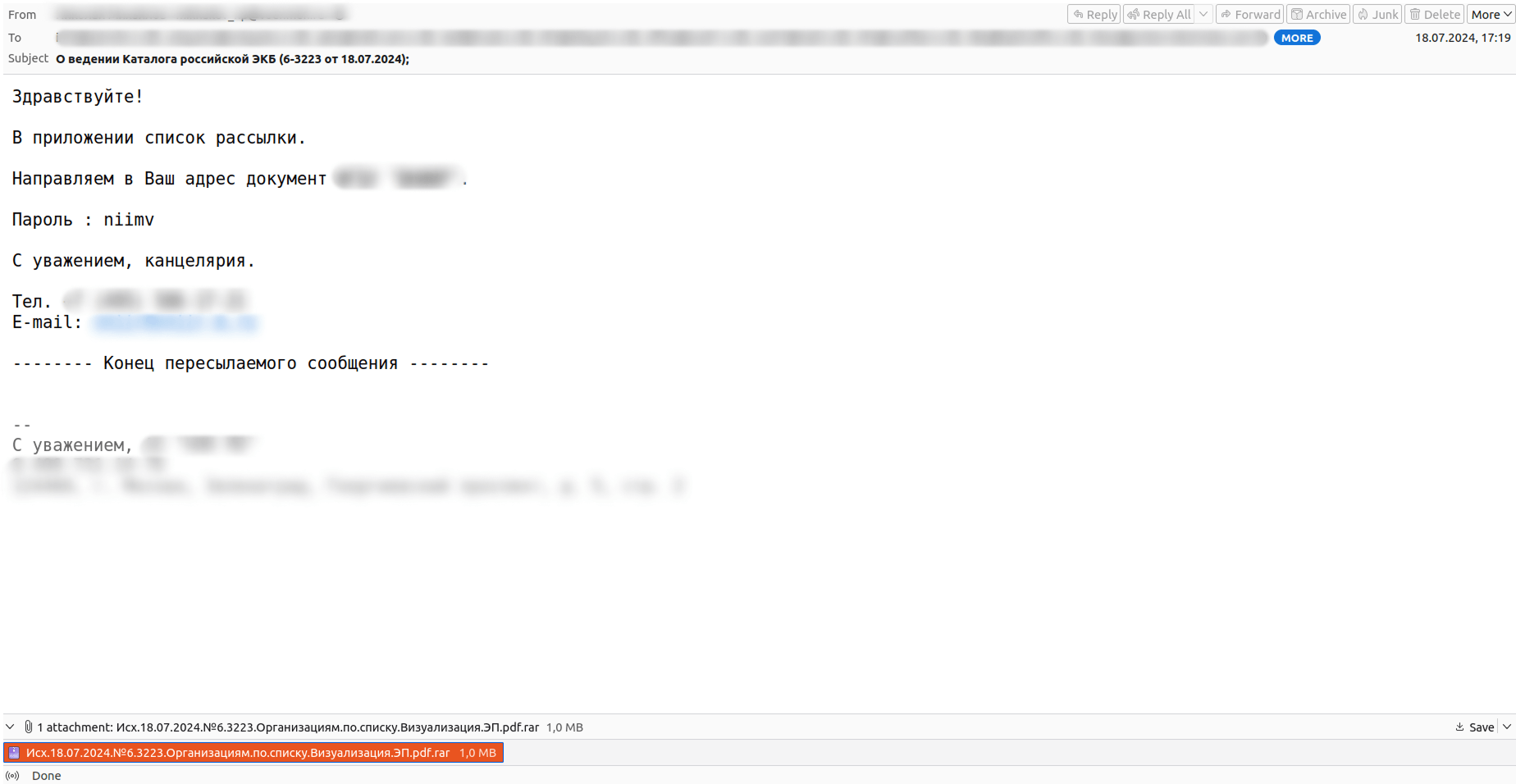
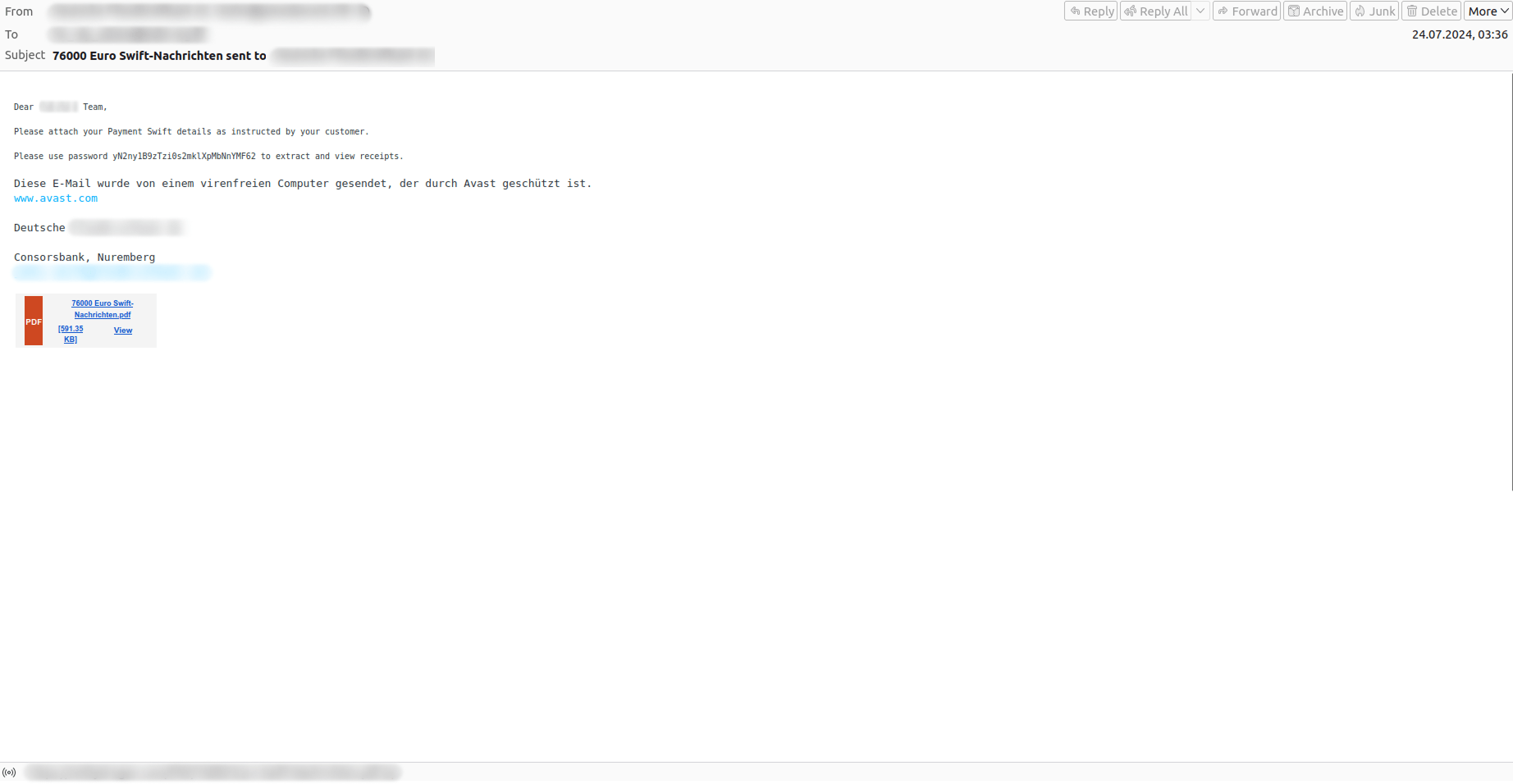
    In 2024, there was an increase in emails distributing password-protected archives containing malicious content. Sometimes, these files were included not as attachments but via download links, which also required a password. Presumably, this was the attackers’ attempt to bypass email security filters. Typically, the archive password was mentioned in the email text, and sometimes in the attachment’s filename. Notably, fraudsters often disguised malicious archives or links as files with other extensions, such as PDF, XLS, or DOC.

    Since April 2024, we have been recording similar distributions of files with the double extension .PDF.RAR, targeting employees of Russian companies in the government, financial, manufacturing, and energy sectors.

    We assume that these messages were sent from compromised email accounts of the recipients’ business partners. Some emails contained real correspondence, to which attackers replied with an email containing the malware. All the emails we examined in this campaign were unique. The attackers likely crafted messages to closely mimic the style of the compromised business partner.

    Similar messages containing malicious files were also found in other languages. However, unlike campaigns targeting Russian-speaking users, these had more general themes—attachments were disguised as invoices, commercial offers, supply orders, tender schedules, court notices, and other documents.

    Pre-trial claims and lawsuits

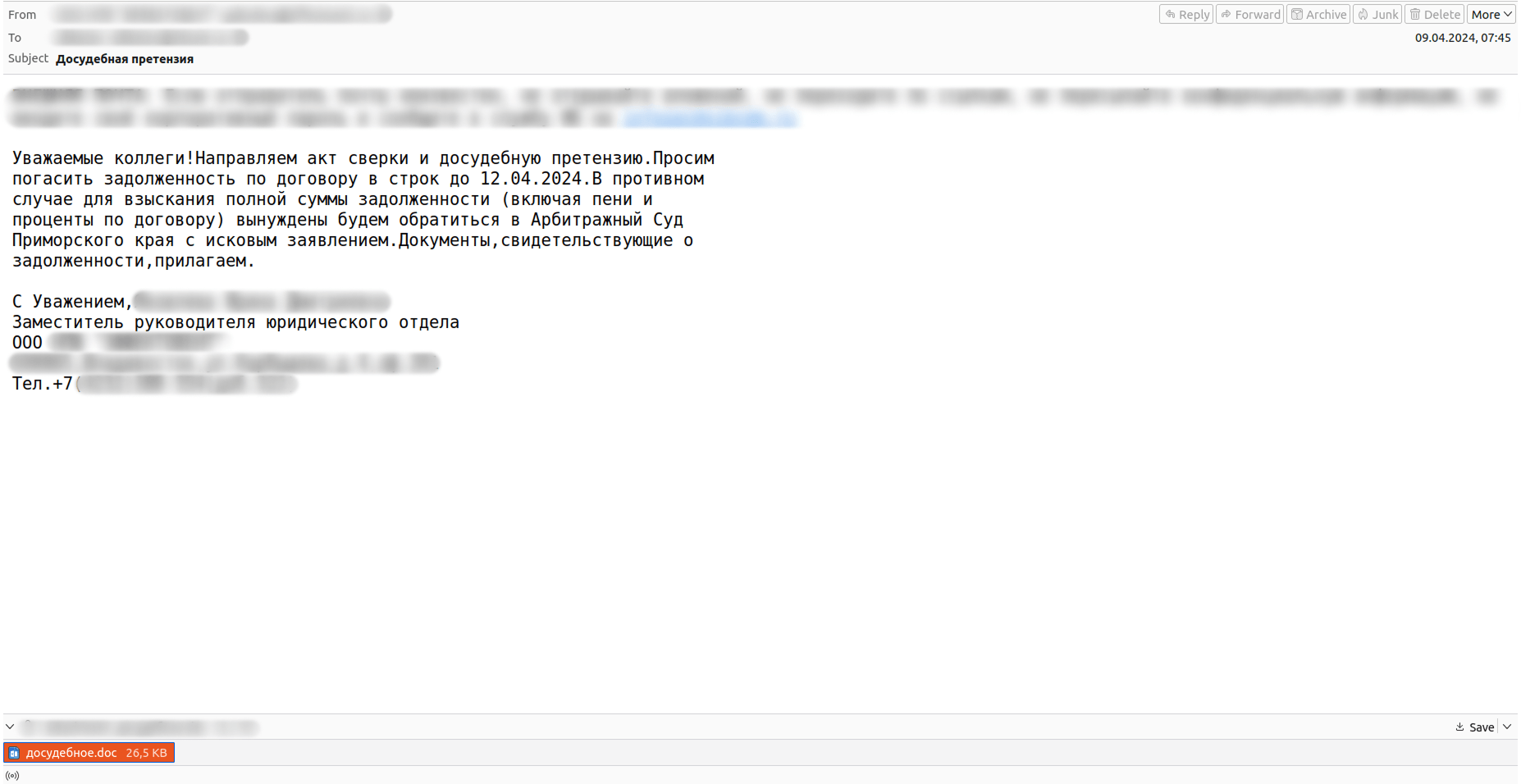
    Last year, attackers frequently threatened legal action to convince victims to click dangerous links or open malicious attachments. These messages primarily targeted Russian companies but were also observed in other languages. Typically, fraudsters posed as business partners, demanding debt repayment; otherwise, they “would be forced to take the matter to arbitration court.” In one such campaign, pre-trial claims in attachments were .DOC files containing VBA scripts. These scripts established connections with command servers and downloaded, saved, and executed malicious files on the victim’s device. Kaspersky’s products detect this payload with the verdict HEUR:Trojan-Downloader.MSOffice.Sload.gen.

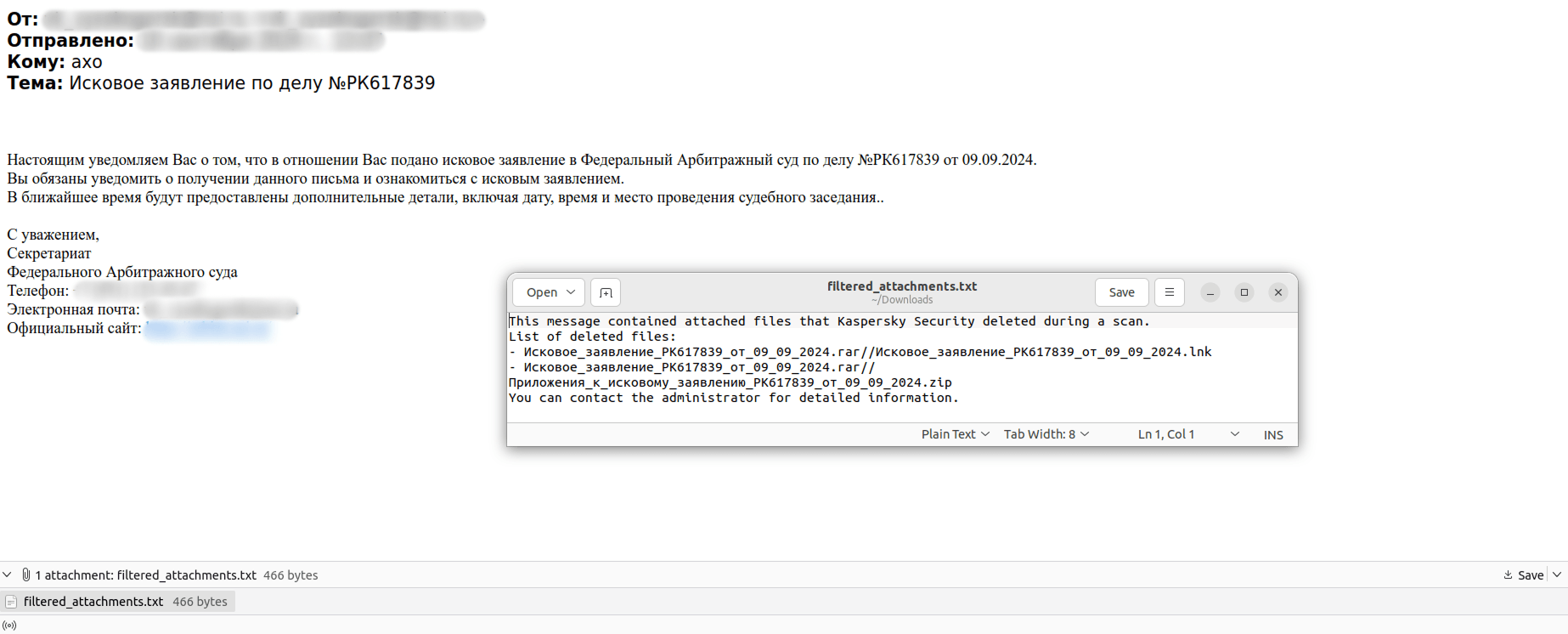
    In some cases, cybercriminals gave no reason for their legal threats but instead attempted to shock victims with an already “filed” lawsuit to pressure them into opening the attachment. Of course, it contained malware.

    Emails with malicious SVG files

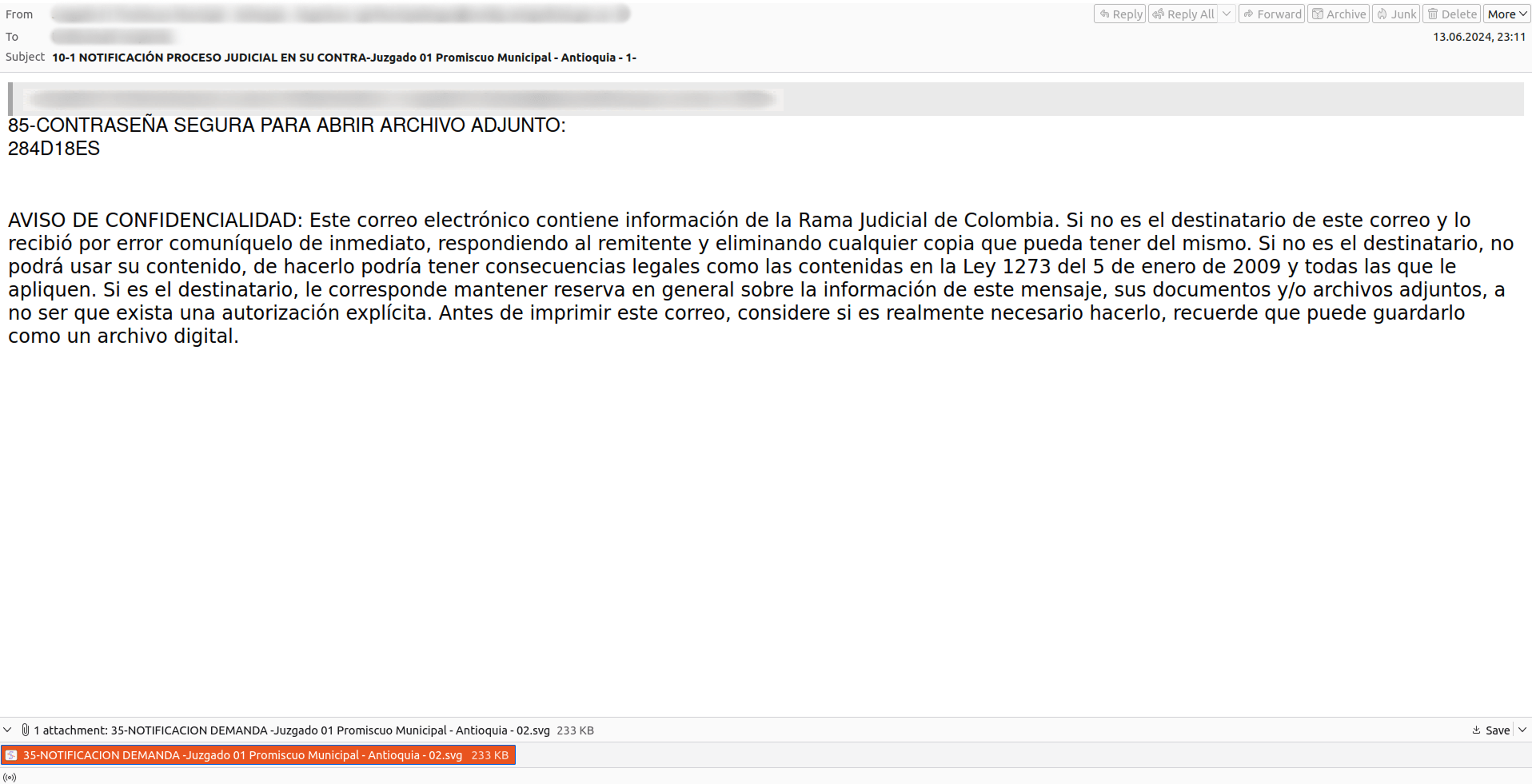
    According to our observations, the past year saw a rise in the distribution of malicious SVG files. Disguised as harmless images, these files contained scripts that downloaded and installed additional malware on the victim’s device. (Our solutions detect these scripts as Trojan.Script.Agent.sy and Trojan.Script.Agent.qe.) The emails we encountered were written in Spanish and posed as fake legal case notifications and court summons. The text included a password for opening the attached file.

    Threats to businesses

    Fake deals

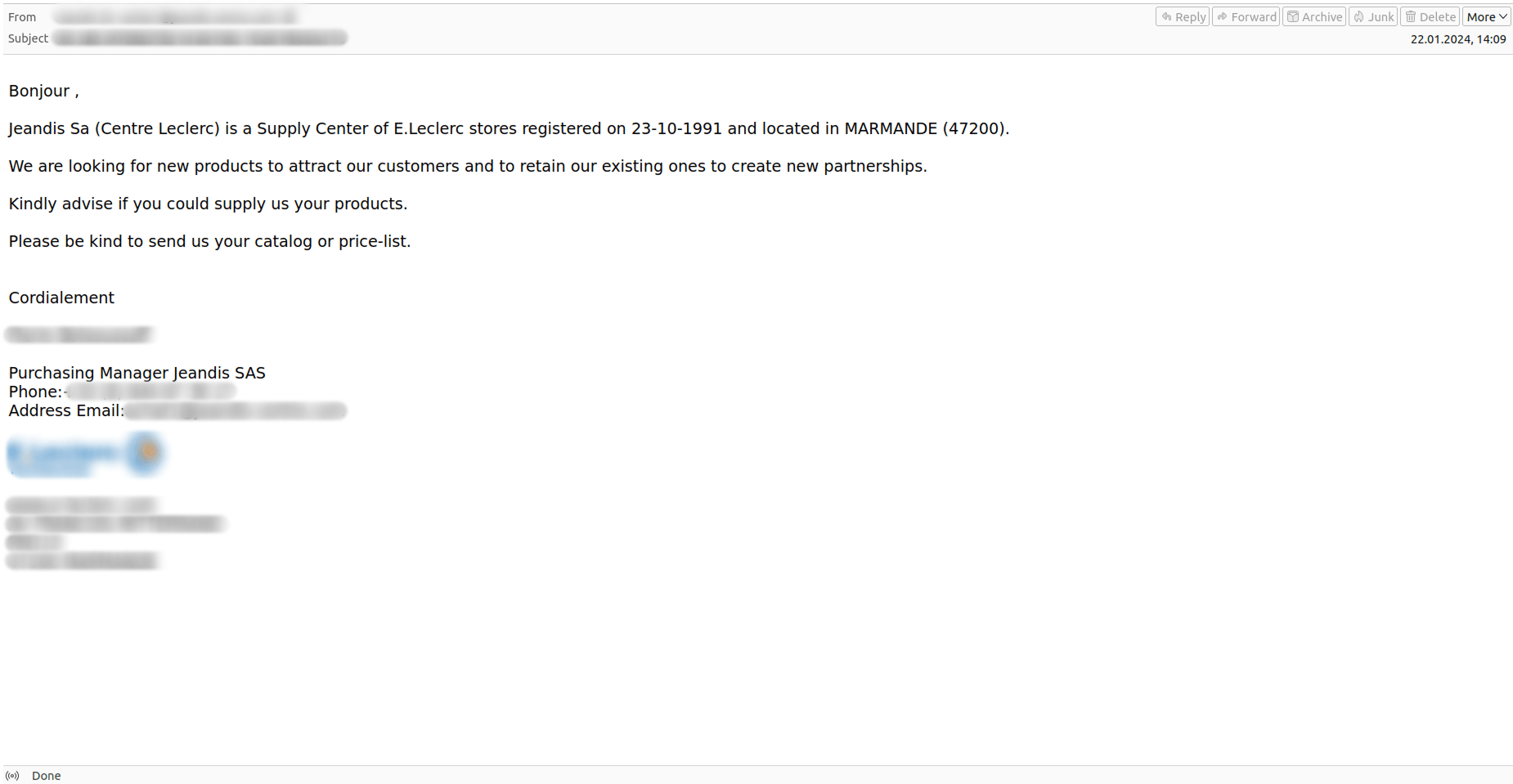
    A special category of emails that users complained about in 2024 was requests for quotation from suspicious senders. These emails were sent either from free email addresses or recently created domains. Attackers signed the emails with the names of large companies, included links to their websites, and sometimes even used official company logos. These emails followed a uniform template: the “buyers” briefly introduced themselves, expressed interest in the recipient’s products, and requested a catalog or price list. Interestingly, the fraudsters did not seem to care about the type of goods involved.

    If the recipient responded, events could unfold in two ways. In some cases, after receiving a reply to the initial seemingly legitimate request, the fraudsters sent malicious attachments or links in the next email.

    In another scenario, the “buyers” engaged in further correspondence with their “potential partner”—the victim—discussing details and insisting on their conditions, including post-payment and requiring the seller to cover customs duties. This meant that the supplier bore all the risks of delivery and could lose their goods without receiving any payment.

    Facebook

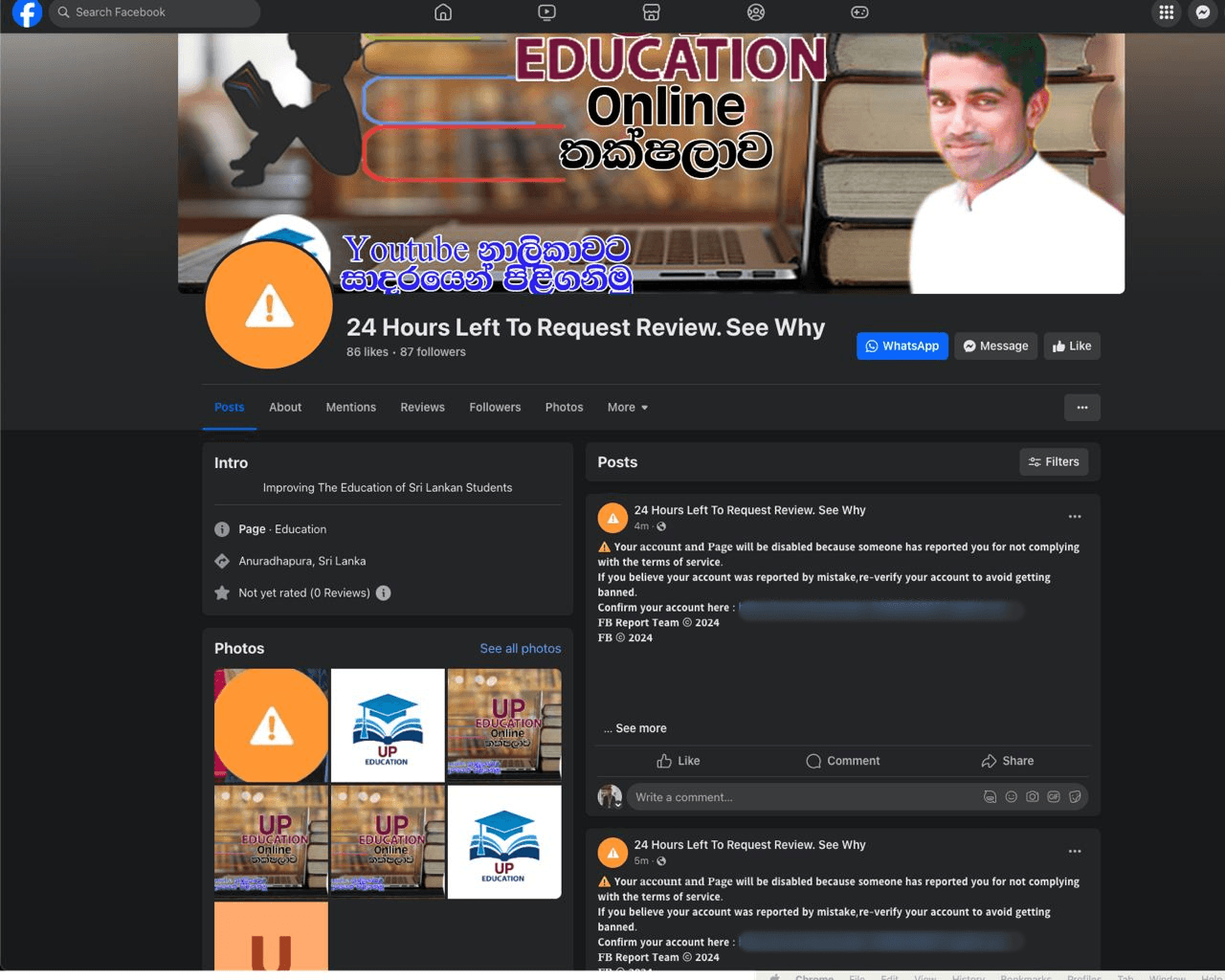
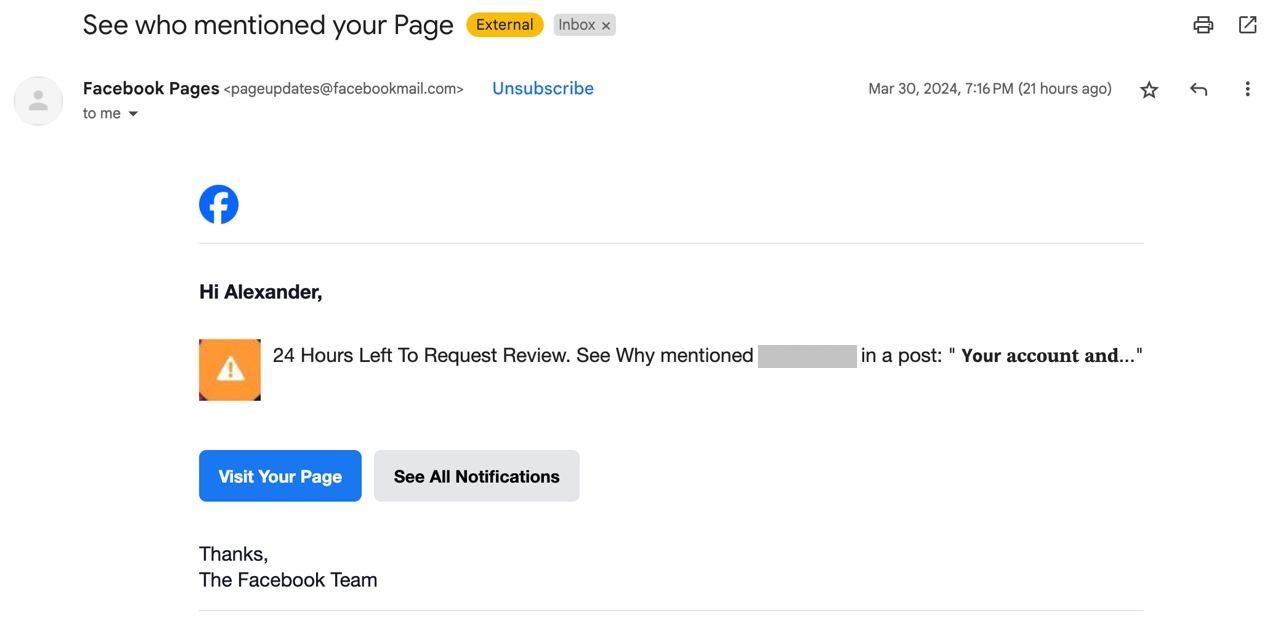
    In the spring of 2024, we discovered an interesting phishing email scheme that leveraged legitimate Facebook notifications. The service sent entirely legitimate emails to users mentioned in threatening posts. The attackers used compromised Facebook accounts, renamed to “24 Hours Left To Request Review. See Why,” and changed the profile picture to an icon featuring an orange exclamation mark.

    Then, the fraudsters created posts on these pages tagging the business accounts of potential victims. The tagged users received notifications from the alarmingly-named pages.

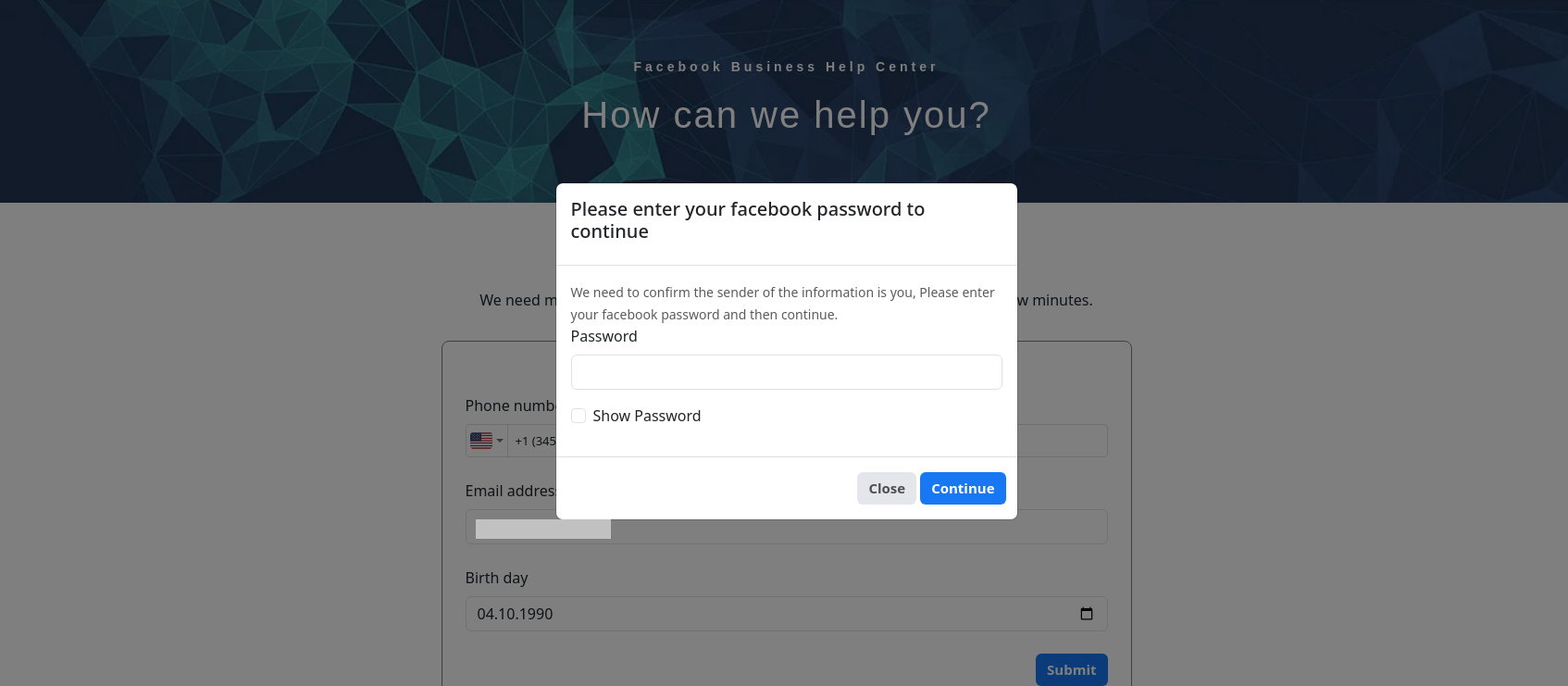
    These posts contained more details than the emails: victims were warned about an impending account ban due to a complaint from another user. To dispute the ban for violating service terms, the recipient of the “notification” was required to follow a phishing link from the post—leading to a fake site with Meta logos that requested Facebook login credentials.

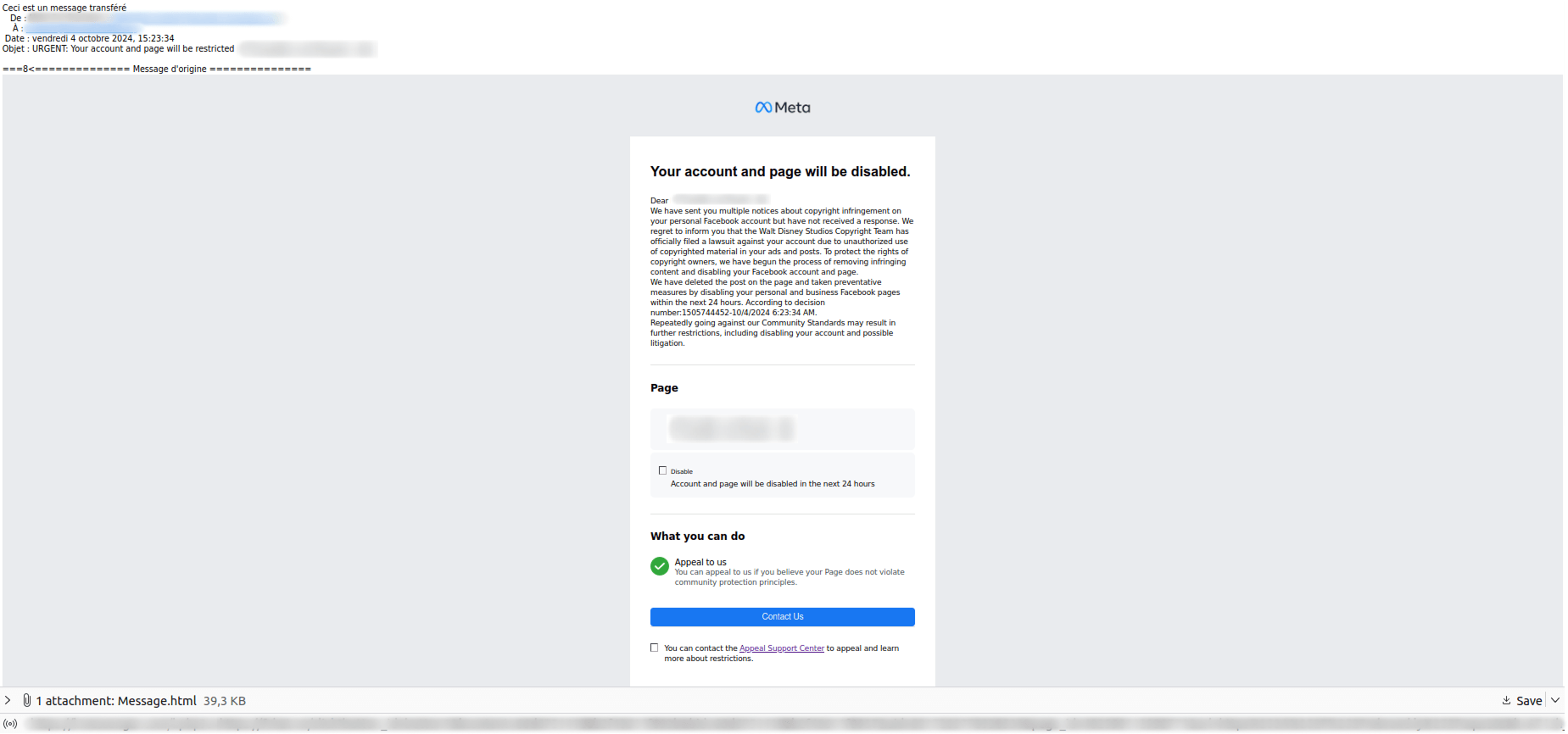
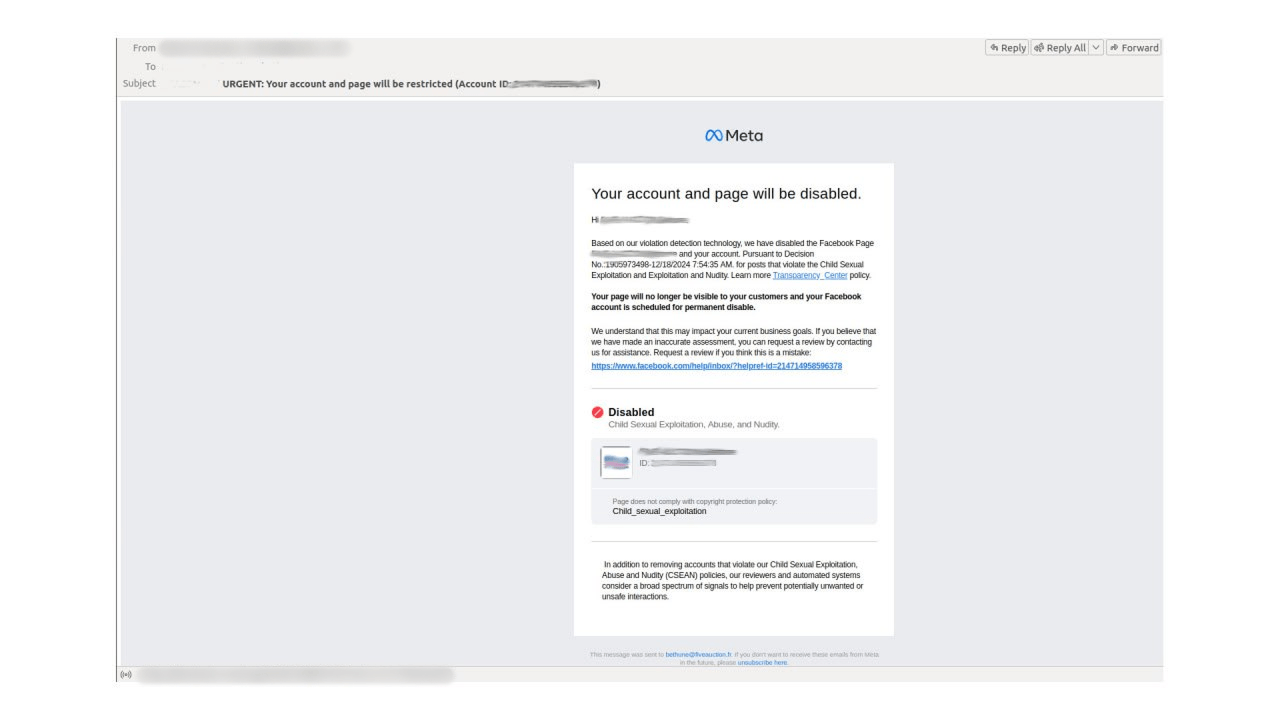
    We also found phishing emails containing legitimate Facebook links in October 2024, but this time without using the platform’s infrastructure. These emails contained notifications of lawsuits for copyright infringement and the removal of unlawful posts from the recipient’s profile. The target was warned that their personal and business pages would be blocked within 24 hours, pressuring them to take hasty and careless action.

    However, they were immediately offered the chance to appeal by contacting the “Appeal Support Center.” The link in the email led to a phishing site disguised as Meta’s support service, where the victim was also asked to enter their profile password. To make the phishing link more convincing, a legitimate mechanism for redirecting users to external Facebook resources was used.

    At the end of 2024, we noticed an email campaign targeting companies promoting their business pages on Facebook. These emails mimicked official Meta for Business notifications and threatened to block the user’s account and business page for violating the platform’s rules and community policies.

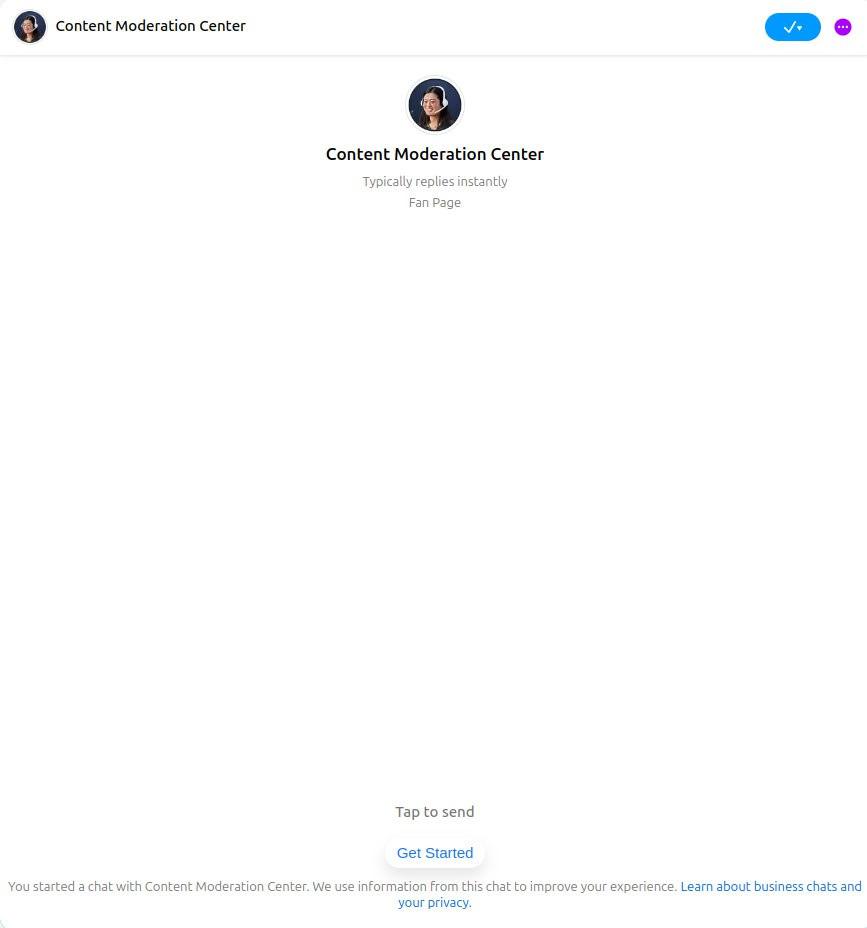
    To dispute these accusations, the fraudsters urged the profile owners to click a link to contact “Facebook support” in a legitimate messenger. However, in reality, the victim was communicating with the owner of a fan page called “Content Moderation Center,” imitating an official support service employee. The scam could have been identified by the “Fan Page” label in the chat, though it was easy to miss.

    News agenda

    In 2024, scammers continued to exploit news agenda in spam campaigns.

    During the UEFA Euro 2024 football championship in Germany, emails began to appear offering merchandise with UEFA EURO 2024 logos.

    After Pavel Durov’s arrest in Paris, we noticed English-language messages calling for donations to supposedly fund his legal defense.

    In the fall of last year, a scam campaign began circulating, offering not-yet-released MacBook Pro M4 devices at low prices or even for free. The links in these emails led to fake websites imitating major marketplaces.

    Before Black Friday, we recorded a surge in spam offering exclusive discounts. The links in these messages lured victims to sites disguised as marketplaces, electronics stores, and financial institutions.

    B2B spam campaigns

    Online promotion services

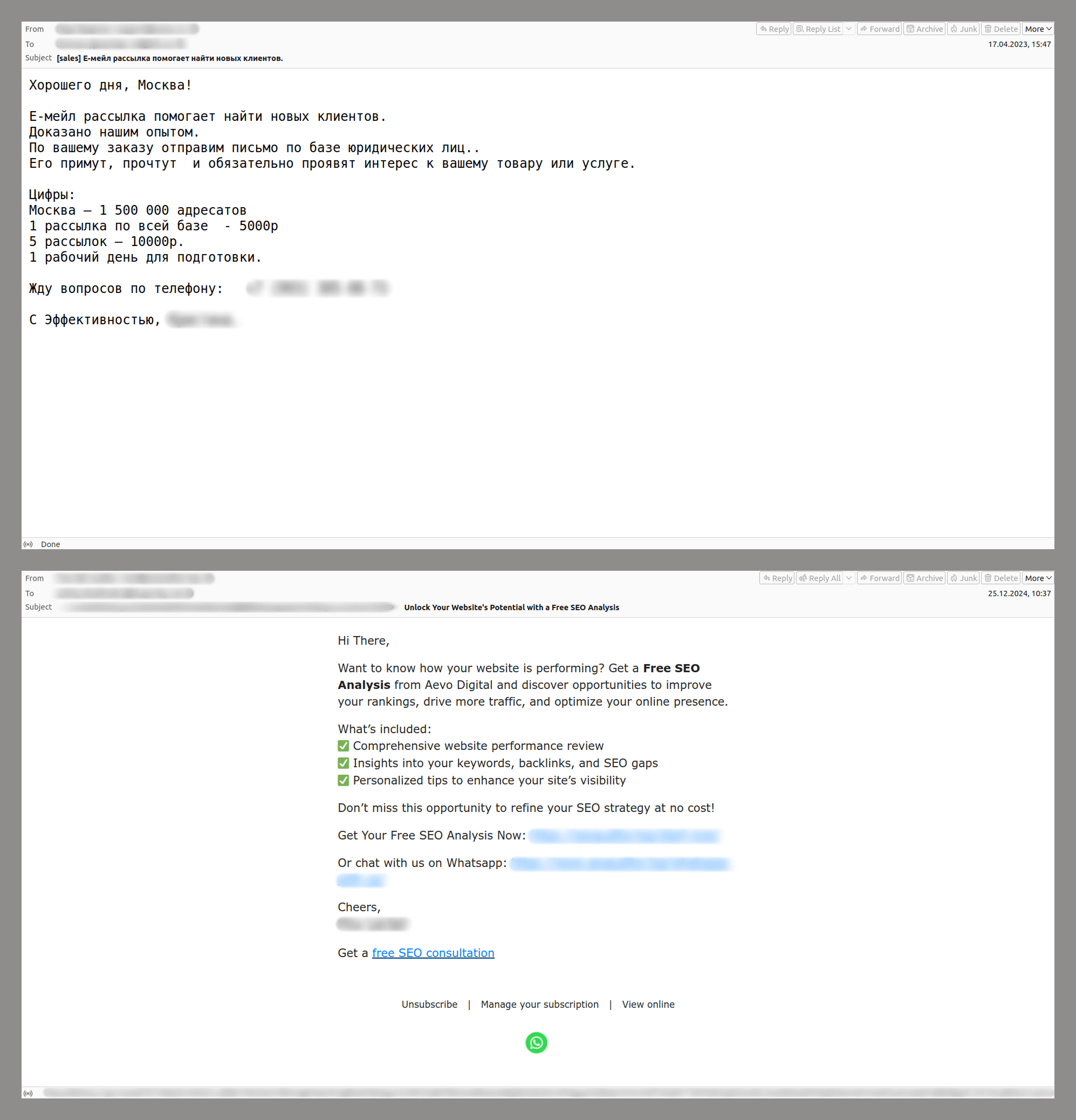
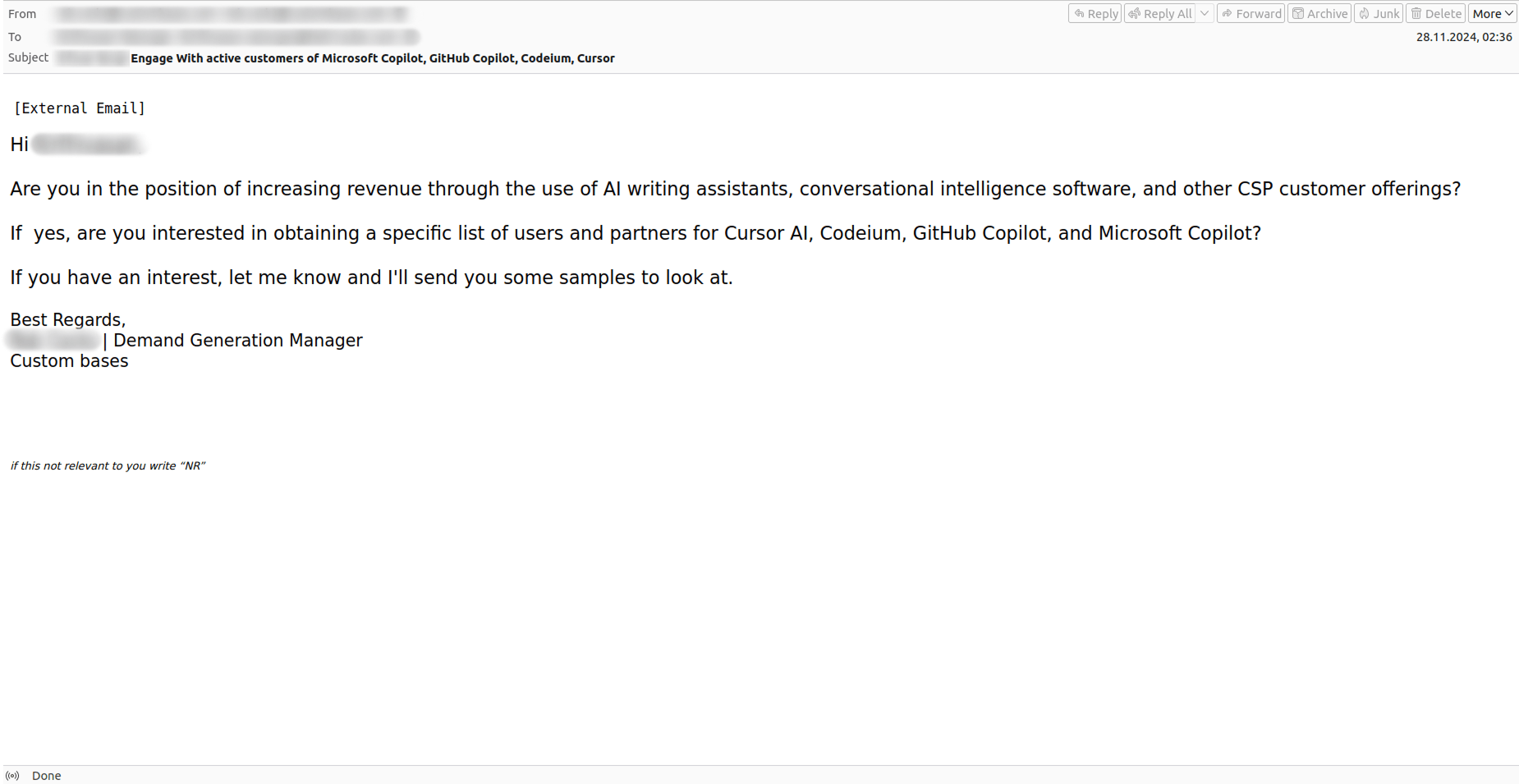
    One of the most common categories of spam email in 2024, complained of frequently by our corporate clients, was commercial offers for online promotion. Users were offered services such as creating or redesigning websites, setting up SEO tools, and purchasing databases with potential client contacts and other information. Other advertised services included guest post placement with backlinks to the client’s site, writing positive reviews, removing negative reviews, and creating personalized email campaigns. While these messages are not malicious or fraudulent, they are mass-distributed and unsolicited, causing inconvenience to users. The popularity of this type of spam is likely driven by the development of digital marketing tools and the search for new clients for small- and medium-sized businesses amid growing online competition.

    Buying likes and followers on social media

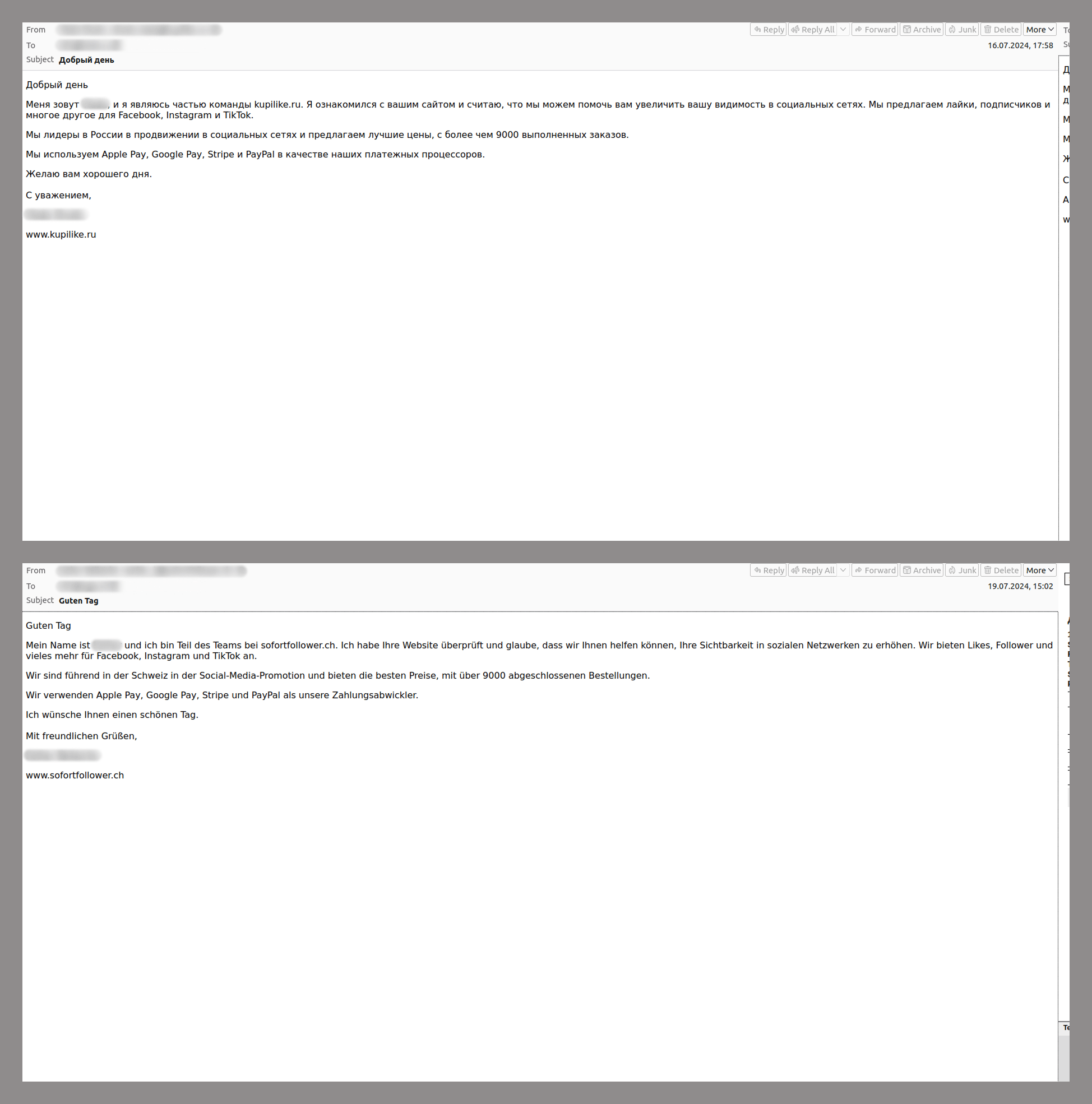
    We also frequently encountered business offers for the online promotion of company accounts on social media. Spammers sell fake likes and followers. They often pose as employees of real social media marketing firms, claiming to be industry leaders. At the end of their emails, the spammers included a link to a marketing platform and payment options for their services. One such campaign, which we observed throughout the past year and is still active, stood out due to the variety of languages used in the emails and the diversity of domain names. With these tactics, the spammers aimed to reach a global audience.

    AI in B2B emails

    The growing popularity of neural networks has led companies to actively integrate AI into their business processes. We assume that clients of such organizations, in turn, are drawn to service offers that incorporate neural networks. As a natural consequence of this trend, AI-driven solutions began appearing in spam campaigns advertising online marketing services.

    Spammers emphasized using AI, particularly ChatGPT, to perform various business tasks. We identified the following themes in these emails:

    • Attracting website traffic
    • Creating advanced lead generation strategies
    • Developing unique approaches tailored to a brand’s identity
    • Producing and publishing content
    • Launching personalized multi-channel marketing campaigns
    • Creating custom videos for YouTube channels

    Other topics also appeared in spam emails, but they all shared the same goal—enhancing business processes and attracting potential clients.

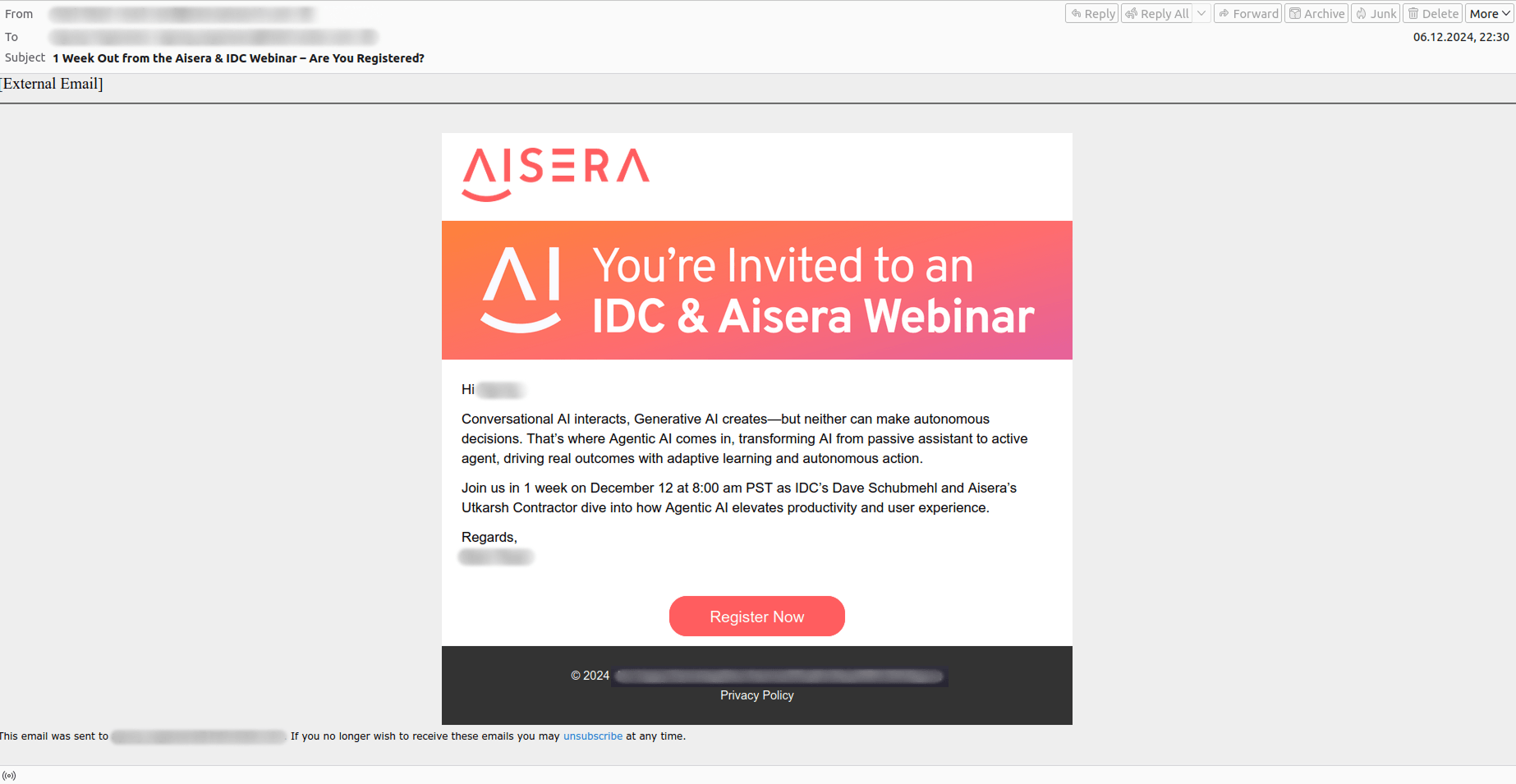
    Another particularly popular category of spam related to neural networks was advertising online events. Last year, we encountered numerous examples of emails promoting webinars about the promising capabilities and practical applications of AI in business operations.

    Targeted phishing in 2024

    In 2024, two main trends were observed in targeted phishing:

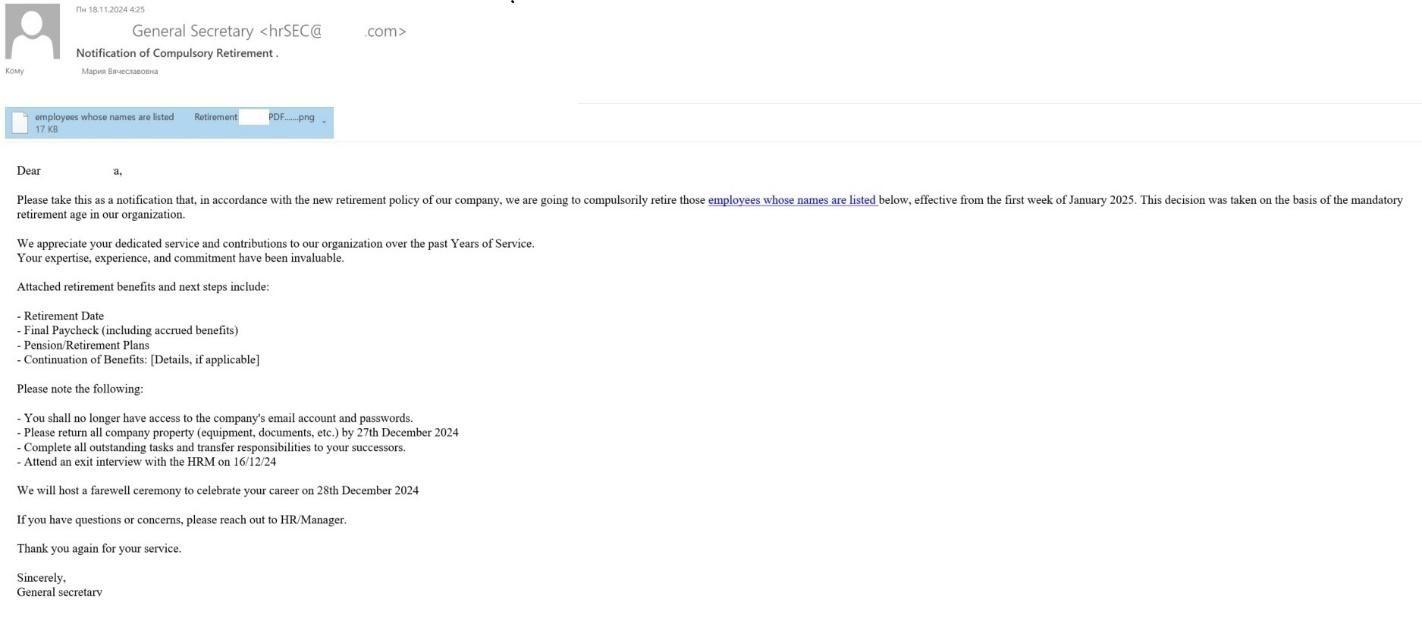
    1. Notifications on behalf of a company’s HR department. Employees were asked to fill out or sign a document, such as a vacation schedule, accessible via a link in an email. Sometimes, instead of routine requests, attackers resorted to more extravagant tactics—such as inviting employees to check if they were on a list of staff to be dismissed.

    Phishing email from HR

    In all these cases, the common factor was that clicking the link led the employee to a phishing login page instead of the actual corporate portal. Most often, attackers targeted Microsoft accounts, though some phishing forms mimicked internal corporate resources.

    Fake login form

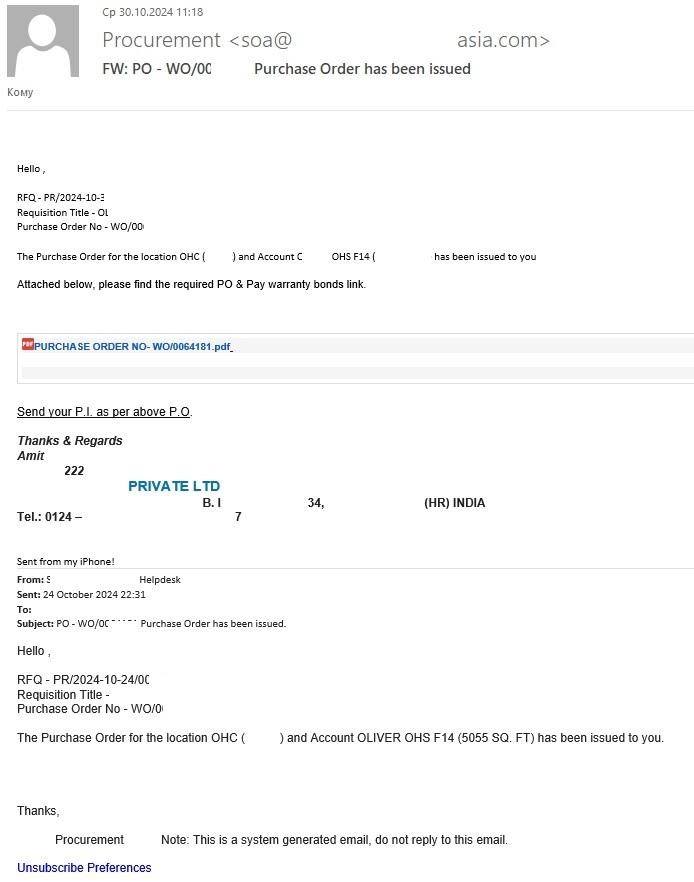
    1. Emails from a seller to a buyer, or vice versa. One common scheme involved a buyer or seller asking the victim to review an offer or respond to questions about product delivery and required specifications. These emails contained attached documents that actually concealed phishing links.

    Example of a phishing email from a seller

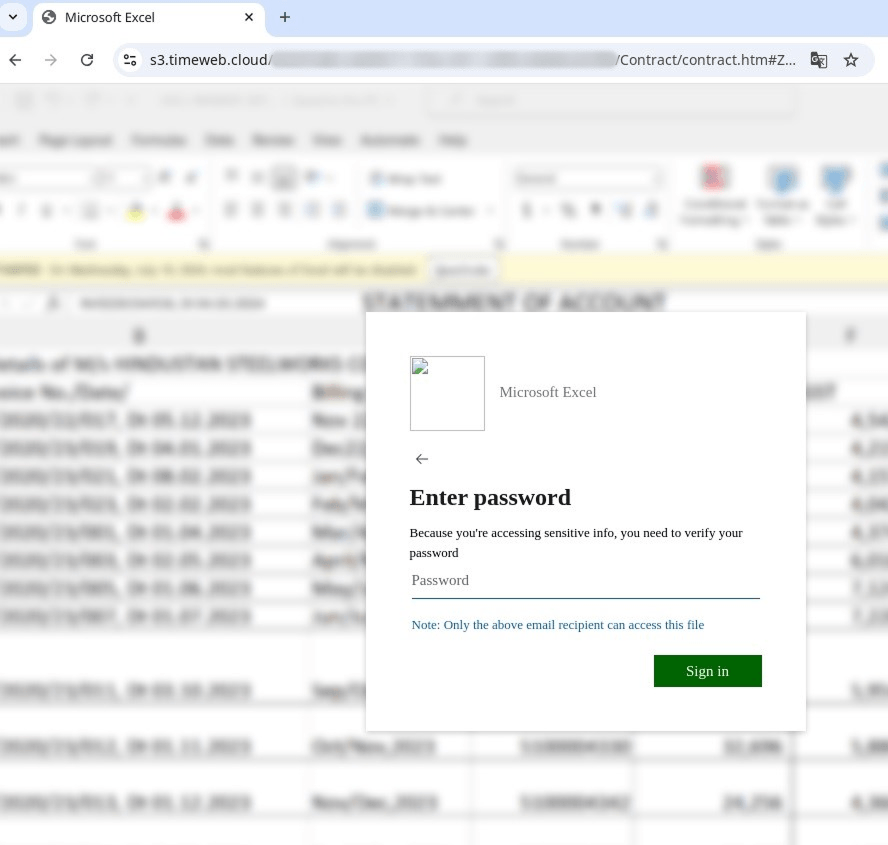
    When attempting to open the attachment, the user was redirected to a phishing page. As in the previous case, these fake forms harvested Microsoft credentials and corporate account logins.

    Fake password entry form

    Statistics: phishing

    The number of phishing attacks in 2024 increased compared to the previous year. Kaspersky solutions blocked 893,216,170 attempts to follow phishing links—26% more than in 2023.

    Number of Anti-Phishing triggerings, 2024 (download)

    Map of phishing attacks

    Users from Peru (19.06%) encountered phishing most often. Greece (18.21%) ranked second, followed by Vietnam (17.53%) and Madagascar (17.17%). They are closely followed by Ecuador (16.90%), Lesotho (16.87%) and Somalia (16.70%). The final places in the TOP 10 are occupied by Brunei (16.55%), Tunisia (16.51%) and Kenya (16.38%).

    Country/territory Share of attacked users*
    Peru 19.06
    Greece 18.21
    Vietnam 17.53
    Madagascar 17.17
    Ecuador 16.90
    Lesotho 16.87
    Somalia 16.70
    Brunei 16.55
    Tunisia 16.51
    Kenya 16.38

    * Share of users who encountered phishing out of the total number of Kaspersky users in the country/territory, 2024

    Top-level domains

    The most common domain zone hosting phishing sites remains the COM zone (29.78%)—its popularity has increased one and a half times compared to 2023. In second place is the XYZ domain (7.10%), which ranked fifth last year, followed by TOP (6.97%), which retained its position in the top ten. Next, with a slight margin from each other, are the ONLINE (4.25%) and SITE (3.87%) domain zones, where phishing sites were less actively hosted last year. The Russian RU domain (2.23%) and the global NET domain (2.02%) are in sixth and seventh place, respectively. Following them are CLICK (1.41%) and INFO (1.35%)—the year before, these zones were not frequently used. Closing the top ten is another national domain: UK, with a share of 1.33%.

    Most frequent top-level domains for phishing pages, 2024 (download)

    Organizations targeted by phishing attacks

    The rating of organizations targeted by phishers is based on the detections of the deterministic component in the Anti-Phishing system on user computers. The component detects all pages with phishing content that the user has tried to open by following a link in an email message or on the web, as long as links to these pages are present in the Kaspersky database.

    In 2024, the highest number of attempts to access phishing links blocked by Kaspersky solutions was associated with pages imitating various web services (15.75%), surpassing global internet portals (13.88%), which held the top position in 2023. The third and fourth positions in last year’s top ten also swapped places: banks moved ahead (12.86%), overtaking online stores at 11.52%. Attackers were also interested in social media (8.35%) and messengers (7.98%): attacks targeting them strengthened their positions in the ranking. For websites imitating delivery services, we observed a decline in phishing activity (6.55%), while the share of payment systems remained unchanged at 5.82%. Also included in the list of the most frequently targeted organizations were online games (5.31%) and blogs (3.75%).

    Distribution of organizations targeted by phishers, by category, 2024 (download)

    Statistics: spam

    Share of spam in email traffic

    In 2024, spam emails accounted for 47.27% of the total global email traffic, an increase of 1.27 p.p. compared to the previous year. The lowest spam levels were recorded in October and November, with average shares dropping to 45.33% and 45.20%, respectively. In December, we observed a seemingly slight upward trend in junk emails, resulting in the fourth quarter of the year being the calmest. Spam activity peaked in the summer, with the highest number of emails recorded in June (49.52%) and July (49.27%).

    Share of spam in global email traffic, 2024 (download)

    In the Russian internet segment, the average spam share exceeded the global figure, reaching 48.57%, which is 1.98 p.p. higher than in 2023. As in the rest of the world, spammers were least active at the end of the year: in the fourth quarter, 45.14% of emails were spam. However, unlike global trends, in Runet, we recorded four months during which the spam share exceeded half of all traffic: March (51.01%), June (51.53%), July (51.02%), and September (51.25%). These figures identified the third quarter as the most active, with a share of 50.46%. December was the calmest month, and interestingly, despite spam levels being generally high or the same in Russia, the number of spam emails in December was lower than the global figure: 44.56%.

    Share of spam in Runet email traffic, 2024 (download)

    Countries and territories where spam originated

    We continue to observe an increase in the share of spam sent from Russia—from 31.45% to 36.18%. The United States and mainland China, which held second and third place last year, swapped positions, with China’s share increasing by 6 p.p. (17.11%) and the US share decreasing by 3 p.p. (8.40%). Kazakhstan, which entered the top twenty for the first time last year, rose from eighth to fourth place (3.82%), pushing Japan (2.93%) down, and causing Germany, previously in fifth place, to drop one position with a share of 2.10%. India’s share slightly decreased, but the country moved up two positions from last year to seventh place. Conversely, the amount of spam sent from Hong Kong more than doubled (1.75%), allowing this territory to take eighth place in the top twenty. Next come Brazil (1.44%) and the Netherlands (1.25%), whose shares continued to decline.

    TOP 20 countries and territories where spam originated in 2024 (download)

    Malicious email attachments

    In 2024, Kaspersky solutions detected 125,521,794 attempts to open malicious email attachments, ten million fewer than the previous year. Interestingly, one of the peaks in email antivirus detections occurred in April—in contrast to 2023, when this month had the lowest malicious activity. In January and December, we observed a relative decrease in detections, while increases were noted in spring and autumn.

    Number of email antivirus detections, 2024 (download)

    The most common malicious email attachments were Agensla stealers (6.51%), which ranked second last year. Next were Badun Trojans (4.51%), which spread in archives disguised as electronic documents. The Makoob family moved from eighth to third place (3.96%), displacing the Noon spyware (3.62%), which collects browser passwords and keystrokes. The malicious Badur PDFs, the most common attachments in 2023, dropped to fifth place with a 3.48% share, followed by phishing HTML forms from the Hoax.HTML.Phish family (2.93%). Next in line were Strab spyware Trojans (2.85%), capable of tracking keystrokes, taking screenshots, and performing other typical spyware actions. Rounding out the top ten were SAgent VBS scripts (2.75%), which were not as actively used last year, the Taskun family (2.75%), which maintained its previous share, and PDF documents containing phishing links, Hoax.PDF.Phish (2.11%).

    TOP 10 malware families distributed as email attachments, 2024 (download)

    The list of the most widespread malware reflects trends similar to the distribution of families, with a few exceptions: the Hoax.HTML.Phish variant of malicious HTML forms dropped two positions (2.20%), and instead of a specific Strab Trojan sample, the top ten included the ISO image Trojan.Win32.ISO.gen, distributed via email (1.39%).

    TOP 10 malicious programs distributed as email attachments, 2024 (download)

    Countries and territories targeted by malicious mailings

    In 2024, users in Russia continued to face malicious email attachments more frequently than other countries, although the share of email antivirus detections in this country decreased compared to last year, to 11.37%. China ranked second (10.96%), re-entering the top twenty after several years. Next came Spain (8.32%), Mexico (5.73%), and Turkey (5.05%), which dropped one position each with a slight decline in malicious attachments. Switzerland (4.82%) took sixth place, appearing in the ranking for the first time. Following them were Vietnam (3.68%), whose share declined, and the UAE (3.24%), which strengthened its position in the ranking. Also among frequent targets of malicious spam were users from Malaysia (2.99%) and Italy (2.54%).

    TOP 20 countries and territories targeted by malicious mailings, 2024 (download)

    Conclusion

    Political and economic crises will continue to provide new pretexts for fraudulent schemes. In some cases presented in the 2024 report, we can observe the “greed” of cybercriminals: the use of two different company brands on the same page; a credible fake of a resource aimed not at stealing credentials but at stealing money; comprehensive questionnaires that can lead not only to loss of access to funds but also to identity theft. Such multi-layered threats may become a new trend in phishing and scam attacks.

    We continue to observe major news events being exploited in spam campaigns that promise easy earnings and discounted goods or services. The growing user interest in artificial intelligence tools is actively being leveraged by spammers to attract an audience, and this trend will undoubtedly continue.

    MIL OSI Economics

  • MIL-OSI Security: USCGC Clarence Sutphin Jr. Rescues Seven Mariners

    Source: United States Naval Central Command

    U.S. CENTRAL COMMAND AREA OF RESPONSIBILITY —

    Crewmembers of the U.S. Coast Guard fast-response cutter USCGC Clarence Sutphin, Jr. (WPC-1147) and the mine countermeasures ship USS Devastator (MCM 6) rescued seven mariners from a disabled vessel in the international waters of the Central Arabian Gulf, Feb. 18.

    Following a distress signal from the mariners, the Coastguardsmen embarked a rigid-hull inflatable boat to offer assistance. After determining the vessel was no longer sea worthy, the Coastguardsmen brought the mariners back to their ship. Devastator provided back-up support during the operation.

    None of the mariners appeared to be injured.

    “Providing assistance at sea to mariners in distress is a core Coast Guard mission,” said Coast Guard Lt. Michael O’Dell, Clarence Sutphin, Jr.’s commanding officer. “It is inherently dangerous, but the team executed without hesitation – without fear – to extend their compassion to people in a dire situation. I’m incredibly proud of to be a part of this team.”

    Clarence Sutphin, Jr. is forward deployed to the U.S. 5th Fleet area of operations as part of Patrol Forces Southwest Asia. Devastator is an Avenger-class mine countermeasures ship also forward deployed to U.S. 5th Fleet. Both ships help ensure maritime security and stability in the Middle East region.

    The U.S. 5th Fleet area of operations encompasses about 2.5 million square miles of water area and includes the Arabian Gulf, Gulf of Oman, Red Sea and parts of the Indian Ocean. The expanse is comprised of 20 countries and includes three critical choke points at the Strait of Hormuz, the Suez Canal and the Strait of Bab al Mandeb at the southern tip of Yemen.

    MIL Security OSI

  • MIL-OSI Economics: Samsung R&D Institute India, Bangalore inaugurates Samsung Innovation Campus at Karnataka’s First Women-Only Engineering College

    Source: Samsung

     
    Samsung R&D Institute India, Bangalore (SRI-B) inaugurated Samsung’s flagship global citizenship programme, the Samsung Innovation Campus (SIC), at Karnataka’s first all-women’s engineering college, Geetha Shishu Shikshana Sangha (GSSS) Institute of Engineering and Technology for Women, Mysore. This initiative underscores Samsung’s unwavering commitment to advancing gender equality in STEM and fostering a new generation of women leaders in technology.
     
    Launched in September 2022, the SIC programme comprises an extensive curriculum focused on core technology skills including Artificial Intelligence/Machine Learning, Big Data, and Coding & Programming, especially designed by Samsung’s global R&D experts to make India’s youth industry-ready. The students enrolled in this initiative will get an opportunity to undergo expert offline and online training at a classroom facility, and work on innovative projects under the guidance of mentors from SRI-B and GSSS Institute.
     
    “At Samsung, we believe innovation thrives when opportunities are inclusive. It brings us immense pride to inaugurate Samsung Innovation Campus (SIC) at Karnataka’s first women’s engineering college, a space where bright young minds will explore, experiment, and push the boundaries of technology. Aligned with the government’s #DigitalIndia and #MakeinIndia campaigns, it empowers students to drive technological progress from within the country. We look forward to moulding future women leaders as they create, innovate, and transform the world with technology,” said Mohan Rao Goli, Corporate Vice President and Managing Director, SRI-B.


    In 2024, Samsung Southwest Asia expanded its SIC reach by enrolling 3,500 students, up from 3,000 in 2023. Samsung’s ongoing commitment to corporate social responsibility, through initiatives such as SIC and Samsung Solve for Tomorrow (SFT), highlights its mission to nurture and train India’s future-tech leaders. Through these programmes, Samsung continues to support India’s youth, equipping them with the skills that not only advance their personal and professional growth but also empower India as a global technology hub.
     
    “Our collaboration with SRI-B ensures maximum impact, providing industry-relevant courses and niche skills, strong technical foundations, and practical exposure through capstone projects. This initiative reinforces our commitment to powering #DigitalIndia by bridging the digital skills gap and preparing women for the future workforce. Through a structured curriculum, the students will gain hands-on experience in problem-solving and emerging technologies, enhancing both employability and innovation. We deeply appreciate SRI-B for this invaluable partnership, which empowers young women technologists to drive technological advancements,” said Anupama B Pandit, Secretary, GSSS (R), Mysore.
     
    SRI-B has established SICs in seven other institutes in Karnataka, including BNM Institute of Technology, Cambridge Institute of Technology (Main & North Campuses), Don Bosco Institute of Technology, KLE Institute of Technology, RNS Institute of Technology (RNSIT) Bengaluru, as well as one in IIIT-Kurnool, training over 800 students with the necessary skills to secure relevant opportunities in the field of technology.

    MIL OSI Economics

  • MIL-OSI Economics: Asian Development Blog: Get Moving: Smarter Logistics Can Boost Efficiency and Cut Costs in South Asia

    Source: Asia Development Bank

    Enhancing multimodal transport, standardization, and digital integration can improve efficiency, reduce costs, and strengthen manufacturing in India, Bangladesh, and Nepal’s logistics sectors.

    The logistics sectors of India, Bangladesh, and Nepal face remarkably similar constraints that are central to their governments’ plans to expand the industries that rely heavily on logistics. 

    In each country, roads – the most heavily used form of transport – are overburdened, leading to a variety of problems, including slow and unpredictable delivery times. A lack of standardization in warehousing facilities means time is wasted on unpacking and repacking pallets to fit shelving racks following different standards.

    Insufficient multimodal infrastructure means that cargo cannot easily move between trains, trucks, and ships. These hindrances affect both economies and the environment alike, in that an inefficient logistics sector is a cost borne by both consumers, in the form of higher product prices, and the environment, in the form of added emissions from idling vehicles.

    India, for its part, has made the most progress in recent years toward alleviating logistics inefficiencies in the service of its broader economy, particularly in manufacturing. 

    India’s logistics sector, once plagued by inefficiencies, is undergoing a positive transformation. With a market size of approximately $200 billion, India transports 4.6 billion tons of freight annually. 

    The sector is projected to double in size by 2030, driven by aggressive expansion in road, rail, shipping and air freight. Recent improvements in road infrastructure, dedicated freight corridors and use of technological advancements in the logistics supply chain have set the stage for a more efficient logistics network. 

    India’s logistics sector now includes all key components needed for a modern economy, such as seamless transport across different modes (road, rail, air, and sea), efficient customs processing for domestic and international trade, and better management of ports, airports, and land borders. 

    From that and other significant policy reforms, India’s manufacturing sector has been on a steady growth trajectory, underpinned by significant policy and infrastructural reforms including in its logistics sector. India continues to experience rapid growth in its Manufacturing Purchasing Managers’ Index (PMI). 

    The latest Manufacturing PMI for December 2024 remains firmly within the expansionary zone, fueled by new business gains and robust demand. According to the RBI’s Industrial Outlook Survey, manufacturing firms anticipate further enhancements in Q4 FY25 and Q1 FY26. 

    India’s export landscape has also undergone substantial growth, with merchandise and services exports increasing significantly over the past two decades. Goods exports rose from $48.5 billion in 2000 to $467.5 billion in 2022. 

    Despite the recent very large outlays in infrastructure and policy reforms, India’s logistics sector is still confronted by several challenges also faced by Nepal and Bangladesh, where heavy investment in infrastructure is also still needed. 

    The transformation of the logistics sector is pivotal in fostering regional integration and economic development across South Asia.

    Like India, the logistics sectors of Bangladesh and Nepal need greater consolidation for regulatory bodies in the logistics sector, overarching standardization, and better institutional coordination. In Bangladesh, congestion in external trade is an additional complication.

    The development of the logistics sector has a profound impact on economic competitiveness and the environment. Improved logistics efficiency enhances supply chain resilience, reduces transaction costs, and boosts export competitiveness. 

    The integration of digital technologies and standardized processes facilitates smoother movement of goods, which is crucial for manufacturing growth and reduced greenhouse gas emissions.

    Logistics sector reforms are also expected to create substantial employment opportunities, both in urban and rural areas. The increased demand for skilled logistics workers, driven by private sector investments and process efficiency, will contribute to job creation. 

    Additionally, the digitization and automation of logistics processes will generate new types of employment, aligning with the evolving needs of the sector.

    Historically, Bangladesh has not fared well in the competitiveness and logistics rankings. For example, in the 2019 World Economic Forum’s Global Competitiveness Index, Bangladesh ranked 105th out of 141 countries, lagging other Asian nations such as India (68), Viet Nam (67), and Indonesia (50). Bangladesh ranked 88th of 139 in World Bank’s 2023 Logistics Performance Index, while India ranked 38th globally, up from 44th in 2019. 

    Bangladesh heavily relies on road-based cargo movement, with railways accounting for only about 4% of passenger and freight transport. Given the country’s dense population, expanding the road network poses significant challenges. 

    Therefore, shifting to rail transport and upgrading the rail network, including gauge conversion, could significantly enhance the logistics sector, improving efficiency in cargo evacuation and greener movement of goods. 

    Further, development of a multi-modal logistics park will be essential to facilitate freight aggregation and distribution, multimodal freight transport, integrated storage and warehousing, technology support, and value-added services. All of this contributes to a reduction in transit time and a streamlining of export processes. 

    Problems in Nepal are much more fundamental and revolve around basic infrastructure such as roads. Nepal, with its unique geographical challenges, can benefit from India’s experience in logistics sector reforms. Nepal should adopt a strategic approach to infrastructure development, focusing on improving road and rail connectivity to facilitate the movement of goods. 

    They also need to establish institutional arrangements for logistics planning at the national and local levels. Nepal can also leverage digitization and process reforms to enhance the efficiency and reliability of its logistics network. Logistics sector development is critical for paving the way for the economic diversification that Bangladesh and Nepal need as they transition away from least developed country status. 

    The transformation of the logistics sector is pivotal in fostering regional integration and economic development across South Asia.

    MIL OSI Economics

  • MIL-OSI Economics: India robotic surgical systems market to record 10% CAGR during 2024-36, driven by increasing adoption, says GlobalData, says GlobalData

    Source: GlobalData

    India robotic surgical systems market to record 10% CAGR during 2024-36, driven by increasing adoption, says GlobalData, says GlobalData

    Posted in Medical Devices

    The installation of a surgical robot at the All India Institute of Medical Sciences (AIIMS) in Delhi recently marks a testament to the Indian government’s commitment to narrowing the disparity between public and private healthcare services in terms of quality and technological advancements. In light of this context, the market for robotic surgical systems in India is projected to expand at a compound annual growth rate (CAGR) of around 10% through 2036, forecasts GlobalData, a leading data, and analytics company.

    GlobalData’s report, “Robotic Surgical Systems Market Size by Segments, Share, Regulatory, Reimbursement, Installed Base and Forecast to 2036” reveals that India’s market is projected to constitute around 6% of the Asia-Pacific market in 2024, bolstered by government initiatives aimed at increasing the adoption of surgical robotics.

    Recently, the AIIMS in Delhi has introduced a state-of-the-art surgical robot within its General Surgery Department. This acquisition positions AIIMS as one of the first government hospitals in India to embrace such advanced technology. The robot offers surgeons a magnified, 3D view of the surgical area and features robotic arms for exceptional dexterity, allowing for precise procedures, especially in intricate dissection and suturing in confined anatomical spaces.

    Divya Soni, Medical Devices Analyst at GlobalData, comments: “Robotic-assisted surgeries not only enhance precision and minimize errors but also signify a fundamental transformation in healthcare delivery. These advanced procedures hold the potential to improve long-term outcomes, expedite recovery periods, and redefine the dynamics between surgeon and patient. Governmental support can be instrumental in overcoming barriers such as high cost and lack of enough specialized training, thereby ensuring equitable healthcare access for all socio-economic strata.”

    In a significant development, Apollo Cancer Centre in Kolkata has also recently reached a notable milestone by successfully conducting India’s first robotic-assisted excision of a rare prostatic stromal tumor. This achievement underscores the increasing implementation of robotic surgery throughout the nation, providing new hope to patients suffering with rare and complicated conditions.

    Soni concludes: “The integration of robotics into public healthcare facilities signifies a pivotal moment in the standardization of high-quality healthcare across public and private sectors. This advancement is anticipated to transform surgical procedures, providing insight into the future of medical treatment in India.”

    MIL OSI Economics

  • MIL-OSI USA: Cantwell Votes NO On Advancing Lutnick for Commerce Secretary; Slams His Enthusiasm for Inflationary Tariffs

    US Senate News:

    Source: United States Senator for Washington Maria Cantwell

    02.18.25

    Cantwell Votes NO On Advancing Lutnick for Commerce Secretary; Slams His Enthusiasm for Inflationary Tariffs

    In speech on Senate floor, Cantwell says Trump’s pick to lead the Dept. of Commerce will rubber-stamp tariffs, slow domestic chip manufacturing, and hang NOAA out to dry; Cantwell also stresses: “Now is not the time to cut FAA staffing”

    WASHINGTON, D.C. – Today, U.S. Senator Maria Cantwell (D-WA), a senior member of the Senate Finance Committee and ranking member of the Senate Committee on Commerce, Science, and Transportation, voted against confirming Howard Lutnick, President Donald Trump’s nominee to serve as Secretary of the Department of Commerce.

    In a speech delivered on the Senate floor, Sen. Cantwell urged her colleagues to follow suit.

    The next Secretary of Commerce will have to deal with a wide-ranging, growing list of issues, from trade and exports […], expanding broadband, weather forecasting, patent issues, export controls on A.I., and figuring out some of the most thorny issues related to how we move our country forward, generally, in commerce. So it’s fair to say that if the Commerce Secretary doesn’t get it right, the American people and our American economy pay the price. Unfortunately, I believe that Howard Lutnick, the President’s nominee, isn’t the right person for this job at this point in time,” Sen. Cantwell said.

    The Senate ultimately confirmed Lutnick 51-45.

    Earlier this month, Sen. Cantwell also voted against advancing Lutnick out of the Committee on Commerce, Science, and Transportation and to the full Senate for consideration. At the time, she expressed her concerns with Lutnick’s support for President Trump’s proposed tariffs. She also pointed to Lutnick’s failure to commit to fully allocating the funds approved by Congress under the Cantwell-led CHIPS & Science Act, as well as his waffling on whether he’d protect NOAA – including NOAA’s crucial missions and functions, and the workforce delivering those services to the American people. Sen. Cantwell had previously questioned Lutnick on these topics in a committee hearing the week prior – video of that hearing is HERE.

    Sen. Cantwell on FAA and Aviation Safety:

    “I would just say this: now is not the time to cut FAA staffing,” Sen. Cantwell said on the Senate floor today. “It is critically clear to me that we need these air traffic controllers, and so we have to make these investments. We should be working together, right now, on aviation. The most important thing? Let’s work together for the benefit of the flying public to come up with the best solutions that we can implement in aviation safety. Taking a broad brush and just cutting people out of the FAA — when oftentimes they’re the people that are helping you get that safety — is not what we should be doing right now.”

    During her tenure as chair of the Senate Committee on Commerce, Science, and Transportation, Sen. Cantwell sounded the alarm about the staffing shortage of air traffic controllers, need for more FAA safety inspectors, a series of aviation incidents and near-misses on and around runways, and the midair blowout of a door plug in January 2024. Last year, the Committee’s Aviation Subcommittee also highlighted FAA’s shortage of at least 800 airway transportation systems specialists – commonly known as technicians –  during a December 2024 hearing on “Air Traffic Control Systems, Personnel, and Safety”. Dave Spero, president of the Professional Aviation Safety Specialists (PASS), the union representing FAA technicians, testified about the importance of closing the shortage and boosting this segment of the FAA workforce in order to keep FAA’s air traffic control systems and equipment safely running.

    She led the passage of the FAA Reauthorization Act, signed into law in May 2024, which boosts controller staffing, ensuring a five-year commitment to maximum hiring and training to close the current staffing gap. The law requires upgraded safety technologies – giving controllers better visibility into runway traffic – to be installed at every large and medium airport nationwide. The law also includes stricter safety standards for aircraft operators and plane manufacturers, as well as provisions to put more FAA safety inspectors on factory floors.

    On Feb. 6, Sen. Cantwell sent a letter to Secretary of Transportation Sean Duffy calling on him to ensure that Elon Musk stays out of the Federal Aviation Administration (FAA), citing Musk’s clear conflicts of interest.

    Sen. Cantwell on Tariffs:

    “In my conversations with Mr. Lutnick and before his Commerce Committee hearing, he made it very clear that he intends to be very enthusiastic about the President’s plans for tariffs,” Sen. Cantwell said today. My constituents want to see inflation come down, and they want us to lower costs, not increase them. Now that President Trump is teasing out even more tariffs in the coming days on autos, pharmaceuticals,  and semiconductors, it’s going to drive up costs for consumers […] We can’t afford inflation. We want prices to come down. Whether that’s on housing, or whether that’s on pharmaceuticals, or whether that’s on food prices, we know that tariffs can increase prices.”

    Earlier this month, Sen. Cantwell delivered a major speech on the Senate floor arguing that the president’s arbitrary tariffs would threaten domestic job creation and economic growth in an Information Age. She outlined a strategy focused on building coalitions, growing exports, and establishing principles to support innovation in the Information Age – video of that speech is HERE.

    In Washington state, two out of every five jobs are tied to trade and trade-related industries.  Combined, the state imported $1.21 billion worth of steel and aluminum last year – and the major industries and employers in Washington that rely on steel and aluminum include aerospace, shipbuilding, utilities, and electronics. When President Trump imposed steel tariffs in 2018, our trading partners immediately responded by imposing tariffs of their own on Washington products, especially agriculture, including cherries, apples, pears, and potatoes. Nationally, across all industries, the steel and aluminum tariffs resulted in a decrease in production worth about $3.4 billion per year, according to an ITC report.  More information on how President Trump’s proposed tariffs on goods from Mexico, Canada, and China would affect consumers and businesses in the State of Washington can be found HERE.

    Sen. Cantwell has remained a steadfast supporter of free trade to grow the economy in the State of Washington and nationwide. Sen. Cantwell was the leading voice in negotiations to end India’s 20% retaliatory tariff on American apples, which was imposed in response to tariffs on steel and aluminum and devastated Washington state’s apple exports. India had once been the second-largest export market for American apples, but after President Trump imposed tariffs on steel and aluminum in his first term, India imposed retaliatory tariffs in response and U.S. apple exports plummeted. The impact on Washington apple growers was severe: Apple exports from the state dropped from $120 million in 2017 to less than $1 million by 2023.  In September 2023, following several years of Sen. Cantwell’s advocacy, India ended its retaliatory tariffs on apples and pulse crops which was welcome news to the state’s more than 1,400 apple growers and the 68,000-plus workers they support.

    Sen. Cantwell on Semiconductor Manufacturing:

    “We learned during the chips crisis that even the cost of a used car went up $2,000. That’s because chips were at a shortage — car industries, trucking industries couldn’t even get enough chips to make and ship cars, and then the consequence was even used cars went up $2,000. So we don’t want to recreate that again,” Sen. Cantwell said today. “We want a Commerce Secretary who is going to fight for the CHIPS & Science investment that’s already been made in the electronic manufacturing process in the United States and keep the semiconductor industry right here. But unfortunately, Mr. Lutnick, before the Committee, would not commit to standing by the commitments of the term sheets the Department of Commerce has already signed.”

    Sen. Cantwell was the main architect and key negotiator of the CHIPS & Science Act. In her position as Commerce chair, she was instrumental in securing the science R&D funding authorizations in the 11th hour of negotiations. A key component of the legislation is the Regional Technology and Innovation Hubs (Tech Hubs) program that was authored by Sen. Cantwell to strengthen U.S. economic and national security with investments in regions across the country. Earlier this month, the American Aerospace Materials Manufacturing Center (AAMMC) in Spokane was awarded $48 million from the program to establish the first-of-its-kind testbed facility in the United States focused on developing advanced thermoplastic materials – new types of lightweight, heat-moldable, and recyclable materials that can replace metal in aircraft parts. The AAMMC will serve as the nation’s hub for creating and testing these innovative materials that are essential for more rapidly building fuel-efficient and environmentally friendly aircraft. 

    Sen. Cantwell on NOAA:

    “When asked for the record, ‘Should NOAA be dismantled, as called for in Project 2025?’, Mr. Lutnick would only say he’ll figure it out once he’s confirmed,” Sen. Cantwell said today. “We needed a bigger commitment to NOAA. NOAA already supplies a big, important aspect of what we deal with, with weather forecasting, tracking extreme weather, hurricanes, wildfires, managing our fisheries, operating ships that conduct important charting for national security. Mr. Lutnick gave very tepid support for NOAA.”

    Project 2025 calls for NOAA to be “dismantled and many of its functions eliminated,” calling it part of the “climate change alarm industry.” NOAA provides critical services to the Nation including weather forecasts, extreme storm tracking and monitoring, tools to enable communities to adapt to sea level rise and climate change, supporting fisheries management, and conserving marine mammals and other protected species.

    Sen. Cantwell is a champion of NOAA and helped secure $3.3 billion in NOAA investments in the Inflation Reduction Act to help communities prepare for and adapt to climate change, boost science needed to understand changing weather and climate patterns, and invest in advanced computer technologies that are critical for extreme weather prediction and emergency response. Her Fire Ready Nation Act, bipartisan legislation to strengthen NOAA’s ability to help forecast, prevent, and fight wildfires, passed the Commerce committee unanimously earlier this month and now heads to the full Senate for consideration.

    Video of Sen. Cantwell’s speech on the Senate floor today is available HERE, and transcript HERE.

    MIL OSI USA News

  • MIL-OSI USA News: Interview of President Trump and Elon Musk by Sean Hannity, “The Sean Hannity Show”

    Source: The White House

    class=”has-text-align-center”>Roosevelt Room

    11:48 A.M. EST

         Q    Mr. President, great to see you again.

         THE PRESIDENT:  Thank you very much.  Thank you.

         Q    How are you?

         THE PRESIDENT:  Thank you. 

         Q    Elon Musk.

         MR. MUSK:  Hi.

         Q    Great to see you. 

         MR. MUSK:  Thanks.  Thanks for having me.

         Q    I’ve been reading a lot about you.  I’ve got to start with this.  So, he’s working for free with DOGE.  He’s — he’s kind of put a lot of his life on hold, and you sued Twitter a number of years ago.  You just made him pay you $10 million?

         THE PRESIDENT:  That’s right.  That’s right.

         Q    That’s — that’s right.  (Laughs.)

         THE PRESIDENT:  Well, I sued — I sued from long before he had it. 

         MR. MUSK:  Yeah.  Yeah.  (Inaudible.)

         THE PRESIDENT:  And, I mean, they really did a number on me, you know.  And I sued, and they had to pay.  You know, they paid $10 million settlement.

         Q    You’re okay with that?
        
         MR. MUSK:  I mean, I left it up to the lawyers and, you know, the team running Twitter.  So, I said, “You guys do what you think is the right — makes sense.”

         Q    I think it’s funny.

         THE PRESIDENT:  I think —

         Q    Because —

         THE PRESIDENT:  — it’s a very low — I was looking to get much more money than that.
        
         Q    So, you gave him a discount w- — in the lawsuit?

         THE PRESIDENT:  He got — oh, he got a big discount.  I don’t think he even knows about it.

         Q    He’s become one of your — if you read and believe the media — he’s become one of your best friends.  He’s working for free for you.  He’s —

         MR. MUSK:  Well, I love the president.  I just want to be clear about that.  

         Q    You don’t care about that? 

         MR. MUSK:  I — no, I love the pr- — I —

         Q    You love the president? 

         MR. MUSK:  I think — I think President Trump is a good man, and — and he’s, you know — I — I —

         THE PRESIDENT:  That’s the way he said that.  You know, there’s something nice about.  (Laughter.)

         MR. MUSK:  No, it is.  I, you know —

         THE PRESIDENT:  It is.

         MR. MUSK:  Because, I mean, the president has been so — so unfairly attacked in the media.  It’s truly outrageous.  And I’ve sp- — at this point, spent a lot of time with the president, and not once have I seen him do something that was mean or cruel or — or wrong.  Not once. 

         Q    You know, I’ve known him for 30 years.

         MR. MUSK:  Yeah.

         Q    And I’ve never seen anybody take as much as he’s taken.

         MR. MUSK:  Yeah.

         Q    And we’ve discussed this.  And I’m like, “How do you deal with it?”

         THE PRESIDENT:  Did have a choice?  (Laughs.)  I didn’t have a choice.

         Q    Well, you would say that to me.  I’m like, “What — what am I going to do?  Worry about it?”

         THE PRESIDENT:  That’s the only thing I can say.

         Q    And, you know — and then culminating in two assassination attempts, which resulted in your endorsement. 

         MR. MUSK:  Well, I was going to do it anyway, but that was —

         Q    That was it?

         MR. MUSK:  — a precipitating event, yeah.

         THE PRESIDENT:  That speeded it up a little bit?

         MR. MUSK:  Yeah.  Yeah.

         Q    The day of the assassination? 

         THE PRESIDENT:  Nice.  I didn’t know that. 

         MR. MUSK:  Yeah, it just — it sped it up, but I was going to do it anyway.

         Q    Mr. President, with your indulgence, I’m convinced that people only know a little bit about Elon.  I don’t think they know everything about Elon, because as I studied for and prepared for this interview, I learned a lot about you that I didn’t know.  I think people will think about Tesla.  Democrats are demonizing you and — and trying to make the country hate you. 

         I just want people to understand you a little bit better, and the person that you’ve gotten to know and have now put a lot of trust in. 

         THE PRESIDENT:  Sure.

         Q    And, you know, just — let’s go over a little bit of your bio, starting —

         MR. MUSK:  Ah, okay.

         Q    — with PayPal and how you became involved in Tesla and SpaceX and Neuralink —

         MR. MUSK:  This — this could take a while.

         Q    — and all these —

         MR. MUSK:  I mean, you know, I — I think the way you think of me is, like, I’m a technologist and I try to make technologies that improve the world and make life better.

         Q    You can show them your shirt.

         MR. MUSK:  Yeah, and that’s why, like, my t-shirt says “tech support” — (laughter) — because I’m here to provide the president with — with technology support. 

         And now, that — that may seem, like, well, is that a silly thing?  But actually, it’s a very important thing, because the president will make these executive orders, which are very sensible and good for the country, but then they don’t get implemented, you know?

         So, if you take the — for example, all the funding for the migrant hotels, the president issued an executive order: Hey, we need to stop taking taxpayer money and — and paying for luxury hotels for illegal immigrants —

         Q    It’s crazy.

         MR. MUSK:  — which makes no sense.  Like, obviously, people do not want their tax dollars going to — to fund high-end hotels for — for illegals.  And yet, they were still doing that, even as late as last week. 

         And so, you know, we went in there, and we were like, “This is in violation of the presidential executive order.  It needs to stop.” 

         So — so, what we’re — what we’re doing here is — is — one of the biggest functions of the DOGE team is just making sure that the presidential executive orders are actually carried out.  And this is — I just want to point out, this is a very important thing, because the president is the elected representative of the people, so he’s representing the will of the people.  And if the bureaucracy is fighting the will of the people and preventing the pres- — the president from implementing what the people want, then what we live in is a bureaucracy and not a democracy.

         Q    Yeah.  You — you’re both aware — you have to be keenly aware that the media and — and the punditry class — not that — you know, I think you’ve proven they have no power anymore, because they threw everything they had at you, and they didn’t win.  And that was, you know, the New York Times, Washington Post, three networks, every late-night comedy show, two cable channels — they — they just threw — they threw everything — lawfare, weaponization. 

         THE PRESIDENT:  It’s true.

         Q    And now I see they want you two to start — they want a divorce.  They want you two to start hating each other.  And they try — “Oh, President Elon Musk,” for example.  You do know that they’re doing that to you?

         THE PRESIDENT:  Oh, I see it all the time.  They tried it, then they stopped.  That wasn’t — they have many different things of hatred. 

         Actually, Elon called me.  He said, “You know they’re trying to drive us apart.”  I said, “Absolutely.” 

         You know, they said, “We have breaking news: Donald Trump has ceded control of the presidency to Elon Musk.  President Musk will be attending a Cabinet meeting tonight at 8 o’clock.”  (Laughter.)  And I say — it’s just so obvious.  They’re so bad at it. 

         I used to think they were good at it.  They’re actually bad at it, because if they were good at it, I’d never be president because I — I think nobody in history has ever gotten more bad publicity than me. 

         I could do the greatest things; I get 98 percent bad publicity.  I could do — outside of you and a few of your very good friends.  It’s, like, the craziest thing. 

         But you know what I have learned, Elon?  The people are smart.  They get it. 

         MR. MUSK.  Yeah.  They do, actually.  Yeah.

         THE PRESIDENT:  They get it.  They really see what’s happening. 

         MR. MUSK:  Yes.

         Q    And at the end of this interview, I — what I would like is, I — I want people to know the relationship and know more about you. 

         What is the relationship, Mr. President?

         THE PRESIDENT:  Well, I respect him.  I’ve always respected him.  I never knew that he was right on certain things, and I’m usually pretty good at this stuff.  He did Starlink.  He did things that were so advanced and nobody knew what the hell they were. 

         I can tell you, in North Carolina, they had no communication.  They were wiped out.  Those people were — you know, they had rivers in between — land that never saw water, all of a sudden, there was a river and a vicious — like, rapids.  People were dying all over.  They had no communication. 

         They said, “Do you know Elon Musk?”   And they didn’t really know I knew him.  I said, “Yeah.”  They said, “Could you get Starlink?”  It’s, like, the first time I ever heard of it.  I said, “What’s Starlink?”  “A communication system that’s unbelievable.” 

         Q    I have it.

         THE PRESIDENT:  And he — yeah.  And he said — I called him, and I said, “Listen, they really need it.”  And he got, like, thousands of units of this communication, and it saved a lot of lives.  He got it immediately.  And you can’t get it.  I mean, you have to wait a long time to get it.  But he got it to him immediately. 

         And I said, “That’s pretty amazing.”  And I didn’t even know he had it. 

         We watch the rocket ships, and we watch Tesla.

         I think, you know, something that had an effect on me was when I saw the rocket ship come back and get grabbed like you grab a beautiful little baby.  You grab your baby.  It just —

         MR. MUSK:  Just hug the rocket. 

         THE PRESIDENT:  I’d never seen —

         MR. MUSK:  Everyone — right.  Everyone needs (inaudible) —

         Q    You hug the rocket.  You hug the rocket.

         MR. MUSK:  — (inaudible) rockets. 

         THE PRESIDENT:  Yeah.  No, but — and he said, “You know, you can’t really have a rocket program if you’re going to dump a billion dollars into the ocean every time you fly.  You have to save it.”  And he saved it.  First time —

         Q    That’s ever been done.
        
         THE PRESIDENT:  — I’ve ever seen that done.  Now nobody else can do it. 

         If you look at the U.S., Russia, or China, they can’t do it, and they won’t be able to do it for a long time.  He has the technology.  So, you learn — I wanted somebody really smart to work with me, in terms of the country — a very important aspect.  Because, I mean, he doesn’t talk about it.  He’s actually a very good businessman.  And when he talks about the executive orders — and this is probably true for all presidents: You write an executive order and you think it’s done, you send it out; it doesn’t get done.  It doesn’t get implemented.  They don’t implement it. 

         They — maybe they’re from the last administration — and they are, in some cases.  You try and get them out as fast as you can.  But I could — as soon as he said that, I said, “You know, that’s interesting.”  You write a beautiful executive — and you sign it and you assume it’s going to be done, but it’s not.  What he does is he takes it, and with his hundred geniuses — he’s got some very brilliant young people working for him that dress much worse than him, actually —

         MR. MUSK:  Yeah, the do.

         THE PRESIDENT:  — they dress in just t-shirts.  (Laughter.)  You wouldn’t know they have 180 IQ.

         Q    Wait.  Wait.  So, what — he’s — he’s your tech support?

         MR. MUSK:  I —

         THE PRESIDENT:  No, no.  He is —

         MR. MUSK:  I actually virtually am tech support.

         THE PRESIDENT:  He’s much more than that.

         MR. MUSK:  I actually am tech support, though.  But that’s —

         THE PRESIDENT:  But he gets it done.  He’s a leader.  He really is a — he gets it done.  You get a lot of tech people, and you have people, they’re good with tech, but they — he gets it done. 

         You know, I said, in real estate, you had guys that would draw beautiful renderings of a building, and they’d draw the rendering, it would be great, and you’d say, “Great.  When are you starting?”  But they were never able to get it built.  They couldn’t get the finances.  They couldn’t get the approvals.  It would never get done.  And then you have other guys that are able to get it done.  You know, they could just get it done. 

         I was in real estate.  Same thing in this.  He gets it done. 

         So, when he said that — he said, “You know, when you sign these executive orders, a lot of them don’t get done, and maybe the most important ones,” and he would take that executive order that I’d signed, and he would have those people go to whatever agency it was — “When are you doing it?  Get it done.  Get it done.”  And some guy that maybe didn’t want to do it, all of a sudden, he’s signing — he just doesn’t want to bothered.

         Q    Does — do a lot of those executive orders have to be codified into law to — do you need the Republican Congress to follow up?

         THE PRESIDENT:  Yeah, and they will.  A lot of them will be.  Yeah.

         Q    They will?

         THE PRESIDENT:  Look, in the meantime, we have four years.  The beauty is, we have four years.  That’s why I like doing it right at the beginning.  Because an executive order is great.  I mean, the one problem — it’s both good and bad, because when they did all these executive orders, I’ve canceled most of them.  They were terrible.  I mean, we were going to go radical left, communist, okay?  It was crazy.  Their —

         MR. MUSK:  Really crazy.

         THE PRESIDENT:  — executive orders were so bad, if they ever got them codified, you’d never be able to break them.  So, the damage that Biden has done to this country — and it’s not even Biden; it’s the people that circled him in the Oval Office, okay? — but the damage they did to this country, in terms of, let’s say, open borders — you know, there’s so many things, but open borders, where millions of people poured into our country, and hundreds of thousands of those people are criminals.  They’re murderers.  They’re drug dealers.  They’re gang members.  They’re people from prisons from all over the world. 

         And we have a great guy, Tom Homan, and he is doing so incredibly.  You saw the numbers.  They’re down like 96 percent.

         Q    Ninety-five percent.

         THE PRESIDENT:  He is a phenomenal guy.  And Kristi Noem is doing an unbelievable job.  And he wanted her.  He said, “She’s so tough.”  And I said, “I don’t think of her as that way.  You know, she’s very nice.”  He said, “No, she’s so tough.”  And she is.  I see her with the horses.  She’s riding the horse.  Let’s — (laughter) — she’s great. 

         But the team we have is — is really unbelievable. 

         But those executive orders, I sign them, and now they get passed on to him and his group and other people, and they’re all getting done.  We’re getting them done.

         Q    Let me go back a little bit to your background, because —

         MR. MUSK:  Sure.

         Q    — it’s beyond impressive.  You were the chief engineer, for example — you were an early believer in Tesla.  You became the CEO and — and then the chief engineer, which was phenomenal.  SpaceX, same thing, which is unbelievable. 

         I mean, you were the first company — private company to send astronauts successfully into — into space, first private company to send astronauts into orbit. 

         MR. MUSK:  Yeah.

         Q    That’s — that’s pretty deep. 

         THE PRESIDENT:  He’s going to go into orbit soon.

         Q    Okay.

         MR. MUSK:  (Laughs.)  Yeah.

         THE PRESIDENT:  No, he’s going to go to Mars.  He’s going to fly on his —

         Q    Starlink.

         MR. MUSK:  At some point, yeah.

         Q    As in (inaudible) —

         MR. MUSK:  But they say — they always ask me, like, “Do you want to die on Mars?”  And I say, “Well, yes, but not on impact.”  (Laughter.)

         Q    Star- — Starlink is in 100 countries. 

         This is going to be hard.  I feel like I’m interviewing two brothers here.

         MR. MUSK:  You go ahead. 

         Q    Starshield, which could be used for national defense. 

         MR. MUSK:  Yeah, it is already being used for national defense. 

         Q    Then you have a — what is it called?  Optimus, a part of Tesla.

         MR. MUSK:  They’re a robot, yeah.

         Q    A robotic arm.  Then you have an AI arm.  And then you have something that really fascinated me, and it’s called Neuralink. 

         MR. MUSK:  Yes.

         Q    You might help the blind to see and people with spinal cord injuries that they — that they can recover, where in the past — how close is that to becoming a success?

         MR. MUSK:  At Neuralink we’re — we’ve ha- — we’ve implanted Neuralink in three patients so far, who are quadriplegics, and it allows them to directly control their phone and computer just using their mind, just by thinking.  It’s like — so, we call this product Telepathy, so you control your computer and phone just by thinking, and it’s possible to actually control the computer and phone faster than someone who has working hands.

         Then the next step would be to add a second Neuralink implant past the point where these — the neurons are damaged, so that somebody can walk again and so the pe- — they can have full-body functionality restored.  And —

         THE PRESIDENT:  And you like Bobby, right?

         MR. MUSK:  I like Bobby, actually.  Yeah.  I — I supported Bobby Kennedy.  I think he — you know, he’s unfairly maligned as someone who is anti-science.  But I think he — he isn’t.  He just wants to question the science, which is the essence of the science — the scientific method, fundamentally, is about always questioning the science. 

         Q    Well, they didn’t tell us the truth about COVID.

         MR. MUSK:  Correct.

         Q    That’s for sure. 

         MR. MUSK:  Yes. 

         Q    And we learned a lot with the Twitter files.  And that just, then, raises a question.  You’re the richest man in the world.  You may not like that part. 

         THE PRESIDENT:  Yeah.

         Q    You’re pretty competitive.

         MR. MUSK:  I mean, it’s neither here nor there.

         Q    I’ve known you a long time.

         MR. MUSK:  I don’t think it matters.

         Q    But —

         THE PRESIDENT:  That’s why I became president.

         Q    — he’s on your team.

         THE PRESIDENT:  (Inaudible) —

         Q    Well, that’s true.  He can’t top that.

         THE PRESIDENT:  He’s good.  You know, I wanted to find somebody smarter than him.  I searched all over.  I just couldn’t do it.  I couldn’t.  I couldn’t.
        
         Q    You really tried hard.

         THE PRESIDENT:  I couldn’t find anyone smarter, right?  So, we had to — we had to, for the country.

         Q    But this is the thing —

         THE PRESIDENT:  So, we settled on — we settled on this guy.

         MR. MUSK:  Well, thanks for having me.

         THE PRESIDENT:  (Laughs.)  Yeah.

         Q    So —

         MR. MUSK:  I’m just trying to be useful here.

         Q    But this is the interesting — but this is where we are as a so- — a society.  And I — I hate to do this to you, but I’m going to do it anyway.  You’re doing all of these things.  At DOGE, nobody at DOGE gets paid a penny, correct?

         MR. MUSK:  Well, actually, some people are federal employees, so they do. 

         Q    Oh, okay.

         MR. MUSK:  Yeah.  They’re (inaudible).  But it’s fair to say that the software engineers at DOGE could be earning millions of dollars a year and instead of earning a small fraction of that as federal employees.

         Q    Okay.  So, just —

         THE PRESIDENT:  And they’re very committed people. 

         MR. MUSK:  Yes.

         Q    So — you’re — you’re committed to helping the blind see, people with spinal cord injuries recover. 

         MR. MUSK:  Yes.

         Q    You’re committed to getting to Mars.  You’re committed to rescue — you’re going to help rescue, next month, two astronauts that I think were abandoned.  They — they dispute that in an interview.

         THE PRESIDENT:  When are you — when are you getting them?

         MR. MUSK:  At the — at the president’s request, we — or instruction, we are accelerating the return of the astronauts, which was postponed, kind of, to a ridiculous degree.

         THE PRESIDENT:  They got left in space. 

         Q    They’ve been there.  They were supposed to be there eight days.  They’re there almost 300.

         THE PRESIDENT:  Biden. 

         MR. MUSK:  They were put —

         Q    Yeah.

         MR. MUSK:  Yes, they were left up there for political reasons, which is not good. 

         Q    Okay, it’s not good.  Now, if I had the weight and pressure of doing that successfully on my shoulders, I think I’d be, you know — but you — when we spoke before we did this interview, you were very confident.  You think this will be a successful mission. 

         MR. MUSK:  Well, we don’t want to be complacent, but we have brought astronauts back from the space station many times before, and always with success.  So, as long as we’re not complacent —

         THE PRESIDENT:  When are they — when are you going to launch?

         MR. MUSK:  I think it’s about — about four weeks to

    bring them back. 

         Q    About four weeks? 

         MR. MUSK:  Yeah. 

         THE PRESIDENT:  And you have the go-ahead.

         MR. MUSK:  We’re being extremely cautious.

         Q    Yeah.

         THE PRESIDENT:  You now have the go-ahead.

         MR. MUSK:  Yes.  Well, thanks to you —

         THE PRESIDENT:  They didn’t have the go-ahead with Biden. 

         Q    What’s that?

         THE PRESIDENT:  He was going to leave him in space.  I think he was going to leave them in space.

         Q    Well, it’s like the (inaudible) —

         THE PRESIDENT:  He considered it a —

         Q    — growing up, lost in space. 

         THE PRESIDENT:  Yeah, he didn’t want the publicity.  Can you believe it?

         Q    Unbelievable.  And so —

         MR. MUSK:  Yeah.

         Q    — I want to echo something that the president said and then ask an overarching question.  So, people in — get hit with Hurricane Helene, they have no communication with the outside world.  You come to the rescue.  You donated that, I believe?

         MR. MUSK:  Yes.  Yes.

         Q    You donated to the people of —

         THE PRESIDENT:  He saved a lot of lives.  In North Carolina, he saved a lot of lives. 

         Q    And California, after the wildfires?

         THE PRESIDENT:  California.  But, I mean, in North Carolina, where they were really in trouble, they had no communication, people were dying.

         Q    Nothing.

         THE PRESIDENT:  They were dying of starvation.  He saved a lot of lives in North Carolina.

         Q    Okay.  Now you’re going to rescue astronauts.  And now — again, you do — you do all of this — I would think liberals would love the fact that you have the biggest electric vehicle company in the world. 

         MR. MUSK:  Yeah.  I mean, I used to be adored by the left, you know.

         Q    Not anymore.

         MR. MUSK:  Le- — less so these days.

         Q    He killed that, huh?

         MR. MUSK:  I mean, less —

         THE PRESIDENT:  I really (inaudible) —

         MR. MUSK:  Well, I mean, this — this whole sort of, like, you know — it was — they call it, like, “Trump derangement syndrome.”  And I didn’t — you know, you don’t realize how real this is until, like, it’s — you can’t reason with people. 

         So, like, I was at a friend’s birthday party in L.A., just a birthday dinner, and it was, like, a nice, quiet dinner, and everything was — everyone was behaving normally.  And then I happened to mention — this was before the election, like a month or two before — I happened to mention the president’s name, and it was like they got shot with a dart in the jugular that contained, like, the methamphetamine and rabies.  Okay?  (Laughter.)

         And they’re like, “Whyy?”  And I’m, like, “What is wrong — like, guys, like” — you just can’t have, like, a normal conversation.  And it’s like — it’s like they become completely irrational. 

         Q    He — he has no idea, if you’re friends with him —

         MR. MUSK:  Yeah.

         Q    — you pay a price.  You know, it’s like, I walk into a restaurant in New York, and it’s like half the room gets daggers and they want to —

         MR. MUSK:  The eye-daggers — eye-daggers level is insane.  (Laughter.)

         I mean, there was, like — I had, like, some — some invitation because — so, I got invited to, like, so- — basically, a big, sort of, damn — damn event like that was — but I’d received the invitation, like, the beginning of last year and then — and I still attended, even after I’d endorsed President Trump, and I didn’t realize how profoundly that would affect, you know, how I was received.  (Laughter.)

         I mean, I walk into the room and I’m getting just the dirty looks from — from everyone.  Like, if looks could kill, I would have been dead several times over.

         Q    But that was not — (laughter) — before Trump

         MR. MUSK:  (Inaudible) —

         Q    Before Trump: “BC” —

         MR. MUSK:  — ashes on the floor.  (Laughs.)

         Q    — or “BT.”  Before Trump, that never happened.  Right?

         MR. MUSK:  No.

         Q    No.  So —

         MR. MUSK:  I — I just — doesn’t seem strange?  Like, what — what is up with this total, like, madness?

         Q    You’re smarter than me.  Can you — I actually think that there’s a level of irrationality.  It’s almost like a trigger and —

         MR. MUSK:  It totally triggers. 

         Q    And it’s like — look, I — I’ve been on TV — this is my 29th year.  I’ve been on radio 35 years.  I will — I’ve gone hard in the paint to — for candidates that lost.

         MR. MUSK:  Yeah.

         Q    And guess what?  I get over it.

         MR. MUSK.  Sure.  Yeah, yeah.

         Q    And I just keep doing my show, and I just — you know, I come back to fight another day.

         So, here’s the big — then this is the million dollar or billion dollar — I’m among billionaires — question.  So, you have all this going on and you stop, in a way — you’re still doing it — and you partner with him.  And this is what you get for it from the Democrats.  You get “nobody voted for Elon.”  Well, nobody voted for any of your Cabinet nominees.  Okay?  “People are dying because of DOGE cuts.”  I’ll give you a chance to respond to all that.  “What DOGE is doing is illegal.”  “Elon Musk is” — more street vernacular for a male body part.  “It’s a constitutional crisis.”

         MR. MUSK:  How c- — why — why are they reacting like this?

         Q    Well, first of all, do you give a flying rip?  Number one.  And —

         MR. MUSK:  Well, I guess we must be — if we’re the target, we’re doing something right.  You know, if — like, they wouldn’t be complaining so much if they — we weren’t doing something useful, I think. 

         What — all we’re really trying to do here is restore the will of the people through the president.  And — and what we’re finding is there’s an unelected bureaucracy.  Speaking of unelected, there’s a — there’s a vast federal bureaucracy that is implacably opposed to the — the president and the Cabinet. 

         And you look at, say, D.C. voting.  It’s 92 percent Kamala.  Okay, so we’re in 92 percent Kamala.  That’s a lot. 

         Q    Yeah.  They don’t like me here either. 

         MR. MUSK:  I think about that number a lot.  I’m like, 92 percent.  That’s, basically, almost everyone.  And so — but if — but how can you — if — if the will of the president is not implemented, and the president is representative of the people, that means the will of the people is not being implemented, and that means we don’t live in a democracy, we live in a bureaucracy. 

         And so, I think what we’re seeing here is the — sort of, the thrashing of the bureaucracy as we try to restore democracy and the will of the people.

         Q    You —

         MR. MUSK:  Is this making sense?  I mean — sorry.

         Q    Y- — no, of course it does.  I mean, to me, if you look at our framers and our founders — and you’ve really become a student of history, Mr. President, and we’ve ta- — we’ve had conversations both on air and off air — and if we talk about constitutional order or transformational change, nobody can argue that what’s happening here is going at the speed of light. 

         But however, what were the principles of our framers and our founders?  They wanted limited government, greater freedom for the people — and we’ll get to the specific cutting of waste, fraud, and abuse.  That — that is your goal, is it not?

         THE PRESIDENT:  Yeah.  And my goal was to get great people.  And when you look at what this man has done, I mean, it was something — I knew him a little bit through the White House. Originally, I’d see him around a little bit.  I didn’t know him before that, and I respected what he did.  And he fought hard.  You know, he was a — he was maybe questioned for a while.  He was having some difficulties.  It was not easy doing what he did. 

         I mean, how many people have started a car company and made it really successful and made a better car where it’s, you know, beating these big companies that that’s all they do is cars?  I mean, it’s really amazing the things that he’s done.

         But I didn’t know it as much then as now.  I mean, the fruits have sort of taken hold.

         But I wanted great people, and he’s a great person.  He’s an amazing person.  He’s also a caring person.  You know, he uses the word “care.” 

         So, they sign a contract in a government agency, and it has three months.  And the guy leaves that signed the contract, and nobody else is there, and they pay the contract for 10 years.

         So, the guy is getting checks for years and years and years, and he’s telling his family, obviously — maybe it was crooked, maybe he paid to get the contract, or maybe he paid that they didn’t terminate him.  But, you know, we have contracts that go forever, and they’ve been going for years, and they’re supposed to end in three months or five months or two years or something, and they go forever.  So, the guy is either crooked — you know, where he knew this was going to happen — or he’s crooked because he’s getting payments that he knows he shouldn’t be getting.

         MR. MUSK:  Yeah.

         THE PRESIDENT:  But they’re finding things like that.  They’re finding things far worse than that.  And they’re finding billions — and it will be hundreds of billions of dollars’ worth of fraud.  I say waste and abuse, but fraud, waste, and abuse.  And he’s doing an amazing job.

         And he attracts a young, very smart type of person.  I call them high-IQ individuals, and they are.  They’re very high Q and — high IQ.  And when they go in to see the people and talk to these people — you know, the people think they’re going to pull it over.  They don’t.  These guys are smart, and they love the country.  You know, there’s a certain something. 

         But he uses the word “care.”  So, people have to care.  Like, when I bought Air Force One —

         MR. MUSK:  Exactly.

         THE PRESIDENT:  — I negotiated the price.  It was $5.7 billion, and I got it — I got them down $1.7 billion.  Now they’re not building the plane fast enough.  I mean, they’re actually in default — Boeing.  They’re supposed to —

         Q    When is it —

         THE PRESIDENT:  They’ve been building this thing forever.  I don’t know —

         Q    This is the new Air Force One?

         THE PRESIDENT:  — what’s going on.

         MR. MUSK:  Yeah.

         THE PRESIDENT:  We don’t build the way we used to build.  You know, we used to build like a ship a day, and now to build a ship is, like, a big deal, and we’re going to get this country back on track.  We could do it, but so many things — it takes so long to get things built and get things done. 

         And a lot of it could be something we’ve been discussing.  The regulators go in and they make it impossible to build.  They make it very difficult to build anything, whether it’s a ship, a plane, or a building or anything.  And some of them do it because they want to show how important they are.  Some of them do it maybe because they think they’re right.  They use the environment to stop progress and to stop things.  It’s always the environment.  “It’s an environmental problem.”  It’s not an environmental problem at all.  But they do a lot of things. 

         And, by the way, speaking of that, Lee Zeldin is going to be fantastic in the position.  So important.  He could take 10 years to approve or disapprove something, or he could do it in a month.  You know, just as good.

         Q    Sure. 

         THE PRESIDENT:  And I think you’re going to see some fantastic — a fantastic job done by him.  He’s a tremendous guy. 

         Q    Newt — you echoed something when I had just met you, and it was very similar to what Newt has been saying, that we’re — he brought this country to the dance.  This is the opportunity to be transformational, and to have, I would argue, a — the most consequential presidency if we — if we’d really dig down and do something that had never been done before, and that is get rid of this bureaucracy.  And I’m going —

         MR. MUSK:  Yes.

         Q    — to get to specifics.  You say the same thing.  It’s not done yet. 

         MR. MUSK:  Absolutely.

         Q    And what did you mean by that?

         MR. MUSK:  Well, I mean the — w- — winning the election is really the opportunity to fix the system.  It is not fixing the system itself.  So, it’s an opportunity to fix the system and to restore the power of democracy. 

         And, you know, people — like, it’s funny how — how often it — you — when these attacks occur, the thing that they’re accusing the administration of is what they are guilty of.  They’re saying that things are — are being done are unconstitutional, but what they are doing is unconstitutional.  They are guilty of the crime of which they accuse us.

         THE PRESIDENT:  That’s always the first thing they do.

         MR. MUSK:  Yeah.

         THE PRESIDENT:  “He’s in violation of the Constitution.”  They don’t even know what they’re talking — well, they know.

         MR. MUSK:  It’s absurd. 

         THE PRESIDENT:  It’s just a con job.  It’s a big con job.  And they’re so bad for the country, so dangerous and so bad.

         And the media is so bad.  When I watch MSNBC, which I don’t watch much, but you have to watch the enemy on occasion, the level of arrogance and — and cheating and — they’re just horrible people.  These are horrible people.

         Q    They lie. 

         THE PRESIDENT:  These are horrible people. 

         Q    They tell conspiracy theories.

         THE PRESIDENT:  They lie, and they start up with the Constitution.  They couldn’t care less about the Constitution.

         CNN, likewise.  I mean, I watched them asking questions with, you know, the hatred with the — why — I said, “What are you asking the question with such anger?  You’re asking me a normal question.”  But you see the bias.  The bias is so incredible.  Those two are bad.

         PBS is bad.  AP is bad.  CBS is terrible. 

         I mean, CBS now — they changed an answer in Kamala.  They asked her some questions.  She answered them like, you know, a low-IQ person.  The opposite of him — the absolute opposite.  But she gave a horrible answer.  They took the entire answer out, and they put another answer that she gave 20 minutes later into the — in- — as the answer.  

         Q    It was part of her word salad. 

         THE PRESIDENT:  I’ve never even heard of that be- — I thought I heard of it all.

         MR. MUSK:  Right. 

         Q    That wh- — “60 Minutes” once — one — wanted to do an interview with me, and I said, “Live to tape.” 

         MR. MUSK:  Yeah, exactly. 

         Q    They said, “No.”  And I said, “No” —

         MR. MUSK:  Right.

         Q    — “No deal.” 

         MR. MUSK:  Exactly.  They can- —

         Q    Like, this interview will —

         THE PRESIDENT:  I’ve never even heard — you know, I’ve seen where they take a sentence off or something and they’ll do — but they —

         Q    Sometimes you cut for time o- — 

         THE PRESIDENT:  No, no.  They took the entire — this long, terrible statement that she made and put another. 

         Nobody’s ever seen what’s happening.  And, you know, the people that do all this complaining, they’re very dishonest people. 

         MR. MUSK:  Yeah. 

         Q    Yeah.  I — I’m going to, just for the sake of saving time —

         THE PRESIDENT:  Yeah.

         Q    — because I could spend — and I’ve done this on radio and TV, I — I can spend an hour finding the outrageous amounts of money being spent abroad, like USAID.

         MR. MUSK:  Sure.

         Q    And I do want to mention a couple, but I’m going to —

         MR. MUSK:  Yeah.

         Q    — scroll it and —

         MR. MUSK:  Well — well, I guess, at a high level, I think it’s what the president mentioned earlier, which is that in order to save taxpayer money, it comes down to two things: competence and caring.  And —

         THE PRESIDENT:  That’s right. 

         MR. MUSK:  — and when — when president was shown the outrageous bill for the new Air Force One and — and then negotiated it down, if he had — if the president had not applied competence and caring, the price would have been 50 percent higher — literally, 50 percent higher.  The president cared.  The president was competent.  The price was not 50 percent higher as the result. 

         And so, when you add more competence and caring, you get a better deal for the American people. 

         THE PRESIDENT:  But we could take — we were talking about this yesterday.  I could take — give me thousands of bills — any — I could pick any one of them, and I could —

         MR. MUSK:  Yes, exactly.

         THE PRESIDENT:  — take all thousand.  And let’s say it’s a bill for $5,000 — just $5,000, and it’s done by some bureaucrat.  And if he would say, “I’ll give you three.  I don’t want to pay you five.  It’s too high.  I’ll give you three.”  But they don’t do that.  If a guy sends in a bill for $5,000, they pay $5,000.  They expect to be cut.  Everybody expects to be cut.  When you send in a bill, you expect to be cut.  They send in the bill higher, for the most part.  This is true with lawyers, legal fees.  When they send in legal fees, you — I can cut — I wish I had the time, I would save so — but I could cut these bills in half — much better than half. 

         But you offer people a much lower number because you know they — they actually put fat — I’m not even saying it’s — it’s like a way of business.  They put more on because they expect to be negotiated.  When you send in a bill to the government, there’s nobody to negotiate. 

         MR. MUSK:  Yes.

         THE PRESIDENT:  You send it a bill for $10,000, and they send you a check back for $10,000.  If you would call them and said, “We’ll give you five.”  “No, no, no.  I need more than five.”  “We’ll give you a five.”  “I’m not going to pay any more than five.”  “Make it six.”  “No, I’m not going to make it six.”  And you’ll settle for $5,500.  You’ve just cut the bill almost in half, and it took, like, two minutes.  When did that stop?  But —

         Q    (Inaudible) the art of the deal?

         THE PRESIDENT:  — that’s caring.  No, it’s not even the art of the deal.  It’s caring.  He uses the word —

         MR. MUSK:  It’s — it’s competence and caring.

         THE PRESIDENT:  — it’s caring. 

         Q    Yeah.

         THE PRESIDENT:  It’s — it’s a certain competence, but I think it’s more caring. 

         MR. MUSK:  I — if you —

         THE PRESIDENT:  (Inaudible.)

         MR. MUSK:  Actually, if you add either ingredient — either competence or caring — you’ll — you’ll get a better outcome.  But it stands to reason —

         Q    Right.  People don’t want to do this (inaudible.)

         MR. MUSK: — that’s the reason that if you don’t have competency and you don’t have caring, you’re going to get a terrible deal.  And the problem is that the American taxpayer has been — been getting a terrible deal, because — look at the last administration.  Can you — can anyone — can any reasonable person say that last administration was either competent or caring?

         Q    But they lied to us and said that Joe didn’t have a cognitive decline.

         MR. MUSK:  They fully lied. 

         Q    They said the borders were closed.  They said that the borders were secure.  They said that —

         MR. MUSK:  Right.

         Q    You know, they said Obamacare would save —

         MR. MUSK:  They flat out lied. 

         Q    They flat out lied — 

         MR. MUSK:  It was insane.

         Q    — on many occasions. 

         MR. MUSK:  Yes.

         Q    I tell my audience all the time: Don’t trust government. 

         MR. MUSK:  Yes.

         Q    So, the — I want — as I scroll this information, and it’s — it’s — I’ll scroll a lot more than I’ll mention to both of you, and this is the cost savings.  I want you — I want people at home to understand this part: The average American makes $66,000 a year. 

         MR. MUSK:  Yeah.

         Q    Okay?  We have $37 trillion in national debt. 

         MR. MUSK:  Yes. 

         Q    Now, all the money I’m about to mention and what we’re going to scroll on our screen — and all of this is going to foreign countries.  It is not being spent here in America —

         MR. MUSK:  Yes.

         Q    — for better schools, law and order. 

         MR. MUSK:  I — I think the average taxpaying American should be mad as hell because their tax money is being poorly spent.

         Q    I’m mad.  It’s stealing from —

         MR. MUSK:  It’s a — it’s an outrage —

         Q    — our kids and grandkids.

         MR. MUSK:  Yes, and the — and people —

         THE PRESIDENT:  And a lot of fraud, Sean.  A lot of fraud.

         Q    Yes.

         THE PRESIDENT:  And a lot of kickbacks. 

         They’re sending money out.  They’re not that stupid.  These people aren’t that stupid.  They’re sending for transgender — something having to do with the opera, and they’re sending out $7 million —

         MR. MUSK:  (Laughs.)  Literally.

         THE PRESIDENT:  — $7 million.  (Inaudible) —

         Q    You just stole my next line.  I can’t believe that. 

         THE PRESIDENT:  No, it’s incredible. 

         Q    I was going to mention that.

         THE PRESIDENT:  No, but it’s incredible: $7 million.

         Now, you know they — they’re not so stupid.  They’re sending all this money.  They expect to get a lot of it back.  And that’s what happens.

         Q    Okay.  So, let’s go through it.

         MR. MUSK:  Yes, they’re — a bunch of —

         Q    So, for the average person at home —

         MR. MUSK:  — this stuff is round-tripping.  To the president’s point, they’ll — they’ll make it sound like it’s going to help some people in a foreign country, but then they — then they get kickbacks. 

         Q    All right.  Let me go to the ne- — to the fir- —

         MR. MUSK:  Yeah.

         Q    — to the second question first.  I want to know, because people like Joni Ernst, and — and House —

         MR. MUSK:  Yeah, Joni — Joni Ernst has been —

         Q    They tried to get —

         MR. MUSK:  — has tried for a long time, and she’s actually got a lot of good data.  Senator Ernst has been really helpful, actually.

         Q    Okay, but they — they actually hide what the real purpose of the spending is. 

         MR. MUSK:  That’s true.

         Q    In other words, they — and — and h- — this is a question: How did you decipher?  It will say, “Humanitarian blah, blah, blah in Serbia or Afghanistan.”  We’ve been giving money to China for crying out loud, which I think is nuts.

         MR. MUSK:  Well, we’re giving money to the Taliban.

         Q    Money to the Taliban?

         MR. MUSK:  Like a lot.

         Q    All right.  So —

         MR. MUSK:  (Laughs.)  I’m like, for what?

         Q    But they —

         MR. MUSK:  I — I want to see pictures of what they did.

         Q    But they try to obscure it, and — and — but then you got to the bottom line, which is what I’m now scrolling on the screen —

         MR. MUSK:  Yes.

         Q    — and that is: $20 million on a Sesame Street show in Iraq; $56 million to boost tourism in Tunisia and Egypt; $40 million to build schools in Jordan; $11 million to tell the Vietnamese to stop burning trash; $45 million for DEI scholarships in Burma; $520 million for consultant-driven ESG investments in Africa; DEI programs in Serbia; the president’s favorite — I’m sure you — you love that taxpayer money was spent on a DEI musical in Ireland or a chan- — transgender opera in Colombia or a —

         MR. MUSK:  If I could, like, it sounds like —

         Q    — transgender comic book in Peru. 

         MR. MUSK:  It sounds like — it sounds like how can these things be real?  But this is actually what was done. 

         Q    Okay.  The — I —

         MR. MUSK:  It — it sounds like a comedy sketch or something.  It’s like —

         Q    I have 20 pages of this.

         MR. MUSK:  Right.  It’s not — the list is a mile long.

         THE PRESIDENT:  The one thing you didn’t mention, the media.  The media is getting millions of dollars. 

        MR. MUSK:  Yes.

         THE PRESIDENT:  Now, they say Politico, which is a radical left —

         Q    Subscriptions. 

         THE PRESIDENT:  — you know, garbage magazine or — or program.  I guess they have magazine and they have some — some media of all types.  $8 million. 

         I hear the New York Times got a lot.  I hear they get subscriptions — where they have subscriptions but maybe the paper is not sent.  I have no idea if that’s true or not, but it’s — they call it subscriptions.  Lots of subscri- — to different media, not just the Times — maybe the Times, and maybe not the Times.

         Q    A million dollars in subscriptions is a lot.

         THE PRESIDENT:  Well — but — but millions of dollars going to media that’s radical-left, crooked, dishonest media.

         MR. MUSK:  Well — well, Reuters — this is actually really wild: Reuters got like — something like $10 million for something that was literally titled “mass disinformation campaign.” 

         Q    Well —

         MR. MUSK:  That was on the purchase order.  Well, I — I

    thought that was a little bold.  (Laughs.) 

         Q    I will tell you what was bold is when you released —

         MR. MUSK:  I’m like —

         Q    — the Twitter files.

         MR. MUSK:  — shouldn’t you at least try to call it something else?  (Laughs.)

         Q    The Twitter files — how they targeted him; how Twitter, at the time, worked closely with the FBI, the CIA; and, even before the release of Hunter’s very real laptop, they were feeding them disinformation.  That —

         MR. MUSK:  Absolutely.

         Q    — you found all that out. 

         MR. MUSK:  Well, I think —

         Q    That’s called transparency, right?

         THE PRESIDENT:  The FBI has to be rehabbed.  The FBI —

         MR. MUSK:   Yeah.

         THE PRESIDENT:  What’s happened with the FBI and the DOJ is just — their — their stock has gone way down.  I mean, their reputation is shot.

         Q    And intelligence.

         THE PRESIDENT:  And I think Pam is going to do great.  I think Kash is going to do great.  I think they have to do great or we have a problem. 

         But when you look at what they did, the raid of Mar-a-Lago — the raid of Mar-a-Lago — you look at what they did, their reputation is shot.

         Q    It is. 

         What — you were going to say, Elon?

         MR. MUSK:  Well, no, I was going to say that I think probably a — like, a lot of people still —

         Q    How — how did you find (inaudible)?

         MR. MUSK:  — still believe, like, the Russia hoax, even though you’ve done a lot to combat that.  The — you know, the — the Steele dossier was an incre- — a massive scam that was concocted by Hillary Clinton and her — her campaign.

         Q    She bought and paid it — for it —

         MR. MUSK:  Right.

         Q    — Russian disinformation. 

         MR. MUSK:  There was — it was — the — people still think the — the Russia hoax is real.  Like a lot of people s- — because they never — they never heard the counterpoint.  I mean — I mean, a bunch of people should be in prison for that.  That was a — that was outrageous election interference, creating a fake Russia hoax. 

         Q    How much — if you had to put a number on it, how much do you think you’ve identified waste, fraud, abuse, corruption at this point?  And again, we’ve been — we’re going to be scrolling this throughout the program. 

         MR. MUSK:  Well, the — the overall goal is to try to get a trillion dollars out of the deficit.  And if we — if we — if the deficit is not brought under control, America will go bankrupt.  This is a very important thing for people to understand.  A country is no different from an individual, in that if an individual overspends, an individual can go bankrupt, and so can a country. 

         And — and the out- — the massive waste, fraud, and abuse that has been going on, which is leading to a $2-trillion-a-year deficit, that — that’s what the president was handed on Jan. 20th, a $2 trillion deficit.  It’s insane. 

         Q    For this fiscal year?

         THE PRESIDENT:  Two trill- — yeah.  We inherited it.

         MR. MUSK:  Two —

         THE PRESIDENT:  Yeah.  And inflation is back.  I’m only here for two and a half weeks. 

         Q    That was January —

         THE PRESIDENT:  Inflating is back —

         Q    — you were there for a week. 

         THE PRESIDENT:  No, think of it, inflation is back.  And they said, “Oh, Trump infla-” — I had nothing to do with it.  These people have — have run the country.  They spent money like nobody has ever spent.  They were — they were given $9 trillion to throw out the window — $9 trillion, and they spent it on the Green New Scam, I call it.  It’s the greatest scam in the history of the country.  One of them.  We have a lot of them, I guess.  But one of them.

         Q    Well —

         THE PRESIDENT:  Dollar-wise, probably —

         Q    — and DEI —

         THE PRESIDENT:  — it is.

         Q    — and wokeism —

         THE PRESIDENT:  Yeah, yeah.

         Q    — and transgenderism —

         THE PRESIDENT:  Well, that’s all part of it.  Yeah.

         Q    — and LGBTQ+.

         MR. MUSK:  Yes.

         Q    And, by the way, not in America — other countries, not here. 

         THE PRESIDENT:  You know, the amazing thing is when you see, like, the teaching of DEI: $9 million.  How do you spend $9 million to teach no matter what it is?

         MR. MUSK:  Right.

         THE PRESIDENT:  You could teach physics. 

         MR. MUSK:  Exactly.  Totally.

         THE PRESIDENT:  You could go to MIT for a lot less.

         MR. MUSK:  It’s (inaudible) expensive.  (Laughs.)  Expensive.

         THE PRESIDENT:  Yeah, the teaching —

         MR. MUSK:  Expensive BS.

         THE PRESIDENT:  — of DEI.

         Q    Well, I think it would be better spent on —

         THE PRESIDENT:  No, it’s a kickback.  It’s got to be a kickback.  Nobody is that — nobody could do that.  Nobody is —

         Q    Well, it —

         THE PRESIDENT:  Nobody is giving — to assess the dialog of an audience coming out of a theater: $4 million.

         Q    How much do you believe, Elon, you’ve identified in — in waste, fraud, abuse, corruption now?  And how much —

         MR. MUSK:  Well —

         Q    — do you anticipate you will?

    MR. MUSK:  Sure.  Well, the — I — I think —

    THE PRESIDENT:  One percent.

    MR. MUSK:  (Laughs.)

    THE PRESIDENT:  No, because it’s so massive.  It’s — this is —

    MR. MUSK:  Yeah, exactly.

    THE PRESIDENT:  — huge money.  Huge money.  Look —

    Q    So, what we’ve found now is one percent?

    MR. MUSK:  Well, we’ve j- — we’ve just gotten started here.

    THE PRESIDENT:  As good as they are, they’re not going to find some contract that was crooked — you know, crooked as hell.  And, I mean, there’s going to be so much that isn’t found.  But what is found — I think he’s going to find a trillion dollars.

    MR. MUSK:  Yeah, I think so. 

    THE PRESIDENT:  But I think it’s a very small percentage compared to what it is.  I mean, he could tell you about treasuries; he could tell you about a woman that worked for Biden that became a very wealthy woman while she was working for him.  Right?

    MR. MUSK:  Yeah.

    Q    Yeah, I know who you’re talking about.

    MR. MUSK:  I mean, there are some strange situations where people — where, you know, someone’s working for the government earning $200,000 a year, and then, suddenly, they’re worth tens of millions of dollars within a few years.  Where’d the money come?

    Q    How’d they earn it?

    MR. MUSK:  Yeah.

    Q    They have a private company on the side? 

    MR. MUSK:  We’re just curious.  Like, can you —

    THE PRESIDENT:  While they were working.

    MR. MUSK:  Can you show us — because, like, in order to be worth tens of millions of dollars, you’d have to start a company, or you’ve got to get some kind — the compensation has got to come from somewhere.  So, how does a civil servant with — earning $200,000 a year suddenly, within a span of a few years, be worth tens of millions dollars?

    Q    W- —

    MR. MUSK:  So, I just want to connect the dots here. 

    Q    All right, s- —

    MR. MUSK:  Maybe there’s a legitimate explanation, but I don’t think so.  (Laughter.)

    Q    So, you know, and this gets to kind of the heart of where I am.  I — I looked at your work, and I look at this amount of money, and I get angry.  And I don’t get v- — I’m not an angry person. 

    MR. MUSK:  Sure.

    Q    I don’t get angry.  I get a- — I get annoyed sometimes, but I don’t get angry. 

    And I did live paycheck to bay- — paycheck a part of my life.  And I think of, you know, the working men and women in this country that the — 56 percent of which cannot afford a $1,000 emergency after four years of Harris and Biden.

    MR. MUSK:  Sure.

    Q    Okay?  That is serious, you know, financial trouble.  Or they’re putting bare necessities on credit cards. 

    And I’m looking at this and I’m thinking, well, how much — when we — when all is said and done, we could have written a check or cut the taxes or fixed our schools —

    MR. MUSK:  Yes.  Yes.

    Q    — or deported these illegals that we keep finding, known terrorists, cartel members, gang members. 

    MR. MUSK:  Yeah.

    Q    And — and we’re not doing it.

    THE PRESIDENT:  Sean, the saddest thing is they don’t talk about the individual lines.  I could go on your show right now,  I could get a list that I have on the beautiful Resolute Desk in the Oval Office, and it’s got 40 points, and all they are is the heading of what this money is. 

    You don’t have to go deep into it, and you see it’s, you know, all different things and it’s so ridiculous. 

    I mean, normally, when you look for fraud, you’re looking for one thing out of a hundred.  Here, out of a hundred, 95 are going to be bad.  I mean, they’re — and they’re so obvious just by the heading.

    But they never mention that.  They only mention, “This is a violation of our Constitution.  This is a” — the word they give, you know, it’s like a sound bite — “constitutional crisis.”  It’s a new thing, “constitution-” —  But they never mention about where the money is going. 

    MR. MUSK:  Yes.  Exactly.

    THE PRESIDENT:  And when people hear that — I had a very smart man, John Kennedy — he’s actually a very smart man.  He said, “Sir, you should just go on television and just read the name of the topic that you’re giving all the money — just the topic that you’re giving this money to, and don’t say anything more,” and he’s right.

    MR. MUSK:  Yeah.

    THE PRESIDENT:  And I’ll do it at some point, you know, when — 

    But they never talk about where the money is going.  They just talk about, “It’s a constitutional crisis.” 

    It’s so sad.  And honestly, I think they’re bad people.  I used to give them the benefit of the doubt, but you almost think they hate the country.  I think they hate the country.  They’re sick people. 

    Q    Remember, what they can’t — what they couldn’t accomplish at the ballot box, what they can’t accomplish legislatively, now they’re using the courts.

    MR. MUSK:  Yes.

    Q    And they c- — they’re trying to bury you in lawsuits.

    THE PRESIDENT:  That’s right.  You know the good news, though?  They’ve lost their confidence.  They’re not the same people. 

    Q    I think you’re right.

    THE PRESIDENT:  They’re — they’re not the same people. 

    This election was brutal for them.  We won every swing state.  We won by millions and millions of votes.  We won everything.  We — all 50 states went up — all 50.  It’s never happened.

    Q    Popular vote. 

    THE PRESIDENT:  Every one.  All 50 states went up. 

    They’ve lost their confidence.  I see it.  And they’re — they’re just swirling and twirling.  They don’t know what the hell is happening.  They’re much different.  They’re just as mean, but they’re not getting to the point.

    Q    Why do you invite them into the Oval Office nearly every day?

    MR. MUSK:  (Laughs.)

    THE PRESIDENT:  Well, the media — you’re talking about the media.

    Q    Yeah, your friends in the media.

    THE PRESIDENT:  The media — no, they’re — you know, the anger that — they ask questions so angry — a question — a normal question.  I give them an answer.  They — but they — I say, “Why are you so angry when you ask a question?”  Just a standard question.  And, I don’t know, there’s something —

    Q    They haven’t had a- — they haven’t been allowed in that office for the last four years, and here you’re giving them access. 

    Let me go to an area that I think is key, and — and you talked about this in recent interviews, and that is: We don’t need a Department of Education.  Okay.  And what some people are trying to do is stoke fears that, “Oh, my gosh, my kid is not going to get the money for education.”

    THE PRESIDENT:  (Laughs.)  Yeah.

    Q    Or “grandma’s Social Security and Medicare.”  This was a big promise of yours on the campaign trail.

    THE PRESIDENT:  Yeah.  Yeah.

    Q    So, I really want to give you both an opportunity to assure the American people you will keep — that money will be allocated for students, but with higher standards.  For example, I would assume associated with monies given or vouchers.

    THE PRESIDENT:  (Inaudible) so much and — and then Elon goes.  But, look, Social Security won’t be touched — 

    Q    Won’t be touched.

    THE PRESIDENT:  — other than if there’s fraud or something — we’re going to find it; it’s going to be strengthened — but won’t be touched.  Medicare, Medicaid, none of that stuff is going to be touched.  It’s just — 

    Q    Nothing.  I want you to —

    THE PRESIDENT:  (Inaudible) don’t have to.

    Now, if there are illegal migrants in the system, we’re going to get them out of the system, and all of that fraud.  But it’s not going to be touched.

    School — I want to bring school back to the states, so that Iowa, Indiana — all these places — Idaho, New Hampshire — there’s so many places, the states.  I figure 35 really run well. 

    And right now, it’s Norway, Sweden, Denmark, Finland, China — China, can you imagine? — has top — top schools.  We’re last. 

    So, they have a list of 40 countries.  We’re number 40.  Usually we’re 38, 39, but last time, we were number 40.  And what I say is you’ve got to give it back. 

    So, it doesn’t work. 

    I’ll tell you what we’re number one in: cost per pupil.  We spend more money than any other country by far — it’s not even close — per pupil.  Okay?  So, we know it doesn’t work. 

    So, we spend the most and we have the worst — right? — the worst result.  When we give that — when we give that back to Indiana, when we give that b- — back to Iowa and back to a lot of the states that run well — they run well, a lot of them — 35, 37, 38 — now, you’re going to have 10 laggards, but you’re going to have 5 real laggards, but that’s going to be okay. 

    Take New York — you give it to Westchester County, you give it to Suffolk County, you give it to Upstate New York, and you give it to Manhattan — but you give it to four or five subsections.  Same thing in California.  Los Angeles is going to be a problem, but you’re going to give it to places that run well.  We can change education

    Now, school choice is important, but that will get care — taken care of automatically. 

    We want to bring education back to the states.  You will spend half the number.  And I’m not even doing this —

    Q    So, you’re leaning more towards grants not vouchers, like to parents?

    THE PRESIDENT:  I’m not even — I’m not even doing this to save, but you will save.  It will cost you much less money.  You get a much better education. 

    If you go to some of these states, you’ll be the equivalent of Norway, Sweden, Denmark — places that really have a good school system.  You’ll have — those places will be the equivalent, and your overall numbers will get so much better. 

    Q    Do you want standards associated with the money?

    THE PRESIDENT:  The only thing I want to do from — from Washington, D.C., is make sure they’re teaching English, reading, writing —

    Q    Math and science.

    THE PRESIDENT:  — and arithmetic.  Okay?

    Q    Science?  Science might help.

    THE PRESIDENT:  Okay.  A little science.  You know —

    Q    Computers.

    THE PRESIDENT:  — you’re not going to have much of a problem with that, but that’s it. 

    Do you know, we have half the buildings — I mean, you look at Department of Education —

    MR. MUSK:  It’s empty.

    THE PRESIDENT:  Look at the real estate and the —

    MR. MUSK:  Yeah.

    THE PRESIDENT:  — the level.  For what?  To — to — I mean, for — what do they do?

    We have really bad educa- — the teachers — I love teachers.  I respect teachers.  And, by the way, there’s no reason why teachers can’t form a union.  They can do whatever they want to do, if it’s back in the states.  So, we’re not looking to hurt the teacher — I’m — I’m going to help the teachers.  I think the teachers should be incentivized, because a good teacher is like a good scientist, is like a great doctor.

    MR. MUSK:  Sure.

    THE PRESIDENT:  It’s a valuable commodity. 

    MR. MUSK:  Yeah.

    THE PRESIDENT:  I think they should be incentivized. 

    MR. MUSK:  Yes.

    THE PRESIDENT:  So, I’m totally for the teachers.

    MR. MUSK:  Absolutely.

    Q    I interview a guy a lot on radio.  He’s from Wichita, Kansas.  And he started —

    THE PRESIDENT:  Right.

    Q    — as a medical doctor.  Started Atlas.MD, and he’s now — he’s rolled it out nationwide.  Concierge care, $50 a month, 24-hour access to a doctor. 

    THE PRESIDENT:  Right.

    Q    You know, they use a lot of telemedicine now as part of it — very innovative.  He negotiates directly with pharmaceutical companies.  People — if they have high blood pressure, they walk out with their medicine.  They have high cholesterol, they walk out with their medicine.  And they pay pennies on the dollar.

    You mentioned —

    THE PRESIDENT:  By the way, forms of that could be done.

    Q    Forms of that?

    THE PRESIDENT:  Forms of that could be done.

    Q    Innovation. 

    THE PRESIDENT:  We got hurt when we didn’t get the vote on Obamacare.  I made Obamacare — I had a choice: I could let it rot and win a point, or I could do the best you could do with it.  And that’s what I did.  We did a great job with it, and we made it sort of work, but it’s lousy.  We could do so much better. 

    And when you say — you go to certain areas, they — they have doctors round the clock.  They have great medical care for a fraction of what we’re paying right now. 

    There are things we could do. 

    But, look, just overall, this man has been so valuable.  I hate to see the way they go after him.  They go after him.  It’s so unfair.  He doesn’t need this.  He wants to do this. 

    First of all, this is bigger than anything he’s ever done.  He’s done great companies and all, but this is much — you know, this is trillion — everything’s trillions, right?

    MR. MUSK:  Yeah.  The numbers are crazy.

    Q    To go back to my original point —

    THE PRESIDENT:  He can save —

    MR. MUSK:  Yeah.

    Q    But let me — give him his $10 million back.

    MR. MUSK:  Well — well — I — no.  So, people ask me, like, “What’s — what’s the — what’s the — what’s, like, the — what’s your biggest surprise in — in D.C.?”  And I’m like, “The sheer scale.”

    Q    It’s massive.  So, you love the challenge?

    MR. MUSK:  Well, I mean, to —

    THE PRESIDENT:  He’ll never do anything bigger.

    MR. MUSK:  To the president’s point —

    THE PRESIDENT:  That’s the only thing you can say, “He’ll

    never do anything” —

         MR. MUSK:  But, I mean, you do something slightly better, and you save billions of dollars for the American taxpayer — just slightly better.  Slightly.  (Laughs.)

         Q    When you say “tech support” —

         MR. MUSK:  You go one percent better, and it’s, like, you know, tens of billions of dollars saved to the American taxpayer. 

    Now, if I may address the point that you — the question you asked earlier, which is, you know, how do we assure people that —

    Q    They want to know.

    MR. MUSK:  Yeah, how do we assure people that we’re going to do the right thing, that their — that their Social Security benefits will be there, that their — the medical care will be good and s- — and — in fact, how do we make it — ensure that there’s better medical care in the future?  How do we improve their benefits?  How do we make sure that their Social Security check goes further than it did in the past and not — it doesn’t get weakened by inflation?

    So, the — if we — if we address the — the massive deficit spending, the sort of — the — the waste in the government, then — then we can actually address inflation. 

    So, provided the economy grows faster than the money supply, which means you stop the government overspending and the waste, and the output of real useful goods and services exceeds the increase in the money supply, you have no inflation.

    Q    Yeah.

    MR. MUSK:  And — and you also drop the — the interest payments that people pay, because if the government keeps —

    Q    Way too high.

    MR. MUSK:  Yes.  The — the reason the interest payments are so high is because the — the national debt keeps increasing.  So, the — the government is competing for — to sell debt with — for — with — with the private citizens.  This drives up the interest rate. 

    So, if you have a — if you have a — if you cut back on the deficit, you actually have an amazing situation for people, because you get r- — you get rid of inflation and you drop the interest rates.  And that means people’s mortgage payments go down, their credit card payments go down, their car payments go down, their student loans go down.  Everything — their — their life becomes more affordable and they’re standard of living improves.

    Q    How quickly?  Because I think people are suffering now.  We’re still living under the Biden-Harris economy. 

    THE PRESIDENT:  But, Sean, you have states right now —

    Q    Yeah.

    THE PRESIDENT:  You have some states that operate that way.  They operate as well as any corporation.  They really operate well.

    MR. MUSK:  Yeah.

    Q    Florida.

    THE PRESIDENT:  They have surpluses.  They ha- — they don’t —

    MR. MUSK:  Texas is — has a surplus, for example.

    Q    Yeah.

    THE PRESIDENT:  When they — when they look at New York and — and California and some of these places that should have an advantage — I mean, there’s a big advantage — or Pritzker does such a bad job in Illinois; it’s horrible how bad he is — and they don’t have that advantage. 

    You know, New York has stock exchange and a lot of things.  And California has the weather and the beautiful water and all the thing- —

    MR. MUSK:  California has — has great weather.  The most expensive weather on Earth.

    THE PRESIDENT:  Yeah.  (Laughter.)  But — but —

    Q    I like Florida.

    MR. MUSK:  Yeah.

    THE PRESIDENT:  But some states operate the way he’s talking about.

    Q    Efficiently.

    THE PRESIDENT:  When you go into some of these states, you’re going to find very little.  You’re going to find almost nothing.  They really operate well — big surpluses, low taxes.  And —

    Q    You know, my taxes went up the first time you were president, because you took away the SALT deduction —

    THE PRESIDENT:  I — well, I did.

    Q    — which, by the way, I thought was the right decision.

    THE PRESIDENT:  It was the right decision — in fact, Reagan tried to do it — because it rewards badly run states.

    But at the same time, it’s a tough — it was — it’s tough for the states.  I mean, it really is tough for the states. 

    The sad part is it rewards really badly run states. 

    Q    Yeah.

    THE PRESIDENT:  And Reagan tried to do it.  He was unable to do it.  I got it done. 

    Q    You got it done, and —

    THE PRESIDENT:  And now we’re going to give some back.

         Q    A little bit.

    THE PRESIDENT:  Because you know what?  We’ve got to help them.

    Q    It’s only a little.

    THE PRESIDENT:  We’ve got to help.

    Q    Because otherwi- — we’re encouraging people to elect high taxes, spen- —

    THE PRESIDENT:  Nobody had any idea it would be that devastating.  I did the right thing.  I got something that Reagan couldn’t do.  I got it done, where everybody is — are the same.  But you know what?  We’ve got to help them out.

    Q    Reagan had the Grace Commission, some of the best business minds in the country.

    THE PRESIDENT:  Right.

    Q    And they came up with recommendations.  Congress adopted none of them, and none of them were implemented. 

    I’ve got to ask this question, because the media is obsessed about it: What — what if there is a conflict?  In other words, because you do business — it was funny, when it came out the other day, that there was going to be, I think, $400 million — billio- — I don’t know if it was millions or billions — a lot of money on Teslas that Joe Biden’s administration w- — did with Tesla, and —

    MR. MUSK:  I’m not familiar with that.

    Q    You’re not even familiar with it?  But —

    MR. MUSK:  I — I don’t think — are you talking about, like, the Inflation Reduction Act stuff or —

    Q    It was some — it was a purchase order of Tesla vehicles. 

    MR. MUSK:  Oh.  Oh, that was — that was incorrect.  There was s- — like, there’s some sort of — the media claim that there was, like, $400 million worth of Cybertrucks —

    Q    That was it.

    MR. MUSK:  — being bought by the DOD.

    Q    And that he gave it to you.

    MR. MUSK:  No — well, first of all, that was —

    THE PRESIDENT:  No, actually, it was —

    MR. MUSK:  Th- — it was fa- —

    THE PRESIDENT:  It was Biden.

    Q    It was Biden.

    THE PRESIDENT:  And you know Biden wouldn’t give him much.

    MR. MUSK:  But — but it wasn’t even — it was fake news, six weeks to Sunday.  Tesla is not getting $400 million for Cybertrucks.  And the — and the — and this alleged —

    Q    That’s what it was, Cybertrucks.

    MR. MUSK:  This — yeah.  This alleged award occurred in December, before the president took office.  So, it’s — it’s fake on multiple levels.  There i- — Tesla isn’t getting $400 million.  And even if it — even if it was, which it isn’t, it was awarded during the Biden administration. 

    Q    Okay, but you’re — you — you —

    MR. MUSK:  It’s total fake news. 

    Q    There — there is —

    MR. MUSK:  It’s fake on, like — it’s like multiple leverals —

    Q    There is some integration —

    MR. MUSK:  — multiple layers of fake.

    Q    So, you’re — you’re tasked now — and I pray to God this is successful.  I really do.  I wish you Godspeed. 

    MR. MUSK:  Yeah.

    Q    You know, “Godspeed, John Glenn.”

    THE PRESIDENT:  It’s — it’s going to be, by the way.  I really believe it’s going to be.

    Q    But — but there —

    MR. MUSK:  Oh, yeah.

    Q    But there are legitimate areas —

    THE PRESIDENT:  Because the country is going to do well beside this. 

    This is cutting.  We’re only talking about cutting. 

    We’re also going to make a lot of money.  We’re g- — we’re taking in so much money.

    Q    But what about his business?  What if — if there is —

    THE PRESIDENT:  Then we won’t let him do it.

    Q    — a contract he would otherwise get?

    THE PRESIDENT:  We’re not going to let him do it.  He — if —

    Q    You’re not going to let him do it?

    THE PRESIDENT:  If he’s got a conflict — I mean, look — he —

    Q    Y- — now y- —

    THE PRESIDENT:  He’s in certain areas — I mean, I see this morning — I didn’t — I didn’t know, but I said, “Do the right thing” — where they’re cutting way back on the electric vehicle subsidies.

    MR. MUSK:  Yes.

    THE PRESIDENT:  They’re cutting back.

    Q    You’re losing —

    THE PRESIDENT:  Not only cutting back —

    Q    It hurts you.

    MR. MUSK:  Correct.

    THE PRESIDENT:  Yeah.

    Now, I will tell you —

    Q    You don’t care? 

    MR. MUSK:  Well —

    THE PRESIDENT:  He’s probably not that happy with it, but that would have been one thing he would have come to me and said, “Listen, you got to do me a favor.  This is crazy.”  (Laughter.)  But this was in the tax bill.  They’re cutting back on the subsidies. 

    I didn’t — I wasn’t involved in it.  I said, “Do what’s right, and you get” — and they’re coming up with the tax, but it’s just preliminary. 

         But I mean, if he were involved, wouldn’t you think he’d probably do that?  Now, maybe he does better if you cut back on the subsidies.  Who knows.  Because he figures — he does think differently.  He thinks he has a better product, and as long as he has a level playing field, he doesn’t care what you do —

         MR. MUSK:  Exactly.

         THE PRESIDENT:  — which he’s very — he’s told me that.

    MR. MUSK:  Yeah.  I mean, I haven’t asked the president for anything ever.

    THE PRESIDENT:  It’s true.

    Q    And if it comes up, how — how will you handle it?  (Inaudible.)

    THE PRESIDENT:  He won’t be involved. 

    MR. MUSK:  Yeah, I’ll — I’ll re- — I’ll recuse myself if it is a conflict.

    THE PRESIDENT:  If there’s a conflict, he won’t be involved. 

    MR. MUSK:  Yeah.

    THE PRESIDENT:  I mean, I wouldn’t want that, and he won’t want it.

    MR. MUSK:  Right.  And — and also, I’m getting a — sort of a daily proctology exam here.  You know, it’s not like I’ll be getting away from something in the dead of night. 

    Q    Welcome to D.C.  If you want a friend, get a dog. 

    MR. MUSK:  Well, I do have a dog, but I also have friends.  (Laughter.)  My dog loves me, poor little creature. 

    THE PRESIDENT:  You know the truth was —

    MR. MUSK:  I need to bring him to D.C.

    THE PRESIDENT:  He’s — I know every businessman.  I know the — the good ones, the bad ones, the smart ones, the lucky ones.  I know them all.  This guy is a ver- — he’s a brilliant guy.  He’s a great guy.  He’s got tremendous imagination and scientific imagin- — far beyond — you know, you keep talking about a technologist and all, but you’re much more than a technologist.  You are that.  But he’s also a good person.  He’s a very good person, and he wants to see the country do well. 

    And I know a lot of great businesspeople, really great business people, but, you know, they’re not really, in some cases, very good people.  And I know people that would try and take advantage of the situation. 

    This guy is somebody that really cares for the country, and I saw that very early on.  I saw it, really, a long time ago when I got to know him.  He’s a very different kind of a character. 

    That’s why — you know who loves him: young people that are very smart and that love the country.  He’s got, like, a tremendous following, because that’s what he’s — he’s a good person.

    And he doesn’t need this.  He didn’t need this, and he’s doing this to help the country.  If I didn’t win this election, this country was — I don’t think it could have made it.  I don’t — I mean, we’re allowing criminals — millions of criminals into our country, where everything is transgender, it’s men playing in women’s sports. 

    I mean, none of this stuff — you could go — I could give you a hundred things.  It’s almost like they’re trying to destroy the fabric of — of the country, of the world, because the world was following us.  Now the world is following us out of this pit. 

    We’ve done a lot.  I’ll tell you what, in three weeks, we’ve done more — I think we’ve done more — in — in terms of meaningful, not just dollars — than maybe any president ever.  And a lot of people are saying that.

    Q    Shock — it’s been shock and awe. 

    THE PRESIDENT:  I mean, if we can keep it going at this level, this country is going to be at a level that it’s never seen before. 

    Q    You know one of the things you did that I really thought was pretty clever and smart and fair, and that was reciprocal tariffs. 

    THE PRESIDENT:  Yeah, reciprocal. 

    Q    Ta- — I didn’t know India charged so much.  I didn’t know the European Union to charge them. 

    MR. MUSK:  Yeah, totally.

    Q    I didn’t know Canada was charging us.

    THE PRESIDENT:  Everybody.  Everybody.  Everybody but us.

    Q    Brazil, why?

    THE PRESIDENT:  And I was doing it — you know, I charged China tariffs.  I took in hundreds of billions of dollars, and I was doing that.  But when we got — we had the greatest economy in history.  But then we got hit with COVID, and we had to solve that problem, because I was doing it — and now I said, I want to come back and do the recipri- — because every country in the world almost — we have a deficit with almost every country — not every one, but just about, pretty close.

    And — but every country in the world takes advantage of us, and they do it with tariffs.  They makes — make it — it’s impossible for him to sell a car, practically, in, as an example, India.  I don’t know if that’s true or not, but I think —

    MR. MUSK:  The tariffs are like 100 percent import duty. 

    THE PRESIDENT:  The tariffs are so high —

    MR. MUSK:  Yeah.

    THE PRESIDENT:  — they don’t want to — now, if he built the factory in India, that’s okay, but that’s unfair to us.  It’s very unfair. 

    And I said, “You know what we do?”  I told Prime Minister Modi yesterday — he was here.  I said, “Here’s what you do.  We’re going to do — be very fair with you.”  They charge the highest tariffs in the world, just about.

    Q    36 percent?

    THE PRESIDENT:  Oh, much — much higher.

    MR. MUSK:  It’s 100 percent on — auto imports are 100 percent.

    THE PRESIDENT:  Yeah, that’s peanuts.  So, much higher.  And — and others too.  I said, “Here’s what we’re going to do: reciprocal.  Whatever you charge, I’m charging.”  He goes, “No, no, I don’t like that.”  “No, no, whatever you charge, I’m going to charge.”  I’m doing that with every country. 

    MR. MUSK:  It seems fair.

    Q    Don’t you —

    THE PRESIDENT:  (Laughs.)  It does.

    MR. MUSK:  It’s — it’s like fair is fair.

    THE PRESIDENT:  Nobody can argue with me.  You know, the media can’t argue — I said — they said, “Tariffs — you’re going to charge tariffs?”  You know, if I said, like, 25 percent they’d say, “Oh, that’s terrible.”  I don’t say that anymore —

    Q    Can I — (inaudible) —

    THE PRESIDENT:  — because I say, “Whatever they charge, we’ll charge.”  And you know what? 

         Q    They stop.

         THE PRESIDENT:  They — then they say, “Oh, that sounds fair.”

    MR. MUSK:  All the president is saying is that —

         Q    (Inaudible.)

         MR. MUSK:  — it needs to be at a level playing field and — and fair and square.

    Q    Yeah.  And how does — how —

    THE PRESIDENT:  And we’re going to make a lot of money and a lot of businesses are going to come pouring in.

    MR. MUSK:  How can you argue with a fair and square situation?

    Q    Don’t — don’t you think most of them will look at the — the — for example, without America, China’s economy will tank.  They need our business. 

    THE PRESIDENT:  They do.  Everybody needs us. 

    Q    Everybody needs it. 

    THE PRESIDENT:  And you know what?

    Q    Do- — don’t you think they’ll stop?

    THE PRESIDENT:  We only have so long left where we’re in this position.  We’re the bank, and the bank is getting smaller and smaller and smaller.  We — we’re the bank.  We got to do this now.  We can’t wait another 10 years and have a shell of a country left, because that’s what was going to happen.

    Q    Mr. President —

    THE PRESIDENT:  This country — if I didn’t win this election and have people like this man right here that really do care, because that’s the other word — if you don’t care, you could be the smartest guy in the world, it’s not going to matter.  But if we didn’t win this election, I’m telling you, we would not have had a country for very long.

    Q    How quickly —

    MR. MUSK:  May I say —

    Q    — do you balance the budget and — and when do we start paying down that debt?

    THE PRESIDENT:  Well, potentially, very quickly, between what he’s doing and with income coming in from tariffs and other things.  I mean, I hope we can — I don’t want to give a date, because then these people are going to say, “Oh, well, he didn’t make the date.”  But I think we can do it very quickly. 

    We would have never done it if this didn’t happen.  Never.  It would have never been — it would only get worse and worse, and ultimately, it would have exploded. 

    This country was headed down a very bad track.  And the whole DEI thing, that was — that was a trap.  That was a sick trap.

    Q    (Inaudible.)

         MR. MUSK:  (Inaudible.)

    THE PRESIDENT:  And, you know, we’ve destroyed that.  That’s gone.  That’s pretty much gone. 

    Q    I agree. 

         MR. MUSK:  (Inaudible) —

         Q    We’re not — we’re not funding it. 

    MR. MUSK:  If — I really want to — I really want to emphasize to people that — this is a very important point — if we don’t solve the deficit, there won’t be money for medical care.  There won’t be money —

    THE PRESIDENT:  Right.

    MR. MUSK:  — for Social Security.  We either solve the deficit or all we’ll be doing is paying debt.

    Q    Nobody — 

    MR. MUSK:  It’s — it’s got to be solved, or there’s no medical care, there’s no Social Security, there’s no nothing.  That’s got to be solved.  It’s not optional.  America will go bankrupt if this is not done.  That’s why I’m here. 

    Q    The president’s —

    THE PRESIDENT:  Europe takes advantage of us.

    MR. MUSK:  And — and I’d like to also just send a message — like, because, as the president said, like, this — there’s a lot of rich people out there.  They should be caring more about the country because — the reason they should be caring about — more about country is: America falls, what do you think is going to happen to your business?  What do — what do you think — do you think you’re be going to be okay if — if the ship of America sinks?  Of course not. 

    Like, what — what I’m doing here, what the president is doing is it’s just long-term thinking.  The ship of America must be strong.  The ship of America cannot sink.  If it sinks, we all sink with it.

         THE PRESIDENT:  Sean, you’re a —

    Q    This is what — this is what drives you? 

    MR. MUSK:  Yes.

    Q    This is important.  It says “tech support.”  So, you’re not trying to be president, as the media suggests.  You are really here because your heart and your passion is this.  And the president described you as being — this is the biggest thing you ever done.  Now you trying to bring sight to —

    THE PRESIDENT:  There could be nothing bigger.  There’s nothing —

    Q    You’re sending ships up to Mars — you know, spaceships up in the sky all the time —

    THE PRESIDENT:  That’s peanuts.

    Q    — and saving astronauts.  That’s pretty big. 

    THE PRESIDENT:  That’s peanuts compared to what we’re talking about.

    Q    It’s peanuts?

    THE PRESIDENT:  Yeah.

    Q    Do you agree with that?

    MR. MUSK:  Well, it’s esse- — it’s essential that America be healthy, that America’s economy be strong.  And — and if that — if — basically, like, my concern is like, if — if — America is the central pillar holding up Western civilization.  That pillar must be strong.  If that pillar falls, the whole roof comes crashing down.

    THE PRESIDENT:  Including his ships.

    MR. MUSK:  There’s no place to hide.

    THE PRESIDENT:  Including his ships going up.

    MR. MUSK:  There’s no place to run.

    THE PRESIDENT:  Nothing.  There’s nothing left. 

    Q    Why — why, if this is your goal, your motivation, you’re losing money in the process, you’re offeri- — you do all these nice things for people for free; you’re trying to solve, you know, blindness; you’re going to rescue astronauts; you help the people in North Carolina, California; you’re cutting money that was sent abroad that’s not helping the American people, then why the rage —

    MR. MUSK:  Actually, I think it was like —

         Q    But why this rage?

         MR. MUSK:  — it was not helping the American people and hurting people overseas, to be clear.

    Q    Why this rage against you now?  First, they hated him.  Now they hate both of you. 

    MR. MUSK:  Well, I think we’re seeing an antibody reaction from — from those who are receiving the — the wasteful and fraudulent money. 

    Q    They’re being exposed. 

    MR. MUSK:  Yes.

    Q    Nobody wants to be exposed when you’re corrupt. 

    MR. MUSK:  I’ll — I’ll tell you a lesson I learned at PayPal.  You know who complained the loudest — the quickest and the loudest and with the most amount of righteous indignation?  The fraudsters.  That’s who complained first, loudest, and — and they would generally have this immense overreaction.  That’s how we knew there were the fraudsters.  That’s how we knew.  There’s a tell.

    Q    What di- — I’ve never — I’ve never met you before today.

    MR. MUSK:  Yeah.

    Q    And it’s nice to meet you, by the way.  Thank — thank you for doing this. 

    You guys are really friends.  I could s- — you guys — I could see you kicking up your shoes.

    THE PRESIDENT:  Well, he doesn’t do this kind of thing.  And the way I figured that you’d get to know him is if I did it with him.  I said, “Come on, let’s do it together.”  He doesn’t do this. 

    I think he’s smarter not doing it, overall.  Because, you know, I mean, he’s done very well without doing it.  But he doesn’t feel it’s really worthwhile.  He wants the product to speak for itself, or whatever he does speak for itself.  But he views it as — you know, does it matter? 

    And I’m doing this with you today because I wanted to have people understand him.  And I think it’s very important — I disagree with him.  I think it’s very important that they do understand him. 

    He doesn’t need this.  He doesn’t need it.  Now, I happen to think it’s made him very popular.  I think it — he’s more popular now because there are so many people — you know, you’re talking about the radical left — they have the lowest ratings.  MSNBC is dying.  CNN is dying.  They’re all dying.  The New York Times is doing lousy.  The Washington Post is doing horribly.  They’re all doing badly because people don’t buy it anymore. 

    But I think it was important that he do this one interview.  You’ve been a very fair guy.  I think you were the right guy to do it.  If we could get some radical left guy — and he’d do just as well, frankly, because it’s all about common sense.

    Q    They would attack him —

    THE PRESIDENT:  But this — Sean —

    Q    — as being unconstitutional, not — a fascist. 

    THE PRESIDENT:  — to me this was a — it was important for people to understand, he’s doing a big job.  He’s doing a very thankless job.  He’s doing a thankless job, but he’s helping us to save our country. 

    Our country was in serious trouble, and I had to get the best guy, somebody with credibility, because if he were just a regular, good — very good, solid businessman, he wouldn’t have the credibility.  He’s got the best credibility for this. 

    And people also know he’s an honest guy.  He’s an honest guy.  He’s just a very, very smart guy who’s done amazing things.  And this will be the biggest thing he’s ever done, because, you know, his companies are all great.  But if this country goes bad — I guess where he is a little selfish is this.  He knows one thing and probably doesn’t think — but if his — if this country goes bad, his stuff is not going to be worth very much, I can tell you.

    MR. MUSK:  Well, I’d say, if the — if the ship of America sinks, we’re all go- — going down with it.  You know, this idea that people can escape to New Zealand or some other place is false.  If the central pillar of Western civilization that is America falls, the whole roof comes crashing down and there is no escape. 

    Q    It’s amazing, since you’ve been elected, to watch Canada, Mexico, Venezuela, Colombia — I — I was shocked at the statements that Vladimir Putin made about you.  I — I was shocked at the hostage release.  I was shocked that Venezuela had done it — had done it.  Zelenskyy wants a deal.  Putin wants a deal. 

    THE PRESIDENT:  All good statements.

    Q    King Abdullah was interested.

    THE PRESIDENT:  You mean by that all good statements.  Look, they respect the president of this country.  They respect — they did not respect the last president.  They laughed at him, and they laughed at our country, and he’s done great damage to our country. 

    Q    Have foreign leaders told you what they thought of Biden?

    THE PRESIDENT:  Yeah, they have, but I’d rather not say.  They — they have.  It’s not — it — look —

    Q    It’s the obvious. 

    THE PRESIDENT:  He was not George Washington, let’s put it that way. 

    MR. MUSK:  (Inaudible.)

    THE PRESIDENT:  Not the greatest. 

    Q    Sorry, if that’s (inaudible).

    THE PRESIDENT:  He’s done a tremendous disservice. 

    Q    Will you be here —

    THE PRESIDENT:  And, by the way, the Democrats have done a great disservice, and they ought to get their act together and use a little judgment, and they ought to work with us on straightening out this mess that — 

    Q    Who?  John Fetterman?

    THE PRESIDENT:  — a lot of people have —

    Q    Maybe?  Who — what Democrat is not radicalized? 

    THE PRESIDENT:  Actually, you mention John.

    Q    John Fetterman. 

    THE PRESIDENT:  He’s become the best voice in the Democrat party.  You know, I had lunch with him, and I thought he was terrific, but he’s a much different man than he was before he had this difficulty.  He used to be radical left, and I think he became much smarter, actually.  He’s really — he’s really a voice of reason. 

    But the Democrats have to get together.  They have to get their act together, because the stuff they — they talk about makes no sense.  It makes — none whatsoever.  And they must know it.  They must know.

    MR. MUSK:  Yeah.  I mean, like, the country has spoken very clearly and rejected the core tenets of the Demo- — Democratic Party.  The country voted t- — fo- — I mean, the country made the — America has made its vote clear.  The president won the popular vote decisively.  The Republicans won the House.  Repub- — Republicans won the Senate.  What more do you need?

    The Democratic Party needs to take a hard look in the mirror and — and change their ways. 

    Q    I think they went from shock, denial, into the depression stage of grief, and now they’re in the rage stage, where I anticipate they’ll stay for four years, and if they get the chance, they’ll want to impeach him 10 times.  Do you anticipate you’ll be here in four years?  My last question.

    MR. MUSK:  I’ll — I’ll be as helpful as long as I can be helpful.

    THE PRESIDENT:  That’s a good question.  I mean, I was thinking about that just now.  I said, “I wonder how long he’s going to be doing it.”  You can’t get somebody like this.  He cares, and he’s brilliant, and he’s got energy. 

    You need energy, also, in addition to those other things.

    You know, I have a lot of guys that are very smart, but they have no energy.  They want to sleep all day long.  You need a lot of energy.  He’s got a lot of energy.  He’s doing a great job. 

    If there’s any conflict, he — he will stop it.  But if he didn’t, I’d stop it.  I’d see if there’s a conflict.  I mean, we’re talking about big stuff.

    But he’s under a pretty big microscope. 

    MR. MUSK:  Yeah, seriously.

    THE PRESIDENT:  I mean, everybody is watching him.  If there’s a conflict, you’re going to be reading about it within about two minutes after the conflict.

    MR. MUSK:  Exactly.  There — there’s — the possibility of me getting away with something is 0 percent — 0.0.  I — I’m scrutinized to a ridiculous degree. 

    And — and the other thing is that we — you know, what — what’s — you know what’s better than saying “trust — trust me” is just full transparency.  So, what we’re doing with — with the DOGE — DOGE dot — just go to DOGE.gov.  You can see every single action that’s being taken. 

    And now –and I want to be clear, we are going to make some mistakes.  We’re not going to be perfect.  Nobody bats a thousand.  But we’re going to fix the mistakes very quickly.  That’s what matters: not that you don’t make mistakes, but that you fix the mistakes very fast. 

    THE PRESIDENT:  And you’re going to ask the other side, when they talk about, “This is a constitutional crisis,” you got to a- — what are they paying for?  Where are those tax — because when you read off the list of things, it’s a big con job.  See, when they talk Constitution —

    MR. MUSK:  Totally.

    THE PRESIDENT:  — it’s a total con job.

    MR. MUSK:  Yes.

    THE PRESIDENT:  They never talk — and I watch some of the shows —

    MR. MUSK:  It’s specifics — they avoid specifics.

    THE PRESIDENT:  Yeah, when you start talking about how did — how come they spent money on transgender here and transgender there —

    MR. MUSK:  Yeah, totally.

    THE PRESIDENT:  — and all the stuff in some country that nobody ever heard of, they don’t want to talk about it.  They just talk about, “This is a constitutional crisis.” 

    Q    It shocks the conscious.

    THE PRESIDENT:  The money is being squandered purposely — tremendous theft, tremendous kickbacks, everything — and we’re straightening it out.  And thank goodness.  I look up, and I say, “Thank you,” because I think if it went on for four more years, it would not be salvageable.  You wouldn’t be able —

    MR. MUSK:  Absolutely.

    THE PRESIDENT:  You wouldn’t be able to save it. 

    Q    You believe, too, that when you were in Butler, came within a millimeter being assassinated —

    THE PRESIDENT:  Yeah.

    Q    The day you endorsed him, that was that day.

    MR. MUSK:  Yes.

    Q    But you had been planning on it?

    MR. MUSK:  Yeah.

    Q    Pretty — I think everybody will never forget that iconic blood on your face.  “Fight, fight, fight.”  I actually was afra- — watching it and thought you might drop again.  You know, I didn’t know if it had hit you.  You can sometimes get up and then the blood starts to accumulate.  It was scary — pretty scary. 

    MR. MUSK:  Well, I mean, th- — this is how you know someone’s true character, because everyone can say they’re brave, but the president was actually shot.  Okay?  Courage under fire.  “Fight, fight, fight,” blood streaming down the face.  That’s true courage.  You can’t fake that. 

    Q    Yeah.  Thank you both. 

         Mr. President, thank you, sir. 

    THE PRESIDENT:  Thank you very much. 

    Q    Appreciate it.  Elon, thank you for your time.  Really nice to meet you. 

                                  END                    1:01 P.M. EST

    MIL OSI USA News

  • MIL-OSI Security: USS Alexandria (SSN 757) Completes Scheduled Port Visit to Busan

    Source: United States INDO PACIFIC COMMAND

    The port visit in Busan reinforces the role of the alliance as a cornerstone for regional peace and security, reaffirming the ironclad commitment between the U.S. and ROK to defend their homelands.

    Alexandria is assigned to Submarine Squadron 11, homeported in Naval Base Point Loma, California, and has been deployed in the Indo-Pacific since October.

    The port visit marks the first visit to Busan by a U.S. submarine in 2025.

    During the visit, Alexandria received logistics support and met with their host-nation counterparts to strengthen ties with a key ally in the Indo-Pacific.

    Submarine Group 7 directs forward-deployed, combat-capable forces across the full spectrum of undersea warfare throughout the Western Pacific, Indian Ocean and Arabian Sea.

    U.S. 7th Fleet is the U.S. Navy’s largest forward-deployed numbered fleet, and routinely interacts and operates with allies and partners in preserving a secure and prosperous Indo-Pacific region.

    For more news from Commander, Submarine Group 7, visit www.csp.navy.mil/csg7/

    MIL Security OSI

  • MIL-OSI Security: U.S. Air Force B-1B Lancer reinforces partnership and integration at Aero India 2025

    Source: United States INDO PACIFIC COMMAND

    Aero India’s biennial airshow was held at Yelahanka Air Force Station, which hosted over 50,000 attendees. The air show also served as an exposition of emerging technologies, hosting nearly 800 exhibitors and more than 900 national and international manufacturers showcasing cutting-edge technological advances serving aerospace.

    While deployed at Andersen Air Force Base, Guam, to lead Bomber Task Force 25-1, the 34 EBS forward-deployed to Bengaluru to conduct four flyovers on Feb. 11 and Feb. 13 over Yelahanka Air Force Station. The flyovers helped to demonstrate U.S. airpower projection and readiness in the Indo-Pacific region.

    “In 2023, the 34th EBS Thunderbirds participated in Aero India. Having the opportunity to do it again this year is a true honor for not only the Thunderbirds, but for team Ellsworth,’’ said Lt. Col. Robert Wasil, 34th expeditionary bomb squadron commander. “The participation is a testament of our commitment to strengthen partnerships with India. We look forward to future opportunities to grow our relationship with the Indian Air Force and to furthering our involvement in the Indo-Pacific region.”

    India is a Major Defense Partner leader and drives regional growth and development across the Indo-Pacific. With worldwide support, the air show showcased a variety of dynamic aircraft assets from the U.S. Air Force, Allies and partners. Collectively serving aerial demonstrations and static displays to its attendees.

    The U.S.’ partnership with India to participate in the air shows the past decade continues to allow both countries, and their Allies and partners to strengthen military-to-military relationships in training, capabilities, and maintenance goals. This event underscores the importance of the U.S.-India partnership and commitment to a free and open Indo-Pacific.

    MIL Security OSI

  • MIL-OSI USA: Tuberville Reintroduces Legislation to Ban Foreign Adversaries from Buying American Farmland

    US Senate News:

    Source: United States Senator for Alabama Tommy Tuberville
    Legislation would prohibit the sale of agricultural land to Iran, North Korea, China, and Russia 
    WASHINGTON – Today, U.S. Senator Tommy Tuberville (R-AL) and U.S. Senator Jim Banks (R-IN) reintroduced the Protecting America’s Agricultural Land from Foreign Harm Act, which would prohibit the sale of U.S. agricultural land to any individual or entity tied to the governments of Iran, North Korea, China, or Russia. The legislation follows Senator Tuberville’s recent reintroduction of the Foreign Adversary Risk Management (FARM) Act to better vet foreign purchases of America’s farmland.
    1819 News first reported the reintroduction of the bill. 
    “For too long, we’ve sat by while foreign nations have been trying to take over our nation’s agricultural industry,” said Senator Tuberville. “Our adversaries are always looking for any way to get their foot in the door and jeopardize our national security—including our agricultural assets. There’s no reason why foreign adversaries should be allowed to buy American farmland. Not only is it dangerous for our farmers, but it’s disastrous for our national security. It’s past time to take action to protect our American farmers and consumers from threats to our food security. I’m proud to reintroduce this legislation with Senator Banks, and will continue fighting to protect America’s farmland and put our farmers and producers first.”
    “Food security is national security. Leaving America’s basic needs vulnerable to extortion by foreign control is not an option,” said Senator Banks. “This bill prevents foreign adversaries, including communist China, from owning American farmland in Indiana and across the U.S.—a no-brainer. Proud to lead this effort alongside Senator Tuberville and Rep. Strong.”
    U.S. Representative Dale Strong (R-AL-05) also introduced companion legislation in the U.S. House of Representatives.
    “Chinese investment in U.S. farmland, much of which is in close proximity to sensitive national security sites, presents an enormous threat not only to our food, fiber, and fuel markets but also to our national security. As the CCP, Iran, Russia, and North Korea look to exploit weaknesses in our free and open society, it is our responsibility to ensure that the American people are protected against those who seek to undermine our national interest,” said Congressman Strong. 
    Specifically, the Protecting America’s Agricultural Land from Foreign Harm Act would:
    Restrict foreign ownership of U.S. agricultural land, forests, and timberland by Iran, North Korea, China, and Russia,
    Prohibit participation in certain USDA programs for individuals from Iran, North Korea, China, and Russia,
    Close loopholes to ensure adequate reporting of foreign owned U.S. agricultural land,
    Establish a federal tax lien if a violation occurs and amend civil penalties,
    Establish more in-depth public data sets through online database,
    Require U.S. Department of Agriculture (USDA), Department of National Intelligence (DNI), and Government Accountability Office (GAO) to submit individual reports to Congress.
    Read the bill or learn more here.
    BACKGROUND
    Over the past few years, the United States has experienced a rapid increase in foreign investment in the agricultural sector, particularly from China. Growing foreign investment in agriculture and other essential industries, like health care and energy, threaten our country’s national security and ability to survive. Senator Tuberville has long been a vocal critic of foreign ownership of American farmland and other elements of our food supply chain. As Alabama’s voice on the Senate Ag Committee, Senator Tuberville has been sounding the alarm about foreign ownership of American farmland and other elements of our food supply chain.
    According to USDA data from December 2023, foreign investors own approximately 45 million acres of U.S. agricultural land. This represents an increase of over 1.5 million acres in one calendar year. Foreign ownership of U.S. agricultural land increased modestly increased from 2012 to 2017 at an average increase of 0.6 million acres per year. However, since 2017, this number skyrocketed to an annual average of 2.6 million acres annually. Additionally, between 2010 and 2021, entities or individuals from China increased their ownership of U.S. agricultural land more than twentyfold, from 13,720 acres to 383,935 acres. Alabama has the fourth-highest amount of foreign-owned agricultural land in the United States, with 2.2 million acres, most of which is forestland.
    Earlier this year, Senator Tuberville reintroduced the Foreign Adversary Risk Management (FARM) Act, a bipartisan, bicameral bill that would ensure the Committee on Foreign Investment in the United States (CFIUS) acknowledges the importance of our agricultural industry and supply chains by adding the Secretary of Agriculture as a permanent member of the committee. Currently, CFIUS does not directly consider the needs of the agriculture industry when reviewing foreign investment and ownership in domestic businesses. 
    MORE:
    Tuberville Continues Efforts to Secure America’s Farmland from Foreign Adversaries
    Tuberville Continues Fighting Foreign Influence in American Agriculture
    Second Democrat Ag Secretary Endorses Central Provision in Tuberville’s FARM Act
    Biden Ag Secretary Endorses Central Part of Tuberville’s FARM Act
    Tuberville Continues Push to Combat Chinese Influence in U.S. Agriculture 
    Tuberville, Jackson Lead Bipartisan, Bicameral Effort to Protect Ag Industry from Foreign Interference
    Tuberville Introduces Bipartisan Bill to Ban Foreign Adversaries from Buying U.S. Farmland
    Senator Tommy Tuberville represents Alabama in the United States Senate and is a member of the Senate Armed Services, Agriculture, Veterans’ Affairs, HELP, and Aging Committees.

    MIL OSI USA News

  • MIL-OSI Global: Ne Zha 2: the ancient philosophies behind China’s record-breaking new animated film

    Source: The Conversation – Global Perspectives – By Yanyan Hong, PhD Candidate in Communication and Media Studies, University of Adelaide

    IMDB

    On the surface, Ne Zha 2: The Sea’s Fury (2025), the sequel to the 2019 Chinese blockbuster Nezha: Birth of the Demon Child, is a high-octane, action-packed and visually stunning animated spectacle, full of hilarious moments and thrilling fight scenes.

    But beneath all that, it’s something much deeper: a bold re-imagining of Chinese traditional mythology, cultural history and philosophies.

    Unlike Hollywood’s classic hero’s journey, Ne Zha 2 is rooted in Chinese thought, weaving together ideas from Buddhism, Confucianism, Daoism, Mohism, Legalism and more.

    Through the story of a baby-faced warrior god who battles demons, it channels centuries of Chinese tradition into something refreshing, relevant and undeniably global.

    The film’s success speaks for itself. Directed by Yang Yu (aka Jiao Zi), Ne Zha 2 has shattered multiple global box office records, pulling in more than US$1 billion in China in just one week.

    It has entered the top 10 highest-grossing films of all time, and has become the highest-grossing animated film – outperforming Inside Out 2 (2024).

    But what makes Ne Zha 2 so compelling beyond its visual spectacle? At its heart, it’s an inspiring story about identity, free will, self-determination and rebellion – ideas that resonate far beyond China.

    A child hero forged in myth and philosophy

    Ne Zha is a rebellious deity in traditional Chinese folklore – a boy born with immense superpower, who defies both divine and social expectations.

    Most people who know of Ne Zha will trace his legend back to Fengshen Yanyi, or Investiture of the Gods, a Ming Dynasty novel that blends mythology with historical elements.

    Ne Zha’s true origins, however, trace back to India.

    “Ne Zha” is a shortened transliteration of the Sanskrit Nalakuvara (or Nalakūbara), an Indian mythological figure who appears in Buddhist and Hindu mythology.

    As Buddhism spread to China during the Tang Dynasty, Ne Zha evolved from an intimidating guardian deity into the rebellious, fire-wheeled warrior we know today.

    In Ne Zha 2, this “fighting spirit” against authority and hierarchy is taken even further, turning the story into a deeper philosophical exploration of morality, fate, self-worth and power.

    Good and evil – a Daoist perspective

    One of the most thought-provoking aspects of Ne Zha 2 is how it challenges the idea of good and evil.

    In Daoist philosophy, evil and good, often known as Yin and Yang, are not absolute, but are rather shifting, interconnected forces.

    Through its two protagonists: the “Demon Pill” (Ne Zha) and his noble dragon prince buddy, “Spirit Pearl” (Ao Bing), the film beautifully reflects this Daoist idea of balance and self-discovery.

    Their merging further blurs the line between hero and villain and brings to life a core concept from the 2,400-year-old text Dao De Jing (Tao Te Ching), written around 400 BC by Chinese philosopher Laozi (also called Lao Tzu).

    Laozi emphasises that righteousness and villainy aren’t always what they seem. “When the world knows beauty as beauty, there arises ugliness,” he says.

    Those we assume to be noble may turn out to be dark inside, while those deemed evil might be fighting for what is right.

    Ne Zha’s character in the film embodies this Daoist philosophy. Echoing the Xisheng Jing, The Scripture of Western Ascension, he declares, “My fate is up to me, not the Heaven.”

    He is the demon child who is willing to die fighting for his own destiny, proving that even the smallest, most underestimated individual can change the world.

    Beyond family bonds: rebirth of Confucianism

    In one scene, Ne Zha is struck by the “heart-piercing curse”, a brutal spell that covers his body in ten thousand thorns, causing unbearable pain and keeping him under control by targeting his heart. Ne Zha’s human mother, Lady Yin, clings to him as his thorns pierce her skin – yet she refuses to let go.

    It’s a moment of heartbreak, parental love and inner awakening. As his mother takes her final breath, in Ne Zha’s grief, his body shatters into a million pieces. And then, he is reborn.

    This is the film’s emotional climax, in which the so-called demon child awakens to “Rén” (benevolence), a core Confucian virtue.

    Confucianism teaches that true morality isn’t imposed by rules but arises naturally from within. Ne Zha doesn’t just seek revenge, he awakes to fight for those who have been oppressed, embracing his identity with unwavering resolve.

    But perhaps the most profound transformation comes from the dragon prince Ao Bing. As the last hope of his people, burdened by centuries of expectation, he finally makes a choice, not for legacy, not for his ancestors, but for himself.

    In this moment, his once-imposing father Dragon King releases his grip: “Your path is yours to forge.”

    The weight of tradition gives way to something new, reflecting a changing China where younger generations are defining their own paths.

    Wisdom of Legalism and Mohism

    Beyond Daoist and Confucian ideals, Ne Zha 2 also weaves in Legalist reform and Mohist resistance. These philosophies challenge rigid hierarchies (or in Ne Zha’s case, “divine order”) and advocate for collective justice.

    Across Ne Zha’s three major trials and the climactic celestial-demon war, a brutal truth emerges: those deemed unworthy – whether groundhogs, mystical beings, or ordinary humans – are sacrificed to uphold the elite’s rule.

    Take the small groundhogs. Dressed in patched clothes, surviving on pumpkin porridge. They’ve never harmed anyone. Yet, they are mercilessly crushed in the name of celestial balance.

    Then there’s Shiji Niangniang, or Lady Rock, a recluse who harms no one. She indulges only in her own beauty and speaks to her enchanted mirror. Yet the heavens brand her a demon, sealing her fate.

    A similar cruelty befalls the Dragon Clan and the people of Chentangguan, all caught in a war where they are mere pawns on a celestial chessboard.

    Even the last battle is not just Ne Zha’s fight, but a battlefield showing the Chinese spirit of collectivism. Dragons, shrimp soldiers, crab generals, octopus warriors, humans and millions of goblins stand side by side to rewrite destiny.

    The celestial-demon war itself plays out like a lesson in Sun Tzu’s Art of War, which states that “All warfare is based on deception.” War is about strategy, resilience and the unstoppable will to rise.

    Ne Zha carries the weight of Eastern cultural essence: Daoist balance, Confucian ethics, Mohist resistance, Legalist reform and the strategic wisdom of The Art of War. It is a truly Chinese story, igniting next year’s Oscar buzz and sparking a global awakening to Eastern culture.

    Just as Ne Zha is reborn in flames, so too does Chinese animation rise, not by breaking from its past, but by forging a bold future.

    Yanyan Hong does not work for, consult, own shares in or receive funding from any company or organisation that would benefit from this article, and has disclosed no relevant affiliations beyond their academic appointment.

    ref. Ne Zha 2: the ancient philosophies behind China’s record-breaking new animated film – https://theconversation.com/ne-zha-2-the-ancient-philosophies-behind-chinas-record-breaking-new-animated-film-249850

    MIL OSI – Global Reports

  • MIL-OSI Security: Seven Chilean Nationals Charged Following Nationwide Burglaries Of Several Professional Athletes

    Source: Office of United States Attorneys

    Tampa, Florida – Acting United States Attorney Sara C. Sweeney announces the  unsealing of a criminal complaint charging Pablo Zuniga Cartes (24, Chile), Ignacio Zuniga Cartes (20, Chile), Bastian Jimenez Freraut (27, Chile), Jordan Quiroga Sanchez (22, Chile), Bastian Orellano Morales (23, Chile), Alexander Huiaguil Chavez (24, Chile), and Sergio Ortega Cabello (38, Chile) with conspiracy to commit interstate transportation of stolen property. If convicted, each faces a maximum penalty of 10 years in federal prison. 

    According to the complaint, the individuals were members of a South American Theft Group that burglarized the homes of professional athletes around the country. These individuals targeted high-profile athletes in the National Football League (“NFL”) and National Basketball Association (“NBA”), all of whom were away or playing in professional games at the times of the burglaries. These individuals stole valuables worth over $2 million.    

    On October 5 and 7, 2024, in the Kansas City area, the homes of two Kansas City Chiefs football players were burglarized and jewelry, watches, cash, and other luxury merchandise was taken. The October 7 burglary occurred while the team played in Kansas City, Missouri.

    As detailed in the complaint, in Tampa on October 21, 2024, the home of a Tampa Bay Buccaneers player was burglarized while the team played in Tampa. Jewelry, designer watches, a luxury suitcase, and a firearm were stolen.

    On November 2, 2024, the Wisconsin home of a Milwaukee Bucks player was burglarized during a game in Milwaukee. A safe containing several watches, chains, personal items, jewelry, and cash was stolen, along with a designer suitcase and designer bags. The total value of property stolen was approximately $1.484 million.       

    The below photograph depicts Pablo Zuniga Cartes, Ignacio Zuniga Cartes, Bastian Jimenez Freraut, and a fourth individual posing with the stolen safe and jewelry taken shortly after the theft:

    On December 9, 2024, the Cincinnati home of a Cincinnati Bengals player was burglarized while the team played Arlington, Texas. Designer luggage, glasses, watches, and jewelry valued at about $300,000 was stolen. Sergio Ortega Cabello rented a vehicle used in the burglary. 

    Between the late afternoon on December 19, 2024, and the early morning of December 20, 2024, the Tennessee home of a Memphis Grizzlies player was burglarized while the team played in Memphis, Tennessee. Jewelry, watches, and luxury bags valued at about $1 million were stolen. 

    A complaint is merely a formal charge that a defendant has committed one or more violations of federal criminal law, and every defendant is presumed innocent unless, and until, proven guilty.

    This case was investigated by the Federal Bureau of Investigation and the Hillsborough County Sheriff’s Office, with assistance from Homeland Security Investigations, United States Customs and Border Patrol, the Ohio Bureau of Criminal Investigation, the Hamilton County (Tennessee) Sheriff’s Office, the Shelby County (Tennessee) Sheriff’s Office, the Dallas (Texas) Police Department, the Indian Hill (Ohio) Police Department, the Leawood (Kansas) Police Department, the River Hills (Wisconsin) Police Department.

    This case is part of an Organized Crime Drug Enforcement Task Force (OCDETF) investigation. The principal mission of the OCDETF program is to identify, disrupt, and dismantle the most serious transnational criminal organizations. It is being prosecuted by Assistant United States Attorneys Dan Baeza and Special Assistant United States Attorney Ashley Haynes.

    MIL Security OSI

  • MIL-OSI United Nations: In Day-Long Security Council Debate, Speakers Offer Divergent Views on ‘New’ Global Order, Stress Need to Update Global Governance

    Source: United Nations General Assembly and Security Council

    During a day-long Security Council debate on practicing multilateralism and reforming global governance today, speakers stressed the urgent need to update the United Nations — founded 80 years ago — including reforms to the Council itself and to the global economic order to better address twenty-first-century challenges.

    “One can draw a direct line between the creation of the United Nations and the prevention of a third world war,” said António Guterres, Secretary-General of the United Nations, recalling that the UN was “born out of the ashes” of the second.  The UN remains the “essential, one-of-a-kind meeting ground to advance peace, sustainable development and human rights”, he said.  However, “eight decades is a long time”, he said, emphasizing that while the “hardware” for international cooperation exists, “the software needs an update”.

    As global challenges demand multilateral solutions, he pointed out that the Pact for the Future puts forward concrete solutions to strengthen the machinery of peace, advance coordination with regional organizations and includes the first multilateral agreement on nuclear disarmament in more than a decade.  It also includes efforts to prevent an arms race in outer space, advance discussions on lethal autonomous weapons and recognizes the UN’s role in preventive diplomacy.

    “But the Pact does even more for peace,” he said, as it recognizes that the international community must address the root causes of conflict and tension and that the Council “must reflect the world of today”. Guided by the Pact, he said that multilateralism — “the beating heart of the United Nations” — can became an even more powerful instrument of peace.  “But multilateralism is only as strong as each and every country’s commitment to it,” he added, urging all Member States to continue updating global problem-solving mechanisms to “make them fit for purpose, fit for people and fit for peace”.

    Shift of Power to Global South

    Wang Yi, Minister for Foreign Affairs of China — Council President for February — then spoke in his national capacity to recall that representatives of his country were the first to sign the Charter of the United Nations, “writing with the Chinese calligraphy brush an important chapter in world history”.  Now, though, comprehensive peace and shared prosperity remain elusive.  Noting the rise of the Global South on the world stage, he insisted that “international affairs should no longer be monopolized by a small number of countries” and the fruits of global development should not be enjoyed by only a few countries.  China, as the world’s largest developing country, has become the major trading partner of more than 150 countries and regions and is promoting high-quality Belt and Road cooperation to contribute to global prosperity and development.

    “The continuing inequalities of the global financial system have further aggravated today’s crises,” said Mohammad Ishaq Dar, Deputy Prime Minister and Minister for Foreign Affairs of Pakistan, adding that “the very fabric of the world order established under the UN Charter is in danger of being torn apart”.  Urging reform of the International Monetary Fund (IMF) and the World Bank, he pointed out that the current system favours the rich, while developing nations are trapped in a cycle of poverty and debt.

    Also underlining the need to reform the global economic order, Selma Bakhta Mansouri, Secretary of State to the Minister for Foreign Affairs of Algeria, said that current financial arrangements are largely led by developed States.  It is necessary to ensure a “flexible and sustainable financing mechanism for African States and to work towards improving or easing their debt burden,” she stressed.  She also noted that Africa represents more than a quarter of UN Member States, but continues to be deprived of permanent representation on the Council.

    Similarly, Francess Piagie Alghali, Deputy Minister for Foreign Affairs and International Cooperation of Sierra Leone, said that Africa remains the most glaring victim of inequitable Council composition.  Without structural reform, the organ’s performance and legitimacy will continue to be questioned, she said, also highlighting Africa’s exclusion from multilateral development banks.  Highlighting the African Union’s theme of the year — Justice for Africans and People of African Descent through Reparations — she stressed the need to urgently rectify the historical injustices perpetuated against the continent.

    Push for Two Permanent Security Council Seats for Africa

    Ahmed Moallim Fiqi, Minister for Foreign Affairs and International Cooperation of Somalia, also reiterated the need for a “deep-rooted reform” of the Council, stressing that African States should be granted two permanent seats that include the right to veto.  Stating that the UN Charter must be the “linchpin” and “our lodestar” as the international community embarks on reforming the multilateral system, he also noted that Council resolutions are being trampled upon, calling for effective mechanisms to bolster the UN’s capacity to guarantee international peace and security.

    “It is illogical that Africa does not feature among permanent members,” observed France’s representative, underscoring:  “That must change.”  Two African States must hold permanent seats on the Council, and he added that Africa’s demand for veto power is “legitimate”.  The representative of Denmark, in that vein, stated that the world needs a more-representative Council — “one which redresses the historical injustice done to the African continent”.  She added:  “We cannot seriously tackle the issues facing multilateralism when the Security Council continues to operate in a reality of yesteryear.”

    “The Security Council is arguably the least representative and most undemocratic of global institutions,” added Guyana’s representative, pointing out that the Council faces the risk of becoming irrelevant.  “We have seen repeatedly how the current structure and decision-making format — particularly the use of the veto — have thwarted the will” of the wider membership, she said.  Greece’s representative, for his part, expressed support for “any model of reform that is fair, strengthens the UN as a whole and transforms the Security Council into a more democratic, efficient, representative and accountable body”.

    Russian Federation, China Accused of Being Drivers of Instability

    Meanwhile, the representative of the United States said that “two of the greatest drivers of instability in the world today hold veto power”, spotlighting the Russian Federation’s bloody war in Ukraine and China’s exploitation of its developing-nation status.  “We need to take a close look at where this institution is falling short,” she added.  Therefore, the United States is currently reviewing its support to the UN, and she said that “we will consider whether actions of the Organization are serving American interests, and whether it can be reformed”.

    As to why the UN is falling short of its ambitions, the representative of the United Kingdom observed that “there is more to this than the often-mentioned liquidity crisis”.  While the Organization’s membership has increased, it is not fully representative of today’s “multipolar world”, she said.  Further, the Council is often characterized as “ineffective geopolitical theatre”, and she added that — while reform is needed — “this body has the tools to implement its peace and security mandate”.

    “It is time to rescue multilateralism from ruinous mistrust,” stressed Panama’s representative, urging States to ensure that, rather that floundering, the system flourishes and prospers.  Observing that his country has been reaping the rewards of multilateralism since its independence, he said that diplomatic efforts lead to the end of the colonial enclave and to the recovery of “our Canal”.

    BRICS Surpasses G7 in Gross Domestic Product

    The representative of the Russian Federation noted that developed countries have siphoned off $62 trillion in resources from the Global South since 1960, highlighting Moscow’s efforts to advance anti-colonial agendas at the UN.  And “there have been tectonic shifts in the global economy”, with BRICS (Brazil, Russian Federation, India, China, South Africa) accounting for 37 per cent of the global gross domestic product (GDP), surpassing 29 per cent represented by the Group of 7 (G7) countries, he added, stressing the need for a more equitable global financial architecture.  Rejecting the West’s domination at the Security Council as “a relic of the past”, he said that his country advocates for indivisible security in Eurasia without infringing on others’ interests.

    “It is extraordinary that 193 Member States — with each of us at different stages of political and economic development, like-minded or even antagonistic — gather every day in this very building to discuss and solve current and future issues,” observed the representative of the Republic of Korea.  “This should not be taken for granted,” he stressed, stating that the UN’s convening role is the “driving engine of multilateralism”.  Slovenia’s representative, similarly, noted that the UN “enabled the power of rules to replace the rule of power”.  Citing former Secretary-General Dag Hammarskjöld, he said:  “It is not big Powers who need the UN for their protection.  It is all the others.”

    Unilateralism Versus Multilateralism

    As the floor opened to the wider membership, Celinda Sosa Lunda, Minister for Foreign Affairs of Bolivia, pointed to the need for radical change within the UN structure in view of the myriad threats to the planet’s very existence.  “We are fighting for the transition towards a multipolar world,” she stressed.  “Today the world is in a state of flux,” said Jeje Odongo Abubakhar, Minister for Foreign Affairs of Uganda, pointing to the “palpable loss of trust” in age-old institutions and mechanisms.  Observing that many world leaders now favour unilateralism, he stressed:  “The future of multilateralism depends on the willingness of State and non-State actors to re-imagine and revitalize the system.”

    On that, Carlos Fernández de Cossío, Vice Minister for Foreign Affairs of Cuba, said that it has become crucial to defend multilateralism given “the withdrawal of the world’s greatest Power from international bodies”.  He also opposed “trends towards the privatization of the Organization, turning it into a tool that represents the interests of major Powers and large transnational capital”.  Meanwhile, Péter Szijjártó, Minister for Foreign Affairs and Trade of Hungary, said that, during the “global dictatorship of the international liberal mainstream”, the UN has failed to be a platform for peace.  He therefore stressed that the UN must adjust itself to the new global political reality or “lose its significance”.

    Waleed Abdul Karim El-Khereiji, Vice Minister for Foreign Affairs of Saudi Arabia, also said that the increasing crisis of confidence in the UN demands reform.  Further, “current bloody incidents” call for firm responses from the multilateral system.  “No people should feel abandoned by the international community,” stressed Fedor Rosocha, Director General of the Directorate for International Organizations and Human Rights in the Ministry for Foreign and European Affairs of Slovakia, stressing that the Council must not be passive in the fact of conflict, crisis and atrocity.

    The fact that “no new world war has happened” is not a consolation to Ukrainians whose towns have been destroyed, observed Mariana Betsa, Deputy Minister for Foreign Affairs of Ukraine.  Multilateral institutions are being undermined from within, she said, urging that permanent Council members be limited in their use of the veto when they have a conflict of interest in the matter under consideration.  She added:  “If the UN begins to resemble a boxing ring — with fighters, their supporters and passive spectators — the prospects for global security will be bleak.”

    MIL OSI United Nations News

  • MIL-OSI Security: Former Great Falls woman sentenced to prison for 2021 crash on the Blackfeet Indian Reservation that seriously injured passenger

    Source: Office of United States Attorneys

    GREAT FALLS — A former Great Falls woman who was convicted by a federal judge for a December 2021 crash on the Blackfeet Indian Reservation in which a juvenile passenger suffered serious injuries was sentenced on Feb. 12 to 14 months in prison, to be followed by three years of supervised release, Acting U.S. Attorney Timothy J. Racicot said today.

    After a one-day bench trial on Aug. 27, 2024, Chief U.S. District Judge Brian M. Morris found the defendant, Noblee Rose Littledog, 23, currently of Aberdeen, Washington, guilty of assault resulting in serious bodily injury as charged in an indictment. At sentencing, the court allowed Littledog to self-report to prison.

    In court documents and at trial, the government alleged that on Dec. 1, 2021, Littledog was driving a 2019 Jeep Cherokee on the Blackfeet Indian Reservation with the victim, a passenger identified as Jane Doe, who was 17 years old. While driving on Badger Creek Road, Littledog attempted to pass two vehicles at the same time while driving 105 mph. Littledog lost control of the vehicle and overcorrected, causing the vehicle to leave the roadway and roll several times before coming to rest right side up. Both Littledog and the victim were seriously injured. Jane Doe suffered severe trauma to her lower extremities, underwent multiple surgeries and has permanent damage.

    The government presented evidence at trial that seconds before the crash, Littledog was traveling at a minimum speed of 105 mph. The evidence also showed that both occupants were restrained at the time of the crash. Jane Doe reported that Littledog had consumed alcohol on the drive, and Littledog told law enforcement at the hospital that she had consumed two alcoholic beverages approximately 30 to 40 minutes before the crash.

    The U.S. Attorney’s Office prosecuted the case. Blackfeet Law Enforcement Services, the Montana Highway Patrol and the FBI, with assistance from the Cut Bank Police Department, conducted the investigation.

    XXX

    MIL Security OSI

  • MIL-OSI USA: Peters Reintroduces Bipartisan Bill to Authorize FEMA to Accept Tribal Government Requests for Fire Management Assistance Grants

    US Senate News:

    Source: United States Senator for Michigan Gary Peters

    WASHINGTON, D.C. –U.S. Senator Gary Peters(D-MI), Ranking Member of the Homeland Security and Governmental Affairs Committee, reintroduced bipartisan legislation that requires FEMA to accept requests from Tribal governments to receive a Fire Management Assistance Grant (FMAG) Declaration. FEMA can currently accept Emergency and Major Disaster Declaration requests from Tribal governments, but the agency cannot accept FMAG requests directly from Tribes. This limitation impedes Tribes’ capacity to access federal resources for wildfire management and undermines Tribal independence by forcing them to work through state governments rather than having the option to interact directly with federal authorities for this specific type of assistance.    

    “When wildfires threaten Tribal communities, Tribal governments must receive the assistance they need quickly,” said Senator Peters. “This bipartisan legislation allows FEMA to directly provide Tribal governments with federal resources to combat wildfires.”  

    Tribal governments currently face unnecessary limitations in accessing FEMA’s wildfire disaster assistance. While the Sandy Recovery Improvement Act granted federally recognized Tribal governments the authority to directly request Emergency and Major Disaster Declarations from the President or to go through a state request, Tribes cannot do the same for Fire Management Assistance Grant (FMAG) Declarations. Instead, they must work through state governments to receive FMAG assistance, despite their status as sovereign nations.  

    The Fire Management Assistance Grants for Tribal Governments Act aims to address this gap. This bipartisan legislation would modify the Robert T. Stafford Disaster Relief and Emergency Assistance Act to give Tribal governments the same options for FMAG Declarations that they already have for other FEMA declarations: either requesting assistance directly from FEMA or to work through their state. This change would create consistency across all three types of FEMA disaster declarations: Fire Management Assistance Grant (FMAG) Declarations, Emergency Declarations, and Major Disaster Declarations.  

    The bill has been endorsed by the National Congress of American Indians (NCAI), the National Native American Law Enforcement Association, and the National Association of Counties.  

    MIL OSI USA News

  • MIL-Evening Report: Ne Zha 2: the ancient philosophies behind China’s record-breaking new animated film

    Source: The Conversation (Au and NZ) – By Yanyan Hong, PhD Candidate in Communication and Media Studies, University of Adelaide

    IMDB

    On the surface, Ne Zha 2: The Sea’s Fury (2025), the sequel to the 2019 Chinese blockbuster Nezha: Birth of the Demon Child, is a high-octane, action-packed and visually stunning animated spectacle, full of hilarious moments and thrilling fight scenes.

    But beneath all that, it’s something much deeper: a bold re-imagining of Chinese traditional mythology, cultural history and philosophies.

    Unlike Hollywood’s classic hero’s journey, Ne Zha 2 is rooted in Chinese thought, weaving together ideas from Buddhism, Confucianism, Daoism, Mohism, Legalism and more.

    Through the story of a baby-faced warrior god who battles demons, it channels centuries of Chinese tradition into something refreshing, relevant and undeniably global.

    The film’s success speaks for itself. Directed by Yang Yu (aka Jiao Zi), Ne Zha 2 has shattered multiple global box office records, pulling in more than US$1 billion in China in just one week.

    It has even entered the top 10 highest-grossing films of all time, and is the second highest-grossing animated film behind Inside Out 2 (2024).

    But what makes Ne Zha 2 so compelling beyond its visual spectacle? At its heart, it’s an inspiring story about identity, free will, self-determination and rebellion – ideas that resonate far beyond China.

    A child hero forged in myth and philosophy

    Ne Zha is a rebellious deity in traditional Chinese folklore – a boy born with immense superpower, who defies both divine and social expectations.

    Most people who know of Ne Zha will trace his legend back to Fengshen Yanyi, or Investiture of the Gods, a Ming Dynasty novel that blends mythology with historical elements.

    Ne Zha’s true origins, however, trace back to India.

    “Ne Zha” is a shortened transliteration of the Sanskrit Nalakuvara (or Nalakūbara), an Indian mythological figure who appears in Buddhist and Hindu mythology.

    As Buddhism spread to China during the Tang Dynasty, Ne Zha evolved from an intimidating guardian deity into the rebellious, fire-wheeled warrior we know today.

    In Ne Zha 2, this “fighting spirit” against authority and hierarchy is taken even further, turning the story into a deeper philosophical exploration of morality, fate, self-worth and power.

    Good and evil – a Daoist perspective

    One of the most thought-provoking aspects of Ne Zha 2 is how it challenges the idea of good and evil.

    In Daoist philosophy, evil and good, often known as Yin and Yang, are not absolute, but are rather shifting, interconnected forces.

    Through its two protagonists: the “Demon Pill” (Ne Zha) and his noble dragon prince buddy, “Spirit Pearl” (Ao Bing), the film beautifully reflects this Daoist idea of balance and self-discovery.

    Their merging further blurs the line between hero and villain and brings to life a core concept from the 2,400-year-old text Dao De Jing (Tao Te Ching), written around 400 BC by Chinese philosopher Laozi (also called Lao Tzu).

    Laozi emphasises that righteousness and villainy aren’t always what they seem. “When the world knows beauty as beauty, there arises ugliness,” he says.

    Those we assume to be noble may turn out to be dark inside, while those deemed evil might be fighting for what is right.

    Ne Zha’s character in the film embodies this Daoist philosophy. Echoing the Xisheng Jing, The Scripture of Western Ascension, he declares, “My fate is up to me, not the Heaven.”

    He is the demon child who is willing to die fighting for his own destiny, proving that even the smallest, most underestimated individual can change the world.

    Beyond family bonds: rebirth of Confucianism

    In one scene, Ne Zha is struck by the “heart-piercing curse”, a brutal spell that covers his body in ten thousand thorns, causing unbearable pain and keeping him under control by targeting his heart. Ne Zha’s human mother, Lady Yin, clings to him as his thorns pierce her skin – yet she refuses to let go.

    It’s a moment of heartbreak, parental love and inner awakening. As his mother takes her final breath, in Ne Zha’s grief, his body shatters into a million pieces. And then, he is reborn.

    This is the film’s emotional climax, in which the so-called demon child awakens to “Rén” (benevolence), a core Confucian virtue.

    Confucianism teaches that true morality isn’t imposed by rules but arises naturally from within. Ne Zha doesn’t just seek revenge, he awakes to fight for those who have been oppressed, embracing his identity with unwavering resolve.

    But perhaps the most profound transformation comes from the dragon prince Ao Bing. As the last hope of his people, burdened by centuries of expectation, he finally makes a choice, not for legacy, not for his ancestors, but for himself.

    In this moment, his once-imposing father Dragon King releases his grip: “Your path is yours to forge.”

    The weight of tradition gives way to something new, reflecting a changing China where younger generations are defining their own paths.

    Wisdom of Legalism and Mohism

    Beyond Daoist and Confucian ideals, Ne Zha 2 also weaves in Legalist reform and Mohist resistance. These philosophies challenge rigid hierarchies (or in Ne Zha’s case, “divine order”) and advocate for collective justice.

    Across Ne Zha’s three major trials and the climactic celestial-demon war, a brutal truth emerges: those deemed unworthy – whether groundhogs, mystical beings, or ordinary humans – are sacrificed to uphold the elite’s rule.

    Take the small groundhogs. Dressed in patched clothes, surviving on pumpkin porridge. They’ve never harmed anyone. Yet, they are mercilessly crushed in the name of celestial balance.

    Then there’s Shiji Niangniang, or Lady Rock, a recluse who harms no one. She indulges only in her own beauty and speaks to her enchanted mirror. Yet the heavens brand her a demon, sealing her fate.

    A similar cruelty befalls the Dragon Clan and the people of Chentangguan, all caught in a war where they are mere pawns on a celestial chessboard.

    Even the last battle is not just Ne Zha’s fight, but a battlefield showing the Chinese spirit of collectivism. Dragons, shrimp soldiers, crab generals, octopus warriors, humans and millions of goblins stand side by side to rewrite destiny.

    The celestial-demon war itself plays out like a lesson in Sun Tzu’s Art of War, which states that “All warfare is based on deception.” War is about strategy, resilience and the unstoppable will to rise.

    Ne Zha carries the weight of Eastern cultural essence: Daoist balance, Confucian ethics, Mohist resistance, Legalist reform and the strategic wisdom of The Art of War. It is a truly Chinese story, igniting next year’s Oscar buzz and sparking a global awakening to Eastern culture.

    Just as Ne Zha is reborn in flames, so too does Chinese animation rise, not by breaking from its past, but by forging a bold future.

    Yanyan Hong does not work for, consult, own shares in or receive funding from any company or organisation that would benefit from this article, and has disclosed no relevant affiliations beyond their academic appointment.

    ref. Ne Zha 2: the ancient philosophies behind China’s record-breaking new animated film – https://theconversation.com/ne-zha-2-the-ancient-philosophies-behind-chinas-record-breaking-new-animated-film-249850

    MIL OSI AnalysisEveningReport.nz

  • MIL-OSI Asia-Pac: Former UK PM, Mr. Rishi Sunak and his family meets Prime Minister, Shri Narendra Modi

    Source: Government of India

    Posted On: 18 FEB 2025 10:49PM by PIB Delhi

    Former UK PM, Mr. Rishi Sunak and his family meets Prime Minister, Shri Narendra Modi today in New Delhi.

    Both dignitaries had a wonderful conversation on many subjects.

    Shri Modi said that Mr. Sunak is a great friend of India and is passionate about even stronger India-UK ties.

    The Prime Minister posted on X;

    “It was a delight to meet former UK PM, Mr. Rishi Sunak and his family! We had a wonderful conversation on many subjects.

    Mr. Sunak is a great friend of India and is passionate about even stronger India-UK ties.

    @RishiSunak @SmtSudhaMurty”


    ***

    MJPS/ST

    (Release ID: 2104538) Visitor Counter : 9

    MIL OSI Asia Pacific News

  • MIL-OSI Asia-Pac: Engaging Younger Generation in Cultural Initiatives, Akashvani’s Rich & Diverse Mosaic of Hindustani & Carnatic Music ‘Har Kanthh Mein Bharat’ Series Concludes Successfully

    Source: Government of India

    Engaging Younger Generation in Cultural Initiatives, Akashvani’s Rich & Diverse Mosaic of Hindustani & Carnatic Music ‘Har Kanthh Mein Bharat’ Series Concludes Successfully

    Overwhelming Response from Listeners Reaffirms Timeless Appeal of Classical Music; Akashvani Promises More Such Enriching Content in the Future

    Posted On: 18 FEB 2025 10:39PM by PIB Delhi

    Akashvani, in collaboration with the Ministry of Culture, successfully concluded the 15-episode classical music series, Har Kanthh Mein Bharat. The series was launched on February 2, 2025, coinciding with the auspicious occasion of Basant Panchami. It was broadcast daily at 9:30 AM from 21 Akashvani stations nationwide and successfully culminated on February 16, 2025.

    ‘Har Kanthh Mein Bharat’ was meticulously curated to showcase the rich and diverse heritage of Indian classical music, featuring an array of vocal and instrumental performances by esteemed artists from across the country. The series resonated with listeners across the nation, enhancing the culturally immersive experience and bringing people close to India’s deep rooted musical heritage.

    Pundit Umakant Gundecha and Anant Gundecha performing Dhrupad – Akashvani Bhopal

    Collaboration empowering performing arts for future

    This collaborative effort of Akashvani and Ministry of Culture resonated well with audiences nationwide. Akashvani’s historical role in promoting cultural heritage has indeed touched new heights with such creative partnerships and opened new avenues for artistic expression. The vision behind the collaboration was underscoring the importance of preserving performing arts in the contemporary era and engaging the younger generation in cultural initiatives.

    A 15-day tribute to classical arts

    A cursory glance at the 15-day schedule gives deep insights into the rich mosaic of performing art and artistes from both, the Hindustani and Karnatic styles of Indian Classical Music across cities. To quote a few examples, Akashvani Jalandhar began the series with a Pakhawaj recital by Mohan Shyam Sharma, with Akashvani Pune debuting with a vocal rendition by Prajakta Marathe. Akashvani Chennai continued the rythm with a Veena recital by Rukmini Kannan. Heading East, Akashvani Cuttack presented a Sitar recital by Pt. Deba Prasad Chakraborty. Akashvani Thrissur also came alive to the melody of S. Padma’s Violin recital.

    During the course of the Series, the airwaves of Indore, Dharwad, Agartala, Lucknow and Guwahati reverberated to the notes of a Vocal recital by Sarang Fagre, a Flute recital by Rajkamal Nagaraj, a Veena recital by Geetha Ramanand, a Mridangam recital by H.S. Sudheendra, a Violin recital by TS Krishnamurthy, a Vocal recital by Shilpa Shashidhar and a Hawaiin Guitar recital by Prakash Sontakki. These were but a few examples.

    K.G. Ramakrishnan, presenting the Layavinyasam on the Mridangam at Akashvani Thiruvananthapuram

    Har Kanthh Mein Bharat’ inspires listeners

    Throughout its run, ‘Har Kanthh Mein Bharat’ received an overwhelming response from listeners, reaffirming the timeless appeal of Indian classical music. Akashvani and the Ministry of Culture remain committed to promoting India’s rich musical traditions and look forward to bringing more such enriching content to audiences in the future.

    ****

    Dharmendra Tewari/ Shatrunjay Kumar

    (Release ID: 2104537) Visitor Counter : 31

    MIL OSI Asia Pacific News

  • MIL-OSI Asia-Pac: Union Minister of Jal Shakti Shri C R Patil inaugurates the second All-India State Water Ministers’ Conference

    Source: Government of India

    Union Minister of Jal Shakti Shri C R Patil inaugurates the second All-India State Water Ministers’ Conference

    This high-level dialogue stresses on the water security in our country

    The first day discussions of this conference revolves around the development and maintenance of water storage infrastructure

    The conference reaffirms its commitment to sustaining the Jal Jeevan Mission (JJM), with a particular emphasis on community-led operation

    Posted On: 18 FEB 2025 10:25PM by PIB Delhi

    The Second All-India State Water Ministers’ Conference, organized by the Ministry of Jal Shakti, Government of India, commenced today in Udaipur, Rajastan. Inaugurated by the Union  Minister of Jal Shakti  Shri C R Patil in  the presence of  Chief Minister of Rajasthan shri Bhajan Lal Sharma.The conference witnessed the participation of Chief Ministers of Odisha and Tripura, Deputy Chief Ministers of Himachal Pradesh, Chhattisgarh, and Karnataka, along with 30 Ministers and over 300 delegates. This high-level dialogue builds on the Water Vision @ 2047, first formulated at the 2023 Bhopal Conference  and further reviewed at the Secretaries’ Conference in Mahabalipuram in 2024.

    On the first day, deliberations revolved around strengthening water governance, enhancing storage infrastructure, improving irrigation systems, and increasing water-use efficiency. Discussions emphasized the need for Integrated Water Resources Management (IWRM) tailored to state-specific requirements, participatory governance at the grassroots level, and water budgeting to optimize demand and availability. The importance of leveraging data, technology, and innovation to improve efficiency and sustainability was also highlighted. Additionally, there was a strong push to scale up the ‘Jal Sanchay Jan Bhagidari’ initiative nationwide to promote community-driven water conservation efforts.

    A key focus area was the development and maintenance of water storage infrastructure, not only through new projects but also by prioritizing Extension, Renovation, and Modernization (ERM) of existing systems. Discussions underscored the importance of accelerating river interlinking projects through consensus-building, alongside the repair, renovation, and restoration of smaller water bodies to enhance water availability. Delegates also stressed the need for automated reservoir operations for better storage management, as well as comprehensive interventions to promote water conservation at every level.

    The conference reaffirmed its commitment to sustaining the Jal Jeevan Mission (JJM), with a particular emphasis on community-led operation and maintenance through Village Water & Sanitation Committees (VWSCs). Water quality testing remains a priority, ensuring safe drinking water reaches every household. Discussions also explored measures to achieve urban water security through the AMRUT Scheme and integrate greywater management under Swachh Bharat Mission 2.0. Special attention was given to vulnerable regions, ensuring that potable water reaches the most underserved communities.
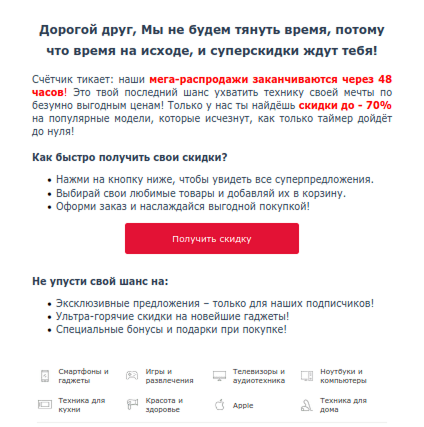
    As discussions continue on Day Two, the conference is set to finalize concrete action plans that will drive India’s long-term water security strategy and contribute to the vision of Viksit Bharat @ 2047.

    ***

    Dhanya Sanal K

    (Release ID: 2104533) Visitor Counter : 6

    MIL OSI Asia Pacific News

  • MIL-OSI Asia-Pac: PRESIDENT OF INDIA HOSTS AMIR OF QATAR

    Source: Government of India

    PRESIDENT OF INDIA HOSTS AMIR OF QATAR

    INDIA AND QATAR SHOULD WORK TOGETHER FOR PEACE, PROGRESS AND PROSPERITY OF NOT ONLY OUR PEOPLES BUT FOR ALL PEOPLE OF THE WORLD: PRESIDENT DROUPADI MURMU

    Posted On: 18 FEB 2025 9:32PM by PIB Delhi

    The President of India, Smt Droupadi Murmu received His Highness Sheikh Tamim Bin Hamad Al Thani, Amir of the State of Qatar at Rashtrapati Bhavan today (February 18, 2025). She also hosted a banquet in his honour.

    Welcoming His Highness Al Thani on his second State Visit to India, the President said that India’s relations with Qatar are steeped in history, spanning centuries. Qatar has been an integral part of West Asia’s linkages of commerce and culture with India.

    The President said that multi-faceted engagement and cooperation between India and Qatar are marked by a deep sense of comfort and time-tested goodwill. The two countries are reliable partners in the areas of trade, investment, food security, health, culture and energy. She said that we should also take advantage of the respective strengths of both countries to broaden our cooperation in the areas of innovation, technology and start-ups.  

    The President said that said that both countries should work together for peace, progress and prosperity of not only our peoples but for all people of the world.

    Both leaders agreed that the elevation of the India-Qatar relationship to the level of ‘strategic partnership’ would establish a roadmap for even closer engagement.

    Please click here to see the President’s speech – 


    ***

    MJPS/SR

    (Release ID: 2104525) Visitor Counter : 8

    MIL OSI Asia Pacific News

  • MIL-OSI Asia-Pac: Prime Minister applauds inauguration of Inland Waterways Terminal at Jogighopa, Assam

    Source: Government of India

    Posted On: 18 FEB 2025 9:21PM by PIB Delhi

    The Prime Minister, Shri Narendra Modi lauded the inauguration of the Inland Waterways Transport (IWT) Terminal on the Brahmaputra (National Waterway-2) at Jogighopa in Assam. 

    Union Minister of Ports, Shipping & Waterways and AYUSH, Shri Sarbananda Sonowal, along with Bhutan’s Minister of Finance, H.E. Lyonpo Namgyal Dorji, inaugurated Inland Waterways Transport (IWT) Terminal at Jogighopa in Assam. The state-of-the-art terminal, connected to the Multi Modal Logistics Park and strategically located in Jogighopa will be an international port of call for Bhutan and Bangladesh while enhancing logistics and cargo movement in Assam and the North East. 

    Responding to the X post of Union Minister, Shri Sarbananda Sonowal, Shri Modi posted on X;

    “A noteworthy addition in our quest for improving infrastructure as well as encouraging inland waterways for progress and prosperity.”


    ***

    MJPS/ST

    (Release ID: 2104521) Visitor Counter : 74

    MIL OSI Asia Pacific News

  • MIL-OSI Asia-Pac: I compliment the School of Ultimate Leadership for organising the SOUL Leadership Conclave on 21st and 22nd February in New Delhi, this forum brings together people from different walks of life to discuss aspects relating to leadership: PM

    Source: Government of India

    Posted On: 18 FEB 2025 8:45PM by PIB Delhi

    The Prime Minister, Shri Narendra Modi will attend the SOUL (School of Ultimate Leadership) Leadership Conclave on 21st February 2025 in New Delhi. Shri Modi said that this forum brings together people from different walks of life to discuss aspects relating to leadership. The speakers will share their inspiring life journeys and perspectives on key issues, which will particularly connect with young audiences, Shri Modi further added.

    Shri Modi wrote on X;

    “I compliment the School of Ultimate Leadership for organising the SOUL Leadership Conclave on 21st and 22nd February in New Delhi. This forum brings together people from different walks of life to discuss aspects relating to leadership. The speakers will share their inspiring life journeys and perspectives on key issues, which will particularly connect with young audiences. 

    I would also be joining the Conclave on Friday, 21st February.

    @LeadWithSoul”


    ***

    MJPS/ST

    (Release ID: 2104504) Visitor Counter : 27

    MIL OSI Asia Pacific News

  • MIL-OSI Asia-Pac: “With Jal Jeevan Mission, 25 lakh women trained to test water quality using field testing kits”: Shri C R Patil

    Source: Government of India

    “With Jal Jeevan Mission, 25 lakh women trained to test water quality using field testing kits”: Shri C R Patil

    “This Government is committed to ensure safe and sustainable drinking water for every rural household in India”: Shri C R Patil

    “Over 80% of rural households now having access to tap water connections”: Union Minister

    Union Minister of Jal Shakti, Shri C R Patil inaugurates the 2nd State Water Ministers’ Conference on Water Security with a traditional Jal Kalash Ceremony

    Posted On: 18 FEB 2025 8:38PM by PIB Delhi

    Union Minister of Jal Shakti, Shri C R Patil inaugurated the 2nd State Water Ministers’ Conference on Water Security in the presence of Chief Minister of Rajastan, Shri Bhajan Lal Sharma with a traditional Jal Kalash Ceremony.


    Speaking at the 2nd State Water Ministers’ Conference on Water Security, Union Minister of Jal Shakti, Shri C R Patil highlighted the remarkable progress of the Jal Jeevan Mission (JJM) and reaffirmed the Government’s commitment to ensuring safe and sustainable drinking water for every rural household in India.

    Shri Patil emphasized that under Prime Minister Shri Narendra Modi’s leadership, the mission has made unprecedented strides, with over 80% of rural households now having access to tap water connections. As a result, more than 15 crore families are benefiting from clean and safe drinking water at their doorstep.

    The Minister underscored the transformative impact of JJM on public health, women’s empowerment, and community participation. According to WHO estimates, the mission has contributed to the prevention of 4 lakh deaths caused by waterborne diseases like diarrhea. Moreover, the initiative has led to a significant reduction in health-related expenses, improving the overall well-being of rural populations.

    A key highlight of the mission is the empowerment of women, with 25 lakh women trained to test water quality using field testing kits. This initiative has strengthened community-led monitoring, ensuring that water reaching households meets quality standards. Additionally, the availability of tap water has saved 5.5 crore hours per day for women, allowing them to engage in economic, educational, and social activities.

    Reaffirming the Government’s vision, Shri Patil stated that Water security is a fundamental pillar of Viksit Bharat @ 2047, and the Jal Jeevan Mission is a key driver in achieving this goal. With steady progress and strong community participation, we are committed to making clean drinking water a reality for all.

    ***

    Dhanya Sanal K

    (Release ID: 2104497) Visitor Counter : 46

    MIL OSI Asia Pacific News

  • MIL-OSI Asia-Pac: India – Qatar Joint Statement

    Source: Government of India

    Posted On: 18 FEB 2025 8:17PM by PIB Delhi

    At the invitation of Prime Minister of India His Excellency Shri Narendra Modi, His Highness the Amir of the State of Qatar, Sheikh Tamim bin Hamad Al-Thani paid a State Visit to India on 17-18 February 2025. HH the Amir was accompanied by a high-level delegation comprising Ministers, officials and business leaders. This was the second State Visit of HH the Amir to India.

    HH the Amir was received by Hon’ble President of India Smt Droupadi Murmu and Prime Minister Shri Narendra Modi at the Forecourt of Rashtrapati Bhawan on 18 February and was accorded a ceremonial welcome. Hon’ble President also hosted a banquet reception in honour of HH the Amir and accompanying delegation.

    Prime Minister Shri Narendra Modi held bilateral talks with HH the Amir at Hyderabad House on 18 February. Both leaders recalled the historic trade linkages, deep-rooted people-to-people ties and robust bilateral relations between both countries. They expressed the desire for further expanding and deepening of the multifaceted relationship between both countries. In this context, they expressed happiness on the signing of the ‘Agreement on the Establishment of Bilateral Strategic Partnership’ between the two sides.

    In light of the newly established Strategic Partnership, the two sides reaffirmed their commitment to further strengthen the bilateral relations through regular and structured cooperation in all areas, including political, trade, investment, security, energy, culture, education, technology, innovation, sustainability and people-to-people ties. In this regard, the two sides expressed happiness at the signing of the revised Double Taxation Avoidance Agreement and also agreed to expedite negotiations on the India-Qatar Bilateral Investment Treaty.

    The two sides noted with satisfaction that regular interactions at various levels have helped provide momentum to the multifaceted bilateral cooperation. They recalled the successful visit of HH the Amir to India in March 2015 and the visits of Prime Minister to Qatar in June 2016 and February 2024. The two sides agreed to continue the high-level exchanges through regular bilateral mechanisms at Ministerial and senior-official levels.

    The two sides noted that trade and commerce has been a strong pillar of bilateral economic cooperation between the two countries and emphasized on the potential for further growth and diversification in bilateral trade. The two sides welcomed the elevation of the existing Joint Working Group on Trade and Commerce into a Joint Commission on Trade and Commerce. The Joint Commission will be an institutional mechanism to review and monitor the entire spectrum of economic ties between the two countries and will be headed by the Ministers of Commerce and Industry on both sides.

    The two sides laid emphasis on strengthening collaborations between their business and industry bodies. In this context, they welcomed the holding of the first meeting of the Joint Business Council on 13 February 2025.

    The two sides agreed on the need to explore strategies for enhanced and diversified trade between the two countries and address on priority market access issues related to trade in goods and services. In this regard, the two sides agreed to explore the possibility of entering into a bilateral Comprehensive Economic Partnership Agreement. Both sides set the target to double bilateral trade by 2030.

    Qatar and India have a strong strategic relationship and given that the Indian economy is one of the fastest growing economies, the Indian side welcomed the decision of Qatar Investment Authority (QIA) to open an office in India. Both sides expressed satisfaction with the progress made by the Joint Task Force on Investments during its first meeting in June 2024, where various avenues for investments in India were discussed.

    The Qatar side commended the steps taken by India in making a conducive environment for Foreign Direct Investment and Foreign Institutional Investment and expressed interest to explore investment opportunities in different sectors, including infrastructure, technology, manufacturing, food security, logistics, hospitality, and other areas of mutual interest. In this regard, the Qatar side announced a commitment to invest USD 10 billion in India. The Indian side also appreciated Qatar’s efforts in enhancing its investment environment and its initiatives to attract Foreign Direct Investment. India also recognized Qatar’s growing role as a regional hub for goods and services, leveraging its strategic location, world-class infrastructure, and business-friendly policies. Both sides emphasized the importance of deepening cooperation between investment authorities, financial institutions, and businesses to explore new opportunities for investment and trade expansion.

    The parties shall expand and deepen mutually beneficial trade and economic cooperation between the two countries in accordance with their respective legislations and the provisions of international conventions to which they are parties. They shall cooperate in order to achieve stable growth and diversification of trade, increase the volume of exchanged products, and provide mutual services on a systematic and long-term basis. Additionally, they shall implement measures to attract and encourage the establishment of joint projects between the private sectors of both countries. In this regard, both sides welcomed convening of the Joint Business Forum inaugurated by the Ministers of Commerce and Industry of both countries on 18 February 2025.

    Recognizing the pivotal role of businesses in driving economic growth, both sides emphasized the importance of trade exhibitions as a strategic platform for promoting commercial partnerships, increasing and diversifying bilateral trade, and facilitating investments. In pursuit of these objectives, both sides will strengthen collaboration between their export promotion agencies to support enterprises in identifying opportunities, addressing market challenges, and increasing participation in international trade exhibitions. This initiative will enable businesses from both nations to showcase their products, explore joint ventures, and establish sustainable commercial ties.

    The two sides welcomed the operationalization of India’s Unified Payment Interface (UPI) in QNB’s Points of Sales in Qatar and looked forward to implement nation-wide roll-out of UPI acceptance in Qatar. They agreed to explore settlement of bilateral trade in respective currencies. QNB’s expansion is also welcomed in India through setting up of an office in GIFT City.

    The two sides shall work to further enhance bilateral energy cooperation, including through promotion of trade and mutual investments in energy infrastructure and regular meetings of the relevant stakeholders from both sides, including the Joint Task Force on Energy.

    The two leaders unequivocally condemned terrorism in all its forms and manifestations including cross-border terrorism and agreed to cooperate in combating this menace through bilateral and multilateral mechanisms. They agreed to enhance cooperation in information and intelligence sharing, developing and exchanging experiences, best practices and technologies, capacity building and to strengthen cooperation in law enforcement, anti-money laundering, drug-trafficking, Cybercrime and other transnational crimes. The two leaders also discussed ways and means to promote cooperation in cybersecurity, including prevention of use of cyberspace for terrorism, radicalisation and for disturbing social harmony. They emphasized the importance of holding regular meetings of the Joint Committee on Security and Law Enforcement.

    The two sides acknowledged health cooperation as one of the important pillars of bilateral ties and expressed their commitment to further strengthen collaboration in this important sector. The two sides appreciated the bilateral cooperation during the Covid-19 pandemic including through the Joint Working Group on Health. The Indian side expressed interest in enhancing exports of Indian pharmaceutical products and medical devices to Qatar. Both sides also expressed their desire to facilitate the registration of national companies and pharmaceutical products.

    The two sides expressed interest in pursuing deeper collaboration in technology and innovation, including emerging technologies, startups, and Artificial Intelligence. They discussed avenues for furthering e-Governance and sharing best practices in the digital sector. Both sides welcomed the participation of Indian startups in Web Summits in Doha, Qatar in 2024-25.

    The importance of food security and protection of supply chains was emphasized by the two sides and they agreed to further strengthen cooperation in this field.

    The two sides stressed the importance of enhancing cultural cooperation through exchanging participation in cultural events and supporting effective partnerships between cultural institutions in both countries. They also decided to further strengthen cooperation in the area of sports including mutual exchange and visits of sportsmen, organising workshops, seminars and conferences, exchange of sports publications between both nations. In this regard, the two sides welcomed the decision to celebrate India-Qatar Year of Culture, Friendship and Sports in the near future.

    The two sides highlighted that education is an important area of cooperation including strengthening institutional linkages and exchanges between higher educational institutions of both countries. They also emphasized on enhanced interactions among educational institutions, including through academic exchanges, joint research, students and scholar exchanges, and University-to-University cooperation of both countries.

    The two sides acknowledged that the centuries old people-to-people ties represent a fundamental pillar of the historic India-Qatar relationship. The Qatari leadership expressed deep appreciation for the role and contribution made by the Indian community in Qatar for the progress and development of their host country, noting that Indian citizens in Qatar are highly respected for their peaceful and hard-working nature. The Indian side conveyed deep appreciation to the leadership of Qatar for ensuring the welfare and well-being of this large and vibrant Indian community in Qatar. The Qatar side welcomed extension of e-visa facility by India to Qatari nationals.

    The two sides stressed upon the depth and importance of long standing and historical cooperation in the field of manpower mobility and human resources. The two sides agreed to hold regular meetings of the Joint Working Group on Labour and Employment to address issues related to expatriates, manpower mobility, dignity, safety and welfare of workers and matters of mutual interest.

    The two sides exchanged views on regional and international issues of mutual interest, including the security situation in the Middle East. They emphasized the importance of dialogue and diplomacy for peaceful resolution of international disputes. The two sides also appreciated the excellent coordination between the two sides in the UN and other multilateral fora.

    The Indian side thanked the Qatari side for its support to the growing India-GCC cooperation and for facilitating the inaugural India-GCC Joint Ministerial Meeting for Strategic Dialogue at the level of Foreign Ministers held in Riyadh on 9 September 2024 under Qatar’s Chairmanship. The two sides welcomed the outcomes of the inaugural India-GCC Joint Ministerial Meeting for Strategic Dialogue. Qatar side assured full support for deepening of the India-GCC cooperation under the recently adopted Joint Action Plan.

    In the context of UN reforms, both leaders emphasized the importance of a reformed and effective multilateral system, centered on a UN reflective of contemporary realities, as a key factor in tackling global challenges. The two sides stressed the need for UN reforms, including of the Security Council. Both sides stressed the importance of addressing shared global challenges through coordinated efforts within the framework of the United Nations, its specialized agencies, and programs, as well as through technical cooperation to advance the achievement of UN Sustainable Development Goals (SDGs). Both sides agreed to engage in close cooperation and support each other at the United Nations including supporting each other’s candidatures to multilateral forums.

    The following documents were signed/exchanged during the visit, which will further deepen the multifaceted bilateral relationship as well as open avenues for newer areas of cooperation:

    · Agreement on the Establishment of Bilateral Strategic Partnership

    · Revised Agreement for the Avoidance of Double Taxation and the Prevention of Fiscal Evasion with Respect to Taxes on Income and its Protocol

    · MoU between Ministry of Finance, India and Ministry of Finance, Qatar on Financial and Economic Collaboration

    · MoU on Cooperation in Field of Youth and Sports

    · MOU for Cooperation in the field of Documents and Archives

    · MoU between Invest India and Invest Qatar

    · MoU between Confederation of Indian Industry and Qatari Businessmen Association

    HH the Amir thanked Prime Minister Shri Narendra Modi for the warm hospitality accorded to him and his delegation. The visit reaffirmed the strong bonds of friendship and cooperation between India and Qatar. The leaders expressed optimism that this renewed partnership would continue to grow, benefiting the people of both countries and contributing to regional and global stability.


    ***

    MJPS/SR

    (Release ID: 2104490) Visitor Counter : 138

    MIL OSI Asia Pacific News

  • MIL-OSI Asia-Pac: WAVES 2025 Platform for Electronic Music Producers and DJs : ‘Resonate: The EDM Challenge’

    Source: Government of India

    WAVES 2025 Platform for Electronic Music Producers and DJs : ‘Resonate: The EDM Challenge’

    A ‘Create in India Challenge’ for EDM Genre of Music practitioners to showcase their Talents

    Registration to Participate Closes on 10th March, 2025

    Posted On: 18 FEB 2025 7:12PM by PIB Mumbai

    : Mumbai, February 18, 2025

    If you are an electronic music producer and have a flair for DJing, then the World Audio Visual & Entertainment Summit (WAVES) 2025 is the ultimate stage to showcase your talents! The Indian Music Industry (IMI) in collaboration with Union Ministry of Information & Broadcasting (I&B) is organizing “Resonate: The EDM Challenge” as part of the ‘Create in India Challenge’ which offers an exciting opportunity to showcase your creative talents and innovation in the world of audio, visual, and entertainment.  This challenge seeks to strengthen India’s status as a global center for music fusion, electronic music and DJing artistry.

    “Resonate: The EDM Challenge” is open to individual artists and creative teams to perform in front of industry experts, Indian music consumers and a global audience and turn one’s passion for electronic music into international recognition. This platform is open for both emerging and seasoned musicians to compete across two thrilling stages:

    • Preliminary Round: Participants will submit their original EDM tracks online, which will be evaluated by a panel of industry experts to shortlist the top 10 entries.
    • Grand Finale: The finalists will perform live at WAVES 2025, competing for the top honors in front of a distinguished jury and a global audience.

    Winners will receive substantial cash prizes (₹2,00,000 for the Grand Prize winner and ₹50,000 for runners-up), along with a chance to feature in promotional materials, gain international exposure, and perform on a global stage.

    For detailed information on the Challenge, please visit the website https://indianmi.org/resonate-the-edm-challenge/

    It is important to familiarize yourself with the Terms and Conditions. For details on the competition’s participation rules and criteria, please refer to the following link: Terms and Conditions.

    The last date to register for participation is 10th March, 2025. The participants must mail their participation interest at wavesatinfo@indianmi.org. Participants must use the provided template to submit their participation details, which can be accessed at the following link: Submission Template.

    About WAVES 2025:

    WAVES 2025 is a global summit scheduled to be held at Jio Convention Centre in Mumbai from 1st May to 4th May 2025, aimed at fostering innovation, creativity, and collaboration in the media, entertainment, and technology sectors. WAVES will bring together creators, industry leaders, and investors to explore new opportunities in animation, gaming, visual effects, and XR (Extended Reality). With a vision to position India as a global powerhouse in the AVGC-XR sector, WAVES 2025 promotes skill development, entrepreneurship, and cross-border collaborations.


    Sriyanka/Preeti

    Follow us on social media:  @PIBMumbai     /PIBMumbai     /pibmumbai   pibmumbai[at]gmail[dot]com


    (Release ID: 2104458) Visitor Counter : 65

    MIL OSI Asia Pacific News

  • MIL-OSI Asia-Pac: India – Qatar Joint Statement (February 18, 2025)

    Source: Government of India (2)

    Posted On: 18 FEB 2025 8:17PM by PIB Delhi

    At the invitation of Prime Minister of India His Excellency Shri Narendra Modi, His Highness the Amir of the State of Qatar, Sheikh Tamim bin Hamad Al-Thani paid a State Visit to India on 17-18 February 2025. HH the Amir was accompanied by a high-level delegation comprising Ministers, officials and business leaders. This was the second State Visit of HH the Amir to India.

    HH the Amir was received by Hon’ble President of India Smt Droupadi Murmu and Prime Minister Shri Narendra Modi at the Forecourt of Rashtrapati Bhawan on 18 February and was accorded a ceremonial welcome. Hon’ble President also hosted a banquet reception in honour of HH the Amir and accompanying delegation.

    Prime Minister Shri Narendra Modi held bilateral talks with HH the Amir at Hyderabad House on 18 February. Both leaders recalled the historic trade linkages, deep-rooted people-to-people ties and robust bilateral relations between both countries. They expressed the desire for further expanding and deepening of the multifaceted relationship between both countries. In this context, they expressed happiness on the signing of the ‘Agreement on the Establishment of Bilateral Strategic Partnership’ between the two sides.

    In light of the newly established Strategic Partnership, the two sides reaffirmed their commitment to further strengthen the bilateral relations through regular and structured cooperation in all areas, including political, trade, investment, security, energy, culture, education, technology, innovation, sustainability and people-to-people ties. In this regard, the two sides expressed happiness at the signing of the revised Double Taxation Avoidance Agreement and also agreed to expedite negotiations on the India-Qatar Bilateral Investment Treaty.

    The two sides noted with satisfaction that regular interactions at various levels have helped provide momentum to the multifaceted bilateral cooperation. They recalled the successful visit of HH the Amir to India in March 2015 and the visits of Prime Minister to Qatar in June 2016 and February 2024. The two sides agreed to continue the high-level exchanges through regular bilateral mechanisms at Ministerial and senior-official levels.

    The two sides noted that trade and commerce has been a strong pillar of bilateral economic cooperation between the two countries and emphasized on the potential for further growth and diversification in bilateral trade. The two sides welcomed the elevation of the existing Joint Working Group on Trade and Commerce into a Joint Commission on Trade and Commerce. The Joint Commission will be an institutional mechanism to review and monitor the entire spectrum of economic ties between the two countries and will be headed by the Ministers of Commerce and Industry on both sides.

    The two sides laid emphasis on strengthening collaborations between their business and industry bodies. In this context, they welcomed the holding of the first meeting of the Joint Business Council on 13 February 2025.

    The two sides agreed on the need to explore strategies for enhanced and diversified trade between the two countries and address on priority market access issues related to trade in goods and services. In this regard, the two sides agreed to explore the possibility of entering into a bilateral Comprehensive Economic Partnership Agreement. Both sides set the target to double bilateral trade by 2030.

    Qatar and India have a strong strategic relationship and given that the Indian economy is one of the fastest growing economies, the Indian side welcomed the decision of Qatar Investment Authority (QIA) to open an office in India. Both sides expressed satisfaction with the progress made by the Joint Task Force on Investments during its first meeting in June 2024, where various avenues for investments in India were discussed.

    The Qatar side commended the steps taken by India in making a conducive environment for Foreign Direct Investment and Foreign Institutional Investment and expressed interest to explore investment opportunities in different sectors, including infrastructure, technology, manufacturing, food security, logistics, hospitality, and other areas of mutual interest. In this regard, the Qatar side announced a commitment to invest USD 10 billion in India. The Indian side also appreciated Qatar’s efforts in enhancing its investment environment and its initiatives to attract Foreign Direct Investment. India also recognized Qatar’s growing role as a regional hub for goods and services, leveraging its strategic location, world-class infrastructure, and business-friendly policies. Both sides emphasized the importance of deepening cooperation between investment authorities, financial institutions, and businesses to explore new opportunities for investment and trade expansion.

    The parties shall expand and deepen mutually beneficial trade and economic cooperation between the two countries in accordance with their respective legislations and the provisions of international conventions to which they are parties. They shall cooperate in order to achieve stable growth and diversification of trade, increase the volume of exchanged products, and provide mutual services on a systematic and long-term basis. Additionally, they shall implement measures to attract and encourage the establishment of joint projects between the private sectors of both countries. In this regard, both sides welcomed convening of the Joint Business Forum inaugurated by the Ministers of Commerce and Industry of both countries on 18 February 2025.

    Recognizing the pivotal role of businesses in driving economic growth, both sides emphasized the importance of trade exhibitions as a strategic platform for promoting commercial partnerships, increasing and diversifying bilateral trade, and facilitating investments. In pursuit of these objectives, both sides will strengthen collaboration between their export promotion agencies to support enterprises in identifying opportunities, addressing market challenges, and increasing participation in international trade exhibitions. This initiative will enable businesses from both nations to showcase their products, explore joint ventures, and establish sustainable commercial ties.

    The two sides welcomed the operationalization of India’s Unified Payment Interface (UPI) in QNB’s Points of Sales in Qatar and looked forward to implement nation-wide roll-out of UPI acceptance in Qatar. They agreed to explore settlement of bilateral trade in respective currencies. QNB’s expansion is also welcomed in India through setting up of an office in GIFT City.

    The two sides shall work to further enhance bilateral energy cooperation, including through promotion of trade and mutual investments in energy infrastructure and regular meetings of the relevant stakeholders from both sides, including the Joint Task Force on Energy.

    The two leaders unequivocally condemned terrorism in all its forms and manifestations including cross-border terrorism and agreed to cooperate in combating this menace through bilateral and multilateral mechanisms. They agreed to enhance cooperation in information and intelligence sharing, developing and exchanging experiences, best practices and technologies, capacity building and to strengthen cooperation in law enforcement, anti-money laundering, drug-trafficking, Cybercrime and other transnational crimes. The two leaders also discussed ways and means to promote cooperation in cybersecurity, including prevention of use of cyberspace for terrorism, radicalisation and for disturbing social harmony. They emphasized the importance of holding regular meetings of the Joint Committee on Security and Law Enforcement.

    The two sides acknowledged health cooperation as one of the important pillars of bilateral ties and expressed their commitment to further strengthen collaboration in this important sector. The two sides appreciated the bilateral cooperation during the Covid-19 pandemic including through the Joint Working Group on Health. The Indian side expressed interest in enhancing exports of Indian pharmaceutical products and medical devices to Qatar. Both sides also expressed their desire to facilitate the registration of national companies and pharmaceutical products.

    The two sides expressed interest in pursuing deeper collaboration in technology and innovation, including emerging technologies, startups, and Artificial Intelligence. They discussed avenues for furthering e-Governance and sharing best practices in the digital sector. Both sides welcomed the participation of Indian startups in Web Summits in Doha, Qatar in 2024-25.

    The importance of food security and protection of supply chains was emphasized by the two sides and they agreed to further strengthen cooperation in this field.

    The two sides stressed the importance of enhancing cultural cooperation through exchanging participation in cultural events and supporting effective partnerships between cultural institutions in both countries. They also decided to further strengthen cooperation in the area of sports including mutual exchange and visits of sportsmen, organising workshops, seminars and conferences, exchange of sports publications between both nations. In this regard, the two sides welcomed the decision to celebrate India-Qatar Year of Culture, Friendship and Sports in the near future.

    The two sides highlighted that education is an important area of cooperation including strengthening institutional linkages and exchanges between higher educational institutions of both countries. They also emphasized on enhanced interactions among educational institutions, including through academic exchanges, joint research, students and scholar exchanges, and University-to-University cooperation of both countries.

    The two sides acknowledged that the centuries old people-to-people ties represent a fundamental pillar of the historic India-Qatar relationship. The Qatari leadership expressed deep appreciation for the role and contribution made by the Indian community in Qatar for the progress and development of their host country, noting that Indian citizens in Qatar are highly respected for their peaceful and hard-working nature. The Indian side conveyed deep appreciation to the leadership of Qatar for ensuring the welfare and well-being of this large and vibrant Indian community in Qatar. The Qatar side welcomed extension of e-visa facility by India to Qatari nationals.

    The two sides stressed upon the depth and importance of long standing and historical cooperation in the field of manpower mobility and human resources. The two sides agreed to hold regular meetings of the Joint Working Group on Labour and Employment to address issues related to expatriates, manpower mobility, dignity, safety and welfare of workers and matters of mutual interest.

    The two sides exchanged views on regional and international issues of mutual interest, including the security situation in the Middle East. They emphasized the importance of dialogue and diplomacy for peaceful resolution of international disputes. The two sides also appreciated the excellent coordination between the two sides in the UN and other multilateral fora.

    The Indian side thanked the Qatari side for its support to the growing India-GCC cooperation and for facilitating the inaugural India-GCC Joint Ministerial Meeting for Strategic Dialogue at the level of Foreign Ministers held in Riyadh on 9 September 2024 under Qatar’s Chairmanship. The two sides welcomed the outcomes of the inaugural India-GCC Joint Ministerial Meeting for Strategic Dialogue. Qatar side assured full support for deepening of the India-GCC cooperation under the recently adopted Joint Action Plan.

    In the context of UN reforms, both leaders emphasized the importance of a reformed and effective multilateral system, centered on a UN reflective of contemporary realities, as a key factor in tackling global challenges. The two sides stressed the need for UN reforms, including of the Security Council. Both sides stressed the importance of addressing shared global challenges through coordinated efforts within the framework of the United Nations, its specialized agencies, and programs, as well as through technical cooperation to advance the achievement of UN Sustainable Development Goals (SDGs). Both sides agreed to engage in close cooperation and support each other at the United Nations including supporting each other’s candidatures to multilateral forums.

    The following documents were signed/exchanged during the visit, which will further deepen the multifaceted bilateral relationship as well as open avenues for newer areas of cooperation:

    · Agreement on the Establishment of Bilateral Strategic Partnership

    · Revised Agreement for the Avoidance of Double Taxation and the Prevention of Fiscal Evasion with Respect to Taxes on Income and its Protocol

    · MoU between Ministry of Finance, India and Ministry of Finance, Qatar on Financial and Economic Collaboration

    · MoU on Cooperation in Field of Youth and Sports

    · MOU for Cooperation in the field of Documents and Archives

    · MoU between Invest India and Invest Qatar

    · MoU between Confederation of Indian Industry and Qatari Businessmen Association

    HH the Amir thanked Prime Minister Shri Narendra Modi for the warm hospitality accorded to him and his delegation. The visit reaffirmed the strong bonds of friendship and cooperation between India and Qatar. The leaders expressed optimism that this renewed partnership would continue to grow, benefiting the people of both countries and contributing to regional and global stability.


    ***

    MJPS/SR

    (Release ID: 2104490) Visitor Counter : 22

    MIL OSI Asia Pacific News