Researchers have developed an innovative technique using a radioactive source that can simplify the study of radiation effects on Gas Electron Multiplier (GEM) detectors, a crucial step in nuclear and particle physics experiments.
Gas Electron Multiplier (GEM) detector are particle detectors used as tracking devices in high-energy physics experiments that utilizes a thin, perforated foil with a high electric field to amplify particles produced by ionizing radiation, allowing for precise detection of particles like muons by significantly multiplying the initial signal generated by the particle’s interaction with the gas within the detector.
They are also strong candidates for diagnostic applications in medical technology because of their good position resolution. First introduced by Prof. Fabio Sauli in 1997, GEM detectors consist of a 50 μm thick Kapton foil, with 5 μm copper cladding on both sides.
Despite their advantages, the inclusion of Kapton, a radiation-resistant polyimide film with excellent insulating properties, in the active volume makes these detectors sensitive to radiation-induced effects, particularly the charging-up of the dielectric medium. During operation, ionizing radiation deposits energy into the detector, initiating electron avalanche formation.
This process results in charge accumulation on the Kapton foil, which in turn enhances the electric field within the GEM holes—the primary region for electron multiplication. This increase in the electric field boosts the detector’s gain and efficiency. Over time, a dynamic equilibrium is established, stabilizing the gain and ensuring consistent detector performance.
India has the full responsibility of building all the GEM chambers that will be used in the future Compressed Baryonic Matter (CBM) experiment at FAIR and will be operated at very high radiation environment. For this, it is important to enhance the understanding of the charging-up effect in GEM detectors, a phenomenon that remains inadequately understood.
Fig 1: Schematic of the charge accumulation on the Kapton foil inside GEM hole. The dynamical accumulation of the charges on the surface of the Kapton increases the electric field thence the gain of the chamber.
To investigate this phenomenon, Dr. Saikat Biswas and his PhD student, Dr. Sayak Chatterjee along with the other collaborators from the Bose Institute, an autonomous institution under the Department of Science and Technology (DST), Government of India, conducted an in-depth investigation into the charging-up effect on the Kapton foil and its subsequent impact on detector performance.
The team from Department of Physical Sciences at Bose Institute, developed a specialized experimental setup to study the charging-up effect in triple GEM detectors by studying its gain variation as a function of time.
Analysis of the charging effect indicated that as either the detector gain (the ratio of the primary charges to the charges detected by the readout board) or irradiation rate increased, the charging-up time decreased significantly. This behavior was attributed to higher particle densities, which facilitated faster charge equilibrium within the GEM holes.
Fig 2: (a) Variation of the normalized gain as a function of time fitted with a polynomial function to extract the charging-up time (p2) of a DM triple GEM chamber. (b) Variation of charging-up time of the DM triple GEM chambers as a function of the irradiation rates from a Fe-55 source at a fixed detector gain of ~ 5000.
The findings from this study provide valuable insights for predicting behavioral changes in GEM detectors, critical components in high-rate experiments, when subjected to external radiation. These insights will inform design considerations and operational parameters for GEM chambers in radiation-intensive environments such as the CBM experiment at FAIR, Germany. These results are not only important for CBM experiment only but also for other high-rate experiments where GEM will be used.
Fig 3: Variation of charging-up time of the DM & SM triple GEM chambers as a function of the gain of the chambers for different irradiation rates using the Fe-55 X-ray source.
The researchers plan to extend their work to investigate the impact of GEM foil geometry on the charging-up effect and to explore behavioral changes under various types of irradiations, extending beyond the capabilities of laboratory setups. The studies published in the Journal of Instrumentation & Nuclear Instruments and Methods in Physics Research Section A, are crucial milestones for indigenous gaseous detector development.
The ships of First Training Squadron (1TS) comprising INS Sujata, INS Shardul and ICGS Veera entered Changi Naval Base, Singapore on 06 Feb 25. The visit is part of the Long-Range Training Deployment of the Squadron to South East Asia signifying a vital step in strengthening maritime cooperative engagement and fostering mutual understanding. The squadron had previously visited Singapore in Oct 2023.
During the port call, Dr Shilpak Ambule, the High Commissioner of India to Singapore visited 1TS ships. He was briefed on the training activities undertaken by the Squadron. He also interacted with the Sea Trainees and emphasised the crucial role of Indian Navy towards enhancing maritime cooperation in the Indo Pacific region. Senior Officer, 1TS along with the Commanding Officers of INS Sujata and ICGS Veera called on Col Rinson Chua Hon Liat, Commander, Maritime Training and Doctrine (MTDC) and held discussions on maritime issues of mutual interests.
During the visit, the ships will engage in several activities aimed at enhancing cooperation and inter-operability between the Indian Navy and the Republic of Singapore Navy (RSN). Professional Exchanges, Cross Training Visits and friendly sports fixtures are planned during the ship’s stay. The extant visit reinforces strong maritime partnership and collaboration between the two Navies underscoring the commitment of SAGAR (Security and Growth for All in the Region).
International Buddhist Confederation to Launch a Lord Buddha Trination Triservices Expedition A Unique Motorcycle Expedition from Lumbini, Nepal (The Birthplace of Lord Buddha) to Galle, Sri Lanka
Expedition will be Flagged Off by Shri Ram Nath Kovind, The Former President of India, from Bodhgaya on 25th February 2025
Posted On: 07 FEB 2025 5:26PM by PIB Delhi
The International Buddhist Confederation (IBC) will announce the launch of the historic Lord Buddha Trination Triservices Expedition. This collaborative initiative brings together the armed forces of India, Nepal, and Sri Lanka, in partnership with the IBC, to launch a unique motorcycle expedition from Lumbini, Nepal (the birthplace of Lord Buddha) to Galle, Sri Lanka. The expedition, featuring defence personnel from all three nations, will travel through key Buddhist heritage sites, symbolizing the historical spread of Buddhism and reinforcing the shared cultural and spiritual connections between these countries.
The primary objectives of the expedition include promoting peace and harmony, enhancing tourism, raising environmental awareness, and, most importantly, celebrating the deep-rooted ties between India, Nepal, and Sri Lanka.
As the organizing partner for the Indian chapter of the expedition, the IBC will guide participants through significant Buddhist landmarks, such as Sarnath, Bodhgaya, Nalanda, Nagarjuna Sagar (Andhra Pradesh), and Udaygiri (Odhisa), among others. The expedition will be formally flagged off by Shri Ram Nath Kovind, the former President of India, from Bodhgaya, an iconic Buddhist site on 19th February 2025.
Upon reaching Sri Lanka, the expedition will be ceremonially flagged off by the Hon’ble Prime Minister of Sri Lanka, Ms. Harini Amarasuriya in Jaffna on 5th March 2025 marking the culmination of a momentous journey across three nations bound by the Buddha’s teachings.
“India’s vision of good health implies not just being free of disease but to ensure wellness and welfare for everyone. The goal is to ensure physical, mental and social wellbeing.”
Shri Narendra Modi, Prime Minister of India
What is Mental Health
Mental health refers to an individual’s emotional, psychological, and social well-being. It influences how people think, feel, and behave in daily life. It also affects decision-making, stress management, and relationships. According to the World Health Organization (WHO), mental health is a state of mental well-being that enables people to cope with the stresses of life, realize their abilities, learn well and work well, and contribute to their community.
Impact of PoorMental Health
Impact on Productivity: Poor mental health leads to lower workplace performance, increased absenteeism, and reduced efficiency.
Social and Emotional Well-being: Mental well-being affects interpersonal relationships, self-confidence, and social interactions.
Economic Impact: According to WHO, mental disorders contribute significantly to the global burden of disease, and untreated conditions can lead to high economic costs.
Mental Health Scenario in India
WHO Data Insight
India contributes to 18% of the global population. WHO estimates that the burden of mental health problems in India is 2443 disability-adjusted life years (DALYs) per 10000 population; the age-adjusted suicide rate per 100000 population is 21.1. The economic loss due to mental health conditions, between 2012-2030, is estimated at USD 1.03 trillion.
Prevalence:
The National Mental Health Survey (NMHS) 2015-16 by NIMHANS found that 10.6% of adults in India suffer from mental disorders.
The lifetime prevalence of mental disorders in India is 13.7%.
National studies reveal that 15% of India’s adult population experiences mental health issues requiring intervention.
Urban areas have a higher prevalence (13.5%) compared to rural (6.9%).
Treatment Gap
70% to 92% of people with mental disorders do not receive proper treatment due to lack of awareness, stigma, and shortage of professionals.
According to the Indian Journal of Psychiatry India has 0.75 psychiatrists per 100,000 people, whereas WHO recommends at least 3 per 100,000.
Insights from Economic Survey 2024-25
Mental wellbeing is the ability to navigate life’s challenges and function productively. Recognising its importance, Economic Survey 2024-25 highlighted that Mental well-being encompasses all our mental-emotional, social, cognitive, and physical capabilities. This can also be construed as the mind’s composite health. It emphasised a whole of community approach to tackling mental health problems and stated that it is about time to find viable, impactful preventive strategies and interventions. India’s demographic dividend is riding on skills, education, physical health and, above all, mental health of its youth.
The Economic Survey 2024-25 suggested:
Enhance Mental Health Education in Schools: Early intervention strategies to address anxiety, stress, and behavioural issues in students.
Improve Workplace Mental Health Policies: Address job stress, long working hours, and burnout.
Expand Digital Mental Health Services: Strengthen Tele MANAS and integrate AI-based mental health solutions.
Mental Health Infrastructure in India
As part of the National Mental Health Programme, in 2024, 25 Centres of Excellencewere sanctioned set up to train more postgraduate students in mental health and provide advanced treatment.
47 PG Departments in mental health have been established or upgraded in 19 government medical colleges. Mental health services are also being introduced in 22 newly established AIIMS.
47 Government-Run Mental Hospitals including 3Central Mental Health Institutions, viz. National Institute of Mental Health and Neuro Sciences, Bengaluru, Lokopriya Gopinath Bordoloi Regional Institute of Mental Health, Tezpur, Assam and Central Institute of Psychiatry, Ranchi.
Integration of Mental Health Services in Ayushman Bharat – Health & Wellness Centres (HWCs)
Under Ayushman Bharat, the government has upgraded more than 1.73 lakh Sub Health Centres (SHCs) and Primary Health Centres (PHCs) to Ayushman Arogya Mandirs. Mental health services have been added in the package of services under Comprehensive Primary Health Care provided at these Ayushman Arogya Mandirs. These HWCs provide:
Basic counselling and psychiatric medication at PHC levels.
Training for general physicians to handle mild-to-moderate mental health conditions.
Linkages to district hospitals for advanced psychiatric care.
This initiative ensures that mental healthcare is available in both urban and rural areas, reducing dependence on specialized hospitals and making psychiatric care more community-centric.
Policies and Schemes Undertaken by the Government of India
National Mental Health Programme (NMHP) – 1982
Recognizing the growing burden of mental disorders and the shortage of mental health services, India launched the National Mental Health Programme (NMHP) in 1982. The primary goal was to ensure that mental healthcare becomes an integral part of the general healthcare system, rather than being confined to specialized hospitals.
Key components include:
District Mental Health Programme (DMHP) was introduced under NMHP to expand community mental health services.
Covers 767 districts
Provides counselling, outpatient services, suicide prevention programs, and awareness initiatives.
10-bedded inpatient mental health facilities at the district level.
NIMHANS Act, 2012
The NIMHANS Act, 2012, was a significant step towards enhancing mental health education and research in India. Under this act, the National Institute of Mental Health and Neurosciences (NIMHANS), Bengaluru, was declared an Institute of National Importance. This recognition allowed NIMHANS to expand its academic and research capabilities, making it the premier institution for psychiatry, neuropsychology, and mental health sciences in India.
The Rights of Persons with Disabilities (RPwD) Act, 2016
The Rights of Persons with Disabilities (RPwD) Act which replaced the Persons with Disabilities (PWD) Act, 1995, expanded the definition of disability to include mental illness and introduced stronger legal protections for individuals with psychosocial disabilities. The Act aligns with India’s commitment to the UN Convention on the Rights of Persons with Disabilities (UNCRPD) and aims to ensure equality, dignity, and non-discrimination for persons with disabilities, including those with mental health conditions.
National Mental Healthcare Act, 2017
The Mental Healthcare Act, 2017, was enacted to ensure the right to mental healthcare services, protect the dignity and rights of individuals with mental illness, and align India’s mental health laws with international standards, particularly the United Nations Convention on the Rights of Persons with Disabilities (UNCRPD). The Act replaced the Mental Health Act of 1987 and introduced several progressive changes to mental health care and services in India like the Right to affordable and quality mental healthcare services and the decriminalization of suicide in India.
National Health Policy, 2017
The National Health Policy (NHP), 2017 was a landmark that acknowledged mental health as a national health priority. This policy aimed to address mental health issues through a multi-pronged approach, integrating mental healthcare into primary healthcare, strengthening human resources, and improving treatment accessibility.
By placing mental health at the center of India’s healthcare framework, NHP 2017 aimed to bridge the treatment gap by making psychological services available at Primary Health Centres (PHCs) and Health and Wellness Centres (HWCs) under Ayushman Bharat.
iGOT-Diksha Collaboration for Mental Health Training
The government has also collaborated with the iGOT-Diksha platform, a digital learning initiative in 2020, to train healthcare professionals, frontline workers, and community health volunteers in mental healthcare. This program focuses on:
Building capacity for mental health care at the grassroots level.
Equipping doctors and nurses with skills to diagnose and treat mental disorders.
Promoting mental health awareness in rural areas.
Through iGOT-Diksha, India has expanded its mental health workforce, ensuring better early intervention strategies and community support mechanisms.
National Tele Mental Health Programme (Tele MANAS), 2022
Launched on October 10, 2022, the National Tele Mental Health Programme (Tele MANAS) was a game-changer in India’s digital mental health infrastructure. Tele MANAS provides free, 24/7 mental health support to individuals through a national toll-free helpline (14416 / 1800-89-14416). Available in 20 Indian languages.
As of February 7, 2025, the Tele MANAS helpline has handled over 1.81 million (18,27,951) calls since its launch in 2022, providing essential mental health support across India. There are 53 Tele MANAS Cells across various states, ensuring local access to mental health services. The program is supported by 23 Mentoring Institutes nationwide, along with 5 Regional Coordinating Centers, ensuring efficient service delivery and expert guidance in mental healthcare.
Tele MANAS services include:
Immediate tele-counselling by trained professionals.
Referral support to psychiatrists for severe cases.
Mental health awareness campaigns via digital platforms.
Mobile-based mental health interventions, ensuring accessibility in rural and remote areas.
Tele MANAS Mobile App & Video Consultation
The Tele MANAS App was launched in October 2024.
Offers self-care strategies, stress management tools, and direct access to mental health professionals.
Video consultation services introduced in Karnataka, Tamil Nadu, and J&K.
WHO Recognition
The World Health Organization (WHO) praised Tele MANAS as an effective and scalable mental health solution, making mental healthcare more inclusive and affordable.
KIRAN Helpline Merged into Tele MANAS
The KIRAN Helpline (1800-599-0019), initially launched in 2020, was merged into Tele MANAS in 2022 to enhance the efficiency of mental health support services. This transition streamlined mental health helpline operations, making it more accessible and better integrated with India’s healthcare system.
During COVID-19, the government took crucial steps to support mental health. A 24/7 helpline provided nationwide psychosocial assistance, while health workers received online training through the iGOT-Diksha platform. Public awareness campaigns spread stress management strategies via media, and official guidelines and advisories were issued to promote mental well-being. These interventions played a vital role in addressing the psychological challenges of the pandemic.
National Suicide Prevention Strategy, 2022
The National Suicide Prevention Strategy (NSPS) was launched by the Ministry of Health and Family Welfare (MoHFW) in 2022, with the goal of reducing suicide mortality by 10% by 2030. Recognizing suicide as a public health concern, the strategy focuses on early intervention, crisis management, and mental health promotion.
Key components of NSPS include:
Mental health screenings for students in schools and colleges.
Establishing crisis helplines and psychological support centers.
Community awareness programs to break the stigma around mental illness and suicide.
Stronger implementation of workplace mental health programs.
By focusing on high-risk populations, such as students, farmers, and young adults, the strategy ensures targeted intervention to prevent self-harm and improve overall well-being.
Conclusion
India has made notable progress in mental healthcare through policy reforms, digital initiatives like Tele MANAS and expanding access to services under programs such as NMHP, Ayushman Bharat HWCs, and the National Suicide Prevention Strategy. Moving forward, India must strengthen awareness campaigns, expand workforce training and invest in digital mental health solutions. A mentally healthier India is vital for individual well-being, economic growth, and national development, requiring a whole-of-society approach to make mental healthcare accessible, inclusive, and stigma-free.
Over 284 Crore Aadhaar Authentications in January 2025; 32% jump y-o-y sign of g͟rowth of digital economy with Aadhar playing an integral role in daily life Aadhaar’s AI-powered Face Authentication becoming popular with 12 Crore transactions recorded in January in sectors spanning finance, health, telecommunications, etc.
Union and State Departments embracing Aadhaar Face Authentication for swift delivery of citizen centric s ervices
Expanding Digital Frontiers: Aadhaar e-KYC transactions cross 43 crore in January 2025
Posted On: 07 FEB 2025 5:08PM by PIB Delhi
In January 2025, Aadhaar holders conducted more than 284 crore authentication transactions, highlighting the continued expansion of the digital economy in India. This significant number demonstrates the g͟rowth of digital economy in the country.
The authentication transactions in January 2025 have recorded a growth of over 32% when compared with January 2024, when 214.8 crore such transactions were carried out.
Growing adoption and utility of Aadhaar
On an average over nine crore authentications are taking place every day. This shows the growing adoption and utility of Aadhaar in the daily lives of people. Nearly 550 entities are using Aadhaar authentication service.
Aadhaar face authentication transactions too are getting good traction. In January, almost 12 crore Aadhaar face authentication transactions were carried out. Cumulatively, Face Authentication transaction numbers have crossed 102 crore, since it was first introduced in October 2021. Nearly 78 crore of the total face authentication transactions were recorded in the past 12 months alone.
The AI/ML based face authentication solution, developed in house by the UIDAI, is being used across diverse sectors including finance, insurance, fintech, health and telecommunications. Several Government departments both at the centre and states are using it for smooth delivery of benefits to targeted beneficiaries.
Crucial role of Aadhaar e-KYC servic
Aadhaar e-KYC service continues to play an important role for banking and non-banking financial services by providing transparent and improved customer experience, and helping in ease of doing business.
More than 43 crore eKYC transactions were carried out during January this year. By the end of January 2025, the cumulative number of Aadhaar e-KYC transactions gone past 2268 crore.
Union Civil Aviation Minister Shri Kinjarapu Rammohan Naidu met Union Agriculture & Farmers’ Welfare Minister Shri Shivraj Singh Chouhan at Krishi Bhawan, New Delhi today and discussed the problems being faced by red chilly farmers in Andhra Pradesh. During the meeting Senior officers from the Ministry of Agriculture were also present. Later, speaking to the media Shri Rammohan Naidu said the Government of Andhra Pradesh is planning to procure red chilies and he urged the Union Agriculture Minister to provide financial support to the state government under various schemes. Stating that Shri Shivraj Singh Chouhan responded positively to the request of Andhra Pradesh Government.
Shri Rammohan Naidu said he had handed over a letter from Chief Minister of Andhra Pradesh Shri Chandrababu Naidu explaining the problems of red chilli farmers to Shri Shivraj Singh Chouhan.
MUNCIE, Ind., Feb. 07, 2025 (GLOBE NEWSWIRE) — First Merchants Corporation declared a cash dividend on February 7, 2025 of $0.35 per share. The dividend is payable on March 21, 2025, to common shareholders of record as of March 7, 2025. For purposes of broker trading, the ex-date of the cash dividend is March 6, 2025.
About First Merchants Corporation:
First Merchants Corporation is a financial holding company headquartered in Muncie, Indiana. The Corporation has one full-service bank charter, First Merchants Bank. The Bank also operates as First Merchants Private Wealth Advisors (as a division of First Merchants Bank).
First Merchants Corporation’s common stock is traded on the NASDAQ Global Select Market System under the symbol FRME. Quotations are carried in daily newspapers and can be found on the company’s Internet web page (http://www.firstmerchants.com).
FIRST MERCHANTS and the Shield Logo are federally registered trademarks of First Merchants Corporation.
For more information, contact: Nicole M. Weaver, First Vice President and Director of Corporate Administration 765-521-7619 http://www.firstmerchants.com
Elon Musk’s role as the head of the Department of Government Efficiency, also known as DOGE, is on the surface a dramatic effort to overhaul the inefficiencies of federal bureaucracy. But beneath the rhetoric of cost-cutting and regulatory streamlining lies a troubling scenario.
Musk has been appointed what is called a “special government employee” in charge of the White House office formerly known as the U.S. Digital Service, which was renamed the U.S. DOGE Service on the first day of President Donald Trump’s second term. The Musk team’s purported goals are to maximize efficiency and to eliminate waste and redundancy.
That might sound like a bold move toward Silicon Valley-style innovation in governance. However, the deeper motivations driving Musk’s involvement are unlikely to be purely altruistic.
One historical parallel in particular is striking. In 1600, the British East India Company, a merchant shipping firm, began with exclusive rights to conduct trade in the Indian Ocean region before slowly acquiring quasi-governmental powers and ultimately ruling with an iron fist over British colonies in Asia, including most of what is now India. In 1677, the company gained the right to mint currency on behalf of the British crown.
As I explain in my upcoming book “Who Elected Big Tech?” the U.S. is witnessing a similar pattern of a private company taking over government operations.
Yet what took centuries in the colonial era is now unfolding at lightning speed in mere days through digital means. In the 21st century, data access and digital financial systems have replaced physical trading posts and private armies. Communications are the key to power now, rather than brute strength.
A security officer blocks U.S. Sen. Ed Markey, right, from entering the U.S. Environmental Protection Agency headquarters on Feb. 6, 2025, in an effort to meet with DOGE staff. Al Drago/Getty Images
The data pipeline
Viewing Musk’s moves as a power grab becomes clearer when examining his corporate empire. He controls multiple companies that have federal contracts and are subject to government regulations. SpaceX and Tesla, as well as tunneling firm The Boring Company, the brain science company Neuralink, and artificial intelligence firm xAI all operate in markets where government oversight can make or break fortunes.
Through DOGE, all these oversight mechanisms could be weakened or eliminated under the guise of efficiency.
But the most catastrophic aspect of Musk’s leadership at DOGE is its unprecedented access to government data. DOGE employees reportedly have digital permission to see data in the U.S. government’s payment system, which includes bank account information, Social Security numbers and income tax documents. Reportedly, they have also seized the ability to alter the system’s software, data, transactions and records.
Multiple media reports indicate that Musk’s staff have already made changes to the programs that process payments for Social Security beneficiaries and government contractors to make it easier to block payments and hide records of payments blocked, made or altered.
But DOGE employees only need to be able to read the data to make copies of Americans’ most sensitive personal information.
The genius – and danger – of this strategy lies in the fact that each step might appear justified in isolation: modernizing government systems, improving efficiency, updating payment infrastructure. But together, they create the scaffolding for transferring even more financial power to the already wealthy.
Musk’s authoritarian tendencies, evident in his forceful management of X and his assertion that it was illegal to publish the names of people who work for him, suggest how he might wield his new powers. Companies critical of Musk could face unexpected audits; regulatory agencies scrutinizing his businesses could find their budgets slashed; allies could receive privileged access to government contracts.
This isn’t speculation – it’s the logical extension of DOGE’s authority combined with Musk’s demonstrated behavior.
Critics are calling Musk’s actions at DOGE a massive corporate coup. Others are simply calling it a coup. The protest movement is gaining momentum in Washington, D.C., and around the country, but it’s unlikely that street protests alone can stop what Musk is doing.
Who can effectively investigate a group designed to dismantle oversight itself? The administration’s illegal firing of at least a dozen inspectors general before the Musk operation began suggests a deliberate strategy to eliminate government accountability. The Republican-led Congress, closely aligned with Trump, may not want to step in; but even if it did, Musk is moving far faster than Congress ever does.
Destroy the republic, build a startup nation?
Taken together, all of Musk’s and Trump’s moves lay the foundation for what cryptocurrency investor and entrepreneur Balaji Srinivasan calls “the network state.”
The idea is that a virtual nation may form online before establishing any physical presence. Think of the network state like a tech startup company with its own cryptocurrency – instead of declaring independence and fighting for sovereignty, it first builds community and digital systems. By the time a Musk-aligned cryptocurrency gained official status, the underlying structure and relationships would already be in place, making alternatives impractical.
Converting more of the world’s financial system into privately controlled cryptocurrencies would take power away from national governments, which must answer to their own people. Musk has already begun this effort, using his wealth and social media reach to engage in politics not only in the U.S. but also several European countries, including Germany.
A nation governed by a cryptocurrency-based system would no longer be run by the people living in its territory but by those who could could afford to buy the digital currency. In this scenario, I am concerned that Musk, or the Communist Party of China, Russian President Vladimir Putin or AI-surveillance conglomerate Palantir, could render irrelevant Congress’ power over government spending and action. And along the way, it could remove the power to hold presidents accountable from Congress, the judiciary and American citizens.
The question facing Americans, therefore, isn’t whether government needs modernization – it’s whether they’re willing to sacrifice democracy in pursuit of Musk’s version of efficiency. When we grant tech leaders direct control over government functions, we’re not just streamlining bureaucracy – we’re fundamentally altering the relationship between private power and public governance. I believe we’re undermining American national security, as well as the power of We, the People.
The most dangerous inefficiency of all may be Americans’ delayed response to this crisis.
Allison Stanger receives funding from the Berkman Klein Center for Internet and Society, Harvard University
Headline: North Carolina Museum of History Announces Casting Call for Revolutionary War Film Series
North Carolina Museum of History Announces Casting Call for Revolutionary War Film Series jejohnson6
The North Carolina Museum of History is seeking actors for It’s Revolutionary!, an original video series commemorating the 250th anniversary of the American Revolution. This dynamic 20-part series will blend documentary storytelling with engaging narrative elements, bringing North Carolina’s revolutionary past to life for students, educators, and the public.
It’s Revolutionary! is a multiyear educational initiative of the museum’s K-12 Outreach Branch, Beyond the Exhibits. This effort explores North Carolina’s role in the American Revolution through engaging programs, materials, and resources based on primary and secondary sources. It’s Revolutionary! also includes upcoming Educator Notebooks, online teacher workshops, History-In-a-Box kits and more. “This project brings history to life in a way that is both engaging and educational,” said Sally Causey Bloom, curator of education at the North Carolina Museum of History. “By combining documentary and narrative storytelling, we hope to spark curiosity and a deeper understanding of this pivotal chapter in our nation’s history. We want everyone to know that they make history, too!”
SUBMISSION & CASTING DETAILS
Roles: Actors who can portray characters ages 17 to mid-50s; some roles require specific accents.
Submission Requirements: Headshot, resume, audition video (mp4 preferred), sizes, and measurements.
Audition Deadline: February 17, 2025
Casting Notifications: February 26, 2025
Filming Schedule: Weekdays during regular business hours, May–June 2025.
Compensation: Day rate is $300.
How to Audition: Information and submission form here.
It’s Revolutionary! is made possible through the generous support of the North Carolina Society of the Cincinnati.
About the N.C. Museum of History
The North Carolina Museum of History, a Smithsonian Affiliate, fosters a passion for North Carolina history. This museum collects and preserves artifacts of state history and educates the public on the history of the state and the nation through exhibits and educational programs. In 2024, more than 275,000 people visited the museum to see some of the 150,000 artifacts in the museum collection. Located in the heart of downtown Raleigh, the North Carolina Museum of History serves as the flagship historical institution of the Division of State History Museums. This division, part of the N.C. Department of Natural and Cultural Resources, includes seven regional history museums dedicated to preserving and interpreting the stories of North Carolina’s past.
About the Smithsonian Affiliations Network
Since 2006, the North Carolina Museum of History has been a Smithsonian Affiliate, part of a select group of museums and cultural, educational and arts organizations that share Smithsonian resources with the nation. The Smithsonian Affiliations network is a national outreach program that develops long-term collaborative partnerships with museums and other educational and cultural organizations to enrich communities with Smithsonian resources. More information is available ataffiliations.si.edu.
About the North Carolina Department of Natural and Cultural Resources
The N.C. Department of Natural and Cultural Resources (DNCR) manages, promotes, and enhances the things that people love about North Carolina – its diverse arts and culture, rich history, and spectacular natural areas. Through its programs, the department enhances education, stimulates economic development, improves public health, expands accessibility, and strengthens community resiliency.
The department manages over 100 locations across the state, including 27 historic sites, seven history museums, two art museums, five science museums, four aquariums, 35 state parks, four recreation areas, dozens of state trails and natural areas, the N.C. Zoo, the State Library, the State Archives, the N.C. Arts Council, the African American Heritage Commission, the American Indian Heritage Commission, the State Historic Preservation Office, the Office of State Archaeology, the Highway Historical Markers program, the N.C. Land and Water Fund, and the Natural Heritage Program. For more information, please visitwww.dncr.nc.gov.
Headline: State Archives to host a virtual program on Lafayette’s tour in North Carolina
State Archives to host a virtual program on Lafayette’s tour in North Carolina jejohnson6
Learn about Marquis de Lafayette’s final journey through North Carolina.
A Zoom teleconference scheduled for Wednesday, Feb. 5, from 1-2: p.m., will cover Lafayette’s farewell tour in North Carolina.
2025 marks the bicentennial of the southern leg of Lafayette’s farewell tour of the United States.
The commemorative festivities have begun and will continue into March.
Learn about this historical episode, Lafayette’s popularity, upcoming celebrations in North Carolina, and relevant documents in the State Archives, including Lafayette’s writings.
Speakers for this virtual roundtable include coordinators for events in northeastern North Carolina and Fayetteville and State Archives staff.
This program will also include a Q&A session. Register for the program at https://www.zoomgov.com/webinar/register/WN_SZ3_f4fCRGGvDBn01QPO-w#/registration
About the State Archives The State Archives serves as the custodian of North Carolina’s historical records, preserving and providing public access to a wealth of archival materials. Through its diverse collections, educational programs, and exhibitions, the State Archives plays a crucial role in promoting an understanding and appreciation of North Carolina’s rich historical legacy.
About the North Carolina Department of Natural and Cultural Resources The N.C. Department of Natural and Cultural Resources (DNCR) manages, promotes, and enhances the things that people love about North Carolina – its diverse arts and culture, rich history, and spectacular natural areas. Through its programs, the department enhances education, stimulates economic development, improves public health, expands accessibility, and strengthens community resiliency.
The department manages over 100 locations across the state, including 27 historic sites, seven history museums, two art museums, five science museums, four aquariums, 35 state parks, four recreation areas, dozens of state trails and natural areas, the North Carolina Zoo, the State Library, the State Archives, the N.C. Arts Council, the African American Heritage Commission, the American Indian Heritage Commission, the State Historic Preservation Office, the Office of State Archaeology, the Highway Historical Markers program, the N.C. Land and Water Fund, and the Natural Heritage Program. For more information, please visit www.dncr.nc.gov.
Headline: North Carolina Zoo Council Meeting Feb. 12 at 1 P.M.
North Carolina Zoo Council Meeting Feb. 12 at 1 P.M. jejohnson6
The North Carolina Zoo Council will meet on Wednesday, Feb. 12, at 1 p.m. in the Stedman Education Center (4401 Zoo Parkway, Asheboro, NC 27205).
Contact Jennifer Hicks (Jennifer.Hicks@NCZoo.org) with questions about the Council meeting.
Council Chairman Walker Moffitt will preside over the business meeting. The Zoo Council is a 15-member board appointed by the governor to oversee the operation and development of the North Carolina Zoo.
The meeting will include updates on park operations, 2025 events, 2026 Asia opening and capital projects.
About the North Carolina Zoo At the North Carolina Zoo, we celebrate nature. As the world’s largest natural habitat Zoo, we inspire a lifelong curiosity about animals in the hundreds of thousands of people who visit our Zoo each year. Our dedicated team of experts provides exceptional, compassionate care for the more than 1,700 animals and 52,000 plants that call our Park home. We also lead efforts locally and globally to protect wildlife and wild places because we believe nature’s diversity is critical for our collective future. The North Carolina Zoo invites all of our guests to witness the majesty of the wild in the heart of North Carolina and welcomes everyone to join in our mission to protect nature’s diversity. Visit NCZoo.org to begin your life-changing journey.
About the North Carolina Department of Natural and Cultural Resources The N.C. Department of Natural and Cultural Resources (DNCR) manages, promotes, and enhances the things that people love about North Carolina – its diverse arts and culture, rich history, and spectacular natural areas. Through its programs, the department enhances education, stimulates economic development, improves public health, expands accessibility, and strengthens community resiliency.
The department manages over 100 locations across the state, including 27 historic sites, seven history museums, two art museums, five science museums, four aquariums, 35 state parks, four recreation areas, dozens of state trails and natural areas, the North Carolina Zoo, the State Library, the State Archives, the N.C. Arts Council, the African American Heritage Commission, the American Indian Heritage Commission, the State Historic Preservation Office, the Office of State Archaeology, the Highway Historical Markers program, the N.C. Land and Water Fund, and the Natural Heritage Program. For more information, please visit www.dncr.nc.gov.
Headline: Historic Halifax State Historic Site to Mark 200th Anniversary of the Marquis de Lafayette’s Visit
Historic Halifax State Historic Site to Mark 200th Anniversary of the Marquis de Lafayette’s Visit jejohnson6
Historic Halifax State Historic Site will mark the 200th anniversary of the Marquis de Lafayette’s historic visit to the town with special programming on Thursday, Feb. 27.
Beginning at 1 p.m., visitors are invited to tour Historic Halifax’s historic buildings and interact with costumed interpreters engaged in living history demonstrations. At 5 p.m., cannon fire and ringing bells will announce Lafayette’s arrival by horse-drawn carriage. The actor portraying Lafayette will be welcomed at the Eagle Tavern to greet everyone assembled. Then, he’ll proceed to a festive dinner at The Hen and The Hog Restaurant.
The dinner program will reenact the hospitality of the citizens of Halifax, who celebrated their distinguished guest with 13 toasts in 1825. The dinner, hosted by Royal White Hart Lodge #2 and the American Friends of the Marquis de Lafayette, is sold out.
Nearly 50 years after the signing of the Declaration of Independence, President James Monroe invited the Marquis de Lafayette to tour the United States. Lafayette, the French hero of the American Revolution, stopped in Halifax on Feb. 27, 1825. He stayed at the Eagle Tavern and spoke about liberty and freedom. At the time, Lafayette was the last surviving major general of the Revolutionary War.
About the North Carolina Department of Natural and Cultural Resources The N.C. Department of Natural and Cultural Resources (DNCR) manages, promotes, and enhances the things that people love about North Carolina – its diverse arts and culture, rich history, and spectacular natural areas. Through its programs, the department enhances education, stimulates economic development, improves public health, expands accessibility, and strengthens community resiliency.
The department manages over 100 locations across the state, including 27 historic sites, seven history museums, two art museums, five science museums, four aquariums, 35 state parks, four recreation areas, dozens of state trails and natural areas, the North Carolina Zoo, the State Library, the State Archives, the N.C. Arts Council, the African American Heritage Commission, the American Indian Heritage Commission, the State Historic Preservation Office, the Office of State Archaeology, the Highway Historical Markers program, the N.C. Land and Water Fund, and the Natural Heritage Program. For more information, please visit www.dncr.nc.gov.
Headline: History for Lunch: The History of Surfing in North Carolina
History for Lunch: The History of Surfing in North Carolina jejohnson6
ELIZABETH CITY
The Museum of the Albemarle will host our monthly History for Lunch on Wednesday, March 5 at noon in the Gaither Auditorium. Who would have known that the sport of surfing has been taking place in North Carolina for more than 100 years? Join Benjamin Wunderly, education curator at the North Carolina Maritime Museum in Beaufort, for a look at North Carolina surfing as we cover the state’s role in the sport’s history and learn about some of the people and places involved. From records dating back to the early 20th century to becoming one of the top surfing destinations on the East Coast, we will try to leave no board un-waxed!
The Museum will offer the History for Lunch program in-person and through Zoom. To attend the lecture virtually, register in advance by clicking here to receive the link. Registration is not required to attend the lecture in person.
The virtual program is supported by Friends of the Museum of the Albemarle.
About the Museum of the Albemarle
The Museum of the Albemarle is located at 501 S. Water Street, Elizabeth City, NC. (252) 335-1453.www.museumofthealbemarle.com. Find us on Facebook! Hours are Monday through Saturday, 10:00 a.m. to 4:00 p.m. Closed Sundays and State Holidays. Serving Bertie, Camden, Chowan, Currituck, Dare, Gates, Hertford, Hyde, Northampton, Pasquotank, Perquimans, Tyrrell, and Washington Counties, the museum is the northeast regional history museum of the North Carolina Division of State History Museums within the N.C.
Department of Natural and Cultural Resources, the state agency with the mission to enrich lives and communities and the vision to harness the state’s cultural resources to build North Carolina’s social, cultural, and economic future. Information is available 24/7 atwww.dncr.nc.gov.
About the North Carolina Department of Natural and Cultural Resources
The N.C. Department of Natural and Cultural Resources (DNCR) manages, promotes, and enhances the things that people love about North Carolina – its diverse arts and culture, rich history, and spectacular natural areas. Through its programs, the department enhances education, stimulates economic development, improves public health, expands accessibility, and strengthens community resiliency.
The department manages over 100 locations across the state, including 27 historic sites, seven history museums, two art museums, five science museums, four aquariums, 35 state parks, four recreation areas, dozens of state trails and natural areas, the N.C. Zoo, the State Library, the State Archives, the N.C. Arts Council, the African American Heritage Commission, the American Indian Heritage Commission, the State Historic Preservation Office, the Office of State Archaeology, the Highway Historical Markers program, the N.C. Land and Water Fund, and the Natural Heritage Program. For more information, please visitwww.dncr.nc.gov.
Headline: Bean Shoals Access at Pilot Mountain State Park Now Open
Bean Shoals Access at Pilot Mountain State Park Now Open jejohnson6
Pilot Mountain State Park’s Bean Shoals Access, located along the north side of the Yadkin River, has reopened following a construction project in 2024, the North Carolina Division of Parks and Recreation announced.
The project included building three arched culverts over Horne Creek, a scenic overlook pavilion and parking area, and a stream restoration.
“This project was crucial to address longstanding issues at Bean Shoals Access,” said State Parks Director Brian Strong. “Creating a safe access to the outdoor recreation on the river that also mitigates negative environmental impacts helps the division accomplish its mission of balancing conservation and recreation. We hope these improvements also result in a better overall visitor experience to the river section of Pilot Mountain State Park.”
Prior to the construction project, which began in February 2024, visitors to Bean Shoals Access by vehicle needed to cross Horne Creek three times, presenting safety challenges for low-clearance vehicles. Periods of heavy rain made it dangerous for any vehicles to cross, blocking access to the north side of the river section entirely.
In addition, decades of vehicles fording through creek waters have negatively impacted the water quality of Horne Creek and the Yadkin River. The culverts now help prevent contaminants from flowing into the creek and help reduce sediment in the streams. The construction project also included 1,500 feet of stream restoration that addressed erosion and wear and tear from vehicular crossings.
Surry County funded the project through a $3.6 million grant from the state of North Carolina. The county worked with Resource Institute — a nonprofit organization that works to restore streams, rivers, and wetlands — on the stream restoration project. The Winston-Salem-based institute’s mission is to enhance water quality, protect habitats, and support local economies.
“The Bean Shoals Access of Pilot Mountain State Park’s Yadkin River Section is a true gem in Surry County, and we are thankful and excited that the access has been revitalized for our residents and tourists to enjoy,” said Van Tucker, Surry County Commissioner. “The new bridges and improved overlook have dusted off and polished an important piece of our history, and we hope that new generations will frequent the access to appreciate one of the most unique and beautiful properties in Surry County and North Carolina.”
Bean Shoals Access provides access to three hiking trails. One of the hiking trails takes visitors to the remnants of the Bean Shoals Canal project, an 1820s endeavor to build a canal around the shallow and rocky shoals on the river that was never finished.
The Yadkin River State Trail includes this segment of the river, though paddlers must utilize the Shoals Fishing Area and Paddling Access, located on the south bank of the river, to launch their watercraft.
About North Carolina State Parks North Carolina State Parks manages more than 262,000 acres of iconic landscape within North Carolina’s state parks, state recreation areas and state natural areas. It administers the N.C. Parks and Recreation Trust Fund, including its local grants program, as well as a state trails program, North Carolina Natural and Scenic Rivers and more, all with a mission dedicated to conservation, recreation and education. The state parks system welcomes more than 19 million visitors annually.
About the North Carolina Department of Natural and Cultural Resources The N.C. Department of Natural and Cultural Resources (DNCR) manages, promotes, and enhances the things that people love about North Carolina – its diverse arts and culture, rich history, and spectacular natural areas. Through its programs, the department enhances education, stimulates economic development, improves public health, expands accessibility, and strengthens community resiliency.
The department manages over 100 locations across the state, including 27 historic sites, seven history museums, two art museums, five science museums, four aquariums, 35 state parks, four recreation areas, dozens of state trails and natural areas, the North Carolina Zoo, the State Library, the State Archives, the N.C. Arts Council, the African American Heritage Commission, the American Indian Heritage Commission, the State Historic Preservation Office, the Office of State Archaeology, the Highway Historical Markers program, the N.C. Land and Water Fund, and the Natural Heritage Program. For more information, please visit www.dncr.nc.gov.
Headline: Nominations Open for 2025 North Carolina Awards
Nominations Open for 2025 North Carolina Awards jejohnson6
Nominations are being accepted for the 2025 North Carolina Award, the highest civilian honor bestowed by the state, now through April 1.
Created by the General Assembly in 1961 and administered by the North Carolina Department of Natural and Cultural Resources, the award recognizes “notable accomplishments by North Carolina citizens” in the fields of literature, science, fine arts and public service.
Anyone may submit award nominations. A simplified nomination form is available online. After reviewing the initial nominations, the North Carolina Awards Committee will request additional information from nominators as needed. The committee will make its final selections this summer.
The 2025 North Carolina Award recipients will be honored at an event later this year. Past award recipients have included some of the country’s most distinguished artists, poets, writers, performers, journalists, scientists and public servants.
Previous awardees include Maya Angelou, Doc Watson, William Friday, Gertrude Elion, Branford Marsalis, and other noteworthy North Carolinians. Information on the award and the online nomination process are available here. To receive forms by mail or e-mail contact Beth Carpenter at beth.carpenter@dncr.nc.gov or (919) 814-6756.
About the North Carolina Department of Natural and Cultural Resources The N.C. Department of Natural and Cultural Resources (DNCR) manages, promotes, and enhances the things that people love about North Carolina – its diverse arts and culture, rich history, and spectacular natural areas. Through its programs, the department enhances education, stimulates economic development, improves public health, expands accessibility, and strengthens community resiliency.
The department manages over 100 locations across the state, including 27 historic sites, seven history museums, two art museums, five science museums, four aquariums, 35 state parks, four recreation areas, dozens of state trails and natural areas, the North Carolina Zoo, the State Library, the State Archives, the N.C. Arts Council, the African American Heritage Commission, the American Indian Heritage Commission, the State Historic Preservation Office, the Office of State Archaeology, the Highway Historical Markers program, the N.C. Land and Water Fund, and the Natural Heritage Program. For more information, please visit www.dncr.nc.gov.
JOHNSTOWN, Pa. – A resident of Johnstown, Pennsylvania, pleaded guilty in federal court on February 6, 2025, to charges of violating federal narcotics laws, Acting United States Attorney Troy Rivetti announced today.
Daniel Culmer, 57, pleaded guilty before United States District Judge Marilyn J. Horan to Count One of the Superseding Indictment and to violating conditions of his supervised release from a prior federal conviction.
In connection with the guilty plea, the Court was advised that, from in and around April 2021 to July 2021, in the Western District of Pennsylvania, Culmer conspired to distribute and possessed with intent to distribute a quantity of a mixture and substance containing cocaine base, in the form commonly known as crack. Culmer was intercepted on a federal wiretap obtaining quantities of the drug that he distributed to others. At the time of the offense, Culmer was on supervised release from a prior federal conviction in 2018 in the Western District of Pennsylvania for distributing heroin.
Judge Horan scheduled sentencing for May 29, 2025. The law provides for a maximum total sentence of up to 30 years in prison, a fine of up to $2 million, or both. Under the federal Sentencing Guidelines, the actual sentence imposed would be based upon the seriousness of the offense and the prior criminal history of the defendant.
Assistant United States Attorney Maureen Sheehan-Balchon is prosecuting this case on behalf of the government.
The Federal Bureau of Investigation’s Laurel Highlands Resident Agency and Homeland Security Investigations conducted the investigation that led to the prosecution of Culmer. Additional agencies participating in this investigation include the Bureau of Alcohol, Tobacco, Firearms and Explosives, Internal Revenue Service – Criminal Investigation, United States Postal Inspection Service, Pennsylvania Office of Attorney General, Pennsylvania State Police, Cambria County District Attorney’s Office, Indiana County District Attorney’s Office, Cambria County Sheriff’s Office, Cambria Township Police Department, Indiana Borough Police Department, Johnstown Police Department, Upper Yoder Township Police Department, Richland Police Department, Ferndale Police Department, and other local law enforcement agencies.
This prosecution is part of an Organized Crime Drug Enforcement Task Forces (OCDETF) investigation. OCDETF identifies, disrupts, and dismantles the highest-level drug traffickers, money launderers, gangs, and transnational criminal organizations that threaten the United States by using a prosecutor-led, intelligence-driven, multi-agency approach that leverages the strengths of federal, state, and local law enforcement agencies against criminal networks.
US Drug Enforcement Administration images accompanying a warning about the emergence of nitazenes in Washington DC, June 2022USDEA
In the early hours of September 14 2021, three men parked in a quiet car park in the southern English market town of Abingdon-on-Thames. The men, returning from a night out, had pulled over to smoke heroin.
Unknown to them, the drug had been fortified with a nitazene compound called isotonitazene, a highly potent new synthetic opioid. Two of the men, Peter Haslam and Adrian Davies, overdosed and went into cardiac arrest. The third, Michael Parsons, tried to save them and himself by injecting naloxone, an opioid overdose antidote. Despite paramedics also trying to resuscitate Haslam and Davies, both died at the scene.
Their deaths were among at least 27 fatalities linked to nitazenes that year in the UK. Since then, nitazenes – otherwise known as 2-benzylbenzimidazole opioids – have become more prevalent in the UK’s illegal drug supply, leading some experts to warn that they are a major new threat because of their extreme potency.
In June 2023, the UK’s most recent outbreak of deaths linked to synthetic opioids emerged in the West Midlands when drug dealers used nitazenes to fortify low-purity heroin. By August, there were 21 nitazene-related fatalities in Birmingham alone. In some cases, dealers also added xylazine (colloquially known as “tranq”), a non-opioid sedative used by vets.
The increasing availability of these and other synthetic drugs led the UK’s National Crime Agency (NCA) to warn in August 2024 that “there has never been a more dangerous time to take drugs”. Like Haslam and Davies, many heroin users are unaware they might also be consuming nitazenes, which significantly increase the risk of overdose.
Given their potency, only a small amount of nitazene is required to produce a fatal dose. While some studies have concluded that nitazenes are even more potent than the synthetic opioid fentanyl, which causes many thousands of deaths in the US, the NCA judges it a “realistic possibility” that the potency of both substances are “broadly equivalent” – making them roughly 50 times more potent than heroin.
Illicit drug use is damaging large parts of the world socially, politically and environmentally. Patterns of supply and demand are changing rapidly. In our new longform series Addicted, leading drug experts bring you the latest insights on drug use and production as we ask: is it time to declare a planetary emergency?
Officially, more than 400 deaths plus many non-fatal overdoses were linked to nitazenes in the UK between June 2023 and January 2025. But this is likely to be an underestimate because of gaps within forensic and toxicology reporting. These figures come amid record levels of drug-related deaths in England and Wales. In 2023, there were 5,448 deaths related to drug poisoning, an 11% increase on the previous year and the highest total since records began in 1993.
This is of particular concern given that the UK has the largest heroin market in Europe, comprising around 300,000 users in England alone. While nitazene-related deaths are still relatively low (although by no means insignificant) compared with those from heroin and other opioids, these new synthetic opioids are cheap and easy to buy, and offer dealers multiple advantages over traditional plant-based drugs.
Unlike opium, nitazenes and other synthetic opioids can be produced anywhere in the world using precursor chemicals that are often uncontrolled and widely available. Producer countries including China and India have not yet banned all nitazene compounds, meaning they are sold legally – mostly online. Chemical manufacturing companies in these countries can synthesise nitazenes at scale using a comparatively easy three or four-step process.
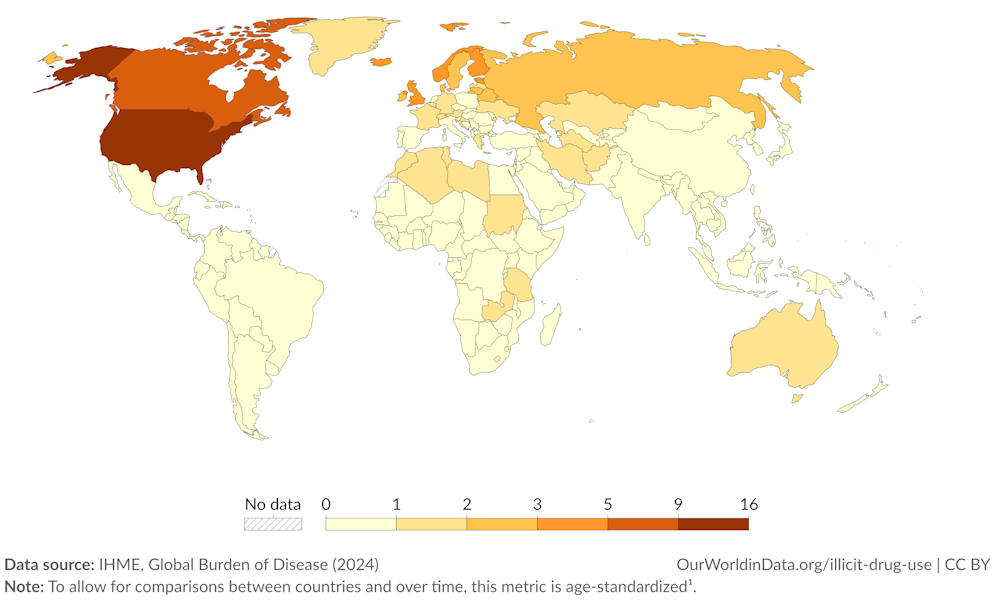
Opioid use death rates around the world:
Estimated deaths from opioid use disorders per 100,000 people in 2021. Our World In Data, CC BY
For the past 15 years, I have researched and advised on the international narcotics industry, especially the Afghan drug trade, as an academic, UK Home Office official and consultant. I’ve observed many shifts within global drug markets, and I believe the increasing availability of synthetic drugs in the UK and Europe may represent a new chapter in illicit drug use here – with the emergence of nitazenes only adding to these concerns.
A brief history of synthetic opioids
New synthetic opioids (NSOs) are one of the fastest-growing groups of new psychoactive substances around the world. The EU Drugs Agency (EUDA) currently monitors 81 NSOs – the fourth-largest group of drugs under observation.
NSOs largely fall into two broad groups: fentanyl and its analogues, and non-fentanyl-structured compounds – these include nitazenes, among many other substances.
Many of these “new” synthetic opioids have, in fact, existed for decades. Nitazenes were first synthesised in the 1950s by the Swiss pharmaceutical company, Ciba Aktiengesellschaft, as pain-relieving analgesics, although they were never approved for medical use.
Prior to 2019, there had only been limited reports of nitazenes in the illegal drug supply – including a “brownish looking powder” found in Italy in 1966; the discovery of a lab in Germany in 1987; several nitazene-related deaths in Moscow in 1998; and a US chemist illegally producing the drug for personal use in 2003. But since nitazenes re-emerged at the end of the last decade, over 20 variants have been discovered.
Paul Janssen, the Belgian chemist who first made fentanyl. Johnson & Johnson
The most common NSO in the illegal drug market, fentanyl, was first synthesised by Belgian chemist Paul Janssen in 1960. Fentanyl, which is roughly 100 times more potent than morphine, was approved in the US in 1968 for pharmaceutical use as an analgesic.
Over the next four decades, however, illegally produced fentanyl resulted in three relatively small outbreaks of deaths in the US. A fourth, larger fentanyl outbreak in Chicago, Detroit and Philadelphia resulted in about 1,000 deaths between 2005 and 2007.
The current US fentanyl crisis started in 2013, expanding to affect much of the country. Between 2014 and 2019, Chinese companies were the main manufacturers of finished fentanyl substances in the US – to combat this, both the Obama and Trump administrations lobbied Beijing to curtail the fentanyl industry.
The Chinese government responded by controlling specific fentanyl analogues. However, every time an analogue was banned, chemists there would slightly adjust the formula to produce a new compound that mirrored the banned substance.
China finally banned all fentanyl-related substances in May 2019, prompting two significant changes in the drug’s supply: a slowdown in the development of new fentanyl analogues, and a reduction in their direct sale to the US from China. Instead, Chinese companies increasingly sent fentanyl precursors to Mexican drug cartels who would synthesise fentanyl (or counterfeit medication) in clandestine labs, before smuggling it across the US border. Consequently, Mexico is now the primary source of fentanyl in the US.
But these supply changes led to another shift in the global drugs arena, as China’s chemical and pharmaceutical businesses – keen to develop new markets – adjusted their focus to producing uncontrolled synthetic substances, including nitazenes. At the same time, they expanded their geographical focus from North America to include Europe and the UK.
The nitazene supply chain
Producing nitazenes is a relatively low-cost exercise. They are largely manufactured in laboratories – both legal and illegal – in China, before being smuggled to the UK and Europe via fast parcel and post networks.
Nitazenes’ high potency means only small quantities are required, making them easier to transport and harder for border officials to detect. Some Chinese vendors have reportedly been offering to hide nitazenes in legitimate goods such as dog food and catering supplies, to circumvent custom controls. All of this decreases the risk to sellers, and lessens the price of doing business.
In March 2024, two China-based sellers operating on the dark web were selling a kilo of nitazene for between €10,000 and €17,000 (£12,000-£20,000). During roughly the same period, a kilo of heroin at the wholesale level in the UK was selling for between £23,000 and £26,000. Once bought, nitazenes are largely used to fortify low-purity heroin, although the drug can also be made into pills.
Video by The Guardian.
Nitazenes are not limited to the dark web. They are widely and openly advertised on the internet, social media and music streaming platforms. In February 2024, one China-based e-commerce site displayed 85 advertisements for nitazenes. Such sites also sell a range of other synthetic drugs, including fentanyl analogues and precursors, xylazines, cannabinoids and methamphetamine.
This means drug dealers in the UK and across the world no longer need to have established connections to underworld figures to source illegal drugs. With a click of a mouse, they can have them delivered to their home address. In this sense, the internet has democratised the drug trade by widening access beyond “traditional” criminals.
In the UK, while the supply of nitazenes is currently assessed as “low”, a number of smaller-scale organised crime groups are importing them to fortify low-purity heroin, before largely dealing it at the “county lines” level. This involves organised crime groups moving drugs – primarily heroin and crack cocaine – across towns, cities and county borders within the UK, using mobile phones or another form of “deal line” to sell to customers.
In November 2023, Leon Brown from West Bromwich was imprisoned for seven years for dealing drugs containing nitazenes – a verdict described as “a great result in our ongoing efforts to tackle county lines drug dealing” by detective sergeant Luke Papps of the South Worcestershire county lines team.
A few larger UK criminal networks have also been involved in nitazene distribution. In October 2023, the police and Border Force conducted raids across north London, arresting 11 people. They dismantled a drug processing site and seized 150,000 tablets containing nitazene – the UK’s largest ever seizure of synthetic opioids – as well as a pill-pressing machine, a firearm, more than £60,000 in cash and £8,000 in cryptocurrency. The police suspected the group had been selling the tablets on the dark web.
Anecdotal reports suggest there have been mixed reactions to the introduction of nitazenes into the illegal drug supply. Richard, a recovering heroin user from Bristol, told Vice magazine that, given their potency, some “people are scared of [nitazenes]” while others are “actively seeking” them.
As has been the case with fentanyl in the US, users build up tolerance and therefore seek stronger doses. Manny, a heroin user from Bristol, told Vice: “I smoked [heroin cut with nitazenes] and it felt like the first time I’d ever taken drugs.”
Video by Vice.
UK-based criminals also use the dark web to export nitazenes abroad. In October 2023, the Australian Border Force identified 22 nitazene discoveries in packages shipped to the country via mail cargo from the UK. British criminals have also trafficked counterfeit medicines containing nitazenes to Ireland and Norway.
Use of nitazenes is now being detected all over the world. Within Europe, Ireland experienced several nitazene outbreaks in 2023-24 while in Estonia, nitazenes now account for a large share of overdose deaths – a trend also seen (to a lesser extent) in Latvia. Preliminary data suggests at least 150 deaths were linked to nitazenes in Europe in 2023.
Nitazenes have also been discovered in fake pain medication such as benzodiazepines, oxycodone and diazepam, which widens the number of people at risk to include those with no opioid tolerance. The death in July 2023 of Alex Harpum, a 23-year-old British student who was preparing for a career as an opera singer, was a stark reminder of the danger of buying fake medicine online that may have been contaminated with nitazenes.
The nitazene ‘boom’ and the global heroin trade
For decades, Afghanistan was the world’s largest opium producer and the source of most of Europe’s heroin. Then in April 2022, the ruling Taliban announced a comprehensive prohibition on the use, trade, transport, production, import and export of all drugs. As a result, poppy cultivation has fallen to historically low levels for a second consecutive year.
While this has not, as yet, translated into a shortage of heroin on European streets, including in the UK and Germany, some indicators suggest a slowdown in heroin supplies to the UK. In the year March 2023-24, the quantity of heroin seized in the UK fell by 54%, from 950kg to 441kg. This is the lowest quantity of heroin seized since 1989, when about 350kg was intercepted.
The NCA assesses that the Taliban ban has created market “uncertainty”. The wholesale price of heroin has increased from roughly £16,000 per kilo prior to the COVID-19 pandemic to about £26,000, while anecdotal reports suggest average heroin purity for users dropped to under 30% (often to 10-20%) in 2024, compared with around 35% in 2023 and 45% in 2022.
Video by UN Story.
Even without the Taliban’s ban, heroin is not easy to produce and supply. Cultivating opium poppy is labour-intensive, taking five or six months. The static nature of opium fields means they are visible and susceptible to eradication; poppy crops can also be negatively affected by blight or drought.
Converting opium into heroin base is also a labour-intensive process that can involve (depending on the production method) at least 17 steps. Acetic anhydride, the main chemical used to convert morphine into heroin, is relatively expensive compared with synthetic precursors. Moreover, heroin is a bulky product, which means it is harder to move in large volumes.
While the relationship between events in opiate-producer countries and the introduction of synthetic opioids to consumer markets should not be overstated, this new type of drug offers economic advantages to criminals whose “sole motivation is greed”.
For decades, Turkish, Kurdish and Pakistani criminal networks have been responsible for importing heroin into the UK. Once in the UK, both Turkish and British groups largely control its wholesale supply, with some participation of Albanian gangs.
To date, there is little evidence to suggest these groups have transitioned to supplying NSOs, including nitazenes. The shifting dynamics in the global drug supply chain, however, could upend traditional markets and the gangs who profit from them.
America’s synthetic drug crisis
The synthetic opioid fentanyl has devastated the US, having been linked to about 75,000 deaths in 2023 alone. It is the primary cause of death for Americans aged 18-49. Canada, too, has experienced a wave of deaths: between January 2016 and June 2024, there were 49,105 apparent opioid deaths there, with fentanyl implicated in a large proportion.
More than 4,300 reports of nitazenes have reached the US National Forensic Laboratory Information System since 2019. They are typically used to fortify fentanyl and other opioids, which can produce a fatal concoction.
Efforts to stem the flow of NSOs, including nitazenes, from China to the US and elsewhere will prove challenging. And even if China does implement stricter controls, other countries could step in to fill the void. According to the Commission on Combating Synthetic Opioid Trafficking:
The overall sizes of these industries, limited oversight efforts and political incentives contribute to an atmosphere of impunity among firms and individuals associated with those industries.
While US and Chinese counter-narcotics cooperation ended in 2022 amid increasing geopolitical tensions, the following November’s summit in Woodside, California, between presidents Joe Biden and Xi Jinping saw them agree to recommence collaboration.
As a result, China recently closed several chemical companies that were shipping fentanyl precursors and nitazenes to the US. These vendors used encrypted platforms and cryptocurrency to conduct the deals, and mislabelled the consignments to try to ensure the substances evaded border controls. China has also outlawed more chemicals and substances, including several nitazene variants.
But President Trump’s imposition of tariffs on imports from China – which sit alongside proposed taxes on imports from Canada and Mexico, in part for supposedly not doing enough to curb the trafficking of fentanyl and its precursors to the US – threatens this counter-narcotics cooperation.
While nitazenes are not yet widely available in the US, their presence within some fentanyl batches is complicating the US opioid crisis – and according to some experts, has the potential to further increase the already shocking number of synthetic opioid-related deaths.
The UK response to nitazenes
Successive UK governments have made tackling NSOs a high priority. Shortly after the most recent nitazene-related deaths were discovered in the UK in summer 2023, the NCA launched Project Housebuilder to lead and coordinate the law enforcement and public health response.
This was soon followed by the establishment of a government-wide Synthetic Opioids Taskforce “to improve…understanding, preparedness and mitigation against this evolving threat”. Chris Philp, then the UK’s combatting drugs minister, stated that “synthetic opioids are at the top of [this government’s] list because of the harm they cause”.
The taskforce has taken a range of measures, such as controlling more NSOs as class A drugs, conducting more intelligence operations at UK borders, widening access to naloxone, and enhancing the UK’s real-time, multi-source drug surveillance system. The government also worked with the US and Canada to learn from their experiences.
Recently, the current UK government banned a further six synthetic opioids and introduced a generic definition of nitazenes as class A drugs. And the UK’s current government, unlike its Conservative predecessor, has also indicated its willingness to consider evidence from the UK’s first drug consumption facility, which recently opened in Glasgow.
Other policy measures worthy of consideration include expanding drug checking services whereby drug users submit drugs to a lab to test what is in them, then are provided with information about the sample. These services offer vital information to the public and authorities about current drug trends.
While there is high uncertainty about what is going to happen next in the UK regarding illicit drug trends, the evolution of the US drug landscape over generations provides some important lessons.
Lessons from the US
The US fentanyl crisis shows drug markets can change quickly with long-lasting consequences. Most heroin on US streets contains – or has been replaced by – fentanyl. According to DEA seizure data, US heroin seizures declined by nearly 70% between 2019 and 2023, whereas fentanyl seizures have increased by 451%.
However, illegal drug markets evolve in different ways and at different paces. In May 1989, Douglas Hogg, a UK Home Office minister, travelled to the US and the Bahamas on a fact-finding mission about crack cocaine, a drug that was predicted to spread from the US to the UK. Upon his return, Hogg noted:
The ethnic, social and economic characters of many of our big cities are very similar to those in the US. If they have a crack problem, why should not we? … The use of crack in Great Britain is likely to develop very substantially over the next few years.
But this “crack invasion”, as some called it, did not materialise in the UK to the extent it had in the US – and the same was true about a predicted wave of methamphetamine use in the UK, which remains low compared with the US.
It is also unlikely the UK and Europe will experience a synthetic opioid crisis on the same scale as the US. The first wave of the US crisis was driven by extensive overprescription of opioids for pain relief. This increased the number of people addicted to opioids, some of whom later turned to heroin, before transitioning to fentanyl. In contrast, large-scale opioid prescriptions have not been a major issue in the UK or Europe, although there is some diversion of legal fentanyl into the illegal drug market in Europe.
Video by The Brookings Institution.
According to Alex Stevens, professor of criminology at the University of Sheffield, another factor differentiating the US and Europe is the provision of drug treatment and harm reduction programmes. Opioid users in Europe, and to a lesser extent in the UK, are much more likely to be in medication-assisted treatment than their US counterparts, thus reducing the number of people at risk. These interventions are reinforced by different socioeconomic factors in much of Europe, such as lower economic inequality, stronger social protections, and better healthcare systems.
None of this, though, means the nitazene threat in the UK and Europe should be underestimated, nor that use and supply of these drugs (and other NSOs) will not increase from its current relatively low base. As the NCA recently warned:
While a zero-tolerance approach from law enforcement, plus advice to users on the heightened dangers, may contain or slow the current uptake, we must prepare for these substances to become widely available, both unadvertised in fortified mixes and in response to user demand as a more potent high.
The future of new synthetic opioids
Predicting the future of NSO use and trafficking is a challenging task. Projections for Europe range from existing opiate stockpiles ensuring that heroin consumer markets remain serviced (assuming the Taliban ban is short-lived), to a heroin shortage which results in more drug dealers turning to NSOs to plug the shortfall, which in turn could lead to lasting changes in European drug markets (as happened in a few countries following the Taliban’s first opium ban in 2000-01).
In such a scenario, it is possible that Turkish criminal networks may exploit their links with Mexico’s Sinaloa cartel to source NSOs. Mexican criminal gangs also operate in Europe, which may increase the likelihood of them trying to open a new NSO market on the continent.
There is also evidence that some Italian criminal organisations have entered the NSO marketplace. In November 2023, Italian authorities announced the seizure of 100,000 doses of synthetic drugs, including fentanyl, as part of operation Painkiller, a joint Italian-American initiative.
Given the many advantages for criminal groups of NSOs, it seems likely they are here to stay. A key question is whether nitazenes (or other NSOs) will supplant traditional heroin as the opioid of choice, as they have done in the US, or remain at relatively low levels in Europe, co-existing with or mixed into the heroin supply.
In December 2023, Paul Griffiths, the EUDA’s scientific director, told Vice: “We’re not seeing much new initiation of heroin use in Europe. So in five to ten years … as heroin users get older and more vulnerable, we’re not going to have much of an opiate problem left.”
But he warned that if heroin use does dry up: “You might then see opioids appearing in other forms and preparations, such as pills, that could potentially become popular among younger age groups who currently do not appear attracted to injecting heroin.”
While previous NSO outbreaks in the UK were relatively short-lived and limited in scale, the most recent nitazene outbreak, which started in summer of 2023, has been more sustained, covered more parts of the UK, and involved more fatalities. The broader trend in Europe also suggests the prevalence and variations of NSOs are increasing at a faster pace than in previous years.
Notwithstanding, nitazene use and supply in the UK currently remains relatively low. In fact, the rate of nitazene-linked deaths – at least those officially reported – decreased between spring 2024 and the end of the year.
In the short term, then, it seems unlikely there will be a nitazene “explosion”. Rather, criminal groups will probably try to increasingly embed nitazenes into the UK drug market at a similar pace to the last 18 months.
However, this situation could change rapidly in future, especially if larger criminal networks involved in heroin importation switch to smuggling NSOs, and there is a genuine shortage of Afghan heroin. This problem would be compounded if drug users start seeking nitazenes, thus creating demand for them.
Either way, the UK government, along with its European partners, should continue to reinforce the whole drug system, to prepare for the worst-case scenario.
To hear about new Insights articles, join the hundreds of thousands of people who value The Conversation’s evidence-based news. Subscribe to our newsletter.
Philip A. Berry does not work for, consult, own shares in or receive funding from any company or organisation that would benefit from this article, and has disclosed no relevant affiliations beyond their academic appointment.
Maps are ubiquitous – on phones, in-flight and car displays, and in textbooks the world over. While some maps delineate and name territories and boundaries, others show different voting blocs in elections, and GPS devices help drivers navigate to their destination.
But no matter the purpose, all maps have something in common: They are political. Making maps is about making decisions about what to omit and what to include. They are subject to selection, classification, abstractions and simplifications. And studying the choices that go into maps, as I do, can reveal different stories about land and the people who claim it as theirs.
Nowhere is this more true than in the contested regions that today include modern-day Israel and the Palestinian territories. Since the establishment of the state of Israel in 1948, different governmental and nongovernmental organizations and political interest groups have engaged in what can best be described as “map wars.”
Maps of the region use the naming of places, the position of borders and the inclusion or omission of certain territories to present contrasting geopolitical visions. To this day, Israel or the Palestinian territories may fall off some maps, depending on the politics of their makers.
This is not exclusive to the Middle East – “map wars” are underway across the globe. Some of the more well-known examples include disputes between Ukraine and Russia, Taiwan and China, and India and China. All are engaged in controversies over the territorial integrity of nation-states.
Israeli Prime Minister Benjamin Netanyahu displays a map of Israel indicating the Golan Heights are inside the state’s borders. Thomas Coex/AFP via Getty Images
A short history of maps
Traditionally, maps have been used to represent cosmologies, cultures and belief systems. By the 17th century, maps that represented spatial relations within a given territory beaome important to the making of nation-states. Such official maps helped annex territories and determine property rights. Indeed, to map a territory meant to know and control it.
More recently, the tools for making maps have become more broadly accessible. Anyone with a computer and internet access can now make and share “alternative maps” that present different visions of a territory and make varied geopolitical claims.
And maps produced in a conflict region, such as Israel and the Palestinian territories, tell a rich story about the relationship between mapmaking and politics.
Mapping the Middle East
During the British Mandate of Palestine from 1917 to 1947, British surveyors mapped the territories to exercise their control over the land and its people. It was an attempt to supersede the more informal Ottoman land claims of the time.
A map shows the shaded areas of the Arab state recommended by the U.N. Special Committee on Palestine in 1947. The unshaded areas are parts of the proposed Jewish state. Underwood Archives/Getty Images
Maps also helped build the Israeli state. Surveyors and planners mapped the land to allocate land rights, and they helped build the state’s infrastructure, including roads and railroads.
But maps also helped create a sense of nationhood. Maps representing a nation’s shape by delineating its national borders are known as “logo” maps. They can enhance feelings of national unity and a sense of national belonging.
Once established, the Israeli state remade the maps of the region. An Israeli Governmental Names Commission came up with Hebrew names to replace formerly Arab and Christian names for different towns and villages on the official map of Israel. At the same time, formerly Palestinian topographies and places were omitted from the map.
Some Palestinian mapmakers, however, continue to make maps that include Palestinian named sites and depict pre-1948 historic Palestine – an area that stretches from River Jordan in the east to the Mediterranean Sea in the west. Such maps are used to advocate for Palestinians’ right to land and foster a sense of national belonging.
A Palestinian woman holds up a map of the British Mandate of Palestine during a protest in Gaza City on Feb. 27, 2020. Mohammed Abed/AFP via Getty Images
At the same time, Palestinian cartographers who work with the Palestinian Authority – the government body that administers partial civil control over Palestinian enclaves in the West Bank – make official maps of the West Bank and Gaza in the hope of establishing a future state of Palestine. They align their maps with United Nations efforts to map the territories according to international law by demarking the West Bank and Gaza as separate from and as occupied by Israel.
After the 1967 war between Israel and its Arab neighbors, Israel occupied the West Bank and Gaza. As a result, map wars intensified, especially between different fractions within Israel. The left-wing “peace camp,” which was dedicated to territorial compromises with the Palestinians, was pitted against an Israeli right wing committed to reclaiming the “Promised Land” for ensuring Israeli security.
Such incompatible geopolitical visions continue to be reflected in the maps produced. “Peace camp” maps adhere to the delineation of the territories according to international law. For example, they include the Green Line – the internationally recognized armistice line between the West Bank and Israel. Official maps produced by the Israeli government, by contrast, stopped delineating the Green Line after 1967.
Broader and border disputes
Not only have different interest groups and political actors used maps of the region to put forth competing geopolitical claims, but maps have also played a central role in sporadic efforts to establish peace in the region.
The 1993 Oslo Accords, for example, relied on maps to provide the framework for Palestinian self-rule in return for security for Israel. The aim was that after a five-year interim period, a permanent peace settlement would be negotiated based on the borders laid out in these maps.
A map of the West Bank with proposed Palestinian-controlled areas in yellow, as per the Oslo II Accords. Wikimedia Commons
Consequently, Palestinian planners and surveyors mapped the territory allocated to a future state of Palestine. With the Oslo Accords promising only a future state – but with its borders and level of sovereignty still uncertain – Palestinian experts nevertheless continue to prepare for governing the territories by mapping them.
The Oslo maps are used to this day to delineate geopolitical visions of Israel and a future state of Palestine that are based on international law. But for many Israelis, the Oslo vision of a two-state solution has died – the attack by Hamas, the Palestinian nationalist political organization that governs Gaza, on Israel on Oct. 7, 2023, was its last blow.
The subsequent war between Israel and Hamas, currently subject to a cease-fire, has from the outset involved maps.
In December 2023, the Israeli military posted an online “evacuation map” that divided the Gaza Strip into 623 zones. Palestinians could go online – provided they have access to electricity and internet in a territory plagued by blackouts – to find out whether their neighborhood was called upon to evacuate. Israeli military commanders used this map to decide where to launch airstrikes and conduct ground maneuvers.
Maps aren’t just for making sense of the past and present – they help people imagine the future, too. And different maps can reveal conflicting geopolitical visions.
In January 2024, for example, various Israeli right-wing and settler organizations organized the Conference for the Victory of Israel. The aim was to plan for resettling Gaza and increase Jewish settlements in the West Bank. Speakers advocated for transferring Palestinians from the Strip to the Sinai through “voluntary emigration.” With Jewish settlers planning for the return to Gaza, and speakers citing both the Bible and Israeli security for justifications, an oversized map showed the location of proposed Jewish settlements.
A man takes a photo with a map showing the Gaza Strip with Jewish settlements during a convention calling to resettle the Gaza Strip on Jan. 28, 2024, in Jerusalem, Israel. Amir Levy/Getty Images
Such maps reveal the desire by some in Israel for a “Greater Israel” – an area described in 1904 by Theodor Herzl, considered the father of modern-day Zionism, as spanning from the brook of Egypt to the Euphrates.
Unsurprisingly, Palestinians make different maps for envisioning the future. Palestine Emerging – a Palestinian and international initiative that brings together various experts, organizations, and funders – uses maps that connect Gaza to the West Bank and the wider region.
A map shows the proposed Gaza-West Bank corridor transport link. Palestine Emerging
Their aim is to transform Gaza into a commercial hub for trade, tourism and innovation and to integrate it into the global economy. Accordingly, maps of urban projects, airports and seaports overlay the cartographic contours of Gaza; and a Gaza-West Bank corridor, which would be sealed for Israeli security, could connect the two geographically separate Palestinian territories.
Such maps reflect the efforts by Palestinian stakeholders to continue surveying the territories that, since the Oslo Accords, were to make up the future state of Palestine.
In a novel twist, U.S. President Donald Trump on Feb. 4, 2025, floated a plan for the U.S. to “take over” Gaza, moving its current inhabitants out and turning the enclave into “”the Riviera of the Middle East.”
Such a move would amount to another attempt to remake borders across the Middle East. It would not, however, end the “map wars” in Israel/Palestine.
This work was supported by the National Science Foundation through the Science and Technology Studies (STS) Program, award #1152322. Any opinions, findings, and conclusions or recommendations expressed in this material are those of the author and do not necessarily reflect the views of the National Science Foundation or any other entity.
Over the past few weeks the new US president, Donald Trump, has repeatedly claimed that the United States should “take back” the Panama Canal and that it should assume control of Greenland – one way or another. He has talked of Canada becoming America’s 51st state and now he even wants to “take over” the Gaza Strip to convert it into a “Riviera” on the eastern Mediterranean.
It’s as if the US president believes that his country should be an empire. In this Trump seems to be emulating China’s Xi Jinping and Vladimir Putin of Russia, leaders he has said he admires and who have themselves shown some clear imperial tendencies in recent years.
Under Putin, Russia has supported secessionist regions, such as Transnistria and Abkhazia, fought wars in Georgia and Ukraine and actively interfered in the affairs of Syria and assorted African countries. In 2022 Russia even launched a full-scale invasion of Ukraine, claiming that Ukraine was historically inseparable from Russia, but that hostile western influences were trying to destroy that unity.
China, meanwhile, has militarised a number of small uninhabited islands in the South China Sea. It has built 27 installations on disputed islands in the Spratly and Paracel island group that are also claimed by other countries including Vietnam, Taiwan, the Philippines and Malaysia. This has prompted a flurry of development, as other countries in the region have raced to establish their own footholds in the disputed, but very resource-rich, region.
Beijing also maintains its claim over Taiwan, which it says is an inalienable part of China which it wants to “come home”.
Empires and nation states
Most people assumed that the age of empires had been relegated to the dustbin of history. But this is by no means a straightforward proposition. Until relatively recently, the rise and fall of empires had dominated much of recorded history. Nation-states only appeared at the end of the 18th century. And as those states rose to prominence many too displayed imperial inclinations.
So the US, fresh from throwing off the yoke of the British empire, wasted little time in expanding its borders westward, acquiring – whether by conquest or purchase – large swaths of new territory in what effectively turned a small group of east coast states into a continental empire.
Meanwhile other newly minted nation-states such as Italy and Germany also aspired to acquire overseas empires and involved themselves, with varying success, building what turned out to be relatively shortlived colonial empires in Africa and elsewhere.
Most traditional dynastic empires, meanwhile, began to adopt various aspects of the nation-state model, such as conscription, legal equality and political participation. The decades following the second world war are often seen by historians as a period of decolonisation by traditional imperial powers such as Britain and France. But the transition from empire to nation-states was far from smooth. Most imperial governments hoped to transform their empires into more egalitarian commonwealths, while retaining a degree of influence.
This they did with varying degrees of success and often under extreme duress, as with France in Algeria and Vietnam, or under great economic pressure, such as with Britain and India. The real age of the nation-state didn’t begin until the 1960s.
The return of empire?
Today, the world consists of about 200 independent countries, the overwhelming majority nation-states. Nonetheless, one could argue that empires – or at least imperial tendencies – have never totally disappeared. France, for instance, frequently interfered in many of its former colonies in Africa. However, these military interventions were not meant to permanently occupy new territories.
Today, imperial tendencies seem to resurface around the world. The past, however, tends not to repeat itself. Massive wars of conquest or attempts to create new overseas empires are unlikely in the immediate future. Most imperial expansions are currently sought close to home.
What is striking is that Putin, Xi and Trump all use fierce nationalist rhetoric to justify their imperialist designs. Putin, as we have seen, claims the indivisibility of Ukraine and Russia and blames “Nazis” for trying to turn Russia’s sister state towards the west. He used it as a justification for invading Ukraine in February 2022.
Xi, in turn, often maintains that Communist China has finally overcome the century of humiliation, in which the country was the plaything of foreign powers. They both seem to yearn for past imperial greatness. The Russian Federation aims to undo the dissolution of the Soviet Union, communist China looks back to the Qing empire. Interestingly, under its increasingly authoritarian leader Recep Tayyip Erdoğan, Turkey – another regional power with imperial inclinations – similarly finds inspiration in the Ottoman Empire.
The US case seems to be more complex, but in fact is very similar. Thus, Trump argues that the Panama Canal, which has long been administered by the US, was foolishly returned to Panama by Jimmy Carter and claims that it is now controlled by China. He will, he says, return it to the US.
Trump also refers to America’s “Manifest Destiny”, the 19th-century belief that American settlers were destined to expand to the Pacific coast. These days his aspirations are northwards rather than to the west. The president also wants to plant the US flag on Mars, taking his imperial dreams into outer space.
If the US joins China and Russia in violating recognised borders, the international, rights-based order could be in danger. The signs are not very positive. Taking steps to illegally annex territories could blow up the entire international edifice.
Eric Storm does not work for, consult, own shares in or receive funding from any company or organisation that would benefit from this article, and has disclosed no relevant affiliations beyond their academic appointment.
Source: The Conversation – USA – By Joseph N. Cooper, Endowed Chair of Sport Leadership and Administration, UMass Boston
On the day after the New England Patriots ended their NFL season with a miserable 4-13 record, team owner Robert Kraft fired Jerod Mayo, the team’s first Black head coach. In a press conference following his decision, Kraft explained that he put Mayo in “an untenable situation” by hiring him to lead an underperforming team.
Kraft’s assessment reflects an all-too-familiar reality for Black coaches in the NFL. Though Black players account for 53% of all NFL players, only 19% of head coaches are Black men.
At the beginning of the 2024 season, the NFL set its own league record with nine of its 32 head coaching jobs held by minorities. In addition to Mayo, Las Vegas’ Antonio Pierce, Pittsburgh’s Mike Tomlin, Tampa Bay’s Todd Bowles, Atlanta’s Raheem Morris and Houston’s DeMeco Ryans are Black. They were joined by Carolina’s Dave Canales, who is Mexican American, Miami’s biracial Mike McDaniel and the New York Jets’ Robert Saleh, who is of Lebanese descent.
By season’s end, three of those coaches were gone, including the Raiders’ Pierce. Pierce, like Mayo, was given one season to turn around a team with a losing record. Saleh was fired during the season.
In my view as a scholar of race and professional sports, the firings revealed the NFL’s double standard for Black head coaches and suggest that Black men are still valued more for their athletic prowess than their leadership skills.
During a Fox NFL Sunday show shortly after Mayo’s firing, former Patriots tight end Rob Gronkowski called Mayo’s firing shocking, disappointing and “unfair.”
ESPN’s Stephen A. Smith was quick to blame the race of Mayo as a factor. “They call it Black Monday for a reason,” Smith said. “Jerod Mayo was clearly not given a lengthy enough opportunity.”
A checkered history
In 1921, a year after the NFL’s inaugural season, Fritz Pollard became the first Black head coach when he was hired to lead the Akron Pros. It would take nearly 70 years before the NFL had its second Black head coach – Art Shell of the Oakland Raiders in 1989.
Since then, Black coaches have had few chances in the NFL. Even fewer have succeeded. Only two Black head coaches have won Super Bowl titles: Tony Dungy of the Indianapolis Colts in 2007 and Mike Tomlin of the Pittsburgh Steelers in 2008.
To address the lack of Black head coaches, the NFL enacted in 2003 what is known as the Rooney Rule, a hiring practice named after Dan Rooney, the former owner of the Pittsburgh Steelers who sat on the NFL’s diversity committee. The rule requires teams to include two minority candidate during the interview process for head coaching jobs and was later applied to general managers, senior executives and assistant coaches.
But even with the rule, the percentage of Black coaches has consistently been lower than the percentage of Black players. Research has shown that Black coaches are both less likely to be promoted to head coaching jobs than their white counterparts and less likely to receive a second chance after a losing season.
In fact, since the Rooney Rule was instituted in 2003, nonwhite coaches have been more than three times as likely to be fired after one season than white coaches, according to data collected by the USA Today NFL Coaches Project.
Their data did not include the scores of Black assistant coaches who are routinely overlooked for their first head coaching jobs.
Eric Bieniemy, for example, shared two Super Bowl championships as offensive coordinator with the Kansas City Chiefs in 2019 and 2022. Given his experience, he was widely expected by NFL analysts to earn a head coaching job.
In order to pursue that goal, Bieniemy left the Chiefs in 2023 to join the Washington Commanders and was a favorite to become the team’s next head coach. But the Commanders were sold at the end of the 2023 season, and the new owners promptly fired him.
Bieniemy is back in the NFL after being hired in February 2025 by the Chicago Bears as their running backs coach, a lower rank than his prior position as offensive coordinator.
The benefit of the doubt
In 2020, the NFL expressed its support for the Black Lives Matter movement by promoting social justice messages on end zones and players’ helmets. The NFL also hired Roc Nation, Hip-Hop mogul Jay-Z’s company, to manage its music and entertainment.
A year later, the NFL formally ended their decades-long practice of race norming in which the league routinely gave Black players lower baseline cognitive ratings than white players in legal actions related to concussions and subsequent dementia.
But those measures, much like the Rooney Rule, have not closed the racial disparities among NFL head coaches and have not stopped white coaches from appearing to be more likely to receive the benefit of the doubt.
Still unresolved is a 2022 lawsuit filed by Black head coach Brian Flores. Despite posting two winning seasons during his three-year tenure, he was fired by the Miami Dolphins. Flores filed a suit against the NFL, the Miami Dolphins and two other NFL teams alleging widespread racial discrimination and hiring practices.
During an interview with reporters before the 2025 Super Bowl, NFL Commissioner Roger Goodell defended the league’s diversity initiatives, saying, “We’ve proven to ourselves that it does make the NFL better.”
Goodell was quick to point out that the NFL’s diversity efforts do not mean a “quota system” in which a certain number of candidates of each race are hired.
“There’s no requirement to hire a particular individual on the basis of race or gender,” Goodell said. “This is about opening that funnel and bringing the best talent into the NFL.”
Joseph N. Cooper does not work for, consult, own shares in or receive funding from any company or organization that would benefit from this article, and has disclosed no relevant affiliations beyond their academic appointment.
ANDOVER, Mass., Feb. 07, 2025 (GLOBE NEWSWIRE) — Byrna Technologies Inc.(“Byrna” or the “Company”) (Nasdaq: BYRN), a personal defense technology company specializing in the development, manufacture, and sale of innovative less-lethal personal security solutions, today reported select financial results for its fiscal fourth quarter (“Q4 2024”) and full year ended November 30, 2024.
Fiscal Fourth Quarter 2024 and Recent Operational Highlights
Surpassed 500,000 launchers sold since inception, just five and a half years after the sale of Byrna’s first launcher in June 2019.
Increased launcher production in the first fiscal quarter of 2025 by 33% to 24,000 launchers a month to meet growing market demand and support operational growth.
Recently opened a new U.S.-based ammunition manufacturing facility in Fort Wayne, Indiana, as part of a re-shoring initiative, significantly expanding Byrna’s domestic production capacity and enhancing the Company’s supply chain for its payload ammunition.
Continued to generate a highly accretive return on ad spend (ROAS) above 5.0X through the celebrity endorsement program for the full year 2024 period, leading to a record $28.0 million of sales for the fourth quarter of 2024.
Added Megyn Kelly, Charlie Kirk, and Lara Trump as celebrity influencers to continue amplifying brand awareness and further support the normalization of its less-lethal solutions, while continuing to optimize marketing spend for maximum impact.
Partnered with the United States Concealed Carry Association (USCCA), gaining access to nearly one million USCCA members to promote less-lethal solutions while introducing Byrna customers to USCCA’s training, education, and self-defense liability insurance offerings.
Opened retail stores in the Greater Nashville Area, Scottsdale, Arizona, and Salem, New Hampshire. Byrna plans to open the Fort Wayne, Indiana store in the coming months.
Signed a Letter of Intent to launch a pilot store-within-a-store program at eleven Sportsman’s Warehouse locations, expanding Byrna’s retail footprint.
Fiscal Fourth Quarter 2024 Financial Results Results compare Q4 2024 to the 2023 fiscal fourth quarter ended November 30, 2023 unless otherwise indicated.
Net revenue for Q4 2024 was $28.0 million, compared to $15.6 million in the fiscal fourth quarter of 2023 (“Q4 2023”). The 79% year-over-year increase was primarily due to the transformational shift in Byrna’s advertising strategy implemented in September 2023 and the resulting normalization of Byrna and the less-lethal space generally.
Gross profit for Q4 2024 was $17.6 million (63% of net revenue), up from $9.0 million (58% of net revenue) in Q4 2023. The increase in gross profit was driven by the increase in the proportion of sales made through the high-margin direct-to-consumer (DTC) channels (Byrna.com and Amazon.com), a reduction in component costs driven through an intensive cost reduction effort focused on “design for manufacturability” spearheaded by Byrna’s engineering team, and the economies of scale resulting from increased production volumes.
Operating expenses for Q4 2024 were $13.5 million, compared to $9.7 million for Q4 2023, an increase of 39%. The increase in operating expenses was driven by an increase in variable selling costs (such as freight and third-party processing fees), increased marketing spend tied to the Company’s celebrity endorsement strategy, and higher payroll expenses in marketing and engineering as the Company has scaled to handle increased sales and production volumes.
Net income for Q4 2024 was $9.7 million, compared to a net loss of ($0.8) million for Q4 2023, a $10.5 million improvement. This increase was driven by higher revenue and a $5.6 million income tax benefit. The tax benefit arose from the release of tax valuation allowances related to net operating loss carryforwards incurred in earlier years and other tax assets.
Adjusted EBITDA1, a non-GAAP metric reconciled below, for Q4 2024 totaled $5.2 million, compared to $0.4 million in Q4 2023.
Cash and cash equivalents at November 30, 2024 totaled $16.8 million compared to $20.5 million at November 30, 2023. The change in cash and cash equivalents is primarily due to an $8.9 million investment in short-term marketable securities to earn a higher yield on Byrna’s unused cash. Adding cash and short-term marketable securities, total funds available were $25.7 million, an increase of $5.2 million compared to November 30, 2023. Inventory at November 30, 2024 totaled $20.0 million compared to $13.9 million at November 30, 2023. The Company has no current or long-term debt.
Fiscal Year 2024 Financial Results Results compare the 2024 fiscal year ended November 30, 2024 to the 2023 fiscal year ended November 30, 2023 unless otherwise indicated.
Net revenue for FY 2024 was $85.8 million, a 101% increase from $42.6 million in the fiscal year ended November 30, 2023 (“FY 2023”), driven by the Company’s strategic shift in advertising, increased brand normalization, and higher DTC sales
Gross profit for FY 2024 was $52.8 million (62% of net revenue), compared to $23.6 million (56% of net revenue) for FY 2023. The increase in gross profit margin was primarily due to a greater proportion of sales through high-margin DTC channels, lower component costs, and economies of scale.
Operating expenses for FY 2024 were $46.1 million, compared to $31.4 million for FY 2023, reflecting a 47% increase to support growth. The increase was driven by higher variable selling costs, expanded marketing efforts, and additional personnel in marketing and engineering.
Net income for FY 2024 was $12.8 million, compared to a net loss of ($8.2) million for FY 2023, a $21.0 million improvement. The increase in net income was driven by higher revenue and included a $5.7 million income tax benefit due to the full release of U.S. tax valuation allowances.
Adjusted EBITDA1 for FY 2024 totaled $11.5 million, compared to a negative ($2.0) million for FY 2023. The increase in adjusted EBITDA was primarily due to an increase in revenue.
Management Commentary Byrna CEO Bryan Ganz stated: “The fourth quarter was the culmination of a remarkable year for Byrna. We successfully generated a record $28.0 million in revenue while also expanding our gross margins to 62.8%. This success allowed us to deliver a 101% increase in revenue from the full year 2023 to 2024 and underscores the overall growth in brand recognition and normalization of the less-lethal space.
“Our marketing strategy, anchored by the continued success of our celebrity influencer program, has continued to be instrumental in driving DTC sales and expanding brand awareness. For 2024, the program maintained a highly accretive return on ad spend (ROAS) above 5.0X, underscoring the effectiveness of this approach in normalizing less-lethal solutions. Building on this foundation, we have been adding a more robust, multi-channel marketing strategy that now includes traditional media such as cable and broadcast networks. This diversification complements our influencer program, which recently welcomed prominent voices like Megyn Kelly, Charlie Kirk, and Lara Trump.
As we execute across multiple channels, we will continue to be disciplined in evaluating partnerships and optimizing ad spend to maximize impact and ROAS. We have prioritized celebrity endorsers who demonstrate strong ROAS and have discontinued partnerships that did not meet our minimum ROAS requirements. To date, the celebrity endorsers who were initially successful have continued to perform well, while those we discontinued never met our ROAS benchmarks. Unfortunately, we did lose one very successful celebrity endorser, Governor Mike Huckabee, due to his appointment as U.S. ambassador to Israel.
“In addition to expanding our online DTC reach, we are making strides in building our brick-and-mortar footprint. With four company-owned stores up and running, we are optimistic that these stores will validate the company-owned store model and open the way to a rollout of Byrna company-owned stores in key markets throughout the United States. Given the high gross margins and the relatively inexpensive operating costs, we believe that these stores can contribute meaningfully to Byrna’s bottom line as they ramp up over the coming quarters. We are also pleased to announce that we have signed a letter of intent to partner with Sportsman’s Warehouse to launch a store-within-a-store model at 11 locations across the United States. Each of these Sportsman’s Warehouse locations will convert their existing archery range into a firing range for customers to experience our launchers, similar to our company-owned stores and premier dealers. If the initial pilot program is successful, Byrna expects to be in 90 more stores by the end of the year, accelerating the rate of our brick-and-mortar presence across the United States.
“To ensure our production keeps pace with our growth initiatives, we have successfully increased launcher production to 24,000 units as of January at our Fort Wayne, Indiana launcher production facility. Additionally, we have begun producing payload ammunition at a new facility in Fort Wayne, located four miles from our launcher production facility. This state-of-the-art manufacturing facility will house eight advanced dousing and welding machines capable of producing both .68 and .61 caliber payload rounds for our existing launchers as well as our anticipated new Compact Launcher. We will also be able to produce .61 caliber fin-tail payload rounds for our Pepper and Max 12-gauge less-lethal rounds. Once fully operational later this year, these eight machines will collectively produce up to 10 million rounds per month, including 1.5 million fin-tail rounds for the 12-gauge platform. We believe the combination of Byrna Pepper and Max 12-gauge rounds, coupled with the Sportsman’s “store-within-a-store” partnership, will help spur the sale of our less-lethal 12-gauge rounds.
The onshoring of ammunition production is part of Byrna’s larger ‘Made in America’ strategy. We remain committed to exiting China by mid-year and aim to source nearly 100% of the components for the Byrna SD, LE, and CL models from U.S. suppliers by the end of 2025. We expect that this transition will insulate us from any potential tariffs, create well-paying jobs for American workers, reduce lead times, and eliminate the risks associated with unreliable foreign suppliers. We expect it will also allow us to market the Byrna as ‘Made in America!’
“Our momentum has carried into the new fiscal year with a strong holiday season in December, including $1.4 million in total product sales on Cyber Monday alone. International adoption has also been robust, particularly in Argentina, where the Cordoba Province committed to purchasing 1.7 million rounds of payload ammunition. This order, which will be shipped in 200,000-round monthly increments through the balance of 2025, reflects the extensive deployment of the 13,500 Byrna launchers purchased by the Cordoba Police Department to apprehend dangerous criminals and maintain the peace.
“Looking ahead, we remain optimistic about our trajectory. The ongoing success of our marketing efforts has resulted in less-lethal becoming a much more widely accepted personal self-defense category. This is allowing us to advertise on an increasing number of cable and social media platforms. We believe that the market for less-lethal weapons among gun owners in the U.S. is in the tens of millions of consumers. This expanding market, along with our growing online presence, expanding retail presence, and increasing international opportunities, reinforces our confidence in the long-term demand for less-lethal weapons as a whole and for Byrna specifically. While the first quarter historically experiences a seasonal slowdown in consumer spending, we expect to achieve strong year-over-year growth as we continue executing our strategic initiatives. We believe that Byrna is well-positioned to generate additional cash and expand profitability in 2025 and beyond.”
Conference Call The Company’s management will host a conference call today, February 7, 2025, at 9:00 a.m. Eastern time (6:00 a.m. Pacific time) to discuss these results, followed by a question-and-answer period.
Toll-Free Dial-In: 877-709-8150 International Dial-In: +1 201-689-8354 Confirmation: 13750859
Please call the conference telephone number 5-10 minutes prior to the start time of the conference call. An operator will register your name and organization. If you have any difficulty connecting with the conference call, please contact Gateway Group at 949-574-3860.
The conference call will be broadcast live and available for replay here and via the Investor Relations section of Byrna’s website.
About Byrna Technologies Inc. Byrna is a technology company specializing in the development, manufacture, and sale of innovative less-lethal personal security solutions. For more information on the Company, please visit the corporate website here or the Company’s investor relations site here. The Company is the manufacturer of the Byrna® SD personal security device, a state-of-the-art handheld CO2 powered launcher designed to provide a less-lethal alternative to a firearm for the consumer, private security, and law enforcement markets. To purchase Byrna products, visit the Company’s e-commerce store.
Forward-Looking Statements This news release contains “forward-looking statements” within the meaning of the securities laws. All statements contained in this news release, other than statements of current and historical fact, are forward-looking. Often, but not always, forward-looking statements can be identified by the use of words such as “plans,” “expects,” “intends,” “anticipates,” and “believes” and statements that certain actions, events or results “may,” “could,” “would,” “should,” “might,” “occur,” or “be achieved,” or “will be taken.” Forward-looking statements include descriptions of currently occurring matters which may continue in the future. Forward-looking statements in this news release include but are not limited to our statements related to our expected sales during 2025, our ability to scale production lines, Byrna’s ability to remain self-sustaining, profitable and cash flow positive, Byrna’s ability to open new retail locations and realize revenue growth from them, the expected scale, timing and benefits of Byrna’s store-within-a-store partnership with Sportsman’s Warehouse, the benefits and continued success of Byrna’s celebrity endorser strategy, Byrna’s ability to re-shore production and cease purchasing parts from China on the anticipated timeline, the expected benefits of re-shoring production, the anticipated growth and potential size of the U.S. less-lethal market, and Byrna’s positioning for sustained growth in 2025 and 2026. Forward-looking statements are not, and cannot be, a guarantee of future results or events. Forward-looking statements are based on, among other things, opinions, assumptions, estimates, and analyses that, while considered reasonable by the Company at the date the forward-looking information is provided, inherently are subject to significant risks, uncertainties, contingencies, and other factors that may cause actual results and events to be materially different from those expressed or implied.
Any number of risk factors could affect our actual results and cause them to differ materially from those expressed or implied by the forward-looking statements in this news release, including, but not limited to, disappointing market responses to current or future products or services; prolonged, new, or exacerbated disruption of our supply chain; the further or prolonged disruption of new product development; production or distribution disruption or delays in entry or penetration of sales channels due to inventory constraints, competitive factors, increased transportation costs or interruptions, including due to weather, flooding or fires; prototype, parts and material shortages, particularly of parts sourced from limited or sole source providers; determinations by third party controlled distribution channels, including Amazon, not to carry or reduce inventory of the Company’s products; determinations by advertisers or social media platforms, or legislation that prevents or limits marketing of some or all Byrna products; the loss of marketing partners; increases in marketing expenditure may not yield expected revenue increases; potential cancellations of existing or future orders including as a result of any fulfillment delays, introduction of competing products, negative publicity, or other factors; product design or manufacturing defects or recalls; litigation, enforcement proceedings or other regulatory or legal developments; changes in consumer or political sentiment affecting product demand; regulatory factors including the impact of commerce and trade laws and regulations; and future restrictions on the Company’s cash resources, increased costs and other events that could potentially reduce demand for the Company’s products or result in order cancellations. The order in which these factors appear should not be construed to indicate their relative importance or priority. We caution that these factors may not be exhaustive; accordingly, any forward-looking statements contained herein should not be relied upon as a prediction of actual results. Investors should carefully consider these and other relevant factors, including those risk factors in Part I, Item 1A, (“Risk Factors”) in the Company’s most recent Form 10-K and Part II, Item 1A (“Risk Factors”) in the Company’s most recent Form 10-Q, should understand it is impossible to predict or identify all such factors or risks, should not consider the foregoing list, or the risks identified in the Company’s SEC filings, to be a complete discussion of all potential risks or uncertainties, and should not place undue reliance on forward-looking information. The Company assumes no obligation to update or revise any forward-looking information, except as required by applicable law.
Investor Contact: Tom Colton and Alec Wilson Gateway Group, Inc. 949-574-3860 BYRN@gateway-grp.com
-Financial Tables to Follow-
BYRNA TECHNOLOGIES INC. Condensed Consolidated Statements of Operations and Comprehensive Income (Loss) (Amounts in thousands except share and per share data) (Unaudited)
For the Three Months Ended
For the Twelve Months Ended
November 30,
November 30,
2024
2023
2024
2023
Net revenue
$
27,979
$
15,640
$
85,756
$
42,644
Cost of goods sold
10,417
6,596
32,984
18,997
Gross profit
17,561
9,044
52,772
23,647
Operating expenses
13,468
9,729
46,101
31,437
INCOME (LOSS) FROM OPERATIONS
4,094
(684
)
6,671
(7,790
)
OTHER INCOME (EXPENSE)
Foreign currency transaction loss
(195
)
(32
)
(576
)
(270
)
Interest income
141
168
1,024
693
Loss from joint venture
–
22
(42
)
(603
)
Other income (expense)
1
27
7
(57
)
INCOME (LOSS) BEFORE INCOME TAXES
4,040
(499
)
7,084
(8,027
)
Income tax benefit
5,634
(330
)
5,708
165
NET INCOME (LOSS)
$
9,674
$
(829
)
$
12,792
$
(8,192
)
Foreign currency translation adjustment for the period
(133
)
205
342
(436
)
Unrealized gain (loss) on marketable securities
65
–
65
–
COMPREHENSIVE INCOME (LOSS)
$
9,606
$
(624
)
$
13,199
$
(8,628
)
Basic net income (loss) per share
$
0.43
$
(0.04
)
$
0.57
$
(0.37
)
Diluted net income (loss) per share
$
0.41
$
(0.04
)
$
0.55
$
(0.37
)
Weighted-average number of common shares outstanding – basic
22,514,644
21,991,313
22,504,938
21,919,624
Weighted-average number of common shares outstanding – diluted
23,754,328
21,991,313
23,139,549
21,919,624
BYRNA TECHNOLOGIES INC. Condensed Consolidated Balance Sheets (Amounts in thousands, except share and per share data)
November 30,
2024
2023
ASSETS
CURRENT ASSETS
Cash and cash equivalents
$
16,829
$
20,498
Accounts receivable, net
2,630
2,945
Marketable Securities
8,904
—
Inventory, net
19,972
13,890
Prepaid expenses and other current assets
2,623
868
Total current assets
50,958
38,201
Deposits for equipment
2,665
1,163
Right-of-use-asset, net
2,452
1,805
Property and equipment, net
3,408
3,803
Intangible assets, net
3,337
3,583
Goodwill
2,258
2,258
Loan to joint venture
—
1,473
Deferred tax asset
5,837
Other assets
1,007
28
TOTAL ASSETS
$
71,922
$
52,314
LIABILITIES
CURRENT LIABILITIES
Accounts payable and accrued liabilities
$
13,108
$
6,158
Operating lease liabilities, current
539
644
Deferred revenue
1,791
1,844
Line of credit
—
—
Notes payable, current
—
—
Total current liabilities
15,438
8,646
Notes payable, non-current
Deferred revenue, non-current
17
91
Operating lease liabilities, non-current
2,098
1,258
Total Liabilities
17,553
9,995
COMMITMENTS AND CONTINGENCIES (NOTE 19)
Preferred stock, $0.001 par value, 5,000,000 shares authorized, no shares issued
—
—
Common stock, $0.001 par value, 50,000,000 shares authorized. 24,168,014 shares issued and 22,002,027 outstanding as of November 30, 2024 and, 24,018,612 shares issued and 21,852,625 outstanding as of November 30, 2023
24
24
Additional paid-in capital
133,030
130,426
Treasury stock (2,165,987 shares purchased as of November 30, 2024 and 2023)
(21,253
)
(17,500
)
Accumulated deficit
(56,783
)
(69,575
)
Accumulated other comprehensive loss
(649
)
(1,056
)
Total Stockholders’ Equity
54,369
42,319
TOTAL LIABILITIES AND STOCKHOLDERS’ EQUITY
$
71,922
$
52,314
Non-GAAP Financial Measures
In addition to providing financial measurements based on generally accepted accounting principles in the United States (GAAP), we provide an additional financial metric that is not prepared in accordance with GAAP (non-GAAP) with presenting non-GAAP adjusted EBITDA. Management uses this non-GAAP financial measure, in addition to GAAP financial measures, to understand and compare operating results across accounting periods, for financial and operational decision making, for planning and forecasting purposes and to evaluate our financial performance. We believe that this non-GAAP financial measure helps us to identify underlying trends in our business that could otherwise be masked by the effect of certain expenses that we exclude in the calculations of the non-GAAP financial measure.
Accordingly, we believe that this non-GAAP financial measure reflects our ongoing business in a manner that allows for meaningful comparisons and analysis of trends in the business and provides useful information to investors and others in understanding and evaluating our operating results, enhancing the overall understanding of our past performance and future prospects.
This non-GAAP financial measure does not replace the presentation of our GAAP financial results and should only be used as a supplement to, not as a substitute for, our financial results presented in accordance with GAAP. There are limitations in the use of non-GAAP measures, because they do not include all the expenses that must be included under GAAP and because they involve the exercise of judgment concerning exclusions of items from the comparable non-GAAP financial measure. In addition, other companies may use other non-GAAP measures to evaluate their performance, or may calculate non-GAAP measures differently, all of which could reduce the usefulness of our non-GAAP financial measure as a tool for comparison.
Adjusted EBITDA
Adjusted EBITDA is defined as net (loss) income as reported in our condensed consolidated statements of operations and comprehensive (loss) income excluding the impact of (I) depreciation and amortization; (ii) income tax provision (benefit); (iii) interest income (expense); (iv) stock-based compensation expense, (v) impairment loss, and (vi) one time, non-recurring other expenses or income. Our Adjusted EBITDA measure eliminates potential differences in performance caused by variations in capital structures (affecting finance costs), tax positions, the cost and age of tangible assets (affecting relative depreciation expense) and the extent to which intangible assets are identifiable (affecting relative amortization expense). We also exclude certain one-time and non-cash costs. Reconciliation of Adjusted EBITDA to net (loss) income, the most directly comparable GAAP measure, is as follows (in thousands):
For the Three Months Ended
For the Twelve Months Ended
November 30,
November 30,
2024
2023
2024
2023
Net Income (Loss)
$
9,673
$
(829
)
$
12,792
$
(8,192
)
Adjustments:
Interest income
(141
)
(168
)
(1,024
)
(693
)
Income tax benefit
(5,634
)
330
(5,708
)
165
Depreciation and amortization
378
341
1,491
1,262
Non-GAAP EBITDA
$
4,276
$
(326
)
$
7,551
$
(7,458
)
Stock-based compensation expense
788
686
3,403
5,375
Severance/Separation/Officer recruiting
93
30
524
82
Non-GAAP adjusted EBITDA
$
5,157
$
390
$
11,478
$
(2,001
)
1 See non-GAAP financial measures at the end of this press release for a reconciliation and a discussion of non-GAAP financial measures.
The Reserve Bank of India (RBI) has, by an order dated February 04, 2025, imposed a monetary penalty of ₹8.30 lakh (Rupees Eight Lakh Thirty Thousand only) on Karur Vysya Bank Limited (the bank) for non-compliance with certain directions issued by RBI on ‘Loan System for Delivery of Bank Credit’. This penalty has been imposed in exercise of powers conferred on RBI under the provisions of Section 47A(1)(c) read with Section 46(4)(i) of the Banking Regulation Act, 1949.
The Statutory Inspection for Supervisory Evaluation (ISE 2023) of the bank was conducted by RBI with reference to its financial position as on March 31, 2023. Based on supervisory findings of non-compliance with RBI directions and related correspondence in that regard, a notice was issued to the bank advising it to show cause as to why penalty should not be imposed on it for its failure to comply with the said directions.
After considering the bank’s reply to the notice and oral submissions made during the personal hearing, RBI found that the following charge against the bank was sustained, warranting imposition of monetary penalty:
The bank failed to ensure that the outstanding ‘loan component’ was at least the specified percentage of the sanctioned fund based working capital limit for certain borrowers.
The action is based on deficiencies in regulatory compliance and is not intended to pronounce upon the validity of any transactions or agreement entered into by the bank with its customers. Further, imposition of monetary penalty is without prejudice to any other action that may be initiated by RBI against the bank.
The Reserve Bank of India (RBI) has, by an order dated February 04, 2025, imposed a monetary penalty of ₹27.30 lakh (Rupees Twenty Seven Lakh Thirty Thousand only) on Federal Bank Limited (the bank) for non-compliance with certain directions issued by RBI on ‘Interest Rate on Deposits’. This penalty has been imposed in exercise of powers conferred on RBI under the provisions of Section 47A(1)(c) read with Sections 46(4)(i) of the Banking Regulation Act, 1949.
The statutory Inspection for Supervisory Evaluation (ISE 2023) of the bank was conducted by RBI with reference to its financial position as on March 31, 2023. Based on the supervisory findings of non-compliance with RBI directions and related correspondence in that regard, a notice was issued to the bank advising it to show cause as to why penalty should not be imposed on it for its failure to comply with the said directions.
After considering the bank’s reply to the notice, additional submissions made by it and oral submissions made during the personal hearing, RBI found that the following charge against the bank was sustained, warranting imposition of monetary penalty:
The bank had opened certain savings deposit accounts in the name of ineligible entities.
This action is based on deficiencies in regulatory compliance and is not intended to pronounce upon the validity of any transaction or agreement entered into by the bank with its customers. Further, imposition of monetary penalty is without prejudice to any other action that may be initiated by RBI against the bank.
The Reserve Bank of India has sanctioned the Scheme of Amalgamation of Pune Commercial Co-operative Bank Ltd., Satara (Maharashtra) with Pimpri Chinchwad Sahakari Bank Maryadit, Pune (Maharashtra). The Scheme has been sanctioned in exercise of the powers conferred under Sub-Section (4) of Section 44A read with Section 56 of the Banking Regulation Act, 1949. The Scheme will come into force with effect from February 10, 2025 (Monday). The branches of Pune Commercial Co-operative Bank Ltd., Satara (Maharashtra) will function as branches of Pimpri Chinchwad Sahakari Bank Maryadit, Pune (Maharashtra) with effect from February 10, 2025.
The Reserve Bank of India has sanctioned the Scheme of Amalgamation of The Citizen Cooperative Bank Limited, Vasco-Da-Gama, Goa with TJSB Sahakari Bank Ltd. The Scheme has been sanctioned in exercise of the powers conferred under sub-section (4) of Section 44A read with Section 56 of the Banking Regulation Act, 1949. The Scheme will come into force with effect from February 10, 2025 (Monday). The branches of The Citizen Cooperative Bank Limited, Vasco-Da-Gama, Goa will function as branches of TJSB Sahakari Bank Ltd. with effect from February 10, 2025.
AI-enabled National Consumer Helpline system set up; gives sector-wise analysis of grievances National Consumer Helpline available as toll-free number “1915” or through web portal
Posted On: 07 FEB 2025 11:36AM by PIB Delhi
In a significant move towards enhancing consumer grievance redressal mechanisms, the Department of Consumer Affairs, under Ministry of Consumer Affairs, Food and Public Distribution, Government of India, has adopted an AI-enabled National Consumer Helpline (NCH) system that offers sector-wise analysis of grievances.
This new technology-driven approach is aimed at improving the speed and efficiency of resolving consumer issues, particularly in the education sector.
As a result of these technological advancements, the number of calls received by NCH has grown more than tenfold, from 12,553 in December 2015 to 1,55,138 in December 2024. This exponential growth reflects the rising confidence of consumers in the helpline. Similarly, the average number of complaints registered per month has surged from 37,062 in 2017 to 1,12,468 in 2024. The monthly average number of grievances registered digitally has increased from 54,893 in the FY 2023-24 to 68,831 in FY 2024-25 (as of December 2024).
The Department therefore, urges all consumers to utilize the National Consumer Helpline accessible via a toll-free number 1915 or web portal https://consumerhelpline.gov.in/user/signup.php for any grievances related to products or services, ensuring that their voices are heard and that their issues are resolved promptly and effectively.
The NCH has seen a remarkable reduction in the grievance disposal time. In 2024, the disposal rate of consumer grievances decreased to 48 days, down from 66.26 days in 2023. This reflects a substantial improvement in the resolution time; ensuring consumer’s concerns are addressed promptly.
A key component of this strategy involves proactively identifying and transitioning companies with the highest number of grievances to ‘convergence partners.’ Once onboarding as a ‘convergence partner’ with NCH, these companies, which have the highest number of unresolved consumer complaints, are required to prioritize swift and effective grievance redressal in collaboration with the NCH. Under its initiative aimed at enhancing consumer welfare and promoting fair trade practices, NCH has successfully surpassed the significant milestone of 1,038 convergence companies to date, up from 263 in 2017.
This initiative has already yielded promising results, especially in sectors such as education, where faster resolution of consumer complaints has become a priority. With NCH’s AI-driven, sector-specific analysis, these convergence partners can now act more effectively and efficiently in resolving consumer issues, thereby enhancing consumer trust and satisfaction. It is a Win-Win situation for both consumers & companies.
As a result of this ongoing initiative, many large companies identified with the highest number of consumer grievances have now become official convergence partners of the National Consumer Helpline. Their inclusion is expected to lead to quicker resolutions and a higher disposal rate of consumer grievances, ultimately benefiting millions of consumers across the country.
The NCH, a vital initiative of Department of Consumer Affairs, Government of India, has proven to be a cornerstone in the effective and timely redressal of consumer grievances. Operating at the pre-litigation stage, the helpline has made significant strides in resolving consumer complaints across a wide range of sectors, including Broadband & Internet, E-commerce, Consumer Durables, Digital Payment Modes, Petroleum, Banking, healthcare, consumer durables, real estate, and automobiles, etc. without requiring consumers to resort to formal legal proceedings.
Below are key highlights that demonstrate the significant impact of the NCH in promoting consumer rights and enhancing the grievance redressal mechanism:
Some of the key success stories includes:
Broadband & Internet: A consumer from West Bengal encountered difficulties in obtaining a refund from an Internet service provider for services that were not availed. After reaching out to the National Consumer Helpline, the issue was resolved promptly. The provider issued a full refund and rectified the consumer’s account. Additionally, other satisfied consumers shared their positive feedback with the department, commending the efficient and effective resolution of their issues.
E-Commerce Sector: A consumer from Karnataka raised an issue regarding the refund and return of a defective product received from an online retailer. Following the intervention of the National Consumer Helpline (NCH), the product was replaced, and a refund was promptly facilitated, enhancing the consumer’s trust in e-commerce platforms. Furthermore, the consumer shared their positive feedback, reflecting their increased trust in NCH 2.0. The review emphasized the effectiveness and reliability of the helpline in resolving issues swiftly and efficiently, further bolstering consumer confidence in the platform’s services.
Consumer Durables: A citizen from Rajasthan reported a major malfunction in a product he had purchased. Despite his continuous requests, the company had failed to address the issue. With the assistance of the National Consumer Helpline (NCH), the product was promptly replaced, and the company issued a formal apology. Furthermore, consumers from different states shared their valuable feedback about the NCH team, praising their professionalism and efficiency in resolving grievances.
Digital Payment Mode: A complaint was raised by a consumer from Delhi who was unable to use his online transaction service, and an amount of Rs. 45,000/- was frozen in his account. After engaging the National Consumer Helpline (NCH), the issue was resolved swiftly, with the bank unfreezing the amount and restoring the consumer’s access to their account. Furthermore, other satisfied consumers shared their positive reviews with the department, praising the efficient and timely intervention by NCH in resolving their grievances.
Petroleum: A buyer in Telangana encountered extra charges that exceeded the MRP when receiving a cylinder he had booked. With the intervention of the National Consumer Helpline (NCH), the issue was swiftly resolved, and the consumer was compensated, safeguarding his rights. Additionally, consumers from various corners of the nation shared their views regarding the operation of NCH 2.0.
Headline: Food 4 Less/Foods Co. and Ralphs Team Up with County of Los Angeles, Federal Emergency Management Agency and Small Business Administration to Support Communities & Businesses Impacted by Wildfires
Food 4 Less/Foods Co. and Ralphs Team Up with County of Los Angeles, Federal Emergency Management Agency and Small Business Administration to Support Communities & Businesses Impacted by Wildfires
Los Angeles, CA – Food 4 Less/Foods Co. and Ralphs Grocery Company are continuing their support for local communities impacted by wildfires through a new partnership with the Federal Emergency Management Agency (FEMA), the Small Business Administration (SBA), and County of Los Angeles. The partnership was developed to provide critical recovery resources for businesses, employees, and residents impacted by the recent wildfires. Resource stations will be set up at Ralphs and Food 4 Less stores in Malibu, Venice, and Pasadena—including the Food 4 Less location closest to the heavily impacted Altadena area, where an estimated 9,400 residential and business structures have been affected.As part of this effort, FEMA and SBA representatives will be stationed at the following store locations to offer direct support between 9AM to 5PM PST until Saturday, February 8, 2025:Food 4 Less: 1329 N Lake Ave, Pasadena, CA 91104Ralphs: 910 Lincoln Blvd, Venice, CA 90291Ralphs: 23841 Malibu Rd, Malibu, CA 90265At these locations, FEMA will provide essential information and resources for individuals and families impacted by the fires, while the SBA will assist affected businesses, homeowners and renters with financial guidance and recovery support.“We know how overwhelming recovery can be after a disaster, and we want people to know they’re not alone,” said Curtis Brown, Federal Coordinating Officer. “By working with Ralphs and Food 4 Less, we’re bringing support directly to the communities that need it most—making it easier for families and businesses to get the help they need to rebuild and move forward.”This initiative is part of Ralphs and Food 4 Less/Foods Co.’s’ broader commitment to disaster recovery efforts, offering impacted associates and community members a direct link to federal assistance. Our primary role is to serve as a key access point for those seeking support.In addition, Bracken’s Kitchen will be on-site at the Pasadena Food 4 Less throughout the week, continuing their mission to provide free, hot meals to those affected by the fires, offering much-needed nourishment and support to the community*.“As a community-driven organization, we are dedicated to helping our associates, customers, and local businesses recover in the wake of these devastating wildfires,” said Salvador Ramirez, corporate affairs manager at Food 4 Less/ Foods Co. and Ralphs Grocery Company. “By teaming up with FEMA and the SBA, we’re ensuring our stores serve as accessible resource hubs for those in need during this challenging time.”In response to the fires, Food 4 Less/Foods Co., Ralphs Grocery Company, and The Kroger Family of Companies (NYSE:KR) have been working to provide essential support, delivering food, water, and supplies to evacuees, firefighters, and first responders. The Kroger Family of Companies is also raising $1 million for disaster relief and recovery, including $500,000 in company matching funds for customer donations to the American Red Cross and Feeding America’s local food banks.*While supplies last.# # #About Food 4 Less/Foods Co.:We are dedicated to our purpose: to Feed the Human Spirit™. Food 4 Less/Foods Co is more than 9,000 associates serving customers in 121 price-impact, warehouse-format supermarkets under the banners Food 4 Less in Southern California, Illinois and Indiana, and Foods Co in Central and Northern California. From the company’s headquarters in Los Angeles County, Food 4 Less is a recognized leader in community service and giving. The company supports Kroger’s Zero Hunger | Zero Waste initiative aimed at ending hunger in our communities and eliminating waste within our company by the year 2025. Food 4 Less is a subsidiary of The Kroger Co., (NYSE:KR), one of the world’s largest retailers, based in Cincinnati, Ohio. For more information about Food 4 Less/Foods Co, please visit our websites at www.food4less.com and www.foodsco.com.About Ralphs Grocery Company:Ralphs Grocery Company is dedicated to our purpose: to Feed the Human Spirit™. We are more than 18,000 associates serving customers in 184 supermarkets across Southern California. From the company’s headquarters in Los Angeles County, Ralphs is a recognized leader in community service and giving. The company supports Kroger’s Zero Hunger | Zero Waste initiative aimed at ending hunger in our communities and eliminating waste within our company by the year 2025. Ralphs is a subsidiary of The Kroger Co., (NYSE:KR), one of the world’s largest retailers, based in Cincinnati, Ohio. For more about Ralphs, please visit our website at www.ralphs.com. brandi.richard… Fri, 02/07/2025 – 00:00
ICAR- CRIDA is working in the Marathwada region of Maharashtra extensively and directly in three different ways with an overall aim to conduct essential and strategic research on dryland agriculture (through All India Coordinated Research Project on Dry Land Agriculture (AICRPDA) and All India Coordinated Research Project on Agro-Meteorology (AICRPAM) centres and utilize its results in the Marathwada Region to assist struggling farmers through National Innovations in Climate Resilient Agriculture – Technology demonstration component (NICRA-TDC):
(1). AICRPDA Parbhani centre located in Marathwada region is working for evaluation and establishment of region-specific crops and cropping systems; rainwater management; nutrient management; energy management; alternate land use management and Rainfed Integrated Farming Systems (RIFS).
(2). AICRPAM Parbhani centre located in Marathwada region is working in the area of resource characterization; establishing crop-weather-insect-pest relationship of major crops in Marathwada region, and dissemination of region based agro-met advisories.
(3). Jalna, Latur and Osmanabad centres of NICRA-TDC through the KVKs situated in the Marathwada region are upscaling the climate resilient technologies in the region under four modules, i.e., natural resource management, crops and cropping system, livestock, village level institutions, capacity building etc. The major technologies which are being upscaled in the region are short duration and drought escaping soybean variety (MAUS-158); short duration pigeonpea variety (BDN-711) for the frequently drought prone regions; stress tolerant variety of safflower (PBNS-12) for receding moisture conditions; stress tolerant rabi sorghum variety (Parbhani Moti); Intercropping systems for stabilizing production and to minimize risk in drought prone-regions for risk minimization in frequently drought prone regions of Maharashtra to assist struggling farmers.
The proposal to establish a mission office in Marathwada region of Maharashtra is not under consideration.
ICAR-IGFRI has developed Fodder Resource Development Plan for Maharashtra including Marathwada Region focused on aiding farmers in distress. This Plan helped in reducing the gap of 31.3% shortage of dry fodder and 59.4% shortage of green fodder in Maharashtra. To further add the forage availability, a policy was developed for Indian Rangeland and Grassland Conservation, Restoration and Sustenance, which helped in rejuvenating the grasslands of Maharashtra.
Further, Two Centres of All India Coordinated Research Project on Forage Crops and Utilization (AICRP-FC&U) supported from ICAR are already working at Pune and Rahuri, to generate and disseminate the technologies for whole of the Maharashtra including Marathwada region on fodder Crops in Rabi and Kharif season on Farmers’ Field.
During the last five years, more than 50 varieties in different fodder crops have been developed and recommended by AICRP-FC&U and ICAR-IGFRI for the cultivation in the different parts of Maharashtra.
This information was given by Minister of State for Agriculture and Farmers Welfare, Shri Bhagirath Choudhary in a written reply in Rajya Sabha today.
The Government through ICAR flagship network project ‘National Innovations in Climate Resilient Agriculture’ (NICRA) develop and promotes climate resilient agricultural technologies in 151 climatically vulnerable districts spread across the country, which are prone to extreme weather conditions like droughts, floods, frost, heatwaves, etc in light of the challenges posed by climate change. Climate resilient technologies viz., climate resilient varieties, intercropping systems, conservation agriculture, crop diversification, agroforestry systems, zero-till sowing, green manuring, integrated farming systems, integrated nutrient and pest management, organic farming, site specific nutrient management, in-situ moisture conservation, protective irrigation, micro irrigation methods etc. have been developed and demonstrated to large number of farmers through farmers’ participatory approach. Further, these technologies have been documented for 23 States and 3 Union Territories and shared with the State departments for further upscaling and convergence with on-going schemes in the States.
To promote Precision Agriculture, ICAR has a Network Program on Precision Agriculture (ICAR-NePPA) working at 16 locations to develop ICT based technologies for accelerated profitable and sustainable system through precise use of inputs. Some of the outcomes of the project related to adopting to climate change/ weather aberrations are as, sensor-based soil and crop health monitoring and precision management of inputs (water and fertilizer) using robotics, IoTs and Data analytics; developed technologies for pest and disease monitoring particularly for rice and cotton crops for value added advisories for real time management.
ICAR operates All India Coordinated Research Programme on Integrated Farming Systems (AICRP-IFS) in 25 States/UTs and All India Network Programme on Organic Farming (AINP-OF) in 16 States to develop sustainable farming practices such as alternate efficient cropping systems, integrated farming systems, organic farming and natural farming to address the challenges posed by climate change. A total of 76 models of integrated farming system (IFS) including 8 integrated organic farming system models for 26 States/UTs and organic farming packages for 80 cropping systems suitable to 16 States have been developed so far.
(c): To help farmers in building resilience against extreme weather events and ensure long-term agricultural sustainability in the country, the Government of India implements National Mission for Sustainable Agriculture (NMSA), which is one of the Missions within the National Action Plan on Climate Change (NAPCC). NMSA has three major components i.e. Rainfed Area Development (RAD); On Farm Water Management (OFWM); and Soil Health Management (SHM). The Government of India provides financial assistance to the states through the NMSA to cope with the adverse impacts of climate change.
Further, Government has introduced flagship yield based Pradhan Mantri Fasal Bima Yojana (PMFBY) along with Restructured Weather Based Crop Insurance Scheme (RWBCIS) from Kharif 2016 to help farmers build resilience against extreme weather events.
Through Technology Demonstration component of NICRA, 6,93,629 farmers were benefitted through technology demonstrations and 6,47,735 farmers were benefitted through 23,613 capacity building programs on climate resilient agriculture.
This information was given by Minister of State for Agriculture and Farmers Welfare, Shri Bhagirath Choudhary in a written reply in Rajya Sabha today.
How can there be a discussion of regionalism v/s nationalism in this country? – VP In recent years, money has been used, and access to the judiciary has been weaponized to promote anti-national sentiments – VP
Today, we need to preserve our cultural philosophy; we are trying to cut the branch on which we are thriving – VP
Vice-President expresses concern over attempts to influence the electoral process within the country
Vice-President inaugurates the third edition of the Karnataka Vaibhava Literature and Cultural Festival
Posted On: 07 FEB 2025 4:38PM by PIB Delhi
The Vice President, Shri Jagdeep Dhankhar, today warned against divisive forces, stating, “I have no hesitation in saying that the challenges we are facing are more serious than even climate change… [Some] people, in the style they are adopting, are creating divisions in a despicable manner. There are many bases for division—caste, regionalism. I don’t understand how there can be a debate about regionalism versus nationalism in this country. How absurd and baseless it is, but when you look at its roots, you will find the hand of anti-national forces.”
राष्ट्र विरोधी ताकतों की शैली घिनौने तरीके से विभाजन पैदा करना है-जाती और क्षेत्रीयता के आधार पर।
मुझे समझ नहीं आता कि इस देश में Regionalism vs Nationalism की चर्चा कैसे हो सकती है ?
हाल के वर्षों में, इन ताकतों ने नए-नए रास्ते अपनाए हैं, धन का उपयोग कर राष्ट्र विरोधी भावना… pic.twitter.com/WCE8hzHyXp
In his address at the inauguration of the third edition of the Karnataka Vaibhava Literature and Cultural Festival at Ranebennur in Karnataka, the Vice President said, “These forces [divisive forces] work in different ways. They have adopted new paths, and on many issues, you will see they turn to the judiciary. I am concerned because our Constitution has given every individual the right in the judicial system, and what is the right? That they can seek the shelter of the court. But in recent years, money has been used to fuel anti-national sentiments, and access to the judiciary has been weaponized in a way that is not happening in any other country.”
देश के अन्दर हमारी चुनावी प्रकिया को एक तरीके से कुप्रभावित करने की चेष्टा उन लोगो द्वारा की जा रही है, जिनकी इसमें भागीदारी नहीं होनी चाहिए, पर उनकी भागीदारी है।
भारत सबसे पुराना और सबसे मजबूत लोकतंत्र है, जो अत्यंत प्रगतिशील एवं जीवंत है। यह संवैधानिक दृष्टि से विश्व का… pic.twitter.com/v8KTCvp4Q0
He further stated, “The forces challenging the nation, trying to create a clash between nationalism and regionalism, must receive a strong response. They want to shake our cultural heritage.”
Emphasizing on the need to preserve the nation’s cultural philosophy, the Vice President said, “On this day, when I look to one side, I see India’s progress through the eyes of the world, through the eyes of the people living within the nation. They are like the feathers of the peacock dancing in the rain… But when I look at the peacock’s feet, I get worried, forced to reflect, and then I feel the need for our cultural philosophy. We are trying to cut the branch on which we are thriving, on which we are sitting.”
Expressing deep concern over attempts to influence the electoral process within the country, the Vice President said, “In the country with the oldest democracy, the strongest democracy, the most progressive democracy, the most vibrant democracy, and constitutionally the only country in the world with a democratic system at every level—village, city, state, or nation; there is an attempt to influence our electoral process in a manner it should not be influenced. This attempt is being made by those who should not even be a part of it, but they are involved. We must, collectively, with strong resolve, develop a mindset.”
India is reckoned as a global favourite destination of investment and opportunity.
IMF से लेकर World bank तक दुनिया की श्रेष्ठतम संस्थाएँ कहती हैं यदि निवेश के लिए कोई चमकता सितारा है जहां आपको अवसर मिल सकता है तो वह भारत है।
Referring to India’s economic progress, he said, “The world’s leading institutions like IMF, World Bank, and others say that if there is any shining star in the world where investment can be made, where opportunities are available, where one can showcase their talent, it is India. India is considered a global favorite destination for investment and opportunities.”