Category: India

  • MIL-OSI Global: From pop songs to baby names: How Simeulue Island’s ‘smong’ narrative evolves post-tsunami

    Source: The Conversation – Indonesia – By Alfi Rahman, Lecturer at Faculty of Social and Political Sciences, Universitas Syiah Kuala, Director of Research Center for Social and Cultural Studies (PRISB) Universitas Syiah Kuala, and Researcher at Tsunami and Disaster Mitigation Research Center (TDMRC), Universitas Syiah Kuala

    Simelulue men gather to perform ‘nandong,’ a traditional local song. (Jihad fii Sabilillah/Youtube), CC BY

    20 years have passed since the Aceh tsunami, leaving deep scars on Indonesia, especially for those directly affected. Aceh was also recovering from a three-decade armed conflict between the Free Aceh Movement and the national government

    Throughout December 2024, The Conversation Indonesia, in collaboration with academics, is publishing a special edition honouring the 20 years of efforts to rebuild Aceh. We hope this series of articles preserves our collective memory while inspiring reflection on the journey of recovery and peace in the land of ‘Serambi Makkah.’


    Off the southern coast of Aceh lies Simeulue, a small island with a powerful story of survival. When the devastating Indian Ocean tsunami killed hundreds of thousands across the region in 2004, only five people died on Simeulue — some say just three.

    This remarkable survival was credited to a local wisdom called smong — their term for tsunamis in the Simeulue language — that taught them to read nature’s warning signs and escape to safety.

    Passed down through generations since a previous tsunami struck in 1907, smong describes the signs of an upcoming ghostly wave: a strong earthquake and the receding of seawater. This knowledge becomes a survival guide that directs them to move away from the coast immediately or head to higher ground.

    Two decades after the 2004 disaster, our research shows that this life-saving knowledge is transforming, reflecting broader social shifts and information and communication technology development. It is no longer told only through nafi-nafi (oral storytelling) but adapting to new channels, from traditional songs to pop music and even into children’s names.

    From tradition to transformation

    Our study – spanning from 2016 to 2023 and involving interviews with 18 participants – captures how smong evolves over time. Smong, for instance, finds its way to nandong, Simeulue’s traditional songs that now incorporate lyrics about the life-saving local wisdom. A local artist said:

    After the 2004 tsunami, we adapted the smong story into nandong. This became a new way to convey the ‘smong’ message, ensuring it remains relevant and easy to remember.

    One popular nandong lyric goes:

    Linon uwak-uwakmo (The earthquake rocks you like a cradle)

    Elaik kedang-kedangmo (Thunder beats like a drum)

    Kilek suluh-suluhmo (Lightning flashes like your lamp)

    Smong dumek-dumekmo (The tsunami is your bathing water).

    Video containing song or ‘nandong’ about ‘smong’

    But even as Simeulue’s younger generation embraced modern influences, smong kept up. Local artists began creating pop songs in Devayan, one of the island’s local languages. The catchy tunes brought smong into classrooms, as a 23-year-old local testified:

    I first heard a ‘smong’ song at school. The lyrics were simple but clear. They told me exactly what to do if a tsunami came.

    A children’s tale telling a stort about ‘smong’

    Smong as a symbol of resilience

    Today, smong is more than a safety warning; it symbolises the island’s strength and identity. In some families, smong even lives on in names.

    One grandmother named her grandson “Putra Smong” (smong’s son) as a tribute, saying

    His name reminds us of the wisdom that saved our lives.

    The challenge of preservation

    Despite its transformation, preserving the smong narrative faces challenges that risk eroding this customary knowledge.

    The biggest challenge is the shift in lifestyle and culture among Simeulue’s youth. Today’s younger generation is more familiar with digital technology than oral traditions. A mother said:

    In the past, our elders would tell ‘smong’ stories every evening after Maghrib (dusk) prayers. Now, children are too busy with their gadgets.

    Globalisation also brings external cultural influences, diverting the attention of Simeulue’s youth from the local heritage. Many young people grow up with limited knowledge of traditions like nafi-nafi.

    Another major challenge is the declining use of local languages such as Devayan, Sigulai, and Lekon in daily conversations. Since smong originates from these languages, preserving it relies on their continued use.

    Our observation concludes that the transmission of smong narratives remains sporadic. Its spread often depends on individual or small group initiatives and sometimes awaits external interventions.

    Without concrete efforts, the smong narrative risks fading and being forgotten by future generations. A local activist stated:

    I once proposed building a ‘smong’ monument to remind the younger generation, but the idea has yet to be realised.

    Hope for continuity: Bridging tradition and modernity

    The elders of Simeulue firmly believe that smong is a heritage that must be safeguarded. An 80-year-old community elder expressed his hope for future generations to keep smong alive.

    As long as the ‘smong’ story exists, we will remain safe. But if this story is lost, we will lose our most precious wisdom and treasure.

    To keep smong alive, educators and community leaders are looking to the future. Some propose integrating smong into school curriculum, ensuring every child knows its lessons. A teacher said.

    ‘Smong’ isn’t just a story. It’s a life-saving guide that must be passed on to every generation.

    Technology can also be an important means of preserving the native understa. Digital videos, disaster simulations, and interactive storytelling could bring smong to a tech-savvy audience, making it relevant today.

    As we hope these approaches will bridge the old tradition with modern needs, smong transformation highlights that it is not just a relic from the past. Its narrative must evolve to adapt to the times, ensuring its treasured knowledge remains alive amid social changes.

    In the face of ongoing disaster threats, particularly in Indonesia’s Ring of Fire, smong offers a valuable lesson on how preserving local wisdom can form the foundation for disaster preparedness.

    Alfi Rahman receives funding from the Ministry of Education, Culture, Research and Technology of Indonesia for this research (grant number 0168/E5/PG.02.00.PL/2023 and 094/E5/PG.02.00.PL/2024).

    Muzayin Nazaruddin tidak bekerja, menjadi konsultan, memiliki saham, atau menerima dana dari perusahaan atau organisasi mana pun yang akan mengambil untung dari artikel ini, dan telah mengungkapkan bahwa ia tidak memiliki afiliasi selain yang telah disebut di atas.

    ref. From pop songs to baby names: How Simeulue Island’s ‘smong’ narrative evolves post-tsunami – https://theconversation.com/from-pop-songs-to-baby-names-how-simeulue-islands-smong-narrative-evolves-post-tsunami-246153

    MIL OSI – Global Reports

  • MIL-OSI Economics: ADB, Vastu Housing Finance to Enhance Access to Affordable and Sustainable Housing in India

    Source: Asia Development Bank

    NEW DELHI, INDIA (23 December 2024) – The Asian Development Bank (ADB) and Vastu Housing Finance Corporation Limited (Vastu) have entered into a senior secured loan agreement of up to $70 million to enhance access to affordable and sustainable housing loans in India’s underserved states. This financing will be utilized to provide loans to economically weaker sections and low-income groups, with an emphasis on female borrowers. At least 15% of the funds will be allocated to first-time borrowers.

    “ADB aims to address the critical housing shortage in India while promoting environmentally friendly housing that enhances climate resilience for homeowners by focusing on lower-income households and sustainable housing,” said PSOD Director General Suzanne Gaboury. “This partnership with Vastu illustrates ADB’s commitment to supporting financial inclusion and sustainable development in India, in alignment with the country’s national financial inclusion strategy.”

    According to the Reserve Bank of India, shortfalls of 45 million houses for economically weaker communities and 50 million for low-income groups account for 95% of India’s overall housing deficit. These groups often struggle to access credit due to high mortgage costs and limited credit history. This highlights the necessity for affordable housing finance companies that provide loans to new borrowers and self-employed individuals in rural and semi-urban areas.

    Sandeep Menon, Founder, MD & CEO, Vastu, said, “Vastu is poised to expand our reach and deepen our impact in extending affordable housing finance to the credit-underserved segments, with a focus on women borrowers. We are glad to partner with ADB to further this vision. Together, we aim to bridge the credit gap for India’s emerging middle-class and lower-income households.”

    Vastu is a technology-driven affordable housing finance company that focuses on self-employed customers in growing peri-urban and rural cities and towns. With a strong presence in semi-urban and rural areas, Vastu offers affordable housing loans and loans against property, emphasizing sustainability and financial inclusion.

    ADB is committed to achieving a prosperous, inclusive, resilient, and sustainable Asia and the Pacific, while sustaining its efforts to eradicate extreme poverty. Established in 1966, it is owned by 69 members—49 from the region. 

    MIL OSI Economics

  • MIL-OSI Economics: Directions under Section 35 A read with Section 56 of the Banking Regulation Act, 1949 – Colour Merchants Co-operative Bank Ltd., Ahmedabad – Extension of period

    Source: Reserve Bank of India

    The Reserve Bank of India issued Directions under Section 35A read with Section 56 of the Banking Regulation Act, 1949 to Colour Merchants Co-operative Bank Ltd., Ahmedabad vide Directive AMD.DOS.SSM.No.S1053/11-03-039/2023-2024 dated September 25, 2023, the validity of which was extended up to close of business on December 25, 2024 vide Directive DOR.MON.D-55/12.21.039/2024-25 dated September 24, 2024.

    2. The Reserve Bank of India is satisfied that in the public interest, it is necessary to further extend the period of operation of the Directive beyond close of business on December 25, 2024. Accordingly, the Reserve Bank of India, in exercise of the powers vested in it under sub-section (1) of Section 35A read with Section 56 of the Banking Regulation Act, 1949, hereby extends the Directive for a further period of three months from close of business on December 25, 2024 to close of business on March 25, 2025, subject to review.

    3. All other terms and conditions of the Directive under reference shall remain unchanged.

    (Puneet Pancholy)  
    Chief General Manager

    Press Release: 2024-2025/1761

    MIL OSI Economics

  • MIL-OSI United Kingdom: London set to be undisputed global capital for women’s sport in 2025 as city plays host to the world’s biggest events

    Source: Mayor of London

    • The Women’s Rugby World Cup 2025 final at Twickenham set to have world-record attendance for a one-day women’s rugby event
    • Women’s tennis will return to the Queen’s Club for first time in more than 50 years
    • World class women’s cricket, football, netball, hockey, basketball and athletics also feature on packed sporting events calendar in London next year


    The Mayor of London, Sadiq Khan has today declared that London is set to be the undisputed global capital for women’s sport in 2025, with some of the world’s biggest sporting events to be hosted in the capital next year.

    The final in London is set to have a world-record attendance for a one-day women’s rugby event, with demand outstripping the supply of tickets for the Twickenham showpiece. Attendance is expected to top both the 58,498 who watched England beat France at the same venue in 2023 and the 66,000 at the Stade de France for the women’s Olympic sevens at Paris 2024. In total, more than 220,000 tickets have already been sold for the tournament, ensuring it will be the best attended in history.

    Ahead of the Women’s Rugby World Cup, Twickenham will host one of the biggest matches in the 2025 Guinness Women’s Six Nations Rugby as England face France on 26 April, in a clash of the two highest ranked teams in the tournament.

    Another major milestone for women’s sport next year will be the return of a women’s tennis tournament to the iconic Queen’s Club for the first time in more than 50 years. The new Women’s WTA 500 event begins on 9 June, with former British No.1 and Olympic Silver medallist Laura Robson appointed as Tournament Director. The tournament will be held shortly ahead of the prestigious 2025 Wimbledon Championships at the All England Lawn Tennis Club, where the world’s best women’s and men’s tennis players will compete for the for the biggest prize in the sport.

    In cricket, England Women face India in a highly anticipated clash between two of the world’s best sides. They will compete in a T20 International at The Kia Oval on 4 July, ahead of a One Day International (ODI) on 19 July at Lord’s, the Home of Cricket. The first ever Vitality Blast Women’s Finals Day will take place at The Kia Oval on 27 July while The Hundred competition is scheduled to take place across August, where London has two women’s teams – the Oval Invincibles (based at The Kia Oval) and London Spirit (based at Lord’s).

    The summer will also see the return of world class athletics to London Stadium as the 2025 London Athletics Meet is staged on 19 July as part of the Wanda Diamond League series. The 2024 event was a sell out for a second year in a row and featured international superstars including Dina Asher-Smith, Keely Hodgkinson and Femke Bol, with a world class line up expected again this year.

    London remains the world’s top destination for women’s football. On 26 February the England Lionesses, the current European Champions, will host reigning World Champions Spain at Wembley Stadium in a repeat of the 2023 FIFA Women’s World Cup final. The Adobe Women’s FA Cup final will take place at the same venue on 18 May.

    London teams also make up almost half of the Barclays Women’s Super League (WSL). Arsenal, Chelsea, Crystal Palace, Tottenham Hotspur and West Ham United are all currently competing in the 24/25 WSL, with the season running until May 2025. After a summer break, the 25/26 WSL season will begin in September.

    The capital is also the best city to watch netball, with the Copper Box on Queen Elizabeth Olympic Park the home of Netball Super League (NSL) team London Pulse. The new NSL season will run from March to July 2025, with the NSL Grand Final taking place at the O2 Arena on 6 July.

    In basketball, the Playoff Finals will also return to the O2 Arena on May 18, where the top teams from the Women’s and Men’s Super League’s will compete for the coveted title.

    Mayor of London, Sadiq Khan said: “I’m so excited that London is set to be the undisputed global capital for women’s sport in 2025, with some of the world’s biggest events coming to our city next year.

    “I am delighted that we will be playing host to the Women’s Rugby World Cup, while we will also see the historic return of women’s tennis to the Queen’s Club. This is in addition to world class women’s cricket, football, netball, hockey, basketball and athletics in the capital.

    “I would urge Londoners to take up the opportunity to attend some of these amazing events, cheering on our top athletes and sports women. Ensuring London hosts many of the world’s leading sporting events is an important part of our work building a better London for everyone.”

    An estimated six million people attended sporting events across the capital this summer, including the UEFA Champions League Final and European Professional Club Rugby Finals, cementing London’s position as the undisputed sporting capital of the world.*

    Polling from YouGov found that 62 per cent of Londoners feel proud of living in London when major sporting events are hosted, with 72 per cent of 18 to 24-year-olds feeling proud. More than two-thirds (69 per cent) of Londoners think that hosting major sporting events impacts positively on London’s economy.**

    The capital was also crowned the world’s leading sporting events host in the 2024 Global Cities Report as well as the best cultural experience destination.***

    Women’s Rugby World Cup 2025 Managing Director, Sarah Massey said: “With the Women’s Rugby World Cup 2025 set to capture hearts and headlines globally, the anticipation for the tournament is reaching new heights.

    “We’ve seen unprecedented demand for tickets across the tournament and with the iconic Twickenham Stadium hosting the final, fans can expect an unmissable experience and an incredible celebration of women’s rugby on its biggest stage.”

    The FA’s Women’s Technical Director, Kay Cossington said: “2025 is shaping up to be another momentous year for the women’s game and the Lionesses as we look forward to an unmissable EURO in the summer. Before then, the European champions will take on the world champions Spain at Wembley Stadium in February with another bumper crowd expected through the turnstiles.

    “The Lionesses’ fixtures at Wembley are always so special and reminiscent of that memorable July day in 2022 when the team made history by lifting our first major trophy. Away from England, Wembley Stadium will once again play host to the landmark event in the domestic women’s calendar – the Adobe Women’s FA Cup Final. With the final selling out Wembley for the last two seasons in a row, we’re expecting the May 2025 final to be another unmissable showpiece.”

    The FA’s Women’s Technical Director, Kay Cossington said: “2025 is shaping up to be another momentous year for the women’s game and the Lionesses as we look forward to an unmissable EURO in the summer. Before then, the European champions will take on the world champions Spain at Wembley Stadium in February with another bumper crowd expected through the turnstiles.

    “The Lionesses’ fixtures at Wembley are always so special and reminiscent of that memorable July day in 2022 when the team made history by lifting our first major trophy. Away from England, Wembley Stadium will once again play host to the landmark event in the domestic women’s calendar – the Adobe Women’s FA Cup Final. With the final selling out Wembley for the last two seasons in a row, we’re expecting the May 2025 final to be another unmissable showpiece.”

    The All England Lawn Tennis Club Chief Executive, Sally Bolton said: “There is no doubt that London is a sporting powerhouse and 2025 is set to be a year of fantastic women’s sport for the capital. We look forward to playing our part as we welcome the world to Wimbledon for the 138th staging of The Championship with the world’s best tennis players going head to head on the lawns of SW19.”

    The ECB Director of Women’s Professional Game, Beth Barrett-Wild said: “Off the back of another year of extraordinary growth in 2024, we are set for an unmissable summer of women’s cricket in London in 2025.

    “In June, England Women take on India with two huge games here in the capital; in July, the first ever Vitality T20 Blast Women’s Finals Day is coming to the Kia Oval; and across August, The Hundred will be front and centre with The Final at Lord’s.

    “Last year The Hundred once again broke the global record for total attendance at a women’s cricket competition, with 320,000 fans in attendance, we’ll be hoping to see even more fans this year.

    “All this sets the scene for a huge 2026 when we host the ICC Women’s T20 World Cup here in England, with women’s cricket here in London at the centre of a global competition.”

    Netball Super League Managing Director, Claire Nelson said: “We are incredibly excited to bring the Netball Super League Grand Final to The O2 for the very first time in 2025.

    “The O2 is one of the most prestigious arenas in the world and will provide the perfect backdrop to a world class event and an unforgettable experience for fans, players and everyone involved. As we enter a new professional era for League, this event will be a major moment for our sport that will see us continue to push the boundaries to make our events bigger and better than ever before.”

    UK Sport CEO, Sally Munday said: “2025 is going to be a spectacular year for women’s sport in the UK. In particular,  we are incredibly excited about the Women’s Rugby World Cup, which is set to be a big celebration of Women’s sport with huge potential to unite and inspire people right across the UK. The final at Twickenham Stadium promises to be one of the iconic sporting moments of next year.

    “We know that live sport has a unique place in the hearts of the British public. As our nation’s capital, London is a crucial partner in making live sport matter and maintaining the UK’s world-leading reputation for hosting major sporting events. 

    “We look forward to working together with the Mayor and his team to bring more of the biggest and best sporting events in the world to our shores in 2025 and beyond.”

    MIL OSI United Kingdom

  • MIL-OSI Global: House of the Dragon and families fighting for power – it can happen in business too

    Source: The Conversation – UK – By Bingbing Ge, Lecturer in the Department of Entrepreneurship and Strategy, Lancaster University

    While most agree that HBO’s hit fantasy show House of the Dragon (HotD) might be an interesting dive into the chaos of the Middle Ages, less has been said about its lessons for the contemporary business world.

    Though modern laws make sibling rivalries much more civilised (siblings don’t usually kill each other, nor do they have dragons), there are still many similarities between throne-claiming and today’s family battles over business leadership – especially when multiple siblings are involved.

    As a lecturer in entrepreneurship and strategy, I use the show – a prequel to Game of Thrones that sees siblings fighting to inherit their father’s throne – to illustrate the complications in family business succession.

    When succession of leadership in a business becomes an issue, it is important for the family to be clear about their direction. Important, and often difficult, conversations around which legacy, as well as the methods to achieve it, need to be agreed by all family members.

    The issue of succession is known to contribute to tension in famous family businesses, as seen with the Murdoch family. As one of the most prevalent forms of business worldwide, family businesses could certainly try to avoid conflict – and, in HotD’s case, a kingdom dispute – if successions were handled more carefully.

    In the show, King Viserys I Targaryen, played by Paddy Considine, is not a bad ruler, but when it came to succession planning there was so much more he could have done. By the time he had announced his daughter Rhaenyra (played by Emma D’Arcy) as heir, it was perceived that this decision was taken out of desperation, due to there being no male heir.

    Succession planning.

    Family business leaders typically have a stronger sense of ownership of the firm than non-family employees, which sometimes leads them to keep hold of leadership. While this is human nature, it is important for family business leaders, like kings are to their kingdoms, to remember their responsibility to the businesses’ prosperity and stability and to have a clear Plan B.

    The accession of an heir in a family business often sparks wide discussions, like in the case of Alexandre Arnault of luxury goods conglomerate LVMH. He was recently appointed at just 32 years old as deputy CEO of the group’s wines and spirits business Moët Hennessy. In the case of the heir Rhaenyra in HotD, her half-brother challenged her legitimacy to the throne, with strong support from stakeholders, (that is to say, the lords in the show) who believed that a son would make a more legitimate heir.

    In a family business, successors often need to legitimise their position and get the senior managers (like the lords in HotD), employees, and other stakeholders like customers (the “smallfolk” in the show), to accept the transition.

    While there are different stages of succession, research has shown that it extends far beyond the business arena to affect the lives of family members, with conflict spilling into other areas.

    In a family where everyone gets on, a succession can bind the next generations together – to the point where they might even quit jobs with other companies to carry on the family dream. But HotD portrays a dysfunctional family and intense sibling rivalry, as is also the case in another TV show, Succession.

    In HotD, the king’s first son Aegon (played by Tom Glynn-Carney) was groomed to be fearful and even hateful of his half-sister Rhaenyra and her children. The dysfunctional family life went on to haunt the children when succession discussions arose.

    The Targaryen family in HotD was divided by goals – with Viserys’ and Rheanyra’s side aiming to continue the Targaryen reign, and the king’s second wife Alicent (played by Olivia Cooke) and Aegon’s side trying to maintain primogeniture (where succession goes to the first-born child) and purity in the bloodline. Competing goals are often paradoxical and can be unsettling for stakeholders in family businesses.

    The role of women

    In the show, there are instances where the roles and desires of female characters are marginalised. The role of women in family businesses has also traditionally been overlooked.

    But female family business members are often more important than their titles in the business suggest, where their role in the family in maintaining traditions, values and harmony are sometimes more central.

    HotD demonstrates how the sometimes quieter female voices can influence the succession through the use of a variety of strong female characters. This is a helpful resource to illustrate how females might influence strategic decisions in family businesses.

    Women’s influence in the family and its business can sometimes go unrecognised. This could be particularly tricky in situations where multiple siblings (and even wives) are in competition, like the Majid Al Futtaim (MAF) retail and leisure empire, where ten family members had claims on the estate.

    Sibling rivalries and the challenge of female legitimacy in family business succession take centre-stage in HotD. The complex dynamics between heirs vying for power and the struggles faced by women in leadership roles echo the real-world tensions that often unfold in family-owned businesses.

    Viewers may be immersed in the sweeping political dramas of Westeros, but at the same time the series offers important contemporary lessons in managing family legacies, power struggles and succession planning.

    Bingbing Ge does not work for, consult, own shares in or receive funding from any company or organisation that would benefit from this article, and has disclosed no relevant affiliations beyond their academic appointment.

    ref. House of the Dragon and families fighting for power – it can happen in business too – https://theconversation.com/house-of-the-dragon-and-families-fighting-for-power-it-can-happen-in-business-too-237377

    MIL OSI – Global Reports

  • MIL-OSI Global: Repression of climate and environmental protest is intensifying across the world

    Source: The Conversation – UK – By Oscar Berglund, Senior Lecturer in International Public and Social Policy, University of Bristol

    Climate and environmental protest is being criminalised and repressed around the world. The criminalisation of such protest has received a lot of attention in certain countries, including the UK and Australia. But there have not been any attempts to capture the global trend – until now.

    We recently published a report, with three University of Bristol colleagues, which shows this repression is indeed a global trend – and that it is becoming more difficult around the world to stand up for climate justice.

    This criminalisation and repression spans the global north and south, and includes more and less democratic countries. It does, however, take different forms.

    Our report distinguishes between climate and environmental protest. The latter are campaigns against specific environmentally destructive projects – most commonly oil and gas extraction and pipelines, deforestation, dam building and mining. They take place all around the world.

    Climate protests are aimed at mitigating climate change by decreasing carbon emissions, and tend to make bigger policy or political demands (“cut global emissions now” rather than “don’t build this power plant”). They often take place in urban areas and are more common in the global north.

    Four ways to repress activism

    The intensifying criminalisation and repression is taking four main forms.

    1. Anti-protest laws are introduced

    Anti-protest laws may give the police more powers to stop protest, introduce new criminal offences, increase sentence lengths for existing offences, or give policy impunity when harming protesters. In the 14 countries we looked at, we found 22 such pieces of legislation introduced since 2019.

    2. Protest is criminalised through prosecution and courts

    This can mean using laws against climate and environmental activists that were designed to be used against terrorism or organised crime. In Germany, members of Letzte Generation (Last Generation), a direct action group in the mould of Just Stop Oil, were charged in May 2024 with “forming a criminal organisation”. This section of the law is typically used against mafia organisations and had never been applied to a non-violent group.

    In the Philippines, anti-terrorism laws have been used against environmentalists who have found themselves unable to return to their home islands.

    Criminalising protest can also mean lowering the threshold for prosecution, preventing climate activists from mentioning climate change in court, and changing other court processes to make guilty verdicts more likely. Another example is injunctions that can be taken out by corporations against activists who protest against them.

    3. Harsher policing

    This stretches from stopping and searching to surveillance, arrests, violence, infiltration and threatening activists. The policing of activists is carried out not just by state actors like police and armed forces, but also private actors including private security, organised crime and corporations.

    In Germany, regional police have been accused of collaborating with an energy giant (and its private fire brigade) to evict coal mine protesters, while private security was used extensively in policing anti-mining activists in Peru.

    4. Killings and disappearances

    Lastly, in the most extreme cases, environmental activists are murdered. This is an extension of the trend for harsher policing, as it typically follows threats by the same range of actors. We used data from the NGO Global Witness to show this is increasingly common in countries including Brazil, Philippines, Peru and India. In Brazil, most murders are carried out by organised crime groups while in Peru, it is the police force.

    Protests are increasing

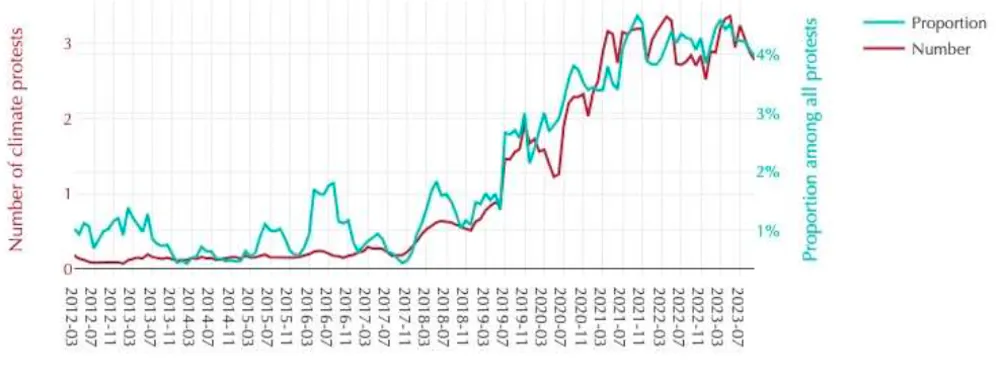
    To look more closely at the global picture of climate and environmental protest – and the repression of it – we used the Armed Conflicts Location Event database. This showed us that climate protests increased dramatically in 2018-2019 and have not declined since. They make up on average about 4% of all protest in the 81 countries that had more than 1,000 protests recorded in the 2012-2023 period:

    Climate protests increased sharply in the late 2010s in the 14 countries studied. (Data is smoothed over five months; number of protests is per country per month.)
    Berglund et al; Data: ACLED, CC BY-SA

    This second graph shows that environmental protest has increased more gradually:

    Environmental protests in the same 14 countries.
    Data: ACLED, CC BY-SA

    We used this data to see what kind of repression activists face. By looking for keywords in the reporting of protest events, we found that on average 3% of climate and environmental protests face police violence, and 6.3% involve arrests. But behind these averages are large differences in the nature of protest and its policing.

    A combination of the presence of protest groups like Extinction Rebellion, who often actively seek arrests, and police forces that are more likely to make arrests, mean countries such as Australia and the UK have very high levels of arrest. Some 20% of Australian climate and environmental protests involve arrests, against 17% in the UK – with the highest in the world being Canada on 27%.

    Meanwhile, police violence is high in countries such as Peru (6.5%) and Uganda (4.4%). France stands out as a European country with relatively high levels of police violence (3.2%) and low levels of arrests (also 3.2%).

    In summary, while criminalisation and repression does not look the same across the world, there are remarkable similarities. It is increasing in a lot of countries, it involves both state and corporate actors, and it takes many forms.

    This repression is taking place in a context where states are not taking adequate action on climate change. By criminalising activists, states depoliticise them. This conceals the fact these activists are ultimately right about the state of the climate and environment – and the lack of positive government action in these areas.

    Oscar Berglund is a member of the Green Party. The report this article is based on was written with Christina Pantazis, Chris Rossdale and Roxana Pessoa Cavalcanti.

    Tie Franco Brotto does not work for, consult, own shares in or receive funding from any company or organisation that would benefit from this article, and has disclosed no relevant affiliations beyond their academic appointment.

    ref. Repression of climate and environmental protest is intensifying across the world – https://theconversation.com/repression-of-climate-and-environmental-protest-is-intensifying-across-the-world-246379

    MIL OSI – Global Reports

  • MIL-OSI USA: FACT SHEET: President  Biden Takes Action to Protect American Workers and Businesses from China’s Unfair Trade Practices in the Semiconductor  Sector

    US Senate News:

    Source: The White House
    A resilient and secure supply of foundational semiconductors is critical to U.S. national and economic security.  These semiconductors are essential to key sectors of the U.S. economy, powering cars, medical devices, critical infrastructure, key aerospace and defense systems, and the goods and services we rely on every day.
    The People’s Republic of China (PRC) routinely engages in non-market policies and practices, as well as industrial targeting, of the semiconductor industry that enables PRC companies to significantly harm competition and create dangerous supply chain dependencies in foundational semiconductors.  
    Today, the Biden-Harris Administration is taking additional action to protect American workers and businesses from the PRC’s unfair trade practices in the semiconductor sector and support a healthy domestic industry for foundational semiconductors. 
    These actions include:
    Launching a Section 301 investigation to examine the PRC’s targeting of foundational semiconductors.
    The Office of the U.S. Trade Representative is launching a Section 301 investigation to examine the PRC’s targeting of foundational semiconductors (also known as legacy or mature node chips) for dominance and the impact on the U.S. economy.
    In addition, the investigation will initially assess the impact of the PRC’s acts, policies, and practices on the production of silicon carbide substrates or other wafers used as inputs into semiconductor fabrication.
    PRC semiconductors often enter the U.S. market as a component of finished goods. This Section 301 investigation will examine a broad range of the PRC’s non-market acts, policies, and practices with respect to the semiconductor sector, including to the extent these semiconductors are incorporated as components into downstream products for critical industries like defense, automotive, medical devices, aerospace, telecommunications, and power generation and the electrical grid. 
    Awarding and catalyzing billions of dollars in semiconductor manufacturing projects across the country.
    The Biden-Harris Administration has championed efforts to ensure more chips are made in America by American workers, in particular through CHIPS and Science Act funding, which allocates at least $2 billion for mature semiconductors.  This was a key part of President Biden’s vision for renewing American economic leadership and a vibrant American industrial base.
    The United States is investing across the semiconductor supply chain—including the upstream materials critical to chip manufacturing such as silicon carbide and wafers.  To date, the Department of Commerce has catalyzed billions of dollars in private sector investments that will serve the American auto and defense industries, including the Texas Instruments projects in Texas and Utah, the GlobalFoundries projects in Vermont and New York, and the Bosch project in California.  Many of these investments also include supply agreements with customers across critical infrastructure industries to maximize the predictability, volume, and quality of domestically manufactured chips needed to power complex technology.  These investments are compounded and sustained by this Administration’s 48D Advanced Manufacturing Investment Credit, which will provide up to a 25% tax incentive for the manufacturing of semiconductors, semiconductor manufacturing equipment, and wafer production.
    Reducing national security risks in federal supply chains.
    Semiconductors are key components of U.S. critical infrastructure that have many military applications. It is vital that federal agencies procure secure and trusted chips. 
    To clean up federal procurement of semiconductors, the Biden-Harris Administration is:
    Implementing a statutory provision in the James M. Inhofe National Defense Authorization Act for FY 2023 that prohibits executive agencies from procuring or obtaining products and services that include chips from certain Chinese fabs and other entities of concern.
    Releasing a Request for Information (RFI) to gauge the best ways for government contractors to scale up their use of domestically manufactured chips, particularly for critical infrastructure.  The RFI intends to solicit commercial ideas from industry that may inform future policymaking in support of the government-wide effort to leverage existing manufacturing capacity.
    Issuing guidance to help the Federal Government – the world’s largest buyer – organize its demand for domestic semiconductors so that agencies can mitigate the risk posed by undue dependence on foreign manufacturing, limited competition, and possible higher manufacturing costs.  This effort includes agencies developing strategies to dual or multiple source semiconductors, increasing transparency for critical infrastructure supply chains, and providing the government’s demand for the products and services that use these chips.
    Prioritizing supply chain resilience and bolstering our toolkit to address non-market policies and practices.
    President Biden made supply chain resilience a Day One priority in his Administration.  The first-ever U.S. Government Quadrennial Supply Chain Review, published on December 19, provides an in-depth assessment of the United States’ critical supply chains, actions taken over the last four years to make each supply chain more resilient, and necessary steps to increase U.S. resilience in the future. 
    The Review includes a comprehensive strategy to respond to non-market policies and practices because they pose a significant challenge in critical industries covered in the supply chain report.  The strategy details the types of comprehensive action necessary to combat non-market policies and practices, including procurement policies. 
    Working with our partners around the world to strengthen cooperation on semiconductor supply chains and address shared concerns about China’s unfair practices.
    Semiconductor supply chains are critical not only to the United States but to all of our allies and partners.  The Biden-Harris Administration has closely consulted with allies and partners on promoting economic resilience and addressing the PRC’s non-market practices in the semiconductor supply chain, including through the following efforts:
    The State Department launched the CHIPS and Science Act’s International Technology Security and Innovation (ITSI) Fund, which has thus far partnered with eight countries – Costa Rica, Panama, Vietnam, Indonesia, India, Kenya, the Philippines, and Mexico – to promote semiconductor supply chain development, security, and diversification.
    The Department of Commerce announced the Indo-Pacific Economic Framework for Prosperity (IPEF) Agreement Relating to Supply Chain Resilience with 13 diverse partner countries across the Indo-Pacific, led by the United States, to coordinate more resilient supply chains for semiconductors and other industries.
    Within the G7, the United States has championed efforts to bolster economic resilience and address harmful market distortions and global excess capacity in key sectors resulting from non-market policies and practices.   This led to the establishment of mechanisms to jointly monitor and respond to these detrimental practices, including in the semiconductor sector.  
    President Biden recognizes the benefits for our workers and businesses from strong alliances and a rules-based international trade system based on fair competition.  The Biden-Harris Administration will continue to collaborate with allies and partners on this critical issue in the coming days and weeks.  

    MIL OSI USA News

  • MIL-OSI Economics: Expert Forum on Anti-Corruption in the Age of AI

    Source: Caribbean Development Bank

    Dr. Darran Newman

    Advisor to the Acting President (Ag.), Caribbean Development Bank

    Dr. Darran Newman found the work that was meant for her when she started her development career as a sociologist at the Planning Institute of Jamaica (PIOJ).  Today she is a highly competent international development expert with over 25 years of policy-related and field experience from working with multilateral, bilateral development agencies and government, providing global development leadership.  Her extensive experience in social development included integrating gender equality and social inclusion in development programming and policy processes.

    During the period 1999-2013 she worked with the UK Government’s Department for International Development (renamed FCDO) and the European Commission, carrying out socio-political and poverty analysis, and bringing expertise in promoting gender equality and women’s empowerment to interdisciplinary team working and global research.

    As a social development specialist, she conducted social audits and social impact and gender assessments for agricultural innovation initiatives in India and Central and Western Africa.  Championing gender equality and the rights and empowerment of women and girls was a central part of the social development analytical support for Eastern Europe, Tajikistan, Kyrgzhstan and Southern Africa country programmes.

    Driven by a strong urge to support international development in the Caribbean, in 2013 she returned to the region to join the Caribbean Development Bank (CDB) as Portfolio Manager for the Basic Needs Trust Fund (BNTF).   Subsequently, she led the Bank’s Technical Cooperation Division for 4 years.  Since 2021 she held position of Advisor to the Vice-President (Operations) and more recently holds the position of Advisor to the Acting President.

    One of her major aspirations is to always be a change-maker and work with others to achieve deep and wide systemic change in the Caribbean.

    Darran has always wanted to be in a position where she could help to create better futures especially for children.  This passionate advocacy for children’s rights led her to investigate child policy implementation in Jamaica.  She has a master’s degree in Sociology and completed a PhD in Social Policy.

    Monday December 9

    Time Zone

    America/Barbados

    MIL OSI Economics

  • MIL-OSI USA: N.C. Trails Committee Awards Over $1.24 Million in Federal Grants, Recommends Designations for Access Points on State Paddle Trails

    Source: US State of North Carolina

    Headline: N.C. Trails Committee Awards Over $1.24 Million in Federal Grants, Recommends Designations for Access Points on State Paddle Trails

    N.C. Trails Committee Awards Over $1.24 Million in Federal Grants, Recommends Designations for Access Points on State Paddle Trails
    jejohnson6

    At its December meeting, the North Carolina Trails Committee selected 13 trail development projects and five safety and education projects to receive matching federal grants, the N.C. Division of Parks and Recreation announced. In addition, the committee recommended the official designation of the first access points on the new Haw River State Trail and four accesses on the Yadkin River State Trail.

    “This annual funding from the federal government is key to continuing North Carolina’s distinction as the Great Trails State,” said N.C. Department of Natural and Cultural Resources Secretary Reid Wilson. “Trail improvements, new trail development, and trail safety and education programs help residents and visitors take advantage of healthy and affordable outdoor recreation opportunities.”

    The selected projects include relocation of an off-road vehicle trail to make it more sustainable, updates to a paddle trail access, improvements to greenways, and construction on new trails. The projects range from a little over $54,000 up to the maximum of $100,000, with a total of over $1.2 million. The Safety and Education grants are around $5,000 each, totaling over $24,000.

    In addition, the committee recommended to the DNCR Secretary the approval of the first designated access on the Haw River State Trail, on Brooks Bridge in Rockingham County, along a segment called High Rock Ford. The Haw River State Trail was authorized by the General Assembly in 2023. The committee also recommended official designations for four accesses on the Yadkin River State Trail:

        • The boat access at Morrow Mountain State Park

        • Donnaha Access in Yadkin County

        • Moravian Creek Access in the town of Wilkesboro, and

        • Ronda Memorial Park Access in the town of Ronda.

    Together, these access points will add 13.6 designated miles to the Yadkin River State Trail.

    “We are very excited to continue to make progress on the state trails,” said Division Director Brian Strong. “These accesses allow the public to enjoy two of North Carolina’s beautiful rivers, the Haw and the Yadkin. We appreciate the hard work that our state trail partners and section sponsors have put in to help us grow the state trails network in North Carolina.”

    State trails, a unit of the state parks system, epitomize partnerships. They are composed of multiple connected sections, and each section of the trail is sponsored by a state or federal agency, local government, or private landowner. Section sponsors build, maintain, and manage their section of the trail. Once a segment of trail or access is constructed within the planning corridor of a state trail, the section sponsor must apply for official state trail designation. Until the trail segment is designated, it is not part of the state trail.

    The Division’s Trails Program manages the federal Recreational Trails Program Grant from the Federal Highway Administration. The grant provides funding for construction of new trails, maintenance and repair of existing trails, land acquisition, purchase of trail tools, and planning, legal, environmental, and permitting costs. Safety and Education grants are a subset of the program and are awarded for safety and education instructor fees, speaker fees, displays, signage, and other uses. Federal, state, or local government agencies or qualified nonprofit organizations are eligible to apply for the annual RTP grants.

    The seven-member Trails Committee, appointed by the DNCR Secretary, advise the Trails Program on funding recommendations. Final determination on grant awards is made by the DNCR Secretary. The committee members represent various trail use communities across the state, including hiking, biking, paddling, equestrian, and off-road vehicles.

    The Trails Committee also reviews designation applications for state trails and makes recommendations for the DNCR Secretary’s final approval.

    Grant recipients and awards are as follows:

    Trail Development Projects

    Recipient County Project Name Funds Awarded
    U.S. Forest Service Burke 2024 Brown Mountain Off-Highway Vehicle Area Maintenance – Trail Relocation $100,000
    U.S. Forest Service Burke Brown Mountain OHV Area Mini-Excavator – Trail Equipment $100,000
    Town of Rolesville Wake Granite Acres Greenway Connection Project – New Trail $100,000
    Alamance Parks (on behalf of Friends of Haw River State Trail) Alamance, Guilford, Rockingham Haw River State Trail Paddle and Land Trail Improvements – Greenway Facilities $78,000
    Chatham County Chatham HRST Pegg Tract Improvements – New Trail $100,000
    Blue Ridge Conservancy Ashe Northern Peaks State Trail Three Top Mountain Phase 1 – New Trail $100,000
    Town of Sylva Jackson Pinnacle Park Recreation Trails – New Trail $92,000
    Town of Boone Watauga NPST Rivers House Park – New Trail $54,932
    Town of Rosman Transylvania Rosman Riverfront Park Phase 1 – New Trail $100,000
    Catawba Lands Conservancy Gaston Spencer Mountain Trail Construction – New Trail $100,000
    Cleveland County Water Cleveland Stagecoach Greenway Narrows Segment – New Trail $100,000
    City of Rocky Mount Nash Sunset Park New Multi-Use Natural Surface Trail, Joint Trailhead and Renovation of Sunset Tar River $100,000
    Camp Grier McDowell Woods Mountain Trail Restoration $100,000
        TOTAL $1,224,932

    Safety and Education Grants

    Recipient County Program Name Funds Awarded
    Dan River Basin Association Caswell, Rockingham, Stokes Public Water Safety Classes for Recreational Boaters $5,000.00
    McDowell County McDowell McDowell Trails Tool and Education Fund $4,960.48
    McDowell Tech Community College McDowell McDowell Tech Trail School $5,000.00
    Carolina Mountain Club Buncombe, Haywood, Madison Certification of CMC Sawyers $4,900.00
    Camp Grier McDowell Usability and Sustainability Program for Volunteer Trail Crew $4,988.41
        TOTAL $24,848.89

    About North Carolina State Parks
    North Carolina State Parks manages more than 262,000 acres of iconic landscape within North Carolina’s state parks, state recreation areas and state natural areas. It administers the N.C. Parks and Recreation Trust Fund, including its local grants program, as well as a state trails program, North Carolina Natural and Scenic Rivers and more, all with a mission dedicated to conservation, recreation and education. The state parks system welcomes more than 19 million visitors annually.

    About the North Carolina Department of Natural and Cultural Resources
    The N.C. Department of Natural and Cultural Resources (DNCR) manages, promotes, and enhances the things that people love about North Carolina – its diverse arts and culture, rich history, and spectacular natural areas. Through its programs, the department enhances education, stimulates economic development, improves public health, expands accessibility, and strengthens community resiliency.
    The department manages over 100 locations across the state, including 27 historic sites, seven history museums, two art museums, five science museums, four aquariums, 35 state parks, four recreation areas, dozens of state trails and natural areas, the North Carolina Zoo, the State Library, the State Archives, the N.C. Arts Council, the African American Heritage Commission, the American Indian Heritage Commission, the State Historic Preservation Office, the Office of State Archaeology, the Highway Historical Markers program, the N.C. Land and Water Fund, and the Natural Heritage Program. For more information, please visit www.dncr.nc.gov.
    Dec 20, 2024

    MIL OSI USA News

  • MIL-OSI USA: 399 Sea Turtles Rescued, Rehabilitated and Released Thanks to Community Partnerships

    Source: US State of North Carolina

    Headline: 399 Sea Turtles Rescued, Rehabilitated and Released Thanks to Community Partnerships

    399 Sea Turtles Rescued, Rehabilitated and Released Thanks to Community Partnerships
    jejohnson6

    The North Carolina Aquarium on Roanoke Island has rehabilitated and released 399 sea turtles with the aid of several long-standing community partnerships on the Outer Banks. The turtles were initially brought to the Sea Turtle Assistance and Rehabilitation (STAR) Center at the Aquarium because of cold-stunning, a hypothermia-like condition that occurs when the water temperature drops quickly before the sea turtles can migrate to warmer water.

    More than 135 Aquarium staff and volunteers have worked tirelessly to process intakes and provide care as 553 cold-stunned sea turtles were delivered to the Aquarium between Dec. 1-7, when temperatures on the Outer Banks fell dramatically.

    The response, rescue, and transport of sea turtles during a cold-stun stranding event relies heavily on the Network for Endangered Sea Turtles (N.E.S.T.) and their nearly 25-year partnership with the Aquarium. Throughout this stranding event, the Aquarium, STAR Center, and N.E.S.T. have collaborated with multiple organizations, including Cape Hatteras National Seashore, the N.C. Wildlife Resources Commission, the Outer Banks S.P.C.A. and local veterinarian clinics, Phideaux Fishing vessel, and the U.S. Coast Guard Stations Hatteras Inlet and Fort Macon, Sector North Carolina. Additionally, an outpouring of support has been offered by local groups, individuals, the N.C. Aquarium Society, and partners from the Association of Zoos & Aquariums.

    The hundreds of participants involved in this cold-stun event have provided multi-tiered support including leading logistics, holding sea turtles in the clinic, providing care, and transporting turtles throughout the facility. They provide land and sea transportation for turtle rescues and releases, run laundry, prepare veterinary supplies and salt water, assist with intakes and swim tests, and share updates with stakeholders. Additionally, a concerted effort from all parties has guaranteed the care of caretakers as well, by providing meals to participants and celebrating their time, energy, and commitment to saving sea turtles.

    As of Dec. 17, the Aquarium has received 576 sea turtles which include N.C.’s most common species: loggerhead, green and Kemp’s ridley. The STAR Center is currently caring for approximately 71 animals. Releases are planned for additional dates in December.

    Sea turtles that appear still or sluggish in the sound water or on a beach during winter months should not be pushed back into the water or moved. Instead, a sea turtle that appears to be in distress should be reported to the Sea Turtle Stranding Hotline via N.E.S.T. at 252-441-8622.

    Sea turtles in North Carolina are protected by the federal Endangered Species Act and managed by the N.C. Wildlife Resources Commission. N.C. Aquarium on Roanoke Island operates under NCWRC Sea Turtle Permit #24ST46.

    About the North Carolina Aquarium on Roanoke Island
    The North Carolina Aquarium on Roanoke Island, close to Ft. Raleigh National Historic Site, is open 9 a.m. to 5 p.m. every day except Thanksgiving and Christmas. Admission: ages 3–12, $10.95; ages 13–61, $12.95; ages 62 +, $11.95. Children 2 and under and North Carolina Aquarium Society members are admitted free of charge.

    About the North Carolina Department of Natural and Cultural Resources
    The N.C. Department of Natural and Cultural Resources (DNCR) manages, promotes, and enhances the things that people love about North Carolina – its diverse arts and culture, rich history, and spectacular natural areas. Through its programs, the department enhances education, stimulates economic development, improves public health, expands accessibility, and strengthens community resiliency.
    The department manages over 100 locations across the state, including 27 historic sites, seven history museums, two art museums, five science museums, four aquariums, 35 state parks, four recreation areas, dozens of state trails and natural areas, the North Carolina Zoo, the State Library, the State Archives, the N.C. Arts Council, the African American Heritage Commission, the American Indian Heritage Commission, the State Historic Preservation Office, the Office of State Archaeology, the Highway Historical Markers program, the N.C. Land and Water Fund, and the Natural Heritage Program. For more information, please visit www.dncr.nc.gov.
    Dec 18, 2024

    MIL OSI USA News

  • MIL-OSI USA: Mountain Gateway Museum Opens Temporary Location

    Source: US State of North Carolina

    Headline: Mountain Gateway Museum Opens Temporary Location

    Mountain Gateway Museum Opens Temporary Location
    jejohnson6

    The Mountain Gateway Museum has opened to the public at its temporary location at 78-C Catawba Ave., in Old Fort. Repairs have begun to the museum and grounds following damage from Hurricane Helene. The museum operates Tuesday-Saturday from 9 a.m.-5 p.m., and is closed Sundays and Mondays and all state holidays.

    At the new location, a permanent exhibit on what makes Western N.C. unique to the rest of the state has been installed. From the people who live here to the fauna, flora, agriculture, and more, guests can learn what makes this region special. Visitors also can view a temporary exhibit, “A Place at the Polls,” to learn about the evolution of voting rights in North Carolina.

    For more information, or if you need to contact us, please call us at our new phone number, 828-785-9528, or email us at mgm@dncr.nc.gov.

    About Mountain Gateway Museum
    A regional branch of the North Carolina Museum of History in Raleigh, the Mountain Gateway Museum & Heritage Center (MGM) is the westernmost facility in the N.C. Department of Natural & Cultural Resources’ Division of State History Museums.

    Nestled at the foot of the Blue Ridge Mountains along the banks of historic Mill Creek in downtown Old Fort (McDowell County), the museum uses artifacts, exhibitions, educational programs, living history demonstrations, and special events to teach people about the rich history and cultural heritage of the state’s mountain region, from its original inhabitants through early settlement and into the 20th century.

    As part of its education outreach mission, MGM also assists non-profit museums and historic sites in 38 western NC counties with exhibit development & fabrication, genealogical research, photography archives, traveling exhibitions, and consultations.

    About the North Carolina Department of Natural and Cultural Resources
    The N.C. Department of Natural and Cultural Resources (DNCR) manages, promotes, and enhances the things that people love about North Carolina – its diverse arts and culture, rich history, and spectacular natural areas. Through its programs, the department enhances education, stimulates economic development, improves public health, expands accessibility, and strengthens community resiliency.
    The department manages over 100 locations across the state, including 27 historic sites, seven history museums, two art museums, five science museums, four aquariums, 35 state parks, four recreation areas, dozens of state trails and natural areas, the North Carolina Zoo, the State Library, the State Archives, the N.C. Arts Council, the African American Heritage Commission, the American Indian Heritage Commission, the State Historic Preservation Office, the Office of State Archaeology, the Highway Historical Markers program, the N.C. Land and Water Fund, and the Natural Heritage Program. For more information, please visit www.dncr.nc.gov.
    Dec 19, 2024

    MIL OSI USA News

  • MIL-OSI Security: Attempted Robber Who Shot Elderly Man on the Ute Mountain Ute Reservation Sentenced To More Than 13 Years In Prison

    Source: Office of United States Attorneys

    DURANGO – The U.S. Attorney’s Office for the District of Colorado announces that Lovell Cassius Benallie, age 27, of Kirtland, New Mexico, was sentenced to a total of 166 months in prison for assault with a dangerous weapon and discharging a firearm during a crime of violence on the Ute Mountain Ute Indian Reservation. The prison sentence will be followed by three years of supervised release.

    According to the plea agreement and information presented at sentencing, on August 24, 2023, Benallie and an associate traveled from New Mexico to the Ute Mountain Ute Casino. After gambling, Benallie went to the nearby Ute Mountain Ute Travel Center and approached an elderly Navajo man preparing to use the laundry facility. In an interaction that lasted about eighteen seconds, Benallie said, “give me all your money” and pointed a 9mm gun at the man. When the man replied, “what money” Benallie aimed and fired the gun at the man’s leg. Benallie fled the scene. The victim was airlifted to Grand Junction for medical treatment and suffered serious and enduring injuries.    

    Benallie had several prior felony convictions, including a conviction for aggravated assault with a dangerous weapon in Farmington, New Mexico.

    “The defendant acted callously and purposelessly,” said Acting United States Attorney for the District of Colorado Matt Kirsch. “Gun violence will not be tolerated on the Ute Mountain Ute Reservation and our office reaffirms our intention to vigorously violent crimes on our reservations.”

    “This defendant coldly and callously shot a total stranger during an attempted robbery. Any such act of violence on the Ute Mountain Ute Reservation gets the full attention of FBI Denver,” said Special Agent in Charge Mark Michalek. “In this case we were assisted by the Farmington, New Mexico, Police Department. We will continue to support the Bureau of Indian Affairs and those who live on the reservation by investigating criminal acts and removing the perpetrators from the community.”

    United States District Court Judge Gordon P. Gallagher sentenced the defendant on December 16, 2024.

    The Federal Bureau of Investigation office in Durango conducted the investigation in conjunction with the Bureau of Indian Affairs. Assistant United States Attorney Jeffrey K. Graves handled the prosecution.

    Case Number: 1:23-cr-00383-GPG-JMC-1

    MIL Security OSI

  • MIL-OSI: Unaudited Half-Yearly Financial Report

    Source: GlobeNewswire (MIL-OSI)

    FORESIGHT VENTURES VCT PLC
    (FORMERLY THAMES VENTURES VCT 1 PLC)

    Unaudited Half-Yearly Financial Report
    30 September 2024

    FINANCIAL HIGHLIGHTS

    £72.7m
    Total net assets
    as at 30 September 2024

    1.1p
    Dividend paid
    26 July 2024

    42.1p
    NAV per share
    as at 30 September 2024

    CHAIR’S STATEMENT

    “I present the Company’s unaudited Half-Yearly Financial Report for the six months ended 30 September 2024.”

    Post-period activity
    Before discussing the period to 30 September 2024, I would like to welcome our new Shareholders who have been issued shares in the Company as part of the merger with Thames Ventures VCT 2 plc (“TV2”). The merger completed on 15 November following a General Meeting held on 8 November. As part of the merger, the Company has been renamed Foresight Ventures VCT plc, and TV2 has been placed into members’ voluntary liquidation. I am also pleased to welcome Andrew Mackintosh, previously a director of TV2, who has now been appointed to the Board of the Company following completion of the merger.

    The Company’s Net Asset Value (“NAV”) per share has been reset to 100.0p and the merger has resulted in an enlarged company with net assets of £110 million. The Board believes this will bring a number of benefits to the Company, such as greater scale to raise and deploy capital into new and existing portfolio companies, as well as improved liquidity for dividends and buybacks.

    On 15 November, the Company launched an offer for subscription to raise £5 million (with an over-allotment facility of a further £5 million). The promoter’s fee will be waived for applications made by existing shareholders of any Foresight VCT. New investors, who do not benefit as existing investors but who make an application by 20 December 2024, will, however, benefit from the offer costs being reduced by 1.0% of the amount subscribed.

    Net Asset Value and dividends
    As at 30 September 2024, the Company’s NAV per share stood at 42.1p, a decrease of 4.0p (or 8.7%) over the period. After adding back the dividend paid in the period of 1.1p per share, the decrease was 6.3%.

    The Company’s policy is to seek to pay annual dividends of at least 4% of net assets per annum. During the period, on 26 July 2024, the Company paid an interim dividend of 1.1p, taking total dividends paid in respect of the year ended 31 March 2024 up to 2.1p per share, equivalent to 4.1% of the opening net assets of the previous financial year. This took the total dividends paid since the merger with Downing Absolute Income VCT 1 plc, Downing Absolute Income VCT 2 plc, Downing Income VCT plc, Downing Income VCT 3 plc and Downing Income VCT 4 plc in November 2013 to 47.6p per share.

    The Company offers its Shareholders the opportunity to participate in a Dividend Reinvestment Scheme, whereby they may elect to receive shares, credited as fully paid, instead of receiving dividends in cash. If you wish to participate, please contact the registrar, City Partnership, at the details provided on page 30 of the Unaudited Half-Yearly Financial Report.

    Investment performance and portfolio activity
    A detailed analysis of the investment portfolio performance over the period is given in the Investment Adviser’s Review.

    In brief, during the six months under review, the whole portfolio showed investment valuation losses of £9.4 million. Despite this disappointing overall performance, there were some highlights; a total of £2.9 million of proceeds were received from the sale of Data Centre Response Limited, as well as deferred consideration totalling £0.6 million, producing realised gains of £2.2 million. The Investment Adviser also completed two follow-on investments totalling £1.1 million.

    Responsible investing
    The Board notes the commitment of the Investment Adviser, Foresight Group, to being a “Responsible Investor”. Foresight places environmental, social and governance (“ESG”) criteria at the forefront of its business and investment activities in line with best practice and in order to enhance returns for their investors.

    Further detail can be found on page 17 of the Unaudited Half-Yearly Financial Report.

    Special administration of the Company’s custodian of quoted assets
    As previously reported, since September 2020 the Company has used IBP Capital Markets Limited (“IBP”) as custodian for its quoted investments. Appointing a custodian is a requirement of the FCA, and IBP is an FCA authorised and regulated wholesale broker, providing custody services and access to equity and fixed income securities for non-retail clients (which includes the Company).

    On 13 October 2023, the FCA published a supervisory notice under section 55L(3)(a) of the Financial Services and Markets Act 2000, imposing certain restrictions on IBP. On the same date, IBP applied to the High Court and special administrators were appointed.

    As noted in the Annual Report, on 19 July 2024, around 80% of the quoted investment portfolio was returned to the Company, meaning normal management and trading of these positions was resumed. The remaining 20% will be returned following the conclusion of court proceedings, the timing of which is currently anticipated to take place in the second half of 2025, unless additional claims are submitted or the outcome of the court proceedings in terms of a final distribution is any different. The Company will communicate with Shareholders if there is any new information which materially impacts the numbers presented in this report.

    Share buybacks
    The Company continues to operate a policy of buying in its own shares that become available in the market at a 5% discount to NAV (subject to liquidity and regulatory restrictions). Subsequent to the merger, the Board intends to reduce this target discount to 2.5% in future.

    During the period the Company purchased 5,522,581 shares for cancellation at an average discount of 5.0%, which represented 3.1% of shares in issue at the date of the last Annual Report.

    Share buybacks are timed to avoid the Company’s closed periods. Buybacks will generally take place, subject to demand, during the following times of the year:

    • August, after the Annual Report has been published
    • September, prior to the Half-Yearly reporting date of 30 September
    • January, after the Half-Yearly Report has been published
    • March, prior to the end of the financial year

    The Company retains Panmure Liberum as its corporate broker to assist in operating the share buyback process and ensuring that the quoted spread on the Company’s shares remains at a reasonable level. Contact details for Panmure Liberum are on page 30 of the Unaudited Half-Yearly Financial Report.

    Management charges and performance incentive
    The annual management fee is an amount equal to 2.0% of net assets. There is no change to the management fee or secretarial fee post-merger. From 1 October 2024, the Investment Adviser took over responsibility for management of the Quoted Growth portfolio from Downing LLP. The team at Downing LLP continues to advise the Company on the Yield Focused portfolio under a subcontract agreement with Foresight Group LLP.

    A new performance incentive scheme was formally approved by Shareholders as part of the merger on 15 November 2024. This scheme, in brief, means a performance fee would be payable to the Investment Adviser at the end of each performance period, subject to a total return hurdle. The fee would be equal to the lesser of: (i) 20% of distributions attributable to the relevant performance period; or (ii) 20% of the increase in the total return which is higher than the hurdle. The Board believes this new scheme will provide additional motivation for the Investment Adviser to drive enhanced shareholder value.

    Board composition
    As noted in the Annual Report, Chris Kay resigned as a Director of the Company on 6 June 2024. Post period end, Andrew Mackintosh has joined the Board from TV2 subsequent to the merger. Andrew is chair of UKI2S, a government-backed venture capital fund supporting companies from the UK’s scientific research base. He is a Fellow of the Royal Academy of Engineering and was awarded a CBE in the 2024 New Year Honours for services to Science and Technology, and to Enterprise Development, and we are delighted to have him on board.

    The Board now comprises four Non-Executive Directors, which the Board considers to be an appropriate number for the current size of the VCT. All of the Directors are independent of the Investment Adviser, with the exception of Chris Allner who is considered non-independent by virtue of being a partner at Downing LLP, the previous investment adviser to the Company, which still provides some services to our new Investment Adviser.

    VCT sunset clause
    I am pleased to report that new regulations have been made to extend the UK’s VCT scheme by ten years to April 2035, following the European Commission’s confirmation that they would not oppose the continuation of the scheme. This now removes any recent uncertainty and will help support further investment by the VCT sector in early-stage companies.

    Outlook
    At the date of the merger the Company’s NAV per share had increased to 42.6p, as a result of valuation uplifts in the Quoted Growth portfolio, as well as favourable exchange rates on our US investments. With an offer for subscription now out to raise further funds, in addition to the cash boost on acquiring the assets of TV2, and a refreshed performance incentive scheme to greater motivate the Investment Adviser, we look forward to seeing an increase in deployment to enhance the portfolio and returns to Shareholders. Whilst the macroeconomic environment has been challenging for the last two years, the Investment Adviser is cautiously optimistic that 2025 will provide more positive conditions for our portfolio companies. The downward trajectory of inflation and interest rates should lead to increasing confidence and encourage investors to return to the market.

    Atul Devani
    Chair

    20 December 2024

    INVESTMENT ADVISER’S REVIEW

    “We present our Investment Adviser’s Review for the sixmonth period ended 30 September 2024.”

    Unquoted Growth
    Portfolio summary
    At 30 September 2024, the Company held total unquoted investments of £44.4 million, split £34.5 million Unquoted Growth and £9.9 million Unquoted Yield Focused. Details of the Unquoted Yield Focused portfolio performance are set out on page 8 of the Unaudited Half-Yearly Financial Report.

    The Unquoted Growth portfolio comprises 29 companies, across a range of sectors. Following a challenging period for the year ended 31 March 2024, with the portfolio unfavourably impacted by the downturn of the UK economy, the six months ended 30 September 2024 has been similarly disappointing, resulting in an overall unrealised investment valuation loss of £2.2 million in the portfolio.

    Investment activity
    There were no new investments made during the period ended 30 September 2024. The Company made follow-on investments in two Unquoted Growth companies during the period, totalling £1.1 million:

    FundingXchange Limited (£750,000), a fintech platform delivering SME lenders insights into their portfolios. This investment was made concurrently with a £5.0 million investment from Barclays as part of a £6.0 million round. This transformational investment will allow the company to build on early commercial success and deepen the strategic and commercial relationship with Barclays.

    Rated People Limited (£375,000), an online marketplace connecting homeowners and local tradespeople. This investment allows the strengthened management team to implement the necessary product and operational changes to enable a return to growth and a cash-generative business model.

    There was one realisation during the period ended 30 September 2024:

    DSTBTD Limited (trading as Distributed) was sold for £1 to ILX Group. No proceeds were returned to the Company, which was a disappointing result for the team, but a favourable outcome to an administration process, which was a real possibility after a proposed funding failed to come together.

    Key portfolio developments
    There were some material write downs in the Unquoted Growth portfolio during the period, and some companies have continued to struggle in the challenging macroeconomic environment. However, there have also been some positive movements in valuation. This has resulted in a net total realised and unrealised investment valuation loss of £3.0 million in the period, including £0.7 million in unrealised foreign exchange losses.

    Of the total investment loss, total losses of £6.5 million were offset by gains of £3.5 million. The most significant movements are noted below.

    The largest gain in value was in Ayar Labs, Inc, a silicon photonic chiplet developer used in next-generation AI data centers of the major hyperscalers and cloud-service providers. The valuation increased by £1.9 million, including foreign exchange losses, as a result of a new funding round.

    Other unrealised valuation gains included:

    Rated People Limited, an online marketplace connecting homeowners and local tradespeople, increased in value by £596,000. This was due to a follow-on funding round enhancing the Company’s share of proceeds on any liquidity event. It is also worth noting that the company is now trading profitably and under new leadership.

    Carbice Corporation, Inc has developed a suite of products based on its carbon material, used primarily as thermal management solutions to enable greater thermal conductivity. The valuation increased by £401,000, including foreign exchange losses, as a result of the recent closure of a funding round that increases the prospect of growth and, ultimately, a positive realisation for investors.

    Four other companies in the Unquoted Growth portfolio made up investment valuation gains of £603,000.

    There were also a number of valuation losses reported in the period. The greatest loss was in Cambridge Touch Technologies Ltd, a company developing pressure sensitive multi-touch technology, which reduced in value by £1.9 million as a result of a challenging funding environment for deep tech companies. As noted above, DSTBTD Limited (trading as Distributed) was sold for £1 to ILX Group during the period. No proceeds were returned to the Company, resulting in a realised loss of £775,000.

    Other investment valuation losses included:

    Vivacity Labs Limited, a provider of Artificial Intelligence sensors to monitor and control traffic flows, was written down to nil value in the period, a decrease in value of £960,000, following a new funding round. The investment round (that we chose not to participate in) generated penal terms for shareholders not participating in the funding round and resulted in the write down.

    Masters of Pie Limited, developer of “Radical”, a software solution that enables remote sharing and collaboration on large data sets, was reduced by £700,000 as a result of a challenging period for the company from a trading perspective. It is hoped that this situation will improve in Q4 2024, albeit the position remains challenging.

    Virtual Class Ltd (trading as Third Space Learning), a platform offering personalised online lessons from specialist tutors, decreased in carrying value by £466,000, driven by significant budgetary pressure experienced by UK schools, a key customer group. It is hoped that early international sales (in the US) will somewhat offset challenges in the UK market.

    Parsable, Inc., a provider of software to improve operational efficiencies in the industrial and manufacturing sectors, has seen a valuation decrease of £460,000, including foreign exchange losses. During the period, an offer to acquire Parsable was received that, whilst at a valuation lower than we expected, was accepted by the Board, and the valuation has been aligned with anticipated proceeds.

    Bulbshare Limited, a company that enables brands to build communities from their existing customers to gather consumer insights, was exited post period end. The valuation was reduced by £371,000 in line with the exit proceeds received.

    Trinny London Limited, a multi-channel female beauty and skincare brand, was reduced in value by £354,000 due to a decline in comparable market valuation multiples. Despite this, the business increased revenue during the period and remains profitable.

    CommerceIQ, Inc., the pioneer in helping brands win on retail e-commerce channels, decreased by £221,000 in the period, including foreign exchange losses. Whilst CommerceIQ’s revenues increased during the period, market valuations for similar businesses declined and, consequently, the valuation fall is a reflection of wider market conditions.

    Four other companies in the Unquoted Growth portfolio made up valuation losses of £340,000. Aside from Vivacity Labs Limited, no other investments were written down to nil during the period.

    Post period end activity
    After the period end, the Company completed two new investments totalling £1.6 million into Dragonfly Technology Solutions Ltd (£600,000), a predictive analytics business, and Alison Technologies Ltd (£978,000), a developer of an innovative AI marketing insights tool. The Company also completed two follow-on investments totalling £1.1 million into Maestro Media Limited (£750,000) and Virtual Class Ltd (£300,000). The Company received £1.1 million in proceeds from the exit of Bulbshare Limited in October.

    At the date of the merger, the Unquoted Growth portfolio had seen positive foreign exchange movements totalling £421,000.

    Outlook
    Whilst the macroeconomic environment has been challenging for the last two years, we are cautiously optimistic that 2025 will provide more positive conditions for our portfolio companies. The downward trajectory of inflation and interest rates should lead to increasing confidence and encourage investors to return to the market. From an exit perspective, the IPO market is unlikely to open up in the short term, but we are seeing signs that PE and trade buyers will be more active in 2025, offering potential liquidity opportunities for portfolio companies.

    In addition to the anticipated improved macro environment, we believe the merger with Thames Ventures VCT 2 plc has created a company well placed for success, with a very clear investment mandate (exclusively investing in private technology businesses) and benefiting from more streamlined company reporting and administration.

    Foresight Group LLP
    20 December 2024

    Yield Focused portfolio
    Downing LLP continues to advise the Company on the Unquoted Yield Focused portfolio under a subcontract from Foresight Group LLP.

    Downing presents a review of the Yield Focused portfolio for the six months ended 30 September 2024. At the period end, the Yield Focused portfolio consisted of seven active investments, all of which are unquoted, with a total value of £9.9 million.

    Divestment activity
    During the period, the focus was on investment realisations from the Yield Focused portfolio, which resulted in proceeds of £2.9 million from the exit of Data Centre Response Limited, a provider of power solutions and maintenance services to data centres. There were no new or follow-on investments.

    Realisations in the period ended 30 September 2024

        Total Cost at date Exit Total
        invested of disposal proceeds return
    Company Detail (£) (£) (£) (£)
    Data Centre Response Limited Full disposal 557,441 557,441 2,916,694 2,916,694

    Key portfolio developments
    The Yield Focused portfolio reduced in value by £113,000 during the period, with one company, Data Centre Response Limited, recognising a gain of £494,000 on exit, as noted above, and four companies recognising unrealised losses of £607,000:

    Pilgrim Trading Limited, an operator and owner of two children’s nurseries in West London, decreased in value by £437,000 after two periods of unsuccessful marketing proved the last independent valuation of the business to be unachievable in current market conditions. Consequently, the independent valuation has now been heavily discounted.

    Kimbolton Lodge Limited, a nursing and care home in Bedfordshire, decreased in value by £67,000 to bring the valuation in line with the anticipated proceeds from a sale process that is currently underway.

    Doneloans Limited, which holds a portfolio of secured loans, decreased in value by £67,000 driven by the cost of its own funding marginally exceeding interest receivable from its borrowers.

    SF Renewables (Solar) Limited, which built and operates a solar plant in India, was reduced by £36,000 in line with the exit proceeds received post period end.

    Outlook
    With one exit during the period and another shortly after period end, there were six investments remaining in the Yield Focused portfolio at the time of writing. Downing is actively seeking to progress exits from both Kimbolton Lodge and Pilgrim Trading, though the latter is currently looking less likely to materialise. Given current market conditions, sales of the higher value, hotel-related investments, Baron House Developments and Cadbury House Holdings, are expected to take some time to complete. The recovery of value from Doneloans is linked largely to the sale of Pilgrim Trading, which is the lender’s largest loan, but additional recoveries are anticipated from other borrowers over the next 12 months.

    Downing LLP and Foresight Group LLP
    20 December 2024

    Quoted Growth portfolio
    For the six months to 30 September 2024, Downing LLP continued to advise the Company on the Quoted Growth portfolio under a subcontract from Foresight Group LLP. From 1 October 2024, Foresight Group LLP took on full responsibility for management of the Quoted Growth portfolio.

    Investment activity
    Markets continued to be volatile through the reporting period. The impending Budget dominated market behaviours, particularly the FTSE AIM Index, where fears over an abolition of IHT reliefs on AIM shares adversely affected the market. In the end, this fear was overcooked, and the FTSE AIM All Share rallied 4% on the day of the Budget, as it was announced that reliefs on AIM shares would remain, albeit at half the relief previously enjoyed. Since the Budget, the new concern has been focused on the impact of National Insurance increases, which have weighed heavily on UK Small and Mid-Cap companies. There is a general acceptance that inflation will still be a looming threat and hence interest rates will remain higher for longer.

    There were no investments or realisations made during the six months to 30 September 2024.

    Key portfolio developments
    At 30 September 2024, the Quoted Growth portfolio was valued at £13.4 million, comprising 36 active investments. Over the six-month period, the portfolio produced net valuation losses of £4.7 million, offset by £3.8 million received in dividends from the portfolio. Two companies, valued at £78,000 at year end, have been written down to nil during the period.

    The most significant loss was incurred in Tracsis plc, a provider of transport technology, which saw valuation losses of £2.4 million during the period due to a profit warning, citing delays on rail infrastructure spend incurred due to the early election. This was exacerbated by contract delays in their US business.

    This was offset by valuation gains elsewhere in the portfolio, where Anpario plc, a specialist manufacturer and distributor of natural sustainable feed additives for animal health, nutrition and biosecurity, increased by £680,000 net of £46,000 dividends received, reflecting an improvement in trading post supply chain issues experienced during the inflationary period post covid.

    A net gain of £615,000 was made in Downing Strategic MicroCap Investment Trust plc, where special dividends of £3.7 million were made during the period, as part of the managed wind-down of the Trust. Since the period end, a further special dividend of 2.2p, equating to £133,000, has been received by the Company.

    Meanwhile Cohort plc, the parent company of six businesses providing a wide range of services and products for British, Portuguese and other international customers in defence and security markets, booked an unrealised gain of £558,000. This mirrored profit upgrades, contract renewals and strong financial results. This momentum has continued post period end.

    As at 17 December 2024, the valuation of the Quoted Growth portfolio had decreased by £226,000 (-1.7%).

    IBP Capital Markets Limited
    As noted in the Annual Report, the Company recovered c.80% of its total Quoted Growth portfolio on 19 July 2024, with the remaining c.20% to be recovered following court proceedings, currently anticipated to take place in the second half of 2025. Up until July, the ability to trade the portfolio continued to be restricted and hence there has been limited ability to manage exposures within the portfolio. The Company is now able to trade its positions, having been unable to do so since October 2023.

    Post-period end activity
    Post period end, ahead of the Budget, shares were sold in 14 of the Company’s Quoted Growth portfolio holdings. Notably, holdings in Anpario plc and Craneware plc were reduced, as well as in Impact Healthcare REIT plc, a non-qualifying holding. As previously communicated to Shareholders, the strategy going forward is to realise the Quoted Growth portfolio over time, which will free up funds to be redeployed into Unquoted Growth holdings.

    Outlook
    A number of the Quoted Growth companies in the portfolio have been consistently overoptimistic about hitting milestones for product development, revenues and ultimately profits. Given competition for capital amongst the wider portfolio of venture capital holdings, Foresight took the difficult decision to reduce a number of these positions. Achieving a total sale of individual holdings has not been possible, given that 20% of the Company’s Quoted Growth assets are still tied up in the custodian IBP Capital Markets Limited (“IBP”), which remains in special measures. While this is frustrating, as it does not allow portfolio management to be conducted across the entire portfolio should changes need to be made, we are able to make them to substantially all of the holdings.

    The Quoted Growth holdings have reduced as a percentage of the Company’s total assets, but we firmly believe that by making these changes we have increased the overall quality and see an encouraging future, despite an uncertain macroeconomic background.

    Downing LLP and Foresight Group LLP
    20 December 2024

    UNAUDITED HALF-YEARLY RESULTS AND RESPONSIBILITIES STATEMENTS

    Principal risks and uncertainties
    The principal risks faced by the Company are as follows:

    • Investment performance
    • Regulatory
    • Operational
    • Economic, political and other external factors

    The Board reported on the principal and emerging risks and uncertainties faced by the Company in the Annual Report and Accounts for the year ended 31 March 2024. A detailed explanation can be found on pages 26 to 28 of the Annual Report and Accounts, which is available on the Investment Adviser’s website www.foresightgroup.eu/products/foresight-ventures-vct-plc or by writing to Foresight Group at The Shard, 32 London Bridge Street, London SE1 9SG.

    In the view of the Board, there have been no changes to the fundamental nature of these risks since the previous report and these principal risks and uncertainties are equally applicable to the remaining six months of the financial year as they were to the six months under review.

    Directors’ responsibility statement
    The Disclosure and Transparency Rules (“DTR”) of the UK Listing Authority require the Directors to confirm their responsibilities in relation to the preparation and publication of the Half-Yearly Financial Report.

    The Directors confirm to the best of their knowledge that:

       a)   The summarised set of financial statements has been prepared in accordance with FRS 104
       b)   The interim management report includes a fair review of the information required by DTR 4.2.7R (indication of important events during the first six months and description of principal risks and uncertainties for the remaining six months of the year)
       c)   The summarised set of financial statements gives a true and fair view of the assets, liabilities, financial position and profit or loss of the Company as required by DTR 4.2.4R
       d)   The interim management report includes a fair review of the information required by DTR 4.2.8R (disclosure of related parties’ transactions and changes therein)

    Going concern
    The Company’s business activities, together with the factors likely to affect its future development, performance and position, are set out in the Strategic Report of the Annual Report. The financial position of the Company, its cash flows, liquidity position and borrowing facilities are described in the Chair’s Statement, Strategic Report and Notes to the Accounts of the 31 March 2024 Annual Report. In addition, the Annual Report includes the Company’s objectives, policies and processes for managing its capital; its financial risk management objectives; details of its financial instruments; and its exposures to credit risk and liquidity risk.

    The Company has adequate financial resources at the period end and holds a diversified portfolio of investments. As a consequence, the Directors believe that the Company is well placed to manage its business risks successfully.

    The Directors have reasonable expectation that the Company has adequate resources to continue in operational existence for the foreseeable future. Thus they continue to adopt the going concern basis of accounting in preparing the half-yearly financial statements.

    The Half-Yearly Financial Report has not been audited nor reviewed by the auditors.

    On behalf of the Board

    Atul Devani
    Chair

    20 December 2024

    UNAUDITED INCOME STATEMENT
    For the six months ended 30 September 2024

      Six months ended
    30 September 2024
    (Unaudited)
    Six months ended
    30 September 2023
    (Unaudited)
    Year ended
    31 March 2024
    (Audited)
     
     
      Revenue Capital Total Revenue Capital Total Revenue Capital Total
      £’000 £’000 £’000 £’000 £’000 £’000 £’000 £’000 £’000
    Realised gains/(losses) on investments 2,202 2,202 (5,203) (5,203) (8,015) (8,015)
    Investment holding (losses)/gains (10,311) (10,311) 1,028 1,028 3,465 3,465
    Income 4,187 4,187 1,065 1,065 906 906
    Investment management fees (404) (404) (808) (449) (449) (898) (863) (863) (1,726)
    Other expenses (482) (482) (376) (376) (1,346) (1,346)
    Return/(loss) on ordinary activities before taxation 3,301 (8,513) (5,212) 240 (4,624) (4,384) (1,303) (5,413) (6,716)
    Taxation (24) 24
    Return/(loss) on ordinary activities after taxation 3,301 (8,513) (5,212) 216 (4,600) (4,384) (1,303) (5,413) (6,716)
    Return/(loss) per share 1.9p (4.8)p (2.9)p 0.1p (2.5)p (2.4)p (0.7)p (3.1)p (3.8)p

    The total columns of this statement are the profit and loss account of the Company and the revenue and capital columns represent supplementary information.

    All revenue and capital items in the above Income Statement are derived from continuing operations. No operations were acquired or discontinued in the period.

    The Company has no recognised gains or losses other than those shown above, therefore no separate statement of total recognised gains and losses has been presented.

    The Company has only one class of business and one reportable segment, the results of which are set out in the Income Statement and Balance Sheet.

    There are no potentially dilutive capital instruments in issue and, therefore, no diluted earnings per share figures are relevant. The basic and diluted earnings per share are, therefore, identical.

    UNAUDITED RECONCILIATION OF MOVEMENTS IN SHAREHOLDERS’ FUNDS
    For the six months ended 30 September 2024

      Called-up Share
    premium
    Capital redemption Special Capital Revaluation Revenue  
      share capital account reserve reserve reserve reserve reserve Total
      £’000 £’000 £’000 £’000 £’000 £’000 £’000 £’000
    As at 1 April 2024 1,775 2,522 71 86,901 (10,791) 6,057 (4,619) 81,916
    Share issues in the period 7 301 308
    Expenses in relation to share issues (46) (46)
    Repurchase of shares (55) 55 (2,340) (2,340)
    Realised gains on disposal of investments 2,202 2,202
    Investment holding losses (10,311) (10,311)
    Dividends paid (1,953) (1,953)
    Management fees charged to capital (404) (404)
    Revenue return before taxation for the period 3,301 3,301
    Taxation for the period
    As at 30 September 2024 1,727 2,777 126 84,561 (10,946) (4,254) (1,318) 72,673

    Distributable reserves at 30 September 2024 total £51,490,000 (31 March 2024: £58,151,000).

    UNAUDITED BALANCE SHEET
    As at 30 September 2024

    Registered number: 03150868

      As at As at As at
      30 September 30 September 31 March
      2024 2023 2024
      (Unaudited) (Unaudited) (Audited)
      £’000 £’000 £’000
    Fixed assets      
    Investments held at fair value through profit or loss 57,746 65,871 67,393
    Current assets      
    Debtors 8,467 7,393 7,570
    Cash and cash equivalents 7,097 13,580 7,559
    Total current assets 15,564 20,973 15,129
    Creditors      
    Amounts falling due within one year (637) (1,077) (606)
    Net current assets 14,927 19,896 14,523
    Net assets 72,673 85,767 81,916
    Capital and reserves      
    Called-up share capital 1,727 1,770 1,775
    Share premium account 2,777 2,252 2,522
    Capital redemption reserve 126 71 71
    Special reserve 84,561 85,122 86,901
    Capital reserve (10,946) (5,627) (10,791)
    Revaluation reserve (4,254) 3,619 6,057
    Revenue reserve (1,318) (1,440) (4,619)
    Equity shareholders’ funds 72,673 85,767 81,916
    Net Asset Value per share 42.1p 48.5p 46.1p

    UNAUDITED CASH FLOW STATEMENT
    For the six months ended 30 September 2024

      Six months ended Six months ended Year ended
      30 September 30 September 31 March
      2024 2023 2024
      (Unaudited) (Unaudited) (Audited)
      £’000 £’000 £’000
    Cash flow from operating activities      
    Loss on ordinary activities after taxation (5,212) (4,384) (6,716)
    Loss on investments 8,109 4,175 4,550
    Increase in debtors (1,768) (891) (1,134)
    Increase in creditors 59 82 304
    Net cash inflow/(outflow) from operating activities 1,188 (1,018)  (2,996)
    Cash flow from investing activities      
    Purchase of investments (1,125) (2,209) (4,394)
    Net proceeds on sale of investments 2,917 3,295 3,433
    Net proceeds on deferred consideration 543 419 637
    Net cash inflow/(outflow) from investing activities 2,335 1,505 (324)
    Cash flows from financing activities      
    Proceeds of fundraising 1,586 1,585
    Expenses of fundraising (7) (7)
    Repurchase of own shares (2,340) (2,270) (2,964)
    Equity dividends paid (1,645) (1,498) (3,017)
    Net cash outflow from financing activities (3,985) (2,189) (4,403)
    Net outflow of cash in the period (462) (1,702) (7,723)
    Reconciliation of net cash flow to movement in net funds      
    Decrease in cash and cash equivalents for the period (462) (1,702) (7,723)
    Net cash and cash equivalents at start of period 7,559 15,282 15,282
    Net cash and cash equivalents at end of period 7,097 13,580 7,559

    Analysis of changes in net debt

      As at
    1 April 2024
    £’000
    Cash flow
    £’000
    At 30 September
    2024
    £’000
     
     
    Cash and cash equivalents 7,559 (462) 7,097

    NOTES TO THE UNAUDITED HALF-YEARLY RESULTS
    For the six months ended 30 September 2024

    1
    The Unaudited Half-Yearly Financial Report has been prepared on the basis of the accounting policies set out in the statutory accounts of the Company for the year ended 31 March 2024. Unquoted investments have been valued in accordance with IPEV Valuation Guidelines.

    2
    These are not statutory accounts in accordance with s436 of the Companies Act 2006 and the financial information for the six months ended 30 September 2024 and 30 September 2023 has been neither audited nor formally reviewed. Statutory accounts in respect of the year ended 31 March 2024 have been audited and reported on by the Company’s auditor and delivered to the Registrar of Companies and included the report of the auditor which was unqualified and did not contain a statement under s498(2) or s498(3) of the Companies Act 2006. No statutory accounts in respect of any period after 31 March 2024 have been reported on by the Company’s auditor or delivered to the Registrar of Companies.

    3
    Copies of the Unaudited Half-Yearly Financial Report will be sent to Shareholders via their chosen method and will be available for inspection at the Registered Office of the Company at The Shard, 32 London Bridge Street, London SE1 9SG.

    4 Net Asset Value per share
    The Net Asset Value per share is based on net assets at the end of the period and on the number of shares in issue at the date.

        Number of shares
      Net assets in issue
    30 September 2024 £72,673,000 172,715,260
    30 September 2023 £85,767,000 176,968,887
    31 March 2024 £81,916,000 177,546,529

    5 Return per share
    The weighted average number of shares used to calculate the respective returns are shown in the table below.

      Number of shares
    Six months ended 30 September 2024 176,320,908
    Six months ended 30 September 2023 179,310,912
    Year ended 31 March 2024 178,234,061

    Earnings for the period should not be taken as a guide to the results for the full year.

    6 Income

      Six months ended Six months ended Year ended
      30 September 30 September 31 March
      2024 2023 2024
      £’000 £’000 £’000
    Income from investments      
    Loan stock interest 240 920 424
    Dividend income 3,827 145 415
      4,067 1,065 839
    Other income 120 67
      4,187 1,065 906

    7 Investments held at fair value through profit or loss

      Unquoted Growth
    investments
    £’000
    Unquoted
    Yield Focused
    investments
    £’000
    Quoted Growth
    investments
    £’000
    Total
    £’000


    Book cost at 1 April 2024 39,760 13,651 23,241 76,652
    Investment holding losses at 1 April 2024 (3,374) (751) (5,134) (9,259)
    Valuation at 1 April 2024 36,386 12,900 18,107 67,393
    Movements in the period:        
    Purchases 1,125 1,125
    Disposal proceeds (2,917) (2,917)
    Realised (losses)/gains on disposals1 (775) 2,360 1,585
    Foreign exchange losses (669) (669)
    Investment holding losses2 (1,554) (2,473) (4,744) (8,771)
    Valuation at 30 September 2024 34,513 9,870 13,363 57,746
    Book cost at 30 September 2024 40,110 13,094 23,241 76,445
    Investment holding losses at 30 September 2024 (5,597) (3,224) (9,878) (18,699)
    Valuation at 30 September 2024 34,513 9,870 13,363 57,746
    1. Realised gains on investments in the Income Statement include realised gains relating to deferred consideration receipts totalling £617,000 from StorageOS Inc (£419,000), Efundamentals Group Limited (£96,000), Firefly Learning Limited (£74,000), DIA Imaging Analysis Limited (£14,000) and Imagen Limited (£14,000).
    2. Investment holding losses in the Income Statement include unrealised losses which are a result of the deferred consideration debtor decrease of £871,000. The debtor movement reflects the recognition of amounts receivable in respect of DIA Imaging Analysis Limited (£45,000) and Firefly Learning Limited (£8,000), offset by receipts in respect of StorageOS Inc (£419,000), Efundamentals Group Limited (£96,000), Firefly Learning Limited (£74,000), Imagen Limited (£14,000) and DIA Imaging Analysis Limited (£14,000). Amounts were previously recognised as receivable but written down at 30 September 2024 in respect of Efundamentals Group Limited (£295,000), JRNI Limited (£8,000) and Imagen Limited (£4,000).

    8 Contingencies, guarantees and financial commitments
    As outlined in note 17 to the Annual Report and Accounts for the year ended 31 March 2024, the Company has used IBP Capital Markets Limited (“IBP”) as custodian for its quoted investments since September 2020. Appointing a custodian is a requirement of the FCA; IBP is an FCA authorised and regulated wholesale broker, providing custody services and access to equity and fixed income securities for non-retail clients (which includes the Company). On 13 October 2023, the FCA published a supervisory notice under section 55L(3)(a) of the Financial Services and Markets Act 2000, imposing certain restrictions on IBP. On the same date, IBP applied to the High Court and special administrators were appointed.

    During the period since, the Investment Adviser has been actively collaborating with the special administrators to reach a resolution, which has involved reconciling quoted stocks held with IBP (“Custody Assets”) and cash held with IBP (“Client Money”). As at 13 October 2023, the Company held Client Money of £1.1 million (1.2% of indicative NAV on the same date), and Custody Assets of £16.9 million (19.5% of indicative NAV on the same date).

    With regard to Custody Assets, whilst the final outcome remains subject to change, particularly as additional claims may be made, there have so far been two differences of value identified, together totalling a variance of £0.28 million, which was provided for at 31 March 2024. It was announced on 17 May 2024 that the special administrators would be making an interim distribution of 80% of eligible Custody Assets, and the transfer of these to the new custodian completed on 19 July 2024. The Company is now able to trade these assets on the quoted market. The remaining 20% withheld will be distributed as part of a Final Court Approved Distribution Plan, unless additional claims are made resulting in a break.

    With regard to Client Money, a progress report was released on 12 April 2024 which identified a potential 44% cash shortfall equating to £0.46 million of Client Money held by the Company which was provided for at 31 March 2024. Any further deduction for fees relating to the special administration process is unknown at this point, but from the information available these are anticipated to be in the region of £0.14 million payable by the Company. These fees were accrued for as at 31 March 2024 and there has been no further adjustment to this estimate. The total potential exposure based on information available to date is therefore currently estimated to be £0.88 million, representing 1.2% of NAV at 30 September 2024.

    As noted, the outcome remains subject to change with the final distribution plan being shared following the court proceedings. Timing of this is currently anticipated to take place in the second half of 2025. The Company will communicate with Shareholders if there is any new information which materially impacts the numbers presented in this report.

    9 Related party transactions
    No Director has an interest in any contract to which the Company is a party other than their appointment and payment as Directors.

    10 Transactions with the Investment Adviser
    Details of arrangements with Foresight Group LLP are given in the Annual Report and Accounts for the year ended 31 March 2024, in the Directors’ Report and notes 4 and 5. All arrangements and transactions were on an arm’s length basis.

    Foresight Group LLP was appointed as Investment Adviser on 4 July 2022 and earned fees of £808,000 during the period to 30 September 2024 (30 September 2023: £898,000; 31 March 2024: £1,726,000).

    Foresight Group LLP is the Company Secretary (appointed on 1 September 2023) and received, for accounting and company secretarial services, fees of £75,000 during the period to 30 September 2024 (30 September 2023: £80,000; 31 March 2024: £156,000).

    At the balance sheet date there was £nil due to Foresight Group LLP (30 September 2023: £nil; 31 March 2024: £nil).

    11 Post-balance sheet events
    On 5 November 2024, the Company purchased for cancellation 2,197,967 ordinary shares of 1p at a gross price of 42.37p per share.

    On 15 November 2024, the Company merged with Thames Ventures VCT 2 plc (“TV2”). A total of 86,637,164 shares in the Company were issued to TV2 shareholders at the price of 42.629237024071200p per share. Following this allotment, the Company redesignated 147,531,473 of its issued ordinary shares as deferred shares, which were immediately repurchased and cancelled in order to re-base the NAV per share of each of ordinary share to 100.0p.

    A copy of the Unaudited Half-Yearly Financial Report will be submitted to the National Storage Mechanism in accordance with UK Listing Rules (“UKLR”)11.4.1 / UKLR 6.4.1 and UKLR 6.4.3.

    END

    For further information, please contact:

    Company Secretary
    Foresight Group LLP
    Contact: Stephen Thayer Tel: 0203 667 8100

    Investor Relations
    Foresight Group LLP
    Contact: Andrew James Tel: 0203 667 8181

    The MIL Network

  • MIL-OSI Security: U.S. Attorney’s Office and FBI Announce Second Superseding Indictment, Bringing Additional Kidnapping and Assault Charges Against Serial Murderer, Kidnapper, and Sexual Abuser Labar Tsethlikai

    Source: Office of United States Attorneys

    ALBUQUERQUE – Federal prosecutors have filed six additional charges against Labar Tsethlikai for kidnapping and assault with a dangerous weapon.  The additional charges are part of a larger series of violent crimes committed by Tsethlikai against Native American men across New Mexico between 2022 and 2024.  The added charges correspond to 5 additional victims.

    Labar Tsethlikai, 51, an enrolled Member of Zuni Pueblo, now faces a 17-count second superseding indictment charging him with five additional counts of kidnapping and one count of assault with a dangerous weapon as follows:

    • Count 5: Kidnapping of John Doe 3 on or about May 19, 2023, in Indian Country, McKinley County, New Mexico
    • Count 11: Kidnapping of John Doe 6 on or about August 24, 2023, in Indian Country, McKinley County, New Mexico
    • Count 12: Assault with a dangerous weapon (baseball bat) against John Doe 6 on or about August 24, 2023, in Indian Country, McKinley County, New Mexico
    • Count 13: Kidnapping of John Doe 7 on or about September 7, 2023, in Indian Country, McKinley County, New Mexico
    • Count 14: Kidnapping of John Doe 8 on or about September 15, 2023, in Indian Country, McKinley County, New Mexico
    • Count 16: Kidnapping of John Doe 10 on or about April 5, 2024, in Bernalillo County, New Mexico

    In total, the second superseding indictment identifies 11 victims of Tsethlikai.  The investigation is ongoing.

    Tsethlikai was initially charged with second degree murder on April 25, 2024. On July 31, 2024, a federal grand jury charged Tsethlikai in an 11-count superseding indictment with two counts of kidnapping resulting in death, one count of first-degree murder, one count of first-degree felony murder, four counts of kidnapping, one count assault with intent to commit murder, one count of assault resulting in serious bodily injury, and one count of aggravated sexual abuse:

    • Count 1: On October 22, 2022, Tsethlikai allegedly kidnapped and murdered John Doe 1.
    • Count 2: On January 18, 2024, Tsethlikai allegedly murdered John Doe 2 willfully, deliberately, maliciously, and with premeditation.
    • Count 3: On January 18, 2024, Tsethlikai allegedly killed John Doe 2 during the commission of a kidnapping and sexual abuse.
    • Count 4: On January 18, 2024, Tsethlikai allegedly kidnapped John Doe 2 and death resulted.
    • Count 6: On June 15, 2023, Tsethlikai allegedly kidnapped John Doe 4.
    • Count 7: On June 15, 2023, Tsethlikai allegedly assaulted John Doe 4 with the specific intent to commit murder.
    • Count 8: On June 15, 2023, Tsethlikai allegedly assaulted John Doe 4, and the assault resulted in serious bodily injury.
    • Count 9: On July 13, 2023, Tsethlikai kidnapped John Doe 5.
    • Count 10:  On July 13, 2023, Tsethlikai allegedly sexually abused John Doe 5 by force and threats, and the sexual act consisted of contact between the penis of Tsethlikai and the mouth of John Doe 5.
    • Count 15: On February 16, 2024, Tsethlikai allegedly kidnapped John Doe 9 using interstate facilities and instrumentalities.
    • Count 17: On April 11, 2024, Tsethlikai allegedly kidnapped John Doe 11 using interstate facilities and instrumentalities.

    If convicted, Tsethlikai faces a mandatory life sentence or death for the kidnapping resulting in death and first-degree murder charges, up to twenty years imprisonment on the assault with intent to murder charge, up to ten years imprisonment on the assault resulting in serious bodily injury charge, and any number of years up to life for the kidnapping and aggravated sexual abuse charges.

    U.S. Attorney Alexander M.M. Uballez, and Raul Bujanda, Special Agent in Charge of the Federal Bureau of Investigation’s Albuquerque Field Office, made the announcement today.

    The Gallup Resident Agency of the Federal Bureau of Investigation’s Albuquerque Field Office, led by Special Agent Mark Stephenson, is investigating this case with assistance from the Albuquerque Police Department’s Homicide Unit, Sex Crimes Unit, and Air Support Unit. Assistant United States Attorneys Matthew J. McGinley and Mark A. Probasco are prosecuting the case, with victim support provided by the FBI’s Victim Services Division, the United States Attorney’s Office Victim Witness Unit, and Utah Navajo Health Systems, Inc., Victim Services. 

    The FBI continues to investigate Tsethlikai’s involvement in crimes against other victims. If you have reason to believe you or someone you know may be a victim, or have information about Tsethlikai, please call the FBI at (505) 889-1300 or submit tips online at tips.fbi.gov.

    Labar Tsethlikai is approximately 5’7” and weighs 180 pounds. He is heavyset, has short brown hair, brown eyes, and wears glasses. He sometimes wears a gold bracelet. He is from Zuni, but travels extensively around New Mexico, including Gallup, Albuquerque, and Santa Fe. He is believed to work in the Native American jewelry industry and may be a Zuni jewely artist.

    This case is part of the Department of Justice’s Missing or Murdered Indigenous Persons (MMIP) Regional Outreach Program, which aims to aid in the prevention and response to missing or murdered Indigenous people through the resolution of MMIP cases and communication, coordination, and collaboration with federal, Tribal, state, and local partners.  The Department views this work as a priority for its law enforcement components.  Through the MMIP Regional Outreach Program, a broad spectrum of stakeholders work together to identify MMIP cases and issues in Tribal communities and develop comprehensive solutions to address them. This prosecution upholds the Department’s mission to the unwavering pursuit of justice on behalf of Indigenous victims and their families.

    # # #

    MIL Security OSI

  • MIL-OSI Global: Saudi Arabia is a controversial choice to host the World Cup, but the spotlight and scrutiny might spark change

    Source: The Conversation – UK – By Wasim Ahmed, Senior Lecturer in Marketing, University of Hull

    The official announcement that Saudi Arabia would host the 2024 Fifa men’s World Cup came as a surprise to nobody. Hosting rights have been on the country’s geopolitical agenda for many years, and football’s international governing body was more than happy to oblige.

    Both parties have come in for heavy criticism as a result.

    A joint statement from 21 campaign groups, including Amnesty International, accused Fifa of making “empty human rights commitments”. The apparent lack of a competitive bidding process was ridiculed, and concerns were raised about the the potential environmental impact.

    So what was Fifa thinking?

    After all the controversy over the 2022 tournament in Qatar (and Russia in 2018) has it simply doubled down on being impervious to global criticism? Or is it genuinely trying to perform a balancing act which fairly distributes the geopolitical and economic power of football?

    Whatever the underlying reason, Fifa has become well practised at defending itself. It said that for the 2034 tournament, a “comprehensive consultation process” had taken place. Fifa president Gianni Infantino added that he expects Saudi Arabia to deliver “social improvements [and] positive human rights impacts” as “one of the responsibilities of hosting a World Cup”.

    And there is some evidence which actually backs up this stance. It has been suggested for example, that after the intense scrutiny around its hosting of the 2022 World Cup, Qatar’s approach to human rights and the treatment of migrant workers improved.

    It could also be argued that Fifa is opening up the sport to new regions, away from the traditional power bases of football. After all, since the 1930s, Europe has hosted 11 Word Cup tournaments, with five in Latin America. It took until 2002 for Asia to have a turn (in Japan and South Korea), while Africa did not have a host nation until 2010 (South Africa).

    Fifa also likes to position itself as a promoter of global peace and international unity. The appointment of former Arsenal manager Arsene Wenger as chief of global football development was a positive move in this direction. Under his leadership, Fifa has established more consultation processes with fans and national confederations to shape the future of football. It still has a way to go though.

    The world is watching

    Fifa would probably argue that it is accountable and open. After all, it went to the trouble of publishing a bid evaluation report. This endorsed Saudi Arabia’s bid for being “innovative” and “forward looking”, showing strong financial and organisational capacity.

    You can understand the “innovative” element. One of the planned stadiums situated on top of a cliff, promises to be a modern marvel. Another will be built 350m above the ground, at the heart of a newly built city.

    The “forward looking” part may be a stretch for a country where the royal family remains omnipotent, the security services are powerful, and questioning the ruling elite is simply not tolerated.

    Yet sport could also provide an opportunity for Saudi Arabia to change. In recent years, the country has lifted a ban on women drivers, opened up job opportunities, and appointed women to some of the top jobs in government. Women attend football matches, there has been a surge in popularity of female-only gyms, and the country’s gay scene is becoming more visible.

    All of this does not match Saudi Arabia to the standards many in the west are used to, but at least it’s a start.

    Fifa certainly appears to see it this way. Justifying the country’s successful bid, it said: “This is about making decisions based on evidence of how effectively bidders intend to address human rights risks connected with a tournament. It is not about peremptorily excluding countries based on their general human rights context.”

    A league apart?

    And it’s perhaps worth noting that few potential host countries would get a completely clean bill of political or societal health. In 2018, when the US, Canada and Mexico were given joint hosting duties for the 2026 tournament, the first Trump presidency had banned travellers from some Muslim countries from entering the country and was sparking huge concerns over the treatment of migrant families at the Mexican border.

    Similarly, Canada continues to grapple with its long-term mistreatment of the country’s indigenous population.

    In 2024 (so far) across the US and Mexico, there have been more than 45,000 deaths linked to gun violence. That includes dozens of politicians in Mexico, where 163 journalists have been killed since 2000.

    The US, Mexico and Canada are also among the biggest oil and gas producing nations in the world. The US has the second biggest carbon footprint of any country, which will be exacerbated by the 78 matches due to be played there during the 2026 tournament.

    Few questioned the decision to award the three countries hosting rights. So perhaps the inconvenient truth for purists is that no nation is perfectly suited for this role.

    Competing to host major events has become something of a geopolitical tournament in itself, where the prizes on offer include power, prestige and the chance to try and change global perceptions. At the same time, football continues to seek ways to satisfy its hunger for commercial development and revenue growth.

    Amid all of this, the hope must be that the world’s favourite sport manages to be a force for social good – wherever it is played.

    The authors do not work for, consult, own shares in or receive funding from any company or organisation that would benefit from this article, and have disclosed no relevant affiliations beyond their academic appointment.

    ref. Saudi Arabia is a controversial choice to host the World Cup, but the spotlight and scrutiny might spark change – https://theconversation.com/saudi-arabia-is-a-controversial-choice-to-host-the-world-cup-but-the-spotlight-and-scrutiny-might-spark-change-246366

    MIL OSI – Global Reports

  • MIL-OSI Global: Climate, migration and conflict mix to create ‘deadly’ intense tropical storms like Chido

    Source: The Conversation – UK – By Liz Stephens, Professor of Climate Risks and Resilience, University of Reading

    Cyclone Chido was an “intense tropical cyclone”, equivalent to a category 4 hurricane in the Atlantic. It made landfall in Mayotte, a small island lying to the north-west of Madagascar on December 14, generating wind gusts approaching 155mph (250km/hr). Later on, it hit Mozambique, East Africa with the same ferocity.

    This storm skirted north of Madagascar and affected the Comoros archipelago before making landfall in Mozambique. It is well within the range of what is expected for this part of the Indian Ocean. But this region has experienced an increase in the most intense tropical cyclones in recent years. This, alongside its occurrence so early in the season, can be linked to increases in ocean temperatures as a result of climate change.

    News of the effects of tropical cyclone Chido in Mayotte, Mozambique and Malawi continues to emerge. Current estimates suggest 70% of Mayotte’s population have been affected, with over 50,000 homes in Mozambique partially or completely destroyed.

    Ongoing conflict in Mozambique and undocumented migration to Mayotte will have played a key role in the number of deaths and the infrastructure damage.

    Assessing how these cyclones characteristics are changing across southern Africa is part of the research we are involved in. Our team also studies how to build resilience to cyclones where conflict, displacement and migration magnify their effects.

    A human-made disaster?

    The risk that tropical cyclones pose to human life is exacerbated by socioeconomic issues. Migrants on Mayotte, many of whom made perilous journeys to escape conflict in countries such as the Democratic Republic of Congo, now make up more than half of the island’s population.

    Precarious housing and the undocumented status of many residents reportedly made the disaster more deadly, as people feared evacuation would lead them to the police. On islands with poor infrastructure such as Mayotte, there is often simply nowhere safe to go. It takes many days for the power network and drinking water supply to be restored.

    The situation is particularly complex in Mozambique. The ongoing conflict and terrorist violence, coupled with cyclones, including Kenneth in 2019, has caused repeated evacuations and worsening living conditions. Cabo Delgado and Nampula in the far north of Mozambique, the provinces most affected by both Chido and the conflict, rank among the poorest and most densely populated in the country due to limited education, scarce livelihood options and an influx of people displaced by violence.

    As of June 2024, more than half a million people remained without permanent homes in the region, many living in displacement camps. That number is likely to rise significantly after Chido.

    Compounding the crisis, Chido’s landfall so early in the cyclone season meant that the usual technical and financial preparations were not yet fully ramped up, with low stock levels delaying the timely delivery of aid. Unrest following elections in November hampered preparations further, cutting the flow of resources and personnel needed for anticipatory action and early response.

    Tropical cyclones in a warmer world

    Warmer sea surface temperatures not only provide more fuel for stronger storms, but may also expand the regions at risk of tropical cyclones.

    The Indian Ocean is warming faster than the global average, and is experiencing a staggering increase in the proportion of storms reaching the intensity of Chido.

    Climate simulations predict that storms will continue getting stronger as we further warm our world, and could even lead to an unprecedented landfall as far south as the Mozambican capital, Maputo.

    Scientists carry out attribution studies to determine how climate change contributed to specific events. Scientists undertaking rapid attribution studies of Chido have found that the ocean surface temperatures along the path of the storm were 1.1°C warmer than they would have been without climate change. So, temperatures this warm were made more than 50 times more likely by climate change. Another study focusing on Chido itself concluded that the cyclone’s winds were 5% faster due to global heating caused by burning fossil fuels, enough to bump it from a category 3 to a category 4 storm.

    Intense winds are not the only hazard. Scientists are confident that tropical cyclones will dump more rain as a result of climate change. A trend towards slower-moving storms has been observed, causing more of that rain to accumulate in a single location, resulting in floods.

    Cyclone Freddy delivered a year’s worth of rain to southern Malawi in just four days in March 2023. Storm surges, exacerbated by sea level rise, also raise the scale of flooding, as in the devastating Cyclone Idai in March 2019. An increase in the number of storms that rapidly intensify, as Chido did before landfall in Mayotte has also been linked to climate change, which makes it harder to provide early warnings.

    To improve resilience to future cyclones, conflict, migration and social dynamics must be considered alongside climate change, without this, displaced and migrant communities will continue to be the most affected by the risks that climate change poses.


    Don’t have time to read about climate change as much as you’d like?

    Get a weekly roundup in your inbox instead. Every Wednesday, The Conversation’s environment editor writes Imagine, a short email that goes a little deeper into just one climate issue. Join the 40,000+ readers who’ve subscribed so far.


    Liz Stephens also works for the Red Cross Red Crescent Climate Centre, where she works as the Science Lead. She receives funding from the Foreign, Commonwealth & Development Office (FCDO) and the International Development Research Centre in Canada, as part of the CLARE (CLimate Adaptation and REsilience) research programme. Liz holds advisory positions within the Red Cross Red Crescent Movement, for the European Commission’s Global Flood Awareness System, the Anticipation Hub and the African Risk Capacity

    I work for a university which has interest on publications around disasters and climate change. I am part of a research consortium (REPRESA) funded by IDRC to research cyclones in Southern Africa region

    Dan Green does not work for, consult, own shares in or receive funding from any company or organisation that would benefit from this article, and has disclosed no relevant affiliations beyond their academic appointment.

    ref. Climate, migration and conflict mix to create ‘deadly’ intense tropical storms like Chido – https://theconversation.com/climate-migration-and-conflict-mix-to-create-deadly-intense-tropical-storms-like-chido-246219

    MIL OSI – Global Reports

  • MIL-OSI Global: A short history of palm reading in the UK – and a guide to how it’s supposed to work

    Source: The Conversation – UK – By Martha McGill, Historian of Supernatural Beliefs, University of Warwick

    Wikimedia , CC BY

    In August 1676, a court in Hertford heard a case of fraud against Joseph Haynes, James Domingo and Domingo’s “pretended wife” Sarah. The three had been travelling between local towns telling fortunes.

    Apparently, Domingo had promised one woman that she would marry a “pretty tall merry-speaking” farmer’s son with a mole on his chin and a respectable £80 to his name. Haynes, meanwhile, boasted that his divinatory efforts had won him £5, three maidenheads and a broken shin.

    The court’s decision is not recorded, but the case encapsulates the divided opinion of divination in the 17th century. Although commonly condemned by the authorities, fortune-telling was a popular and potentially profitable art.

    We do not know how exactly the three miscreants practised, but most travelling fortune-tellers studied facial features (physiognomy) or read palms (palmistry or chiromancy). The idea that there was occult meaning etched in the body’s marks, lines, features and moles stretches back to antiquity.

    The body’s outer form supposedly reflected the state of the soul. Also, it was believed that the body was intimately entwined with the wider cosmos.


    Looking for something good? Cut through the noise with a carefully curated selection of the latest releases, live events and exhibitions, straight to your inbox every fortnight, on Fridays. Sign up here.


    In a popular work from the early 16th century, the German physician Heinrich Cornelius Agrippa explained that the body’s appearance and behaviour invited particular “celestial gifts”. Palmistry was the art of interpreting this “harmonical correspondency”.

    However, Christian authorities were largely unimpressed. Theologians dismissed palmistry as superstitious, or argued that it was presumptuous to pry into God’s plan. The Catholic church officially condemned divinatory arts in a papal bull of 1586. The English Protestant minister William Perkins (1558–1602) wrote that palmistry was an “abomination” that was “detested of God, and ought also to be detestable in the eyes of Gods [sic] people”.

    Official mistrust of palmistry was spurred by its association with “Egyptian” fortune-tellers (often shortened to “gypsies”). This label was used for travellers of diverse origins, but especially the Romani diaspora from India.

    Romani travellers first reached central and western Europe in the 15th century and many claimed to have come from Egypt. Ancient Egyptians were famed for their occult wisdom and the association probably helped Romani groups to win credit as fortune-tellers. Nevertheless, they met with widespread persecution.

    A fortune teller reading the palm of a soldier.
    Wellcome Collection, CC BY-NC

    In England, a 1530 parliamentary act officially banished the “outlandish” people “calling themselves Egyptians” who allegedly travelled about the country, swindling people by pretending divinatory prowess.

    All the same, magical practitioners at various social levels continued to offer palm-reading services. And from the 17th century, pamphlets offered guides to interpreting your own hands.

    An anonymous work published in London in 1700 claimed to fully resolve all questions about human life through “the Rules of Art used by the Ancient and Famous Egyptian Magi, or Wise Men and Philosophers”.

    Here I offer some guidance on how you’re supposed to read your palm based on that work. It may contradict itself hopelessly. It may promise you a grisly death. But if the stars are kind, you too could rise by your good deeds and find a spouse lauded for their virtue – or, at least, a merry man with £80 and a nice mole.

    How to read a palm

    Always consult the left hand.

    1: Life line

    Look for the semi-curved line that starts between the thumb and index finger and runs down toward the wrist.

    If this line is long and clear, not broken with little cross-lines, you will be healthy and live to an old age. However, if the uppermost part of the line is forked or jagged, you will often be sick.

    If there are three stars intersecting with the line, you may suffer “great losses and calamities”. If the line intertwines with the table line, you will gain “honour and riches”.

    2: Table line

    Look for a horizontal line on your upper palm that starts near the index or middle finger and runs to beneath the little finger.

    If this line is broad and vivid in colour, you will be healthy and contented. However, if the line is forked at the end, you will gain riches by trickery and soon lose them again. If it branches towards the index or middle finger, you will rise to a prestigious position.

    3: Middle line

    Look for a horizontal line across the middle part of the palm.

    If there are lots of small lines in between this and the table line, you will be sick when you are young but make a recovery. If there is a halfmoon in this line, you will suffer from “cold and watery diseases”, but a sun or a star promises prosperity.

    4: Line of Venus

    Look for an arching line that runs near the base of your middle, ring and little fingers.

    If this line forks near the index finger, you may be ruined by keeping bad company. If there are crosses on this line near the index and little fingers, you are “inclined to a virtuous and modest course of life”. The author claims that wise men employ this method to choose suitable wives.

    5: Liver line

    Look for a vertical line that starts beneath the ring or little finger and runs to the base of the palm.

    If this line is straight, you are of sound judgement. If it is crooked you are deceitful. If this line and the middle line begin near one other, it means foolishness in men and foretells injury by overwork for women.

    6: Plain of Mars

    Plains are flat areas of the palm that can be associated with difference parts of life. The plain of Mars is the centre of your palm.

    If the lines in this plain are crooked, you will fall by your enemies. If you have lines beginning at the middle of your wrist and reaching into the plain of Mars, you will get into lots of fights. If there are large crosses in the plain, you will, if a man, rise by good deeds or, if a woman, have many husbands and children.

    Martha McGill does not work for, consult, own shares in or receive funding from any company or organisation that would benefit from this article, and has disclosed no relevant affiliations beyond their academic appointment.

    ref. A short history of palm reading in the UK – and a guide to how it’s supposed to work – https://theconversation.com/a-short-history-of-palm-reading-in-the-uk-and-a-guide-to-how-its-supposed-to-work-246276

    MIL OSI – Global Reports

  • MIL-OSI USA: Disaster Recovery Centers in South Carolina Temporarily Closed for Holidays

    Source: US Federal Emergency Management Agency 2

    Disaster Recovery Centers in South Carolina Temporarily Closed for Holidays

    COLUMBIA, S.C. — Disaster Recovery Centers in South Carolina will temporarily close in observance of the Christmas and New Year holidays. Aiken County, Mt. Zion Missionary Baptist Church, 17519 Atomic Road, Aiken, SC 29803Open Monday-Saturday, 8 a.m. – 7 p.m. through Jan. 7, 2025Holiday Closure: Dec. 22-29, 2024, Jan. 1, 2025.Anderson County, Anderson County Library, 300 N. McDuffie St., Anderson, SC 29621Open Dec. 20-21, 9 a.m.- 5 p.m.Chester County, Gateway Conference Center, 3200 Commerce Drive, Richburg, SC 29729Open Monday-Friday, 8 a.m. – 5 p.m., through Jan. 31, 2025.Holiday Closure: Dec. 22-29, 2024, Jan. 1, 2025. Greenville County, Freetown Community Center, 200 Alice Ave., Greenville, SC 29611Open Monday-Saturday, 8 a.m. – 7 p.m., through Jan. 7, 2025.Holiday Closure: Dec. 24-25, 2024, Jan. 1, 2025.Greenwood County, United Way of Lakelands, 929 Phoenix St., Greenwood, SC 29646Open Monday-Saturday, 8 a.m. – 7 p.m., through Jan. 31, 2025.Holiday Closure:  Dec. 22-29, 2024, Jan. 1, 2025.Spartanburg County, Woodson Community Center, 210 Bomar Ave., Spartanburg, SC 29306Open Monday-Saturday, 8 a.m. – 7 p.m., through Jan. 7, 2025.Holiday closure: Dec. 22-29, 2024, Jan. 1, 2025.To find all the center locations, including those in other states, go to fema.gov/drc or text “DRC” and a Zip Code to 43362. Homeowners and renters in Abbeville, Aiken, Allendale, Anderson, Bamberg, Barnwell, Beaufort, Cherokee, Chester, Edgefield, Fairfield, Greenville, Greenwood, Hampton, Jasper, Kershaw, Laurens, Lexington, McCormick, Newberry, Oconee, Orangeburg, Pickens, Richland, Saluda, Spartanburg, Union and York counties and the Catawba Indian Nation can apply for federal assistance.The quickest way to apply is to go online to DisasterAssistance.gov. You can also apply using the FEMA App for mobile devices or by calling toll-free 800-621-3362. The telephone line is open every day and help is available in many languages. If you use a relay service, such as Video Relay Service (VRS), captioned telephone or other service, give FEMA your number for that service. For a video with American Sign Language, voiceover and open captions about how to apply for FEMA assistance, select this link.FEMA programs are accessible to survivors with disabilities and others with access and functional needs. 
    martyce.allenjr
    Fri, 12/20/2024 – 17:21

    MIL OSI USA News

  • MIL-OSI Security: Wagoner Resident Pleads Guilty to Child Neglect

    Source: Federal Bureau of Investigation (FBI) State Crime Alerts (c)

    MUSKOGEE, OKLAHOMA – The United States Attorney’s Office for the Eastern District of Oklahoma announced that Salasha Fae Bosley, age 25, of Wagoner, Oklahoma, entered a guilty plea to two counts of Child Neglect in Indian Country.

    The Indictment alleged that between September 2023 and June 16, 2024, Bosley failed to provide two children with adequate nurturance, affection, food, shelter, sanitation, hygiene, medical care, supervision, and sanitary living conditions while responsible for the health, safety, and welfare of the children.

    The crimes occurred in Wagoner County, within the boundaries of the Cherokee Nation Reservation, in the Eastern District of Oklahoma.

    The charges arose from an investigation by the Wagoner County Sheriff’s Office and the Federal Bureau of Investigation.

    The Honorable D. Edward Snow, U.S. Magistrate Judge in the United States District Court for the Eastern District of Oklahoma, accepted the plea and ordered the completion of a presentence investigation report.

    Assistant U.S. Attorneys Jessica Bove and Caila M. Cleary represented the United States.

    MIL Security OSI

  • MIL-OSI Asia-Pac: Union Minister for Finance and Corporate Affairs Smt. Nirmala Sitharaman chairs the Pre-Budget Consultation Meeting with States and UTs (with legislature), in Jaisalmer, Rajasthan, today

    Source: Government of India (2)

    Union Minister for Finance and Corporate Affairs Smt. Nirmala Sitharaman chairs the Pre-Budget Consultation Meeting with States and UTs (with legislature), in Jaisalmer, Rajasthan, today

    Union Finance Minister informed that funds devolved to States in 45 months under 15th FC exceed total funds devolved during 60 months under 14th FC (2015-2020)

    Posted On: 20 DEC 2024 10:08PM by PIB Delhi

    Union Minister for Finance and Corporate Affairs Smt. Nirmala Sitharaman chaired the pre-budget consultations with Finance Ministers of States and Union Territories (with Legislature) at Jaisalmer, Rajasthan, today.


    The meeting was attended by Union Minister of State for Finance Chri Pankaj Chaudhary, Chief Ministers of Goa, Haryana, Jammu and Kashmir, Meghalaya and Odisha; Deputy Chief Ministers of Arunachal Pradesh, Bihar, Madhya Pradesh, Rajasthan and Telangana; Finance Ministers, Ministers, Secretaries of Departments of Economic Affairs and Expenditure, Ministry of Finance and Senior Officers from the States/Union Territories and the Union Government.

    The participants gave several valuable suggestions to the Union Finance Minister for consideration in the Union Budget for F.Y. 2025-26.

    Smt. Sitharaman remarked that because of healthy macroeconomic environment, buoyancy and efficiency in the tax collections, the funds devolved to the States in the last 45 months (April 2021 to December 2024) under the 15thFinance Commission is more than what was devolved in 60 months under the 14thFinance Commission (2015-20).

    The Union Finance Minister also referred to the Scheme for Special Assistance to States for Capital Investment (SASCI), which was first announced in the Union Budget 2020-21, and acknowledged that it has received a very good response from the States. The States have been requesting the Central Government to enhance the outlay under the Scheme as it is leading to construction of crucial capital assets in the States.

    Smt. Sitharaman stated that the Centre has allocated an additional amount of approximately Rs. 30,000 crore as ‘Untied Funds’ under the SASCI-2024-25. This allocation may be used by the State Governments in any sector to further increase expenditure on creation of capital assets.

    In addition to this, the Union Finance Minister stated that the Centre has created an additional dispensation under SASCI for the States affected by disaster of a severe nature as assessed by the Inter-Ministerial Central Team (IMCT), deputed by the Ministry of Home Affairs (MHA). This will aid the States in their efforts for reconstruction of the damaged infrastructure, like roads and bridges, water supply lines, electricity poles, and culverts etc. The States which suffered a natural disaster of severe nature (as assessed by IMCT) in FY 2024-25 may be eligible for upto 50% of their allocation under Part-1 (Untied) of the SASCI scheme. This amount will be in addition to the funds provided under the National Disaster Response and Mitigation Fund (NDRMF), Smt. Sitharaman added.

    Smt. Sitharaman thanked the dignitaries for their valuable inputs and ideas which will be given due consideration in the preparation of budget for the ensuing Financial Year.

    ****

    NB/KMN

    (Release ID: 2086682) Visitor Counter : 40

    MIL OSI Asia Pacific News

  • MIL-OSI Asia-Pac: CCI approves UltraTech Cement Limited’s acquisition of The India Cements Limited

    Source: Government of India

    Posted On: 20 DEC 2024 9:26PM by PIB Delhi

    Competition Commission of India (CCI) has approved UltraTech Cement Limited’s acquisition of The India Cements Limited.

    The Proposed Combination envisages UltraTech Cement Limited’s (UltraTech/Acquirer) acquisition of (i) 32.72% of the paid-up equity share capital of The India Cements Limited (India Cements/Target) from the promoters and members of the promoter group of India Cements and Sri Saradha Logistics Private Limited, and (ii) up to 26% of the paid-up equity share capital of India Cements by way of an open offer.

    UltraTech is a public listed company in India and is engaged in the business of the manufacture and sale of grey cement, white cement, ready-mix concrete, clinker, and building products in India. UltraTech is also engaged in the provision of building solutions in India. UltraTech is a subsidiary of Grasim Industries Limited, a public listed company.

    India Cements is a public listed company in India and operates both core and non-core businesses. The core business of India Cements is the manufacture and sale of grey cement and ready mix concrete.

    Detailed order of the Commission will follow.

    *****

    NB/AD

    (Release ID: 2086677) Visitor Counter : 40

    MIL OSI Asia Pacific News

  • MIL-OSI Asia-Pac: Review Meeting for Haj 2025 Preparations

    Source: Government of India

    Review Meeting for Haj 2025 Preparations

    Ministry of Minority Affairs launches CBT Portal for the selection of Haj trainers and State Haj Inspectors

    Posted On: 20 DEC 2024 9:23PM by PIB Delhi

    The Haj Committee of India, under the Ministry of Minority Affairs, Government of India, organized the Review Meeting for Haj 2025 Preparations at the Haj House, Mumbai, on December 20, 2024. The meeting brought together senior officials, representatives from state Haj committees, and key stakeholders to discuss and strategise for the forthcoming Haj season. The meeting was chaired by Dr. Chandra Shekhar Kumar, Secretary, Ministry of Minority Affairs in the presence of Shri C.P.S. Bakshi, Joint Secretary, Ministry of Minority Affairs. Key learnings of Haj 2024 and new measures for making Haj 2025 a seamless experience were discussed and new initiatives for Haj 2025 were reviewed by the Secretary, Ministry of Minority Affairs.

    In his address, Dr. Chandra Shekhar Kumar emphasized the importance of meticulous planning, collaborative efforts, and the use of innovative technologies to ensure a seamless and spiritually enriching journey for pilgrims. He said that State Haj Inspectors (SHIs) are the first line of defence, hence, it is very essential to select merit-based, tech-savvy and committed applicants. This will ensure that  most issues of pilgrims are resolved speedily and they receive individual attention by the State Haj Inspectors.

    Shri C.P.S. Bakshi highlighted the Ministry’s firm commitment to the welfare and facilitation of pilgrims, reiterating the Ministry’s support for all stakeholders.

    A key highlight of the meeting was the launch of the CBT (computer-based test) Portal, a significant technological advancement designed to streamline the selection process of Haj Trainers and State Haj Inspectors as Haj is becoming more and more a technologically driven activity. The portal was developed in collaboration with BISAG-N, whose team demonstrated its user-friendly interface and functionalities during the event.

    A presentation was made by the Chief Executive Officer and discussions held by the participants focusing on improving the overall Haj experience for pilgrims. Various aspects of the preparation, including modalities for conduct of computer-based exam for the selection of Haj trainers and State Haj Inspectors, logistics, training, medical facilities, and welfare services were discussed. Feedback from State/ UT Haj Committees were also sought and taken into consideration and it was decided to ensure close coordination with all the stakeholders. Mr. Ashfaque Ahmad Arfi, Executive Officer, Delhi State Haj Committee shared his recent experience of working as a member of the Building Inspection-cum-Selection Team and said that India being the first country to initiate building selection process so early had the advantage of getting good quality buildings and the team finalized about 50% of total accommodation required for Haj 2025 in less than a week, marking it as the fastest progress achieved in recent years.    

    ***

    SS/PRK

    (Release ID: 2086675) Visitor Counter : 49

    MIL OSI Asia Pacific News

  • MIL-OSI Asia-Pac: YARD 12707 (SURAT) AND YARD 12651 (NILGIRI) DELIVERED TO INDIAN NAVY

    Source: Government of India (2)

    Posted On: 20 DEC 2024 9:01PM by PIB Delhi

    In a historic milestone for the country’s Aatmanirbharta, journey, two warships, a destroyer (Surat) and a frigate (Nilgiri) were delivered to the Indian Navy on 20 Dec 24. The ships have been designed and constructed indigenously by the Warship Design Bureau of Indian Navy and M/s MDL, respectively. This is in keeping with the thrust, given by Government of India and the Indian Navy, on nation building through self-reliance. Simultaneous induction of two state-of-the-art men of war will significantly enhance the operational capabilities and combat readiness of the Indian Navy.

    Yard 12707 (Surat), the fourth and final Project 15B stealth guided missile destroyer, follows in the wake of her predecessors IN Ships VisakhapatnamMormugao and Imphal commissioned in the past three years. The delivery of Surat culminates the iconic indigenous destroyer building project of the Indian Navy, which began with the Project 15 (three Delhi class, 1997-2001), followed by Project 15A (three Kolkata class, 2014-2016) and Project 15B (four Visakhapatnam class, 2021-2024). Being a guided missile destroyer with a displacement of 7,400 tons and an overall length of 164 metersSurat is a potent and versatile platform equipped with state-of-the-art weapons and sensors, including surface-to-air missiles, anti-ship missiles and torpedoes. Powered by a Combined Gas and Gas (COGAG) propulsion set, comprising four gas turbines, she has achieved speeds in excess of 30 knots (56 km/h) during her sea trials. It is also poised to be IN’s first Al enabled warship utilising indigenously developed Al solutions which would enhance its operational efficiency manifolds.

    Yard 12651 (Nilgiri), the first Project 17A stealth frigate is a follow-on of the Shivalik class (Project 17) frigates active in service. Nilgiri is first among the seven P17A frigates under construction and MDL, Mumbai and GRSE, Kolkata. These multi-mission frigates are capable of operating in a ‘blue water’ environment dealing with both conventional and non-conventional threats in the area of India’s Maritime Interests. The newly designed ships are also being built using ‘Integrated Construction’ philosophy, which involves extensive pre-outfitting at the Block stages to reduce the overall build periods. The ships are powered by two Combined Diesel or Gas (CODOG) main propulsion plants, each comprising a Diesel Engine and Gas Turbine, driving a Controllable Pitch Propeller (CPP). The ships also have state- of-the-art Integrated Platform Management System (IPMS). The ships are fitted with supersonic surface-to-surface missile system, Medium Range Surface-to-Air Missiles system, 76 mm Upgraded Gun, and a combination of rapid-fire close-in weapon systems.

    The delivery of the vessels showcases the nation’s design, ship construction, engineering prowess and industrial know-how. The delivery also reinforces IN’s unrelenting focus on Aatmanirbharta in both ship design and shipbuilding. In keeping with the current thrust on nation building through self-reliance the vessels have 75% indigenisation content with orders on a myriad of indigenous firms including MSMEs (more than 200 in each shipyard). The projects have boosted self-reliance, economic development, employment generation, growth of MSMEs and ancillary ecosystem in the country.

    The warships are fitted with major weapons and sensors sourced from indigenous OEMs, viz M/s BAPL, L&T, MTPF, M/s BEL, BHEL, Mahindra etc

    Surat’s keel was laid on 07 Nov 19 and was launched on 17 May 22. The ship has been delivered to the Indian Navy in 31 months from launch to delivery, making her the fastest indigenous destroyer ever built. The ship had commenced her Contractor Sea Trials on 15 Jun 24 and completed her Final Machinery Trials on 25 Nov 24, within an unprecedented record time of just six months.

    Nilgiri’s keel was laid on 28 Dec 17 and the ship was launched into water on 28 Sep 19. The ship had sailed out for her maiden sea trials in Aug 24 and ever since, has undergone a comprehensive schedule of trials in harbour and at sea, leading up to its delivery now.

    The balance six ships of the class are at various stages of construction at MDL, Mumbai and GRSE, Kolkata. These ships are expected to be delivered to IN in 2025 and 2026.

    ****

    VM/SPS                                                                                               272/24

    (Release ID: 2086668) Visitor Counter : 23

    MIL OSI Asia Pacific News

  • MIL-OSI Asia-Pac: Installation of Kavach in Trains/Routes

    Source: Government of India

    Posted On: 20 DEC 2024 8:46PM by PIB Delhi

    Kavach is an indigenously developed Automatic Train Protection (ATP) system. Kavach is a highly technology intensive system, which requires safety certification of highest order (SIL-4).

    1. Kavach aids the Loco Pilot in running of train within specified speed limits by automatic application of brakes in case Loco Pilot fails to do so and also helps the trains to run safely during inclement weather.
    2. The first field trials on the passenger trains were started in February 2016. Based on the experience gained and Independent Safety Assessment of the system by Independent Safety Assessor (ISA), three firms were approved in 2018-19, for supply of Kavach Ver 3.2.
    3. Kavach was adopted as National ATP system in July 2020.
    4. Implementation of Kavach System involves following Key Activities:
    1. Installation of Station Kavach at each and every station, block section.
    2. Installation of RFID Tags throughout the track length.
    3. Installation of telecom Towers throughout the section.
    4. Laying of Optical Fibre Cable along the track.
    5. Provision of Loco Kavach on each and every Locomotive running on Indian Railways.
    1. Based on deployment of Kavach version 3.2 on 1465 RKm on south central Railway, lot of experience was gained. Using that further improvements were made. Finally, Kavach specification version 4.0 was approved by RDSO on 16.07.2024.
    2. Kavach version 4.0 covers all the major features required for the diverse railway network. This is a significant milestone in safety for Indian Railways. Within a short period, IR has developed, tested and started deploying Automatic Train Protection System.
    3. Major improvement in Version 4.0 includes increased Location Accuracy, Improved Information of Signal Aspects in bigger yard, Station to Station Kavach interface on OFC and Direct Interface to existing Electronic Interlocking System. With these improvements, Kavach Ver.4.0. is planned for large scale deployment over Indian Railways.
    4. Progress of Key items comprising Kavach system on Indian Railways upto Nov’ 2024 is as under: –

    SN.

    Items

    Progress

    i

    Laying of Optical Fibre Cable

    5133 Km

    ii

    Installation of Telecom Towers

    540 Nos.

    iii

    Provision of Kavach at Stations

    523 Nos.

    iv

    Provision of Kavach in Loco

    707 Locos

    v

    Installation of Track side equipment

    3434Rkm


    1. Next phase of Kavach implementation is planned as under:-
    1. Project for equipping 10,000 Locomotives has been finalized. 69 number of loco sheds have been prepared for equipping with Kavach.
    2. Bids for track side Works of Kavach for approximately 15000 RKm have been invited.  It covers all GQ, GD, HDN and Identified sections of Indian Railways.


    1. Currently, 3 OEMs are approved for supply of Kavach System. To increase capacity and scale of implementation, trials and approval of more OEMs are at different stages.
    2. Specialized training programme on Kavach are being conducted at centralized training institutes of Indian Railways to impart training to all concerned officials. By now more than 9000 technicians, operators and engineers have been trained on Kavach technology. Courses have been designed in collaboration with IRISET.
    3. The cost for provision of Track Side including Station equipment of Kavach is approximately Rs. 50 Lakhs/Km and cost for provision of Kavach equipment on locomotives is approximately Rs. 80 Lakh/Loco.
    4. The funds utilized on Kavach works so far is Rs. 1547 Crores. The allocation of funds during the year 2024-25 is Rs. 1112.57 Crores. Requisite funds are made available as per the progress of works.

    This information was given by Union Minister of railways, information & broadcasting and electronics & information technology Shri Ashwini Vaishnaw in a written reply in the Rajya Sabha today.

    ******

    DT/SK


    (Release ID: 2086655) Visitor Counter : 25

    MIL OSI Asia Pacific News

  • MIL-OSI Asia-Pac: Completion of On-Going and New Railway Projects in West Bengal

    Source: Government of India

    Posted On: 20 DEC 2024 8:35PM by PIB Delhi

    Railway projects are surveyed/sanctioned/executed Zonal Railway wise and not State-wise as the Railways’ projects may span across State boundaries. Sanctioning of Railway projects is a continuous and dynamic process of Indian Railway. Railway infrastructure projects are taken up on the basis of remunerativeness, traffic projections, last mile connectivity, missing links and alternate routes, augmentation of congested/saturated lines socio-economic considerations etc. depending upon liabilities of ongoing projects, overall availability of funds and competing demands.

    Railway Infrastructure Projects falling fully/partly in the State of West Bengal are covered under Eastern Railway (ER), South Eastern Railway (SER) and Northeast Frontier Railway (NFR) Zones of Indian Railways. Zonal Railway wise details of Railway projects including cost, expenditure and outlay are made available in public domain.

    As on 01.04.2024, 43 projects (13 New Lines, 04 Gauge Conversions and 26 Doubling), of total length of 4479 Km, costing Rs. 60,168 crore falling fully/partly in the State of West Bengal including those which are in planning/approval/construction stage, out of which, 1655 km length has been commissioned and an expenditure of Rs. 20,434 crore has been incurred upto March, 2024. The summary is as under:-

    Category

    No. of projects

    Total Length
     (in Km)

    Length Commissioned till March, 2024 

    (in Km)

    Total Exp. upto March, 2024
    (Rs. in Cr.)

    New Lines

    13

    1087

    322

    9774

    Gauge Conversion

    4

    1201

    854

    3663

    Doubling/Multi-tracking

    26

    2192

    479

    6997

    Total

    43

    4479

    1655

    20434


    The details of outlay for infrastructure projects falling fully/partly in the State of West Bengal is as under:-

    Period

    Outlay

    2009-14

    Rs. 4,380 Cr./year

    2024-25

    Rs. 13,941 Cr. (More than 3 times)


    Though fund allocation has increased manifold but pace of execution of project is dependent on expeditious land acquisition. Railway acquires the land through State Government and the completion of a railway projects is dependent of land acquisition. Execution of important infrastructure projects falling fully/partly in the State of West Bengal are held up due to delay in land acquisition. Status of land acquisition in the State of West Bengal is as under:

    Total Land required for Projects in West Bengal

    3040 Ha

    Land Acquired

    640   Ha (21%)

    Balance Land to be acquired

    2400 Ha (79%)

    SNo.

    Name of the project

    Total  land required

    (in Ha)

    Land acquired

    (in Ha)

    Balance Land to be acquired

    (in Ha)

    1

    Nabadwipghat-Nabadwipdham New Line (10 Km)

    106.86

    0.17

    106.69

    2

    Chandaneshwar-Jaleswar new line (41 Km)

    158

    0

    158

    3

    Naihati-Ranaghat-3rd line (36 Km)

    87.83

    0.09

    87.74

    4

    Balurghat-Hilli new line (30 km)

    156.38

    67.38

    88.00

    5

    Byepass at Sainthia (5 Km) & Sitarampur (7 Km)

    22.28

    2.22

    20.06


    The completion of any Railway project depends on various factors like quick land acquisition by State Government, forest clearance by officials of forest department, deposition of cost share by State Government in cost sharing projects, priority of projects, shifting of infringing  utilities,  statutory  clearances  from  various  authorities, geological and topographical conditions of area, law and order situation in the area of project(s) site, number of working months  in  a year for particular project site due to climatic conditions etc.

    Various steps taken by the Government for speedy approval and implementation of Railway projects include (i) setting up of Gati Shakti units (ii) prioritiAsation of projects (iii) substantial increase in allocation of funds on priority projects (iv) delegation of powers at field level (v) close  monitoring  of  progress  of project at various levels, and (vi) regular follow up with State Governments and concerned authorities for expeditious land acquisition, forestry and Wildlife clearances and for resolving other issues pertaining to projects. This has led to substantial increase in rate of commissioning since 2014.

    This information was given by Union Minister of railways, information & broadcasting and electronics & information technology Shri Ashwini Vaishnaw in a written reply in the Rajya Sabha today.

    *****

    DT/SK

    (Release ID: 2086649) Visitor Counter : 63

    MIL OSI Asia Pacific News

  • MIL-OSI Asia-Pac: Status Of Ongoing Railway Projects In Tamil Nadu

    Source: Government of India

    Posted On: 20 DEC 2024 8:27PM by PIB Delhi

    Railway projects are surveyed/ sanctioned/executed Zonal Railway wise and not State-wise as the Railway projects may span across State boundaries. Railway projects are sanctioned on the basis of remunerativeness, traffic projections, last mile connectivity, missing links and alternate routes, augmentation of congested/saturated lines, demands raised by State Governments, Central Ministries, Members of Parliament, other public representatives, Railway’s own operational requirement, socio-economic considerations etc. depending upon throw forward of ongoing projects and overall availability of funds.

    Railway infrastructure projects falling fully/partly in the State of Tamil Nadu are covered under Southern Railway (SR), South Central Railway (SCR) and South Western Railway (SWR) zones of Indian Railways. Zonal Railway wise details of Railway projects including cost, expenditure and outlay are made available in public domain on Indian Railway’s website.

    As on 01.04.2024, 22 Railways projects including those sanctioned in last three years (10 New Line, 03 Gauge Conversion and 09 Doubling) of total length 2,587 Km, costing ₹33,467 Crore, falling fully/partly in the State of Tamil Nadu, are at various stages of planning and implementation, out of which 665 Km length has been commissioned and an expenditure of ₹7,154 Crore has been  incurred  upto  March’ 2024.  The summary is as under:-

    Plan Head

    No. of projects

    Total Length 

    (in Km)

    Length Commissioned

    (in Km)

    Expenditure upto March 2024

    (in Cr.)

    New Line

    10

    872

    24

    1223

    Gauge Conversion

    3

    748

    604

    3267

    Doubling /Multitracking

    9

    967

    37

    2664

    Total

    22

    2587

    665

    7154


    Budget allocation for infrastructure projects and safety works, falling fully/partly in the State of Tamil Nadu is as under:


    Period

    Outlay

    2009-14

    879 crore/year

    2024-25

    6,362 crore  (more than 7 times)


    Though fund allocation has increased manifold but pace of execution of project is dependent on expeditious land acquisition. Railway acquires the land through State Government and the completion of railway projects is dependent of land acquisition. Execution of important infrastructure projects falling fully/partly in the State of Tamil Nadu are held up due to delay in land acquisition. Status of land acquisition in the State of Tamil Nadu is as under:

    Government of India is geared up to execute projects, however success depends upon the support of Government of Tamil Nadu.  For instance, details of some major projects which are delayed due to land acquisition are as under:-

    SN

    Name of the project

    Total  land required

    (in Ha)

    Land acquired

    (in Ha)

    Balance Land to be acquired

    (in Ha)

    1.

    Tindivanam –Tiruvannamalai new line (71 Km)

    273

    33

    240

    2.

    Attiputtu – Puttur New Line (88 Km)

    189

    0

    189

    3.

    Morappur – Dharmapuri (36 Km)

    93

    0

    93

    4.

    Mannargudi – Pattukkottai (41 Km)

    152

    0

    152

    5.

    Thanjavur – Pattukottai (52 Km)

    196

    0

    196


    The completion of any Railway project depends on various factors like quick land acquisition by State Government, forest clearance by officials of forest department, deposition of cost share by State Government in cost sharing projects, priority of projects, shifting of infringing utilities, statutory clearances from various authorities, geological and topographical conditions of area, law and order situation in the area of project(s) site, number of working months in a year for particular project site due to climate conditions etc.

    This information was given by Union Minister of railways, information & broadcasting and electronics & information technology Shri Ashwini Vaishnaw in a written reply in the Rajya Sabha today.

    ******

    DT/SK

    (Release ID: 2086644) Visitor Counter : 31

    MIL OSI Asia Pacific News

  • MIL-OSI Asia-Pac: $350 Million Loan signing between Government of India and ADB

    Source: Government of India

    $350 Million Loan signing between Government of India and ADB

    $350 Million policy-based loan aim to expand India’s manufacturing sector and improve the resilience of its supply chains

    Posted On: 20 DEC 2024 8:23PM by PIB Delhi

    The Government of India and the Asian Development Bank (ADB) today signed a $350 million policy-based loan under the second subprogram of Strengthening Multimodal and Integrated Logistics Ecosystem (SMILE) program.

    The signatories to the loan agreement were Department of Economic Affairs (DEA), Ministry of Finance; Department for Promotion of Industry and Internal Trade (DPIIT), Ministry of Commerce and Industry; and the ADB.

    The SMILE program is a programmatic policy-based loan (PBL) to support the government in undertaking wide-ranging reforms in the logistics sector in India. The programmatic approach comprises two subprograms, which aim to expand India’s manufacturing sector and improve the resilience of its supply chains.

    The program establishes and operationalizes a comprehensive policy framework to enhance logistics efficiency through (i) strengthening the institutional bases for multimodal logistics infrastructure development at the national, state, and city levels; (ii) standardizing warehousing and other logistics assets to strengthen supply chains and incentivize greater private sector investment; (iii) improving efficiencies in external trade logistics; and (iv) adopting smart systems for efficient and low emission logistics.

    The development of India’s logistics sector is vital to enhancing the competitiveness of its manufacturing sector. Through strategic policy reforms, infrastructure development, and digital integration, ongoing reforms are poised to transform the logistics landscape. This transformation is expected to reduce costs, improve efficiency, generate substantial employment opportunities, and promote gender inclusion—driving sustainable economic growth.

    The collaboration between the Government of India and ADB reflects a shared commitment to fostering growth and innovation in the logistics sector, supporting India’s broader economic development goals.

    **************

    AD/CNAN/AM

    (Release ID: 2086638) Visitor Counter : 77

    MIL OSI Asia Pacific News

  • MIL-OSI Asia-Pac: Empowering Youth and Revitalizing Sports: Minister of State Youth Affairs & Sports Raksha Khadse Highlights Government Initiatives in Press Meet

    Source: Government of India

    Posted On: 20 DEC 2024 8:23PM by PIB Delhi

    Minister of State for Youth Affairs and Sports, Smt. Raksha Khadse, addressed a press conference today in New Delhi, where she deliberated on various initiatives undertaken by the Government of India for the youth. Additionally, she reviewed multiple facets of the sports sector. The key highlights are as follows:

    India has witnessed unprecedented progress in youth empowerment since 2014, focusing on key areas such as employment generation, support for MSMEs, promotion of startups, formalization of the economy, encouragement of research and development, skill enhancement, and fostering sports excellence and fitness. These initiatives align with the vision of “Sabka Saath, Sabka Vikas” and “Aatmnirbhar Bharat,” paving the way for a developed India by 2047.

    Key Highlights:

    1. Youth Development Priorities:
      • The Union Budget 2024-25 allocated ₹3,442.32 crore for skill development, internships, and employment generation, marking a threefold increase from ₹1,219 crore in 2013-14.
      • National Youth Policy 2014 provides a robust framework to maximize youth potential by 2030.
    2. Employment and Skill Development:
      • Unemployment rate reduced to 3.2% in 2023-24.
      • Initiatives like PMKVY (Pradhan Mantri Kaushal Vikas Yojna) and DDU-GKY (Deen Dayal Updhyay Gramin Kaushal Yojna) have trained millions, with significant employment outcomes.
      • EPFO achieved record growth in July 2024 by adding 19.94 lakh net members.
      • The highest growth was observed in the 18-25 age group, with 8.77 lakh net additions in July 2024. This marks the largest increase for this demographic since records began and reflects the continued trend of young people, mostly first-time job seekers, entering the organized workforce
      • Around 3.05 lakh new female members joined EPFO in July 2024, reflecting a year-over-year growth of 10.94%.
      • Maharashtra led among the States/UTs, contributing 20.21% of the total new members.
    3. Economic and Startup Growth:
      • India now hosts 1.4 lakh recognized startups and 117 unicorns, making it the world’s third-largest startup hub.
      • Schemes like PMMY (Pradhan Mantri Mudra Yojna) and Stand-Up India have empowered entrepreneurs, especially women and marginalized communities.
    4. Sports and Fitness:
      • Record-breaking performance at the 2024 Asian Games with 107 medals (with 28 gold).
      • Enhanced investment in Khelo India and TOPS programs contributed to Olympic (6 medals) and Paralympic (29 medals) success.
      • Khelo India Budget increased from 596 crore to 900 crore.
    5. Women Empowerment:
      • Initiatives like the Nari Shakti Adhiniyam and Sukanya Samruddhi Yojana underscores the government’s commitment to gender equality.

                India’s strides in youth-centric policies and initiatives highlight its commitment to fostering a robust and inclusive ecosystem, ensuring every young Indian contributes to nation-building.

    ****

    HP

    (Release ID: 2086642) Visitor Counter : 37

    Read this release in: Hindi

    MIL OSI Asia Pacific News

  • MIL-OSI Asia-Pac: As part of Sushasan Saptah 2024, “Prashasan Gaon Ki Ore” – Nationwide campaign for Redressal of Public Grievances and Improving Service Delivery being held in 660 districts across India from December 19-24, 2024

    Source: Government of India (2)

     As part of Sushasan Saptah 2024, “Prashasan Gaon Ki Ore” – Nationwide campaign for Redressal of Public Grievances and Improving Service Delivery being held in 660 districts across India from December 19-24, 2024

    17543 camps held, 10,54013 Public Grievances Redressed, 1,52,76,268 Service Delivery Applications Disposed on Day 1 of the Prashasan Gaon ki Ore Campaign

    8077 camps were held in Madhya Pradesh, 3011 camps were held in Uttar Pradesh, 2207 camps were held in Rajasthan, 1041 camps were held in Chattisgarh and 982 camps were held in Bihar on December 19, 2024

    The “Prashasan Gaon ki Ore Campaign 2024” will be India’s largest campaign for door step delivery of services and redressal of public grievances

    Posted On: 20 DEC 2024 8:18PM by PIB Delhi

    The Hon’ble Prime Minister in his Message on Good Governance Week has stated that, “What is most heartening to note is that ‘Prashasan Gaon Ki Ore’ campaign continues to be a key element of Good Governance Week. ‘Prashasan Gaon ki Ore’ is not merely a slogan, but a transformational effort aimed at bringing effective Governance closer to rural people. This is a true essence of grassroots democracy, where development reaches the people”. The Department of Administrative Reforms and Public Grievances is the nodal department of coordinating the Nationwide Prashasan Gaon ki Ore 2024 campaign being held from December 19-24, 2024.

    On December 19, 2024, the Prashasan Gaon ki Ore Campaign activities were conducted in 660 Districts, 18543 camps were conducted at Tehsil/ Panchyat headquarters, 1,52,76,268 service delivery applications were disposed and 10,54,013 public grievances were redressed.  

    As part of this initiative, a dedicated portal, https://darpgapps.nic.in/GGW24, has been made operational from December 10, 2024. The data of the States/UTs/Districts participation as on the first day of the campaign i.e. 19.12.2024 is as under:


    Sl. No.

    Specific field

    Data received as on 19.12.2024

    1

    Total Logged-in Districts

    660

    2

    Total number of camps held

    18543

    3

    Public Grievances Redressed

    10,54,013

    4

    Applications Disposed Under Service Delivery

    1,52,76,268

    5

    Good Governance Practice Reported

    570

    6

    Success Story of Public Grievances

    213

    9

    Vision Document District@100

    10


    8077 camps were held in Madhya Pradesh, 3011 camps were held in Uttar Pradesh, 2207 camps were held in Rajasthan, 1041 camps were held in Chattisgarh and 982 camps were held in Bihar on December 19, 2024.


    The ‘Prashasan Gaon Ki Ore’ Campaign will continue from 19th to 24th December, 2024. A District Level Dissemination Workshop will be held on 23rd December, 2024 which will deliberate on the 3 good governance practices/ initiatives of the District administration and improvements in service delivery.

    The Campaign is being conducted in all North Eastern States including Assam, Manipur, Tripura, Meghalaya, Mizoram, Nagaland, Sikkim and Arunachal Pradesh. The campaign is also being conducted all the Union Territories of Jammu & Kashmir, Ladakh, Andaman & Nicobar, Lakshadweep, Dadra & Nagar Haveli, and Daman and Diu.

    The “Prashasan Gaon ki Ore Campaign 2024” will be India’s largest campaign for door step delivery of services and redressal of public grievances.

    ****

    NKR/KS

    (Release ID: 2086633) Visitor Counter : 7

    MIL OSI Asia Pacific News

  • MIL-OSI Asia-Pac: Minimum Support Price (MSP) for Copra for 2025 season

    Source: Government of India (2)

    Posted On: 20 DEC 2024 8:10PM by PIB Delhi

    The Cabinet Committee on Economic Affairs has given its approval for the Minimum Support Price (MSP) for copra for 2025 season. In order to provide remunerative prices to the cultivators, Government had announced in the Union Budget of 2018-19, that MSP of all the mandated crops will be fixed at levels of at least 1.5 times of all India weighted average cost of production. Accordingly, MSP for Fair Average Quality of milling copra has been fixed at ₹ 11582/- per quintal and for ball copra at ₹ 12100/- per quintal for 2025 season.

    The Government has increased MSP for milling copra and ball copra from ₹ 5250 per quintal and ₹ 5500 per quintal for the marketing season 2014 to ₹ 11582 per quintal and ₹ 12100 per quintal for the marketing season 2025, registering a growth of 121 percent and 120 percent, respectively.

    A higher MSP will not only ensure better remunerative returns to the coconut growers but also incentivize farmers to expand copra production to meet the growing demand for coconut products both domestically and internationally.

    National Agricultural Cooperative Marketing Federation of India Ltd. (NAFED) and National Cooperative Consumers’ Federation (NCCF) will continue to act as Central Nodal Agencies (CNAs) for procurement of copra and de-husked coconut under Price Support Scheme (PSS).

    ***

    MJPS/SKS

    (Release ID: 2086629) Visitor Counter : 105

    Read this release in: Hindi

    MIL OSI Asia Pacific News