Category: India

  • MIL-OSI Security: Robots on the Plains: NSA Helps Native Students Engage in Cybersecurity Learning

    Source: National Security Agency NSA

    Last month, National Security Agency (NSA) affiliates traveled to North Dakota’s Turtle Mountain Indian Reservation to teach Native high school students about programming, cybersecurity, and robotics.

    Dr. Adam Tagert from Research and Dr. Nathan BrownEagle from Cybersecurity attended NSA Day, the final day of the Sandia National Laboratory-sponsored camp at Turtle Mountain Community College (TMCC)—a private tribal land-grant community college founded by the Turtle Mountain Band of Chippewa Indians in 1972.

    NSA’s diverse workforce, cybersecurity mission, and history of bringing the robots to Indian Country attracted the attention of the National Nuclear Security Administration and Sandia National Labs. Sandia then extended the invitation to NSA’s American Indian Alaska Native Employee Resource Group (AIAN ERG) to participate in the event with Tribal community colleges and universities.

    NSA Day at the camp was included for students interested in future STEM or cybersecurity careers. TMCC has a strong focus in cybersecurity and is working towards accrediting a Bachelor of Science in Cybersecurity to add to their Associate of Applied Science program.

    The first assignment of NSA Day at the camp was to program a set of robots to play soccer.

    “It was inspiring to see students take a difficult challenge and the excitement that followed when they saw the robots move based on their commands and programming,” Tagert said, explaining that is the benefit of robotics. “It’s the ability to see the effect on the real world compared to changing something on a monitor.”

    After a few soccer matches, where the students had the robots push a neon green foam ball into the goal, the NSA team performed a cyberattack on the robots to show that without cybersecurity, simple attacks, like a denial of service (DoS) can make cyber devices uncontrollable. A DoS is an event in which an attacker sends more information than the recipient can handle, which causes delays or missed commands.

    The students then experimented by attacking each other’s robots and defending themselves with a mitigation that caused the robot to stop listening to commands over a set threshold. The students took to the final activity eagerly, which was more programming intensive than the soccer game and cybersecurity component.

    This camp has appealed to Native youth in the past, even successfully attracting Native interns to Sandia National Labs over the past two summers.

    “Hopefully, these students will be interested in applying for Stokes or other programs,” BrownEagle said. “Our opportunity to present just shows the impact of NSA reaching out to a broader demographic of STEM fair participants.”

    BrownEagle added that a shortened version of the activity has also been presented at various national STEM conferences over the years.

    “I’m grateful that Sandia recognized the value of Adam’s curriculum and invited us to bolster the region’s cybersecurity education for these Native students,” BrownEagle said.

    MIL Security OSI

  • MIL-OSI Canada: Statement by Minister Ng on recent events between Canada and India

    Source: Government of Canada News

    The Honourable Mary Ng, Minister of Export Promotion, International Trade and Economic Development, today issued the following statement following the recent events between Canada and India: “Canada is a country founded on the rule of law, and protecting our citizens is our top priority. In light of the statement by the RCMP today, we are taking further necessary steps to ensure the safety of Canadians.

    October 14, 2024 – Ottawa, Ontario – Global Affairs Canada

    The Honourable Mary Ng, Minister of Export Promotion, International Trade and Economic Development, today issued the following statement following the recent events between Canada and India:

    “Canada is a country founded on the rule of law, and protecting our citizens is our top priority. In light of the statement by the RCMP today, we are taking further necessary steps to ensure the safety of Canadians.

    “I understand the effects today’s events may have on Canadians doing business or investing in India, and the uncertainty that some may be feeling at this time. I want to reassure our business community that our government remains fully committed to supporting the well-established commercial ties between Canada and India. Our Trade Commissioner Service will continue to assist and provide resources to Canadian companies operating in India.

    “Let me be clear: Canada stands firmly by its businesses. We will work closely with all Canadian enterprises engaged with India to ensure these important economic connections remain strong.

    “However we must consider our economic interests with the need to protect Canadians and uphold the rule of law. We will not tolerate any foreign government threatening, extorting, or harming Canadian citizens on our soil. We urge the government of India to respect the same principles of law and justice that guide our actions.

    “The Government of Canada remains open to a dialogue with India and we look forward to continuing our valued relationship.”

    MIL OSI Canada News

  • MIL-OSI Security: ATF Assembles Federal Law Enforcement Teams; Provides Emergency Support for Hurricanes Helene, Milton

    Source: United States Bureau of Alcohol Tobacco Firearms and Explosives (ATF)

    WASHINGTON – The federal government’s Emergency Support Function #13 (ESF #13) was activated to provide federal public safety and security assistance in the aftermath of Hurricanes Helene and Milton. ESF #13 is managed by the Bureau of Alcohol, Tobacco, Firearms and Explosives (ATF) on behalf of the Department of Justice.

    On Oct. 5, ESF #13 was activated to provide force protection for ESF #9 Federal Urban Search and Rescue (US&R) teams and ESF #8 Public Health and Medical Services missions following Hurricane Milton. ESF #13 is also positioned to provide direct federal assistance to Florida if needed. Since arriving in Florida, ESF #13 has:

    • Pre-staged 34 Law Enforcement Strike Teams (LEST) comprised of more than 440 federal law enforcement officers (FLEO) from 12 separate federal agencies, including ATF, Bureau of Land Management (BLM), Bureau of Indian Affairs (BIA), Bureau of Prisons (BOP), Customs and Border Patrol (CBP), Coast Guard Investigative Service (CGIS), Drug Enforcement Agency (DEA), Federal Air Marshals (FAMS), Internal Revenue Service (IRS), Small Business Administration Office of Inspector General (SBA-OIG), U.S. Fish and Wildlife Service (USFWS), and U.S. Marshals Service (USMS). It is anticipated that more FLEOs will be requested to assist with response efforts.
    • Staged resources to provide law enforcement and security support for 22 US&R teams and two Disaster Medical Assistance Teams (DMAT).

    On Sept. 24, ESF #13 was activated for Hurricane Helene to the southeastern part of the United States.

    At its peak, ESF #13:

    • Deployed more than 30 federal LESTs consisting of 400+ FLEOs from 15 federal law enforcement agencies, included ATF, DEA, FBI, USMS, BOP, CBP, BLM, USFWS, CGIS, Environmental Protection Agency Criminal Investigation Division (EPA-CID), Department of Transportation OIG (DOT-OIG), U.S. Treasury Inspector General (TIGTA), Health and Human Services OIG (HHS-OIG), FAMS, and IRS.
    • Deployed to Florida, Georgia, Tennessee, and North Carolina for Helene recovery support.
    • Supported approximately 30 federal US&R teams from Virginia, Tennessee, Ohio, California, Texas, Indiana, Missouri, Maryland, New Jersey, New York, Pennsylvania, Nebraska, Colorado, Utah, Arizona, and Nevada.
    • Deployed more than 40 K-9s to assist in searches.
    • Supported four Health and Medical Task Forces (HMTF) and DMATs in the Western North Carolina area.
    • Deployed approximately 10 peer support personnel from ATF and USMS.

    The federal government’s disaster response includes 15 Emergency Support Functions. ESF #13 coordinates the federal law enforcement response to any disaster requiring the federal whole-of-government response. In Feb. 2006, the Department of Justice was designated the ESF #13 coordinating department. In October 2008, ATF was assigned as the lead coordinating agency for ESF #13 on behalf of DOJ.

    [1:01 PM] Herman, Cara A. (ATF) ATF teams up with multiple agencies to stage resources to provide law enforcement and security support to FEMA’s ESF #9 Urban Search and Rescue teams.

    ATF teams up with multiple agencies to stage resources to provide law enforcement
    and security support to ESF #9 Federal Urban Search and Rescue teams.

    ESF #13 provides force protection for FEMA’s Urban Search and Rescue teams following Hurricane Milton.

    ESF #13 provides force protection for Federal Urban Search
    and Rescue teams following Hurricane Milton.

    ESF #13 provides force protection for a FEMA Urban Search and Rescue team in the southeastern part of the U.S. following Hurricane Helene.

    ESF #13 provides force protection for aUrban Search and Rescue
    team in the southeastern part of the U.S. following Hurricane Helene.

    ESF #13 continues to provide force protection for Urban Search and Rescue teams as they use drones to look for victims across the southeastern part of the U.S. following Hurricane Helene.

    ESF #13 continues to provide force protection for Urban Search
    and Rescue teams as they use drones to look for victims across
    the southeastern part of the U.S. following Hurricane Helene.

    MIL Security OSI

  • MIL-OSI China: India, Canada expel each other’s diplomats in tit-for-tat move

    Source: China State Council Information Office

    India on Monday asked six Canadian diplomats in New Delhi to leave the country by Saturday hours after it decided to withdraw its high commissioner Sanjay Kumar Verma and other “targeted diplomats and officials” from Canada.

    Canada has also announced expulsion of six Indian diplomats, including the high commissioner.

    The development came after Ottawa said the Indian high commissioner and other diplomats are “persons of interest” in a matter related to a Canadian investigation, a claim strongly rejected by New Delhi.

    New Delhi and Ottawa were locked in a diplomatic row in September 2023, after Canadian Prime Minister Justin Trudeau alleged that Indian agents played a role in the murder of Hardeep Singh Nijjar, a Sikh separatist leader, near Vancouver in June. India outrightly denied the allegations and described them as “absurd and motivated”.

    The dispute was followed by the tit-for-tat diplomatic expulsions between the two sides.

    MIL OSI China News

  • MIL-OSI Economics: Money Market Operations as on October 14, 2024

    Source: Reserve Bank of India


    (Amount in ₹ crore, Rate in Per cent)

      Volume
    (One Leg)
    Weighted
    Average Rate
    Range
    A. Overnight Segment (I+II+III+IV) 532,740.60 6.26 4.50-6.50
         I. Call Money 10,988.08 6.42 5.10-6.50
         II. Triparty Repo 369,234.60 6.24 6.20-6.45
         III. Market Repo 151,494.92 6.29 4.50-6.50
         IV. Repo in Corporate Bond 1,023.00 6.40 6.39-6.45
    B. Term Segment      
         I. Notice Money** 284.80 6.30 5.50-6.50
         II. Term Money@@ 704.00 6.65-7.25
         III. Triparty Repo 1,065.00 6.35 6.35-6.35
         IV. Market Repo 352.39 6.45 6.36-6.55
         V. Repo in Corporate Bond 0.00
      Auction Date Tenor (Days) Maturity Date Amount Current Rate /
    Cut off Rate
    C. Liquidity Adjustment Facility (LAF), Marginal Standing Facility (MSF) & Standing Deposit Facility (SDF)
    I. Today’s Operations
    1. Fixed Rate          
    2. Variable Rate&          
      (I) Main Operation          
         (a) Repo          
         (b) Reverse Repo          
      (II) Fine Tuning Operations          
         (a) Repo          
         (b) Reverse Repo Mon, 14/10/2024 4 Fri, 18/10/2024 24,070.00 6.49
    3. MSF# Mon, 14/10/2024 1 Tue, 15/10/2024 1,982.00 6.75
    4. SDFΔ# Mon, 14/10/2024 1 Tue, 15/10/2024 94,487.00 6.25
    5. Net liquidity injected from today’s operations [injection (+)/absorption (-)]*       -116,575.00  
    II. Outstanding Operations
    1. Fixed Rate          
    2. Variable Rate&          
      (I) Main Operation          
         (a) Repo          
         (b) Reverse Repo Fri, 04/10/2024 14 Fri, 18/10/2024 44,275.00 6.49
      (II) Fine Tuning Operations          
         (a) Repo          
         (b) Reverse Repo          
    3. MSF#          
    4. SDFΔ#          
    5. On Tap Targeted Long Term Repo Operations Mon, 15/11/2021 1095 Thu, 14/11/2024 250.00 4.00
    Mon, 27/12/2021 1095 Thu, 26/12/2024 2,275.00 4.00
    6. Special Long-Term Repo Operations (SLTRO) for Small Finance Banks (SFBs)£ Mon, 15/11/2021 1095 Thu, 14/11/2024 105.00 4.00
    Mon, 22/11/2021 1095 Thu, 21/11/2024 100.00 4.00
    Mon, 29/11/2021 1095 Thu, 28/11/2024 305.00 4.00
    Mon, 13/12/2021 1095 Thu, 12/12/2024 150.00 4.00
    Mon, 20/12/2021 1095 Thu, 19/12/2024 100.00 4.00
    Mon, 27/12/2021 1095 Thu, 26/12/2024 255.00 4.00
    D. Standing Liquidity Facility (SLF) Availed from RBI$       7,217.52  
    E. Net liquidity injected from outstanding operations [injection (+)/absorption (-)]*     -33,517.48  
    F. Net liquidity injected (outstanding including today’s operations) [injection (+)/absorption (-)]*     -150,092.48  
    G. Cash Reserves Position of Scheduled Commercial Banks
         (i) Cash balances with RBI as on October 14, 2024 999,295.71  
         (ii) Average daily cash reserve requirement for the fortnight ending October 18, 2024 1,001,756.00  
    H. Government of India Surplus Cash Balance Reckoned for Auction as on¥ October 14, 2024 0.00  
    I. Net durable liquidity [surplus (+)/deficit (-)] as on September 20, 2024 418,318.00  
    @ Based on Reserve Bank of India (RBI) / Clearing Corporation of India Limited (CCIL).
    – Not Applicable / No Transaction.
    ** Relates to uncollateralized transactions of 2 to 14 days tenor.
    @@ Relates to uncollateralized transactions of 15 days to one year tenor.
    $ Includes refinance facilities extended by RBI.
    & As per the Press Release No. 2019-2020/1900 dated February 06, 2020.
    Δ As per the Press Release No. 2022-2023/41 dated April 08, 2022.
    * Net liquidity is calculated as Repo+MSF+SLF-Reverse Repo-SDF.
    As per the Press Release No. 2020-2021/520 dated October 21, 2020, Press Release No. 2020-2021/763 dated December 11, 2020, Press Release No. 2020-2021/1057 dated February 05, 2021 and Press Release No. 2021-2022/695 dated August 13, 2021.
    ¥ As per the Press Release No. 2014-2015/1971 dated March 19, 2015.
    £ As per the Press Release No. 2021-2022/181 dated May 07, 2021 and Press Release No. 2021-2022/1023 dated October 11, 2021.
    # As per the Press Release No. 2023-2024/1548 dated December 27, 2023.
    Ajit Prasad            
    Deputy General Manager
    (Communications)    
    Press Release: 2024-2025/1291

    MIL OSI Economics

  • MIL-OSI: Policyholder expectations pose challenges for life insurers at every stage of the customer journey

    Source: GlobeNewswire (MIL-OSI)

    Press contact:
    Fahd Pasha
    Tel.: + 1 647 860 3777
    E-mail: Fahd.Pasha@capgemini.com

    Policyholder expectations pose challenges for life insurers at every stage of the customer journey

    • Best-in-class life insurers – those delivering quantifiably outstanding customer experience – achieve a 38% higher Net Promoter Score (NPS®) than their mainstream counterparts
    • 67% of best-in-class carriers are ready to leverage generative AI to innovate their policyholders’ experience and optimize operations
    • Life insurance industry must shift perception away from simply ‘death insurance’ to engage new generation of policyholders

    Paris, October 15, 2024 – The Capgemini Research Institute’s World Life Insurance Report 2025, published today, reveals that the life insurance industry is struggling to meet today’s customer experience expectations, with legacy technology being a major barrier to driving meaningful change. However, the report identifies a small group of life insurers globally delivering quantifiably outstanding customer experience to achieve ‘best-in-class’ status. In comparison to mainstream insurers, these innovative companies have been rewarded with a 38% higher Net Promoter Score (NPS®), an 11% lower expense ratio, and a 6% higher revenue growth than the rest of the industry in the last three years.

    Faced with high inflation, economic uncertainty, and waning interest, life insurers are at a critical juncture as the industry confronts a 33% fall in penetration in mature markets1 between 2007 and 20232, with one-in-two policyholders saying their experience is underwhelming. Much of this dissatisfaction permeates through the entire customer journey, particularly across product offerings, onboarding, servicing and claims/surrenders.

    Insurers face challenges at every stage of the customer journey
    At the onboarding stage, one-in-three (35%) retail policyholders struggle with complex terms and 27% don’t like the lengthy application process. After purchasing a policy, one-in-four (25%) retail and group customers express frustration due to long wait times, while 23% are frustrated by the inability to access self-service options for policy changes. The claims process also poses challenges, primarily due to a lack of digitization: one-third (35%) of retail policyholders say they face a complicated claim application process, with 27% noting a lack of empathy during the claims experience.

    The research shows that younger policyholders (between 18-40 years) are more frustrated by a challenging experience than older customers (between 41-60 years) throughout their insurance journey. This includes slow and complex onboarding processes, lack of dedicated communication channels, and an inability to self-service policies. They also demand greater claims flexibility, with 42% citing inflexible payouts as a critical concern, versus only 26% of older customers.

    Despite a desire to redesign the onboarding, service and claims experience, only 9% of carriers have established ecosystem-wide processes that capture data from multiple sources to create a unique view of customers, and in turn, deliver personalized experiences through policyholders’ preferred channels.

    “Life insurance is shifting from a must-have to a maybe proposition. Carriers must shake off the perception that life insurance is just ‘death insurance’. They can achieve this by focusing on engaging the next generation of policyholders, moving beyond a product-driven approach to put the customer at the center of their strategies,” said Samantha Chow, Global Leader for Life Insurance, Annuities and Benefits Sector at Capgemini. “Many insurers are struggling with legacy technology or investments that have failed to deliver the target returns. The path forward is a customer-centric transformation that draws inspiration from the best-in-class by embedding AI-augmented, human-touch service into core processes.”

    Efforts to improve customer experience have stalled for most carriers
    Insurers recognize an urgent need to modernize their operations, however, only 41% met or exceeded their latest transformation goals. Past transformation initiatives fell short of delivering the intended results as insurers prioritized multiple goals which hindered their efforts. The challenges were further complicated by unexpected integration complexities (50%), lack of alignment with business objectives (42%) and insufficient skilled resources (42%).

    Despite these headwinds, the report finds an elite group of 5% of best-in-class insurers who are delivering a superior customer experience. These best-in-class carriers lean into the latest technologies, like generative AI, to offer exceptional onboarding, self-service, and claims capabilities.

    The best-in-class stand out against their counterparts:

    • 78% of best-in-class insurers have automated underwriting compared to 15% of mainstream insurers to optimize onboarding efforts
    • 78% offer policyholders self-service portals compared to only 13% of mainstream carriers
    • 56% provide a seamless and intelligent claims experience through AI assistance for voice and sentiment analysis versus only 3% of mainstream insurers

    Generative AI can be a catalyst, although talent gaps remain a hurdle
    While the transformative potential of generative AI is undeniable for the life insurance industry, it brings to light a pressing talent challenge. Today, 67% of best-in-class insurers are technically ready to leverage and maximize generative AI’s capabilities across their operations, with readiness levels dropping to 25% for mainstream insurers. Generative AI, when augmented with human intelligence, can revolutionize the consumer experience, while simultaneously driving operational efficiencies. However, one-in-three executives (34%) highlight identifying talent as a significant obstacle hindering their ability, with critical gaps in roles such as behavioral scientists, experience designers, and AI prompt engineers.

    According to the report, success will hinge not only on the implementation of the technology, but also on insurers’ ability to attract, develop, and retain the right talent. Carriers who can effectively blend cutting-edge technology with skilled professionals will be well-positioned to lead the industry into a new era of innovation and customer-centricity.

    Report Methodology
    The World Life Insurance Report 2025 draws data from two primary sources: the Global Voice of the Customer Survey, administered during May and June 2024, and the Global Insurance Executive Survey, conducted during May and June 2024. This primary research covers insights from 20 markets: Australia, Belgium, Brazil, Canada, Finland, France, Germany, Hong Kong, India, Italy, Japan, Mexico, the Netherlands, Norway, Portugal, Singapore, Spain, Sweden, the United Kingdom, and the United States. First, our comprehensive Voice of the Customer Survey, administered in collaboration with Phronesis Partners, polled 6,186 life insurance customers in 18 countries. These markets represent all three regions of the globe – the Americas (The United States, Mexico, Canada, and Brazil), Europe (Belgium, France, Germany, Italy, the Netherlands, Portugal, Spain, Sweden, and the United Kingdom), and Asia-Pacific (Australia, Hong Kong, India, Japan, and Singapore). Second, the report also includes insights from interviews with 213 leading life insurance company executives across 16 markets. These markets together represent all three regions of the globe – the Americas (The United States, Canada, and Brazil), Europe (Belgium, Finland, France, Germany, Italy, the Netherlands, Norway, Spain, and the United Kingdom) and Asia-Pacific (Australia, Hong Kong, India, and Singapore).

    About Capgemini
    Capgemini is a global business and technology transformation partner, helping organizations to accelerate their dual transition to a digital and sustainable world, while creating tangible impact for enterprises and society. It is a responsible and diverse group of 340,000 team members in more than 50 countries. With its strong over 55-year heritage, Capgemini is trusted by its clients to unlock the value of technology to address the entire breadth of their business needs. It delivers end-to-end services and solutions leveraging strengths from strategy and design to engineering, all fueled by its market leading capabilities in AI, cloud and data, combined with its deep industry expertise and partner ecosystem. The Group reported 2023 global revenues of €22.5 billion.

    Get The Future You Want | http://www.capgemini.com

    About the Capgemini Research Institute
    The Capgemini Research Institute is Capgemini’s in-house think-tank on all things digital and their impact across industries. It is the publisher of Capgemini’s flagship World Report Series, which has been running for over 28 years, with dedicated thought leadership on Financial Services focussing on digitalization, innovation, technology and business trends that affect banks, wealth management firms, and insurers across the globe.

    To find out more or to subscribe to receive reports as they launch, visit https://worldreports.capgemini.com


    1 Note: Mature markets: North America includes Canada and the United States. Western Europe includes Portugal, Luxembourg, Italy, Netherlands, Germany, Belgium, Austria, France, Greece, Malta, Finland, Spain, Switzerland, Denmark, Sweden, Norway, and Cyprus. APAC includes Australia, New Zealand, Japan, Hong Kong, Singapore, South Korea, and Taiwan.
    2Swiss Re – sigma explorer

    Attachment

    The MIL Network

  • MIL-OSI New Zealand: “Advancing New Zealand and Asia relations”

    Source: New Zealand Government

    Good evening

    Before discussing the ‘advancing of New Zealand and Asia relations’, we would like to congratulate the Asia New Zealand Foundation and acknowledge its significant contribution to New Zealand’s relationship with, and understanding of, Asia over the past 30 years.

    Can we also welcome Thitinan Pongsudhirak, one of the Foundation’s Honorary Advisers, and Michael Fullilove, Executive Director of the Lowy Institute.  

    I would also like to acknowledge Members of Parliament; members of the diplomatic corps; Asia New Zealand Foundation founders Sir Don McKinnon and Philip Burdon; and its Chair, Dame Fran Wilde.

    A lot has happened over the past 30 years – in New Zealand, in Asia, and indeed in New Zealand’s engagement with Asia.

    30 years ago

    It is, of course, difficult to talk about Asia in general terms. The region has 23 countries, hundreds of languages and a vast swathe of peoples and cultures and political systems. 

    This is to say nothing of the vast distances in Asia.  Indeed, it’s closer from London to Moscow than Auckland to Jakarta, and yet we tend to think Indonesia as our back yard. 

    We tend to zone in on one country, or one issue.

    Our understanding needs to be more nuanced than this – something the Asia New Zealand Foundation knows well and is in fact its core mission.

    We can, however, look at some trends, as we think about New Zealand’s relationship with Asia over the past 30 years.

    In 1994, for example, Asia’s population was over three billion people. The region accounted for one quarter of the world’s GDP, and economic growth was underway in many countries. 

    The region had experienced years of peace and stability, albeit with some notable exceptions. Many parts of the region were at the start of a long, although sometimes uneven, path of rising urbanisation, productivity and incomes.

    In New Zealand, our population had just tipped over three million. Asian countries had become important trading partners – this was 20 years after Britain joined the European Economic Community and forced us to look beyond our traditional trading partners. 

    We had adapted by looking closer to home. 

    Thirty five percent of New Zealand’s exports went to Asia, with Japan accounting for close to half of this. 

    Remarkably, at that time China took just two percent of our exports, compared to 20 percent of today.

    Many New Zealanders had come to realise the importance of Asia to our future prosperity.

    Along with this came a recognition that we needed to better understand the vast range of cultures, languages and peoples of the region. This would be a shift for us. 

    Just three percent of New Zealanders at the time identified as being of Asian origin – compared to 17 percent today. 

    We had the beginnings of some cultural and culinary influences, with tourists and students starting to flow. 

    Under the Colombo Plan, we had welcomed many Asian students to New Zealand. But for the most part, these cultural influences were not mainstream or well-understood at the time.

    It was in this context that the Asia New Zealand Foundation was born and began its important work that we are here to discuss today.

    What has changed in Asia? 

    Even those who were aficionados back in 1994 might have been surprised at just how important Asia would become to New Zealand.

    The Asian financial crisis in 1997 was devastating to the region. It was an unsettled and unpredictable time. But the region has recovered, and in fact boomed.

    The figures are certainly impressive. More than one billion people have been lifted out of poverty in Asia since 1990. Asia now comprises over 40 percent of the world’s GDP. In the next quarter century, this is forecast to reach 50 percent. 

    It is important for us all to remember that there has not been just one linear trajectory in the region. Each country has had its own path, and these paths can have different twists and turns over time.

    China’s growth story is of course well-known, but the statistics remain extraordinary. Today, China stands as the world’s second-largest economy worth nearly 18 trillion US dollars in 2023, soaring a staggering 4,000 percent since the 1990s.

    This is not, however, just a China story. There has been astonishing success in other countries, too. 

    India overtook China to become the most populous country in the world last year, and with 900 million registered voters it is also the world’s largest democracy. This year India’s economy will be the fastest growing in the G20, and it is expected to overtake Germany and Japan to become the world’s third largest economy in the next few years. 

    India’s advances in science, technology, education, and space, are inspiring to many countries around the world. In short, India has become a significant global actor playing a key role in securing a stable and prosperous region.

    Japan itself continues to be an economic powerhouse.

    We must also recognise that ASEAN’s growth, after starting down the path of economic integration, has been remarkable. 

    If ASEAN today were one economy, it would be New Zealand’s fourth-largest trading partner. Its countries are growing at an impressive clip – more than five percent year in, year out. 

    The total GDP of ASEAN reached nearly four trillion US dollars last years, positioning it as the fifth largest economy in the world. 

    Projections indicate that ASEAN’s GDP is poised to reach an estimated four and a half trillion US dollars by the year 2030. This will propel ASEAN to become the world’s fourth-largest economy by 2040.

    Much of Asia’s economic growth has been built on trade and manufacturing. But the region is now also central across many facets of the modern economy – from finance and capital, to people, and to innovation.

    To take just two examples, Asia’s services trade is growing 1.7 times faster than the rest of the world. And by 2030, Asia’s fintech revenues are expected to be larger even than North America’s.

    We know economic growth doesn’t happen in a vacuum. It is regional security that has provided the foundation for the significant rise in living standards we have witnessed across Asia. 

    In this time of global upheaval and challenges to the rules-based order, the role of regional security in our collective economic security is undeniable. 

    In Southeast Asia, ASEAN centrality is playing a pivotal role. ASEAN has led the way in bringing the region together in peaceful dialogue. This includes initiatives like the Regional Forum we attended in July, or last week’s East Asia Summit – which was attended by Prime Minister Luxon.

    Notwithstanding the various peaceful offramps that exist, Asia has had, and continues to have, security challenges. 

    The liberal rules-based order – underpinned by US hegemony – is under strain.

    As China’s power and influence have increased, so too have the areas of difference that we have had to navigate.

    We are seeing a rising and more active India.

    And we shouldn’t forget that Russia considers itself an Indo-Pacific power, too.

    Added to this are hemispheric wild cards: the DPRK; other nuclear powers; arms build-up; and alliance and proxy relationships.

    We also have population trends that will have not just economic but also geostrategic consequences. 

    Also, fierce competition for resources: protein and commodities like rare metals.

    Finally – environmental challenges, which are an existential threat for many countries in the region – are exacerbating all of these factors. 

    What has this meant for New Zealand? 

    For New Zealand, the message is clear: we need to continue to understand and engage Asia.

    The Coalition Government, via the Foreign Policy Reset, is focused on building and advancing relationships in a way that engages more actively the region’s opportunities and risks. 

    The work of the Asia New Zealand Foundation remains as relevant today as it was 30 years ago. 

    Understanding Asia starts here at home. The past 30 years has seen a boom, and our ethnic communities have grown significantly. 

    While there is still some way to go, we have started to see Asian New Zealanders in leadership roles – from Members of Parliament to business leaders, sports, and entertainment. 

    Along with this has come a richness of culture and language. Kiwis have enjoyed new festivities and embraced an array of Asian cuisine, at home and at restaurants – something almost completely unavailable 30 years ago.

    The top 25 languages spoken in New Zealand include many Asian languages, such as Mandarin, with nearly 100,000 speakers, as well as Hindi with almost 70,000, Cantonese, Tagalog, Punjabi, Korean, Japanese, Gujarati, and Tamil.

    We celebrate Diwali, Lunar New Year and Eid – festivals that showcase cultural traditions to New Zealanders.

    Last year, 54,000 students from Asian countries came to study in New Zealand education institutions. 

    In the last year we have welcomed over 700,000 international visitors from Asia – nearly double that of a year ago – and we’re looking forward to seeing this growth continue over the coming years as the pandemic fall-out recedes.

    Over the last 70 years, we have provided scholarships and training to 21 countries from the Asian region under our International Development Cooperation programme. This remains a foundation of our enduring people-to-people connections.

    Thanks to the Asia New Zealand Foundation, we have some tangible evidence of how New Zealanders’ attitudes toward Asia have changed over time. 

    The first Perceptions of Asia survey was conducted in 1997 and showed that New Zealanders saw Asia as something largely external. 

    Today, however, over half of New Zealanders feel a connection to Asia in their daily lives, with more than a third regularly enjoying Asia-related entertainment. 

    Over the past decade, public awareness and engagement with Asia has grown significantly. In 2013, one third of New Zealanders said they felt knowledgeable about Asia. 

    That number has now risen to an all-time high, with nearly 60 percent saying they possess at least a fair amount of understanding about the region.

    This is wonderful and thanks in no small part to the work of the Foundation. We hope we will see this familiarity grow further in the coming years.

    New Zealand in Asia

    Alongside these developments in New Zealand, we have been engaging both with Asia but also in Asia.

    Today you can fly direct from Auckland and Christchurch to 14 destinations across Asia, connecting New Zealand to the region and providing opportunities for New Zealanders to interact with and learn about Asia.


    Kiwis have been broadening their traditional “OE” and heading to Asia. As just one example, 3,300 New Zealanders have travelled to Japan under the Japan Exchange and Teaching, or “JET”, programme since its inception, teaching English in Japan. 

    Programmes such as the Prime Minister’s Scholarships for Asia have seen thousands of young New Zealanders study at Asian institutions and return with meaningful skills and experience. 

    The Asia New Zealand Foundation has also contributed to this through the internships, grants, and residencies it offers throughout Asia.

    It is important to highlight that seven of our top 10 export destinations are Asian economies. 

    Exports to China amounted to 20 billion New Zealand dollars last year; Japan more than four billion. Korea, Singapore, Taiwan, Malaysia, and Indonesia round out the list of our top export destinations in Asia.

    This has been supported by the network of free trade agreements we have negotiated to support our commercial partnerships over the past 20 years. It is notable that our second oldest FTA is with Singapore – second only to Australia. 

    The origins of CPTPP, one of our most significant trade agreements, also finds its origins in our relationships with Asia. 

    Its precursor, the P4 agreement with Singapore, Brunei, and Chile in 2006, provided the foundation stone for what would become CPTPP.

    CPTPP is itself a high watermark agreement that includes other economies from the region such as Japan, Malaysia, and Viet Nam, and we continue to encourage others who can meet the agreement’s high standards to seek to join in the future.

    All in all, 95 percent of our trade with Asia takes place under a trade agreement.

    New Zealand has also invested in regional institutions. This architecture provides space for dialogue and the exchange of ideas on key issues impacting us. 

    We were the second country to become an ASEAN dialogue partner, and we will celebrate the 50th anniversary of this next year. In that time New Zealand has been and continues to be a trusted partner to ASEAN and its member states. 

    We know that by contributing to ASEAN’s success, and the success of ASEAN-led councils like the East Asia Summit, we contribute to our own success and to that of the region.

    In 1994, New Zealand was a member of one regional body – APEC, which was founded just five years earlier. 

    This platform gives us a venue to influence regional economic policy together with members, who today make up two thirds of global economic growth and take 80 percent of New Zealand’s exports.

    Just over 10 years later, in 2005, our delegation was proud to take part in the inaugural East Asia Summit in Kuala Lumpur. 

    We had put intensive effort into laying the groundwork for the shape of the grouping and New Zealand’s participation. 

    Our membership as a founding partner made clear to all that New Zealand was part of the region and had a role to play in regional decisions. 

    The EAS is now the premier forum for strategic dialogue and regional cooperation. 

    New Zealand is showing up today, as we did then, because we want to support peace and stability in the region in tangible ways.

    Recent years have seen the emergence of new plurilateral and ‘minilateral’ architecture alongside established multilateral architecture. 

    New Zealand supports new groupings that advance and defend our interests and capabilities, and we no reason why these can’t coexist as long as they are constructive, advanced in an open and transparent way, and are respectful of ASEAN centrality.

    We have championed a stable, peaceful and nuclear-free Korean Peninsula. In the current climate, it is not possible to visit North Korea. But in the past, we have. 

    During a 2007 visit, we met with political leaders and advocated in favour of multi-party peace talks. 

    To this day, New Zealand Defence Force assets and personnel are deployed in Korea to maintain the armistice. The Defence Force also has a separate deployment to monitor and deter North Korea’s evasion of UN sanctions.

    In 2006, we received a request from Timor-Leste, seeking assistance to restore stability and freedom of movement. We responded swiftly, deploying police and military troops. 

    In a testament to our security cooperation in the region, Singaporean personnel were integrated seamlessly into a New Zealand battalion.

    New Zealand has a long-standing development programme in Asia. It is our largest programme outside the Pacific and is growing. 

    It goes beyond training and scholarships to respond to the priorities of our ASEAN partners, as well as humanitarian assistance. 

    Just last month, for example, we contributed humanitarian assistance in response to the devastating impacts of Typhoon Yagi in Viet Nam and Myanmar, and to extreme flooding in Bangladesh. 

    It is also worth noting that, for the past 30 years, New Zealand has advanced its policy towards Asia in a bipartisan way wherever possible. 

    This has ensured successive governments can follow through on policy commitments and is one of our greatest strengths.

    What next? 

    It is instructive to think about how far we have come in the past 30 years

    But it is also clear that we need to do more. 

    The world today is disordered and becoming more dangerous. 

    As we said to the NZIIA in May, “the challenges we face are stark, the worst that anyone today working in politics or foreign affairs can remember.” 

    As MFAT’s own strategic assessment has identified, one of the drivers for this has been a shift from rules to power:  the Cold War era of predominant US western hegemony is over. 

    The multipolar world is here to stay, and states: large, middle, and small are all jostling to advance their interests.

    Added to this is the fact that global problems – whether health, environmental, demographic, or migratory – present global risks, but at the same time require state-to-state cooperation to resolve. 

    We offer this simply to point out that we’re living in a time where relationships, norms and rules – many of which have enabled the rise of countries in Asia, including those which seek to challenge those same rules – are changing at the very time when we need to maximise global cooperation.

    This is at the heart of what’s happening in Asia, as well as around the world more broadly. 

    This is why the Government decided earlier this year on a Foreign Policy Reset. A fundamental driver was that our foreign policy needs to reflect and respond to the challenging strategic context we find ourselves in. We need to act now to bring more energy, ambition and engagement to our relationships. 

    Under the Foreign Policy Reset, we have been explicit: we will be increasing the focus on and resources applied to Southeast Asia, South Asia especially India, and North Asia. This is what will have a major impact on our security and prosperity. 

    We are already delivering on this. The Prime Minister and international-facing Ministers have been incredibly active in our engagements with the region, having travelled between us to over 20 countries.

    We have taken forward concrete initiatives to demonstrate the importance and future trajectory of our partnerships. 

    This ranges from cooperation with Japan on a hospital in Kiribati, to a Customs Cooperation Arrangement with India, to advancing toward Comprehensive Strategic Partnerships with ASEAN and Korea.

    Conclusion 

    New Zealand is an Indo-Pacific country. This is our identity, and we know this is where our future lies. With every forecast about Asia’s trajectory, this becomes clearer and clearer.

    It was this realisation that led to the Asia New Zealand Foundation’s birth 30 years ago. And as we have heard today, a lot has changed since then. Asia has evolved, and New Zealand’s relationship with Asian countries has evolved too, in some ways beyond recognition. 

    As we navigate our own pathway forward, we need to understand Asia. If we don’t, our relationships will be characterised by misconceptions, bias and miscalculation. So, our work has really only just begun. New Zealand’s security and prosperity depends on us continuing it.

    MIL OSI New Zealand News

  • MIL-OSI Economics: RBI to conduct 2-day Variable Rate Reverse Repo (VRRR) auction under LAF on October 15, 2024

    Source: Reserve Bank of India

    On a review of the current and evolving liquidity conditions, it has been decided to conduct a Variable Rate Reverse Repo (VRRR) auction on October 15, 2024, Tuesday, as under:

    Sl. No. Notified Amount
    (₹ crore)
    Tenor
    (day)
    Window Timing Date of Reversal
    1 50,000 2 11:00 AM to 11:30 AM October 17, 2024
    (Thursday)

    2. The operational guidelines for the auction as given in the Reserve Bank’s Press Release 2019-2020/1947 dated February 13, 2020 will remain the same.

    (Puneet Pancholy)  
    Chief General Manager

    Press Release: 2024-2025/1292

    MIL OSI Economics

  • MIL-OSI China: MOFA sincerely thanks international community for taking concrete actions to support Taiwan’s UN participation

    Source: Republic of Taiwan – Ministry of Foreign Affairs

    October 4, 2024
    No. 058

    The General Debate of the 79th session of the United Nations General Assembly (UNGA) concluded on September 30. The Ministry of Foreign Affairs (MOFA) sincerely thanks the diplomatic allies, like-minded countries, and friends from around the world who expressed support for Taiwan’s participation in the UN and refuted China’s deliberate misrepresentation of UNGA Resolution 2758 in various ways, both in the chamber and on the sidelines of the event. 

    High-level government officials from Taiwan’s diplomatic allies Paraguay, the Marshall Islands, Palau, Saint Vincent and the Grenadines, Eswatini, Tuvalu, Saint Christopher and Nevis, Saint Lucia, and Belize spoke up for Taiwan at the UN General Debate and Summit of the Future. Officials from the Marshall Islands, Palau, Tuvalu, and Saint Lucia explicitly pointed out that UNGA Resolution 2758 did not preclude Taiwan’s participation in the UN system. Following similar remarks in 2022, US President Joe Biden again used his speech to the UN General Debate to spell out the United States’ commitment to maintaining peace and stability across the Taiwan Strait. Australia mentioned the Taiwan Strait for the first time at the UN General Debate, with Minister for Foreign Affairs Penny Wong stating that Australia had consistently pressed China on peace and stability in the Taiwan Strait.  

    At a US House of Representatives Committee on Foreign Affairs hearing held a few days before the UN General Debate, US Deputy Secretary of State Kurt Campbell criticized China for using UNGA Resolution 2758 as a diplomatic tool to suppress Taiwan’s status. In response to a question in parliament, Dutch Minister of Foreign Affairs Caspar Veldkamp openly acknowledged that the resolution had nothing to do with Taiwan. Following a meeting on the sidelines of the UNGA held by the Group of Seven (G7) foreign ministers and the European Union high representative for foreign affairs and security policy, the chair of the meeting released a statement reaffirming the importance of cross-strait peace and stability to international security and prosperity as well as supporting Taiwan’s international participation. 

    Joint statements expressing a high regard for cross-strait peace and stability were issued after other recent high-level meetings, including the Quad leaders’ summit, the seventh high-level meeting of the EU-US Dialogue on China, the US-Japan summit meeting, the UK-US Strategic Dialogue, the Japan-Australia Foreign and Defence Ministerial Consultations, the Republic of Korea-New Zealand bilateral meeting, and the Lithuania-US Strategic Dialogue on the Indo-Pacific.

    In terms of legislative branches, the Inter-Parliamentary Alliance on China passed a model resolution on UNGA Resolution 2758 on July 30 for its members’ reference. The Australian Senate, the Dutch House of Representatives, and the Guatemalan Congress have since adopted motions in support of Taiwan based on the model resolution. The Foreign Affairs Committee of the Italian Chamber of Deputies also approved a resolution backing Taiwan’s international participation, demonstrating staunch support for Taiwan.

    Speaking for the first time on the sidelines of the UNGA at the annual summit of the New York-based nonprofit organization Concordia through prerecorded remarks, President Lai Ching-te told the UN family that Taiwan would strive to maintain regional peace and stability and urged the international community to support Taiwan’s participation.  Ambassador Alexander Tah-ray Yui, Representative to the United States, held a discussion with former US Under Secretary of State for Economic Growth, Energy, and the Environment Keith Krach on cross-strait peace and security and Taiwan’s campaign to participate in the UN. During the UNGA, Taiwan cohosted a seminar in New York with the United States, Japan, Australia, and Canada under the Global Cooperation and Training Framework. The event underscored Taiwan’s resolve to contribute to the global community.

    MOFA also appreciates the unwavering support of the Legislative Yuan. A cross-party delegation of legislators—including Ngalim Tiunn, Wu Tsung-hsien, and Wu Chun-cheng—visited New York during the UNGA to provide guidance and take part in related activities. The group powerfully conveyed the strong desire of the Taiwanese people to be part of the UN system.

    Through an international publicity and new media campaign, the government effectively communicated Taiwan’s demands for UN participation to all quarters. An op-ed by Minister of Foreign Affairs Lin Chia-lung, letters to the editor from Taiwan’s overseas missions, and interviews with Taiwanese ambassadors and representatives appeared 455 times in mainstream international media outlets. These included the Diplomat, the Hill, the Washington Times, National Review, and the New York Sun in the United States; Modern Diplomacy and the European Business Review in the European Union; the National Post in Canada; Le Figaro in France; Norrbottens-Kuriren in Sweden; La Razón in Spain; De Telegraaf and Nederlands Dagblad in the Netherlands; Euractiv in Greece; Rzeczpospolita in Poland; La Verità and Le Formiche in Italy; the Sankei Shimbun in Japan; the Chosun Ilbo in the Republic of Korea; the Philippine Star in the Philippines; the Hindustan Times and the Tribune in India; the Jerusalem Post in Israel; La Razón in Peru; the Eswatini Observer in Eswatini; La Nación in Paraguay; O Tempo in Brazil; Jelen in Hungary; and the Daily News in Thailand. 

    The short promotional film IC You received more than 25.4 million views—again breaking the record for Taiwan’s annual campaign. During the UNGA, MOFA and its overseas missions released 2,922 posts about Taiwan’s bid on social media platforms including Facebook, X, Instagram, and Threads. The posts were seen over 48.378 million times and received an unprecedentedly warm response. A short animation video, UNity through Peace: Chip in with Taiwan, was shown on a large billboard in New York City’s iconic Times Square. The advertisement featured elements including semiconductor circuits and Taiwan’s contributions to achieving the UN Sustainable Development Goals (SDGs). The video conveyed Taiwan’s strengths in IC technology, highlighted its image as a responsible member of the global community, and broadened worldwide recognition and support for Taiwan’s call for international participation.

    MOFA reiterates that UNGA Resolution 2758 does not mention Taiwan. The resolution therefore has nothing to do with Taiwan and cannot serve as the basis for precluding Taiwan from the UN system and other international organizations. Taiwan is determined, willing, and able to contribute to the global community. Continuing to exclude Taiwan from multilateral endeavors will not only be a loss to humanity but also detrimental to realizing the SDGs. To uphold the UN principle of leaving no one behind, MOFA again calls on the UN to stop bowing to pressure from China and swiftly allow Taiwan’s full participation. (E)

    MIL OSI China News

  • MIL-OSI: Zscaler Identifies More Than 200 Malicious Apps in the Google Play Store, with Over 8 Million Installs

    Source: GlobeNewswire (MIL-OSI)

    Key Findings:

    • Mobile remains a top threat vector, with 111% growth in spyware and 29% growth in banking malware
    • Technology, education, and manufacturing sectors continue to be most susceptible to attacks
    • The United States remains the top target for IoT, OT, and mobile cybersecurity attacks

    SAN JOSE, Calif., Oct. 15, 2024 (GLOBE NEWSWIRE) — Zscaler, Inc. (NASDAQ: ZS), the leader in cloud security, today published its Zscaler ThreatLabz 2024 Mobile, IoT, and OT Threat Report, which offers an overview of the mobile and IoT/OT cyber threat landscape from June 2023 through May 2024. The findings in this report stress the urgency for organizations to reevaluate and secure mobile devices, IoT devices and OT systems. ThreatLabz identified more than 200 malicious apps in the Google Play Store, with more than 8 million collective installs, and the Zscaler cloud blocked 45% more IoT malware transactions than last year–indicative of botnets continuing to proliferate across IoT devices.

    “Cybercriminals are increasingly targeting legacy exposed assets which often act as a beachhead to IoT & OT environments, resulting in data breaches and ransomware attacks,” said Deepen Desai, Chief Security Officer at Zscaler. “Mobile malware and AI driven vishing attacks adds to that list making it critical for CISOs and CIOs to prioritize an AI powered zero trust solution to shut down attack vectors of all kinds safeguarding against these attacks.”

    Financially motivated mobile attacks remain a top threat vector
    With 29% growth in banking malware attacks and a 111% rise in spyware year over year, cyberattacks have never been more profitable for threat actors, either through monetary gain via direct extortion or passthrough use of stolen personally identifiable information (PII) and user credentials that can be sold and leveraged in future attacks.

    Anatsa, a known Android banking malware that uses PDF and QR code readers to distribute malware, has targeted more than 650 financial institutions, and more specifically, users in Germany, Spain, Finland, South Korea and Singapore.

    Verticals most targeted by bad actors
    The technology (18%), education (18%) and manufacturing (14%) sectors are the most frequent targets of mobile malware. Education in particular saw a dramatic 136% increase in blocked transactions compared to the previous year.

    Additionally, for the second year in a row, manufacturing experienced the highest volume of IoT malware attacks, accounting for 36% of all IoT malware blocks observed on the Zscaler Zero Trust Exchange™ platform. When analyzing unique devices across different verticals, this sector stands out with the highest implementation of IoT devices due to its extensive use of IoT applications, ranging from automation and process monitoring to supply chain management.

    The United States remains the top target for IoT cyberattacks
    With its central role in global communication and data processes, the US also stands out as the primary destination for IoT device traffic, accounting for 81% of IoT cyberattacks. The top five countries that receive the most IoT traffic are:

    • United States
    • Japan
    • China
    • Singapore
    • Germany

    The report also revealed that India (28%) is now the country most targeted by mobile malware. The other four are:

    • United States
    • Canada
    • South Africa
    • The Netherlands

    Legacy and end-of-life operating systems leave OT systems vulnerable
    Once air-gapped and isolated from the internet, OT and cyber-physical systems have rapidly become integrated into enterprise networks, enabling threats to proliferate. OT deployments can involve thousands of connected devices spread across dozens of sites, creating a substantial attack surface for external threats, such as those that exploit known zero-day vulnerabilities. Additionally, this also creates a large attack surface between internal (east-west) OT traffic, increasing the risk of lateral movement and the potential blast radius of a successful attack.

    How to secure mobile, IoT and OT
    With today’s hybrid-work environments, users can work from anywhere with internet access, SaaS apps and private applications, whether in the cloud or the data center. To enable secure hybrid work and provide seamless access to any application, enterprises need to retire network-centric approaches, which hamper productivity and leave them vulnerable to lateral movement. Instead, organizations must adopt a zero trust architecture that enables secure remote access from any user device to any application, from any location.

    Zscaler for IoT and OT enables enterprises to reduce cyber risk while embracing IoT and OT connectivity to drive business agility and increase productivity. Powered by the Zero Trust Exchange, these capabilities protect IoT devices against compromise and prevent lateral movement with device segmentation and deception–all while allowing for remote access to OT systems without risky VPN connectivity.

    The findings of the 2024 Mobile, IoT, and OT Threat Report stress the need for organizations to better secure their mobile endpoints, IoT devices, and OT systems. Download the full report here.

    Research Methodology
    The Zscaler ThreatLabz team analyzed a data set collected from the Zscaler Security Cloud between June 2023 and May 2024, comprising more than 20 billion threat-related mobile transactions and associated cyberthreats.

    About Zscaler
    Zscaler (NASDAQ: ZS) accelerates digital transformation so customers can be more agile, efficient, resilient, and secure. The Zscaler Zero Trust Exchange™ platform protects thousands of customers from cyberattacks and data loss by securely connecting users, devices, and applications in any location. Distributed across more than 150 data centers globally, the SSE-based Zero Trust Exchange is the world’s largest in-line cloud security platform.

    Media Contact:

    Zscaler PR
    Natalia Wodecki
    press@zscaler.com

    A photo accompanying this announcement is available at https://www.globenewswire.com/NewsRoom/AttachmentNg/6430484e-f976-4e51-9584-160090d397e6

    The MIL Network

  • MIL-OSI: Atos Group and AWS launch Global GenAI Innovation Studio to accelerate AI-powered business transformation

    Source: GlobeNewswire (MIL-OSI)

    Press Release

    Atos Group and AWS launch Global GenAI Innovation Studio to accelerate AI-powered business transformation

    Cutting-edge 6,000sqft facility unlocks the potential of generative AI, enabling organizations to accelerate innovation, transform customer experiences, and optimize productivity

    Pune, India – October 15, 2024 – Atos Group, including Eviden, its business leading in digital, cloud, big data and security, today announces the launch of its global GenAI Innovation Studio in Pune, India, in partnership with AWS, the world’s leading cloud provider.

    The Studio will serve as a collaborative hub where Atos and AWS will co-develop groundbreaking GenAI solutions that tackle industry-specific challenges. Customers will have the opportunity to engage in envisioning sessions and hands-on proofs-of-value specifically tailored to their needs, accelerating their AI adoption and experiencing real-world generative AI applications.

    The studio launch event welcomes customer delegations from around the globe, AWS experts, independent analysts, and Atos employees to an environment focused on shaping the future of AI. The Studio will host regular events fostering a culture of learning and innovation, including training and certification programs, hackathons, and AWS DeepRacer competitions.

    Leveraging its industry knowledge, deep AWS expertise as a Premier Consulting Partner, and proficiency in digital, big data, and security, the Atos Group brings extensive capabilities to the Studio, enabling impactful solutions across sectors facing unprecedented challenges and opportunities.

    Diane Galbe, Senior Executive Vice President, Atos Group: “We are thrilled to open this global co-innovation GenAI Studio with AWS. The center will foster close collaboration with our clients around the world, enabling us to develop solutions and accelerators that precisely address their specific needs and challenges. By harnessing the power of generative AI, we aim to empower our customers to fully leverage data and AI to drive transformation and innovation across all their activities.”

    Hervé Lemaire, Founder and President, Selartag: “Our collaboration with Eviden has enabled us to develop a cutting-edge application that empowers our customers to seamlessly locate, track, and document their wine inventory while minimizing errors and ensuring the authenticity of their bottles. This solution extends the exceptional service our customers provide to the entire value chain of their business. Eviden’s comprehensive expertise in AWS services and project management has been crucial in delivering a truly differentiated solution, providing our customers with real-time data and operational efficiencies that gives a competitive edge.”

    Atos and AWS have been partners since 2013 and announced their pioneering CloudCatalyst agreement in 2022. The GenAI Innovation Studio is part of the 5-year Strategic Collaboration Agreement (SCA) established between Eviden and AWS at the end of last year.

    Atos Group and AWS continue to collaborate on innovative cloud solutions aimed at accelerating growth and transformation for their customers.

    To learn more about how Atos Group and AWS deliver customer business outcomes with GenAI and other innovative solutions, please visit https://eviden.com/about-us/partner-ecosystem/amazon-web-services-aws/.

    ***

    About Atos

    Atos is a global leader in digital transformation with c. 92,000 employees and annual revenue of c. € 10 billion. European number one in cybersecurity, cloud and high-performance computing, the Group provides tailored end-to-end solutions for all industries in 69 countries. A pioneer in decarbonization services and products, Atos is committed to a secure and decarbonized digital for its clients. Atos is a SE (Societas Europaea), and listed on Euronext Paris.

    The purpose of Atos is to help design the future of the information space. Its expertise and services support the development of knowledge, education and research in a multicultural approach and contribute to the development of scientific and technological excellence. Across the world, the Group enables its customers and employees, and members of societies at large to live, work and develop sustainably, in a safe and secure information space.

    Press contact
    Laura Fau | laura.fau@eviden.com | +33 (0) 6 73 64 04 18

    Attachment

    The MIL Network

  • MIL-OSI NGOs: Urgent action needed as governments and donors fail children with tuberculosis

    Source: Médecins Sans Frontières –

    • A new report released today shows that children are being left behind in the global fight to end tuberculosis.
    • Surveying tuberculosis policies from 14 countries, MSF found many countries are behind on the latest guidelines and policies from the WHO.
    • MSF urges all countries to update their national guidelines.

    Geneva- A new report released today by Médecins Sans Frontières (MSF), shows that children with tuberculosis continue to be left behind in the global effort to end the disease. The report, TACTIC: Test, Avoid, Cure Tuberculosis in Children, surveyed tuberculosis policy guidelines in 14 countriesAfghanistan, Central African Republic, Democratic Republic of Congo, Guinea, India, Mozambique, Niger, Nigeria, Pakistan, Philippines, Sierra Leone, Somalia, Republic of South Sudan, Uganda.  with a high burden of tuberculosis, revealing that many countries lag behind in aligning their national tuberculosis policies with the latest guidelines from the World Health Organization (WHO). 

    We urge all countries to update their national guidelines to be in line with the WHO recommendations for the care of children with tuberculosis, and to allocate the needed resources—along with developing clear plans with timelines to implement the policies and increase access to tuberculosis prevention, diagnosis and treatment of the children with tuberculosis in the country. International donors and technical support agencies must provide sufficient funding to countries to support paediatric tuberculosis policy reforms and implementation.

    “Tuberculosis is curable, also in children. The WHO has updated policies to guide countries in providing the best possible care to children with tuberculosis, one of the world’s deadliest infectious diseases,” says Stijn Deborggraeve, diagnostics advisor at MSF’s Access Campaign. “Yet countries are lagging behind in adopting and implementing these solutions for testing, preventing, and treating tuberculosis in children. We urge countries, donors and technical agencies to put an end to this deadly status quo and step up their efforts to ensure timely diagnosis and treatment of tuberculosis in children. We can no longer afford inaction—every delay means that more children die unnecessarily.”

    Of the 14 policy indicators measured in our report, only one country’s policies are fully aligned with WHO guidance, while seven countries have more than 80% alignment, and four countries still fall below 50% alignment. The largest gaps were found in policies related to diagnosing tuberculosis in children. For example, only 5 out of 14 countries have adapted their guidelines to initiate tuberculosis treatment in children when symptoms strongly indicate the disease, even if bacteriological tests are negative. Additionally, only 4 of these 5 countries have the necessary resources to implement this guidance effectively.

    The WHO estimates that 1.25 million children and young adolescents (0-14 years) fall ill with tuberculosis each year, but that only half of these children are diagnosed and treated. Based on the latest scientific evidence, WHO revised its guidance in 2022 for the management of children and adolescents with TB and made several key recommendations, including the use of treatment decision algorithms that allow many children to be diagnosed based on symptoms alone in absence of lab confirmation, and offering short oral regimens to treat and prevent tuberculosis in children. If adopted and implemented, this would drastically improve the diagnosis and quality of care for children with tuberculosis.

    “Since we started implementing the WHO recommendations for children in Bombali district, we have begun to find and treat many more children with tuberculosis,” said Joseph Sesey, clinical officer with MSF in Makeni, Sierra Leone. “These new recommendations have helped us avoid misdiagnosing children: doctors who were hesitant to start children on tuberculosis treatment without positive tuberculosis test results now feel more confident diagnosing tuberculosis based on clinical symptoms alone by using the WHO recommendations. I have noticed a significant reduction of deaths among children with tuberculosis in many health centres.”

    However, the work does not stop with policy reforms. For example, new, shorter, all-oral regimens are now recommended by the WHO for both drug-susceptible and drug-resistant tuberculosis treatment in children, but their rollout in countries remains slow. Additionally, while new and child-friendly tuberculosis drugs are available for drug-susceptible and drug-resistant tuberculosis, these are not always procured by countries. 

    “It’s unfortunate that child-friendly formulations of tuberculosis drugs are still not available in many countries due to bureaucratic barriers and funding gaps,” says Dr Cathy Hewison, head of MSF’s working group on tuberculosis. “As a result, children with tuberculosis are forced to swallow crushed and bitter medicines without appropriate weight-based doses, putting them at grave risk of side effects and treatment failure. This neglect must end now. We call on governments, donors, and global health organisations to act with urgency, ensuring no child dies or suffers from a preventable, treatable disease like tuberculosis. The tools and treatments we have must reach the children who need them most – now.”

    MIL OSI NGO

  • MIL-OSI Global: IDF actions against UN peacekeepers suggest Israel may be considering occupying part of southern Lebanon

    Source: The Conversation – UK – By Vanessa Newby, Assistant Professor, Institute of Security and Global Affairs, Leiden University

    The United Nations security council has expressed strong concern for the safety of peacekeepers in Lebanon after a series of incidents over the past week in which UN positions have come under fire from the Israel Defense Forces as they continue their push in the south of the country.

    “UN peacekeepers and UN premises must never be the target of an attack,” the security council said on October 14 in a statement adopted by consensus of the 15-member council. It urged all parties to respect the security and safety of the United Nations Interim Force in Lebanon (Unifil) operating in south Lebanon.

    In recent days, the Israel Defense Forces (IDF) have struck the Unifil on several occasions, damaging cameras, shooting directly at peacekeepers and, on October 13, two Israeli tanks entered a UN compound for 45 minutes and set off smoke bombs.

    The same day Israel requested that Unifil withdraw five kilometres back from the blue line which constitutes the de facto border between Israel and Lebanon, to keep them “out of harm’s way”.

    On each occasion, the IDF has either claimed it was acting in self-defence against Hezbollah or that its actions were accidental. These explanations have failed to convince the rest of the world.

    The US, several European countries and the EU have all stated that UN peacekeepers must not be harmed. The UN secretary general, António Guterres, contends these attacks may constitute war crimes and are a breach of both international law and international humanitarian law.


    Read more:
    UN peacekeepers at risk as they deliver protection for civilians in southern Lebanon


    Since 1978, Unifil has lost 337 peacekeepers, making Lebanon the most costly, in human terms, of all the UN peacekeeping operations. But despite these risks it has remained in post. Throughout Unifil’s deployment, IDF has put it under pressure both directly and through a proxy force, the South Lebanon Army (SLA). As such Unifil has a strong institutional memory of staying put in the direst of circumstances which makes it unlikely to recommend a drawdown.

    What’s more, the security council is aware that if Unifil leaves the area, another UN-led conflict resolution mechanism is likely to be required in future. This logic is why Unifil mandates have always been renewed – albeit sometimes for three months or less.

    The biggest threat to Unifil’s deployment is if one or more troop contributing countries decide the risks are too high and withdraw their contingents. The post-2006 Unifil mission comprises the highest number of European troop contingents of all peace operations worldwide with the main contributors being Italy, Spain, Ireland, and France.

    The two sectors that comprise the mission – sector west and sector east – are led by Italy and Spain respectively. The biggest non-EU contributors are India, Ghana, Indonesia and Malaysia. If one or more of these countries were to decide to withdraw troops, this could trigger a reevaluation of the mission’s ability to deploy.

    If Unifil were to leave, it is worth noting that their compounds have a large amount of expensive equipment – much of it owned nationally by the troop contributing countries. The logistical challenge of moving troops and equipment in a battle zone would be very difficult and dangerous.

    Despite the intense fighting, many civilians still remain. The death toll from the hostilities is now estimated to be 2,306 dead and 10,698 wounded. Unifil’s presence remains crucial to monitor the hostilities and wherever possible, provide civilian protection and humanitarian assistance. But for that to be possible, Israel’s allies must continue to exert pressure to ensure that the IDF ceases all attacks on Unifil.

    A new ‘zone of security’?

    One possible reason for the attacks is that the IDF believes ridding the area of Unifil exposes Hezbollah and will enable the IDF to continue their incursion unhindered by the watchful eyes of an international observer.

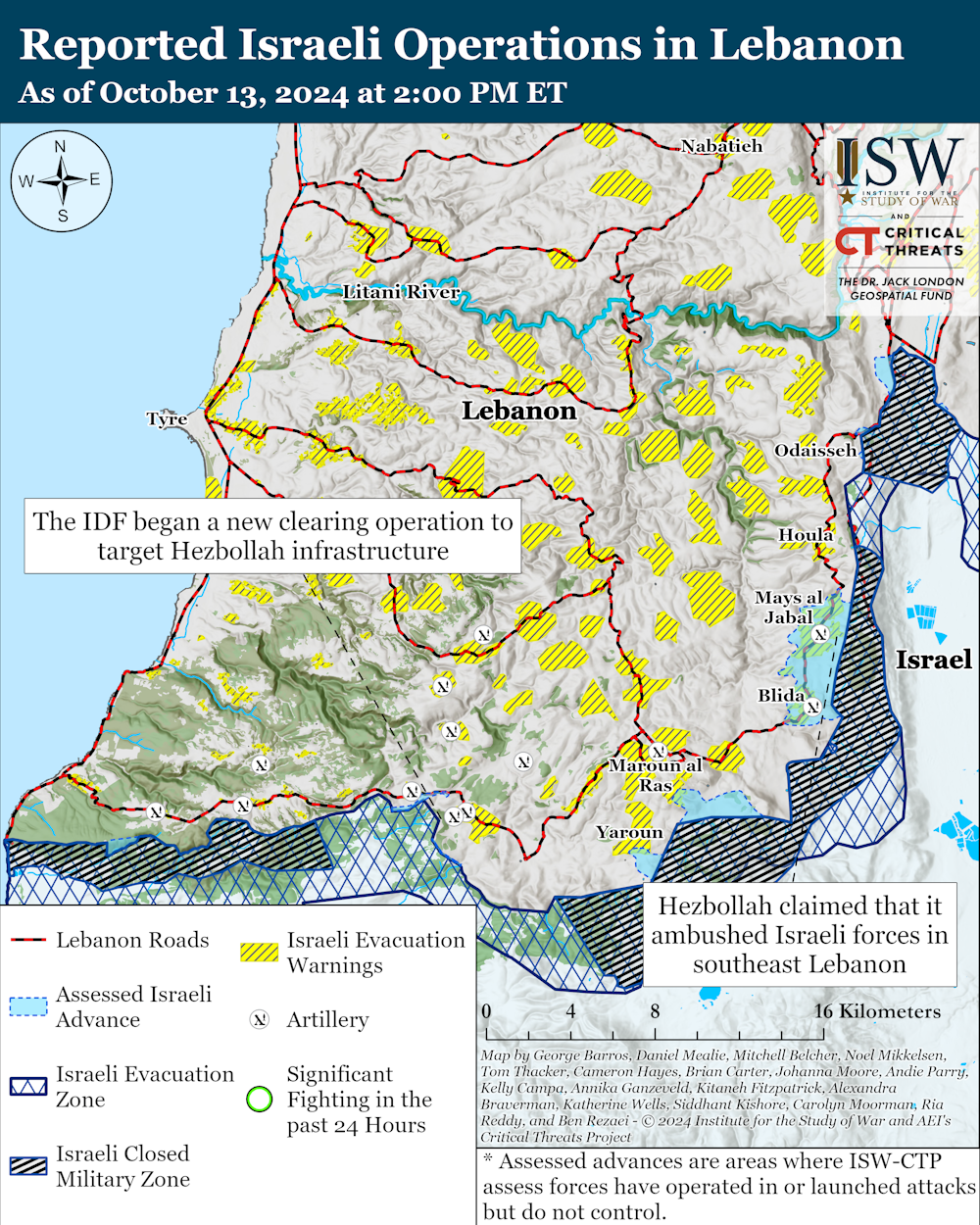
    Israel’s ground offensive in southern Lebanon, October 13 2024.
    Institute for the Study of War

    But there’s another possibility. During the Lebanese civil war, the IDF occupied a section of Lebanese land bordering Israel that was known as the “zone of security”. Its purpose was to serve as a buffer zone for northern Israel, initially designed to protect Israeli citizens from Palestinian militia, and later also from the Shia resistance groups Amal and Hezbollah.

    The Israeli request for Unifil to move five kilometres back from the blue line could mean Israel is considering reestablishing some kind of buffer zone. Several factors point to this being a possibility – although the IDF and the Israeli government may not be aligned on this issue as recent tensions suggest.

    First, the IDF has now deployed units from at least four divisions into Lebanon. The volume of troop numbers deployed is upwards of 15,000 suggesting this incursion is more than a limited operation.

    Second, 29 Unifil compounds lie along the blue line. Were they to be evacuated by the UN, there would be nothing to stop the IDF from moving in and developing them into their own strongholds. While UN positions would need reinforcement and protection equipment, they would nonetheless remain useful.

    Third, in 2006 the IDF tried to destroy Hezbollah from the air and deployed limited haphazard ground incursions. These tactics failed and the prevailing view may now be that the only way to guarantee the safe return of 65,000 Israelis to their homes in northern Israel is through an occupation.

    But unlike the previous occupation, where the IDF was aided by the SLA, Israel currently has no partner in Lebanon, and it is unlikely to find a willing accomplice among the Lebanese population to help them manage the security of a buffer zone. This means IDF troops would directly bear the brunt of attacks from resistance groups, and the northern Israeli villages would be unlikely to remain secure.

    The Netanyahu government’s continued use of military solutions to solve political problems has worrying implications for Israel, Lebanon and the Middle East as a whole. At this stage, Israel looks as if it might be settling back into a conflict that could become another “forever war”.

    Thus far, the tactics used by the IDF would imply they are not thinking ahead to “the day after” and the cost to Israel that would come with the prolonged occupation of a buffer zone.

    This article was written with assistance from John Molloy, lt. col. (rtd.) Irish Defence Forces and former senior Unifil political & civil affairs officer, 2008-2017.

    Chiara Ruffa receives funding from the Swedish Research Council, the Fulbright Commission and the European Commission.

    ref. IDF actions against UN peacekeepers suggest Israel may be considering occupying part of southern Lebanon – https://theconversation.com/idf-actions-against-un-peacekeepers-suggest-israel-may-be-considering-occupying-part-of-southern-lebanon-241297

    MIL OSI – Global Reports

  • MIL-OSI Australia: Plimsoll Address

    Source: Australian Government – Minister of Foreign Affairs

    Thank you to the Australian Institute for International Affairs and the University of Tasmania for inviting me to give this address, in honour of this great statesperson. 

    With a career that spanned the first four decades of independent Australian foreign policy, there are few who have made a contribution comparable to James Plimsoll – or Jim Plim as he was affectionately known.

    He first made his mark in the late 1940s supporting Foreign Minister Evatt during his presidency of the United Nations General Assembly – support that included ghost-writing Evatt’s book, The Task of Nations.

    He later became Secretary of the Department of External Affairs – which we now know as DFAT…

    He was appointed Ambassador in Washington, Tokyo, Brussels and Moscow… 

    High Commissioner in London and Delhi…

    And even Governor of this great state of Tasmania…

    Among all these lofty appointments, his biographer Jeremy Hearder reflected that the highlight of Plimsoll’s career was serving as Australia’s Ambassador and Permanent Representative to the UN Nations in New York, in the late 1950s and early 1960s.

    And we can understand why. He found himself at the centre of major international issues – and his diplomatic skill meant, in the words of a British colleague, that Plimsoll “exercised an influence on the UN quite disproportionate to Australia’s standing in the world.”

    This was partly because of what the then Secretary of External Affairs, Arthur Tange, described as Plimsoll’s “remarkable capacity… for talking to people in their own terms, freely encouraging them to explain their viewpoints and problems.”

    It is patent that Jim Plim understood deeply how Australia’s interests as a middle power are at stake in the multilateral system.

    Even with all the flaws with the international system, this remains the case today.

    Australia will always be better off in a world that operates by rules that all countries have a say in shaping.

    A world where Australia and other countries have the freedom to decide our own futures, without interference and intimidation.

    A world where we can find collective solutions to our toughest problems.

    Where no country dominates, and no country is dominated.

    I’ve recently returned from the UN General Assembly’s annual High-Level Week, where Australia progressed our most ambitious multilateral agenda in many years.

    I convened meetings of humanitarian leaders and ministers from influential countries to address a serious problem in the international system.

    That is, the growing risk that norms are being eroded in international humanitarian law – what we often refer to as the rules of war.

    We see this in the massive civilian toll in conflicts around the world, and we see this in the increasing numbers of aid workers being killed and kidnapped.

    In order to protect civilians, we must also protect aid workers who deliver the food, water and medicine civilians need to survive.

    Aid workers are the best of humanity. Their dedication to improving the lives of others should not cost them their own.

    Yet 2023 was the deadliest year on record for aid workers, and 2024 is on track to be even worse.

    This has been felt directly by Australians with the IDF’s strike against World Central Kitchen vehicles, which killed Australian Zomi Frankcom and her colleagues.

    This was not a one-off incident. Gaza is the most dangerous place on earth to be an aid worker. More than 300 aid workers have been killed since the start of the conflict.

    Together, the ministerial group I convened agreed to pursue a new Declaration for the Protection of Humanitarian Personnel.

    Work on the Declaration is now underway, with our officials consulting experts and other countries.

    All countries will be invited to join the Declaration, to demonstrate the unity of the international community’s commitment to protect aid workers – and to channel that commitment into action in Gaza, in Sudan, in Ukraine and in all current and future conflicts.

    This is exactly the kind of leadership Australia should be taking in the world.

    We are not a superpower. But we are respected, and at our best we have a reputation for bringing countries together to defend and promote the rules-based order that protects us all.

    From the days helping draft the UN Charter and the Universal Declaration of Human Rights, to Gareth Evans’ leadership on the Chemical Weapons Convention, to our more leading role in the Arms Trade Treaty.

    There’s no doubt that reputation waned through the negative globalist years of the previous government.

    But in driving this Declaration we are demonstrating that Australians are indeed constructive internationalists in the mould of the honouree of this address.

    This brings me back to the book Plimsoll ghostwrote for Evatt, which spelled out our shared responsibility to each other. I quote:

    “We should try to raise standards everywhere in order to practice the simple humanitarian doctrine which is the basis of all morality, namely that we should help our neighbour and relieve misery and suffering… [We] can hardly imagine … the common lot of so many of mankind – disease, low expectation of life, and unrelieved pain; flood, famine and epidemics… These wrongs cry out for redress, and can and must be righted by co-operative international effort.”

    A powerful articulation of the motivation for our humanitarian work.

    And tonight we build on that work. Tonight, I am releasing Australia’s new Humanitarian Policy.

    It is a policy that comprehends the serious problems of our times.

    A climate changing faster than our combined efforts to stop it.

    More people displaced – in fact, more than 117 million people forcibly displaced from their homes.

    More people needing humanitarian assistance – 302 million people this year, up by nearly 30 million in just the last two years.

    More conflict than any time since World War Two. Russia’s invasion of Ukraine. Sudan. Myanmar. And in the Middle East.

    The Albanese Government is committed to humanitarian action which saves lives, alleviates human suffering and builds resilient communities. 

    The Policy outlines the role Australia will play at a time when need is outstripping the world’s capacity to respond and disregard for international humanitarian law is increasing.

    It is a plan of action that is not just about meeting humanitarian needs. It is also about protecting the peace, stability and prosperity that we want for Australia, our region and the world.

    It is a plan that is accountable – to the Australian people, and to the partners and communities we seek to help.

    We will focus on three priorities.

    First, we will build readiness and preparedness, anticipating shocks before they occur and working with our partners to lessen their impact.

    As part of this priority, I announce Australia is providing $5 million to the new Asia-Pacific Regional Humanitarian Fund to pre-position for the next emergency.

    Second, we will respond to crises and disasters, delivering support that meets the needs of crisis-affected populations and protects the most vulnerable, both immediately and over the longer term.

    As part of that effort, I announce $9 million in humanitarian relief to respond to high levels of food insecurity in Yemen. This follows support I announced yesterday for Myanmar, as well as over $80 million in aid to support civilians who have been devastated by the conflicts in Gaza and Lebanon.

    And third, we will reinforce the international humanitarian system, working to take practical and actionable steps to strengthen adherence to international humanitarian law – just as we are doing with the Declaration.

    We act globally, but our focus remains our region. We offer genuine partnerships, based on respect, listening and learning from each other.

    And we are helping build self-reliance, so obviously in Australia’s interests and the region’s interests.

    Now, we know humanitarian assistance can lessen shocks and keep further instability, conflict and displacement at bay.

    But we all want a world where humanitarian assistance is needed far less often.

    This is just one reason why the Albanese Government is acting on climate change.

    We have enshrined our ambitious emissions reduction targets into legislation: 43 per cent by 2030 and net zero by 2050.

    We are transforming our economy.

    Within this decade, 82 per cent of Australia’s electricity generation will be renewable, up from around 32 per cent when we came to office.

    We are building new industries to accelerate our economic transition and to export reliable, renewable energy to the world.

    And we are acting internationally, to respond to our partners.

    By the end of 2025, Australia will offer Climate Resilient Debt Clauses in our sovereign loans.

    And the groundbreaking Australia-Tuvalu Falepili Union treaty entered into force on 28 August – a treaty which provides for both adaptation and mobility with dignity…

    And the first treaty anywhere in the world which provides legal protection for sovereignty in the face of sea level rise.

    But we can’t address climate change on our own, just as we can’t alone resolve all of the conflicts that are driving humanitarian crises.

    What we are doing is using our forthcoming term on the UN Peacebuilding Commission to reform the international peacebuilding and conflict prevention architecture.

    What we are doing is helping Ukraine end Russia’s illegal and immoral war on its own terms.

    Since coming to office, we have more than doubled the military contribution to Ukraine – and Australia is the largest non-NATO contributor to Ukraine’s fight.

    And what we are doing is supporting efforts for long-term peace in the Middle East.

    We have just marked the first anniversary of the October 7 attacks by Hamas.

    We condemn Hamas’ terrorism unequivocally. We call for the release of hostages immediately.

    On that day, Hamas killed 1,200 people: the largest loss of Jewish life on any single day since the Holocaust.

    October 7 is a day that recalls humanity’s darkest memories. 

    The six million European Jews killed in the Holocaust – following thousands of years of persecution and atrocities perpetrated against the Jewish people.

    This long shadow of antisemitism is the history that finally resolved the international community to create the State of Israel.

    At the same time, the world also promised a Palestinian state.

    77 years later, that Palestinian state still does not exist.

    Earlier this year, Australia voted in the General Assembly in support of Palestinian aspirations for full membership of the UN. 

    The international community now must work together to pave a path to lasting peace.

    Australia wants to engage on new ways to build momentum, including the role of the Security Council in setting a pathway for two-states, with a clear timeline for the international declaration of Palestinian statehood.

    The world knows we cannot keep hoping the parties will fix this themselves; nor can we allow any party to obstruct the prospect of peace.

    Because a two-state solution is the only hope of breaking the endless cycle of violence – the only hope to see a secure and prosperous future for both peoples.

    To strengthen the forces for peace across the region and undermine extremism.

    Any future Palestinian state must not be in a position to threaten Israel’s security, with no role for terrorists.

    Right now, the suffering across the region must end.

    In Israel’s response to the attacks, more than 40,000 Palestinians have been killed. More than 11,000 children.

    It is now more than ten months since Australia and 152 other countries voted for a ceasefire in Gaza.

    I repeat that call again. 

    Just as I repeat our call for a diplomatic solution, de-escalation and ceasefire in Lebanon. 

    We want to see civilians on both sides of the Lebanon-Israel border return to their homes and the implementation of UNSC Resolution 1701.

    Australia made our call alongside a number of countries – Canada, European Union, France, Germany, Italy, Japan, Saudi Arabia, United Arab Emirates, the United Kingdom, the United States and Qatar.

    Shortly thereafter, G7 leaders issued a statement in similar terms.

    Yet somehow Mr Dutton accused the Prime Minister of being at odds with our allies. 

    He said the Prime Minister should be condemned for calling for a ceasefire.

    Now Mr Dutton has realised it is he who is at odds with the international community– but he still can’t bring himself to back a ceasefire.

    I can’t recall a single time over the past year that Mr Dutton has called for the protection of civilians, or for the upholding of international law. 

    He never utters a word of concern for innocent Palestinians and Lebanese civilians.

    From the other side, the Greens political party are being just as absolutist.

    Australians are rightly distressed by the catastrophic conflict, and the distress is felt most acutely in our Jewish, Palestinian and Lebanese communities.

    The lived experiences and understandings of our different Australian communities are distinct.

    There is long, complex and disputed history – deeply felt, close to the heart of many.

    And there is a need to acknowledge the real trauma on all sides, to acknowledge each other’s humanity, and to come together – as peacemakers throughout history have done.

    It is incumbent on any Australian Government to play a responsible role in promoting peace – recognising we are not the crucial player in the Middle East, but we have a respected voice. 

    Leaders must govern for the whole country.

    Our country does not benefit from the conflict being reproduced here. 

    Australians are 26 million people, from more than 300 ancestries. We are home to the oldest continuing civilisation on the planet.

    There is vast power in that.

    The ability to see and understand every part of the world.

    Yet it’s also something we need to nurture. 

    If we allow people to divide our community, if we allow conflicts overseas to be reproduced here; if we shout each other down and insist on respective absolutes; the bedrock of our stability, our security and our prosperity is shaken.

    Nothing is more important for our future than ensuring that Australia remains a pluralist nation, welcoming different races, religions and views, united by respect for each other’s humanity and for each other’s right to live in peace.

    As I said, there is vast power in who we are. Our people are the most elemental aspect of our national power. 

    We must deploy that power at this time in our history…

    This time when we face the most dangerous set of circumstances since World War Two. 

    This time when we need to combine our economic power, our cultural power, our strategic, diplomatic and defence power – all to make Australia stronger and more influential in a more contested and challenging world.

    We are making Australia more economically resilient at home, with a Future Made in Australia setting us on a path to be a renewable energy superpower.

    We are making Australia more economically resilient in the world, with the Southeast Asia Economic Strategy to 2040 that harnesses the opportunities from living in the most competitive and fastest growing region in the world – and so we never are over-reliant on one market again.

    We are rebuilding our diplomatic relationships.

    We are doing the work that should have been done a decade ago to again make Australia a partner of choice in the Pacific.

    We don’t just go around picking fights and blowing up relationships.

    We are investing in our credibility as a partner to the region.

    It is by our actions that we have been able to restore trust among the Pacific family.

    And we are stabilising our own relations with China, so we navigate differences wisely.

    Our calm and consistent approach to the China relationship has seen progress on the removal of trade impediments for wine, barley, coal, cotton, timber logs, copper ores and concentrates; and now lobster – almost $20 billion worth of Australian exports back into China.

    We are increasing our collaboration with new partners and traditional partners; with Southeast Asia, with Japan, with India, and through our Quad partnership.

    We are investing in defence cooperation and our own military capabilities, including through AUKUS.

    And we are working together with our partners to uphold the rules and reform the institutions that we helped establish.

    All of these efforts are to shape the strategic calculus of the region, so no potential aggressor thinks the pursuit of conflict is worth the risk.

    This is how we advance the region we want. A region in balance. 

    Where countries, large and small, have the freedom to decide our own futures.

    These are just some of the ways in which the Albanese Government is driving Australia’s most ambitious international engagement in many years. 

    Being a partner to our region, and a leader in our values. 

    Always working toward a more peaceful, stable and prosperous world for all.

    Where sovereignty is respected and civilians are protected. 

    And I would say, furthering the legacy of creative diplomacy and determined statecraft practised by the great Jim Plim himself.

    Thank you.

    MIL OSI News

  • MIL-OSI Asia-Pac: Rare Observation in Hidden Structure in Crystals Brings New Paradigms in Material Design for Advanced Energy Solutions

    Source: Government of India

    Posted On: 15 OCT 2024 3:34PM by PIB Delhi

    Researchers have made a rare observation where the local crystal structure symmetry or the arrangement of atoms in the immediate vicinity of a given atom, in a crystal, reduces upon warming, contrary to the usual trend of symmetry of crystal structures increasing with rising temperatures. The study underlines the significance of chemical design in triggering unconventional phenomena in crystalline materials useful for phononics, thermoelectrics and solar thermal conversion.

    Symmetry breaking plays a crucial role in fundamental chemistry and physics. A familiar manifestation of this phenomenon is the transition of a gas to a liquid and eventually to a solid upon cooling, with each phase transition involving a reduction in symmetry.

    Thermodynamic factors like entropy (measure of disorder) and enthalpy (measure of total energy stored) of a system determines how the system responds to changing conditions like temperature fluctuations.

    Traditionally, it is believed that as a material is heated, it tends to adopt a higher crystal symmetry due to the favourable increase in entropy.

    However, recent findings by Prof. Kanishka Biswas, Ms. Ivy Maria, Dr. Paribesh Acharyya and other team members at Jawaharlal Nehru Centre for Advanced Scientific Research (JNCASR), Bangalore, an autonomous institute of Department of Science and Technology, challenge this conventional understanding, especially at the local structural level of a crystal.

    Local structure of a crystal is the arrangement of atoms in the immediate vicinity of a given atom in a crystal, typically within the collection of the first and second nearest neighbour atoms around a specific atom, technically known as the first and second atomic coordination environments respectively.

    In an ideal crystal, the local structure mirrors the global structure, but in certain rare cases, they can diverge. This is precisely what the team observed in an all-inorganic two-dimensional halide perovskite, Cs2PbI2Cl2 that belongs to the family of Ruddlesden-Popper halide perovskites (class of materials with a specific crystal structure).

    Contrary to the usual trend where heating increases symmetry, this compound exhibits a decrease in local symmetry with rising temperature, while the global crystal symmetry remains unchanged. This occurs due to configurational averaging, where the distorted local symmetries average out at longer length scales, leaving the global structure intact.

    This phenomenon of local symmetry breaking upon heating is termed “emphanisis,” meaning “appearing out of nothing.” The team employed an advanced synchrotron X-ray technique which simultaneously reveals both the local and global structures of solids from their X-ray diffraction patterns, to investigate emphanisis.

    The synchrotron X-ray experiments were done in DESY, Hamburg, Germany under the India-DESY collaboration supported by Department of Science & Technology (DST), India.

    The researchers traced this unusual local symmetry breaking to the stereochemically active lone pair of lead in the compound.

    Interestingly, Cs2PbI2Cl2 accommodates two types of structural distortion — static distortions in chlorine atoms and dynamic distortions in lead atoms. These distortions result from the complex interplay between different structure-distorting effects driven by the interactions between the mixed halide (Cl and I) motif and the active lone electron pair of lead in Cs2PbI2Cl2. The distortions happen because of a competition between a mix of structure-distorting forces that arise because of interaction of different parts of the material (the mixed anions- Cl and I) with the lone electron pair on the lead atoms in Cs₂PbI₂Cl₂.

    The high temperature “emphanitic” phase is characterized as a disordered distorted state, existing at the intersection of an ordered undistorted state and an ordered distorted state.

    “Emphanisis” is a promising strategy for achieving intrinsically low lattice thermal conductivity in crystalline materials. Such materials are highly sought after for their fundamental importance and diverse applications, including phononics, thermoelectrics, solar thermal conversion, and various heat management systems.

    The study now published in Advanced Materials, underscores the fundamental and functional significance of chemical design in creating unconventional phenomena in crystalline materials. The findings suggest that understanding these thermodynamic subtleties can lead to intriguing structural transformations with broad applications.

    Publication link: https://doi.org/10.1002/adma.202408008


    Figure 1. Schematic representations showing the evolution of local structure of a system exhibiting emphanisis.

    Prof. Kanishka Biswas (left) and Ivy Maria (right) at Solid State Chemistry Lab, JNCASR, Bangalore.


    ***

    NKR/DK/AG

    (Release ID: 2064973) Visitor Counter : 11

    MIL OSI Asia Pacific News

  • MIL-OSI Asia-Pac: Prime Minister Shri Narendra Modi writes LinkedIn post on creation of National Maritime Heritage Complex at Lothal

    Source: Government of India

    Posted On: 15 OCT 2024 3:37PM by PIB Delhi

    The Prime Minister Shri Narendra Modi today wrote a post on LinkedIn, elaborating on the advantages of developing a National Maritime Heritage Complex at Lothal in Gujarat. 

    The post is titled ‘Let’s focus on Tourism’.

    The Prime Minister posted on X:

    “Recently, the Union Cabinet took a very interesting decision – of developing a National Maritime Heritage Complex in Lothal. Such a concept will create new opportunities in the world of culture and tourism. India invites more participation in the culture and tourism sectors.”

    ***

    MJPS/RT

    (Release ID: 2064974) Visitor Counter : 76

    MIL OSI Asia Pacific News

  • MIL-OSI Asia-Pac: A New Photocatalyst can Efficiently Degrade Broad-Spectrum Antibiotics

    Source: Government of India

    Posted On: 15 OCT 2024 3:22PM by PIB Delhi

    Scientists have developed an efficient photocatalyst that can degrade in sulfamethoxazole, a broad-spectrum antibiotic to less hazardous chemicals and reduce health and environmental concerns associated with antibiotic contamination. 

    Antibiotic contamination has several adverse effects, including antibiotic resistance, ecological impact, human health concerns, etc. Hence, there is a need to find ways to mitigate this environmental issue.

    A team of scientists from Institute of Advanced Study in Science and Technology (IASST), Guwahati, an autonomous institute of Department of Science and Technology have synthesized copper zinc tin sulfide Cu2ZnSnS4 (CZTS) nanoparticles (NPs) and copper zinc tin sulfide -tungsten disulfide CZTS-WS2 composite. The team led by Prof. Devasish Chowdhury utilised hydrothermal reaction of zinc chloride, copper chloride, tin chloride and tungsten disulfide forming a composite that is efficient photocatalyst in degrading sulfamethoxazole, an antibiotic.

    Broad-spectrum antibiotics like sulfamethoxazole (SMX) have long been used to treat human illnesses like urinary and respiratory tract infections. However, more than 54 % of SMX was released into the environment along with the faeces and urine of the patients.

    “CZTS and its nanocomposites are a multifunctional quaternary semiconductor nanomaterial made up of earth-abundant, inexpensive, and non-toxic components possessing remarkable photostability making it extremely valuable in light-harvesting and photocatalyst applications,” said Prof. Chowdhury.

    The team consisting of Nur Jalal Mondal, Rahul Sonkar, Mridusmita Barman and Dr. Mritunjoy Prasad Ghosh, established that the CZTS-WS2 composite exhibits good photocatalytic activity for the breakdown of sulfamethoxazole.

    The developed catalyst could be recovered and used repeatedly without losing its effectiveness, which is very important from an economic point of view.

    Liquid chromatography–mass spectrometry (LC-MS) a popular analytical chemistry technique that can separate and identify the degraded product was used to analyze the intermediates and degraded products of the antibiotics’ degradation reaction. The study published in Journal of Photochemistry & Photobiology A, determined that the majority of intermediates were less hazardous than sulfamethoxazole. In addition, the CZTS-WS2 composite demonstrated more than 80% radical scavenging efficiency and antibacterial capabilities.

    Doi: https://doi.org/10.1016/j.jphotochem.2024.115907

    *****

    NKR/DK/AG

    (Release ID: 2064969) Visitor Counter : 77

    MIL OSI Asia Pacific News

  • MIL-OSI Asia-Pac: Musician Dr. Bharat Balvalli and Journalist Abhijit Pawar meet Prime Minister

    Source: Government of India

    Posted On: 14 OCT 2024 10:50PM by PIB Delhi

    Accomplished singer and music composer Dr. Bharat Balvalli and Journalist Shri Abhijit Pawar from Sakal media met the Prime Minister, Shri Narendra Modi today.

    Responding to a post by Dr Bharat Balvalli, Shri Modi wrote:

    “Happy to have met you, @Swaradhish along with @abhijitpawarapg. Compliments on your book, in line with your passion for culture and spirituality. My best wishes for your future endeavours.”


    ***

    MJPS/SR

    (Release ID: 2064865) Visitor Counter : 41

    MIL OSI Asia Pacific News

  • MIL-OSI Asia-Pac: PRESIDENT OF INDIA IN Algeria; HOLDS BILATERAL MEETING WITH PRESIDENT of Algeria and leads delegation level-talks

    Source: Government of India

    PRESIDENT OF INDIA IN Algeria; HOLDS BILATERAL MEETING WITH PRESIDENT of Algeria and leads delegation level-talks

    PRESIDENT MURMU ADDRESSES INDIAN COMMUNITY IN Algeria

    the Indian community in Algeria IS a bridge taking forward India’s interests and soft power: PRESIDENT MURMU

    graces Algerian-Indian Economic Forum; SAys India-Algeria economic ties have not been able TO TAP THE POTENTIAL FULLY

    Posted On: 14 OCT 2024 11:00PM by PIB Delhi

     The President of India, Smt Droupadi Murmu, reached Algiers, Algeria, yesterday evening (October 13, 2024), on the first leg of her State Visits to Algeria, Mauritania, and Malawi. As a special gesture, President Abdelmadjid Tebboune of Algeria received President Droupadi Murmu at the Airport and accorded her a ceremonial welcome.

     This is the first visit by an Indian President to Algeria.

     The President is accompanied by Minister of State, Shri Sukanata Majumdar, and Members of Parliament, Shri Mukeshkumar Dalal and Shri Atul Garg on this State visit.

     Yesterday evening, the President addressed the members of the Indian Community at Algiers, at a Reception hosted by the Ambassador of India to Algeria.

     Addressing the enthusiastic gathering of Indian community members who had travelled to Algiers for the occasion from all parts of Algeria, the President praised their contribution to Algeria’s economy. She said that the Government of India and the Indian society have always valued and appreciated the contribution of the Indian community in enhancing India’s position, prestige, and standing abroad. The Indian community in Algeria is a bridge taking forward India’s interests and soft power. She expressed confidence that they would continue to make India proud with their accomplishments and work for the betterment of India-Algeria relations.

     In her first engagement this morning (October 14, 2024), the President laid a wreath at the Maqam Echahid Memorial in Algiers and paid tribute to the soldiers who laid down lives in the Algerian War of Independence. She also visited the National Museum of the Moudjahid, commemorating Algeria’s struggle for liberation.

     Subsequently, the President visited the El Mouradia Palace where she held a meeting with H.E. Mr Abdelmadjid Tebboune, the President of the People’s Democratic Republic of Algeria. The two leaders discussed ways to take India-Algeria relations to a higher level, with a special focus on trade and investment. President Murmu re-affirmed India’s continued support of Algeria and India’s commitment to Africa. Both Presidents led the delegation-level talks and issued statements before the press.

     In the next engagement, the President addressed the Algerian-Indian Economic Forum, jointly organised by the Algerian Economic Renewal Council and the Federation of Indian Chambers of Commerce and Industry (FICCI).

     Speaking on the occasion, the President said that the stepping up of the India-Algeria relations is based on our shared values, common challenges, and mutual trust.

    The President said that Algeria’s rapid growth and expanding economy offer many opportunities in a variety of sectors. She urged Indian companies to remain engaged and invested in the opportunities that the Algerian economy offers.

    The President was happy to note that the overall trade between India and Algeria stands at 1.7 billion US dollars. However, the economic ties have not been able to tap the potential fully. She emphasised the need to reinforce our ongoing cooperation in energy, construction, automobiles, fertilizers, and pharmaceuticals, and identify new trade and investment initiatives for a brighter future.

     The President said that India has achieved many accomplishments in areas such as science and technology, IT, fin-tech, pharma, space, start-ups, and renewables. She said that India would be happy to share its experiences in these areas with our Algerian partners. The President said that reforms in India made it easy for businesses to establish and grow. She invited Algerian companies to join India’s ‘Make in India’ and ‘Make for the World’ initiatives.

    Click here to see the Press Statement during her visit to Algeria

    Click here to see the President’s speech

    MIL OSI Asia Pacific News

  • MIL-OSI Asia-Pac: GSS 2024 calls for collaboration on international standards, paving way for sustainable development of emerging digital technologies Standards to focus on positive outcomes for humanity

    Source: Government of India (2)

    GSS 2024 calls for collaboration on international standards, paving way for sustainable development of emerging digital technologies Standards to focus on positive outcomes for humanity

    The standards we establish are more than just technical standards, but they are moral compasses”: Dr. Pemmasani Chandra Sekhar, Minister of State for Communications and Rural Development

    Posted On: 15 OCT 2024 9:08AM by PIB Delhi

    The Fifth Global Standards Symposium (GSS-24) concluded today in New Delhi, first time in the Asia-Pacific region. This landmark symposium, organized by the International Telecommunication Union (ITU) and hosted by Department of Telecommunications, Government of India, brought together record 1500 leading policymakers, innovators, and experts from around the world to discuss the future of digital transformation and the critical role of international standards in enabling the next wave of emerging technologies.

    Addressing the closing ceremony, Dr. Chandra Sekhar Pemmasani, Minister of State for Communications and Rural Development stated that India under the leadership of the Hon’ble Prime Minister Shri Narendra Modi, has achieved unprecedented transformation, which is now globally recognized. He said that the development of international standards must be inclusive and democratic, reflecting of needs of all regions and encouraging active participation from developing countries. The Minister said, As we conclude this remarkable symposium, I am confident that the standards we establish are more than just technical standards, but they are moral compasses, guiding us towards a future of shared global progress. India is ready to take this journey not alone, but with all of you as partners.”

    The symposium, which focused on the theme “Charting the Next Digital Wave: Emerging Technologies, Innovation, and International Standards,” addressed the critical need for a cohesive and forward-looking approach to the governance and standardization of emerging technologies. GSS serves as a high-level forum, offering a platform for discussion and coordination on the most pressing issues in technology and standardization.

    Jyotiraditya M. Scindia, Union Minister of Communications and Development of the North Eastern Region, inaugurated the event earlier in the morning. In his inaugural address, he emphasized India’s role as a global hub for telecommunications and digital innovation, citing India’s record of being a land of science, innovation & rules aiding in the prosperity of the world.

    The symposium had a high-level segment that facilitated cooperation among industry leaders and ministers, focusing on the future of innovation and digital public infrastructure. The event called for robust international standards for AI governance. The symposium stressed the need to bridge the standards gap between developed and developing nations, ensuring equitable access to technology for all.

    Key sessions explored the role of open-source technologies, blockchain-based authentication, and the impact of AI and the Metaverse on public services and industry, advocating for collaboration with developers to create a more inclusive tech ecosystem. The event also featured an AI Standards Summit, which highlighted how consensus-based standards can spark innovation across various sectors, enhancing technological advancements.

    Dr. Rajkumar Upadhyay, Chief Executive Officer, Centre for Development of Telematics (C-DoT) chaired the GSS2024. It is for the first time that India took the leadership of this Symposium. The symposium concluded with a powerful Outcome Document emphasizing the crucial role of international standards in driving digital transformation globally. Dr. Upadhyay presented the key outcomes which included:

    1.         Driving Digital Transformation: The Outcome Document underscores international standards as the cornerstone for digital transformation globally.

    2.         Uniting Global Leaders: GSS-24 brought together industry giants and policymakers to discuss the impact of standards on cutting-edge technologies.

    3.         Innovation Through Standards: The AI Standards Summit showcased how consensus-based standards can spark innovation across various sectors, enhancing technological advancements.

    4.         Bridging the Gap: The symposium stressed the need to bridge the standards gap between developed and developing nations, ensuring equitable access to technology for all.

    5.         Harnessing AI and the Metaverse: GSS-24 highlighted the transformative potential of AI and the metaverse in public services and urban planning, urging the ITU to strengthen initiatives like the Global Initiative on Virtual Worlds.

    6.         Accelerating SDGs: The event underscored the vital role of international standards in achieving the UN Sustainable Development Goals, paving the way for sustainable digital transformation.

    7.         High-Level Dialogues: An unprecedented high-level segment fostered collaboration among industry leaders and ministers, focusing on the future of innovation and digital public infrastructure.

    8.         Establishing AI Governance: GSS-24 called for robust international standards for AI governance, encouraging initiatives like AI for Good and the AI for Skills Coalition.

    9.         Empowering Open Source: The symposium recognized the critical role of open-source software in driving innovation, advocating for collaboration with developers to create a more inclusive tech ecosystem.

    10.       Celebrating Smart Cities: GSS-24 acknowledged cities excelling in smart and sustainable initiatives, reinforcing the commitment to the United for Smart Sustainable Cities (U4SSC) initiative, led by the ITU, UNECE, and UN-Habitat.

    The Global Standards Symposium 2024 successfully laid the groundwork for the future of emerging technologies, demonstrating how international collaboration and standardization can drive innovation while ensuring inclusive growth. The outcome document of symposium lays the foundation for discussion at the World Telecommunication Standardization Assembly (WTSA-24), which is set to take place from October 15-24, 2024, also in New Delhi.

    ****

    SB/DP/AR

    (Release ID: 2064881) Visitor Counter : 57

    MIL OSI Asia Pacific News

  • MIL-OSI Asia-Pac: Vice-President to visit Guwahati (Assam) and Shillong(Meghalaya) on 16th-17th October

    Source: Government of India (2)

    Vice-President to visit Guwahati (Assam) and Shillong(Meghalaya) on 16th-17th October

    VP to be the Chief Guest and lay the foundation stone of Meghalaya Skill and Innovation Hub at Mawdiangdiang in New Shillong.

    VP to visit IT Park in Shillong

    Posted On: 15 OCT 2024 10:52AM by PIB Delhi

     The Vice-President of India, Shri JagdeepDhankhar and Dr. SudeshDhankhar will be on a two day tour to Guwahati (Assam) and Shillong in Meghalaya on 16th-17th October, 2024.

    During his visit, the Vice-President will preside as Chief Guest and lay the foundation stone of the Meghalaya Skill and Innovation Hub at Mawdiangdiang in New Shillong.

    Vice President is scheduled to also visit IT Park and Raj Bhavan Shillong and meet Chief Minister and other senior officials.

    ****

    JK/RC/SM

    (Release ID: 2064895) Visitor Counter : 91

    MIL OSI Asia Pacific News

  • MIL-OSI Asia-Pac: Prime Minister Shri Narendra Modi inaugurates ITU World Telecommunication Standardization Assembly 2024 in New Delhi

    Source: Government of India (2)

    Prime Minister Shri Narendra Modi inaugurates ITU World Telecommunication Standardization Assembly 2024 in New Delhi

    PM inaugurates 8th edition of India Mobile Congress

    In India, we have made telecom not just a medium of connectivity, but also a medium of equity and opportunity: PM

    We identified four pillars of Digital India and started working on all four pillars simultaneously and we got results: PM

    We are working towards giving the world a complete Made in India phone, from chip to finished product: PM

    The length of optical fiber that India has laid in just 10 years is eight times the distance between the Earth and the Moon: PM

    India democratized digital technology: PM

    Today India has such a digital bouquet which can take welfare schemes to new heights in the world: PM

    India is working towards the goal of making technology sector inclusive, empowering women through technology platforms: PM

    The time has come for global institutions to accept importance of Global framework for digital technology, global guidelines for global governance: PM

    We have to ensure that our future is both technically strong and ethically sound, Our future should have innovation as well as inclusion: PM

    Posted On: 15 OCT 2024 1:07PM by PIB Delhi

    The Prime Minister, Shri Narendra Modi inaugurated the International Telecommunication Union – World Telecommunication Standardization Assembly (WTSA) 2024 at Bharat Mandapam in New Delhi today. Shri Modi also inaugurated the 8th edition of India Mobile Congress during the programme. He took a walkthrough of the exhibition showcased on the occasion.

    Addressing the gathering, the Prime Minister welcomed the Union Minister for Communication Shri Jyotiradiya Scindia, Minister of State for Communication Shri Chandrasekhar  Pemmasani, Secretary General of  ITU Ms. Doreen Bogdan-Martin, Ministers & dignitaries of various foreign countries, industry leaders, telecom experts, youths from the Startup world and ladies and gentlemen to the WTSA and India Mobile Congress (IMC). Welcoming the dignitaries of ITU, Shri Modi thanked and appreciated them for choosing India as the destination for the first WTSA meeting. “India is one among the most happening countries when it comes to telecom and its related technologies”, exclaimed Shri Modi. Listing the achievements of India, Shri Modi said that India had a mobile phone user base of 120 crores or 1200 million, 95 crore or 950 million internet users and digital transactions of more than 40% of the entire world in real-time. He further added that India had showcased how digital connectivity had become an effective tool for the last mile delivery. He congratulated everyone for choosing India as the destination for discussing the global telecommunication standard and discussion on the future for telecom as a global good. 

    Highlighting the significance of the combined organization of WTSA and India Mobile Congress, the Prime Minister said that WTSA’s objective is to work on global standards while the role of India Mobile Congress is associated with services. He said that today’s event brings global standards and services on a single platform. Emphasizing India’s focus on quality service and standards, the Prime Minister said that WTSA’s experience would provide new energy to India. 

    The Prime Minister underlined that WTSA empowers the world via consensus and while India Mobile Congress strengthens the world through connectivity. Therefore, Shri Modi said, consensus and connectivity are conjoined in this event. He stressed the need for the combination in today’s world which is marred by conflict and said that India has been living through the immortal message of Vasudhaiva Kutumbakam. He mentioned the G20 Summit presided by India and spoke about relaying the message of ‘One Earth One Family One Future’. The Prime Minister emphasized that India is engaged in bringing the world out of conflict and connecting it. “Be it the ancient silk route or today’s technology route, India’s only mission is to connect the world and open new doors of progress”, the Prime Minister remarked. In such a situation, said the Prime Minister, this partnership of WTSA and IMC is a great message where local and global combine to bring the benefits not to just one country but the entire world.

    “India’s mobile and telecom journey in the 21st century is a subject of study for the whole world”, exclaimed Shri Modi. He added that while mobile and telecom were seen as a facility across the world, however, telecom was not just a medium of connectivity, but a medium of equity and opportunity in India. The Prime Minister remarked that telecom as a medium was helping in bridging the gap between villages and cities, rich and poor today. Reminiscing his presentation, a decade ago, on vision of Digital India, Shri Modi remarked that he had stated that India had to move forward with a holistic approach as against a piece-meal approach. Shri Modi listed out the four pillars of Digital India – Low-priced devices, extensive reach of digital connectivity to every nook and corner of the country, easily accessible data and goal of ‘Digital First’, which were identified and worked upon simultaneously, leading to good results.

    The Prime Minister highlighted India’s transformative achievements in connectivity and telecom reforms and emphasized how the country has built a robust network of thousands of mobile towers across remote tribal, hilly, and border areas, ensuring connectivity for every household. He said that the government has created a strong network of mobile towers across the country. The Prime Minister underscored the remarkable advancements in infrastructure, including the rapid installation of Wi-Fi facilities at public places like railway stations and the connection of islands like Andaman-Nicobar and Lakshadweep through undersea cables. “In just 10 years, India has laid optical fiber which is eight times the distance between Earth and the Moon”, he added. Shri Modi also pointed out India’s rapid adoption of 5G technology and said that 5G technology was launched two years ago and today nearly every district is connected, making India the world’s second-largest 5G market. He further mentioned that India is already progressing towards 6G technology, ensuring a future-ready infrastructure.

    Discussing telecom sector reforms, the Prime Minister noted India’s efforts in lowering data costs. He said that the cost of internet data in India is now as low as 12 cents per GB compared to many countries in the world where one GB of data is 10 to 20 times more expensive. “Today, every Indian consumes about 30 GB of data on an average every month”, he said.

    Shri Modi noted that all such efforts have been taken to a new scale by the fourth pillar i.e. the spirit of digital first. He underlined that India democratized digital technology and created digital platforms  where innovations on these platforms created millions of new opportunities. Shri Modi highlighted the transformative power of the JAM Trinity—Jan Dhan, Aadhaar, and Mobile—saying it has laid the foundation for countless innovations. He mentioned Unified Payments Interface (UPI) which has provided new opportunities for many companies and also spoke about ONDC which will revolutionize digital commerce. The Prime Minister pointed out the role of digital platforms during the COVID-19 pandemic ensuring seamless processes such as financial transfers to those in need, real-time communication of guidelines, vaccination drive  and handing out digital vaccine certificates. Reflecting on India’s success, the Prime Minister expressed the nation’s willingness to share its digital public infrastructure experience globally. The Prime Minister said India’s digital bouquet can elevate welfare schemes worldwide highlighting India’s emphasis on  Digital Public Infrastructure during G20 Presidency. He underlined that the nation is happy to share its DPI knowledge with all countries.

    Emphasizing the importance of Network of women initiative during the WTSA, Shri Modi highlighted that India was working very seriously on women led development. He added that the commitment was taken forward during India’s presidency of G-20. The Prime Minister underlined that India was working towards the goal of making the technology sector inclusive by empowering the women through technology platforms. He highlighted the crucial role of women scientists in India’s Space missions, rising number of women co-founders in India’s start-ups. The Prime minister also noted that there was a 40 percent share of women students in India’s STEM education and India was creating umpteen opportunities for women in technology leadership. Shri Modi also highlighted the Namo Drone Didi program of the Government, to promote drone revolution in agriculture, was being led by women from villages in India. He added that India also started the Bank Sakhi program to take digital banking and digital payments to every home which had led to digital awareness. Highlighting the critical role of Asha and Anganwadi workers in India’s primary healthcare, maternity and child care, Shri Modi remarked that today these workers were tracking all the work through tabs and apps. He added that India was also running the Mahila E-Haat program, an online marketing platform for women entrepreneurs. He further added that it was unimaginable that today women of India in every village were working on such technology. Shri Modi expressed hope that in the times to come, India will expand its scope further where every daughter of India would be a tech leader.

    The Prime Minister reiterated the importance of establishing a global framework for digital technology. He emphasized that this topic was raised by India during its G-20 Presidency and urged global institutions to recognize its significance for global governance. “The time has come for global institutions to accept the importance of global governance”, PM Modi stated. Stressing the need to create a ‘Do’s and Don’ts’ for technology on the global level, the Prime Minister highlighted the borderless nature of digital tools and applications and urged for international collaboration in combating cyber threats and collective action by global institutions. He drew parallels with the aviation sector which already has well-established frameworks. PM Modi called upon the WTSA to take a proactive role in creating a secure digital ecosystem and safe channel for telecommunication. “In an interconnected world, security cannot be an afterthought. India’s Data Protection Act and National Cyber Security Strategy reflect our commitment to building a safe digital environment”, he noted. The Prime Minister urged the members of the assembly to create standards that are inclusive, secure, and adaptable to future challenges, including ethical AI and data privacy standards that respect the diversity of nations.

    The Prime Minister emphasized the need for a human-centric dimension to the ongoing technological revolution, calling for responsible and sustainable innovation. He said that the standards set today will determine the direction of the future, stressing that principles of security, dignity and equity should be at the center of our discussions. He said our goal should be that no country, no region and no community is left behind in this digital transformation and underscored the need for innovation balanced with inclusion. He urged to ensure that the future is technically strong as well as ethically sound with innovation as well as inclusion. Concluding the address, the Prime Minister conveyed his best wishes for the success of WTSA and also extended his support.

    Union Minister for Communication, Shri Jyotiraditya Scindia and Union Minister of State for Communication, Shri Chandrasekhar  Pemmasani were present on the occasion along with various industry leaders.

    Background

    World Telecommunication Standardization Assembly or WTSA is the governing conference for the standardization work of International Telecommunication Union, the United Nations Agency for Digital Technologies, organized every four years. It is for the first time that the ITU-WTSA will be hosted in India and the Asia-Pacific. It is a pivotal global event that will bring together more than 3,000 industry leaders, policy-makers and tech experts from over 190 countries, representing telecom, digital and ICT sectors.

    WTSA 2024 will provide a platform for countries to discuss and decide the future of standards of next-generation critical technologies like 6G, AI, IoT, Big Data, cybersecurity, etc. Hosting this event in India will provide the country an opportunity to play a key role in shaping the global telecom agenda and to set the course for future technologies. Indian startups and research institutions are set to gain critical insights into developing Intellectual Property Rights and Standard Essential Patents.

    India Mobile Congress will showcase India’s innovation ecosystem, where leading telecom companies and innovators will highlight advancements in  Quantum technology and Circular Economy along with spotlight on 6G, 5G use-case showcase, cloud & edge computing, IoT, semiconductors, cybersecurity, green tech, satcom and electronics manufacturing.

    India Mobile Congress, Asia’s largest digital technology forum, has become a well-known platform across the globe for showcasing innovative solutions, services and state-of-the-art use cases for industry, government, academics, startups and other key stakeholders in the technology and telecom ecosystem. The India Mobile Congress will showcase over 400 exhibitors, about 900 startups, and participation from over 120 countries. The event also aims to showcase more than 900 technology use case scenarios, host more than 100 sessions and discussion with over 600 global and Indian speakers.


    ***

    MJPS/SR/TS

    (Release ID: 2064936) Visitor Counter : 116

    MIL OSI Asia Pacific News

  • MIL-OSI Asia-Pac: DG Paramesh Sivamani takes over as 26th Director General of Indian Coast Guard

    Source: Government of India (2)

    Posted On: 15 OCT 2024 11:13AM by PIB Delhi

    DG Paramesh Sivamani took over as the 26th Director General of the Indian Coast Guard (ICG). The Flag Officer, during his illustrious career spanning over three and a half decades, has served in various capacities in ashore and afloat appointments.


    DG Paramesh Sivamani specialises in Navigation & Direction and his sea commands include all major vessels of ICG which include Advanced Offshore Patrol Vessel ‘Samar’ & Offshore Patrol Vessel ‘Vishwast’. The Flag Officer was at the helm of Coast Guard Region (East), Coast Guard Region (West), Coast Guard Commander Eastern Seaboard). He is an alumnus of the National Defence College, New Delhi and Defence Services Staff College, Wellington.

    DG Paramesh Sivamani was elevated to the rank of Additional Director General in September 2022, and was subsequently posted at the Coast Guard Headquarters, New Delhi. He was given the additional charge of Director General Coast Guard in August 2024.

    During the period, many significant operations and exercises were accomplished that includes the seizure of drugs/narcotic substances and gold worth crores of rupees, rescue of mariners during severe cyclonic storms, joint exercises with the Foreign Coast Guards, anti-poaching operations, humanitarian assistance during cyclones/naturals calamities & Coastal Security exercises.

    The Flag Officer was conferred with the Tatrakshak Medal in 2014 and the President Tatrakshak Medal in 2019 for his illustrious service. He was also awarded the DG Coast Guard Commendation in 2012 and Flag Officer Commanding-in-Chief (East) Commendation in 2009.

    ****

    VK/SR/Savvy

    (Release ID: 2064900) Visitor Counter : 71

    MIL OSI Asia Pacific News

  • MIL-OSI Asia-Pac: Industry leaders laud Prime Minister Shri Narendra Modi’s leadership at International Telecommunication Union – World Telecommunication Standardization Assembly 2024

    Source: Government of India

    Industry leaders laud Prime Minister Shri Narendra Modi’s leadership at International Telecommunication Union – World Telecommunication Standardization Assembly 2024

    Industry leaders hail Prime Minister’s bold vision for a Digital India and appreciate government’s support towards reforms, innovation and collaboration

    Industry leaders highlight Prime Minister’s emphasis on need for global framework for digital governance

    Posted On: 15 OCT 2024 2:23PM by PIB Delhi

    The Prime Minister, Shri Narendra Modi inaugurated the 8th edition of India Mobile Congress during the  International Telecommunication Union – World Telecommunication Standardization Assembly (ITU-WTSA) 2024 held at Bharat Mandapam in New Delhi today. WTSA is the governing conference for the standardization work of the International Telecommunication Union, the United Nations Agency for Digital Technologies, organized every four years. It is for the first time that the ITU-WTSA is being hosted in India and the Asia-Pacific. It is a pivotal global event that has brought together more than 3,000 industry leaders, policy-makers and tech experts from over 190 countries, representing telecom, digital, and ICT sectors.

    Chairman of the Reliance JIO-INFOCOMM Limited, Shri Akash Ambani, commended Prime Minister Shri Narendra Modi for his visionary leadership, which has catalyzed India’s remarkable digital transformation. He said that in the third term, Shri Modi has positioned the Indian Mobile Congress (IMC) as a significant platform for innovation and collaboration, driving unprecedented growth in the digital sector. Shri Ambani noted that India has transitioned from a nation struggling with 2G speeds to becoming the world’s largest data market. He emphasized that India’s journey from ranking 155th in mobile broadband adoption to its current status demonstrates the power of synergy between government and industry. He further highlighted the inclusion of over 530 million unbanked Indians through initiatives like Jan Dhan accounts, with a significant portion being women. “Modi ji’s commitment to innovation has ensured that technology reaches every corner of our nation, leaving no one behind,” Shri Ambani stated. He proposed leveraging artificial intelligence (AI) as a transformative tool across various sectors, aiming for a developed India by 2047 and urged for updates to the data center policy to retain Indian data within the country, fostering a robust AI ecosystem.

    Emphasizing Prime Minister Shri Narendra Modi’s vision for a Digital India, Founder and Chairman of Bharti Airtel, Shri Sunil Bharti Mittal, reflected on India’s telecom journey, emphasizing its transformative progress in telecom infrastructure and digital technologies. He said, “the real transformation began in 2014 with Prime Minister Modi’s vision for a ‘Digital India,’ which ignited the 4G revolution. This has empowered millions, including those in our rural areas, to access smartphones and essential digital services.” He highlighted the transformative impact of 4G technology, which has brought smartphones and digital services to millions, including those in rural areas. He underscored the government’s initiatives to boost local manufacturing through the Production Linked Incentives (PLI) program, positioning India as a manufacturing hub for telecom equipment. “We are committed to reducing our dependence on imports. With initiatives like the Production Linked Incentive (PLI) program, we are transforming India into a manufacturing hub for telecom equipment,” he said. Discussing future ambitions, Mittal announced that India is set to lead in 5G technology, with extensive rollouts planned across urban and rural regions within the next 12 to 18 months. He also discussed the potential of Low Earth Orbit (LEO) networks, stating, “These networks will bridge the connectivity gap in our most challenging terrains, ensuring all Indians have access to fast internet services.”

    Chairman of Aditya Birla Group, Shri Kumar Mangalam Birla highlighted the steadfast support by the government in consistently recognizing the importance of digital connectivity and introducing several reforms over the years to drive India towards an even more connected, empowered and inclusive digital nation. He lauded the government’s continued thrust on expanding digital infrastructure and accelerating digital adoption for people and businesses equally. Recalling the Prime Minister’s quote on MSME meaning maximum support to micro, small and medium enterprises, Shri Birla said that they are committed to providing maximum support by promoting digital transformation to India’s small businesses making them future ready. He laid emphasis on focus on technologies like 5G, IoT, AI and cloud services and expressed the belief that a thriving digital ecosystem can be created that empowers India’s MSMEs to drive economic growth. He  informed that India achieved the remarkable feat of 10 crore telecommunication consultations in tele-medicine and said that it is a matter of great pride for every Indian. Pointing out one of the most pressing issues being addressed by the government regulator and industry in the past year, Shri Birla touched upon spam control and fraud protection. Talking about  the potential of the Indian telecom sector he hailed the Prime Minister’s bold vision of a digital India. He expressed confidence that they would do their part with the continued support of the government, and help in realizing the Prime Minister’s digital India destiny. He thanked the government, partners and the entire telecom community for making the past year truly an exceptional one.

    Secretary General ITU, Ms. Doreen Bogdan Martin said that it is a great honor to be present at the joint ceremony with the Prime Minister on the occasion of 2024 World Telecommunications Standardization Assembly and India Mobile Congress. She said that it is a powerful symbol of the deep ties between the ITU and India and recalled the meaningful conversation with the Prime Minister last year during the inauguration of ITU Area Office and Innovation Center. She spoke about world leaders coming together just a few weeks ago in New York and adopting the Pact of the Future and its global digital compact where a powerful message was sent out to the world about the digital future. She recalled the Prime Minister’s emphasis on the need for global digital governance and highlighted how he made India’s ambition very clear to lead by example and share its digital public infrastructure with the entire world. Referring to India’s G20 Presidency where DPI was a huge priority, Ms Bogdan Martin expressed delight in ITU becoming a knowledge partner. She underlined that the world has a lot to learn from India’s accomplishments with regard to unified payments interface. She stressed that standards build trust and that they are the engine which powers such platforms allowing them to operate at scale and providing every Indian with life-changing services through  mobile device access. Ms Bogdan Martin further added that trust nurtures inclusion and inclusion can unlock the full potential of digital and emerging technologies for everyone, including the third of humanity that’s still offline. She noted that this is a first-of-its-kind meet in Asia and called for bold collective action. She expressed confidence that in the next 10 days the role of international standards can be strengthened as the bedrock of global digital governance. She also touched upon ethical use of AI and urged to align technological progress with digital inclusion.

    *****

    MJPS/RT/TS

    (Release ID: 2064957) Visitor Counter : 85

    MIL OSI Asia Pacific News

  • MIL-OSI Asia-Pac: Central Consumer Protection Authority Issues Guidelines for ‘Prevention and Regulation of Greenwashing and Misleading Environmental Claims’

    Source: Government of India (2)

    Central Consumer Protection Authority Issues Guidelines for ‘Prevention and Regulation of Greenwashing and Misleading Environmental Claims’

    Guidelines prohibits companies from engaging in Misleading Environmental Claims and Greenwashing

    Posted On: 15 OCT 2024 3:00PM by PIB Delhi

    In exercise of the mandate to regulate matters relating to misleading advertisements which is prejudicial to the interest of public and consumers, Central Consumer Protection Authority (CCPA) has issued guidelines for Prevention and Regulation of Greenwashing and Misleading Environmental Claims to address the issue of greenwashing and misleading environmental claims, informed Smt. Nidhi Khare, Secretary Department of Consumer Affairs, Government of India, who is also Chief Commissioner of the Authority, here today.

    These Guidelines seek to foster truthful practices where environmental claims are both truthful and meaningful, thus enhancing consumer trust and encouraging sustainable business practices.

    A committee chaired by Smt. Khare, Chief Commissioner CCPA was constituted on greenwashing. Amongst the members from Academia (Professor Dr.Sushila, NLU, Delhi and Prof Ashok R. Patil, Vice Chancellor, NLU Ranchi); Practitioners (Nishith Desai Associates), Activists/Organizations (Shirish Deshpande, Mumbai Grahak Panchayat and S.Saroja, Consumer Voice) and representatives from ASCI, FICCI, Assocham, and CII formed the wide spectrum of stakeholders. After adequate deliberations the committee submitted its recommendations. Based on the recommendations of the committee the Department placed the Draft Guidelines for Greenwashing for public comments on 20th February 2024. Public suggestions were received from 27 various stakeholders. The notable suggestions include:

    • Specific environmental claims must be supported by disclosure about credible certification, reliable scientific evidence.
    • Words such as sustainable, natural, organic, regenerative and similar assertions shall not be used without adequate, accurate and accessible qualifier.
    • Adequate disclosures on claims are essential for environmental claims such as ‘natural’;’organic’;’pure’.

    The Central Consumer Protection Authority (CCPA) after considerations of the suggestions unveiled the guidelines titled “Guidelines for Prevention and Regulation of Greenwashing or Misleading Environmental Claims, 2024” to prevent greenwashing and misleading environmental claims, ensuring transparency and accuracy in advertisements related to environmental sustainability.

    The guidelines are drafted in the wake of the rapid increase of advertisement of green (environmental friendly) products and the growing number of environmentally aware consumers. “Greenwashing” is a term that plays on the word ‘whitewashing’ and refers to the marketing tactic where companies falsely claim or exaggerate the environmental benefits of their products or services, often using vague or unsubstantiated terms such as “natural,” “eco-friendly,” or “green.” Therefore, by creating an illusion of environmental responsibility, many unscrupulous companies end up exploiting consumers’ growing environmental sensitivity. This deceptive practice not only misleads well-intentioned consumers but also diverts attention from broader environmental efforts. These guidelines are progressive regulations intended to harmonise the proactive efforts of manufacturers and service providers to address environmental issues and rising consumer interest in environmentally positive goods and services.

    These guidelines are designed not to stifle companies’ environmental efforts of manufactures and service providers but to ensure that such claims are transparentand made with integrity. Companies are encouraged to highlight their environmental initiatives, provided these claims are backed with proper disclosures and credible evidence. The primary goal of these guidelines is to shield consumers from misleading information while promoting genuine environmental responsibility within the business community. By mandating that companies substantiate their environmental assertions, the guidelines seek to foster a marketplace where environmental claims are both truthful and meaningful, thus enhancing consumer trust and encouraging sustainable business practices.

    Few key Highlights of the guidelines:

    1. Definition of Environmental claims [section 2(e)]
    2. Definition of greenwashing [section 2(f)]
    3. Application of the guidelines [section 3]
    4. Clear guidelines on Prohibition against engaging in greenwashing or misleading environmental [section 4]
    5. Substantiation and adequate disclosure clauses [Section 5]

    Key Features of the Guidelines:

    1. Clear Definitions: The guidelines provide clear definitions of terms related to greenwashing and environmental claims, ensuring that both businesses and consumers have a common understanding.
    2. Transparency Requirements: Manufacturers and service providers are required to substantiate their environmental claims with credible evidence. This includes providing detailed information on the methodology and data used to support such claims.
    3. Prohibition of Misleading Terms: The use of vague or misleading terms such as “eco-friendly,” “green,” and “sustainable” without proper substantiation is sought to be prohibited.
    4. Third-Party Certifications: Third-Party Certificationsare also accepted in substantiation of environmental claims.
    5. Adequate Disclosures: The companies are required to provideclear and accessible disclosures of material information. Claims must specify the aspect refer to (good, manufacturing process, packaging, etc.) and be supported by credible certification or reliable scientific evidence.

    Central Consumer Protection Authority (CCPA) seeks to work closely with industry stakeholders, consumer organizations, and regulatory bodies to ensure effective implementation and compliance with the guidelines in the interest of consumers and public.

    (The guidelines are available on the Department of Consumer Affairs website Greenwashing_Guidelines.pdf (consumeraffairs.nic.in)

    ****

    AD/NS

    (Release ID: 2064963) Visitor Counter : 47

    MIL OSI Asia Pacific News

  • MIL-OSI Asia-Pac: Text of Vice-President’s address at Inaugural Session of the International Conference for CA Members at Birla Auditorium, Jaipur

    Source: Government of India (2)

    Very good morning to all of you,

    I have a long association with your fraternity, I am one of you.

    I am absolutely delighted to be amongst you all. I take it as a great privilege and honour to address such a powerful group that is destined to shape the destiny of this nation. 

    Respected dignitaries, esteemed members, and everyone present here. 

    To be at the inaugural session and to connect with you is like generating a connect with the economy of the nation, with the industry of the nation, with trade of the nation, with commerce of the nation, with professionals of the nation, and anyone and everyone who matters. Thank you for this rare opportunity. 

    Chartered accountants are unsung heroes but now their presence is being felt. The past unsung stories are getting louder and louder in high decibels, resonating in our ears for the larger good of the nation. You make stakeholders in our growth trajectory more relevant and accountable. In an era of rapid globalisation, economic interconnectedness is imperative. By virtue of your training, your intellect, and experience, you are a real bridge, you are watchdogs and guardians of financial integrity. 

    When that book was given to me, what I wrote?, I will reveal. Be a beacon of transparency and accountability, and you are one. This transparency is not just a statutory requirement, a ritualistic formality. It is the very foundation of trust in our financial systems by providing sound financial advice and strategic insights, and I am aware, you alone are capable of do it by hand-holding young entrepreneurs. You enable businesses to make informed decisions, sometimes innovative decisions. You generate in them a futuristic outlook, and thus you act as catalysts for growth and innovation, both of which are good pillars of governance. 

    India’s remarkable economic journey has made impact globally. We have exponential economic upsurge, taking the nation to be the fifth-largest global economy, on the way to becoming the third one ahead of Germany and Japan but our target is very different, and the Prime Minister has unfolded his vision. The vision is, we have to be a developed nation, no one knows better than this category of people here what is meant by a developed nation.

    The challenge is daunting but achievable, given our expertise in human resources and we will have to undertake a journey by making our per capita income eight-fold. A challenge we will surely meet.

    क्योंकि पूरे देश में एक बहुत बड़ा हवन हो रहा है। वह हवन है विकसित भारत के लिए। उसका लक्ष्य है 2047 में भारत का विकसित होना। उस हवन में हर किसी की आहुति की आवश्यकता है, मेरे मन में कोई शंका नहीं है यदि पूर्ण आहुति कोई देगा, तो वह आपकी fraternity देगी।

    We have made remarkable progress in the World Bank’s ease of doing business rankings and this is a testament to the collective efforts of various stakeholders, important among them being chartered accountants fraternity. 

    Dear friends, we are the only country in the world that has a civilisational ethos of 5,000 years. Ethics is in our blood, ethics is our DNA and you know it more than I do that ethics in accounting and auditing are the cornerstone of trust and demand unwavering commitment to ethical practices. There can be no calibration of it, it has to be 100%. It is not optional, it is the only way. 

    In this digital age, the landscape of accounting and auditing is evolving rapidly as was indicated, artificial intelligence, blockchain, machine learning, data analytics, and the other technologies which we club as disruptive technologies. You will be happy to note that India is amongst the countries in single digits who are bestowing attention on this critical aspect. 

    Only yesterday, the governor of the Reserve Bank of India cautioned what has been indicated here also. We have to keep artificial intelligence in captivity rather than being its captive. Artificial intelligence and the kind are challenges and opportunities, we have to convert these challenges into opportunities. I have no doubt that the organisation will take all steps in this direction.

    The harmonisation of Indian accounting standards with international financial reporting standards is a significant step, for which I congratulate you. Chartered accountants are just not numbers. I remember a situation when I was a lawyer, they used to say, anecdotally, chartered accountancy मे पास होना मुश्किल है और वकालत में फेल होना मुश्किल है, आजकल हालत बहुत बदल गए हैं और लीगल एजुकेशन भी आपकी तरह बहुत प्रोफेशनल हो गया है मैं मेरे जमाने की बात कर रहा हूं।  Chartered accountants are not just number crunchers or compliance officers. Your job is not mechanical, I would go to the extent of saying that your job is emotive also because we know sometimes industrial houses, and in our country they are normally partnership-driven or family-driven. Someone labelled to me, when I was a member of the International Court of Arbitration at Paris,  It was indicated to me India has unique concept of corporates, and that is family corporates. You have a challenge to keep it in harmony, to see it doesn’t become dysfunctional, it doesn’t get into disruption groove and I am sure you know it more than I do. 

    More often than not it is behind the scenes. It is crucial in building a strong, transparent, and vibrant economy. Now, for us, challenge is very different because we are on the rise as never before, and our rise is unstoppable. Our rise is on an incremental trajectory and when you are in such a flight for the economy, you have to be extra careful that can be done only by your organisation. 

    First, and I would urge, a collective, nationalistic outlook is the very basis of economic prosperity. Which I assume all of you are primarily interested in because it doesn’t require much explanation. We cannot be pyramidical, we have to be plateau, that’s our culture. We take everyone along with us. That is why in G20 we gave the word of motto: One world, one family, one future ‘Vasudhaiva Kutumbakam’.

    Our national discourse needs more conversation about this nationalistic outlook because today, more than ever, we need our citizens to be nationalistic. How can we, in this country, ever imagine that we will have partisan interest, personal interest, fiduciary interest, self-interest, ahead of national interest? That we see quite often. You can take a great lead very successfully in this direction. After braving many challenges, we have come a long way, from a ship-to-mouth country to the world’s fastest-growing large economy in a few generations’ time. With this rise, internal and external challenges grow. 

    I was elected to parliament in 1989, and I know the situation then. Our foreign exchange reserve, with which you all are concerned, was around 1 billion US dollars. सोने की चिड़िया कहलाने वाले देश का सोना स्विट्जरलैंड के दो बैंकों में गिरवी रखना पड़ा। It was shipped by air to sustain our credibility and what a proud moment at the moment! Our foreign exchange reserves are more than 700 billion. That’s a great accomplishment. 

    Therefore, the greatest challenge I must advert to is a challenge that is growing day by day. The challenge has taken menacing proportions, it is alarmingly worrisome, and that is narratives and efforts are afoot to upset our social cohesion. We, therefore, all have to work with passion and in missionary mode to build a cohesive society that thinks in nationalistic terms and is not ridden by factions of caste, creed, colour, culture, conviction, and cuisines.

    We are all absorbing, let me describe the scene. We as a majority are all-embracing, we as a majority are tolerant, we as a majority generate a soothing ecosystem and we have a counterpoint writing on the wall the other kind of majority that is brute, ruthless, reckless in its functioning, believes in trampling all values of the other side. The difference has to be noticed.

    Friends, when you think as a citizen of this great civilisational state Bharat, home to one-sixth of humanity and a place known in the world for incredible human genius, we will have to leave behind the narrow parochial divisions. A citizen with a nationalistic outlook will have no difficulty in embracing diversity, he or she celebrates this country’s glorious past regardless of his or her faith, because that is our shared cultural heritage. हमारे shared cultural heritage पर कुठाराघात हो रहा है, उसको हमारी कमजोरी बताने का प्रयास हो रहा है उसके तहत देश को ध्वस्त करने की योजना बनी हुई है ऐसी ताकतों पर वैचारिक और मानसिक प्रतिघात होना चाहिए।

    The people before me are nerve centres and epicentres of this wholesome narrative. Such unity and cohesion is the very basis of economic prosperity. We are having exponential growth, our developmental journey in infrastructure has the world stunned. Global institutions, the IMF, the World Bank, are accolading India for a variety of reasons, digitisation in particular but this economic rise becomes fragile when social unity is disturbed when the fervour of nationalism dies when anti-national forces within and without generate in this country divisiveness. We have to be mindful of that. 

    Our society is known through centuries to hand-hold the challenged, the marginalised, the vulnerable, the weaker. It is soothing to note that a number of government schemes have generated an ecosystem where everyone now can exploit his or her potential, realise dreams, and fructify aspirations but your role is also enormous in that, and I am sure, like all you have done so far, this too will be addressed. 

    No one has the right to take the law into one’s hands. That is universal, there was a time when some people thought they were above the law, they were privileged. कानून उनका कुछ नहीं बिगाड़ सकता, कानून के हाथ उन तक नहीं पहुंच सकते उन हालात में बड़ा बदलाव आ गया है। जब बदलाव आ गया है तो भी आज के दिन हम देख रहे हैं जिम्मेदार लोग संवैधानिक पदों पर बैठे लोग कानून की परवाह नहीं करते, देश की परवाह नहीं करते कुछ भी बोल देते हैं और वह ऐसे ही नहीं बोलते This is emerging as a sinister design, well-structured by forces that are inimical to India. 

    तो आप जो इतना कर रहे हो और जिसके नतीजे आज के दिन हर भारतीय सुखद तरीके से महसूस कर रहा है उसको चकनाचूर करने की जो योजना कुछ लोग बना रहे हैं हमारी प्रगति उनको पच नहीं रही है। We can’t be crazy for political power, political power has to emanate from the people. It has to emanate from the people through a democratic process that is sanctified. 

    I will make an appeal to you in particular because that is the brief you alone can handle and that is economic nationalism. Imagine the fate of this country, billions of foreign exchange is being drained out every year by engaging in avoidable imports – shirts, trousers, shoes, carpets, furniture, kites, diya, toys, and what not. We are inflicting three things.

    We are depriving our people of work, we are draining our foreign exchange, we are blunting entrepreneurship. Now imports of avoidable items are being done by whom? Those who place their fiscal gain ahead of national interest. 

    I appeal to you, no fiscal gain, irrespective of quantum, can be justification for avoidable imports. Your fraternity can play a big role, it will be a great service to the nation. 

    Second, no one knows better than you do when raw material is exported outside the country. Iron ore, for instance, go to Paradip Port. We declare to the world we are not capable of adding value to it. Why should our raw material go beyond the shores of this country without value addition? If we add value, we will certainly be generating employment, entrepreneurship will blossom.  You have a great role to play, no one can play that role more than you can because you to hand-hold the entrepreneur that what you are making in your cosy rooms, you will make much more. Get sublime satisfaction, and you will be contributing to national welfare. I am sure this must be handled by you by brainstorming. 

    Friends, optimum utilisation of natural resources, you know it, you have to curb it. Our economic prowess, our financial strength cannot be a determining factor as to how he or she will utilise natural resources. They are trustees. Let us focus on that. 

    Friends, I am happy that this outfit is at par with global standards and in some areas, in the lead, speaking of change, we must embrace the growing demand for ESG audits as a significant opportunity for our profession with stakeholders increasingly prioritising environmental sustainability, auditors could access a company’s ESG performance and ensure compliance with regulations. 

    I have no doubt, and everyone will agree and young girls, short-sighted accountants will agree immediately.अपने पास रहने के लिए धरती के अलावा और कोई प्लेनेट नहीं है। We have to pass it on to future generations, at least in some repairing mode, we have done enough damage to it.

    I am before audience that has a huge potential to generate a sustain economy, give it cutting edge through innovation and research. Global economies have prospered because they are engaged in research and development. 

    CSR has to be in a motivational groove. You have to nurture research that will give the entire nation a greater respect in the world. When in research and innovation we are ahead of others, that gives cutting edge to our soft diplomacy also. I have said all this because the organisers have very wisely, thoughtfully, given a theme for this conference.

    ‘Synthesizing The Profession’ that is need. We have to be in sync, we have to be in synergy, we have to be in synthesis. We have to work in tandem and togetherness. We all are stakeholders because we swim or sink together that feeling has to come. 

    Chartered accountants, I have no doubt, are the nerve centre and epicentre of big change. You can bring the change which you believe. I have no doubt, no legal transgressions can take place. There can be no dilution of transparency and accountability unless the chartered accountant looks the other way. You have seen global giants in chartered accountancy collapsing for ingratiating with the client management. Management and stakeholders, shareholders, the difference has to be understood. The trust of the stakeholders, the shareholders, is in your hands. It is your mandate, your ordainment, your obligation to see that the management is kept close to ethics, optimal utilisation, and giving the best to the shareholders. 

    Your role in combating corruption, uncovering malfunctions, and detecting corporate frauds is much beyond any investigating agency. They have to learn it, you know it so seamlessly that you are like a duck taking to water.  Investigating agencies have to learn, they learn through you that is an area we must focus on. 

    Tax evasion and financial frauds, they may help some, these days they don’t help anyone. The long arm of the law is working in an overzealous manner to serve the country, to see that such kinds of people who seek to monetise fraud, corruption, scams for fiscal gain, are learning their lesson the hard way. You are custodians and watchdogs, and therefore you cannot even for a moment take reprieve from this duty. This is not a duty emanating from your statute, its duty emanating from you being the citizen of this country, and therefore, please engage in this area. 

    In a country like ours, ethics is non-negotiable. घर के अंदर भी देखिए, बड़े बुजुर्ग पहले कोई गलत काम नहीं होने देते थे, अचानक घर के अंदर ज्यादा संपन्नता आ गई। पूछते थे कैसे आ गई? अब उन बड़े बुजुर्गों का काम तो आप लोग करते हैं I am sure you will do it. 

    Friends, I will be availing myself of this opportunity because I take you to be beyond chartered accountants. I take you as very responsible citizens of this great nation. India, Bharat, is a stabilising global force. This force has to emerge, this century has to belong to Bharat, and that will be good for humanity, that will contribute to peace and harmony on the planet. Therefore, it will be a national disservice of extremity if we turn Nielsen’s eye to the dangers of demographic upheavals that are taking place in this country. Organic, natural demographic change is never upsetting but a demographic change brought about in a strategic manner to achieve an object offers a scene that is frightening. 

    Analysing this menacing development over the last few decades will turn out to be an eye-opener. Take any state and you will find demographic change has a pattern. That pattern offers a challenge to our values, to our civilisational ethos, to our democracy. If this challenge, which is alarmingly worrisome, is not addressed in a systemic manner, it will graduate to an existential challenge. It has happened in the world. I need not name countries that have lost their identity 100% because of this demographic disorder, demographic earthquake. Demographic disorder is no less severe in consequences than a nuclear bomb. Mind you, young boys and girls in particular who are chartered accountants, mine is a moderate statement. You look at the global landscape and you will find the devastating consequences in the shape of loss of human rights, human values, democracy being the last option. 

    In some countries, even the developed world is feeling its heat but in our country, when we seek to address this draconian problem, there are voices that talk on a different level. Every one of us and each one of us has to be alive 24×7 to ensure this does not happen anymore. There is a proverb that says, if you are going in the wrong lane, you are not on the right path. The first thing is you must immediately stop and then contemplate taking a U-turn. The more you delay in taking a U-turn, you are creating your problems, not arithmetically but geometrically. 

    Look at our culture, our inclusivity and unity in diversity are facets of affirmative, positive social order, very soothing. We are for all with open arms and what is happening? This is being shaken and severely compromised by these demographic dislocations, evil design divisiveness on the plank of caste and the like also. 

    Let me slightly elaborate, demographic dislocation is turning out to be a fortress of political impregnability in democracy when it comes to elections in some areas. We have seen this change in the country so much is the demographic change that the area becomes a political fortress. Democracy has no meaning, elections have no meaning at all. Who will be elected turns out to be a foregone conclusion and this area in our country, unfortunately friends, is increasing. We must be alive to this danger. We owe it to our future generations that this civilisation that has ethos of 5000 years, its essence, its sublimity, its spirituality, its religiosity cannot be allowed to be destroyed before our eyes. Therefore, please think about it.

    I would say this is a monster, this monster is unregulated, this monster is being propagated by people who we take as wise people. Some in politics have no difficulty in sacrificing national interest for next day’s newspaper headline or getting some minor petty partisan interest served. 

    Friends, I have no doubt that you all will share my sentiment that all these misadventures to change the landscape of this land have to be neutralised by exemplification to preserve our roots and basics. We see all around there are some champions only of grammar of anarchy. They do it as a design, as a strategy. They orchestrate a narrative. Wings are given to the narrative. It is unregulated. 

    I will appeal to you, time for all of us to be aware of it. India’s 5 trillion economy, we are close to it. There will be more in the line that’s what we are going to do.

    I thought, If I don’t share my mind with people who have the capacity to change and the only constant in life is change, we must not be allowed by involuntary change, we must be the architect of change, we must script the change. 

    Let us have the change which we believe. Let us aspire for a change that fits in our civilisational ethos. I am grateful for your time. 

    Thank you so much. 

    ****

    JK/RC/SM

    MIL OSI Asia Pacific News

  • MIL-OSI China: Quad becomes US’s political tool to contain China and maintain hegemony: Defense Spokesperson 2024-10-15 “The so-called Quad mechanism has become a sheer political tool for the US to contain China and maintain its hegemony,” said Chinese Defense Spokesperson Senior Colonel Wu Qian at a press briefing on Tuesday.

    Source: People’s Republic of China – Ministry of National Defense 2

      BEIJING, Oct. 15 — “The so-called Quad mechanism has become a sheer political tool for the US to contain China and maintain its hegemony,” said Chinese Defense Spokesperson Senior Colonel Wu Qian at a press briefing on Tuesday.

      Naval forces from the US, Japan, India and Australia conducted Exercise Malabar in the Indian Ocean on October 8th. It is reported that this exercise is directed at China and can enhance the Quad mechanism among these four countries in security guarantee field.

      In response to a related query, the spokesperson said that China believes that security cooperation among relevant countries should not harm the interests of any third party or undermine regional peace and stability. The so-called Quad mechanism has become a sheer political tool for the US to contain China and maintain its hegemony.

      “We firmly oppose relevant parties to use China as an excuse to stir up bloc confrontation and escalate regional tensions. A small clique will not make any big difference,” said the spokesperson.

      He pointed out that the Asia-Pacific should be a grand stage where countries join hands to cooperate, rather than an arena for geopolitical competition. “We require relevant countries to give up their obsession with zero-sum mindset and put more efforts on safeguarding regional security, instead of doing the opposite.”

    loading…

    MIL OSI China News

  • MIL-OSI USA: Biden-Harris Administration Approves $441 Million to Helene Survivors, and $349 Million in Funding to Support Communities, As President Biden Approves Major Disaster Declaration for Florida Following Hurricane Milton

    Source: US Federal Emergency Management Agency

    Headline: Biden-Harris Administration Approves $441 Million to Helene Survivors, and $349 Million in Funding to Support Communities, As President Biden Approves Major Disaster Declaration for Florida Following Hurricane Milton

    Biden-Harris Administration Approves $441 Million to Helene Survivors, and $349 Million in Funding to Support Communities, As President Biden Approves Major Disaster Declaration for Florida Following Hurricane Milton

    WASHINGTON – FEMA remains fully committed to assisting survivors affected by Helene and Milton as response teams work tirelessly to address immediate needs. Yesterday, FEMA Administrator Deanne Criswell returned to North Carolina to oversee ongoing response and recovery efforts for Hurricane Helene. President Biden will visit Florida tomorrow to support communities impacted by Hurricane Milton. 

    In response to Hurricane Milton, President Biden approved a Major Disaster Declaration for Florida that allows FEMA to provide federal funding to 34 counties, in addition to the Miccosukee Tribe of Indians of Florida. This includes assistance to individuals and households, in addition to public assistance for emergency work.

    Throughout the Southeast, FEMA personnel are on the ground, working closely with state officials to ensure survivors receive the support they need. As of today, FEMA has approved $441 million in assistance for individuals affected by Hurricane Helene and over $349 million in public assistance funding to help rebuild communities.   

    Hurricane Milton Recovery Update

    While Hurricane Milton has passed, flooding is expected to continue throughout the weekend. People in Milton-affected areas should continue following safety guidance from local officials – stay clear of downed power lines and continue to practice power outage and generator safety. 

    Power Restoration: Power restoration efforts have significantly improved across the region following Hurricane Milton, with outages decreasing from a peak of 3.3 million to 1.6 million, as crews work around the clock to bring communities back online. 

    Debris: FEMA is currently working with state and local officials on debris removal plans for areas affected by the storms. Residents should pay attention to local guidance related to debris removal in their area.  

    Staffing: More than 600 FEMA staff are on the ground providing support to affected communities. FEMA mobilized search and rescue teams, disaster response units and vital resources across Florida. Urban Search and Rescue continue to support state search and rescue teams, the National Guard and local authorities with rescues. Federal teams supplemented the state’s critical operations, such as water rescues, Emergency Operations Center support, volunteer and donations management and fire/HAZMAT response.

    Sheltering: Over 50 shelters are currently housing over 3,100 people impacted by Milton, a significant decrease from nearly 13,000 yesterday.

    Commodities: FEMA has delivered more than 1.6 million meals and 400,000 liters of water to augment the state’s supplies. FEMA has an additional 5.3 million meals and 3.9 million liters of water available to support survivors of Hurricane Milton, ensuring critical supplies are ready for immediate distribution.

     Hurricane Helene Recovery Efforts

    FEMA has approved $441 million in federal disaster assistance for Hurricane Helene survivors and over $349 million in public assistance funding to help communities rebuild.   

    Hurricane Helene recovery efforts continue, with federal responders working throughout the region to provide immediate and long-term support. FEMA Disaster Recovery Centers are open across the region to provide support.

    The agency is actively working alongside state, local and tribal partners to assess damage and support those affected by Helene. Over 10,000 personnel from across the federal workforce, including FEMA staff, are deployed to affected communities. To date, FEMA has delivered over 12.6 million meals and more than 12.9 million liters of water to the region. 

    Disaster survivors in certain areas of Georgia, Florida, North Carolina, South Carolina, Tennessee and Virginia can begin their recovery process by applying for federal assistance through FEMA. People with damage to their homes or personal property who live in the designated areas should apply for assistance, which may include upfront funds to help with essential items like food, water, baby formula, breastfeeding supplies and other emergency supplies. Funds may also be available to repair storm-related damage to homes and personal property, as well as assistance to find a temporary place to stay. Homeowners and renters with damage to their home or personal property from previous disasters, whether they received FEMA funds or not, are still eligible to apply for and receive assistance for Helene.   

    There are three ways to apply for FEMA assistance:  

    Support for North Carolina

    Financial Support: FEMA has approved more than $79 million in housing and other types of assistance for over 62,000 households.

    Power and Cellular Restoration: More than 95% of originally reported power outages have been restored. Cellular restoration continues to improve, with more than 92% of cellular sites in service as of today.  

    Staffing: As response efforts continue in North Carolina, more than 1,200 FEMA staff are on the ground providing support to affected communities. Over 250 Urban Search and Rescue personnel remain in the field helping people. These teamshave rescued or supported over 3,200 survivors to date.

    Sheltering: More than 1,800 families who cannot return home are staying in safe and clean lodging through FEMA’s Transitional Sheltering Assistance program. Under FEMA’s Transitional Sheltering Assistance program, residents in declared counties who have applied for disaster assistance may be eligible to stay temporarily in a hotel or motel paid for by FEMA while they work on their long-term housing plan. FEMA will notify applicants of their eligibility for this assistance through an automated phone call, text message and/or email, depending upon the method of communication they selected at the time of application for disaster assistance. Shelter numbers continue to decline, with 15 shelters housing just over 500 occupants

    Commodities: Commodity distribution, mass feeding, and hydration operations remain in areas of western North Carolina. Voluntary organizations are supporting feeding operations with bulk food and water deliveries coming via truck and aircraft. Mobile feeding operations are helping survivors in heavily affected areas, including mass feeding sites in Buncombe and Watauga counties serving locations across the impacted areas. 

    Resources

    • There are more than 300 Disaster Survivor Assistance members going into neighborhoods to connect with survivors without cell coverage or power.
    • There are three Disaster Recovery Centers now open, where survivors can speak directly with FEMA and state personnel for assistance with their recovery. To find the nearest center, visit FEMA.gov/DRC.
    • Residents can visit: ncdps.gov/helene to get information and additional assistance.  
    • Residents can get in touch with loved ones by calling 2-1-1 or visiting unitedwaync.org to add them to search and rescue efforts.  

    Support for Florida

    As Helene recovery efforts continue in Florida, FEMA has approved more than $157 million for over 51,800 households. FEMA specialists are canvassing Florida communities affected by Helene to help survivors apply for assistance. Additionally, FEMA inspectors are visiting applicants’ homes to verify disaster-caused damage.

    There are 97 FEMA Disaster Survivor Assistance members going into neighborhoods, and three Disaster Recovery Centers are open where survivors can speak to state and federal personnel to help with their recovery. Additional centers will reopen following assessments to the facilities following Milton. Survivors may find their closest center by visiting FEMA.gov/DRC.

    Residents in need of information or resources should call the State Assistance Information Line (SAIL) at 1-800-342-3557. English, Spanish and Creole speakers are available to answer questions.  

    Support for South Carolina

    As recovery efforts continue in South Carolina, FEMA has approved over $106 million for more than 121,500 households. FEMA Disaster Survivor Assistance Teams are on the ground in neighborhoods across the affected counties continuing to help survivors apply for FEMA assistance and connect them with additional state, local, federal and voluntary agency resources. 

    There are 73 Disaster Survivor Assistance members going into neighborhoods and one Disaster Recovery Center open where survivors can speak to state and federal personnel to help with their recovery. Survivors may find their closest center by visiting FEMA.gov/DRC.

    Residents with questions on Helene can call the state’s toll-free hotline, open 24 hours a day, at 1-866-246-0133. 

    Residents who are dependent on medical equipment at home and who are without power due to Helene may be eligible for a medical needs shelter. Call the state’s Department of Public Health Care Line at 1-855-472-3432 for more information. 

    Support for Georgia

    FEMA has approved over $85 million for more than 92,300 households. FEMA Disaster Survivor Assistance Teams are on the ground in neighborhoods across the affected counties helping survivors apply for FEMA assistance and connecting them with additional state, local, federal and voluntary agency resources. 

    There are 129 Disaster Survivor Assistance members going into neighborhoods and two Disaster Recovery Centers open where survivors can speak to state and federal personnel to help with their recovery. Survivors may find their closest center by visiting FEMA.gov/DRC.

    Resources: Residents can find resources like shelters and feeding sites at gema.georgia.gov/hurricane-helene. 

    Support for Virginia  

    To date, FEMA has approved over $3.2 million for over 1,000 households. FEMA Disaster Survivor Assistance Teams are on the ground in neighborhoods across the affected counties helping survivors apply for FEMA assistance and connecting them with additional state, local, federal and voluntary agency resources.

    There are about 38 Disaster Survivor Assistance members going into neighborhoods, and three Disaster Recovery Centers open where survivors can speak to state and federal personnel to help with their recovery. Survivors may find their closest center by visiting FEMA.gov/DRC.

    Residents can find resources like shelters and feeding sites at: Recover – Hurricane Helene | VDEM (vaemergency.gov)

    Support for Tennessee

    FEMA has approved more than $9 million for disaster assistance for over 1,800 households. FEMA Disaster Survivor Assistance Teams are on the ground in neighborhoods across the affected counties helping survivors apply for FEMA assistance and connecting them with additional state, local, federal and voluntary agency resources.

    There are more than 39 Disaster Survivor Assistance members going into neighborhoods to connect with survivors without cell coverage or power.

    Counties continue to establish donation centers. For the evolving list, visit TEMA’s website.

    Voluntary Organizations

    Voluntary organizations are also providing personnel and resources to the hardest hit areas. The American Red Cross has hundreds of trained disaster workers providing comfort and operating shelters. Additionally, they are helping find loved ones through their helpline 1-800-RED-CROSS (1-800-733-2767) or by the Red Cross Hurricane Helene Reunification page where people can enter pertinent information about the person they’re looking for. If someone is missing a child related to this disaster or any other incident, they need to call 9-1-1 and then 1-800-THE-LOST to receive assistance from the National Center for Missing and Exploited Children. 

    FEMA remains steadfast in its mission to support survivors as they begin their recovery from these historic storms. The agency will continue to work with federal, state, and local partners to ensure the safety and well-being of those impacted by Milton and Helene.

    amy.ashbridge

    MIL OSI USA News

  • MIL-OSI Economics: Chairman’s Statement of The 21st ASEAN-India Summit

    Source: ASEAN – Association of SouthEast Asian Nations

    The 21st ASEAN-India Summit was held on 10 October 2024, in Vientiane, Lao PDR. The Summit was chaired by H.E. Mr. Sonexay Siphandone, Prime Minister of the Lao People’s Democratic Republic. The Summit was attended by ASEAN Member States, Hon. Narendra Modi, Prime Minister of the Republic of India, as well as the Prime Minister of the Democratic Republic of Timor-Leste as Observer. The Secretary-General of ASEAN was also in attendance.We reiterated our support for the Lao PDR’s ASEAN Chairmanship under the theme “ASEAN: Enhancing Connectivity and Resilience,” which reaffirmed ASEAN’s commitment to strengthening the ASEAN Community through intensifying ASEAN cooperation across the three Community pillars, promoting infrastructure connectivity, narrowing development gaps, enhancing economic integration, promoting people-to-people exchanges, and strengthening capacity and institutional effectiveness. We congratulated the Lao PDR for the successful convening of the 57th ASEAN Foreign Ministers’ Meeting (AMM) and Related Meetings, from 21 to 27 July 2024, in Vientiane, Lao PDR.

    Download the full statement here.

    The post Chairman’s Statement of The 21st ASEAN-India Summit appeared first on ASEAN Main Portal.

    MIL OSI Economics

  • MIL-OSI Economics: Chairman’s Statement of The 19th East Asia Summit (EAS)

    Source: ASEAN

    The 19th East Asia Summit (EAS) was held on 11 October 2024 in Vientiane, Lao PDR. The Summit was chaired by H.E. Mr. Sonexay Siphandone, Prime Minister of the Lao People’s Democratic Republic. The Summit was attended by ASEAN Member States, Australia, the People’s Republic of China, the Republic of India, Japan, New Zealand, the Republic of Korea (ROK), the Russian Federation, and the United States of America (U.S.), as well as the Prime Minister of the Democratic Republic of Timor-Leste as Observer. The Secretary-General of ASEAN was also in attendance. The President of the European Council and Secretary-General of the Shanghai Cooperation Organisation, as Guests of the Chair, briefed the 19 EAS on enhancing connectivity and economic integration.Review and Future Direction of the EAS
    We reaffirmed our commitment to further strengthening the EAS as a premier Leaders-led forum for dialogue and cooperation on broad strategic, political, and economic issues of common interest and concern with the aim of promoting peace, stability and economic prosperity in East Asia in line with the EAS fundamental documents and based on the established principles, objectives and modalities of the EAS.

    Download the full statement here.

    The post Chairman’s Statement of The 19th East Asia Summit (EAS) appeared first on ASEAN Main Portal.

    MIL OSI Economics