NewzIntel.com

    • Checkout Page
    • Contact Us
    • Default Redirect Page
    • Frontpage
    • Home-2
    • Home-3
    • Lost Password
    • Member Login
    • Member LogOut
    • Member TOS Page
    • My Account
    • NewzIntel Alert Control-Panel
    • NewzIntel Latest Reports
    • Post Views Counter
    • Privacy Policy
    • Public Individual Page
    • Register
    • Subscription Plan
    • Thank You Page

Category: India

  • Trump’s sweeping tax-cut, spending bill clears first US Senate hurdle

    Source: Government of India

    Source: Government of India (4)

    The Republican-controlled U.S. Senate advanced President Donald Trump’s sweeping tax-cut and spending bill in a key procedural vote late on Saturday, raising the odds that lawmakers will be able to pass his “big, beautiful bill” in the coming days.

    The measure, Trump’s top legislative goal, passed its first procedural hurdle in a 51 to 49 vote, with two Republican senators voting against it.

    The result came after several hours of negotiation as Republican leaders and Vice President JD Vance sought to persuade last-minute holdouts in a series of closed-door negotiations.

    The procedural vote, which would start debate on the 940-page megabill to fund Trump’s top immigration, border, tax-cut and military priorities, began after hours of delay.

    It then remained open for more than three hours of standstill as three Republican senators – Thom Tillis, Ron Johnson and Rand Paul – joined Democrats to oppose the legislation. Three others – Senators Rick Scott, Mike Lee and Cynthia Lummis – negotiated with Republican leaders into the night in hopes of securing bigger spending cuts.

    In the end, Wisconsin Senator Johnson flipped his no vote to yes, leaving only Paul and Tillis opposed among Republicans.

    Trump was monitoring the vote from the Oval Office late into the night, a senior White House official said.

    The megabill would extend the 2017 tax cuts that were Trump’s main legislative achievement during his first term as president, cut other taxes and boost spending on the military and border security.

    Nonpartisan analysts estimate that a version of Trump’s tax-cut and spending bill would add trillions to the $36.2-trillion U.S. government debt.

    Democrats fiercely opposed the bill, saying its tax-cut elements would disproportionately benefit the wealthy at the expense of social programs that lower-income Americans rely upon.

    Chuck Schumer, the Senate’s top Democrat, demanded that the bill be read aloud before debate could begin, saying the Senate Republicans were scrambling to pass a “radical bill”.

    “If Senate Republicans won’t tell the American people what’s in this bill, then Democrats are going to force this chamber to read it from start to finish,” the New York Democrat said.

    (Reuters)

    June 29, 2025
  • MIL-Evening Report: A return to Nature.

    Headline: A return to Nature. – 36th Parallel Assessments

    Thomas Hobbes wrote his seminal work Leviathan in 1651. In it he describes the world system as it was then as being in “a state of nature,” something that some have interpreted as anarchy. However, anarchy has order and purpose. It is not chaos. In fact, if we think of Adam Smith’s “invisible hand of the market” we get something similar to what anarchy is in practice: the aggregate of individual acts of self-interest can lead to the optimisation of value and outcomes at the collective level. Anarchy clears; chaos does not.

    For Hobbes, the state of nature was chaos. Absent a “Sovereign” (i.e. a government) that could impose order on global and domestic societies, humans were destined to lead lives the were “solitary, poor, nasty, brutish and short.” This has translated into notions of “might makes right,” “survival of the fittest,” “to the victor goes the spoils” and other axioms of so-called power politics. The most elaborate of these, international relations realism, is a school of thought that is based on the belief that because the international system has no superseding Sovereign in the form of world government with comprehensive enforcement powers, and because there are no universally shared values and mores throughout the globe community that ideologically bind cultures, groups and individuals, global society exists as a state of nature where, even if there are attempts to manage the relationships between States (and other actors) via rules, norms, institutions and the like, the bottom line is that States (and other actors) have interests, not friends.

    Interests are pursued in a context of power differentials. Alliances are temporary and based on the convergence of mutual interests. Values are not universal and so are inconsequential. International exchange is transactional, not altruistic. Actors with greater resources at their disposal (human, natural, intellectual) prevail over those that have less. In case of resource parity between States or other actors, balances of power become systems regulators, but these are fluid and contingent, not permanent. Geography matters in that regard, which is why geopolitics (the relationship of power to geography) is the core of international relations.

    It is worth remembering this when evaluating contemporary international relations. It has been well established by now that the liberal international order of the post WW2 era has largely been dismantled in the context of increasing multipolarity in inter-State relations and the rise of the Global South within the emerging order. As I have written before, the long transition and systemic realignment in international affairs has led to norm erosion, rules violations, multinational institutional and international organizational decay or irrelevance and the rise of conflict (be it in trade, diplomacy or armed force) as the new systems regulator.

    These developments have accentuated over the last decade and now have a catalyst for a full move into a new global moment–but not into a multipolar or multiplex constellation arrangement in which rising and established powers move between multilateral blocs depending on the issues involved. Instead, the move appears to be one towards a modern Hobbesian state of nature, with the precipitant being the MAGA administration of Donald Trump and its foreign policy approach.

    We must be clear that it is not Trump who is the architect of this move. As mentioned in pervious posts, he is an empty vessel consumed by his own self-worth. That makes him a useful tool of far smarter people than he, people who work in the shadow of relative anonymity and who cut their teeth in rightwing think tanks and policy centres. In their view the liberal internationalist order placed too many constraints on the exercise of US power while at the same time requiring the US to over-extend itself as the “world’s policeman” and international aid donor . Bound by international conventions on the one hand and besieged by foreign rent-seekers and adversaries on the other, the US was increasingly bent under the weight of overlapped demands in which existential national interests were subsumed to a plethora of frivolous diversions (such as human rights and democracy promotion).

    For these strategists, the solution to the dilemma was not to be found in any new multipolar (or even technopolar) constellation but in a dismantling of the entire edifice of international order, something that was based on an architecture of rules, institutions and norms nearly 500 years in the making. Many have mentioned Trump’s apparent mercantilist inclinations and his admiration for former US president William McKinley’s tariff policies in the late 1890s. Although that may be true, the Trump/MAGA agenda is far broader in scope than trade. In fact, the US had its greatest period of (neo-imperial) expansion during McKinley’s tenure as president (1897-1901), winning the Spanish-American War and annexing Hawai’i, Puerto Rico, Guam, American Samoa and the Philippines, so Trump’s admiration for him may well be based on notions of territorial expansionism as well.

    Whatever Trump’s views of McKinley, the basic idea under-riding his foreign policy team’s approach is that in a world where the exercise of power is the ultimate arbiter of a State’s international status, the US remains the greatest Power of them all. It does not matter if the PRC or Russia challenge the US or if other emerging powers join the competition. Without the hobbling effect of its liberal obligations the US can and will dominate them all. This involves trade but also the exercise of raw (neo) imperialist ambitions in places like Greenland, the Panama Canal and even Canada. It involves sidelining the UN, NATO, EU and other international organisations where the US had to share equal votes with lesser powers who flaunted the respect and tribute that should naturally be given in recognition of the US’s superior power base.

    There appears to be a belief in this approach that the US can be a new hegemon–but not Sovereign–in a unipolar world, even more so than during the post-USSR-pre 9/11 interregnum. In a new state of nature it can sit at the core of the international system, orbited by constellations of lesser Great Powers like the PRC, Russia, the EU, perhaps India, who in turn would be circled by lesser powers of various stripes. The US will not seek to police the world or waste time and resources on well-meaning but ultimately futile soft power exercises like those involving foreign aid and humanitarian assistance. Its power projection will be sharp on all dimensions, be it trade, diplomacy or in military-security affairs. It will use leverage, intimidation and varying degrees of coercion as well as persuasion (and perhaps even bribery) as diplomatic tools. It will engage the world primarily in bilateral fashion, eschewing multilateralism for others to pursue according to their own interests and power capabilities. That may suit them, but for the US multilateralism is just another obsolescent vestige of the liberal internationalist past.

    Source: Northrop-Grumman.

    A possible (and partial) explanation for the change in the US foreign policy approach may be the learning effect in the US of Russia’s invasion of Ukraine and Israel’s scorched earth campaign in Gaza. Trump and his advisors may have learned that impunity has its own rewards, that no country or group of countries other than the US (if it has the will) can effectively confront a state determined to pursue its interests regardless of international law, the laws of war or institutional censorship (say, by the UN or International Criminal Court), or any other type of countervailing power. The Russians and Israelis have gotten away with their behaviour because, all rhetoric and hand-wringing aside, there is no actor or group of actors who have the will or capability to stop them. For Trump strategists, these lesser powers are pursuing their interests regardless of diplomatic niceties and international conventions, and they are prevailing precisely because of that. Other than providing military assistance to Ukraine, no one has lifted a serious finger against the Russians other than the Ukrainians themselves, and even fewer have seriously moved to confront Israel’s now evident ethnic cleansing campaign in part because the US has backed Israel unequivocally. The exercise of power in each case occurred in a norm enforcement vacuum in spite of the plethora of agencies and institutions designed to prevent such egregious violations of international standards.

    Put another way: if Israel and Russia can get away with their disproportionate and indiscriminate aggression, imagine what the US can do.

    If we go on to include the PRC’s successful aggressive military “diplomacy” in East/SE Asia, the use of targeted assassinations, hacking, disinformation and covert direct influence campaigns overseas by various States and assorted other unpunished violations of international conventions, then it is entirely plausible that Trump’s foreign policy brain trust sees the moment as ripe for finally breaking the shackles of liberal internationalism. Also recall that many in Trump’s inner circle subscribe to chaos or disruption theory, in which a norms-breaking “disruptor” like Trump seizes the opportunities presented by the breakdown of the status quo ante.

    Before the US could hollow out liberal internationalism abroad and replace it with a modern international state of nature it had to crush liberalism at home. Using Executive Orders as a bludgeon and with a complaint Republican-dominated Congress and Republican-adjacent federal courts. the Trump administration has openly exercised increasingly authoritarian control powers with the intention of subjugating US civil society to its will. Be it in its deportation policies, rollbacks of civil rights protections, attacks on higher education, diminishing of federal government capacity and services (except in the security field), venomous scapegoating of opponents and vulnerable groups, the Trump/MAGA domestic agenda not only seeks to turn the US into a illiberal or “hard” democracy (what Spanish language scholars call a “democradura” as a play on words mixing the terms democracia and dura (hard)). It also serves notice that the US under Trump/MAGA is willing to do whatever is necessary to re-impose its supremacy in world affairs, even if it means hurting its own in order to prove the point. By its actions at home Trump’s administration demonstrates capability, intent and steadfast resolve as it establishes a reputation for ruthless pursuit of its policy agenda. Foreign interlocutors will have to take note of this and adjust accordingly. Hence, for Trump’s advisors, authoritarianism at home is the first step towards undisputed supremacy abroad.

    The Trump embrace of international state of nature differs from Hobbes because it does not see the need for a superseding global governance network but instead believes that the US can dominate the world without the encumbrances of power-sharing with lesser players. In this view hegemony means domination, no more or less. It implies no attempt at playing the role of a Sovereign imposing order on a disorderly and recalcitrant community of Nation-States and non-State actors that do not share common values, much less interests.

    This is the core of the current US foreign policy approach. It is not about reorganising the international order within the extant frameworks as given. It is about removing those frameworks entirely and replacing them with an America First, go it alone agenda where the US, by virtue of its unrivalled power differential relative to all other States and global actors, can maximise its self-interest in largely unconstrained fashion. Some vestiges of the old international order may remain, but they will be marginalised and crippled the longer the US project is in force.

    What does not seem to be happening in Trump’s foreign policy circle are three things. First, recognition that other States and international actors may band together against the US move to unipolarity in a new state of nature and that for all its talk the US may not be able to impose unipolar dominance over them. Second, understanding that States like the PRC, Russia and other Great Powers and communities (like the EU) may resist the US move and challenge it before it can consolidate the new international status quo. Third, foreseeing that the technology titans who today are influential in the Trump administration may decide to transfer there loyalties elsewhere, especially if Trump’s ego starts becoming a hindrance to their (economic and digital) power bases. The fusion of private technology control and US State power may not be as compatible over time as presently appears to be the case, something that may not occur with States such as the PRC, India or Japan that have different corporate cultures and political structures. As the current investment in the Middle Eastern oligarchies shows, the fusion of State and private techno power may be easier to accomplish in those contexts rather than the US.

    In any event, whether it be a short-term interlude or a longue durée feature of international life, a modern state of nature is now our new global reality.

    Analysis syndicated by 36th Parallel Assessments –

    MIL OSI Analysis – EveningReport.nz –

    June 29, 2025
  • MIL-OSI Europe: EUROPE/ITALY – Father Luigi Buccarello, Superior General of the Trinitarians, confirms: “Where there is dialogue, there is no violence”

    Source: Agenzia Fides – MIL OSI

    Saturday, 28 June 2025

    by Antonella PrennaRome (Agenzia Fides) – “We work in problematic, difficult, and complex contexts where persecution exists. Where violence and persecution prevail, there is no dialogue, there is no respect for others. Precisely for this reason, in support of our specific mission of helping persecuted Christians, we also focus on interreligious dialogue, on religious freedom as a topic for deepening and raising awareness not only on a social but also on a theological level.”This is what Father Luigi Buccarello said in an interview with Fides at the end of the General Chapter of the Order of the Most Holy Trinity and the Captives O.SS.T. (see Fides, 7/11/2023), where he was confirmed for a further term as Superior General. Also present was Father Antonio Aurelio Fernández Serrano, president of the organization Trinitarian International Solidarity (SIT), which coordinates activities to support persecuted Christians.In the wake of Dignitatis Humanae”Following the guidelines of the Vatican II document on religious freedom, Dignitatis Humanae, and the subsequent magisterium of the Pontiffs,” Father Buccarello continues, “we have been collaborating for two years with the Center for Interreligious Studies of the Pontifical Gregorian University, with whom we organized a six-month course entitled ‘Religious Freedom: Problems, Challenges, and Perspectives,’ which was offered for the first time this year. In addition to the course, which is aimed at theology students and those interested in the subject, we have established a two-year theological research group involving 15 specialists from various research fields. The topic of religious freedom requires an interdisciplinary and transdisciplinary approach; geopolitics, history, sociology, theology, canon law, civil law, and religious studies are all involved. A publication will be published at the end of this two-year research period.””The lack of religious freedom,” the priest continued, “is a challenge for every religion. Every day we hear about attacks in Nigeria, Yemen, and Syria. Syria had exuberantly celebrated the regime change, but we see that we are back to square one.” “Together with Father Antonio, we are always in contact with these countries, and since we touch these realities firsthand, we recognize that religious freedom is the only guarantee of peace and coexistence. Our service is not charitable; rather, we want to address the problem at its root and combat the causes underlying religious intolerance.””The General Chapter,” the Superior General continues, “placed great emphasis on the specific training of our students in these topics. Working in the field of interreligious dialogue means paving a path to peace. Religious freedom is the path to peace. One of the important themes of the post-conciliar Magisterium is the consideration of religious freedom as a prerequisite for peace, because where freedom is respected, there is obviously peace, acceptance of others, and appreciation of religious diversity. Fundamentalists resort to violence because they do not tolerate religious diversity. They want uniformity, even within their own religious tradition; they view religion as a monolithic bloc and consider themselves the sole bearers of the authentic religious message. If this acceptance of diversity is lacking and differences are perceived as a threat rather than an enrichment, peace is in danger. But our faith is also in danger, for it always leads us to an encounter with others.”A long historyThe current mission of the Trinitarian religious family coincides with an update of its founding charism. “The Trinitarian Order,” explains Father Buccarello, “was founded for persecuted Christians, obviously in a different time and in a different historical context. In our motto, “Gloria tibi Trinitas et captivis libertas,” we find the word ‘slaves,’ ‘prisoners.’ Our founder, Saint John of Matha, began the “liberation missions,” initially from Spain to Morocco, with a letter from Innocent III, in which he recommended the Trinitarians to the Sultan of Morocco, saying that the work of freeing slaves was a work of charity, the most important, the most significant, and of universal benefit. In fact, the Pope had given the Trinitarians permission to free Christian slaves through exchange with Muslim slaves, thus creating a double liberation of both Christian and Muslim slaves.”Saint John of Matha was a learned theologian and had no intention to found a new religious family. During his first Mass, he had a vision: he saw Christ in the center, holding the arms of two slaves, a white Christian and a Black Muslim. After a period of reflection, it became clear to him that he had to found a religious family dedicated to this special mission: the redemption of captives “pro fide Christi.””Today,” adds Father Buccarello, “we know that this inspiration of our founder is very timely. The two ‘lungs’ of our mission are the works of mercy and persecuted Christians. And the latter is the work that most identifies and unites us. To update this charism, the Extraordinary General Chapter of 1999, on the occasion of the 800th anniversary of the adoption of the Rule of the Order and the fourth anniversary of the Order’s reform, decided to create an organization to coordinate and promote this area of assistance to persecuted Christians, which would be called ‘Trinitarian International Solidarity.’”The organization’s current president, Father Antonio Aurelio Fernández Serrano, explains that “it is an internal body of the Trinitarian religious family, whose first 25th anniversary was just celebrated. On this occasion, we made a documentary to raise awareness of the problem of persecuted Christians.” “Our projects,” he explains, “are also present in countries like Sudan and South Sudan, where we have already freed several young people.”Father Buccarello adds details of a meeting of the aid organization in Bahrain, where, at the initiative of the Apostolic Vicar of Northern Arabia, Bishop Aldo Berardi, O.SS.T., a meeting was also held with Abdullah Abdullah, director of the Global Center for Peace Coexistence (see Fides, 23/10/2024). “Abdullah came to our Chapter to share his experience,” the Superior General said. “He was also in the Italian Parliament, where, at a meeting in the Chamber of Deputies, he described the Trinitarian Order as an example of dialogue, care, charity, and respect.”The challenges of todayThe Trinitarians are active in the Roman parish of Santa Maria delle Fornaci, the titular church of Cardinal Mario Zenari, Apostolic Nuncio to Syria. “The Cardinal,” Father Buccarello explains, “spoke to us extensively about the situation in Syria, about persecution, but also about poverty, about the many Christians who have left the country in recent years. When Christians disappear from the Middle East, the balance that ensures harmonious coexistence between different cultures and faiths is lost. Peaceful coexistence is most threatened when a historical component of a region’s religious landscape disappears.”The Trinitarian Order is present in 25 countries, including Vietnam, South Korea, and India, a country where, according to Father Buccarello, cases of violence and harassment against Christians are increasing year after year, as well as in many areas of Africa where “terrorist groups and movements engaged in aggressive proselytizing” are active.The specific contribution that the Trinitarian Order can make for the future, according to the Superior General, is to “train religious who are experts in interreligious dialogue. We all need to be sensitized; even in the Western world, where we often do not know how to deal with religious diversity, there is no genuine encounter between people. Everyone has their own space; there is no true integration.” “In many schools in northern Italy,” he notes, “for example, the majority of students are non-Catholic and non-Christian. What resources do we provide to the children so that they can interact and welcome others? And are there other situations that are unknown? Our Trinitarian sisters in Valence, for example, have a school on the outskirts of Marseille. Eighty percent of the students are Muslims, who choose Catholic rather than public schools because they prefer a religious approach to a materialistic, atheistic one. In our school in northern Assam, India, only five percent of the students are Catholic; the others are Hindus and Muslims. However, they live together without problems because religious diversity is a resource that fosters respect for others and promotes the value of coexistence and peace.”The “motto” of the General Chapter was a quote from Paul’s Second Letter to the Corinthians: “Persecuted, but not abandoned; struck down, but not destroyed.” “One of the criteria that was very well highlighted,” the Superior General emphasized, “is that religious freedom is not a theoretical question, but affects the lives and suffering of so many people, and that it must be analyzed in context. Each reality, in its complexity and problematic nature, presents different challenges to religious freedom. In Canada, for example, members of the order cannot go to the hospital wearing a religious habit. In the Western world, there is an aggressive secularism that tends to reduce religion to the private sphere, and identity-political cultural movements that instrumentalize religion. Identitarian movements aim to mark a kind of difference and opposition between “us and you” by fueling narratives that appeal to people’s fears, for example when migration is portrayed as a kind of invasion by the enemy who has come to destroy our identity. All of us, starting with religious leaders, must loudly emphasize that the name of God cannot be associated with war and violence. This must be said emphatically. Yet even these days, we hear statements from political leaders who seek to justify the war as a kind of divine mandate.” (Agenzia Fides, 28/6/2025)
    Share:

    MIL OSI Europe News –

    June 29, 2025
  • MIL-OSI Europe: EUROPE/ITALY – Father Luigi Buccarello, Superior General of the Trinitarians, confirms: “Where there is dialogue, there is no violence”

    Source: Agenzia Fides – MIL OSI

    Saturday, 28 June 2025

    by Antonella PrennaRome (Agenzia Fides) – “We work in problematic, difficult, and complex contexts where persecution exists. Where violence and persecution prevail, there is no dialogue, there is no respect for others. Precisely for this reason, in support of our specific mission of helping persecuted Christians, we also focus on interreligious dialogue, on religious freedom as a topic for deepening and raising awareness not only on a social but also on a theological level.”This is what Father Luigi Buccarello said in an interview with Fides at the end of the General Chapter of the Order of the Most Holy Trinity and the Captives O.SS.T. (see Fides, 7/11/2023), where he was confirmed for a further term as Superior General. Also present was Father Antonio Aurelio Fernández Serrano, president of the organization Trinitarian International Solidarity (SIT), which coordinates activities to support persecuted Christians.In the wake of Dignitatis Humanae”Following the guidelines of the Vatican II document on religious freedom, Dignitatis Humanae, and the subsequent magisterium of the Pontiffs,” Father Buccarello continues, “we have been collaborating for two years with the Center for Interreligious Studies of the Pontifical Gregorian University, with whom we organized a six-month course entitled ‘Religious Freedom: Problems, Challenges, and Perspectives,’ which was offered for the first time this year. In addition to the course, which is aimed at theology students and those interested in the subject, we have established a two-year theological research group involving 15 specialists from various research fields. The topic of religious freedom requires an interdisciplinary and transdisciplinary approach; geopolitics, history, sociology, theology, canon law, civil law, and religious studies are all involved. A publication will be published at the end of this two-year research period.””The lack of religious freedom,” the priest continued, “is a challenge for every religion. Every day we hear about attacks in Nigeria, Yemen, and Syria. Syria had exuberantly celebrated the regime change, but we see that we are back to square one.” “Together with Father Antonio, we are always in contact with these countries, and since we touch these realities firsthand, we recognize that religious freedom is the only guarantee of peace and coexistence. Our service is not charitable; rather, we want to address the problem at its root and combat the causes underlying religious intolerance.””The General Chapter,” the Superior General continues, “placed great emphasis on the specific training of our students in these topics. Working in the field of interreligious dialogue means paving a path to peace. Religious freedom is the path to peace. One of the important themes of the post-conciliar Magisterium is the consideration of religious freedom as a prerequisite for peace, because where freedom is respected, there is obviously peace, acceptance of others, and appreciation of religious diversity. Fundamentalists resort to violence because they do not tolerate religious diversity. They want uniformity, even within their own religious tradition; they view religion as a monolithic bloc and consider themselves the sole bearers of the authentic religious message. If this acceptance of diversity is lacking and differences are perceived as a threat rather than an enrichment, peace is in danger. But our faith is also in danger, for it always leads us to an encounter with others.”A long historyThe current mission of the Trinitarian religious family coincides with an update of its founding charism. “The Trinitarian Order,” explains Father Buccarello, “was founded for persecuted Christians, obviously in a different time and in a different historical context. In our motto, “Gloria tibi Trinitas et captivis libertas,” we find the word ‘slaves,’ ‘prisoners.’ Our founder, Saint John of Matha, began the “liberation missions,” initially from Spain to Morocco, with a letter from Innocent III, in which he recommended the Trinitarians to the Sultan of Morocco, saying that the work of freeing slaves was a work of charity, the most important, the most significant, and of universal benefit. In fact, the Pope had given the Trinitarians permission to free Christian slaves through exchange with Muslim slaves, thus creating a double liberation of both Christian and Muslim slaves.”Saint John of Matha was a learned theologian and had no intention to found a new religious family. During his first Mass, he had a vision: he saw Christ in the center, holding the arms of two slaves, a white Christian and a Black Muslim. After a period of reflection, it became clear to him that he had to found a religious family dedicated to this special mission: the redemption of captives “pro fide Christi.””Today,” adds Father Buccarello, “we know that this inspiration of our founder is very timely. The two ‘lungs’ of our mission are the works of mercy and persecuted Christians. And the latter is the work that most identifies and unites us. To update this charism, the Extraordinary General Chapter of 1999, on the occasion of the 800th anniversary of the adoption of the Rule of the Order and the fourth anniversary of the Order’s reform, decided to create an organization to coordinate and promote this area of assistance to persecuted Christians, which would be called ‘Trinitarian International Solidarity.’”The organization’s current president, Father Antonio Aurelio Fernández Serrano, explains that “it is an internal body of the Trinitarian religious family, whose first 25th anniversary was just celebrated. On this occasion, we made a documentary to raise awareness of the problem of persecuted Christians.” “Our projects,” he explains, “are also present in countries like Sudan and South Sudan, where we have already freed several young people.”Father Buccarello adds details of a meeting of the aid organization in Bahrain, where, at the initiative of the Apostolic Vicar of Northern Arabia, Bishop Aldo Berardi, O.SS.T., a meeting was also held with Abdullah Abdullah, director of the Global Center for Peace Coexistence (see Fides, 23/10/2024). “Abdullah came to our Chapter to share his experience,” the Superior General said. “He was also in the Italian Parliament, where, at a meeting in the Chamber of Deputies, he described the Trinitarian Order as an example of dialogue, care, charity, and respect.”The challenges of todayThe Trinitarians are active in the Roman parish of Santa Maria delle Fornaci, the titular church of Cardinal Mario Zenari, Apostolic Nuncio to Syria. “The Cardinal,” Father Buccarello explains, “spoke to us extensively about the situation in Syria, about persecution, but also about poverty, about the many Christians who have left the country in recent years. When Christians disappear from the Middle East, the balance that ensures harmonious coexistence between different cultures and faiths is lost. Peaceful coexistence is most threatened when a historical component of a region’s religious landscape disappears.”The Trinitarian Order is present in 25 countries, including Vietnam, South Korea, and India, a country where, according to Father Buccarello, cases of violence and harassment against Christians are increasing year after year, as well as in many areas of Africa where “terrorist groups and movements engaged in aggressive proselytizing” are active.The specific contribution that the Trinitarian Order can make for the future, according to the Superior General, is to “train religious who are experts in interreligious dialogue. We all need to be sensitized; even in the Western world, where we often do not know how to deal with religious diversity, there is no genuine encounter between people. Everyone has their own space; there is no true integration.” “In many schools in northern Italy,” he notes, “for example, the majority of students are non-Catholic and non-Christian. What resources do we provide to the children so that they can interact and welcome others? And are there other situations that are unknown? Our Trinitarian sisters in Valence, for example, have a school on the outskirts of Marseille. Eighty percent of the students are Muslims, who choose Catholic rather than public schools because they prefer a religious approach to a materialistic, atheistic one. In our school in northern Assam, India, only five percent of the students are Catholic; the others are Hindus and Muslims. However, they live together without problems because religious diversity is a resource that fosters respect for others and promotes the value of coexistence and peace.”The “motto” of the General Chapter was a quote from Paul’s Second Letter to the Corinthians: “Persecuted, but not abandoned; struck down, but not destroyed.” “One of the criteria that was very well highlighted,” the Superior General emphasized, “is that religious freedom is not a theoretical question, but affects the lives and suffering of so many people, and that it must be analyzed in context. Each reality, in its complexity and problematic nature, presents different challenges to religious freedom. In Canada, for example, members of the order cannot go to the hospital wearing a religious habit. In the Western world, there is an aggressive secularism that tends to reduce religion to the private sphere, and identity-political cultural movements that instrumentalize religion. Identitarian movements aim to mark a kind of difference and opposition between “us and you” by fueling narratives that appeal to people’s fears, for example when migration is portrayed as a kind of invasion by the enemy who has come to destroy our identity. All of us, starting with religious leaders, must loudly emphasize that the name of God cannot be associated with war and violence. This must be said emphatically. Yet even these days, we hear statements from political leaders who seek to justify the war as a kind of divine mandate.” (Agenzia Fides, 28/6/2025)
    Share:

    MIL OSI Europe News –

    June 29, 2025
  • MIL-OSI United Kingdom: G7 reach agreement on global minimum tax

    Source: United Kingdom – Government Statements

    Press release

    G7 reach agreement on global minimum tax

    UK businesses to benefit as G7 reach agreement on global minimum tax.

    • The Chancellor and G7 plot path forward on global minimum tax and tackling of aggressive tax planning and avoidance.  
    • UK businesses spared from higher taxes after removal of Section 899 from the One Big Beautiful Bill. 
    • Chancellor acted swiftly on concerns about those potential impacts by committing to work with international partners to find a negotiated solution.

    UK businesses will benefit from greater certainty and stability as the UK reached a common understanding with G7 partners on international tax rules.  

    The agreement addresses how the US and global minimum tax rules will interact with a view to supporting the common objective of tackling multinational tax avoidance and creating a more stable international tax system. 

    The agreement has helped secure the removal of Section 899 from the One Big Beautiful Bill which could have led to substantial additional tax on UK business.  

    Talks to address US concerns on the global minimum tax can now continue without the backdrop of this new retaliation measure. 

    The removal of section 899 follows UK businesses having voiced significant concerns to the Chancellor in recent weeks. Rachel Reeves committed to work with international partners to find a solution and has raised business concerns in her recent engagement with US Secretary to the Treasury Scott Bessent. 

    Today’s statement will support the stability required for businesses to have confidence to invest in the UK and create jobs, as part of the government’s Plan for Change. 

    It follows the Prime Minister’s launch of the Trade Strategy this week which set out Britain’s trade priorities with a mission to open more doors for business and deliver growth, and recent trade deals with India, the EU and the US. 

    Chancellor of the Exchequer Rachel Reeves said: 

    “I will always represent the best interests of British businesses on the world stage. Today’s agreement provides much-needed certainty and stability for those businesses after they had raised their concerns.  

    “The G7 agrees there is work to be done in tackling aggressive tax planning and avoidance and ensuring a level-playing field. The right environment for this work to happen is without the prospect of retaliatory taxation hanging over these talks, so the removal of Section 899 is welcome.”

    The G7 have reached agreement on a path forward for the global minimum tax and Pillar 2 of the G20 / OECD Inclusive Framework project on Base Erosion and Profit Shifting. 

    The agreement seeks to maintain the core objectives of Pillar 2 – combatting multinational tax avoidance—while promoting a stable global tax environment that supports fair competition. Recent discussions have considered U.S. Treasury concerns with the application of the rules alongside the U.S minimum tax system. 

    G7 partners have reached an understanding on a possible solution that would allow the US minimum tax system to operate alongside the Pillar 2 rules but take steps to ensure any substantial risks with respect to the level playing field or base erosion and profit shifting are addressed. 

    The G7 will now discuss and develop this understanding, and the principles upon which it is based, within the Inclusive Framework of over 140 countries and jurisdictions, while making clear that the removal of proposed retaliatory tax measures in U.S. legislation is essential for this further progress to be made. 

    Through engaging in constructive discussions on the global minimum tax, the Chancellor is preserving its objective to target multinational tax avoidance while protecting the stability of the international tax system for British business.  

    The UK government will continue business engagement and work with international partners to develop the proposal agreed by the G7. 

    Rain Newton-Smith, Chief Executive, CBI, said: 

    “The US commitment to drop retaliatory tax measures proposed in the One Big Beautiful Bill removes a major source of uncertainty for UK-headquartered multinationals. The CBI has been clear – there are no winners in an economic standoff. Avoiding disruption to transatlantic investment, financial flows and jobs benefits both the US and UK economies. 

    “While uncertainty remains around the Bill’s final passage and other potential Congressional actions later down the line alongside the UK’s Digital Services Tax under scrutiny – the UK government has rightly defended British business interests and our national sovereignty. HM Treasury’s handling of a challenging negotiation process stands out for its openness and sustained engagement with industry. 

    “Looking ahead, global tax rules must now be rebalanced through multilateral agreement while ensuring UK companies remain competitively positioned. This is a pivotal opportunity for the OECD to deliver a genuinely simpler, fairer regime – one that goes much further in reducing excessive compliance burdens and upholds a level playing field for all.”

    ENDS

    Notes to Editors 

    • Link to G7 statement:link text
    • The G7 is made up of Canada (president), UK, USA, France, Italy, Germany and Japan. 
    • Pillar 2 – the global minimum tax – is part of the OECD’s Base Erosion and Profit Sharing (BEPS) initiative to tackle multinational global tax avoidance through a global minimum 15% effective rate of tax. 
    • The OECD/G20 Inclusive Framework that will take forward the talks is a group of over 140 countries and jurisdictions.

    Share this page

    The following links open in a new tab

    • Share on Facebook (opens in new tab)
    • Share on Twitter (opens in new tab)

    Updates to this page

    Published 28 June 2025

    MIL OSI United Kingdom –

    June 29, 2025
  • MIL-OSI Africa: STATEMENT: Official visit to Ghana by H.E. Narendra Modi, Prime Minister of the Republic of India

    Source: Africa Press Organisation – English (2) – Report:

    Download logo

    The Presidency of the Republic of Ghana is pleased to announce that the Prime Minister of the Republic of India, His Excellency Narendra Modi, will undertake a two-day Official Visit to Ghana from Wednesday, 2nd July, to Thursday, 3rd July, 2025.

    The visit highlights the warm and longstanding friendly relations between Ghana and India, as well as the importance both nations place on strengthening their strategic partnership.

    The itinerary for the visit includes a bilateral meeting between President Mahama and Prime Minister Modi at the Presidency. The two leaders will engage in discussions aimed at deepening cooperation across various sectors, including trade, investment, agriculture, technology, education, healthcare, and energy. They will also exchange views on regional and global issues of mutual interest.

    Key highlights of the visit will include the signing of several bilateral agreements to consolidate cooperation frameworks between Ghana and India, followed by a joint Press Conference addressed by President Mahama and Prime Minister Modi. President Mahama will also host a State Dinner in honour of Prime Minister Modi and his delegation.

    The visit by Prime Minister Modi is expected to strengthen bilateral ties, foster deeper economic cooperation, and solidify the bonds of friendship between the peoples of Ghana and India.

    – on behalf of The Presidency, Republic of Ghana.

    MIL OSI Africa –

    June 28, 2025
  • MIL-OSI Africa: Visit of Prime Minister to Ghana, Trinidad & Tobago, Argentina, Brazil, and Namibia (July 02 – 09)


    Download logo

    Prime Minister Shri Narendra Modi will undertake a visit to Ghana from July 02-03, 2025. This will be Prime Minister’s first ever bilateral visit to Ghana. This Prime Ministerial visit from India to Ghana is taking place after three decades. During the visit, Prime Minister will hold talks with the President of Ghana to review the strong bilateral partnership and discuss further avenues to enhance it through economic, energy, and defence collaboration, and development cooperation partnership. This visit will reaffirm the shared commitment of the two countries to deepen bilateral ties and strengthen India’s engagement with the ECOWAS [Economic Community of West African States] and the African Union.

    In the second leg of his visit, at the invitation of the Prime Minister of the Republic of Trinidad & Tobago, H.E. Kamla Persad-Bissessar, Prime Minister will pay an Official Visit to Trinidad & Tobago (T&T) from July 03 – 04, 2025. This will be his first visit to the country as Prime Minister and the first bilateral visit at the Prime Ministerial level to T&T since 1999. During the visit, Prime Minister will hold talks with the President of Trinidad & Tobago, H.E. Christine Carla Kangaloo, and Prime Minister H.E. Kamla Persad-Bissessar and discuss further strengthening of the India-Trinidad & Tobago relationship. Prime Minister is also expected to address a Joint Session of the Parliament of T&T. The visit of Prime Minister to T&T will impart fresh impetus to the deep-rooted and historical ties between the two countries.

    In the third leg of his visit, at the invitation of the President of Republic of Argentina, H.E. Mr. Javier Milei, Prime Minister will travel to Argentina on an Official Visit from July 04-05, 2025. Prime Minister is scheduled to hold bilateral talks with President Milei to review ongoing cooperation and discuss ways to further enhance India-Argentina partnership in key areas including defence, agriculture, mining, oil and gas, renewable energy, trade and investment, and people-to-people ties. The bilateral visit of Prime Minister will further deepen the multifaceted Strategic Partnership between India and Argentina.

    In the fourth leg of his visit, at the invitation of President of the Federative Republic of Brazil, H.E. Luiz Inacio Lula da Silva, Prime Minister will travel to Brazil from July 5-8, 2025 to attend the 17th BRICS Summit 2025 followed by a State Visit. This will be Prime Minister’s fourth visit to Brazil. The 17th BRICS Leaders’ Summit will be held in Rio de Janeiro. During the Summit, Prime Minister will exchange views on key global issues including reform of global governance, peace and security, strengthening multilateralism, responsible use of artificial intelligence, climate action, global health, economic and financial matters. Prime Minister is also likely to hold several bilateral meetings on the sidelines of the Summit. For the State Visit to Brazil, Prime Minister will travel to Brasilia where he will hold bilateral discussions with President Lula on the broadening of the Strategic Partnership between the two countries in areas of mutual interest, including trade, defence, energy, space, technology, agriculture, health and people to people linkages.

    In the final leg of his visit, at the invitation of the President of the Republic of Namibia, H.E. Dr. Netumbo Nandi-Ndaitwah, Prime Minister will embark on a State Visit to Namibia on July 09, 2025. This will be the first visit of Prime Minister to Namibia, and the third ever Prime Ministerial visit from India to Namibia. During his visit, Prime Minister will hold bilateral talks with President Nandi-Ndaitwah. Prime Minister will also pay homage to the Founding Father and first President of Namibia, Late Dr. Sam Nujoma. He is also expected to deliver an address at the Parliament of Namibia. The visit of Prime Minister is a reiteration of India’s multi-faceted and deep-rooted historical ties with Namibia.

    Distributed by APO Group on behalf of Ministry of External Affairs – Government of India.

    MIL OSI Africa –

    June 28, 2025
  • PM Modi honors Acharya Shri Vidyanand Ji Maharaj’s centenary, celebrates India’s spiritual legacy and inclusive development

    Source: Government of India

    Source: Government of India (4)

    Prime Minister Narendra Modi addressed the Centenary Celebrations of Acharya Shri Vidyanand Ji Maharaj at Vigyan Bhawan, New Delhi, emphasizing the significance of the occasion in India’s spiritual tradition. The event, organized by the Government of India in collaboration with Bhagwan Mahaveer Ahimsa Bharti Trust, marks the formal commencement of a year-long tribute to honor the revered Jain spiritual leader and social reformer on his 100th birth anniversary.

    In his address, PM Modi described the centenary as a momentous occasion, reflecting the immortal inspiration of Acharya Vidyanand Ji Muniraj. He noted that June 28 holds special significance, recalling that on this day in 1987, Acharya was conferred the title of ‘Acharya,’ marking the beginning of a sacred journey that connected Jain traditions with thought, discipline, and compassion. To commemorate the occasion, special coins and postage stamps were released. The Prime Minister also congratulated Acharya Shri Pragya Sagar Ji, under whose guidance millions follow the path laid by Acharya Vidyanand Ji, and humbly accepted the title of ‘Dharm Chakravarti’ conferred upon him, dedicating it to Mother India.

    Reflecting on Acharya Vidyanand Ji’s life, born on April 22, 1925, in Karnataka, PM Modi highlighted his profound contributions as a scholar, author of over 150 texts, and a visionary who connected millions with cultural and spiritual values. The Prime Minister described him as a unique blend of knowledge and bliss, whose simple yet profound teachings inspired generations. Acharya Vidyanand Ji’s expertise spanned languages like Kannada, Marathi, Sanskrit, and Prakrit, and his contributions to literature, classical music, and national service were exemplary. A freedom fighter and Digambar Muni, he embodied detachment while serving as a reservoir of knowledge and spiritual inspiration.

    PM Modi emphasized that India, as the world’s most ancient living civilization, owes its endurance to the timeless wisdom of sages and Acharyas like Vidyanand Ji. He praised the Acharya’s efforts in social and cultural reconstruction through initiatives like the Prakrit Bhavan and research institutions, which preserved Jain history and promoted inclusivity through seminal works like Jain Darshan and Anekantvad. His commitment to temple restoration, education for the underprivileged, and social welfare reflected a synthesis of self-realization and public good.

    The Prime Minister underscored India’s ethos of selfless service, rooted in Jain philosophy and exemplified by Acharya Vidyanand Ji’s life. He cited government initiatives like PM Awas Yojana, Jal Jeevan Mission, Ayushman Bharat, and free food grain distribution as reflections of this ethos, aimed at uplifting the marginalized. He reaffirmed the government’s commitment to inclusive progress, inspired by Acharya’s ideals, with the mantra of Sabka Saath, Sabka Vikas, Sabka Prayas.

    Highlighting the relevance of Jainism’s timeless principles, such as the five Mahavratas and Triratnas, PM Modi noted Acharya Vidyanand Ji’s efforts to make these teachings accessible through the Vachanamrit movement and devotional music. He also celebrated the government’s recent recognition of Prakrit as a classical language in October 2024 and the ongoing digitization of ancient manuscripts, including Jain scriptures. These efforts align with the broader mission to preserve India’s cultural heritage while promoting development, as seen in the 2024 celebrations of Bhagwan Mahavir’s 2,550th Nirvana Mahotsav.

    PM Modi recalled the nine resolutions shared during Navkar Mantra Diwas, urging citizens to conserve water, plant trees, maintain cleanliness, promote local products, explore India, adopt natural farming, embrace healthy lifestyles, engage in yoga and sports, and support the underprivileged. He expressed confidence that these resolutions, inspired by Acharya Vidyanand Ji’s teachings, would strengthen India’s journey toward a developed nation during the Amrit Kaal.

    Union Minister for Culture and Tourism Gajendra Singh Shekawat and revered saints were among the dignitaries present. The year-long centenary celebrations will feature cultural, literary, educational, and spiritual initiatives to spread Acharya Vidyanand Ji’s message of compassion, knowledge, and service.

    June 28, 2025
  • PM Modi and other leaders pay tributes to PV Narasimha Rao on birth anniversary

    Source: Government of India

    Source: Government of India (4)

    India paid heartfelt tributes to former Prime Minister PV Narasimha Rao on his birth anniversary, celebrating his legacy as a visionary leader whose transformative economic reforms reshaped the nation’s trajectory. Leaders across the political spectrum lauded Rao’s contributions to India’s economic liberalization, foreign policy, and national development.

    Prime Minister Narendra Modi honored Rao, stating on X, “India is grateful to Shri PV Narasimha Rao Garu for his effective leadership during a crucial phase of our development trajectory. His intellect, wisdom, and scholarly nature are widely admired.”

    Born on June 28, 1921, in Laknepalli village, present-day Telangana, Rao was a freedom fighter and a prominent member of the Indian National Congress. Serving as India’s ninth Prime Minister from 1991 to 1996, he was the first South Indian and only the second non-Hindi-speaking leader to hold the office. His tenure is best remembered for the 1991 economic reforms that liberalized India’s economy, fostering unprecedented growth and elevating the country’s global standing.

    Defence Minister Rajnath Singh described Rao as “a towering statesman and scholar par excellence,” noting his contributions to economic progress and national development. Congress President Mallikarjun Kharge echoed this sentiment, emphasizing that Rao’s reforms were “instrumental in catalyzing an era of unprecedented national growth” and pivotal in expanding India’s middle class. Kharge also highlighted Rao’s role in advancing India’s nuclear program and initiating the ‘Look East’ foreign policy.

    The Congress party paid tribute, stating, “Rao’s 1991 economic reforms set India on the path of progress, liberalization, and self-reliance. His bold reforms and statesmanship continue to inspire generations.”

    Other leaders, including Union Minister Shivraj Singh Chouhan, Lok Sabha Speaker Om Birla, Uttarakhand Chief Minister Pushkar Singh Dhami, and Haryana Chief Minister Nayab Saini, also honored Rao. Chouhan called him a “Bharat Ratna” whose contributions were invaluable, while Birla hailed him as the “architect of India’s prosperity through liberalization.” Dhami and Saini praised Rao’s role in opening doors to economic prosperity and strengthening India’s global identity.

    June 28, 2025
  • India emerges as global leader in child immunization: zero-dose rate halves in one year

    Source: Government of India

    Source: Government of India (4)

    India has recorded a significant milestone in its national immunization efforts, with the percentage of zero-dose children—those who have not received a single vaccine—falling from 0.11% in 2023 to 0.06% in 2024. The achievement has been acknowledged in the 2024 report by the United Nations Inter-agency Group for Child Mortality Estimation (UN IGME), positioning India as a global leader in child health and immunization.

    The Ministry of Health and Family Welfare, in a statement issued on Saturday, attributed the progress to India’s robust Universal Immunization Programme (UIP), which provides free vaccines to 2.9 crore pregnant women and 2.6 crore infants annually. More than 1.3 crore immunization sessions are conducted across the country by healthcare workers, including ASHAs and ANMs, ensuring widespread vaccine outreach.

    This progress has drawn global recognition, with India being awarded the prestigious *Measles and Rubella Champion Award* by The Measles and Rubella Partnership in March 2024 at a ceremony held in Washington, D.C. The award recognizes India’s sustained commitment to eliminating vaccine-preventable diseases.

    In addition to reductions in zero-dose prevalence, India has also seen significant improvements in broader health outcomes. According to the United Nations Maternal Mortality Estimation Inter-Agency Group (UN-MMEIG), India’s Maternal Mortality Ratio (MMR) declined to 80 per lakh live births in 2023—an 86% reduction since 1990, far outpacing the global decline of 48%. The country has also achieved a 78% decline in Under-Five Mortality Rate and a 70% decline in Neonatal Mortality Rate during the 1990–2023 period, compared to global reductions of 61% and 54%, respectively.

    India’s UIP has undergone considerable expansion in the past decade. From just six vaccines in 2013, the program now covers 12 vaccine-preventable diseases, including the addition of Inactivated Poliovirus Vaccine (IPV), Rotavirus Vaccine, Pneumococcal Conjugate Vaccine, and Measles-Rubella Vaccine, among others.

    The government’s intensified initiatives, such as *Mission Indradhanush*, have played a key role in reaching underserved populations. Since its launch in 2014—and with significant intensification in 2017—the campaign has vaccinated over 5.46 crore children and 1.32 crore pregnant women who were previously unreached or under-immunized.

    A targeted *Zero Dose Implementation Plan 2024* is currently underway in 143 districts across 11 states, addressing vaccine coverage gaps among migratory populations, urban slums, and regions with persistent vaccine hesitancy. India has also maintained its polio-free status since 2014 through sustained Pulse Polio campaigns, and regularly organizes Village Health and Nutrition Days (VHNDs) for community-based immunization efforts.

    Digital innovations like the *U-WIN platform* are being leveraged to track immunization data and prevent dropouts. Public engagement strategies—ranging from social media outreach to street plays—are being used to increase awareness and reduce vaccine hesitancy.

    Data from the WHO-UNICEF Estimates of National Immunization Coverage (WUENIC) 2023 report shows India outperforming global averages across all antigens. The country’s DTP-1 (Pentavalent-1) coverage stands at 93%, significantly higher than Nigeria’s 70%. The dropout rate between DTP-1 and DTP-3 has also decreased sharply from 7% in 2013 to just 2% in 2023. Measles vaccine coverage improved from 83% to 93% over the same period.

    The government emphasized that comparisons with other countries must consider India’s massive population base. While countries like Yemen (1.68%), Sudan (1.45%), and Nigeria (0.98%) continue to report high proportions of zero-dose children, India’s 0.06% rate, despite a far larger birth cohort, reflects substantial progress.

    June 28, 2025
  • MNRE revises guidelines for waste-to-energy projects to boost efficiency and accelerate financial support

    Source: Government of India

    Source: Government of India (4)

    The Ministry of New and Renewable Energy (MNRE) in Saturday announced revised guidelines for the Waste-to-Energy (WtE) Programme under the National Bioenergy Programme, aiming to create a more efficient, transparent, and performance-driven ecosystem for bioenergy deployment in India. The updated framework simplifies processes, accelerates financial assistance, and ties support to plant performance, fostering a business-friendly environment for both private and public sector entities, particularly micro, small, and medium enterprises (MSMEs).

    The revised guidelines streamline procedures by reducing paperwork and easing approval requirements, enabling enhanced production of compressed biogas (CBG), biogas, and power. These changes support improved waste management, including stubble and industrial waste, aligning with India’s goal of achieving net-zero emissions by 2070.

    A key feature of the revised guidelines is an improved system for disbursing Central Financial Assistance (CFA). Previously, developers had to wait until their WtE projects achieved 80% generation capacity to receive funding. The new framework allows CFA to be released in two stages: 50% of the total CFA will be disbursed upon obtaining the Consent to Operate certificate from the State Pollution Control Board, backed by a bank guarantee, with the remaining amount released after the plant achieves 80% of its rated capacity or the maximum CFA-eligible capacity, whichever is lower. For plants failing to reach 80% capacity during performance inspections, a pro-rata disbursement based on output percentage is now available, though no CFA will be provided if the plant load factor falls below 50%. This flexibility acknowledges operational challenges and enhances financial viability for developersေ

    The inspection process has also been refined to ensure greater transparency and accountability. Joint inspections will now be conducted by the National Institute of Bio-Energy (SSS-NIBE), an autonomous MNRE institute, alongside a representative from State Nodal Agencies, Biogas Technology Development Centers, or an MNRE-empaneled agency. For developers not opting for advance CFA, only one performance inspection is required, minimizing procedural delays.

    Additionally, the guidelines provide developers with flexibility to claim CFA within 18 months from either the date of commissioning or the date of in-principle CFA approval, whichever is later.

    These revisions mark a significant step toward supporting India’s clean energy sector. By aligning financial support with actual performance, simplifying compliance, and improving access to funding, MNRE is fostering a conducive environment for WtE projects. This initiative not only aids private players in the sector but also advances India’s goals of sustainable waste management and renewable energy development.

    June 28, 2025
  • MIL-OSI Banking: Aadhaar Enabled Payment System – Due Diligence of AePS Touchpoint Operators

    Source: Reserve Bank of India

    RBI/2025-26/63
    CO.DPSS.POLC.No.S339/02-01-001/2025-2026

    June 27, 2025

    The Chairman / Managing Director / Chief Executive
    All Scheduled Commercial Banks including RRBs /
    Urban Cooperative Banks / State Cooperative Banks / District Central Cooperative Banks / National Payments Corporation of India (NPCI)

    Madam / Dear Sir,

    Aadhaar Enabled Payment System – Due Diligence of AePS Touchpoint Operators

    Aadhaar Enabled Payment System (AePS) is a payment system operated by National Payment Corporation of India (NPCI) that facilitates interoperable transactions using Aadhaar enabled authentication. AePS plays a prominent role in enabling financial inclusion.

    2. In recent times, there have been reports of frauds perpetuated through AePS due to identity theft or compromise of customer credentials. To protect bank customers from such frauds, and to maintain trust and confidence in the safety and security of the system, a need is felt to enhance the robustness of AePS. Accordingly, as announced in Statement on Developmental and Regulatory Policies dated February 08, 2024, it has been decided to issue directions for streamlining the process for onboarding of AePS touchpoint operators and strengthening fraud risk management. Detailed instructions are placed in the Annex.

    3. These directions are issued under Section 18 read with Section 10(2) of the Payment and Settlement Systems (PSS) Act, 2007 (Act 51 of 2007) and shall come into effect from January 01, 2026.

    Yours faithfully,

    (Gunveer Singh)
    Chief General Manager-in-Charge

    Encl.: Annex


    Annex

    CO.DPSS.POLC.No.S339/02-01-001/2025-2026

    June 27, 2025

    Aadhaar Enabled Payment System –
    Due Diligence of AePS Touchpoint Operators

    1. Definitions

    I. In these directions, the terms herein shall bear the meanings assigned to them below:

    1. Aadhaar Enabled Payment System (AePS): It is a Payment System in which transactions are enabled through Aadhaar number and biometrics or OTP authentication providing financial services such as cash withdrawal, cash deposit, fund transfer, and non-financial services such as mini statement and balance enquiry. etc.

    2. Acquiring bank: The bank which onboards the AePS touchpoint operators.

    3. AePS Touchpoint: The terminal deployed by acquirer banks to facilitate AePS transactions, which shall include both mobile and fixed points.

    4. AePS Touchpoint Operator (ATO): The individual onboarded by the acquiring bank who operates the AePS touchpoint.

    II. Terms pertaining to Aadhaar, Aadhaar biometric authentication, etc., shall have the same meaning as assigned to them in the Aadhaar (Targeted Delivery of Financial and Other Subsidies, Benefits and Services) Act, 2016 (18 of 2016), and the rules made thereunder.

    III. Words and expressions used but not defined in I and II above and defined in the Payment and Settlement Systems Act, 2007 shall have the meanings assigned to them in that Act.

    2. Due diligence of AePS Touchpoint Operators

    2.1 The acquiring bank shall carry out due diligence of all ATOs before onboarding them, adopting the same process as indicated in the Customer Due Diligence procedure for individuals, stipulated in paragraph 16 of Part-I, Chapter-VI of the Master Direction – Know Your Customer Direction, 2016 (as updated from time to time), issued by the Reserve Bank. However, if the due diligence of ATOs has already been done in their capacity as Business Correspondent / sub-agent, then the same may be adopted. The acquiring bank shall also carry out periodic updation of KYC of ATOs.

    2.2 In cases where an ATO has remained inactive, i.e. has not performed any financial / non-financial transaction for a customer for a continuous period of three months, acquiring bank shall carry out KYC of ATO before enabling him / her to transact further.

    3. Risk Management

    3.1 The acquiring bank shall monitor the activities of ATOs through their transaction monitoring systems on an ongoing basis and set operational parameters, based on business risk profile of the ATOs. Aspects such as location and type of the ATO, volume and velocity of transactions, etc. shall form part of bank’s fraud risk management framework.

    3.2 The operational parameters regarding ATOs shall be reviewed on a periodic basis, reflecting emerging fraud trends.

    3.3 The acquiring bank shall put in place adequate system level controls to ensure that any technological integrations like APIs are used only for enabling AePS operations.

    MIL OSI Global Banks –

    June 28, 2025
  • MIL-Evening Report: Eugene Doyle: Why Asia-Pacific should be cheering for Iran and not US bomb-based statecraft

    ANALYSIS: By Eugene Doyle

    Setting aside any thoughts I may have about theocratic rulers (whether they be in Tel Aviv or Tehran), I am personally glad that Iran was able to hold out against the US-Israeli attacks this month.

    The ceasefire, however, will only be a pause in the long-running campaign to destabilise, weaken and isolate Iran. Regime change or pariah status are both acceptable outcomes for the US-Israeli dyad.

    The good news for my region is that Iran’s resilience pushes back what could be a looming calamity: the US pivot to Asia and a heightened risk of a war on China.

    There are three major pillars to the Eurasian order that is going through a slow, painful and violent birth.  Iran is the weakest.  If Iran falls, war in our region — intended or unintended – becomes vastly more likely.

    Mainstream New Zealanders and Australians suffer from an understandable complacency: war is what happens to other, mainly darker people or Slavs.

    “Tomorrow”, people in this part of the world naively think, “will always be like yesterday”.

    That could change, particularly for the Australians, in the kind of unfamiliar flash-boom Israelis experienced this month following their attack on Iran. And here’s why.

    US chooses war to re-shape Middle East
    Back in 2001, as many will recall, retired General Wesley Clark, former Supreme Commander of NATO forces in Europe, was visiting buddies in the Pentagon. He learnt something he wasn’t supposed to: the Bush administration had made plans in the febrile post 9/11 environment to attack seven Muslim countries.

    In the firing line were: Saddam Hussein’s Iraq, the Assad regime in Syria, Hezbollah-dominated Lebanon, Gaddafi’s Libya, Somalia, Sudan and the biggest prize of all — the Islamic Republic of Iran.

    One would have to say that the project, pursued by successive presidents, both Democrat and Republican, has been a great success — if you discount the fact that a couple of million human beings, most of them civilians, many of them women and children, nearly all of them innocents, were slaughtered, starved to death or otherwise disposed of.

    With the exception of Iran, those countries have endured chaos and civil strife for long painful years.  A triumph of American bomb-based statecraft.

    Now — with Muammar Gaddafi raped and murdered (“We came, we saw, he died”, Hillary Clinton chuckled on camera the same day), Saddam Hussein hanged, Hezbollah decapitated, Assad in Moscow, the genocide in full swing in Palestine — the US and Israel were finally able to turn their guns — or, rather, bombs — on the great prize: Iran.

    Iran’s missiles have checked US-Israel for time being
    Things did not go to plan. Former US ambassador to Saudi Arabia Chas Freeman pointed out this week that for the first time Israel got a taste of the medicine it likes to dispense to its neighbours.

    Iran’s missiles successfully turned the much-vaunted Iron Dome into an Iron Sieve and, perhaps momentarily, has achieved deterrence. If Iran falls, the US will be able to do what Barack Obama and Joe Biden only salivated over — a serious pivot to Asia.

    Could great power rivalry turn Asia-Pacific into powderkeg?
    For us in Asia-Pacific a major US pivot to Asia will mean soaring defence budgets to support militarisation, aggressive containment of China, provocative naval deployments, more sanctions, muscling smaller states, increased numbers of bases, new missile systems, info wars, threats and the ratcheting up rhetoric — all of which will bring us ever-closer to the powderkeg.

    Sounds utterly mad? Sounds devoid of rationality? Lacking commonsense? Welcome to our world — bellum Americanum — as we gormlessly march flame in hand towards the tinderbox. War is not written in the stars, we can change tack and rediscover diplomacy, restraint, and peaceful coexistence. Or is that too much to ask?

    Back in the days of George W Bush, radical American thinkers like Robert Kagan, Dick Cheney and Donald Rumsfeld created the Project for a New American Century and developed the policy, adopted by succeeding presidents, that promotes “the belief that America should seek to preserve and extend its position of global leadership by maintaining the preeminence of US military forces”.

    It reconfirmed the neoconservative American dogma that no power should be allowed to rise in any region to become a regional hegemon; anything and everything necessary should be done to ensure continued American primacy, including the resort to war.

    What has changed since those days are two crucial, epoch-making events: the re-emergence of Russia as a great power, albeit the weakest of the three, and the emergence of China as a genuine peer competitor to the USA. Professor  John Mearsheimer’s insights are well worth studying on this topic.

    The three pillars of multipolarity
    A new world order really is being born. As geopolitical thinkers like Professor Glenn Diesen point out, it will, if it is not killed in the cradle, replace the US unipolar world order that has existed since the dissolution of the Soviet Union in 1991.

    Many countries are involved in its birthing, including major players like India and Brazil and all the countries that are part of BRICS.  Three countries, however, are central to the project: Iran, Russia and, most importantly, China.  All three are in the crosshairs of the Western empire.

    If Iran, Russia and China survive as independent entities, they will partially fulfill Halford MacKinder’s early 20th century heartland theory that whoever dominates Eurasia will rule the world. I don’t think MacKinder, however, foresaw cooperative multipolarity on the Eurasian landmass — which is one of the goals of the SCO (Shanghai Cooperation Organisation) – as an option.

    That, increasingly, appears to be the most likely trajectory with multiple powerful states that will not accept domination, be that from China or the US.  That alone should give us cause for hope.

    Drunk on power since the collapse of the Soviet Union, the US has launched war after war and brought us to the current abandonment of economic sanity (the sanctions-and-tariff global pandemic) and diplomatic normalcy (kill any peace negotiators you see) — and an anything-goes foreign policy (including massive crimes against humanity).

    We have also reached — thanks in large part to these same policies — what a former US national security advisor warned must be avoided at all costs. Back in the 1990s, Zbigniew Brzezinski said, “The most dangerous scenario would be a grand coalition of China, Russia, and perhaps Iran.”

    Belligerent and devoid of sound strategy, the Biden and Trump administrations have achieved just that.

    Can Asia-Pacific avoid being dragged into an American war on China?
    Turning to our region, New Zealand and Australia’s governments cleave to yesterday: a white-dominated world led by the USA.  We have shown ourselves indifferent to massacres, ethnic cleansing and wars of aggression launched by our team.

    To avoid war — or a permanent fear of looming war — in our own backyards, we need to encourage sanity and diplomacy; we need to stay close to the US but step away from the military alliances they are forming, such as AUKUS which is aimed squarely at China.

    Above all, our defence and foreign affairs elites need to grow new neural pathways and start to think with vision and not place ourselves on the losing side of history. Independent foreign policy settings based around peace, defence not aggression, diplomacy not militarisation, would take us in the right direction.

    Personally I look forward to the day the US and its increasingly belligerent vassals are pushed back into the ranks of ordinary humanity. I fear the US far more than I do China.

    Despite the reflexive adherence to the US that our leaders are stuck on, we should not, if we value our lives and our cultures, allow ourselves to be part of this mad, doomed project.

    The US empire is heading into a blood-drenched sunset; their project will fail and the 500-year empire of the White West will end — starting and finishing with genocide.

    Every day I atheistically pray that leaders or a movement will emerge to guide our antipodean countries out of the clutches of a violent and increasingly incoherent USA.

    America is not our friend. China is not our enemy. Tomorrow gives birth to a world that we should look forward to and do the little we can to help shape.

    Eugene Doyle is a writer based in Wellington. He has written extensively on the Middle East, as well as peace and security issues in the Asia Pacific region. He contributes to Asia Pacific Report and Café Pacific, and hosts the public policy platform solidarity.co.nz

    MIL OSI Analysis – EveningReport.nz –

    June 28, 2025
  • Yellow alert for two days in Delhi-NCR, rain likely to bring relief from heat

    Source: Government of India

    Source: Government of India (4)

    The India Meteorological Department (IMD) has issued a yellow alert for Delhi and the adjoining National Capital Region (NCR) for the next two days, forecasting light to moderate rainfall accompanied by thunderstorms and lightning.

    According to the IMD bulletin, the weather is expected to remain unstable on June 28 and June 29, with rain and thunder likely to occur both during the day and at night. A dip in temperature is also expected, offering some respite from the persistent heat.

    On Saturday (June 28), the maximum temperature in Delhi is likely to hover around 36 degrees Celsius, while the minimum may settle at 27 degrees Celsius.

    Light to moderate showers are predicted, especially in the evening and night, along with thunderstorms and lightning. Humidity levels will remain high, ranging between 55 and 70 per cent.

    The weather activity is expected to intensify on Sunday (June 29), with rainfall likely to occur throughout the day — in the morning, afternoon, and evening.

    The maximum temperature may drop to 33 degrees Celsius, and the minimum to around 26 degrees C, offering a noticeable relief from the current heatwave conditions.

    Looking ahead, the IMD has not issued any alert for June 30, although cloudy skies and moderate rain are likely. Similarly, July 1 may witness thunderstorms, but no warning has been issued so far.

    Intermittent rain and thunder may continue on July 2 and 3, but again, no weather warnings have been issued for these days. Daytime temperatures during this period are expected to remain between 33 and 35 degrees Celsius, while minimum temperatures will likely hover around 26-27 degrees Celsius.

    The IMD expects a slight but steady decline in temperature over the coming days, which may bring much-needed relief from the heat and improve air quality levels in the region.

    (IANS)

    June 28, 2025
  • India to celebrate 19th Statistics Day on June 29, highlighting 75 years of National Sample Survey

    Source: Government of India

    Source: Government of India (4)

    The Ministry of Statistics and Programme Implementation (MoSPI) will mark the 19th Statistics Day on June 29, at the Dr. Ambedkar International Centre in New Delhi. This annual event commemorates the birth anniversary of Professor Prasanta Chandra Mahalanobis, a pioneer in statistics and economic planning, and aims to raise public awareness, particularly among the younger generation, about the role of statistics in socio-economic planning and policy formulation for national development.

    The theme for this year’s celebration, “75 Years of National Sample Survey,” underscores the critical role of the National Sample Survey (NSS) in providing reliable and timely statistical data that supports evidence-based decision-making and governance in India. Since 2007, Statistics Day has been celebrated annually with a theme of national significance.

    The event will be inaugurated by Rao Inderjit Singh, Minister of State (Independent Charge) for MoSPI, Minister of State (Independent Charge) for the Ministry of Planning, and Minister of State for the Ministry of Culture, who will serve as the Chief Guest. The inaugural session will feature addresses by Prof. Rajeeva Laxman Karandikar, Chairman of the National Statistical Commission, and Dr. Saurabh Garg, Secretary of MoSPI.

    To mark the 75th anniversary of the NSS, MoSPI will release a Commemorative Coin and a Customized My Stamp. Several key statistical publications, including the Sustainable Development Goals – National Indicator Framework Progress Report 2025 and Nutritional Intake in India 2022-23 & 2023-24, will also be launched. Additionally, MoSPI will introduce the GoIStat mobile application, designed to provide user-friendly access to official statistics. The prestigious Prof. C.R. Rao National Award in Statistics will be conferred, and winners of MoSPI’s Data Visualization Hackathon will be felicitated. The vote of thanks will be delivered by P.R. Meshram, Director General of MoSPI.

    Following the inauguration, a technical session will feature a short film showcasing 75 years of the NSS, followed by a panel discussion on “Impact of Frontier Technologies on Official Statistics.” Moderated by Dr. Shamika Ravi, Member of the Economic Advisory Council to the Prime Minister, the panel will include Dr. Debasisa Mohanty, Director of the National Institute of Immunology; Prakash Kumar, CEO of the Wadhwani Centre for Government Digital Transformation; and Amitabha Tripathi, SVP and Head of Analytics Consulting and Solution at Aditya Birla Management Corporation Pvt. Ltd.

    Approximately 700 participants, including officials from Central Ministries, NITI Aayog, state governments, Union Territory administrations, representatives from international and national organizations, domain experts, and research institutions, are expected to attend. The event’s highlights will be shared on MoSPI’s social media platforms.

    June 28, 2025
  • India rejects ‘Supplemental Award’ by Illegal Court of Arbitration under Indus Waters Treaty

    Source: Government of India

    Source: Government of India (4)

    India on Friday firmly rejected a so-called “supplemental award” issued by an illegally constituted Court of Arbitration, purportedly formed under the Indus Waters Treaty of 1960, concerning the Kishenganga and Ratle hydroelectric projects in the Union Territory of Jammu and Kashmir. In a statement, the Ministry of External Affairs (MEA) said the award, along with all prior pronouncements by this body, as illegal and void, citing the tribunal’s formation as a serious violation of the treaty itself.

    The MEA emphasized that India has never recognized the legal existence of this arbitral body, describing its constitution as a breach of the Indus Waters Treaty. Following the Pahalgam terrorist attack, India, exercising its sovereign rights under international law, has placed the treaty in abeyance until Pakistan demonstrably ceases its support for cross-border terrorism. During this period, India is not obligated to comply with the treaty’s provisions, rendering any arbitration proceedings or decisions by this body without jurisdiction or legal standing.

    The ministry condemned the arbitration as a maneuver by Pakistan to evade accountability for its role as a global hub of terrorism. The MEA described Pakistan’s pursuit of this “fabricated arbitration mechanism” as part of a long-standing pattern of deception and manipulation of international forums.

    June 28, 2025
  • MIL-OSI NGOs: New wealth of top 1% surges by over $33.9 trillion since 2015 – enough to end poverty 22 times over, as Oxfam warns global development “abysmally off track” ahead of crunch talks

    Source: Oxfam –

    • Oxfam condemns “private finance takeover” of development efforts, as over 3.7 billion people remain in poverty ten years after the Sustainable Development Goals were agreed. 
       
    • New Oxfam analysis unveils “astronomical rise in private wealth”. Between 1995 and 2023, global private wealth grew by $342 trillion – 8 times more than public wealth.  
       
    • Oxfam analysis also shows governments are making the largest cuts to life-saving aid since aid records began. Aid cuts could cause 2.9 million more children and adults to die by 2030, from HIV/AIDS causes alone. 
    • Results of a new global survey show 9 out of 10 people support paying for public services and climate action through taxing the super-rich. 
    • Oxfam urges new strategic alliances to address inequality; urgently revitalize aid and tax the super-rich; and assert new “public-first” approach over private finance. 

    The world’s richest 1% increased their wealth by more than $33.9 trillion in real terms since 2015, reveals new Oxfam analysis ahead of the world’s largest development financing talks in a decade, in Seville, Spain. This is more than enough to eliminate annual poverty 22 times over at the World Bank’s highest poverty line of $8.30 a day. The wealth of just 3,000 billionaires has surged $6.5 trillion in real terms since 2015, and now comprises the equivalent of 14.6% of global GDP.

    Oxfam’s new briefing paper, “From Private Profit to Public Power: Financing Development, Not Oligarchy”, launches today ahead of the June 30 fourth International Conference on Financing for Development, hosted by Spain and joined by over 190 countries.  

    Wealthy governments are making the largest cuts to life-saving development aid since aid records began in 1960. Oxfam analysis finds that G7 countries alone, who account for around three-quarters of all official aid, are cutting aid by 28% for 2026 compared to 2024. Whilst critical aid is cut, the debt crisis is bankrupting governments – 60% of low-income countries are at the edge of a debt crisis – with the poorest countries paying out far more to repay their rich creditors than they are able to spend on classrooms or clinics. Only 16% of the targets for the Global Goals are on track for 2030. 

    Oxfam’s new analysis examines the failures of a private investor-focused approach to funding development. A decade-long effort by major development actors to recast their mission as one of supporting powerful Global North financial actors has led in fact to a host of harms and at the same time only mobilized paltry sums. The analysis also looks at the role of private creditors, who now outpace bilateral lenders by five times and account for more than half the debt owed by low- and middle-income countries, in exacerbating the debt crisis with their refusal to negotiate and their punitive terms. 

    “Seville is the first major gathering of countries worldwide at a time that life-saving aid is being decimated, a trade war has started, and multilateralism being fractured – all in the backdrop of the second Trump administration. There is glaring evidence that global development is desperately failing because – as the last decade shows – the interests of a very wealthy few are put over those of everyone else,” said Amitabh Behar, Executive Director of Oxfam International. 

    What the World Bank described as a “billions to trillions” paradigm shift has been a boon for wealthy investors – the richest 1% own 43% of global assets – but now faces overwhelming evidence of failure, even according to former champions. Alarmingly, there is new momentum behind the idea of diverting the little aid that remains to private financial actors. 

    “Rich countries have put Wall Street in the driver’s seat of global development. It’s a global private finance takeover which has overrun the evidence-backed ways to tackle poverty through public investments and fair taxation. It is no wonder governments are abysmally off track, be it on fostering decent jobs, gender equality, or ending hunger. This much wealth concentration is choking efforts to end poverty”, said Behar. 

    New Oxfam analysis shows that between 1995 and 2023, global private wealth grew by $342 trillion – 8 times more than global public wealth, which grew by just $44 trillion. Global public wealth – as a share of total wealth – actually fell between 1995 and 2023.  

    Oxfam is urging governments to rally behind policy and political proposals that offer a change in course by tackling extreme inequality and transforming the development financing system:  

    • New strategic alliances against inequality. Governments must band together in new coalitions to oppose extreme inequality. Countries such as Brazil, South Africa and Spain are offering leadership to do so internationally. A new ‘Global Alliance Against Inequality’ supported by Germany, Norway, Sierra Leone and others sets an example for nations to back.  
    • Public-first approach – reject the Wall Street Consensus. Governments should reject private finance as the silver bullet to funding development. Instead, governments should invest in state-led development – to ensure universal high-quality healthcare, education and care services, and explore publicly-delivered goods in sectors from energy to transportation.  
    • Total rethink of development financing – tax the ultra-rich, revitalize aid, reform debt architecture, and move beyond GDP indicators. Global North donors must urgently reverse catastrophic cuts to lifesaving aid and meet the 0.7% ODA target as minimum. Governments must back efforts for a new UN debt convention, and support the UN tax convention, building on Brazil’s G20 effort to tax high-net-worth-individuals.   

    “Trillions of dollars exist to meet the global goals, but they’re locked away in private accounts of the ultra-wealthy. It’s time we rejected the Wall Street Consensus and instead put the public in the driving seat. Governments should heed widespread demands to tax the rich – and match it with a vision to build public goods from healthcare to energy. It’s a hopeful sign that some governments are banding together to fight inequality – more should follow their lead, starting in Seville”, said Behar. 

    Oxfam’s media briefing note, “From Private Profit to Public Power: Financing Development, Not Oligarchy” can be downloaded here.  

    Oxfam’s analysis of the historic cuts to development aid and their impact on the poorest can be found here. The modelling on HIV/AIDS deaths was published in the Lancet HIV. 

    The study that surveyed global opinion on taxing the super-rich was commissioned by Greenpeace and Oxfam International. The research was conducted by first party data company Dynata in May-June 2025, in Brazil, Canada, France, Germany, Kenya, Italy, India, Mexico, the Philippines, South Africa, Spain, the UK and the US. The survey had approximately 1200 respondents per country, with a margin of error of +-2.83%. Together, these countries represent close to half the world’s population. See the results here. 

    The cost of ending poverty is based on the annual cost of ending poverty in 2024 for one year, for the over 3.7 billion people living below the $8.30 a day poverty line, according to World Bank data. The increase in wealth of the 1% since 2015 would be more than enough to meet this cost 22 times over. Another way of expressing this is that the total amount is more than enough to completely end poverty for 22 years. This is only indicative, as the cost of ending poverty would likely fall over the next 22 years anyway as the numbers living in poverty reduce, and the value of the wealth would increase as it would not be spent all at once. But nevertheless this comparison indicates the extent to which more wealth, which is being greatly concentrated in the hands of a few, could be directed to ending poverty instead of further inflating the fortunes of the richest. For further information on the calculations see the media briefing paper. 

    Oxfam will be hosting a major high-level event together with Club de Madrid, at 7pm on July 1, 2025, in Seville, joined by high-level government representatives on the media briefing note. Journalists are invited to attend and will be prioritized for questions. Please register here. 

    Moreover, an official side event on inequality and tax reform will take place at 2.30pm on July 1, 2025, at the FIBES Exhibition Centre room 20 joined by high-level government representatives from Brazil, Spain and South Africa, international organizations and global experts. See note here. 

    MIL OSI NGO –

    June 28, 2025
  • Early months of FY26 indicate resilient economy, outlook remains positive: Centre

    Source: Government of India

    Source: Government of India (4)

    High-frequency indicators for the first two months of FY26 indicate resilient performance of the domestic economy amid the heightened geopolitical situation, Finance Ministry’s ‘Monthly Economic Review for May 2025’ said on Friday, adding that overall, the outlook for the Indian economy remains positive.

    The economy demonstrates resilience amid a turbulent global environment, supported by robust domestic demand, easing inflationary pressures, a resilient external sector, and a steady employment situation.

    “The positive trajectory appears to be continuing in FY26, with initial high-frequency indicators (HFI) indicating that economic activity has remained resilient. HFIs such as e-way bill generation, fuel consumption, and PMI indices point to continued resilience,” the Economic Review noted.

    Rural demand has strengthened further, supported by a healthy rabi harvest and a positive monsoon outlook. Urban consumption is being supported by increased leisure and business travel, as seen in the rise of air passenger traffic and hotel occupancy.

    “However, there are signs of softening in areas like construction inputs and vehicle sales. Retail and food price inflation registered a sustained and broad-based decline in May 2025, driven by robust agricultural production and effective government interventions,” the Economic Review emphasised.

    While domestic indicators have remained largely positive, financial markets experienced volatility as a result of external developments. The significant escalation of trade tensions in early 2025, followed by a partial de-escalation in the second quarter, contributed to considerable volatility in the financial markets.

    However, the Indian government bond market exhibited stability and certainty in May, driven by factors such as the announcement of a record surplus dividend by the RBI and a robust growth reading of Q4 FY25. Consequently, the risk premium on India’s government bonds decreased to 182 basis points as of May 30.

    On the external front, India’s total exports (merchandise and services) recorded a YoY growth rate of 2.8 per cent in May 2025, reflecting the resilience of our exports amid tariff uncertainties and subdued global economic conditions, said the Review.

    As of June 13, foreign exchange reserves remain strong, standing at $699 billion, which provides an import cover of 11.5 months. Additionally, the Indian rupee has experienced moderate volatility, in contrast to the more pronounced adjustments observed in other economies.

    The labour market indicators show signs of stability. White-collar hiring witnessed a rise in hiring with core sectors such as AI/ML professionals, Insurance, Real Estate, BPO/ITES, and Hospitality leading the hiring growth.

    “The employment sub-indices of the PMI indicate strong employment growth, with the employment sub-indices reaching a high. Formal job creation is also on the rise, as indicated by the growing net payroll additions under the Employee Provident Fund Organisation,” the Review noted.

    Steady economic performance in FY25 underscores the resilience of domestic growth drivers amid a challenging global environment. Robust private consumption and resilient services sector activity were key contributors to overall economic expansion.

    “The positive momentum has been extended into the early months of FY26, as reflected in the performance of high-frequency indicators such as e-way bill generation, fuel consumption and PMI indices among others,” according to the Economic Review.

    (IANS)

    June 28, 2025
  • MIL-OSI: ReadyPaydayLoans.com Launches “Ready Pay” App to Help Americans Access the Best Personal Loans by State with Same Day Results

    Source: GlobeNewswire (MIL-OSI)

    Apply now at ReadyPaydayLoans.com to get matched with a lender offering fast personal loans, no credit check loans, or payday loans — anytime, anywhere in the U.S.

    LONG BEACH, Calif., June 27, 2025 (GLOBE NEWSWIRE) — In response to rising demand for faster, simpler personal financing, ReadyPaydayLoans.com has launched its latest innovation: the Ready Pay App. This new tool connects users across all 50 states with same day results on a variety of loan types — including payday loans, bad credit loans, and no credit check loans — using an ultra-fast, mobile-friendly experience.

    “The Ready Pay App is something we all have been excited about for months. We are glad it is finally here and ready for the public to use,” said Randy Murrie, VP at Ready Payday Loans.

    Unlike traditional lenders, ReadyPaydayLoans.com is not a direct lender. Instead, the company acts as a lead generation platform, instantly matching users with reputable third-party lenders based on their location, preferences, and financial profile — without requiring a minimum credit score.

    Why Ready Pay Is a Game-Changer

    With so many Americans facing unexpected expenses — medical bills, car repairs, rent payments — fast access to emergency funds is more critical than ever.

    Key Benefits of the Ready Pay App:

    • Same day results for qualified users
    • No credit score required to apply
    • 24/7 availability, even on weekends and holidays
    • 100% free to use — no fees to get matched
    • Private and secure application process
    • Compatible with desktop and mobile devices

    Whether you’re in a major city or small town, ReadyPaydayLoans.com helps users find the best personal loan options in their local area.

    How It Works

    Getting started with the Ready Pay App takes less than 3 minutes:

    1. Fill out a short form on ReadyPaydayLoans.com
    2. Get matched with a lender based on your location and needs
    3. Review and accept offers (or decline without obligation)
    4. Get same day results from a verified third-party lender


    Local Loan Options for All 50 States

    Ready Payday Loans now connects users to tailored solutions nationwide. Here’s how they’re serving borrowers with localized, and varied loan options.  Users of the Reay Pay App can find their city or state below, along with their varied loan option. 

    Best Personal Loans in Miami, Florida, Same-Day Payday Loans in Chicago, Illinois, No Credit Check Loans in Las Vegas, Nevada, Bad Credit Loans in Atlanta, Georgia, Emergency Loans in Los Angeles, California, Installment Loans in Dallas, Texas, Quick Cash Loans in Phoenix, Arizona, Best Personal Loans in New York City, New York, Fast Payday Loans in Charlotte, North Carolina, Best Personal Loans in Seattle, Washington, Instant Personal Loans in Denver, Colorado, Low Credit Personal Loans in Detroit, Michigan, Online Loans in Boston, Massachusetts, Best Personal Loans in Indianapolis, Indiana, Emergency Payday Loans in Columbus, Ohio, Best Personal Loans in Nashville, Tennessee, Bad Credit Personal Loans in Milwaukee, Wisconsin, No Credit Check Loans in Baltimore, Maryland, Best Personal Loans in Portland, Oregon, Same Day Loans in Oklahoma City, Oklahoma, Quick Personal Loans in Louisville, Kentucky, Fast Cash Loans in Albuquerque, New Mexico, Best Personal Loans in Kansas City, Missouri, Best Personal Loans in Minneapolis, Minnesota, Online Payday Loans in Omaha, Nebraska, Best Personal Loans in Jacksonville, Florida, Bad Credit Loans in Salt Lake City, Utah, Best Personal Loans in Philadelphia, Pennsylvania, No Credit Check Loans in Boise, Idaho, Emergency Loans in Honolulu, Hawaii, Best Personal Loans in Charleston, South Carolina, Quick Personal Loans in Baton Rouge, Louisiana, Fast Loans in Des Moines, Iowa, Best Personal Loans in Fargo, North Dakota, Instant Loans in Sioux Falls, South Dakota, Best Personal Loans in Anchorage, Alaska, Bad Credit Loans in Wilmington, Delaware, Best Personal Loans in Manchester, New Hampshire, Same Day Payday Loans in Burlington, Vermont, Online Loans in Billings, Montana, Best Personal Loans in Cheyenne, Wyoming, Emergency Loans in Little Rock, Arkansas, Best Personal Loans in Providence, Rhode Island, Fast Online Loans in Hartford, Connecticut, Best Personal Loans in Richmond, Virginia, Payday Loans in Birmingham, Alabama, No Credit Check Loans in Jackson, Mississippi, Best Personal Loans in Columbia, South Carolina, Installment Loans in Augusta, Maine, Quick Personal Loans in Topeka, Kansas.

    And there you have it.  Ready Pay App users have access to varied loan options in all 50 states as outlined above.

    Important Note

    ReadyPaydayLoans.com is not a direct lender. It is a lead generation platform that connects users with third-party lenders across the United States. Loan terms, eligibility, and availability vary by state and provider.

    Frequently Asked Questions

    What is the Ready Pay App?

    The Ready Pay App is a new digital tool by ReadyPaydayLoans.com that connects users with lenders offering personal loans, payday loans, and emergency loans with same day results.

    Is there a credit score requirement?

    No. Users can apply with any credit score, including bad or no credit.

    Is Ready Payday Loans a direct lender?

    No. Ready Payday Loans is a lead generation service that helps users get matched with licensed third-party lenders in their area.

    Does it cost anything to use the service?

    No. The service is completely free to use and carries no obligation.

    When can I apply?

    You can apply 24/7, including weekends and holidays.

    Get Matched Today – Same Day Results Available

    Don’t let unpaid bills or urgent expenses pile up. With the new Ready Pay App, you can apply in minutes and get matched with a lender offering the best personal loan options near you — no credit score required.

    Apply now at ReadyPaydayLoans.com and get same day results.

    A photo accompanying this announcement is available at https://www.globenewswire.com/NewsRoom/AttachmentNg/b33aa85a-1fe7-4846-9f42-0e1db83b3e32

    The MIL Network –

    June 28, 2025
  • MIL-OSI USA: Cortez Masto, Rosen Announce Critical Funding for Nevada’s Vital Airports

    US Senate News:

    Source: United States Senator for Nevada Cortez Masto

    Washington, D.C. – U.S. Senators Catherine Cortez Masto (D-Nev.) and Jacky Rosen (D-Nev.) announced that the Department of Transportation (DOT) awarded $50,611,106 in grants to international, regional, rural, and Tribal airports in the State of Nevada. This funding will allow airports to make necessary infrastructure improvements and support Nevada’s travel and tourism economy.

    “I’m pleased to see this funding come into the Silver State to upgrade critical infrastructure of our airports.” said Senator Cortez Masto. “These improvements will protect the comfort and safety of all travelers, whether they’re coming to visit or returning home. I will continue to work in the Senate to support Nevada’s travel and tourism economy, and our aviation infrastructure, everywhere from Las Vegas to Elko.”

    “Nevada’s airports are essential to our state’s tourism economy,” said Senator Rosen. “This funding will help modernize infrastructure, improve safety, and support the continued growth of communities across our state. I’ll keep working to bring federal investments back to Nevada and ensure our airports have the resources they need to thrive.”

    A full breakdown of the funding can be found below:

    • $41,618,872 for the Harry Reid International Airport for runway, baggage handling, and drainage system improvements.
    • $7,625,625 for the Reno/Tahoe International Airport for their ongoing expansion.
    • $337,375 for the Winnemucca Municipal Airport for wind cone and signage installation and precision approach path indicator systems.
    • $305,000 for the Carson City Airport for repavement projects.
    • $219,621 for the Jackpot/Hayden Field/County of Elko Airport for runway rehabilitation.
    • $114,762 for the Mesquite Airport for service road reconstruction.
    • $109,830 for the Owyhee, NV/Shoshone-Paiute Tribes of the Duck Valley Indian Reservation Airport for construction of a new terminal.
    • $109,772 for the Battle Mountain/County of Lander Airport for construction of a new airport hangar.
    • $107,882 for the Minden-Tahoe/County of Douglas Airport for installation of new lighting to enhance safety.
    • $62,367 for the Hawthorne Industrial Airport to infrastructure for snow removal.

    Senators Cortez Masto and Rosen have consistently worked to ensure Nevada receives its fair share of federal funding for its airports. They have secured millions in funding for clean transportation and improvements at Harry Reid International Airport and at Reno-Tahoe International Airport. Both Senators prioritized important airport terminal funding in the Bipartisan Infrastructure Law, and also pushed to secure funds through the American Rescue Plan to support Nevada’s airports and airline workers through the pandemic’s economic crisis to the industry. 

    MIL OSI USA News –

    June 28, 2025
  • PM Modi to embark on multi-nation visit to Ghana, Trinidad & Tobago, Argentina, Brazil, and Namibia

    Source: Government of India

    Source: Government of India (4)

    Prime Minister Narendra Modi will undertake a significant multi-nation tour from July 2 to July 9,  visiting Ghana, Trinidad & Tobago, Argentina, Brazil, and Namibia to strengthen India’s bilateral ties and global partnerships.

    The tour begins in Ghana from July 2-3, marking the first bilateral visit by an Indian Prime Minister to the country in three decades. During his stay, PM Modi will engage in discussions with the President of Ghana to review and enhance the robust bilateral partnership, focusing on economic cooperation, energy, defense, and development initiatives. This visit underscores India’s commitment to deepening ties with Ghana, the Economic Community of West African States (ECOWAS), and the African Union.

    From Ghana, Prime Minister Modi will travel to Trinidad & Tobago from July 3-4, at the invitation of Prime Minister Kamla Persad-Bissessar. This marks his first visit to the country as Prime Minister and the first such bilateral visit since 1999. In Trinidad & Tobago, he will hold talks with President Christine Carla Kangaloo and Prime Minister Persad-Bissessar to further strengthen historical and deep-rooted ties. Additionally, he is expected to address a Joint Session of the Parliament of Trinidad & Tobago, giving fresh impetus to India’s relationship with the Caribbean nation.

    The third leg of the tour takes Prime Minister Modi to Argentina from July 4-5, at the invitation of President H.E. Javier Milei. The visit aims to deepen the multifaceted Strategic Partnership between India and Argentina through discussions on defense, agriculture, mining, oil and gas, renewable energy, trade, investment, and people-to-people connections.

    From Argentina, the Prime Minister will proceed to Brazil from July 5-8 to attend the 17th BRICS Summit in Rio de Janeiro and undertake a State Visit. During the Summit, he will exchange views on critical global issues, including global governance reform, peace and security, multilateralism, responsible artificial intelligence use, climate action, global health, and economic matters. Several bilateral meetings are also anticipated on the sidelines. In Brasilia, PM Modi will hold discussions with President Luiz Inacio Lula da Silva to expand the Strategic Partnership in areas such as trade, defense, energy, space, technology, agriculture, health, and cultural linkages.

    The final stop of the tour is Namibia on July 9, at the invitation of President Dr. Netumbo Nandi-Ndaitwah. This visit, the third by an Indian Prime Minister to Namibia, will include bilateral talks with President Nandi-Ndaitwah and a tribute to Namibia’s Founding Father, Late Dr. Sam Nujoma. Prime Minister Modi is also expected to address the Namibian Parliament, reinforcing India’s deep historical ties with the nation.

    June 28, 2025
  • PM Modi to embark on multi-nation visit to Ghana, Trinidad & Tobago, Argentina, Brazil, and Namibia

    Source: Government of India

    Source: Government of India (4)

    Prime Minister Narendra Modi will undertake a significant multi-nation tour from July 2 to July 9,  visiting Ghana, Trinidad & Tobago, Argentina, Brazil, and Namibia to strengthen India’s bilateral ties and global partnerships.

    The tour begins in Ghana from July 2-3, marking the first bilateral visit by an Indian Prime Minister to the country in three decades. During his stay, PM Modi will engage in discussions with the President of Ghana to review and enhance the robust bilateral partnership, focusing on economic cooperation, energy, defense, and development initiatives. This visit underscores India’s commitment to deepening ties with Ghana, the Economic Community of West African States (ECOWAS), and the African Union.

    From Ghana, Prime Minister Modi will travel to Trinidad & Tobago from July 3-4, at the invitation of Prime Minister Kamla Persad-Bissessar. This marks his first visit to the country as Prime Minister and the first such bilateral visit since 1999. In Trinidad & Tobago, he will hold talks with President Christine Carla Kangaloo and Prime Minister Persad-Bissessar to further strengthen historical and deep-rooted ties. Additionally, he is expected to address a Joint Session of the Parliament of Trinidad & Tobago, giving fresh impetus to India’s relationship with the Caribbean nation.

    The third leg of the tour takes Prime Minister Modi to Argentina from July 4-5, at the invitation of President H.E. Javier Milei. The visit aims to deepen the multifaceted Strategic Partnership between India and Argentina through discussions on defense, agriculture, mining, oil and gas, renewable energy, trade, investment, and people-to-people connections.

    From Argentina, the Prime Minister will proceed to Brazil from July 5-8 to attend the 17th BRICS Summit in Rio de Janeiro and undertake a State Visit. During the Summit, he will exchange views on critical global issues, including global governance reform, peace and security, multilateralism, responsible artificial intelligence use, climate action, global health, and economic matters. Several bilateral meetings are also anticipated on the sidelines. In Brasilia, PM Modi will hold discussions with President Luiz Inacio Lula da Silva to expand the Strategic Partnership in areas such as trade, defense, energy, space, technology, agriculture, health, and cultural linkages.

    The final stop of the tour is Namibia on July 9, at the invitation of President Dr. Netumbo Nandi-Ndaitwah. This visit, the third by an Indian Prime Minister to Namibia, will include bilateral talks with President Nandi-Ndaitwah and a tribute to Namibia’s Founding Father, Late Dr. Sam Nujoma. Prime Minister Modi is also expected to address the Namibian Parliament, reinforcing India’s deep historical ties with the nation.

    June 28, 2025
  • PM Modi to embark on multi-nation visit to Ghana, Trinidad & Tobago, Argentina, Brazil, and Namibia

    Source: Government of India

    Source: Government of India (4)

    Prime Minister Narendra Modi will undertake a significant multi-nation tour from July 2 to July 9,  visiting Ghana, Trinidad & Tobago, Argentina, Brazil, and Namibia to strengthen India’s bilateral ties and global partnerships.

    The tour begins in Ghana from July 2-3, marking the first bilateral visit by an Indian Prime Minister to the country in three decades. During his stay, PM Modi will engage in discussions with the President of Ghana to review and enhance the robust bilateral partnership, focusing on economic cooperation, energy, defense, and development initiatives. This visit underscores India’s commitment to deepening ties with Ghana, the Economic Community of West African States (ECOWAS), and the African Union.

    From Ghana, Prime Minister Modi will travel to Trinidad & Tobago from July 3-4, at the invitation of Prime Minister Kamla Persad-Bissessar. This marks his first visit to the country as Prime Minister and the first such bilateral visit since 1999. In Trinidad & Tobago, he will hold talks with President Christine Carla Kangaloo and Prime Minister Persad-Bissessar to further strengthen historical and deep-rooted ties. Additionally, he is expected to address a Joint Session of the Parliament of Trinidad & Tobago, giving fresh impetus to India’s relationship with the Caribbean nation.

    The third leg of the tour takes Prime Minister Modi to Argentina from July 4-5, at the invitation of President H.E. Javier Milei. The visit aims to deepen the multifaceted Strategic Partnership between India and Argentina through discussions on defense, agriculture, mining, oil and gas, renewable energy, trade, investment, and people-to-people connections.

    From Argentina, the Prime Minister will proceed to Brazil from July 5-8 to attend the 17th BRICS Summit in Rio de Janeiro and undertake a State Visit. During the Summit, he will exchange views on critical global issues, including global governance reform, peace and security, multilateralism, responsible artificial intelligence use, climate action, global health, and economic matters. Several bilateral meetings are also anticipated on the sidelines. In Brasilia, PM Modi will hold discussions with President Luiz Inacio Lula da Silva to expand the Strategic Partnership in areas such as trade, defense, energy, space, technology, agriculture, health, and cultural linkages.

    The final stop of the tour is Namibia on July 9, at the invitation of President Dr. Netumbo Nandi-Ndaitwah. This visit, the third by an Indian Prime Minister to Namibia, will include bilateral talks with President Nandi-Ndaitwah and a tribute to Namibia’s Founding Father, Late Dr. Sam Nujoma. Prime Minister Modi is also expected to address the Namibian Parliament, reinforcing India’s deep historical ties with the nation.

    June 28, 2025
  • PM Modi to embark on multi-nation visit to Ghana, Trinidad & Tobago, Argentina, Brazil, and Namibia

    Source: Government of India

    Source: Government of India (4)

    Prime Minister Narendra Modi will undertake a significant multi-nation tour from July 2 to July 9,  visiting Ghana, Trinidad & Tobago, Argentina, Brazil, and Namibia to strengthen India’s bilateral ties and global partnerships.

    The tour begins in Ghana from July 2-3, marking the first bilateral visit by an Indian Prime Minister to the country in three decades. During his stay, PM Modi will engage in discussions with the President of Ghana to review and enhance the robust bilateral partnership, focusing on economic cooperation, energy, defense, and development initiatives. This visit underscores India’s commitment to deepening ties with Ghana, the Economic Community of West African States (ECOWAS), and the African Union.

    From Ghana, Prime Minister Modi will travel to Trinidad & Tobago from July 3-4, at the invitation of Prime Minister Kamla Persad-Bissessar. This marks his first visit to the country as Prime Minister and the first such bilateral visit since 1999. In Trinidad & Tobago, he will hold talks with President Christine Carla Kangaloo and Prime Minister Persad-Bissessar to further strengthen historical and deep-rooted ties. Additionally, he is expected to address a Joint Session of the Parliament of Trinidad & Tobago, giving fresh impetus to India’s relationship with the Caribbean nation.

    The third leg of the tour takes Prime Minister Modi to Argentina from July 4-5, at the invitation of President H.E. Javier Milei. The visit aims to deepen the multifaceted Strategic Partnership between India and Argentina through discussions on defense, agriculture, mining, oil and gas, renewable energy, trade, investment, and people-to-people connections.

    From Argentina, the Prime Minister will proceed to Brazil from July 5-8 to attend the 17th BRICS Summit in Rio de Janeiro and undertake a State Visit. During the Summit, he will exchange views on critical global issues, including global governance reform, peace and security, multilateralism, responsible artificial intelligence use, climate action, global health, and economic matters. Several bilateral meetings are also anticipated on the sidelines. In Brasilia, PM Modi will hold discussions with President Luiz Inacio Lula da Silva to expand the Strategic Partnership in areas such as trade, defense, energy, space, technology, agriculture, health, and cultural linkages.

    The final stop of the tour is Namibia on July 9, at the invitation of President Dr. Netumbo Nandi-Ndaitwah. This visit, the third by an Indian Prime Minister to Namibia, will include bilateral talks with President Nandi-Ndaitwah and a tribute to Namibia’s Founding Father, Late Dr. Sam Nujoma. Prime Minister Modi is also expected to address the Namibian Parliament, reinforcing India’s deep historical ties with the nation.

    June 28, 2025
  • MIL-OSI USA: Markey, Leader Schumer, Wyden Call on Republicans to Stop Solar Cuts that Threaten K-12 School Funds

    US Senate News:

    Source: United States Senator for Massachusetts Ed Markey

    Lawmakers release data showing over 250 schools at risk of delayed projects and higher energy costs

    Letter Text and Full Dataset (PDF)

    Washington (June 27, 2025) – Senator Edward J. Markey (D-Mass.), member of the Environment and Public Works and Health, Education, Labor, and Pensions (HELP) Committees, Democratic Leader Chuck Schumer (D-N.Y.), and Senator Ron Wyden (D-Ore.), Ranking Member of the Finance Committee, today wrote to President Donald Trump, Senate Majority Leader John Thune (R-S.D.), and Speaker of the House Mike Johnson (LA-04), about the risk to K-12 funding from the Republican budget reconciliation proposal to eliminate federal tax credits that fund solar infrastructure projects in schools.

    Projects supported by tax credits have saved communities tens of thousands of dollars annually—including Wayne County Schools in West Virginia, which is projected to save the equivalent of three full-time teacher salaries over the course of their careers. Any cuts could delay or disrupt ongoing solar projects, prevent schools and school districts from accessing a tool to save on energy costs, and waste state and school district investments.

    In the letter, the lawmakers write, “By cutting federal clean energy incentives, the Republican budget reconciliation bill would interfere with K-12 school funding across the United States. Clean energy projects can reduce monthly energy costs, allowing schools to spend more on supporting students, faculty, and staff. With its draconian cuts to solar energy incentives, the Republican reconciliation bill promises to stall ongoing state and school district solar projects, disrupt their investments, and eliminate an essential cost-saving tool. We urge you to reconsider cuts to clean energy incentives that provide cost saving benefits to schools.”

    The lawmakers continue, “More school districts are planning solar projects that will help lower energy costs and prevent state budget cuts from impacting students, educators, and staff. But the proposed cuts in the Republican reconciliation bill threaten the delay, disruption, or cancellation of solar deployments. There are at least 251 school solar projects in 26 states in various stages of planning and construction. Projects that are not able to commence construction before proposed repeals take effect risk delay, wasted local and state investments in project development, higher energy costs, and increased burden on taxpayers. Among the identified projects are 74 school solar installations in Pennsylvania, 53 in Arizona, 15 in Texas, 12 in Kentucky, 5 in Utah, 4 in Iowa and Wisconsin, 2 in Indiana, and 1 in Idaho, Florida, Kansas, North Carolina and West Virginia.”

    Several stakeholders joined the lawmakers in voicing their opposition to the proposed cuts.

    “Over the last decade, schools across the country have turned to solar to reduce the cost of operating their facilities. In rural communities like Lawrence, Kansas and Greene County, Iowa, solar is how communities are able to maintain services for students in the face of rising costs and small or shrinking tax bases. Repealing these credits is one of a multitude of attacks on our public schools and the young people they serve in the disastrous budget reconciliation bill,” said Jonathan Klein, Chief Executive Officer of UndauntedK12.

    “Across the country, school districts have been saving taxpayers money by taking advantage of clean energy tax credits through direct pay. These projects have created jobs, reduced energy costs, and opened up opportunities for school building improvements out of reach for too long. Rolling back the clean energy tax credits would stop that progress in its tracks and increase costs to local communities. It is critical that these important initiatives remain available to our schools,” said Jason Walsh, Executive Director of BlueGreen Alliance.

    “School districts across the country have been using clean energy tax credits to lower their energy costs and upgrade their facilities. Investments in things like cleaner running buses and new HVAC systems are reducing both indoor and outdoor air pollution, all while creating good paying jobs. We urge Republican leaders to abandon their efforts to end these tax credits,” said Randi Weingarten, President of the American Federation of Teachers.

    “School districts across the country are attempting to move forward on sorely needed repairs and update their school buildings, and solar energy contributes important cost stability and resilience,” said Ally Talcott, Executive Director of the BASIC Coalition. “Our school leaders do not need whiplash amid the important work to finance improvements to our schools; they need support and stability. The cuts to solar energy incentives pull one more resource away from school districts trying to provide safe, modern, and healthy school buildings for their communities.”

    “Clean energy incentives help schools provide safer and healthier learning environments, lower energy costs, save taxpayer dollars, and redirect resources from paying expensive utility bills to supporting student success. We urge lawmakers to preserve these federal programs for local communities,” said James Rowan, CAE, SFO, Chief Executive Director of the Association of School Business Officials International (ASBO).

    MIL OSI USA News –

    June 28, 2025
  • MIL-OSI USA: Rosen, Cortez Masto Announce Critical Funding for Nevada’s Vital Airports

    US Senate News:

    Source: United States Senator Jacky Rosen (D-NV)

    WASHINGTON, DC – U.S. Senators Jacky Rosen (D-NV) and Catherine Cortez Masto (D-NV) announced that the Department of Transportation (DOT) awarded $42,985,481 in grants to international, regional, rural, and Tribal airports in the State of Nevada. This funding will allow airports to make necessary infrastructure improvements and support Nevada’s travel and tourism economy.
    “Nevada’s airports are essential to our state’s tourism economy,” said Senator Rosen. “This funding will help modernize infrastructure, improve safety, and support the continued growth of communities across our state. I’ll keep working to bring federal investments back to Nevada and ensure our airports have the resources they need to thrive.”
    “I’m pleased to see this funding come into the Silver State to upgrade the critical infrastructure of our airports.” said Senator Cortez Masto. “These improvements will protect the comfort and safety of all travelers, whether they’re coming to visit or returning home. I will continue to work in the Senate to support Nevada’s travel and tourism economy and our aviation infrastructure, everywhere from Las Vegas to Elko.”
    A full breakdown of the funding can be found below:

    $41,618,872 for the Harry Reid International Airport for runway, baggage handling, and drainage system improvements.
    $337,375 for the Winnemucca Municipal Airport for wind cone and signage installation and precision approach path indicator systems.
    $305,000 for the Carson City Airport for repavement projects.
    $219,621 for the Jackpot/Hayden Field/County of Elko Airport for runway rehabilitation.
    $114,762 for the Mesquite Airport for service road reconstruction.
    $109,830 for the Owyhee, NV/Shoshone-Paiute Tribes of the Duck Valley Indian Reservation Airport for construction of a new terminal.
    $109,772 for the Battle Mountain/County of Lander Airport for construction of a new airport hangar.
    $107,882 for the Minden-Tahoe/County of Douglas Airport for installation of new lighting to enhance safety.
    $62,367 for the Hawthorne Industrial Airport to infrastructure for snow removal.

    Senators Cortez Masto and Rosen have consistently worked to ensure Nevada receives its fair share of federal funding for its airports. They have secured millions in funding for clean transportation and improvements at Harry Reid International Airport and at Reno-Tahoe International Airport. Both Senators prioritized important airport terminal funding in the Bipartisan Infrastructure Law, and also pushed to secure funds through the American Rescue Plan to support Nevada’s airports and airline workers through the pandemic’s economic crisis to the industry. 

    MIL OSI USA News –

    June 28, 2025
  • MIL-OSI USA: Reps. Goldman, Ciscomani introduce bipartisan anti-corruption bill to criminalize public officials accepting ‘tips’ for official actions

    Source: US Congressman Dan Goldman (NY-10)

    ‘No Gratuities for Governance Act’ Closes Loophole Created by Supreme Court Allowing Public Officials to Solicit Gratuities from Private Actors 


    Watch Goldman’s Keynote at New York Law School’s 199th CityLaw Breakfast on Corrosive Effect of Corruption on Faith in Government and the Social Contract 


    Read the Bill Here 

    Washington, D.C – Congressman Dan Goldman (NY-10) and Juan Ciscomani (AZ-06) today introduced the No Gratuities for Governance Act, a bipartisan bill that would close a dangerous loophole created by the Supreme Court’s 2024 Snyder v. U.S. case, which allows public officials to receive bribes in the form of ‘tips’ for their official actions as long as the benefit is received after the official action is made.  

    “One year ago, the Supreme Court effectively legalized bribery, ruling that politicians can solicit a ‘tip’ for their official acts as long as they get paid after the fact,” Congressman Dan Goldman said. “Restoring faith in our democracy begins with confronting the corruption that has hollowed out the public trust and allowed power to be abused without consequence. If we want the American people to believe in their government again, we must hold ourselves—and one another—to a higher standard of integrity, transparency, and accountability. It is only through concrete action that we can begin to repair the broken social contract and prove that public service is still about serving the public. ” 

    Congressman Juan Ciscomani said, “Holding an elected office is a public trust and should never be a pathway for personal profit.. This bipartisan bill closes a dangerous loophole that allowed public officials to profit from their actions in office and ensures that they are held to a strong standard of transparency and accountability.” 

    The bill comes in response to the Supreme Court’s 6-3 decision in Snyder v. United States, where the court threw out the conviction of an Indiana mayor who solicited and received a $13,000 bribe from a garbage truck company to whom he had previously awarded a $1 million contract. The Court’s conservative majority ruled that because there was no quid pro quo agreement before the official action, relevant bribery statutes did not apply to the $13,000 gift the mayor solicited from the contractor.  

    The No Gratuities for Governance Act would recriminalize these gratuities to ensure elected officials cannot profit from the power their position grants them.  Specifically, the bill would: 

    • Prohibit state, local, or tribal officials from taking a gratuity of $1,000 or more because of any official act they have performed involving government business or contracts valued at $5,000 or more. 

    • Make acceptance of an illegal gratuity by a state, local, or tribal official punishable by up to two years in prison. This matches the maximum sentence faced by federal officials who take an illegal gratuity. 

    • Increase the maximum sentence that state, local, or tribal officials convicted of bribery face from 10 to 15 years. This matches the maximum sentence faced by federal officials who take a bribe. 

    Congressman Goldman has made rooting out corruption and restoring the public’s faith in our governing institutions a primary focus of his time in office. 

    Earlier this month, Goldman delivered the featured speech at New York Law School’s 199th CityLaw Breakfast titled, “Democracy on the Brink: Corruption and the Public Trust.” In a moment of historic political upheaval, Goldman issued a candid assessment of how public corruption and the erosion of guardrails and forms of accountability – on both sides of the political aisle and at every level of government – are threatening the very foundation of American democracy and the willingness of the public to buy into the American social contract.   

    Last year, Congressman Goldman introduced the ‘Supreme Court Ethics and Investigations Act’ which would establish a dedicated investigative body within the Supreme Court that would provide transparency and accountability through exhaustive investigations into alleged ethical improprieties and reports to Congress on its findings. 
    Last Congress, Goldman cosponsored the ‘Democracy For All Amendment,’ which would overturn legal precedents that have allowed unrestrained campaign spending and dark money to corrupt American democracy. 

    ### 

    MIL OSI USA News –

    June 28, 2025
  • MIL-OSI USA: Reps. Goldman, Ciscomani introduce bipartisan anti-corruption bill to criminalize public officials accepting ‘tips’ for official actions

    Source: US Congressman Dan Goldman (NY-10)

    ‘No Gratuities for Governance Act’ Closes Loophole Created by Supreme Court Allowing Public Officials to Solicit Gratuities from Private Actors 


    Watch Goldman’s Keynote at New York Law School’s 199th CityLaw Breakfast on Corrosive Effect of Corruption on Faith in Government and the Social Contract 


    Read the Bill Here 

    Washington, D.C – Congressman Dan Goldman (NY-10) and Juan Ciscomani (AZ-06) today introduced the No Gratuities for Governance Act, a bipartisan bill that would close a dangerous loophole created by the Supreme Court’s 2024 Snyder v. U.S. case, which allows public officials to receive bribes in the form of ‘tips’ for their official actions as long as the benefit is received after the official action is made.  

    “One year ago, the Supreme Court effectively legalized bribery, ruling that politicians can solicit a ‘tip’ for their official acts as long as they get paid after the fact,” Congressman Dan Goldman said. “Restoring faith in our democracy begins with confronting the corruption that has hollowed out the public trust and allowed power to be abused without consequence. If we want the American people to believe in their government again, we must hold ourselves—and one another—to a higher standard of integrity, transparency, and accountability. It is only through concrete action that we can begin to repair the broken social contract and prove that public service is still about serving the public. ” 

    Congressman Juan Ciscomani said, “Holding an elected office is a public trust and should never be a pathway for personal profit.. This bipartisan bill closes a dangerous loophole that allowed public officials to profit from their actions in office and ensures that they are held to a strong standard of transparency and accountability.” 

    The bill comes in response to the Supreme Court’s 6-3 decision in Snyder v. United States, where the court threw out the conviction of an Indiana mayor who solicited and received a $13,000 bribe from a garbage truck company to whom he had previously awarded a $1 million contract. The Court’s conservative majority ruled that because there was no quid pro quo agreement before the official action, relevant bribery statutes did not apply to the $13,000 gift the mayor solicited from the contractor.  

    The No Gratuities for Governance Act would recriminalize these gratuities to ensure elected officials cannot profit from the power their position grants them.  Specifically, the bill would: 

    • Prohibit state, local, or tribal officials from taking a gratuity of $1,000 or more because of any official act they have performed involving government business or contracts valued at $5,000 or more. 

    • Make acceptance of an illegal gratuity by a state, local, or tribal official punishable by up to two years in prison. This matches the maximum sentence faced by federal officials who take an illegal gratuity. 

    • Increase the maximum sentence that state, local, or tribal officials convicted of bribery face from 10 to 15 years. This matches the maximum sentence faced by federal officials who take a bribe. 

    Congressman Goldman has made rooting out corruption and restoring the public’s faith in our governing institutions a primary focus of his time in office. 

    Earlier this month, Goldman delivered the featured speech at New York Law School’s 199th CityLaw Breakfast titled, “Democracy on the Brink: Corruption and the Public Trust.” In a moment of historic political upheaval, Goldman issued a candid assessment of how public corruption and the erosion of guardrails and forms of accountability – on both sides of the political aisle and at every level of government – are threatening the very foundation of American democracy and the willingness of the public to buy into the American social contract.   

    Last year, Congressman Goldman introduced the ‘Supreme Court Ethics and Investigations Act’ which would establish a dedicated investigative body within the Supreme Court that would provide transparency and accountability through exhaustive investigations into alleged ethical improprieties and reports to Congress on its findings. 
    Last Congress, Goldman cosponsored the ‘Democracy For All Amendment,’ which would overturn legal precedents that have allowed unrestrained campaign spending and dark money to corrupt American democracy. 

    ### 

    MIL OSI USA News –

    June 28, 2025
  • MIL-OSI Security: Federal Inmate Sentenced to an Additional Five Years for Fatal Stabbing of Fellow Inmate

    Source: US FBI

    TERRE HAUTE— Otha Don Watkins III, 43, of Cairo, Illinois has been sentenced to five years in federal prison after pleading guilty to involuntary manslaughter and possessing contraband in prison.

    According to court documents, in April of 2023, Otha Watkins was an inmate at the Federal Correctional Complex in Terre Haute, Indiana, serving a 23-year sentence for aiding and abetting armed bank robbery, possession of a stolen firearm, and conspiracy to commit robbery. While in prison, Watkins obtained a piece of metal, sharpened to a point on one end and wrapped with white cloth on the other. This object, commonly known as a “prison shank” is classified as prohibited because it is a weapon or designed or intended to be used as a weapon.

    On April 14, 2023, Watkins was assigned to Unit D-2 of the USP. Inmate Carlos Shelton (“Shelton”) was assigned to the same unit. That day, Watkins and Shelton met on a tier in the unit and began fighting, both armed with improvised shanks. During the course of the fight, Watkins fatally stabbed Shelton in the chest, damaging arteries associated with the heart and lungs. The stab wound led to a massive hemothorax. Shelton died on April 14, 2023.

    “Given Otha Watkins’ history of violent offenses, culminating in the brutal attack he carried out in the Terre Haute prison, it’s evident that he should never be allowed to live outside federal custody again,” said John E. Childress, Acting United States Attorney for the Southern District of Indiana. “I commend the FBI and our federal prosecutor for their tireless efforts to ensure this defendant faces justice. I hope that the conclusion of this case provides some sense of closure and peace to Mr. Shelton’s family.”

    “Today’s sentencing marks the conclusion of a senseless act of violence that took place within the walls of our correctional institution,” said a Bureau of Prisons Spokesperson. “Otha Watkins demonstrated an utter disregard for human life and the rule of law. The court’s decision affirms that such actions carry severe consequences, and it sends a clear and resounding message: acts of violence in federal prison will be met with the full weight of the law.”

    “This brutal killing is a reminder that violence can occur anywhere, even within the confines of the most secure environments,” said FBI Indianapolis Special Agent in Charge Timothy J. O’Malley. “The FBI and our partners are committed to protecting all individuals, regardless of their incarceration status, and we will continue to work to ensure those who commit violent acts while incarcerated, are held fully accountable.”

    The FBI and Bureau of Prisons investigated this case. The sentence was imposed by U.S. District Court Judge James R. Sweeney II. 

    Acting U.S. Attorney Childress thanked Assistant U.S. Jayson W. McGrath, who prosecuted this case.

    ###

    MIL Security OSI –

    June 28, 2025
  • MIL-OSI Economics: Piero Cipollone: The quest for cheaper and faster cross-border payments: regional and global solutions

    Source: European Central Bank

    Speech by Piero Cipollone, Member of the Executive Board of the ECB, at the BIS Annual General Meeting

    Basel, 27 June 2025

    Cross-border retail payments are the subject of increasing attention. This is for two main reasons.

    First, they play a growing role in the world economy, as international transaction volumes have been increasing at a faster pace than GDP growth. However, despite some improvements in recent years, many payment corridors remain poorly served, which results in slow transaction times and high costs and ultimately hinders economic growth and social cohesion. Moreover, this inefficiency undermines the benefits of globalisation, as the economic gains from lower trade barriers are diverted into rents within cross-border payment markets, rather than benefiting the businesses and households that make use of them.

    Second, new risks are emerging. Geopolitical tensions, for instance, could lead to further fragmentation of global payment systems. Moreover, the expansion of stablecoins could introduce several additional challenges, including currency substitution risks and over-reliance on a limited number of dominant private issuers.

    This is not a situation we can accept passively. We need continuous efforts to enhance cross-border payments, in line with the G20 Roadmap.[1] And central banks, given their role in ensuring the smooth functioning of payment systems, have a major role to play. Significant work has already been undertaken at international level, notably by the Bank for International Settlements (BIS) and the Financial Stability Board (FSB).

    Today, I would like to share our experience with cross-border payments from a regional perspective, emphasising how regional payment infrastructures can be part of the solution. I will then discuss our vision for advancing cross-border payments at the global level.

    The case for enhancing cross-border retail payments

    Let me begin by underscoring the costs and risks of inaction.

    Over the past few decades, the world has witnessed a surge in cross-border payments, driven by the globalisation of trade, capital and migration flows. According to some estimates, the value of cross-border retail payments could grow from close to USD 200 trillion last year to USD 320 trillion by 2032.[2]

    Yet, the average cost of international retail payments remains high. For nearly one-quarter of global payment corridors, costs exceed 3%. And in too many cases, they are slow – one-third of retail cross-border payments took more than one business day to be settled in 2024.[3]

    Worryingly, there are signs that progress is stalling. The FSB’s 2024 progress report revealed no improvements in costs and noted a deterioration in both costs and speed compared with 2023.[4]

    Geopolitical tensions further compound these challenges, as they risk fragmenting global payment systems and undermining the rules-based international order. This could challenge established correspondent banking networks and lead to greater complexity, higher costs and, in a worst-case scenario, the splintering of the global payment system into multiple, non-communicating blocs.

    This raises three pressing issues.

    First, high costs and slow transaction times are hampering economic integration and growth, with small and medium-sized enterprises (SMEs) bearing the brunt. For SMEs operating on tight margins, exorbitant fees discourage them from participating in cross-border trade.

    Second, the world’s most vulnerable groups – such as migrant workers sending remittances home – shoulder a disproportionate share of these costs. In many regions, sending money internationally remains prohibitively expensive. For example, the average costs of remittances to sub-Saharan Africa and South Asia stand at 7.7% and 6.2% respectively.[5] As it stands, the global Sustainable Development Goal target of lowering remittance costs to 3% remains a distant goal. The impact that reducing these fees would have on financial inclusion and well-being cannot be overstated.

    Third, inefficiencies in cross-border payments have created a gap that alternative players, particularly in the crypto-asset space, are eager to fill. However, many of these solutions come with significant risks. Unbacked crypto-assets, for instance, are highly volatile and speculative in nature, creating risks for unsuspecting households and businesses and lending themselves to illicit activities.[6]

    Furthermore, stablecoins come with their own set of challenges, which the BIS described in detail in a special chapter of its Annual Economic Report published this week.[7] Stablecoins carry credit risk, making them susceptible to runs, and pose fragmentation risks due to the multitude of stablecoins being issued. Some of these could end up trading at a discount, undermining the singleness of money.[8] Moreover, because a small number of issuers currently dominate the market, this could also give rise to concentration risks. Lastly, a key concern is the prevalence of US dollar stablecoins, which currently account for 99% of the global stablecoin market.[9] These stablecoins provide an easy way to store value in dollars, considerably increasing the risk of currency substitution in the form of “digital dollarisation”.[10] This phenomenon could have destabilising effects, particularly on emerging markets and less developed economies by impairing the effectiveness of domestic monetary policy. It may also increase the risk of capital flight in response to adverse economic shocks.

    Enhancing cross-border retail payments at the regional and global level

    To address inefficiencies in cross-border payments, we must offer an alternative that connects various parts of the global payments system and delivers tangible benefits in terms of speed and cost. At the same time, this solution must respect the integrity, sovereignty and stability of all countries involved.

    At the ECB, we are pursuing this on two levels – regional and global.

    Regional cross-border payments: the European experience

    At the regional level, Europe serves as a compelling example of what an interconnected payments landscape might look like.

    Of course, this has been facilitated by the creation of a single European market and the establishment of a monetary union. One of the key reasons for creating the euro was to support trade and investment by facilitating cross-border transactions. And the launch of our single currency offered a first solution to pay throughout the euro area – in the form of euro cash.

    The logical next step was to develop European instruments for electronic euro payments. The Single Euro Payments Area (SEPA) emerged from close cooperation between the public and private sector to harmonise electronic euro transactions. As a result, individuals and businesses can make payments across the euro area at very low costs using credit transfers or direct debit.

    The success of SEPA led to its expansion beyond the euro area and even beyond the European Union. Today, customers in 41 European countries can make euro payments quickly, safely and efficiently via credit transfer and direct debit, just as they would for domestic transactions.

    We have also developed the TARGET Instant Payment Settlement (TIPS) service, which enables the settlement of instant payments across the euro area. Instant payments are further supported by a payment scheme – the SEPA Instant Credit Transfer scheme – that provides harmonised rules, standards and protocols. Moreover, EU legislation has made it mandatory for banks to allow their customers to send and receive instant payment at low cost.

    A key feature of TIPS is that it’s a multi-currency platform. Taking advantage of this, Sweden and Denmark are using TIPS to facilitate fast payments in their respective currencies.[11] Norway will do the same as of 2028.[12] Furthermore, we are implementing a cross-currency settlement service that will allow instant payments initiated in one TIPS currency to be settled in another. Initially, this service will support cross-currency payments between the euro area, Sweden and Denmark.[13]

    Within Europe, we are also supporting the Western Balkans in developing a regional fast payment system.[14] As a service provider for TIPS, the Banca d’Italia is collaborating with the central banks of Albania, Bosnia and Herzegovina, Kosovo and Montenegro to develop an instant, multi-currency payment system based on TIPS software. North Macedonia may join the initiative at a later stage.[15] The new platform will facilitate instant payments both within each participating country and across borders.

    Going global: interlinking fast payment systems

    This shows the potential for strengthening regional integration in payments. However, let me be clear: regional integration must not come at the expense of global connectivity. It should not be used as a means to sever ties with global payment networks.

    Our approach is that regional and global integration can go hand in hand through the interlinking of fast payment systems across regions and countries. Today, over 100 jurisdictions worldwide have implemented their own fast payment systems.[16] Interlinking these systems has the potential to address inefficiencies and build lasting connections that are rooted in trade openness and balanced relationships between partners.

    This approach offers several advantages. It would reduce costs, increase the speed and transparency of cross-border payments and shorten transaction chains. It would also enable payment service providers to conduct transactions without having to use multiple payment systems or a long chain of correspondent banks. Moreover, it would ensure that the platform for connecting and converting currencies is managed as a public good, thus avoiding closed loops and discriminatory pricing. Accordingly, the G20 Roadmap for Enhancing Cross-border Payments has identified interlinking as a key strategy for enhancing cross-border payments.[17] In this respect, the excellent work the Committee on Payments and Market Infrastructures (CPMI) is carrying out on payee verification could make a significant difference.

    Last October, the ECB’s Governing Council decided to take concrete steps towards interlinking TIPS with other fast payment systems to improve cross-border payments globally.[18]

    We will implement a cross-currency settlement service for the exchange of cross-border payments between TIPS and other fast payment systems worldwide.[19] This will allow us to explore interlinking TIPS with fast payment systems that have a compatible scheme, are interested in being involved and fully comply with the standards set by the Financial Action Task Force for combating money laundering and terrorist financing.

    In addition, we are exploring the possibility of creating bilateral and multilateral links with other fast payment systems.

    One possibility under consideration is connecting TIPS to a multilateral network of instant payment systems through Project Nexus, led by the BIS.[20] By joining Nexus, TIPS could serve as a hub for processing instant cross-border payments to and from the euro area and other countries that use TIPS.[21]

    We are also currently assessing the feasibility of creating a bilateral link between TIPS and India’s Unified Payments Interface[22], which handles the highest volume of instant payment transactions in the world[23].

    Interlinking fast payment systems has the potential to solve the shortcomings related to the messaging leg of cross-border transactions, by facilitating the message that the payer’s bank in country A sends to the payee’s bank in country B about the incoming transfer of funds. This would already go a long way towards improving the efficiency of cross-border payments.

    However, what interlinking does not fully resolve is the settlement leg, through which money moves from the payer’s to the payee’s account. This still requires a bank that has access to both payment systems that are interlinked, or a credit relationship between a bank in country A and a bank in country B. This is particularly challenging, given the increasing retrenchment of the correspondent banking model.

    In this context, we need to collectively exercise our creativity. I do not envisage a solution that could cover all possible corridors and use cases: there may be scope for tokenised forms of money, as well as a revival of the correspondent banking model, especially if we can reduce the associated risks.

    In the realm of sovereign money, jurisdictions could agree to use their respective central bank digital currencies as settlement assets. In this respect, the current draft legislation on the digital euro provides for an approach that respects the sovereignty of non-euro area countries and mitigates potential risks for them. It does so by opening the possibility for residents of a partner country to use the digital euro, subject to an agreement with that country, complemented by an arrangement between the ECB and the respective central bank.[24]

    Appropriate safeguards – such as individual holding limits for users – would ensure that the digital euro is used primarily as a means of payment and does not fuel currency substitution. Furthermore, the digital euro’s design would include multi-currency functionality, similar to that of TIPS. In practice, this means that non-euro area countries could use the digital euro infrastructure to offer their own digital currencies, thereby facilitating transactions across these currencies.

    Conclusion

    Let me conclude.

    We find ourselves at a pivotal moment for cross-border payments. If we want to make decisive progress and increase their efficiency, we need to work together to develop new solutions. We must, however, be aware of the risks that some of the alternatives on offer may pose.

    I would like to thank the BIS – and in particular the CPMI – for the active role they play in this area, not least by bringing us all together today, with representatives from A (Angola) to Z (Zambia). Each of us brings different needs and circumstances to the table. This raises two fundamental questions. What do we have in common? And what principles can guide our collective efforts?

    First, we must harness responsible innovation to solve persistent challenges while mitigating the risks I have noted today. Central banks – by ensuring the safety and integrity of payment systems – play an important role in this regard. And by interlinking fast payment systems and exploring the use of central bank digital currencies, we can address settlement inefficiencies while safeguarding monetary sovereignty and financial stability.

    Second, regional solutions can serve as a foundation for global progress. I have argued that regional payment integration can be an important part of the solution – provided it remains open to, and actively facilitates, interlinking at a global level. We firmly believe that this open, multi-currency interlinking approach can lay the groundwork for cheaper, faster and more transparent cross-border payments – without compromising the integrity, stability or sovereignty of the countries involved. By designing payment systems that are open, interoperable and multi-currency ready, we can ensure that regional initiatives contribute to global integration rather than fragmentation.

    Finally, collaboration is central to our collective success. Forums such as the CPMI community of practice, as well as today’s workshop, provide valuable opportunities for sharing knowledge and experiences. We will continue to find ways to work together to build resilient, inclusive and interconnected payment infrastructures that meet the needs of our people and economies. And we at the ECB remain committed to sharing our expertise and collaborating wherever we can add value.

    Thank you for your attention.
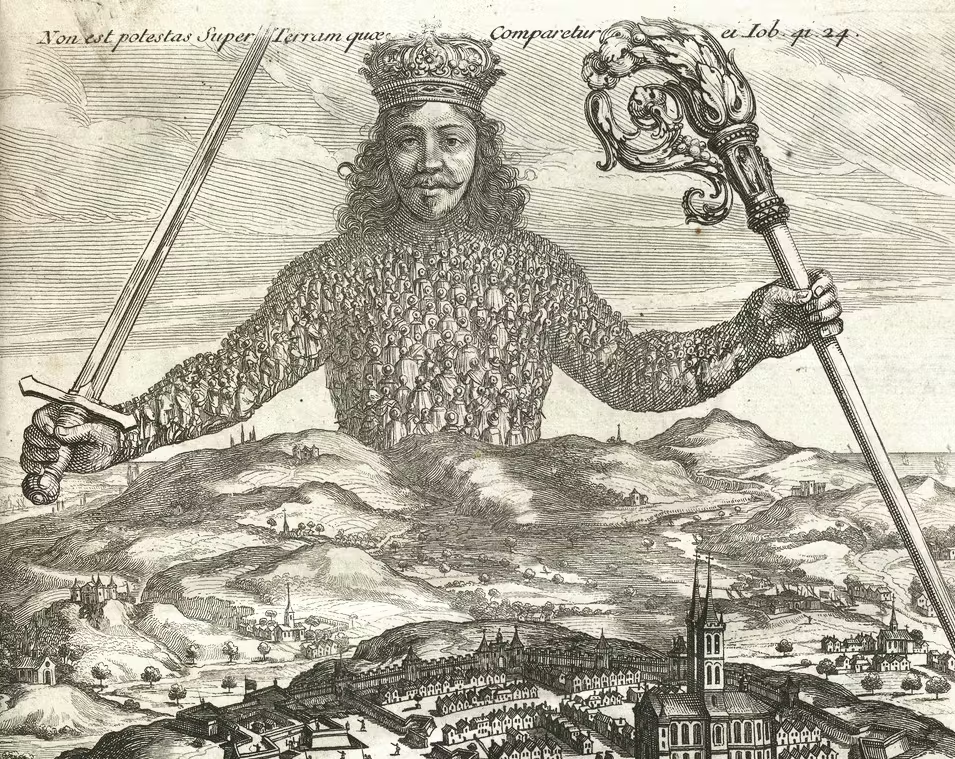
    MIL OSI Economics –

    June 28, 2025
←Previous Page
1 … 85 86 87 88 89 … 488
Next Page→
NewzIntel.com

NewzIntel.com

MIL Open Source Intelligence

  • Blog
  • About
  • FAQs
  • Authors
  • Events
  • Shop
  • Patterns
  • Themes

Twenty Twenty-Five

Designed with WordPress