Category: Intelligence

  • MIL-OSI Security: Indiana Men Plead Guilty to Assaulting Law Enforcement During January 6 Capitol Breach

    Source: Federal Bureau of Investigation (FBI) State Crime Alerts (b)

                WASHINGTON – Two men from Indiana pleaded guilty on Oct. 3, 2024, to assaulting law enforcement during the Jan. 6, 2021, breach of the U.S. Capitol. Their actions and the actions of others disrupted a joint session of the U.S. Congress convened to ascertain and count the electoral votes related to the 2020 presidential election.

                Donald Lee Moss, 62, of Elizabethtown, Indiana, and James Link Behymer, 61, of Hope, Indiana, each pleaded guilty to one count of assaulting, resisting, or impeding certain officers before U.S. District Judge Tanya S. Chutkan. The two men will be sentenced on Feb. 13, 2025.

                According to court documents, at about 2:00 p.m. on Jan. 6, 2021, in Washington, D.C., a group of Metropolitan Police (MPD) officers, wearing riot gear, walked toward the Lower West Terrace of the U.S. Capitol building as angry and violent rioters descended on, and surrounded, the officers and began shouting obscenities and curses at them.

                The surrounded officers repeatedly issued commands to “move back.” They also began to move rioters away from their positions with their hands and batons. At approximately 2:01 p.m., Behymer approached the MPD officers with his friend, Donald Lee Moss. An MPD officer then extended his hand toward Behymer and said, “Sir, step back for your own safety.” Other officers directed Behymer and Moss to move back, but they did not. Behymer raised his right arm with a closed fist and repeatedly shouted, “USA! USA! USA!”  At the same time, Moss pointed toward the U.S. Capitol building and shouted, “This is our f— house!”

                At 2:01 p.m., an MPD officer extended their hand, attempting to keep Behymer back. Behymer then swung his fist down, striking the officer’s wrist. A few seconds later, the MPD officer placed their right hand on Behymer to keep him back; however, Behymer swung his left fist downward and struck the officer’s arm a second time while Moss forcibly shoved the officer’s hand off Behymer.

                Behymer continued to shout, “USA! USA! USA!” and Moss told the officer to “Get your f— hand off of him!” as the mob constricted the officers’ movements and pushed into them. Some members of the mob threw objects, including a traffic cone, at the officers. Amidst the chaos, rioters screamed: “F— You! F— Nazis!”, “Go back to the Gestapo training camp!” “You’re the traitors!” and “You wanna take us all on?!” Shortly after striking the officer’s arm, Moss leaned in and forcefully pushed another MPD officer from behind.

                At approximately 2:02 p.m., Behymer was at the front of the rioters, physically pressed into the officers. A rioter shouted at police: “Y’all surrounded.” Behymer then grabbed an officer’s hand and baton while the officer attempted to keep Behymer away. At approximately 2:03 p.m., Behymer re-engaged with police—again grabbing an officer’s baton.

                Ten minutes after assaulting and opposing officers on the Lower West Terrace, at approximately 2:13 p.m., Behymer and Moss entered the U.S. Capitol building through the Senate Wing doors. At approximately 2:21p.m. Moss stood at a shattered window and waived other rioters towards the Capitol building, encouraging them to enter the building. The two men then made their way toward the Crypt and the hallway linking toward the Senate Wing Doors. At about 2:31 p.m., Moss carried a chair across the Crypt lobby and placed it directly in the path of the retractable ceiling door to prevent the door from closing.

                Moss and Behymer exited the Capitol at approximately 2:41 p.m. and 2:43 p.m., respectively At about 2:48 p.m., rioters broke through a barricade set up by Capitol Police at the Senate Wing doors. Roughly two minutes later, Behymer and Moss re-entered the Capitol again via the Senate Wing doors and walked toward the Crypt before exiting at 3:34 p.m.

                The U.S. Attorney’s Office for the District of Columbia and the Department of Justice National Security Division’s Counterterrorism Section are prosecuting this case. The U.S. Attorney’s Office for the Southern District of Indiana provided valuable assistance.

                The FBI’s Indianapolis and Washington Field Offices are investigating this case. Moss was listed as BOLO (Be on the Lookout) #401 on the FBI’s website. Valuable assistance was provided by the U.S. Capitol Police and the Metropolitan Police Department.

                In the 44 months since Jan. 6, 2021, more than 1,504 individuals have been charged in nearly all 50 states for crimes related to the breach of the U.S. Capitol, including more than 560 individuals charged with assaulting or impeding law enforcement, a felony. The investigation remains ongoing.

                Anyone with tips can call 1-800-CALL-FBI (800-225-5324) or visit tips.fbi.gov.

    MIL Security OSI

  • MIL-OSI USA: Jefferson, The Fed’s Discount Window: 1990 to the Present

    Source: US State of New York Federal Reserve

    Thank you, Steve, for that kind introduction and for the opportunity to talk to this group today.1
    Let me start by saying that I am saddened by the tragic loss of life, destruction, and damage resulting from Hurricane Helene in North Carolina, and throughout this region. My thoughts are with the people and communities affected. For our part, the Federal Reserve and other federal and state financial regulatory agencies are working with banks and credit unions in the affected area to help make sure they can continue to meet the financial services needs of their communities.
    Yesterday I shared my historical perspective on the discount window at Davidson College.2 In 1913, when the Federal Reserve was established, the discount window was the main tool it used to provide the nation with a safer, more flexible, and more stable monetary and financial system. More than 110 years later, the discount window continues to play an important role in supporting the liquidity and stability of the banking system, and the effective implementation of monetary policy.
    Today I would like to discuss with you how the discount window has evolved in the 21st century, including recent steps the Federal Reserve Board has taken to solicit feedback from the public on discount window operations. Before I address our most recent efforts, however, I will review some important episodes in discount window history that brought us to where we are today.
    First, I will recount briefly events in the 1980s and early 1990s that provide important context for the reappraisal of the discount window in the early 2000s. Second, I will summarize revisions to the discount window that the Fed made in 2003 and some additional changes made since then. Third, I will describe efforts that the Fed has taken to ensure that the discount window remains effective today, including the request for information that the Board recently issued on operational aspects of the discount window and intraday credit. After completing my discussion of the discount window, I will conclude with my outlook for the U.S. economy.
    Events before the 2003 Discount Window RevisionsI would like to pick up today where I left off yesterday in my speech at Davidson College: the 1980s and early 1990s. This was a period of widespread problems in the commercial banking sector. Troubled institutions borrowed from the discount window for extended periods of time as the Federal Deposit Insurance Corporation (FDIC) sought to find merger partners or otherwise manage the closure of these institutions. As a result, the discount window became associated strongly with lending to troubled institutions. Healthy banks’ reluctance to borrow from the discount window increased. The greater reluctance to borrow from the discount window made it less effective both as a monetary policy tool and as a crisis-fighting tool.3 This led to a reassessment of the discount window in the early 2000s and to eventual revisions implemented in 2003.
    A Reassessment of the Discount Window in the Early 2000sThe key challenge in the reassessment of the discount window was to establish a lending program that would not only operate effectively and support monetary policy implementation, but also mitigate moral hazard and provide sufficient controls to minimize risk to Reserve Banks and, ultimately, to American taxpayers. After the reassessment, the Fed implemented several changes aimed to achieve the right balance.
    The Board replaced the adjustment credit program, which was extended at a below-market rate, with a new type of discount window credit called primary credit. This new type of discount window credit became effective in 2003.4 It is available as a backup source of liquidity to depository institutions in generally sound financial condition at an above-market rate. Making the discount rate a penalty rate is more consistent with the long-standing practice of other major central banks. This feature was intended to reduce the need for administrative pressures based on Reserve Bank staff judgment of inappropriate usage when the discount rate was below market rates. Although those measures effectively limited usage that was deemed inappropriate at the time, they also presented communication challenges regarding when it was appropriate to use the discount window and perpetuated the perception that the Fed discouraged its use.
    Primary credit is a “no questions asked” facility in which eligible depository institutions are no longer required to have exhausted other sources of funding or be subject to restrictions on the use of the borrowed funds. The Fed initially set the primary credit rate 100 basis points above the target federal funds rate.5 Since March 2020, the Fed has set the primary credit rate at a level equal to the top of the target range for the federal funds rate.6
    At the same time primary credit was established, another new program, called secondary credit, replaced the extended credit program. Secondary credit is available to depository institutions that are not eligible for primary credit. It was initially available at an interest rate 50 basis points higher than the primary credit rate, which is the spread in effect today. In contrast to primary credit, extensions under secondary credit are subject to higher collateral discounts and may involve ongoing oversight on the use of funds obtained under the program, reflecting the less-sound condition of secondary credit borrowers. Typically, Reserve Banks review a depository institution’s plan to repay the loan and return to market sources of funding.
    This two-tiered structure of providing the no-questions-asked primary credit program for healthy depository institutions and the secondary credit program for less-than-healthy depository institutions was designed primarily to instill public confidence in the health of institutions borrowing from the primary credit program and to reduce the reluctance of healthy depository institutions to borrow.7 In addition, having two separate facilities would reinforce the notion that healthy and troubled depository institutions alike should regard borrowing from the Fed as an option in the event of a need for additional funds.
    In the early years of the switch to the new facilities, there were signs that healthy depository institutions became more willing to borrow from the discount window. For example, some research found that after the 2003 discount window revisions, banks borrowed more from the discount window when the federal funds rate spiked than they had previously.8 This finding suggests that the redesign of the discount window was effective in reducing banks’ reluctance to borrow. As a result, the discount window may have been more effective in placing a ceiling on short-term funding rates, aiding the implementation of monetary policy, and serving as a liquidity tool when needed.
    Nevertheless, it is important to acknowledge that it is difficult to measure reluctance to borrow from the discount window. When the interest rate on primary credit is above the target federal funds rate and the federal funds rate is close to its target, the aggregate volume of primary credit is expected to be low. In other words, a low average level of discount window borrowing does not necessarily mean that there is a reluctance to borrow; instead, it could simply reflect a situation in which depository institutions do not currently need to borrow. In addition, when there is an abundance of liquidity in the banking system, as is the case in the current ample-reserves monetary policy regime, depository institutions may have less need to obtain additional liquidity via the discount window. Again, this does not necessarily mean that there is a reluctance to borrow. Conversely, the presence of discount window borrowing does not necessarily reflect the absence of a reluctance to borrow. It could be the case that, although aggregate usage increases, there are still some depository institutions that are willing to pay well above the primary credit rate even when they could have borrowed readily from the discount window. For these reasons, it is important that we complement data with market outreach information to assess the effectiveness of the discount window.
    Changes and Challenges since the Introduction of Primary and Secondary CreditPrimary and secondary credit exist today, but some changes have been made to primary credit since its inception. For example, although the discount window was used extensively and played an important role in the emergency measures taken during the financial crisis of 2007–09, some depository institutions during this period still were willing to borrow funds from the market at rates above the discount rate.9 This suggested that there was a reluctance to borrow before the crisis, and that reluctance appeared to grow over the course of the crisis. To promote the restoration of orderly conditions in financial markets and provide depository institutions with greater assurance about the cost and availability of funding, the Board approved temporary changes to its primary credit discount window facility during the crisis.10 In addition, in late 2007, the Board established the Term Auction Facility (TAF).11
    Concerns about lending to troubled depository institutions reemerged after the 2007–09 financial crisis. In the Dodd-Frank Wall Street Reform and Consumer Protection Act, which was enacted in 2010, Congress required the Fed to publish detailed individual institution borrowing data with a two-year lag.12 This action was intended to enhance the transparency and accountability of Federal Reserve lending while still preserving a measure of confidentiality to avoid discouraging depository institutions from borrowing.
    More recently, in March 2020, the Fed announced changes to the provision of primary credit that were intended to encourage depository institutions to use the discount window to meet demands for credit from households and businesses in connection with the COVID-19 pandemic. These changes included setting the primary credit rate at a level equal to the top of the federal funds target range—a step that enhanced the ability of the discount window to support trading within the Federal Open Market Committee’s (FOMC) target range for the federal funds rate—and communicating the terms of borrowing as 90 days, prepayable and renewable on a daily basis. To further encourage depository institutions to use the discount window, the Fed also made changes to its reporting of Reserve Bank–level aggregate weekly discount window borrowing. It consolidated amounts previously reported as “loans,” which include discount window borrowing, into a broader category of assets.13 The changes made in 2020 remain in effect.
    During and after the spring 2023 stress events, the discount window again played an important role in supporting both monetary policy and financial stability. Depository institutions that came under severe stress turned to the discount window. The discount window also served an important role in providing ready access to funding, especially for depository institutions experiencing spillovers from the bank failures. To further ensure that depository institutions had the ability to meet the needs of all their depositors, the Board announced the creation of a new emergency program, the Bank Term Funding Program (BTFP). Although the BTFP was established pursuant to the Board’s emergency lending authority in section 13(3) of the Federal Reserve Act, the BTFP used the discount window infrastructure to lend to eligible depository institution borrowers.14 By relying on the existing discount window infrastructure, the BTFP was able to begin operating right away. The program ceased extending new loans on March 11, 2024, as scheduled.
    Today the discount window continues to be an effective tool, but it is important to acknowledge that economic and banking conditions continue to evolve. Since the 2003 discount window reassessment, we have seen an increased focus on liquidity in banking regulation, including the advent of quantitative liquidity requirements for large banking organizations; technological changes in the banking system; a general trend toward faster and 24-7-365 payment systems; changes in the composition and posture of Federal Home Loan Bank lending; and the move to an ample-reserves monetary policy implementation regime.
    In light of these developments, the Federal Reserve System has taken important steps to ensure that the discount window performs its functions successfully in the 21st-century economy. For example, last year the Board, along with the other federal banking agencies and the National Credit Union Administration, issued guidance on contingency funding plans that encouraged depository institutions to be ready to borrow from the discount window.15 This includes taking steps to establish borrowing relationships with the Federal Reserve, such as providing certain legal documentation and ensuring that collateral to secure loans is ready to pledge. In connection with interagency initiatives, Reserve Banks have conducted outreach to depository institutions and made efforts to guide them in using the discount window.
    Data suggest that this encouragement is working. By the end of 2023, 3,900 banks, or roughly 80 percent of all banks, had completed the legal documentation required to borrow from the discount window.16 Of those, nearly 2,000 banks had pledged collateral, with an aggregate lendable value of over $2.6 trillion after applying appropriate discounts. These figures are notably above their levels at the end of 2021 and 2022. Although I am pleased to see the improvements in discount window readiness statistics, continued outreach is still important. To that effect, this summer, Federal Reserve Banks hosted an Ask the Fed® session to discuss the purpose of the discount window, its facilities, and recommendations for depository institutions on how to prepare to borrow from the Fed.17
    Additionally, the Federal Reserve System has made important investments to enhance the technology that supports discount window activities. Earlier this year, the System launched Discount Window Direct, which is an online portal for depository institutions to request and prepay loans as well as securely message their local Reserve Bank.18 Discount Window Direct generally is accessible 24 hours a day. We are actively encouraging the use of Discount Window Direct.
    Seeking Feedback on the Discount WindowTo complement our efforts to enhance discount window operations, the Federal Reserve Board recently announced that it is collecting feedback from the public on operational frictions associated with the discount window and intraday credit through the issuance of a request for information. As some of you may know, a request for information is a formal document through which a government agency solicits feedback. Members of the public can submit comments in response to the request for information until December 9, 2024.19
    The Board requests input on various discount window and intraday credit operational practices, such as the process for requesting, receiving, and repaying discount window loans as well as Reserve Bank discount window and intraday credit communications practices. Through the request for information, the Board hopes to gain further insight into the operational aspects that are the most costly or burdensome for depository institutions. This will help the Fed consider further improvements to promote efficiency and reduce burden on depository institutions. Ultimately, the Fed’s goal is to build on the current discount window operations and processes so that the discount window will continue to provide ready access to funding against a wide range of collateral in the future. I encourage members of the public to submit comments on the request for information, and I look forward to considering the feedback that we receive.
    Economic OutlookBefore concluding, let me share with you a summary of my outlook for the U.S. economy, as I did yesterday with the audience at Davidson. Economic activity continues to grow at a solid pace. Inflation has eased substantially. The labor market has cooled from its formerly overheated state.
    Personal consumption expenditures (PCE) prices rose 2.2 percent over the 12 months ending in August, well down from 6.5 percent two years earlier. Excluding the volatile food and energy categories, core PCE prices rose 2.7 percent, compared with 5.2 percent two years earlier. Our restrictive monetary policy stance played a role in restraining demand and in keeping longer-term inflation expectations well anchored, as reflected in a broad range of inflation surveys of households, businesses, and forecasters, as well as measures from financial markets. Inflation is now much closer to the FOMC’s 2 percent objective. I expect that we will continue to make progress toward that goal.
    While, overall, the economy continues to grow at a solid pace, the labor market has modestly cooled. Employers added an average of 186,000 jobs per month during July through September, a slower pace than seen early this year. The unemployment rate now stands at 4.1 percent, up from 3.8 percent in September 2023. Meanwhile, job openings declined by about 4 million since their peak in March 2022. The good news is that the rise in unemployment has been limited and gradual, and the level of unemployment remains historically low. Even so, the cooling in the labor market is noticeable.
    Congress mandated the Fed to pursue maximum employment and price stability. The balance of risks to our two mandates has changed—as risks to inflation have diminished and risks to employment have risen, these risks have been brought roughly into balance. The FOMC has gained greater confidence that inflation is moving sustainably toward our 2 percent goal. To maintain the strength of the labor market, my FOMC colleagues and I recalibrated our policy stance last month, lowering our policy interest rate by 1/2 percentage point.
    Looking ahead, I will carefully watch incoming data, the evolving outlook, and the balance of risks when considering additional adjustments to the federal funds target range, our primary tool for adjusting the stance of monetary policy. My approach to monetary policymaking is to make decisions meeting by meeting. As the economy evolves, I will continue to update my thinking about policy to best promote maximum employment and price stability.
    Thank you.
    ReferencesArtuç, Erhan, and Selva Demiralp (2010). “Provision of Liquidity through the Primary Credit Facility during the Financial Crisis: A Structural Analysis,” Federal Reserve Bank of New York, Economic Policy Review, vol. 16 (August), p. 43–53.
    Bernanke, Ben S. (2009a). “The Federal Reserve’s Balance Sheet,” speech delivered at the Federal Reserve Bank of Richmond 2009 Credit Markets Symposium, Charlotte, N.C., April 3.
    ——— (2009b). “The Federal Reserve’s Balance Sheet: An Update,” speech delivered at the Federal Reserve Board Conference on Key Developments in Monetary Policy, Washington, October 8.
    Board of Governors of the Federal Reserve System (2002a). “Extensions of Credit by Federal Reserve Banks; Reserve Requirements of Depository Institutions,” final rule, technical amendment (Docket Nos. R-1123 and R-1134), Federal Register, vol. 67 (November 7), pp. 67777–87.
    ——— (2002b). “Publication of Final Rule Amending Regulation A (Extensions of Credit by Federal Reserve Banks),” press release, October 31.
    ——— (2020). “Federal Reserve Actions to Support the Flow of Credit to Households and Businesses,” press release, March 15.
    ——— (2023). “Federal Reserve Board Announces It Will Make Available Additional Funding to Eligible Depository Institutions to Help Assure Banks Have the Ability to Meet the Needs of All Their Depositors,” press release, March 12.
    ——— (2024a). “Bank Term Funding Program: Frequently Asked Questions (PDF),” updated January 24.
    ——— (2024b). “Request for Information and Comment on Operational Aspects of Federal Reserve Bank Extensions of Discount Window and Intraday Credit,” request for information and comment (Docket No. OP-1838), Federal Register, vol. 89 (September 10), pp. 73415–18.
    Board of Governors of the Federal Reserve System, Federal Deposit Insurance Corporation, National Credit Union Administration, and Office of the Comptroller of the Currency (2023). “Agencies Update Guidance on Liquidity Risks and Contingency Planning,” joint press release, July 28.
    Clouse, James A. (1994). “Recent Developments in Discount Window Policy (PDF),” Federal Reserve Bulletin, vol. 80 (November), pp. 965–77.
    Jefferson, Philip N. (2024). “A History of the Fed’s Discount Window: 1913-2000,” speech delivered at Davidson College, Davidson, N.C., October 8.
    Madigan, Brian F. (2009). “Bagehot’s Dictum in Practice: Formulating and Implementing Policies to Combat the Financial Crisis,” speech delivered at the Federal Reserve Bank of Kansas City’s Annual Economic Symposium, Jackson Hole, Wyo., August 21.

    1. The views expressed here are my own and are not necessarily those of my colleagues on the Federal Reserve Board or the Federal Open Market Committee. Return to text
    2. See Jefferson (2024). Return to text
    3. For more details about this period, see Clouse (1994). In response to the wave of depository institution failures, Congress placed legal limitations on Federal Reserve lending to troubled institutions. Specifically, section 142 of the Federal Deposit Insurance Corporation Improvement Act of 1991 (FDICIA) amended section 10B of the Federal Reserve Act to place restraints on discount window lending to undercapitalized and critically undercapitalized insured depository institutions. FDICIA also imposed liability on the Board of Governors for excess losses incurred by the FDIC that are attributable to lending beyond those limits. The provisions of FDICIA were intended to reduce moral hazard in the banking system and limit taxpayer losses. Return to text
    4. For more details, see the October 31, 2002, Federal Reserve press release (Board of Governors, 2002b) and the final rule implementing the changes (Board of Governors, 2002a). Return to text
    5. In 2003, when primary credit was implemented, there was a single federal funds target rate. The Federal Open Market Committee adopted a federal funds target range on December 16, 2008. Return to text
    6. For details on the change to the rate spread announced in March 2020, see the press release (Board of Governors, 2020). As will be discussed in greater detail later, before 2020, the spread between the primary credit rate and the target federal funds rate (or top of the target range) had changed a few times to address economic conditions during the 2007–09 financial crisis and the subsequent recovery. Return to text
    7. This design feature also would help Reserve Banks manage risk more easily by establishing a standardized approach and risk controls when lending through a facility reserved for troubled depository institutions. Loans to troubled depository institutions entail more risk to the lending Reserve Bank, and depository institutions that are undercapitalized or critically undercapitalized are subject to lending limitations under FDICIA. Return to text
    8. See Artuç and Demiralp (2010). Return to text
    9. See Bernanke (2009a) and Madigan (2009) for a retrospective that elaborates on some of the emergency measures taken during the 2007–09 financial crisis and the reasoning for discount window rate changes during the financial crisis. Return to text
    10. Throughout this crisis, the Board approved numerous reductions in the primary credit rate and narrowed the spread between the primary credit rate and the target federal funds rate twice. With the narrowing of the spread in August 2007 from 100 basis points to 50 basis points and in March 2008 to 25 basis points, the Board announced that the maximum term for primary credit loans would be extended, first to 30 days and then to 90 days, respectively. As economic conditions improved, in 2010, the Board increased the spread between the primary credit rate and the target federal funds rate to 50 basis points and shortened the maximum term for primary credit loans to overnight. Return to text
    11. The TAF provided fixed quantities of term credit to depository institutions through an auction mechanism and seemed to have largely addressed banks’ concern that borrowing from the Federal Reserve would imply weakness. According to Bernanke (2009b, paragraph 7), this was “partly because the sizable number of borrowers provides a greater assurance of anonymity, and possibly also because the three-day period between the auction and auction settlement suggests that the facility’s users are not using it to meet acute funding needs on a particular day.” Return to text
    12. See section 1103 of the Dodd-Frank Act, which amended section 11 of the Federal Reserve Act. Return to text
    13. The Board’s H.4.1 statistical release, “Factors Affecting Reserve Balances of Depository Institutions and Condition Statement of Federal Reserve Banks,” is published weekly. It presents a balance sheet for each Federal Reserve Bank, a consolidated balance sheet for all 12 Reserve Banks, an associated statement that lists the factors affecting reserve balances of depository institutions, and several other tables presenting information on the assets, liabilities, and commitments of the Federal Reserve Banks. For additional details on the consolidation of “loans” into a broader category of assets, see the March 19, 2020, H.4.1 announcement, available on the Board’s website at https://www.federalreserve.gov/releases/h41/20200319. Return to text
    14. As with the discount window, an eligible institution participated in the BTFP through its local Reserve Bank. The legal agreements and process for pledging securities in the BTFP also relied on those used in discount window lending. Nevertheless, the BTFP differed from the discount window in various ways, including the term of lending, scope of eligible collateral, collateral valuation, and interest rate. For more information on the differences between the BTFP and the discount window, see the response to question A.3 in Board of Governors (2024a, p. 3). For additional details on the BTFP, see the March 12, 2023, press release (Board of Governors, 2023). Return to text
    15. See Board of Governors and others (2023). Return to text
    16. The statistics in this paragraph are available on the Board’s website at https://www.federalreserve.gov/monetarypolicy/discount-window-readiness.htm. Return to text
    17. More information on Ask the Fed is available on the Federal Reserve Bank of St. Louis’s website at https://bsr.stlouisfed.org/askthefed/Auth/Logon. Return to text
    18. Additional details on Discount Window Direct can be found on the Federal Reserve Bank Services website at https://www.frbservices.org/central-bank/lending-central. Return to text
    19. See the information on discount window operations in section II.A of Board of Governors (2024b). Return to text

    MIL OSI USA News

  • MIL-OSI Security: Former New Castle Police Lieutenant Found Guilty of Excessive Use of Force and Attempted Cover-Up Following Federal Jury Trial

    Source: Federal Bureau of Investigation (FBI) State Crime News

    INDIANAPOLIS—A federal jury has convicted Aaron Strong, 46, of New Castle, of three counts of deprivation of rights under color of law and one count of witness tampering, following a five-day trial.

    According to court documents and evidence introduced at trial, Aaron Strong was employed as a police officer with the New Castle Police Department. At the time the events occurred, Strong was a Lieutenant and served as Commander of the Henry County S.W.A.T. Team. Between 2017 and 2019, Strong engaged in a pattern of excessive use of force against a New Castle resident during the course of an arrest, and two detainees at the Henry County Jail.

    On July 12, 2017, Strong was part of a group of law enforcement and correctional officers that responded to reports that inmates were intoxicated at the Henry County Transition Center, a dormitory-style area of the facility designated for detainees who posed a lower security risk. When officers arrived and directed detainees to get on the ground, detainees proceeded to lay on the ground or get to their knees. Inmate “T.C” was laying on the ground when Lieutenant Strong encountered him. In response to a comment made by the inmate, Strong stomped on T.C.’s head multiple times, causing significant bodily harm.

    During the same incident, inmate “E.S.” initially got to his knees when officers ordered him to get on the ground, before eventually laying on the ground as directed. In response to the inmate’s delay in getting all the way to the ground, Lieutenant Strong shot him in the back with a “bean bag” shotgun round at point-blank range—approximately four feet away. The shot fractured the victim’s spine. All of the events at the Henry County Transition Center that day were captured on video. Other responding officers were so disturbed by Strong’s conduct that they immediately reported the incident to supervisors. As a result of Strong’s actions, the New Castle Police Department removed Strong from its S.W.A.T. Team.

    On August 18, 2019, New Castle Police engaged in a foot pursuit of “J.W.,” the subject of an investigation. After J.W. lowered himself to the ground, put his hands up and said, “I’m done,” officers began the process of putting him under arrest. As J.W. was lying face down and other officers were working to place him in handcuffs, Lieutenant Strong, without provocation, began to strike the arrestee on his arms, neck, and head with an expandable baton, resulting in significant bodily injury. In an attempt to cover up his illegal use of force against J.W., Strong knowingly made false statements to an Indiana State Police Trooper during the investigation of the 2019 incident.

    A second defendant, former Henry County Reserve Deputy Adam Guy, was acquitted by the jury of a single count of witness tampering related to the 2019 incident.

    “Law enforcement officers put their lives on the line every day to serve our communities. Their jobs are difficult, dangerous, and noble,” said Zachary A. Myers, U.S. Attorney for the Southern District of Indiana. “Aaron Strong is not noble. He repeatedly and unlawfully abused his position of authority to inflict violence, injury, and pain—with no lawful justification. He then lied to cover it up. Our community deserves better. Together with our partners at the Department of Justice, the FBI, and Indiana State Police, our federal prosecutors will continue to seek accountability for police who illegally assault those they are sworn to protect.”

    “Aaron Strong is a repeat offender who defied his oath and abused his law enforcement authority to violently and unlawfully assault multiple individuals,” said Assistant Attorney General Kristen Clarke of the Justice Department’s Civil Rights Division. “This defendant put his fellow officers in danger and grievously injured people in his custody, whose wellbeing and rights he had a legal and moral duty to protect. Strong betrayed the law enforcement profession when he told lie after lie in an effort to cover up his crimes and derail an independent investigation. This unanimous jury verdict makes clear a core principle in our country – law enforcement officers are not above the law and will be held accountable for their crimes.”

    The FBI and Indiana State Police investigated this case, with the cooperation and assistance of the New Castle Police Department and Henry County Sheriff’s Office. Chief U.S. District Judge Tanya Walton Pratt presided over the trial. Strong is scheduled to be sentenced on Jan. 7, 2025, and faces a maximum penalty of 50 years in prison.

    U.S. Attorney Myers thanked Assistant U.S. Attorney Peter A. Blackett and the Civil Rights Division’s Criminal Section Trial Attorney Alec Ward, who prosecuted this case.

    ###

    MIL Security OSI

  • MIL-OSI Security: Lehigh Acres Man Indicted for COVID Relief Fraud

    Source: Federal Bureau of Investigation (FBI) State Crime Alerts (b)

    Fort Myers, Florida – United States Attorney Roger B. Handberg announces the return of an indictment charging Thakur Sukhdeo (38, Lehigh Acres) with wire fraud and illegal monetary transactions. If convicted, Sukhdeo faces a maximum penalty of 30 years in federal prison for each wire fraud count and up to 10 years in federal prison for each illegal monetary transaction count. The indictment also notifies Sukhdeo that the United States intends to forfeit a 2018 Jaguar F-Pace, 2020 GMC Sierra 3500 HD, and $414,000, which are alleged to be traceable to proceeds of the offense.

    According to the indictment, beginning in approximately July 2021, Sukhdeo engaged in a scheme to defraud the Small Business Administration (SBA) by making fraudulent representations in Economic Injury Disaster Loan (EIDL) loan documents about the use of EIDL funds. Sukhdeo’s false representations caused the SBA to fund a $414,000 EIDL for his company, J.R. Handyman Pro’s LLC.  Instead of using the EIDL proceeds for working capital, Sukhdeo used the funds for unauthorized purposes and for his own personal enrichment and the enrichment of others. This included the purchase of a luxury car for $68,984.61 and a truck for $93,994.42.   

    The Coronavirus Aid, Relief, and Economic Security (CARES) Act is a federal law enacted March 2020. It is designed to provide emergency financial assistance to millions of Americans who are suffering the economic effects resulting from the COVID-19 pandemic. On source of relief provided by the CARES Act was the expansion of an existing disaster-related program, the EIDL Program. The EIDL program is designed to provide economic relief to small businesses that are currently experiencing a temporary loss of revenue. EIDL proceeds can be used to cover a wide array of working capital and normal operating expenses, such as continuation of health care benefits, rent, utilities, and fixed debt payments.

    An indictment is merely a formal charge that a defendant has committed one or more violations of federal criminal law, and every defendant is presumed innocent unless, and until, proven guilty.

    This case was investigated by the Federal Bureau of Investigation. It will be prosecuted by Assistant United States Attorney Trent Reichling. The forfeiture will be handled by Assistant United States Attorney Suzanne Nebesky. 

    MIL Security OSI

  • MIL-OSI Security: Former Bookkeeper for Kalispell Firearms Business Sentenced to Prison, Fined $20,000 for Embezzling Approximately $159,000

    Source: Federal Bureau of Investigation (FBI) State Crime Alerts (c)

    MISSOULA — A former bookkeeper who admitted to embezzling approximately $159,000 from her employer, a Kalispell firearms manufacturing company, was sentenced today to five months in federal prison followed by six months of home confinement and three years of supervised release, fined $20,000 and ordered to pay $174,572 restitution, U.S. Attorney Jesse Laslovich said.

    The defendant, Teri Anne Bell, 58, of Columbia Falls, pleaded guilty in June to wire fraud.

    U.S. District Judge Donald W. Molloy presided. The court also ordered Bell to perform 175 hours of community service.

    In court documents, the government alleged that from May 2018 until about December 2021, Bell, while working as a bookkeeper for Falkor SID Inc., a firearm manufacturing and distribution business in Kalispell, stole more than $150,000. Bell altered descriptions in Quickbooks to make it appear money was spent on legitimate business expenses when, in fact, the money went to pay down Bell’s personal credit card balances. In addition, Bell wrote herself a check for $10,000. In the fall of 2021, Falkor’s owners suspected Bell was stealing money from the company, and a financial audit determined that Bell completed 45 unauthorized transactions totaling $159,131 in Falkor funds. When confronted, Bell denied any wrongdoing. After she was terminated, Bell filed a grievance and demanded to be reinstated. The business owners were forced to spend an additional $15,441 to determine the extent of Bell’s fraud and to obtain legal counsel regarding her employment claim. Bell used the stolen funds for personal expenses, including hotels in Las Vegas and at Quinn’s Hot Springs, payments to retail and liquor stores, collection agencies and streaming services.

    The U.S. Attorney’s Office prosecuted the case. The FBI and Flathead County Sheriff’s Office conducted the investigation.

    XXX

    MIL Security OSI

  • MIL-OSI Security: Tennessee Man Sentenced to Prison on Felony and Misdemeanor Charges for Actions During January 6 Capitol Breach

    Source: Federal Bureau of Investigation (FBI) State Crime Alerts (c)

    Allan Jennings of Tennessee was sentenced to prison after he pleaded guilty to felony and misdemeanor charges related to his conduct during the U.S. Capitol breach.

    MIL Security OSI

  • MIL-OSI USA: Grassley Condemns Biden-Harris Admin for Ignoring Alarms about Afghan Evacuee Vetting, Resettlement Procedures

    US Senate News:

    Source: United States Senator for Iowa Chuck Grassley
    WASHINGTON – Sen. Chuck Grassley (R-Iowa) today issued the below statement on the FBI arresting an Afghan native who secured a Special Immigrant Visa (SIV) to enter the U.S. following the Biden-Harris administration’s botched troop withdrawal from the region in 2021. The individual, now in federal custody, was plotting an ISIS-fueled terrorist attack on American soil in the coming weeks.
    “I was highly vocal about the need to thoroughly vet SIV applicants during – and in the weeks, months and years following – the Biden-Harris administration’s chaotic withdrawal from Afghanistan. But the White House, executive agencies and many of my Democratic colleagues in Congress were quick to dismiss those glaring alarms,” Grassley said. “The number one job of our government is to protect its citizens. By hiding behind clerical excuses, refusing to take accountability and neglecting to address known vulnerabilities in vetting and resettlement processes, the Biden-Harris administration failed to prioritize Americans’ safety and, once again, projected weakness on the global stage.”
    Grassley’s Related Oversight, Legislative Work
    July 1, 2024: Watchdog Report Corroborates Grassley Oversight of DHS, FBI Failures to Properly Vet Afghan Evacuees
    July 21, 2023: Grassley & Judiciary Committee Colleagues Introduce Bill To Protect Afghan Allies
    May 12, 2023: Grassley Joins Thune, Risch, Colleagues To Introduce Bill To Release Afghanistan Dissent Cable
    September 21, 2022: Grassley: Americans Deserve To Know How FBI Is Addressing Afghan Evacuee Vetting Failures
    September 7, 2022: Grassley Statement On DHS Inspector General Finding Deficiencies With Vetting Of Afghan Parolees
    August 22, 2022: Senators Seek Transparency On Flagged Afghan Evacuees Amid Ongoing Concerns Of Vetting, Security Failures
    August 4, 2022: Grassley Statement At FBI Oversight Hearing
    May 27, 2022: Grassley, Portman, Inhofe Demand Update From FBI On Afghan Evacuees Flagged For Security Concerns, Denounce DHS’ Continued Failure To Use All Vetting Tools
    February 17, 2022: Grassley Statement On Watchdog Warnings About Deficient Vetting Of Afghan Evacuees
    December 22, 2021: Portman, Grassley, Shelby, Risch, Inhofe & Capito Request Biden Administration Provide Overdue Report On Composition & Vetting Of Afghan Evacuees
    October 28, 2021: State Dept. AWOL As Americans, Allies Remain Stranded In Afghanistan
    September 27, 2021: Grassley On Afghanistan Collapse Through The Lens Of The Inspector General
    September 27, 2021: Grassley Presses Justice Dept., FBI On Terrorist Travel After Afghanistan Withdrawal
    September 15, 2021: Grassley On President Biden’s Afghanistan Failures
    August 31, 2021: Grassley To Biden Admin: Don’t Let Bad Actors Take Advantage Of Chaotic Afghanistan Withdrawal
    August 26, 2021: Grassley Statement on Afghanistan
    -30-

    MIL OSI USA News

  • MIL-OSI Security: FBI Assists in Identifying Victims of Tennessee Floods

    Source: Federal Bureau of Investigation (FBI) State Crime News

    FBI agents often dust for fingerprints to track down criminals and unravel complex cases. But this mission was different. The fingerprints here are not about solving crimes—they are about providing answers in the face of a tragedy that devastated parts of their community.

    After deadly floods swept through East Tennessee and Western North Carolina last week, the FBI has joined local authorities in the grim task of identifying victims. Special agents from the FBI’s Johnson City Resident Agency are working alongside the Tennessee Bureau of Investigation (TBI) and the Northeast Regional Medical Examiner’s Office at East Tennessee State University, employing cutting-edge technology to provide grieving families with some semblance of closure.

    In a region mostly unfamiliar with natural disasters, the flood’s devastation has left communities reeling. But the FBI’s involvement here is somewhat atypical. Known usually for connecting crime scenes to criminals, the FBI’s fingerprint expertise is being used not to solve crimes but to reunite families with loved ones.

    “When you’re doing this, you still take extra care because that was a human and that was somebody’s loved one, it was somebody’s mother, brother, sister,” said Special Agent Paul Durant, who has been with the FBI for five years. “It’s tough, but it’s rewarding to know that we can provide some answers to families who are suffering.”

    Durant, alongside Special Agent Reanna O’Hare, used electronic fingerprint devices to collect prints from victims, sometimes resorting to advanced forensic methods to recover identities. The fingerprints were sent directly to the FBI Laboratory in Quantico, Virginia, using smartphone technology, streamlining what can otherwise be a lengthy process.

    FBI Special Agent Paul Durant at the William L. Jenkins Northeast Tennessee Regional Forensics Center where agents have been working with state and local partners to help identify flood victims from North Carolina and Tennessee.

    The process is both emotionally and physically taxing. The agents often had to work with severely compromised remains made unidentifiable through traditional means. Some victims were swept across state lines from North Carolina into Tennessee, compounding the challenge.

    “The first time I walked into the morgue, I was hit with a sense of disbelief,” Durant said. “I had never been to a medical examiner’s office before, so it was surreal. You know what your job is, but it doesn’t fully sink in until you’re standing there, face to face with the victims. That’s when it becomes real, and you switch into work mode. There were days when it was overwhelming—seeing the destruction and hearing the stories. But at the end of the day, knowing we can help identify these victims and bring some comfort to their families makes it all worth it.”

    Special Agent O’Hare, who has served as the senior team leader on the Knoxville FBI’s Evidence Response Team, echoed the sentiment: “And just seeing the pictures and knowing that people have lost everything, including their family members, it’s devastating.”

    The FBI’s files only have fingerprints that are lawfully collected and the identification effort was not without its technical challenges. In several cases, agents had to use advanced forensic techniques to obtain usable prints. This method, often seen as a last resort in forensic work, is both unsettling and necessary for precise identification.

    “Knowing we have this unique access to national fingerprint files that others might not is critical,” said O’Hare, emphasizing the FBI’s role in tapping into Department of Defense and Department of Homeland Security databases. “We’ve been able to identify some victims who otherwise might have remained unknown.”

    The FBI’s efforts in these floods are part of a broader collaboration with local and state authorities. Special Agent J.D. Anderson, the aupervisory senior resident agent overseeing the efforts in Johnson City, stressed the importance of such partnerships. “Our hearts go out to the families affected by this tragedy. We are committed to doing everything in our power with our partners to bring them closure.”

    “It’s not just about the fingerprints; it’s about the people and the families we’re serving,” said Joe Carrico, special agent in charge of the FBI in Tennessee. “Our role is to support our state and local partners in bringing answers to those who need them most. In moments like these, it’s impossible not to feel the weight of that responsibility.”

    Durant and O’Hare relied heavily on the Mobile Biometrics Application (MBA) and Special Processing Center (SPC) teams to expedite the identification of victims. These specialized units, operating out of the FBI’s Criminal Justice Information Services in West Virginia, provided agents in the field with real-time support, often pulling fingerprints and running them through reference files within minutes. In some cases, results were returned in as little as 15 to 20 minutes, streamlining the identification process during critical moments.

    The MBA team, in particular, played a vital role by not only processing prints swiftly but also actively monitoring quality control and troubleshooting more difficult cases. When automated systems didn’t yield a match, the SPC team took over, applying manual processes to assist with identification. This seamless coordination between field agents and the FBI’s lab-based experts highlights the bureau’s ability to deploy advanced technology in disaster zones, ensuring that victims’ families receive answers as quickly as possible.

    While working to bring closure to grieving families, the agents also feel the storm’s personal impact. Special Agent O’Hare’s daughter and grandchildren evacuated from North Carolina to stay with her in Upper East Tennessee after being displaced by power loss. They plan to return to their town later this week now that power has been restored. “I joined the FBI to help people,” O’Hare said. “In situations like this, that’s why I am doing my very small part to try to provide some closure for the families of the victims.”

    MIL Security OSI

  • MIL-OSI Security: Trio Responsible for Eight Armed Robberies of Indianapolis-Area Cell Phone Stores Sentenced to Combined 65 Years in Federal Prison

    Source: Federal Bureau of Investigation (FBI) State Crime News

    INDIANAPOLIS- Robdarius Williams, 21, D’Maurah Bryant, 21, and Quintez Tucker, 20, all of Indianapolis, have all been sentenced to federal prison for their roles in a series of eight armed robberies of Indianapolis cell phone retailers.

    Defendant Charges Sentence
    Quintez Tucker, 20

    Eight counts of robbery

    Four counts of brandishing a firearm during a crime of violence

    30 years in prison
    3 years of supervised release

    $64,894 in restitution

    D’Maurah Bryant, 21

    Four counts of robbery

    Three counts of brandishing a firearm during a crime of violence

    25 years in prison
    3 years of supervised release

    $24,485 in restitution

    Robdarius Williams, 21

    One count of robbery

    Brandishing a firearm in furtherance of a crime of violence

    9.5 years in prison
    3 years of supervised release

    In April of 2024, Tucker and Bryant each plead guilty. In June of 2024, a federal jury found Williams guilty following a one-and-a-half-day trial.

    According to court documents and evidence introduced at trial, from November 8 through December 3, 2021, Tucker and Bryant worked together to rob eight cell phone retailers around Indianapolis. During each robbery, the men brandished firearms and pointed them at employees, demanded cash, cell phones, and accessories from the store and customers. Williams joined in the eighth and final armed robbery as the getaway driver, stole a license plate for the getaway car and took Tucker to pick up an AR-style rifle used in the robbery.

    In total, the trio robbed eight businesses in twenty-five days:

    Date Location Defendants
    November 8, 2021 Verizon, Olio Rd., Fishers. Tucker & Bryant
    November 18, 2021 T-Mobile, Southport Rd. Tucker & Bryant
    November 23, 2021 Verizon, Kessler Blvd. Tucker & Bryant
    November 26, 2021 T-Mobile, E. 86th St. Tucker & Bryant
    November 29, 2021 T-Mobile, Fox Rd. Tucker & Bryant
    December 1, 2021 T-Mobile, E. Stop 11 Rd. Tucker & Bryant
    December 1, 2021 T-Mobile, W. 38th St. Tucker & Bryant
    December 3, 2021 AT&T, S. Emerson Ave. Tucker & Williams

    “No one should have a gun pointed in their face by heartless criminals simply because they went shopping, or went to work,” said Zachary A. Myers, U.S. Attorney for the Southern District of Indiana. “These armed criminals terrorized their victims with utter disregard for the consequences of their actions—going so far as to point an AR-style firearm at a toddler as their parent shielded the child with their body. These horrific crimes will not be tolerated in our community. The Department of Justice has no higher priority than keeping the public safe from armed, violent crimes. Thanks to the dedicated efforts of the FBI, the Fishers Police Department, IMPD, and our federal prosecutors, our communities will be protected from these criminals for many years to come.”

    “The lengthy sentences handed out should serve as a deterrent to remind potential offenders that the FBI and our law enforcement partners are committed to protecting those who live in the communities we serve,” said FBI Indianapolis Special Agent in Charge Herbert J. Stapleton. “The defendants didn’t just steal items; they instilled a sense of fear in and disrupted the lives of their victims.

    “The sentencing of these three violent felons to a combined 65 years in prison sends a strong message that our community will not tolerate such criminal behavior,” said Ed Gebhart, Fishers Police Chief, “I commend the hard work of our officers, our law enforcement partners and the justice system for ensuring that these dangerous individuals will be off the streets for a significant amount of time.”

    The FBI investigated this case. The Fishers Police Department, the Indianapolis Metropolitan Police Department, and the Marion County Prosecutors Office also provided valuable assistance. The sentences were imposed by U.S District Court Judge Jane Magnus-Stinson.

    U.S. Attorney Zachary A. Myers thanked Assistant U.S. Attorneys Jeremy C. Fugate and Peter A. Blackett, who prosecuted this case.

    This case was part of Project Safe Neighborhoods (PSN), a program bringing together all levels of law enforcement and the communities they serve to reduce violent crime and make our neighborhoods safer for everyone. The Department of Justice reinvigorated PSN in 2017 as part of the Department’s renewed focus on targeting violent criminals, directing all U.S. Attorney’s Offices to work in partnership with federal, state, local, and tribal law enforcement, and the local community to develop effective, locally based strategies to reduce violent crime.

    ###

    MIL Security OSI

  • MIL-OSI Security: Peru Woman Sentenced to 15 Years for Selling More Than 1.5 Kilos of Methamphetamine to Undercover Officer

    Source: Federal Bureau of Investigation (FBI) State Crime News

    PORTLAND, Maine: A Peru, Maine woman was sentenced today in U.S. District Court in Portland for trafficking methamphetamine and for possessing a firearm in furtherance of a drug trafficking crime.

    U.S. District Judge Nancy Torresen sentenced Mandy Lynn Shorey, 43, to 180 months to be followed by five years of supervised release.

    According to court records, between July 2022 and January 2023, Shorey sold approximately 1.5 kilograms of methamphetamine to an undercover officer across four controlled buys. For three of the buys, the purity of the methamphetamine Shorey sold to police approached 100%. During one of the buys, Shorey explained that she carried a firearm with her for protection when she met with new drug customers and removed the firearm from a bag and placed it in her waistband. During another exchange, she told the undercover officer that meeting her to conduct their next transaction would be safe because she would “bring one armed man to back me up that they will never see, just in case.” When Shorey was arrested, she was in possession of a Charter Arms .22 revolver.

    The FBI Safe Streets Task Force investigated the case.

    ###


    Updated 10/9/24 to correct defendant’s city of residence at time of arrest from Windham, ME to Peru, ME 

    MIL Security OSI

  • MIL-OSI Security: Man Who Bound and Raped Au Pair, Victimized Other Women and Girls, Sentenced to Life in Prison

    Source: Federal Bureau of Investigation (FBI) State Crime Alerts (b)

              GRAND RAPIDS, MICHIGAN — U.S. Attorney for the Western District of Michigan Mark Totten today announced that Arisknight Winfree, 32, of East Lansing, was sentenced to life in federal prison for sexually exploiting four women, including two minors, in 2022. Winfree was convicted on multiple charges that included Kidnapping (Count 1), Coercion and Enticement (Count 2), Attempted Coercion and Enticement (Count 3), and Production of Child Pornography (Counts 4 and 5).

              “Arisknight Winfree is a sexual predator whose horrendous acts caused immeasurable harm to the women and girls upon whom he preyed,” said U.S. Attorney Mark Totten. “This life sentence is necessary to protect the community and bring a measure of justice to the survivors.”

              Winfree targeted his victims in multiple ways, including through use of the messaging service on various social media apps and through an online service that connects individuals, often young women, with host families in need of childcare and light housework. The Court convicted Winfree of five crimes involving four victims.

              First, Winfree was convicted of Kidnapping (Count 1) and Coercion and Enticement (Count 2) for the crimes he committed against S.D. The victim was a young woman living in Italy who Winfree contacted on September 5, 2022 through AuPair.com, a website service that connects young women with potential host families. Winfree falsely represented that his family was in search of an au pair to care for his niece. On October 12, 2022, S.D. flew from Italy to Detroit, Michigan, and then took a bus to Winfree’s residence in East Lansing, Michigan. The day after she arrived, Winfree handcuffed his victim’s hands behind her back, placed a gag ball in her mouth, and raped her. Winfree considered killing his victim and hiding her body to avoid prosecution.

              Second, Winfree was convicted of Attempted Coercion and Enticement (Count 3) for the crimes he committed against A.S. Winfree connected with A.S. through AuPair.com in July 2022, falsely representing he needed someone to watch his 7-year-old niece every other week. Winfree paid for A.S. to fly to Michigan on September 14, 2022. When A.S. got to Winfree’s residence, she noticed all the windows were covered with paper and cardboard. She also noticed there were cameras around the house. A.S. saw no signs of children. She saw several knives and guns around the house. On September 16, 2022, A.S.’s family called the East Lansing Police Department and requested a welfare check for A.S. With the assistance of the police, the victim left the residence with her belongings and returned to Kansas.

              Third, Winfree was convicted of Production of Child Pornography (Count 4) for the crimes he committed against Minor Victim 1 (MV1). Winfree connected with MV1 on Instagram in November 2022, when the victim was 17 years old. From November 29-30, MV1 created nude images at Winfree’s request and sent them to him through the social media app’s messaging feature. On November 30, 2022, Winfree picked MV1 up from her high school, drove her to his home, and engaged in sexual acts with her.

              Fourth, Winfree was convicted of another count of Production of Child Pornography (Count 5) for the crimes he committed against Minor Victim 2 (MV2). Winfree connected with MV2 in September or October of 2022 on SnapChat, when the victim was 16 years old. He instructed MV2 to engage in sexual acts and send images and videos to him through SnapChat and later through WhatsApp.

              Further details are provided in the attached Complaint and the United States’ Statement of Facts Establishing Defendant’s Guilt.

              “The sentencing of Arisknight Winfree marks a significant step towards healing for all those who suffered from his callous and heinous criminal acts,” said Cheyvoryea Gibson, Special Agent in Charge of the FBI in Michigan. “Individuals who engage in sexual exploitation involving minors will be investigated and arrested by the FBI and our law enforcement partners in Michigan. The collective investigative efforts by members from FBI Michigan, the East Lansing Police Department, and the prosecutorial efforts of the United States Attorney’s Office of Western Michigan prevented another crime from being committed by Mr. Winfree.”

              “The East Lansing Police Department would like to thank the FBI and the U.S. Attorney’s Office for the Western District of Michigan for their commitment to this case,” said ELPD Police Chief Chad Pride. “Arisknight Winfree’s conviction on multiple charges shows our collaborative partnerships were essential in bringing justice to the survivors of these awful acts and holding Arisknight accountable for his actions.”

              This case is part of Project Safe Childhood, a nationwide initiative designed to protect children from online exploitation and abuse. The U.S. Attorney’s Office, county prosecutor’s offices, the Internet Crimes Against Children task force (ICAC), federal, state, tribal, and local law enforcement are working closely together to locate, apprehend, and prosecute individuals who exploit children. The partners in Project Safe Childhood work to educate local communities about the dangers of online child exploitation, and to teach children how to protect themselves. For more information about Project Safe Childhood, please visit the following website: http://www.projectsafechildhood.gov. Individuals with information or concerns about possible child exploitation should contact local law enforcement officials.

              Assistant United States Attorney Davin Reust prosecuted this case. The East Lansing Police Department, Michigan State University Police and Public Safety, and the FBI investigated it.

              The U.S. Attorney’s Office for the Western District of Michigan issued the previous press releases in this case and a related case:

    ###

    MIL Security OSI

  • MIL-OSI Security: Pequot Lakes Man Sentenced to 15 Years in Prison for Producing Child Pornography

    Source: Federal Bureau of Investigation (FBI) State Crime Alerts (b)

    MINNEAPOLIS – A Pequot Lakes man has been sentenced to 180 months in prison followed by 10 years of supervised release for producing images and videos of child sexual abuse, announced United States Attorney Andrew M. Luger. 

    According to court documents, over the course of several years, Jeffrey Benjamin Adkins, 43, repeatedly engaged in sexual acts with a minor victim. On one of the occasions, Adkins produced a five-minute video that depicted the sexual abuse of a minor.

    On May 28, 2024, Adkins pleaded guilty to one count of production of child pornography. He was sentenced on October 4, 2024, in U.S. District Court by Judge Katherine M. Menendez.

    This case is the result of an investigation conducted by the FBI.

    Assistant U.S. Attorney Emily A. Polachek prosecuted the case.

    MIL Security OSI

  • MIL-OSI Security: Red Lake Woman Sentenced to Prison for Child Neglect Following the Death of a Child on the Red Lake Reservation

    Source: Federal Bureau of Investigation (FBI) State Crime Alerts (b)

    MINNEAPOLIS – A Red Lake woman has been sentenced to 15 months in prison following the death of a child in her care, announced U.S. Attorney Andrew M. Luger.

    According to evidence presented at trial, Sharon Rosebear, 64, intentionally deprived a child, Minor A, of necessary food and health care over the course of 2022. The evidence at trial established that Minor A died in 2022 from the combined effects of starvation and infection. Rosebear’s codefendant, Julius Fineday, Sr., pleaded guilty to one count of felony child neglect causing the death of a child and was sentenced to five years in prison earlier this year.

    The evidence at trial established that Rosebear acted as one of Minor A’s caretakers in 2022. In accordance with Minnesota law, the jury was instructed that Rosebear’s lack of formal legal custody of Minor A did not alter her responsibility to the child. The evidence at trial established that Rosebear was reasonably able to provide for Minor A’s nutrition and healthcare—including evidence establishing that healthcare and transportation to healthcare is free within the Red Lake Nation, and that all of the adults and children involved in the case received nutritional and cash assistance adequate to meet their basic needs—and that Rosebear nonetheless intentionally deprived Minor A of those basic needs by withholding food, and by looking the other way while Minor A’s health deteriorated. The evidence at trial included evidence that Minor A died at the same weight she had been nearly three years earlier, and that while Rosebear was aware of Minor A’s severe lice infestation, Rosebear responded by keeping Minor A isolated rather than seeking medical attention for Minor A.  

    Medical testimony at trial established that the type of infection Minor A had when she died could have entered Minor A’s body through scratches in her scalp related to her unaddressed lice. The medical testimony also established that Minor A’s prolonged starvation may have been an independently sufficient cause of death, or may have severely compromised Minor A’s immune system’s ability to fight infection. 

    On April 29, 2024, Rosebear was found guilty of felony child neglect following a six-day trial in U.S. District Court. She was sentenced today by Chief Judge Patrick J. Schiltz. 

    In handing down the sentence, Chief Judge Schiltz commented, “One of the most tragic things about Minor A’s death is that it was so easily preventable … day after day, week after week, month after month, Ms. Rosebear watched as Minor A slowly starved to death.”
    This case is the result of an investigation conducted by the FBI and the Red Lake Tribal Police Department.

    Assistant U.S. Attorneys Lindsey E. Middlecamp and Rachel L. Kraker tried the case. 
     

    MIL Security OSI

  • MIL-OSI Security: Former Bank Loan Officer Sentenced for Defrauding Federal Credit Union

    Source: Federal Bureau of Investigation (FBI) State Crime Alerts (b)

    BOSTON – A Boston woman was sentenced on Oct. 4, 2024 for conspiring to defraud the federal credit union where she worked as a loan officer by obtaining loans in the names of inmates at a Massachusetts prison where a co-conspirator was incarcerated.

    Nadaje Hendrix, 27, of Brighton, was sentenced by U.S. District Judge Julia E. Kobick to eight months in prison to be followed by three years’ supervised release. Hendrix was also ordered to pay restitution in the amount of $134,000. In July 2024, Hendrix pleaded guilty to one count of conspiracy to commit bank fraud. In January 2024, Hendrix was indicted by a federal grand jury along with alleged co-conspirator Glenroy Miller

    Between December 2019 and August 2021, Hendrix and, allegedly, Miller agreed to defraud the credit union where Hendrix worked as a loan officer and assistant branch manager, by obtaining loans in the names of other individuals, including inmates at a Massachusetts prison where Miller was incarcerated. While in prison, Miller allegedly gave Hendrix information about fellow inmates for Hendrix to use in creating fraudulent loan applications, and then arranged to have other co-conspirators go into the credit union to pretend to be the inmates, sign loan forms and obtain loans from the credit union through Hendrix. The scheme also involved obtaining loans in the names of individuals whose identities were stolen. In total, Hendrix and, allegedly, Miller stole about $134,000 from the credit union in about two months in 2021.

    Acting United States Attorney Joshua S. Levy and Jodi Cohen, Special Agent in Charge of the Federal Bureau of Investigation, Boston Division made the announcement. Assistant U.S. Attorney Kriss Basil of the Securities, Financial & Cyber Fraud Unit is prosecuting the case.

    The details contained in the charging document are allegations. The remaining defendant is presumed innocent unless and until proven guilty beyond a reasonable doubt in a court of law.
     

    MIL Security OSI

  • MIL-OSI Security: Blair Taylor Sentenced to Life Imprisonment for the Murder of Two People

    Source: Federal Bureau of Investigation (FBI) State Crime Alerts (b)

    NEW ORLEANS, LOUISIANA – On October 3, 2024, BLAIR TAYLOR (“TAYLOR”), a New Orleans resident, was sentenced after being found guilty by a federal jury of two-counts of  causing a death through the use of a firearm, in violation of Title 18, United States Code, Section 924(j)(1), announced U.S. Attorney Duane A. Evans.

    According to the trial evidence, TAYLOR killed two individuals on August 10, 2014, in what was called the “Burgundy Massacre.”  One of the homicide victims killed by TAYLOR was a sixteen-year-old girl.  Five other people were shot and seriously injured, including a 2-year-old child and a 4-year-old child.  TAYLOR and two other individuals went to Burgundy Street in New Orleans to retaliate against a narcotics dealer who had stolen drugs from the mother of one of TAYLOR’s co-conspirators.  When they arrived, TAYLOR, who possessed a rifle, opened fire on the crowd, despite several young children being outside.  One of his accomplices approached the intended target and shot and killed him.

    On February 2, 2017,  TAYLOR and his accomplice were found guilty of two counts of second-degree murder and five counts of attempted second-degree murder after the jury returned an 11-1 verdict of guilty on all counts.  However, in 2021 they were granted new trials after the United States Supreme Court found ruled non-unanimous jury verdicts unconstitutional.  In October of 2022 the State of Louisiana retried TAYLOR and he was found not guilty.  He was subsequently released from jail in March 2023.

    Following that not guilty verdict, a federal grand jury conducted an investigation and indicted TAYLOR, for the two murders.

    After a three (3) day trial, the jury found TAYLOR guilty of causing the death of both victims through the use of a firearm.  As to each count of murder, TAYLOR was sentenced to life imprisonment. 

    This case is part of Project Safe Neighborhoods (PSN), a program bringing together all levels of law enforcement and the communities they serve to reduce violent crime and gun violence, and to make our neighborhoods safer for everyone.  On May 26, 2021, the Department launched a violent crime reduction strategy strengthening PSN based on these core principles: fostering trust and legitimacy in our communities, supporting community-based organizations that help prevent violence from occurring in the first place, setting focused and strategic enforcement priorities, and measuring the results.

    The case was investigated by the Federal Bureau of Investigation and the New Orleans Police Department.  Assistant United States Attorney Inga Petrovich, Unit Chief Elizabeth Privitera and Special Assistant United States Attorney James Ollinger, all from the Violent Crime Unit, are in charge of the prosecution.

    MIL Security OSI

  • MIL-OSI Security: Connecticut Real Estate Agent Sentenced to Prison for Defrauding Clients in Long Running Short Sale Fraud Scheme

    Source: Federal Bureau of Investigation (FBI) State Crime Alerts (b)

    BOSTON – A real estate agent was sentenced today in federal court in Boston in connection with a multi-year scheme to defraud his clients by engaging in fraudulent short sales of government and bank-owned properties to straw buyers acting at the direction of the defendant and a co-conspirator.

    Sheldon Haag, 34, of Glastonbury, Conn. was sentenced by U.S. District Court Judge Leo T. Sorokin to one year and one day in prison and two years of supervised release. Haag was also ordered to forfeit $277,331 and to pay restitution in an amount to be determined at a later date. In June2023, Haag pleaded guilty to one count of conspiracy to commit wire fraud.

    Haag and another real estate agent, James Macchio, used straw buyers to acquire properties owned by the clients of a brokerage where they worked, which included banks, federal agencies, bankruptcy trustees and other mortgage holders. The straw buyers included a shell company set up by a co-conspirator as a purported construction company. Haag and his co-conspirators hid their involvement as the de facto buyers of short sale properties from their clients, the owners of the properties, and used their inside knowledge as the owner’s broker to minimize sale prices in order to maximize their gain from later “flipping” the properties.

    While perpetrating the “flipping scheme,” Haag and his co-conspirators further defrauded clients by submitting fraudulent renovation bids from contractors to their own clients, including from the fake construction company they controlled through a co-conspirator. Once their clients accepted a fraudulent bid, Haag and his co-conspirators would hire different contractors at much lower cost and pocket the difference between the fraudulent bid and the actual cost of property repairs.

    Macchio pleaded guilty in May 2024 and is scheduled to be sentenced on Nov. 19, 2024.

    Acting United States Attorney Joshua S. Levy; Jodi Cohen, Special Agent in Charge of the Federal Bureau of Investigation, Boston Division; Harry Chavis, Jr., Special Agent in Charge of the Internal Revenue Service Criminal Investigation, Boston Field Office; and Christopher Algieri, Special Agent in Charge of the U.S. Department of Veterans Affairs, Office of Inspector General, Northeast Field Office made the announcement today. The United States Department of Housing and Urban Development provided valuable assistance. Assistant U.S. Attorney Kriss Basil of the Securities, Financial & Cyber Fraud Unit prosecuted the case.

    MIL Security OSI

  • MIL-OSI Security: FBI Announces the Repatriation of a Nazi-Looted Monet, Missing for More than 80 Years, to the Heirs of Original Owners

    Source: Federal Bureau of Investigation (FBI) State Crime Alerts (b)

    With the help of the U.S. Attorney’s Office for the Eastern District of Louisiana, a consent judgment was secured in May 2024. This judgment awarded full ownership of the Monet to the Parlagi heirs.

    “We are immensely proud to have been able to recover this remarkable piece of art and bring it home to its rightful owners,” said FBI Criminal Investigative Division Assistant Director Chad Yarbrough. “I want to commend the work done by the FBI Art Crime Team and thank the Schlamp family for their cooperation in returning this significant artwork back to its rightful heirs. This moment brings to light not only the historical significance of this repatriation, but also the committed work of the FBI in cultural restitution and importance of our partnerships with organizations like The Commission for Looted Art in Europe. The FBI continues its commitment to returning stolen art and other objects of cultural and historical significance to the communities to which they belong.”

    “We’re honored to have played a role in returning this stolen artwork to its rightful owners,” said James Dennehy, assistant director in charge of the FBI in New York City. “While this Monet is undoubtedly valuable, its true worth lies in what it represents to the Parlagi family. It’s a connection to their history, their loved ones, and a legacy that was nearly erased. The emotions tied to reclaiming something taken so brutally can’t be measured in dollars—it’s priceless.”

    “We are proud to support the work of the Art Crime Team, especially in this case,” said Special Agent in Charge Lyonel Myrthil of FBI New Orleans. “Nothing can excuse the hateful and heinous behavior of the past, but we are most grateful to the Schlamp family for their role in righting this wrong. We need and appreciate the ongoing support of the public and the art community at large to ensure there are more success stories like this in the future.”

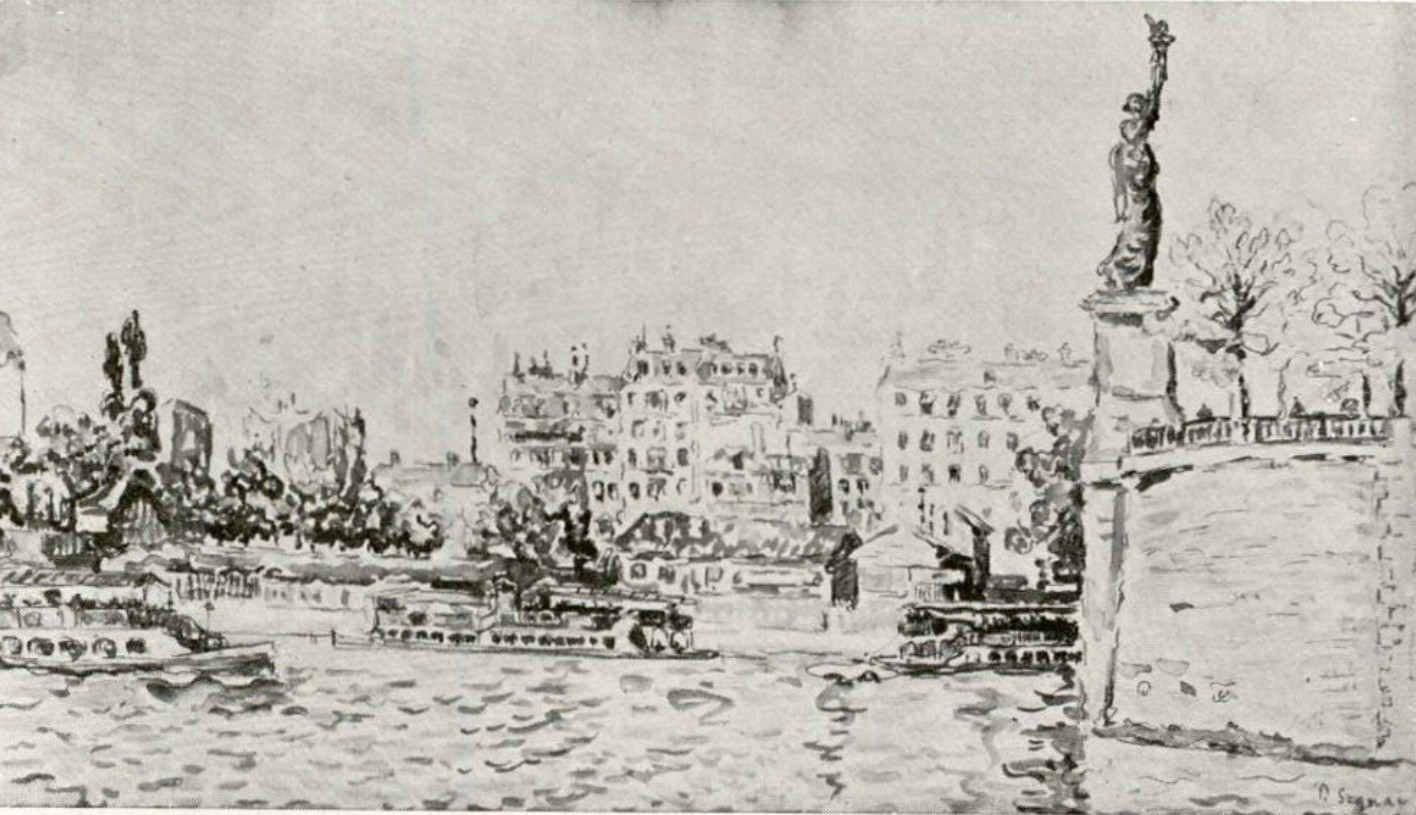
    The FBI’s work on this case is ongoing. In addition to the Monet, several other pieces of artwork were stolen from the Parlagi family in 1940. A signed Paul Signac watercolor from 1903, titled “Seine in Paris (Pont de Grenelle),” was sold to the same Nazi art dealer and is still missing today. As it is common for titles of stolen art to change over time, and due to the history of the Signac watercolor, it is very likely that it may be known under a different title today.

    To assist in the search for the stolen Signac, the piece has been entered into the FBI’s National Stolen Art File (NSAF) catalog. The NSAF is a database of stolen art and cultural property. Stolen objects are submitted for entry to the NSAF by law enforcement agencies in the U.S. and abroad.

    If you believe you have information about the stolen Signac, you are encouraged to contact the FBI’s Art Crime Program or FBI New York at NYArtCrime@fbi.gov. You may also submit online to tips.fbi.gov, call 1-800-CALL FBI (800-225-5324), or contact your nearest local FBI field office or U.S. Embassy or Consulate. Tipsters may remain anonymous.

    MIL Security OSI

  • MIL-OSI USA: CISA and FBI Release Fact Sheet on Protecting Against Iranian Targeting of Accounts Associated with National Political Organizations

    News In Brief – Source: US Computer Emergency Readiness Team

    Today, CISA and the Federal Bureau of Investigation (FBI) released joint fact sheet, How to Protect Against Iranian Targeting of Accounts Associated with National Political Organizations. This fact sheet provides information about threat actors affiliated with the Iranian Government’s Islamic Revolutionary Guard Corps (IRGC) targeting and compromising accounts of Americans to stoke discord and undermine confidence in U.S. democratic institutions.

    IRGC actors have previously gained and continue to seek access to personal and business accounts using social engineering techniques by targeting victims across email and chat. This fact sheet includes steps that individuals and organizations can take to enhance their security and resilience to protect themselves against the common techniques used by these cyber actors.

    CISA and FBI strongly recommend all individuals and organizations associated with national political organizations apply the mitigations in this fact sheet, including protecting their sensitive accounts with phishing-resistant multifactor authentication (MFA). 

    Election infrastructure stakeholders and the public can find more resources on how to protect against cyber and physical threats at #Protect2024. CISA encourages organizations to review its Iran Cyber Threat webpage for advisories and actions to defend their networks.

    MIL OSI USA News

  • MIL-OSI USA: CISA and FBI Warn of Iranian-Backed Cyber Activity to Undermine U.S. Democratic Institutions

    News In Brief – Source: US Computer Emergency Readiness Team

    Fact sheet provides information on actors’ techniques and recommended mitigations for individuals and organizations associated with national political campaigns

    WASHINGTON – The Cybersecurity and Infrastructure Security Agency (CISA) and Federal Bureau of Investigation (FBI) published a fact sheet today, How to Protect against Iranian Targeting of Accounts Associated with National Political Organizations. Actors affiliated with the Iranian Government’s Islamic Revolutionary Guard Corps (IRGC) are using social engineering techniques across email and chat applications probably to stoke discord and undermine confidence in U.S. democratic institutions. This fact sheet provides recommended actions to protect against this malicious activity.

    IRGC actors target and compromise the personal and business accounts of Americans, in particular. individuals associated with national political organizations. They also target individuals and organizations working or have worked on issues related to Iranian and Middle Eastern affairs.

    CISA and the FBI recommend mitigations and best practices that will help organizations and individuals strengthen their security and resilience, including keeping applications and operating systems updated, training staff to only use official accounts for business, and implementing phishing-resistant multifactor authentication (MFA).  

    “With FBI, CISA works to provide timely, actionable information that helps our partners reduce their risk from myriad threats,” said CISA Executive Assistant Director for Cybersecurity, Jeff Greene. “IRGC cyber actors pose an ongoing and escalating risk. We urge individuals and organizations associated with national political organizations or campaigns to review and implement actions in this joint fact sheet.”

    The FBI and CISA continue to work closely to provide services and information to safeguard public and private sector and individuals.

    For more information, please visit CISA’s Iran Cyber Threat and #Protect2024 webpages.

    ###

    About CISA 

    As the nation’s cyber defense agency and national coordinator for critical infrastructure security, the Cybersecurity and Infrastructure Security Agency leads the national effort to understand, manage, and reduce risk to the digital and physical infrastructure Americans rely on every hour of every day.

    Visit CISA.gov for more information and follow us on XFacebookLinkedIn, Instagram

    MIL OSI USA News

  • MIL-OSI USA: 10.08.2024 ICYMI: Sen. Cruz Demands Transparency on Tim Walz’s Ties to the Wuhan Institute of Virology

    US Senate News:

    Source: United States Senator for Texas Ted Cruz

    WASHINGTON, D.C. – In case you missed it, last week, U.S. Sen. Ted Cruz (R-Texas) sent a letter to the Hormel Institute regarding its partnership with the Wuhan Institute of Virology (WIV) and financial resources secured for the Hormel Institute by Governor Tim Walz. The WIV has been credibly implicated as the point of origin of COVID-19 and conducts its activities under the auspices of the Chinese Communist Party.
    In the letter, Sen. Cruz wrote, “For over a decade, Governor Tim Walz has acted as one of the Institute’s most ardent supporters, securing millions of taxpayer dollars to fund its operations, including over $2 million in federal funding for technology acquisitions and a $5 million earmark to expand your Institute’s reach. The Governor’s support for the Hormel Institute has remained steadfast, continuing even after the FBI concluded on February 28, 2023 that COVID-19 pandemic likely originated from the WIV.
    “Governor Walz’s personal connections to China—his honeymoon there, over 30 trips, and public comments downplaying the strategic threat posed by the CCP13—only raise further questions about his motivations for promoting your institution. 
    “Your institute’s ongoing partnership with the Wuhan Institute of Virology, and by extension the People’s Liberation Army, reflects a troubling disregard for national security concerns…The American people deserve assurance that their resources and institutions are not inadvertently supporting the goals of our chief geopolitical adversary.”
    Read the full letter here or below:
    Dear Director Clarke:
    I write to you today with growing concern regarding the Hormel Institute’s longstanding partnership with China’s Wuhan Institute of Virology (WIV). 
    The WIV, as you are certainly aware, has been credibly implicated as the likely point of origin of the COVID-19 pandemic. Even more troubling are its direct ties to China’s People’s Liberation Army (PLA) and its involvement in classified military research including laboratory animal experiments under the auspices of the Chinese Communist Party (CCP) at least as recently as 2017. Despite these alarming connections which raise obvious national security concerns, the institute you lead has not only maintained its collaboration with WIV but it has done so with the backing of Minnesota’s top elected official. 
    For over a decade, Governor Tim Walz has acted as one of the Institute’s most ardent supporters, securing millions of taxpayer dollars to fund its operations, including over $2 million in federal funding for technology acquisitions and a $5 million earmark to expand your Institute’s reach. The Governor’s support for the Hormel Institute has remained steadfast, continuing even after the FBI concluded on February 28, 2023 that COVID-19 pandemic likely originated from the WIV.
    In recent years, researchers at the Hormel Institute have collaborated with the Wuhan Institute of Virology on a variety of projects, including a 2020 COVID-19 study and, as more recently as of 2024, on structural biology research.
    The COVID-19 study, titled “A dynamic regulatory interface on SARS-CoV-2 RNA polymerase,” was authored by four WIV researchers, three Hormel Institute researchers, and a Yale School of Medicine professor. Similarly, in January 2024, Hormel Institute researchers published a study on genes with the WIV’s Lina He, Wei Zhou, and Yangbo Hu. In 2023, WIV’s Yangbo Hu also worked with the Hormel Institute’s Dmytro Kompaniiets, Dong Wang, and Bin Liu on research titled “Structure and molecular mechanism of bacterial transcription activation,” among other collaborations. 
    Furthermore, the resignation of your predecessor, Dr. Zigang Dong, who served as Executive Director for nearly 18 years and resigned following an FBI investigation into his “possible failure to disclose foreign backing when applying for grants,” should have prompted a thorough reassessment of your institute’s engagements with foreign entities. Yet, despite this disconcerting event, Governor Walz continues to promote and direct public resources to your institute. Even after the U.S. government ceased funding to organizations working with the WIV, Governor Walz toured your facility and publicly praised its work.
    Governor Walz’s personal connections to China—his honeymoon there, over 30 trips, and public comments downplaying the strategic threat posed by the CCP—only raise further questions about his motivations for promoting your institution. 
    Additionally, in 2020, the Hormel Institute’s disclosure in a 2020 EMBO Journal Study that it received “help from the Core Facility and Technical Support” of the WIV for “radioactive and fluorescent tests” adds to the concern. Further raising suspicions is that Bin Liu, a professor at the Hormel Institute who worked on that 2020 EMBO Journal study, attended Wuhan University. Federal records indicate that the researchers for this particular study included those affiliated with the WIV, in addition to the University of Chinese Academy of Sciences and China’s Zhengzhou University. 
    In light of these recently-disclosed facts, it is critical to understand the full extent of your institute’s involvement in a partnership that risks benefitting our nation’s chief geopolitical adversary. Accordingly, for the purposes of oversight, I request that you respond to the following questions and requests by October 31, 2024: 
    1. How much public and private funding has the Hormel Institute received specifically for projects involving collaboration with the Wuhan Institute of Virology (WIV)? Please provide an itemized accounting of all such funding. 
    2. When did the Hormel Institute first initiate collaboration with the WIV, and what were the specific reasons for choosing to partner with a facility known to have ties to China’s People’s Liberation Army? 
    3. What actions has the Hormel Institute taken to ensure that its collaborative work with the WIV does not benefit China’s military or pose a risk to U.S. national security? 
    a. If no such actions were taken, what was the rationale behind this decision? 
    4. Given the WIV’s ties to China’s military, why has the Hormel Institute not publicly disclosed the full extent of its collaborations with the WIV? 
    a. If this information has been withheld, please explain why. 
    5. Please provide all internal documentation or communications related to the Hormel Institute’s partnerships with Chinese research facilities, including but not limited to the WIV. 
    6. What was the Institute’s reasoning behind continuing its collaboration with the WIV, even after serious concerns about the origins of COVID-19 and the lab’s military affiliations became widely known? 
    7. How can the American public trust that the Hormel Institute’s partnerships with the WIV are not inadvertently advancing China’s geopolitical goals, particularly in biotechnology and biomedical research? 
    8. Given the U.S. government’s cessation of funding to other nonprofits with ties to the WIV, what justifications does the Hormel Institute offer for continuing its relationship with the WIV? 
    9. Why did the Hormel Institute continue collaborating with the WIV after your predecessor, Dr. Zigang Dong, resigned amid an FBI investigation into his failure to disclose foreign funding when applying for grants? 
    10. The Hormel Institute’s work with the WIV includes research on gene structures and SARS-CoV-2 RNA polymerase. What measures have been taken to ensure that no sensitive intellectual property or technology has been transferred to China’s military-backed labs during these studies? If no measures were taken, why not? 
    11. Please provide any documentation or communications between the Hormel Institute and the Office of the Minnesota Governor regarding the Institute’s partnerships with Chinese research facilities, particularly the WIV. 
    Your institute’s ongoing partnership with the Wuhan Institute of Virology, and by extension the People’s Liberation Army, reflects a troubling disregard for national security concerns. The devastating impact of COVID-19 has highlighted the seriousness of these issues, as the pandemic has severely affected lives and economies worldwide. The American people deserve assurance that their resources and institutions are not inadvertently supporting the goals of our chief geopolitical adversary. As Executive Director, it is crucial that you address these concerns transparently. Failure to do so will only deepen public mistrust and undermine confidence in your institute’s integrity and intentions. 
    The American people look forward to your timely and comprehensive response. 
    Sincerely, 
    /X/

    MIL OSI USA News

  • MIL-OSI: Norwood Financial Corp Announces Cash Dividend

    Source: GlobeNewswire (MIL-OSI)

    HONESDALE, Pa., Oct. 08, 2024 (GLOBE NEWSWIRE) —

    James O. Donnelly, President and Chief Executive Officer of Norwood Financial Corp (NASDAQ Global Market – NWFL) and its subsidiary Wayne Bank, announced that the Board of Directors has declared a $0.30 per share cash dividend, which is payable November 1, 2024, to shareholders of record as of October 18, 2024. The $0.30 per share equals the per share dividend declared in the second quarter of 2024 and represents a 3.5% increase over the cash dividend declared in the third quarter of 2023.

    Mr. Donnelly commented, “The Board is extremely pleased to provide our shareholders with this quarterly dividend. It reflects the Company’s financial strength and strong capital position which has contributed to our solid performance.”

    Norwood Financial Corp, through its subsidiary, Wayne Bank operates fifteen offices in Northeastern Pennsylvania and fourteen offices in Delaware, Sullivan, Ontario, Otsego and Yates Counties, New York. As of June 30, 2024, Norwood had total assets of $2.235 billion, loans outstanding of $1.641 billion, total deposits of $1.811 billion and total capital of $182.2 million. The Company’s stock is traded on the Nasdaq Global Market under the symbol “NWFL”.

    Forward-Looking Statements.

    Statements contained in this news release that are not historical facts are forward-looking statements as that term is defined in the Private Securities Litigation Reform Act of 1995. Such forward-looking statements are subject to risks and uncertainties which could cause actual results to differ materially from those currently anticipated due to a number of factors, which include, but are not limited to, factors discussed in documents filed by the Company with the Securities and Exchange Commission from time to time. The Company does not undertake and specifically disclaims any obligation to update any forward-looking statement, whether written or oral, that may be made from time to time by or on behalf of the Company.

       
    CONTACT: John M. McCaffery
      Executive Vice President and Chief Financial Officer
      NORWOOD FINANCIAL CORP
      (272) 304-3003
      http://www.waynebank.com
       

    The MIL Network

  • MIL-OSI Security: Afghan National Arrested for Plotting an Election Day Terrorist Attack in the Name of ISIS

    Source: United States Attorneys General 5

    Note: View the unsealed criminal complaint here

    The Justice Department today announced charges against a citizen of Afghanistan residing in Oklahoma City, Oklahoma, for conspiring to conduct an Election Day terrorist attack in the United States on behalf of the Islamic State of Iraq and al-Sham (ISIS), a designated foreign terrorist organization (FTO).

    According to a criminal complaint filed today, Nasir Ahmad Tawhedi, 27, conspired and attempted to provide material support to ISIS and obtained firearms and ammunition to conduct a violent attack on U.S. soil in the name of ISIS. As part of the plot, the defendant allegedly took steps to liquidate his family’s assets, resettle members of his family overseas, acquire AK-47 assault rifles and ammunition, and commit a terrorist attack in the United States.

    “As charged, the Justice Department foiled the defendant’s plot to acquire semi-automatic weapons and commit a violent attack in the name of ISIS on U.S. soil on Election Day,” said Attorney General Merrick B. Garland. “We will continue to combat the ongoing threat that ISIS and its supporters pose to America’s national security, and we will identify, investigate, and prosecute the individuals who seek to terrorize the American people. I am deeply grateful to the public servants of the FBI, National Security Division, and U.S. Attorney’s Office for the Western District of Oklahoma for their work to disrupt this attack and for the work they do every day to protect our country.”

    “This defendant, motivated by ISIS, allegedly conspired to commit a violent attack, on Election Day, here on our homeland,” said FBI Director Christopher Wray. “I am proud of the men and women of the FBI who uncovered and stopped the plot before anyone was harmed. Terrorism is still the FBI’s number one priority, and we will use every resource to protect the American people.”

    “Thanks to the relentless efforts of the FBI, National Security Division’s Counterterrorism Section, and federal prosecutors in my office, the alleged plan to commit an attack on Election Day was disrupted and Mr. Tawhedi was arrested,” said U.S. Attorney Robert J. Troester for the Western District of Oklahoma. “Fighting terrorism remains the top priority of the Justice Department. We will continue to pursue, disrupt, and hold accountable those who plot to commit acts of terrorism against our country and our people.”

    According to the criminal complaint, as part of the investigation into Tawhedi, the FBI searched Tawhedi’s phone and obtained communications between Tawhedi and a person who facilitated recruitment, training, and indoctrination of persons who expressed interest in terrorist activity and who Tawhedi understood to be affiliated with ISIS. Tawhedi was also seen in a video recorded on July 20 reading to two children text that describes the rewards a martyr receives in the afterlife. Tawhedi also allegedly accessed, viewed, and saved ISIS propaganda on his iCloud and Google account, participated in pro-ISIS Telegram groups, and contributed to a charity which fronts for and funnels money to ISIS.

    The complaint alleges that while liquidating their family’s assets prior to the attack, Tawhedi and his co-conspirator, who is a juvenile, advertised the sale of the family’s personal property on Facebook. At the FBI’s direction, a confidential human source responded to inquire if a computer was still for sale. The FBI source noted that he needed the computer for a new gun business he was starting, which ultimately led Tawhedi and the juvenile to meet with the source and other FBI assets at a rural location to test firearms. Tawhedi expressed interest in purchasing two AK-47 assault rifles, magazines, and ammunition from the source.

    According to the criminal complaint, on Oct. 7, Tawhedi and the juvenile met with the FBI assets at a rural location in the Western District of Oklahoma and purchased, received, and took possession of two AK-47 assault rifles, ten magazines, and 500 rounds of ammunition. Upon receipt of the rifles and ammunition, Tawhedi and the juvenile were arrested.

    In his seized communications, Tawhedi allegedly indicated that his attack was planned for Election Day, and in a post-arrest interview, Tawhedi allegedly confirmed the attack was planned for Election Day targeting large gatherings of people, during which he and the juvenile were expected to die as martyrs.

    Tawhedi was charged with conspiring and attempting to provide material support to ISIS, which carries a maximum prison sentence of 20 years, and receiving a firearm to be used to commit a felony or a federal crime of terrorism, which carries a maximum prison sentence of 15 years, if convicted.

    The case is being investigated by the FBI Oklahoma City Field Office, with valuable assistance from the Oklahoma City Police Department and the Moore, Oklahoma Police Department.

    Assistant U.S. Attorneys Jessica L. Perry, Matt Dillon, and Mark Stoneman for the Western District of Oklahoma and Trial Attorneys George C. Kraehe and Everett McMillian of the National Security Division’s Counterterrorism Section are prosecuting the case.

    A criminal complaint is merely an allegation. All defendants are presumed innocent until proven guilty beyond a reasonable doubt in a court of law.

    MIL Security OSI

  • MIL-OSI USA: Dual U.S. and Iranian Citizen Arrested for Unlawful Scheme to Violate and Evade U.S. Sanctions Against Iran

    Source: US State of Vermont

    Kambiz Eghbali, also known as Cameron Eghbali, 50, of Los Angeles, was arrested yesterday pursuant to a now-unsealed indictment charging him, along with Hamid Hajipour and Babak Bahizad, both Iranian nationals, with violations of the International Emergency Economic Powers Act, conspiracy to commit bank fraud, and conspiracy to commit money laundering. Bahizad and Hajipour remain at large.

    According to the indictment, from March 2014 through September 2019, Eghbali and others conspired to unlawfully send digital and physical gift cards loaded with U.S. dollars to Iran. Eghbali would list his company, a U.S.-based purported videogame wholesaler and distributor located in the Central District of California, as the seller of the gift cards, and would provide cards to Bahizad for the benefit of his Iran-based gaming company, and to Hajipour for the benefit of his mobile software application service company. Bahizad and Hajipour would then pay Eghbali for the cards by transferring money from Iran to Eghabli’s U.S.-based bank accounts using third parties in other countries to conceal the transfer from U.S. regulators.

    The International Emergency Economic Powers Act (IEEPA) and the Iranian Transactions and Sanctions Regulations (ITSR) impose controls and restrictions on transactions involving Iran based on the threats posed by Iran to the national security of the United States including, among others, its pursuit of nuclear weapons and sponsorship of terrorism. The IEEPA and ITSR, among other things, prohibit the export, reexport, sale, or supply, directly or indirectly, from the United States or by a United States person, wherever located, of any goods, technology, or services, including financial services, to Iran or the Government of Iran without first obtaining authorization from the U.S. Treasury Department’s Office of Foreign Assets Control.

    If convicted, the defendants face the following maximum penalties: 20 years in prison for violations of IEEPA, 30 years in prison for bank fraud violations, and 20 years in prison for money laundering violations. The indictment also notifies defendants that the United States intends to forfeit all property alleged to be traceable to proceeds of the offense. A federal district court judge will determine any sentence after considering the U.S. Sentencing Guidelines and other statutory factors.

    Assistant Attorney General Matthew G. Olsen of the Justice Department’s National Security Division, U.S. Attorney Martin E. Estrada for the Central District of California, and Executive Assistant Director Robert Wells of the FBI’s National Security Branch made the announcement.

    The FBI is investigating the case, with support from Homeland Security Investigations.

    Assistant U.S. Attorneys Anna Boylan and Mark Takla for the Central District of California and Trial Attorneys David J. Ryan and Leslie Esbrook of the National Security Division’s Counterintelligence and Export Control Section are prosecuting the case.

    An indictment is merely an allegation. All defendants are presumed innocent until proven guilty beyond a reasonable doubt in a court of law.

    MIL OSI USA News

  • MIL-OSI USA: Afghan National Arrested for Plotting an Election Day Terrorist Attack in the Name of ISIS

    Source: US State of Vermont

    Note: View the unsealed criminal complaint here. 

    The Justice Department today announced charges against a citizen of Afghanistan residing in Oklahoma City, Oklahoma, for conspiring to conduct an Election Day terrorist attack in the United States on behalf of the Islamic State of Iraq and al-Sham (ISIS), a designated foreign terrorist organization (FTO).

    According to a criminal complaint filed today, Nasir Ahmad Tawhedi, 27, conspired and attempted to provide material support to ISIS and obtained firearms and ammunition to conduct a violent attack on U.S. soil in the name of ISIS. As part of the plot, the defendant allegedly took steps to liquidate his family’s assets, resettle members of his family overseas, acquire AK-47 assault rifles and ammunition, and commit a terrorist attack in the United States.

    “As charged, the Justice Department foiled the defendant’s plot to acquire semi-automatic weapons and commit a violent attack in the name of ISIS on U.S. soil on Election Day,” said Attorney General Merrick B. Garland. “We will continue to combat the ongoing threat that ISIS and its supporters pose to America’s national security, and we will identify, investigate, and prosecute the individuals who seek to terrorize the American people. I am deeply grateful to the public servants of the FBI, National Security Division, and U.S. Attorney’s Office for the Western District of Oklahoma for their work to disrupt this attack and for the work they do every day to protect our country.”

    “This defendant, motivated by ISIS, allegedly conspired to commit a violent attack, on Election Day, here on our homeland,” said FBI Director Christopher Wray. “I am proud of the men and women of the FBI who uncovered and stopped the plot before anyone was harmed. Terrorism is still the FBI’s number one priority, and we will use every resource to protect the American people.”

    “Thanks to the relentless efforts of the FBI, National Security Division’s Counterterrorism Section, and federal prosecutors in my office, the alleged plan to commit an attack on Election Day was disrupted and Mr. Tawhedi was arrested,” said U.S. Attorney Robert J. Troester for the Western District of Oklahoma. “Fighting terrorism remains the top priority of the Justice Department. We will continue to pursue, disrupt, and hold accountable those who plot to commit acts of terrorism against our country and our people.”

    According to the criminal complaint, as part of the investigation into Tawhedi, the FBI searched Tawhedi’s phone and obtained communications between Tawhedi and a person who facilitated recruitment, training, and indoctrination of persons who expressed interest in terrorist activity and who Tawhedi understood to be affiliated with ISIS. Tawhedi was also seen in a video recorded on July 20 reading to two children text that describes the rewards a martyr receives in the afterlife. Tawhedi also allegedly accessed, viewed, and saved ISIS propaganda on his iCloud and Google account, participated in pro-ISIS Telegram groups, and contributed to a charity which fronts for and funnels money to ISIS.

    The complaint alleges that while liquidating their family’s assets prior to the attack, Tawhedi and his co-conspirator, who is a juvenile, advertised the sale of the family’s personal property on Facebook. At the FBI’s direction, a confidential human source responded to inquire if a computer was still for sale. The FBI source noted that he needed the computer for a new gun business he was starting, which ultimately led Tawhedi and the juvenile to meet with the source and other FBI assets at a rural location to test firearms. Tawhedi expressed interest in purchasing two AK-47 assault rifles, magazines, and ammunition from the source.

    According to the criminal complaint, on Oct. 7, Tawhedi and the juvenile met with the FBI assets at a rural location in the Western District of Oklahoma and purchased, received, and took possession of two AK-47 assault rifles, ten magazines, and 500 rounds of ammunition. Upon receipt of the rifles and ammunition, Tawhedi and the juvenile were arrested.

    In his seized communications, Tawhedi allegedly indicated that his attack was planned for Election Day, and in a post-arrest interview, Tawhedi allegedly confirmed the attack was planned for Election Day targeting large gatherings of people, during which he and the juvenile were expected to die as martyrs.

    Tawhedi was charged with conspiring and attempting to provide material support to ISIS, which carries a maximum prison sentence of 20 years, and receiving a firearm to be used to commit a felony or a federal crime of terrorism, which carries a maximum prison sentence of 15 years, if convicted.

    The case is being investigated by the FBI Oklahoma City Field Office, with valuable assistance from the Oklahoma City Police Department and the Moore, Oklahoma Police Department.

    Assistant U.S. Attorneys Jessica L. Perry, Matt Dillon, and Mark Stoneman for the Western District of Oklahoma and Trial Attorneys George C. Kraehe and Everett McMillian of the National Security Division’s Counterterrorism Section are prosecuting the case.

    A criminal complaint is merely an allegation. All defendants are presumed innocent until proven guilty beyond a reasonable doubt in a court of law.

    MIL OSI USA News

  • MIL-OSI USA: Lankford Statement on Arrest of Individual Plotting Terrorist Attack in United States

    US Senate News:

    Source: United States Senator for Oklahoma James Lankford

    October 8, 2024

    OKLAHOMA CITY, OK – Senator James Lankford (R-OK) issued the following statement after it was reported that an individual was arrested in Oklahoma for plotting a terrorist attack:
    “The charges brought against Nasir Ahmad Tawhedi in Oklahoma for plotting an Election Day terrorist attack on U.S. soil is a stark reminder that our nation continues to face threats from those who hate our freedom and want to do us harm. I’m grateful to the FBI, especially the Oklahoma FBI Field Office, and our local law enforcement agencies for their vigilance and dedication to protect our communities. Their swift action prevented what could have been a devastating attack.
    “Tawhedi is Afghan refugee with ties to ISIS. With the escalating conflict in Israel and across the Middle East, we must remain vigilant against terrorism here at home. Oklahomans know well that many of the Afghan refugees in our communities fought side by side with American troops against the terrorism that attacked our nation on 9/11 and destroyed the nation of Afghanistan.  
    “I have been in direct contact with the FBI about this case for a while and I will remain engaged as Tawhedi is prosecuted to the fullest extent of the law. As a member of the Senate Select Committee on Intelligence, I will continue to work closely with Federal prosecutors to ensure we are taking every step necessary to keep Americans safe.”

    MIL OSI USA News

  • MIL-OSI: (Updated) NANO Nuclear Energy Reinforces its Nuclear Technology and Engineering Team Further with the Addition of Leading Researchers

    Source: GlobeNewswire (MIL-OSI)

    New York, N.Y., Oct. 08, 2024 (GLOBE NEWSWIRE) — NANO Nuclear Energy Inc. (NASDAQ: NNE) (“NANO Nuclear” or “the Company”), a leading advanced nuclear energy and technology company focused on developing portable, clean energy solutions, today announced that Professor Andrew W. Woods, Ph.D. and Alejandra de Lara, BSc, MPhil have joined its Nuclear Technology and Engineering Team.

    “It is a pleasure to see our Nuclear Technology and Engineering team grow with the additions of Dr. Woods and Alejandra,” said Prof. Ian Farnan, Lead for Nuclear Fuel Cycle, Radiation and Materials at NANO Nuclear Energy. “Their experience and unique expertise are a timely addition to the team and the next phase of the development of the ‘ODIN’ microreactor.”

    “We are very happy to welcome Dr. Woods and Alejandra to the team,” said Eugene Shwageraus, Lead of Nuclear Reactor Engineering of NANO Nuclear Energy. “The next steps in the development of ‘ODIN’ require a dedicated team of experts to ensure the technology is ready to meet regulatory requirements and progress towards commercialization. I am delighted to work alongside Dr. Woods and Alejandra and develop a portable, secure and reliable solution to the world’s growing energy needs.”

    Dr. Woods’ research focuses on developing simplified mathematical and experimental models to study complex fluid flow and heat transfer processes in single and multiphase flow. Applications of his work span various fields, including the dynamics of explosive volcanic eruptions, geothermal power generation, carbon sequestration, and large scale, subsurface energy storage. In recognition of his contributions, Dr. Woods was elected a Fellow of the Royal Society (FRS) in 2017. He is a Professor in the University of Cambridge.

    Figure 1 – NANO Nuclear Energy Inc. Bolsters its Nuclear Technology and Engineering Team with the Additions of Professor Andrew W. Woods (left) and Alejandra de Lara, BSc, MPhil (right).

    Alejandra de Lara has submitted her Ph.D. for examination at the University of Cambridge. Her Ph.D. project was sponsored by Framatome and focused on adapting fuel behavior prediction codes to molten salt-cooled reactors and analyzing their benefits compared to Light Water Reactors.

    Her research demonstrated several fuel design features that would improve the performance of salt-cooled reactors. High-temperature operation of such reactors enables greater thermodynamic efficiency in power conversion using advanced cycles, while also allowing for the direct use of nuclear heat to drive industrial processes such as synthetic fuel production, hydrogen generation, and district heating.

    “The ‘ODIN’ team has grown rapidly in recent months, and it is a pleasure to welcome Dr. Woods and Alejandra,” said James Walker, Chief Executive Officer, and Head of Reactor Development of NANO Nuclear Energy. “Dr. Woods is an experienced and well-versed leader in the field of complex fluid flow and heat transfer processes and I am certain his skills will be invaluable in the next steps of ‘ODIN’s” development. Similarly, Alejandra has proven herself as a leading young researcher and is the perfect example of the next generation’s excellence in nuclear science.”

    About NANO Nuclear Energy, Inc.

    NANO Nuclear Energy Inc. (NASDAQ: NNE) is an advanced technology-driven nuclear energy company seeking to become a commercially focused, diversified, and vertically integrated company across four business lines: (i) cutting edge portable microreactor technology, (ii) nuclear fuel fabrication, (iii) nuclear fuel transportation and (iv) nuclear industry consulting services. NANO Nuclear believes it is the first portable nuclear microreactor company to be listed publicly in the U.S.

    Led by a world-class nuclear engineering team, NANO Nuclear’s products in technical development are “ZEUS”, a solid core battery reactor, and “ODIN”, a low-pressure coolant reactor, each representing advanced developments in clean energy solutions that are portable, on-demand capable, advanced nuclear microreactors.

    Advanced Fuel Transportation Inc. (AFT), a NANO Nuclear subsidiary, is led by former executives from the largest transportation company in the world aiming to build a North American transportation company that will provide commercial quantities of HALEU fuel to small modular reactors, microreactor companies, national laboratories, military, and DOE programs. Through NANO Nuclear, AFT is the exclusive licensee of a patented high-capacity HALEU fuel transportation basket developed by three major U.S. national nuclear laboratories and funded by the Department of Energy. Assuming development and commercialization, AFT is expected to form part of the only vertically integrated nuclear fuel business of its kind in North America.

    HALEU Energy Fuel Inc. (HEF), a NANO Nuclear subsidiary, is focusing on the future development of a domestic source for a High-Assay, Low-Enriched Uranium (HALEU) fuel fabrication pipeline for NANO Nuclear’s own microreactors as well as the broader advanced nuclear reactor industry.

    For more corporate information please visit: https://NanoNuclearEnergy.com/

    For further information, please contact:

    Email: IR@NANONuclearEnergy.com
    Business Tel: (212) 634-9206
    PLEASE FOLLOW OUR SOCIAL MEDIA PAGES HERE:
    NANO Nuclear Energy LINKEDIN
    NANO Nuclear Energy YOUTUBE
    NANO Nuclear Energy TWITTER

    Cautionary Note Regarding Forward Looking Statements

    This news release and statements of NANO Nuclear’s management in connection with this news release or related events contain or may contain “forward-looking statements” within the meaning of Section 21E of the Securities Exchange Act of 1934, as amended, and the Private Securities Litigation Reform Act of 1995. In this context, forward-looking statements (including the anticipated benefits to NANO Nuclear of the engineering personnel described herein and statements regarding NANO Nuclear’s regulatory and licensing processes) mean statements related to future events, which may impact our expected future business and financial performance, and often contain words such as “expects”, “anticipates”, “intends”, “plans”, “believes”, “potential”, “will”, “should”, “could”, “would” or “may” and other words of similar meaning. These forward-looking statements are based on information available to us as of the date of this news release and represent management’s current views and assumptions. Forward-looking statements are not guarantees of future performance, events or results and involve significant known and unknown risks, uncertainties and other factors, which may be beyond our control. For NANO Nuclear, particular risks and uncertainties that could cause our actual future results to differ materially from those expressed in our forward-looking statements include but are not limited to the following: (i) risks related to our U.S. Department of Energy (“DOE”) nuclear fuel manufacturing submission and the development of new or advanced technology, including difficulties with design and testing, cost overruns, development of competitive technology, (ii) our ability to obtain contracts and funding to be able to continue operations, (iii) risks related to uncertainty regarding our ability to technologically develop and commercially deploy a competitive advanced nuclear reactor technology, (iv) risks related to the impact of government regulation and policies including by the DOE and the U.S. Nuclear Regulatory Commission, including those associated with the recently enacted ADVANCE Act, and (v) similar risks and uncertainties associated with the business of a start-up business operating a highly regulated industry. Readers are cautioned not to place undue reliance on these forward-looking statements, which apply only as of the date of this news release. These factors may not constitute all factors that could cause actual results to differ from those discussed in any forward-looking statement, and the NANO Nuclear therefore encourages investors to review other factors that may affect future results in its filings with the SEC, which are available for review at http://www.sec.gov and at https://ir.nanonuclearenergy.com/financial-information/sec-filings. Accordingly, forward-looking statements should not be relied upon as a predictor of actual results. We do not undertake to update our forward-looking statements to reflect events or circumstances that may arise after the date of this news release, except as required by law.

    Attachment

    The MIL Network

  • MIL-OSI Security: Dual U.S. and Iranian Citizen Arrested for Unlawful Scheme to Violate and Evade U.S. Sanctions Against Iran

    Source: United States Attorneys General

    Kambiz Eghbali, also known as Cameron Eghbali, 50, of Los Angeles, was arrested yesterday pursuant to a now-unsealed indictment charging him, along with Hamid Hajipour and Babak Bahizad, both Iranian nationals, with violations of the International Emergency Economic Powers Act, conspiracy to commit bank fraud, and conspiracy to commit money laundering. Bahizad and Hajipour remain at large.

    According to the indictment, from March 2014 through September 2019, Eghbali and others conspired to unlawfully send digital and physical gift cards loaded with U.S. dollars to Iran. Eghbali would list his company, a U.S.-based purported videogame wholesaler and distributor located in the Central District of California, as the seller of the gift cards, and would provide cards to Bahizad for the benefit of his Iran-based gaming company, and to Hajipour for the benefit of his mobile software application service company. Bahizad and Hajipour would then pay Eghbali for the cards by transferring money from Iran to Eghabli’s U.S.-based bank accounts using third parties in other countries to conceal the transfer from U.S. regulators.

    The International Emergency Economic Powers Act (IEEPA) and the Iranian Transactions and Sanctions Regulations (ITSR) impose controls and restrictions on transactions involving Iran based on the threats posed by Iran to the national security of the United States including, among others, its pursuit of nuclear weapons and sponsorship of terrorism. The IEEPA and ITSR, among other things, prohibit the export, reexport, sale, or supply, directly or indirectly, from the United States or by a United States person, wherever located, of any goods, technology, or services, including financial services, to Iran or the Government of Iran without first obtaining authorization from the U.S. Treasury Department’s Office of Foreign Assets Control.

    If convicted, the defendants face the following maximum penalties: 20 years in prison for violations of IEEPA, 30 years in prison for bank fraud violations, and 20 years in prison for money laundering violations. The indictment also notifies defendants that the United States intends to forfeit all property alleged to be traceable to proceeds of the offense. A federal district court judge will determine any sentence after considering the U.S. Sentencing Guidelines and other statutory factors.

    Assistant Attorney General Matthew G. Olsen of the Justice Department’s National Security Division, U.S. Attorney Martin E. Estrada for the Central District of California, and Executive Assistant Director Robert Wells of the FBI’s National Security Branch made the announcement.

    The FBI is investigating the case, with support from Homeland Security Investigations.

    Assistant U.S. Attorneys Anna Boylan and Mark Takla for the Central District of California and Trial Attorneys David J. Ryan and Leslie Esbrook of the National Security Division’s Counterintelligence and Export Control Section are prosecuting the case.

    An indictment is merely an allegation. All defendants are presumed innocent until proven guilty beyond a reasonable doubt in a court of law.

    MIL Security OSI

  • MIL-OSI: Australia’s TPG Telecom Taps Mavenir to Boost Voice Security For Mobile Users and Block AI-Driven Scam Calls

    Source: GlobeNewswire (MIL-OSI)

    RICHARDSON, Texas, Oct. 09, 2024 (GLOBE NEWSWIRE) — Mavenir, the Network Software Provider building the future of networks with cloud-native solutions that run on any cloud, today announces that its advanced machine learning (ML) technology is being used by TPG Telecom to protect mobile users from the increasing scourge of AI-driven scam and spam voice calls – resulting in a 280 per cent increase in the number of fraudulent calls being blocked before they reach TPG Telecom customers’ mobile phones.

    The Australian telco is already benefiting from Mavenir’s intelligent SpamShield technology protection for SMS messaging for several years. Mavenir is now supplying its robust, real-time CallShield solution –to protect TPG Telecom’s customers across its Vodafone, TPG, iiNet and felix brands from the nuisance and threat of automated and deepfake voice calls initiated by fraudsters.

    In the first six months of this year, Mavenir’s CallShield technology has blocked almost 19 million fraudulent mobile calls from reaching TPG Telecom’s customers. This equates to blocking 103,000 illicit calls from reaching customers per day, and more than triple the 4.9 million calls blocked in the first half of 2023. This represents some of the highest scam and spam call prevention figures in the industry.

    TPG Telecom also uses Mavenir’s SpamShield platform to stop fraudulent SMS from reaching its mobile users. In the first six months of 2024, Mavenir’s technology blocked more than 59.6 million fraudulent text messages from reaching TPG Telecom’s customers.

    Communication Service Providers (CSPs) globally are facing a constantly evolving flow of unsolicited spam and fraud traffic – across both data and voice services – which is increasingly driven by sophisticated AI techniques, making it very difficult to detect and control. In addition to creating a poor experience for users and significant revenue losses for operators, a 2022 report by the Australian Competition and Consumer Commission highlighted that phone scams cost Australians a concerning A$141 million in losses. The Australian Communications and Media Authority (ACMA), the regulator of the country’s telecommunications system, is spearheading industry action to crack down on spam and scam calls and ensure that consumers are adequately protected – enforcing regulatory compliance from operators and supporting the roll-out of effective security solutions from technology vendors. Mavenir’s CallShield solution uses real-time machine learning technology to carry out automated security analysis and proactive defense across voice services – helping operators to stay one step ahead of the scammers. The CallShield solution provides CSPs with 360-degree control to effectively address specific situations within their networks with unrivalled speed and flexibility. While traditional detection and prevention techniques are based on deterministic rules that can be easily detected and bypassed, CallShield’s ML detection algorithms with built-in intelligence adapt to current network conditions and subscriber behavior to continually detect and block attempted activity from spammers and fraudster.

    TPG Telecom Chief Technology Officer Giovanni Chiarelli said: “Our business is built on the trust of our customers. We are committed to embracing new technologies that provide the best possible protection against the nuisance and threat of malicious harm posed by these spammers and scammers. We are pleased Mavenir’s CallShield technology is providing real-time, automated security analysis and effective security for customers across our voice services.”

    Jan Schaar, Asia Pacific Regional Vice President for Mavenir, added: “The speed and sophistication of the techniques being employed by scammers and fraudsters means that a reactive security approach based on purely “reporting” spam is no longer enough. To offer mobile users the assurance and peace of mind they need today, we need to work harder and smarter, and remain one step ahead at all times – continuously learning from and anticipating the scammers’ next move. Our SpamShield platform, with its powerful ML-driven engine, is already delivering state-of-the-art, proactive security and protection across TPG’s messaging services. We are happy to now be extending the solution span by providing our robust CallShield technology – ensuring that TPG’s mobile customers can now enjoy the same superior protection from nuisance and malicious threats that arrive in the form of unwanted voice calls.”

    Notes to editor:

    TPG official Press Release – TPG Telecom stops spams and scams from reaching customers with new call blocker

    CallShield – Mavenir

    SpamShield / Messaging Fraud – Mavenir

    About TPG Telecom

    TPG Telecom is an Australian telecommunications company which is home to some of Australia’s most-loved telecommunications brands including Vodafone, TPG, iiNet, AAPT, Internode, Lebara and felix. As the second largest telecommunications company listed on the ASX, TPG Telecom has a strong challenger spirit and a commitment to delivering the best services and products to its customers. http://www.tpgtelecom.com.au.

    TPG Telecom PR Contact:
    media@tpgtelecom.com.au

    About Mavenir:

    Mavenir is building the future of networks today with cloud-native, AI-enabled solutions which are green by design, empowering operators to realize the benefits of 5G and achieve intelligent, automated, programmable networks. As the pioneer of Open RAN and a proven industry disruptor, Mavenir’s award-winning solutions are delivering automation and monetization across mobile networks globally, accelerating software network transformation for 300+ Communications Service Providers in over 120 countries, which serve more than 50% of the world’s subscribers. For more information, please visit http://www.mavenir.com

    Mavenir PR Contacts:
    Emmanuela Spiteri
    PR@mavenir.com

    The MIL Network

  • MIL-OSI Economics: Rosanna Costa: Welcoming remarks – FSB RCG Americas meeting

    Source: Bank for International Settlements

    Welcoming words

    Good afternoon, and welcome to Santiago. It is my great pleasure to host this year’s meeting of the FSB Regional Consultative Group for the Americas, organized jointly by the Financial Stability Board, the Financial Markets Commission of Chile and the Central Bank of Chile. Let me extend a warm welcome to our distinguished guests, esteemed colleagues, and participants. We are honored by your presence here today, particularly as we gather together to address some of the most pressing challenges and latest developments in the realms of financial stability, market development and regulatory coordination.

    Allow me to especially acknowledge the presence of Mr. Klaas Knot, Chair of the Financial Stability Board and Tiff Macklem and Kenneth Baker, Co-Chairs of the Regional Consultative Group for the Americas, whose work and commitment have contributed greatly to shaping our global and regional efforts aimed at enhancing financial stability.

    I am also glad to extend a warm welcome to Mr. Rodrigo Coelho, Head of Policy Benchmarking of the Financial Stability Institute, who will be our keynote speaker today, whose expertise and perspective I am sure will provide us with key concepts and insights to foster today’s discussions.

    Lastly, let me express my sincere gratitude to the organizing teams of the Secretariat of the Financial Stability Board, the Financial Markets Commission, and our team in the Central 2 Bank of Chile, for their hard work and dedication that have been instrumental in making this event possible. 

    MIL OSI Economics

  • MIL-OSI: Enphase Energy Expands its Support for Grid Services Programs Across the United States

    Source: GlobeNewswire (MIL-OSI)

    FREMONT, Calif., Oct. 09, 2024 (GLOBE NEWSWIRE) — Enphase Energy, Inc. (NASDAQ: ENPH), a global energy technology company and the world’s leading supplier of microinverter-based solar and battery systems, announced today that it is expanding its support for grid services programs – or virtual power plants (VPPs) – in New Hampshire, North Carolina, and California, powered by the new IQ® Battery 5P.

    Grid services programs are managed by regional utilities and use energy stored in home batteries to help power communities when it is needed most, like during periods of peak electricity demand. This reduces reliance on costly and polluting power plants for electricity and, in return, provides incentives to homeowners from their own utilities. Incentive programs may serve as a discount on the purchase of an Enphase® Energy System™ with IQ Batteries or as ongoing payments to participating homeowners. Most recently, homeowners who install Enphase IQ Batteries are now eligible to enroll in the following programs:

    Duke Energy PowerPair Program: Participants enrolled in this program who install three IQ Battery 5Ps and at least 10 kW of solar with a Duke Energy Trade Ally installer are eligible to receive an upfront incentive of $9,000. Customers who also enroll in Duke Energy’s battery control programs – Duke Energy Power Manager or Duke Energy Progress EnergyWise – are eligible to receive additional ongoing monthly bill credits. Learn more about the details of the program on the Enphase website.

    “Enphase’s dependable, high-performance, and safe home energy technology is enabling the clean energy future,” said Edward Wright, co-owner of Rhino Renewables Solar & Electric, an installer of Enphase products based in North Carolina. “Home solar systems and batteries are crucial for supporting grid operations and reducing electricity costs for everyone.”

    San Diego Community Power Solar Battery Savings Program: Participants enrolled in this program who install two IQ Battery 5Ps are eligible to receive an upfront incentive rebate of $3,150. Customers are also eligible to receive ongoing performance incentive payments worth approximately $3,000 over the ten-year participation period, from the time of enrollment. Learn more about the details of the program on the San Diego Community Power website.

    “Enphase’s innovative battery solutions are a game-changer for homeowners looking to boost their energy resilience,” said Jeff Carelli, president and CEO of Sunlight Solar, an installer of Enphase products based in California and a Solar Battery Savings Program approved contractor. “By participating in grid services programs, our customers can not only maximize their energy independence but also contribute to a more sustainable energy future here in California.”

    Eversource New Hampshire Clean Energy Fund (NHCEF) for Battery Storage Program: Participants enrolled in this demand response program who install three IQ Battery 5Ps are eligible to receive an upfront incentive rebate of $3,000 for residential customers and $3,750 for commercial customers (up to $10,000 for eight IQ Battery 5Ps). Learn more about the details of the program on the Enphase website.

    “Our customers can now enhance the value of their system while contributing to a more sustainable and resilient grid,” said Hunter Judd owner of Sunup Solar, an installer of Enphase products based in New Hampshire. “Grid services programs make Enphase’s technology more accessible so more homeowners can enjoy the benefits of Enphase home battery systems.”

    “Our cutting-edge software and hardware are designed to simplify participation in grid services programs for homeowners,” said Mehran Sedigh, senior vice president of sales at Enphase Energy. “Central to this effort is the new IQ Battery 5P, providing exceptional durability and value for homeowners. We are proud to expand our support for virtual power plants across the United States.”

    For more information about grid services, please visit the Enphase website.

    About Enphase Energy, Inc.

    Enphase Energy, a global energy technology company based in Fremont, CA, is the world’s leading supplier of microinverter-based solar and battery systems that enable people to harness the sun to make, use, save, and sell their own power—and control it all with a smart mobile app. The company revolutionized the solar industry with its microinverter-based technology and builds all-in-one solar, battery, and software solutions. Enphase has shipped approximately 76.3 million microinverters, and over 4.3 million Enphase-based systems have been deployed in more than 150 countries. For more information, visit https://enphase.com/.

    ©2024 Enphase Energy, Inc. All rights reserved. Enphase Energy, Enphase, the “e” logo, IQ, and certain other marks listed at https://enphase.com/trademark-usage-guidelines are trademarks or service marks of Enphase Energy, Inc. Other names are for informational purposes and may be trademarks of their respective owners.

    Forward-Looking Statements

    This press release may contain forward-looking statements, including statements related to the expected capabilities and performance of Enphase Energy’s technology and products, including safety, quality and reliability; the availability and market adoption of Enphase products; Enphase’s ability to expand its support for VPPs; and expectations of and eligibility for incentives under the various incentive programs. These forward-looking statements are based on Enphase Energy’s current expectations and inherently involve significant risks and uncertainties. Actual results and the timing of events could differ materially from those contemplated by these forward-looking statements as a result of such risks and uncertainties including those risks described in more detail in Enphase Energy’s most recently filed Quarterly Report on Form 10-Q, Annual Report on Form 10-K, and other documents filed by Enphase Energy from time to time with the SEC. Enphase Energy undertakes no duty or obligation to update any forward-looking statements contained in this release as a result of new information, future events, or changes in its expectations, except as required by law.

    Contact:

    Enphase Energy

    press@enphaseenergy.com

    This press release was published by a CLEAR® Verified individual.

    The MIL Network