Category: Justice

  • MIL-OSI USA: ERO Dallas arrests Mexican national charged with aggravated assault on a public servant

    Source: US Immigration and Customs Enforcement

    DALLAS — Officers with Enforcement and Removal Operations Dallas arrested Santos Victor Hernandez-Garcia, an unlawfully present 60-year-old Mexican citizen charged with aggravated assault of a public servant, Sept. 24 in Wichita Falls, Texas.

    “ERO Dallas will continue to prioritize public safety by arresting and removing egregious noncitizen offenders from our Texas and Oklahoma communities,” said ERO Dallas Field Office Director Marcos Charles.

    The Houston Police Department arrested Hernandez for first degree murder with a deadly weapon on July 12, 1990. Hernandez was convicted of the charge in the 174th District Court in Harris County, Texas, on January 15, 1991, and sentenced to 20 years confinement.

    The Office of the Inspector General for the Texas Department of Criminal Justice charged Hernandez for harassment by persons in a correctional facility on Feb. 28, 2002, and Hernandez was convicted of the charge and sentenced to three years confinement by the 3rd District Court in Anderson County, Texas on June 13, 2002.

    Hernandez entered the U.S. at an unknown date, at an unknown location, without inspection.

    ERO Dallas lodged an immigration detainer against Hernandez with the Wichita, Texas County jail on June 27, 2017 and officers from ERO Dallas took custody of Hernandez on Sept. 24, serving him with a warrant of removal.

    Detainers are critical public safety tools which focus enforcement resources on removable noncitizens who have been arrested for criminal activity. Detainers increase the safety of all parties involved — ERO personnel, law enforcement officials, removable noncitizens and the public — by allowing an arrest to be made in a secure and controlled custodial setting as opposed to at-large within the community. Because detainers result in the direct transfer of a noncitizen from state or local custody to ERO custody, they also minimize the potential that an individual will reoffend. Detainers also conserve scarce government resources by allowing ERO to take criminal noncitizens into custody directly rather than expending resources locating these individuals at-large.

    ERO conducts removals of individuals without a lawful basis to remain in the United States, including at the order of immigration judges with Department of Justice’s Executive Office for Immigration Review. The Executive Office for Immigration Review is a separate entity from the Department of Homeland Security and U.S. Immigration and Customs Enforcement. Immigration judges in these courts make decisions based on the merits of each individual case, determining if a noncitizen is subject to a final order of removal or eligible for certain forms of relief from removal.

    Members of the public can report crimes and suspicious activity by dialing 866-DHS-2-ICE (866-347-2423) or completing the online tip form.

    Learn more about ICE’s mission to increase public safety in our ERO Dallas communities on X, formerly known as Twitter, @ERODallas.

    MIL OSI USA News

  • MIL-OSI Security: Crackdown to tackle phone theft and robbery in Croydon

    Source: United Kingdom London Metropolitan Police

    Met officers are tackling robbery and theft as part of their commitment to making Croydon safer by using precision policing to target offenders.

    Local teams have stepped up efforts to protect people who live, work and visit Croydon, responding to community concerns around pick pocketing, robbery and theft.

    With a laser like focus on CCTV footage and a drum beat of operations in robbery hotspots, officers are intensifying efforts to tackle these issues head on and take more criminals off the streets.

    Neighbourhood officers in Croydon have been encouraging victims to report robberies as they happen to allow for a quick time investigation. This early reporting has enabled officers to get to the scene promptly and start collecting crucial evidence. This significantly increases the likelihood of apprehending a suspect.

    Across Croydon and London more widely, officers are being deployed to areas with higher robbery crime rates. This deters criminals and makes officers more visibly available to members of the community. Plain clothed officers also patrol areas to identify any suspicious behaviour and make arrests.

    Chief Inspector James Weston said: “We understand the impact that robbery has on victims – it is invasive and frightening. That’s why our teams are working so hard to deter and catch offenders to reassure our local community.

    “Thanks to the hard work of officers, our partners and community grassroots organisations, we are stepping up our efforts and tackling the issues that matter most to the people of Croydon.”

    Recent prosecutions in Croydon demonstrate officer’s success in bringing offenders to justice.

    Teens prosecuted for spree of Croydon robberies

    Two teenagers aged 16 and 17 – and who cannot be named for legal reasons – pleaded guilty to counts of robbery, attempted robbery and attempted grievous bodily harm.

    This followed an investigation into a spree of robberies across Croydon and Bromley on Monday, 5 August. A coordinated effort was undertaken to identify the teenagers following one report, where a victim was robbed at knifepoint. Officers immediately began to investigate, with officers recovering two discarded kitchen knives and analysing hours’ worth of CCTV.

    Once identified, detectives tracked back through recent robbery reports on the day of the original offence, as well as reports from previous days. This involved analysing phone records to show the pair were present at the locations of the reported robberies. Detectives used this evidence to prove that the pair were responsible for eight other robberies across the south London area.

    Phone snatcher brought to justice

    In a similar fast-time case concerning multiple victims, a man was arrested following a succession of robberies in Croydon and Lambeth

    On Wednesday, 6 March 2024 a woman in Croydon had her iPhone snatched out of her hands by an offender on a push bike. The woman reported the incident to Croydon Police Station.

    Less than an hour later, a report came into police that another victim had had their phone stolen while they waited for a bus.

    The man was arrested following a swift police response, with officers using real-time phone tracking data to locate him. Officers identified him the same day, where he was still in possession of the stolen phones.

    While arresting him, officers also recovered a stolen motorbike.

    Amari Scott, 20 (06.08.2004) of Wrythe Lane, Sutton was sentenced to four years in a Young Offender’s Institution.

    MIL Security OSI

  • MIL-OSI USA: Leader of 2021 Tennessee Clinic Blockade Sentenced for Federal Conspiracy Against Rights and Freedom of Access to Clinic Entrances (FACE) Act Convictions

    Source: US State of Vermont

    Chester Gallagher, the leader of a March 5, 2021, blockade of a Mount Juliet, Tennessee, reproductive health clinic was sentenced yesterday to 16 months in prison and three years of supervised release following his convictions for federal conspiracy against rights and Freedom of Access to Clinic Entrances (FACE) Act offenses.

    “This defendant, like everyone else, has a right to his personal views regarding reproductive healthcare, and the right to speak, write and demonstrate about those views,” said Assistant Attorney General Kristen Clarke of the Justice Department’s Civil Rights Division. “But he does not have the right to impose his views on others by using intimidation and physical obstruction to prevent access to reproductive health care. This defendant is being held accountable for leading both a conspiracy to blockade a reproductive health clinic and the actual blockade, which physically obstructed patient access. The Justice Department will continue to protect patients seeking reproductive health services and the providers delivering those services.”

    “The defendant and his co-conspirators knowingly chose to violate a law that was enacted to protect health care providers and patients in an effort to impose their views about reproductive healthcare on others” said U.S. Attorney Henry Leventis for the Middle District of Tennessee. “While we are all entitled to our personal views, yesterday’s sentence is a reminder that we cannot pick and choose which laws we follow and that those who violate the law will be held accountable.”

    “This sentencing should send a clear message that the FBI will always work to bring to justice those who violate the civil rights of others,” said Special Agent in Charge Joseph E. Carrico of the FBI Memphis Field Office. “The FBI will continue to investigate FACE Act violations to protect the rights of those who receive or provide lawful reproductive health care without the threat of violence or intimidation.”

    Gallagher and five co-defendants were previously convicted at trial of all charges. A sixth co-defendant previously pleaded guilty. Evidence presented at trial proved that Gallagher and his co-defendants engaged in a conspiracy to prevent employees at the Mount Juliet reproductive health clinic from providing, and patients from receiving, reproductive health services, a civil right secured by the FACE Act. As part of the conspiracy, Gallagher and others traveled to Tennessee from other states to participate in the clinic blockade, and Gallagher and another co-defendant stalled the Mount Juliet Police Department through phony negotiations. Evidence at trial further proved that the defendant violated the FACE Act by using physical obstruction to interfere with the clinic’s employees and a patient, because the clinic provided, and the patient sought, reproductive health services.

    Gallagher was also convicted of conspiracy against rights and FACE Act offenses in the Eastern District of Michigan on Aug. 20.

    The FBI Memphis Field Office, Nashville Resident Agency, investigated the case. 

    The U.S Attorney’s Office for the Middle District of Tennessee and Civil Rights Division’s Criminal Section prosecuted the case. 

    MIL OSI USA News

  • MIL-OSI USA: Florida Financial Advisor Charged with Promoting Illegal Tax Shelter, Stealing Clients’ Funds and Money Laundering

    Source: US State of Vermont

    A federal grand jury in Gulfport, Mississippi, returned an indictment, unsealed yesterday, charging a Florida financial advisor with a years-long scheme to promote and operate an illegal tax shelter, stealing some of his clients’ funds and money laundering.

    According to the indictment, Stephen T. Mellinger III, of Florida, was a securities broker, financial advisor and insurance salesman. Beginning in late 2013, Mellinger allegedly conspired with several others to defraud the IRS by promoting an illegal tax shelter.

    Mellinger allegedly instructed clients participating in the shelter, including clients in Mississippi, to transfer money to a company controlled by Mellinger or his co-conspirators in the amount they wished to claim as a deduction on their tax returns. The conspirators then allegedly returned the money to a bank account that clients controlled less a percentage fee that they charged for their services. Even though tax shelter clients received their money back, Mellinger allegedly directed them to claim the transfer to the company as a deduction on their tax returns, and to label the deduction as a “royalty” payment. Mellinger allegedly earned more than $3 million in fees from the shelter.

    Also, in January 2016, the federal government allegedly seized funds from some of Mellinger’s clients, who were engaged in a scheme to defraud health care benefit programs, including TRICARE, the U.S. Department of Defense’s health care benefit program. Mellinger conspired with a close relative to take advantage of the seizure to steal some of the money that those clients had transferred through the tax shelter. Mellinger then allegedly laundered the stolen funds, which he knew were proceeds of healthcare fraud. Ultimately, he allegedly used some of the funds he stole from his clients to buy a home in Delray Beach, Florida.

    Mellinger was charged with conspiracy to defraud the United States, aiding in the preparation of false tax returns, conspiracy to commit wire fraud, conspiracy to commit money laundering and money laundering. If convicted, Mellinger faces a maximum penalty of five years in prison for conspiring to defraud the IRS, a maximum penalty of three years in prison for each substantive count of aiding in the preparation of false tax returns, a maximum penalty of 20 years in prison for conspiring to commit wire fraud, a maximum penalty of 20 years in prison for conspiring to commit money laundering and a maximum penalty of 20 years in prison for each substantive count of money laundering. A federal district court judge will determine any sentence after considering the U.S. Sentencing Guidelines and other statutory factors.

    Acting Deputy Assistant Attorney General Stuart M. Goldberg of the Justice Department’s Tax Division and U.S. Attorney Todd W. Gee for the Southern District of Mississippi made the announcement.

    IRS Criminal Investigation and Defense Criminal Investigative Service are investigating the case.

    Trial Attorneys William Montague, Richard J. Hagerman and Matthew Hicks of the Tax Division, Assistant U.S. Attorney Charles W. Kirkham for the Southern District of Mississippi and Trial Attorneys Emily Cohen and Jasmin Salehi Fashami of the Criminal Division’s Money Laundering and Asset Recovery Section (MLARS) are prosecuting the case.

    An indictment is merely an allegation. All defendants are presumed innocent until proven guilty beyond a reasonable doubt in a court of law.

    MIL OSI USA News

  • MIL-OSI USA: Justice Department Announces an Organizational Assessment of the Hackensack, New Jersey, Police Department under the COPS Office’s Collaborative Reform Initiative

    Source: US State of Vermont

    The Justice Department’s Office of Community Oriented Policing Services (COPS Office) today announced that it will provide an Organizational Assessment of the Hackensack, New Jersey, Police Department through its Collaborative Reform Initiative. This is a voluntary program that is offered at the request of law enforcement agencies that are seeking to ensure fair, impartial, and effective policing for the communities they serve. Over the next year, the Hackensack Police Department will work in partnership with the COPS Office Collaborative Reform Initiative team to focus on:

    • Data-Driven Policing;
    • Employee Wellness, Training, and Professional Development;
    • Community Engagement and Problem-Solving Strategies;
    • Internal and External Communications;
    • Leadership and Organizational Structure; and
    • Accountability and Oversight Systems.

    “The in-depth assessments undertaken as part of the Collaborative Reform Initiative benefit both the Hackensack Police Department and the community,” said Principal Deputy Associate Attorney General Benjamin C. Mizer. “By taking an honest look at what might need to be strengthened or reformed, agencies can continue to improve public safety and trust.”

    By examining an agency’s historical practices, their current practices, and their goals for the future, a solid plan for moving forward can be put in place,” said Director Hugh T. Clements Jr. of the COPS Office. “It is this kind of strategic thinking and planning that is critical in helping agencies meet the standards that the community has set for them.”

    Regular updates on the Collaborative Reform Initiative team’s work with the Hackensack Police Department will be provided at www.cops.usdoj.gov/active-oa-site-hackensack-nj-police-department as part of the transparency and public accountability of this new Organizational Assessment effort.

    The Collaborative Reform Initiative encompasses three programs offering expert services to state, local, territorial, and Tribal law enforcement agencies: the Collaborative Reform Initiative Technical Assistance Center, Critical Response, and Organizational Assessment programs (complete details of these programs can be found at www.cops.usdoj.gov/collaborativereform). Managed out of the COPS Office, this continuum of services is designed to build trust between law enforcement agencies and the communities they serve; improve operational efficiencies and effectiveness; enhance officer safety and wellness; build agencies’ capacity for organizational learning and self-improvement; and promote community policing practices nationwide.

    The Organizational Assessment program provides the most intensive form of technical assistance on the continuum, involving in-depth assessments and long-term assistance to improve the fairness, effectiveness, and efficacy of agency operations that build trust with communities. A continual assessment and implementation process ensures that time and resources are used to focus on identifying areas for improvement, reinforcing agency strengths, and assisting with the implementation of improvements expeditiously. At the same time, the process provides transparency and accountability with routine public reporting and community input. Each engagement will be supported by a multidisciplinary assessment team composed of subject matter experts with diverse experience and perspectives, including in law enforcement, community engagement, research and evaluation, program management, and organizational reform.

    The COPS Office is the federal component of the Justice Department responsible for advancing community policing nationwide. The only Justice Department agency with policing in its name, the COPS Office was established in 1994 and has been the cornerstone of the nation’s crime fighting strategy with grants, a variety of knowledge resource products, and training and technical assistance. Through the years, the COPS Office has become the go-to organization for law enforcement agencies across the country and continues to listen to the field and provide the resources that are needed to reduce crime and build trust between law enforcement and the communities served. The COPS Office has been appropriated more than $20 billion to advance community policing, including grants awarded to more than 13,000 state, local, territorial, and Tribal law enforcement agencies to fund the hiring and redeployment of approximately 138,000 officers.

    MIL OSI USA News

  • MIL-OSI USA: Scalise Sends Letter to Colleagues Touting Republican Wins in 118th Congress

    Source: United States House of Representatives – Congressman Steve Scalise (1st District of Louisiana)

    WASHINGTON, D.C.— Today, House Majority Leader Steve Scalise (R-La.) sent the following letter to his colleagues as we head into the October district work period:

    Dear Colleagues,
     
    It’s hard to believe, but only two years ago the Democrats were signing their deceptively named “Inflation Reduction Act” into law. That capped four years of unified Democrat control of Washington, where they jammed their radical agenda through Congress, spending $10 trillion and causing runaway inflation the American people still struggle with today.
     
    Thankfully, in November 2022, the American people had enough of the destruction caused by the Democrats’ radical agenda and voted us into a narrow House majority. House Republicans were a small beacon of hope in an otherwise desolate Washington landscape controlled by the Democrat Party, their army of bureaucrats, and a media propaganda machine.
     
    It’s been a David versus Goliath fight over the last 21 months of our House majority, and I’m so proud to fight alongside all of you. As we head into the final stretch before this pivotal election, we have a lot to be proud of and important accomplishments we can talk about at home.
     
    While we do not control the Senate or White House, we should be encouraged by the fact that we, as House Republicans, unified around an ambitious agenda that addressed the real concerns American families face every day. From inflation and energy costs to historic illegal immigration and crime to national security and holding those in power accountable, we put on full display the contrast of our vision for the country versus the vision of chaos and economic distress of radical Democrats. Here are some of the highlights:
     
    H.R. 1, the 
    Lower Energy Costs Act:
    Our conference fought back against the Biden-Harris Administration’s war on American energy by passing the 
    Lower Energy Costs Act to cut burdensome red tape and boost energy production here at home, instead of relying on hostile foreign dictators that put our energy security at risk. In addition to making America energy independent again, H.R. 1 lowers costs for families who are struggling every day thanks to skyrocketing prices at the gas pump, in the grocery store, and elsewhere.
     
    H.R. 2, the 
    Secure the Border Act:
    It’s no secret that, even in larger Republican majorities, we have historically struggled to unify around one comprehensive border bill. It was an uphill battle that required painstaking deliberations with all members of our diverse conference. The result was the most comprehensive border security bill in history, H.R. 2, the 
    Secure the Border Act, to address the worst border crisis in history. Over 8.2 million illegal immigrants have entered the U.S. and more than 2 million gotaways under President Biden and “Border Czar” V.P. Harris’ open border policies, which cost American lives every day, like Laken Riley, Jocelyn Nungaray, and Rachel Morin. H.R. 2 increases the number of border patrol agents, resumes construction of the border wall, ends catch-and-release, reinstates ‘Remain in Mexico’, cracks down on the flow of fentanyl, and keeps our communities safe.
     
    H.R. 5, the 
    Parents Bill of Rights:
     When the Administration and school boards tried to silence parents and remove them from their child’s education while using taxpayer dollars to promote woke agendas in classrooms, House Republicans stood up for parents’ right to be involved in their child’s education by passing H.R. 5, the 
    Parents Bill of Rights Act. Parents have the right to transparency when it comes to their child’s education, to know how their taxpayer dollars are being used by schools, and to express their concerns to school boards without being silenced by the federal government.
     
    H.R. 7521, the 
    Protecting Americans from Foreign Adversary Controlled Applications Act:
    TikTok, which is controlled by ByteDance and tied to the Chinese Communist Party, poses a significant national security threat to the United States by allowing the CCP to spy on Americans and dictate what we see. House Republicans passed H.R. 7521, the 
    Protecting Americans from Foreign Adversary Controlled Applications Act, and placed the choice in TikTok’s hands: either they can sever their ties with the CCP or no longer be available in the United States. The Senate and President Biden followed our lead, signing our TikTok bill into law.
     
    Standing with Our Ally Israel:
    After the horrific attack of October 7th, House Republicans stood by our commitment to provide Israel with the tools it needs to defend itself and defeat terror. We passed H.R. 6126, the 
    Israel Security Supplemental Appropriations Act, to quickly provide additional military equipment for our ally Israel, and in the face of Biden-Harris Administration efforts to pressure Israel by withholding critical weapons, we passed H.R. 8369, the Israel Security Assistance Support Act, to force the delivery of congressionally approved military aid. We have also taken on Iran and its terrorist proxies like Hezbollah, Hamas, and the Houthis through legislation like H.R. 5961, the No Funds for Iranian Terrorism Act, to freeze the Biden-Harris Administration’s $6 billion payday for Iran, H.R. 6046, the Standing Against Houthi Aggression Act, and H.R. 340, the Hamas International Financing Prevention Act.
     
    Taking on the Chinese Communist Party:
    The Chinese Communist Party (CCP) poses a generational threat to America, and dealing with it requires working across committee jurisdictions to develop a comprehensive approach. Since beginning this Congress with the establishment of the China Select Committee, that is exactly what we have done, culminating in this month’s China Week. We passed H.R. 9456, the 
    Protecting American Agriculture from Foreign Adversaries Act, to prevent foreign adversaries from gaining control of our American farmland, H.R. 1398, the Protect America’s Innovation and Economic Security from CCP Act, to defend American research and intellectual property, and H.R. 8333, the BIOSECURE Act, to kick the CCP out of our biotechnology supply chains, among many other strong bills.
     
    H.R. 277, the 
    REINS Act of 2023:
    Under the Biden-Harris Administration, federal agencies continue to expand their authority by assuming the powers of the legislative and judicial branches, allowing unelected and unaccountable bureaucrats to make laws behind closed doors that will have serious impacts on the American way-of-life. House Republicans stepped up to rein in executive overreach by passing H.R. 277, the 
    REINS Act of 2023, which requires congressional approval before major rules can take effect. 
      
    Ending the COVID National and Public Health Emergencies:
    Long after schools reopened and the majority of workers returned to the office, President Biden delayed terminating the COVID-19 national and public health emergencies because he didn’t want to give up the powers it gave his Administration. The National Emergencies Act was never intended to give the president unlimited authority over the American people’s lives – we passed H.J. Res. 7 and H.R. 382, the 
    Pandemic is Over Act, to end the COVID national and public health emergencies and get America back to normal.
     
    H.R. 8281, the 
    SAVE Act:
    With the over 8.2 million illegal immigrants that have come across our southern border thanks to President Biden and Vice President Harris’ open border policies, it is vital we shore up our election security and ensure that only American citizens are voting in American elections. House Republicans came together in strong support of H.R. 8281, the 
    SAVE Act
    , which would require individuals to provide proof of citizenship when registering to vote in federal elections.
     
    H.J. Res 26:
    Last year, Washington, D.C. tried to implement Democrats’ soft-on-crime policies, including weakening criminal penalties for violent offenses, such as carjacking, robberies, and burglary. To keep our nation’s capital safe, House Republicans passed H.J. Res. 29 to reverse the D.C. Council’s misguided crime bill, which all present Republicans voted for and more than 170 Democrats voted against. Thanks to our work in forcing this issue, President Biden eventually caved, and the measure passed the Senate and was signed into law.
     
    H.R. 7024, the 
    Tax Relief for American Families and Workers Act of 2024:
    In 2017, under President Trump’s leadership, Republicans passed the 
    Tax Cuts and Jobs Act, a pro-family, pro-worker, and pro-growth tax reform package. Because of constraints associated with reconciliation, some temporary provisions of TCJA have begun to expire, and substantially more will expire at the end of 2025. House Republicans are working to support American families and the economy by extending expiring provisions of TCJA. This Congress, we passed H.R. 7024, the Tax Relief for American Families and Workers Act of 2024, which allows working families to keep more of their paycheck and also restores important tax incentivizes that drive investment in the American economy.
     
    Digital Assets:
    Despite hostility from the Biden-Harris Administration, the digital asset ecosystem continues to grow. To foster continued growth by providing regulatory certainty and appropriate consumer protections, House Republicans passed three trailblazing bills in the digital asset space: H.J. Res. 109, a congressional resolution of disapproval against the SEC’s misguided “Staff Accounting Bulletin No. 121”; H.R. 4763, the 
    Financial Innovation and Technology for the 21st Century Act; and, H.R. 5403, the CBDC Anti-Surveillance State Act. Taken together, these bills set a clear path for the future of digital assets and their regulation.
     
    H.R. 26, the 
    Born-Alive Abortion Survivors Protection Act:
    To protect the sanctity of life, House Republicans passed H.R. 26, the 
    Born-Alive Abortion Survivors Protection Act, which secures medical protections for babies that survive an attempted abortion. This comes after four years of Democrats refusing to hold a vote on the life-saving legislation. Newborn babies deserve protection and care regardless of the circumstances under which they are born – this should not be a partisan issue, but common sense and basic morality.
     
    Attempted Assassinations of President Trump:
    The House quickly acted after the attempted assassination of President Donald Trump on July 13th in Butler, Pennsylvania, and formed a task force to investigate the series of failures by the U.S. Secret Service that day. The Task Force is also investigating the subsequent assassination attempt that occurred on September 15th in Florida, as it works to deliver answers to the American people and ensure their choice of president is never again threatened by a deranged, radical individual.
     
    Antisemitism on Campuses:
    After Hamas’ horrific October 7th attacks on Israel, and the subsequent military actions taken by Israel to defend itself, the U.S. has seen a disturbing uptick in antisemitism on college campuses. Led by the Committee on Education and the Workforce, House Republicans discovered a troubling culture on campuses, where administrators fail to implement protections for Jewish students and even mock Jewish students, and has demanded answers from these universities about student safety and funding of pro-Hamas groups and propaganda. As a result, the presidents of Harvard, the University of Pennsylvania, and Columbia resigned in disgrace.
     
    The Biden-Harris Border Crisis Report:
    The Committee on Homeland Security released a report exposing the many ways the Biden-Harris Administration knowingly and intentionally undermined U.S. border security to create the crisis we currently see at the border. The report revealed that even before taking office, the Administration was warned by experienced border security professionals about the dangers of their plan to open our borders and dismantle our border security. The Biden-Harris border crisis was not some inevitable phenomenon – it was directly caused by the actions taken by President Biden, Vice President Harris, and Homeland Security Secretary Mayorkas. Earlier this year, House Republicans impeached Homeland Security Secretary Alejandro Mayorkas for violating border security laws enacted by Congress and threatening the safety of the American people – unfortunately, Senate Democrats refuse to hold him accountable for his failures.
     
    The Biden-Harris Failed Afghanistan Withdrawal Report:
    The Foreign Affairs Committee’s investigation into the Biden-Harris Administration’s catastrophic withdrawal from Afghanistan revealed that the Administration disregarded the advice of military and security professionals, ignored the facts on the ground, and indulged in wishful thinking and endless deliberation that left American troops and diplomats in-country dangerously exposed – ultimately resulting in the tragic and unnecessary deaths of 13 U.S. servicemembers. This week, House Republicans passed legislation to condemn key figures and officials in the Administration, including President Biden, Vice President Harris, National Security Advisor Jake Sullivan, National Security Communications Advisor John Kirby, State Department Secretary Antony Blinken, and others, for their part in this historic disaster.
     
    President Biden’s Influence Peddling and Classified Documents:
    On December 13, 2023, the House voted to formalize the impeachment inquiry into President Biden allowing the Oversight, Judiciary, and Ways and Means Committees to continue developing compelling evidence revealing how President Biden knew, was involved, and benefited directly from his family’s influence peddling schemes. The committees took key actions to bring in significant witnesses, including Hunter Biden and James Biden, both of whom had lied during their appearances, and the committees sent criminal referrals to the Department of Justice recommending they be charged with making false statements.
     
    In February, the House Oversight and Judiciary Committees subpoenaed Attorney General Merrick Garland for records, including transcripts, notes, video, and audio files, related to Special Counsel Robert Hur’s investigation of President Biden’s willful mishandling of classified information, after Hur declined to recommend charges against Biden citing his memory problems. A.G. Garland refused to produce the audio recordings of Special Counsel Hur’s interviews with President Biden and his ghostwriter, and on June 12, 2024, House Republicans voted to hold A.G. Garland in contempt for failing to comply with the subpoena. On July 2, 2024, the House Judiciary Committee filed a lawsuit in D.C. federal court to obtain these recordings. We remain committed to obtaining this critically important evidence in our investigation into Biden’s mishandling of classified documents.
     
    Regulatory Burdens:
    In the wake of the Supreme Court overruling 
    Chevron, to assure the Biden-Harris Administration respects the limits placed on its authority, our House committees sent oversight letters to nearly every agency in the Executive branch requesting information on legislative rules, agency adjudications, enforcement actions, and agency guidance documents. Additionally, the House Oversight Committee issued a thorough report on the Biden-Harris Administration’s regulatory overreach
    , concluding that it has imposed an estimated $1.7 trillion in regulatory costs, with EPA counting for $1.3 trillion.
     
    This Congress hasn’t been easy, but nothing worth fighting for is. The future of our country is at stake, and it is critical that we make our case across the country of what we’ve accomplished so far and how much more we have left to do to save our country from the chaos and destruction that we have seen under the Biden-Harris Administration and their far-left partners in Congress. We are a team, and I am proud of all of you for the work you have done to help us keep our promises and unite to fulfill the agenda we set out to achieve on behalf of the American people. It’s an honor to serve as your Majority Leader.
     
    -Steve

    MIL OSI USA News

  • MIL-OSI USA: Governor Murphy Announces $15 Million FEMA Award to Increase Climate Change Resiliency

    Source: US State of New Jersey

    TRENTON – To conclude Climate Week, Governor Phil Murphy today announced that the Federal Emergency Management Agency (FEMA) selected New Jersey’s application, awarding $15 million in funding to increase climate change preparedness and provide immediate relief to homeowners in the aftermath of a storm. New Jersey will provide a 10% match, about $1.5 million, as part of the award.

    The selection, through FEMA’s Safeguarding Tomorrow Revolving Loan Fund (RLF) program, will allow New Jersey to make low-interest loans to local governments most in need of financial assistance, including low-income areas and underserved communities, for their hazard mitigation and resilience infrastructure needs.

    “This award is essential to ensuring that our local communities have the tools they need to get ahead of the next disaster,” said Governor Murphy. “As our state experiences the growing intensity of storms and sea-level rise due to climate change, this program will allow us to increase available resources so we can provide prompt assistance to New Jerseyans. I’m grateful to the Biden-Harris Administration and New Jersey’s congressional delegation for fully funding the STORM Act as part of the Bipartisan Infrastructure Law.”

    The Safeguarding Tomorrow through Ongoing Risk Mitigation (STORM) Act established the STORM Revolving Loan Fund (RLF) to provide revolving loan funds to states, eligible federally recognized tribes, territories, and Washington, D.C. to finance projects that reduce risks from natural hazards and disasters.

    Through the STORM RLF program, FEMA empowers these entities to make funding decisions and award loans directly. These revolving loan funds will help local governments carry out hazard mitigation projects that reduce disaster risks for communities, homeowners, businesses, and nonprofit organizations to build climate resilience.

    “As we highlight Climate Week, it is important for us to address the ever-expanding impacts that climate change has on the communities we serve. Increased severe weather activity not just threatens an increase in costs– it threatens lives,” said FEMA Region 2 Administrator David Warrington. “At FEMA, we take climate change seriously and understand that funding opportunities of this type are critical to building resilience against the damaging effects that can occur throughout the region. We remain committed to putting people first and value our partnership with New Jersey to help communities build capacity for years to come.”

    “The new STORM RLF financing program highlights the significance our federal and State officials have placed on climate mitigation infrastructure projects in our neediest communities,” said Robert Briant, Jr., Chairperson of the I-Bank. “Working with FEMA, New Jersey now has one more tool to help these communities protect their residents and assets before the next disaster strikes.”

    “This is a significant award for the state and provides an additional path to assist local governments and underserved communities,” said Colonel Patrick J. Callahan, Superintendent of the New Jersey State Police and State Director of Emergency Management. “As New Jersey continues to experience stronger storms, this resource allows us to offer yet another method to carry out mitigation projects and make our state even more resilient.” 

    This second year of STORM Act funding to New Jersey represents the second highest cumulative award in the nation to date.

    The funding was made possible by a partnership between the New Jersey Infrastructure Bank (I-Bank) and the New Jersey State Office of Emergency Management (NJOEM), within the Division of State Police, to apply for and administer funds to finance hazard mitigation projects in New Jersey through the New Jersey Community Hazard Assistance Mitigation Program (NJ CHAMP). Please contact the I-Bank at information@njib.gov for additional information.

    MIL OSI USA News

  • MIL-OSI Security: Digby — Digby RCMP charge man with sexual offences related to child pornography investigation

    Source: Royal Canadian Mounted Police

    Digby RCMP has charged a man with multiple sexual offences targeting young people as part of an investigation related to suspected possession and distribution of child pornography.

    In March, investigators with Digby RCMP received a report of a device suspected to contain child pornography. The following investigation, led by Digby RCMP General Investigative Section (GIS), included the execution of multiple search warrants on phones and computers. Officers identified adult and youth victims and witnesses in Nova Scotia, New Brunswick, Ontario, British Columbia, and the United States.

    Keegan Hamilton, 25, of Port Lorne, has been charged with 19 offences, including Sexual Assault, Distribution of Child Pornography, Arrangement or Agreement to Commit Sexual Offence Against Child, Bestiality, and Failure to Comply with Probation Order.

    Hamilton most recently appeared at Digby Provincial Court on September 11. He was released on conditions pending an upcoming court appearance on November 6. His conditions include that he cannot possess a phone or other device capable of accessing the internet and he cannot communicate with or be in the presence of anyone known to be under age 16.

    Digby RCMP have appreciated partnership from other units and police agencies that supported this investigation. Since March, investigators from the RCMP Integrated Child Exploitation and Human Trafficking units and the RCMP Interview Assistance Team in Nova Scotia have been engaged as well as Victim Services, Codiac RCMP Further Investigation Team in New Brunswick, Prince George RCMP GIS in BC, and the US Department of Homeland Security.

    If you are experiencing, or have experienced, gender-based violence, including sexual assault, you are not alone. The elimination of gender-based violence continues to be a priority for the Nova Scotia RCMP, and the RCMP employs a trauma-informed approach. Survivors of gender-based violence can contact us and discuss an incident before deciding to further participate in the investigation and court process. Survivor supports are available, including through the RCMP Victim Services program. The RCMP encourages citizens to be a voice for children who are victims of sexual exploitation by reporting suspected offences to their local police or by using Canada’s national tip line: www.cybertip.ca.

    Officers believe there are more victims associated to this investigation. Anybody with information is asked to contact Digby RCMP at 902-245-2579 or reach out to other supports and resources in the community. To remain anonymous, call Nova Scotia Crime Stoppers, toll-free, at 1-800-222-TIPS (8477), submit a secure web tip at www.crimestoppers.ns.ca, or use the P3 Tips app.

    MIL Security OSI

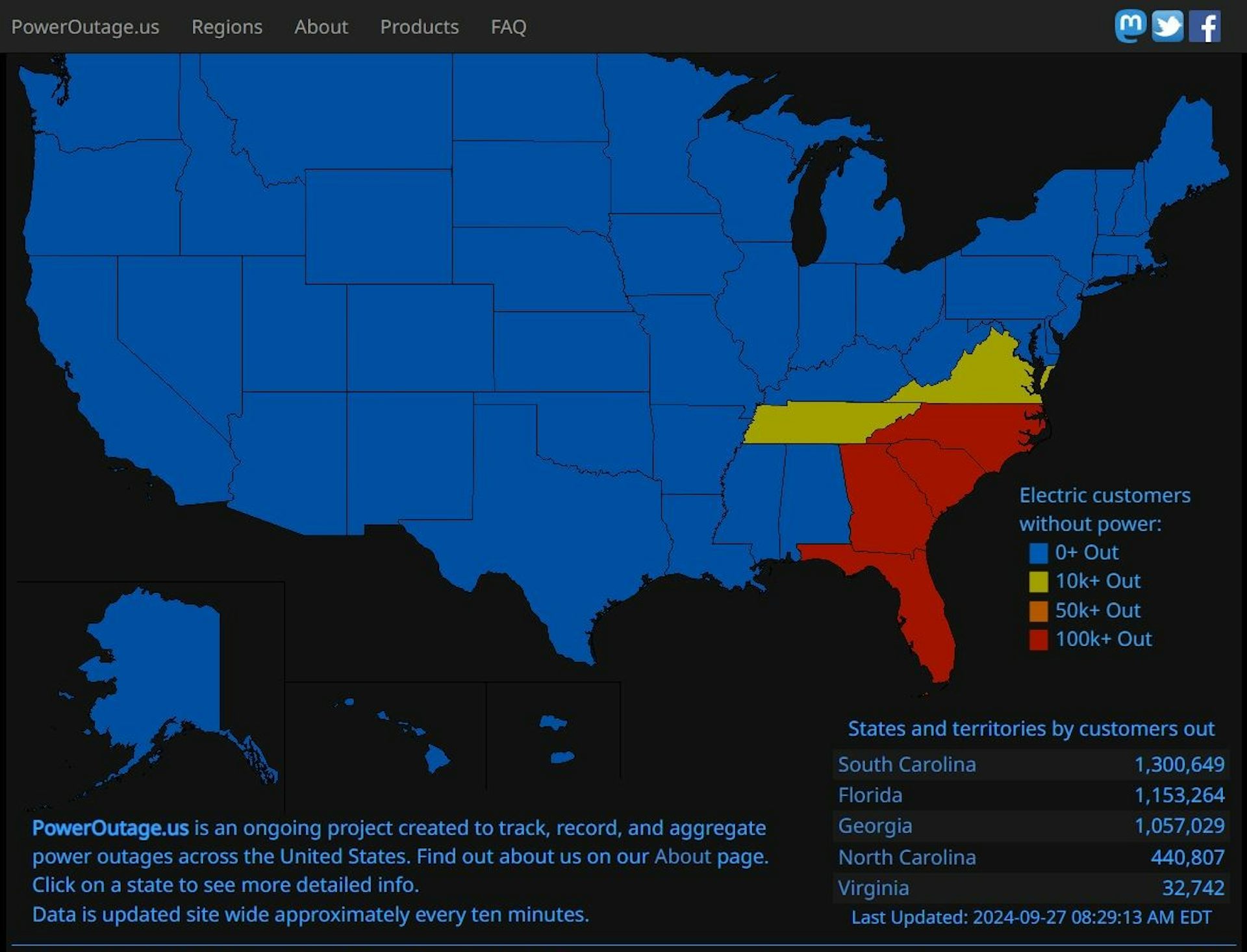
  • MIL-OSI Global: Hurricane Helene power outages leave over 3 million in the dark – history shows poorer areas often wait longest for electricity to be restored

    Source: The Conversation – USA – By Chuanyi Ji, Associate Professor of Engineering, Georgia Institute of Technology

    Strong winds from Hurricane Helene, one of the most powerful storms to hit the Southeast, flooded roads and cut power in multiple states. AP Photo/Mike Carlson

    Hurricane Helene left more than 3 million homes and businesses in the dark across Florida, Georgia and the Carolinas after hitting Florida’s Big Bend region as a powerful Category 4 storm late on Sept. 26, 2024. As Helene’s rains moved inland, officials warned that fixing downed utility lines and restoring power would take several days in some areas.

    Electricity is essential to just about everyone – rich and poor, old and young. Yet, when severe storms strike, socioeconomically disadvantaged communities often wait longest to recover.

    That isn’t just a perception.

    We analyzed data from over 15 million consumers in 588 U.S. counties who lost power when hurricanes made landfall between January 2017 and October 2020. The results show that poorer communities did indeed wait longer for the lights to go back on.

    A 10 percentile drop in socioeconomic status in the Centers for Disease Control and Prevention’s social vulnerability index was associated with a 6.1% longer outage on average. This corresponds to waiting an extra 170 minutes on average for power to be restored, and sometimes much longer.

    The top map shows the total duration of power outages over eight storms by county. The lower map is a comparison with socioeconomic status taken into account, showing that counties with lower average socioeconomic status have longer outages than expected.
    Ganz et al, 2023, PNAS Nexus

    Implications for policy and utilities

    One likely reason for this disparity is written into utilities’ standard storm recovery policies. Often, these polices prioritize critical infrastructure first when restoring power after an outage, then large commercial and industrial customers. They next seek to recover as many households as they can as quickly as possible.

    While this approach may seem procedurally fair, these recovery routines appear to have an unintended effect of often making vulnerable communities wait longer for electricity to be restored. One reason may be that these communities are farther from critical infrastructure, or they may be predominantly in older neighborhoods where power infrastructure requires more significant repairs.

    Commercial areas are often higher on the priority list for faster power recovery in an outage. This store was still closed for several days during Texas’ widespread outages in 2021.
    Montinique Monroe/Getty Images

    The upshot is that households that are already at greater risk from severe weather – whether due to being in flood-prone areas or in vulnerable buildings – and those who are least likely to have insurance or other resources to help them recover are also likely to face the longest storm-caused power outages. Long outages can mean refrigerated food goes bad, no running water and delays in repairing damage, including delays in running fans to dry out water damage and avoid mold.

    Our study spanned 108 service regions, including investor-owned utilities, cooperatives and public utilities. The differential impact on poorer communities did not line up with any particular storm, region or individual utility. We also found no correlation with race, ethnicity or housing type. Only average socioeconomic level stood out.

    How to make power recovery less biased

    There are ways to improve power recovery times for everyone, beyond the necessary work of improving the stability of power distribution.

    Policymakers and utilities can start by reexamining power restoration practices and power infrastructure maintenance, such as replacing aging utility poles and trimming trees, with disadvantaged communities in mind.

    Power providers already have granular data on power usage and grid performance in their service regions. They can begin experimenting with alternative recovery routines that consider the vulnerability of their customers in ways that do not substantially affect average recovery duration.

    People in some Fort Myers, Fla., neighborhoods still lacked water and electricity more than a week after Hurricane Ian in 2022.
    Montinique Monroe/Getty Images

    For socioeconomically vulnerable regions that are likely to experience long outages because of their locations and possibly the aging energy infrastructure, utilities and policymakers can proactively ensure that households are well prepared to evacuate or have access to backup sources of power.

    For example, the U.S. Department of Energy announced in October 2023 that it would invest in developing dozens of resilience hubs and microgrids to help supply local power to key buildings within communities when the wider grid goes down. Louisiana plans several of these hubs, using solar and large-scale batteries, in or near disadvantaged communities.

    Policymakers and utilities can also invest in broader energy infrastructure and renewable energy in these vulnerable communities. The U.S. Department of Energy’s Justice40 program directs that 40% of the benefit from certain federal energy, transportation and housing investments benefit disadvantaged communities. That may help residents who need public help the most.

    Severe weather events are becoming more common as global temperatures rise. That increases the need for better planning and approaches that don’t leave low-income residents in the dark.

    Chenghao Duan, a Ph.D. student at Georgia Tech, also contributed to this article. This is an update to an article originally published on Feb. 7, 2024.

    The authors do not work for, consult, own shares in or receive funding from any company or organization that would benefit from this article, and have disclosed no relevant affiliations beyond their academic appointment.

    ref. Hurricane Helene power outages leave over 3 million in the dark – history shows poorer areas often wait longest for electricity to be restored – https://theconversation.com/hurricane-helene-power-outages-leave-over-3-million-in-the-dark-history-shows-poorer-areas-often-wait-longest-for-electricity-to-be-restored-240001

    MIL OSI – Global Reports

  • MIL-OSI USA: Luján, Cantwell, Tester, Baldwin, Rosen Introduce Bill to Prevent Fentanyl Trafficking Through U.S. Transportation Networks

    US Senate News:

    Source: US Senator for New Mexico Ben Ray Luján
    Legislation would boost detection of illegal drug smuggling by air, sea, rail & road
    Bill gains backing by Narcotics Officers, Major City Chiefs, Forensic Science Labs, State Criminal Investigative Agencies, HIDTA Leaders
    WASHINGTON, D.C. – Commerce Committee Democrats, U.S. Senators Ben Ray Luján (D-N.M.), Maria Cantwell (D-Wash.), Jon Tester (D-Mont.), Tammy Baldwin (D-Wisc.), and Jacky Rosen (D-Nev.) introduced legislation to crack down on the trafficking of illicit synthetic drugs, like fentanyl, using the U.S. transportation network. The bill would create first-ever inspection strategies to stop drug smuggling by commercial aircraft, railroads, vehicles and ships. The legislation would boost state, local and Tribal local law enforcement resources, deploy next generation, non-intrusive detection technologies and increase inspections at ports of entry.
    “The flow of fentanyl into the country has devastated far too many communities across New Mexico and the United States,” said Senator Luján. “This bill would crack down on the trafficking of deadly drugs by implementing innovative inspection strategies for U.S. transportation networks and provide law enforcement with the tools they need to combat fentanyl smuggling. It is time for Congress to act to keep our communities safe and put an end to the fentanyl crisis.”
    “Drug traffickers should not be allowed to exploit the U.S. transportation system to smuggle fentanyl and precursor chemicals to make illicit synthetic drugs,” Senator Cantwell said. “Our bill equips federal, state, local and tribal law enforcement with the tools they need to curb drug smuggling by accelerating the development of non-intrusive technologies to inspect our commercial aircraft, trucks, trains and ships – while boosting resources to deploy this technology and drug-sniffing dogs, improving forensic science at crime labs, and building a better system to share intelligence and information between federal authorities and the private sector.”
    “The deadly flow of fentanyl into Montana communities is tearing families apart and it’s making our state less safe,” said Senator Jon Tester. “If we’re going to end illicit drug trafficking, we’re going to have to come at this issue from all sides, and that means strengthening our southern border, funding law enforcement, and securing the transportation systems allowing bad actors to get these drugs into our communities. I’m proud to have introduced this bill to give our law enforcement agencies the tools they need to combat illicit drug trafficking and make our transit systems safer for all Montanans.”
    “I’ve heard from parents who lost children, law enforcement fighting on the front lines, and advocates – all demanding we do more to stop the scourge of fentanyl,” said Senator Baldwin. “I’m fighting this crisis on all fronts – from stopping the precursor chemicals being manufactured in China, to boosting access to overdose reversal drugs, and everything in between. I’m proud to lead this legislation to give our law enforcement the tools they need to stop drug traffickers from using American airports, railways, ports, and roads to smuggle fentanyl into our communities.”
    “Most synthetic fentanyl is smuggled into our country, making its way to communities across Nevada and destroying families,” said Senator Rosen. “I’m doing everything I can to stop the flow of illicit drugs and support law enforcement. That’s why I’m proud to introduce this bill to develop a national strategy to prevent fentanyl smuggling and increase inspections at Ports of Entry on our border.”
    According to U.S. Government authorities, drug traffickers exploit the U.S. transportation network to smuggle fentanyl, precursor chemicals and other illicit drugs into and throughout the country. Once drugs have entered the country, drug traffickers continue to rely on the national transportation network—trucks, trains and commercial aircraft—to move their product to its final destination.
    The Stop Smuggling Illicit Synthetic Drugs on U.S. Transportation Networks Act of 2024 (S. 5285) would:
    Read the summary here and bill text here.
    Create a National Prevention Plan: Directs the Office of National Drug Control Policy (ONDCP) to develop a comprehensive national strategy that examines the entire U.S. transportation network and ports of entry to prevent the smuggling of illicit synthetic drugs.
    Boost Illegal Drug Detection by Air, Sea, Rail and Road: The bill establishes four new transportation-specific inspection programs—private and commercial aircraft, railroads, commercial vehicles and maritime vessels—to expand detection across all transportation modes and prevent interstate smuggling. State, local, Tribal and territorial law enforcement would carry out inspections using non-intrusive technologies and canines, in coordination with federal law enforcement authorities – and without unduly delaying the movement of goods or interrupting interstate commerce.
    Deploy High-Tech Detection Tools: Directs the Office of Science and Technology Policy (OSTP) and the ONDCP to accelerate new emerging, non-intrusive technologies, including integrating AI and quantum, to detect illicit synthetic drugs. National laboratories, including Pacific Northwest National Laboratories, are already developing next-generation technologies for fentanyl detection. AI could help increase capacities to integrate multiple sources of data and overcome challenges in identifying fentanyl when it is mixed with other opioids to evade detection.
    Increase Port of Entry Drug Detections: Currently, only 1-2 percent of passenger vehicles and 15-17 percent of commercial vehicles are scanned at U.S. ports of entry. The bill requires Customs and Border Protection (CBP) to inspect 100 percent of motor vehicles and railroads entering the country through a port of entry within five years, and all civil air cargo and maritime cargo within ten years.
    Support Law Enforcement Workforce, Technology and Training: Authorizes the Secretary of Homeland Security to provide grants to state, local, Tribal and territorial law enforcement to acquire new technology and canines and support overtime and other program-related expenses. It would also increase federal support to state and local crime scene investigators and forensics laboratories to process evidence related to fentanyl crimes and deaths.
    Improve Data and Information Sharing to Prevent Drug Trafficking: Requires the Director of ONDCP to create a public-private task force to improve intelligence and information sharing among federal, state and local authorities and the private sector to combat drug trafficking.
    “The National Narcotic Officers’ Associations’ Coalition applauds Senator Cantwell for her work on the Stop Smuggling Illicit Synthetic Drugs on U.S. Transportation Networks Act. The surge in drug poisoning deaths, especially from fentanyl, shows that more needs to be done. We know that a large portion of illegal narcotics are trafficked through our transportation systems, and this legislation will provide the needed resources such as advanced detection technology and canines to enhance law enforcement’s ability to conduct inspections on our nation’s transportation systems,” said Eric Brown, President of the National Narcotic Officers’ Associations’ Coalition.
    “The Major Cities Chiefs Association thanks Senator Cantwell for taking an innovative approach to fentanyl interdiction with the Stop Smuggling Illicit Synthetic Drugs on U.S. Transportation Networks Act. In cities across the country, resources are strained and the fentanyl crisis is a factor. Federal support is welcome as MCCA member agencies work to curb this crisis and promote safer communities and public health. We look forward to additional engagement on the matter as it moves forward in Congress,” said Laura Cooper, Executive Director of the Major Cities Chiefs Association.
    “Deaths and adverse events from illicit synthetic drugs continue to be at epidemic proportions, yet funding for forensics labs remains stagnant.  This bill prioritizes resources for the professionals on the front lines of the fight against illicit drugs, including fentanyl and other novel psychoactive substances.  We commend members of the Commerce Committee for taking this approach to ensure our forensic experts have the necessary resources and data to combat this epidemic,” said Matthew Gamette, Chair of the Consortium of Forensic Science Organizations.
    “The Association of State Criminal Investigative Agencies (ASCIA) appreciates Senator Cantwell’s introduction of the Stop Smuggling Illicit Synthetic Drugs on U.S. Transportation Networks Act of 2024. While recent figures show progress in reducing drug poisoning deaths in the U.S., we are nowhere near where we need to be to protect Americans from the ongoing threat.  This bill would strengthen the ability of agencies at all levels of government to detect and disrupt drug trafficking,” said Drew Evans, President of the Association of State Criminal Investigative Agencies.
    “The National High Intensity Drug Trafficking Area (HIDTA) Directors Association appreciates Senator Cantwell’s efforts to combat the fentanyl crisis and her support for providing critically needed tools and resources for state, local, tribal and federal law enforcement to interdict fentanyl shipments before negatively impacting the communities across the country. Given the profound impact fentanyl has had on families, schools, and communities, this bill will be instrumental in enabling law enforcement agencies participating in the HIDTA program to develop new and innovative strategies to tackle this crisis,”  said F. Mike McDaniel, President of the National High Intensity Drug Trafficking Area (HIDTA) Directors Association.

    MIL OSI USA News

  • MIL-OSI Canada: $7.7 Million for Policing and Community Safety Initiatives in Saskatoon

    Source: Government of Canada regional news

    Released on September 27, 2024

    The City of Saskatoon will receive $6.8 million in 2024-25 through the Ministry of Corrections, Policing and Public Safety’s Municipal Police Grants program to continue to fund 49 existing police officer positions in the city.

    “With the renewed support of the Municipal Police Grants program, the Saskatoon Police Service will continue delivering responsive policing services to help address social disorder concerns that are facing the community,” Corrections, Policing and Public Safety Minister Paul Merriman said. 

    In Saskatoon, these targeted policing initiatives include: Police and Crisis Teams (PACT), a Crime Reduction Team (CRT), the Child Sexual Exploitation program, and the Saskatchewan Trafficking Response Team (STRT). 

    Through PACT, police officers and mental health professionals team up to answer service calls involving individuals experiencing a mental health or addictions crisis. CRTs target gang-related criminal activity in Saskatoon, and the Child Sexual Exploitation program investigates cases involving the sexual exploitation of children. STRT works to suppress criminal activity as an intelligence-led enforcement team that investigates illegal weapons, drugs and human trafficking cases.

    Five positions with the Combined Traffic Services Saskatchewan (CTSS) initiative will also be funded by Saskatchewan Government Insurance (SGI). An additional $900,000 will be provided to the city through SGI, bringing the total for the Saskatoon Police Service Funding Agreement to $7.7 million for 54 police positions in 2024-25.

    “The challenges and complexities of policing within our current environment continue to grow,” Saskatoon Police Chief Cameron McBride said. “In order to meet these demands, the provincial government has become a critical partner for us. Within this year, the Saskatoon Police Service will receive provincial revenue totaling $7.7 million, that will support critical police work. Without this partnership, our operations would be significantly impacted.”

    Today’s funding announcement is in addition to the $4.4 million that was recently announced to support the hiring of 37 new frontline officers for the Saskatoon Police Service as part of the government’s commitment to creating safer, vibrant communities in Saskatchewan.

    Since 1998, the ministry has provided funds through the Municipal Police Grants program to police services across the province. The program currently supports 143 municipal police positions in Saskatchewan.

    -30-

    For more information, contact:

    MIL OSI Canada News

  • MIL-OSI Canada: $6.7 Million to Support Policing in Regina

    Source: Government of Canada regional news

    Released on September 27, 2024

    The Ministry of Corrections, Policing and Public Safety will provide $5.8 million to the City of Regina in 2024-25 through the Municipal Police Grants program to continue to support 44 current municipal police positions in the city. 

    “As social disorder concerns continue to impact our communities, it is important that we provide stable funding to the Regina Police Service, so they can start planning for the upcoming fiscal year,” Corrections, Policing and Public Safety Minister Paul Merriman said. “We are proud to support our municipal police services as we work to create safer communities in Saskatchewan.”

    This funding will continue to support the Regina Police Service’s Crime Reduction Team (CRT), Serious and Habitual Offender Comprehensive Action Plan, Internet Child Exploitation (ICE) program, Missing Persons Task Force, and Police and Crisis Teams (PACT), among other targeted policing initiatives. Through PACT, officers work with mental health workers to respond to calls where individuals may be experiencing a mental health crisis, while the CRT focuses on investigating gang-related activities in the community.

    The Serious and Habitual Offender Comprehensive Action Plan allows officers to work with probation officers and prosecutors to address criminal behaviours of habitual offenders between the ages of 15 and 25. The Missing Persons Task Force coordinates cases involving missing persons, and ICE investigates online child exploitation cases.

    A total of $900,000 will also be provided by Saskatchewan Government Insurance to support five police offices through the Combined Traffic Services Saskatchewan program. This brings the total amount for the Regina Police Service Funding Agreement in 2024-45 to $6.7 million to support 49 police positions in the Queen City.

    “The Municipal Police Grant program is an invaluable resource for the Regina Police Service and provincial agencies alike who work to enhance community safety,” Regina Police Service Deputy Chief Trent Stevely said. “This grant not only provides additional funding for the Regina Police Service, but an opportunity to put more officers on the street and in specialized investigative units. With this program, we have seen a province-wide impact on areas such as gang and organized crime activity, internet child exploitation, as well as providing an increased focus on local substance abuse issues.”

    This funding is in addition to the $3.8 million that was recently announced for the City of Regina to hire 32 new officers for the Regina Police Service.

    The Ministry of Corrections, Policing and Public Safety has provided financial support to Saskatchewan police services through the Municipal Police Grants program since 1998. Today, the grant program supports 143 municipal police positions and targeted policing initiatives in communities across the province.

    -30-

    For more information, contact:

    MIL OSI Canada News

  • MIL-OSI Canada: City of Prince Albert to Receive $3.6 Million for Targeted Policing Initiatives

    Source: Government of Canada regional news

    Released on September 27, 2024

    Today, the Ministry of Corrections, Policing and Public Safety announced $3.1 million for the City of Prince Albert through its 2024-25 Municipal Police Grants program. A total of 23 current police service positions will be supported through this funding initiative.

    “Supporting municipal police services, such as the Prince Albert Police Service, is crucial to ensuring the safety and security of our communities,” Corrections, Policing and Public Safety Minister Paul Merriman said. “Today’s funding continues our government’s long-standing tradition of supporting policing in Saskatchewan, and we are proud to continue supporting the Municipal Police Grants program in 2024-25.” 

    The funding supports the continued delivery of targeted policing initiatives in Prince Albert, such as the Police and Crisis Team (PACT), which teams police officers with mental health workers to provide an integrated and coordinated response to individuals experiencing a mental health or addictions crisis in the community.

    The grant program also supports the continuation of the Crime Reduction Team (CRT) that gathers intelligence on street gangs and gang associates in the city; the Missing Persons Task Force that focuses on missing persons cases; the Saskatchewan Trafficking Response Team (STRT) that investigates illegal weapons, drugs and human trafficking; and the Internet Child Exploitation (ICE) program that addresses online child exploitation.

    Saskatchewan Government Insurance will also provide $540,000 for three positions through the Combined Traffic Services Saskatchewan (CTSS) initiative. This brings the total amount of the Prince Albert Police Service Funding Agreement in 2024-25 to $3.6 million to support 26 police positions in the community.

    “The Prince Albert Police Service is grateful for the continued financial investment from the Ministry of Corrections, Policing, and Public Safety,” Prince Albert Police Chief Patrick Nogier said. “This support is vital in ensuring our ongoing efforts to enhance public safety and maintain peace within our community. We recognize the importance of a partnership between the province and the City of Prince Albert in addressing the unique challenges faced by our city.

    Prince Albert continues to serve a population far greater than its official records indicate, with a diverse and growing community. This includes not only our residents, but also those from surrounding areas who rely on the city for services. The shared responsibility between provincial and municipal authorities ensures that we are equipped to meet the demands placed on our police service and provide an effective and responsive approach to safety and security. The Prince Albert Police Service remains steadfast in its commitment, working closely with our provincial partners to address emerging challenges and uphold our mission of partnering and engaging to build a safe and compassionate community.”

    Today’s announcement is an additional funding boost for the City of Prince Albert, following the government’s recent announcement of $2.0 million to hire 17 new officers for the Prince Albert Police Service through its safer communities and neighbourhoods initiative.

    For the past 26 years, the Ministry of Corrections, Policing and Public Safety has supported Saskatchewan police services through the Municipal Police Grants program. It currently supports 143 municipal police positions and targeted policing initiatives in the province.

    -30-

    For more information, contact:

    MIL OSI Canada News

  • MIL-OSI United Kingdom: Deputy Mayor approves planning application for All England Lawn Tennis Club

    Source: Mayor of London

    Following a public hearing today at City Hall, Jules Pipe, the Deputy Mayor for Planning, Regeneration and the Fire Service, has approved the planning application for All England Lawn Tennis Club (AELTC) to transform the former Wimbledon Park golf course.

    The plans will see an additional 38 grass courts, as well as a new Show Court, allowing the AELTC to bring the Wimbledon Qualifying event on-site for the first time – with the tournament bringing a wide range of economic and social benefits to London and nationally. 

    At today’s public hearing, GLA officers provided a detailed update on the proposals. Jules Pipe then heard views from Merton and Wandsworth Councils, and a range of supporters and objectors who had registered to speak. 

    The plans include:

    • An additional 27 acre (11.1 hectares) of public park, the site of a former private golf course, to be publicly accessible, managed and maintained as parkland.
    • Improvements to Wimbledon Park Lake and the creation of a new 3km boardwalk for the public. This is together with over £10 million of further improvements to the existing public park to include the provision of an enhanced multipurpose sports and leisure facility, drainage improvements to the sports fields, improved footpaths and new toilets, alongside a range of other recreational and heritage enhancement works.
    • A minimum of seven new Championship standard grass tennis courts open for community use.
    • The planting of 1500 new trees and an increase to the extent and quality of biodiversity across the land, with a suggested measurable biodiversity net gain of at least 10 per cent. 
    • Increased provision of tickets to the Championships to the local community and schools, including 450 tickets per day prioritised for Merton and Wandsworth residents at face value and 50 made available free of charge through the Wimbledon Foundation. 1000 free qualifying tickets for the Qualifying Event will also be made available for school children in Merton and Wandsworth.

    The GLA considered the benefits and disadvantages of the proposals in relation to a range of areas including environmental, design, transport, social, economic and cultural. While the plans have a significant effect on the use of metropolitan open land, the GLA considered the overall benefits to outweigh any harm in this area – including the provision of 11.1 hectares of publicly accessible parkland that will be managed and maintained.

    The GLA found that the total economic impact of the Championships, incorporating these plans, are projected to be worth in the region of £336 million to the UK economy each year, of which it is estimated that £326 million would occur within London. These plans will support 40 new jobs across the year and more than 250 new jobs during the Championships. Additionally, the plans will employ an average of between 50 to 400 construction workers per day between 2025 and 2033. 

    The very significant public benefits of the scheme, including enhancements to open space and recreation, economic, employment and heritage were therefore deemed to clearly outweigh the harm identified and allow for planning permission to be granted.

    Jules Pipe CBE, Deputy Mayor for Planning, Regeneration and the Fire Service, said: “These plans for the site of a former private golf course will bring significant benefits to the local area, the wider capital and the UK economy, providing increased access to open green space and sport, new parkland and a host of new jobs. Hosting qualifying events on the same site as the Championships will put Wimbledon on a global footing with other Grand Slam tournaments and ensure it remains one of the world’s top sporting events. The scheme brings a huge range of economic, social and cultural benefits which will contribute to building a fairer, greener and more prosperous London for everyone.”

    MIL OSI United Kingdom